Exam Guides
BPSC 71st CCE 2026: Complete Strategy for Bihar Civil Services
Complete preparation strategy for BPSC 71st Combined Competitive Examination 2026 — posts, prelims pattern, mains papers, optional subject selection, Bihar-specific topics, previous year cutoffs, 6-month study plan, and books to crack SDO/DSP/CDPO and other Bihar state services.
This legacy article was owner-approved for publication. Verify time-sensitive claims against current official sources before acting.

The Bihar Public Service Commission Combined Competitive Examination (BPSC CCE) is the premier state civil services examination for candidates seeking prestigious government positions in Bihar. The BPSC 71st CCE 2026 is expected to fill vacancies for several Group A and Group B services — making it one of the most sought-after examinations for aspirants in Bihar and across India.
For lakhs of aspirants preparing in Patna, Muzaffarpur, Bhagalpur, and beyond, BPSC is not just an exam — it is a career-defining opportunity to serve as a senior civil servant at the district level in one of India's most historically significant states.
---
| Post | Category | Department |
|---|---|---|
| Sub-Divisional Officer (SDO) | Group A | Revenue & Land Reforms |
| Deputy Superintendent of Police (DSP) | Group A | Bihar Police |
| Child Development Project Officer (CDPO) | Group A | Social Welfare |
| Block Development Officer (BDO) | Group A | Panchayati Raj & Rural Development |
| District Social Security Officer | Group B | Labour Department |
| Revenue Officer | Group B | Revenue Dept. |
| Supply Inspector | Group B | Food & Civil Supplies |
| Bihar Education Service (BES) | Group A | Education Dept. |
| Bihar Engineering Service | Group A | PWD/Water Resources |
Posts Offered Through BPSC CCE
Post | Category | Department |
|---|---|---|
Sub-Divisional Officer (SDO) | Group A | Revenue & Land Reforms |
Deputy Superintendent of Police (DSP) | Group A | Bihar Police |
Child Development Project Officer (CDPO) | Group A | Social Welfare |
Block Development Officer (BDO) | Group A | Panchayati Raj & Rural Development |
District Social Security Officer | Group B | Labour Department |
Revenue Officer | Group B | Revenue Dept. |
Supply Inspector | Group B | Food & Civil Supplies |
Bihar Education Service (BES) | Group A | Education Dept. |
Bihar Engineering Service | Group A | PWD/Water Resources |
Most Coveted Posts: SDO and DSP are the top two — both are district-level postings with executive powers, making them equivalent to the IAS/IPS reputation at the state level.
---
BPSC CCE 2026 Exam Structure
The BPSC CCE has three stages:
Stage 1: Preliminary Examination
Format: 150 questions | Objective MCQ | 2 Hours
Total Marks: 150 (1 mark per question)
Negative Marking: No negative marking in BPSC Prelims — attempt all questions
Qualifying Nature: Prelims marks are NOT counted in final merit
Syllabus: General Studies (comprehensive)
Stage 2: Mains Examination
Paper | Type | Marks | Duration |
|---|---|---|---|
General Hindi | Qualifying (must score 30%) | 100 | 3 Hours |
General Studies Paper 1 | Descriptive | 300 | 3 Hours |
General Studies Paper 2 | Descriptive | 300 | 3 Hours |
Optional Subject | Descriptive | 300 | 3 Hours |
Total Mains Marks (counted for merit): 900 (GS1 + GS2 + Optional)
Stage 3: Interview (Personality Test)
Marks: 120
Total Merit: Mains (900) + Interview (120) = 1020 marks
Critical BPSC Rule: Unlike UPSC, Prelims marks are NOT added to the final merit list in BPSC. Only Mains + Interview counts. This means a candidate who scrapes through Prelims can still top the final merit list through exceptional Mains performance.
---
BPSC Prelims: GS Syllabus and Strategy
The Prelims covers 150 questions on General Studies with no negative marking — the single biggest strategic opportunity in BPSC:
Topic Distribution in BPSC Prelims:
Topic | Approx. Questions |
|---|---|
Bihar-specific (History, Geography, Economy, Polity, Schemes) | 30–40 |
Indian History & Freedom Struggle | 20–25 |
Indian Geography | 15–20 |
Indian Polity & Constitution | 15–18 |
General Science | 15–18 |
Indian Economy | 10–12 |
Current Affairs (National + Bihar) | 15–20 |
The Bihar-specific questions are the hidden weapon: 25–30% of the paper is Bihar-focused. Candidates from outside Bihar often ignore this section — a critical mistake. Mastering Bihar-specific content guarantees a 25–30 question advantage over UPSC-focused competitors.
Prelims Strategy:
Since there's no negative marking, mark every question — leave no blank
Spend first 60 minutes on known topics, last 30 minutes on educated guesses
Target: 100+ out of 150 for a comfortable cutoff clearance
---
Bihar-Specific Topics: The Real Differentiator
This section is what separates BPSC toppers from UPSC-trained candidates who underperform in BPSC:
- Bihar History (Ancient & Medieval)
Ancient Bihar:
Magadha Empire: Haryanka dynasty (Bimbisara, Ajatashatru), Shishunaga, Nanda dynasty
Mauryan Empire: Chandragupta Maurya, Bindusara, Ashoka the Great — Pataliputra as capital, Dhamma, rock edicts
Gupta Period: Samudra Gupta, Chandragupta II — Nalanda University founded in this era
Buddhism and Jainism: Gaya (Bodh Gaya) — Buddha's enlightenment; Vaishali — Mahavira's birth place
Nalanda University: First residential international university; scholars like Xuanzang, Aryabhatta
Medieval Bihar:
Bakhtiyar Khilji's invasion (1203 AD) — destruction of Nalanda
Shershah Suri (born Sasaram, Bihar): Grand Trunk Road, administrative reforms, revenue system
Sikh connections: Patna Sahib (Gurudwara Patna Sahib) — birthplace of Guru Gobind Singh
Colonial Bihar:
Champaran Satyagraha (1917): Gandhi's first major movement in India — indigo farmers
Chotanagpur & Jharkhand region (now separate state — know the separation year: 2000)
Bihar's role in 1857 revolt: Kunwar Singh of Jagdishpur — legendary freedom fighter
JP Movement (1974–75): Jayaprakash Narayan's Total Revolution from Patna — led to Emergency
- Bihar Geography
River System: Ganga (main river), Gandak, Koshi ("Sorrow of Bihar" — flood-prone), Bagmati, Sone, Son
Divisions: 9 divisions — Patna, Tirhut, Saran, Darbhanga, Kosi, Purnia, Bhagalpur, Munger, Magadh
Districts: 38 districts (know major district headquarters)
Climate: Subtropical, monsoon-dependent; floods in North Bihar (Koshi/Gandak plain), droughts in South Bihar (Magadh plateau)
Soil: Alluvial soil (entire Bihar plain — very fertile), calcareous soil in Magadh region
Agriculture: Rice, wheat, maize, sugarcane; litchi (Muzaffarpur is world-famous), makhana (fox nut) — GI tagged product
- Bihar Economy & State Schemes (Nitish Kumar Government)
Know the flagship schemes of the Bihar government — these appear regularly:
Scheme | Purpose |
|---|---|
Mukhyamantri Balika Cycle Yojana | Free cycles for girls attending Class 9 |
Mukhyamantri Kanya Utthan Yojana | ₹25,000 grant for girls at different education milestones |
Mukhyamantri Gram Parivahan Yojana | Subsidised vehicles for rural transportation SC/ST |
7 Nishchay (7 Resolves) | Employment, internet, pucca roads, pucca houses, toilets, electricity, skill development |
Har Ghar Bijli (LNTEPP) | Rural household electrification scheme |
Prohibition Policy (2016) | Complete alcohol ban in Bihar |
Jal Jeevan Hariyali | Water conservation, plantation, renewable energy |
Bihar Economy Stats to Know:
One of India's fastest-growing states by GSDP (2010–2020)
Major industry: Agriculture (70%+ workforce)
Per capita income below national average — key BPSC Mains discussion point
Special Category Status demand — contested political issue
MSME and startup ecosystem growth post-2015
- Panchayati Raj in Bihar
73rd Constitutional Amendment (1992): Foundation of Panchayati Raj Institutions (PRIs)
Bihar's 3-tier system: Gram Panchayat → Panchayat Samiti (Block) → Zila Parishad (District)
Reservation: 50% reservation for women in Bihar PRIs (one of the first states to implement)
Gram Katchahry: Quasi-judicial body in Bihar — handles revenue and civil disputes at village level
Mukhiya: Elected head of Gram Panchayat; directly elected by village voters
---
BPSC Mains: GS Paper Analysis
GS Paper 1 (300 Marks) — Key Topics:
Indian History: Ancient, Medieval, Modern (Freedom Struggle most important)
Art & Culture: Classical dance forms (Bhikhari Thakur for Bihar folk theatre), Madhubani painting
Indian Geography: Physical features, rivers, soil, climate
Post-independence India: Economic planning, Green Revolution, liberalisation 1991
GS Paper 2 (300 Marks) — Key Topics:
Indian Polity & Governance: Constitution, Parliament, Judiciary, Centre-State relations
Indian Economy: Economic policies, agriculture, industry, banking system
Science & Technology: Applied science, ISRO, defence technology
Environment & Ecology: Climate change, biodiversity, wildlife sanctuaries in Bihar
Bihar-specific (30–40 marks): Government schemes, governance, revenue administration
---
Optional Subject Selection Guide
Choosing the right optional is one of the most critical decisions for BPSC Mains:
Optional | Advantage | Disadvantage |
|---|---|---|
History | Overlaps heavily with GS; scoring in BPSC | Large syllabus; needs good writing |
Geography | Conceptual; diagrams scoring; overlaps GS2 | Maps practice essential |
Public Administration | Very scoring; short syllabus; current affairs overlap | Many candidates pick this (average scores rise) |
Economics | Scoring if from background; overlaps GS2 | Requires mathematical aptitude |
Political Science | Good for arts graduates; scoring | Abstract questions can be tricky |
Sociology | Short syllabus; contemporary examples | Niche topic — less practice material available |
Hindi Literature | High scorers come from this; Bihar-specific advantage | Only for strong Hindi background candidates |
Most Recommended Optionals for BPSC 2026: History + Geography + Public Administration (pick one based on your graduation subject).
---
Previous Year Cutoffs (BPSC CCE)
| Exam | General (Male) | OBC (Male) | SC | ST | |------|----------------|------------|----|----|| | BPSC 67th CCE (2022) | 681/1020 | 653/1020 | 618/1020 | 603/1020 | | BPSC 65th CCE (2021) | 675/1020 | 648/1020 | 612/1020 | 595/1020 | | BPSC 64th CCE (2019) | 668/1020 | 641/1020 | 605/1020 | 588/1020 |
Key Observation: General category cutoff has been rising consistently. For BPSC 71st 2026, expect General category cutoff around 685–695 out of 1020. Scoring 700+ gives a comfortable buffer for post/preference allocation.
---
6-Month Preparation Plan: UPSC + BPSC Combined Strategy
Many BPSC aspirants also appear for UPSC CSE — here's how to combine preparation efficiently:
Month | BPSC Focus | UPSC Overlap |
|---|---|---|
Month 1 | Bihar History (Ancient + Medieval) + NCERT History 8–10 | Modern History (UPSC overlap 60%) |
Month 2 | Bihar Geography complete + NCERT Geography 11–12 | Indian Geography |
Month 3 | Bihar Economy + Schemes + Laxmikanth Polity | Indian Polity |
Month 4 | Optional Subject (full syllabus) + GS Paper 1 answer writing | UPSC Optional parallel |
Month 5 | GS Paper 2 + BPSC Prelims mock tests (target 110+/150) | UPSC Prelims mock |
Month 6 | BPSC Mains answer writing (1 essay daily), current affairs Bihar-specific, previous papers analysis | — |
Daily Study Hours: 8–10 hours Answer Writing: Start writing 250-word answers from Month 3 onwards — minimum 1 GS answer daily.
---
Recommended Books for BPSC 71st CCE 2026
Subject | Book | Author |
|---|---|---|
Modern History (India + Bihar) | A Brief History of Modern India | Spectrum (Rajiv Ahir) |
Ancient & Medieval History | History of Medieval India | Satish Chandra |
Bihar History (specific) | Bihar: Ek Parichay | Bihar state textbook or Arihant BPSC guide |
Indian Polity | Indian Polity | M. Laxmikanth |
Geography | Certificate Human & Physical Geography | G.C. Leong |
Indian Economy | Indian Economy | Ramesh Singh |
General Science | NCERT Class 9–10 | — |
Current Affairs | Pratiyogita Darpan (monthly) | — |
Previous Papers | BPSC Solved Papers (last 10 years) | Arihant/Lucent Publications |
Optional — Public Admin | Public Administration | Mohit Bhattacharya / Laxmikanth |
---
Interview Tips for BPSC 71st
The BPSC Interview (120 marks) is conducted in Patna by a board typically consisting of retired IAS officers and subject experts:
Language: Interview can be conducted in Hindi — a significant advantage for many Bihar aspirants
Key Questions: Why Bihar civil services? Preferred posting district? Views on Bihar's development challenges?
Dress Code: Formal (suit/kurta-dhoti for men; salwar-kurta or saree for women)
DAF (Detailed Application Form) is your interview map — every line in your DAF may be questioned
Prepare for Bihar-centric policy debates: alcohol prohibition effectiveness, flood management, migration issues
---
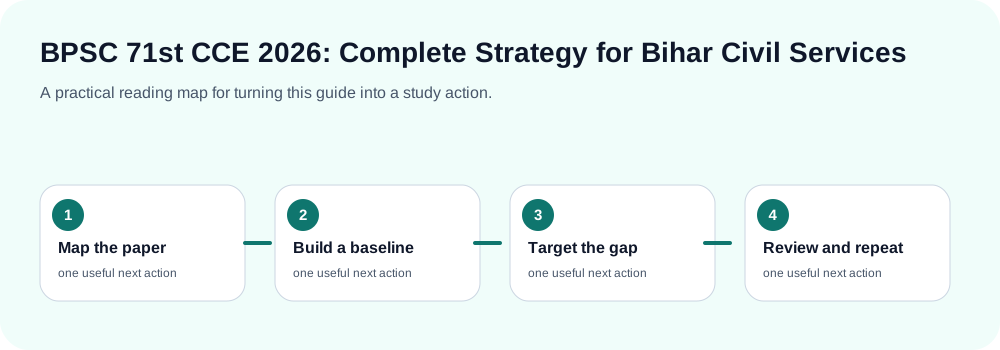
- Map the paperUse the exam pattern and eligibility details in this guide.
- Build a baselineTake a timed diagnostic mock before changing your routine.
- Target the gapChoose one weak section and practise it deliberately.
- Review and repeatLog errors, revise, and retest under time pressure.
Conclusion
BPSC 71st CCE 2026 is the most accessible route to becoming a Class 1 Gazetted Officer in Bihar. The key to success is the combination of standard UPSC-level GS preparation enriched with deep Bihar-specific knowledge — a combination that no standard UPSC coaching covers adequately.
Practice Bihar GS questions, write daily answers in Mains format, and track current affairs specific to Bihar policy and governance on YourMockTest — where our BPSC-focused mock tests and question banks are designed to mirror the exact standards of the actual BPSC CCE examination.
Revision note: Published after explicit owner approval; official-source verification remains recommended for time-sensitive claims.
Keep YourMockTest in your Google results
Add us as a Preferred Source to see fresh exam updates and preparation guidance more often in Google Search.
Add YourMockTest as a Preferred Source