Official Paper

UGC NET Paper 2: Commerce 25th Dec 2021 Shift 1 (Previous Year Paper)

100 questions · 120 minutes · with answers · free

Full Test (100 questions)

1

​Which of the following statements are false regarding electronic purse? Indicate the correct code.

(A) Retinal pattern verification

(B) Visual recognition

(C) No risk of bad payment

(D) Method of accepting payments with no cash float to manage and no risk of theft.

Choose the correct answer from the options given below:

  1. ((a))

    A, B and C only

  2. ((b))

    B, C and D only

  3. ((c))

    A and B only

  4. ((d))

    C and D only

Show Answer
Answer: ((c))

A and B only

The correct answer is A and B only

Key Points Electronic Purse:

  • An electronic purse is the store of value on a card, which can be used in a manner similar to cash to pay for travel or for other small-scale transactions.
  • The electronic “purse” is secure information stored in a dedicated area or file in the smart-card.

Important Points

  • An electronic wallet is a mechanism that allows end users to pay for goods and services electronically.
  • Its function is to maintain a bridge of value that decreases incrementally as transactions occur. E
  • Electronic wallets are based on smart cards.

In the above given option retinal structure verification and visual recognition statement is false.

2

Penetration pricing strategy delivers results:

(A) Where price quality association is weak

(B) When the product is perceived as a 'high technology' product

(C) When the market is characterised by intensive competition

(D) When the firm uses it as an entry strategy

Choose the most appropriate answer from the options given below:

  1. ((a))

    B, C only

  2. ((b))

    A, D only

  3. ((c))

    A, C, D only

  4. ((d))

    A, B, C only

Show Answer
Answer: ((c))

A, C, D only

The correct answer is A, C, D only

Key PointsPenetration pricing:

  • Penetration pricing is a sort of pricing that is particularly aggressive.
  • In order to increase customer demand, a company uses this strategy to set its pricing very cheap (sometimes even with a negative margin).
  • The corporation then raises the price again, in the hopes of capturing the same degree of client demand as with its previous extremely low pricing.

Important Points Penetration pricing strategy is helpful:

  • Where price has a weak relationship with quality.
  • When There is competition in the market.
  • When It is a strategy to enter the market.
3

Which of the following statements are false? Indicate the correct code.

(A) No company has to file any prescribed declaration before commencement of business.

(B) A company can ratify the contract entered into by the promoters with third parties on behalf of the company before its formation.

(C) The date mentioned in the certificate for commencement of business is taken as the date of birth of a public company.

(D) A private company has to file a "Settlement in lieu of prospectus" with the registrar.

Choose the correct answer from the options given below:

  1. ((a))

    A, B and D only

  2. ((b))

    A and B only

  3. ((c))

    B, C and D only

  4. ((d))

    C and D only

Show Answer
Answer: ((c))

B, C and D only

The incorrect statements are B, C and D only

Important Points

B) A company can ratify the contract entered into by the promoters with third parties on behalf of the company before its formation.

  • This statement is false because the company cannot ratify a pre-incorporation contract and hold the other party liable. The company, when it comes into existence, is not bound by any contract made on its behalf before its incorporation.

(C) The date mentioned in the certificate for commencement of business is taken as the date of birth of a public company.

  • This statement is false as the filing date for the articles of incorporation is considered the company's incorporation date.

(D) A private company has to file a "Settlement in lieu of prospectus" with the registrar.

  • This statement is false as a private company is not required to file a prospectus or a settlement in lieu of prospectus with the Registrar of Companies.
4

Which of the following represents traditional logistics management approach?

(A) Independent inventory management efforts

(B) Minimise firm costs

(C) Amount of information sharing and monitoring limited to current processes

(D) Small breadth of supplier base to increase coordination

Choose the correct answer from the options given below:

  1. ((a))

    A, B only

  2. ((b))

    B, C only

  3. ((c))

    A, C, D only

  4. ((d))

    B, C, D only

Show Answer
Answer: ((a))

A, B only

The correct answer is A, B only

Key Points Logistics Management :

Logistics management is an element of the supply chain process that plans, implements, and controls the efficient, effective flow and storage of goods, services, and related information from point of origin to point of consumption in order to meet consumer needs.

Important Points

  • Logistics refers to the process of management.
  • How resources are acquired, stored and transported to their final destination.
  • This one business discipline in which potential distributors and Identification of suppliers as well as their effectiveness and determining accessibility.
  • The people who manage, coordinate, analyse and optimize this process are called logisticians.
  • The traditional system approach to management involves an independent management wing and minimum costs of the establishment.
5

Which of the following statements are the defects of Indian Money Market?

(A) Profitable Investment

(B) Dichotomy in Indian Money Market

(C) Financing Industry

(D) Diversity in interest rates

Choose the correct answer from the options given below:

  1. ((a))

    A, B and C only

  2. ((b))

    B and C only

  3. ((c))

    A, B and D only

  4. ((d))

    B and D only

Show Answer
Answer: ((d))

B and D only

The correct answer is option 4.

Important PointsFollowing are the defects of the Indian money market:

  • Dichotomy between Organised and Unorganised Sectors
  • Predominance of Unorganised Sector
  • Wasteful Competition
  • Absence of All-India Money Market
  • Inadequate Banking Facilities
  • Shortage of Capital
  • Seasonal Shortage of Funds
  • Diversity of Interest Rates
  • Absence of Bill Market

Therefore, the correct answer is B and D only.

6

​Which of the following are not the objectives of the Competition Act, 2002?

(A) Ensure freedom of trade for other participants in incidental and connected markets.

(B) Provide a reasonable level of reliability and connect operation.

(C) Adhere to generally accepted security procedures.

(D) Protect the interests of consumers.

Choose the correct answer from the options given below:

  1. ((a))

    A, C, D only

  2. ((b))

    B, C, D only

  3. ((c))

    A, C only

  4. ((d))

    B, C only

Show Answer
Answer: ((d))

B, C only

The incorrect answer is  B, C only

Important Points

(A) Ensure freedom of trade for other participants in incidental and connected markets.

  • This is one of the objectives of The Competition Act, 2002.
  • The Competition Act, 2002 ensures freedom of trade carried on by other participants in markets, in India, and for matters connected therewith or incidental thereto.

(B) Provide a reasonable level of reliability and connect operation.

  • This is not the objective of The Competition Act, 2002.

(C) Adhere to generally accepted security procedures.

  • This is not the objective of The Competition Act, 2002.

(D) Protect the interests of consumers.

  • This is one of the objectives of The Competition Act, 2002.
  • The Competition Act, 2002 ensures protection of interests of consumers.

Additional Information

The Competitors Act, 2002 Competition is the act of sellers seeking to gain the protection of buyers in order to gain personal profit or market share.

This Act, enacted by the Parliament of India in 2002 and the Monopolies and Restrictive Trade Practices Act, 1969 was replaced.

It is effective to control Indian competition.

Its objectives are as follows:

  • To prepare a roadmap for the establishment of the Competition Commission
  • To prevent monopoly and promote competition in the market.
  • To protect consumer interests.
  • Ensuring the freedom of the people participating in the business.
7

Which of the following persons cannot use ITR-4?

(A) Who is director of a company

(B) Who has held any unlisted equity shares

(C) Who has any asset located outside India

(D) A firm (other than LLP) if assessee is a Resident

(E) Who has income from other sources

Choose the most appropriate answer from the options given below:

  1. ((a))

    A, B, C only

  2. ((b))

    A, B, D only

  3. ((c))

    B, D, E only

  4. ((d))

    C, D, E only

Show Answer
Answer: ((a))

A, B, C only

The correct answer is A, B, C only

Key Points  ITR-4

  • The Indian government has seven different types of income tax returns for its citizens to choose from. The ITR-4 is one of them.
  • Persons with a net income of less than 50 lakhs must file Form ITR-4, which is subject to certain requirements.
  • The ITR-4 Sugam is one of the income tax returns forms. It is for those taxpayers who have opted for a presumptive income scheme.
  • This scheme has been outlined in Section 44AD, Section 44AE, and Section 44ADA.
  • However, that if the business's turnover exceeds ₹2 crores, the taxpayer needs to file ITR-3.

Important Points Eligibility of ITR-4:

The ITR-4 is filed by individuals or Hindu Undivided Families who are RNOR (resident other than not ordinarily resident) or a firm which is not a Limited Liability Partnership but is a resident and has an income not exceeding ₹50 lakhs for the year 2020-21.

8

Which of the following losses are not deductible from business income?

(A) Loss sustained before the business is commenced.

(B) Lossess incurred in the closing down of the business.

(C) Loss incurred due to damage, destruction, etc., of capital assets.

(D) Loss of raw material and finished goods in transit.

(E) Loss of stock-in-trade due to enemy action.

Choose the correct answer from the options given below:

  1. ((a))

    A, B, C only

  2. ((b))

    B, C, D only

  3. ((c))

    A, D, E only

  4. ((d))

    A, B, D only

Show Answer
Answer: ((a))

A, B, C only

The correct answer is A, B, C only

Key Points Business Loss Setoff:

  • Taxpayers' previous year's business losses can be offset against the current year's taxable revenue.
  • The Income Tax Act provides for such changes in accordance with natural justice principles.
  • As a result, the Income Tax Act includes provisions for company losses.

Important Points Business Losses Deductible under Income Tax:

  • The loss incurred as a result of an employee's embezzlement is allowable as a deduction in the year in which the embezzlement is discovered.
  • Stock-in-trade losses caused by fire or other natural disasters, as well as employee negligence, are deductible.
  • Robbery or theft losses are deductible if they occur in the course of business and are incidental to the trade.
  • Losses incurred as a result of exchange rate fluctuations while remitting funds for the acquisition of raw materials are deductible.
  • Losses incurred as a result of non-recovery of advances given in the course of business are deductible under the Income Tax Act if they are trading losses.
  • Loss incurred as a result of a violation of contract for the delivery of goods.

Business Loss Not Allowed under Income Tax:

  • Losses sustained before the business is commenced
  • Losses incurred in the closing down of a business.
  • Losses incurred due to damage, destruction, etc., of capital assets.
  • A loss that is not incurred as a result of the assessee's business operations.
  • The loss incurred as a result of the sale of securities held as investments will be a capital loss rather than a business loss.
  • Loss resulting from the forfeiture of a loan for the purchase of capital assets.
  • Violation of the law is not a common occurrence in business, and an expense incurred as a result of a penalty for breaking the law is not deductible as a business loss.
  • In the usual course of business, there is a trading loss owing to the loss of products in transit.
9

Match List I with List II:

List IList II (International Trade Theories)
(A)David Ricardo (1817)(I)Theory of absolute advantage
(B)Michael Porter (1990)(II)Factor endowment theory
(C)Adam Smith (1776)(III)Theory of comparative advantage
(D)Heckscher (1919) - Ohlin (1933)(IV)Theory of competitive advantage

Choose the correct answer from the options given below:

  1. ((a))

    (A) - (I), (B) - (II), (C) - (III), (D) - (IV)

  2. ((b))

    (A) - (III), (B) - (IV), (C) - (I), (D) - (II)

  3. ((c))

    (A) - (IV), (B) - (III), (C) - (II), (D) - (I)

  4. ((d))

    (A) - (III), (B) - (IV), (C) - (II), (D) - (I)

Show Answer
Answer: ((b))

(A) - (III), (B) - (IV), (C) - (I), (D) - (II)

The correct answer is (A) - (III), (B) - (IV), (C) - (I), (D) - (II)

List IList II (International Trade Theories)
(A)David Ricardo (1817)(III)Theory of comparative advantage
(B)Michael Porter (1990)(IV)Theory of competitive advantage
(C)Adam Smith (1776)(I)Theory of absolute advantage
(D)Heckscher (1919) - Ohlin (1933)(II)
Factor endowment theory

Important Points

Theory of absolute advantage by Adam Smith (1776):

  • Adam Smith argued that trade should be based on absolute advantage.
  • This term describes the position when one country is absolutely more efficient at producing good A, whilst another country is absolutely ‘better’ at producing good B.
  • Both countries would benefit if they specialised in producing the goods at which they have the aTheory of comparative advantagedvantage and then exchanged their products.

Theory of comparative advantage by David Ricardo (1817):

  • Smith’s argument about absolute advantage was refined and developed by David Ricardo in 1817.
  • Ricardo, improving upon Adam Smith’s exposition, developed the theory of international trade based on what is known as the Principle of Comparative Advantage (Cost).
  • As a person specialises in the trade in which he has best advantages, a country also specialises in the production of the commodity in which it has the best natural advantages.
  • A country may produce many things at a time, but it may have comparative advantages in the production of some commodities (say, tea or jute as in India) over others, and it will specialise in those goods.

Factor endowment theory by Heckscher (1919) - Ohlin (1933):

  • The Heckscher-Ohlin (HO) model is a more accurate representation of the global economy following WWII.
  • Heckscher-Ohlin theory is an economics theory of comparative advantage in international trade that states that countries with abundant capital and scarce labour will tend to export capital-intensive products and import labor-intensive products, while countries with abundant labour and scarce capital will tend to export labor-intensive products and import capital-intensive products.

Theory of competitive advantage by Michael Porter (1990):

  • According to Porter's idea of competitive advantage, if you have a true competitive edge over your competitors, you can operate at a lower cost, command a higher price, or do both. It's more difficult to figure out how to gain an advantage.
  • Every organization's purpose is to produce items or services whose value surpasses the sum of all input expenses.
  • Thus, the ideal indicator, according to Porter, is Return on Invested Capital (ROIC).
  • ROIC will be consistently higher than the industry average if you have a genuine competitive advantage.
10

Match List I with List II:

List I (Method)List II (Purchase consideration)
**(**A)Lump-sum payment method(I)Calculated by adding up the total amount (money value) of existing shares, preference shares and cash received from the purchasing company for the shareholders of the vendor company.
(B)Net Assets Method(II)On the basis of ratio in which the shares of the transferee company are to be exchanged for the shares of the transferor company.
(C)Net Payment Method(III)The amount to be paid by the transferee company to transferor company for amalgamation of its business.
(D)Swap Ratio Method(IV)Arrived at by adding the agreed value of assets taken over and deducting there from the agreed values of liabilities.

Choose the correct answer from the options given below:

  1. ((a))

    (A) - (III), (B) - (II), (C) - (I), (D) - (IV)

  2. ((b))

    (A) - (III), (B) - (IV), (C) - (I), (D) - (II)

  3. ((c))

    (A) - (IV), (B) - (I), (C) - (II), (D) - (III)

  4. ((d))

    (A) - (IV), (B) - (III), (C) - (II), (D) - (I)

Show Answer
Answer: ((b))

(A) - (III), (B) - (IV), (C) - (I), (D) - (II)

The correct answer is (A) - (III), (B) - (IV), (C) - (I), (D) - (II)

The correct match is given below:

List I (Method)List II (Purchase consideration)
(A)Lump-sum payment method(III)The amount to be paid by the transferee company to transferor company for amalgamation of its business.
(B)Net Assets Method(IV)Arrived at by adding the agreed value of assets taken over and deducting there from the agreed values of liabilities.
(C)Net Payment Method(I)Calculated by adding up the total amount (money value) of existing shares, preference shares and cash received from the purchasing company for the shareholders of the vendor company.
(D)Swap Ratio Method(II)On the basis of ratio in which the shares of the transferee company are to be exchanged for the shares of the transferor company.


Important Points Methods of Purchase Consideration:

Lump Sum Method: 

  • The purchasing company may agree to pay the seller company a lump-sum payment in exchange for the purchase of its business.
  • This strategy, in fact, is not based on any scientific ideas or methodologies. This approach of determining purchase consideration is unscientific and non-mathematical.

Net Worth or Net Assets Method:

  • In this method, the purchase consideration is computed using this method by adding up the values of various assets acquired by the purchasing firm and subtracting them from the values of various liabilities acquired by the purchasing company.
  • For the purposes of calculating purchase consideration, the values of assets and liabilities are those that are agreed upon between the acquiring firm and the vendor company, rather than the values that appear on the vendor company's Balance Sheet.
  • (Agreed value of Assets taken over) – (Agreed value of liabilities taken over) = Net Assets

Net Payment Method:

  • The amount payable to the shareholders of the selling firm in cash, shares, or debentures in the acquiring company may be specified in the agreement between the selling company and the purchasing company.
  • According to AS – 14, "consideration for amalgamation" refers to the total number of shares and other securities issued, as well as the payment made by the transferee company to the transferor firm's shareholders in the form of cash or other assets.
  • The total of shares, debentures, and cash to be paid for claims of Equity and Preference shareholders of the transferor company is the purchase consideration under the net payment method.

Swap Ratio Method:

  • The total number of shares to be received by the share-holders of the transfer or firm from the transferee company is determined by dividing the net worth of assets by the value of one share of the transferee company using this technique.
  • When the number of shares to be received by the transferor firm is determined, it is divided by the transferor company's existing shares to get the share ratio.
11

Match List I with List II:

List I (Pricing Strategies)List II (Description)
(A)Ramsay pricing(I)Setting a high price when a product is first introduced and gradually lowering price as it gains scale
(B)Price skimming(II)Firm charges lower price (than the ongoing price) to gain market entry
(C)Cost plus pricing(III)Price deviations from marginal cost should be inversely proportional to price elasticity of the product
(D)Penetration pricing(IV)It is full cost pricing strategy that also includes mark up for target return, degree of competition, price elasticity and availability of substitutes.

Choose the correct answer from the options given below:

  1. ((a))

    (A) - (III), (B) - (IV), (C) - (I), (D) - (II)

  2. ((b))

    (A) - (II), (B) - (I), (C) - (III), (D) - (IV)

  3. ((c))

    (A) - (III), (B) - (I), (C) - (IV), (D) - (II)

  4. ((d))

    (A) - (I), (B) - (IV), (C) - (II), (D) - (III)

Show Answer
Answer: ((c))

(A) - (III), (B) - (I), (C) - (IV), (D) - (II)

The correct answer is (A) - (III), (B) - (I), (C) - (IV), (D) - (II)

The correct match is given below:

List I (Pricing Strategies)List II (Description)
(A)Ramsay pricing(III)Price deviations from marginal cost should be inversely proportional to price elasticity of the product
(B)Price skimming(I)Setting a high price when a product is first introduced and gradually lowering price as it gains scale
(C)Cost plus pricing(IV)It is full cost pricing strategy that also includes mark up for target return, degree of competition, price elasticity and availability of substitutes.
(D)Penetration pricing(II)Firm charges lower price (than the ongoing price) to gain market entry
<br>

Important Points

Ramsay pricing: 

  • It is a pricing strategy that promotes economic welfare while ensuring that enterprises meet profit targets.
  • Ramsey pricing reduces to marginal cost pricing if all companies produce with constant returns to scale and must break even.
  • The mark-ups of the Ramsey pricing over marginal cost are inversely related to the elasticity of demand if enterprises have growing returns to scale and must break even.
  • Ramsey pricing has been studied in the setting of regulated private sector natural monopoly and public sector monopoly.
  • The Ramsey rule for optimal commodity taxes is closely related to Ramsey pricing.

Price skimming:

  • Price skimming is a pricing technique in which a product's or service's price is initially set high and then gradually reduced as customers become more familiar with it.
  • This strategy is aimed at early adopters rather than the general public.

Cost plus pricing:

  • Markup pricing is another name for cost-plus pricing.
  • It's a form of pricing in which a fixed percentage is added to the cost of producing one unit of a product (unit cost).
  • The resulting number is the product's selling price.
  • This pricing technique considers only the unit cost and ignores rival prices.
  • As a result, it is not necessarily the ideal fit for many firms because it ignores external issues such as competition.

Penetration pricing:

  • Businesses use penetration pricing as a marketing tactic to attract customers to a new product or service by offering a lower price during its initial release.
  • A reduced price assists a new product or service in breaking into the market and luring customers away from competitors.
12

Match List I with List II:

List IList II
(A)Market risk(I)Associated with the efficiency with which a firm conducts its operations within the broader environment imposed upon it.
(B)Financial risk(II)Arises due to change in operating conditions caused by conditions thrust upon the firm which are beyond its control.
(C)External business risk(III)Variations in price sparked off due to real, social, political and economic events.
(D)Internal business risk(IV)Associated with the capital structure of a firm.

Choose the correct answer from the options given below:

  1. ((a))

    (A) - (I), (B) - (II), (C) - (III), (D) - (IV)

  2. ((b))

    (A) - (III), (B) - (IV), (C) - (II), (D) - (I)

  3. ((c))

    (A) - (III), (B) - (I), (C) - (II), (D) - (IV)

  4. ((d))

    (A) - (IV), (B) - (III), (C) - (I), (D) - (II)

Show Answer
Answer: ((b))

(A) - (III), (B) - (IV), (C) - (II), (D) - (I)

The correct answer is (A) - (III), (B) - (IV), (C) - (II), (D) - (I)

The correct match is given below:

List IList II
(A)Market risk(III)Variations in price sparked off due to real, social, political and economic events.
(B)Financial risk(IV)Associated with the capital structure of a firm.
(C)External business risk(II)Arises due to change in operating conditions caused by conditions thrust upon the firm which are beyond its control.
(D)Internal business risk(I)Associated with the efficiency with which a firm conducts its operations within the broader environment imposed upon it.


Important Points Market risk: 

Market risk refers to the probability that an individual or other entity would suffer losses as a result of factors affecting the overall performance of financial market investments.

Financial risk:

The risk of losing money on an investment or business endeavour is referred to as financial risk. Credit risk, liquidity risk, and operational risk are some of the more prevalent and distinct financial hazards. Financial risk is a sort of danger that might cause interested parties to lose money.

External business risk:

Economic events that occur outside of the business structure are frequently considered external risks. External occurrences that result in external risk are impossible for a corporation to manage or predict with high accuracy. Therefore, it is hard to reduce the associated risks.

Internal Business Risk:

Internal risks are those that emerge from within a company's organisation and occur during routine business activities. Because these risks can be predicted with some accuracy, a corporation stands a fair chance of lowering internal business risk.

13

Logically sequence the following in the process of entering international markets outlined in the uppsala model.

(A) Sporadic (Ad hoc) exports

(B) Foreign production and manufacturing

(C) Establishing a foreign sales subsidiary

(D) Domestic operations and production

(E) Exporting via independent representative

Choose the correct answer from the options given below:

  1. ((a))

    (A), (B), (C), (D) and (E)

  2. ((b))

    (C), (B), (D), (A) and (E)

  3. ((c))

    (D), (A), (E), (C) and (B)

  4. ((d))

    (E), (B), (D), (C) and (A)

Show Answer
Answer: ((c))

(D), (A), (E), (C) and (B)

The correct answer is (D), (A), (E), (C) and (B)

Key Points Uppsala Model:

  • Swedish scholars (Johanson and Wiedersheim-Paul, 1975; Johanson and Vahlne, 1977) developed the Uppsala Internationalization Model as a result of their interest in the internationalisation process.
  • They constructed a model of the firm's choice of market and type of entrance when moving abroad after studying the internationalisation of Swedish manufacturing enterprises.
  • The Uppsala model is one of the best known models of how firms set about the internationalization process.
  • It presents a sequential approach, meaning that the firm internationalizes incrementally.
  • The model assumes that there is a lack of knowledge of the foreign market which is detrimental to internationalization.

Important PointsSequence of process of entering international markets:

  1. Domestic operations and production
  2. Sporadic (Ad hoc) exports
  3. Exporting via independent representative
  4. Establishing a foreign sales subsidiary
  5. Foreign production and manufacturing
14

Match List I with List II:

List I (Personlity dimensions)List II (Individual Traits)
(A)Extroversion(I)Calm, happy and secure
(B)Conscientiousness(II)Talkative, assertive, sociable and outgoing
(C)Emotional stability(III)Creative, curious, intellectual, imaginative and artistically sensitive
(D)Openess to experience(IV)Self-disciplined, hardworking, organised, dependable and persistent.

Choose the correct answer from the options given below:

  1. ((a))

    (A) - (II), (B) - (IV), (C) - (III), (D) - (I)

  2. ((b))

    (A) - (II), (B) - (IV), (C) - (I), (D) - (III)

  3. ((c))

    (A) - (III), (B) - (II), (C) - (I), (D) - (IV)

  4. ((d))

    (A) - (IV), (B) - (I), (C) - (II), (D) - (III)

Show Answer
Answer: ((b))

(A) - (II), (B) - (IV), (C) - (I), (D) - (III)

The correct answer is (A) - (II), (B) - (IV), (C) - (I), (D) - (III)

The correct match is given below:

List I (Personality dimensions)List II (Individual Traits)
(A)Extroversion(II)Talkative, assertive, sociable and outgoing
(B)Conscientiousness(IV)Self-disciplined, hardworking, organised, dependable and persistent.
(C)Emotional stability(I)Calm, happy and secure
(D)Openess to experience(III)Creative, curious, intellectual, imaginative and artistically sensitive

Important Points Extroversion: 

  • Extroversion (also known as extraversion) is one of the five main personality traits that are thought to make up a person's personality.
  • Friendliness, talkativeness, aggressiveness, and excitability are all characteristics of extroverts.

Conscientiousness:

  • The way a person manages, regulates, and directs their impulses is referred to as conscientiousness.
  • On a professional test, people who score high on conscientiousness are adept at forming long-term goals, organising and planning pathways to these goals, and working persistently to achieve them.
  • The sub traits of conscientiousness are: Self-efficacy, Orderliness, Dutifulness, Achievement-striving, Self-discipline, Cautiousness

Emotional Stability:

  • Stability of emotion is a good quality. It means you can persevere in challenging conditions, deal with hardship, and stay productive and capable.
  • Calm, happy and secure are traits of this dimension

Openess to experience:

  • In the Five Factor Model, one of the categories used to describe human personality is openness to experience.
  • Active imagination, aesthetic sensitivity, attention to inner sentiments, a preference for variety, and intellectual curiosity are all characteristics of openness.
  • These attributes are statistically connected, according to a large body of psychometric research.
  • As a result, openness can be thought of as a broad personality trait made up of a collection of distinct traits, behaviours, and dispositions that cluster together.
15

Match List I with List II:

List IList II
(A)Insurance Act(I)1988
(B)Life Insurance Corporation Act(II)1963
(C)Motor Vehicles Act(III)1938
(D)Marine Insurance Act(IV)1956

Choose the correct answer from the options given below:

  1. ((a))

    (A) - (IV), (B) - (III), (C) - (I), (D) - (II)

  2. ((b))

    (A) - (I), (B) - (II), (C) - (III), (D) - (IV)

  3. ((c))

    (A) - (III), (B) - (IV), (C) - (I), (D) - (II)

  4. ((d))

    (A) - (IV), (B) - (III), (C) - (II), (D) - (I)

Show Answer
Answer: ((c))

(A) - (III), (B) - (IV), (C) - (I), (D) - (II)

The correct answer is (A) - (III), (B) - (IV), (C) - (I), (D) - (II).

Key Points

  • Insurance Act, 1938: The Insurance Act, 1938 is a law originally passed in 1938 in British India to regulate the insurance sector. It provides the broad legal framework within which the industry operates.
  • Life Insurance Act, 1956: The Parliament enacted the Life Insurance Corporation Act in 1956 which came into force on July 1, 1956. After the enactment, the private insurance groups were nationalized and many insurance and provident societies were combined to form Life Insurance Corporation under the ownership of the State.
  • Motor Vehicles Act, 1988: The Motor Vehicles Act is an Act of the Parliament of India which regulates all aspects of road transport vehicles. The Act provides in detail the legislative provisions regarding licensing of drivers/conductors, registration of motor vehicles, etc.
  • The Marine Insurance Act, 1963: An Act to codify the law relating to marine insurance.
16

Match List I with List II:

List IList II
BooksAuthor(s)
(A)Wealth of Nations, 1776(I)Thomas Malthus
(B)Principles of Political Economy and Taxation, 1817(II)Karl Marx
(C)Principle of Population, 1798(III)Adam Smith
(D)Das Capital, 1867(IV)David Ricardo

Choose the correct answer from the options given below:

  1. ((a))

    (A) - (I), (B) - (III), (C) - (IV), (D) - (II)

  2. ((b))

    (A) - (III), (B) - (IV), (C) - (I), (D) - (II)

  3. ((c))

    (A) - (II), (B) - (III), (C) - (I), (D) - (IV)

  4. ((d))

    (A) - (III), (B) - (I), (C) - (IV), (D) - (II)

Show Answer
Answer: ((b))

(A) - (III), (B) - (IV), (C) - (I), (D) - (II)

The correct answer is (A) - (III), (B) - (IV), (C) - (I), (D) - (II)

The correct match is given below:

List IList II
BooksAuthor(s)
(A)Wealth of Nations, 1776(III)Adam Smith
(B)Principles of Political Economy and Taxation, 1817(IV)David Ricardo
(C)Principle of Population, 1798(I)Thomas Malthus
(D)Das Capital, 1867(IIKarl Marx


Important Points Wealth of Nations 1776:

  • This is an important work of economic and social theory by Adam Smith, published in 1776.
  • Its full title was Inquiry into the Nature and Causes of the Wealth of Nations.
  • In it, he analysed the relationship between work and the production of a nation's wealth.
  • His conclusion was that encouraging free enterprise (an economic system in which there is unrestricted competition in industry and trade and no government control) leads to the optimum economic position.

Principles of Political Economy and Taxation, 1817:

  • David Ricardo's work,  Principles of Political Economy and Taxation was published in April 1817.
  • The book concludes that land rent rises in line with population growth.
  • It also explains the comparative advantage hypothesis, which states that free trade between two or more countries can be mutually advantageous even if one country has an absolute advantage over the others in all areas of production.

Principle of Population, 1798:

  • An Essay on the Principle of Population was first published anonymously in 1798, but Thomas Robert Malthus was soon identified as the author.
  • The book warned in advance of future difficulties based on the assumption that population would increase in a geometric progression (doubling every 25 years) while food production would increase in an arithmetic progression, leaving a gap that would result in a lack of food and famine unless birth rates were reduced.

Das Capital, 1867:

  • Das Kapital is a key work by Karl Marx (1818–83), a 19th-century economist and philosopher, in which he outlined his theory of the capitalist system, its dynamism, and its tendency toward self-destruction.
  • His goal, he said, was to reveal "the economic rule of motion of modern civilization."
  • According to Marx, the existence of a massive army of unemployed, which he blamed on the capitalists, was what drove wages to subsistence levels, not population pressure.
  • He claimed that in the capitalist system, labour was nothing more than a commodity that could only be exchanged for subsistence wages.
17

Match List I with List II:

List IList II
(A)Ordinary damages(I)Never granted by way of compensation for the loss
(B)Special damages(II)They are quite heavy in amount and are awarded by way of punishment only
(C)Exemplary damages(III)Arise in the ordinary course of events from the breach of contract
(D)Nominal damages(IV)The constitute indirect loss suffered by the aggrieved party on account of breach of contract.

Choose the correct answer from the options given below:

  1. ((a))

    (A) - (III), (B) - (IV), (C) - (II), (D) - (I)

  2. ((b))

    (A) - (IV), (B) - (III), (C) - (II), (D) - (I)

  3. ((c))

    (A) - (I), (B) - (II), (C) - (IV), (D) - (III)

  4. ((d))

    (A) - (II), (B) - (I), (C) - (III), (D) - (IV)

Show Answer
Answer: ((a))

(A) - (III), (B) - (IV), (C) - (II), (D) - (I)

The correct answer is (A) - (III), (B) - (IV), (C) - (II), (D) - (I)

The correct match is given below:

List IList II
(A)Ordinary damages(III)Arise in the ordinary course of events from the breach of contract
(B)Special damages(IV)They constitute indirect loss suffered by the aggrieved party on account of breach of contract.
(C)Exemplary damages(II)They are quite heavy in amount and are awarded by way of punishment only
(D)Nominal damages(I)Never granted by way of compensation for the loss


Important Points Ordinary damages: Damages that arise in the ordinary course of events from the breach of contract are called ordinary damages. Damages arising out of natural and probable consequences of breach of contract are also considered ordinary damage.

Special damages: The market value at the time the loss occurred is used to calculate special damages. In the instance of a tort claim, however, the lawyer may attempt to secure the claim through extraordinary damages. For example: Damaged property is replaced.

Exemplary damages: This is an amount of money that someone who commits an offence has to pay, which is intended to be large enough to prevent them or others from committing similar offences in the future

Nominal Damages: Even if no actual injury is demonstrated, the plaintiff is entitled to nominal damages if the defendant is found guilty of breach of contract. If a legal right is infringed upon, but no real damages are incurred, nominal damages are given, and the right to a verdict is granted as a result of the infringement.

18

Match List I with List II:

List IList II
(A)Section 35 (2AA)(I)Payment made to certain institutions for scientific research.
(B)Section 35 (1) (ii a)(II)Payment made to certain institutions for research in social sciences.
(C)Section 35(1) (iii)(III)Payment made to a company to be used for scientific research.
(D)Section 35(1) (ii)(IV)Payment made to Indian Institute of Technology for Scientific Research.

Choose the correct answer from the options given below:

  1. ((a))

    (A) - (IV), (B) - (II), (C) - (III), (D) - (I)

  2. ((b))

    (A) - (IV), (B) - (III), (C) - (II), (D) - (I)

  3. ((c))

    (A) - (I), (B) - (II), (C) - (III), (D) - (IV)

  4. ((d))

    (A) - (I), (B) - (II), (C) - (IV), (D) - (III)

Show Answer
Answer: ((b))

(A) - (IV), (B) - (III), (C) - (II), (D) - (I)

The correct answer is (A) - (IV), (B) - (III), (C) - (II), (D) - (I)

The correct match is given below:

List IList II
(A)Section 35 (2AA)(IV)Payment made to Indian Institute of Technology for Scientific Research.
(B)Section 35 (1) (ii a)(III)Payment made to a company to be used for scientific research.
(C)Section 35(1) (iii)(II)Payment made to certain institutions for research in social sciences.
(D)Section 35(1) (ii)(I)Payment made to certain institutions for scientific research.


Important Points Section 35 (2AA) - Payment made to a National Laboratory or a University or an Indian Institute of Technology

If an assessee pays a sum to a National Laboratory, a University, an Indian Institute of Technology, or a specific person with the intent that the money be used for scientific research under a programme approved by the prescribed authority, he is entitled to a deduction of 150 percent of the amount paid.

Section 35 (1) (ii a) - Payment made to a company to be used for scientific research.

Any sum paid to a company to be used by it for scientific research:

Provided that such company:

  • is registered in India,
  • has as its main object the scientific research and development,
  • is, for the purposes of this clause, for the time being approved by the prescribed authority in the prescribed manner, and
  • fulfils such other conditions as may be prescribed;
<br>

Section 35(1) (iii) - Payment made to certain institutions for research in social sciences.

any sum paid to a research association which has as its object the undertaking of research in social science or statistical research or to a university, college or other institution to be used for research in social science or statistical research.

Provided that such association, university, college or other institution for the purposes of this clause—

  • is for the time being approved, in accordance with the guidelines, in the manner and subject to such conditions as may be prescribed; and
  • such association, university, college or other institution is specified as such, by notification in the Official Gazette, by the Central Government.
19

​Counter Vailing Duties (CVD) are often imposed on imports to offset the impact of

  1. ((a))

    Predatory pricing

  2. ((b))

    Export subsidies

  3. ((c))

    Dumping

  4. ((d))

    Low cost financing

Show Answer
Answer: ((b))

Export subsidies

The correct answer is Export Subsidies

Key Points ​Counter Vailing Duties (CVD):

  • Counter Vailing Duties are tariffs imposed on imported commodities to compensate for subsidies given to producers of these goods in the exporting country.
  • Countervailing duty (CVD) is a specific form of duty that the government imposes in order to protect domestic producers by countering the negative impact of export subsidies.

Important Points Why Counter Vailing Duties are imposed?

  • Foreign governments may grant subsidies to their producers in order to make their products cheaper and increase demand in other nations.
  • To prevent these commodities from flooding the importing country's market, the importing country's government applies a countervailing tax, charging a specific amount on imports of these goods.
  • The tariff raises the price of the imported product, bringing it closer to market value. The government can ensure a level playing field for domestic products in this way.

Additional Information

  • Predatory pricing: A predatory pricing strategy is a pricing strategy in which goods or services are supplied at a very low price point in order to drive out competitors and create entry barriers.
  • Dumping: In the financial sector, dumping happens when a firm or country sells its products at a cheaper price than it charges domestically. Exporters dump to compete with the importing country's producers and sellers.
20

To prevent opportunistic takeover of domestic firms amid Covid-19 pandemic, Foreign Direct Investment (FDI) from countries that share borders with India is allowed through

  1. ((a))

    Automatic route

  2. ((b))

    Government route

  3. ((c))

    FIPB route

  4. ((d))

    DPIIT route

Show Answer
Answer: ((b))

Government route

The correct answer is Government route

Key Points

  • Following the COVID-19 epidemic, on 18th April 2020, the government made prior approval essential for foreign investments from nations that share a land border with India in order to prevent "opportunistic takeovers" of Indian enterprises, a move that will limit FDI from China.
  • Countries which share land borders with India are China, Bangladesh, Pakistan, Bhutan, Nepal, Myanmar, and Afghanistan.

Important Points According to a press note issued by the Department for promotion of Industry and Internal Trade (DPIIT)

"An entity of a country, which shares a land border with India or where the beneficial owner of an investment into India is situated in or is a citizen of any such country, can invest only under the government route,"

Additional Information What is Government Route?

Government route means the entry route through which investment by a person resident outside India requires prior Government approval, and foreign investment received under this route shall be in accordance with the conditions stipulated by the Government in its approval.

21

​Factor conditions in Michael Porter's competitive advantage of Nations include

  1. ((a))

    Market size

  2. ((b))

    Demand conditions

  3. ((c))

    Internationally competitive suppliers

  4. ((d))

    Skilled labour and scientific knowledge

Show Answer
Answer: ((d))

Skilled labour and scientific knowledge

The Correct answer is Skilled labour and scientific knowledge

Key Points

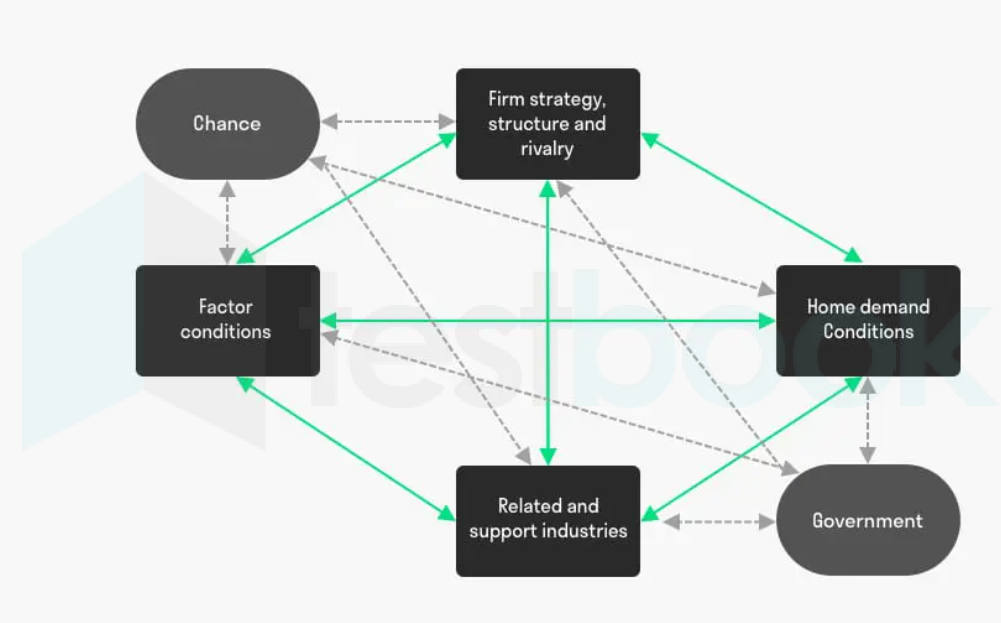
The Competitive Advantage Of Nations by Michael Porter:

  • The Competitive Advantage of Nations is an economics book written by American author Michael E. Porter, a Harvard Business School professor and expert in corporate competitive strategy whose work is regularly quoted in business and economics.
  • For Porter, the concept of national productivity is not a meaningful term because countries don’t compete like businesses do.

Important Points A four-factor system is used in Porter's Diamond model to forecast or evaluate cluster activities:

1. Firm Strategy, Structure, and Rivalry:

A company's structure and business strategy must align with the local business climate in order for it to grow. Direct rivalry with other businesses should encourage each company to use its skills and resources to boost innovation and productivity—and to outperform its local competitors.

2. Demand Conditions:

When customers in a local market expect high-quality, differentiated products, companies trying to meet those demands will be obliged to innovate in order to survive. As a result, a company that succeeds in a competitive and aggressively demanding local market will also succeed in the global market since its products have been fine-tuned.

3.  Related and Supporting Industries:

All organizations rely on suppliers for parts, raw materials, and information exchange to some extent, and most companies engage in this cycle as both customers and providers. When a company's supply chain firms are productive, high-quality enterprises with the potential to prosper in both the local and global market, the company's efficiency, productivity, and innovation will improve as well.

4. Factor Conditions:

​Factor conditions in Michael Porter's competitive advantage of Nations include Skilled labour and scientific knowledge. This is a country's situation in terms of production elements such as knowledge and infrastructure. These are important considerations in determining industry competitiveness. Material resources, people resources (labour expenses, credentials, and dedication), knowledge resources, and infrastructure are all elements to consider.

22

In case the purchasing company agrees to act as the agent of the vendor for collection of the book debts, in the books of the purchasing company, the amount of debtors should be credited to

  1. ((a))

    Vendor's debtors account

  2. ((b))

    Vendor's suspense account

  3. ((c))

    Debtors account

  4. ((d))

    Creditors account

Show Answer
Answer: ((b))

Vendor's suspense account

The correct answer is Vendor's suspense account

Key Points Sometimes the purchasing firm does not takeover the vendor's debtors and creditors, but instead agrees to collect book debts and pay creditors out of debtor collections.

  • The company charges a commission based on a percentage of both the amount collected from debtors and the amount given to creditors for this purpose.
  • Since the purchasing business performs this function on behalf of the vendors, any profit or loss (in the form of discounts and bad debts) should be paid by them.

Important Points For closing of Debtors Account, the following entries are passed:

Entries in the Books of Purchasing Company:

ParticularsDebitCredit
Vendor's Debtors A/c                        Dr.xxxx
To Vendor's Suspense A/cxxxx


Entries in the Books of Vendor Company:

ParticularsDebitCredit
Purchasing Company Suspense A/c Dr.xxxx
To Debtor's A/cxxxx
23

​When the value of "Investment in subsidiary" in the holding company's balance sheet is more than the book value of the net assets acquired, the difference represents

  1. ((a))

    Capital reserve on consolidation

  2. ((b))

    Goodwill on consolidation

  3. ((c))

    Minority interest

  4. ((d))

    Post acquisition profit

Show Answer
Answer: ((b))

Goodwill on consolidation

The correct answer is Goodwill on consolidation

Important PointsA. When the value of "Investment in subsidiary" in the holding company's balance sheet is more than the book value of the net assets acquired:

  • When the value of "Investment in Subsidiary" in the holding company's Balance Sheet is more than the book value of the net assets acquired, the difference represents "Goodwill on Consolidation".
  • In this case, Investment in the Subsidiary will not cancel out against the share capital of the subsidiary unless goodwill equal to the difference of the two items is shown on the assets side of the Consolidated Balance Sheet.

B. When the value of "Investment in subsidiary" in the holding company's balance sheet is less than the book value of the net assets acquired:

  • Conversely, if the value of Investment in the Subsidiary is less than the book value of the net assets acquired, the difference represents Capital Reserve on Consolidation.
  • In this case also, Investment in a Subsidiary will not cancel out against the share capital of the subsidiary unless capital reserve equal to the difference of the two items is shown on the liabilities side of the Consolidated Balance Sheet.
24

The basic method of valuing human assets is

  1. ((a))

    Adjustment

  2. ((b))

    Amortization

  3. ((c))

    Capitalization

  4. ((d))

    Quasi equity

Show Answer
Answer: ((b))

Amortization

The correct answer is Amortization

Key Points

  • Valuation of human assets is related to human resource accounting. It is mainly related to human capital.
  • Its basic objective is the effective management of human resources, facility, so that the acquisition, development, to be maintained, consumed and evaluated.
  • Following are the methods for taking valuation of human:
  • Historical Cost Method/Amortization.
  • Replacement cost method.
  • Opportunity Cost Method.
  • Economic value method.
  • Standard Costing Method
  • Non-monetary methods.
  • Cost-benefit method

Amortization of human assets is also done in the same way to other physical assets. The asset is written off for its useful life.

If the asset is prematurely liquidated, the amount thereof will be is charged to the revenue account.

Therefore, amortization is the basic method of valuation of human assets.

25

X and Y are partners, sharing profits and losses in the ratio of 4 ∶ 3. They admit Z into the partnership for 15\frac{1}{5}th share. X and Y decide to share future profits in the ratio of 2 ∶ 1. What is the sacrificing ratio of X and Y?

  1. ((a))

    4 ∶ 3

  2. ((b))

    13 ∶ 8

  3. ((c))

    8 ∶ 13

  4. ((d))

    4 ∶ 17

Show Answer
Answer: ((d))

4 ∶ 17

The correct answer is 4 : 17

Key Points Sacrificing Ratio: Sacrificing ratio is the percentage of existing partners that surrender their profit share in favour of newly admitted partners.

Formula for Sacrificing Ratio:

Sacrificing ratio = Old profit sharing ratio – New profit sharing ratio

Important Points Old Ratio = X : Y = 4 : 3 

 Z's Share = 1/5

Calculation of New Ratio

Remaining share for X and Y after admitting Z = 115=451- \frac{1}{5} = \frac{4}{5}

X's share = 45×23=815\frac {4}{5} \times \frac {2}{3} = \frac {8}{15}

Y's share = 45×13=415\frac{4}{5} \times \frac {1}{3} = \frac {4}{15}

Sacrifice by X = 47815=4105\frac {4}{7} - \frac {8}{15} = \frac {4}{105}

Sacrifice by Y = 37415=17105\frac {3}{7}- \frac{4}{15} = \frac{17}{105}

Sacrificing Ratio = 4 : 17

26

For a given set of paired data, the correlation and regression coefficients have been calculated as being equal to r, bxy and byx respectively. Now, each of the values of the x series is divided by 5. What effect does it have on each of these co-efficients?

  1. ((a))

    The three co-efficients remain unchanged

  2. ((b))

    There is no change in r but by x changes to byx/5 and bxy changes to 5 bxy

  3. ((c))

    Each of the co-efficients will be reduced to one fourth of its value.

  4. ((d))

    There is no change in r but by x changes to 5byx and bxy changes to bxy/5

Show Answer
Answer: ((d))

There is no change in r but by x changes to 5byx and bxy changes to bxy/5

The correct answer is There is no change in r but by x changes to 5byx and bxy changes to bxy/5

Key Points

Correlation coefficient= r

Regression coefficients= bxy and byx

As per the question

Series x is divided by 5 

  • There will be no change in the value of the correlation coefficient because the correlation coefficient is independent of scale and origin both.
  • Change of origin means some value has been added or subtracted whereas the change in scale means some value is multiplied or divided.
  • When x series is divided by 5, it will not affect the value of r.
  • The regression coefficients are independent of change of origin but not of scale.
  • So, the value of regression coefficients will change when x series is divided by 5.
  • The value of regression coefficients bxy changes to bxy/5 and byx changes to 5byx.

Byx is in r and bay will change in byx/5 = r = bxy.byx\sqrt {bxy.byx}

27

Which of the following statement is correct?

  1. ((a))

    Coefficient of variance = σXˉ\frac{\sigma}{\bar{X}} × 100

  2. ((b))

    If values in a series are negative, the standard deviation is also negative

  3. ((c))

    If value in a series multiplied by σ, the variance would be multiplied by 36

  4. ((d))

    Standard deviation is equal to square of variance.

Show Answer
Answer: ((a))

Coefficient of variance = σXˉ\frac{\sigma}{\bar{X}} × 100

The correct answer is Option 1

Coefficient of variance = σXˉ\frac{\sigma}{\bar{X}} × 100

Important Points Coefficient of Variance:

  • The coefficient of variation (CV) is the ratio of the standard deviation to the mean.
  • The higher the dispersion around the mean, the higher the coefficient of variation.
  • In most cases, it's expressed as a percentage.
  • It facilitates comparison between distributions of values whose measurement scales are not comparable without the use of units.

Formula:

 CV = σXˉ\frac{\sigma}{\bar{X}} × 100

where,

σ\sigma = Standard Deviation

Xˉ\bar {X} = Mean

let consider a dataset where the mean (​Xˉ\bar {X}

<br>

is 25 and the standard deviation (σ) is 5.  

Solution:

The coefficient of variation (CV) formula is:

CV=(σX‾)×100CV = \left( \frac{\sigma}{\overline{X}} \right) \times 100

Given:

  • Mean (X‾\overline{X}) = 25

  • Standard Deviation (σ\sigma) = 5

Substitute the values into the formula:

CV=(525)×100CV = \left( \frac{5}{25} \right) \times 100 

CV=0.2×100

CV = 0.2 \times 100CV=20%CV = 20%

Therefore, the coefficient of variation for the dataset is 20%.

Additional Information 

If the value in a series is negative, the standard deviation is also negative

  • The Standard Deviation formula is computed using squares of the numbers. The square of a number cannot be negative. Hence, Standard deviation cannot be negative. Therefore, option 2 is incorrect.

If the value in a series multiplied by σ, the variance would be multiplied by 36. 

  • This statement is incorrect as variance is the square of Standard deviation. So if the data set is multiplied by standard deviation, the variance would be multiplied by the Square of the standard deviation.

Standard deviation is equal to the square of variance.

  • This statement is also incorrect as the variance is equal to the square of the standard deviation or the standard deviation is the square root of the variance.
28

​For a poisson distribution variable X, P(X = 0) = 2P(X = 1), its standard deviation would be:

  1. ((a))

    2\sqrt{2}

  2. ((b))

    0.5

  3. ((c))

    0.5\sqrt{0.5}

  4. ((d))

    2

Show Answer
Answer: ((c))

0.5\sqrt{0.5}

The correct answer is - √0.5

Key Points

  • Poisson distribution
  • The probability mass function (PMF) is given by: P(X = x) = (e−λ λx) / x!
  • Given: P(X = 0) = 2 × P(X = 1)
  • Using the PMF:
  • P(X = 0) = e−λ, and
  • P(X = 1) = λe−λ
  • From the condition:
  • e−λ = 2λe−λ ⟹ 1 = 2λ ⟹ λ = 0.5
  • Standard Deviation of Poisson distribution is √λ = √0.5

Additional Information

  • Mean and Variance of Poisson Distribution
  • Both are equal to λ (mean = variance = λ)
  • Applications of Poisson Distribution
  • Used for modeling rare events like arrival of calls, number of accidents, etc.
  • It is a discrete distribution defined for x = 0, 1, 2, …
  • Standard Deviation
  • Formula: SD = √λ, where λ is the average rate of success over a fixed interval
  • In this case, since λ = 0.5, SD = √0.5
29

A test that contains a fair sample of the tasks and skills actually needed for the job in question is:

  1. ((a))

    Construct validity

  2. ((b))

    Content validity

  3. ((c))

    Test validity

  4. ((d))

    Criterion validity

Show Answer
Answer: ((b))

Content validity

The correct answer is Content Validity

Key Points Content Validity:

A test that is content valid is one that contains a fair sample of the tasks and skills actually needed for the job in question.

Example : Selecting students for dental school, many schools give applicants chunks of chalk, and ask them to carve something that looks like a tooth. If the content you choose for the test is a representative sample, then the test is content valid. 

Additional Information Construct validity: Construct validity refers to how well the measure 'behaves' in accordance with theoretical hypotheses, and it measures how well the instrument's results reflect the theoretical construct.

Test validity: The degree to which a test (such as a chemical, physical, or scholastic test) accurately measures what it is designed to assess is known as test validity.

Criterion validity: A measure's criterion validity is an estimate of how well it agrees with a gold standard (i.e., an external criterion of the phenomenon being measured). The lack of gold standards in criterion validity assessment for questionnaire-based measures is a key issue.

30

​Which among the following is not a primary determinant of organizational structure?

  1. ((a))

    Chain and span

  2. ((b))

    Capacity and lower needs

  3. ((c))

    Power and control

  4. ((d))

    Differentiation and integration

Show Answer
Answer: ((b))

Capacity and lower needs

The incorrect option is Capacity and lower needs

Key PointsOrganisational Structure

  • A structure of an organisation is a set of predefined linkages between groups of related functions, as well as between physical factors and persons required to accomplish the duties.
  • The organisation chart is used to represent the structure of the company. It demonstrates power and responsibility among various roles inside the company by indicating who reports to whom.
  • The organisational structure establishes the communication and coordination patterns in businesses.

Important Points Chain and span:

  • Scalar chain is a chain of all supervisors from the top management to the person working in the lowest rank
  • Span of control (or span of management) is the number of subordinates who report directly to a manager or leader.
  • If the span of control is very limited, the number of organisational levels (scalar chain) will increase, as the organisation grows in size, the organisational structure becomes tall.

Power and Control:

  • When we look around organisations, we can notice power expressions practically everywhere. In truth, there are numerous power-based strategies for influencing others.
  • Common power methods, symbols of managerial authority, and ethical power use.
  • Controlling Access to Information, Controlling Access to Persons, Controlling the Agenda. Etc are some important factors of organisational structure.

Differentiation and integration:

  • Differentiation is the process through which a company divides itself into important components like departments or product offers.
  • Inter-departmental coalitions, are examples of how businesses integrate its components.

Thus, Capacity and lower needs are not primary determinants of organisational structure.

31

​Which of the following can be categorized as people processing services?

  1. ((a))

    Health care

  2. ((b))

    Legal services

  3. ((c))

    Education

  4. ((d))

    Transportation

Show Answer
Answer: ((a))

Health care

The correct answer is Health care

Key Points People processing Services:

  • As the title suggests, these services are aimed at specific individuals.
  • Customers must physically enter the service environment in order to receive the service they desire.
  • It's also possible that the service provider will arrive at the customer's location with the tools needed to conduct services.
  • The goal is to develop a new set of values for service industry clients.

Important Points

  • Health services can be classified into group people processing services.
  • These are the services that are targeted directly provided to citizens.
32

​If assesssee is engaged in the business of growing and manufacturing tea in India, the non-agricultural income in that case be:

  1. ((a))

    40% the income from such business

  2. ((b))

    25% the income from such business

  3. ((c))

    60% the income from such business

  4. ((d))

    75% the income from such business

Show Answer
Answer: ((a))

40% the income from such business

The correct answer is 40% the income from such business

Key Points Partly Agricultural and Partly Non-agricultural Income:

  • In some cases, revenue is made up of both agricultural and non-agricultural sources.
  • Such a situation happens in certain "Agro-based industries," where agricultural output is used as a raw material and is produced by the same person (i.e., industrialist) who manufactures industrial products utilising such raw material.
  • These industries (i.e., individuals) make money by selling industrial products made from locally grown agricultural raw materials.

Important Points Rule 8 - Income from Growing and Manufacturing of Tea

  • According to rule 8, if a person grows and manufactures tea, their income is combined, with business income accounting for 40% and agri-income accounting for the remaining 60%.
  • It will not be considered agricultural income if someone sells forest produce such as trees.

Hence, 60% income will be considered as agriculture income and rest 40% will be considered as Non-agricultural Income

33

​AMT provisions are applicable on:

  1. ((a))

    Corporate assessee

  2. ((b))

    Non Corporate assessee

  3. ((c))

    HUF

  4. ((d))

    An Individual

Show Answer
Answer: ((b))

Non Corporate assessee

The correct answer is Non Corporate assessee

Key Points Alternate Minimum Tax:

  • The Alternative Minimum Tax (AMT) is a different tax system that compels some taxpayers to compute their tax burden twice, once under standard income tax laws and then again under the AMT regulations, and pay the highest amount.
  • The AMT differs from the regular system in that it has fewer preferences and various exemptions and rates.

Important Points Applicability of AMT:

MT provisions are applicable to the following taxpayers:

  • All non-corporate taxpayers; and
  • taxpayers who have claimed deduction under:
  • Chapter VI-A under the heading
  • Deduction under Section 35AD
  • Profit linked deduction under Section 10AA

Calculation of AMT:

ParticularsAmount
Tax liability computed as per normal provisions of the Income-tax Act – normal tax liabilityxxxx
AMT computed at 18.5% (plus applicable surcharge and cess) on adjusted total incomexxxx
Tax liability of taxpayerHigher of the above
34

X, an employee of the private company, gets Rs. 30,000 p.m. basic salary and entitled to Rs. 1,500 p.m. as entertainment allowance. What are the deductions u/s 16 (ii) from gross salary in respect of entertainment allowance?

  1. ((a))

    Rs. 5,000

  2. ((b))

    Rs. 18,000

  3. ((c))

    Rs. 72,000

  4. ((d))

    Nil

Show Answer
Answer: ((d))

Nil

The correct answer is Nil

Key Points

Entertainment Allowance Under Section 16

  • The entertainment allowance is first included in the pay income before being deducted based on a few conditions.
  • The allowance must be an entertainment allowance specifically granted by an employer to the taxpayer.

Important Points Entertainment Allowance for a Government Employee:

For employees of the central government and state government, the deduction available is the least of the following:

  • 20% of basic salary
  • Rs 5000
  • Amount granted as entertainment allowance in the financial year

To determine the allowance, a taxpayer must ensure the following particulars are met:

  • ​Any other allowance, benefit from the employer, or perquisite received must be deducted from the salary. Essentially, the wage must be the gross amount earned before any extra benefits are taken into account.
  • Never consider the actual amount spent out of the entertainment allowance received from the employer.

Entertainment Allowance for a Non Government Employee:

Non-government employees are not eligible for the entertainment allowance deduction.

The deduction is only available to employees of the federal or state governments. Furthermore, the deduction is not available to employees of municipal governments or statutory corporations.

35

Which of the following provident fund is approved by the provident fund commissioner?

  1. ((a))

    Statutory provident fund

  2. ((b))

    Recognised provident fund

  3. ((c))

    Unrecognised provident fund

  4. ((d))

    Public provident fund

Show Answer
Answer: ((b))

Recognised provident fund

The correct answer Recognised Provident Fund

Key Points Provident Fund:

A provident fund​ is an investment fund that is voluntarily established by Employer and employees to serve as long term savings to support an employee’s retirement.

  • Employee’s contribution:  The amount deducted from the employee’s salary at a rate of 2% – 15%.
  • Employer’s contribution: Besides the usual salary payment made to the employer, an employer will also pay 2% - 15% of employee’s salary into the fund. It is also considered a part of employment welfare.

Important Points Recognised Provident Fund:

  • Any establishment which is recognised by the Commissioner of Income Tax is called as recognised provident fund.
  • To be recognised, an organization of 20 or more members shall invest funds as per the guidelines of PF Act, 1952, and can get an approval from the PF Commissioner of Income-tax.

Additional Information 

Statutory Provident Fund (SPF):

  • This Provident Fund is managed by local governments, government organisations, railways, universities, and other institutions.
  • The Insurance Funds Act of 1925 is applicable to this lawsuit.
  • Employer donations may be tax-free, whereas employee contributions are taxable under Section 80c.
  • The interest provided has no tax implications because it is not considered part of the income.

Unrecognised Provident Fund –

If the commissioner of income tax does not approve the provident fund scheme created by the employer and employee (as mentioned above), then such scheme is an unrecognised provident fund scheme.

Public Provident Fund (PPF) -

The Public Provident Fund (PPF) is an Indian savings and tax-savings mechanism established in 1968 by the Ministry of Finance's National Savings Institute. The scheme's principal goal is to encourage people to save small amounts of money by providing a safe investment with tax benefits.

36

Which of the following institutions are included in the 'World Bank Group'?

(A) International Finance Corporation

(B) International Monetary Fund

(C) World Trade Organization

(D) Multilateral Investment Guarantee Agency

(E) International Development Association

Choose the correct answer from the options given below:

  1. ((a))

    A, B and C only

  2. ((b))

    A, B and D only

  3. ((c))

    A, B, D and E only

  4. ((d))

    A, D and E only

Show Answer
Answer: ((d))

A, D and E only

The correct answer is A, D and E only

Key Points World Bank Group:

  • The World Bank Group is a one-of-a-kind global cooperation, with five institutions working together to find long-term solutions to poverty reduction and shared prosperity in developing nations.
  • On issues ranging from climate change, conflict, and food security to education, agriculture, finance, and trade, the Bank Group collaborates with country governments, the business sector, civil society organisations, regional development banks, think tanks, and other international institutions.

Important Points World Bank Group consists of five development institutions:

  • The International Bank for Reconstruction and Development (IBRD) provides loans, credits, and grants.
  • International Development Association (IDA) provides low- or no-interest loans to low-income countries.
  • The International Finance Corporation (IFC) provides investment, advice, and asset management to companies and governments.
  • The Multilateral Guarantee Agency (MIGA) insures lenders and investors against political risk such as war.
  • The International Centre for the Settlement of Investment Disputes (ICSID) settles investment-disputes between investors and countries.
37

Corporate social responsibility is the continuing commitment by business to behave ethically and contribute to

(A) Political awareness, social security and inclusion

(B) Public health, education and literacy

(C) Maintaining ecological balances and protecting environment

(D) Gender diversity, profiteering and market controlling

(E) Rendering, Sponsoring and donating to social and charitable activities

Choose the correct answer from the options given below:

  1. ((a))

    A, B and D only

  2. ((b))

    B, C and E only

  3. ((c))

    C, D and E only

  4. ((d))

    A, B and C only

Show Answer
Answer: ((b))

B, C and E only

The correct answer is B, C and E only

Key Points Corporate Social Responsibility

  • The concept of corporate social responsibility (CSR) is that a company should play a good role in the community and take into account the environmental and social consequences of its business actions.
  • It's tied to ESG, which stands for Environmental, Social, and Governance, and sustainability, which creates economic, social, and environmental benefit.
  • All three focus on non-financial elements that large and small businesses should consider when making decisions.

Important Points

  • Corporate Social Responsibility (CSR) to act ethically by the business, the life of the workforce and their families as well as the local community and society at large.
  • There is a constant commitment to contribute to economic development while improving quality.
  • The environment here also includes the improvement of nature.
38

Following are the problems that mar an optimal international diversification:

(A) Unfavourable exchange rate movements

(B) Frictions in international markets

(C) Manipulation of security prices

(D) Unequal access to information

Choose the most appropriate answer from the options given below:

  1. ((a))

    A, B, C only

  2. ((b))

    B, C, D only

  3. ((c))

    A, C, D only

  4. ((d))

    A, B, C, D only

Show Answer
Answer: ((d))

A, B, C, D only

The correct answer is A, B, C, D only

Key Points International Diversification:

  • International diversification is a risk management strategy that tries to disperse risk across several geographical regions in order to lessen volatility.
  • This entails not only investing in the securities of companies that operate in various industries and have varying sizes and styles, but also distributing assets across various places and countries.
  • These countries have a poor connection and react to market and economic developments differently.
  • This is done to lessen the long-term volatility of the portfolio's returns.

Important Points

  • Optimal diversification also known as Markowitz diversification.
  • It takes a different approach to building a diversified portfolio.
  • Here, the focus is on finding those properties that have a complete relationship with each other which is not positive in any way.
  • It has the following problems –
  • adverse fluctuations in the exchange rate
  • friction in the international market
  • manipulation of securities prices
  • unequal access to information
39

Which of the following statement is correct about Mann-Whitney U-test?

(A) It is non parametric test

(B) It requires that samples are independent

(C) It can be used when populations involved are normally distributed

(D) It is used to test the null hypothesis that the two populations are involved are identical.

(E) It is always a two-tailed test.

Choose the correct answer from the options given below:

  1. ((a))

    A, B, D only

  2. ((b))

    A, C, D only

  3. ((c))

    A, D, E only

  4. ((d))

    A, B, E only

Show Answer
Answer: ((a))

A, B, D only

The correct answer is A, B, D only

Key Points Mann-Whitney U-test:

  • The non-parametric Mann-Whitney U test is an alternative to the independent sample t-test. It's a non-parametric test that compares two sample means from the same population and determines whether they're equal.
  • When the data is ordinal or the t-test assumptions are not met, the Mann-Whitney U test is usually utilised.
  • Since, the results are reported as group rank differences rather than group mean differences, it might be difficult to interpret the Mann-Whitney U.
  • In hypothesis testing, Statistical tests are used to check whether the null hypothesis is rejected or not rejected. It is used to test the null hypothesis that the two populations are involved are identical. Hence, D is true.

Important Points Mann-Whitney U test is a non-parametric test, so it does not assume any assumptions related to the distribution of scores. Hence, A is true:

There are, however, some assumptions that are assumed:

  • The sample drawn from the population is random.
  • Independence within the samples and mutual independence is assumed. That means that an observation is in one group or the other (it cannot be in both). Hence, B is true.
  • Ordinal measurement scale is assumed.
40

The principles of management have the following distinct features:

(A) Flexibility

(B) Universal application

(C) Principles are relative, not absolute

(D) Based on situation.

Choose the most appropriate answer from the options given below:

  1. ((a))

    A, B only

  2. ((b))

    B, C only

  3. ((c))

    A, C, D only

  4. ((d))

    A, B, C, D

Show Answer
Answer: ((d))

A, B, C, D

The correct answer is A, B, C, D

Key Points Management:

Management is the art of maximizing efficiency, as a social process, a method of getting things done through others a plan of action and its direction by a co-operative group moving towards a common goal. Effective utilisation of available resources to achieve the same objective is management

Important Points Features of Principles of Management

  1. Flexible: Management concepts are not rigid laws, but rather changing suggestions. When it comes to management concepts, change and progress are a constant.
  2. Universal: Management principles apply to all types of organisations, both for profit and non-profit. They can be used at all levels of management. Every firm must make the best use of management principles available. As a result, they are universal or all-encompassing.
  3. Principles are relative, not absolute: Management principles are relative, not absolute, and should be used based on the organisation's needs. Under different circumstances, a specific management theory has varied strengths. As a result, the principles should be used in accordance with the current circumstances.
  4. Based on situation: Management principles are the basic truths that govern managerial behaviour. They help managers in taking managerial decisions. They are the general premises that can be applied to different situations​.
41

Use of interviews as a training needs assessment technique has the following advantages:

(A) Questions can be modified

(B) Easy to analyze

(C) Can explore unanticipated issues that come up

(D) Less time consuming

Choose the most appropriate answer from the options given below:

  1. ((a))

    A, B only

  2. ((b))

    B, C only

  3. ((c))

    A, C only

  4. ((d))

    B, C, D only

Show Answer
Answer: ((c))

A, C only

The correct answer is A, C only

Key Points Training Needs Assessment:

  • A training needs assessment is a comprehensive procedure for determining which type of training is required and providing information on how to implement the training.
  • It's also known as a tool for identifying new abilities, knowledge, and attitudes that employees need to develop in order to improve their performance.
  • The Training Needs Assessment (TNA) assists firms in determining the skills and training gaps in their existing personnel in order to efficiently fulfil current and future jobs.

Important PointsAdvantages of use of interviews as a training needs assessment technique

  1. It helps in collecting qualitative and quantitative data.
  2. It helps in getting high return on investment.
  3. By this the questions can be improved. 4.  It provides opportunity for learning and development through proper training.

5. Explores unpredictable topics.

  1. It is easy to analyse the results.
42

The advantages of incentive payments are

(A) Ease in the introduction of new machines

(B) Better utilization of equipment

(C) Reduced absenteeism and turnover

(D) Increased scrap

Choose the most appropriate answer from the options given below:

  1. ((a))

    A, B only

  2. ((b))

    B, C only

  3. ((c))

    B, C, D only

  4. ((d))

    A, B, C only

Show Answer
Answer: ((b))

B, C only

The correct answer is B, C only

Key Points Incentive Pay:

Incentive pay is financial reward for performance rather than pay for the number of hours worked. The idea is the prospect of financial compensation will motivate the employee to hit certain performance figures or financial targets. 

Important Points Advantages of Incentive Pay:

An incentive pay plan is a great way to keep employees motivated and boost both morale and job satisfaction.

It has the following advantages

  1. Improved Employee Performance and Retention
  2. Better Organizational Performance

3. Make better use of equipment.

  1. Helps in executing business strategy.

5. Absence and turnover decrease.

43

Which of the following forms may not result in credit risk?

(A) Principle and/or interest amount may not be repaid in the case of direct lending.

(B) In case of guarantees or letter of credit, fund may not be forth coming from the constituents upon crystallisation of the liability.

(C) Funds/Securities settlement may not be effected, in case of securities trading business.

(D) Provide information for determining adequacy of loan loss provision.

Choose the correct answer from the options given below:

  1. ((a))

    A, B and C only

  2. ((b))

    A, C and D only

  3. ((c))

    B and C only

  4. ((d))

    D only

Show Answer
Answer: ((d))

D only

The correct answer is D only

Provide information for determining adequacy of loan loss provision will not result in credit risk.

Key Points Credit Risk:

  • The risk of losing money due to a borrower's failure to repay a loan is known as credit risk.
  • It refers to a lender's risk of having its cash flows disrupted if a borrower fails to pay principal or interest on a loan.
  • When a borrower does not have enough cash flow to pay a creditor or does not have enough assets to sell to make a payment, credit risk is deemed to be higher.
  • The lender is more likely to demand compensation in the form of a higher interest rate if the risk of non-payment is greater.
44

Arrange the following characteristics of stages of group development in the increasing order:

(A) Members begin to resolve differences and clarify the purpose of the group and the roles of group members.

(B) It includes recognition for participation and achievement.

(C) Members are highly task-oriented and there is unity in the group.

(D) Conflicts start arising due to the differences of opinion among members.

(E) Members are moderately eager, have positive expectations, anxious about why they are there, and who other members are

Choose the correct answer from the options given below:

  1. ((a))

    (E), (D), (A), (B), (C)

  2. ((b))

    (D), (E), (C), (A), (B)

  3. ((c))

    (E), (D), (A), (C), (B)

  4. ((d))

    (D), (B), (A), (E), (C)

Show Answer
Answer: ((c))

(E), (D), (A), (C), (B)

The correct answer is (E), (D), (A), (C), (B)

Key Points Group Development:

Group development is the process through which mem newly established work teams get to know their co-bers ofworkers, define their roles and responsibilities, and develop the task work and collaboration skills needed to coordinate their efforts and operate effectively as a group.

Important Points Stages of Group Development:

  1. Members are moderately eager, have positive expectations, anxious about why they are there, and who other members are.
  2. Conflicts start arising due to the differences of opinion among members.
  3. Members begin to resolve differences and clarify the purpose of the group and the roles of group members.
  4. Members are highly task-oriented and there is unity in the group.
  5. It includes recognition for participation and achievement.
45

Arrange the following steps in logical sequence of operation of the registration of portfolio managers:

(A) Prior approval of the SEBI.

(B) Adequate steps for redressal of investors grievances.

(C) Maintenance of the specified capital adequacy requirements.

(D) Payment of fee.

(E) Abide by the regulations under the SEBI Act.

Choose the correct answer from the options given below:

  1. ((a))

    (C), (E), (A), (B), (D)

  2. ((b))

    (D), (A), (B), (E), (C)

  3. ((c))

    (A), (D), (B), (C), (E)

  4. ((d))

    (D), (E), (A), (C), (B)

Show Answer
Answer: ((c))

(A), (D), (B), (C), (E)

The correct answer is (A), (D), (B), (C), (E)

Key Points Portfolio Manager:

  • A portfolio manager is someone who is in charge of managing, advising, and supervising a portfolio on behalf of his clients.
  • A portfolio is a collection of investments.
  • Portfolio management is the service that is provided for managing a client's funds.
  • The portfolio manager is required to be capable of meeting the needs of its clients by investing the money in the most profitable way possible.
  • He has a fiduciary responsibility and must behave in accordance with the portfolio manager's and his client's agreement.
  • Portfolio managers are professionals that oversee their clients' investments.

Important Points Steps of operation of the registration of portfolio managers:

(A) Prior approval of the SEBI: An individual who wants to be a portfolio manager shall apply online to SEBI and take its prior approval.

(B) Payment of fee: Application in Form A to the Board along with a non-refundable fee of INR 1 Lakh has to be submitted

(C) Adequate steps for redressal of investors grievances: If any complaint is received from an investor, the portfolio manager is required to take adequate grievances redressal steps. Such complaints must be resolved within one month.

(D) Maintenance of the specified capital adequacy requirements: As prescribed in Clause (g) of Regulation (6), the capital adequacy must not be less than the net worth of Rs 50 lakhs.

(E) Abide by the regulations under the SEBI Act: He shall abide by all the rules and regulations made under the Act.

46

Arrange the following stages of formation of companies in a proper sequence:

(A) Promotion stage

(B) Raising of share capital stage

(C) Incorporation stage

(D) Commencement stage

(E) Selection of name

Choose the correct answer from the options given below:

  1. ((a))

    (C), (A), (E), (D), (B)

  2. ((b))

    (B), (E), (A), (C), (D)

  3. ((c))

    (A), (E), (C), (B), (D)

  4. ((d))

    (D), (A), (B), (C), (E)

Show Answer
Answer: ((c))

(A), (E), (C), (B), (D)

The correct answer is (A), (E), (C), (B), (D)

Key PointsFormation of Company:

Formation of a company involves a number of steps which are required to be taken from the time a business idea originates till the time a company is legally ready to commence business.

Important Points

Stages involved in formation of company:

Stage 1: Promotion stage:

The term 'promotion' refers to the entire set of operations that go into bringing a firm to life.

The promoters of a firm conceptualise the notion of promoting a company and the kind of activities it intends to engage in throughout the promotion stage.

The following activities are involved in this stage:

  • Identification of business opportunity and the type of business to be undertaken
  • Undertaking a feasibility study to determine technical, economic and legal viability of the project to be undertaken by the company
  • Obtaining consent of the persons who will be signatories to documents to be submitted to the Registrar of Companies for getting the company registered
  • Obtaining consent of the persons who will act as first directors (2 required in the case of a private company and 3 in the case of a public company).

Stage 2: Selection of name

Then the next step is deciding the name of the company to be formed and getting this name approved from the Registrar of Companies. The name must be unique and acceptable, as defined by the Companies Act, 2013 or LLP Act, 2008. The name cannot be the same or similar to an existing company or LLP or trademark in the same industry or field.

Stage 3: Incorporation Stage

The incorporation or registration stage entails submitting an application to the relevant Registrar of Companies and having the company registered. In India, there is a Registrar of Companies office in each of the country's major states.

The following activities are involved in this stage:

  • Filing registration application with the Registrar of Companies along with relevant documents
  • Scrutiny of the application and documents by the Registrar of Companies.
  • Registering the company by the Registrar if all requirements are fulfilled and entering the name of the company in the relevant register.
  • Issue of Certificate of Incorporation by the Registrar of Companies.

On issue of the Certificate of Incorporation, the company comes into existence as an artificial person.

Stage 4: Raising of share capital stage: 

  • After a corporation is formed, it proceeds to raise funds by issuing shares to its members.
  • Persons who are signatories to documents and have agreed to subscribe to the prescribed number of shares are given shares first.
  • A private company may thereafter begin operations, whereas a public company must first obtain a Certificate of Commencement of Business from the relevant Registrar of Companies.

Stage 5: Commencement of Business Stage:

A public corporation must obtain a Certificate of Commencement of Business from the Registrar of Companies in order to start doing business.

For this purpose, the company is required to submit the following documents:

  • A declaration stating the shares that will be subscribed on a cash basis have been allocated.
  • A declaration confirming all the Directors have paid in cash for the shares they have subscribed to.
  • A declaration that the foregoing standards have been met, signed by either the company's Director or Secretary.

The Registrar of Companies examines the above papers and issues a Certificate of Commencement of Business if all the conditions are met in accordance with the Companies Act.

47

Sequence the steps for computing gross annual value of income from house property:

(A) Find out the rent actually received or receivable after excluding unrealised rent before deducting loss due to vacancy.

(B) Find out the loss because of vacancy.

(C) Find out the reasonable expected rent of the property.

(D) Find out which one is the higher amount computed in (C) or (A).

(E) (D) - (B) is gross annual value

Choose the correct answer from the options given below:

  1. ((a))

    (C), (A), (D), (B), (E)

  2. ((b))

    (A), (D), (C), (B), (E)

  3. ((c))

    (D), (A), (C), (B), (E)

  4. ((d))

    (A), (B), (C), (D), (E)

Show Answer
Answer: ((a))

(C), (A), (D), (B), (E)

The correct answer is (C), (A), (D), (B), (E)

Key Points Income from house property:

The rent earned from the house property that is taxed is included in the income from house property. In the event that the property is not rented out, the owner may be required to pay tax on 'deemed rent.'

The income from house property is added/ included in a person's (the assessee)' gross total income only if it satisfies three essential conditions:

  • The assessee is the owner of that property.
  • The property must consist of house, buildings and/or land.
  • The property may be used for any purpose except used by the owner for the purpose of running his business or profession.

Important Points Gross Annual Value:

The gross annual value of a property is the amount for which it may be expected to be rented from year to year. It's more like a deemed rent that could have been earned if the house had been rented out. The notional rent or considered rent receivable is taxable even if the property is not rented out.

Determine the Gross Annual Value:

Step 1 - Find out reasonable expected rent of the property

Step 2 - calculate the rent actually collected or receivable After deducting unrealized rent but before deducting vacancy loss.

Step 3 - Find out which one is higher—amount computed in Step-1 or Step-2.

Step 4 - Find out loss because of vacancy

Step 5 - Step-3 minus Step-4 is Gross Annual Value

In 2019, India's ten largest trading partners were USA, China, UAE, Saudi Arabia, Hong Kong, Iraq, Singapore, Germany, South Korea and Switzerland. In 2018-19, the Foreign Direct Investment (FDI) in India was 64.4billionwithservicesector,computerandtelecomindustryremainsleadingsectorsforFDIinflows.Indiahasfreetradeagreementswithseveralnations,includingASEAN,SAFTA,Mercosur,SouthKorea,Japanandfewotherswhichareineffectorundernegotiatingstage.Theservicesectormakesup55.6%ofGDPandremainsthefastestgrowingsector,whiletheindustrialsectorandtheagriculturalsectoremploysamajorityofthelabourforce.TheBombayStockExchangeandNationalStockExchangeareoneoftheWorldslargeststockexchangesbymarketcapitalisation.Indiaistheworldssixthlargestmanufacturer,representing3%ofglobalmanufacturingoutputandemploysover57millionpeople.Nearly66%ofIndiaspopulationisruralwhoseprimarysourceoflivelihoodisagricultureandcontributeslessthan50%ofIndiasGDP.IthastheworldsfifthlargestforeignexchangereservesworthRs.38,832.21billion(US64.4 billion with service sector, computer and telecom industry remains leading sectors for FDI inflows. India has free trade agreements with several nations, including ASEAN, SAFTA, Mercosur, South Korea, Japan and few others which are in effect or under negotiating stage. The service sector makes up 55.6\% of GDP and remains the fastest growing sector, while the industrial sector and the agricultural sector employs a majority of the labour force. The Bombay Stock Exchange and National Stock Exchange are one of the World's largest stock exchanges by market capitalisation. India is the world's sixth-largest manufacturer, representing 3\% of global manufacturing output and employs over 57 million people. Nearly 66\% of India's population is rural whose primary source of livelihood is agriculture and contributes less than 50\% of India's GDP. It has the world's fifth-largest foreign-exchange reserves worth Rs. 38,832.21 billion (US 540 billion). India has a high national debt with 68% of GDP, while its fiscal deficit remained at 3.4% of GDP. However, as per 2019 CAG report, the actual fiscal deficit is 5.85% of GDP. India's government-owned banks faced mounting bad debt, resulting in low credit growth; simultaneously the NBFC sector has been engulfed in a liquidity crisis. India faces high unemployment, rising income inequality and major slump in aggregate demand.

On the basis of the above passage, give answers to question

48

India has significant trading partners from which of the following regions:

(A) Europe

(B) America

(C) Asia

(D) Africa

Choose the correct answer from the options given below:

  1. ((a))

    (A), (B), (C) only

  2. ((b))

    (B), (C), (D) only

  3. ((c))

    (A), (B), (D) only

  4. ((d))

    (A) and (D) only

Show Answer
Answer: ((a))

(A), (B), (C) only

The correct answer is (A), (B), (C) only

Key Points

The first statement of passage says - "In 2019, India's ten largest trading partners were **USA, China, UAE, Saudi Arabia, Hong Kong, Iraq, Singapore, Germany, South Korea and Switzerland."**

Therefore, according to the above statement, it is clear that India has significant trading partners from Europe, America and Asia.

49

Which of the following sectors have significant Foreign Direct Investment (FDI) in India?

(A) Service Sector

(B) Secondary Sector

(C) Primary Sector

(D) Fisheries and Animal Husbandry

Choose the correct answer from the options given below:

  1. ((a))

    (A) and (B) only

  2. ((b))

    (B) and (C) only

  3. ((c))

    (C) and (D) only

  4. ((d))

    (A) and (D) only

Show Answer
Answer: ((a))

(A) and (B) only

The correct answer is (A) and (B) only

Key Points The second statement of the passage says - "In 2018-19, the Foreign Direct Investment (FDI) in India was $64.4 billion with service sector, computer and telecom industry remains leading sectors for FDI inflows."

The above statement clearly shows that Service Sector and Secondary Sector have significant Foreign Direct Investment (FDI) in India.

50

Which among the following statements is the correct one? (Choose the most appropriate one)?

  1. ((a))

    India has a better trade relations with European countries.

  2. ((b))

    MSE is the largest stock exchange in the world.

  3. ((c))

    Indian primary sector is contributing less as compared to other sectors.

  4. ((d))

    India attracts highest FDI from USA.

Show Answer
Answer: ((c))

Indian primary sector is contributing less as compared to other sectors.

The most appropriate correct statement is Indian primary sector is contributing less as compared to other sectors.

Key Points The fourth statement of the passage says - "The service sector makes up 55.6% of GDP and remains the fastest growing sector, while the industrial sector and the agricultural sector employs a majority of the labour force"

From the above statement it is clear that Indian primary sector is contributing less as compared to other sectors.

51

The Comptroller and Auditor General has reported a different estimate than of governments, in terms of:

  1. ((a))

    GDP

  2. ((b))

    Fiscal Deficit

  3. ((c))

    FDI

  4. ((d))

    Liquidity of private banks

Show Answer
Answer: ((b))

Fiscal Deficit

The correct answer is Fiscal Deficit

Key Points The eight statement of the passage says - "India has a high national debt with 68% of GDP, while its fiscal deficit remained at 3.4% of GDP."

The ninth statement of the passage says - "However, as per 2019 CAG report, the actual fiscal deficit is 5.85% of GDP."

It is clear from the above statement that the Comptroller and Auditor General has reported a different estimate than of governments, in terms of Fiscal Deficit

52

Which of the following has not been articulated in the passage?

(A) GDP Growth

(B) Currency flows

(C) Liquidity

(D) Demographics

Choose the correct answer from the options given below:

  1. ((a))

    (A) and (B) only

  2. ((b))

    (B) and (C) only

  3. ((c))

    (B) only

  4. ((d))

    (C) and (D) only

Show Answer
Answer: ((c))

(B) only

The correct answer is (B) only

Key Points The last statement of the passage says - "India faces high unemployment, rising income inequality and major slump in aggregate demand."

 Hence, Demographics have been articulated in the passage.

The Eleventh statement of the passage says - *"*India's government-owned banks faced mounting bad debt, resulting in low credit growth; simultaneously the NBFC sector has been engulfed in a liquidity crisis."

Hence, Liquidity has been articulated in the passage.

The sixth statement of passage says "India is the world's sixth-largest manufacturer, representing 3% of global manufacturing output and employs over 57 million people"

Hence, GDP growth has been articulated in the passage.

It is clear from the above statements that Currency flows has not been articulated in the passage

53

​Which is the most potent driver of business transformation during Covid-19 pandemic?

  1. ((a))

    Ethical consciousness

  2. ((b))

    Scale economies and pricing power

  3. ((c))

    Technology adoption and innovation

  4. ((d))

    Supply chain logistics and government interventions

Show Answer
Answer: ((c))

Technology adoption and innovation

The correct answer is Technology adoption and innovation

Key Points

  • Technology adoption and innovation has been the most powerful driver of business change during the COVID-19 pandemic.
  • All business information can be made available only through technology and innovation and business can be developed technically.
54

The value of the firm in wealth maximisation objective is measured by

  1. ((a))

    Present value of all expected future cash flows

  2. ((b))

    All expected future cash flows

  3. ((c))

    Present value of all expected future profits

  4. ((d))

    All expected future profits

Show Answer
Answer: ((c))

Present value of all expected future profits

The correct answer is Present value of all expected future profits

Key Points Wealth Maximisation:

Wealth maximisation refers to maximising shareholder wealth through growing the company's market capitalisation through a rise in share price.

Example:

Typical examples of wealth maximisation can be the cases where the shareholders have benefited from investing. 

A very practical example can be an investment made in 1996 for a US-based company called Havells. It is observed that any investor who has invested in Havells to a tune of 1500inthisstockin1996andhasretainedthestocktillnowhaveseenamassivegainfromamere1500 in this stock in 1996 and has retained the stock till now have seen a massive gain from a mere 1500 to $4,000,000.

Important Points Wealth Maximisation objective:

  • Value of the firm is measured by calculating present value of cost flows of profits of the firm over a number of years in the future.
  • To do so, profits of future years must be discounted because money value a rupee of profit in a future year is worth less than a rupee of profit in the present.
  • Therefore, the value of the firm or shareholder’s wealth is given by the present value of all expected future profits of the firm.

 Profit Maximisation Objective

  • All activities that raise profits should be pursued, while those that diminish profits should be avoided, according to this approach.
  • Profit maximisation indicates that financial decisions should be based on a single criterion: pick profitable assets, projects, and decisions while rejecting those that are not.
55

​Pecking order theory in finance is based on the assertion of

  1. ((a))

    Asymmetric information between managers and investors

  2. ((b))

    Symmetric information between managers and investors

  3. ((c))

    Outside information

  4. ((d))

    Asymmetric information among investors only

Show Answer
Answer: ((a))

Asymmetric information between managers and investors

The correct answer is Asymmetric information between managers and investors

Key Points Pecking Order Theory:

According to the pecking order principle, a corporation should seek to finance itself first through retained earnings. If this source of funding is unavailable, a corporation should consider borrowing money. Finally, and as a last resort, a business should fund itself by issuing equity.

  • Important Points
  • The pecking order theory (or pecking order model) in corporate finance states that asymmetric knowledge increases the cost of funding.
  • Pecking order theory is based on asymmetric knowledge, which means that managers have a better understanding of their company's prospects, dangers, and value than outside investors.
  • Asymmetric information influences the decision to use internal or external finance, as well as whether to issue debt or equity. As a result, there is a ranking system for new project finance.
56

In Securitisation when no assets are acquired and the collateral is fixed for the life of the asset, the type of structure is called as

  1. ((a))

    Revolving structure

  2. ((b))

    Amortized structure

  3. ((c))

    Collateralized structure

  4. ((d))

    Self-liquidating strucutre

Show Answer
Answer: ((d))

Self-liquidating strucutre

The correct answer is Self-liquidating structure

Key Points Securitisation:

  • Securitisation is the process of pooling and repackaging of homogenous illiquid financial assets into marketable securities that can be sold to investors.
  • The process leads to the creation of financial instruments that represent an ownership interest in, or are secured by a segregated income producing asset or pool of assets. The pool of assets collateralises securities.
  • These assets are generally secured by personal or real property (e.g. automobiles, real estate, or equipment loans), but in some cases are unsecured (e.g. credit card debt, consumer loans).

Important Points Self liquidating Structure:

  • In securitisation, when an asset is not acquired and the collateral is fixed for the entire duration of the asset, such a structure is called a self-liquidating structure.
  • It is a short-term loan, which is repaid with the money generated by the property to be used to buy it.
  • These loans are intended to finance purchases that will generate cash quickly and reliably.

Additional Information Revolving structure: It means an issuing entity that is set up to issue multiple series, classes, subclasses, or tranches of asset-backed securities on multiple issuance dates, all of which are collateralised by a common pool of securitized assets that will change in composition over time and do not monetize excess interest and fees from those assets.

Amortized structure: Amortizing securities are debt-backed, which means they are made up of a loan or a group of loans that have been securitized. Nothing has changed from the initial loan agreement in terms of the borrower's perspective, but the payments paid to the bank flow through to the investor who holds the security generated by the loan.

Collateralised structure: Any secured loan is referred to as "collateralised." To put it another way, the lender has some type of security. If the loan is not returned, the debt is secured by a specified asset possessed by the debtor. Real estate, which is represented by a mortgage, could be used as collateral.

57

Which one of the following statements is true about under the Basel I Accord, BCBS, fixed the minimum requirement of capital fund for banks at?

  1. ((a))

    8 percent of the total risk weighted assets

  2. ((b))

    9 percent of the total risk weighted assets

  3. ((c))

    10 percent of the total risk weighted assets

  4. ((d))

    1000 crore

Show Answer
Answer: ((a))

8 percent of the total risk weighted assets

The correct answer is 8 percent of the total risk weighted assets

Key Points BASEL Norms:

  • The Basel Committee on Banking Supervision issues worldwide banking regulations known as Basel norms or Basel accords.
  • The Basel rules are an attempt to harmonise banking laws around the world in order to enhance the global financial system.
  • It is a set of Basel Committee on Banking Supervision agreements that focuses on the risks that banks and the financial system face.
  • The Basel Committee has issued three sets of regulations which are known as Basel-I, II, and III.

Important PointsBASEL - I :

  • It was introduced in 1988.
  • It focused almost entirely on credit risk.
  • The possibility of a loss arising from a borrower's failure to repay a loan or meet contractual commitments is referred to as credit risk. It used to allude to the possibility of a lender not receiving the principal and interest owing to them.
  • It defined capital and structure of risk weights for banks.
  • Under Basel-I, banks operating internationally are required to maintain at least a minimum amount of capital (8%) based on their risk weighted assets.
  • RWA means assets with different risk profiles.
  • For example, an asset backed by collateral would carry lesser risks as compared to personal loans, which have no collateral.
  • India adopted Basel-I guidelines in 1999.
58

​Which one of the following is not one of the advantages of Derivatives market?

  1. ((a))

    Leveraging increases risk

  2. ((b))

    They enhance liquidity in the market for underlying assets

  3. ((c))

    They represent a form of insurance against risks

  4. ((d))

    They reduce price volatility

Show Answer
Answer: ((a))

Leveraging increases risk

The correct answer is Leveraging increases risk

Key Points Derivatives

  • A derivative is a contract between two parties which derives its value/price from an underlying asset.
  • The most prevalent types of derivatives are futures, options, forwards and swaps.
  • It's a financial instrument whose value/price is determined by the underlying assets. Initially, an underlying corpus is generated, which can be made up of a single security or a group of securities.
  • Since the value of underlying assets is constantly changing, the value of the underlying asset is guaranteed to alter.

Important Points Advantages of Derivative Market

  • Higher liquidity motivates more investors to participate in the stock market. Introduction of derivatives of the underlying stock increases the opportunity set available to investors and Hence affect the liquidity of the underlying stock.
  • Derivatives are sometimes used to hedge a position (a form of insurance against the risk of an adverse move in an asset) or to speculate on future moves in the underlying instrument.
  • The derivatives prove to reduce price volatility.
59

Which one of the following statements is not true about Indian Money Market?

  1. ((a))

    Non-Banking Finance Companies (NBFCs) are financial institutions that constitute organised component of money market.

  2. ((b))

    Money market mutual funds are allowed to sell units to corporates and individuals.

  3. ((c))

    A Well-developed money market is essential for a modern economy.

  4. ((d))

    None of the above 

Show Answer
Answer: ((d))

None of the above 

The correct answer is - None of the above

Key Points

  • All statements are correct
  • NBFCs are part of the organized financial system and participate in the money market by providing short-term funds.
  • Money Market Mutual Funds (MMMFs) are allowed to sell units to individuals and corporates, facilitating investment in short-term instruments.
  • A well-developed money market ensures liquidity, efficient fund allocation, and monetary policy transmission, which is essential for a modern economy.

Additional Information

  • Indian Money Market Components
  • Includes Call Money Market, Treasury Bills, Commercial Papers, and Certificates of Deposit.
  • Operates under the regulation of the Reserve Bank of India (RBI).
  • Role of NBFCs
  • Provide credit and liquidity support in short-term markets.
  • Do not accept demand deposits but still contribute to financial intermediation.
  • Importance of Money Market
  • Helps in short-term fund management for institutions.
  • Supports monetary policy implementation by RBI.
60

​Which of the following is not true while determining length of distribution channel?

  1. ((a))

    The larger the market size, the longer the channel.

  2. ((b))

    If the average lot size is large, it is better to have a longer channel.

  3. ((c))

    If the product and the market require a high level of service, it is advisable to keep a shorter channel.

  4. ((d))

    If customers shop for an assortment of products, it demands for a wider channel of distribution.

Show Answer
Answer: ((b))

If the average lot size is large, it is better to have a longer channel.

The incorrect option is "If the average lot size is large, it is better to have a longer channel."

Key Points Distribution Channel:

  • A distribution channel is a network of businesses or intermediaries through which a good or service is purchased by the final buyer.
  • Wholesalers, retailers, distributors, and the Internet are all examples of distribution channels.
  • When the manufacturer sells directly to the consumer it is called a direct distribution channel.

Important Points Factors determining distribution channel:

  1. Size of the market: The larger the market size, the longer the channel. Conversely, the smaller the market the smaller the channel. Hence, option 1 is correct.
  2. Order lot size: If the order lot size is small, it is better to have a longer channel and vice-versa. Hence, option 2 is incorrect
  3. Service Requirements: If the product and market require a high level of service, and it is a major factor in buying decisions, it is better to keep a shorter channel. Hence, option 3 is correct.
  4. Product variety: If a wide assortment of same type of product is available in the market, then it is advisable to select a wider channel. Hence, option 4 is correct.
61

​Firm characteristics that help managers identify core competencies include:

(A) Potential access to wide variety of markets

(B) Significantly contribute to the perceived customer benefits

(C) Value accretive and non competitive

(D) Distinctive and difficult for competitors to imitate

Choose the most appropriate answer from the options given below:

  1. ((a))

    A, B and C only

  2. ((b))

    B, C and D only

  3. ((c))

    A, B and D only

  4. ((d))

    A, C and D only

Show Answer
Answer: ((c))

A, B and D only

The correct answer is A, B and D only

Key PointsThe main qualification for any organization refers to capabilities, knowledge, skills and resources, which and the environment constitute its strength.

A company's core competency is distinct, and therefore easily replicated by other organizations and market, whether they are existing competitors or new entrants to its market.

Important Points

Key competencies a company can have:

  • Potential access to a wide variety of markets
  • Make a significant contribution to the perceived benefits of the customer.
  • Distinctive and difficult for competitors to emulate
  • Product quality.
  • Innovations etc
62

Which of the following distinction(s) is/are not correct between public issue and rights issue?

(A) In public issue, applications for shares are invited from the general public and in rights issue, the shares are offered to existing shareholders.

(B) In public issue there is no question of any over-subscription and in rights issue the shares may be under subscribed or over subscribed leading to prorata allotment.

(C) The price of public issue is generally less than the market price and in rights issue, the price is deliberately made less than the market price.

(D) In a public issue, the communication of the issue is through prospectus or advertisements and in a rights issue the communication is between the company and the existing members of the company.

Choose the most appropriate answer from the options given below:

  1. ((a))

    B only

  2. ((b))

    D only

  3. ((c))

    A and C only

  4. ((d))

    C and D only

Show Answer
Answer: ((a))

B only

Key Points

The incorrect statement is "In the public issue, there is no question of any over-subscription and in the rights issue, the shares may be undersubscribed or oversubscribed leading to pro rata allotment."

Important PointsA: In the public issue, applications for shares are invited from the general public, and in the rights issue, the shares are offered to existing shareholders.

This statement is true as 

  • Public Issue: When an issue/offer of shares or convertible securities is made to new investors for becoming part of the shareholders’ family of the issuer (The entity making an issue is referred to as “Issuer”) it is called a public issue.
  • Right Issue: When an issue of shares or convertible securities is made by an issuer to its existing shareholders on a particular date fixed by the issuer (i.e. record date), it is called a right's issue. The rights are offered in a particular ratio to the number of shares or convertible securities held as on the record date

B: In the public issue, there is no question of any over-subscription and in rights issues, the shares may be undersubscribed or over-subscribed leading to pro rata allotment.

This statement is false as 

  • Public issue is made to the general public and there are high chances of over-subscription or under-subscription, but right shares are allotted in proportion to existing shareholdings. So, there is no scope for oversubscription.

C: The price of the public issue is generally less than the market price and in the rights issue, the price is deliberately made less than the market price.

This statement is true as 

  • The price of the public issue is generally less than the market price.
  • In the rights issue, the price is deliberately made less than the market price by the directors.

D: In a public issue, the communication of the issue is through a prospectus or advertisements, and in a rights issue the communication is between the company and the existing members of the company.

This statement is true:

  • Public issue is made through a prospectus that contains each and every detail of the issue whereas the right issue is made through communication between the company and the existing members of the company.
63

According to AS-2, which of the following costs should be included in valuing the inventories of a manufacturing company?

(A) Freight and insurance

(B) Carriage outwards

(C) Depreciation of factory plant

(D) General administrative overheads

Choose the most appropriate answer from the options given below:

  1. ((a))

    A and D only

  2. ((b))

    A, B and D only

  3. ((c))

    B and C only

  4. ((d))

    A and C only

Show Answer
Answer: ((d))

A and C only

The correct answer is A and C only

Key Points Accounting standard - 2: Valuation of Inventories

The objective of this standard is to formulate the method of computation of cost of inventories/stock, to determine the value of closing stock/ inventory at which, the inventory is to be shown in balance sheet till its’ sale and recognition as revenue.

Important Points

In Inventory Cost should include all: 

  • costs of purchase (including taxes, transport, and handling) net of trade discounts received
  • costs of conversion (including fixed and variable manufacturing overheads) including depreciation of factory plant
  • other costs incurred in bringing the inventories to their present location and condition including freight and insurance
64

Why is an indifference curve convex to the origin?

(A) Indifference curve slope downward to the right

(B) Two commodities are imperfect substitutes

(C) Declining marginal rate of substitution between commodities

(D) Diminishing marginal utilities

Choose the most appropriate answer from the options given below:

  1. ((a))

    A and B only

  2. ((b))

    B and C only

  3. ((c))

    C and D only

  4. ((d))

    A and D only

Show Answer
Answer: ((b))

B and C only

The correct Answer is B and C

Key Points Indifference curves:

  • An indifference curve is a graph showing a combination of two goods that give the consumer equal satisfaction and utility.
  • It shows a combination of two goods giving a consumer equal satisfaction making the consumer indifferent.
  • A higher indifference curve represents a higher level of satisfaction because the higher Indifference Curve means a bundle comprising both the goods or the same quantity of one good and more quantity of the other good.

Important Questions for Class 12 Economics Indifference Curve , Indifference  Map and Properties of Indifference Curve

Important PointsReasons for Indifference Curve being convex to the origin: 

 Two commodities are imperfect substitutes

  • The downward-sloping curve indicates that when the amount of one commodity in the combination is increased, the amount of other commodities is reduced.
  • This must be so if the level of satisfaction is to remain constant on the same indifference curve.

 Declining marginal rate of substitution between commodities:

  • When a consumer picks the substitute over another good, rather than simultaneously consuming more, marginal substitution is diminishing.
  • MRS diminishes as one proceeds down a standard convex-shaped curve, which is the indifference curve, according to the law of diminishing marginal rates of substitution.
  • This is one of the reason for the indifference curve being convex to the origin.
65

Financial crises takes the form of

(A) Currency crisis

(B) Banking crisis

(C) Systematic financial crisis

(D) Foreign debt crisis

Choose the correct answer from the options given below:

  1. ((a))

    A, B, C only

  2. ((b))

    A, B, D only

  3. ((c))

    B, C, D only

  4. ((d))

    A, B, C, D only

Show Answer
Answer: ((b))

A, B, D only

The correct answer is A, B, D only

Key Points Financial Crises:

  • A financial crisis is described as a situation in which one or more large financial assets, such as stocks, real estate, or oil, lose a considerable portion of their nominal value abruptly (and generally unexpectedly).
  • They are often preceded by periods of economic boom and overextension of credit to borrowers.

Important Points Forms of Financial Crises:

1. Currency Crises:

  • A currency crisis occurs when the value of a country's currency drops suddenly and sharply, causing severe ripple effects across the economy.
  • A currency crisis, unlike a currency devaluation as part of a trade war, is not a planned event and should be avoided.
  • Central banks and governments can help stabilise a currency by selling foreign currency or gold reserves, or interfering in the FX markets.

2. Banking Crises: 

  • A banking crisis occurs when a large number of banks in a country face major solvency or liquidity problems at the same time, either as a result of a common external shock or as a result of failure in one bank or a group of banks spreading to other banks in the system.
  • A systemic banking crisis occurs when a country's corporate and financial sectors have a high number of defaults and financial institutions and corporations have significant difficulty fulfilling contracts on time.

3. Foreign debt crisis: 

  • A government, corporation, or private household can borrow money from the government or private lenders of another country.
  • In recent decades, foreign debt has steadily increased, causing unwanted consequences in some borrowing countries, particularly developing economies.
66

Which of the following are correct about complementary events?

(A) Mutually exclusive

(B) Independent

(C) Such that their probabilities add up to 1.

(D) Collective exhaustive.

Choose the most appropriate answer from the options given below:

  1. ((a))

    A, B, C only

  2. ((b))

    A, B, D only

  3. ((c))

    B, C, D only

  4. ((d))

    A, C, D only

Show Answer
Answer: ((d))

A, C, D only

The correct answer is A, C, D only

Key Points Complementary Events:

  • Complementary events are two occurrences that occur only if and only if the other does not occur.
  • Two events must be mutually exclusive and exhaustive in order to be characterised as complimentary.

Important Points

  • The sum of probabilities of complementary events must be equal to 1.

P(A) + P(A') = 1

  • Complementary events can take place only when there are exactly two outcomes.
  • The complement and the event are mutually exclusive. This signifies that no results are shared between the event and its complement.
  • An event and its complement are also collective exhaustive. This signifies that the event and its complement contain all the sample space's outcomes.
67

Sequence the following in increasing order of integration of member economies.

(A) Free Trade Area

(B) Economic Union

(C) Custom Union

(D) Preferential Trade Agreements

(E) Common Market

Choose the correct answer from the options given below:

  1. ((a))

    (A), (C), (E), (B), (D)

  2. ((b))

    (B), (E), (C), (A), (D)

  3. ((c))

    (D), (A), (C), (E), (B)

  4. ((d))

    (C), (E), (B), (D), (A)

Show Answer
Answer: ((c))

(D), (A), (C), (E), (B)

The correct answer is - (D), (A), (C), (E), (B)

Key Points

  • Preferential Trade Agreements (PTA) - (D)
  • This is the most basic form of economic integration.
  • Member countries reduce tariffs on certain products but do not eliminate them completely.
  • Free Trade Area (FTA) - (A)
  • All trade barriers between member nations are removed.
  • Each country maintains its own external trade policies.
  • Customs Union (CU) - (C)
  • All member countries adopt a common external tariff.
  • Trade barriers between members are eliminated.
  • Common Market - (E)
  • In addition to free trade and a common external tariff, factors of production (labor and capital) move freely.
  • Economic Union - (B)
  • Highest level of integration.
  • Includes a common currency, harmonized economic policies, and full economic integration.

Additional Information

  • Example of Free Trade Area
  • NAFTA (Now USMCA) - Allows free trade among the US, Canada, and Mexico.
  • Example of Customs Union
  • MERCOSUR - South American trade bloc with a common external tariff.
  • Example of Common Market
  • European Union before the introduction of the Euro.
  • Example of Economic Union
  • European Union (EU) with the Euro as a common currency.
68

The liquidator after realizing the assets of the company should distribute the proceeds among below mentioned claimants in the following order:

(A) Legal charges

(B) Liquidators remuneration and cost of expenses of winding up

(C) Workman's dues and claims of the secured creditors

(D) Preferential creditors and creditors secured by floating charge

(E) Unsecured creditors

Choose the correct answer from the options given below:

  1. ((a))

    (B), (C), (A), (D), (E)

  2. ((b))

    (D), (C), (B), (A), (E)

  3. ((c))

    (A), (B), (C), (D), (E)

  4. ((d))

    (B), (C), (E), (A), (D)

Show Answer
Answer: ((c))

(A), (B), (C), (D), (E)

The correct answer is (A), (B), (C), (D), (E)

Key Points Liquidation of Company

  • Liquidation is the process through which a debt-ridden firm shuts down operations and sells its assets to pay off its debts and other commitments.
  • A corporation is liquidated when it is determined that it is unable to continue operating.
  • This could be owing to a variety of factors, including insolvency (which is usually the primary reason), unwillingness to continue operations, and so on.
  • When a business goes bankrupt, the liquidator sells the company's assets to pay off all debts.
  • After repaying the creditors, the remaining positive balance is transferred to the company's shareholders.
  • When there is liquidation of a company, one or more persons are required to be appointed specially for conducting the liquidation or winding up proceedings of the company. Such a person’s are called Liquidator’s. He is required to realise the assets, discharge the liabilities and distribute the surplus, if any among shareholders.

Important Points The liquidator after realizing the assets of the company should distribute the proceeds among below-mentioned claimants in the following order:

  • Legal charges - The insolvency resolution process costs and the liquidation costs paid in full
  • Liquidators remuneration and cost of expenses of winding up
  • Workman's dues and claims of the secured creditors - Wages and any unpaid dues owed to employees other than workmen for the period of twelve months preceding the liquidation commencement date.
  • Preferential creditors and creditors secured by floating charge -  debts owed to a secured creditor in the event such secured creditor has relinquished security in the manner set out in section 52 of Insolvency Code, 2016.
  • Unsecured creditors - Then the Financial debts owed to unsecured creditors are settled
  • Any remaining debts and dues.
  • Preference shareholders, if any, and
  • Equity shareholders or partners, as the case may be.
69

Arrange the following items, i.e. stages of capital budgeting in correct sequence:

(A) Identification of potential investment opportunities

(B) Assembling of proposed investments

(C) Decision making

(D) Implementation and performance review

(E) Preparation of capital budget and appropriations.

Choose the correct answer from the options given below:

  1. ((a))

    (B), (A), (E), (C), (D)

  2. ((b))

    (E), (C), (A), (B), (D)

  3. ((c))

    (C), (E), (D), (B), (A)

  4. ((d))

    (A), (B), (C), (E), (D)

Show Answer
Answer: ((d))

(A), (B), (C), (E), (D)

The correct answer is (A), (B), (C), (E), (D)

Key PointsCapital budgeting is a process of evaluating investments and huge expenses in order to gain the best returns on investment. it includes the decision to invest the current funds for addition, modification, disposition, or replacement of fixed assets. 

Important Points

Stages of capital budgeting are:

(A) Identification of potential investment opportunities: 

  • The process starts with a search for available options.
  • A corporation will most likely have several options to choose for each given effort.
  • For example, if a corporation wants to expand its warehouse facilities, it can either add on to its existing structure or buy a larger facility in a new site.

(B) Assembling of proposed investments: 

  • A standard capital investment proposal firm is used to submit investment proposals identified by the production department and other departments.
  • Most proposals are routed via numerous people before they reach the capital budgeting committee or someone who puts them together.

(C) Decision-making: 

  • A capital budgeting decision involves both a financial and an investment commitment.
  • By taking on a project, the company is not only making a financial commitment, but it is also investing in its long-term strategy, which will likely affect future projects.

(D) Preparation of capital budget and appropriations: 

  • After the decision-making step, the next step is to classify the investment outlays into the higher value and the smaller value investment.
  • When the value of an investment is lower, and it is approved by lower management, it is usually covered by blanket appropriations in order to get quick actions. However, if the investment outlay is higher in value, it will be included in the capital budget after the relevant approvals are obtained. The purpose of these funds is to assess the investment's performance during its implementation.

(E) Implementation and performance review:

  • The investment plan under consideration is implemented, or turned into a tangible project, after all the preceding processes have been completed.
  • The management professionals may confront a number of problems while carrying out the jobs, as they might be time-consuming.
70

Arrange the following stages of processing of data in a correct sequence:

(A) Coding

(B) Editing

(C) Tabulation

(D) Classification

(E) Using Percentages

Choose the correct answer from the options given below:

  1. ((a))

    (A), (B), (C), (D), (E)

  2. ((b))

    (D), (A), (B), (C), (E)

  3. ((c))

    (C), (D), (A), (B), (E)

  4. ((d))

    (B), (A), (D), (C), (E)

Show Answer
Answer: ((d))

(B), (A), (D), (C), (E)

The correct answer is (B), (A), (D), (C), (E)

Key Points Stages of processing of data**:**

Stage 1: Editing of Data:

  • The editing of data is a process of examining the raw data to detect errors and omissions and to correct them, if possible, to ensure legibility, completeness, consistency and accuracy.
  • The recorded data must be legible so that it could be coded later. An illegible response may be corrected by getting in touch with people who recorded it, or alternatively it may be inferred from other parts of the question.

Stage 2: Coding of Data:

  • Coding is the process of assigning some symbols (either) alphabetical or numerals or (both) to the answers so that the responses can be recorded into a limited number of classes or categories.
  • The classes should be appropriate to the research problem being studied.
  • They must be exhaustive and must be mutually exclusive so that the answer can be placed in one and only one cell in a given category.

Stage 3: Classification of Data:

  • Classification condenses the data, facilitates comparisons, helps to study the relationships and facilitates in statistical treatment of data.
  • The classification should be unambiguous and mutually exclusive and collectively exhaustive.
  • Further, it should not only be flexible but also suitable for the purpose for which it is sought.'
  • Classification can either be according to attributes or numerical characteristics

Stage 4: Tabulation of Data:

  • The tabulation is used for summarization and condensation of data.
  • It aids in analysis of relationships, trends and other summarization of the given data.
  • The tabulation may be simple or complex.
  • Simple tabulation results in one-way tables, which can be used to answer questions related to one characteristic of the data.
  • The complex tabulation usually results in two way tables, which give information about two interrelated characteristics of the data; three way tables which give information about three interrelated characteristics of data; and still higher order tables, which supply information about several interrelated characteristics of data.

Stage 5: Using Percentages:

The tabulated data is converted into percentages and useful results are drawn from it

71

​Arrange the following stages of consumer decision-making process in a sequential order with regard to a young person Divya:

(A) looks for a specific colour and showroom delivery as she does not want to wait.

(B) narrows down to a dark grey car of a specific brand.

(C) Belongs to an executive group and all her colleagues have their own vehicles.

(D) uses media and other social channels to collect information about different models.

(E) feels that fuel efficiency should be the most critical factor while making a choice.

Choose the correct answer from the options given below:

  1. ((a))

    (A), (C), (B), (D), (E)

  2. ((b))

    (C), (E), (D), (A), (B)

  3. ((c))

    (C), (A), (D), (E), (B)

  4. ((d))

    (E), (C), (A), (D), (B)

Show Answer
Answer: ((b))

(C), (E), (D), (A), (B)

The correct answer is (C), (E), (D), (A), (B)

Key Points Consumer decision-making Process:

The consumer decision-making process involves consumers becoming aware of and identifying their needs, collecting information on how to best meet those needs, weighing alternative available options, making a purchasing decision, and evaluating their purchase.

 Stages of consumer decision-making process:

  1. Need recognition (awareness): Since every transaction begins when a consumer realises they have a need for a product or service, this is the first and most significant step of the buying process.
  2. Search for information (research): During this stage, customers want to find out their options.
  3. Evaluation of alternatives (consideration): This is the stage when a customer is comparing options to make the best choice.
  4. Purchasing decision (conversion): During this stage, buying behaviour turns into action – it’s time for the consumer to buy.
  5. Post-purchase evaluation (re-purchase): Consumers examine if a purchase was worthwhile, whether they would suggest the product/service/brand to others, whether they would purchase again, and what feedback they would provide afterward.

Important Points

The sequence of stages of consumer decision-making process with regard to a young person Divya:

  1. Divya belongs to an executive group and all her colleagues have their own vehicles.
  2. Divya feels that fuel efficiency should be the most critical factor while making a choice.
  3. Divya uses media and other social channels to collect information about different models.
  4. Divya looks for a specific colour and showroom delivery as she does not want to wait.
  5. Divya narrows down to a dark grey car of a specific brand.
72

Given below are two statements:

Statement I : Modified Internal rate of return is based on reinvestment assumption.

Statement II : Value-additivity principle is not applicable in NPV.

In the light of the above statements, choose the most appropriate answer from the options given below:

  1. ((a))

    Both Statement I and Statement II are correct.

  2. ((b))

    Both Statement I and Statement II are incorrect.

  3. ((c))

    Statement I is correct but Statement II is incorrect.

  4. ((d))

    Statement I is incorrect but Statement II is correct.

Show Answer
Answer: ((c))

Statement I is correct but Statement II is incorrect.

The correct answer is Statement I is correct, but Statement II is incorrect.

Important Points

Statement I : Modified Internal rate of return is based on reinvestment assumption. 

This statement is true because:

  • According to the modified internal rate of return (MIRR), positive cash flows are reinvested at the firm's cost of capital, while new outlays are financed at the firm's financing cost.
  • MIRR is used to rank investments or projects a firm or investor may undertake.
  • MIRR is designed to generate one solution, eliminating the issue of multiple IRRs.

Statement II : Value-additivity principle is not applicable in NPV.

This statement is false because:

  • Value-additivity principle is applicable in NPV.
  • According to the Value Additivity Principle in NPV, the value of the entire NPV of a larger project is equal to the sum of all smaller NPVs of projects.
  • In other words, the larger NPV of an investment project is the sum of all smaller NPVs.
  • The NPV of a collection of independent projects will equal the NPV of all independent projects.
  • NPV (A+B) = NPV (A) + NPV (B)
73

In Cobb-Douglas production function, Q = AKaLß increasing returns to scale occurs when

  1. ((a))

    a + b > 1

  2. ((b))

    K + L > 1

  3. ((c))

    a + b < 1

  4. ((d))

    K + L < 1

Show Answer
Answer: ((a))

a + b > 1

The correct answer is a + b > 1

Key Points Cobb-Douglas production function:

  • The Cobb-Douglas production function is based on Paul H. Douglas and C.W. Cobb's empirical analysis of the American manufacturing industry.
  • It is a degree one linear homogeneous production function that considers two inputs, labour and capital, for the total output of the manufacturing industry.
  • The Cobb-Douglas production function is expressed as Q = AKaLß

where Q is output and L and С are inputs of labour and capital, respectively. A, a and β are positive parameters where = a > O, β > O.

Important Points The Cobb Douglas production function exhibits the three types of returns:

  • If a+b>1, there are increasing returns to scale.
  • If a+b=1, we get constant returns to scale.
  • If a+b<1, we get decreasing returns to scale.
74

​The extreme case of non-price competition in an Oligopoly is

  1. ((a))

    Formation of cartels

  2. ((b))

    Interdependent decision-making

  3. ((c))

    Attaining economies of scale

  4. ((d))

    Formation of duopoly

Show Answer
Answer: ((a))

Formation of cartels

The correct answer is Formation of cartels

Key Points Oligopoly:

  • An oligopoly is a market that is dominated by a few big companies. Only a few companies sell homogeneous or differentiated products in this sector.
  • There are few sellers in the market, every seller influences the behaviour of the other firms and other firms influence it.

Non-price Competition: 

Non-price competition is a marketing approach that emphasizes product distinctiveness and long-term competitive advantages over price reductions.

Important Points

  • ​The extreme case of non-price competition in an Oligopoly is Formation of cartels.
  • Collusion occurs when companies work together to decrease output and keep prices high.
  • A cartel is a collection of companies that have made a formal agreement to work together to generate monopoly output and sell it at monopoly prices.
75

For a very large sample size the ratio between SE and σ is 8 ∶ 40. Determine the sample size n:

  1. ((a))

    25

  2. ((b))

    5

  3. ((c))

    4

  4. ((d))

    16

Show Answer
Answer: ((a))

25

The correct answer is 25

Important Points

Formula: \(SE_\bar X\) = σ / √n

Therefore, √n = σ / \(SE_\bar X\)

                  √n = 40 / 8

                  √n = 5

                   n = 25

Therefore, For a very large population the ratio between \(SE_\bar X\) and σ is 8 : 40. The sample size n will be 25

76

SBUs or products that have lost their position of leadership and are in the low growth markets, are known as

  1. ((a))

    Star

  2. ((b))

    Problem child

  3. ((c))

    Dog

  4. ((d))

    Cash cow

Show Answer
Answer: ((c))

Dog

The correct answer is Dog

Key Points BCG Matrix:

The BCG Matrix, also known as the 'Growth/Share Matrix/ BCG Matrix,' was created by Boston Consulting Group, a world-renowned management consulting organisation based in the United States.

It's a handy tool for examining the business portfolio of a diverse organisation.

This matrix has four steps:

  • Dividing the business-organization into several (at least two) SBUs
  • Determining the prospects of each SBU of the organisation
  • Comparing each SBU against other SBUs with the help of a matrix (two-dimensional)
  • Setting strategic objectives for each SBU.

Important Points Strategic Business Unit(SBU):

  • SBU (Strategic Business Unit) is a firm in the BCG matrix that has its own mission and objectives and may plan independently from other company companies.
  • A strategic business unit (SBU) is a relatively self-contained division of a company. Each business unit in a diverse firm is an SBU.
  • A division of a company may also be treated as Strategic Business Units (SBUs).

There are 4 types of SBU of BCG matrix:

  1. Stars: High Growth, High Share Businesses
  2. Cash Cows: Low-Growth, High-Share Businesses
  3. Question Marks: Low-Share Business Units in High-Growth Markets

4. Dogs: Low-Growth, Low-Share Businesses

77

Which of the following is not a valid basis for market segmentation?

  1. ((a))

    Customer Based Segmentation

  2. ((b))

    Technology Oriented Segmentation

  3. ((c))

    Competition Related Segmentation

  4. ((d))

    Product Related Segmentation

Show Answer
Answer: ((b))

Technology Oriented Segmentation

The Incorrect option is Technology Oriented Segmentation

Key Points Market segmentation: 

Market segmentation is a marketing, advertising, and sales approach in which companies divide their target market into smaller, more manageable groups based on common ground they share in order to optimise their marketing, advertising, and sales efforts.

Important Points

Basis for market segmentation:

  • Customer Based Segmentation: In this approach, customers are divided into smaller segments based on type of customers.
  • Competition based Segmentation: In this type of market segmentation, the market is divided on the basis of the competitors. Both, direct and indirect competitors are taken into consideration.
  • Product Related Segmentation: Product Related segmentation is the process of breaking a customer population into homogeneous groups depending on their relationships with the product, such as segmenting based on the benefits people seek when purchasing a product, usage rates for a product, or brand loyalty.

Technology Oriented Segmentation is not a valid basis for segmentation.

78

​Which one of the following statements is a promissory note?

  1. ((a))

    I promise to pay Q Rs. 7,000, 7 days after my marriage.

  2. ((b))

    On demand, I promise to pay B or bearer Rs. 5,000

  3. ((c))

    I promise to pay Rs. 5,000 on C's death provided C leaves with me enough money to pay that sum.

  4. ((d))

    I acknowledge to be indebted to you for Rs. 10,000 to be paid on demand for value received.

Show Answer
Answer: ((d))

I acknowledge to be indebted to you for Rs. 10,000 to be paid on demand for value received.

The correct answer is Option 4

Key Points

Promissory Note:

A promissory note is a legal, financial instrument in which one party promises another to pay a debt on a specific date.

It's a formal agreement signed by the drawer promising to pay the money on a certain date or whenever it's requested.

Parties of Promissory Note

  • Drawer: A drawer is a person who commits to pay the drawee a specific sum of money when the promissory note matures. He/she is also referred to as a maker.
  • Drawee: He or she is the person for whom the note is written. Unless the promissory note is formally transferred in favour of the payee, the drawee is usually also the payee.
  • For example, if Ram promises to pay Shyam Rs.5000, he is termed a drawer (Shyam is the drawee). If the identical promissory note is transferred to Rohan, however, Rohan becomes the payee.
  • Payee: A payee is someone to whom the payment is made.

Important Points Template of Promissory Note

79

A claim for 'quantum meruit' cannot succeed:

  1. ((a))

    When a divisible contract is partly performed.

  2. ((b))

    When an indivisible contract for a lumpsum is partly performed.

  3. ((c))

    When a contract is discovered to be unenforceable due to some technical defect.

  4. ((d))

    In the case of breach of contract, the aggrieved party can claim reasonable compensation for what he has done under the contract.

Show Answer
Answer: ((b))

When an indivisible contract for a lumpsum is partly performed.

The correct answer is "When an indivisible contract for a lumpsum is partly performed."

Key Points Quantum Meruit:

  • The phrase "as much as is earned" is literally translated as "quantum meruit."
  • When one party to a contract is prevented from completing his contract performance by the other party, he can sue for quantum meruit.
  • As a result, he must be compensated fairly for the portion of the contract that he has already completed.

Important Points

  • Quantum Meruit is, payment in proportion to the amount of work done, where one of his parties has fulfilled part of his promise and then the contract person is breached, then a claim for quantum merit arises.
  • When the original contract is discharged, i.e. when the indivisible contract for a lump sum amount of a debt is partly executed, then the claim of quantum merit cannot be successful.
80

Which of the following rules stands true while preparing a schedule of changes in working capital?

(A) An increase in current assets increases working capital

(B) An increase in current assets decreases working capital

(C) An increase in current liabilities decreases working capital

(D) An increase in current liabilities increases working capital

Choose the most appropriate answer from the options given below:

  1. ((a))

    A and C only

  2. ((b))

    A and D only

  3. ((c))

    B and D only

  4. ((d))

    A, B and C only

Show Answer
Answer: ((a))

A and C only

The correct answer is A and C only

Key Points Working Capital:

The difference between a company's current assets, such as cash, accounts receivable (unpaid invoices from customers), and inventories of raw materials and completed goods, and its current liabilities, such as accounts payable, is known as working capital.

Formula: Working Capital = Current assets - Current Liabilities

Important Points (A) An increase in current assets increases working capital

Let us consider an example:

Let Current assets = 1,00,000 and Current Liabilities = 40,000

Working Capital = 1,00,000 - 40,000 = 60,000

Current Assets increases to 1,20,000

Working Capital = 1,20,000 - 40,000 = 80,000

Hence, increase in current assets increases working capital


 (C) An increase in current liabilities decreases working capital

Let us consider an example:

Let Current assets = 1,00,000 and Current Liabilities = 40,000

Working Capital = 1,00,000 - 40,000 = 60,000

Current Liabilities increases to 60,000

Working Capital = 1,20,000 - 60,000 = 40,000

Hence, an increase in current liabilities decreases working capital

81

Characteristics constituting the core of consumer's rationality includes:

(A) Homogeneous expectations

(B) Non-satiation

(C) Selfish motive

(D) Clarity of preferences

(E) Possession of information

Choose the correct answer from the options given below:

  1. ((a))

    A, B and C only

  2. ((b))

    B, C and D only

  3. ((c))

    A, B, C and D only

  4. ((d))

    B, C, D and E only

Show Answer
Answer: ((d))

B, C, D and E only

The correct answer is B, C, D and E only

Key Points A Rational Consumer:

  • A rational consumer is an economic notion that assumes that while making a decision, people will always prioritise maximising their own personal gains.
  • When making a selection, rational consumers choose the alternative that will provide them with the maximum utility and satisfaction.

Example: Consider the situation when a person has to choose between purchasing a more expensive car A or a less expensive car B. If the cars are identical, sensible consumers will choose car B since it will provide the maximum value for their money.

Important Points Assumptions of consumer rationality:

  • Non-Satiation: The assumption that a consumer will always benefit from additional consumption. The demand for some goods may have a finite limit, but it is likely that there is some good or service a consumer would benefit from having more of.
  • Clarity Of Preferences: This assumption states that, logically, selections between goods are rational because of the transitivity statement, which posits that people always prefer goods in the following order: A is preferred to B, and B is preferred to C, so A is preferred to C.
  • Economic Selfish Motive: The notion that human behaviour is governed by selfishness as an ultimate motive – without altruism (selflessness) and group selection.
  • Possession Of Information: The assumption states that a consumer has perfect and complete information, and he makes choices based on this information.
82

Which of the following statements are correct about Chi-Square test?

(A) The only parameter of a Chi-Square distribution is its number of degrees of freedom.

(B) The null hypothesis in given Chi-Square test is rejected when calculated value of variable exceed its critical value.

(C) The rejection region in a goodness of fit test lies only in the right tail of the distribution.

(D) The Chi-Square test is a parametric test.

(E) At α =.05 and V = 1 the critical value of X2 is equal to Z-value at the same level of significance.

Choose the most appropriate answer from the options given below:

  1. ((a))

    B, D, E only

  2. ((b))

    A, C, E only

  3. ((c))

    A, B, C only

  4. ((d))

    B, C, D only

Show Answer
Answer: ((c))

A, B, C only

The correct answer is A, B, C only

Key Points Chi Square Test:

  • The chi-square test is a statistical test that compares observed and expected outcomes.
  • The goal of this test is to figure out whether a disparity between observed and expected data is due to chance or a relationship between the variables you're looking at.
  • As a result, using a chi-square test to better understand and interpret the relationship between our two category variables is an ideal choice.

Important PointsChi-square is a statistical test used to check the difference between categorical variables from a random sample to test the goodness of fit between expected and observed results. It was discovered by Carl Pearson.

X2=(OiEi)2EiX^2= {\sum {(Oi-Ei)^2}\over Ei}

where,

X2=X^2 =  Chi Squared

Oi=Oi =  Observed Value

Ei=Ei= Expected Value

It is never negative

Note: Range 0 to ∞ 

Calculated Value < Table Value - H0 is accepted

Calculated Value > Table Value - H0 is rejected

This is the only parameter of independent number of quantities, in which the null hypothesis is rejected.

83

Given below are two statements:

Statement I : Deferred Tax Liabilities (Net) is the amount of tax on the temporary difference between the accounting income and taxable income. It arises when the accounting income is more than the taxable income.

Statement II : Deferred Tax Liabilities (Net) and Deferred Tax Assets (Net) are only book entries i.e. they are neither actual liability nor actual asset.

In the light of the above statements, choose the correct answer from the options given below:

  1. ((a))

    Both Statement I and Statement II are true.

  2. ((b))

    Both Statement I and Statement II are false.

  3. ((c))

    Statement I is true but Statement II is false.

  4. ((d))

    Statement I is false but Statement II is true.

Show Answer
Answer: ((a))

Both Statement I and Statement II are true.

The correct answer is Both Statement I and Statement II are true.

Important Points Statement I : Deferred Tax Liabilities (Net) is the amount of tax on the temporary difference between the accounting income and taxable income. It arises when the accounting income is more than the taxable income.

This statement is true because

  • Deferred tax is the tax effect of timing differences.
  • Timing differences are the differences between taxable income and
  • accounting income for a period that originate in one period and are
  • capable of reversal in one or more subsequent periods
  • If accounting income is greater than taxable income, then it will result in deferred tax liability.

Statement II : Deferred Tax Liabilities (Net) and Deferred Tax Assets (Net) are only book entries i.e. they are neither actual liability nor actual asset.

Additional Information A deferred tax asset (DTA) is an item on a company's balance sheet that represents a potential future tax benefit. This benefit arises due to temporary differences between the way a company accounts for revenue and expenses for tax purposes and how it accounts for them under its chosen accounting standards (e.g., GAAP, IFRS).

This statement is true because:

  • Deferred Tax Liabilities (Net) and Deferred Tax Assets (Net) are only book entries.
  • They are just temporary differences between accounting income and taxable income.
  • They do not represent actual assets or liability.
84

Given below are two statements:

Statement I : Only low priced products will sell in rural India.

Statement II : Rural consumers are a homogenous lot.

In the light of the above statements, choose the most appropriate answer from the options given below:

  1. ((a))

    Both Statement I and Statement II are correct.

  2. ((b))

    Both Statement I and Statement II are incorrect.

  3. ((c))

    Statement I is correct but Statement II is incorrect.

  4. ((d))

    Statement I is incorrect but Statement II is correct.

Show Answer
Answer: ((b))

Both Statement I and Statement II are incorrect.

The correct answer is Both Statement I and Statement II are incorrect.

Key Points Statement I : Only low priced products will sell in rural India.

This statement is incorrect because the statement assumes that the all people residing in rural India have low per capita income and cannot afford high priced products. This is an unrealistic assumption.

Statement II : Rural consumers are a homogenous lot.

This statement is also incorrect as most firms assume that rural markets are homogenous. It is unwise on the part of these firms to assume that the rural market can be served with the same product, price and promotion combination.

85

​For a decline in price, total revenue declines if the demand of the product is

  1. ((a))

    Inelastic

  2. ((b))

    Elastic

  3. ((c))

    Unitary elastic

  4. ((d))

    Zero elastic

Show Answer
Answer: ((a))

Inelastic

The correct answer is inelastic

Key Points Elasticity of Demand

  • Price elasticity of demand is an economic measurement of how the quantity demanded of a good will be affected by changes in its price. In other words, it’s a way to figure out the responsiveness of consumers to fluctuations in price.
  • When the price of a good or service influences consumer demand, this is known as elastic demand. Consumers will buy a lot more if the price drops just a little. If prices rise somewhat, they will reduce their purchases and wait for pricing to return to normal.
  • Inelastic demand is a term that economists use to refer to a situation where demand for an item remains the same, no matter how far its price rises or falls.

Important Points Total revenue is price multiplied by quantity demanded (TR = P x Qd).

Inelastic Demand case

 In the inelastic demand, a one percent change in the price results in a less than one percent change in the quantity demanded. A price increase will therefore increase total revenue, while a price decrease will decrease total revenue.

Elastic Demand Case:

 In the elastic demand, the percentage change in quantity demanded is greater than the percentage change in price, so raising the price in this region of the demand curve will decrease total revenue while lowering the price increases total revenue.

Figure 4.3b

86

​People repeat behaviours that bring them satisfaction and pleasure and stop those that bring them dissatisfaction or pain is known as:

  1. ((a))

    Law of exercise

  2. ((b))

    Law of redo

  3. ((c))

    Law of effect

  4. ((d))

    Law of readiness

Show Answer
Answer: ((c))

Law of effect

The correct answer is Law of effect

Key Points Law of Effect:

  • According to the law of effect "Responses that produce a satisfying effect in a particular situation become more likely to occur again in that situation, and responses that produce a discomforting effect become less likely to occur again in that situation,"
  • This law was proposed by Edward Thorndike in 1898 on the subject of behavioural conditioning

Example:

Drug addiction is frequently used as an example. Because of the repeating consequence, when a person uses a substance for the first time and has a positive result, they are more inclined to repeat the behaviour. The neural system of the person will build a tolerance to the drug over time. As a result, the only way to achieve the same level of happiness is to increase the drug's dosage, which is risky for the user.

87

Arrange the following market structures in the increasing order of pricing power to firms.

(A) Monopolistic competition

(B) Perfect competition

(C) Duopoly

(D) Monopoly

(E) Oligopoly

Choose the correct answer from the options given below:

  1. ((a))

    (B), (D), (A), (E), (C)

  2. ((b))

    (B), (A), (E), (C), (D)

  3. ((c))

    (A), (C), (B), (D), (E)

  4. ((d))

    (D), (C), (E), (A), (B)

Show Answer
Answer: ((b))

(B), (A), (E), (C), (D)

The correct answer is (B), (A), (E), (C), (D)

Key Points Perfect competition: 

The term "perfect competition" refers to a market structure in which competition is at its most intense. A market which exhibits the following characteristics in its structure is said to show perfect competition:

  • Large number of buyers and sellers
  • Homogenous product is produced by every firm
  • Free entry and exit of firms
  • Zero advertising cost
  • No transportation costs
  • Every firm is a price taker. It considers the price as determined by the forces of supply and demand. There is no way for a company to alter the product's price.

Monopolistic competition: 

Monopolistic competition is a market system that combines monopolistic and competitive market characteristics. A monopolistic competitive market is one that allows enterprises to differentiate their products while allowing them to enter and exit freely. A monopolistic competitive industry has the following features:

  • Many firms.
  • Freedom of entry and exit.
  • Firms produce differentiated products.
  • Firms have price inelastic demand; they are price makers because the good is highly differentiated
  • Firms make normal profits in the long run but could make supernormal profits in the short term
  • Firms are allocative and productively inefficient.

Oligopoly: 

An oligopoly is a market with a few firms that recognise their pricing and output policies are interconnected. Since, the number of firms is small, each one has some market power. An oligopoly industry has the following features:

  • A Few Firms with Large Market Share
  • High Barriers to Entry
  • Interdependent firms
  • Oligopolies have combined market power, they tend to keep prices higher to obtain larger profits.

Duopoly:

A market system in which there are just two sellers is known as a duopoly (producers). This is the most fundamental type of oligopoly competition. The two players sell competing goods and services to multiple buyers. Characteristics of duopoly:

  • Market consists of two producers
  • Producers have a high strategic dependence.
  • Chances of collusive behaviour are high.
  • The level of competition may be fierce.
  • It is advantageous for them to band together and set prices and individual outputs at levels that maximise their combined earnings.

 Monopoly:

A monopoly is a market structure that consists of a single seller who has exclusive control over a commodity or service. A monopoly displays characteristics that are different from other market structures:

  • Single seller
  • No close substitutes
  • Barriers to entry
  • Price maker - A monopolist has the power to charge any price for its product or service.
88

Given below are two statements:

Statement I : Delegation is an interpersonal transactions based on behaviour analysis.

Statement II : Delegation is an evolutionary and developmental process which needs encouragement and reinforcement.

In the light of the above statements, choose the most appropriate answer from the options given below:

  1. ((a))

    Both Statement I and Statement II are correct.

  2. ((b))

    Both Statement I and Statement II are incorrect.

  3. ((c))

    Statement I is correct but Statement II is incorrect.

  4. ((d))

    Statement I is incorrect but Statement II is correct.

Show Answer
Answer: ((a))

Both Statement I and Statement II are correct.

The correct answer is Both Statement I and Statement II are incorrect.

Key Points Statement I : Delegation is an interpersonal transactions based on behaviour analysis.

  • Delegation is an essential aspect of leadership to recognize the skills in those you lead and empower them to take ownership. It includes interpersonal transactions based on behaviour.
  • The key to effective intrapersonal communication is self-awareness and internal attitude and process management.
  • Some skills highly intrapersonal people have:
  • Vision
  • Strategic Thinking
  • Productivity
  • Resilience
  • Delegation
  • Analytical Thinking
  • Hence, Statement I is correct.

Statement II : Delegation is an evolutionary and developmental process which needs encouragement and reinforcement.

  • Delegation is a very helpful aid for succession planning, personal development and seeking and encouraging promotion.
  • A delegating leadership style is a low task and relationship behaviour approach to leadership where a leader empowers an individual to exercise autonomy.
  • Delegation is an evolutionary and developmental process which needs encouragement and reinforcement
  • Hence, Statement II is correct.

Therefore, we can say that Statement I is correct, and Statement II is also correct.

89

Given below are two statements: One is labelled as Assertion A and the other is labelled as Reason R.

Assertion A : ITR - 1 can be used by an individual whose total income does not exceed Rs. 1 Crore.

Reason R : ITR - 1 cannot be used by an individual who is a director in a company.

In the light of the above statements, choose the most appropriate answer from the options given below:

  1. ((a))

    Both A and R are correct and R is the correct explanation of A

  2. ((b))

    Both A and R are correct but R is NOT the correct explanation of A

  3. ((c))

    A is correct but R is not correct

  4. ((d))

    A is not correct but R is correct

Show Answer
Answer: ((d))

A is not correct but R is correct

The correct answer is A is not correct but R is correct

Important Points 

Assertion A : ITR - 1 can be used by an individual whose total income does not exceed Rs. 1 Crore.

  • The Assertion is incorrect as the ITR-1, commonly known as the Sahaj Form, is for individuals earning up to Rs.50 lakh.
  • ITR-1 is the simplest income tax return form in India.
  • The income must be from salary, one house property, family pension, and other sources, which include interest from savings accounts.

Reason R : ITR - 1 cannot be used by an individual who is a director in a company.

  • Reason is true as an individual who is either a director of a company or has held any unlisted equity shares at any time during the financial year cannot file ITR - 1.
  • If you are a director in a company, you will need to use a different income tax return form. The income tax return form that you need to use will depend on your specific circumstances.
  • The following are some of the reasons why an individual who is a director in a company cannot use ITR-1:
  • Directors are considered to be in business, and ITR-1 is not designed for businesses.
  • Directors may have income from sources other than salary, house property, family pension, and other sources.
  • Directors may have deductions that are not available to individuals who are not directors.

Read the following passage carefully and answer the question.

XYZ Ltd. funrnished you with the following information:

BudgetActual (in a particular month)
No. of working days2527
Production (in units)20,00022,000
Fixed overhead (in Rupees)30,00031,000

Budgeted overhead rate is Rs. 1 per unit. In a particular month the actual hours worked were 31,500.

90

What is the total overhead variance in the given month experienced by the XYZ Ltd?

  1. ((a))

    Rs. 4,000 (Favourable)

  2. ((b))

    Rs. 2,000 (Adverse)

  3. ((c))

    Rs. 1,000 (Adverse)

  4. ((d))

    Rs. 2,000 (Favourable)

Show Answer
Answer: ((d))

Rs. 2,000 (Favourable)

The correct answer is Rs. 2,000 (Favourable)

Key Points Total Overhead Variance:

  • The difference between the standard cost of overhead permitted for the actual output obtained, and the actual overhead cost incurred is known as overhead cost variance.
  • In other words, overhead cost variance is the difference between under and over absorption of overheads.

Important Points Standard Rate = 30000 / 20000 = 1.5

 Total Overhead Variance = (Actual Output x Standard Rate) - Actual Overhead

 Total Overhead Variance = (22000 x 1.5) - 31000

 Total Overhead Variance = ₹ 2000 (Favourable)

91

What is the expenditure variance of XYZ Ltd as on given month?

  1. ((a))

    Rs. 1,000 (Adverse)

  2. ((b))

    Rs. 1,500 (Adverse)

  3. ((c))

    Rs. 2,000 (Favourable)

  4. ((d))

    Rs. 1,500 (Favourable)

Show Answer
Answer: ((a))

Rs. 1,000 (Adverse)

The Correct Answer is Rs. 1,000 (Adverse)

Key Points Expenditure Overhead Variance

FOSV stands for Fixed Overhead Spending Variance, which is the difference between actual and budgeted manufacturing fixed overhead expenses.

Fixed overhead is often budgeted at the beginning of the year.

This difference is also known as a fixed overhead budget variance or a fixed overhead expenditure variance.

Important Points Expenditure overhead Variance = Budgeted Fixed Overheads - Actual Overheads

 Expenditure overhead Variance = 30000 - 31000

 Expenditure overhead Variance = ₹ 1000 (Adverse)

92

From given information in the passage, what is the volume variance of XYZ Ltd in given month?

  1. ((a))

    Rs. 3,000 (Favourable)

  2. ((b))

    Rs. 2,000 (Adverse)

  3. ((c))

    Rs. 1,500 (Favourable)

  4. ((d))

    Rs. 1,500 (Adverse)

Show Answer
Answer: ((a))

Rs. 3,000 (Favourable)

The correct answer is Rs. 3,000 (Favourable)

Key PointsVolume Variance:

  • The difference between the actual amount sold or consumed, and the budgeted amount expected to be sold or consumed, multiplied by the standard price per unit, is referred to as a volume variance.
  • This variation is used as a broad indicator of whether a company is producing the expected amount of unit volume.

Important Points Volume Variance = Actual Output x Standard Rate - Budgeted fixed Overheads

 Volume Variance = 22000 x 1.5 = 30000

 Volume Variance = 33000 - 30000

 Volume Variance = ₹ 3000 (Favourable)

93

Find the capacity variance for the month from the information given in the passage.

  1. ((a))

    Rs. 1,000 (Favourable)

  2. ((b))

    Rs. 900 (Adverse)

  3. ((c))

    Rs. 1,500 (Favourable)

  4. ((d))

    Rs. 1,000 (Adverse)

Show Answer
Answer: ((c))

Rs. 1,500 (Favourable)

The correct answer is Rs. 1,500 (Favourable)

Key PointsCapacity Variance:

  • Fixed overhead capacity variance is the difference between the number of labour hours planned and the number of labour hours actually worked, resulting in under- or over-absorbed fixed overheads.
  • It accounts for the hours that labour could have worked but did not, as well as the hours that labour was overworked.
  • This could be due to a labour strike, a labour shortage/labourers working overtime, plant and machinery breakdowns, and so on.

Important Points Capacity Variance = Standard Rate = (Revised Budgeted units - Budgeted units)

Capacity Variance = 1 (33000 - 31500)

Capacity Variance = ₹ 1500

94

Given the information in the passage, what is the calendar variance for the month?

  1. ((a))

    Rs. 2,000 (Favourable)

  2. ((b))

    Rs. 3,000 (Adverse)

  3. ((c))

    Rs. 2,400 (Favourable)

  4. ((d))

    Rs. 1,000 (Adverse)

Show Answer
Answer: ((c))

Rs. 2,400 (Favourable)

The correct answer is Rs. 2,400 (Favourable)

Key Points Calendar Variance :

  • It is the portion of the volume variance caused by the difference between the number of working days in the budget period and the number of actual working days in the budget period.
  • The variance will be favourable if the real working days are greater than the standard working days, and vice versa if the actual working days are less than the standard days.

Important Points Calendar Variance = Increase or decrease in production due to more or less working days at the rate of budgeted capacity x Standard rate per unit.

Increase Units in 2 days = 20000 x 2/25 = 1600 units

Calendar Variance = 1600 x 1.5 = ₹ 2400 (Favourable)

95

If a project cost is Rs. 40,000. Its stream of earning before depreciation and tax during first year through five years is expected to be Rs. 10,000, Rs. 12,000, Rs. 14,000, Rs. 16,000 and Rs. 20,000. Assume a 50% tax rate and depreciation on straight line basis; project's ARR is

  1. ((a))

    14.40%

  2. ((b))

    72%

  3. ((c))

    16%

  4. ((d))

    55.56%

Show Answer
Answer: ((c))

16%

The correct answer is 16%

Key Points Accounting Rate of Return:

The accounting rate of return is the ratio of the average after-tax profit divided by the average investment. The average investment would be equal to half of the original investment if it were depreciated constantly.

ARR=AverageIncomeAverageInvestmentARR = \frac {Average Income}{Average Investment}x100

Important Points Calculation of ARR:

Depreciation is calculated on straight line basis 

Therefore, Depreciation = 40000/5 = 8000 per year

ParticularsYear 1Year 2Year 3Year 4Year 5Average
Earnings before depreciation, interest and taxes (EBDIT)100001200014000160002000014400
Depreciation800080008000800080008000
Earnings before  interest and taxes (EBIT)2000400060008000120006400
Taxes 50%100020003000400060003200
Earnings before interest and after taxes100020003000400060003200


Book Value of Investment

ParticularsYear 1Year 2Year 3Year 4Year 5Average
Beginning400003200024000160008000
Ending32000240001600080000
Average3600028000200012000400020000


Average rate of Return = AverageIncomeAverageinvestment\frac {Average Income}{Average investment} x 100

Average rate of Return = 3200200003200 \over 20000x100

Average rate of Return = 16%

96

​Which of the following statements is correct relating to the Indian Financial System?

  1. ((a))

    RBI has direct supervision over depositories and mutual funds.

  2. ((b))

    Monetary control is exercised through cash reserve ratio and statutory liquidity ratio.

  3. ((c))

    Primary dealers mainly deal in shares, mutual fund units.

  4. ((d))

    The decrease in statutory liquidity ratio contracts the credit creation.

Show Answer
Answer: ((b))

Monetary control is exercised through cash reserve ratio and statutory liquidity ratio.

The correct answer is "Monetary control is exercised through cash reserve ratio and statutory liquidity ratio"

Key Points Statement 1: RBI has direct supervision over depositories and mutual funds.

  • This statement is incorrect as the SEBI has direct supervision over depositories and mutual funds.

Statement 2: Monetary control is exercised through cash reserve ratio and statutory liquidity ratio.

  • This statement is correct as RBI uses Cash Reserve Ratio and Statutory Liquidity Ratio to exercise monetary control in the country.
<br>

Statement 3: Primary dealers mainly deal in shares, mutual fund units.

  • This statement is incorrect as primary dealers are RBI-registered companies with the authority to buy and sell government securities through RBI.


Statement 4: The decrease in statutory liquidity ratio contracts the credit creation.

  • This statement is incorrect as decrease in SLR allows more funds with the banks to lend and creation extends.

Important Points Cash Reserve Ratio:

The Cash Reserves Ratio (CRR) is the percentage of commercial banks' total deposits that they must retain as cash reserves with the central bank.

Statutory Liquid Ratio:

The statutory liquidity ratio (SLR) refers to the amount of liquid assets, such as cash, that commercial banks must keep on hand on a daily basis as a percentage of their total deposits.

Monetary Control through CRR and SLR

  • There is an inverse relation between rate of CRR & SLR and money supply in the country.
  • If RBI increases the rate CRR and SLR, banks are left with less money to lend, Hence money supply in the country decreases and vice-versa.
97

Which one of the following conditions does not constitute a valid agency by necessity?

  1. ((a))

    There should have been actual and definite commercial necessity for the agent to act promptly.

  2. ((b))

    The agent should have acted bonafide and for the benefit of the principal.

  3. ((c))

    The agent should have adopted the most reasonable and practicable course under the circumstances.

  4. ((d))

    Destruction of the subject matter of the contract of agency.

Show Answer
Answer: ((d))

Destruction of the subject matter of the contract of agency.

The correct answer is Destruction of the subject matter of the contract of agency.

Key Points Agency Contract:

  • An agency contract is a legal relationship, where one person appoints another to transact on his behalf.
  • The contract person who appoints another person to look after his transactions is called the original person.
  • Whereas the person who sees any transaction of the original person is the agent.

Important Points

  • The agency is contractual.
  • There is a special contract under the Indian Contract Act 1872.
  • According to this contract, if the subject matter of the contract of the agency is lost, it cannot be a valid agency.
  • It is absolutely necessary to have the subject matter in the agency for a contract.
98

According to the theory of dividend, the firm should follow its investment policy of accepting all positive NPV projects and paying out dividends if and only if, funds are available:

  1. ((a))

    Bird in hand theory

  2. ((b))

    Investor rationality theory

  3. ((c))

    100 percent retention theory

  4. ((d))

    Residual theory

Show Answer
Answer: ((d))

Residual theory

The correct answer is Residual Theory

Key PointsResidual Theory of dividends:

  • According to the residual dividend principle, dividends should be distributed when expenditure for capital expenditure and working capital has been done, and even after that profit remains.
  • A firm should adopt its investment strategy in such a way that as many positive net present value projects as possible are accepted and the dividend is paid only when funds are available.
  • It keeps zero additional cash in the dividend policy business. The excess cash, if any, must be reinvested in the business or redistributed among shareholders.

For example:

The firm generates ₹1,40,000 in earnings for the month and spends ₹1,00,000 on CapEx. The remaining income of ₹40,000 is paid as a residual dividend to shareholders, which is ₹20,000 less than was paid in each of the last three months.

99

​An act in a way that results in the greatest good for the greatest number is:

  1. ((a))

    The golden rule

  2. ((b))

    The utilitarian principle

  3. ((c))

    The four way test

  4. ((d))

    Kant's categorical imperative

Show Answer
Answer: ((b))

The utilitarian principle

The correct answer is The utilitarian principle

Key Points

The utilitarian principle:

  • Utilitarianism is a part of the larger family of ethical theories called ‘consequentialism.’
  • According to it whether an act is right or wrong is determined directly or indirectly by the act’s consequences.
  • Utilitarianism was a social reform movement and an ethical theory, which held that the morality of an act should be judged solely on the basis of its results.

Important Points According to utilitarianism, utility is the only intrinsic good. Actions are judged right or wrong in proportion to their propensity to produce the maximum happiness or pleasure for the greatest number.

100

The first offence for infringement of copyright can be for a maximum of imprisonment for a term of

  1. ((a))

    6 month and a fine of Rs. 20,000

  2. ((b))

    3 years and a fine of Rs. 50,000

  3. ((c))

    3 years and a fine of Rs. 2,00,000

  4. ((d))

    1 year and a fine of Rs. 3,00,000

Show Answer
Answer: ((c))

3 years and a fine of Rs. 2,00,000

The correct answer is 3 years and a fine of Rs. 2,00,000

Key Points Copyright Act, 1957​:

  • In the year 1957 to protect intellectual property rights, this law was implemented across the country by making the Copyright Act.
  • Copyright is a type of intellectual property that protects original works of authorship once they are fixed in a tangible form of expression by the author.
  • Under this, books, painting, sculpture, cinema, music, computer programs, Advertising, maps and technical illustrations are included.

Important Points Section 6, Copyright Act 1957:

Section 63 of the Act provides that any person who knowingly infringes or abets the infringement of-

  • the copyright in a work, or
  • any other right conferred by this Act except the right conferred by section 53A

shall be punishable with imprisonment for a term which shall not be less than 6 months but which may extend to 3 years and with fine which shall not be less than Rs.50,000/- but which may extend to Rs. 2 lakhs.

Attempt this paper under real exam conditions

Timed interface, section switching, instant scoring, and question-by-question analytics — free.

Start Timed Attempt