Official Paper

Tripura TET 2019 Official Paper 1 (Previous Year Paper)

150 questions · 150 minutes · with answers · free

Child Development and Pedagogy (30 questions)

1

Maria Montessori was a/an

  1. ((a))

    German physician

  2. ((b))

    Greek physician

  3. ((c))

    Italian physician

  4. ((d))

    None of the above

Show Answer
Answer: ((c))

Italian physician

‘Maria Montessori’, an Italian physician and naturalist has propounded Montessori method . This method lays emphasis on student's all-round development which includes personal, social, moral, emotional, and cognitive development of the child.

  • Dr. Montessori’s Method has been time tested, with over 100 years of success in diverse cultures throughout the world.
  • It is a view of the child as one who is naturally eager for knowledge and capable of initiating learning in a supportive, thoughtfully prepared learning environment.
  • It is an approach that values the human spirit and the development of the whole child—physical, social, emotional, cognitive.

Important Points

The Montessori system of teaching is focused on the child as it ensures student's all-round development by:

  • making learning fun and burden-free by including self-directed activity, hands-on learning to reach full potential in all areas of life.
  • providing many practical exercises in her school to enable the child to learn good habits of cleanliness and order.
  • making students learn the lesson of the dignity of labour and self-reliability by attending to their needs themselves.
  • introducing concepts such as ‘Learning through living’, ‘Sense training’, ‘individual teaching’.

Hence, it could be concluded that the ‘Maria Montessori’ was an Italian physician.

2

Which one of the following is not a characteristic of 'G factors' with reference to 'two - factor theory'?

  1. ((a))

    It is universal inborn ability

  2. ((b))

    It is learnt and hence acquired in the environment

  3. ((c))

    It is general mental ability

  4. ((d))

    None of the above

Show Answer
Answer: ((b))

It is learnt and hence acquired in the environment

Intelligence refers to the capacity to acquire and apply knowledge. It is the ability to solve problems, learn from experiences, and apply knowledge to deal with new situations.

  • There are many theories related to intelligence. These theories are propounded by eminent psychologists to provide a framework to understand different aspects of human intelligence.

Key Points

The two-factor theory of intelligence:

  • Charles Spearman proposed this theory in the year 1923.
  • According to his theory, intelligence consists of two factors: ‘g’ and ‘s’, where ‘g’ stands for generalized factor and ‘s’ stands for the specific factor.
  • As per him, the ‘g’ factor is responsible for different tasks which are common for all people while the ‘s’ factor is for abilities like musical, spatial, mechanical, etc.
  • S-factor is applicable in specific fields and changeable in nature while G-factor is a universal innate ability to perform all cognitive tasks effectively.

Hence, we can conclude that G factors is learnt and hence acquired in the environment is not a characteristic of 'G factors' with reference to 'two - factor theory'.

3

Which one of the following factors of 'primary mental ability' enables the individual to do numerical calculations rapidly and accurately?

  1. ((a))

    Verbal factor

  2. ((b))

    Reasoning factor

  3. ((c))

    Number factor

  4. ((d))

    None of the above

Show Answer
Answer: ((c))

Number factor

There are many theories related to intelligence. These theories are propounded by eminent psychologists to provide a framework to understand different aspects of human intelligence.

  • L. L. Thurstone has propounded ‘Primary Mental Abilities / Group Factor Theory’, he believed that certain mental operations have a primary factor differentiating them from other mental operations.
  • The theory emphasizes that intelligence is not a general or specific factor rather a combination of seven different primary mental abilities which includes spatial, perceptual, numerical, verbal, etc.
  • In other words, there are a number of groups of mental abilities, each of which has its own primary factor, giving the group functional unity and cohesiveness. Each of these primary factors is said to be relatively independent of the others.

Key Points

Thurstone has given the following seven primary factors:

  • The Number Factor (N) refers to the ability to do rapid and accurate numerical calculations.
  • The Verbal Factor (V) refers to the ability of verbal comprehension.
  • The Spatial relations (S) is involved in a task requiring the manipulation of the imaginary objects in space.
  • Memory (M) involves the ability to memorize quickly.
  • Word Fluency (W) refers to the ability to think of isolated words at a rapid rate.
  • Reasoning (R) refers to the ability to discover a rule or principle involved in a series or groups of letters.
  • Perceptual Speed (P) is the ability to note visual details rapidly.

Hence, we conclude that the number factors of 'primary mental ability' enables the individual to do numerical calculations rapidly and accurately.

4

According to whom, human intelligence is composed of three dimensions, viz., operations, contents and products, as detected by factor analysis?

  1. ((a))

    Alfred Binet

  2. ((b))

    L. L. Thurstone

  3. ((c))

    E.L. Thorndike

  4. ((d))

    None of them

Show Answer
Answer: ((d))

None of them

Intelligence refers to the capacity to acquire and apply knowledge. It is the ability to solve problems, learn from experiences, and apply knowledge to deal with new situations.

  • There are many theories related to intelligence. These theories are propounded by eminent psychologists to provide a framework to understand different aspects of human intelligence.

Important Points

Three-dimensional Model of Intelligence 

  • J. P. Guilford developed the Three-dimensional Model or Structure of Intellect Model as a way of organizing intellectual factors into a system.
  • The model is three dimensional, and dimensions are Operation categories, Content Categories, and Product categories.
  • According to this theory, There are
  • 6 kinds of operations (cognition, memory recording, memory retention, divergent production, convergent production, evaluation),
  • 6 kinds of products (units, classes, relations, systems, transformations, and implications), and
  • 5 kinds of contents (visual, auditory, symbolic, semantic, behavioral).
  • Each of these dimensions is independent, there are theoretically 180 different components of intelligence.
  • Guilford researched and developed a wide variety of psychometric tests to measure the specific abilities predicted by SI theory.
  • These tests provide an operational definition of the many abilities proposed by the theory. Furthermore, factor analysis was used to determine which tests appeared to measure the same or different abilities.

Hence, it is clear that according to J. P. Guilford, human intelligence is composed of three dimensions, viz., operations, contents and products, as detected by factor analysis so, None of them would be the correct answer.

Additional Information

PsychologistTheoryMain Idea
Alfred BinetMono/Uni Factor TheoryWe all have a general factor (G factor) of intelligence to apply in all tasks.
E. L. ThorndikeTrial and Error TheoryLearning is the result of associations forming between stimulus and responses.
L. L. ThurstoneGroup Factor TheoryCertain mental operations have a primary factor differentiating them from other mental operations.
5

The book, Hereditary Genius was written by

  1. ((a))

    F. Galton

  2. ((b))

    Vernon

  3. ((c))

    J. P. Guildford

  4. ((d))

    None of them

Show Answer
Answer: ((a))

F. Galton

Galton was the founder of the field of Differential Psychology, which concerns itself with psychological differences between people, rather than on common traits.

  • His influential study Hereditary Genius (1869) was the first systematic attempt to investigate the effect of heredity on intellectual abilities, and was notable for its use of the bell-shaped Normal Distribution, then called the "Law of Errors", to describe differences in intellectual ability.
  • Later Galton went on to suggest the use of twin studies to disentangle nature from nurture, by comparing identical twins to fraternal twins.
  • His psychological studies also embraced mental differences in visualization, and he was the first to identify and study "number forms", now called "synesthesia".
  • He also invented the word-association test and investigated the operations of the subconscious mind.

Hence, we can conclude that the book, Hereditary Genius was written by F. Galton.

6

'Dysgraphia' means

  1. ((a))

    difficulty in reading

  2. ((b))

    difficulty in writing

  3. ((c))

    difficulty in grasping spoken language

  4. ((d))

    None of the above

Show Answer
Answer: ((b))

difficulty in writing

Learning disability refers to a neurological disorder that causes cognitive impairment. Dyslexia, dysgraphia, dyscalculia, etc are the most common learning disability.

Key Points

Dysgraphia refers to a learning disability which:

  • affects learners' ability to write coherently.
  • hinders in organizing letters, numbers, or words on papers.
  • leads to problems with poor spelling, impaired handwriting, etc.

Remedies useful for treating students with Dysgraphia:

  • giving extra time for writing assessment, will reduce the copying activity and will emphasize the importance of writing original answers.
  • dividing tasks into small steps will enable the learners to assimilate the idea easily and will help them in putting their thoughts on paper.
  • providing low-stress opportunities will allow the learners to learn and write at their own pace and to foster their own strategy of learning and writing.

Hence, it could be concluded that 'Dysgraphia' means difficulty in writing.

Additional Information

Other Disabilities in Brief:

DysgraphiaIt is a deficiency that affects the ability to write coherently.
DyscalculiaIt is a disability that affects learner's ability to perform mathematical calculations.
DysphasiaA language disorder that affects communication skills and comprehension abilities.
DyspraxiaIt is a motor disorder that affects the coordination of the tongue and lips to produce sounds.
AphasiaAn impairment of language that affects the ability to communicate.
DysarthriaA neurological disorder that leads to imprecise speech.
DystopiaAn imagined world in which people lead wretched and fearful life.
StutteringA speech disorder that affects the flow of the speech by repeating the same word again and again.
7

Who among the following admitted that 'Education is a social need"?

  1. ((a))

    Rousseau

  2. ((b))

    Binet

  3. ((c))

    Dewey

  4. ((d))

    None of them

Show Answer
Answer: ((c))

Dewey

Education is concerned with all people and considered as basic social need of all societies. John Dewey viewed that being a social need it performs major functions to the society as follows:

  • Education and society have close association since the inception of society itself.
  • On one hand, education prepares individual to perform different social roles in society, whereas on other hand, society and culture determines the system of socialization and the nature of education to be imparted to the members.
  • Each society, from simple to the complex one, has its own system of educating their young generation and accordingly the institutions are developed.

Hence, the above statement is said by Dewey.

8

It refers to the undesired response with an outcome that is painful or not liked.

  1. ((a))

    Positive reinforcement

  2. ((b))

    Aversive conditioning

  3. ((c))

    Reinforcement

  4. ((d))

    None of the above

Show Answer
Answer: ((d))

None of the above

Conditioning is the process of modifying one’s behaviour with the help of some preparation or training. Behaviourism theory is an idea that states that learning takes place owing to conditioning. John Watson is called the father of behaviourism. There are two types of conditioning: Operant and Classical.

Operant: This method of conditioning works on reinforcement and punishment. Reinforcement promotes the happening of behaviour in the future while punishment is a term that implies the reduction of happening of a behaviour in the future. It has positive (to add) and negative (to take away) factors:

  • Negative Reinforcement refers to following an undesired response with an outcome that is painful or not liked.
  • Positive Reinforcement: When the consequence that strengthens a behaviour is the presentation (addition) of a new stimulus, the situation is defined as positive reinforcement.

Aversive Conditioning: Aversive unconditioned stimuli, such as noise, bitter taste, electric shock, painful injections, etc. are painful, and harmful, and elicit avoidance and escape responses. Aversive classical conditioning is established in one, two or three trials depending on the intensity of the aversive unconditioned stimuli.

​Hence, we conclude that the above statement is of negative reinforcement.

9

Which one of the following is the best method to evaluate the achievement of students?

  1. ((a))

    Continuous evaluation

  2. ((b))

    Annual evaluation

  3. ((c))

    Quarterly evaluation

  4. ((d))

    None of the above

Show Answer
Answer: ((a))

Continuous evaluation

Evaluation refers to a process of making value judgments based on both qualitative and quantitative data collected over a period of time.

  • Evaluation is integral to the teaching-learning process as it helps in facilitating student learning and improving instruction. It is a systematic way of collecting information to make a judgment about student learning.

Key Points

Continuous evaluation is the best method to evaluate the achievement of students as it helps in:

  • making reliable decisions about educational planning.
  • determining the effectiveness of the learning process or program.
  • providing constructive feedback to both the students and the teachers.
  • assessing both scholastic and co-scholastic aspects of a child's growth.
  • evaluating teaching methodology regarding the expected learning objectives.

Hence, it could be concluded that continuous evaluation is the best method to evaluate the achievement of students.

Additional Information

Annual evaluationIt measures, certifies, and reports the level of students' learning by assessing them at the end of the term.
Quarterly evaluationIt is conducted more than once during the teaching-learning process to improve and enhance learning.
10

Which of the following is the main purpose of assessment?

  1. ((a))

    To promote the child to the next class

  2. ((b))

    To measure the achievement of the child

  3. ((c))

    To point out the errors of the child

  4. ((d))

    None of the above

Show Answer
Answer: ((d))

None of the above

Assessment is always considered an integral part of the teaching-learning process.  The assessment reflects how well classroom instruction has been organized by teachers and how far learners have progressed in their learning. It is an inbuilt process in teaching-learning, teachers can understand the needs of the learners better and accordingly change or adjust the quality of their instruction during the process of teaching the unit itself.

Purpose of Assessment: The purpose of an assessment for learning is to provide feedback to both the teacher and student regarding the student’s progress towards achieving the learning objective(s).

  • The main purpose of assessment is to help to identify gaps in student's learning and what remedial measures should appropriate to reducing the learning gaps of the students that are needed to be taken for continuing or improving their learning.
  • It gathers data during the learning process when the class progresses through a unit of study to determine a student’s knowledge and skills, including learning gaps.
  • Provide feedback about the work the students have completed using the atlas and provide ideas for adjusting, rethinking, and articulating their learning.
  • It informs students about what they have done well, where they have had difficulty, and what they need to do differently to improve their work.
  • It expects students to make errors and directs them to examine these errors to improve their learning.
  • It also measures the achievement in learning and decides if the student should be promoted to the next class.

Hence, we can conclude that none of the above statements are the main purpose of the assessment.

11

Special education is associated with the educational programme for the

  1. ((a))

    disabled and gifted both

  2. ((b))

    disabled only

  3. ((c))

    teachers training

  4. ((d))

    None of the above

Show Answer
Answer: ((a))

disabled and gifted both

Special education is instruction designed for students with disabilities or gifts and talents, who also have special learning needs. Some of these students have difficulties in formal institutions so they need special education provisions to function in their classrooms.

Key Points

  • Others generally do well in regular classrooms. but they also need special educational provisions to realize their full potential.
  • Special education may be provided under a variety of administrative plans.
  • Some exceptional students are served in the regular classroom by their regular 'Classroom teacher, sometimes in consultation with other professionals such as psychologists and teachers with more experience.
  • Some are served by an itinerant teacher who moves from institution to institution, or by a resource person.
  • Sometimes, students are placed in a diagnostic perspective center so that their special needs can be determined.
  • Hospital and homebound instruction are provided only when the student is unable to go to regular classes.
  • Finally, the residential school provides educational services and management of the daily living environment for students with disabilities who must receive full-time care.

Hence, we can conclude that special education is associated with the educational programme for the disabled and gifted both.

12

A student with 'visual impairment' should be

  1. ((a))

    excluded from the normal class

  2. ((b))

    provided support with audio CDs

  3. ((c))

    asked to take help from the parents for classwork

  4. ((d))

    None of the above

Show Answer
Answer: ((b))

provided support with audio CDs

A child with visual impairment is integrated into the school for sighted children, and the better it is for the child's development and learning. However, to make this possible, the head of the school, general teachers, and special teachers have to develop strategies so that the integration takes place in the real sense of the word.

Key Points

Using appropriate teaching-learning materials is vital for children with visual impairment. Some teaching-learning materials are readily available in the market, whereas some have to be made by the parent-teacher.

The following are some of the common teaching-learning materials available in the market for educating children with visual impairment:

  • Braille slate and stylus
  • Braillers
  • Audio cassettes or CDs can also be used for teaching purposes.
  • The video materials should also have audio so that those without sight can understand what is being shown in the video.
  • A variety of tactile aids (including the use of relief papers, which provide upward tactile impressions, for preparing geometrical figures)
  • Braille reading readiness material
  • Embossed maps
  • Mobility maps of the city or village where the individual studies/ lives
  • Inch and centimeter graph sheets using the brailler
  • Low vision aids

Hence, we can conclude that a student with visual impairment' should be provided support with audio CDs.

13

Which one of the following is not correct regarding the concept of assessment?

  1. ((a))

    Assessment provides feedback to the teacher and learner

  2. ((b))

    Assessment directs the weakness of the learner

  3. ((c))

    Assessment provides feedback to the learner only

  4. ((d))

    None of the above

Show Answer
Answer: ((c))

Assessment provides feedback to the learner only

Assessment is a process of collecting, receiving, and using data for the purpose of improvement in the learning process. It is one of the crucial components of the teaching-learning process.

  • Assessment does more than just measuring learning. There are two main types of assessments which include 'summative' and 'formative' assessment.

Key Points

Assessment :

  • directs the weakness of the learner.
  • makes reliable decisions about educational planning.
  • determines the effectiveness of the learning process or program.
  • serves as a feedback for the students as well as the teachers.
  • lays emphasis on thought process and de-emphasize memorization.
  • assesses both scholastic and co-scholastic aspects of a child's growth.

Hence, it could be concluded that assessment provides feedback to the learner only is not correct regarding the concept of assessment.

Important Points

Summative Assessment:

  • It is a type of assessment that measures, certifies, and reports the level of students' learning by assessing them at the end of the term.

Formative assessment:

  • It is a type of assessment which refers to monitor learners' progress throughout the teaching-learning process to diagnose learner's learning difficulties.
14

Measurement is

  1. ((a))

    a product

  2. ((b))

    a judgement

  3. ((c))

    an evaluation

  4. ((d))

    None of the above

Show Answer
Answer: ((d))

None of the above

Modes of learning are as important as the content. High performance achieved through rote memorization is not preferred in evaluating the growth of the pupils. We use some procedures and techniques to collect data about pupil progress and growth to determine the extent to which these varied mathematical learning objectives have been achieved. 

Measurement of any aspect of an object or phenomenon is its quantitative description.

NOTE:

  • Measurement refers to the process by which the attributes or dimensions of some object or phenomena are quantified.
  • More precisely, measurement is defined as the assignment of numerals to objects or events according to rules.
  • Assessment is a process by which information is obtained relative to some known objective or goal.
  • Evaluation refers to the value judgement made on the phenomenon, taking into consideration the quantitative and/or the qualitative information collected on it over a particular period of time.

Hence, we conclude that measurement is a quantitative description.

15

In this type of test, the item problems are arranged in increasing order of difficulty.

  1. ((a))

    Power test

  2. ((b))

    Performance test

  3. ((c))

    Speed test

  4. ((d))

    None of the above

Show Answer
Answer: ((a))

Power test

A power test is one that has a generous time limit so that most examinees are able to attempt every item. Usually, such tests have items that are generally arranged in increasing order of difficulties. In many intelligence tests, there are certain items that are too difficult for anyone to solve, for example; Raven’s progressive matrices.

NOTE:

  • Speed test are timed tests that is they examine the subject’s speed of responding within the stipulated period of time. Test items in a speed test are of uniform difficulty but the time limit is such that no examinee can attempt all the items (Chadha 1996). A pure speed test is a test composed of items so easy that the subject never gives a wrong answer and his score is equal to the number of questions attempted by him for example the clinical speed and accuracy test.
  • Performance Test are those that require the examinees to perform a task rather than answer some questions. Such a test prohibits the use of language in items. Occasionally oral language is used to give instruction or the instruction may also be given through gesture and pantomime.

Hence, the above statement is about power test.

16

Plus curriculum is generally used in

  1. ((a))

    creative educational programme

  2. ((b))

    inclusive educational programme

  3. ((c))

    general educational programme

  4. ((d))

    None of the above

Show Answer
Answer: ((b))

inclusive educational programme

Plus curriculum means the development of skills specific to blindness such as Braille reading, Braille writing, orientation and mobility, daily living skills, sensory training, and use of mathematical devices such as Taylor’s frame and abacus. 

  • It is an education programme, especially for inclusive education.
  • The need for a plus curriculum based on the common goals for achieving arithmetic competence equally for Sighted arid children with visual impairment is warranted.
  • Curriculum on skill areas that are specific to special difficulties of CWSN.
  • Concretised experiences at the lower levels leading to more formal and abstract experiences at higher levels will help the Child with Visual Handicap to acquire arithmetic competence at a comparative level to his sighted peer.

Hence, we can conclude that the Plus curriculum is generally used in the inclusive educational programme.

17

'Audiometer' device is used to measure the learner's ________ activity.

  1. ((a))

    learning

  2. ((b))

    visual

  3. ((c))

    tactual

  4. ((d))

    None of the above

Show Answer
Answer: ((d))

None of the above

Hearing impairment refers to hearing loss that prevents a person from totally receiving sounds through the ear. If the loss is mild, the person has difficulty hearing faint or distant speech.

Important Points

Audiometer: It is the most relevant investigation to measure hearing threshold. An audiometer is a machine used for evaluating hearing acuity. An audiometer is an instrument that delivers tones of different frequencies and intensity to ear-by-ear phones. Routinely tested frequencies are 125,250,500,1000,2000,4000 & 8000 Hz.

  • Each frequency is tested increasing the intensity of sound in 5dB steps.
  • The amount of intensity that has to be raised above the normal level is a measure of the degree of hearing impairment at that frequency.
  • Air and bone conduction threshold and measured at different frequencies and plotted as an audiogram.

Hence, we can conclude that the 'Audiometer' device is used to measure hearing acuity.

18

Which of the following is not a test for measuring learning disability?

  1. ((a))

    Criterion reference test

  2. ((b))

    Informal reading inventory

  3. ((c))

    Standardized linguistic test

  4. ((d))

    None of the above

Show Answer
Answer: ((d))

None of the above

Learning disability refers to a neurological disorder that causes cognitive impairment. Dyslexia, dysgraphia, dyscalculia, etc are the most common learning disability.

Key Points Psychological tests used for the assessment of disability may be broadly classified as criterion-referenced tests and norm-referenced tests.

  • Criterion referenced-tests are those, which do not have a norm or standard to compare. The individual’s own performance is used as the basis for comparison with his future performance in order to measure the change, which may be in response to education or training.
  • The Norm-referenced test (NRT) is a standardized test that helps to determine a student’s place in the ranking. This is accomplished by comparing the student’s performance to a norm or average of performance to a norm or average of performances by other similar students.

Other types of tests are as follows:

  • Informal reading inventory is a diagnostic tool that is used to assess student's reading comprehension & accuracy. It is administered individually.
  • A standardized test is a test that has been developed from tryouts and experimentation to ensure that it is reliable and valid, for which norms have been established, and which provides uniform procedures for administering and for scoring the test. When such type of test is made for language proficiency, it is called a standardized linguistic test.
19

Which of the following tests is a standardized Indian test for measuring the creativity?

  1. ((a))

    Passi test of creativities

  2. ((b))

    Torrance test of creative thinking

  3. ((c))

    Getzels and Jackson test of creativity thinking

  4. ((d))

    None of the above

Show Answer
Answer: ((a))

Passi test of creativities

In India Baqer Mehdi and B.K.Passi were the first to develop creativity tests. Passi test of creativities is a standardized Indian test for measuring creativity. The definition of creativity, which was used as the basis of Passi Tests. Creativity is given as: ‘Creativity is a multidimensional (verbal and nonverbal) ‘attribute differentially distributed among people and includes chiefly the factors of seeing problems, fluency, flexibility, originality, inquisitiveness and persistency.’ 

Passi Tests of Creativity have the following sub-tests:

  • Seeing Problems Test: This test has 4 questions and students are asked to write the defects and problems of a postcard, chappel and the like.
  • Unusual Uses Test: This test has 2 questions where students are asked to write the usual and unusual uses of a piece of cloth, a bottle.
  • Consequences Test: In this test, students are asked to write the consequences for improbable situation. Ex: (i) Suppose all people become mad (ii) suppose all females become males, and the like.
  • Inquisitiveness Test: In this test, students are asked to write a number of questions on a metronome and a placard.
  • Persistency Test: In this test, students are given a set of cubes, half cubes and cuboids. They are asked to construct a number of different shapes out of these given objects.
  • Elaboration Test: Students are given incomplete figures and students have to add details to them.

NOTE:

  • Guilford and Torrance were the first psychologists to assess creativity. They found that many abilities put together form creativity.
  • Getzels & Jackson (1962) found that, when two contrasting groups of children were formed, one of high scorers on tests of divergent thinking or 'creativity', the other of high I.Q.

Hence, the Passi test of creativities is a standardized Indian test for measuring creativity.

20

This method is used for the deaf-learners to learn the proper grammatical construction of a sentence.

  1. ((a))

    Braille method

  2. ((b))

    Fitzgerald key method

  3. ((c))

    Abacus method

  4. ((d))

    None of the above

Show Answer
Answer: ((b))

Fitzgerald key method

Deafness means a hearing impairment that is so severe that the child is impaired in processing linguistic information through hearing, with or without amplification and that adversely affects a child’s educational performance (IDEA, 2004).

For English achievement and retention level of the hearing-impaired pupils, Fitzgerald key method is used. Edith Mansfield Fitzgerald, a deaf American woman, invented a system for the deaf to learn the proper placement of words in the formation of sentences. 

Key Points

Other keywords are:

  • Braille System: It refers to a pattern of raised dots called "Braille"  to represent letters, numbers, and punctuation marks, that can be felt with a finger.
  • The abacus (plural abaci or abacuses), also called a counting frame, is a calculating tool that has been used since ancient times and is still in use today.

Hence, we conclude that Fitzgerald's key method is used for the deaf-learners to learn the proper grammatical construction of a sentence.

21

Which one of the following is not a type of conditioning?

  1. ((a))

    Extinction

  2. ((b))

    Classical conditioning

  3. ((c))

    Operant conditioning

  4. ((d))

    None of the above

Show Answer
Answer: ((a))

Extinction

Conditioning is a term used to describe the process by which a neutral stimulus gains the power to elicit a specific conditioned response whereas here it is not happening.

Extinction refers to gradually diminishing the response by the repetition of the conditioned stimulus (bell) without the unconditioned stimulus. A response that has been extinguished, does come-up later on its own, this is called spontaneous recovery. At this stage, if reinforcement (US) is not presented with CS, the response extinguishes permanently. 

NOTE:

  • Classical conditioning: This is the simplest form of conditioning, described Pavlov, a Russian Psychologist. He associated the presentation of food to the dog with another stimulus as the sound of the bell. After giving some trials in which the bell preceded the presentation of food, the dog started salivating at the sound of the bell.
  • Operant conditioning: This is another approach to the study of associative learning. The term coined by B.F. Skinner means that the likelihood of a behaviour depends on the significance of the event immediately following it to a person showing the behaviour. If the event following the behaviour is positively reinforcing or rewarding, then it will recur.

Hence, extinction is not the type of conditioning.

22

SQ4R technique in the development of learning was proposed by

  1. ((a))

    Atkinson and Shiffrin

  2. ((b))

    Bower and Hilgard

  3. ((c))

    Thomas and Robinson

  4. ((d))

    None of them

Show Answer
Answer: ((c))

Thomas and Robinson

SQ4R Technique: This method is useful for reading and studying textbook effectively. SQ3R is a study technique, which was discussed by Robinson in 1961. This technique was modified into a system called SQ4R by Thomas and Robinson, 1972. SQ4R stands for the initial letters of the six steps that should be taken in studying a text. The six steps are:

  • Survey: It refers to a quick glance through the chapter of the course work. For example, after receiving the study materials you tend to open the materials and give a glance at the contents. This is known as a survey.
  • Question: There is a purpose why you choose to read the particular content of the course material. You ask yourself certain questions regarding the content such as, ‘Are the contents worth reading’? ‘Will the contents be relevant to my field’? ‘How much time will I take to complete this Unit’? The important things to learn are usually answers to questions
  • Read: Reading requires active participation: it is NOT just running your eyes over the contents of the book. You as a learner need to develop a critical mind so as to answer questions you have asked yourself in relation to the contents of the subject matter
  • Reflect: It is good to reflect upon certain things similarly, while learning one should also reflect on the study materials as it helps to develop more ideas about the content and the meaning of the text. Reflecting helps you to remember information that is contained in the text.
  • Recite: Reading a text is not the final step in learning; instead, it is the first step. Units/chapters that have been read need to be retained. Retention of what has been read will help you to improve the learning vis-à-vis improvement in concentration, enable you to ask questions pertaining to the text and develop critical thinking.
  • Review: It is a quick repeat of the other above steps: namely, survey, question, read and recite. It is a review of what you as a learner have achieved while reading the text. During review, you should also go over the notes that you have written to help clarify points that you didn’t understand. The best time to review is when you have finished studying the whole block.

Hence, the SQ4R technique in the development of learning was proposed by ​Thomas and Robinson.

23

______ educational includes such learning situations which do not have curriculum, syllabus or certification but typically take place naturally as part of other activities.

  1. ((a))

    Special

  2. ((b))

    Formal

  3. ((c))

    Non - formal

  4. ((d))

    None of the above

Show Answer
Answer: ((c))

Non - formal

The education system included all forms including formal, informal, special and non-formal education.

  • Non-formal education- It has not a well-defined set of features. The strategy does not require student attendance, decreasing the contacts between teacher and student and most activities take place outside the institution, like home-based reading and other assignments. This endowed with flexible curricula and methodology, capable of adapting to the needs and interests of students, for their own speed, pace and requirement.
  • Formal education: It is organized, guided by a formal curriculum, leads to a formally recognized credential such as a high school completion diploma or a degree. It is often guided and recognized by the government at some level. Teachers are usually trained as professionals in some way.
  • Informal education: It is a general term for education outside of a standard school setting. It is the wise, respectful, and spontaneous process of cultivating learning. It works through conversation, exploration, and enlargement of experience. It is the oldest form and its existence is as long as society itself. Formal and non-formal are plays later development. Informal education is characterized by a changed relationship between learner and teacher in an informal learning context.

Hence, non-formal educational includes such learning situations which do not have curriculum, syllabus or certification but typically take place naturally as part of other activities.

24

Which one of the following is the learning error?

  1. ((a))

    Mathematical error

  2. ((b))

    Writing error

  3. ((c))

    Both (A) and (B)

  4. ((d))

    None of the above

Show Answer
Answer: ((c))

Both (A) and (B)

A learning error is an incorrect form and is a sure indication that the learner has not mastered the core of the selective topic in a learning process. 

  • The errors are important part of learning process. It can be referred as the difference between the correct response and the answered one.
  • The errors in learning can be caused due to the technical failures, inadequate flow of information, communication problems, and wrong understanding of concepts.

Key Points

Mathematical errors:

  • The mathematical errors are the learning errors that students made while learning the concepts due to the lack of attention, clarity, and wrong calculations that leads them to the wrong response.
  • The students generally does the following learning errors in mathematics:
  • Errors due to carelessness - These types of errors occurs simply because the students did not pay the attention and wants to answer hurriedly. They write a wrong problem and so came up with the wrong response, dropping a negative sign, and by not following the given directions.
  • Computational errors - These types of errors are generally in the process of solving a problem by doing wrong addition, subtraction, multiplication, and division. Making one computational mistake in a multi-step problem means the rest of their work and the final solution wrong will be wrong.

​**Writing errors:**​​

  • The writing errors include the spellings errors, grammatical mistakes, and the errors in usage of the language. These types of errors should be corrected by practicing, dictation tests, and by giving creative writing worksheets.
  • Writing errors that are commonly found among learners are 
  • The letters which are not distinctly written e.g. b-d, j-g: v-u, etc. in the English language. There is no proper spacing between letters in a word, words in a line and lines in a paragraph.
  • There is no uniformity in size, spacing and alignment particularly in the direction of strokes. The writing speed is very slow and inadequate practice in reading and writing.

Hence, it could be concluded that both mathematical and writing errors are the learning errors.​

25

In counselling session, when the counsellor states what the client has just said, using fewer words but without changing the meaning of what the client said, it is called

  1. ((a))

    paraphrasing

  2. ((b))

    communication

  3. ((c))

    decoding

  4. ((d))

    None of the above

Show Answer
Answer: ((a))

paraphrasing

Paraphrasing occurs when the counsellor states what the client has just said, using fewer words but without changing the meaning of what the client said.

When utilizing this skill, the counsellor tries to attempt to feedback on the essence of what the person has just said. This skill is very helpful when you want to:

  • let the client know that the counsellor is listening and understand what they are saying,
  • clarify confusing content,
  • highlight the issues by stating them more concisely,
  • check out the accuracy of your perceptions as the counsellor.

Hence, in a counselling session, when the counsellor states what the client has just said, using fewer words but without changing the meaning of what the client said, it is called ​paraphrasing.

26

Psychologist Gardner mentioned seven types of intelligence. Which of the following is not one of them?

  1. ((a))

    Interpersonal intelligence 

  2. ((b))

    Musical intelligence

  3. ((c))

    Spatial intelligence

  4. ((d))

    None of the above

Show Answer
Answer: ((d))

None of the above

Intelligence refers to the capacity to acquire and apply knowledge. It is the ability to solve problems, learn from experiences, and apply knowledge to deal with new situations.

  • It enables an individual to use his mental and cognitive abilities (reasoning, thinking, etc.) to accomplish daily life tasks and to handle a particular situation of life.
  • There are many theories related to intelligence. These theories are propounded by eminent psychologists to provide a framework to understand different aspects of intelligence.
  • The theory of Multiple Intelligence which consists of seven different kinds of intelligence is propounded by an American psychologist 'Howard Gardner'.

Key Points

The theory of Multiple Intelligence emphasizes that:

  • intelligence is of several kinds rather than dominated by a general factor.
  • intelligence can't be tied to a single domain as each individual has his/her own abilities.
  • how cultures shape the potential of the human using Intelligence as a multi-dimensional set of complex abilities.

Important Points

Types of intelligence suggested by Howard Gardner in this theory:

Linguistic Intelligence- It includes the use of language. This area has to do with words, vocabulary, and verbal language. - Writers, poets, lawyers, and speakers are among those that Howard Gardner sees as having high linguistic intelligence.
Logical-mathematical Intelligence- This intelligence consists of the capacity to analyze problems logically, carry out mathematical operations. - This intelligence includes scientists, physicists, mathematicians, logicians, engineers, doctors, economists, and philosophers.
Musical Intelligence- This intelligence involves skill in the composition, and appreciation of musical patterns. This area has to do with sensitivity to sounds, rhythms, tones, and music. - It includes instrumentalists, singers, conductors, disc-jockeys, orators, writers, and composers.
Bodily-kinesthetic Intelligence- It is the ability to use mental abilities to coordinate bodily movements. Individuals with this type of intelligence generally good at physical activities such as sports or dance. - This intelligence includes athletes, dancers,  actors, surgeons, doctors, builders, police officers, and soldiers.
Spatial Intelligence- This area deals with spatial judgment and the ability to visualize with the mind’s eye. - This intelligence includes pilots or navigators, sculptors, architects, or championship chess players.
Interpersonal Intelligence- This intelligence is concerned with the capacity to understand the intentions and desires of other people. It allows people to work effectively with others. - Educators, religious and political leaders, and counselors all need a well-developed interpersonal intelligence.
Intrapersonal Intelligence- This area has to do with introspective and self-reflective capacities. People with intrapersonal intelligence are intuitive and typically introverted. - This intelligence includes philosophers, psychologists, theologians, lawyers, and writers.


Hence, it could be concluded that none of the above is the correct in the context of the question.

27

_________ motives are considered as primary motives.

  1. ((a))

    Psychological

  2. ((b))

    Physiological

  3. ((c))

    Social

  4. ((d))

    None of the above

Show Answer
Answer: ((b))

Physiological

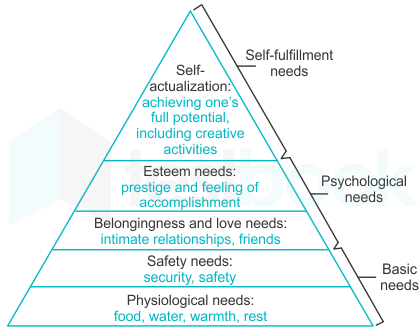
Abraham Maslow was a social psychologist who was interested in a broad spectrum of human psychological needs rather than on individual psychological problems. 

Key Points

  • The needs in Maslow’s hierarchy include physiological needs (food and clothing), safety needs (job security), social needs (friendship), self-esteem, and self-actualization.
  • This hierarchy addressing five needs can be used by managers to better understand employees’ motivation and address them in ways that lead to high productivity and job satisfaction.
  • At the bottom of the pyramid are the physiological (or basic) human needs that are required for survival: food, shelter, water, sleep, etc.
  • If these requirements are not met, the body cannot continue to function. Faced with a lack of food, love, and safety, most people would probably consider food to be their most urgent need.

Maslow's Hierarchy Of Needs Are Explained With Relevant Examples

Hence, Physiological motives are considered as primary motives.

28

Learning disability in motor skills is called

  1. ((a))

    dyscalculia

  2. ((b))

    dyslexia

  3. ((c))

    dysphasia

  4. ((d))

    None of the above

Show Answer
Answer: ((d))

None of the above

Learning Disability is an umbrella term that encompasses a variety of specific kinds of learning problems. Children with learning disabilities experience difficulty in learning and using certain skills namely reading, writing, listening, etc.

  • Learning disabilities are diagnosed particularly when children start going to schools and are engaged in academic activities with other children in the school.
  • Academic skill acquisition involves one or more of the basic psychological processes, such as attention, perception, memory, logical thinking, and so on.
  • When there is some deficit in these basic processes, it may be seen in the imperfect ability to listen, think, speak, read, write, spell, or do mathematical calculations.

Key Points

Motor skills required the coordination of muscles. These skills are generally performed without any deep thinking. These skills are classified into:

  • Gross motor skills: It includes large muscle activities like running, walking, climbing, etc.
  • Fine motor skills: It includes the coordination and movements of small muscles like writing, drawing, etc.

Dyspraxia:

  • It is a motor skills disorder that is caused due to low birth weight and premature birth. It may be caused due to a family history of dyspraxia.
  • It affects the fine and gross motor skills of a child. The child with dyspraxia will have:
  • poor eye-hand coordination, lack of rhythm when dancing.
  • problem in balancing body postures and integration of two sides of the body.
  • the tendency to fall or bump on things and people because of poor balance and posture.
  • There is no cure for dyspraxia but a number of therapies can make it easier for the child to cope up with their problems.

Hence, it could be concluded that the learning disability in motor skills is called Dyspraxia. So, none of the above is correct in the context of the question.

Additional Information

Dyscalculia- It is a disability that affects learner's ability to perform mathematical calculations. - It is caused due to the problem in genetics and heredity of an individual.
Dyslexia- It is considered the problem in reading. - The children will have problems in decoding the words while reading. - It may be caused due to premature birth, low birth weight, and malnutrition.
Dysphasia- It is the partial loss of language. It is the impaired ability that affects the ability to understand or use spoken words. - It is caused due to brain damage and diseases and can be cured by providing language and speech therapy.
29

The term 'counselling' is derived from the Latin word

  1. ((a))

    crioulo

  2. ((b))

    consilium

  3. ((c))

    cri du chat

  4. ((d))

    None of the above

Show Answer
Answer: ((b))

consilium

Originally derived from the Latin word, "consulo", or "consilium" meaning to advise, deliberate or consult, counselling can be conceptualized in different ways. 

Counselling is:

  • Client-centred- specific to the needs, issues and circumstances of each individual client.
  • An interactive, collaborative and respectful process.
  • Directed towards developing autonomy and self-responsibility in clients.
  • Considerate of interpersonal situation, social/cultural context, readiness to change.
  • Asking questions, eliciting information, reviewing options and developing action plans.

Hence, we conclude that The term 'counselling' is derived from the Latin word "consilium".

30

This type of counselling involves people who drop out from the school and whose difficulties are likely to be more severe:

  1. ((a))

    Community-based counselling

  2. ((b))

    School-based counselling

  3. ((c))

    Both (A) and (B)

  4. ((d))

    None of the above

Show Answer
Answer: ((a))

Community-based counselling

Counselling refers to the process which gives importance to recognizing the root of the counsellee's problems to help them with proper guidance.

Key Points

  • Community-based counselling involves groups of families having children with conduct disorders. It may also involve people who drop out of school and whose difficulties are likely to be more severe.
  • Home or community-based counselling may not benefit the child who has such problems in the school setting.
  • A common characteristic of Community-based counselling is that the professional develop close and personal bonds with his client.
  • The counsellor needs to be professionally qualified and well-informed in his field and to understand how his work fits in with the work of others in the caring team; importantly, the counsellor should also be aware of how the physical,

emotional, social and spiritual distress of his patients or clients influences him on a personal level as well as in discharging his professional responsibilities.

Additional Information

  • The School-based counselling/School Counseling Program is comprehensive in scope, developmental in nature, proactive in design, and differentiated in order to address individual and societal needs.
  • School-based counselling fosters an environment that encourages students to develop self-awareness, as well as understanding, tolerance and acceptance of others’ diverse qualities, backgrounds, beliefs and aptitudes.

Confusion Points

  • It should be noted that if a child is a droop out (that is, he has left school in the middle) can not be helped by school-based counselling.

Hence, the above statement is about Community-based counselling.

Language I: English (30 questions)

Directions: Read the poem given below and answer the questions that follow by selecting the correct option.

May there always be tigers.

In the jungles and tall grass

May the tiger’s roar be heard,

May his thunder

Be known in the land.

At the forest pool, by moonlight

May he drink and raise his head

Scenting the night wind.

May he crouch low in the grass

When the herdsmen pass,

And slumber in dark caverns

When the sun is high.

May there always be tigers.

But not so many, that one of them,

Might be tempted to come into my room

In search of meal !

31

The poet wants the tigers to be

  1. ((a))

    in jungle

  2. ((b))

    everywhere

  3. ((c))

    in his room

  4. ((d))

    None of the above

Show Answer
Answer: ((b))

everywhere

The correct answer is everywhere.

Key Points

  • Look at the lines: 
  • May there always be tigers.

In the jungles and tall grass

  • May his thunder

Be known in the land.

  • May there always be tigers.

But not so many, that one of them,

Might be tempted to come into my room

  • Upon the perusal of the above lines, it can be concluded that the poet wants the tigers to be everywhere, in the jungle, in the land, in his room.
  • Hence, option 2 is the most appropriate answer choice.
32

What does ‘his thunder’ mean?

  1. ((a))

    Thundering clouds

  2. ((b))

    Tiger’s roar

  3. ((c))

    Poet’s voice

  4. ((d))

    None of the above

Show Answer
Answer: ((b))

Tiger’s roar

The correct answer is Tiger's roar.

Key Points

  • Look at the lines: 
  • May there always be tigers.

In the jungles and tall grass

May the tiger’s roar be heard,

May his thunder

Be known in the land

  • Upon the perusal of the above lins, it can be concluded that the poet is saying that may the tiger's thunder be known in the land.
  • Thus, 'his thunder' means the thunder of the tiger.
  • Hence, option 2 is the most appropriate answer choice.
33

Why would the tiger raise his head?

  1. ((a))

    To show arrogance

  2. ((b))

    To see the moon

  3. ((c))

    To look around

  4. ((d))

    None of the above

Show Answer
Answer: ((b))

To see the moon

The correct answer is To see the moon

Key Points

  • Look at the lines: 
  • At the forest pool, by moonlight

May he drink and raise his head

Scenting the night wind.

  • Upon the perusal of the lines, it can be concluded that the poet wants the tiger to raise his head by moonlight.
  • Thus, the tiger would raise his head to see the moon.
  • Hence, option 2 is the most appropriate answer choice.
34

Where does the tiger sleep?

  1. ((a))

    At the forest pond

  2. ((b))

    In the poet’s room

  3. ((c))

    In the dark caverns

  4. ((d))

    None of the above

Show Answer
Answer: ((c))

In the dark caverns

The correct answer is In the dark caverns.

Key Points

  • Look at the lines: 
  • When the herdsmen pass,

And slumber in dark caverns

  • Slumber means to sleep or to be in a state of inactivity, quiescence, or calm.
  • Caverns mean large caves or chambers in a cave.
  • Thus, the tiger sleeps in the dark caverns.
  • Hence, option 3 is the most appropriate answer choice.
35

The last three lines of the poem show

  1. ((a))

    the poet’s sense of humour

  2. ((b))

    the poet’s arrogance

  3. ((c))

    the poet’s love for nature

  4. ((d))

    None of the above

Show Answer
Answer: ((a))

the poet’s sense of humour

The correct answer is the poet’s sense of humour.

Key Points

  • Look at the lines:
  • May there be tigers

But not so many, that one of them,

Might be tempted to come into my room

In search of meal !

  • It can be deduced from the poem that the poet wants the tigers to be everywhere. Thus, he can't be arrogant.
  • From these lines, we don't get any idea that poet has love for nature.
  • We can see that these lines show humour as the poet says that he wants tigers to be everywhere; but he doesn't want tigers to the extent that one of them comes into his room in search of meal.
  • Thus, it can be concluded that option 1 is the correct answer.
36

Fill in the blank with the correct article.

Twelve inches make _______ foot.

  1. ((a))

    a

  2. ((b))

    an

  3. ((c))

    the

  4. ((d))

    None of the above

Show Answer
Answer: ((a))

a

The correct answer is a.

Key Points

  • We use the article 'a' to denote a quantity or a measure.
  • Moreover, twelve inches make one foot, thus, a foot is the correct option.
  • **Thus, the correct sentence is -Twelve inches make a foot.

Additional Information

  • Use of an: Use "an" before a word that starts with a vowel sound. The key word here is sound. It is not a question of whether the word starts with a vowel. It is a question of whether it starts with a vowel sound.
  • An elephant
  • An hour
  • Use of the: Use "the" with any noun when the meaning is specific; for example, when the noun names the only one (or one) of a kind.
  • A    dam was the first man (the only 'first man').
  • Have you heard the news (specific news)?
37

Silver, as well as cotton, _______ fallen in price.

  1. ((a))

    is

  2. ((b))

    are

  3. ((c))

    have

  4. ((d))

    None of the above

Show Answer
Answer: ((d))

None of the above

The correct answer is None of the above.

Key Points

  • When we have two subject in a sentence which are connected by 'as well as' the verb always comes according to the first subject.
  • The first subject here is 'silver'.
  • Silver is a singular subject, thus, singular verb will be used with it.
  • Thus, has is the correct word to fit in the blank.
  • The correct sentence is Silver, as well as cotton, has fallen in price.

Thus, the correct answer: None of the above.

38

Fill in the blank with the correct word given in options.

_______ gave you that knife?

  1. ((a))

    Which

  2. ((b))

    What

  3. ((c))

    Who

  4. ((d))

    None of the above

Show Answer
Answer: ((c))

Who

The correct answer is who.

Key Points

  • All the given options are relative pronouns.
  • A Relative pronoun is used to connect a clause or phrase to a noun or pronoun. These are who, whom, which, whoever, whomever, whose, whichever, and that.
  • Which and that are generally used for objects.
  • What refers to a nonliving thing.
  • Who is used for people. It refers to a person (as the verb’s subject)
  • Here, gave is the verb and the subject of the verb is the person who gave that knife.
  • The correct sentence should be: Who gave you that knife?

Hence, Option 3 is the correct answer.

39

Fill in the blank with the correct question tag given in options

Peter played handball yesterday, _______

  1. ((a))

    did he?

  2. ((b))

    didn’t he?

  3. ((c))

    has he?

  4. ((d))

    None of the above

Show Answer
Answer: ((b))

didn’t he?

The correct answer is didn't he?

Key Points

  • Let us consider the rule to use a question tag.
  • First of all the helping verb is considered.
  • The helping verb is used for the question tag according to the verb. The verb is played**(ed).**Thus, the helping verb is (did).
  • If the sentence is negative, the tag will be positive.

If the sentence is affirmative, the tag will be negative.

  • Since the sentence is positive, a negative question tag will be used here according to the helping verb.
  • This way 'didn't he' is the question tag that should be used here.
<br>

Correct sentence- Peter played handball yesterday, didn't he?

Additional Information

  • Some question tags are mentioned below-
  • | Sentence | Question tag | | --- | --- | | You are going | aren't you? | | She will be working | won't she? | | He can come | can't he? | | I didn't have work | did I? |
40

Sent the parcel _______ post.

  1. ((a))

    through

  2. ((b))

    by

  3. ((c))

    at

  4. ((d))

    None of the above

Show Answer
Answer: ((b))

by

The correct answer is by.

Key Points

  • By here shows the method in use, how the action of sending documents is done - by post. ​
  • Here, by means by means of. By is used to suggest a means. Similarly, you can travel by train/car, you can pay by cheque, you can carry/ship goods by sea/air, you can read by candlelight.
  • Thus, the correct sentence is: Sent the parcel by post.

Confusion Points

  • It is quite confusing to differentiate between by and through in this case.
  • Here, by means by means of.
  • I sent the letters by post. Similarly, I paid by cheque/draft/credit card.
  • If you use through here, it will be wrong because by is used to denote a specific agent.
  • In a word, Through denotes a medium, by denotes means.
41

Here _______ my brother.

  1. ((a))

    come

  2. ((b))

    comes

  3. ((c))

    can come

  4. ((d))

    None of the above

Show Answer
Answer: ((b))

comes

The correct answer is comes.

Key Points

  • Comes is the correct word to fit in the blank. The subject here, i.e. brother is singular. Thus, a singular verb should be used.
  • The action though talks about an incident that is happening in the present.
  • Example: Here, comes your birthday cake.
  • Thus, the word/verb 'comes' is used.

Confusion Points

  • To come and come both are the base forms/infinitives.
  • The bare infinitive is 'come'.
  • Example: I let her go.
  • The bare infinitive is also used after common verbs of perception with a direct object (watch, hear, feel), and common verbs of permission or causation (make, have, let).
42

Have you bought _______ mangoes?

  1. ((a))

    a little

  2. ((b))

    some

  3. ((c))

    any

  4. ((d))

    None of the above

Show Answer
Answer: ((c))

any

The correct answer is any.

Key Points

  • An adjective is any member of a class of words that modify nouns and pronouns, primarily by describing a particular quality of the word they are modifying.
  • ​Let's have a look at the meanings of the given adjectives:
  • a little- some amount but not too much.
  • some- a large amount or number of people or things.
  • any- used to refer to one or some of a thing or a number of things, no matter how much or how many.
  • Since, here the person refers to one or some of mangoes and the quantity doesn't matter much, the adjective 'any' will be the most appropriate choice.
  • Moreover, we use ‘any’ in negative and interrogative sentences.
  • She hasn’t got any friends.
  • Have you got any milk?

Correct Sentence: Have you brought any mangoes?

Confusion Points

  • Some and any are used to refer to an indefinite quantity or number.
  • Use ‘some’ in affirmative sentences. We can use some with both countable and uncountable nouns.
  • I need some oil.
  • There were some boys in the class.
  • I need some help.
  • Use ‘any’ in negative and interrogative sentences.
  • She hasn’t got any pencils.
  • Have you got any banana?

Important Points 

  • Some and any can be used with both singular and plural nouns.

Have you got any friends? (Here ‘any’ is used to modify the plural noun ‘friends’.)

We haven’t got any oil. (Here ‘any’ is used with the singular uncountable noun ‘oil’.)

43

I got _______ by his enthusiasm.

  1. ((a))

    carried away

  2. ((b))

    carried out

  3. ((c))

    carried off

  4. ((d))

    None of the above

Show Answer
Answer: ((a))

carried away

The correct answer is carried away.

Key Points

  • To get carried away is defined as to become overly excited or involved and to take things too far.
  • In other words, it means to be so excited about something that you do not control what you say or do.
  • The sentence means, I got excited when I saw his enthusiasm.
  • Thus, the correct sentence is: I got carried away by his enthusiasm.

Additional Information

  • Carry out: To do or accomplish something or To physically move someone or something from a particular place or area.
  • Carry off: To steal something or To complete or do something successfully, especially when faced with obstacles.
44

I caught sight of ______ in the mirror.

  1. ((a))

    themselves

  2. ((b))

    theirselves

  3. ((c))

    himself

  4. ((d))

    None of the above

Show Answer
Answer: ((d))

None of the above

The correct answer is None of the above.

Key Points

  • The word to be used in the blank is myself.
  • I is the nominative form of personal pronoun, me is the objective form, myself is the reflexive form.
  • The word "myself" is a pronoun. It can be used as a reflexive pronoun.
  • I saw myself in the mirror. 

(When "myself" is used to show "you" doing something to "yourself," it is known as a reflexive pronoun.)

  • But, we have no option as such. Thus, none of the above is the correct answer.

Additional Information

  • All personal pronouns have a matching reflexive pronoun:
  • me — myself
  • you — yourself
  • you — yourselves
  • her — herself
  • it — itself
  • he — himself
  • one — oneself
  • our — ourselves
  • they — themselves
45

Fill in the blank with the correct word given in options.

We _____ obey the laws.

  1. ((a))

    can

  2. ((b))

    may

  3. ((c))

    have

  4. ((d))

    None of the above

Show Answer
Answer: ((d))

None of the above

The correct answer is None of the above.

Key Points

  • The correct modal verb to be used is 'must'.
  • We use ‘must’ in a sentence to talk about something we need to do.
  • We need to obey the laws i.e. we must obey the laws; is correct.
  • Thus, the correct answer is None of the above.

Additional Information

  • Use of can: Can is an auxiliary verb, a modal auxiliary verb. We use can to: talk about possibility and ability, make requests, ask for or give permission.
  • Use of may: May is used in the possibilities that we expect to take place now or in the future, and in sentences that we expressly ask for permission.
  • Use of have: Have is used as a main verb to indicate possession of objects, characteristics, relationships or other qualities.
46

The synonym of ‘precarious’ is

  1. ((a))

    painful

  2. ((b))

    hinder

  3. ((c))

    uncertain

  4. ((d))

    None of the above

Show Answer
Answer: ((c))

uncertain

The correct answer is 'uncertain'.

Key Points

  • 'Precarious' means dependent on chance, circumstances, unknown conditions, or uncertain developments.
  • 'Uncertain' means not knowing what to do or believe, or not able to decide something.
  • Thus, precarious and uncertain are same in their meanings and form a synonym pair.

Additional Information

  • Let's understand the meanings of other given options:
  • Painful - That causes pain or hurts.
  • Hinder - To make something more difficult for somebody/something to do something.
47

The antonym of ‘allay’ is

  1. ((a))

    fanatic

  2. ((b))

    acute

  3. ((c))

    soft

  4. ((d))

    None of the above

Show Answer
Answer: ((d))

None of the above

The correct answer is 'None of the above'.

Key Points

  • 'Allay' means to subdue or reduce in intensity or severity, to make quite.
  • Example:
  • Trying to allay their fear.
  • Let's look at the meaning of the given options:
  • Fanatic -  Means a person who is enthusiastic about something and may have extreme or dangerous opinions
  • Acute -  Means having a sudden onset, sharp rise, and short course
  • Soft - Means easy to mould, cut, compress, or fold; not hard or firm to the touch
  • Thus, from the above explanation, it is clear that none of the given options make correct antonym pair.
  • Hence, option 4 is the correct answer.

Additional Information

  • Let's look at the synonyms and antonyms for the given word 'allay':
  • Synonym - Alleviate, mitigate, palliate.
  • Antonym - Sharpen, heighten, intensify.
48

“In spite of all his brag he had to eat humble pie.

Here ‘to eat humble pie’ means

  1. ((a))

    to apologize humbly

  2. ((b))

    to anticipate

  3. ((c))

    to adapt

  4. ((d))

    None of the above

Show Answer
Answer: ((a))

to apologize humbly

The correct answer is 'to apologize humbly'.

Key Points

  • 'To eat humble pie’ is an idiom which means to admit that one was wrong or accept that one has been defeated.
  • Thus, the sentence means that he agreed to apologize humbly in spite of all his brag.
  • Thus, option 1 is the most appropriate answer choice.

Additional Information

  • An idiom has been used in a sentence.
  • Idiom is an expression that typically presents a figurative, non-literal meaning attached to the phrase.
  • Let's look at some common idioms:
IdiomsMeanings
Bite the bulletTo do something undesirable
Miss the boatTo miss an opportunity to do something

Directions: Rearrange the jumbled structures to construct a meaningful sentence.

49

very exciting (1) can be (2) new country (3) travelling to a (4)

  1. ((a))

    1 - 2 - 4 - 3

  2. ((b))

    3 - 2 - 4 - 1

  3. ((c))

    4 - 3 - 2 - 1

  4. ((d))

    None of the above

Show Answer
Answer: ((c))

4 - 3 - 2 - 1

The correct answer is '4 - 3 - 2 - 1'.

Key Points

  • While arranging the parts of the passage, we should find some grammatical or contextual connection between them-
  • Part 4 starts with the noun ' traveling'. Hence it will be put in the first place.
  • Part 3 further tells us about the opinion about the place of traveling to some place i.e. a new country. It will be the second part.
  • Part 2 is in continuation of the previous sentence as it tells us the consequences of travelling as indicated by can. Hence it will be the 3rd part.
  • The last Part is 1 as it mentions the conclusion ( mentions the opinion about the excitement of traveling to a new country).
  • Thus, 4 - 3 - 2 - 1 is the correct structure.
<br>

Thus, the correct order is- Traveling to a new country can be very exciting.

50

win the love (1) of others (2) and respect (3) good manners (4)

  1. ((a))

    4 - 3 - 2 - 1

  2. ((b))

    4 - 1 - 3 - 2

  3. ((c))

    1 - 4 - 3 - 2

  4. ((d))

    None of the above

Show Answer
Answer: ((b))

4 - 1 - 3 - 2

The correct answer is '4 - 1 - 3 - 2'.

Key Points

  • While arranging the parts of the passage, we should find some grammatical connections or contextual connections between them-
  • Part 4 starts with the noun 'good manners'. Hence it will be put in the first place.
  • Part 1 further tells us about the results of the above-mentioned good manners. It will be put in second place.
  • Part 3 is in continuation of the previous sentence as it joins the other part of the sentence with the conjunction 'and'. Hence it will be the 3rd sentence.
  • The last part is 2 as it concludes whose respect and love is won.(mentions the opinion about the good manners that how we can win the love and respect of others with good manners).
  • Thus, 4 - 1 - 3 - 2 is the correct structure.


Thus, the correct order is- Good manners win the love and respect of others.

51

Ivan Pavlov propounded a new theory of learning known as

  1. ((a))

    operant conditioning

  2. ((b))

    classical conditioning

  3. ((c))

    concept conditioning

  4. ((d))

    None of the above

Show Answer
Answer: ((b))

classical conditioning

Ivan Pavlov, a Russian psychologist has propounded the 'Theory of Classical Conditioning' which emphasizes that learning as a habit formation is based on the principle of association and substitution.

Important Points

Let's have a look at Pavlov’s experiment:

  • Pavlov was studying the gastric secretion of the dogs by placing meat powder in their mouth and measuring the saliva.
  • A bell was sounded and immediately thereafter food (meat powder) was served to the dog. The dog was allowed to eat it.
  • For the next few days, every time the meat powder was presented, it was preceded by the sound of a bell
  • After a number of such trials, a test trial was introduced in which everything was the same as the previous trials except that no food followed the sounding of the bell.
  • The dog still salivated to the sound of the bell, expecting the presentation of the meat powder as the sound of the bell had come to be connected with it.
  • This association between the bell and food resulted in the acquisition of a new response by the dog, i.e. salivation to the sound of the bell. This has been termed as conditioning.
  • All dogs salivate when they are presented with food. Food is thus an Unconditioned Stimulus (US) and salivation, which follows it, is an Unconditioned Response (UR).
  • After conditioning, salivation started to occur in the presence of the sound of the bell. The bell becomes a Conditioned Stimulus (CS) and saliva secretion a Conditioned Response (CR). This kind of conditioning is called classical conditioning.

Hence, it could be concluded that Ivan Pavlov propounded a new theory of learning known as classical conditioning. 

Hint

  • Theory of Operant Conditioning: This theory was propounded by B. F. Skinner. Theory implies the idea that learning takes place through rewarding a certain behavior or withholding reward for undesirable behavior.
52

_______ is a learning disability that affects handwriting and fine motor skills.

  1. ((a))

    Dysphasia

  2. ((b))

    Aphasia

  3. ((c))

    Dyscalculia

  4. ((d))

    None of the above

Show Answer
Answer: ((d))

None of the above

Learning disability refers to a neurological disorder that causes cognitive impairment. Dyslexia, dysgraphia, dyscalculia, etc are the most common learning disability.

Key Points

Dysgraphia refers to a learning disability which:

  • affects learners' ability to write coherently.
  • hinders in organizing letters, numbers, or words on papers.
  • leads to problems with poor spelling, impaired handwriting, etc.

Important Points

Remedies useful for treating students with Dysgraphia:

  • giving extra time for writing assessment, will reduce the copying activity and will emphasize the importance of writing original answers.
  • dividing tasks into small steps will enable the learners to assimilate the idea easily and will help them in putting their thoughts on paper.
  • providing low-stress opportunities will allow the learners to learn and write at their own pace and to foster their own strategy of learning and writing.

Hence, it could be concluded that dysgraphia is a learning disability that affects handwriting and fine motor skills..

Additional Information

Other Disabilities in Brief:

DyscalculiaIt is a disability that affects learner's ability to perform mathematical calculations.
DysphasiaA language disorder that affects communication skills and comprehension abilities.
DyspraxiaIt is a motor disorder that affects the coordination of the tongue and lips to produce sounds.
AphasiaAn impairment of language that affects the ability to communicate.
DysarthriaA neurological disorder that leads to imprecise speech.
DystopiaAn imagined world in which people lead wretched and fearful life.
StutteringA speech disorder that affects the flow of the speech by repeating the same word again and again.
53

TBLT in second language teaching is

  1. ((a))

    Tool Based Language Teaching

  2. ((b))

    Task Book Language Teaching

  3. ((c))

    Task Based Language Teaching

  4. ((d))

    None of the above

Show Answer
Answer: ((c))

Task Based Language Teaching

According to Willis, who supported the idea that TBLT is a learner-centred approach, “A Task can be defined as an activity where the target language is used by the learner for a communicative purpose in order to achieve an outcome”. 

  • Task-based language teaching (TBLT), also known as task-based instruction (TBI), focuses on the use of authentic language and on asking students to do meaningful tasks using the target language.

Key Points

Characteristics of Task Based Language Teaching:

  • Task-based learning is a different method of teaching languages.
  • It can help language learners by placing him/her in a real-life situation.
  • Task-based learning has the advantage of getting the student to use her skills at her current level.
  • It seeks to develop student's interlanguage through providing a task and then using language to solve it.

Hence, it could be concluded that TBLT in second language teaching is Task Based Language Teaching.

54

Which of the following is not a study skill?

  1. ((a))

    Collecting information from an encyclopedia

  2. ((b))

    Writing formal reports

  3. ((c))

    Using a dictionary

  4. ((d))

    None of the above

Show Answer
Answer: ((b))

Writing formal reports

In very simple terms, ‘study skills’ may be defined as skills that help learners to study more efficiently. There are two ways of being more effective learners: (a) Directly–by studying to increase your knowledge of the subject matter. b) Indirectly–by improving your ability to learn independently and at will.  

Important Points

In the literature on study skills, we refer to three major types of study skills corresponding to the four operations in the process of study. They are:

Gathering Skills:  These skills enable learners to identify and locate relevant information. These skills include reference skills and sub-skills of reading viz. scanning and skimming. Together they equip the learner with the tools to find sources of information. Reference skills can be further subdivided according to the material to be consulted into the following:

  • use of a dictionary, thesaurus, etc.
  • Collecting information from an encyclopedia
  • use of library

Storage skills: In which we can store the information/knowledge we have gathered for later use. How we do this are:  

  • note taking (in class),
  • note making (at home or in the library)

Retrieval Skills: While writing an examination, or participating in a conference or seminar, students need to summarise their ideas in a coherent form, so that their readers can understand them. Or sometimes they have to prepare a research abstract based on their reading. A good summary requires several skills on the part of the student: reading, comprehension, analysis, judgment, clarity, brevity, etc.

NOTE: Writing a formal report is a linguistic skill. Linguistic skills help you to ‘communicate' and  study skills, on the other hand, enable you to ‘study’; and the process of study involves four operations: perception, comprehension, retention, and retrieval.

Hence, we can conclude that writing formal reports is not a study skill.

55

Identify the word where the /q/ sound occurs.

  1. ((a))

    Thread

  2. ((b))

    Then

  3. ((c))

    Those

  4. ((d))

    None of the above

Show Answer
Answer: ((d))

None of the above

International Phonetic Alphabet (IPA): An alphabet used to accurately represent the pronunciation of languages. IPA helps in improving language pronunciation and feeling more confident speaking in the language.

Phonetic Symbols: These symbols are used to describe the phonemes (sounds), and also enables learners to understand and speak the language they are learning. Each phonetic symbol is associated with a particular English sound.

Important Points

/q/ sound words

  • Quick
  • Quiet
  • Quill
  • Quail
  • Queue

Additional Information

WordsPhonetic sounds
Threadθred


Hence, we can conclude that none of the above words having the sound of  /q/.

Directions: Read the passage given below and answer the questions that follow by selecting the correct option.

The editorial policy of a popular daily is controlled by two chief factors. The first is the interest of the advertisers from whom it gets the money which enables it to keep up its large circulation. No widely circulated newspaper dare support a public policy, howsoever much in the national interest that might conflict with the vested interests of its advertisers. On the other hand, any product that refuses to pay the advertising rates of a powerful national organ will be denounced, smashed and driven off the market. You are not allowed to use any product that dissociates itself from the advertising ring. All this is understandable, since big circulation spells bankruptcy if the paper has to depend on its sales for its revenue.

56

According to this passage, one of the chief factors that controls the editorial policy of a newspaper is

  1. ((a))

    the interest of the nation

  2. ((b))

    the interest of the advertisers

  3. ((c))

    the interest of the reader

  4. ((d))

    None of the above

Show Answer
Answer: ((b))

the interest of the advertisers

The correct answer is ​the interest of the advertisers.

Key Points

  • Look at the lines: The editorial policy of a popular daily is controlled by two chief factors. The first is the interest of the advertisers from whom it gets the money which enables it to keep up its large circulation.
  • Upon the perusal of the above statements, it can be concluded that one of the chief factors that controls the editorial policy of a newspaper is ​the interest of the advertisers.
  • Hence, option 2 is the most appropriate answer choice.
57

Big circulation spells bankruptcy if the paper depends on its sale for its revenue because

  1. ((a))

    the advertisers will not be there to support its cost of production

  2. ((b))

    to retain its big circulation, it will have to be sold far below the cost of its production

  3. ((c))

    the advertisers would drive it out of circulation

  4. ((d))

    None of the above

Show Answer
Answer: ((c))

the advertisers would drive it out of circulation

The correct answer is the advertisers would drive it out of circulation.

Key Points

  • Look at the lines: On the other hand, any product that refuses to pay the advertising rates of a powerful national organ will be denounced, smashed and driven off the market. You are not allowed to use any product that dissociates itself from the advertising ring. All this is understandable, since big circulation spells bankruptcy if the paper has to depend on its sales for its revenue.
  • Upon the perusal of the above line, it can be concluded that Big circulation spells bankruptcy if the paper depends on its sale for its revenue because the advertisers would smash and drive it out of circulation.
  • Hence, option 3 is the most appropriate answer choice.
58

A widely circulated newspaper cannot support a public policy

  1. ((a))

    unless it supports the national interest

  2. ((b))

    unless it supports the popular belief

  3. ((c))

    unless it supports the interest of the advertisers

  4. ((d))

    None of the above

Show Answer
Answer: ((c))

unless it supports the interest of the advertisers

The correct answer is unless it supports the national interest.

Key Points

  • Look at the lines: No widely circulated newspaper dare support a public policy, howsoever much in the national interest that might conflict with the vested interests of its advertisers.
  • Upon the perusal of the above line, it can be concluded that A widely circulated newspaper cannot support a public policy unless it supports the interest of the advertisers.
  • Hence, option 3 is the most appropriate answer choice.
59

If a producer refuses to pay high rates of advertisement in a widely circulated newspaper

  1. ((a))

    the circulation of the newspaper will decrease

  2. ((b))

    the rival producers will come forward with advertisements against that produced

  3. ((c))

    the newspaper will cut its number of pages to reduce its cost of production

  4. ((d))

    None of the above

Show Answer
Answer: ((d))

None of the above

The correct answer is None of the above.

Key Points

  • Look at the lines: On the other hand, any product that refuses to pay the advertising rates of a powerful national organ will be denounced, smashed and driven off the market.
  • Denounce means publicly declare to be wrong or evil and Smashed means broken.
  • Drive off means start moving and leave; make someone go away.
  • Thus, we can conclude that if a producer refuses to pay high rates of advertisement, it will be publicly declared evil and will be thrown away from the market.
  • Hence, option 4 is the most appropriate answer choice.


  • Don't get confused with the option- the circulation of the newspaper will decrease as the paper will be declared wrongful or evil and won't be used anymore.
60

The word closest in meaning to ‘condemned’ in the passage is

  1. ((a))

    smashed

  2. ((b))

    denounced

  3. ((c))

    controlled

  4. ((d))

    None of the above

Show Answer
Answer: ((b))

denounced

The correct answer is denounced.

Key Points

  • Condemned means officially declared unfit for use.
  • Denounced means criticized something or someone strongly and publicly or publicly declare to be wrong.

Thus, both are too similar in meaning.

Additional Information

  • Smashed: violently or badly broken or shattered
  • Controlled: under the control of someone or something

Language II: Bengali (30 questions)

নিম্নলিখিত পদ্যাংশটুকু ভালো করে পড়ে প্রশ্নের উত্তর করতে হবে।

"সচকিতে বীরবর দেখিলা সম্মুখে

ভীমতম শূল হস্তে, ধূমকেতু সম

খুল্লতাত বিভীষণে - বিভীষণ রণে!

"এতক্ষণে" - অরিন্দম কহিলা বিষাদে -

"জানিনু কেমনে আসি লক্ষণ পশিল

রক্ষঃপুরে ! হায়, তাত, উচিত কি তব

এ কাজ, নিকষা সতী তোমার জননী,

সহোদর রক্ষঃশ্রেষ্ঠ? শূলিশম্ভুনিভ

কুম্ভকর্ণ?"

61

এই অংশে 'সহোদর" শব্দটির সন্ধিবিচ্ছেদ করলে হবে

  1. ((a))

    সহো + দর

  2. ((b))

    সহ + উদর

  3. ((c))

    সহ + ওদর

  4. ((d))

    উপরের কোনটিই নয়

Show Answer
Answer: ((b))

সহ + উদর

সঠিক উত্তরটি হল: সহ+উদর।

সহোদর শব্দের অর্থ একই মাতার গর্ভজাত ভাই।

এটি একটি স্বরসন্ধির উদাহরণ যেখানে স্বরবর্ণের সঙ্গে স্বরবর্ণের মিলন হয়। উক্ত শব্দটির ক্ষেত্রে 'অ-কার' কিংবা 'আ-কার'-এর পর 'উ-কার' কিংবা 'ঊ-কার' থাকলে উভয়ে মিলে ও-কার হয় যা পূর্ববর্ণে যুক্ত হয়।

সুতরাং, সহ+উদর = সহোদর

62

এই অংশে 'বিভীষণে" শব্দটি কোন্ কারক?

  1. ((a))

    করণ কারক

  2. ((b))

    কর্মকারক

  3. ((c))

    অপাদান কারক

  4. ((d))

    উপরের কোনটিই নয়

Show Answer
Answer: ((b))

কর্মকারক

সঠিক উত্তরটি হল: কর্মকারক।

যাকে উদ্দেশ্য করে ক্রিয়া সম্পাদিত হয় তাক�� কর্মকারক বলে। 

উক্ত শব্দ 'বিভীষণে' অর্থাৎ বিভীষণ-কে বোঝানো হয়েছে। সুতরাং এটি একটি কর্মকারক।

63

এই অংশে 'কুম্ভকর্ণ" পদটি হল

  1. ((a))

    অব্যয়ীভাব সমাসের উদাহরণ

  2. ((b))

    তৎপুরুষ সমাসের উদাহ���ণ

  3. ((c))

    বহুব্রীহি সমাসের উদাহরণ

  4. ((d))

    উপরের কোনটিই নয়

Show Answer
Answer: ((c))

বহুব্রীহি সমাসের উদাহরণ

'কুম্ভের ন্যায় কর্ণ যাহার' বা 'কুম্ভ তুল্য কর্ণ যাহার' (যেহেতু 'কর্ণ' হল 'কান'-এর সাধু রূপ) সমাসবদ্ধ হয়ে 'কুম্ভকর্ণ' শব্দটি গঠন করে এবং এটি একটি বহুব্রীহি সমাসের উদাহরণ।

বহুব্রীহি সমাসে পূর্বপদ ও পরপদের অর্থ প্রধানরূপে প্রতীয়মান না হয়ে তৃতীয় একটি অর্থ প্রধানরূপে প্রতীয়মান হয়। এক্ষেত্রে 'কুম্ভকর্ণ' শব্দটি সমাসবদ্ধ পদ হয়ে অন্য একটি অর্থ (রামায়ণের একটি বিশেষ চরিত্র)-কে বোঝাচ্ছে, যা অর্থগত দিক থেকে পূর্বপদ ও পরপদের সঙ্গে সাদৃশ্যমান নয়। সুতরাং এটি মধ্যপদলোপী বহুব্রীহি সমাসের উদাহরণ।

64

এই অংশে 'খুল্লতাত' শব্দটির অর্থ হল

  1. ((a))

    মামা

  2. ((b))

    কাকা

  3. ((c))

    জেঠা

  4. ((d))

    উপরের কোনটিই নয়

Show Answer
Answer: ((b))

কাকা

'খুল্লতাত' শব্দটির অর্থ পিতৃব্য অর্থাৎ এক্ষেত্রে 'কাকা'-কে উদ্দেশ্য করে সম্বোধন করা হয়েছে।

(উল্লেখ্য, বিভীষণ ছিলেন মেঘনাদের পিতার ভাই, অর্থাৎ মেঘনাদের কাকা)

65

এই অংশে 'হস্ত" শব্দটি হল

  1. ((a))

    তদ্ভব শব্দ

  2. ((b))

    অর্ধতৎসম শব্দ

  3. ((c))

    তৎসম শব্দ

  4. ((d))

    উপরের কোনটিই  নয়

Show Answer
Answer: ((c))

তৎসম শব্দ

'সঠিক উত্তরটি হ'ল: তৎসম শব্দ।

যে সমস্ত শব্দ সংস্কৃত ভাষা থেকে অপরিবর্তিত আকারে বাংলা ভাষায় গৃহীত হয়েছে, তাদের তৎসম শব্দ বলা হয়। 'হস্ত' শব্দটি একটি সংস্কৃত শব্দ, সুতরাং তৎসম শব্দ এবং যা পরিবর্তিত হয়ে বাংলা ভাষায় 'হাত' শব্দটির রূপ পরিগ্রহ করেছে।

নিম্নলি���িত পদ্যাংশটুকু ভালো করে পড়ে প্রশ্নের উত্তর করতে হবে।

"সচকিতে বীরবর দেখিলা সম্মুখে

ভীমতম শূল হস্তে, ধূমকেতু সম

খুল্লতাত বিভীষণে - বিভীষণ রণে!

"এতক্ষণে" - অরিন্দম কহিলা বিষাদে -

"জানিনু কেমনে আসি লক্ষণ পশিল

রক্ষঃপুরে ! হায়, তাত, উচিত কি তব

এ কাজ, নিকষা সতী তোমার জননী,

সহোদর রক্ষঃশ্রেষ্ঠ? শূলিশম্ভুনিভ

কুম্ভকর্ণ?"

66

এই অংশে 'তব' পদটি হল

  1. ((a))

    বিশেষ্য পদ

  2. ((b))

    বিশেষণ পদ

  3. ((c))

    ক্রিয়াপদ

  4. ((d))

    উপরের কোনটিই নয়

Show Answer
Answer: ((d))

উপরের কোনটিই নয়

সঠিক উত্তরটি হল: উপরের কোনটিই নয়

'তব' শব্দটির অর্থ তোমার/আপনার, সুতরাং এটি একটি ব্যক্তিবাচক সর্বনামের উদাহরণ।

67

'পদাবলী সাহিত্য" প্রবন্ধয়গ্রন্থটির রচয়িতা হলেন

  1. ((a))

    কালিদাস রায়

  2. ((b))

    অবনীন্দ্রনাথ ঠাকুর

  3. ((c))

    স্বর্ণকুমারী দেবী

  4. ((d))

    এঁদের কেউই নন

Show Answer
Answer: ((a))

কালিদাস রায়

সঠিক উত্তরটি হ'ল: কালিদাস রায়।

  • 'পদাবলী সাহিত্য' প্রবন্ধ গ্রন্থটির রচয়িতা হলেন বিশিষ্ট রবীন্দ্রানুসারী কবি, প্রাবন্ধিক কালিদাস রায় (১৮৮৯-১৯৭৫)।
  • তাঁর রচিত কাব্যগুলির মধ্যে *'*কাব্য কুন্দ', 'কিশলয়', 'রসকদম', 'হৈমন্তী', 'পর্ণপুট', 'পূর্ণাহুতি'  অন্যতম। এছাড়াও প্রবন্ধ সমূহের মধ্যে 'পদাবলী সাহিত্য', 'প্রাচীন বঙ্গ সাহিত্য পরিচয়', 'শরৎ সাহিত্য', 'সাহিত্য প্রসঙ্গ', 'চালচিত্র', 'রংচিত্র' ইত্যাদি উল্লেখযোগ্য।
  • 'বেতালভট্ট' ছদ্মনামে রচিত তাঁর রম্যরচনাগুলি সমাদৃত।
  • সাহিত্যকর্মের স্বীকৃতিস্বরূপ তিনি 'কবিশেখর' উপাধিতে ভূষিত হন।
68

'খেরোর খাতা' গ্রন্থটির লেখক হলেন

  1. ((a))

    সুকুমার রায়

  2. ((b))

    অবনীন্দ্রনাথ ঠাকুর

  3. ((c))

    সত্যেন্দ্রনাথ দত্ত

  4. ((d))

    এঁদের কেউই নন

Show Answer
Answer: ((d))

এঁদের কেউই নন

সঠিক উত্তরটি হল: এঁদের কেউই নন।

'খেরোর খাতা' গ্রন্থটির লেখক হলেন লীলা মজুমদার। বাংলা সাহিত্যে, মূলত শিশু সাহিত্যে লীলা মজুমদারের অবদান চিরস্মরণীয়। তাঁর লেখা কয়েকটি উল্লেখযোগ্য রচনা হল- 'হলদে পাখির পালক', 'টং লিং', 'পদি পিসীর বর্মী বাক্স', 'সব ভুতুড়ে', 'মাকু'। প্রথম আত্মজীবনী 'আর কোনখানে'-এর জন্য  তিনি ১৯৬৯ সালে রবীন্দ্র পুরস্কারে সম্মানিত হন।

69

'শব্দকল্পদ্রুম' গ্রন্থটি লিখেছেন

  1. ((a))

    রবীন্দ্রনাথ ঠাকুর

  2. ((b))

    দ্বিজেন্দ্রলাল রায়

  3. ((c))

    সুকুমার রায়

  4. ((d))

    এঁদের কেউই নন

Show Answer
Answer: ((d))

এঁদের কেউই নন

'শব্দকল্পদ্রুম' গ্রন্থটি একটি সংস্কৃত অভিধানরাধাকান্ত দেব এই অভিধানটি সংকলন করেন এবং করুণাসিন্ধু বিদ্যানিধি এর সম্পাদনা করেন। ১৮০৩ সাল থেকে ১৮৫৮ সাল পর্যন্ত চল্লিশ বছর যাবত মোট আটটি খন্ডে এই অভিধানটি প্রকাশিত হয়।

দ্রষ্টব্য': **'শব্দকল্পদ্রুম' কবিতাটি সুকুমার রায়-**এর লেখা।

70

মাইকেল মধুসূদন রচিত প্রথম নাটকটি হল

  1. ((a))

    'শর্মিষ্ঠা'

  2. ((b))

    'পদ্মাবতী'

  3. ((c))

    'কৃষ্ণকুমারী'

  4. ((d))

    উপরের কোনটিই নয়

Show Answer
Answer: ((a))

'শর্মিষ্ঠা'

সঠিক উত্তরটি হল: ​'শর্মিষ্ঠা'।

  • মাইকেল মধুসূদন দত্ত রচিত প্রথম নাটকটি হল  ​'শর্মিষ্ঠা' (১৮৫৯) যা প্রকৃত অর্থে বাংলা ভাষায় রচিত প্রথম মৌলিক নাটক
  • 'শর্মিষ্ঠা' নাটকের কাহিনী মহাভারতের আদিপর্বের 'যযাতি-দেবযানী' উপাখ্যান থেকে নেওয়া হয়েছে।
  • এর পরে তাঁর রচিত 'পদ্মাবতী' নাটকে তিনি বাংলায় প্রথম অমিত্রাক্ষর ছন্দের সার্থক ব্যবহার করেন।
71

'স্নেহলতা' উপন্যাসটির রচয়িতা হলেন

  1. ((a))

    কামিনী রায়

  2. ((b))

    লীলা মজুমদার 

  3. ((c))

    রবীন্দ্রনাথ ঠাকুর

  4. ((d))

    এঁদের কেউই নন

Show Answer
Answer: ((d))

এঁদের কেউই নন

সঠিক উত্তরটি হ'ল: এঁদের কেউই নন।

  • 'স্নেহলতা' (প্রকাশকাল: ১৮৯২) উপন্যাসটির রচয়িতা হলেন স্বর্ণকুমারী দেবী যিনি আধুনিক বাংলা সাহিত্যের প্রথম উল্লেখযোগ্য মহিলা সাহিত্যিক।
  • মহর্ষি দেবেন্দ্রনাথ ঠাকুরের কন্যা স্বর্ণকুমারী দেবী 'ভারতী' পত্রিকার সম্পাদনার কাজ করেন প্রায় এগারো বছর।
  • ১৮৭৯ সালে স্বর্ণকুমারী দেবী প্রথম বাংলার গীতিনাট্য (অপেরা) 'বসন্ত উৎসব' রচনা করেছিলেন।
72

'অশোকসঙ্গীত' গ্রন্থটির রচয়িতা হলেন

  1. ((a))

    অতুলপ্রসাদ সেন

  2. ((b))

    যতীন্দ্রমোহন বাগচী

  3. ((c))

    কামিনী রায়

  4. ((d))

    এঁদের কেউই নন

Show Answer
Answer: ((c))

কামিনী রায়

সঠিক উত্তরটি হল: কামিনী রায়।

  • বাংলার প্রথম মহিলা সাহিত্যিকদের মধ্যে অন্যতম কামিনী রায় ১৯১৪ সালে 'অশোকসঙ্গীত (সনেট সংগ্রহ)' গ্রন্থটির রচনা করেন।
  • তাঁর অন্যান্য উল্লেখযোগ্য সাহিত্যসৃষ্টির মধ্যে কাব্যগ্রন্থ ;'আলো ও ছায়া', 'নির্মাল্য', 'মাল্য ও নির্মাল্য', দীপ ও ধূপ', 'অম্বা' (নাট্যকাব্য) অন্যতম।
  • সাহিত্যে অসাধারণ অবদানের জন্য তিনি কলকাতা বিশ্ববিদ্যালয়ের 'জগত্তারিণী পদক'(১৯২৯) লাভ করেন।
73

রবীন্দ্রনাথের 'শেষের কবিতা' হল

  1. ((a))

    একটি উপন্যাসগ্রন্থ

  2. ((b))

    একটি কাব্যগ্রন্থ

  3. ((c))

    একটি নাট্যগ্রন্থ

  4. ((d))

    উপরের কোনটিই নয়

Show Answer
Answer: ((a))

একটি উপন্যাসগ্রন্থ

রবীন্দ্রনাথের 'শেষের কবিতা' হল একটি উপন্যাসগ্রন্থ।

  • রবীন্দ্রনাথ ঠাকুরের 'শেষের কবিতা' চিত্রসৃষ্টি পর্যায়ের দ্বিতীয় উপন্যাস যা 1927 সাল থেকে 1928 সাল অবধি 'প্রবাসী' পত্রিকায় ধারাবাহিকভাবে প্রকাশিত হয়।
  • এটি একটি রোম্যান্টিক উপন্যাস এবং বাংলার বিংশ শতকের নবশিক্ষিত অভিজাত সমাজের ইতিকথা।
  • লেখা ও প্রকাশের দিক থেকে এটি তাঁর দশম উপন্যাস।
74

'ঘরোয়া' গ্রন্থটি লিখেছেন

  1. ((a))

    অবনীন��দ্রনাথ ঠাকুর

  2. ((b))

    রবীন্দ্রনাথ ঠাকুর

  3. ((c))

    সুকুমার রায়

  4. ((d))

    এঁদের কেউই নন

Show Answer
Answer: ((a))

অবনীন��দ্রনাথ ঠাকুর

ঘরোয়া' গ্রন্থটি লিখেছেন অবনীন্দ্রনাথ ঠাকুর

  • অবনীন্দ্রনাথ ঠাকুর বাংলা তথা ভারতের একজন প্রখ্যাত চিত্রশিল্পী, নন্দনতাত্ত্বিক এবং লেখক।
  • 'ঘরোয়া' গ্রন্থটি মূলত এটি অবনীন্দ্রনাথ ঠাকুরের স্মৃতিকথা যা রাণী চন্দ সংকলিত করেছেন।
  • অবনীন্দ্রনাথের অন্যান্য উল্লেখযোগ্য রচনাগুলি হল- 'ক্ষীরের পুতুল', 'রাজকাহিনী', 'নালক', 'বুড়ো আংলা',' জোড়াসাঁকোর ধারে' ইত্যাদি।
75

রবীন্দ্রনাথের 'যক্ষপুরী' নাটকটির পরিবর্তিত নাম হল

  1. ((a))

    'ফাল্গুনী'

  2. ((b))

    'মুক্তধারা'

  3. ((c))

    'রক্তকরবী'

  4. ((d))

    উপরের কোনটিই  নয়

Show Answer
Answer: ((c))

'রক্তকরবী'

রবীন্দ্রনাথের 'যক্ষপুরী' নাটকটির পরিবর্তিত নাম হল 'রক্তকরবী' নাটক

  • 'রক্তকরবী'-র প্রকাশকাল ১৯২৬ -এর ডিসেম্বর।
  • রবীন্দ্রনাথ তাঁর এই রূপকধর্মী এই নাটকটির প্রথম নামকরণ করেছিলেন 'যক্ষপুরী' তবে রূপক-সাংকেতিক নাটকের বস্তুধর্মী নাম যথার্থ নয়। তাই ব্যঞ্জনাধর্মী নামকরণ করা হয় রক্তকরবী।
76

কবি ও নাট্যকার দ্বিজেন্দ্রলাল রায় জন্মগ্রহণ করেন

  1. ((a))

    1861 খ্রিস্টাব্দে

  2. ((b))

    1871 খ্রিস্টাব্দে 

  3. ((c))

    1867 খ্রিস্টাব্দে 

  4. ((d))

    উপরের কোনটিই  নয়

Show Answer
Answer: ((d))

উপরের কোনটিই  নয়

প্রখ্যাত কবি, নাট্যকার ও সঙ্গীতস্রষ্টা দ্বিজেন্দ্রলাল রায় ১৮৬৩ খ্রিস্টাব্দে পশ্চিমবঙ্গের নদিয়া জেলার কৃষ্ণনগরে জন্মগ্রহণ করেন। 

  • দ্বিজেন্দ্রলাল রায় ডি.এল.রায় নামেও পরিচিত ছিলেন।
  • তাঁর নাটকগুলি মূলত চারটি শ্রেণীত বিন্যস্ত ঃ প্রহসন, কাব্যনাট্য, ঐতিহাসিক নাটক এবং সামাজিক নাটক। বিখ্যাত নাটকগুলির মধ্যে  'একঘরে', 'কল্কি অবতার', ' তারাবাঈ', দুর্গাদাস', ' মেবার-পতন', 'রাণা প্রতাপসিংহ', 'সাজাহান', 'চন্দ্রগুপ্ত', 'সিংহল- বিজয়' উল্লেখযোগ্য।
  • প্রায় ৫০০ বাংলা গানের রচয়িতার গানগুলি বাংলা সঙ্গীত জগতে 'দ্বিজেন্দ্রগীতি' নামে পরিচিত। তাঁর বিখ্যাত গানগুলির মধ্যে 'ধন ধান্যে পুষ্পে ভরা', ' বঙ্গ আমার! জননী আমার!' ইত্যাদি আজও সমানভাবে জনপ্রিয়।
77

"কুমুদরঞ্জনের কবিতা রচনা দেবার্চনার মতো।" - মন্তব্যটি করেছিলেন 

  1. ((a))

    রবীন্দ্রনাথ ঠাকুর

  2. ((b))

    কালিদাস রায়

  3. ((c))

    নজরুল ইসলাম 

  4. ((d))

    এঁদের কেউই নন

Show Answer
Answer: ((a))

রবীন্দ্রনাথ ঠাকুর

"কুমুদরঞ্জনের কবিতা রচনা দেবার্চনার মতো।" - মন্তব্যটি করেছিলেন  রবীন্দ্রনাথ ঠাকুর

  • কুমুদরঞ্জন মল্লিক হলেন বাংলার রবীন্দ্রযুগে স্বনামধন্য পল্লীপ্রেমী কবি ও শিক্ষাবিদ।
  • পল্লীপ্রিয়তার সঙ্গে বৈষ্ণবভাব যুক্ত হয়ে তাঁর কবিতার ভাব ও ভাষাকে স্নিগ্ধতা ও মাধুর্য দান করেছে। 'কপিঞ্জল' ছদ্মনামে তিনি 'চুন ও কালি' নামক ব্যঙ্গকাব্য রচনা করেন। কুমুদরঞ্জনের রচনাগুলির মধ্যে 'শতদল', 'বনতুলসী', ' উজানী', একতারা', 'নূপুর' অন্যতম।
  • তিনি কলকাতা বিশ্ববিধ্যালয়ের 'জগত্তারিণী স্বর্ণপদক' এবং ১৯৭০ খ্রিস্টাব্দে ভারত সরকার কর্তৃক 'পদ্মশ্রী' সম্মানে ভূষিত হন।
  • কবিগুরু রবীন্দ্রনাথ তাঁর সম্পর্কে বলেছিলেন - "কুমুদরঞ্জনের কবিতা পড়লে বাংলার গ্রামের তুলসীমঞ্চ, সন্ধ্যাপ্রদীপ, মঙ্গলশঙ্খের কথা মনে পড়ে।''
78

'উজানী' কাব্যগ্রন্থটি রচনা করেন

  1. ((a))

    সত্যেন্দ্রনাথ দত্ত 

  2. ((b))

    অতুলপ্রসাদ সেন 

  3. ((c))

    কালিদাস রায়

  4. ((d))

    এঁদের কেউই নন

Show Answer
Answer: ((d))

এঁদের কেউই নন

'উজানী' কাব্যগ্রন্থটি ১৯১১ খ্রিস্টাব্দে রচনা করেন কবি কুমুদরঞ্জন মল্লিক

উনবিংশ শতকের কবি কুমুদরঞ্জনের লেখনীতে বৈষ্ণব ভাবাদর্শ এবং নির্জন গ্রামবাংলার সহজ সরল রূপ পরিস্ফূট। 'উজানী', 'একতারা','বনতুলসী', 'রজনীগন্ধা' প্রভৃতি কাব্যগ্রন্থ রচনা করে তিনি সাহি���্যজগতে প্রতিষ্ঠিত হন। তাঁর প্রকাশিত কাব্যগন্থের সংখ্যা ১৪ টি। তাঁর রচিত উল্লেখযোগ্য নাটক হল 'দ্বারাবতী'। তিনি জগত্তারিণী স্বর্ণপদক এবং স্বাধীনতার পর ভারত সরকার দ্বারা পদ্মশ্রী পুরস্কারে(১৯৭০) ভূষিত হয়েছিলেন।

79

"বিশ্ব যুড়ি সৃষ্টি মোদের হস্ত মোদের বিশ্বময়,

কান্ড মোদের সর্বঘটে - কোনখানে তা দৃশ্য নয়?" এই পংক্তি দুটির রচয়িতা হলেন

  1. ((a))

    যতীন্দ্রমোহন বাগচী

  2. ((b))

    সত্যেন্দ্রনাথ দত্ত

  3. ((c))

    সুকান্ত ভট্টাচার্য

  4. ((d))

    এঁদের কেউই নন

Show Answer
Answer: ((a))

যতীন্দ্রমোহন বাগচী

"বিশ্ব যুড়ি সৃষ্টি মোদের হস্ত মোদের বিশ্বময়,

কান্ড মোদের সর্বঘটে - কোনখানে তা দৃশ্য নয়?" এই পংক্তি দুটির রচয়িতা হলেন কবি যতীন্দ্রমোহন বাগচী। পংক্তি দুটি তাঁর 'কর্ম' নামক কবিতার অংশ।

যতীন্দ্রমোহনকে রবীন্দ্র-পরবর্তী বাংলা সাহিত্যের একজন প্রধান সাহিত্যিক হিসাবে বিবেচনা করা হয়। পল্লী-প্রীতি তাঁর কবিমানসের একটি মূল বৈশিষ্ট্য। তাঁর কাব্যগ্রন্থসমূহের মধ্যে রয়েছে 'লেখা', ' অপরাজিতা', 'জাগরণী', ' নীহারিকা', 'পাঞ্চজন্য' ইত্যাদি। যতীন্দ্রমোহনের লেখা 'কাজলা দিদি' বাংলা সাহিত্যের জনপ্রিয় কবিতাগুলির মধ্যে একটি।

80

সত্যেন্দ্রনাথ দত্ত - এর 'হসন্তিকা' কাব্যগ্রন্থটি প্রকাশিত হয়

  1. ((a))

    1905 খ্রিস্টাব্দে

  2. ((b))

    1911 খ্রিস্টাব্দে

  3. ((c))

    1912 খ্রিস্টাব্দে

  4. ((d))

    উপরের কোনটিই নয়

Show Answer
Answer: ((d))

উপরের কোনটিই নয়

  • সত্যেন্দ্রনাথ দত্ত - এর 'হসন্তিকা' কাব্যগ্রন্থটি ১৯১৭ খ্রিস্টাব্দে রচিত।
  • 'হসন্তিকা' উৎসর্গ করা হয় প্রমথ চৌধুরীকে
  • তাঁর কবিতায় ছন্দের কারুকাজ, শব্দ ও ভাষা যথোপযুক্ত ব্যবহারের কৃতিত্বের জন্য তাঁকে 'ছন্দের যাদুকর' নামে আখ্যায়িত করা হয়। মধ্যযুগে ভারতের ইতিহাস, সংস্কৃতি, পৌরাণিক প্রভৃতি বুদ্ধি-বৃত্তিবিষয়ক বিভিন্ন বিষয়ে তিনি ছিলেন সিদ্ধহস্তের অধিকারী। বাংলা শব্দের সঙ্গে আরবি-ফার্সি শব্দের সমন্বিত ব্যবহার করে বাংলা কাব্যভাষার শক্তি বৃদ্ধির প্রাথমিক কৃতিত্বের অধিকারী। সত্যেন্দ্রনাথের কাব্যগ্রন্থের মধ্যে 'বেণু ও বীণা'(১৯০৬), 'ফুলের ফসল'(১৯১১), 'কুহু ও কেকা'(১৯১২), 'তুলির কারণ'(১৯১৪), 'অভ্র-আবীর' (১৯১৬), 'হসন্তিকা' (১৯১৭), 'বেলা শেষের গান' (১৯২৩) অন্যতম।
81

'গীতিগুঞ্জ' গ্রন্থটির রচয়িতা হলেন

  1. ((a))

    সত্যেন্দ্রনাথ দত্ত

  2. ((b))

    অতুলপ্রসাদ সেন

  3. ((c))

    দ্বিজেন্দ্রলাল রায়

  4. ((d))

    এঁদের কেউই নন

Show Answer
Answer: ((b))

অতুলপ্রসাদ সেন

'গীতিগুঞ্জ' গ্রন্থটির রচয়িতা হলেন অতুলপ্রসাদ সেন।

  • অতুলপ্রসাদ সেন ঊনবিংশ শতাব্দীর এক প্রখ্যাত বাঙালি গীতিকার, সুরকার ও গায়ক যার গানের মূল উপজীব্য বিষয় ছিল দেশপ্রেম, ভক্তি ও প্রেম। বাংলা সঙ্গীতে তিনিই ঠুংরি ধারার প্রবর্তক এবং গজল রচনাকার। তাঁর রচিত গজলের সংখ্যা ৬-৭ টি। 'গীতিগুঞ্জ' (১৯৩১) গ্রন্থে তাঁর সমুদয় গান সংকলিত হয়। এই গ্রন্থের সর্বশেষ সংস্করণে (১৯৫৭) বেশ কিছু অপ্রকাশিত গানও প্রকাশিত হয়। অতুলপ্রসাদ সেনের গানের সংখ্যা ২০৮ এবং সেগুলি 'অতুলপ্রসাদী' গান নামেও পরিচিত।
82

"জনগণে যাঁরা জোঁক-সম শোষে তারে মহাজন কয়,

সন্তান-সম পালে যারা জমি, তারা জমিদার নয়!" - এই পংক্তি দু'টি লিখেছেন

  1. ((a))

    সুকান্ত ভট্টাচার্য

  2. ((b))

    নজরুল ইসলাম

  3. ((c))

    রবীন্দ্রনাথ ঠাকুর

  4. ((d))

    এঁদের কেউই নন

Show Answer
Answer: ((b))

নজরুল ইসলাম

"জনগণে যাঁরা জোঁক-সম শোষে তারে মহাজন কয়,

সন্তান-সম পালে যারা জমি, তারা জমিদার নয়!" - এই পংক্তি দু'টি বিদ্রোহী কবি কাজী নজরুল ইসলামের রচনা 'ফরিয়াদ' কবিতার অংশ

কাজী নজরুল ইসলাম বিংশ শতাব্দীর অন্যতম অগ্রণী কবি, সাংবাদিক, নাট্যকার, ঔপন্যাসিক, সঙ্গীতজ্ঞ ও দার্শনিক যিনি বাংলা কাব্যে অগ্রগামী ভূমিকা পালনের পাশাপাশি বাংলার সমাজ ও সংস্কৃতি ক্ষেত্রে অন্যতম শ্রেষ্ঠ ব্যক্তিত্ব রূপে বরেণ্য এবং অবিভক্ত বাংলার বাঙালি মনীষার এক অনন্য নিদর্শন। তাঁর কবিতায় বিদ্রোহী দৃষ্টিভঙ্গির কারণে তিনি 'বিদ্রোহী কবি' রূপে আখ্যায়িত। তাঁর কবিতার মূল বিষয়বস্তু ছিল মানুষের উপর করা অত্যাচারের প্রতিবাদ তথা সামাজিক অনাচার ও শোষণের বিরুদ্ধে সোচ্চার প্রতিবাদ।

83

'দেবতাদের ভয়' নাটিকাটির রচয়িতা হলেন

  1. ((a))

    দ্বিজেন্দ্রলাল রায়

  2. ((b))

    সুকুমার রায়

  3. ((c))

    সুকান্ত ভট্টাচার্য

  4. ((d))

    এঁদের কেউই নন

Show Answer
Answer: ((c))

সুকান্ত ভট্টাচার্য

'দেবতাদের ভয়' নাটিকাটির রচয়িতা সুকান্ত ভট্টাচার্য

বাংলা সাহিত্যের প্রগতিশীল চেতনার অধিকারী তরুণ কবি সুকান্ত ভট্টাচার্য তাঁর স্বল্পায়ু সময়ে এক অনবদ্য ভাবধারার সৃষ্টি করে গিয়েছেন। দ্বিতীয় বিশ্বযুদ্ধ,মন্বন্তর, ফ্যাসিবাদ আগ্রাসন ও সাম্রদায়িক দাঙ্গা প্রভৃতির বিরুদ্ধে এবং গণমানুষের আশা-আকাঙ্ক্ষার বাণীসহ শোষণহীন এক সমাজ গড়ার অঙ্গীকার তাঁর বিভিন্ন সাহিত্যকর্ম যেমন 'ছাড়পত্র', 'মিঠেকড়া', 'পূর্বাভাস', ' হরতাল', 'ঘুম নেই;, 'গীতিগুচ্ছ' ইত্যাদি গ্রন্থে প্রকাশ পেয়েছে।

84

পশ্চিমবঙ্গ বাংলা আকাদেমি গৃহীত বানানবিধি অনুসারে নিম্নলিখিত শব্দগুলির মধ্যে শুদ্ধ বানানটি হল

  1. ((a))

    পৌরোহিত্য

  2. ((b))

    পৌরুহিত্য

  3. ((c))

    পুরুহিত্ব

  4. ((d))

    উপরের কোনটিই নয়

Show Answer
Answer: ((a))

পৌরোহিত্য

শুদ্ধ বানানটি হল পৌরোহিত্য। 

বিশ্লেষণ: 'পৌরোহিত্য' শব্দটির অর্থ হ'ল পুরোহিতের বৃত্তি, পুরোহিতগিরি বা যাজন। অন্যদিকে কোনো সভায় নেতৃত্ব বা সভাপতিত্ব করার অর্থেও এই শব্দটিকে ব্যবহার করা হয়।

85

বকধার্মিক - এই বাগধারাটির অর্থ হল

  1. ((a))

    ধার্মিকের বক

  2. ((b))

    ধার্মিক বক

  3. ((c))

    ভন্ড 

  4. ((d))

    উপরের কোনটিই নয়

Show Answer
Answer: ((c))

ভন্ড 

সঠিক উত্তরটি হল ভন্ড

বিশ্লেষণ: যেসব শব্দগুচ্ছ তাঁর আভিধানিক অর্থ ত্যাগ করে অন্য কোনো বিশিষ্ট অর্থ প্রকাশ করে সেই শব্দগুচ্ছকে বাগধারা বলা হয়। 'বকধার্মিক' বাগধারাটির অর্থ ভন্ড, কপট অর্থাৎ, যারা ধার্মিক বেশে ভন্ডামি বা কপটতায় নিজেদের নিয়োজিত করে।

86

"ব্যর্থ প্রাণের আবর্জনা পুড়িয়ে ফেলে আগুন জ্বালো ।" - বাক্যের অর্থভিত্তিক প্রকারভেদ অনুসারে এটি একটি

  1. ((a))

    ইচ্ছাবোধক বাক্য

  2. ((b))

    বিস্ময়বোধক বাক্য

  3. ((c))

    নির্দেশাত্মক বাক্য

  4. ((d))

    উপরের কোনটিই নয়

Show Answer
Answer: ((d))

উপরের কোনটিই নয়

সঠিক উত্তরটি হল: উপরের কোনটিই নয়।

"ব্যর্থ প্রাণের আবর্জনা পুড়িয়ে ফেলে আগুন জ্বালো ।" - বাক্যের অর্থভিত্তিক প্রকারভেদ অনুযায়ী এটি একটি অনুজ্ঞাসূচক বা অনুজ্ঞাবাচক বাক্য

  • যে বাক্যে আদেশ, উপদেশ, অনুরোধ ইত্যাদি প্রকাশ করা হয়, সেই বাক্যকে অনুজ্ঞাসূচক/ অনুজ্ঞাবাচক বাক্য বলা হয়।
  • নির্দেশাত্মক বাক্যে কোন বক্তব্য, তথ্য বা বিবৃতি প্রকাশ করা হয়। যেমন ঃ আমাদের একটি বড় বাগান আছে।
  • বিস্ময়বোধক বাক্যে আবেগ, আনন্দ, উচ্ছাস, ক্রোধ, ঘৃণা, ভয় ইত্যাদি প্রকাশ পায়। যেমন: বাহ, কি সুন্দর পাখি!
  • ইচ্ছাবোধক বাক্য়ে মনের ইচ্ছা বা আকাঙ্ক্ষা প্রকাশ পায় বা কোন কিছুর প্রার্থনা বা কামনা বোঝায়। যেমন: ইশ! যদি পাখির মত উড়তে পারতাম!
87

শরীর > শরীল হল

  1. ((a))

    বিষমীভবনের উদাহরণ

  2. ((b))

    বিপর্যাসের উদাহরণ

  3. ((c))

    স্বরসঙ্গতির উদাহরণ

  4. ((d))

    উপরের কোনটিই নয়

Show Answer
Answer: ((a))

বিষমীভবনের উদাহরণ

সঠিক উত্তরটি হল বিষমীভবনের উদাহরণ

বিশ্লেষণ: শব্দের পাশাপাশি দু'টি সমব্যঞ্জন উচ্চারণকালে একটি পরিবর্তিত হয়ে ধ্বনি পরিবর্তনের ভাষায় সেটি বিষমব্যঞ্জনে পরিণত হয় যাকে বিষমীভবন বলা হয়। এটি ধ্বনি পরিবর্তনের প্রকারভেদ। সাধারণত দ্রুত উচ্চারণের ফলে অথবা আঞ্চলিক প্রভাবের কারণে ধ্বনির উচ্চারণ-পার্থক্যকে ধ্বনি পরিবর্তন বলা হয়।

88

তিরস্কার শব্দটির বিপরীতার্থক শব্দটি হল

  1. ((a))

    তিরস্কৃত

  2. ((b))

    পুরস্কার 

  3. ((c))

    তিরস্করণ

  4. ((d))

    উপরের কোনটিই নয়

Show Answer
Answer: ((b))

পুরস্কার 

সঠিক উত্তরটি হল পুরস্কার।

বিশ্লেষণ: 'তিরস্কার' শব্দের অর্থ অনাদর, নিন্দা, ভর্ৎসনা বা ধমক। এটি একটি বিশেষ্য পদ।

তিরস্কার শব্দটির বিপরীতার্থক শব্দটি হল 'পুরস্কার' অর্থাৎ সম্মান জ্ঞাপন, অভ্যর্থনা, পারিতোষিক প্রদান।

89

শিশুর ভাষা শিক্ষায় ত্রূটিমুক্ত পঠন কৌশলের ক্ষেত্রে সর্বাধিক উপযোগী ধাপটি (stage) হল

  1. ((a))

    সমবেত পাঠ

  2. ((b))

    নীরব পাঠ

  3. ((c))

    সরব পাঠ

  4. ((d))

    উপরের কোনটিই নয়

Show Answer
Answer: ((c))

সরব পাঠ

সরব পাঠ হল পঠনের দুটি প্রকারের একটি যেখানে স্বরের সহিত পাঠ অর্থাৎ জোরে জোরে পাঠ করা হয়ে থাকে।

  • সরব পাঠের উদ্দেশ্য হল:
  • অক্ষর নিরিখের অনুশীলন
  • প্রতিটি অক্ষরের সুষ্ঠ উচ্চারণ ও কন্ঠস্বরের যথেষ্ঠ নিয়ন্ত্রণ ক্ষমতা
  • আঞ্চলিক মুদ্রাদোষগুলিকে ও পারিবারিক প্রভাবে যে উচ্চারণ তাকে সংশোধন করে বিশুদ্ধ ও সুস্পষ্ট উচ্চারণ
  • নীরব পাঠের উদ্দেশ্য হল সরব পাঠের পরিণতি কারণ সরব পাঠ মূলত নিম্নশ্রেণীর জন্য কিন্তু শ্রেণী বাড়ার সাথে সাথে পাঠের পরিধিও বৃদ্ধি পায় এবং সেক্ষেত্রে নীরব পাঠ অভ্যাস প্রয়োজনীয় হয়ে পড়ে।
90

ছাত্রের উচ্চারণ ও বাচনভঙ্গির ত্রূটি-বিচ্যুতি ধরা পড়ে

  1. ((a))

    নীরব পাঠের সাহায্যে

  2. ((b))

    সমবেত পাঠের সাহায্যে

  3. ((c))

    চর্বণা পাঠের সাহায্যে

  4. ((d))

    উপরের কোনটিই নয়

Show Answer
Answer: ((d))

উপরের কোনটিই নয়

ছাত্রের উচ্চারণ ও বাচনভঙ্গির ত্রূটি-বিচ্যুতি ধরা পড়ে সরব পাঠের সাহায্যে

  • সরব পাঠের মাধ্যমে বিভিন্ন বর্ণ ও শব্দ স্পষ্ট উচ্চারিত হয়, ফলে উচ্চারণ বা বাচনভঙ্গির ত্রুটি থাকলে সংশোধন হয়। এইরূপ পাঠ্যাভাসের সময় শিক্ষক, ছাত্রের উচ্চারণ, লয়, গতি, স্বর ও প্রবাহ যথাযথ হল কিনা তা পর্যবেক্ষণ করেন।
  • নীরব পাঠ মূলত শ্রেণী বাড়ার সাথে সাথে পাঠ্যবস্তুর মর্ম অনুধাবন করার সময় প্রয়োজন। নীরব পাঠে অল্প সময়ে অধিক পাঠ আত্মস্থকরণে মনোযোগ ও অনুশীলন, নিষ্ঠা ও একাগ্রতা এবং স্বাচ্ছন্দ্য ইত্যাদির সুবিধা থাকলেও সরব পাঠের ভিত্তি মজবুত না হলে নীরব পাঠের অভ্যাস রপ্ত করানো যায় না।
  • এছাড়াও লক্ষ্য ও উদ্দেশ্য অনুযায়ী পাঠের প্রকারভেদের মধ্যে চর্বণা পাঠ অন্যতম যা মূলত বিচার-বিশ্লেষণমূলক পাঠ।
  • সমবেত পাঠ অর্থাৎ শিক্ষার্থীরা যখন একত্রিত হয়ে একযোগে পাঠ করেন তখন সেটি সমবেত পাঠ হয়ে থাকে।

Mathematics (30 questions)

91

(96 - 11) when divided by 8 would leave a remainder

  1. ((a))

    6

  2. ((b))

    10

  3. ((c))

    2

  4. ((d))

    None of these

Show Answer
Answer: ((a))

6

Concept used:

When any number is divided by any other number then it will give two remainder positive remainder and negative remainder

Take an example: 5/3 then positive reminder is 2 and negative reminder is -1

Negative remainder + divisor = Positive remainder

Calculation:

(96 - 11)/8

We can write (a - b)/c as a/c - b/c

⇒ 96/8 - 11/8

Power of 9 whenever even number always gives the unit digit as 1 (Like 92 = 81 ---- > unit digit is '1')

11 when divided by 3 gives remainder 3

⇒ 16/8 - 3

1 when divided by 8 gives remainder 1

⇒ 1 - 3

⇒ -2

Negative remainder = -2 

Positive remainder = -2 + 8 = 6

∴ The required remainder is 6

92

If (P = \dfrac{3}{4} ÷ \dfrac{5}{6}, ) Q = 3 ÷  [(4 ÷ 5) ÷ 6], R = [3 ÷ (4 ÷ 5)] ÷ 6 and S = 3 ÷ 4(5 ÷ 6) then

  1. ((a))

    all are equal

  2. ((b))

    P and Q are equal

  3. ((c))

    P and S are equal

  4. ((d))

    None of the above

Show Answer
Answer: ((c))

P and S are equal

Given

(P = \dfrac{3}{4} ÷ \dfrac{5}{6})

Q = 3 ÷  [(4 ÷ 5) ÷ 6]

R = [3 ÷ (4 ÷ 5)] ÷ 6

S = 3 ÷ 4(5 ÷ 6)

Calculation

(P = {3\over 4} ÷ {5\over6} = {3 \over 4} \times {6\over5})

(\Rightarrow P = {9\over 10})

Q = 3 ÷  [(4 ÷ 5) ÷ 6]

(\Rightarrow 3 \ \div \ [{4\over5} \times {1\over6}])

(\Rightarrow 3 \ \div \ [{2\over15}])

(\Rightarrow 3 \times {15\over2} = {45\over2})

(\Rightarrow Q= {45\over2})

R = [3 ÷ (4 ÷ 5)] ÷ 6

(\Rightarrow R = [3 \div {4\over5}] \times {1\over6})

(\Rightarrow R = [3 \times {5\over4}] \times {1\over6} = {5 \over 8})

(\Rightarrow R = {5\over8})

S = 3 ÷ 4(5 ÷ 6)

(\Rightarrow S = 3 \div 4({5\over6}) = 3 \div {10\over3})

(\Rightarrow S = 3 \times {3\over 10} = {9 \over 10})

(\Rightarrow S = {9\over10})

∴ P and S are equal.

93

The lines joining the middle points of the sides of a triangle make

  1. ((a))

    four equilateral triangles

  2. ((b))

    four triangles similar to the original triangle

  3. ((c))

    four isosceles triangles

  4. ((d))

    None of the above

Show Answer
Answer: ((b))

four triangles similar to the original triangle

Given

In Δ ABC, D, E, F are the mid-points of sides AB, BC, CA respectively

Concept

  1. AA similarity theorem: In two triangles, if two pairs of corresponding angles are equal, then the triangles are similar.

2) The line segment joining the mid-points of any two sides of a triangle is parallel to the third side and equal to half of it.

Calculation

In Δ ABC and Δ ADF

D and F are the mid-points of AB and AC

⇒ DF || BC [The line segment joining the mid-points of any two sides of a triangle is parallel to the third side and equal to half of it]

⇒ ∠ ADF = ∠ B [Corresponding angles]

And ∠ A = ∠ A [Common angle]

⇒ Δ ABC ∼ Δ ADF [By AA similarity theorem]

Similarly,

Δ ABC ∼ Δ BDE

And Δ ABC ∼ Δ CEF

DF || BC and EF || AB

⇒ DBEF is a parallelogram

⇒ ∠ B = ∠ DFE [Opposite angles of parallelogram are equal]      ____(1)

Similarly, ADEF is a parallelogram

⇒ ∠ A = ∠ DEF      _____(2)

Now, In Δ ABC and Δ DEF, using equation (1) and (2)

∠ B = ∠ DFE 

And ∠ A = ∠ DEF

⇒ Δ ABC ∼ Δ DEF [By AA similarity theorem]

∴ All four triangles are similar to the original triangle.

94

A rectangle ABCD is inscribed in a circle with centre O. If AC is the diagonal and ∠BAC = 30º, then the radius of the circle will be equal to

  1. ((a))

    (\dfrac{\sqrt 3}{2} BC)

  2. ((b))

    2 BC

  3. ((c))

    BC

  4. ((d))

    None of the above

Show Answer
Answer: ((c))

BC

Given

A rectangle ABCD is inscribed in a circle with centre O

∠ BAC = 30º and AC is diagonal

Concept

Sin 30° = 1/2

Sin θ = Perpendicular/Hypotenuse

Calculation

ABCD is a rectangle and AC is its diagonal

⇒ ∠ B = 90°

AC = Diameter of circle = 2 × r, where 'r' is the radius of circle

In right-angled Δ ABC

Sin 30° = BC/AC = 1/2

⇒ AC = 2 × BC

⇒ 2 × r = 2 × BC

⇒ r = BC

∴ The radius of the circle is equal to BC

95

The ratio of volumes of two cylinders is a : b and the ratio of their heights is c : d. The ratio of their diameters will be

  1. ((a))

    (\dfrac{ad}{bc})

  2. ((b))

    (\dfrac{ad^2}{bc^2})

  3. ((c))

    (\sqrt{\dfrac{a}{b}\times \dfrac{d}{c}})

  4. ((d))

    None of the above

Show Answer
Answer: ((c))

(\sqrt{\dfrac{a}{b}\times \dfrac{d}{c}})

Given

The ratio of volumes = a : b

The ratio of heights = c : d

Formula used

Volume of cylinder = πr2h

Calculation

Let the volume of two cylinders be 'V1' and 'V2'

Let the height of two cylinders be 'h1' and 'h2'

Let the radius of two cylinders be 'r1' and 'r2'

({V_1 \over V_2} = {a \over b} = {\pi (r_1)^2h_1 \over \pi(r_2)^2h_2})

(\Rightarrow {a \over b} = { (r_1)^2c \over (r_2)^2d})

(\Rightarrow {(r_1)^2\over (r_2)^2} = {a \over b }\times {d \over c})

(\Rightarrow {r_1\over r_2} = \sqrt {{a \over b }\times {d \over c}})

(\Rightarrow {d_1\over d_2} ={2 \times r_1 \over 2\times r_2} = \sqrt {{a \over b }\times {d \over c}})

96

A rhombus OABC is drawn inside a circle whose centre is at O in such a way that the vertices A, B and C of the rhombus are on the circle. If the area of the rhombus is 32√3 m2, then the radius of the circle will be

  1. ((a))

    8 m

  2. ((b))

    64 m

  3. ((c))

    32 m

  4. ((d))

    None of the above

Show Answer
Answer: ((a))

8 m

Given

A rhombus OABC is drawn inside a circle whose centre is at O in such a way that the vertices A, B and C of the rhombus are on the circle

The area of the rhombus is 32√3 m2

Formula used

Area of an equilateral triangle with side 's' = √3s2/4

Calculation

OC = OB = OA = Radius of circle(say 'r')

In Rhombus OABC

OC = CB = BA = AO [All sides of rhombus are equal]

⇒ OC = CB = BA = AO = OB = r

⇒ Δ OCB and Δ OAB are equilateral triangles

Area of OABC = Area of Δ OCB + Area of Δ OAB

(⇒ 32√3 = {√3 \over 4}r^2 + {√3 \over 4}r^2)

(⇒ 32√3 = {√3 \over 2}r^2)

(⇒ 32 = {1 \over 2}r^2)

⇒ r2 = 64

⇒ r = √64 = 8

∴ The radius of the circle is 8 m

97

Vessels A and B contain mixtures of milk and water in the ratio 4 : 5 and 5 : 1 respectively. In what ratio should quantities of mixtures be taken from A and B to form a mixture in which milk and water are in the ratio 5 : 4 ?

  1. ((a))

    2 : 3

  2. ((b))

    4 : 3

  3. ((c))

    5 : 2

  4. ((d))

    None of the above

Show Answer
Answer: ((c))

5 : 2

Given

The ratio of milk and water in vessel A = 4 ∶ 5

The ratio of milk and water in vessel B = 5 ∶ 1

The ratio of milk and water in mixture = 5 ∶ 4

Calculation

Let the quantity of mixture taken from vessel A and B be 'x' and 'y'

Quantity of milk and water in x ml mixture = 4x/9 and 5x/9

Quantity of milk and water in y ml mixture = 5y/6 and y/6

On adding these two quantities milk will be (4x/9 + 5y/6) ml and water will be (5x/9 + y/6) ml

(⇒ {({4x \over 9} + {5y \over6}) \over({5x \over 9} + {y \over 6})} = {5 \over 4})

(⇒ {4 \times ({4x \over 9} + {5y \over6}) = 5 \times ({5x \over 9} + {y \over 6})})

(⇒ {4 \times {(8x + 15y)\over 18} = 5 \times {(10x + 3y) \over 18}})

⇒ 32x + 60y = 50x + 15y

⇒ 18x = 45y

⇒ x/y = 5/2

∴ x ∶ y is 5 ∶ 2

98

Vineet calculates his profit percentage on the selling price while Roshan calculates his profit on the cost price. They find that the difference of their profits is Rs. 275. If the selling prices for both of them are the same, Vineet gets 25% profit and Roshan gets 15% profit. Then the selling price will be

  1. ((a))

    Rs. 2100

  2. ((b))

    Rs. 2300

  3. ((c))

    Rs. 2250

  4. ((d))

    None of these

Show Answer
Answer: ((b))

Rs. 2300

Given

Vineet's profit = 25%

Illumination benefit = 15%

The selling price is the same for both

Difference between their profit = Rs. 275 

Formula used

Profit(P) = Selling Price(SP) - Cost Price(CP)

Profit % = (P/CP) × 100

Profit % on SP = (P/SP) × 100

Calculation

Vineet calculates his profit on the selling price

⇒ Profit = 25% of SP

Roshan calculates his profit on the cost price

⇒ Profit = 15% of CP 

SP = CP + P = CP + 15% of CP

⇒ SP = 115% of CP

Profit on SP = (15/115) × 100 = (300/23)%

Difference of their profit = Rs. 275

⇒ 25% of SP - (300/23)% of SP = 275

(⇒ ({25 \over 100})SP - ({300\over 23 \times 100})SP = 275 )

(⇒ ({1 \over 4})SP - ({3 \over 23}) SP = 275)

(⇒ ({11 \over 92})SP = 275)

⇒ SP = Rs. 2300

∴ The selling price is Rs. 2300

⇒(1192)SP=275⇒(1192)SP=275

99

The greatest number of five digits, which when divided by 4, 6, 14 and 20 leaves respectively 1, 3, 11 and 17 as remainders, will be

  1. ((a))

    99957

  2. ((b))

    99997

  3. ((c))

    99930

  4. ((d))

    None of the above

Show Answer
Answer: ((a))

99957

Concept

LCM: The least common multiple or lowest common multiples, or smallest common multiple of two integers a and b, usually denoted by LCM(a, b), is the smallest positive integer that is divisible by both a and b.

Calculation

4 = 2 × 2

6 = 2 × 3

14 = 2 × 7

20 = 2 × 2 × 5

LCM(4, 6, 14, 20)= 2 × 2 × 3 × 5 × 7 = 420

The Largest number of 5 digits = 99999

Dividing it by 420, we get remainder = 39

⇒ (99999 - 39) = 99960 is divisible by 420

The difference between the divisor and the remainder in each case = 3 [4 - 1 = 3, 6 - 3 = 3, 14 - 11 = 3, 20 - 17 = 3]

∴ The required number = 99960 - 3 = 99957

100

If the rate of exchange is 7·50 dollars for Rs. 100, then how many dollars will be equal to Rs. 550 ?

  1. ((a))

    41·75 dollars

  2. ((b))

    42·75 dollars

  3. ((c))

    41·25 dollars

  4. ((d))

    None of the above

Show Answer
Answer: ((c))

41·25 dollars

Given

7.50 dollars = Rs. 100

Calculation

Rs. 100 = 7.50 dollars 

Rs. 1 = (7.50/100) dollars

(⇒ Rs. 550 = {7.50 \times 550 \over 100} dollars)

⇒ 165/4 dollars 

⇒ 41.25 dollars

101

If a + b : b + c = c + d : d + a, then

  1. ((a))

    either a = b or a + b + c + d = 0

  2. ((b))

    either a = c or a + b + c + d = 1

  3. ((c))

    either a = c or a + b + c + d = 0

  4. ((d))

    None of the above

Show Answer
Answer: ((c))

either a = c or a + b + c + d = 0

Given

a + b : b + c = c + d : d + a

Calculation

({a + b \over b + c} = {c + d \over d + a})

On subtracting 1 from both sides we get,

({a + b \over b + c} - 1 = {c + d \over d + a} - 1)

(⇒ {a + b -b - c \over b + c} = {c + d -d - a \over d + a})

(⇒ {a - c \over b + c} = {c - a \over d + a})

(⇒ {a - c \over b + c} - {c - a \over d + a} = 0)

(⇒ (a - c) ({1 \over b + c} + {1 \over d + a}) = 0)

(⇒ Either\ (a - c) = 0\ or\ ({1 \over b + c} + {1 \over d + a}) = 0)

When a - c = 0, a = c

 (When \ ({1 \over b + c} + {1 \over d + a}) = 0,)

a + b + c + d = 0

∴ Either a = c or a + b + c + d = 0

102

The compound interest on Rs. 24,000 at 15% per annum for (2 \dfrac{1}{3}) years will be

  1. ((a))

    Rs. 9227

  2. ((b))

    Rs. 9327

  3. ((c))

    Rs. 9732

  4. ((d))

    None of the above

Show Answer
Answer: ((b))

Rs. 9327

Given

Principal(P) = Rs. 24000

Rate(r) = 15% p.a.

Time(n) = 7/3 years

Formula used

Amount = P × [1 + r/100]n 

Calculation:

The amount after 2 year = 24000 × [1 + 15/100]2 

⇒ 24000 × 115/100 × 115/100

⇒ 31740

The amount after two years is Rs. 31740.

∴ For 3rd year, Principal = Rs. 31740

Simple interest for last 1/3 year = PRT/100

⇒ 31740 × 15/100 × 1/3 

⇒ Rs.1587

∴ Amount after (2 \dfrac{1}{3}) year = Rs. 31740 + 1587 = Rs. 33,327

C.I = Amount - principal

∴ C.I = Rs.33.327 - Rs. 24,000 = Rs. 9327

∴ Option 2 is correct.

103

The value of

(\left(\dfrac{1}{1\times 4} + \dfrac{1}{4 \times 7} + \dfrac{1}{7 \times 10} + \dfrac{1}{10 \times 13} + \dfrac{1}{13 \times 16}\right)) is

  1. ((a))

    5/16

  2. ((b))

    1/3

  3. ((c))

    3/8

  4. ((d))

    None of the above

Show Answer
Answer: ((a))

5/16

Calculation

(({1 \over1\times 4} + {1 \over 4 \times 7} +{1 \over 7 \times 10} + {1 \over10 \times 13} + {1\over 13 \times 16}))

Multiply and divide the whole term by 3, we get

({3 \over 3} \times ({1 \over1\times 4} + {1 \over 4 \times 7} +{1 \over 7 \times 10} + {1 \over10 \times 13} + {1\over 13 \times 16}))

(\Rightarrow {1 \over 3} \times ({3 \over1\times 4} + {3 \over 4 \times 7} +{3 \over 7 \times 10} + {3 \over10 \times 13} + {3\over 13 \times 16}))

Expand the terms one by one,

({3 \over 1 \times 4} ={4 - 1 \over 1 \times 4} = {1 \over 1 } - {1 \over 4})

({3 \over 4 \times 7} ={7 - 4 \over 4 \times 7} = {1 \over 4 } - {1 \over 7})

Similarly, other terms will expand

(\Rightarrow {1 \over 3} \times (1 - {1 \over 4} + {1 \over 4} - {1 \over 7} + {1\over 7}- {1\over 10} + {1 \over 10} - {1 \over 13} + {1 \over 13} - {1\over 16}))

(\Rightarrow {1 \over 3} \times (1 -{1\over 16}))

(\Rightarrow {1 \over 3} \times ({15\over 16}) = {5 \over 16})

104

The sum of two numbers is 528 and their HCF is 33. The number of pairs of such numbers satisfying the above condition will be

  1. ((a))

    6

  2. ((b))

    12

  3. ((c))

    4

  4. ((d))

    None of the above

Show Answer
Answer: ((c))

4

Given

The sum of two numbers = 528

HCF = 33

Concept

  1. HCF: The greatest common divisor of two or more positive integers happens to be the largest positive integer that divides the numbers without leaving a remainder.

  2. Coprime numbers: Two numbers are said to be coprime when they have no common factors other than 1. For example : (3, 5), (14, 25), etc.

Calculation

33 is a factor of both the numbers so, let the numbers be 33a and 33b, where 'a' and 'b' are coprime numbers

33a + 33b = 528

⇒ a + b = 528/33 = 16

For a + b = 16, a and b can have the following possible values :

(a = 1, b = 15)

(a = 3, b = 13)

(a = 5, b = 11)

(a = 7, b = 9)

∴ Number of possible pairs is 4

105

If a cube has surface area S and volume V, then the volume of the cube of surface area 2S will be

  1. ((a))

    (\sqrt 2 V)

  2. ((b))

    (2\sqrt 2 V)

  3. ((c))

    2V

  4. ((d))

    None of the above

Show Answer
Answer: ((b))

(2\sqrt 2 V)

Given

A Cube has surface area S and volume V

Formula used

Volume of cube = side3

Surface area of cube = 6 × side2

Calculation

Let the side of the cube be 'a'

V = a3 and S = 6 × a2

When surface area is 2S, 

2S = 2 × 6 × a2

⇒ 6 × (√2a)2

⇒ Side of new cube = √2a

Volume = side3 = (√2a)3

⇒ 2√2a3 = 2√2V

106

12 gallons equal

  1. ((a))

    54480 ml

  2. ((b))

    56680 ml

  3. ((c))

    58840 ml

  4. ((d))

    None of the above

Show Answer
Answer: ((d))

None of the above

Concept 

1 gallon = 3.785 litres

1 litre = 1000 ml

Calculation

1 gallon = 3.7854 litres

1 litre = 1000 ml

⇒ 3.7854 litres = 3.7854 × 1000 = 3785.4 ml

⇒ 1 gallon = 3785.4 ml

⇒ 12 gallons = 12 × 3785.4 = 45424.9 ml

107

In a triangle ABC, ∠C  is an obtuse angle. The bisectors of the exterior angles at A and B meet BC and AC produced at D and E respectively. If AB = AD = BE, then ∠ACB will be

  1. ((a))

    110°

  2. ((b))

    105º

  3. ((c))

    108º

  4. ((d))

    None of the above

Show Answer
Answer: ((c))

108º

Given

In a triangle ABC, ∠C  is an obtuse angle

The bisectors of the exterior angles at A and B meet BC and AC produced at D and E respectively

AB = AD = BE

Calculation

In Δ ABD, AD = AB 

⇒ ∠ABD = ∠ADB = y [Angles opposite to equal sides of a triangle are equal]

Similarly, In Δ AEB, AB = BE

⇒ ∠EAB = ∠AEB = x

a + a + x = 180° [Angle on straight line is 180°]

⇒ a = 90° - (x/2)

b + b + y = 180° [Angle on straight line in 180°]

⇒ b = 90° - (y/2)

In Δ ABC, 

x + y + ∠C = 180°

⇒ ∠C = 180° - x - y      _____(1)

In ΔCBE, by exterior angle property

∠C = x + b = x + 90° - (y/2)       _____(2)

In Δ CAD, by exterior angle property

∠C = y + a = y + 90° - (x/2)      _____(3)

Adding equation (1), (2) ans (3) we get,

3 × ∠C = 360° - (x/2) - (y/2)

⇒ 3 × ∠C = 360° - (x + y)/2

⇒ 3 × ∠C = 360° - (180° - ∠C)/2

⇒ 3 × ∠C = 360° - 90° + (∠C/2)

⇒ (5/2) × ∠C = 270° 

⇒ ∠C = 108°

108

The mean of 12, 22, 32, 42, ......192, 202 is

  1. ((a))

    143·5 

  2. ((b))

    134·5

  3. ((c))

    154·4

  4. ((d))

    None of the above

Show Answer
Answer: ((a))

143·5 

Formula used

Sum of squares of first 'n' natural numbers = [n(n + 1)(2n + 1)]/6

Mean = Sum of observations/Number of observations

Calculation

Sum of terms = 12 + 22 + 32 + 42......192 + 202 

⇒ n = 20

Sum = [20(20 + 1)(2 × 20 + 1)]/6

⇒ [20 × 21 × 41]/6

⇒ 17220/6 = 2870

Mean = Sum of observations/Number of observations

⇒ Mean = 2870/20 = 143.5

∴ Mean is 143.5

109

If a sphere of radius r is melted and recasted into a cone of height h, then the radius of the base of the cone will be

  1. ((a))

    (3 \sqrt{\dfrac{r^3}{h}})

  2. ((b))

    (3 \sqrt{\dfrac{r}{h^3}})

  3. ((c))

    (2 \sqrt{\dfrac{r^3}{h}})

  4. ((d))

    None of the above

Show Answer
Answer: ((c))

(2 \sqrt{\dfrac{r^3}{h}})

Given

A sphere of radius r is melted and recast into a cone of height h

Formula used

Volume of sphere = ({4\over 3}\pi r^3)

Volume of cone = ({1 \over 3}\pi R^2h)

Calculation

Volume of sphere = Volume of cone

(\Rightarrow {4\over 3}\pi r^3 = {1 \over 3} \pi R^2h)

(\Rightarrow 4 r^3 = R^2h)

(\Rightarrow R^2 = {4 r^3 \over h} )

(\Rightarrow R = \sqrt{{4 r^3 \over h}} )

(\Rightarrow R = 2\sqrt{{ r^3 \over h}} )

110

A train moving with a uniform speed clears a platform 110 metres long in 10 seconds and passes a telephone post in 5 seconds. The speed of the train is

  1. ((a))

    80 km/hr

  2. ((b))

    81 km/hr

  3. ((c))

    82 km/hr

  4. ((d))

    None of the above

Show Answer
Answer: ((d))

None of the above

Given

A train moving with a uniform speed clears a platform 110 metres long in 10 seconds and passes a telephone post in 5 seconds

Formula used

Distance = Speed × Time

km/hr = (5/18) m/s

Calculation

Let the length of the train be 'x' metres

Let the speed of the train be 's' m/s

Train passes a 110 m long platform in 10 sec

⇒ Distance = Length of train + Length of platform

⇒ x + 110 = s × 10

Train passes a telephone post in 5 sec

⇒ Distance = Length of train

⇒ x = s × 5

⇒ 5s + 110 = 10s

⇒ 5s = 110

⇒ s = 22 m/sec

⇒ s = 22 m/sec = 22 × (18/5) km/hr

⇒ s = 79.2 km/hr

∴ The speed of the train is 79.2 km/hr

111

The number of rotational axes of symmetry for a square is

  1. ((a))

    2

  2. ((b))

    4

  3. ((c))

    6

  4. ((d))

    None of the above

Show Answer
Answer: ((b))

4

Concept

A square has four axes of symmetry. Two of them are along the diagonals.

∴ The number of rotational axes of symmetry for a square is 4.

112

In a triangle ABC, the side BC is extended up to D such that CD = AC. If ∠BAD = 109º and ∠ACB = 72º, then the value of ∠ABC is

  1. ((a))

    35º

  2. ((b))

    45º

  3. ((c))

    40º

  4. ((d))

    None of the above

Show Answer
Answer: ((a))

35º

Given

In a triangle, ABC, the side BC is extended up to D such that CD = AC

∠BAD = 109º and ∠ACB = 72º

Concept Used:

Sum of angles of triangles is 180°

Angles opposite to the equal sides of a triangle are equal

Sum of angles on straight line is 180°

Calculation

∠ACB + ∠ACD = 180° [Angle on straight line is 180°]

72° + ∠ACD = 180° 

⇒ ∠ACD = 180° - 72° = 108° 

In Δ ACD, AC = CD

∠CAD = ∠ ADC [Angles opposite to the equal sides of a triangle are equal]

∠ACD + ∠CAD + ∠ ADC = 180° [Angle sum property of a triangle]

108° + 2 ∠ADC = 180° 

⇒ ∠ADC = 72°/2 = 36° 

In Δ ABD,

∠BAD + ∠ABD + ∠ADB = 180° 

⇒ 109° + ∠ABD + 36° = 180° 

⇒ ∠ABD = 180° - 145° = 35° 

∴ ∠ABC is 35°

113

If in the formula (C = \dfrac{en}{R +nr}), n is increased while e, R and r are kept constant, then C

  1. ((a))

    increases and then decreases

  2. ((b))

    decreases

  3. ((c))

    increases

  4. ((d))

    None of the above

Show Answer
Answer: ((c))

increases

Calculation

(C = \dfrac{en}{R +nr})

(⇒ C = {1 \over {R + nr \over en}})

(⇒ C = {1 \over {R \over en} + {nr \over en}})

(⇒ C = {1 \over {R \over en} + {r \over e}}, \ where \ e, \ R \ and\ r\ are \ constants)

⇒ C is inversely proportional to 1/n

⇒ C is directly proportional to n

⇒ C increases as n increases

∴ C increases.

114

In ΔABC, AC = 24 cm, BC = 10 cm and AB = 26 cm. Then the radius of the inscribed circle will be

  1. ((a))

    26 cm

  2. ((b))

    4 cm

  3. ((c))

    13 cm

  4. ((d))

    None of the above

Show Answer
Answer: ((b))

4 cm

Given

In Δ ABC, AC = 24 cm, BC = 10 cm and AB = 26 cm

Formula used

Semi-perimeter(s) = (a + b + c)/2

Area of triangle = (\sqrt{s(s - a)(s -b)(s -c)}) where a, b and c are the lengths of the sides of the triangle

In-radius = Area/semi-perimeter

Calculation

s = (24 + 10 + 26)/2 = 60/2 = 30 cm

The Area of triangle will be

(\sqrt{s(s - a)(s -b)(s -c)})

(⇒ \sqrt{30(30 - 24)(30 -10)(30 -26)})

(⇒ \sqrt{30 \times 6\times 20 \times 4})

(⇒ \sqrt{14400} = 120)

⇒ Area = 120 sq. cm

In-radius = Area/semi-perimeter

⇒ 120/30 = 4 cm

∴ The radius of the inscribed circle is 4 cm

115

The father of behaviourism is

  1. ((a))

    J. B. Watson

  2. ((b))

    E. L. Thorndike

  3. ((c))

    Aristotle

  4. ((d))

    None of them

Show Answer
Answer: ((a))

J. B. Watson

John Broadus Watson, an American psychologist who codified and publicized behaviourism, an approach to psychology that, in his view, was restricted to the objective, experimental study of the relations between environmental events and human behaviour.

Key Points

John B Watson is known as the founder and father of behaviourism. Behaviourism was established with the publication of Watson's classic paper "Psychology as the Behaviourist Views It".

  • Behaviourism dominated experimental psychology for several decades, and its influence can still be felt today.
  • Behaviourism is largely responsible for establishing psychology as a scientific discipline through its objective methods and especially experimentation.
  • Behaviourism focuses on the idea that all behaviours are learned through interaction with the environment. This learning theory states that behaviours are learned from the environment, and says that innate or inherited factors have very little influence on behaviour.
  • An example of behaviourism is when teachers reward their class or certain students with a party or special treat at the end of the week for good behaviour throughout the week. The same concept is used with punishments.
  • Behaviour modification is commonly used in classroom settings.
  • Behaviourism has also led to research on environmental influences on human behaviour.

Additional Information

  • Edward Thorndike is famous in psychology for his work on learning theory that leads to the development of operant conditioning within Behaviorism.
  • Aristotle was one of the greatest philosophers who ever lived and the first genuine scientist in history. He made pioneering contributions to all fields of philosophy and science, he invented the field of formal logic, and he identified the various scientific disciplines and explored their relationships to each other.

Thus, it is concluded that J. B. Watson is the father of behaviourism.

116

Question-Answer Method is given by

  1. ((a))

    M. Montessori

  2. ((b))

    Galton

  3. ((c))

    Socrates

  4. ((d))

    None of them

Show Answer
Answer: ((c))

Socrates

Question answer teaching strategy is an old strategy also known as the “Socratic Method of teaching”. It was developed by the famous philosopher Socrates. The Socratic method also can be known as maieutics, method of elenchus, elenctic method, or Socratic debate, is a form of cooperative argumentative dialogue between individuals, based on asking and answering questions to stimulate critical thinking and to draw out ideas and underlying presumptions.

  • Question is a process where an individual asks or makes an inquiry about something and the listener responses verbally.
  • The main purpose is to assess the extent of an individuals knowledge, understanding, or comprehension of some topics or subject,

According to Parke, “the question is the key to all educative activity above the habit-skill level. Its strategy is focused on achieving the cognitive objectives and bringing knowledge to the conscious level. It has the following principle

  • Theory of unfoldment, all knowledge is within the child, the teacher cannot teach anything from outside.
  • The knowledge can be emitted by linking the questions with his answers.

Key Points

Steps of Question/Answer method:-

  1. To prepare questions and arrange them in a logical sequence
  2. To present the questions in such a way that curiosity arises among the learners
  3. To ask new questions by linking with the learner's response.

Advantages of Question-Answer method:-

  1. While asking questions, the teacher keeps in mind the abilities, needs, and interests of the learner.
  2. It involves the learners’ participation in the subject matter and in teaching acts.
  3. It helps in achieving cognitive objectives and bringing knowledge at a conscious level.
  4. Classroom verbal interaction is encouraged.
  5. It is a useful strategy at all levels of education.

Dis-advantages of Question-Answer method:-

  1. It is difficult to prepare good questions and arrange them logically.
  2. The whole content-matter cannot be taught by this strategy
  3. The teacher wants structured answers from the learners. There is no freedom for imaginative answers.

Thus, it is concluded that the question-answer method is given by Socrates.

117

NUEPA is concerned with

  1. ((a))

    educational evaluation

  2. ((b))

    educational planning

  3. ((c))

    educational unity

  4. ((d))

    None of the above

Show Answer
Answer: ((b))

educational planning

NUEPA stands for National University of Educational Planning and Administration was previously also known as the National Institute of Educational Planning & Administration (NIEPA). It was established by UNESCO as Asian Regional Centre for Educational Planners and Administrators in 1962.

Key Points

  • NIEPA was established by the Ministry of Human Resource Development, Government of India is a premier organization dealing with capacity building and research in planning and management of education not only in India but also in South Asia.
  • The work done by the organization in the field of educational planning and administration, the Government of India has empowered it to award its own degrees by way of conferring it the status of Deemed to be University in August 2006. Like any Central University, NIEPA is fully maintained by the Government of India.
  • After 4 years of its existence, it was taken over by the Government of India and renamed the National Staff College for Educational Planners and Administrators.
  • The roles and functions of the National Staff College, particularly in capacity building, research and professional support services to governments, it was again renamed as the National Institute of Educational Planning and Administration (NIEPA) in 1979.

Important Points

  • National University of Educational Planning and Administration (NUEPA) is mainly concerned with planning, management and capacity building in educational policy.
  • These Planning and management are done through research, training and consultancy.
  • NUEPA structure is based on 9 academic and one administrative unit.
  • Like any Central University in India, NUEPA is fully maintained by the Government of India.
  • The National University is a premier organization dealing with research, teaching, capacity building and supporting professionals in policy, planning and management of education not only in India but also in South Asia.

Thus, it is concluded that NUEPA is concerned with educational planning.

118

The goal of teaching is

  1. ((a))

    to make desirable change in behaviour

  2. ((b))

    to impart general knowledge

  3. ((c))

    to give information

  4. ((d))

    None of the above

Show Answer
Answer: ((a))

to make desirable change in behaviour

A teacher (also called a school teacher or, in some contexts, an educator) is a person who helps students to acquire knowledge, competence, or virtue. ​

Key Points

  • The process of teaching usually takes place in the classroom. It is a kind of transfer or sharing of knowledge from one person to another.
  • The person who transfers his/her knowledge is known as a teacher and the one who receives is known as taught.
  • One of its special function is to impart knowledge, develop and skill which involves sharing, telling, and demonstrating information. Teaching is a relationship that is established among three focal points in education-the teacher, the student, and the subject matter.
  • Teaching is a process by which the teacher brings the student and the subject matter together. It is not only telling and testing, it is the complex art of guiding students through a variety of experiences and activities towards the attainment of goals.

Important Points

The ultimate goal of teaching is to impart learning. Student's desire to learn is vital to mastering new concepts, principles, and skills.

  • The goal of teaching is to make a desirable change in behaviour.
  • Teaching is purposeful and goal-directed which ends at desired changes of learners’ behaviour. When the desires and goals are fulfilled teaching is effective. Therefore, the purpose or goal is the pivot around which the entire system of learning and teaching resolves.
  • The teacher brings desired changes in the behaviour of the pupils by the influence of his teaching and goal-directed which ends at desired changes of learners' behaviour.
  • Teachers can create a very dynamic environment within the classroom that can help to prepare students for the future.
  • A teacher’s role is to make judgments about how best to help their students learn in the environments in which they teach. They generally do so competently, thoughtfully, and with appropriate caution, in consideration of their own values and those of their students and other stakeholders.

Thus, it is concluded that The goal of teaching is to make a desirable change in behaviour.

119

As per the RTE Act, 2009, whose responsibility is to prepare a school development plan ?

  1. ((a))

    School Headmaster

  2. ((b))

    School Development Committee

  3. ((c))

    School Management Committee

  4. ((d))

    None of the above

Show Answer
Answer: ((c))

School Management Committee

The Right to Education Act (RTE) Act:

The RTE Act of the Parliament of India was enacted on 4 August 2009 and came into force on 1 April 2010. This act is also known as the Right of Children to Free and Compulsory Education Act because of its provision of, “the fundamental right of every child between the ages of 6 to 14 with specifies minimum norms in elementary schools.”

Important Points

School Development Plan:- 

The School Development Plan (SDP) is a strategic plan for improvement. It should bring together, in a clear and simple way, the school's priorities, the main measures it will take to raise standards, the resources dedicated to these, and the key outcomes and targets it intends to achieve.

  • ​Every School Management Committee constituted under subsection (1) of section 21 shall prepare a School Development Plan every year in such manner as may be prescribed.
  • The School Management Committee shall prepare a School Development Plan at least three months before the end of the financial year in which it is first constituted under the Act.
  • Monitor that teachers are not burdened with non-academic duties other than those specified in section 27. No teacher shall be deployed for any non-educational purposes other than the decennial population census, disaster relief duties, or duties relating to elections to the local authority or the state legislatures or parliament, as the case may be.
  • Assess financial requirements and needs of the RTE Act 2009, including for providing special training facility specified in section 4. Entitlements of children such as free textbooks and uniforms, and any other additional requirement for fulfilling the responsibilities of the school under Act.
  • The School Development Plan shall be signed by the Chairperson or vice-chairperson and convenor of the School Management Committee and submitted to the local authority before the end of the financial year in which it is prepared.
  • Subcommittees and subgroups with co-opted members for effective implementation & monitoring of the School Development Plan may be formed as requested/needed by the SMC preferably with parents. HM, teachers, children, educationalists, BRTEs, Local Engineers, elected representatives, Civil Society members supporting the school.

Thus, it is concluded that As per the RTE Act, 2009, the school management committee responsibility is to prepare a school development plan.

120

The number of stages of cognitive domain is

  1. ((a))

    3

  2. ((b))

    4

  3. ((c))

    6

  4. ((d))

    None of the above

Show Answer
Answer: ((c))

6

B.S. Bloom has proposed a taxonomy which is a set of three hierarchical models that refers to the classification of educational learning objectives.

Bloom's Taxonomy Identified Three Domains of Learning:

  1. Cognitive Domain: It involves knowledge and the development of intellectual skills.
  2. Affective Domain: It includes how we deal with things emotionally, such as feelings, values, appreciation, etc.
  3. Psychomotor Domain:  It includes physical movement, coordination, and use of the motor-skill areas.

Important Points

The cognitive domain involves mental skills which are categorized into six levels of learning that serve in the development of intellectual skills and acquisition power. 

Stages& Subdomains of Cognitive Domain:

  • Knowledge: It refers to the process of recognizing and recalling information.
  • Comprehension: It refers to the process of interpreting and assimilating information.
  • Application: It refers to the process of utilizing information in new and different situations.
  • Analysis: It refers to the process of identifying the pattern and connection among the given information
  • Synthesis: It refers to the process of combining information and making connections among them to generate a new idea.
  • Evaluation: It refers to the process of making judgments and Justifying decisions about the value of information and materials

Hence, it could be concluded that the number of stages of cognitive domain is 6.

Environmental Studies (30 questions)

121

Growing the same crop over and over again and using so many chemicals makes the soil

  1. ((a))

    fertile

  2. ((b))

    infertile

  3. ((c))

    useful for a special kind of crop

  4. ((d))

    None of the above

Show Answer
Answer: ((b))

infertile

Concept:

  • Crop rotation is the practice of planting different crops sequentially on the same plot of land to improve soil health, optimize nutrients in the soil, and combat pest and weed pressure.
  • Mixed farming is the one in which crop production is combined with the rearing of livestock.
  • The livestock enterprises are complementary to crop production so as to provide a balanced and productive system of farming.

Explanation:

When the same crop is grown over and over again on the same field, the essential nutrients of the soil necessary for the production is exhausted which leads to infertility of the soil.

To make the soil healthy and ecologically balanced we should practice-

Cropping Pattern:

  • Mixed cropping is growing two or more crops simultaneously on a piece of land, this reduces risk and if the insects and some microorganisms attack anyone's crop the two crops also get spoiled, and is difficult to spray pesticides to crops.
  • Intercropping is the growing of two or more crops simultaneously on a piece of land in definite patterns. This method of cropping can give a better yield.
122

Which type of energy resource is geothermal energy ?

  1. ((a))

    Conventional, renewable

  2. ((b))

    Non-conventional, non-renewable

  3. ((c))

    Non-conventional, renewable

  4. ((d))

    None of the above

Show Answer
Answer: ((c))

Non-conventional, renewable

Concept:

  • A source of energy is that which is capable of providing enough useful energy at a steady rate over a very long period of time.
  • Source of energy are usually classified either as:
  • Renewable source of energy
  • No n-renewable source of energy

Geo-Thermal Energy

  • Geothermal Energy is the energy obtained from heat stored in the earth crust and used for various purposes like electricity generation or direct heating applications.
  • Geothermal energy is basically stored in the earth crust up to the depth of 3 to 4 km.

Explanation:

  • Non-conventional sources and renewable sources of energy are those that can be regenerated naturally within a short time span, geothermal energy is one of it.
  • Their use does not result in their complete exhaustion and they would not take millions of years in their formation.

There are basically two sources of energy:-

Renewable resources or Non-ConventionalNon-Renewable resources or Conventional
The resources which can renew themselves or can be used again and again are Renewable or non-conventional resourceThe sources that cannot be replaced or reused once they are destroyed are called the Non-renewable resources.
Renewable resources are replenished naturally and over relatively short periods of time. It is present in unlimited quantityThese are limited resources and consume millions of year to make. So these are used limitedly.
It has low carbon emission and hence environment friendly.These are not environmentally friendly because the amount of carbon emission is high.
The cost is lowThe cost of these resources is high.
A large land area is required for the installation of these plantsLess land requirement of installation of these plants.
They require high maintenance costs.They require low maintenance cost.
For example Soil, water bodies, Sun (Solar Energy), wind, tidal energy, Atomic energy, geothermal, forest, mountains, wildlife, atmospheric resources.Coal, oil, nuclear energy, petroleum, natural gas, LPG, batteries, shale gas, soil and phosphate are some examples.

Additional Information

  • Geothermal Energy in India
  • In India, exploration and study of geothermal fields started in 1970.
  • The GSI (Geological Survey of India) has identified 350 geothermal energy locations in the country.
  • The most promising of these is in Puga valley of Ladakh.
  • The estimated potential for geothermal energy in India is about 10000 MW.
  • The major sites for geothermal energy are:
  • Himalayas: J&K, HP and Sikkim; PUGA hot spring in J&K and Manikaran in HP.
  • Sohana: Haryana, Rajasthan.
  • Son-Narmada-Tapi (SONATA): MP, Chhattisgarh and Jharkhand; Tattapani spring in Chhattisgarh.
  • Cambay: Mainly Gujarat and some parts of Rajasthan
  • Godavari: AP
  • Mahanadi: Orissa, Taptapani Spring in Orissa.
123

The largest brackish water lake in Asia is

  1. ((a))

    Chilika Lake

  2. ((b))

    Vembanad Lake

  3. ((c))

    Wular Lake

  4. ((d))

    None of the above

Show Answer
Answer: ((a))

Chilika Lake

The correct answer is Chilika Lake.

Explanation:

The largest brackish water lagoon Chilika lake situated in Odisha.

Lake Chilika is the largest brackish water lagoon in Asia and the second largest coastal lagoon in the world.

  • It spread across the Puri, Khurda and Ganjam districts of the state of Odisha on the east coast of India, at the mouth of the River Daya, which flows into the Bay of Bengal, covering an area of more than 1,100 km.
  • It is the largest coastal lagoon in India and the second-largest brackish lagoon in the world after the New Caledonian Barrier Reef.
  • It has been listed as a UNESCO World Heritage site.
  • It is the largest wintering ground for migratory birds in the subcontinent of India.
  • Ansupa lake, Kanjia Lake and Pata Lake are all situated in Orissa.

Additional Information

  • Wular Lake is in Jammu and Kashmir and it is the largest freshwater lake in India.
  • Vembanad Lake: It’s the longest lake in India and is situated in Kerala
124

Mineral stocks exist on earth surface are

  1. ((a))

    renewable

  2. ((b))

    non-renewable

  3. ((c))

    partially renewable

  4. ((d))

    None of the above

Show Answer
Answer: ((b))

non-renewable

Concept:

A resource is something that can be utilized by human in its original or modified form. 

It can be classified in the given category:

  • On the basis of accessibility/stock: Renewable and Non-renewable
  • Renewable resources are those which get renewed or replenished quickly. Some of these are unlimited and are not affected by human activities, such as solar and wind energy. Yet careless use of certain renewable resources like water, soil, and forest can affect their stock.
  • Non-renewable resources are those which have limited stock. Once the stocks are exhausted it may take thousands of years to be renewed or replenished.
  • On the basis of Distribution: Ubiquitous and localized
  • A resource that is found everywhere is a ubiquitous resource. The air we breathe is an example of a ubiquitous resource.
  • A resource that is found only in certain places.is called a localized resource. A mineral like copper is an example of a localized resource.
  • On the basis of origin: Biotic & Abiotic
  • Biotic Resources are also known as living resources. These are renewable resources and include plants, forests, and animals. The foods, sugars, tea, coffee, medicines are obtained from the plants.
  • The resources which are composed of non-living things are called Abiotic resources. Example, land, water.
  • On the basis of development and use: Actual and Potential
  • A resource whose quantity is known and they are being used at present. The available technology is used to use these resources. Such resources are called Actual Resource. The dark soil of the Deccan Plateau in Maharashtra, rich deposits of coal in the Ruhr region of Germany is an example of actual resources.
  • A resource whose extra quantity is not known. and they are not being used at present. But when technology improves, their use in the future is possible. Such resources are called Potential Resource. The uranium found in Ladakh is an example of a potential resource.

Class VIII: Chapter 1 (Resources) Question & Answers

Explanation:

  • Some resources, such as minerals or oil, exist as finite stocks, which are non-renewable within an economic time frame.
  • Others, such as timber or solar energy are renewable and, potentially, the flow of services from these resources can be harvested indefinitely.

So, Mineral stocks that exist on the earth surface are considered Non-renewable.

125

Nuclear power is mainly derived from

  1. ((a))

    uranium

  2. ((b))

    platinum

  3. ((c))

    silver

  4. ((d))

    None of the above

Show Answer
Answer: ((a))

uranium

Concept:

Nuclear fission is a nuclear reaction process in which a heavy nucleus splits into two nuclei of nearly equal mass.

  • Example – Uranium (235) breaks into Barium (141) and Krypton (92) with a lot of energy.

  • Radioactivity: It is a type of instability of a nucleus of a particle due to this the particles releases energy or smaller particles.
  • It is mostly of α, β & γ type of particles.

Nuclear fusion is the nuclear reaction in which two or more atomic nuclei are combined to form one or more different atomic nuclei and subatomic particles.

Explanation:

  • A thermal power station is a power station in which the chemical energy of conventional sources is converted into heat energy which is again converted to electric power.
  • Based on the fuel used to generate steam, thermal power plants can be classified as coal, gas, diesel, and Natural gas.
  • Thermal power (Coal) is the "largest" source of power in India.
  • The Vindhyachal Thermal Power Station(Madhya Pradesh) is currently the biggest thermal power plant in India.
  • Uranium is the fuel most widely used by nuclear plants which are also Thermal plants but are called nuclear power plants.
126

The disease caused by Cadmium pollution is known as

  1. ((a))

    Minamata

  2. ((b))

    Itai-itai

  3. ((c))

    Arsenicosis

  4. ((d))

    None of the above

Show Answer
Answer: ((b))

Itai-itai

Explanation:

  • Itai-Itai, which literally translates to ‘it hurts, it hurts’ is the name given to cadmium poisoning.
  • The disease Itai-Itai is caused by Cadmium.
  • This name was given to the disease by the locals of Toyama Prefecture of Japan in 1912.
  • This disease was recognized as the Four Big Pollution Diseases of Japan.
  • Cadmium is a naturally occurring toxic heavy metal.
  • It is an extremely toxic industrial and environmental pollutant classified as a human carcinogen.
  • It is used in the manufacturing of NiCd rechargeable batteries.
<br>

Additional Information

Minamata disease, sometimes referred to as Chisso-Minamata disease, is a neurological syndrome caused by severe mercury poisoning.

127

Which of the following diseases is not caused by mosquitoes?

  1. ((a))

    Dengue

  2. ((b))

    Filaria

  3. ((c))

    Plague

  4. ((d))

    None of the above

Show Answer
Answer: ((c))

Plague

Explanation:

  • Dengue is a mosquito-borne viral infection causing a severe flu-like illness and, sometimes causing a potentially lethal complication called severe dengue.
  • Malaria is a life-threatening disease caused by parasites that are transmitted to people through the bites of infected female Anopheles mosquitoes
  • Filariasis is a parasitic disease caused by an infection with roundworms of the Filarioidea type.
  • This disease belongs to the group of diseases called helminthiasis.
  • Spread by blood-feeding black flies and mosquitoes namely Anopheles, Culex quinquefasciatus, Aedes, and Mansonia.

NOTE - Filariasis is not only spread by female anopheles mosquitoes. It is transmitted by Culex quinquefasciatus, Aedes and Mansonia also.

  • The Plague is an Infectious disease that is basically caused by Yersinia or Bacillus pestis. which is basically found in animals particularly rodents.
  • It basically affects the lungs, lymph nodes, and blood vessels.
  • It is also known as the "Black Death".
  • The transmission of this infectious bacterial disease is through a bite of an infected rat.
  • There are basically three types of plague-
  • Bubonic plague
  • Pneumonic Plague
  • Septicemic Plague

Hence among the options Dengue, filaria are caused by mosquitos while Plague is caused by rodents.

128

The pollutant that causes hole in the ozone layer is

  1. ((a))

    SF6

  2. ((b))

    Nitrous oxide

  3. ((c))

    CFC

  4. ((d))

    None of the above

Show Answer
Answer: ((c))

CFC

The correct answer is CFC.

Explanation:

Human activities that affect the environment: 

The growing world affects the environment around us both in the atmosphere and the ground.

  1. The Ozone layer & its depletion.
  2. The management of garbage we produce.

We generate a lot of material that is thrown away. Like plastics, glasses, metals, organic waste, chemical waste etc.

Ozone Layer: 

  • Ozone (O3) is a molecule formed by three atoms of oxygen. Ozone is a deadly poison.
  • Ozone is found in the stratosphere layer of the atmosphere.
  • However, at the higher levels of the atmosphere, ozone performs an essential function. It shields the surface of the earth from ultraviolet (UV) radiation from the Sun.
  • This radiation is highly damaging to organisms, for example, it is known to cause skin cancer in human beings or can split the DNA.

Its depletion:

  • The amount of ozone in the atmosphere began to drop sharply in the 1980s.
  • This decrease has been linked to synthetic chemicals like chlorofluorocarbons (CFCs) which are used as refrigerants and in fire extinguishers.
  • The government bans those products which contain CFCs.


The correct option for the depletion of the ozone layer is Chlorofluorocarbons (CFC's).

129

The main cause of acid rain is 

  1. ((a))

    air pollution

  2. ((b))

    water pollution

  3. ((c))

    soil pollution

  4. ((d))

    none of the above

Show Answer
Answer: ((a))

air pollution

Explanation:

Atmospheric Pollution: Pollution occurs due to the presence of undesirable solid or gaseous particles in the air.

  • The following are the major gaseous and particulate pollutants
  1. Gaseous air pollutants: These are oxides of sulphur, nitrogen and carbon, hydrogen sulphide, hydrocarbons, ozone and other oxidants.
  2. Particulate pollutants: These are dust, mist, fumes, smoke, smog etc.
  • When the quantity of acids in the raining water is more than the average, then such rain is called 'Acid rain'.
  • We are aware that normally rainwater has a pH of 5.6.  When the pH of the rainwater drops below 5.6, it is called acid rain.
  • Acid rain is a by-product of a variety of human activities that emit the oxides of sulphur and nitrogen in the atmosphere.
  • As mentioned earlier, the burning of fossil fuels (which contain sulphur and nitrogenous matter) such as coal and oil in power stations and furnaces or petrol and diesel in motor engines produce sulphur dioxide and nitrogen oxides.

Hence the correct option is Air pollution.

Additional Information

SO2 and NO2 after oxidation and reaction with water vapour and sunlight are major contributors to acid rain because polluted air usually contains particulate matter that catalyses the oxidation.

2SO2 (g) + O2 (g) + 2H2O (l) → 2H2SO4 (aq)

4NO2 (g) + O2 (g) + 2H2O (l) → 4HNO3 (aq)

130

The example of a natural ecosystem is

  1. ((a))

    agricultural land

  2. ((b))

    aquarium

  3. ((c))

    grassland

  4. ((d))

    None of the above

Show Answer
Answer: ((c))

grassland

Concept:

Ecosystem: 

All organisms such as plants, animals, microorganisms and human beings as well as the physical surroundings interact with each other and maintain a balance in nature. All the interacting organisms in an area together with the non-living constituents of the environment form an ecosystem.

  • Biotic Components: It includes producers, consumers and decomposers. All living things have a direct or indirect influence on other organisms in an environment. Ex- Plants, Animals, Microorganism etc.
  • Abiotic components: All the in-organic components of the ecosystem, non-living physical and chemical composition of nature are abiotic components. Ex- stones, water, Humus (organic waste), air etc

Explanation:

There are two type of ecosystem -

  • Natural Ecosystem - These are ecosystems that occur naturally and can survive without any intervention from human beings. Examples of natural ecosystems are forests, mountains, rivers, grasslands etc.
  • Human-made or Artificial Ecosystem – When human beings modify the already existing ecosystem to meet their purpose or create an ecosystem of their own that mimics the natural condition, those are called artificial ecosystems. Examples of this type of ecosystem include aquariums, crop fields, gardens, dams, lakes, pond etc.
  • This is because Pond and Lakes can be artificial as well. But forest can only thrive as a natural habitat.

Agricultural land - Artificial Ecosystem

Aquarium - Artificial Ecosystem

Grassland - Natural Ecosystem

131

Detritus food chain starts with

  1. ((a))

    green plants

  2. ((b))

    dead organic matter

  3. ((c))

    consumers

  4. ((d))

    None of the above

Show Answer
Answer: ((b))

dead organic matter

The correct answer is Dead organic matter.

  • Detritus food chain is the type of food chain that starts with dead organic matter.

Two type of food chains are found in nature-

  1. Grazing Food Chain -
  • The consumers starts with the food chain, utilising the plant as their food, constitute the grazing food chain.
  1. Detritus Food Chain - 
  • It starts from dead organic matter of decaying animals and plant bodies consumed by the microorganisms and then to detritus feeding organism called detritivores or decomposers and to other predators.

Key Points

  • This dead organic matter gets decomposed by microorganisms.
  • The organisms which feed on dead organic matter are known as detritivores as well as decomposers which in turn are eaten by the predators.
  • Example-
  • Dead organic wastes → Microorganisms → Decomposers
  • In this representation, the food chain starts with the dead organic wastes.
  • These wastes are consumed by microorganisms.
  • These microorganisms are consumed by other detritivore organisms like snails, earthworms, etc.
132

Very minute plants floating in the water are called

  1. ((a))

    nekton

  2. ((b))

    phytoplankton

  3. ((c))

    benthos

  4. ((d))

    None of the above

Show Answer
Answer: ((b))

phytoplankton

The correct answer is Phytoplankton​.

Explanation:

  • Some animals eat both plants as well as other animals, those who heart both are called omnivores.
  • The omnivores eat plant food as well as the meat of other animals.
  • Some of the examples are Man, dogs, crows, and ants.
  • Man is called an omnivore because he eats both, plant food as well as the meat of animals.
  • There is another type of producer and consumer who are extremely small.
  • Planktons:
  • They are very minute or microscopic organisms freely floating on the surface of the water in a pond, lake, river, or ocean.
  • Planktons float near the surface of the water and provide food for many fish and other aquatic animals.
  • There are two types of planktons:
  • Phytoplanktons:
  • The microscopic aquatic plants freely floating on the surface of the water in a pond, lake, river, or ocean.
  • The free-floating alga is an example of phytoplanktons.
  • Phytoplanktons are capable of producing food by the process of photosynthesis.
  • Zooplanktons: ​
  • The microscopic aquatic animals freely floating on water are called zooplanktons.
  • The free-floating protozoa are an example of zooplanktons.
  • A very, very small fish is also zooplankton.
133

Decomposers constitute a group of organisms which

  1. ((a))

    consume living animals and plants

  2. ((b))

    consume living animals

  3. ((c))

    consume dead organisms

  4. ((d))

    None of the above

Show Answer
Answer: ((c))

consume dead organisms

Explanation:

  • The ecosystem is characterized as a community of lifeforms that compete with non-living components and interacts with one another.
  • Decomposers include saprophytes such as fungi and bacteria.
  • Decomposers directly thrive on the dead and decaying organic matter.
  • Decomposers are essential for the ecosystem as they help in recycling nutrients to be reused by plants.

Important Points

  • Following is the role of a decomposer in the ecosystem:
  • Decomposers act as a cleansing agent of the environment by decomposing dead plants and animals.
  • Decomposers help in recycling the nutrients.
  • Decomposers provide space for new being in the biosphere by decomposing the dead.
  • Decomposers help in putting back the various elements into the water, soil, and air for the reuse of producers like crop plants.

Additional Information

Decomposers:

  • The micro-organisms which break down the complex organic compounds present in dead organisms like dead plants and animals and their products like urine, etc., into simpler substances are called decomposers.
  • Examples of decomposers are certain bacteria and fungi.
  • The bacteria which act as decomposers are called putrefying bacteria.
  • The decomposers help in decomposing the dead bodies of plants and animals and hence act as cleansing agents of the environment.
  • The decomposers also help in putting back the various elements of which the dead plants and animals are made, back into the soil, air, and water for reuse by the producers like crop plants.
  • It is only due to the presence of decomposers that the various nutrient elements which were initially taken by plants from the soil, air, and water are returned to the soil, air, and water, after the death of plants and animals.
  • The decomposer organisms help in recycling the materials in the ecosystem so that the process of life may go on and on like an unending chain.
134

CITES is an international treaty on

  1. ((a))

    air pollution

  2. ((b))

    water pollution

  3. ((c))

    conservation of endangered plants and animals

  4. ((d))

    None of the above

Show Answer
Answer: ((c))

conservation of endangered plants and animals

The correct answer is conservation of endangered plants and animals.

Key Points

  • Convention on International Trade in Endangered Species of Fauna and Flora (CITES):-
  • In order to regulate international trade in endangered species of Wild Life, the Convention on International Trade in Endangered Species of wild fauna and flora (CITES) was signed in March 1973.


Additional Information

CITES was conceptualized in 1963 at a meeting of the (IUCN) International Union For Conservation Of Nature.

  • It came into force in 1975 and consists of 183 member countries to date that abide by CITES regulations by implementing legislation within their own borders to enforce those regulations.
  • Located in Geneva, Switzerland, the CITES is administered by the United Nations under its UNEP (United Nations Environment Programme) Wing.
  • The Convention of Parties to CITES is the supreme decision-making body of the Convention and comprises all its Parties.
  • The last CoP (18th) was held in Geneva, Switzerland 17 - 28 August 2019.
  • India hosted CoP (3rd) in 1981.
  • Although CITES is legally binding on the Parties, it does not take the place of national laws.
  • Rather, it provides a framework to be respected by each Party, which has to adopt its own domestic legislation to ensure that CITES is implemented at the national level.
135

National park is one kind of

  1. ((a))

    ex-situ biodiversity conservation

  2. ((b))

    in-situ biodiversity conservation

  3. ((c))

    both ex-situ and in-situ biodiversity conservation

  4. ((d))

    None of the above

Show Answer
Answer: ((b))

in-situ biodiversity conservation

Explanation:

  • There are two basic conservation strategies, each composed of various techniques, that the conservationist can adopt to conserve genetic diversity once it has been located.
  • The two strategies are ex-situ and in situ conservation.

Ex-situ conservation

  • Ex-situ conservation means the conservation of components of biological diversity outside their natural habitats.
  • Ex-situ conservation is the relocation of endangered or rare species from their natural habitats to protected areas equipped for their protection and preservation.
  • It is an essential alternative strategy when in situ conservation is inadequate.
  • Ex-situ techniques include seed storage, captive breeding, slow-growth storage, DNA storage.
  • The main purposes of ex-situ collections are the rescue and preservation of threatened genetic material and the breeding of species for reintroduction in cases where a species’ continued survival in its native habitat is threatened.
  • Ex-situ techniques applicable to animal populations include the storage of embryos, semen/ovule/DNA, or captive breeding through the establishment of field gene banks and livestock parks.
  • Example- Zoo, aquarium, seed banks, botanical gardens, etc.

In situ conservation

  • In situ conservation means the conservation of ecosystems and natural habitats and the maintenance and recovery of viable populations of species in their natural surroundings and, in the case of domesticated or cultivated species, in the surroundings where they have developed their distinctive properties.
  • In situ conservation is the on-site conservation of genetic resources in natural populations of plants or animal species such as forest genetic resources, in natural populations of tree and animal species. The process of protecting an endangered plant or animal species in its natural habitat is commonly known as in situ conservation.
  • Examples-
  • Protected areas are the cornerstone of in-situ conservation.
  • National parks, biosphere reserves, parks, sanctuaries.
  • In-situ initiatives beyond protected areas may include
  • Habitat restoration, recovery or rehabilitation.
  • On-farm agricultural biodiversity conservation targeted at traditional crop varieties and crop wild relatives.
  • Genetic reserve conservation, ie. monitoring of genetic diversity in natural wild populations within a delineated area.
  • Control of threats to biodiversity such as invasive alien species, living modified organisms or overexploitation.
  • Recovery programmes for nationally or sub-nationally threatened or endangered wild species.

Source -

https://biodiversitya-z.org/content/in-situ-conservation

https://biodiversitya-z.org/content/ex-situ-conservation

https://www.sciencedirect.com/topics/agricultural-and-biological-sciences/ex-situ-conservation#:~:text=The%20ex%2Dsitu%20conservation%20strategies,cultivated%20plants%20at%20low%20temperature.

136

One of the conventional sources of energy is

  1. ((a))

    wind energy

  2. ((b))

    tidal energy

  3. ((c))

    hydroelectric energy

  4. ((d))

    None of the above

Show Answer
Answer: ((c))

hydroelectric energy

Explanation:

There are basically two sources of energy:-

Renewable resources or Non-ConventionalNon-Renewable resources or Conventional
The resources which can renew themselves or can be used again and again are Renewable or non-conventional resourceThe sources that cannot be replaced or reused once they are destroyed are called Non-renewable resources.
Renewable resources are replenished naturally and over relatively short periods of time. It is present in unlimited quantityThese are limited resources and consume millions of years to make. So these are used limitedly.
It has low carbon emission and is hence environment friendly.These are not environmentally friendly because the amount of carbon emission is high.
The cost is lowThe cost of these resources is high.
A large land area is required for the installation of these plantsLess land requirement of the installation of these plants.
They require high maintenance costs.They require low maintenance costs.
For example Soil, water bodies, Sun (Solar Energy), wind, tidal energy, geothermal, forest, mountains, wildlife, and atmospheric resources.Coal, oil, nuclear energy, petroleum, natural gas, LPG, batteries, shale gas, and phosphate are some examples.

Wind energy – Non-Conventional.

Tidal energy - Non-Conventional.

Hydroelectric energy – Conventional.

Hence the correct option is hydroelectric energy.

137

Plankton, nekton and benthos are not the components of

  1. ((a))

    river ecosystem

  2. ((b))

    oceanic ecosystem

  3. ((c))

    grassland ecosystem

  4. ((d))

    lake ecosystem

Show Answer
Answer: ((c))

grassland ecosystem

Concept:

  • Ecosystem: An ecosystem is defined as a community of lifeforms in concurrence with non-living components, interacting with each other."
  • Types of Ecosystem:
  • Terrestrial Ecosystem.
  • Aquatic Ecosystem.
  • ​The terrestrial ecosystem is exclusively land-based ecosystems. These are as follows:
  • Forest ecosystem
  • Grassland Ecosystems
  • Tundra Ecosystem
  • Desert Ecosystem
  • An aquatic Ecosystem is a system that is present in a body of water. These are as follows:
  • Freshwater Ecosystem eg: (river ecosystem), and (lake ecosystem).
  • Marine Ecosystem eg: (oceanic ecosystem)

Explanation:

  • Plankton, nekton and benthos are not the components of grassland ecosystem.
  • As Benthos includes animals that are ecologically linked to the ocean's floor.
  • Nekton includes aquatic animals that are able to swin and move independent of any water currents.
  • Thus, Grassland ecosystems is the correct answer.
138

In an ecosystem, when energy moves from one trophic level to another, it

  1. ((a))

    increases

  2. ((b))

    decreases

  3. ((c))

    remains constant

  4. ((d))

    None of the above

Show Answer
Answer: ((b))

decreases

Key Points

Ecosystem: All organisms such as plants, animals, microorganisms and human beings as well as the physical surroundings interact with each other and maintain a balance in nature. All the interacting organisms in an area together with the non-living constituents of the environment form an ecosystem.

Food chain: A food chain shows the feeding relationship between different organisms in a particular environment and/or habitat.

  • A food chain shows how energy is passed from the sun to producers, from producers to consumers, and from consumers to decomposes such as fungi.
  • They also show how animals depend on other organisms for food.

Only 10% of energy is transferred to higher levels from the previous one. So, the demand for food is more in higher levels. So, the food chain does not go for more than 3-4 tropic levels. This leads to more complex food forms known as a food web.


Primary (100%) → First level/ Primary (10%) → Second-level/ Secondary (1%) → Third level / Tertiary (0.1%).

Hence, when energy moves from one trophic level to another, it decreases

139

The smallest river in Tripura is

  1. ((a))

    Manu river

  2. ((b))

    Gumti river

  3. ((c))

    Haora river

  4. ((d))

    None of the above

Show Answer
Answer: ((c))

Haora river

Explanation:

Rivers of Tripura:

Deo:

  • Area: Jampui Hill, Dharmanagar, Kanchanpur valley.
  • Flow towards: North. It meets the Manu river.
  • Length: 132 km.

Dhalai:

  • Area: Longtharai range, Khowai, Kamalpur.
  • Flow towards: North to Bangladesh.
  • Length: 117 km.

Gumti:

  • Area: Longtharai, Amarpur, Gandachara, Udaipur, Sonamura.
  • Flow towards: West up to Bangladesh.
  • Length: 133 Km.

Haora:

  • Area: Baramura range, Agartala.
  • Flow towards: West up to Bangladesh.
  • Length: 53 km.

Juri:

  • Area: Jampui Hill, Dharmanagar Valley.
  • Flow towards: North.
  • Length: 79 Km.

Khowai:

  • Area: Longtharai range, Khowai, Amarpur.
  • Flow towards: North-west to Bangladesh.
  • Length: 166 km.

Longai:

  • Area: Jampui Hill, Dharmanagar.
  • Flow towards: North.
  • Length: 98 km long.

Manu:

  • Area: Sakhan range, Longtharai, Kailashar.
  • Flow towards: North to Bangladesh.
  • Length: 167 km.

Muhuri:

  • Area: Deotamura, Belonia.
  • Flow towards: West to Bangladesh.
  • Length: 64 km.

Feni:

  • Originated at the border by the confluence of three streams.

Additional Information

Tripura:

  • Tripura is the Northeastern state of India with its capital at Agartala.
  • Manik Saha and Satyadev Narayan Arya are the incumbent chief minister and governor of Tripura respectively.
  • Initially, Tripura was a category 'C' state and was granted the status of a Union Territory in the year 1956.
  • Finally, it was raised to the status of a state on January 21, 1972.
  • It is the only state of India which has been bordered from three sides by Bangladesh.
  • It borders only one other Indian state and that is Assam.
140

Which of the following cycles is concerned with energy flow in the ecosystem ?

  1. ((a))

    Food cycle

  2. ((b))

    Sulfur cycle

  3. ((c))

    Chlorine cycle

  4. ((d))

    None of the above

Show Answer
Answer: ((a))

Food cycle

Explanation:

Ecosystem: All organisms such as plants, animals, microorganisms and human beings as well as the physical surroundings interact with each other and maintain a balance in nature. All the interacting organisms in an area together with the non-living constituents of the environment form an ecosystem.

Food chain: A food chain shows the feeding relationship between different organisms in a particular environment and/or habitat.

  • A food chain shows how energy is passed from the sun to producers, from producers to consumers, and from consumers to decomposes such as fungi.
  • They also show how animals depend on other organisms for food.

Only 10% of energy is transferred to higher levels from the previous one. So, the demand for food is more in higher levels. So, the food chain does not go for more than 3-4 tropic levels. This leads to more complex food forms known as a food web.


Primary (100%) → First level/ Primary (10%) → Second-level/ Secondary (1%) → Third level / Tertiary (0.1%).

Hence food cycle is the correct option.

141

Which national highway connects Tripura with the rest of India?

  1. ((a))

    NH 53

  2. ((b))

    NH 8

  3. ((c))

    NH 10

  4. ((d))

    None of the above

Show Answer
Answer: ((d))

None of the above

Explanation:

NH 44 connects Tripura to the rest of India.

  • National Highways:
  • The National highways in India are a network of trunk roads owned by the Ministry of Road Transport and Highways.
  • It is constructed and managed by the National Highway Authority of India (NHAI).
  • Important National Highways
S.NoNational HighwayDistance (in Km)Route
1NH 443,745Srinagar to Kanyakumari (Longest NH)
2NH 273,507Porbander in Gujrat to Silchar in Assam
3NH 482,807Delhi to Chennai
4NH 191,435Delhi to Kolkata


Additional Information

  • NH-44 (Previously National Highway 7) is the longest-running major National Highway that starts from Srinagar and terminates in Kanyakumari.
  • NH-966B (previously NH 47A) is the shortest national Highway in India covering a distance of 8 Km (5.0 mile) and runs between Kundannor and Willingdon Island in Kochi, Kerala.
  • Golden Quadrilateral is a highway network that connects the four major metro cities of India, viz., Delhi (north), Kolkata (East), Mumbai (west) and Chennai (south).
142

The highest peak of Longtarai range is

  1. ((a))

    Sakhan

  2. ((b))

    Jarimura

  3. ((c))

    Bethling sib

  4. ((d))

    Phawng pui

Show Answer
Answer: ((d))

Phawng pui

Explanation:

  • Tripura Hills lies in the middle part of the Chittagong-Tripura folded belt and falls within the Indian Territory.
  • Five or six ranges of hills with north-south elongation run parallel having an average distance of about 20-km from each other.
  • These ranges and the valleys between them increase in height as they approach the east.
  • The principal hill ranges beginning from the east are - the Jampuri, Sakkanklang, Langtarai, Athara-mura and Deotamura ranges.

Longtharai Range: Longtharai is a hill range in the Indian state of Tripura.

The highest peak is Phawngpui also known as Blue Mountain ( 482 m ).

  • Phawngpui: It is also known as Blue Mountain
  • The name is derived from the Lai Language, phong meaning "grassland" or "meadow", and the suffix-pui meaning "great".
  • It is the highest mountain peak in the Lushai Hills and in the state of Mizoram.
  • Phawngpui has an elevation of 2157 meters.
  • Phawngpui is the correct answer.
143

A river with high BOD value indicates

  1. ((a))

    high pollution level

  2. ((b))

    clean water

  3. ((c))

    presence of crocodile

  4. ((d))

    None of the above

Show Answer
Answer: ((a))

high pollution level

Concept:

  • The water pollution in the rivers is measured by the amount of dissolved oxygen.
  • Dissolved oxygen (DO) is a measure of how much oxygen is dissolved in the water.
  • Dissolved oxygen (DO) is the amount of oxygen available to living aquatic organisms.
  • The amount of dissolved oxygen indicates its water quality.

Additional Information

Biological Oxygen Demand (BOD):

  • If too much organic matter is added to water, all the available oxygen will be used up.
  • This causes oxygen-dependent aquatic life to die.
  • Thus, anaerobic bacteria (which do not require oxygen) begin to break down the organic waste and produce chemicals that have a foul smell and are harmful to human health
  • High BOD means water is highly polluted.

Various human activities can lead to water pollution.

  • The emissions from factories and vehicles are released into the air which settles into the water bodies in the form of acid rain.
  • Industrial waste and sewage water also drain into water bodies when there is no efficient drainage system.
  • As population density increases, the waste generated in households ends up in water bodies polluting them.
  • Human activities (washing clothes and utensils) around water bodies increase with the increase in population leading to water pollution.
<br>

Pollution caused by chemicals:

  • Herbicides are substances which are known as weed-killers and are toxic to plants.
  • Insecticides are used to kill insects.
  • Fungicides are chemicals used for destroying fungi.
  • Rodenticides are used for killing rodents like rats and mice.
144

Eutrophication results from

  1. ((a))

    run off from agricultural field and sewage pollution

  2. ((b))

    vehicle exhaust

  3. ((c))

    pesticides

  4. ((d))

    None of the above

Show Answer
Answer: ((a))

run off from agricultural field and sewage pollution

Explanation:

  • Eutrophication refers to the addition of artificial or non-artificial substances, such as nitrates and phosphates, through fertilizers or sewage, to a freshwater system.
  • It can be anthropogenic or natural.
  • It leads to an increase in the primary productivity of the water body or “bloom” of phytoplankton.
  • The overgrowth causes the loss of oxygen in the water leading to severe reductions in fish and other animal populations.
  • Eutrophication escalates rapidly when high nutrients from fertilizers, domestic and industrial wastes, urban drainage, detergents and animal, sediments enter water streams.
  • When the process of Eutrophication is increased by human activities, it is called cultural Eutrophication.

Effects: 

They can have a large impact on the health of rivers and estuaries such as increased production of algae and aquatic plants, depletion of fish species, general deterioration of water quality.

145

World Ozone Day is observed on

  1. ((a))

    2nd September

  2. ((b))

    16th September

  3. ((c))

    21st March

  4. ((d))

    None of the above

Show Answer
Answer: ((b))

16th September

Explanation:

  • World Ozone Day is observed on 16 September every year, since 1995
  • This day reminds the signing of the Montreal Protocol on substances that depletes the Ozone Layer.
  • The Montreal Protocol was aimed at protecting the Earth’s ozone layer by eliminating the use of ozone-depleting substances.
  • Chlorofluorocarbons (CFCs) are the main substance that depletes the ozone layer.
  • The theme of World Ozone Day 2019 is '32 years and Healing'.
  • Ozone layer thickness is measured in Dobson units. Ozone is an O3 molecule.
  • The ozone layer is present mostly in the Stratosphere and partially in the Troposphere.

Additional Information

Ozone Layer: 

  • Ozone (O3) is a molecule formed by three atoms of oxygen. Ozone is a deadly poison.
  • Ozone is found in the stratosphere layer of the atmosphere.
  • However, at the higher levels of the atmosphere, ozone performs an essential function. It shields the surface of the earth from ultraviolet (UV) radiation from the Sun.
  • This radiation is highly damaging to organisms, for example, it is known to cause skin cancer in human beings or can split the DNA.
  • It is a pale blue gas with a distinctively pungent smell.
  • Ozone is an excellent oxidizing agent as it breaks down into oxygen gas and nascent oxygen. { O3 → O2 + [O] }
  • It is an allotrope of oxygen that is much less stable than the diatomic allotrope O2, breaking down in the lower atmosphere to O2 or di-oxygen

Its depletion:

  • The amount of ozone in the atmosphere began to drop sharply in the 1980s.
  • This decrease has been linked to synthetic chemicals like chlorofluorocarbons (CFCs) which are used as refrigerants and in fire extinguishers.
  • The government bans those products which contain CFCs.
  • Ozone is thermodynamically unstable and decomposes to molecular oxygen. Thus, a dynamic equilibrium exists between the production and decomposition of ozone molecules
146

Rickets is caused by the deficiency of

  1. ((a))

    vitamin B1

  2. ((b))

    vitamin C

  3. ((c))

    vitamin D

  4. ((d))

    vitamin A

Show Answer
Answer: ((c))

vitamin D

Explanation:

Rickets

  • Rickets is a childhood bone disorder where bones soften and become prone to fractures and deformity.
  • It is caused due to deficiency of vitamin D.
  • Symptoms can include weak bones and bowed legs.

Additional Information

Name of VitaminSourcesNeedDeficiency Diseases
Fat-soluble Vitamins
Vitamin AMilk, butter, egg, carrots, cod liver oil, tomatoes, pumpkin, green leafy vegetablesNormal growth and to keep eyes and skin healthyNight blindness, Irregular growth of teeth
Vitamin DCheese, butter, milk, green vegetables, fish liver oil, sunlightFormation of strong bones and teethRickets
Vitamin Evegetable oils, spinach, lettuce, turnip leaves, butter, milk, whole grains, nuts, seeds, leafy vegetablesProtection of cell membrane, the formation of red blood cells (RBC)Not yet confirmed
Vitamin KCabbage, cauliflower, spinach, and other green leafy vegetables, cereals, soybeansClotting of bloodExcessive bleeding from wounds
Water-soluble Vitamins
Vitamin B1 (Thiamin)Seafood, milk, meat, peas, cereals, green vegetablesGrowth and development, releasing energy from carbohydratesBeriberi
Vitamin B2 (Riboflavin)Yeast, egg, meat, peasBody growth and red cell production, releasing energy from carbohydratesSkin diseases, retarded growth
Vitamin B3 (Niacin)Whole cereals, tomatoes, potatoes, meat, and fishHealthy skin, digestion, and nervous systemPellagra (affects the skin, alimentary canal, and nervous system)
Vitamin B12Liver, milk, eggs, fishForming RBCAnaemia
Vitamin CIndian gooseberry (amla), lemons, lime, pineapple, oranges, watermelon, green peppers, tomatoes, cabbage, turnip, carrots, green mint, guavaMaintenance of ligaments, tendons, other supportive tissues, and blood vesselsScurvy (gums swell and bleed)
147

Which of the following places in our country is a ‘cold desert’?

  1. ((a))

    Jaisalmer

  2. ((b))

    Ladakh

  3. ((c))

    Meghalaya

  4. ((d))

    Darjeeling

Show Answer
Answer: ((b))

Ladakh

Explanation:

Cold Deserts are deserts having extremely cold winters. These deserts are generally found in mountainous areas.

Ladakh is the only cold desert in India, situated in the Himalayas. It doesn't get affected by the monsoon as it lies in the rain shadow region of the Himalayas. The rainfall in this region is as low as 10 cm annually.

Additional Information

  • The Antarctic Polar Desert covers the continent of Antarctica and has a size of about 5.5 million square miles.
  • The second-largest desert is the Arctic Polar Desert.
  • Antarctica is the coldest place on Earth.

Some Major Deserts of the world are:-

NameLocation/Country
AntarcticAntarctica
ArcticAlaska, Canada, Greenland, Iceland, Norway, Sweden, Finland, Russia
SaharaNorthern Africa
ArabianArabian Peninsula
GobiChina and Mongolia
PatagonianArgentina
Great VictoriaAustralia
KalahariSouth Africa, Botswana, Namibia
Great BasinUnited States
SyrianSyria, Iraq, Jordan, Saudi Arabia
ChihuahuanMexico
Great SandyAustralia
Kara-KumUzbekistan, Turkmenistan
Kyzyl-KumUzbekistan, Turkmenistan, Kazakhstan
TaklamakanChina
TharIndia, Pakistan
AtacamaChile
NamibAngola, Namibia, South Africa
148

Which of the following is essential for producing haemoglobin ?

  1. ((a))

    Calcium

  2. ((b))

    Iron

  3. ((c))

    Magnesium

  4. ((d))

    None of the above

Show Answer
Answer: ((b))

Iron

Explanation:

  • Haemoglobin is a protein in your red blood cells that carries oxygen to your body's organs and tissues and transports carbon dioxide from your organs and tissues back to your lungs.
  • Haemoglobin is essential for transferring oxygen in your blood from the lungs to the tissues.
  • About 70 percent of your body's iron is found in the red blood cells of your blood called haemoglobin and in muscle cells called myoglobin.
  • Iron is the essential element of Hemoglobin.
  • Iron-deficient anaemia is a type of anaemia.
  • Red blood cells carry a biomolecule known as Hemoglobin.
  • The haemoglobin is responsible for binding oxygen molecule to itself and carrying it around the various human organs through the bloodstream.
  • Iron is the central atom in the biomolecule haemoglobin. The low concentration of iron affects the function of the bloodstream significantly to assure the availability of oxygen.
  • Therefore, anaemic patients are deficient in iron.

Hemoglobin - an overview | ScienceDirect Topics

Important Points

  • If a haemoglobin test reveals that your haemoglobin level is lower than normal, it means you have a low red blood cell count (Anemia).
  • Haemoglobin electrophoresis measures haemoglobin levels and looks for abnormal types of haemoglobin.
  • It's most often used to help diagnose anaemia, sickle cell disease, and other haemoglobin disorders.
  • The normal range for haemoglobin is: For men, 13.5 to 17.5 grams per deciliter. For women, 12.0 to 15.5 grams per deciliter.
  • Haemoglobin is produced in bone marrow by erythrocytes and is circulated with them until their destruction.
  • It is then broken down in the spleen, and some of its components, such as iron, are recycled to the bone marrow.
149

The protocol which decided to completely phase out CFC is known as

  1. ((a))

    Cartagena Protocol

  2. ((b))

    Montreal Protocol

  3. ((c))

    Kyoto Protocol

  4. ((d))

    None of the above

Show Answer
Answer: ((b))

Montreal Protocol

Explanation:

The Montreal Protocol:

  • The Montreal Protocol on Substances that Deplete the Ozone Layer (the Montreal Protocol) is an international agreement made in 1987.
  • The Montreal Protocol is widely considered as the most successful environment protection agreement. It sets out a mandatory timetable for the phase-out of ozone-depleting substances like CFC's (Chlorofluorocarbons).

Additional Information

The Kyoto Protocol is an international treaty to the United Nations Framework Convention on Climate Change.

  • It is an international treaty that aims to reduce greenhouse gas emissions.
  • Kyoto Protocol was adopted in Kyoto, Japan.
  • It was adopted on 11th December 1997 and came into force on 16th February 2005.
  • Its first commitment period was between 2008 and 2012.
  • The second commitment period of the Kyoto Protocol was agreed on in 2012 (ends in 2020).

Tokyo Convention:

  • This convention acts on on-board aircraft.
  • This convention is applicable to offences against penal law and to any acts jeopardizing the safety of the persons or property on board civilian aircraft while in flight and engaging in international air navigation.

Cartagena Protocol:

  • The Cartagena Protocol on Biosafety to the Convention on Biological Diversity is an international treaty governing the movements of living modified organisms (LMOs) resulting from modern biotechnology from one country to another.
  • It was adopted on 29 January 2000 as a supplementary agreement to the Convention on Biological Diversity and entered into force on 11 September 2003.
  • The Protocol also establishes a Biosafety Clearing-House to facilitate the exchange of information on living modified organisms and to assist countries in the implementation of the Protocol.
150

Tripura is situated in

  1. ((a))

    seismic zone I

  2. ((b))

    seismic zone V

  3. ((c))

    seismic zone IV

  4. ((d))

    None of the above

Show Answer
Answer: ((b))

seismic zone V

Explanation:

  • Seismic zone: It is term used to describe an area where earthquakes tend to focus.
  • Based on the past seismic history, Bureau of Indian Standards grouped the country into four seismic zones namely  Zone-II, Zone-III, Zone IV and Zone-V. of all these four zones,
  • Zone-V is the most seismic active region whereas Zone-II is the least.
  • ​Tripura : It is a state in northeastern India.
  • The third-smallest state in the country.
  • It covers 10,491 highway, the National on a scale ranging from 1 to V in order of increasing susceptibility to earthquakes, the state lies in Seismic zone .
  • Tripura lies in seismic zone v so it is highly vulnerable to earthquakes.

  • Seismic zone-v is the correct answer.

Attempt this paper under real exam conditions

Timed interface, section switching, instant scoring, and question-by-question analytics — free.

Start Timed Attempt