Official Paper

NVS Lab Attendant Official Paper Held On 9th March 2022 (Previous Year Paper)

120 questions · 150 minutes · with answers · free

Reasoning Ability (15 questions)

1

The following sentence has a word (in capital letters) in which the letters are jumbled up. Select the correct word from the options.

The SIEHDS sound is coming from the pipe leaking the water.

  1. ((a))

    HISSED

  2. ((b))

    HIDESS

  3. ((c))

    DISHES

  4. ((d))

    SHEIDS

Show Answer
Answer: ((a))

HISSED

The given sentence:  The SIEHDS sound is coming from the pipe leaking the water.

The jumbled word is 'SIEHDS'.

The correct word for the jumbled letters according to the sentence will be 'HISSED'.

Hence, the correct answer is 'Option 1'.

2

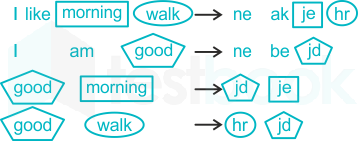
In the code language, ‘I like morning walk' is coded as ‘ne ak je hr’, 'I am good' is coded as ‘ne be jd’, 'good morning' is coded as ‘jd je’ and ‘good walk’ is coded as ‘hr jd’. How will ‘good morning walk’ be coded in that language?

  1. ((a))

    jd je ak

  2. ((b))

    be jd hr

  3. ((c))

    ne je hr

  4. ((d))

    jd je hr

Show Answer
Answer: ((d))

jd je hr

The logic followed here is:

‘I like morning walk' is coded as ‘ne ak je hr’

'I am good' is coded as ‘ne be jd’

'good morning' is coded as ‘jd je’

‘good walk’ is coded as ‘hr jd’

Here,

The code for 'Good' is 'jd'.

The code for 'Morning' is 'je'.

The code for 'Walk' is 'hr;.

So, 'Good Morning Walk' will be coded as 'jd je hr'.

Hence, the correct answer is 'Option 4'.

3

Which of the combinations of interchanges given in the options will make the following equation correct?

38 – 9 × 6 ÷ 12 + 4 = 35

  1. ((a))
    • and – ; 6 and 4
  2. ((b))
    • and × ; 6 and 4
  3. ((c))

    ÷ and × ; 9 and 6

  4. ((d))

    ÷ and + ; 4 and 9

Show Answer
Answer: ((a))
  • and – ; 6 and 4

Given Equation: 38 – 9 × 6 ÷ 12 + 4 = 35

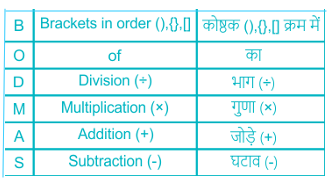
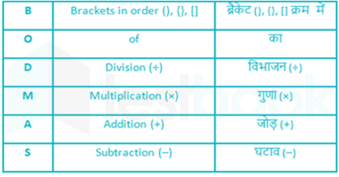
BODMAS Table

Lets check each option one by one:

Option 1) + and – ; 6 and 4

Given: 38 – 9 × 6 ÷ 12 + 4 = 35

After interchanging the signs and digits we get:

38 + 9 × 4 ÷ 12 - 6 = 35

38 + 3 - 6 = 35

41 - 6 = 35

35 = 35.

Option 2) + and × ; 6 and 4

Given: 38 – 9 × 6 ÷ 12 + 4 = 35

After interchanging the signs and digits we get:

38 – 9 + 4 ÷ 12 × 6 = 35

38 – 9 + 2 = 35

40 - 9 = 35

31 ≠ 35.

Option 3) ÷ and × ; 9 and 6

Given: 38 – 9 × 6 ÷ 12 + 4 = 35

After interchanging the signs and digits we get:

38 – 9 ÷ 6 × 12 + 4 = 35

38 - 1.5 × 12 + 4 = 35

38 - 18 + 4 = 35

42 - 18 = 35

24 ≠ 35.

Option 4) ÷ and + ; 4 and 9

Given: 38 – 9 × 6 ÷ 12 + 4 = 35

After interchanging the signs and digits we get:

38 – 9 × 6 + 12 ÷ 4 = 35

38 – 9 × 6 + 3 = 35

38 - 54 + 3 = 35

41 - 54 = 35

-13 ≠ 35.

Hence, the correct answer is 'Option 1'.

4

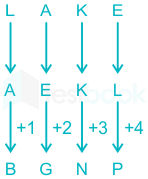
In a code language, 'RIVER' is written as ‘FKUVA’ and ‘LAKE’ is written as ‘BGNP’. How will 'WATER' be written in that language?

  1. ((a))

    BGUXF

  2. ((b))

    AGUXB

  3. ((c))

    BGUXA

  4. ((d))

    BGUXB

Show Answer
Answer: ((d))

BGUXB

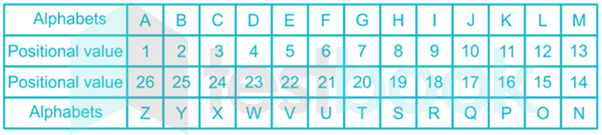
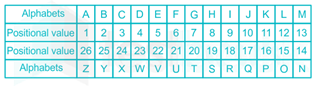
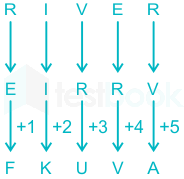
The position and positional value of English Alphabets are:

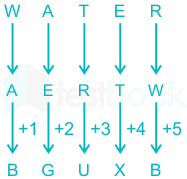
The Logic followed here is: Arranging the letter of a word in ascending order + (1, 2 , 3 , 4, 5) to respective letter.

'RIVER' is written as ‘FKUVA’ 

‘LAKE’ is written as ‘BGNP’

Similarly, 'WATER' will be written as:

So, 'WATER' will be written as 'BGUXB'

Hence, the correct answer is 'Option 4'.

5

What approximate value will replace the question mark (?) in the following equation?

65.321 – (1.98 ÷ 1.99) × 16 – 2.97 × 12 – 11 ÷ (10.003/9.890) = ?

  1. ((a))

    2

  2. ((b))

    6

  3. ((c))

    4

  4. ((d))

    5

Show Answer
Answer: ((a))

2

BODMAS Rule:

Displaying 6203fea433474e3b330f0951_22-7-22_Shashi Savita_D1.png

Given: 65.321 – (1.98 ÷ 1.99) × 16 – 2.97 × 12 – 11 ÷ (10.003/9.890) = ?

Taking approximate values:

65 – (2 ÷ 2) × 16 – 3 × 12 – 11 ÷ (10/10) = ?

65 – 1 × 16 – 3 × 12 – 11 ÷ 1 = ?

65 – 1 × 163 × 12 – 11  = ?

65 - 16 - 36 - 11 = ? 

49 - 36 - 11 =?

13 - 11 = 2.

Hence, the correct answer is 'Option 1'.

6

From among the alphanumeric strings given in the options, select the one that is similar to the given string.

X24A1I9

  1. ((a))

    25Z1AC2

  2. ((b))

    Y24B2I10

  3. ((c))

    B2J10E5

  4. ((d))

    N16M3J10

Show Answer
Answer: ((c))

B2J10E5

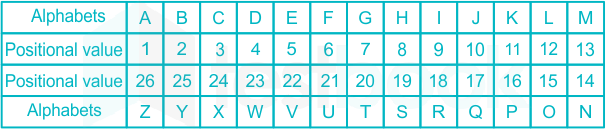
The position and positional values of English Alphabets are:

The logic followed here is: Letter → Its Positional Value → Letter → Its Positional Value → Letter → Its Positional Value.

Given:  X24A1I9

X → 24 A → 1 I → 19.

Now checking the Options One by One:

Option 1) 25Z1AC2

25 → Y ≠ Z, 1 → A, C → 3 ≠ 2

Does not follow logic.

Option 2) Y24B2I10

Y → 25 ≠ 24, B → 2, I → 9 ≠ 10

Does not follow logic.

Option 3) B2J10E5

B → 2, J → 10, E → 5

Follows the given logic.

Option 4) N16M3J10

N → 14 ≠ 16, M → 13 ≠ 3, J → 9 ≠ 10

Does not follow logic.

So, B2J10E5 follows the logic.

Hence, the correct answer is 'Option 3'.

7

If

'@' means '-',

'%' means '÷',

'&' means '+', and

'>' means '×',

then what would be the value of X in the following equation?

336 % 8 @ 16 @ (12 @ 6 > 3) & 22 > 3 = X

  1. ((a))

    89

  2. ((b))

    102

  3. ((c))

    98

  4. ((d))

    79

Show Answer
Answer: ((c))

98

BODMAS Rule:

Given: 336 % 8 @ 16 @ (12 @ 6 > 3) & 22 > 3 = X

As per the given information:

SymbolMeaning
@-
%÷
&+
>×

After putting the sign in given equation as per the table:

336 ÷ 8 - 16 - (12 - 6 × 3) + 22 × 3 = X

336 ÷ 8 - 16 - (12 - 18) + 22 × 3 = X

336 ÷ 8 - 16 - (-6) + 22 × 3 = X

336 ÷ 8 - 16 + 6 + 22 × 3 = X

42 - 16 + 6 + 22 × 3 = X

42 - 16 + 6 + 66 = X

114 - 16 = 98.

So, X = 98.

Hence, the correct answer is 'Option 3'.

8

Select the letter-cluster from among the given options that can replace the question mark (?) in the following series.

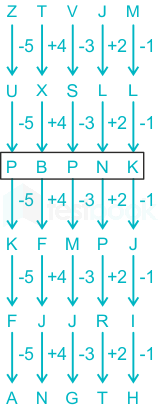
ZTVJM, UXSLL, ? , KFMPJ, FJJRI, ANGTH

  1. ((a))

    PBQNK

  2. ((b))

    QBPNK

  3. ((c))

    PBPNK

  4. ((d))

    PAPNK

Show Answer
Answer: ((c))

PBPNK

The position and positional value of English Alphabets are:

Given Series: ZTVJM, UXSLL, ? , KFMPJ, FJJRI, ANGTH

The logic followed here is:

So, PBPNK will replace the ? in the series.

Hence, the correct answer is 'Option 3'.

9

Find the value of X in the following series.

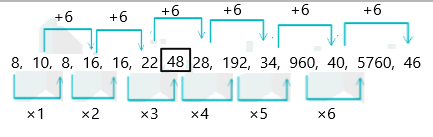
8, 10, 8, 16, 16, 22, X, 28, 192, 34, 960, 40, 5760, 46

  1. ((a))

    46

  2. ((b))

    34

  3. ((c))

    28

  4. ((d))

    48

Show Answer
Answer: ((d))

48

The logic followed here is:

The value of X in the series is 48.

Hence, the correct answer is 'Option 4'.

10

If

‘M + N’ means ‘M is the sister of N’,

‘M – N’ means ‘M is the brother of N’, and

‘M × N’ means ‘M is the daughter of N’,

then how is S related to P in the following expression?

P + Q – R × S + T

  1. ((a))

    Sister

  2. ((b))

    Mother

  3. ((c))

    Cousin

  4. ((d))

    Grandmother

Show Answer
Answer: ((b))

Mother

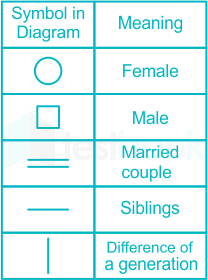
Family Chart:

A is
Symbols+-×
MeaningSisterBrotherDaughter
of B

Given Expression: P + Q – R × S + T

P is sister of Q, Q is brother of R, R is daughter of S, S is sister of T.

Here, S is mother of P.

Hence, the correct answer is 'Option 2'.

11

Four letter-clusters have been given, out of which three are alike in some manner and one is different. Select the one that is different.

  1. ((a))

    EINT

  2. ((b))

    AEJP

  3. ((c))

    XBGM

  4. ((d))

    TXCH

Show Answer
Answer: ((d))

TXCH

The position and positional values of English Alphabets are:

Now checking Options One by One:

Option 1) EINT

Option 2) AEJP

Option 3) XBGM

Option 4) TXCH

Here, TXCH is odd among the given options.

Hence, the correct answer is 'Option 4'.

Read the given information carefully and answer the following questions.

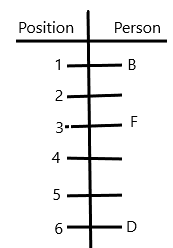
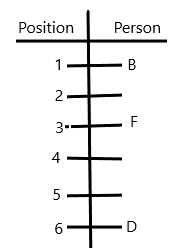
Six friends, A, B, C, D, E and F, are standing one after the other on a straight vertical line. All are facing towards north. A is standing at an odd position from the north. Two people are standing between D and F. D is standing at an even position from the north. Four people are standing between D and B. C is not standing behind F. E is not standing immediately after or immediately before B. F is standing ahead of D.

12

Who among the following are standing in the middle?

  1. ((a))

    E and F

  2. ((b))

    F and C

  3. ((c))

    E and A

  4. ((d))

    A and C

Show Answer
Answer: ((a))

E and F

Given: Six friends, A, B, C, D, E and F, are standing one after the other on a straight vertical line. All are facing towards north.

Four people are standing between D and B.

Two people are standing between D and F.

D is standing at an even position from the north.

<br>


C is not standing behind F.

A is standing at an odd position from the north. 

E is not standing immediately after or immediately before B.

F is standing ahead of D.

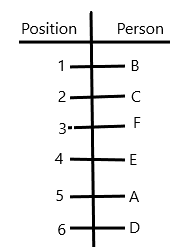
So, E and F are standing in the middle of the line.

Hence, the correct answer is 'Option 1'.

13

Who among the following is standing at an even position from the south?

  1. ((a))

    D

  2. ((b))

    C

  3. ((c))

    E

  4. ((d))

    F

Show Answer
Answer: ((d))

F

Given: Six friends, A, B, C, D, E and F, are standing one after the other on a straight vertical line. All are facing towards north.

Four people are standing between D and B.

Two people are standing between D and F.

D is standing at an even position from the north.

<br>


C is not standing behind F.

A is standing at an odd position from the north. 

E is not standing immediately after or immediately before B.

F is standing ahead of D.

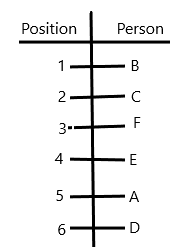
While counting from South F is at Fourth position among the given options.

So, F is at even position from South.

Hence, the correct answer is 'Option 4'.

Read the given information carefully and answer the following questions.

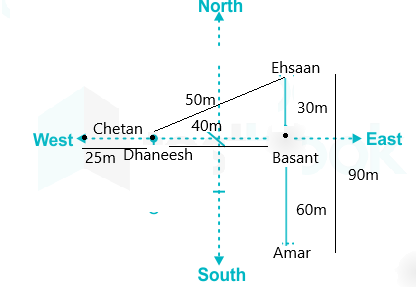
Amar, Basant, Chetan, Dhanesh and Ehsaan live in separate houses, which are located in a big compound. Basant’s house is located at 40 m to the right of Dhanesh’s house. Amar’s house is located at 60 m to the south of Basant’s house. Chetan’s house is located at a distance of 25 m to the west of Dhanesh’s house. Ehsaan’s house is located at a distance of 90 m to the north of Amar’s house.

14

What is the shortest distance between Dhaneesh and Ehsaan’s houses?

  1. ((a))

    70 m

  2. ((b))

    50 m

  3. ((c))

    45 m

  4. ((d))

    25 m

Show Answer
Answer: ((b))

50 m

Given: Amar, Basant, Chetan, Dhaneesh and Ehsaan live in separate houses, which are located in a big compound.

Basant’s house is located at 40 m to the right of Dhaneesh’s house.

Amar’s house is located at 60 m to the south of Basant’s house.

Chetan’s house is located at a distance of 25 m to the west of Dhaneesh’s house.

Ehsaan’s house is located at a distance of 90 m to the north of Amar’s house.

Distance between Amar and Ehsaan house = 90m

Distance between Ehsaan and Basant house = 30m

Distance between Dhaneesh and Basant house = 40m

Then, Distance between Dhaneesh and Ehsaan house = √(40)2 + (30)2

= √1600 + 900

= √2500

= 50m.

So, the distance between Dhaneesh and Ehsaan house = 50m.

Hence, the correct answer is 'Option 2'.

15

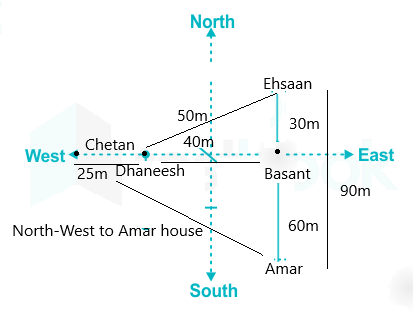
Who’s house is located towards the north-west of the house that is located in the extreme south direction?

  1. ((a))

    Amar

  2. ((b))

    Basant

  3. ((c))

    Chetan

  4. ((d))

    Ehsaan

Show Answer
Answer: ((c))

Chetan

Given: Amar, Basant, Chetan, Dhaneesh and Ehsaan live in separate houses, which are located in a big compound.

Basant’s house is located at 40 m to the right of Dhaneesh’s house.

Amar’s house is located at 60 m to the south of Basant’s house.

Chetan’s house is located at a distance of 25 m to the west of Dhaneesh’s house.

Ehsaan’s house is located at a distance of 90 m to the north of Amar’s house.

Amar house is located in extreme south direction.

So, Chetan's house is located in North - West direction of Amar house.

Hence, the correct answer is 'Option 3'.

General Awareness (15 questions)

16

The world’s largest national flag, made of Khadi fabric, was put to display to celebrate Army Day’ on 15 January. It was displayed at ________, along the India – Pakistan Border.

  1. ((a))

    Fazilka

  2. ((b))

    Wagah

  3. ((c))

    Longewala

  4. ((d))

    Munabao

Show Answer
Answer: ((c))

Longewala

The correct answer is Longewala.

Key Points

  • The world's largest national flag, made of Khadi fabric, was put on display to celebrate Army Day on 15 January 2022.
  • It was displayed at Longewala along the India-Pakistan border.
  • The flag measures 225 feet long and 150 feet wide, and weighs approximately 1,400 kilograms. It was made using 4,500 meters of hand-spun, hand-woven Khadi cotton bunting.
  • The Ashok Chakra in the flag has a diameter of 30 feet.
  • The flag was made by 70 Khadi artisans from across India. It took them 49 days to complete the flag.
  • The flag was displayed at Longewala to commemorate the victory of the Indian Army in the 1971 Indo-Pakistani War.
  • Longewala is a strategically important location in the Thar Desert, and it was the site of a fierce battle between Indian and Pakistani forces during the war.
  • The display of the world's largest national flag was a symbol of India's national pride and its commitment to defending its borders.
17

Union Budget 2021-22 pegged fiscal deficit for 2020-21 at ________ of GDP in the revised Budget estimates

  1. ((a))

    9.5 per cent

  2. ((b))

    10.5 per cent

  3. ((c))

    6.5 per cent

  4. ((d))

    7.5 per cent

Show Answer
Answer: ((a))

9.5 per cent

The correct answer is 9.5 per cent.

Key Points

  • The fiscal deficit in BE (Budget Estimates) 2021-2022 is estimated to be 6.8% of GDP.
  • Fiscal Deficit is the difference between the total income of the government (total taxes and non-debt capital receipts) and its total expenditure.
  • The fiscal deficit in RE (Revised Estimates) 2020-21 is pegged at 9.5% of GDP - funded through Government borrowings, multilateral borrowings, Small Saving Funds, and short term borrowings.
  • Gross borrowing from the market for the next year to be around 12 lakh crore.
  • Plan to continue on the path of fiscal consolidation, achieving a fiscal deficit level below 4.5% of GDP by 2025-2026 with a fairly steady decline over the period
  • It will be achieved by increasing the buoyancy of tax revenue through improved compliance, and secondly, by increased receipts from monetization of assets, including Public Sector Enterprises and land
  • Deviation Statement under Sections 4(5) and 7(3) (b) of the FRBM Act tabled necessitated by this year‟s unforeseen and unprecedented circumstances
  • Amendment to FRBM Act proposed to achieve targeted Fiscal Deficit levels
  • The Contingency Fund of India is to be augmented from Rs. 500 crore to Rs. 30,000 crore through Finance Bill.
18

The ‘Westchester Cup’ belongs to which sport?

  1. ((a))

    Tennis

  2. ((b))

    Hockey

  3. ((c))

    Snooker

  4. ((d))

    Polo

Show Answer
Answer: ((d))

Polo

The correct answer is Polo.

Key Points

  • Polo
  • Polo, game played on horseback between two teams of four players each of who uses mallets with long, flexible handles to drive a wooden ball down a grass field and between two goalposts.
  • It is the oldest of equestrian sports.
  • A game of Central Asian origin, polo was first played in Persia (Iran) at dates given from the 6th century BC to the 1st century AD.
  • Polo was at first a training game for cavalry units, usually the king’s guard or other elite troops.
  • To the warlike tribesmen, who played it with as many as 100 to aside, it was a miniature battle.
  • In time polo became a Persian national sport played extensively by the nobility.
  • Women, as well as men, played the game, as indicated by references to the queen and her ladies engaging King Khosrow II Parvīz and his courtiers in the 6th century AD.​

Additional Information


GameEquipment neededScoring systemNumber of players
TennisRacket, BallPoints system (15, 30, 40, Game)Singles (1 vs 1), Doubles (2 vs 2)
HockeyStick, Ball, GoalGoal-based system11 players in each team
SnookerCue, Ball, TablePoint-based system with various balls valued differentlyUsually 2 players, Doubles possible
19

Who among the following Kuchipudi dance exponents founded the Kuchipudi Art Academy in Chennai?

  1. ((a))

    Vijaya Prasad

  2. ((b))

    Vempati Chinna Satyam

  3. ((c))

    Swapna Sundari

  4. ((d))

    Kalpalathika

Show Answer
Answer: ((b))

Vempati Chinna Satyam

The correct answer is Vempati Chinna Satyam.

Key Points

  • Vempati Chinna Satyam started the Kuchipudi Art Academy at Madras (now Chennai) in 1963.
  • Vempati Chinna Satyam:
  • Born on October 25, 1929, in Kuchipudi village in Krishna district.
  • The Kuchipudi dance originated in the same place.
  • Chinna Satyam strove to popularise the unique dance form across the world.
  • He began dancing at the age of six.
  • Over a period of two decades received training from famous teachers such as Tadepalli Perrayya Sastry, Vedantam Lakshminarayana Sastry, and later from his elder brother Vempati Pedda Satyam.
  • He founded Kuchipudi Art Academy in Chennai, in 1963.
  • He trained hundreds of students at the Kuchipudi Art Academy in Chennai.
  • Branches of this academy were later established in cities such as Visakhapatnam, Mumbai, and Calcutta in India and several cities in the USA.
  • His students include veteran actors and dancers like Hemamalini, Rekha, Vyjayanthimala Bali, and Manju Bhargavi of 'Shankarabaranam's fame.
  • He also gave performances in over 60 countries.
20

Which state of India has the lowest sex ratio, i.e., number of females per 1000 males?

  1. ((a))

    Jharkhand

  2. ((b))

    Haryana

  3. ((c))

    Rajasthan

  4. ((d))

    Punjab

Show Answer
Answer: ((b))

Haryana

The correct answer is Haryana.

Key Points

  • Haryana has India's lowest sex ratio, a number of 877 females to 1000 males.
  • Puducherry and Kerala where there are more women than men.
  • Kerala has India's highest sex ratio and the figure shows a number of 1084 females to 1000 males.
Name of state or Union TerritorySex Ratio  (as per Census 2011)
Kerala1084
Puducherry1038
Tamil Nadu995
Andhra Pradesh992
Chhattisgarh991
Manipur987
Meghalaya986
Odisha978
Mizoram975
Himachal Pradesh974
Karnataka968
Goa968
Uttrakhand963
Tripura961
Assam954
Jharkhand947
West Bengal947
Lakshadweep946
Nagaland931
Madhya Pradesh930
Rajasthan926
Maharashtra925
Arunachal Pradesh920
Gujarat918
Bihar916
Uttar Pradesh908
Punjab893
Sikkim889
Jammu& Kashmir883
Andaman & Nicobar islands878
Haryana877
NCT of Delhi866
Chandigarh818
Dadra and Nagar Haveli775
Daman and Diu618
India943

Additional Information  Census 2011 highlights: 

  • India’s population growth rate is 17.64 percent in the decade 2001-11,
  • The slowest rate of growth this past century, as per data put out by the registrar-general of the census.
  • India’s population in 2011 is estimated to be 1.21 billion, comprising 624 million males and 587 million females.
  • While the gender imbalance in the population remains.
  • India’s female population grew by 18.12% over the past decade against 17.19% for males.
  • India’s literacy rate has gone up from 64.83% in 2001 to 74.04% in 2011.
  • Literates constitute 74 percent of the total population aged seven and above.
  • The sex ratio, that is the number of females per 1,000 males, has improved to 940 from 933 a decade ago.
  • The child sex ratio is 914, the lowest since independence.
21

As per the Food and Agriculture Organization of the United Nations, what is India’s rank in the world in the production of wheat?

  1. ((a))

    Third

  2. ((b))

    Fourth

  3. ((c))

    First

  4. ((d))

    Second

Show Answer
Answer: ((d))

Second

The correct answer is Second.

Key Points

  • According to the Food and Agriculture Organization of the United Nations (FAO), India is the second-largest producer of wheat in the world.
  • In 2022, India produced an estimated 109.59 million tonnes of wheat, accounting for 10.9% of global wheat production.
  • China is the world's largest wheat producer, with an estimated production of 137.92 million tonnes in 2022.
  • India's wheat production is concentrated in the northern and western parts of the country, with the states of Uttar Pradesh, Punjab, and Haryana being the major producers.
  • Wheat is a staple food in India, and it is consumed by people of all social and economic classes.
  • India is also a major exporter of wheat, and it exports wheat to a number of countries in Asia and Africa.
22

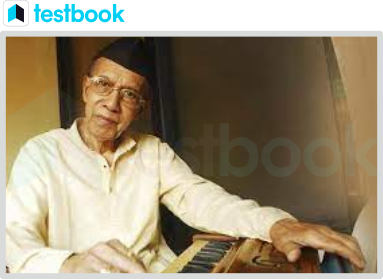
Pandit Tulsidas Borkar is a noted exponent of which of the following musical instruments?

  1. ((a))

    Trumpet

  2. ((b))

    Mandolin

  3. ((c))

    Harmonium

  4. ((d))

    Sitar

Show Answer
Answer: ((c))

Harmonium

The correct answer is Harmonium.

Key Points 

  • Borkar made a name for himself as an accomplished harmonium player and was conferred with the Padma Shri award in 2016.
  • He was also a recipient of the Sangeet Natak Akademi Award.
  • Borkar was known for both solo performances as well as his unique style of accompanying Indian classical singers.
  • Pandit Tulsidas Borkar had been diagnosed with tuberculosis and was treated in Mumbai's Nanavati Hospital.
  • But, due to old age, his body didn't respond well to the treatment.
  • He died at the age of 83 on 29 September 2018 at 10:20 A.M. in Mumbai.

Renowned harmonium exponent Pt. Tulsidas Borkar dies aged 83

Additional Information

InstrumentOriginKey ComponentsFamous Artists
TrumpetAncient origins, Modern form in the United StatesValves, Mouthpiece, TubingLouis Armstrong, Miles Davis
MandolinItaly, during the 17th and 18th centuriesFour courses of double metal strings, a body that acts as a resonator, a neck, and a tailpieceBill Monroe, Yank Rachell
SitarIndia, Medieval periodLong neck with 18-21 strings (6 or 7 played strings and the rest sympathetic strings)Ravi Shankar, Vilayat Khan)
23

Which is the largest state of India in terms of area?

  1. ((a))

    West Bengal

  2. ((b))

    Rajasthan

  3. ((c))

    Gujarat

  4. ((d))

    Tamil Nadu

Show Answer
Answer: ((b))

Rajasthan

The correct answer is Rajasthan.

Key Points

  • Rajasthan is the largest state in terms of the area followed by Madhya Pradesh &  Maharashtra at second and third places respectively.
  • The total area covered by the state of Rajasthan is 342239 Km2 which is the largest area covered by any state in India and it accounts for 10.41% of the total country's area.
  • On the contrary, Goa is the smallest state in India in terms of area as it covers only 3,702 Km2 area which is 0.11% of the geographical area of the country.
  • The largest state in terms of the population is Uttar Pradesh as there was approximately 20Cr population according to the 2011 Census.
  • The smallest state in terms of the population is Sikkim with a handful population of only 6.11 Lakhs people.

Additional Information

  • The smallest state in India area wise - Goa.
  • The largest state in India by population - Uttar Pradesh.
  • The smallest state in India by population - Sikkim.
  • Biggest district in India (Area wise) - Kachchh (Gujarat).
24

The fourth general assembly of the International Solar Alliance (ISA) was held virtually between 18 October and 21 October 2021. It was presided by Union Minister ________, Minister for Power, New and Renewable Energy, Government of India and the President of the ISA Assembly.

  1. ((a))

    Narayan Tatu Rane

  2. ((b))

    Ashwini Vaishnaw

  3. ((c))

    RK Singh

  4. ((d))

    Pralhad Joshi

Show Answer
Answer: ((c))

RK Singh

The correct answer is RK Singh.

Key Points

  • The fourth General Assembly of the International Solar Alliance (ISA) will be held virtually from October 18 to 21, 2021.
  • It will be presided over by the Union Minister for Power, New & Renewable Energy, and the President of the ISA Assembly Raj Kumar Singh.
  • The General Assembly is the apex decision-making body of ISA, in which each member country is represented.

Additional Information

  • About International Solar Alliance:
  • The International Solar Alliance is an alliance of more than 120 countries that come either completely or partly between the Tropic of Cancer and the Tropic of Capricorn.
  • The primary objective is to collectively work for efficient exploitation of solar energy to reduce dependence on fossil-based fuels.
  • Its headquarters is in India.
25

When did Queen Victoria's Proclamation declare that India would be governed by and in the name of the British Monarch through a Secretary of State?

  1. ((a))

    1 November 1858

  2. ((b))

    27 October 1858

  3. ((c))

    16 September 1860

  4. ((d))

    12 August 1858

Show Answer
Answer: ((a))

1 November 1858

The correct answer is 1 November 1858.

Key Points

  • Queen Victoria's Proclamation of 1 November 1858 declared that thereafter India would be governed by and in the name of the British Monarch through a Secretary of State.
  • The East India Company's rule in India came to an end.
  • The Act of 1858 was known as the Act for the better Government of India.
  • The Act of 1858 was given royal assent on 2nd August 1858 but was commenced on 1st November 1858.​

Additional Information

  • The act of 1858 was related to the power transfer from the East India Company to the British crown.
  • The act abolished the dual government of the Pitts India act.
  • The act also abolished the doctrine of lapse.
  • The secretary of state for India was Lord Stanely and the first Governor general and viceroy of India was Lord canning.
26

As on December 2021, individuals whose annual taxable income is between ₹50 lakhs and 1 crore, have to pay ________ surcharge on income tax.

  1. ((a))

    10%

  2. ((b))

    5%

  3. ((c))

    20%

  4. ((d))

    30%

Show Answer
Answer: ((a))

10%

The correct answer is 10%.

Key Points

  • The surcharge is levied on the income tax amount if the total income crosses a certain level.
  • Given below is the table showing surcharges that will be levied.
Taxable Income
Surcharge (%)
Income above Rs 50 lakh but below Rs 1 crore10
Income above Rs 1 crore but below Rs 2 crore15
Income above Rs 2 crore but below 5 crore25
Income above Rs 5 crore37


Additional Information

  • Income Tax-
  • Income tax is a key source of government funding.
  • Income tax in India is in the Union List of the Seventh Schedule to the Constitution of India, empowering the central government to tax non-agricultural income.
  • Income-tax law consists of the 1961 act, Income Tax Rules 1962, Notifications and Circulars issued by the Central Board of Direct Taxes (CBDT), annual Finance Acts, and judicial pronouncements by the Supreme and High courts.
  • The government taxes the certain income of individuals, Hindu Undivided Families (HUF's), companies, firms, LLPs, associations, bodies, local authorities, and any other juridical person.
  • The CBDT administers the Income Tax Department, which is part of the Ministry of Finance's Department of Revenue.

Read the following passage and based on the understanding derived from it, answer the following questions.

“The Directive Principles are not an unnecessary appendage to the Constitution. The Constitution itself declares that they are fundamental to the governance of the country. According to LM Singhvi, an eminent jurist and diplomat, ‘the Directives are the life giving provisions of the Constitution. They constitute the stuff of the Constitution and its philosophy of social justice’. MC Chagla, former Chief Justice of India, is of the opinion that, ‘if all these principles are fully carried out, our country would indeed be a heaven on earth. India would then be not only democracy in the political sense, but also a welfare state looking after the welfare of its citizens’. Dr. BR Ambedkar had pointed out that the Directives have great value because they lay down that the goal of Indian polity is ‘economic democracy’ as distinguished from ‘political democracy’. Granville Austin opined that the Directive Principles are ‘aimed at furthering the goals of the social revolution or to foster this revolution by establishing the conditions necessary for its achievement’.”

27

Article 40 of the Constitution of India deals with:

  1. ((a))

    power of the Parliament to modify the Fundamental Rights in their application to forces, etc.

  2. ((b))

    organisation of village panchayats

  3. ((c))

    remedies for enforcement of Fundamental Rights

  4. ((d))

    promotion of educational and economic interests of Scheduled Castes, Scheduled Tribes and other weaker sections

Show Answer
Answer: ((b))

organisation of village panchayats

The correct answer is organisation of village panchayats.

Key Points

  • Article 40 of the Indian constitution deals with the organization of the village panchayat.
  • It states that
  • The State shall take steps to organize village panchayats.
  • It also endows them with such powers and authority that will enable them to function as units of self-government.

Additional Information

  • Power of the Parliament to modify the Fundamental Rights in their application to forces, etc.:
  • This refers to Article 33 of the Constitution which empowers Parliament to restrict or abrogate the fundamental rights of the members of armed forces, paramilitary forces, police forces, intelligence agencies and similar services.
  • This is not directly related to the Directive Principles described in the passage above.
  • Remedies for enforcement of Fundamental Rights:
  • Typically, this is related to Article 32 which provides the right to constitutional remedies, which means that a person has the right to approach the Supreme Court of India for enforcement of Fundamental Rights.
  • This is also not directly related to the Directive Principles described in the passage, which are non-justiciable, meaning they are not legally enforceable by courts for their violation.
  • Promotion of educational and economic interests of Scheduled Castes, Scheduled Tribes and other weaker sections:
  • This is related to Article 46, which states that the State shall promote the educational and economic interests of the weaker sections of the people, particularly the Scheduled Castes and Scheduled Tribes, and protect them from social injustice and exploitation.
  • While it falls under the umbrella of Directive Principles, the passage above does not explicitly mention Article 46.
28

The Legal Services Authorities Act (1987) which has established a nation-wide network to provide free and competent legal aid to the poor and to organise Lok Adalat for promoting equal justice can be traced back to which of the following Articles of Indian Constitution?

  1. ((a))

    Article 39A

  2. ((b))

    Article 43B

  3. ((c))

    Article 43A

  4. ((d))

    Article 48A

Show Answer
Answer: ((a))

Article 39A

The correct answer is Article 39A.

Key Points

  • Article 39A
  • The State shall secure that the operation of the legal system promotes justice, on a basis of equal opportunity, and shall, in particular, provide free legal aid, by suitable legislation or schemes or in any other way, to ensure that opportunities for securing justice are not denied to any citizen by reason of economic or other disabilities.

Additional Information 

Article NumberDescription in the Indian ConstitutionRelation to the Fundamental Principles
Article 43BIt promotes co-operative societies. It doesn't directly relate to the Legal Services Authorities Act (1987), but broadly aligns with the welfare state concept.It expresses an indirect connection with the Directive Principles, focusing on the enhancement of public participation and democracy, but doesn't relate to legal aid or Lok Adalats.
Article 43AThis Article permits the State to take steps to secure the participation of workers in the management of industries.While it underlines the commitment to a socio-economic democracy, it doesn't directly link to free legal aid or Lok Adalats.
Article 48AThis provision is about protecting and improving the environment, safeguarding forests and wildlife.It isn’t directly associated with Legal Services Authorities Act (1987), rather, it deals with environmental conservations upholding the welfare principle.
29

Which of the following Articles of the Indian Constitution directs the State to promote international peace and security?

  1. ((a))

    Article 42

  2. ((b))

    Article 51

  3. ((c))

    Article 48A

  4. ((d))

    Article 49

Show Answer
Answer: ((b))

Article 51

The correct answer is Article 51.

Key Points

  • Article 51 of the Indian Constitution has three parts.
  • Article 51(a): of the Indian Constitution states that the State shall endeavor to promote international peace and security.
  • Article 51(b): The State shall maintain just and honorable relations between nations.
  • Article 51(c): The State shall foster respect for international law and treaty obligations in the dealings of organized peoples with one another; and encourage settlement of international disputes by arbitration.

Additional Information 

Article NumberDescription in the ConstitutionRelation to Directive Principles
Article 42It mandates the state to make provision for just and humane conditions for work and maternity relief.This Article is in line with promoting the social welfare of individuals, which is the spirit of the Directive Principles. However, it doesn't directly link to the Legal Services Authorities Act (1987) which is about providing free legal aid rather than labor conditions.
Article 48ARelated to the protection and improvement of the environment and safeguarding of forests and wildlife.While it is a Directive Principle and part of the broader welfare state concept, it doesn't directly relate to the Legal Services Authorities Act (1987), which is focused on legal aid, not environmental conservation.
Article 49The state is obligated to protect monuments, places, and objects of artistic or historic interest deemed to be of national importance.Though it is part of the Directive Principles, it is not directly tied to the establishment of a legal aid system - the primary concern of the Legal Services Authorities Act (1987).
30

Which Article of the Indian Constitution provides the state to take steps to separate the judiciary from the executive in the public services of the state?

  1. ((a))

    Article 45

  2. ((b))

    Article 55

  3. ((c))

    Article 66

  4. ((d))

    Article 50

Show Answer
Answer: ((d))

Article 50

The correct answer is Article 50.

Key Points

  • Separation of the judiciary from the executive is guaranteed in article 50 of the constitution.
  • Article 50 reported that “the state shall take action to unconnected the judiciary from the executive in the public services of the state”.
  • The Indian National Congress desired the judiciary to be divided from the executive branch of the government.
  • There is no arrangement in the Constitution that talks about the separation of powers except Article 50 which talks about the separation of the executive from the judiciary but this doctrine is in practice in India.
  • Article 50 provides a direction to the State to keep the Judiciary independent of the Executive, mainly in judicial appointments.​

Additional Information

Article NumberDescription in the ConstitutionRelation to the Directive Principles
Article 45This Article pertains to provisioning for early childhood care and education to children below the age of six years.While it is related to social welfare, which is consistent with Directive Principles, it does not directly correlate with the Legal Services Authorities Act (1987), which is about providing free legal aid.
Article 55This concerns the manner of election of the President of India. It is not related to social justice or welfare principles that underpin the Directive Principles.This Article has no direct relation to the Legal Services Authorities Act (1987) or the Directive Principles.
Article 66Indicates the manner of election of Vice-President of India. It does not relate to any of the issues associated with the Directive Principles or the Legal Services Authorities Act (1987).It does not specifically tie into the principles upheld by the Legal Services Authorities Act or the social welfare focus of the Directive Principles.

Language Competency (30 questions)

31

Select the most appropriate article to fill in the blank.

When the light went out, we lit ________ candle.

  1. ((a))

    the

  2. ((b))

    a

  3. ((c))

    No article required

  4. ((d))

    an

Show Answer
Answer: ((b))

a

The correct answer is "a".

Key Points

  • The most appropriate article to fill in the blank is "a".
  • The indefinite article 'a' is used before singular, countable nouns when the precise entity isn't specified.
  • 'A' is used before words that start with a consonant sound.
  • 'Candle' starts with a /k/ sound, which is a consonant sound.
  • So**, 'a'** is the correct article to use before it.

Therefore, the correct answer is "Option 2".

Complete Sentence: When the light went out, we lit a candle.

32

Select the most appropriate ANTONYM of the given word.

Scared

  1. ((a))

    Fearful

  2. ((b))

    Nervous

  3. ((c))

    Courageous

  4. ((d))

    Active

Show Answer
Answer: ((c))

Courageous

The correct answer is 'Courageous'.

Key Points

  • "Scared" means feeling or showing fear; it describes someone who is frightened or worried. "डरा हुआ".
  • Example: When she heard the strange noise, she was very scared.
  • The term "courageous" means not deterred by danger or pain; brave. (साहसी)
  • Example: The courageous firefighter saved the child from the burning building.

Therefore, the correct answer is 'option 3'.

 Additional Information

  • "Fearful" means feeling afraid or showing fear or anxiety. (भयभीत).
  • "Nervous" means anxious or fearful, typically about the outcome of something. (घबराया हुआ).
  • "Active" means engaging or ready to engage in physically energetic pursuits. (सक्रिय).
33

Select the most appropriate meaning of the given idiom.

Little by little

  1. ((a))

    Immediately

  2. ((b))

    Rarely

  3. ((c))

    Gradually

  4. ((d))

    Occasionally

Show Answer
Answer: ((c))

Gradually

The correct answer is "Gradually".

Key Points

  • The idiom "little by little" means to do something slowly, gradually, or bit by bit.
  • It refers to the slow progression of something rather than doing it immediately or quickly.
  • For Example - "He was able to pay off his debt little by little."

Therefore, the correct answer is "option 3".

34

Select the most appropriate option that can be used as a one-word substitute for the underlined group of words.

The little girl was reading a book which had a lot of pictures by way of explaining things.

  1. ((a))

    Illustrations

  2. ((b))

    Decorations

  3. ((c))

    Ornamentations

  4. ((d))

    Demonstrations

Show Answer
Answer: ((a))

Illustrations

The correct answer is "Illustrations".

Key Points

  • The phrase "a lot of pictures by way of explaining things" describes images used in a book to help explain the content.
  • These are referred to as "illustrations."
  • "Illustrations" are the graphical depictions of the subject matter intended to clarify or exemplify the written content, making it the appropriate one-word substitute in this context.

Therefore, the correct answer is "Option 1".

35

Select the most appropriate synonym of the given word.

Faulty

  1. ((a))

    Complete

  2. ((b))

    Strong

  3. ((c))

    Fixed

  4. ((d))

    Defective

Show Answer
Answer: ((d))

Defective

The correct answer is ''Defective'.

Key Points

  • In English, "faulty" means having or displaying faults; defective or imperfect. (खराब).
  • Example: The phone was faulty, and hence, it was returned to the seller.
  • The term "defective" means imperfect or faulty. (दोषपूर्ण)
  • Example: The customers have the right to return defective items to the store.

Therefore, the correct answer is 'option 4'.

Additional Information

  • "Complete" means having all the necessary or appropriate parts. (पूर्ण).
  • "Strong" generally means having the power to move heavy weights or perform other physically demanding tasks. (मजबूत).
  • "Fixed" means fastened securely in position. (स्थायी).
36

Select the most appropriate option that can be used as a one-word substitute for the underlined group of words.

Tonight, my father showed me a group of fixed stars which was called the Great Bear.

  1. ((a))

    Cosmos

  2. ((b))

    Clique

  3. ((c))

    Congregation

  4. ((d))

    Constellation

Show Answer
Answer: ((d))

Constellation

The correct answer is "Constellation".

Key Points

  • The phrase "a group of fixed stars" pertains to a specific arrangement of stars seen from Earth.
  • In astronomy, this concept is known as a "constellation."
  • "Constellation" is used in the field of astronomy to describe a distinct pattern or group of stars.
  • Example - "The constellation known as the Big Dipper is easy to spot in the night sky."

Therefore, the correct answer is "option 4".

Additional Information

  Here are the meaning of the remaining options  - 

  • Cosmos: The universe seen as a well-ordered whole.
  • Clique: A small group of people, with shared interests or other features in common, who spend time together and do not readily allow others to join them.
  • Congregation: A group of people assembled for religious worship.
37

Select the most appropriate option to fill in the blanks.

They waited ________ me ________the bridge.

  1. ((a))

    to ; on

  2. ((b))

    for ; in

  3. ((c))

    for ; on

  4. ((d))

    to ; in

Show Answer
Answer: ((c))

for ; on

The correct answer is "for, on".

Key Points

  • We use 'for' after the verb 'wait' when we are waiting for someone or something.
  • So, in the first blank, "for" makes the sentence read as "They waited for me," which means they were waiting for my arrival.
  • When talking about locations and especially in relation to a surface, the correct preposition to use is "on".
  • So**, "on the bridge"** is correct as it refers to the location being on the surface of the bridge.
  • Therefore, the second blank should be filled with 'on'.

Thus, the correct answer is "option 3".

38

Select the sentence part that has a spelling error. If there is no error, select ’No error’.

You can bye clothes from this shop at reasonable rates.

  1. ((a))

    No error

  2. ((b))

    from this shop

  3. ((c))

    You can bye clothes

  4. ((d))

    at reasonable rates

Show Answer
Answer: ((c))

You can bye clothes

The correct answer is "You can bye clothes".

Key Points

  • The error lies in the word "bye".
  • In this context, the intended word should be "buy" as the sentence is talking about purchasing (or buying) clothes from a shop.
  • "Bye" is a term used to express farewell which is not fit in this context.
  • On the other hand**, "buy"** is a verb we use when we're talking about purchasing or acquiring something in exchange for money.
  • Therefore, the correct sentence should be "You can buy clothes from this shop at reasonable rates."

Thus, the correct answer is "option 3".

39

Select the most appropriate option to fill in the blank.

For many years my ambition ________ to become a lawyer.

  1. ((a))

    are

  2. ((b))

    have been

  3. ((c))

    has been

  4. ((d))

    is

Show Answer
Answer: ((c))

has been

The correct answer is "has been".

Key Points

  • The correct option to fill in the blank is "has been".
  • The subject "my ambition" is singular, so the verb must also be singular to maintain subject-verb agreement.
  • The use of "For many years" indicates that the action started in the past and is still relevant or ongoing now.
  • This implies a present perfect tense is needed.
  • In the present perfect tense, we use "has been" with singular subjects.

​Therefore, the correct answer is "option 3".

Complete Sentence: For many years my ambition has been to become a lawyer.

40

Select the most appropriate meaning of the given idiom.

Poke one’s nose

  1. ((a))

    Clean one’s nose with a finger

  2. ((b))

    Try to steal things

  3. ((c))

    Help others to do something

  4. ((d))

    Try to interfere in something

Show Answer
Answer: ((d))

Try to interfere in something

The correct answer is "Try to interfere in something".

Key Points

  • The idiom "poke one’s nose" is an English expression that means to involve oneself in something that is not one's business, to meddle, or interfere.
  • When someone is said to "poke their nose into" something, it means they are intruding or meddling in something that is not their concern or business.
  • For Example - "Despite not being involved in the project, he kept poking his nose into it, offering unwanted advice."

Therefore, the correct answer is "option 4".

Read the given passage and answer the questions that follow.

The construction company Hong Kong Housing is building a new suburb in Shanghai, a city with a population of more than 15 million people. But this suburb is not like other parts of Shanghai. It is a little piece of England. The name of the new area is ‘English Town’. The manager of Hong Kong Housing, Shi Guangsheng, says many people in this area of China want to buy an English house and live in an English town.

"This town is like Bristol or Chester. There is an English square and there are pigeons to feed like in Trafalgar Square, London. There are four English-style pubs and you can buy English beer to drink. There is a canal and you can row a boat there like in Cambridge."

Are there any cricket fields? "No, there aren't any places to play cricket because nobody in Shanghai can play this game. But there is a football stadium like those in England. And the thing we are very proud of is our shopping street. There are several shops where you can buy traditional English food like fish and chips or Christmas Pudding."

The rich Shanghai businessmen can do some gardening too. For with every house in ‘English Town’, there is an English lawn and there are long gardens with ponds and tall hedges. But there is one problem. The houses in this part of town cost a minimum of $400,000!

41

Which of the following statements is NOT true according to the passage?

  1. ((a))

    The square in the town looks like Trafalgar Square in London.

  2. ((b))

    There is no cricket field in the English town.

  3. ((c))

    The houses in English town are not expensive.

  4. ((d))

    All houses in the English town have lawns.

Show Answer
Answer: ((c))

The houses in English town are not expensive.

The correct answer is "The houses in English town are not expensive.".

Key Points

  • According to the passage, the statement "The houses in English town are not expensive" is untrue.
  • The passage specifically mentions in the final line, "The houses in this part of town cost a minimum of $400,000!". This clearly indicates that the houses in the English town are indeed expensive, which contradicts with the given statement.
  • Therefore, "The houses in English town are not expensive" is not a true statement as per the details given in the passage.

Therefore, the correct answer is "option 3".

42

In which city is the English town located?

  1. ((a))

    Hong Kong

  2. ((b))

    London

  3. ((c))

    Shanghai

  4. ((d))

    Bristol

Show Answer
Answer: ((c))

Shanghai

The correct answer is "Shanghai".

Key Points

  • According to the first line of the passage**: "The construction company Hong Kong Housing is building a new suburb in Shanghai, a city with a population of more than 15 million people.",** the 'English Town' is located in Shanghai.
  • Therefore, it's clear from the passage that the 'English Town' is being constructed in the city of Shanghai, not in Hong Kong, London, or Bristol.

Therefore, the correct answer is "option 3".

43

There is a canal with row boats in the new English Town. It looks like the canal in:

  1. ((a))

    London

  2. ((b))

    Cheshire

  3. ((c))

    Cambridge

  4. ((d))

    Bristol

Show Answer
Answer: ((c))

Cambridge

The correct answer is "Cambridge".

Key Points

  • In the third paragraph of the passage, it says, "There is a canal and you can row a boat there like in Cambridge."
  • This makes it clear from the text that the new English Town, with its canal and rowing boats, is designed to resemble the canals of Cambridge.
  • Therefore, the passage suggests that the canal in the new 'English Town' is modeled after or looks like the canals in Cambridge, not London, Cheshire, or Bristol.

Therefore, the correct answer is "option 3".

44

What is the main theme of the passage?

  1. ((a))

    English pubs in China

  2. ((b))

    An English style house

  3. ((c))

    The housing cost in Shanghai

  4. ((d))

    An English town in China

Show Answer
Answer: ((d))

An English town in China

The correct answer is "An English town in China".

Key Points

  • The passage primarily discusses the construction of an 'English Town' in Shanghai, a city in China, stating "The construction company Hong Kong Housing is building a new suburb in Shanghai... It is a little piece of England.
  • The name of the new area is ‘English Town’."
  • All other details provided in the passage, such as English-style houses, English pubs, and the cost of housing, are supportive points explaining the characteristics of this 'English Town'.

​Therefore, the correct answer is "option 4".

45

Why is the construction company proud of the shopping street in the English Town?

  1. ((a))

    It has several English style shops.

  2. ((b))

    There is a square with pigeons at the end of it.

  3. ((c))

    It has pubs where one can buy beer.

  4. ((d))

    One can buy traditional English food here.

Show Answer
Answer: ((d))

One can buy traditional English food here.

The correct answer is "One can buy traditional English food here."

Key Points

  • The construction company is proud of the shopping street in the English Town because "One can buy traditional English food here".
  • This is evidenced by the passage where it reads, "And the thing we are very proud of is our shopping street. There are several shops where you can buy traditional English food like fish and chips or Christmas Pudding."
  • Hence, the presence of shops selling traditional English fare is the key element of pride for the construction company.

Therefore, the correct answer is "option 4".

46

निम्नलिखित वाक्यांश ‘ के लिए एक शब्द का चयन कीजिए-

‘जिज्ञासा करने योग्य’

  1. ((a))

    जिज्ञासु

  2. ((b))

    जिज्ञास्य

  3. ((c))

    जिजीविषु

  4. ((d))

    जिज्ञासित

Show Answer
Answer: ((b))

जिज्ञास्य

'जिज्ञासा करने योग्य' वाक्यांश के लिए उचित शब्द "जिज्ञास्य" होगा। अन्य विकल्प असंगत हैं।

Key Points

  • जिज्ञासा करने योग्य- जिज्ञास्य।

अन्य विकल्प- 

शब्दवाक्यांश
जिजीविषुजीने की इच्छा।
जिज्ञासुजिज्ञासा करनेवाला, उत्सुक।
जिज्ञासितजानने की इच्छा, ज्ञान की चाह।

Important Points अन्य महत्वपूर्ण उदाहरण- 

शब्दवाक्यांश
ऊसर​जिस भूमि में कुछ भी पैदा नहीं होता हो।
द्रुतगामीजो शीघ्रता से चलता हो।
नास्तिकजिसे ईश्वर पर विश्वास नहीं हो।
47

निम्नलिखित में से किस विकल्प के सभी शब्द आपस में पर्यायवाची हैं?

  1. ((a))

    वंचक, वन्द्य, कपटी

  2. ((b))

    रंजक, रंच, रंगरूट

  3. ((c))

    अब्जा, विषयी, चंचला

  4. ((d))

    विकच, उत्फुल्ल, विकसित

Show Answer
Answer: ((d))

विकच, उत्फुल्ल, विकसित

"विकच, उत्फुल्ल, विकसित" आपस में पर्यायवाची शब्द हैं। अन्य विकल्प असंगत है।

Key Points

  • विकच, उत्फुल्ल, विकसित आपस में पर्यायवाची शब्द हैं।
  • उत्फुल्ल के अन्य पर्याय शब्द- 
  • खिला हुआ, आह्लादित, उल्लसित, प्रफुल्ल, प्रफुल्लित, प्रसन्न, प्रमुदित, खुश, फूला हुआ, हर्षित आदि।

Important Pointsकुछ अन्य महत्वपूर्ण पर्यायवाची शब्द- 

शब्दपर्यायवाची
जंगलवन, कानन, बीहड़, विटप, विपिन।
हवापवन, वायु, समीर, अनिल।
आकाशव्योम, शून्य, गगन, अम्बर।
48

लिंग निर्णय की दृष्टि से किस विकल्प में अपवाद श्रेणीं का शब्द है? उचित विकल्प का चयन कीजिये-

  1. ((a))

    तारा

  2. ((b))

    चन्द्र

  3. ((c))

    पृथ्वी

  4. ((d))

    मंगल

Show Answer
Answer: ((c))

पृथ्वी

लिंग निर्णय की दृष्टि से "पृथ्वी" अपवाद श्रेणीं का शब्द है। अन्य विकल्प असंगत हैं। 

Key Points

  • पृथ्वी अपवाद श्रेणीं का शब्द है।
  • पृथ्वी शब्द स्त्रीलिंग है।
  • अन्य विकल्प तारा, चन्द्र, मंगल पुल्लिङ्ग शब्द हैं।
  • भौगोलिक जल और स्थल आदि अंशों के नाम प्रायः पुल्लिंग होते हैं।

Important Points

शब्दपरिभाषाउदाहरण
स्त्रीलिंगशब्द के जिस रूप से व्यक्ति या वस्तु की स्त्रीजाति का बोध होता है, उसे स्त्रीलिंग कहते हैं।छात्रा, चाची, बुढ़िया, नौकरानी, घास, खिड़की आदि ।
पुल्लिंगशब्द के जिस रूप से पुरुष जाति का बोध होता है, उसे पुल्लिंग कहते हैं। जैसे:छात्र, चाचा, बूढ़ा, नौकर, शेर, बंदर ताला, बंदर आदि।
49

निम्नलिखित में से किन पंक्तियों में ‘उत्प्रेक्षा अलंकार’ है?

  1. ((a))

    है शत्रु भी यों मग्न जिसके शौर्य-पारावार में |

  2. ((b))

    पीपर पात सरिस मन डोला

  3. ((c))

    अस कही कुटिल भई उठि ठाढ़ी | मानहूँ रोष तरंगिनी बाढ़ी ||

  4. ((d))

    देख लो साकेत नगरी है यही | स्वर्ग से मिलने मगन में जा रही ||

Show Answer
Answer: ((c))

अस कही कुटिल भई उठि ठाढ़ी | मानहूँ रोष तरंगिनी बाढ़ी ||

"अस कही कुटिल भई उठि ठाढ़ी | मानहूँ रोष तरंगिनी बाढ़ी ||" पंक्तियों में ‘उत्प्रेक्षा अलंकार’ है। अन्य विकल्प असंगत हैं। 

Key Points

  • अस कही कुटिल भई उठि ठाढ़ी | मानहूँ रोष तरंगिनी बाढ़ी ||
  • इस पंक्ति में मानहूँ शब्द का प्रयोग हुआ है।
  • इसलिए यहाँ उत्प्रेक्षा अलंकार है।

Important Points

शब्दपरिभाषाउदाहरण
उत्प्रेक्षा अलंकारजहाँ उपमेय में उपमान होने की संभावना या कल्पना की जाती है, वहाँ उत्प्रेक्षा अलंकार होता है। पहचान- जनु, मनु, इव, मानो, मनो, मनहुँ, आदि। शब्द अगर किसी अलंकार में आते है तो वह उत्प्रेक्षा अलंकार होता है।सोहत ओढ़े पीत पर, स्याम सलोने गात। मनहु नील मनि सैण पर, आतप परयौ प्रभात।।
50

निम्नलिखित में से किस विकल्प के सभी शब्द तत्सम हैं?

  1. ((a))

    मुक्ता, मीत, रात्रि

  2. ((b))

    भुवाल, भाट, मल

  3. ((c))

    मातुलानी, वट, मरूर

  4. ((d))

    बक, बिन्दु, बैंगन

Show Answer
Answer: ((c))

मातुलानी, वट, मरूर

विकल्प "मातुलानी, वट, मरूर" के सभी शब्द तत्सम हैं। अन्य विकल्प असंगत हैं।  

Key Points

  • मातुलानी, वट, मरूर शब्द तत्सम हैं।

Important Pointsअन्य विकल्प- 

तत्समतद्भव
मुक्तामोती
मित्रमीत
भुवालभूपाल
मलमैल
बूंदबिन्दु
वटबड
मातुलानीमामी
51

'क्रियान्विति' शब्द के विग्रह में कौन सा समास है? पहचान करें-

  1. ((a))

    कर्मधारय

  2. ((b))

    बहुब्रीह

  3. ((c))

    तत्पुरुष

  4. ((d))

    अव्ययीभाव

Show Answer
Answer: ((c))

तत्पुरुष

'क्रियान्विति' शब्द के विग्रह में तत्पुरुष समास है। अन्य विकल्प असंगत हैं। 

Key Points

  • क्रियान्विति शब्द का विग्रह-  
  • जो कार्य रूप में परिणत किया जा चुका हो।
  • 'क्रियान्विति' शब्द के विग्रह में तत्पुरुष समास है।

Important Points

समासपरिभाषाउदाहरण
बहुव्रीहिजिस पद में कोई पद प्रधान नहीं होता दोनों पद मिलकर किसी तीसरे पद की ओर संकेत करते हैं।नीलकंठ- नीला है कंठ जिसका अर्थात शिव जी।
कर्मधारयजिसका पहला पद विशेषण और दूसरा पद विशेष्य हो।नीलकमल- नीला है जो कमल।
तत्पुरुषजिसके समस्त पद में उत्तर पद प्रधान होता है वहां तत्पुरुष समास होता है।रचना को करने वाला- रचनाकार।
अव्ययीभावजहाँ पूर्व पद प्रधान हो तथा समस्त पद क्रिया विशेषण अव्यय हो।प्रतिदिन, आमरण , यथासंभव।
52

निम्नलिखित में से किस वाक्यांश में वचन सम्बन्धी अशुद्धि है?

  1. ((a))

    घरों का घेरा

  2. ((b))

    नदियों का प्रवाह

  3. ((c))

    पानियों के लिए नल

  4. ((d))

    आपकी सज्जनता

Show Answer
Answer: ((c))

पानियों के लिए नल

"पानियों के लिए नल" वाक्यांश में वचन सम्बन्धी अशुद्धि है। अन्य विकल्प असंगत है। 

Key Points

  • वाक्य- पानियों के लिए नल।
  • इस वाक्य में पानियों शब्द में वचन सम्बन्धी अशुद्धि है।
  • पानियों का शुद्ध रूप पानी है।
  • शुद्ध वाक्य- पानी के लिए नल।

Important Points

परिभाषाउदाहरण
वचन सम्बन्धी अशुद्धिजिन वाक्यों में वचन के आधार पर गलतियां या अशुद्धियां पाई जाती है, वहां पर वचन संबंधी अशुद्धियां होती है। इसमें बहुवचन के स्थान पर एक वचन और एकवचन के स्थान पर बहुवचन बना दिया जाता है,  जिससे वाक्य अशुद्ध हो जाता है।अशुद्ध रूप- उसका प्राण निकल गया। शुद्ध रूप- उसके प्राण निकल गये।
53

निम्नलिखित में से किस विच्छेद में 'दीर्घ सन्धि' है?

  1. ((a))

    देवी + ऐश्वर्य

  2. ((b))

    लघु + ऊर्मि

  3. ((c))

    महा + ऋषि

  4. ((d))

    महा + औज

Show Answer
Answer: ((b))

लघु + ऊर्मि

"लघु + ऊर्मि" विच्छेद में 'दीर्घ सन्धि' है। अन्य विकल्प असंगत हैं। 

Key Points

  • लघु + ऊर्मि विच्छेद में 'दीर्घ सन्धि' है।
  • शब्द- लघूर्मि

Important Pointsअन्य विकल्प- 

विच्छेदशब्दसन्धि
देवी + ऐश्वर्यदेवैश्वर्ययण संधि
महा + ऋषिमहर्षिगुण स्वर संधि
महा + औजमहौजवृद्धि स्वर संधि

Additional Information

शब्दपरिभाषाउदाहरण
दीर्घ सन्धिदीर्घ संधि, स्वर संधि का एक प्रकार है जिसमें दो स्वर्ण या सजातीय स्वरों के बीच संधि होकर उनके दीर्घ रूप हो जाते है। अर्थात दो स्वर्ण स्वर मिलकर दीर्घ हो जाते हैं।स्व+अर्थी- स्वार्थी
54

निम्नलिखित में से कौन सा विकल्प 'सारंग' का एक अर्थ नहीं है?

  1. ((a))

    मोर

  2. ((b))

    कामदेव

  3. ((c))

    शेषनाग

  4. ((d))

    समुद्र

Show Answer
Answer: ((c))

शेषनाग

"शेषनाग" सारंग का अर्थ नहीं है। अन्य विकल्प असंगत हैं। 

Key Points

  • शेषनाग सारंग का अर्थ नहीं है।
  • शेषनाग का अर्थ- सर्पराज शेष।
  • अन्य विकल्प मोर, कामदेव, समुद्र सारंग के अर्थ हैं।

Important Pointsअन्य महत्वपूर्ण पर्यायवाची शब्द- 

शब्दपर्यायवाची
यमुनाअर्कजा, रविजा, सूर्यजा।
हिमालयहिमगिरी, हिमाचल, गिरिराज, पर्वतराज।
अमृतपीयूष, मधु, सुधा ,जीवनोदक, सोम, अमी।
उत्पत्तिउद्भव, प्रसूति, जीवन, आरम्भ।
55

'ठठेरे-ठठेरे बदलाई होना' इस मुहावरे का क्या अर्थ है? उचित विकल्प का चयन कीजिये-

  1. ((a))

    खाली हाथ होना

  2. ((b))

    एक जैसे दो व्यक्तियों का एक दुसरे को ठगना

  3. ((c))

    ठगा सा रह जाना

  4. ((d))

    ठठा कर हँसना

Show Answer
Answer: ((b))

एक जैसे दो व्यक्तियों का एक दुसरे को ठगना

ठठेरे-ठठेरे बदलाई होना' इस मुहावरे का अर्थ "एक जैसे दो व्यक्तियों का एक दुसरे को ठगना" होगा। अन्य विकल्प असंगत है। 

Key Points

मुहावराअर्थवाक्य प्रयोग
ठठेरे-ठठेरे बदलाई होनाएक जैसे दो व्यक्तियों का एक दुसरे को ठगना।वह कम धूर्त नहीं है जो उसे ठग पाओगे, ठठेरे-ठठेरे में बदलाई नहीं होती।

Important Pointsअन्य विकल्प-

मुहावराअर्थवाक्य प्रयोग
खाली हाथ होनापास में रूपया पैसा न होना।महिने के आखिरी तारीख के करीब बाबू लोगों का हाथ प्राय: खाली होता है।
ठगा सा रह जानाआर्श्यचकित रह जाना।हाथी को गाय का बच्चा पैदा करते देख मैं तो ठगा सा रह गया।
ठठा कर हँसनाबहुत जोर से हसना।
राम श्याम की बात पर ठठा कर हसा।

निर्देशः दिए गए गद्यांश को पढ़िए और उसके बाद पूछे गए प्रश्नों के उत्तर दीजिए।

'लोक साहित्य के अध्ययन द्वारा हमें सम्बंधित जाति, समाज तथा राष्ट्र की सांस्कृतिक परम्पराओं तथा उनसे सम्बंधित परिवेश को समझने में सहायता मिलती है अर्थात लोक-साहित्य युग-बोध का एक अत्यंत महत्वपूर्ण साधन है। संस्कृति के उत्थान-पतन का जैसा वास्तविक चित्र लोक साहित्य में उपलब्ध होता है, अन्यत्र दुर्लभ है। लोक साहित्य वस्तुतः संस्कृति के स्वरूप की स्थापना करने वाला अत्यंत महत्वपूर्ण साधन है।उदाहरण के लिए कागज़ के नोट के प्रति लोक-मानस की क्षोभ-मिश्रित वेदना की यह अभिव्यक्ति समस्त परिवेश को सजीव रूप में प्रस्तुत करती दिखाई देती है, यथा- “ भाभी चल्यो छेद को पईसा, जाय तू नार में लटकाय लीजो” या “तू काहे को बनवाबेगी हमेल, रुपैया है गयो कागज कौ?” लोक साहित्यकार अपने व लोक के जीवन में जो कुछ देखता-भोगता है उसको तथा उससे उत्पन्न प्रतिक्रियाओं को सहज स्वाभाविक रूप में अभिव्यक्त कर देता है। इसी कारण लोक साहित्य में स्थानों, रीति-रिवाज. व्रत-त्यौहार उत्सव-परम्पराओं आदि की सहज अभिव्यक्ति होती है। यथा- ब्रज के लोक साहित्य में महल, अटा, अटारी,चौमहला भवनों आदि का उल्लेख मिलता है।भोजन के सन्दर्भ में तरह-तरह की मिठाइयों, अचारों, मुरब्बों आदि के नाम के अतिरिक्त कभी-कभी तो खाद्य-सामग्री की, भोज्य-पदार्थों की एक लम्बी तालिका ही उपलब्ध हो जाती है, वस्त्राभूषण के सन्दर्भ में अनेक प्रकार के वस्त्रों, गहनों, अंजन, बिंदी, टिकुली आदि के उल्लेख मिलते हैं। पारिवारिक जीवन के विविध पक्ष,आज्ञापालक सुत, सेवारत पत्नी, सास-ससुर की लाडली बहू, सास-बहू के झगड़े, नन्द-भौजाई की कहा-सुनी, देवरानी-जेठानी की नोक-झोंक आदि देखने को मिलती है।

लोक साहित्य में मनोरंजन के साधनों - चौसर, शतरंज से लेकर लोक-नाट्यों के आयोजन, चिड़ी-उड़ान, गेंद, चकई, पतंग, गिल्ली-डंडा, आँख-मिचौनी, सांझी, टेसू, झैझी आदि लोक जीवन के खेलों का वर्णन मिलता है| सांस्कृतिक-जीवन के अत्यंत महत्वपूर्ण पक्षों की अभिव्यक्ति- लोक-विश्वासों, रूढ़ियों, मान्यताओं, पौराणिक मान्यताओं और जादू-टोने सम्बन्धी विश्वासों की भी जानकारी मिलती है। लोक साहित्य वस्तुतः लोक जीवन का दर्पण है। यह कथन सर्वथा समीचीन प्रतीत होता है कि 'लोक-साहित्य लोकसंस्कृति की आत्मा है और लोक-संस्कृति उसकी काया।"
56

लोक साहित्य को लोक जीवन का दर्पण क्यों कहा गया है?

  1. ((a))

    क्योकिं लोक साहित्य संस्कृति के स्वरुप की स्थापना करने वाला अत्यंत महत्वपूर्ण साधन है

  2. ((b))

    क्योकिं 'लोक-साहित्य लोक-संस्कृति की आत्मा है

  3. ((c))

    क्योकिं लोक-साहित्यकार अपने जीवन में जो कुछ देखता-भोगता है उसको सहज स्वाभाविक रुप में अभिव्यक्त करता है।

  4. ((d))

    क्योकिं लोक साहित्य में उस समाज की, संस्कृति, उत्थान पतन, परम्पराओं, रहन-सह��, खान-पान, मनोरंजन के साधनों, सामाजिक विश्वासों आदि को ज्यों का त्यों अभिव्यक्त करता है।

Show Answer
Answer: ((d))

क्योकिं लोक साहित्य में उस समाज की, संस्कृति, उत्थान पतन, परम्पराओं, रहन-सह��, खान-पान, मनोरंजन के साधनों, सामाजिक विश्वासों आदि को ज्यों का त्यों अभिव्यक्त करता है।

सही उत्तर है- क्योकिं लोक साहित्य में उस समाज की, संस्कृति, उत्थान पतन, परम्पराओं, रहन-सहन, खान-पान, मनोरंजन के साधनों, सामाजिक विश्वासों आदि को ज्यों का त्यों अभिव्यक्त करता है।

Key Pointsगद्यांश के अनुसार- 

  • लोक साहित्य के अध्ययन द्वारा हमें सम्बंधित जाति, समाज तथा राष्ट्र की सांस्कृतिक परम्पराओं तथा उनसे सम्बंधित परिवेश को समझने में सहायता मिलती है,
  • अर्थात लोक-साहित्य युग-बोध का एक अत्यंत महत्वपूर्ण साधन है।
  • संस्कृति के उत्थान-पतन का जैसा वास्तविक चित्र लोक साहित्य में उपलब्ध होता है, अन्यत्र दुर्लभ है।
  • लोक साहित्य वस्तुतः संस्कृति के स्वरूप की स्थापना करने वाला अत्यंत महत्वपूर्ण साधन है।
  • सांस्कृतिक-जीवन के अत्यंत महत्वपूर्ण पक्षों की अभिव्यक्ति- लोक-विश्वासों, रूढ़ियों, मान्यताओं, पौराणिक मान्यताओं और जादू-टोने सम्बन्धी विश्वासों की भी जानकारी मिलती है।
  • लोक साहित्य वस्तुतः लोक जीवन का दर्पण है
  • यह कथन सर्वथा समीचीन प्रतीत होता है कि 'लोक-साहित्य लोकसंस्कृति की आत्मा है और लोक-संस्कृति उसकी काया।

निर्देशः दिए गए गद्यांश को पढ़िए और उसके बाद पूछे गए प्रश्नों के उत्तर दीजिए।

'लोक साहित्य के अध्ययन द्वारा हमें सम्बंधित जाति, समाज तथा राष्ट्र की सांस्कृतिक परम्पराओं तथा उनसे सम्बंधित परिवेश को समझने में सहायता मिलती है अर्थात लोक-साहित्य युग-बोध का एक अत्यंत महत्वपूर्ण साधन है। संस्कृति के उत्थान-पतन का जैसा वास्तविक चित्र लोक साहित्य में उपलब्ध होता है, अन्यत्र दुर्लभ है। लोक साहित्य वस्तुतः संस्कृति के स्वरूप की स्थापना करने वाला अत्यंत महत्वपूर्ण साधन है।उदाहरण के लिए कागज़ के नोट के प्रति लोक-मानस की क्षोभ-मिश्रित वेदना की यह अभिव्यक्ति समस्त परिवेश को सजीव रूप में प्रस्तुत करती दिखाई देती है, यथा- “ भाभी चल्यो छेद को पईसा, जाय तू नार में लटकाय लीजो” या “तू काहे को बनवाबेगी हमेल, रुपैया है गयो कागज कौ?” लोक साहित्यकार अपने व लोक के जीवन में जो कुछ देखता-भोगता है उसको तथा उससे उत्पन्न प्रतिक्रियाओं को सहज स्वाभाविक रूप में अभिव्यक्त कर देता है। इसी कारण लोक साहित्य में स्थानों, रीति-रिवाज. व्रत-त्यौहार उत्सव-परम्पराओं आदि की सहज अभिव्यक्ति होती है। यथा- ब्रज के लोक साहित्य में महल, अटा, अटारी,चौमहला भवनों आदि का उल्लेख मिलता है।भोजन के सन्दर्भ में तरह-तरह की मिठाइयों, अचारों, मुरब्बों आदि के नाम के अतिरिक्त कभी-कभी तो खाद्य-सामग्री की, भोज्य-पदार्थों की एक लम्बी तालिका ही उपलब्ध हो जाती है, वस्त्राभूषण के सन्दर्भ में अनेक प्रकार के वस्त्रों, गहनों, अंजन, बिंदी, टिकुली आदि के उल्लेख मिलते हैं। पारिवारिक जीवन के विविध पक्ष,आज्ञापालक सुत, सेवारत पत्नी, सास-ससुर की लाडली बहू, सास-बहू के झगड़े, नन्द-भौजाई की कहा-सुनी, देवरानी-जेठानी की नोक-झोंक आदि देखने को मिलती है।

लोक साहित्य में मनोरंजन के साधनों - चौसर, शतरंज से लेकर लोक-नाट्यों के आयोजन, चिड़ी-उड़ान, गेंद, चकई, पतंग, गिल्ली-डंडा, आँख-मिचौनी, सांझी, टेसू, झैझी आदि लोक जीवन के खेलों का वर्णन मिलता है| सांस्कृतिक-जीवन के अत्यंत महत्वपूर्ण पक्षों की अभिव्यक्ति- लोक-विश्वासों, रूढ़ियों, मान्यताओं, पौराणिक मान्यताओं और जादू-टोने सम्बन्धी विश्वासों की भी जानकारी मिलती है। ल���क साहित्य वस्तुतः लोक जीवन का दर्पण है। यह कथन सर्वथा समीचीन प्रतीत होता है कि 'लोक-साहित्य लोकसंस्कृति की आत्मा है और लोक-संस्कृति उसकी काया।"

57

गद्यांश के लिए सर्वाधिक उपयुक्त शीर्षक का चयन कीजिये।

  1. ((a))

    सांस्कृतिक परिवेश का अध्ययन

  2. ((b))

    लोक जीवन

  3. ((c))

    लोक साहित्य और संस्कृति

  4. ((d))

    साहित्यिक युग-बोध

Show Answer
Answer: ((c))

लोक साहित्य और संस्कृति

सही उत्तर है- लोक साहित्य और संस्कृति।

Key Pointsगद्यांश के अनुसार-

  • लोक साहित्य के अध्ययन द्वारा हमें सम्बंधित जाति, समाज तथा राष्ट्र की सांस्कृतिक परम्पराओं तथा उनसे सम्बंधित परिवेश को समझने में सहायता मिलती है
  • अर्थात लोक-साहित्य युग-बोध का एक अत्यंत महत्वपूर्ण साधन है।
  • इस गद्यांश में लोक साहित्य और संस्कृति की विशेषताओं के बारे में बताया गया है।
  • इसलिए इस गद्यांश के लिए सर्वाधिक उपयुक्त शीर्षक-
  • लोक साहित्य और संस्कृति होगा।

निर्देशः दिए गए गद्यांश को पढ़िए और उसके बाद पूछे गए प्रश्नों के उत्तर दीजिए।

'लोक साहित्य के अध्ययन द्वारा हमें सम्बंधित जाति, समाज तथा राष्ट्र की सांस्कृतिक परम्पराओं तथा उनसे सम्बंधित परिवेश को समझने में सहायता मिलती है अर्थात लोक-साहित्य युग-बोध का एक अत्यंत महत्वपूर्ण साधन है। संस्कृति के उत्थान-पतन का जैसा वास्तविक चित्र लोक साहित्य में उपलब्ध होता है, अन्यत्र दुर्लभ है। लोक साहित्य वस्तुतः संस्कृति के स्वरूप की स्थापना करने वाला अत्यंत महत्वपूर्ण साधन है।उदाहरण के लिए कागज़ के नोट के प्रति लोक-मानस की क्षोभ-मिश्रित वेदना की यह अभिव्यक्ति समस्त परिवेश को सजीव रूप में प्रस्तुत करती दिखाई देती है, यथा- “ भाभी चल्यो छेद को पईसा, जाय तू नार में लटकाय लीजो” या “तू काहे को बनवाबेगी हमेल, रुपैया है गयो कागज कौ?” लोक साहित्यकार अपने व लोक के जीवन में जो कुछ देखता-भोगता है उसको तथा उससे उत्पन्न प्रतिक्रियाओं को सहज स्वाभाविक रूप में अभिव्यक्त कर देता है। इसी कारण लोक साहित्य में स्थानों, रीति-रिवाज. व्रत-त्यौहार उत्सव-परम्पराओं आदि की सहज अभिव्यक्ति होती है। यथा- ब्रज के लोक साहित्य में महल, अटा, अटारी,चौमहला भवनों आदि का उल्लेख मिलता है।भोजन के सन्दर्भ में तरह-तरह की मिठाइयों, अचारों, मुरब्बों आदि के नाम के अतिरिक्त कभी-कभी तो खाद्य-सामग्री की, भोज्य-पदार्थों की एक लम्बी तालिका ही उपलब्ध हो जाती है, वस्त्राभूषण के सन्दर्भ में अनेक प्रकार के वस्त्रों, गहनों, अंजन, बिंदी, टिकुली आदि के उल्लेख मिलते हैं। पारिवारिक जीवन के विविध पक्ष,आज्ञापालक सुत, सेवारत पत्नी, सास-ससुर की लाडली बहू, सास-बहू के झगड़े, नन्द-भौजाई की कहा-सुनी, देवरानी-जेठानी की नोक-झोंक आदि देखने को मिलती है।

लोक साहित्य में मनोरंजन के साधनों - चौसर, शतरंज स�� लेकर लोक-नाट्यों के आयोजन, चिड़ी-उड़ान, गेंद, चकई, पतंग, गिल्ली-डंडा, आँख-मिचौनी, सांझी, टेसू, झैझी आदि लोक जीवन के खेलों का वर्णन मिलता है| सांस्कृतिक-जीवन के अत्यंत महत्वपूर्ण पक्षों की अभिव्यक्ति- लोक-विश्वासों, रूढ़ियों, मान्यताओं, पौराणिक मान्यताओं और जादू-टोने सम्बन्धी विश्वासों की भी जानकारी मिलती है। लोक साहित्य वस्तुतः लोक जीवन का दर्पण है। यह कथन सर्वथा समीचीन प्रतीत होता है कि 'लोक-साहित्य लोकसंस्कृति की आत्मा है और लोक-संस्कृति उसकी काया।"
58

लोक साहित्य के अध्ययन से किस प्रकार की समझ को बढ़ाने में सहायता मिलती है? सर्वाधिक उचित उत्तर का चयन कीजिये

  1. ((a))

    पारिवेशिक वेदना की अभिव्यक्ति को समझने में

  2. ((b))

    भारतीय शास्त्रों के व्याकरण को समझने में

  3. ((c))

    सम्बंधित जाति, समाज तथा राष्ट्र की सांस्कृतिक परम्पराओं तथा उनसे सम्बंधित परिवेश को समझने में

  4. ((d))

    मनोरंजन के साधनों और तत्कालीन साहित्य के समझने में

Show Answer
Answer: ((c))

सम्बंधित जाति, समाज तथा राष्ट्र की सांस्कृतिक परम्पराओं तथा उनसे सम्बंधित परिवेश को समझने में

सही उत्तर है- सम्बंधित जाति, समाज तथा राष्ट्र की सांस्कृतिक परम्पराओं तथा उनसे सम्बंधित परिवेश को समझने में।

Key Points

  • गद्यांश के अनुसार- 
  • लोक साहित्य के अध्ययन द्वारा हमें सम्बंधित जाति, समाज तथा राष्ट्र की सांस्कृतिक परम्पराओं तथा उनसे सम्बंधित परिवेश को समझने में सहायता मिलती है,
  • अर्थात लोक-साहित्य युग-बोध का एक अत्यंत महत्वपूर्ण साधन है।
  • संस्कृति के उत्थान-पतन का जैसा वास्तविक चित्र लोक साहित्य में उपलब्ध होता है, अन्यत्र दुर्लभ है।
  • लोक साहित्य वस्तुतः संस्कृति के स्वरूप की स्थापना करने वाला अत्यंत महत्वपूर्ण साधन है।

निर्देशः दिए गए गद्यांश को पढ़िए और उसके बाद पूछे गए प्रश्नों के उत्तर दीजिए।

'लोक साहित्य के अध्ययन द्वारा हमें सम्बंधित जाति, समाज तथा राष्ट्र की सांस्कृतिक परम्पराओं तथा उनसे सम्बंधित परिवेश को समझने में सहायता मिलती है अर्थात लोक-साहित्य युग-बोध का एक अत्यंत महत्वपूर्ण साधन है। संस्कृति के उत्थान-पतन का जैसा वास्तविक चित्र लोक साहित्य में उपलब्ध होता है, अन्यत्र दुर्लभ है। लोक साहित्य वस्तुतः संस्कृति के स्वरूप की स्थापना करने वाला अत्यंत महत्वपूर्ण साधन है।उदाहरण के लिए कागज़ के नोट के प्रति लोक-मानस की क्षोभ-मिश्रित वेदना की यह अभिव्यक्ति समस्त परिवेश को सजीव रूप में प्रस्तुत करती दिखाई देती है, यथा- “ भाभी चल्यो छेद को पईसा, जाय तू नार में लटकाय लीजो” या “तू काहे को बनवाबेगी हमेल, रुपैया है गयो कागज कौ?” लोक साहित्यकार अपने व लोक के जीवन में जो कुछ देखता-भोगता है उसको तथा उससे उत्पन्न प्रतिक्रियाओं को सहज स्वाभाविक रूप में अभिव्यक्त कर देता है। इसी कारण लोक साहित्य में स्थानों, रीति-रिवाज. व्रत-त्यौहार उत्सव-परम्पराओं आदि की सहज अभिव्यक्ति होती है। यथा- ब्रज के लोक साहित्य में महल, अटा, अटारी,चौमहला भवनों आदि का उल्लेख मिलता है।भोजन के सन्दर्भ में तरह-तरह की मिठाइयों, अचारों, मुरब्बों आदि के नाम के अतिरिक्त कभी-कभी तो खाद्य-सामग्री की, भोज्य-पदार्थों की एक लम्बी तालिका ही उपलब्ध हो जाती है, वस्त्राभूषण के सन्दर्भ में अनेक प्रकार के वस्त्रों, गहनों, अंजन, बिंदी, टिकुली आदि के उल���लेख मिलते हैं। पारिवारिक जीवन के विविध पक्ष,आज्ञापालक सुत, सेवारत पत्नी, सास-ससुर की लाडली बहू, सास-बहू के झगड़े, नन्द-भौजाई की कहा-सुनी, देवरानी-जेठानी की नोक-झोंक आदि देखने को मिलती है।

लोक साहित्य में मनोरंजन के साधनों - चौसर, शतरंज से लेकर लोक-नाट्यों के आयोजन, चिड़ी-उड़ान, गेंद, चकई, पतंग, गिल्ली-डंडा, आँख-मिचौनी, सांझी, टेसू, झैझी आदि लोक जीवन के खेलों का वर्णन मिलता है| सांस्कृतिक-जीवन के अत्यंत महत्वपूर्ण पक्षों की अभिव्यक्ति- लोक-विश्वासों, रूढ़ियों, मान्यताओं, पौराणिक मान्यताओं और जादू-टोने सम्बन्धी विश्वासों की भी जानकारी मिलती है। लोक साहित्य वस्तुतः लोक जीवन का दर्पण है। यह कथन सर्वथा समीचीन प्रतीत होता है कि 'लोक-साहित्य लोकसंस्कृति की आत्मा है और लोक-संस्कृति उसकी काया।"
59

पंक्ति- 'तू काहे को बनवाबेगी हमेल, रुपैया है गयो कागज कौ?' में आये शब्द 'हमेल' का यहाँ क्या अर्थ है?

  1. ((a))

    सोने की पायल

  2. ((b))

    बड़ा महल

  3. ((c))

    कीमती वस्त्र

  4. ((d))

    एक आभूषण

Show Answer
Answer: ((d))

एक आभूषण

सही उत्तर है- एक आभूषण।

Key Pointsगद्यांश के अनुसार- 

  • संस्कृति के उत्थान-पतन का जैसा वास्तविक चित्र लोक साहित्य में उपलब्ध होता है, अन्यत्र दुर्लभ है।
  • तू काहे को बनवाबेगी हमेल, रुपैया है गयो कागज कौ?”
  • हमेल का अर्थ-
  • धातु आदि के गोल सिक्कों से बनी माला।
  • लोक साहित्यकार अपने व लोक के जीवन में जो कुछ देखता-भोगता है।
  • उसको तथा उससे उत्पन्न प्रतिक्रियाओं को सहज स्वाभाविक रूप में अभिव्यक्त कर देता है।
60

"भाभी चल्यो छेद को पईसा, जाय तू नार में लटकाय लीजो"- यह रचना किस प्रकार का साहित्य है?

  1. ((a))

    सांस्कृतिक साहित्य

  2. ((b))

    व्याकरणीय साहित्य

  3. ((c))

    ऐतिहासिक साहित्य

  4. ((d))

    लोक साहित्य

Show Answer
Answer: ((d))

लोक साहित्य

सही उत्तर है- अपने देश में अत्यधिक ठंडक होने के कारण।

Key Pointsगद्यांश के अनुसार-  

  • लोक साहित्य के अध्ययन द्वारा हमें सम्बंधित जाति, समाज तथा राष्ट्र की सांस्कृतिक परम्पराओं तथा उनसे सम्बंधित परिवेश को समझने में सहायता मिलती है।
  • अर्थात लोक-साहित्य युग-बोध का एक अत्यंत महत्वपूर्ण साधन है।
  • यथा-भाभी चल्यो छेद को पईसा, जाय तू नार में लटकाय लीजो
  • लोक साहित्यकार अपने व लोक के जीवन में जो कुछ देखता-भोगता है।
  • उसको तथा उससे उत्पन्न प्रतिक्रियाओं को सहज स्वाभाविक रूप में अभिव्यक्त कर देता है।

Subject Specific Knowledge (60 questions)

61

In very cold climate, some people keep burning coal in an ‘Angithi’ inside the closed room to keep themselves warm. After sometime, people inside the room start feeling suffocated. What may be the cause of this?

  1. ((a))

    Carbon present in coal burns to produce carbon dioxide which causes choking.

  2. ((b))

    Since room is closed, fresh air does not enter the room and there is lack of oxygen.

  3. ((c))

    Burning of coal uses all the oxygen present in air inside the room and there is lack of oxygen. 

  4. ((d))

    Carbon present in coal burns in insufficient supply of oxygen in closed room to produce carbon monoxide, which causes suffocation and choking. 

Show Answer
Answer: ((d))

Carbon present in coal burns in insufficient supply of oxygen in closed room to produce carbon monoxide, which causes suffocation and choking. 

The Correct Answer is Carbon present in coal burns in insufficient supply of oxygen in closed room to produce carbon monoxide, which causes suffocation and choking. 

Key Points

  • Carbon Dioxide (CO2) Production: When coal, or any carbon-rich material, is burned it consumes oxygen and produces CO2 as a byproduct. While high levels of CO2 can indeed cause suffocation (as it displaces oxygen), the symptoms are relatively much slower and requires substantial amount of burning. But the levels of CO2 produced from a small 'Angithi' are unlikely to reach suffocating amounts in a short period.
  • Lack of Fresh Air: A well-sealed room will eventually run out of oxygen as it gets used up in the burning process, as well as being inhaled by the occupants which could lead to oxygen deficiency. However, normal human activities do not generally consume oxygen quickly enough that this becomes a problem unless the room is particularly small or the number of people is large.
  • Consumption of Oxygen: Coal combustion not only produces gasses, it also uses up the available oxygen in the room. As the process continues, the oxygen concentration decreases which could lead to hypoxia (lack of sufficient oxygen). Hypoxia can cause many health issues including suffocation. But, in a typical room with a small 'Angithi', it would take a long time before the oxygen levels are critically low.
  • Carbon Monoxide (CO) Production: This is the most dangerous and acute issue. When carbon fuels are burned in a closed location with insufficient oxygen, this leads to incomplete combustion and the formation of CO, a highly toxic gas. CO binds to hemoglobin (the oxygen carrying molecule in our blood) with an affinity 200-250 times stronger than oxygen, effectively reducing the capacity of blood to transport oxygen. This interruption of oxygen transport can cause symptoms such as headaches, weakness, confusion, loss of consciousness, and even death in severe cases. Even a small 'Angithi' burning in a closed room can produce deadly amounts of carbon monoxide in a short period of time.
62

Nylon is used for making socks and stockings. Which property of nylon is put to use here?

  1. ((a))

    High elasticity

  2. ((b))

    Wrinkle resistance

  3. ((c))

    High tensile strength

  4. ((d))

    Low water retention

Show Answer
Answer: ((a))

High elasticity

The correct answer is High elasticity

Key Points

The high elasticity of nylon is centrally important to its various applications, especially textile-based ones such as socks and stockings.

  • Durability: Nylon's high elasticity means it's able to stretch and then return to its original form without losing any structural sturdiness. This characteristic allows products like socks and stockings to endure frequent stretching and bending during daily usage without breaking or deforming, boosting their overall durability and lifespan.
  • Comfort and Fit: High elasticity allows nylon products to fit better and conform to the shape of the object/wearer. In the case of nylon socks and stockings, they can stretch to accommodate different sizes and shapes of feet and legs, making for a more comfortable, snug fit. This adaptability leads to a more personalized user experience and better function since they stay in place effectively.
  • Resistance to Creasing: The elastic nature of nylon also means it bounces back from being folded or creased, retaining its smooth appearance. This is particularly important in applications like stockings where aesthetics matter. Unlike other materials that might easily wrinkle or lose their form, nylon can maintain its original shape and look even after long hours of wear or packaging, making its products more appealing and user-friendly.
63

Which of the following organelles is in eukaryotes but NOT in prokaryotes?

  1. ((a))

    Cytoplasm

  2. ((b))

    Cell membrane

  3. ((c))

    Nucleus

  4. ((d))

    Vacuole

Show Answer
Answer: ((c))

Nucleus

The Correct Answer is Nucleus

Key Points

  • Containment of Genetic Material: The nucleus houses the cell's genetic material (DNA) in eukaryotes, while in prokaryotes, the DNA freely floats within the cell in a region called the nucleoid.
  • Nuclear Envelope: The nucleus is surrounded by a double membrane called the nuclear envelope, which helps control which substances can enter or leave the nucleus. This feature is not present in prokaryotes.
  • Function: The nucleus serves as the control center of the cell, directing all cellular activities by controlling the synthesis of proteins.
  • Organization of DNA: In eukaryotic cells, the DNA is organized into linear structures known as chromosomes. This contrasts with prokaryotes, where DNA typically forms a circular structure.
  • Presence of Nucleolus: Inside the eukaryotic nucleus, there is a smaller structure called the nucleolus, a region where ribosome biogenesis occurs. Prokaryotes lack this structure.
  • RNA Processing: The nucleus of eukaryotic cells also plays an important role in processing the primary RNA transcripts produced from DNA, converting them into messenger RNA (mRNA), which can be used to direct protein synthesis. This level of RNA processing doesn't occur in prokaryotic cells.
  • Evolutionary Step: In terms of evolutionary biology, the nucleus is a key feature that separates eukaryotes from prokaryotes and is considered a significant step in cellular evolution.
64

The average daily energy requirement of a family is 15000 kJ in the month of March. If this family uses wood as domestic fuel, then how much wood is required by this family to meet their energy demand for the entire month, given that the calorific value of wood is 20000 kJ/kg ?

  1. ((a))

    15 kg

  2. ((b))

    23.25 kg

  3. ((c))

    16.5 kg

  4. ((d))

    4.25 kg

Show Answer
Answer: ((b))

23.25 kg

The Correct Answer is 23.25 kg

Key Points

  • The first fact to establish is the family's energy requirement. For one day, they require 15,000 kJ of energy. In order to calculate the total energy demand for the month of March, we need to multiply that daily demand by the number of days in March:
  • 1-day demand: 15000 kJ No. of days in March: 31 days Total energy demand in March: 15000 kJ/day * 31 days = 465000 kJ
  • The second fact is understanding the calorific value of wood. This is the amount of energy that 1 kg of wood provides when burned, in this case, 20,000 kJ/kg. This implies that for every kilogram of wood, we get 20,000 kJ of energy:
  • Calorific value of wood: 20000 kJ/kg
  • To find out how much wood is required for the month of March, we need to divide the total energy needed by the amount of energy that can be obtained from 1 kg of wood:
  • Total wood required: Total energy for March / Calorific value of wood = 465000 kJ / 20000 kJ/kg = 23.25 kg
  • Once additional points to notice - depending upon the type and quality of wood, its moisture content, and the efficiency of the burning process, the actual amount of energy that can be extracted from wood could vary.
  • Furthermore, using wood as fuel impacts the environment. The combusting of wood generates carbon emissions, contributing to the greenhouse effect. It's also worth noting that exploitation of wood fuel can lead to deforestation if not managed sustainably.
  • Lastly, the true calorific value of wood varies across species. Different types of wood have different densities, moisture contents, and other factors that influence the amount of energy they can provide.
65

Which of the following is a natural non-renewable resource?

  1. ((a))

    Solar energy

  2. ((b))

    Wind

  3. ((c))

    Soil

  4. ((d))

    Minerals

Show Answer
Answer: ((d))

Minerals

The Correct Answer is Minerals

Key Points

  • Definition: Minerals are solid substances that occur naturally. They can be metals (like gold or copper), non-metals (like quartz), or fossil fuels (like coal and oil).
  • Non-renewability: Minerals are considered non-renewable resources. Compared to renewable resources (like solar energy or wind), minerals cannot be regenerated or replaced at the same rate as they are consumed. This difference is mostly due to the geological timescales involved in their formation, which span millions of years.
  • Formation: The formation of minerals is a very complex process that involves a variety of geological events such as tectonic activity, volcanic action, and chemical interactions under intense heat and pressure within the Earth's crust over a very long period of time.
  • Finite reserves: The quantity of minerals on Earth is finite. Overexploitation and misuse of these resources can deplete them, leading to potential scarcity in the future.
  • Extraction and impact: The extraction of minerals often require the use of heavy machinery and can cause environmental damage including deforestation, habitat destruction, and pollution. The energy-intensive extraction and refining processes can also contribute to global climate change.
  • Economic importance: Despite the drawbacks, minerals are economically important as they provide critical raw material for many industries including construction, electronics, manufacturing, and energy production.
  • Dependence: Humanity's dependence on these non-renewable resources makes their conservation a vital and urgent task. Sustainable practices and the development of alternatives are increasingly essential to ensure future generations have access to these resources.
66

The human embryo becomes a ‘foetus’ when:

  1. ((a))

    it gets embedded in the wall of the uterus

  2. ((b))

    it starts moving inside the uterus

  3. ((c))

    it develops a head and all four limbs

  4. ((d))

     the fertilised ovum divides to form a ball of 16 cells

Show Answer
Answer: ((c))

it develops a head and all four limbs

The Correct Answer is it develops a head and all four limbs

Key Points

  • Embryo stage: After fertilization has occurred, the earliest stage of human development is the embryo, which is from the time of fertilization to approximately the eight week of gestation. During this period, most of the major organs and body systems begin forming.
  • Blastocyst: The fertilized ovum (or zygote) rapidly divides to form a ball of cells called a blastocyst. This usually happens within a week after fertilization.
  • Implantation: The blastocyst implants into the wall of the uterus (endometrium), where it continues its development. This occurs around 9 to 10 days after fertilization.
  • Movement: Although the embryo begins to perceptibly move in the uterus, this usually isn't detected by the mother until later in pregnancy. The period when movements are typically first felt is known as "quickening," and this typically happens around 18-20 weeks gestation.
  • Transition to fetus: By the end of the eighth week, the stage of embryonic development is largely concluded and the developing organism is now typically referred to as a "fetus." This renaming does not occur because of implantation or initial movements, but represents a stage of development where most of the fundamental structure of the human is apparent -- the structure of the head, body, and limbs have largely been established.
  • Fetal stage: The fetal period, from the ninth week until birth, is characterized by growth and development of the structures and organs that formed during the embryonic period.
  • Throughout fetal development, the fetus continues to grow and mature, undergoing changes that prepare it for life after birth, including the development and maturation of the respiratory, cardiovascular, and nervous systems. The length of pregnancy, from fertilization to birth, averages about 38 weeks.
67

What determines the sex of a human baby?

  1. ((a))

    It depends on whether the father has more Y-containing sperms.

  2. ((b))

    It depends on the age and health of the mother. 

  3. ((c))

    It depends on the hormones produced by the endocrine system

  4. ((d))

    It is a matter of chance.

Show Answer
Answer: ((d))

It is a matter of chance.

The correct answer is It is a matter of chance.

Key Points

  • The sex of a human baby is determined by the type of sperm that fertilizes the egg.
  • Human females have two X chromosomes (XX), and human males have one X and one Y chromosome (XY).
  • During fertilization, the mother always provides an X chromosome through the egg. Whether the baby is male or female depends on whether the father's sperm carries an X chromosome or a Y chromosome
  • If the sperm carrying an X chromosome fertilizes the egg, the resulting XX combination will produce a female baby.
  • If the sperm carrying a Y chromosome fertilizes the egg, the resulting XY combination will produce a male baby.
  • Therefore, the sex of the baby is determined by which type of sperm fertilizes the egg. This is essentially a random process, as each sperm has an equal chance of carrying either an X or a Y chromosome.
  • The correct answer is It is a matter of chance.
68

When a plastic comb is rubbed with dry hair, hair is said to acquire ________ charge and when a balloon is rubbed with a piece of woolen cloth, woolen cloth is said to acquire ________ charge.

  1. ((a))

    positive; negative

  2. ((b))

    negative; positive

  3. ((c))

    positive; positive

  4. ((d))

    negative; negative

Show Answer
Answer: ((c))

positive; positive

The Correct Answer is positive; positive

Key Points

  • Triboelectric Effect: The phenomenon of static electricity originates from the 'Triboelectric Effect.' It is the effect of electric charge electrification that occurs when two different materials come into contact and then become separated.
  • Insulators and Charging: Plastic and rubber are good insulators, meaning that they do not allow electrons to flow easily. Hair and wool are also insulators. When these materials are rubbed together, charge can build up, leading to static electricity.
  • Transfer of Electrons: When a plastic comb is rubbed with dry hair or when a balloon is rubbed with a woolen cloth, the friction causes a transfer of electrons between the two materials.
  • Hair and the Plastic Comb: The plastic comb becomes negatively charged as it gains electrons when rubbed with hair. As a consequence, the hair then is short of electrons, and it obtains a positive charge.
  • Wool and the Balloon: When a balloon is rubbed with a woolen cloth, it is the balloon that acquires electrons from the wool. The balloon becomes negatively charged, and the wool becomes positive due to the loss of electrons.
  • Law of Conservation: These phenomena align with the Law of Conservation of Charge, which states that the total charge in an isolated system is conserved. This means charge can be transferred from one object to another but can't be created or destroyed. So, if an insulating material (like plastic or a balloon) gains electrons and becomes negatively charged, it must have taken those electrons from another material, leaving that material with an excess of positive charge.
  • Everyday Examples: These same principles apply to many other everyday experiences of static electricity, such as getting a shock when you touch a doorknob after walking on a carpet, which is another demonstration of the triboelectric effect and charge transfer.
69

Usually, the sound produced by a drum has a ________ and that produced by a whistle has a ________.

  1. ((a))

    high pitch; high pitch

  2. ((b))

    low pitch; high pitch

  3. ((c))

    low pitch; low pitch

  4. ((d))

    high pitch; low pitch

Show Answer
Answer: ((b))

low pitch; high pitch

The Correct Answer is 2) low pitch; high pitch.

Key Points

  • The sound produced by a drum typically has a low pitch. The pitch of a sound is determined by the frequency of the sound waves - high-frequency waves produce high-pitched sounds, and low-frequency waves produce low-pitched sounds. In the case of a drum, the large, flexible surface (the drumhead) vibrates at a low frequency when struck, resulting in a low-pitched sound.
  • Pitch is influenced by the size and construction of the instrument. The bigger the instrument, generally, the lower the pitch. Drums tend to be larger than many instruments (like a piccolo or a whistle), which contributes to the low pitch.
  • On the other hand, a whistle typically produces a high-pitched sound because the speed at which air is forced through the small hole in the whistle produces high-frequency sound waves.
  • Whistles are small and usually built in a way to generate a clear, shrill sound. The whistle's design, including its size and shape, influence the pitch of the sound it produces.
  • Both drums and whistles rely on the principle of resonance for sound production, but the size, shape, and material differences lead to distinct sounds.
  • Moreover, the material of the instrument plays a role as well. For instance, the tight plastic or animal skin surface of the drum doesn't vibrate as quickly as air in the whistle, contributing to its lower pitch.
  • Lastly, the pitch is also a function of how the instrument is played. In drumming, the striking technique used can influence pitch to some extent, and whistling techniques (like varying the size/shape of your mouth) can change the pitch. However, despite these alterations allowed by technique, in their standard usage, drums typically produce low-pitched sounds and whistles high-pitched ones.
70

The distance of the Sun from the Earth is about ________ light minutes.

  1. ((a))

    9

  2. ((b))

    7

  3. ((c))

    8

  4. ((d))

    6

Show Answer
Answer: ((c))

8

The Correct Answer is 8

Key Points

  • This distance from the Earth to the sun is considered as an astronomical unit (AU). The AU has been defined as exactly 149,597,870.7 kilometers.
  • The distance between Earth and Sun isn't constant as the Earth's orbit isn't a perfect circle, but an ellipse. The closest distance is about 91 million miles (147 million kilometers), and the farthest is about 94.5 million miles (152 million kilometers). These points, respectively, are referred to as the perihelion and aphelion.
  • The light we see when we look at the sun is actually 8.3 minutes old because that's how long it takes the light to get from the Sun to our Earth.
  • A photon of light takes about a million years to travel from the core of the sun to the surface, but then takes only 8.3 minutes to travel to Earth.
  • Radio waves transmitted from Earth to Mars and vice versa, for example, can take anywhere from 4 to 24 light minutes to travel, depending upon the alignment of the two planets at any given time.
  • The 8-minute travel time of light from the Sun allows us to see solar phenomena (like solar flares) approximately 8 minutes after they occur.
  • Knowledge about light minutes also helps scientists and space agencies to plan and execute space missions.
71

Which of the following in an ongoing task in agriculture?

  1. ((a))

    Sowing

  2. ((b))

    Tilling

  3. ((c))

    Ploughing

  4. ((d))

    Weeding

Show Answer
Answer: ((d))

Weeding

The correct answer is weeding

Key Points

While all the given activities are crucial for farming, "weeding" can be considered as an ongoing task in agriculture.

  • Frequency of Occurrence: Weeding is required throughout the growth of crops.
  • Unlike sowing, tilling, or ploughing, which are typically performed once or twice in a crop cycle, weeding needs to be done repeatedly.
  • Weeds grow constantly and need to be managed to prevent them from competing with crops for nutrients, water, and sunlight.
  • Impact on Yield: Regular weeding is crucial for the health and productivity of crops.
  • Weeds can outcompete crops for resources, leading to lower yields if not properly managed.
  • Therefore, farmers need to stay vigilant and uproot or kill weeds as they emerge.
  • Pest Management: Weeds often serve as hosts for pests and diseases.
  • By maintaining an effective weeding practice, farmers can help reduce the pests and diseases in their fields, thereby improving overall crop health.
  • This aspect makes weeding a critical part of integrated pest management.
72

Which of the following is a poor conductor of electricity?

  1. ((a))

    Tap water with salt dissolved

  2. ((b))

    Milk

  3. ((c))

    Pure water

  4. ((d))

    Vinegar

Show Answer
Answer: ((c))

Pure water

The correct answer is Pure water

Key Points

The option "pure water" is considered a poor conductor of electricity.

  • Lack of Ions: Pure water, also referred to as distilled water, is a poor conductor of electricity because it does not contain ions or impurities that aid in the conduction of electricity. Ions are the charged particles that are necessary for electricity to flow.
  • Ionization: Unlike tap water with salt dissolved in it, milk, or vinegar, pure water doesn't have the required ions since it is not ionized. The presence of dissolved salts, as in the case of tap water, introduces ions which boost conductivity.
  • Relative Conductivity: Even though pure water does auto-ionize to a minor degree, forming hydrogen and hydroxide ions (H+ and OH-), the concentration is quite low, leading to very low electrical conductivity compared to the other substances mentioned. Therefore, pure water is usually considered an insulator rather than a conductor of electricity.
73

Fires caused by burning of oil cannot be extinguished with water. Why is this so?

  1. ((a))

    Because oil will dissolve in water and will keep burning

  2. ((b))

    Because reaction between oil and water releases so much heat that is sufficient to provide the ignition temperature of oil

  3. ((c))

    Because oil, being insoluble in water and lighter than water, will float over water and keep burning

  4. ((d))

    Because ignition temperature of oil is very low and it will keep burning even when water is poured over it

Show Answer
Answer: ((c))

Because oil, being insoluble in water and lighter than water, will float over water and keep burning

The correct answer is Because oil, being insoluble in water and lighter than water, will float over water and keep burning

Key Points

  • Oil is insoluble in water and less dense than it.
  • Hence, when we try to extinguish an oil fire with water, the oil floats to the top of the water.
  • This leads to the oil continuing to burn on top of the water layer.
  • Moreover, applying water to an oil fire will cause the water to instantly evaporate due to the high temperature.
  • The force of the rapid evaporation can spread the burning oil and consequently widen the area of the fire, which can lead to a dangerous escalation of the situation.
  • Unlike solid materials where water can absorb heat and lower the temperature below the ignition point, oil fires have a continuous source of fuel, and the water does not effectively cool the oil due to their immiscibility.
  • Thus, the burning continues even in the presence of water.
74

Which of the following statements is FALSE?

  1. ((a))

    Deforestation may result in floods because of reduced porosity of soil.

  2. ((b))

    Deforestation often results in desertification because of unchecked erosion.

  3. ((c))

     Deforestation raises ground water level, as less water is taken up by few trees.

  4. ((d))

    Deforestation is linked to drought due to higher carbon dioxide in the atmosphere.

Show Answer
Answer: ((c))

 Deforestation raises ground water level, as less water is taken up by few trees.

The correct answer is Deforestation raises ground water level, as less water is taken up by few trees.

Key Points

  • In reality, forests play a crucial role in maintaining the groundwater level.
  • Trees and plants absorb water from the soil to survive and grow.
  • This process, in turn, allows more rainwater to infiltrate the soil before it fully saturates the soil and surface runoff occurs.
  • Thus, more water is sequestered in the ground, maintaining or raising the groundwater level.
  • Trees contribute to the water cycle through transpiration where they release water back into the atmosphere.
  • With deforestation, the water cycle is disrupted leading to a decrease in atmospheric moisture and rainfall further reducing the recharge of groundwater.
  • Without trees, deforested regions see an increase in surface runoff because there are fewer trees to slow down rainwater’s path to the ocean.
  • An increase in speed and volume of runoff can also lead to soil erosion, further preventing the soil's capacity to retain water and recharge groundwater.
75

When we say that something is a ‘myth’, we mean that:

  1. ((a))

    some people believe it, but other people do not

  2. ((b))

    it is an ancient or historic fact, but may not be true now

  3. ((c))

    the idea is associated with magic or mysterious forces

  4. ((d))

    there is no scientific basis for the belief

Show Answer
Answer: ((d))

there is no scientific basis for the belief

The correct answer is there is no scientific basis for the belief

Key Points

  • A myth generally refers to a traditional story or belief that is widely held but is not backed by concrete evidence or scientific facts.
  • It represents an unproven or false collective belief, often formed around understanding complex natural phenomena, societal values, or historical events.
  • Myths are often allegorical narratives that are not based on empirical evidence or governed by the laws of physics.
  • They usually involve surreal elements, extraordinary settings, or supernatural beings, and do not conform to scientific understanding or observations.
  • Traditionally, myths played a significant role in ancient cultures, embodying religious or spiritual beliefs, ethical or moral codes, and societal structures.
  • Even though they lack scientific basis, myths have shaped cultural practices and societal norms across generations and geographical boundaries.
76

Consider a vessel full of water, placed on a table. Let A, B and C be three points in water at depths d, 2d and 2d below the surface of the water, respectively. Water exerts pressure PA, PB and PC at point A, B and C, respectively. Which of the following is true in the given scenario?

  1. ((a))

    PB = PC

  2. ((b))

    PA > PC

  3. ((c))

    PB > PC

  4. ((d))

    PA = PB

Show Answer
Answer: ((a))

PB = PC

The correct answer is PB = PC

Key Points

  • In a static fluid (like this case, where the water is not moving), the pressure is directly proportional to the depth beneath the surface of the fluid.
  • Given that points B and C are at the same depth (2d), they would experience the same pressure from the water above them - hence, PB = PC.
  • Point A, at a shallower depth (d), would experience less pressure than points B and C because there is less water above this point.
  • The pressure at different depths in a fluid varies due to the weight of the fluid above the given point. So**, PA < PB = PC.**
  • It's also worth noting that the pressure in a fluid at a particular depth is exerted equally in all directions.
  • This means that the pressure would be the same at any point at a given depth regardless of the position and direction of the point within the fluid.
  • Thus, under the same depth, PB = PC, regardless of their horizontal positions.
  • Given these considerations, all other options are false. The pressure at different points in a static fluid depends solely on the depth, not the actual points themselves. Therefore, points B and C, at equal depth, experience equal pressure. Meanwhile, point A, being at a shallower point, experiences lower pressure.
77

In nature, petroleum is found trapped between two impervious rocks, along with saline water and natural gas. Which of the following is the correct sequence in which these three components are found from bottom to top?

  1. ((a))

    Saline water; petroleum; natural gas

  2. ((b))

    Natural gas; saline water; petroleum

  3. ((c))

    Saline water; natural gas; petroleum

  4. ((d))

    Petroleum; natural gas; saline water 

Show Answer
Answer: ((a))

Saline water; petroleum; natural gas

The correct answer is Saline water; petroleum; natural gas

Key Points

  • The arrangement of these components is based on their differences in density.
  • Saline water has the highest density of the three, petroleum (oil) is less dense than water, and natural gas has the lowest density.
  • Therefore, in a neutral buoyancy condition where lighter materials rise above the denser ones, the order would be saline water at the bottom, petroleum in the middle, and natural gas on top.
  • Between two impervious rocks, there's often a layer of permeable rock that contains petroleum.
  • The natural gas, being the lightest, moves upward until it is blocked by the top layer of impervious rock, leading it to become trapped above the petroleum.
  • The saline water occupies the bottom-most position due to its high density.
  • Under natural conditions, when oil has not yet been extracted, it settles between layers of saline water and natural gas.
  • Hence, this order is often seen when petroleum reserves are discovered underground or under the ocean floor.
  • This sequence helps petroleum geologists and engineers discover and extract oil and gas efficiently.
78

Which of the following materials is NOT malleable but is a good conductor of electricity?

  1. ((a))

    Coke

  2. ((b))

    Graphite

  3. ((c))

    Gold

  4. ((d))

    Tin

Show Answer
Answer: ((b))

Graphite

The correct answer is Graphite

Key Points

  • Graphite, unlike metals such as gold or tin, is not malleable.
  • While it's quite soft and slippery due to the weak bonding between its layers, we cannot hammer it into thin sheets like malleable materials.
  • If we try to do so, it would break apart, which is not a characteristic of malleability.
  • Despite its non-malleability, graphite is a good conductor of electricity.
  • Graphite's structure consists of hexagonal layers where each carbon atom is connected to three other carbon atoms.
  • This leaves one free electron that can move along the layers, resulting in electrical conductivity.
  • This property is often used in applications like batteries and electric motor brushes.
  • When compared to other options, gold and tin are both malleable metals and conduct electricity well.
  • Coke, although not malleable, is also a poor conductor of electricity, which makes graphite the only option fitting the description.
79

A child born in 2010 will NOT receive a vaccine for ______ as a part of the childhood vaccination program.

  1. ((a))

    small pox

  2. ((b))

    measles

  3. ((c))

    polio

  4. ((d))

    diphtheria

Show Answer
Answer: ((a))

small pox

The correct answer is small pox

Key Points

  • Smallpox is one disease that humans have successfully eradicated through a global immunization program.
  • The World Health Organization officially declared smallpox eradicated in 1980.
  • Because the disease no longer exists in the global population, routine vaccinations for smallpox are not given as part of the standard childhood vaccination schedules.
  • In contrast, diseases like measles, polio, and diphtheria are still present in various parts of the world, thus vaccination against these diseases is crucial to protect children and control the spread of these diseases.
  • Vaccination for smallpox is generally reserved for certain populations like military personnel or lab workers who might be at risk of exposure in very particular settings.
  • It is not used as part of standard immunization schedules due to the overall risk-benefit ratio considering the current absence of the disease worldwide.
80

A ball is rolled under the following four different scenarios with the same speed under the same conditions:

(a) a marble floor covered with a thin layer of sand

(b) a marble floor

(c) a wet marble floor

(d) a marble floor covered with newspaper.

In which case will the ball travel the longest?

  1. ((a))

    (d)

  2. ((b))

    (a)

  3. ((c))

    (b)

  4. ((d))

    (c)

Show Answer
Answer: ((c))

(b)

The correct answer is (b)

Key Points

  • The distance a ball travels is affected by the friction between the ball and the surface it is on.
  • The less friction there is, the longer the ball will travel.
  • Of the four options, a marble floor (option b) has the least amount of friction, allowing the ball to roll the greatest distance.
  • In contrast, a thin layer of sand (option a), a wet surface (option c), or a layer of newspaper (option d) all increase friction or resistance, slowing the ball and causing it to travel a shorter distance.
  • Sand and newspaper provide physical resistance, while the water on the wet marble floor can cause hydroplaning which results in uneven friction and stops the ball sooner.
  • Additionally, a clean marble floor offers a consistent hard surface for the ball to travel on.
  • The other surfaces mentioned are not as smooth or consistent, which can disrupt the ball's motion and decrease the distance it covers.
81

A plant species is called ‘endemic’ to an area if it is:

  1. ((a))

    a rare species and in the danger of becoming extinct in that area

  2. ((b))

     the most common species in that area

  3. ((c))

    a species that cannot be grown anywhere outside that particular area

  4. ((d))

    a species that occurs naturally only in that area

Show Answer
Answer: ((d))

a species that occurs naturally only in that area

The correct answer is a species that occurs naturally only in that area

Key Points

  • An endemic species is one that is native and exclusive to a specific geographical region.
  • It is not naturally found anywhere else in the world.
  • This species has evolved in such a way that it is perfectly adapted to the specific conditions of the region where it is endemic.
  • Endemic species are typically evolved to flourish in unique environmental conditions, often because the area is isolated, allowing the species to adapt and evolve to fit the conditions without interference from other similar species.
  • This might involve a specific climate, soil type, altitude, or other localized factors.
  • The existence of endemic species is often an indicator of high levels of biodiversity.
  • This is because areas that have the right combination of isolation, environmental stability, and habitat diversity to harbour endemic species are usually rich in life in general.
  • Endemic species play an important ecological role and often have a significant impact on the function of their ecosystems.
82

Two sources, S1 and S2 , produce sound waves of frequencies f1 and f2 (=2 f1 ) under water. Then, these waves travel from water to air under the same conditions. Let f3 and f4 be the frequencies of the waves from sources S1 and S2 in air, respectively. Which of the following is correct in this scenario?

  1. ((a))

    f3 < f1 , f4 < f2 and f4 < 2 f3

  2. ((b))

    f3 > f1 , f4 > f2 and f4 > 2 f3

  3. ((c))

    f3 < f1 , f4 < f2 and f4 = 2 f3

  4. ((d))

    f3 = f1 , f4 = f2 and f4 = 2 f3

Show Answer
Answer: ((d))

f3 = f1 , f4 = f2 and f4 = 2 f3

The correct answer is f3** = f1 , f4 = f2 and f4 = 2 f3**

Key Points 

  • The frequency of a wave is a characteristic that is invariant, i.e., unaffected by the change of medium in which it travels.
  • Therefore, when the sound waves move from water to air, their frequency does not change.
  • So, f3 (frequency of the sound from S1 in air) equals f1 (frequency of the sound from S1 in water), and f4 (frequency of the sound from S2 in air) equals f2 (frequency of the sound from S2 in water).
  • According to the problem, the frequency of source S2 is twice the frequency of source S1 when they are in water (f2=2f1).
  • This relationship is preserved when they move from water to air because frequency does not change with the medium (recall our first point).
  • So, the frequency f4 of the sound from S2 in air is twice the frequency f3 of sound from S1 in air (f4=2f3).
  • While frequency remains constant, what does change when a wave moves between media is the speed of sound and its wavelength.
  • The speed of sound is higher in water than in air, so the sound wave will slow down when it goes from water to air.
  • As the speed of sound changes, so does the wavelength, because the speed of a wave is the product of its frequency and wavelength.
  • Since the frequency remains constant when changing media, the change in speed results in a corresponding change in wavelength.
  • Thus, although the frequencies remain unchanged, the wavelengths and velocities of the waves do alter.
83

Rich growth of algae in a pond kills almost all other life forms in the pond, by:

  1. ((a))

    using up all the minerals and starving the other living beings

  2. ((b))

    blocking sunlight from reaching the bottom of the pond

  3. ((c))

    making the pond acidic by releasing excessive amounts of carbon dioxide

  4. ((d))

    consuming high amounts of dissolved oxygen and creating hypoxic conditions 

Show Answer
Answer: ((d))

consuming high amounts of dissolved oxygen and creating hypoxic conditions 

The correct answer is consuming high amounts of dissolved oxygen and creating hypoxic conditions

Key Points

  • When there is excessive growth of algae in a water body, a situation known as an algal bloom, it can deplete the level of dissolved oxygen in the water at night via respiration or when the algae themselves die off.
  • Algae, like other plants, also use oxygen for respiration, especially at night when there is no sunlight for photosynthesis.
  • Moreover, when they die and decompose, the bacteria that break them down also use up substantial amounts of oxygen.
  • The oxygen depletion leads to hypoxic (low-oxygen) conditions.
  • Many aquatic organisms, such as fish, need a certain level of dissolved oxygen in the water to survive.
  • When these levels get extremely low due to excessive consumption of oxygen by algae and bacteria, these organisms may not get the oxygen they need to survive, leading to mass die-offs.
  • Algal blooms are often triggered by high levels of nutrients, especially nitrogen and phosphorus, in a process called eutrophication.
  • When the algae die and decompose, these nutrients are released back into the water, potentially spurring more blooms and escalating the cycle of oxygen depletion.
  • Therefore, such blooms can have long-term impacts on the health of a water body.
84

Which of the following products, obtained from coal, is used for the extraction of some metals from their ores ?

  1. ((a))

    Coke

  2. ((b))

    Coal gas

  3. ((c))

    Coal tar

  4. ((d))

    Naphthalene

Show Answer
Answer: ((a))

Coke

The Correct Answer is Coke

Key Points

  • Coke's composition: Coke is almost pure form of carbon. It is a hard, porous, and heavy product of high-carbon content obtained by heating coal to high temperatures in the absence of air (a process known as carbonization or pyrolysis).
  • Role in metal extraction: Coke is primarily used as a reducing agent in the extraction of metals from their ores in processes like smelting. In a blast furnace, coke reacts with the oxygen in the ores to produce carbon dioxide, thereby reducing the metal oxides to metals.
  • Blast furnace process: For instance, coke is crucial in the extraction of iron from its ore (hematite). The coke reacts with the oxygen in the heated air blast to produce carbon monoxide. This carbon monoxide then reacts with the iron ore, reducing it to molten iron.
  • Heat Generation: Beyond its role as a reducing agent, coke also serves as an excellent fuel (due to its high carbon content) in these metallurgical processes. The combustion of coke generates the heat required for the smelting process.
  • Structural function: In addition, coke is used in blast furnaces for its structural properties. It's added in a layer-by-layer fashion, creating a "burden" that can effectively support the weight of the raw materials while allowing the flow of gases.
  • Cleaner Process: Using coke instead of coal in this process results in a cleaner process, as coke has fewer impurities than coal. It also produces stronger, more resilient metals due to the absence of contaminants which could weaken the final product.
  • Coal gas is a type of gas that’s produced by the heating of coal without air. While it is flammable and was historically used for heating and lighting, it is not typically used in metal ore extraction.
  • Coal tar: It is a byproduct of the production of coke. It's a very thick, dark liquid with a number of medical and industrial uses, for instance, in shampoos for treating certain skin conditions like psoriasis. However, it isn't used in the extraction of metals from ores.
  • Naphthalene obtained from coal tar is the primary ingredient in mothballs. This solid, white substance sublimates into a gas, creating an environment that moths and other insects find toxic. It is not involved in the metallurgical extraction process.
85

What is ‘marble cancer’?

  1. ((a))

    Formation of lumps of mineral deposits on marble surfaces

  2. ((b))

    Formation of small pits or holes on marble surfaces

  3. ((c))

    Yellowing of white marble monuments

  4. ((d))

    Blackening of white marble monuments

Show Answer
Answer: ((b))

Formation of small pits or holes on marble surfaces

The Correct Answer is Formation of small pits or holes on marble surfaces

Key Points

  • Nature of Damage: Marble cancer is characterized by the erosion of the marble surface. This usually takes the form of small pits or holes, resulting in an overall roughened surface appearance. This abrasive damage is known as sugaring due to its granulated sugar-like appearance and texture.
  • Blackening of Monuments: Apart from the formation of pits, black and yellow discoloration is also a part of the marble cancer process. Over time and continuous exposure to pollutants, the originally white marble surfaces of monuments, such as the Taj Mahal, have turned black and yellow in places.
  • Causes: Marble cancer is predominantly caused by the reaction of marble with the acids present in the air and rain, primarily sulfuric and nitric acids. These acids are released into the environment through industrial pollution and vehicle exhausts.
  • Acid Rain and Soot: The marble cancer process is triggered by acid rain, which occurs when sulfur dioxide and nitrogen oxides from pollutants react with water in the atmosphere to form acids. In addition, soot and dust particles in the air can also contribute to the blackening of the marble surfaces.
  • Damage to Details: The pitting associated with marble cancer can cause significant damage to the finer details of carved marble structures. Over time, this can result in a loss of cultural and historical information as the detail in the stone's carving fades.
  • Impact on Heritage Sites: Marble cancer threatens the preservation of many historic buildings and heritage sites around the world. In India, it is of particular concern because it is damaging the Taj Mahal, which is a UNESCO World Heritage Site and one of the Seven Wonders of the World.
  • Prevention: Preventing and treating marble cancer involves reducing air pollution around the affected monuments and using careful cleaning techniques to remove soot without further damaging the stone. The Archaeological Survey of India, for example, has applied a mud-pack therapy method, similar to a facial for the stone to rectify the damage caused to the Taj Mahal's surfaces by the historical pollution.
86

Which of the following constellations looks like a distorted W or M ?

  1. ((a))

    Ursa major

  2. ((b))

    Cassiopeia

  3. ((c))

    Orion

  4. ((d))

    Leo Major

Show Answer
Answer: ((b))

Cassiopeia

The Correct Answer is Cassiopeia

Key Points

  • Recognition: Cassiopeia is easily recognized by its distinctive 'W' shape in the sky. This shape can alternatively appear as an 'M' or a '3', depending on the constellation's orientation at different times throughout the night and year.
  • Mythology: In Greek mythology, Cassiopeia was a queen who boasted about her unrivaled beauty. This vanity offended the sea nymphs, and to appease them, her husband King Cepheus had to sacrifice their daughter Andromeda to a sea monster. All three characters are immortalized in the sky as neighboring constellations.
  • Bright stars: There are five stars that form the main structure of Cassiopeia: Schedar, Caph, Gamma Cassiopeiae, Ruchbah, and Segin. These stars are all noticeably bright, making Cassiopeia easy to spot.
  • Deep Sky Objects: Beyond the primary stars, Cassiopeia contains several deep-sky objects. These include the Pacman Nebula, the Owl Cluster, and the Heart and Soul Nebulas.
  • Circumpolar constellation: For observers in many northern latitudes, Cassiopeia is circumpolar. This means it never sets below the horizon and can be seen year-round, as long as the sky is clear.
  • Variable stars: Among many stars, Gamma Cassiopeiae is known for its variability. It doesn't have a regular cycle of variation like most variable stars but can unpredictably increase or decrease in brightness.
  • Distance: The constellation is about 1500 light years away from Earth. Despite this great distance, Cassiopeia is one of the most easily recognizable constellations because of its 'W' or 'M' shape and the brightness of its primary stars.
87

An alcoholic solution of which non-metal is used as an antiseptic for cleaning wounds?

  1. ((a))

    Iodine

  2. ((b))

    Sulphur

  3. ((c))

    Chlorine

  4. ((d))

    Bromine

Show Answer
Answer: ((a))

Iodine

The correct answer is 1) Iodine.

Key Points

  • Iodine is a non-metallic element found in group 17 of the periodic table, also called the Halogens. It is a trace element that is necessary for the production of thyroid hormones.
  • Tincture of iodine is an antiseptic preparation, commonly called iodine tincture or simply iodine. It contains iodine and sodium iodide, dissolved in a mixture of ethanol and water.
  • Iodine tincture has a broad spectrum of antimicrobial activity - it is effective against bacteria, viruses, fungi, and some protozoans.
  • Iodine has been used as a disinfectant since the early 19th century. French chemist and physician Jean Guillaume Auguste Lugol introduced a solution of iodine for treating lung diseases in 1829, which is still used medical treatment, known as Lugol's solution.
  • In addition to its use as an antiseptic for cleaning wounds, iodine is also used in skin disinfection before and after surgery.
  • Iodine acts by oxidizing the proteins and nucleic acids of microorganisms, which leads to their death. It's especially effective because it penetrates cells easily.
  • Despite its effectiveness, iodine isn't used in certain cases due to potential issues, such as staining of clothes and surfaces, potential skin irritation and allergies, and toxicity if ingested or used on large wounds. Its use must also be avoided in people with thyroid problems.
88

Which of the following statements is correct?

  1. ((a))

    The innermost zone of candle flame is the zone of incomplete combustion and is moderately hot.

  2. ((b))

    The outermost zone of candle flame is luminous and is the hottest.

  3. ((c))

    The middle zone of candle flame is black and is the least hot.

  4. ((d))

    The outermost zone of candle flame is the zone of complete combustion and is the hottest. 

Show Answer
Answer: ((d))

The outermost zone of candle flame is the zone of complete combustion and is the hottest. 

The Correct Answer is The outermost zone of candle flame is the zone of complete combustion and is the hottest.

Key Points

  • Innermost zone of the candle flame (aka the "dark zone"): This is the zone directly above the wick where the wax (or other fuel) has just been vaporized. It is non-luminous as light-emitting particles aren't being formed here. It is the coldest part of the flame, but it is also the area with the most fuel, as it is where the candle’s wax vapors concentrate. Despite being the zone of initial fuel vaporization, it's labelled as a zone of "no combustion" due to the absence of oxygen necessary for flames.
  • Middle zone (aka the "luminous zone"): As we move away from the wick, the flame begins to get hot and to glow. This is the middle zone of the candle flame, which is luminous (contrary to statement 3). It is luminous because of the tiny solid particles of incomplete combustion or incandescence. It's also known as the zone of incomplete combustion, as not all the fuel burns here; some of it escapes as soot particles. This area is brighter and slightly hotter than the innermost zone, but not as hot as the outermost zone.
  • Outermost zone (aka "non-luminous zone"): This is the region where complete combustion takes place (as substantiated by statement 4). In this zone, the remaining fuel combines with the oxygen and releases energy along with light. Minimal or no soot particles are being formed here, which is why it does not glow as brightly as the middle zone. However, this area is the hottest, since here the oxygen supply is sufficient to complete the burning process. The heat and light emitted from this region are due to the combustion of carbon monoxide formed in the previous zone.
89

You are given three metals ‘A’ , ‘B’ and ‘C’. Aqueous solutions of their salts, ASO4 , BSO4 and CSO4 , are kept in three separate beakers. When these metals are reacted with these salt solutions one by one, it was observed that ‘A’ reacts with both BSO4 and CSO4 solutions, whereas ‘C’ reacts only with BSO4 solution. Which of the following is the correct order of reactivity of the three metals?

  1. ((a))

    B > C > A

  2. ((b))

    A > C > B

  3. ((c))

    A > B > C

  4. ((d))

    C > B > A

Show Answer
Answer: ((b))

A > C > B

The correct answer is Option 2)

Concept: 

We have three aqueous salt solutions of metals 'A', 'B', and 'C', and metals themselves. When each metal reacts with a salt solution, it displaces the metal in the solution if and only if it is more reactive. This follows from the reactivity series, according to which a more reactive metal can displace a less reactive metal from its salt solution.

Explanation:

  • Metal 'A' reacts with both BSO4 and CSO4 solutions. That means 'A' is more reactive than both 'B' and 'C'.
  • Metal 'C' reacts only with BSO4 solution. That means 'C' is more reactive than 'B' but cannot displace 'A' from its solution, hence 'C' is less reactive than 'A'.
  • Thus Option 2) fits all our observations, as 'A' can react with both salts (BSO4 and CSO4), indicating it is the most reactive, while 'C' can only react with BSO4, hence it is less reactive than 'A' but more reactive than 'B'.

Therefore, option (2) A > C > B is the correct order of reactivity of the three metals consistent with the observations.

90

Four objects, A, B, C, and D, make 400, 320, 120 and 100 oscillations in 10 s, 16 s, 8 s and 10 s, respectively. Which one has the maximum frequency?

  1. ((a))

    B

  2. ((b))

    A

  3. ((c))

    C

  4. ((d))

    D

Show Answer
Answer: ((b))

A

The Correct Answer is A

Key Points 

Frequency of oscillation is defined as the number of oscillations per second, measured in Hertz (Hz). We can calculate the frequency (f) from the number of oscillations (N) and the time period for these oscillations (T) using the following equation:

f = N / T

Applying this equation to each of the given objects:

  • Object A: f_A = N_A / T_A = 400 oscillations / 10 s = 40 Hz
  • Object B: f_B = N_B / T_B = 320 oscillations / 16 s = 20 Hz
  • Object C: f_C = N_C / T_C = 120 oscillations / 8 s = 15 Hz
  • Object D: f_D = N_D / T_D = 100 oscillations / 10 s = 10 Hz

Here are the six facts based on above calculations:

  • Frequency is inversely proportional to the time period. Thus, all else being equal, oscillations that take less time will have a higher frequency.
  • The oscillatory frequency does not depend on the number of oscillations alone, but rather it depends on the number of oscillations per unit of time.
  • Despite having the highest number of oscillations, object A does not necessarily have the highest frequency. This underscores the importance of considering time in the frequency calculation.
  • Despite having fewer oscillations, object C has a higher frequency than object B because its oscillations occurred in a shorter timeframe.
  • Frequency interpretation: a frequency of 40 Hz (like for Object A) indicates that there were 40 oscillations occurring per second.
  • Among the objects A, B, C and D, object A has the highest frequency of 40 Hz as per the calculations.
91

What is the use of sodium benzoate in a kitchen?

  1. ((a))

    It is added to accelerate fermentation.

  2. ((b))

    It is colouring agent used in confectionaries. 

  3. ((c))

    It is a food preservative. 

  4. ((d))

    It is a surface disinfectant.

Show Answer
Answer: ((c))

It is a food preservative. 

The Correct Answer is It is a food preservative.

Key Points

  • Sodium Benzoate is primarily used as a food preservative in the kitchen.
  • Sodium Benzoate is a type of salt derived from benzoic acid and is used as a preservative in foods and beverages that have an acidic pH.
  • Sodium benzoate is used to inhibit the growth of potentially harmful bacteria, yeasts, and molds in food, thereby eyeing towards a more extended shelf life of the products.
  • It's especially effective in preserving acidic foods, such as salad dressings, carbonated drinks, jams, and fruit juices, because it's most effective at a low pH.
  • Sodium benzoate is also used in certain condiments, such as soy sauce, and in some pickles due to its antimicrobial characteristics.
  • Though it is generally recognized as safe by the FDA and other international food safety agencies, there has been some controversy related to potential health effects. However, the concentrations used in food are usually very low.
  • The substance can react with Vitamin C in foods to form benzene, a known carcinogen - but this seems to occur only under certain conditions, and the generated amounts are typically very small. Nevertheless, most responsible manufacturers try to avoid this combination in products.
  • Sodium benzoate in food is tightly regulated, and the levels in foods are required to stay below the established safe limit. However, people with allergies or asthma may have reactions to sodium benzoate, and so it is always beneficial to check food labels if you have such sensitivities.
92

Which of the following is NOT a petrochemical?

  1. ((a))

    CNG

  2. ((b))

    Kerosene

  3. ((c))

    Bitumen

  4. ((d))

    LPG

Show Answer
Answer: ((a))

CNG

The correct answer is CNG

Key Points

  • Compressed Natural Gas (CNG) is not a petrochemical because it primarily consists of methane, obtained directly from natural gas.
  • In contrast, petrochemicals are complex chemical compounds derived from petroleum, usually through a series of chemical transformations.
  • CNG is mostly used as a fuel, particularly in vehicles, because of its cleaner emissions profile compared to traditional gasoline or diesel fuels.
  • Petrochemicals, on the other hand, are extensively used as base materials in industrial chemical processes for the production of a myriad of end-use products like plastics, synthetic materials, and more.
  • CNG is produced by simply compressing natural gas to less than 1% of its volume at standard atmospheric pressure.
  • Petrochemicals, however, are manufactured in a petrochemical plant through processes such as cracking, reforming and chemical synthesis, which are significantly more complex than simple compression.
93

Consider three cylindrical blocks B, C and D of masses m, 2 m and 3 m having base areas 3 A, 2 A and A, respectively. They stand on their base on a floor and exert pressures P1 , P2 and P3 on the floor, respectively. Which of the following relations between P1 , P2 , and P3 is correct?

  1. ((a))

    P3 < P1 < P2

  2. ((b))

    P1 < P2 < P3

  3. ((c))

    P2 < P3 < P1

  4. ((d))

    P1 = P2 = P3

Show Answer
Answer: ((b))

P1 < P2 < P3

The correct answer is P1 < P2 < P3

Key Points

  • Pressure Definition: The pressure (P) exerted by an object is the force (weight in this case) applied per unit area, given by P = F/A.
  • Calculation: Force here equals the weight of the block which is mass m times the acceleration due to gravity g (F=m*g).
  • Then the pressure (P) each cylinder exerts on the floor can be calculated as:
  • P1 = m*g/(3A)
  • P2 = 2mg/(2A) = mg/A
  • P3 = 3m*g/A
  • From these calculations, we can see that P1 < P2 < P3, corresponding to relation 2) P1 < P2 < P3.
  • Thus, the pressure each block imposes on the floor increases with the increasing mass and decreasing the base area of the block.
94

Where can you find the following cells?

  1. ((a))

    In the brain and spinal cord

  2. ((b))

     In the lining of your mouth

  3. ((c))

    In your muscle tissue

  4. ((d))

    In an onion peel

Show Answer
Answer: ((b))

 In the lining of your mouth

The correct answer is In the lining of your mouth

Key Points

  • Squamous Epithelial Cells are a type of cell found in various parts of the body.
  • Squamous epithelial cells are flat, thin, and typically appear scale-like under the microscope.
  • They are tightly packed, forming a continuous sheet.
  • The thinness of these cells allows for rapid passage of substances through them.
  • Squamous epithelial cells are found lining many organs and structures in the body, including the mouth, throat, alveoli in the lungs, blood vessels, kidneys (as part of the nephron), and skin (specifically, the outer layer known as the epidermis).
  • Their main function is to provide a protective barrier, but they also play roles in filtration (in kidneys), diffusion (in lungs), and secretion (in skin).
  • There are two types of squamous epithelial cells, keratinized and non-keratinized.
  • Keratinized squamous epithelial cells are found in areas of the body subject to wear and tear, such as the skin, where they help provide a waterproof barrier.
  • Non-keratinized squamous epithelial cells are found in locations like the oral cavity, esophagus, and cervix, where the cells need to remain moist.
95

Four objects P, Q, R and S, are oscillating with frequencies of 1.0 Hz, 4.0 Hz, 2.0 Hz and 5.0 Hz, respectively. Which one has the minimum time period? 

  1. ((a))

    P

  2. ((b))

    S

  3. ((c))

    Q

  4. ((d))

    R

Show Answer
Answer: ((b))

S

The correct answer is S

Key Points

  • The frequency (F) of an oscillation is the number of oscillations or cycles that occur per unit of time.
  • The time period (T) is the amount of time it takes for one complete cycle or oscillation to occur.
  • Frequency and time period are reciprocals of each other, mathematically expressed as F = 1/T and T = 1/F.
  • Looking at the frequencies of objects P, Q, R, and S, object S has the highest frequency of 5.0 Hz.
  • Given that the time period is inversely proportional to the frequency and object S has the highest frequency, it follows that object S will have the smallest time period.
  • Thus, the object with the minimum time period is S.
96

During the development of a thunderstorm, the ________ charges collect near the upper edges of the clouds and there is an accumulation of ________ charges near the ground also

  1. ((a))

    negative; positive

  2. ((b))

    positive; negative

  3. ((c))

    negative; negative

  4. ((d))

    positive; positive

Show Answer
Answer: ((d))

positive; positive

Explanation:

  • During the development of a thunderstorm, the air currents move upward while the water droplets move downward.
  • These vigorous movements cause the separation of charges.
  • By a process, not yet completely understood, the positive charges collect near the upper edges of the clouds and the negative charges accumulate near the lower edges.
  • There is an accumulation of positive charges near the ground also.
  • When the magnitude of the accumulated charges becomes very large, the air which is normally a poor man conductor of electricity, is no longer able to resist their flow.
  • Negative and positive charges meet, producing streaks of bright light and sound. We see streaks as lightning (Fig). The process is called an electric discharge.
  • As in the image it shown that the charge close to the ground is positive, so option 4 is correct one.

97

A plane mirror is arranged horizontally. A ray of light is incident on its centre from a fixed source at an angle of 450 . The mirror is rotated about its centre anticlockwise by 100 . The reflected ray is rotated ________ by ________.

  1. ((a))

    clockwise, 10°

  2. ((b))

    clockwise, 20°

  3. ((c))

    anticlockwise, 10°

  4. ((d))

    anticlockwise, 20°

Show Answer
Answer: ((d))

anticlockwise, 20°

The correct answer is anticlockwise, 20°

Key Points

  • The law of reflection states that the angle of incidence equals the angle of reflection, with both angles being measured from the normal - an imaginary line perpendicular to the surface of the mirror at the point where the light ray strikes.
  • When a ray of light strikes the plane mirror at an angle of 45°, it is reflected off at the same angle of 45° according to the law of reflection.
  • When the mirror is rotated 10° in the anticlockwise direction, the angle between the incident ray and the mirror increases to 55°.
  • However, the reflected ray still follows the law of reflection, making a 55° angle with the mirror's new position.
  • The change in the direction of the reflected ray is twice the change in the mirror's orientation, hence, the direction of the reflected ray rotates 2 * 10° = 20°.
  • But, as the mirror was rotated anticlockly, the reflected ray will also rotate anticlockwise.
  • Therefore, the reflected ray is rotated 20° anticlockwise.
98

Which of the following statements is TRUE?

  1. ((a))

    Oviparous animals can reproduce without fertilisation.

  2. ((b))

    All oviparous animals have internal fertilisation.

  3. ((c))

    A hen (chicken) can be produced by external fertilisation.

  4. ((d))

    A human being can be produced by external fertilisation.

Show Answer
Answer: ((d))

A human being can be produced by external fertilisation.

The Correct Answer is A human being can be produced by external fertilisation.

Key Points

  • In the process of external fertilisation, the egg and sperm unite outside of the bodies of the parents. This is not the natural way of reproduction in humans.
  • However, in the biomedical world, a form of external fertilisation called in vitro fertilisation (IVF) has been created. IVF has been around since the late 20th century and is a common method for people who cannot conceive on their own.
  • During IVF, eggs are removed from a woman’s ovaries and mixed with sperm in a petri dish in a lab. If fertilisation is successful, the embryos can be transferred back into the woman’s uterus.
  • This process allows pregnancy without the sperm ever needing to travel through the woman's reproductive system, hence why it is considered as external fertilisation.
  • Successful IVF treatments have resulted in the birth of millions of human babies thus far. The first IVF baby was born in 1978 in the UK.
  • Even though IVF is certainly possible and has resulted in many successfully pregnancies and births, it is complex, expensive, and not always successful on the first or even subsequent tries. It can also bring about physical and emotional challenges for those using this method to conceive.
  • Today, improvements in reproductive technology and a deeper understanding of this process have allowed for greater success rates and reduced risk for those who choose to use IVF.
99

Which of the following statements about friction is correct?

(a) Friction depends on the nature of surfaces in contact.

(b) Friction opposes the relative motion between two surfaces in contact.

(c) Friction is always undesirable.

  1. ((a))

    Only (a)

  2. ((b))

    Both (a) and (b) 

  3. ((c))

    Only (b)

  4. ((d))

    (a), (b) and (c)

Show Answer
Answer: ((b))

Both (a) and (b) 

The correct answer is Option 2) i.e. Both (a) and (b)

Key Points

  • (a) Friction depends on the nature of surfaces in contact: This statement is true. The force of friction between two surfaces depends on their nature. For example, smooth or slippery surfaces will produce less friction, while rough surfaces will produce a lot of friction. So, (a) is a correct statement.
  • (b) Friction opposes the relative motion between two surfaces in contact: This statement is also correct, it is one of the fundamental principles of friction. Frictional force always acts to oppose relative motion between objects in contact. If an object is moving or attempting to move, friction acts in the direction opposite to the motion. So, (b) is a correct statement.
  • (c) Friction is always undesirable: This statement is incorrect. While in many cases (for instance, moving heavy objects across surfaces), the frictional force may seem troublesome, it is also necessary. Without friction, we wouldn't be able to walk, drive, or hold objects. Thus, it's not always correct to classify friction as undesirable. So, (c) is an incorrect statement.

Based on the analysis of the three statements, you can see that both (a) and (b) are correct. So, the correct answer is Both (a) and (b)

100

Which of the following crops will require an Indian farmer to provide the most irrigation?

  1. ((a))

     Rabi crop of peas (takes around 70 days from planting to harvest)

  2. ((b))

    Winter crop of carrots (takes around 80 days from planting to harvest)

  3. ((c))

    Summer crop of tomatoes (takes around 100 days from planting to harvest)

  4. ((d))

    Kharif crop of paddy (takes around 120 days from planting to harvest)

Show Answer
Answer: ((c))

Summer crop of tomatoes (takes around 100 days from planting to harvest)

The correct answer is Option 3.

Key Points

  • The water requirement for a crop is typically determined by various factors, including the crop type, its growth stage, local climate, and the method of cultivation.
  • In India, the agricultural system is broadly split into Kharif season (June to October), Rabi season (November to April), and Summer (May to June).
  • Tomatoes are often grown in the warmer months and have a relatively high water requirement.
  • Furthermore, summer in India is typically dry and hot.
  • The lack of rain during the summer months and higher evaporation rates means that any crop planted to grow during this period would require more supplemental irrigation.
  • Given that tomatoes take about 100 days from planting to harvest, they require consistent moisture throughout their growing season, especially during the fruit development stage, leading to a increased water requirement.
101

It has been observed that sodium reacts so vigorously with water that it catches fire, whereas magnesium reacts only with hot water. Zinc reacts with boiling water, whereas iron reacts with steam. Based on these observations, select the correct statement from the following?

  1. ((a))

    An aqueous solution of iron sulphate can be safely stored in a magnesium or a zinc container. 

  2. ((b))

    An aqueous solution of sodium sulphate can be safely stored in a zinc or an iron container. 

  3. ((c))

    An aqueous solution of iron sulphate can be safely stored only in a zinc container. 

  4. ((d))

    An aqueous solution of zinc sulphate can be safely stored only in a magnesium container. 

Show Answer
Answer: ((b))

An aqueous solution of sodium sulphate can be safely stored in a zinc or an iron container. 

The correct answer is Option 2.

Key Points

  • An aqueous solution of iron sulphate can be safely stored in a magnesium or a zinc container:
  • In the reactivity series, Magnesium is more reactive than iron and zinc is less reactive than iron.
  • As a consequence, iron could displace magnesium from a solution containing magnesium ions, leading to a reaction.
  • On the other hand, zinc cannot displace iron from a solution of iron sulphate, so it seems correct.
  • However, the two metals together in the same solution could induce a battery effect, which might cause unexpected reactions. Thus this statement is incorrect.
  • An aqueous solution of sodium sulphate can be safely stored in a zinc or an iron container:
  • Sodium is one of the most reactive metals. Hence it can be displaced by neither zinc nor iron as they both are less reactive than sodium.
  • A solution of sodium sulfate can therefore be safely stored in a zinc or iron container without any risk of reaction. Thus this statement is correct.
  • An aqueous solution of iron sulphate can be safely stored only in a zinc container:
  • Although it is true that iron would not displace zinc in a solution of zinc ions, because iron is more reactive, the statement disregards other materials with which iron sulphate might be safely stored. Hence, this statement provides a partial view and therefore is not completely correct.
  • An aqueous solution of zinc sulphate can be safely stored only in a magnesium container:
  • This statement is incorrect because magnesium is more reactive than zinc. Therefore, magnesium could displace zinc in a solution of zinc sulphate, resulting in an unwanted reaction.

Therefore, only option 2 provides an accurate depiction based on the reactivity series of metals, where less reactive metals (zinc and iron) can safely hold a solution of a more reactive metal (sodium).

102

A plastic is used for making floor tiles and a fabric which is used for making firefighting suits. What is the name and type of this plastic?

  1. ((a))

    Melamine; thermosetting

  2. ((b))

    PVC; thermoplastic

  3. ((c))

    Bakelite; thermosetting

  4. ((d))

    Teflon; thermosetting

Show Answer
Answer: ((a))

Melamine; thermosetting

The correct answer is Melamine; thermosetting.

Key Points

  • Melamine; thermosetting:
  • Melamine is a type of thermosetting plastic, which undergoes a chemical change and becomes rigid and set during the curing process.
  • It is known for its hardness and high heat resistance, making it suitable for high-stress environments.
  • Melamine can withstand higher temperatures than many other plastics, making it ideal for kitchenware and fire-resistant fabric.
  • It is often used in the manufacturing of floor tiles, dishes, and utensils because of its durability.
  • Firefighting suits may also incorporate melamine due to its high resistance to flame.
  • It is resistant to many chemicals, making it suitable for laboratory equipment and other industrial applications.
  • Despite these advantages, melamine plastics cannot be recycled or reshaped once formed, which is a common feature of thermosetting plastics.

Additional Information

  • PVC; thermoplastic: PVC, or polyvinyl chloride, is a type of thermoplastic, which means it can be heated and reshaped multiple times. It is a low-cost and highly versatile plastic, used widely from pipes to cable insulation, but it is not specifically known for fire resistance or use in floor tiles.
  • Bakelite; thermosetting: Bakelite is an early type of plastic (phenol formaldehyde resin) and is a thermosetting type. It is known for its electrical nonconductivity and heat-resistant properties, and it is often used for electrical and automotive components, as well as other household items. However, it is not known for use in floor tiles or firefighting suits.
  • Teflon; thermosetting: This is incorrect because Teflon, or Polytetrafluoroethylene (PTFE), is actually a type of thermoplastic known for its non-stick properties, and is commonly used in cookware. It is not used for making floor tiles or firefighting suits.

Direction: Read the given information and answer the following questions.

A 10-kg box is kept on a floor, with a layer of cardboard between the box and the floor. Let us take the origin, O, of x-axis coinciding with the left lower corner of the box so that the positive x-axis is in the direction from O to the right and the negative x-axis is in the direction from O to the left. A force of magnitude 5 N is applied on the box in the positive x-direction and two forces of 15 N and 10 N are applied on the box in the negative x-direction.

103

The box does not move at all under the action of the three forces described. The force of friction acting on the box is:

  1. ((a))

    30 N along the positive x-axis

  2. ((b))

     20 N along the negative x-axis

  3. ((c))

    20 N along the positive x-axis

  4. ((d))

    zero

Show Answer
Answer: ((c))

20 N along the positive x-axis

The correct answer is Option 3

Concept:

The conditions state that the box doesn't move at all. From Newton's first law of motion, we understand that if an object stays in rest (which is a state of motion), the net force acting on it is zero. Therefore, the sum of all forces acting on the box should balance out to zero for the box to remain stationary.

Calculation:

The forces in the positive x-direction are: A force of 5 N

The forces in the negative x-direction are: A force of 15 N and a force of 10 N

This totals to 25 N acting in the negative x-direction.

If the box remains at rest, the net force acting on the box must be zero. Therefore, the force of friction should balance out the effect of the resultant forces applied on the box.

Since the forces applied to the box are greater in the negative x-direction (25 N), the frictional force must act in the opposite direction, i.e., in the positive x-direction to counteract this.

Therefore, we need to balance the 25 N (15 N + 10 N) acting in the negative x-direction with the 5 N in the positive x-direction and the force of friction, say F, which we are trying to find. So we have:

5 N + F = 25 N, which simplifies to: F = 25 N - 5 N

Therefore, the force of friction, F = 20 N along the positive x-direction.

104

The layer of cardboard is removed and the box is kept in the same position. Assume that the friction between the floor and the box is zero. On the application of the aforementioned three forces, the box will:

  1. ((a))

    will move with an acceleration of (1/2) m/s2 in the negative x-direction

  2. ((b))

    not move at all

  3. ((c))

    will move with an acceleration of 2 m/s2 in the negative x- direction

  4. ((d))

    will move with an acceleration of (1/2) m/s2 in the positive x- direction

Show Answer
Answer: ((c))

will move with an acceleration of 2 m/s2 in the negative x- direction

The correct answer is Option 3)

Concept:

  • The net force on an object is what determines its acceleration. When multiple forces are acting on a body, you should add them up, taking into account their direction as well. Here, "positive" and "negative" x-directions correspond to "right" and "left" respectively.
  • Newton's second law of motion states that the acceleration of a body is directly proportional to, and in the same direction as, the net force acting on the body, and inversely proportional to its mass. Mathematically, it's represented by the formula F=ma, where F is the net force, m is the mass of the body, and a is its acceleration.

Calculation:

The forces applied on the box are:

One force of 5 N in the positive x-direction.

Two forces, one of 15 N and the other of 10 N, in the negative x-direction.

Calculating the overall net force (note that negative sign indicates a leftward force):

Net force = F1 - F2 - F3 = 5 N - 15 N - 10 N = -20 N

Negative sign indicates that the force is in the negative x-direction.

Now, assuming the friction between the box and the floor is zero and using Newton's second law, we can calculate the acceleration (a):

F=ma

So, a = F/m = -20 N / 10 kg = -2 m/s²

Negative sign again indicates that the acceleration is in the negative x-direction.

Therefore, option (3): the box will move with an acceleration of 2 m/s² in the negative x-direction is the correct answer.

105

The net force acting on the box is ________ and is along the ________.

  1. ((a))

    30 N, negative x-direction

  2. ((b))

    20 N, positive x-direction

  3. ((c))

    30 N, positive x-direction

  4. ((d))

    20 N, negative x-direction

Show Answer
Answer: ((d))

20 N, negative x-direction

The correct answer is Option 4)

Concept:

  • The net force is the vector sum of all the individual forces acting on a body. In this case, we can think of the positive x-direction as positive values and the negative x-direction as negative values.

Calculation:

The question says that there is a force of magnitude 5 N applied on the box in the positive (right) x-direction.

Additionally, there are two forces of 15 N and 10 N applied in the negative (left) x-direction.

To calculate the net force on the box, we add the negative forces and subtract the positive force:

Net force = Sum of negative forces - Sum of positive forces = (15 N + 10 N) - 5 N = 25 N - 5 N = 20 N

The sign of a net force value denotes its direction.

Here, the answer is a positive 20 N, which means the net force is acting in the left direction, or the negative x-direction according to the given frame of reference.

So, the answer is: Net force = 20 N, and its direction is negative x-direction.

Therefore, option (4) 20 N, negative x-direction is the answer.

Direction: Read the given information and answer the following questions. 

In a hall, two walls, one facing the door and the other adjacent (and normal) to it, are covered with plane mirrors. Poonam enters straight from the door and stands at a distance of 4 m from the mirror facing her. She observes the image formed in the mirrors.

106

Poonam has a laser pointer with her. She shines the laser beam so that it is incident at an angle of 20° to the mirror facing her. After reflection from this mirror, the beam strikes the other mirror and gets reflected from it. The angle of reflection from the second mirror is:

  1. ((a))

    70°

  2. ((b))

    30°

  3. ((c))

    20°

  4. ((d))

    40°

Show Answer
Answer: ((a))

70°

The correct answer is 70°

Key Points

  • According to the law of reflection, for a light ray striking a surface, the angle of incidence equals the angle of reflection.
  • This holds individually for each interaction of the laser beam with the mirrors.
  • The angle is measured between the incident ray and the normal (an imaginary line perpendicular to the mirror's surface at the incident point).
  • Poonam shines the laser beam at an angle of 20° to the first mirror.
  • This means the angle of incidence is 20°, so the angle of reflection is also 20°.
  • After reflection from the first mirror, the beam strikes the other mirror.
  • Given the mirrors are perpendicular to each other, the angle of incidence on the second mirror is 90° - 20° = 70°.
  • According to the law of reflection, the angle of reflection from the second mirror is equal to the angle of incidence, and hence it's 70°.
107

Poonam moves towards the mirror with a speed of 1.0 m/s. The image moves towards Poonam with a speed of ________ and towards the mirror with a speed of ________

  1. ((a))

    1.0 m/s; 1.0 m/s

  2. ((b))

    1.0 m/s; 2.0m/s

  3. ((c))

    2.0 m/s; 1.0 m/s

  4. ((d))

    2.0 m/s; 2.0 m/s

Show Answer
Answer: ((c))

2.0 m/s; 1.0 m/s

The correct answer is 2.0 m/s; 1.0 m/s

Key Points

  • The speed with which her image moves towards Poonam is: 2.0 m/s
  • And the speed with which the image moves towards the mirror is:1.0 m/s
  • Image Movement Towards Poonam: When an object moves towards a plane mirror, its image in the mirror also moves towards the object. Furthermore, the image in the mirror moves at the same speed as the object but in the opposite direction. Thus, if Poonam is moving towards the mirror at 1.0 m/s, the image is also moving towards her at the same rate. But because the movements are in opposition, this effect doubles, making the speed at which the image is moving towards Poonam 2.0 m/s.
  • Image Movement Towards the Mirror: The image in a plane mirror is as far behind the mirror as the object is in front of it. So, if Poonam is moving towards the mirror at a speed of 1.0 m/s, the image is also moving towards the mirror at the same speed of 1.0 m/s.
108

The image formed by the mirror facing her is:

  1. ((a))

    real, erect and at a distance of 8 m from her

  2. ((b))

    virtual, erect and at a distance of 8 m from her

  3. ((c))

    virtual, erect and at a distance of 4 m from her

  4. ((d))

    real, erect and at a distance of 4 m from her

Show Answer
Answer: ((b))

virtual, erect and at a distance of 8 m from her

The correct answer is virtual, erect and at a distance of 8 m from her

Key Points

  • The image formed by the mirror facing Poonam is indeed virtual (cannot be optically projected onto a screen), and erect (having the same orientation as the object). The image appears exactly as far behind the mirror as Poonam is in front of it.
  • So, if Poonam is 4 m away from the mirror, her image will appear to be 4 m behind the mirror, hence it would seem to Poonam that her image is 4 m (distance between her and the mirror) + 4 m (distance "behind" the mirror) = 8 m away from her.

Direction: Read the given information and answer the following questions.

In older times, most of the fabrics used by people were made from fibres derived from natural sources like cotton, wool, silk and jute. These fibres are traditional, ecofriendly and non-toxic. Nowadays, many fabrics used for making designer clothes, furnishings, etc., are made from synthetic fibres . Manufacture of these fibres uses many chemicals which are hazardous for human health, and these fibres also pose a serious threat to our environment. Yet, these fibres are much in demand due to some desirable properties like low cost and easy maintenance.

109

Why are synthetic fibres hazardous for our environment?

(i) Because they are biodegradable

(ii) Because they produce toxic fumes on burning

(iii) Because they cause choking of drains

(iv) Because they are recyclable

  1. ((a))

    Only (ii), (iii) and (iv)

  2. ((b))

    Only (i) and (iii)

  3. ((c))

    Only (ii) and (iii)

  4. ((d))

    Only (i), (ii) and (iii)

Show Answer
Answer: ((c))

Only (ii) and (iii)

The correct answer is Only (ii) and (iii)

Key Points

  • (ii) Synthetic fibers, when burned, can produce toxic fumes that pollute the air, potentially contributing to environmental issues such as air pollution and climate change.
  • (iii) Synthetic fibers can also cause the choking of drains, especially when discarded improperly.
  • These fibers are not easily decomposed and can persist in the environment, leading to blockages in waste systems and eventually contributing to water pollution.
110

Which of the following is a synthetic, plant-based fibre?

  1. ((a))

    Acrylic

  2. ((b))

    Nylon

  3. ((c))

    Rayon

  4. ((d))

    Terylene

Show Answer
Answer: ((c))

Rayon

The correct answer is Rayon

Key Points

  • Rayon is considered a synthetic, plant-based fiber, also known as a regenerated cellulose fiber.
  • Rayon is created from cellulose, the main component of plant cell walls.
  • The cellulose is typically extracted from wood pulp, which makes rayon a plant-based fiber.
  • Despite being derived from a natural source, rayon is considered a synthetic fiber because the cellulose is heavily processed to produce the final product.
  • The process involves chemically dissolving the cellulose and then regenerating it into a fiber.
  • This significant modification of the original plant material classifies rayon as synthetic.
  • Rayon shares many properties with natural fibers, like cotton and silk.
  • It is breathable, absorbent and drapes well. However, due to the chemical processing involved in its production, it also has some properties associated with synthetic fibers, like low durability when wet and a tendency to shrink or stretch.
111

Why would acrylic be preferred over wool for making winter clothing?

  1. ((a))

    Because it is biodegradable and more durable.

  2. ((b))

    Because it is biodegradable and does not catch fire.

  3. ((c))

    Because it is inexpensive and moth resistant.

  4. ((d))

    Because it is available in many colours and is biodegradable. 

Show Answer
Answer: ((c))

Because it is inexpensive and moth resistant.

The correct answer is Because it is inexpensive and moth resistant.

Key Points

  • Cost-effectiveness: Acrylic is a man-made, synthetic fiber, which makes it less expensive to produce than natural wool, which has to be sheared from animals, cleaned, and processed. This cost difference makes acrylic a more affordable option for consumers.
  • Moth Resistant: Natural fibers like wool are susceptible to damage from moths and other insects. However, acrylic, being a synthetic fiber, doesn't have this problem. It is resistant to moth damage, which makes it a more durable and long-lasting choice for winter clothing. Additionally, acrylic can be machine washed and dried, providing the added convenience of easy maintenance.

Direction: Read the given information and answer the question that follows. 

Man’s association with metals dates back to prehistoric times, when initially man became familiar with metals occurring free in nature like gold and copper. Today, 118 elements are known to exist, of which around 95 are metals. An element’s use is directly linked to its qualities. For example, metals, like gold and silver, are used for making jewellery because of their shine; metals like iron and alloys like steel are used as building material and for making ships and automobiles because of their high tensile strength. Similarly, non-metals, like oxygen, is essential to life; sulphur is valued for its medicinal properties.

112

Copper metal gets corroded on exposure to moist air and it gets coated with a green substance. What is the composition of this green substance?

  1. ((a))

    Copper oxide + copper hydroxide

  2. ((b))

    Copper oxide + copper carbonate

  3. ((c))

    Copper hydrogen carbonate + copper hydroxide

  4. ((d))

    Copper carbonate + copper hydroxide

Show Answer
Answer: ((d))

Copper carbonate + copper hydroxide

The correct answer is Copper carbonate + copper hydroxide

Key Points

  • Chemical Reaction: When copper is exposed to moist air for a prolonged period, it slowly reacts with water, carbon dioxide (CO2), and oxygen (O2). This gradual chemical reaction leads to the formation of copper carbonate and copper hydroxide. The reaction is accelerated in the presence of salt (NaCl), a phenomenon often seen in marine environments.
  • Characteristic Green Patina: The mixture of copper carbonate and copper hydroxide forms a layer of green patina on the surface of the copper material. This green substance is commonly seen on old copper structures and statues, for example, the Statue of Liberty. Apart from giving the copper a characteristic green appearance, this patina layer also protects the underlying copper from further corrosion.
113

The screw driver, used by an electrician, has a handle made of plastic? What is the reason for this ?

  1. ((a))

    Plastic is very strong and does not crack easily; therefore, a plastic handle provides a firm grip of the screw driver.

  2. ((b))

    Plastic increases the durability of the screw driver and gives it a colourful appearance. 

  3. ((c))

    Screw driver is made of a metal which conducts electricity; plastic being a nonconductor prevents any accident due to electric shock.

  4. ((d))

    Plastic does not conduct heat, and therefore, it is easy to hold the screw driver with a plastic handle. 

Show Answer
Answer: ((c))

Screw driver is made of a metal which conducts electricity; plastic being a nonconductor prevents any accident due to electric shock.

The correct answer is Option 3.

Key Points 

  • While it is true that plastic is very strong and does not crack easily, and a plastic handle could provide a firm grip, these are secondary benefits. The primary reason for using a plastic handle in a screwdriver used by an electrician is to avoid electrical conductivity rather than to enhance grip. Hence, Statement 1) is incorrect.
  • ​The primary consideration for making a screwdriver's handle from plastic when used by an electrician is safety. It's essential that the handle is made from a substance that does not conduct electricity to minimize the risk of electrical shock if the metal part of the screwdriver comes into contact with a live electric wire or component. Thus, Statement 2) is correct.
  • Durability and color are also secondary benefits. While plastic can indeed make the screwdriver more durable and aesthetically pleasing, they are not the crucial considerations in this scenario where the safety of the user is a high priority. Hence, Statement 3) in incorrect.
  • The fact that plastic does not conduct heat well is another advantage, as it means that the handle will not become hot in high-temperature environments. However, this is not the primary reason. Hence, Statement 4) is incorrect.
114

Sodium metal is stored in kerosene because it catches fire when it comes in contact with water. After the reaction of sodium with water is over, which of the following will be observed?

  1. ((a))

    The solution becomes warm, and it turns red litmus blue.

  2. ((b))

    The solution becomes cold, and it turns red litmus blue. 

  3. ((c))

    The solution turns red litmus blue, and its temperature does not change.

  4. ((d))

    The solution becomes warm, and it turns blue litmus red.

Show Answer
Answer: ((a))

The solution becomes warm, and it turns red litmus blue.

The correct answer is Option 1)

Key Points

  • Sodium is a highly reactive metal and reacts vigorously with water, producing sodium hydroxide (a base) and hydrogen gas.
  • The reaction is exothermic, meaning it releases heat, causing the solution to become warm.
  • The reaction can be represented as follows: 2Na(s) + 2H2O(l) → 2NaOH(aq) + H2(g)
  • The solution becomes warm due to the exothermic nature of the reaction. Sodium hydroxide (NaOH) produced as a result of the reaction is a strong base, and bases turn red litmus paper blue. Thus, the correct answer is Option 1).

Direction: Read the given passage and answer the following questions.

Achilles’ tendinitis happens due to injury of the Achilles tendon. This tendon is a band of tissue that connects calf muscles at the back of the lower leg to your heel bone. The pain associated with Achilles’ tendinitis typically begins as a mild ache in the back of the leg or above the heel after running or other sports activity. More severe pain may occur after prolonged running, stair climbing or sprinting. Patients may also experience tenderness or stiffness, especially in the morning, which usually improves with mild activity.

115

How many Achilles’ tendons do you expect to find in a chimpanzee’s body?

  1. ((a))

    One

  2. ((b))

    None

  3. ((c))

    Four

  4. ((d))

    Two

Show Answer
Answer: ((d))

Two

The correct answer is Two.

Key Points

  • The Achilles tendon, also known as the calcaneal tendon, is located in the posterior (rear) part of the leg and serves to attach the muscles of the calf to the calcaneus, or heel bone.
  • This tendon is crucial for locomotion, allowing the foot to push off the ground during walking, running, or jumping.
  • Each leg has one Achilles tendon, so given that chimps, like humans, are bipedal and use their rear limbs (legs) for locomotion, logically, they would have two Achilles tendons – one in each leg.
116

What do you think is the function of the Achilles’ tendon?

  1. ((a))

    To nourish the muscles 

  2. ((b))

    To prevent overuse-injury

  3. ((c))

    To ensure proper circulation

  4. ((d))

    To assist in locomotion

Show Answer
Answer: ((d))

To assist in locomotion

The correct answer is Option 4)

Key Points

  • The function of the Achilles' tendon, also known as the calcaneal tendon, is to transmit the muscle forces of the calf, primarily those of the gastrocnemius and soleus muscles, to the heel.
  • This helps facilitate actions such as running, jumping, and standing on the toes, which are all pivotal tasks in human locomotion.
  • This is the primary role of the Achilles' tendon.
  • By connecting the strong calf muscles (gastrocnemius and soleus) to the heel bone (calcaneus), it allows the foot to push off (plantarflex), a critical component in walking, running, and jumping.
117

What would you practise to avoid tendinitis?

  1. ((a))

    Bed rest

  2. ((b))

    Good, cushioning shoes

  3. ((c))

    Moderate activity 

  4. ((d))

    Pain killers

Show Answer
Answer: ((c))

Moderate activity 

The correct answer is Moderate activity.

Key Points

  • The Achilles tendon, like any other body part, can be prone to injuries such as tendinitis when subjected to excessive or sudden stress. This is why moderate, balanced activity is crucial.
  • Regular, moderate activity is greatly beneficial for overall muscular and joint health, and it's also crucial for maintaining the strength and flexibility of tendons.
  • It also ensures that your body, including your tendons and muscles, isn't exposed to sudden, unexpected stress which could lead to injuries like tendinitis.
  • This includes gradually increasing the intensity and duration of your workouts rather than making sudden, drastic changes to your activity levels.

Direction: Read the given passage and answer the following questions.

Nicotine is the chemical in tobacco that keeps you smoking. Nicotine reaches the brain within seconds of taking a puff. In the brain, nicotine increases the release of brain chemicals called neurotransmitters, which help regulate mood and behaviour. Dopamine, one of these neurotransmitters, is released in the reward centre of the brain and causes feelings of pleasure and improved mood. Nicotine quickly becomes part of your daily routine and intertwined with your habits and feelings.

118

What role does nicotine play in changing the habits of a smoker?

  1. ((a))

    It binds to dopamine.

  2. ((b))

    It causes addiction.

  3. ((c))

    It damages the brain.

  4. ((d))

    It is converted to a neurotransmitter

Show Answer
Answer: ((b))

It causes addiction.

The correct answer is Option 2)

Key Points

  • The role of nicotine in changing the habits of a smoker is predominantly related to addiction.
  • Nicotine, a psychoactive substance found in tobacco, stimulates the release of certain neurotransmitters in the brain (including dopamine) that are often associated with pleasure, which leads to people developing a habit of smoking to experience those feelings.
  • When in the brain, nicotine stimulates the release of neurotransmitters, including dopamine, which can create feelings of pleasure for the smoker. The desire to repeat this pleasurable feeling can lead to repeated use of tobacco, eventually forming a habit and creating an addiction.
119

How does nicotine reach the brain?

  1. ((a))

    By dissolving in the saliva in the mouth

  2. ((b))

    Due to metabolism of cigarette smoke in the respiratory system

  3. ((c))

    Through nerves connected to the pleasure centre of the brain

  4. ((d))

    By absorption into the blood stream

Show Answer
Answer: ((d))

By absorption into the blood stream

The correct answer is Option 4)

Key Points

  • Nicotine, as you inhale it via cigarette smoke or use in other forms like chewing tobacco, is rapidly absorbed through the lungs and mucous membranes into the bloodstream.
  • From the blood, it crosses the blood-brain barrier and reaches the brain.
  • This process is relatively quick, with nicotine reaching the brain within seconds of inhalation.
  • Therefore, nicotine reaches your brain by being absorbed into the bloodstream from the lungs or mucous membranes, before traveling through the blood to the brain. This is a key part of its rapid, psychoactive effect that contributes to its addictive potential.
120

What is the message of this paragraph to young students?

  1. ((a))

    Smoking is harmful to your health.

  2. ((b))

    Smoking can improve your mood.

  3. ((c))

    Nicotine can be used as a pain-killer. 

  4. ((d))

    Be aware of the chemicals you consume.

Show Answer
Answer: ((d))

Be aware of the chemicals you consume.

The correct answer is Option 4)

Key Points

  • The passage primarily focuses how nicotine—a chemical in tobacco—affects the brain and mood by influencing neurotransmitters, especially dopamine.
  • The objective of the passage seems to be to educate young individuals about nicotine's role in the brain when tobacco is consumed.
  • It highlights how quickly nicotine can take effect, its consequences on mood regulation, and eventually how it becomes part of daily routine and habits, thus binding this process to the consumer's feelings.
  • Knowing the influence of the substances consumed, particularly in the context of tobacco, is critical from a young age.
  • Therefore, the underlying message aligns with Option 4, creating consciousness about the chemicals consumed, rather than just promoting the general idea of the health hazards of smoking, mood improvements, or medicinal usage.
  • This interpretation encourages young students to understand what they put into their bodies and how it affects their brains, habits, and feelings.

Thus, option 4, "Be aware of the chemicals you consume," stands as the most accurate response.

Attempt this paper under real exam conditions

Timed interface, section switching, instant scoring, and question-by-question analytics — free.

Start Timed Attempt