Official Paper

MH SET Paper 1: Held on 26th Sep 2021 (Previous Year Paper)

50 questions · 60 minutes · with answers · free

Teaching & Research Aptitude (Paper-I) (50 questions)

1

Understanding level of teaching includes _______.

(i) Memory

(ii) Aptitude

(iii) Insight

(iv) Creativity

  1. ((a))

    i and ii

  2. ((b))

    ii and iii

  3. ((c))

    i and iii

  4. ((d))

    ii and iv

Show Answer
Answer: ((b))

ii and iii

The activities of teaching and learning may be organized at various levels of abstraction ranging from the use and application of simple mental powers to the most complex ones.

Such organizations are distinguished and labeled as 'forms and levels of teaching. There are three identifiable levels of teaching and learning activities: Memory level, understanding level, and Reflective level. ​

Key Points

The activities of teaching and learning may be organized at various levels of abstraction, ranging from the use and application of simple mental powers (thoughtless) to the most complex ones (thoughtful).

Memory LevelUnderstanding LevelReflective Level
Least thoughtfulModerately thoughtfulMost thoughtful
Herbart is the main proponent.Morrison is the main proponent.Hunt is the main proponent.
Simple processes like recall, recognition, and retention are emphasizedseeing relationships and patterns among facts, acquiring full mastery, aptitude, comprehension, and insightUse of scientific method and the ability to construct and reflect leading to independent problem-solving
Structured and systematic presentation of factual materialStructured and meaningful sequential presentation of content leading to applicationUnstructured and problem-centered presentation leading to the creation of new ideas and critical thinking
The role of the teacher is dominant, without any care for understandingThe role of the teacher is dominant, providing knowledge with complete understandingA democratic and cooperative teacher who helps with reflective thinking and problem-solving
Motivation is extrinsicMotivation is extrinsicMotivation is intrinsic
Teacher-centred and encourages cramming and rote learningSubject-centred leading to meaningful learningLearner and problem-centered leading to discovery learning


Hence, we can conclude that Understanding level of teaching includes ii and iii.

2

The most intellectually fertile period of a human being is _______.

  1. ((a))

    Childhood

  2. ((b))

    Adolescence

  3. ((c))

    Adulthood

  4. ((d))

    Old age

Show Answer
Answer: ((c))

Adulthood

The correct response is Adulthood.

Key Points

  • Adults experience age-related changes based on many factors: biological factors such as molecular and cellular changes are called primary aging, while aging that occurs due to controllable factors, such as lack of physical exercise and poor diet, is called secondary aging.
  • In early adulthood which ranges from ages 20 to 40, the physical abilities are at their peak, including muscle strength, reaction time, sensory abilities, and cardiac functioning.
  • The aging process also begins during early adulthood and is characterized by changes in the skin, vision, and reproductive capability.
  • Aging speeds up during middle adulthood which ranges from ages 40-65 and is characterized by a decline in vision, hearing, and immune-system functioning, as well as the end of reproductive capability for women, known as menopause.
  • In early adulthood, our physical abilities are at their peak, including muscle strength, reaction time, sensory abilities, and cardiac functioning.
  • The intellectual capacity is highest during the early adulthood stage, where the individuals showcase the highest levels of intelligence and critical thinking.

Additional Information

  • Childhood: While children are naturally curious and learn rapidly, their brains are still under development. They may not have the critical thinking skills or knowledge base to be highly creative or generate complex ideas.
  • Adolescence: This period is marked by significant cognitive development, but it can also be a time of emotional turmoil and social pressures. While creativity can flourish, adolescents may not yet have the life experience or expertise to fully explore intellectual pursuits.
  • Old Age: While cognitive decline can occur in later life, many older adults retain a wealth of knowledge and experience. However, processing speed and memory may decline, potentially limiting intellectual output.

Confusion Points  As per the official answer the answer is marked option 2, however, the correct response is option 3 which is explained with the solution.

3

‘Online Discussion Forum’ of SWAYAM is for _______.

  1. ((a))

    Clearing the doubts

  2. ((b))

    Self-assessment

  3. ((c))

    Watching video lectures

  4. ((d))

    Downloading reading material

Show Answer
Answer: ((a))

Clearing the doubts

SWAYAM (Study webs of Active-Learning for Young Aspiring Minds) is a program initiated by the Government of India and designed to achieve the three cardinal principles of Education Policy viz., access, equity, and quality.

Important Points

The courses hosted on SWAYAM are in 4 quadrants –

  1. video lecture,
  2. specially prepared reading material that can be downloaded/printed
  3. self-assessment tests through tests and quizzes and
  4. an online discussion forum for clearing doubts.

Steps have been taken to enrich the learning experience by using audio-video and multi-media and state-of-the-art pedagogy/technology.

Key Points 

Discussion forum:

  • There are three levels of threaded discussions which can be used by the learners to post in the discussion forum.
  • There can be multiple discussion topics that can be initiated by any one of the learners who are already enrolled in the course.
  • Each discussion topic can have multiple responses and each response can have multiple comments

Hence, the ‘Online Discussion Forum’ of SWAYAM is for Clearing the doubts.

4

History cannot be taught by using _______.

  1. ((a))

    Digital charts

  2. ((b))

    Maps

  3. ((c))

    Demonstration method

  4. ((d))

    Role play method

Show Answer
Answer: ((c))

Demonstration method

History is the systematic study and interpretation of past events, actions, experiences, and patterns that have shaped the course of human societies and civilizations. 

Key Points

History can be taught by using:

  • Digital charts: Digital charts can be used effectively to teach history by displaying timelines, historical events, and visual representations of historical data, which can enhance students' understanding of historical contexts.
  • Maps: Maps are essential tools for teaching history. They can help students understand the geographical aspects of historical events, the expansion of empires, trade routes, and the changes in borders over time.
  • Role play method: The role play method involves students acting out scenarios to understand historical events from different perspectives. This method is indeed used in history education to immerse students in historical contexts and encourage critical thinking about the motivations and actions of people from the past.

Hint

  • History is typically not taught using the demonstration method. This method is more commonly used in subjects that involve physical actions or processes that can be demonstrated.
  • In history, methods like using digital charts, maps, and role play are often more effective for conveying historical information and concepts.

Hence, History cannot be taught by using demonstration method.

5

Absolute and relative grading are types of _______ grading.

  1. ((a))

    Indirect

  2. ((b))

    Direct

  3. ((c))

    Special

  4. ((d))

    Standard

Show Answer
Answer: ((d))

Standard

The correct response is Standard.

 Key Points

  • Standard Grading: Absolute Grading and Relative Grading both use established criteria or benchmarks to determine a student's grade. These benchmarks could be a specific number of points earned, clear rubrics for assignments, or mastery of learning objectives.
  • Standard grading encompasses both absolute and relative approaches, recognizing that there are different ways to set those standards.
  • Indirect Grading: Indirect grading doesn't rely on pre-defined standards. It focuses on evaluating a student's progress or effort compared to their own past performance, rather than a set benchmark.
  • Direct Grading: Direct grading isn't a specific category within standard grading. It simply means assigning a grade based on a student's performance, which both absolute and relative grading do.
  • Special Grading: Special grading is typically used for exceptional circumstances, like incomplete coursework or extenuating factors. It's not a general category for standard grading methods.

Additional Information

Absolute Grading:

  • Focuses on individual mastery of a set standard.
  • Predefined criteria (rubrics, point scales) determine grades.
  • A score of 90% consistently translates to an A, regardless of the class performance.
  • Aims to reflect a student's understanding of the material compared to a set benchmark.

Relative Grading:

  • Compares a student's performance to their classmates.
  • Grades can fluctuate based on the overall class performance.
  • Often uses a bell curve system, where a certain percentage of students get A's, B's, C's, and so on.
  • Focuses on a student's position within the class compared to their peers.

Confusion Points The official answer key has provided option 1, however, the answer is incorrect as it does not relate with the Indirect grading as per the above explanation, students are requested to keep a note of it

6

Most essential quality for a researcher is _______.

  1. ((a))

    Punctuality

  2. ((b))

    Intelligence

  3. ((c))

    Genuine interest in research

  4. ((d))

    Mastery over own subject

Show Answer
Answer: ((c))

Genuine interest in research

A researcher is someone who conducts research, i.e., an organized and systematic investigation into something. Scientists are often described as researchers.

Key Points

  • Apart from the selection of topics for research, a researcher must have certain qualities and competence to take up research studies.
  • A good researcher must be open-minded and must also adopt a critical way of thinking.
  • Besides, he/she should be hard-working, diligent, focused, and devoted to his/her specific field of interest.
  • In-depth knowledge of the subject with a research bent of mind, combined with practical experience in the field are essential requirements for research.
  • Hard work, devotion, dedication, etc. are additional inputs that could enhance the capacity to think, systematically collect information and data, and record them accurately for easy retrieval when needed.

Hence, the most essential quality for a researcher is Genuine interest in research.**

7

Recording of ‘reflective notes’ in qualitative research is called as _______.

  1. ((a))

    Coding

  2. ((b))

    Memoing

  3. ((c))

    Decoding

  4. ((d))

    Instructing

Show Answer
Answer: ((b))

Memoing

Recording of ‘reflective notes’ in qualitative research is called Memoing.

Important Points

Memoing:

  • Memoing is the act of recording reflective notes about what the researcher is learning from the data.
  • Memoing aids the analysis in that the researcher records the meanings derived from the data.
  • There are no rules pertaining to memoing, however, each memo should contain one idea, should be dated and referenced, or even a diagram.
  • Memos evolve as the research proceeds.
  • Memos help the researcher to achieve an analytical distance from the raw data and force the researcher to conceptualize.
  • Memos keep the researcher embedded in the empirical reality and contribute to the trustworthiness of qualitative research.

Hence, the correct answer is Memoing.

8

A variable ‘Academic Achievement’ will be measured on _______

  1. ((a))

    Nominal

  2. ((b))

    Interval

  3. ((c))

    Ratio

  4. ((d))

    Ordinal

Show Answer
Answer: ((b))

Interval

A variable ‘Academic Achievement’ will be measured on Interval.

Confusion Points As per the official answer key the answer is Interval. Otherwise in general option 4 could be the right answer.

Answer: Option 2) Interval

Explanation for Correct Answer (Interval):

  • Interval scales involve numerical scales in which both order and the exact differences between the values are meaningful.
  • Academic Achievement could be measured on an interval scale if we consider grades that are reported on a scale (e.g., GPA on a 0-4.0 scale), where the distance between each point is equal and meaningful.
  • This allows for the measurement of not just the order of achievement (more or less) but also the precise difference between levels of achievement.

Additional Information

Nominal:

  • Involves categories that do not have a natural order or ranking.
  • Examples include gender, nationality, or race.
  • Academic achievement does not fit this because there's a clear relationship and often a ranking or specific value associated with achievements in academics.

Ratio:

  • Like interval scales, but with a meaningful zero point, allowing for statements about how many times greater one value is than another.
  • Examples include height, weight, and distance.
  • Although academic achievement has a scale, it generally doesn't have a true zero point where absence of the property can be defined in the context of educational achievements (e.g., a GPA of 0 does not indicate an absence of learning or ability in the same way that zero height or weight would).

Ordinal:

  • Involves order/rank, but the intervals between the rankings are not necessarily equal or meaningful.
  • Examples include rankings in a competition or survey responses like satisfaction ratings (e.g., satisfied, neutral, dissatisfied).
  • While academic achievement might seem to fit this due to the hierarchical nature of grades (A, B, C, etc.), when these grades are placed on a specific scale with equal intervals (like GPA), they transcend ordinal measurement to become interval measurements.
9

If a frequency distribution has some extreme scores then appropriate measure of central tendency will be _______

  1. ((a))

    Mean

  2. ((b))

    Median

  3. ((c))

    Mode

  4. ((d))

    Range

Show Answer
Answer: ((b))

Median

Key Points

Median as a measure of Central Tendency:

  • The median is the middle value in distribution when the values are arranged in ascending or descending order.
  • The median divides the distribution in half.
  • In a distribution with an odd number of observations, the median value is the middle value
  • The median of a data set is the value that’s exactly in the middle when it is ordered from low to high.
  • In larger data sets, it’s easier to use simple formulas to figure out the position of the middle value in the distribution.
  • Different methods can be used to find the median of a data set depending on whether the total number of values is even or odd.
  • Median is said to be the most appropriate measure of central tendency because it is the only measure that is not affected by the extreme values of the data set.

Hence, the correct answer is Median.

10

A research paper is based on _______.

(i) Primary data

(ii) Secondary data

(iii) Descriptive data

  1. ((a))

    Only i

  2. ((b))

    Only ii

  3. ((c))

    i and ii

  4. ((d))

    ii and iii

Show Answer
Answer: ((c))

i and ii

A research paper is based on both primary and secondary data set.

Important Points

Primary Data:

  • Primary data is the data that is collected for the first time through personal experiences or evidence, particularly for research.
  • It is also described as raw data or first-hand information.
  • The mode of assembling the information is costly, as the analysis is done by an agency or an external organization, and needs human resources and investment.
  • The investigator supervises and controls the data collection process directly.
  • The data is mostly collected through observations, physical testing, mailed questionnaires, surveys, personal interviews, telephonic interviews, case studies, focus groups, and others.

Secondary Data:

  • Secondary data is second-hand data that is already collected and recorded by some researchers for their purpose, and not for the current research problem.
  • It is accessible in the form of data collected from different sources such as government publications, censuses, internal records of the organization, books, journal articles, websites, and reports.
  • This method of gathering data is affordable, readily available, and saves cost and time. However, the one disadvantage is that the information assembled is for some other purpose and may not meet the present research purpose or may not be accurate.

Hence, the correct answer is both primary and secondary data.

Directions: Answer the following questions based on either the English passage or the Marathi passage :

An earthquake comes like a thief in the night, without warning. It was necessary, therefore to invent instruments that neither slumbered nor slept. Some devices were quite simple. One, for instance, consisted of rods of various lengths and thicknesses which would stand up on end like ninepins. When a shock came it shook the rigid table upon which these stood. If it were gentle, only the more unstable rods fell. If it were severe, they all fell. Thus, the rods by falling and by the direction in which they fell, recorded for the slumbering scientist, the strength of a shock that was too weak to waken him and the direction from which it came. But, instruments far more delicate than that were needed if any really serious advance was to be made.

The ideal to be aimed at was to devise an instrument that could record with a pen on paper the movements, of the ground or of the table, as the quake passed by. While I write my pen moves but the paper keeps still. With practice, no doubt, I could, in time, learn to write by holding the pen still while the paper moved. That sounds a silly suggestion, but that was precisely the idea adopted in some of the early instruments (seismometers) for recording earthquake waves. But when table, penholder and paper are all moving how is it possible to write legibly ? The key to a solution of that problem lay in an everyday observation. Why does a person standing in a bus or train tend to fall when a sudden start is made? It is because his feet move on, but his head stays still.

11

This passage says that early instruments for measuring earthquakes were _______.

  1. ((a))

    Faulty in design

  2. ((b))

    Expensive

  3. ((c))

    Not sensitive enough

  4. ((d))

    Not sturdy

Show Answer
Answer: ((c))

Not sensitive enough

The correct answer is 'Not sensitive enough.'

Key Points 

  • Refer to the lines from the passage:
  • ​**'When a shock came it shook the rigid table upon which these stood. If it were gentle, only the more unstable rods fell. If it were severe, they all fell. Thus, the rods by falling and by the direction in which they fell, recorded for the slumbering scientist, the strength of a shock that was too weak to waken him and the direction from which it came. But, instruments far more delicate than that were needed if any really serious advance was to be made.'**
  • Upon the perusal of the above lines, it can be concluded that more sensitive instruments are needed that can record minor shocks too so early instruments are not sensitive enough to record that minor shocks.
  • So, the passage saying that early instruments for measuring earthquakes were not sensitive enough is the correct answer.

Hence, option 3 is the correct answer.

Additional Information 

  • Option 1 and 2 are wrong as there is nothing given in the passage.
  • Option 4 is wrong as the early instruments are strong and did not break easily in minor shocks. That is why there is a need for more sensitive instruments to record minor shocks as early instruments are not sensitive enough to minor shocks.
12

The author says that it was necessary to invent instruments to observe an earthquake

because _______

  1. ((a))

    We have to prove that we are technically sound

  2. ((b))

    An earthquake comes all of a sudden like a thief

  3. ((c))

    It will allow us to show our expertise

  4. ((d))

    We have to keep ourselves busy

Show Answer
Answer: ((b))

An earthquake comes all of a sudden like a thief

The correct answer is 'An earthquake comes all of a sudden like a thief.'

Key Points 

  • Refer to the lines from the passage:
  • 'An earthquake comes like a thief in the night, without warning. It was necessary, therefore to invent instruments that neither slumbered nor slept.'
  • Upon the perusal of the above lines, it can be concluded that the author says that there is a necessity of making instruments that can observe an earthquake at any time because an earthquake comes without a warning and comes all of a sudden like a thief, and that instrument should always be active to provide a warning before the commencement of earthquake.
  • So, an earthquake comes all of a sudden like a thief is correct as mentioned in the above lines.
  • All the other options are wrong as they are not mentioned in the passage.

Hence, option 2 is the correct answer.

13

The earlier device consisting of rods was replaced because it failed _______

  1. ((a))

    To measure a severe earthquake

  2. ((b))

    To record the direction of the earthquake

  3. ((c))

    To measure a gentle earthquake

  4. ((d))

    To record the movements with a pen on paper

Show Answer
Answer: ((d))

To record the movements with a pen on paper

The correct answer is 'To record the movements with a pen on paper.'

Key Points 

  • Refer to the lines from the passage:
  • ​'The ideal to be aimed at was to devise an instrument that could record with a pen on paper the movements, of the ground or of the table, as the quake passed by.'
  • Upon the perusal of the above lines, it can be concluded as per the author that earlier an instrument was there that could record with a pen on paper the movements, of the ground or of the table, as the quake passed by. While the author writes his pen moves but the paper keeps still. With practice, no doubt, he could, in time, learn to write by holding the pen still while the paper moved. That sounds a silly suggestion, but that was precisely the idea adopted in some of the early instruments (seismometers) for recording earthquake waves.
  • As it is completely given in the passage so other options are eliminated.

Hence, option 4 is the correct answer.

14

The everyday observation mentioned in the passage is related to _______.

  1. ((a))

    The tendency of a standing person to fall when a bus or train moves suddenly

  2. ((b))

    The movement of a bus or train

  3. ((c))

    The passengers standing in a bus or train

  4. ((d))

    The sudden start of a train

Show Answer
Answer: ((a))

The tendency of a standing person to fall when a bus or train moves suddenly

The correct answer is 'The tendency of a standing person to fall when a bus or train moves suddenly.'

Key Points 

  • Refer to the lines from the passage:
  • ​**'The key to a solution of that problem lay in everyday observation. Why does a person standing in a bus or train tend to fall when a sudden start is made? It is because his feet move on, but his head stays still.'**
  • Upon the perusal of the above lines, it can be concluded that as the author told that earlier an instrument was there that could record with a pen on paper the movements*, of the ground or of the table, as the quake passed by. While the author writes his pen moves but the paper keeps still. With practice, no doubt, he could, in time, learn to write by holding the pen still while the paper moved. That sounds a silly suggestion, but that was precisely the idea adopted in some of the early instruments (seismometers) for recording earthquake waves but when the table, penholder, and paper are all moving it is not possible to write legibly so the key solution through everyday observation is related to the tendency of a standing person to fall when a bus or train moves suddenly.*
  • Other options are eliminated as they are incomplete as per the above mentioned lines.

Hence, option 1 is the correct answer.

15

According to the passage, the meaning of the word ‘slumber’ is _______.

  1. ((a))

    Shock

  2. ((b))

    Sleep

  3. ((c))

    Ground

  4. ((d))

    Suggestion

Show Answer
Answer: ((b))

Sleep

The correct answer is 'Sleep'

Key Points 

  • Slumber is to sleep lightly : doze
  • Example: Agencies must wake up from slumber and take action against the officials concerned for the lapses.
  • Sleep  means to be in the state of rest when your eyes are closed, your body is not active
  • Example: : The noise woke her from a deep sleep.
  • Refer to the lines from the passage:
  • 'An earthquake comes like a thief in the night, without warning. It was necessary, therefore to invent instruments that neither slumbered nor slept. Some devices were quite simple. One, for instance, consisted of rods of various lengths and thicknesses which would stand up on end like ninepins. When a shock came it shook the rigid table upon which these stood.'
  • "Instruments that neither slumbered nor slept were essential for detecting earthquakes, as both slumber and sleep signify states of inactivity or unawareness."

Hence, option 2nd is the correct synonym for the word slumber.

Additional Information 

  • Shock (सदमा) refers to a sudden and intense disturbance or impact,
  • Ground (मैदान​) means to have a reason, cause, or argument for your actions or beliefs.
  • Suggestion (सुझाव) means a plan or idea that somebody mentions for somebody else to discuss and consider.
16

According to Newcomb _______ is not so much important in communication cycle.

  1. ((a))

    Sender

  2. ((b))

    Receiver

  3. ((c))

    Media

  4. ((d))

    Message

Show Answer
Answer: ((c))

Media

Key Points

Newcomb's theory of communication:

  • The New Comb’s model of communication was introduced by Theodore M Newcomb in 1953.
  • He gives a different approach to the communication process.
  • The main purpose of this theory is to introduce the role of communication in a social relationship (society) and to maintain social equilibrium within the social system.
  • He does not include the message as a separate entity in his diagram, implying it only by the use of directional arrows.
  • He concentrates on the social purpose of communication, showing all communication as a means of sustaining relationships between people.
  • Sometimes it’s called an “ABX” model of communication.

Newcomb’s model works in a triangular format or A-B-X system

  • A – Sender
  • B – Receiver
  • X – Matter of Concern

The relationship between A and B is like student and teacher, government and public, or newspaper and readers. Sender and Receiver may work in the same flow but at the same time, some factors like “X” may affect the flow of a relationship.  “X” may be third persons, issue, topic, or policy.

Hence, the correct answer is the Media.

17

What is one of the following most important factors to become communication effective?

  1. ((a))

    Media

  2. ((b))

    Message

  3. ((c))

    Sender

  4. ((d))

    Feedback

Show Answer
Answer: ((d))

Feedback

Being able to speak effectively is a necessary talent. Communication is outlined because of the method of understanding and sharing means. Effective Communication is outlined because of the ability to convey info to a different effectively and expeditiously.

Important PointsThere is some factors that have an effect on communication:

  • Message: it's the stimulation or which means made by the supply for the receiver or audience.
  • Feedback: Feedback is the response or message the receiver sends back to the supply.
  • Media: The channel is the approach during which a message travels between the sender and also the receiver.
  • Receiver: The receiver receives and decodes the message from the supply.

The most necessary issue to become communication effective is feedback as a result of if there's no feedback received the sender cannot comprehend the thoughts of the opposite person to whom the message is being sent, which creates an efficient approach to communication.

Hence, feedback is the correct answer.

18

Supervisor in factory orders workers and workers follows the order. This _______ type of communication.

  1. ((a))

    Vertical

  2. ((b))

    Horizontal

  3. ((c))

    Non-formal

  4. ((d))

    Distance

Show Answer
Answer: ((a))

Vertical

Vertical communication is communication that flows up and down the organization, usually along the chain of command or formal reporting lines, it takes place between managers and their superiors and subordinates. For example - The supervisor in a factory orders workers and workers follows the order.

Key Points

  • The communications network of most organizations consists of vertical lines of communication providing upwards and downwards means of transmitting the information.
  • Upward communication consists of messages transmitted vertically up the line from subordinates to superiors.
  • In this flow, employees communicate ideas, suggestions, comments, and complaints or feedbacks upwards to their direct superior.
  • Downward communication occurs when information flows downward in the organization’s hierarchy from superiors to subordinates.
  • This vertical communication line is used by group leaders and managers to assign goals, provide job instructions, inform employees of policies and procedures, point out problems that need attention, and offer feedback about performance.
  • In vertical communication, employees are given the chance to give feedback, although the final decision is taken by top management.
  • With vertical communication, management interacts with employees and makes room to address their concerns.
  • It creates an enabling environment for participation in decision-making.

Additional Information

  • Horizontal communication takes place between employees with the same status. Horizontal communication, also called lateral communication, involves the flow of messages between individuals and groups on the same level of an organization.
  • Informal Communication is a casual or non-official type of discussion that happened between two individuals at the workplace. These type of communications may happen verbally or in writing but does not hold any official responsibility.
19

Inattentiveness of receiver may affect _______.

  1. ((a))

    Sender

  2. ((b))

    Message

  3. ((c))

    Media

  4. ((d))

    Effectiveness of communication

Show Answer
Answer: ((d))

Effectiveness of communication

Inattentiveness of receiver may affect Effectiveness of communication.

Key Points

  • The receiver may become inattentive while receiving a message, especially when the message contains a new idea.
  • Sometimes, external or internal distractions may cause inattentiveness.
  • For example, it could be that an employee does not listen to the supervisor’s instructions attentively because of the honking of a vehicle outside (a phenomenon of external distraction), or because of amusement at the supervisor’s artificial anger (a phenomenon of internal distraction).
  • Also, when the receiver has received the message partially, his mind may get busy framing a reply to it or guessing what might be said, thus missing out on what is being said.

Therefore, the inattentiveness of the receiver may affect communication effectiveness.

20

Programmes on the T.V. channels sometimes misleads society because _______.

  1. ((a))

    Audiences are in large numbers

  2. ((b))

    Audiences are illiterate

  3. ((c))

    Audience group is heterogeneous

  4. ((d))

    Difference in sender and receivers perception

Show Answer
Answer: ((d))

Difference in sender and receivers perception

The correct response is: Difference in sender and receiver perception.

Key Points

  • Difference in sender and receivers perception:
  • This option highlights the fact that television programs can be misleading because there is often a difference in how the creators of the content intend for it to be understood and how the audience interprets it.
  • The way a message is encoded by the creators may not match how it is decoded by the audience due to differences in background, beliefs, cultural context, and other factors.
  • This can lead to misunderstandings or misinterpretations of the content, contributing to the potential for societal misguidance.

Additional Information

  • Audiences are in large numbers: While a large audience can amplify the impact of misleading television programs, the sheer size of the audience alone does not necessarily lead to societal misguidance. It's more about the quality and content of the programming rather than just the quantity of viewers.
  • Audiences are illiterate: While illiteracy can be a barrier to understanding complex messages, it's not the sole reason why television programs may mislead society. Additionally, many television programs use visual elements that can transcend literacy barriers.
  • Audience group is heterogeneous: While it's true that television audiences are diverse and heterogeneous, this diversity itself does not inherently lead to societal misguidance. Diversity in audience perspectives can sometimes counteract the potential for misguidance by providing multiple viewpoints and interpretations. The issue lies more in the potential mismatch between the intentions of the creators and the perceptions of the audience, rather than the diversity of the audience itself.
21

Consider a road map of a city having 5 approach roads from other places, 10 junctions and no internal road has a dead-end. Every junction except one is associated with 4 roads. If n number of roads are associated with the remaining junction then which of the following values is impossible for n?

  1. ((a))

    3

  2. ((b))

    5

  3. ((c))

    6

  4. ((d))

    7

Show Answer
Answer: ((c))

6

Calculation:

The information given makes it clear that the maximum number of roads connected to any junction can be 5 and the minimum can be 0.

9 out of 10 junctions are connected by 4 roads.

So, the number of roads which can be associated with the remaining junction ranges between 0 - 5.

Thus, the value impossible for n is 6.

Hence, 6 is the value impossible for n.

22

An honest person somehow guaranteed to two different persons X and Y individually to handover complete amount available in his unique purse. In which way/situation he will fulfill his assurance given to X and Y at one and the same time?

  1. ((a))

    If there is no money in his purse

  2. ((b))

    By paying each one of them half of the money available in the purse

  3. ((c))

    By paying nothing to anyone of them

  4. ((d))

    In the purse the number of notes/coins of same amount is even

Show Answer
Answer: ((a))

If there is no money in his purse

Key Points He will fulfill his assurance given to X and Y at one and the same time. This can only be possible if there is no money in his purse. In this case, he will technically hand over the complete amount available in his unique purse to X and Y.

Hence, the correct answer is If there is no money in his purse.

Additional Information

  • If he pays each one of them half of the money available in the purse then, he can not hand over the complete amount available in his unique purse to X and Y. So, option (2) is wrong.
  • If he pays nothing to any one of them then, he failed his own guarantee, which makes him a dishonest person. So, option (3) is wrong.
  • In the purse, the number of notes/coins of the same amount is even. In this option, there is no information regarding the payment distributed among X and Y. So, option (3) is wrong.
23

Immediately after 12 o’clock at what time duration both the minute hand and the hour hand of a watch exactly overlap?

  1. ((a))

    One hour

  2. ((b))

    One hour five minutes

  3. ((c))

    After 1 hour five minutes and before one hour six minutes

  4. ((d))

    After one hour six minutes

Show Answer
Answer: ((c))

After 1 hour five minutes and before one hour six minutes

Formula Used:

Overlapping (0° gap between hour and minute) = (60/11) × Initial Time

Calculation:

As the hour and minute hand coincide only once between 11 and 1 o’clock i.e. at 12 o’clock. So, next overlapping happens between 1 o’clock and 2 o’clock.

Here initial time is 1 o’clock.

Overlapping (0° gap between hour and minute) = (60/11) × Initial Time

⇒ 60/11 × 1

⇒ (5\frac{5}{11})

The correct answer is After 1 hour five minutes and before one hour six minutes.

Key Points

Overlapping of the minute hand and the hour hand:

  • The hour and minute hand coincide only once between 11 and 1 o’clock i.e. at 12 o’clock.
  • The two hands coincide exactly 11 times in a 12-hour span.
  • The number of times the two hands coincide = 11 x 2 = 22 times.
24

As the price of a book is reduced by 20%, then its consumption is increased by 25%. How much percentage difference is there in the expenditures?

  1. ((a))

    10

  2. ((b))

    20

  3. ((c))

    25

  4. ((d))

    0

Show Answer
Answer: ((d))

0

Given: 

Reduction in price = 20%

Increase in consumption = 25%

Formula Used:

Expenditure = Price × Consumption

Calculation:

Let the price and consumption of book initially be 100p and 100c respectively, then

The price after reduction = (100p - 20% of 100p) = 100p - 20p = 80p

After increase in consumption = (100c + 25% of 100c) = 100c + 25c = 125c

So, initial expenditure = Price × Consumption

⇒ 100p × 100c = 10,000 pc

And, final expenditure = Price × Consumption

⇒ 80p × 125c = 10,000pc

Here we can see that there is no change in initial and final expenditure.

∴ The correct answer is option 4.

25

The percentage profit earned by selling an item for Rs.2120 is same as the percentage loss incurred by selling the same item for Rs.1480. At what price should the item be sold to get 20% profit?

  1. ((a))

    2160

  2. ((b))

    2200

  3. ((c))

    2050

  4. ((d))

    1900

Show Answer
Answer: ((a))

2160

Given:

Percentage profit earned by selling an item for Rs.2120 = Percentage loss incurred by selling the same item for Rs.1480

Formula Used:

Profit = Selling price - Cost price

Loss = Cost price - Selling price

SP = {(100 + Profit %)/100} × CP

Calculation:

Let the cost price of an item is Rs.x

Then, profit earned by selling an item for Rs.2120 = loss incurred by selling the same item for Rs.1480

⇒ 2120 - x = x - 1480 

⇒ 2x = 2120 + 1480 = 3600

⇒ x = 1800

Hence, cost price = Rs.1800

Now, for profit of 20%, selling price is

SP = {(100 + Profit %)/100} ×  CP

⇒ {(100 + 20%)/100} × 1800

⇒ (120/100) × 1800

⇒ (6/5) × 1800 = Rs.2160

∴ The selling price of item is Rs.2160.

26

Arrange the following terms in a meaningful-logical order indicating the correct order.

  1. Poverty
  2. Population
  3. Death
  4. Unemployment
  5. Disease
  1. ((a))

    4 - 2 - 1 - 5 - 3

  2. ((b))

    2 - 4 - 1 - 5 - 3

  3. ((c))

    1 - 5 - 2 - 4 - 3

  4. ((d))

    5 - 1 - 4 - 2 - 3

Show Answer
Answer: ((b))

2 - 4 - 1 - 5 - 3

Important Points

  • Population-
  • The main problem begins with a large population.
  • If a country is overpopulated the will face challenges of unemployment and poverty.
  • It follows from the vicious cycle of poverty where each one of them is the cause and effect of one another.
  • Unemployment-
  • One of the biggest consequences of overpopulation is unemployment.
  • If there are more mouths to feed and more hands to give work to then the Government faces issues of unemployment.
  • Unemployment variably leads to many other financial and social issues pertaining to human life.
  • Problems of sanitation, poor health conditions, etc are the most crucial ones.
  • Poverty-
  • Poverty is the absence of availability of facilities that are necessary for leading a healthy and successful life.
  • Poverty is considered the leading cause of overpopulation.
  • In the absence of educational resources, coupled with high death rates, which resulted in higher birth rates, that is why impoverished areas are seeing large booms in population.
  • Disease- With overpopulation comes a decrease in resources and an increase in symptoms of illness and disease.
  • Death-
  • Death is an outright consequence of diseases.
  • People with a history of illness generally have higher mortality than the average population.
  • If their proportion in the population grows, this also has an increasing influence on average life expectancy.

Hence, the correct sequence is Population, unemployment, poverty, disease, and death.

27

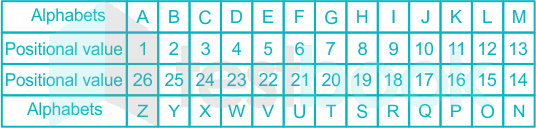
If QTXL in a code means OQTG then in the same code what does GKNS would mean?

  1. ((a))

    EIJO

  2. ((b))

    FIKN

  3. ((c))

    EHJN

  4. ((d))

    FEHJ

Show Answer
Answer: ((c))

EHJN

Key Points


The pattern followed here is:

Q - 2 = O

T - 3 = Q

X - 4 = T

L - 5 = G

Similarly,

G - 2 = E

K - 3 = H

N - 4 = J

S - 5 = N

Hence, the correct answer is EHJN.

28

By drinking Bornvita with water gives energy, by drinking Complan with water gives energy, by drinking milk with water gives energy. Therefore, by drinking water one gets energy. This is an example of _______

  1. ((a))

    Invariable relation

  2. ((b))

    Fallacy

  3. ((c))

    Perception

  4. ((d))

    Comparison

Show Answer
Answer: ((b))

Fallacy

The correct response is Fallacy.

Key Points

Fallacy:

  • This is the correct choice because the argument commits a logical mistake. The error lies in assuming that because water mixed with certain substances produces an energy-giving drink, water alone would also provide energy.
  • This overlooks the fact that it is the other ingredients in bornvita, complan, and milk that are primarily responsible for the energy these drinks provide, not the water itself. The argument illustrates a fallacy of composition, where one wrongly assigns properties of parts (water in energy-giving mixtures) to the whole (water itself).

Additional Information

Invariable relation: This option suggests a consistent, unchanging relationship between two variables. The original statement does not demonstrate an invariable relation; instead, it presents a flawed argument about causality and properties of substances. Therefore, this choice doesn't accurately describe the logical error in the statement.

Perception: Perception generally refers to the way we interpret or understand something through our senses. The statement in question is not about sensory interpretation but about deductive reasoning, or rather, a flawed attempt at it. Therefore, perception is not the correct term to describe the logic in the statement.

Comparison: While the statement does involve comparing different mixtures (bornvita, complan, milk with water) to make a conclusion about water, the core issue is not the act of comparison itself but the erroneous logic used to draw a conclusion. The term "comparison" doesn't capture the logical failure of the argument.

29

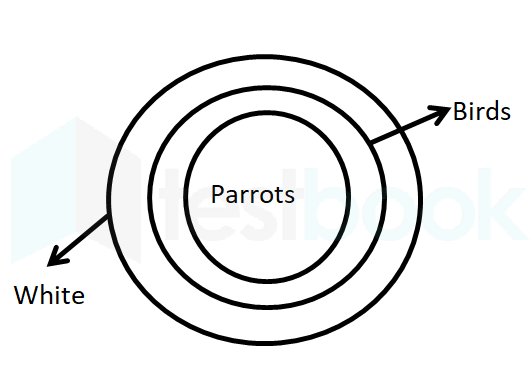
Which of the following is/are the valid conclusion/s based on the statements given below?

Statement I: All birds are white.

Statement II: All parrots are birds.

Conclusion 1: Some birds are white.

Conclusion 2: Some parrots are white.

Conclusion 3: All parrots are green.

Conclusion 4: Some birds are not white.

  1. ((a))

    1 and 2 only

  2. ((b))

    1 and 3 only

  3. ((c))

    2 and 3 only

  4. ((d))

    3 and 4 only

Show Answer
Answer: ((a))

1 and 2 only

Given statements:

Statement I: All birds are white.

Statement II: All parrots are birds.

The diagram according to the statement is : 


Conclusion 1: Some birds are white. ( True as All birds are white)

Conclusion 2: Some parrots are white. ( True as All birds are white and All parrots are birds.)

Conclusion 3: All parrots are green. (False as there is no relation of Green is given in the statements)

Conclusion 4: Some birds are not white. (False as there are no negative statements)

Hence, the correct answer is 1 and 2 only.

30

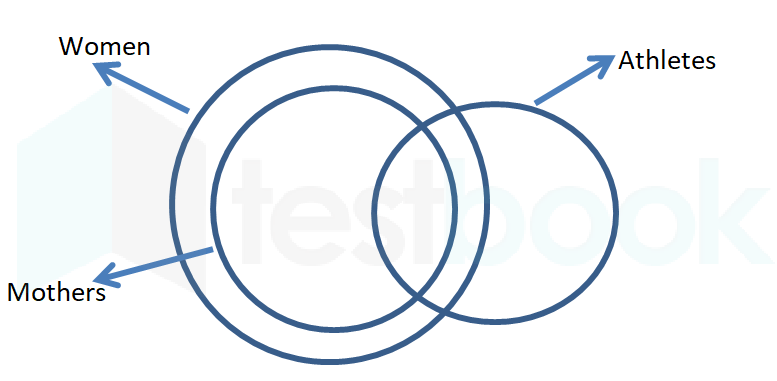
Which of the following diagrams shows the correct relationship among the three terms - Athletes, Women, Mothers?

  1. ((a))

  2. ((b))

  3. ((c))

  4. ((d))

Show Answer
Answer: ((b))

Key Points

 The correct Venn diagram representation is:

Here,

All mothers are women.

Some women may be Athletes.

Hence, the correct answer is option (2).

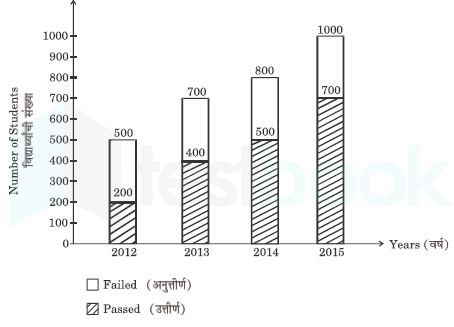
Direction: Question numbers 31 and 32 are based on the following diagram:

The following is a diagram of a certain college showing the number of students passed and failed during the years 2012 to 2015:

31

In which year is the percentage of passing of students maximum?

  1. ((a))

    2012

  2. ((b))

    2013

  3. ((c))

    2014

  4. ((d))

    2015

Show Answer
Answer: ((d))

2015

Calculation:

The table given below represents the passed students, failed students and total students in the examination during the years 2012 to 2015:

YearPassed studentsFailed studentsTotal students
2012200300500
2013400300700
2014500300800
20157003001000
Total180012003000

Percentage of passing of students in year 2012 = (200/500) × 100 = 40%

Percentage of passing of students in year 2013 = (400/700) × 100 = 57.14%

Percentage of passing of students in year 2014 = (500/800) × 100 = 62.5%

Percentage of passing of students in year 2015 = (700/1000) × 100 = 70%

∴ The percentage of passing of students maximum is in the year 2015.

32

The percentage of passing of students in examination for all the years 2012 to 2015 combined together is _______.

  1. ((a))

    50

  2. ((b))

    57.14

  3. ((c))

    60

  4. ((d))

    70

Show Answer
Answer: ((c))

60

Calculation:

The table given below represents the passed students, failed students and total students in the examination during the years 2012 to 2015:

YearPassed studentsFailed studentsTotal students
2012200300500
2013400300700
2014500300800
20157003001000
Total180012003000

Total number of passed students for 2012 to 2015 = 1800

Total number of students for 2012 to 2015 = 3000

Required percentage = (Total passed students/Total students) × 100

⇒ (1800/3000) × 100 = 60%

∴ The percentage of passing of students in examination for all the years 2012 to 2015 combined together is 60%.

33

Arithmetic mean of 12 observations is 40. The smallest and the largest observations are 20 and 60 respectively. If we ignore the smallest and the largest observations then the arithmetic mean of the remaining observations _______.

  1. ((a))

    will increase

  2. ((b))

    will decrease

  3. ((c))

    will not change

  4. ((d))

    cannot be obtained due to insufficient data

Show Answer
Answer: ((c))

will not change

Given:

Arithmetic mean of 12 observations = 40

The smallest and the largest observations are 20 and 60 respectively.

Formula Used:

Arithmetic mean = (Sum of observations)/Number of observations

Calculation:

Arithmetic mean of 12 observations = 40

Thus, sum of 12 observations = 40 × 12 = 480

After removing 20 and 60 from the series, then sum of remaining 10 observations = 480 - 20 - 60 = 400

Thus, Arithmetic mean = (Sum of observations)/Number of observations

Arithmetic mean = 400/10 = 40

∴ The arithmetic mean of the remaining observations will not change.

Direction: Following questions are based on the following information:

Out of 80 players 35 play cricket, 42 play hockey, 25 play football, 8 play both cricket and hockey, 10 play both cricket and football, 7 play both hockey and football, 3 play all the three games.

34

How many players are playing only one game?

  1. ((a))

    102

  2. ((b))

    80

  3. ((c))

    61

  4. ((d))

    63

Show Answer
Answer: ((c))

61

Calculation:

Let the number of players who play cricket, n(C) = 35

Let the number of players who play Hockey, n(H) = 42

Let the number of players who play Football, n( F) = 25

Now,

n( H ∩ C)  = 8

n( C ∩ F)  = 10

n( H ∩ F)  = 7

n ( H∩F∩C) = 3

Only hockey = n(H) - n( H ∩ C) - n( H ∩ F) + n ( H∩F∩C)

Only Cricket = n(C) - n( H ∩ C) - n( C ∩ F) + n ( H∩F∩C)

Only Football = n(F) - n( H ∩ F) - n( C ∩ F) + n ( H∩F∩C)

Therefore, Players playing only one game:

= n(H) + n(C) + n(F)  - 2( n( H ∩ C) + n( H ∩ F) + n( C ∩ F)) + 3n ( H∩F∩C)

= 42 + 35 + 25 - 2(8 + 7 + 10) + 3(3)

= 102 - 50 + 9

= 61

Hence 61 Players are playing only one game.

35

How many players play exactly two games?

  1. ((a))

    19

  2. ((b))

    61

  3. ((c))

    80

  4. ((d))

    16

Show Answer
Answer: ((d))

16

Calculation:

Let the number of players who play cricket, n(C) = 35

Let the number of players who play Hockey, n(H) = 42

Let the number of players who play Football, n( F) = 25

Now,

n( H ∩ C)  = 8

n( C ∩ F)  = 10

n( H ∩ F)  = 7

n ( H∩F∩C) = 3

Only hockey = n(H) - n( H ∩ C) - n( H ∩ F) + n ( H∩F∩C)

Only Cricket = n(C) - n( H ∩ C) - n( C ∩ F) + n ( H∩F∩C)

Only Football = n(F) - n( H ∩ F) - n( C ∩ F) + n ( H∩F∩C)

Therefore, Players playing only one game:

= n(H) + n(C) + n(F)  - 2( n( H ∩ C) + n( H ∩ F) + n( C ∩ F)) + 3n ( H∩F∩C)

= 42 + 35 + 25 - 2(8 + 7 + 10) + 3(3)

= 102 - 50 + 9

= 61

Players playing exactly two games = Total players - Players playing only one game - Players playing all three games

= 80 - 61 - 3 = 16

Hence, the correct answer is 16.

36

Which of the following is the correct full form of ERNET?

  1. ((a))

    Entertainment and Recreational Network

  2. ((b))

    Entertainment and Refreshment Network

  3. ((c))

    Educational Reference Network

  4. ((d))

    Educational and Research Network

Show Answer
Answer: ((d))

Educational and Research Network

ERNET stands for Education and Research Network.

Key Points

  • ERNET India is an autonomous scientific society under the administrative control of the Ministry of Electronics and Information Technology, having one of the largest nationwide terrestrial and satellite network located at the premier academic and research institutions in major cities of the country.
  • It is the first internet service in India.
  • It brought the Internet to India and has built up national capabilities in the area of net-working, especially in protocol software engineering.
  • ERNET was initiated in 1986 by the Department of Electronics (DoE), with funding support from the Government of India and United Nations Development Program (UNDP), involving eight premier institutions as participating agencies.
  • The mission of ERNET is to provide Network Infrastructure Services and Connectivity addressing the requirements of India’s Research and Education sector facilitating them to become increasingly efficient and effective in their chosen field.
37

Who helped Late Prime Minister Rajiv Gandhi in revolutionizing India’s telecommunication policy?

  1. ((a))

    Nandan Nilekani

  2. ((b))

    Sam Pitroda

  3. ((c))

    G. Parthasarathi

  4. ((d))

    A. Raja

Show Answer
Answer: ((b))

Sam Pitroda

Key Points

Telecom Revolution:

  • Rajiv Gandhi is hailed as the 'Father of Information Technology and Telecom Revolution of India'.
  • He is rightfully known as the architect of digital India.
  • It was under his rule that the Centre for Development of Telematics was established in August 1984 to develop state-of-the-art telecommunication technology and meet the needs of the Indian telecommunication network.
  • In 1986, MTNL (Mahanagar Telephone Nigam Limited) was established which helped in the spread of the telephone network.
  • With Sam Pitroda as an advisor to the then Prime Minister Rajiv Gandhi, six technology missions related to telecommunications, water, literacy, immunization, dairy, and oilseeds were established.
  • In 1987 during his tenure as advisor to Prime Minister Rajiv Gandhi, Pitroda headed six technology missions related to telecommunications, water, literacy, immunization, dairy, and oilseeds. He founded and was the first chairman, of India's Telecom Commission.

Hence, Sam Pitroda helped Late Prime Minister Rajiv Gandhi in revolutionizing India’s telecommunication policy.

38

Which among the following is basically an instant messenger?

  1. ((a))

    Facebook

  2. ((b))

    Instagram

  3. ((c))

    Twitter

  4. ((d))

    WhatsApp

Show Answer
Answer: ((d))

WhatsApp

Key PointsWhatsApp:

  • Instant messaging (IM) technology is a type of online chat allowing real-time text transmission over the Internet or another computer network.
  • Messages are typically transmitted between two or more parties when each user inputs text and triggers a transmission to the recipient(s), who are all connected on a common network.
  • As of October 2019, the most used messaging apps worldwide are WhatsApp with 1.6 billion active users, the best example of instant messaging.

Hence, the correct answer is WhatsApp.

Additional InformationFacebook:

  • Facebook, American online social network service that is part of the company Meta Platforms.
  • Facebook was founded in 2004 by Mark Zuckerberg, Eduardo Saverin, Dustin Moskovitz, and Chris Hughes, all of whom were students at Harvard University.

Instagram: Instagram is an American photo and video sharing social networking service founded by Kevin Systrom and Mike Krieger. 

Twitter: Twitter is an American microblogging and social networking service on which users post and interact with messages known as "tweets".

39

‘Sarathi’ is the web portal of _______.

  1. ((a))

    Ministry of Civil Aviation

  2. ((b))

    Ministry of Women and Child Development

  3. ((c))

    Ministry of Road Transport and Highways

  4. ((d))

    Ministry of Rural Development

Show Answer
Answer: ((c))

Ministry of Road Transport and Highways

‘Sarathi’ is the web portal of the Ministry of Road Transport and Highways.

Key Points

  • The Ministry of Road Transport and Highways has launched the online portal of Sarathi Parivahan Sewa to provide online Services like- Driving Licence, Learning Licence, Transfer OwnerShip Form Etc.
  • Sarathi Portal is launched Under the Digital India Project, which aims to bring all the government services online.
  • Sarathi application has been initiated by Road Transport and Highways Ministries, which is delivered to citizens to digitize the working conditions of Road Transport Offices.
  • With the help of Parivahan Sewa-Sarathi, all the work related to licences like the issue of learner’s driving licence, Permanent driving licence, change in detail, etc. is done digitally.
  • Users can also download, view or upload their licence in DigiLocker using this application.

Additional Information

  • The Ministry of Civil Aviation in India is the nodal ministry responsible for the formulation of national policies and programmes for the development and regulation of civil aviation.
  • The Ministry of Women and Child Development, a branch of the Government of India, is an apex body for formulation and administration of the rules and regulations and laws relating to women and child development in India.
  • The Ministry of Rural Development, a branch of the Government of India, is entrusted with the task of accelerating the socio-economic development of rural India. Its focus is on health, education, piped drinking water, public housing and roads.
40

BYOD’ in the content of digital initiatives in higher education in India is _______.

  1. ((a))

    Be Youthful On Digital

  2. ((b))

    Buy Your Own Device

  3. ((c))

    Bring Your Own Device

  4. ((d))

    Be Yourself On Digital

Show Answer
Answer: ((c))

Bring Your Own Device

BYOD in the content of digital initiatives in higher education in India is Bring Your Own Device

Key Points

  • BYOD (Bring Your Own Device) is the increasing trend toward employee-owned devices within a business.
  • This has resulted in enhancing the ease of work in employees and is contributing to enhanced productivity.
  • Personal devices coming into the workplace are broad and diverse- so there is a challenge for companies to carefully device their BYOD policies and BYOD management systems.
  • BYOD has permeated educational institutions as well. And these days students are asked to bring their own devices to school.
  • BYOD makes the process of imparting education cheaper, as schools don’t have to install their own technological devices.
  • But BYOD in schools can be distracting and can lead to security concerns.
41

Presence of E.coli in water is an indicator of _______ contamination.

  1. ((a))

    Sewage

  2. ((b))

    Oil

  3. ((c))

    Pesticide

  4. ((d))

    Herbicide

Show Answer
Answer: ((a))

Sewage

E. coli in water is a strong indicator of sewage or animal waste contamination. Sewage and animal waste can contain many types of disease-causing organisms.

Key Points

  • Escherichia coli (abbreviated as E. coli) are bacteria found in the environment, foods, and intestines of people and animals.
  • E. coli are a large and diverse group of bacteria.
  • E. coli (Escherichia coli), is a type of bacteria that normally lives in the intestines. It’s also found in the gut of some animals.
  • Although most strains of E. coli are harmless, some can make us sick.
  • Some kinds of E. coli can cause diarrhoea, while others cause urinary tract infections, respiratory illness and pneumonia, and other illnesses.
  • Some versions of E. coli make us sick by making a toxin called Shiga. This toxin damages the lining of the intestine.

Additional Information

  • Pesticides are substances that are meant to control pests.
  • Herbicides also commonly known as weedkillers, are substances used to control unwanted plants.
42

During day time, noise pollution in residential area should not exceed _______.

  1. ((a))

    75 dB

  2. ((b))

    55 dB

  3. ((c))

    65 dB

  4. ((d))

    80 dB

Show Answer
Answer: ((b))

55 dB

Noise is characterized by loudness which is measured by decibel (dB) and pitch or frequency which is measured in hertz (Hz).

Key PointsThe CPCB has laid down the permissible noise levels in India for different areas. Noise pollution rules have defined the acceptable level of noise in different zones for both daytime and nighttime.

Hence, the correct answer is 55 dB.

43

To regulate and control the transboundary movement of hazardous waste is also known as _______.

  1. ((a))

    Basel convention

  2. ((b))

    CITES

  3. ((c))

    Ramsar convention

  4. ((d))

    Wetland convention

Show Answer
Answer: ((a))

Basel convention

Key Points

  • The overarching objective of the Basel Convention is to protect human health and the environment against the adverse effects of hazardous wastes.
  • Its scope of application covers a wide range of wastes defined as “hazardous wastes” based on their origin and/or composition and their characteristics, as well as two types of wastes defined as “other wastes” - household waste and incinerator ash.

Additional InformationAims and provisions

The provisions of the Convention center around the following principal aims: 

  • The reduction of hazardous waste generation and the promotion of environmentally sound management of hazardous wastes, wherever the place of disposal;
  • The restriction of transboundary movements of hazardous wastes except where it is perceived to be in accordance with the principles of environmentally sound management; and
  • A regulatory system applies to cases where transboundary movements are permissible.

Hence, the correct answer is the Basel convention.

44

There are number of Acts in India to prevent and control of pollution. Which one of the following Act is known as ‘Comprehensive/Umbrella Act’?

  1. ((a))

    Air Pollution Act

  2. ((b))

    Water Pollution Act

  3. ((c))

    Environment (Protection) Act

  4. ((d))

    Liability Act

Show Answer
Answer: ((c))

Environment (Protection) Act

Environmental Protection Act 1986 is also the Umbrella Act because it provides the framework to the central government in order to make the coordination between the different states as well as the central authorities using different Act like Water Pollution Act etc.

Key Points

  • The Environment (Protection) Act, 1986 authorizes the central government to protect and improve environmental quality, control and reduce pollution from all sources, and prohibit or restrict the setting and /or operation of any industrial facility on environmental grounds.
  • In the wake of the Bhopal gas Tragedy or Bhopal Disaster, the Government of India enacted the Environment Protection Act of 1986 under Article 253 of the Constitution.
  • The Environment (Protection) Rules lay down procedures for setting standards of emission or discharge of environmental pollutants.
  • The Environment (Protection) Act was enacted with the objective of providing for the protection and improvement of the environment.
  • It empowers the Central Government to establish authorities charged with the mandate of preventing environmental pollution in all its forms and to tackle specific environmental problems that are peculiar to different parts of the country.

Additional Information

  • Air (Prevention and control of pollution) Act, 1981 was established to provide is to provide clean air to the citizens.
  • The Water (Prevention and Control of Pollution) Act was enacted in 1974 to provide for the prevention and control of water pollution, and for the maintaining or restoring of wholesomeness of water in the country.
  • The Occupiers' Liability Act 1957 is an Act of the Parliament of the United Kingdom that covers occupiers' liability. It also covered the duty owed to parties to a contract entering the property and ways of excluding the liability for visitors.
45

How many goals have been set for sustainable development by UN to achieve social and economical development?

  1. ((a))

    20

  2. ((b))

    17

  3. ((c))

    10

  4. ((d))

    16

Show Answer
Answer: ((b))

17

Key Points

  • The 17 Sustainable Development Goals (SDGs) are the world’s best plan to build a better world for people and our planet by 2030.
  • Adopted by all United Nations Member States in 2015, the SDGs are a call for action by all countries – poor, rich, and middle-income – to promote prosperity while protecting the environment.
  • They recognize that ending poverty must go hand-in-hand with strategies that build economic growth and address a range of social needs including education, health, equality, and job opportunities while tackling climate change and working to preserve our ocean and forests.

Hence, the correct answer is 17.

Additional Information

 The 17 Sustainable Development Goals are:

  • Goal 1: End poverty in all its forms everywhere;
  • Goal 2: End hunger, achieve food security and improved nutrition and promote sustainable agriculture;
  • Goal 3: Ensure healthy lives and promote well-being for all at all ages;
  • Goal 4: Ensure inclusive and equitable quality education and promote lifelong learning opportunities for all;
  • Goal 5: Achieve gender equality and empower all women and girls;
  • Goal 6: Ensure availability and sustainable management of water and sanitation for all;
  • Goal 7: Ensure access to affordable, reliable, sustainable, and modern energy for all;
  • Goal 8: Promote sustained, inclusive, and sustainable economic growth, full and productive employment, and decent work for all;
  • Goal 9: Build resilient infrastructure, promote inclusive and sustainable industrialization, and foster innovation;
  • Goal 10: Reduce inequality within and among countries;
  • Goal 11: Make cities and human settlements inclusive, safe, resilient, and sustainable;
  • Goal 12: Ensure sustainable consumption and production patterns;
  • Goal 13: Take urgent action to combat climate change and its impacts;
  • Goal 14: Conserve and sustainably use the oceans, seas, and marine resources for sustainable development;
  • Goal 15: Protect, restore and promote sustainable use of terrestrial ecosystems, sustainably manage forests, combat desertification, and halt and reverse land degradation and halt biodiversity loss;
  • Goal 16: Promote peaceful and inclusive societies for sustainable development, provide access to justice for all, and build effective, accountable, and inclusive institutions at all levels; and
  • Goal 17: Strengthen the means of implementation and revitalize the global partnership for sustainable development
46

Which of the following universities was the centre of military education during Vedic period?

  1. ((a))

    Takshashila

  2. ((b))

    Nalanda

  3. ((c))

    Gunsheela

  4. ((d))

    Kundinapuri

Show Answer
Answer: ((a))

Takshashila

Key Points

  • The university of ancient Takshashila or Taxila was an ancient Indian university located in the city of Taxila (modern-day Pakistan), on the eastern bank of the Indus river. Taxkshashila was mentioned in Shatapatha Brahmana (Yajurveda), Ramayana and Mahabharata.
  • Taxila or Takshashila University was an early Hindu and Buddhist centre of learning.
  • It was famous for military education during the Vedic and post-Vedic periods.
  • Subjects taught in Taxila university were primitive in nature, which included Vedic literature, hunting, archeries and so on, which in no way can be considered as modern university education.
  • The ancient and the most revered scriptures, and the Eighteen Silpas or Arts, which included skills such as archery, hunting, and elephant lore, were taught, in addition to its law school, medical school, and school of military science.
  • Takshashila had a great influence on Hindu culture and the Sanskrit language. It is perhaps best known for its association with Chanakya.

Additional Information

  • As per ASI records, subjects taught at Nalanda University included theology, grammar, logic, astronomy, metaphysics, medicine and philosophy.
  • Kundinapuri was the gateway for the ancient travellers from north India to southern India. It was well connected to northern cities of ancient India like Ayodhya. This ancient route is mentioned in Mahabharata.
47

‘Minimum period for Ph.D should be of two years and there should be viva-voce examination for Ph.D degree’. This recommendation was made by _______.

  1. ((a))

    Indian University Commission

  2. ((b))

    Sadler Commission

  3. ((c))

    Radhakrishnan Commission

  4. ((d))

    hari Commission

Show Answer
Answer: ((c))

Radhakrishnan Commission

Radhakrishnan Commission recommended the minimum period for a PhD should be of two years and there should be a viva-voce examination for a PhD degree.

Key Points

  • After Independence, the first action of great significance to be taken by the Government of India in the field of education was the appointment of the University Education Commission under the Chairmanship of Dr S. Radhakrishnan, a distinguished scholar and the second President of India.
  • The Commission’s 1949 Report assessed the state of university education and made recommendations for its improvement in the newly independent India.
  • The commission laid emphasis on increased facilities for post-graduate research and training. A PhD student should have an adequate grasp of his subject both in breadth and depth. University teachers should give the community punctuality, efficiency and devotion to duty in relation to their teaching work and new ideas and newer methods in relation to their research work.
  • The commission recommended higher salary and better service conditions like the benefit of provident fund, residential accommodation, hours of work and leave etc. for the teachers.

Additional Information

  • The Indian Universities Commission was a body appointed in 1902 on the instructions of Lord Curzon which was intended to make recommendations for reforms in University education in India.
  • Sadler Commission to study and report on the problems of the Calcutta University following the enactment of The Universities Act of 1904.
48

Teacher education is _______.

  1. ((a))

    Professional education

  2. ((b))

    Vocational education

  3. ((c))

    Technical education

  4. ((d))

    Skill education

Show Answer
Answer: ((a))

Professional education

Teacher education is a professional education covered in the service sectorJohn Dewey noted that teacher education as a profession in remarks made in relation to the National Education Association and the American Association of University Professors.

Key Points

  • The profession includes the activities, which is requisite of special knowledge and skill which is to be applied by individuals in their occupation.
  • Teacher education or teacher training refers to the policies, procedures, and provision designed to equip (prospective) teachers with the knowledge, attitudes, behaviors, and skills they require to perform their tasks effectively in the classroom, school, and wider community.
  • The professionals who engage in training the prospective teachers are called teacher educators.
  • A teacher educator may be defined as a higher education professional whose main activity is the preparation of beginning teachers in universities and other institutions of teacher education, such as National Colleges of Education, Teacher Training Colleges and Teacher Centers.

Additional Information

  • Vocational education is education that prepares people to work as a technician or to take up employment in a skilled craft or trade as a tradesperson or artisan.
  • As defined in the AICTE Act 1987, Technical Education means programmes of Education, Research, and training in Engineering and Technology, Architecture, Town Planning, Management, Pharmacy, and Applied Arts and Crafts, and such other programmes or areas as the Central Government may in consultation with the Council.
  • Skill education refers to the up-skilling and re-skilling process that generally gets caters under skill development training for better careers .
49

Nomenclature of education department of India has been changed to Human Resource Development in the year _______.

  1. ((a))

    1975

  2. ((b))

    1985

  3. ((c))

    1995

  4. ((d))

    2005

Show Answer
Answer: ((b))

1985

Key Points

  • On September 26, 1985, the Ministry of Education was renamed the Ministry of Human Resource Development by former Prime minister Rajiv Gandhi and P V Narasimha Rao was appointed Minister.
  • With the public announcement of the newly drafted "National Education Policy 2020" on 29 July 2020 by the Narendra Modi government, the Ministry of Human Resource Development was renamed back to the Ministry of Education.
  • The current education minister is Dharmendra Pradhan.

Hence, the correct answer is 1985.

50

Which of the following institutions is not funding for research activities in higher education?

  1. ((a))

    DBT

  2. ((b))

    DST

  3. ((c))

    ICSSR

  4. ((d))

    NCTE

Show Answer
Answer: ((d))

NCTE

NCTE (National Council for Teacher Education) is not funding research activities in higher education.

Key Points

  • National Council for Teacher Education (NCTE) is a statutory body of the Indian government set up under the National Council for Teacher Education Act, 1993 to formally oversee standards, procedures and processes in the Indian education system.
  • This council functions for the central as well as state governments on all matter with regard to Teacher Education and its secretariat is located in the Department of Teacher Education and National Council of Educational Research and Training (NCERT).
  • Objectives of NCTE are:
  • To achieve planned and coordinated development of teacher education system throughout the country.
  • To regulate and properly maintain the Norms and Standards in the teacher education system and for matters connected therewith.
  • It aims at training individuals and equipping them to teach pre-primary, primary, secondary and senior secondary stages in schools, non-formal and part-time education, adult education (correspondence) and distance education courses.
  • Functions of NCTE are :
  • It undertakes surveys and studies pertaining to all aspects of teacher education and publishes the corresponding results.
  • It prepares suitable plans and programmes regarding the field of teacher education, it makes recommendations to both the state and central governments, universities, University Grants Commission (UGC), and other recognised institutions.
  • It coordinates and monitors the teacher education system throughout the country.
  • It lays down the guideline for the minimum qualifications need for an individual to be a teacher in schools and recognised institutions.
  • It lays down standards with respect to examinations, the major criteria for such admission as well as schemes for courses or training.
  • It identifies the recognised institutions and set up new institutions for the developmental programmes of the teacher education system.

Additional Information

  • DBT (Department of Biotechnology), DST (Department of Science and Technology), and ICSSR (Indian Council of Social Science Research) are known to provide funding for research activities in higher education across various disciplines.
  • Department of science and technology (DST) provides INSPIRE scholarship for various subjects under the Basic and Natural Sciences. Scholarship for Higher Education (SHE) is provided for Rs. 80,000 per annum for the duration of the course or for five years, whichever is earlier.
  • Indian Council of Social Science Research (ICSSR) provides funding to Indian scholars to conduct cutting edge research in various fields of social sciences that have theoretical, conceptual, methodological and policy implications.

Attempt this paper under real exam conditions

Timed interface, section switching, instant scoring, and question-by-question analytics — free.

Start Timed Attempt