Official Paper

KVS TGT Science Official Paper Held On : 12 Feb 2023 Shift 2 (Previous Year Paper)

180 questions · 180 minutes · with answers · free

Language Proficiency (20 questions)

1

FIDELITY

Choose the word similar in meaning to the one given above :

  1. ((a))

    Fame

  2. ((b))

    Loyalty

  3. ((c))

    Affection

  4. ((d))

    Joy

Show Answer
Answer: ((b))

Loyalty

The correct answer is: Loyalty.

Key Points

  • The word "Fidelity" means faithfulness to a person, cause, or belief, demonstrated by loyalty and support. (निष्ठा)
  • Example: His fidelity to his friends and family was unwavering, even during tough times.
  • "Loyalty" refers to a strong feeling of support or allegiance to someone or something. (वफादारी)
  • Example: Her loyalty to her country inspired her to join the armed forces.
  • Hence, "Loyalty" is similar in meaning to "Fidelity."

Therefore, the correct answer is: Loyalty.

Additional Information

Here are the other options explained along with their Hindi meanings and example sentences:

  • Fame (प्रसिद्धि): The state of being known or recognized by many people.
  • Example: The actor achieved fame after his blockbuster movie became a global hit.
  • Affection (स्नेह): A gentle feeling of fondness or liking.
  • Example: She showed great affection for her younger siblings by caring for them.
  • Joy (आनंद): A feeling of great happiness.
  • Example: The children felt immense joy during the festival celebrations.

2

IMPENDING

Choose the word similar in meaning to the one given above :

  1. ((a))

    Incidental

  2. ((b))

    Interesting

  3. ((c))

    Serious

  4. ((d))

    Imminent

Show Answer
Answer: ((d))

Imminent

The correct answer is: Option 4 i.e., Imminent.

Key Points

  • The word "Impending" means something that is about to happen or likely to occur soon. (आसन्न, शीघ्र होने वाला)
  • Example: The dark clouds indicated an impending storm.
  • "Imminent" is a synonym of "Impending" and also means something that is about to happen. (आसन्न)
  • Example: The arrival of the train is imminent as it has just been announced over the speaker.
  • Hence, the word "Imminent" closely matches the meaning of the given word "Impending".

Therefore, the correct answer is: Imminent.

Additional Information

Here are the other options explained along with their Hindi meanings and example sentences:

  • Incidental (संयोगवश होने वाला): Happening as a minor accompaniment to something else or by chance.
  • Example: The incidental music added charm to the play.
  • Interesting (रोमांचक): Arousing curiosity or holding attention.
  • Example: The book she recommended turned out to be very interesting.
  • Serious (गंभीर): Demanding careful consideration or thought; not joking or playful.
  • Example: The doctor gave him a serious look before explaining the diagnosis.
3

Identify the Part of Speech of the underlined word in the following sentence.

He bought me a walking stick.

  1. ((a))

    Noun

  2. ((b))

    Verb

  3. ((c))

    Adjective

  4. ((d))

    Adverb

Show Answer
Answer: ((c))

Adjective

The correct answer is Option 3.


Key Points

  • In the sentence, "walking" is used to describe the noun "stick."
  • Words that describe or modify nouns are known as adjectives.
  • Therefore, the word "walking" is functioning as an adjective in this context.

Therefore, the correct answer is Option 3.


Additional Information

  • Walking (adjective): A word used to describe the noun "stick" and indicate what kind of stick it is.
  • Stick (noun): The main object that is being described by the adjective "walking."
4

He gave me a beautiful book.

Choose the option in which the above sentence has been changed into Passive Voice :

  1. ((a))

    A beautiful book was given to me by him.

  2. ((b))

    A beautiful book was given to me.

  3. ((c))

    I was given a beautiful book.

  4. ((d))

    I have been given a beautiful book.

Show Answer
Answer: ((a))

A beautiful book was given to me by him.

The correct answer is Option 1.


Key Points

  • Passive voice structure: The object of the active voice becomes the subject in the passive voice sentence.
  • Active voice: "He gave me a beautiful book." (Subject + Verb + Indirect Object + Direct Object)
  • In passive voice, either the direct or indirect object can become the subject depending on emphasis.
  • Option 1: "A beautiful book was given to me by him." correctly converts the direct object into the subject.
  • The tense "gave" (simple past) changes to "was given" in passive form.

Therefore, the correct answer is Option 1.


Correct Sentence: "A beautiful book was given to me by him."


Additional Information

  • Option 2: "A beautiful book was given to me." – Correct grammatically but lacks the agent "by him."
  • Option 3: "I was given a beautiful book." – Also correct but changes the focus to the indirect object "I."
  • Option 4: "I have been given a beautiful book." – Incorrect tense; "have been given" is present perfect, not past simple.
5

He said to me, "Will you please help me?"

Choose the option in which the above sentence has been changed into Indirect Speech :

  1. ((a))

    He requested me if I will help him.

  2. ((b))

    He asked me if I would please help him?

  3. ((c))

    He requested me if I would help him.

  4. ((d))

    He asked me if I shall help me.

Show Answer
Answer: ((c))

He requested me if I would help him.

The correct answer is Option 3.


Key Points

  • Direct Speech: He said to me, "Will you please help me?"
  • Reporting Verb Change: 'said to' becomes 'requested' when making polite requests.
  • Question Transformation: Interrogative sentence with "will you please" is treated as a polite request in indirect speech.
  • Tense Change: 'Will' changes to 'would' in indirect speech (as per sequence of tense rule).
  • Pronoun Change: 'you' becomes 'I' and 'me' becomes 'him' depending on the context.

Therefore, the correct answer is Option 3.


Correct Sentence: He requested me if I would help him.


Additional Information

  • Option 1: Incorrect — "will" should change to "would" as per reported speech rules.
  • Option 2: Incorrect — Polite request should use "requested" not "asked", and "please" is unnecessary in indirect form.
  • Option 4: Incorrect — Contains wrong pronoun usage "me" instead of "him" and "shall" instead of "would".
6

Rearrange the following jumbled words/phrases into a meaningful and grammatically correct sentence.

(A) her second one

(B) her mother

(C) child,

(D) to another

(E) gave birth

  1. ((a))

    ACBDE

  2. ((b))

    BEDCA

  3. ((c))

    CEBDA

  4. ((d))

    DACEB

Show Answer
Answer: ((b))

BEDCA

The correct answer is Option (2) i.e., BEDCA


Key Points

  • The sentence begins with “her mother” (B) which introduces the subject clearly.
  • Next comes “gave birth” (E) which completes the action done by the subject.
  • Then comes “to another” (D), showing the direction or object of the action.
  • Following that is “child,” (C) which is the object being referred to.
  • Lastly, “her second one” (A) acts as an appositive, adding detail about the child.

Therefore, the correct answer is BEDCA.


Additional Information

  • Option 1 (ACBDE): This starts with “her second one,” making the subject unclear and confusing the sentence’s structure.
  • Option 3 (CEBDA): Starting with “child,” lacks a proper subject performing the action initially, making the sentence ambiguous.
  • Option 4 (DACEB): Begins with a preposition “to another,” which is grammatically incorrect as a sentence starter here.
7

Identify the part of the followings in which there is an error.

Ram told (a)/ me that (b) / he has (c)/ lost his book (d).

  1. ((a))

    (a)

  2. ((b))

    (b)

  3. ((c))

    (c)

  4. ((d))

    (d)

Show Answer
Answer: ((c))

(c)

The correct answer is Option 3.


Key Points

  • The verb tense used in part c) "he has" is incorrect in the context of reported speech.
  • "Ram told me" is in the past tense, so the verb in the reported clause should also follow the rules of backshifting.
  • According to the rules of reported speech, "has lost" should change to "had lost".
  • Therefore, the error lies in part c due to incorrect verb tense.

Therefore, the correct answer is c.


Correct Sentence: "Ram told me that he had lost his book."


Additional Information

  • a) "Ram told" – This is grammatically correct and sets up a reported speech sentence.
  • b) "me that" – Correct structure used for reported speech.
  • d) "lost his book" – No error in this phrase once the verb tense is corrected.
  • In reported speech, present perfect ("has lost") becomes past perfect ("had lost").
8

Fill in the blank in the sentence given below by choosing option out of the one that follow.

You should be sure that he won't ______ his word.

  1. ((a))

    put up with

  2. ((b))

    go back on

  3. ((c))

    put out of

  4. ((d))

    run away with

Show Answer
Answer: ((b))

go back on

The correct answer is 'go back on'.


Key Points

  • The phrase "go back on" means to break a promise or fail to fulfil a commitment, which fits the context of the sentence.
  • The sentence implies that the subject will not break his word, hence "go back on" is the correct phrase.
  • Options 1, 3, and 4 do not fit the context of the sentence and are incorrect.

Therefore, the correct answer is Option 2.


Complete Sentence: "You should be sure that he won't go back on his word."


Additional Information

  • Option 1: "put up with" is incorrect because it means to tolerate or endure something unpleasant, which does not fit the context.
  • Option 3: "put out of" is incorrect because it does not make sense in the given context.
  • Option 4: "run away with" is incorrect because it means to elope or take something and flee, which is irrelevant here.
9

Fill in the blank in the sentence given below by choosing option out of the one that follow. 

Lata kicked ______ a row over nothing.

  1. ((a))

    up

  2. ((b))

    out

  3. ((c))

    off

  4. ((d))

    into

Show Answer
Answer: ((a))

up

The correct answer is 'up'.


Key Points

  • The phrasal verb "kick up" is commonly used to describe causing a commotion or starting trouble.
  • In the given sentence, "kicked up a row over nothing" means that Lata caused a disturbance or argument without any substantial reason.
  • Options 2, 3, and 4 are not correct in this context as they do not form a meaningful phrase with "kicked."

Therefore, the correct answer is Option 1.


Complete Sentence: "Lata kicked up a row over nothing."


Additional Information

  • Option 2: "out" is incorrect because "kicked out" typically means forcing someone to leave a place, which does not fit the sentence.
  • Option 3: "off" is incorrect because "kicked off" is used to describe starting an event or activity, which does not match the intended meaning.
  • Option 4: "into" is incorrect because "kicked into" does not form a meaningful phrase in this context.
10

Fill in the blank in the sentence given below by choosing option out of the one that follow.

It will ______ him if he loses the match.

  1. ((a))

    go out with

  2. ((b))

    come out on

  3. ((c))

    go hard with

  4. ((d))

    come off with

Show Answer
Answer: ((c))

go hard with

The correct answer is 'go hard with'.


Key Points

  • The phrase "go hard with" means to have a negative or adverse effect on someone.
  • In the context of the sentence, losing the match would have a significant emotional or psychological impact on the subject.
  • Options 1, 2, and 4 are incorrect as they do not fit the context or grammatical structure of the sentence.

Therefore, the correct answer is Option 3.


Complete Sentence: "It will go hard with him if he loses the match."


Additional Information

  • Option 1: "go out with" is incorrect as it refers to dating or socializing, which is unrelated to the context.
  • Option 2: "come out on" is incorrect because it does not convey the required meaning.
  • Option 4: "come off with" is incorrect as it does not fit the context of the sentence.

नीचे दिए गए गद्यांश को पढ़कर सर्वाधिक उचित विकल्प का चयन कीजिए-

मानसिक रोगों से आक्रांत व्यक्ति यदि परिवार का मुखिया है तो परिवार में अनुशासनहीनता, अव्यवस्था, दुराचार और दुखद मानवी संबंधों का व्याप जाना संभव है जिसके फलस्वरूप परिवार दुर्भाग्य का शिकार बन सकता है।

11

परिवार के मुखिया का मानसिक रोगों से मुक्त होने पर परिवार में क्या आता है?

  1. ((a))

    धन-संपत्ति

  2. ((b))

    ऐश्वर्य

  3. ((c))

    अनुशासन

  4. ((d))

    सुखद मानव

Show Answer
Answer: ((c))

अनुशासन

परिवार के मुखिया का मानसिक रोगों से मुक्त होने पर परिवार में  "अनुशासन" आता है।

Key Points

  • गद्यांश के अनुसार यदि परिवार के मुखिया का मानसिक रोगों से मुक्त है,
  • तो  परिवार में अनुशासन,व्यवस्था, सदाचार, सुखदपूर्ण मानवीय सम्बन्ध आदि का विकास होगा।

Additional Information

  • परिवार का  मुखिया - जो परिवार का मुख्य व्यक्ति हों।
  • परिवार का  मुखिया परिवार के संचालन में मुख्य भागीदार होता है।
  • परिवार का मुखिया बहुत ही बुद्धिमान गुणवान और शांति प्रिय और धैर्यवान होना चहिए।
  • यदि मानसिक रोग से ग्रसित व्यक्ति परिवार का मुखिया हो तो परिवार में अनुशासनहीनता, अव्यवस्था,
  • दुराचार एवं दु:खपूर्ण मानवीय सम्बन्ध आदि परिवार के दुर्भाग्य के कारण होंगे।
12

परिवार के दुर्भाग्य का कारण नहीं है :

  1. ((a))

    अनुशासनहीनता

  2. ((b))

    अव्यवस्था

  3. ((c))

    दुराचार

  4. ((d))

    परिवार का मुखिया

Show Answer
Answer: ((d))

परिवार का मुखिया

दिए विकल्पों में से "परिवार का मुखिया" परिवार के दुर्भाग्य का कारण नहीं है। 

Key Points

  • दिये गये गद्यांश के अनुसार परिवार में अनुशासनहीनता, अव्यवस्था,
  • दुराचार एवं दु:खपूर्ण मानवीय सम्बन्ध आदि परिवार के दुर्भाग्य के  कारण है।

Additional Information

  • दिये गये गद्यांश के अनुसार यदि मानसिक रोग से ग्रसित व्यक्ति परिवार का मुखिया हो तो,
  • परिवार में अनुशासनहीनता, अव्यवस्था, दुराचार एवं दु:खपूर्ण मानवीय सम्बन्ध आदि परिवार के दुर्भाग्य के कारण है।
13

गद्यांश के आधार पर कहा जा सकता है कि ______ से मुक्ति आवश्यक है।

  1. ((a))

    आक्रांत व्यक्ति

  2. ((b))

    मानसिक रोग

  3. ((c))

    मानवी संबंधों

  4. ((d))

    परिवार के मुखिया

Show Answer
Answer: ((b))

मानसिक रोग

गद्यांश के आधार पर कहा जा सकता है कि "मानसिक रोग" से मुक्ति आवश्यक है।

Key Points

  • दिये गये गद्यांश के अनुसार यदि मानसिक रोग से ग्रसित व्यक्ति परिवार का मुखिया हो तो
  • परिवार में अनुशासनहीनता, अव्यवस्था, दुराचार एवं दु:खपूर्ण मानवीय सम्बन्ध आदि परिवार के दुर्भाग्य का कारण है।
  • अतः गद्यांश के आधार पर कहा जा सकता है कि "मानसिक रोग" से मुक्ति आवश्यक है।

Additional Information

  • परिवार का  मुखिया - जो परिवार का मुख्य व्यक्ति  हों।
  • परिवार का  मुखिया परिवार के संचालन में मुख्य भागीदार होता है।
  • यदि परिवार के मुखिया का मानसिक रोगों से मुक्त है  तो  परिवार में अनुशासन,व्यवस्था,
  • सदाचार, सुखदपूर्ण  मानवीय सम्बन्ध आदि का विकास होगा।
14

दुर्भाग्य का विलोम शब्द है-

  1. ((a))

    सरल

  2. ((b))

    सुखद

  3. ((c))

    सुभाग

  4. ((d))

    सौभाग्य

Show Answer
Answer: ((d))

सौभाग्य

दिए गए विकल्पों में से "सौभाग्य" शब्द दुर्भाग्य का विलोम  है।

Key Points

  • सौभाग्य का अर्थ - अच्छा भाग्य।
  • दुर्भाग्य का अर्थ - बुरा भाग्य।

अन्य विकल्प - 

शब्दविलोम शब्द
सरलकठिन
सुखददुखद
सुभगदुर्भग

Additional Information

  • विलोम शब्द  - जो शब्द किसी दूसरे शब्द का उल्टा अर्थ बताते हैं,
  • उन्हें विलोम शब्द या विपरीतार्थक शब्द या विरुद्धार्थी शब्द कहते है।
  • जैसे- हार- जीत, आय- व्यय, आजादी- गुलामी, नवीन- प्राचीन आदि।
15

किस शब्द में उपसर्ग और प्रत्यय-दोनों का प्रयोग हुआ है?

  1. ((a))

    दुराचार

  2. ((b))

    अनुशासनहीनता

  3. ((c))

    अव्यवस्था

  4. ((d))

    दुर्भाग्य

Show Answer
Answer: ((b))

अनुशासनहीनता

दिए गए विकल्पों में से "अनुशासनहीनता" शब्द में उपसर्ग और प्रत्यय-दोनों का प्रयोग हुआ है। 

Key Points

  • अनुशासनहीनता शब्द में उपसर्ग और प्रत्यय-दोनों का प्रयोग हुआ है।
  • अनु + शासनहीन + ता = अनुशासनहीनता
  • यहाँ 'अनु' उपसर्ग व 'ता' प्रत्यय है।

अन्य विकल्प - 

  • दुराचार शब्द  में 'दुर्' उपसर्ग है।
  • अव्यवस्था शब्द  में ''  उपसर्ग है।
  • 'दुर्भाग्य' शब्द में 'दुर्' उपसर्ग है।

Additional Informationउपसर्ग और प्रत्यय में अंतर-

उपसर्गप्रत्यय
उपसर्ग शब्द के शुरू में जुड़ता है।प्रत्यय शब्द के अंत में जुड़ता है।
उपसर्ग जुड़ने पर मूल शब्द का अर्थ बदल सकता है।
उदाहरण- प्र+चार= प्रचार इसमें प्र उपसर्ग है, जो चार शब्द के पहले जुड़ा है।
प्रत्यय जुड़ने पर अर्थ मूल शब्द के इर्द-गिर्द ही रहता है।
उदाहरण- इतिहास+इक= ऐतिहासिक इसमें ‘इक’ प्रत्यय है, जो शब्द के अंत में जुड़ा है।
16

तत्सम-तद्भव शब्दों का कौन-सा युग्म असंगत है?

  1. ((a))

    अग्नि-आग

  2. ((b))

    स्वामी-साईं

  3. ((c))

    सर्व-सब

  4. ((d))

    पक्ष-पक्षी

Show Answer
Answer: ((d))

पक्ष-पक्षी

दिए गए विकल्पों में से तत्सम-तद्भव शब्दों का "पक्ष-पक्षी" युग्म असंगत है।

Key Points

  • 'पक्ष ' तत्सम शब्द है, इसका तद्भव रूप 'पंख ' है।
तत्समतद्भव
पक्षपंख
पक्षीपंछी

Additional Information

  • तत्सम शब्द- ऐसे शब्द जिनकी उत्पत्ति संस्कृत भाषा में हुई ओर वे हिन्दी भाषा में बिना,
  • किसी परिवर्तन के प्रयोग में आने लगे, ऐसे शब्द तत्सम शब्द कहलाते हैं।
  • जैसे- कवि, माता, विद्या, नदी, फल, पुष्प, पुस्तक, पृथ्वी, क्षेत्र, कार्य, मृत्यु आदि।
  • तद्भव शब्द- ऐसे शब्द जो संस्कृत भाषा से उत्पन्न होते हैं,
  • लेकिन वो रूप बदलकर हिन्दी में आ गए हों, ऐसे शब्द तद्भव शब्द कहलाते हैं।
  • जैसे- दुग्ध ----> दूध
  • अग्नि ----> आग
  • कार्य ----> काम
  • कर्पूर ----> कपूर
  • हस्त ----> हाथ
17

संधि का कौन-सा उदाहरण असंगत है?

  1. ((a))

    इति + आदि = इत्यादि

  2. ((b))

    राज + ऋषि = राजर्षि

  3. ((c))

    महा + उत्सव = महाउत्सव

  4. ((d))

    षट् + आनन = षडानन

Show Answer
Answer: ((c))

महा + उत्सव = महाउत्सव

दिए गए विकल्पों में से "महा + उत्सव = महाउत्सव" संधि का उदाहरण असंगत है।

Key Points

  • महा + उत्सव = महोत्सव( (आ + उ = ओ) 
  • महा + उत्सव की संधि "महोत्सव" होता है।
  • तथा इसमें “गुण संधि” लागू होती है।
  • गुण संधि, स्वर संधि का एक प्रकार है।

Additional Information

  • दो वर्णों के मेल से होने वाले विकार को संधि कहते हैं।
  • दो शब्दों के मेल से बने शब्द को पुनः अलग अलग करने को संधि विच्छेद कहते हैं।

संधि के तीन प्रकार होते हैं- 

संधिपरिभाषाउदाहरण
स्वर संधिजब स्वर के साथ स्वर का मेल होता है तब जो परिवर्तन होता है वह स्वर संधि कहलाता है।- विद्या+आलय -विद्यालय
व्यंजन संधिव्यंजन वर्ण के साथ स्वर वर्ण या व्यंजन वर्ण अथवा स्वर वर्ण के साथ व्यंजन वर्ण के मेल से जो विकार उत्पन हो, उसे ‘व्यंजन संधि’ कहते हैं।- दिक+अंबर-दिगंबर - अभी+सेक- अभिषेक
विसर्ग संधिजब  विसर्ग के साथ स्वर या व्यंजन आ जाए तब जो परिवर्तन होता है ,वह विसर्ग संधि कहलाता है।- मन: + अनुकूल = मनोनुकूल - नि: + पाप =निष्पाप
18

'किरण' का पर्यायवाची शब्द नहीं है-

  1. ((a))

    रश्मि

  2. ((b))

    अंशु

  3. ((c))

    कर

  4. ((d))

    पुलिन

Show Answer
Answer: ((d))

पुलिन

दिए गए विकल्पों में से "पुलिन" शब्द 'किरण' का पर्यायवाची शब्द नहीं है।

Key Points

  • किरण के पर्यायवाची शब्द -  प्रभा, अर्चि, रश्मि, मयूख, कर, ज्योति, दीप्ति, किरण, अंशु, गो, मरीचि आदि।
  • पुलिन के  पर्यायवाची शब्द - तीर, किनारा, कूल, रेतीला तट आदि।

Additional Information

  • समान अर्थ प्रदान करने वाले शब्द पर्यायवाची शब्द अथवा समानार्थक शब्द कहलाते हैं।

कुछ  पर्यायवाची शब्द- 

  • अतिथि- मेहमान ,पाहुन ,आगंतुक, अभ्यागत।
  • औषधि- दवा, दवाई, भेषज।
  • घी- हव्य, अमृतसार, क्षीरसार, आज्य।
  • छाछ- गोरस, मठा, दधि स्वेद, मट्ठा।
  • दूध- पय, क्षीर, गोरस, दुग्ध स्तन्य।
  • जहर- हलाहल, विष, गरल, कालकूट, गर।
  • चमक- ज्योति, प्रभा ,शोभा ,छवि, आभा।
  • तरुण- युवा,जवान, युवक।
  • पथ- मग, मार्ग, राह, पंथ, रास्ता।
19

निम्न में से विलोम शब्द का कौन-सा युग्म असंगत है?

  1. ((a))

    बंधन - मुक्ति

  2. ((b))

    उन्नति - अवनति

  3. ((c))

    आरोह - अवरोह

  4. ((d))

    धनी - भिक्षुक

Show Answer
Answer: ((d))

धनी - भिक्षुक

दिए गए विकल्पों में से विलोम शब्द का "धनी - भिक्षुक" युग्म असंगत है। 

Key Points

  • धनी का विलोम शब्द - निर्धन, दरिद्र।
  • अतः सही विलोम शब्द युग्म होगा -  धनी - निर्धन।
  • भिक्षुक का विलोम शब्द - नृप।

Important Points

  • धनी शब्द का अर्थ - धनवाला, दौलतमंद।
  • निर्धन शब्द का अर्थ - धनहीन ग़रीब।
  • भिक्षुक का अर्थ- भीख माँगनेवाला।
  • नृप का अर्थ - राजा (जो कभी  भीख नही माँगता)।

Additional Information

  • जो शब्द किसी दूसरे शब्द का उल्टा अर्थ बताते हैं,
  • उन्हें विलोम शब्द या विपरीतार्थक शब्द या विरुद्धार्थी शब्द कहते है।

उदाहरण - 

शब्दविलोम शब्द
प्रकाशअंधकार
उत्कर्षअपकर्ष
उर्वरऊसर
शीतऊष्ण
परोपकारीविनाशकारी
20

समूह से भिन्न शब्द है-

  1. ((a))

    मित्रता

  2. ((b))

    बचपन

  3. ((c))

    बुढ़ापा

  4. ((d))

    बूढ़ा

Show Answer
Answer: ((d))

बूढ़ा

दिए गए विकल्पों में से "बूढ़ा" समूह से भिन्न शब्द है।

Key Points

  • 'बूढ़ा' शब्द जातिवाचक संज्ञा है, जबकि  मित्रता, बचपन, बुढ़ापा शब्द भाववाचक संज्ञा है।
  • यहाँ 'बूढ़ा' शब्द में सभी बूढ़ा जाति  का बोध होता है। अतः यह  जातिवाचक संज्ञा है।
  • जबकि 'बुढ़ापा' शब्द जीवन एक अवस्था या दशा का बताता है, अतः यह भाववाचक संज्ञा है।

Important Points

भाववाचक संज्ञा - जिन शब्दों से किसी प्राणी या पदार्थ के गुण भाव स्वभाव के अवस्था का बोध होता है, उन्हें भाववाचक संज्ञा कहते हैं। जैसे- मिठास, बुढ़ापा, गरीबी, आजादी, साहस, वीरता, आदि शब्द भाव पूर्ण अवस्था तथा क्रिया के व्यापार का बोध करा रहे हैं।
जातिवाचक संज्ञा - जिस शब्द से एक जाति के सभी प्राणियों अथवा वस्तुओं का बोध हो उसे जातिवाचक संज्ञा कहते हैं। जैसे- बच्चा ,जानवर, नदी, अध्यापक, बाजार, पहाड़, खिड़की आदि शब्द एक ही प्रकार प्राणी वस्तु और स्थान का बोध करा रहे हैं।

Additional Information 

  • भाववाचक संज्ञाओं का निर्माण जातिवाचक संज्ञा, विशेषण, क्रिया, सर्वनाम और अव्यय शब्दों से बनती हैं।
  • भाववाचक संज्ञा बनाते समय शब्दों के अंत में प्रायः पन, त्व, ता आदि शब्दों का प्रयोग किया जाता है।

​जातिवाचक संज्ञा से भाववाचक संज्ञा बनाना- 

जातिवाचक संज्ञाभाववाचक संज्ञा
बूढ़ाबुढ़ापा
बच्चाबचपन
मित्रमित्रता
मनुष्यमनुष्यता
भाईभाईचारा

GK, LR & Computer (20 questions)

21

What is the decimal equivalent of Hexadecimal number 31?

  1. ((a))

    49

  2. ((b))

    42

  3. ((c))

    48

  4. ((d))

    41

Show Answer
Answer: ((a))

49

The correct answer is option 4: 49

Key Points

The given number is in hexadecimal (base 16) format: 3116.

To convert it to decimal (base 10):

3116 = (3 × 161) + (1 × 160) = 48 + 1 = 4910

Explanation of options:

  • Option 1 – 49: ✅ Correct. It is the decimal equivalent of hexadecimal 31.
  • Option 2 – 42: ❌ Incorrect conversion.
  • Option 3 – 48: ❌ Only part of the correct sum (3 × 16), but missing +1.
  • Option 4 – 41: ❌ Incorrect calculation from hexadecimal.

Hence, the correct answer is: option 1: 49

22

Which of the following statement(s) is/are correct?

(A) Force of friction always opposes motion of objects.

(B) Force of friction always goes along the motion of objects.

(C) Inertia is the natural tendency of objects.

Identify the correct answer from the codes given below :

  1. ((a))

    (B) and (C) are correct

  2. ((b))

    (A) and (C) are correct

  3. ((c))

    Only (A) is correct

  4. ((d))

    Only (B) is correct

Show Answer
Answer: ((b))

(A) and (C) are correct

The correct answer is Option 2: (A) and (C) are correct.

Key Points

  • Force of friction: Friction opposes the relative motion or the tendency of motion between two surfaces in contact. Statement (A) is correct.
  • Inertia: It is the natural tendency of an object to resist changes to its state of motion or rest unless acted upon by an external force. Statement (C) is correct.
  • Statement (B) is incorrect because friction does not assist motion; it always opposes it.
  • The correct combination of statements is (A) and (C), making Option 2 the right answer.
  • This question highlights key concepts of friction and inertia, which are foundational in classical mechanics.

Additional Information

  • Friction:
  • It is a contact force that resists the relative motion of objects or surfaces.
  • There are different types of friction: static, kinetic, rolling, and fluid friction.
  • Friction is essential for various activities, such as walking or driving, but it can also cause energy loss in the form of heat.
  • Inertia:
  • Inertia is directly proportional to an object's mass.
  • It is described by Newton's First Law of Motion, often called the Law of Inertia.
  • Three types of inertia exist: inertia of rest, inertia of motion, and inertia of direction.
  • Newton's Laws of Motion:
  • These laws describe the relationship between the motion of an object and the forces acting upon it.
  • Newton's First Law explains inertia; the Second Law quantifies force (F = ma); and the Third Law states that every action has an equal and opposite reaction.
  • Real-life examples of friction:
  • Braking in vehicles is possible due to friction between the tires and the road.
  • Writing with a pen or pencil requires friction between the writing instrument and paper.
23

Consider following statements regarding Mission SAGAR :

(A) Under the overall ambit of Mission SAGAR, Indian Navy undertook transhipment of Humanitarian and Disaster Relief (HADR).

(B) Humanitarian and Disaster Relief (HADR) was provided to countries around the world and not confined to Indian Ocean Countries only.

Which of the statements given above is/are correct?

  1. ((a))

    (A) only

  2. ((b))

    (B) only

  3. ((c))

    Both (A) and (B)

  4. ((d))

    Neither (A) nor (B)

Show Answer
Answer: ((a))

(A) only

The correct answer is Option 1.

Key Points

  • Mission SAGAR was launched by the Indian government to provide Humanitarian Assistance and Disaster Relief (HADR) to friendly countries.
  • Under Mission SAGAR, the Indian Navy undertook transhipment of HADR materials to Indian Ocean Region (IOR) countries.
  • The focus of Mission SAGAR has been to assist countries in the IOR during crises, including the COVID-19 pandemic.
  • Statement (B) is incorrect because Mission SAGAR's HADR operations were confined to Indian Ocean Region countries and did not extend globally.
  • Thus, the correct option is (A) only, as Mission SAGAR specifically targeted IOR nations for HADR operations.
Additional Information

  • Mission SAGAR
  • Launched in May 2020, SAGAR stands for Security and Growth for All in the Region.
  • It reflects India's commitment to building closer maritime ties with Indian Ocean Region countries.
  • The initiative aligns with India's broader strategic vision of being a net security provider in the region.
  • The Indian Navy plays a pivotal role in delivering relief materials, medical teams, and essential supplies under this mission.
  • Indian Ocean Region (IOR)
  • The IOR is a strategically important region due to its critical sea lanes, which facilitate global trade.
  • Countries in the IOR include Sri Lanka, Maldives, Mauritius, Seychelles, Madagascar, and others.
  • India's SAGAR initiative aims to strengthen partnerships and foster maritime security in this region.
  • Humanitarian Assistance and Disaster Relief (HADR)
  • HADR involves providing aid and assistance to countries or regions affected by natural disasters or humanitarian crises.
  • It includes the delivery of food, medical supplies, and logistical support during emergencies.
  • HADR operations are often conducted by armed forces, international organizations, and non-governmental entities.
  • India’s Maritime Diplomacy
  • India uses maritime diplomacy to foster goodwill and cooperation among IOR countries.
  • Initiatives like SAGAR, joint naval exercises, and infrastructure development in smaller nations are part of this strategy.
  • Such efforts enhance India's role as a responsible and reliable partner in the region.
24

Match List - I with List - II and select the correct answer using the codes given below:

List - I (Dronacharya awardees, 2022)List - II (Sports/Games)
(A)Shri Raj Singh(i)Archery
(B)Shri Dinesh Jawahar Lad(ii)Boxing
(C)Shri Jiwanjot Singh Teja(iii)Wrestling
(D)Shri Mohammad Ali Qamar(iv)Cricket
  1. ((a))

    (A) - (iv), (B) - (iii), (C) - (ii), (D) - (i)

  2. ((b))

    (A) - (i), (B) - (iv), (C) - (iii), (D) - (ii)

  3. ((c))

    (A) - (ii), (B) - (i), (C) - (iv), (D) - (iii)

  4. ((d))

    (A) - (iii), (B) - (iv), (C) - (i), (D) - (ii)

Show Answer
Answer: ((a))

(A) - (iv), (B) - (iii), (C) - (ii), (D) - (i)

The correct answer is Option 1.

Key Points

  • The correct match for List I and List II is as follows:
  • (A) Shri Raj Singh - (iii) Wrestling
  • (B) Shri Dinesh Jawahar Lad - (iv) Cricket
  • (C) Shri Jiwanjot Singh Teja - (i) Archery
  • (D) Shri Mohammad Ali Qamar - (ii) Boxing
  • This corresponds to Option 1, which is the correct answer.

Additional Information

  • Dronacharya Award:
  • Instituted in 1985, the Dronacharya Award is presented by the Government of India to recognize outstanding coaches in sports and games.
  • The award is named after Dronacharya, the legendary guru from the Mahabharata.
  • Recipients of this award receive a bronze statuette, a certificate, a ceremonial dress, and a cash prize.
  • 2022 Dronacharya Awardees:
  • Shri Raj Singh was honored for his contribution to wrestling coaching.
  • Shri Dinesh Jawahar Lad was recognized for his exceptional coaching in cricket.
  • Shri Jiwanjot Singh Teja received the award for coaching in archery.
  • Shri Mohammad Ali Qamar was acknowledged for his contributions to boxing coaching.
  • Significance of the Award:
  • It highlights the vital role of coaches in nurturing sporting talent in India.
  • The award aims to motivate coaches to continue their dedication to producing world-class athletes.
  • Other Notable Sports Awards in India:
  • Rajiv Gandhi Khel Ratna Award: Now renamed as Major Dhyan Chand Khel Ratna Award, it is the highest sporting honor in India.
  • Arjuna Award: Recognizes outstanding performance in sports.
  • Dhyan Chand Award: Honors lifetime achievements in sports and games.
25

Which Title/Book has been selected for the Sahitya Akademi Award 2022 in Assamese language?

  1. ((a))

    Bengal Bahu Dur

  2. ((b))

    Bhool Saitya

  3. ((c))

    Dokmokali

  4. ((d))

    Sonar Samus Mukhat Loi

Show Answer
Answer: ((a))

Bengal Bahu Dur

The correct answer is Bengal Bahu Dur.

Key Points

  • The Sahitya Akademi Award is a prestigious literary honor in India, presented annually by the Sahitya Akademi, India's National Academy of Letters.
  • For the year 2022, Bengal Bahu Dur was awarded the Sahitya Akademi Award in the Assamese language category.
  • This award recognizes outstanding literary work in any of the 24 official Indian languages, including Assamese.
  • The author of Bengal Bahu Dur is acclaimed for their contribution to Assamese literature, demonstrating profound literary and cultural depth.
  • The Sahitya Akademi Award aims to encourage and promote excellence in Indian literature, fostering a sense of pride in regional languages and their rich literary heritage.

Additional Information

  • Sahitya Akademi Award:
  • Started in 1954, it is one of the highest literary honors in India.
  • It is awarded annually to writers for their outstanding books in poetry, novels, short stories, dramas, or critiques.
  • The award includes a cash prize of Rs. 1,00,000, a shawl, and an engraved copper plaque.
  • Assamese Literature:
  • Assamese is one of the 22 official languages recognized by the Constitution of India.
  • It has a rich literary history with contributions from eminent figures such as Srimanta Sankardeva, Madhav Kandali, and Lakshminath Bezbaroa.
  • Modern Assamese literature continues to thrive, addressing contemporary themes and preserving cultural heritage.
  • Role of Sahitya Akademi:
  • The Sahitya Akademi is an autonomous organization under the Ministry of Culture, Government of India.
  • It promotes Indian literature through awards, workshops, translations, and fellowships.
  • The Akademi also organizes literary festivals and book fairs to support and celebrate regional and national literary traditions.
  • Other Language Awards in 2022:
  • Apart from Assamese, Sahitya Akademi Awards were presented to authors in other languages such as Hindi, Tamil, Bengali, and Kannada for their literary contributions in 2022.
  • This reflects the diversity and richness of Indian literature across multiple languages and genres.
26

Which of the following states in India was given full statehood as a result of a Peace Agreement signed in 1986 between the Union Government and the leadership of a secessionist movement?

  1. ((a))

    Tripura

  2. ((b))

    Nagaland

  3. ((c))

    Mizoram

  4. ((d))

    Sikkim

Show Answer
Answer: ((c))

Mizoram

The correct answer is Mizoram.

Key Points

  • Mizoram was granted full statehood on 20 February 1987 following the Mizoram Peace Accord signed in 1986 between the Government of India and the Mizo National Front (MNF).
  • The Mizoram Peace Accord ended two decades of insurgency led by the MNF, which had demanded independence from India.
  • The accord was signed between the then Prime Minister of India, Rajiv Gandhi, and MNF leader Laldenga, ensuring the disarmament of MNF cadres and their integration into mainstream politics.
  • The transition to statehood was peaceful, and Mizoram became the 23rd state of India under the 53rd Constitutional Amendment Act, 1986.
  • The peace and stability following the accord have contributed significantly to Mizoram's development and socio-political harmony.

Additional Information

  • Secessionist Movements in India
  • India has faced several secessionist movements, particularly in its northeastern states, often driven by ethnic, cultural, or political grievances.
  • Such movements include the Naga movement in Nagaland, the Mizo insurgency in Mizoram, and the ULFA in Assam.
  • Peace accords, such as the Mizoram Accord, have played a pivotal role in resolving many of these conflicts.
  • Mizo National Front (MNF)
  • The MNF was formed in 1961 by Laldenga to demand independence for Mizoram due to dissatisfaction with the Indian government's handling of a famine in the region in the late 1950s.
  • After years of armed struggle, the MNF eventually agreed to the Mizoram Peace Accord, abandoning its secessionist demands and joining Indian democracy.
  • 53rd Constitutional Amendment Act, 1986
  • This amendment granted Mizoram full statehood and included it as the 23rd state of India under the Indian Constitution.
  • It also provided special provisions to safeguard the cultural identity and autonomy of the Mizo people.
  • Northeast India’s Statehood Journey
  • Several northeastern states were initially Union Territories but were later granted statehood to address local aspirations and autonomy demands.
  • Examples include Nagaland (1963), Meghalaya (1972), and Arunachal Pradesh (1987), apart from Mizoram.
27

Which of the following peaks of the Himalayas is/are located in India?

(A) Dhaulagiri

(B) Nanga Parbat

(C) Annapurna

(D) Kamet

Choose the correct answer from the codes below :

  1. ((a))

    Only (A)

  2. ((b))

    Only (A) and (B)

  3. ((c))

    Only (B) and (C)

  4. ((d))

    Only (B) and (D)

Show Answer
Answer: ((d))

Only (B) and (D)

The correct answer is Only (B) and (D).

Key Points

  • Nanga Parbat is located in the Union Territory of Jammu and Kashmir, India. It is one of the prominent peaks of the Himalayas.
  • Kamet is the second-highest peak in the Garhwal region of Uttarakhand, India, and is part of the Zanskar Range of the Himalayas.
  • Dhaulagiri is located in Nepal and is not part of Indian territory.
  • Annapurna is also located in Nepal and is part of the Annapurna Mountain Range in the Himalayas.
  • Thus, the peaks located in India from the given options are Nanga Parbat and Kamet.

Additional Information

  • Nanga Parbat is the ninth-highest mountain in the world, standing at 8,126 meters (26,660 feet). It is known as the "Killer Mountain" due to its challenging climbing history.
  • Kamet is the 29th highest peak in the world, with an elevation of 7,756 meters (25,446 feet). It is less accessible compared to other Indian Himalayan peaks, making it a secluded climb.
  • The Dhaulagiri Mountain, located in Nepal, is the seventh-highest mountain globally, with an elevation of 8,167 meters (26,795 feet).
  • The Annapurna Range in Nepal includes Annapurna I, which is the tenth-highest mountain in the world at 8,091 meters (26,545 feet). It is part of the Annapurna Conservation Area.
  • The Himalayas form a significant mountain range in Asia, separating the plains of the Indian subcontinent from the Tibetan Plateau and hosting some of the world's highest peaks, including Mount Everest.
28

Which of the following is not an example of a Eukaryotic organism?

  1. ((a))

    Fungi

  2. ((b))

    Chimpanzee

  3. ((c))

    Bacteria

  4. ((d))

    Protozoa

Show Answer
Answer: ((c))

Bacteria

The correct answer is Bacteria

Concept:

  • Organisms are classified into two main categories based on their cell structure: prokaryotic and eukaryotic.
  • Prokaryotic organisms lack a true nucleus and membrane-bound organelles, while eukaryotic organisms have a true nucleus surrounded by a nuclear membrane and contain membrane-bound organelles.
  • Bacteria are prokaryotic organisms, their genetic material is not enclosed within a nuclear membrane.

Explanation:

  • Fungi: Fungi are eukaryotic organisms which have complex cell structures with a true nucleus and various organelles. Examples include yeasts, molds, and mushrooms.
  • Chimpanzee: Chimpanzees are also eukaryotic organisms. They are mammals and part of the animal kingdom, possessing highly organized cell structures with a true nucleus.
  • Protozoa: Protozoa are single-celled eukaryotic organisms. They are diverse and include organisms such as amoebas and paramecia. They have a distinct nucleus and cellular structures.
  • Bacteria: Bacteria are prokaryotic organisms. They do not have a nucleus; instead, their DNA is located in a nucleoid region within the cell. They lack membrane-bound organelles, making their cell structure simpler than that of eukaryotes..
29

Consider the following statements.

(A) The section on 'Fundamental Duties' was not part of the original Constitution of India adopted in 1950.

(B) It was inserted through a series of Constitutional amendments in the decade of 1960s.

Choose the correct answer from the code below :

  1. ((a))

    (A) is correct but (B) is wrong

  2. ((b))

    Both (A) and (B) are correct and (B) explains (A)

  3. ((c))

    Both (A) and (B) are correct but (B) does not explain (A)

  4. ((d))

    Neither (A) nor (B) are correct

Show Answer
Answer: ((a))

(A) is correct but (B) is wrong

The correct answer is 1) (A) is correct but (B) is wrong.

Key Points

  • Fundamental Duties were not part of the original Constitution of India adopted in 1950.
  • The concept of Fundamental Duties was introduced by the 42nd Constitutional Amendment Act, 1976.
  • These duties were added based on the recommendations of the Swaran Singh Committee, which was constituted by the government in 1976.
  • Initially, 10 Fundamental Duties were added under Article 51A in Part IV-A of the Constitution.
  • An additional duty was added through the 86th Constitutional Amendment Act, 2002, increasing the total number of Fundamental Duties to 11.

Additional Information

  • 42nd Constitutional Amendment Act, 1976:
  • This amendment is also known as the "Mini-Constitution" due to its wide-ranging changes to the Constitution.
  • It added the concept of Fundamental Duties to the Indian Constitution.
  • It also introduced the words "Socialist," "Secular," and "Integrity" into the Preamble.
  • Fundamental Duties under Article 51A:
  • These duties are non-justiciable, meaning they are not legally enforceable by the courts.
  • They serve as a moral obligation for Indian citizens to promote a sense of patriotism and uphold the unity of India.
  • Swaran Singh Committee:
  • This committee was constituted by the Indian government in 1976 to make recommendations on Fundamental Duties and constitutional reforms.
  • Based on its recommendations, Fundamental Duties were incorporated into the Constitution.
  • 86th Constitutional Amendment Act, 2002:
  • This amendment added the 11th Fundamental Duty, which obligates parents or guardians to provide opportunities for education to their children aged 6 to 14 years.
  • This duty aligns with the Right to Education under Article 21A.
30

Which among the following newspapers/journals published in colonial India was not founded by M.K. Gandhi?

  1. ((a))

    Nav Jeevan

  2. ((b))

    Indian Opinion

  3. ((c))

    Young India

  4. ((d))

    Vande Mataram

Show Answer
Answer: ((d))

Vande Mataram

The correct answer is Vande Mataram.

Key Points

  • Vande Mataram was a journal started by Aurobindo Ghosh, not Mahatma Gandhi.
  • M.K. Gandhi founded several publications during his lifetime, including Indian Opinion, Young India, and Nav Jeevan.
  • Indian Opinion was launched in South Africa in 1903 to promote the struggle for Indian rights.
  • Young India and Nav Jeevan were key publications used by Gandhi to disseminate ideas of Swaraj and non-violence during India's freedom struggle.
  • The journal Vande Mataram was associated with revolutionary nationalism and not with Gandhi's philosophy of non-violence.

Additional Information

  • Indian Opinion:
  • Published in four languages: English, Tamil, Gujarati, and Hindi.
  • Played a crucial role in Gandhi's initial activism against racial discrimination in South Africa.
  • The newspaper was used to unite the Indian diaspora and amplify their grievances.
  • Young India:
  • A weekly journal published by Gandhi in 1919.
  • Served as a platform to express Gandhi's views on various political and social issues.
  • The journal inspired Indians to join the non-cooperation movement.
  • Nav Jeevan:
  • Initially a Gujarati weekly started by Gandhi in 1919.
  • Later, it expanded to include editions in Hindi and English.
  • Focused on promoting self-reliance, ethics, and the ideals of Swaraj.
  • Vande Mataram:
  • Started by Aurobindo Ghosh in 1905 during the Swadeshi movement.
  • The journal opposed British colonial rule and supported revolutionary nationalism.
  • The name was inspired by the famous national song "Vande Mataram" written by Bankim Chandra Chatterjee.
31

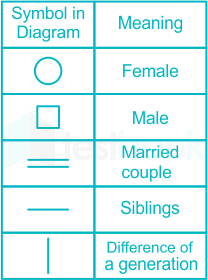
The given question is based on the following information:

'M+N' means 'M' is the mother of N;

'MxN' means 'M' is the son of N;

'M-N' means 'M' is the husband of N;

'M÷N' means 'M' is the sister of N;

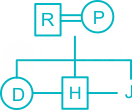
If 'D ÷ H x R - P + J,' then how is 'D' related to 'J'?

  1. ((a))

    Mother

  2. ((b))

    Sister

  3. ((c))

    Wife

  4. ((d))

    Sister-in-law

Show Answer
Answer: ((b))

Sister

Decoding symbols:

M is
Symbol+x-÷
MeaningMotherSonHusbandSister
to N

Given: D ÷ H x R - P + J

D ÷ H → D is the sister of H.

H x R → H is the son of R.

R - P → R is the husband of P.

P + J → P is the mother of J.

Thus, D is J's sister.

Hence, "Option 2" is the correct answer.

32

Three statements showing relationships have been given, which are followed by two conclusions I and II. Assuming that the given statements are true, find out which of the conclusions is/are definitely true.

Statements :

1. P ≤ Q 2. S ≥ Q 3. Q > R

Conclusions :

I. R = P

II. R < S

  1. ((a))

    Only conclusion I is true

  2. ((b))

    Only conclusion II is true

  3. ((c))

    Both conclusions I and II are true

  4. ((d))

    Neither conclusion I nor II is true

Show Answer
Answer: ((b))

Only conclusion II is true

Given statement: 

1. P ≤ Q 2. S ≥ Q 3. Q > R

Conclusions:

I. R = P → False (As P ≤ Q > R. So, no relation between R and P can be determined, therefore it is false.)

II. R < S → True (As R < Q ≤ S. So, we get R < S, therefore it is true.)

Thus, Only conclusion II is true.

Hence, the correct answer is "Option 2".

33

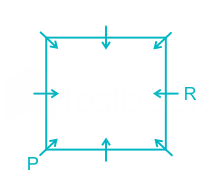
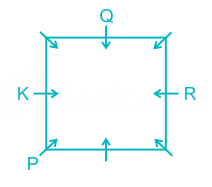
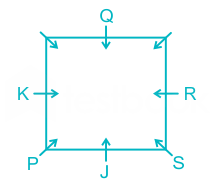
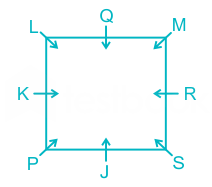
Eight friends J, K, L, M, P, Q, R and S are sitting around a square table facing the centre of the table. Some of them are sitting at the corners while some are sitting at the exact middle of the sides. ‘P´ sits third to the left of 'R'. 'P' sits at one of the corners. 'K' sits second to the right of 'Q'. 'Q' does not sit at any of the corners. 'Q' is not an immediate neighbour of 'P'. 'S' is an immediate neighbour of 'J'. 'S' does not sit at any of the middle of the sides. Only three persons sit between 'S' and 'L'. Who sits second to the left of 'M' ?

  1. ((a))

    L

  2. ((b))

    Q

  3. ((c))

    S

  4. ((d))

    P

Show Answer
Answer: ((c))

S

Given: Eight friends J, K, L, M, P, Q, R and S are sitting around a square table facing the centre of the table. Some of them are sitting at the corners while some are sitting at the exact middle of the sides.

1) 'P' sits at one of the corners.

2) ‘P´ sits third to the left of 'R'.

3) 'Q' is not an immediate neighbour of 'P'.

4) 'Q' does not sit at any of the corners.

5) 'K' sits second to the right of 'Q'.

6) 'S' is an immediate neighbour of 'J'.

  1. 'S' does not sit at any of the middle of the sides.

  1. Only three persons sit between 'S' and 'L'.

Thus, after positioning L only one position is left which will be occupied by the only person left i.e. M.

Thus, S sits second to the left of 'M'.

Hence, "Option 3" is the correct answer.

34

Three statements are given, followed by three conclusions I, II and III. You have to consider these statements to be true, even if they seem to be at variance from commonly known facts. You are to decide which of the given conclusions logically follow(s) from the given statements.

Statements:

1. No chair is table. 2. Some benches are tables. 3. All chairs are Almirahs.

Conclusions :

I. Some Almirahs are tables.

II. Some benches are chairs.

III. No table is Almirah.

  1. ((a))

    Only conclusion I follows

  2. ((b))

    Only conclusion II follows

  3. ((c))

    Only conclusions II and III follow

  4. ((d))

    Only Either conclusion I or III follows

Show Answer
Answer: ((a))

Only conclusion I follows

The least possible Venn diagram for the given statements is as shown below :

Conclusions:

I. Some Almirahs are tables → Follow (As some benches are tables and all chairs are Almirahs, no chair is table. As no table can be chairs which whole comes in almirahs, therefore it is true.)

II. Some benches are chairs → Does not follow (As no chair is table and some benches are tables. So it is possible but not definite)

III. No table is Almirah → Does not follow (As some benches are tables and all chairs are Almirahs, no chair is table. As no direct relation is given between tables and almirahs, therefore it is false.)

∴ Here, Only conclusion I follows.​

Hence, the correct answer is "Option 1".

35

Choose the Venn diagram from the options which represents the correct relationship amongst the given classes :

Chair, Furniture, Cup

  1. ((a))

  2. ((b))

  3. ((c))

  4. ((d))

Show Answer
Answer: ((d))

The diagram that best represents the relationship between the given classes is shown below :

Chair is a part of furniture.

Cup falls under the category of crockery but is related to furniture.

Hence, "Option 4" is the correct answer.

36

Which of the following groups of devices are only input devices?

  1. ((a))

    Keyboard, Monitor, Joystick

  2. ((b))

    Keyboard, Printer, Light pen

  3. ((c))

    Mouse, Scanner, Joystick

  4. ((d))

    Mouse, Microphone, Speaker

Show Answer
Answer: ((c))

Mouse, Scanner, Joystick

The correct answer is option 3: Mouse, Scanner, Joystick

Key Points

Input devices are used to provide data and control signals to a computer. The devices listed in Option 3 are all input devices:

  • Mouse: Used to point, click, and interact with the computer.
  • Scanner: Captures images or text and inputs them into the computer.
  • Joystick: Used for input in gaming and controlling cursor movement.

Explanation of options:

  • Option 1 – Keyboard, Monitor, Joystick: ❌ Monitor is an output device.
  • Option 2 – Keyboard, Printer, Light pen: ❌ Printer is an output device.
  • Option 3 – Mouse, Scanner, Joystick: ✅ All are input devices.
  • Option 4 – Mouse, Microphone, Speaker: ❌ Speaker is an output device.

Hence, the correct answer is: option 3: Mouse, Scanner, Joystick

37

In computer terminology, DPI stands for :

  1. ((a))

    Dots Per Inch

  2. ((b))

    Devices Per Internet

  3. ((c))

    Drops Per Information

  4. ((d))

    Digitally Persistent Information

Show Answer
Answer: ((a))

Dots Per Inch

The correct answer is option 1: Dots Per Inch

Key Points

In computer terminology, DPI stands for Dots Per Inch. It is a measurement of the resolution or clarity of images, particularly used in:

  • Printers: To indicate how many dots of ink are placed in a linear inch of paper.
  • Monitors and Screens: To represent pixel density, especially in high-resolution displays.
  • Mouse Sensitivity: In input devices like mice, higher DPI means more sensitivity and faster pointer movement.

Explanation of options:

  • Option 1 – Dots Per Inch: ✅ Correct. Standard technical meaning of DPI.
  • Option 2 – Devices Per Internet: ❌ No such term exists in computing.
  • Option 3 – Drops Per Information: ❌ Incorrect and unrelated to DPI.
  • Option 4 – Digitally Persistent Information: ❌ Sounds technical but is not a valid term for DPI.

Hence, the correct answer is: option 1: Dots Per Inch

38

Which of the following is an example of Operating System?

  1. ((a))

    Edge

  2. ((b))

    Word

  3. ((c))

    Firefox

  4. ((d))

    Android

Show Answer
Answer: ((d))

Android

The correct answer is option 4: Android

Key Points

An Operating System (OS) is system software that manages computer hardware and software resources and provides common services for computer programs.

Android is an open-source mobile operating system developed by Google. It powers smartphones, tablets, smart TVs, and more. It handles tasks like memory management, application execution, and user interface operations.
Explanation of options:

  • Option 1 – Edge: ❌ Microsoft Edge is a web browser, not an operating system.
  • Option 2 – Word: ❌ Microsoft Word is a word processing application.
  • Option 3 – Firefox: ❌ Mozilla Firefox is a web browser.
  • Option 4 – Android: ✅ Correct. Android is a full-fledged operating system for mobile devices.

Hence, the correct answer is: option 4: Android

39

Which of the following software you preferred most to write a formal application?

  1. ((a))

    Microsoft Edge

  2. ((b))

    Microsoft Word

  3. ((c))

    Microsoft Excel

  4. ((d))

    Microsoft Access

Show Answer
Answer: ((b))

Microsoft Word

The correct answer is option 2: Microsoft Word

Key Points

Microsoft Word is a widely used word processing application developed by Microsoft. It is designed for creating, editing, formatting, and printing text-based documents such as formal applications, letters, resumes, and reports. It offers features like templates, spelling and grammar checks, formatting tools, and more, making it ideal for writing formal documents.

Explanation of options:

  • Option 1 – Microsoft Edge: ❌ A web browser used for browsing the internet, not for writing documents.
  • Option 2 – Microsoft Word: ✅ Correct. Best suited for creating formal applications and text documents.
  • Option 3 – Microsoft Excel: ❌ Used for spreadsheets, calculations, and data analysis.
  • Option 4 – Microsoft Access: ❌ A database management tool, not for writing documents.

Hence, the correct answer is: option 2: Microsoft Word

40

Kaspersky, McAfee, Norton, etc. are popular examples of :

  1. ((a))

    Anti Viruses

  2. ((b))

    Trojan Horses

  3. ((c))

    Spam Viruses

  4. ((d))

    Worm Viruses

Show Answer
Answer: ((a))

Anti Viruses

The correct answer is option 1: Anti Viruses

Key Points

Kaspersky, McAfee, Norton, and similar software are well-known antivirus programs designed to detect, prevent, and remove malicious software such as viruses, trojans, worms, and spyware. They provide real-time protection, scanning, and quarantine features to keep systems safe from cyber threats.

Explanation of options:

  • Option 1 – Anti Viruses: ✅ Correct. These are security programs designed to fight against malicious software.
  • Option 2 – Trojan Horses: ❌ These are types of malware, not antivirus software.
  • Option 3 – Spam Viruses: ❌ Spam is related to unwanted emails, and this is not a standard term.
  • Option 4 – Worm Viruses: ❌ Worms are a type of virus, not antivirus software.

Hence, the correct answer is: option 1: Anti Viruses

Education and Leadership (40 questions)

41

The 'feeling' is a associated with :

  1. ((a))

    Emotional domain

  2. ((b))

    Affective domain

  3. ((c))

    Cognitive domain

  4. ((d))

    Psychomotor domain

Show Answer
Answer: ((b))

Affective domain

Educational psychologist Benjamin Bloom classified learning into three primary domains: cognitive, affective, and psychomotor.

Key Points

  • The term feeling is closely related to attitudes, emotions, values, and motivations. These characteristics are central to the affective domain of Bloom’s taxonomy.
  • When students express interest, show empathy, or develop preferences and values, they engage in learning outcomes within the affective domain.
  • For example, a student showing care for the environment or feeling motivated to help others is demonstrating growth in the affective domain.
  • This domain emphasizes internalizing values through emotional responses and is often measured by how learners react to stimuli on an emotional level.

Hint

  • The emotional domain is often confused with the affective domain, but the term "emotional domain" is not formally recognized in Bloom’s taxonomy; it is rather an informal reference and overlaps with the affective domain.
  • The cognitive domain centers on intellectual abilities such as remembering, understanding, and problem-solving and is more about thinking than feeling.
  • The psychomotor domain relates to physical coordination and motor skills, such as writing, drawing, or playing an instrument, and does not directly involve emotions or feelings.

Hence**, the correct answer is affective domain.**

42

What do you understand the term 'growth'?

  1. ((a))

    It is social change.

  2. ((b))

    It is emotional change.

  3. ((c))

    It is qualitative change.

  4. ((d))

    It is quantitative change.

Show Answer
Answer: ((d))

It is quantitative change.

Growth is different from development, although the two are often used together. While development refers to both qualitative and quantitative improvements in a person’s abilities and behavior, growth is more specifically focused on measurable changes.

Key Points

  • Growth refers to an increase in size, height, weight, or other measurable bodily features. It is a biological and physical process and can be tracked using tools such as scales or measuring tapes.
  • This means it deals with numerical or measurable aspects, making it a quantitative change.
  • For example, a child growing five inches taller over a year or gaining weight shows physical and quantifiable changes.
  • These changes are concrete and objective and are not related to behavior, skills, or emotions.
​​

Hint

 Social change involves changes in relationships, interactions, and social roles, which relate more to social development rather than growth. Emotional change includes variations in how a person feels or expresses emotions, which is part of emotional development. Qualitative change refers to improvements in abilities or functions, such as learning to think critically or becoming more responsible, which are aspects of development rather than growth.

<br>

Hence, the correct answer is quantitative change.

43

What is not an Objective of Education?

  1. ((a))

    To find fault with others

  2. ((b))

    To develop values

  3. ((c))

    To earn livelyhood

  4. ((d))

    To serve society

Show Answer
Answer: ((a))

To find fault with others

Education is a purposeful process aimed at the all-round development of individuals.

Key Points

  • Finding fault with others reflects a negative and critical attitude that does not align with the broader goals of education. Education is intended to promote understanding, empathy, cooperation, and constructive thinking.
  • Encouraging a habit of criticizing others without purpose can hinder teamwork, disrupt social harmony, and negatively affect personal development.
  • True education fosters self-awareness, respect for others, and the ability to work collaboratively rather than focusing on the shortcomings of others in a destructive manner.
  • Therefore, such behavior contradicts the foundational values education seeks to build.

Hint

  • Developing values is a central objective of education as it shapes students’ character, ethics, and decision-making.
  • Earning a livelihood is also a key aim, as education equips individuals with the knowledge and skills required for employment.
  • Serving society is an essential goal, as education prepares individuals to contribute meaningfully to the community and uphold democratic and humanitarian values.

Hence, the correct answer is to find fault with others.

44

In education process which one of the following is difficult to evaluate?

  1. ((a))

    Teaching methods.

  2. ((b))

    Content

  3. ((c))

    Attitudes and values

  4. ((d))

    Physical fitness

Show Answer
Answer: ((c))

Attitudes and values

Evaluation is a crucial part of the educational process as it helps determine the effectiveness of teaching and the extent of student learning.

Key Points

  • Attitudes and values are internal, deeply personal aspects of a learner's development, shaped by experiences, environment, and emotional responses.
  • They are not directly observable and often require indirect methods like self-reports, behavior observations, or situational assessments.
  • Even then, responses may be influenced by social expectations or personal biases, making the evaluation inconsistent or unreliable.
  • Unlike academic content or physical performance, attitudes and values cannot be measured with a simple test or scale, making them the most complex and challenging area to evaluate in education.

Hint

  • Teaching methods can be evaluated through classroom observations, student feedback, and performance analysis.
  • Content evaluation is straightforward, as it involves checking curriculum alignment, learning objectives, and subject matter coverage.
  • Physical fitness can be measured through physical tests like endurance runs, strength exercises, and other standardized fitness assessments, making it relatively easy to evaluate.

Hence, the correct answer is attitudes and values.

45

Which one of the following is important in 'growth'?

  1. ((a))

    Dimensions

  2. ((b))

    Development

  3. ((c))

    Social behaviour

  4. ((d))

    Maturation

Show Answer
Answer: ((d))

Maturation

Growth refers to the physical and measurable increase in the body such as changes in height, weight, and organ size. 

Key Points

  • Maturation plays a crucial role in growth because it involves the natural unfolding of genetic traits that enable the body to grow and function properly.
  • It is the biological process through which a child’s body and brain become ready for certain developmental milestones, such as walking, talking, or puberty.
  • Without the process of maturation, physical growth may be delayed or impaired regardless of environmental support.
  • This internal mechanism ensures that the body grows at the appropriate rate and sequence, making it a fundamental aspect of physical growth.

Hint

  • Dimensions refer to various aspects of development like physical, emotional, cognitive, and social but they are not specific to the physical changes involved in growth.
  • Development includes both qualitative and quantitative changes and covers a broader scope than growth alone.
  • Social behavior involves how a person interacts with others and is part of social development, not physical growth.

Hence, the correct answer is maturation.

46

Most of the adolescents in school now a days suffer from :

  1. ((a))

    Neurological disorder

  2. ((b))

    Anxiety disorder

  3. ((c))

    Physical disorder

  4. ((d))

    Auditory disorder

Show Answer
Answer: ((b))

Anxiety disorder

Adolescence is a critical stage in human development marked by rapid physical, emotional, and psychological changes.

Key Points

  • Anxiety disorders are increasingly common among school-going adolescents due to pressures such as academic expectations, social comparison, fear of failure, and uncertain future goals.
  • These disorders may present through symptoms like restlessness, nervousness, difficulty concentrating, and physical complaints like headaches or stomachaches without a medical cause.
  • Unlike physical illnesses, anxiety often goes unnoticed but can seriously affect learning, behavior, and overall well-being.
  • With the rise in digital exposure and changing social dynamics, adolescents are more prone to emotional stress, making anxiety a significant issue in schools today.

Hint

  • Neurological disorders, such as epilepsy or cerebral palsy, do affect some adolescents but are far less common and typically identified earlier.
  • Physical disorders involve bodily impairments or diseases, which are generally less prevalent than emotional or psychological issues in adolescence.
  • Auditory disorders refer to hearing problems, which are relatively rare and usually not associated with the majority of school-related difficulties in this age group.

Hence, the correct answer is anxiety disorder.

47

The teachers in school should extend ______ towards adolescents.

  1. ((a))

    Empathy

  2. ((b))

    co-operation

  3. ((c))

    Emotional support

  4. ((d))

    Sympathy

Show Answer
Answer: ((c))

Emotional support

Adolescents undergo a complex phase of growth marked by emotional fluctuations, identity exploration, and sensitivity to social dynamics.

Key Points

  • Emotional support is essential for adolescents as they navigate the challenges of growing up, including peer pressure, academic stress, and self-doubt.
  • By offering emotional support, teachers provide a safe and understanding environment where students feel heard, valued, and accepted.
  • This support helps adolescents regulate their emotions, build resilience, and develop a healthy self-concept.
  • Emotional support does not necessarily mean solving their problems, but rather being available, approachable, and responsive to their emotional needs, which is crucial for their well-being and overall development.

Hint

  • Empathy is the ability to understand and share another's feelings, and while it is important, it is a component of emotional support rather than a broader action.
  • Co-operation generally refers to working together, which is useful but doesn't specifically address the emotional needs of adolescents.
  • Sympathy involves feeling pity for someone, which may create a sense of distance or inferiority, rather than the comfort and connection adolescents require.

Hence, the correct answer is emotional support.

48

Which one of the following hormones causes aggression among the youth?

  1. ((a))

    Adrenaline

  2. ((b))

    Insulin

  3. ((c))

    Dopamine

  4. ((d))

    Thyroxine

Show Answer
Answer: ((a))

Adrenaline

Hormones play a vital role in regulating physical, emotional, and behavioral changes, especially during adolescence. As hormonal activity increases during puberty, it influences mood, energy levels, emotional responses, and even behavioral tendencies. 

Key Points

  • Adrenaline, also known as epinephrine, is a hormone released by the adrenal glands in response to stress or excitement.
  • It activates the body's "fight or flight" response, increasing heart rate, blood pressure, and energy supply.
  • This sudden surge can lead to intense emotional reactions, including fear, anxiety, or aggression.
  • In youth, especially during emotionally charged situations, adrenaline can amplify aggressive behavior due to heightened arousal and reduced impulse control.
  • Therefore, adrenaline is closely linked to aggression, particularly when combined with emotional stress or frustration.

Hint

  • Insulin regulates blood sugar levels and has no direct connection to aggression or emotional behavior.
  • Dopamine is associated with pleasure, motivation, and reward mechanisms in the brain, and while imbalances can affect behavior, it is not directly linked to aggression.
  • Thyroxine controls metabolism and energy levels, and its primary role is in physical and cognitive development rather than aggressive behavior.

Hence, the correct answer is adrenaline.

49

Who will form the bridge between the home and school?

  1. ((a))

    Parents

  2. ((b))

    Students

  3. ((c))

    Teachers

  4. ((d))

    Management

Show Answer
Answer: ((c))

Teachers

A strong connection between home and school is essential for the holistic development of a child. When families and schools work together, it fosters better understanding, consistent support, and a more nurturing environment for students.

Key Points

  • Teachers play a central role in forming the bridge between home and school. They interact daily with students, observe their behavior and performance, and communicate these observations to parents.
  • Through regular meetings, phone calls, and written reports, teachers keep parents informed about their child's progress and challenges.
  • Moreover, they guide parents on how to support learning at home and often act as mediators when issues arise.
  • Their consistent contact with both the student and the family makes them the key link that ensures alignment between home expectations and school goals.

Hint

  • Parents are essential partners in education, but they depend on communication from teachers to stay informed about school matters.
  • Students are at the center of the process, but they often lack the maturity or means to serve as a reliable bridge between home and school.
  • Management sets policies and provides infrastructure, but does not engage directly with parents and students on a daily basis.

Hence, the correct answer is teachers.

50

______ can't be taught, but can be caught through practicing.

  1. ((a))

    Habits

  2. ((b))

    Knowledge

  3. ((c))

    Attitudes

  4. ((d))

    Values

Show Answer
Answer: ((a))

Habits

In the educational process, certain traits and behaviors are not directly taught but are learned through practice and repeated exposure.

Key Points

  • Habits are behaviors that are developed through regular repetition and practice.
  • Unlike knowledge, which can be directly imparted through lessons, habits are formed when actions are repeated consistently.
  • For example, regular study routines, physical exercise, or good time management skills are learned through continuous practice rather than formal teaching.
  • Students might not be explicitly taught how to develop good habits, but they gradually internalize them by engaging in them repeatedly.

Hint

  • Knowledge refers to information and understanding, which is generally taught through formal instruction, lessons, and educational resources.
  • Attitudes can be influenced through guidance, reflection, and discussions, though they are more malleable than habits and can be taught or shaped by positive reinforcement.
  • Values are often developed through personal experiences and societal influences but can also be taught indirectly through role models and real-life applications.
Hence, the correct answer is habits.

51

Which type of motivation is better for learning?

  1. ((a))

    Intrinsic motivation

  2. ((b))

    Extrinsic motivation

  3. ((c))

    Emotional motivation

  4. ((d))

    Progressive motivation

Show Answer
Answer: ((a))

Intrinsic motivation

Motivation plays a pivotal role in the learning process as it drives students to engage with the material, persist through challenges, and achieve educational goals.

Key Points

  • Intrinsic motivation is considered the most effective for learning because it comes from within the learner.
  • When students are intrinsically motivated, they engage in learning for the enjoyment, interest, or personal satisfaction they get from the activity itself, rather than for external rewards.
  • This type of motivation leads to deeper engagement, better retention of information, and a more positive attitude toward learning.
  • Students who are intrinsically motivated are likely to pursue knowledge for its own sake and are more likely to exhibit perseverance, curiosity, and creativity in their learning.

Hint

  • Extrinsic motivation involves external rewards such as grades, prizes, or approval from others. While it can be effective for short-term goals or tasks, it may not encourage long-term engagement or deep learning.
  • Emotional motivation refers to the influence of emotions like fear, anxiety, or excitement on learning. While emotions can drive immediate action, they may not always promote sustained or effective learning.
  • Progressive motivation, although not commonly used as a formal term, may refer to motivation driven by gradual improvement or the desire to progress, but it is less defined compared to intrinsic or extrinsic motivation.

Hence, the correct answer is intrinsic motivation.

52

Which one of the following would enhance learning process in classroom?

  1. ((a))

    Effective use of Black Board

  2. ((b))

    Less number of students in class

  3. ((c))

    Magnetic personality of teacher

  4. ((d))

    Comfortable furniture

Show Answer
Answer: ((a))

Effective use of Black Board

The learning environment in a classroom plays a critical role in shaping how effectively students absorb and engage with the material.

Key Points

  • Effective use of the blackboard can significantly enhance the learning process. The blackboard remains a fundamental tool for teaching, allowing teachers to visually present concepts, diagrams, and important points in a clear and organized manner.
  • When used effectively, it helps students follow along with the lesson, reinforces key ideas, and provides a focal point for the class.
  • The act of writing on the blackboard also helps with student attention and retention, making it an important tool for engaging students in the learning process.

Hint

  • While having fewer students in the class can provide more individual attention, it's not always a guarantee of better learning, as the quality of teaching and interaction is just as important.
  • A magnetic personality in a teacher may help capture students’ attention, but it doesn't necessarily lead to deep learning or understanding.
  • Comfortable furniture can contribute to physical comfort, but it doesn't directly affect cognitive engagement or the quality of learning in a classroom setting.

Hence, the correct answer is effective use of blackboard.

53

'The child falls many times while learning cycling'. Which learning theory you think can be atributed this event?

  1. ((a))

    Trial and error theory of learning

  2. ((b))

    Law of readiness

  3. ((c))

    Insight learning

  4. ((d))

    Perspective learning

Show Answer
Answer: ((a))

Trial and error theory of learning

Learning is a dynamic process that involves various strategies and theories, each explaining how individuals acquire skills and knowledge.

Key Points

  • The Trial and Error Theory of Learning, proposed by Edward Thorndike, is the most relevant theory for the event of a child falling repeatedly while learning to cycle.
  • This theory suggests that learning occurs through repeated attempts and mistakes. When the child falls while cycling, they are engaging in trial and error—trying different methods to balance, steer, and pedal.
  • Over time, the child learns which actions lead to success (riding the bike) and which ones lead to failure (falling), gradually improving their skills through repetition and adjustment.
  • This process of learning from mistakes and refining actions fits perfectly with the experience of learning cycling.

Hint

  • The Law of Readiness by Thorndike suggests that learning occurs when an individual is ready to learn, which involves mental and physical preparedness.
  • Insight Learning, proposed by Wolfgang Köhler, involves sudden realizations or "aha moments" after contemplation, but learning cycling is typically more incremental rather than based on sudden insights.
  • Perspective Learning does not appear to be a widely recognized formal theory of learning and is not relevant in this context.

Hence, the correct answer is the Trial and Error Theory of Learning.

54

As per psychology what should be the best relationship between the teacher and child?

  1. ((a))

    Official relation

  2. ((b))

    Supportive and emotional relation

  3. ((c))

    Social relation

  4. ((d))

    Cordial relation

Show Answer
Answer: ((b))

Supportive and emotional relation

The teacher-student relationship is one of the most critical factors in the educational process. The quality of this relationship can have a profound impact on a student's learning, emotional development, and overall well-being.

Key Points

  • A supportive and emotional relationship between the teacher and the child is considered the most beneficial for fostering both academic and emotional development.
  • Teachers who offer emotional support create a safe space for students, encouraging them to express themselves, make mistakes, and take risks in their learning without fear of judgment.
  • Emotional support helps in building trust, self-esteem, and motivation, all of which are essential for a child's growth and development. It also makes the learning experience more meaningful and enriching, promoting a sense of belonging and engagement in the classroom.

Hint

  • An official relation refers to a more formal and detached interaction that focuses strictly on the educational tasks, which can limit the emotional connection and support a child needs for holistic development.
  • A social relation involves general interaction and communication, but without the deeper emotional support that helps address a child's specific needs.
  • A cordial relation is friendly and polite but may not necessarily involve the deeper emotional and supportive engagement required for effective learning and development.

Hence**, the correct answer is a supportive and emotional relation.**

55

Do you think highly qualified teacher always a successful teacher?

  1. ((a))

    Yes

  2. ((b))

    No

  3. ((c))

    Not necessary

  4. ((d))

    Less qualified teachers are successful

Show Answer
Answer: ((c))

Not necessary

The effectiveness of a teacher is often linked to their qualifications, but qualifications alone do not guarantee success in the classroom.

Key Points

  • Not necessary is the most accurate answer because a highly qualified teacher may not always be successful in every teaching scenario.
  • While qualifications and expertise in a subject matter are important, a successful teacher also needs a range of skills such as emotional intelligence, communication, adaptability, classroom management, and the ability to inspire and motivate students.
  • Some teachers may lack formal qualifications but possess natural teaching abilities, empathy, and a deep understanding of how to connect with students, making them equally effective, if not more so, than those with higher academic qualifications.
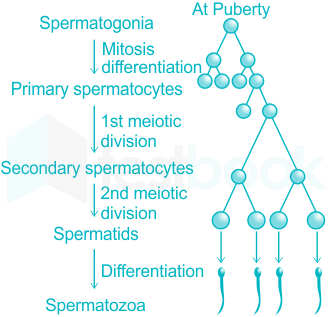
Hint

  • Saying yes implies that high qualifications always lead to success, which is not true because teaching effectiveness depends on more than just knowledge—it also requires interpersonal skills and practical teaching strategies.
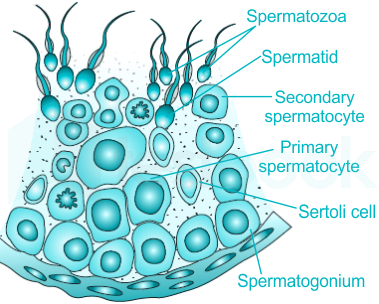
  • No would suggest that qualifications don't matter at all, but that is not entirely accurate, as subject knowledge and educational background do play a role in shaping a teacher’s effectiveness.
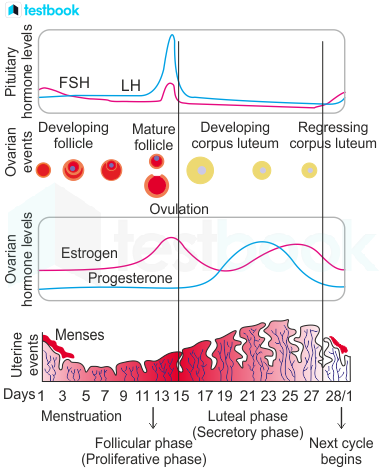
  • The statement less qualified teachers are successful isn't necessarily true; while some less qualified teachers can be successful, it doesn't imply that qualifications don’t matter at all, as the combination of knowledge and teaching skills is important.

Hence**, the correct answer is not necessary.**

56

If a parent wants to get admission for their child in a school, they should look for :

  1. ((a))

    Attractive Building

  2. ((b))

    Air condition Buses

  3. ((c))

    Big play Ground

  4. ((d))

    Good organizational climate

Show Answer
Answer: ((d))

Good organizational climate

When parents seek admission for their child in a school, they consider several factors to ensure the best educational experience for their child.

Key Points

  • A good organizational climate is the most important factor for a parent to consider. It refers to the overall atmosphere of the school, including its culture, values, leadership, and the quality of relationships between teachers, students, and staff.
  • A supportive and positive organizational climate fosters a sense of belonging, encourages learning, promotes emotional well-being, and helps in the holistic development of students.
  • It creates a safe and motivating environment that is essential for both academic success and personal growth. This factor goes beyond just the physical facilities and directly impacts the child's educational experience.

 Hint

  • While an attractive building may create a positive first impression, it does not guarantee that the school offers a quality learning experience or a positive atmosphere for students.
  • Air-conditioned buses may offer comfort but do not directly contribute to the quality of education or the overall school environment.
  • A big playground is important for physical development and recreation but is not as crucial as the emotional and social climate that affects the child’s academic and personal growth.

Hence, the correct answer is good organizational climate.

57

If the children take educational tour to a local museum, they develop ______.

  1. ((a))

    Anxiety

  2. ((b))

    Interest

  3. ((c))

    Curiosity

  4. ((d))

    Enjoyment

Show Answer
Answer: ((b))

Interest

Educational tours and field trips are effective tools for enhancing learning by providing students with real-world experiences that complement classroom instruction.

Key Points

  • When children take an educational tour to a local museum, they are most likely to develop interest.
  • Museums provide hands-on learning experiences that stimulate curiosity and allow children to connect abstract concepts with tangible, real-world examples.
  • Exhibits, artifacts, and interactive displays can ignite a child's passion for history, art, science, or culture, leading to a deeper interest in the subjects explored.
  • This interest encourages further exploration, learning, and engagement, making the educational tour a valuable experience for long-term educational development.

Hint

  • Anxiety might occur in some students, especially if they feel uncomfortable in a new environment or are overwhelmed by the museum setting, but it’s not the typical response to a museum tour.
  • Curiosity is a close second, as the new environment and exposure to different artifacts can spark questions and exploration. However, the overarching response tends to be a developing interest in the subject matter.
  • Enjoyment is also a possible response, but it is more about the emotional experience and may not directly relate to the educational value and learning that occurs during the tour.

Hence, the correct answer is interest.

58

How you would provide meaningful learning space in school?

  1. ((a))

    Well qualified teachers with warmth to support children

  2. ((b))

    Well equipped classrooms with teaching aids

  3. ((c))

    Comfortable furniture

  4. ((d))

    Air condition rooms

Show Answer
Answer: ((a))

Well qualified teachers with warmth to support children

A classroom environment plays a crucial role in the effectiveness of teaching and learning. The quality of teaching, the physical setting, and the resources available all influence how well students engage with the content and learn.

Key Points

  • Well-qualified teachers with warmth to support children are the most essential factor for a positive and effective learning environment.
  • Teachers who are not only knowledgeable but also warm, empathetic, and supportive can create a safe and encouraging atmosphere where students feel comfortable expressing themselves and engaging in learning.
  • Such teachers are able to recognize the individual needs of students, offer personalized guidance, and foster a love of learning, which is key to student success.
  • This teacher-student relationship, rooted in warmth and support, is vital for the emotional and academic growth of children.

Hint

  • Well-equipped classrooms with teaching aids are important, as they provide the tools necessary for interactive and engaging learning. However, without a supportive teacher to guide and use those resources effectively, their impact may be limited.
  • Comfortable furniture is essential for physical comfort, but it is secondary compared to the role a teacher plays in fostering a positive learning experience.
  • Air-conditioned rooms may offer physical comfort, especially in hot climates, but again, they do not directly contribute to the emotional and academic development of students like the role of a teacher does.

Hence, the correct answer is well-qualified teachers with warmth to support children.

59

To arouse scientific temper among the children what should the teacher do in classroom?

  1. ((a))

    Group discussion

  2. ((b))

    Conducting experiment in class

  3. ((c))

    Lecture method

  4. ((d))

    Reading the text

Show Answer
Answer: ((b))

Conducting experiment in class

Fostering a scientific temper in children is an important educational objective that encourages curiosity, critical thinking, and a rational approach to problem-solving. 

Key Points

  • Conducting experiments in class is the most effective way to arouse scientific temper among children.
  • Experiments provide students with firsthand experience of scientific principles, helping them understand concepts through observation, hypothesis testing, and analysis.
  • This practical approach fosters a sense of curiosity and inquiry, encouraging students to question phenomena, test ideas, and draw conclusions based on evidence.

Hint

  • Group discussion can be a valuable method for stimulating critical thinking and encouraging students to explore various viewpoints. However, without hands-on activities like experiments, it may not fully engage children in the practical aspects of science.
  • The lecture method is more passive and may not actively involve students in the learning process, thus limiting opportunities for them to develop scientific inquiry skills.
  • Reading the text provides information, but it doesn’t engage students in active exploration or experimentation, which are essential for fostering a scientific temper.

Hence, the correct answer is conducting experiments in class.

60

Why text books are required for learning?

  1. ((a))

    Students are comfortable with text book knowledge

  2. ((b))

    Since prescribed by the authority

  3. ((c))

    Gives directions to the exam

  4. ((d))

    It would guide the teacher to confine to the syllabus

Show Answer
Answer: ((d))

It would guide the teacher to confine to the syllabus

Textbooks play a central role in the educational system as they provide a structured and organized approach to learning. They serve as a key resource for both teachers and students, offering a comprehensive foundation of knowledge and aligning with curriculum objectives.

Key Points

  • Textbooks are required for learning because they guide the teacher to confine to the syllabus.
  • A well-structured textbook ensures that both teachers and students stay on track with the prescribed curriculum, ensuring all topics and concepts are covered systematically.
  • It acts as a reference point for teachers to deliver lessons that are aligned with the syllabus and exam requirements.
  • Additionally, textbooks provide continuity, ensuring that students receive a balanced and comprehensive education in line with educational standards and expectations.

Hence**, the correct answer is that textbooks would guide the teacher to confine to the syllabus.**

61

According to educationists the curriculum should be ______.

  1. ((a))

    Management oriented

  2. ((b))

    Parent oriented

  3. ((c))

    Teacher oriented

  4. ((d))

    Goal oriented

Show Answer
Answer: ((d))

Goal oriented

Curriculum is a planned set of learning experiences designed to bring about desired educational outcomes. It plays a vital role in shaping students' knowledge, skills, values, and attitudes.

Key Points

  • A goal-oriented curriculum is designed with specific learning objectives in mind, focusing on the overall development of the learner.
  • It guides the selection of content, teaching strategies, and assessment methods in alignment with these goals.
  • Educationists stress the importance of defining what students should achieve by the end of a learning process. This ensures that teaching is purposeful and learning outcomes are measurable.
  • A curriculum with clear goals also helps in maintaining consistency across educational levels. It allows for better monitoring of student progress and supports accountability in education.
  • Thus, a goal-oriented approach makes the curriculum more meaningful, systematic, and learner-centered.

Hint

  • A management-oriented curriculum may emphasize administrative ease and institutional needs rather than focusing on student learning outcomes, limiting its educational effectiveness.
  • A parent-oriented curriculum would cater to parental expectations, which may not always align with sound pedagogical principles or the developmental needs of children.
  • A teacher-oriented curriculum tends to prioritize the convenience or preferences of educators, which may overlook the importance of learner diversity and intended educational goals.

Hence, the correct answer is goal oriented.

62

When child is admitted in Primary School, which learning theory is attributable for his/her learning :

  1. ((a))

    Law of effect

  2. ((b))

    Law of trial and error

  3. ((c))

    Law of readiness

  4. ((d))

    Stimulus-response theory

Show Answer
Answer: ((b))

Law of trial and error

Learning theories explain how individuals acquire, process, and retain knowledge.

Key Points

  • The law of trial and error, proposed by Edward Thorndike, best explains how children learn in primary school settings. When a child is introduced to a new concept or activity, they often try different methods to achieve success.
  • Through repeated attempts, they gradually eliminate unsuccessful responses and retain the ones that lead to success.
  • This process is natural for young learners as they explore, make mistakes, and learn from the outcomes.
  • Encouragement and reinforcement help strengthen successful behaviors.
  • In the classroom, this can be observed when children learn to read, solve puzzles, or adjust to routines.
  • Trial and error is thus a practical and observable form of learning at this foundational stage.

Hint

  • Law of effect emphasizes that behaviors followed by satisfying outcomes are more likely to be repeated, which supports learning but focuses more on consequences rather than the exploratory process itself.
  • Law of readiness suggests that learning depends on the learner's mental and physical preparedness, which is important but not the initial method through which children learn new tasks.
  • Stimulus-response theory explains learning as a direct reaction to stimuli, but it does not fully capture the exploratory and corrective process seen in young learners’ trial-and-error behavior.

Hence**, the correct answer is law of trial and error.**

63

The constructive method of teaching and learning would empower ______.

  1. ((a))

    Teacher

  2. ((b))

    The child

  3. ((c))

    Principal

  4. ((d))

    Librarian

Show Answer
Answer: ((b))

The child

Constructivist teaching is an educational approach rooted in the theory that learners actively construct their own understanding and knowledge of the world through experiences and reflection.

Key Points

  • The child is at the center of the constructivist method of teaching and learning.
  • This approach encourages learners to engage with content, ask questions, collaborate with peers, and build knowledge through hands-on experiences.
  • When children can explore concepts in meaningful ways, they develop critical thinking and problem-solving skills.
  • Constructivist classrooms foster independence and ownership of learning, helping children to become self-motivated and confident learners.
  • It also recognizes that each child brings prior knowledge into the learning process, which is respected and built upon.

Hint

  • The teacher plays an important role as a guide, but the constructivist approach does not focus on empowering the teacher.
  • The principal manages the school environment but is not directly influenced by teaching methods in classroom-level constructivist learning.
  • The librarian provides resources to support learning, yet the method itself is not designed to empower their role in the learning process.

Hence**, the correct answer is the child.**

64

What is the main disadvantage of ICT application in classroom?

  1. ((a))

    Thinking skills are hampered

  2. ((b))

    Straining of eyes

  3. ((c))

    ICT tools are costly

  4. ((d))

    Always depends on technology

Show Answer
Answer: ((d))

Always depends on technology

Information and Communication Technology (ICT) has transformed modern education by making teaching more interactive, accessible, and efficient. 

Key Points

  • One of the main disadvantages of using ICT in the classroom is the tendency to always depend on technology.
  • When students and teachers overly rely on digital tools, they may struggle to adapt when technology fails or is unavailable.
  • This dependence can limit creative problem-solving and reduce engagement with non-digital learning methods.
  • Learners may become passive recipients of information instead of actively constructing knowledge through discussion, exploration, and hands-on activity.

Hint

  • Hampering of thinking skills is not a direct result of ICT use; in fact, when used properly, ICT can enhance critical thinking and analysis.
  • Straining of eyes is a physical concern but is more of a health issue than a primary educational disadvantage.
  • The cost of ICT tools can be a challenge in some settings, but it is not universally the main disadvantage, especially where infrastructure already exists.

Hence**, the correct answer is always depends on technology.**

65

For improvement of the performance of the teachers they should resort to :

  1. ((a))

    pursuing higher qualification.

  2. ((b))

    attending seminars.

  3. ((c))

    taking feed back from the children.

  4. ((d))

    thorough reading before coming to the class.

Show Answer
Answer: ((c))

taking feed back from the children.

Teacher performance plays a key role in ensuring effective classroom teaching and positive student outcomes.

Key Points 

  • ​Taking feedback from the children is one of the most effective ways for teachers to improve their performance.
  • Students are the direct recipients of teaching, and their responses, questions, engagement levels, and reflections provide valuable insights into how well the teaching strategies are working.
  • When teachers listen to students’ feedback formally or informally they can identify gaps in understanding, adjust their methods, and adopt approaches that resonate more with learners.
  • It creates a responsive teaching environment where student needs guide instructional decisions.
  • This practice also builds a positive teacher-student relationship and encourages active participation from learners, ultimately improving learning outcomes.

Hint

  • Pursuing higher qualification contributes to subject expertise but may not always improve day-to-day classroom practice.
  • Attending seminars helps stay updated with new trends, but its effectiveness depends on implementation in the classroom.
  • Thorough reading before class is important for preparation, but it does not provide feedback on teaching effectiveness or learner needs.

Hence**, the correct answer is taking feedback from the children.**

66

Persons with Disabilities Act 1995 came into force with effect from :

  1. ((a))

    January 1996

  2. ((b))

    February 1995

  3. ((c))

    March 1996

  4. ((d))

    April 1995

Show Answer
Answer: ((a))

January 1996

The Persons with Disabilities (Equal Opportunities, Protection of Rights and Full Participation) Act, 1995, commonly known as the PwD Act, was a landmark legislation in India aimed at promoting and ensuring equality for persons with disabilities.

Key Points

  • The Persons with Disabilities Act 1995 came into force with effect from January 1996.
  • Though the Act was enacted by the Indian Parliament in 1995, the provisions officially began to apply from the following year.
  • This means the legal rights, protections, and responsibilities outlined in the Act became enforceable from January 1996.
  • It marked the beginning of structured efforts by the Indian government to provide equal opportunities to persons with disabilities, particularly in education, employment, and public services.

Hence, the correct answer is January 1996.

67

When the child is found in the classroom with impaired handwriting the reason could be :

  1. ((a))

    Autism

  2. ((b))

    Apraxia

  3. ((c))

    Dyslexia

  4. ((d))

    Dysgraphia

Show Answer
Answer: ((d))

Dysgraphia

When a child consistently struggles with writing legibly, forming letters, or organizing text on paper, it is important to understand the root cause. 

Key Points

  • Dysgraphia is a specific learning disability that directly affects a child’s handwriting ability and fine motor skills.
  • Children with dysgraphia may have trouble forming letters correctly, maintaining consistent spacing, and organizing thoughts on paper.
  • This can result in handwriting that is slow, illegible, or inconsistent. Unlike general poor handwriting, dysgraphia is neurologically based and may exist even when a child has normal intelligence and adequate instruction.
  • In the classroom, such children often struggle with written assignments and may avoid tasks involving writing, despite understanding the concepts.
  • Recognizing dysgraphia early allows for accommodations such as oral responses or the use of typing tools.

 Hint

  • Autism may involve a range of developmental delays, including motor skills, but impaired handwriting is not a primary characteristic.
  • Apraxia is a motor planning disorder that affects speech more commonly than writing, and it does not typically cause isolated handwriting difficulties.
  • Dyslexia primarily affects reading and language processing, not handwriting, although it may sometimes be accompanied by writing challenges.

Hence**, the correct answer is dysgraphia.**

68

Which is the most common mental impairment among the children?

  1. ((a))

    Depression

  2. ((b))

    ADHD

  3. ((c))

    Maladjustment

  4. ((d))

    Anxiety

Show Answer
Answer: ((b))

ADHD

Mental impairments in children can affect their emotional well-being, social development, and academic performance.

Key Points

  • ADHD, or Attention Deficit Hyperactivity Disorder, is the most commonly diagnosed mental impairment among children.
  • It affects a child's ability to focus, stay organized, and control impulses, often leading to difficulty in following instructions and maintaining attention in class.
  • Children with ADHD may appear restless, act without thinking, or struggle to stay seated.
  • These behaviors are not simply disciplinary issues but stem from neurological differences that impact self-regulation.

Hint

  • ​ Depression can occur in children but is more prevalent in adolescents and often underdiagnosed in younger age groups.
  • Maladjustment refers to difficulties in adapting to social or academic settings, but it is a broad term and not classified as a specific mental disorder.
  • Anxiety is also common among children, especially in school contexts, but its diagnosis rates are slightly lower than those of ADHD.

Hence**, the correct answer is ADHD.**

69

Name the program recently launched by Ministry of Education to help the students suffering from mental illness :

  1. ((a))

    School Health Program

  2. ((b))

    Manodarpan

  3. ((c))

    Health for all Program

  4. ((d))

    AEP

Show Answer
Answer: ((b))

Manodarpan

Mental health is a crucial aspect of a student's overall well-being and academic success.

Key Points

  • Manodarpan is the initiative launched by the Ministry of Education to provide psychosocial support to students for their mental health and well-being.
  • This program aims to address the mental health concerns of students by offering counseling services, creating awareness through various resources, and establishing a support system within educational institutions.
  • By integrating mental health support into the education system, Manodarpan seeks to create a conducive learning environment that prioritizes the emotional and psychological needs of students.

Hint

  • School Health Program focuses on the overall physical health and hygiene of students rather than specifically addressing mental health issues.
  • Health for all Program is a broader public health initiative aimed at providing comprehensive healthcare services to the general population, not exclusively targeting students' mental health.
  • AEP, or Adolescence Education Program, primarily deals with educating adolescents about issues related to puberty, sexuality, and reproductive health, without a specific focus on mental health support.

Hence, the correct answer is Manodarpan.

70

What is the major challenge in school to address mental health issue among children?

  1. ((a))

    Lack of Professional Experts

  2. ((b))

    Lack of funds

  3. ((c))

    Lack of awareness

  4. ((d))

    Lack of time

Show Answer
Answer: ((c))

Lack of awareness

Addressing mental health issues in schools is essential for creating a supportive learning environment. Schools are often the first place where signs of emotional distress or psychological challenges in children become visible.

Key Points

  • Lack of awareness is the major challenge schools face in addressing mental health issues among children.
  • Many educators, parents, and even students are not fully informed about the signs of mental distress or the importance of early intervention.
  • As a result, behavioral changes in children are often misunderstood as indiscipline or laziness.
  • Without proper awareness, mental health concerns go unnoticed or unaddressed, leading to worsening conditions.

Hint

  • Lack of professional experts is a significant issue, but it becomes relevant only when there is enough awareness to seek expert help.
  • Lack of funds can limit resources but is not as fundamental as the absence of awareness that drives demand and policy.
  • Lack of time is often cited as a reason, but mental health integration requires more of a mindset shift than extensive time allocation.

Hence**, the correct answer is lack of awareness.**

71

Visiting local bank by the students would amount to ______.

  1. ((a))

    Parent student relationship

  2. ((b))

    Teacher student relationship

  3. ((c))

    Home community relationship

  4. ((d))

    Student public relationship

Show Answer
Answer: ((d))

Student public relationship

Education is not limited to classroom learning; it also involves connecting students with the community around them. Field visits and practical experiences outside school help students understand real-world applications of their lessons and build relationships beyond the school environment.

Key Points

  • When students visit a local bank, it is an example of building student public relationships.
  • This kind of engagement exposes students to public services and institutions, helping them understand how society functions.
  • It provides an opportunity for learners to interact with people outside the school setting, observe operations in real-life contexts, and appreciate the role of banks in the community.
  • Such experiences contribute to broadening their social understanding and encourage responsible citizenship.
  • The relationship formed here is between the students and the public institution, making it an important extension of their education beyond textbooks.

Hint

  • Parent student relationship involves interactions and cooperation between the child’s family and the student, which is unrelated to bank visits.
  • Teacher student relationship is centered within the classroom and school context, focusing on guidance and instruction.
  • Home community relationship refers to the connection between students’ families and the local community, which is broader but does not directly describe a school-organized visit to a bank.

Hence, the correct answer is student public relationship.

72

What is the best kind of leadership in school education?

  1. ((a))

    Autocratic relationship

  2. ((b))

    Democratic relationship

  3. ((c))

    Servant leadership

  4. ((d))

    Transformation leadership

Show Answer
Answer: ((b))

Democratic relationship

Leadership in school education plays a crucial role in shaping the learning environment, motivating staff and students, and achieving educational goals.

Key Points

  • Democratic leadership is often considered the best kind of leadership in school education because it encourages participation, collaboration, and shared decision-making among teachers, students, and staff.
  • This style values the input of all members of the school community, fostering a sense of ownership and collective responsibility.
  • Democratic leaders promote open communication, listen to diverse perspectives, and build consensus, which helps in creating an inclusive and motivating environment.
  • Such leadership not only supports academic success but also nurtures social and emotional growth.

Hint

  • Autocratic leadership involves centralized control and decisions made without much input from others, which can limit creativity and reduce motivation in a school setting.
  • Servant leadership focuses on serving others and putting the needs of students and staff first, which is valuable but less common as the primary leadership style in schools.
  • Transformational leadership inspires and motivates followers toward change and improvement, but it often works best alongside democratic principles for sustained collaboration.

Hence**, the correct answer is democratic relationship.**

73

What should be the main objective of 'Institutional planning'?

  1. ((a))

    Optimum utilization of living and non living resources

  2. ((b))

    Academic excellence

  3. ((c))

    Procurement of new assets

  4. ((d))

    To get social recognition

Show Answer
Answer: ((a))

Optimum utilization of living and non living resources

Institutional planning in education involves organizing and managing resources, activities, and goals to ensure smooth and effective functioning of a school or educational institution.

Key Points

  • The main objective of institutional planning is the optimum utilization of living and nonliving resources.
  • This means making the best possible use of both human resources, such as teachers and staff, and physical resources, like classrooms, equipment, and materials.
  • Effective planning ensures that all these resources are coordinated and managed efficiently to support teaching and learning. It helps avoid wastage, reduces costs, and maximizes output.
  • By focusing on optimal use, institutions can create a balanced environment where educational goals are met sustainably.

Hint

  • Academic excellence is a key goal but depends largely on how well resources are utilized and planned for.
  • Procurement of new assets is a part of resource management but not the primary objective of planning itself.
  • Social recognition may be a byproduct of good planning but is not the main focus of institutional planning.

Hence, the correct answer is optimum utilization of living and nonliving resources.

74

What is the significance of morning assembly?

  1. ((a))

    To conduct cultural activities

  2. ((b))

    To promote discipline among the children

  3. ((c))

    To communicate the information

  4. ((d))

    It is part of time table

Show Answer
Answer: ((b))

To promote discipline among the children

Morning assembly is a daily ritual in many schools that brings students and staff together at the start of the day. It serves multiple purposes, including fostering a sense of community, setting a positive tone for learning, and reinforcing school values.

Key Points

  • Promoting discipline among the children is one of the most important roles of the morning assembly.
  • During this time, students learn to gather in an orderly manner, listen attentively, and participate respectfully in activities such as prayers, national anthem, or announcements.
  • This routine cultivates habits of punctuality, self-control, and respect for rules, which are essential for maintaining a disciplined school environment.
  • It also sets the stage for focused and calm behavior throughout the school day.

Hint

  • Conducting cultural activities can be part of the assembly but is not its primary or daily purpose.
  • Communicating information is one function of the assembly, but it is secondary to fostering discipline and unity.
  • Being part of the timetable is a scheduling fact but does not explain its significance or educational purpose.

Hence, the correct answer is to promote discipline among the children.

75

Why schools should be assessed?

  1. ((a))

    To get social recognition

  2. ((b))

    To get funds from donors

  3. ((c))

    To know the strong and weak areas of the school

  4. ((d))

    Self publicity

Show Answer
Answer: ((c))

To know the strong and weak areas of the school

Assessment of schools is an important process that helps maintain and improve the quality of education. It involves evaluating various aspects of the institution, such as teaching effectiveness, infrastructure, student performance, and management practices.

Key Points

  • Knowing the strong and weak areas of the school is the primary reason why schools should be assessed.
  • Through assessment, schools can identify what they are doing well and which areas require improvement.
  • This insight allows them to develop targeted strategies for enhancing teaching methods, student learning outcomes, resource management, and overall school functioning.
  • By addressing weaknesses and building on strengths, schools can create better learning environments and ensure continuous progress.

Hint

  • Getting social recognition might be a benefit of good assessment but is not the fundamental purpose.
  • Receiving funds from donors can depend on assessment results but is a secondary outcome rather than the main goal.
  • Self publicity is not an educational reason for school assessment and is less important compared to improving quality.

Hence, the correct answer is to know the strong and weak areas of the school.

76

What the school should do to improve teachers performance?

  1. ((a))

    Incentive to teachers

  2. ((b))

    Better service conditions

  3. ((c))

    By giving less work load

  4. ((d))

    Deputing all teachers to inservice course on regular basis

Show Answer
Answer: ((d))

Deputing all teachers to inservice course on regular basis

Improving teacher performance is essential for enhancing the quality of education and student learning outcomes.

Key Points

  • Regularly deputing teachers to in-service courses is an effective way to improve their performance.
  • In-service training provides teachers with opportunities to update their knowledge, learn new teaching methodologies, and acquire skills relevant to contemporary education.
  • It helps teachers stay informed about curriculum changes, technology integration, and classroom management techniques.
  • Continuous professional development through these courses enhances teachers' confidence and competence, which positively impacts student learning.
  • This approach ensures that teachers remain motivated and equipped to address diverse learning needs.

Hint

  • Providing incentives can motivate teachers but does not necessarily improve their skills or knowledge directly.
  • Better service conditions improve job satisfaction but may not lead to specific performance enhancements.
  • Giving less workload may reduce stress but could also reduce engagement and productivity if not managed well.

Hence, the correct answer is deputing all teachers to in-service course on regular basis.

77

The pairing of two neighboring schools would help ______.

  1. ((a))

    sharing the resources for better learning

  2. ((b))

    in reducing the burden of admission

  3. ((c))

    in exchanging the teachers

  4. ((d))

    conducting common sport activities

Show Answer
Answer: ((a))

sharing the resources for better learning

Pairing or networking between neighboring schools is a strategy used to improve educational quality and optimize resource use.

Key Points

  • Pairing two neighboring schools primarily helps in sharing resources for better learning.
  • When schools collaborate, they can pool their physical materials, such as libraries, laboratories, and sports facilities, which might be limited individually.
  • It also enables sharing human resources like specialized teachers or trainers, allowing students access to a wider range of subjects or extracurricular activities.
  • This resource-sharing leads to more efficient use of available assets, reduces duplication, and enhances the quality of education provided.

Hint

  • Reducing the burden of admission is not a direct effect of school pairing; admission is generally managed separately by each institution.
  • Exchanging teachers may happen occasionally but is less common and more challenging logistically.
  • Conducting common sports activities is a benefit of collaboration but is a smaller part of the broader resource-sharing objective.

Hence, the correct answer is sharing the resources for better learning.

78

NCF, 2005 focuses on ______.

  1. ((a))

    to recruit qualified teachers

  2. ((b))

    learning without burden

  3. ((c))

    to improve ambience of the school

  4. ((d))

    to promote sports education

Show Answer
Answer: ((b))

learning without burden

The National Curriculum Framework (NCF) 2005 is a significant document that guides the design and implementation of school education in India.

Key Points

  • NCF 2005 focuses on learning without burden, highlighting the need to reduce rote memorization and excessive syllabus pressure on students.
  • It advocates for creating a joyful learning environment where children can explore concepts at their own pace and connect classroom learning with real-life experiences.
  • This approach encourages understanding and critical thinking rather than just passing exams.
  • By minimizing unnecessary academic pressure, the framework supports holistic development, including cognitive, emotional, and social growth.

Hint

  • Recruiting qualified teachers is important but is a systemic goal rather than a specific focus of NCF 2005.
  • Improving the ambience of the school contributes to better learning but is a secondary concern compared to curriculum and pedagogy.
  • Promoting sports education is encouraged but is only one part of the overall holistic development recommended by NCF 2005.

Hence, the correct answer is learning without burden.

79

According to RTE Act, 2009 what should be the age of the children?

  1. ((a))

    1 - 8 years

  2. ((b))

    0 - 6 years

  3. ((c))

    6 - 14 years

  4. ((d))

    0 - 18 years

Show Answer
Answer: ((c))

6 - 14 years

The Right of Children to Free and Compulsory Education Act (RTE), 2009, is a landmark legislation in India that ensures every child has the right to free and compulsory education.

Key Points

  • According to the RTE Act, 2009, the age of children who should receive free and compulsory education is from six to fourteen years.
  • This age range covers the primary and upper primary stages of schooling, ensuring that all children within this group attend school and receive basic education.
  • The Act mandates that schools must admit children within this age range without charging tuition fees and provide them with quality education.
  • This focus supports the fundamental goal of universalizing elementary education and reducing inequalities.

Hence**, the correct answer is 6 to 14 years.**

80

According to NEP 2020, what is the minimum age of child to get admission in formal school?

  1. ((a))

    4 years

  2. ((b))

    5 years

  3. ((c))

    6 years

  4. ((d))

    3 years

Show Answer
Answer: ((c))

6 years

The National Education Policy (NEP) 2020 introduces significant reforms in the Indian education system, including changes to the structure and stages of schooling.

Key Points

  • NEP 2020 recommends that children should be admitted to formal schooling at the age of six years.
  • This aligns with research on child development, suggesting that formal education begins effectively when children are developmentally ready to engage in structured learning.
  • Before this, the policy emphasized early childhood care and education for children aged three to six through a play-based and activity-centered curriculum in Anganwadis or pre-primary schools.
  • Starting formal school at six allows children to build foundational skills through a gradual transition, preparing them for more academic learning in primary classes.

Hint

  • Admitting children at age three or four corresponds more with early childhood education rather than formal schooling.
  • Age five is closer but still falls within the early childhood education phase, which NEP addresses separately from formal schooling.

Hence, the correct answer is six years.

Subject Specific (100 questions)

81

Which physical property would be most useful for determining whether two samples of metal are the same or not?

  1. ((a))

    Mass

  2. ((b))

    Volume

  3. ((c))

    Colour

  4. ((d))

    Density

Show Answer
Answer: ((d))

Density

Correct answer: 4)

Concept:

  • All matter has physical and chemical properties.
  • Physical properties are characteristics that scientists can measure without changing the composition of the sample under study, such as mass, color, and volume (the amount of space occupied by a sample).
  • Chemical properties describe the characteristic ability of a substance to react to form new substances; they include its flammability and susceptibility to corrosion.

Explanation:

  • Density can be a very useful parameter for identifying an element.
  • Density = mass/volume.
  • Weight = mass x acceleration (of gravity).
  • If two substances have the same density and the same mass then their volumes must also be the same otherwise they would not have the same density.

Conclusion:

Thus, density is most useful for determining whether two samples of metal are the same or not.

82

At room temperature and 1 atm pressure, the molecules are farthest apart in :

  1. ((a))

    Chlorine

  2. ((b))

    Bromine

  3. ((c))

    Iodine

  4. ((d))

    Water

Show Answer
Answer: ((a))

Chlorine

Correct answer: 1)

Concept:

  • As gases have large intermolecular space present between them, these molecules have a greater amount of freedom.
  • This is due to the fact that gases have the weakest intermolecular force present between molecules

Explanation:

  • Intermolecular forces among molecules of chlorine are the weakest and those in the iodine are the strongest.
  • Because At ordinary temperatures and pressure, among halogens, chlorine is a gas, bromine is a liquid and iodine is a solid.
  • Water is a liquid so the intermolecular force of attraction is higher than chlorine gas.
  • In a gas lower the intermolecular force, molecules are farthest apart from each other.

Conclusion:

Thus. at room temperature and 1 atm pressure, the molecules are farthest apart in chlorine.

83

The melting and boiling points (in °C) of some elements are given in the table below :

ElementMercuryPhosphorusRadonGallium
Melting point-3944-7130
Boiling point357280-622400


How many of these elements are solids at 25°C and 1 atm pressure?

  1. ((a))

    0

  2. ((b))

    1

  3. ((c))

    2

  4. ((d))

    3

Show Answer
Answer: ((c))

2

Concept:

  • The melting point of a substance is the temperature at which its solid and liquid phases are in balance.
  • The boiling point of a substance is the temperature at which its vapor pressure equals the external pressure.

Explanation:

  • Phosphorous and gallium are solid at 25°C and 1 atm pressure.
  • Gallium is one of the metals that can be liquid near room temperature.
  • Mercury is liquid at room temperature and noble gases are gases at room temperature.

Conclusion:

Thus, both Phosphorous and gallium are solids at 25°C and 1 atm pressure.

84

During the process of boiling of pure water in a beaker, the bubbles that initially rise to the surface are composed primarily of :

  1. ((a))

    Air

  2. ((b))

    Hydrogen

  3. ((c))

    Hydrogen and Oxygen

  4. ((d))

    Water Vapour

Show Answer
Answer: ((d))

Water Vapour

Correct answer: 4)

Concept:

  • On heating, the liquid starts changing into its vapor state at the place where it is being heated.
  • The liquid converts to gas which appears in the form of bubbles.

Explanation:

  • On heating when water starts boiling, bubbles are formed which are basically air bubbles.
  • These are bubbles formed from the dissolved gases in water.
  • The solubility of a gas in water decreases when the temperature increases, and that is why the dissolved air bubbles come out from the water.
  • Then, as the boiling point of water is reached, water vapor starts to form in the form of bubbles.
  • The molecules gain enough energy to transition from the liquid phase to the gaseous phase. These bubbles are water vapor.

Conclusion:

Thus, during the process of boiling pure water in a beaker, the bubbles that initially rise to the surface are composed primarily of water vapors.

85

Which one of the following is an exothermic process?

  1. ((a))

    Ice melting

  2. ((b))

    Boiling soup

  3. ((c))

    Ammonium theocyanate and Barium hydroxide are mixed at 25°C, the temperature drops

  4. ((d))

    Condensation of water vapour

Show Answer
Answer: ((d))

Condensation of water vapour

Correct answer: 4)

Concept:

  • When molecules of water vapor transform from liquid phase to gaseous phase, the amount of energy required is termed enthalpy of vaporization.
  • In order to reverse this process i.e., transforming molecules from gaseous phase to liquid phase, the amount of energy released is equal to the enthalpy of vaporization.

Explanation:

  • Melting is an endothermic process because when heat absorbs then the physical state will change from solid to liquid.
  • Boiling is endothermic, which means that the reaction absorbs energy. This is because it requires energy to turn a liquid into a gas.
  • Ammonium thiocyanate is mixed with barium hydroxide. The mixture is stirred. Water is one of the products of the reaction. The reaction is endothermic.
  • For condensation, the molecules are giving up their heat energy. When molecules give up heat energy, it is called exothermic. Condensation would be exothermic.

Conclusion:

Thus, the Condensation of water vapor is an exothermic process.

86

What statement describes a chemical property?

  1. ((a))

    Its crystals are a metallic grey.

  2. ((b))

    It dissolves in alcohol.

  3. ((c))

    It forms a violet coloured gas.

  4. ((d))

    It reacts with hydrogen to form a gas.

Show Answer
Answer: ((d))

It reacts with hydrogen to form a gas.

Correct answer: 4)

Concept:

  • A chemical change is a type of permanent change and there is a change in both the physical and chemical properties of the compound.
  • Burning of coal, digestion of food, and rusting are also some examples of chemical changes.
  • But if the molecules are rearranged even though the composition remains the same then the change is physical and not chemical.

Explanation:

  • Chemical changes are detected by noticing any change in color, odor, temperature or energy, precipitate formation, gases evolved, etc.
  • Therefore, if a substance reacts and forms a new substance, is considered a chemical property.

Conclusion:

Thus, it reacts with hydrogen to form a gas is a chemical property.

87

What is the total number of atoms (atomicity) represented in a compound having formula MgSO4.7 H2O?

  1. ((a))

    6

  2. ((b))

    8

  3. ((c))

    21

  4. ((d))

    27

Show Answer
Answer: ((d))

27

Correct answer: 4)

Concept:

  • Atomicity is the total number of atoms present in a molecule.
  • Epsom salt, or magnesium sulfate heptahydrate, is a hydrous magnesium sulfate mineral with the formula MgSO4·7H2O.

Explanation:

  • Molecules that are composed of more than four atoms are known as polyatomic molecules.
  • **The total number of atoms represented by the compound, MgSO4.7 H2O are - =1+ 1+ (4 x 1) + (7 x 3)  **= 27 atoms

Conclusion:

Thus, the total number of atoms (atomicity) represented in a compound having formula MgSO4.7 H2O are 27.

88

A bus is accelerating uniformly as it passes two checkpoints that are 60 m apart. The time taken between the checkpoint is 6 s and the speed of the bus at the second checkpoint is 16 ms-1. The speed of the bus at the first checkpoint is :

  1. ((a))

    4 ms-1

  2. ((b))

    8 ms-1

  3. ((c))

    12 ms-1

  4. ((d))

    16 ms-1

Show Answer
Answer: ((a))

4 ms-1

CONCEPT

Average velocity:

The average of all the velocities of a body in a particular path is called the average velocity of the body. 

If the velocity at point A and point B is V and V' then the average velocity over the path AB

→Vavg = (V+V')/2 ---- (1)

Also, the average velocity can be defined as the total distance divided by the total time. 

→Vavg = Total distance/Total time taken. 

EXPLANATION:

In the question given above, 

The final velocity is V' = 16 ms-1.

The average velocity = Total distance/Total time = 60/6 = 10 ms-1

From equation (1) we get, 

⇒ Vavg = (V+V')/2

⇒ 10 = (V+16)/2

⇒ 20 = V+16

⇒ V = 20 - 16 = 4 ms-1

Hence the correct answer is option (1).

89

An elevator is moving downward in the shaft at 4 m/s when a nut from the bottom of the elevator comes out and strikes the bottom of the shaft in 1 s. The height of the elevator from the bottom of the shaft when the nut just fell off is: (Take acceleration due to gravity as 10 m/s²)

  1. ((a))

    1 m

  2. ((b))

    4 m

  3. ((c))

    9 m

  4. ((d))

    14 m

Show Answer
Answer: ((c))

9 m

CONCEPT

The distance traveled by any body moving in a straight line

→S = ut ± ½gt

If the body was moving opposite to the ground then the sign would be negative 

Otherwise positive. 

Here, u = initial velocity of the body, t = time taken, g = acceleration due to gravity 

EXPLANATION 

Here, u = 4 m/s and t = 1 sec

∴ Height h = 4×1 + ½g(1)2

⇒ h = 4 + ½ × 10 = 9 m

Hence the correct answer is option (3).

90

A ball after falling from rest under the influence of gravity for 4 s falls on a horizontal glass plate. Because of collision, the ball looses three fourth of its velocity. If the ball reaches the ground 2 s after the collision, the height of the glass plate above the ground will be: (Take g = 10 ms-2)

  1. ((a))

    60 m

  2. ((b))

    40 m

  3. ((c))

    50 m

  4. ((d))

    20 m

Show Answer
Answer: ((b))

40 m

CONCEPT

For a body moving in a straight line by the influence of gravity

Distance travelled,

→S = ut ± ½gt2 

Final velocity travelled,

→v = u + gt 

and v2 = u2 - 2gs

EXPLANATION 

In the first case, the ball starts from the rest 

∴ v = 0 + g×4 = 4g --- (1)

now third-fourth of the velocity is lost. So, the remaining is 1 - (3/4) = 1/4

So, the 1/4th of the velocity = (1/4) × 10×4 = 10 m/s

For the next case, i.e. when the ball is falling then the initial velocity is = 10 m/s

Now again, the distance travelled S = ut + ½gt2  = 10 × 2 + ½ × 10 × (2)2

 = 20+ 20

 = 40

Hence the correct answer is option (2).

91

The softness of a sound wave is determined by its :

  1. ((a))

    Speed

  2. ((b))

    Amplitude

  3. ((c))

    Frequency

  4. ((d))

    Wavelength

Show Answer
Answer: ((b))

Amplitude

The correct answer is Amplitude.

Key Points

  • The softness of a sound is determined basically by its amplitude.
  • The amplitude of the sound wave depends upon the force with which an object is made to vibrate.

 Additional Information

  • Phase specifies the location or timing of a point within a wave cycle of a repetitive waveform.
  • A time period (denoted by 'T') is the time taken for one complete cycle of vibration to pass a given point.
  • Oscillation is defined as the process of repeating variations of any quantity or measure about its equilibrium value in time.

Time Period of Wave - QS Study

92

Which one of the following is a fundamental conservation law?

  1. ((a))

    Conservation of energy

  2. ((b))

    Conservation of momentum

  3. ((c))

    Conservation of mass

  4. ((d))

    Conservation of mechanical energy

Show Answer
Answer: ((a))

Conservation of energy

The correct answer is Conservation of energy.

Key Points

  • The conservation of energy is a fundamental principle in physics, stating that the total energy of an isolated system remains constant over time.
  • This principle implies that energy can neither be created nor destroyed, but it can be transformed from one form to another.
  • Energy transformation examples include converting kinetic energy to thermal energy or potential energy to kinetic energy.
  • The conservation of energy is a cornerstone of classical mechanics, thermodynamics, and quantum mechanics.
  • This law is crucial for understanding a wide range of physical phenomena and engineering applications, from the motion of planets to the functioning of engines.

 Additional Information

  • Conservation of momentum
  • The conservation of momentum states that the total momentum of an isolated system remains constant if no external forces act on it.
  • This principle is essential in collision analysis and rocket propulsion.
  • Conservation of mass
  • The conservation of mass states that mass in an isolated system is neither created nor destroyed by chemical reactions or physical transformations.
  • It is a fundamental concept in chemistry and fluid dynamics.
  • Conservation of mechanical energy
  • The conservation of mechanical energy is a specific case of the conservation of energy, applicable when only conservative forces are acting.
  • It states that the sum of kinetic and potential energy remains constant in an isolated system.
93

A 4 kg object is moving at a speed of 5 m/s. The constant force needed to stop the object in 5 × 10⁻⁴ s will be:

  1. ((a))

    +4×10+4 N in the direction of motion.

  2. ((b))

    +20 N in the direction of motion.

  3. ((c))

    +100 N in the opposite direction of motion.

  4. ((d))

    +4×10⁴ N in the opposite direction of motion.

Show Answer
Answer: ((d))

+4×10⁴ N in the opposite direction of motion.

Concept:

Kinematics is the study of the motion of a system of bodies without directly considering the forces or potential fields affecting the motion.

Calculation:

Apply the equation of kinematic

v = u + at

Acceleration, 

a = ({v-u \over t})

= ({5 \over 5 \times 10^{-4}})

Force = mass × acceleration

= 4 × 10N.

The correct answer is option (4).

94

All the following masses are possible for an individual Carbon atom except one. The impossible one is :

  1. ((a))

    12.00000 u

  2. ((b))

    12.01115 u

  3. ((c))

    13.00335 u

  4. ((d))

    14.00324 u

Show Answer
Answer: ((a))

12.00000 u

Correct answer: 1)

Concept:

  • Allotropes of carbon are diamond, graphite, and buckminsterfullerene.
  • The physical properties of these allotropes vary with their form.
  • Carbon has an oxidation state of +4 as it is tetravalent and can form four covalent bonds.
  • In carbon monoxide and in carbonyl complexes, the oxidation state of carbon is +2.
  • Hence, the atomic mass of carbon is 12 g/mol.

Explanation:

  • Natural carbon is formed by 98.93% of isotope C-12 with a mass of 12.01115 units, and 1.07% of isotope C-13 with a mass of 13.003355 units.
  • Mass of one atom of carbon−14 is  14.0032420u.
  • 14.00324 u is not possible for carbon atoms.

Conclusion:

Thus, The impossible mass of a Carbon atom is 12.00000 u.

95

On heating, Cl2O7, decomposes to form Cl2 and O2. What is the ratio of Chlorine to Oxygen molecules in the product?

  1. ((a))

    2 : 7

  2. ((b))

    2 : 14

  3. ((c))

    3 : 7

  4. ((d))

    7 : 2

Show Answer
Answer: ((a))

2 : 7

Correct answer: 1)

Concept:

  • A decomposition reaction occurs when one reactant breaks down into two or more products. This can be represented by the general equation: AB → A + B.
  • The speed at which the decomposition occurs called the "rate of decomposition", depends on the temperature, moisture, and chemical composition of the organic matter.

Explanation:

  • The decomposition of  Cl2O7, to form Cl2 and O2
  • 2Cl2O7,→ 2Cl2 +7O2
  • So the ratio of chlorine to oxygen will be 2:7.

Conclusion:

Thus, the ratio of Chlorine to Oxygen molecules in the product is 2:7.

96

The scattering of α-particles by thin metal foils establishes that :

  1. ((a))

    The mass and positive charge of an atom are concentrated in a nucleus.

  2. ((b))

    Electrons are fundamental particles of all matter.

  3. ((c))

    All electrons have the same charge.

  4. ((d))

    Atoms are electrically neutral.

Show Answer
Answer: ((a))

The mass and positive charge of an atom are concentrated in a nucleus.

Correct answer: 1)

Concept:

  • In Rutherford's alpha scattering experiment, when we pass the alpha particle on gold foil there are a few observations which are recorded as;
  • Most of the particles remain undeflected
  • Some of the particles are deflected through a small angle.
  • Very few particles are deflected by 1800 and came back

Explanation:

From Rutherford's alpha scattering experiment, it is concluded that:

  • Atom has most space as empty.
  • A very small mass is concentrated in a small area called a nucleus.
  • The mass of an atom is concentrated at the central nucleus and the remaining part is empty.
  • Therefore, when sent through the metal foil, the positively charged alpha particles go straight through the foil.

Conclusion:

Thus, the scattering of α-particles by thin metal foils establishes that the mass and positive charge of an atom are concentrated in a nucleus.

97

Which one of the following graphs cannot be a correct displacement(s) - time(t) variation for the motion of a particle?

  1. ((a))

  2. ((b))

  3. ((c))

  4. ((d))

Show Answer
Answer: ((a))

Concept:

  • Displacement is the change in position of an object.
  • SI unit is meter(m).
  • The slope of displacement - time graph gives velocity.
  • The area under the velocity-time graph gives displacement and the area under the acceleration - time graph gives the change in velocity.
  • Velocity: The rate of change of displacement of a body is called the velocity of that body.
  • Velocity is a vector quantity that has both magnitudes as well as directions.
  • Acceleration: The rate of change of velocity is called the acceleration of the body.
  • Acceleration is also a vector quantity.
  • The slope of any velocity-time graph gives an acceleration of the body.
  • Distance: The total path length between two points is called distance.

Explanation:

  • Displacement time graph is the plot of motion of an object (s - Y-axis) against time (t - X-axis).
  • Graph 3) is represents a diagonally straight line which means that the object is in uniform motion with time.
  • Graphs 2) and 4) represent the non-uniform motion of the object, while a horizontal line parallel to the X axis shows that there is no motion in the object with time.

⇒ there is no change in position with respect to time, object is at rest.

The correct answer is option 1)

98

The workdone needed to move a body of 2.0 kg from an elevation of 1 m to an elevation of 10 m, against the gravitational field of the earth is: (take g = 10 m/s²)

  1. ((a))

    20 J

  2. ((b))

    180 J

  3. ((c))

    200 J

  4. ((d))

    220 J

Show Answer
Answer: ((b))

180 J

Concept:

Energy is always conserved. Hence work done equals a change in potential energy.

Calculation:

W = mg(h2 - h1)

W = 2 × 10 × (10 - 1)

W = 180 J

99

A bullet having a speed of 160 m/s passes through a plank of wood. After passing through the plank, its speed is 140 m/s. Another bullet, of the same mass and size but travelling at 60 m/s, is fired at the plank. Assuming that the resistance of the plank is independent of the speed of the bullet, the second bullet's speed after tunneling through will be nearly equal to :

  1. ((a))

    24 m/s

  2. ((b))

    40 m/s

  3. ((c))

    49 m/s

  4. ((d))

    60 m/s

Show Answer
Answer: ((b))

40 m/s

Given:

Initial speed of the first bullet, u1 = 160 m/s

Final speed of the first bullet, v1 = 140 m/s

Initial speed of the second bullet, u2 = 60 m/s

Formula Used:

Change in speed for the first bullet:

Δv1 = u1 - v1

Change in speed for the second bullet:

Δv2 = u2 - v2

Since the resistance is the same for both bullets, Δv1 = Δv2

Calculation:

We have,

⇒ Δv1 = 160 - 140 = 20 m/s

For the second bullet,

⇒ Δv2 = Δv1

⇒ Δv2 = 20 m/s

The final speed of the second bullet, v2

⇒ v2 = u2 - Δv2

⇒ v2 = 60 m/s - 20 m/s

⇒ v2 = 40 m/s

∴ The second bullet's speed after passing through plank is equal to 40 m/s.

100

A boy throws a 0.2 kg stone from the top of a 15 m cliff with a speed of 20 m/s in downwards direction. The kinetic energy of the stone when it lands in a river below will be: (Take g = 10 m/s²)

  1. ((a))

    0

  2. ((b))

    30 J

  3. ((c))

    40 J

  4. ((d))

    70 J

Show Answer
Answer: ((d))

70 J

Concept:

  • The Law of Conservation of Energy states that the total energy of an isolated system remains conserved (constant), that is, it can neither be created nor be destroyed but it can be transformed from one form to another
  • Energy always transforms from one form to another in this case energy is been transformed in the following order
  • Potential energy is converted to kinetic energy & heat produce because of air resistance as it falls and as it hits the ground it been wasted as sound and heat energy.
  • One of the most common examples of the Law of Conservation of Energy is: water is stored at a height with some potential energy, when the water starts flowing downward then its potential energy is converted into kinetic energy.
  • (Kinetic;Energy = \frac{1}{2}m{v^2})
  • (Potential;Energy = mgh)

Change in Gravitational potential energy = Kinetic Energy.

Calculation:


Initial Kinetic Energy

(KE_{\text{initial}} = \frac{1}{2} \cdot m \cdot u^2)

(KE_{\text{initial}} = \frac{1}{2} \cdot 0.2 \cdot 20^2 = 40 , J)

Potential Energy at the Top

(PE = m \cdot g \cdot h)

(PE = 0.2 \cdot 10 \cdot 15 = 30 , J)

Total Kinetic Energy at the River Level

When the stone hits the river, the total kinetic energy is:

(KE_{\text{total}} = KE_{\text{initial}} + PE)

(KE_{\text{total}} = 40 , J + 30 , J = 70 , J)

<br>

∴ The kinetic energy of the stone when it lands in the river is 70 J

101

A 0.5 kg ball falls past a window, whose top is 1.8 m in vertical extent from the ground. If the speed of the ball at the top of the window is 8 m/s, its speed at the ground will be : (Take g = 10 m/s²)

  1. ((a))

    10 m/s

  2. ((b))

    8 m/s

  3. ((c))

    6 m/s

  4. ((d))

    5 m/s

Show Answer
Answer: ((a))

10 m/s

Concept:

We can use the equations of motion to find the speed of the ball at the ground.

The ball is subject to gravity, and as it falls, its speed increases.

The final speed depends on the initial speed, the distance fallen, and the acceleration due to gravity.

We use the equation of motion: v2 = u2 + 2gh

Where:

  • v is the final velocity (speed at the ground),
  • u = 8 m/s is the initial velocity (speed at the top of the window),
  • h = 1.8 m is the distance fallen from the top of the window to the ground,
  • g = 9.8 m/s2 is the acceleration due to gravity.

Calculation:

Here,

  • Mass of the ball m = 0.5 kg (not needed for this calculation)
  • Initial speed at the top of the window, v1 = 8 m/s
  • Height of the top of the window from the ground, h = 1.8 m
  • Acceleration due to gravity g = 9.8 m/s2

( v^2 = (8)^2 + 2 \times 9.8 \times 1.8 )

( v^2 = 64 + 2 \times 9.8 \times 1.8 )

v2 = 64 + 35.28 

v2 = 99.28 

Take the square root of both sides to find v,

( v = \sqrt{99.28} \approx 9.96 , \text{m/s} ) (closer to 10m/s)

The correct answer is option (1).

102

How many protons, neutrons and electrons are there in the Tin ion (119\over50)Sn2+?

  1. ((a))

    119 protons, 50 neutrons, 119 electrons.

  2. ((b))

    50 protons, 69 neutrons, 50 electrons.

  3. ((c))

    50 protons, 69 neutrons, 48 electrons.

  4. ((d))

    69 protons, 50 neutrons, 67 electrons.

Show Answer
Answer: ((c))

50 protons, 69 neutrons, 48 electrons.

Correct answer: 3)

Concept:

  • The number of protons in the nucleus of the atom is equal to the atomic number (Z).
  • The number of electrons in a neutral atom is equal to the number of protons.
  • The mass number of the atom (M) is equal to the sum of the number of protons and neutrons in the nucleus.
  • The number of neutrons is equal to the difference between the mass number of the atom (M) and the atomic number (Z).

Explanation:

The atomic number of tin is 50.

The number of protons is equal to the atomic number, hence protons = 50.

The number of protons is equal to the number of electrons in a neutral atom. but here in the Tin has 2+  charge, which means An has donated 2 electrons.

Hence, Sn2+ has 48 electrons in it.

Mass number = no. of protons + no. of neutrons

Hence, no. of neutrons = 119 - 50 = 69

Conclusion:

Thus, Sn2+ has 50 protons, 69 neutrons, and 48 electrons.

103

Atom T has 3 valence electrons and atom S has 6 valence electrons. The formula expected for an ionic compound of T and S is :

  1. ((a))

    T2S3

  2. ((b))

    T3S2

  3. ((c))

    TS2

  4. ((d))

    T2S

Show Answer
Answer: ((a))

T2S3

CONCEPT:

Formation of Ionic Compounds Based on Valence Electrons

  • Atoms form ionic compounds by transferring electrons to achieve stable electronic configurations (usually an octet).
  • The total positive and negative charges must balance in the compound.
  • Metals (like atom T with 3 valence electrons) tend to lose electrons and form cations.
  • Non-metals (like atom S with 6 valence electrons) tend to gain electrons and form anions.

EXPLANATION:

  • Given:
  • Atom T has 3 valence electrons → likely forms T3+ by losing 3 electrons.
  • Atom S has 6 valence electrons → likely forms S2− by gaining 2 electrons.
  • To form a neutral compound, the total positive and negative charges must be equal.
  • We find the least common multiple (LCM) of the charges 3 and 2, which is 6.
  • So, to get +6 charge: use 2 T3+ ions → 2 × (+3) = +6
  • To get −6 charge: use 3 S2− ions → 3 × (−2) = −6
  • Thus, the formula that balances the charges is T2S3.

Therefore, the correct formula of the ionic compound is T2S3.

104

Which one of the following physical quantity is not a constant?

  1. ((a))

    Mass of an elementary particle

  2. ((b))

    Weight of an object

  3. ((c))

    Permitivity of vacuum

  4. ((d))

    Speed of light in free space

Show Answer
Answer: ((b))

Weight of an object

Correct answer: 2)

Concept:

  • Weight is the force of gravity on an object.
  • Mass is a property of matter.
  • Vacuum permittivity is defined as the vacuum's ability to permit an electric field or the capacity of the electric field to travel through a vacuum.

Explanation:

  • There are three basic properties that describe an elementary particle: 'mass', 'charge', and 'spin'. Each property is assigned a number value.
  • The permittivity of free space is a physical constant that reflects the ability of electrical fields to pass through a classical vacuum.
  • Though the mass of an object remains constant, its weight varies according to its location.
  • No matter how you measure it, the speed of light is always the same. The speed of light in free space is constant.

Conclusion:

Thus, the weight of an object is not a constant.

105

A boy having a mass of 60 kg holds in his hands a bag weighing 30 N. The force with which the floor push upon his feet will be : (Take g = 10 m/s²)

  1. ((a))

    90 N

  2. ((b))

    360 N

  3. ((c))

    630 N

  4. ((d))

    900 N

Show Answer
Answer: ((c))

630 N

Concept:

Force on an object is given by

F = mg

where m is the mass of the object and g is the acceleration due to gravity.

Calculation:

Given:

Mass of a boy = 60 kg.

Weight of a school bag = 30 N.

F = mg.

Substituting the given values in the formula,

⇒ F = 60 × 10

⇒ F = 600 N

Now,

The total force exerted on the ground by a boy,

⇒ F = 600 + 30

⇒ F = 630 N

The correct answer is option (3).

106

An 120 kg metal cylinder 2.5 m long and with each end of area 40 cm² stands vertically on one end. The pressure exerted by the cylinder on the floor will be : (Take g=10 ms-2)

  1. ((a))

    480 N/m²

  2. ((b))

    7.5×10⁴ N/m²

  3. ((c))

    12×104 N/m²

  4. ((d))

    3×10⁵ N/m²

Show Answer
Answer: ((d))

3×10⁵ N/m²

Calculation:

Given that 

m = 120 kg, g = 10 m/s2,  A = 40 cm2

We know that 

F = ma

Therefore, weight

W = 120 kg ×  10 m/s² = 1200 N

Now, 

Pressure = Force / Area

Pressure = 1200/(40 × 10-4)

Pressure = 3 × 105 N/m2

107

A hydraulic lift in a service station has a large piston 30 cm in diameter and a small piston 3 cm in diameter. The force required on the small piston to lift a load of 2000 kg will be : (g = 10 m/s²)

  1. ((a))

    200 N

  2. ((b))

    400 N

  3. ((c))

    600 N

  4. ((d))

    2000 N

Show Answer
Answer: ((a))

200 N

Concept:

Force acting on the object is given by

F = mg

where m is the mass and g is the acceleration due to gravity.

Calculation:

F2 = mg

= 2000 × 10

= 20000 N

Area = 30x = 30 × 30 cm2 = 900 × 10-4 m2

({F_1\over A_1} = {F_2 \over A_2})

F1 = ({F_2 \times A_1 \over A_2})

= ({20000\times 9 × 10^{-4}\over 900 × 10^{-4}})

= 200 N

The correct answer is option (1).

108

A metal ball weighs 0.096 N. When suspended in water it has an apparent weight of 0.064 N. The density of the metal will be : (density of water = 103 kg/m3)

  1. ((a))

    0.67×10³ kg/m3

  2. ((b))

    1.5×10³ kg/m3

  3. ((c))

    3×10³ kg/m3

  4. ((d))

    6×10³ kg/m3

Show Answer
Answer: ((c))

3×10³ kg/m3

Concept:

The relative density of metal in this case is given by,

RD = (\text{weight in the air }\over \text{change in weight in water})

Calculation:

The relative density of metal in this case is given by

RD = ({0.096 \over 0.096 - 0.064})

= 3

The density of metal = RD × ρ 

= 3 × 10 kg/m3

The correct answer is option (3).

109

There are two stable isotopes of Carbon. They differ with respect to :

  1. ((a))

    Atomic mass

  2. ((b))

    Number of protons

  3. ((c))

    Atomic number

  4. ((d))

    Electron configuration

Show Answer
Answer: ((a))

Atomic mass

Correct answer: 1)

Concept:

  • Atoms with the same number of protons but different numbers of neutrons are called isotopes.
  • They share almost the same chemical properties, but differ in mass and therefore in physical properties.

Explanation:

  • Carbon occurs naturally in three isotopes: carbon 12, which has 6 neutrons (plus 6 protons equals 12), carbon 13, which has 7 neutrons, and carbon 14, which has 8 neutrons.
  • Every element has its own number of isotopes.
  • So, isotopes of carbon differ by atomic mass.

Conclusion:

Thus, there are two stable isotopes of Carbon. They differ with respect to atomic mass.

110

A mixture containing 15 g of Carbon and 25 g of Oxygen is sealed in a flask. The total mass of the system is 140 g. The flask is then heated to react the Carbon and Oxygen. What will be the mass of the sealed flask after heating?

  1. ((a))

    40 g

  2. ((b))

    100 g

  3. ((c))

    140 g

  4. ((d))

    It is impossible to predict

Show Answer
Answer: ((c))

140 g

Correct answer: 3)

Concept:

  • The Law of Conservation of Mass dates from Antoine Lavoisier's 1789 discovery that mass is neither created nor destroyed in chemical reactions.
  • In other words, the mass of any one element at the beginning of a reaction will equal the mass of that element at the end of the reaction.

Explanation:

  • Since chemical reactions are just the rearrangement of the atomic bonds between the forming atoms in a substance, they are not created nor destroyed in this process.
  • This rearrangement changes the physical and chemical properties of the substance but the number of atoms keeps constant in that system. Since the mass of the atoms does not change, the mass of the reactants and the products is the same.

Conclusion:

 Thus, the mass of the sealed flask after heating will be 140 g.

111

If the Hydrocarbon C2H4 is burned in Oxygen gas, Carbon dioxide and water are formed, as described by the unbalanced chemical equation

C2H4 + O2 → CO2 + H2O

When the equation is balanced properly, we predict that one mole of C2H4 will :

  1. ((a))

    react with one mole of O2

  2. ((b))

    form two moles of CO2

  3. ((c))

    form three moles of water

  4. ((d))

    react with four moles of O2

Show Answer
Answer: ((b))

form two moles of CO2

Correct answer: 2)

Concept:

  • When ethene is burnt in excess of oxygen it gives carbon dioxide and water.
  • This reaction is an exothermic reaction and produces heat.

Explanation:

First, we will balance the Carbon atoms.

After balancing the equation becomes: 

C2H4+O2→2CO2+H2O

Then the Hydrogen atoms are balanced.

After balancing the equation becomes: C2H4+O2→2CO2+2H2O

Finally, Oxygen atoms are balanced.

After balancing the equation becomes:

C2H+ 3O2→2CO2+2H2O

So, one mole of C2H4 will form two moles of CO2.

Conclusion:

Thus, one mole of C2H4 will form two moles of CO2

112

The minimum volume of a block of wood (density = 800 kg/m³), if it is to hold a 50 kg person entirely above the water when he stands on it will be: (density of water 1000 kg/m³)

  1. ((a))

    0.25 m3​

  2. ((b))

    0.8 m3​

  3. ((c))

    1.18 m3​

  4. ((d))

    1.25 m3​

Show Answer
Answer: ((a))

0.25 m3​

CONCEPT:

Buoyancy and Archimedes’ Principle

  • To float, the weight of the object + person must equal the weight of the water displaced.
  • Archimedes’ Principle:

Buoyant force = weight of displaced water = ρwater × Vdisplaced × g

  • Total weight acting downward = weight of person + weight of wooden block
  • We assume the entire block is submerged when the person stands on it to keep both entirely above water.

EXPLANATION:

  • Let V be the volume of the wooden block.
  • Mass of block = ρblock × V = 800 × V (in kg)
  • Total downward force (weight) =
  • Weight of person = 50 × g
  • Weight of block = (800 × V) × g
  • Total = (800V + 50) × g
  • Buoyant force = ρwater × V × g = 1000 × V × g
  • Equating both (for equilibrium):
  • Cancel g on both sides:
  • Simplifying: 1000V - 800V = 50 ⇒ 200V = 50 ⇒ V = 0.25 m³

Therefore, the correct answer is Option 1) 0.25 m³.

113

Which one of the following expressions correctly gives the Ohm's law for a conductor? (Symbols have their usual meanings)

  1. ((a))

    (V={I\over R})

  2. ((b))

    (V={R\over I})

  3. ((c))

    V = I2 R

  4. ((d))

    V = I R

Show Answer
Answer: ((d))

V = I R

Ohm’s law:

At constant temperature, the current flowing through a resistance is directly proportional to the potential difference across its end.

I ∝ V

(I=\frac{1}{R}\times V)

V = I R 

Where V = the potential difference, R = resistance, and I = current flowing.

Ohmic resistance: The resistance that follows ohm’s law is called ohmic resistance.

Additional Information All resistances don’t follow ohm’s law.

Limitations of Ohm’s law

1.    For applying Ohm’s law. the physical conditions such as temperature, dimensions and the connections of the wire or branch or circuit must remain constant. 2.    It is applicable only for liner and bilateral elements or circuits. It is not applicable for non-linear and unilateral elements and circuits such as diodes, Zener diode, rectifiers, voltages regulators etc. 3.    It is unsuitable for non-metallic conductors such as silicon carbide. 4.    The complicated network cannot be solved quickly by this law.

114

The potential difference required to pass 4A current through a 24 Ω resistor will be :

  1. ((a))

    96 V

  2. ((b))

    48 V

  3. ((c))

    6 V

  4. ((d))

    1.5 V

Show Answer
Answer: ((a))

96 V

The correct answer is 96 V

Given:

Resistance(R)= 24 Ω= 24 Ω.

Current (I) = 4 A.

Potential difference(V) = ?

Calculation:

Using Ohm's law

(V=IR)

Substitute the above values:

V = 4×24

Potential difference(V) = 96 V.

115

A current of 2.0 A flows down a straight metal rod that has a 0.20 cm diameter. The rod is 2.0 m long, and the potential difference between its ends is 40 V. The resistivity of the material of the rod will be :

  1. ((a))

    125.6 μΩ m

  2. ((b))

    62.8 μΩ m

  3. ((c))

    31.4 μΩ m

  4. ((d))

    15.7 μΩ m

Show Answer
Answer: ((c))

31.4 μΩ m

Concept:

A material's electrical resistivity is a measure of how strongly it opposes the flow of current. The ohm meter (m) is the SI unit of electrical resistivity.

Calculation:

Given:

I = 2A

d = 0.2 cm   = 0.002 m

∴ r =  0.001 m

L = 2.0 m

V = 40 v

We know that,

Cross-section Area (A) =  πr2

= 3.141 × 0.0012

= 0.003141 m2                                    

Resistance (R) = ({V \over I})

= 20 ohm

Now,

The resistivity of material ( ρ ) = ({RA \over L})

= ({20 \times 0.003141 \over 2})

=  0.03141 ohm - m

The correct answer is option (3).

116

A 90 cm long copper tube has an inner diameter of 0.8 cm and an outer diameter of 1.0 cm. The electric resistance of the tube when used lengthwise will be :

(Take resistivity of copper 1.57×10⁻⁸ Ω m)

  1. ((a))

    109.7 μΩ

  2. ((b))

    180 μΩ

  3. ((c))

    281.3 μΩ

  4. ((d))

    500 μΩ

Show Answer
Answer: ((d))

500 μΩ

Concept:

Calculation:

Given, length l = 90 cm

= 90 × 0.01 m

= 0.9 m

Specific resistance ρ =  1.57×10⁻⁸ Ω−m

External diameter D1 = 1.0 × 10⁻² m

Internal diameter D= 0.8 × 10⁻² m

As the resistance of tube R = ({\rho l \over A})

R= ({\rho l \over\frac{\pi}{4} [D^2_1 - D^2_2]})

= ({})({4 × 1.57×10^{-8} × 0.9 \over\frac{22}{7} (1.0^2 - 0.8^2) × 10^{-4} })

= ({})({7 × 4 × 1.57×10^{-8} × 0.9 \over 22 (1.0^2 - 0.8^2) × 10^{-4} })

= ({})(39.564×10^{-8} \over 7.92 × 10^{-4} )

= 4.99 × 10(- 4) ≈ 500 × 10(-6)

= 500 μΩ

The correct answer is option (4).

117

The resistance between points A and B is :

  1. ((a))

    2.9 Ω 

  2. ((b))

    7.5 Ω

  3. ((c))

    15 Ω

  4. ((d))

    18.6 Ω

Show Answer
Answer: ((b))

7.5 Ω

Concept:

  • Resistance - is the opposition offer in the flow of current. It's Unit is ohm(Ω )
  • Resistances in series:

  • When two or more resistances are connected one after another, the same current flows through them are called resistances in series.
  • The net resistance/equivalent resistance (R) of resistances in series is given by:
  • Equivalent resistance,

⇒ R = R1 + R2

  • Resistances in parallel:

  • When the terminals of two or more resistances are connected at the same two points and the potential difference across them is equal is called resistances in parallel.
  • The net resistance/equivalent resistance(R) of resistances in parallel is given by(⇒ R = \frac{R_1R_2}{R_1+R_2})


Calculation:

R1 = 6 Ω  , R2 = 9 Ω  are in series

1000138051.jpg

⇒ R1 + R2 = 15 Ω 

R1 and R2 collectively are in parallel with R3 = 15 Ω.

⇒ (\frac{1}{R1+R2} + \frac{1}{15}) = (\frac{2}{15}) 

⇒ 7.5 Ω 

∴ **The correct option is 2)**R=1R1+1R2+.....Unknown node type: spanUnknown node type: span

118

The value of resistor R in order to have current I equals to 0.45 A, will be :

  1. ((a))

    150 Ω 

  2. ((b))

    200 Ω

  3. ((c))

    250 Ω

  4. ((d))

    300 Ω

Show Answer
Answer: ((a))

150 Ω 

Concept :

Resistance - is the opposition offered in the flow of current. It's Unit is ohm (Ω )

Ohm's Law - states that current through two points in a conductor is directly proportional to the voltage across two points.

 (V = \frac{I}{R})

There are mainly two ways of the combination of resistances:

  1. Resistances in series:

  • When two or more resistances are connected one after another, the same current flows through them are called resistances in series.
  • The net resistance/equivalent resistance (R) of resistances in series is given by:
  • Equivalent resistance,


⇒ R = R1 + R2

  1. Resistances in parallel:

  • When the terminals of two or more resistances are connected at the same two points and the potential difference across them is equal is called resistances in parallel.
  • The net resistance/equivalent resistance(R) of resistances in parallel is given by:
<br>

(⇒ R = \frac{R_1R_2}{R_1+R_2})


Calculation:

We know that 

V = I eq

⇒ Req = V/I

⇒ Req = (\frac{45}{0.45}) = 100 Ω 

⇒(\frac{1}{100})  =  (\frac{1}{300}+\frac{1}{R2}) 

⇒ R= 150 Ω 

∴ The correct answer is option 1).

119

A He2+ ion travels at right angles to a magnetic field of 0.80 T with a velocity of 105 m/s. The magnitude of the magnetic force on the ion will be : (electron charge = 1.6 × 10⁻¹⁹ C)

  1. ((a))

    0.64×10⁻¹⁴ N

  2. ((b))

    1.28×10⁻¹⁴ N

  3. ((c))

    2.56×10⁻¹⁴ N

  4. ((d))

    5.12×10⁻¹⁴ N

Show Answer
Answer: ((c))

2.56×10⁻¹⁴ N

Concept:

  • Magnetic field intensity -  is a measure of how strong or weak any magnetic field is.
  • The SI unit of B is Ns/(Cm) = Tesla (T)
  • Lorentz Force -  The force a magnetic field exerted on a charge q moving with velocity v is called magnetic Lorentz force and it is represented by

FB = qvBSinθ.


Given: 

Magnetic field intensity(B)= 0.80T

Particle = He2+ 

Angle of interaction(θ) = 90º 

Charge on particle(q) = 1.6× 10⁻¹⁹

Velocity of particle(v)= 105 m/s

∵ FB = qvBSinθ 

⇒ FB = qvBSin90º

⇒ FB = 2× 1.6× 10-19 × 105 × 0.80× 1

⇒ FB = 2.56 × 10-14 N

∵ Option 3) is the right option.

120

How many grams of SbF3 are needed to produce one gram of Freon-12(CCl2F2), according to the reaction represented by this equation?

2CCl4 + 2SbF3  → 3CCl2F2 + 2SbCl3

SubstanceMolar Mass
SbF3179 g mol-1
CCl2F2121 g mol-1
  1. ((a))

    0.667 g

  2. ((b))

    0.986 g

  3. ((c))

    1.50 g

  4. ((d))

    2.22 g

Show Answer
Answer: ((b))

0.986 g

Correct answer: 2)

Concept:

  • The number of moles in a given mass of a substance can be found by dividing the mass by the formula mass expressed in g/mol.
  • The value of the mole is equal to the number of atoms in exactly 12 grams of pure carbon-12 (12 g C = 1 mol C atoms = 6.022 × 10²³ C atoms).

Explanation:

Given,

Mass of SbF3 = 179 g/mol

Mass of CCl2F2 = 121 g/ mol

Moles of 1 gram of freon = (\frac{Mass}{Molar ; mass})

= (\frac{1}{121})

= 0.0083

According to the balanced equation, 

2CCl4 + 2SbF3  → 3CCl2F2 + 2SbCl3

3 moles of CCl2F2  are produced from 2 moles of SbF3

So, 0.008 mole of CCl2F2 will produced from moles (\frac{2}{3}\times 0.0083) moles of SbF3

=0.0055

Mass of SbF3 = 0.0055 x 179

= 0.986 g

Conclusion:

Thus, SbF3 are needed to produce one gram of Freon-12, CCl2F2 = 0.986 g

121

Some metals can be obtained by heating the metal oxide with Carbon. This process is called :

  1. ((a))

    Combustion

  2. ((b))

    Electrolysis

  3. ((c))

    Oxidation

  4. ((d))

    Reduction

Show Answer
Answer: ((d))

Reduction

Correct answer: 4)

Concept:

  • The ability of carbon to reduce a metal is based upon its relative reactivity as compared to metal.
  • Carbon can only reduce those metal oxides whose metals have less reactivity than carbon.

Explanation:

  • Some metals involve the reduction of metal oxide by carbon at high temperatures.
  • This process is known as smelting.
  • Metal in the middle of the reactivity series, such as Zn, Fe, Pb and which are electropositive in nature are reduced to metals by using Carbon as a reducing agent.

Conclusion:

Thus, Some metals can be obtained by heating the metal oxide with Carbon. This process is called reduction.

122

The following chemical reaction

AgNO3 + NaCl → AgCl↓ +NaNO3

is an example of which kind of reaction?

  1. ((a))

    Combination

  2. ((b))

    Decomposition

  3. ((c))

    Displacement

  4. ((d))

    Precipitation

Show Answer
Answer: ((d))

Precipitation

Correct answer: 4)

Concept:

  • Precipitation reactions occur when cations and anions in an aqueous solution combine to form an insoluble ionic solid called a precipitate.
  • The precipitation reaction undergoes in aqueous solutions or medium in an ionic state.
  • The reaction takes place between ions present in the aqueous solutions, forming the product.

Explanation:

  • The reaction between silver nitrate (AgNO3) and sodium chloride (NaCl), results in the formation of silver chloride (AgCl) which is an insoluble salt.

            AgNO3 + NaCl → AgCl↓ +NaNO3

  • It is a Precipitation reaction.

Conclusion:

Thus, AgNO3 + NaCl → AgCl↓ +NaNO3 is an example of a Precipitation reaction.

123

A circular coil of radius 40 mm consists of 100 turns of conducting wire and the current through it is 20 mA. The magnetic field in the centre of the coil will be : (µ0 = 4π×10-7 Hm-1)

  1. ((a))

    3.14×10⁻⁵ T

  2. ((b))

    4.7×110-5 T

  3. ((c))

    6.28×10⁻⁵ T

  4. ((d))

    1.26×10⁻⁴ T

Show Answer
Answer: ((a))

3.14×10⁻⁵ T

Concept:

A magnetic field is a vector field that describes the magnetic influence on moving electric charges, electric currents, and magnetic materials. 

Calculation:

B = ({N \mu_0 I \over 2r})

Given:

r = 40 mm

N = 100 turns

I = 20 mA

B = (100 \times 4\pi \times 10^{-7}\times 20 \times 10^{-3} \over 2 \times 40 \times 10^{-3} )

= 0.00003141592 T

= 3.14×10⁻⁵ T

The correct answer is option (1).

124

A solenoid 0.5 m long has 2000 turns of conducting wire. The magnetic induction near the centre of the solenoid is 0.08 T. The current through the solenoid will be approximately :

0 = 4π×10-7 Hm-1)

  1. ((a))

    10 A

  2. ((b))

    16 A

  3. ((c))

    24 A

  4. ((d))

    32 A

Show Answer
Answer: ((b))

16 A

CONCEPT:

Magnetic Induction in a Solenoid

  • The magnetic field (B) at the center of a long solenoid is given by the formula:

B = μ0 × n × I

  • Where:
  • B = Magnetic induction (T)
  • μ0 = Permeability of free space = 4π × 10⁻⁷ H/m
  • n = Number of turns per meter = N / L
  • I = Current (A)

EXPLANATION:

  • Given:
  • N = 2000 turns
  • L = 0.5 m
  • B = 0.08 T

n = N / L = 2000 / 0.5 = 4000 turns/m

0.08 = (4π × 10⁻⁷) × 4000 × I

I = 0.08 / [(4π × 10⁻⁷) × 4000]

I = 0.08 / (16π × 10⁻⁴)

I ≈ 0.08 / (0.005027) ≈ 15.91 A ≈ 16 A

Therefore, the correct answer is 16 A

125

Match the Table - I and Table - II, given below and then using the code below the correct answer.

Table - I (Phenomenon)Table II (Scientist)
(A)Heating effect of electric current(i)Michael Faraday
(B)Magnetic effect of electric current(ii)Joule
(C)Electromagnetic induction(iii)Hans C. Oersted
(D)Potential difference between two points(iv)Alessandro Volta
  1. ((a))

    (A)-(i), (B)-(ii), (C)-(iii), (D)-(iv)

  2. ((b))

    (A)-(ii), (B)-(iv), (C)-(i), (D)-(iii)

  3. ((c))

    (A)-(ii), (B)-(iii), (C)-(i), (D)-(iv)

  4. ((d))

    (A)-(iv), (B)-(iii), (C)-(ii), (D)-(i)

Show Answer
Answer: ((c))

(A)-(ii), (B)-(iii), (C)-(i), (D)-(iv)

Concept:

  • The heating effect of electric current was discovered by James Prescott Joule in the 19th century, which states that the amount of heat produced is directly proportional to the square of electric current flowing through it.
  • It is directly proportional to the resistance of the conductor
  • The relation b/w Heat & current is given by

H = I2RT

  • Magnetic effect of electric current was discovered by Hans Christian Oersted in 1820 which shows that current current-carrying conductor creates a magnetic field around it.
  • The experiment used to show this effect is the Oersted experiment.
  • Electromagnetic induction is a process in which a conductor is put in a particular position and the magnetic field keeps varying or the magnetic field is stationary and a conductor is moving.
  • This produces a Voltage or  EMF (Electromotive Force) across the electrical conductor. Michael Faraday discovered the Law of electromagnetic induction in 1830.
  • The potential difference between two points The electric potential difference between the two points refers to the work done in shifting a charge from one to another, which is given by Alessandro Volta.


Explanation:

From the above analysis, (A)-(ii), (B)-(iii), (C)-(i), (D)-(iv)

∴ The correct option is 3).

126

Which one of the following statements is not TRUE in regard to the hearing of sound?

  1. ((a))

    The audible range of sound for human beings ranges between 20 Hz to 20 kHz.

  2. ((b))

    Sounds of frequencies below 20 Hz are called infrasonic waves.

  3. ((c))

    As human grow older, their ears remains equally sensitive for all frequencies.

  4. ((d))

    Dogs can hear sounds having frequencies upto 25 kHz.

Show Answer
Answer: ((c))

As human grow older, their ears remains equally sensitive for all frequencies.

Code

The correct answer is **As human grow older, their ears remains equally sensitive for all frequencies**.

![](https://storage.googleapis.com/yourmocktest-papers/papers/media/testbook/e3594069eb4eac3d559af7c6.png)

**Key Points**

- As humans age, their hearing sensitivity decreases, especially for higher frequencies. This condition is known as **presbycusis**.
- **Presbycusis** typically affects individuals over the age of 65 and is a natural part of the aging process.
- High-frequency sounds become harder to hear, leading to difficulties in understanding speech, especially in noisy environments.
- The **audible range of sound** for humans is generally between 20 Hz to 20 kHz, but this range narrows with age.
- Various factors such as genetics, prolonged exposure to loud noises, and certain medical conditions can exacerbate hearing loss.

![](https://storage.googleapis.com/yourmocktest-papers/papers/media/testbook/3e20068b61817b168623bbf4.png)

 **Additional Information**

- **The audible range of sound for human beings ranges between 20 Hz to 20 kHz**
- The typical human ear can detect sounds in the frequency range of 20 Hz to 20 kHz. This range is known as the **audible range**.
- **Sounds of frequencies below 20 Hz are called infrasonic waves**
- Infrasonic waves are sound waves with frequencies below the lower limit of human hearing (**20 Hz**).
- These waves can be produced by natural events like earthquakes and can be used for monitoring geological activities.
- **Dogs can hear sounds having frequencies up to 25 kHz**
- Dogs have a more acute sense of hearing compared to humans and can detect sounds up to **25 kHz** or even higher.
- This ability allows them to hear higher-pitched sounds that are inaudible to humans.

127

An incident ray of light makes an angle of 25° with the normal to a plane mirror. The mirror is then so turned through 7°, making the angle of incidence for the same ray of light 32°. The reflected ray will then be rotated by angle:

  1. ((a))

    3.5°

  2. ((b))

    7.0°

  3. ((c))

    10.5°

  4. ((d))

    14.0°

Show Answer
Answer: ((d))

14.0°

Concept:

Reflection from a plane mirror:

  • The law of reflection states that the angle of incidence ((i)) is equal to the angle of reflection ((r)).
  • When an angle rotates the mirror, the reflected ray rotates by an angle (2\theta).
  • The angle of incidence is the angle between the incident ray and the normal to the mirror surface.

Formula used:

The change in the angle of the reflected ray is (2 \times \theta) when the mirror is rotated by an angle (\theta).

Calculation:

Given,

Initial angle of incidence = 25°

Mirror rotation = 7°

The new angle of incidence = 32°

The reflected ray will rotate by double the angle the mirror rotates.

⇒ Angle of rotation of the reflected ray = (2 \times 7° = 14°)

∴ The reflected ray is rotated by 14°.

128

Which one of the following is a displacement reaction?

  1. ((a))

    Mg(s) + Cl2(g) → MgCl2(s)

  2. ((b))

    HCl(aq) + NaOH(aq) → NaCl(aq) + H2O(l)

  3. ((c))

    CuSO4(aq) + Fe(s) → FeSO4(aq) + Cu(s)

  4. ((d))

    2PbNO3(s)→ 2PbO(s) + 4NO2(g) + O2(g)

Show Answer
Answer: ((c))

CuSO4(aq) + Fe(s) → FeSO4(aq) + Cu(s)

Correct answer: 3)

Concept:

  • A displacement reaction is one wherein the atom or a set of atoms is displaced by another atom in a molecule.
  • For instance, when iron is added to a copper sulfate solution, it displaces the copper metal.
  • A + B-C → A-C + B.
  • The above equation exists when A is more reactive than B.

Explanation:

  • Reactions in which two or more reactants combine to form one product are called Combination reactions. For example,
  • Mg(s) + Cl2(g) → MgCl2(s)
  • A neutralization reaction is a reaction of an acid and a base that results in an ionic compound and possibly water. For example,
  • HCl(aq) + NaOH(aq) → NaCl(aq) + H2O(l)
  • A displacement reaction is a type of reaction that replaces part of one reactor with another. For example,
  • CuSO4(aq) + Fe(s) → FeSO4(aq) + Cu(s)
  • A decomposition reaction can be defined as a chemical reaction in which one reactant breaks down into two or more products. For example,
  • 2PbNO3(s)→ 2PbO(s) + 4NO2(g) + O2(g)

Conclusion:

Thus, CuSO4(aq) + Fe(s) → FeSO4(aq) + Cu(s) is a displacement reaction.

129

Burning of Coal is a/an :

(A) Combination reaction

(B) Endothermic reaction

(C) Exothermic reaction

(D) Decomposition reaction

Choose the correct option.

  1. ((a))

    (A) only

  2. ((b))

    (C) only

  3. ((c))

    (A) and (C) only

  4. ((d))

    (B) and (D) only

Show Answer
Answer: ((c))

(A) and (C) only

The correct answer is (A) and (C) only.

Key Points

  • When coal (mainly carbon) burns in the presence of oxygen, it forms carbon dioxide and releases a large amount of heat and light.
  • The chemical reaction is:

C + O₂ → CO₂ + Heat

  • This is a combination reaction because two reactants (carbon and oxygen) combine to form a single product (carbon dioxide).
  • It is also an exothermic reaction because heat is released during the reaction.
  • It is not an endothermic reaction, as it does not absorb heat.
  • It is not a decomposition reaction, since no compound breaks down into simpler substances.
  • Hence, the correct answer is Option 3 – (A) and (C) only.

Additional Information

  • Combination Reaction:
  • Two or more substances combine to form a single product.
  • Example: 2H₂ + O₂ → 2H₂O.
  • Exothermic Reaction:
  • A reaction that releases heat to the surroundings.
  • Examples include combustion of coal, wood, LPG, and natural gas.
  • Endothermic Reaction:
  • A reaction that absorbs heat from the surroundings.
  • Example: Thermal decomposition of calcium carbonate.
  • Decomposition Reaction:
  • A single compound breaks down into two or more simpler substances.
  • Example: CaCO₃ → CaO + CO₂.
130

The correct formula for Calcium chlorite (bleaching powder) is :

  1. ((a))

    Ca(CIO2)2

  2. ((b))

    CaCIO2

  3. ((c))

    Ca(CIO3)2

  4. ((d))

    Ca(CIO4)2

Show Answer
Answer: ((a))

Ca(CIO2)2

CONCEPT:

Calcium Chlorite vs. Bleaching Powder

  • Bleaching powder commonly refers to Calcium hypochlorite, not chlorite, though in some contexts the term "chlorite" may refer to a salt of chlorous acid (HClO2).
  • Chlorite ion (ClO2-) has oxidation state +3.
  • When forming a salt with calcium (Ca2+), two ClO2- ions are needed to balance one Ca2+ ion.

EXPLANATION:

  • Ca(ClO2)2
  • This is the correct formula for Calcium chlorite, as it contains two chlorite ions per calcium ion.
  • CaClO2
  • Incorrect: does not balance calcium’s +2 charge properly.
  • Ca(ClO3)2
  • This is Calcium chlorate, not chlorite.
  • Ca(ClO4)2
  • This is Calcium perchlorate, not chlorite.

Therefore, the correct answer is Option 1) Ca(ClO2)2.

131

Which of these salts should be dissolved in water to produce a solution with a pH < 7?

  1. ((a))

    Sodium acetate

  2. ((b))

    Potassium nitrate

  3. ((c))

    Aluminium chloride

  4. ((d))

    Sodium hydrogen carbonate

Show Answer
Answer: ((c))

Aluminium chloride

CONCEPT:

Salt Hydrolysis and pH of Salt Solutions

  • Salts are formed by the neutralization of acids and bases. The nature of the parent acid and base determines the pH of the salt solution.
  • Based on the strength of the acid and base:
  • Strong acid + strong base → Neutral salt → pH ≈ 7
  • Strong acid + weak base → Acidic salt → pH < 7
  • Weak acid + strong base → Basic salt → pH > 7
  • If the salt contains a highly charged metal ion (like Al³⁺), it can hydrolyze water and release H⁺ ions, making the solution acidic.

EXPLANATION:

  • Sodium acetate (CH3COONa):
  • Formed from a strong base (NaOH) and weak acid (acetic acid)
  • Gives a basic solution → pH > 7
  • Potassium nitrate (KNO3):
  • Formed from a strong acid (HNO3) and strong base (KOH)
  • Neutral salt → pH ≈ 7
  • Aluminium chloride (AlCl3):
  • Formed from a strong acid (HCl) and a weak base (Al(OH)3)
  • Al³⁺ undergoes hydrolysis to release H⁺ ions → acidic solution
  • pH < 7
  • Sodium hydrogen carbonate (NaHCO3):
  • Amphiprotic salt (can act as acid or base), but overall mildly basic
  • pH slightly > 7

Therefore, the correct answer is Aluminium chloride (Option 3) as it produces a solution with pH < 7.

132

Which of the following metal oxides is amphoteric?

  1. ((a))

    CuO

  2. ((b))

    Na2O

  3. ((c))

    MgO

  4. ((d))

    Al2O3

Show Answer
Answer: ((d))

Al2O3

CONCEPT:

Amphoteric Oxides

  • Amphoteric oxides are metal oxides that react with both acids and bases to form salt and water.
  • They show dual behavior—acidic as well as basic—depending on the reacting species.
  • Typical amphoteric oxides include oxides of elements like aluminium, zinc, tin, and lead in certain oxidation states.

EXPLANATION:

  • CuO (Copper(II) oxide):
  • Basic in nature → reacts with acids
  • Does not react with bases → Not amphoteric
  • Na2O (Sodium oxide):
  • Strongly basic oxide → reacts only with acids
  • Not amphoteric
  • MgO (Magnesium oxide):
  • Basic oxide → reacts with acids
  • Does not react with bases → Not amphoteric
  • Al2O3 (Aluminium oxide):
  • Reacts with acids to form salts
  • Also reacts with strong bases like NaOH to form aluminates
  • Amphoteric in nature

Therefore, the correct answer is Option 4) Al2O3, which is an amphoteric oxide.

133

An object 12 mm high is placed at a distance of 0.4 m from a concave mirror. The radius of curvature of the mirror is 0.4 m. The location of the image will be :

  1. ((a))

    0.2 m

  2. ((b))

    0.4 m

  3. ((c))

    0.6 m

  4. ((d))

    0.8 m

Show Answer
Answer: ((b))

0.4 m

Concept:

A concave mirror has a reflective surface that is curved inward and away from the light source.

Solution:

r = 2f

f = ({r \over 2}) = ({0.4 \over 2}) = 0.2 m

({1 \over v}) +({1 \over u}) = ({1 \over f})

({1 \over v}) + ({1 \over 0.4}) = ({1 \over 0.2})

({1\over v}) = ({10 \over 2}) - ({10 \over 4}) 

= ({5 \over 2})

v = ({2 \over 5}) 

= 0.4 m

The correct answer is an option (2).

134

A diverging lens forms an image one-third the size of an object that is placed 24 cm from the lens. The focal length of the lens will be :

  1. ((a))

    6 cm

  2. ((b))

    18 cm

  3. ((c))

    -10 cm

  4. ((d))

    -12 cm

Show Answer
Answer: ((d))

-12 cm

Concept:

The lens formula is given by,

1/f = 1/u + 1/v,

where f is the focal length of the lens, u is the distance of the object from the lens, and v is the distance of the image from the lens, we can solve for the focal length of the lens.

Calculation:

  • Magnification: m = 1/3
  • Object distance:  u = -24cm(negative as the object is on the same side as incoming light for a lens system)

The magnification m is related to the image and object distances by:

⇒m = -v/u=height of image/height of object

⇒1/3 = v/-24

⇒v = -8 cm

(The negative sign indicates that the image is virtual and on the same side as the object, which is typical for a diverging lens.)

The lens formula is:1/f = (\frac{1}{v} - \frac{1}{u} )

v= -8cm and u = -24cm

⇒(\frac{1}{f} = \frac{1}{-8} - \frac{1}{-24} )

⇒( \frac{1}{f} = -\frac{1}{8} + \frac{1}{24} = \frac{-3}{24} + \frac{1}{24} = \frac{-2}{24} = \frac{-1}{12} )

The focal length of the diverging lens is -12 cm

∴ The correct answer is option (4).

135

Which metal will react most vigorously with water?

  1. ((a))

    Na

  2. ((b))

    K

  3. ((c))

    Mg

  4. ((d))

    Ca

Show Answer
Answer: ((b))

K

CONCEPT:

Reactivity of Metals with Water

  • Metals react with water to form metal hydroxide and hydrogen gas.
  • The alkali metals (group 1 elements like Na, K) are highly reactive with water, and their reactivity increases down the group.
  • Group 2 metals (like Mg, Ca) also react with water, but less vigorously than alkali metals.

EXPLANATION:

  • Sodium (Na):
  • Reacts vigorously with cold water, forming sodium hydroxide and hydrogen gas.
  • Potassium (K):
  • Even more reactive than sodium.
  • Reacts explosively with cold water, producing enough heat to ignite the hydrogen gas.
  • Most vigorous reaction among the options
  • Magnesium (Mg):
  • Reacts slowly with cold water; faster with hot water or steam.
  • Calcium (Ca):
  • Reacts steadily with cold water, but less vigorously than Na or K.

Therefore, the correct answer is Option 2) Potassium (K) as it reacts most vigorously with water.

136

Metallic zinc will not reduce :

  1. ((a))

    Cu2+

  2. ((b))

    H+

  3. ((c))

    Ag+

  4. ((d))

    Al3+

Show Answer
Answer: ((d))

Al3+

CONCEPT:

Redox Reactions and Electrochemical Series

  • A metal can reduce the ion of another element only if it is more reactive (i.e., lies above it in the reactivity series).
  • Zinc (Zn) lies above Cu²⁺, H⁺, and Ag⁺ in the electrochemical series, so it can reduce them.
  • But Al³⁺ lies above Zn, meaning aluminium is more reactive than zinc, and hence, Zn cannot reduce Al³⁺ to Al.

EXPLANATION:

Reactivity Series (from most to least reactive):

K > Na > Ca > Mg > Al > Zn > Fe > Pb > H > Cu > Hg > Ag > Au > Pt

  • Zn + Cu²⁺ → Zn²⁺ + Cu
  • Possible (Zn reduces Cu²⁺)
  • Zn + 2H⁺ → Zn²⁺ + H₂
  • Possible (Zn reduces H⁺ to H₂ gas)
  • Zn + 2Ag⁺ → Zn²⁺ + 2Ag
  • Possible (Zn reduces Ag⁺)
  • Zn + Al³⁺ → ?
  • Not possible (Zn is less reactive than Al)

Therefore, the correct answer is Option 4) Al³⁺.

137

In the electrolytic refining of copper, an electric current is passed through a cell containing a pure copper electrode, an electrode of impure copper, and an aqueous solution containing copper ions. In this process, the impure copper electrode is called the :

  1. ((a))

    Anode

  2. ((b))

    Cathode

  3. ((c))

    Reference electrode

  4. ((d))

    Indicator electrode

Show Answer
Answer: ((a))

Anode

CONCEPT:

Electrolytic Refining of Copper

  • Electrolytic refining is used to purify metals like copper by using an electrolytic cell.
  • In this process:
  • The impure copper acts as the anode.
  • The pure copper sheet acts as the cathode.
  • The electrolyte is usually an aqueous solution of copper(II) sulfate (CuSO4).
  • During electrolysis:
  • Cu atoms from the anode (impure copper) lose electrons and go into solution as Cu2+ ions.
  • Cu2+ ions from the solution gain electrons and deposit on the cathode as pure copper.

EXPLANATION:

  • Anode: Impure copper (loses electrons, gets oxidized)
  • Cathode: Pure copper (gains electrons, gets reduced)
  • Reference electrode / Indicator electrode: Used in electrochemical cells for measurement purposes, not involved in refining

Therefore, the correct answer is Option 1) Anode, as impure copper serves as the anode in electrolytic refining.

138

When dilute Sulphuric acid is added to Zinc granules, which one of the following gases will be evolved?

  1. ((a))

    Sulphur dioxide

  2. ((b))

    Hydrogen

  3. ((c))

    Oxygen

  4. ((d))

    Hydrogen sulphide

Show Answer
Answer: ((b))

Hydrogen

CONCEPT:

Reaction of Metals with Dilute Acids

  • When a reactive metal like zinc reacts with a dilute acid (e.g., H2SO4), it undergoes a single displacement reaction.
  • The metal displaces hydrogen from the acid, producing a salt and hydrogen gas (H2).
  • This is a characteristic reaction of metals with acids and is used to identify hydrogen gas in laboratory experiments.

EXPLANATION:

  • Reaction:

Zn (s) + H2SO4 (aq) → ZnSO4 (aq) + H2 (g)

  • Hydrogen gas (H2) is evolved as a product of the reaction.
  • Other options:
  • Sulphur dioxide (SO2): Not formed in this reaction; usually released during combustion or some redox reactions.
  • Oxygen (O2): Not involved in this acid-metal reaction.
  • Hydrogen sulphide (H2S): A toxic gas formed when sulfides react with acids, not involved here.

Therefore, the correct answer is Option 2) Hydrogen, which is evolved when zinc reacts with dilute sulphuric acid.

139

What type of compound is CH3CH2COCH3?

  1. ((a))

    Alcohol

  2. ((b))

    Aldehyde

  3. ((c))

    Ketone

  4. ((d))

    Ether

Show Answer
Answer: ((c))

Ketone

The correct answer is ketone

Concept:-

Alcohols (option 1): These are organic compounds where the functional group (-OH, a hydroxyl) is attached to a carbon atom. An example of an alcohol is ethanol (CH3CH2OH).


Aldehydes (option 2): An aldehyde has a carbonyl (C=O) group as well, but the difference is that this group is located at the end of the carbon chain in aldehydes. An example of an aldehyde is acetaldehyde (CH3CHO).


Ketones (option 3): In ketones, the carbonyl (C=O) group is present within the carbon chain, i.e., it is bonded to two carbon atoms. Therefore, CH3CH2COCH3 is classified as a ketone.


Ethers (option 4): Ethers have an oxygen atom bonded to two carbon groups; the general structure is R-O-R'. An example of an ether is dimethyl ether (CH3OCH3).c


Explanation:-

: In the CH3CH2COCH3 molecule, the CO refers to a carbonyl (C=O) group, and this carbonyl group is bonded to two other carbon atoms or groups (CH3CH2- and CH3). This arrangement is indicative of a ketone.


CH3CH2-CO-CH3 --> This is 2-butanone, a ketone.

140

In the complete combustion of Butane, the products obtained are :

  1. ((a))

    Water and Carbon

  2. ((b))

    Butanone and Water

  3. ((c))

    Carbon dioxide and Water

  4. ((d))

    Carbon dioxide and Hydrogen

Show Answer
Answer: ((c))

Carbon dioxide and Water

CONCEPT:

Complete Combustion of Hydrocarbons

  • Combustion is a chemical reaction where a substance reacts with oxygen and releases energy.
  • In the complete combustion of hydrocarbons (like alkanes), the carbon atoms are fully oxidized to carbon dioxide (CO2), and hydrogen atoms are converted to water (H2O).
  • This type of reaction occurs in the presence of a sufficient supply of oxygen.

EXPLANATION:

  • Butane (C4H10) is an alkane and undergoes complete combustion as follows:

2 C4H10 + 13 O2 → 8 CO2 + 10 H2O

  • Thus, the products are:
  • Carbon dioxide (CO2)
  • Water (H2O)
  • Other options:
  • Carbon: Formed in incomplete combustion, not in complete combustion.
  • Butanone: A ketone, not a combustion product.
  • Hydrogen gas: Not formed during hydrocarbon combustion.

Therefore, the correct answer is Carbon dioxide and Water.

141

When Ethanol is heated with Sulphuric acid, the major product is :

  1. ((a))

    Ethane

  2. ((b))

    Ethene

  3. ((c))

    Ethyne

  4. ((d))

    Ethyl sulphate

Show Answer
Answer: ((b))

Ethene

The correct answer is Ethene

Concept:-

  • Elimination reactions: In organic chemistry, an elimination reaction is a reaction in which one molecule is broken down into two smaller molecules, with the 'elimination' of a small molecule such as water.
  • Dehydration reactions: Dehydration is a specific type of elimination reaction that involves the loss of a water molecule during the reaction. The name "dehydration reaction" literally describes what happens - a molecule is dehydrated, or loses water.

Explanation:-

When ethanol is heated with sulfuric acid, the major product is ethene (option 2).


The reaction is a dehydration reaction, which means it involves the removal of a water molecule (H2O). In this case, ethanol (C2H5OH) heated with sulfuric acid (H2SO4, which acts as a catalyst) results in the production of ethene (C2H4) plus water (H2O).


The overall reaction can be written as follows:


C2H5OH → C2H4 + H2O


So, the correct answer is Ethene.

142

Any saturated hydrocarbon that is classified as an octane must have the molecular formula.

  1. ((a))

    C8H8

  2. ((b))

    C8H14

  3. ((c))

    C8H16

  4. ((d))

    C8H18

Show Answer
Answer: ((d))

C8H18

CONCEPT:

Molecular Formula of Saturated Hydrocarbons (Alkanes)

  • Saturated hydrocarbons are known as alkanes.
  • They follow the general molecular formula: CnH2n+2
  • In a saturated hydrocarbon (no double or triple bonds), each carbon is bonded with four atoms using single bonds only.

EXPLANATION:

  • Given that the hydrocarbon is classified as an octane, it contains 8 carbon atoms → n = 8
  • Using the general formula:
  • CnH2n+2 → C8H2×8+2 = C8H18
  • This corresponds to a fully saturated molecule of octane.
  • Other options:
  • C8H8: Too few hydrogens — likely an unsaturated or aromatic compound.
  • C8H14 and C8H16: Also unsaturated (alkenes or cycloalkanes).

Therefore, the correct answer is Option 4) C8H18, which is the molecular formula of octane, a saturated hydrocarbon.

143

How many grams of MgCO3 contain 24.0 g of Oxygen? (The molar mass of MgCO3 is 84.3 gmol-1)

  1. ((a))

    42.2 g

  2. ((b))

    84.3 g

  3. ((c))

    126 g

  4. ((d))

    154 g

Show Answer
Answer: ((a))

42.2 g

CONCEPT:

Stoichiometry and Percentage Composition

  • To solve this problem, we use the concept of percentage composition to determine how much oxygen is present in a given amount of magnesium carbonate (MgCO3).
  • Molecular mass of MgCO3 = 84.3 g/mol
  • It contains:
  • Mg = 24.3 g/mol
  • C = 12.0 g/mol
  • O = 3 × 16.0 = 48.0 g/mol
  • So, in 84.3 g of MgCO3, there are 48.0 g of oxygen.

EXPLANATION:

  • We use a unitary method:

If 48.0 g O is in 84.3 g MgCO3,

Then 24.0 g O is in: 

( \dfrac{84.3 \times 24.0}{48.0} )

= 42.15 g ≈ 42.2 g

Therefore, the correct answer is Option 1) 42.2 g.

144

For hearing a distinct echo by the human, the time interval between the original sound and the reflected one must be at least :

  1. ((a))

    0.01 s

  2. ((b))

    0.1 s

  3. ((c))

    1 s

  4. ((d))

    2 s

Show Answer
Answer: ((b))

0.1 s

Concept:

  • To hear a distinct echo, the time interval between the original sound and reflected sound must be at least 0.1 seconds.
  • The sensation of sound persists in our brain for about 0.1 seconds.
  • If we take the speed of sound to be 344 minutes per second at a given temperature, suppose at 22-degree celsius in the air, the sound must go to the obstacle and reach back the ear of the listener on reflection after 0.1 seconds.

Additional Information

  • The original sound persists in our ear for 0.1 s.
  • So to hear an echo, the reflected sound must be reaching our ears at least after 0.1 s.
  • Assuming the speed of sound in air as 340 m/s, we can calculate the distance travelled by the sound

⇒ D = speed × time = 340 x 0.1 = 34 m.

  • This 34 m is the combined to and fro distance from the source to the reflected surface.

So, one way distance = 34/2 = 17 m.

  • Hence, 17 m is the minimum distance required between the reflecting surface and source to hear an echo.
145

Which of the following is not a Colloid?

  1. ((a))

    Milk

  2. ((b))

    Mud

  3. ((c))

    Butter

  4. ((d))

    Boric acid

Show Answer
Answer: ((d))

Boric acid

CONCEPT:

Colloids and Their Characteristics

  • A colloid is a heterogeneous mixture where the particle size ranges between 1 nm and 1000 nm.
  • Colloids appear homogeneous to the naked eye but are heterogeneous microscopically.
  • They show the Tyndall effect and do not settle on standing.
  • Common types include emulsions (like milk), gels (like butter), sols (like mud), etc.

EXPLANATION:

  • Milk:
  • An emulsion (liquid in liquid type colloid).
  • Colloid
  • Mud:
  • An example of a sol (solid in liquid type colloid).
  • Colloid
  • Butter:
  • A gel (liquid dispersed in solid).
  • Colloid
  • Boric Acid:
  • A pure compound or solution when dissolved in water.
  • Does not form a colloid on its own.
  • Not a colloid

Therefore, the correct answer is Option 4) Boric acid.

146

Which of the following phenomenon does not occur in sound wave?

  1. ((a))

    Diffraction

  2. ((b))

    Reflection

  3. ((c))

    Polarization

  4. ((d))

    Interference

Show Answer
Answer: ((c))

Polarization

CONCEPT:

Nature and Behavior of Sound Waves

  • Sound waves are mechanical longitudinal waves, meaning particles oscillate parallel to the direction of wave propagation.
  • Sound waves can exhibit various wave phenomena such as:
  • Reflection: Bouncing back of sound from a surface.
  • Diffraction: Bending of sound waves around obstacles.
  • Interference: Combination of two or more sound waves to form a resultant wave.
  • Polarization is a property of transverse waves, where oscillations occur perpendicular to the direction of wave motion.
  • Since sound waves are longitudinal, they cannot be polarized.

EXPLANATION:

  • Diffraction: Occurs in sound waves.
  • Reflection:  Occurs in sound waves (used in echo, sonar).
  • Polarization:  Does NOT occur in sound waves (as they are longitudinal).
  • Interference:  Occurs in sound waves (constructive and destructive interference).

Therefore, the correct answer is Option 3) Polarization.

147

Given that the acceleration due to gravity on the moon is one sixth that on the earth. A person can throw a stone 10 m straight upward on the earth. Assuming same throwing speed, the height, the person will be able to throw a stone on the moon is :

(Take acceleration due to gravity = 10 m/s2)

  1. ((a))

    30 m

  2. ((b))

    60 m

  3. ((c))

    90 m

  4. ((d))

    120 m

Show Answer
Answer: ((b))

60 m

Concept:

Potential energy, is stored energy that depends upon the relative position of various parts of a system.

Calculation:

Potential energy is constant

mgh= m ({g \over 6})hm

where,he​ = height on earth,hm = height on moon)

hm = 6he


 =6×10

= 60m

Hence, he can jump 60m high on the moon.

The correct answer is option (2).

148

Identify the greenhouse gases from the list given below and answer from the codes given.

(A) Water vapour

(B) Ozone

(C) Carbon monoxide

(D) Nitrogen

Select correct answer from the following codes.

  1. ((a))

    Only (A) and (B) of the above.

  2. ((b))

    (A), (B) and (C) of the above.

  3. ((c))

    Only (A) and (D) of the above.

  4. ((d))

    All of the above.

Show Answer
Answer: ((a))

Only (A) and (B) of the above.

The correct answer is Only (A) and (B) of the above.

Explanation:

  • Greenhouse gases are responsible for the greenhouse effect. These gases absorb and emit energy within the thermal infrared range.
  • Greenhouse gases are gases in Earth's atmosphere that trap heat. They let sunlight in but prevent some of the heat that the sunlight brings from leaving the atmosphere.
  • Common greenhouse gases include water vapour, carbon dioxide (CO2), methane (CH4), nitrous oxide (N2O), and ozone.
  • Water vapour (A): It is the most abundant greenhouse gas in the atmosphere. It increases in concentration as the Earth's atmosphere warms, amplifying the greenhouse effect.
  • Ozone (B): Ozone in the lower atmosphere (troposphere) acts as a greenhouse gas, trapping heat and contributing to the greenhouse effect. However, stratospheric ozone protects life on Earth by blocking harmful ultraviolet radiation from the sun.
  • Carbon monoxide (C): While carbon monoxide itself is not a significant greenhouse gas, it can indirectly influence climate. It reacts with other compounds in the atmosphere to form carbon dioxide and ozone, both of which are greenhouse gases.
  • Nitrogen (D): Nitrogen is the most abundant gas in the Earth's atmosphere but it is not a greenhouse gas.

149

Which of the following is not an example of the group algae?

  1. ((a))

    Fucus

  2. ((b))

    Porphyra

  3. ((c))

    Sphagnum

  4. ((d))

    Polysiphonia

Show Answer
Answer: ((c))

Sphagnum

Key Points

  • Algae are chlorophyll-bearing, simple, thalloid, autotrophic, and predominantly aquatic organisms.
  • They occur in various habitats ranging from oceans, rivers, and lakes to ponds, brackish waters to most stones, woods, moist soil, and snow.
  • The form and size of algae are highly variable, some are microscopic unicellular, some are colonial, some are filamentous, and some have massive plant bodies.
  • Algae are polyphyletic, as these organisms do not share a common ancestor and are not related to each other.
  • They lack a well-defined body and do not possess structures like roots, stems, or leaves.
  • There are different classes of algae are -
  1. Chlorophyceae - 
  • The members of Chlorophyceae are commonly called green algae.
  • They are green due to the dominance of pigments chlorophyll a and b.
  1. Phaeophyceae - 
  • The members of Phaeophyceae known as brown algae are primarily found in marine habitats.
  • They possess chlorophyll a, c, carotenoids, and xanthophylls mainly fucoxanthin.
  1. Rhodophyceae - 
  • The members of Rhodophyceae are commonly known as red algae because of the predominance of the red pigment, **r-phycoerythrin in their bodies.
  • Red algae also contain chlorophyll a and d.

Explanation:

  • Sphagnum is a genus of mosses belonging to the Bryophytes.
  • It is commonly known as peat moss or bog moss.
  • It is found in wet and boggy areas and requires acidic soil to grow.
  • Bryophytes are the first land- inhabiting, embryophytes, and archegoniate without vascular bundles.
  • Bryophytes include the various mosses and liverworts that are found commonly growing in moist shaded areas.
  • These are also called amphibians of the plant kingdom as these plants can live in soil but are dependent on water for sexual reproduction.
  • The main plant body of Sphagnum is called gametophyte.
  • The gametophyte is differentiated into a main axis with branches and leaves.
  • They possess root-like structures called rhizoids.
  • Sphagnum shows an alternation of generation with the dominant haploid gametophytic stage.
  • The species of Sphagnum can reproduce either unisexually or bisexually.
  • The sexual reproduction in Sphagnum is of advanced oogamous type.
  • Species of Sphagnum provide peat that has long been used as fuel and as packing material for the trans-shipment of living materials due to their water-holding capacity.

Additional InformationFucus-

  • It is a genus of brown alga found in intertidal and shallow water bodies.
  • It is a dioecious and multicellular alga.
  • The plant body is generally attached to the substratum by holdfast and has a stalk, stipe, and leaf-like photosynthetic structure called the frond.

Porphyra-

  • It is a genus of the class Rhodophyceae.
  • The coldwater seaweeds grow in shallow seawater.
  • It exhibits a heteromorphic alternation of generations.
  • Porphyra is an edible seaweed and a source of vitamin B12.

Polysiphonia-

  • Polysiphonia is a genus of filamentous red alga.
  • They are exclusively marine.
  • The thallus consists of fine-branched filaments that are attached to the main axis.

Hence, the correct answer is Sphagnum.

150

In which of the group of organism Algin carbohydrate is found?

  1. ((a))

    Phaeophytes

  2. ((b))

    Rhodophytes

  3. ((c))

    Pteridophytes

  4. ((d))

    Gymnosperms

Show Answer
Answer: ((a))

Phaeophytes

Key Points

  • Algin is a mucopolysaccharide found in the cell walls of algae.
  • It is a linear copolymer that is composed of residues D-mannuronic acid and L-glucuronic acid.
  • In Phaeophytes, the cell wall consists of cellulose and Algin.
  • The gelatinous coating of Algin covers the cellulosic wall of the vegetative cells on the outside.
  • The members of Phaeophyceae known as brown algae are primarily found in marine habitats.
  • They possess chlorophyll a, c, carotenoids, and xanthophylls mainly fucoxanthin.
  • The food is stored as complex carbohydrates in Phaecophytes, which may be in the form of laminarin or mannitol.
  • The plant body of Phaecophytes is divided into three parts- the attachment organ holdfast, the stalk stipe, and the leaf-like photosynthetic organ- the frond.
  • For e.g., Ectocarpus, Fucus, Sargassum, Laminaria, etc.

Additional InformationRhodophytes-

  • Rhodophytes are commonly known as red algae because of the predominance of the red pigment, r-phycoerythrin in their bodies.
  • Red algae also contain chlorophyll a and d.
  • The majority of the red algae are marine with greater concentrations found in the warmer regions.
  • The cell wall is made up of cellulose, pectin, and polysulphate esters.

Pteridophytes-

  • Pteridophytes are the first terrestrial plants that possess vascular tissues - xylem and phloem.
  • These are found in cool, damp, shady areas, some species may also flourish in sandy-soil conditions.
  • In Pteridophytes, the main plant body is sporophytes that differentiated into true roots, stems, and leaves.
  • Pteridophytes are further classified into four classes, namely Psilopsida, Lycopsida, Sphenopsida, and Pteropsida.

Gymnosperms-

  • Gymnosperms are plants in which the ovules are not enclosed by any ovary wall and remain exposed both before and after fertilization.
  • Gymnosperms include medium-sized trees or tall trees and shrubs.
  • The roots are generally tap roots and the leaves are well-adapted to withstand extremes of temperature, humidity, and wind.
  • The gymnosperms are heterosporous, they produce haploid microspores and megaspores.

Hence, the correct option is (1) Phaeophytes.

151

Identify the organism from the option given below which is always heterotrophic.

  1. ((a))

    Nostoc

  2. ((b))

    Bacteria

  3. ((c))

    Mucor

  4. ((d))

    Chlamydomonas

Show Answer
Answer: ((c))

Mucor

Key Points

  • Non-photosynthetic plants and all animals exhibit heterotrophic nutrition as they are not able to prepare their own food.
  • Heterotrophs have to rely on mainly plant sources and other animal matter.
  • These are the consumers of the trophic levels of food chains.
  • There are various types of heterotrophic nutrition shown by the organisms, namely Holozoic, Saprophytic, and Parasitic nutrition.
  • Holozoic nutrition involves the ingestion and internal processing like digestion, absorption, assimilation, and excretion of solid and liquid food in an organism. E.g., most vertebrates, Amoeba, etc.
  • Saprophytic Nutrition is the process of animals feeding on dead and decayed organic matter for nutrition and energy. E.g., Bacteria, fungi, etc.
  • In parasitic nutrition, the organisms live inside or outside of the bodies of their hosts and feed on them. E.g., Tapeworms, malarial parasites, lice, leeches, etc.

Explanation:

  • Mucor is always heterotrophic in nature.
  • It belongs to the class Zygomycetes of the Fungi kingdom.
  • Fungi are unicellular or multicellular, cosmopolitan, and heterotrophic organisms.
  • Mucor is a saprophytic fungus that grows on carbohydrate-rich decayed organic matter.
  • It is primarily found on stale bread, rotten vegetables, and dung.
  • The cell wall of Mucor is composed of mainly cellulose and chitin.
  • They store food in the form of glycogen and oil droplets.
  • They reproduce in sexual and asexual modes.
  • The hyphae are branched, irregular, and aseptate and the mycelium is coenocytic.

Additional InformationNostoc-

  • It is a filamentous blue-green alga.
  • Nostoc is a chemosynthetic autotrophic bacteria.
  • It can fix atmospheric nitrogen in specialized cells, called heterocysts.

Bacteria-

  • Bacteria are the sole members of the kingdom Monera.
  • They show the most extensive metabolic diversity.
  • They may be photosynthetic autotrophs or chemosynthetic autotrophs.
  • Bacteria can also be heterotrophs.

Chlamydomonas-

  • It is a microscopic unicellular Chlorophyte, i.e. a green alga.
  • Chlamydomonas contains photosynthetic pigments chlorophyll a and b.
  • These pigments are localized in definite chloroplasts.
  • They are exclusively autotrophs.

Hence, the correct answer is Mucor.

152

Which of the following is a wrong statement about system of binomial nomenclature?

  1. ((a))

    The name of an organism is a combination of the name of the genus and species together.

  2. ((b))

    While writing the name of an organism first letter of the genus and species name is written in capital letters.

  3. ((c))

    Genus and species names are italicized while printing.

  4. ((d))

    Name of the author who first described the organism may also be written after the species epithet.

Show Answer
Answer: ((b))

While writing the name of an organism first letter of the genus and species name is written in capital letters.

Key Points

  • The process of the standardized naming of living organisms such that a particular organism is known by the same name all over the world, this process is known as biological nomenclature.
  • The scientific names ensure that each organism has only one name.
  • Biological nomenclature has two components, these are Generic epithet and specific epithet. Since this system is providing a name with two components is called binomial nomenclature.
  • Binomial nomenclature was first employed by Carolus Linnaeus in the book Systema Naturae.
  • For plants, binomial nomenclature is based on agreed principles and criteria provided by the International Code of Botanical Nomenclature (ICBN).
  • While the International Code of Zoological Nomenclature (ICZN) deals with the binomial nomenclature of animals.
  • For e.g., the biological name of humans is presented as Homo sapiens, where Homo represents the generic epithet and sapiens represents the specific epithet.

Explanation:

Option 1 - The name of an organism is a combination of the name of the genus and species together.

  • The binomial naming system contains two components- the generic epithet and the specific epithet.
  • The first word in binomial nomenclature represents the genus while the second component denotes the specific epithet.
  • Thus, it is a correct statement.

Option 2 - While writing the name of an organism first letter of the genus and species name is written in capital letters.

  • The first word denoting the genus starts with a capital letter.
  • While the specific epithet starts with a small letter.
  • For e.g., Mangifera indica, the scientific name of mango.
  • Thus, it is a wrong statement.

Option 3 - Genus and species names are italicized while printing.

  • Biological names are generally in Latin and written in italics while printing.
  • They are Latinized or derived from Latin irrespective of their origin.
  • For e.g. Homo sapiens, the scientific name of humans.
  • Thus, it is a correct statement.

Option 4- The name of the author who first described the organism may also be written after the species epithet.

  • The name of the author appears after the specific epithet, i.e. at the end of the biological name.
  • It is written in an abbreviated form, e.g. Mangifera indica Linn.
  • It indicates that this species was first described by Carolus Linnaeus.
  • Thus, it is a correct statement.

Hence, the correct answer is option (2).

153

Cnidoblasts are specialized cells used for the purpose of :

  1. ((a))

    Movement of water among coelenterates.

  2. ((b))

    Defence among coelenterates.

  3. ((c))

    Defence among Echinoderms.

  4. ((d))

    Digestion of food among Annelids.

Show Answer
Answer: ((b))

Defence among coelenterates.

Key Points

  • Cnidoblast is an elongated, minute, and explosive cell containing a single massive secretory organelle that characterizes the phylum Cnidaria or Coelenterata.
  • Cnidoblasts or cnidocytes contain stinging capsules or nematocytes.
  • These cells are only found in the epidermis and present on the tentacles of the organisms.
  • Cnidoblasts are specialized cells used for the purpose of defense among Coelenterates.
  • These cells are also used for anchorage and capture of prey.
  • The stinging effect of cnidoblasts in the Portuguese man-of-war and some jellyfish species can be extremely painful to humans and may cause paralysis, shock, and even death.

Additional Information

  • The members of the phylum Coelenterata are aquatic, mostly marine, sessile or free swimming, radially symmetrical animals.
  • The name Cnidaria is derived from the cnidoblasts or cnidocytes present on the tentacles and the body.
  • They exhibit tissue level of organization and are diploblastic.
  • They have a central gastro-vascular cavity with a single opening, mouth on hypostome.
  • Some Coelenterates exist in two basic body forms called Polyp and Medusa.
  • Those Coelenterates that exist in both forms exhibit alteration of generation, i.e. Metagenesis.
  • That means polyps produce medusae asexually and medusae form polyps sexually, e.g., Obelia.
  • Examples - Physalia, Adamsia(Sea anemone), Gorgonia (Sea fan), Hydra, Aurelia, etc.

Hence, the correct answer is Defense among coelenterates.

154

Which of the following is the correct match for disaccharide sugar?

(A) Maltose : Glucose + Ribose

(B) Sucrose : Glucose + Fructose

(C) Lactose : Galactose + Fructose

Select the correct answer from the options given below :

  1. ((a))

    Only (A) of the above.

  2. ((b))

    Only (B) of the above.

  3. ((c))

    Only (B) and (C) of the above.

  4. ((d))

    Only (A) and (B) of the above.

Show Answer
Answer: ((b))

Only (B) of the above.

Key Points

  • A disaccharide is composed of two monosaccharides that are linked together by the Glycosidic bond.
  • Disaccharides are soluble in water like monosaccharides.
  • A glycosidic bond is the oxide linkage formed after the loss of the water molecule during the synthesis of disaccharides.
  • On hydrolysis with acids or enzymes, disaccharides give two molecules of either the same or different monosaccharides.
  • For example- Sucrose, Lactose, Maltose, Trehalose, Lactulose, etc.

Explanation:

Statement (A) Maltose : Glucose + Ribose

  • Maltose is one of the disaccharides and reducing sugar.
  • It is made up of two α-D-glucose units and the chemical formula is C12H22O11.
  • The two-unit of glucose are linked by an α-1,4-glycosidic bond.
  • Thus, it is an incorrect match.

Statement (B) Sucrose : Glucose  + Fructose

  • Sucrose is commonly known as table sugar or cane sugar.
  • It is a non-reducing disaccharide and it has a chemical formula of C12H22O11.
  • It is made up of glucose and fructose molecules that are connected via a glycosidic bond.
  • Sucrose is dextrorotatory in nature.
  • On hydrolysis, it gives D-glucose and L-fructose.
  • Thus, it is a correct match.

Statement (C) Lactose : Galactose + Fructose

  • Lactose is commonly called milk sugar as this is found in milk.
  • This is also a reducing sugar.
  • It contains units of β-D-galactose and β-D-glucose.
  • The β-1,4-glycosidic bond is present between the first carbon of galactose and the fourth carbon of glucose.
  • Thus, it is a incorrect match.

Hence, Only (B) of the above statements is correct.

155

Which one of the following statements is incorrect about triglyceride?

  1. ((a))

    These are non-polar in nature.

  2. ((b))

    These are formed from glycerol.

  3. ((c))

    Glycerol of the molecule has two -OH groups.

  4. ((d))

    -OH groups of glycerol bind with

     groups of fatty acids.

Show Answer
Answer: ((c))

Glycerol of the molecule has two -OH groups.

Key Points

  • A triglyceride is made up of glycerol and three fatty acids and is an ester.
  • These are the primary constituents of body fat in humans and other vertebrates, as well as vegetable fat.
  • There are saturated and unsaturated types of triglycerides exist.
  • Animal triglycerides contain a higher proportion of long-chained saturated fatty acids such as palmitic and stearic acids, resulting in higher melting points.
  • Thus at room temperature, these are semi-solid or solid.
  • Most plant triglycerides contain a larger proportion of short-chained unsaturated fatty acids like oleic, linoleic, or linolenic acids.
  • They have low melting points and are liquids at room temperature.

Explanation:

Option 1 - These are non-polar in nature.

  • Triglycerides are non-polar molecules, due to the presence of long carbon chains.
  • They do not dissolve in polar solvents like water but dissolve in non-polar solvents like ether.
  • Thus, this statement is correct.

Option 2 - These are formed from glycerol.

  • Triglycerides are formed from glycerol and fatty acids.
  • They do not dissolve in polar solvents like water but dissolve in non-polar solvents like ether.
  • Thus, this statement is correct.

Option 3 - Glycerol of the molecule has two -OH groups.

  • Glycerol molecules have three -OH groups.
  • It contains a 3-carbon chain with 3 hydroxyl groups (-OH) attached to each of them.
  • Thus, this statement is incorrect.

Option 4 - OH groups of glycerol bind with 

groups of fatty acids.

  • The three hydroxyls (-OH) groups of a single glycerol molecule react with the carboxyl groups (-COOH) of three fatty acids to form three es ter bonds.
  • Thus, this statement is correct.

Hence, the correct answer is option (3).

156

Which of the following structure is not found in proteins? Identify the same and answer from the codes given below :

  1. ((a))

    Only (A) and (B) of the above

  2. ((b))

    Only (B) of the above

  3. ((c))

    Only (B) and (C) of the above

  4. ((d))

    Only (C) of the above

Show Answer
Answer: ((b))

Only (B) of the above

CONCEPT:

Structures Found in Proteins

  • Proteins are made up of amino acids linked by peptide bonds.
  • The general structure of an amino acid includes:
  • An amino group (-NH2),
  • A carboxyl group (-COOH),
  • A hydrogen atom and a side chain (R group) bonded to the central carbon.
  • Peptide bonds (-CO-NH-) form between the carboxyl group of one amino acid and the amino group of another.
  • Structures like esters are not part of protein or peptide chains.

A Comprehensive Guide on Amino Acids ...

EXPLANATION:

  • Structure (A):
  • Represents the general structure of an amino acid.
  • Contains an amino group, a carboxyl group, and a side chain (R). Found in proteins.
  • Structure (B):
  • Represents an ester functional group (R-COO-R').
  • Esters are not involved in peptide linkage or protein structure.
  • Not found in proteins.
  • Structure (C):
  • Shows a peptide linkage (-CO-NH-) between amino acids.
  • This is the defining feature of proteins (polypeptides).
  • Found in proteins.

Therefore, the correct answer is Option 2) Only (B) of the above.

157

Identify the symbiotic nitrogen-fixing bacteria from the following and select the code for the correct answer from the codes given below.

(A) Azotobacter

(B) Azospirillum

(C) Rhizobium

  1. ((a))

    Only (C) of the above

  2. ((b))

    Only (B) and (C) of the above

  3. ((c))

    Only (A) and (C) of the above

  4. ((d))

    All of the above

Show Answer
Answer: ((a))

Only (C) of the above

Concept:

  • Bacteria are the sole members of the kingdom Monera.
  • They are the most abundant microorganisms and are present everywhere.
  • These are autotrophs, heterotrophs, symbionts, and decomposers containing extensive diversity.
  • A symbiotic association describes a close interaction between two or more species that share similar habitats.
  • The symbiotic associations are of three types, namely – Mutualism, Commensalism, and Parasitism.
  • Some symbiotic nitrogen-fixing bacteria fix atmospheric nitrogen with their specialized mechanism.

Important Points(A) Azotobacter-

  • Azotobacter is an aerobic, motile, spherical, and Gram-negative bacteria.
  • These free-living bacteria play an important role in nitrogen fixation.
  • Azobacter is used for the production of food additives, biopolymers, and biofertilizers.

(B) Azospirillum-

  • These are free-living nitrogen-fixing bacteria.
  • Azospirillum is gram-negative and microaerophilic, i.e., they are aerobic but can survive under low oxygen conditions.
  • They are plant-growth-promoting diazotrophs.

(C) Rhizobium-

  • Rhizobium is a symbiotic nitrogen-fixing bacteria.
  • They live in symbiotic association with leguminous plants.
  • They are present in the root nodules of leguminous plants and can fix atmospheric nitrogen.
  • Bacteria provide nitrogen to the plant and get shelter from the plant.

Hence, the correct answer is option (1).

158

To which group of kingdom fungi mushrooms are classified?

  1. ((a))

    Ascomycetes

  2. ((b))

    Basidiomycetes

  3. ((c))

    Deuteromycetes

  4. ((d))

    Phycomycetes

Show Answer
Answer: ((b))

Basidiomycetes

Key Points

  • The members of the kingdom Fungi are heterotrophic, unicellular or multicellular, and cosmopolitan, and occur in air, water, soil, and on animals and plants.
  • The cell walls of fungi are composed of chitin and polysaccharides.
  • Their body contains long, thread-like structures called hyphae. The network of hyphae forms mycelium.
  • Most heterotrophic fungi are saprophytes as they absorb soluble organic matter from the dead substrates.
  • Some fungi are parasitic and depend on the host cells for nutrients.
  • They also can live as symbionts, in association with algae as Lichens, and with roots of higher plants as mycorrhiza.
  • Reproduction in fungi takes place by vegetative means, asexually, and sexually.
  • Fragmentation, fission, and budding are the vegetative mode of reproduction.
  • Asexual reproduction is by spores called conidia, zoospores, and sporangiospores.
  • Sexual reproduction is by oospores, ascospores, and basidiospores.

Explanation:

  • Mushrooms belong to the group Basidiomycetes of the kingdom Fungi.
  • They mostly live as parasites.
  • Mushrooms are the fleshy, spore-bearing fruiting body of fungi.
  • These grow in soil, logs, and tree stumps.
  • The organisms of Basidiomycetes contain basidiospores produce exogenously and present in a spore case called a basidium.
  • Mycelium is branched and septate.
  • Some mushrooms are edible, e.g. Lentinula edodes, Agaricus bisporus, etc.
  • Mushrooms contain proteins, minerals, vitamins (B3, B5, D), and antioxidants.

Additional InformationAscomycetes-

  • Commonly known as Sac-fungi and are saprophytic, decomposers, and coprophilous.
  • These are mostly multicellular (Penicillium) and rarely unicellular (yeast).
  • Sexual spores Ascospores are present and the fruiting body is called ascocarps.
  • E.g., Aspergillus, Claviceps, Neurospora, etc.

Deuteromycetes-

  • Commonly known as imperfect fungi as only the asexual or vegetative phases are known.
  • These reproduce only by asexual spores called conidia.
  • A large number of Deuteromycetes are decomposers of litter and help in mineral cycling.
  • E.g., Alternaria, Trichoderma, etc.

Phycomycetes-

  • These are found in aquatic habitats, in decaying woods, in damp places, or as obligate parasites of plants.
  • The mycelium is aseptate and coenocytic.
  • Asexual reproduction takes place by zoospores, or by aplanospores.
  • E.g., Mucor, Rhizopus, Albugo, etc.

Hence, the correct answer is Basidiomycetes.

159

To which of the following animal phylum Pleurobrachia belongs?

  1. ((a))

    Coelenterata

  2. ((b))

    Ctenophora

  3. ((c))

    Mollusca

  4. ((d))

    Hemichordata

Show Answer
Answer: ((b))

Ctenophora

Key Points

  • Pleurobrachia belongs to the phylum Ctenophora.
  • It is commonly referred to as the Pacific sea gooseberry.
  • Ctenophores are commonly called sea walnuts or comb jellies.
  • These are exclusively marine, diploblastic, radially symmetrical, and show tissue level of organization.
  • The body bears eight external rows of ciliated comb plates, that help in locomotion.
  • Bioluminescence property is well-marked in the phylum Ctenophora.
  • But*, Pleurobrachia* does not exhibit bioluminescence, as they lack photoproteins.
  • They are hermaphrodites and reproduction takes place only by sexual modes.
  • Fertilization is external and with indirect development.

Additional InformationCoelenterata-

  • They are aquatic mostly marine, free-swimming, sessile organisms.
  • Coelenterates are radially symmetrical, diploblastic, and showing tissue level of organization.
  • They contain cnidoblasts on their tentacles that are used for anchorage, defense, and for the capture prey.
  • They exhibit two basic body forms called Polyp and Medusa.
  • Members of this phylum show alteration of generation (metagenesis).
  • E.g., Hydra, Aurelia, Obelia, Gorgonia, etc.

Mollusca-

  • It is the second largest phylum of the animal kingdom.
  • Molluscs are terrestrial or aquatic, marine or freshwater habitants.
  • They are bilaterally symmetrical, triploblastic, coelomate, and showing organ-system level of organization.
  • Body is covered by a calcareous shell and is unsegmented with a distinct head, muscular foot, and visceral hump.
  • Molluscs contain a specialized organ called radula, helps in rasping.
  • Individuals are generally dioecious and oviparous.
  • E.g., Pila, Pinctada, Cuttle fish, Octopus, Squid, etc.

Hemichordata-

  • This phylum consists of a small group of worm-like marine animals.
  • They are bilaterally symmetrical, triploblastic, coelomate, and showing organ-system level of organization.
  • The body is cylindrical and composed of an anterior proboscis, a collar, and a long trunk.
  • Respiration occurs through gills and excretion by proboscis gland.
  • E.g., Balanoglossus and Saccoglossus.

Hence, the correct answer is option (2) Ctenophora.

160

Structure parapodia is observed in which group of animals?

  1. ((a))

    Crustacea

  2. ((b))

    Annelida

  3. ((c))

    Ctenophora

  4. ((d))

    Porifera

Show Answer
Answer: ((b))

Annelida

Key Points

  • Parapodia are the lateral appendages that helps in swimming.
  • Parapodia is observed in the animals of phylum Annelida.
  • Especially aquatic annelids like Nereis, possess parapodia.
  • These are paired, unjointed appendages that bear the chaetae.
  • Annelids are aquatic, terrestrial, free-living, and sometimes parasites.
  • They are triploblastic, coelomate, bilaterally symmetrical, and metamerically segmented.
  • Nephridia helps in osmoregulation and excretion.
  • Nereis is dioecious*,* but earthworms and leeches are monoecious.

Additional InformationCrustacea-

  • It is a subphylum belonging to the phylum Arthropoda.
  • Crustaceans are mostly aquatic- freshwater or marine, some are terrestrial, parasitic, sessile animals.
  • The body of the crustaceans are are grouped into three regions, viz. the cephalon or head, the thorax, and the abdomen.
  • The head and thorax are fused together to form a cephalothorax.
  • E.g. Prawns, crabs, shrimps, lobsters, etc.

Ctenophora-

  • Commonly known as sea walnuts or comb jellies are exclusively marine.
  • The body bears ciliated comb plates that help in locomotion.
  • Bioluminescence property is well-marked among ctenophores.
  • Reproduction takes place only sexual means.
  • E.g., Ctenoplana, Pleurobrachia, etc.

Porifera-

  • Commonly known as Sponges, are usually marine and mostly asymmetrical animals.
  • They exhibit cellular level of body organization.
  • Sponges have water canal system that help in food gathering, respiratory exchange, and removal of wastes.
  • The body is supported by a skeleton made up of spicules or spongin fibres.
  • E.g., Sycon, Spongilla, Euspongia, etc.

Hence, the correct answer is option (2) Annelida.

161

Which of the following is popularly known as Vitamin-E?

  1. ((a))

    Calciferol

  2. ((b))

    Cyanacobalamin

  3. ((c))

    Tocopherol

  4. ((d))

    Phytonadione

Show Answer
Answer: ((c))

Tocopherol

Key Points

  • Tocopherol is popularly known as vitamin E.
  • Vitamin E is a fat soluble vitamin, primarily found in certain plant oils and the leaves of green vegetables.
  • It is usually found in fortified cereals, seeds, and nuts.
  • Fat soluble vitamins are stored in adipose cells.
  • It is hydrophobic in nature.
  • Vitamin E is often called as anti-sterility vitamin.
  • It is responsible for maintaining normal functioning of reproductive organs and promoting sperm motility.
  • It acts as an antioxidant and protect the sperm membrane from oxidative destruction.
  • Deficiency of vitamin E causes weakness in muscles, peripheral neuropathy, and increases the fragility of RBCs.

Additional InformationCalciferol-

  • It is commonly known as vitamin D.
  • The sources of vitamin D are the sunlight, fortified milk and other dairy products.
  • The deficiency of calciferol causes rickets and osteomalacia.

Cyanocobalamin-

  • It is a form of vitamin B12.
  • This is used to treat vitamin B12 deficiency that causes pernicious anemia.
  • Vitamin B12 is found in fish, poultry, meat, dairy products, etc.

Phytonadione-

  • Phytonadione is an artificially made vitamin K.
  • It is used to treat vitamin K deficiency.
  • The sources of this vitamin are tomatoes, broccoli, mangoes, grapes, chestnuts, cashew nuts and lamb.

Hence, the correct answer is Tocopherol.

162

Identify the food sources for Calcium from the following options and select the correct answer to the codes given below :

(A) Milk

(B) Salmon fish

(C) Rice

(D) Beans

  1. ((a))

    Only (A) and (B) of the above

  2. ((b))

    Only (B) and (D) of the above

  3. ((c))

    (A), (B) and (C) of the above

  4. ((d))

    (A), (B) and (D) of the above

Show Answer
Answer: ((d))

(A), (B) and (D) of the above

Key Points

  • Calcium (Ca) is one of the most abundant elements of the Earth's crust.
  • Its atomic number in the periodic table is 20 and its atomic mass is 40.08 g.mol-1.
  • Calcium plays various important roles in the human body.
  • Almost 99% of Ca is found in the bones and teeth.
  • It is the vital element that strengthens the bones and teeth and is essential for the development, growth, and maintenance of bone.
  • It is used by our nervous system to transmit nerve impulses through our bodies.
  • It assists in muscle movements.
  • It also helps in the coagulation of blood.

Explanation:

(A) Milk

  • Milk is not only one of the good dietary sources of calcium, but the calcium found in milk is also readily absorbed.

(B) Salmon fish

  • Salmon fish is a good source of various nutrients.
  • Salmons are loaded with calcium.
  • Also a good source of protein, omega-3 and omega-6 fatty acids.

(C) Rice

  • Rice contains carbohydrates, fats, and other nutrients like manganese, phosphorus, etc.

(D) Beans

  • Beans are a good source of calcium.
  • Beans are highly nutritious and contain fiber, protein, and micronutrients like iron, zinc, magnesium, and potassium.

Hence, the correct answer is option (4): (A), (B), and (D) of the above.

163

Identify the wrong statement about the human heart from the option given below.

  1. ((a))

    Aorta arises from right ventricle.

  2. ((b))

    The opening between the left atrium and left ventricle is guarded by a bicuspid valve.

  3. ((c))

    Right ventricle receives deoxygenated blood.

  4. ((d))

    Sino-atrial node is present in right atrium.

Show Answer
Answer: ((a))

Aorta arises from right ventricle.

Key Points

  • The human heart is a pumping organ that pumps blood all through the body.
  • It is a mesodermally-derived organ and is situated in the thoracic cavity, in between the two lungs, slightly tilted to the left.
  • The heart is protected by a double-walled membranous sac called the pericardium, enclosing the pericardial fluid.
  • The heart is divided into four chambers, two relatively small upper chambers called atria and two larger lower chambers called ventricles.
  • A muscular, thin interatrial septum separates the right and left atria, while a thick interventricular septum separates the left and right ventricles.
  • The opening between the right atrium and the right ventricle is guarded by the tricuspid valve.
  • A bicuspid or Mitral valve guards the opening between the left atrium and the left ventricle.
  • The opening of the right and the left ventricles into the pulmonary artery and the aorta respectively are guarded by semilunar valves.
  • The valves in the heart allow the blood to flow only in one direction and prevent any backward flow.
  • A specialized cardiac musculature called the nodal tissue is distributed in the heart.
  • The sinoatrial node (SAN) and atrioventricular node (AVN) are the nodal tissues.

Explanation:

Option 1 - Aorta arises from the right ventricle.

  • Aorta is the largest artery in the human body and originates from the left ventricle of the heart.
  • It circulates oxygenated blood from the left ventricle to all parts of the body.
  • Thus, this statement is incorrect.

Option 2 - The opening between the left atrium and left ventricle is guarded by a bicuspid valve.

  • A bicuspid valve guards the opening between the left atrium and the left ventricle.
  • It is also known as the Mitral valve.
  • The bicuspid valve contains two flaps.
  • During ventricular contraction, it prevents the backflow of blood from the left ventricle into the left atrium.
  • Thus, this statement is correct.

Option 3 - Right ventricle receives deoxygenated blood.

  • The right atrium receives deoxygenated blood from the body through the venae cavae.
  • It pumps deoxygenated blood into the right ventricle which then sends it to the lungs to be oxygenated.
  • Hence, the right ventricle also receives deoxygenated blood.
  • Thus, this statement is correct.

Option 4 - Sino-atrial node is present in the right atrium.

  • A patch of the nodal tissue present in the right upper corner of the right atrium is called the sino-atrial node (SA node).
  • SA node helps in the production of electrical signal that travels through the heart.
  • It is responsible for initiating and maintaining the rhythmic contractile activity of the heart.
  • The SA node can generate the maximum number of action potentials, i.e. 70-75 min-1.
  • Thus, this statement is correct.

Hence the correct answer is option (1).

164

Which of the following is not a function of Lymph?

  1. ((a))

    Carrier for nutrient

  2. ((b))

    Exhibiting immune response

  3. ((c))

    Transport of oxygen

  4. ((d))

    Absorption of fat

Show Answer
Answer: ((c))

Transport of oxygen

Key Points

  • Lymph is one of the fluid connective tissues.
  • Lymph is a colourless and interstitial fluid formed by a process of filtration of colloid substances, salts, and water from blood capillaries into the tissue spaces.
  • It drains into the lymphatic capillaries from the intracellular spaces.
  • The lymphatic system consists of lymph plasma, corpuscles and lymphoid organs.
  • In lymph protein contents are low and contains less fibrinogens.

Explanation:

  • The functions of lymph include:
  • Lymph contains specialized lymphocytes that are responsible for the immune responses of the body.
  • It is a significant carrier nutrients, hormones, etc.
  • Fats are absorbed through the lymph in the lacteals present in the intestinal villi.
  • It acquires waste products from tissue metabolism.
  • The lymph serves to return blood proteins from the tissue fluids to the blood and maintains the turgor of the intercellular spaces.
  • While transport of oxygen is the function of red blood cells.
  • The RBCs carry oxygen in combination with haemoglobin as oxyhaemoglobin from the lungs to the tissues for oxidation of food.

​Hence, the correct answer is option (3).

165

What is the term used for the total volume a person can breathe in after normal expiration?

  1. ((a))

    Expiratory capacity

  2. ((b))

    Inspiratory capacity

  3. ((c))

    Vital capacity

  4. ((d))

    Tidal volume

Show Answer
Answer: ((b))

Inspiratory capacity

Key Points

  • The term used for the total volume a person can breathe in after normal expiration is inspiratory capacity.
  • It includes tidal volume and inspiratory reserve volume.
  • It is 3500 ml.
  • Tidal volume is the volume of air inspired or expired during normal respiration.
  • Inspiratory reserve volume is the additional volume of air, a person can inspire by a forcible inspiration.
  • The air in the lungs is measured in terms of respiratory volumes and capacities.
  • Respiratory volume measures the amount of air for inspiration or expiration.
  • Respiratory capacity measures the amount of air that can be inhaled after a maximal exhale.

Additional InformationExpiratory capacity-

  • It is the total volume of air a person can expire after a normal inspiration.
  • This includes tidal volume and expiratory reserve volume (TV+ERV).

Vital capacity-

  • It is the maximum volume of air a person can breathe in after a forced expiration.
  • VC includes tidal volume, expiratory reserve volume, and inspiratory reserve volume.

Tidal volume-

  • Tidal volume is the volume of air inspired or expired during normal respiration.
  • It is approximately 500 mL, i.e. a healthy man can inspire or expire approx. 6000 to 8000 mL of air per minute.

Hence, the correct answer is Inspiratory capacity.

166

The process of gaseous exchange during respiration takes place between :

  1. ((a))

    Epithelium of alveoli and Epithelium of blood capillary.

  2. ((b))

    Epithelium of alveoli and Endothelium of blood capillary.

  3. ((c))

    Endothelium of alveoli and Endothelium of blood capillary.

  4. ((d))

    Endothelium of alveoli and Epithelium of blood capillary.

Show Answer
Answer: ((b))

Epithelium of alveoli and Endothelium of blood capillary.

Concept:

  • Respiration is a metabolic process in which the food particles break down in the presence of oxygen and release energy.
  • The mechanism of respiration is the process by which the lungs are expansion to take in air, then contracted to expel it.
  • The cycle of respiration consists of inspiration and an expiration process.
  • Between these two processes, the interchange of respiratory gases occurs.
  • This interchange takes place between the blood in the capillary network that surrounds the alveoli and the air in the alveoli of the lungs.

Important Points

  • The process of gaseous exchange during respiration takes place between the Epithelium of alveoli and the Endothelium of blood capillary.
  • Alveoli are the primary sites of the exchange of gases.
  • Oxygen and carbon dioxide are exchanged in these sites by simple diffusion mainly based on pressure or concentration gradient.
  • The diffusion membrane is made up of three major layers- namely a thin squamous epithelium of alveoli, the endothelium of the alveolar blood capillaries, and the basement substance in between them.
  • Oxygen and carbon dioxide are exchanged across the alveolar membrane by diffusing from the location of higher partial pressure to the site of lower partial pressure until the partial pressure of the two regions is equal.
  • The oxygen content of the blood in the capillaries surrounding the alveoli is lower than that of the oxygen in the inhaled air.
  • Thus O2 diffused from the alveoli to the capillaries.
  • As compared to the inspired air, the blood in the nearby capillaries contains a higher concentration of CO2.
  • Thus CO2 diffuses from the capillaries into the alveoli before being expelled.

Hence, the correct answer is option (2).

167

During the process of cellular respiration i.e. glycolysis, which of the following is not a 3-carbon atom compound?

  1. ((a))

    Pyruvic acid

  2. ((b))

    Dihydroxyacetone phosphate

  3. ((c))

    2-phosphoglycerate

  4. ((d))

    Fructose 6-phosphate

Show Answer
Answer: ((d))

Fructose 6-phosphate

Key Points

  • Glycolysis is the partial oxidation of glucose to form two molecules of pyruvic acid in a multi-step process catalyzed by various enzymes.
  • Pyruvic acid is a 3-carbon compound.
  • Glycolysis takes place in the cytoplasm and it is an anaerobic process.
  • It is substrate-level phosphorylation.

Explanation:

  • During glycolysis, Fructose-6-phosphate is formed in the 2nd step, Isomerization.
  • Fructose-6-phosphate is a 6-carbon compound.
  • The 2nd reaction is the isomerization of glucose-6-phosphate to fructose-6-phosphate catalyzed by phosphogluco-isomerase.
  • It is a reversible reaction of glycolysis.

Additional InformationPyruvic acid-

  • It is a 3-carbon compound.
  • Pyruvic acid is the final product of glycolysis.
  • It is the connecting link of different biochemical processes such as gluconeogenesis, cellular respiration fermentation, fatty acid synthesis, etc.

Dihydroxyacetone phosphate-

  • It is a 3-carbon compound.
  • In glycolysis, it forms during Aldol cleavage of Fructose-1,6-bisphosphate.
  • Fructose-1,6-bisphosphate is split by aldolase between 3 and 4 into two triose phosphate sugar.
  • These are Dihydroxyacetone phosphate and Glyceraldehyde-3-phosphate.

2-phosphoglycerate-

  • It is a 3-carbon compound.
  • In glycolysis, it forms during the intramolecular rearrangement step.
  • 3-phosphoglycerate is converted to 2-phosphoglycerate by the enzyme phosphoglycerate mutase.
  • This enzyme transfers the phosphate from 3rd to 2nd carbon.

Hence, the correct answer is Fructose-6-phosphate.

168

Symplastic system in the plant is formed through which of the following?

  1. ((a))

    Mycorrhiza

  2. ((b))

    Plasmodesmata

  3. ((c))

    Casparian strip

  4. ((d))

    Cohesion-tension pull

Show Answer
Answer: ((b))

Plasmodesmata

Key Points

  • The absorption of water and minerals is the specific function of the root hairs.
  • The root hairs are thin-walled slender extensions of root epidermal cells that increase the surface area for absorption.
  • Once root hairs absorb water and can move deeper into root layers by two distinct pathways, viz. apoplastic pathway and symplastic pathway.
  • Apoplastic pathway- 
  • The apoplastic pathway of water movement occurs exclusively through the intercellular spaces and the walls of the cells.
  • Movement through the apoplast does not involve crossing the cell membrane.
  • This movement is dependent on the gradient.
  • The apoplast does not provide any barrier to water movement as water moves through mass flow.
  • This system locates at the adjacent cell walls and is continuous throughout the plant, except at the Casparian strips of the root epidermis.
  • Symplastic pathway-
  • The symplastic system is a system of interconnected protoplasts.
  • During symplastic movement, the water travel through the cells - their cytoplasm and the intercellular movements through the plasmodesmata.
  • Water has to enter through the cell membrane, hence the water movement is relatively slower.
  • Movement is against a potential gradient.

Important Points

  • Symplastic system in the plant is formed through the plasmodesmata.
  • Plasmodesmata are the tiny cytoplasmic canals of the cell walls through which material transport occurs from cell to cell.
  • Neighbouring cells are connected through cytoplasmic strands that extend through plasmodesmata.
  • They help to establish a continuous system of cytoplasm for the transport of substances between adjacent cells.
  • Plasmodesmata are 40-50 nm in diameter and may be simple or branched.

Additional InformationMycorrhiza-

  • It is a symbiotic association between the roots of higher plants namely Pinus and fungi.
  • In this association, fungi help plants in the uptake of nutrients from the soil and fungi get nutrients from the plants.

Casparian strip-

  • The tangential and radial walls of the endodermal cells have a deposition of water-impermeable, waxy material suberin.
  • This forms Casparian strips.
  • It blocks the passive flow of materials and other solutes into the stele of a plant.

Cohesion-tension pull-

  • Cohesion-tension pull is due to the ascent of sap.
  • It is the property of molecules of the same materials to remain stuck to each other.
  • The cohesion forces between the water molecules maintain a continuous water column.
  • The adhesion forces between water molecules and the tracheary elements help in clinging water to the xylary elements.

Hence, the correct answer is plasmodesmata.

169

Which of the following statement is wrong for pollen grain?

  1. ((a))

    It contains generative cell.

  2. ((b))

    It contains vegetative as well as generative cells.

  3. ((c))

    Generative cell of pollen grain is spindle shaped.

  4. ((d))

    Generative cell of pollen grain give rise three male gametes.

Show Answer
Answer: ((d))

Generative cell of pollen grain give rise three male gametes.

Key Points

  • In flowering plants, the pollen grain is called a male gametophyte.
  • Pollen grains develop within the anther and consist of two male gametes that are encased within a vegetative cell.
  • These are derived from sporogenous tissue in angiosperms.
  • Pollen grains are uninucleate cells with two layered cell walls.
  • Exine is the outer covering of the pollen grain and is made up of sporopollenin.
  • Intine is the inner covering of the pollen grain and is made up of cellulose and pectin.

Explanation:

  • Pollen grains contain both vegetative as well as generative cells.
  • The generative cell floats in the cytoplasm of the vegetative cell and is small and spindle in shape.
  • The generative cell of a pollen grain divides mitotically to give rise to the two male gametes.
  • Thus, it is a 3-celled stage with one vegetative cell and two male gametes.
  • The vegetative cell is bigger and has a large irregular-shaped nucleus.
  • The vegetative cell reserves food.

Hence, the correct answer is option (4).

170

In which of the following plant endosperm is not completely used and remains present in mature seed?

  1. ((a))

    Peas

  2. ((b))

    Castor

  3. ((c))

    Ground nut

  4. ((d))

    Beans

Show Answer
Answer: ((b))

Castor

Key Points

  • After fertilization, the ovary develops into fruit and the ovules develop into the seeds.
  • A seed consists of:
  • Seed coat - It can be divided into the outer testa and inner tegmen.
  • Embryo - It consists of the radicle, plumule, embryonal axis and cotyledon(s).
  • Post fertilization, the endosperm develops along with the zygote.
  • The primary function of endosperm is providing nutrition to the developing embryo.
  • After the embryo matures, the endosperm may or may not be retained in mature seeds.
  • Based on the above factor, seeds are divided into 2 groups:
  • Endospermous - The endosperm is present in the mature seeds. Example - Maize, coffee, castor.
  • Non-endospermous - The endosperm is not present in the mature seeds. Example - Pea, gram, beans, groundnut.
  • Monocots are usually endospermous with only a few exceptions.
  • The endosperm in monocots is usually bulky and stores food.

Additional Information

Endospermous SeedNon-endospermous Seed
Also called albuminous seedsAlso called ex-albuminous seeds
Endosperm is present in mature seedsEndosperm is not present in mature seeds
Endosperm is not completely used up by the developing embryoEndosperm is completely used up by the developing embryo
Food is not stored in the cotyledonsFood is stored in the cotyledons
Cotyledons are thin and paperyCotyledons are thick and fleshy
Example - Maize, coffee, castorExample - Pea, bean, groundnut
171

Which of the following is diploid in case of human spermatogenesis?

  1. ((a))

    Secondary spermatocyte

  2. ((b))

    Spermatids

  3. ((c))

    Sertoli cells

  4. ((d))

    Spermatozoa

Show Answer
Answer: ((c))

Sertoli cells

Concept:

  • Spermatogenesis is the process of the production of sperms from the immature male germ cells in testis.
  • This process begins at puberty due to significant increase in the secretion of gonadotropin releasing hormone (GnRH).
  • Spermatogenesis occurs within the seminiferous tubules in each testis.
  • Both mitosis and meiosis are involved in this process.

**Explanation:**​

  • Spermatogonia, present on the inner wall of the seminiferous tubules, multiply by mitotic division.
  • Each spermatogonium is diploid(2n) and contains 46 chromosomes.
  • Some spermatogonia differentiate into primary spermatocyte and periodically undergo meiotic division.
  • The primary spermatocyte completes the first meiosis and forms two equal haploid(n) secondary spermatocytes.
  • The secondary spermatocytes undergo the second meiotic division to produce four equal haploid(n) spermatid.
  • Spermatids are transformed into spermatozoa by the process called spermiogenesis.
  • Hence, spermatozoa are also haploid(n) and contains 23 chromosomes.

Important Points

  • Seminiferous tubules are hyper-coiled tubes found in the testes.
  • These are the sites of sperm production.
  • Germinal cells forms mature sperms upon interaction with nutrition-providing cells in the seminiferous tubules.
  • These nutritive cells of seminiferous tubules are called Sertoli cells.
  • Sertoli cells are found interspersed between the germinal epithelium of seminiferous tubules.
  • As these nutritive Sertoli cells do not undergo meiotic division, they are diploid(2n) cells.

172

Level of which of the following hormone does not remain at its peak level at the time of ovulation in human female?

  1. ((a))

    Follicle stimulating hormone

  2. ((b))

    Luteinizing hormone

  3. ((c))

    Progesterone

  4. ((d))

    Estrogen

Show Answer
Answer: ((c))

Progesterone

Key Points

  • Menstrual cycle refers to the cyclical events that occur in a female primate, starting from puberty.
  • The menstrual cycle in human females is about 28-30 days.
  • Only one ovum is developed and released in each cycle.
  • The hormones involved in the menstrual cycle are secreted from the ovaries as well as the pituitary gland.

Pituitary Hormones

  1. Follicle stimulating hormone (FSH) -
  • FSH is responsible for follicle development in the ovaries.
  • It may also stimulate estrogen secretion.
  • It is secreted from the anterior pituitary gland.
  1. Luteinizing hormone (LH) -
  • LH plays a vital role in causing ovulation.
  • It is secreted from the anterior pituitary gland.

Ovarian Hormones

  1. Progesterone -
  • It is secreted by the corpus luteum in the ovaries.
  • It controls pregnancy by maintaining the uterine endometrium.
  1. Estrogen -
  • It is synthesized and secreted by the growing ovarian follicles.
  • It plays important role in controlling female sexual behaviour and organ development.
  • It stimulates mammary gland development and controls menstruation.

Explanation:

  • From the above figure we can see that Progesterone is the only hormone that is NOT at peak during ovulation.
  • This is because the source of progesterone i.e., the corpus luteum is formed only after ovulation.

Hence, it is not possible for progesterone to peak during ovulation.

173

Match the cell organelles in column - I with their functions in the column - II.

column - Icolumn - II
(A)Lysosomes(i)‘Power houses' of the cell that stores & releases energy
(B)Mitochondria(ii)Store nutrients and water
(C)Cell wall(iii)Digestive bags that fight against infection inside the cell
(D)Ribosomes(iv)Help in protein synthesis
(E)Vacuoles(v)Providing protection and rigidity to the cell
  1. ((a))

    (A)-(iv), (B)-(iii), (C)-(v), (D)-(i), (E)-(ii)

  2. ((b))

    (A)-(iii), (B)-(i), (C)-(v), (D)-(iv), (E)-(ii)

  3. ((c))

    (A)-(iv), (B)-(i), (C)-(v), (D)-(ii), (E)-(iii) 

  4. ((d))

    (A)-(ii), (B)-(iii), (C)-(iv), (D)-(i), (E)-(v)

Show Answer
Answer: ((b))

(A)-(iii), (B)-(i), (C)-(v), (D)-(iv), (E)-(ii)

Concept:

  • Cells are the structural and functional units of life.
  • All living organisms are composed of cells that arise from pre-existing cells.
  • Each cell contains a dense membrane-bound structure called a nucleus that contains genetic materials.
  • Both prokaryotic and eukaryotic cells have a semi-fluid matrix occupying the cell's volume called cytoplasm.
  • The cell's functioning contains different types of cell organelles, viz. mitochondria, ribosomes, vacuoles, endoplasmic reticulum, Golgi bodies, lysosomes, microtubules, etc.
  • The cell membrane and cell wall protect the cell organelles and maintain the shape and size of the cells.

Important PointsLysosomes - 

  • Lysosomes are membrane-bound vesicular structures formed by the process of packaging in the Golgi apparatus.
  • Lysosomes contain almost all types of hydrolytic enzymes.
  • These enzymes are optimally active at the acidic pH.
  • The enzymes may be used to destroy invading foreign particles such as viruses, bacteria, etc., thus fighting against infection inside the cell.
  • The hydrolytic enzymes are capable of digesting carbohydrates, lipids, proteins, etc.

Mitochondria - 

  • This is a sausage-shaped or cylindrical cell organelle having a double membrane.
  • Mitochondria are the sites of aerobic respiration.
  • They produce cellular energy in the form of ATP, thus they are called the 'Power house' of the cell.

Cell wall - 

  • The cell wall is a non-living rigid structure forming an outer covering for the plasma membrane of algae, fungi, and plants.
  • It gives shape and rigidity to the cell and protects cells from mechanical damage and infections.
  • The cell wall helps in cell-to-cell interactions and provides a barrier to undesirable macromolecules.

Ribosomes - 

  • Ribosomes are the granular structures that are scattered in the cytoplasm or attached to the endoplasmic reticulum forming Rough endoplasmic reticulum.
  • They are composed of ribonucleic acids and proteins and are not surrounded by any membrane.
  • These are actively associated with protein synthesis and secretion.
  • Thus, ribosomes are known as the 'Protein factory' of cells.

Vacuoles - 

  • The vacuoles are the membrane-bound spaces found in the cytoplasm.
  • In plant cells, vacuoles can occupy 90% of the volume of the cell.
  • It stores nutrients, water, and sap.
  • Also contains excretory products and other materials not useful for the cell.

Corrected Table:

Column - IColumn - II
A.Lysosomesiv.Digestive bags that fight against infection inside the cell
B.Mitochondriai.‘Power houses' of the cell that stores & releases energy
C.Cell wallv.Providing protection and rigidity to the cell
D.Ribosomesii.Help in protein synthesis
E.Vacuolesiii.Store nutrients and water

Hence, the correct answer is option 2: (A)-(iv), (B)-(i), (C)-(v), (D)-(ii), (E)-(iii).

174

Select the correct statements about Rough Endoplasmic Reticulum (RER) among the following :

(A) Helps in lipid synthesis.

(B) Ribosomes are attached to their surface.

(C) Situated near the plasma membrane.

  1. ((a))

    (A) and (B)

  2. ((b))

    (A) only

  3. ((c))

    (B) and (C)

  4. ((d))

    (B) only

Show Answer
Answer: ((d))

(B) only

Key Points

  • The endoplasmic reticulum is a network or reticulum of tiny tubular structures scattered in the cytoplasm.
  • The ER is a part of the endomembrane system along with Golgi bodies, lysosomes, and vacuoles.
  • There are two types of ER based on the presence of ribosomes on their surface, namely, Rough endoplasmic reticulum and Smooth endoplasmic reticulum.

Explanation:

Statement (A): Helps in lipid synthesis.

  • The rough endoplasmic reticulum is actively involved in protein synthesis and secretion.
  • But the smooth endoplasmic reticulum is the major site for the synthesis of lipids.
  • In animal cells, lipid-like steroidal hormones are synthesized in SER.
  • Thus, this statement is incorrect.

Statement (B): Ribosomes are attached to their surface.

  • The rough endoplasmic reticulum bears ribosomes on their surface.
  • This makes RER's surface rough.
  • The RER is associated with protein synthesis, secretion, and protein folding.
  • Thus, this statement is correct.

Statement (C): Situated near the plasma membrane.

  • The RER is extensive and continuous with the outer membrane of the nucleus.
  • It is not situated near the plasma membrane.
  • Thus, this statement is incorrect.

Hence, the correct answer is option 4.

175

Which of the following statements about Pteridophytes is not correct?

  1. ((a))

    They are seedless plants.

  2. ((b))

    Flowers are the reproductive organs.

  3. ((c))

    Plant body is differentiated into root, stem and leaves.

  4. ((d))

    They have specialised tissue for conduction of water.

Show Answer
Answer: ((b))

Flowers are the reproductive organs.

Key Points

  • Pteridophytes are the first terrestrial vascular plants.
  • Due to the absence of any flowers or seeds, pteridophytes are also known as Cryptogams.
  • They are found in cool, damp, shady places through some may flourish in sandy soil.
  • Pteridophytes include horsetails and ferns.
  • Pteridophytes are further classified into four classes, namely Psilopsida, Lycopsida, Sphenopsida, and Pteropsida.
  • For example, Ferns, Selaginella, Pteris, Lycopodium, Dryopteris, Equisetum, etc.

Explanation:

Option 1- They are seedless plants.

  • These are seedless and flowerless plants, thus they are called Cryptogams.
  • Thus this statement is correct.

Option 2 - Flowers are the reproductive organs.

  • They reproduce sexually by means of spores.
  • The sporangia of pteridophytes are carried by the sporophyte.
  • Sporophytes will burst open after the spores have matured and mature spores germinate to develop into a gametophyte.
  • Gametophytes bear both the male and female sex organs called antheridia and archegonia, respectively.
  • Thus this statement is incorrect.

Option 3 - Plant body is differentiated into root, stem and leaves.

  • The plant body has well-differentiated roots, stem and leaves.
  • The stem is an underground rhizome.
  • Leaves are either small, i.e. microphylls or large, megaphylls.
  • Leaves contain spores on the underside. Such leaves are called sporophylls.
  • Thus this statement is correct.

Option 4 - They have specialised tissue for conduction of water.

  • Pteridophytes are the first land plants to possess vascular tissues.
  • They contain xylem and phloem for conduction of water, nutrients, minerals, etc.
  • They have xylem tissue for conduction of water.
  • Thus this statement is correct.

Hence, the correct answer is option 2.

176

In which of the following forms do the most plants absorb nitrogen?

(A) Proteins

(B) Nitrates and nitrites

(C) Urea

(D) Atmospheric nitrogen

  1. ((a))

    (A) and (B)

  2. ((b))

    (B) and (C)

  3. ((c))

    (C) and (D)

  4. ((d))

    (D) only

Show Answer
Answer: ((b))

(B) and (C)

Concept:

  • Nitrogen is one of the macronutrients of the plant.
  • Nitrogen is the essential nutrient element required by plants in the greatest amount.
  • It is required by all parts of a plant, particularly the meristematic tissues and metabolically active cells.
  • Nitrogen is vital because it is the major component of chlorophyll.
  • This is also one of the major constituents of protein, nucleic acids, hormones, etc.
  • Without these compounds plants withers and dies, and thus nitrogen is structural elements of cells.

Important Points

  • Most plants fulfill their nitrogen requirements during growth from simple nitrogenous compounds such as nitrates and nitrites as well as urea.
  • Plants mainly absorb nitrogen as nitrate or nitrite from the soil via their root hairs.
  • When nitrate is absorbed, it is first reduced to nitrite ions, then to ammonium ions, for integration into amino acids, nucleic acids, and chlorophyll.
  • Urea is readily soluble in water and used as a supplement in the soil to increase the nitrogen content of the soil.
  • Urea decomposes to nitrate in the presence of enzyme urease, secreted by soil microorganisms.
  • Atmospheric nitrogen does not take up by plants directly.
  • Some symbiotic bacteria (e.g., Rhizobium) absorb atmospheric nitrogen and convert the nitrogen gas into usable forms like nitrites and nitrates.

Hence, the correct answer is option 2.

177

Read the following statements and select the correct option.

Assertion (A) : Rate of breathing in aquatic animals is much faster than that seen in terrestrial organisms.

Reason (R) : Aquatic organisms like fishes obtain oxygen in the dissolved state from water.

  1. ((a))

    Both (A) and (R) are true and (R) is the correct explanation of (A).

  2. ((b))

    Both (A) and (R) are true but (R) is not the correct explanation of (A).

  3. ((c))

    (A) is true but (R) is false.

  4. ((d))

    (A) is false but (R) true.

Show Answer
Answer: ((b))

Both (A) and (R) are true but (R) is not the correct explanation of (A).

Key Points

  • Breathing rate refers to the number of times a person breathes per minute.
  • The breathing rate depends on the availability of the oxygen in the surrounding atmosphere and the requirements of oxygen in the body.
  • Dissolved oxygen (DO) refers to the amount of free oxygen that present in water.
  • Dissolved oxygen is an essential parameter to check quality of water.
  • Good quality of water contain high quantity of dissolved oxygen in it.

Explanation:

Statement (A)- Rate of breathing in aquatic animals is much faster than that seen in terrestrial organisms.

  • The breathing rate of aquatic animals is faster than that seen in terrestrial organisms because the availability of dissolved oxygen in water is low.
  • Fish and other aquatic animals exhale and inhale more quickly so that they can draw more oxygen from the water.
  • The terrestrial organisms breathe slowly as they get their required oxygen directly from the air.

Statement (R)- Aquatic organisms like fishes obtain oxygen in the dissolved state from water. 

  • Aquatic animals get their required oxygen from the dissolved state of water.
  • The amount of dissolved oxygen in water is comparatively lower in water than that in atmosphere.
  • But this statement does not explain the assertion (A) statement.

Hence, the correct answer is option (2).

178

Which of the following turns the pressure variations from sound waves into electrical signals in the inner part of the ear?

  1. ((a))

    Eardrum

  2. ((b))

    Cochlea

  3. ((c))

    Anvil

  4. ((d))

    Pinna

Show Answer
Answer: ((b))

Cochlea

The correct answer is Cochlea

Concept:

  • The ear is an organ responsible for hearing and balance. It converts sound waves from the environment into electrical signals that the brain can interpret.
  • The process of hearing involves several parts of the ear, including the outer ear, middle ear, and inner ear.
  • In the inner ear, the cochlea plays a crucial role in transducing sound waves into electrical signals.

Explanation:

  • Eardrum: Also known as the tympanic membrane, the eardrum vibrates when sound waves reach it. These vibrations are then transmitted to the bones in the middle ear. However, it does not convert pressure variations into electrical signals.
  • Cochlea: The cochlea is a spiral-shaped, fluid-filled structure in the inner ear. It contains hair cells that move in response to fluid vibrations caused by sound waves. These hair cells convert the mechanical vibrations into electrical signals that are sent to the brain via the auditory nerve.
  • Anvil: Also known as the incus, the anvil is one of the three tiny bones (ossicles) in the middle ear. It transmits vibrations from the eardrum to the inner ear but does not convert them into electrical signals.
  • Pinna: The pinna is the outer part of the ear that collects and directs sound waves into the ear canal.

179

Read the statements below :

(A) All bacteria are unicellular.

(B) All protozoans are unicellular.

(C) All fungi are unicellular.

Which of the above statements is/are correct?

  1. ((a))

    Only (A)

  2. ((b))

    (A) and (C)

  3. ((c))

    (A) and (B)

  4. ((d))

    (B) and (C)

Show Answer
Answer: ((c))

(A) and (B)

Key Points

  • All living beings are composed of cells.
  • Some are composed of a single cell and are called unicellular organisms, e.g., Amoeba, bacteria, etc.
  • That single cell performs all the essential physiological life functions.
  • Some organisms are composed of many cells and are called multicellular organisms, e.g. humans, birds, etc.

Explanation:

Statement (A) - All bacteria are unicellular.

  • Bacteria are the sole members of the kingdom Monera.
  • These are unicellular.
  • They are the most abundant microorganisms on Earth.
  • The single cell carries out all essential life processes.
  • Thus, this statement is correct.

Statement (B) - All protozoans are unicellular.

  • Protozoa belong to the kingdom Protista.
  • All single-celled eukaryotes are placed under Protista.
  • They are heterotrophs and are either free-living or parasitic in nature.
  • They are primarily aquatic, and their habitats include freshwater and marine environments.
  • Thus, this statement is correct.

Statement (C) - All fungi are unicellular.

  • The fungi comprise a unique kingdom of heterotrophic organisms.
  • Some fungi are unicellular, e.g., Yeast, and some are multicellular, e.g., Penicillum, Puccinia, Agaricus, etc.
  • Fungi may be saprophytes, parasites, and symbionts.
  • Thus, this statement is incorrect.

Hence, the correct answer is option 3.

180

Which of the following statements is/are true for flowers?

(A) Flowers are the sexual reproductive organs.

(B) Flowers are always bisexual.

(C) After fertilization, flowers give rise to fruits.

  1. ((a))

    (A) and (B)

  2. ((b))

    (A) and (C)

  3. ((c))

    (B) and (C)

  4. ((d))

    Only (A)

Show Answer
Answer: ((b))

(A) and (C)

Key Points

  • A flower is a modified shoot wherein the shoot apical meristem changes to floral meristem.
  • A complete flower consists of sepals, petals, androecium, and gynoecium.
  • Sepal and petals are the accessory organs of a flower.
  • While androecium and gynoecium are the reproductive organs.

Explanation:

Statement (A) Flowers are the sexual reproductive organs.

  • The flowers are the reproductive units in the angiosperms.
  • These are meant for sexual reproduction.
  • A flower contains androecium and gynoecium, that are the reproductive organs.
  • They help in the union of male and female gametes.
  • Thus, this statement is correct.

Statement (B) Flowers are always bisexual.

  • Flowers are not always either bisexual or unisexual.
  • When a flower has both androecium and gynoecium, then it is a bisexual flower. E.g., rose, lily, mustard, sweet pea, etc.
  • A flower having either androecium or gynoecium is called unisexual flower. E.g., papaya, watermelon, corn, etc.
  • Thus, this statement is incorrect.

Statement (C) After fertilization, flowers give rise to fruits.

  • After fertilization, the ovary of the flower develops into a fruit.
  • Ovary of a flower is the enlarged basal part of the gynoecium.
  • Fruits are the ripened or mature ovary.
  • Thus, this statement is correct.

Hence, the correct option is 2.

Attempt this paper under real exam conditions

Timed interface, section switching, instant scoring, and question-by-question analytics — free.

Start Timed Attempt