Official Paper

KVS PRT Official Paper (Held On 21 Feb 2023 Shift 1) (Previous Year Paper)

180 questions · 180 minutes · with answers · free

Language Proficiency (20 questions)

1

ACCUMULATE

Choose the word which is similar in meaning to the one given above.

  1. ((a))

    Accuse

  2. ((b))

    Predict

  3. ((c))

    Store

  4. ((d))

    Accord

Show Answer
Answer: ((c))

Store

The correct answer is: Option 3.

Key Points

  • The word "accumulate" means to gather together or acquire an increasing number or quantity of something. (जमा करना)
  • Example: Over the years, she managed to accumulate a significant amount of wealth.
  • "Store" refers to the act of keeping something for future use or safekeeping. (संग्रह करना)
  • Example: They store all the grain in a large warehouse to use during the winter months.
  • Hence, the meaning of "accumulate" aligns closely with "store".

Therefore, the correct answer is: Store.

Additional Information

Here are the other options explained along with their Hindi meanings and example sentences:

  • Accuse (आरोप लगाना): To charge someone with an offense or crime.
  • Example: The manager accused the employee of stealing office supplies.
  • Predict (भविष्यवाणी करना): To say that something will happen in the future.
  • Example: Meteorologists predict that it will rain tomorrow.
  • Accord (सहमति): To give or grant someone power, status, or recognition.
  • Example: The Nobel Prize was accorded to her for her outstanding research.

2

TIMID

Choose the word opposite in meaning to the one given above.

  1. ((a))

    Bold

  2. ((b))

    Cool

  3. ((c))

    Refined

  4. ((d))

    False

Show Answer
Answer: ((a))

Bold

The correct answer is: Option 1.

Key Points

  • The word "timid" means showing a lack of courage or confidence; easily frightened. (डरपोक)
  • Example: She was too timid to ask for what she wanted.
  • "Bold" refers to showing an ability to take risks; confident and courageous. (साहसी)
  • Example: He made a bold decision to start his own company.
  • Hence, we can infer that the opposite of 'timid' is 'bold'.

Therefore, the correct answer is: Option 1.

Additional Information

Here are the other options explained along with their Hindi meanings and example sentences:

  • Cool (शांत): Not excited; calm and composed.
  • Example: He remained cool under pressure during the interview.
  • Refined (सुसंस्कृत): Elegant and cultured in appearance, manner, or taste.
  • Example: She has very refined tastes in art and music.
  • False (झूठा): Not true or correct; erroneous.
  • Example: The information provided was false and misleading.
3

Identify the part of speech of the underlined word in the following sentence.

Hand to hand fighting took place in Galwan Valley.

  1. ((a))

    Noun

  2. ((b))

    Verb

  3. ((c))

    Adjective

  4. ((d))

    Adverb

Show Answer
Answer: ((a))

Noun

The correct answer is Option 1.


Key Points

  • The term "fighting" is used as a noun in the given sentence.
  • It represents an action or a thing, not an action being performed (which would make it a verb).
  • In this context, it refers to the event of combat or conflict.

Therefore, the correct answer is Option 1.


Additional Information

  • Option 2: Verb – "Fighting" can be a verb in other contexts, but here it acts as a noun.
  • Option 3: Adjective – "Fighting" does not describe any noun here, so it's not an adjective.
  • Option 4: Adverb – "Fighting" is not modifying any verb, adjective, or other adverb here.
4

She is writing a letter.

Choose the option in which VOICE has been correctly changed into Passive Voice.

  1. ((a))

    A letter was being written by her.

  2. ((b))

    A letter has been written by her.

  3. ((c))

    A letter was written by her.

  4. ((d))

    A letter is being written by her.

Show Answer
Answer: ((d))

A letter is being written by her.

The correct answer is Option 4.


Key Points

  • To convert a sentence from active to passive voice, the object of the active sentence becomes the subject of the passive sentence.
  • The verb form should be changed to the appropriate form of "to be" followed by the past participle of the main verb.
  • The subject of the active sentence becomes the agent in the passive sentence, usually preceded by "by".
  • In this case, "She is writing a letter." becomes "A letter is being written by her."

Therefore, the correct answer is Option 4.


Correct Sentence: "A letter is being written by her."


Additional Information

  • Option 1: "A letter was being written by her." - Incorrect tense.
  • Option 2: "A letter has been written by her." - Incorrect aspect.
  • Option 3: "A letter was written by her." - Incorrect tense.
5

The teacher said, "Why are you late today, Sheela ?"

Choose the option in which Narration in the above sentence has been correctly changed into Indirect Narration.

  1. ((a))

    The teacher asked Sheela why was she late that day.

  2. ((b))

    The teacher asked Sheela why she was late that day?

  3. ((c))

    The teacher asked Sheela why she was late that day.

  4. ((d))

    The teacher enquired Sheela why she was late that day.

Show Answer
Answer: ((c))

The teacher asked Sheela why she was late that day.

The correct answer is Option 3.


Key Points

  • In indirect narration, the question format is changed into a statement format.
  • The reporting verb "said" is changed to "asked" or "enquired" when converting a question.
  • The question mark is omitted in indirect speech.
  • "Why are you late today" changes to "why she was late that day" to maintain the correct tense and pronoun usage.

Therefore, the correct answer is Option 3.


Correct Sentence: "The teacher asked Sheela why she was late that day."


Additional Information

  • Option 1: Incorrect placement of "was" before "she".
  • Option 2: Incorrect due to the question mark at the end.
  • Option 4: "Enquired" is less commonly used and "asked" is more appropriate in this context.
6

Choose the option in which the jumbled words given below have been formed into a meaningful and grammatically correct sentence.

(A) must know

(B) can help you,

(C) all the facts

(D) before I

(E) I

  1. ((a))

    (B) (D) (C) (A) (E)

  2. ((b))

    (D) (B) (E) (A) (C)

  3. ((c))

    (C) (B) (A) (E) (D)

  4. ((d))

    (A) (C) (E) (D) (B)

Show Answer
Answer: ((b))

(D) (B) (E) (A) (C)

The correct answer is Option 2.


Key Points

  • The sentence needs to be formed in a logical and grammatically correct manner.
  • Starting with "before I" (D) indicates the prerequisite actions needed before the speaker can help.
  • The sequence should lead with (D) before introducing the subject and actions. Therefore, (B) "can help you," follows "before I" logically.
  • Next, (E) "I" must bracket the statement, completing the clause "before I can help you, I."
  • The phrase "must know" (A) must pair with "all the facts" (C) to make a complete thought "must know all the facts."
  • Thus, the correct order is (D) (B) (E) (A) (C).

Therefore, the correct answer is Option 2.


Correct Sentence: Before I can help you, I must know all the facts.


Additional Information

  • Option 1: (B) (D) (C) (A) (E) – This sequence starts with the fragment "can help you, before I all the facts must know I," which is not grammatically correct.
  • Option 3: (C) (B) (A) (E) (D) – This sequence starts with "all the facts can help you must know I before," which doesn't make sense.
  • Option 4: (A) (C) (E) (D) (B) – This sequence starts with "must know all the facts I before can help you," which isn't logical or grammatically correct.
7

Identify the part of the sentence given below that has an error in it.

Have (a) / either of (b) / you saw (c) / my book? (d)

  1. ((a))

    (a)

  2. ((b))

    (b)

  3. ((c))

    (c)

  4. ((d))

    (d)

Show Answer
Answer: ((c))

(c)

The correct answer is Option 3.


Key Points

  • The primary issue in the sentence is the incorrect verb form "saw" in part C.
  • Since the sentence is in the present perfect tense, the correct verb form should be "seen."
  • The correct phrase should be "Have either of you seen my book?" ensuring grammatical correctness and clarity.
  • Thus, the error is located in part C of the sentence.

Therefore, the correct answer is C.


Correct Sentence: "Have either of you seen my book?"


Additional Information

  • A: "Have" – This part of the sentence is grammatically correct and does not require any changes.
  • B: "either of" – This part of the sentence is grammatically correct and does not require any changes.
  • D: "my book?" – This part of the sentence is grammatically correct and does not require any changes.
8

Fill in the blank in the sentence given below by choosing the correct option out of those that follow:

At the time the phone rang, she _________  the table.

  1. ((a))

    has been laying

  2. ((b))

    was laying

  3. ((c))

    has laid

  4. ((d))

    had been laid

Show Answer
Answer: ((b))

was laying

The correct answer is Option 2.


Key Points

  • The correct form of the verb to use in this context is "was laying" as it describes an action that was ongoing at the specific time the phone rang.
  • "Has been laying" is incorrect as it implies an action that started in the past and is still continuing.
  • "Has laid" is incorrect because it is the present perfect tense of the verb "to lay" and does not fit the past continuous context.
  • "Had been laid" is incorrect as it is the past perfect passive form, which does not fit the active context of the sentence.

Therefore, the correct answer is Option 2.


Correct Sentence: "At the time the phone rang, she was laying the table."


Additional Information

  • Option 1: "has been laying" – This is incorrect because it suggests that the action started in the past and continues to the present.
  • Option 3: "has laid" – This is incorrect because it is the present perfect tense and does not fit the context of an ongoing past action.
  • Option 4: "had been laid" – This is incorrect as it is the past perfect passive form and does not match the active form required in the sentence.
9

Fill in the blank in the sentence given below by choosing the correct option out of those that follow :

Covid-19 has again _______ in China.

  1. ((a))

    broken out

  2. ((b))

    broken off

  3. ((c))

    broken up

  4. ((d))

    broken with

Show Answer
Answer: ((a))

broken out

The correct answer is Option 1.


Key Points

  • The term "broken out" is typically used to describe the sudden occurrence or outbreak of something, particularly diseases, conflicts, or other significant events.
  • "Broken off" generally means to detach or discontinue, which does not fit the context of an outbreak.
  • "Broken up" often refers to the end of a relationship or the scattering of a group, which is not applicable here.
  • "Broken with" implies ending an association or agreement, which is not relevant to the context of a disease outbreak.

Therefore, the correct answer is Option 1.

10

Fill in the blank in the sentence given below by choosing the correct option out of those that follow:

I promise to ______ you when I visit Delhi.

  1. ((a))

    call up

  2. ((b))

    call at

  3. ((c))

    call on

  4. ((d))

    call for

Show Answer
Answer: ((c))

call on

The correct answer is Option 3.


Key Points

  • In the context of the sentence, "call on" is the correct phrasal verb.
  • "Call on" means to visit someone, which fits the context of visiting Delhi.
  • "Call up" means to telephone someone, which is not implied in this context.
  • "Call at" typically refers to stopping at a place, not visiting a person.
  • "Call for" means to demand or require, which does not fit the context.

Therefore, the correct answer is Option 3.


Correct Sentence: "I promise to call on you when I visit Delhi."


Additional Information

  • Call up: To telephone someone.
  • Call at: To stop at a place, usually a location.
  • Call on: To visit someone.
  • Call for: To demand or require.

नीचे दिए गए गद्यांश को पढ़कर सर्वाधिक उचित विकल्प का चयन कीजिए-

स्त्रियों की समस्याएँ बहुत-सी हैं और गंभीर हैं। लेकिन उनमें एक भी ऐसी नहीं है जो जादू भरे शब्द 'शिक्षा' से हल न की जा सकती हों। पहले अपनी स्त्रियों को शिक्षा दो, उन्हें उनकी स्थिति पर छोड़ दो, तब वे तुम्हें बताएँगी कि उनके लिए क्या सुधार आवश्यक है ? हमें नारियों को उस स्थिति में पहुँचा देना चाहिए, जहाँ वे अपनी समस्या को अपने ढंग से सुलझा सकें।

11

गद्यांश में किनकी समस्याओं का उल्लेख है ?

  1. ((a))

    बालकों की

  2. ((b))

    पुरुषों की

  3. ((c))

    स्त्रियों की

  4. ((d))

    जन समूह की

Show Answer
Answer: ((c))

स्त्रियों की

गद्यांश में बालकों की समस्याओं का उल्लेख है। 

Key Points

  • गद्यांश के अनुसार -
  • ​स्त्रियों की समस्याएँ बहुत-सी हैं और गंभीर हैं। लेकिन उनमें एक भी ऐसी नहीं है जो जादू भरे शब्द 'शिक्षा' से हल न की जा सकती हों।

Additional Informationअन्य विकल्प -

  • गद्यांश में बालकों की समस्याओं का उल्लेख कही भी नहीं किया गया है।
  • गद्यांश में पुरुषों की समस्याओं का उल्लेख कही भी नहीं किया गया है।
  • गद्यांश में जन समूह की समस्याओं का उल्लेख कही भी नहीं किया गया है।
12

शिक्षा को 'जादू भरा' क्यों कहा गया होगा ? 

  1. ((a))

    शिक्षा वाले व्यक्ति जादूगर होते हैं।

  2. ((b))

    शिक्षा से समस्याएँ सदैव के लिए खत्म हो जाती है।

  3. ((c))

    शिक्षा अति शीघ्र समस्याएँ समाप्त कर देती है।

  4. ((d))

    शिक्षा समस्याएँ सुलझा सकती है।

Show Answer
Answer: ((d))

शिक्षा समस्याएँ सुलझा सकती है।

शिक्षा को 'जादू भरा' कहा गया होगा - शिक्षा समस्याएँ सुलझा सकती है।

Key Points

  • गद्यांश के अनुसार -
  • ​लेकिन उनमें एक भी ऐसी नहीं है जो जादू भरे शब्द 'शिक्षा' से हल न की जा सकती हों।
  • पहले अपनी स्त्रियों को शिक्षा दो, उन्हें उनकी स्थिति पर छोड़ दो, तब वे तुम्हें बताएँगी कि उनके लिए क्या सुधार आवश्यक है ?
  • हमें नारियों को उस स्थिति में पहुँचा देना चाहिए, जहाँ वे अपनी समस्या को अपने ढंग से सुलझा सकें।

Additional Informationअन्य विकल्प -

  • शिक्षा वाले व्यक्ति जादूगर होते हैं। - गद्यांश में व्यक्ति जादूगर का उल्लेख कही भी नहीं किया गया है।
  • शिक्षा से समस्याएँ सदैव के लिए खत्म हो जाती है। - गद्यांश में समस्याएँ सदैव के लिए खत्म करने का उल्लेख कही भी नहीं किया गया है।
  • शिक्षा अति शीघ्र समस्याएँ समाप्त कर देती है। - गद्यांश में शीघ्र समस्याएँ समाप्त होने का उल्लेख कही भी नहीं किया गया है।
13

गद्यांश के अनुसार स्त्रियों में इतनी सामर्थ्य है कि वे : 

  1. ((a))

    अपनी समस्याएँ स्वयं सुलझा सकती हैं।

  2. ((b))

    पुरुष समाज को पीछे धकेल सकती हैं।

  3. ((c))

    स्वयं ही अपनी जाति को शिक्षित कर लें ।

  4. ((d))

    समाज सुधार पर वक्तव्य दे सकती हैं।

Show Answer
Answer: ((a))

अपनी समस्याएँ स्वयं सुलझा सकती हैं।

गद्यांश के अनुसार स्त्रियों में इतनी सामर्थ्य है कि वे : अपनी समस्याएँ स्वयं सुलझा सकती हैं।

Key Points

  • गद्यांश के अनुसार -
  • ​लेकिन उनमें एक भी ऐसी नहीं है जो जादू भरे शब्द 'शिक्षा' से हल न की जा सकती हों।
  • पहले अपनी स्त्रियों को शिक्षा दो, उन्हें उनकी स्थिति पर छोड़ दो, तब वे तुम्हें बताएँगी कि उनके लिए क्या सुधार आवश्यक है ?
  • हमें नारियों को उस स्थिति में पहुँचा देना चाहिए, जहाँ वे अपनी समस्या को अपने ढंग से सुलझा सकें।

Additional Information अन्य विकल्प -

  • पुरुष समाज को पीछे धकेल सकती हैं। - गद्यांश में पुरुष समाज को पीछे धकेलने का उल्लेख कही भी नहीं किया गया है।
  • स्वयं ही अपनी जाति को शिक्षित कर लें। - गद्यांश में स्वयं ही अपनी जाति को शिक्षित कर लेने का उल्लेख कही भी नहीं किया गया है।
  • समाज सुधार पर वक्तव्य दे सकती हैं। -  गद्यांश में समाज सुधार पर वक्तव्य देने का उल्लेख कही भी नहीं किया गया है।
14

'स्त्रियाँ स्वयं अपने सुधार का दायित्व वहन कर सकती हैं।' यह कथन :

  1. ((a))

    पूर्णत: सटीक है ।

  2. ((b))

    पूर्णत: असंगत है।

  3. ((c))

    आंशिक रूप से विचारणीय है।

  4. ((d))

    आंशिक रूप से संगत है।

Show Answer
Answer: ((a))

पूर्णत: सटीक है ।

'स्त्रियाँ स्वयं अपने सुधार का दायित्व वहन कर सकती हैं।' यह कथन : पूर्णत: सटीक है।

Key Points

  • गद्यांश के अनुसार -
  • ​लेकिन उनमें एक भी ऐसी नहीं है जो जादू भरे शब्द 'शिक्षा' से हल न की जा सकती हों।
  • पहले अपनी स्त्रियों को शिक्षा दो, उन्हें उनकी स्थिति पर छोड़ दो, तब वे तुम्हें बताएँगी कि उनके लिए क्या सुधार आवश्यक है?
  • हमें नारियों को उस स्थिति में पहुँचा देना चाहिए, जहाँ वे अपनी समस्या को अपने ढंग से सुलझा सकें।

Additional Information

  • 'सटीक' का अर्थ - बिल्कुल ठीक, उपयुक्त।
  • 'असंगत' का अर्थ - बेमेल, असंबद्ध, अनुचित।
  • 'विचारणीय' का अर्थ - जो विचार करने के योग्य हो।
  • 'आंशिक' का अर्थ - किसी चीज़ का केवल एक हिस्सा या भाग।
  • 'संगत' का अर्थ - मिला हुआ, संगति युक्त।
15

'शिक्षा' से बनने वाला विशेषण शब्द है :

  1. ((a))

    शिक्षा क्रम

  2. ((b))

    शिक्षित

  3. ((c))

    सीखना

  4. ((d))

    सिखाने

Show Answer
Answer: ((b))

शिक्षित

'शिक्षा' से बनने वाला विशेषण शब्द है - शिक्षित

Key Points

  • 'शिक्षा' और 'इत' प्रत्यय से मिलकर 'शिक्षित' शब्द बना। 'शिक्षित' का अर्थ - शिक्षा प्राप्त या पढ़ा-लिखा।
  • संज्ञा अथवा सर्वनाम शब्दों की विशेषता (गुण, दोष, संख्या, परिमाण आदि) बताने वाले शब्द 'विशेषण' कहलाते हैं।
  • जैसे- बड़ा, काला, लम्बा, दयालु, भारी, सुंदर, कायर, एक, दो, वीर पुरुष, गोरा, अच्छा, बुरा, मीठा, खट्टा आदि।
  • जैसे- कौआ काला होता है।

अन्य विकल्प -

  • विशेष्य - 'शिक्षा, क्रम'
  • क्रिया - 'सीखना, सिखाना'

Additional Informationविशेष्य:-

  • जिस संज्ञा और सर्वनाम की विशेषता बताई जाती है, उसे विशेष्य कहते हैं।
  • जैसे- बालक चतुर है। (वाक्य में 'बालक' विशेष्य शब्द और 'चतुर' विशेषण शब्द होगा।)

क्रिया:-

  • जिस शब्द के द्वारा किसी कार्य के करने या होने का बोध होता है उसे क्रिया कहा जाता है।
  • जैसे- पीना, पढ़ना, लिखना, दौड़ना, चलना, जाना आदि।​
  • अन्वित पढ़ रहा है।
16

तत्सम शब्द का उदाहरण है :

  1. ((a))

    क्षीर

  2. ((b))

    खीर

  3. ((c))

    गोबर

  4. ((d))

    काम

Show Answer
Answer: ((a))

क्षीर

इसका सही उत्तर 'क्षीर' है। 

Key Points

  • 'क्षीर' शब्द तत्सम है।
  • इसका तद्भव शब्द- 'खीर' है।
  • ऐसे शब्द जो संस्कृत से ज्यों के त्यों लिए गए, तत्सम होते हैं।
<br>

अन्य विकल्प:

तद्भवतत्‍सम
गोबरगोमय
कामकार्य


Additional Information

शब्दपरिभाषाउदाहरण
तत्समऐसे शब्द जो संस्कृत से ज्यों के त्यों लिए गए, तत्सम होते हैं।कूप, उष्ट्र, पंचम आदि
तद्भवसंस्कृत से हिंदी में आने पर जिन शब्दों का रूप बदल गया हो, तद्भव कहलाते हैं।आग, काम, पाँच आदि
17

'पक्षी' का पर्यायवाची शब्द नहीं है :

  1. ((a))

    खग

  2. ((b))

    द्विज

  3. ((c))

    विहंग

  4. ((d))

    उदक

Show Answer
Answer: ((d))

उदक

इनमें से पक्षी का पर्यायवाची उदक नही है। 

Key Points

शब्दपर्यायवाची
पक्षीपंछी, चिड़िया, परिंदा, पखेरू, विहग, गगनचर, नभचर, खेचर, दविज, अण्डज, पतंग, शकुन्त, खग, नीडज, और पाखी
उदकजल, मेघपुष्प, अमृत, सलिल, वारि, नीर, तोय,अम्बु, पानी, जीवन, पय, पेय।

Additional Information

शब्दपरिभाषाउदाहरण
पर्यायवाचीएक ही अर्थ में प्रयुक्त होने वाले शब्द जो बनावट में भले ही अलग हों, पर्यायवाची या समानार्थी शब्द कहलाते हैं।आग-अनल, पावक, दहन। हवा-समीर, अनिल, वायु
18

समूह से भिन्न शब्द है :

  1. ((a))

    तैरना

  2. ((b))

    हँसना

  3. ((c))

    सोना

  4. ((d))

    बच्चे

Show Answer
Answer: ((d))

बच्चे

समूह से भिन्न शब्द है- 'बच्चे' 

Key Points

  • बच्चे शब्द संज्ञा है,अन्य शब्द क्रिया के उदाहरण है।

Additional Information

  • संज्ञा का अर्थ नाम होता है, क्योंकि संज्ञा किसी व्यक्ति, वस्तु, प्राणी, गुण, भाव या स्थान के नाम को दर्शाती है। 
  • जैसे - पशु (जाति), सुन्दरता (गुण), व्यथा (भाव), मोहन (व्यक्ति), दिल्ली (स्थान), मारना (क्रिया)।
  • जिस शब्द या शब्द-समूह से किसी कार्य को करना या होने का बोध होता है उसे ‘क्रिया’ कहते है।
  • जैसे - खाना, पीना, जागना,रोना, सोना, आदि।
19

देव + इंद्र की संधि से बनने वाला शब्द है:

  1. ((a))

    देवेंद्र

  2. ((b))

    देवइंद्र

  3. ((c))

    देवींद्र

  4. ((d))

    देवोंद्र

Show Answer
Answer: ((a))

देवेंद्र

देव + इंद्र की संधि से बनने वाला शब्द है: ‘देवेंद्र'

  • ‘देवेन्द्र’ का संधि विच्छेद ‘देव + इंद्र’ है तथा यहाँ गुण स्वर संधि है।

Key Points

स्पष्टीकरण

  • गुण स्वर संधि में अ, आ के साथ इ, ई का मेल होने पर 'ए'; उ, ऊ का मेल होने पर 'ओ'; तथा ऋ का मेल होने पर 'अर्' हो जाता है।
  • जैसे - देव + ऋषि (अ + ऋ) = देवर्षि, महा + इंद्र (आ + इ) = महेंद्र।
  • देव + इंद्र = देवेन्द्र (अ + इ = ए)
20

'मोहन ने सोहन को गुब्बारे दिए। वाक्य के रेखांकित अंश में कारक है :

  1. ((a))

    कर्म

  2. ((b))

    संप्रदान

  3. ((c))

    अपादान

  4. ((d))

    अधिकरण

Show Answer
Answer: ((b))

संप्रदान

सही उत्तर है - "संप्रदान"

Key Points

  • 'मोहन ने सोहन को गुब्बारे दिए- इस वाक्य में संप्रदान कारक का सही इस्तेमाल हुआ है l
  • "के लिए" और को संप्रदान कारक का विभक्ति चिन्ह है l
  • जिसके लिए कोई क्रिया की जाती हैं या किसी को कुछ दिया जाता है, तो उसे सम्प्रदान कारक कहते है।
  • दूसरे शब्दों में जिसके लिए कुछ किया जाय या किसी को कुछ दिया जाय, इसका बोध कराने वाले शब्द के रूप को सम्प्रदान कारक कहते है।
  • इसकी विभक्ति 'को' और 'के लिए' है।
  • उदाहरण:-
  • ”वह अरुण के लिए मिठाई लाया।”

Additional Information

अन्य विकल्प :

कारकपरिभाषा
कर्ता कारकवाक्य में जो शब्द काम करने वाले के अर्थ में आता है, इसकी विभक्ति ‘ने’ है। जैसे – मनोज ने पत्र लिखा, मोहन खाता है।
विशेष :
जहाँ ‘क्रिया’ के लिंग, वचन और पुरुष कर्ता के अनुसार न होकर ‘कर्म’ के अनुसार होते है, वहाँ 'ने' विभक्ति लगती है। जैसे – मोहन ने मिठाई खाई। यहाँ क्रिया ‘खाई’ कर्म ‘मिठाई’ के अनुसार होकर ‘स्त्रीलिंग’ शब्द बन गया है।
कर्म कारकवाक्य में क्रिया का फल जिस शब्द पर पड़े, इसकी विभक्ति 'को' है। जैसे – माँ बच्चे को सुला रही है।
करण कारकजिस वस्तु की सहायता ‘से’ या जिसके ‘द्वारा’ कोई काम किया जाता है। जैसे – वह कुल्हाड़ी से पेड़ काटता है।
सम्प्रदान कारकजिस शब्द से किसी के लिए कुछ करने या देने का बोध हो, इसकी विभक्ति ‘को’ और ‘के लिए’ है। जैसे – वह अरुण के लिए मिठाई लाया।
अपादान कारकजिससे किसी वस्तु के अलग होने का बोध हो, इसकी विभक्ति ‘से’ है। जैसे – दूल्हा घोड़े से गिर पड़ा, चूहा बिल से बाहर निकला।
सम्बन्ध कारकसंज्ञा या सर्वनाम के जिस रूप से किसी अन्य शब्द के साथ संबंध का बोध हो, इसकी विभक्ति 'का', 'की', और 'के' है। जैसे – सीता का भाई आया है, राम की किताब।
अधिकरण कारकशब्द के जिस रूप से क्रिया के आधार का ज्ञान हो, इसकी विभक्ति 'में' और 'पर' है। जैसे – मोहन मैदान में खेल रहा है, मनोज छत पर पढ़ रहा है।
संबोधन कारकसंज्ञा के जिस रूप से किसी के पुकारने या संकेत करने के भाव का बोध हो, इसकी विभक्ति ‘अरे’ और ‘हे’ है। जैसे – हे श्याम! इधर आओ!

Important Points

कारक का अर्थ होता है किसी कार्य को करने वाला। यानी जो भी क्रिया को करने में भूमिका निभाता है, वह कारक कहलाता है।

कारक के मुख्यतः आठ भेद होते हैं 

  • कर्ता कारक - ने
  • कर्म कारक - को
  • करण कारक - से
  • सम्प्रदान कारक - के लिए
  • अपादान कारक - से
  • संबंध कारक - का, के, की
  • अधिकरण कारक - में, पर

GK, Reasoning & Computers (20 questions)

21

Which of the following is NOT secured to the citizens of India by the Preamble of the Constitution of India ?

  1. ((a))

    Poltical Justice

  2. ((b))

    Liberty of Faith

  3. ((c))

    Equality of Income

  4. ((d))

    Dignity of the Individual

Show Answer
Answer: ((c))

Equality of Income

The correct answer is Equality of Income

Key Points

  • The preamble to our constitution provided that India is a sovereign, socialist, secular, and democratic republic.
  • The Preamble of the Constitution of India provides for the liberty of thought, expression, belief, faith, and worship.
  • The ideals behind the Preamble were laid down by Jawaharlal Nehru’s Objectives Resolution, adopted by the Constituent Assembly on January 22, 1947.
  • The Preamble's Four Components are:
  • It states that the Constitution's source of authority lies with the people of India.
  • It declares that India is a country that is Sovereign, socialist, secular, democratic, and republic.
  • It cites the date on which the constitution was adopted (November 26, 1949).
22

Which of the following Indus Valley civilization sites is not in India?

  1. ((a))

    Kalibangan

  2. ((b))

    Rakigarhi

  3. ((c))

    Lothal

  4. ((d))

    Mohenjo-Daro

Show Answer
Answer: ((d))

Mohenjo-Daro

The correct answer is Mohenjo-Daro.

Key Points

  • Mohenjo Daro is an archaeological site in the Sindh province of Pakistan.
  • The meaning of Mohenjo is Daro The mound of the dead.

After a year of discovery of the Harappa, the archaeological site of Mohenjo-Daro was recognized in 1922.

  • Mohenjo-Daro was developed around 3,000 BCE from the prehistoric Indus culture and it was among the largest cities of the ancient Indus Valley Civilization.
  • Urban planning and unmatched civil engineering made it the most advanced and remarkably sophisticated city of its time.

 Important PointsRakigarhi 

  • Rakigarhi is an archaeological site located in Haryana, India.
  • It is one of the largest and most prominent sites of the Indus Valley Civilization, also known as the Harappan Civilization.
  • The site is situated on the banks of the now-dried Sarasvati River and dates back to around 2500 BCE.
  • Rakigarhi was first discovered in 1963 and has since been extensively excavated by archaeologists.

Kalibangan 

  • Kalibangan is a part of the ancient Indus Valley Civilization, located in the present Hanumangarh district.
  • Excavations at Kalibangan were carried out in five levels or phases, identified as Kalibangan I to V.
  • Features of Kalibangan
  • Evidence of furrowed land.
  • Evidence of wooden furrow.
  • Evidence of seven fire altars.
  • Plowed field surface.

Lotha

  • Lothal is located in Gujarat.
  • Lothal was a dockyard during the era of the Indus Valley Civilization.
  • Lothal is situated in the Ahmedabad District of Gujarat. Lothal was discovered by S.R. Rao in 1954.
  • Lothal is situated on the bank of the Bhogava River.
23

What is the World Social Forum founded in 2001?

  1. ((a))

    A network of countries with socialist constitutions

  2. ((b))

    A global civil society platform opposed to neo-liberal globalization

  3. ((c))

    Annual global meeting of scientists devoted to humanitation causes

  4. ((d))

    International committee to counter terrorism

Show Answer
Answer: ((b))

A global civil society platform opposed to neo-liberal globalization

The correct answer is A global civil society platform opposed to neo-liberal globalization.

Key Points

  • A social forum is an open meeting place for civil society organizations and individuals opposed to neoliberalism and what its participants regard as the domination of the world by capital and imperialism.
  • The first social forum was the World Social Forum (WSF) held in January 2001 in Porto Alegre.
  • It was designed as a counter-forum to the World Economic Forum (WEF) held in Davos at the same time. While the WSF regards the WEF as a meeting of the political and economic elite of the world, the WSF gathers social forces and aims to promote democratization and social justice.
24

Which of the following is/are the source/s of rayon?

  1. ((a))

    Coal, water and air

  2. ((b))

    Polyester and cotton

  3. ((c))

    Wood pulp

  4. ((d))

    PET (Polyethylene terephthalate)

Show Answer
Answer: ((c))

Wood pulp

The correct answer is Wood pulp.

Key Points

  • Rayon is a synthetic fiber that is derived from natural sources, particularly wood pulp.
  • It is made by chemically treating cellulose, which is extracted from wood pulp or other plant-based materials.
  • The treated cellulose is then spun into fibers to create rayon. This process gives rayon its smooth and silky texture, similar to natural fibers like cotton or silk.
  • Option 1 (Coal, water, and air) is not a source of rayon.
  • Option 2 (Polyester and cotton) refers to different fibers and not the source of rayon.
  • Option 4 (PET or Polyethylene terephthalate) is a type of plastic commonly used in the production of bottles and other packaging materials, and it is not directly related to the production of rayon.

When can pulp prices be expected to subside?

25

Which of the following solutions helps in identifying the presence of starch (carbohydrates) in a food item?

  1. ((a))

    Diluted Iodine solution

  2. ((b))

    Copper sulphate solution

  3. ((c))

    Solution of caustic soda

  4. ((d))

    Diluted solution of potasium permanganate

Show Answer
Answer: ((a))

Diluted Iodine solution

The correct answer is Diluted Iodine solution.

Key Points

  • Diluted iodine solution refers to a solution of iodine dissolved in water, usually in a lower concentration to reduce its strength.
  • Iodine is a chemical element that appears as a dark purple solid in its pure form.
  • When iodine is mixed with water, it forms an iodine solution.
  • In the context of identifying starch, a diluted iodine solution is used.

Important Points

  • Copper sulfate solution
  • It also known as copper(II) sulfate solution or cupric sulfate solution, is a liquid containing copper sulfate dissolved in water.
  • Copper sulfate is a compound composed of copper, sulfur, and oxygen, with the chemical formula CuSO4.
  • It is often found as a blue crystal or powder.
  • A solution of caustic soda
  • It refers to a liquid mixture containing sodium hydroxide (NaOH) dissolved in water. Sodium hydroxide, also known as caustic soda or lye, is a strong base.
  • It is highly alkaline and has a variety of industrial, commercial, and domestic applications.
26

Match the deficiency of vitamins and minerals in List-1 with disease/disorder caused by them in List-2.

List - 1List - 2
(A)Vitamin B1(I)Bone and tooth decay
(B)Vitamin D(II)Beriberi
(C)Iodine(III)Rickets
(D)Calcium(IV)Goiter
<br>

Select the correct answer using the codes given below the lists:

  1. ((a))

    (A) - (I), (B) - (II), (C) - (III), (D) - (IV)

  2. ((b))

    (A) - (II), (B) - (III), (C) - (Iv), (D) - (I)

  3. ((c))

    (A) - (IV), (B) - (III), (C) - (II), (D) - (I)

  4. ((d))

    (A) - (IV), (B) - (I), (C) - (II), (D) - (III)

Show Answer
Answer: ((b))

(A) - (II), (B) - (III), (C) - (Iv), (D) - (I)

The correct answer is (A) - (II), (B) - (III), (C) - (IV), (D) - (I).

Key Points

Calcium

  • Helps in the formation of strong bones, and teeth; clotting of blood; muscle contraction.
  • It is found in milk and milk products, green leafy vegetables.

Iodine:

  • Iodine is an essential trace element in biological systems.
  • It has the distinction of being the heaviest element commonly needed by living organisms.
  • Iodine is critical to the proper functioning of the vertebrate endocrine system and plays smaller roles in numerous other organs, including those of the digestive and reproductive systems.
  • Fish (such as cod and tuna), seaweed, shrimp, and other seafood, are generally rich in iodine.
  • Iodized salt, is a very common source of Iodine.

 Important Points

  • Vitamin D deficiency may lead to rickets in children.
  • Vitamin D deficiency in adults will lead to osteoporosis, some cancers, heart disease, and diabetes.
  • Beriberi is a deficiency disease caused by inadequately low amounts of Vitamin B1.
  • Vitamin B is a class of water-soluble vitamins.
  • Vitamin B refers to several different types of vitamins that, together, are known as the B-complex vitamins.
27

Which two countries stood first and second in the International Boxing Association Youth Men's and Women's World Boxing Championship held at La Nucia, Spain, in November 2022?

  1. ((a))

    India and Spain

  2. ((b))

    Spain and Uzbekistan

  3. ((c))

    Uzbekistan and India

  4. ((d))

    India and Venezuela

Show Answer
Answer: ((c))

Uzbekistan and India

The correct answer is Uzbekistan and India.

Key Points

  • Uzbekistan leads the medal standings with 5 gold, 3 silver, and 2 bronze medals.
  • India finished the second with 4 gold, 3 silver, and 4 bronze, and Kazakhstan and England shared the third place with 2 gold, 2 silver, and 3 bronzer.
  • ‘This Youth World Championships was a great success, and I am happy that so many countries celebrated their medals in Spain.
  • Developing boxing at the grassroots level is one of our priorities, as the future of boxing starts from younger generations,’ IBA President Umar Kremlev said.

Additional Information

  • The International Boxing Association (AIBA) is the international governing body for the sport of boxing.
  • It is responsible for organizing and overseeing international boxing competitions, setting rules and regulations, and promoting and developing the sport worldwide.
  • AIBA was established in 1946 and is headquartered in Lausanne, Switzerland.
  • It is recognized by the International Olympic Committee (IOC) as the governing body for boxing in the Olympic Games.
28

Who among the following was awarded the 31st Saraswati Samman Award for the year 2021?

  1. ((a))

    Govind Mishra

  2. ((b))

    Vasdev Mohi

  3. ((c))

    Ramdarash Mishra

  4. ((d))

    Vishwanath Prasad Tiwari

Show Answer
Answer: ((c))

Ramdarash Mishra

The correct answer is Ramdarash Mishra.

Key Points

  • Ramdarash Mishra will be awarded the prestigious Saraswati Samman, in 2021, for his collection of poems ‘Mein to Yahan Hun’, the KK Birla Foundation announced.
  • The recipient is chosen by a selection committee, whose current head is Dr. Subhash C Kashyap.

Additional Information

  • The Saraswati Samman was instituted in 1991.
  • It is an annual award for outstanding prose or poetry literary works in any 22 Indian languages listed in Schedule VIII of the Constitution of India.
  • It is named after an Indian goddess of learning and is considered to be among the highest literary awards in India.

रामदरश मिश्र को साहित्य अकादमी पुरस्कार - India TV Hindi

29

Which film won the best film award in the 53rd International Film Festival of India (IFFI) 2022 held in Goa?

  1. ((a))

    'I have Electric Dreams'

  2. ((b))

    'No end'

  3. ((c))

    'Perfect Number'

  4. ((d))

    'When the Waves Are Gone'

Show Answer
Answer: ((a))

'I have Electric Dreams'

The correct answer is I have Electric Dreams'.

Key Points

  • Have Electric Dreams (Spanish: Tengo sueños eléctricos) is a 2022 Spanish-language coming-of-age, drama film directed by Valentina Maurel.

Additional Information IFFI

  • The International Film Festival of India, established in 1952, is one of Asia's most important film festivals.
  • The Shyama Prasad Mukherjee Indoor Stadium is located near Panaji. IFFI, one of Asia's oldest film festivals, began with the presentation of Alma and Oskar by Austrian director Dieter Berner.
  • Spanish film director Carlos Saura received the Satyajit Ray Lifetime Achievement Award during the inaugural event.
  • I Have Electric Dreams - Best Film

No End - Nader Saeivar, Best Director

Best Male Actor - Vahid Mobasheri, No End

Best Female Actress - Daniela Marin Navarro, I Have Electric Dreams

30

National Cadet Corps (NCC) celebrated its 74th anniversary on which of the following days?

  1. ((a))

    27 November 2022

  2. ((b))

    26 November 2022

  3. ((c))

    1 November 2022

  4. ((d))

    10 November 2022

Show Answer
Answer: ((a))

27 November 2022

The correct answer is 27 November 2022.

Key Points

  • National Cadet Corps (NCC), the largest uniformed youth organization in the world raised in 1948, will celebrate its 74th anniversary on November 27, 2022.
  • To mark the occasion, Defence Secretary Shri Giridhar Aramane laid a wreath and paid homage to the fallen heroes on behalf of the entire NCC fraternity at the National War Memorial, New Delhi on November 26, 2022.

Important Points

  • NCC Day is observed on the fourth Sunday of November.
  • The NCC was raised on 15th July 1948 in New Delhi, which was the fourth Sunday of November month in 1948.
  • It is the largest uniformed youth organization in the world.
31

How many 5's are there in the following number sequence each of which is immediately preceded By '2' or '3' and is immediately succeeded by '7' or '8'?

3 5 8 5 2 5 7 3 5 8 2 5 6 3 5 7 5 5

  1. ((a))

    4

  2. ((b))

    5

  3. ((c))

    3

  4. ((d))

    2

Show Answer
Answer: ((a))

4

3 5 8 5 2 5 7 3 5 8 2 5 6 3 5 7 5 5 

Condition to be checked:

  1. 5's in the series which are succeeded by 7 or 8 & preceded by 2 or 3.

2 or 3 → 5 → 7 or 8 

• 5's which are preceded by 2 or 3:

3 5 8  5  2 5 7 3 5  8 2 5  6 3 5 7 5 5

• 5's which are preceded by 2 or 3 & succeeded by 7 or 8:

3 5 8  5  2 5 7  3 5 8  2 5 6  3 5 7 5 5

There are Four such 5's in the series that follows the condition.

Hence the correct answer is "4".

32

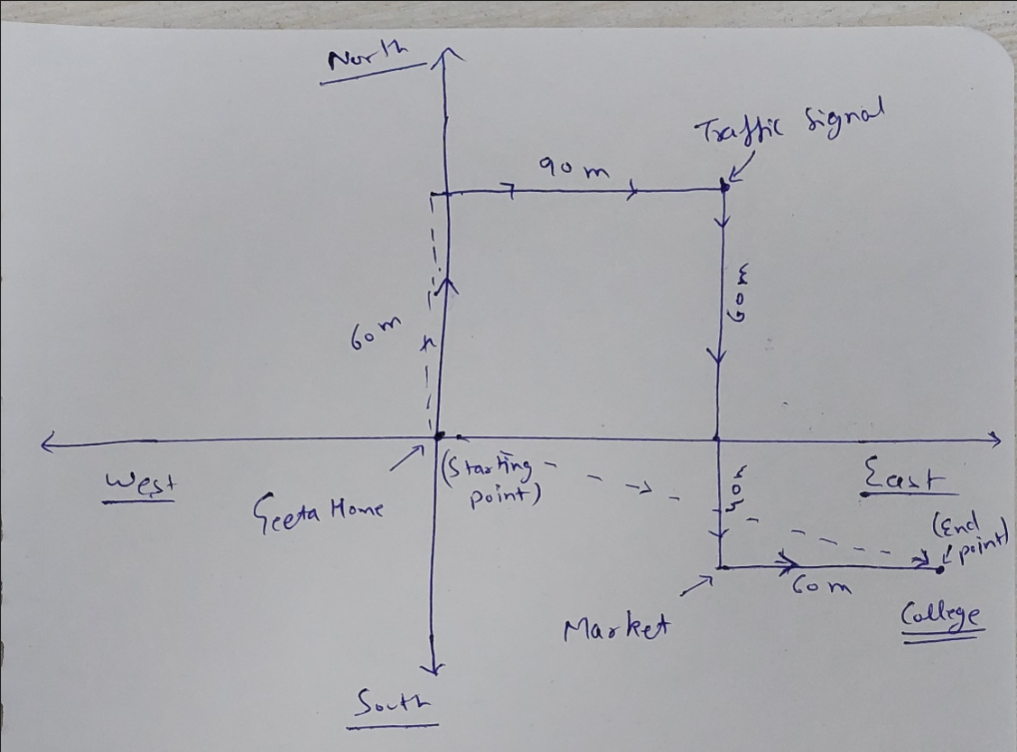
Geeta moves 60 metres in north from her home and then turns right. After walking 90 metres she reached Traffic signal. Then she turns right and moves 100 metres to reach market. Her college is 60 metres to the east of the market. In which direction is her college from her home ?

  1. ((a))

    North

  2. ((b))

    South

  3. ((c))

    North-East

  4. ((d))

    South-East

Show Answer
Answer: ((d))

South-East

Given:

Geeta moves 60 metres in north from her home and then turns right.

After walking 90 metres she reached Traffic signal.

Then she turns right and moves 100 metres to reach market.

Her college is 60 metres to the east of the market. 

Thus, Her College is in the South-east direction with respect to her Home.

Hence, "Option 4" is the correct answer.

33

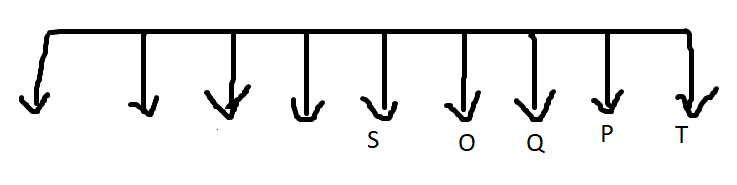
Nine friends M, N, O, P, Q, R, S, T and U are sitting in a row facing South, not necessarily in the same order.

U is to the left of M and at the third place at the left of N. T is at the end of the row. Q is between O and P. O is at the third place at the right of T. S is immediate right of O.

Who is sitting between M and N?

  1. ((a))

    R

  2. ((b))

    S

  3. ((c))

    T

  4. ((d))

    U

Show Answer
Answer: ((a))

R

According to the given information:

Nine friends M, N, O, P, Q, R, S, T and U are sitting in a row facing South, not necessarily in the same order.

T is at the end of the row

O is at the third place at the right of T

S is immediate right of O

Q is between O and P

U is to the left of M and at the third place at the left of N

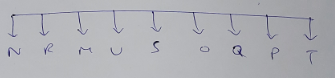
from these we get

Therefore, we see that R is sitting between M and N.

Hence, the correct answer is “Option 1’.

34

Given below is a question followed by two statements numbered (I) and (II), each containing some information. Decide which of the statement (s) is/are sufficient to answer the question.

Q: On which day of the week did Riya arrive?

Statement (I) : Her mother correctly remembers that she arrived before Wednesday but after Sunday.

Statement (II) : Her sister correctly remembers that she did not arrive on Monday.

  1. ((a))

    The statement (I) alone is sufficient to answer the question while the statement (II) alone is not sufficient.

  2. ((b))

    The statement (II) alone is sufficient to answer the question while the statement (I) alone is not sufficient.

  3. ((c))

    Both statements (I) and (II) together are necessary to answer the question.

  4. ((d))

    Both statements (I) and (II) together are not sufficient to answer the question.

Show Answer
Answer: ((c))

Both statements (I) and (II) together are necessary to answer the question.

Question:

On which day of the week did Riya arrive?

Statements I: Her mother correctly remembers that she arrived before Wednesday but after Sunday.

From statement (I) we can say that Riya arrived either on Monday or Tuesday .

Statement II: Her sister correctly remembers that she did not arrive on Monday.

From statement (II) we can say that Riya not arrived on Monday.

From both statements, we conclude that Riya arrived on "Tuesday".

Both statements (I) and (II) together are necessary to answer the question.

Hence, the correct answer is "Option 3".

35

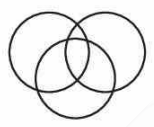
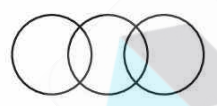
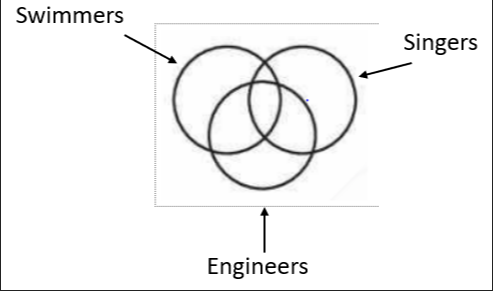
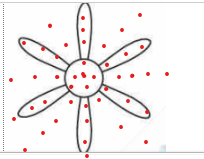
Select the option which best illustrates the three given classes.

Singers, Swimmers, Engineers.

  1. ((a))

  2. ((b))

  3. ((c))

  4. ((d))

Show Answer
Answer: ((b))

The logic followed here is:

→ Some Singers can be Swimmers, Engineers

→Some Swimmers can be Engineers, Singers

→Some Engineers can be Singers, Swimmers

The venn diagram representing the relation between Singers, Swimmers, Engineers is shown below,

Hence, the correct answer is "Option - (2)".

36

Which of the following video teleconferencing software is commonly used on Windows System and owned by Microsoft?

  1. ((a))

    Meet

  2. ((b))

    Webex

  3. ((c))

    Go To Meeting

  4. ((d))

    Skype

Show Answer
Answer: ((d))

Skype

The correct answer is Skype.

Key Points

  • Skype is a widely used video teleconferencing software owned by Microsoft.
  • It is compatible with multiple platforms, including Windows systems.
  • Skype allows for voice calls, video calls, and instant messaging between users.
  • Microsoft acquired Skype in 2011, making it an integral part of their suite of communication tools.

Additional Information

  • Other video teleconferencing software includes:
  • Meet (Google Meet): Developed by Google, used for video meetings and online collaboration.
  • Webex: Developed by Cisco, used for video conferencing, online meetings, and webinars.
  • Go To Meeting: Developed by LogMeIn, used for online meetings and video conferencing.
37

What is the default web browser used with a Microsoft Windows 10 machine?

  1. ((a))

    Edge

  2. ((b))

    Mosaic

  3. ((c))

    Opera

  4. ((d))

    Safari

Show Answer
Answer: ((a))

Edge

The correct answer is Edge.

Key Points

  • Edge is the default web browser used with a Microsoft Windows 10 machine.
  • Microsoft Edge is a web browser developed by Microsoft.
  • It was first released for Windows 10 and Xbox One in 2015, and later for other platforms.
  • Edge replaced Internet Explorer as the default browser on Windows 10.
  • Microsoft Edge is designed to be a lightweight web browser with a layout engine built around web standards.

Additional Information

  • Other browsers like Safari, Opera, and Mosaic are also popular but are not the default browser for Windows 10.
  • Safari is developed by Apple and is the default browser on macOS and iOS.
  • Opera is a freeware web browser developed by Opera Software.
  • Mosaic was one of the first web browsers, but it is now obsolete.
  • Microsoft Edge is integrated with Cortana and has extensions hosted on the Microsoft Store.
38

Expand the term EPROM:

  1. ((a))

    Electronic Programmable Read Only Memory

  2. ((b))

    Erasable Programmable Read Only Memory

  3. ((c))

    Electrically Programmable Read Only Memory

  4. ((d))

    Erase n Program Read Only Memory

Show Answer
Answer: ((b))

Erasable Programmable Read Only Memory

The correct answer is Erasable Programmable Read Only Memory.

Key Points

  • EPROM stands for Erasable Programmable Read Only Memory.
  • EPROM is a type of memory chip that retains its data when its power supply is switched off.
  • Data in an EPROM chip can be erased by exposing the chip to ultraviolet light.
  • Once erased, the chip can be reprogrammed with new data.
  • EPROMs are used in a variety of applications, including computer BIOS firmware and other embedded systems.
  • EPROM provides a reusable and flexible storage solution for firmware and software in electronic devices.

Additional Information

  • There are other types of non-volatile memory, such as EEPROM (Electrically Erasable Programmable Read-Only Memory) and Flash memory.
  • EEPROM can be erased and reprogrammed in-circuit, using electrical charge.
  • Flash memory is a type of EEPROM that can be erased and reprogrammed in large blocks.
  • Memory types have evolved to provide more flexibility, higher density, and faster access times.
  • Understanding the different types of memory and their characteristics is crucial for selecting the right memory for a specific application.
39

Which of the following file format is not supported in Windows Media Player?

  1. ((a))

    .mp3

  2. ((b))

    .pdf

  3. ((c))

    .wma

  4. ((d))

    .wmv

Show Answer
Answer: ((b))

.pdf

The correct answer is Option 2.

Key Points

  • Windows Media Player is a media player and media library application developed by Microsoft.
  • It is used for playing audio, video, and viewing images on personal computers running the Microsoft Windows operating system.
  • It supports file formats like .mp3, .wma, .wmv, and more.
  • PDF (.pdf) is a file format developed by Adobe and is not supported by Windows Media Player as it is not a media file format.
  • Therefore, PDF is not a supported file format in Windows Media Player.

Additional Information

  • Windows Media Player can also be used to rip music from and copy music to compact discs.
  • It supports synchronization with other digital media players and mobile devices.
  • Other popular media players include VLC Media Player, iTunes, and Spotify.
40

Which of the following feature is present in MS-PowerPoint but is not included in MS-Word?

  1. ((a))

    Transitions

  2. ((b))

    Tables

  3. ((c))

    Zoom

  4. ((d))

    Formatting

Show Answer
Answer: ((a))

Transitions

The correct answer is Transitions.

Key Points

  • Transitions are a feature in MS-PowerPoint that allows you to add visual effects when you move from one slide to the next.
  • MS-Word does not include transitions as it is primarily a word processing software.
  • Other features such as Tables, Zoom, and Formatting are present in both MS-PowerPoint and MS-Word.

Additional Information

  • MS-PowerPoint is a presentation program that is used to create slide shows composed of text, graphics, and other objects, which can be displayed on-screen and shown by the presenter or printed out on transparencies or slides.
  • MS-Word is a word processing program that is used to create, edit, format, and print documents.

Education and Leadership (60 questions)

41

What is the role of Primary socialising agency in Education?

  1. ((a))

    Formal Learning

  2. ((b))

    Development of skills

  3. ((c))

    Socialisation

  4. ((d))

    To inculcate values and beliefs

Show Answer
Answer: ((d))

To inculcate values and beliefs

Primary socialization is the process through which individuals learn and internalize the fundamental norms, values, beliefs, and behaviors of their society or culture. 

Key Points

  • Primary socializing agencies, particularly the family, play a crucial role in a child’s early development and significantly influence their education by inculcating values and beliefs.
  • These agencies, which also include close relatives, caregivers, and sometimes early childhood institutions, form the first environment in which a child begins to learn about the world, develop their identity, and understand societal norms.
  • Their impact is foundational, setting the stage for all future learning, both in and outside the classroom.

Hence, we can conclude that the role of the primary socializing agency in education is to inculcate values and beliefs.

42

Which one of the following is not a secondary socialising agency?

  1. ((a))

    School

  2. ((b))

    Family

  3. ((c))

    Society

  4. ((d))

    Media

Show Answer
Answer: ((b))

Family

Secondary socializing agencies are institutions and groups that contribute to an individual's socialization after the initial family-based socialization. These agencies help to develop further and refine the values, behaviors, and social skills that are foundationally established during primary socialization.

Key Points

  • Family: The most influential primary socializing agency. Parents and close family members teach children basic social norms, values, and behaviors.

Here are some secondary socializing agencies:

  • School: Schools play a crucial role in socializing individuals by teaching academic skills, social norms, and values. They also provide opportunities for children to interact with peers and learn about societal roles.
  • Peer Groups: Friends and peer groups influence social behavior, interests, and attitudes, providing an important social context outside of the family.
  • Media: Media, including television, the internet, and social media, exposes individuals to a wide range of information, cultural norms, and societal issues, shaping perceptions and behaviors.
  • Society: Society plays a pivotal role in shaping individuals beyond their immediate family, serving as a secondary socializing agent.

Hence, we can conclude that family is not a secondary socializing agency.

43

How can you bring Home and School together?

Through :

  1. ((a))

    frequent meetings with parents

  2. ((b))

    meeting of peer members

  3. ((c))

    teacher's conference

  4. ((d))

    seminars in schools

Show Answer
Answer: ((a))

frequent meetings with parents

Parent-teacher meetings are essential for fostering a strong partnership between parents and educators. They provide a valuable opportunity for open communication, collaboration, and shared goal-setting.

Key Points

  • Regular meetings help to build trust and understanding between parents and teachers, facilitating effective communication.
  • When parents and teachers work together, they can create a more supportive learning environment that leads to improved student outcomes.
  • Identifying potential issues early can prevent them from escalating. Parent-teacher meetings provide a platform for discussing concerns and developing strategies to address them.
  • When parents feel involved and informed, they are more likely to be engaged in their child's education. This can lead to increased motivation and academic success.

Hence, we can conclude that through frequent meetings with parents a teacher can bring Home and School together.

44

The role of PTA in school is:

  1. ((a))

    to discuss the student problems with the management.

  2. ((b))

    to give constructive suggestions for school development.

  3. ((c))

    to attend school programs.

  4. ((d))

    to find fault with school programs.

Show Answer
Answer: ((b))

to give constructive suggestions for school development.

The Parent-Teacher Association is an organized group of parents, teachers, and sometimes students, working together to support and enhance the educational experience of students in a school. 

Key Points

  • The primary purpose of a Parent-Teacher Association is to foster cooperation between parents and teachers, ensuring that students receive the best possible education and school environment.
  • The Parent-Teacher Association provides feedback and ideas aimed at improving the school environment, educational programs, facilities, and student welfare.
  • This can include suggestions on enhancing teaching methods, extracurricular activities, infrastructure, and community involvement.
  • Parent-Teacher Association contributes to the strategic development of the school by addressing academic, social, and operational aspects.
  • They help bridge the gap between parents, students, and the school, creating a stronger, more cohesive educational experience.

Hence, we can conclude that the role of Parent-Teacher Association is to give constructive suggestions for school development.

45

Which one of the following could be community resource in learning?

  1. ((a))

    Cinema hall

  2. ((b))

    Temple

  3. ((c))

    Horse stable

  4. ((d))

    Fire station

Show Answer
Answer: ((d))

Fire station

Community resources in learning are materials, facilities, or individuals from the local community that support educational experiences. 

Key Points

  • A fire station can serve as a community resource in learning by providing educational programs on fire safety, emergency response, and the role of firefighters.
  • It offers practical, real-world insights and hands-on experiences that can enhance learning beyond traditional classroom settings.

​Thus, it is concluded that Fire station could be community resource in learning.

46

According to NEP 2020 Balvatika is __________.

  1. ((a))

    Education received from age 3 - 5 years

  2. ((b))

    Education upto class VIII

  3. ((c))

    Education received in primary stage from class I to V

  4. ((d))

    Education received from age 5 to 10 years

Show Answer
Answer: ((a))

Education received from age 3 - 5 years

NEP 2020 states that ‘prior to the age of 5 every child will move to a “Preparatory Class” or “Balvatika” (that is before Class 1) which has an ECCE-qualified teacher’.

Key Points

  • The Balvatika programme is envisaged as a one-year programme before Grade 1 which is meant to prepare children with cognitive and linguistic Competencies that are prerequisites for learning to read, write and develop number sense through a play-based approach.
  • NCERT has developed guidelines and processes for three years of preschool including the Balvatika.

Thus, it is concluded that According to NEP 2020 Balvatika is Education received from age 3 - 5 years.

47

'Spencer' described education as :

  1. ((a))

    Meaningful life

  2. ((b))

    Complete living

  3. ((c))

    Self learning

  4. ((d))

    Preparation for life

Show Answer
Answer: ((b))

Complete living

Herbert Spencer, a prominent philosopher, described education as preparation for a "complete living."

 Key PointsAccording to him, education should equip individuals with the knowledge and skills necessary to navigate all aspects of life, including:

  • Personal development
  • Earning a livelihood
  • Raising a family
  • Social and civic responsibilities
  • Intellectual and moral growth

This holistic perspective emphasizes that education's purpose goes beyond vocational training or theoretical knowledge; it is about preparing individuals for a well-rounded and fulfilling life.

Thus, it is concluded that 'Spencer' described education as complete living.

48

Hidden Curriculum is _________.

  1. ((a))

    Prescribed formal syllabus

  2. ((b))

    Curriculum hidden in the text

  3. ((c))

    Focus on informal gaining of values and beliefs

  4. ((d))

    Syllabus practised by school

Show Answer
Answer: ((c))

Focus on informal gaining of values and beliefs

The hidden curriculum refers to the informal transmission of values, beliefs, and social norms that occur within the educational setting, beyond the formal syllabus and official curriculum.

 Key Points It includes the norms, behaviors, and social expectations imparted through:

  • Teacher-student interactions.
  • Classroom environment and school culture.
  • Peer relationships and social dynamics.

For example:

  • Learning punctuality through adherence to school timings.
  • Developing respect for authority by following rules.
  • Understanding societal hierarchies through group interactions.

Thus, it is concluded that Hidden Curriculum is focus on informal gaining of values and beliefs.

49

The boys and girls expect ______  from school in the adolescent stage.

  1. ((a))

    Emotional support

  2. ((b))

    Co-operation

  3. ((c))

    Sympathy

  4. ((d))

    Empathy

Show Answer
Answer: ((a))

Emotional support

Emotional support is the primary need during adolescence as it lays the foundation for their mental well-being and self-confidence.

Key Points During the adolescent stage, boys and girls undergo significant physical, emotional, and social changes. They often face challenges such as identity formation, peer pressure, and emotional instability. In this phase, schools play a critical role in providing emotional support by:

  • Creating a safe and inclusive environment.
  • Offering counseling services to address their emotional needs.
  • Encouraging supportive teacher-student relationships to help them navigate this critical developmental period.

Thus, it is concluded that the boys and girls expect emotional support from school in the adolescent stage.

50

Moral domain category is :

  1. ((a))

    Nothing but responsibility

  2. ((b))

    Differentiating between right and wrong

  3. ((c))

    Feeling

  4. ((d))

    Recognising

Show Answer
Answer: ((b))

Differentiating between right and wrong

The moral domain refers to an individual's ability to discern between what is right and wrong and make decisions based on ethical and moral principles.

Key PointsIt includes:

  • Moral reasoning: Understanding and applying ethical principles.
  • Moral behavior: Acting in ways that align with one's moral beliefs.
  • Moral development: Evolving one's sense of justice, fairness, and responsibility over time.

Thus, it is concluded that moral domain category is differentiating between right and wrong.

51

_________ is the behavioural trait in adoloscent.

  1. ((a))

    Frustration

  2. ((b))

    Mal adjustment

  3. ((c))

    Aggression

  4. ((d))

    Struggle with their identity

Show Answer
Answer: ((d))

Struggle with their identity

A key behavioral trait in adolescents is their struggle with identity, as described by psychologist Erik Erikson in his stage of Identity vs. Role Confusion.

Key Points During this stage, adolescents are:

  • Exploring who they are (values, beliefs, aspirations).
  • Trying to establish a clear sense of self and personal identity.
  • Balancing societal expectations with their own emerging desires and goals.

Thus, it is concluded that Struggle with their identity is the behavioural trait in adoloscent.

52

What is 'Pedagogy'?

  1. ((a))

    It is broad range of teaching methodology including assessment and instructions.

  2. ((b))

    Type of learning activity

  3. ((c))

    Group of teaching learning materials

  4. ((d))

    Lesson Plan execution

Show Answer
Answer: ((a))

It is broad range of teaching methodology including assessment and instructions.

Pedagogy is the theory and practice of teaching, focusing on how teachers facilitate learning in various settings. It is not limited to delivering content but encompasses all aspects of education, including strategies, relationships, tools, and approaches.

Key Points

  • Pedagogy encompasses the strategies, methods, and techniques used by educators to facilitate learning, including assessment practices and instructional approaches tailored to students' needs and abilities.
  • It focuses on creating an engaging and inclusive learning environment that promotes active participation, critical thinking, and meaningful learning experiences for students.

Thus, it is concluded that Pedagogy is broad range of teaching methodology including assessment and instructions.

53

Instructions in mother tongue at Primary stage of education deals under which Article of Constitution of India?

  1. ((a))

    Article 29

  2. ((b))

    Article 510

  3. ((c))

    Article 350 (A)

  4. ((d))

    Article 239

Show Answer
Answer: ((c))

Article 350 (A)

Article 350(A) of the Constitution of India emphasizes the importance of providing education in the mother tongue, particularly at the primary stage.

Key Points This Article states:

"It shall be the endeavor of every State and of every local authority within the State to provide adequate facilities for instruction in the mother tongue at the primary stage of education to children belonging to linguistic minority groups.

Thus, it is concluded that Instructions in mother tongue at Primary stage of education deals under Article 350 (A).

54

Learning space in school means:

  1. ((a))

    Well ventilated classroom

  2. ((b))

    Well set classroom with non-threatning environment

  3. ((c))

    ICT tools in classroom

  4. ((d))

    Comfortable desks

Show Answer
Answer: ((b))

Well set classroom with non-threatning environment

A learning space in school refers to a well-organized classroom environment that promotes student engagement, collaboration, and learning

 Key PointsKey aspects include:

  • Physical Setup: Organized and flexible classroom layout to facilitate interaction and engagement.
  • Non-Threatening Environment: A safe, inclusive, and supportive atmosphere where students feel encouraged to participate and express themselves without fear.
  • Emotional Comfort: Fostering a positive teacher-student relationship and mutual respect.
  • Learning Resources: Availability of materials, including ICT tools, but their presence alone doesn't define the space.

Thus, it is concluded that Learning space in school means well set classroom with non-threatning environment.

55

'Maturation' with reference to child growth is :

  1. ((a))

    Feelings

  2. ((b))

    Physical, Psychological and adaptive changes in child's growth

  3. ((c))

    Interest

  4. ((d))

    Emotion

Show Answer
Answer: ((b))

Physical, Psychological and adaptive changes in child's growth

Maturation refers to the natural process of growth and development in a child that unfolds over time, influenced primarily by genetic factors.

 Key Points It encompasses:

  • Physical changes: Growth in height, weight, motor skills, and bodily functions.
  • Psychological changes: Cognitive abilities, emotional regulation, and social understanding.
  • Adaptive changes: Behavioral and skill development to interact effectively with the environment.

Thus, it is concluded that 'Maturation' with reference to child growth is Physical, Psychological and adaptive changes in child's growth.

56

Which types of relationship enhances learning among teachers and students?

  1. ((a))

    Social Relationship

  2. ((b))

    Official Relationship

  3. ((c))

    Emotional Relationship

  4. ((d))

    Cordial Relationship

Show Answer
Answer: ((c))

Emotional Relationship

Relationships between teachers and students strongly affect learning. When emotions such as trust, care, and empathy are part of the relationship, students feel safe and supported, which enhances both academic and personal development.

Key Points

  • An emotional relationship helps students connect deeply with their teachers, making them more receptive to learning.
  • When a teacher understands students’ feelings and responds with empathy, it builds confidence, reduces anxiety, and motivates learners to perform better.

Hint

  • Social Relationship is general and not specific to learning outcomes.
  • Official Relationship is formal and does not build strong trust.
  • Cordial Relationship implies friendliness but lacks the depth of emotional connection required for effective learning.

Hence, the most impactful relationship for enhancing learning is the emotional relationship between teachers and students.

57

'DIKSHA' Programme by ministry of Education is about:

  1. ((a))

    Free uniform and text books in Primary education

  2. ((b))

    Digital Infrastructure resources

  3. ((c))

    Operation Black Board

  4. ((d))

    Universalisation of Primary education

Show Answer
Answer: ((b))

Digital Infrastructure resources

DIKSHA (Digital Infrastructure for Knowledge Sharing) is a program launched by the Ministry of Education, Government of India, to provide a comprehensive digital infrastructure for education.

 Key Points It is designed to:

  • Offer teachers and students access to a vast repository of educational resources.
  • Provide e-learning materials, lesson plans, and assessments aligned with the curriculum.
  • Facilitate teacher training and professional development through online modules.
  • Support multiple languages and platforms to make learning inclusive and accessible.

Thus, it is concluded that 'DIKSHA' Programme by ministry of Education is about Digital Infrastructure resources.

Hint

  • Free uniform and textbooks: This is related to schemes like Sarva Shiksha Abhiyan or Samagra Shiksha Abhiyan, not DIKSHA.
  • Operation Black Board : A 1987 initiative to improve infrastructure in primary schools.
  • Universalisation of Primary Education: A broader goal under various education policies, not specific to DIKSHA.
58

The urgent requirement in schools with respect to Learning process as emphasised in NEP 2020 is:

  1. ((a))

    Foundational Literacy and numeracy

  2. ((b))

    Scientific temper

  3. ((c))

    Numerical aptitude

  4. ((d))

    Critical thinking

Show Answer
Answer: ((a))

Foundational Literacy and numeracy

NEP 2020 (National Education Policy) emphasizes that achieving Foundational Literacy and Numeracy (FLN) is the most urgent and critical requirement in the early stages of schooling.

Key Points

  • The National Initiative for Proficiency in Reading with Understanding and Numeracy (NIPUN Bharat) aims to ensure that every child attains foundational literacy and numeracy by Grade 3.
  • Focus on activity-based, play-based, and experiential learning methods.
  • Regular assessments to identify learning gaps and provide targeted interventions.

Thus, it is concluded that The urgent requirement in schools with respect to Learning process as emphasised in NEP 2020 is Foundational Literacy and numeracy.

59

What is informal education?

  1. ((a))

    Education gained in spiritual centers

  2. ((b))

    Education given in Primary education

  3. ((c))

    Education gained through various sources in life

  4. ((d))

    Education given in organised setup

Show Answer
Answer: ((c))

Education gained through various sources in life

Informal education refers to the learning that occurs outside of a structured or organized educational setup. 

Key PointsIt is:

  • Unstructured: Not bound by formal curriculum or set timings.
  • Unintentional or Voluntary: Often happens as a byproduct of daily experiences and interactions.
  • Lifelong: Continues throughout an individual's life as they encounter new environments, challenges, and opportunities.

Thus, it is concluded that Education gained through various sources in life is informal education.

60

What is 'Phonology' in Language development of a child?

  1. ((a))

    Using grammar

  2. ((b))

    Communication

  3. ((c))

    Understanding rules

  4. ((d))

    Creating sound speech

Show Answer
Answer: ((d))

Creating sound speech

Phonology refers to the study of the sound systems of languages and the rules for their combination and pronunciation.

Key Points This includes:

  • The production, perception, and organization of sounds in speech: This involves learning how to make the different sounds used in a language, how to distinguish between them, and how they combine to form words and sentences.
  • The rules and patterns that govern how sounds are used: This includes understanding things like syllable structure, stress, and intonation.

Therefore, creating sound speech is the answer because it highlights the core concept of phonology: understanding and using the sound system of a language.

61

What is Experiential Learning?

  1. ((a))

    Group discussion mode of Learning

  2. ((b))

    Hands on Learning

  3. ((c))

    Informal Learning

  4. ((d))

    Sports integrated Learning

Show Answer
Answer: ((b))

Hands on Learning

Experiential Learning refers to Hands-on Learning. It is a process through which individuals learn by actively engaging in experiences and reflecting on them. 

Key Points

  • This type of learning emphasizes learning through doing and encourages learners to apply their knowledge and skills in real-world contexts.
  • It involves four key stages: concrete experience, reflective observation, abstract conceptualization, and active experimentation.
  • By reflecting on and analyzing their experiences, learners can develop critical thinking, problem-solving skills, and the ability to adapt to new situations.

Thus, it is concluded that Experiential Learning is hands-on learning.

62

__________ enhances Learning in classrooms.

  1. ((a))

    Questioning technique

  2. ((b))

    Lecture methods

  3. ((c))

    Use of A.V. Aids

  4. ((d))

    Use of Black Boards

Show Answer
Answer: ((c))

Use of A.V. Aids

The use of audio-visual aids enhances learning in classrooms by catering to diverse learning styles, reinforcing concepts through visual and auditory stimuli, and increasing student engagement.

 Key Points

  • A.V. aids, such as videos, projectors, charts, audio recordings, and interactive digital tools, can make learning more engaging, clear, and interactive.
  • It can make abstract concepts more concrete, facilitate better comprehension, and create memorable learning experiences.
  • ​ By incorporating multimedia elements, teachers can capture students' attention, improve retention of information, and create a more dynamic learning environment.

Thus, it is concluded that the Use of A.V. Aids enhances learning in classrooms.

63

Environment is an element of:

  1. ((a))

    Constructivism

  2. ((b))

    Realism

  3. ((c))

    Connectivism

  4. ((d))

    Behaviourism

Show Answer
Answer: ((d))

Behaviourism

In the context of learning theories, environment is a key element of Behaviorism.

Key Points

  • In Behaviorism, the environment plays a central role in shaping and controlling behavior.
  • According to behaviorist theory, learning is a result of responses to environmental stimuli.
  • Behaviorists believe that all behaviors are acquired through conditioning, either classical or operant.
  • The environment provides the stimuli that trigger responses, and through reinforcement or punishment, behaviors are strengthened or weakened.

Thus, it is concluded that Environment is an element of Behaviourism.

64

What is the purpose of curriculum in Schools?

  1. ((a))

    To standardize learning goals

  2. ((b))

    To conduct timely examination

  3. ((c))

    To achieve instructional objectives

  4. ((d))

    To complete syllabus in time

Show Answer
Answer: ((c))

To achieve instructional objectives

The curriculum is designed to provide a structured framework for delivering education, ensuring that students achieve the intended learning outcomes.

Key Points

  • Achieving instructional objectives is the most appropriate purpose because curriculum is designed to help teachers plan lessons and activities in a way that ensures learners develop knowledge, skills, and attitudes as envisioned in educational aims.
  • It links broader educational goals with actual classroom practices, making teaching purposeful rather than mechanical. By aligning learning activities with objectives, it ensures holistic student development.

Hint

  • Conducting timely examinations is a part of the assessment process but not the main purpose of the curriculum.
  • Completing the syllabus in time is a matter of classroom planning and time management. It supports curriculum implementation but does not define its core purpose.
  • Standardizing learning goals helps maintain consistency, but it is only a part of the broader purpose.

Hence, the correct answer is to achieve instructional objectives.

65

The meaning of Learning is:

  1. ((a))

    Achieving high academic excellance

  2. ((b))

    Gaining knowledge

  3. ((c))

    Manipulation of circumstances

  4. ((d))

    Positive altered behaviour

Show Answer
Answer: ((d))

Positive altered behaviour

Learning is a fundamental process through which individuals acquire knowledge, skills, behaviors, and attitudes.

Key Points

  • The correct definition of learning is positive altered behavior.
  • Learning is often described as a change in behavior or thinking as a result of experience or education.
  • It involves not only acquiring knowledge but also modifying one's behavior, actions, or thought processes based on that knowledge.
  • This change can be evident in improved skills, attitudes, or the ability to adapt to new situations.

Hint

  • Achieving high academic excellence refers to academic success, but learning itself is not solely about high grades or achievements; it’s a broader process.
  • Gaining knowledge is an important aspect of learning, but it doesn't encompass the entire process, as learning involves applying that knowledge in real-life contexts.
  • Manipulation of circumstances is not an accurate definition of learning, as it doesn't reflect the holistic nature of the learning process, which includes internal change and growth.

Hence, the correct answer is positive altered behavior.

66

When the child is directly exposed to life situation, the learning is called:

  1. ((a))

    Natural Learning

  2. ((b))

    Connectivity Learning

  3. ((c))

    Experiential Learning

  4. ((d))

    Realistic Learning

Show Answer
Answer: ((c))

Experiential Learning

Experiential Learning is a learning process in which students actively engage in an activity, and then reflect on the experience, thus gaining knowledge and skills from it.

 Key Points

  • This type of learning goes beyond traditional classroom methods, such as reading textbooks or listening to lectures.
  • It emphasizes hands-on learning, reflection, and active experimentation, allowing learners to make connections between theory and practice and apply their knowledge in meaningful contexts.

​Thus, it is concluded that when the child is directly exposed to life situations, the learning is called Experiential Learning.

67

NEP 2020, has modified the structure/Pattern of school education as :

  1. ((a))

    8 + 2 + 2 + 3

  2. ((b))

    5 + 3 + 3 + 4

  3. ((c))

    10 + 2 + 3

  4. ((d))

    5 + 5 + 2 + 3

Show Answer
Answer: ((b))

5 + 3 + 3 + 4

The new National education policy must provide to all students, irrespective of their place of residence, a quality education system, with a particular focus on historically marginalized, disadvantaged, and underrepresented groups.

Key Points

According to the National Education Policy (NEP) 2020, the structure of school education has been modified to the following pattern:

  • 5 years of Foundational Stage (age 3-8 years): This includes 3 years of preschool (Anganwadi/Preschool) and 2 years of primary education.
  • 3 years of Preparatory Stage (age 8-11 years): Classes 3 to 5.
  • 3 years of Middle Stage (age 11-14 years): Classes 6 to 8.
  • 4 years of Secondary Stage (age 14-18 years): Classes 9 to 12.

This new structure aims to align with the child’s developmental stages and ensure a more holistic and flexible education system.

Thus, it is concluded that NEP 2020, has modified the structure/Pattern of school education as 5 + 3 + 3 + 4.

68

By visiting a forest what the child will be able to develop ?

  1. ((a))

    Self exploring capacity

  2. ((b))

    Thinking ability

  3. ((c))

    Power of expression

  4. ((d))

    Imagination Power

Show Answer
Answer: ((a))

Self exploring capacity

Visiting a forest provides a child with opportunities to engage with the natural environment, encouraging curiosity and self-exploration.

 Key Point

  • This helps them to develop a deeper understanding of nature, cultivate their observational skills, and enhance their ability to explore and inquire independently.
  • In such an environment, children are likely to ask questions, observe the surroundings, and discover things on their own, which fosters their self-exploring capacity.

Thus, it is concluded that By visiting a forest, a child can develop their self-exploring capacity.

69

The main Professional responsibility of a headmaster apart from administration is:

  1. ((a))

    Supervision

  2. ((b))

    Liason with the authorities

  3. ((c))

    Controlling the school

  4. ((d))

    Teaching

Show Answer
Answer: ((d))

Teaching

The primary role of a headmaster, or principal, in an educational institution is to serve as the instructional leader. 

Key Points

  • The fundamental responsibility of a headmaster, aside from managing the school's operations, is teaching.
  • This encompasses a variety of roles that are directly related to the educational process. A headmaster is expected to guide the curriculum, mentor teachers to improve their instructional methods, and occasionally even teach classes to stay connected with the student body.
  • This hands-on involvement ensures that the headmaster remains a key figure in the academic life of the institution, directly influencing the quality of education provided.

Hint

  • Supervision: While supervision of staff and students is a key function of a headmaster, it is part of the broader administrative and leadership role rather than a distinct primary professional responsibility.
  • Liaison with the authorities: This duty involves communicating with government bodies, educational boards, and other external organizations. While crucial for compliance and a school's reputation, it is a facet of the headmaster's administrative and public relations duties.
  • Controlling the school: This phrase is too broad and can be seen as encompassing the entire administrative function, including discipline and management. It is not a specific professional responsibility separate from administration but rather a general description of the headmaster's authority.

Hence, the correct answer is Teaching.

70

What may not be function of education?

  1. ((a))

    Transmitting knowledge to the society

  2. ((b))

    Spreading orthodox and superstitions

  3. ((c))

    Transformation of society

  4. ((d))

    Healthy society

Show Answer
Answer: ((b))

Spreading orthodox and superstitions

 Key Points

  • Education is intended to transmit knowledge, promote the transformation of society, and contribute to the creation of a healthy society.
  • However, spreading orthodox beliefs and superstitions is not a function of education, as education aims to encourage critical thinking, rationality, and the growth of knowledge, which can counteract such practices.

Thus, it is concluded that Spreading orthodox and superstitions is not a function of education.

71

Learning disability is called:

  1. ((a))

    Dysgraphia

  2. ((b))

    Dyscalcula

  3. ((c))

    Dyslexia

  4. ((d))

    All of the above

Show Answer
Answer: ((d))

All of the above

Learning Disability (LD) refers to a neurological condition that affects an individual's ability to acquire, process, and retain information.

Key Points Learning disabilities encompass various conditions, including:

  • Dysgraphia – A writing disorder that affects handwriting, spelling, and the ability to express thoughts on paper.
  • Dyscalculia – A learning disability that affects the ability to understand numbers and perform mathematical calculations.
  • Dyslexia – A reading disorder that affects the ability to decode written words, leading to difficulty with reading fluency and comprehension.

Thus, it is concluded that all of the above is the correct answer.

72

The community is an important Teaching-Learning centre, why?

  1. ((a))

    Extension of school activities

  2. ((b))

    Provides learning opportunities in real settings

  3. ((c))

    Substitute to schools

  4. ((d))

    Informal learning source.

Show Answer
Answer: ((b))

Provides learning opportunities in real settings

The community is an important teaching-learning center because it provides learning opportunities in real settings.

 Key Points

  • By engaging with the community, students can experience hands-on learning that connects classroom knowledge to the real world.
  • For instance, students might visit local businesses, engage in community service, or participate in local environmental projects, all of which help them apply their academic learning to practical situations.
  • This exposure allows students to develop essential life skills, such as problem-solving, communication, and teamwork, in authentic contexts.
  • Furthermore, learning in the community helps students understand the relevance of their education and enhances their ability to work with diverse groups of people.
  • Thus, the community offers a valuable extension of the school, providing meaningful learning experiences that go beyond traditional classroom settings.

Thus, it is concluded that The community serves as a crucial Teaching-Learning centre because it provides learning opportunities in real settings.

73

Which Ministry introduced 'Manodarpan' scheme?

  1. ((a))

    Ministry of Civil Aviation

  2. ((b))

    Ministry of Agriculture

  3. ((c))

    Ministry of Commerce and Industry

  4. ((d))

    Ministry of Education.

Show Answer
Answer: ((d))

Ministry of Education.

The Manodarpan scheme was launched by the Ministry of Education under the Government of India in response to the challenges posed by the COVID-19 pandemic.

 Key Points

  • Its primary objective is to provide psychological support and counseling services to students, teachers, and families during these difficult times.
  • The initiative is part of the larger efforts to address the mental health and emotional well-being of individuals affected by the disruptions in education caused by the pandemic.
  • Through Manodarpan, the Ministry aims to make mental health resources easily accessible and reduce the stigma associated with seeking psychological help.
  • The scheme includes setting up helplines, providing online counseling sessions, and promoting mental health awareness within educational institutions.

Thus, it is concluded that The 'Manodarpan' scheme was introduced by the Ministry of Education.

74

Which one of the following is severe mental disorder?

  1. ((a))

    Schizophrenia

  2. ((b))

    Anxiety

  3. ((c))

    Depression

  4. ((d))

    Bipolar disorder.

Show Answer
Answer: ((a))

Schizophrenia

 Key Points

  • Schizophrenia is considered a severe mental disorder because it significantly affects a person's thinking, emotions, and behavior, often causing a detachment from reality (psychosis).
  • Individuals with schizophrenia may experience hallucinations, delusions, disorganized thinking, and severe cognitive impairments, which can profoundly disrupt their daily functioning and ability to interact with others.
  • It requires long-term treatment and management to help individuals cope with the symptoms.

Thus, it is concluded that Schizophrenia is severe mental disorder.

75

The common mental disorder among children in the school is :

  1. ((a))

    Sensory disorder

  2. ((b))

    Social disorder

  3. ((c))

    Anxiety disorder

  4. ((d))

    Behavioural disorder.

Show Answer
Answer: ((c))

Anxiety disorder

Anxiety disorders are among the most common mental health issues faced by children in school.

 Key Points

  • These disorders can manifest as excessive fear, worry, or unease about various aspects of life, including academic performance, social interactions, or future events.
  • Anxiety can significantly impact a child's ability to focus, participate in class, and develop healthy social relationships.
  • It may also affect physical health, leading to symptoms like headaches, stomachaches, and sleep disturbances.
  • Early intervention and support are essential to help children manage anxiety and reduce its impact on their overall well-being and academic success.

Thus, it is concluded that the common mental disorder among children in the school is Anxiety disorder.

76

The root cause of mental illness among school children is :

  1. ((a))

    Heredity and Psychological stress

  2. ((b))

    Nutrition

  3. ((c))

    Home atmosphere

  4. ((d))

    Peer behaviour

Show Answer
Answer: ((a))

Heredity and Psychological stress

Mental illness in school children can arise due to a combination of genetic (hereditary) factors and psychological stressors.

 Key Points

  • Heredity can contribute to predispositions for certain mental health disorders, while psychological stress such as trauma, bullying, academic pressure, or family problems can trigger or exacerbate mental health issues.
  • Both factors can interact, leading to a greater risk of mental illness in children.

Thus, it is concluded that the root cause of mental illness among school children is Heredity and Psychological stress.

77

Which step would form intervention for Divyangjan ?

  1. ((a))

    Physical support

  2. ((b))

    Assess and Assist

  3. ((c))

    Emotional support

  4. ((d))

    Physical therapy

Show Answer
Answer: ((b))

Assess and Assist

Intervention for Divyangjan (persons with disabilities) often begins with assessing their specific needs and challenges.

 Key Points

  • This assessment helps in identifying the required support and assistance, whether it's physical, emotional, or therapeutic. Once the assessment is done, tailored interventions can be provided to help the individual most effectively.
  • "Assess and Assist" involves understanding the unique requirements of the person and offering the necessary resources, whether in the form of physical support, therapy, or emotional encouragement.
  • This step is foundational in providing proper care and helping Divyangjan lead a more empowered and independent life.

Thus, it is concluded that Assess and Assist step would form intervention for Divyangjan.

78

How can Intellectual disability be identified in classroom?

  1. ((a))

    Restlessness

  2. ((b))

    Loneliness

  3. ((c))

    Poor Comprehension

  4. ((d))

    Maladjustment.

Show Answer
Answer: ((c))

Poor Comprehension

Intellectual Disability (ID) refers to a condition characterized by limitations in both intellectual functioning and adaptive behavior.

Key Points

  • Intellectual disability in the classroom can often be identified through signs such as poor comprehension, where students may struggle to understand instructions, concepts, or ideas at the same level as their peers.
  • Children with intellectual disabilities may also have difficulties with reasoning, problem-solving, and grasping abstract concepts, which can manifest as poor comprehension of academic material.

Thus, it is concluded that Intellectual disability in a classroom can be identified through poor comprehension.

79

To address mild mental health issue, what should the school do?

  1. ((a))

    Counselling

  2. ((b))

    Medical intervention

  3. ((c))

    Frequent interaction with Parents

  4. ((d))

    Integrating social emotional Learning.

Show Answer
Answer: ((d))

Integrating social emotional Learning.

Mental health issues refer to a wide range of conditions that affect an individual’s emotional, psychological, and social well-being. 

Key Points

  • To address mental health issues in schools effectively, integrating social-emotional learning (SEL) is one of the most impactful strategies.
  • SEL teaches students essential skills such as recognizing and managing their emotions, developing empathy, setting goals, building positive relationships, and making responsible decisions.
  • By incorporating SEL into the curriculum, schools create an environment where students are better equipped to cope with stress, build resilience, and navigate social challenges, which are key to preventing and addressing mental health concerns.
  • This approach not only supports emotional well-being but also contributes to academic success by fostering a positive and supportive school culture.

Thus, it is concluded that Integrating social emotional learning is the correct answer.

80

The role of Parent to address mental health issue among children is :

  1. ((a))

    Spending quality time with adolescents, enjoying shared activities

  2. ((b))

    Medical intervention

  3. ((c))

    Appointing counsellors at home

  4. ((d))

    Parents should have awareness on adolescent issues.

Show Answer
Answer: ((a))

Spending quality time with adolescents, enjoying shared activities

Parents play a crucial role in addressing mental health issues among children, particularly during adolescence.

Key Points

  • By spending quality time with their children and engaging in shared activities, parents can strengthen their bond with their children, create a supportive environment, and encourage open communication.
  • This involvement helps in recognizing potential mental health issues early and provides emotional support.

Thus, it is concluded that the role of Parents to address mental health issue among children is spending quality time with adolescents, enjoying shared activities.

81

The vision and philosophy of a school will be reflected in ____________.

  1. ((a))

    School Prospectus

  2. ((b))

    Institutional Plan

  3. ((c))

    School Development Plan

  4. ((d))

    School Magazine

Show Answer
Answer: ((c))

School Development Plan

The School Development Plan (SDP) is indeed the document where the vision and philosophy of a school are most directly reflected.

Key Points

  • The School Development Plan outlines the goals, strategies, and initiatives the school will undertake to achieve its vision and improve educational outcomes.
  • It serves as a roadmap for the school's growth and development, aligning its mission and educational philosophy with practical steps for implementation.

Thus, it is concluded that the vision and philosophy of a school will be reflected in School Development Plan.

82

A leader should be:

  1. ((a))

    Inspiration and Director

  2. ((b))

    Manager

  3. ((c))

    Producer

  4. ((d))

    Financier

Show Answer
Answer: ((a))

Inspiration and Director

A leader inspires and motivates others, guiding them toward a common vision or goal.

 Key Points

  • They direct the efforts of the team, providing guidance, support, and strategic direction.
  • Leadership is not just about managing tasks, producing results, or handling finances; it involves inspiring people, setting a clear direction, and helping them to achieve their potential.
  • This involves setting a clear direction, being a role model, and encouraging others to achieve their best.

​Thus, it is concluded that A leader should be Inspiration and Director.

83

The Headmaster, to make proper planning will take the help of _________.

  1. ((a))

    District collector

  2. ((b))

    School management

  3. ((c))

    Local authorities

  4. ((d))

    Pupils, teachers and parents

Show Answer
Answer: ((d))

Pupils, teachers and parents

To make proper planning, the headmaster should take the help of pupils, teachers, and parents.

 Key Points

  • These groups provide valuable insights into the needs and challenges of the school, as well as the educational environment.
  • Teachers contribute to understanding the curriculum and student needs, pupils provide feedback on their learning experiences, and parents offer perspectives on home and community factors that affect learning.
  • This collaborative approach ensures that the planning process is inclusive and addresses the diverse aspects of the school community.

Thus, it is concluded that the headmaster, to make proper planning will take the help of pupils, teachers, and parents.

84

The Foremost important character of a school leader is :

  1. ((a))

    Co-operation

  2. ((b))

    Qualification

  3. ((c))

    Conviction

  4. ((d))

    Aggression

Show Answer
Answer: ((c))

Conviction

The foremost important characteristic of a school leader is conviction.

 Key Points

  • A leader with strong conviction is driven by clear values, beliefs, and a commitment to the mission of the school.
  • This inner strength and determination inspire others to follow the leader’s vision and goals.
  • Conviction ensures that the leader remains focused on improving education, supporting teachers, and guiding students, even in the face of challenges.

Thus, it is concluded that The foremost important character of a school leader is conviction.

85

As per the Idea of Transformational Leadership, an effective leader should:

  1. ((a))

    motivate and inspires people.

  2. ((b))

    coach a person to realise his potential.

  3. ((c))

    set the pace for his own organization.

  4. ((d))

    provide General direction and tools for goal achievement.

Show Answer
Answer: ((a))

motivate and inspires people.

According to the idea of Transformational Leadership, an effective leader focuses on motivating and inspiring their team to achieve higher levels of performance and personal growth.

 Key Point

  • This leadership style emphasizes vision, enthusiasm, and creating an environment where individuals feel valued and empowered to reach their full potential.
  • Transformational leaders encourage creativity, foster innovation, and lead by example, making them more effective at driving change and achieving organizational goals.
  • The key aspect of transformational leadership, however, is motivating and inspiring people to not just meet but exceed expectations.

Thus, it is concluded that as per the Idea of Transformational Leadership, an effective leader should motivate and inspires people.

86

Which is the essential quality of a leader?

  1. ((a))

    Rigidity

  2. ((b))

    Inspiring others

  3. ((c))

    Accountability

  4. ((d))

    Flexibility

Show Answer
Answer: ((b))

Inspiring others

Leadership is the art of guiding, motivating, and influencing individuals or groups toward achieving common goals.

Key Points

  • An essential quality of a leader is the ability to inspire others.
  • This trait allows a leader to motivate their team, instill confidence, and encourage high performance even during difficult times.
  • When a leader inspires, they create a sense of purpose and vision that others want to follow.
  • Such inspiration cultivates trust and emotional engagement, leading to greater productivity and loyalty. It also helps build a collaborative environment where individuals feel valued and driven to contribute.
  • Through inspiration, leaders not only direct actions but also shape attitudes and mindsets.

Hint

  • Rigidity limits a leader's effectiveness by preventing adaptability to new situations, making it harder to respond to change or innovation.
  • Accountability is crucial in maintaining responsibility and trust, but it functions more as a leadership outcome than a defining quality.
  • Flexibility is a valuable trait for dealing with changing circumstances and diverse perspectives, but without the power to inspire, flexibility alone cannot drive a group toward shared goals.

Hence**, the correct answer is inspiring others.**

87

Among the following which one can't be a Quality of Leader :

  1. ((a))

    Honesty and Integrity

  2. ((b))

    Confidence

  3. ((c))

    Lack of Confidence

  4. ((d))

    Accountability

Show Answer
Answer: ((c))

Lack of Confidence

A leader is a person who guides, influences, and inspires others to achieve a common goal or vision.

Key Points

  • A leader should possess honesty, integrity, confidence, and accountability.
  • A leader must exhibit confidence to inspire trust and assurance among their team.
  • Lack of confidence undermines a leader's ability to make decisions, guide others, and instill motivation.
  • Confidence is essential for gaining the respect and trust of followers, especially in challenging situations.

Thus, it is concluded that Lack of Confidence cannot be a quality of a leader.

88

What is the role of Headmaster as an academician?

  1. ((a))

    To act as a mediator between students and teachers

  2. ((b))

    Supervision of school

  3. ((c))

    Bridge between student and management

  4. ((d))

    To provide academic and administrative leadership

Show Answer
Answer: ((d))

To provide academic and administrative leadership

A Headmaster's primary responsibility is to lead and guide the school's academic and administrative aspects.

 Key PointsThis includes:

  • Setting academic goals and ensuring they are met.
  • Supervising the curriculum and teaching methods to maintain high standards of education.
  • Providing professional development opportunities for teachers.
  • Managing school operations efficiently to create an environment conducive to learning.
  • Acting as a role model and motivator for both staff and students.

Thus, it is concluded that the role of the Headmaster as an academician is to provide academic and administrative leadership.

89

Key Phrase of pace-setter Leadership is ____________.

  1. ((a))

    I can do it better

  2. ((b))

    Let me teach you how it is done

  3. ((c))

    Let's dream big and set standards

  4. ((d))

    I will give you the tools and autonomy to execute

Show Answer
Answer: ((c))

Let's dream big and set standards

Pace-setting leaders are individuals who lead by example, setting high standards of performance for themselves and their team.

Key Points

  • The key phrase "Let's dream big and set standards" can also align with pace-setting leadership when viewed in terms of setting high aspirations and performance benchmarks.
  • Pace-setting leaders not only aim to lead by example but also inspire their team to achieve ambitious goals by upholding excellence and continuously improving standards.
  • This interpretation reflects their vision for achieving greatness while maintaining focus on high-quality execution.

Thus, it is concluded that The key phrase of pace-setter leadership is "Let's dream big and set standards."

90

The Leadership which exercise minimum control is :

  1. ((a))

    Democratic Leadership

  2. ((b))

    Laissez Faire Leadership

  3. ((c))

    Authoritarian Leadership

  4. ((d))

    Personality Attributes of Leadership

Show Answer
Answer: ((b))

Laissez Faire Leadership

Leadership is not defined solely by authority or position but by the ability to motivate and empower others, set a clear direction, and take responsibility for outcomes.

 Key Points

  • Laissez-Faire Leadership is characterized by minimal interference from the leader, who provides the team with autonomy and trusts them to make decisions and manage their tasks independently.
  • The leader offers support and resources when needed but largely avoids direct supervision or intervention.

Thus, it is concluded that The Leadership which exercise minimum control is Laissez Faire Leadership.

91

According to NEP 2020, ECCE stands for:

  1. ((a))

    Emotional Childhood Care and Education

  2. ((b))

    Elementary Childhood Centre and Education

  3. ((c))

    Effective Childhood Care and Education

  4. ((d))

    Early Childhood Care and Education

Show Answer
Answer: ((d))

Early Childhood Care and Education

ECCE stands for Early Childhood Care and Education.

Key Points 

  • This term encompasses the care and education of children from birth to eight years old.
  • It includes programs like preschool, childcare centers, and kindergartens that provide learning opportunities, socialization, and support for young children's development.
  • Programmes of ECCE is child-oriented, focused around play and the individuality of the child.

Therefore, the correct answer is Early Childhood Care and Education.

92

The NCF 2005 was prepared by :

  1. ((a))

    CBSE

  2. ((b))

    UGC

  3. ((c))

    NCERT

  4. ((d))

    NIOS

Show Answer
Answer: ((c))

NCERT

The NCF 2005 (National Curriculum Framework 2005) was prepared by NCERT (National Council of Educational Research and Training).

Key PointsNCERT is responsible for developing the National Curriculum Framework, which serves as a guideline for syllabus, textbooks, and teaching practices in Indian schools. The NCF 2005 emphasizes:

  • Constructivist approaches to learning.
  • Child-centered pedagogy.
  • Integration of values, life skills, and inclusivity in education.
  • Encouragement of critical thinking and creativity among learners.

Thus, it is concluded that the NCF 2005 was prepared by NCERT.

93

RTE Act, 2009 come into force with effect from :

  1. ((a))

    1st April 2009

  2. ((b))

    1st April 2010

  3. ((c))

    1st June 2009

  4. ((d))

    1st July 2010

Show Answer
Answer: ((b))

1st April 2010

The RTE Act of the Parliament of India was enacted on 4 August 2009 and came into force on 1 April 2010. This act is also known as the Right of Children to Free and Compulsory Education Act because of its provision of, “the fundamental right of every child between the ages of 6 to 14 with specifies minimum norms in elementary schools.”

Key Points Important Provisions of RTE are as follows:

  • Right of children to free and compulsory education till completion of elementary education in a neighbourhood school.
  • It makes provisions for a non-admitted child to be admitted to an age-appropriate class.
  • It specifies the duties and responsibilities of appropriate Governments, local authority, and parents in providing free and compulsory education.
  • It lays down the norms and standards relating to Pupil Teacher Ratios (PTRs), buildings and infrastructure, school-working days, teacher-working hours.
  • According to the RTE Act, a teacher will spend a minimum of 45 hours in teaching including preparation hours in a week, and will be prohibited from the practice of private tuition.
  • It provides for the appointment of appropriately trained teachers, i.e. teachers with the requisite entry and academic qualifications.

Thus, RTE Act, 2009 come into force with effect from 1st April 2010.

94

The word NEP stands for:

  1. ((a))

    National Education Policy

  2. ((b))

    New Education Policy

  3. ((c))

    National Educational Program

  4. ((d))

    New Education Program

Show Answer
Answer: ((a))

National Education Policy

The word NEP stands for National Education Policy.NEP 2020 aims to build an education system that meets the needs of the 21st century and aligns with global standards

Key Points The National Education Policy (NEP) is a comprehensive framework that guides the development of education in India. The most recent version, NEP 2020, aims to transform India's education system with an emphasis on holistic, flexible, and multidisciplinary learning. Key focus areas include:

  • Access and Inclusion: Ensuring quality education for all, especially marginalized groups.
  • Curriculum Reform: Shifting focus from rote learning to critical thinking, creativity, and practical skills.
  • Teacher Training: Strengthening the quality of teaching through better training and professional development.
  • Technology Integration: Leveraging digital tools to enhance learning outcomes.

Thus, the word NEP stands for National Education Policy.

95

RTE Act 2009, prescribes _______ number of minimum working hours per teacher per week.

  1. ((a))

    40

  2. ((b))

    41

  3. ((c))

    42

  4. ((d))

    45

Show Answer
Answer: ((d))

45

The Right to Education (RTE) Act 2009 was enacted in India to ensure free and compulsory education for children aged 6 to 14 years. It aims to provide a quality education system that is inclusive and accessible for all children, ensuring they receive the right foundation for their future.

Key Points

  • One of the key provisions in the RTE Act is related to the minimum working hours for teachers, which ensures that teachers are dedicating enough time to provide a quality education.
  • A  teacher will spend a minimum of 45 hours in teaching including preparation hours in a week, and will be prohibited from the practice of private tuition. It provides for the appointment of appropriately trained teachers, i.e. teachers with the requisite entry and academic qualifications.

Thus, it is concluded that RTE Act 2009, prescribes 45 number of minimum working hours per teacher per week.

96

As per RTE Act 2009, no child shall be detained upto class :

  1. ((a))

    8th

  2. ((b))

    6th

  3. ((c))

    7th

  4. ((d))

    9th

Show Answer
Answer: ((a))

8th

The Right to Education (RTE) Act 2009 was enacted in India to ensure free and compulsory education for children aged 6 to 14 years. 

 Key Points

  • The RTE Act 2009 mandates that no child shall be detained or failed until they complete Class 8. This means that children in elementary education (up to class 8) cannot be held back based on academic performance.
  • The focus of the RTE is on learning outcomes rather than traditional examinations, and it encourages a more child-centric approach to education, ensuring that children are given the necessary support to progress.
  • This provision is aimed at reducing stress and pressure on young students and promoting inclusive and holistic learning rather than focusing solely on exam results.

Thus, it is concluded that As per RTE Act 2009, no child shall be detained upto class 8th.

97

If Professional Counsellors are not available in school at it may lead to :

  1. ((a))

    less participation in co-curricular activities.

  2. ((b))

    increasing mental illness among children.

  3. ((c))

    decreasing interest on studies.

  4. ((d))

    low level of motivation.

Show Answer
Answer: ((b))

increasing mental illness among children.

Mental health support is crucial for children, especially in school environments where academic and social pressures can affect their well-being.

Key Points

  • Without professional counselors, children may lack the necessary guidance to cope with stress, anxiety, bullying, family issues, or other personal challenges, which can contribute to mental health issues such as depression, anxiety, or behavioral problems.
  • Counselors provide a safe space for children to express themselves and receive professional support, which helps in early identification and intervention of mental health issues.
  • This absence can lead to undiagnosed or untreated mental health conditions, which may escalate over time.

Thus, it is concluded that If Professional Counsellors are not available in school it may lead to increasing mental illness among children.

98

NEP 2020, emphasizes mainly on :

  1. ((a))

    Functional Literacy and Numeracy

  2. ((b))

    Reading, writing and arithmatic

  3. ((c))

    Foundational Literacy and Numeracy

  4. ((d))

    Understanding their mother tongue only

Show Answer
Answer: ((c))

Foundational Literacy and Numeracy

The National Education Policy (NEP) 2020 places a strong focus on foundational literacy and numeracy as the bedrock of quality education.

 Key Points

  • It emphasizes the need for all children to achieve basic reading, writing, and arithmetic skills by the end of Grade 3, ensuring that they have the fundamental skills necessary for further learning.
  • The policy aims to address the early learning gaps and ensure that every child develops a solid foundation for academic success.
  • Foundational Literacy: The ability to read, write, and comprehend text.
  • Foundational Numeracy: The ability to understand and work with numbers and basic mathematical concepts.
  • The focus on these skills aims to enhance overall learning outcomes and reduce learning poverty, especially in the early years of education.

Thus, it is concluded that NEP 2020, emphasizes mainly on Foundational Literacy and Numeracy.

99

Which section of RTE Act 2009, deals with School Management Committee ?

  1. ((a))

    18

  2. ((b))

    19

  3. ((c))

    20

  4. ((d))

    21

Show Answer
Answer: ((d))

21

The section of the RTE Act 2009 that deals with the School Management Committee is 21.

Key Points

  • Section 21 of the RTE Act 2009 mandates the establishment of a School Management Committee (SMC) in every school.
  • The SMC is intended to provide a platform for the participation of parents, teachers, and local authorities in the management of the school, ensuring that the education system is responsive to the needs of the community.
  • The committee is responsible for various tasks such as ensuring proper implementation of the RTE Act, monitoring school activities, and ensuring quality education for children.

Thus, it is concluded that the section of the RTE Act 2009 that deals with the School Management Committee is 21.

100

It is parent's _____ to send their wards to school as per RTE Act 2009.

  1. ((a))

    Responsibility

  2. ((b))

    Duty

  3. ((c))

    Right

  4. ((d))

    Option

Show Answer
Answer: ((a))

Responsibility

The Right to Education (RTE) Act 2009 was enacted in India to ensure free and compulsory education for children aged 6 to 14 years. It aims to provide a quality education system that is inclusive and accessible for all children, ensuring they receive the right foundation for their future.

 Key Points

  • As per the RTE Act 2009, it is the responsibility of parents to send their children to school.
  • The Act emphasizes that while the state must provide free and compulsory education, parents or guardians are responsible for enrolling their wards and ensuring regular attendance.
  • This legal responsibility supports the idea that access to education is not just a right, but also a shared societal duty to ensure that no child is left behind in the schooling system.

Thus, it is concluded that It is parent's responsibility to send their wards to school as per RTE Act 2009.

Subject Specific (80 questions)

Read the passage given below and answer the question that follow:

At B ______ Coffee House there was constant speculation about Selvi's early life. Varma heard at the gossip table that Selvi had been brought up by her mother in a back row of Vinayak Street, in a small house with tiles falling off, with not enough cash at home to put the tiles back on the roof, and had learnt music from her, practising with her brother and sister accompanying her on their instruments.

At this time Mohan had a photo studio on Market Road. Once Selvi's mother brought the girl to be photographed for a school magazine after she had won the first prize in a music competition. Thereafter Mohan visited them casually now and then, as a sort of well-wisher of the family, sat in the single chair their home provided, drank coffee and generally behaved as a benign God to that family by his advice and guidance.

Sometimes he would request Selvi to sing, and then dramatically leave the chair and sit down on the floor cross-legged with his eyes shut, in an attitude of total absorption in her melody.

101

Mohan came to know Selvi's family as ___________.

  1. ((a))

    a well-wisher

  2. ((b))

    a photographer

  3. ((c))

    a musician

  4. ((d))

    her secretary

Show Answer
Answer: ((a))

a well-wisher

The correct answer is Option 1.


Key Points

  • Mohan initially met Selvi and her family when they came to his photo studio for Selvi to be photographed.
  • Afterward, Mohan frequently visited Selvi's family and became a regular presence in their home.
  • Mohan provided advice and guidance to the family and acted as a supportive figure, which aligns with the role of a well-wisher.
  • Following the story, his behavior towards Selvi and her family shows his genuine interest in their well-being.
  • Therefore, Mohan came to know Selvi's family as a well-wisher.

Therefore, the correct answer is Option 1.


Correct Sentence: Mohan came to know Selvi's family as a well-wisher.


Additional Information

  • Option 2: A photographer – While Mohan was a photographer, this option does not capture the nature of his relationship with Selvi's family.
  • Option 3: A musician – Mohan is not described as a musician in the passage.
  • Option 4: Her secretary – Mohan did not act as Selvi's secretary or perform secretarial duties.
102

He was attracted towards her ___________.

  1. ((a))

    family wealth

  2. ((b))

    looks

  3. ((c))

    music

  4. ((d))

    social status

Show Answer
Answer: ((c))

music

The correct answer is Option 3.


Key Points

  • Mohan was frequently drawn to the home of Selvi's family and often asked her to sing.
  • When Selvi sang, Mohan showed signs of being deeply moved and totally absorbed by her music.
  • This behavior indicates that his attraction towards Selvi was due to her musical talent.
  • The passage describes how Mohan would sit on the floor with his eyes shut, suggesting a profound appreciation for her music.
  • Therefore, the correct option must reflect Mohan's attraction to her music rather than her family wealth, looks, or social status.

Therefore, the correct answer is Option 3.


Correct Sentence: He was attracted towards her music.


Additional Information

  • Option 1: Family wealth – The passage mentions the family's financial struggles, making this option incorrect.
  • Option 2: Looks – There is no mention in the passage of Mohan being attracted to Selvi for her physical appearance.
  • Option 4: Social status – The family's social status is not high; thus, this option is also incorrect.
103

Rumour was that ____________.

  1. ((a))

    Selvi was born to rich parents.

  2. ((b))

    she learnt music from established artistes.

  3. ((c))

    won prizes at music competitions.

  4. ((d))

    her mother was her music teacher.

Show Answer
Answer: ((d))

her mother was her music teacher.

The correct answer is Option 4.


Key Points

  • The passage mentions that Selvi was brought up by her mother and learnt music from her.
  • It is also noted that her siblings accompanied her on their instruments while she practiced.
  • Thus, it confirms that her mother played a significant role in teaching her music.
  • The word "rumour" indicates what people speculated about, and according to Varma, the gossip was that Selvi's mother was her music teacher.

Therefore, the correct answer is Option 4.


Correct Sentence: Rumour was that her mother was her music teacher.


Additional Information

  • Option 1: Selvi was born to rich parents – The passage clearly indicates the financial difficulties Selvi's family faced, making this option incorrect.
  • Option 2: She learnt music from established artistes – The passage states that she learnt music from her mother, not established artistes.
  • Option 3: Won prizes at music competitions – While this is true, it is not the focus of the rumour mentioned.
104

Read the following statements:

(A) The family received advice and guidance from Mohan.

(B) He did not give them any financial assistance.

  1. ((a))

    (A) is right and (B) is wrong

  2. ((b))

    (B) is right and (A) is wrong

  3. ((c))

    Both (A) and (B) are right

  4. ((d))

    Both (A) and (B) are wrong

Show Answer
Answer: ((c))

Both (A) and (B) are right

The correct answer is: Option 3.

Key Points

  • Explanation: The passage describes how Mohan often visited Selvi's family, provided them with advice and guidance, and acted as a supportive figure. This aligns with statement (A), indicating that it is correct.
  • Furthermore, the passage makes no mention of Mohan offering any financial assistance to the family. Instead, his contributions are described in terms of advice and moral support. Thus, statement (B) is also correct.

In summary, both (A) and (B) are right because the provided passage indicates that Mohan assisted the family with advice and guidance but did not provide financial help.

105

'_____ as a benign God _____'

The underlined word means the same as:

  1. ((a))

    handsome

  2. ((b))

    innocent

  3. ((c))

    kind-hearted

  4. ((d))

    plain

Show Answer
Answer: ((c))

kind-hearted

The correct answer is: kind-hearted.

Key Points

  • Explanation: The word "benign" generally means gentle, kind, or harmless. In the given passage, Mohan is described as behaving "as a benign God" to Selvi's family, indicating that he was kind-hearted and supportive towards them.
  • Based on the context, the correct interpretation of "benign" in this passage aligns with being "kind-hearted."

In summary, "kind-hearted" is the most appropriate synonym for "benign" in the context of the passage, where Mohan is depicted as a benevolent figure to Selvi's family.

106

Choose the word which means the same as the one given below:

Universal

  1. ((a))

    Admirable

  2. ((b))

    Particular

  3. ((c))

    Global

  4. ((d))

    Versatile

Show Answer
Answer: ((c))

Global

The correct answer is: Option 3.

Key Points

  • The word "Universal" means something that is applicable everywhere or in all cases; it is all-encompassing. (सार्वभौमिक)
  • Example: Education is a universal right that should be accessible to everyone.
  • "Global" refers to something that pertains to the whole world; it is worldwide in scope. (वैश्विक)
  • Example: Climate change is a global issue that requires international cooperation.
  • Hence, we can infer that the word 'universal' is synonymous with 'global'.

Therefore, the correct answer is: Option 3 i.e. Global.

Additional Information

Here are the other options explained along with their Hindi meanings and example sentences:

  • Admirable (सराहनीय): Deserving respect or approval.
  • Example: Her dedication to helping the poor is truly admirable.
  • Particular (विशिष्ट): Specific or special in some way.
  • Example: He has a particular interest in ancient history.
  • Versatile (बहुमुखी): Able to adapt or be adapted to many different functions or activities.
  • Example: She is a versatile actress who can perform in both comedies and dramas.
107

Choose the word which means the same as the one given below:

Tremendous

  1. ((a))

    Petite

  2. ((b))

    Tiny

  3. ((c))

    Colossal

  4. ((d))

    Troublesome

Show Answer
Answer: ((c))

Colossal

The correct answer is: Option 3.

Key Points

  • The word "tremendous" means something extremely large in size, amount, or intensity. (विशाल)
  • Example: She received tremendous support from her friends and family during the difficult times.
  • "Colossal" refers to something that is extremely large or great. (विशालकाय)
  • Example: The construction of the colossal statue took several years to complete.
  • Hence, we can infer that the word 'tremendous' is synonymous with 'colossal'.

Therefore, the correct answer is: Colossal.

Additional Information

Here are the other options explained along with their Hindi meanings and example sentences:

  • Petite (छोटा): Small in size.
  • Example: She has a petite figure that makes her look younger than she is.
  • Tiny (बहुत छोटा): Very small.
  • Example: The tiny kitten could easily fit in the palm of his hand.
  • Troublesome (परेशान करने वाला): Causing difficulty or annoyance.
  • Example: The troublesome child kept interrupting the class.
108

Choose the word opposite in meaning to the one given below:

Adamant

  1. ((a))

    Additional

  2. ((b))

    Tenacious

  3. ((c))

    Unsure

  4. ((d))

    Overhead

Show Answer
Answer: ((c))

Unsure

The correct answer is: Option 3.

Key Points

  • The word "adamant" means someone who is unshakable in their beliefs or decisions; they are firm and resolute. (दृढ़)
  • Example: She was adamant that she would not change her mind about the decision.
  • "Unsure" refers to someone who is uncertain or lacks confidence in their decisions or beliefs. (अनिश्चित)
  • Example: He was unsure about the best course of action to take.
  • Hence, we can infer that the opposite of 'adamant' is 'unsure'.

Therefore, the correct answer is: Option 3.

Additional Information

Here are the other options explained along with their Hindi meanings and example sentences:

  • Additional (अतिरिक्त): Something that is added to an existing quantity or number.
  • Example: We need some additional information to complete the report.
  • Tenacious (दृढ़): Someone who holds on firmly; very determined and persistent.
  • Example: His tenacious spirit helped him overcome all obstacles.
  • Overhead (ऊपर): Located above the level of the head.
  • Example: The overhead fan kept the room cool during the hot summer day.
109

Choose the word opposite in meaning to the one given below:

Hoisted

  1. ((a))

    Lowered

  2. ((b))

    Hung

  3. ((c))

    Liberated

  4. ((d))

    Drilled

Show Answer
Answer: ((a))

Lowered

The correct answer is: Option 1.

Key Points

  • The word "Hoisted" means to raise or lift something, typically by using ropes or other mechanical means. (ऊपर उठाना)
  • Example: The flag was hoisted up the pole during the ceremony.
  • "Lowered" refers to bringing something down from a higher to a lower position. (नीचे उतारना)
  • Example: The workers lowered the heavy equipment to the ground carefully.
  • Hence, we can infer that the opposite of 'Hoisted' is 'Lowered'.

Therefore, the correct answer is: Option 1.

Additional Information

Here are the other options explained along with their Hindi meanings and example sentences:

  • Hung (लटकाया): To suspend or be suspended from above with the lower part dangling free.
  • Example: She hung the picture on the wall.
  • Liberated (मुक्त किया): To set someone free from a situation, especially imprisonment or oppression.
  • Example: The prisoners were liberated after the war ended.
  • Drilled (प्रशिक्षित): To perform training or practice by repetition.
  • Example: The soldiers were drilled every morning.
110

Identify the part of speech of the underlined word in the following sentence:

I am indebted to you for your help.

  1. ((a))

    Noun

  2. ((b))

    Article

  3. ((c))

    Preposition

  4. ((d))

    Interjection

Show Answer
Answer: ((a))

Noun

The correct answer is Option 1.


Key Points

  • In the given sentence, the word "help" is used as a noun.
  • A noun is a part of speech that refers to a person, place, thing, or idea.
  • Here, "help" is referring to the assistance provided, which is a thing or an idea.
  • Therefore, the word "help" in the sentence is a noun.

Therefore, the correct answer is Option 1.


Additional Information

  • Noun: A word that functions as the name of some specific thing or set of things, such as living creatures, objects, places, actions, qualities, states of existence, or ideas.
  • Article: A word that is used with a noun to specify grammatical definiteness of the noun, and in some languages extending to volume or numerical scope.
  • Preposition: A word governing, and usually preceding, a noun or pronoun and expressing a relation to another word or element in the clause.
  • Interjection: An abrupt remark, made especially as an aside or interruption.
111

Identify the part of speech of the underlined word in the following sentence:

Please return the book to me today.

  1. ((a))

    Noun

  2. ((b))

    Verb

  3. ((c))

    Adjective

  4. ((d))

    Adverb

Show Answer
Answer: ((b))

Verb

The correct answer is Option 2.


Key Points

  • The word "return" in the sentence "Please return the book to me today" is an action that the subject is requested to perform.
  • An action word that indicates what the subject does is classified as a "verb."
  • In this particular sentence, "return" is asking someone to perform the action of giving back the book.

Therefore, the correct answer is Option 2.


Additional Information

  • Noun: It refers to a person, place, thing, or idea. For example, "book" and "me" are nouns in the sentence.
  • Adjective: It describes or modifies a noun. There is no adjective in the given sentence.
  • Adverb: It modifies a verb, adjective, or other adverb. In this sentence, "today" is an adverb modifying the verb "return."
112

Choose the option in which the word/phrase given below have been rearranged into correct sentence.

(A) for rowing

(B) offers facilities

(C) the lake

(D) as well as fishing

  1. ((a))

    (C) (D) (B) (A)

  2. ((b))

    (C) (B) (A) (D)

  3. ((c))

    (A) (B) (C) (D)

  4. ((d))

    (D) (C) (B) (A)

Show Answer
Answer: ((b))

(C) (B) (A) (D)

The correct answer is Option 2.


Key Points

  • The sentence needs to be formed in a logical and grammatically correct manner.
  • Starting with "the lake" (C) introduces the subject of the sentence.
  • Following it with "offers facilities" (B) forms the main predicate, indicating what the subject does.
  • Including "for rowing" (A) followed by "as well as fishing" (D) completes the sentence by specifying the types of facilities offered.
  • Thus, the correct order is (C) (B) (A) (D).

Therefore, the correct answer is Option 2.


Correct Sentence: The lake offers facilities for rowing as well as fishing.


Additional Information

  • Option 1: (C) (D) (B) (A) – This sequence forms "The lake as well as fishing offers facilities for rowing," which is not grammatically correct.
  • Option 3: (A) (B) (C) (D) – This sequence forms "For rowing offers facilities the lake as well as fishing," which doesn't make sense.
  • Option 4: (D) (C) (B) (A) – This sequence forms "As well as fishing the lake offers facilities for rowing," which isn't logical or grammatically correct.
113

Choose the option in which the word/phrase given below have been rearranged into correct sentence.

(A) before Daddy

(B) and put it

(C) this option

(D) do consider

  1. ((a))

    (A) (B) (D) (C)

  2. ((b))

    (B) (A) (C) (D)

  3. ((c))

    (D) (C) (B) (A)

  4. ((d))

    (D) (B) (C) (A)

Show Answer
Answer: ((c))

(D) (C) (B) (A)

The correct answer is Option 3.


Key Points

  • The sentence needs to be formed in a logical and grammatically correct manner.
  • Starting with "do consider" (D) introduces the imperative statement.
  • Following it with "this option" (C) specifies what is to be considered.
  • Including "and put it" (B) followed by "before Daddy" (A) completes the sentence by indicating the action to be carried out after the consideration.
  • Thus, the correct order is (D) (C) (B) (A).

Therefore, the correct answer is Option 3.


Correct Sentence: Do consider this option and put it before Daddy.


Additional Information

  • Option 1: (A) (B) (D) (C) – This sequence forms "Before Daddy and put it do consider this option," which is not grammatically correct.
  • Option 2: (B) (A) (C) (D) – This sequence forms "And put it before Daddy this option do consider," which doesn't make sense.
  • Option 4: (D) (B) (C) (A) – This sequence forms "Do consider and put it this option before Daddy," which isn't logical or grammatically correct.
114

Choose the option in which VOICE in the given sentence has been correctly changed.

I have written a note for the meeting.

  1. ((a))

    A note has been written by me for the meeting.

  2. ((b))

    A note for the meeting has been written by me.

  3. ((c))

    A note for the meeting by me has been written.

  4. ((d))

    A note had been written by me for the meeting.

Show Answer
Answer: ((b))

A note for the meeting has been written by me.

The correct answer is Option 2.


Key Points

  • Passive voice structure: The object of the active voice sentence becomes the subject of the passive voice sentence.
  • In the active voice, the sentence is: "I have written a note for the meeting."
  • To convert to passive voice: Place the object "a note for the meeting" at the beginning.
  • Change the active verb form "have written" to "has been written" (present perfect passive).
  • Add the preposition "by" followed by the original subject "me."

Therefore, the correct answer is Option 2.


Correct Sentence: A note for the meeting has been written by me.


Additional Information

  • Option 1: "A note has been written by me for the meeting." – Grammatically correct but the placement of "for the meeting" at the end makes it less natural.
  • Option 3: "A note for the meeting by me has been written." – Incorrect word order.
  • Option 4: "A note had been written by me for the meeting." – Incorrect tense (past perfect instead of present perfect).
115

Choose the option in which VOICE in the given sentence has been correctly changed.

A feeling of guilt will at last overpower him.

  1. ((a))

    At last he will feel guilty being overpowered.

  2. ((b))

    He would be at last overpowered by a feeling of guilt.

  3. ((c))

    At last he will be overpowered with a feeling of guilt.

  4. ((d))

    He will at last be overpowered by a feeling of guilt.

Show Answer
Answer: ((d))

He will at last be overpowered by a feeling of guilt.

The correct answer is Option 4.


Key Points

  • In passive voice, the object of the active sentence becomes the subject of the passive sentence.
  • The phrase "A feeling of guilt" in the active voice becomes the subject in the passive voice.
  • The phrase "will at last overpower him" should be transformed to "will at last be overpowered by a feeling of guilt."
  • Thus, the correct transformation is: "He will at last be overpowered by a feeling of guilt."

Therefore, the correct answer is Option 4.


Correct Sentence: "He will at last be overpowered by a feeling of guilt."


Additional Information

  • Option 1: "At last he will feel guilty being overpowered." – This sentence changes the meaning and does not accurately reflect the original sentence.
  • Option 2: "He would be at last overpowered by a feeling of guilt." – This sentence uses "would" instead of "will," which alters the meaning.
  • Option 3: "At last he will be overpowered with a feeling of guilt." – This sentence uses "with" instead of "by," which is less precise.
  • Option 4: "He will at last be overpowered by a feeling of guilt." – This is the correct transformation.
116

Fill in the blank in the following sentence with appropriate preposition. 

I am surprised _________ his audacity.

  1. ((a))

    on

  2. ((b))

    for

  3. ((c))

    of

  4. ((d))

    at

Show Answer
Answer: ((d))

at

The correct answer is Option 4.


Key Points

  • In the context of the sentence, "surprised" is commonly followed by the preposition "at" when referring to someone's actions or behavior.
  • Using "at" correctly conveys the idea of being surprised by someone's notable characteristic, which in this case is "his audacity".

Therefore, the correct answer is Option 4.


Correct Sentence: "I am surprised at his audacity."


Additional Information

  • On: Generally not used with "surprised" in this context. Typically, "on" indicates a physical position or basis.
  • For: May imply purpose or reason, but it is not commonly used with "surprised" to denote reaction to someone's behavior.
  • Of: Sometimes used with feelings or abstract concepts, but "at" is more precise for reactions to behavior.
117

Fill in the blank in the following sentence with appropriate preposition. 

I will not do anything ________ consulting you.

  1. ((a))

    without

  2. ((b))

    with

  3. ((c))

    on

  4. ((d))

    for

Show Answer
Answer: ((a))

without

The correct answer is Option 1.


Key Points

  • The correct preposition to use in this context is "without".
  • Using "without" in the sentence makes it clear that the action will not be taken in the absence of consulting someone.
  • Other options such as "with", "on", or "for" do not fit the context and meaning of the sentence correctly.

Therefore, the correct answer is Option 1.


Correct Sentence: "I will not do anything without consulting you."


Additional Information

  • Option 2: "with" – This would imply doing the action together with consulting, which does not make sense contextually.
  • Option 3: "on" – This preposition is not appropriate for indicating the absence of consulting.
  • Option 4: "for" – This preposition does not fit logically in the context of the sentence.
118

The king said to the jester, "I have often told you not to crack old jokes."

Choose the option in which the above sentence has been changed into Indirect Speech

  1. ((a))

    The king told the jester that he had often told him not crack old jokes.

  2. ((b))

    The king warned the jester not to crack old jokes.

  3. ((c))

    The king told the jester that he had often told him not to crack old jokes.

  4. ((d))

    The king advised the jester that he had often warned him not to crack old jokes.

Show Answer
Answer: ((c))

The king told the jester that he had often told him not to crack old jokes.

The correct answer is Option 3.


Key Points

  • Indirect Speech: The king told the jester that he had often told him not to crack old jokes.
  • Key Conversions:
  • "I have often told you" becomes "he had often told him"
  • Change "I" to "he" to correspond with "the king."
  • Change "have told" to "had told" to correctly shift the tense backwards.
  • Change "you" to "him" to correctly refer to "the jester."
  • "not to crack old jokes" remains unchanged
  • The imperative "not to crack" stays the same in indirect speech.
  • Punctuation and Format:
  • Remove quotation marks for indirect speech.
  • Ensure the sentence flows correctly without direct dialogue indicators.

Therefore, the correct answer is Option 3.


Correct Sentence: The king told the jester that he had often told him not to crack old jokes.


Additional Information

  • Option 1: "The king told the jester that he had often told him not crack old jokes." – Missing "to" before "crack" makes it grammatically incorrect.
  • Option 2: "The king warned the jester not to crack old jokes." – This changes the nature of how the king communicated (warned versus told), which alters the original meaning.
  • Option 4: "The king advised the jester that he had often warned him not to crack old jokes." – This incorrectly uses "advised" and "warned" together, which changes the original meaning.
119

Identify the part of the following sentence that contains an error.

Suvritta asked (a) / me where (b) / would I (c) / stay (d)

  1. ((a))

    (a)

  2. ((b))

    (b)

  3. ((c))

    (c)

  4. ((d))

    (d)

Show Answer
Answer: ((c))

(c)

The correct answer is Option 3.


Key Points

  • The primary issue in the sentence is the incorrect word order in the interrogative clause.
  • In indirect speech, the verb should follow the subject. The correct phrase should be "where I would."
  • Thus, the error is located in part C of the sentence.

Therefore, the correct answer is Option 3.


Correct Sentence: Suvritta asked me where I would stay.


Additional Information

  • (a): "Suvritta asked" – This part of the sentence is grammatically correct and does not require any changes.
  • (b): "me where" – This part of the sentence is grammatically correct and does not require any changes.
  • (d): "stay" – This part of the sentence is grammatically correct and does not require any changes.
120

Identify the tense form of the following sentence.

Ram has always helped me.

  1. ((a))

    Simple Present

  2. ((b))

    Present Perfect

  3. ((c))

    Present Continuous

  4. ((d))

    Present Perfect Continuous

Show Answer
Answer: ((b))

Present Perfect

The correct answer is Option 2.


Key Points

  • The sentence is in the Present Perfect tense.
  • The Present Perfect tense is formed using "has/have" + past participle.
  • In the given sentence, "has helped" indicates an action that has been completed at some point before now, emphasizing the result or effect in the present.

Therefore, the correct answer is Option 2..

Additional Information

  • Option 1: Simple Present – This tense is used for habitual actions or general truths, typically formed using the base form of the verb (e.g., "help/s").
  • Option 3: Present Continuous – This tense is used for actions currently in progress, formed using "am/is/are" + present participle (e.g., "is helping").
  • Option 4: Present Perfect Continuous – This tense is used for actions that started in the past and are still continuing, formed using "has/have been" + present participle (e.g., "has been helping").
121

वर्ण और उच्चारण स्थान की दृष्टि से निम्नलिखित में असंगत युग्म है :

  1. ((a))

    ह - कंठ्य

  2. ((b))

    श - तालव्य

  3. ((c))

    ठ - मूर्धन्य

  4. ((d))

    स - ओष्ठ्य

Show Answer
Answer: ((d))

स - ओष्ठ्य

वर्ण और उच्चारण स्थान की दृष्टि से असंगत युग्म है : स - ओष्ठ्य

Key Points

  • दन्त्य वर्ण- जिन वर्णों का उच्चारण ऊपर के दांतों पर जीभ के लगने से होता है, उसे दन्त्य वर्ण कहते हैं। 
  • जैसे- त, थ, द, ध, न, ल, और दन्त्य स।
  • ओष्ठ्य वर्ण- जिन वर्णों का उच्चारण ओष्ठ या होठों से किया जाता है, उसे ओष्ठ्य वर्ण कहते हैं। 
  • जैसे- उ, ऊ, प, फ, ब, भ, और म।

Additional Information उच्चारण की दृष्टि से हिन्दी वर्णमाला के अन्य वर्ण है-

  • कंठ्य वर्ण- जिन वर्णों का उच्चारण कंठ से होता है, उसे कंठ्य वर्ण कहते हैं।
  • जैसे- अ, क, ख, ग, घ, ङ,  और विसर्ग (:)।
  • तालव्य वर्ण- जिन वर्णों का उच्चारण तालु से होता है, उसे तालव्य वर्ण कहते हैं।
  • जैसे- इ, च,छ, ज, झ, य, और तालव्य
  • मूर्धा वर्ण- जिन वर्णों का उच्चारण मूर्धा से होता है उसे मूर्धन्य या मूर्धा वर्ण कहते हैं।
  • जैसे- ऋ, ट, ठ, ड, ढ, ण, र, और मूर्धन्य ष।
  • अनुनासिक वर्ण- जिन वर्णों का उच्चारण नासिका से किया जाता उसे अनुनासिक वर्ण कहते हैं। 
  • जैसे- ङ, ञ, ण, न, म, और (ॱ)।
122

निम्नलिखित में संज्ञा की दृष्टि से असंगत युग्म है :

  1. ((a))

    मथुरा - व्यक्तिवाचक संज्ञा

  2. ((b))

    लंबाई - भाववाचक संज्ञा

  3. ((c))

    भारत - व्यक्तिवाचक संज्ञा

  4. ((d))

    शीतलता - जातिवाचक संज्ञा

Show Answer
Answer: ((d))

शीतलता - जातिवाचक संज्ञा

संज्ञा की दृष्टि से असंगत युग्म है - शीतलता - जातिवाचक संज्ञा

Key Points

  • यहाँ 'शीतलता' शब्द से शीतल होने का अवस्था, भाव, गुण, दोष और दशा आदि का बोध हो रहा है,
  • इस प्रकार 'शीतलता' शब्द एक 'भाववाचक संज्ञा' है।
  • जबकि "पुस्तक, पहाड़, नदी" जातिवाचक संज्ञा के उदाहरण होते हैं।

Additional Information

संज्ञा- किसी जाति, द्रव्य, गुण, भाव, व्यक्ति, स्थान और क्रिया आदि के नाम को संज्ञा कहते हैं। जैसे- पशु (जाति), सुंदरता (गुण), व्यथा (भाव), मोहन (व्यक्ति), दिल्ली (स्थान)। यह पाँच प्रकार की होती है-
संज्ञापरिभाषाउदाहरण
व्यक्तिवाचक संज्ञाजिन शब्दों से किसी विशेष व्यक्ति, स्थान अथवा वस्तु के नाम का बोध हो, उसे व्यक्तिवाचक संज्ञा कहते हैं।जयपुर, दिल्ली, भारत आदि।
जातिवाचक संज्ञाजिस शब्द से किसी प्राणी या वस्तु की समस्त जाति का बोध होता है, उन शब्दों को जातिवाचक संज्ञा कहते हैं।घोड़ा, फूल, मनुष्य आदि।
समूहवाचक संज्ञाजब किसी संज्ञा शब्द से व्यक्ति या वस्तु के समूह का बोध होता है, तब उसे समूहवाचक संज्ञा कहते हैं।परिवार, कक्षा, सेना आदि।
द्रव्यवाचक संज्ञाजब किसी संज्ञा शब्द से किसी द्रव्य का बोध हो, तो उसे द्रव्यवाचक संज्ञा कहते हैं।तेल, घी, दाल आदि।
भाववाचक संज्ञाजिस संज्ञा शब्द से पदार्थों की अवस्था, गुण-दोष, भाव या दशा, धर्म आदि का बोध हो, उसे भाववाचक संज्ञा कहते हैं।बुढ़ापा, मिठास, बचपन आदि।
123

'वह छात्र कक्षा में प्रथम आया है' - वाक्य में रेखांकित शब्द है :

  1. ((a))

    गुणवाचक विशेषण

  2. ((b))

    परिमाणवाचक विशेषण

  3. ((c))

    सार्वनामिक विशेषण

  4. ((d))

    संख्यावाचक विशेषण

Show Answer
Answer: ((c))

सार्वनामिक विशेषण

'वह छात्र कक्षा में प्रथम आया है' - वाक्य में रेखांकित शब्द है : सार्वनामिक विशेषण

Key Points

  • वाक्य- वह छात्र कक्षा में प्रथम आया है।
  • वाक्य में 'वह' (सार्वनामिक) शब्द 'छात्र' (विशेष्य) शब्द की विशेषता बता रहा है।
  • वे सर्वनाम शब्द संज्ञा के पहले आकर विशेषण का काम करते हैं, उन्हें सार्वनामिक विशेषण कहते हैं।
  • जैसे - मेरी पुस्तक, कोई बालक, किसी का महल, वह लड़का, वह बालक, वह पुस्तक, वह आदमी, वह लड़की आदि।

Important Points विशेषण के भेद -

  1. गुणवाचक विशेषण
  2. परिणामवाचक विशेषण
  3. संख्यावाचक विशेषण
  4. सार्वनामिक विशेषण

Additional Information 

विशेषणपरिभाषाउदाहरण
गुणवाचकजो शब्द संज्ञा या सर्वनाम के गुण, दोष, दशा, अवस्था, रंग, आकार आदि का बोध कराते हैं, उन्हें गुणवाचक विशेषण कहते हैं। जैसे - अगला, पिछला, लंबा, चौड़ा, गोल. चौकोर, दुबला, पतला, मोटा, लाल, पीला, उचित, अनुचित, पाप, लखनवी आदि।बैंगलोर एक स्वच्छ नगर है।
संख्यावाचकसंज्ञा और सर्वनाम शब्दों से प्राणी, व्यक्ति, वस्तु की संख्या की विशेषता का पता चले, उसे संख्यावाचक विशेषण कहते हैं। जैसे- दो, चार, कुछ, हज़ारों, कम, एक, दस, ढाई, सवा, दूसरा, तीसरा, हर, प्रत्येक आदि।मैं रोज़ चार केले खाता हूँ।
परिणामवाचकजो विशेषण संज्ञा या सर्वनाम की मात्रा या नाप-तौल के परिणाम की विशेषता बताएं उसे परिणामवाचक विशेषण कहते हैं। जैसे- ‘सेर’ भर दूध, ‘तोला’ भर सोना, ‘थोड़ा’ पानी, ‘कुछ’ पानी, ‘सब’ धन, ‘और’ घी लाओ, ‘दो’ लीटर दूध, ‘बहुत’ चीनी इत्यादि।कुम्भ के मेले में बहुत लोग आते हैं।
124

निम्नलिखित में वचन की दृष्टि से असंगत युग्म है :

  1. ((a))

    सर्दी - सर्दियाँ

  2. ((b))

    बहन - बहनें

  3. ((c))

    गुब्बारा - गुब्बारे

  4. ((d))

    झाड़ी - झाड़ियों

Show Answer
Answer: ((d))

झाड़ी - झाड़ियों

वचन की दृष्टि से असंगत युग्म है - झाड़ी - झाड़ियों

Key Points

  • ​'झाड़ी' का बहुवचन 'झाड़ियाँ' होता है।

अन्य विकल्प -

  • 'सर्दी' का बहुवचन 'सर्दियाँ' होता है।
  • '​बहन' का बहुवचन 'बहनें' होता है।
  • 'गुब्बारा' का बहुवचन 'गुब्बारे' होता है।

Important Points 

एकवचनबहुवचन
नीतिनीतियाँ
नारीनारियाँ
आँखआँखें
बांहबांहें
पत्रिकापत्रिकाएँ
कन्याकन्याएँ
कथाकथाएँ
पत्तापत्ते
​जूताजूते
​​छात्रछात्रगण

Additional Information 

वचन - संज्ञा, सर्वनाम, विशेषण और क्रिया के जिस रूप से संख्या का बोध हो, उसे वचन कहते हैं।
वचन के दो प्रकार हैं - 1. एकवचन, 2. बहुवचन
वचनपरिभाषाउदाहरण
एकवचनशब्द के जिस रूप से किसी व्यक्ति, वस्तु आदि के एक होने का बोध हो, उसे एकवचन कहते हैंस्त्री, घोड़ा, नदी, रुपया आदि।
बहुवचनशब्द के जिस रूप से एक से अधिक व्यक्तियों या वस्तुओं आदि का बोध हो, उसे बहुवचन कहते हैं।स्त्रियाँ, घोड़े, नदियाँ, रुपये आदि।
125

निम्नलिखित में संख्या की दृष्टि से असंगत युग्म है :

  1. ((a))

    पैंसठ - 56

  2. ((b))

    उनचास - 49

  3. ((c))

    अट्ठावन - 58

  4. ((d))

    उनसठ - 59

Show Answer
Answer: ((a))

पैंसठ - 56

संख्या की दृष्टि से असंगत युग्म है : पैंसठ - 56

Key Points

  • पैंसठ  65
  • छप्पन ​– 56

Important Points 

क्र.म.अंग्रेजी अंकहिन्दी अंक
41Forty oneइकतालीस
42Forty twoबयालीस
43Forty threeतैतालीस
44Forty fourचवालीस
45Forty fiveपैंतालीस
46Forty sixछियालिस
47Forty sevenसैंतालीस
48Forty eightअड़तालीस
49Forty nineउनचास
50Fiftyपचास

Additional Information

क्र.म.अंग्रेजी अंकहिन्दी अंक
51Fifty one५१ – इक्यावन
52Fifty two५२ – बावन
53Fifty three५३ – तरेपन
54Fifty four५४ – चौवन
55Fifty five५५ – पचपन
56Fifty six५६- छप्पन
57Fifty seven५७ – सतावन
58Fifty eight५८- अठावन
59Fifty nine५९ – उनसठ
60Sixty६० – साठ
61Sixty one६१ – इकसठ
62Sixty two६२ – बासठ
63Sixty three६३ – तिरसठ
64Sixty four६४ – चौंसठ
65Sixty five६५ – पैंसठ
66Sixty six६६- छियासठ
67Sixty seven६७ – सड़सठ
68Sixty eight६८ – अड़सठ
69Sixty nine६९ – उनहत्तर
70Seventy७० – सत्तर
126

'सर्वज्ञ' शब्द में संयुक्त व्यंजन 'ज्ञ' __________ वर्णों के योग से बना है।

  1. ((a))

    ज् + ञ

  2. ((b))

    ज + य

  3. ((c))

    ज् + य

  4. ((d))

    ज + ञ

Show Answer
Answer: ((a))

ज् + ञ

'सर्वज्ञ' शब्द में संयुक्त व्यंजन 'ज्ञ' वर्णों के योग से बना है - ज् + ञ 

Key Points

  • 'सर्वज्ञ' शब्द में संयुक्त व्यंजन 'ज्ञ' वर्णों के योग से बना है - ज् + ञ
  • 'सर्वज्ञ' का अर्थ - सब कुछ जानने वाला।

Additional Informationसंयुक्त व्यंजन-

  • जो व्यंजन दो या दो से अधिक व्यंजनों के मिलने से बनते हैं, उन्हें संयुक्त व्यंजन कहा जाता है।
  • चार प्रकार के संयुक्त व्यंजन है- क्ष (क्+ष), त्र (त्+र),ज्ञ (ज्+ञ),श्र (श्+र)।
  • उदहारण - मोक्ष, ज्ञान, त्रिलोचन, श्रम आदि।
127

निम्नलिखित में पर्यायवाची शब्द की दृष्टि से असंगत युग्म है :

  1. ((a))

    भौंरा - भृंग, अलि, षट्पद

  2. ((b))

    पवन - अनिल, प्रभंजन, मारुत

  3. ((c))

    पत्नी - दारा, कामिनी, कांता

  4. ((d))

    पक्षी - विहग, खग, द्विज

Show Answer
Answer: ((c))

पत्नी - दारा, कामिनी, कांता

पर्यायवाची शब्द की दृष्टि से असंगत युग्म है : पत्नी - दारा, कामिनी, कांता

Key Points

  • 'पत्नी' का सही पर्यायवाची शब्द 'दारा, कांता' होगा। जबकि 'कामिनी' का अर्थ - सुंदर स्त्री होगा।
  • 'पत्नी' के सभी पर्यायवाची शब्द है- भार्या, जाया, वल्लभा, दारा, नारी, प्रिया, हृदयेशा, कान्ता, गृहिणी।
  • पर���यायवाची - जो शब्द समान अर्थ के कारण किसी दूसरे शब्द की जगह ले लेते हैं, उन्हें पर्यायवाची शब्द कहते हैं।

अन्य विकल्प-

शब्दपर्यायवाची शब्द
भौंराअलि, मधुव्रत, शिलीमुख, मधुप, मधुकर, द्विरेप, षट्पद, भृंग, भ्रमर।
पवनवायु, समीर, प्रभंजन, हवा, अनिल, मारुत, पवमान, समीरण।
पक्षीविहग, खग, विहंगम, पतंग, नभचर, द्विज ।

Additional Information कुछ अन्य महत्वपूर्ण पर्यायवाची शब्द:-

शब्दपर्यायवाची शब्द
जलवारि, पानी, नीर, सलिल, तोय, उदक, अंबु, अमृत।
नदीसरिता, तटिनी, तरंगिणी, निर्झरिणी, आपगा, निम्नगा।
देवदेवता, अमर, वसु, आदित्य, निर्जर, त्रिदश, गीर्वाण।
साँपसर्प, नाग, विषधर, व्याल, भुजंग, उरग, अहि पन्नग।
जंगलवन, कानन, बीहड़, विटप, विपिन।
गृहघर, निकेतन, भवन, आलय, निवास, आवास, निलय।
दानवदैत्य, राक्षस, निशाचर, दनुज, यातुधान, निशिचर।
घोड़ाअश्व, घोटक, तुरंग, तुरग, बाजि, वाजि, सैंधव, हय।
128

विलोम शब्दों की दृष्टि से निम्नलिखित में असंगत युग्म है :

  1. ((a))

    ताप - शीत

  2. ((b))

    दुर्लभ - सुलभ

  3. ((c))

    पारंपरिक - शासकीय

  4. ((d))

    तोड़ना - जोड़ना

Show Answer
Answer: ((c))

पारंपरिक - शासकीय

विलोम शब्दों की दृष्टि से असंगत युग्म है : पारंपरिक - शासकीय

Key Points

  • 'पारंपरिक' शब्द का विलोम शब्द 'अपारंपरिक' होगा। 
  • 'पारंपरिक' का अर्थ - परंपरा से चला आया हुआ।
  • 'अपारंपरिक' का अर्थ - जो परंपरागत विचार, प्रथा, औपचारिकता आदि के अनुसार न हो।
  • 'शासकीय' शब्द का विलोम शब्द 'अशासकीय' होगा।​
  • 'शासकीय' का अर्थ - शासन संबंधी या शासन का, सरकारी।
  • 'अशासकीय' का अर्थ - जो सरकार या शासन से संबंधित न हो।
  • विलोम - जो शब्द किसी एक शब्द के विपरीत अर्थ को व्यक्त करते हैं, वे विलोम शब्द कहलाते हैं।

अन्य विकल्प-

शब्दविलोम
तापशीत
दुर्लभसुलभ
तोड़नाजोड़ना

Additional Information 

  कुछ अन्य महत्वपूर्ण विलोम शब्द -

शब्दविलोम
भिज्ञअनभिज्ञ
महात्मादुरात्मा
अतिवृष्टिअनावृष्टि
ललितकुरूप
अल्पायुदीर्घायु
शयनजागरण
​आश्रितनिराश्रित
स्थावरजंगम
आग्रहदुराग्रह
129

सर्वनाम की दृष्टि से निम्नलिखित में असंगत युग्म है :

  1. ((a))

    पुरुषवाचक - तू, आप

  2. ((b))

    संबंधवाचक - जो, में, हम

  3. ((c))

    अनिश्चयवाचक - कोई, कुछ।

  4. ((d))

    निश्चयवाचक - यह, वह

Show Answer
Answer: ((b))

संबंधवाचक - जो, में, हम

सर्वनाम की दृष्टि से असंगत युग्म है - संबंधवाचक - जो, में, हम

  • यह प्रश्न KVS PRT की परीक्षा में पूछा गया था, आयोग द्वारा पूछे गए प्रश्न में विकल्प 3 भी गलत दिया गया था, जिसमें सुधार कर दिया गया है।

Key Points

  • जिन सर्वनाम शब्दों का दूसरे सर्वनाम शब्दों से संबंध ज्ञात हो तथा जो शब्द दो वाक्यों को जोड़ते है, उन्हें संबंधवाचक सर्वनाम कहते है।
  • जैसे - जैसी, तैसी, वैसी, जैसा, वैसा, जो, सो, जहाँ, वहाँ, जिसकी, उसकी, जितना, उतना आदि। जिसकी लाठी, उसकी भैंस।

Additional Informationपुरुषवाचक:-

  • जिन सर्वनाम का प्रयोग वक्ता श्रोता या अन्य के लिए किया जाता है वह पुरुषवाचक कहलाता है।
  • इसमें मैं, हम, तू, तुम, तुम्हारा, तुम्हारी, वह, वे, उसका, उसकी, उनका, उनकी, आप आदि।
  • जैसे - मैं, हम (वक्ता द्वारा खुद के लिए), तुम और आप (सुनने वाले के लिए) और यह, वह, ये, वे (किसी और के बारे में बात करने के लिए) आदि।

अनिश्चयवाचक:-

  • जो सर्वनाम किसी वस्तु या व्यक्ति की ओर ऐसे संकेत करें कि उनकी स्थिति अनिश्चित या अस्पष्ट रहे, उन्हें अनिश्चयवाचक सर्वनाम कहते हैं।
  • जैसे - कुछ, किसी, कौन, किसने, जहाँ, वहाँ, क्या आदि। भोजन में कुछ गिर गया है। मोहन! आज कोई तुमसे मिलने आया था।

निश्चयवाचक:-

  • जिन शब्दों से किसी व्यक्ति, वस्तु अथवा घटना की ओर निश्चयात्मक रूप से संकेत करे, उसे निश्चयवाचक सर्वनाम कहते हैं।
  • इसमें यह , वह , वे , ये आदि का निश्चय रूप से बोध कराते हैं।
  • जैसे - वह मेरा गाँव है। यह मेरी पुस्तक है।
130

निम्नलिखित में लिंग की दृष्टि से असंगत युग्म है :

  1. ((a))

    माली - मालिन

  2. ((b))

    शेर - शेरनी

  3. ((c))

    बाघ - बाघिन

  4. ((d))

    सेठ - सेठाइन

Show Answer
Answer: ((d))

सेठ - सेठाइन

लिंग की दृष्टि से असंगत युग्म है : सेठ - सेठाइन

Key Points

  • 'सेठ' शब्द पुल्लिंग तथा इसका स्त्रीलिंग शब्द 'सेठानी' है।

अन्य विकल्प -

  • 'माली' शब्द पुल्लिंग तथा इसका स्त्रीलिंग शब्द 'मालिन' है।
  • 'शेर' शब्द पुल्लिंग तथा इसका स्त्रीलिंग शब्द 'शेरनी' है।
  • 'बाघ' शब्द पुल्लिंग तथा इसका स्त्रीलिंग शब्द 'बाघिन' है।

Important Points 

पुल्लिंगस्त्रीलिंग
चंचलचंचला
अग्रजअग्रजा
विदूषकविदुषी
क्षत्रियक्षत्राणी
दातादात्री
सम्राटसम्राज्ञी
कलंकीकलंकिनी
पंडितपंडिताइन
गायकगायिका

Additional Information 

लिंग - शब्द के जिस रूप से पुरुष या स्त्री जाति का बोध हो, उसे लिंग कहते हैं।
लिंग दो के भेद - (1) ​​पुल्लिंग  (2) स्त्रीलिंग
लिंगपरिभाषाउदाहरण
पुल्लिंगशब्द के जिस रूप से पुरुष जाति का बोध होता है, उसे पुल्लिंग कहते हैं।छात्र, चाचा, बूढ़ा, नौकर, शेर, बंदर ताला, बंदर आदि।
स्त्रीलिंगशब्द के जिस रूप से व्यक्ति या वस्तु की स्त्रीजाति का बोध होता है, उसे स्त्रीलिंग कहते हैं।छात्रा, चाची, बुढ़िया, नौकरानी, घास, खिड़की आदि।
131

'इनमें से कौन अधिक बलवान है' वाक्य में रेखांकित शब्द है :

  1. ((a))

    गुणवाचक विशेषण

  2. ((b))

    सार्वनामिक विशेषण

  3. ((c))

    परिमाणवाचक विशेषण

  4. ((d))

    संख्यावाचक विशेषण

Show Answer
Answer: ((c))

परिमाणवाचक विशेषण

'इनमें से कौन अधिक बलवान है' वाक्य में रेखांकित शब्द है - परिमाणवाचक विशेषण

Key Points

  • वाक्य- इनमें से कौन अधिक बलवान है।
  • वाक्य में 'बहुत' से बलवान की सटीक मात्र का पता नहीं चल रहा है,
  • यह शब्द अनिश्चितता प्रकट कर रहा है। अतः यह शब्द परिमाणवाचक विशेषण के अंतर्गत आएगा।

Important Points विशेषण के भेद -

  1. गुणवाचक विशेषण
  2. परिणामवाचक विशेषण
  3. संख्यावाचक विशेषण
  4. सार्वनामिक विशेषण

Additional Information  

विशेषणपरिभाषाउदाहरण
गुणवाचकजो शब्द संज्ञा या सर्वनाम के गुण, दोष, दशा, अवस्था, रंग, आकार आदि का बोध कराते हैं, उन्हें गुणवाचक विशेषण कहते हैं। जैसे - अगला, पिछला, लंबा, चौड़ा, गोल. चौकोर, दुबला, पतला, मोटा, लाल, पीला, उचित, अनुचित, पाप, लखनवी आदि।मंजू का घर पुराना है।
संख्यावाचकसंज्ञा और सर्वनाम शब्दों से प्राणी, व्यक्ति, वस्तु की संख्या की विशेषता का पता चले, उसे संख्यावाचक विशेषण कहते हैं। जैसे- दो, चार, कुछ, हज़ारों, कम, एक, दस, ढाई, सवा, दूसरा, तीसरा, हर, प्रत्येक आदि।‘पाँच’ विद्यार्थी दौड़ते हैं।
परिणामवाचकजो विशेषण संज्ञा या सर्वनाम की मात्रा या नाप-तौल के परिणाम की विशेषता बताएं उसे परिणामवाचक विशेषण कहते हैं। जैसे- ‘सेर’ भर दूध, ‘तोला’ भर सोना, ‘थोड़ा’ पानी, ‘कुछ’ पानी, ‘सब’ धन, ‘और’ घी लाओ, ‘दो’ लीटर दूध, ‘बहुत’ चीनी इत्यादि।मुझे थोड़ा पानी चाहिए।
​सार्वनामिकवे सर्वनाम शब्द संज्ञा के पहले आकर विशेषण का काम करते हैं, उन्हें सार्वनामिक विशेषण कहते हैं।​वह आदमी हँसता है।
132

कारक चिह्नों की पहचान की दृष्टि से निम्नलिखित में असंगत वाक्य है :

  1. ((a))

    माणिक ने पत्र लिखा - कर्ता कारक

  2. ((b))

    माँ के लिए दवा ले आओ - संप्रदान कारक

  3. ((c))

    रमेश कमरे में बैठा है - अधिकरण कारक

  4. ((d))

    मैंने उसे तार द्वारा सूचित किया - अपादान कारक

Show Answer
Answer: ((d))

मैंने उसे तार द्वारा सूचित किया - अपादान कारक

कारक चिह्नों की पहचान की दृष्टि से असंगत वाक्य है : मैंने उसे तार द्वारा सूचित किया - अपादान कारक 

Key Points

  • संगत वाक्य है :  मैंने उसे तार के द्वारा सूचित किया - करण कारक
  • ​वाक्य में 'तार' एक साधन है, जिसकी मदद से सूचना दिया गया, 'तार' शब्द इस वाक्य में इसीलिए करण कारक है,
  • क्योंकि यह बता रहा है कि सूचना किस माध्यम से भेजी गई है।
  • वह साधन जिससे क्रिया होती है, वह करण कहलाता है। यानि, जिसकी सहायता से किसी काम को अंजाम दिया जाता,
  • वह करण कारक कहलाता है।करण कारक के दो विभक्ति चिन्ह होते है- से और के द्वारा।
  • उदाहरण - बच्चे गाड़ियों से खेल रहे हैं। सुनील ने अपनी पत्नी के द्वारा खाना बनवाया।

​अन्य विकल्प -

  • माणिक ने पत्र लिखा - कर्ता कारक
  • माँ के लिए दवा ले आओ - संप्रदान कारक
  • रमेश कमरे में बैठा है - अधिकरण कारक

Important Points

कारकविभक्तियाँ
कर्ताने
कर्मको
करणसे, के द्वारा
सम्प्रदानको, के लिये, हेतु
अपादानसे (अलग होने के अर्थ में)
सम्बन्धका, की, के, रा, री, रे
अधिकरणमें, पर
सम्बोधनहे! अरे! ऐ! ओ! हाय!

Additional Information 

कर्ता कारक:- - संज्ञा या सर्वनाम के जिस रूप से क्रिया के करने वाले का बोध हो, उसे कर्ता कारक कहते हैं। - कर्ता कारक का विभक्ति चिन्ह ‘ने’ होता है। उदाहरण - - सुरेश ने आम खाया। - अमित ने पूरी किताब पढ़ ली। अधिकरण कारक:- - अधिकरण का अर्थ होता है – आश्रय। संज्ञा का वह रूप जिससे  क्रिया के आधार का बोध हो उसे अधिकरण कारक कहते हैं। - इसकी विभक्ति में और पर होती है। भीतर, अंदर, ऊपर, बीच आदि शब्दों का प्रयोग इस कारक में किया जाता है। उदाहरण - - फ्रिज में सेब रखा है। - पुस्तक मेज पर है। सम्प्रदान कारक:- - जब वाक्य में किसी को कुछ दिया जाए या किसी के लिए कुछ किया जाए तो वहां पर सम्प्रदान कारक होता है। - सम्प्रदान कारक के विभक्ति चिन्ह के लिए या को हैं। जैसे - - गरीबों को खाना दो। - माँ बेटे के लिए सेब लायी।
133

निम्नलिखित में स्त्रीलिंग शब्द है :

  1. ((a))

    फाटक

  2. ((b))

    दरी

  3. ((c))

    बगीचा

  4. ((d))

    आँगन

Show Answer
Answer: ((b))

दरी

स्त्रीलिंग शब्द है : दरी

Key Points

  • स्त्रीलिंग शब्द है - 'दरी' (मोटे सूत का बिछावन।) जैसे - दूसरे कमरे में नीचे दरी बिछी हुई थी।
  • स्त्रीलिंग - शब्द के जिस रूप से व्यक्ति या वस्तु की स्त्री जाति का बोध होता है, उसे स्त्रीलिंग कहते हैं।
  • जैसे - छात्रा, चाची, बुढ़िया, नौकरानी, घास आदि।
  • पुल्लिंग - शब्द के जिस रूप से पुरुष जाति का बोध होता है, उसे पुल्लिंग कहते हैं।
  • जैसे- छात्र, चाचा, बूढ़ा, नौकर, शेर, बंदर आदि।

अन्य विकल्प-

शब्दवाक्य प्रयोगलिंग
फाटकयहां तो किले का सारा फाटक ही खोल दिया गया है।पुल्लिंग
बगीचाहर घर में बगीचा था।पुल्लिंग
आँगनचिंटू आँगन में पढ़ाई कर रहा है।पुल्लिंग

Important Points

स्त्रीलिंगपुल्लिंग
सवारी, चिकित्सा, भीड़, फौज, सभा, प्रजा, सरकार, गणना, परीक्षा, प्रार्थना, रीति, परिधि, अग्नि, रुचि, दुकान, दफा, गर्मी, नवाबी, कोशिश, तलाश, दुनिया, बला, तहसील, तस्वीर, जागीर, तालीम, सलाह, सुलह,  महासभा, मर्यादा, शिक्षा, दिल्ली, संविदा, घोषणा, शताब्दी, मृत्यु, आयु, कौमुदी, प्रार्थना, वेदना, आजीविका, संहिता, नियुक्ति, सूचना, दीपक, क्षेत्र, आशा आदि।उपहार, ग्रन्थ, मस्तक,आँसू, पानी, राष्ट्र, संसार, समुदाय, गौरव, लोहा, वचन, देश, पड़ोस, विद्वान, छात्र, शिष्य, खरगोश, पक्षी, कुटुंब, कर्ता, शशि, महोदय, जीरा, हीरा, पजामा, नमक, पनीर, द्विज, शिष्टाचार, कपड़ा, पेड़, शेर, लड़का, दिन, सागर, छात्र, राजन, तेजस्वी, दाँत, शीशम, दही, हलुआ, भोग, मंत्री, धावक, आदेश, मातृत्व, प्लेट, सौभाग्य, काव्य, चंद्र, क्षण, देश, आचार्य, नेत्र, मार्ग, खेल आदि।

Additional Information लिंग दो प्रकार के होते हैं-

  1. पुल्लिंग
  2. स्त्रीलिंग
134

'अब जागो तुम आँखें खोलो,

और हमारे संग खेलो।

फैले सुंदर महक तुम्हारी,

महके सारी गली गली। '

उपर्युक्त काव्यांश 'रिमझिम' पाठ्यपुस्तक के किस पाठ से है ?

  1. ((a))

    बस के नीचे बाघ

  2. ((b))

    नटखट चूहा

  3. ((c))

    तितली और कली

  4. ((d))

    बहुत हुआ

Show Answer
Answer: ((c))

तितली और कली

उपर्युक्त काव्यांश 'रिमझिम' पाठ्यपुस्तक के पाठ से है - तितली और कली

Key Points

  • प्रस्तुत पंक्तियाँ हमारी पाठ्यपुस्तक ‘रिमझिम’ भाग-2 में संकलित कविता ‘तितली और कली’ से ली गई हैं।
  • इसमें कवयित्री शोभा देवी मिश्र ने एक तितली तथा एक कली के बीच संवाद का चित्रण किया है।

Important Pointsपंक्ति का भाव -

  • तितली कली से बोली कि-अब तुम जागो तथा अपनी आँखें खोलो और अपनी सुगंध को गली-गली में पहुँचाओ।

Additional Information

  • 'बस के नीचे बाघ' - पाठ्यपुस्तक ‘रिमझिम’ भाग-2 में संकलित कहानी है।
  • इसमें एक बाघ का वर्णन जो लोगों से भरी बस से मिलता है।
  • 'नटखट चूहा' - पाठ्यपुस्तक ‘रिमझिम’ भाग-2 में संकलित कहानी है।
  • इस कहानी में एक छोटे चूहे की शरारती गतिविधियों का वर्णन किया गया है।
  • 'बहुत हुआ' - पाठ्यपुस्तक रिमझिम, भाग-2 में संकलित कविता ‘बहुत हुआ’ से ली गई हैं।
  • इस कविता के कवि हरीश निगम ने वर्षा के कारण बच्चों को होने वाली कठिनाइयों का वर्णन किया है।
135

'नसीरुद्दीन' और 'जमाल साहब' 'रिमझिम' पुस्तक के किस पाठ के चरित्र हैं ?

  1. ((a))

    दोस्त की पोशाक

  2. ((b))

    उलझन

  3. ((c))

    एक साथ तीन सुख

  4. ((d))

    दान का हिसाब

Show Answer
Answer: ((a))

दोस्त की पोशाक

'नसीरुद्दीन' और 'जमाल साहब' 'रिमझिम' पुस्तक के पाठ के चरित्र हैं - दोस्त की पोशाक

Key Points

  • 'नसीरुद्दीन' और 'जमाल साहब' सीबीएसई की किताब 'रिमझिम' के अध्याय-5 'दोस्त की पोशाक' के पात्र हैं,
  • इस कहानी में दो दोस्तों के बीच होने वाली बातों का रोचक चित्रण किया गया है।

Additional Information

  • उलझन - एनसीईआरटी/सीबीएसई समाधान कक्षा - 4, हिंदी अध्याय - 4 में संकलित है l 
  • ​इस कविता में बच्चे के मनोभाव को उजागर किया गया है।
  • एक साथ तीन सुख - एनसीईआरटी/सीबीएसई समाधान कक्षा - 4, हिंदी अध्याय - 6 में संकलित है l 
  • इसमें ​तीन यात्रियों की दिलचस्प कहानी का उल्लेख किया गया है।
  • दान का हिसाब - एनसीईआरटी/सीबीएसई समाधान कक्षा 4 हिंदी अध्याय - 7 में संकलित है l   
  • इस कहानी के लेखक 'सुकुमार राय' है l
  • इस कहानी में एक कंजूस राजा और एक सन्यासी के बीच होने वाली बातों का उल्लेख किया गया है l
136

'राख की रस्सी' पाठ के आधार पर बताइए कि लोनपो गार तिब्बत के कौन-से राजा के मंत्री थे ?

  1. ((a))

    तीसवें राजा

  2. ((b))

    इकतीसवें राजा

  3. ((c))

    बत्तीसवें राजा

  4. ((d))

    तैंतीसवें राजा

Show Answer
Answer: ((c))

बत्तीसवें राजा

'राख की रस्सी' पाठ के आधार पर बताइए कि लोनपो गार तिब्बत के बत्तीसवें राजा के मंत्री थे?

Key Points

  • 'राख की रस्सी' पाठ के मुताबिक, लोनपो गार तिब्बत के बत्तीसवें राजा सौनगवसैन गांपो के मंत्री थे।
  • वे अपनी चालाकी और हाज़िरजवाबी के लिए दूर-दूर तक मशहूर थे। कोई उनके सामने टिकता न था।

Additional Informationसार-

  • तिब्बती लोककथा पर आधारित है, जिसमें एक मंत्री और उसके पुत्रों की कहानी है।
  • मंत्री अपने बेटे को दुनिया सिखाना चाहते हैं और उनके लिए एक कठिन काम मुश्किल है।
  • बेटा, जो साधारण है, एक बहादुर लड़की की मदद से काम पूरा करता है।
  • यह कहानी शिक्षा और समझदारी के महत्व को समझती है।

पात्र चित्रण-

  • लोनपो गार: चतुर और हाज़िरजवाब मंत्री, जो अपने बेटे की शिक्षा के प्रति चिंतित थे।
  • लोनपो कार का बेटा: सीधा-सदा और शांत स्वभाव का, जो अपने पिता के द्वारा किए गए म्यूजिकल काम को पूरा करने में निरंतरता का सामना करता है।
  • लड़की: सलामत और मददगार, जो मंत्री के बेटे की समस्या का समाधान करने में मदद करती है।
137

'हलीम चला चाँद पर' पाठ के आधार पर बताइए कि चाँद पर हलीम ने क्या देखा ? 

  1. ((a))

    गडढ़े

  2. ((b))

    पशु

  3. ((c))

    पानी भरा तालाब

  4. ((d))

    पेड़ पौधे

Show Answer
Answer: ((a))

गडढ़े

'हलीम चला चाँद पर' पाठ के आधार पर चाँद पर हलीम ने गडढ़े देखा।  

Key Pointsपाठ का अंश -

  • चाँद पर हलीम ने बड़े-बड़े गड्डे और ऊंचे-ऊँचे पहाड़ देखे I
  • वहां उसे कोई वनस्पति और जीव-जन्तु कुछ भी नहीं दिखा। उसे कहीं लोग भी नहीं दिखाई दे रहे थे।
  • हलीम ने सोचा यह भी कोई जगह है और वह उसने विचार किया कि यहाँ से वापस घर लौट चलना चाहिए।

Additional Information

  • एनसीईआरटी की बुक्स 'रिमझिम' भाग -1 का पाठ - 21 'हलीम चला चांद पर' की कहानी संकलित है।
  • इस कहानी में एक बच्चे हलीम की कल्पना का वर्णन किया गया है।
138

मुहावरा और उसके अर्थ की दृष्टि से निम्नलिखित में कौन-सा असंगत है ?

  1. ((a))

    नाक भौं सिकोड़ना - कमियाँ निकालना

  2. ((b))

    कलई खुलना - सच्चाई पता चल जाना

  3. ((c))

    ऊँट के मुँह में जीरा होना - आवश्यकता अधिक पर मिलना बहुत कम

  4. ((d))

    दिया तले अंधेरा - दिया के पास में अंधेरा होता है।

Show Answer
Answer: ((d))

दिया तले अंधेरा - दिया के पास में अंधेरा होता है।

मुहावरा और उसके अर्थ की दृष्टि से असंगत है - दिया तले अंधेरा - दिया के पास में अंधेरा होता है।

Key Points

  • 'दिया तले अंधेरा' का अर्थ - अपना दोष स्वयं को दिखाई नहीं देता।
  • वाक्य प्रयोग - ​बड़ी कंपनियाँ दुनिया भर में सामाजिक कार्य करती हैं, लेकिन अपने ही कर्मचारियों की समस्याओं की उपेक्षा करती हैं - "चिराग तले अँधेरा।"
  • मुहावरा - ऐसे वाक्यांश, जो सामान्य अर्थ का बोध न कराकर किसी विलक्षण अर्थ को प्रकट करते है, उसे मुहावरा कहते है।
  • जैसे : 'पगड़ी रखना' का अर्थ- इज्जत बचाना।, वाक्य प्रयोग - हल्दीघाटी में झाला सरदार ने राजपूतों की "पगड़ी रख ली"।

अन्य विकल्प -

मुहावराअर्थ
नाक भौं सिकोड़नाकमियाँ निकालना
कलई खुलनासच्चाई पता चल जाना
ऊँट के मुँह में जीरा होनाआवश्यकता अधिक पर मिलना बहुत कम

Additional Information 

मुहावराअर्थवाक्य प्रयोग
हथेली पर सरसों जमानाकोई कठिन काम तुरन्त करनाजब सीमा ने राजू को दो घंटे में पूरी किताब याद करने को कहा तो राजू ने "हथेली पर सरसों जमाने" के लिए मना कर दिया"।
खटाई में पड़नाझमेले में पड़ना।​पैसे की कमी के कारण मोहित का नई दुकान खोलने का सपना "खटाई में पड़ा हुआ है"।
चेहरे पर हवाइयाँ उड़नाडर जाना या घबरा जाना।​कक्षा में अचानक से सरप्राइज टेस्ट की बात सुनकर बच्चों के "चेहरे की हवाइयाँ उड़ गई"।
काठ का उल्लूमहामूर्ख व्यक्तितुम तो "काठ के उल्लू हो", तुम कभी कुछ नहीं समझोगे।
139

'वह बाजार की ओर आया होगा।' - वाक्य के रेखांकित शब्दों में पदबंध है :

  1. ((a))

    क्रिया पदबंध

  2. ((b))

    विशेषण पदबंध

  3. ((c))

    क्रिया विशेषण पदबंध

  4. ((d))

    संज्ञा पदबंध

Show Answer
Answer: ((a))

क्रिया पदबंध

'वह बाजार की ओर आया होगा।' - वाक्य के रेखांकित शब्दों में पदबंध है : क्रिया पदबंध

Key Points

  • वह पदबंध जो अनेक क्रिया-पदों से मिलकर बना हो, क्रिया पदबंध कहलाता है। क्रिया पदबंध में मुख्य क्रिया पहले आती है।
  • उदाहरण के लिए - दादी हर रात हमें नई-नई कहानियाँ सुनाती रहती हैं। बच्चे मैदान में फूटबॉल खेल रहे हैं।

Important Pointsपदबंध के भेद-

  • संज्ञा-पदबंध
  • विशेषण-पदबंध
  • सर्वनाम पदबंध
  • क्रिया पदबंध
  • क्रिया विशेषण पदबंध

Additional Informationसंज्ञा-पदबंध:-

  • वह पदबंध जो किसी वाक्य में संज्ञा का कार्य करता है, संज्ञा पदबंध कहलाता है।
  • उदाहरण के लिए-  दो ताकतवर आदमी इस भारी मेज़ को उठा पाए। दशरथ पुत्र राम ने रावण को मारा था।

सर्वनाम पदबंध:-

  • वह पदबंध जो वाक्य में सर्वनाम का कार्य करे, सर्वनाम पदबंध कहलाता है।
  • उदाहरण के लिए-  विरोध करने वाले लोगों में से कोई नहीं बोला। आपके अपनों में कौन आपका साथ देगा?

विशेषण पदबंध:-

  • वह पदबंध जो संज्ञा अथवा सर्वनाम की विशेषता बताता हुआ वाक्य में विशेषण का कार्य करता है, विशेषण पदबंध कहलाता है।
  • उदाहरण के लिए- वह बहुत सूंदर कविता लिखता है। गर्मियों में सफेद खादी कपड़े पहनना आरामदायक होता है।

क्रिया विशेषण पदबंध:-

  • जब किसी वाक्य में क्रिया विशेषण का कार्य करने वाले पद हों, तो वहाँ क्रिया विशेषण पदबंध होता है।
  • उदाहरण के लिए- आज गाड़ी बहुत जल्दी आ गयी। पक्षी पिंजरे के अन्दर बैठा है।
140

"वे सब समझते हैं कि मैं नौ साल का हूँ इसलिए मैं बुद्धू हूँ। पर मैं बुद्धू नहीं हूँ ।" "स्वतंत्रता की ओर' पाठ के आधार पर बताइए कि धनी इस प्रकार मन ही मन क्यों बड़बड़ाया ?

  1. ((a))

    उसको जानकारी नहीं मिल रही थी।

  2. ((b))

    वह सब कुछ जानता था।

  3. ((c))

    उसको कुछ पता नहीं था।

  4. ((d))

    आश्रम में बन रही योजना के बारे में उसको कोई कुछ बताता नहीं था।

Show Answer
Answer: ((d))

आश्रम में बन रही योजना के बारे में उसको कोई कुछ बताता नहीं था।

"वे सब समझते हैं कि मैं नौ साल का हूँ इसलिए मैं बुद्धू हूँ। पर मैं बुद्धू नहीं हूँ ।" "स्वतंत्रता की ओर' पाठ के आधार पर बताइए कि धनी इस प्रकार मन ही मन बड़बड़ाया - आश्रम में बन रही योजना के बारे में उसको कोई कुछ बताता नहीं था।

Key Points

  • एनसीईआरटी समाधान कक्षा - 4 हिंदी अध्याय - 9 "स्वतंत्रता की ओर"।
  • इस कहानी की लेखिका 'सुभद्रा सेन गुप्ता' है l यह कहानी स्वतंत्रता के दौर की है l

Additional Informationपाठ का अंश  -

  • धनी मन ही मन बड़बड़ाया क्योंकि उसे पता था, कि आश्रम में कोई बड़ी योजना बन रही है,
  • धनी को अपना काम पसंद था और बिन्नी उसकी सबसे अच्छी दोस्त थी,
  • उससे बातें करना उसे अच्छा लगता था, एक दिन सुबह, धनी बिन्नी को हरी घास खिलाकर,
  • उसके बर्तन में पानी डालते हुए बोला,“कोई बात ज़रूर है बिन्नी! वे सब गांधी जी के कमरे में बैठकर बातें करते हैं l
141

A greatest number of 5 digits which is completely divisible by 139 is :

  1. ((a))

    99999

  2. ((b))

    99965

  3. ((c))

    99941

  4. ((d))

    99802

Show Answer
Answer: ((c))

99941

Calculation:

To find the greatest number of 5 digits which is completely divisible by 139, we need to perform the following steps:

 Find the largest 5-digit number, which is 99999.

Divide 99999 by 139 and get the integer part of the quotient.

 Multiply the integer quotient by 139 to get the largest number divisible by 139.

Let's perform these calculations step-by-step:

  1. Largest 5-digit number: 99999
  2. Divide 99999 by 139: 99999 / 139 = 719.4245 

The integer part of the quotient is 719.

  1. Multiply 719 by 139: 719 × 139 = 99941

So, the greatest 5-digit numb er that is completely divisible by 139 is 99941.

∴  The correct answer is option 3) 99941.

142

The difference between the largest and the smallest 5-digit numbers formed by the digit 3, 0, 7, 9, 6 is:

  1. ((a))

    67061

  2. ((b))

    67051

  3. ((c))

    66951

  4. ((d))

    67951

Show Answer
Answer: ((c))

66951

Given:

Digits: 3, 0, 7, 9, 6

Concept Used:

The largest number is formed by arranging the digits in descending order.

The smallest number is formed by arranging the digits in ascending order with the condition that 0 cannot be the leading digit (to ensure it remains a 5-digit number).

Calculation:

1. Form the Largest Number:

Arrange the digits in descending order: 97630.

2. Form the Smallest Number:

Arrange the digits in ascending order ensuring 0 is not at the front:

  • The smallest digit (excluding 0) is 3, so it should lead. The remaining digits should follow in ascending order: 30679.

3. Calculate the Difference:

<br>

Largest number=97630Largest number=97630Largest number=97630 \text{Largest number} = 97630

 Smallest number = 30679

\text{Difference} = 97630 - 30679

Difference = 97630 − 30679 = 66951

The difference between the largest and the smallest 5-digit numbers formed by the digits 3, 0, 7, 9, 6 is 66951.

The correct answer is Option 3) 66951.

143

The next two terms of the pattern (\frac{1 }{ 6},\frac{ 1}{ 12},\frac{ 1}{20 },\frac{1 }{30 }),, are:

  1. ((a))

    (\frac{ 1}{40 },\frac{ 1}{50 })

  2. ((b))

    (\frac{ 1}{36 },\frac{ 1}{40})

  3. ((c))

    (\frac{ 1}{42},\frac{ 1}{56})

  4. ((d))

    (\frac{ 1}{45},\frac{ 1}{60})

Show Answer
Answer: ((c))

(\frac{ 1}{42},\frac{ 1}{56})

Calculation:

The denominators are:

6, 12, 20, 30, ...

Let's examine the differences between consecutive terms:

12 - 6 = 6 

20 - 12 = 8 

30 - 20 = 10 

The differences between the denominators are increasing by 2 each time:

6, 8, 10, ...

Following this pattern, the next difference should be 12:

30 + 12 = 42 

After 42, the next difference should be 14:

42 + 14 = 56

So, the next two terms in the pattern will have the denominators 42 and 56.

Thus, the next two terms in the sequence are 1 /42 and 1/56.

Hence, the correct answer is: 1/42, 1/56

144

Which digit will come in the place of * in the following multiplication?

(234) × (3*5) = 80730

  1. ((a))

    0

  2. ((b))

    2

  3. ((c))

    4

  4. ((d))

    6

Show Answer
Answer: ((c))

4

Given:

The equation for the multiplication is:

(234) × (3*5) = 80730

Calculation:

To find the digit that fits in the place of *, denote the missing digit as x.

(234) × (305 + 10x) = 80730

Calculate:

234 × 305 + 2340x = 80730

71370 + 2340x = 80730

2340x = 80730 - 71370

2340x = 9360

x = 9360 / 2340

x = 4

∴ The digit that replaces * to make the equation correct is 4.

145

One of the side face of a cuboid is a square having an area of 36 cm2 and the longer edge in each of the four rectangular faces is of length 12 cm. The area of each of the rectangular faces (in cm2) is:

  1. ((a))

    36

  2. ((b))

    54

  3. ((c))

    72

  4. ((d))

    108

Show Answer
Answer: ((c))

72

Given:

A cuboid where one of the side faces is a square with an area of 36 cm², and the longer edge of each of the four rectangular faces is 12 cm.

Calculation:

As one side face is a square with each side measuring  (\sqrt{36}) = 6 cm, two dimensions of the cuboid are 6 cm.

The dimensions of the cuboid are therefore 6 cm (width), 12 cm (length), and 6 cm (height).

The rectangular faces are thus 6 cm x 12 cm.

The area of each rectangular face is:

6 cm × 12 cm = 72 cm²

∴ The area of each of the rectangular faces is 72 cm².

146

How many line/lines of symmetry does the figure have?

  1. ((a))

    1

  2. ((b))

    3

  3. ((c))

    6

  4. ((d))

    12

Show Answer
Answer: ((c))

6

Solution:

The figure is a flower with six petals. To determine the number of lines of symmetry

each line of symmetry will pass through the center of the flower and split the figure into two identical halves.

Since the flower has six petals, it has six lines of symmetry.

Each line of symmetry passes through the center of the flower and one petal, bisecting the figure perfectly.


∴ The figure has 6 lines of symmetry.

147

If Joseph runs 1 km in one round of a square park, then the area of the square park is :

  1. ((a))

    1 sq km

  2. ((b))

    1.5 sq km

  3. ((c))

    4 sq km

  4. ((d))

    0.0625 sq km

Show Answer
Answer: ((d))

0.0625 sq km

Given :

Joseph runs 1 km in one round of the park, the perimeter of the square is 4 times the length of one side.

Concept use:

Perimeter = 4 ×  Side

Area = Side2


Calculations:

Joseph runs 1 km in one round, the perimeter is also equal to 1 km.

So, 4 ×  Side = 1

Dividing both sides by 4, we get:

Side = 1/4 km

Now,

Area = Side2

= (1/4)2

= 1/16 sq km

So, the correct answer is option 4) 0.0625 sq km.

148

If the side of a square is doubled, its area becomes :

  1. ((a))

    doubled

  2. ((b))

    3-times

  3. ((c))

    4-times

  4. ((d))

    8-times

Show Answer
Answer: ((c))

4-times

Given:

When the side of a square is doubled, the new side becomes twice the original side length.

Calculation:

Let's denote the original side length as ssss s

Code
.

When doubled, the new side length becomes 2s2s2s2s 2s

Code
.

Original area = s×s=s2s×s=s2s×s=s2s×s=s2 s \times s = s^2

New area = (2s) × (2s) = 4s2

Comparing the new area to the original area:

New area = 4s2

Code
<br>

Original area = s2

The new area is

444 4

Code
4 times the original area.

So, the correct answer is option 3.

149

A refrigerator is of capacity 270 litres. If it is 1 m high and 0.5 m wide, its depth (in cm) is :

  1. ((a))

    55

  2. ((b))

    65

  3. ((c))

    60

  4. ((d))

    54

Show Answer
Answer: ((d))

54

Given:

Capacity of the refrigerator = 270 liters

Height of the refrigerator = 1 meter = 100 centimeters

Width of the refrigerator = 0.5 meters = 50 centimeters

We know that the volume of a rectangular solid is given by the formula: Volume = Length × Width × Height

Now,

Convert the capacity from liters to cubic centimeters.

1 liter = 1000 cubic centimeters

270 liters = 270 × 1000 = 270,000 cubic centimeters

 Volume = Length × Width × Height

270,000 = Length × 50 × 100 Length = 270,000 / (50 × 100)

Length = 54 centimeters

Hence, the correct answer is option 4) 54.

150

It is Monday on 9th January 2023. What day of the week is April 12, 2023?

  1. ((a))

    Monday

  2. ((b))

    Tuesday

  3. ((c))

    Wednesday

  4. ((d))

    Thursday

Show Answer
Answer: ((c))

Wednesday

Calculation:

Determine the number of days from January 9, 2023, to April 12, 2023.

<br>

Number of days in January after January 9 = 31 - 9  = 22 days

Number of days in February = 28 days

Number of days in March = 31 days

Number of days in April up to April 12 = 12 days

Total number of days = 22 + 28 + 31 + 12 = 93 days

Divide the total number of days by 7 to find the number of weeks and the remainder.

93 days ÷ 7 = 13 weeks with a remainder of 2 days

 Since January 9, 2023, was a Monday,

we need to add the remainder of 2 days to Monday to find the day of the week for April 12, 2023. Monday + 2 days = Wednesday

Hence, April 12, 2023, is a Wednesday.

151

A boy goes to School at a speed of 6 km/hr which is 4 km away from home and returns home at a speed of 12 km/hr. The average speed is :

  1. ((a))

    9 km/hr

  2. ((b))

    8 km/hr

  3. ((c))

    6 km/hr

  4. ((d))

    10 km/hr

Show Answer
Answer: ((b))

8 km/hr

.Given :

Distance from home to school = 4 km

Speed from home to school = 6 km/hr

Speed from school to home = 12 km/hr

Time taken = Distance / Speed Time taken = 4 km / 6 km/hr Time taken = 2/3 hours = 0.667 hours

Time taken = Distance / Speed Time taken = 4 km / 12 km/hr Time taken = 1/3 hours = 0.333 hours

Total distance = Distance from home to school + Distance from school to home

Total distance = 4 km + 4 km = 8 km

Total time taken = Time taken from home to school + Time taken from school to home

Total time taken = 0.667 hours + 0.333 hours = 1 hour

Average speed = Total distance / Total time taken Average speed = 8 km / 1 hour Average speed = 8 km/hr

Therefore, the average speed is 8 km/hr.

Hence, the correct answer is option 2) 8 km/hr.

152

A bunch of 8 bananas costs Rs. 24 and a single banana costs Rs. 4.50. Raju purchased 66 bananas. The amount of money spent by him is :

  1. ((a))

    Rs. 297

  2. ((b))

    Rs. 291

  3. ((c))

    Rs. 201

  4. ((d))

    Rs. 198

Show Answer
Answer: ((c))

Rs. 201

Calculations:

To determine the amount of money Raju spent on purchasing 66 bananas, we need to consider the cost of bananas purchased in bunches and as single bananas.

First, let's calculate the cost per banana when bought in a bunch:

Cost per banana in a bunch = 24/8 = 3 

Given that the cost of a single banana is Rs. 4.50, it's clear that buying bananas in bunches is cheaper.

So, Raju should buy as many bananas in bunches as possible.

We will calculate the number of bunches Raju can buy:

Number of bunches = 66/8 with a remainder of 2 bananas

The cost for 8 bunches:

Cost for 8 bunches = 8 ×24 = 192 Rs


The remaining 2 bananas will be bought as single bananas:

Cost for 2 single banana s = 2 × 4.50 = 9

Total amount spent by Raju:

Total cost = 192 + 9  = 201 Rs

153

8.4 litre of a medicine is to be packed in small bottles of capacity 75 ml. The number of small bottles which can be filled is:

  1. ((a))

    100

  2. ((b))

    110

  3. ((c))

    112

  4. ((d))

    120

Show Answer
Answer: ((c))

112

Concept use:

1 litre = 1000 millilitres

Explanation:

To determine the number of small bottles needed to pack 8.4 liters of medicine, with each bottle having a capacity of 75 milliliters, we first need to convert the volume from liters to milliliters. 

Since 1 liter is equivalent to 1000 millilitres:

8.4 litres= 8.4 ×  1000  millilitres = 8400 millilitres

Next, we divide the total volume in milliliters by the capacity of each bottle:

Number of bottles = 8400/75 = 112

Thus, the number of small bottles required to pack 8.4 liters of medicine is: 112.

154

In a school, 44% of the students are girls and the rest are boys. If the number of boys is 448, find the number of girls in the school.

  1. ((a))

    800

  2. ((b))

    400

  3. ((c))

    360

  4. ((d))

    352

Show Answer
Answer: ((d))

352

Given :

44% of the students are girls.

The number of boys is 448.

Let the total number of students be x.

Number of boys = 448 Number of girls = x - 448 (since the rest are girls)

We know that the percentage of girls is 44%.

44% of x = x - 448 0.44x = x - 448 0.56x = 448 x = 448 / 0.56 x = 800

 Number of girls = 44% of the total number of students Number of girls = 0.44 × 800 Number of girls = 352

Hence, the number of girls in the school is 352.

155

Sujata bought (\rm \frac{2}{3} \ kg) of brinjals, (\rm 2\frac{1}{3} \ kg) of potatoes, (\rm 2\frac{1}{2} \ kg) of onions and 600 g of ginger. The total weight of vegetables bought by her (in decimals) is:

  1. ((a))

    5.9 kg

  2. ((b))

    6.0 kg

  3. ((c))

    6.1 kg

  4. ((d))

    6.25 kg

Show Answer
Answer: ((c))

6.1 kg

Calculation:

Step 1: Convert mixed numbers to decimals:

(\frac{2}{3} \text{ kg} = 0.67 \text{ kg} )

(2\frac{1}{3} \text{ kg} = 2 + \frac{1}{3} = 2 + 0.33 = 2.33 \text{ kg} )

(2\frac{1}{2} \text{ kg} = 2 + \frac{1}{2} = 2 + 0.50 = 2.50 \text{ kg} )

600 g = (\frac{600}{1000} \text{ kg} = 0.60 \text{ kg})

Sum the weights:

Total weight = (0.67 \text{ kg} + 2.33 \text{ kg} + 2.50 \text{ kg} + 0.60 \text{ kg})

Total weight = 0.67 + 2.33 + 2.50 + 0.60 = 6.10 

So, the total weight of vegetables bought by Sujata is 6.10 kg.

156

(\frac{1}{2},\frac{1}{3},\frac{2}{5},\frac{5}{9}) when arranged in increasing order are :

  1. ((a))

    (\frac{1}{2},\frac{1}{3},\frac{2}{5},\frac{5}{9})

  2. ((b))

    (\frac{1}{3},\frac{1}{2},\frac{2}{5},\frac{5}{9})

  3. ((c))

    (\frac{1}{3},\frac{1}{2},\frac{5}{9},\frac{2}{5})

  4. ((d))

    (\frac{1}{3},\frac{2}{5},\frac{1}{2},\frac{5}{9})

Show Answer
Answer: ((d))

(\frac{1}{3},\frac{2}{5},\frac{1}{2},\frac{5}{9})

Calculation:

Let's find the decimal equivalents of each fraction:

1/2 = 0.5

1/3 = 0.333

2/5 = 0.4

5/9 = 0.556

Now, arranging them in increasing order:

  1. 1/3 = 0.333
  2. 2/5 = 0.4
  3. 1/2 = 0.5
  4. 5/9 = 0.556

So, the correct order is: ​1/3, 2/5, 1/2, 5/9​ ​​

157

The product of two numbers is 1728. If their HCF is 12, Their LCM is :

  1. ((a))

    160

  2. ((b))

    144

  3. ((c))

    136

  4. ((d))

    120

Show Answer
Answer: ((b))

144

Concept use:

We can use the relationship between the product of two numbers (N1 × N2), their highest common factor (HCF), and their least common multiple (LCM):

N1 ×  N2 = HCF ×  LCM

Calculation

Given that the product of the two numbers is 1728 and their HCF is 12, we can rearrange the equation to find the LCM:

LCM = (N1 ×  N2) / HCF

Substituting the given values:

LCM = 1728 / 12

LCM = 144

So, the LCM of the two numbers is 144.

158

1 - 2 + 3 - 4 + 5 - 6 + 7 - 8 + _ _ _ _ _ + 151 on simplification, gives :

  1. ((a))

    60

  2. ((b))

    70

  3. ((c))

    75

  4. ((d))

    76

Show Answer
Answer: ((d))

76

Explanation:

This expression is an alternating series where each term alternates between addition and subtraction.

The pattern follows:

1 - 2 + 3 - 4 + 5 - 6 + 7 - 8 + ... + 151

To simplify this expression, we group the terms:

(1 - 2) + (3 - 4) + (5 - 6) + ... + (147 - 148) + (149 - 150) + 151

Each pair within the parentheses equals -1, and there are 75 such pairs (since 150/2 = 75). So the sum of the paired terms is -75, and we still have the final +151.

∴ ⇒ (1 - 2) + (3 - 4) + ... + (149 - 150) + 151

   ⇒ -75 + 151

   ⇒ 76

The correct answer is option 4) 76.

159

There are three ropes of length 240 cm, 320 cm and 460 cm which are to be cut into equal lengths. The greatest possible length of each piece is :

  1. ((a))

    80 cm

  2. ((b))

    60 cm

  3. ((c))

    20 cm

  4. ((d))

    10 cm

Show Answer
Answer: ((c))

20 cm

Concept use:

The Greatest Common Divisor (GCD), also known as the Greatest Common Factor (GCF) or Highest Common Factor (HCF), is the largest positive integer that divides each of the given numbers without leaving a remainder.

Explanation:

To find the greatest possible length of each piece into which the ropes can be cut equally,

we need to find the greatest common divisor (GCD) of the lengths of the ropes.

The lengths of the ropes are 240 cm, 320 cm, and 460 cm.

Now, let's find the GCD of these lengths:

GCD(240, 320, 460) = 20

Therefore, the greatest possible length of each piece is 20 cm.

So, the correct answer is 3) 20 cm

160

The number of 2-digit prime numbers in which digits are also prime is :

  1. ((a))

    4

  2. ((b))

    6

  3. ((c))

    8

  4. ((d))

    21

Show Answer
Answer: ((a))

4

Explanation:

To determine the number of 2-digit prime numbers in which both digits are also prime, we first list the prime numbers that have single digits. These single-digit prime numbers are: 2, 3, 5, and 7.

Now we need to form 2-digit numbers where both digits are prime and then check which of these numbers are prime.

The possible combinations are:

22, 23, 25, 27

32, 33, 35, 37

52, 53, 55, 57

72, 73, 75, 77

Next, we need to identify which of these combinations are prime numbers:

23, 37, 53 and  73  is prime

Thus, the number of 2-digit prime numbers in which both digits are also prime is: 4

161

Below are two statements. Choose the correct answer from the given options :

Statement (I): Natural fibres like cotton, wool, silk, nylon are obtained from plants or animals

Statement (II): Synthetic fibres are made by human beings, that is why these are called synthetic or man-made fibres.

  1. ((a))

    Statement (I) and Statement (II) both are true.

  2. ((b))

    Statement (I) and Statement (II) both are false.

  3. ((c))

    Statement (I) is true but Statement (II) is false.

  4. ((d))

    Statement (I) is false but Statement (II) is true.

Show Answer
Answer: ((d))

Statement (I) is false but Statement (II) is true.

The correct answer is Statement (I) is false but Statement (II) is true.

Key Points

Statement I: Natural fibres like cotton, wool, silk, nylon are obtained from plants or animals is false because,-

  • Natural fibres come from plants and animals, while nylon is a synthetic fibre.
  • Cotton and linen are examples of natural fibres obtained from plants.
  • Wool and silk are natural fibres derived from animals; wool comes from sheep, and silk comes from silkworms.
  • Nylon, however, is a synthetic fibre made through chemical processes by humans and not obtained from natural sources

Statement II: Synthetic fibres are made by human beings, that is why these are called synthetic or man-made fibres is true.

  • Synthetic fibres are artificially produced through chemical processes in laboratories and industries.
  • Some common examples of synthetic fibres include nylon, polyester, and acrylic.
  • These fibres are designed to mimic the properties of natural fibres but often come with enhanced durability and other specific characteristics.

Additional Information

  • Natural fibres:
  • Sources: Derived from plants (e.g., cotton) or animals (e.g., wool).
  • Properties: Biodegradable, eco-friendly, and often comfortable to wear.
  • Examples: Cotton, wool, silk, jute, and linen.
  • Synthetic fibres:
  • Sources: Man-made through chemical synthesis.
  • Properties: Durable, versatile, often non-biodegradable, and can be engineered for specific uses.
  • Examples: Nylon, polyester, acrylic, and rayon.
162

Given below are two statements. One of them is labeled as Assertion (A) and the other as Reason(R). Choose the correct answer with the help of codes given below:

Assertion (A): Some micro-organisms cause diseases in human beings, plants and animals

Reason (R): Such disease causing micro-organisms are called pathogens

  1. ((a))

    (A) and (R) both are true and (R) is the correct explanation of (A).

  2. ((b))

    (A) and (R) both are true but (R) is not the correct explanation of (A).

  3. ((c))

    (A) is true but (R) is false.

  4. ((d))

    (A) is false but (R) is true.

Show Answer
Answer: ((a))

(A) and (R) both are true and (R) is the correct explanation of (A).

Correct Answer: (A) and (R) both are true and (R) is the correct explanation of (A).

Key Points

  • Assertion (A): Some micro-organisms cause diseases in human beings, plants and animals is true because:
  • Micro-organisms, including bacteria, viruses, fungi, and protozoa, are known to cause various diseases in humans, such as the flu, tuberculosis, and malaria.
  • Plants are also susceptible to diseases caused by pathogens such as fungi (e.g., rusts, smuts, and molds), bacteria (e.g., bacterial wilt), and viruses (e.g., tobacco mosaic virus).
  • Animals can be affected by micro-organisms causing diseases like foot-and-mouth disease in cattle and avian influenza in birds.
  • Reason (R): Such disease causing micro-organisms are called pathogens is true because:
  • Pathogens are specifically defined as micro-organisms that can cause disease in their hosts, a category that includes bacteria, viruses, fungi, and parasites.
  • The term 'pathogen' is universally used in the field of microbiology and medicine to describe any organism that can induce pathological conditions in humans, animals, or plants.

Additional Information

  • Micro-organisms can enter hosts through various routes such as inhalation, ingestion, or through wounds, leading to different types of infections and diseases.
  • Understanding the nature of pathogens and how they cause disease is crucial for developing treatments, vaccines, and preventive measures in both human and veterinary medicine, as well as in agriculture for protecting crops.
163

Given below are two statements, one labeled as Assertion (A) and the other labeled as Reason (R). Choose the correct answer with the help of codes given below :

Assertion (A): Animals including humans cannot make their own food.

Reason (R): Humans get their food from both plants as well as animals.

  1. ((a))

    (A) and (R) both are true and (R) is the correct explanation of (A)

  2. ((b))

    (A) and (R) both are true and (R) is not the correct explanation of (A)

  3. ((c))

    (A) is true but (R) is false

  4. ((d))

    (A) is false but (R) is true

Show Answer
Answer: ((b))

(A) and (R) both are true and (R) is not the correct explanation of (A)

Correct Answer: (A) and (R) both are true and (R) is not the correct explanation of (A).

Key Points

  • Assertion (A): Animals including humans cannot make their own food is true because:
  • Animals, including humans, are heterotrophic, meaning they must consume organic matter to obtain their nutrients because they cannot synthesize their own food from inorganic substances like autotrophic organisms (e.g., plants).
  • Unlike plants and some bacteria that use photosynthesis or chemosynthesis to create their own food, animals rely on digesting food sourced from other organisms.
  • Reason (R): Humans get their food from both plants as well as animals is true because:
  • Humans are omnivores, meaning they consume a variety of foods derived from both plant and animal sources to meet their nutritional needs.
  • Plant-based foods include fruits, vegetables, grains, and legumes, whereas animal-based foods include meat, dairy, and eggs.
  • The relationship:
  • While both statements are individually true, Reason (R) does not explain why Assertion (A) is true.
  • The inability of animals, including humans, to make their own food is due to a lack of photosynthetic parts and processes (like chlorophyll in plants), meaning they must rely on external food sources.
  • This is a biological limitation.
  • Reason (R) merely states that humans acquire their food from both plants and animals, which describes a dietary practice but does not explain the fundamental biological reason behind why they cannot synthesize food themselves.
  • Thus, the correct explanation would consider the biological limitations (such as the absence of photosynthesis). Since (R) does not address this biological reason and merely states where humans get their food from, it does not correctly explain (A).

Additional Information

  • Autotrophs, such as plants, produce their own food through processes like photosynthesis by converting sunlight, carbon dioxide, and water into glucose and oxygen.
  • Heterotrophs depend on organic compounds produced by other organisms for their energy and nutritional requirements.
  • Understanding these fundamental distinctions between autotrophic and heterotrophic organisms is essential in ecology to comprehend energy flow and nutrient cycles in ecosystems.
  • Human nutrition encompasses a wide range of food sources, balancing plant and animal products to obtain essential nutrients such as carbohydrates, proteins, fats, vitamins, and minerals necessary for healthy body functions.
164

Think about the statements given below and choose the correct answer with the help of given codes :

(A) Process of removing weeds is called weeding.

(B) The process of removing seeds from the chaff of harvested crop is called threshing.

(C) Cutting of crop after maturing is also called weeding.

(D) Supplying of water at regular time and interval is called irrigation.

  1. ((a))

    Only (A) and (C)

  2. ((b))

    Only (A) and (B)

  3. ((c))

    Only (A), (B) and (C)

  4. ((d))

    Only (A), (B) and (D)

Show Answer
Answer: ((d))

Only (A), (B) and (D)

The correct code is Only (A), (B) and (D)

Key Points

  • Process of removing weeds is called weeding. This statement is correct.
  • Weeding is the agricultural practice of removing unwanted plants (weeds) that compete with crops for nutrients, sunlight, and space.
  • It helps in the better growth of crops by reducing competition.
  • **The process of removing seeds from the chaff of harvested crop is called threshing.**This statement is correct.
  • Threshing is the process of beating the harvested crop to separate the grain or seeds from the chaff.
  • It is an essential post-harvest process to obtain clean seeds for consumption or storage.
  • Cutting of crop after maturing is also called weeding. This statement is incorrect.
  • Cutting of crop after maturing is called harvesting.
  • Harvesting is the process of gathering mature crops from the fields once they are ready for consumption or sale.
  • Weeding refers to removing unwanted plants (weeds), not the main crop.
  • Supplying of water at regular time and interval is called irrigation. This statement is correct.
  • Irrigation involves applying water to crops at required intervals to assist in their growth.
  • It is vital in regions with irregular rainfall to ensure crops receive sufficient water throughout their growth periods
165

Fruit is a ripened ___________.

  1. ((a))

    anther

  2. ((b))

    stigma

  3. ((c))

    pollen

  4. ((d))

    ovary

Show Answer
Answer: ((d))

ovary

The correct answer is Ovary.

Explanation:

  • After fertilisation, the flower develops into a fruit.
  • Fruits can be dry (mustard, groundnut) or fleshy (orange, mango).
  • A mature ovule and seed are found in the dry and fleshy part of a fruit.
  • The flower's female reproductive part matures into a true fruit.
  • A true fruit is one that develops from only a fully matured and ripened ovary.
  • The ovule, which is located inside the ovary, produces the seeds of fruit.
  • Some examples of true fruit are Watermelon, mango, lemon, kiwi, blueberry, plums etc.

Additional Information 

Fruits that develop from ovary and the thalamus or other part of the flower are known as false fruits.

Example: apple, strawberry

166

Given below are two statements. One of them is labeled as Assertion (A) and the other as Reason (R). Choose the correct answer with the help of codes given below:

Assertion (A) : Sandy soil is well aerated

Reason (R) : The sand particles of sandy soil are very small

  1. ((a))

    (A) and (R) both are true and (R) is the correct explanation of (A)

  2. ((b))

    (A) and (R) both are true and (R) is not the correct explanation of (A)

  3. ((c))

    (A) is true but (R) is false

  4. ((d))

    (A) is false but (R) is true

Show Answer
Answer: ((c))

(A) is true but (R) is false

Correct Answer: (A) is true but (R) is false.

Key Points

  • Assertion (A): Sandy soil is well aerated is true because:
  • Sandy soil has large particles and large pore spaces, which allows for good air circulation and prevents water from clogging the soil.
  • This characteristic makes sandy soil well-draining and well aerated, which is beneficial for the roots of certain types of plants that need good air exchange in the soil.
  • Reason (R): The sand particles of sandy soil are very small is false because:
  • Sand particles are actually larger than those of silt or clay. The larger particle size results in larger spaces between particles, contributing to better aeration and drainage in sandy soil.
  • Small particles are characteristics of clay soil, not sandy soil. Clay soils have poor aeration due to the closely packed small particles.

Additional Information

  • Sandy soils are commonly found in deserts and near riverbanks and have a gritty texture.
  • These types of soils are often low in nutrients and do not hold water well, which can be a disadvantage for plant growth unless supplemented with organic material.
  • Soil structure is one of the key factors affecting water retention, aeration, and nutrient availability for plants, with sandy, loamy, and clay soils each having distinct properties and uses in agriculture and gardening.
  • In agricultural practices, the addition of organic matter can improve the water-holding capacity of sandy soils, making them more fertile and better suited for crop production.
167

Below are few statements related to air. Read them and choose the correct answer with the help of given codes.

(A) Moving wind is called air

(B) Air expands on heating

(C) Air moves from the region of low air pressure to high air pressure.

  1. ((a))

    (A) and (B)

  2. ((b))

    (B) and (C)

  3. ((c))

    (A) and (C)

  4. ((d))

    Only (B)

Show Answer
Answer: ((d))

Only (B)

The correct code is :Air expands on heating

Key Points

  • Moving wind is called air. This statement is incorrect.
  • Air is a mixture of gases that make up the Earth's atmosphere.
  • When air moves, it is specifically referred to as wind, not the generic term 'air'.
  • Air expands on heating. This statement is correct.
  • When air is heated, its molecules move faster and spread out, causing the air to expand.
  • This principle is used in hot air balloons, where heating air inside the balloon causes it to expand and become less dense than the cooler air outside, allowing it to rise.
  • Air moves from the region of low air pressure to high air pressure. This statement is incorrect.
  • Air typically moves from regions of high air pressure to low air pressure.
  • This movement is due to the pressure gradient force, which causes air to flow from areas of higher pressure to areas of lower pressure in an attempt to equalize the pressure differences.
  • This phenomenon is responsible for wind and weather patterns on Earth.
168

Below are two statements. Choose the correct answer from given options:

Statement (I): Diarrhoea is not a fatal disease.

Statement (II): Diarrhoea leads to loss of water and salts from the body.

  1. ((a))

    Statement (I) and (II) both are true

  2. ((b))

    Statement (I) and (II) both are false

  3. ((c))

    Statement (I) is true but Statement (II) is false

  4. ((d))

    Statement (I) is false but Statement (II) is true

Show Answer
Answer: ((a))

Statement (I) and (II) both are true

The correct answer isStatement (I) and (II) both are true.

Key Points 

Statement (I): Diarrhoea is not a fatal disease.

  • Diarrhoea is a condition that is characterized by the passage of loose or watery stools, often accompanied by abdominal cramps, bloating, and nausea.
  • While diarrhoea can be uncomfortable and disruptive, it is usually not a fatal disease, particularly in developed countries where access to medical care and clean water is readily available..

Statement (II): Diarrhoea leads to loss of water and salts from the body.

  • Diarrhoea is caused by various factors, including bacterial, viral, and parasitic infections, as well as food intolerances and other underlying medical conditions.
  • Regardless of the cause, diarrhoea can lead to the loss of water and salts from the body, which can result in dehydration and electrolyte imbalances.
  • During a diarrhoeal episode, water and electrolytes are lost through the stool, leading to a decrease in blood volume and blood pressure.
  • This can result in symptoms such as dizziness, fatigue, and muscle cramps.

In summary, both statements (I) and (II) are true.

169

Why are pitcher plants heterotrophs?

  1. ((a))

    They do not contain chlorophyll in their leaves

  2. ((b))

    They do not get sunlight

  3. ((c))

    They do not get nitrogen from the soil

  4. ((d))

    They do not get water from the soil

Show Answer
Answer: ((c))

They do not get nitrogen from the soil

The correct answer is they do not get nitrogen from the soil.

Key Points

  • The pitcher plant performs photosynthesis which makes it an autotrophic plant but it has also a partial heterotrophic mode of nutrition because pitcher plant grows on nitrogen-deficient soil.
  • Carnivorous plants obtain the essential nutrients from the heterotrophs.

Additional Information 

  • The pitcher plant is an insectivorous plant
  • It has a Pitcher-like structure that is the modified part of the leaf.
  • The apex of the leaf forms a lid that can open and close the mouth of the pitcher.
  • Inside the pitcher, there are hairs that are directed downwards.
  • When an insect lands in the pitcher, the lid closes and the trapped insect gets entangled into the hair.
  • The insect is digested by the digestive juices secreted in the pitcher.
  • It can trap and eat frog, insects and even mice.
  • It is found in Australia, Indonesia and Meghalaya in India.
  • It has a pitcher-like shape and the mouth is covered by a leaf.
  • It has a special smell that attracts insects to it, which get trapped and can't get out.

Thus, the pitcher plant is an insectivorous plant.

170

Which of the following statements is true about Changpa?

(A) Changpa are nomadic people.

(B) Goats are their most important treasure.

(C) This tribe is used to staying in a single place

(D) Changpa rear special kind of goats from whom the world-famous pashmina wool is made.

  1. ((a))

    Only (A)

  2. ((b))

    (A) and (B)

  3. ((c))

    (A), (B), and (C)

  4. ((d))

    (A), (B), and (D)

Show Answer
Answer: ((d))

(A), (B), and (D)

The correct answer is  (A), (B), and (D).

Key Points

About the Changpa tribe:

  • Changpa is a nomadic tribe found in Ladakh.
  • They stay high up on these mountains in very difficult conditions.
  • Their goats and sheep are most important to them.
  • Through these goats and sheep, they obtain meat to eat, wool to wear, skin for tents.
  • They make the famous pashmina shawl through these goats.
  • A pashmina shawl is very thin yet very warm.
  • The Changpa tribe is known for making pashmina shawls.
  • It is believed that a pashmina shawl is as warm as six sweaters.
  • They live in a big cone-shaped tent called Rebo.
  • Near the Rebo, they have a place to keep sheep and goats called Lekha.
  • The walls of a lekha are made of stones.


Thus,

(A) Changpa are nomadic people: True

(B) Goats are their most important treasure: True

(C) This tribe is used to staying at a single place: False

(D) Changpa rear special kind of goats from whom the world famous Pashmina wool is made: True

171

Rakesh said that "I want to climb the Himalayas. I want to take training for mountaineering. I have selected one institute, the National Institute of Mountaineering for this". Rakesh will have to go to which district of Uttarakhand to register?

  1. ((a))

    Nainital

  2. ((b))

    Almorah

  3. ((c))

    Uttarkashi

  4. ((d))

    Ranikhet

Show Answer
Answer: ((c))

Uttarkashi

The correct answer is Uttarkashi .

<br>

Key PointsNehru Mountaineering Institute:

  • It is a premier mountaineering institute working under the aegis of the Ministry of Defence and the Government of Uttarakhand.
  • It was established at Uttarkashi on 14 November 1965 to honour the desire of Pt. Jawahar Lal Nehru.
  • It is the only mountaineering institute in India certified by the International Federation for Climbing and Mountaineering- UIAA.
  • President: Rajnath Singh (Defence Minister of India), Vice-President: Pushkar Singh Dhami ( Chief Minister of Uttarakhand).
  • NIM trainees and its alumni played a major role during the Kedarnath floods in 2013.

Thus, the Nehru Institute of Mountaineering is located at Uttarkashi.

Confusion PointsDon't confuse it with The National Institute of Mountaineering and Allied Sports (NIMAS) is located in Dirang, Arunachal Pradesh, India. It was established in 2010 by the Government of India's Ministry of Defense to promote mountaineering and allied sports in the country.

172

How does a mosquito find a human being?

  1. ((a))

    By the smell of human body

  2. ((b))

    By their infrared eyes

  3. ((c))

    By flapping of their wings

  4. ((d))

    By the movement of human body

Show Answer
Answer: ((a))

By the smell of human body

The correct answer is by the smell of human body.

Key Points

Mosquito:

  • Mosquitoes use many methods to locate us.
  • Mosquitoes can find you by the smell of your body.
  • They also find you by the smell of the sole of your feet and the heat of your body.
  • Mosquitoes are attracted to the carbon dioxide humans and other animals emit.
  • They also use their receptors to pick up on other cues like perspiration to find a potential host.
  • It’s only the female mosquitoes who do the biting.
  • Male mosquitoes feed solely on plant nectar.
  • The females seek out blood in order to develop and nourish their eggs.

Thus, mosquitoes locate human beings to bite by their use of the sense of smell.

173

Choose the correct statement about weeds.

(A) Weeds grow in the fields without being planted.

(B) It is important to remove weeds from the field.

(C) Weeds reduce the production of field by using the water and fertilizers given to the crops.

(D) Weeds do not affect the production of crops.

  1. ((a))

    (A) and (B)

  2. ((b))

    (A) and (C)

  3. ((c))

    (A), (B) and (C)

  4. ((d))

    (A), (B) and (D)

Show Answer
Answer: ((c))

(A), (B) and (C)

The correct answer is (A), (B) and (C).

Key Points

Characteristics of Weeds:

  • Weeds are unwanted, persistent, harmful plants.
  • Undesirable weeds are plants that grow alongside the main plants.
  • These impede the growth of other crop plants and negatively impact human activities.
  • They also affect agricultural production, natural phenomena, and the national economy.
  • Xanthium and Parthenium are examples of weeds.

Thus, (A), (B) and (C) are correct.

174

Which of the following animals leave their herd after reaching the age of 14-15 and start living alone?

  1. ((a))

    Cheetah

  2. ((b))

    Tiger

  3. ((c))

    Deer

  4. ((d))

    Elephant

Show Answer
Answer: ((d))

Elephant

175

Given below are two statements, one labeled as Assertion (A) and the other labeled as Reason (R). Choose the correct answer with the help of codes given below :

Assertion (A) : Plants mostly get water from rain

Reason (R) : When it rains, plants seem to get a new look

  1. ((a))

    (A) and (R) both are true and (R) is the correct explanation of (A)

  2. ((b))

    (A) and (R) both are true and (R) is not the correct explanation of (A)

  3. ((c))

    (A) is true but (R) is false

  4. ((d))

    (A) is false but (R) is true

Show Answer
Answer: ((c))

(A) is true but (R) is false

The correct answer is (A) is true but (R) is false.

Key Points

  • Plants primarily absorb water through their root systems, which take up water from the soil. This process is essential for transporting nutrients and maintaining turgor pressure in plant cells.
  • Rainwater is often more beneficial for plants than tap water because it is free from chemicals such as chlorine and fluoride, which are often found in domestic water supplies.
  • During dry periods, irrigation systems or other water sources supplement natural rains to ensure that plants receive the water they need to survive and thrive.
  • The apparent fresh look of plants after rain may be due to the washing away of dust and the increase in humidity, which can temporarily enhance the turgidity and vibrancy of plant leaves.
176

What are the State-run schools for? Select the correct answer with the help of codes given below:

(A) So that all children get a chance to read and write

(B) So that only people of certain communities get a chance to read and write

(C) So that only the children of the family living below the poverty line get good education

(D) So that everybody may get a chance to learn something from each other

  1. ((a))

    (A) and (C)

  2. ((b))

    Only (B)

  3. ((c))

    Only (C)

  4. ((d))

    (A) and (D)

Show Answer
Answer: ((d))

(A) and (D)

The correct answer is (A) and (D)

Key Points

  • So that all children get a chance to read and write. This statement is correct.
  • State-run schools aim to provide universal access to education, ensuring that every child has the opportunity to learn to read and write.
  • These schools are established to promote literacy and educational equity among all sections of the society.
  • So that only people of certain communities get a chance to read and write. This statement is incorrect.
  • State-run schools are designed to be inclusive and serve children from all communities, without any discrimination.
  • So that only the children of the family living below the poverty line get good education. This statement is incorrect.
  • While state-run schools often target marginalized and economically disadvantaged children, they are open to all children, not just those below the poverty line.
  • So that everybody may get a chance to learn something from each other. This statement is correct.
  • State-run schools foster an environment where children from diverse backgrounds can interact and learn from each other, promoting social cohesion and mutual understanding.

Additional Information

  • Inclusivity in State-run Schools
  • State-run schools are established to ensure inclusive education, providing opportunities for all children to learn and grow together, regardless of their socio-economic background.
  • These schools are funded by the government and aim to provide quality education and equal learning opportunities for every child.
177

Think about following statements and choose the correct answer with the help of given codes.

(A) We learn many things from each other in a family.

(B) It is the custom of every house to remove the shoes before entering the house.

(C) Some animals also live with us in our houses.

(D) Some animals also live in our house without our permission.

  1. ((a))

    Only (A) and (B)

  2. ((b))

    Only (A) and (C)

  3. ((c))

    Only (A), (B) and (D)

  4. ((d))

    Only (A), (C) and (D)

Show Answer
Answer: ((d))

Only (A), (C) and (D)

The correct answer is  Only (A), (C) and (D).

Key Points

  • We learn many things from each other in a family. This statement is correct.
  • Family members share knowledge, skills, values, and traditions with each other, which contributes to the learning and development of all members.
  • It is the custom of every house to remove the shoes before entering the house. This statement is incorrect.
  • This custom is not followed universally. While some cultures and households practice this, it is not a common custom in every house.
  • Some animals also live with us in our houses. This statement is correct.
  • Many households have pets such as dogs, cats, birds, and other animals which live with the family members by choice.
  • Some animals also live in our house without our permission. This statement is correct.
  • Animals like mice, cockroaches, and spiders often enter and live in houses without the permission of the inhabitants.
178

Match the following:

(i)Lithos means(a)Vapour
(ii)Atmos means(b)Stone
(iii)Hudor means(c)Life
(iv)Bios means(d)Water
  1. ((a))

    (i) - (a), (ii) - (b), (iii) - (c), (iv) - (d)

  2. ((b))

    (i) - (b), (ii) - (a), (iii) - (d), (iv) - (c)

  3. ((c))

    (i) - (b), (ii) - (d), (iii) - (c), (iv) - (a)

  4. ((d))

    (i) - (a), (ii) - (c), (iii) - (b), (iv) - (d)

Show Answer
Answer: ((b))

(i) - (b), (ii) - (a), (iii) - (d), (iv) - (c)

179

Which among the following is/are true in the context of Oceans?

(A) Oceans are all interconnected.

(B) Ocean water remains active only during the new moon and full moon.

(C) The three chief movements of ocean water are the waves, the tides and the ocean currents.

(D) The Atlantic Ocean is the largest ocean in size.

  1. ((a))

    (A) and (B)

  2. ((b))

    (B) and (C)

  3. ((c))

    (A) and (C)

  4. ((d))

    (A), (B) and (D)

Show Answer
Answer: ((c))

(A) and (C)

The correct answer is (A) and (C) 

Key Points

  • Oceans are all interconnected. This statement is correct.
  • Oceans are interconnected through the world's oceanic system, forming a continuous body of water that covers about 71% of Earth's surface.
  • Ocean water remains active only during the new moon and full moon. This statement is incorrect.
  • Ocean water is continuously active due to various factors such as wind, gravitational forces of the moon and sun, and the Earth's rotation, not just during new moon and full moon phases.
  • The three chief movements of ocean water are the waves, the tides and the ocean currents. This statement is correct.
  • The primary movements of ocean water include waves (caused by wind), tides (caused by the gravitational pull of the moon and sun), and ocean currents (large-scale water movements driven by wind, water salinity, and temperature differences).
  • The Atlantic Ocean is the largest ocean in size. This statement is incorrect.
  • The Pacific Ocean is actually the largest ocean in size, covering more area than any other ocean on Earth.

Additional Information

  • Oceanic Interconnection
  • The world's oceans are interconnected and form a global oceanic circulatory system, known as the "global conveyor belt," which helps regulate climate and marine life distribution.
  • Movements of Ocean Water
  • Understanding the movements of ocean water is crucial for navigation, climate science, and marine biology. These movements include complex patterns that influence weather systems and sea life.
180

Think about the following statements and choose the correct answer with the help of given codes.

(A) The peninsula is a piece of land that is surrounded by water on four sides.

(B) Pakistan is separated from India by the Palk Strait.

(C) Local time changes by four minutes for every one degree of longitude.

(D) Large countries which stretch extensively from North to the South do not have a single Standard Time for the whole country.

  1. ((a))

    (A), (B) and (C)

  2. ((b))

    (A) and (B)

  3. ((c))

    (A), (C) and (D)

  4. ((d))

    (C) and (D)

Show Answer
Answer: ((d))

(C) and (D)

The correct answer is (C) and (D)

Key Points

  • The peninsula is a piece of land that is surrounded by water on four sides. This statement is incorrect.
  • A peninsula is a piece of land that is surrounded by water on three sides, not four.
  • Pakistan is separated from India by the Palk Strait. This statement is incorrect.
  • Pakistan is separated from India by the Radcliffe Line, not the Palk Strait. The Palk Strait actually separates India from Sri Lanka.
  • Local time changes by four minutes for every one degree of longitude. This statement is correct.
  • As the Earth rotates 360 degrees in 24 hours, it covers one degree of longitude every four minutes, thereby changing the local time accordingly.
  • Large countries which stretch extensively from North to the South do not have a single Standard Time for the whole country. This statement is correct.
  • Countries extending extensively from North to South, like Russia or the United States, often have multiple time zones due to their large geographical span.

Additional Information

  • Standard Time and Time Zones
  • Standard Time is the official time adopted across a country or region to regulate time differences. Large countries with significant longitudinal extent often adopt multiple time zones for accuracy and convenience.
  • Longitude and Local Time
  • Longitude plays a crucial role in determining local time. Each 15-degree change in longitude corresponds to a one-hour difference in local time.

Attempt this paper under real exam conditions

Timed interface, section switching, instant scoring, and question-by-question analytics — free.

Start Timed Attempt