Official Paper

KVS Librarian 6 March 2023 Shift 2 (Library Science) Official Paper (Previous Year Paper)

100 questions · 90 minutes · with answers · free

Library Science (100 questions)

1

Who was the Chairman of the Indian Education Commission (1964-66) ?

  1. ((a))

    SR Ranganathan 

  2. ((b))

    DS Kothari 

  3. ((c))

    S RadhaKrishnan 

  4. ((d))

    A L Mudaliar 

Show Answer
Answer: ((b))

DS Kothari 

The Correct answer is DS Kothari:

Key Points

  • The Indian Education Commission is mostly famous as the Kothari Commission on Secondary Education was set up by the Government of India, on 14th July 1964, to evaluate the educational system in India.
  • Daulat Singh Kothari was made the committee's Chairman, then the Chairman of UGC.
  • The aim was to survey all aspects of the educational system at all levels and give suggestions to help the education system to progress at all levels.
  • The Kothari Commission (1964-66) submitted its report in 1966, under the sub-title of 'Education for National Development’. The unique feature of the Commission was its conviction that education is the most potent instrument of national development.
  • The report had four sub-sections:
  • Section I: General issues
  • Section II: Stages of Education
  • Section III: Recommendations and programmes
  • Section IV: Additional papers
  • The four main themes of the commission were:
  • Increase in Productivity
  • Promoting social and National Integration
  • Education and Modernization
  • Developing social, moral, and spiritual values.

Additional Information

  • The Mudaliar (The Secondary Education) Commission:
  • ​ In 1952, Mudaliar Commission was appointed to reform secondary education. Dr. A. Lakshamanswami Mudaliar, Vice-Chancellor, of Madras University, was the Chairman of this Commission. The Commission submitted its report in 1953.
  • Radhakrishnan Commission (1948-1949):
  • University Education Commission (1948-49) was the first Commission on education after Independence. Its major emphasis was on higher education. The Commission was appointed under the chairmanship of Dr Sarvepalli Radhakrishan. The commission was appointed to report on Indian University Education and to suggest improvements to suit the present and future requirements of the country.

Confusion PointCommittees and Commissions by Govt. of India on Libraries:

  • A​dvisory Committee for Libraries (1957):
  • Also called as K. P. Sinha Committee, the committee gave its report in 1958.
  • National Policy on Library and Information System (1986):
  • In 1985, the Government of India set up Committee (CONPOLIS) with Prof. D.P. Chattopadhyaya as its Chairman. It submitted its report in 1986.
  • National Knowledge Commission (2005)
  • ​It was constituted on 13th June 2005 with a time-frame of three years from 2nd October 2005 to 2nd October 2008. The report was named “Libraries as Gateways to Knowledge.”

​​Committees and Commissions by UGC on Library Science Education:

  • Library Committee (1957)
  • It was chaired by Dr. S R Ranganathan to look into the functioning of academic libraries.
  • Review Committee on Library Science Education (1965)
  • It was again chaired by Dr. S R Ranganathan.
  • Curriculum Development Committees (1990 & 2001):
  • UGC set up two curriculum development committees. The first was in 1990 chaired by Prof. P N Kaula.
  • The Second was in 2001 headed by Dr. C R Karisiddappa.

2

With reference to S.R. Ranganathan, which one of the following statements is not correct ? 

  1. ((a))

    University of Pittasburgh honored him D. Litt (honoris causa). 

  2. ((b))

    Enunciated Five Laws of Library Science. 

  3. ((c))

    University of Delhi honored him Doctorate (honoris causa). 

  4. ((d))

    The Padma Shri was awarded by the Government of India to him in 1959. 

Show Answer
Answer: ((d))

The Padma Shri was awarded by the Government of India to him in 1959. 

The correct answer is The Padma Shri was awarded by the Government of India to him in 1959. 

Key Points

  • Shiyali Ramamrita Ranganathan was known for his most notable contributions to the field of library science in India.
  • He was Born on August 9, 1892.
  • He is considered to be the Father of Library Science in India.
  • Award/Achievements and Honor:
  • Rao Sahib, Government of India  1935
  • D. Litt. (Honorius causa), The University of Delhi, Delhi 1948.
  • Honorary fellow, Virginia Bibliographic Society 1951
  • Awarded Padma Shree by the Government of India in 1957
  • Honorary vice-president, Library Association (London) 1957
  • Honorary fellow, International Federation for Documentation (FID) 1957
  • D. Litt. (Honoris causa), University of Pittsburgh, U.S.A 1964
  • Declared national research professor by the Government of India in 1965
  • Honorary fellow, Indian Standards Institution (ISI) 1967
  • Grand knight of peace award, Mark Twain Society, USA. 1971
  • Organizational Development:
  • 1928: founded the Madras Library Association (MALA) in January 1928
  • 1931: Started the School of Library Science at the University of Madras
  • 1951: Started the Doctoral Degree programme in India at Delhi University
  • 1957: Founded the Sarada Ranganathan Chair of Library Science, University of Madras
  • 1961: Founded the Sarada Ranganathan Endowment for Library Science (SRELS)
  • 1962: Founder-Patron, Mysore Library Association, Bangalore
  • 1962: Established DRTC (Documentation Research and Training Centre) at Bangalore with the help of UNESCO
3

Which of the following is the first book authored by Dr. S.R. Ranganathan ? 

  1. ((a))

    Colon Classification. 

  2. ((b))

    Classified Catalogue Code. 

  3. ((c))

    Prolegomena to Library Classification. 

  4. ((d))

    Five Laws of Library Science. 

Show Answer
Answer: ((d))

Five Laws of Library Science. 

The Correct answer is the Five Laws of Library Science:

Key Points

  • Five laws of library science:
  • The five laws of library science is a theory that S. R. Ranganathan proposed in 1931,
  • It is the first book authored by Dr. SR Ranganathan.
  • It details the principles of operating a library system. Many librarians from around the world accept the laws as the foundations of their philosophy.

Additional InformationChronological sequence of the book authored by SR Ranganathan and their publication year:

Books by S.R. RanganathanPublication Year
The Five Laws of Library Science1931
Colon Classification1933
Colon Classification (2nd ed.)1939
Colon Classification (3rd ed.)1950
Colon Classification (4th ed.)1952
Colon Classification (5th ed.)1957
Colon Classification (6th ed.)1960
Classified Cataloguing Code1934
Prolegomena to Library Classification1937
Prolegomena to Library Classification 2nd ed.1957
Prolegomena to Library Classification 3rd ed.1967
Classification and Communication1951
Documentation: Genesis and Development1973
Documentation and its facets1963
Reference Service1961
Library Book Selection1952
Library Book Selection (2nd ed.)1966
Philosophy of Library Classification1951
Library Administration1935
Library Manual1951
Ramanujan: The man and the mathematician1967
Suggestion for the organization of the Libraries in India1946
Heading and Canons1955
A Librarian Looks Back: An Autobiography of Dr. S. R. Rangnathan (Editor: P. N. Kaula)1992
4

Which of the law is dedicated more than half pages of total pages of the book 'Five Laws of Library Science' of S.R. Ranganathan ? 

  1. ((a))

    Second Law 

  2. ((b))

    Third Law 

  3. ((c))

    Fourth Law 

  4. ((d))

    Fifth Law 

Show Answer
Answer: ((a))

Second Law 

The correct answer is the Second law:

Key Points 

  • The Table of contents of Book Five Laws of library science is as follows:​
  • Chapter I The First Law   1-73
  • Chapter II The second law and its struggles  74-152
  • Chapter III The second law and its Digvijaya 153-227
  • Chapter IV The second law and its implications 228-298.
  • Chapter V The Third Law 299-335
  • Chapter VI The fourth law  336-381
  • Chapter VII The Fifth Law  382-416
  • Thus out of the total pages in the book 222 pages are dedicated to the Second law.

Additional Information

  • In 1998, Michael Gorman recommended the following laws in addition to Ranganathan's five:
  • Libraries serve humanity.
  • Respect all forms by which knowledge is communicated.
  • Use technology intelligently to enhance service.
  • Protect free access to knowledge.
  • Honor the past and create the future.
  • In 2004, librarian Alireza Noruzi recommended the application of Ranganathan's laws to the Web:
  • Web resources are for use.
  • Every user has his or her web resource.
  • Every web resource its user.
  • Save the time of the user.
  • The Web is a growing organism.
  • In 2008, librarian Carol Simpson recommended the following edits to Ranganathan's laws to reflect the richness of media
  • Media are for use.
  • Every patron his information.
  • Every medium its user.
  • Save the time of the patron.
  • The library is a growing organism.
  • In 2019, Basheerhamad Shadrach proposed the Five Laws of Knowledge, adapted from those of Ranganathan.
  • Knowledge is for use in all forms.
  • Every citizen" has the right to access all forms of knowledge.
  • Every knowledge [sic] is for access by all without discrimination of any kind.
  • Save the time of all knowledge seekers.
  • A knowledge system is one that evolves with time to achieve all of the above laws.
5

Match the following:

List IList II
(A)Haryana Public Libraries Act(i)1979
(b)West Bengal Public Libraries Act(ii)1965
(c)Karnataka Public Libraries Act(iii)1989
(d)Rajasthan Public Libraries Act(iv)2006
  1. ((a))

    (A) - (iii), B - (i), C - (ii), D - (iv)

  2. ((b))

    (A) - (i), B - (ii), C - (iv), D - (iii)

  3. ((c))

    (A) - (iii), B - (iv), C - (ii), D - (i)

  4. ((d))

    (A) - (iv), B - (iii), C - (i), D - (ii)

Show Answer
Answer: ((a))

(A) - (iii), B - (i), C - (ii), D - (iv)

The correct answer is (A) - (iii), B - (i), C - (ii), D - (iv)

Key PointsList of public libraries acts in India

StateYear of EnactmentProvision for library Cess
Madras194810 paisa per rupee on property tax (Revised by Govt. in 1992 from 5 to 10)
Andra Pradesh19608 paise per rupee as a surcharge on house tax and property tax collected by local bodies
Karnataka19653% of Land Revenue
Maharashtra​1967No Library Cess
West Bengal1979No Library Cess
Manipur1988No Library Cess
Kerala19895% surcharge on House and Property Tax
Haryana1989Surcharge on House and Property tax as decided by Govt.
Mizoram1993No Library Cess
Goa1993No Library Cess
Gujarat2001No Library Cess
Orissa2001No Library Cess
Uttarakhand2005No Library Cess
Rajasthan2006No Library Cess
Uttar Pradesh2006No Library Cess
Bihar2008No Library Cess
Chhattisgarh2009No Library Cess
Arunachal Pradesh2009No Library Cess
Telangana2015No Library Cess
6

Arrange the following Acts according to their development :

(i) Goa Public Libraries Act

(iI) Andhra Pradesh Public Libraries Act

(iii) Maharashtra Public Libraries Act

(iv) Kerala Public Libraries Act

  1. ((a))

    (iv), (i), (iii), (ii)

  2. ((b))

    (i), (ii), (iii), (iv)

  3. ((c))

    (ii), (iii), (iv), (i)

  4. ((d))

    (iii), (ii), (i), (iv)

Show Answer
Answer: ((c))

(ii), (iii), (iv), (i)

The correct answer is (ii), (iii), (iv), (i)

Key Points List of public libraries acts in India

  1. Madras Public Libraries Act, 1948
  2. Andhra Pradesh Public Libraries Act, 1960
  3. Karnataka Public Libraries Act, 196
  4. Maharashtra​ Public Libraries Act, 1967
  5. West Bengal Public Libraries Act, 1979
  6. Manipur Public Libraries Act, 1988
  7. Kerala Public Libraries Act, 1989
  8. Haryana Public Libraries Act, 1989
  9. Mizoram public libraries Act, 1993
  10. Goa Public Libraries Act; 1993
  11. Gujrat Public Libraries Act, 2001
  12. Orissa Public Libraries Act, 2001
  13. Uttarakhand Public Libraries Act,2005
  14. Rajasthan Public Libraries Act, 2006
  15. Uttar Pradesh Public Libraries Act, 2006
  16. Bihar Public Libraries Act, 2008
  17. Chhattisgarh Public Libraries Act, 2008
  18. Arunachal Pradesh Public Libraries Act, 2009
  19. Telangana Public Libraries Act, 2015
7

Which of the following awards, is given by Indian Library Association (ILA) ? 

  1. ((a))

    Dr. PSG Kumar Lifetime Achievement Award 

  2. ((b))

    Motiwale Best LIS Teacher Award 

  3. ((c))

    Prof. S.P. Narang Research Promotion Award 

  4. ((d))

    Prof. Jogindar Singh Ramdev Lifetime Achievement Award  

Show Answer
Answer: ((a))

Dr. PSG Kumar Lifetime Achievement Award 

The Correct answer is Dr. PSG Kumar Lifetime Achievement Award 

Key Points

  • ILA:
  • It was September 13, 1933, when Indian Library Association was formally formed at the First All India Library Conference at Calcutta.
  • Awards given by ILA:
  • ILA DR PSG KUMAR LIFE TIME ACHIEVEMENT AWARD
  • ILA SM GANGULY BEST SCHOOL LIBRARY AWARD
  • ILA - KAULA BEST LIBRARIAN AWARD
  • ILA - DR. L M PADHYA BEST UNIVERSITY LIBRARY AWARD
  • ILA - GIDWANI-DESHPANDEY BEST ACADEMIC LIBRARIAN AWARD etc.


Additional InformationAwards is given by IATLIS:

  • IATLIS – Motiwale Best LIS Teacher Award.
  • IATLIS -  Prof. S.P. Narang Research Promotion Award
  • IATLIS -  Prof. Jagindar Singh Ramdev Lifetime Achievement Award
  • IATLIS – Mrs. Ratna Laxman Rao Best Woman LIS Teacher / Professional Award
8

'Young Adult Library Services Association’ (YALSA) is a division of : 

  1. ((a))

    IFLA

  2. ((b))

    CILIP

  3. ((c))

    SLA

  4. ((d))

    ALA

Show Answer
Answer: ((d))

ALA

The Correct answer is ALA

Key Points

  • The Young Adult Services Division (YASD), formed in 1957, changed its name in 1992 and became known as the Young Adult Library Services Association (YALSA)
  • YALSA is a division of the American Library Association, a financially stable 501(c)3 charitable association.
  • YALSA publishes books, weekly e-news, and a quarterly journal, **Young Adult Library Services.**​

Additional Information

  • IFLA
  • ​The International Federation of Library Associations and Institutions (IFLA) is an international body founded in Scotland in 1927 with headquarters at the National Library of the Netherlands in The Hague.
  • The Divisions of IFLA are i. Library Types ii. Library Collections iii. Library Services iv. Support of the Profession v. Regional Activities.
  • IFLA operates six strategic programmes 
  • Committee on Standards.
  • Copyright and Other Legal Matters (CLM) Advisory Committee.
  • Freedom of Access to Information and Freedom of Expression (FAIFE) Advisory Committee
  • Library Development Programme (LDP)
  • Strategic Programme on Preservation and Conservation (PAC).
  • UNIMARC Strategic Programme.
  • CILIP:
  • CILIP is the UK library and information association
  • It was established in 2002 as a merger of the Library Association (LA, sometimes LAUK) and the Institute of Information Scientists (IIS).
  • CILIP launched a monthly journal, Information Professionals in 2017.
  • . CILIP publications also include Lisjobnet and Facet Publishing (professional books).
  • SLA:
  • The Special Libraries Association was founded in 1909 in the United States by a group of librarians working in specialized settings, led by John Cotton Dana, who served as the first president of SLA from 1909 to 1911..
  • In 1959, SLA published Special Libraries Association—Its First Fifty Years, 1909-1959.
  • In 1979, SLA created the John Cotton Dana Award
  • ALA:
  • It is the oldest and largest library association in the world founded in 1876 with its headquarters in Chicago.
  • Divisions of ALA:
  • American Association of School Librarians (AASL)
  • Association for Library Collections and Technical Services (ALCTS)
  • Association of College and Research Libraries (ACRL)
  • Association of Specialized and Cooperative Library Agencies (ASCLA)
  • Library Information Technology Association (LITA)
  • Library Leadership and Management Association (LLAMA)
  • Public Library Association (PLA)
  • Reference and User Services Association (RUSA)
9

Indian Library Association (ILA) was founded in the year :  

  1. ((a))

    1933

  2. ((b))

    1935

  3. ((c))

    1937

  4. ((d))

    1939

Show Answer
Answer: ((a))

1933

The correct answer is 1933.

Key Points

ILA

  • ​The Indian Library Association (ILA) was established on September 13, 1933.
  • It was formed on the occasion of the 1st All India Library Conference held at Calcutta (now Kolkata).
  • The ILA is the largest and most renowned professional body in the field of Library and Information Science in India.
  • The headquarters of ILA is situated in Delhi, India.
  • It is the premier national association representing the library profession in the country.
  • It is working for the upliftment of professional education and cadre-based status by providing the necessary training and education avenues.
  • It has made consistent efforts to provide an opportunity for the development of library and information professionals at all levels, all over the country.
  • ILA'S Publications:
  • A monthly ILA Newsletter.
  • The quarterly journal entitled Journal of Indian Library Association.​​

In News

  • The 68th Annual Conference of ILA:
  • The 68 ILA Conference was held on 19-21 January 2023,
  • The Theme of this conference was the Re-engineering of libraries in the context of emerging technologies: Myth or Reality:(IC-RLCET).
  • It was hosted by ILA, JLN medical college Ajmer, and Rajasthan Technical Library Association(RTLA).
10

In research 'Problem' means ______.

  1. ((a))

    The population 

  2. ((b))

    The topic being investigated 

  3. ((c))

    Hypothesis 

  4. ((d))

    Research approach 

Show Answer
Answer: ((b))

The topic being investigated 

The correct answer is The topic being investigated

Key Points

  • A research problem also called a research issue, is a statement about an area or field of concern that professionals aim to understand and address.
  • The characteristics of a research issue include:
  • Having a clear problem variable
  • Being specific and limited in scope
  • Having a goal
  • Usually being free from ethical constraints
  • Typically generating research questions.

Additional Information

  • The population:
  • In research, the term "population" refers to the entire group of individuals, objects, or events that the researcher is interested in studying and drawing conclusions about.
  • A research population is also known as a well-defined collection of individuals or objects known to have similar characteristics. All individuals or objects within a certain population usually have a common, binding characteristic or trait.
  • Hypothesis:
  • A hypothesis is a tentative and testable statement that proposes a possible explanation for a particular observation, phenomenon, or scientific question.
  • Types of hypotheses:
  • Null hypothesis
  • Alternative Hypothesis
  • Directional (One-tailed) Hypothesis:
  • Non-Directional (Two-tailed) Hypothesis:
  • Associative Hypothesis:
  • Causal Hypothesis
  • ​Research approach:
  • A research approach is the procedure selected by the researcher to collect, analyze, and interpret data.
  • Some common research approaches include
  • Quantitative Research Approach.
  • Qualitative Research Approach.
  • Mixed-Methods Research Approach:
  • Deductive Research Approach.
  • Inductive Research Approach.
  • Action Research Approach.
  • Case Study Research Approach.
11

‘Standards for professional behaviour' is called : 

  1. ((a))

    Plagiarism 

  2. ((b))

    Ethics 

  3. ((c))

    Attribute 

  4. ((d))

    Diligence 

Show Answer
Answer: ((b))

Ethics 

The correct answer is Ethics;

Key Points

  • The standards for professional behavior are commonly referred to as the "Code of Ethics" or "Code of Conduct." These codes outline the principles, values, and rules that guide the behavior and actions of professionals in a particular field or organization.
  • The American Library Association, after prolonged debates and discussions, adopted a professional ethical code in 1938.
  • In 1975 ALA adopted a new Statement on Professional Ethics which replaced the 1938 code.
  • At the ALA membership meeting in 1981, the Code of Ethics was officially adopted.
  • In 1990, the American Association for Information Science (ASIS) also, published a draft of the ASIS Code of Ethics for Information professionals in the August/September 1990 issue of the - Bulletin of the ASI.
  • The subject of professional ethics has been dealt with in **A K Mukherjee's book, Librarianship - Its Philosophy and History (1966) and R L Mittal's, Library Administration (1964).**​

Additional Information

  • **Plagiarism:**​
  • Plagiarism is the act of using someone else's work, ideas, or intellectual property without proper acknowledgment or permission and presenting it as one's own.
  • It is a form of academic or intellectual dishonesty and is considered unethical and unacceptable in both academic and professional settings.
  • Attribute:
  • An attribute refers to a characteristic or feature of a subject, object, or entity that is being studied or analyzed. Attributes can be quantitative or qualitative in nature and are used to describe, categorize, or measure different aspects of the research subject.
  • Diligence:
  • Diligence refers to the careful and persistent effort put forth by researchers throughout the entire research process.
12

The decade 2003-2012 was declared as _______ by United Nations. 

  1. ((a))

    Literacy decade : Education for All 

  2. ((b))

    Human Rights Education 

  3. ((c))

    Financial literacy decade 

  4. ((d))

    Eradication of Poverty decade 

Show Answer
Answer: ((a))

Literacy decade : Education for All 

The correct answer is Literacy Decade: Education for All 

Key Points

  • During its fifty-sixth session, the General Assembly proclaimed the period 2003 to 2012 as the Literacy Decade: Education for All
  • its objective is to achieve locally sustainable literate environments by extending literacy to the 860 million illiterate adults and the 113 million children out of school worldwide.
  • The priority attention would be given to the most disadvantaged groups, especially women and girls, ethnic and linguistic minorities, indigenous populations, migrants and refugees, disabled persons, and out-of-school children and youth.

Additional Information Other important Decades:

1995 - 2004Decade for Human Rights Education
1997 - 2006Decade for The Eradication for Poverty
2008 - 2017Second United Nations Decade for the Eradication of Poverty
2018 - 2027Third United Nations Decade for the Eradication of Poverty
2005 - 2014United Nations Decade of Education for Sustainable Development
2019 - 2028Nelson Mandela Decade of Peace
2021 - 2030United Nations Decade on Ecosystem Restoration
2021 - 2030United Nations Decade of Healthy Ageing
2022 - 2032International Decade of Indigenous Languages
13

When was 'UNESCO' established ? 

  1. ((a))

    1945

  2. ((b))

    1948

  3. ((c))

    1949

  4. ((d))

    1950

Show Answer
Answer: ((a))

1945

The Correct answer is 1945.

Key Points

  • UNESCO stands for United Nations Educational Scientific and Cultural Organization which is associated with the International organization United Nations.
  • It is formed on 16 November 1945 in London, the United Kingdom, and its headquarter is in Paris, France.
  • The main objective of UNESCO is to maintain harmony and peaceful relations among nations all over the world.
  • It aims to promote collaboration among nations through Science, Educational, and Cultural mediums.
  • It ensures that people can lead a dignified life and do not suffer from any kind of exploitation.
  • It works with a view to providing fundamental rights and freedom to all people around the globe to make it a better place.
  • It runs various initiatives and programs supporting human welfare, environment conservation, preserving cultural heritage, promoting education, and international peace.
  • Education 2030 Framework for Action.
  • The Convention for Protection for World Cultural and Natural Heritage(1972).
  • World Water Assessment Program.​

Additional Information

Contribution of UNESCO in the Library Science Field:

  • The Public Library Manifesto was adopted in 1994 by UNESCO.
  • UNESCO’s School Library Manifesto was adopted in 1999.
  • UNESCOs Records and Archives Management Programme - RAMP was established in 1979.
  • UNESCO established the Memory of the World Programme in 1992.
  • UNESCO created General Information Programme(PGI).
  • The General Information Programme has been replaced by Information for All Programme (IFAP) since 2001.
14

‘Epistemology’ is concerned with : 

  1. ((a))

    Study of audio material 

  2. ((b))

    Study of information 

  3. ((c))

    Nature of reality 

  4. ((d))

    Theory of Knowledge 

Show Answer
Answer: ((d))

Theory of Knowledge 

The correct answer is the Theory of Knowledge.

Key Points

  • Epistemology is concerned with the study of knowledge and the nature of knowledge itself.
  • The term is derived from the Greek epistēmē (“knowledge”) and logos (“reason”), and accordingly, the field is sometimes referred to as the theory of knowledge.
  • It is a branch of philosophy that deals with questions related to knowledge, belief, truth, and justification.
  • Epistemology explores how knowledge is acquired, justified, and organized, and it examines the different sources and methods of acquiring knowledge.
  • The word "epistemology" first appeared in 1847, in a review in New York's Eclectic Magazine.
  • Epistemology can be broadly divided into two main schools of thought: Empiricism and Rationalism

Additional Information

  • The study of information is known as "Information Science" or "Informatics."
  • The study of the nature of reality is known as "Metaphysics."
15

'_______ is cutting a universe of entities into parts of Co-ordinate status’ (Fill in the blank). 

  1. ((a))

    Loose Assemblage 

  2. ((b))

    Super-imposion 

  3. ((c))

    Fusion 

  4. ((d))

    Dissection 

Show Answer
Answer: ((d))

Dissection 

The correct answer is Dissection.

 Key Points

  • Dissection:
  • One time splitting of a subject into an immediate array of its subordinate fragments of equal ranks is called dissection.
  • Division of physics into its traditional branches such as properties of matter, heat, light, sound, and electricity is an example of dissection.
  • The dissection process is horizontal and instantaneous in action.

Additional Information

  • Loose Assemblage:
  • ​A loose assemblage is the combination of two or more subjects or their parts in a sort of temporary, casual, or incidental ways involving any relation viz, influencing, comparison, biased, difference, tool, or any undefined one.
  • Fusion:
  • Fusion is an advanced stage of loose assemblage. When a loose assemblage solidifies into a permanent relation and the different constituents are irreversibly joined to form an entirely new subject with its own special isolates and literary warrant, it is called a fused subject or a subject born by the fusion.
  • Super-imposition:
  • It is the collection of different aspects and designs to create new object-oriented versions.
16

According to S.R. Ranganathan "Basic Subject” is : 

  1. ((a))

    A subject with one isolate idea 

  2. ((b))

    A subject without any isolate idea as a component 

  3. ((c))

    A subject with two isolate idea 

  4. ((d))

    An isolate idea 

Show Answer
Answer: ((b))

A subject without any isolate idea as a component 

The correct answer is A subject without any isolate idea as a component:

Key Points

  • Basic subjects:
  • It is a subject without any isolate idea as a component.
  • A Basic subject is a subject that is Enumerated in the schedules of Basic subjects and is evolved through the full cycle of the spiral of scientific methods as propounded by Dr. S R Ranganathan.
  • Mathematics, Economics, and Law are the Examples.
  • Compound Subjects:
  • These subjects are composed of a basic class and one or more isolates.
  • The enumerative classification systems such as the DDC or the Library of Congress mostly

enumerate compound subjects.

  • A compound subject comprises of a basic subject and facets arranged in some systematic order.
  • Eye Medicine, Human Diseases are Examples.
  • Complex subjects:
  • ​A complex subject is formed by a combination of two or more subjects-Basic or compound.
  • A complex class is defined as a class comprising two (or more) phases taken from different main classes.
17

'Tree of Porphyre' is related to : 

  1. ((a))

    Dichotomy 

  2. ((b))

    Decachotomy 

  3. ((c))

    Polychotomy 

  4. ((d))

    Proliferation 

Show Answer
Answer: ((a))

Dichotomy 

The correct answer is Dichotomy:

Key Points

  • Porphyry Tree:
  • The dichotomous method of classification was invented by the Greek philosopher Porphyry (232- 304AD).
  • It divides the universe into two antithetical groups at every step of division.
  • Immanuel Kent is related to Dichotomy

Additional Information

  • ​Decachotomy:
  • It is the division of one into Ten.
  • This principle is followed by DDC.
  • Melvil Dewey gave the idea of Decachotomy.
  • Polychotomy:
  • It means the division of one into many.
  • This principle is used in Expensive classification and CC.
  • C A cutter propounded polychotomy.
  • Proliferation;
  • ​Proliferation" refers to the excessive growth or expansion of categories or subdivisions within a classification system.I
  • it occurs when a classification scheme becomes overly complex or includes an excessive number of classes or subclasses, making it difficult for users to navigate and find resources efficiently.
18

Who formulated the 'Sears List of Subject Headings' ? 

  1. ((a))

    Richard Sears 

  2. ((b))

    Minnie Earl Sears 

  3. ((c))

    James M Sears 

  4. ((d))

    T.M. Sears 

Show Answer
Answer: ((b))

Minnie Earl Sears 

The correct answer is Minnie Earl Sears:

Key Points

  • Sears List of Subject Headings (SLSH) was first designed in 1923 by Minnie Earl Sears and published as the first edition in 1923 the title List of Subject Headings for Small Libraries‘is based on the headings used by nine small libraries of the USA.
  • Isabel Stevenson Monro edited the fourth (1939) and fifth (1944) editions with the inclusion of Dewey Decimal

Classification numbers. The sixth (1950), seventh (1954), and eighth (1959) editions were prepared by Bertha M. Frick.

  • The title was changed to Sears List of Subject Headings with the sixth edition.
  • In Sears List of Subject Headings, there are four types of subject headings: **topical headings, form headings, geographic headings, and proper names.**​
  • The 23rd edition is its latest edition**.**

Additional Information

  • Library of Congress Subject Headings (LCSH) is a list of the headings for subject cataloging and indexing established at the Library of Congress which has been publishing since 1898.
  • The 5th LCSH (1948) incorporated the ―refer from‖ references in the main list.
  • There are four categories of subdivisions in the context of LCSH: Topical, Form,  Chronological, and Geographical.
  • The 34th edition of LCSH in 6 volumes published in 2012 is indispensable
  • The latest edition of LCSH is its 44th edition published in 2022
19

The book 'Heading and Canons' by S.R. Ranganathan is a comparative study of ______.

  1. ((a))

    Two Catalogue Codes 

  2. ((b))

    Four Catalogue Codes 

  3. ((c))

    Five Catalogue Codes 

  4. ((d))

    Six Catalogue Codes 

Show Answer
Answer: ((c))

Five Catalogue Codes 

The correct answer is Five Catalogue codes:

Key Points

  • Heading and Canons is a comparative study of five catalog codes.
  • This book was written by S R Ranganathan in 1955

Additional Information

  • Some important Books by S R Ranganathan
  • The Five Laws of Library Science 1931
  • Colon Classification (1 ” ed.) 1933
  • Classified Cataloguing Code 1934
  • Library Administration (first published 1935
  • Prolegomena to Library Classification 1937
  • Theory of the Library Catalogue 1938
  • Colon Classification (2nd ed.) 1939
  • Elements of Library Classification 1945
  • Suggestion for the organization of the Libraries in India 1946
  • Classification and International Documentation 1948
  • Colon Classification (3rd ed.) 1950
  • Classification and Communication 1951
  • Philosophy of Library Classification 1951
  • Library Manual 1951
  • Library Book Selection 1952
  • Colon Classification (4h ed.) 1952
  • Headings and Canons 1955
  • Prolegomena to Library Classification (2nd ed.) 1957
  • Colon Classification  (5th ed.) 1957
  • Colon Classification (6th ed.) 1960
  • Reference Service 1961
  • Documentation and its Facets 1963
  • Library Book Selection (2nd ed.) 1966
  • Prolegomena to Library Classification (3rd ed.) 1967
  • Ramanujan: The man and the mathematician 1967

Documentation: Genesis and Development 1973

  • A Librarian Looks Back: An Autobiography of Dr. S. R. Rangnathan (Editor: P. N. Kaula) 1992
20

Match the following : 

List IList II
(A)Rules for a Dictionary Catalogue(i)1841
(b)Anglo-American Cataloguing Rules(ii)1978
(c)Anglo-American Cataloguing Rules (2nd edition)(iii)1967
(d)Ninety-one Cataloguing Rules(iv)1876
  1. ((a))

    (A) - (i), B - (iv), C - (ii), D - (iii)

  2. ((b))

    (A) - (iv), B - (iii), C - (ii), D - (i)

  3. ((c))

    (A) - (iv), B - (iii), C - (i), D - (ii)

  4. ((d))

    (A) - (iii), B - (iv), C - (ii), D - (i)

Show Answer
Answer: ((b))

(A) - (iv), B - (iii), C - (ii), D - (i)

The correct answer is (A) - (iv), B - (iii), C - (ii), D - (i)

Key Points

  • British Museum Code (1841):
  • The earliest code of cataloging which has exerted considerable influence over the subsequent codes is Panizzi‟s 91 rules printed as prefatory matter in the British Museum Catalogue of 1841.
  • Sir Anthony Panizzi (1797-1879) with his

two associates- J Winter Jones and Edward Edwards formulated the first version of the famous 91 rules in 1837, was accepted in 1839, and was published in 1841.

  • The latest 1936 edition contains only 41 rules.
  • Cutter’s Rules (1876):
  • ​In 1876 Charles Ammi Cutter‟s Rules for a Dictionary Catalogue (RDC) containing 205 rules was published.
  • The latest 4th edition was published in 1904 from

Washington. This edition contains 369 rules.

  • Henry A. Sharp has evaluated this code as „the first code of complete cataloging practice for every kind of entry in a dictionary catalog‟.
  • AACR-1 (1967):
  • It was prepared by the ALA, The Library of Congress, The Library Association (London) & The Canadian Library Association.
  • . It was edited by Seymour Lubetzky from 1956-62, and Mr. C Sumner Spalding completed the work in 1962-65.
  • AACR-1 is based on the „Statement of Principles‟ adopted by the ICCP in 1961 with certain significant departures.
  • AACR-2 (1978):
  • It is prepared by ALA, The British Library, the Canadian Committee on Cataloguing, The Library Association, and the Library of Congress
  • It is edited by **Michael Gorman and Paul W. Winkler. **​

Additional InformationOther Cataloguing codes;

  • Charles C. Jewett Code (1852)
  • The Prussian Instructions (1899)
  • Dziatizka Code (1886)
  • Anglo-American Code (1908)
  • Vatican Code (1931)
  • ALA Rules (1949)
  • Classified Catalogue Code, Ed 5 (1964)
  • AACR-2R (1988)
  • RDA (2010)
21

MARC tag 490 is associated with the field _______.

  1. ((a))

    Personal name main entry 

  2. ((b))

    Title information main entry 

  3. ((c))

    Series statement main entry 

  4. ((d))

    Library of Congress Control Number 

Show Answer
Answer: ((c))

Series statement main entry 

The correct answer is the Series statement main entry:

Key Point

  • Some important MARC tags:
  • 010 tag: marks the Library of Congress Control Number (LCCN)
  • 020 tag: marks the International Standard Book Number (ISBN)
  • 082 tag: marks DDC number
  • 100 tag: marks a personal name main entry (author)
  • 130 tag: marks Main Entry – Uniform Title.
  • 245 tag: marks the title information (which includes the title, other title information, and the statement of responsibility)
  • 250 tag: marks the edition
  • 260 tag: marks the publication information
  • 270 tag: Marks the Adress
  • 300 tag: marks the physical description (often referred to as the "collation" when describing books)
  • 490 tag: marks the series statement
  • 520 tag: marks the annotation or summary note
  • 600 tag: marks Subject Added Entry– Personal Name
  • 650 tag: marks a topical subject heading
  • 700 tag: marks a personal name added entry (joint author, editor, or illustrator)

Additional Information

  • MARC is an acronym for Machine-readable cataloging created by Henriette Avram while working with the Library of Congress in 1966
  • MARC 21 is the result of the harmonization of U.S and Canadian MARC formats (USMARC and CANMARC)
  • MARC  21 record structure consists of 
  • Leader
  • Record Directory
  • Variable field​
  • ​A tag:
  • ​Each field is associated with a 3-digit number called a "tag."
  • A tag identifies the field -- the kind of data -- that follows.
22

Which of the following tables is having the Provision of Table of Precedence according to DDC (19th edition) ?

  1. ((a))

    Table-1

  2. ((b))

    Table-2

  3. ((c))

    Table-5

  4. ((d))

    Table-7

Show Answer
Answer: ((a))

Table-1

The correct answer is in Table 1:

Key Points

  • The tables are provided in Volume I of DDC.
  • The nineteenth edition contains the same seven tables as the eighteenth edition, with some changes and expansions.
  • Tables in DDC 
  • T1 Standard Subdivisions
  • T2 Geographic Areas, Historical Periods, Biography
  • T3 Subdivisions for the Arts, for Individual Literature, for Specific Literary Forms
  • T3A Subdivisions for Works by or about Individual Authors
  • T3B Subdivisions for Works by or about More than One Author
  • T3C Notation to Be Added Where Instructed in Table 3B,
  • T4 Subdivisions of Individual Languages and Language Families
  • T5 Ethnic and National Groups
  • T6 Languages
  • Tables 1, 2, 5, and 7 can be used as required with any appropriate number from the schedules.
  • The provision of the table of precedence is in Table 1 according to DDC19th.

Additional Information

  • The seventeenth edition had only two tables.
  • The notations of Tables 3 and 4 are applicable only to their respective main classes, literature, and arid languages.
  • The notations of Table 3 can be used as required with the base numbers of individual literature identified by an asterisk (*) under 810-890.
  • ​Dewey Decimal Classification was devised by Melville Dewey in 1873 and Published in 1876.
  • DDC is an Enumerative Scheme of classification
23

Who among the following is not an Assistant Editor of DDC 23rd edition ?

  1. ((a))

    Rebecca Green 

  2. ((b))

    Michael Panzer 

  3. ((c))

    T. L. Carter 

  4. ((d))

    Jullianne Beall 

Show Answer
Answer: ((c))

T. L. Carter 

The Correct answer is T. L. Carter:

Key Points

  • 23rd edition of DDC:
  • It was published in 2011 by the Online Computer Library Center(OCLC).
  • It was edited by 'Joan S. Mitchell'.
  • It was published in 4 Volumes.
  • ​The Detailed information about DDC 23 and its contributors is as :
Author nameRoleType of author
Dewey, MelvilDevised byprimary author
Mitchell, Joan S.Editor in Chiefmain author
Beall, JulianneAssistant Editorsecondary author
Green, RebeccaAssistant Editorsecondary author
Martin, GilesAssistant Editorsecondary author
Panzer, MichaelAssistant Editorsecondary author


Additional Information

  • Michael Panzer, formerly Assistant Editor, was named the 10th Editor-in-Chief of the Dewey Decimal Classification (DDC) system in 2013.
  • Mr. Panzer becomes the first DDC Editor-in-Chief from outside the United States.
  • OCLC acquired DDC in 1988.
  • DDC version for Windows was published in 1996
  • DDC editorial policy committee was established in 1937.
  • The European DDC user group (EDUG) was established in 2007.
24

Who said- "Library Classification-it is the translation of name of the subject of a book into a preferred artificial language of ordinal numbers" ?  

  1. ((a))

    Margaret Mann  

  2. ((b))

    Melvil Dewey 

  3. ((c))

    S.R. Ranganathan 

  4. ((d))

    Krishan Kumar 

Show Answer
Answer: ((c))

S.R. Ranganathan 

The correct answer is  S R Ranganathan:

Key Points

  • According to Ranganathan, Library classification is the translation of the name of the subject of a book into the preferred artificial language of ordinal numbers, and the individualization of several books dealing with the same specific subject by means of a further set of ordinal numbers which represent some features of the book other than their thought content".
  • In this definition, we find three important phrases, viz.,
  • artificial language,
  • ordinal numbers, and
  • specific subject.
  • According to Margaret Mann " Classification is the arrangement of things according to their likeness and unlikeness.
  • W.C. Berwick Sayers defines it as the arrangement of books on shelves or description of them in the manner which is most helpful to those who read"
  • Arthur Maltby defined it as "the systematic arrangement of books and other material on shelves or of catalog and index entries in the manner which is most useful to those who read or who seek a definite piece of information".

Additional Information

  • **S.R. Ranganathan-**​
  • His full name is Shiyali Ramamrita Ranganathan, widely known as S.R. Ranganathan.
  • He is regarded as the Father of Library Science in India.
  • Melvil Dewey-
  • Melvil Dewey is known as the "Father of Librarianship".
  • He devised the Dewey Decimal Classification system for Library classification.
  • Margaret Mann 
  • Margaret Mann (April 9, 1873 – August 22, 1960) was a noted librarian and teacher who dominated the field of cataloging for almost fifty years.
  • She authored several textbooks including Introduction to Cataloging and Classification of Books in 1930 and Subject Headings for Use in Dictionary Catalogs of Juvenile Books
25

In colon classification, the sequence of 'business' in basic class 'Economics' is chosen according to the principle of _______.

  1. ((a))

    Principle of Later-in-Time 

  2. ((b))

    Principle of Later-in-Evolution 

  3. ((c))

    Principle of Away From Position 

  4. ((d))

    Principle of Increasing Quantity  

Show Answer
Answer: ((b))

Principle of Later-in-Evolution 

The correct answer is the Principle of Later-in-Evolution 

Key Points

  • In Colon classification, the sequence of business in Basic class Economics is chosen according to the Principle of Later-in-Evolution
  • This principle is based on the idea that the subject matter of a discipline evolves over time and the Latest developments are more important than earlier ones.​

Additional Information

  • Ranganathan (Prolegomena, FA2) has formulated the following eight principles for arranging entities of an array in a helpful way 
  • Principle of Later-in-Time:(Chronological Sequence): Entities in an array may be arranged in a chronological or historical sequence.
  • Principle of Later-in-Evolution (Evolutionary order): Related principle is of Later-in Evolution. Some entities can be arranged as they have evolved: animals can be arranged from amoeba to mammals; plants are arranged from Thallophyta to Dicotyledons
  • Principle of Spatial Contiguity: If the entities exist in space their arrangement should be near to one another
  • Principles for Quantitative Measure: It recommends that if entities are associated with some quantity, then these may be arranged in the order of their increasing quantity
  • Principle of Increasing Complexity: It lays down that the entities may be arranged in the order of their increasing complexity, e.g., Linguistic elements can be arranged as syllables,

word, phrase, clause, sentence, paragraph, chapter, book, and so on.

  • Principle of Canonical Sequence: if there is any traditional sequence of entities then it may be

followed

  • Principle of Literary Warrant: Entities can be arranged according to their popularity of use,
  • Principle of Alphabetical Sequence: the entities may be arranged in alphabetical order
  • Further to the third principle of Spatial Contiguity, he has given 13 sub-principles to suit a given situation.
26

In which year, DDC Editorial Policy Committee (EPC) was established? 

  1. ((a))

    1930

  2. ((b))

    1937

  3. ((c))

    1939

  4. ((d))

    1942

Show Answer
Answer: ((b))

1937

The correct answer is 1937.

Key Points

  • The Decimal Classification Editorial Policy Committee (EPC) was established in 1937 to serve as an advisory body to the Dewey Decimal Classification.
  • The Dewey Decimal Classification (DDC) Editorial Policy Committee (EPC) is a ten-member international joint committee of OCLC and ALA.
  • The editors prepare the proposed schedule

revisions and expansions, and forward the proposals to

EPC for review and recommended action.

Additional Information

  • The first edition of the DDC was published in 1876  as a thin pamphlet of 44 pages entitled “A Classification and subject index for Cataloging and Arranging the Books and Pamphlets of a Library.”
  • OCLC is the publisher of the 23rd edition of DDC.
  • DDC version Dewey for Windows was published in 1996.
  • The electronic version of the DDC-20th edition was released in 1993 on CD-ROM and titled Electronic Dewey
27

"Software intentionally designed to cause disruptions to a computer and get unauthorized access to information or systems" is called _____.

  1. ((a))

    Botnets 

  2. ((b))

    Malware 

  3. ((c))

    Censorship 

  4. ((d))

    Cyber warfare  

Show Answer
Answer: ((b))

Malware 

The correct answer is Malware:

Key Points

  • It is a broad term that refers to a variety of malicious programs that are used to damage computer systems, gather sensitive information, or gain access to private computer systems.
  • Threats to Computer Security Malware stands for malicious software.
  • It includes computer viruses, worms, trojan horses, rootkits, spyware, adware, etc.
  • Examples of Malware are:
  • Computer viruses.
  • Worms.
  • Trojan horses.
  • Ransomware.
  • Spyware
  • Adware.
  • Scareware.

Additional Information

  • Botnet:
  • A botnet is a collection of internet-connected devices infected by malware that allow hackers to control them.
  • Cybercriminals use botnets to instigate botnet attacks, which include malicious activities such as credentials leaks, unauthorized access, data theft, and DDoS attacks.
  • The word "botnet" is a portmanteau of the words "robot" and "network".
  • ​Censorship:
  • Censorship is the suppression of speech, public communication, or other information.
  • The National Coalition Against Censorship (NCAC), was founded in 1974.
  • American Library Association (ALA)  set up the Office of Intellectual Freedom (OIF) in 1967.
  • Censorship can be applied to the following: books and other print, materials, speech, photographs, films, TV, radio programs, digital materials, and the Internet.
  • Cyberwarfare:
  • Cyberwarfare is the use of cyber attacks against an enemy state, causing comparable harm to actual warfare and/or disrupting vital computer systems.
  • Some intended outcomes could be espionage, sabotage, propaganda, manipulation or economic warfare.
28

Which of the following is a volatile memory?

  1. ((a))

    SSD

  2. ((b))

    RAM

  3. ((c))

    EPROM

  4. ((d))

    ROM

Show Answer
Answer: ((b))

RAM

the Correct answer is RAM.

Key Points

  • Random Access Memory (RAM) is a primary memory.
  • It is a read/write memory.
  • It is **volatile memory.**​

Additional Information

  • EPROM is erasable programmable read-only memory.
  • It is a non-volatile memory.
  • It is used to hold both the operating system and the program for the access control panel.
  • The Read-Only Memory (ROM) is non-volatile memory and retains its information even after the power is turned off.
  • SSD is a solid-state drive and is a type of storage and alternative for hard disk and is a non-volatile memory.
29

A plotter is used for :  

  1. ((a))

    Printing letters  

  2. ((b))

    Printing numbers 

  3. ((c))

    Printing letters and numbers 

  4. ((d))

    Printing drawings and maps 

Show Answer
Answer: ((d))

Printing drawings and maps 

The correct answer is Printing drawings and maps.

Key Points

  • The plotter is basically a type of Printer.
  • It is an output device of the computer.
  • It uses a pen to create a print on paper or media.
  • The output is created on vector graphics.
  • It means that the dots are printed which are joined by lines and curves to produce text and images.
  • Plotters are present in many designs used for printing large format prints.
  • It includes architecture like layouts, building plans, ship designs, CAD (computer-aided design), big canvas prints, and any other engineering drawing.
  • The plotters utilize pens or markers to draw graphics on an output media.
  • These pens move differently according to the technology deployed by a plotter.
  • Three types of plotters are most popular for their ability to allow you to create different designs.
  • Drum Plotters.
  • Flat Bed Plotters
  • Ink Jet Plotters
30

Dot Matrix printer is an example of : 

  1. ((a))

    Impact Printer 

  2. ((b))

    Non-impact Printer 

  3. ((c))

    Thermal Printer 

  4. ((d))

    Plotters 

Show Answer
Answer: ((a))

Impact Printer 

The correct answer is an Impact printer.

Key Points

  • Dot-matrix printer is a type of computer printing in which ink is applied to a surface and a low-resolution dot matrix is used for layout.
  • It is also called an Impact printer.
  • Dot-matrix printers employ a print head that goes back and forth or up and down on the page and prints by impact, striking an ink-soaked cloth ribbon on the paper, similar to a typewriter or line printer's print mechanism.
  • Not only can a dot matrix printer create any patterns, but it can also print specified characters.
  • Impact printer printers are noisy yet popular.
  • There is no direct contact between the ink ribbon and the paper with non-impact printers.​

Additional Information

  • Impact printer
  • Impact printer refers to a class of printers that work by banging a head or needle against an ink ribbon to make a mark on the paper.
  • The three most common forms of impact printers are:
  • Dot-matrix.
  • Daisy-wheel.
  • Line printers.
  • Non-impact printers print the characters without using ribbons. These printers print a complete page at a time so they are also called page printers.
  • E.g. Ink-Jet printer, Laser printer, etc.
  • Laser Printer
  • ​A laser printer is a printer that uses a focused beam of light to transfer text and images onto paper.
  • Inkjet printer
  • ​Inkjet printers, as the name implies, use ink to print text, graphics, and images onto various types of paper.
  • Inkjet printers, cartridges, and supplies are more widely available and therefore cheaper than their thermal printer.
  • Thermal printer​
  • Thermal printers use tiny heating elements to activate or transfer pigments.
  • Thermal printers are used most commonly to create labels, and safety signs.
  • A plotter is an output device. A plotter is a computer hardware device that is used for printing vector graphics.
  • Plotters are much like a printer.
31

Which of the following is not an output device of computer ? 

  1. ((a))

    Monitor 

  2. ((b))

    Printer 

  3. ((c))

    Speaker 

  4. ((d))

    Image Scanner  

Show Answer
Answer: ((d))

Image Scanner  

The Correct answer is the Image scanner.

Key Points

  • An output device is any piece of computer hardware equipment that converts information into a human-readable form. It can be text, graphics, audio, and video.
  • Examples of output devices 
  • Examples include monitors, printers, speakers, headphones, projectors, GPS devices, optical mark readers, and braille readers.
  • Image scanner
  • An image scanner also called a scanner scans images, handwriting, printed text or objects and converts them into a digital image.
  • It is like a photocopy machine and is an input device.

Additional Information

  • The input device is any hardware device that sends data to a computer, allowing you to interact with and control it.
  • For example, Mouse, Keyboard, Touchpad, Scanner, Digital Camera, Microphone, Joystick, Graphic Tablet, Trackball, etc.
32

Match the following:

List IList II
(A)A single-tasking system(i)Is designed to operate on small machines with less autonomy.
(b)Distributed operating system(ii)Runs only one program at a time
(c)Embedded operating system(iii)Guarantees to process events or data by a specific moment in time.
(d)Real-time operating system(iv)Manages a group of distinct, networked computers
  1. ((a))

    (A) - (ii), B - (iv), C - (i), D - (iii)

  2. ((b))

    (A) - (ii), B - (i), C - (iv), D - (iii)

  3. ((c))

    (A) - (i), B - (iii), C - (ii), D - (iv)

  4. ((d))

    (A) - (iii), B - (ii), C - (i), D - (iv)

Show Answer
Answer: ((a))

(A) - (ii), B - (iv), C - (i), D - (iii)

The correct answer is ​(A) - (ii), B - (iv), C - (i), D - (iii)

Key Points

  • An operating system (OS) is a program that, after being initially loaded into the computer by a boot program, manages all of the other application programs in a computer.
  • A single-tasking system: A single-tasking system can only run one program at a time.
  • A multi-tasking operating system allows more than one program to be running concurrently.
  • A distributed operating system manages a group of distinct, networked computers and makes them appear to be a single computer, as all computations are distributed (divided amongst the constituent computers).
  • Embedded operating systems are designed to be used in embedded computer systems. They are designed to operate on small machines with less autonomy.
  • A real-time operating system is an operating system that guarantees to process events or data by a specific moment in time.

Additional Information

Some important operating systems:

Operating systemFirst release
macOS2001
iOS2007
MS-DOS1981
Windows1985
NetWare1983
BlackBerry OS1999
Symbian OS1998
Firefox OS2013
Unix1969
Fedora2003
Unbuntu2004
CentOS2004
33

In which year was 'Windows XP' launched by Microsoft ?  

  1. ((a))

    1998

  2. ((b))

    2001

  3. ((c))

    2005

  4. ((d))

    2008

Show Answer
Answer: ((b))

2001

The correct answer is 2001

Key Points

  • Microsoft's Windows XP is a substantial update to the Windows NT operating system.
  • It is the immediate successor to Windows 2000.
  • Windows XP was launched to manufacturing on August 24, 2001.
  • Windows XP was released to retail on 25th October 2001.
  • The development of Windows XP began under the codename "Neptune" during the 1990s.
  • It was built on the Windows NT kernel.
  • Windows XP's mainstream support ended on April 14, 2009, and extended support concluded on April 8, 2014.
  • Windows XP uses a priority-based, preemptive scheduling mechanism to schedule threads.
  • The Windows XP scheduler guarantees that the thread with the greatest priority always runs.
  • The portion of the Windows XP kernel that handles scheduling is called the dispatcher.
34

File hosting service 'One Drive' is developed by : 

  1. ((a))

    Apple 

  2. ((b))

    Google 

  3. ((c))

    Microsoft 

  4. ((d))

    Facebook 

Show Answer
Answer: ((c))

Microsoft 

The correct answer is Microsoft.

Key Points

OneDrive:

  • OneDrive is a file hosting service operated by Microsoft and it was first time launched on 1 August 2007.
  • OneDrive offers Individual storage space(up to 5 GB) free of charge, and with Microsoft 365 subscriptions(100 GB,1 TB, and 6 TB storage options available).

Additional Information

  • Microsoft:
  • Microsoft was founded by Bill Gates and Paul Allen on April 4, 1975.
  • Some popular apps and services of Microsoft are.
  • Microsoft Teams
  • Word
  • OneNote
  • OneDrive
  • Edge etc.
  • Apple Inc.
  • Apple was founded as Apple Computer Company on April 1, 1976, by Steve Wozniak, Steve Jobs, and Ronald Wayne.
  • Products of Apple:
  • Mac
  • iPhone
  • iPad etc.
  • Google:
  • Google was founded on September 4, 1998, by American computer scientists Larry Page and Sergey Brin.
  • Products and services
  • Search engine
  • Google Assistant
  • Google Books
  • AdMob
  • Google Drive etc.
  • Facebook:
  • On October 28, 2021, the parent company of Facebook changed its name from Facebook, Inc., to Meta Platforms, Inc., to "reflect its focus on building the metaverse.

Confusion Points

  • Google Drive is a file storage and synchronization service developed by Google. Launched on April 24, 2012.
  • OneNote was announced by Microsoft's Bill Gates on November 17, 2002.and released in 2023
35

Which of the following is not a Microsoft application ? 

  1. ((a))

    One Note 

  2. ((b))

    Outlook 

  3. ((c))

    Gmail 

  4. ((d))

    Bing 

Show Answer
Answer: ((c))

Gmail 

The correct answer is Gmail.

OneNote, Outlook, and Bing are the applications of Microsoft while as Gmail is the application of Google

Key Points

  • Microsoft Corporation is an American multinational technology corporation headquartered in Redmond, Washington.
  • Microsoft was founded by Bill Gates and Paul Allen on **April 4, 1975.**​

Additional Information

  • OneNote
  • It is a note-taking program for free-form information gathering and multi-user collaboration.
  • OneNote is a product of Microsoft
  • Microsoft Outlook:
  • Microsoft Outlook is a personal information manager software system from Microsoft
  • It was initially released on January 16, 1997
  • Bing
  • ​It is a web search engine owned and operated by Microsoft.
  • Bing search engine was launched in 2009.
  • Gmail:
  • Gmail is a free email service provided by Google.
  • At its launch in 2004, Gmail provided a storage capacity of one gigabyte per user, which was significantly higher than its competitors offered at the time.
36

CDS/ISIS Software is developed by : 

  1. ((a))

    UNESCO 

  2. ((b))

    IFLA

  3. ((c))

    OCLC

  4. ((d))

    ALA

Show Answer
Answer: ((a))

UNESCO 

The Correct answer is UNESCO.

Key PointsCDS/ISIS Software:

  • CDS/ISIS is an advanced non-numerical information storage and retrieval software package.
  • It was developed by UNESCO in 1985 to meet the requirements of many institutions, especially in developing countries.
  • This software was original, based on the mainframe version of CDS/ISIS started in the late '60s.​

Additional Information

  • SOUL:
  • It is a state-of-the-art integrated library management software designed and developed by the INFLIBNET Centre, Gujarat initially released in the year 2000.
  • SOUL has UNICODE-based multilingual support for Indian and foreign languages.
  • It is Compatible with International Standards such as MARC21, AACR-2, and MARCXML.
  • WIN/ISIS:
  • WIN/ISIS is a Windows version of the CDS/ISIS system (Computerized Documentation Service/Integrated Set of Information System) which originated at ILO (International Labour Organisation)and became available in 1996, developed by UNESCO and it could be freely downloaded from the Internet.
37

Which of the following is not a feature of 'SOUL 2.0' ? 

  1. ((a))

    Compliant to international standards such as MARC 21, AACR2 

  2. ((b))

    UNICODE based multilingual support for Indian languages 

  3. ((c))

    Developed by INFLIBNET 

  4. ((d))

    Supports single platform for bibliographic database 

Show Answer
Answer: ((d))

Supports single platform for bibliographic database 

The Correct answer is ​Supports a single platform for bibliographic databases.

Key Points

  • SOUL is one of the oldest ILS initiatives in India.
  • The first version (version 1.0) of SOUL (Software for University Library) was released in February 1999 during CALIBER-99(INFLIBNET) at Nagpur.
  • The second version of SOUL, named SOUL 2.0 was released in January 2009.
  • Major features and functionalities of SOUL 2.0 are as follows:
  • UNICODE-based multilingual support for Indian and foreign languages;
  • Compliant with International Standards such as MARC21, AACR-2, and MARCXML;
  • Supports multi-platform for bibliographic databases such as MySQL, MS-SQL, or any other RDBMS.
  • Supports cataloging of electronic resources such as e-journals, e-books, and virtually any type of material;
  • Supports requirements of digital library and facilitates a link to full-text articles and other digital objects; Etc.
  • Supports data exchange in ISO-2709 standard;
  • The SOUL 2.0 consists of the following modules
  • Acquisition
  • Circulation
  • Cataloguing
  • OPAC
  • Serial Control
  • Administration.
  • ​The latest version of the software i.e. SOUL 3.0 released in February 2021.
38

'National Digital library of India’ is developed at :  

  1. ((a))

    IIT, Chennai 

  2. ((b))

    IIT, Delhi

  3. ((c))

    IIT, Mumbai

  4. ((d))

    IIT, Kharagpur

Show Answer
Answer: ((d))

IIT, Kharagpur

The Correct answer is IIT, Kharagpur.

Key Points

  • The National Digital Library of India is a virtual repository of learning resources developed by IIT Kanpur.
  • It is a project under the Ministry of Education, Government of India, through its National Mission on Education through Information and Communication Technology (NMEICT).
  • The Library was launched in pilot form in May 2016.
  • The Library was dedicated to the nation on June 19, 2018, by Union human resource minister Prakash Javadekar.
  • The Library is managed by the Indian Institute of Technology, Kharagpur.​

Additional Information

  • Digital Library of India, initially hosted by the Indian Institute of Science, CDAC, Noida, IIIT-Hyderabad during the 2000s working in partnership with the Million Book Project, provides free access to many books in English and Indian languages.
  • The initiative was launched in 2003 by the Ministry of Electronics and Information Technology (MeitY) in India.
  • The Traditional Knowledge Digital Library (TKDL) is a digital initiative launched by the Indian government in 2001 to protect the traditional knowledge of India from being patented by foreign entities.
  • The TKDL is a collaborative effort between the Council of Scientific and Industrial Research (CSIR) and the Department of Ayurveda, Yoga & Naturopathy, Unani, Siddha, and Homeopathy (AYUSH) in India.
39

In which year was 'Advanced Research Project Agency Network! (ARPANET) created ? 

  1. ((a))

    1942

  2. ((b))

    1952

  3. ((c))

    1958

  4. ((d))

    1967

Show Answer
Answer: ((d))

1967

The correct answer is 1967.

Note: The options have been modified as this question was dropped from the official paper due to an error.

Key Points

  • ARPANET was the network that became the basis for the Internet.
  • In 1967, ARPANET was developed under the direction of the U.S. Advanced Research Projects Agency (ARPA).
  • In 1969, the idea became a reality with the interconnection of four university computers.
  • ARPANET took advantage of the new idea of sending information in small units called packets that could be routed on different paths and reconstructed at their destination.
  • The development of the TCP/IP protocols in the 1970s made it possible to expand the size of the network, which now had become a network of networks.
40

In which of the following, 'Data is transmitted in one direction only’ ? 

  1. ((a))

    Half-Duplex 

  2. ((b))

    Simplex 

  3. ((c))

    Full-Duplex 

  4. ((d))

    Parallel transmission 

Show Answer
Answer: ((b))

Simplex 

The Correct answer is Simplex.

Key Points

  • Full Duplex:
  • ​It is the mode of transmission that is used in computing networks when there is simultaneous information flow in both directions, from sender to receiver.
  • In this mode of transmission, the channel capacity is shared between the two devices.
  • The Full Duplex mode features two simplex channels. One channel has traffic flowing in one direction, while the other channel has traffic flowing in the other way.
  • The full duplex mode is used when communication in both directions is required.
  • Examples: A telephone network and In a messaging app.

  • Simplex:
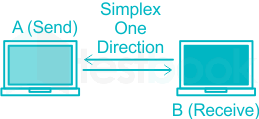
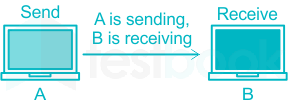
  • The Simplex transmission mode is used in computing networks when there is a single or one-way flow of information from sender to receiver
  • In this mode of transmission, communication occurs only in one direction,
  • A basic example of a simplex transmission mode is communication between a computer and a keyboard and The radio station is a simplex channel.

  • Half Duplex;
  • The half-duplex mode of transmission is used in computer networks when there is a way to flow information from sender to receiver but only one at a time.
  • In this mode, the connected devices can transmit or receive the data but not simultaneously.
  • The half-duplex mode is used when communication in both directions is not required at the same time.

<br>

  • Examples; Walkie-talkie
  • The parallel transmission
  • It defines a transmission structure that shares multiple data bits at a similar time over separate media. In general, parallel transmission can be used with a wired channel that uses multiple, separate wires.

Additional Information

  • Transmission mode, also known as a communication mode, is the transfer of data between two devices via a communication channel that includes an optical fiber, wireless channels, copper wires, and other storage media.
  • The Physical Layer in the Open System Interconnection (OSI) Layer Model is dedicated to data transmission in the network.
  • The data transmission method was initially used in modems in a computer networking system in the 1940s1940s, then in LANs, WANs, repeaters, and other networking systems.
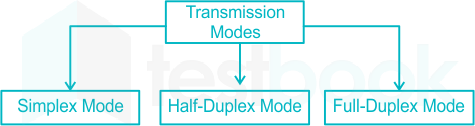
  • Based on the direction of the exchange of information. The transmission mode is classified into three types: simplex, half duplex, and full duplex.

41

Model 'POSDCORB' is developed by ______.

  1. ((a))

    Melvil Dewey 

  2. ((b))

    Luther Gulick and Lyndall Urwick 

  3. ((c))

    Henry Fayol and M. Porter

  4. ((d))

    F. Taylor 

Show Answer
Answer: ((b))

Luther Gulick and Lyndall Urwick 

The Correct answer is Luther Gulick and Lyndall Urwick

Key Points 

  • POSDCORB
  • ​It is the listing of functions of management coined by Luther Gulick and Lyndall Urwick in 1937.
  • P stands for Planning: It requires wide knowledge and experience to make a blueprint of the work to be performed.
  • O stands for organizing; It involves choosing the design, suggesting the structure, space planning, and allocation of the jobs. It also includes determining the specific activities, grouping the activities into a logical framework, assigning these activities to specific positions, and coordinating the efforts of individuals and groups.
  • S stands for Staffing: This function is also known as ‘Human Resource Management’ or ‘Personnel Management. The role of staff or workers is very significant in all types of organizations. In the case of libraries, perhaps it is the most important.
  • D stands for Directing: Giving directions or instructions or advice to the staff to perform the work accurately, efficiently, and appropriately is known as the managerial function, ‘Directing’.
  • C stands for Coordinating; It means inter-relating or co-relating various parts of the organization in order to achieve harmonious operation and avoid over-lapping or duplication of work or efforts.
  • R stands for Reporting Keeping all the staff members, sections, supervisors, and parent bodies informed of the work completed, work in progress, and work to be done.
  • B stands for Budgeting Rough estimate of income and expenditure of an organization for a given period is called a budget.

Additional Information 

  • Henry Fayol, Father of the Classical School of Management, has given the following managerial function
  • Planning
  • Organizing
  • Command
  • Coordination and control
  • Newman and Summer have suggested the following functions of management

i. Planning

ii. Organizing

iii. Leading

iv. Measuring and controlling

  • Stuart and Moran have formulated the following five functions of management

i. Planning

ii. Organizing

iii. Human Resource

iv. Leading

v. Controlling

  • F. W. Taylor.
  • Taylor is often considered the father of scientific management, also known as Taylorism.
  • Taylor gave much concentration on the supervisory level of management and the performance of managers and workers at an operational level.
  • The five principles of management by F.W Taylor.
  • Science, not the Rule of Thumb,
  • Harmony, Not Discord,
  • Mental Revolution,
  • Cooperation, not Individualism,
  • Development of Every Person to His Greatest Efficiency.
42

"To provide the right book to right reader at the right time" who formulated this guiding principle for book selection ? 

  1. ((a))

    S. R. Ranganathan 

  2. ((b))

    Francis Drury 

  3. ((c))

    Melvil Dewey 

  4. ((d))

    L. R. Mc Colvin 

Show Answer
Answer: ((b))

Francis Drury 

The correct answer is Francis Drury.

Key Points

  • Francis Drury: Book Selection (1930): Drury's book selection principles state ‘to provide the right book to the right user at the right time.
  • According to his theory, READER is the central theme.

Additional Information 

  • L. R. McColvin: Theory of Book Selection (1925): McColvin introduced the Demand and Supply Theory of Book Selection in his book ‘Theory of Book Selection for Public Libraries’ first published in 1925.
  • By the term ‘Supply’ he means the availability of reading material in all its varieties, whereas ‘Demand’, refers to the users’ expressed and unexpressed informational needs.
  • Melvil Dewey's principle states, ‘the best reading for the largest number at the least cost’.
  • According to this principle, a library should select, within the financial resources available, the best documents which may satisfy the information needs of the maximum number of readers.
  • Helen E. Haines: Living with Books (1935): The first edition of ‘Living with Books: The Art of Book Selection’ was published in 1935. It was one of the first true textbooks aimed at training librarians in the art of book selection. The 2nd edition came out in 1950.
  • S. R. Ranganathan: Library book selection (1952, reprint 1990): The first edition of ‘Library Book Selection’ by Dr. S. R. Ranganathan appeared in 1952. The book describes how the first three laws of library science are helpful in formulating the principles of document selection for libraries
43

Which financial estimation method, pre supposes that authorities provide finances to library out of their regular budget ? 

  1. ((a))

    Method of details 

  2. ((b))

    Proportional method 

  3. ((c))

    Per capita method 

  4. ((d))

    Per staff method 

Show Answer
Answer: ((b))

Proportional method 

The Correct answer is the Proportional method:

Key Points

  • Proportional Method:
  • ​This method presupposes that the authorities provide adequate finances to the library out of their regular budget and that a particular minimum limit is fixed.
  • The University Education Commission had recommended that 6.5 percent of a university's budget would be a reasonable expenditure on its

library (could vary from 6.5 to 10 percent).

  • Ranganathan suggested that either 10 percent of the total budget or 6 percent should be earmarked for public library purposes.

Additional Information

  • Method of details:
  • According to this method, all items of expenditure of a library are accounted for while

preparing the financial estimates.

  • These are of two types, viz., i) recurring or current expenditure and ii) non-recurring or capital expenditure.
  • Ranganathan suggested the circulation of

recurring/ current expenditure and nonrecurring/capital expenditure.

  • The UGC Library Committee in its report suggested a staff formula for finding out

the quantum of library staff members of various categories required for college and

university libraries.

  • Per Capita Method:
  • In this method, a minimum amount per head is fixed which is considered essential for providing standard library services.
  • The UGC Library Committee recommended that a university should provide Rs. 15 per student and Rs. 200 per teacher for acquiring reading material for its library.
  • The Kothari Education Commission (1964-66),

recommended that as a norm, a university should spend each year about Rs. 25 for each student and Rs. 300 per teacher.

  • Ranganathan suggested that per capita expenditure on university and college libraries should be Rs. 20 per student and Rs. 300 per teacher, or Rs. 50 per student.
44

What is 'liability' in terms of budget ? 

  1. ((a))

    Fixed deposit 

  2. ((b))

    The profit 

  3. ((c))

    Earnings of an institution 

  4. ((d))

    An existing debt 

Show Answer
Answer: ((d))

An existing debt 

The Correct answer is An existing debt:

Key Points

  • Liability is something a person or company owes, usually a sum of money.
  • It is an existing debt of a company or an institution.

Additional Information

  • Budget:
  • A budget is a spending plan based on income and expenses. In other words, it’s an estimate of how much money you’ll make and spend over a certain period of time.
  • Budgetary Methods and Techniques:
  • Line Item or Incremental or Historical or Object-of-Expenditure Type Budgeting
  • Formula Budgeting
  • Programme Budgeting
  • Performance Budgeting
  • Planning Programming Budgeting System (PPBS)
  • Zero-Based Budgeting (ZBB)
45

Which of the following is not a feature of an annual report ? 

  1. ((a))

    An official document 

  2. ((b))

    Describes the activities, programmes and services of an organization 

  3. ((c))

    Reviews the activities for the future year 

  4. ((d))

    Reviews the activities for the previous year 

Show Answer
Answer: ((c))

Reviews the activities for the future year 

The correct answer is Review the activities for the future year 

Key Points

  • Reviews the activities for the future year is called forecasting which is not typically a feature of the Annual report.
  • An annual report is a comprehensive official document that companies, organizations, or institutions publish once a year to provide shareholders, stakeholders, and the public with information about their financial performance, business operations, and overall outlook.
  • It serves as a summary of the company's activities and achievements over the course of the previous year.
  • Typically, an annual report includes various sections that cover different aspects of the organization, including:
  • Financial Statements.
  • Management's Discussion and Analysis (MD&A
  • Business Overview
  • Corporate Governance etc.
46

What are the internal factors of SWOT analysis? 

  1. ((a))

    Strength and Weakness  

  2. ((b))

    Weakness and threats 

  3. ((c))

    Strength and threats 

  4. ((d))

    Opportunity and threats  

Show Answer
Answer: ((a))

Strength and Weakness  

The correct answer is Strength and Weakness.

Key Points SWOT analysis:

  • SWOT (strengths, weaknesses, opportunities, and threats) analysis is a framework used to evaluate a company's competitive position and to develop strategic planning.
  • SWOT analysis assesses internal and external factors and current and future potential.
  • Strengths and weaknesses are usually considered internal, while opportunities and threats are usually considered external

  • A SWOT analysis is designed to facilitate a realistic, fact-based, data-driven look at the strengths and weaknesses of an organization, initiatives, or within its industry.
  • The organization needs to keep the analysis accurate by avoiding preconceived beliefs or gray areas and instead focusing on real-life contexts. Companies should use it as a guide and not necessarily as a prescription.
47

Which of the following cannot be a common performance standard for the evaluation for the library personnel ? 

  1. ((a))

    Problem solving 

  2. ((b))

    Communication 

  3. ((c))

    Complexion 

  4. ((d))

    Accountability 

Show Answer
Answer: ((c))

Complexion 

The Correct answer is Complexion:

Key Points

  • Among the options provided, "Complexion" cannot be a common performance standard for the evaluation of library personnel. The reason is that "complexion" refers to the color or appearance of a person's skin, which is not relevant or appropriate for evaluating job performance in any professional setting, including libraries.
  • The Qualities and standards for library professionals are;
  • A love of knowledge and learning
  • A desire to work around people
  • Love of books
  • Broad overall knowledge of life and the world
  • Problem solving
  • Good with numbers
  • Good communication skills
  • Ethical
  • Personable
  • Accountability
  • IT skills.
48

'Pareto Principle is also known as : 

  1. ((a))

    10/90 rule 

  2. ((b))

    5% rule 

  3. ((c))

    70/30 rule 

  4. ((d))

    80/20 rule 

Show Answer
Answer: ((d))

80/20 rule 

The correct answer is the 80/20 rule.

Key Points

  • The Pareto principle is also known as the 80/20 rule.
  • it is the law of the vital few, or the principle of factor sparsity, and states that, for many events, roughly 80% of the effects come from 20% of the causes.
  • Management consultant Joseph M. Juran suggested the principle and named it after Italian economist Vilfredo Pareto, who noted the 80/20 connection while at the University of Lausanne in 1896, as published in his first paper, "Cours d'économie politique".
  • Essentially, Pareto showed that approximately 80% of the land in Italy was owned by 20% of the population; Pareto developed the principle by observing that about 20% of the peapods in his garden contained 80% of the peas.
  • In computer science, the Pareto principle can be applied to **optimization efforts.**​

Confusion Points

  • The term "10/90 gap" was coined by the Global Forum for Health Research. It underscores the 1990 discovery by the Commission on Health Research for Development that less than 10% of global health research funding was allocated to Developing Countries. These regions accounted for more than 90% of preventable global deaths.
  • In Internet culture, the 1% rule is a general rule of thumb pertaining to participation in an Internet community, stating that only 1% of the users of a website actively create new content, while the other 99% of the participants only lurk.
49

Which of the following information can be found in the accession register? 

  1. ((a))

    Total number of books in a library 

  2. ((b))

    Total periodicals issued  

  3. ((c))

    Addresses of the users 

  4. ((d))

    Total number of library staff 

Show Answer
Answer: ((a))

Total number of books in a library 

The correct answer is the Total number of books in a library.

Key Points

  • A library accession register is a log or record of all the items (books, journals, audio-visual materials, etc.) that a library has acquired or added to its collection over time.
  • The register typically includes information about the title, author, publisher, date of publication, and other relevant details of each item.
  • Each book is assigned a single accession number and accession entry of the resources and Services

book is made only against this assigned number.

  • The standard size of the Accession Register is 16"x 13'.
  • There are 14 columns in an Accession Register.

Additional Information

  • Total periodicals issued, Addresses of the users, and Total number of library staff can be found at the circulation table and Library database.
50

Who devised 'Browne Issue System’ ? 

  1. ((a))

    Anne E. Browne 

  2. ((b))

    S. Browne 

  3. ((c))

    Noel M. Browne  

  4. ((d))

    Nina E. Browne

Show Answer
Answer: ((d))

Nina E. Browne

The Correct answer is Nina E. Browne.

Key Points

  • The Browne Charging System:
  • The Browne Charging System was devised by Nina E. Browne in 1895 formerly Librarian of the Library Bureau in Boston.
  • Every book which is issued has a Book Pocket of 5”x3” or 12.7cms x 7.6 cms size.
  • Every book has a Book Card of 4”x2” or 10.25cms x5 cms size bearing the call number; accession number, author, and title of the book
  • Every book has a Date Slip on which the date due or date of issue is stamped. It is a printed slip of 5”x3” or 12.5cms x7.5 cms size
  • Borrower’s Tickets are made of Manila or Tough paper and are of size 3”x2”
  • It is the fastest charging system.

Additional Information

  • Newark Charging System:
  • ​It was developed by John Cotton Dana. and first used in the Public library in Newark
  • Registration files of all borrowers.
  • Borrower‘s cards: The size of the card is 5x8.
  • Date slips are pasted on the back or front flyleaf of the book. Its size is 5x3.
  • Each book is provided with Book pockets giving the call number, author, and short title of the book. Its size is 5x3.
51

Which of the following is not a shelving method ? 

  1. ((a))

    Broken order 

  2. ((b))

    Parallel arrangement 

  3. ((c))

    Source arrangement 

  4. ((d))

    Classified arrangement 

Show Answer
Answer: ((c))

Source arrangement 

The correct answer is Source arrangement:

Key Points

  • After deciding about the collection in which the library material is to be arranged the next step is to decide about the type of arrangement on the shelf within each sequence. This will be one of the following types:
  • Alphabetical
  • Accession number
  • Classified
  • Block
  • Broken order
  • Parallel arrangement
  • Ribbon arrangement
  • Alphabet and accession number is not usually done in libraries because of the difficulties related to searching involved in these systems.
  • Generally, books are arranged in classified order in the libraries. This is the best type of arrangement because it facilitates the subject approach and the documents are arranged according to the class/call number on the shelves.
  • In block arrangement the documents are arranged according to shelf to shelf, case to case order using classified order.
  • Libraries break the collection and arrange it in different sequences as per the needs of the users. This type of arrangement is known as a broken-order arrangement.
  • In Parallel arrangement books on a specific subject, available in different sizes are put in one sequence by accommodating smaller-sized books in upper

shelves of stacks and larger-sized books on the bottom shelves.

  • Ribbon arrangement refers to an arrangement where books on fiction are placed in the middle rows of nonfiction books
52

Who coined the phrase "the best reading for the largest number at the least cost” ? 

  1. ((a))

    Melvil Dewey 

  2. ((b))

    S.R. Ranganathan 

  3. ((c))

    L.R. Mc Colvin 

  4. ((d))

    Francis Drury 

Show Answer
Answer: ((a))

Melvil Dewey 

The correct answer is Melvil Dewey:

Key Points

  • Dewey’s Principles: Melvil Dewey suggested that in selecting a document the librarian should see that the document is “the best reading for the largest number at the least cost”
  • ​According to this principle, Libraries should select, within their financial resources, the best reading materials which may satisfy the user's needs.

Additional Information Other Book Selection Principles:

  • Drury’s Principles:
  • ​Drury described his principles in his book, Book Selection, published by ALA in 1930. It is a list of 21 points. The gist of his principles is that the

aim of selection should be “to provide the right book to the right reader at the right time”.

  • The reader is the central theme according to this principle.
  • L R . Mc Colvin Principle:
  • ​He introduced his Demand and supply theory of book selection in his book Theory of Book selection in public libraries first published in 1925.
  • According to him, Books in themselves have no meaning unless they are made serviceable by Demand.
  • H E Haines Principle:
  • His Book Living with Books the art of book selection is the first true textbook aimed at training in book selection for librarians.
  • it was published in 1935.
  • S R Ranganathan principle:
  • The first edition of the Library book selection by S R Ranganathan appeared in 1952.
  • The first three laws of Ranganthan advocated the book selection theory and methods.
  • He also advocated the concept of umbral documents, penumbral documents, and alien documents.
53

Who first popularized the term "Management by Objectives" (MBO) ? 

  1. ((a))

    Luther Gulick  

  2. ((b))

    Peter Drucker  

  3. ((c))

    Drury 

  4. ((d))

    Henry Fayol 

Show Answer
Answer: ((b))

Peter Drucker  

The correct answer is Peter Druker:

Key Points

  • The term Management by objectives is coined by Peter Drucker in 1954 in his book, The Practice Management.
  • Management By Objectives (MBO) is a tool by which managers can improve their performance and

increase their effectiveness.

  • There are three steps involved in the MBO process.
  • Setting objectives in each key result area,
  • Action planning, and
  • Performance review.

Additional Information

  • Luther Halsey Gulick
  • Luther Halsey Gulick (1892–1993) was an American political scientist.
  • Gulick is perhaps best known for the functions of the chief executive represented in the acronym POSDCORB.
  • ​Peter Drucker:
  • Peter Ferdinand Drucker was an Austrian-American management consultant, educator, and author.
  • The annual Global Peter Drucker Forum was first held in 2009, the centenary of Drucker's birth.
  • Francis Duruy:
  • He is best known for his principle of book selection" to provide the right book to the right reader at the right time”.
  • Henry Fayol:
  • He is considered the father of administrative management theory/operational management theory.
  • He listed 14 general principles of management.
54

Building expenditure is a _______.

  1. ((a))

    Recurring expenditure 

  2. ((b))

    Contingency expenditure 

  3. ((c))

    Revenue expenditure 

  4. ((d))

    Capital expenditure  

Show Answer
Answer: ((d))

Capital expenditure  

The Correct answer is Capital expenditure:

Key Points

  • Capital expenditure:
  • Also called capital expense is the money an organization or corporate entity spends to buy, maintain, or improve its fixed assets, such as buildings, vehicles, equipment, or land.
  • Key characteristics of capital expenditures include:
  • Long term Benefit
  • Capitalization:

Additional Information

  • Recurring expenditure:
  • A recurring expense is any cost which incurs weekly, monthly, or annually.
  • Expenditure on the purchase of books and

periodicals, maintenance of regular services etc are examples.

  • Contingent expenditure:
  • The term “contingent charges” or “contingencies” used in these rules mean and include all incidental and other expenses which are incurred for the management of an office as an office or for the technical working of a department, other than those under prescribed rules of classification of expenditure fall under some other head of expenditure,
  • Eg “works”, “stores”, “tools and plant” etc.
  • Revenue expenditure:
  • Revenue expenditures is an expense that is incurred as a result of producing products and services.
  • In other words, it refers to operational expenditure.
55

Which of the following is not a type of management of change? 

  1. ((a))

    Transitional 

  2. ((b))

    Developmental 

  3. ((c))

    Transformational 

  4. ((d))

    Informational 

Show Answer
Answer: ((d))

Informational 

The correct answer is Informational:

Key Points

  • Within directed change, there are three different types of change management: developmental, transitional, and transformational.
  • Developmental change management: In its simplest form, a directed change can take the form of developmental change.
  • In this, the business improves what it is currently doing: improving existing skills, processes, methods, performance standards or conditions are all developmental changes.
  • Examples are; increasing sales or quality, interpersonal communication training, etc.
  • Transitional change management: A second form of directed change- transitional change – leads to the replacement of what already exists with something different that is regarded as ‘new’ by the people involved.
  • Examples are re-organizations, simple acquisitions, creation of new products or services that replace old ones.
  • Transformational change management: In this, the future state though part of the vision of the future is not, and cannot be known in detail – much of the final state arises from evolutions – the outcome of trial-and-error as new information, new boundaries, and new interactions are integrated. 
  • Examples are complex mergers and acquisitions, and radical rebranding.

Additional Information

  • There are several models of change management:
  • Lean Change Management: Created by Jason Little.
  • Kurt Lewin's 3-Step Change Model:
  • Unfreezing
  • Changing
  • Refreezing
  • John Kotter's 8-Step Process for Leading Change:
  • Create a Sense of Urgency
  • Build a Guiding Coalition
  • Form a Strategic Vision and Initiatives
  • Enlist a Volunteer Army
  • Enable Action by Removing Barriers
  • Generate Short-Term Wins
  • Sustain Acceleration
  • Institute Change
  • The Prosci ADKAR Model:
  • Created by Jeff Hiatt ADKAR is an acronym
  • Awareness of the need for change
  • Desire to participate and support the change
  • Knowledge of what to do during and after the change
  • Ability to realize or implement the change as required
  • Reinforcement to ensure the results of a change continue.
  • The Plan-Do-Check-Act Cycle:
  • The Plan-Do-Check-Act Cycle, created by W. Edwards Deming, is a management method to improve the business method for control and continuous improvement of choosing which changes to implement.
56

Identify the place from the following places where the Patent Office is not located in India ? 

  1. ((a))

    Kolkata 

  2. ((b))

    New Delhi 

  3. ((c))

    Kanpur 

  4. ((d))

    Mumbai 

Show Answer
Answer: ((c))

Kanpur 

The correct answer is Kanpur:

Key Points

  • The Office of the Controller General of Patents, Designs, and Trade Marks (CGPDTM) generally known as the Indian Patent Office, is an agency under the Department for Promotion of Industry and Internal Trade that administers the Indian law of Patents, Designs, and Trade Marks.
  • The patent office is headquartered in Kolkata with branches in Chennai, New Delhi, and Mumbai, but the office of the CGPDTM is in Mumbai.
  • The office of the Patent Information System and National Institute for Intellectual Property Management is in **Nagpur.**​


Additional Information

  • The first legislation in India relating to patents was the Act VI of 1856.
  • In 1872, the Act of 1859 was consolidated to provide protection relating to designs. It was renamed “The Patterns and Designs Protection Act” under Act XIII of 1872.
  • The Indian Patents and Designs Act, 1911, (Act II of 1911) replaced all the previous Acts.
  • The Government of India constituted a committee under the Chairmanship of Justice (Dr.) Bakshi Tek Chand, a retired Judge of Lahore High Court, in 1949 to review the patent law in India.
  • In 1967, again an amended bill was introduced which was referred to a Joint Parliamentary Committee, and on the final recommendation of the Committee, the Patents Act, of 1970 was passed. This Act was repealed and replaced with the 1911 Act. Most of the provisions of the 1970 Act were brought into force on 20 th April 1972 with the publication of the Patent Rules, 1972.
  • The term of every patent in India is 20 years from the date of filing of the patent application, irrespective of whether it is filed with provisional or complete specification.
57

Match the following books with their autohrs?

List IList II
(A)A.J. Walford(i)Librarians Glossary and Reference Book
(b)William A Katz(ii)Guide to the use of books and libraries
(c)Jean Key Gates(iii)Introduction to Reference Work
(d)Ray Prytherch(iv)Guide to Reference material
  1. ((a))

    (A) - (iii), B - (iv), C - (ii), D - (i)

  2. ((b))

    (A) - (iii), B - (ii), C - (i), D - (iv)

  3. ((c))

    (A) - (iv), B - (iii), C - (ii), D - (i)

  4. ((d))

    (A) - (iii), B - (ii), C - (iv), D - (i)

Show Answer
Answer: ((c))

(A) - (iv), B - (iii), C - (ii), D - (i)

The correct answer is ​(A) - (iv), B - (iii), C - (ii), D - (i):

Note: The original question was omitted from the official paper.

Key Points

  • Librarians Glossary and Reference Book:
  • ​Harrods Librarians Glossary and Reference Book is written by Ray Prytherch.
  • The first edition of Harrod’s Librarians’ Glossary was published in 1938.
  • Leonard Montague Harrod had originally

decided to compile the work after the Library Association (now CILIP) proposed an examination paper in library terminology.

  • L. M. Harrod acted as advisory editor for that fifth edition which was published in 1984 – the year of his death​​
  • ​Guide to the use of books and libraries:
  • This book is written by Jean Key Gates.
  • it was first published in 1962.
  • Introduction to Reference Work:
  • This book is written by William A Katz.
  • This is divided into two volumes "Basic information sources" and "Reference processes".
  • Guide to Reference Material:
  • This book is written by Albert John Walford.​
  • Now it is in its eighth edition.
  • Walford’s Guide to Reference Material has been essential for reference collections for over thirty years.
58

Indian Standard 'IS 15339 : 2003' is related with : 

  1. ((a))

    Public Library : Guidelines 

  2. ((b))

    Academic Library : Guidelines 

  3. ((c))

    University Library : Guidelines 

  4. ((d))

    Special Library : Guidelines 

Show Answer
Answer: ((a))

Public Library : Guidelines 

The correct answer is "Public Library Guidelines".

Key Points

  • Any library established, maintained, and managed by the  Government or Government bodies and declared open to the public is known as a Public Library.
  • Indian standard 'IS 15339:2003' provides guidelines for services provided by public libraries.
  • IS 15339 (2003): Public Library - Guidelines [MSD 5: Documentation and Information] was reviewed in the year 2018.
59

Indian Standard 'IS 1553 : 1989’ is related with :

  1. ((a))

    Design of library furniture 

  2. ((b))

    Design of administrative buildings 

  3. ((c))

    Design of library bus 

  4. ((d))

    Design of library buildings 

Show Answer
Answer: ((d))

Design of library buildings 

The correct answer is Design for library buildings.

Key PointsSome Indian Library standards are;

Specifications for wooden shelving}
cabinets (adjustable type) }
IS: 4116(reaffirmed-1998)
Specifications for steel.shelving cabinetsIS: 3312(reaffirmed-1990)
Design of library buildings-recommendations}
relating to its primary elements }
IS: 1553(revised-1989)
Specifications for library furniture} and fittings)Part I Timber IS: 1829(Part I)
-1978 (reaffirmed-1991)
Part ,I1 Steel IS: 1829(Purt I1)
-1977(a/firmed-1998)
Code of practice in library lightingIS: 2672-1966(reaffirmed-1990)
Specification for mobile library vanIS: 2661-1975(reaffirmed-1999)
Guide for preparation of abstracts·(1st rev.)IS: 795-,1976(reaffirmed-1992)
Guide for data elements and record format for Computer-based databases for bibliographic Description of different kinds of documentsIS: 1H70-1985(reaffirmed-1998
60

What is 'Shodh Gangotri' ? 

  1. ((a))

    Free online catalogue of books 

  2. ((b))

    Expert database 

  3. ((c))

    Repository of Indian research in progress  

  4. ((d))

    A database of Indian theses 

Show Answer
Answer: ((c))

Repository of Indian research in progress  

The correct answer is ​Repository of Indian research in progress.

Key Points

  • Shodh Gangotri: a repository of Indian research in progress-
  • ​Shodhgangotri is an initiative of the UGC, Ministry of Human Resource Development, Government of India, and INFILBNET Centre.
  • It is a type of alerting service.
  • Under this initiative, universities are requested to deposit an electronic version of the approved synopsis submitted by research scholars to the universities.

Additional Information

  • Shodh Ganga:
  • Shodh Ganga is a repository of Indian theses and dissertations. It was launched in 2012 by the Indian Council of Social Science Research (ICSSR). The repository contains over 100,000 theses and dissertations in social sciences, humanities, and related disciplines. Shodh Ganga is a valuable resource for researchers, teachers, and students. It provides access to a wide range of research output, which can be used for research, teaching, and learning.
  • Shodh Sindhu:
  • Shodh Sindhu is a database of research journals and e-books. It was launched in 2014 by the Ministry of Human Resource Development (MHRD). The database contains over 100,000 research journals and e-books in various disciplines. Shodh Sindhu is a valuable resource for researchers, teachers, and students. It provides access to a wide range of scholarly literature, which can be used for research, teaching, and learning.
  • VIDWAN
  • ​It  is the premier database of profiles of scientists/researchers and other faculty members working at leading academic institutions.

R & D organisations are also involved in teaching and research in India.

  • It provides important information about the expert's background, contact address, skills and accomplishments.
  • The database was developed and maintained by Information and Library Network Centre (INFLIBNET).
61

Which of the following Services, is not provided by NASSDOC?  

  1. ((a))

    Current Research updates 

  2. ((b))

    Bibliography of Social Science Literature

  3. ((c))

    Annotated Index to Indian Social Science Journals 

  4. ((d))

    Social Science Conference Alert 

Show Answer
Answer: ((a))

Current Research updates 

The correct answer is Current Research updates;

Key Points

  • The National Social Science Documentation Centre (NASSDOC), renamed so in 1985, was established in 1970 by the Indian Council of Social Science Research, New Delhi.
  • Services of NASSDOC include:
  • Documentation, Library, and Reference Services;
  • Literature Search Services from digital databases, Online databases, and offline databases;
  • Bibliography of Social Science Literature.
  • Bibliography on Demand;
  • E-resources for ICSSR Research Institutes and Regional Centres;
  • Annotated Index to Indian Social Science Journals.
  • Continuing Education Programme;
  • **Social Science Conference Alert etc.**​

Additional Information​

  • NASSDOC's current awareness publications are :
  • Acquisition Update (monthly);
  • Conference Alert (quarterly),
  • Indian Diary of Events (quarterly)
  • Paging Periodicals: Review of Contents (bimonthly),
  • Social, Science Research Index (irregular),
  • Social Science News: Index to Select Newspapers in English (monthly), and
  • Samajik Vigyan Samachar (monthly, Hindi).
  • NASSDOC is presently engaged in bringing out an Index to Indian Periodicals: Sociology and Psychology (1915-70), which is a retrospective cumulative index.
  • Some of the publications 9f NSSDOC are listed below
  • Current Contents to Indian Social Science Journals (Q)
  • Conference alert (Q)
  • Acquisition Update (Bi-ann)
  • Bibliographic Reprint (Irr)
  • APINESS Newsletter (Bi-ann)
  • in India An Annotated Bibliography
  • Bibliography on India in 2000 AD. (with abstracts)
62

Which of the following Products/books is published by Association of Indian Universities ? 

  1. ((a))

    India: A reference annual 

  2. ((b))

    World of Learning 

  3. ((c))

    Universities Handbook 

  4. ((d))

    Kurukshetra 

Show Answer
Answer: ((c))

Universities Handbook 

The Correct answer is Universities Handbook:

Key Points

  • Universities Handbook is published by the Association of Indian Universities since 1927.
  • India: A Reference Annual is a comprehensive digest of the country's progress in different fields published annually by the Ministry of Information and Broadcasting of India.
  • World of Learning is published by Routledge, Taylor, and Francis group.
  • Kurukshetra, published in 1952 in English and Hindi, is a unique monthly journal published by the Ministry of Information and Broadcasting

Additional Information

  • Association of Indian Universities:
  • The Association of Indian Universities (AIU) is a registered society under the Societies Registration Act, 1860 with membership of Indian Universities.
  • It is based in Delhi.
  • it was founded in 1925.
63

Which of the following publications are published by Publication Division, Ministry of Information and Broadcasting, Govt. of India ? 

(A) Kurukshetra

(B) University News

(C) Universities Handbook

(D) India : 2022

  1. ((a))

    (A) and (D) are correct 

  2. ((b))

    (A) and (C) are correct 

  3. ((c))

    (B) and (C) are correct 

  4. ((d))

    (C) and (D) are correct 

Show Answer
Answer: ((a))

(A) and (D) are correct 

The correct answer (A) and (D) are correct:

Key Points

  • Publications Division is a repository of books and journals highlighting subjects of national importance and India’s rich cultural heritage.
  • Established in 1941, Publications Division has emerged as a premier publishing house of the Government of India, enriching the national knowledge repository.
  • Some of its Major publications include:
  • Yojana, the flagship journal of the Division published since 1957.
  • Kurukshetra, published in 1952 in English and Hindi, is a unique monthly journal dedicated to rural development issues.
  • Bal Bharati, the popular children’s monthly in Hindi, is being published regularly since 1948.
  • Ajkal, is a prestigious literary magazine published in 1945 in Hindi and 1942 in Urdu.
  • Employment News is the flagship weekly job journal of the Publications Division, Ministry of Information and Broadcasting. It was launched in 1976
  • India:2022: India 2022, a Reference Annual is a comprehensive digest of national progress in diverse fields, the book deals with all aspects of development from rural to urban, industry to infrastructure, science, and technology to art and culture, from economy to health, defense to education or mass communication.

Additional Information

  • University News:
  • A Weekly Journal of Higher Education published by the Association of Indian Universities is the premier forum for academics, leaders, teachers, policymakers, managers, administrators, and stakeholders interested in different facets of higher education, national and international.
  • Commenced in 1929, it is now an official organ of the Association.
  • Universities Handbook:
  • Universities Handbook is published by the Association of Indian Universities since 1927.
64

Who characterized the reference service as 'Minimum, Middling and Maximum' ? 

  1. ((a))

    James I Wyer 

  2. ((b))

    Michel Gorman 

  3. ((c))

    S.R. Ranganathan 

  4. ((d))

    Samuel Rothstein  

Show Answer
Answer: ((d))

Samuel Rothstein  

The Correct answer is Samuel Rothstein:

Key Points

  • James Wyer has described three different philosophies of Reference Service which are labeled as "Conservative", "Moderate" and "Liberal".
  • These only are known as Minimum, Middling, and Maximum by Samuel Rothstein.
  • Conservative or Minimum: Conservative Reference Services approach provides occasional personal assistance to the inexperienced and dazed reader.
  • Moderate or Middling: The moderate reference service goes beyond providing mere instruction to actually helping the reader in using the book or finding the document and facts, etc
  • Liberal or Maximum: It includes the provision of providing complete and reliable information to the readers.

Additional Information

  • The chronological view of Reference Service can be traced from 1876. The first definition which is available is given by S. S. Green. Green identifies four components of Reference Services.
  • The first component is to instruct the reader in the ways of the library;
  • The second is assisting the readers/users in solving their inquiries.
  • The third component is to aid the reader in solving their inquires and
  • The fourth is to promote the library within the community.
  • Ranganathan defines Reference Service as ‘Personal Service to each reader in helping him to find the documents answering his interest at the moment pointedly, exhaustively and expeditiously.
  • A. G. Rugh defined the Reference Service as direct aid to library users who need a particular book or books, or who need some information embodied in any books.
  • Micheal Gorman is known for his Eight central values of Librarianship, Five New Laws of Librarianship, and 3 types of information needs.
  • He also wrote Our singular strengths
65

Which of the following service is finished in a very short time, in a moment, if possible ? 

  1. ((a))

    Abstracting Service 

  2. ((b))

    Ready reference Service 

  3. ((c))

    Long Range reference Service 

  4. ((d))

    Translation Service 

Show Answer
Answer: ((b))

Ready reference Service 

The Correct answer is Ready Reference Service.

Key Points

  • Ready Reference Service-
  • Ranganathan defined it as a reference service finished or replied to in a very short time, in a minute if possible less than 5 minutes.
  • Ready Reference Service includes the following queries:
  • Which are demand direct
  • Which are demanded by sharp media
  • Which are simple
  • These are answered in the table of Reference Librarian
  • Which involve short answers
  • These are responded to within a short time, within 5 minutes, or less

Additional Information

  • Long Range Reference Service-
  • This service indicates taking a long time in providing reference service normally more than 5 minutes to provide the service with the help of reference sources.
  • It is given to special readers demanding special information in special libraries.
  • Need of Long-Range Reference-
  • It Saves the Time of the Reader and the Experts
  • Knowledge explosion
  • The complexity of Information Sources
  • Information Sources of other libraries
  • Abstracting service:
  • An abstracting service is a service that provides abstracts of publications, often on a subject or group of related subjects, usually on a subscription basis.
  • Translation service:
  • A translation service is a service that provides the conversion of written or spoken language from one language to another.
  • Translation services can be provided by individuals, companies, or organizations and can cover a wide range of languages and subjects.
66

Which of the following is not a stage involved in providing reference service?

  1. ((a))

    Initiation 

  2. ((b))

    Preparation 

  3. ((c))

    Service 

  4. ((d))

    Assimilation 

Show Answer
Answer: ((a))

Initiation 

The correct answer is Initiation:

Key Points​

  • Ranganathan has defined reference service as a personal service to each reader in helping her/him to find the document, answering the particular query, pinpointedly, exhaustively, and expeditiously.
  • The reference process involves the following steps:
  • Identification.
  • Transforming the query statement
  • Preparation of a search strategy.
  • Selection of a specific title.
  • Location of an answer
  • selection of an answer
  • **Assimilating the Answer.**​

Additional Information

  • Components of the Reference Service:
  • Acquiring, Organising and Maintaining Information Sources
  • Answering Reference Queries
  • Providing Reader’s Advisory Service
  • Information Literacy
  • Selecting and Evaluating Print and Electronic Information Resources
  • Creating Finding Tools and Websites
  • Promoting the Reference Service
  • Evaluating the Reference Service
67

In which of the following library services "users register to receive notifications of new materials that are published on a specific subject"?  

  1. ((a))

    Abstracting Service 

  2. ((b))

    Alert Service 

  3. ((c))

    Inter library loan Service 

  4. ((d))

    Photocopy Service 

Show Answer
Answer: ((b))

Alert Service 

The correct answer is Alert Service.

Key Points

  • Alert Services:
  • Alerting services provide you with current information on your area of research or interest.
  • This is an excellent way to keep informed as users register to receive notifications of new materials that are published on a specific subject
  • Alerting services are available from subscription databases, LibrarySearch, publisher’s web pages, and other web resources.

Additional Information

  • An abstracting service
  • ​It is a service that provides abstracts of publications, often on a subject or group of related subjects, usually on a subscription basis.
  • Interlibrary Loan Service:
  • It is a service that enables patrons of one library to borrow physical materials and receive electronic documents that are held by another library.
  • Photocopy Service;
  • Photocopying is a form of making copies of required items from books, journals, newspapers or pamphlets, and the like.
68

'A device for obtaining opinions in written form’ is called : 

  1. ((a))

    Observation 

  2. ((b))

    Schedule 

  3. ((c))

    Questionnaire 

  4. ((d))

    Interview 

Show Answer
Answer: ((c))

Questionnaire 

The correct answer is Questionnaire:

Key Points

  • Questionnaire:
  • A questionnaire is a research instrument that consists of a set of questions (or other types of prompts) for the purpose of gathering information from respondents through a survey or statistical study.
  • It is used to obtain the opinions of the public in written form.
  • A research questionnaire is typically a mix of close-ended questions and open-ended questions.

Additional Information

  • Observation:
  • A way to gather data is by watching people, and events, or noting physical characteristics in their natural setting.
  • Observations can be overt (subjects know they are being observed) or covert (do not know they are being watched).
  • Schedule:
  • It is the tool or instrument used to collect data from the respondents while the interview is conducted.
  • The schedule contains questions, statements (on which opinions are elicited), and blank spaces/tables for filling up the respondents.
  • Interview:
  • An interview is a research method that involves asking questions to collect data from individuals who have knowledge, experience or opinions on a particular topic or subject matter.
  • it involves direct and face to face interaction.
69

Identify the correct sequence of Carol Kuhlthau's Six stages of Information Search Process : 

  1. ((a))

    Initiation, Exploration, Selection, Formulation, Collection, Presentation. 

  2. ((b))

    Initiation, Selection, Exploration, Formulation, Collection, Presentation 

  3. ((c))

    Selection, Initiation, Formulation, Exploration, Collection, Presentation 

  4. ((d))

    Formulation, Initiation, Selection, Collection, Exploration, Presentation  

Show Answer
Answer: ((b))

Initiation, Selection, Exploration, Formulation, Collection, Presentation 

The correct answer is Initiation, Selection, Exploration, Formulation, Collection, Presentation 

Key Points

  • Kuhlthau has developed a search process model to study the temporal nature of the user in the search process; to understand the emotions involved in information searching and to see the search as a holistic process.
  • Kuhlthau has developed this search process model which involves six stages;
  • Initiation,
  • Selection,
  • Exploration,
  • Formulation,
  • Collection,
  • Presentation.

Additional InformationOther Information Literacy Modules

  • The 8Ws Model was formulated by Annette Lamb in the 1990s.
  • Jamie McKenzie’s Model of Information Literacy.
  • Seven Faces of Information Literacy by Christine Susan Bruce.
  • SAUCE Model of Information Literacy;  initially developed in the year 1999 and then it was slightly revised in April 2009.
  • The PLUS model was developed by James Herring and published in 1996.
  • The Big6 i.e. IL Model was formulated by Mike Eisenberg and Bob Berkowitz
70

'Ecological Theory of Human Information Behaviour’ was developed by :  

  1. ((a))

    Kirsty Williamson 

  2. ((b))

    James Herring 

  3. ((c))

    Carol Kuhlthau 

  4. ((d))

    Annette Lamb 

Show Answer
Answer: ((a))

Kirsty Williamson 

The correct answer is ​Kirsty Williamson.

Key Points

  • The Ecological Theory of Human Information Behaviour was developed by  Kirsty Williamson in 1998.
  • This model emphasizes that at least in the field of everyday life information, information is often incidentally acquired rather than purposefully sought.
  • He chose the term incidental information acquisition.

Additional Information

  • The PLUS Model was introduced by James Herring.
  • ​The PLUS model was developed by James Herring and published in 1996.
  • This model has been used in schools in the U.K., South Africa, Australia, and New Zealand.
  • The main elements of the PLUS model are Purpose, Location, Use, and Self-evaluation.
  • This model incorporates basic elements of information literacy skills and also adds emphasis on thinking skills and self-evaluation. ​
  • The 8 Ws Model was Introduced by Annette Lamb.
  • ​The 8Ws Model was formulated by Annette Lamb in the 1990s.
  • This is a project-based model that extends opportunities to the students to explore their own and learn the complexities of information literacy.
  • Carol Kuhlthau propounded an Information Search Model (ISM) in 1991. Kuhlthau ‘Six stages’ are: Initiation, Selection, Exploration, Formulation, Collection, Presentation
71

Which of the following models, have "Starting, Chaining, Browsing, Differentiating, Monitoring, Extracting”, Verifying endings? 

  1. ((a))

    Chatman's Information Poverty, 

  2. ((b))

    Nan Lin's Theory of Social Capital 

  3. ((c))

    Ellis's Model of Information Seeking Behaviour 

  4. ((d))

    Krikelas's model of Information Seeking 

Show Answer
Answer: ((c))

Ellis's Model of Information Seeking Behaviour 

The correct answer is ​Ellis's Model of Information Seeking Behaviour 

Key Points

  • Ellis Model:
  • David Ellis has explained information behavior in terms of a series of activities undertaken by a user
  • Starting;
  • Chaining;
  • Browsing;
  • Differentiating
  • Monitoring;
  • Extracting;
  • **Ending;**​

Additional InformationModels of information-seeking behavior:

  • Wilson’s model of information-seeking behavior:
  • The first set of models was published in 1981.
  • ​Dervin’s model:
  • Dervin has expressed the elements in terms of a

triangle: situation, Gap/Bridge, and outcome.

  • ​Foster’s non-linear model:
  • The concepts were grouped into three core categories, Opening, Orientation, and Consolidation
  • Kirkelas’s Model of Information Seeking:
  • The Krikelas model (1983) is an early model and was cited widely.
  • The model contains thirteen components.
  • Johnson’s Model:
  • There are seven factors under three headings given in Johnson’s model (1987).

Important Points

  • Chatman's Information Poverty:
  • One of the main components of information behavior in Chatman’s Theory of Information Poverty is that outsider groups are informationally impoverished while insider groups are therefore informationally privileged.
  • Chatman theorized that individuals experiencing information poverty engaged in four self-protective behaviors
  • Secrecy
  • Deception
  • Risk Taking
  • Situational Relevance.
  • Nan Lin's Concept of Social Capital:
  • Lin defines social capital as resources embedded in social relationships that are used in purposive actions. Here the capital character of social capital is given prominence.
72

Louis Shore was associated with : 

  1. ((a))

    User education program in the 1980's 

  2. ((b))

    Computer assisted learning program 

  3. ((c))

    Information literacy in 1990's 

  4. ((d))

    Library college movement in the 1920's 

Show Answer
Answer: ((d))

Library college movement in the 1920's 

The Correct Answer is the Library college movement in the 1920s:

Key Points

  • Louis Shores (September 14, 1904 – June 19, 1981) was a librarian who worked for the promotion of the library as the center of all learning, in both public and academic institutions.
  • He is known for the library-college movement in the 1920s.
  • In 1934, Louis Shores brought in the concept of `Library Arts College'
  • One of the highlights of Shore’s career was the American Library Association accreditation of his Library School at FSU in 1953.
  • A selection of some of Shore’s written works.
    1. Origins of the American college library,
    1. Highways in the Sky: the story of the AACS.
    1. Challenges to librarianship. Tallahassee
    1. A profession of faith. Geneseo.
    1. Basic reference sources; an introduction to materials and methods.
    1. Instructional materials: an introduction for teachers

Additional Information

  • Developmental efforts in user education:
  • The systematic use of the concept of user education owes its origin to Patricia B. Knapp.
  • The first international conference on Library User Education was held at Cambridge in 1979 with the theme `Library User Education: are new approaches Needed?"
  • This was followed by the second conference held at Oxford in 1981.
  • The IASLIC, Calcutta organized a national conference on User Education at Waltair (AP) in 1981.
  • ​Information Literacy: 
  • The term information literacy first appeared in print in a 1974 report by Paul G. Zurkowski.
73

Which of the following is not an alternative term used for a user ?

  1. ((a))

    Borrower 

  2. ((b))

    Client 

  3. ((c))

    Reader 

  4. ((d))

    Broker 

Show Answer
Answer: ((d))

Broker 

The Correct answer is Broker.

Borrower, Clien and Reader all are used alternative terms for user while as Broker is not used as alternative term for user.

Key PointsAlternative terms for User:

  • Patron:
  • It is an alternative term for User and is s often used in libraries and in library information science literature.
  • ODLIS defines a patron as „any person who uses the resources and services of a library, not necessarily a registered borrower.
  • Generally, patron means a person who donates to or supports an organization.
  • Customer:
  • Harrod‟s Librarians‟ Glossary and Reference Book define a customer. "…the user of a service; in particular the term implies that a financial transaction is taking place whereby a service or commodity is transferred to a purchaser.
  • According to Business Dictionary, a customer is "a party that receives or consumes products (goods or services) and has the ability to choose between different products and suppliers."
  • Client:
  • ​According to ODLIS, a client is "a person who uses the services of a professionally trained expert, or of a professional organization or institution, usually in exchange for payment of a fee.
  • Reader:
  • This is a core term frequently used in libraries.
  • Harrod‟s Librarians‟ Glossary and Reference Book define a reader as a "person who makes use of literary material in a library.
  • " Reader is a general term, which is frequently used interchangeably for users.
  • Audience: The audience is defined as “The group of consumers for whom a media text was constructed as well as anyone else who is exposed to the text"(Wilson, 2011).
  • Wikipedia says, "… an audience is a group of people who participate in a show..."
  • Borrower: According to ODLIS a borrower is "a person who checks out books and other materials from a library.
  • Buyer: Business Dictionary defines a buyer as a " party which acquires, or agrees to acquire, ownership (in case of goods), or benefit or usage (in case of services), in exchange for money or other consideration under a contract of sale."
  • Consumer: Consumer is also a synonym for the user. Business Dictionary defines it as "
  • A purchaser of a good or service in retail.
  • An end user, and not necessarily a purchaser, in the distribution chain of a good or service." Generally, this term is not preferred in the literature of library and information science.
74

Who proposed the concept of "Anamalous State of Knowledge (ASK)" ? 

  1. ((a))

    Nicholas J. Belkin 

  2. ((b))

    T.D. Wilson 

  3. ((c))

    Karen E. Fisher 

  4. ((d))

    David Ellis

Show Answer
Answer: ((a))

Nicholas J. Belkin 

The correct answer is "J.N Belkin".

Key Points Anomalous State of Knowledge model:

  • The anomalous State of Knowledge model, one of the user-centered models of information retrieval was proposed by Nicholas James Belkin.
  • In this model, there are four (4) dimensions that characterize search behavior and it can be combined in 16 different ways:
  • Method of interaction (Searching/Scanning)
  • The goal of Interaction (Learning /Selecting)
  • Mode of retrieval (Recognition/ Specification)
  • Resource Considered (Information/Meta-information)

Additional Information

  • T.D Wilson gave the information Behaviors models in 1981, it is suggested that due to our inability to observe “information needs" as an internal state of mind and it was helpful to rely heavily on information needs to study one’s information behavior.
  • D. Ellis gave the behavioral model of information seeking. This model identified the eight (8) features as Starting, Chaining, Browsing, and Differentiating. Monitoring, Extracting, Verifying, and Ending information-seeking behavior to characterize the information-seeking patterns.
75

Which of the following term used is not interchangeable for user education ?

  1. ((a))

    Library instruction 

  2. ((b))

    Library orientation  

  3. ((c))

    Media instruction 

  4. ((d))

    Bibliographic instruction  

Show Answer
Answer: ((c))

Media instruction 

The Correct answer is Media Instruction:

Key Points

  • Fleming (1990) defines user education “as various programs of instruction, education, and exploration provided by libraries to users to enable them to make more effective, efficient and independent use of information sources and services to which these libraries provide access”.
  • The synonyms of user education are user orientation, library orientation program, library instruction, user instruction, Bibliographic Instruction, and information literacy are all one and the same.

Components or levels of User education:

  • Library orientation:
  • Library orientation means ways of introducing the users to the general methods of usage and services and to the layout such as building and sections of the libraries, stacking arrangement, rules and regulations, and facilities available in a particular library.
  • Library instruction:
  • Library instruction means to provide specific instruction on how to use and understand specific information sources, information systems, information services, and tools.
  • Bibliographic Instruction:
  • These instructions aim to use the bibliographic tools, to provide guidance to understand the features of these tools and their nature of subject coverage.

Additional Information

  • Media Instruction can not be used interchangeably for user education as it refers to the process of providing guidance, education, or training related to media usage or production.
76

In research 'Triangulation' means : 

  1. ((a))

    Using only one method to collect data on the same topic 

  2. ((b))

    Using more than one method to select the sample  

  3. ((c))

    Using more than one method to collect data on the same topics 

  4. ((d))

    Use of computer in research  

Show Answer
Answer: ((c))

Using more than one method to collect data on the same topics 

The Correct answer is Using more than one method to collect data on the same topics:

Key Points

  • Triangulation refers to the use of multiple methods or data sources in qualitative research to develop a comprehensive understanding of phenomena (Patton, 1999).
  • Denzin (1978) and Patton (1999) identified four types of triangulation:
  • Method triangulation:
  • Involves using multiple research methods (e.g., surveys, interviews, observations) to study the same research question, reducing the risk of bias associated with a single method.
  • Investigator triangulation:
  • Involves having multiple researchers or investigators independently analyze the data and then compare their interpretations to ensure inter-rater reliability.
  • Theory triangulation:
  • Involves using multiple theoretical perspectives to understand a research problem, which can lead to a more comprehensive understanding of complex issues.
  • Data source triangulation:
  • Involves using different sources of data, such as interviews, documents, or archival records, to corroborate findings and ensure consistency.
77

Which of the following methods studies 'an entire social group in its natural setting to find out the pattern of behavior, value and Practices’ ? 

  1. ((a))

    Case study method  

  2. ((b))

    Ethnography 

  3. ((c))

    Survey method 

  4. ((d))

    Hermeneutics 

Show Answer
Answer: ((b))

Ethnography 

The correct answer is ​Ethnography:

Key Points

  • Ethnography:
  • Ethnography is a branch of anthropology and the systematic study of individual cultures.
  • **Ethnography is also a type of social research that involves examining the behavior of the participants in a given social situation and understanding the group members' own interpretation of such behavior.**​

Additional Information

  • Case study method:
  • A case study is an in-depth study of one person, group, or event.
  • In a case study, nearly every aspect of the subject's life and history is analyzed to seek patterns and causes of behavior
  • Survey method:
  • The survey method is the practice of gathering data for a study by asking people questions related to your research.
  • Typically, researchers survey people who have particular knowledge, insights or experiences related to the study.
  • Hermeneutics:
  • In sociology, hermeneutics is the interpretation and understanding of social events through analysis of their meanings for the human participants in the events.
78

In research, 'No relation between variables' is an example of :  

  1. ((a))

    Null hypothesis 

  2. ((b))

    Alternative hypothesis 

  3. ((c))

    Working hypothesis 

  4. ((d))

    Explanatory hypothesis 

Show Answer
Answer: ((a))

Null hypothesis 

The correct answer is "Null hypothesis".

Key Points

  • Null Hypothesis - 
  • The null hypothesis is a neutral type of hypothesis, indicating 'no difference' or 'no relationship' between variables.
  • The Null hypothesis represents the hypothesis we are trying to reject and thus **wishes to be disapproved.**In the Null hypothesis, the researcher tries to explain the relationship between the variables by chance even though there might be no statistical relation between the two variables and the relationship is occurring just by chance.


Additional Information

  • Alternative Hypothesis ​-
  • The alternative Hypothesis (denoted by (Ha), is the substitute for the null hypothesis which states the opposite of the null hypothesis.
  • The alternative Hypothesis represents all other possibilities and wishes to be proved.
  • Working Hypothesis -
  • The working hypothesis is a tentative assumption accepted as a basis for further ongoing research.
  • The working hypothesis is generated to direct inquiry into channels in which new material, factual and conceptual, is disclosed, and thus provides the focal point for research.
  • Explanatory Hypothesis -
  • The hypothesis that tries to explain a certain fact is the Explanatory hypothesis.
  • This hypothesis is used to test the cause-and-effect relationship between two or more two variables.
79

Which of the following statements, is not correct in the context of quantitative research method ? 

  1. ((a))

    Problem Solving approach 

  2. ((b))

    Highly structured in nature 

  3. ((c))

    Relies on the quantification of variables 

  4. ((d))

    More attention to the subjective aspects of human behaviour 

Show Answer
Answer: ((d))

More attention to the subjective aspects of human behaviour 

The correct answer is More attention to the subjective aspects of human behavior:

Key Points

  • Quantitative research methods are primarily focused on objective data and the quantification of variables.
  • They involve collecting and analyzing numerical data to uncover patterns, trends, and relationships.
  • This approach aims to be systematic, highly structured, and minimize subjectivity. In contrast, qualitative research methods are more concerned.

Additional InformationOther types of Research:

  • Qualitative Research: Qualitative research aims to understand human behavior, experiences, and meanings through in-depth interviews, observations, and textual analysis. It does not rely on numerical data but focuses on rich descriptions and interpretations.
  • Mixed Methods Research: Mixed methods research combines elements of both quantitative and qualitative approaches. Researchers use both numerical data and textual information to gain a comprehensive understanding of the research problem.
  • Experimental Research: In experimental research, researchers manipulate one or more variables to study their effects on other variables under controlled conditions. It allows for causal inferences.
  • Descriptive Research: Descriptive research aims to describe and document the characteristics of a population or phenomenon without manipulating any variables. It is often used to gather preliminary data.
  • Correlational Research: Correlational research examines the relationship between two or more variables without manipulating them. It assesses the degree of association between variables.
80

In research, longitudinal method denotes : 

  1. ((a))

    Assesses the changes in behaviour in one group of subjects at more than one point in time. 

  2. ((b))

    Examines how events that have been occurred in the Past 

  3. ((c))

    A study of a culture 

  4. ((d))

    An evaluation of library collection  

Show Answer
Answer: ((a))

Assesses the changes in behaviour in one group of subjects at more than one point in time. 

The correct answer is "Assesses the changes in behavior in one group of subjects at more than one point in time".

Key Points

  • Longitudinal Studies-
  • A Longitudinal Study is a research design involving repeated observations of the same variables over long periods of time.
  • Types of Longitudinal Studies-
  • Panel Study
  • Cohort Study
  • Retrospective Study
  • Examples of Longitudinal Studies are - Alzheimer's Disease Neuroimaging Initiative, Understanding Society: The UK Household Longitudinal Study, Early Childhood Longitudinal Study, etc.


Confusion Points 

Difference between Longitudinal Study and Cross-sectional Study:

Longitudinal StudyCross-sectional Study
1.A Longitudinal Study is a research design involving repeated observations of the same variables over long periods of time.A Cross-sectional Study is a research design involving observations of the different variables over a specific period of time.
2.It is a time-consuming process and may take time from years to decades.It is quick to conduct and does not consume time compared to the longitudinal study.
3.It gives a cause-and-effect relationship between variables.It does not give a cause-and-effect relationship between variables.
4.It tends to be expensive as compared to cross-sectional studies because it takes time.It is not as expensive as compared to the longitudinal study because it is quick to conduct.
81

Which of the following were associated with the creation of 'World Digital library’ ?

(A) Library of Congress

(B) IFLA

(C) UNESCO

(D) INFLIBNET

  1. ((a))

    (A) and (B) are correct 

  2. ((b))

    (A) and (C) are correct 

  3. ((c))

    (B) and (C) are correct 

  4. ((d))

    (C) and (D) are correct  

Show Answer
Answer: ((b))

(A) and (C) are correct 

The correct answer is "(A) and (C) are correct ".

Key Points

  • World Digital Library (WDL) -
  • WDL is an international digital library operated by UNESCO and the United States Library of Congress.
  • It was launched in 2009 as a project of the U.S. Library of Congress, with the support of UNESCO, and contributions from libraries, archives, museums, educational institutions, and international organizations around the world.
  • It intends to make available resources on the internet free with the objective -
  • to promote international and intercultural understanding,
  • to expand the volume and variety of cultural content on the Internet,
  • to provide resources for educators, scholars, and general audiences, and
  • to build capacity in partner institutions to narrow the digital divide within and among countries.


Additional Information

  • Library of Congress-
  • The Library of Congress in the USA is one of the largest R & D libraries in the world.
  • Established on April 24, 1800, the Library of Congress is the national library of the United States.
  • UNESCO-
  • United Nations Educational Scientific and Cultural Organization (UNESCO) is a specialized agency of the UN aimed to promote world peace and security through international cooperation.
  • Headquartered in Paris, France, It was founded in 1945 and has 193 country members globally at present.


 Important Points

  • IFLA-
  • The International Federation of Library Associations and Institutions (IFLA) is an independent, international, non-governmental, not-for-profit organization.
  • Headquartered in The Hague, in the National Library of Netherlands, It was founded in 1927 and is recognized as the Global Voice of the Library and Information profession.
  • INFLIBNET- 
  • Established in March 1991, the Information and Library Network (INFLIBNET) is an autonomous Inter-University center of the University Grants Commission (UGC).
  • It connects libraries and information centers in universities, colleges, and R & D Institutions.​
82

How many parts are there in the report of the National Education Policy 2020 (India) ? 

  1. ((a))

    Three

  2. ((b))

    Four

  3. ((c))

    Five

  4. ((d))

    Six

Show Answer
Answer: ((b))

Four

The correct answer is Four.

Key Points

  • The Union Cabinet approved the National Education Policy (NEP) in July 2020.
  • The National Education Policy 2020 proposes various reforms in school and higher education including technical education.
  • National Education Policy 2020 has Four parts.
  • PART I. SCHOOL EDUCATION
  • PART II. HIGHER EDUCATION
  • PART III. OTHER KEY AREAS OF FOCUS
  • PART IV. MAKING IT HAPPEN
  • NEP 2020 is the third education policy in the history of independent India after 1968 and the second policy of 1986.
  • The main goal of the school education regulatory system is to improve educational outcomes so that children can learn to implement the acquired knowledge and skills in their practical life.
  • National Education Policy 2020: As per NEP, 2020, learning should be holistic, integrated, enjoyable, and engaging.  Therefore, the current 10+2 system is to be replaced by a four-stage 5+3+3+4 structure.
83

Who among the following has given prominance to the term 'Bare foot Librarian’ ? 

  1. ((a))

    S.R. Ranganathan 

  2. ((b))

    Wijsuriya 

  3. ((c))

    Melvil Dewey 

  4. ((d))

    Krishan Kumar 

Show Answer
Answer: ((b))

Wijsuriya 

The correct answer is "Wijsuriya".

Key Points

  • Bare Foot Librarian -
  • This is the term given to A library or information worker providing informal, community-based services, usually in rural areas.
  • The term was given prominence, almost incidentally, by Wijasuriya (1975) in relation to Southeast Asia, and used by him to signify professionals with a rural rather than urban orientation.
  • It has since been used to refer to non-professional or paraprofessional helpers recruited in the community to staff reading rooms or rudimentary libraries and information centers.

Additional Information

  • S.R. Ranganathan -
  • He is regarded as the Father of Library Science in India known for his notable contribution to the field of library science In India.
  • His most notable contribution to the field of library science is his**"Five Laws of Library Science"**.
  • Melvil Dewey-
  • Melvil Dewey who devised the Dewey Decimal Classification system for Library Cataloguing is known as the "Father of Librarianship".
  • He was the founding member of the American Library Association (ALA).​
  • Krishan Kumar-
  • He is also an author and wrote several books on Library Science.
  • He is the professor and Head of the Department of Library Science, at the University of Delhi.
  • Wijsuriya -
  • The term was given prominence, almost incidentally, by Wijasuriya (1975) in relation to Southeast Asia,
  • Wijasuriya, used the term "Barefoot Librarian" to signify professionals with a rural rather than urban orientation.
84

'WIPO' was established in the year ______.

  1. ((a))

    1951

  2. ((b))

    1963

  3. ((c))

    1967

  4. ((d))

    1975

Show Answer
Answer: ((c))

1967

The correct answer is 1967.

Key Points

  • The World Intellectual Property Organization was established on 14th July 1967.
  • It works under the United Nations to protect intellectual property throughout the world.
  • It is headquartered in Geneva, Switzerland.
  • The World Intellectual Property Indicators, an annual report is published by the organization covering areas of intellectual property. It was first published in 2009.
  • Daren Tang, of Singapore, assumed his functions as WIPO’s Director General on October 1, 2020.
  • The United International Bureaux for the Protection of Intellectual Property is the predecessor of the World Intellectual Property Organization. It was established in 1893.

In News

  • The Sixty-Fourth Series of Meetings of the Assemblies of the Member States of WIPO took place at the WIPO headquarters in Geneva, Switzerland on July 6 to 14, 2023.
  • WIPO GREEN is an online platform for technology exchange. It supports global efforts to address climate change by connecting providers and seekers of environmentally friendly technologies.
85

Which of the following are not the categories of 'IFLA Green Library Award'? 

(A) The Best Green Library/Grand-Scale Project

(B) The Best Green library Project

(C) The Best Green library of the world

(D) The Green library Award

  1. ((a))

    (A) and (C) are correct 

  2. ((b))

    (C) and (D) are correct 

  3. ((c))

    (A) and (B) are correct 

  4. ((d))

    (B) and (D) are correct  

Show Answer
Answer: ((b))

(C) and (D) are correct 

The correct answer is "(C) and (D) are correct".

Key Points

  • Categories of IFLA Green Library Award -
  • ​Category 1: Best Green Library / Grand Scale Project - 
  • To be successful in this category, environmental and sustainable work should involve the whole library or several aspects of sustainability.
  • The library should have worked to decrease its carbon footprint and offer green library resources and services.
  • The work must be substantially complete or have been completed within the last 12 months, and visual or measurable results must be available.
  • Category 2: Best Green Library Project -
  • To be successful in this category the environmental project must have been completed within the last 12 months or be ongoing,
  • Some visual or measurable results should be available.

Additional Information

  • Green Library -
  • The term Green Library refers to 'Green or Sustainable Libraries' that are designed, built, rebuilt, operated, or repurposed in a way that is environmentally and resource-efficient.
  • IFLA Green Library Award -
  • The IFLA Green Library Award is offered to the libraries and projects that best communicate their commitment to environmental sustainability.
  • The objective of this award is -
  • To create awareness of libraries’ social responsibility and leadership in environmental education.
  • To promote the development of green library initiatives locally, regionally, and worldwide.
86

Which city was named as 'World Book Capital 2020' by Director General of UNESCO ?  

  1. ((a))

    Kuala Lumpur (Malaysia) 

  2. ((b))

    Rotterdam (The Netherlands) 

  3. ((c))

    Athens (Greece) 

  4. ((d))

    Guadalajara (Maxico) 

Show Answer
Answer: ((a))

Kuala Lumpur (Malaysia) 

The correct answer is "Kuala Lumpur (Malaysia)".

Key Points

  • World Book Capital (WBC) -
  • The WBC is a concept of UNESCO that recognizes cities for promoting books and fostering reading during a 12-month period (between one World Book and Copyright Day, 23 April, and the next).
  • UNESCO, through the WBC program, acknowledges the city's commitment to promoting book culture and fostering reading in all ages and population groups, both within and beyond national borders.
  • The program was started in 2001 naming Madrid (Spain) as the first WBC.​

List of World Book Capital Cities-

YearCityCountry
1.2001MadridSpain
2.2002AlexandriaEgypt
3.2003New DelhiIndia
4.2004AntwerpBelgium
5.2005MontrealCanada
6.2006TurinItaly
7.2007BogotáColombia
8.2008AmsterdamNetherlands
9.2009BeirutLebanon
10.2010LjubljanaSlovenia
11.2011Buenos AiresArgentina
12.2012YerevanArmenia
13.2013BangkokThailand
14.2014Port HarcourtNigeria
15.2015IncheonSouth Korea
16.2016WrocławPoland
17.2017ConakryRepublic of Guinea
18.2018AthensGreece
19.2019SharjahUAE
20.2020Kuala LumpurMalaysia
21.2021TbilisiGeorgia
22.2022GuadalajaraMexico
23.2023AccraGhana
24.2024StrasbourgFrance


Important Points

  • Ms Audrey Azoulay is the present Director General of UNESCO in 2023.
87

Which of the following are not true about MARC Record Field 'Leader' ? 

A. Leader is the first field in any MARC Record. 

B. It has a fixed length of 24 characters 

C. It has a fix length of 20 characters 

D, All characters of ASCII are allowed

  1. ((a))

    (A) and (B) are correct

  2. ((b))

    (A) and (C) are correct

  3. ((c))

    (C) and (D) are correct

  4. ((d))

    (B) and (D) are correct

Show Answer
Answer: ((c))

(C) and (D) are correct

The correct answer is "(C) and (D) are correct".

Key Points

  • Leader -
  • The leader is the first field in the MARC record.
  • It has a fixed length of 24 octets (character positions 0-23).
  • Only ASCII graphic characters are allowed in the Leader.
  • The structure of the leader in MARC 21 is represented below
  • Record Length (Positions 00-04)
  • Record Status (Position 05)
  • Type of Record (Position 06)
  • Implementation-Defined (Positions 07-08)
  • Character Coding Scheme (Position 09)
  • Indicator Count (Position 10)
  • Subfield Code Length (Position 11):
  • Base Address of Data (Positions 12-16)
  • Implementation-Defined (Positions 17-19
  • Entry Map (Positions 20-23):

Additional Information

  • MARC Record-
  • MARC (MAchine Readable Cataloguing) is a standard for the description of items cataloged by libraries and used for the exchange of bibliographic information among automated library systems.
  • It was developed by Henriette Avram at the Library of Congress as a pilot project to create records that can be read and interpreted by computers.
88

In Colon classification, "Mathematics class divided into Arithmetic, Algebra, Geometry etc. is an example of _____.

  1. ((a))

    Principle of Literary warrant 

  2. ((b))

    Principle of Canonical Sequence 

  3. ((c))

    Principle of Spatial Contiguity 

  4. ((d))

    Principle of Later-in-Evolution 

Show Answer
Answer: ((b))

Principle of Canonical Sequence 

The correct answer is the Principle of Canonical Sequence.

Key Points

  • Principle of Canonical Sequence:
  • This principle implies that if any traditional sequence is prevalent (irrespective of its logic) then the library classification designer must resort to that.
  • Ranganathan has used the principle in arranging branches of B Math and C Physics. Thus Mathematics classes divided into Arithmetic, Algebra, Geometry, etc is a done with the help of this Principle.

Additional Information

  • Literary Warrant Principle:
  • Entities can be arranged according to their popularity of use, e.g., we can arrange food seeds in the order: Rice, Wheat, Rye.
  • Principle of Spatial Contiguity:
  • Another Principle is geographical proximity or Spatial Contiguity.
  • If the entities exist in space their arrangement should be near to one another as they configure naturally in space or on earth.
  • We can arrange Indian states in the order: J & K, Punjab Himachal, Haryana, Delhi, UP, and so on.
  • Evolutionary order:
  • A related principle is Later in Evolution.
  • Some entities can be arranged as they have evolved: e.g. animals can be arranged from amoeba to mammals; plants

are arranged from Thallophyta to Dicotyledons. Societies can be arranged: Hunting society, Agriculture Society, Industrial Society, and Information Society

89

Who among the following suggested 'Osmosis Method’ of classification?  

  1. ((a))

    A.C. Foskett 

  2. ((b))

    J.H. Shera 

  3. ((c))

    H.E. Bliss 

  4. ((d))

    S.R. Ranganathan 

Show Answer
Answer: ((d))

S.R. Ranganathan 

The correct answer is "S.R. Ranganathan".

Key Points

  • Osmosis Method of Classification -
  • The Principle of Osmosis says that when a change in a catalogue code or in the scheme of classification becomes necessary in deference to the Canon or Context that should be adopted and implemented.
  • The Principle of Osmosis can be applied in the context of **reclassification.**​
  • Works to be carried out in the Osmosis Method -​
  • Catalogue and classify all newly accessioned material according to new code and a new scheme.
  • Re-catalogue and re-classify that old collection which is known to be in much use.
  • Re-catalogue and re-classify, on return by readers, any book taken out by a reader from the old collection.
  • Maintain two catalogue (old catalogue and new catalogue ) and two sequences on the shelf.
  • The attention of readers should be directed by the reference librarian to the two sequences on a shelf and to two catalogues.


Additional Information

  • S.R. Ranganathan -
  • He is regarded as the Father of Library Science in India known for his notable contribution to the field of library science In India.
  • Ranganathan formulated five other basic laws along with the Law of Osmosis viz.,
  • Law of Interpretation
  • Law of Impartiality
  • Law of Symmetry
  • Law of Parsimony
  • Law of Local Variation
  • A.C. Foskett -
  • A.C. Foskett was a British Educator and Librarian.
  • He is the author of the book "The Subject Approach to Information".
  • J.H. Shera -
  • J.H. Shera was an American librarian and information scientist and the elected Fellow of the 'American Association for the Advancement of Science'.
  • The American Library Association offers Jesse H. Shera Award for Distinguished Published Research and for the Support of Dissertation Research.
  • H.E. Bliss -
  • H.E. Bliss is the author of the "Bibliographic Classification System".
  • He designed "The bibliographic classification system.
90

Which of the following hardware forwards data packets between computer networks ? 

  1. ((a))

    Switch 

  2. ((b))

    Router 

  3. ((c))

    Cable 

  4. ((d))

    Nibble 

Show Answer
Answer: ((b))

Router 

The correct answer is Router.

Key Points 

  • A router is a networking device that forwards data packets between computer networks.
  • Routers perform traffic-directing functions on the Internet. Data sent through the internet, such as a web page or email, is in the form of data packets.
  • A packet is typically forwarded from one router to another router through the networks that constitute an internetwork until it reaches its destination node.
  • A router is connected to two or more data lines from different IP networks.

Additional Information

  • Switches
  • ​A network switch forwards data packets between devices.
  • Switches are networking devices operating at layer 2 or a data link layer of the OSI model.
  • Switches can be hardware devices that manage physical networks or software-based virtual devices.
  • Repeater
  • ​It operates at the physical layer of the OSI model.
  • It is a hardware device that regenerates an incoming signal from the sender before retransmitting it to the receiver.
  • Hub
  • ​A network hub is a node that broadcasts data to every computer or Ethernet-based device connected to it.
  • A hub has many ports in it. They are generally used to connect computers in a LAN.
  • Nibble:
  • In computing, a nibble is a four-bit aggregation or half an octet.
  • It is also known as a half-byte or tetrade.
  • In a networking or telecommunication context, the nibble is often called a semi-octet, quadbit, or quartet.
  • A nibble has sixteen (24) possible values.
  • A nibble can be represented by a single hexadecimal digit (0–F) and called a hex digit.
  • ​Cable:
  • Network cabling is the process of connecting devices to an Internet source.
  • Network cables can be divided into four types: coaxial, shielded twisted pair (STP), unshielded twisted pair (UTP), or fibre optic.
91

Identify the 'Single user' operating system from the following :

  1. ((a))

    MS-DOS 

  2. ((b))

    LINUX 

  3. ((c))

    UNIX 

  4. ((d))

    Windows NT

Show Answer
Answer: ((a))

MS-DOS 

The correct answer is MS-DOS.

Key Points

  • A Single-User Single-Tasking Operating System is an operating system that allows a single user to complete only one task at a time.
  • Printing a paper, downloading photographs, and other tasks can only be done one at a time.
  • MS-DOS and Palm OS are examples of the single-user operating system.
  • MS-DOS (Microsoft Disk Operating System) is an operating system for x86-based personal computers mostly developed by Microsoft.
  • This operating system is commonly seen in wireless phones and two-way messaging devices.
  • It takes up less memory space.
  • It can only handle one task at a time.
  • A single-user operating system allows a single user to access your computer at a time, although it can also support numerous profiles in specific cases.

Additional Information

  • An Operating System (OS) is a collection of programs that acts as an interface between a user of a computer and the computer hardware.
  • There are four types of operating systems -
  • Real-time operating system.
  • Single-User/Single-Tasking operating system.
  • Single-User/Multitasking operating system.
  • Multi-User/Multitasking operating system.
  • Unix is a multitasking, multiuser computer operating system developed by Ken Thompson and Dennis Ritchie.
  • Xenix is a discontinued version of the Unix operating system licensed by Microsoft.
  • Windows NT is a processor-independent, multiprocessing and multi-user operating system.
92

Microsoft word was first released under the name of - 

  1. ((a))

    Multi-tool word for Xenix system 

  2. ((b))

    Single-tool word for Xenix system 

  3. ((c))

    Micro-word system 

  4. ((d))

    Microsoft First 

Show Answer
Answer: ((a))

Multi-tool word for Xenix system 

The correct answer is the Multi-tool word for the Xenix system.

Key Points

  • It is a word processor that has been developed by Microsoft. It was first released on October 25, 1983, under the name of Multi-Tool Term for Xenix systems.
  • Subsequent versions were later published for many other systems, including IBM PCs operating DOS (1983), Apple Macintosh operating Classic Mac OS (1985), AT&T Unix PC (1985), Atari ST (1988), OS/2 (1989), Microsoft Windows (1989), SCO Unix (1994) and macOS (formerly OS X; 2001).
  • In 1983, Microsoft announced Multi-Tool Word for Xenix and MS-DOS.
  • Its name was soon simplified to Microsoft Word. Free trial versions of the program came packaged with the November 1983 edition of PC World, making it the first to be released on disk with a magazine. Microsoft showed Word running on Windows that year.
93

"An investment in knowledge pays the best interest" Who said ? 

  1. ((a))

    Benjamin Franklin 

  2. ((b))

    Thomas H. Devenport 

  3. ((c))

    Hans-Christoph Hobohm 

  4. ((d))

    Peter Drucker 

Show Answer
Answer: ((a))

Benjamin Franklin 

The Correct answer is Benjamin Franklin.

Key Points

  • The quote "An investment in knowledge pays the best interest." was said by Benjamin Franklin.
  • The message of the quote "An investment in knowledge pays the best interest" is that dedicating time, effort, and resources to acquiring knowledge and education is incredibly valuable and yields high returns.
  • It suggests that the benefits gained from investing in knowledge surpass the benefits gained from other forms of investment, such as financial or material investments.

Additional Information

  • Benjamin Franklin:
  • Benjamin Franklin was an American polymath who was active as a writer, scientist, inventor, statesman, diplomat, printer, publisher, and political philosopher.
  • Among the leading intellectuals of his time, Franklin was one of the Founding Fathers of the United States, a drafter and signer of the Declaration of Independence, and the first postmaster genera.
  • In a 1772 letter to Joseph Priestley, Franklin laid out the earliest known description of the Pro & Con list, a common decision-making technique, now sometimes called a decisional balance sheet.
  • ​Thomas H. Davenport:
  • Thomas Hayes "Tom" Davenport, Jr. is an American academic and author specializing in analytics, business process innovation, knowledge management, and artificial intelligence.
  • He is currently the President’s Distinguished Professor in Information Technology and Management at Babson College, a Fellow of the MIT Initiative on the Digital Economy, Co-founder of the International Institute for Analytics, and a Senior Advisor to Deloitte Analytics.
  • Peter Drucker:
  • He invented the concepts known as management by objectives and self-control, and he has been described as "the founder of modern management".
94

"Where is the information lost in data, knowledge lost in information and wisdom lost in knowledge" is said by _____?

  1. ((a))

    W.H. Smith 

  2. ((b))

    T.S. Eliot 

  3. ((c))

    S.D. Brown

  4. ((d))

    S.C. Bradford

Show Answer
Answer: ((b))

T.S. Eliot 

The correct answer is "T. S. Eliot".

Key Points

  • T. S. Eliot -  
  • Thomas Stearns Eliot was a poet, publisher, literary critic, and editor.
  • He is a central figure in English-language Modernist poetry.
  • His famous court is - "Where is the wisdom we have lost in knowledge? Where is the knowledge we have lost in information?"
  • His quotes associate with the DIKW model of Data, Information, Knowledge, and Wisdom.​

Additional Information

  • DIKW model-
  • ​The data-information-knowledge-wisdom (DIKW) model is a popular hierarchy model for classifying human understanding in the perceptual and cognitive space.
  • It is also known as DIKW hierarchy, wisdom hierarchy, knowledge hierarchy, information hierarchy, information pyramid, and data pyramid,
  • Its origins go back to the English poet T.S. Eliot who said "Where is the Information lost in Data, Knowledge lost in Information and Wisdom lost in Knowledge"
  • The notions of Data, Information, and Knowledge are central to the discipline of information studies.
  • They are interrelated as data when processed and contextualized becomes information and information when applied leads to knowledge and knowledge leads to wisdom.
  • The DIKW Model is represented in the pyramid form known as the DIKW pyramid.

95

Which of the following is not a Stock-taking method ? 

  1. ((a))

    Shelf List 

  2. ((b))

    Master Record  

  3. ((c))

    Accession Register 

  4. ((d))

    Three card system  

Show Answer
Answer: ((d))

Three card system  

The correct answer is "Three card system".

Key Points

  • Stock Taking-
  • Stock taking is the physical checkup of the articles on record.
  • It is undertaken to ascertain that all the books acquired by the library are accounted for.
  • Methods of Stock taking are-
  • Stock Verification by Accession Numbers
  • Numerical Counting Method:
  • Stock Verification by Shelf List Method
  • Three-card system -
  • ​The three-card system is the method, used in periodical receiving work.
  • The system was introduced by S. Ranganathan in which three different cards of the size 5" X 3" are maintained for periodicals. Viz;​
  • Register Card
  • Check Card
  • The Classified Index Card


Additional Information

  • Stock Taking by Accession Numbers:
  • When all the books in the library and out in circulation, are checked in this manner, the unmarked accession numbers give us a list of lost books.
  • The accession numbers of the books from the shelves are read by one person and another person checks and tick marks the corresponding accession number in the register.
  • Stock Taking by Numerical Counting Method:
  • In this method, all the books on the shelves and the books out on loan are counted and tallied with the total number of books as per records.
  • The comparison indicates the loss of books in terms of only numbers
  • Stock Verification by Shelf List Method:
  • This is an easy, simple, and very efficient method of stock-taking.
  • In this method, the shelf list cards are taken to the stack and the call number of each book on the shelf is read' by one person, and another person either ticks it or takes out and keeps it in another tray or kept separately.
96

Electronic Journal article can be accessed with the help of _________.

  1. ((a))

    Journal Object Identifier 

  2. ((b))

    Digital Object Identifier 

  3. ((c))

    Digital Object Information 

  4. ((d))

    Digital Open Identifier 

Show Answer
Answer: ((b))

Digital Object Identifier 

The correct answer is ​Digital Object Identifier:

Key Points

  • A Digital Object Identifier (DOI) is a unique identifier standardized by ISO for various objects. It's a part of the Handle System and fits within the URI system.
  • DOIs are extensively used to identify academic, professional, government information, including journal articles, research reports, data sets, and official publications.
  • They've also been applied to identify other resources like commercial videos.
  • A DOI is a Handle System handle with two parts, a prefix, and a suffix, separated by a slash.
  • The prefix shows the identifier's registrant, and the suffix, chosen by the registrant, points to the specific object.
  • These strings can contain most Unicode characters and are case-insensitive.
  • The DOI system is a global standard created by the International Organization for Standardization in its Committee on Identification and Description, TC46/SC9.
  • The draft ISO/DIS 26324, Information and documentation – Digital Object Identifier System, fulfilled ISO approval requirements.
97

What is the frequency of 'Desidoc Journal of Library and Information Technology ? 

  1. ((a))

    Monthly

  2. ((b))

    Bi-monthy 

  3. ((c))

    Quarterly

  4. ((d))

    Annually 

Show Answer
Answer: ((b))

Bi-monthy 

The correct answer is "Bi-monthly".

Key Points

  • Desidoc Journal of Library and Information Technology (DJLIT) -
  • DJLIT, formerly known as 'DESIDOC Bulletin of Information Technology (DBIT)' is an international, peer-reviewed, open-access journal started in 1981.
  • It publishes original research and review papers related to library science and IT applied to library activities, services, and products.
  • The publication frequency of DJLIT is Bi-monthly.
  • There is no Article Processing or Publication Fee attached for publication in DJLIT.


Additional Information

  • DESIDOC-
  • It stands for Defence Scientific Information and Documentation Centre.
  • in 1958, It started functioning as Scientific Information Bureau (SIB) that soon became a self-accounting establishment of DRDO on Jul 29, 1970, and started functioning as a Central Information Resource Centre for DRDO under the name "DESIDOC".
  • Its main function is the collection, processing, and dissemination of relevant technical information for DRDO scientists.
98

Which of the following is not a key step in the 'Primary Sources Analysis Tool' of 'Library of Congress’ ?

  1. ((a))

    Observe 

  2. ((b))

    Reflect 

  3. ((c))

    Ask 

  4. ((d))

    Question 

Show Answer
Answer: ((c))

Ask 

The correct answer is "Ask".

Key Points

  • Primary Sources Analysis Tools-
  • The Primary Sources Analysis Tools of the Library of Congress teach students to examine and analyze any kind of primary source and record their responses.
  • These tools are -
  • Observe
  • Reflect
  • Question

primay-source-analysis-tool


Additional Information 

Primary Source Analysis Tool:

ToolAction to be performedAnalysis
ObserveStudents need to Identify the resources and note details.What do you notice first? · Find something small but interesting. · What do you notice that you didn’t expect? · What do you notice that you can’t explain? · What do you notice now that you didn’t earlier?
ReflectEncourage students to generate and test hypotheses about the source.Where do you think this came from? · Why do you think somebody made this? · What do you think was happening when this was made? · Who do you think was the audience for this item? · What tool was used to create this? · Why do you think this item is important? · If someone made this today, what would be different? · What can you learn from examining this?
QuestionHave students ask questions to lead to more observations and reflections.What do you wonder about... who? · what? · when? · where? · why? · how?


Important Points

  • Library of Congress-
  • The Library of Congress in the USA is one of the largest R&D libraries in the world.
  • Established on April 24, 1800, the Library of Congress is the national library of the United States.
99

Which of the following is not a component of reference service as identified by Samuel Swett Green in 1876?

  1. ((a))

    Answer reader's questions. 

  2. ((b))

    Instruct the librarian on how to provide services. 

  3. ((c))

    Aid the reader in the selection of good works. 

  4. ((d))

    Promote the library within the community. 

Show Answer
Answer: ((b))

Instruct the librarian on how to provide services. 

The correct answer is "Instruct the librarian on how to provide services".

Key Points

  • Four Components of Reference Service as Identified by Samuel Swett Green - 
  • The First Component - to instruct the reader in the ways of the library.
  • The Second Component - to assist the readers/users in solving their inquiries.
  • The Third Component - to aid the reader in solving their inquiries.
  • The Fourth component - is to promote the library within the community.
  • Reference Service-
  • Reference Service is the personal service that is provided to the users on request.
  • It is the process of helping readers to identify sources of information in response to a particular query.
  • The beginning of reference service is generally attributed to Samuel Swett Green who is better known today as the Father of Reference Services.
  • The first definition of Reference Service which is available is given by S. S. Green. Green, who, in 1876,  published the first article on "helping patrons use the library".


Additional Information

  • Samuel Swett Green-
  • ​He was a founding figure in America’s public library movement.
  • He is considered the "father of reference work".
  • He introduced the idea of a modern "library reference service" in 1876.
100

Which of the following are true about 'Indian National Bibliography' (INB) ? 

A. First issue was released in 1957 

B. Published by National Library of India, Kolkata 

C. First issue was released in 1954 

D. An authoritative record of books published in 14 different languages of India including English.

  1. ((a))

    (A) and (D) are correct

  2. ((b))

    (B) and (C) are correct

  3. ((c))

    (A) and (B) are correct

  4. ((d))

    (B) and (D) are correct

Show Answer
Answer: ((d))

(B) and (D) are correct

The correct answer is "(B) and (D) are correct".

Explanation:

Indian National Bibliography (INB) is an authoritative bibliographical record of current publications and books in India received by the National Library, Kolkata, under the provision of the Delivery of Books Act, 1954.

Key Points

  • Indian National Bibliography (INB) is being brought out by the National Library of India through its subordinate Central Reference Library.
  • The first volume of the INB appeared with annual cumulations from 1958 to 1963 as quarterly, however, its periodicity was changed to monthly in 1964, and at present it is being published monthly on a regular basis.
  • It comes in 14 major languages including English viz Assamese, Bengali, English, Gujarati, Hindi, Kannada, Malayalam, Marathi, Oriya, Punjabi, Sanskrit, Tamil, Telugu, and Urdu.
  • Till 1972 the INB was divided into two parts- general publications and government publications. However, the two parts have been amalgamated now.​

Confusion Points 

National Library of IndiaCentral Reference Library
(i)The National Library of India, located in Alipore, Kolkata is the National Library of India and is the largest in India by volume and public record.The Central Reference Library situated on the campus of the National Library of India Kolkata, acts as the National Bibliographic Agency of the country.
(ii)It functions under the Ministry of Culture, Government of India.​It is a subordinate office of the Ministry of Culture, Government of India.
(iii)The prime objective of the National Library of India is the acquisition and conservation of all significant reading and information material produced in India and about India in other countries.The primary objective of this institution is to compile and publish the Indian National Bibliography.

Attempt this paper under real exam conditions

Timed interface, section switching, instant scoring, and question-by-question analytics — free.

Start Timed Attempt