Official Paper

KSET 2018 Official Paper 1 (Previous Year Paper)

50 questions · 60 minutes · with answers · free

Paper 1 (50 questions)

1

Which of the following University has adopted the meta University concept ?

  1. ((a))

    Assam University

  2. ((b))

    Pondicherry University

  3. ((c))

    Delhi University

  4. ((d))

    Hyderabad University

Show Answer
Answer: ((c))

Delhi University

Meta university will allow students flexibility in designing their curriculum and pursuing subjects and combinations of their choice in an effort to make higher education more liberal and accessible to the masses.

The world's first Meta University, to promote multi-disciplinary learning at the higher education level, may take off in India by June 2012. Delhi University will first test the ‘meta college’ idea.

  • The Meta University will use the platform of the already established National Knowledge Network to create a “unified sensibility that combines intellect and emotion, analytics and synthesis, the right brain and left brain – attributes that foster innovation.”
  • The model is based on combining “collaborative learning” and “multi-disciplinary learning”. In other words, the Internet and the Web will provide the communication infrastructure, while a network of universities will offer courses in various disciplines.
  • The idea is to allow students and teachers to access and share teaching material, scholarly publications, research work, scientific work, virtual experiments etc, says the concept note.
  • Also, students enrolled in a primary college or university will be able to pursue courses in other universities and colleges.

2

Vidya Lakshmi is a web portal launched by the government for the benefit of students seeking

  1. ((a))

    higher education.

  2. ((b))

    teacher education.

  3. ((c))

    educational loans.

  4. ((d))

    scholarships.

Show Answer
Answer: ((c))

educational loans.

Vidyalakshmi is the first portal of its kind that provides a single window for students to access information and make applications for educational loans provided by banks as well as for government scholarships.

The Portal was developed by NSDL e-Governance Infrastructure Limited (NSDL e-Gov) under the guidance of the Department of Financial Services under the Union Ministry of Finance, Department of Higher Education under the Union Ministry of Human Resource Development, and Indian Banks’ Association (IBA).

Highlights of the Portal:

  • It provides information about educational loan schemes of banks
  • Common educational loan application form for students
  • It has the facility to apply to multiple banks for educational loans
  • It allows banks to download students’ loan applications and upload loan processing status
  • It offers students to email grievances/queries relating to educational loans to banks
  • It has a dashboard facility for students to view the status of their loan application
  • It provides linkage to the national scholarship portal for information and application for government scholarships.

Hence, this initiative aims to bring on board all Banks providing Educational Loans.

3

Which is a nodal agency for granting equivalence to degrees awarded by foreign universities ?

  1. ((a))

    UGC

  2. ((b))

    Niti Aayog

  3. ((c))

    ICSSR

  4. ((d))

    AIU

Show Answer
Answer: ((d))

AIU

Association of Indian Universities

  • It is the nodal agency for granting Academic equivalence to the degrees awarded by the accredited foreign Universities/ institutions for purpose of admission to higher courses.
  • Association of Indian Universities is an organisation and association of major universities in India.
  • It evaluates the courses, syllabi, standards, and credits of foreign Universities pursued abroad and equates them in relation to various courses offered by Indian Universities.
  • The Inter-University Board acquired a legal status with its registration as a Society under the Societies Registration Act, 1860, on September 29, 1967, and was renamed as Association of  Indian  Universities  (AIU) in 1973.
  • Since its inception, AIU  is actively engaged in the growth and development of  Higher Education. ​

Equivalence is granted to students if he/she meets the following eligibility conditions:

  1. The degree has been awarded by a university which is duly approved/recognised/accredited in its own country;
  2. The student has pursued the programme of studies as a full-time regular student on the campus of the university in the foreign country
  3. The minimum eligibility qualification for admission to the programme of the study is at least the same as prescribed in India; and
  4. The duration of the programme of study is at least the same as prescribed in India.

UGC-

  • It is a statutory organization established by an Act of Parliament in 1956 for the coordination, determination, and maintenance of standards of university education.
  • Apart from providing grants to eligible universities and colleges, the Commission also advises the Central and State Governments on the measures which are necessary for the development of Higher Education.

Niti Aayog- 

  • The National Institution for Transforming India was formed via a resolution of the Union Cabinet on January 1, 2015.
  • NITI Aayog is the premier policy ‘Think Tank’ of the Government of India, providing both directional and policy inputs.
  • While designing strategic and long term policies and programmes for the Government of India, NITI Aayog also provides relevant technical advice to the Centre and States.
  • The Governing Council of NITI, with The Prime Minister as its Chairman, comprises Chief Ministers of all States and Lt. Governors of Union Territories (UTs).

ICSSR-

  • Indian Council of Social Science Research was established in the year 1969 by the Government of India to promote research in social sciences in the country.
  • It provides grants for projects, fellowships, international collaboration, capacity building, survey, publications etc. to promote research in social sciences in India.

Hence, AIU is a nodal agency for granting equivalence to degrees awarded by foreign universities.

4

Who inaugurated the 103rd Indian Science Congress at Mysore ?

  1. ((a))

    Pranab Mukharjee

  2. ((b))

    Hamid Ansari

  3. ((c))

    Narendra Modi

  4. ((d))

    Mrs. Smriti Irani

Show Answer
Answer: ((c))

Narendra Modi

The 103rd Indian Science Congress (ISC) was inaugurated on January 3, 2016, at the University of Mysore by Shri. Narendra Modi, Hon’ble Prime Minister of India.

  • It aims to provide a platform for deliberations on science and technology for indigenous development in India.
  • The theme of Science Congress in 2016 was 'Science and Technology for Indigenous Development in India'
  • ISC 2016’s emphasis on “Make in India” stems from the understanding that manufacturing any product or service is impossible unless one knows the science behind it. If the science and technology shaping a product is indigenous, money spent on procuring intellectual rights are saved.


The Indian Science Congress Association (ISCA) owes its origin to the foresight and initiative of two British Chemists, namely, Professor J. L. Simonsen and Professor P.S. MacMahon. It occurred to them that scientific research in India might be stimulated if an annual meeting of research workers somewhat on the lines of the British Association for the Advancement of Science could be arranged. 

  • To advance and promote the cause of science in India
  • To hold an annual congress at a suitable place in India
  • To publish such proceedings, journals, transactions, and other publications as may be considered desirable.
  • To secure and manage funds and endowments for the promotion of Science including the rights of disposing of or selling all or any portion of the properties of the Association.
  • To do and perform any or all other acts, matters and things as are conducive to, or incidental to, or necessary for, the above objects.

The first meeting of the Congress was held from January 15-17, 1914 at the premises of the Asiatic Society, Calcutta, with the Honourable Justice Sir Asutosh Mukherjee, the then Vice-Chancellor of the Calcutta University, as President.


  • The 107th Indian Science Congress (ISC) was inaugurated by Prime Minister Narendra Modi on January 3, 2020, at the University of Agricultural Sciences in Bengaluru.
  • The theme of the congress for 2020 is “Science & Technology: Rural Development”
  • The previous (2019) session 106th edition was held at Lovely Professional University (LPU) in Jalandhar, Punjab.
5

The first ‘Virtual University’ of India came up in

  1. ((a))

    Kerala

  2. ((b))

    Andhra Pradesh

  3. ((c))

    Karnataka

  4. ((d))

    Tamil Nadu

Show Answer
Answer: ((d))

Tamil Nadu

Tamil Virtual University, Chennai (Madras) Tamil Nadu is a University (first virtual) recognized by UGC.

  • It was established in 2001 in India as both an educational institution and a society for providing internet-based educational resources and opportunities for the Tamil diaspora (and others) interested in learning the Tamil language and acquiring knowledge of the history, art, literature, and culture of the Tamils.
  • The University Provides Various Courses in various fields. Admission in this university is based on a personal interview and written admission test.
  • Its main aim is to develop and deliver Internet-based learning material in Tamil language, literature, and culture to global Tamil Communities and others interested.
  • This will promote the learning of Tamil by interested students anywhere in the world through the Internet. This is the first of its kind in the world in a language other than English.
  • The Tamil Virtual University supports fully online degree education.
6

‘Kyoto protocol’ is related to

  1. ((a))

    Ozone depletion

  2. ((b))

    Hazardous waste

  3. ((c))

    Climate change

  4. ((d))

    Nuclear energy

Show Answer
Answer: ((c))

Climate change

Kyoto Protocol

  • It was adopted on 11 December 1997. Owing to a complex ratification process, it entered into force on 16 February 2005.
  • Currently, there are 192 Parties to the Kyoto Protocol.
  • It operationalizes the United Nations Framework Convention on Climate Change by committing industrialized countries and economies in transition to limit and reduce greenhouse gases (GHG) emissions in accordance with agreed individual targets.
  • It sets binding emission reduction targets for 37 industrialized countries and economies in transition and the European Union.
  • Overall, the targets add up to an average 5 percent emission reduction compared to 1990 levels over the five year period 2008–2012 (the first commitment period).
  • During the second commitment period, Parties committed to reduce GHG emissions by at least 18 percent below 1990 levels in the eight-year period from 2013 to 2020.

All the above-explained points claim that the Kyoto Protocol is related to Climate Change.

7

This ecosystem constitutes a systematic link between terrestrial and marine ecosystems

  1. ((a))

    Mango forests

  2. ((b))

    Mangrove forests

  3. ((c))

    Evergreen forests

  4. ((d))

    Rain forests

Show Answer
Answer: ((b))

Mangrove forests

An ecosystem is a geographic area where plants, animals, and other organisms, as well as weather and landscape, work together to form a bubble of life. Ecosystems contain biotic or living parts, as well as abiotic factors, or nonliving parts. Biotic factors include plants, animals, and other organisms. Abiotic factors include rocks, temperature, and humidity.

Mangroves are a group of trees and shrubs that live in the coastal intertidal zone, between land and sea, in the (sub) tropics

  • All of these trees grow in areas with low-oxygen soil, where slow-moving waters allow fine sediments to accumulate.
  • Mangrove forests only grow at tropical and subtropical latitudes near the equator because they cannot withstand freezing temperatures.
  • They provide a wide range of ecosystem services, including coastal protection, carbon sequestration, and opportunities for biodiversity.
  • Animals found are similar to those commonly found in tropical terrestrial forests and marine ecosystems such as the giant centipede, Scolopendra, hunting spiders (Lycosidae), and octopus.
  • Mangrove forests stabilize the coastline, reducing erosion from storm surges, currents, waves, and tides.
  • The intricate root system of mangroves also makes these forests attractive to fish and other organisms seeking food and shelter from predators.

Hence, it is clear that Mangrove forests occur at the interface between land (terrestrial) and sea (marine), and as a consequence, these forests span both aquatic and terrestrial realms.


Evergreen forests are a category containing multi-story forests, where more than 80% of tree species keep their leaves during the entire year. In India, they are found in the Andaman and Nicobar Islands, the Western Ghats, which fringe the Arabian Sea, the coastline of peninsular India, and the greater Assam region in the north-east. 

Rain forests are simply an area of tall, mostly evergreen trees and a high amount of rainfall. This dense rain forest is on the island of Borneo, which straddles two oceans (the Indian and the South Pacific) and is shared by three nations (Indonesia, Malaysia, and Brunei).

Mango forests- There no such category of the forest.

8

‘Care and share’ policy of the forest applies to

  1. ((a))

    Tribal people

  2. ((b))

    Forest communities

  3. ((c))

    Villagers

  4. ((d))

    JFMCs

Show Answer
Answer: ((d))

JFMCs

India is the seventh-largest country in the world with a total land area of 3.28 million square kilometers, 23% of which is forested. Forest cover is essential for the sustenance of life and also for the maintenance of ecological, biological, and environmental equilibrium. Since the last three decades, there has been an increased concern about forest conservation, wildlife protection, and people’s participation in the protection and management of forests.

Joint Forest Management Committee ( JFMC)

  • The National Forest Policy of 1988 marked the first effort to set the pace for community participation in forest management.
  • The revised National Forest Policy of 1988 took into consideration the symbiotic relationship between forests and the local indigenous people and their role in the protection, regeneration, and development of forests.
  • In June 1990, the Government of India issued a circular to give effect to the provisions of the National Forest Policy 1988 in this regard. Thus Joint Forest Management was born. Henceforth ‘Participatory Forestry Management’ was institutionalized as an integral part of forest governance and management.
  • Under the Joint Forest Management (JFM) program, the forest areas are jointly managed by the local communities along with the government (Forest Department) on a care and share basis.
  • The local people help in the development and protection of forests and, in return, they get bamboos, small timbers, and a share in the final harvest of timber in addition to the Non-Timber Forest Products (NTFPs).
9

Flyash means

  1. ((a))

    Ash that is generated in industries

  2. ((b))

    Dust produced by cement industries

  3. ((c))

    Produced by thermal power plants

  4. ((d))

    The smoke that is generated when plastic is burnt

Show Answer
Answer: ((c))

Produced by thermal power plants

The fly ash which is a by-product of coal combustion and other materials used for power generation in thermal power plants is suspected to have traces of alumina, various other toxic heavy metals, and carcinogenic elements. It has adversely affected the quality of life in a large area.

It is an eco-friendly resource and used in various ways:

  • Fly ash is known to be a good insecticide and active carrier in chemical and herbal insecticides for use against various kinds of pests infecting crops.
  • Mixing appropriate concentrations of fly ash with soil supplies essential plant nutrients and improves and maintains the soil’s physical quality, this can help reclaim wasteland quality and improve agricultural productivity at the laboratory and field.
  • the most world-widely used storage method is to construct an ash dam. And ash dam is an important part of the thermal power plant. It is composed of the primary dam and the stacking dam.
  • Fly ash bricks can be used as a building material in place of clay bricks. It is environmentally friendly. Production of fly ash bricks required fly ash, sand, and cement. Fly ash bricks are manufactured at room temperature.
  • Fly ash is the ash that floats out with hot air as a result of fuel burning for use in power plants or some other industries.
  • The annual estimated generation of fly ash based on coal consumption data at various coal-based power plants. Fly ash can enhance plant growth and may be considered a desirable supplement to fertilizers.
10

Project Tiger was launched in the year

  1. ((a))

    1983

  2. ((b))

    1993

  3. ((c))

    1973

  4. ((d))

    2000

Show Answer
Answer: ((c))

1973

Project Tiger was first initiated to save Royal Bengal Tigers from getting extinct, in the year April 1, 1973, and is still going on.

  • This project was started to save tigers.
  • The much-needed project was launched in Jim Corbett National Park.
  • The major cause of their depletion is humans, and so all the conservation areas are made human free. They made sure that the place that tigers lived in was also safe and secure.
  • Project Tiger has been successful in increasing the population of the tigers. The number has increased from 1200 to around 5000.
  • The project team has been doing its work with full dedication, and all national parks are putting effort into doing the project.
  • There are around fifty national parks and sanctuaries that are involved in this project.
11

_______ is a process of searching bugs in a software.

  1. ((a))

    Compiling

  2. ((b))

    Testing

  3. ((c))

    Execution

  4. ((d))

    Debugging

Show Answer
Answer: ((d))

Debugging

The correct answer is Debugging.

  • Debugging is the process of detecting and removing of existing and potential errors (also called as ‘bugs’) in a software code that can cause it to behave unexpectedly or crash.
  • To prevent incorrect operation of a software or system, debugging is used to find and resolve bugs or defects.
  • When various subsystems or modules are tightly coupled, debugging becomes harder as any change in one module may cause more bugs to appear in another.

Key Points

  • The process of debugging is as follows:
  • Reproduce the problem.
  • Describe the bug. Try to get as much input from the user to get the exact reason.
  • Capture the program snapshot when the bug appears. Try to get all the variable values and states of the program at that time.
  • Analyze the snapshot based on the state and action. Based on that try to find the cause of the bug.
  • Fix the existing bug, but also check that any new bug does not occur.

Additional Information

  • NOTE:
  • Compiling a program means to translate it into a more useful language. The compiler scans the entire program and translates the whole of it into machine code at once.
  • In computer hardware and software development, testing is used at key checkpoints in the overall process to determine whether objectives are being met. For example, in software development, product objectives are sometimes tested by product user representatives.
  • Execution is a process of running a computer software program, script, or command. For example, each time you open your Internet browser, you are executing the program.
12

A combination of hardware and software which links two parts of the same LAN or two compatible LANs by directing messages to the correct node is called

  1. ((a))

    Embedded System

  2. ((b))

    Router

  3. ((c))

    Hybrid Computer

  4. ((d))

    Microprocessor

Show Answer
Answer: ((b))

Router

Local Area Networks (LAN) is widely used to share resources and exchange information by connecting personal computers and workstations in the company offices and factories. A LAN is a network that is limited to an area such as a building or school. In a LAN, computers, and hardware such as printers can be connected by cable (copper wiring), fiber optic cabling (glass fibers), or using a wireless (radio waves) connection.

Embedded System 

  • It is a microprocessor-based computer hardware system with software that is designed to perform a dedicated function, either as an independent system or as a part of a large system.
  • At the core is an integrated circuit designed to carry out computation for real-time operations.

Router 

  • It is the piece of network hardware that allows communication between your local home network—like your personal computers and other connected devices—and the internet.
  • The router used in home and small networks is more accurately called a residential gateway.
  • It is a combination of hardware and software which links two parts of the same LAN by directing messages to the correct node.

A hybrid computer

  • It is a computing system that combines both digital and analog components.
  • Traditionally, the analog components of the computer handle complex mathematical computations.
  • The digital components take care of logical and numerical operations, in addition to serving as the controller for the system.

A microprocessor

  • It is an integrated circuit (IC) that incorporates core functions of a computer’s central processing unit (CPU).
  • It is a programmable multipurpose silicon chip, clock-driven, register-based, accepts binary data as input, and provides output after processing it as per the instructions stored in the memory.

Hence, it is clear from the above points that a combination of hardware and software which links two parts of the same LAN or two compatible LANs by directing messages to the correct node is called Router.

13

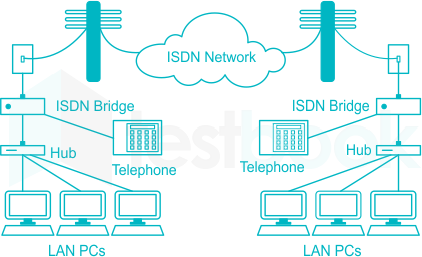
A set of standards to handle voice and computer data in telephone networks, providing additional telephone capabilities without scrapping existing copper telephone lines is called

  1. ((a))

    Internet Service Provider

  2. ((b))

    Internet Protocol Network

  3. ((c))

    Integrated Service Provider

  4. ((d))

    Integrated Service Digital Network

Show Answer
Answer: ((d))

Integrated Service Digital Network

Integrated Service Digital Network (ISDN), is the original high-speed internet service. Much like its predecessor, the dial-up internet service, ISDN utilizes a phone line and set the standard for telephone data service.

  • ISDN is a circuit-switched telephone network system that transmits both data and voice over a digital line. It as a set of communication standards to transmit data, voice, and signaling. These digital lines could be copper lines. It was designed to move outdated landline technology to digital.
  • ISDN connections have a reputation for providing better speeds and higher quality than traditional connections. Faster speeds and better connections allow data transmissions to travel more reliably.
  • It can transmit data and phone conversations digitally over normal telephone wires. This makes it both faster and of higher quality than dial-up internet service.

Additional Information

An Internet Service Provider (ISP) is the industry term for the company that is able to provide you with access to the Internet, typically from a computer. In other words, you can have a computer with a built-in modem and could have a router for networking, but without a subscription with an ISP, you won't have a connection to the Internet.

The Internet Protocol (IP) is a protocol, or set of rules, for routing and addressing packets of data so that they can travel across networks and arrive at the correct destination. Data traversing the Internet is divided into smaller pieces, called packets. IP information is attached to each packet, and this information helps routers to send packets to the right place. Every device or domain that connects to the Internet is assigned an IP address, and as packets are directed to the IP address attached to them, data arrives where it is needed.

14

MIPS stands for

  1. ((a))

    Million Instruction Per Second

  2. ((b))

    Mega Instruction Per Second

  3. ((c))

    Million Interchange Performance Standard

  4. ((d))

    Megabyte Instruction Performance Standard

Show Answer
Answer: ((a))

Million Instruction Per Second

MIPS Stands for "Million Instructions Per Second".

  • It is a method of measuring the raw speed of a computer's processor.
  • MIPS itself is not any standard benchmark but it is as a parameter for comparing processor speed.
  • The basic concept is measuring the instructions which can be processed by the processor within one second. The more instructions it can process, the faster it is.
15

Physical path along which data transmission occurs

  1. ((a))

    Encoder

  2. ((b))

    Decoder

  3. ((c))

    Channel

  4. ((d))

    Bandwidth

Show Answer
Answer: ((c))

Channel

A transmission path is also referred to as a transmission channel, the path between two nodes of a network that a data communication follows. The term can refer to the physical cabling that connects the nodes on a network, the signal that is communicated over the pathway, or a subchannel in a carrier frequency.

An encoder

  • It is a sensing device that provides feedback.
  • Encoders convert the motion to an electrical signal that can be read by some type of control device in a motion control system, such as a counter.
  • The encoder sends a feedback signal that can be used to determine position, count, speed, or direction.

A decoder

  • It is a circuit that changes a code into a set of signals.
  • It is called a decoder because it does the reverse of encoding, but we will begin our study of encoders and decoders with decoders because they are simpler to design.
  • Image result for Bandwidth describes the maximum data transfer rate of a network or Internet connection. It measures how much data can be sent over a specific connection in a given amount of time.

A channel 

  • It is a medium used to transport information from one network device to another.
  • Wired channels transport data through wires and cables.
  • Wireless channels transport data from one device to another without the use of cable or wires.

Bandwidth

  • It describes the maximum data transfer rate of a network or Internet connection.
  • It measures how much data can be sent over a specific connection in a given amount of time.

Based on the above definition one can conclude that data transmission occurs only in the channel.

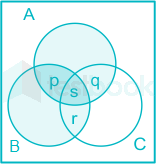
Direction: Answer Questions based on the following data and with the help of the given figure.

A = 30, represents total number of students in class studying Physics.

B = ?, represents total number of students studying Chemistry.

C = 40, represents total number of students studying Mathematics.

12 Students are studying Physics and Chemistry but not Mathematics.

16 Students are studying Chemistry and Mathematics but not Physics.

4 Students are studying Physics, Chemistry and Mathematics.

16

What is the ratio of number of students studying only Physics to the number of students studying only Mathematics ?

  1. ((a))

    0.3

  2. ((b))

    0.4

  3. ((c))

    0.5

  4. ((d))

    0.6

Show Answer
Answer: ((b))

0.4

A = Number of Students in Physics = 30


B = Number of students in chemistry = ?

C = Number of students in Mathematics = 40

p = 12 = Students are studying Physics and Chemistry but not Mathematics.

r = 16 = Students are studying Chemistry and Mathematics but not Physics.

s = 4 = Students are studying Physics, Chemistry, and Mathematics.

q = 10

Let, 

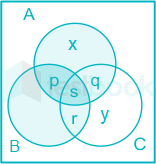
x = Students who are studying only Physics.

y = Students who are studying only Mathematics.

A = p + s + q + x 

x = 30 - 12 + 10 + 4  

x = 30 - 26 = 4

For C,

C = q + s + r + y 

y = 40 - 10 + 4 + 16 

y = 40 - 30

y= 10

Required ratio = x ÷ y = 4 ÷ 10 = 0.4

Hene, 0.4 is the correct answer.

17

What is the percentage of students studying Physics ?

  1. ((a))

    53%

  2. ((b))

    56%

  3. ((c))

    60%

  4. ((d))

    40%

Show Answer
Answer: ((a))

53%

A = Number of Students in Physics = 30

B = Number of students in chemistry = ?

C = Number of students in Mathematics = 40

p = 12 = Students are studying Physics and Chemistry but not Mathematics.

r = 16 = Students are studying Chemistry and Mathematics but not Physics.

s = 4 = Students are studying Physics, Chemistry, and Mathematics.

q = 10

Let, 

x = Students who are studying only Physics.

y = Students who are studying only Mathematics.

A = p + s + q + x 

x = 30 - 12 + 10 + 4  

x = 30 - 26 = 4

For C,

C = q + s + r + y 

y = 40 - 10 + 4 + 16 

y = 40 - 30

y= 10

Total number of Student's = p + q + r + s + x + y = 12 + 10 + 16 + 4 + 4 + 10 = 56

Required Percentage = ((30/56)×100=53.57)

Hence, 53% is the correct answer.

18

What is the total number of students in the class ?

  1. ((a))

    52

  2. ((b))

    60

  3. ((c))

    56

  4. ((d))

    63

Show Answer
Answer: ((c))

56

A = Number of Students in Physics = 30

B = Number of students in chemistry = ?

C = Number of students in Mathematics = 40

p = 12 = Students are studying Physics and Chemistry but not Mathematics.

r = 16 = Students are studying Chemistry and Mathematics but not Physics.

s = 4 = Students are studying Physics, Chemistry, and Mathematics.

q = 10

Let, 

x = Students who are studying only Physics.

y = Students who are studying only Mathematics.

A = p + s + q + x 

x = 30 - 12 + 10 + 4  

x = 30 - 26 = 4

For C,

C = q + s + r + y 

y = 40 - 10 + 4 + 16 

y = 40 - 30

y= 10

Total number of Student's = p + q + r + s + x + y = 12 + 10 + 16 + 4 + 4 + 10 = 56

hence, the Total number of Students = 56.

19

If students studying Physics and Mathematics, Physics, Chemistry and Mathematics are 14 in number, then what is the value of q ?

  1. ((a))

    6

  2. ((b))

    5

  3. ((c))

    10

  4. ((d))

    4

Show Answer
Answer: ((c))

10

A = Number of Students in Physics = 30

B = Number of students in chemistry = ?

C = Number of students in Mathematics = 40

p = 12 = Students are studying Physics and Chemistry but not Mathematics.

r = 16 = Students are studying Chemistry and Mathematics but not Physics.

s = 4 = Students are studying Physics, Chemistry, and Mathematics.

If, students studying Physics and Mathematics, Physics, Chemistry, and Mathematics are 14,

q + s = 14 

q = 14 - 4 = 10

hence, 10 is the correct answer.

20

If no student is studying Chemistry alone, what is the total number of students studying Chemistry ?

  1. ((a))

    30

  2. ((b))

    28

  3. ((c))

    32

  4. ((d))

    34

Show Answer
Answer: ((c))

32

A = Number of Students in Physics = 30

B = Number of students in chemistry = ?

C = Number of students in Mathematics = 40

p = 12 = Students are studying Physics and Chemistry but not Mathematics.

r = 16 = Students are studying Chemistry and Mathematics but not Physics.

s = 4 = Students are studying Physics, Chemistry, and Mathematics.

If no student is studying Chemistry alone,

B = p + s + r = 16 + 12 + 4 = 32

hence, 32 is the correct answer.

21

Among the four terms marked A – D, three terms are similar and one is dissimilar.

Find the one that is not similar.

  1. ((a))

    Shehnai

  2. ((b))

    Flute

  3. ((c))

    Trumpet

  4. ((d))

    Violin

Show Answer
Answer: ((d))

Violin

All options except ‘Violin’ are wind musical instruments, while ‘Violin’ is a stringed musical instrument.

Hence, ‘Violin’ is the odd one out.

22

Choose the pair of words which shows the same relationship as given at the top.

Biography ∶ Autobiography ∶∶   ?

  1. ((a))

    Memories ∶ History

  2. ((b))

    Author ∶ Performer

  3. ((c))

    Mobile ∶ Automobile

  4. ((d))

    Testimony ∶ Confession

Show Answer
Answer: ((d))

Testimony ∶ Confession

Biography ∶ Autobiography → Autobiography is the Biography of a person written by the person himself.

Similarly, Testimony ∶ Confession → Confession is the Testimony made by a person.

Hence, ‘Testimony ∶ Confession’ is the correct answer.

23

Consider the following statements.

  1. All contemporaries are ancestors.
  2. Few ancestors are heirs.
  3. No contemporary is an heir.

Which of the following inference can be drawn from the above statements ?

  1. ((a))

    Some contemporaries are heirs

  2. ((b))

    Some heirs are ancestors

  3. ((c))

    No ancestor is a contemporary

  4. ((d))

    No heir is an ancestor

Show Answer
Answer: ((b))

Some heirs are ancestors

  1. Some contemporaries are heirs → False (As, No contemporary is an heir)

  2. Some heirs are ancestors → True (As, Few ancestors are heirs)

  3. No ancestor is a contemporary → False (As, All contemporaries are ancestors)

  4. No heir is an ancestor → False (As, Few ancestors are heirs)

So, only inference 2 can be drawn.

Hence, ‘Some heirs are ancestors’ is the correct answer.

24

In the following question a statement is followed by two assumptions (i) and (ii). An assumption is something supposed or taken for granted. Consider the statement and the following assumptions and decide which of the following assumptions is implicit in the statement ?

Statement : If it does not rain throughout this season, most farmers would be in trouble this year.

Assumptions :

i. Most farmers are generally dependent on rains.

ii. Timely rainfall is essential for farming.

  1. ((a))

    Only assumption (i) is implicit

  2. ((b))

    Only assumption (ii) is implicit

  3. ((c))

    Neither assumption (i) nor (ii) is implicit

  4. ((d))

    Both the assumptions are implicit

Show Answer
Answer: ((d))

Both the assumptions are implicit

i. Most farmers are generally dependent on rains.

It is implicit in the statement as most farmers would be in trouble implies that most farmers are depend on rain.

ii. Timely rainfall is essential for farming.

It is implicit in the statement as timely rainfall is important  as per the statement.

Hence, both the assumptions are implicit.

25

The question below is followed by two arguments (i) and (ii). Decide which of the arguments is “strong” and which is “weak”. Choose the correct answer from the given below.

Statement : India should make voting in elections compulsory for every eligible citizen.

Arguments :

i. Yes, because India spends a lot on elections, which is very important in the Indian context and everyone should vote to make India a true Democracy.

ii. No, because the moment you make things compulsory it is not a truly democratic way of getting things done.

  1. ((a))

    Only the argument (i) is strong

  2. ((b))

    Only the argument (ii) is strong

  3. ((c))

    Neither argument (i) nor argument (ii) is strong

  4. ((d))

    Both the arguments are strong

Show Answer
Answer: ((b))

Only the argument (ii) is strong

Everyone should vote to make India a true Democracy, but compulsory voting is not consistent with freedom of democracy. Voting should not be an obligation.

So the above explanation we can conclude that argument (ii) is strong.

Hence,   only the argument (ii) is strong.

26

‘A’ walks around a circular field at the rate of one round per hour, while ‘B’ runs around it at the rate of six rounds per hour. They start in the same direction from the same point at 7.30 A.M. They shall first cross each other at

  1. ((a))

    8.30 A.M.

  2. ((b))

    8.10 A.M.

  3. ((c))

    7.48 A.M.

  4. ((d))

    7.42 A.M.

Show Answer
Answer: ((d))

7.42 A.M.

Given:

Speed of A = one round per hour

Speed of B = 6 rounds per hour

Calculation: 

As they start in the same direction,

The relative speed between A and B = 6 – 1 = 5 round per hour

<br>

∴They will cross when one round will complete with relative speed, which is 1/5 hour = 12 minutes.

<br>

∴ 7:30 + 12 minutes = 7 : 42 AM

27

The price of 7 apples is equal to the cost of 3 melons. The price of 2 melons is equal to the cost of an apple and five oranges. If you had just enough money to buy 30 oranges, then how many apples you would buy with the same amount ?

  1. ((a))

    22

  2. ((b))

    25

  3. ((c))

    30

  4. ((d))

    32

Show Answer
Answer: ((a))

22

Cost of 3 melons = Cost of 7 apples

∴ Cost of 2 melons = 2 × (7/3) = 14/3 apples

Price of 2 melons is equal to the cost of an apple and five oranges

⇒ 14/3 apples = 1 apple + 5 oranges

(14/3) – 1 (apples) = 5 oranges

5 oranges = 11/3 apples

∴ 30 oranges = 30 × (11/3)/5 = 22 apples

28

If PURCHASE is coded as PRHSEACU, then how SUITABLE will be coded ?

  1. ((a))

    SIAELBTU

  2. ((b))

    SIALBETU

  3. ((c))

    SIABELTU

  4. ((d))

    SIALEBTU

Show Answer
Answer: ((d))

SIALEBTU

The pattern is:

Similarly,

Hence, ‘SIALEBTU’ is the correct answer.

29

Complete the series :

132, 182, 306, 380, 552, 870, _____

  1. ((a))

    930

  2. ((b))

    992

  3. ((c))

    1010

  4. ((d))

    1142

Show Answer
Answer: ((b))

992

Logic: Prime number square + Prime number

112 + 11 = 132

132 + 13 = 182

172 + 17 = 306

192 + 19 = 380

232 + 23 = 552

292 + 29 = 870

312 + 31 = 992

30

A, B, and C together can complete a piece of work in 10 days. All the three started working at it together and after 4 days ‘A’ left. Then B and C together completed the work in 10 more days. ‘A’ alone can complete the work in

  1. ((a))

    15 days

  2. ((b))

    16 days

  3. ((c))

    25 days

  4. ((d))

    26 days

Show Answer
Answer: ((c))

25 days

Given:

Time taken by A, B, and C together to complete a piece of work = 10 days

After 4 days A left and then B and C completed the remaining work in 10 more days

Calculation:

(A + B + C)'s 1-day work = 1/10

They work together for 4 days, work done by them in 4 days = 4/10 = 2/5

Let total work = 1 unit

Remaining work = 1 – 2/5 = 3/5

(B + C) take 10 more days to complete 3/5 work. 

∴ (B + C)'s 1 day work = 3/(5 × 10) = 3/50

Now A's 1 day work = (A + B + C)'s 1 day work – (B + C)'s 1 day work = (1/10) – (3/50) = 1/25

∴ A does 1/25 work in in 1 day

∴ Total time taken by A = 25 days.

31

What is AIDA Marketing Communication stands for ?

  1. ((a))

    Attraction – Information – Development – Application

  2. ((b))

    Attention – Information – Dialogue – Action

  3. ((c))

    Attention – Interest – Desire – Action

  4. ((d))

    Attitude – Inspiration – Desire – Action

Show Answer
Answer: ((c))

Attention – Interest – Desire – Action

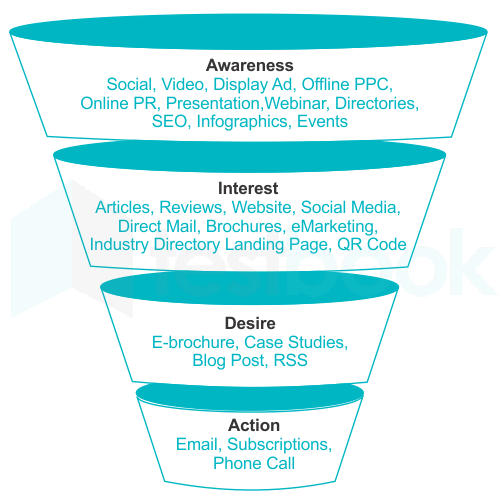
AIDA is an acronym developed in 1898 by advertising pioneer E. St. Elmo Lewis.

  • It describes the steps that a prospective customer goes through before deciding to buy a product or service.
  • The acronym stands for Attention, Interest, Desire, and Action.
  • The AIDA model is widely used in marketing and advertising to describe the steps or stages that occur from the very first moment a consumer is aware of a product or brand to the actual moment the purchase is made.

Attention

  • The first stage of the buying process is making the consumer aware of the product.
  • A salesperson's job is to catch the prospect's attention well enough so that they can keep the prospect engaged long enough to whet their interest.

Interest

  • To bump prospects up to the second stage, you must develop the potential buyer's interest in the product or service.
  • This is usually where benefit phrases come heavily into play.

Desire

  • In the third stage of AIDA, prospects realize that the product or service is a good fit and will help them in some way.
  • Salespeople can bring prospects to this point by going from general benefits to specific benefits.
  • Often this includes using information culled during the earlier stages which allow you to fine-tune the sales pitch.

Action

  • The fourth and last stage of AIDA occurs when the prospect decides to take the action necessary to become a customer.
  • If you carried the prospect through the first three stages (and responded appropriately to any objections), this stage often occurs naturally.
  • If not, you may need to prompt a prospect to act by using closing techniques.
32

‘Employment News’ is published by the publisher of

  1. ((a))

    Times of India

  2. ((b))

    The Week

  3. ((c))

    The Hindu

  4. ((d))

    Yojana

Show Answer
Answer: ((d))

Yojana

Employment News, a weekly publication of the Publications Division under the Ministry of Information and Broadcasting publishes government job vacancies. 

It was launched in 1976 with a view to providing information on employment opportunities to the unemployed and underemployed youth of the country. The journal is published by the publisher of Yojana in English(Employment News), Hindi (Rozgar Samachar), and Urdu (Rozgar Samachar) and has a circulation of over one lakh copies per week. The Office of Employment News is headed by an Additional DG and is located in New Delhi.

The job journal provides information related to job vacancies, job oriented training programs, admission notices related to job oriented exams, and results of recruitment exams in respect of:

  • Ministries/Departments/Offices/Organizations/Autonomous bodies/Societies/PSUs of the Central Government, State Government, and UT Administrations;
  • Nationalised banks/ RRBs /UPSC/SSC/ Constitutional and Statutory bodies; and
  • Central/State Governments Universities/ Colleges/Institutes recognized by the UGC/AICTE.

 ​

Times of India: The Times of India (TOI) is an Indian English-language daily newspaper owned by The Times Group. It is the fourth-largest newspaper in India by circulation and the largest-selling English-language daily in the world according to the Audit Bureau of Circulations (India).

The Week: The Week is a family of publications that began with a print magazine more than 20 years ago. It now also includes digital editions of the magazine, with weekly apps for iPads, iPhones, and Android devices – and a website that publishes distinctive online stories throughout the week.

The Hindu: The Hindu, India's national newspaper since 1878, is published by THG Publishing Private Limited, Chennai, India. The English language daily is best described as classic yet contemporary. It is known for the high quality of its journalism and excellent presentation. The newspaper is printed in 18 cities in India.

33

Which is the agency of the Central Government that disseminates information regarding government policies and projects to the media in India?

  1. ((a))

    PIB

  2. ((b))

    PTI

  3. ((c))

    AIR

  4. ((d))

    PCI

Show Answer
Answer: ((a))

PIB

1) The Press Information Bureau (PIB)

  • It is the nodal agency of the Government of India to disseminate information to the print and electronic media on government policies, programs, initiatives, and achievements.
  • It functions as an interface between the Government and the media and also serves to provide feedback to the Government on people’s reaction as reflected in the media.
  • PIB disseminates information through different modes of communication viz. press releases, press notes, feature articles, backgrounders, photographs, a database available on the Bureau’s website.
  • Information disseminated is released in English, Hindi, and Urdu and subsequently translated in other Indian languages to reach out to about 8,400 newspapers and media organizations in different parts of the country.

2) Press Trust of India (PTI)

  • PTI was registered in 1947 and started functioning in 1949.
  • It is India’s premier news agency, having a reach as vast as the Indian Railways.
  • Collectively, journalists and stringers put out more than 2,000 stories and 200 photographs a day to feed the expansive appetite of the diverse subscribers, who include the mainstream media, the specialized presses, research groups, companies, and government and non-governmental organizations.
  • PTI correspondents are also based in leading capitals and important business and administrative centers around the world.
  • It also has exchange arrangements with several foreign news agencies to magnify its global news footprint.

3) All India Radio (AIR)

  • It is India’s Public Service Broadcaster, the Radio vertical of Prasar Bharati has been serving to inform, educate and entertain its audiences since its inception, living up to its motto – ‘Bahujan Hitaya: Bahujan Sukhaya’.
  • It is one of the largest broadcasting organizations in the world in terms of the number of languages of broadcast and the spectrum of socio-economic and cultural diversity it serves.
  • AIR’s home service comprises of 470 Broadcasting centers located across the country, covering nearly 92% of the country’s area and 99.19 % of the total population.
  • Terrestrially, AIR originates programming in 23 languages and 179 dialects.

4) Press Council of India (PCI)

  • The Press Council of India was first set up in the year 1966 by the Parliament on the recommendations of the First Press Commission.
  • The objective of PCI is to preserve the freedom of the press and to maintain and improve the standards of press in India.

​Hence, The Press Information Bureau (PIB) is the agency of the Central Government that disseminates information regarding government

policies and projects to the media in India.

34

ESD, NSD, DD, DCD has one thing in common. What is it ?

  1. ((a))

    Viewership

  2. ((b))

    Ownership

  3. ((c))

    Readership

  4. ((d))

    Leadership

Show Answer
Answer: ((b))

Ownership

All the services(ESD, NSD, DD, DCD) are under Prasar Bharati, which is the Public Service Broadcaster of the country. It is a statutory autonomous body established under the Prasar Bharati Act and came into existence on 23.11.1997. The largest of its kind, Prasar Bharati comprises of All India Radio and Doordarshan Television Network, which were previously media units of the Ministry of Information and Broadcasting.

All India Radio entered the realm of external broadcasting shortly after the outbreak of II world War on 1st October, 1939-when it started a service in Pushtu for listeners across- what was then the country's northwest Frontier. The service was designated to counter radio propaganda from Germany, directed towards Afghanistan, Iran and Arab countries. With the end of the war, the Victorious and Allies lost interest in continuing with the propaganda warfare and the equipment was presented to AIR, which took over its active control.

1) External Services Division (ESD) 

  • It ranks high amongst the overseas Radio networks of the world, both in reach and range, by originating 55 transmissions daily of almost 72 hours covering over 100 countries in 27 languages, 15 foreign and 12 Indian.
  • The foreign languages are Arabic, Baluchi, Burmese, Chinese, Dari, French, Indonesian, Persian, Pushtu, Russian, Sinhala, Swahili, Thai, Tibetan and English (GOS).
  • The Indian languages are Bengali, Nepali, Gujarati, Hindi, Kannada, Malayalam, Punjabi, Seraiki, Sindhi, Tamil, Telegu, and Urdu.

2) The News Services Division (NSD)

  • It disseminates news and commentaries for listeners in India and abroad.
  • From 27 news bulletins in 1939-40, AIR today puts out more than 510 bulletins daily for a duration of approximately 52 hours in 82 languages/dialects in the Home, Regional, and External Services.
  • 89 bulletins are broadcast daily from New Delhi in the Home Service in English, Hindi, and other Indian languages.

3) Development Communication Division (DCD)

  • The News Services Division also mounts daily, a number of news-based programs on topical subjects from New Delhi and its Regional News Units.
  • Doordarshan Commercial Service is an independent wing to co-ordinate all the commercial activities being performed at the Headquarter, Doordarshan Kendras, Marketing Divisions, and Development Communication Division (DCD) towards the sale of air time as well as a collection of revenue from agencies/clients/producers.

4) Doordarshan (DD) 

  • It is the television vertical of Prasar Bharati, India’s Public Service Broadcaster. Established on 15th September 1959, it is an autonomous body funded by the Government of India.
  • It is one of the world's largest broadcasting organizations in terms of studio and transmitter infrastructure. For the first time in India, DD has also started broadcasting through digital terrestrial transmitters.
  • DD provides its services on TV, Digital, and Mobile platforms across the country.

Hence, one thing is common among all services (given above) is their ownership. They all come under the purview of Prasar Bharati.

35

The first ever FM services were started in India on

  1. ((a))

    July 23, 1977

  2. ((b))

    July 23, 1997

  3. ((c))

    July 23, 2007

  4. ((d))

    July 23, 1987

Show Answer
Answer: ((a))

July 23, 1977

Frequency modulation (FM): 

  • FM is short for frequency modulation, which refers to the means of encoding the audio signal on the carrier frequency.
  • FM full power, low power, translator and booster stations operate in the 88 – 108 MHz band.
  • Radio started as wireless telegraphy. And it all began with the invention of radio waves, which have the capacity to send out speech, music, picture, and all other data through the air.
  • A range of devices like radio, cordless phones, microwave TV broadcasts works with the help of electromagnetic waves. During the 1860s, James Maxwell, a Scottish physicist forecasted the presence of radio waves.
  • On July 23, 1977, first-ever FM Service was inaugurated from Madras.
  • In June 1923 the Radio Club of Bombay made the first-ever broadcast in the country. This was followed by the setting up of the Calcutta Radio Club five months later. The Indian Broadcasting Company (IBC) came into being on July 23, 1927.

DirectionsRead the following passage carefully and answer the questions.

DECOLONIZING THE NORTH

The white man’s burden is becoming increasingly heavy for the earth and especially for the South. The past 500 years of history reveal that each time a relationship of colonization has been established between the North and nature and people outside the North, the colonizing men and society have assumed a position of superiority, and thus of responsibility for the future of the earth and for other people and cultures. Out of the assumption of superiority flows the notion of the white man’s burden. Out of the idea of the white man’s burden flows the reality of the burdens imposed by the white man on nature, women, and others. Therefore, decolonizing the South is intimately linked to the issue of decolonizing the North. 

Gandhi clearly formulated the individuality of freedom not only in the sense that the oppressed of the world are one, but also in the wider sense that the oppressor too, is caught in the culture of oppression. Decolonization in the North is also essential because processes of wealth creation simultaneously create poverty, processes of knowledge creation simultaneously generate ignorance, and processes for the creation of freedom simultaneously generate unfreedom.

In the early phases of colonization, the white man’s burden consisted of the need to ‘civilize’ the non-white peoples of the world –– this meant, above all, depriving them of their resources and rights. In the later phase of colonization, the white man’s burden consisted of the need to ‘develop’ the third world, and this again involved depriving local communities of their resources and rights. We are now on the threshold of the third phase of colonization, in which the white man’s burden is to protect the environment, especially the third world’s environment – and this, too, involves taking control of rights and resources.

Ethical decolonization:

From the democracy of all life to man’s empire over nature, most non-western cultures have been based on the democracy of all life. As a schoolgirl, one lesson I learnt in the Hindi class was that human beings are part of Vasudhaiva Kutumbakam or the earth family. As a part of the earth family, one participates in the democracy of all life. Rabindranath Tagore, our national poet, wrote that the peak of Indian culture consists in its having defined the principles of life in nature as the highest form of cultural evolution.

The culture of the forest has fuelled the culture of Indian society. The culture that has arisen from the forest has been influenced by the diverse processes of renewal of life which are always at play in the forest, varying from species to species, from season to season, insight and sound and smell. The unifying principle of life in diversity, of democratic pluralism, thus became the principle of Indian civilization.

As a source of life, nature was venerated as sacred, and human evolution was measured in terms of the human capacity to interact in harmony with her rhythms and patterns, intellectually and emotionally. In the final analysis, the ecological crisis is rooted in the mistaken belief that human beings are not part of the democracy of nature’s life, that they stand apart from and above nature.

36

Decolonising the South

  1. ((a))

    Requires the resources of the North

  2. ((b))

    Requires the decolonisation of the North

  3. ((c))

    Total separation between North and South

  4. ((d))

    Western Technology

Show Answer
Answer: ((b))

Requires the decolonisation of the North

The correct answer is option 2), i.e., Requires the decolonisation of the North.

Explanation:

  • The passage talks about how the white man's burden is really about imposing his superiority over the others.
  • It also mentions that this burden of the white men in the 'North' always results in their colonizing the 'South', as is seen historically.

Key Points

  • So, the North and the South are linked through this assumed superiority of the North over South.
  • The author thus states that to decolonize the South means decolonizing the minds of the North first.
37

What is the author’s view is essential to Indian civilization ?

  1. ((a))

    Religious attitude

  2. ((b))

    Compassion for others

  3. ((c))

    Democratic pluralism

  4. ((d))

    Hedonism

Show Answer
Answer: ((c))

Democratic pluralism

The correct answer is option 3), i.e., Democratic pluralism.

Explanation:

  • The author states that the Indian perspective of life is 'of Vasudhaiva Kutumbakam' or the earth as a family.
  • The passage also mentions that the unifying principle of life in diversity, of democratic pluralism, is the principle of Indian civilization.
38

The author argues that the attempt by the West to protect the third World’s environment is

  1. ((a))

    The need of the day

  2. ((b))

    A historical compulsion

  3. ((c))

    Harmful to the third world

  4. ((d))

    An ethical duty

Show Answer
Answer: ((c))

Harmful to the third world

The correct answer is option 3), i.e., Harmful to the third world.

Explanation:

  • The passage talks about the 'phases of colonization' and how it always implied taking control of resources of the non-white or third world countries.
  • In the first phase, it was under the guise of 'civilizing' them, in the second phase, it was to 'develop' the third world.

Key Points

  • The third phase of colonization, according to the author, is to control the resources of the third world by imposing 'environmental protection'.
  • In this manner, the author argues that the environmental concerns of the West is a way of colonizing the Third world and thus harmful.
39

In the passage North refers to

  1. ((a))

    All countries above the equator

  2. ((b))

    Only Scandinavian countries

  3. ((c))

    Imperialist European countries

  4. ((d))

    Highly civilized countries

Show Answer
Answer: ((c))

Imperialist European countries

The correct answer is option 3), i.e., Imperialist European countries.

Explanation:

  • The passage refers exclusively to the issue of 'colonization by the North' and its consequences.
  • It subsequently talks about the 'burden of white man' due to this colonization by the North of the South.
  • So, in context of the passage, the 'North' here is referring to the colonizing European countries.

Mistake Points 

  • It is easy to confuse option 1 or 2- the 'geographically North' regions as the correct answer. But, the context of the passage is referring to the 'ideological North', which is imperialist Europe.
40

White man’s burden is based on

  1. ((a))

    Real progress made by Europe

  2. ((b))

    Superior technology

  3. ((c))

    False notion of superiority

  4. ((d))

    Democratic nature of European Societies

Show Answer
Answer: ((c))

False notion of superiority

The correct answer is option 3), i.e., False notion of superiority.

 Explanation:

  • The first paragraph talks about white man's burden becoming very heavy.
  • The passage also mentions that the white man’s burden flows out of the assumption of their superiority.
41

What is the research that aims at immediate application ?

  1. ((a))

    Action Research

  2. ((b))

    Empirical Research

  3. ((c))

    Conceptual Research

  4. ((d))

    Fundamental Research

Show Answer
Answer: ((a))

Action Research

Research is a systematic way of investigation, a process of discovering new knowledge. Research is also considered as searching for and gathering information, usually to answer a particular question. Each research study has its own specific purpose.

Action research 

  • Its primary aim is to solve an immediate problem. It is cyclic in nature.
  • It is a form of interpretive research to study human actions and social practices with the participation of the researcher.
  • It is applied research, which is focused on immediate application, not to develop any theory for general applications.
  • It refers to the application of research to educational problems in a particular classroom setting.

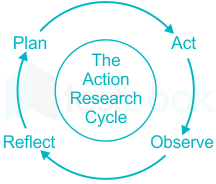
The Cycle of Action Research:

  • Action Research achieves its goal by using a ‘cyclic research process’, where each cycle is made up of four phases - Plan, Act (implementing plans), Observe (systematically) and Reflect.
  • It is a continuous cycle one can circle back to earlier phases within a cycle (e.g., cycle back and forth between reflection and planning).


Characteristics of Action Research:

  • There is always room for improvement when it comes to teaching and educating others.
  • The main traits of action research related to collaboration between teachers, educational managers, and members of the organization to solve problems.
  • Possibility to gain in-depth knowledge about the problem.
  • It can be used with quantitative as well as qualitative data.
  • This research focuses on specific situations and their context.
  • This type of research is facilitated by participation and collaboration of the number of individuals with a common purpose.


Empirical Research is a type of research methodology that makes use of verifiable evidence in order to arrive at research outcomes. In other words, this type of research relies solely on evidence obtained through observation or scientific data collection methods.

Conceptual Research is defined as a methodology wherein research is conducted by observing and analyzing already present information on a given topic. Conceptual research doesn't involve conducting any practical experiments. It is related to abstract concepts or ideas.

Fundamental research is a formal and systematic process where the researcher aims to develop a theory or a model by identifying all the important variables in a situation and by discovering broad generalisations and principles about those variables. It utilizes a careful sample so that its conclusion can be generalised beyond the immediate situation.

42

When two or more successive footnotes refer to the same work, which one of the following is used ?

  1. ((a))

    ibid

  2. ((b))

    et.al

  3. ((c))

    op.cit

  4. ((d))

    loc.cit

Show Answer
Answer: ((a))

ibid

In research papers and reports, footnotes commonly acknowledge the sources of facts and quotations that appear in the text. Footnotes are notes placed at the bottom of a page. They cite references or comment on a designated part of the text above it.

"Ibid"

  • (the abbreviation for "ibidem", meaning "in the same place") refers to the work cited in the preceding footnote or to the preceding work within the same footnote.
  • The term should not be used when the preceding footnote includes more than one source.
  • It is used when repeat footnote indicators are not used and to replace those elements that are identical in the preceding footnote or the preceding work within the same footnote.
  • It is never used solely to replace the name of an author.
  • When different works by the same author are cited in consecutive footnotes, the author’s name is repeated in full each time.

Hence, it is clear from the above points that "Ibid" is used when two or more successive footnotes refer to the same work.

NOTE-

et.al- Depending on the number of authors a source has, an APA in-text citation is shortened by using “et al.” (meaning “and others”) after the first author’s name. When there are six or more authors, cite the first author followed by “et al.” When a source has three, four, or five authors, list all authors the first time the source is cited. In all subsequent citations, give only the first author followed by “et al.”

op.cit- It is an abbreviation of the Latin phrase opere citato, meaning "in the work cited." It is used in an endnote or footnote to refer the reader to a previously cited work, standing in for repetition of the full title of the work. Op. cit. thus refers the reader to the bibliography, where the full citation of the work can be found, or to a full citation given in a previous footnote. 

loc.cit is a footnote or endnote term used to repeat the title and page number for a given work. Loc. cit. is used in place of ibid. when the reference is not only to the work immediately preceding, but also refers to the same page. Therefore, loc. cit. is never followed by volume or page numbers.

43

Which is the process not needed in experimental research ?

  1. ((a))

    Manipulation and Replication

  2. ((b))

    Controlling

  3. ((c))

    Observation

  4. ((d))

    Absence of treatment group

Show Answer
Answer: ((d))

Absence of treatment group

Research is a systematic inquiry towards understanding a complex social phenomenon or a process. Based on the research problem, the selection of research methods by the researcher may vary.

Experimental Method:

  • It is a systematic and scientific approach to research on establishing causal relationships.
  • It is designed for establishing cause and effect relationships between two or more variables.
  • It investigates a hypothesis through experiments in a controlled environment where a variable is manipulated by the researcher and its impact is observed on the dependent variable.
  • It tests the formulated hypothesis and uses the results to generalize to a larger population.
  • It helps in establishing causal relationships among different events in the educational situation under controlled conditions
  • There are four essential characteristics of experimental research:
  1. control
  2. manipulation
  3. observation and
  4. replication

​​Hence, the Absence of a treatment group is a process not needed in experimental research.

44

What is Encyclopaedia edited content called as ?

  1. ((a))

    Primary Source

  2. ((b))

    Infinite Source

  3. ((c))

    Continuous Source

  4. ((d))

    Secondary Source

Show Answer
Answer: ((d))

Secondary Source

Literature refers to the collection of scholarly writings on a topic in the research. This includes peer-reviewed articles, books, dissertations, and conference papers. When reviewing the literature, be sure to include major works as well as studies that respond to major works. It is important to focus on primary sources, though secondary sources can be valuable as well.

A primary source is an original source that documents an event in time, a person, or an idea. It provides raw information and first-hand evidence. Examples include interview transcripts, statistical data, and works of art. A primary source gives you direct access to the subject of your research.

Continuous data is data that can take any value. Height, weight, temperature, and length are all examples of continuous data. Some continuous data will change over time; the weight of a baby in its first year or the temperature in a room throughout the day.

Secondary sources build upon primary resources by analyzing, interpreting, synthesizing, or discussing them. Common examples include:

  • Books, articles, and documentaries that synthesize information on a topic
  • Synopses and descriptions of artistic works
  • Encyclopedia and textbooks that summarize information and ideas
  • Reviews and essays that evaluate or interpret something

Hence, Encyclopaedia edited content called as Secondary source

45

A research hypothesis is a

  1. ((a))

    Theory

  2. ((b))

    Principle

  3. ((c))

    Tentative proposition

  4. ((d))

    Postulate

Show Answer
Answer: ((c))

Tentative proposition

In conducting research, the important consideration after the formulation of a research problem is the construction of the hypothesis. Any scientific inquiry starts with the statement of a solvable problem, when the problem has been stated, a tentative solution in the form of a testable proposition is offered by the researcher.

Hypothesis:

  • A hypothesis is often considered a tentative and testable statement of the possible relationship between two or more events/variables under investigation.
  • A hypothesis does not have to be right or wrong, but the person formulating the hypothesis does have to be prepared to test the theory to its limits.
  • A hypothesis is a proposed explanation for an observable phenomenon.

Hence, it is concluded that a tentative proposition with unknown validity that specifies a relationship between two or more variables is called Research Hypothesis.

Note-

A theory on the other hand is a principle set to explain phenomena already supported by data. A theory is a well-established, tested explanation that provides a unified description of some aspect of the natural world. A theory is based on substantiated data, repeated testing, and the consensus of a wide group of scientists/researchers.

A principle is a fundamental truth or proposition that serves as the foundation for a system of belief or behaviour or for a chain of reasoning. On the other hand, a hypothesis is an assumption, something proposed for the sake of argument so that it can be tested to see if it might be true.

A hypothesis is a theory that can after testing be accepted or rejected. A postulate is something that is assumed to be true without proof. Sometimes postulates are also called axioms. Hence, a hypothesis can not be termed as a postulate.


Hypotheses can be classified into several types, like; universal hypotheses, existential hypotheses, conceptual hypotheses, etc. Broadly, there are two categories of the hypothesis: i) Null hypothesis ii) Alternative hypothesis

Null Hypothesis: 

  • The null hypothesis, H0 is the commonly accepted fact; it is the opposite of the alternate hypothesis.
  • Researchers work to reject, nullify, or disprove the null hypothesis. Researchers come up with an alternate hypothesis, one that they think explains a phenomenon, and then work to reject the null hypothesis.

Alternate Hypothesis:

  • In statistical hypothesis testing, the alternative hypothesis is a position that states something is happening, a new theory is preferred instead of an old one (null hypothesis).
  • It is usually consistent with the research hypothesis because it is constructed from the literature review, previous studies, etc.
46

Which of the following is not a teaching method ?

  1. ((a))

    Buzz group

  2. ((b))

    Brain storming

  3. ((c))

    Gossip

  4. ((d))

    Role plays

Show Answer
Answer: ((c))

Gossip

Different teaching methods are used by teachers as per the requirements of students. For choosing the one, the teacher may classify students based on their abilities (ability grouping) or he can choose it based on the compatibility of the topic.

Below discussed a few of them:

  • Buzz groups are a cooperative learning technique consisting of the formation of small discussion groups with the objective of developing a specific task (idea generation, problem-solving, etc.) or facilitating that a group of people reach a consensus on their ideas about a topic in a specific period of time.
  • The brainstorming technique involves the teacher posing an idea or question to students and asking them to contribute their ideas. The teacher may pose a question or a situation or a scenario to involve the students. This is the best technique to let students express their ideas and lets teachers tap their creativity levels.
  • Role-playing is a learning structure that allows students to immediately apply content as they are put in the role of a decision-maker who must make a decision regarding a policy, resource allocation, or some other outcome. This technique is an excellent tool for engaging students and allowing them to interact with their peers as they try to complete the task assigned to them in their specific role.

Note- (Gossip is idle talk or rumor, especially about the personal or private affairs of others. Hence, it is not a formal teaching method and most certainly not an educative one)

47

Which of the following techniques used by a teacher to teach include?

  1. Lecture
  2. Interactive lecture
  3. Group work
  4. Self-study
  1. ((a))

    1, 2, 3 and 4

  2. ((b))

    1, 2, 3 only

  3. ((c))

    1 and 2 only

  4. ((d))

    1, 3 and 4

Show Answer
Answer: ((b))

1, 2, 3 only

A teacher is a person who teaches or instructs, especially as a profession. The term teaching method refers to the general principles, pedagogy, and management strategies used for classroom instruction.

The techniques used by a teacher to teach include-

Lecture-

  • It is a method of teaching whereby the teacher attempts to explain facts, principles, or relationships to help students to understand.
  • The teacher is an active participant, the students are passive listeners.
  • The class listens, writes, and notes facts and the ideas for remembering and to think them over later. Usually, the students do not converse with the teacher during a lecture by the teacher. It is a one-way method.

Interactive lectures

  • the instructor incorporates engagement triggers and breaks the lecture at least once per class to have students participate in an activity that lets them work directly with the material.
  • It provides an opportunity for students to interact actively and directly with the material through a specific learning task.

Group work-

  • It is an effective technique used by the teacher to motivate students and encourage them. It allows students to become active participants in their learning.

Note-

(Self-study is a learning method where students direct their own studying—outside the classroom and without direct supervision.) 

Hence, based on the above definition one can conclude that self-study is a voluntary exercise conducted by students and is devoid of teacher participation.

48

Lecture method is least effective in the learning of:

  1. ((a))

    Aptitudes

  2. ((b))

    Attitudes

  3. ((c))

    Relationships

  4. ((d))

    Skills

Show Answer
Answer: ((d))

Skills

The lecture method is a method of teaching whereby the teacher attempts to explain facts, principles, or relationships to help students to understand.

  • The teacher is an active participant, the students are passive listeners.
  • The class listens, writes, and notes facts and the ideas for remembering and to think them over later. Usually, the students do not converse with the teacher during a lecture by the teacher.
  • It is a one-way method.
  • One of the major characteristics of this method is that in this the teacher provides information, concepts, facts, events, theories, laws, principles, etc. Therefore helps in aptitudes, attitudes, and Relationships kind of problem-solving questions. It imparts a large amount of factual information within a short period.
  • The lecture method is only relevant in concepts dealing with theoretical understanding. But when it comes to the practical implementation of concepts dealing with learn by doing the lecture methods become inconsequential.

Therefore, skill development which is mostly a practical exercise is not much benefited from the lecture method.

49

Which one of the following is the aim of Value Education? 

  1. ((a))

    To inculcate moral values

  2. ((b))

    To inculcate social values

  3. ((c))

    To inculcate political values

  4. ((d))

    To inculcate economic values

Show Answer
Answer: ((a))

To inculcate moral values

Values are an integral part of every culture. Along with beliefs, they generate and have an impact on the behavior of an individual. Most of us learned our values - or morals, at home, at school, or from our community (neighborhood). Mostly, the values which we follow come from parents, teachers, and religious leaders.

The National Policy on Education has laid considerable emphasis on Value Education by highlighting the need to make education a forceful tool for the cultivation of moral values. The main objectives of the promotion of Ethics and Human Values are as under :

  • value education is simply a matter of developing appropriate behavior and habits involving the inculcation of certain virtues and habits.
  • Value education has an essentially cognitive component in it and that this should not be ignored.
  • Actually the ability to make a moral judgment based on sound reasoning is a very important aim of value education and has to be deliberately cultivated.
  • Moral values are connected to fundamental human emotions and experiences that motivate us in distinctive ways. Social, political, and economic values come from a separate stream of education.

Hence, The explicit objective of value education is to inculcate moral values.

50

Which one of the following is the most effective mode of learning in the present days?

  1. ((a))

    Self-study

  2. ((b))

    Blended learning

  3. ((c))

    Face to face learning

  4. ((d))

    E-learning

Show Answer
Answer: ((b))

Blended learning

Modes of learning are a set of guidelines that describe the methods humans use to acquire, process, and maintain knowledge. Individuals differ in how they learn most effectively; most people favor different combinations of visual, auditory, reading, or kinesthetic (VARK) learning modes. Effective learning is dependent on various factors including learner characteristics, quality of teaching, appropriate use of teaching strategies and methods, technological aids, classroom-related factors, etc.

  • There are a lot of different strategies for learning. The education sector has benefited from a great many pioneers and the way our students are taught today is very different from how they were taught earlier.
  • Much of this innovation has been related to the growth of technology. Computers have become extremely valuable teaching tools and have opened up a whole new world of online learning.
  • Some of the most effective educational establishments are using dynamic digital tools such as e-learning software alongside more traditional classroom practices to create blended learning models.

Blended learning 

  • is defined as a formal education program that’s made up of in-person classroom time as well as individual study online using e-learning software.
  • It is a type of multichannel method that incorporates tutor-led activities, images, video, digital tasks, and face-to-face discussion.
  • Courses that follow the blended learning model often take place in a real ‘brick and mortar’ classroom with a dedicated tutor but offer additional learning opportunities by way of a digital platform. Digital learning elements are often open to self-pacing by each individual student and can usually be logged in to at any time and in any place.
  • It is the most effective mode of learning in the present-day because it is a multichannel teaching method that offers the best of the classroom and online learning all in one place. Each student has a range of different strengths and requirements and a blended learning approach allows tutors to acknowledge this.

Note- 

Self-study- It is a learning method where students direct their own studying—outside the classroom and without direct supervision. 

Face to face learning- It can be defined as the traditional style of learning in which students show up at a venue at the same time following a prescribed schedule of taught sessions called a curriculum.

E-learning- A learning system based on formalized teaching but with the help of electronic resources. It can also be termed as a network-enabled transfer of skills and knowledge, and the delivery of education is made to a large number of recipients at the same or different times.

Attempt this paper under real exam conditions

Timed interface, section switching, instant scoring, and question-by-question analytics — free.

Start Timed Attempt