Official Paper

Kerala SET Paper 1: Held on 10th January 2020 (Previous Year Paper)

120 questions · 120 minutes · with answers · free

Test (120 questions)

1

“True Education must correspond to the surrounding circumstances or it is not a healthy growth”. Whose words are these?

  1. ((a))

    Rabindranath Tagore

  2. ((b))

    Mahatma Gandhi

  3. ((c))

    Dr. Radhakrishnan

  4. ((d))

    Swami Vivekananda

Show Answer
Answer: ((b))

Mahatma Gandhi

“True education must correspond to the surrounding circumstances or it is not a healthy growth.” — Mahatma Gandhi.

Gandhiji On Education

  • He always viewed education as an all-round development and not just as literacy. He stressed on whole development of a child, not just the mind.
  • An education which does not teach us to discriminate between good and bad, to assimilate the one and eschew the other, is a misnomer. Education should be so revolutionized as to answer the wants of the poorest villager, instead of answering those of an imperial exploiter.
  • Education in the understanding of citizenship is a short-term affair if we are honest and earnest. Basic education links the children, whether of cities or the villages, to all that is best and lasting in India.

2

“Education does not change the world, Education changes people. People change the world”. Who said this?

  1. ((a))

    Plato

  2. ((b))

    John Dewey

  3. ((c))

    Paulo Freire

  4. ((d))

    Aristotle

Show Answer
Answer: ((c))

Paulo Freire

“Education does not change the world, Education changes people. People change the world” - Paulo Freire.

Paulo Freire (1921—1997)

  • Paulo Freire was one of the most influential philosophers of education of the twentieth century.
  • He worked wholeheartedly to help people both through his philosophy and his practice of critical pedagogy.
  • A native of Brazil, Freire’s goal was to eradicate illiteracy among people from previously colonized countries and continents.
  • His insights were rooted in the social and political realities of the children and grandchildren of former slaves. His ideas, life, and work served to ameliorate the living conditions of oppressed people.
3

The Educational Philosophy which supports the concept “Values are absolute and unchanging”:

  1. ((a))

    Naturalism

  2. ((b))

    Idealism

  3. ((c))

    Realism

  4. ((d))

    Pragmatism

Show Answer
Answer: ((b))

Idealism

  • Idealism is a philosophical approach that has as its central tenet that ideas are the only true reality, the only thing worth knowing. In a search for truth, beauty, and justice that is enduring and everlasting, the focus is on conscious reasoning in the mind.
  • The main tenant of idealism is that ideas and knowledge are the truest reality.  Many things in the world change, but ideas and knowledge are enduring.
  • Idealism was often referred to as “idea-ism”. Idealists believe that ideas can change lives. The most important part of a person is the mind. It is to be nourished and developed.
  • Idealism is any philosophy which argues that the only things knowable are consciousness or the contents of consciousness – not anything in the outside world, if such a place actually exists. Indeed, idealism often takes the form of arguing that the only real things are mental entities, not physical things.
  • Idealists assert that eternal values exist in God. Good and evil, beauty and ugliness are known to the extent that the idea of good and the idea of beauty are consistent with the absolute good and the absolute beauty found in God. Pantheistic Idealists identify God with nature. Values are absolute and unchanging because they are a part of the determined order of nature.
4

The branch of Philosophy which examines the fundamental nature of reality, including the relationship between mind and matter, between substance and attribute and between potentiality and actuality?

  1. ((a))

    Epistemology

  2. ((b))

    Aesthetics

  3. ((c))

    Logic

  4. ((d))

    Metaphysics

Show Answer
Answer: ((d))

Metaphysics

  • Metaphysics is the branch of philosophy that examines the fundamental nature of reality, including the relationship between mind and matter, between substance and attribute, and between potentiality and actuality.
  • The word "metaphysics" comes from two Greek words that, together, literally mean "after or behind or among [the study of] the natural". It has been suggested that the term might have been coined by a first century CE editor who assembled various small selections of Aristotle’s works into the treatise we now know by the name Metaphysics.
5

The Philosophical system which postulates that, ‘Everything in reality stems from ‘Purusha’ and ‘Prakriti”?

  1. ((a))

    Samkhya

  2. ((b))

    Nyaya

  3. ((c))

    Mimamsa

  4. ((d))

    Vedaantha

Show Answer
Answer: ((a))

Samkhya

  • Samkhya is one of the six astika schools of Indian philosophy.
  • It is most related to the Yoga school of Hinduism, and it was influential on other schools of Indian philosophy.
  • It forms the theoretical foundation of Yoga.
  • Samkhya's epistemology accepts three of six pramanas ('proofs') as the only reliable means of gaining knowledge, as does yoga.
  • These are pratyakṣa ('perception'), anumāṇa ('inference') and śabda (āptavacana, meaning, 'word/testimony of reliable sources').

Key Points

Theory of Self: 

  • Samkhya is dualistic realism.
  • Samkhya philosophy regards the universe as consisting of two independent realities:
  • Purusha:
  • It is the self (Atman) and is based on pure consciousness.
  • Purusha is not one but many.
  • Prakriti:
  • ​It is the non-self based on matter.
  • It is devoid of consciousness.
  • Prakriti is unintelligible and gets greatly influenced by the Purusha.
  • The mind and the thoughts that appear in the mind are also considered a part of Prakriti.
  • Samkhya considers that both matter and spirit are equally real.
  • Jiva ('a living being') is that state in which Purusha is bonded to Prakriti in some form.
  • The universe is described by this school as one created by Purusha-Prakriti entities.
  • These are infused with various combinations of variously enumerated elements, senses, feelings, activity, and mind.
  • During the state of imbalance, one or more constituents overwhelm the others, creating a form of bondage, particularly of the mind.
  • The end of this imbalance and bondage is called liberation or kaivalya by the Samkhya school.
  • The existence of God or a supreme being is not considered relevant by the Samkhya philosophers.
  • Samkhya denies the final cause of Ishvara.
  • The Samkhya school considers the Vedas a reliable source of knowledge.
  • Samkhya philosophy is known for its theory of Gunas.


Thus, Samkhya is the oldest of the orthodox philosophical systems, and it postulates that everything, in reality, stems from purusha (self, soul or mind) and prakriti (matter, creative agency, energy). Purush cannot be modified or changed while prakriti brings a change in all objects.

6

A teaching approach which attempts to help students to question and challenge domination and the beliefs and practices that dominate:

  1. ((a))

    Inductive Approach

  2. ((b))

    Heuristic Method

  3. ((c))

    Critical Pedagogy

  4. ((d))

    Deductive Approach

Show Answer
Answer: ((c))

Critical Pedagogy

Critical Pedagogy: 

  • A teaching approach that attempts to help students question and challenge domination and the beliefs and practices that dominate.
  • In other words, it is a theory and practice of helping students achieve critical consciousness.
  • In this tradition, the teacher works to lead students to question ideologies and practices considered oppressive.
  • It provides an opportunity to think or reflect critically on issues, e.g. population growth, child marriage, industrialization, from different angles- political, economic, moral, etc.
  • It envisages open/democratic interaction and acceptance of multiple views.
  • In other words, critical pedagogy facilitates collective decision making through open decisions; and by encouraging and recognizing multiple views.

Hence, we conclude that a teaching approach which attempts to help students to question and challenge domination and the beliefs and practices that dominate is Critical Pedagogy.

Inductive Approach- An inductive method is a bottom-up approach, - It starts with an observation and comes to a generalization based on the observed phenomena. - It is a specific to general approach i.e., broad generalizations are made from the specific example.
Heuristic Method- This method can also be named as the 'discovery method'. - It demands complete self-experience of self-learning on the part of the student. - Through this method, the student learns the reason for himself. - This method helps in the development of a scientific attitude in the learner. - It develops self-confidence, originality, independence of judgment, and thinking power in the learner to make him an ever successful student.
Deductive Approach- It is introduced by Aristotle. It is a teacher-centered approach. - It promotes convergent thinking and is also known as general to specific, rule to example, abstract to concrete and unknown to known approach. - The laws, formulas, principles are presented before the students in a real form and the children learn them on their part. - In this method, proof starts from the conclusion as the laws and outcomes are already being told to the students and they just have to prove that right by any means.
7

Cultural modification of an individual, group or people by adapting to or borrowing traits from another culture is known as:

  1. ((a))

    Cultural Lag

  2. ((b))

    Cultural Pluralism

  3. ((c))

    Assimilation

  4. ((d))

    Acculturation

Show Answer
Answer: ((d))

Acculturation

Cultural modification of an individual, group, or people by adapting to or borrowing traits from another culture is known as Acculturation.

Key Points

 Acculturation:

  • Cultural modification of an individual, group, or people by adapting to, or borrowing traits from, another culture.
  • A merging of cultures as a result of prolonged contact.
  • It should be noted that individuals from culturally diverse groups may desire varying degrees of acculturation into the dominant culture.
  • The definition of acculturation is the transfer of values and customs from one group to another.
  • Japanese people dressing in Western clothing is an example of acculturation.
  • The modification of the culture of a group or individual as a result of contact with a different culture.

Additional InformationCultural Lag: a relatively slower advance or change of one aspect of a culture

Cultural Pluralism: Cultural pluralism is defined as the societal condition in which minority groups within a society can maintain their distinctive cultural identities, values, and practices provided that they are consistent with the laws and values of the wider society.

Assimilation: Assuming the cultural traditions of a given people or group.

8

A kind of social differentiation where by members of society are grouped into social economic basis, depending upon their job, wealth, social status, power or income is:

  1. ((a))

    Social stratification

  2. ((b))

    Social Inequality

  3. ((c))

    Social Mobility

  4. ((d))

    Social Change

Show Answer
Answer: ((a))

Social stratification

Social stratification- Social stratification refers to a society’s classification gradation or categorization of its people into social hierarchy based on criteria of factors like wealth, income, race, education, and power. - It is a process of allocation of different statuses or positions determined by class, caste, kinship, gender, age, occupation, income and many other social attributes. - It refers to a system by which a society ranks categories of people in a hierarchy. It is universally observed that some groups in society have greater status, power, and wealth than other groups, and these differences lead to social stratification. - Social stratification means division of society into different strata or layers. It involves a hierarchy of social groups. Members of a particular layer have a common identity. They have a similar life style.
Social Inequality- It refers to relational processes in society that have the effect of limiting or harming a group's social status, social class, and social circle. - Areas of social inequality include access to voting rights, freedom of speech and assembly, the extent of property rights and access to education, health care, quality housing, traveling, transportation, vacationing and other social goods and services. - It refers to disparities in the distribution of economic assets and income as well as between the overall quality and luxury of each person's existence within a society, while economic inequality is caused by the unequal accumulation of wealth; social inequality exists because the lack of wealth in certain areas prohibits these people from obtaining the same housing, health care, etc. as the wealthy, in societies where access to these social goods depends on wealth.
Social Mobility- Social mobility refers to the movement of individuals or groups in social positions over time. - Most commonly, social mobility refers to the change in wealth and social status of individuals or families. - It typically refers to vertical mobility, movement of individuals or groups up or down from one socio-economic level to another, often by changing jobs or marriage.
Social Change- Social change is way human interactions and relationships transform cultural and social institutions over time, having a profound impact of society.
9

An Act to provide more effective protection of the Rights of the women guaranteed under the Constitution who are victim of assault of any kind occurring within the family:

  1. ((a))

    Dowry Prohibition Act, 1961.

  2. ((b))

    Sexual Harassment of women at work place Act, 2013

  3. ((c))

    Domestic Violence Act, 2005

  4. ((d))

    The Indecent Representation of Women Act, 1986.

Show Answer
Answer: ((c))

Domestic Violence Act, 2005

THE PROTECTION OF WOMEN FROM DOMESTIC VIOLENCE ACT, 2005

An Act to provide for more effective protection of the rights of women guaranteed under the Constitution who are victims of violence of any kind occurring within the family and formatters connected therewith or incidental thereto.

Domestic violence means

  • Causing hurt, injury or danger to life, limb, health, safety or well-being, whether mental or physical.
  • Causing harm, injury, or danger to the woman with an intention to coerce her or any other person related to her to meet any demand for dowry.
  • “Physical abuse" includes hurt of any kind. Assault, criminal intimidation and criminal force.
  • “Sexual abuse" such as conduct of a sexual nature such as forced sexual intercourse, forcing the aggrieved person to watch pornography or other obscene material.
  • “Verbal and emotional abuse" such as Accusation/aspersion on character or conduct. Insult for not brining dowry, Insult for not having a male child. etc.

Who is covered under the Act?

  • The Act covers all women who may be mother, sister, wife, widow or partners living in a shared household. The relationship may be in nature of marriage or adoption.
  • In addition relationships with family members living together as a joint family are also included. However, no female relative of the husband or the male partner can file a complaint against the wife or the female partner, for e.g. the mother-in-law cannot file an application against a daughter-in-law, but she can file an application against her daughter-in-law for abetting her son to commit violence against her.
10

A teacher, holding every learner with responsibilities to high standards of performance is:

  1. ((a))

    Teacher Accountability

  2. ((b))

    Teacher Competency

  3. ((c))

    Teacher Capability

  4. ((d))

    Teacher Ethics

Show Answer
Answer: ((a))

Teacher Accountability

Teacher Accountability- Accountability means holding everyone with responsibilities to high standards of performance. - Teacher accountability is something that has become undesirable for many educators. Teacher should be an accountable, because it is not all about standardized test scores and students’ performance.
Teacher Competency- Teacher competence Refers to the teacher’s ability to perfume or of carryout defined tasks in particular context at higher level of excellence.
Teacher Capability- Informal capability, or rather informal support, is a term commonly used to describe the period during which a member of staff is supported to fully perform their duties and to address issues of underperformance on an informal basis.
Teacher Ethics- The code of ethics for teachers is designed to protect the rights of the students, all the students. - It is important that teachers understand that when they get a teaching position they are agreeing to follow the code of ethics. - Teachers are expected to be fair to all their students and not to take advantage of their position in any way.
11

Abilities for positive and adaptive behaviour that enable humans to deal effectively with the demands and challenges of life are:

  1. ((a))

    Teaching Skills

  2. ((b))

    Social Skills

  3. ((c))

    Life Skills

  4. ((d))

    Emotional Skills

Show Answer
Answer: ((c))

Life Skills

Teaching Skills- These are the hard and soft skills that help a teacher keep students engaged. - These skills can also help teachers position themselves as an educator, earning the attention and respect of their students. - Developing teaching skills is only one part of becoming a good teacher.
Social Skills- Social skills are defined as “The abilities necessary to get along with others and to create and maintain satisfying relationships.”
Life Skills- The World Health Organization defines life-skills as, "abilities for adaptive and positive behaviour that enable individuals to deal effectively with the demands and challenges of everyday life." - Thus, life skills are basic skills that help individuals in leading a meaningful life and better adjustment in the society. - They involve myriad of positive aspects of our life such as the values and ethics we possess, the proactive attitude that we keep towards the society we live in and various interpersonal and psychosocial skills that we have.
Emotional Skills- Emotional skills or emotional intelligence is defined as “The ability to identify and manage one’s own emotions, as well as the emotions of others.”
12

Who among the following is known as the father of ‘Client Centred therapy’?

  1. ((a))

    Sigmond Freud

  2. ((b))

    Carl Rogers

  3. ((c))

    Abraham Maslow

  4. ((d))

    Virginia Axline

Show Answer
Answer: ((b))

Carl Rogers

Carl Rogers is known as the father of ‘Client Centred therapy’.

Key PointsClient-Centred therapy:

  • Client-centred therapies belong to humanistic psychology.
  • Carl Rogers is known as the father of client-centred therapy.
  • Partly in response to the psychoanalytic and behavioural schools that emphasized interpretations or manipulations, Rogers developed a non-directive therapy focused on creating a reflective space for individuals to actualize their potential.
  • He later changed the name of this therapy to "person-centred therapy".
  • In a paper written by Carl Rogers (1979), he reviews briefly the central hypothesis of his person-centred therapy.
  • He suggests that each of us has within us the resources to achieve self-understanding, as well as to alter our self-concept, our basic attitudes, and our self-directed behaviour.
  • Rogers (1979) proposes that these resources can be tapped only within a very specific type of environment that is characterized by what he refers to as facilitative conditions.
  • According to Rogers (1979), there are three conditions that facilitate this growth:
  • Genuineness/Realness/Congruence;
  • Acceptance/Caring/Unconditional Positive Regard, and
  • Empathic Understanding.

During the 1950s, Rogers renamed his approach to counselling client-centred therapy.

13

Behaviour that is driven by internal rewards is known as:

  1. ((a))

    Primary Motivation

  2. ((b))

    Intrinsic Motivation

  3. ((c))

    Extrinsic Motivation

  4. ((d))

    Secondary Motivation

Show Answer
Answer: ((b))

Intrinsic Motivation

Intrinsic motivation refers to behavior that is driven by internal rewards.

Motivation:

  • Motivation is something that makes the person to action and continues him in the course of action already initiated. There are two identifiable components of motivation. These are needed and drive.
  • It inspires a person to intensify his efforts for the achievement of certain objectives. It motivates a person in action and induces him to continue in the course of action enthusiastically.
  • There are two primary types of motivation namely, intrinsic motivation and extrinsic motivation.

Key Points 

Intrinsic Motivation-

  • There is a high relationship between the activity (reading) to the goal (enjoy reading). In such a situation, we say, the person is intrinsically motivated.
  • Cognitivism holds the view that curiosity, interest, or a sense of accomplishment are sources of motivation that are intrinsic (internal) rather than responding to external forces.
  • An intrinsically motivated activity will always be rewarded due to the direct relationship between the activity and the goal. This secures a continuous motivation to do the activity.
  • So, it does not require an external push, unlike extrinsic motivation which requires an external motivating factor. So intrinsic motivation is more beneficial.
  • Examples of intrinsic motivation of a feeling of achievement, personal enjoyment, a sense of competence and happiness, etc.

Intrinsic motivation refers to behavior that is driven by internal rewards. In other words, the motivation to engage in a behavior arises from within the individual because it is naturally satisfying to you.

Additional Information 

Extrinsic  Motivation-

  • When an activity is performed to accomplish the goal of an external reward, the person is said to be extrinsically motivated.
  • This is motivation based on external rewards and has nothing to do with the activity directly. The Behaviourists' approach to motivation mainly focuses on the external rewards of reinforcement and punishment.
14

The theory of ‘Structure of Intellect’ was proposed by:

  1. ((a))

    Gardner

  2. ((b))

    Guilforf

  3. ((c))

    Spearman

  4. ((d))

    Thurstone

Show Answer
Answer: ((b))

Guilforf

Intelligence refers to the capacity to acquire and apply knowledge. It is the ability to solve problems, learn from experiences, and apply knowledge to deal with new situations.

There are many theories related to intelligence. These theories are propounded by eminent psychologists to provide a framework to understand different aspects of human intelligence.

Important Points

Structured theory of Intelligence 

  • SI model of intelligence was given by I P Guilford in 1966.
  • In J.P. Guilford’s Structure of Intellect (SI) theory, intelligence is viewed as comprising operations, contents, and products.
  • According to this theory, There are
  • 6 kinds of operations (cognition, memory recording, memory retention, divergent production, convergent production, evaluation),
  • 6 kinds of products (units, classes, relations, systems, transformations, and implications), and
  • 5 kinds of contents (visual, auditory, symbolic, semantic, behavioral).
  • Each of these dimensions is independent, there are theoretically 180 different components of intelligence.
  • Guilford researched and developed a wide variety of psychometric tests to measure the specific abilities predicted by SI theory.
  • These tests provide an operational definition of the many abilities proposed by the theory. Furthermore, factor analysis was used to determine which tests appeared to measure the same or different abilities.

Joy Paul Guilford proposed a structure-of-intellect theory, which in its earlier versions postulated 120 abilities. In The Nature of Human Intelligence (1967), Guilford argued that abilities can be divided into five kinds of operation, four kinds of content, and six kinds of product.

15

‘Advance Organizer’ is the concept put forth by:

  1. ((a))

    Jerome Bruner

  2. ((b))

    Jean Piaget

  3. ((c))

    David Ausubel

  4. ((d))

    Robert Gagne

Show Answer
Answer: ((c))

David Ausubel

Advance Organizer’ is the concept put forth by David Ausubel.

Key PointsThe concept of advance organizer:

  • Advance Organizers provide an organizational framework that instructors develop prior to presenting information to students.
  • This framework prepares students for what they are about to learn and can help provide links between new ideas and similar concepts.
  • Four examples of graphic organizers: outline, Venn diagram, hierarchical organizer, and bubble map.
  • A graphic organizer is a powerful, visual learning tool that teachers like to use to help students organize their ideas.
  • They can also be used to clarify or simplify complex concepts, help with problem solving or decision making, or be used to plan research or brainstorm ideas.

The uses of organizer are as followsa:

  • organising information.
  • setting reminder.
  • storing or keeping information for future use.
  • organizing meetings and appointments.
  • setting goals, and tracking achievement of goals.
  • memos and notes.

Hence, it is developed by David Ausubel, Advance Organizers were a “practical impli- cation of his theory of meaningful verbal learning”

16

The tendency of a child in the Preoperational stage of cognitive development in which inferences move from particular situation to particular aspects is:

  1. ((a))

    Inductive reasoning

  2. ((b))

    Deductive reasoning

  3. ((c))

    Critical Reasoning

  4. ((d))

    Transductive Reasoning

Show Answer
Answer: ((d))

Transductive Reasoning

The tendency of a child in the Preoperational stage of cognitive development in which inferences move from particular situation to particular aspects is Inductive reasoning.

Mistake Points

  • Inductive inference is based on a generalization from a finite set of past observations, extending the observed pattern or relation to other future instances or instances occurring elsewhere.
  • The transductive inference is reasoning from the particular to the particular, without going through general rules.

So, transductive inference will be the correct answer here. 

Important PointsTransductive Reasoning:

  • Transductive reasoning is a type of flawed logic that is most commonly used by very young children to connect meaning between events where there is no correlation.
  • Transductive reasoning causes people to think there are connections between events that are not accurate based on past experiences, patterns, or belief systems.
  • Example transductive learning approaches include transductive SVM (TSVM) and graph-based label propagation algorithms (LPA).

Additional Information

ReasoningImportant information
Inductive reasoning- Inductive reasoning proceeds from the particular to general from the concrete to the abstract. - It begins with observations that are specific and limited in scope and proceeds to a generalized conclusion that is likely, but not certain, in light of accumulated evidence. - Inductive reasoning moves from the specific to the general. - Much scientific research is carried out by the inductive method: gathering evidence, seeking patterns, and forming a hypothesis or theory to explain what is seen. - Conclusions reached by the inductive method are not logical necessities; no amount of inductive evidence guarantees the conclusion. This is because there is no way to know that all the possible evidence has been gathered and that there exists no further bit of unobserved evidence that might invalidate my hypothesis.
Deductive reasoning- Deductive Reasoning works from more general to particular or specific. - It is also known as top-down thinking because it usually starts with a general conclusion and ends with a specific conclusion.
Critical Reasoning- Critical reasoning involves the ability to actively and skillfully conceptualize, analyze, question, and evaluate ideas and beliefs. - To reason critically is to question the ideas and beliefs of others and oneself and to challenge dogma and authority. - When we start to question the ideas and beliefs we live by, we start to think for ourselves. To think for ourselves involves a critical attitude of reflecting upon how we think and act. - To think critically is to question the world and thus engage critically with the possibilities and alternatives which the world offers.
17

A stable characteristic that causes a person to depict a response to any situations, in one way or another is

  1. ((a))

    Personality traits

  2. ((b))

    Personality types

  3. ((c))

    Personality factors

  4. ((d))

    Personality determinants

Show Answer
Answer: ((a))

Personality traits

  • Personality traits reflect people’s characteristic patterns of thoughts, feelings, and behaviors. It depict a person response to any situations.
  • Personality traits imply consistency and stability—someone who scores high on a specific trait like Extraversion is expected to be sociable in different situations and over time. Thus, trait psychology rests on the idea that people differ from one another in terms of where they stand on a set of basic trait dimensions that persist over time and across situations.
  • The most widely used system of traits is called the Five-Factor Model. This system includes five broad traits that can be remembered with the acronym OCEAN: Openness, Conscientiousness, Extraversion, Agreeableness, and Neuroticism. Each of the major traits from the Big Five can be divided into facets to give a more fine-grained analysis of someone's personality.
  • In addition, some trait theorists argue that there are other traits that cannot be completely captured by the Five-Factor Model. Critics of the trait concept argue that people do not act consistently from one situation to the next and that people are very influenced by situational forces. Thus, one major debate in the field concerns the relative power of people’s traits versus the situations in which they find themselves as predictors of their behavior.
18

A task that arises at or about a certain period in life in which the unsuccessful achievement of which leads to inability to perform tasks associated with the next stage in life is:

  1. ((a))

    Emotional task

  2. ((b))

    Cognitive task

  3. ((c))

    Psychological task

  4. ((d))

    Developmental task

Show Answer
Answer: ((d))

Developmental task

Emotional task- The Emotional Regulation Task assesses an individual's ability to regulate emotions. - Specifically, this task is designed to elicit both positive and negative emotional states in order to examine participants’ abilities to increase positive, and decrease negative, emotions in real-time.
Cognitive task- Cognitive tasks are those undertakings that require a person to mentally process new information (i.e., acquire and organize knowledge/learn) and allow them to recall, retrieve that information from memory and to use that information at a later time in the same or similar situation.
Psychological task- The tasks of the contemporary psychology are related to the study of mental energy; health improvement; enhancement of educational attractiveness, including by means of use of electronic devices in the educational process; informing the society regarding the sensitive stages in human development; elaboration of psycho-diagnostic opportunities by means of creation of new instruments and improvement of non-verbal recognition of mental phenomena; enhancing psychological competences regarding the offer of more models that explain mental phenomena, etc.
Developmental task- A developmental task is a task that arises at or about a certain period in life, unsuccessful achievement of which leads to inability to perform tasks associated with the next period or stage in life. - A developmental task is one that arises predictably and consistently at or about a certain period in the life of the individual. - The concept of developmental tasks assumes that human development in modern societies is characterized by a long series of tasks that individuals have to learn throughout their lives. - Successful achievement of a certain task is expected to lead to happiness and to success with later tasks, while failure may result in unhappiness in the individual, disapproval by the society, and difficulty with later tasks.
19

A review of NPE -1986 programme of Action was done by

  1. ((a))

    Yashpal Committee

  2. ((b))

    Hansa Mehta Committee

  3. ((c))

    Rama Moorthi Commission

  4. ((d))

    National Commission for teachers

Show Answer
Answer: ((c))

Rama Moorthi Commission

A review of the NPE -1986 program of Action was done by Rama Moorthi Commission.

The implementation of the National Policy on Education 1986 was evaluated by two committees namely the Ramamurti Committee (1990) and the Janardhana Reddy Committee (1992)

Key PointsRama Moorthi Commission:

  • Despite efforts at social and economic development, a majority of our people continue to remain deprived of education, which is one of the basic needs for human development.
  • Government accords the highest priority to education – both as a human right and as the means for bringing about a transformation towards a more humane and enlightened society.
  • The National Policy on Education, 1986 would enable the country to move towards this perspective of education.
  • The government, therefore, decided to set up the NPE Review Committee.
  • That Committee for Review is popularly known as Ramamurti Review Committee after the name Acharya Ramamurti, the chairman of the committee.
  • The committee was appointed on May 7, 1990, and the report was tabled in the Parliament on January 9, 1991.

The following are the major recommendations:

  1. Development of a common school system
  2. Removing disparities in education
  3. Promotion of women education
  4. Value education
  5. Early childhood care and education (ECCE)
  6. Right to education
  7. Operation Blackboard
  8. Navodaya Vidyalayas
  9. Work experiences/ SUPW
  10. Resources for education

As a result of the recommendations of these two committees, slight modifications were made in the NPE in 1992.

20

Which Education Commission recommends the establishment of DIET’s?

  1. ((a))

    Indian Education Commission

  2. ((b))

    University Education Commission

  3. ((c))

    Secondary Education Commission

  4. ((d))

    National Policy on Education

Show Answer
Answer: ((d))

National Policy on Education

Key Points

District Institute of Education and Training (DIET):

  • DIET are district-level educational institutes that have been established in each district of India by the Indian government.
  • They help in coordinating and implementing government policies at the district level.
  • About 3 million primary and elementary teachers need recurrent orientation to innovations in teaching and learning at the school level.
  • The DIET has been charged with this responsibility.
  • DIETs have been established as centers of guidance for educational institutes and schools of a district.
  • They also work as a platform for research and experimental work in the educational domain.
  • It also organizes programs to train teachers in new innovations.
  • District Institute of Education and Training (DIET) is a nodal agency for providing academic.

National Policy of Education 1986

  • In 1986, the government led by Rajiv Gandhi introduced a new National Policy on Education.
  • The new policy called for special emphasis on the removal of disparities and to equalize educational opportunity, especially for Indian women, Scheduled Tribes, and the Scheduled Caste communities.
  • The provision of NPE on Teacher Education, a centrally sponsored scheme of restructuring and reorganization of teacher education was approved in October 1987.
  • One of the five components of the scheme was the establishment of DIETs.​

Additional Information

Education commission - 1966

  • National Education Commission (1964-1966), popularly known as Kothari Commission.
  • It was an ad hoc commission set up by the Government of India to examine all aspects of the educational sector in India.
  • It focuses on evolving a general pattern of education and advising guidelines and policies for the development of education in India.

University Education Commission 1948 - 49

  • The Government of India appointed a University Education Commission under the chairmanship of Dr. Radhakrishnan in November 1948.
  • The Commission made a number of significant recommendations on various aspects of higher education and submitted its report in August 1949.
  • In the rapidly changing contemporary world, universities are undergoing profound changes in their scope, function, and organization and are in a process of rapid evolution.

Secondary Education Commission 1952 - 53

  • Mudaliar Commission is also known as the Secondary education commission.
  • In 1952 Union Government of India appointed Dr. A Laxman Swami Mudaliar as a chairman of the secondary education commission.
  • The aim of this commission was to examine the existing system of secondary education in the country.

Therefore, the Establishment of DIETs is a result of one of the recommendations of the National Policy of Education 1986.

21

Which of the following Assessment tools of Personality is a Projective tool?

  1. ((a))

    California test of Personality

  2. ((b))

    GATB

  3. ((c))

    TAT

  4. ((d))

    Draw a man test

Show Answer
Answer: ((c))

TAT

Projective tests are sets of ambiguous stimuli, such as ink blots or incomplete sentences, and the individual responds with the first thought or series of thoughts that come to mind or tells a story about each stimulus.

Projective tests are based on Freudian psychology and seek to expose people’s unconscious perceptions by using ambiguous stimuli to reveal the inner aspects of an individual’s personality.

Two of the most popular projective measures are the Thematic Apperception Measure and the Rorschach test.

Thematic Appreciation Test

  • Henry Murray, an American psychologist developed the Thematic Appreciation Test.
  • A thematic apperception test (TAT) is a projective technique used to investigate a person's unconscious self.
  • More specifically, a thematic apperception test can uncover a person's true personality, their capacity for emotional control, and their attitudes towards aspects they encounter in everyday life (wealth, power. gender roles, racial and religious attitudes, intimacy, etc.).

Thus, it is concluded that Thematic Apperception Test (TAT) of measuring personality is a projective technique.

22

Match the following:

List IList II
1. Skinner(a) Trial & error
2. Pavlov(b) Concept Attainment
3. Thorndike(c) Operant Conditioning
4. Bruner(d) Classical Conditioning
  1. ((a))

    1 - d, 2 - a, 3 - c, 4 - b

  2. ((b))

    1 - c, 2 - d, 3 - a, 4 - b

  3. ((c))

    1 - a, 2 - b, 3 - c, 4 - d

  4. ((d))

    1 - b, 2 - c, 3 - d, 4 - a

Show Answer
Answer: ((b))

1 - c, 2 - d, 3 - a, 4 - b

Important Points

  • Operant conditioning is a method of learning that occurs through rewards and punishments for behavior.
  • Through operant conditioning, an individual makes an association between a particular behavior and a consequence.
  • Skinner suggested that operant conditioning held far greater importance.
  • Skinner invented different devices during his boyhood and he put these skills to work during his studies on operant conditioning.
  • He created a device known as an operant conditioning chamber, most often referred to today as a Skinner box.
  • The Classical Conditioning Theory was proposed by Russian Physiologist Ivan Pavlov.
  • According to this theory, behavior is learned by a repetitive association between the response and the stimulus.
  • After discovering Pavlov’s experiments a year later, Watson made classical conditioning the foundation of his ideas.
  • Classical conditioning requires placing a neutral stimulus immediately before a stimulus that automatically occurs, which eventually leads to a learned response to the formerly neutral stimulus.
  • TRIAL AND ERROR learning theory By Edward Lee Thorndike, an American psychologist. 
  • According to him, learning takes place by trial and error.
  • In learning the learner selects a correct response out of a large number of possible ones and connects it with the appropriate stimulus.
  • The Concept Attainment model is an instructional strategy founded on the works of Jerome Bruner.
  • Built on the principle of concept formation, the Concept Attainment model promotes student learning through a process of structured inquiry.
  • It is also known as Bruner’s Concept Attainment Model. CAM is a teaching strategy to teach concepts

Hence, we can conclude that the right answer to this question is 1 - c, 2 - d, 3 - a, 4 - b.

23

Which among the following is the function of NCTE?

  1. ((a))

    Overall development of the basic infrastructure of Higher Education sector both in terms of policy and planning

  2. ((b))

    To achieve planned and coordinated development of the teacher education system throughout the country.

  3. ((c))

    Conduction and Promotion of Educational Research

  4. ((d))

    Centres of guidance for educational institutions and schools of a district.

Show Answer
Answer: ((b))

To achieve planned and coordinated development of the teacher education system throughout the country.

Important Points

National Council for Teacher Education (NCTE):

  • The National Council for Teacher Education, in its previous status since 1973, was an advisory body for the Central and State Governments on all matters pertaining to teacher education, with its Secretariat in the Department of Teacher Education of the National Council of Educational Research and Training (NCERT).
  • Despite its commendable work in the academic fields, it could not perform essential regulatory functions, to ensure maintenance of standards in teacher education and prevent the proliferation of substandard teacher education institutions.
  • The National Policy on Education (NPE), 1986 and the Programme of Action thereunder envisaged a National Council for Teacher Education with statutory status and necessary resources as a first step for overhauling the system of teacher education.
  • The National Council for Teacher Education as a statutory body came into existence in pursuance of the National Council for Teacher Education Act, 1993 (No. 73 of 1993) on the 17th August 1995.

Key PointsFunctions of NCTE:

  • undertake surveys and studies relating to various aspects of teacher education and publish the result thereof;
  • make recommendations to the Central and State Government, Universities, University Grants Commission and recognised institutions in the matter of preparation of suitable plans and programmes in the field of teacher education;
  • co-ordinate and monitor teacher education and its development in the country;
  • lay down guidelines in respect of minimum qualifications for a person to be employed as a teacher in schools or in recognised institutions;
  • lay down norms for any specified category of courses or training in teacher education, including the minimum eligibility criteria for admission thereof, and the method of selection of candidates, duration of the course, course contents and mode of the curriculum;
  • lay down guidelines for compliance by recognised institutions, for starting new courses or training, and for providing physical and instructional facilities, staffing pattern and staff qualification;
  • lay down standards in respect of examinations leading to teacher education qualifications, criteria for admission to such examinations and schemes of courses or training;
  • lay down guidelines regarding tuition fees and other fees chargeable by recognised institutions;
  • promote and conduct innovation and research in various areas of teacher education and disseminate the results thereof;
  • examine and review periodically the implementation of the norms, guidelines and standards laid down by the Council, and to suitably advise the recognised institution;
  • evolve suitable performance appraisal system, norms and mechanism for enforcing accountability on recognised institutions;
  • formulate schemes for various levels of teacher education and identify recognised institutions and set up new institutions for teacher development programmes;
  • take all necessary steps to prevent commercialisation of teacher education; and
  • perform such other functions as may be entrusted to it by the Central Government.

Hence, the major function of NCTE is to achieve planned and coordinated development of the teacher education system throughout the country.

24

A predisposition to respond positively or negatively towards an idea, object, person or situation:

  1. ((a))

    Aptitude

  2. ((b))

    Intelligence

  3. ((c))

    Attitude

  4. ((d))

    Interest

Show Answer
Answer: ((c))

Attitude

Aptitude- A natural ability to do something.
Intelligence- The ability to learn, understand, and make judgments or have opinions that are based on reason:
Attitude- Attitudes are usually defined as a disposition or tendency to respond positively or negatively towards a certain thing (idea, object, person, situation). - They encompass, or are closely related to, our opinions and beliefs and are based upon our experiences. - It is a collective measure of how one handles the situation.
Interest- A desire to learn or hear more about somebody/something or to be involved with somebody/something
25

Proficiency in teaching has to be judged in terms of:

  1. ((a))

    completion of Syllabus in time

  2. ((b))

    use of Innovative teaching aids

  3. ((c))

    learning Outcomes of students

  4. ((d))

    classroom Interaction

Show Answer
Answer: ((c))

learning Outcomes of students

  • Proficiency-based teaching refers to systems of instruction, assessment, grading, and academic reporting that are based on students demonstrating that they have learned the knowledge and skills they are expected to learn as they progress through their education.
  • In public schools, proficiency-based systems use state learning standards to determine academic expectations and define “proficiency” in a given course, subject area, or grade level.
  • The general goal of proficiency-based learning is to ensure that students are acquiring the knowledge and skills that are deemed to be essential to success in school, higher education, careers, and adult life.
  • Learning outcomes are statements that describe the knowledge or skills students should acquire by the end of a particular assignment, class, course, or program, and help students in understanding why that knowledge and those skills will be useful to them.
  • When a teacher ‘teaches” he/she tries to provide learning experiences and opportunities to the learner who is expected to achieve the desired learning outcome.
  • Thus, the correct option would be Learning Outcomes of students.
26

The effective strategy to impart Value Education is through:

  1. ((a))

    Discussions based on spiritual texts

  2. ((b))

    Experiential learning and reflective sessions on Values

  3. ((c))

    Conducting Seminars on Values

  4. ((d))

    Discourses on Values

Show Answer
Answer: ((b))

Experiential learning and reflective sessions on Values

Value development in the school depends on the curricular content, how teachers organize and transact it. Values and moral learning also occurs from the teacher-student interaction, the extent of discipline exercised, and teacher reactions to student behavior. Teachers share values with students through

Integration of value in the teaching-learning process

  • Moral education is taught frequently as a  separate subject.
  • There is, however, a growing trend to regard all teachers as teachers of Value Oriented Education and all school subjects and activities as lending themselves to the formation of values.
  • The correlation of values with science teaching has been attempted to an appreciable extent. However, Value-Oriented Science Education (VOSE) requires much more intensive efforts.
  • Two basic approaches -direct and indirect (curricular and non-curricular) are adopted to impart value education.
  1. The direct (curricular) approach includes the isolated subject approach and the integrated subject approach. The trend is towards integrating values with all school subjects. It includes discussions, lecture, seminars during the teaching-learning process. This method makes a formal environment of gaining value education that may be become boredom or student may lose the attention in between.
  2. The indirect approaches supplement the efforts made through direct approaches. The importance of science clubs, exhibitions, museums, quiz programmes, reflective sessions, field trips etc.  are stressed. This method is more flexible and effective than the direct method.

Hence, The best way for providing value education is through mentoring/reflective sessions on values.

27

Of the given set, which one is the highest level of Cognitive ability?

  1. ((a))

    Analyzing

  2. ((b))

    Knowing

  3. ((c))

    Evaluating

  4. ((d))

    Understanding

Show Answer
Answer: ((c))

Evaluating

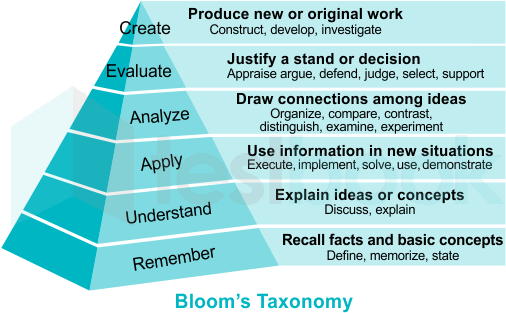
Benjamin Bloom developed a taxonomy or classification of educational objectives. These objectives were divided into three domains: cognitive, affective, and psychomotor. In real life behavior from all three domains occurs simultaneously. For example, when students are writing (psychomotor), they are also remembering or recalling (cognitive), and they are likely to have some emotions or feelings (affection) towards the task.

Important Points

The Cognitive Domain: 

  • ​​It is also known as the thinking domain.
  • Initially, the six basic objectives in Bloom’s taxonomy are knowledge, comprehension, application, analysis, synthesis, and evaluation.

​1. Knowledge

  • Knowledge is defined as the remembering of previously learned material.
  • This may involve the recall of a wide range of material, from specific facts to complete theories, but all that is required is bringing to mind the appropriate information.
  • Knowledge represents the lowest level of learning outcomes in the cognitive domain.
  1. Comprehension
  • Comprehension is defined as the ability to grasp the meaning of the material.
  • This may be shown by translating material from one form to another word to numbers, by interpreting material explaining or summarizing, and by estimating future trends predicting consequences or effects.
  • These learning outcomes go one step beyond the simple remembering of material and represent the lowest level of understanding.
  1. Application
  • Application refers to the ability to use learned material in new and concrete situations.
  • This may include the application of such things as rules, methods, concepts, principles, laws, and theories.
  • Learning outcomes in this area require a higher level of understanding than those under comprehension.
  1. Analysis
  • Analysis refers to the ability to break down the material into its component parts so that its organizational structure may be understood.
  • This may include the identification of parts, analysis of the relationship between parts, and recognition of the organizational principles involved.
  • Learning outcomes here represent a higher intellectual level than comprehension and application because they require an understanding of both the content and the structural form of the material.
  1. Synthesis
  • ​Synthesis refers to the ability to put parts together to form a new whole.
  • This may involve the production of a unique communication theme or speech, a plan of the operations research proposal, or a set of abstract relations schemes for classifying information.
  • Learning outcomes in this area stress creative behaviors, with major emphasis on the formulation of new patterns or structures.
  1. Evaluation
  • Evaluation is concerned with the ability to judge the value of material for a given purpose.
  • The judgments are to be based on definite criteria.
  • These may be internal criteria organization or external criteria and the student may determine the criteria or be given them.
  • Learning outcomes in this area are highest in the cognitive hierarchy because they contain elements of all the other categories, plus conscious value judgments based on clearly defined criteria.

Key Points

  • These objectives are considered as a hierarchy, each skill building on those below, but this is not entirely accurate.
  • In 2001, a group of educational researchers published the first major revision of the cognitive taxonomy. These are Remembering, Understanding, Applying, Analyzing, Evaluating, Creating
  • Remembering, understanding, and applying ⇒ the lower-level objectives.
  • Analyzing, evaluating, and creating are considered ⇒  high-level objectives.
  • The six processes of remembering, understanding, applying, analyzing, evaluating, and creating acting on four kinds of knowledge—factual, conceptual, procedural, and metacognitive.

​​ 

Therefore, Evaluating is the highest level of Cognitive ability.

28

While taking a class, if a student make disturbance, a teacher should:

  1. ((a))

    Punish the student immediately

  2. ((b))

    Ignore the student and continue teaching

  3. ((c))

    Stop the class for a few minutes and remain silent

  4. ((d))

    Give special attention to the student and motivate him.

Show Answer
Answer: ((d))

Give special attention to the student and motivate him.

Introduction: The knowledge, skills, and practices that teachers must have in order to be effective educators are known as teacher professionalism. It depends on the teaching competencies. One of the major things is the classroom management skills of a teacher. 

Key Points

Teacher as a motivator: 

  • Teachers give motivation and spirit to their students that can build confidence from the students.
  • A teacher did not give a punishment if their student made a mistake in answering or doing exercise.
  • But the teacher will continue to support and motivate students to repair the mistake.
  • While delivering a lecture if there is some disturbance in the class, a teacher should motivate to teach those causing disturbances.
  • Teachers must be able to build the character of their students through a variety of activities that can enhance student creativity in building self-motivation in students.
  • Teachers should always be constructive to adopt innovative new methods to motivate students, to learn the children by placing their students as a center of learning, meaning the extent to which the material presented does not depend on the teachers and the curriculum but depends on the students.

While taking a class, if a student makes a disturbance, a teacher should give special attention to the student and motivate him.

Confusion Points

  1. Punishment, penalty, insult, etc. are negatively impact the relationship between the teacher and the student. To punish those causing disturbance is not pleasant to maintain the classroom environment because it does not bring change in mentality until or unless they can realize it.
  2. But the teacher should not ignore or not bother with what is happening in the class because it is one of his/her duty to maintain discipline. He/she could not behave like not bothered by what is happening in the class.
  3. keep quiet for a while and then continue teaching can be applicable while some external noise occurs during the session.
29

Expand the Abbreviation “LCD”

  1. ((a))

    Light Crystal Display

  2. ((b))

    Liquid Crystal Display

  3. ((c))

    Learning Computer Discourse

  4. ((d))

    Light Compact Display

Show Answer
Answer: ((b))

Liquid Crystal Display

LCD stands for Liquid Crystal Display.

Key Points Liquid Crystal Display:

  • A liquid-crystal display (LCD) is a flat-panel display or another electronically modulated optical device that uses the light-modulating properties of liquid crystals combined with polarizers.
  • Liquid crystals do not emit light directly, instead of using a backlight or reflector to produce images in color or monochrome.
  • LCDs are available to display arbitrary images (as in a general-purpose computer display) or fixed images with low information content, which can be displayed or hidden.
  • For instance: preset words, digits, and seven-segment displays, as in a digital clock, are all good examples of devices with these displays.
  • They use the same basic technology, except that arbitrary images are made from a matrix of small pixels, while other displays have larger elements.
  • LCDs can either be normally on (positive) or off (negative), depending on the polarizer arrangement.
  • For example, a character positive LCD with a backlight will have black lettering on a background that is the color of the backlight, and a character negative LCD will have a black background with the letters being of the same color as the backlight.
  • Optical filters are added to white on blue LCDs to give them their characteristic appearance.
  • LCDs are used in a wide range of applications, including LCD televisions, computer monitors, instrument panels, aircraft cockpit displays, and indoor and outdoor signage.
  • Small LCD screens are common in LCD projectors and portable consumer devices such as digital cameras, watches, digital clocks, calculators, and mobile telephones, including smartphones.

Hence, the term "LCD" is an abbreviation, meaning "liquid crystal display."

30

A “jpg” file stores:

  1. ((a))

    Audio data

  2. ((b))

    Video data

  3. ((c))

    Text data

  4. ((d))

    Image data

Show Answer
Answer: ((d))

Image data

A “jpg” file stores Image data.

Key Points

  • The small file size of JPG images allows storing of thousands of images in small memory space.
  • JPG images are also widely used for printing and editing purposes.
  • Images edited with CorelDRAW are mostly stored in JPG format.
  • JPG (or JPEG), is a popular file format used for images and graphics—especially on the internet.
  • It was created by the Joint Photographic Experts Group (JPEG) and uses a compression algorithm that reduces sections of an image into blocks of pixels.
  • A JPG file is an image saved in a compressed image format standardized by the Joint Photographic Experts Group (JPEG).
  • It is commonly used for storing digital photos and used by most digital cameras to save images.
  • JPG files are among the most common image files, along with .PNG, .TIF, and .GIF.
31

An interactive computer application for organization, analysis, and storage of data in tabular form is

  1. ((a))

    Power point

  2. ((b))

    Spread Sheets

  3. ((c))

    Work Sheet

  4. ((d))

    Excel

Show Answer
Answer: ((b))

Spread Sheets

A spreadsheet is an interactive computer application for the organization, analysis, and storage of data in tabular form. Spreadsheets are developed as computerized simulations of paper accounting worksheets. The program operates on data entered in cells of a table.

Key PointsThe concept of Spread Sheets:

  • A spreadsheet is a file that exists of cells in rows and columns and can help arrange, calculate and sort data.
  • Data in a spreadsheet can be numeric values, as well as text, formulas, references, and functions.
  • Spreadsheets are an essential business and accounting tool.
  • They can vary in complexity and can be used for various reasons, but their primary purpose is to organize and categorize data into a logical format.
  • Once this data is entered into the spreadsheet, you can use it to help organize and grow your business.

Hence, Spread Sheets is the correct answer.

32

The concept of ‘Mastery Learning’ was proposed by:

  1. ((a))

    Edgar Dale

  2. ((b))

    Benjamin Bloom

  3. ((c))

    Donald O. Hebb

  4. ((d))

    David Kolb

Show Answer
Answer: ((b))

Benjamin Bloom

The concept of ‘Mastery Learning’ was proposed by Benjamin Bloom.

Key PointsThe concept of ‘Mastery Learning’:

  • Mastery learning (or, as it was initially called, "learning for mastery"; also known as "mastery-based learning]") is an instructional strategy and educational philosophy, first formally proposed by Benjamin Bloom in 1968.
  • Mastery learning maintains that students must achieve a level of mastery (e.g., 90% on a knowledge test) in prerequisite knowledge before moving forward to learn subsequent information.
  • If a student does not achieve mastery on the test, they are given additional support in learning and reviewing the information and then tested again.
  • This cycle continues until the learner accomplishes mastery, and they may then move on to the next stage.
  • The key elements in mastery learning are:
  • clearly specifying what is to be learned and how it will be evaluated,
  • allowing students to learn at their own pace,
  • assessing student progress and providing appropriate feedback or remediation, and
  • testing that the final learning criterion has been achieved.
  • Mastery learning has been widely applied in schools and training settings, and research shows that it can improve instructional effectiveness.
33

Who among the following is considered as the Father of Intelligence testing?

  1. ((a))

    Howard Gardner

  2. ((b))

    David Wechsler

  3. ((c))

    Peter Salovey

  4. ((d))

    Alfred Binet

Show Answer
Answer: ((d))

Alfred Binet

Key Points

  • The first modern intelligence test was developed in 1904, by Alfred Binet (1857-1911).
  • He was one of the most influential psychologists in history.
  • He designed a series of questions with the objectives to distinguish children who may have learning disabilities and mental retardation.
  • His test was based on assumption that intelligence developed with age.
  • Binet concentrated on mental abilities such as attention and memory, it may be used to identify children who needed additional academic assistance.
  • Binet worked with his research assistance 'Simon' and introduced an intelligence test, known as the Binet-Simon Intelligence scale.
  • The test consists of 30 different questions or tasks and the goal of the task was to assign a child a mental age based upon the average performance of children at each age.

Hence, the first intelligence test was developed by Alfred Binet.

Important Points

Intelligence testing:

  • An Intelligence Test is an assessment that measures the range of intellectual, memory, speed, attention, reasoning abilities, and cognitive abilities.
  • Generally, Intelligence tests are designed specifically to assess human intelligence through the performance of various tasks.
  • Intelligence Quotient is the measure of a child's ability to reason and solve problems.
  • IQ is correlated either directly or indirectly with problem-solving and educational performance.

Intelligence Quotient (IQ) can be obtained by the equation (MA/CA) * 100 = IQ, where MA is mental age and CA is chronological age.

  • Mental Age is the measure of the intellectual level at which an individual functions; for example, someone described as having a mental age of 8 years would be functioning at the level of an average 8 years old.
  • Chronological Age is the number of years a person has been alive

IQ Rating Scale:

IQ RANGEIQ CLASSIFICATION
130 and aboveVery Superior
120-129Superior
110-119High Average
90-109Average
80-89Low Average
70-79Border Line
69 and belowExtremely Low
  • Intelligence tests are generally used to improve children's learning and abilities.
  • There are different types of Intelligence tests like the Binet Intelligence Test, Wechsler Intelligence test, etc for children's assistance.
34

An observational method used frequently in learning settings in which the observer summarizes a single developmental incident after the event has occurred is :

  1. ((a))

    Cumulative Record

  2. ((b))

    Anecdotal Record

  3. ((c))

    Portfolio

  4. ((d))

    Attendance Record

Show Answer
Answer: ((b))

Anecdotal Record

An observational method used frequently in learning settings in which the observer summarizes a single developmental incident after the event has occurred is Anecdotal Record.

Key PointsAnecdotal Record:

  • An anecdotal record is an observational method used frequently in classroom or learning settings in which the observer summarizes a single developmental incident after the event has occurred.
  • Written from memory, the anecdotal record documents a student's growth and trends. Such records are intended to be brief, factual accountings.
  • Anecdotal records are written in journalistic form.
  • They identify the who, what, where, when, and how of a particular incident, focusing on the subject's specific conduct in the situation.
  • In early childhood education, teachers use anecdotal records in common practice for the assessment of skill development in young children.
  • The recorded observations are intended to identify the child's current skill level, interests, and skills to develop next.

Hence, Anecdotal Record is the correct answer.

35

The system of Evaluation that allows the evaluator to convert the outcomes of a student’s test or assignments to a grade and adjust that final grade in relation to the grades from other students in the course is:

  1. ((a))

    Percentage Grading

  2. ((b))

    Absolute Grading

  3. ((c))

    Norm-Referenced Grading

  4. ((d))

    Relative grading

Show Answer
Answer: ((d))

Relative grading

Grading-

Grading is a process of classifying students into different categories on the basis of pre-defined standards and representing each category by a specific letter. Grades are the means of reporting students' performance, it is necessary to use the symbols in such a way that it ought to be clearly defined and uniformly understood by all concerned like students, teachers, and parents. 

  • Relative grading is a system of assessment whereby teachers in some university and college classes determine student grades by comparing them against those of their peers. Unlike the system of absolute grading, where a student’s score on a given test or assignment directly converts into a letter grade (for example, 10/10 is A+; 9/10 is A, etc.), relative grading means students’ marks fluctuate depending on how they did compared to others in class.
  • Relative grading refers to a system of evaluation that allows educators to convert the outcomes of a student’s test, project or assignment and adjust that final grade in relation to grades from other students in the course.
  • Relative grading is similar to bell curving or grading on a curve, and considers the highest score as the baseline (A+), relatively adjusting all others compared to that score.
  • Absolute Grading- Each grade is associated with a fixed performance regardless of the fixed proportion of grades ultimately assigned in the class it is known as absolute grading.
  • Norm-Referenced Grading- In norm-referenced systems students are evaluated in relationship to one another (e.g., the top 10% of students receive an A, the next 30% a B, etc.). This grading system rests on the assumption that the level of student performance will not vary much from class to class. In this system the instructor usually determines the percentage of students assigned each grade.
36

The system which provides facility to search and browse all hosted content wherein a person can easily access the desired material including Audios, Videos, and Textual materials:

  1. ((a))

    E-Content Portal

  2. ((b))

    Web browser

  3. ((c))

    URL

  4. ((d))

    Search Engines

Show Answer
Answer: ((a))

E-Content Portal

E-Content Portal

  • Vidya-mitra is an online learning portal for all the e-content projects developed under the NME-ICT (National Mission on Education through Information and Communication Technology), MHRD.
  • The portal provides facility to search and browse all hosted content wherein a learner can easily access the desired material including audio/video learning material, textual material, multimedia-enriched materials etc. through a single interface.
  • Moreover, features of faceted search, usage statistics, project-wise access, My-Space are incorporated in this portal.
37

A web page address is usually known as:

  1. ((a))

    Directory

  2. ((b))

    Protocol

  3. ((c))

    URL

  4. ((d))

    Domain

Show Answer
Answer: ((c))

URL

The web address contains information about the location of the webpage. It is also known as the URL (uniform resource locator).

Key PointsUniform Resource Locator:

  • URL is an acronym for Uniform Resource Locator and is a reference (an address) to a resource on the Internet.
  • A Uniform Resource Identifier (URI) is a unique sequence of characters that identifies a logical or physical resource used by web technologies.
  • URIs may be used to identify anything, including real-world objects, such as people and places, concepts, or information resources such as web pages and books.
  • Some URIs provide a means of locating and retrieving information resources on a network (either on the Internet or on another private network, such as a computer filesystem or an Intranet); these are Uniform Resource Locators (URLs).
  • A URL provides the location of the resource. A URI identifies the resource by name at the specified location or URL.
  • Other URIs provide only a unique name, without a means of locating or retrieving the resource or information about it, these are Uniform Resource Names (URNs).
  • The web technologies that use URIs are not limited to web browsers.

Additional InformationDirectory:

  • In computing, a directory is a file system cataloging structure that contains references to other computer files, and possibly other directories.
  • On many computers, directories are known as folders, or drawers, analogous to a workbench or the traditional office filing cabinet.

Protocol:

  • A protocol is a standard set of rules that allow electronic devices to communicate with each other.
  • These rules include what type of data may be transmitted, what commands are used to send and receive data, and how data transfers are confirmed.

Domain: 

  • A domain name is an identification string that defines a realm of administrative autonomy, authority, or control within the Internet.
  • Domain names are used in various networking contexts and for application-specific naming and addressing purposes.
38

The Research study method, involving in depth and detailed examination of a subject of study as well as its related contextual conditions is:

  1. ((a))

    Historical Research

  2. ((b))

    Case Study Research

  3. ((c))

    Survey Research

  4. ((d))

    Experimental Research

Show Answer
Answer: ((b))

Case Study Research

The Research study method, involving in-depth and detailed examination of a subject of study as well as its related contextual conditions is Case Study Research.

Key PointsCase Study Research:

  • Case studies allow for in-depth analysis of a particular instance belonging to a category of phenomena.
  • For example, the origin of a national policy of fishing areas under collective use rights is an instance of the emergence of fisheries policy innovation.
  • Case studies offer a detailed picture of the variables that are involved in the instance under analysis, how they influence each other, and under which conditions.
  • These aspects can be approached through qualitative or quantitative tools, or a combination of both (e.g. process tracing, discourse analysis, statistical analysis, etc.).
  • Learning from case studies allows for understanding the category of the phenomenon to which it belongs in various ways.
  • It provides a means to test hypotheses on causal mechanisms, to develop new hypotheses, and allows for grasping causal complexity.
  • Additionally, case studies can be compared, so patterns across cases can be identified and the category of phenomena better understood.

Additional InformationHistorical Research:

  • Historical research is a qualitative technique. Historical research studies the meaning of past events in an attempt to interpret the facts and explain the cause of events, and their effect on the present events.
  • In doing so, researchers rely heavily on primary historical data (direct accounts of events, archival data - official documents, personal records, and records of eyewitnesses) and less frequently on secondary historical data (information from persons who didn’t witness the event; e.g. textbooks, newspapers, encyclopedias).

Survey Research:

  • Survey research is defined as "the collection of information from a sample of individuals through their responses to questions"
  • This type of research allows for a variety of methods to recruit participants, collect data, and utilize various methods of instrumentation.

Experimental Research:

  • Experimental research is a study that strictly adheres to a scientific research design.
  • It includes a hypothesis, a variable that can be manipulated by the researcher, and variables that can be measured, calculated, and compared.
39

The Article which provides “Equality of Opportunity in Educational Institutions”:

  1. ((a))

    Article 28 (c)

  2. ((b))

    Article 30

  3. ((c))

    Article 29(1)

  4. ((d))

    Article 28(1)

Show Answer
Answer: ((c))

Article 29(1)

The Article which provides “Equality of Opportunity in Educational Institutions” is Article 29(1).

Key PointsEquality of Opportunity in Educational Institutions:

  • Equality of educational opportunity includes the provision of education for all, irrespective of religion, caste, creed, sex and location.
  • It doesn’t mean identity of educational opportunity but a means best suited to the intelligence and aptitude of every student.
  • Therefore, the National Policy on Education (NPE) 1986 emphasized that equality of education means “to provide for equal opportunity to all not only in access but also in the conditions for success.”

Article 29(1): This provides all citizen groups that reside in India having a distinct culture, language, and script, the right to conserve their culture and language. This right is absolute and there are no ‘reasonable restrictions’ in the interest of the general public here.

40

Match the following:

List IList II
1. MHRD(a) 1994
2. UGC(b) 1995
3. NCTE(c) 1985
4. NAAC(d) 1956
  1. ((a))

    1 - c, 2 - d, 3 - b, 4 - a

  2. ((b))

    1 - b, 2 - d, 3 - a, 4 - c

  3. ((c))

    1 - d, 2 - c, 3 - b, 4 - a

  4. ((d))

    1 - a, 2 - b, 3 - c, 4 - d

Show Answer
Answer: ((a))

1 - c, 2 - d, 3 - b, 4 - a

Key Points 

Apex level bodyDescription
MHRD- The Ministry of Education (MoE), formerly the Ministry of Human Resource Development (1985–2020), is a ministry of the Government of India, responsible for the implementation of the National Policy on Education. - India had the Ministry of Education since 1947. - In 1985, the Rajiv Gandhi government changed its name to the Ministry of Human Resource Development (MHRD) - With the public announcement of the newly drafted "National Education Policy 2020" by the Narendra Modi government, the Ministry of Human Resource Development was renamed back to Ministry of Education.
UGC- The University Grants Commission of India (UGC India) is a statutory body set up by the Department of Higher Education, Ministry of Education, Government of India in accordance with the UGC Act 1956 and is charged with coordination, determination, and maintenance of standards of higher education. - It provides recognition to universities in India, and disbursements of funds to such recognized universities and colleges. - The headquarters are in New Delhi, and it has six regional centers in Pune, Bhopal, Kolkata, Hyderabad, Guwahati, and Bangalore.
NCTE- National Council for Teacher Education (NCTE) is a statutory body of the Indian government set up under the National Council for Teacher Education Act, 1993 in 1995 is to formally oversee standards, procedures, and processes in the Indian education system
NAAC- The National Assessment and Accreditation Council (NAAC) is a government organization in India that assesses and accredits Higher Education Institutions (HEIs). It is an autonomous body funded by the University Grants Commission and headquartered in Bangalore. - NAAC was established in 1994 in response to recommendations of National Policy in Education (1986).

Hence, the correct matching is 1 - c, 2 - d, 3 - b, 4 - a

41

Which one among the following is the branch of Applied Psychology?

  1. ((a))

    Developmental Psychology

  2. ((b))

    Educational Psychology

  3. ((c))

    Social Psychology

  4. ((d))

    Abnormal Psychology

Show Answer
Answer: ((b))

Educational Psychology

  • Applied psychology is the study and ability to solve problems within human behavior such as health issues, workplace issues, or education.
  • Applied psychology is divided into different branches. Some major branches include educational psychology, clinical psychology, counseling psychology, industrial and commercial psychology, neuropsychology, criminal psychology, forensic psychology, health psychology, engineering psychology, sports psychology, etc.
  • It is the use of scientific knowledge obtained and methods developed by basic psychology to solve everyday problems, increase the quality of life or make groups of people work more conveniently.
  • Applied psychology has some objectives, perspectives, scopes, and areas.
  • The major perspectives of applied psychology are behavioral, biological, humanistic, psychodynamic, and cognitive.
  • As a subject, general psychology is highly theoretical, but applied psychology is really practical.
  • Applied psychologists actually try to improve mental health and welfare through various stages of human development.
  • There are many branches of applied psychology including educational, clinical, industrial, criminal, forensic, engineering, sports, etc.
42

Which of the following is an example of a Specific Learning Disability?

  1. ((a))

    Mental Retardation

  2. ((b))

    Dyslexia

  3. ((c))

    Autism

  4. ((d))

    ADHD

Show Answer
Answer: ((b))

Dyslexia

A specific learning disability is a disorder that interferes with a student’s ability to listen, think, speak, write, spell, or do mathematical calculations. Students with a specific learning disability may struggle with reading, writing, or math.

“Specific learning disability” is an umbrella term that can describe many different types of learning issues. An educational evaluation may show that your child has a specific learning disability in a certain subject area.

For example:

A specific learning disability in reading, also known as dyslexia

A specific learning disability in writing, also known as dysgraphia

A specific learning disability in mathematics, also known as dyscalculia

Hence, from the above example it is clear that Dyslexia is an example of a Specific Learning Disability.

43

Who among the following can be removed by the President without Parliament resolution?

  1. ((a))

    Governor of the state

  2. ((b))

    Chief Election Commissioner

  3. ((c))

    Comptroller and Auditor- General

  4. ((d))

    Judges of a High Court

Show Answer
Answer: ((a))

Governor of the state

The correct answer is Governor of a State.

Important Points

The President of India is the head of state of the Republic of India. The President is the formal head of the executive, legislature, and judiciary of India and is also the commander-in-chief of the Indian Armed Forces. The President is the pinnacle of the Indian State.

India has a parliamentary system of government. The parliament is the legislative organ of the union of government. which means the Parliament legislates on all matters mentioned in the Union List and the Concurrent List.

  • As per Article 155 and Article 156 of the Constitution, a Governor of a state is an appointee of the President, and he or she holds office “during the pleasure of the President”.  If a Governor continues to enjoy the “pleasure of the President”, he or she can be in office for a term of five years. However, there is no security of his tenure. He can be removed by the President, at his wish.
  • The President has the power to remove a Governor at any time without giving him or her any reason and without allowing an opportunity to be heard.
  • Although, this power cannot be exercised in an arbitrary, capricious, or unreasonable manner. Because the President is bound to act on the aid and advice of the Council of Ministers under Article 74 of the Constitution, in effect it is the central government that appoints and removes the Governors.
  • “Pleasure of the President” merely refers to this will and wish of the central government.

Key Points

Governor can be removed by the President at any time. 

  • There is no provision for impeaching the Governor by the State Legislature. Indeed, if the Governor misbehaves or acts in a manner against the interests of the people of the State, as perceived by the State Legislature they cannot do anything except perhaps complain to the President.
  • It may also be noticed that the Chief Minister is appointed by the Governor. Where one party gets a clear majority, the Governor may have no discretion or choice in the matter but where no single party or a pre-election group/coalition gets a clear majority, the Governor has to exercise his judgment in the matter of whom he should invite.

Hence, the Governor can be removed by the President without Parliament’s resolution.

Additional Information

Judge of a High Court may be removed by the President, if the Parliament passes a motion against him by an absolute majority and 2/3rd majority of the members present and voting, both the Houses sitting separately.

Chief Election Commissioner can be removed from his office by the President on the basis of a resolution passed to that effect by both the houses of parliament with a two-thirds majority in both the Lok Sabha and the Rajya Sabha on the grounds of proved misbehavior or incapacity.

Comptroller and Auditor - General shall only be removed from office in like manner and on like grounds as a Judge of the Supreme Court.

44

The agency which founded SCOVE:

  1. ((a))

    UGC

  2. ((b))

    CSIR

  3. ((c))

    NCERT

  4. ((d))

    ICSSR

Show Answer
Answer: ((a))

UGC

UGC is the agency that founded SCOVE.

Key PointsStanding Committee of Vocational Education (SCOVE):

  • A bachelor’s degree in vocational education is likely to be introduced in the University Grants Commission in 2012.
  • The standing committee of UGC  has formally approved a proposal to introduce a bachelor's degree in vocational education.
  • Once approved by the Commission, a college student can pick up a bachelor's degree in art, science, commerce, or vocational education.
  • The All India Council of Technical Education had earlier requested  UGC to introduce vocational education at the college level.
  • The curriculum of the new courses will be put on the website by March 10.
  • The student will have to choose a sector and a specific specialization from each sector.
  • Initially, 10 sectors have been chosen including tourism, construction, printing, telecom, IT, mobile, and communication.
  • To begin with, one college can have five sectors.
  • Each sector can have a maximum of 100 students which means initially a college can have 500 students for vocational education.
  • There are plans to allow students to shift from BVoc to arts, science, or commerce, thus not punishing students for signing up for the new course.

With the recommendations of the Standing Committee on Vocational Education (SCORE) and its sub-committee/regional committee constituted for the purpose, the UGC identified 209 institutions (19 Universities and 190 Colleges) in the first instance, for starting vocational courses at the first-degree level during 1994-95.

45

In VSAT network signals are sent from the hub in specific time slots through a method called TDM. TDM stands for ________. 

  1. ((a))

    Total Division Multiplication

  2. ((b))

    Time Division Multiplication

  3. ((c))

    Time Division Multiplexing

  4. ((d))

    Time Division Modulation

Show Answer
Answer: ((c))

Time Division Multiplexing

In VSAT network signals are sent from the hub in specific time slots through a method called TDM. TDM stands for Time Division Multiplexing.

Key Points

VSAT Network:

  • VSAT networks have gained in popularity due to their unlimited geographic reach, efficient transmission and reception of data.
  • A satellite network consists of two or more earth stations (VSAT) and satellite re-transmitter (Transponder).
  • VSAT stands for “Very Small Aperture Terminal” and its purpose is to transmit and receive satellite transmissions.
  • A VSAT comprises a dish antenna, a transceiver (or a combination of BUS and LNB) and a satellite router (modem).
  • Receive-only VSAT terminal may not include a transmitter (BUC).
  • A VSAT terminal can receive and transmit data, voice and video information and is typically connected to an end user’s equipment via LAN port of the satellite router.
  • The router processes an incoming traffic, packetize it and convert into continuous SCPC (Single Channel Per Carrier) or burstable TDMA (Time Division Multiple Access) modulated carrier.

TDM (Time Division Multiplexing):

  • TDM (Time Division Multiplexing) is a multiplexing technique where multiple bit streams are transmitted simultaneously as sub-channels within a single carrier.
  • Data transmission in such a channel is separated into fixed time intervals (timeslots) for each sub-channel.
46

Video –conferencing can be classified as one of the following types of communication 

  1. ((a))

    Visual one way

  2. ((b))

    Audio-visual one way

  3. ((c))

    Audio-visual two ways

  4. ((d))

    Visual two ways

Show Answer
Answer: ((c))

Audio-visual two ways

Video conferencing is a type of online meeting where two or more people engage in a live audio-visual call. In business, people typically use video conferencing to communicate and collaborate within and outside an organization.

Key Points

Video–conferencing:

  • Video conferencing boosts productivity saves time, reduces travel expenses, and overall promotes collaboration.
  • The advantage of video conferencing is the ability to facilitate all of those benefits without requiring constant travel for face-to-face communication.
  • Two (or more) people communicate through audio and video.
  • Videotelephony comprises the technologies for the reception and transmission of audio-video signals by users in different locations, for communication between people in real-time.
  • A videophone is a telephone with a video display, capable of simultaneous video and audio for communication between people in real-time.
  • Videoconferencing implies the use of this technology for a group or organizational meeting rather than for individuals, in a videoconference.
  • Telepresence may refer either to a high-quality videotelephony system (where the goal is to create the illusion that remote participants are in the same room) or to meetup technology, which goes beyond video into robotics (such as moving around the room or physically manipulating objects).
  • Videoconferencing has also been called "visual collaboration" and is a type of groupware.

Additional Information

  • One-way communication flows from a sender to a receiver, but nothing goes back in return. The sender can use one-way communication to inform, entertain, persuade or command the audience. Some examples of one-way communication include television, radio, writings, speeches and performances.
  • Teleconferencing means meeting through a telecommunications medium. It is a generic term for linking people between two or more locations by electronics. There are at least six types of teleconferencing: audio, audio graphic, computer, video, business television (BTV), and distance education. The methods used differ in the technology, but common factors contribute to the shared definition of teleconferencing:
  • Some of the most common examples of two-way communication systems are the radio, telephone, and computer-aided dispatch systems used by police, fire, and emergency response personnel.

Therefore Audio-visual two ways are the correct answer.

47

Which of the following does not belong to a projected aid?

  1. ((a))

    Overhead projector

  2. ((b))

    Black board

  3. ((c))

    Epidiascope

  4. ((d))

    Slide projector

Show Answer
Answer: ((b))

Black board

Projected media include slides, filmstrips, opaque and overhead projections, and motion pictures. The use of projected media helps teachers simplify, clarify, analyze, and synthesize relationships between man and his environments.

Key Points

  • Media are the means for transmitting or delivering messages and in teaching-learning perspective delivering content to the learners, to achieve effective instruction.
  • Instructional Technology/media for the learning-teaching process provide the tools to engage learners powerfully in the learning process.
  • Instructional media are vital in the teaching-learning process, enhancing the ability to read and write correctly, influencing pupils to actively participate in learning, and leading pupils to remember vocabularies.

Important Points

The following are the different projected aids:

  1. An overhead projector (OHP), like a film or slide projector, uses light to project an enlarged image on a screen, allowing the view of a small document or picture
  2. The opaque projector, epidiascope, or episcope is a device that displays opaque materials by shining a bright lamp onto the object from above.
  3. slide projector is a device that is used to view photographic slides by using optical and mechanical methods. It contains an electric light bulb. focusing lenses.

Confusion Points

  • A blackboard or chalkboard is the visual aid most widely used by the teacher for classroom instruction.
  • The components of the skill of using blackboard are (i) good handwriting (ii) neatness in the blackboard work and (iii) appropriateness of written work on the blackboard.
48

The right order of elements in a successful communication is:

  1. ((a))

    idea, sender, encoding, communication channel, receiver, decoding, feedback

  2. ((b))

    sender, idea, encoding, communication channel, receiver, decoding, feedback

  3. ((c))

    encoding, idea, sender, communication channel, receiver, decoding, feedback

  4. ((d))

    communication channel, idea, sender, encoding, receiver, decoding, feedback

Show Answer
Answer: ((b))

sender, idea, encoding, communication channel, receiver, decoding, feedback

Seven major elements of the communication process are (1) sender (2) ideas (3) encoding (4) communication channel (5) receiver (6) decoding and (7) feedback.

Important Points The process of communication:

  • Communication may be defined as a process concerning the exchange of facts or ideas between persons holding different positions in an organization to achieve mutual harmony.
  • The communication process is dynamic in nature rather than a static phenomenon.
  • The communication process as such must be considered a continuous and dynamic inter-action, both affecting and being affected by many variables.

Key Points

  1. Sender: The person who intends to convey the message with the intention of passing information and ideas to others is known as the sender or communicator.
  2. Ideas: This is the subject matter of the communication. This may be an opinion, attitude, feelings, views, orders, or suggestions.
  3. Encoding: Since the subject matter of communication is theoretical and intangible, its further passing requires the use of certain symbols such as words, actions or pictures, etc. Conversion of subject matter into these symbols is the process of encoding.
  4. Communication channel: The person who is interested in communicating has to choose the channel for sending the required information, ideas, etc. This information is transmitted to the receiver through certain channels which may be either formal or informal.
  5. Receiver: The receiver is the person who receives the message or for whom the message is meant. It is the receiver who tries to understand the message in the best possible manner in achieving the desired objectives.
  6. Decoding: The person who receives the message or symbol from the communicator tries to convert the same in such a way so that he may extract its meaning to his complete understanding.
  7. Feedback: Feedback is the process of ensuring that the receiver has received the message and understood it in the same sense as the sender meant it.
49

What is FORTRAN?

  1. ((a))

    Software

  2. ((b))

    Hardware

  3. ((c))

    Company

  4. ((d))

    Programming language

Show Answer
Answer: ((d))

Programming language

Key Points

Fortran 

  • It was originally developed by a team at IBM in 1957 for scientific calculations.
  • It also allows the compiler to generate efficient binary code.
  • It is a scientific computing language.
  • It is also used in organizations such as weather forecasters, financial trading, and engineering simulations.

Hence, FORTRAN is a Programming language.

Additional InformationSoftware: Software is a set of instructions, data, or programs used to operate computers and execute specific tasks. 

Hardware: 

  • Hardware refers to the physical elements of a computer.
  • This is also sometimes called the machinery or the equipment of the computer.
  • Examples of hardware in a computer are the keyboard, the monitor, the mouse, and the central processing unit.
50

Teacher’s primary duty is

  1. ((a))

    To raise intellectual standards of students

  2. ((b))

    To improve physical standards of students

  3. ((c))

    To help all round development of students

  4. ((d))

    To give more and more homework to the students.

Show Answer
Answer: ((c))

To help all round development of students

The teacher’s primary duty is to help the all-around development of students.

Key PointsPrimary duties of a teacher:

The Primary duties of a teacher include:

  • to achieve all-around development of students by guiding the students in their learning process.
  • to provide motivation for learning.
  • to stimulate learners in order to realize their optimum potential.
  • to plan the teaching and learning process to suit the needs of the students.
  • to promote learning by providing a conducive environment.
  • to encourage learners to become active learners.

Although imparting knowledge and values to the students are important duties of a teacher. However, the all-around development of students is the most important and vital duty of a teacher.

Thus, the primary duty of the teacher is to help in the all-around development of the students.

51

The teacher-student communication is most often

  1. ((a))

    confrontational.

  2. ((b))

    spurious.

  3. ((c))

    critical.

  4. ((d))

    utilitarian.

Show Answer
Answer: ((d))

utilitarian.

Communication is both expressive and receptive. Educators should be skilled in listening and understanding in thoughts and ideas of their students and elaborating things clearly. Educators need clarity in communication while talking to their students. They should be able to break down complex things into simple steps.

Most often, teacher-student communication is Utilitarian.

Key Points

Utilitarian approach: 

  • All teachers should take a utilitarian approach to teaching.
  • Utilitarians believe that the purpose of morality is to make life better by increasing the number of good things (such as pleasure and happiness) in the world and decreasing the amount of bad things (such as pain and unhappiness).
  • This means, in a classroom setting, that the teacher will do whatever it takes to make sure that the learning takes place effectively in a free and joyful manner along with the holistic development of the learner.

Additional Information

​Note:

  1. Spurious: The literal meaning of spurious talk is making a false statement.
  2. Critical: Being critical refers to expressing adverse or disapproving comments or judgments.
  3. Confrontational: It is the tendency to deal with situations in an aggressive way; hostile or argumentative.

​Therefore, most often, the teacher-student communication is utilitarian and not spurious, critical, and confrontational.

52

The use of teaching aids is justified on the grounds of:

  1. ((a))

    Attracting students’ attention in the class room

  2. ((b))

    Minimizing indiscipline problems in the classroom

  3. ((c))

    Optimizing learning outcomes of students.

  4. ((d))

    Effective engagement of students in learning tasks.

Show Answer
Answer: ((c))

Optimizing learning outcomes of students.

Teaching aids are tools, which are used by teachers to help learners to learn concepts with ease and efficiency. Teaching aids have been in existence in our educational system since ancient times.

Key Points

Justification of using proper teaching aids:

  • The role of teaching aids in the classroom is to make learning real, practical, and fun for children.
  • Teachers use of teaching aids to illustrate or reinforce a skill, fact, or idea.
  • Teaching aids also help in bringing novelty and freshness to classroom teaching as it relieves learners from anxiety, fear, and boredom.
  • The main purpose of teaching aids is to optimize the learning outcomes of students.
  • Learning outcomes are highly dependent on the learning experience given in the classroom using teaching-learning materials.
  • A teacher uses it to make teaching-learning effective.
  • It also helps learners achieve learning outcomes after classroom teaching and learning.

Important Points

Some of the reasons to use teaching aids in the classroom are of various types as described below:

  • Motivate learners – Capturing attention is the first step to any learning and TLMs help in capturing the attention of learners in the classroom. Once motivated to look at TLMs, the children are curious to learn new things. TLMs provide a variety of stimuli, which helps in making classroom teaching the most effective.
  • Help in longer retention of information – The more the number of sensory channels involved in interacting with TLMs, the longer will be the retention of information. Therefore, the learning will be effective and will last long.
  • Facilitate holistic learning – Learning objectives to be achieved through classroom teaching is in all domains- cognitive, affective, and psychomotor. Therefore, to achieve varied objectives, varied learning experiences need to be provided, which can be done through the use of TLMs.
  • Help in organizing classroom teaching –As a teacher you need to organize learning experiences, making them as realistic as possible. You can use visual or verbal TLMs to present accurate data in a sequentially organized manner. This helps the teacher to verbal and visual communication in the classroom. Thus, you may use TLMs to overcome shortcomings in verbal or visual communication.
53

Which of the following is an important characteristic of LAN?

  1. ((a))

    Application independent interfaces

  2. ((b))

    Unlimited expansion

  3. ((c))

    Low cost access for bandwidth channels

  4. ((d))

    None of the above

Show Answer
Answer: ((a))

Application independent interfaces

Key Points

An important characteristic of LAN:

  • Application independent interfaces are an important characteristic of LAN.
  • A graphical user interface (GUI) is a human-computer interface (i.e., a way for humans to interact with computers) that uses windows, icons, and menus and which can be manipulated by a mouse (and often to a limited extent by a keyboard as well).
  • Icons are used both on the desktop and within application programs.
  • A graphical user interface is a form of user interface that allows users to interact with electronic devices through graphical icons and visual indicators such as secondary notation, instead of text-based user interfaces, typed command labels, or text navigation.
  • Short for Graphical User Interface, a GUI (pronounced as either G-U-I or gooey) allows the use of icons or other visual indicators to interact with electronic devices, rather than using only text via the command line.

Hence, Application independent interfaces are an important characteristic of LAN.

54

A researcher selects a probability sample of 100 out of the total population. It is _____.

  1. ((a))

    a cluster sample

  2. ((b))

    a random sample

  3. ((c))

    a stratified sample

  4. ((d))

    a systematic sample

Show Answer
Answer: ((b))

a random sample

To draw valid conclusions from your results, you have to carefully decide how you will select a sample that is representative of the group as a whole. There are two types of sampling methods:

  • Probability sampling involves random selection, allowing you to make strong statistical inferences about the whole group.
  • Non-probability sampling involves non-random selection based on convenience or other criteria, allowing you to easily collect data.

A researcher selects a probability sample of 100 out of the total population. It is a random sample.

Key Points

Simple random sampling:

  • In a simple random sample, every member of the population has an equal chance of being selected.
  • Your sampling frame should include the whole population.
  • To conduct this type of sampling, you can use tools like random number generators or other techniques that are based entirely on chance.

For example, You want to select a simple random sample of 100 employees of Company X. You assign a number to every employee in the company database from 1 to 1000, and use a random number generator to select 100 numbers.

Additional Information

Stratified random sampling

  • Stratified sampling is a method of sampling from a population that can be partitioned into subpopulations.
  • When subpopulations within an overall population vary, it could be advantageous to sample each subpopulation independently.

​Systematic sampling

  • Systematic sampling is the selection of Participants from an ordered sampling frame.
  • The most common form of systematic sampling is an equiprobability method.

Cluster sampling

  • Cluster sampling is a sampling used when in a statistical population there are mutually homogeneous yet internally heterogeneous groups.
  • In this sampling plan, the total population is divided into these groups and a simple random sample of the groups is selected.
  • The researcher divides the population into separate groups, called clusters.
55

A good hypothesis should be:

  1. ((a))

    Precise, specific and consistent with most known facts

  2. ((b))

    Formulated in such a way that it can be tested by the data

  3. ((c))

    Of limited scope and should not have global significance

  4. ((d))

    All of these

Show Answer
Answer: ((b))

Formulated in such a way that it can be tested by the data

A good hypothesis posits an expected relationship between variables and clearly states a relationship between variables. For example, the research hypothesis “Children who participate in three hours of lap reading with parents per week will score higher on a test of reading comprehension than children who do not” states a clear relationship between hours of reading and test score.

Key PointsHypothesis: 

  • The research activities are planned to verify the hypothesis and not to find out the solution to the problem or to seek an answer to a question.
  • It is very essential for a research worker to understand the meaning and nature of a hypothesis.
  • The researcher always plans or formulate a hypothesis at the beginning of the problem.

Literal Meaning:

  • The word hypothesis consists of two words: Hypo + thesis = Hypothesis.
  • ‘Hypo’ means tentative or subject to the verification and ‘Thesis’ means a statement about the solution of a problem.
  • The word meaning of the term hypothesis is a tentative statement about the solution of the problem.

Operational Meaning:

  • Hypo means the composition of two or more variables that are to be verified.
  • The hypothesis is an assumption or proposition whose testability is to be tested on the basis of the compatibility of its implication with empirical evidence with /previous knowledge.

Important PointsCharacteristics of Hypothesis:

A good Hypothesis must possess the following characteristics –

  1. It is never formulated in the form of a question.
  2. It should be empirically testable, whether it is right or wrong.
  3. It should be specific and precise.
  4. It should specify variables between which the relationship is to be established.
  5. It should describe one issue only. A hypothesis can be formed either in descriptive or relational form.
  6. It should not conflict with any law of nature which is known to be true. guarantees that available tools and techniques will be effectively used for the purpose of verification.
  7. It should be stated as far as possible in the most simple terms so that the same is easily understandable by all concerned.
  8. It must explain the facts that gave rise to the need for explanation.
  9. It should be amenable to testing within a reasonable time.
  10. It should not be contradictory.

Hence, a good hypothesis should be formulated in such a way that it can be tested by the data.

56

An example of negative correlation:

  1. ((a))

    an increase in population will lead to a shortage of food grains

  2. ((b))

    poor intelligence means poor achievement in school

  3. ((c))

    corruption in India is increasing

  4. ((d))

    poor working condition retards output

Show Answer
Answer: ((a))

an increase in population will lead to a shortage of food grains

Key Points

 Negative Correlation:

  • A negative correlation is a relationship between two variables in which one variable increases as the other decreases, and vice versa.
  • In statistics, a perfect negative correlation is represented by the value -1.0, while a 0 indicates no correlation, and +1.0 indicates a perfect positive correlation.
  • A perfect negative correlation means the relationship that exists between two variables is exactly opposite all of the time.
  • Negative or inverse correlation describes when two variables tend to move in opposite size and direction from one another, such that when one increases the other variable decreases, and vice-versa.

Example: An increase in population will lead to a shortage of food grains

  • In the above example, population and food grain are two different variables
  • One variable, population showing an increasing trend
  • The increase in population means an increase in the number of food consumer
  • The availability and production of food grain in not equally changing, it is inversely proportional.

Hence, the above example is showing a negative correlation.

57

Which among the following does not form a part of the ‘Noble Eight-fold path of Buddhism’?

  1. ((a))

    Right Livelihood

  2. ((b))

    Right Effort

  3. ((c))

    Right Speech

  4. ((d))

    Right Direction

Show Answer
Answer: ((d))

Right Direction

Key Points

‘Noble Eight-fold path of Buddhism’

  • Within the fourth noble truth is found the guide to the end of suffering: the noble eightfold path.
  • The eight parts of the path to liberation are grouped into three essential elements of Buddhist practice—moral conduct, mental discipline, and wisdom.
  • The Buddha taught the eightfold path in virtually all his discourses, and his directions are as clear and practical to his followers today as they were when he first gave them.

The eight Buddhist practices in the Noble Eightfold Path are

  1. Right understanding (Samma ditthi)
  2. Right thought (Samma sankappa)
  3. Right speech (Samma vaca)
  4. Right action (Samma kammanta)
  5. Right livelihood (Samma ajiva)
  6. Right effort (Samma vayama)
  7. Right mindfulness (Samma sati)
  8. Right concentration (Samma samadhi)

Hence, the Right Direction has not formed a part of the ‘Noble Eight-fold path of Buddhism’

Additional Information

  • Right Speech: no lying, no rude speech, no telling one person what another says about him to cause discord or harm their relationship
  • Right Livelihood: no trading in weapons, living beings, meat, liquor, and poisons.
  • Right Effort: preventing the arising of unwholesome states, and generating wholesome states, the bojjhagā (Seven Factors of Awakening). This includes indriya-samvara, "guarding the sense-doors", restraint of the sense faculties.
58

In the context of education, socialization means _______

  1. ((a))

    creating one's own social norms

  2. ((b))

    respecting elders in society

  3. ((c))

    adapting and adjusting to social environment

  4. ((d))

    always following social norms

Show Answer
Answer: ((c))

adapting and adjusting to social environment

Socialization is the process by which children are transformed by their parents, teachers, and others into social and cultural animals.

  • Socialization is a process of acquiring values, beliefs, and expectations.
  • Socialization is a process in which a person adapts all the social behavior as-
  • Adaptation of social values and principles.
  • Adaptation of cultural rituals
  • Adaptation of skills
  • Socialization is a combination of personality development and cultural development.
  • Socialization is a life-long process that continues throughout life from birth to adulthood.

Important Points

Aims of Socialization in Education:

  • To preserve the traditions, values, and customs of a society.
  • To make new members of society familiar with social traditions, manners, customs, etc.
  • To prepare the members of the society to adapt to the constantly changing environment.
  • To study the various types of social relationships and their impact on individual development.
  • To control the teaching-learning process to achieve the personality development of every single child.

Hence, it becomes clear that in the context of education, socialization means adapting and adjusting to the social environment.

59

______ is the apex institution in the area of training educational planners and administrators.

  1. ((a))

    NCERT

  2. ((b))

    NCTE

  3. ((c))

    NUEPA

  4. ((d))

    SIE

Show Answer
Answer: ((c))

NUEPA

The National University of Educational Planning and Administration (NUEPA), also known as the National Institute of Educational Planning and Administration (NIEPA):

  • The National Institute of Educational Planning and Administration (NIEPA), (Deemed to be University) was established by the Ministry of Human Resource Development, Government of India.
  • It is a premier organization dealing with capacity building and research in the planning and management of education not only in India but also in South Asia.
  • In recognition of the pioneering work done by the organization in the field of educational planning and administration, the Government of India has empowered it to award its own degrees by way of conferring it the status of Deemed to be University in August 2006. Like any Central University, NIEPA is fully maintained by the Government of India.
  • Its vision is to evolve a humane learning society through the advancement of knowledge.
  • Its mission is to become a centre of excellence in educational policy, planning and management by promoting advanced level teaching, research and capacity building in national and global contexts.

Key Points

The Objectives of NIEPA are: 

  • To organize pre-service and in-service training programmes in the area of educational planning and administration and allied disciplines.
  • To undertake, aid, promote and coordinate research in various aspects of educational planning and administration and allied disciplines, including comparative studies in planning techniques and administrative procedures in the different States of ' India and in other countries of the world.
  • To provide academic and professional guidance to agencies, institutions and personnel engaged in educational planning and administration.
  • To act as a clearinghouse of ideas and information on research, capacity building, training and extension in educational planning and administration services and other programmes.
  • To prepare, print and publish papers, periodicals and books in furtherance of these objectives and especially to bring out a Journal on Educational Planning and Administration.
  • To organize training, conferences, workshops, meetings, seminars and briefing sessions for educational personnel of the Central and State Governments and Union Territories.

​The Structure of NIEPA:

Thus, NIEPA is the apex institution in the area of training educational planners and administrators.

Additional InformationNational Council of Educational Research and Training (NCERT):

  • The National Council of Educational Research and Training (NCERT) is an autonomous organisation set up in 1961 by the Government of India.
  • NCERT advise the Central and State Governments on policies and programmes for qualitative improvement in school education.

National Council of Teacher Education (NCTE):

  • National Council of Teacher Education (NCTE) is an advisory body of the Indian government which was established in May 1993 by an Act of Parliament.
  • NCTE is a policy designed to achieve planned and coordinated development of the teacher education system.
60

______ is not required for an effective communication

  1. ((a))

    Appropriate gestures

  2. ((b))

    Speech modulation

  3. ((c))

    Charming personality

  4. ((d))

    Good knowledge of the content

Show Answer
Answer: ((c))

Charming personality

Important Points

Effective communication:

"Effective communication is the process of sending a message in such a way that the message received is as close in meaning as possible to the message intended". - R.W. Griffin

  • Effective communication is defined as communication between two or more persons in which the intended message is −
  • properly encoded
  • delivered through an appropriate channel
  • received
  • properly decoded and understood by the recipient(s)
  • In other words, communication is said to be effective when all the parties (sender and receiver) in the communication, assign similar meanings to the message and listen carefully to what all have been said, and make the sender feel heard and understood.

Key Points

Appropriate gestures:

  • Every gesture a communicator makes should be purposeful and reflective of his/her idea words.
  • In this way, your listeners will note the effect rather than the gesture.
  • Make sure the vigor and frequency of your gestures are appropriate for your words.
  • Use strong, emphatic gestures only when your feeling for the message calls for them.

Speech modulation: 

  • It refers to how you control your voice when speaking.
  • When we speak, we are able to change the message by varying the: tone, stress on words, pitch, and changing the rate of speech.

Good knowledge of the content:

  • Good communication is about understanding instructions, acquiring new skills, making requests, asking questions, and relaying information with ease.

Confusion PointsCharming personality:

  • If you describe someone as charming, you mean they behave in a friendly, pleasant way that makes people like them.
  • A power of pleasing or attracting, as through personality; a trait or feature imparting this power; to gain or influence through personal charm; to be fascinating or pleasing. We're drawn to charming people; we'd choose to be with them over someone rude and uncompromisingly blunt.

Hence, a charming personality is not necessary for effective communication.

61

Which among the following is not true about Goods and Services Tax (GST)?

  1. ((a))

    Direct tax

  2. ((b))

    Comprehensive tax

  3. ((c))

    Consumption tax

  4. ((d))

    Multi stage tax

Show Answer
Answer: ((a))

Direct tax

The correct answer is Direct tax.

  • Goods and Services Tax (GST) is an indirect tax applicable to the supply of goods and services in India.
  • It is a comprehensive, multi-stage, destination-based tax: comprehensive since it has incorporated nearly all indirect taxation, with the exception of a few state taxes.

Key Points

  • Multi-stage as it is, the GST is levied at any level of the manufacturing process but is supposed to be refunded to all parties at all points of production, rather than the final customer, because as a destination-based levy, it is collected from the point of consumption and not from the point of origin, as in the case of previous taxes.
  • Goods and services are split into five separate tax collection slabs – 0%, 5%, 12%, 18% and 28%.
  • However, petroleum goods, alcoholic beverages, and energy are not levied on the basis of GST and are now taxed individually by individual state governments, as per the previous tax system. There is a special rate of 0.25% on rough and semi-precious stones and 3% on gold.
  • In comparison, a cessation average of 22 percent or more than 28 percent of GST refers to a few goods such as aerated beverages, luxury vehicles, and cigarette products.​

Additional Information

  • The tax entered into force on 1 July 2017 by the adoption by the Government of India of the One Hundred and the First Amendment of the Constitution.
  • The GST has abolished the current various taxes imposed by central and state governments.
  • Tax rates, laws, and regulations shall be regulated by the GST Council, which shall be consisting of the finance ministers of the central government and all States.
62

Who among the following is not a winner of Jnanpith award?

  1. ((a))

    Thakazhi Sivasankara Pillai

  2. ((b))

    Vallathol Narayana Menon

  3. ((c))

    M T Vasudevan Nair

  4. ((d))

    O N V Kurup

Show Answer
Answer: ((b))

Vallathol Narayana Menon

The correct answer is Vallathol Narayana Menon.

Key Points

  • Vallathol Narayana Menon​:
  • He was one of the poets in the modern trio in Malayalam Literature. ( Ulloor, Vallathol, Kumaranasan)
  • He was born on 16 October 1878 in Tirur.
  • The honorific Mahakavi ( "great poet") was applied to him in 1913 after the publication of his Mahakavyam Chitrayogam.
  • He was a nationalist poet and wrote a series of poems on various aspects of the Indian freedom movement.
  • He also wrote against caste restriction, tyrannies and orthodoxies.
  • He founded the Kerala Kalamandalam in 1930 and is credited with revitalising the traditional Keralite dance form known as Kathakali.
  • Vallathol remained a great admirer of Mahatma Gandhi and wrote the poem "Ente Gurunathan" ("My Great Teacher") in his praise.
  • He translated Rigveda and Ramayana into the Malayalam Language.
  • He was also known as Kerala Valmiki.
  • Works: Abhivadyam,Achanum MakalumAllah, Badhiravilapam, Bandhanasthanaya Anirudhan, Bapuji, Bhaval Sthotramala, Chitrayogam, Dandakaranyam.
  • He died on 13 March 1958.

Additional Information

  • The Jnanpith Award is an Indian literary award presented annually by the Bharatiya Jnanpith.
  • It is awarded to an author for their "outstanding contribution towards literature" Instituted in 1961.
  • The award is bestowed only to the Indian writers writing in Indian languages included in the Eighth Schedule to the Constitution of India and English, with no posthumous conferral.
  • The Bharatiya Jnanpith, a research and cultural institute founded in 1944 by industrialist Sahu Shanti Prasad Jain of the Sahu Jain family**, conceived an idea in May 1961 to start a scheme "commanding national prestige and of international standard" to "select the best book out of the publications in Indian languages"**
AwardeeYear
Thakazhi Sivasankara Pillaiq1984
M T Vasudevan Nair1995
O N V Kurup2007
63

The actual name of renowned Malayalam writer Anand is:

  1. ((a))

    Sreedharan

  2. ((b))

    Sadanandan

  3. ((c))

    Sachidanandan

  4. ((d))

    Balakrishnan

Show Answer
Answer: ((c))

Sachidanandan

The correct answer is Sachidanandan.

Key Points

  • P.Sachidanandan writes under the pseudonym Anand.
  • Indian writer primarily writes in Malayalam.
  • Was born in 1936 in Irinjalakuda in Trichur district in Kerala.
  • Malayalam fiction writer and an eminent essayist.
  • His works explore the fundamental issues of power, justice, and the human condition.
  • Anand is greatly inspired by M.N Roy.

Additional Information

  • Few of the awards conferred to Anand were.
  • Valayar Award 1993
  • Sahitya Akademi award
  • Odakkuzhal Award 1996
  • Kerala Sahitya Akademi awards(1981,1985 and 1994)
  • Ezhuthachan Award 2019
  • Some of the ​Books written by Anand are:
  • Govardhante Yathrakal
  • Vitavukal Enna Krishibhoomi
  • Kathakal 2002-2012
  • Marubhoomikal Undakunnathu
  • Aalkkoottam.
  • Apaharikkapetta Daivangal.
64

Ananda Mahasabha was founded by:

  1. ((a))

    Brahmananda Sivayogi

  2. ((b))

    Vagbhatananda

  3. ((c))

    Dr Palpu

  4. ((d))

    Ayyankali

Show Answer
Answer: ((a))

Brahmananda Sivayogi

The correct answer is Brahmananda Sivayogi

Key Points

  • Brahmananda Swami Sivayogi founded Ananda Mahasabha in 1918.
  • Born as Govindan Kutty on 26th August 1852 at Kollankode, a small village in Palakkad district of Kerala.
  • Was a Saint and Social reformer from Kerala.
  • He was an atheist, he denounced idol worship and religions.
  • In his work "Mokshapradeepam" and "Anandasutram", his ideas are detailed.
  • A few of the works of Brahmananda Swami Sivayogi are:​
  • ​Sivayoga Rahasyam
  • Sthri Vidya Poshini
  • Sidhanubhuthi
  • Mokshapradeepam
  • Rajayoga Parasyam
  • **Vigraharadhana Khandanam etc.**​

Additional Information

Vagbhatananda- Was a social reformer of Kerala in British India. - Was born on 27th April 1885 in Patyam. - Founded the Atmavidya Sangham in 1917. - Founded the Uralungal Labour Contract Cooperative Society in 1925.
Dr Palpu- A Doctor, Activist, and social reformer. - Was born on 2nd November 1863 at Pettah in Thiruvananthapuram. - Founder of the Travancore Ezhava Sabha.
Ayyankali- A social reformer born on 28th August 1863, Thiruvananthapuram, Kerala. - His followers referred to him as Mahatma. - Leader of the lower castes and the Dalits - Formed The Sadhu Jana ParipalanaSangam (SJPS) in 1907.
65

Titanium metal is extracted from ______

  1. ((a))

    Zircon

  2. ((b))

    Garnet

  3. ((c))

    Monazite

  4. ((d))

    Ilmenite

Show Answer
Answer: ((d))

Ilmenite

The correct answer is Ilmenite.

Key Points

  • Ilmenite is the titanium-iron oxide mineral with the idealized formula FeTiO3.
  • From the commercial perspective, ilmenite is the most important ore of titanium.
  • Titanium many of us know that it's utilized in jewellery, prosthetics, tennis rackets, goalie masks, scissors, bicycle frames, surgical tools, mobile phones, and other high-performance products.
  • Titanium is as strong as steel but weighs about half the maximum amount.

Additional Information

ElementOre
ManganesePyrolusite
TitaniumIlmenite
ZincCalamine
66

Bronze is an alloy of copper and ______

  1. ((a))

    Tin

  2. ((b))

    Manganese

  3. ((c))

    Chromium

  4. ((d))

    Zinc

Show Answer
Answer: ((a))

Tin

The correct answer is Tin.

Key Points

  • Bronze is an alloy that has major constituents of Copper and Tin with copper being up to 85 % and time being 12% with the remaining being trace metals like phosphorous.
AlloyMajor constituent
SilverCopper, Zinc, and Nickel
Soldertin and lead
RangaLead
67

Honduras, Nicaragua, Panama and El Salvador are countries located in ______

  1. ((a))

    South America

  2. ((b))

    North America

  3. ((c))

    Central America

  4. ((d))

    West Indies

Show Answer
Answer: ((c))

Central America

The correct answer is Central America.

Key Points

  • Central American Integration System consists of 8 countries:
  • Guatemala
  • El Salvador
  • Honduras
  • Nicaragua
  • Costa Rica
  • Panama
  • Belize
  • The Dominican Republic.
  • It s the economic and political organization of Central American states since February 1, 1993.

68

Garba dance is a form of dance which originated in:

  1. ((a))

    Gujarat

  2. ((b))

    Uttar Pradesh

  3. ((c))

    Punjab

  4. ((d))

    Karnataka

Show Answer
Answer: ((a))

Gujarat

The correct answer is Gujarat.

Key Points 

  • Garba is a Gujarati folk dance celebrated in Navratri, a celebration lasting nine nights.
  • Garba songs typically revolve around the subjects of Lord Krishna or the nine goddesses.
  • Sanedo is an example of a very popular song. Garba styles vary from place to place in Gujarat.
  • Some other common folk Dances are -
Folk DanceState\Place
RouffJammu and Kashmir
BhangraPunjab
GarbaGujarat
Ras LeelaUttar Pradesh
GhoomarRajasthan
BihuAssam
LavaniMaharashtra
Raut NachaChattisgarh
GhumuraOdisha
PulikaliKerala
KarakattamTamil Nadu
Dollu KunithaKarnataka
VeernatyamAndhra Pradesh
69

"My Country, My Life" is the autobiography of:

  1. ((a))

    P V Narasimha Rao

  2. ((b))

    A.B.Vajpayee

  3. ((c))

    L K Advani

  4. ((d))

    Sharad Pawar

Show Answer
Answer: ((c))

L K Advani

The correct answer is L K Advani.

  • L.K. Advani is the author of the book "My Country My Life".

Key Points

  • Lal Krishna Advani is a politician of the Bhartiya Janta Party.
  • He served as the Deputy Prime Minister of India from 2002 to 2004.
  • He was also the Leader of the Opposition in the 15th Lok Sabha.
  • My Country My Life is his autobiography.
  • The book was released in 2008 by APJ Abdul Kalam.

70

Which among the following is not true about solar eclipse?

  1. ((a))

    The moon gets in the way of Sun’s light

  2. ((b))

    Moon casts its shadow on earth

  3. ((c))

    Total Solar eclipse occurs once in every 11.5 years somewhere on the earth

  4. ((d))

    It occurs when the Sun, Moon and the Earth are aligned

Show Answer
Answer: ((c))

Total Solar eclipse occurs once in every 11.5 years somewhere on the earth

The correct answer is Total Solar eclipse occurs once every 11.5 years somewhere on the earth.

Key Points

  • An eclipse happens when the moon while orbiting the Earth, comes in between the sun and the Earth, due to which the moon blocks the sun’s light from reaching the Earth, causing an eclipse of the sun or a solar eclipse.
  • There are three types of eclipses.
  • A total solar eclipse happens when the sun, moon and Earth are in a direct line.
  • The dark silhouette of the Moon completely covers the intensely bright light of the Sun. Only the much fainter solar corona is visible during a total eclipse which is known as a Totality.
  • A partial solar eclipse happens when the shadow of the moon appears on a small part of the sun.
  • Annular solar eclipse, which happens when the moon is farthest from the Earth, which is why it seems smaller.
  • In this type of eclipse, the moon does not block the sun completely, but looks like a “dark disk on top of a larger sun-coloured disk” forming a “ring of fire”.
71

A cricket bat was made at a cost of Rs.2000 and was sold at a price of 1600, what is the percentage loss of the seller?

  1. ((a))

    20

  2. ((b))

    25

  3. ((c))

    10

  4. ((d))

    15

Show Answer
Answer: ((a))

20

Given:

Cost Price = 2000

Selling Price = 1600

Formula used:

Loss = Cost Price - Selling Price

Loss% = (Loss/CP) × 100

Where, SP = Selling price, CP = Cost price

Calculation:

Loss = 2000 - 1600

Loss = Rs. 400

Loss% = (400/2000) × 100

Loss% = 20%

Thus, the percentage loss of the seller is 20%

Additional Information

Profit = SP - CP 

Profit % = [(SP - CP)/CP] × 100

Loss % = [(CP - SP)/CP] × 100

72

A person who hates mankind

  1. ((a))

    Messiah

  2. ((b))

    Misogynist

  3. ((c))

    Sadist

  4. ((d))

    Misanthrope

Show Answer
Answer: ((d))

Misanthrope

The correct answer is 'Misanthrope'.

Key Points

  • Let's discuss the marked option:
  • Misanthrope: someone who dislikes and avoids other people
  • Ex: After I was kidnapped and held hostage for a week, I became a misanthrope and distrusted everyone.
  • It's clear that a person who hates mankind is called as a Misanthrope.


Therefore, the correct answer is option 4).

Additional Information

  • Messiah: a leader who is believed to have the power to solve the world's problems
  • Misogynist: a man who hates women or believes that men are much better than women
  • Sadist: a person who gets pleasure, sometimes sexual, by being cruel to or hurting another person
73

A written statement given on oath:

  1. ((a))

    Assurance

  2. ((b))

    Promise

  3. ((c))

    Pledge

  4. ((d))

    Affidavit

Show Answer
Answer: ((d))

Affidavit

The correct answer is 'Affidavit'.

Key Points

  • Let's look at all the options:
  • Pledge means a formal (public or official) promise to do something.
  • Example*: All the candidates have given/made pledges not to raise taxes if they are elected*.
  • "Affidavit" is the term used for a written statement made under oath.
  • Example: A former employee swore an affidavit relating to his claim for unfair dismissal.
  • It's clear that 'a written statement given on oath' is called 'Affidavit'.
  • Assurance: a promise; a statement, assertion, etc. intended to inspire confidence or give encouragement
  • Example*:* He would like an assurance that other forces will not move into the territory.​
  • Promise: the act of saying that you will certainly do something
  • Example*:* I promise to love you as long as you smile at me in your special way.

Therefore, the correct answer is option 4).

74

Directions: Select the option that can be used as a one-word substitute for the given group of words.

A person who is interested in antiques:

  1. ((a))

    Traditionalist

  2. ((b))

    Antiquarian

  3. ((c))

    Archaeologist

  4. ((d))

    Antecedent

Show Answer
Answer: ((b))

Antiquarian

The correct answer is 'Antiquarian'.

Key Points

  • Antiques means 'something made in an earlier period that is collected and considered to have value because it is beautiful, rare, old, or of high quality'
  • Let's discuss the marked option:
  • Antiquarian: a person who studies or collects old and valuable or rare objects
  • Ex: The antiquarian tried to palm the painting off as a real Renoir.
  • From the above explanation, it's clear that:
  • A person who is interested in antiques is called an Antiquarian.


Therefore, the correct answer is option 2).

Additional Information

  • Traditionalist: someone who believes in and follows traditional ideas
  • Archaeologist: someone who studies the buildings, graves, tools, and other objects of people who lived in the past
  • Antecedent: someone or something existing or happening before, especially as the cause or origin of something existing or happening later
75

After joining the union, Sankar got the axe (Choose the appropriate meaning of the underlined Idiom).

  1. ((a))

    became powerful

  2. ((b))

    lost the job

  3. ((c))

    got hike in salary

  4. ((d))

    got lot of admirers

Show Answer
Answer: ((b))

lost the job

The correct answer is 'lost the job'.

Key Points

  • Get the axe ('got' is the past form of 'get'): to lose your job; to be fired
  • Ex: I'm going to get the axe if the boss finds out that printing error was my fault.
  • It's clear that the underlined idiom means 'lost the job'.


Therefore, the correct answer is option 2).

Additional Information

  • Another idiom having same meaning is mentioned below:
  • Get the sack: To be fired from a job or task.
  • Ex: The new secretary is so rude—it's time she got the sack.
76

Fill in the blank with the correct preposition.

Thomas needs to submit the assignment ______ the teacher by 10 am today

  1. ((a))

    of

  2. ((b))

    to

  3. ((c))

    for

  4. ((d))

    towards

Show Answer
Answer: ((b))

to

The correct answer is 'to'.

Key Points

  • Let's discuss the marked option:
  • To: used for showing who receives something or who experiences an action
  • Ex: I lent my bike to my brother.
  • In the given sentence, the assignment will be presented before 'the teacher' or teacher receives the assignment.
  • Submit something to someone: To present something for inspection, evaluation, or consideration by some person, group, or organization.
  • Ex: Be sure to submit your applications to the board before Friday if you want to be considered for the grant.
  • It's clear 'to' is the correct word to complete the sentence.


Therefore, the correct answer is option 2).

Complete sentenceThomas needs to submit the assignment to the teacher by 10 am today.

Additional Information

  • Of: used to show possession, belonging, or origin
  • For: intended to be given to
  • Towards: in the direction of, or closer to someone or something
77

The defect was caused_______ the negligence of the night shift worker.

  1. ((a))

    by

  2. ((b))

    on

  3. ((c))

    over

  4. ((d))

    under

Show Answer
Answer: ((a))

by

The correct answer is 'by'.

Key Points

  • Let's discuss the marked option:
  • By (preposition): used to show how something is done; show the method; used to show the person or thing that causes something to happen or to exist
  • Ex: I took her umbrella by mistake.
  • Ex: He learned English by listening to the radio.
  • In the given sentence, the blank is followed by the cause of defect; i.e. 'negligence'.
  • There, 'by' is the correct preposition to complete the sentence.


Therefore, the correct answer is option 1).

Complete sentenceThe defect was caused by the negligence of the night shift worker.

Additional Information

  • Let's discuss other options:
  • On: used to show that something is in a position above something else and touching it, or that something is moving into such a position
  • Over: above or higher than something else, sometimes so that one thing covers the other; above
  • Under: in or to a position below or lower than something else, often so that one thing covers the other
78

The newly started IIT at Guwahati _________ to the long standing demands of the people of North Eastern states.  

  1. ((a))

    adds

  2. ((b))

    Promises

  3. ((c))

    provides

  4. ((d))

    caters

Show Answer
Answer: ((d))

caters

The correct answer is 'caters'.

Key Points

  • Let's discuss the marked option:
  • Cater: to provide what someone or something needs or wants
  • Ex: As a personal assistant, I cater to busy professionals who need help managing their lives.
  • 'Cater' is generally followed by 'to' if the person or thing being provided with something is mentioned as in the example above.
  • The given sentence talks about 'a newly started IIT that fulfills demand of the people of North Eastern states'.
  • Moreover, the blank is immediately followed by 'to', therefore, 'caters' is the correct word to complete the sentence.


Therefore, the correct answer is option 4).

Complete sentenceThe newly started IIT at Guwahati caters to the long standing demands of the people of North Eastern states.  

Additional Information

  • Add: to put something with something else to increase the number or amount or to improve the whole
  • Promise: to tell someone that you will certainly do something
  • Provide: to give someone something that they need
79

The sum of three consecutive odd numbers is 42 more than the average of these numbers. Which of the following is the smallest among these numbers?

  1. ((a))

    19

  2. ((b))

    13

  3. ((c))

    17

  4. ((d))

    25

Show Answer
Answer: ((a))

19

Let the three consecutive odd numbers are x, x + 2, x + 4 

According to the question,

 x + x + 2 + x + 4 =  [(x + x + 2 + x + 4) ÷ 3] + 42

3x + 6 - 42  = (  3x + 6 ) ÷ 3

3x - 36 =  x + 2

x = 19 

Now, the three consecutive odd numbers are 19, (19 + 2), (19 + 4).

So, the smallest among these numbers is 19.

Hence, Option (1) is correct.

80

The length and breadth of a rectangle is in the ratio 9:4. Area of rectangle is 324 cm square. Calculate the perimeter of square whose side are 5 times of the length of rectangle.

  1. ((a))

    180

  2. ((b))

    540

  3. ((c))

    260

  4. ((d))

    160

Show Answer
Answer: ((b))

540

The ratio of length (L) and breadth (B) of the rectangle = 9:4

Area of rectangle = 324 cm2

The side (S) of the square = 5 × Length of the rectangle (L) = 5 × L

Let the length and breadth of the rectangle be 9x and 4x.

Area of rectangle =  L × B

By putting given values,

324 =  9x × 4x

324 = 36 × x

x= 9

x = 3

Now, 

L = 9 × 3 = 27 cm

B = 4 × 4 = 16 cm

Side of the square (S) = 5 × 27

S = 135 cm

The perimeter of the square (P) = 4 × S 

P = 4 × 135

P = 540 cm

Hence, Option (2) is correct.

81

Find the wrong number in the series below:

80,160, 400, 1700, 4200

  1. ((a))

    80

  2. ((b))

    400

  3. ((c))

    4200

  4. ((d))

    1700

Show Answer
Answer: ((d))

1700

The given series is-

80, 160, 400, 1700, 4200

For this question, the logic is given below-

Based on the above Logic, the correct series is-

80, 160, 400, 1200, 4200

So, the number 1700 is wrong in the given series.

Hence, Option (4) is correct.

82

A man tells a woman, “Your mother is the mother in law of my mother’s only child”

How is the man related to the woman?

  1. ((a))

    Husband

  2. ((b))

    Brother

  3. ((c))

    Cannot be determined

  4. ((d))

    Uncle

Show Answer
Answer: ((a))

Husband

For this question, we use the symbols which are given below-

By using the above symbols we make a relationship diagram, which is given below-

From the above diagram we can see that man is husband of woman.

Hence, Option (1) is correct.

83

Various terms of a letter series are given below with one term missing. Find the missing term from the options given:

SRQ, UTS, WVU, _____

  1. ((a))

    WXY

  2. ((b))

    ZYW

  3. ((c))

    XWU

  4. ((d))

    YXW

Show Answer
Answer: ((d))

YXW

For this question, the logic is given below-

From the above logic, the next term is YXW.

Hence, Option (4) is correct.

Additional Information 

Direction : Read the passage below and answer the questions

Four persons M, N, O, P are living in a four storey building but not in the same order. Ground floor is floor no.1 and top floor is no.4. Neither N nor P lives at the top floor. The number of persons below M is same as the number of persons above N. Only one person lives above P and below O.

84

Who lives in the ground floor?

  1. ((a))

    N

  2. ((b))

    P

  3. ((c))

    O

  4. ((d))

    M

Show Answer
Answer: ((a))

N

According to the question, the floor arrangement of the building is given below-

Now, given that neither N nor P lives on the top floor it means either M or O lives on the top floor.

The number of persons below M is the same as the number of persons above N. according to this condition the arrangement should be as given below-

As per the question, only one person lives above P and below O. for this condition, only case-1 is justified.

Hence, the final arrangement of M, N, O, and P are given below-

According to the above arrangement, N lives on the ground floor.

Hence, Option (1) is correct.

85

Who lives in the floor no.3?

  1. ((a))

    O

  2. ((b))

    N

  3. ((c))

    P

  4. ((d))

    M

Show Answer
Answer: ((c))

P

According to the question, the floor arrangement of the building is given below-

Now, given that neither N nor P lives on the top floor it means either M or O lives on the top floor.

The number of persons below M is the same as the number of persons above N. according to this condition the arrangement should be as given below-

As per the question, only one person lives above P and below O. for this condition, only case-1 is justified.

Hence, the final arrangement of M, N, O, and P are given below-

According to the above arrangement, P lives on the third floor.

Hence, Option (3) is correct.

86

If in a certain code language: the word QUESTION is written as TXHVWLRQ, the word ANSWER is to be written as:

  1. ((a))

    DQVZHU

  2. ((b))

    DQUZHV

  3. ((c))

    DQUXHV

  4. ((d))

    DMVLER

Show Answer
Answer: ((a))

DQVZHU

For this question, the logic is given below-

Similarly, the word ANSWER is written as-

The word ANSWER is coded as DQVZHU.

Hence, Option (1) is correct.

Additional Information 

87

Market price of an article is Rs.15000. It is being sold at 2 successive discounts of 30% each. What will be the net selling price?

  1. ((a))

    7350

  2. ((b))

    7125

  3. ((c))

    6500

  4. ((d))

    8000

Show Answer
Answer: ((a))

7350

Given: 

The market price (MP) of the article = 15000.

Successive discounts are D1 = 30%  and D2 = 30%

The total discount (D) given after two successive discounts will be as-

D = D1 + D2 - [ (D1 × D2) ÷ 100 ]

D = 30% + 30% - (30% × 30%) ÷ 100 

D = 60 % - 9%

D = 51%

So, the selling price (SP) of the article after the total discount is-

SP = MP - 51% of MP

SP = 15000 - [ (15000 × 51) ÷ 100 ]

SP = 7350.

Hence, Option (1) is correct.

88

Honey bees are kept in:

  1. ((a))

    Stable

  2. ((b))

    Nursery

  3. ((c))

    Hatchery

  4. ((d))

    Apiary

Show Answer
Answer: ((d))

Apiary

The correct answer is Apiary.

  • A location where bees are kept is called an apiary or "bee yard".

Key Points 

  • About Honey bees:
  • Honeybees are attracted to flowers.
  • Honey bees live in a beehive, which is commonly used to describe the nest of any bee colony.
  • Honeybees lay their eggs from October to December.
  • Honey bees like to feed on sugar syrup.
  • Every bee colony consists of three types of bees:
  • Queen Bee: Every beehive has one Queen Bee that lays eggs.
  • Male Bee: There are only a few males in the hive. The male bees have no special role as workers.
  • Worker Bee: Most of the bees in the hive are worker bees. These bees work all day. They make the hive and also look after the baby bees. They fly around flowers in search of nectar. The worker bees are very important for the hive. Without worker bees, there would be neither a hive nor any nectar collection.
  • When one bee finds flowers with nectar, it does a special kind of dance by which the other bees can know where the nectar is.
  • Honey bees play a very important role in the pollination of flowers like the Litchi, coffee, and cocoa flower.​

Additional Information

  • About Beekeeping:
  • Beekeeping is the maintenance of bee colonies, commonly in man-made hives, by humans.
  • A beekeeper keeps bees in order to collect their honey and other products that the hive produces.
  • The purpose of beekeeping includes products like beeswax, honey, bee pollen, and roय्रिस्टyal jelly.
  • Beekeeping is also done for pollination of crops, or to produce bees for sale to other beekeepers.
  • A location where bees are kept is called an apiary or "bee yard".
  • An apiarist is a fancy word for a beekeeper.​
89

Cattle is to herd as sheep is to:

  1. ((a))

    Swarm

  2. ((b))

    Clan

  3. ((c))

    Shephered

  4. ((d))

    Flock

Show Answer
Answer: ((d))

Flock

Cattle is related to Herd → A group of cattle is called a herd. (Collective noun)

Similarly,

Sheep → A group of sheep is called a flock. (Collective noun)

In the same manner Sheep is related to Flock.

Hence, ‘flock’ is the correct answer.

90

The average normal body temperature of a human being is generally accepted as ______

  1. ((a))

    98.4°F

  2. ((b))

    99.7°F

  3. ((c))

    38.6°C

  4. ((d))

    99.9°F

Show Answer
Answer: ((a))

98.4°F

The correct answer is 98.4° F

Key Points

  • The normal temperature of the human body is 37 °C (98.4° F).
  • A temperature above 100.4 °F(38°C) most often means you have a fever.
  • Normal body temperature is also called the normal or core body temperature, which is based on Homeostasis.
  • ​Homeostasis is a phenomenon in which the body regulates its functions to keep the internal conditions as stable as possible.
  • The normal human body temperature border is typically stated as 36.5–37 °C (97.7–98.6 °F).
  • Human body temperature depends on gender, age, time of day, exertion level, health status
  • Also in what part of the body the measurement is taken at.
  • Body temperature is kept in the normal range by thermoregulation, in which adaptation of temperature is triggered by the central nervous system.

Thus, the Body temperature of a normal human being is 98.4° F.

91

_______  is also known as ‘Oil of Vitriol’.

  1. ((a))

    Nitric acid

  2. ((b))

    Hydrochloric acid

  3. ((c))

    Citric acid

  4. ((d))

    Sulphuric acid

Show Answer
Answer: ((d))

Sulphuric acid

The correct answer is Sulphuric acid.

  • Sulfuric acid is the chemical name of ‘oil of vitriol’.

Key Points 

  • Sulfuric acid is a dense, colourless, oily, corrosive liquid.
  • It is one of the most commercially important of all chemicals.
  • It is prepared industrially by the reaction of water with sulfur trioxide.
  • Vitriol is any of certain hydrated sulfates or sulfuric acid.
  • Uses of Sulphuric acid (H2SO4):
  • In lead storage battery.
  • In the manufacturing of HCl.
  • In the manufacturing of Alum.
  • In the manufacturing of fertilisers,

drugs, detergents and explosives.

92

Which among the following is correct about NEW SWARNIMA SCHEME?

  1. ((a))

    Women belonging to any class having an annual income of less than Rupees Three lakhs are eligible

  2. ((b))

    Women belonging to backward class having an annual income of less than Rupees Three lakhs are eligible

  3. ((c))

    Women belonging to forward class having an annual income of less than Rupees Three lakhs are eligible

  4. ((d))

    Rural women belonging to any class without any ceiling in annual income are eligible

Show Answer
Answer: ((b))

Women belonging to backward class having an annual income of less than Rupees Three lakhs are eligible

The correct answer is Women belonging to the backward class have an annual income of less than Rupees Three lakhs are eligible.

Key Points

  • NEW SWARNIMA SCHEME
  • Objective: 
  • The main objective is to inculcate the spirit of self-dependency among the women of Backward Classes by providing them loans.
  • Eligibility
  • The women belonging to Backward Classes shall be eligible for loans under this scheme.
  • Applicant’s annual family income should be less than Rs. 3.00 Lakh.
  • Features:
  • The target group of the “New Swarnima” scheme of NBCFDC is the women belonging to Backward Classes having annual family income less than Rs.3.00 Lakh.
  • The beneficiary woman is not required to invest any amount of her own on the projects up to the cost of Rs.2,00,000/-.
  • The rate of interest on the amount of loan is less as compared to the general loan scheme of the Corporation.
93

The Article in the Indian constitution pertaining to the “Abolition of Untouchability”

  1. ((a))

    Article 30

  2. ((b))

    Article 17

  3. ((c))

    Article 21

  4. ((d))

    Article 16

Show Answer
Answer: ((b))

Article 17

The correct answer is Article 17.

Key Points

  • In Indian Constitution, the "Right to Equality" is from Articles 14 to 18.
  • These Articles are following:-
  • Article 14 - Equality before the law
  • Article 15 - Prohibition of discrimination on the grounds of religion, race, caste, sex, or place of birth
  • Article 16 - Equality of opportunity in matters of public employment
  • Article 17 - Abolition of the untouchability
  • Article 18 - Abolition of titles
  • Article 17 says that “Untouchability” is abolished and its practice in any form is forbidden. The enforcement of any disability arising out of “Untouchability” shall be an offence punishable in accordance with the law.

Additional Information

  • Article 21 - Protection of life and personal liberty
  • Article 30- Right of Minorities to establish and administer educational institution.
94

The Union ministry of Indian System of Medicine and Homoeopathy was renamed as Ministry of AYUSH in 2003. What does AYUSH stand for?

  1. ((a))

    Ayurveda, Yoga and Naturopathy, Unani, Siddha and Homoeopathy

  2. ((b))

    Ayurveda, Yoga and Unani, Siddha and Homoeopathy

  3. ((c))

    Ayurveda, Unani, Siddha and Homoeopathy

  4. ((d))

    Ayurveda, Yoga, Siddha and Homoeopathy

Show Answer
Answer: ((a))

Ayurveda, Yoga and Naturopathy, Unani, Siddha and Homoeopathy

The correct answer is Ayurveda, Yoga and Naturopathy, Unani, Siddha and Homoeopathy.

Key Points

  • The National AYUSH Mission (NAM) was launched as a Centrally Sponsored Scheme on 29 September 2014  by the Department of AYUSH, Ministry of Health and Family Welfare, Government of India during the 12th five year Plan .
  • AYUSH stands for Ayurveda, Yoga and Naturopathy, Unani, Siddha and Homoeopathy.
  • It aims to provide cost effective and equitable AYUSH health care throughout the country by improving access to the services.
  • The Mission has 4 components:
  1. AYUSH Services: Give universal access.
  2. AYUSH Educational Institutions: Strengthen them.
  3. Quality Control of AYUSH Drugs: Set norms and regulate them.
  4. Medicinal Plants: Ensure their supply.
95

An Ichthyologist studies ______

  1. ((a))

    Birds

  2. ((b))

    Kangaroos

  3. ((c))

    Snakes

  4. ((d))

    Fishes

Show Answer
Answer: ((d))

Fishes

The correct answer is Fishes.

Key Points

  • Ichthyology is the branch of biology devoted to the study of fishes.
  • Ichthyologists study all aspects of fish biology including:
  • Anatomy
  • Behavior and Environment of fishes.
  • How they interact with other organisms.
  • Their work includes: 
  • Evolutionary Ecology.
  • Food web interactions.
  • Reproductive habits.
  • Growth patterns.​​

Additional InformationBranches of Biology:

OrnithologyStudy of Birds.
HerpetologyStudy of lizards and other reptiles.
MammologyStudy of Mammals.
MycologyStudy of Fungi.
PhycologyStudy of Algae.
VirologyStudy of Virus.
AraneologyStudy of Spiders.
EndocrinologyStudy of Endocrine glands.
EntomologyStudy of Insects.
96

Lahaul-Spiti district is located in ______

  1. ((a))

    Uttarakhand

  2. ((b))

    Arunachal Pradesh

  3. ((c))

    Uttar Pradesh

  4. ((d))

    Himachal Pradesh

Show Answer
Answer: ((d))

Himachal Pradesh

The correct answer is Himachal Pradesh.

Key Points

  • Lahaul-Spiti is a district located in Himachal Pradesh.
  • The district was formed in 1960.
  • Formerly the two separate districts of Lahaul and Spiti were merged to form Lahaul-Spiti.
  • It is the fourth-least populous district in India.
  • The district is connected to Manali through the Rohtang Pass.
  • There are two development blocks in Lahaul Spiti headquartered at Keylong and Kaza.
  • The population of the district is 31528.
  • This district has a literacy rate of **77.24%.**​

Additional Information

  • All information as of November 2021:
Uttarakhand- Capital : - Summer: Gairsain - Winter: Dehradun - ​Chief Minister: Pushkar Singh Dhami - Governor: Gurmit Singh
Arunachal Pradesh- Capital: Itanagar - Chief Minister: Pema Khandu - Governor: Brig. (Dr.) B. D. Mishra (Retd.)
Uttar Pradesh- Capital: Lucknow - Chief Minister: Yogi Aditya Nath - Governor: Anandiben Patel
97

The present (as of August 2022) Governor of Reserve Bank of India is ____________.

  1. ((a))

    Aravind Subramaniam

  2. ((b))

    Prakash Jha

  3. ((c))

    Shaktikanta Das

  4. ((d))

    Jathin Das

Show Answer
Answer: ((c))

Shaktikanta Das

The correct answer is Shaktikanta Das.

Key Points

  • Presently Shri Shaktikanta Das is the present governor of RBI.
  • The government of India appointed Shaktikanta Das as the 25th governor of the Reserve Bank of India (RBI) on 11 December 2018.
  • He took over as the 25th Governor of the Reserve Bank of India after the resignation of Urjit Patel.
  • The Appointments Committee of the Cabinet cleared Shaktikanta Das’s appointment for a period of three years.
  • Sir Osborne Smith was the first governor of RBI.
  • Shri CD Deshmukh was the first Indian to become governor of RBI.
  • He has represented India in international fora like the IMF, G20, BRICS, SAARC, etc.

Shaktikanta Das

Additional Information

  • About RBI: 
  • The Reserve Bank of India was established on 1st April 1935.
  • Was established on the recommendation of the Hilton Young Commission.
  • The RBI was nationalized with effect from 1st January 1949.
  • Four local boards of RBI are located in four regions of the country Mumbai, Delhi, Chennai, and Kolkata.
  • The central office was initially established in Calcutta but was permanently moved in 1937 to Mumbai.
  • RBI is headed by the Governor, current Governor of RBI is Shri Shaktikanta Das (25th Governor)
  • The first Indian Governor of RBI was CD Deshmukh.
  • Functions of RBI:
  1. ​Issue currency,
  2. Control credit,
  3. Acts as National Clearinghouse.
  • Also known as Banker's bank, Banker to the government.
  • Raghuram Rajan (23rd) and Urjit Patel (24th) former Governor of RBI.
98

Which country will be hosting the Summer Olympics 2020? 

  1. ((a))

    Japan

  2. ((b))

    France

  3. ((c))

    USA

  4. ((d))

    Brazil

Show Answer
Answer: ((a))

Japan

The correct answer is Japan.

Key Points

  • The 2020 summer Olympics is an international sports event that was held from 23 July to 8 August 2021, in the city of Tokyo, Japan.
  • As the name suggests, this summer Olympics were originally intended to be held from 24 July to 9 August 2020, but due to the ongoing Covid-19 Pandemic, Tokyo 2020 Olympics was postponed.
  • The name ‘Tokyo 2020’ is not changed to ‘Tokyo 2021’ because of marketing and branding reasons.
  • This is also the first time in history when an Olympic games event is postponed instead of being cancelled.
  • The motto of summer Olympic 2020 is Faster, Higher, Stronger– Together.
  • Six new sports are added at the Tokyo summer Olympics 2020- baseball, softball, karate, skateboarding, sport climbing, and surfing.
  • Six-time world champion boxer MC Mary Kom and men’s hockey team skipper Manpreet Singh were the country’s flag bearers at the opening ceremony of the Tokyo Olympics.
  • The name of the 2020 Summer Olympics Mascot is Miraitowa.
  • It is derived from the Japanese words Mirai (future) and Towa (eternity).
  • The mascot embodies both the old and the new, echoing the concept of "innovation from harmony".
  • The Mascot was created by Ryo Taniguchi.
  • Tokyo has hosted the Summer Olympic Games in 1964 thereby becoming the first Asian city to host Summer Olympics twice.
99

‘The Mosopotamian Civilization’ flourished along the banks of ________ rivers.

  1. ((a))

    Missouri-Mississippi

  2. ((b))

    Euphrates-Tigres

  3. ((c))

    Hoyang Ho-Yang-Tse

  4. ((d))

    Blue Nile-White Nile

Show Answer
Answer: ((b))

Euphrates-Tigres

The correct answer is Euphrates-Tigres.

Key Points 

  • The word Mesopotamia means "between rivers" in Greek.
  • It is a historic region of West Asia within the Tigris-Euphrates river system.
  • Mesopotamia is thought to be the region in southwestern Asia where the world’s earliest civilization developed.
  • It was here that people first gathered in large cities, government is created and people learned to write.
  • Mesopotamia is often called the "Cradle of Civilization"​

Additional Information 

  • Missouri-Mississippi
  • ​The Mississippi River is the 2nd longest river in North America.
  • Its source at Lake Itasca through the centre of the continental United States to the Gulf of Mexico.
  • The Missouri River is a tributary of the Mississippi River.
  • The Mississippi-Missouri River (5,970km), combination ranks 4th compared to other rivers of the World.
  • Hoyang Ho-Yang-Tse 
  • ​Hoyang Ho also known as the Yellow River has a length of 5,464 km.
  • The principal river of northern China, east-central and eastern Asia.
  • It is the 2nd longest river in China.
  • Yang-Tse is also known as the Chang Jiang.
  • The Longest River in China has a length of 6,300 km.
  • ​Blue Nile-White Nile 
  • ​Nile River is the longest river in the world, called the father of African rivers.
  • It rises south of the Equator and flows northward through northeastern Africa to drain into the Mediterranean Sea.
  • The Nile is formed by three principal streams:
  • The Blue Nile and The Atbara which flow from the highlands of Ethiopia, and
  • The White Nile the headstreams of which flow into Lakes Victoria and Albert.
100

The Nobel Prize in Literature for 2019 has been awarded to _________

  1. ((a))

    Olga Tokarczuk

  2. ((b))

    James Peebles

  3. ((c))

    Peter Handke

  4. ((d))

    Michele Kremer

Show Answer
Answer: ((c))

Peter Handke

The correct answer is Peter Handke.

Key Points

  • The Nobel Prize in Literature for 2019 has been awarded to Peter Handke.
  • Born on 6th December 1942, Griffen, Austria.
  • Is an Austrian Novelist, Poet, and Essayist.
  • Was awarded the Nobel prize in Literature 2019 for  “an influential work that with linguistic ingenuity has explored the periphery and the specificity of human experience.
  • A few of the literary works of Peter Handke are:
  • Quiet Places
  • The Fruit Thief
  • On a Dark Night, I Left My Silent House
  • Crossing the Sierra de Gredos
  • The Weight of the World
  • The Afternoon of a Writer
  • The Left-Handed Woman

Important Points   Nobel Prize Winners 2021

  • The Nobel Prize in Physics 2021
  • Syukuro Manabe and Klaus Hasselmann
  • Giorgio Parisi ​
  • The Nobel Prize in Chemistry 2021.
  • Benjamin List and
  • David W.C. MacMillan
  • The Nobel Prize in Physiology or Medicine 2021.
  • David Julius
  • Ardem Patapoutian​
  • The Nobel Prize in Literature 2021.
  • Abdulrazak Gurnah
  • The Nobel Peace Prize 2021.
  • Maria Ressa
  • Dmitry Andreyevich Muratov
  • The Nobel Prize in Economic Sciences 2021.
  • David Card
  • Joshua D. Angrist
  • Guido W. Imbens

Additional Information

Olga Tokarczuk- Polish Writer born on 29th January 1962, Sulechów. - Recipient of the Nobel prize in Literature 2018. - Awarded the Nobel Prize "for a narrative imagination that with encyclopedic passion represents the crossing of boundaries as a form of life."
James Peebles- Is a Canadian-born Cosmologist. - Won the Nobel Prize in Physics in 2019 along with Michel Mayor and Didier Queloz. - Was awarded the Nobel Prize for theoretical discoveries in physical cosmology.
Michele Kremer- Is an American-born Economist. - Won the Nobel Prize in Economic Sciences 2019 along with Abhijit Banerjee and Esther Duflo. - Awarded the Nobel Prize for their experimental approach to alleviating global poverty.
101

Suez canal connects Mediterranean Sea through Red Sea with _______Ocean.

  1. ((a))

    Pacific

  2. ((b))

    Indian

  3. ((c))

    Atlantic

  4. ((d))

    Arctic

Show Answer
Answer: ((b))

Indian

The correct answer is Indian.

Key Points

  • The Suez Canal is a man-made waterway connecting the Mediterranean Sea to the Indian Ocean via the Red Sea.
  • It enables a more direct route for shipping between Europe and Asia, effectively allowing for passage from the North Atlantic to the Indian Ocean without having to circumnavigate the African continent.
  • The waterway is vital for international trade and, as a result, has been at the centre of conflict since it opened in 1869.
  • The Suez Canal stretches 120 miles from Port Said on the Mediterranean Sea in Egypt southward to the city of Suez (located on the northern shores of the Gulf of Suez).
  • The canal separates the bulk of Egypt from the Sinai Peninsula. It took 10 years to build and was officially opened on November 17, 1869.
  • Owned and operated by the Suez Canal Authority, the Suez Canal’s use is intended to be open to ships of all countries, be it for purposes of commerce or war—though that hasn’t always been the case.

102

Greta Thunberg, the now famous climate activist, belongs to ___________.

  1. ((a))

    Switzerland

  2. ((b))

    Sweden

  3. ((c))

    Scotland

  4. ((d))

    South Africa

Show Answer
Answer: ((b))

Sweden

The correct answer is Sweden.

Key Points

  • Greta Thunberg is a Swedish environmental activist who has been in recent news for her tweets in support of Indian farmers.
  • She is well known for challenging world leaders, insisting they take action on climate change.
  • She has been conferred with the "International Children's Peace Prize" in 2019.
  • Greta Thunberg was named Time Person of the Year for 2019.
  • The 16-year-old is the youngest person to be chosen by the magazine in a tradition that started in 1927.

103

How many amendments have been made to the Constitution of India till December, 2019?

  1. ((a))

    90

  2. ((b))

    101

  3. ((c))

    104

  4. ((d))

    78

Show Answer
Answer: ((c))

104

The correct answer is 104.

Key Points 

  • Till December 2019 One Hundred and Four amendment act has been made in the Constitution of India.
  • The 104th Amendment Act which is the 126th amendment bill attempted to amend the Constitution’s Article 334.
  • The 126th Amendment bill and was introduced in the Lok Sabha on 9th December 2019.
  • With 355 votes in favor and 0 votes against, the bill was passed on 10th December 2019 from Lok sabha.
  • The bill was passed in Rajya Sabha with 163 votes in favor and 0 votes against it on 12th December 2019.
  • Although the bill was passed from both houses in December the Amendment Came into Effect on 25th January 2020.
  • The Act extended reservations for SCs and STs for up to ten years till 25th January 2030.
  • The bill removed reservations of the Anglo-Indian Community.

Additional Information 

90th- Provided reservation of seats of the Scheduled Tribes and non-Scheduled Tribes in the
constituencies included in the Bodoland Territorial Areas District. - Constitutional Amendment act of 2003.
101th- Introduction of Goods and Services Tax. - The Act came into force on 08th September 2016 (Date of Assent).
78th- Constitutional Amendment act of 1995. - Land reforms in the Ninth Schedule
104

The Constitution of India came into force from:

  1. ((a))

    15th August, 1947

  2. ((b))

    26th January, 1950

  3. ((c))

    25th January, 1857

  4. ((d))

    1st January, 1956

Show Answer
Answer: ((b))

26th January, 1950

The correct answer is 26th January 1950.

  • The Constitution of India came into force on January 26, 1950.
  • The constitution is the foundational law of any country.

Key Points 

  • With the exception of the United Kingdom, almost all democratic countries possess a written constitution.
  • The direct sources of the Indian Constitution lie in the legislative and administrative developments of the British period.
  • After the partition of India number of members of the constituent Assembly came to 299, but on the 26th January 1949, only 284 were actually presented signed on the final approved Constitution of India.
  • For the Constitute assembly to finalize the constitution took two years, eleven months and eighteen days.
105

Born in 1973, this Tennis player, won eight Grand Slam titles in men’s doubles, won bronze medal for India in Olympic Games and awarded Padma Bhushan. Identify the personality:

  1. ((a))

    Vijay Amritraj

  2. ((b))

    Ramesh Krishnan

  3. ((c))

    Leander Paes

  4. ((d))

    Mahesh Bhupati

Show Answer
Answer: ((c))

Leander Paes

The correct answer is Leander Paes.

Key Points

  • Leander Adrian Paes was born on 17th June 1973.
  • An Indian tennis player who won 8 grand slam titles in men Doubles.
  • Has 10 grand slam titles in mixed Doubles.
  • He won a Bronze medal in the Atlanta Olympics 1996.
  • India's Sports honours conferred to Leander Paes are:
  • Rajiv Gandhi Khel Ratna (1996–97)
  • Arjuna Award (1990)
  • Padma Shri (2001) and
  • Padma Bhushan (2014).

Additional Information

Vijay Amritraj- Born on 14 December 1953. - Former Indian tennis player. - Conferred with Padma Shri in 1983.
Ramesh Krishnan- Former Indian tennis player. - Won 8 ATP tour Singles. - Won the junior Wimbledon championship in 1979. - Conferred with Padma Shri in 1998
Mahesh Bhupati- Born on 7th June 1974. - Former Indian Tennis Player - In 1997 he became the first Indian to win a Grand Slam title by winning the French Open. - Won 4 men's doubles and 7 mixed doubles Grand Slam titles. - Conferred with Padma Shri in 2001.
106

Consider the following statements 

Assertion (A): In February 2011, Christchurch in New Zealand suffered a major earthquake of magnitude 6.3 in the Richter Scale

Reason (R): The epicenter of the earthquake was near Lyttleton, near Christchurch

  1. ((a))

    A and R are true and R is the correct reason for A

  2. ((b))

    A and R are true but R is not the correct reason for A

  3. ((c))

    A is true but R is false

  4. ((d))

    R is true but A is false

Show Answer
Answer: ((b))

A and R are true but R is not the correct reason for A

Key Points

Assertion (A): In February 2011, Christchurch in New Zealand suffered a major earthquake of magnitude 6.3 in the Richter Scale

  • A major earthquake occurred in Christchurch, New Zealand, on Tuesday 22 February 2011 at 12:51 p.m. local time (23:51 UTC, 21 February).
  • The Mw6.2 (ML6.3) earthquake struck the Canterbury region in the South Island, centred 6.7 kilometres (4.2 mi) south-east of the centre of Christchurch, the country's second-most populous city.
  • It caused widespread damage across Christchurch, killing 185 people, in the nation's fifth-deadliest disaster.

Hence, the assertion is correct.

Reason (R): The epicenter of the earthquake was near Lyttleton, near Christchurch  

  • The epicentre was closer to Christchurch, and shallower at 5 kilometres (3 mi) underground, whereas the September quake was measured at 10 kilometres (6 mi) deep.
  • The February earthquake occurred during lunchtime on a weekday when the CBD was busy, and many buildings were already weakened from the previous quakes.
  • The earthquake epicentre was near Lyttelton, just 10 kilometres southeast of Christchurch’s central business district.

Hence, the reason is also correct but does not explain the assertion.

Therefore, A and R are true but R is not the correct reason for A.

107

The Saka Era began from ______

  1. ((a))

    28 AD

  2. ((b))

    78 AD

  3. ((c))

    38 AD

  4. ((d))

    100 AD

Show Answer
Answer: ((b))

78 AD

The Saka Era began in 78 AD.

Key PointsSaka Era:

  • The Shaka era or Shalivahana Śaka is a historical calendar era (year numbering), the epoch (its year zero) of which corresponds to Julian year 78.
  • It is commonly known in Indian languages as Shalivahana Śaka ("era of Shalivahana") or in RTGS Mahasakkarat ("Greater Era") and continues to be used in traditional calendars.
  • The origin of the Shaka era is highly controversial.
  • There are two Shaka era systems in scholarly use, one is called Old Shaka Era, whose epoch is uncertain, probably sometime in the 1st millennium BCE because ancient Buddhist and Jaina inscriptions and texts use it, but this is a subject of dispute among scholars.
  • The other is called Saka Era of 78 CE, or simply Saka Era, a system that is common in epigraphic evidence from southern India.
  • A parallel northern India system is the Vikrama Era, which is used by the Vikrami calendar linked to Vikramaditya

The beginning of the Shaka era is now widely equated to the ascension of king Chashtana in 78 CE

108

______ is an Indian crewed orbital spacecraft of ISRO.

  1. ((a))

    Gaganyan

  2. ((b))

    Akashganga

  3. ((c))

    Manavdhooth

  4. ((d))

    Adithya

Show Answer
Answer: ((a))

Gaganyan

Gaganyan is an Indian crewed orbital spacecraft of ISRO.

Key PointsGaganyan:

  • Gaganyaan is an Indian crewed orbital spacecraft intended to be the formative spacecraft of the Indian Human Spaceflight Programme.
  • The spacecraft is being designed to carry three people, and a planned upgraded version will be equipped with rendezvous and docking capability.
  • In its maiden crewed mission, Indian Space Research Organisation (ISRO)'s largely autonomous 5.3 t (12,000 lb) capsule will orbit the Earth at 400 km (250 mi) altitude for up to seven days with a two or three-person crew on board.
  • The first crewed mission was originally planned to be launched on ISRO's GSLV Mk III in December 2021, but this has since been delayed to no earlier than 2023.
  • This Hindustan Aeronautics Limited (HAL) manufactured crew module had its first un-crewed experimental flight on 18 December 2014.
  • As of May 2019, design of the crew module has been completed.
  • Defence Research and Development Organisation (DRDO) will provide support for critical human-centric systems and technologies like space grade food, crew healthcare, radiation measurement and protection, parachutes for the safe recovery of the crew module and fire suppression system.
  • On 11 June 2020, it was announced that while the first uncrewed Gaganyaan launch has been delayed due to COVID-19 pandemic in India, overall timeline for crewed launches is expected to remain unaffected.

Hence, Gaganyan is the correct answer.

109

The country, which has banned the advertisements of unhealthy sugary drinks for the first time

  1. ((a))

    Malaysia

  2. ((b))

    Singapore

  3. ((c))

    Australia

  4. ((d))

    China

Show Answer
Answer: ((b))

Singapore

The correct answer is Singapore.

Key Points

  • Singapore became the first country in the world to put a ban on unhealthy sugary drinks.
  • It is Singapore's latest move on its ongoing "war on diabetes".
  • The ban is applied to "the least healthy" sugar-sweetened beverages, on all media platforms including print, broadcast, and online platforms across city-states.
  • Products deemed less healthy will now display labels grading their nutritional and sugar content.

Additional Information​

  • All information as of November 2021
Malaysia- PM: Ismail Sabri Yaakob - Capital: Kuala Lumpur - Currency: Ringgit
Australia- PM: Scott Morrison - Capital: Canberra - Currency: Australian dollar(AUD)
China- President: Xi Jinping - Capital: Beijing - Currency: Chinese Yuan
110

The great monument Charminar is located in Hyderabad. Where is ‘Chorminar’ (The Tower of Thieves) situated?

  1. ((a))

    Kanpur

  2. ((b))

    Delhi

  3. ((c))

    Agra

  4. ((d))

    Andamans

Show Answer
Answer: ((b))

Delhi

The great monument Charminar is located in Hyderabad. ‘Chorminar’ (The Tower of Thieves) is situated in Delhi.

Key PointsChorminar’ (The Tower of Thieves):

  • Chor Minar or 'Tower of Thieves' is a 13th-century minaret with 225 holes, situated just off Aurobindo Marg in the Hauz Khas area, in New Delhi.
  • The Chor Minar is nearly 700 to 800 years old.
  • It was built under the rule of Alauddin Khalji, of the Khalji dynasty (1290–1320) in the thirteenth century.
  • Historians suggest that the Khalji king slaughtered a settlement of Mongol people, nearby, to stop them from joining with their brethren in another Mongol settlement in Delhi, the present-day locality of 'Mongolpuri'.
  • During the raid of Ali Beg, Tartaq, and Targhi (1305), 8,000 Mongol prisoners were executed and their heads were displayed in the towers around Siri
  • According to local legends, it was a 'tower of beheading', where the severed heads of thieves were displayed on spears through its 225 holes, to act as a deterrent to thieves.
  • In case the heads exceeded the number of holes, the less important heads were piled in a pyramid outside the tower.

Hence, Delhi is the correct answer.

111

Sishu, Kishore and Tarun are the three levels or offerings of a project formulated by Government of India. What is the name of the project?

  1. ((a))

    Pradhan Mantri Suraksha BimaYojana

  2. ((b))

    Stand up India Scheme

  3. ((c))

    Atal Pension Yojana

  4. ((d))

    Pradhan Mantri Mudra Yojana

Show Answer
Answer: ((d))

Pradhan Mantri Mudra Yojana

The correct answer is Pradhan Mantri Mudra Yojana.

Key Points

  • Pradhan Mantri MUDRA Yojana (PMMY) is a scheme launched by Prime Minister Narendra Modi on 8th April 2015.
  • This scheme was initiated for the non-corporate, non-farm small/micro-enterprises.
  • Under this scheme loans of up to Rs. 10 lakh were provided.
  • Under the PMMY three MUDRAs were created:
  • Sishu: Loans of up to Rs. 50,000 were offered.
  • Kishore: Loans of up to Rs. 5,00,000 were offered.
  • Tarun: Loans of upto Rs. 10,00,000 were offered.

Additional Information 

Pradhan Mantri Suraksha BimaYojana- Launched on 9th May 2015  by the PM. - Available to people of age group 18-70 years. - Risk coverage under this scheme is Rs. 2 lakh for accidental death and full disability. - The annual Premium of the scheme is Rs. 12.
Stand up India Scheme- Govt. of India launched this scheme on 5th April 2015. - Launched to promote entrepreneurship amongst women of SC & ST Catagory. - Facilitates bank loans between Rs. 10 lakhs to Rs. 1 crore to at least one SC/ST borrower or one Woman borrower per bank branch for setting up greenfield enterprises.
Atal Pension Yojana- Launched on 9th May 2015 by Prime Minister Narendra Modi. - Open to all post office/savings bank account holders in the age group of 18 - 40years. - Guaranteed minimum monthly pension of Rs. 1000 - Rs 5000 at the age of 60 years.
112

When two pipes A & B are opened together, it takes 7.5 minutes to fill a tank. Let C be an emptying pipe. If they all are opened together, it takes 15 minutes to fill the tank. Find the time taken by C to empty the tank if it is completely filled.

  1. ((a))

    5 min

  2. ((b))

    8 min

  3. ((c))

    11 min

  4. ((d))

    15 min

Show Answer
Answer: ((d))

15 min

Given:

Time taken by A and B to fill the tank = 7.5 minutes

Time taken to fill the tank when A, B and C are opened together = 15 min

Formula: 

If the time taken by pipes P1, P2,..Pn to fill a tank is p1, p2, ...pn and the time taken by pipes Q1, Q2, ..., Qn to empty it be q1, q2,..., qn respectively and the total time taken by all the pipes to fill the tank is t.

1/t = (1/p1 + 1/p2 + ... + 1/pn) – (1/q1 + 1/q2 + ... + 1/qn)

Efficiency is inversely proportional to time taken for doing work.

Total work = Efficiency × time

Calculation:

({1 \over 15 }= {1 \over 7.5}- {1 \over C})

({1 \over C }= {1 \over 7.5}- {1 \over 15})

 C = 15 min

Time taken by Pipe C to empty the tank is 15 min.

113

Match the following:

List IList II
1. Tryst with destiny(a) Swami Vivekananda
2. Do or die(b) Martin Luther King jr.
3. World Parliament of Religious Chicago(c) Jawaharlal Nehru
4. I have a dream(d) Mahatma Gandhi
  1. ((a))

    1 - c, 2 - d, 3 - a, 4 - b

  2. ((b))

    1 - d, 2 - c, 3 - a, 4 - b

  3. ((c))

    1 - c, 2 - a, 3 - b, 4 - d

  4. ((d))

    1 - b, 2 - d, 3 - a, 4 - c

Show Answer
Answer: ((a))

1 - c, 2 - d, 3 - a, 4 - b

Key Points

List IList II
1. Tryst with destiny(c) Jawaharlal Nehru
2. Do or die(d) Mahatma Gandhi
3. World Parliament of Religious Chicago(a) Swami Vivekananda
4. I have a dream(b) Martin Luther King jr.

Hence, the correct matching is 1 - c, 2 - d, 3 - a, 4 - b

Additional Information

BookDescription
Tryst with destiny- "Tryst with Destiny" was an English-language speech delivered by Jawaharlal Nehru, the first Prime Minister of India, to the Indian Constituent Assembly in the Parliament, on the eve of India's Independence, towards midnight on 14 August 1947.
Do or die- The Quit India speech is a speech made by Mahatma Gandhi on 8 August 1942, on the eve of the Quit India movement. - He called for determined, but passive resistance that signified the certitude that Gandhi foresaw for the movement, best described by his call to Do or Die.
World Parliament of Religious Chicago- Swami Vivekananda represented India and Hinduism at the Parliament of the World's Religions (1893). India Celebrates National youth day on the birth anniversary of the Great Swami. - This was the first World's Parliament of Religions, and it was held from 11 to 27 September 1893. Delegates from all over the world joined this Parliament. - In 2012 a three-day world conference was organized to commemorate the 150th birth anniversary of Vivekananda.
I have a dream- "I Have a Dream" is a public speech that was delivered by American civil rights activist and Baptist minister, Martin Luther King Jr., during the March on Washington for Jobs and Freedom on August 28, 1963. - In the speech, King called for civil and economic rights and an end to racism in the United States.
114

Identify the east-flowing rivers of Kerala.

  1. Chaliyar
  2. Bhavani
  3. Pambar
  4. Periyar
  1. ((a))

    1, 2, 3 & 4

  2. ((b))

    2 only

  3. ((c))

    2 & 3 only

  4. ((d))

    1 & 4 only

Show Answer
Answer: ((c))

2 & 3 only

Rivers of Kerala:

  • There are 44 major rivers in Kerala of which 41 are west-flowing and 3 are east-flowing.
  • All these rivers originate from the Sahyadri hills.
  • Periyar is the longest river in Kerala followed by Bharathapuzha and Pampa.
  • Here is the complete list of all the 44 rivers of Kerala showing the direction of their flow, place of origin, major tributaries and distributaries, and the length of each river.

Key Points East flowing rivers of Kerala:

East Flowing RiversDescription
Paampar- Paampar and Bhavani flow into Tamilnadu. Kabani enters Karnataka. All three of them empties into Kaveri - Flows only a few kilometers through Kerala
Bhavani
Kabani

Hence, the east-flowing rivers of Kerala are Bhavani and Pambar

Additional Information

West Flowing Rivers of KeralaPlace of OriginMajor Tributaries / DistributariesEmpties IntoLength (km)
ChaliyarElampaleri HillsIringipuzha, Cherupuzha, KurumbanpuzhaArabian Sea168
PeriyarSivagiriSplits into twoKodangalloor lake244
115

Which of the following gland is referred as the biological clock?

  1. ((a))

    Thyroid

  2. ((b))

    Thymus

  3. ((c))

    Adrenal

  4. ((d))

    Pineal

Show Answer
Answer: ((d))

Pineal

The correct answer is Pineal.

Key Points

  • Located in the middle of the brain, the pineal gland is a small gland that is responsible for setting the body's biological clock.
  • Circadian rhythms are the rhythms or signals in the body which make an individual wake up, sleep, feel alert or tired around the same time every day.
  • The pineal gland secretes melatonin which is a hormone that regulates the circadian rhythm.

Additional Information 

  • The thymus gland is responsible for the development of the T-lymphocytes and is therefore associated with the immune system of the body.
  • The adrenal glands are located on the top of each kidney.
  • It secretes adrenaline to help your body respond to stress.
  • The hormones secreted by the thyroid gland regulate many vital body functions like body weight, menstrual cycle, heart rate, breathing, etc.
116

‘Sairandhrivanam’ is called Silent Valley because of:

  1. ((a))

    The absence of birds

  2. ((b))

    The absence of noisy cicadas

  3. ((c))

    The presence of lion-tailed macaques

  4. ((d))

    The presence of a silent river

Show Answer
Answer: ((b))

The absence of noisy cicadas

Key Points

Silent Valley:

  • Silent Valley National Park located in Nilgiri Hills, Coimbatore – Palakkad District in Kerala is known as “Sairandhrivanam” which means Sairandhri’s Forest.
  • Here Sairandhri refers to Draupadi who disguised herself as Sairandhri, queen Sudeshna’s assistant during the exile of Pandavas.
  • Silent Valley National Park is called so because of the absence of chirping cicadas.
  • Robert Wight had historically explored this national park.
  • The park is the core of the Nilgiri International Biosphere Reserve and is part of The Western Ghats World Heritage Site, Nilgiri sub-cluster under consideration by UNESCO.
  • It is one of the few bio hot spots in the world. And it is home to rich biodiversity, sustained in an ecosystem, which is fragile and needs to be handled with care.
  • With a total area of 237.5 sq km and a core area of 89.54 sq km, the Silent Valley National Park located in the Palakkad district of Kerala is unique in many ways.

Hence, ‘Sairandhrivanam’ is called Silent Valley because of the absence of noisy cicadas.

117

Select the group of words which are singular

  1. ((a))

    Data, Information, Knowledge, Wisdom

  2. ((b))

    These, Article, pen, Pencil

  3. ((c))

    Carroms, Card, Chess, Dice

  4. ((d))

    Syllabus, Nucleus, Focus, Bacterium

Show Answer
Answer: ((d))

Syllabus, Nucleus, Focus, Bacterium

For this question, the relation is given below-

Option (1): Data - Plural

Information - Singular

Knowledge - Singular

Wisdom - Singular

Option (2): These - Plural

Article - Singular

Pen - Singular

Pencil - Singular 

Option (3): Corroms - Plural

Card - Singular

Chess - Singular

Dice - Singular

Option (4): Syllabus - Singular

Nucleus - Singular

Focus - Singular 

Bacterium - singular

Here, all the words of Option (4) are in the singular form.

Hence, Option (4) is correct.

118

Which spacecraft was used for the launch of Mangalyan (Mars Orbiter Mission) of India?

  1. ((a))

    PSLV C-20

  2. ((b))

    PSLV C-22

  3. ((c))

    PSLV C-25

  4. ((d))

    PSLV C40

Show Answer
Answer: ((c))

PSLV C-25

The Mars Orbiter Mission probe lifted off from the First Launch Pad at Satish Dhawan Space Centre (Sriharikota Range SHAR), Andhra Pradesh, using a Polar Satellite Launch Vehicle (PSLV) rocket C25 at 09:08 UTC on 5 November 2013. The launch window was approximately 20 days long and started on 28 October 2013.

Important Points

'Mangalyan' MOM:

  • Mars Orbiter Mission (MOM), the maiden interplanetary mission of ISRO, launched on November 5, 2013, by PSLV-C25 got inserted into Martian orbit on September 24, 2014, in its first attempt.
  • Mangalyan success makes India only the fourth entity to put spacecraft in Mars orbit after the United States, the Soviet Union, and the European Space Agency.
  • India is the first Asian country to successfully place a spacecraft in orbit around Mars and the first country anywhere to do so in the first attempt.
  • Mangalyaan was India's first interplanetary mission. The indigenously-built space probe has been in the Martian orbit since September 24, 2014.
  • The mission made India the first Asian country, and the fourth in the world after Roscosmos, NASA, and the European Space Agency, to get to the planet.
  • China referred to India's successful Mangalyaan as the "Pride of Asia".

Hence, the correct answer is PSLV C-25.

119

Which of the following plant is used as bio-indicator to monitor the health of the environment?

  1. ((a))

    Ephemenais

  2. ((b))

    Snake plant

  3. ((c))

    Fern

  4. ((d))

    Lichens

Show Answer
Answer: ((d))

Lichens

The correct answer is Lichens.

Key Points

  • Lichens are used as a bioindicator to monitor the health of the Environment.
  • Lichens need clean air to flourish and thus are an indicator of the good air quality in the surrounding area.
  • Bioindicators can be plants, animals, or microorganisms
  • Living organisms are often used to indirectly measure levels of chemicals in their environments.
  • Some micro-organisms produce stress proteins when exposed to certain pollutants.
  • By measuring the stress protein the number of pollutants in the environment can be measured.

Additional Information 

Snake plant- It is a common houseplant. - Sansevieria trifasciata is native to Asia and Africa. - Known for their ability to improve air quality. - It's a succulent which can grow from 6 inches to several feet.
Fern- Class: Polypodiopsida - Ferns are non-flowering plants. - Commonly reproduce by producing spores. - Ferns have roots, stems, and leaves similar to flowering plants.
120

The first recipient of 'Rajiv Gandhi Khel Ratna' (Major Dhyan Chand Khel Ratna Award) award:

  1. ((a))

    Sachin Tendulkar

  2. ((b))

    Kapil Dev

  3. ((c))

    Milkha Singh

  4. ((d))

    Vishwanathan Anand

Show Answer
Answer: ((d))

Vishwanathan Anand

The correct answer is Vishwanathan Anand.

Key Points

  • Viswanathan Anand was the first recipient of the Major Dhyan Chand Khel Ratna Award (Formerly Rajiv Gandhi Khel Ratna award).
  • Viswanathan Anand is the Indian chess grandmaster.
  • Anand was also awarded India’s second-highest civilian award called Padma Vibushan.
  • He was the first recipient who got the Padma Vibushan award for the sports category.

Important Points

  • India's highest Sports award Khel Ratna Award, which was named after former prime minister Rajiv Gandhi, was recently renamed as Major Dhyan Chand Khel Ratna Award in the honour of Hockey Wizard Dhyan Chand.
  • This decision was taken following the admirable performance of both men's and women's hockey teams in the Tokyo Olympics.

Attempt this paper under real exam conditions

Timed interface, section switching, instant scoring, and question-by-question analytics — free.

Start Timed Attempt