Official Paper

GSET Official Paper 1: Held on December 2019 (Previous Year Paper)

50 questions · 60 minutes · with answers · free

Paper 1 (50 questions)

1

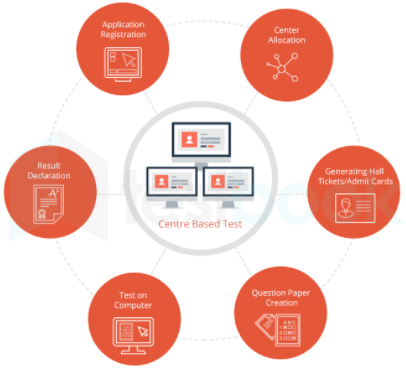
Which set of the following differentiates the offline with that of the online testing method?

The statements are:

(1) Offline is locally centered, online is centralized

(2) Offline is non-digital, online is digital

(3) Offline is subjective, online is objective

(4) The Internet is a must for online and not a necessity for offline

(5) Online usually provides instant evaluation, offline need not

The sets are:

  1. ((a))

    1, 4 and 5

  2. ((b))

    1, 2 and 5

  3. ((c))

    1, 3 and 5

  4. ((d))

    2, 3 and 4

Show Answer
Answer: ((a))

1, 4 and 5

Introduction: A test or assessment is a method to understand the knowledge, aptitude, skill, personality, insight, etc. of a person. The aim of the test is more important before choosing the method of testing. The mode of testing is determined by the availability and accessibility of the required instruments. There are two modes of testing, Online mode, and Offline mode.

Various characteristics of the online and offline modes of testing stated below will help us to understand the difference between the two modes, 

BasesOffline mode of testingOnline mode of testing
DefinitionIt is the method of testing the knowledge, skill, creativity, aptitude, behaviour, attitude, insights, etc. of an individual present physically at that time.It is the method of assessing one's ability, knowledge, and sometimes behaviour or insight over the internet by using technologies.
Primary requirementThe physical appearance of the candidateInternet connectivity
MobilityIt is immobile and locally centredIt is mobile but controlled by a central hub
AdvantageIt is advantageous for students located in remote areas where a lack of technology enhancement is foundIt reduces effort, saves time, and is more flexible. Mobility is also an important advantage. The response could be changed if required.
FeedbackProvide feedback later, after reviewing the answer sheetInstant feedback is provided, which is system-generated based on overall performance
DisadvantagesAny change of response is not allowed. Sometimes accessibility and physical barriers occur.Costly because the availability of technology is a must. Prior experience of the examinee and security issues are more important.
ExamplesPen-paper test, subjective testCBT, online interview

From the above discussion it is clear that 

  • Offline is locally centred, online is centralized
  • Internet is a must for online and not a necessity for offline, and
  • Online usually provides instant evaluation, offline need not

So options 1, 4, and 5 are correct to differentiate the offline with that of the online testing method.

Hint

  • One can use the digital presentation as a part of offline tests. An offline test administered on a computer in a testing center is still considered an offline test if the computer is not connected to the internet. This is because the test is not being delivered or scored electronically.
  • Objective type tests are also conducted in offline mode. Online tests could be subjective and objective.
2

The strength of project method lies in:

  1. ((a))

    Social participation

  2. ((b))

    Collection of information

  3. ((c))

    Role of teacher as instructor

  4. ((d))

    Individualised engagement

Show Answer
Answer: ((d))

Individualised engagement

The strength of the project method lies in the individualized engagement

Project method:

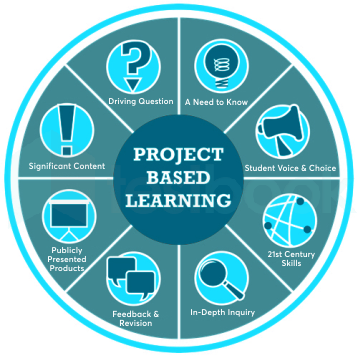
Meaning: It is a student-centred method of teaching in which the emphasis is given on experiential learning. Students actively engage in the project work initiated by mutual collaboration.

Proponent: William Heard Kilpatrick was the proponent of experiential learning and expanded the method of learning during the early 20th century.

According to Kilpatrick, ''A project is a whole-hearted purposeful activity proceeding in a social environment."

Characteristics: The characteristics of the project method are as follows

  • Student-centred approach: Students have control over the process of planning and implementation.
  • Wholehearted activity: Student can engage by their choice that focuses on the principle of freedom
  • Purposeful activity: Projects are initiated based on a certain aim or objective
  • Cooperative method: Increase collaboration among the participant and the instructor
  • Real experience: Hands-on experience and application of knowledge and skill in solving realistic problems
  • Experiential learning: It enhances the knowledge, skill, and experience os the students
  • Individualized engagement: Individual engagement in the case of creative thinking, planning, presenting, reflecting, etc


So it is clear that the strength of the project method of learning emphasis the individual engagement of the learner. Social participation, the teacher's role as an instructor, and the collection of information are parts of the project method.

3

Computer based testing is essential to:

  1. ((a))

    Make testing transparent, objective and efficient

  2. ((b))

    Ease teacher from burden of evaluation

  3. ((c))

    Prepare digitized evaluation sheets for speedy results

  4. ((d))

    Minimize human bias in testing

Show Answer
Answer: ((d))

Minimize human bias in testing

Computer-based Test:

  • The test or assessment is conducted over a computer or organized using a computer technology
  • It is introduced in the evaluation process to minimize human bias in testing, make testing flexible, and schedule accessibility.

Key Points

There are two types of Computer Based Test

  1. Linear test:
  • It a kind of full-length examination
  • Questions are selected without considering the performance level of the student
  • Example: NTA-UGC NET
  1. Adaptive test
  • There is a large store of questions
  • Questions are selected based on the performance of the student
  • Example: GRE

Advantages:

  • Efficiency in testing
  • Convenient with time and place
  • Instant and automatic feedback
  • Security system to minimize cheating and unauthorized access
  • Minimize human bias in testing
  • Perfect in timing
  • More frequent testing opportunity
  • More accurate results
  • Streamlined logistic

Disadvantages:

  • The technological problem can make trouble
  • Limited testing centres
  • Need more developed technology and infrastructural facility
  • Students from remote areas are less familiar
  • Server error can occur

So it is clear from the above discussion that Computer-based testing is essential to minimize human bias in testing.

4

Open book examination is to:

  1. ((a))

    do away from malpractice of copying

  2. ((b))

    test ability of candidates to refer books and learn

  3. ((c))

    to test candidates ability on application based knowledge

  4. ((d))

    to increase the quality of question paper

Show Answer
Answer: ((c))

to test candidates ability on application based knowledge

In an open-book exercise, students are allowed to consult their class notes, textbooks, and other approved material while answering questions.

  • Given the availability of textbooks or other material in the room, teachers will not ask questions that require the mere transfer of information from the textbook to the examination (answer) booklet.
  • However, these examinations are required to be chosen depending upon the purpose.
  • If the examination tests the skills of problem-solving and critical thinking, then there is no harm in students consulting their textbooks and class notes.
  • If students have to evaluate a conclusion that crucially involves their understanding of the concept, reproducing what the textbook says would be pointless.

Advantages of open-book exercise: 

  • It is less demanding on memory because it is no longer necessary for students to cram a lot of facts, figures, and numbers for an open-book examination.
  • It provides a chance for students to acquire knowledge during the preparation process of gathering suitable learning materials rather than simply recalling or rewriting it.
  • It tests candidates' ability on application-based knowledge
  • It promotes the information retrieval skills of students through finding efficient ways to get the necessary information and data from books and various resources.
  • It enhances the comprehension and synthesizing skills of students because they need to reduce the content of books and other study materials into simple and handy notes for examination.

From the above, we can conclude that an Open book examination is to test candidates' ability to application-based knowledge.

5

By reflective teaching learner:

  1. ((a))

    updates skills to be competent

  2. ((b))

    will be a good achiever in his examination

  3. ((c))

    will internalise knowledge and be judgemental

  4. ((d))

    will get content mastery

Show Answer
Answer: ((c))

will internalise knowledge and be judgemental

There are three different levels of teaching and the teaching-learning process takes place at three levels progressively- memory level of teaching, understanding level of teaching, and reflective level of teaching. The teacher must keep in mind the developmental stage of the learners so that desired educational objectives can be achieved.

  1. Memory level of teaching (MLT): Least thoughtful teaching
  • It is the initial stage of teaching.
  • It involves the habit of rote memorization. In such type of act, memory plays a key role.
  • The teacher presents factual information before the learner. The learner tries to memorize these facts with the least involvement of his/her thinking and reasoning power. It represents the involvement of the least thoughtful behavior.
  • The evaluation includes oral, written, and essay-type examinations.
  1. Understanding the level of teaching (ULT): thoughtful teaching
  • Understanding something is to perceive the meaning, grasp the idea, and comprehend the meaning.
  • It focuses on the mastery of the subject.
  • The teaching at the understanding level is of a higher quality than the one at the memory level.
  • At this level of teaching, the teacher explains the student the relationship between principles and facts and teaches them how these principles can be applied.
  • The learner and the teacher are actively involved in this level of teaching.
  • The evaluation includes both essay and objective type questions.
  1. Reflective level of teaching (ULT): Most thoughtful level
  • It is a problem-centric approach to teaching.

  • The reflective model of teaching is developed by Hunt.

  • Teaching at the reflective level represents the highest level of the teaching activities that can be carried out in the most thoughtful modes of operation providing the desirable quality of teaching situation and experience to the learner for utilizing and enhancing their cognitive abilities to the maximum.

  • At this level, the student is made to face a real problematic situation. The student by understanding the situation and using his critical abilities succeeds in solving the problem.

  • At this level, the emphasis is laid on identifying the problem, defining it, and finding a solution to it. The student’s original thinking and creative-abilities develop at this level.

  • The aim is to develop the reflective power of learners so that they can solve problems of their lives by reasoning, logic, and imagination and lead successful and happy lives.

  • By reflective teaching, learners will internalize knowledge and be judgemental.

Hence, The reflective level is the highest level of teaching. It includes both the Understanding level as well as the memory level of teaching. The reflective level of teaching enables learners to internalize knowledge and to be judgemental.

6

The data derived through the experimental method

  1. ((a))

    is not from a natural setting.

  2. ((b))

    lacks specific measurement.

  3. ((c))

    is unrealistic.

  4. ((d))

    is artificial.

Show Answer
Answer: ((a))

is not from a natural setting.

Research is an organized, systematic, and scientific inquiry into a subject to discover facts or to find answers to a problem. It is broadly classified as qualitative and quantitative. The various types of qualitative research methods include case studies, ethnographies, phenomenology, historical research, etc.

Experimental Research:

  • It is a systematic and scientific approach to research on establishing causal relationships.
  • The artificiality of the setting may produce unnatural behaviour that does not reflect real life, i.e. low ecological validity. This means it would not be possible to generalize the findings to a real-life setting. Hence, it is not from a natural setting is one of the limitations of it.
  • It investigates a hypothesis through experiments in a controlled environment where a variable is manipulated by the researcher and its impact is observed on the dependent variable.
  • It requires two variables:
  1. Independent Variable: This is the variable that is directly controlled or manipulated to examine its effect on the dependent variable.
  2. Dependent Variable: It is that factor that varies as the experimenter introduces, removes, or varies the independent variable.
  • In other words, X (independent variable) causes Y (dependent variable).
  • The observations derived from the dependent variable are considered for statistical analyses and the results are generalized to the larger population.
  • There are three basic things in an experimental method
  • Control: it is necessary to arrange the situation
  • Manipulation: it is basically applicable to the independent variables. It determines the changes in the dependent variables.
  • Observation: the effect of manipulation on the dependent variables is a matter of careful observation.
  • Suitable for researches in physical sciences.
  • The cause-effect relationship is another important characteristic of the experimental method. Both are affecting one another, also known as reflexivity.
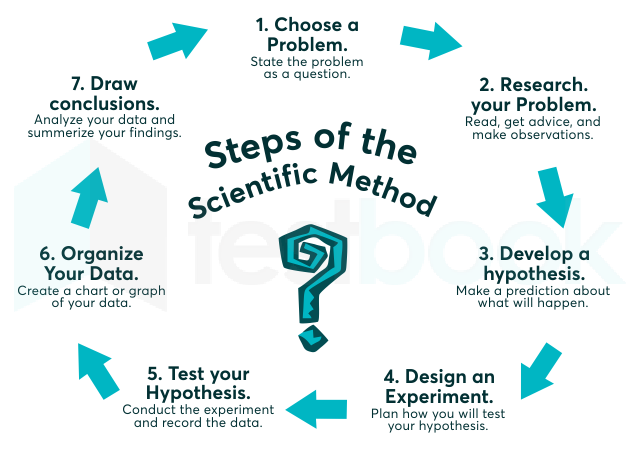
  • The steps of experimental research or scientific method are as follows,

7

Which one of the following is a constraint for adopting historical method of research?

  1. ((a))

    Lack of technical advancement

  2. ((b))

    Non-availability of primary data

  3. ((c))

    Ambiguity of concepts

  4. ((d))

    Subjective information

Show Answer
Answer: ((b))

Non-availability of primary data

Historical method:

  • Historical method is the collection of techniques and guidelines used by a researcher based on the historical aspects
  • The study of historical method and of different ways of writing history is known as historiography.
  • This a procedure supplementary to observation by which a researcher seeks to test the truthfulness of the reports of observations made by others
  • It is an investigation of the development of past events and their impact on the present and future
  • It depends on both primary and secondary data
  • It is a qualitative method
  • The researcher heavily depends on the primary data about the event, records, official documents, etc. So non-availability of primary data becomes a barrier to the research.

Advantages:

  • The research is not involved in the situation that is studied
  • The subject of the study is not a matter of interaction for the researcher
  • Current and future events can be discussed based on the analysis of the historical data

Disadvantages:

  • Data is complete in nature, it can be destroyed or missing due to the course of time
  • The occurrence of bias is very easy for the records and  the written documents of the past
  • It is complex in nature and so many barriers are there
8

After completion of work, on a research problem, the report was discussed in a scholar's meet, and the researcher was suggested to change the title of problem and hypothesis, based on the data analysis. This is:

  1. ((a))

    Logical and appropriate

  2. ((b))

    Processes systematisation of report

  3. ((c))

    Illogical and not desirable

  4. ((d))

    Improving the validity of report

Show Answer
Answer: ((c))

Illogical and not desirable

Key Points 

  • ​After the completion of work, on a research problem, the report was discussed in a scholar's meeting, and the researcher was suggested to change the title of the problem and hypothesis, based on the data analysis. This is Illogical and not desirable
  • Changing the title and hypothesis after completing all the work is almost impossible and the whole meaning of the research can be changed due to this.
  • The title of the research report is the primary outlook of the research.
  • It describes the content of the report and how appropriate it is.
  • The hypothesis shows the relationship between the variables of the research.
  • The validity of the research depends on the analysis and testing of the hypothesis. If the hypothesis seems incorrect based on the analysis of the data the validity could be questioned.

Important Points

Title of the thesis : 

  • It is the first thing to let the reader about the research
  • It contains the highlights of the research along with the purpose and interest
  • Sometimes the context, research outcome, and important aspects of the research can be clear from this statement
  • We need to avoid some of the things here like using a question mark, use wrong words, improper format, etc.

Hypothesis:

  • It is a precise and testable statement about the predicted outcome of the study
  • The validity of the research hypothesis depends on the analysis of the data. So it has to be proven
  • There are two types of hypothesis in research, Null hypothesis (H0) and alternative or research hypothesis (Ha)
  • The validity of research depends on the acceptance of the research hypothesis.
9

Title of the thesis is:

  1. ((a))

    An assertion

  2. ((b))

    An observation

  3. ((c))

    A fact

  4. ((d))

    An elaboration

Show Answer
Answer: ((a))

An assertion

The thesis should have clear aims that are enumerated near the beginning and which provide a rationale and framework for the remainder of the work and the aims are integrating link throughout a good thesis, setting out the intentions of the research at the beginning, and providing a focus throughout the research.

Quality of a good thesis:

  • It is important to make various connections clear and to demonstrate the way in which the research design has evolved, this much be considered while formulating the thesis.
  • There should be an adequate and comprehensive of the relevant literature. The literature review helps in finding the gaps between existing problems and new problems.
  • The literature selected should be sufficiently contemporary to demonstrate the way in which the thesis is framed upon recent research, these issues in writing are important, we should also pay careful attention to detail.
  • Read the thesis carefully, to reduce typographical, punctuation, and grammatical errors to a minimum, to maintain accuracy in your writing.
  • There should be consistency in the way the thesis is written and structured. for example, to the spelling of technical terms, to the use of acronyms, and to the way in which subsections are set out and numbered.
  • Start the thesis with a clear and well-written abstract because many readers in a library will read the abstract before deciding whether or not to read the whole thesis.
  • It is important not to forget the title. The title should not be excessively long, but it should describe precisely the nature of the thesis, and ideally include some of the keywords associated with.

Title of the thesis : 

The thesis sentence is the main assertion of the research. Your thesis should tell your reader the main point or idea of your paper. A good thesis will be clearly identifiable within the paper and will be narrow, purposeful, and specific. A thesis statement must always be a complete sentence.

  • It is the first thing to let the reader about the research.
  • It contains the highlights of the research along with the purpose and the of interest.
  • Sometimes the context, research outcome, and important aspects of the research can be clear from this statement.
  • We need to avoid some of the things here like using a question mark, use wrong words, improper format, etc.
10

Given below are the steps of scientific research. Arrange them in order:

(1) Formulation of hypothesis

(2) Development of research tool

(3) Identification of research problem

(4) Selection of sample

(5) Data analysis and interpretation

  1. ((a))

    1, 2, 3, 5, 4

  2. ((b))

    1, 4, 3, 2, 5

  3. ((c))

    3, 4, 1, 2, 5

  4. ((d))

    3, 1, 2, 4, 5

Show Answer
Answer: ((d))

3, 1, 2, 4, 5

Research refers to a systematic study of one's chosen subject for arriving at both new and valid conclusions.

The research process consists of a series of actions and steps needed for conducting scientific research, if the researcher follows certain steps in conducting the research, the work can be carried out smoothly with the least difficulty.

Following are the Steps in pursuing research:

<br>

  1. Identification of the Problem: The first and most important step for identifying a problem is asking a question or identifying a need that arises as a result of curiosity and to which it becomes necessary to find an answer.
  2. Review of Literature:​ A researcher needs to explore the existing studies on the related studies and techniques for the research.
  3. Formulating a Hypothesis: “Hypotheses are single tentative guesses, good hunches – assumed for use in devising theory or planning experiments intended to be given a direct experimental test when possible”.While formulating a hypothesis it is important that the researcher is well prepared with the problem of which he/she is going to find the solution. Here the researcher makes the tentative guess of the solution of the problem and then formulate the research questions.
  4. Identifying, Manipulating, and Controlling Variables: Variables are defined as those characteristics which are manipulated, controlled, and observed by the researcher. The study may have extraneous variables.
  5. Formulating a Research Design: A research design may be regarded as the blueprint of those procedures which are adapted by the researcher for testing the relationship between the dependent variable and the independent variable
  6. Constructing Devices for Observation and Measurement: When the research design has been formulated the next step is to construct or collect and choose appropriate tools of research for scientific observation and measurement.
  7. Sample Selection and Data Collection: After deciding the tools for the study the research one must also decide about the participants of the study for which purpose usually a small sample is drawn which represents the population.
  8. Data Analysis and Interpretation: After making observations the data collected are analyzed with the help of various quantitative and qualitative statistical techniques.

Therefore, Option 4 is the correct answer.

Read the passage carefully and answer the following questions. 

If the world is different today, we need to think, talk and engage accordingly. Falling back is unlikely to help, he said adding “purposeful pursuit of national interest is shifting global dynamics”. Highlighting India’s new approach in dealing with terrorism he compared “lack of response to the terror attack in Mumbai in comparison to the way the country responded to the Uri and Pulwama strikes. On India walking away from the Regional Comprehensive Economic Partnership, the external affair minister said no agreement was better than having a bad agreement.

Giving a historical perspective to geopolitical issues, Jai-Shankar said “For years India’s position on the world state seemed assured but the 1962 conflict with China significantly damaged India’s standing.

11

Year's back conflict of India with China was:

  1. ((a))

    national Issue

  2. ((b))

    international Issue

  3. ((c))

    political Issue

  4. ((d))

    geopolitical Issue

Show Answer
Answer: ((d))

geopolitical Issue

The correct answer is "Geopolitical Issue".

Key Points

  • From the line given in the passage: Giving a historical perspective to geopolitical issues, Jai-Shankar said “For years India’s position on the world state seemed assured but the 1962 conflict with China significantly damaged India’s standing.​
  • Thus, conflict with China was a geopolitical issue.
12

India's New Approach on Terrorism is:

  1. ((a))

    wait till any action takes place

  2. ((b))

    deny for any type of action

  3. ((c))

    earliest it was reactive, at present it is proactive

  4. ((d))

    ready to loose for Peace

Show Answer
Answer: ((a))

wait till any action takes place

The correct answer is "Wait till any action takes place".

Key Points

  • From the line given in the passage: Highlighting India’s new approach in dealing with terrorism he compared “lack of response to the terror attack in Mumbai in comparison to the way the country responded to the Uri and Pulwama strikes.
  • Thus according to it Option 1) is most suitable

Mistake Points

  • One might think Option 3) is the correct answer but it is not so. Proactive means creating or controlling a situation rather than just responding to it after it has happened.
  • Here in the passage there is nowhere mentioned about creating and controlling the situation. So it is not the right answer.
13

“For years India’s position on the world state seemed assured but the 1962 conflict with China significantly damaged India’s standing."

The above statement was given by:

  1. ((a))

    Subhramanyam Swami

  2. ((b))

    Subhramanyam Jaishankar

  3. ((c))

    Ravi Shankar

  4. ((d))

    K. Subhramanyam

Show Answer
Answer: ((b))

Subhramanyam Jaishankar

The correct answer is "Subhramanyam Jaishankar"

Key Points

  • From the line given in the passage: Giving a historical perspective to geopolitical issues, Jai-Shankar said “For years India’s position on the world state seemed assured but the 1962 conflict with China significantly damaged India’s standing."
  • Thus, the above statement was said by Jai-shankar.
14

What was country's idea about Economic Partnership?

  1. ((a))

    All Agreements are good

  2. ((b))

    Agreements are superior than country

  3. ((c))

    Nothing wrong with saying no to unfavourable agreement than having an awful agreement

  4. ((d))

    Say yes to all agreement

Show Answer
Answer: ((c))

Nothing wrong with saying no to unfavourable agreement than having an awful agreement

The correct answer is "Nothing wrong with saying no to unfavourable agreement than having an awful agreement".

Key Points

  • From the line given in the passage: On India walking away from the Regional Comprehensive Economic Partnership, the external affair minister said no agreement was better than having a bad agreement.
  • Thus, the reason for walking away from Economical partnership is to avoid unfavourable agreement than having an awful agreement
15

RCEP stands for:

  1. ((a))

    Regional Common Economic Party

  2. ((b))

    Regional Common Election Party

  3. ((c))

    Regional Comprehensive Election Partnership

  4. ((d))

    Regional Comprehensive Economic Partnership

Show Answer
Answer: ((d))

Regional Comprehensive Economic Partnership

The correct answer is "Regional Comprehensive Economic Partnership".

Key Points

  • From the line given in the passage: On India walking away from the Regional Comprehensive Economic Partnership, the external affair minister said no agreement was better than having a bad agreement.
  • Thus from the above passage, correct answer is option 4)
16

During the process of communication:

  1. ((a))

    Sender encodes for the media and receiver decodes the message

  2. ((b))

    Sender decodes for the media  and receiver encodes the message

  3. ((c))

    Medium encodes and decodes the message from sender

  4. ((d))

    Medium encodes and decodes the message from receiver

Show Answer
Answer: ((a))

Sender encodes for the media and receiver decodes the message

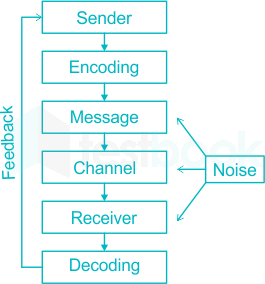
Communication is defined as the process of passing information and understanding from one person to another. It is simply the act of transferring information from one place, person or group to another. The communication process is made up of four key components. Those components include encoding, the medium of transmission, decoding, and feedback, along with the sender and the receiver

Process of Communication

  • The first step the sender is faced with involves the encoding process (means translating information into a message in the form of symbols that represent ideas or concepts).
  • When encoding a message, the sender has to begin by deciding what he/she wants to transmit. A good way for the sender to improve encoding their message is to mentally visualize the communication from the receiver's point of view.
  • To begin transmitting the message, the sender uses some kind of channel (also called a medium). The channel is the means used to convey the message.
  • While selecting the appropriate channel, senders need to keep in mind that selecting an appropriate channel will greatly assist in the effectiveness of the receiver's understanding.
  • After the appropriate channel is selected, the message enters the decoding stage of the communication process.
  • Decoding is conducted by the receiver. The receiver is the individual or individuals to whom the message is directed.

Once the receiver confirms to the sender that he has received the message and understood it, the process of communication is complete. 

Therefore, from the above explanation, we can conclude that during the process of communication sender encodes for the media and the receiver decodes the message.

17

Proxemics is the type of non-verbal communication which deals with:

  1. ((a))

    Appearance

  2. ((b))

    Touch

  3. ((c))

    Body organs

  4. ((d))

    Space

Show Answer
Answer: ((d))

Space

Non-verbal Communication: It is understood as the process of communication through sending and receiving wordless messages. Non-verbal details reveal who we are and impact how we relate to other people. These include:

Proxemics 

  • The study of how we communicate with the space around us, how we arrange personal space, and what we arrange in it.
  • The space within social distance and out of personal distance is called social space. And the space within public distance is called public space.
  • The amount of distance we need and the amount of space we perceive as belonging to us is influenced by several factors including social norms, situational factors, personality characteristics, and level of familiarity. These are divided into four zones such as public (12 feet or more), social (4 to 12 feet), personal (1.5 to 4 feet), and intimate distance (less than 1.5 feet).

Therefore, Proxemics is the type of non-verbal communication that deals with Space.

18

Language barriers in communication exist due to:

  1. ((a))

    the difference in the sender's recognition vocabulary and the receiver's user vocabulary

  2. ((b))

    the difference in sender's user vocabulary and the receiver's recognition vocabulary

  3. ((c))

    the sender's user vocabulary and the receiver's recognition vocabulary being alike

  4. ((d))

    the sender's recognition vocabulary and the receiver's user vocabulary being the same

Show Answer
Answer: ((b))

the difference in sender's user vocabulary and the receiver's recognition vocabulary

Communication refers to the exchange of information from one person to another. Effective communication occurs only when the receiver understands the exact information or idea that the sender intended to transmit.

A few Barriers to Effective Communication are anything that prevents understanding of the information leading to failure of the communication process is termed as barriers.

Semantic/Language Barriers: Semantic is the science of meaning. The same words and symbols carry different meanings to different people. It is a problem of language and the absence of clarity and precision in the subject. The meaning intended by the sender may be quite different from the meaning followed by the receiver and this leads to a semantic barrier. A few of the semantic barriers in formal communication include:

  • Symbols with different meanings:  In verbal communication, a particular word may have a variety of meanings. E.g., the word ‘lie’ might have the meanings, ‘laying down’ or ‘a false statement’.
  • The difference in Language: This is an obvious barrier where there is no common vehicle to convey ideas and feelings.
  • Faulty Translation:  The message must be accompanied by an interpretation that will be understood by the receiver.
  • Poor Vocabulary: The communicator should know the clear precise meaning of the used words or else they will not make clear the idea to be communicated. It is the difference in the sender's user vocabulary and the receiver's recognition vocabulary.
  • Unqualified Assumptions: Though a message appears to be specific, its underlying assumptions may not be clear to the receiver.
  • Words having multiple meanings: Similar sounding words like access, excess, flour, flower, cite, site and sight can cause misunderstanding in speech. Technical terms or jargon be a barrier to communication as well.
  • Misunderstanding due to semantics: Whatever is to be stated should be stated in simple language with minimum use of long and complex sentences.

Therefore, Language barriers in communication exist due to the difference in the sender's user vocabulary and the receiver's recognition vocabulary.

19

In intra-personal communication

  1. ((a))

    sender sends and receives the message.

  2. ((b))

    sender sends and another receiver receives the message.

  3. ((c))

    sender sends and two receivers receive the message.

  4. ((d))

    sender sends and the group receives the message.

Show Answer
Answer: ((a))

sender sends and receives the message.

Communication: Communication is transferring or conveying a message to a target group. It is constituted of three things, sender, communication channel, and receiver. Based on the number of participants engaged in the communication process it can be classified into four, intra-personal communication, interpersonal communication, group communication, and mass communication. In the case of intrapersonal communication, the sender sends and receives the message.

Intra-personal Communication:

  • Communication within an individual.
  • In this case, the sender and receiver are the same.
  • Some of the intrapersonal skills are self-discipline, playfulness, delay of gratification, etc.
  • Intrapersonal communication is mainly concerned with thought and analysis but not the sharing of ideas
  • It includes individual reflection, meditation, contemplation, and even praying to god
  • The used media are mind, audio recordings, written records, etc.
  • We conceptualize and formulate our thoughts before we indulge
  • For example, 'Oh my God', 'wow', 'thank God', etc.

Types of communicationDefinitionExample
Mass Communication- Communicate with a large number of people - It is designed to reach the larger part of the society- TV, Radio, Newspaper - Advertisement, Film
Group Communication- Communication between a number of people have a common interest or goal - The factors common educational background, religion, language, economic status, profession, etc. - It is related to a leader and members of the group- Project meeting - gatekeeping - playgroups
Interpersonal Communication- It is a communication between two persons - It is dynamic in nature and has greater scope for 'Grapevine' - It is more effective because immediate feedback can be given - Close proximity present between sender and receiver - Depends on interpersonal relationship, emotional appeal, status, role skill, etc.- Face to face communication, - private discussion
20

The mass media impacts our society in different ways except

  1. ((a))

    for influencing public opinion.

  2. ((b))

    for modification of behaviour.

  3. ((c))

    for changing values and belief system.

  4. ((d))

    for judicial decisions.

Show Answer
Answer: ((d))

for judicial decisions.

Mass media:

  • Communicate with a large number of people
  • It is designed to reach the larger part of the society
  • For example, TV, radio, newspaper, etc.

Mass media and society:

  • Mass media influences both society and the cultural aspects
  • Based on the sociological theory, there is a definite relationship between mass media communication and social changes
  • The changes are like social values, public beliefs, opinions, behaviour, etc.
  • It gives shape and the structure of society.
  • According to Denis McQuail, 1983, mass media are primarily molders of society as well as reflectors of it.

Mass Media is becoming a very important agency of socialization as mass media is a form of media which:

  • Helps us to connect with a large number of people at one time.
  • Helps individuals to form and shape their opinions, beliefs, and values.
  • Helps children to directly interact with the world through various online portals.

Judicial decisions:

  • It is a legal opinion written by a judge or judicial panel to resolve any dispute.
  • It is influenced by political factors, legal issues, and sometimes personal factors.
  • It is not a part of the changes brought to society by the mass media influence.
21

What should come in place of the question mark '?' in the following number series?

4, 9, 20, 43, ?.

  1. ((a))

    84

  2. ((b))

    96

  3. ((c))

    108

  4. ((d))

    133

Show Answer
Answer: ((a))

84

Concept used:

Double difference method- This method is used when we take the difference of difference and that difference is in any type of series.

Solution:

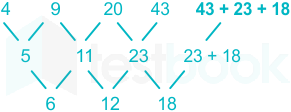
Series is based on double difference:

This double difference is in multiple of 6

Here, the third difference should be 18 then the last number in the 2nd row = 23 + 18 = 41

The next number of the series should have a difference of the 41

∴ Next number in the series = 43 + 41 = 84

Mistake Points

As the question is of the previous year and according to the answer key 84 was the correct option and 90 was not mentioned in the option, So, we can not change the option

A series sometimes follows more than one logic, but we have to opt for the method which brings the answer which is present in the option.

Now, Another logic is:

4

4 × 2 + 1 = 9

9 × 2 + 2 = 20

20 × 2 + 3 = 43

43 × 2 + 4 = 90

But 90 is not present in option so, we opted for double difference method.

22

From Vadodara station, if we buy two tickets to station P and three tickets to station Q, the total cost is Rs. 77, but if we buy 3 tickets to station P and 5 tickets to station Q, the total cost is Rs. 124. The fare from Vadodara to P is:

  1. ((a))

    Rs. 13

  2. ((b))

    Rs. 14

  3. ((c))

    Rs. 18

  4. ((d))

    Rs. 20

Show Answer
Answer: ((a))

Rs. 13

Given:

From Vadodara station, if we buy two tickets to station P and three tickets to station Q, the total cost is Rs. 77, but if we buy 3 tickets to station P and 5 tickets to station Q, the total cost is Rs. 124

Concept used:

Linear equation in two variables.

Calculation:

Two tickets to station P and three tickets to station Q

⇒ 2P + 3Q = 77 - (i)

Three tickets to station P and 5 tickets to station Q

⇒ 3P + 5Q = 124 - (ii)

Solve the above two equations

⇒ (2P + 3Q = 77) × 5

⇒ (3P + 5Q = 124) × 3

⇒ 10P + 15Q = 385 - (iii) 

⇒ 9P + 15Q = 372 - (iv)

Solving Equation three and four we get

⇒ P = 385 - 372 = 13

∴ The Fare from Vadodara to station P is Rs.13

23

300 gm of sugar solution has 40% sugar in it. How much sugar should be added to make it 50% in the solution?

  1. ((a))

    30 gm

  2. ((b))

    40 gm

  3. ((c))

    50 gm

  4. ((d))

    60 gm

Show Answer
Answer: ((d))

60 gm

Given:

300 gm of sugar solution has 40% sugar in it.

Concept used:

Ratio and proportion

Calculation:

In 300 gm of sugar the concentration of sugar = 40%

40% of 300 = 120 gm

Let x gm of sugar be added.

Now according to the question

 (\Rightarrow \frac{{120\ +\ x}}{{300\ +\ x}} = \frac{1}{2})   (∵ New amount of sugar  i.e. x will also be added in solution and 50% = 1/2)

⇒ 240 + 2x = 300 + x

⇒ x = 60 gm.

∴ 60 gm sugar should be added to make the concentration 50%

Shortcut TrickSugar in sugar slution = 300g × 40/100 = 120g

So its 120g sugar and 180g water.

Now to make it 50% (equal sugar and equal water), we should add 60g sugar.

That makes it 180g sugar in 180g water.

24

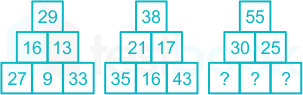
Numbers in boxes given below follow the same arrangement. Find the missing numbers in the third box:

  1. ((a))

    65, 36, 63

  2. ((b))

    53, 24, 63

  3. ((c))

    49, 32, 53

  4. ((d))

    51, 25, 61

Show Answer
Answer: ((d))

51, 25, 61

Given - 

Solution - 

For first block - 

⇒ 29 - 16 = 13

⇒ 13 × 2 + 1 = 27

⇒ 29 - 13 = 16

⇒ 16 × 2 + 1 = 33

⇒ 16 - 13 = 3

⇒ 3 × 3 = 9

⇒ Similarly, for third block - 

⇒ 55 - 30 = 25

⇒ 25 × 2 + 1 = 51

⇒ 55 - 25 = 30

⇒ 30 × 2 + 1 = 61

⇒ 30 - 25 = 5

⇒ 5 × 5 = 25

Hence,  '51, 25, 61' is the correct answer.

25

By selling a mobile for Rs. 1,536, Amit lost 20%. What percent shall he gain or loose by selling it for Rs. 2,000?

  1. ((a))

    A loss of 8.25%

  2. ((b))

    A profit of 8.25%

  3. ((c))

    A loss of 4.17%

  4. ((d))

    A profit of 4.17%

Show Answer
Answer: ((d))

A profit of 4.17%

Given:

By selling a mobile for Rs.1,536, Amit lost 20%.

Concept used:

Profit and Loss

Calculation:

Let the cost price of mobile be Rs.100

Amit lost 20% 

SP of mobile will be 100 - 20 = Rs.80

Given SP is Rs.1536

SP = 1536/80

SP = 19.2

CP = 19.2 × 100

CP of mobile = Rs.1920

SP of mobile as per the question = Rs.2000

Gain = Rs.80

Gain% = (Gain/CP) × 100

Gain% = (80/1920) × 100

Gain% = 4.16666

Gain% = 4.17%

26

The Sanskrit word 'Upamana' means:

  1. ((a))

    Implication

  2. ((b))

    Comparison

  3. ((c))

    Inference

  4. ((d))

    Perception

Show Answer
Answer: ((b))

Comparison

Upamana (comparison) is not an essential step when you present an argument based on inference before the others according to the Classical Indian School of Logic. It is knowledge derived from similarity. It has been defined as the knowledge of the relation between a word and its denotation

The expression ‘upamāna’, is derived from two words, ‘upa’ and ‘māna’. The word ‘upa’ means similarity or ‘sādrusya’ and the word ‘māna’ means ‘cognition’. Thus, generally speaking, upamāna as a source of knowledge is derived from the similarity between two things/objects. It is a source of knowledge of the relation between a word and its denotation.

Example of Upamāna*: A person does not know what a ‘squirrel’ is? S(he) is told by a forester that it is a small animal like rat, but it has a long fury tail and strips on its body. After some period of time, when s(he) sees such an animal in the forest, s(he) knows that it is a squirrel.*

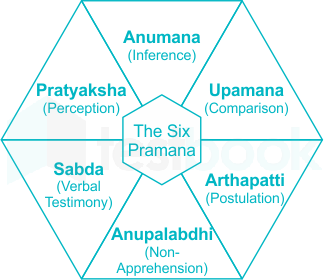
There are Six types of Pramana: Pratyaksha, Anumana, Upamana, Arthapati, Anupalabdhi, Sabda.


  1. Pratyaksha (Perception)
  • It is basically which is before one’s eyes, ‘aksa’ means sense organ, and ‘prati’ means the function of each sense organ.
  • A perception is a valid form of knowledge produced by the contact of an object with a sense organ.
  • It is the first of the five means of knowledge or pramanas, that enable a person to have correct cognitions of the world.
  • Pratyaksha is of two kinds,
  1. Anubhava: Direct perception
  2. Smriti: Remembered perception
  • The knowledge arises by contact of sense organs (indriya) with an object. Such contact is not the sole condition of perception, but it is its distinctive feature or extraordinary cause (karana) of perception. The actual process is given below:
  • The self comes into contact with the mind (manas)
  • The manas with the senses
  • The senses with the object
  1. Anumana (Inference)
  • The term anumana literally means after knowledge i.e., knowledge that follows other knowledge.
  • Inference (anumana) is based on perception but is able to arrive at conclusions that may not be directly open to perception. Anumana  (“measuring along with some other thing,” or “inference”), the knowledge gained by means of inference.
  • Anumana is a rational process in which on the basis of knowledge of an object a certain knowledge of other objects is received. Here the object known before is named Hetu. The later known object is known as Sadhya.
  • For example –
  • All the places of smoke are the place of fire.
  • The mountain has smoke.
  • Therefore, the mountain has fire.
  • In the above example – Sadhya is fire and Hetu is smoke.
  1. Arthapatti—( “the incidence of a case”), the knowledge gained by circumstantial implication, superimposing the known knowledge on an appearing knowledge that does not concur with the known knowledge circumstantial implication. Therefore, (arthapatti), appeals to common sense.
27

Odometer is to mileage as compass is to:

  1. ((a))

    Speed

  2. ((b))

    Hiking

  3. ((c))

    Needle

  4. ((d))

    Direction

Show Answer
Answer: ((d))

Direction

Odometer is to mileage as compass is to the direction.

Odometer:

  • It is an instrument used to measure the distance travelled by a wheeled vehicle
  • The function is to calculate the mileage or the total distance

Compass:

  • It is an instrument used for navigation purposes.
  • The main function is to determine the direction and orientation of an object or a person from the north.
  • A compass rose is used to show the directions and a needle is used to show the actual direction of the moving object.

Explanation: The statement given in the question is talking about the function of an odometer that is to measure milage. So the function of the compass is to understand the direction of an object. The needle is used in a compass to indicate the actual direction.

Speed: It is the rate at which an object or person is moving in a unit of time.

Hiking: It is an activity for pleasure time or exercise. When people go for a long distance to spend his/her pleasure time or exercise it is called hiking.

Needle: It is a fine piece of metal that has a sharp end.

28

Which of the following diagrams correctly represents Lions, Elephants and Animals?

  1. ((a))

  2. ((b))

  3. ((c))

  4. ((d))

Show Answer
Answer: ((a))

Given,

Lions, Elephants and Animals

Lions and Elephants are different animals.

Thus, the best way to represent through the Venn diagram is,

Hence, the correct answer is 

29

Nyaya Syllogism has _______ statement.

  1. ((a))

    One

  2. ((b))

    Five

  3. ((c))

    Three

  4. ((d))

    Two

Show Answer
Answer: ((b))

Five

  • The term “nyāya” ( Sanskrit: “Rule” or “Method”)  traditionally had the meaning “formal reasoning,” though in later times it also came to be used for reasoning in general, and by extension, the legal reasoning of traditional Indian law courts.
  • Opponents of the Nyāya school of philosophy frequently reduce it to the status of an arm of Hindu philosophy devoted to questions of logic and rhetoric. While the reasoning is very important to Nyāya, this school also had important things to say on the topic of epistemology, theology and metaphysics, rendering it a comprehensive and autonomous school of Indian philosophy.
  • It is called Nyaya because it is constituted of five “laws” – Pratijna, Hetu, Udaharana, Upanaya, Nigamana. Nyaya includes formal logic and modes of scientific debate.
  • Nyaya is greatly concerned with logic and elaborates on the principle of inference based on syllogism, of course, logic is only one of the many subjects it deals with.
  • Nyaya preaches that a statement should only be accepted if it passes the test of reason. So according to it, error and ignorance are the causes of pain and suffering. The road to wisdom is to develop the process of logical thinking. It does not seem to deny God and accepts God as the Supreme Soul.
  • A syllogism is a kind of logical argument that applies deductive reasoning to arrive at a conclusion based on two or more propositions that are asserted or assumed to be true.
30

Should high chimneys be installed in industries?

Arguments:

(I) Yes, it reduces pollution at ground level.

(II) No, it increases pollution in the upper atmosphere.

  1. ((a))

    Only argument I is strong

  2. ((b))

    Only argument II is strong

  3. ((c))

    Either I or II is strong

  4. ((d))

    Both I and II are strong

Show Answer
Answer: ((a))

Only argument I is strong

  • Chimneys are tall and slender structures which are used to discharge waste/flue gases at a higher elevation with sufficient exit velocity such that the gases and suspended solids (ash) are dispersed into the atmosphere over a defined spread such that their concentration, on reaching the grounds is within acceptable limits.
  • Long chimneys should be installed in industries as it will take the harmful smoke and gases produced in the factories high up in the air so as to reduce its harmful effects on the ground.
  • Pollution at ground level is the most hazardous in the way of being injurious to human and animal life.
  • It can result in increases in pollution in the upper atmosphere. However, Argument I is very strong and alone hold.
31

The sum of squares of three numbers is 138, while sum of their products taken two at a time is 131. Their sum is:

  1. ((a))

    16

  2. ((b))

    20

  3. ((c))

    24

  4. ((d))

    26

Show Answer
Answer: ((b))

20

Given:

The sum of squares of three numbers is 138, while sum of their products taken two at a time is 131.

Concept used:

(x + y + z)2 = x2 + y2 + z2 + 2(xy +yz + zx)

Calculation:

Let three numbers be x, y, z.

The sum of squares of three numbers is 138

⇒ x2 + y2 + z2 = 138

Sum of their products taken two at a time is 131

⇒ xy + yz + zx = 131

Applying the formulae 

⇒ (x + y + z)2 = 138 + 2(131)

⇒ (x + y + z)2 = 138 + 262

⇒ (x + y + z)2 = 400

⇒ x + y + z = √400

⇒ x + y + z = 20

∴ The sum of three numbers is 20.

32

Given the following wage distributions:

Wages (in Rs.)No, of Workers
Less than 504
Less than 6010
Less than 7020
Less than 8040
Less than 9050


What percentage of workers earn wage more than Rs.70 ?

  1. ((a))

    50.5

  2. ((b))

    62.5

  3. ((c))

    65

  4. ((d))

    72.5

Show Answer
Answer: ((d))

72.5

Concept used:

Percentage 

Calculation:

Total no of workers = 4 +10 + 20 + 40 + 50 

Total no of workers = 124

Workers earning more than Rs.70

⇒ 50 + 40 = 90

Percentage of workers earning more than Rs.70 

⇒ (\frac{{90}}{{124}} \times 100)

∴ 72.5%

33

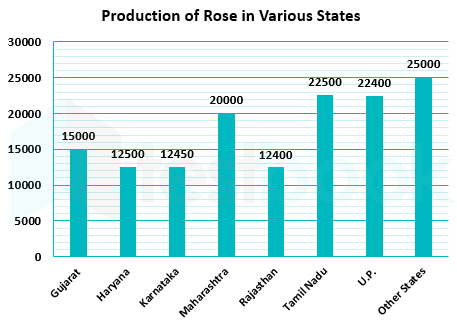
Study of the following graph carefully and answer the question:

Which of the following state(s) contribute(s) less than 10 per cent in the total Rose production?

  1. ((a))

    Rajasthan and Karnataka 

  2. ((b))

    Only Rajasthan

  3. ((c))

    Rajasthan, Karnataka, Haryana 

  4. ((d))

    Rajasthan, Karnataka, Haryana and Gujarat

Show Answer
Answer: ((c))

Rajasthan, Karnataka, Haryana 

Calculation:

Total Rose production of all states

15000 + 12500 + 12450 + 20000 + 12400 + 22500 + 22400 + 25000 = 142250

10% of 142250 = 14225

Now Number of states whose production is less than 14225 are

Haryana, Karnataka, Rajasthan.

34

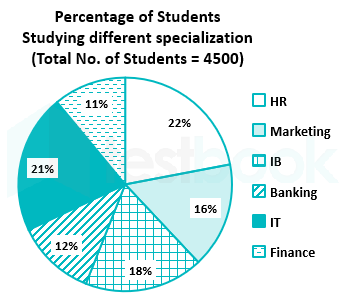
Study the pie-chart carefully to answer the question:

Ratio of Men to Women in each Specialization

SpecializationMenWomen
HR23
Marketing75
IB51
Banking1710
IT12
Finance54


The number of women studying finance is what percentage of men studying the same?

  1. ((a))

    70%

  2. ((b))

    80%

  3. ((c))

    85%

  4. ((d))

    90%

Show Answer
Answer: ((b))

80%

Given:

Total number of students = 4500

Calculation:

The number of students studying finance 

⇒ 11% of 4500

⇒ 11 × 45 

⇒ 495

Ratio of Men to women in Finance = 5 : 4

⇒ Number of women Studying in finance = (4/9) × 495 = 220

⇒ Number of men Studying in finance = (5/9) × 495 = 275

Percentage of women studying finance to the men studying finance (same)

⇒ (\frac{{220}}{{275}} × 100)

∴ 80%

35

The distribution of weights (in kg) of 44 students in a class is as follows:

WeightNo. of Students
35 - 383
38 - 4113
41 - 4413
44 - 4710
47 - 505
<br>

What is the average weight of the class?

  1. ((a))

    40.26

  2. ((b))

    41.88

  3. ((c))

    42.56

  4. ((d))

    43.25

Show Answer
Answer: ((c))

42.56

Concept used:

Mean and frequency.

Calculation:

Mean of the given data

⇒ (35 + 38)/2 = 36.5 

⇒ (38 + 41)/2 = 39.5 

⇒ (41 + 44)/2 = 42.5 

⇒ (44 + 47)/2 = 45.5 

⇒ (47 + 50)/2 = 48.5  

Average weight of all class

 (\Rightarrow \frac{{36.5 \times 3 + 39.5 \times 13 + 42.5 \times 13 + 45.5 \times 10 + 48.5 \times 5}}{{44}})

⇒ 1873/44

∴ 42.56 is the average of the class.

36

'Internet Explorer' is type of

  1. ((a))

    Operating System

  2. ((b))

    Browser

  3. ((c))

    IP Address

  4. ((d))

    Compiler

Show Answer
Answer: ((b))

Browser

Internet Explorer is a series of graphical web browsers developed by Microsoft and included in the Microsoft Windows line of operating systems, starting in 1995.

A browser is an application program that provides a way to look at and interact with all the information on the World Wide Web. This includes Web pages, videos, and images.

  • The word "browser" originated prior to the Web as a generic term for user interfaces that let you browse (navigate through and read) text files online.
  • A Web browser is a client program that uses HTTP (Hypertext Transfer Protocol) to make requests of Web servers throughout the Internet on behalf of the browser user.

Popular Web Browsers: Google Chrome is currently one of the most commonly used browsers. Other browsers include:

  • Firefox- which was developed by Mozilla.
  • Microsoft Edge- used a replacement for Internet Explorer, with Windows 10.
  • Internet explorer- relegated to the past, Microsoft has mostly replaced Internet Explorer with Edge.
  • Safari- a browser for Apple computers and mobile devices.
  • Lynx- a text-only browser for UNIX shell and VMS users.
  • Opera- a fast and stable browser that's compatible with most relatively operating systems.

Therefore, 'Internet Explorer' is a type of browser.

1. Operating System:

  • An Operating System (OS) is an interface between a computer user and computer hardware.
  • An operating system is a software that performs all the basic tasks like file management, memory management, process management, handling input and output, and controlling peripheral devices such as disk drives and printers.

2. IP Address:

  • An Internet Protocol address is a numerical label assigned to each device connected to a computer network that uses the Internet Protocol for communication.
  • An IP address serves two main functions: host or network interface identification and location addressing.

3. Compiler:

  • A compiler is a special program that processes statements written in a particular programming language and turns them into machine language or "code" that a computer's processor uses.
  • Typically, a programmer writes language statements in a language such as Pascal or C one line at a time using an editor.
37

Which of the following is an open source software?

  1. ((a))

    Mozilla Firefox

  2. ((b))

    Acrobat Reader

  3. ((c))

    MS PowerPoint

  4. ((d))

    Windows

Show Answer
Answer: ((a))

Mozilla Firefox

Open Source Software:

  1. In Computer terminology, open-source software is software with a source code that the user can modify, enhance, and share due to its public accessibility.
  2. Source code is the part of the software that the computer programmer can alter in order to add features or fix parts that don't work properly.
  3. Open-source software makes the source code to public access so that the user can view, copy, modify, and share it.
  4. Open source license grants the user right to use the open-source software as per their discretion.

  1. Mozilla Firefox is open-source software for web browsing. It is developed by Mozilla Foundation under its latest technology named Quantum which promotes parallelism and interactive user interface.
  2. Microsoft PowerPoint is a powerful presentation software developed by Microsoft.
  3. Adobe Acrobat Reader DC software is the free, trusted global standard for viewing, printing, signing, sharing, and annotating PDFs. It's the only PDF viewer that can open and interact with all types of PDF content – including forms and multimedia.
  4. Windows is an operating system owned by Microsoft and is a licensed product of it.

Therefore Mozilla Firefox is open-source software.

38

NMEICT stands for:

  1. ((a))

    National Mission on Environment through ICT 

  2. ((b))

    National Mission on English through ICT

  3. ((c))

    National Mission on Economics through ICT

  4. ((d))

    National Mission on Education through ICT

Show Answer
Answer: ((d))

National Mission on Education through ICT

The National Mission on Education through Information and Communication Technology (NMEICT)

  • It has been envisaged as a Centrally Sponsored Scheme to leverage the potential of ICT, in the teaching and learning process for the benefit of all the learners in Higher Education Institutions.
  • This was expected to be a major intervention in enhancing the Gross Enrolment Ratio (GER) in Higher Education by 5 percentage points during the XI Five Year Plan period.
  • The three cardinal principles of Education Policy viz., access, equity, and quality could be served well by providing connectivity to all colleges and universities, providing low cost and affordable access-cum-computing devices to students and teachers, and providing high-quality e-content free of cost to all learners in the country. NMEICT encompasses all three elements.
  • The Mission has two major components:
  1. providing connectivity, along with provision for access devices, to institutions and learners;
  2. Content generation.
  • It seeks to bridge the digital divide, i.e. the gap in the skills to use computing devices for the purpose of teaching and learning among urban and rural teachers/learners in the Higher Education domain and
  • It seeks to empower those, who have so far remained untouched by the digital revolution and have not been able to join the mainstream of the knowledge economy.
  • It plans to focus on appropriate pedagogy for e-learning, providing the facility of performing experiments through virtual laboratories, online testing and certification, on-line availability of teachers to guide and mentor learners, utilization of available Education Satellite (EduSAT) and Direct to Home platforms, training, and empowerment of teachers to effectively use the new method of teaching-learning, etc.
39

Dr Ramesh is Assistant Professor in one college and wishes to do refresher course in his subject. Which of the following will be useful to him?

  1. ((a))

    ARPIT

  2. ((b))

    MOODLE

  3. ((c))

    NPTEL

  4. ((d))

    ePG Pathashala

Show Answer
Answer: ((a))

ARPIT

Annual Refresher Programme in Teaching (ARPIT)

  1. Teachers are at the core of any education system and empowering them with access to latest developments, familiarizing them on the new & emerging trends, encouraging pedagogical improvements and methodologies is both a significant and critical need.
  2. The Ministry of Human Resource Development has launched the Annual Refresher Programme In Teaching (ARPIT), a major and unique initiative of online professional development of 1.5 million higher education faculty using the MOOCs platform SWAYAM.
  3. For implementing ARPIT, 75 discipline-specific National Resource Centres (NRCs) have been identified in the first phase, which is tasked to prepare online training material with a focus on latest developments in the discipline, new & emerging trends, pedagogical improvements and methodologies for transacting revised curriculum.

Therefore, in the above instance, where Dr Ramesh an Assistant Professor in a college wishes to do a refresher course in his subject. In that case, ARPIT will be useful to him.

1. MOODLE:

  • Moodle is a learning platform designed to provide educators, administrators and learners with a single robust, secure and integrated system to create personalised learning environments.
  • You can download the software onto your own web server or ask one of our knowledgeable Moodle Partners to assist you.

2. NPTEL:

  • NPTEL is an acronym for National Programme on Technology Enhanced Learning which is an initiative by seven Indian Institutes of Technology (IIT Bombay, Delhi, Guwahati, Kanpur, Kharagpur, Madras and Roorkee) and Indian Institute of Science (IISc) for creating course contents in engineering and science.

3. ePG Pathashala:

  • e-PG Pathshala is an initiative of the MHRD under its National Mission on Education through ICT (NME-ICT) executed by the University Grants Commission.
  • The content and its quality is the key component of the education system, high quality, curriculum-based, interactive e-content in 70 subjects across all disciplines of social sciences, arts, fine arts and humanities, natural & mathematical sciences, linguistics and languages have been developed by the subject experts working in Indian universities and other R & D institutes across the country.
40

Which of the following is not a social network?

  1. ((a))

    Linkedin

  2. ((b))

    Instagram

  3. ((c))

    Twitter

  4. ((d))

    Ebay

Show Answer
Answer: ((d))

Ebay

Social Networking:

  1. Social networking is the use of Internet-based social media sites to stay connected with friends, family, colleagues, customers, or clients.
  2. Social networking can have a social purpose, a business purpose, or both, through sites such as Facebook, Twitter, LinkedIn, and Instagram, among others.
  3. Social networking has become a significant base for marketers seeking to engage customers.
  4. Despite some stiff competition, Facebook remains the largest and most popular social network, with over two billion people using the platform.
  5. It was followed, in order of popularity, by Instagram, Facebook Messenger, Twitter, and Pinterest, according to Statistica.com.

  1. Ebay: It is an American multinational e-commerce corporation that facilitates consumer-to-consumer and business-to-consumer sales through its website.

Therefore, eBay is not a social network.

41

Which steps are to be taken for abatement of air pollution?

(i) Use a CNG Car

(ii) Stop the use of fire crackers during festivals

(iii) Plant more number of trees.

(iv) Not to burn agricultural waste.

Choose the correct options:

  1. ((a))

    (iii) only

  2. ((b))

    (i), (iii) and (iv) only

  3. ((c))

    (i), (ii), (iii) and (iv)

  4. ((d))

    (i), (ii) and (iv) only

Show Answer
Answer: ((c))

(i), (ii), (iii) and (iv)

Air pollution is caused by solid and liquid particles and certain gases that are suspended in the air. These particles and gases can come from car and truck exhaust, factories, dust, pollen, mold spores, volcanoes, and wildfires.

Long-term health effects from air pollution include heart disease, lung cancer, and respiratory diseases such as emphysema. Air pollution can also cause long-term damage to people's nerves, brain, kidneys, liver, and other organs. Some scientists suspect air pollutants cause birth defects.

Following are the steps are taken for abatement of air pollution:

  1. Plant more trees.
  2. Greening of the health sector to minimize its pollution emissions.
  3. Build safe and affordable public transport systems and pedestrian- and cycle-friendly networks, use CNG car.
  4. Invest in energy-efficient housing and power generation.
  5. Improve industry and municipal waste management.
  6. Reduce emissions from household coal and biomass energy systems.
  7. Reduce agricultural waste incineration, forest fires, and certain agroforestry activities — for example, charcoal production.
  8. Support the transition to exclusive use of clean household energy for cooking, heating, and lighting.
  9. Stop the use of firecrackers during festivals.

Therefore, Option 3 is the correct answer.

42

Ozone depletion in the stratosphere causes:

  1. ((a))

    Increase in greenhouse effect

  2. ((b))

    cooling of the earth atmosphere system

  3. ((c))

    increase of infrared radiation in the troposphere

  4. ((d))

    increase of ultraviolet radiation in the troposphere

Show Answer
Answer: ((d))

increase of ultraviolet radiation in the troposphere

The Earth's ozone layer protects all life from the sun's harmful radiation, but human activities have damaged this shield. Most atmospheric ozone is concentrated in a layer in the stratosphere, about 9 to 18 miles (15 to 30 km) above the Earth's surface. Ozone is a molecule that contains three oxygen atoms. 

  1. The depletion of the ozone layer leads, on average, to an increase in ground-level ultraviolet radiation, because ozone is an effective absorber of ultraviolet radiation.
  2. The Sun emits radiation over a wide range of energies, with about 2% in the form of high-energy, ultraviolet (UV) radiation.
  3. Some of this UV radiation (UV-B) is especially effective in causing damage to living beings, for example, sunburn, skin cancer, and eye damage to humans.
  4. The amount of solar UV radiation received at any particular location on the Earth's surface depends upon the position of the Sun above the horizon, the amount of ozone in the atmosphere, and local cloudiness and pollution.
  5. Scientists agree that, in the absence of changes in clouds or pollution, decreases in atmospheric ozone lead to increases in ground-level UV radiation.

  1. The troposphere is the lowest layer of our atmosphere. Starting at ground level, it extends upward to about 10 km (6.2 miles or about 33,000 feet) above sea level. We, humans, live in the troposphere, and nearly all weather occurs in this lowest layer.

Therefore, from the above explanation, Ozone depletion in the stratosphere causes an increase of ultraviolet radiation in the troposphere.

43

Acoording to report of NITI Aayog, which city from South India will have zero ground water by 2020?

  1. ((a))

    Kozbikode

  2. ((b))

    Thiruvananthapuram

  3. ((c))

    Chennai

  4. ((d))

    Mysuru

Show Answer
Answer: ((c))

Chennai

According to a report of NITI Aayog, Chennai from South India will have zero groundwater by 2020.

Explanation:

  1. At least 21 cities in India, including the capital New Delhi, Bengaluru, Chennai, and Hyderabad, will run out of groundwater by 2020, affecting around 100 million people.
  2. 40 percent of India’s population will have no access to drinking water by 2030, according to a report by the National Institution for Transforming India (NITI Aayog) – the country’s principal planning organization.


Chennai out of water:

  1. The city of Chennai in Tamil Nadu state is now virtually out of the water, while it has been hitting temperatures over 41C for nine of the last 10 days; on June 10, it was 43C. The average for June in the city is 37C and the record 43.3C.
  2. Millions of people have been forced to rely on water from tank trucks in southern Tamil Nadu, which had a 62 percent shortfall in monsoon rains.
  3. Tamil Nadu’s fisheries minister D Jayakumar said the government has been making up for the deficiency created by successive failed monsoons. He said the government would be able to manage the crisis until the northeast monsoon, which brings rains to the state between October and December.
44

The Air Quality Index (AQI) of one of the city is 190. It falls under which category?

  1. ((a))

    Very poor

  2. ((b))

    Poor

  3. ((c))

    Moderate

  4. ((d))

    Good

Show Answer
Answer: ((c))

Moderate

Air Quality Index (AQI) is a tool to showcase air quality status. AQI has six categories of air quality. These are: Good, Satisfactory, Moderately polluted, Poor, Very Poor, and Severe. Each of these categories is decided based on ambient concentration values of air pollutants and their likely health impacts.

  • Following 5 major air pollutants are calculated by the Environmental Protection Agency (EPA) for which national air quality standards have been established to safeguard public health.
  1. Ground-level ozone
  2. Particle pollution/particulate matter (PM2.5/PM 10)
  3. Carbon Monoxide
  4. Sulphur dioxide
  5. Nitrogen dioxide

Air Quality Index (AQI) and its impacts on public health:

AQIRemarkPossible Health Impacts
0-50GoodMinimal impact
51-100SatisfactoryMinor breathing discomfort to sensitive people
101-200ModerateBreathing discomfort to the people with lungs, asthma and heart diseases
201-300PoorIt causes breathing trouble for most people on prolonged exposure
301-400Very PoorRespiratory illness on prolonged exposure
401-500SevereIt affects healthy people and severely affects those with existing diseases

Therefore from the above data, if the Air Quality Index (AQI) of one of the cities is 190, then it falls under the moderate category.

45

Which among the following is an environmental friendly polymer?

  1. ((a))

    Poly styrene

  2. ((b))

    Poly ethylene

  3. ((c))

    Poly lactic acid

  4. ((d))

    Poly propylene

Show Answer
Answer: ((c))

Poly lactic acid

Polylactic acid is an environmental-friendly polymer.

Explanation:

  1. The disposal of a large amount of polymer waste is one of the major challenges of this century.
  2. The use of bio-degradable polymers obtained from sustainable sources presents a solution to this problem.
  3. Polylactic acid (PLA), a bio-degradable polymer, can be synthesized from sustainable sources as corn, starch, sugarcane, and chips.
  4. Ring opening polymerization (ROP) of Lactide monomer using metal/bimetallic catalyst (Sn, Zn, or Al) is the preferred method for the synthesis of PLA.
  5. However, the PLA synthesized using such catalysts may contain trace elements of the catalyst.
  6. These catalyst traces are known carcinogens and as such should be (ideally) eliminated from the process.
  7. Continuous reactive extrusion of lactide monomer (using the suitable reaction input has the potential to increase the throughput, and this route has been explored in the literature.
  8. In this work, reactive extrusion experiments using stannous octoate Sn(Oct)2 and tri-phenyl phosphine (PPh)3, were considered to perform ROP of lactide monomer using the microwave as alternative energy (AE) source for activating and/or boosting the polymerization
46

The purpose of the National Assessment and accreditation Council (NAAC) in India is _____

  1. ((a))

    Granting research funds

  2. ((b))

    Approving Academic Programs

  3. ((c))

    Quality Assurance

  4. ((d))

    Establishing Universities

Show Answer
Answer: ((c))

Quality Assurance

The National Assessment and Accreditation Council (NAAC) is an organization that assesses and accredits Higher Education Institutions (HEIs) in India.

  • It is an autonomous body funded by the University Grants Commission of Government of India headquartered in Bangalore, & was established in 1994.
  • The NATIONAL ASSESSMENT AND ACCREDITATION COUNCIL (NAAC) conducts assessment and accreditation of Higher Educational Institutions (HEI) such as colleges, universities, or other recognized institutions to derive an understanding of the ‘Quality Status’ of the institution.
  • NAAC accreditation helps the higher learning institutes to know its strengths, opportunities, and weaknesses through an informed review process. NAAC identifies the internal areas of planning and allocation of resources.
  • The mandate of NAAC as reflected in its vision statement is in making quality assurance an integral part of the functioning of Higher Education Institutions (HEIs).
  • NAAC evaluates the institutions for its conformance to the standards of quality in terms of its performance related to the educational processes and outcomes, curriculum coverage, teaching-learning processes, faculty, research, infrastructure, learning resources, organization, governance, financial well-being, and student services.

Its objective is to promote the following core values among the HEIs of the country:

  • Contributing to National Development
  • Fostering Global Competencies among Students
  • Inculcating a Value System among Students
  • Promoting the Use of Technology
  • Quest for Excellence

So, from the above explanation, we conclude that The purpose of the National Assessment and Accreditation Council (NAAC) in India is quality Assurance.

47

Which of the following organizations is responsible for Technical Education in India?

  1. ((a))

    AIU

  2. ((b))

    AICTE

  3. ((c))

    NCTE

  4. ((d))

    AIIMS

Show Answer
Answer: ((b))

AICTE

All India Council for Technical Education (AICTE):

  1. It is the statutory body and a national-level council for technical education. It works under the Department of Higher Education, Ministry of Education.
  2. It was set up in 1945 as a national-level Apex Advisory Body to conduct a survey on the facilities available for technical education and to promote development in the country in a coordinated and integrated manner.
  3. Its objective is to the promotion of Quality in Technical Education, Planning and Coordinated Development of Technical Education System, and Regulations and Maintenance of Norms and Standards.
  4. Headquarters is in New Delhi.
  5. AICTE is vested with statutory authority for planning, formulation and maintenance of norms and standards, quality assurance through accreditation, funding in priority sectors, monitoring and evaluation, maintaining parity of certification and awards, and ensuring coordinated and integrated development and management of technical education in the country
  6. The Supreme Court ruled that AICTE has an only directory or recommendatory control over MBA and MCA (Master of Business Administration and Master of Computer Application) courses run by colleges; it cannot superimpose regulations over the university.

Therefore, AICTE  is responsible for Technical Education in India.

1. AIU:

  • Association of Indian Universities (AIU) is an organization and association of major universities in India.
  • It is based in Delhi.
  • It evaluates the courses, syllabi, standards, and credits of foreign Universities pursued abroad and equates them in relation to various courses offered by Indian Universities.

2. NCTE:

  • National Council for Teacher Education is a statutory body of Indian government set up under the National Council for Teacher Education Act, 1993 in 1995 is to formally oversee standards, procedures and processes in the Indian education system.

3. AIIMS:

  • The All India Institutes of Medical Sciences (AIIMS) are a group of autonomous government public medical colleges of higher education.
  • These institutes have been declared by an Act of Parliament as Institutes of National Importance.
  • AIIMS New Delhi, the fore-runner institute, was established in 1956. Since then, 22 more institutes were announced.
48

'IMPRINT' is a program that addresses _______

  1. ((a))

    Major Science & Engineering Challenges in India

  2. ((b))

    Major Agriculture Challenges

  3. ((c))

    Improvement of Academic Reserch

  4. ((d))

    Major Language and Literacy Challenges

Show Answer
Answer: ((a))

Major Science & Engineering Challenges in India

IMPacting Research, INnovation, and Technology (IMPRINT):

  • This scheme was drafted by MHRD.
  • IMPRINT is the first-of-its-kind MHRD supported Pan-IIT + IISc joint initiative to address the major science and engineering challenges in selected domains that India must address and champion to enable, empower and embolden the nation for inclusive growth and self-reliance.
  • This novel initiative with a twofold mandate is aimed at:
  • Developing new engineering education policy
  • Creating a road map to pursue engineering challenges.

IMPRINT provides the overarching vision that guides research into areas that are predominantly socially relevant.

  • The first phase of IMPRINT is dedicated to creating a policy document defining the scope, strategy, and mandate for pursuing engineering challenges in the country and not developing a specific technological product or process.
  • The real engineering pursuit will ensue in the second phase.

So, from the above explanation that 'IMPRINT' is a program that addresses major Science & Engineering Challenges in India.

49

Which institution secured first rank in over all category of NIRF ranking 2019?

  1. ((a))

    IISc, Bangalore

  2. ((b))

    IIT, Madras

  3. ((c))

    IIT, Delhi

  4. ((d))

    IIT, Mumbai

Show Answer
Answer: ((b))

IIT, Madras

National Institutional Ranking Framework:

  1. The National Institutional Ranking Framework is a methodology adopted by the Ministry of Education, Government of India, to rank institutions of higher education in India.
  2. The Framework was approved by the MHRD and launched by the Minister of Human Resource Development on 29 September 2015.

  1. The Indian Institute of Technology Madras has bagged the top rank in the National Institutional Ranking Framework (NIRF) 2019 launched at Vigyan Bhavan by the President of India.
  2. The Indian Institute of Science (IISc), Bengaluru and IIT-Delhi have bagged the second and third spots.

Therefore, IIT, Madras secured the first rank in the overall category of NIRF ranking 2019.

50

10 + 2 + 3 pattern of Education system in India was recommended by ______

  1. ((a))

    Kothari Commission

  2. ((b))

    Radhakrishnan commission

  3. ((c))

    Balvantrai Mehta Committee

  4. ((d))

    Janardhan Reddy Committee

Show Answer
Answer: ((a))

Kothari Commission

Kothari Commission (1964-66) 

  • It was set up under the Chairmanship of Dr. D. S. Kothari to formulate a coherent education policy for India.
  • Two of the unique features of the Report are:
  1. Its comprehensive approach to educational reconstruction; and
  2. Its attempt to project a blueprint of a national system (all level) of education for India.
  • According to this Commission, education was intended to increase productivity, develop social and national unity, consolidate democracy, modernize the country, and develop social, moral, and spiritual values.
  • The Commission identified the three important facets that would bring about the desired educational resolution, they are: 
  1. an internal transformation so as to relate it to the life needs and aspirations of the nation;
  2. qualitative improvement so that the standards achieved are adequate and become internationally comparable; and
  3. expansion of educational facilities broadly on the basis of manpower needs with an emphasis on equalization of education opportunities.
  • It recommended the 10+2+3 pattern for secondary, higher secondary, and university education.
  • The Commission emphasized the need for alternative channels of education to remove illiteracy and provide adult education.
  • The Commission recommended that India’s development needs are better met by scientists than social scientists by laying more focus on Mathematics and Science rather than Social Science or Arts.
  • The Commission urged that professional preparation of teachers was the key for qualitative improvement of education and recommended measures like: 
  • qualitative improvement in teacher education programs;
  • introduction of new courses for headmasters/teacher educators and educational administrators; and
  • expansion of teacher education institutions and recommendations of the training facilities.

Therefore, 10 + 2 + 3 patterns of the education system in India was recommended by the Kothari Commission.

1. Radhakrishnan Commission (1948–1949)

  • Radhakrishnan Commission also known as University Education Commission, suggested the integration of secondary education and higher education by setting up UGC.
  • It was set up to inquire into the requirements of higher education in India and put forward recommendations for the reorganization of University education in the light of the requirements of the country and its traditions.
  • It recommended:
  • The universities have to provide leadership in politics, administration, education, industry, and commerce.
  • The aim of a university education should be to produce intellectual adventurers.
  • Contents of education must accept the best of what modern advancement has to offer but without neglecting our cultural heritage from the past.
  • the standard of admission to university courses should correspond to that of the present intermediate examination, i.e. after twelve years of study at school and intermediate college' and remarked “our secondary education remains the weakest link in our educational machinery and needs.
  • Attention should be paid not only to the mind but also to the physical development of students in universities. 2. Balwant Rai Mehta Committee:
  1. The Balwant Rai Mehta Committee was a committee originally appointed by the Government of India on 16 January 1957 to examine the working of the Community Development Programme (2 October 1952) and the National Extension Service (2 October 1953) and to suggest measures for their better working.
  2. The specific recommendations of the committee are:
  • Establishment of a 3-tier Panchayati Raj system - Gram Panchayat at the village level, Panchayat Samiti at the block level, and District Parishad at the district level. These tiers should be organically linked through a device of indirect elections. The main purpose of this division is to simplify and to decrease the workload of the state and central government[MSD].
  • The village Panchayat should be constituted with directly elected representatives, whereas the Panchayat Samiti and Zilla Parishad should be constituted with indirectly elected members. This is because Panchyat is similar to that of state assembly where there is a place for politics whereas Samiti and Zilla Parishad members should be more educated and knowledgeable and may not need the majority support.

3. Janardhan Reddy Committee:

  1. The Central Advisory Board of Education (CABE) in its meeting held on 8-9 March 1991 examined the procedure to be adopted for consideration of the report of the Ramamurti Review Committee and decided that a CABE committee to be constituted to consider the recommendations of the Ramamurthi Committee.
  2. The CABE committee was appointed under the chairmanship of Sri. Janardhana Reddy on 31st July 1991 to review the implementation of the various parameters of NPE taking into consideration the report of the Ramamurti Review Committee.

Attempt this paper under real exam conditions

Timed interface, section switching, instant scoring, and question-by-question analytics — free.

Start Timed Attempt