Official Paper

AWES PGT 2012 - History Official Paper (Previous Year Paper)

100 questions · 120 minutes · with answers · free

Subject Test (100 questions)

1

What is Stratigraphy?

  1. ((a))

    Study of artifacts

  2. ((b))

    Study of historical layers

  3. ((c))

    Study of coins

  4. ((d))

    None of the above

Show Answer
Answer: ((b))

Study of historical layers

Stratigraphy, scientific discipline concerned with the description of rock successions and their interpretation in terms of a general time scale. It provides a basis for historical geology, and its principles and methods have found application in such fields as petroleum geology and archaeology.

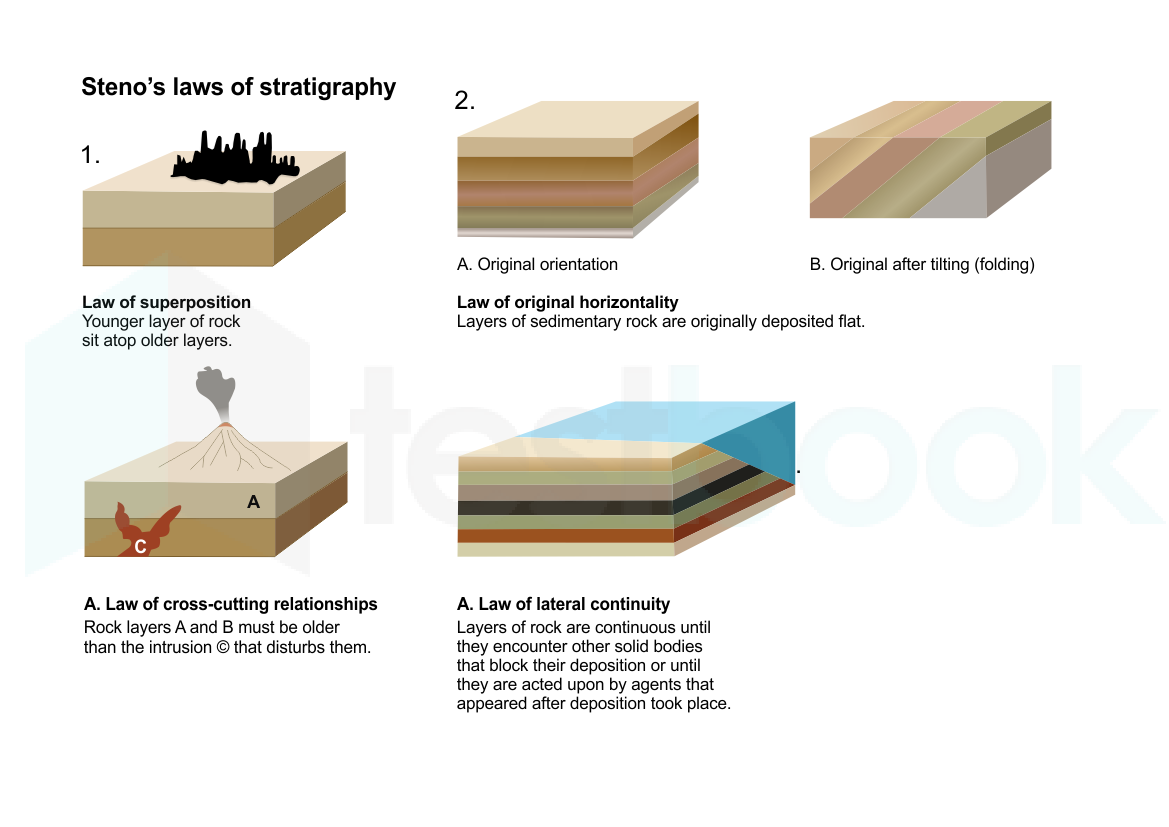
  • Stratigraphy is the study of layered materials (strata) that were deposited over time—their lateral and vertical relations, as well as their composition. The basic law of stratigraphy, the law of superposition, states that lower layers are older than upper layers unless the sequence has been disturbed.
  • Stratified deposits may include soils, sediments, and rocks, as well as man-made structures such as pits and postholes. The adoption of this principle by archeologists greatly improved excavation and archeological dating methods.
  • An important principle in the application of stratigraphy to archaeology is the law of superposition—the principle that in any undisturbed deposit the oldest layers are normally located at the lowest level. Accordingly, it is presumed that the remains of each succeeding generation are left on the debris of the last.

  • Archaeology is the study of human history using material remains. These remains can be any objects that people created, modified, or used.
  • Portable remains are usually called artifacts. Artifacts include tools, clothing, and decorations. Non-portable remains, such as pyramids or post-holes, are called features.
  • Archaeologists use artifacts and features to learn how people lived in specific times and places. They want to know what these people’s daily lives were like, how they were governed, how they interacted with each other, and what they believed and valued.
  • Coin collecting, also called numismatics, the systematic accumulation and study of coins, tokens, paper money, and objects of similar form and purpose.

2

‘Chanhudaro’ was famous for

  1. ((a))

    Ship building

  2. ((b))

    Textile

  3. ((c))

    Craft

  4. ((d))

    Iron ore

Show Answer
Answer: ((c))

Craft

The correct answer is Craft.

  • Chanhudaro is a Harappan site.
  • It is a tiny settlement (less than 7 hectares) as compared to other Harappan sites such as Mohenjodaro (125 hectares).
  • The site is almost exclusively devoted to craft production, including bead-making, shell-cutting, metal-working, seal-making and weight-making.
  • The variety of materials used to make beads is remarkable: stones like carnelian (of a beautiful red colour), jasper, crystal, quartz and steatite; metals like copper, bronze and gold; and shell, faience, and terracotta or burnt clay.
  • Some beads were made of two or more stones, cemented together, some of stone with gold caps. The shapes were numerous – disc-shaped, cylindrical, spherical, barrel-shaped, segmented. Some were decorated by incising or painting, and some had designs etched onto them.
  • Specialized drills have been found at Chanhudaro.
  • There is no evidence of Iron ore extraction from Chanhudaro
  • Thus, according to the above explanation, Craft will be the correct answer.

Additional Information

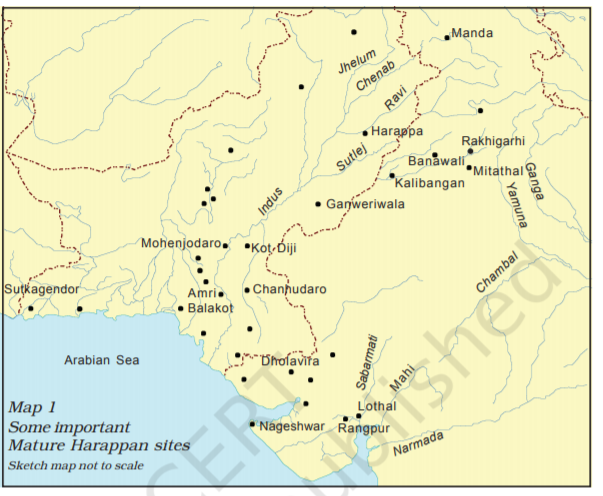
Harappan Civilization map: 

3

With reference to Indus Valley Civilization, the evidence of a ploughed field was found at which of the following sites:

  1. ((a))

    Kalibangan

  2. ((b))

    Mohenjodaro

  3. ((c))

    Harappa

  4. ((d))

    None of the above

Show Answer
Answer: ((a))

Kalibangan

The correct answer is Kalibangan.

Key Points

Indus SitesFeatures
Lothal- Evidence of double burial - Remains of Rice Husk - Evidence of terracotta figurine of a horse - Dockyard - Terracotta model of a ship
Kalibangan- Evidence of furrowed land - Evidence of wooden furrow - Evidence of seven fire altars - Ploughed field surface
Mohenjodaro- Great bath - Great granary - Assembly hall - Steatite image of a bearded man - Seal of Pashupati - Bronze Dancing Girl
Harappa- Cemeteries - Evidence Of Coffin Burial - Granary outside the fort.
4

‘Epigraphy’ is

  1. ((a))

    Study of inscriptions

  2. ((b))

    Study of legal texts

  3. ((c))

    Study of coins

  4. ((d))

    None of the above

Show Answer
Answer: ((a))

Study of inscriptions

The correct answer is Study of inscriptions.

  • Epigraphy: The study of the inscription is known as epigraphy.
  • Inscriptions are seen on rocks, pillars, stones, slabs, copper plates, walls of buildings, and body of temples.
  • The Asokan edicts, Allahabad Pillar Inscription of Samudragupta, Aihole Inscription of Pulakesin II, etc. are some major inscriptions of India.
  • Numismatics is known as the study of coins.
  • It is the study of coins as a historical object and a source for history, as coins are one of the most valuable tools for reconstructing our history.
5

‘Oligarchy’ is a form of government where power is exercised by

  1. ((a))

    A group of women

  2. ((b))

    The king

  3. ((c))

    A group of men

  4. ((d))

    The priests

Show Answer
Answer: ((c))

A group of men

The correct answer is A group of men.

  • An oligarchy is a form of government where power is held by a small group of men whose authority generally is based on wealth or power.
  • Inheritance is not a fundamental condition of oligarchy.
  • Aristocracy refers to a power structure where the power is held by the nobility.
  • The power is inherited in Aristocracy.
  • Plato believed that aristocracy was the best form of government while oligarchy was often associated with tyranny and oppression.
6

Which English man deciphered Kharosthi Script?

  1. ((a))

    Alexander Cunningham

  2. ((b))

    James Prinsep

  3. ((c))

    Arthur John

  4. ((d))

    R.E.M. Wheeler

Show Answer
Answer: ((b))

James Prinsep

The correct answer is James Prinsep.

  • James Prinsep deciphered the Brahmi and Kharosthi script.
  • James Princep had deciphered an Ashokan inscription in 1837 written in Brahmi, which referred to a King called Devanampiya Piyadassi.
  • Archaeological Survey of India was founded in 1861 by Alexander Cunningham who also became its first Director-General.
  • REM Wheeler became the Director-General of ASI.
  • Wheeler recognised that it was necessary to follow the stratigraphy of the mound rather than dig mechanically along uniform horizontal lines.
7

Megasthenes, a Greek ambassador visited the court of______.

  1. ((a))

    Ashoka

  2. ((b))

    Samudragupta

  3. ((c))

    Skandagupta

  4. ((d))

    Chandragupta Maurya

Show Answer
Answer: ((d))

Chandragupta Maurya

The correct answer is Chandragupta Maurya.

Important Points


  • Chandragupta Maurya (321 - 297 BC):
  • He was the founder of the Maurya dynasty.
  • The Greek traveller Megasthenes visited the court of Chandragupta Maurya.
  • Megasthenes is an ambassador of Seleucus I Nicator to Chandragupta Maurya in Pataliputra.
  • Indica is a book written by Megasthenes.
  • It describes the administration and society during the time of Mauryas.
  • He was migrated to Shravanabelagola along with Jain monk Bhadrabahu.

Additional Information

  • Ashoka (268 to 232 BC):
  • He was the son of Bindusara.
  • His other names were Devanampiya and Piyadasi.
  • He was coronated to the throne in 268 BC.
  • He was famous for the battle of Kalinga, fought in 261 BC.
  • Samudragupta (335-380 AD):
  • He was the son of Chandragupta –I.
  • Harisena was the court poet of Samudragupta.
  • Skandagupta (455-467 AD):
  • Skandagupta issued five types of gold coins: Archer type, King and queen type, Chhatra type, Lion-slayer type and Horseman type.
  • He issued silver coins of four types: Garuda type, Bull type, Altar type and Madhyadesha type.
  • He was the last powerful king of the Gupta Empire.
  • Kumaragupta–I was succeeded by Skandagupta.
8

The ‘Prayag Prashasti’ also known as the Allahabad Pillar Inscription was composed by whom in Sanskrit?

  1. ((a))

    Harishena

  2. ((b))

    Chanakya

  3. ((c))

    Panini

  4. ((d))

    Banabhatta

Show Answer
Answer: ((a))

Harishena

The correct answer is ​Harishena.

Key Points

  • Allahabad Prashasti:
  • It is also known as Prayag Prashasti.
  • It is a pillar inscription of Samudragupta found at Allahabad and written in Sanskrit.
  • It was composed by Harisena.
  • It is one of the important epigraphic sources to know about the political history of the Guptas.
  • There are thirty-three lines in total.
  • Line 22 of the inscription especially describes the conquests of Samudragupta over the frontier states.
  • Lines 13-15 of the inscription refer to the conquests of Samudragupta in his first Aryavarta war in which he defeated three important rulers namely, Achyuta, Nagasena, and Ganapatinaga of the Naga Dynasty.
  • Lines 19-20 described his South India Campaign.
  • Line 23 refers to Samudragupta violently exterminating a number of kings of Aryavarta.

Additional Information

  • Samudragupta (335-380 AD):
  • He was the son of Chandragupta-I.
  • Harishena was the court poet of Samudragupta
  • Allahabad Pillar Inscription (Prayag Prasasti) was issued by Samudragupta and was composed by Harishena.
  • It was composed in Sanskrit.
  • Panini was a Sanskrit grammarian who gave a comprehensive and scientific theory of phonetics, phonology, and morphology.
  • Banabhatta was the court poet of  Harshvardhana and he composed the Harshacharita which gives an account of Harsha’s life and deeds.
  • ChanakyaChandragupta Maurya became the king of Magadha with the help of Chanakya, also known as Vishnu Gupta.
  • The Arthashastra is an ancient Indian treatise on statecraft, economic policy, and military strategy, written in Sanskrit by Chanakya.
9

What does the word ‘Ashoka’ literally mean in Sanskrit?

  1. ((a))

    Beloved of Gods

  2. ((b))

    One with a pleasing appearance

  3. ((c))

    Beautiful face

  4. ((d))

    Without sorrow

Show Answer
Answer: ((d))

Without sorrow

The correct answer is Without sorrow.

  • Ashoka (268 to 232 BC):
  • He was the son of Bindusara.
  • His other names were Devanampiya and Piyadasi.
  • He was coronated to the throne in 268 BC.
  • He was famous for the battle of Kalinga, fought in 261 BC.
  • Ashoka is a Sanskrit word that literally means "without sorrow".
  • James Prinsep was the first person to decipher Ashoka’s edicts.
10

Name the Chinese pilgrim who came to India in 5th century.

  1. ((a))

    I-Tsing

  2. ((b))

    Hieun Tsang

  3. ((c))

    Fa Hien

  4. ((d))

    None of the above

Show Answer
Answer: ((c))

Fa Hien

The correct answer is Fa Hien.

Key Points

  • Fa Hien (399-411 A.D.): He was a Chinese Buddhist monk who came to India in the reign of Chandragupta II also known.
  • I-Tsing (671–695 AD): A Chinese traveler, he visited India in connection with Buddhism and he gave us some information about the first Gupta ruler.
  • Harshavardhana (606 AD to 647 AD):
  • He was the most prominent ruler of the Pushyabhuti dynasty.
  • He ruled from his capital Kannauj.
  • Under Harsha, the Pushyabhuti empire covered much of North and Northwestern India.
  • Empire extended to the East till Kamarupa, and south until the Narmada river.
  • His reign is well documented by Banabhatta in Harshacharita.
  • Chinese traveler Hieun Tsang visited India during his period.
11

Who is a literary figure of Gupta Age?

  1. ((a))

    Bhairavi

  2. ((b))

    Kalidasa

  3. ((c))

    Harisena

  4. ((d))

    All of the above

Show Answer
Answer: ((d))

All of the above

The correct answer is Option 4.

Key Points

  • Gupta Empire:
  • The Gupta dynasty was founded by Srigupta in 240 AD.
  • The period of the Gupta Empire is known as the ‘Classical Age’ or the ‘Golden Age’ of Indian history.
  • Fa-Hien was a Chinese pilgrim who visited India during the reign of Chandragupta II on a religious mission.
  • Many literary works were composed during this period. They were:
  • Kalidasa wrote plays such as Abhijnan Shakuntalam and Meghdootam.
  • Bhasa wrote 13 plays with themes drawn from Ramayana and Mahabharat.
  • Dandin wrote Kavyadarsha and Dasakumaracharita.
  • Bhairavi composed Kiratarjuniya which describes the battle between Kirat and Arjuna.
  • Vishnu Sharma wrote Panchtantra. It is a compilation of various stories with themes or messages.

Additional Information

  • Chandragupta-II was known for his deep interest in art and culture and nine gems or Navratna adorned his court. The various fields of these 9 gems prove that Chandragupta gave patronage to arts and literature. A brief description of the nine Ratnas is as follows:
9 GemsWork
AmarsimhaAmarkosha
DhanvantriPhysician
Harisenacomposed the Prayag Prasasti
KalidasaAbhijnana Shakuntalam and Meghdootam.
KahapanakaAstrologer
SankuArchitecture.
VarahamihiraBooks: Panchasiddhantika, Brihat Samhita, and Brihat Jataka
VararuchiBook: Prakrit Prakasha
VetalbhattaMagician
12

These rulers considered themselves godlike & adopted the title ‘devaputra’ or ‘son of god’

  1. ((a))

    Mauryas

  2. ((b))

    Guptas

  3. ((c))

    Kushana

  4. ((d))

    Shakas

Show Answer
Answer: ((c))

Kushana

The correct answer is Kushana.

Key Points

  • Kushan dynasty (1st Century AD-3RD Century AD):
  • Kujula Kadphises was the first Yuezhi chief to lay the foundation of the Kushana dynasty in India.
  • The second king was Vema Kadphises who issued gold coins.
  • The most famous Kushan ruler was Kanishka (78 AD-101AD)
  • Kanishka was also known as ‘Second Ashoka’.
  • He started the Saka era in 78 AD.
  • The Kushans controlled the famous silk route.
  • The 4th Buddhist council was held in Kundalvana, Kashmir during his reign.
  • His descendants called him as Devaputra which means son of gods.
  • Gupta dynasty was founded by Sri Gupta and held the titles of Maharaja, Maharajadhiraja, Kaviraja, Vikramaditya etc.
  • Chandragupta Maurya (321 - 297 BC): 
  • He was the founder of the Maurya dynasty.
  • The Greek traveller Megasthenes visited the court of Chandragupta Maurya.
  • Megasthenes was the Greek ambassador.
  • He was migrated to Shravanabelagola along with Jain monk Bhadrabahu.
  • Rudradaman I (Reign 130 AD – 150 AD) is considered the greatest of the Saka rulers.
  • He took up the title of "Mahakshatrapa" ("Great Satrap").
13

Endogamy refers to marriage

  1. ((a))

    Within a unit (like kin, group, caste)

  2. ((b))

    Outside the unit

  3. ((c))

    Where the man has several wives

  4. ((d))

    Where the woman has several husbands

Show Answer
Answer: ((a))

Within a unit (like kin, group, caste)

The correct answer is Within a unit (like kin, group, caste).

  • Endogamy refers to marriage within a unit (like kin, group, caste).
  • It is also called in-marriage.
  • These type of marriages takes place within a particular social group such as caste, clan, tribe, gotra, etc.
  • Exogamy is referred as marriage to an outside group.
  • Polygyny means where a man has multiple simultaneous wives.
  • Polyandry means a woman has multiple simultaneous husbands.
14

V. S. Sukthankar was a great scholar of

  1. ((a))

    English

  2. ((b))

    French

  3. ((c))

    Tamil

  4. ((d))

    Sanskrit

Show Answer
Answer: ((d))

Sanskrit

The correct answer is Sanskrit.

  • V. S. Sukthankar was a great scholar of Sanskrit.
  • Under the Sukthankar a team prepared a critical edition of the Mahabharata.
  • He is principally known as the general editor of the critical edition of the Mahabharat published by the Bhandarkar oriental research institute in Pune, India.
15

Buddha’s teachings were compiled by his disciples and are known as

  1. ((a))

    Dipavamsa

  2. ((b))

    Tripitaka

  3. ((c))

    Mahavamsa

  4. ((d))

    All of the above

Show Answer
Answer: ((b))

Tripitaka

The correct answer is Tripitaka.

  • Buddha’s teachings were compiled by his disciples and are known as Tripitikas called the Sutta Pitaka, the Abhidhamma Pitaka and Vinaya Pitaka.
  • The Tripitaka has written in the Pali language.
  • The Sutta Pitaka deals with the teachings of the Dhamma of Buddha.
  • The Vinaya Pitaka deals with rules of conduct and discipline applicable to the monastic life of the monks and nuns
  • Abhidhammapitaka deals with the philosophy and doctrine of Buddhism.

Additional Information

  • Mahavamsa contains the accounts of the history of Buddha’s visit to Sri Lanka, Buddhist sangha, and kings of Sri Lanka.
  • Dipavamsa is an important early work in Buddhist and Pali literature.
16

In the social structure of ancient India who were called ‘Anirvasit’?

  1. ((a))

    Brahmin and Kshatriya

  2. ((b))

    Vaishyas and Shudras

  3. ((c))

    Only Shudras

  4. ((d))

    People outside Varna

Show Answer
Answer: ((c))

Only Shudras

The correct answer is Only Shudras.

  • Shudras were called as ‘Anirvasit’.

In ancient India, society was divided into four parts (varnas):

  1. Brahmins
  2. Kshatriyas
  3. Vaisyas
  4. Shudras.
  • The first social class was the Brahmins (Priests, Teachers, and Intellectuals).
  • The second social class was the Kshatriyas (Warriors, Police, and Administrators).
  • The third social class was the vaishyas are the productive class i.e (Farmers, Merchants, and Business People).
  • The last social class was the Shudras (Artisans and Workers).
  • Nirvasita shudra means a Shudra living in the village community.
  • Anirvasit Shudra means Shudra living in outside the village community.
17

Who is the first Tirthankar?

  1. ((a))

    Rishabhdev

  2. ((b))

    Neminath

  3. ((c))

    Parsvanath

  4. ((d))

    Vardhaman

Show Answer
Answer: ((a))

Rishabhdev

The correct answer is Rishabhdev.

Key Points

  • The first Tirthankara was Rishabnatha or Rishabhadev.
  • ​He was considered the founder of Jainism.
  • Vardhamana Mahavira, the 24th Tirthankara, was born in 540 B.C. in Kundagrama village near Vaishali.
  • He belonged to the Jnatrika clan.
  • He was considered the last Tirthankara.
  • The 23rd Tirthankara was Parshvanatha who was born in Varanasi.

Important Points 

  • Difference between Jainism and Buddhism:
  • Jainism recognized the existence of god while Buddhism did not.
  • Jainism does not condemn the varna system while Buddhism does.
  • Jainism advocates living a life of complete austerity.
18

Which statement is not correct?

  1. ((a))

    Buddhism and Jainism grew in sixth century B. C.

  2. ((b))

    Buddhism and Jainism were against Brahmanism

  3. ((c))

    Buddhism and Jainism followed the same concept of Ahimsa

  4. ((d))

    Buddha and Mahavira both were Kshatriyas by birth

Show Answer
Answer: ((c))

Buddhism and Jainism followed the same concept of Ahimsa

The correct answer is Buddhism and Jainism followed the same concept of Ahimsa(which is not correct). While both religions emphasize non-violence, Jainism practices a much stricter, absolute form of non-violence compared to the Buddhist middle path.

  • Both Jainism and Buddhism was founded in the 6th century BC.
  • Jainism recognized the existence of god while Buddhism did not.
  • Jainism does not condemn the varna system while Buddhism does.
  • Jainism believed in the reincarnation while Buddhism does not.
  • Buddhism prescribes a middle path while Jainism advocates the life of complete austerity.
  • Ahimsa was followed by Buddhism, Jainism and Hinduism.
  • Gautama Buddha was born into a Kshatriya family.
  • He was born to Mahamaya and raised by his stepmother Gautami.
  • He was born as Siddhartha in 563 BCE at Lumbini near Kapilavastu, Nepal to Suddhodana (chief of republican Sakya clan) who ruled from Kapilavastu in the Kosala Kingdom).
  • Like the Buddha, Mahavira was born in a Kshatriya clan.
  • Mahavira was the son of Siddhartha, the chief of the Jnatjriya clan and his mother Trishala was Lichchavi’s King Chetaka’s sister.
19

‘Mrichchhakatika’ a famous play was written in Sanskrit by

  1. ((a))

    B.B. Lal

  2. ((b))

    Shudraka

  3. ((c))

    Prabhavati Gupta

  4. ((d))

    None of the above

Show Answer
Answer: ((b))

Shudraka

The correct answer is Shudraka.

  • Mrichchhakatika' or 'The little clay art' is an ancient Sanskrit play written by king Shudraka in 3rd century A.D.
  • It is one of the most famous prakaranas i.e. a play whose plot is partly derived from history and partly derived from the author's fancy of ancient India.
  • B.B. Lal:
  • He was the former Director-General of the Archaeological Survey of India (ASI).
  • He received the Padma Bhushan in 2000.
  • He was known for his work on Indus Valley Civilization sites, Mahabharat sites, Kalibangan sites.
  • Prabhavati Gupta was the daughter of Chandragupta II.
  • Prabhavatigupta issued the Poona copper plate inscription in Sanskrit.
20

Ibn- Battuta came to India from

  1. ((a))

    Morocco

  2. ((b))

    Italy

  3. ((c))

    Samarkand

  4. ((d))

    Turkey

Show Answer
Answer: ((a))

Morocco

The correct answer is Morocco.

  • Ibn Battuta arrived in India during the rule of Muhammad Bin Tughluq.
  • He was a Muslim traveller who came to India from Morocco.
  • Riḥlah is the most famous work of Ibn Battuta.
  • Ibn Batutta wrote about the history of the famous Qutb complex, and also about Quwat al-Islam Mosque.

Additional Information

  • Hieun Tsang
  • Hieun Tsang, the Chinese pilgrim, visited India during the reign of Harshavardhana with an aim of securing authentic Buddhist scripts.
  • The Kanauj assembly (643 AD) was held in the honour of Hieun Tsang and to popularise Mahayana sect of Buddhism.
  • He stayed in India for about fifteen years and recorded his experience in his book, 'Si-Yu-Ki’.
  • The book throws lights on the religion, customs, traditions, etc.
  • Al Beruni
  • Al-Biruni came from Uzbekistan.
  • Al Biruni was the First Muslim Scholar to study India and its Brahmanical tradition.
  • He is called the father of Indology and the first anthropologist.
  • He is called one of the earliest and greatest polymaths of the Islamic World.
  • He was a Persian Scholar and polymath of the 11th century. He accompanied Mahmud in his conquests to South Asia.
21

In Sufism, the term ‘wali’ signifies

  1. ((a))

    Friend of God

  2. ((b))

    Successor

  3. ((c))

    A chain

  4. ((d))

    Pilgrimage

Show Answer
Answer: ((a))

Friend of God

The correct answer is Friend of God.

Key Points

  • In Sufism, the term wali signifies "friend of God".
  • Sufism or tasawuf is the name for various mystical and movements in Islam.
  • Sufism aims at establishing direct communion between God and man through the personal experience of mystery which lies within Islam.
  • Khalifa ​signifies successor.
  • Silsila signifies A chain.
  • ziyarat signifies Pilgrimage.
22

Who among the following Sikh Guru laid the foundation of the ‘Khalsa Panth’?

  1. ((a))

    Guru Tegh Bahadur

  2. ((b))

    Guru Gobind Singh

  3. ((c))

    Guru Nanak

  4. ((d))

    Guru Arjan Dev

Show Answer
Answer: ((b))

Guru Gobind Singh

The correct answer is Guru Gobind Singh.


  • Guru Tegh Bahadur:
  • He was the ninth of ten Gurus of the Sikh religion.
  • Aurangzeb beheaded Guru Tegh Bahadur in 1675.
  • He founded the city of Anandpur Sahib in Punjab in 1665.
  • Guru Gobind Singh:
  • He was the tenth and last Sikh Guru.
  • He established the Khalsa Panth.
  • He introduced the five articles of faith that Khalsa Sikhs wear at all times.
  • The five Ks were Kesh - uncut hair, Kangha - a wooden comb, Kara - an iron or steel bracelet worn on the wrist, Kirpan - a sword or dagger, Kacchera - short breeches.
  • Guru Nanak:
  • He was the founder of the Sikh religion.
  • His teachings are found in the Guru Granth Sahib.
  • Guru Nanak emphasized the worship of one God.
  • Guru Arjan Dev:
  • He was the fifth Sikh guru.
  • He was credited with compiling the first official edition of the Sikh scripture called the Adi Granth,
  • He built the famous Harmandar Sahib, popularly known as the Golden Temple in Amritsar.
  • He was killed by the Mughal Emperor Jahangir.
23

The Vaishnav Bhakti saints in South India were called

  1. ((a))

    Alvars

  2. ((b))

    Nayanars

  3. ((c))

    Saguna

  4. ((d))

    Nirguna

Show Answer
Answer: ((a))

Alvars

The correct answer is Alvars.

  • Sagun Bhakti refers to devotion and prayer to god having some form and with attributes whereas Nirguna Bhakti refers to devotion and prayer to formlessness god without any attributes.
  • The Nayanars and Alvars were the Tamil poet-saints who played a key role in propagating the Bhakti Movement in Southern India.
  • Nayanars were the group of saints devoted to Lord Shiva while Alvars were the group of saints who devoted to Lord Vishnu, Vaishnav Bhakti.

Additional Information

  • The Nayanars and Alvars went from place to place composing exquisite poems in praise of the deities enshrined in the villages they visited and set them to music.
  • There were 63 Nayanars, who belonged to different caste backgrounds such as potters, “untouchable” workers, peasants, hunters, soldiers, Brahmanas, and chiefs.
  • The best known among them were Appar, Sambandar, Sundarar and Manikkavasagar. There are two sets of compilations of their songs – Tevaram and Tiruvacakam.
  • There were 12 Alvars, who came from equally divergent backgrounds, the best known being Periyalvar, his daughter Andal, Tondaradippodi Alvar and Nammalvar. Their songs were compiled in the Divya Prabandham.
24

The followers of Basavanna who led a movement in Karnataka were called

  1. ((a))

    Lingayats

  2. ((b))

    Naths

  3. ((c))

    Brahmins

  4. ((d))

    Jogis

Show Answer
Answer: ((a))

Lingayats

The correct answer is Lingayats.

  • The followers of Basavanna who led a movement in Karnataka were called Lingayats.

Key Points

  • Basavanna is the founder of Lingayatism and is strongly against the rigid practices of the caste system.
  • Lingayats believed that there is no rebirth and on death, the devotee reunites with Shiva never coming back to the World.
  • Hence Lingayats of the Kannada region questioned the theory of rebirth and rejected the caste hierarchy.
  • The person who led a new religious movement in Karnataka was Basavanna.
  • His followers were known as Virashaivas (heroes of Shiva) or Lingayats (wearers of the linga).
25

Military commanders who were given territories to govern in Vijayanagara were called

  1. ((a))

    Rayas

  2. ((b))

    Amirs

  3. ((c))

    Amara- Nayakas

  4. ((d))

    None of the above

Show Answer
Answer: ((c))

Amara- Nayakas

The correct answer is Amara- Nayakas.

Key Points

  • The kingdom of Vijayanagar was founded by Harihara and Bukka of the Sangam dynasty in 1336 AD.
  • The Amara-Nayakas were military commanders who were given territories to be governed by the Rayas or the rulers of Vijayanagara.
  • Many features of this system were derived from the Iqta system of the Delhi sultanate.
  • Amara-Nayakas collected taxes and other dues from peasants, craftsmen, and traders in the area.

Additional Information

  • Anegundi was the first capital of the Vijayanagara empire.
  • The other capitals of Vijayanagara were Hampi, Penukonda & Chandragiri.
  • Present-day Hampi in Karnataka State is a world heritage site.
26

The very huge main entrance gate of the temples in South India is known as

  1. ((a))

    Shikhar

  2. ((b))

    Garbhagrah

  3. ((c))

    Gopuram

  4. ((d))

    Mandapas

Show Answer
Answer: ((c))

Gopuram

The correct answer is Gopuram.

Important Points

  • In South India, the most famous temples are built in the Dravidian style.
  • Features of south Indian temple architecture:
  • The temples are enclosed within a compound wall.
  • Gopuram: The entrance gateway of the temples.
  • Shikhara is a crowning element at the top of the temple that is shaped like a stupika or octagonal cupola.
  • Mandapas very often lie between the sanctuary and the temple entrance.
  • Garbhagriha (Sanctum Sanctorum) where the main deity is located.
  • Kanchipuram, Thanjavur (Tanjore), Madurai temples are famous examples of the Dravidian style of temple architecture.
27

Non- resident cultivators who belong to some other village but cultivated land elsewhere on contractual basis, during Mughal period were known as

  1. ((a))

    Khud- Kashta

  2. ((b))

    Pahi- kashta

  3. ((c))

    Majur

  4. ((d))

    Ryots

Show Answer
Answer: ((b))

Pahi- kashta

The correct answer is Pahi- Kashta.

  • Non-resident cultivators who belong to some other village but cultivated land elsewhere on a contractual basis, during the Mughal period were known as Pahi- Kashta.
  • People became pahi-kashta either out of choice or out of compulsion.
  • Khud- Kashta were residents of the village in which they held their lands.
  • Majur were the agricultural labourers during mughal period.
  • Ryots a peasant or tenant farmer.
28

The last Mughal ruler was

  1. ((a))

    Bahadur Shah I

  2. ((b))

    Bahadur Shah II

  3. ((c))

    Jahandar Shah

  4. ((d))

    Muhammad Shah

Show Answer
Answer: ((b))

Bahadur Shah II

The correct answer is Bahadur Shah II.

  • Bahadur Shah II was the last Mughal ruler.

Key Points

  • He was the second son of and became the successor to his father, Akbar II, upon his death on 28 September 1837.
  • He used to write Shairis under the pet-name of Zafar.
  • During the 1857 sepoy revolt, he has proclaimed the emperor of India by the rebellions.
  • He was deported to Rangoon and died there.

Additional Information

  • Babur was the first Mughal emperor invaded the kingdom of the Lodi Afghans in northern India in 1526.
  • First Battle of Panipat happened between Ibrahim Lodi and Babur in 1526 AD.
  • Second Battle of Panipat was fought between Hemu and Bairam Khan (the regent of Akbar). in 1556.

Mughals:

  • The Mughals were descendants of two great lineages of rulers.
  • From their mother’s side, they were descendants of Genghis Khan (died 1227), the Mongol ruler who ruled over parts of China and Central Asia.
  • From their father’s side, they were the successors of Timur (died 1404), the ruler of Iran, Iraq and modern-day Turkey.
  • However, the Mughals did not like to be called Mughal or Mongol. This was because Genghis Khan’s memory was associated with the massacre of innumerable people.
  • It was also linked with the Uzbeks, their Mongol competitors.
  • On the other hand, the Mughals were proud of their Timurid ancestry, not least of all because their great ancestor had captured Delhi in 1398.
29

Land which was never allowed to lie fallow was called

  1. ((a))

    Chachar

  2. ((b))

    Banjar

  3. ((c))

    Parauti

  4. ((d))

    Polaj

Show Answer
Answer: ((d))

Polaj

The correct answer is Polaj.

  • For the purpose of making a comparative estimate of the produce of lands, Akbar divided them into four kinds and fixed different revenue to be paid by each.
  • Polaj was the type of land that was cultivated always and was never allowed to lie fallow.
  • Chachar was a kind of land allowed to lie fallow for three or four years and then resumed under cultivation.
  • Banjar was the type of land that was left out of cultivation for more than five years.
  • Paraity is the land that was kept out of cultivation for a short period in order to regain its lost fertility.
30

What was ‘Zawabit’?

  1. ((a))

    Secular Law

  2. ((b))

    Islamic Law

  3. ((c))

    Persian Law

  4. ((d))

    All of the above

Show Answer
Answer: ((a))

Secular Law

The correct answer is Secular Law.

  • Aurangzeb issued secular decrees, called 'zawabit'.
  • A collection of his decrees had been collected in a work known as Zawabit-i-Alamgiri.
  • Aurangzeb (1658-1707):
  • He was the sixth Mughal Emperor.
  • He executed the ninth Sikh guru Guru Tegh Bahadur in 1675 AD.
  • He was a puritan, and he abolished all practices in the court which were not in conformity with the injunctions of Islam.
  • He reimposed Jizya in 1679 AD.
  • Aurangzeb was the son of Shah Jahan.
  • The 'Bibi Ka Maqbara', a tomb of Aurangzeb's wife is situated in Aurangabad, Maharashtra.
  • He abolished inland transit duties which were called pandhari.
  • He forbade the cultivation of Bhang.
  • He abolished NUROZ (Persian festival).
  • Mughal Emperor Akbar abolished the pilgrimage tax on Hindus and again reimposed during the reign of Aurangzeb.
31

Relation between Gulbadan Begum (author of a famous book) and Babur was of

  1. ((a))

    Daughter and father

  2. ((b))

    Sister and brother

  3. ((c))

    Mother and son

  4. ((d))

    None of them

Show Answer
Answer: ((a))

Daughter and father

The correct answer is Daughter and father.

  • Gulbadan Begum: 
  • She was the daughter of Emperor Babur, the founder of the Mughal Empire.
  • She is best known as the author of Humayun-Nama.
  • Humayun (1530-40 and 1555-56):
  • He was the son of Babur.
  • The city of Din Panah was founded by Humayun in 1533.
  • He fought two battles against Sher Shah Suri at Chausa (1539) and at Kannauj (1540) and was completely defeated by him.
32

‘Akbar Nama’ of Abul Fazal is divided into three books, of which, first two are chronicles. The third book is the

  1. ((a))

    Badshah Nama

  2. ((b))

    Ain-i-Akbari

  3. ((c))

    Char Chaman

  4. ((d))

    Alamgir Nama

Show Answer
Answer: ((b))

Ain-i-Akbari

The correct answer is Ain-i-Akbari.

  • Akbar Nama of Abul Fazal is divided into three books, of which, first two are chronicles and the third book is Ain-i-Akbari.
  • Akbar Nama is written in the Persian language.
  • Ain-i-Akbari is a detailed document recording the administration of emperor Akbar's empire written by Abul Fazl.
  • Abdul Hamid Lahori is known as the author of the Badshah Nama.
  • The Badshah Nama is this official history in three volumes (Daftar) of ten lunar years each.
  • Alamgir Nama is a history of the first ten years of Aurangzeb’s reign compiled by Muhammad Kazim
  • Chandrabhan Barahman described the Mughal nobility in his book Char Chaman (Four Gardens) which was written during the reign of Shah Jahan.

Akbar (1556-1605):

  • Emperor Akbar founded the city in by the name of “ILLAHABAS” which later became ALLAHABAD.
  • He introduced the new religion as Din Ilahi.
  • He introduced the Mansabdari system.
  • Akbar defeated Hemu in the second battle of Panipat.
  • He built Ibadat Khana in Fatehpur Sikri.
  • He followed the policy of Sulh-i-kul.
33

‘Chahar Taslim’ is a mode of salutation which meant

  1. ((a))

    Complete prostration

  2. ((b))

    Kissing the ground

  3. ((c))

    Salutation done four times

  4. ((d))

    All of above

Show Answer
Answer: ((c))

Salutation done four times

The correct answer is Salutation done four times.

  • Chahar taslim (literally means submission) is a mode of salutation which begins with placing the back of the right hand on the ground, and raising it gently till the person stands erect, when he puts the palm of his hand upon the crown of his head. 
  • It is done four (chahar) times.
  • The highest form of submission was sijda i.e complete prostration.
  • Zaminbos means kissing the ground.
34

In Bengal, during British Rule, Jotedars was a class of rich

  1. ((a))

    Peasants

  2. ((b))

    Big Zamindars

  3. ((c))

    Big and powerful labourers

  4. ((d))

    Company’s big officials

Show Answer
Answer: ((a))

Peasants

The correct answer is Peasants.

  • The prolonged operation of the Permanent Settlement brought about a three-tier classification of Bengal rural society.
  • While the sharecroppers and agricultural laborers were at the base of the class hierarchy, the zamindars and the jotedars were at the top, and in between these two were the self-sufficient peasants with tenancy rights in land.
  • Zamindars and Jotedars constitute the top layer of the rural class structure.
  • Jotedars was a class of rich peasants.
  • They were known in different areas as haoladars, gantidars, bargadars and mandals.
35

Francis Buchanan who came to India between 1794-1815 was a

  1. ((a))

    Philosopher

  2. ((b))

    Viceroy

  3. ((c))

    Physician

  4. ((d))

    Queen Victoria’s relative

Show Answer
Answer: ((c))

Physician

The correct answer is Physician.

Francis Buchanan:

  • He was often referred to as Francis Buchanan-Hamilton.
  • He was a Scottish physician.
  • He came to India between 1794-1815.
  • He was appointed surgeon to the Governor-General of India, Lord Wellesley.
  • In 1814, Buchanan was appointed Superintendent of the Botanical Gardens in Calcutta.
36

The ruler who made Persian language as the leading language of the Mughal court was

  1. ((a))

    Babur

  2. ((b))

    Akbar

  3. ((c))

    Shah Alam II

  4. ((d))

    Humayun

Show Answer
Answer: ((b))

Akbar

The correct answer is Akbar.

  • Babur(1526-1530):
  • He declared himself as Badshah.
  • He was the founder of the Mughal Empire in India.
  • Baburnama, also known as Tuzk-e Babri is the biography of Babur written by him.
  • Shah Alam II (1759-1806):
  • Third Battle of Panipat (1761) took place during his time.
  • He was defeated in Battle of Buxar 1764, after that he lives in Allahabad as British Pensioner.
  • He was a poet and Aftab is his pen name.
  • Humayun (1530-40 and 1555-56):
  • He was the son of Babur.
  • The city of Din Panah was founded by Humayun in 1533.
  • He fought two battles against Sher Shah Suri at Chausa (1539) and at Kannauj (1540) and was completely defeated by him.
  • Akbar (1556-1605):
  • Emperor Akbar founded the city in by the name of “ILLAHABAS” which later became ALLAHABAD.
  • He introduced the new religion as Din Ilahi.
  • He introduced the Mansabdari system.
  • Akbar defeated Hemu in the second battle of Panipat.
  • He built Ibadat Khana in Fatehpur Sikri.
  • He followed the policy of Sulh-i-kul.
  • It was during his period, the Persia became the leading language of the Mughal court.
  • Later it became the language of administration at all levels of administration.
37

Sidhu Manjhi was the leader of the

  1. ((a))

    Bhil Rebellion

  2. ((b))

    Santhal Rebellion

  3. ((c))

    Kol Rebellion

  4. ((d))

    The Paharias Rebellion

Show Answer
Answer: ((b))

Santhal Rebellion

The correct answer is Santhal Rebellion.

Tribe NameYearLeadersCause of the revolt
Kol1824Buddhu BhagatLand transfer to outsiders
Bhills1913Govind GuruTemperance and purification movement
Rampas1922-24Alluri Sitaram RajuBritish rule
Santhal1855-56Sidhu Manjhi and KanhuBritish rule
Paharias1772Tilka ManjhiBritish rule
38

The revenue system introduced in the Bombay Deccan came to be known as

  1. ((a))

    Mahalwari Settlement

  2. ((b))

    Permanent Settlement

  3. ((c))

    Ryotwari Settlement

  4. ((d))

    None of the above

Show Answer
Answer: ((c))

Ryotwari Settlement

The correct answer is the Ryotwari Settlement.


Important Points

  • It is Introduced in Bombay and Madras**. Munro(viceroy)** and Charles Reed recommended it.
  • In this system, a direct settlement was made between the government and the ryot(cultivator).
  • The revenue was fixed for a period not exceeding more than 30 years, on the basis of the quality of the soil and the nature of the crop.
  • The position of the cultivator became more secure but the rigid system of revenue collection often forced him into the clutches of the moneylender.


Additional Information

Permanent Settlement- It is introduced in Bengal, Bihar, Orissa, and districts of Benaras and Northern districts of Madras by Lord Cornwallis in 1793. - John shore planned the Permanent Settlement. - It declared Zamindars as the owners of the land. Hence, they could keep 1/11th of the revenue collected to themselves. - While the British got a fixed share of 10/11th of the revenue collected. - The zamindars are free to fix the rents.
Mahalwari Settlement- A modified version of the zamindari settlement introduced in the Ganges valley, NWFP, parts of Central India, and Punjab. - Revenues settlement was made by villages or estates with landlords. - In western Uttar Pradesh, a settlement was made with the village communities, which maintained a form of common ownership known as Bhaichare, or with Mahals, which were groups of villages. - Revenue was periodically revised.
39

What is Bell of Arms?

  1. ((a))

    It is a storeroom in which weapons are kept

  2. ((b))

    It is a darkroom where government secret reports are kept

  3. ((c))

    It is a big hall where special prayers are held with drums and bells

  4. ((d))

    None of the above

Show Answer
Answer: ((a))

It is a storeroom in which weapons are kept

The correct answer is It is a storeroom in which weapons are kept.


Hint

Bell of Arms are the tents, used in the English service mostly of a Conical shape, for containing the Small arms for each company in  a regiment of Infantry. The tent is frequently painted with the color of the facings of the regimental uniforms.

40

Which town was not related with Revolt of 1857?

  1. ((a))

    Meerut

  2. ((b))

    Delhi

  3. ((c))

    Amritsar

  4. ((d))

    Lucknow

Show Answer
Answer: ((c))

Amritsar

The correct answer is Amritsar.


Important Points

  • Indian Mutiny, also called Sepoy Mutiny or First War of Independence, widespread but unsuccessful rebellion against British rule in India in 1857-59.
  • Begun in Meerut by Indian troops in the service of the British East India Company, it spread to Delhi, Agra, Kanpur, and Lucknow. In India, it is often called the First War of Independence.
  • Persons involved in event 1.Charles John Canning, 2. Earl Canning 3. Colin Campbell, 4.Boron Clyde  5. Sir Henry Havelock  6. Lakshmi Bai  7. Nana Sahib 8. Robert Napier 9. 1st Baron Napier 10. Sir Hugh Rose 11. Tantia Tope 12. William Stephen Raikes Hudson 13. Mangal Pandey 14. Baron Strathnairn of Strathnairn and of Jhansi.
  • The result - Seize of Delhi and Lucknow.
  • The Main Reasons for the Revolt are - 1. Westernization 2. The doctrine of Lapse by Lord Dalhousie 3. Enfield Rifles.


Additional Information 

Westernization- Missionaries challenging the religious beliefs of the Hindus. - Convert to Christianity were to share with their Hindu relatives in the property of the family estate. - They aimed at breaking down the caste system. It was a direct challenge to Orthodoxy Hindu and Muslim.
Doctrine of Lapse- Any kingdom without a Natural heir came under the governance of British rule. States are Jhansi, Nagpur, and Satara.
Enfield Rifles- A mutiny broke in Bengal Army because of the Introduction of Enfield rifles. - To load it, the sepoys had to bite off the ends of Lubricated cartridges. - Which is greased by lubricating the Mixture of Pigs' and Cows' lard to have oral contact insult of both Hindu and Muslim.
41

Who was Kunwar Singh?

  1. ((a))

    He was a local zamindar in Arrah in Bihar

  2. ((b))

    He was a rich zamindar in Aligarh in Uttar Pradesh

  3. ((c))

    He was a Talukdar in Awadh

  4. ((d))

    None of the above

Show Answer
Answer: ((a))

He was a local zamindar in Arrah in Bihar

The correct answer is He was a local zamindar in Arrah in Bihar.


Additional Information

  • Kunwar Singh (1777-1858) was a notable leader during the Indian Rebellion of 1857. He belonged to the Royal zamindar family of Ujjainiya (Panwar) Rajput house of Jagdishpur, currently a part of Bhojpur district, Bihar, India.
  • At the age of 80, he led a select band of Armed soldiers against the troops under the command of the British East India Company. He was the chief organizer of the fight against the British in Bihar. He is popularly known as Veer Kunwar Singh. He used the Gorilla warfare technique.
  • In his last battle, fought on 23 April 1858 near Jagdishpur the troops under the control of the East India Company were completely routed.
  • On 22 and 23 April, being injured he fought Bravely against the British Army, and with the help of his army drove away from the British Army.
  • Brought down the union jack from Jagdishpur fort and hoisted his Flag. He returned to his palace on 23 April 1858 and soon died on 26 April 1858.
42

With reference to Awadh, who uttered the statement, ‘A cherry that will drop into our mouth one day’?

  1. ((a))

    Lord Dalhousie

  2. ((b))

    Lord William Bentinck

  3. ((c))

    Lord Hardinge

  4. ((d))

    Lord Wellesley

Show Answer
Answer: ((a))

Lord Dalhousie

The correct answer is Lord Dalhousie.

Key Points

  • Lord Dalhousie, Governor-General of India, in 1851 describes the kingdom of Awadh as "A cherry that will drop into our mouth one day" said during the Annexation of Awadh.
  • The Subsidiary Alliance had been imposed on Awadh in 1801, by the terms of this alliance Nawab had to disband his Military force, allowed the British troops to position their troops within Kingdom.
  • Nawab became increasingly dependent on the British to maintain law and order within the Kingdom.
  • In fact, the British acquired Awadh for producing Indigo and Cotton.
  • The region was ideally located to be developed into the principal market of upper India and was expected to complete a process of territorial annexation.
  • Dethroning of Wajid Ali shah - Annexation of Awadh.


Additional Information

Lord Dalhousie (1848-56)- Original Name - James Andrew Broun Ramsay. - Abolished titles and pensions, Introduction of Widow Remarriage Bill. - Introduced Doctrine of Lapse, Fought Anglo- Sikh War (1848-49), annexed the whole of Punjab, Anglo- Burmese War (1852), Annexation of Berar in 1853, Annexation of Awadh in 1856 on charges of maladministration.
Lord William Bentinck (1828-33)- Most liberal and enlightened Governor-General of India. - Regarded as 'Father of Modern Western Education in India', Abolished Sati and other cruel rites (1829). - The annexation of Mysore (1831), Concluded a treaty of perpetual friendship with Ranjit Singh (1831), passed the Charter Act of 1833.
Lord Wellesley (1798-1805)- Started the Subsidiary Alliance system to achieve British paramountcy in India. - Nizam Ali (Nizam of Hyderabad) was the first Indian native ruler to accept the system of a subsidiary alliance in 1798. - Madras presidency formed during his tenure.
Lord Hardinge (1910-16)- Annulment of Partition of Bengal in 1911, Transfer of capital ​from Calcutta to Delhi. - Delhi Darbar and Coronation of King George V and Queen Mary in 1911. - Establishment of Hindu Mahasabha by Madan Mohan Malviya in 1915.
43

Who had written the popular lines "khoob lari mardani who toh Jhansi wali rani thi"? 

  1. ((a))

    Prithvi Raj Chauhan

  2. ((b))

    Mahadevi Verma

  3. ((c))

    Subhadra Kumari Chauhan

  4. ((d))

    Maithali Saran Gupta

Show Answer
Answer: ((c))

Subhadra Kumari Chauhan

The correct answer is Subhadra Kumari Chauhan.


Important Points

Prithvi Raj Chauhan- Prithviraj III popularly called Prithviraj Chauhan or Rai Pithora was a king from the Chahmanas dynasty. - He ruled Sapadalaksha, the traditional Chahmana territory. In present Day, North-western India. - Prithviraj defeat in 1192 in the Second Battle of Tarain at the hands of the Mohammed Gauri.
Mahadevi Verma- Mahadevi Verma was a Hindi poet, Freedom fighter, and Educationist from India. - She was a major poet of the 'Chhayavaad', a literary movement of romanticism in modern poetry. - She was born on 26 March 1907 in Farrakhabad and died in 1987, in Prayagraj. - She awarded Jnanipthaward, Padma Bhushan, Padma Vibhushan, Sahitya Akademi award. - Her literary works are Neelkanth, Mere bachpan ke din, Gillu.
Subhadra Kumari Chauhan- She was born on 16 august 1904 at Allahabad and died on 15 Feb 1948 at Seoni. - She married to Thakur Lakshman Singh Chauhan of Khandwa in 1919. - In 1921, Subhadra and her husband joined Mahatma Gandhi Non-Cooperation Movement. - She was the first woman Satyagrahi to court arrest in Nagpur and was jailed twice for her contribution to protests against British rule in 1923 and 1942. - On August 6, 1976, India posts released a postage stamp to commemorate her. - She was an Indian poet known for her literary poem " Jhansi ki Rani ".
Maithali Sharan Gupt- He was one of the most important modern Hindi poets. - He is considered one of the pioneers of Khari Boli poetry, at a time when most Hindi poets favoured Braj Bhasha. - He awarded the Padma Bhushan. - His literary works are Jayadrath Vadh, Panchavati. - He born in 1886 in Jhansi.
44

Ganj refers to a

  1. ((a))

    Very big but mobile market

  2. ((b))

    Small fixed market

  3. ((c))

    Temporary market of a metro

  4. ((d))

    Market of Banjaras and nomads

Show Answer
Answer: ((b))

Small fixed market

The correct answer is Small fixed market.


Hint

Ganj originally meaning 'treausre' in middle persian and modern persian, now a common meaning ' treasured place ' or neighbourhood in Hindi, Bengali, and Urdu, used in names of Bazaar, mandi, store, market place, and towns in India, Bangladesh, and Nepal.

45

Who set up their commercial base in 1605 in Masulipatnam?

  1. ((a))

    The French

  2. ((b))

    The Dutch

  3. ((c))

    The Portuguese

  4. ((d))

    The English

Show Answer
Answer: ((b))

The Dutch

The correct answer is The Dutch.

Key Points

  • In the 17th century, the growing presence of the Europeans on the east coast, in general, and at Mauslipatnam in particular.
  • By the end of the 16th century, The Dutch and English were desirous of Direct participation in the spice trade.
  • Thus, the Dutch contact with Golconda began in 1605 at Masulipatnam and the English followed ensuite in 1611.

Additional Information

  • The Europeans involvement on the coromandel coast went beyond the procurement of textiles for the purpose of obtaining spices.
  • They settled factories in other prominent ports and inland towns of the region like Narsapur, Mandapollam, Motupalli, etc.
  • After the arrival of the Dutch at Mauslipatnam in 1605, a settlement was reached with local authorities in 1606 and a factory was established at Nizampatnam, also known as Petapuli. Hence, the factory was established.
46

The Gurkha War of 1815- 16 led to British interest in

  1. ((a))

    Kathmandu

  2. ((b))

    Mussoori

  3. ((c))

    Shimla

  4. ((d))

    Nainital

Show Answer
Answer: ((a))

Kathmandu

The correct answer is Kathmandu.


Additional Information

  • The Gurkha war of 1815-16 was the Anglo- Nepalese war, under the leadership of Balbhadra Singh Thapa, Gurkha commander in Nepal.
  • Gurkha war marked the rise of the Gurkha Kingdom and consolidation of the British East India Company's influence in Nepal.
  • They fought in three small Kingdoms, Kathmandu, Patan, and Bhadgaon. British seizing the opportunity to take the control of Nepal.
  • The war went badly for the British in the early stages, in the end, they won the war and dictated terms of peace in the treaty of Sugauli of 1816.
47

Binodini Dasi (1863- 1941) was a pioneering figure in

  1. ((a))

    Hindi Theatre

  2. ((b))

    Bengali Theatre

  3. ((c))

    Marathi Theatre

  4. ((d))

    None of the above

Show Answer
Answer: ((b))

Bengali Theatre

The correct answer is Bengali Theatre.

Additional Information

  • Binodini Dasi, also known as Notee Binodini was Calcutta based, Bengali speaking renowned actress and thespian.
  • Born to prostitution, she started her career as a courtesan and at age of 12years, She played her first serious Drama role in Calcutta's National Theatre in 1874.
  • The colorful story of her life, its ups, and downs, her dreams, and betrayal are recorded in her autobiographies Amar Katha and Amar Abhinetri Jiban.
  • Her texts help us to rewrite new facets of Socio-cultural history by focusing on the denials, repressions, and the blank spaces of the grand narrative of the Homogenous recorded history.​
  • Under the mentorship of its founder, Girish Chandra Ghosh, Her career coincided with the growth of the proscenium inspired form of European theatre among the Bengali theatre.
  • She was one of the first South Asian actresses of the theatre to write her own Autobiography.
  • Ramakrishna, the great saint of the 19th century came to Bengal to see her play in 1884, she was the pioneering entrepreneur of the Bengali stage.
48

King George V and Queen Mary came to India in

  1. ((a))

    1911

  2. ((b))

    1905

  3. ((c))

    1916

  4. ((d))

    1928

Show Answer
Answer: ((a))

1911

The correct answer is 1911.

  • King George V and Queen Mary were coronated at Westminister Abbey on June 22, 1911. The royal couple travelled to India to attend the Delhi Darbar, a ceremony proclaiming them emperor and empress of India.


Additional Information


1905Partition of Bengal carried out by the British viceroy Lord Curzon in India.
1916Lucknow Pact, an agreement made by the Indian National Congress headed by Maratha leader Bal Gangadhar Tilak and the All-India Muslim league led by Mohammed Ali Jinnah. It was adopted by the congress at its Lucknow session on Dec 29 and by the league on Dec 31, 1916.
1928Motilal Nehru and eight other Congress leaders drafted the constitution for the people of India. This report defined citizenship and fundamental rights.
49

Ionic capital, Doric capital, Corinthian capital are the three organizational systems of

  1. ((a))

    Ancient Dutch Architecture

  2. ((b))

    Ancient British Architecture

  3. ((c))

    Ancient Greek Architecture

  4. ((d))

    Ancient French Architecture

Show Answer
Answer: ((c))

Ancient Greek Architecture

The correct answer is Ancient Greek Architecture.​ 

Doric Style- The oldest, Simplest, and most massive of the three Greek orders are Doric, which was applied to temples beginning in the 7th century B.C. - Columns are placed together and often without bases. - The capitals are plain with a rounded section at the bottom, known as echinus, and a square at the top called an abacus. The entablature has a distinctive frieze decorated with vertical channels. - The best example is The Athenian Treasury, Delphi.
Ionic Style- The next order to be developed by the Greeks was the Ionic. - It is called Ionic because it developed in the Ionian Islands in the 6th century B.C. - The ionic was used for smaller buildings and interiors. It is easy to recognize because of the two scrolls called volutes, on its capital. The volutes may have been based on Nautilus shell or animal horns. - The best example of Ionic order is a tiny temple to Athena Nike at the entrance, to the Athens Acropolis. It was designed and built by Collicrates from about 448- 421 B.C.
Corinthian Style- The Third order which was not much used by Greeks. It is named after the city of Corinthian, where Sculptor Callimachus invented it by the end of 5th century B.C. after he spotted a goblet surrounded by leaves. - The corinthian is similar to Ionic order in its base column and entablature, but its capital is far more ornate, Carved with two tiers of curly acanthus leaves. - The oldest known Corinthian column stands inside the 5th-century temple of Apollo Epicurius at Bassae.
50

The Rowlatt Act

  1. ((a))

    Was termed the ‘Black Act’

  2. ((b))

    Provided for detention without trial

  3. ((c))

    Was opposed by Gandhiji

  4. ((d))

    All of the above

Show Answer
Answer: ((d))

All of the above

The correct answer is All of the above.


Important Points

  • During the reign of Viceroy Lord Chelmsford, a sedition committee was appointed by the government in 1918 with Justice Rowlatt which made certain recommendations to curb the seditious activities in India.
  • The Rowlatt Act 1919, gave unbridled powers to the government to arrest and imprison suspects, without trial.
  • This act called for " No Appeal, No Vakil, No Dalil." The act also called the ' Black Act '.
  • Gandhiji opposed this law and decided to fight against this act.
  • Gandhiji gave a call for Satyagraha on April 6, 1919. He was arrested on 8 April 1919.
  • This act caused a wave of anger among the people.
51

Civil Disobedience Movement was started in 1930 with_______.

  1. ((a))

    Rowlatt Satyagraha

  2. ((b))

    Champaran Movement

  3. ((c))

    Dandi March

  4. ((d))

    Khilafat Movement

Show Answer
Answer: ((c))

Dandi March

The correct answer is Dandi March.

Key Points

  • Dandi March or Salt march was an act of non-violent civil Disobedience Movement in 1930.
  • The movement was led by Mahatma Gandhi and lasted for 24 days. It was a nonviolent protest and a campaign of tax resistance against the British salt monopoly.
  • Mahatma Gandhi started this march with his 79 volunteers, from Sabarmati Ashram to Dandi a span of 240 miles by Walking ten miles a day.
  • The march against the salt tax continued for almost a year, over 60,000 Indians were jailed as a result of the Salt Satyagraha.

Additional Information

  • The Rowlatt Act was passed by the British government in 1919 to limit the growing nationalist upsurge in the country. Mahatma Gandhi called upon the people of India to do a Satyagraha against the Rowlatt act.
  • The Khilafat movement is popularly known as the Indian Muslim movement of 1919-24 was a political protest started by the Muslims of British India to bring back the caliph of the Ottoman Caliphate.
  • Champaran movement was Mahatma Gandhi's first civil disobedience movement.
52

Purna Swaraj was accepted by Congress under the Chairmanship of

  1. ((a))

    Jawaharlal Nehru

  2. ((b))

    Mahatma Gandhi

  3. ((c))

    Motilal Nehru

  4. ((d))

    None of the above

Show Answer
Answer: ((a))

Jawaharlal Nehru

The correct answer is Jawaharlal Nehru.

Key Points

  • Purna Swaraj was accepted by Congress under the Chairmanship of Jawaharlal Nehru in the year 1929.
  • On 31 December 1929 Jawaharlal Nehru hoisted the flag of India on the banks of the Ravi river, in Lahore, modern-day Pakistan, and demanded Purna Swaraj.
  • On 26 January 1930, the Congress Party declared that 26 January would be celebrated as Independence Day.​

Additional Information

  • On 31 October 1929, Lord Irwin declared that the Government would meet the Indian representative for a Round Table Conference in London.
  • On 15 August 1947 Jawaharlal Nehru of the Indian National Congress became the first Prime Minister of India.
  • Motilal Nehru was an Indian activist, Lawyer, and politician. He belonged to the Indian National Congress. He served as the Congress President twice. He was the father of the first Prime Minister of India Jawaharlal Nehru.
53

The Muslim League was initially floated in 1906 in __________.

  1. ((a))

    Delhi

  2. ((b))

    Dhaka

  3. ((c))

    Bombay

  4. ((d))

    Calcutta

Show Answer
Answer: ((b))

Dhaka

The correct answer is Dhaka.

Key Points

  • The Muslim League was initially floated in 1906 in Dhaka, British India (now in Bangladesh).
  • The All-India Muslim League was founded by Muhammad Ali Jinnah, Aga Khan III, Khwaja Salimullah, Hakim Ajmal Khan. The Muslim League gave strong support for the establishment of a separate Muslim-majority nation-state, Pakistan.
  • The All-India Muslim League was the first Muslim political party in India. Aga Khan III was the first Honorary President of the League.
  • M.A.Jinnah joined the league in 1913, the main motto of the league was to promote and secure civil rights for Muslims. The party was successful in its mission of dividing the country in 1947.

Additional Information

  • The Muslim league was dissolved on 14 August 1947.
  • The first Prime Minister of Pakistan was Liaquat Ali Khan.
  • M.A. Jinnah became the first Governor-General of Pakistan on August 15, 1947.
54

The name ‘Pakistan’ or ‘Pakstan’ was coined by __________.

  1. ((a))

    Shafaqat Ali

  2. ((b))

    Choudhry Rahmat Ali

  3. ((c))

    Kifayat Ali

  4. ((d))

    M.A. Jinnah

Show Answer
Answer: ((b))

Choudhry Rahmat Ali

The correct answer is Choudhry Rahmat Ali.

Key Points

  • The name ‘Pakistan’ or ‘Pakstan’ was coined by Choudhry Rahmat Ali in his pamphlet Now or Never.
  • Choudhry Rahmat Ali was a Pakistani nationalist, he is considered as the originator of the Pakistan Movement. He was a Punjabi Muslim student at the University of Cambridge in 1933.
  • After the creation of Pakistan in 1947, Ali came to Lahore. He was dissatisfied with the smaller Pakistan, he sentenced called Jinnah "Quisling-e-Azam" for accepting a smaller Pakistan. Ali was thrown out of Pakistan by the Prime Minister in 1948.

Additional Information

  • Liaquat Ali Khan was the first Prime Minister of Pakistan.
  • M.A. Jinnah was a lawyer and the founder of Pakistan. He was the first Governor-General of Pakistan.
  • Shafaqat Ali is a Pakistani singer of the khyal vocal genre. He belongs to the Sham Chaurasia Gharana.
55

The Prime Minister of Britain at the time of India’s freedom was ____________.

  1. ((a))

    Churchill

  2. ((b))

    Attlee

  3. ((c))

    Disraeli

  4. ((d))

    None of the above

Show Answer
Answer: ((b))

Attlee

The correct answer is Attlee.

Key Points

  • Clement Attlee was the Prime Minister of Britain at the time of India’s freedom in the year 1947.
  • Clement Attlee was the leader of the Labour Party from 1935 to 1955 and the first British Prime Minister of the United Kingdom from 1945 to 1951.
  • George VI was the last English emperor of India from 1936 until 1947, when the British Raj was dissolved.

Additional Information

  • Lord Louis Mountbatten was the last Viceroy of British India.
  • The present (Nov-2020) Prime Minister of the United Kingdom is Mr. Boris Johnson. He is also the leader of the Conservative Party since 2019.
  • Jawaharlal Nehru became the first Prime Minister of India in 1947 after the establishment of India as an independent nation.
56

The Khilafat movement subsided the following - 

  1. ((a))

    Withdrawal of support by Congress

  2. ((b))

    Abandonment of the policy of discrimination against the Muslims by the British

  3. ((c))

    Reservation of seats for Muslims in Central and Provincial legislatures under the Act of 1919

  4. ((d))

    Assumption of power by Mustafa Kemal Pasha in Turkey and abolition of Caliphate

Show Answer
Answer: ((d))

Assumption of power by Mustafa Kemal Pasha in Turkey and abolition of Caliphate

The correct answer is the Assumption of power by Mustafa Kamal Pasha in Turkey and the abolition of the Caliphate.

Key Points

  • The Khilafat movement, also known as the Indian Muslim movement, Muslims of India were originally in support of the Turkish Empire which was ruled by the Caliph.
  • The Khilafat movement was launched by Muslims of British India and it was led by Maulana Mohammad Ali Jauhar, Shaukat Ali, Hakim Ajmal Khan, and Abul Kalam Azad. The Indian Muslims joined the Caliphate Movement for the defense of Turkey against the British.
  • In the end, it came out with the victory of Mustafa Kemal Pasha who overthrew the Ottoman rule. He established a secular republic and independent Turkey.

Additional Information

  • It was the withdrawal of support by the Congress was responsible for the resignation of Charan Singh, Chandra Shekhar, and HD Deve Gowda.
  • Recep Tayyip Erdogan (Nov-2020) is the present President of Turkey. Ankara is the capital city of Turkey.
  • Mustafa Kamal Pasha first president of Turkey from 1923 until his death in 1938. He is also the founding father of the Republic of Turkey.
57

On September 20, 1932 Mahatma Gandhi began a fast unto death in Yervada Jail against

  1. ((a))

    British repression of the satyagrahis

  2. ((b))

    Violation of the Gandhi- Irwin Pact

  3. ((c))

    Communal Award of Ramsay Mac Donald

  4. ((d))

    Communal riots in Calcutta

Show Answer
Answer: ((c))

Communal Award of Ramsay Mac Donald

The correct answer is the Communal Award of Ramsay Mac Donald.

Key Points

  • Mahatma Gandhi began a fast unto death in Yervada Jail against the Communal Award of Ramsay Mac Donald.
  • British prime minister Ramsay MacDonald on 16 August 1932 introduced the communal reward.
  • The purpose of the award was to grant separate electorates in British India for the Lower Caste, Buddhists, Sikhs, Muslims, Indian Christians, Anglo-Indians, and Untouchables.
  • Poona pact was signed by  Ambedkar on behalf of the lower classes and Madan Mohan Malviya on behalf of the Upper Caste Hindus to end the protest of Gandhi against the communal award.

Additional Information

  • Rowlatt act was introduced in 1919 by the British government in India to discourage satyagrahis to take a stand against them.
  • A political agreement was signed by Mahatma Gandhi and Lord Irwin, Viceroy of India. The agreement was the result of a successful massive Civil Disobedience Movement.
  • Communal riots in Calcutta also known as “Great Calcutta Killing,” was a four-day communal riot between Hindu-Muslim in the capital of Bengal.
58

"To sound the order of retreat just when public enthusiasm was reaching the boiling point was nothing short of a national calamity." Who said it regarding the unilateral withdrawal of the Non-Cooperation movement by Gandhiji in February 1922?

  1. ((a))

    S.C. Bose

  2. ((b))

    J.L. Nehru

  3. ((c))

    Mohammad Ali

  4. ((d))

    C.R. Das

Show Answer
Answer: ((a))

S.C. Bose

The correct answer is S.C. Bose.

Key Points

  • After the Chauri Chaura Incident (February 5, 1922), Gandhiji was not happy with the increasingly violent trend of the movement, immediately announced the withdrawal of the movement.
  • The Congress Working Committee met at Bardoli in February 1922 and resolved to stop all activity that led to the breaking of the law and to get down to constructive work.
  • Most of the nationalist leaders including C.R. Das, Motilal Nehru, Subhash Bose, Jawaharlal Nehru, however, expressed their bewilderment at Gandhi’s decision to withdraw the movement.
  • "To sound the order of retreat just when public enthusiasm was reaching the boiling point was nothing short of a national calamity." Subhas Chandra Bose said the above statement after the immediate withdrawal of the Non-cooperation movement by Gandhiji.
59

Who declared, "The only hope for India is from the masses. The upper classes are physically and morally dead"?

  1. ((a))

    Gopalkrishna Gokhale

  2. ((b))

    Bal Gangadhar Tilak

  3. ((c))

    Mahatma Gandhi

  4. ((d))

    Swami Vivekananda

Show Answer
Answer: ((d))

Swami Vivekananda

The correct answer is Swami Vivekananda.

Key Points

  • The statement was declared by Swami Vivekananda in the context of the need for mass action by the people of India.
  • Swami Vivekananda was an Indian Hindu monk and student of Ramakrishna. He is known for his speech of 1893 where he introduced Hinduism at the Parliament of the World's Religions in Chicago.
  • Swami Vivekananda was a major force responsible for the comeback of Hinduism in India during the British empire in colonial India.
  • Every year on 12 January"National Youth Day" is celebrated on the birth anniversary of Swami Vivekananda.

Additional Information

  • Gopalkrishna Gokhale was an Indian political leader and a senior leader of the Indian National Congress. He was the founder of the Servants of India Society.
  • Bal Gangadhar Tilak was an Indian teacher and an independence activist. He was the founder of the famous Marathi newspaper 'Kesari'.
60

What was the chief programme of the Swaraj party?

  1. ((a))

    Council entry

  2. ((b))

    Constitutional opposition

  3. ((c))

    Rural reconstruction programme

  4. ((d))

    None of the above

Show Answer
Answer: ((a))

Council entry

The correct answer is Council entry.

Key Points

  • The chief programmme of the Swaraj Party was Council entry.
  • The Swaraj Party was established as the Congress-Khilafat Swaraj Party on 1 January 1923 by C R Das and Motilal Nehru.
  • The formation of the Swaraj party came after events like the withdrawal of non-cooperation movement by Mahatma Gandhi after the Chauri Chaura incident in 1922.

Additional Information

  • The No-Changers or traditional Gandhians criticize the programme of council-entry and wanted congress to follow Gandhi's constructive programme.
  • The Swarajists or Pro-Changers wanted the constructive programme to be combined with a political programme of council-entry.
  • The leaders of no-changers include Rajendra Prasad, Sardar Vallabhai Patel, C Rajagopalachari, etc. The leaders of Pro-changers included C R Das, Motilal Nehru, Srinivasa Iyengar, etc.
61

Who was the Chairman of the Drafting Committee of the Constitution?

  1. ((a))

    Aruna Asaf Ali

  2. ((b))

    Rajendra Prasad

  3. ((c))

    J.L. Nehru

  4. ((d))

    B.R. Ambedkar

Show Answer
Answer: ((d))

B.R. Ambedkar

The correct answer is B.R. Ambedkar.

Key Points

  • Dr. B.R. Ambedkar was the Chairman of the Drafting Committee of the Constitution.
  • The drafting committee was set up on 29 August 1947 and the committee entrusted charged with the responsibility to prepare the Draft constitution of India.
  • The constitution of India had got ready on 26th November 1949, it took 2 years, 11 months, and 18 days to frame the constitution.
  • The constitution was handwritten by Prem Behari Narain Raizada. There was a total of 7 members in the drafting committee viz. Alladi Krishnaswami Ayyar, N. Gopalaswami, B.R. Ambedkar, K.M Munshi, Mohammad Saadulla, B.L. Mitter, and D.P. Khaitan.

Additional Information

  • Dr. Rajendra Prasad was an Indian lawyer and independence activist. He was served as the first President of India from 1950 to 1962.
  • Aruna Asaf Ali was an Indian political activist, educator, and publisher. She hoisted the Indian national flag during the Quit India movement at the Gowalia Tank Maidan, Bombay.
62

Who was the Congress President when India became free?

  1. ((a))

    Mahatma Gandhi

  2. ((b))

    Jawaharlal Nehru

  3. ((c))

    J.B. Kripalani

  4. ((d))

    Sardar Patel

Show Answer
Answer: ((c))

J.B. Kripalani

The correct answer is J.B. Kripalani.

Key Points

  • J.B. Kripalani was the Congress President when India became free in 1947.
  • J.B. Kripalani was an Indian politician, Gandhian socialist, mystic, and independence activist.
  • Sucheta Kripalani wife of J.B. Kripalani was India's first woman Chief Minister, she served as the Chief Minister of Uttar Pradesh from 1963 to 1967.
  • In the election of the Congress President in 1950, Kriplani was defeated by Purushottam Das Tandon.

Additional Information

  • Clement Attlee was the Prime Minister of Britain at the time of India’s freedom in the year 1947.
  • Jawaharlal Nehru was the leader of the Indian National Congress during the 1920s, late he became the first Prime Minister of India in 1947.
  • Sardar Patel was an Indian politician, he was a senior leader of the Indian National Congress during the country's struggle for independence. He was served as the First Deputy Prime Minister of India.
63

The ‘Quit India’ campaign was launched by the Congress after the failure of the _________.

  1. ((a))

    Cripps Mission

  2. ((b))

    Shimla Conference

  3. ((c))

    Cabinet Mission

  4. ((d))

    None of the above

Show Answer
Answer: ((a))

Cripps Mission

The correct answer is the Cripps Mission.

Key Points

  • The ‘Quit India’ campaign was launched by Congress after the failure of the Cripps Mission in 1942.
  • In 1942 British minister Sir Stafford Cripps wanted to secure full Indian cooperation and support for their efforts in World War II.
  • His mission is called the Cripps mission.
  • The Quit India Movement was started by Mahatma Gandhi on 9 August 1942 during World War II, at the All-India Congress Committee session in Bombay.
  • The movement demanded an end to British rule in India.
  • Lord Linlithgow was the Viceroy of India when the Quit India Movement started in 1942.

Additional Information

  • The Simla Conference was a meeting between the Viceroy of India Lord Wavell and the political leaders of British India in 1945.
  • Cabinet Mission of 1946 was a high-powered mission sent to India by British Prime Minister Clement Attle. The aim of the mission was to discuss the transfer of power from British to Indian leadership.
64

The boundary between India and Pakistan was demarcated by ______________.

  1. ((a))

    Lord Mountbatten

  2. ((b))

    Sir Cyril Radcliffe

  3. ((c))

    Sir Strafford Cripps

  4. ((d))

    Sir Pethic Lawrence

Show Answer
Answer: ((b))

Sir Cyril Radcliffe

The correct answer is Sir Cyril Radcliffe.

Key Points

  • The boundary between India and Pakistan was demarcated by Sir Cyril Radcliffe.
  • The Radcliffe Line was published on 17 August 1947 as a borderline that separated India from Pakistan.
  • The Radcliffe Line starts from the Rann of Kutch in Gujarat to the international border in Jammu in Jammu & Kashmir.
  • The first Prime Minister of the newly formed Pakistan was Liaquat Ali Khan who exercised his power till 1951.

Additional Information

  • Lord Mountbatten was the last Viceroy of British India and the first Governor-General of free India.
  • Sir Strafford Cripps was a British Labour Party politician and Former Solicitor General of England and Wales.
  • Sir Pethick Lawrence was a British Labour politician, he was Secretary of State for India and Burma from 1945 to 1947.
65

What were the Hindu counterparts to the movements of Tabligh and Tanzim?

  1. ((a))

    Satya Shodhak Movement

  2. ((b))

    Shuddhi and Sangathan

  3. ((c))

    Self Respect Movement

  4. ((d))

    Rashtriya Svayamsevak Sangh

Show Answer
Answer: ((b))

Shuddhi and Sangathan

The correct answer is Shuddhi and Sangathan.

Key Points

  • The Hindu counterparts to the movements of Tabligh and Tanzim was Shuddhi and Sangathan started by Arya Samaj.
  • Tabligh and Tanzim were mean to promote Muslim prayers, organization, and culture in a country.
  • Tablighi Jamaat was started by Muhammad Ilyas Kandhlawi in 1926 in the Mewat region of Haryana.
  • Shuddhi movement was bought by the people of Arya Samaj to bring back the people who changed their religion to Islam and Christianity from Hinduism in the earlier part of the 20th century.

Additional Information

  • Rashtriya Svayamsevak Sangh (RSS) is a Hindu nationalist, paramilitary volunteer organization founded by K. B. Hedgewar in 1925. The present leader of RSS is Mohan Bhagwat.
  • Self Respect Movement was started by Venkatappa Ramasamy also known as Periyar to achieve a society where backward castes have equal human rights.
  • Satyashodhak Samaj was a social reform society founded by Jyotirao Phule in Pune, Maharashtra, on 24 September 1873. It espoused a mission of education and increased social rights and political access for underprivileged groups, focused especially on women, Shudras, and Dalits, in Maharashtra.
66

In March 1908, who was elected as the ‘Permanent’ President of the Muslim League?

  1. ((a))

    Nawab Salimullah

  2. ((b))

    Syed Ahmad Khan

  3. ((c))

    Aga Khan

  4. ((d))

    Syed Amir Ali

Show Answer
Answer: ((c))

Aga Khan

The correct answer is Aga Khan.

Key Points

  • Aga Khan was elected as the ‘Permanent’ President of the Muslim League in 1908. The league played an important role in the establishment of a separate Muslim-majority nation-state, Pakistan by the partition of India in 1947 by the British Empire.
  • All-India Muslim League was a political party established in 1906 by Muhammad Ali Jinnah, Aga Khan III, Khwaja Salimullah, Hakim Ajmal Khan in British India.
  • All India Muslim League was founded in Dhaka, Bangladesh. The league was dissolved on 14 August 1947.

Additional Information

  • Nawab Salimullah was the fourth Nawab of Dhaka. He was one of the leading Muslim politicians at the time of the formation of the Muslim League in 1906.
  • Syed Ahmed Khan was an Islamic reformer, pragmatist, and philosopher of British India during the nineteenth century.
  • He is credited as the father of the Two-Nation Theory which formed the basis of the Pakistan movement.
67

The Governor General of India who initiated the introduction of English in India was

  1. ((a))

    Lord Curzon

  2. ((b))

    Lord Macaulay

  3. ((c))

    Lord Bentinck

  4. ((d))

    Lord Hastings

Show Answer
Answer: ((c))

Lord Bentinck

The correct answer is Lord Bentinck.

Key Points

  • The Governor-General of India who initiated the introduction of English in India was Lord Bentinck.
  • Lord William Bentinck also passed the Charter Act of 1833. Lord William Bentinck was the first Governor-General of India.
  • Lord William Bentinck also carried out some social reforms like the prohibition of Sati (1829).
  • He also suppressed female infanticide.

Additional Information

  • Lord Curzon was Former Viceroy of India between 1899 and 1905.
  • The partition of Bengal in 1905 was carried out by Lord Curzon.
  • Lord Hastings was the Former Governor-General of India from 1813 to 1823. He introduced the policy of paramountcy.
  • Lord Macaulay was a former British Secretary at War between 1839 to 1841. The main objective of Macaulay was to promote European literature and science among the Indians.
68

The first Muslim President of the Indian National Congress was ___________.

  1. ((a))

    Badruddin Tayyabji

  2. ((b))

    M.A. Jinnah

  3. ((c))

    Abdul Kalam Azad

  4. ((d))

    Rahimullah Sayani

Show Answer
Answer: ((a))

Badruddin Tayyabji

The correct answer is Badruddin Tayyabji.

Important Points

Badruddin Tyabji was the first Muslim President of the Indian National Congress.

  • Badruddin Tyabji was a prominent lawyer, Indian independence movement activist, and politician during the times of British India.
  • He was the first Indian to practice as a barrister of the High Court of Bombay.
  • He served as the third President of the Indian National Congress.
  • He became the first Indian to hold the post of Chief Justice of the Bombay High Court.
  • Rahimtullah M Sayani was the second Muslim to serve as president after Badruddin Tyabji.
  • Nawab Syed Muhammad Bahadur was the third Muslim to hold this position after Badruddin Tyabji and Rahimtulla M. Sayani.
  • Syed Hasan Imam was the fourth Muslim to become the President of the Indian National Congress.
  • Mohammad Ali Jauhar was elected to become the President of Indian National Congress party in 1923.

Additional Information

  • M.A. Jinnah was a lawyer and the founder of Pakistan. He was the first Governor-General of Pakistan.
  • Maulana Abul Kalam Azad was an Indian Independence activist, a congress leader.
  • Rahimtulla Mahomed Sayani was an Indian politician who served as the Indian National Congress President in 1896.
69

Who was the Viceroy of India when the Quit India Movement started in 1942?

  1. ((a))

    Linlithgow

  2. ((b))

    Willingdon

  3. ((c))

    Wavell

  4. ((d))

    None of the above

Show Answer
Answer: ((a))

Linlithgow

The correct answer is Linlithgow.

  • Lord Linlithgow was the Viceroy of India when the Quit India Movement started in 1942.

Key Points

  • Quit India Movement was started by Mahatma Gandhi on 9th August 1942, during World War II, at the All-India Congress Committee session in Bombay. The movement demanded an end to British rule in India.
  • At August Kranti Maidan, Mahatma Gandhi delivered his "do or die" speech after which the beginning of the Quit India Movement took place.
  • The Reserve Bank of India issued a 1 rupee commemorative coin in 1992 to mark the 50 years of the Quit India Movement.

Additional Information 

  • Willingdon was a former Governor-General of Canada and Viceroy of India from 1931 to 1936.
  • Wavell was a senior officer of the British Army and Viceroy and Governor-General of India from 1943 to February 1947.
70

‘Kesari’ was

  1. ((a))

    An organization for social reform started by Tilak

  2. ((b))

    An English language paper owned by S N Banerji

  3. ((c))

    A Marathi newspaper

  4. ((d))

    None of the above

Show Answer
Answer: ((c))

A Marathi newspaper

The correct answer is A Marathi newspaper.

Key Points

  • ‘Kesari’ was a Marathi newspaper founded by Bal Gangadhar Tilak in 1881.
  • Mahratta was English newspaper ren by Bal Gangadhar Tilak from Kesari Wada.  Agarkar was the first editor of the Kesari newspaper.
  • Kesari became the leading literary piece for the Indian national freedom movement and continues to be published by the Kesari Maratha Trust
  • Bal Gangadhar Tilak was an Indian independence activist and an Indian nationalist. He was regarded as "The father of the Indian unrest" by the British colonial authorities.

Additional Information

  • S N Banerji served as an editor in the English newspaper Bengalee which was based in Calcutta, British India.
  • The organization formed by Bal Gangadhar Tilak in 1916 was Home Rule League and it lasted for years.
71

With Mahmud, came a scholar to India who wrote ‘Kitab-ul-Hind’. His name was

  1. ((a))

    Utbi

  2. ((b))

    Al-Barauni

  3. ((c))

    Al-Masudi

  4. ((d))

    All of the above

Show Answer
Answer: ((b))

Al-Barauni

The correct answer is Al-Barauni.

Key Points

  • Al-Barauni came with Mahmud of Ghazni to India who wrote ‘Kitab-ul-Hind’.
  • Al-Barauni was a scholar and polymath from Iran of the Islamic Golden age. He is called the "founder of Indology" and the first anthropologist.
  • Al-Barauni came to India in 1017, after exploring the Hindu faith practiced in India he authored Tārīkh al-Hind.
  • Al-Barauni's birthday in Iran is celebrated as the day of the surveying engineer.

Additional Information

  • Abu'l-Husain Utbi was a statesman from Iran, he has served as vizier of the Samanid ruler Nuh II from 977 to 982.
  • Al-Mas'udi was an Arab historian, polymath, and traveler. Al-Mas'udi is referred to as the "Herodotus of the Arabs".
72

What is Ethnography?

  1. ((a))

    The study of evolutionary aspects of human biology

  2. ((b))

    The study of contemporary ethnic groups

  3. ((c))

    The study of cultural groups

  4. ((d))

    All of the above

Show Answer
Answer: ((d))

All of the above

The correct answer is All of the above.

Key Points

  • Ethnography is a branch of anthropology and a study of a particular human society or the process of making such a study.
  • Ethnography is also a type of social research, as it involves the behavioural examination of the participants in a given social situation.
  • Anthropology the study of human biological and physiological characteristics, it was originated from Europe in the 19th century. Some of the main contributors in the field of anthropology were E. B. Tylor, Lewis H. Morgan, Franz Boas and so on.
  • The first modern Ethnographer was Bernardino de Sahagún of Spain.

Additional Information

  • Astrobiology is the study of the origin of life.
  • Psychopathology is the study of mental illness or disorders.
73

Mesolithic Period was the period when

  1. ((a))

    Fire was discovered

  2. ((b))

    Wheel was invented

  3. ((c))

    Farming began

  4. ((d))

    Man began to use fine tools

Show Answer
Answer: ((d))

Man began to use fine tools

The correct answer is Man began to use fine tools.

Key Points

Mesolithic Period (Hunters and Herders): 

  • Mesolithic Period ranges from 10,000 to 6000 BCE.
  • The Mesolithic man lived on hunting, fishing, food gathering, and in later stages, also domesticated animals. One of the key aspects of the Mesolithic Age was the reduction in the size of well-established tool types.​
  • During the Mesolithic period, the size of implements (tools and weapons) were very tiny and varied from 1 to 8 cm.

Additional Information

Pre-historical cultures of India and their sequence are as follows:

  • Palaeolithic period (Hunters and Food Gatherers):
  • This age is also known as Old stone age which ranges from 5,00,000 to 10,000 BCE.
  • They were food gathering people who lived on hunting and gathering wild fruits and vegetables.
  • They had no knowledge of agriculture, house building, pottery, or any metal. It was only in later stages that they attained the knowledge of fire.
  • Man, during this period, used tools of unpolished, undressed rough stones — mainly hand axes, cleavers, choppers, blades, burin, and scrapers.
  • Mesolithic Period (Hunters and Herders)
  • Neolithic Age (Food-Producing Stage): 
  • Neolithic Age ranges from 6,000 to 1000 BCE
  • It introduced a lot of innovations such as Advent of food production, Innovations in technology, Invention of pottery, Emergence of self-sufficient village communities, Division of labour based on sex and age.
  • Chalcolithic Age (Copper-Stone Age): 
  • Chalcolithic Age ranges from 3000 to 500 BCE
  • The Chalcolithic age marked the emergence of the use of metal along with stone tools. The first metal to be used was copper, though they also occasionally used bronze.
74

Sacred Temples ‘Ziggurats’ are also known as

  1. ((a))

    Hills of Heaven

  2. ((b))

    A city of Heaven

  3. ((c))

    A city of Gold

  4. ((d))

    None of the above

Show Answer
Answer: ((a))

Hills of Heaven

The correct answer is Hills of Heaven.

Important Points

  • Sacred temples  ‘Ziggurats’ are also known as Hills of Heaven. Ziggurats were made by  Akkadians, Eblaites, Sumerians, Babylonians.
  • Ziggurat is located in Mesopotamia, the people of Mesopotamia built ziggurats on the artificial high hill in memory of their patron God in the center of the city.​
  • Each ziggurat was part of a temple complex, other buildings were also included. The ziggurat has a flat top and has a mastaba-like structure.

Additional Information

  • Ziggurat was built up with mud-brick with burnt brick and an exterior covered with baked brick.
  • Now Ziggurat is in Iraq and Iran and stands as an imposing testament to the power and skill of the ancient culture.
  • Baghdad is the capital city of Iraq, and Mustafa Al-Kadhimi is the Prime Minister of Iraq.
75

Who was the famous king who got prepared the world’s first Code of Laws?

  1. ((a))

    Hammurabi

  2. ((b))

    Zimrilim

  3. ((c))

    Al- Zakat

  4. ((d))

    None of them

Show Answer
Answer: ((a))

Hammurabi

The correct answer is Hammurabi.

Important Points

  • The code of Hammurabi was one of the earliest and complete legal code of laws in the world.
  • The sixth king of the First Babylonian dynasty of the Amorite tribe was Hammurabi, he reigned from 1792 to 1750 B.C.
  • The code of Hammurabi had 282 laws in total, the codes have served as a model to set up justice in other culture.

Additional Information

  • Al- Zakat is a religious tax in Islam in the form of alms-giving.
  • Zakat is one of the 5 pillars of Islam, it is a mandatory charitable contribution.
  • Zimri-Lim was king of Mari, Syria who ruled from 1775 to 1761 BC, he is considered to be the best king of Mari.
76

The term ‘Patrician’ is used for ________.

  1. ((a))

    Rich landlords and nobility

  2. ((b))

    The peasant class

  3. ((c))

    The class of tenants

  4. ((d))

    The class of artisans

Show Answer
Answer: ((a))

Rich landlords and nobility

The correct answer is Rich landlords and nobility.

Key Points

  • Patrician in ancient Rome was originally a group of ruling class families.
  • The social structure of Ancient Rome revolved around two class patricians and the plebeians.
  • The plebeians were mainly peasants or artisans and the members of lower special classes or a general body of free Roman citizens who were not patricians.
  • In the Byzantine Empire, the term "patrician" continued as a high honorary title.

Additional Information 

  • Rome is the capital city of Italy as well as the capital of the Lazio region.
  • Rome has founded on 21 April 753 BCSergio Mattarella is the present President (Nov-2020) of Italy.
77

The term ‘Pax- Romana’ means ____________.

  1. ((a))

    Agricultural Movement

  2. ((b))

    Industrial Growth

  3. ((c))

    Peace and prosperity

  4. ((d))

    All of the above

Show Answer
Answer: ((c))

Peace and prosperity

The correct answer is Peace and prosperity 

Key Points

  • The regions under the Roman empire enjoyed two centuries of Peace and Prosperity is called "Pax-Romana".
  • The Pax Romana existed under Augustus to the reign of Marcus Aurelius.
  • Augustus laid the foundation for this period of concord, which also extended to North Africa and Persia.
  • The empire protected and governed individual provinces, permitting each to make and administer its own laws while accepting Roman taxation and military control.
78

What is meant by Aramaic?

  1. ((a))

    Language related to Spain

  2. ((b))

    Language related to Hebrew

  3. ((c))

    Language of Egypt

  4. ((d))

    None of the above

Show Answer
Answer: ((b))

Language related to Hebrew

The correct answer is Language related to Hebrew.

Important Points

  • Aramaic language was originated from Syria later on it was used throughout the ancient Middle East.
  • Originally Aramaic was the language of the Arameans, they belonged to the region between the northern Tigris valley and the northern Levant.
  • A Northwest Semitic language native to Israel is Hebrew, historically it is believed to be the language of Judeans, Israelites, and their ancestors.

Additional Information

  • Syria is located in the western part of Asia, Damascus is the capital city of Syria. Bashar al-Assad is the president of Syria since 2000.
  • Arabic is the language spoken by most of the Egyptians. Cairo is the capital city of Egypt.
  • Spanish is the language widely used by the people of Spain. As a general rule, there are 5 languages of Spain are  Aranese, Basque, Catalan, Galician and Spanish.
79

Arabic literary work ‘Rubaiyat’ was a work by ______________.

  1. ((a))

    Al- Firdausi

  2. ((b))

    Omar Khayyam

  3. ((c))

    Al- Razi

  4. ((d))

    Ibn- Sina

Show Answer
Answer: ((b))

Omar Khayyam

The correct answer is Omar Khayyam.

Important Points

  • Arabic literary work ‘Rubaiyat’ is the work of Omar KhayyamEdward FitzGerald translated Rubiyat from Persian to English and gave the title "Rubaiyat of Omar Khayyam".
  • Omar Khayyam was a poet, philosopher, astronomer, and mathematician from Persia. As a mathematician, he is known for his work on the classification and solution of cubic equations.
  • Omar Khayyam's Rubaiyat is a lyric poem in quatrains. Unlike a story with characters, a lyric poem tells about the deep emotion of the poet on love, life, death.

Additional Information

  • Al-Razi was a physician, alchemist, philosopher, and polymath from Persia. He is considered the best physician of his time due to his contributions to the field of medicine.
  • Al- Firdausi is a poet from Persia. He is known for his epic poem Shahnameh.
  • Ibn- Sina is a Persian polymath, Ibn-Sina invented an instrument for observing the coordinates of a star.
80

What is meant by the term ‘Abbasid Revolution’?

  1. ((a))

    The revolution that broke out in the distant region of Khurasan (Eastern Iran)

  2. ((b))

    The revolution which portrayed the Umayyad regime as evil

  3. ((c))

    The revolution that led to a change of dynasty, political structure, and culture of Islam

  4. ((d))

    All of the above

Show Answer
Answer: ((d))

All of the above

The correct answer is All of the above 

Key Points

  • The Umayyad dynasty was brought down by a well-organized movement called 'Dawa'.
  • The main center of their uprising was the distant region of Khurasan.
  • The movement was started by Abu Muslim from Khurasan against the Umayyad dynasty.
  • The event is given the name of the Abbasid Revolution.

Additional Information

  • The Umayyad projected themselves rested on force and loyalty of Syrian troops which resented the Arab soldiers.
  • The Arab civilians disliked the Umayyad regime for failure to fulfill their promises.
  • Umayyad regime was portrayed as evil by the Abbasids only to their advantage.
81

What is ‘Shahnama’?

  1. ((a))

    An epic of 50,000 couplets which poetically depicts Iran’s creation

  2. ((b))

    An epic of ‘Moroccan Literature’

  3. ((c))

    A compilation of Arabic short stories

  4. ((d))

    All of the above

Show Answer
Answer: ((a))

An epic of 50,000 couplets which poetically depicts Iran’s creation

The correct answer is An epic of 50,000 couplets which poetically depicts Iran’s creation.

Key Points

  • Shahnama is a poem written by Ferdowsi of Persia between 977 CE and 1010 CE.
  • The poem consists of 50,000 couplets that poetically depicts Iran’s creation.
  • Shahnama is one of the world's largest epic poems written by a single poet and the national epic of Greater Iran.
  • Ferdowsi belonged to the class of dehqans, they were Iranians who used to own lands. They were flourished under the Sassanid dynasty

Additional Information

  • Tehran is the capital city of Iran, also known as Persia.
  • Ebrahim Raisi is the current President of Iran.
  • Ali Khamenei is the Supreme Leader of Iran since 1989.
82

Barbarian is a Greek term which meant _________.

  1. ((a))

    Cruel and greedy

  2. ((b))

    Non- Greek

  3. ((c))

    Unable to speak and reason

  4. ((d))

    All of the above

Show Answer
Answer: ((d))

All of the above

The correct answer is All of the above.

Important Points

  • A human who recognizes to be uncivilized or primitive is termed as Barbarian.
  • In ancient Greece, people of Greece used to use the word Barbarian for those who did not speak Greek and follow classical Greek customs.
  • In ancient Rome, the Romans used the term towards tribal non-Romans such as the Gauls, Thracians, Berbers, and Sarmatians.

Additional Information 

  • In ancient Greek, Barbarian was an antonym for the word citizens.
  • Barbara in Sanskrit means "stammering" implying someone with an unfamiliar language.
  • The attitude of Greeks towards Barbarians developed in aligned with the growth of chattel slavery -  mainly in Athens.
83

Whose house was called a ‘Manor’?

  1. ((a))

    One who owned vast tracts of land and pastures.

  2. ((b))

    One who had his own dwellings and homes.

  3. ((c))

    The one who owned the home and fields of his tenant- peasants.

  4. ((d))

    All of the above

Show Answer
Answer: ((d))

All of the above

The correct answer is All of the above.

Key Points

  • A manor house was the dwelling house of a feudal lord of a manor.
  • A manor symbolizes a social and economic powerhouse of the Middle Ages.
  • The person could be the one who owned vast tracts of land and pasture, the one who had his own dwellings and homes, and the one who owned the home and fields of his tenant- peasants.
  • The particular character of the manor house is most clearly represented in England and France.
84

Who were ‘Serfs’?

  1. ((a))

    The lowest category of peasants

  2. ((b))

    The highest category of peasants

  3. ((c))

    A category of tenants

  4. ((d))

    None of the above

Show Answer
Answer: ((a))

The lowest category of peasants

The correct answer is The lowest category of peasants.

Important Points

  • The lowest category of peasants who are forced to work on a plot of land, especially during the medieval period when Europe practiced feudalism is called Serfs.
  • Serfs were close to slaves as they could be bought, sold, or traded. Serfs could be abused with no rights over their own bodies and could marry only with their lord's permission.
  • Serfdom has some essential additional marks like the lack of many of the personal liberties that were held by freedmen.

Additional Information 

  • Khots and Muqaddams were considered as the highest category of peasants during the Sultanate period.
  • In 1846 Galician slaughter was a revolt against serfdom, directed against seignorial property and oppression.
  • A person who rents a part from a property owner or landlord for a pre-determined rental period is known as tenants.
85

The first printing press was started by

  1. ((a))

    Erasmus

  2. ((b))

    Gutenberg

  3. ((c))

    Machiavelli

  4. ((d))

    Francesco Barbaro

Show Answer
Answer: ((b))

Gutenberg

The correct answer is Gutenberg.

Important Points

  • Johannes Gutenberg started the first printing press in the late 1450s.
  • Johannes Gutenberg was a German inventor, goldsmith, and publisher, he introduced printing with the introduction of the mechanical movable type printing press in Europe.
  • Few of the other inventions of Johannes are the invention of a process for mass-producing movable type, the use of a wooden printing press similar to the agricultural screw presses of the period, the use of oil-based ink for printing books.

Additional Information

  • Machiavelli was an Italian Renaissance diplomat, writer, and philosopher. He is famous for his two philosophical books, The Prince and the Discourses on Livy, which were published after his death.
  • Francesco Barbaro was an Italian the preeminent Venetian humanist of the early 15th century, and diplomat from Venice.
  • Erasmus was a Dutch philosopher and Christian scholar, his main work was to write letters to the leading statesmen, humanists, printers, and theologians.
86

The famous painting of ‘Last Supper’ was the work of ___________.

  1. ((a))

    Michelangelo

  2. ((b))

    Raphael

  3. ((c))

    Leonardo-da-Vinci

  4. ((d))

    Thomas Moore

Show Answer
Answer: ((c))

Leonardo-da-Vinci

The correct answer is Leonardo-da-Vinci.

Important Points

  • Leonardo-da-Vinci was the painter of the famous painting of ‘Last Supper', the painting depicts the scene of the Last Supper of Jesus with his apostles, as it is told in the Gospel of John.
  • Leonardo-da-Vinci is an Italian painter of the High Renaissance, he is considered as one of the greatest painters in the world.
  • The world's most famous artwork, the Mona Lisa is the work of Leonardo-da-Vinci,  few other famous works of Leonardo-da-Vinci are TheVitruvian Man, The Annunciation, Lady with an Ermine.

Additional Information

  • Thomas Moore was an Irish poet, writer, and lyricist known for his Irish Melodies. He is popular for his book 'Utopia'.
  • Raphael was an Italian painter and architect of the High Renaissance, he is popular for his large figure compositions in the Vatican.
  • Michelangelo was an Italian painter, sculptor, and poet of the High Renaissance born in the Republic of Florence.
87

What is meant by ‘Protestant Reformation’?

  1. ((a))

    Movement against corrupt practices of the church

  2. ((b))

    Movement against superstition

  3. ((c))

    Movement against immoral life of clergymen

  4. ((d))

    All of the above

Show Answer
Answer: ((a))

Movement against corrupt practices of the church

The correct answer is Movement against corrupt practices of the church. 

Key Points

  • The movement was started by a German clergyman Martin Luther against the corrupt practices of the Roman Catholic church in the 16th Century.
  • As a result of this movement, Christianity was divided between the Roman Catholic and the Protestant Churches.
  • Rome played a main character during this movement.
  • Martin Luther was the main Protestant reformers. 
  • He wrote Ninety Five Theses criticising many practices and rituals of the Roman Catholic Church.
  • Several traditions of anti-Catholic Christianity developed out of movement
88

Who discovered that the earth rotates upon its axis and re-volves round the sun?

  1. ((a))

    Galileo

  2. ((b))

    Copernicus

  3. ((c))

    Leonardo- da- Vinci

  4. ((d))

    None of the above

Show Answer
Answer: ((b))

Copernicus

The correct answer is Copernicus.

Important Points

  • Nicholas Copernicus found that the earth rotates upon its axis and revolves around the sun.
  • Nicholas Copernicus was a mathematician, astronomer, and Catholic clergyman from Poland. He discovered the model of the Universe.
  • Nicholas Copernicus derived a quantity theory of money—a key concept in economics in the year 1517.
  • Gresham's law in economics was also derived by Nicholas Copernicus.

Additional Information

  • Leonardo da Vinci was an Italian painter, who painted the portrait of the Mona Lisa which the most famous portrait ever made.
  • Galileo discovered the craters and mountains on the Moon, he considered as the "father of modern physics".
89

Ghana was called ‘the Land of Gold’ because

  1. ((a))

    Ghana captured and controlled some areas of gold deposits

  2. ((b))

    Gold was the most important trading item

  3. ((c))

    Gold made Ghana very powerful and prosperous

  4. ((d))

    All of the above

Show Answer
Answer: ((d))

All of the above

The correct answer is 4) All of the above 

Key Points

  • Ghana is situated in the north-west of the upper course of the Niger river.
  • In the 8th century, Ghana captured and controlled some areas of gold deposits lying to its south.
  • Gold became the most important item of Ghana's trade it began to be called the land of gold".
  • Due to gold Ghana became very powerful and prosperous.

Additional Information

  • Ghana was the first of the great West African trading empires.
  • Its wealth grew out of its place on a major trade route.
  • On this route, salt went from the Sahara to western Africa, and gold went from western Africa to North Africa and the Middle East.
  • Arab traders crossed the Sahara to Ghana, which they called the "Land of Gold.”
90

The Incas were based at

  1. ((a))

    Brazil

  2. ((b))

    Peru

  3. ((c))

    Mexico

  4. ((d))

    Columbia

Show Answer
Answer: ((b))

Peru

The correct answer is Peru.

Important Points

  • The Incas also referred to as American Indian people, were a small tribe in the southern highlands of Peru.
  • The Inca empire was the largest empire in pre-Columbian America. Inca first appeared during the 12th century A.D.
  • The political, military, and administrative center of the Inca empire was located in the city of Cusco.
  • One of the most famous Incan citadel set high in the Andes Mountains in Peru is Macchu Picchu.

Additional Information

  • Lima is the capital city of Peru, Sol is the official currency of Peru.
  • Martín Vizcarra is the current President of Peru, he belongs to the political party called Peruvians for Change.
91

Christopher Columbus began his journey across Atlantic in the ship called

  1. ((a))

    Santa Maria

  2. ((b))

    Santa Barbara

  3. ((c))

    Imago Mundi

  4. ((d))

    Santa Monica

Show Answer
Answer: ((a))

Santa Maria

The correct answer is Santa Maria.

Important Points

  • Christopher Columbus began his sail from Spain across the Atlantic in three ships: the Nina, the Pinta, and the Santa Maria.
  • Christopher Columbus was an Italian explorer and navigator, he completed four voyages across the Atlantic Ocean.
  • Christopher who explored the Americas under the flag of Spain, his long journey across the Atlantic paved the way for European colonization and exploitation of the Americas.

Additional Information

  • Santa Barbara is a city located on the central California coast with the Santa Ynez Mountains.
  • Imago Mundi is an international Journal for the History of Cartography, editor of the journal was Catherine Delano Smith.
  • Santa Monica pier is a double-jointed pier at the foot of Colorado Avenue in Santa Monica, California, United States.
92

The theory of ‘Laissez Faire’ was advocated by

  1. ((a))

    Adam Smith

  2. ((b))

    Arnold Toynbee

  3. ((c))

    John Kay

  4. ((d))

    Friedrich Engels

Show Answer
Answer: ((a))

Adam Smith

The correct answer is Adam Smith.

Important Points

  • Laissez-Faire in French means 'let to' policy of minimum governmental interference in the economic affairs of individuals and society.
  • The British philosopher and economist Adam Smith gave strong support to the policy of laissez-faire in classical economics as it developed in Great Britain.
  • Laissez-faire is usually associated with economists known as Physiocrats. Physiocrats were led by Quesnay, they believed that the wealth of nations was derived solely from the value of agriculture.

Additional Information

  • John Kay was an English inventor, he is known for the invention flying shuttle.
  • Arnold Toynbee was a British historian. an author, and a philosopher of history.
  • Friedrich Engels was a German philosopher, businessman, journalist, and political activist.
93

Who was the President of the Chinese Revolutionary League?

  1. ((a))

    Dr. Sun Yat Sen

  2. ((b))

    Mao Zedong

  3. ((c))

    Tong Meng Hui

  4. ((d))

    Yuan Shikai

Show Answer
Answer: ((a))

Dr. Sun Yat Sen

The correct answer is Dr. Sun Yat Sen.

Important Points

  • Sun Yat-Sen was a former physician, Chinese politician, and political philosopher. He was the founder of the political party Kuomintang.
  • Sun Yat-Sen served as the first President of the Republic of China from 1912-1912.
  • Sun Yat-Sen is also referred to as the father of the nation in the Republic of China for his vital role in the overthrow of the Qing dynasty during the Xinhai Revolution.
  • The chief legacy in the political philosophy of Sun Yat-Sen is known as the Three Principles of the People.

Additional Information

  • Mao Zedong was a Chinese communist revolutionary and the former Chairman of the People's Republic of China.
  • Tongmenghui was a secret society and underground resistance movement formed in 1905 Sun Yat-Sen by the merger of multiple Chinese revolutionary groups in the late Qing dynasty.
  • Yuan Shikai was former President of the Republic of China from 1912-1915.
94

What was the ‘Gold Rush’ in 1840’s?

  1. ((a))

    Europeans hurried to America in search of Gold

  2. ((b))

    Industrial Revolution

  3. ((c))

    Agricultural expansion

  4. ((d))

    None of the above

Show Answer
Answer: ((a))

Europeans hurried to America in search of Gold

The correct answer is Europeans hurried to America in search of Gold.

Key Points

  • ‘Gold Rush’ in the 1840s was started when the Europeans hurried to America in search of Gold.
  • The California Gold Rush began on January 24, 1848, when James W. Marshall in Coloma, California confirmed that he founded gold.
  • After the news that Gold has been founded in California, approximately 300,000 people came to California from the rest of the United States and other parts of the world. The Goldrush lasted from 1848 to 1855.
  • James Polk was the President of the United States during the time of Goldrush in 1848.

Additional Information

  • Industrial Revolution was the transition going from hand production methods to machines, new processes of Iron and chemical manufacturing, and the rise of the mechanized factory system in Europe and the United States.
  • The textile industry was one of the rulling industries of the Industrial Revolution in terms of employment and capital invested. The Industrial Revolution lasted for 80 years from 1760 to 1840.
95

Guomindang’s social base in China was in

  1. ((a))

    Urban Areas

  2. ((b))

    Rural Areas

  3. ((c))

    Both of them

  4. ((d))

    None of them

Show Answer
Answer: ((c))

Both of them

The correct answer is Both of them

  • Guomindang’s social base in China was in both urban and rural areas.

Key Points

  • The name of Nationalist Party in Mandarin is Guomindang.
  • The Guomindang was formally constituted in Beijing in August 1912.
  • The Nationalist Party was founded by Sun Yat-sen in 1912.
  • The economic element of Sun Yat-sen's ideology was socialism.
96

What were ‘Shinkansen’ which were started in 1964 in Tokyo?

  1. ((a))

    Advanced industrial machines

  2. ((b))

    Bullet trains

  3. ((c))

    Agricultural tools

  4. ((d))

    None of the above

Show Answer
Answer: ((b))

Bullet trains

The correct answer is Bullet trains.

Important Points

  • Shinkansen refers to a network of high-speed railway lines in Japan. Shinkansen was built to connect distant Japanese regions with Tokyo, the capital, to increase the economic growth and development of the country.
  • Shinkansen began its commercial service between two cities Tokyo and Osaka, in October 1964.
  • The network of Shinkansen currently consists of lines with a maximum speed of  240–320 km/h, and Mini Shinkansen consists of an average speed of 130 km/h. The network has expanded to currently consist of 2,764.6 km.

Additional Information

  • Hideo Shima was a Japanese engineer the driving force behind the manufacture of the first bullet train Shinkansen.
  • The first country to build dedicated railway lines for high-speed travel was Japan, because of the mountainous terrain in Japan.
  • Current world's fastest bullet train in the ALFA-X version of the Shinkansen train, it can go up to the speed of 360km/h.
97

Who amongst the following is considered as ‘Father of History’?

  1. ((a))

    Hammurabi

  2. ((b))

    Hippocrates

  3. ((c))

    Homer

  4. ((d))

    Herodotus

Show Answer
Answer: ((d))

Herodotus

The correct answer is Herodotus.

Important Points

  • Herodotus is considered as the ‘Father of History', a title first conferred on him by the first-century BC Roman orator Cicero.
  • Herodotus was an ancient Greek historian and Greek author of the first narrative history produced in the ancient world, the History of the Greco-Persian Wars.
  • Herodotus was born in 484 BC, he is known for having written the book The Histories. Herodotus is considered to have been the first writer to have treated historical subjects using a method of systematic investigation.

Additional Information

  • Homer is the author of the Iliad and the Odyssey, two epic poems of Greek literature.
  • Hippocrates was a Greek physician, he is considered as one of the most important figures in the history of medicine.
  • Hammurabi was the 6th king of the First Babylonian dynasty of the Amorite tribe, he reigned from c.1792 BC to c.1750 BC.
98

The ‘Boston Tea Party’ is associated with:

  1. ((a))

    Unification of Italy

  2. ((b))

    French Revolution

  3. ((c))

    Russian Revolution

  4. ((d))

    American War of Independence

Show Answer
Answer: ((d))

American War of Independence

The correct answer is the American War of Independence.

Important Points

  • Boston tea party was a political protest led by Samuel Adams in Massachusetts by the Sons of Liberty on December 1773.
  • Boston tea party was a protest against the British Parliament’s Tea Act of 1773, in this protest 342 chests of tea belonging to the British East India Company were thrown from ships into Boston Harbor by American patriots also known as Mohawk Indians.
  • Protesters were protesting for a tax on tea and the perceived control of the East India Company.

Additional Information

  • The Russian Revolution was a period of social and political revolution across the Russian empire. The revolution marked the end of the Romanov dynasty and centuries of Russian rule.
  • Italian unification was a political and social movement that combined different states of the Italian peninsula into a single state of the Kingdom of Italy in the 19th century.
  • The French revolution is a revolution that lasted for 10 years from 1789 to 1799. It started when revolutionaries stormed a prison called the Bastille. The revolution ended when a general named napoleon overthrew the revolutionary government and established the French Consulate.
99

‘Ping Pong’ Diplomacy was related to relationship between

  1. ((a))

    USA and Vietnam

  2. ((b))

    Vietnam and France

  3. ((c))

    USA and Korea

  4. ((d))

    USA and China

Show Answer
Answer: ((d))

USA and China

The correct answer is the USA and China.

Important Points

  • ‘Ping Pong’ Diplomacy was related to the relationship between the USA and China.
  • Ping Pong also is known as Table Tennis, and Ping Pong Diplomacy refers to the exchange of players between the Republic of China and the United States in early 1971.
  • Ping Pong diplomacy began during the 1971 World Table Tennis Championship in Nagoya, Japan. Diplomacy lead to the visit of the American President to Beijing Richard Nixon in 1972.​

Additional Information 

  • During the time of Ping Pong Diplomacy, in 1971 the President of the Republic of China was Chiang Kai-shek and the President of the United States was Richard Nixon.
  • 2019 World Table Tennis Championship was held in Hungary. The winner of the championship was Ma Long.
  • 2020 World Table Tennis Championship was scheduled to be held in Busan, South Korea. The event was postponed due to the COVID-19 pandemic.
100

Marshal Tito was elected in 1945 as the President of

  1. ((a))

    Czechoslovakia

  2. ((b))

    Poland

  3. ((c))

    Yugoslavia

  4. ((d))

    Bulgaria

Show Answer
Answer: ((c))

Yugoslavia

The correct answer is Yugoslavia.

Important Points

  • Josip Broz Tito was elected as President of Yugoslavia in 1945. He died in 1980.
  • He was the leader of the Partisans during World War II. Josip Broz Tito served as the President of Yugoslavia from 1953 to 1980.
  • After world war II, he served as the chief architect of the Socialist Federal Republic of Yugoslavia, the Prime Minister, the President, and Marshal of Yugoslavia.

Additional Information

  • Yugoslavia was a country located in Southeast Europe and Central Europe. Now it is considered as The Federal Republic of Yugoslavia which came into existence in 1922.
  • Andrzej Duda is the current President of Poland.

Attempt this paper under real exam conditions

Timed interface, section switching, instant scoring, and question-by-question analytics — free.

Start Timed Attempt