Official Paper

AWES PGT 2012 - Economics Official Paper (Previous Year Paper)

100 questions · 120 minutes · with answers · free

Subject Test (100 questions)

1

Which of the following is NOT in the infrastructure sector?

  1. ((a))

    Power generation

  2. ((b))

    Construction of roads

  3. ((c))

    Food production

  4. ((d))

    Expansion of airports

Show Answer
Answer: ((c))

Food production

Infrastructure is the general term for the basic physical systems of a business, region, or nation. Infrastructure is generally understood as the basic building blocks required for an economy to function efficiently. 

The infrastructure sector primarily comprises of electricity, roads, telecommunications, railways, irrigation, water supply and sanitation, ports and airports, storing facilities, and oil and gas pipelines.

  • Power is among the most critical component of infrastructure, crucial for the economic growth and welfare of nations. The existence and development of adequate infrastructure is essential for the sustained growth of the Indian economy.
  • India’s power sector is one of the most diversified in the world. Sources of power generation range from conventional sources such as coal, lignite, natural gas, oil, hydro and nuclear power to viable non-conventional sources such as wind, solar, and agricultural and domestic waste. In order to meet the increasing demand for electricity in the country, a massive addition to the installed generating capacity is required.
  • Under the Pradhan Mantri Gram Sadak Yojana, close to 57,000 km of roads will be built. That apart, NHAI would target to award projects for around 23,892 km with a total outlay of around ₹ 62,000 crore in FY 2018-19.
  • Airports are a big area, particularly with the present government able to identify infrastructure bottlenecks. The budget document mentions that passenger traffic grew at 18% over the past 3 years and airlines have placed orders for about 900 aircraft. Continuing the focus on increasing air connectivity, the government proposed to increase the standards to accommodate 1 billion flights a year.

NOTE- 

Food production from farm to fork, in general, simply means processing raw materials from the primary sector such as the farm and the sea into food in the food factories, fulfilling the consumer demand. The food then undergoes further preparation or minor processing before it is served for consumption. It does not come under Infrastructure.

2

Gini coefficient measures

  1. ((a))

    Inflation

  2. ((b))

    Unemployment

  3. ((c))

    Income inequality

  4. ((d))

    Economic growth

Show Answer
Answer: ((c))

Income inequality

Gini coefficient, is a measure of the distribution of income across a population developed by the Italian statistician Corrado Gini in 1912.

  • It is often used as a gauge of economic inequality (income), measuring income distribution or, less commonly, wealth distribution among a population. The coefficient ranges from 0 (or 0%) to 1 (or 100%).
  • A coefficient of zero indicates a perfectly equal distribution of income or wealth within a population.
  • A coefficient of one represents a perfect inequality when one person in a population receives all the income, while other people earn nothing.
  • Values over 1 are not practically possible as we don’t take into account the negative incomes.
  • A higher Gini index indicates greater inequality, with high income individuals receiving much larger percentages of the total income of the population.

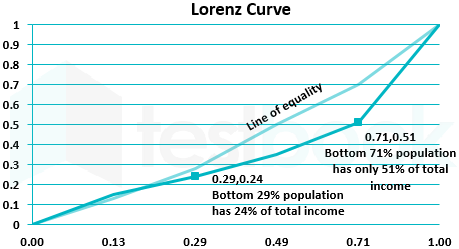
Graphical Representation of the Gini Index (Lorenz curve)

The Gini coefficient is usually defined mathematically based on the Lorenz curve, which plots the proportion of the total income of the population (y-axis) that is cumulatively earned by the bottom x% of the population.

The line at 45 degrees thus represents perfect equality of incomes.

The Gini coefficient satisfies four important principles:

  • Anonymity: it does not matter who the high and low earners are.
  • Scale independence: the Gini coefficient does not consider the size of the economy, the way it is measured, or whether it is a rich or poor country on average.
  • Population independence: it does not matter how large the population of the country is.
  • Transfer principle: if income (less than the difference), is transferred from a rich person to a poor person the resulting distribution is more equal.
3

Amartya Sen was awarded the Nobel Prize for his contribution to

  1. ((a))

    Monetary Economics

  2. ((b))

    Econometrics

  3. ((c))

    Welfare Economics

  4. ((d))

    Development Economics

Show Answer
Answer: ((c))

Welfare Economics

Amartya Sen is a world-renowned Nobel Laureate who was awarded the Prize in Economic Sciences in 1998 “for his contributions to welfare economics”. Sen was best known for his work on the causes of famine, which led to the development of practical solutions for preventing or limiting the effects of real or perceived shortages of food.

  • Welfare economics seeks to evaluate economic policies in terms of their effects on the well being of the community. He was widely acclaimed in the global community due to his pioneering insight in the field of famines, poverty and inequality. Sen, who devoted his career to such issues, was called the “conscience of his profession.” His influential monograph Collective Choice and Social Welfare (1970)—which addressed problems such as individual rights, majority rule, and the availability of information about individual conditions—inspired researchers to turn their attention to issues of basic welfare.
  • Sen devised methods of measuring poverty that yielded useful information for improving economic conditions for the poor. For instance, his theoretical work on inequality provided an explanation for why there are fewer women than men in some poor countries in spite of the fact that more women than men are born and infant mortality is higher among males. Sen claimed that this skewed ratio results from the better health treatment and childhood opportunities afforded to boys in those countries.
  • In 1968, Sveriges Riksbank (Sweden’s central bank) established the Prize in Economic Sciences in Memory of Alfred Nobel, founder of the Nobel Prize. The Prize is based on a donation received by the Nobel Foundation in 1968 from Sveriges Riksbank on the occasion of the Bank’s 300th anniversary. The first Prize in Economic Sciences was awarded to Ragnar Frisch and Jan Tinbergen in 1969.
4

Scheduled Banks have to be registered with

  1. ((a))

    SEBI

  2. ((b))

    RBI

  3. ((c))

    Finance Ministry

  4. ((d))

    SBI

Show Answer
Answer: ((b))

RBI

Banks are the institutional bodies that accept deposits and grant credit to the entities and play a major role in maintaining the economic stature of a country.  

  • In India, the Reserve Bank of India (RBI) is the apex banking institution that regulates the monetary policy in the country.
  • The banking sector of India can be broadly divided into two major groups’ i.e. scheduled banks and Non-Scheduled Banks.
  • Banks that have been included in the second schedule of the RBI Act, 1934 are called the scheduled bank while non scheduled banks are not included in the second schedule of the RBI Act,1934.

Scheduled banks are covered under the 2nd Schedule of the Reserve Bank of India Act, 1934. To qualify as a scheduled bank, the bank should conform to the following conditions:

  • A bank that has a paid-up capital of Rs. 5 Lakh and above qualifies for the schedule bank category
  • A bank requires to satisfy the central bank that its affairs are not carried out in a way that causes harm to the interest of the depositors
  • A bank should be a corporation rather than a sole-proprietorship or partnership firm

Hence, it is clear that Scheduled Banks have to be registered with the Reserve Bank of India (RBI).

1. SEBI- The Securities and Exchange Board of India was established on April 12, 1992, in accordance with the provisions of the Securities and Exchange Board of India Act, 1992. 

  • It regulates the business in stock exchanges and any other securities markets
  • registering  and  regulating  the  working  of  stockbrokers,  sub-brokers,  share  transfer agents,  bankers  to  an  issue,  trustees  of  trust  deeds,  registrars  to  an  issue,  merchant bankers,   underwriters,   portfolio   managers,   investment   advisers   and   such   other intermediaries who may be associated with securities markets in any manner
  • registering   and   regulating   the   working   of [venture   capital   funds   and   collective investment schemes], including mutual funds
  • promoting and regulating self-regulatory organizations
  • prohibiting fraudulent and unfair trade practices relating to securities markets
  • promoting investors‘ education and training of intermediaries of securities markets
  • prohibiting insider trading in securities.

2. Finance Ministry: 

  • The Ministry of Finance is an important ministry within the Government of India concerned with the economy of India, serving as the Indian Treasury Department.
  • In particular, it concerns itself with taxation, financial legislation, financial institutions, capital markets, center and state finances, and the Union Budget.

3. SBI: 

  • State Bank of India is an Indian multinational, public sector banking and financial services statutory body headquartered in Mumbai, Maharashtra. SBI is ranked 236th in the Fortune Global 500 list of the world's biggest corporations of 2019.
5

Which of the following is not a characteristic of Labour.

  1. ((a))

    Labour is perishable

  2. ((b))

    Labour has less mobility

  3. ((c))

    Strong bargaining power of labour

  4. ((d))

    In elastic supply of labour

Show Answer
Answer: ((c))

Strong bargaining power of labour

Labour, also spelled labor, in economics, the general body of wage earners. It is in this sense, for example, that one speaks of “organized labour.” In a more special and technical sense, however, labour means any valuable service rendered by a human agent in the production of wealth, other than accumulating and providing capital or assuming the risks that are a normal part of business undertakings. It includes the services of manual labourers, but it covers many other kinds of services as well. 

  • Labour is perishable in nature i.e. labour cannot be stored. If a worker does not turn up to work for one shift his labour of that shift is lost completely. It cannot be stored and utilized the next day.
  • Labour has Poor Bargaining Power because it cannot be stored, isn’t very mobile and has no standard or reserve price. So generally laborers are forced to work for whatever wages the employer offers. In comparison to the employer, the laborers have very little bargaining power. There is also the problem that laborers do not have any other reserves to fall back on. They are usually poor and ignorant. And this labour work is their only source of income. So they accept whatever wages the employer offers.
  • Labour has less mobility i.e. the laborers can relocate to the site of work. But there are many barriers to the movement of labour from one place to another. So we can say labour is not as mobile as some other factors of production like Capital.
  • Inelastic supply of labour i.e. it cannot be increased instantly to keep up with the demand. So say there is a shortage of skilled labour in India, skilled laborers cannot be generated in a day, a week or even a year
  • Hence, the Strong bargaining power is not a characteristic of Labour.

NOTE-

Labor economics is the study of the labor force as an element in the process of production. The labor force comprises all those who work for gain within the labor market, whether as employees, employers, or as self-employed, but also the unemployed, who are seeking work. Labor economics involves the study of all that affects these workers before, during, and after their working lives, for example, childcare, education, pay and incentives, fertility, discrimination, their non-work time, and pension reforms.

6

Who among the following said "Population increases in the Geometric progression, food increases in the Arithmetic progression"

  1. ((a))

    Malthus

  2. ((b))

    Greshan

  3. ((c))

    Engels

  4. ((d))

    Keynes

Show Answer
Answer: ((a))

Malthus

Thomas Malthus, in full Thomas Robert Malthus, (born 1766), English economist and demographer who is best known for his theory that population growth will always tend to outrun the food supply and that betterment of humankind is impossible without stern limits on reproduction. This thinking is commonly referred to as Malthusianism.

The Malthusian Theory of Population is the theory of exponential population and arithmetic food supply growth. The theory was proposed by Thomas Robert Malthus. He believed that a balance between population growth and food supply can be established through preventive and positive checks.

THE MALTHUSIAN THEORY OF POPULATION GROWTH

  • Among the most famous theories of demography is the one associated with the English political economist Thomas Robert Malthus (1766-1834).
  • Malthus’s theory of population growth – outlined in his Essay on Population (1798) – was a rather pessimistic one.
  • He argued that human populations tend to grow at a much faster rate than the rate at which the means of human subsistence (especially food, but also clothing and other agriculture-based products) can grow. Therefore humanity is condemned to live in poverty forever because the growth of agricultural production will always be overtaken by population growth.
  • While population rises in geometric progression (i.e., like 2, 4, 8, 16, 32 etc.), agricultural production can only grow in arithmetic progression (i.e., like 2, 4, 6, 8, 10 etc.). Because population growth always outstrips growth in the production of subsistence resources, the only way to increase prosperity is by controlling the growth of the population. Unfortunately, humanity has only a limited ability to voluntarily reduce the growth of its population (through ‘preventive checks’ such as postponing marriage or practicing sexual abstinence or celibacy).
  • Malthus believed therefore that ‘positive checks’ to population growth – in the form of famines and diseases – were inevitable because they were nature’s way of dealing with the imbalance between food supply and increasing population. Malthus’s theory was influential for a long time. But it was also challenged by theorists who claimed that economic growth could outstrip population growth.

Hence, it is clear that Malthus stated that- "Population increases in the Geometric progression, food increases in the Arithmetic progression".

7

Which organisation collects data for the unorganised sector?

  1. ((a))

    NSSO

  2. ((b))

    CSO

  3. ((c))

    ASI

  4. ((d))

    RBI

Show Answer
Answer: ((a))

NSSO

National Sample Survey Office (NSSO)

The National Sample Survey Office (NSSO) in India is a unique setup to carry out surveys on socioeconomic, demographic, agricultural and industrial subjects for collecting data from households and from enterprises located in villages and in the towns. The unregistered manufacturing sub-sector, a complement set to the registered manufacturing sub-sector, covers all the residual units which are not covered under the registered manufacturing sector. The data on the unorganized sector is collected through periodic surveys by the NSSO.

  • The release of detailed reports of the 56th round on unorganized manufacturing enterprises, covering numerous aspects such as employment, input-use, the destination of product sale, and other characteristics (i.e. nature of the operation, type of ownership, registration status, type of contracts, growth status and so on) by National Sample Survey Organisation (NSSO), has opened up a vast canvas for the researchers to operate on. Perhaps, a number of studies are likely to follow in due course, most ostensibly because of the sheer weight of the unorganized segment in the industrial sector, from the point of view of non-farm employment
  • The National Sample Survey(NSS) headed by a Director-General is responsible for the conduct of large-scale sample surveys in diverse fields on All India basis. Primarily data are collected through nation-wide household surveys on various socio-economic subjects, Annual Survey of Industries (ASI), etc. Besides these surveys, NSS collects data on rural and urban prices and plays a significant role in the improvement of crop statistics through the supervision of the area enumeration and crop estimation surveys of the State agencies.  It also maintains a frame of urban area units for use in sample surveys in urban areas.
  • NSSO is more systematic surveys of the unorganized manufacturing have been forthcoming and that has led many a researcher to shift their attention from the organized to the unorganized segment.

The NSS has four Divisions:

  • Survey Design and Research Division (SDRD)
  • Field Operations Division (FOD)
  • Data Processing Division (DPD)
  • Survey Coordination Division (SCD)

1. Central Statistics Office (CSO) is a government agency responsible for the coordination of statistical activities in India. It is headed by a Director-General assisted by 5 Additional Director Generals. CSO has the following Divisions:

  • National Accounts Division (NAD)
  • Social Statistics Division (SSD)
  • Training Division
  • Coordination and Publications Division (CAP)

2. ASI- The Archaeological Survey of India is an Indian government agency attached to the Ministry of Culture that is responsible for archaeological research and the conservation and preservation of cultural monuments in the country. It was founded in 1861 by Alexander Cunningham who also became its first Director-General.

3. The Reserve Bank of India was established on April 1, 1935, in accordance with the provisions of the Reserve Bank of India Act, 1934. The Central Office of the Reserve Bank was initially established in Kolkata but was permanently moved to Mumbai in 1937. The Central Office is where the Governor sits and where policies are formulated. Though originally privately owned, since nationalization in 1949, the Reserve Bank is fully owned by the Government of India.

8

Which of the following is not viewed as national debt

  1. ((a))

    Life insurance policies

  2. ((b))

    Long term govt. bonds

  3. ((c))

    National savings certificates

  4. ((d))

    Provident fund

Show Answer
Answer: ((a))

Life insurance policies

The national debt of India is the money owed by India’s federal government, which is based in New Delhi. The debts of India’s states and local government are not counted as part of the country’s national debt. The ultimate guarantor of India’s national debt is the central Indian government, with the name “Government of India” printed on each bond as the issuer.

In many countries, the government’s finance department/Treasury is responsible for issuing bonds and managing debt. However, in India, things are a little different. The Indian national debt is managed by the country’s central bank i.e. Reserve Bank of India.

The Reserve Bank of India raises debt for the Government of India through a range of instruments, which the RBI calls “G-Secs.” This term is short for “government securities” and has become common parlance in the Indian financial services community. The instruments that the PDO issues fall into the following categories: 

  • Fixed Rate Bonds – the interest rate payable does not alter over time.
  • Floating Rate Bonds (FRB) – the interest rate is expressed as a margin over the national base rate.
  • Zero Coupon Bonds – pay no interest but are sold at a discount and redeemed at full face value.
  • Capital Indexed Bonds – the face value of the bond increases in line with inflation.
  • Inflation Indexed Bonds (IIBs) – both the loan amount an the interest are index linked. Since 2013 these bonds have been issued exclusively to the general public.
  • Bonds with Call/ Put Options – The RBI has the right to redeem the bond before maturity (call) or the holder has the right to cash in the bond before maturity (put).
  • Sovereign Gold Bond (SGB) – payable in cash, but the value of the bond is linked to the price of gold. Treasury Bills (T-Bills) – these are short-term government bonds that mature within a year.
  • Cash Management Bills (CMBs) – very short-term government bonds with a maturity of less than 91 days.

National Savings Certificates, popularly known as NSC, is an Indian Government savings bond, primarily used for small savings and income tax saving investments in India. It is part of the postal savings system of India Post.

The major holders of  India’s national debt are

  • Commercial Banks
  • Provident Funds
  • Others Foreign Portfolio Investors
  • Co-operative Banks
  • State Governments
  • Mutual Funds Institutions
  • Corporates Non-Bank

Premium collected in the form of different life insurance policies does not contribute to any kind of debt.

9

Which of the following is a public sector unit

  1. ((a))

    ICICI bank

  2. ((b))

    TESCO bank

  3. ((c))

    BHEL

  4. ((d))

    All of these

Show Answer
Answer: ((c))

BHEL

The general definition of the public sector includes government ownership or control rather than mere function and thereby includes, for example, the exercise of public authority or the implementation of public policy. 

PSUs (Public Sector Undertakings) are the government-owned corporations in India, in which 51% or more than 51% of the paid-up share capital is owned by the government of India. However, it can be only the central government or only state government of any state or central government with any state government or state governments.

Public Sector undertakings (PSU) can be classified into three following categories:

  • Central public-sector Enterprises (CPSEs) – Companies that are under the direct control of the Central Government or of other CPSEs by 51% or more than 51% of capital share ownership.
  • Central Public-Sector Enterprises (CPSEs) are further classified into Strategic CPSE and Non-strategic CPSE.
  • Strategic Central Public-sector Enterprises (CPSEs) which includes the Arms & Ammunition and the defense equipment’s, defense aircraft and other items related to Defense, and in the field of atomic energy and Railways transport.
  • The rest of the CPSEs are regarded as Non-strategic CPSE.
  • Public Sector banks (PSBs) – Banks that are under the direct control of the Central Government or of other PSBs by 51% or more than 51% of capital share ownership.
  • State Level Public Enterprises (SLPEs) – Companies that are under the direct control of the State Government or other SLPEs by 51% or more than 51% of capital share ownership.

NOTE-

  • ICICI Bank was originally promoted in 1994 by ICICI Limited, an Indian financial institution, and was its wholly-owned subsidiary. ICICI Bank is a leading private sector bank in India.
  • Tesco is the biggest private-sector employer in the UK and offers a competitive package of pay and benefits for all jobs, whether as assistants or managers in stores and depots.
  • BHEL (Bharat Heavy Electricals Limited) is a public sector undertaking, working under the Ministry of Heavy Industries, Govt. of India
10

Who among the following was the first chairman of the Planning Commission?

  1. ((a))

    Dr. Rajendra Prasad

  2. ((b))

    Pt. Jawaharlal Nehru

  3. ((c))

    Sardar Vallabhbhai Patel

  4. ((d))

    J.B. Kripalani

Show Answer
Answer: ((b))

Pt. Jawaharlal Nehru

Planning Commission

  1. The Planning Commission was set up by a Resolution of the Government of India in March 1950 in pursuance of declared objectives of the Government to promote a rapid rise in the standard of living of the people by efficient exploitation of the resources of the country, increasing production and offering opportunities to all for employment in the service of the community.
  2. The Planning Commission was charged with the responsibility of making assessments of all resources of the country, augmenting deficient resources, formulating plans for the most effective and balanced utilization of resources and determining priorities.

  • Jawaharlal Nehru was the first Chairman of the Planning Commission.
  • The first Five-year Plan was launched in 1951 and two subsequent five-year plans were formulated until 1965 when there was a break because of the Indo-Pakistan Conflict. Two successive years of drought, devaluation of the currency, a general rise in prices, and erosion of resources disrupted the planning process and after three Annual Plans between 1966 and 1969, the fourth Five-year plan was started in 1969.
  • The Eighth Plan could not take off in 1990 due to the fast-changing political situation at the Centre and the years 1990-91 and 1991-92 were treated as Annual Plans. The Eighth Plan was finally launched in 1992 after the initiation of structural adjustment policies.
  • For the first eight Plans, the emphasis was on a growing public sector with massive investments in basic and heavy industries, but since the launch of the Ninth Plan in 1997, the emphasis on the public sector has become less pronounced and the current thinking on planning in the country, in general, is that it should increasingly be of an indicative nature.

NOTE- The Prime Minister is the Chairman of the Planning Commission, which works under the overall guidance of the National Development Council. The Deputy Chairman and the full-time members of the Commission, as a composite body, provide advice and guidance to the subject Divisions for the formulation of Five Year Plans, Annual Plans, State Plans, Monitoring Plan Programmes, Projects and Schemes.

11

Who among the following have won the Nobel Prize for Economics in 2011

  1. Eric S. Maskin
  2. Christopher Sims
  3. Thomas Sargent
  4. Leonid Hurwicz

Select the right answer using the code given below

  1. ((a))

    1 and 2 only

  2. ((b))

    3 and 4 only

  3. ((c))

    1, 2 and 4

  4. ((d))

    2 and 3 only

Show Answer
Answer: ((d))

2 and 3 only

The Sveriges Riksbank Prize in Economic Sciences in Memory of Alfred Nobel was established in 1968 by the Bank of Sweden, and it was first awarded in 1969, more than 60 years after the distribution of the first Nobel Prizes. Although not technically a Nobel Prize, the Prize in Economic Sciences is identified with the award; its winners are announced with the Nobel Prize recipients, and it is presented at the Nobel Prize Award Ceremony. It is conferred by the Royal Swedish Academy of Sciences in Stockholm.

  • The Sveriges Riksbank Prize in Economic Sciences in Memory of Alfred Nobel 2011 was awarded jointly to Thomas J. Sargent and Christopher A. Sims "for their empirical research on cause and effect in the macroeconomy".
  • Thomas Sargent has shown how structural macroeconometrics can be used to analyze permanent changes in economic policy. This method can be applied to study macroeconomic relationships when households and firms adjust their expectations concurrently with economic developments. Sargent has examined, for instance, the post-World War II era, when many countries initially tended to implement a high-inflation policy, but eventually introduced systematic changes in economic policy and reverted to a lower inflation rate.
  • Christopher Sims has developed a method based on so-called vector autoregression to analyze how the economy is affected by temporary changes in economic policy and other factors. Sims and other researchers have applied this method to examine, for instance, the effects of an increase in the interest rate set by a central bank. It usually takes one or two years for the inflation rate to decrease, whereas economic growth declines gradually already in the short run and does not revert to its normal development until after a couple of years.
  • Although Sargent and Sims carried out their research independently, their contributions are complementary in several ways. The laureates’ seminal work during the 1970s and 1980s has been adopted by both researchers and policymakers throughout the world. Today, the methods developed by Sargent and Sims are essential tools in macroeconomic analysis.
12

The acronym SRO, being used in the Capital Market for various market participant stands for

  1. ((a))

    Self Regulatory Organisations

  2. ((b))

    Small Revenue Operators

  3. ((c))

    Securities Roll-Back Operators

  4. ((d))

    Securities Regulatory Organisations

Show Answer
Answer: ((a))

Self Regulatory Organisations

Self Regulatory Organization (SRO) means, an organization of intermediaries or an entity promoted by a stock exchange, as may be recognized by the Board.

SRO is the first level regulator that performs the crucial task of regulating intermediaries representing a particular segment of securities market on behalf of the regulator. An SRO would be seen as an extension of the regulatory authority of SEBI and would perform the tasks delegated to it by SEBI. The role of an SRO is developmental, regulatory, related to grievance redressal and dispute resolution as well as taking disciplinary actions. Therefore, it is crucial that SEBI, after due diligence, recognizes such entity/entities which is/are capable of carrying out responsibilities of an SRO.

13

Which of the following is not a Central problem of economy?

  1. ((a))

    What to produce

  2. ((b))

    How to produce

  3. ((c))

    For whom to produce

  4. ((d))

    When to produce

Show Answer
Answer: ((d))

When to produce

Central problems of an economy-

Production, exchange and consumption of goods and services are among the basic economic activities of life. In the course of these basic economic activities, every society has to face scarcity of resources and it is the scarcity of resources that gives rise to the problem of choice. The scarce resources of an economy have competing usages. In other words, every society has to decide on how to use its scarce resources.

The problems of an economy are very often summarised as follows:

  • What is produced and in what quantities? Every society must decide on how much of each of the many possible goods and services it will produce. Whether to produce more of food, clothing, housing or to have more of luxury goods. Whether to have more agricultural goods or to have industrial products and services. Whether to use more resources in education and health or to use more resources in building military services. Whether to have more of basic education or more of higher education. Whether to have more of consumption goods or to have investment goods (like a machine) which will boost production and consumption tomorrow.
  • How are these goods produced? Every society has to decide on how much of which of the resources to use in the production of each of the different goods and services. Whether to use more labour or more machines. Which of the available technologies to adopt in the production of each of the goods?
  • For whom are these goods produced? Who gets how much of the goods that are produced in the economy? How should the produce of the economy be distributed among the individuals in the economy? Who gets more and who gets less? Whether or not to ensure a minimum amount of consumption for everyone in the economy. Whether or not elementary education and basic health services should be available freely for everyone in the economy.

Thus, every economy faces the problem of allocating the scarce resources to the production of different possible goods and services and of distributing the produced goods and services among the individuals within the economy. The allocation of scarce resources and the distribution of the final goods and services are the central problems of any economy.

14

When decrease in the price of one good causes the demand for another good to decrease, the goods are

  1. ((a))

    Complements

  2. ((b))

    Substitutes

  3. ((c))

    Normal

  4. ((d))

    Inferior

Show Answer
Answer: ((b))

Substitutes

Law of Demand: If a consumer’s demand for good moves in the same direction as the consumer’s income, the consumer’s demand for that good must be inversely related to the price of the goods.

Normal and Inferior Goods

  • The demand function is a relation between the consumer’s demand for a good and its price when other things are given. Instead of studying the relation between the demand for a good and its price, we can also study the relationship between the consumer’s demand for the good and the income of the consumer. The quantity of a good that the consumer demands can increase or decrease with the rise in income depending on the nature of the good.
  • For most goods, the quantity that a consumer chooses, increases as the consumer’s income increases and decreases as the consumer’s income decreases. Such goods are called normal goods. Thus, a consumer’s demand for a normal good move in the same direction as the income of the consumer.
  • However, there are some goods the demands for which move in the opposite direction of the income of the consumer. Such goods are called inferior goods. As the income of the consumer increases, the demand for an inferior good falls, and as the income decreases, the demand for an inferior good rise.
  • Examples of inferior goods include low-quality food items like coarse cereals. A good can be a normal good for the consumer at some levels of income and an inferior good for her at other levels of income. At very low levels of income, a consumer’s demand for low-quality cereals can increase with income. But, beyond a level, any increase in income of the consumer is likely to reduce her consumption of such food items.

Substitutes and Complements

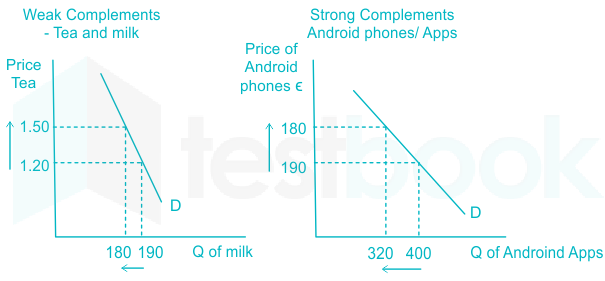
  • The quantity of a good that the consumer chooses can increase or decrease with the rise in the price of a related good depending on whether the two goods are substitutes or complementary to each other. Goods that are consumed together are called complementary goods.
  • Examples of goods which are a complement to each other include tea and sugar, shoes and socks, pen and ink, etc. Since tea and sugar are used together, an increase in the price of sugar is likely to decrease the demand for tea and a decrease in the price of sugar is likely to increase the demand for tea. Similar is the case with other complements.
  • In general, the demand for good moves in the opposite direction of the price of its complementary goods. In contrast to complements, goods like tea and coffee are not consumed together. In fact, they are substitutes for each other. Since tea is a substitute for coffee, if the price of coffee increases, the consumers can shift to tea, and hence, the consumption of tea is likely to go up. On the other hand, if the price of coffee decreases, the consumption of tea is likely to go down. The demand for a good usually moves in the direction of the price of its substitutes.
  • Hence, when decrease in the price of one good causes the demand for another good to decrease, the goods are Substitutes.
15

Which of the following is not a cause of decrease in demand

  1. ((a))

    Fall in the income of consumers

  2. ((b))

    Fall in the price of substitute good

  3. ((c))

    Fall in the price of complementary good

  4. ((d))

    Decrease in the number of consumers

Show Answer
Answer: ((c))

Fall in the price of complementary good

Law of Demand: If a consumer’s demand for good moves in the same direction as the consumer’s income, the consumer’s demand for that good must be inversely related to the price of the goods.

Complementary Goods-

  • Complementary goods are products which are used together.
  • Examples of goods which are a complement to each other include tea and sugar, shoes and socks, pen and ink, etc. Since tea and sugar are used together, an increase in the price of sugar is likely to decrease the demand for tea and a decrease in the price of sugar is likely to increase the demand for tea. Similar is the case with other complements.
  • In general, the demand for good moves in the opposite direction of the price of its complementary goods. Hence, a fall in the price of complementary good is not a cause of a decrease in demand.

Substitute Goods

  • Substitute goods are two alternative goods that could be used for the same purpose.
  • In contrast to complements, goods like tea and coffee are not consumed together. In fact, they are substitutes for each other. Since tea is a substitute for coffee, if the price of coffee increases, the consumers can shift to tea, and hence, the consumption of tea is likely to go up. On the other hand, if the price of coffee decreases, the consumption of tea is likely to go down. The demand for a good usually moves in the direction of the price of its substitutes.
16

With 10% fall in the price of a good, its demand rises from 100 units to 120 units. The Price elasticity of demand is

  1. ((a))

    20

  2. ((b))

    10

  3. ((c))

    2

  4. ((d))

    1

Show Answer
Answer: ((c))

2

ELASTICITY OF DEMAND

The demand for good moves in the opposite direction of its price. But the impact of the price change is always not the same. Sometimes, the demand for good changes considerably even for small price changes. On the other hand, there are some goods for which the demand is not affected much by price changes.

  • Demands for some goods are very responsive to price changes while demands for certain others are not so responsive to price changes.
  • Price elasticity of demand is a measure of the responsiveness of the demand for a good to changes in its price.
  • Price elasticity of demand for a good is defined as the percentage change in demand for the good divided by the percentage change in its price. Price elasticity of demand for a good-
  • eD = percentage change in demand for the good percentage change in the price of the good
  • Price elasticity of demand is an economic measure of the change in the quantity demanded or purchased of a product in relation to its price change. Expressed mathematically, it is: Price Elasticity of Demand = % Change in Quantity Demanded / % Change in Price
  • In the give question, the demand is rising from 100 units to 120 units, it means there is 20 percent increase in quantitative demand. On the other hand, the price is fallen by 10 percentage. According to the formula Price Elasticity of Demand = 20/10 is equal to 2.
  • Price elasticity is used by economists to understand how supply or demand changes given changes in price to understand the workings of the real economy.
  • For instance, some goods are very inelastic, that is, their prices do not change very much given changes in supply or demand, for example, people need to buy gasoline to get to work or travel around the world, and so if oil prices rise, people will likely still buy just the same amount of gas.
  • On the other hand, certain goods are very elastic, their price moves cause substantial changes in their demand or its supply.
17

Cross elasticity of demand is

  1. ((a))

    Negative for complementary goods

  2. ((b))

    Unitary for inferior goods

  3. ((c))

    Negative for substitute goods

  4. ((d))

    Positive for inferior goods

Show Answer
Answer: ((a))

Negative for complementary goods

ELASTICITY OF DEMAND

  • The demand for good moves in the opposite direction of its price. But the impact of the price change is always not the same. Sometimes, the demand for good changes considerably even for small price changes. On the other hand, there are some goods for which the demand is not affected much by price changes.
  • Demands for some goods are very responsive to price changes while demands for certain others are not so responsive to price changes.
  • Price elasticity of demand is a measure of the responsiveness of the demand for a good to changes in its price.
  • Price elasticity of demand for a good is defined as the percentage change in demand for the good divided by the percentage change in its price.

Cross elasticity of demand

  • The cross elasticity of demand is an economic concept that measures the responsiveness in the quantity demanded of one good when the price for other good changes. Also called cross-price elasticity of demand, this measurement is calculated by taking the percentage change in the quantity demanded of one good and dividing it by the percentage change in the price of the other good.
  • The measure of the responsiveness of the demand for a good towards the change in the price of a related good is called cross-price elasticity of demand. It is always measured in percentage terms.
  • With the consumption behavior being related, the change in the price of a related good leads to a change in the demand for another good. Related goods are of two kinds, i.e. substitutes and complementary goods.
  • In case the two goods are not related, the Coefficient of Cross Elasticity is zero.
  • In case the two goods are substitutes for each other like tea and coffee, the cross-price elasticity will be positive, i.e. if the price of coffee increases, the demand for tea increases.
  • On the other hand, in case the goods are complementary in nature like pen and ink, then the cross elasticity will be negative, i.e. demand for ink will decrease if prices of pen increase or vice-versa.
18

Giffen goods are a kind of goods whose

  1. ((a))

    Price effect is negative and income effect is positive

  2. ((b))

    Price effect and income effect both are positive

  3. ((c))

    Price effect and income effect both are negative

  4. ((d))

    Price effect is positive and income effect is negative

Show Answer
Answer: ((d))

Price effect is positive and income effect is negative

The correct answer is Price effect is positive and income effect is negative.

Key Points

  • Giffen goods are inferior goods for which demand increases when price rises and decreases when price falls.
  • This unusual behavior occurs because the negative income effect is stronger than the substitution effect.
  • When price rises, the consumer becomes poorer in real income terms and buys more of the cheap staple good.
  • Thus, for a Giffen good, the overall price effect is positive (price rises → quantity demanded rises).
  • The income effect is negative because it is an inferior good.

Additional Information

  • Normal Goods:
  • Income effect is positive; demand rises with income.
  • Inferior Goods:
  • Income effect is negative; demand falls as income rises.
  • Giffen Goods:
  • A special case of inferior goods where negative income effect outweighs substitution effect.

Important Points

  • Giffen goods violate the law of demand.
  • Price effect = Positive for Giffen goods.
  • Income effect = Negative because they are inferior goods.
  • Examples often cited: staple foods like bread, rice, or potatoes under poverty conditions.
19

The shape of Production Possibility Curve is

  1. ((a))

    Convex to the point of origin

  2. ((b))

    Concave to the point of origin

  3. ((c))

    Rectangular hyperbola

  4. ((d))

    A Parabola

Show Answer
Answer: ((b))

Concave to the point of origin

Production Possibility Curve

  • A production possibilities curve (PPC) shows the maximum amount of one good that can be produced given a production level for some other good, and given the total amounts of inputs available for the production of both goods, and given the technology of production.
  • The PPC shows the limits on outputs of goods because society does not have unlimited resources. And it shows the trade-off society must bear if more of a good is to be produced.
  • The Production Possibilities Curve (PPC) is a model that captures scarcity and the opportunity costs of choices when faced with the possibility of producing two goods or services.
  • The production possibility curve represents graphically alternative production possibilities open to an economy.
  • The productive resources of the community can be used for the production of various alternative goods.
  • In other words, the production possibility curve can be defined as a graph that represents different combinations of quantities of two goods that can be produced by an economy under the condition of limited available resources. It is also known as the production possibility frontier(PPFs) or transformation curve.
  • The PPCs are normally drawn as bulging upwards or outwards from the origin ("concave" when viewed from the origin), but they can be represented as bulging downward (inwards) or linear (straight), depending on a number of assumptions.
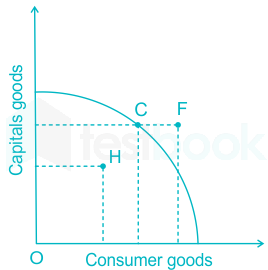
  • In this diagram AF is the production possibility curve, also called or the production possibility frontier, which shows the various combinations of the two goods (Wheat & Cloth) which the economy can produce with a given amount of resources.

  • The Curve shows all of the possible combinations of 2 goods or services that can be produced within a specified time with all its resources fully and efficiently employed.
  • The economy can produce at any combination on or inside the curve (C and H).
  • Point outside the curve is not attainable (F).
20

When availability of resources increases, the production possibility curve will

  1. ((a))

    Shift towards the right

  2. ((b))

    Shift towards the left

  3. ((c))

    No change

  4. ((d))

    None of the above

Show Answer
Answer: ((a))

Shift towards the right

A production possibilities curve (PPC) shows the maximum amount of one good that can be produced given a production level for some other good, and given the total amounts of inputs available for the production of both goods, and given the technology of production. 

The PPC shows the limits on outputs of goods because society does not have unlimited resources. And it shows the trade-off society must bear if more of a good is to be produced.

What creates growth?

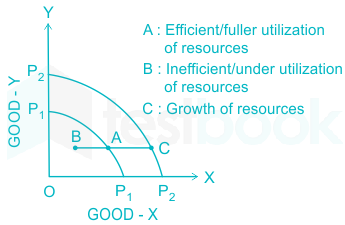
  • When using a PPC, growth is defined as an increase in potential output over time and illustrated by an outward shift in the curve.
  • A PPC will shift inwards when an economy has suffered a loss or exhaustion of some of its scarce resources. This reduces an economy’s productive potential.
  • An outward shift of a PPC means that an economy has increased its capacity to produce all goods. This can occur when the economy undertakes some or all of the following:

a. Employs new technology

b. Employs a division of labour, allowing specialization

c. Employs new production methods

d. Increases its labour force

e. Discovers new raw materials: Discoveries of key resources, such as oil, increase an economy’s capacity to produce.

Draw a production possibility curve and indicate growth of resources.

Hence, when the availability of resources increases, the production possibility curve will Shift towards the right.

21

A consumer is in a state of equilibrium when (PX=Price of commodity X, MUX=marginal utility of X, MUM=marginalutility of money)

  1. ((a))

    PX > MUX / MUM

  2. ((b))

    PX < MUX / MUM

  3. ((c))

    PX = MUX / MUM

  4. ((d))

    None of the above

Show Answer
Answer: ((c))

PX = MUX / MUM

  • Marginal utility is the added satisfaction that a consumer gets from having one more unit of a good or service. The concept of marginal utility is used by economists to determine how much of an item consumers are willing to purchase.
  • A consumer is in equilibrium when given his tastes, and price of the two goods, he spends a given money income on the purchase of two goods in such a way as to get the maximum satisfaction, According to Koulsayiannis, “The consumer is in equilibrium when he maximises his utility, given his income and the market prices.”
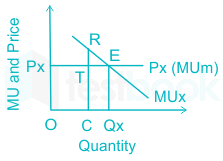
  • As shown in Figure, the horizontal line Px shows the constant utility of money, and MUx curve represents the diminishing marginal utility of a good. The intersection of MUx and Px curve takes place at E that is when the quantity consumed is OQx, then MUx=Px(MUm).
  • Thus, consumer achieves equilibrium at E. Above point E, MUx > Px(MUm) implying that a consumer increase the consumption of good as utility achieved is more. At point R, consumer gains MU as RC where the cost incurred is TC. Thus, the marginal gain is RT and this situation exists till a consumer reaches point E.
  • If we look at the point below point E, where MUx < Px (MUm), a consumer would consume more than OQx and loses utility. Thus, satisfaction is increased by reducing the consumption. Therefore, point E is the equilibrium point.
22

The slope of the indifference curve represents the

  1. ((a))

    Elasticity of demand for the good

  2. ((b))

    Marginal rate of substitution between two goods

  3. ((c))

    Ratio of the prices of two goods

  4. ((d))

    Position of Consumer’s equilibrium

Show Answer
Answer: ((b))

Marginal rate of substitution between two goods

  • An indifference curve, with respect to two commodities, is a graph showing those combinations of the two commodities that leave the consumer equally well off or equally satisfied—hence indifferent—in having any combination on the curve.
  • An indifference curve maps the consumption bundles that the consumer views as equal. The consumer is equally as happy to consume at any point along the indifference curve. One can also refer to each point on the indifference curve as rendering the same level of utility (satisfaction) for the consumer.
  • The main use of indifference curves is in the representation of potentially observable demand patterns for individual consumers over commodity bundles. Graphically, the indifference curve is drawn as a downward-sloping convex to the origin.
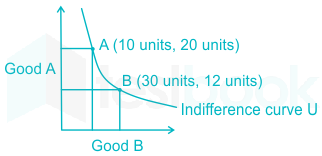
  • The above diagram shows the U indifference curve showing bundles of goods A and B. To the consumer, bundles A and B are the same as both of them give him equal satisfaction. In other words, point A gives as mu as point B to the individual. The consumer will be satisfied at any point along the curve assuming that other things are constant.
  • The slope of the indifference curve is the marginal rate of substitution (MRS).
  • The MRS is the amount of a good that a consumer is willing to give up for a unit of another good, without any change in utility. If the consumer values apples, for example, the consumer will be slower to give them up for oranges, and the slope will reflect this rate of substitution.

Hence, the slope of the Indifference curve represents the marginal rate of substitution between two goods.

23

At the point of consumer’s equilibrium, the slope of the Indifference curve and of the Budget line should be

  1. ((a))

    Same

  2. ((b))

    Slope of Budget line is greater than slope of Indifference curve

  3. ((c))

    Slope of Budget line is lesser than slope of Indifference curve

  4. ((d))

    None of the above

Show Answer
Answer: ((a))

Same

An indifference curve is a graph showing a combination of two goods that give the consumer equal satisfaction and utility. Each point on an indifference curve indicates that a consumer is indifferent between the two and all points give him the same utility.

  • People seek the highest level of utility, which means that they wish to be on the highest possible indifference curve. However, people are limited by their budget constraints, which show what tradeoffs are actually possible. The solution to this problem, i.e. the combination of goods and services that will maximize an individual’s total utility given their budget, is called the consumer equilibrium. The consumer is in equilibrium when he maximizes his utility, given his income and the market prices.
  • A budget line is a graphical representation of various combinations of two goods that a consumer can afford at specified prices of the products at a particular income level. A budget line can be drawn on the basis of the expenditure plan.
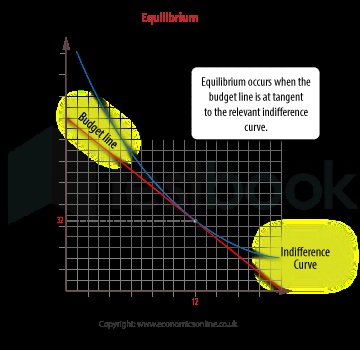
  • Consumer equilibrium exists at the point on the indifference curve where the budget line is tangent to the curve. Thus, at the equilibrium point, the slope of the budget line is equal to the slope of the indifference curve.

24

Out of the following which is not a reason for decrease in supply

  1. ((a))

    Increase in price of a competing good

  2. ((b))

    Decrease in the number of firms in the market

  3. ((c))

    Improvement in technology

  4. ((d))

    Increase in price of factors of production

Show Answer
Answer: ((c))

Improvement in technology

Increase in price of factors of production- If the price of inputs increases the supply curve will shift left as sellers are less willing or able to sell goods at any given price. Inputs include land, labor, energy, and raw materials.

Number of suppliers: As more firms enter the industry the market supply curve will shift out driving down prices. The market supply curve is the horizontal summation of the individual supply curves. Similarly, a decrease in the number of firms in the market will bring down the supply making prices more competitive. Fewer sellers less product in the market.

An increase in the price of a competing good will reduce the supply and make the prices more competitive. Sellers would prefer to sell fewer goods and higher prices and make more profit.


Improvement in technology may in fact aid in the production and might just be a cause of greater supply. When a firm discovers a new technology that allows it to produce at a lower cost, the supply curve will shift to the right as well. A technological improvement that reduces costs of production will shift supply to the right, causing a greater quantity to be produced at any given price. The most significant factories in the state of technology. If there is a technological advancement related to the production of the goods, the supply increases.

Other related factors are

  • Good’s own price: An increase in price will induce an increase in the quantity supplied.
  • Prices of related goods: For purposes of supply analysis, related goods refer to goods from which inputs are derived to be used in the production of the primary good.
  • Expectations: Sellers’ expectations concerning future market conditions can directly affect supply.
  • Government policies and regulations: Government intervention can take many forms including environmental and health regulations, hour and wage laws, taxes, electrical and natural gas rates and zoning and land use regulations. These regulations can affect a good supply.
25

Demand curve of a firm under perfect competition is

  1. ((a))

    Perfectly elastic (Ed = ∞)

  2. ((b))

    Perfectly inelastic (Ed = 0)

  3. ((c))

    Relatively elastic (Ed > 1)

  4. ((d))

    Relatively inelastic (Ed < 1)

Show Answer
Answer: ((a))

Perfectly elastic (Ed = ∞)

Key Points 

Under perfect competition, a demand curve of the firm is perfectly elastic because the firm can sell any amount of goods at the prevailing price. So even a small increase in price will lead to zero demand. This indicates that the firm has no control over price.

Perfect competition in an industry structure is when, there are many firms, none large enough to influence the industry, producing homogeneous products. Firms are price takers. There are no barriers to entry. Agriculture comes close to being perfectly competitive.

Perfect competition leads to the Pareto-efficient allocation of economic resources. Because of this, it serves as a natural benchmark against which to contrast other market structures. However, in practice, very few industries can be described as perfectly competitive.

A perfectly competitive market has several important characteristics:

  • All producers contribute insignificantly to the market. Their own production levels do not change the supply curve.
  • All producers are price takers. They cannot influence the market. If a firm tries to raise its price consumers would buy from a competitor with a lower price instead.
  • Products are homogeneous. The characteristics of a good or service do not vary between suppliers.
  • Producers enter and exit the market freely.
  • Both buyers and sellers have perfect information about the price, utility, quality, and production methods of products.
  • There are no transaction costs. Buyers and sellers do not incur costs in making an exchange of goods in a perfectly competitive market.
  • Producers earn zero economic profits in the long run
26

In short period the production can be increased only through the application of.......factors

  1. ((a))

    Fixed

  2. ((b))

    Variable

  3. ((c))

    Semi variable

  4. ((d))

    None of the above

Show Answer
Answer: ((b))

Variable

Short run refers to that time period in which the supply of certain factors is fixed i.e. it cannot be increased or decreased. For e.g. plant, machinery, building etc. Therefore, a firm can increase the production of a commodity in the short run, by increasing the use of variable factors such as labor and raw materials.


For example, a firm wants to increase the production of books from 1000 to 2000 daily. To do so, it will need more factors of production. But, there are some factors whose supply cannot be increased immediately e.g. printing press, building, etc. Therefore, the firm will have to use those factors whose quantity can be increased immediately such as labour, raw material etc. In the given example, printing press and building are fixed factors of production, labour and raw material are variable factors of production.

Key Points

  • The production function is differently defined in the short run and in the long run. This distinction is extremely relevant in microeconomics. The distinction is based on the nature of factor inputs.
  • Those inputs that vary directly with the output are called variable factors. These are factors that can be changed. Variable factors exist in both, the short run and the long run. Examples of variable factors include daily-wage labour, raw materials, etc.
  • On the other hand, those factors that cannot be varied or changed as the output changes are called fixed factors. These factors are normally characteristic of the short run or short period of time only. Fixed factors do not exist in the long run.
  • Consequently, we can define two production functions: short-run and long-run. The short-run production function defines the relationship between one variable factor (keeping all other factors fixed) and the output. The law of returns to a factor explains such a production function.
27

If elasticity of demand is infinity, equilibrium price........no matter supply increases or decreases

  1. ((a))

    Increases

  2. ((b))

    Remains same

  3. ((c))

    Decreases

  4. ((d))

    None of the above

Show Answer
Answer: ((b))

Remains same

Elastic demand will mean that when price increases, demand will fall by a greater percentage than the price increased. This means a fall in revenue.


  • The degree of elasticity of demand helps in defining the shape and slope of a demand curve. Therefore, the elasticity of demand can be determined by the slope of the demand curve. The flatter the slope of the demand curve, the higher the elasticity of demand.
  • When demand is perfectly elastic (or elasticity of demand is infinity), equilibrium price remains unchanged with an increase or decrease in supply. When demand is perfectly elastic, buyers will only buy at one price and no other.
  • Perfectly elastic demand is a theoretical concept and cannot be applied in a real situation. However, it can be applied in cases, such as a perfectly competitive market and homogeneity products. In such cases, the demand for a product of an organization is assumed to be perfectly elastic.
  • From an organization’s point of view, in a perfectly elastic demand situation, the organization can sell as much as it wants as consumers are ready to purchase a large quantity of products. However, a slight increase in price would stop the demand.
  • Hence, if elasticity of demand is infinity, equilibrium price remains the same no matter supply increases or decreases.
28

As per the law of variable proportion, when marginal product starts diminishing the behaviour of Total Product would be

  1. ((a))

    TP remains constant

  2. ((b))

    TP decreases at increasing rate

  3. ((c))

    TP decreases at diminishing rate

  4. ((d))

    TP increases at a diminishing rate

Show Answer
Answer: ((d))

TP increases at a diminishing rate

The law of variable proportions is as follows:

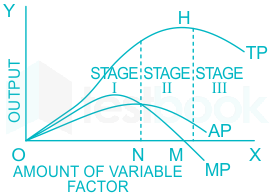
“If a producer increases the units of a variable factor while keeping other factors fixed, then initially the total product increases at an increasing rate, then it increases at a diminishing rate, and finally starts declining."

Can you explain law of variable proportion with examples? - Quora

The reason behind the law of variable proportion is the following.

As we hold one-factor input fixed and keep increasing the other, the factor proportions change. Initially, as we increase the amount of the variable input, the factor proportions become more and more suitable for the production and marginal product increases. But after a certain level of employment, the production process becomes too crowded with the variable input and the factor proportions become less and less suitable for the production. It is from this point that the marginal product of the variable input starts falling.

29

When Average Cost falls then

  1. ((a))

    MC < AC

  2. ((b))

    MC > AC

  3. ((c))

    MC = AC

  4. ((d))

    MC = 0

Show Answer
Answer: ((a))

MC < AC

The Average Cost is the per-unit cost of production obtained by dividing the total cost (TC) by the total output (Q). 

The average cost is expressed as:

AC = TC/Q

Marginal Cost

In economics, marginal cost is the change in the total cost when the quantity produced changes by one unit. It is the cost of producing one more unit of a good. Marginal cost includes all of the costs that vary with the level of production. For example, if a company needs to build a new factory in order to produce more goods, the cost of building the factory is a marginal cost. The amount of marginal cost varies according to the volume of the good being produced. Economic factors that impact the marginal cost include information asymmetries, positive and negative externalities, transaction costs, and price discrimination. Marginal cost is not related to fixed costs. An example of calculating marginal cost is: the production of one pair of shoes is 30.Thetotalcostformakingtwopairsofshoesis30. The total cost for making two pairs of shoes is 40. The marginal cost of producing the second pair of shoes is $10.

Average Cost

The average cost is the total cost divided by the number of goods produced. It is also equal to the sum of average variable costs and average fixed costs. Average cost can be influenced by the time period for production (increasing production may be expensive or impossible in the short run). Average costs are the driving factor of supply and demand within a market. Economists analyze both short run and long run average cost. Short run average costs vary in relation to the quantity of goods being produced. Long run average cost includes the variation of quantities used for all inputs necessary for production.

Relationship Between Average and Marginal Cost

Average cost and marginal cost impact one another as production fluctuate:

  • When the average cost declines, the marginal cost is less than the average cost.
  • When the average cost increases, the marginal cost is greater than the average cost.
  • When the average cost stays the same (is at a minimum or maximum), the marginal cost equals the average cost.

Some of the major differences between Average Cost vs Marginal Cost:

  • Average cost is nothing but the Total cost divided by the number of units manufactured which shows the result as per unit cost of the product, whereas Marginal cost is extra cost generated while producing one or some extra unit of products and it is calculated by dividing the change in total cost with Chang in total manufactured unit.
  • Marginal cost considered all cost which fluctuates during the level of production and fixed cost remain constant up to a certain level of production, whereas Average cost considered Fixed cost and Variable cost. In Average cost, both Fixed and Variable cost is product cost whereas in margin cost Fixed cost is considered as period costs and Variable cost is product cost.
  • Average cost calculates the effect on total unit due to change in output level whereas marginal cost is calculated to find out if producing one extra unit of product is profitable or not.
  • Average cost method also called a weighted average method and Marginal cost method is also called as variable costing.
  • Both average cost vs marginal cost is measured under the same units and obtain the result from Total cost.
  • If an objective is to increase profit during production level than the marginal cost technique is useful and when an objective is to reduce cost during production level, in that case, the Average cost technique is used.
30

Under perfect competition and short run , a firm would continue to produce provided

  1. ((a))

    It is able to recover its variable costs

  2. ((b))

    It is able to recover its total costs

  3. ((c))

    Its loss does not exceed a specified amount

  4. ((d))

    It is able to recover its fixed costs

Show Answer
Answer: ((a))

It is able to recover its variable costs

Perfect Competition: Perfect competition or pure competition (sometimes abbreviated to PC) is a type of market structure. It is important to note that this form of market structure does not actually exist in the real world and is thus considered to be theoretical.

In a perfectly competitive market:

  • There are very many small firms
  • All of these firms sell the same homogeneous product, often classified as a commodity
  • There are no barriers to entering or exiting the market
  • Both producers and consumers have perfect knowledge (for the present, as well as the past and future) regarding the nature and price of the product for sale from each firm
  • All firms in the market are price takers, meaning they do not have the power to affect the price of the goods they sell
  • Transportation for goods is affordable and efficient
  • There are no government controls on the market.

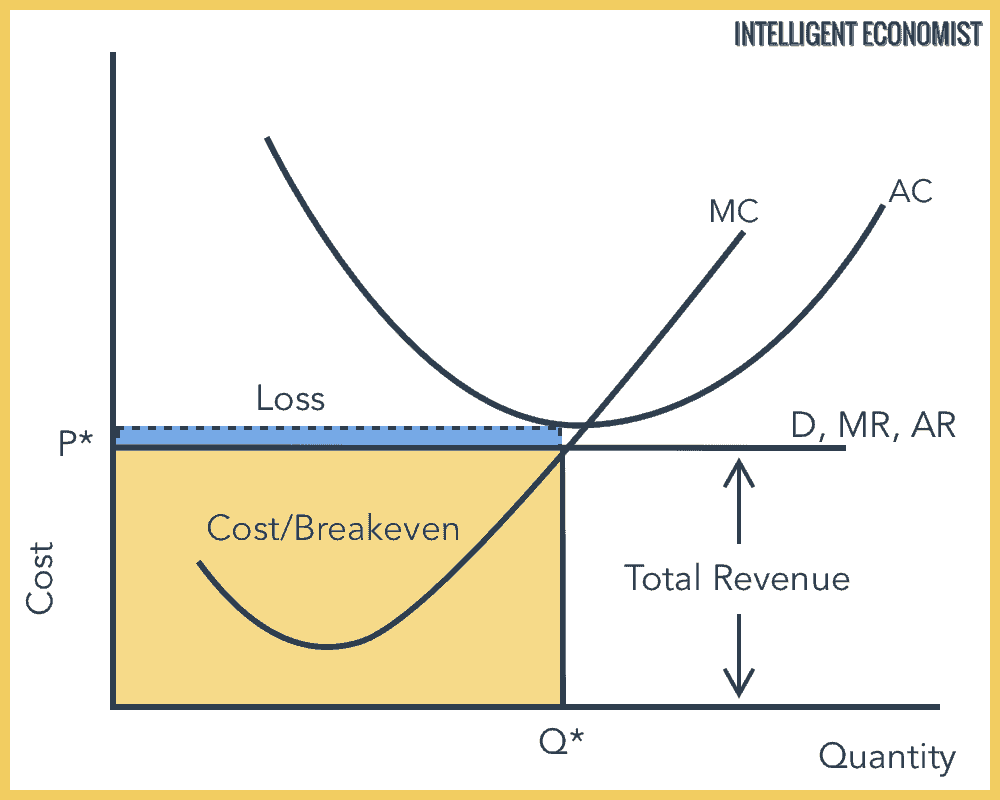
Perfect Competition Short Run Equilibrium Loss Making:

Perfect Competition Short Run Equilibrium Loss Making

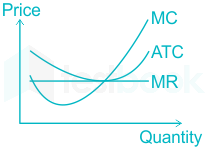
  • In the diagram above, the firm is making a Loss.
  • We can intuitively tell it makes a loss because its average costs are higher than the average revenue.
  • In the Perfect Competition short-run, the firm will continue to produce if he can recover the average variable cost, as fixed costs are paid regardless of production.

​Therefore, under perfect competition and short run , a firm would continue to produce provided it is able to recover its variable costs.

31

Price Discrimination is possible in.......competition

  1. ((a))

    Perfect competition

  2. ((b))

    Monopoly

  3. ((c))

    Monopolistic

  4. ((d))

    Oligopoly

Show Answer
Answer: ((b))

Monopoly

Monopoly- A market structure characterized by a single seller, selling a unique product in the market. In a monopoly market, the seller faces no competition, as he is the sole seller of goods with no close substitute.

  • In a monopoly market, factors like government license, ownership of resources, copyright and patent and high starting cost make an entity a single seller of goods. All these factors restrict the entry of other sellers in the market. Monopolies also possess some information that is not known to other sellers.
  • Characteristics associated with a monopoly market make the single seller the market controller as well as the price maker. He enjoys the power of setting the price for his goods.
  • A monopolistic market is a theoretical construct that describes a market where only one company may offer products and services to the public. A monopolistic market is the opposite of a perfectly competitive market, in which an infinite number of firms operate. In a purely monopolistic model, the monopoly firm can restrict output, raise prices, and enjoy super-normal profits in the long run.
  • Purely monopolistic markets are scarce and perhaps even impossible in the absence of absolute barriers to entry, such as a ban on competition or sole possession of all-natural resources.
  • Hence, one can conclude that Price Discrimination is possible in monopoly competition.

  • Monopolistic competition is found in a market of a small number of players. Whereas a monopoly is a single-player market.
  • Under monopoly, there are strong barriers to the entry of new firms. On the other hand, under monopolistic competition, new firms can enter into the market and the same can exit the market.

Perfect competition- Pure or perfect competition is a theoretical market structure in which the following criteria are met:

  • All firms sell an identical product (the product is a "commodity" or "homogeneous").
  • All firms are price takers (they cannot influence the market price of their product).
  • Market share has no influence on prices.
  • Buyers have complete or "perfect" information—in the past, present and future—about the product being sold and the prices charged by each firm.
  • Resources for such labor are perfectly mobile.
  • Firms can enter or exit the market without cost.

This can be contrasted with the more realistic imperfect competition, which exists whenever a market, hypothetical or real, violates the abstract tenets of neoclassical pure or perfect competition. Since all real markets exist outside of the plane of the perfect competition model, each can be classified as imperfect. 

Oligopoly- is a market structure with a small number of firms, none of which can keep the others from having significant influence. The concentration ratio measures the market share of the largest firms.

  • A monopoly is one firm, a duopoly is two firms and an oligopoly is two or more firms. There is no precise upper limit to the number of firms in an oligopoly, but the number must be low enough that the actions of one firm significantly influence the others.
  • Oligopoly is when a small number of firms collude, either explicitly or tacitly, to restrict output and/or fix prices, in order to achieve above normal market returns.
  • Economic, legal, and technological factors can contribute to the formation and maintenance, or dissolution, of oligopolies.
  • The major difficulty that oligopolies face is the prisoner's dilemma that each member faces, which encourages each member to cheat.
  • Government policy can discourage or encourage oligopolistic behavior, and firms in mixed economies often seek government blessing for ways to limit competition.
32

A firm will shut down rather than carry on producing in the short run if

  1. ((a))

    AR is less than ATC

  2. ((b))

    TR is less than TVC

  3. ((c))

    MR is less than MC

  4. ((d))

    Price is less than AR

Show Answer
Answer: ((b))

TR is less than TVC

Shut Down Price (Short Run):

  • The shutdown price is the minimum price a business needs to justify remaining in the market in the short run
  • A business needs to make at least a normal profit, in the long run, to justify remaining in an industry
  • But in the short run a firm will continue to produce as long as total revenue covers total variable costs (TR > TVC) or price per unit > or equal to average variable cost (AR = AVC). This is called the short-run shutdown price.
  • The reason for this is as follows.
  • A business’s fixed costs must be paid regardless of the level of output.
  • If we make an assumption that these costs cannot be recovered if the firm shuts down then the loss per unit would be greater if the firm were to shut down, provided variable costs are covered.

The shutdown rule states that “in the short run a firm should continue to operate if price exceeds average variable costs** or TR exceeds TVC."**

**Therefore, a firm will shut down rather than carrying on producing in the short run if TR is less than TVC.**​

33

Kinked demand curve is a characteristic of

  1. ((a))

    Duopoly

  2. ((b))

    Perfect competition

  3. ((c))

    Monopoly

  4. ((d))

    Oligopoly

Show Answer
Answer: ((d))

Oligopoly

The correct answer is 'Option D'

Key Points

Kinked demand curve:

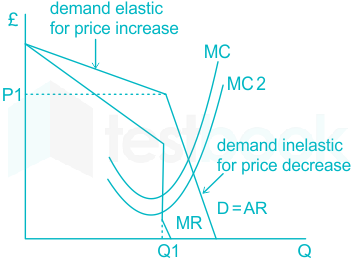
  1. A kinked demand curve occurs when the demand curve is not a straight line but has a different elasticity for higher and lower prices.
  2. One example of a kinked demand curve is the model for an oligopoly.
  3. This model of oligopoly suggests that prices are rigid and that firms will face different effects for both increasing price or decreasing price.
  4. The kink in the demand curve occurs because rival firms will behave differently to price cuts and price increases.

Therefore, the Kinked demand curve is a characteristic of Oligopoly.

Additional Information

Diagram of the kinked demand curve:

The logic of the kinked demand curve is based on

  1. A few firms dominate the industry
  2. Firms wish to maximize profits

Impact of price rise:

  1. If a firm increases the price, then it becomes more expensive than rivals and therefore, consumers will switch to its rivals.
  2. Therefore for a price rise, there is likely to be a significant fall in demand. Demand is, therefore, price elastic.
  3. In this case, increasing-price firms will lose revenue because the percentage fall in demand is greater than the percentage rise in price.

Impact of price cut

  1. If a firm cuts its price, it is likely to lead to a different effect. In the short term, if a firm cuts price it would cause a big increase in demand and therefore would lead to a rise in revenue. The firm would gain market share.
  2. However, other firms will not want to see this fall in market share and so they will respond by also cutting prices to follow the first firm.
  3. The net effect is that if all firms cut price – the individual firm will only see a small increase in demand.
  4. Because there is a ‘price war’ demand for a firm is price inelastic – there is a smaller percentage rise in demand.
  5. If demand is inelastic and price falls, then revenue will fall.

Prices stable

  1. If the kinked demand curve is true, the firm has no incentive to raise prices or to cut prices.
34

The term ‘FAD’ coined by Prof. Amartya Sen stands for

  1. ((a))

    Food Agriculture Development

  2. ((b))

    Famines and Droughts

  3. ((c))

    food and Development

  4. ((d))

    Food Availability Decline

Show Answer
Answer: ((d))

Food Availability Decline

After a  9-month bloody war of liberation, which,  by popular estimate,  claimed about three million lives, Bangladesh,  former East  Pakistan,  emerged as an independent nation on the world map in December 1971. It was traditionally a food-deficit area, a critical problem that was further aggravated after independence by a variety of factors including damaged physical and economic infrastructures, crop damage caused by consecutive flooding, dwindling foreign exchange reserves affecting the country’s ability to import foodgrains, and finally disrupted the flow of food aids.

In 1974, the food crisis turned out so serious that the government had to declare a state of famine in the country. Given the circumstances which led to the development of this famine condition, it is popularly believed that this inhuman episode was instigated by the  ‘sharp and sudden decline in food supply’.  Amartya  Sen strongly disagrees with this view.  In his exact words,  “The food availability approach offers very little in the way of explanation of the Bangladesh famine of 1974.  The total output,  as well as availability figures for  Bangladesh as a  whole,  point precisely in the opposite direction,  as do the inter-district figures of production as well as availability.  Whatever  the Bangladesh  famine  of  1974 might  have been,  it wasn't  a Food Availability Decline (FAD) famine.”

Sen has made similar observations about two other gruesome famines –the Bengal famine in 1943  and the  Ethiopian fame during 1972-74. His primary objective in these studies is to provide empirical support to his theory that famines are caused by entitlement failures. Hence, he coined the term FAD and it stands for  Food Availability Decline i.e. FAD.

35

According to Ricardian theory of rent, Rent is a

  1. ((a))

    Economic Surplus

  2. ((b))

    Differential Surplus

  3. ((c))

    Payment for the use of buildings

  4. ((d))

    Payment for the use of land

Show Answer
Answer: ((b))

Differential Surplus

Ricardo defined rent as “that portion of the produce of the earth which is paid to the landlord for the use of the original and indestructible powers of the soil.” In his theory, rent is nothing but the producer's surplus or differential gain and it is found in land only.

David Ricardo, an English classical economist, first developed a theory in 1817 to explain the origin and nature of economic rent.

Ricardo used the economy and rent to analyze a particular question. In the Napoleonic wars (18.05-1815) there was a large rise in corn and land prices. Did the rise in land prices force up the price of corn, or did the high price of corn increase the demand for land and so push up land prices. Ricardo defined rent as, “that portion of the produce of the earth which is paid to the landlord for the use of the original and indestructible powers of the soil.” In his theory, rent is nothing but the producer’s surplus or differential gain, and it is found in land only.

Assumptions of the Theory:

The Ricardian theory of rent is based on the following assumptions:

  1. Rent of land arises due to the differences in the fertility or situation of the different plots of land. It arises owing to the original and indestructible powers of the soil.
  2. Ricardo assumes the operation of the law of diminishing marginal returns in the case of the cultivation of land. As the different plots of land differ in fertility, the produce from the inferior plots of land diminishes though the total cost of production in each plot of land is the same.
  3. Ricardo looks at the supply of land from the standpoint of society as a whole.
  4. In the Ricardian theory it is assumed that land, being a gift of nature, has no supply price and no cost of production. So rent is not a part of the cost, and being so it does not and cannot enter into cost and price. This means that from society’s point of view the entire return from land is surplus earning.

Important Points

Rent as stated by Ricardo is a differential surplus in the sense that a more fertile or super marginal land earns a surplus of revenue over its costs. It is a surplus over the earnings of marginal land, since marginal land earns revenue just to cover its costs.

36

The term "Quasi Rent" was introduced by

  1. ((a))

    J.S. Mill

  2. ((b))

    J.M. Keynes

  3. ((c))

    Ricardo

  4. ((d))

    Alfred Marshall

Show Answer
Answer: ((d))

Alfred Marshall

  • Quasi literally means ‘almost’. Quasi- rent is, therefore, a payment which is almost rent but is not exactly economic rent.
  • Similar abnormal earnings or surplus may also arise in the case of other durable goods like houses and machines.
  • Similarly, quasi-rent may also arise due to a temporary scarcity of a particular kind of skill which can be increased only if enough time is given.
  • From the Ricardian theory of rent, a person might conclude that rent is a kind by itself and does not resemble any other payment. But this is not so. The peculiarity of the land after all is that all its stock is fixed forever. Rent arises from this peculiarity. That is why Benham defines rent as “a surplus accruing to a specific factor, the supply of which is fixed.”
  • Now no other factor is permanently fixed like land. But whenever the supply of any other factor is fixed even temporarily, its return resembles rent and is called quasi-rent. Thus, an element of rent is present in interest, wages, and profits, and is called quasi-rent. It lasts only for a short period of time and disappears when conditions become normal.
  • This concept of quasi-rent was introduced in economic theory by Marshall. It is an extension of the Ricardian concept of rent to the short-run earnings of capital equipment (such as machinery, buildings), which is in inelastic supply in the short-run, that is, whose supply cannot be increased in the short period. For example, during the last war, merchant shipping became scarce. New ships could not replace the lost ones quickly as ships take long to build. As a result, the existing vessels began to charge high freights and earned exceptional profits.
  • These profits were temporary, because had the need lasted long enough, new- ships would have been constructed and profits reduced to normal. Such abnormal earnings, during the period the supply of machines or ships is fixed, are termed by Marshall as ‘quasi-rent’.
  • The concept of quasi-rent owes its origin to Dr. Alfred Marshall. Dr. Marshal is of the opinion that:
  • "It is not possible for human beings to increase the supply of land. It is fixed by Nature. If the price of production rises, the surface of the earth cannot be increased and if the price falls, it cannot be decreased. But by the appliance of the machine which is the product of human efforts, the supply can be increased or decreased if a fairly long period of time is allowed".
  • "Marshall is of the view that a differential surplus which arises from a factor of production, whose supply is fixed for all times to come should be named as rent but a temporary gain which a factor or production earns due to temporary limitation of its supply should be called quasi-rent".
  • "Quasi-rent is, thus, a temporary gain which is earned by a factor of production due to the temporary limitation of its supply"
37

The "Innovation Theory of Profit" was given by

  1. ((a))

    Prof. Schumpeter

  2. ((b))

    Prof. J.B. Clark

  3. ((c))

    Prof. F.B. Hawley

  4. ((d))

    Prof. Frank H. Knight

Show Answer
Answer: ((a))

Prof. Schumpeter

The Innovation Theory of Profit was proposed by Joseph. A. Schumpeter, who believed that an entrepreneur could earn economic profits by introducing successful innovations. 

In other words, the innovation theory of profit posits that the main function of an entrepreneur is to introduce innovations, and the profit in the form of reward is given for his performance. 

Schumpeter’s Innovation Theory – 

According to Schumpeter, innovation refers to any new policy that an entrepreneur undertakes to reduce the overall cost of production or increase the demand for his products.   

Thus, innovation can be classified into two categories; –   

  • The first category includes all those activities which reduce the overall cost of production such as the introduction of a new method or technique of production, the introduction of new machinery, innovative methods of organizing the industry, etc.
  • The second category of innovation includes all such activities which increase the demand for a product. Such as the introduction of a new commodity or new quality goods, the emergence or opening of a new market, finding new sources of raw material, a new variety or a design of the product, etc.
  • In other words, the innovation theory of profit posits that the main function of an entrepreneur is to introduce innovations, and the profit in the form of reward is given for his performance.
38

If Indirect taxes are subtracted and subsidies are added to Net domestic product at market price we will get

  1. ((a))

    Net Domestic Product at Factor Cost

  2. ((b))

    Net National Product at Factor Cost

  3. ((c))

    Gross Domestic Product at Market Price

  4. ((d))

    Gross National Product at Market Price

Show Answer
Answer: ((a))

Net Domestic Product at Factor Cost

The correct answer is Net Domestic Product at Factor Cost.

Net Domestic Product at Factor Cost:

  1. According to Hanson, “Net domestic income is the income generated in the form of wages, rent, interest, and profit in the domestic territory of a country by all the producers (normal residents and non-residents) in an accounting year.”
  2. In the words of Peterson, “The net domestic product at factor cost is the sum total of net values added by all the producers in the domestic territory of the country during an accounting year.”

Constituents

 (1) NDP at Factor Cost: It includes all the elements of NDP at the market price of net value added except net indirect taxes.

NDP AT FACTOR COST = NDP AS MARKET PRICE – Indirect Taxes + Subsidies

  1. NET NATIONAL PRODUCT (NNP)​
  • Thus, NNP at market price is a gross national product at market price minus depreciation.
  • GNP – Depreciation = NNP
  • GNP at Market Price – Depreciation = NNP at Market Price
  • NNP at Factor Cost = NNP at Market Price – Net Indirect tax       2. GDP at market price
  • GDP at Market Price = Value of output Produced by all producing units within the Domestic Territory – Value of Intermediate Consumption.       3. Gross National Product at Market price
  • GNP at Market Price = Gross Domestic Product at Market Price + Net Factor Income from Abroad
39

An example of Transfer payments is

  1. ((a))

    Old age pension

  2. ((b))

    Bonus received by employees

  3. ((c))

    Commission received on sale of land

  4. ((d))

    Retirement pension

Show Answer
Answer: ((a))

Old age pension

Transfer Payment

  • A transfer payment is a one-way payment to a person or organization which has given or exchanged no goods or services for it. This contrasts with a simple "payment," which in economics refers to a transfer of money in exchange for a product or service.
  • Transfer payments, or subsidies, are analytically equivalent to negative taxes.
  • Generally, the phrase "transfer payment" is used to describe government payments to individuals through social programs such as welfare, student grants, and even Social Security.
  • However, government payments to corporations—including unconditional bailouts and subsidies—are not commonly described as transfer payments.
  • One-way payment of money for which no money, good, or service is received in exchange.
  • Governments use such payments as means of income redistribution by giving out money under social welfare programs such as social security, old age or disability pensions, student grants, unemployment compensation, etc.
  • Subsidies paid to exporters, farmers, manufacturers, however, are not considered transfer payments. Transfer payments are excluded in computing gross national product.

Hence, an example of Transfer payments is Old age pension​.

  • A transfer payment is a payment of money for which there are no goods or services exchanged.
  • Transfer payments commonly refer to efforts by local, state, and federal governments to redistribute money to those in need.
  • Corporate bailouts and subsidies are not commonly referred to as transfer payments.
  • Types of Transfer Payments
  • The most well-known form of transfer payment is likely Social Security payments, whether for retirement or disability. These are considered transfer payments even though most recipients have paid into the system during their working lives. Similarly, unemployment payments are also considered transfer payments.
  • There are many other types of transfer payments. They can be made from one person to another or even from an individual to an organization. These can include individual donations to charities or non-profit organizations, or even a simple cash gift from one person to another.
  • Subsidies for education and training are also considered a type of government transfer payment. This includes transfers to companies or labor groups that provide educational services or operate apprenticeship programs.
  • Transfer payments do not include subsidies paid to farmers, manufacturers, and exporters, even though they are a one-way payment from the government.
40

The income of self-employed is referred as

  1. ((a))

    Operating Surplus

  2. ((b))

    Mixed Income

  3. ((c))

    Private Income

  4. ((d))

    Personal Income

Show Answer
Answer: ((b))

Mixed Income

A self-employed individual does not work for a specific employer who pays them a consistent salary or wage. Self-employed individuals, or independent contractors, earn income by contracting with a trade or business directly.

The remuneration of the self‑employed is treated as mixed income. It is defined as the income that is received, over a given reference period, by individuals, for themselves or in respect of their family members, as a result of their current or former involvement in self‑employment jobs.

For purposes of measurement of income related to self‑employment, the self‑employed are primarily the sole owners, or joint owners, of the unincorporated household enterprises in which they work.

Hence, the income of self-employed is referred to as Mixed-Income.

  • Mixed income is the surplus or deficit accruing from production by unincorporated enterprises owned by households; it implicitly contains an element of remuneration for work done by the owner, or other members of the household, that cannot be separately identified from the return to the owner as an entrepreneur but it excludes the operating surplus coming from owner-occupied dwellings.
  • Operating surplus is an accounting concept used in national accounts statistics which refers to the measure of the surplus accruing from the production of the output before deducting property income from it like land rent and interest. It is a component of value-added and Gross domestic product.
  • Private income is the total of factor incomes and transfer incomes received from all sources by the private sector (private enterprise and households) within and outside the country.”
  • It also includes net factor income from abroad. Private Sector consists of private enterprises and households [factor owners). Thus, private income consists of not only factor incomes earned within the domestic territory and abroad but also all current transfers from government and rest of the world. In tills way it is the sum of earned incomes and transfer incomes received by private sector.
  • Personal income is the sum of earned income and transfer income received by persons (households) from all sources within and outside the country. The point to be noted here is that personal income includes not only factor incomes that are earned from productive services but also transfer incomes (or payments) that are received without rendering any productive service. Thus, personal income is the sum of earned incomes and current transfer incomes. In other words, it is a receipt concept as compared to national income which is an earning concept.
41

Which of the following is not included in the calculation of National Income

  1. ((a))

    Employers contribution to provident fund

  2. ((b))

    Unemployment allowance

  3. ((c))

    Free services by Government

  4. ((d))

    Defence and security services

Show Answer
Answer: ((b))

Unemployment allowance

National Income:

  1. National Income is the total amount of goods and services produced within the nation during the given period say, 1 year.
  2. It is the total of factor income i.e. wages, interest, rent, profit, received by factors of production i.e. labour, capital, land and entrepreneurship of a nation.

Some of the major items whether included or excluded in national income are as follows:

  1. Construction of a new house: Yes, it will be included in the national income as it is a part of capital formation and leads to production of goods and services in the economy.
  2. Contribution to the provident fund by employer OR Value of interest foregone on loans provided by the employer to an employee: Yes, it will be included in the national income as it is a part of the compensation to employees.
  3. Free medical facilities by the employer OR Free boarding and lodging provided to a domestic servant: Yes. It will be included in national income as these free services are part of the compensation to employees.
  4. Defence and security services are included in National Income because the services of the defence personnel, policemen etc. are treated as final services, thereby form a part of National Income.

Unemployment Allowance: This is available to those persons who are not employed. This is, therefore, only a transfer payment not included in National Income.

Therefore, Unemployment Allowance is not included in the calculation of National Income.

42

Which one of the following is not the function of a Commercial Bank

  1. ((a))

    Credit Creation

  2. ((b))

    Advancing Loans

  3. ((c))

    Issuing of Notes

  4. ((d))

    Agency functions

Show Answer
Answer: ((c))

Issuing of Notes

The term commercial bank refers to a financial institution that accepts deposits, offers checking account services, makes various loans, and offers basic financial products like certificates of deposit (CDs) and savings accounts to individuals and small businesses.

  • A commercial bank is where most people do their banking. Commercial banks make money by providing and earning interest from loans such as mortgages, auto loans, business loans, and personal loans. Customer deposits provide banks with the capital to make these loans.
  • Banks make money from service charges and fees. These fees vary based on the products, ranging from account fees (monthly maintenance charges, minimum balance fees, overdraft fees, non-sufficient funds (NSF) charges), safe deposit box fees, and late fees. Many loan products also contain fees in addition to interest charges.
  • Banks also earn money from interest they earn by lending out money to other clients. The funds they lend comes from customer deposits. However, the interest rate paid by the bank on the money they borrow is less than the rate charged on the money they lend.
  • Commercial banks are an important part of the economy. Not only do they provide consumers with an essential service, but they also help create capital and liquidity in the market. This entails taking money that their customers deposit for their savings and lending it out to others.
  • Commercial banks play a role in the creation of credit, which leads to an increase in production, employment, and consumer spending, thereby boosting the economy. As such, commercial banks are heavily regulated by central banks. For instance, central banks impose reserve requirements on commercial banks. This means banks are required to hold a certain percentage of their consumer deposits at the central bank as a cushion if there's a rush to withdraw funds by the general public.

Hence, Issuing of Notes is not the function of a Commercial Bank.

NOTE- The coins are issued for circulation only through the Reserve Bank in terms of the RBI Act.

43

Which of the following is not quantitative instrument for credit control by the Central Bank

  1. ((a))

    Bank rate

  2. ((b))

    Open Market Operations

  3. ((c))

    Cash Reserve Ratio

  4. ((d))

    Margin requirement of loan

Show Answer
Answer: ((d))

Margin requirement of loan

The RBI controls the money supply in the economy in various ways. The tools used by the Central bank to control the money supply can be quantitative or qualitative.

  • Quantitative tools, control the extent of the money supply by changing the CRR, or bank rate or open market operations.
  • Qualitative tools include persuasion by the Central bank in order to make commercial banks discourage or encourage lending which is done through moral suasion, margin requirement, etc.
  • Hence, it is clear that the Margin requirement of loan is not a quantitative instrument for credit control by the Central Bank.
  • Bank Rate- The RBI can influence money supply by changing the rate at which it gives loans to the commercial banks. This rate is called the Bank Rate in India. By increasing the bank rate, loans taken by commercial banks become more expensive; this reduces the reserves held by the commercial bank and hence decreases the money supply. A fall in the bank rate can increase the money supply.
  • Another important tool by which the RBI also influences the money supply is Open Market Operations.
  • Open Market Operations refers to the buying and selling of bonds issued by the Government in the open market. This purchase and sale is entrusted to the Central bank on behalf of the Government. When RBI buys a Government bond in the open market, it pays for it by giving a cheque. This cheque increases the total amount of reserves in the economy and thus increases the money supply.
  • Selling of a bond by RBI (to private individuals or institutions) leads to a reduction in the quantity of reserves and hence the money supply.
  • There are two types of open market operations: outright and repo. Outright open market operations are permanent in nature: when the central bank buys these securities (thus injecting money into the system), it is without any promise to sell them later. Similarly, when the central bank sells these securities (thus withdrawing money from the system), it is without any promise to buy them later. As a result, the injection/absorption of the money is of permanent nature.
  • However, there is another type of operation in which when the central bank buys the security, this agreement of purchase also has specification about date and price of resale of this security. This type of agreement is called a repurchase agreement or repo. The interest rate at which the money is lent in this way is called the repo rate. Similarly, instead of an outright sale of securities the central bank may sell the securities through an agreement which has a specification about the date and price at which it will be repurchased. This type of agreement is called a reverse repurchase agreement or reverse repo. The rate at which the money is withdrawn in this manner is called the reverse repo rate.
  • The Reserve Bank of India conducts repo and reverse repo operations at various maturities: overnight, 7-day, 14- day, etc. This type of operations have now become the main tool of monetary policy of the Reserve Bank of India.
44

To increase the flow of credit in the economy the Central Bank

  1. ((a))

    Reduces the Statutory Liquidity Ratio

  2. ((b))

    Increases the Cash Reserve Ratio

  3. ((c))

    Increases the Bank Rate

  4. ((d))

    None of the above

Show Answer
Answer: ((a))

Reduces the Statutory Liquidity Ratio

In India, the legal framework of RBI’s control over the credit structure has been provided Under the Reserve Bank of India Act, 1934 and the Banking Regulation Act, 1949. Quantitative credit controls are used to maintain the proper quantity of credit of money supply in the market.

Some of the important general credit control methods are

(A) Two Policy Rates: 

  1. Bank rate is the rate charged on the loans offered by the Central bank to the commercial banks without any collateral. It is increased at the time of inflation to reduce the money supply in the economy and vice versa.
  2. Repo rate is the rate charged on the secured loans offered by the Central bank to the commercial banks that includes collateral. It is increased at the time of inflation to reduce the money supply in the economy and vice versa.


(B) Two Policy Ratio:

  1. Statutory Liquidity Ratio (SLR) refers to liquid assets that the commercial banks must hold on a daily basis as a percentage of their total deposits. SLR is determined by the central bank and is a legal requirement to be fulfilled by the commercial banks. It is decreased at the time of recession to increase the money supply in the economy and vice versa.
  2. Cash Reserves Ratio (CRR) refers to the proportion of total deposits of the commercial banks that they must have kept as cash reserves with the central bank. The ratio is fixed by the central bank and is varied from time to time to control the supply of money in the economy depending upon the prevailing situation of inflation or deflation.

Therefore, to increase the flow of credit in the economy the Central Bank reduces the Statutory Liquidity Ratio.

45

Which of the following is a Normal Resident of India

  1. ((a))

    USA ambassador in India

  2. ((b))

    Foreign tourists visiting India

  3. ((c))

    Foreigners working in WHO located in India

  4. ((d))

    None of the above

Show Answer
Answer: ((c))

Foreigners working in WHO located in India

A normal resident of a country refers to an individual or an institution who ordinarily resides in the country and whose centre of economic interest also lies in that country.

Normal residents include both, individuals and institutions.

'Centre of Economic Interest’ implies two things:

  1. The resident lives or is located within the Domestic Territory; and
  2. The resident carries out basic economic activities of earnings, spending, and accumulation from that location.

Following are not included under the category of Normal residents:

  1. Foreign tourists and visitors who visit a country for recreation, holidays, medical treatment, study, sports, conferences, etc.
  2. Foreign staff of Embassies (USA ambassador in India), officials, diplomats, and members of the armed forces of a foreign country, located in the given country;
  3. International organizations like UNO, WHO, etc. are not considered as normal residents of the country in which they operate. They are treated as normal residents of the international area.

  1. International bodies (Like World Bank, World Health Organization, or International Monetary Fund) are not considered residents of the country in which these organizations operate but are treated as residents of the international territory.
  2. However, the staff of these bodies is treated as normal residents of the country in which the International body operated.
  3. For Example, an international body like the World Health Organization located in India is not a normal resident but Americans working in its office for more than a year will be treated as normal residents of India.

Therefore, Foreigners working in WHO located in India is a Normal Resident of India.

46

Leakages, which have a negative impact on the process of income generation in the economy are

  1. ((a))

    Savings

  2. ((b))

    Imports

  3. ((c))

    Taxes by the government

  4. ((d))

    All of the above

Show Answer
Answer: ((d))

All of the above

Leakage:

  1. In economics, leakage refers to capital or income that diverges from some kind of iterative system.
  2. Leakage is usually used in relation to a particular depiction of the flow of income within a system, referred to as the circular flow of income and expenditure, in the Keynesian model of economics.
  3. Within this depiction, leakages are the non-consumption uses of income, including saving, taxes, and imports.

  1. This particular Keynesian model of the flow of income is usually depicted as a circle, and the components include national income, output, consumption, and factor payments.
  2. Non-consumption uses of income—savings, taxes, and imports—are "leaked" out of the main flow.
  3. This reduces the money available throughout the rest of the economy.
  4. This theory of Keynesian economics purports that when leakage causes a shortage of capital, governments might have to take steps to stimulate their economies by injecting cash into their systems.
  5. This injection of funds can be achieved by increasing the level of exports to foreign nations, or by borrowing funds from investors or foreign governments.

Therefore, Leakages, which have a negative impact on the process of income generation in the economy are savings, imports, and taxes by the government.

47

If personal disposable income is Rs.1000 crore and consumption expenditure is Rs. 750 crore then APS (Average Propensity to Save) is

  1. ((a))

    0.25

  2. ((b))

    0.75

  3. ((c))

    2.5

  4. ((d))

    7.5

Show Answer
Answer: ((a))

0.25

The Average Propensity to Save (APS):

  • The ratio of total savings to total income is called APS. Alternatively, it is that part of the total income which is saved.
  • By dividing total saving (S) with total income (Y), we get APS.

Symbolically:

APS = S/Y

For Instance:

Personal disposable income (Y) = Rs.1000 crore 

Consumption expenditure = Rs. 750 crore

Savings = Personal disposable income - Consumption expenditure = 1000 Cr - 750 Cr.

Therefore, Savings (S) = Rs. 250 Cr.

APS = S/Y = 250 Cr/ 1000 Cr.

Therefore, APS = 0.25

If personal disposable income is Rs.1000 crore and consumption expenditure is Rs. 750 crore then APS (Average Propensity to Save) is 0.25.

48

Which of the following is not a Capital Receipt of the govt. budget

  1. ((a))

    Recovery of loans

  2. ((b))

    Money received through disinvestment

  3. ((c))

    Tax receipts

  4. ((d))

    Borrowings from general public

Show Answer
Answer: ((c))

Tax receipts

Government receipts are divided into two groups—Revenue Receipts and Capital Receipts.

All Government receipts which either create liability or reduce assets are treated as capital receipts whereas receipts which neither create liability nor reduce assets of Government are called revenue receipts.

Revenue Receipts:

Government receipts which neither (i) create liabilities nor (ii) reduce assets are called revenue receipts.

These are proceeds of taxes, interest and dividend on government investment, cess, and other receipts for services rendered by the government. These are current income receipts of the government from all sources. Government revenue is the means for government expenditure. In the same way, as production is meant for consumption. Revenue receipts are further classified Into Tax Revenue and Non­tax Revenue as explained in Section 9.6.

Capital Receipts:

Government receipts which either (i) create liabilities (e.g. borrowing) or (ii) reduce assets (e.g. disinvestment) are called capital receipts. Thus when govt. raises funds either by incurring a liability or by disposing off its assets, it is called a capital receipt.

Hence, tax receipts are not a Capital Receipt but revenue receipts of the govt. budget.

49

The statistical method used for collection of secondary data is

  1. ((a))

    Direct personal investigation

  2. ((b))

    Indirect oral investigation

  3. ((c))

    Through questionnaires and schedules

  4. ((d))

    Through govt. publications

Show Answer
Answer: ((d))

Through govt. publications

Data Collection Methods: 

  1. In Statistics, data collection is a process of gathering information from all the relevant sources to find a solution to the research problem.
  2. It helps to evaluate the outcome of the problem.
  3. Depends on the type of data, the data collection method is divided into two categories namely,
  • Primary Data Collection methods
  • Secondary Data Collection methods

(A) Primary Data Collection Methods: Primary data or raw data is a type of information that is obtained directly from the first-hand source through experiments, surveys, or observations. The primary data collection method is further classified into two types. They are

  1. Quantitative Data Collection Methods
  2. Qualitative Data Collection Methods

Qualitative Data Collection Methods

It does not involve any mathematical calculations. This method is closely associated with elements that are not quantifiable. This qualitative data collection method includes interviews, questionnaires, observations, case studies, etc. There are several methods to collect this type of data. They are

  1. Observation Method: The observation method is used when the study relates to behavioral science. This method is planned systematically. It subjects many controls and checks. The different types of observations are:
  • Structured and unstructured observation
  • Controlled and uncontrolled observation
  • Participant, non-participant, and disguised observation
  1. Interview Method: The method of collecting data in terms of oral or verbal responses. It is achieved in two ways, such as
  • Personal Interview – In this method, a person known as an interviewer is required to ask questions face to face to the other person. The personal interview can be structured or unstructured, direct investigation, focused conversation, etc.
  • Telephonic Interview – In this method, an interviewer obtains information by contacting people on the telephone to ask the questions or views orally.
  1. Questionnaire Method: In this method, the set of questions are mailed to the respondent. They should read, reply, and subsequently return the questionnaire. The questions are printed in the definite order on the form. A good survey should have the following features:
  • Short and simple
  • Should follow a logical sequence
  • Provide adequate space for answers
  • Avoid technical terms.
  1. Schedule: This method is similar to the questionnaire method with a slight difference. The enumerations are specially appointed for the purpose of filling the schedules. It explains the aims and objects of the investigation and may remove misunderstandings if any have come up. Enumerations should be trained to perform their job with hard work and patience.

(B) Secondary Data Collection Methods

Secondary data is data collected by someone other than the actual user. It means that the information is already available, and someone analyses it. The secondary data includes magazines, newspapers, books, journals, etc. It may be either published data or unpublished data.

Published data are available in various resources including

  • Government publications
  • Public records
  • Historical and statistical documents
  • Business documents
  • Technical and trade journals

Unpublished data includes

  • Diaries
  • Letters
  • Unpublished biographies etc.

The statistical method used for the collection of secondary data is through govt. publications.​

50

As per 2011 census the literacy rate of males and females respectively in India is

  1. ((a))

    82.14% and 65.46%

  2. ((b))

    75.50% and 65.46%

  3. ((c))

    50% and 40%

  4. ((d))

    None of the above

Show Answer
Answer: ((a))

82.14% and 65.46%

Literacy level and educational attainment are vital developmental indicators in a developing nation like India as they are key variable of measure of development as they indicate quality of life, awareness level and also level of skill of people in the society. Better literacy and educational level definitely have a positive impact on the health parameters. Education parameters have an equal weightage in the Human Development Index as well. Considering the importance of education, India has enacted Right to Education to ensure free and compulsory Education for children in the age group 6- 14 years. 

Literacy Rate

As per 2011 census, literacy rate in India has been reported as 74.04% with a 14% increase to that in 2001, whereas the hike is maximum for rural women at 26% in the last decade. The female literacy levels according to the Literacy Rate 2011 census are 65.46% whereas the male literacy rate is over 80%.

Adult Literacy Rate

The adult literacy rate (15+) for male is 78.8 against 59.3 of females in 2011. In 2011, just half of the rural adult females are literate against 76.9% urban females. 88.3% Urban adult males are literate against 74.1 rural adult males.

51

As per the 2011 census report the state/union territory with highest literacy rate of 93.91% is

  1. ((a))

    Lakshadweep

  2. ((b))

    Kerala

  3. ((c))

    Goa

  4. ((d))

    Uttar Pradesh

Show Answer
Answer: ((b))

Kerala

The correct answer is Kerala.

 Key Points

  • As per the provisional figures of Census 2011, in India 77,84,54,120 persons have been counted as literates. Among all literates, 33,42,50,358 are females, whereas 44,42,03,762 are males. The literacy rate of India in 2011 is 74.0 per cent. Literacy rate among females is 65.5 per cent whereas the literacy rate among males is 82.1 per cent.
  • In order of higher literacy rates; Kerala, Lakshadweep and Mizoram states hold first, second and third positions respectively; whereas in female literacy, Kerala is the first while Mizoram and Lakshadweep hold second and third positions among all States and Union Territories.

52

The apex bank Reserve Bank of India was nationalised in the year

  1. ((a))

    1945

  2. ((b))

    1930

  3. ((c))

    1949

  4. ((d))

    1950

Show Answer
Answer: ((c))

1949

The correct answer is 1949.

Key Points

The Central Bank, also known as the National Bank or Reserve Bank in some countries, is an apex monetary authority in a country. It is an institution that manages and oversees a country's money supply, inflation, and interest rates. It regulates the commercial banking system and acts as a watchdog and regulator of other banks of a country. A Central Bank of a country acts as a banker and financial adviser to the government. Due to its pivotal role in the banking system, it is also known as "lender of last resort".

Reserve Bank Of India (RBI)-

  • The Reserve Bank of India (RBI) is the apex monetary Institution which controls Indian Rupee, monetary policy, and the banking system in India. The central bank was first established in the year 1935 under the Reserve Bank of India Act, 1934. After India's independence, the RBI was nationalized on 1 January 1949.
  • RBI plays a vital role in the developmental strategy of the Government as it regulates the monetary policy of the country.

Additional Information

Salient Features of the Reserve Bank of India Act

  • Accepting of deposits from the Central and State Governments.
  • Purchase, sale and rediscounting of bills of exchange and promissory notes.
  • Sale and purchase of treasury bills.
  • Advancing money to local authorities, scheduled banks, State Cooperative banks, development finance institutions, etc.
  • Advancing money to the Central and State Governments.
  • Purchase and Sale ofGovernment securities.
  • Keeping of reserves of commercial banks.
  • Management of clearing houses throughout the country, etc.
  • The RBI Act empowers the Reserve Bank to perform Central Banking. Functions such as-
  • Issue of currency notes.
  • Government's banks.
  • Banker of the commercial banks.
  • Control of credit in the economy.
  • The Reserve Bank has been given the power to issue licenses for open new banking companies and also for new branches.
53

Who amongst the following is most benefitted from inflation

  1. ((a))

    Government pensioners

  2. ((b))

    Saving bank account holders

  3. ((c))

    Debtors

  4. ((d))

    Creditors

Show Answer
Answer: ((c))

Debtors

Inflation is a continuous rise in the price level. Inflation means the value of money will fall and purchase relatively fewer goods than previously.

In summary:

  1. Inflation will hurt those who keep cash savings and workers with fixed wages.
  2. Inflation will benefit those with large debts who, with rising prices, find it easier to pay back their debts.

LosersWinners
- Savers- Debtors on fixed repayments plan
- Retirees living on fixed incomes (Government pensioners)- Government with high public sector debt
- Workers on fixed incomes- Owners of Land and Physical assets
- Borrowers on variable rates- Firms who can cut real wages

Therefore, Debtors are the most benefitted from inflation.

54

Indian Rupee has got its symbol as . ₹ This symbol has been designed by

  1. ((a))

    Hitesh Padmashali

  2. ((b))

    Shibin K K

  3. ((c))

    Rakesh Kumar

  4. ((d))

    D. Udaya Kumar

Show Answer
Answer: ((d))

D. Udaya Kumar

  • The symbol of the Indian Rupee typifies India's international identity for money transactions and economic strength. The Indian Rupee sign is an allegory of Indian ethos.
  • The symbol is an amalgam of Devanagari "Ra" and the Roman Capital "R" with two parallel horizontal stripes running at the top representing the national flag and also the "equal to" sign. The Indian Rupee sign was adopted by the Government of India on 15th July, 2010.
  • The symbol, conceptualized and designed by Udaya Kumar, a post-graduate in Design from Indian Institute of Technology Bombay, has been chosen from thousands of concept entries received by the Ministry of Finance through an open competition among resident Indian nationals.

NOTE- 

  • The Reserve Bank of India (RBI) prints and manages currency in India, whereas the Indian government regulates what denominations to circulate.
  • The Government of India has the sole right to mint coins. The responsibility for coinage vests with the Government of India in terms of the Coinage Act, 1906 as amended from time to time. The designing and minting of coins in various denominations is also the responsibility of the Government of India. Coins are minted at the four India Government Mints at Mumbai, Alipore(Kolkata), Saifabad(Hyderabad), Cherlapally (Hyderabad) and NOIDA (UP).
  • The coins are issued for circulation only through the Reserve Bank in terms of the RBI Act.
55

Inflation in India is measured on which of the following indexes/indicators

  1. ((a))

    Cost of Living Index

  2. ((b))

    Consumer Price Index

  3. ((c))

    Wholesale Price Index

  4. ((d))

    Gross Domestic Product

Show Answer
Answer: ((b))

Consumer Price Index

Inflation is the measure of the rate of increase in the prices of goods and services. However, when there is a decrease in the rate it is called deflation.

In India, generally, two kinds of indices are used to measure inflation—Wholesale Price Index (WPI) and Consumer Price Index (CPI).

Measurement of Inflation in India:

Consumer Price Index

  • CPI, based on 260 commodities including certain services, measures the change in prices at the retail level.
  • Prices of sample goods and services are collected periodically (usually every month) by the Ministry of Statistics and Programme Implementation, and the change, if any, is noted.
  • The base year of CPI was changed to 2012 from 2010. Base year for WPI and IIP (Index of Industrial Production) was also changed to 2012 in April this year.
  • A base year is used to compare the measure of rates. For simple understanding, this can be taken as ‘first’ year in the time set. Prices in the base year are often taken as 100 to simplify calculations.

Consumer Price Indices (CPI) released at the national level are:

  • CPI for Industrial Workers (IW)
  • CPI for Agricultural Labourers (AL)/ Rural Labourers (RL)
  • CPI (Rural/Urban/Combined).

While the first two are compiled and released by the Labour Bureau in the Ministry of Labour and Employment, the third by the Central Statistics Office (CSO) in the Ministry of Statistics and Programme Implementation.

In India, RBI uses CPI(combined) released by CSO for inflation purpose.

Wholesale Price Index (WPI)

  • An index used by the Reserve Bank of India till 2014 to make its monetary policy, WPI, as the name suggests, measures the prices at the wholesale level.
  • WPI is the price of a representative basket of wholesale goods. It takes a basket of 697 items into account and shows the combined prices.
  • The basket used in WPI is composed of three groups: Manufactured Products (65 percent of total weight), Primary Articles like food, etc. (20.1 percent), and Fuel and Power (14.9 percent).
  • The WPI is calculated by the Ministry of Commerce and Industry.
  • The main reason RBI, under ex-governor Raghuram Rajan, shifted to Consumer Price Index is because it neglects services and the bottlenecks between a wholesaler and a retailer.

The primary use of WPI is to have an inflationary trend in the economy as a whole. However, CPI is used for adjusting income and expenditure streams for changes in the cost of living.

1. Cost of Living Index: A cost-of-living index is a theoretical price index that measures the relative cost of living over time or regions. It is an index that measures differences in the price of goods and services and allows for substitutions with other items as prices vary.

2. Gross Domestic Product: Gross domestic product is a monetary measure of the market value of all the final goods and services produced in a specific time period.

56

Who among the following is associated with the theory of Laissez-faire

  1. ((a))

    Malthus

  2. ((b))

    Marshall

  3. ((c))

    Adam Smith

  4. ((d))

    Keynes

Show Answer
Answer: ((c))

Adam Smith

Laissez-faire (a French phrase that means ‘leave alone’ or ‘let it be’) is an economic theory from the 18th century that opposed any government intervention in business affairs. It is an economic philosophy of free market capitalism. Adam Smith proposed the idea of an invisible hand—the tendency of free markets to regulate themselves by means of competition, supply and demand, and self-interest.

Basic Principles of a Laissez-faire Economy

  • The individual is the basic unit in society, i.e., the standard of measurement in social calculus.
  • The individual enjoys a natural right to freedom.
  • The physical order of nature is a harmonious and self-regulating system.

The basic purpose of the laissez-faire economy is to promote a free and competitive market that demands the restoration of the order and natural state of liberty that humans emerged from. A laissez-faire economy is thus characterized by the free movement of forces of supply and demand, free from any form of intervention by a government, a price-setting monopoly, or any other authority.

57

Who has been appointed the Governer of RBI after the retirement of Sh. Y. V Reddy.

  1. ((a))

    Dr. Indra Rangarajan

  2. ((b))

    Dr. Dilip Sanghvi

  3. ((c))

    Dr. Vijay L. Kelkar

  4. ((d))

    Mr. D Subbarao

Show Answer
Answer: ((d))

Mr. D Subbarao

  • Dr. Yaga Venugopal Reddy the twenty-first Governor, is a member of the Indian Administrative Service. He has spent most of his career in the areas of finance and planning. He served as Secretary (Banking) in Ministry of Finance, Additional Secretary, Ministry of Commerce, Joint Secretary in Ministry of Finance in Government of India, Principal Secretary, Government of Andhra Pradesh and had a a six year tenure as Deputy Governor of the Reserve Bank of India. Prior to his appointment as the Governor, Dr. Reddy was India's Executive Director on the Board of the International Monetary Fund.
  • Dr. Reddy has made significant policy contributions in the areas of financial sector reforms; trade finance; monitoring of balance of payments and exchange rate; external commercial borrowings; centre-state financial relations; regional planning; and public enterprise reform and has been closely associated with institution building. He has several publications to his credit mainly in areas relating to finance, planning and public enterprises.
  • Dr. D. Subbarao took over on September 5, 2008 as the 22nd Governor of the Reserve Bank of India. Dr. Subbarao has been appointed for a three-year term. Prior to this appointment, Dr. Subbarao was the Finance Secretary in the Ministry of Finance, Government of India.
  • Dr. Subbarao has earlier been Secretary to the Prime Minister's Economic Advisory Council (2005-2007), lead economist in the World Bank (1999-2004), Finance Secretary to the Government of Andhra Pradesh (1993-98) and Joint Secretary in the Department of Economic Affairs, Ministry of Finance, Government of India (1988-1993). Dr. Subbarao has written extensively on issues in public finance, decentralisation and political economy of reforms.

Additional Info-

  • Dr. Raghuram Rajan assumed charge as the 23rd Governor of the Reserve Bank of India on September 4, 2013. Dr. Rajan was the Chief Economist and Director of Research at the International Monetary Fund.
  • Dr. Rajan's research interests are in banking, corporate finance, and economic development, especially the role finance plays in it. He has co-authored Saving Capitalism from the Capitalists with Luigi Zingales in 2003. He then wrote Fault Lines: How Hidden Fractures Still Threaten the World Economy, for which he was awarded the Financial Times-Goldman Sachs prize for best business book in 2010.
  • Dr. Rajan is a member of the Group of Thirty. He was the President of the American Finance Association in 2011 and is a member of the American Academy of Arts and Sciences.
  • Dr. Urjit R. Patel assumed charge as the twenty-fourth Governor of the Reserve Bank of India effective September 4, 2016 after serving as Deputy Governor since January 2013.
  • Dr. Patel has also served at the International Monetary Fund (IMF). He was on deputation from the IMF to the Reserve Bank during 1996-1997, and in that capacity he provided advice on development of the debt market, banking sector reforms, pension fund reforms, and evolution of the foreign exchange market. He was a Consultant to the Ministry of Finance (Department of Economic Affairs), Government of India, from 1998 to 2001. He has also had other assignments in the public and private sectors.
  • Shri Shaktikanta Das, former Secretary, Department of Revenue and Department of Economic Affairs, Ministry of Finance, Government of India assumed charge as the 25th Governor of the Reserve Bank of India effective December 12, 2018.
  • During his long tenure in the Ministry of Finance, Government of India, he was directly associated with the preparation of as many as 8 Union Budgets. Shri Das has also served as India’s Alternate Governor in the World Bank, Asian Development Bank (ADB), New Development Bank (NDB) and Asian Infrastructure Investment Bank (AIIB). He has represented India in international forum like the IMF, G20, BRICS, SAARC, etc.
58

Five Year Plans in India are finally approved by which of the following bodies.

  1. ((a))

    Planning Commission

  2. ((b))

    Union Cabinet

  3. ((c))

    Parliament

  4. ((d))

    National Development Council

Show Answer
Answer: ((d))

National Development Council

  • Indian planning is an open process. From original formulation through successive modifications to parliamentary presentation, plan making in India has evolved as a responsive democratic political process and the culmination of the same in the final document is an impressive manifestation of the workings of an open society.
  • Five-Year Plans were a formal model of planning adopted by the Indian government after Independence, for an effective and balanced utilisation of resources.
  • They were formulated by the Planning Commission of India, which was established on 15 March 1950. Since it was not a constitutional body, the Commission reported directly to the Prime Minister.
  • The Commission was tasked with the responsibility of raising the standard of living in the country through proper allocation of resources, increasing production and enabling employment opportunities for everybody.
  • The Five-Year Plans were centralised and integrated national economic programs. The first such plan was implemented in the Soviet Union in 1928 by Joseph Stalin. Since then, countries such as China, Bhutan, Vietnam, South Korea, Argentina, Romania and Ethiopia have also implemented Five-Year Plans.
59

The practice of selling goods in a foreign country at a price below their domestic selling price is called

  1. ((a))

    Diplomacy

  2. ((b))

    Discrimination

  3. ((c))

    Dumping

  4. ((d))

    Double Pricing

Show Answer
Answer: ((c))

Dumping

The practice of selling goods in a foreign country at a price below their domestic selling price is called Dumping.

Key Points Dumping:

  1. Dumping in the financial world occurs when a company or a country exports its products at a price lower than its domestic price.
  2. Exporters dump to compete with the producers and sellers in the importing country.
  3. Dumping enables consumers in the importing country to obtain access to goods at an affordable price.
  4. However, it can also destroy the local market of the importing country, which can result in layoffs and the closure of businesses.
  5. The World Trade Organization (WTO) and European Union(EU) regulate dumping by putting tariffs and taxes on trading partners.
  6. Sufficient proof must be provided that dumping has happened.
  7. Dumping can also take place in the exporter’s home market.
  8. If the product can be priced at a higher cost abroad, the company can sell at a lower price at home.

Additional Information

1. Diplomacy: Diplomacy is the practice of conducting negotiations between representatives of states or groups, so as to influence the decisions and conduct of foreign governments through dialogue, negotiation, and other nonviolent means.  2. Discrimination is the act of making unjustified distinctions between human beings based on the groups, classes, or other categories to which they are perceived to belong. People may be discriminated against on the basis of race, gender, age, or sexual orientation, as well as other categories.  3. Double PricingDouble pricing refers to two sets of prices for the same commodity controlled prices for weaker sections and higher open market prices for the others.

60

Which of the following states introduced "One kg rice for rupee one" scheme ,the first of its kind in the country.

  1. ((a))

    West Bengal

  2. ((b))

    Orissa

  3. ((c))

    Bihar

  4. ((d))

    Tamil Nadu

Show Answer
Answer: ((d))

Tamil Nadu

Tamil Nadu states introduced the "One kg rice for rupee one" scheme, the first of its kind in the country.

  1. Tamil Nadu Chief Minister M. Karunanidhi today launched the one rupee a kilo of rice scheme for ration cardholders.
  2. As per the new scheme, 20 kilos of rice will be provided at a price of one rupee a kilo.
  3. The scheme was announced on the occasion of the 100th birth anniversary of Annadurai, former Tamil Nadu Chief Minister.
  4. Annadurai was a follower of E.V.R. Periyar, the founder of the Dravida Kazhagam, and was at the forefront of the rationalist movement.
61

Which of the following is India’s largest Public sector commercial bank at present

  1. ((a))

    IDBI Bank

  2. ((b))

    ICICI bank

  3. ((c))

    State Bank of India

  4. ((d))

    Axis Bank

Show Answer
Answer: ((c))

State Bank of India

Commercial Banks in India:

1. Public Sector Banks: 

  • The term “public sector banks” refers to a situation where the majority equity stake in the banks is held by the government.
  • The Indian Government keeps default holdings of a minimum 51% shareholding, but management control is only with the Central Government, thereby classifying them as Public Sector Banks.
  • Public sector banks include the State Bank of India and its Associates, Nationalized Banks (including Industrial Development Bank of India Ltd (IDBI) since December 2004), and Regional Rural Banks.

2. Private Sector Banks: 

  • They are the banks in which individuals and corporations are the majority shareholders.
  • Some of the major commercial banks in India that were given licenses are ICICI Bank, HDFC Bank, Axis Bank, Yes Bank, and Kotak Mahindra Bank.

State Bank of India (SBI)

  1. SBI is India’s largest public sector bank and is ranked 232nd on the Fortune Global 500 list of the world’s biggest corporations.
  2. The bank is also the country’s biggest lender. It recently joined the list of top 50 banks globally in terms of asset distribution, following its merger with other associate banks:
  • State Bank of Travancore (SBT)
  • State Bank of Patiala (SEP)
  • State Bank of Mysore (SBM)
  • State Bank of Hyderabad (SBH)
  • State Bank of Bikaner and Jaipur (SBBJ)

1. ICICI Bank (Industrial Credit and Investment Corporation of India)

  1. ICICI Bank is India’s largest private sector bank.
  2. The bank, which was a wholly-owned subsidiary of ICICI Limited, is a multinational banking and financial company based in Mumbai, Maharashtra, India with its registered office in Vadodara, Gujarat. 2. Axis Bank
  3. Axis Bank is the third-largest private sector bank in India after ICICI and HDFC. It manages 3,304 branches and 14,200 ATMs across the country as of March 2017. 3. IDBI Bank (Industrial Development Bank of India)
  4. Headquartered in Mumbai, IDBI Bank was established in 1964 by an act of Parliament to provide credit and was owned by the Central Government.
  5. The bank’s aggregate balance sheet is INR 3.74 trillion as of March 2016.
  6. IDBI is the currently the tenth largest development bank in the world, operating 3,700 ATMs and 1,995 branches, and employing around 17,570 individuals as of March 2016.

Therefore, the State Bank of India is India’s largest Public sector commercial bank at present.

62

Union Budget is always presented first in

  1. ((a))

    The Lok Sabha

  2. ((b))

    The Rajya Sabha

  3. ((c))

    Joint session of the Parliament

  4. ((d))

    Meeting of the Union Cabinet

Show Answer
Answer: ((a))

The Lok Sabha

According to Article 112 of the Indian Constitution, the Union Budget of a year, also referred to as the annual financial statement, is a statement of the estimated receipts and expenditure of the government for that particular year. The budget has to be passed by Lok Sabha before it can come into effect on 1 April, the start of India's financial year.

  • Union Budget keeps the account of the government's finances for the fiscal year that runs from 1st April to 31st March. Union Budget is classified into Revenue Budget and Capital Budget.
  • Revenue budget includes the government's revenue receipts and expenditure. There are two kinds of revenue receipts - tax and non-tax revenue. Revenue expenditure is the expenditure incurred on day to day functioning of the government and on various services offered to citizens. If revenue expenditure exceeds revenue receipts, the government incurs a revenue deficit.
  • Capital Budget includes capital receipts and payments of the government. Loans from public, foreign governments and RBI form a major part of the government's capital receipts. Capital expenditure is the expenditure on development of machinery, equipment, building, health facilities, education etc. Fiscal deficit is incurred when the government's total expenditure exceeds its total revenue.

Note- The first Union Budget of Independent India was presented by RK Shanmukham Chetty on November 26, 1947. It was a review of the economy and no new taxes were proposed.

63

The price at which the Government purchases food grains for maintaining public distribution is known as

  1. ((a))

    Ceiling prices

  2. ((b))

    Procurement prices

  3. ((c))

    Issue price

  4. ((d))

    Minimum price

Show Answer
Answer: ((b))

Procurement prices

Procurement Price

  • It is the price at which govt purchases the crop after harvesting, The main difference between Procurement Price and MSP is that MSP is declared before sowing while PP is declared after harvesting.
  • Since 1968-69 there has been no practice of declaring a separate Procurement Price and MSP is usually considered as the Procurement Price.
  • The procurement agencies step in to procure the crop and support the prices when the market price falls below the MSP and the procured farm products are kept in government warehouses and distributed through the PDS and various food security programmes; FCI (Food Corporation of India), the nodal central agency of Government of India, along with other State Agencies undertakes procurement of wheat and paddy.
  • Hence, the price at which the Government purchases food grains for maintaining public distribution is known as the Procurement Price.
  • The minimum price given in 3rd option can be answered but the government does not declare the MSP of each crop, but the government can procure any crop if required.
  • For example, if the prices of onions are spiking then the government can directly purchase it from farmers and increase the supply in the market.
  • Such a crop will have a procurement price but does not have an MSP.
  • Hence, the best option is Procurement Price


  1. Minimum Support Price (MSP) is a form of market intervention by the Government of India to insure agricultural producers against any sharp fall in farm prices. The minimum support prices are announced by the Government of India at the beginning of the sowing season for certain crops on the basis of the recommendations of the Commission for Agricultural Costs and Prices (CACP).

MSP is a price fixed by the Government of India to protect the producers - farmers - against excessive falls in price during bumper production years. The minimum support prices are a guaranteed price for their produce from the Government. 

2. Ceiling Price: A price ceiling is a situation when the price charged is more than or less than the equilibrium price determined by market forces of demand and supply. It has been found that higher-priced ceilings are ineffective. The price ceiling has been found to be of great importance in the house rental market.

3. Issue Price: In a stock exchange the price at which a new issue of shares is offered to the public.

64

Which of the following is not shared by the Centre and the states?

  1. ((a))

    Sales Tax

  2. ((b))

    Corporation Tax

  3. ((c))

    Income Tax

  4. ((d))

    None of these

Show Answer
Answer: ((a))

Sales Tax

Initially, the Constitution provided for the sharing of only two Central taxes with States. Article 270 permitted mandatory sharing of the net proceeds of income tax levied and collected by the Union with the States. Such proceeds assigned to States did not form part of the Consolidated Fund of India.

Article 272 provided for sharing of Union excise duties, if Parliament by law so provided. The shares of the States in Union excise duties were to be paid from the Consolidated Fund of India. This position continued till the 80th amendment of the Constitution in 2000 which provided for sharing of the proceeds of all Union taxes and duties with the States, except the Central sales tax, consignment taxes, surcharges on Central taxes and earmarked cesses. This was done taking into account the recommendation of the Tenth Finance Commission to enable the States to derive the advantage of sharing the buoyancy of all Central taxes, to ensure greater certainty in the resource flows to the States and to facilitate increased flexibility in tax reforms.

A sales tax is a consumption tax imposed by the government on the sale of goods and services. A conventional sales tax is levied at the point of sale, collected by the retailer, and passed on to the government. A business is liable for sales taxes in a given jurisdiction if it has a nexus there, which can be a brick-and-mortar location, an employee, an affiliate, or some other presence, depending on the laws in that jurisdiction.

  • Corporation tax is a tax imposed on the net income of the company. Companies, both private and public which are registered in India under the Companies Act 1956, are liable to pay corporate tax.
  • Income tax in India is a tax paid by individuals or entities depending on the level of earnings or gains during a financial year.  The revenue collected by the government is used in various ways, like paying states’ share of taxes and duties, interest payments, expenditure on central sector schemes and centrally sponsored schemes, pension to retired government employees, defence expenditures, subsidies, expenses through finance commission, transfers, etc.
65

Many workers have lost their jobs due to the installation of computers which they do not know how to operate. This has caused

  1. ((a))

    Frictional unemployment

  2. ((b))

    Voluntary unemployment

  3. ((c))

    Cyclical unemployment

  4. ((d))

    Structural Unemployment

Show Answer
Answer: ((d))

Structural Unemployment

Unemployment: 

  1. Unemployment occurs when a person who is actively searching for employment is unable to find work.
  2. Unemployment is often used as a measure of the health of the economy.
  3. The most frequent measure of unemployment is the unemployment rate, which is the number of unemployed people divided by the number of people in the labour force.

Key Points

Types of Unemployment in India:

  1. Structural Unemployment:
  • It is a category of unemployment arising from the mismatch between the jobs available in the market and the skills of the available workers in the market.
  • Many people in India do not get a job due to a lack of requisite skills and due to the poor education level, it becomes difficult to train them. 2. Cyclical Unemployment:
  • It is a result of the business cycle, where unemployment rises during recessions and declines with economic growth.
  • Cyclical unemployment figures in India are negligible. It is a phenomenon that is mostly found in capitalist economies. 3. Frictional Unemployment:
  • The Frictional Unemployment also called Search Unemployment refers to the time lag between the jobs when an individual is searching for a new job or is switching between the jobs.
  • In other words, an employee requires time for searching for a new job or shifting from the existing to a new job, this inevitable time delay causes frictional unemployment.
  • It is often considered as voluntary unemployment because it is not caused due to the shortage of jobs, but in fact, the workers themselves quit their jobs in search of better opportunities. 4. Vulnerable Employment:
  • This means, people, working informally, without proper job contracts and thus sans any legal protection.
  • These persons are deemed ‘unemployed’ since records of their work are never maintained.
  • It is one of the main types of unemployment in India.

Therefore, from the above explanation, Many workers have lost their jobs due to the installation of computers which they do not know how to operate. This has caused Structural Unemployment.

66

Which committee was constituted for reforms in tax structure

  1. ((a))

    Narsimhan Committee

  2. ((b))

    Chelliah Committee

  3. ((c))

    Gadgil Committee

  4. ((d))

    Kelkar Committee

Show Answer
Answer: ((b))

Chelliah Committee

Raja Chelliah: The father of tax reform

The two commissions appointed in the maiden budget of Manmohan Singh in 1991 were one on tax reforms chaired by Raja Chelliah and another on the financial sector reform chaired by M Narasimham.

The report of the Tax Reform Commission provided the basis of reforms in the tax system. 

The broad thrust of reforms was to move away from the levy of extortionary rates. The attempt was to evolve a tax system broadening the base and levying lower and less differentiated rates to evolve a simpler system. Broadening the base entailed having a relook at the tax preferences.

Additional InformationGadgil Commission- Report on the Western Ghats. The commission is formally known as the Western Ghats Ecology Expert Panel (WGEEP).  The commission submitted the report to the Government of India on 31 August 2011.

Kasturirangan committee on the Western Ghats. It was constituted to examine the WGEEP report. The committee is often called HLWG – it denotes the 10 members high-level working group (HLWG), headed by Kasturirangan.

67

Narasimhan committee was related to

  1. ((a))

    High Education reforms

  2. ((b))

    Tax structure reforms

  3. ((c))

    Banking sector reforms

  4. ((d))

    Planning Implementation reforms

Show Answer
Answer: ((c))

Banking sector reforms

The Narasimham Committee was established under former RBI Governor M. Narasimham in August 1991 to look into all aspects of the financial system in India. The report of this committee had comprehensive recommendations for financial sector reforms including the banking sector and capital markets. In broad acceptance to this committee, the government announced a slew of reforms.

The recommendations of the Committee aimed at:

(a) Ensuring a higher degree of operational flexibility;

(b) Autonomy in decision making; and

(c) To infuse competitiveness and a higher degree of professionalism in banking operations in order to achieve efficiency and effectiveness of the financial system.

ALSO READ-

  • Ministry of Human Resource Department constituted a Committee for Draft National Education Policy headed by Dr. K. Kasturirangan in June 2017 to draft New Education Policy 2019. The committee submitted the Draft National Educational Policy to the Union Human Resource Development Minister on 31 May 2019. The draft Policy provides for reforms at all levels of education from school to higher education.
  • Tax reform, by definition, consists in changing the structure of one or more taxes or the tax system, in order to improve their functioning for achieving their objectives.
  • In, 1991, the Government set up the Tax Reforms Committee under the Chairmanship of Raja J. Chelliah to examine the then tax structure of the country and suggest appro­priate changes therein. In its report submit­ted to the Government in January 1993, it has made several recommendations for reforming India’s tax structure.
68

One of the problems in calculating national income currently in India is

  1. ((a))

    Under employment

  2. ((b))

    Inflation

  3. ((c))

    Non-monetised consumption

  4. ((d))

    Low savings

Show Answer
Answer: ((c))

Non-monetised consumption

National income means the value of goods and services produced by a country during a financial year. Thus, it is the net result of all economic activities of any country during a period of one year and is valued in terms of money. National income is an uncertain term and is often used interchangeably with the national dividend, national output, and national expenditure.

The measurement of national income in any country is beset with many problems.

Some of the difficulties in measuring national income are as follows:

  • Lack of Reliable Data:
  • The reliability of data relating to national income estimation is often questioned (in India). National income estimate is made on the basis of primary data relating to incomes and values of goods produced. It is observed that many producers —particularly petty producers and traders— do not maintain any accounts of their incomes and even goods produced. Obviously, the primary data collected from this source is supposed to be vague. The reason behind this is illiteracy.
  • Existence of Non-Monetised Sector:
  • The soundness of national income estimates is affected badly if there exists a large non- monetized sector. This creates a valuation problem. In an LDC, there exists an unorganized barter economy where the money is not used for transaction purposes.
  • In each transaction, the problem of valuation of goods transacted crops up. Further, poor farmers of these countries retain large chunks of their output for self-consumption. Naturally, a large amount of output does not come to the market and is not subject to the valuation process. By imputing values to these goods, the problem of valuation can be partially removed. But considering the vastness of a country like India, such imputation is an uphill task. Even if imputation is possible, its reliability is also doubted.
  • Illegal Income:
  • Finally, illegal incomes are not reported in national income accounts. In other words, illegal forms of economic activity and illegal activities that are not reported to the authority for the purpose of paying taxes are left out from national income accounts.
69

Who wrote the book "Planned Economy for India"

  1. ((a))

    M Visvesvaraya

  2. ((b))

    Sardar Patel

  3. ((c))

    Jawaharlal Nehru

  4. ((d))

    Mahatma Gandhi

Show Answer
Answer: ((a))

M Visvesvaraya

The book "Planned Economy for India" written by M Visvesvaraya. 

  1. The attempt to start economic planning in India was made by M. Visvesvaraya, a noted engineer and politician, in 1934 through his book, 'Planned Economy for India'.
  2. The book has a brief of the Indian situation in its economic aspects and to urge, in respect of the problems before the country, the adoption of certain courageous solutions based on recent world experience.
70

Inflation can be controlled by

  1. ((a))

    Surplus budget

  2. ((b))

    Increase in taxation

  3. ((c))

    Reduction in public expenditure

  4. ((d))

    All of these

Show Answer
Answer: ((d))

All of these

Inflation is a quantitative measure of the rate at which the average price level of a basket of selected goods and services in an economy increases over some period of time. It is the rise in the general level of prices where a unit of currency effectively buys less than it did in prior periods. Often expressed as a percentage, inflation thus indicates a decrease in the purchasing power of a nation’s currency.

Inflation can be controlled by-

  • The surplus budget refers to a budget where the estimated total receipts are more than the estimated total expenditure. In the case of a surplus budget, the government takes more money from the economy than it injects into it. It results in a fall in aggregate demand and price level in the economy and helps to combat inflationary situations.
  • A higher rate of income tax could reduce spending, demand, and inflationary pressures.
  • Another method is to directly or indirectly reduce the money supply by enacting policies that encourage the reduction of the money supply. Two examples of this include calling in debts that are owed to the government and increasing the interest paid on bonds so that more investors will buy them.
  • The latter policy raises the exchange rate of the currency due to higher demand and, in turn, increases imports and decreases exports. Both of these policies will reduce the amount of money in circulation because the money will be going from banks, companies and investors' pockets and into the government’s pocket where it can control what happens to it.

Hence, Inflation can be controlled by- Surplus budget, Increase in taxation and reduction in public expenditure.

71

If GDP is greater than GNP for a country then

  1. ((a))

    Net factor income earned abroad is positive

  2. ((b))

    Net factor income earned abroad is negative

  3. ((c))

    Fiscal deficit is positive

  4. ((d))

    Fiscal deficit is negative

Show Answer
Answer: ((b))

Net factor income earned abroad is negative

The correct answer is Net factor income earned abroad is negative.

Key Points

  • Gross Domestic Product (GDP)- Aggregate value of goods and services produced within the domestic territory of a country. It includes the replacement investment of the depreciation of capital stock.
  • Gross National Product (GNP)- GDP + Net Factor Income from Abroad. In other words, GNP includes the aggregate income made by all citizens of the country, whereas GDP includes incomes by foreigners within the domestic economy and excludes incomes earned by the citizens in a foreign economy.
  • While GDP is an indicator of the local/national economy, GNP represents how its nationals are contributing to the country's economy. It factors in citizenship but overlooks location. For that reason, it's important to note that GNP does not include the output of foreign residents.

Additional Information

  • If GDP is greater than GNP for a country then
  • In developing countries, due to a lot of MNC presence within their geographical boundaries, the value of goods and services produced by them adds up to GDP, but while calculating GNP, those foreigner incomes are subtracted from GDP.
  • Also, domestic companies of developing countries have very little international presence, so net income from abroad is less than what foreigners earn within geographical boundaries.
  • Due to a lot of their companies has an international presence, their GNP is higher.
  • GNP = GDP + Net factor income
  • Net factor income = X - Y
  • X = income earned by nationals of that country
  • Y= income earner by foreigner within the boundary of that country
  • In developing countries, X < Y, so X-Y is negative so, GNP < GDP.
72

Closed economy is that economy in which

  1. ((a))

    Only exports take place.

  2. ((b))

    Money supply is fully controlled

  3. ((c))

    Deficit financing takes place

  4. ((d))

    Neither exports nor imports take place.

Show Answer
Answer: ((d))

Neither exports nor imports take place.

  • A closed economy is one that has no trading activity with outside economies. The closed economy is therefore entirely self-sufficient, which means no imports come into the country and no exports leave the country.
  • The goal of a closed economy is to provide domestic consumers with everything they need from within the country's borders.
  • Maintaining a closed economy is difficult in modern society because raw materials, such as crude oil, play a vital role as inputs to final goods. Many countries do not have raw materials naturally and are forced to import these resources. Closed economies are counterintuitive to modern, liberal economic theory, which promotes the opening of domestic markets to international markets to capitalize on comparative advantages and trade.
  • By specializing in labor and allocating resources to their most productive, efficient operations, companies and individuals can increase their wealth.
  • Hence, it is clear from the above options that Closed economy is that economy in which Neither exports nor imports take place.
73

Which of the following was the focus area for the Second Five Year Plan

  1. ((a))

    Agriculture

  2. ((b))

    Industrialisation

  3. ((c))

    Removing Poverty

  4. ((d))

    Self Reliance

Show Answer
Answer: ((b))

Industrialisation

The correct answer is Industrialisation.

Second Five Year Plan (1956-1961):

  1. The success of the First Five-year plan boosted the confidence of the leaders.
  2. The agriculture growth target in the first plan was achieved, so the government quickly started looking beyond agriculture.
  3. The second five-year plan focused on industry, especially heavy industry.
  4. The target of a 25% increase in the national income was set through rapid industrialization.

Therefore, industrialization was the focus area for the Second Five Year Plan.

74

The Phillips curve shows the relationship between inflation and.......

  1. ((a))

    The Balance of Trade

  2. ((b))

    The rate of growth in the economy

  3. ((c))

    The rate of price increase

  4. ((d))

    Unemployment

Show Answer
Answer: ((d))

Unemployment

The Phillips curve is an economic concept developed by A. W. Phillips stating that inflation and unemployment have a stable and inverse relationship. The theory claims that with economic growth comes inflation, which in turn should lead to more jobs and less unemployment. However, the original concept has been somewhat disproven empirically due to the occurrence of stagflation in the 1970s, when there were high levels of both inflation and unemployment.

The Phillips curve suggests there is an inverse relationship between inflation and unemployment.

  • The concept behind the Phillips curve states the change in unemployment within an economy has a predictable effect on price inflation. The inverse relationship between unemployment and inflation is depicted as a downward sloping, concave curve, with inflation on the Y-axis and unemployment on the -axis. Increasing inflation decreases unemployment and vice versa. Alternatively, a focus on decreasing unemployment also increases inflation, and vice versa.
  • The belief in the 1960s was that any fiscal stimulus would increase aggregate demand and initiate the following effects. Labor demand increases, the pool of unemployed workers subsequently decreases and companies increase wages to compete and attract a smaller talent pool. The corporate cost of wages increases and companies pass along those costs to consumers in the form of price increases.
  • This belief system caused many governments to adopt a "stop-go" strategy where a target rate of inflation was established, and fiscal and monetary policies were used to expand or contract the economy to achieve the target rate. However, the stable trade-off between inflation and unemployment broke down in the 1970s with the rise of stagflation, calling into question the validity of the Phillips curve
75

In a regressive tax system.....

  1. ((a))

    The rate of tax increases as income increases.

  2. ((b))

    The rate of tax decreases as income increases.

  3. ((c))

    The rate of tax is constant with more income

  4. ((d))

    It bears no relation with income increase.

Show Answer
Answer: ((b))

The rate of tax decreases as income increases.

Regressive Tax

  1. Under this system of taxation, the tax rate diminishes as the taxable amount increases.
  2. In other words, there is an inverse relationship between the tax rate and taxable income.
  3. The rate of taxation decreases as the income of taxpayers increases.
  4. This system of taxation generally benefits the higher sections of the society having higher incomes as they need to pay tax at lesser rates.
  5. On the other hand, people with lesser incomes are burdened with a higher rate of taxation.

Therefore, in a regressive tax system, the rate of tax decreases as income increases.

76

In a capitalistic economy, the pattern of output is determined.....

  1. ((a))

    By demand and supply powers

  2. ((b))

    By the central authority

  3. ((c))

    According to the decisions of the owners of the firm

  4. ((d))

    According to customs of the society

Show Answer
Answer: ((a))

By demand and supply powers

Capitalism is often thought of as an economic system in which private actors own and control property in accord with their interests, and demand and supply freely set prices in markets in a way that can serve the best interests of society.

  • The essential feature of capitalism is the motive to make a profit.
  • In a capitalist economy, capital assets—such as factories, mines, and railroads—can be privately owned and controlled, labor is purchased for money wages, capital gains accrue to private owners, and prices allocate capital and labor between competing uses.
  • Although some form of capitalism is the basis for nearly all economies today, for much of the last century it was but one of two major approaches to economic organization. In the other, socialism, the state owns the means of production, and state-owned enterprises seek to maximize social good rather than profits.
  • Hence, it is clear that in a capitalistic economy, the pattern of output is determined by demand and supply powers.

Pillars of capitalism

  • Private property, which allows people to own tangible assets such as land and houses and intangible assets such as stocks and bonds;
  • Self-interest, through which people act in pursuit of their own good, without regard for sociopolitical pressure.
  • Competition, through firms’ freedom to enter and exit markets, maximizes social welfare, that is, the joint welfare of both producers and consumers;
  • A market mechanism that determines prices in a decentralized manner through interactions between buyers and sellers—prices, in return, allocate resources, which naturally seek the highest reward, not only for goods and services but for wages as well;
  • Freedom to choose with respect to consumption, production, and investment—dissatisfied customers can buy different products, investors can pursue more lucrative ventures, workers can leave their jobs for better pay; and
  • Limited role of government, to protect the rights of private citizens and maintain an orderly environment that facilitates proper functioning of markets.
  • The extent to which these pillars operate distinguishes various forms of capitalism.
  • In free markets, also called laissez-faire economies, markets operate with little or no regulation. In mixed economies, so called because of the blend of markets and government, markets play a dominant role, but are regulated to a greater extent by government to correct market failures, such as pollution and traffic congestion; promote social welfare; and for other reasons, such as defense and public safety. Mixed capitalist economies predominate today.
77

Which of the following is not a flow concept.

  1. ((a))

    Production

  2. ((b))

    Capital

  3. ((c))

    Investment

  4. ((d))

    Consumption

Show Answer
Answer: ((b))

Capital

Economics, business, accounting, and related fields often distinguish between quantities that are stocks and those that are flows. These differ in their units of measurement.

Flow: These are defined as any quantity measured per unit at a particular period of time. e.g. income or expenditure over a time period of one month or one year. Flow is roughly analogous to rate or speed in this sense.

Stock: These are defined as any quantity measured at a particular point of time, e.g. number of machines in a plant, amount in the bank account on a specific date, etc.

NOTE- Capital is not a flow. Capital falls under the stock concept since it relates to a point of timeCapital is not time dimensional.

78

Which plan recommended zero-based budgeting as a step to control public expenditure

  1. ((a))

    Fifth plan

  2. ((b))

    Sixth plan

  3. ((c))

    Seventh Plan

  4. ((d))

    Eighth plan

Show Answer
Answer: ((c))

Seventh Plan

Zero-based budgeting (ZBB) is a method of budgeting in which all expenses must be justified for each new period. The process of zero-based budgeting starts from a "zero base," and every function within an organization is analyzed for its needs and costs. Budgets are then built around what is needed for the upcoming period, regardless of whether each budget is higher or lower than the previous one.

  • ZBB allows top-level strategic goals to be implemented into the budgeting process by tying them to specific functional areas of the organization, where costs can be first grouped and then measured against previous results and current expectations.
  • Because of its detail-oriented nature, zero-based budgeting may be a rolling process done over several years, with a few functional areas reviewed at a time by managers or group leaders. Zero-based budgeting can help lower costs by avoiding blanket increases or decreases to a prior period's budget. It is, however, a time-consuming process that takes much longer than traditional, cost-based budgeting. The practice also favors areas that achieve direct revenues or production, as their contributions are more easily justifiable than in departments such as client service and research and development.
  • In India, the ZBB was adopted by the department of science and technology in 1983. In 1986, the Indian government implemented ZBB as a system for determining Expenditure Budget. The government made it compulsory for all ministries to review their activities and programmes and prepare their expenditure estimations based on the concept of ZBB. In the seventh Five-Year Plan, the ZBB system was promoted. However, not much progress could take place later.
79

The sum of MPC and MPS must be equal to

  1. ((a))

    Disposable income

  2. ((b))

    One

  3. ((c))

    The Multiplier

  4. ((d))

    Zero

Show Answer
Answer: ((b))

One

Marginal Propensity To Consume (MPC)- 

In economics, the marginal propensity to consume (MPC) is defined as the proportion of an aggregate raise in pay that a consumer spends on the consumption of goods and services, as opposed to saving it. The marginal propensity to consume is a component of Keynesian macroeconomic theory and is calculated as the change in consumption divided by the change in income. 

The marginal propensity to consume is equal to ΔC / ΔY, where ΔC is the change in consumption, and ΔY is the change in income. If consumption increases by 80 cents for each additional dollar of income, then MPC is equal to 0.8 / 1 = 0.8.

Marginal Propensity to Save (MPS)-

In Keynesian economic theory, the marginal propensity to save (MPS) refers to the proportion of an aggregate raise in income that a consumer saves rather than spends on the consumption of goods and services. Put differently, the marginal propensity to save is the proportion of each added dollar of income that is saved rather than spent. MPS is a component of Keynesian macroeconomic theory and is calculated as the change in savings divided by the change in income, or as the complement of the marginal propensity to consume (MPC).

The sum of MPC and MPS is equal to unity (i.e., MPC + MPS = 1).

For example- suppose a man’s income Increases by Rs 1. If out of it, he spends 70 paise on consumption (i.e., MPC = 0.7) and saves 30 paise (i.e., MPS = 0 3) then MPC + MPS = 0.7 + 0.3 = 1.

80

All revenues received ,loans raised and money received in repayment of loans by the Union government go into

  1. ((a))

    Public Account of India

  2. ((b))

    Contingency Fund of India

  3. ((c))

    Consolidated Fund of India

  4. ((d))

    None of the above

Show Answer
Answer: ((c))

Consolidated Fund of India

Consolidated Fund of India

  • The Consolidated Fund of India includes revenues, which are received by the government through taxes and expenses incurred in the form of borrowings and loans. It represents one of the three parts of the Annual Financial Statement with the other two: the Contingency Fund and Public Account.
  • All government expenditure is made from this fund, except exceptional items which are met from the Contingency Fund or the Public Account. Importantly, no money can be withdrawn from this fund without the Parliament’s approval.
  • The Consolidated Fund of India was created under Article 266 of the Constitution. It is also considered as the most important part of the financial statement. Similar to the Centre, every state has its own Consolidated Fund as well.
  • Hence, all revenues received ,loans raised and money received in repayment of loans by the Union government go into the Consolidated Fund of India.

  • Public Account of India accounts for flows for those transactions where the government is merely acting as a banker.
  • This fund was constituted under Article 266 (2) of the Constitution. It accounts for flows for those transactions where the government is merely acting as a banker.
  • Examples of those are provident funds, small savings and so on. These funds do not belong to the government. They have to be paid back at some time to their rightful owners. Because of this nature of the fund, expenditures from it are not required to be approved by the Parliament.
  • The Contingency Fund stores money for some of the urgent or unplanned expenditures of the government. The President gives advance nod for a particular sum of money to be stored in the Contingency Fund for emergency uses.
  • Note that the CAG, or the Comptroller and Auditor General, is responsible for audit of receipts and expenditure from the Fund and also of the states.
81

If an economy is in equilibrium at a point where plan to save and to invest are equal ,then government expenditure must be

  1. ((a))

    Zero

  2. ((b))

    Equal to govt. income

  3. ((c))

    Larger than govt. income

  4. ((d))

    Negative

Show Answer
Answer: ((b))

Equal to govt. income

The equilibrium level of national income is determined under the given condition of aggregate demand and aggregate supply and has a tendency to stick to that level i.e., where aggregate demand is equal to aggregate supply.

Equilibrium level of national income (Y)

At equilibrium, Y = C + I

The equilibrium is reached only when Investment(I) equals Savings(S) because at this level there is no tendency for income and output to change. In this case then government expenditure must be equal to government income.

82

The Balance of Payments comprises

  1. ((a))

    A current account of goods and services only

  2. ((b))

    A capital account of financial assets only

  3. ((c))

    Official settlement accounts only

  4. ((d))

    All of these

Show Answer
Answer: ((d))

All of these

The balance of payments (BOP), also known as balance of international payments, summarizes all transactions that a country's individuals, companies, and government bodies complete with individuals, companies, and government bodies outside the country. These transactions consist of imports and exports of goods, services, and capital, as well as transfer payments, such as foreign aid and remittances.

A country's balance of payments and its net international investment position together constitute its international accounts.

The balance of payments divides transactions in two accounts:

  • The current account and
  • The capital account.

The current account includes transactions in goods, services, investment income, and current transfers.

The capital account, broadly defined, includes transactions in financial instruments and central bank reserves. Narrowly defined, it includes only transactions in financial instruments. The current account is included in calculations of national output, while the capital account is not. 

Official Settlement Accounts: It represents the holdings by the government or official agencies. This account records foreign exchange reserves, bank deposits and gold at the central bank. These are maintained for the settlement of international claims.

The sum of all transactions recorded in the balance of payments must be zero, as long as the capital account is defined broadly.

Hence, the Balance of Payments comprises - A current account of goods and services, A capital account of financial assets, Official settlement accounts etc.

The reason is that every credit appearing in the current account has a corresponding debit in the capital account, and vice-versa. If a country exports an item (a current account transaction), it effectively imports foreign capital when that item is paid for (a capital account transaction).

If a country cannot fund its imports through exports of capital, it must do so by running down its reserves. This situation is often referred to as a balance of payments deficit, using the narrow definition of the capital account that excludes central bank reserves. In reality, however, the broadly defined balance of payments must add up to zero by definition. 

Factors affecting the balance of payments

  • The rate of consumer spending on imports. For example, during an economic boom, there will be increased spending and this will cause a deficit on the current account.
  • International competitiveness. If a country experiences higher inflation than its competitors, exports will be less competitive leading to lower demand.
  • Exchange rate. If the exchange rate is overvalued, it makes exports relatively more expensive leading to a deterioration in the current account.
  • Structure of economy – deindustrialization can harm the export sector.
83

Which of the following is correct regarding the Gross domestic savings in India

  1. ((a))

    Contribution of the corporate sector is the largest

  2. ((b))

    Contribution of the government sector is the largest

  3. ((c))

    Contribution of the household sector is the largest

  4. ((d))

    None of these.

Show Answer
Answer: ((c))

Contribution of the household sector is the largest

Gross Domestic Saving is GDP minus the final consumption expenditure. It is expressed as a percentage of GDP.

Gross Domestic Saving consists of savings of the household sector, private corporate sector, and public sector.

The share of the household sector in total saving Gross domestic savings is maximum. Household savings intermediated by banks and other non-banking financial entities are a major source of investment funding for the Indian economy.

Gross domestic savings (% of GDP) in India was reported at 27.99 % in 2019, according to the World Bank collection of development indicators.

84

From the following data calculate Personal Disposable Income

Items                                 Rs. in crores

1 Personal Income                    70,000

2 Direct taxes                               500

3 Miscellaneous receipts              800

of the Govt.

  1. ((a))

    68,700 crore

  2. ((b))

    69,500 crore

  3. ((c))

    69,200 crore

  4. ((d))

    71,300 crore

Show Answer
Answer: ((a))

68,700 crore

  • National income is a broader national level economic measure than is personal income. National income includes payments to individuals (income from wages and salaries, and other income), plus payments to government (taxes), plus retained income from the corporate sector (depreciation, undistributed profits), less adjustments (subsidies, government and consumer interest, and statistical discrepancy).
  • Personal income measures national-level income to persons and nonprofit corporations. Personal income includes payments to individuals (income from wages and salaries, and other income), plus transfer payments from the government, less employee social insurance contributions.
  • Disposable personal income (DPI) is the amount of money that households have available for spending and saving after income taxes have been accounted for.  It is calculated by subtracting personal tax and nontax payments from personal income. Personal Disposable Income is the part of the aggregate income which belongs to the households. They may decide to consume a part of it and save the rest.
  • Personal Disposable Income (PDI ) = PI – Personal tax payments – Non-tax payments.
  • According to this Formula, we will first subtract tax payments (which is 500) from 70,000. It will be equal to 69500.
  • The second step is to subtract the Non-tax payment that is Miscellaneous receipts of the Govt. (800) from 69500 = 68700

Hence, option 1 is the correct answer.

85

Savings is a function of

  1. ((a))

    Investment

  2. ((b))

    Export

  3. ((c))

    Improvement in productivity

  4. ((d))

    Income

Show Answer
Answer: ((d))

Income

The correct answer is Income.

Key Points

Saving is that part of income which is not spent on current consumption. The relationship between saving and income is called a saving function.

Simply put, the saving function (or propensity to save) relates the level of saving to the level of income. It is the desire or tendency of households to save at a given level of income. Thus, saving (S) is a function (f) of income (Y). 

S = f (Y)

Important Points

Relationship between Income and Saving:

  • There is a direct relationship between income and saving, i.e., if income increases, saving also increases but by less than the increase in income. It means as income increases, the proportion of income saved increases (because the proportion of income consumed decreases).
  • At a lower level of income, saving is negative. In the initial stages when there is a very low level of income, consumption expenditure is more than income leading to negative saving.
86

The agency estimating the National Income of India is

  1. ((a))

    Reserve Bank of India

  2. ((b))

    Planning Commission

  3. ((c))

    Ministry Of Finance

  4. ((d))

    Central Statistical Organisation

Show Answer
Answer: ((d))

Central Statistical Organisation

The correct answer is Central Statistical Organisation.

Key Points

  • National income is the total market value of production in a country’s economy during a year. The national income of a country can be measured by three alternative methods: (i) Product Method (ii) Income Method, and (iii) Expenditure Method.
  • In India, Central Statistical Organisation (1949) now renamed as Central Statistical Office (CSO) has been formulating National Income.
  • Central Statistical Office was set up in 1949. It is one of the two wings of the National Statistical Organisation (NSO), along with the National Sample Survey Office (NSSO), responsible for the coordination of statistical activities in the country and for evolving and maintaining statistical standards.
  • Its activities include a compilation of national accounts, the conduct of an annual survey of industries and economic census, a compilation of an index of industrial production, as well as consumer price indices.
  • It also deals with various social statistics, training, international cooperation, industrial classification etc.

Additional Information 

  • The Reserve Bank of India was established on April 1, 1935, in accordance with the provisions of the Reserve Bank of India Act, of 1934.
  • The Central Office of the Reserve Bank was initially established in Kolkata but was permanently moved to Mumbai in 1937. The Central Office is where the Governor sits and where policies are formulated.
  • Though originally privately owned, since nationalisation in 1949, the Reserve Bank is fully owned by the Government of India.
  • Main functions of the RBI- Monopoly of Note Issue, Banker’s Bank, Banker to the Government, Controller of Credit and Exchange Management and Control.
  • Planning Commission was established by an executive decision of the Government of India in 1950. The Planning Commission is a non-constitutional and non-statutory body and is responsible to formulate five years plans for social and economic development in India.

Hence, the agency estimating the National Income of India is Central Statistical Organisation.

87

The term "Hindu rate of growth" refers to 3.7% per annum growth rate achieved by the Indian economy over the first six Five Year Plans. The term was coined by

  1. ((a))

    Chakravarty

  2. ((b))

    J.N Bhagwati

  3. ((c))

    Raj Krishna

  4. ((d))

    K.N Raj

Show Answer
Answer: ((c))

Raj Krishna

The Correct answer is Raj Krishna.

Key Points

  • The “Hindu” rate of growth was a term used disparagingly to indicate the low growth rate of the Indian economy for more than 3 decades, between the 50s to the 80s.
  • The average growth of GDP during this period was around 3.5% while per capital income grew by a mere 1.3%.
  • The term was coined by Prof Raj Krishna who argued at one of his lectures in the late 70s that “..no matter what happens to the economy the trend growth rate in India will be 3.5%”.
  • It was later used by a few economists to link the low growth rate of the 50s-80s period to Hindu beliefs of “Karma” & “Bhagya”.
88

Which one of the following statements of relationship of national income (Y) ,Consumption (C) and Investment (I) in the famous model of Keynes is correct

  1. ((a))

    Y=C x I

  2. ((b))

    Y=C ÷ I

  3. ((c))

    Y=C + I

  4. ((d))

    Y=C - I

Show Answer
Answer: ((c))

Y=C + I

  • The economic development of a country refers to an increase in the standard of living of its people coupled with a sustained growth rate.
  • The main hypothesis of Keynes suggested that our disposable income which can be arrived at by deducing tax liabilities from gross income influences our level of real consumption. Further explanation on this is
  • C = f (Y) where C stands for consumption and Y stands for disposable income.
  • Keynes also held the view that people tend to enhance their consumption level along with a rise in their disposable income.
  • However, the increase in disposable income is greater than the increase in consumption. This hypothesis can be termed as our marginal propensity to consume and indicates a positive correlation between these two variables.
  • This, if our income increases by one unit, our marginal propensity to consume increases by 0.8 units. Hence the remaining 0.2 units are used for savings.
  • Y = C + S where Y stands for disposable income, C stands for consumption and S stands for savings.
  • It is also imperative to note here that the propensity to consume and desire to consume are not similar in nature as the former means effective consumption.
  • Both objective and subjective factors influence our consumption function. Tax policy, interest rate, windfall profit or loss, and holding of assets are some objective functions whereas subjective ones relate to motives of foresight, precaution, avarice, and improvement amongst individuals.

  • A fundamental macroeconomic accounting identity is that saving equals investment.
  • By definition, saving is income minus spending.
  • Investment refers to physical investment, not a financial investment. That saving equals investment follows from the national income equals national product identity.
  • Hence, the relationship of national income (Y) , Consumption (C) and Investment (I) in the famous model of Keynes is Y=C + I.
89

Stagflation refers to

  1. ((a))

    Recurring booms and depressions in the economy

  2. ((b))

    Fluctuations in autonomous investment

  3. ((c))

    Low inflation rate and high economic growth

  4. ((d))

    High inflation rate and slow economic growth

Show Answer
Answer: ((d))

High inflation rate and slow economic growth

Stagflation is characterized by slow economic growth and relatively high unemployment—or economic stagnation—which is at the same time accompanied by rising prices (i.e. inflation). In simple words, it refers to an economy that is experiencing a simultaneous increase in inflation and stagnation of economic output.

The term "stagflation" was first used during a time of economic stress in the United Kingdom by politician Lain Macleod in the 1960s while he was speaking in the House of Commons. At the time, he was speaking about inflation on one side and stagnation on the other, calling it a "stagnation situation." It was later used again to describe the recessionary period in the 1970s following the oil crisis when the U.S. underwent a recession that saw five quarters of negative GDP growth.

Hence, Stagflation refers to the high inflation rate and slow economic growth.

Additional Information

Inflation vs. Stagflation

  • Inflation is the rate at which the price of goods and services in an economy increases.
  • Stagflation refers to an economy that has inflation, a slow or stagnant economic growth rate, and a relatively high unemployment rate.
  • With stagflation, a country's citizens are affected by high rates of inflation and unemployment.
  • Inflation is natural, expected, and can be managed, while stagflation is avoided at all costs.
  • There are three main catalysts for inflation: demand pull-inflation, cost-pull inflation, and built-in inflation.
  • The reasons for stagflation vary but are mainly due to harsh regulations combined with an increase in the money supply.
90

The consumer’s surplus can be defined as

  1. ((a))

    Extra units of a commodity bought

  2. ((b))

    Surplus commodity left after consumption

  3. ((c))

    Difference between actual price paid and maximum price consumers are willing to pay.

  4. ((d))

    Total consumer satisfaction

Show Answer
Answer: ((c))

Difference between actual price paid and maximum price consumers are willing to pay.

Consumer surplus is an economic measurement of consumer benefits. Consumer surplus happens when the price that consumers pay for a product or service is less than the price they're willing to pay. It's a measure of the additional benefit that consumers receive because they're paying less for something than what they were willing to pay.

Hence, it is a difference between the actual price paid and the maximum price consumers are willing to pay.

The Basics of a Consumer Surplus

The concept of consumer surplus was developed in 1844 to measure the social benefits of public goods such as national highways, canals, and bridges. It has been an important tool in the field of welfare economics and the formulation of tax policies by governments.

Consumer surplus is based on the economic theory of marginal utility, which is the additional satisfaction a consumer gains from one more unit of a good or service. The utility a good or service provides varies from individual to individual based on their personal preference. Typically, the more of a good or service that consumers have, the less they're willing to spend for more of it, due to the diminishing marginal utility or additional benefit they receive.

91

The Open market operations refer to the sale and purchase of.....by the RBI.

  1. ((a))

    Foreign exchange

  2. ((b))

    Gold

  3. ((c))

    Government securities

  4. ((d))

    None of the above

Show Answer
Answer: ((c))

Government securities

The RBI controls the money supply in the economy in various ways. The tools used by the Central bank to control the money supply can be quantitative or qualitative.

Quantitative tools, control the extent of the money supply by changing the CRR, or bank rate or open market operations.

Qualitative tools include persuasion by the Central bank in order to make commercial banks discourage or encourage lending which is done through moral suasion, margin requirement, etc.

  • Open Market Operations refers to the buying and selling of Government securities in the open market. This purchase and sale are entrusted to the Central bank (RBI) on behalf of the Government.
  • When RBI buys a Government bond in the open market, it pays for it by giving a cheque. This cheque increases the total amount of reserves in the economy and thus increases the money supply.
  • Selling of government security by RBI (to private individuals or institutions) leads to a reduction in the quantity of reserves and hence the money supply.
  • There are two types of open market operations: outright and repo.
  • Outright open market operations are permanent in nature: when the central bank buys these securities (thus injecting money into the system), it is without any promise to sell them later. Similarly, when the central bank sells these securities (thus withdrawing money from the system), it is without any promise to buy them later. As a result, the injection/absorption of the money is of a permanent nature.
  • However, there is another type of operation in which when the central bank buys the security, this agreement of purchase also has specifications about the date and price of the resale of this security. This type of agreement is called a repurchase agreement or repo. The interest rate at which the money is lent in this way is called the repo rate.
  • Similarly, instead of an outright sale of securities the central bank may sell the securities through an agreement that has a specification about the date and price at which it will be repurchased. This type of agreement is called a reverse repurchase agreement or reverse repo. The rate at which the money is withdrawn in this manner is called the reverse repo rate.
  • The Reserve Bank of India conducts repo and reverse repo operations at various maturities: overnight, 7-day, 14- day, etc. This type of operation has now become the main tool of the monetary policy of the Reserve Bank of India.

Bank Rate- The RBI can influence money supply by changing the rate at which it gives loans to the commercial banks. This rate is called the Bank Rate in India. By increasing the bank rate, loans taken by commercial banks become more expensive; this reduces the reserves held by the commercial bank and hence decreases the money supply. A fall in the bank rate can increase the money supply

92

Bank rate is

  1. ((a))

    The rate at which commercial banks lend

  2. ((b))

    The rate at which commercial banks accept deposits

  3. ((c))

    The rate at which central bank lends credit to the commercial banks

  4. ((d))

    None of the above

Show Answer
Answer: ((c))

The rate at which central bank lends credit to the commercial banks

The RBI controls the money supply in the economy in various ways. The tools used by the Central bank to control the money supply can be quantitative or qualitative.

  • Quantitative tools, control the extent of the money supply by changing the CRR, or bank rate or open market operations.
  • Qualitative tools include persuasion by the Central bank in order to make commercial banks discourage or encourage lending which is done through moral suasion, margin requirement, etc.
  • Bank Rate- The RBI can influence money supply by changing the rate at which it gives loans to the commercial banks. This rate is called the Bank Rate in India. By increasing the bank rate, loans taken by commercial banks become more expensive; this reduces the reserves held by the commercial bank and hence decreases the money supply. A fall in the bank rate can increase the money supply.
  • Hence Bank rate is the rate at which central bank lends credit to the commercial banks.

  • Another important tool by which the RBI also influences the money supply is Open Market Operations.
  • Open Market Operations refers to the buying and selling of bonds issued by the Government in the open market. This purchase and sale is entrusted to the Central bank on behalf of the Government. When RBI buys a Government bond in the open market, it pays for it by giving a cheque. This cheque increases the total amount of reserves in the economy and thus increases the money supply.
  • Selling of a bond by RBI (to private individuals or institutions) leads to a reduction in the quantity of reserves and hence the money supply.
  • There are two types of open market operations: outright and repo. Outright open market operations are permanent in nature: when the central bank buys these securities (thus injecting money into the system), it is without any promise to sell them later. Similarly, when the central bank sells these securities (thus withdrawing money from the system), it is without any promise to buy them later. As a result, the injection/absorption of the money is of permanent nature.
  • However, there is another type of operation in which when the central bank buys the security, this agreement of purchase also has specification about date and price of resale of this security. This type of agreement is called a repurchase agreement or repo. The interest rate at which the money is lent in this way is called the repo rate. Similarly, instead of an outright sale of securities the central bank may sell the securities through an agreement which has a specification about the date and price at which it will be repurchased. This type of agreement is called a reverse repurchase agreement or reverse repo. The rate at which the money is withdrawn in this manner is called the reverse repo rate.
  • The Reserve Bank of India conducts repo and reverse repo operations at various maturities: overnight, 7-day, 14- day, etc. This type of operations have now become the main tool of monetary policy of the Reserve Bank of India.
93

Which of the following is not an indirect tax?

  1. ((a))

    Sales tax

  2. ((b))

    Excise duty

  3. ((c))

    Estate duty

  4. ((d))

    Custom duty

Show Answer
Answer: ((c))

Estate duty

The correct answer is Estate duty.

Key Points

The citizens of India cannot shy away from paying taxes. The Government of India imposes two types of taxes on its citizens – direct and indirect taxes.

  • Direct tax is charged on income, salary or profits of an individual or corporates. In the case of direct tax, the burden can’t be shifted by the taxpayer to someone else. These are largely taxes on income or wealth. Income-tax, corporation tax, estate duty,  property tax, inheritance tax and gift tax are examples of direct tax.
  • Indirect tax is a levy where the incidence and impact of taxation do not fall on the same entity. The burden of tax can be shifted by the taxpayer to someone else. Indirect tax has the effect to raising prices of products on which they are imposed. Customs duty, import duty, central excise, service tax and value-added tax are examples of indirect tax. Excise duties on fuel, liquor, and cigarette taxes are all considered examples of indirect taxes.

NOTE- 

Sales taxes can be direct or indirect. If they are imposed only on the final supply to a consumer, they are direct. If they are imposed as value-added taxes along the production process, then they are indirect.

What is GST?

GST, or goods and services tax, is an indirect tax. The Goods and Services Tax Act was passed by Parliament on March 29, 2017. It is levied on the supply of goods and services. This law has replaced many indirect taxes that previously existed in India.

94

Fiscal Deficit is

  1. ((a))

    Budget expenditure - Budget receipts excluding borrowings

  2. ((b))

    Equal to Primary Deficit

  3. ((c))

    Capital expenditure - Capital receipts

  4. ((d))

    Revenue expenditure - Revenue receipts

Show Answer
Answer: ((a))

Budget expenditure - Budget receipts excluding borrowings

The correct answer is Budget expenditure- Budget receipts excluding borrowings.

Key Points

  • Fiscal Deficit is the difference between the total income of the government (total taxes and non-debt capital receipts) and its total expenditure. While calculating the total revenue, borrowings are not included. Hence, Fiscal Deficit is- Budget expenditure- Budget receipts excluding borrowings.
  • A fiscal deficit situation occurs when the government’s expenditure exceeds its income. This difference is calculated both in absolute terms and also as a percentage of the Gross Domestic Product (GDP) of the country. A recurring high fiscal deficit means that the government has been spending beyond its means.
  • The government describes fiscal deficit of India as “the excess of total disbursements from the Consolidated Fund of India, excluding repayment of the debt, over total receipts into the Fund (excluding the debt receipts) during a financial year”.

Important Points

  • What constitutes the government’s total income or receipts?
  • It has two components revenue receipts and non-tax revenues.
  • Revenue receipts of the government
  • Corporation Tax
  • Income Tax
  • Custom Duties
  • Union Excise Duties
  • GST and taxes of Union territories.
  • Non-tax revenues
  • Interest Receipts
  • Dividends and Profits
  • External Grants
  • Other non-tax revenues
  • Receipts of union territories
  • Expenditures of the government:
  • Revenue Expenditure
  • Capital Expenditure
  • Interest Payments
  • Grants-in-aid for creation of capital assets

Key Points

  • Fiscal Deficit formula: 
  • Fiscal Deficit = Total expenditure of the government (capital and revenue expenditure) – Total income of the government (Revenue receipts + recovery of loans + other receipts)
  • If the total expenditure of the government exceeds its total revenue and non-revenue receipts in a financial year, then that gap is the fiscal deficit for the financial year.
  • The government meets fiscal deficit by borrowing money. In a way, the total borrowing requirements of the government in a financial year is equal to the fiscal deficit in that year.
95

Human capital means

  1. ((a))

    The population of the country

  2. ((b))

    Material capital possessed by the population

  3. ((c))

    Skill capacity and ability possessed by the population

  4. ((d))

    None of the above

Show Answer
Answer: ((c))

Skill capacity and ability possessed by the population

Population becomes human capital when there is an investment made in the form of education, training and medical care. In fact, human capital is the stock of skill and productive knowledge embodied in them.

  • 'People as Resource' is a way of referring to a country’s working people in terms of their existing productive skills and abilities. Looking at the population from this productive aspect emphasizes its ability to contribute to the creation of the Gross National Product. Like other resources population also is a resource — a 'human resource'.
  • This is the positive side of a large population that is often overlooked when we look only at the negative side, considering only the problems of providing the population with food, education and access to health facilities. When the existing 'human resource' is further developed by becoming more educated and healthier, we call it 'human capital formation' that adds to the productive power of the country just like 'physical capital formation'.
  • Investment in human capital (through education, training, medical care) yields a return just like an investment in physical capital. This can be seen directly in the form of higher incomes earned because of the higher productivity of the more educated or the better trained persons, as well as the higher productivity of healthier people.
  • Hence, Human capital means is the skill capacity and ability possessed by the population.
96

As per Economic Survey 2019 which of the following states has the maximum number of people living below the poverty line?

  1. ((a))

    Bihar

  2. ((b))

    Uttar Pradesh

  3. ((c))

    Madhya Pradesh

  4. ((d))

    Maharashtra

Show Answer
Answer: ((b))

Uttar Pradesh

The correct answer is Uttar Pradesh.

Key Points

  • Report as of 2019:
  • Uttar Pradesh has the highest number of people living below the poverty line during 2011-12 at 598.19 people below the poverty line out of every lakh.
  • It was followed by Bihar at 358.15 people (per lakh), Madhya Pradesh at 234.04 people, Maharashtra at 197.92 people, and West Bengal at 184.98 people living below the poverty line.
  • The per capita income in the country increased by 6.7 per cent per annum during 2004-05 to 2011-12, while the percentage of poor declined by 2.2 per cent over the period.
  • The per capita income measured by net national income (NNI) has increased by 6.7 per cent per annum between 2004-05 and 2011-12 and poverty was reduced by 2.2 per cent per annum during the same period, according to sources.
  • For 2011-12, the Planning Commission has estimated the percentage of people living below the poverty line at 21.9 per cent.
  • The poverty line in 2011-12 in terms of monthly per capita consumption expenditure was estimated at Rs 816 in rural areas and Rs 1,000 in urban areas.

Additional Information

  • National Multidimensional Poverty Index 2021
  • Bihar, Jharkhand and Uttar Pradesh have emerged as the poorest states in India.
  • Bihar also has the highest number of malnourished people followed by Jharkhand, Madhya Pradesh, Uttar Pradesh and Chhattisgarh.
  • Bihar also ranks worst when it comes to the percentage of population deprived of maternal health, percentage of population deprived of years of schooling, and school attendance and percentage of population deprived of cooking fuel and electricity.
  • As per the index, 51.91 per cent population of Bihar is poor, followed by 42.16 per cent in Jharkhand, and 37.79 per cent in Uttar Pradesh. While Madhya Pradesh (36.65 per cent) has been placed fourth in the index, Meghalaya (32.67 per cent) is at the fifth spot.
  • Kerala (0.71 per cent), Goa (3.76 per cent), Sikkim (3.82 per cent), Tamil Nadu (4.89 per cent) and Punjab (5.59 per cent) have registered the lowest poverty across India and are at the bottom of the index.
  • While among union territories (UTs), Dadra and Nagar Haveli (27.36 per cent), Jammu & Kashmir, and Ladakh (12.58), Daman & Diu (6.82 per cent) and Chandigarh (5.97 per cent), have emerged as the poorest UTs in India, Puducherry having 1.72 per cent of its population as poor, Lakshadweep (1.82 per cent), Andaman & Nicobar Islands (4.30 per cent) and Delhi (4.79 per cent) have fared better.
97

The method by which CSO estimates the national income is

  1. ((a))

    Production method

  2. ((b))

    Income method

  3. ((c))

    Expenditure method

  4. ((d))

    A combination of all the three

Show Answer
Answer: ((d))

A combination of all the three

Key Points

National income is the total market value of production in a country’s economy during a year. The national income of a country can be measured by three alternative methods: (i) Product Method (ii) Income Method, and (iii) Expenditure Method.

Additional Information

Production method

  • In the product method, we calculate the aggregate annual value of goods and services produced (if a year is the unit of time). For example -Let us suppose that there are only two kinds of producers in the economy. They are the wheat producers (or the farmers) and the bread makers (the bakers). The wheat producers grow wheat and they do not need any input other than human labour. They sell a part of the wheat to the bakers. The bakers do not need any other raw materials besides wheat to produce bread. Let us suppose that in a year the total value of wheat that the farmers have produced is Rs 100.
  • Out of this, they have sold Rs 50 worth of wheat to the bakers. The bakers have used this amount of wheat completely during the year and have produced Rs 200 worth of bread. What is the value of total production in the economy?
  • If we follow the simple way of aggregating the values of production of the sectors, we would add Rs 200 (value of production of the bakers) to Rs 100 (value of production of farmers). The result will be Rs 300. A little reflection will tell us that the value of aggregate production is not Rs 300.
  • The farmers had produced Rs 100 worth of wheat for which it did not need the assistance of any inputs. Therefore the entire Rs 100 is rightfully the contribution of the farmers. But the same is not true for the bakers. The bakers had to buy Rs 50 worth of wheat to produce their bread.
  • The Rs 200 worth of bread that they have produced is not entirely their own contribution. To calculate the net contribution of the bakers, we need to subtract the value of the wheat that they have bought from the farmers. If we do not do this we shall commit the mistake of ‘double counting’. This is because Rs 50 worth of wheat will be counted twice. First, it will be counted as part of the output produced by the farmers. Second time, it will be counted as the imputed value of wheat in the bread produced by the bakers.
  • Therefore, the net contribution made by the bakers is, Rs 200 – Rs 50 = Rs 150. Hence, aggregate value of goods produced by this simple economy is Rs 100 (net contribution by the farmers) + Rs 150 (net contribution by the bakers) = Rs 250.

Income Method

  • Under this method, national income is measured as a flow of factor incomes. There are generally four factors of production labour, capital, land and entrepreneurship. Labour gets wages and salaries, capital gets interest, land gets rent and entrepreneurship gets profit as their remuneration.
  • The sum of final expenditures in the economy must be equal to the incomes received by all the factors of production taken together (final expenditure is the spending on final goods, it does not include spending on intermediate goods). This follows from the simple idea that the revenues earned by all the firms put together must be distributed among the factors of production as salaries, wages, profits, interest earnings and rents.

Expenditure method

  • An alternative way to calculate the GDP is by looking at the demand side of the products. In this method, we add the final expenditures that each firm makes. Final expenditure is that part of expenditure which is undertaken not for intermediate purposes. The Rs X worth of wheat which the bakers buy from the farmers counts as intermediate goods, hence it does not fall under the category of final expenditure. Therefore the aggregate value of the output of the economy is Rs Y (final expenditure received by the baker) + Rs Z (final expenditure received by the farmer) = Rs X+Z per year.

The Central Statistical Organisation (CSO) which has the responsibility of preparing national income estimates has divided the economy into 13 sectors, grouped under five main headings. It prepares the estimate of net domestic product. During the post-independence period, the estimate of national income was primarily conducted by the National Income Committee. Later on, it was carried over by the Central Statistical Organisation. For the estimation of national income in India, the National Income Committee applied a mixture of ‘Product Method’, ‘Income Method’ and 'Expenditure method'.

98

High Powered money is

  1. ((a))

    Currency with public + Cash Reserves of Banks

  2. ((b))

    Currency with public + Demand Deposits

  3. ((c))

    Time Deposits + Demand Deposits

  4. ((d))

    None of the above

Show Answer
Answer: ((a))

Currency with public + Cash Reserves of Banks

The correct answer is Currency with public + Cash Reserves of Banks.

Key Points

  • High Powered Money: The total liability of the monetary authority of the country, RBI, is called the monetary base or high-powered money.
  • It consists of currency (notes and coins in circulation with the public and vault cash of commercial banks) and deposits held by the Government of India and commercial banks with RBI.
  • If a member of the public produces a currency note to RBI the latter must pay her value equal to the figure printed on the note. Similarly, the deposits are also refundable by RBI on-demand from deposit-holders.
  • These items are claims which the general public, government or banks have on RBI and hence are considered to be the liability of RBI. RBI acquires assets against these liabilities.
  • This can be understood by an example. Suppose RBI purchases gold or dollars worth Rs 5. It pays for the gold or foreign exchange by issuing currency to the seller. The currency in circulation in the economy thus goes up by Rs 5, an item that shows up on the liability side of the balance sheet. The value of the acquired assets, also equal to Rs 5, is entered under the appropriate head on the Assets side.
  • Similarly, RBI acquires debt bonds or securities issued by the government and pays the government by issuing currency in return. It issues loans to commercial banks in a similar fashion.
  • However, the most important role of RBI is as the controller of money supply and credit creation in the economy.
  • RBI is the independent authority for conducting monetary policy in the best interests of the economy – it increases or decreases the supply of high-powered money in the economy and creates incentives or disincentives for the commercial banks to give loans or credits to investors.
  • Hence, the correct option is Currency with public + Cash Reserves of Banks.
99

Fishers method for calculation of Price Index number is given by the formula

  1. ((a))

    (P_{01} = \frac{\sum{P_1}{Q_0}\times 100}{\sum {P_0}{Q_0}})

  2. ((b))

    (P_{01} =\frac{\sum{P_1}{Q_1}\times 100}{\sum {P_0}{Q_1}})

  3. ((c))

    (P_{01} = \sqrt{\frac{\sum{P_1}{Q_0}}{\sum{P_0}{Q_0}}\times \frac{\sum{P_1}{Q_1}}{\sum{P_0}{Q_1}}} \times 100)

  4. ((d))

    (P_{01} = {\frac{\sum{P_1}{Q_0}}{\sum{P_0}{Q_0}}\times \frac{\sum{P_1}{Q_1}}{\sum{P_0}{Q_1}}})

Show Answer
Answer: ((c))

(P_{01} = \sqrt{\frac{\sum{P_1}{Q_0}}{\sum{P_0}{Q_0}}\times \frac{\sum{P_1}{Q_1}}{\sum{P_0}{Q_1}}} \times 100)

The Fisher-Price Index also called Fisher’s Ideal Price Index, is a consumer price index (CPI) used to measure the price level of goods and services over a given period. The Fisher-Price Index is a geometric average of the Laspeyres Price Index and the Paasche Price Index. 

Similar to other consumer price indices, the Fisher-Price Index is used to measure the price level and cost of living in an economy and to calculate inflation. The index corrects for the upward bias of the Laspeyres Price Index and the downward bias of the Paasche Price Index by taking the geometric average of the two weighted indices.

The formula for the Fisher-Price Index

The Fisher-Price Index is the geometric average of the Laspeyres and Paasche Price indices, and the formula is rendered as:

(Fisher\ Price\ Index = (Laspeyres\ Price\ Index \times Paasche\ Price\ Index)^{0.5})

(Laspeyres\ Price\ Index = \frac{\sum (Pi, t) \times (Qi, 0)}{\sum (Pi, 0) \times (Qi, 0)} \times 100 ​​​​)

(Paasche\ Price\ Index = \frac{\sum (Pi, t) \times (Qi, t)}{\sum (Pi, 0) \times (Qi, 0)} \times 100)

Where:

  • Pi,t is the price of the individual item at the observation period
  • Pi,0 is the price of the individual item at the base period
  • Qi,t is the quantity of the individual item at the observation period
  • Qi,0 is the quantity of the individual item at the base period

Hence, one can easily conclude that option 3 is the correct answer.

100

On 14th September 2012 Govt. of India has allowed FDI in multibrand retail upto.......and in singlebrand retail upto.....

  1. ((a))

    51% and 100% respectively

  2. ((b))

    100% and 50% respectively

  3. ((c))

    74% and 50% respectively

  4. ((d))

    50% and 74% respectively

Show Answer
Answer: ((a))

51% and 100% respectively

Foreign direct investment (FDI) is direct investment into production or business in a country by a company in another country, either by buying a company in the target country or by expanding operations of an existing business in that country. Foreign direct investment is in contrast to portfolio investment which is a passive investment in the securities of another country such as stocks and bonds.

FDI reforms:

On 14 September 2012, government of India allowed FDI in aviation up to 49%, in the broadcast sector up to 74%, in multi-brand retail up to 51% and in single-brand retail up to 100%. The choice of allowing FDI in multi-brand retail up to 51% has been left to each state. In its supply chain sector, the government of India had already approved 100% FDI for developing cold chain. This allows non-Indians to now invest with full ownership in India's burgeoning demand for efficient food supply systems. The need to reduce waste in fresh food and to feed the aspiring demand of India's fast developing population has made the cold supply chain a very exciting investment proposition.

Attempt this paper under real exam conditions

Timed interface, section switching, instant scoring, and question-by-question analytics — free.

Start Timed Attempt