Shortcut Trick
For any straight line in the intercept form x/a + y/b = 1, the area of the triangle enclosed by the line and the coordinate axes is given by the formula:
Area = 1/2 × |a × b|
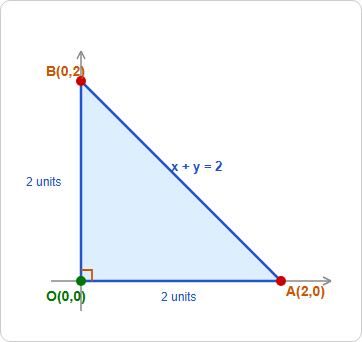
Given equation: x + y = 2
Divide by 2 to convert to intercept form:
⇒ x/2 + y/2 = 1
Here, the x-intercept (a) = 2 and the y-intercept (b) = 2.
⇒ Area = 1/2 × |2 × 2| = 2 square units.
∴ The correct answer is 2 square unit.

Alternate Method
Given:
Equation of the straight line: x + y = 2
Formula Used:
Area of a right-angled triangle = 1/2 × Base × Height
To find the points where the line intersects the coordinate axes:
For the x-intercept, substitute y = 0 in the equation:
⇒ x + 0 = 2
⇒ x = 2
∴ The line intersects the x-axis at point A(2, 0).
For the y-intercept, substitute x = 0 in the equation:
⇒ 0 + y = 2
⇒ y = 2
∴ The line intersects the y-axis at point B(0, 2).

The vertices of the enclosed triangle are the origin O(0, 0), A(2, 0), and B(0, 2).
This forms a right-angled triangle OAB with the right angle at the origin O.
⇒ Base (OA) = 2 units
⇒ Height (OB) = 2 units
⇒ Area of ΔOAB = 1/2 × Base × Height
⇒ Area = 1/2 × 2 × 2
⇒ Area = 2 square units
∴ The correct answer is 2 square unit.

Additional Information
Intercept Form of a Line
The equation of a line with x-intercept 'a' and y-intercept 'b' is written as x/a + y/b = 1. The area of the triangle formed by this line and the axes is 1/2 × |a × b|.
General Line Equation Area
For a general line Ax + By + C = 0, the area of the triangle enclosed by the line and the coordinate axes is C2 ÷ (2 × |A × B|).
Area of Triangle with Vertices
For a triangle with vertices (x1, y1), (x2, y2), and (x3, y3), the area is given by 1/2 × |x1(y2 − y3) + x2(y3 − y1) + x3(y1 − y2)|.