Official Paper

Rajasthan Gram Vikas Adhikari (VDO) Mains 9 July 2022 Official Paper (Previous Year Paper)

160 questions · 180 minutes · with answers · free

Full Test (160 questions)

1

पर्यायवाची शब्दों के संबंध में असंगत युग्म पहचानिए -

  1. ((a))

    झंडा - केतन, वैजयंती, निशान

  2. ((b))

    जंगल - विपिन, कांतार, गहन

  3. ((c))

    सेना - अराति, अरि, वाहिनी

  4. ((d))

    पुत्र - वत्स, आत्मज, तनय

Show Answer
Answer: ((c))

सेना - अराति, अरि, वाहिनी

उपर्युक्त पर्यायवाची शब्दों में  सेना - अराति, अरि, वाहिनी युग्म असंगत है। 

क्योंकि - 

  • सेना का अर्थ वाहिनी होता है परंतु अराति और अरि का अर्थ शत्रु या विरोधी होता है।
  • सेना के अन्य पर्यायवाची - चतुरंगिनी, अनीकनी, कटक, अनी
  • अराति के पर्यायवाची - विपक्षी, रिपु, प्रतिपक्षी, शत्रु
  • अरि के पर्यायवाची - प्रतिद्वंदी, विरोधी, बैर​​

Key Pointsअन्य विकल्प सही पर्यायवाची शब्द युग्म हैं -

  • झंडा - केतन, वैजयंती, निशान
  • जंगल - विपिन, कांतार, गहन
  • पुत्र - वत्स, आत्मज, तनय

Additional Informationपर्यायवाची शब्द -

  • अनिवार्य - अवश्यंभावी, अपरिहार्य, परम आवश्यक
  • कस्तूरी - म्रग्नाभि, म्रदमद, मद्लता
  • उत्कोच - घूस, रिश्वत
  • गंगा - देवनदी, मंदाकिनी, भगीरथी, विश्नुपगा
  • आँसू - नेत्रजल, नयनजल, चक्षुजल, अश्रु
  • वसन -  पट, चीर, अम्बर, वस्त्र, परिधान
  • सीता - वैदेही, जानकी, भूमिजा, जनकतनया
  • औचक – अचानक, यकायक, सहसा
  • भौंरा – मधुप, मधुकर, द्विरेप
  • बगीचा – बाग़, वाटिका, उपवन
2

व्याकरण की दृष्टि से निम्न में से कौन-सा शुद्ध वाक्य है?

  1. ((a))

    माता जी का मन गद्गद हो गया।

  2. ((b))

    भोपाल में अनेक तालाब हैं।

  3. ((c))

    समय के साथ शब्द लोप हो जाते हैं।

  4. ((d))

    वह बड़ा अच्छा खिलाड़ी है।

Show Answer
Answer: ((b))

भोपाल में अनेक तालाब हैं।

व्याकरण की दृष्टि से शुद्ध वाक्य है - भोपाल में अनेक तालाब हैं।

  • शुद्ध वाक्य - भोपाल में अनेक तालाब हैं।
  • इस वाक्य में संज्ञा, सर्वनाम, कारक व वचन का सही पदक्रम में प्रयोग किया गया है इसलिए यह वाक्य व्याकरणिक रूप से शुद्ध है।

Key Pointsअन्य विकल्प -

  • माता जी का मन गद्गद हो गया। (वर्तनी संबंधी अशुद्धि)
  • माता जी का मन गदगद हो गया।
  • समय के साथ शब्द लोप हो जाते हैं।(वचन संबंधी अशुद्धि)
  • समय के साथ शब्दों का लोप हो जाता है। (जब वचन में परिवर्तन होता है तब क्रिया पर भी उसका प्रभाव पड़ता है।)
  • वह बड़ा अच्छा खिलाड़ी है। (पुनरावृत्ति की अशुद्धियाँ)
  • वह अच्छा खिलाड़ी है। या शुद्ध: वह उत्कृष्ट खिलाड़ी है।

Additional Information

  • वाक्य भाषा की महत्त्वपूर्ण इकाई है।
  • वाक्य में व्याकरण के अनुसार पदों का क्रमबद्ध होना बहुत अधिक आवश्यक है अन्यथा वाक्य का अर्थ भी बदल सकता है।
  • वाक्य को बोलते व लिखते समय उसकी शुद्धता, स्पष्टता और सार्थकता का ध्यान रखना आवश्यक है।
  • वाक्य में क्रिया, कर्ता, लिंग, वचन, वर्तनी, विशेषण इत्यादि अशुद्धियाँ हो सकती हैं।
3

विसर्ग संधि से निर्मित शब्द समूह नहीं है -

  1. ((a))

    शिरोभाग, वयोवेग, तेजोबल

  2. ((b))

    अवश्यम्भावी, आबालवृद्ध, मनोनुसार

  3. ((c))

    यशोधरा, पुनरुक्ति, अतएव

  4. ((d))

    श्रेयस्कर, चन्द्रस्तम, पुनः प्राप्ति

Show Answer
Answer: ((b))

अवश्यम्भावी, आबालवृद्ध, मनोनुसार

अवश्यम्भावी, आबालवृद्ध, मनोनुसार ये शब्द समूह विसर्ग संधि से निर्मित नहीं हैं। 

  • अवश्यम्भावी = अवश्यम् + भावी (व्यंजन संधि) ( के साथ क से म तक के किसी भी वर्ण के मिलन पर 'म' की जगह पर मिलन वाले वर्ण का अंतिम नासिक वर्ण बन जायेगा।)
  • आबालवृद्ध = आ (संस्कृत उपसर्ग)
  • मनोनुसार = मन: + अनुसार (विसर्ग संधि)

Key Pointsअन्य विकल्प -

  • शिरोभाग = शिर: + भाग
  • वयोवेग = वयो: + वेग
  • तेजोबल = तेजः + बल 
  • यशोधरा = यशः+धरा
  • पुनरुक्ति = पुनः+उक्ति
  • अतएव = अतः + एव
  • श्रेयस्कर = श्रेयः +कर
  • चन्द्रस्तम = चन्द्र: + तम
  • पुनः प्राप्ति = पुनः + प्राप्ति

Confusion Pointsप्रथम तर्क -

  • पुनः प्राप्ति = पुनर् + प्राप्ति (व्यंजन संधि)

द्वितीय तर्क -

  • विसर्ग से पूर्व अ, आ आए और बाद में क, खप,फ आए तो कोई परिवर्तन नहीं होता।
  • पुनः प्राप्ति = पुनः + प्राप्ति

Additional Information

विसर्ग में स्वर या व्यंजन के संयोग से होने वाले विकार निम्नलिखित हैं -

  • ​विसर्ग के आगे श, ष, स आए तो वह क्रमशः श्, ए, स्, में बदल जाता है। 
  • उदाहरण - निः + सन्देह = निस्सन्देह
  • विसर्ग से पहले इ या उ हो और बाद में  आए तो विसर्ग का लोप हो जाएगा और इ तथा उ दीर्घ ई, ऊ में बदल जाएँगे। 
  • निः + रस = नीरस
  • विसर्ग के बाद ‘च-छ’, ‘ट-ठ’ तथा ‘त-थ’ आए तो विसर्ग क्रमशः ‘श्’, ‘ष्’, ‘स्’ में बदल जाते हैं
  • धनु: + टंकार = धनुष्टंकार
  • निः + छल = निश्छल
  • विसर्ग के बाद क, ख, प, फ रहने पर विसर्ग में कोई विकार नहीं होता। 
  • प्रात: + काल = प्रात:काल
  • विसर्ग से पहले ‘अ’ या ‘आ’ को छोड़कर कोई स्वर हो और बाद में वर्ग के तृतीय,चतुर्थ और पंचम वर्ण अथवा य, र, ल, व में से कोई वर्ण हो तो विसर्ग ‘र’ में बदल जाता है। 
  • नि: + आधार = निराधार
  • दुः + बोध = दुर्बोध
  • विसर्ग से पहले अ, आ को छोड़कर कोई अन्य स्वर आए और बाद में कोई भी स्वर आए तो भी विसर्ग र् में बदल जाता है। 
  • नि: + आशा = निराशा
  • विसर्ग से पहले  आए और बाद में य, र, ल, व, ह या घोष वर्ण आए तो विसर्ग का लोप हो जाता है तथा विसर्ग ‘ओ’ में बदल जाता है। 
  • मन: + रथ = मनोरथ
  • विसर्ग से पहले इ या उ आए और बाद में क, ख, प, फ में से कोई वर्ण आए तो विसर्ग ‘ष्’ में बदल जाता है। 
  • निः + पाप = निष्पाप
4

'अपत्यवाचक तद्धित प्रत्यय' से निर्मित शब्द किस विकल्प में नहीं है?

  1. ((a))

    पौर्वात्य

  2. ((b))

    मार्कंडेय

  3. ((c))

    मागध

  4. ((d))

    आंजनेय

Show Answer
Answer: ((a))

पौर्वात्य

अपत्यवाचक तद्धित प्रत्यय पौर्वात्य शब्द में नहीं है। 

  • पौर्वात्य शब्द 'त्य' प्रत्यय (गुणवाचक तद्धित प्रत्यय) लगा कर बना है।
  • पौर्वात्य का अर्थ - पाश्चात्य के अनुकरण पर बना (शब्द)
  • गुणवाचक तद्धित प्रत्यय से संज्ञा शब्द गुणवाची बन जाते हैं। (वान्, मान्, त्य, आलु, )
  • उदाहरण - विद्वान्​, गतिमान्, दक्षिणात्य, कृपालु, लोभी।

Key Pointsअन्य विकल्प - 

  • अपत्यवाचक तद्धित प्रत्यय में सन्तान या वंश में उत्पन्न हुए व्यक्ति का बोध होता है।
  • मार्कंडेय - एय - मार्कंडेय एक प्राचीन ऋषि हैं।
  • मागध - - मगध के राजा जरासंध का एक नाम।
  • आंजनेयएय - अंजना के पुत्र (भगवान हनुमान)।

Additional Informationप्रत्यय मुख्यतः दो प्रकार के होते है -

प्रत्ययपरिभाषाप्रकार
कृत प्रत्ययक्रिया पद के मूल रूप के साथ लगकर नये शब्द का निर्माण करने वाले शब्द कृदन्त या कृत प्रत्यय कहलाते हैं।- कर्त्तावाचक - कर्मवाचक - करणवाचक - भाववाचक - क्रिया बोधक
तद्धित प्रत्ययक्रिया पदों के अतिरिक्त संज्ञा, सर्वनाम, विशेषण आदि शब्दों के साथ लगकर नये शब्द का निर्माण करते हैं उन्हें ही तद्धित प्रत्यय कहते हैं।- कर्त्तावाचक - भाववाचक - सम्बन्धवाचक - अप्रत्यवाचक - ऊनतावाचक - स्त्रीबोधक
5

विलोम शब्द की दृष्टि से कौनसा युग्म अनुचित है?

  1. ((a))

    असीम - ससीम

  2. ((b))

    ऐहिक - पारलौकिक

  3. ((c))

    अतिवृष्टि - बहुवृष्टि

  4. ((d))

    अतिथि - आतिथेय

Show Answer
Answer: ((c))

अतिवृष्टि - बहुवृष्टि

विलोम शब्द की दृष्टि से अतिवृष्टि - बहुवृष्टि ये शब्द युग्म अनुचित हैं।

अतिवृष्टि का विलोम: अल्पवृष्टि

  • अतिवृष्टि = अति(अधिक) + वृष्टि(वर्षा) अर्थात अत्यधिक वर्षा
  • बहुवृष्टि = बहु (बहुत) + वृष्टि(वर्षा) अर्थात बहुत वर्षा
  • अर्थानुसार दोनों ही शब्द पर्यायवाची हैं इसलिए ये विलोम शब्द नहीं है।

Key Points

अन्य विकल्प -

  • असीम का अर्थ -  असीमित,  जिसकी सीमा न हो
  • ससीम का अर्थ - सीमित, जिसकी सीमा हो
  • ऐहिक का अर्थ - सांसारिक,  भौतिक
  • पारलौकिक का अर्थ - अलौकिक,  जो लौकिक ना हो
  • अतिथि का अर्थ - मेहमान, बाहर से आने वाला व्यक्ति
  • आतिथेय का अर्थ - मेज़बान, जिसके वहाँ अतिथि रुका हो

Additional Information

किसी शब्द का उल्टा अर्थ बताने वाला शब्द विलोम शब्द कहलाता है।

उदाहरण -

शब्दविलोम
पूर्णतःअंशतः
ऋणात्मकधनात्मक
ऐश्वर्यअनैश्वर्य
भूगोलखगोल
कुमार्गसुमार्ग
खीजनारीझना
अन्तरंगबहिरंग
केंद्रितविकेन्द्रित
अवरप्रवर
गण्यनगण्य
आकर्षणविकर्षण
गठियानाखोलना
प्रतीचीप्राची
एकांगीसर्वांगीण
गदरशांति
6

किस विकल्प के सभी शब्द 'स' उपसर्ग से निर्मित हैं?

  1. ((a))

    सोल्लास, सत्क्रिया, सद्भाव, सहपाठी

  2. ((b))

    सद्भावना, सहायक, सहोदर, सहगमन

  3. ((c))

    सहित, सहकर्ता, सार्थक, सज्जन

  4. ((d))

    सदय, सकाम, सावकाश, सजीव

Show Answer
Answer: ((d))

सदय, सकाम, सावकाश, सजीव

सदय, सकाम, सावकाश, सजीव ये शब्द '' उपसर्ग से निर्मित हैं। 

सदय, सकाम, सावकाश, सजीव ये शब्द हिन्दी के उपसर्ग '' से बने हैं। ये विशेषकर तद्भव शब्दों के पहले आते हैं। 

  • + दय = सदय
  • + काम = सकाम
  • + अवकाश = सावकाश
  • + जीव = सजीव

Key Pointsअन्य विकल्प के उपसर्ग/प्रत्यय - 

  • सोल्लास -
  • सत्क्रिया - सत
  • सद्भाव - सत
  • सहपाठी - सह
  • सद्भावना - सत
  • सहायक - अक (प्रत्यय)
  • सहोदर - सह
  • सहगमन - सह
  • सहित -
  • सहकर्ता - सह
  • सार्थक -
  • सज्जन - सत

Additional Information

उपसर्ग -

  • उपसर्ग शब्द के शुरूआत में जुड़ते हैं और मूल शब्द का अर्थ बदल देते हैं।
  • उदाहरण :- अप + यश = अपयश, अध + पका = अधपका, ना + लायक = नालायक, हाफ + टिकट = हाफटिकट आदि। 
  • हिन्दी में मुख्यतः चार प्रकार के उपसर्ग होते है :-
  • संस्कृत के उपसर्ग (प्र, परा, अप, सम्, अनु, अव, निस्, निर्, दुस्, दुर्, वि, आङ्, नि, अधि, अपि, अति, सु, उत्, अभि, प्रति, परि तथा उप)
  • हिंदी के उपसर्ग (अन, अध, उन, औ, कु, चौ, पच, पर, बिन, भर, स, सह, चिर, न, बहु, आप, सम, दु)
  • उर्दू के उपसर्ग (ला, बद, बे, कम, ग़ैर, ना, खुश, हम, ऐन, सर, बेश, बा, अल)
  • अंग्रेजी के उपसर्ग (ब, हाफ, को, हैड, वाइस)

प्रत्यय -

  • प्रत्यय शब्द के अंत में जुड़ते हैं और ये पूर्ण रूप से अर्थ नहीं बदलते ये मूल शब्द के इर्द-गिर्द ही रहते हैं।
  • उदाहरण :- ना = चलना, य = गेय, आई = मिठाई, ला = निचला आदि। 
  • प्रत्यय के दो प्रकार होते हैं :-
  • कृत् प्रत्यय (अक, अन, अना, अनीय, आ, आई, आन, इ, इया, इत)
  • तद्धित प्रत्यय (आई, आइन, आई, आनी, आयत, आर/आरा, आहट, इल, इष्ठ, ई)
7

किस विकल्प में अंग्रेजी पारिभाषिक शब्द का समकक्ष हिन्दी पारिभाषिक शब्द सही है?

  1. ((a))

    Departmental Negligence - विभागीय जांच

  2. ((b))

    Denial - तरक्की

  3. ((c))

    Deviate - अहित

  4. ((d))

    Decree - हुक्मनामा

Show Answer
Answer: ((d))

Decree - हुक्मनामा

सही उत्तर Decree - हुक्मनामा होगा। 

  • Decree का समकक्ष हिन्दी पारिभाषिक शब्द हुक्मनामा है।
  • हुक्मनामा का अर्थ है - आदेशपत्र
  • Decree का अर्थ है - An official order given by a government

Key Pointsअन्य विकल्प -

अंग्रेजी पारिभाषिक शब्दहिन्दी पारिभाषिक शब्द
Departmental Negligenceविभागीय उपेक्षा
Denialइनकार
Deviateहटना


हिन्दी पारिभाषिक शब्दअंग्रेजी पारिभाषिक शब्द
विभागीय जांचDepartmental
enquiry
तरक्कीProgress
अहितHarm

Additional Informationअंग्रेजी पारिभाषिक शब्द का हिन्दी पारिभाषिक शब्द अन्य उदाहरण - 

  • Plea - दलील
  • Hail storm - ओला-वृष्टि
  • Revocable - प्रतिसंहरणीय
  • Sphere - क्षेत्र
  • Unlawful - अवैध
  • Venture - उद्यम
  • Jingoism - कट्टर राष्ट्रवाद
  • Disbursement - वितरण
  • Cess - उपकर
  • Apprenticeship - शिक्षुता
8

'समुद्रोर्मि' का सही संधि-विच्छेद क्या है?

  1. ((a))

    समुद्र: + ऊर्मि

  2. ((b))

    समुद्र + ऊर्मि

  3. ((c))

    समुद्र + ओर्मि

  4. ((d))

    समुद्र + उर्मि

Show Answer
Answer: ((b))

समुद्र + ऊर्मि

'समुद्रोर्मि' का सही संधि-विच्छेद समुद्र + ऊर्मि होगा। 

  • समुद्रोर्मि = समुद्र + ऊर्मि (अ + ऊ = ओ)
  • जब संधि करते समय अ/आ + उ/ऊ = ओ, अ/आ + इ/ई = ए, अ + ऋ = अर् बनता है तो यह गुण संधि कहलाती है।

उदाहरण

  • महोत्सव = महा + उत्सव (आ + उ = ओ)
  • नरेश = नर + ईश (अ + ई = ए)
  • महर्षि = महा + ऋषि (आ + ऋ = अर)
  • अन्य विकल्प गलत हैं।

Important Pointsसंधि तीन प्रकार के होते हैं -

स्वर संधि 

  1. दीर्घ संधि
  • अ /आ + अ/आ = आ
  • इ/ई + इ/ई = ई
  • उ + उ = ऊ
  1. गुण संधि
  • अ/आ + उ/ऊ = ओ
  • अ/आ + इ/ई = ए
  • अ + ऋ = अर्
  1. वृद्धि संधि
  • अ/आ + ए/ऐ = ऐ
  • अ/आ + ओ/औ = औ
  1. यण संधि
  • इ/ई + अ/आ/उ/ऊ = य
  • उ/ऊ + इ/ई/अ/आ = व्
  • ऋ + अ/आ/उ/ऊ/इ/ई = र
  1. अयादी संधि
  • ए + अन्य स्वर = अय
  • ऐ + अन्य स्वर = आय
  • ओ + अन्य स्वर = अव
  • औ + अन्य स्वर = आव
  • व्यंजन सन्धि
  • विसर्ग सन्धि
9

निम्नलिखित सामासिक पदों को उनके सा��ासिक भेद के साथ सुमेलित कीजिए -

सामासिक पदसामासिक भेद
(i)शताब्दी, अठन्नी, सतसई(क)अव्ययीभाव समास
(ii)नीरव, अनुगुण, अत्याचार(ख)द्विगु समास
(iii)लताच्छादित, आनन्दमय, कनकटा(ग)तत्पुरुष समास
(iv)शुभावसर, नवांकुर, चरमसीमा(घ)कर्मधारय समास
  1. ((a))

    (i) - घ, (ii) - क, (iii) - ग, (iv) - ख

  2. ((b))

    (i) - ख, (ii) - ग, (iii) - घ, (iv) - क

  3. ((c))

    (i) - ख, (ii) - क, (iii) - ग, (iv) - घ

  4. ((d))

    (i) - ख, (ii) - क, (iii) - घ, (iv) - ग

Show Answer
Answer: ((c))

(i) - ख, (ii) - क, (iii) - ग, (iv) - घ

सही जोड़ी (i) - ख, (ii) - क, (iii) - ग, (iv) - घ होगा।

  • सूची-l में सामासिक पद दिए गए हैं और सूची-ll में सामासिक भेद दिए गए हैं।
  • दो या दो से अधिक शब्दों से मिलकर बने हुए नये एवं सार्थक शब्दों को समास कहते हैं।
  • उदाहरण :- यथासामर्थ्य = सामर्थ्य के अनुसार

Key Pointsअन्य विकल्प - 

  • ​द्विगु समास (जिस सामासिक पद का पूर्वपद संख्यावाचक हो, तथा उत्तर पद प्रधान हो।)
  • शताब्दी - सौ अब्दों (वर्षों) का समाहार
  • अठन्नी - आठ आनों का समाहार
  • सतसई - सात सौ का समाहार
  • अव्ययीभाव समास (पहला पद प्रधान होता है और समस्तपद वाक्य में क्रियाविशेषण का काम करता है।)
  • नीरव - रव रहित
  • अनुगुण - गुण के योग्य
  • अत्याचार - आचार का अतिक्रमण
  • तत्पुरुष समास (जिसका उत्तरपद या अंतिम पद प्रधान हो। जैसे प्रथम पद गौण हो और उत्तरपद की प्रधानता हो।)
  • लताच्छादित - लता से आच्छादित (करण तत्पुरुष समास)
  • आनन्दमय - आनंद से युक्त (करण तत्पुरुष समास)
  • कनकटा - कान को कटवाया हुआ (कर्म तत्पुरुष समास)
  • कर्मधारय समास (जिस सामासिक शब्द का उत्तर पद प्रधान हो, पूर्वपद और उत्तरपद में विशेषण- विशेष्य अथवा उपमान- उपमेय का संबंध हो। )
  • शुभावसर - शुभ हो जो अवसर
  • नवांकुर - नया है जो अंकुर
  • चरमसीमा - चरम तक पहँची है जो सीमा
10

कौन से शब्द युग्म का अर्थ भेद सही है?

  1. ((a))

    तरणि-तरुणी - युवती-सूर्य

  2. ((b))

    डीठ-ढीठ - निडर-दृष्टि

  3. ((c))

    कृति-कृती - निपुण-रचना

  4. ((d))

    अयश-अयस - अपकीर्ति-लोहा

Show Answer
Answer: ((d))

अयश-अयस - अपकीर्ति-लोहा

अयश-अयस - अपकीर्ति-लोहा शब्द युग्म का अर्थ भेद सही है।

  • अयश का अर्थ - अपकीर्ति
  • अयस का अर्थ - लोहा
  • अयश और अयस के अर्थ क्रमशः सही दिए गए है इसलिए विकल्प अयश-अयस - अपकीर्ति-लोहा सही उत्तर होगा।
  • उपर्युक्त अन्य विकल्प के अर्थ क्रमशः उचित नहीं है।

Key Pointsअन्य विकल्प - 

  • तरणि का अर्थ सूर्य
  • तरुणी का अर्थ नवयुवती
  • कृति का अर्थ रचना
  • कृती का अर्थ निपुण
  • डीठ का अर्थ दृष्टि
  • ढीठ का अर्थ जिद्दी/निडर

Additional Informationसमोच्चारित भिन्नार्थक शब्द -

  • अवधि - समय सीमा
  • अवधी - अवधी भाषा
  • अनभिज्ञ - अनजान
  • अभिज्ञ - जानकार
  • कपट - छल
  • कपाट - किवाड़
  • गृह - घर
  • ग्रह - आकाशीय पिण्ड
  • जरा - बुढ़ापा
  • ज़रा - थोड़ा
  • द्विप - हाथी
  • द्वीप - टापू
  • दिन - दिवस
  • दीन - गरीब
11

शुद्ध वर्तनी वाला विकल्प चुनिए -

  1. ((a))

    नो, चोंतीस

  2. ((b))

    उनचालीस, इकत्तीस

  3. ((c))

    पचत्तर, पच्चासी

  4. ((d))

    इक्यावन, तिरपन

Show Answer
Answer: ((d))

इक्यावन, तिरपन

इक्यावन व तिरपन ये शुद्ध वर्तनी वाले शब्द हैं।

संख्या का मानक हिंदी रूप - 

  • इक्यावन - ५१ व तिरपन - ५३

Key Pointsअन्य विकल्प - 

अशुद्ध वर्तनीशुद्ध वर्तनीसंख्या
नो, चोंतीसनौ, चौंतीस9, 34
उनचालीस, इकत्तीसउनतालीस, इकतीस39,31
पचत्तर, पच्चासीपचहत्तर, पचासी75,85

Additional Information

देवनागरी लिपि अंक/संख्या का मानक हिंदी रूप - 

१ - एक 
२ - दो 
३ - तीन 
४ - चार 
५ - पाँच
६ - छह
७ - सात 
८ - आठ 
९ - नौ 
१० - दस
११ - ग्यारह
१२ - बारह 
१३ - तेरह
१४ - चौदह
१५ - पंद्रह
१६ - सोलह
१७ - सत्रह
१८ - अठारह
१९ - उन्नीस
२० - बीस
२१ - इक्कीस २२ - बाईस २३ - तेईस २४ - चौबीस २५ - पच्चीस २६ - छब्बीस २७ - सत्ताईस २८ - अट्ठाईस २९ - उनतीस ३० - तीस३१ - इकतीस
३२ - बत्तीस
३३ - तैंतीस
३४ - चौंतीस
३५ - पैंतीस
३६ - छ्त्तीस 
३७ - सैंतीस
३८ - अड़तीस
३९ - उनतालीस
४० - चालीस


४१ - इकतालीस ४२ - बयालीस ४३ - तैतालिस ४४ - चौवालीस ४५ - पैंंतालीस ४६ - छियालीस ४७ - सैंतालिस ४८ - अड़तालीस ४९ - उनचास ५० - पचास५१ - इक्यावन ५२ - बावन ५३ - तिरपन ५४ - चौवन ५५ - पचपन ५६ - छप्पन ५७ - सत्तावन ५८ - अट्ठावन ५९ - उनसठ ६० - साठ६१ इकसठ ६२ बासठ ६३ तिरसठ ६४ चौंसठ ६५ पैंसठ ६६ छियासठ ६७ सड़सठ ६८ अड़सठ ६९ उनहत्तर ७० सत्तर७१ इकहत्तर ७२ बहत्तर ७३ तिहत्तर ७४ चौहत्तर ७५ पचहत्तर ७६ छिहत्तर ७७ सतहत्तर ७८ अठहत्तर ७९ उनासी ८० अस्सी


८१ - इक्यासी ८२ - बयासी ८३ - तिरासी ८४ - चौरासी ८५ - पचासी ८६ - छियासी ८७ - सतासी ८८ - अठासी ८९ - नवासी ९० - नब्बे९१ - इक्‍यानवे ९२ - बानवे ९३ - तिरानवे ९४ - चौरानवे ९५ - पंचानवे ९६ - छियानवे ९७ - संतानवे ९८ - अंठानवे ९९ - निन्यानवे १०० - सौ
12

निम्न में से कौन-सा यण् स्वर संधि का उदाहरण नहीं है?

  1. ((a))

    न्यून

  2. ((b))

    अन्वय

  3. ((c))

    पित्रादेश

  4. ((d))

    स्वांग

Show Answer
Answer: ((d))

स्वांग

स्वांग यण् स्वर संधि का उदाहरण नहीं है।

  • जब दो शब्दों की संधि करते समय अ/आ + अ/आ = आ बनता है, जब इ/ई + इ/ई = ई बनता है, जब उ + उ = ऊ बनता है तब वह दीर्घ स्वर संधि कहलाता है।
  • स्व + अंग = स्वांग (अ + आ = आ)
  • उपर्युक्त अन्य विकल्प यण् स्वर संधि के उदाहरण हैं।

Key Pointsअन्य विकल्प - 

  • नि + ऊन = न्यून (इ + ऊ= यू)
  • अनु + अय = अन्वय (उ+अ=व्)
  • पितृ + आदेश = पित्रादेश (ऋ + आ = र + आ)

Additional Informationसंधि तीन प्रकार के होते हैं -

स्वर संधि 

  1. दीर्घ संधि
  • अ/आ + अ/आ = आ
  • इ/ई + इ/ई = ई
  • उ + उ = ऊ
  1. गुण संधि
  • अ/आ + उ/ऊ = ओ
  • अ/आ + इ/ई = ए
  • अ + ऋ = अर्
  1. वृद्धि संधि
  • अ/आ + ए/ऐ = ऐ
  • अ/आ + ओ/औ = औ
  1. यण संधि
  • इ/ई + अ/आ/उ/ऊ = य
  • उ/ऊ + इ/ई/अ/आ = व्
  • ऋ + अ/आ/उ/ऊ/इ/ई = र
  1. अयादी संधि
  • ए + अन्य स्वर = अय
  • ऐ + अन्य स्वर = आय
  • ओ + अन्य स्वर = अव
  • औ + अन्य स्वर = आव
  • व्यंजन सन्धि
  • विसर्ग सन्धि
13

निम्नलिखित सूची-I की लोकोक्तिओं को सूची-II में उनके अर्थ के साथ सुमेलित कीजिए -

सूची-Iसूची-II
(a)गंगा गए गंगादास, जमुना गए जमुनादास(1)व्यर्थ में दखल देने वाला
(b)दाल भात में मूसलचंद(2)जिसका कोई दृढ़ सिद्धांत नहीं
(c)पहले भीतर तब देवता-पितर(3)अच्छे-बुरे सबको एक समझना
(d)सब धान बाईस पसेरी(4)पेट पूजा सबसे प्रधान
  1. ((a))

    (a) - 1, (b) - 3, (c) - 4, (d) - 2

  2. ((b))

    (a) - 2, (b) - 4, (c) - 1, (d) - 3

  3. ((c))

    (a) - 2, (b) - 1, (c) - 4, (d) - 3

  4. ((d))

    (a) - 3, (b) - 4, (c) - 1, (d) - 2

Show Answer
Answer: ((c))

(a) - 2, (b) - 1, (c) - 4, (d) - 3

सही उत्तर है - (a) - 2, (b) - 1, (c) - 4, (d) - 3

  • सूची-l में लोकोक्तियाँ दी गई हैं और सूची-ll में लोकोक्तियों के अर्थ दिए गए हैं।
  • लोक + उक्ति = लोकोक्ति
  • समाज में प्रचलित उक्ति(कथन) को ही लोकोक्ति कहते हैं।

Key Pointsउपर्युक्त सूची के लिए सही जोड़ी निम्नलिखित है -

सूची-Iसूची-II
लोकोक्तियाँअर्थवाक्य प्रयोग
गंगा गए गंगादास, जमुना गए जमुनादासजिसका कोई दृढ़ सिद्धांत नहींनेता राजनीति में  कभी किसी दल में तो कभी अन्य दल में चले जाते हैं उनकी हालत गंगा गए गंगादास, जमुना गए जमुनादास जैसी है।
दाल भात में मूसलचंदव्यर्थ में दखल देने वालालीला सैर सपाटे के लिए जा रही थी तभी उसके मामा आ गए ये तो ऐसा हुआ जैसे दाल भात में मुसलचंद।
पहले भीतर तब देवता-पितरपेट पूजा सबसे प्रधानघर में घुसते ही श्याम को काम सौंप दिया गया पर श्याम ने साफ-साफ कह दिया कि पहले भीतर तब देवता पितर।
सब धान बाईस पसेरीअच्छे-बुरे सबको एक समझनाआरती के लिए सारे खाद्य प्रदार्थ सब धान बाईस पसेरी जैसा है।
  • इस प्रकार सही मिलान (a) - 2, (b) - 1, (c) - 4, (d) - 3 होगा।
14

निम्नलिखित में से कौन-सा 'उर्वर' का विलोम है?

  1. ((a))

    ऊसर

  2. ((b))

    उपजाऊ

  3. ((c))

    फ़लप्रद

  4. ((d))

    जरखेज

Show Answer
Answer: ((a))

ऊसर

सही उत्तर ऊसर है। 

  • उर्वर का अर्थ -  उपजाऊ भूमि
  • ऊसर का अर्थ -  वह ज़मीन जो उपजाऊ न हो, बंजर
  • उर्वर ऊसर का विपरीतार्थक शब्द हैं इसलिए ये विलोम शब्द हुए।

अन्य विकल्प उर्वर के पर्यायवाची हैं।

  • उर्वर के पर्यायवाची - उपजाऊ, फ़लप्रद, जरखेज

Additional Information किसी शब्द का उल्टा अर्थ बताने वाला शब्द विलोम शब्द कहलाता है।

उदाहरण -

शब्दविलोम
कुकृतिसुकृत्य
गतिरोधनिर्विरोध
ऐश्वर्यअनैश्वर्य
भूगोलखगोल
चंचलस्थिर
खीजनारीझना
पानागँवाना
कुख्यातविख्यात
अवरप्रवर
फूलनामुरझाना
आकर्षणविकर्षण
स्वकीयापरकीया
सुषुप्तजाग्रत
एकांगीसर्वांगीण
कैदछूट
15

समास के संबंध में असंगत कथन है-

  1. ((a))

    जहाँ प्रथम पद निषेध का वाचक हो उसे 'नञ् तत्पुरुष' समास कहते हैं।

  2. ((b))

    अधिकरण तत्पुरुष के समस्त पदों में अधिकरण कारक चिह्न 'में, पे, पर' का प्रयोग होता है।

  3. ((c))

    समस्त पद बनाते समय समास में प्रथम पद के साथ विभक्ति चिह्न का लोप किया जाता है।

  4. ((d))

    कर्मधारय विशेषण-विशेष्य का समास होता है।

Show Answer
Answer: ((c))

समस्त पद बनाते समय समास में प्रथम पद के साथ विभक्ति चिह्न का लोप किया जाता है।

समस्त पद बनाते समय समास में प्रथम पद के साथ विभक्ति चिह्न का लोप किया जाता है। यह कथन असंगत है। 

  • उचित कथन - समस्त पद बनाते समय दो शब्दों को विभक्त करने वाली विभक्तियों का लोप हो जाता है।

उदाहरण -  

  • महादेव = महान है जो देव
  • बखूबी = खुबी के साथ
  • दानवीर = दान में वीर

Key Pointsअन्य विकल्प - 

  • जहाँ प्रथम पद निषेध (पहला पद नकारात्मक) का वाचक हो उसे 'नञ् तत्पुरुष' समास कहते हैं।
  • अप्रिय = न प्रिय
  • अनावश्यक = न आवश्यक
  • अधिकरण तत्पुरुष के समस्त पदों में अधिकरण कारक चिह्न 'में, पे, पर' का प्रयोग होता है।
  • जिस समास का उत्तरपद प्रधान हो और पूर्वपद गौण हो  एवं  विभक्ति ‘में’ और ‘पर’ चिन्ह का लोप हो जाए उसे 'अधिकर��� तत्त्पुरूष समास' कहते है।
  • दानवीर = दान में वीर
  • आत्मनिर्भर = आत्म पर निर्भर
  • कर्मधारय समास में पहला पद विशेषण तथा दूसरा पद विशेष्य होता है, अर्थात कर्मधारय विशेषण-विशेष्य का समास होता है।
  • महापुरुष  = महान है जो पुरुष
  • बड़भागी = बड़ा है जिसका भाग्य

Additional Information

तत्पुरुष समास के भेदविभक्ति लोपउदाहरण
कर्म तत्पुरुष समासइसमें कर्म कारक की विभक्ति 'को' का लोप हो जाता है।गृहागत = गृह को आगत
करण तत्पुरुष समासइसमें करण कारक की विभक्ति 'से' का लोप हो जाता है।कामचोर = काम से चोर
संप्रदान तत्पुरुष समासइसमें संप्रदान कारक की विभक्ति 'के लिए' का लोप हो जाता है।हथघड़ी = हाथ के लिए घड़ी
अपादान तत्पुरुष समासइसमें अपादान कारक की विभक्ति 'से' पृथक का लोप हो जाता है।नेत्रहीन = नेत्र से हीन
सम्बन्ध तत्पुरुष समाससम्बन्ध कारक के चिन्ह या विभक्ति 'का, के, की' का लोप होता है।प्रसंगानुसार = प्रसंग के अनुसार
अधिकरण तत्पुरुष समासइसमें अधिकरण कारक की विभक्ति 'में, पर, पे' का लोप हो जाता है।पुरुषोत्तम = पुरुषों में उत्तम
16

निम्न में से किस विकल्प में केवल 'प्रत्यय' का ही प्रयोग किया गया है?

  1. ((a))

    अपरिग्रह, अपोढ, पराश्रित

  2. ((b))

    वैनाशिक, आक्षेपित, आधिपत्य

  3. ((c))

    रासायनिक, पाशविक, काल्पनिक

  4. ((d))

    पराधीन, अनूदित, अनुवाद

Show Answer
Answer: ((c))

रासायनिक, पाशविक, काल्पनिक

रासायनिक, पाशविक, काल्पनिक इन शब्दों में प्रत्यय का प्रयोग किया गया है। 

  • रासायनिक, पाशविक, काल्पनिक इन शब्दों में कृत प्रत्यय का प्रयोग हुआ है।
  • कृत प्रत्यय वे होते है जो क्रिया के या धातु के अंत में जुड़कर संज्ञा या विशेषण शब्दों का निर्माण करते हैं।
  • रासायन + इक = रासायनिक
  • पाशव +  इक = पाशविक
  • कल्पना + इक = काल्पनिक

Key Pointsअन्य विकल्प - 

  • अपरिग्रह = उपसर्ग रहित - अर्थ - किसी से कुछ ग्रहण न करना
  • अपोढ = उपसर्ग रहित - अर्थ - अपवहित
  • पराश्रित = पर + आश्रित  - अर्थ - दूसरों पर आश्रित रहने वाला
  • वैनाशिक = उपसर्ग रहित - अर्थ -जन्म नक्षत्र से सातवाँ, दसवाँ और अठाहरवाँ नक्षत्र
  • आक्षेपित = उपसर्ग रहित - अर्थ - स्थापित, आरोपित
  • आधिपत्य = उपसर्ग रहित - अर्थ - प्रभुत्व
  • पराधीन = पर + अधीन - अर्थ - परवश
  • अनूदित = अनु + उदित - अर्थ - भाषांतरित
  • अनुवाद = अनु + वाद - अर्थ - भाषांतर

Additional Informationउपसर्ग -

  • उपसर्ग शब्द के शुरूआत में जुड़ते हैं और मूल शब्द का अर्थ बदल देते हैं।
  • उदाहरण :- अप + यश = अपयश, अध + पका = अधपका, ना + लायक = नालायक, हाफ + टिकट = हाफटिकट आदि।

हिन्दी में मुख्यतः चार प्रकार के उपसर्ग होते है :-

  • संस्कृत के उपसर्ग (प्र, परा, अप, सम्, अनु, अव, निस्, निर्, दुस्, दुर्, वि, आङ्, नि, अधि, अपि, अति, सु, उत्, अभि, प्रति, परि तथा उप)
  • हिंदी के उपसर्ग (अन, अध, उन, औ, कु, चौ, पच, पर, बिन, भर, स, सह, चिर, न, बहु, आप, सम, दु)
  • उर्दू के उपसर्ग (ला, बद, बे, कम, ग़ैर, ना, खुश, हम, ऐन, सर, बेश, बा, अल)
  • अंग्रेजी के उपसर्ग (ब, हाफ, को, हैड, वाइस)

प्रत्यय - 

  • नवीन शब्द का निर्माण करने के लिए शब्दों के अंत में जोडे़ गए शब्दांशों को प्रत्यय कहते हैं।
  • प्रत्यय मुख्यतः दो प्रकार के होते है -
प्रत्ययपरिभाषाप्रकार
कृत प्रत्ययक्रिया पद के मूल रूप के साथ लगकर नये शब्द का निर्माण करने वाले शब्द कृदन्त या कृत प्रत्यय कहलाते हैं।- कर्त्तावाचक - कर्मवाचक - करणवाचक - भाववाचक - क्रिया बोधक
तद्धित प्रत्ययक्रिया पदों के अतिरिक्त संज्ञा, सर्वनाम, विशेषण आदि शब्दों के साथ लगकर नये शब्द का निर्माण करते हैं उन्हें ही तद्धित प्रत्यय कहते हैं।- कर्त्तावाचक - भाववाचक - सम्बन्धवाचक - अप्रत्यवाचक - ऊनतावाचक - स्त्रीबोधक
17

किस विकल्प में वार्तनिक दृष्टि से अशुद्ध शब्द प्रयुक्त हुए हैं?

  1. ((a))

    शिरोधार्य, अन्तर्धान

  2. ((b))

    मध्याह्न, भौगोलिक

  3. ((c))

    पूज्यनीय, प्रमाणिक

  4. ((d))

    कृतज्ञ, नीरोग

Show Answer
Answer: ((c))

पूज्यनीय, प्रमाणिक

वार्तनिक दृष्टि से अशुद्ध शब्द पूज्यनीय, प्रमाणिक है। 

अशुद्ध शब्द के शुद्ध रूप निम्नलिखित हैं :-

  • पूज्यनीय - पूजनीय (आदरणीय)
  • प्रमाणिक - प्रामाणिक (प्रमाण द्वारा सिद्ध)

Key Pointsअन्य विकल्पों में वार्तनिक दृष्टि से कोई अशुद्धि नहीं है। 

  • शिरोधार्य, अन्तर्धान
  • मध्याह्न, भौगोलिक
  • कृतज्ञ, नीरोग

Additional Informationअशुद्ध शब्द के शुद्ध रूप -

  • अध्यात्मिक - आध्यात्मिक
  • कर्त्तव्यपालन - कर्त्तव्य-पालन
  • ईर्षा - ईर्ष्या
  • क्षत्रीत - क्षत्रिय
  • दुरावस्था - दुरवस्था
  • निवारन - निवारण
  • पदमिनी - पद्मिनी
  • विशेस - विशेष
  • मनोग्य - मनोज्ञ
  • सन्यास - संन्यास
  • स्थाई - स्थायी
  • विशिष्ठ - विशिष्ट
  • अहिल्या - अहल्या
  • सर्जन - सृजन
18

निम्नलिखित सूची-I के मुहावरों को सूची-II में उनके अर्थ के साथ सुमेलित कीजिए -

सूची-Iसूची-II
(A)आंख का नीर ढल जाना(1)अनुभवहीन व्यक्ति
(B)अंडे का शहजादा(2)व्यर्थ की लिखा पढ़ी करना
(C)निन्यानवे के फेर में पड़ना(3)निर्लज्ज हो जाना
(D)कागज़ी घोड़े दौड़ाना(4)धन कमाने में लगे रहना
  1. ((a))

    (A) - 3, (B) - 1, (C) - 4, (D) - 2

  2. ((b))

    (A) - 4, (B) - 3, (C) - 2, (D) - 1

  3. ((c))

    (A) - 3, (B) - 2, (C) - 4, (D) - 1

  4. ((d))

    (A) - 1, (B) - 2, (C) - 3, (D) - 4

Show Answer
Answer: ((a))

(A) - 3, (B) - 1, (C) - 4, (D) - 2

सही उत्तर है - (A) - 3, (B) - 1, (C) - 4, (D) - 2

  • सूची-l में मुहावरे दिए गए हैं और सूची-ll में मुहावरो के अर्थ दिए गए हैं।
  • मुहावरा संक्षिप्त होता है, परन्तु अपने इस संक्षिप्त रूप में मुहावरा किसी बड़े विचार या भाव को प्रकट करता है।

Key Pointsउपर्युक्त सूची के लिए सही जोड़ी निम्नलिखित है -

सूची-Iसूची-II
मुहावरेअर्थवाक्य प्रयोग
आंख का नीर ढल जानानिर्लज्ज हो जानासंदीप के आँखों का पानी ढल गया है इसीलिए वह सबके सामने भद्दे मजाक करता है।
अंडे का शहजादाअनुभवहीन व्यक्तितुम्हे यहाँ काम करते हुए कितने वर्ष बित गए हैं और तुम ऐसी बात कर रहे हो जैसे अंडे का शाहजादा।
निन्यानवे के फेर में पड़नाधन कमाने में लगे रहनातुम निन्यानवे के फेर में मत पड़ो जितना है उसी में खुश रहना सीखो वरना सदैव अप्रसन्न रहोगे।
कागज़ी घोड़े दौड़ानाव्यर्थ की लिखा पढ़ी करनाशंकर का बेटा बिजनेस के नाम पर कागज़ी घोड़े दौड़ाता रहता है लेकिन असल में उसे देखा जाए तो वह कोई कार्य नहीं करता है।

इस प्रकार सही सुमिलन (A) - 3, (B) - 1, (C) - 4, (D) - 2 होगा।

19

निम्नलिखित में से किस विकल्प के सभी शब्द 'माता' के पर्यायवाची हैं?

  1. ((a))

    स्वसा, वामा, सोदरा

  2. ((b))

    सुरा, वारुणी, हाला

  3. ((c))

    प्रसू, अम्बिका, जननी

  4. ((d))

    कान्ता, दारा, अर्धांगिनी

Show Answer
Answer: ((c))

प्रसू, अम्बिका, जननी

प्रसू, अम्बिका, जननी ये शब्द माता के पर्यायवाची हैं। 

  • माता का अर्थ - जन्म देने वाली स्त्री
  • माता का पर्यायवाची - प्रसू, अम्बिका, जननी
  • माता के अन्य पर्यायवाची - जन्मदात्री, मातरि, महन्तिन, धात्री
  • वाक्य प्रयोग - धरती माता समान होती है।

Key Pointsअन्य विकल्प - 

  • स्वसा का अर्थ - भगिनी, बहन

वामा का अर्थ - औरत, स्त्री

सोदरा का अर्थ - सगी बहन

  • सुरा, वारुणी, हाला ये मद्य/शराब शब्द के पर्यायवाची हैं।
  • कान्ता, दारा, अर्धांगिनी ये विवाहिता नारी/पत्नी शब्द के पर्यायवाची हैं।

Additional Informationपर्यायवाची शब्द -

  • खल - दुर्जन, दुष्ट, घूर्त, कुटिल
  • बारिश - वर्षण, वृष्टि, वर्षा, पावस
  • वज्र - कुलिस, पवि, अशनि, दभोलि
  • दर्पण - आरसी, शीशा, आईना
  • दीन - दरिद्र, रंक, अकिंचन, कंगाल
  • कण्ठ -  ग्रीवा, गर्दन, गला
  • ऊधम - उपद्रव, उत्पात, धूम, हुड़दंग
  • समीप - सन्निकट, आसन्न, निकट
  • उग्र – प्रचण्ड, उत्कट, तेज, तीव्र
20

'We have taken our breakfast.'

उक्त वाक्य का सटीक हिंदी रूपांतरण है -

  1. ((a))

    हमने नाश्ता रख लिया है।

  2. ((b))

    हमने नाश्ता कर लिया है।

  3. ((c))

    हमने नाश्ता कर लिया था।

  4. ((d))

    हम नाश्ता ले कर गए थे।

Show Answer
Answer: ((b))

हमने नाश्ता कर लिया है।

'We have taken our breakfast.' का सटीक हिंदी रूपांतरण 'हमने नाश्ता कर लिया है।' होगा।

  • किसी भाषा में कही या लिखी गयी बात का किसी अन्य भाषा में सार्थक रूपांतरण करना ही अनुवाद कहलाता है।
  • अंग्रेजी - We have taken our breakfast.
  • हिंदी अनुवाद - हमने नाश्ता कर लिया है।

Key Pointsअन्य विकल्प -

  • हिंदी - हमने नाश्ता रख लिया है।
  • अंग्रेजी अनुवाद - We kept our breakfast.
  • हिंदी - हमने नाश्ता कर लिया था।
  • अंग्रेजी अनुवाद - We had our breakfast.
  • हिंदी - हम नाश्ता ले कर गए थे।
  • अंग्रेजी अनुवाद - We carried our breakfast with us.

Important Pointsअनुवाद करते समय निम्नलिखित बातों पर भी ध्यान देना चाहिए -

  • अनुवाद की भाषा सरल होनी चाहिए।
  • अनूदित अंश का प्रवाह नष्ट नहीं होना चाहिए।
  • अनुवाद के वाक्य जहाँ तक हो सके, छोटे होने चाहिए।
  • अनुवाद में बनावटीप��� नहीं आना चाहिए।
  • जिस अंश का अनुवाद किया जाये, उसका मूल विचार या भाव बरकरार रहना चाहिए।
21

'एक पानी का गिलास लाओ' वाक्य में किस प्रकार की अशुद्धि है?

  1. ((a))

    वचन संबंधि

  2. ((b))

    पदक्रम संबंधि

  3. ((c))

    लिंग संबंधि

  4. ((d))

    अव्यय संबंधि

Show Answer
Answer: ((b))

पदक्रम संबंधि

'एक पानी का गिलास लाओ' वाक्य में पदक्रम संबंधि अशुद्धि है। 

  • अशुद्ध वाक्य - एक पानी का गिलास लाओ।
  • शुद्ध वाक्य - पानी का एक गिलास लाओ।
  • उपर्युक्त वाक्य में पदक्रम संबंधि त्रुटि है।
  • दोनों वाक्यों में सभी शब्द समान हैं किंतु पहले वाक्य में सही पदक्रम की कमी है, जबकि दूसरा वाक्य उचित पदक्रम के अनुसार है।

Mistake Pointsपदक्रम संबंधि:-

उदाहरण

अशुद्ध रूप – जाता वह बाज़ार है।

शुद्ध रूप – वह बाज़ार जाता है।

Additional Information

  • वाक्य भाषा की महत्त्वपूर्ण इकाई है।
  • वाक्य में व्याकरण के अनुसार पदों का क्रमबद्ध होना बहुत अधिक आवश्यक है अन्यथा वाक्य का अर्थ भी बदल सकता है।
  • वाक्य को बोलते व लिखते समय उसकी शुद्धता, स्पष्टता और सार्थकता का ध्यान रखना आवश्यक है।
  • वाक्य में क्रिया, कर्ता, लिंग, वचन, वर्तनी, विशेषण इत्यादि अशुद्धियाँ हो सकती हैं।
22

निम्नलिखित सूची-I के वाक्यांशों को सूची-II के शब्दों के साथ सुमेलित कीजिए-

सूची-Iसूची-II
(a)नीचे की ओर लाना या खींचना(i)अनाहूत
(b)जो बिना बुलाए आया हो(ii)अन्तेवासी
(c)किसी वस्तु को प्राप्त करने की तीव्र इच्छा(iii)अपकर्ष
(d)गुरु के समीप रहने वाला विद्यार्थी(iv)अभीप्सा
  1. ((a))

    (a) - i, (b) - iii, (c) - iv, (d) - ii

  2. ((b))

    (a) - iii, (b) - iv, (c) - ii, (d) - i

  3. ((c))

    (a) - i, (b) - ii, (c) - iii, (d) - iv

  4. ((d))

    (a) - iii, (b) - i, (c) - iv, (d) - ii

Show Answer
Answer: ((d))

(a) - iii, (b) - i, (c) - iv, (d) - ii

सही उत्तर है - (a) - iii, (b) - i, (c) - iv, (d) - ii

  • सूची-l में अनेक शब्द दिए गए है और सूची-ll में एक शब्द दिए गए हैं।
  • कुछ ऐसे पद या शब्द होते है, जो अपने में पूरे एक वाक्य या वाक्यांश का अर्थ रखते है। इन्हीं शब्दों को अनेक शब्दों के लिए एक शब्द कहा जाता है।

Key Pointsउपर्युक्त सूची के लिए सही जोड़ी निम्नलिखित है -

सूची-Iसूची-II
अनेक शब्दएक शब्दवाक्य प्रयोग
नीचे की ओर लाना या खींचनाअपकर्षहमे अपने जीवन मे आए अपकर्ष का सामना हिम्मत से करना चाहिए।
जो बिना बुलाए आया होअनाहूतशादी के पार्टी में कुछ अनाहूत लोग आ गए थे।
किसी वस्तु को प्राप्त करने की तीव्र इच्छाअभीप्सामनुष्य की प्रत्येक अभीप्सा पूरी नहीं होती।
गुरु के समीप रहने वाला विद्यार्थीअन्तेवासीआचार्य और अंतेवासी गुरु के ज्ञान को सर्वश्रेष्ठ मानते हैं।
  • इस प्रकार सही सुमिलन (a) - iii, (b) - i, (c) - iv, (d) - ii होगा।
23

'गंधसार, मलयज, श्रीखण्ड' उक्त सभी शब्द पर्याय हैं-

  1. ((a))

    मेंढक के

  2. ((b))

    नाव के

  3. ((c))

    चंदन के

  4. ((d))

    मोर के

Show Answer
Answer: ((c))

चंदन के

  • गंधसार, मलयज, श्रीखण्ड उक्त सभी शब्द चंदन के पर्यायवाची हैं।
  • जो शब्द समान अर्थ प्रदान करते हैं वे शब्द पर्यायवाची शब्द कहलाते हैं।
  • चंदन का अर्थ - एक पेड़ जिसकी लकड़ी सुगंधित होती है।
  • चंदन के पर्यायवाची - गंधसार, मलयज, श्रीखण्ड
  • वाक्य प्रयोग - दक्षिण भारत में भारी मात्रा में चंदन के पेड़ पाये जाते हैं।

Key Pointsअन्य विकल्प के पर्याय - 

  • मेंढक - वर्षाप्रिय, दर्दुर, दादुर
  • नाव - डोंगी, तरी, तरिणी, जलयान
  • मोर - शिखी, नर्तकप्रिय, मयूर, नीलकंठ

Additional Informationपर्यायवाची शब्द -

  • सुगंधि - सौरभ, सुरभि, महक, खुशबू
  • ओज - तेज, शक्ति, बल, वीर्य
  • अर्थ - धन, द्रव्य, मुद्रा, दौलत, वित्त
  • उपवन - उद्यान, वाटिका, गुलशन
  • घृत - घी, अमृत, नवनीत
  • तीर -  शर, बाण, अनी, सायक
  • रात्रि - निशा, तम��्विनी, यामिनी, शर्वरी
  • मनुष्य - मानव, मानुष, मनुज, नर
  • आकृत - आकर, चेहरा, नैन नक्श
24

संधि की दृष्टि से कौन-सा युग्म अनुचित है?

  1. ((a))

    तल्लीन - व्यंजन संधि

  2. ((b))

    मात्रिच्छा - यण् स्वर संधि

  3. ((c))

    मनश्चिकित्सा - विसर्ग संधि

  4. ((d))

    स्वागत - दीर्घ स्वर संधि

Show Answer
Answer: ((d))

स्वागत - दीर्घ स्वर संधि

संधि की दृष्टि से स्वागत - दीर्घ स्वर संधि ये युग्म अनुचित है। 

  • जब इ, ई, उ, ऊ, ऋ के आगे कोई भिन्न स्वर आता है तो ये क्रमश: य, व, र में परिवर्तित हो जाते हैं, इस परिवर्तन को यण सन्धि कहते हैं।

यण संधि के नियम -

  • इ/ई + अ/आ/उ/ऊ = य
  • उ/ऊ + इ/ई/अ/आ = व्
  • ऋ + अ/आ/उ/ऊ/इ/ई = र
  • स्वागत यण संधि है।
  • यण संधि (उ + आ = वा)

स्वागत = सु + आगत

Key Pointsअन्य विकल्प - 

  • व्यंजन संधि

तल्लीन = तत् + लीन

  • यण स्वर संधि

मात्रिच्छा = मातृ + इच्छा

  • विसर्ग संधि

मनश्चिकित्सा = मन: + चिकित्सा

Additional Informationसंधि तीन प्रकार के होते हैं -

स्वर संधि 

  1. दीर्घ संधि
  • अ/आ + अ/आ = आ
  • इ/ई + इ/ई = ई
  • उ + उ = ऊ
  1. गुण संधि
  • अ/आ + उ/ऊ = ओ
  • अ/आ + इ/ई = ए
  • अ + ऋ = अर्
  1. वृद्धि संधि
  • अ/आ + ए/ऐ = ऐ
  • अ/आ + ओ/औ = औ
  1. यण संधि
  • इ/ई + अ/आ/उ/ऊ = य
  • उ/ऊ + इ/ई/अ/आ = व्
  • ऋ + अ/आ/उ/ऊ/इ/ई = र
  1. अयादी संधि
  • ए + अन्य स्वर = अय
  • ऐ + अन्य स्वर = आय
  • ओ + अन्य स्वर = अव
  • औ + अन्य स्वर = आव
  • व्यंजन सन्धि
  • विसर्ग सन्धि

Read the passage carefully and answer the questions given below -

The choice we make on a daily basis - wearing a seatbelt, lifting heavy objects correctly or purposely staying out of any dangerous situation - can either ensure our safety or bring about potentially harmful circumstances.

You and i need to make a decision that we are going to get our lives in order. Exercising self-control, self-discipline and establishing boundaries and borders in our lives are some of the most important things we can do. A life without discipline is one that's filled with carelessness.

We can think it's kind of live life on the edge. We like the image of "Yeah! that's me! Living on the edge! Woo-hoo!" It's become a popular way to look at life. But if you see, even highways have lines, which provide margins for our safety while we're driving. If we go over one side, we'll go into the ditch. If we cross over the line in the middle, we could get killed. And we like those lines because they help to keep us safe. Sometimes we don't even realize how lines help to keep us safe.

25

The phrase "Potentially harmful circumstances" refers to circumstances that can-

  1. ((a))

    Certainly be dangerous

  2. ((b))

    Be fairly dangerous

  3. ((c))

    Be possibly dangerous

  4. ((d))

    Seldom be dangerous

Show Answer
Answer: ((c))

Be possibly dangerous

The correct answer is 'Be possibly dangerous'.

Key Points

  • Let us analyze the given phrase 'Potentially harmful circumstances' and understand the meaning of the words used in it - 
  • Potentially - having or showing the capacity to develop into something in the future.
  • harmful - causing or likely to cause harm.
  • circumstances - a fact or condition connected with or relevant to an event or action.
  • Dangerous as used in the given options refer to the harmful nature of situations.
  • To completely understand the meaning of the given phrase we need to see which of the words used in the given options are synonymous to Potentially. 
  • certainly - used to emphasize the speaker's belief that what is said is true.
  • fairly - to a moderately high degree.
  • possibly - perhaps (used to indicate doubt or hesitancy).
  • seldom - not often; rarely.
  • From the above meanings, it is clear that 'possibly' is the most synonymous word for potentially.
  • Hence, option 3 is the correct answer.
26

What does the author mean when he says, "To get our lives in order"?

  1. ((a))

    To resume our lives

  2. ((b))

    To organize our lives

  3. ((c))

    To rebuild our lives

  4. ((d))

    To control our lives

Show Answer
Answer: ((b))

To organize our lives

The correct answer is 'To organize our lives'.

Key Points

  • The given phrase To get our lives in order implies that the author is talking about maintaining a sense of equilibrium in our lives.
  • This can be achieved by organizing our lives correctly.
  • Hence, 'to organize our lives' is the correct meaning of the given phrase.
  • So, option 2 is the correct answer.
27

Synonym of the word 'carelessness' is-

  1. ((a))

    laxness

  2. ((b))

    heedfulness

  3. ((c))

    caution

  4. ((d))

    vigilance

Show Answer
Answer: ((a))

laxness

The correct answer is 'laxness'.

Key Points

  • Carelessness means failure to give sufficient attention to avoiding harm or errors; negligence.
  • Let us look into the meaning of the given options - 
  • laxness - the quality of being lax and neglectful.
  • heedfulness - the trait of staying aware of (paying close attention to) your responsibilities.
  • caution - care taken to avoid danger or mistakes.
  • vigilance - the action or state of keeping careful watch for possible danger or difficulties.
  • From the above meanings, it is evident that 'laxness' is the correct synonym of the word 'carefulness'.
  • Hence, option 1 is the correct answer.
28

Which set of words fits well into the given sentence?

He pretended to fall ___________ my plan but secretly he was working against it.

  1. ((a))

    off through

  2. ((b))

    in with

  3. ((c))

    into by

  4. ((d))

    in for

Show Answer
Answer: ((b))

in with

The correct answer is 'in with'

Key Points

  • The given sentence implies that a certain person (he) pretended to follow the plan of the subject (me) but in reality was working against it.
  • The correct phrasal verb for the given blank is 'fall in with' which means 'to agree to something​'. 
  • For Example - She fell in with my idea at once.​
  • Hence, option 2 is the correct answer. 

Correct sentence - He pretended to fall in with my plan but secretly he was working against it.

29

The correct form of words in the brackets are -

We suggested (sleep) in hotels but the children were anxious (camp) out.

  1. ((a))

    that we sleep, camped

  2. ((b))

    to sleep, To camp

  3. ((c))

    for sleep, about camp

  4. ((d))

    sleeping, to camp

Show Answer
Answer: ((d))

sleeping, to camp

The correct answer is 'sleeping, to camp'.

Key Points

  • The given sentence has two independent clauses - 
  • Clause 1 - We suggested (sleep) in hotels
  • Clause 2 -  the children were anxious (camp) out.
  • Both the bracketed words imply that we have to decide whether to use gerunds or infinitives in their place.
  • Whether we use a gerund or an infinitive depends on the main verb in the sentence.
  • Gerunds can be used after certain verbs including enjoy, fancy, discuss, dislike, finish, mind, suggest, recommend, keep, and avoid.
  • So, In clause 1, we need to use the gerund form of the verb sleep which is sleeping.
  • Infinitives can be used after certain verbs including agree, ask, decide, help, plan, anxious, hope, learn, want, would like, and promise.
  • ​So, In clause 2, we need to use the infinitive form of the verb camp which is to camp.
  • ​Hence, option 4 is the correct answer. 

Correct sentence - We suggested (sleeping) in hotels but the children were anxious (to camp) out.

30

Which of the following is not the meaning of 'bound'?

  1. ((a))

    to build a boundary

  2. ((b))

    to spring or leap

  3. ((c))

    to be restrained by a material such as rope

  4. ((d))

    to be controlled by a condition or law

Show Answer
Answer: ((a))

to build a boundary

The correct answer is 'to build a boundary'.

Key Points

  • Let us look into the meanings of the word bound -
  • As a verb, it can mean
  • to walk or run with leaping strides. - Raj came bounding down the stairs.
  • place within certain limits; restrict. - Freedom of action is bounded by law.
  • tie or fasten (something) tightly together. - They bound her hands and feet.
  • As a noun, it can mean 
  • a leaping movement towards or over something. - I went up the steps in two effortless bounds.
  • From the above meanings, it is clear that options 2, 3, and 4 are all correct meanings of the word bound.
  • Only, option 1 is an incorrect meaning, making it the correct answer.
31

What is the correct sequence of phrases -

this document (P)/ as proof of his guilt (Q) can we take (R)/ on the table (S)

  1. ((a))

    RSPQ

  2. ((b))

    PSRQ

  3. ((c))

    RPSQ

  4. ((d))

    QPRS

Show Answer
Answer: ((c))

RPSQ

The correct answer is 'RPSQ'.

Key Points

  • While arranging the parts of the sentence, we should find some grammatical or contextual connections between them.
  • Part R is the independent part and states what the action that the subjects can perform. It points out how the subjects (we) can take something.
  • So, part R is the first part after rearrangement.
  • Part P points out what the subjects can take which is a document. Hence, P follows R.
  • Part S which states where the document is (on the table) should come in the third spot to maintain continuity.
  • Part Q is the concluding part of the sentence as it provides information regarding why the subjects should take the document.
  • Thus, the correct order after rearrangement is option 3 i.e. RPSQ.

So, the correct sentence is : can we take (R)/ this document (P)/ on the table (S)/ as proof of his guilt (Q)

32

Match the idioms in column I with their meanings in column II-

Column-IColumn-II
(i)Call it a day(a)saying good luck to someone
(ii)Feeling under the weather(b)to leak a secret
(iii)Spill the beans(c)not very well
(iv)Break a leg(d)to stop work or another activity
  1. ((a))

    i - (c), ii - (d), iii - (b), iv - (a)

  2. ((b))

    i - (d), ii - (c), iii - (b), iv - (a)

  3. ((c))

    i - (a), ii - (c), iii - (b), iv - (d)

  4. ((d))

    i - (d), ii - (c), iii - (a), iv - (b)

Show Answer
Answer: ((b))

i - (d), ii - (c), iii - (b), iv - (a)

The correct answer is 'Option 2 or i - (d), ii - (c), iii - (b), iv - (a)'.

Key Points

  • Let us look into the meaning of the idioms given in Column-I. 
  • Call it a day means to stop what you are doing because you do not want to do any more or think you have done enough: I'm getting a bit tired now - let's call it a day.
  • So, meaning of idiom (i) is given by d. Hence i - (d).
  • Feeling under the weather means slightly unwell or in low spirits: I'm feeling a bit under the weather - I think I'm getting a cold. 
  • So, meaning of idiom (ii) is given by (c). Hence ii - (c).
  • Spill the beans means to let secret information become known: We'll all be there at 6 for the surprise party – now don't spill the beans! 
  • So, meaning of idiom (iii) is given by (b). Hence iii - (b).
  • Break a leg is usually used in theater to wish good luck to actors before they go up on stage: Danny's family told him to “break a leg” right before he went up on stage. 
  • So, meaning of idiom (iv) is given by (a). Hence iv - (a).
  • From the above the correct matches that we get are - i - (d), ii - (c), iii - (b), iv - (a)
  • Hence, option 2 is the correct answer.
33

In the sentence - "Kalidas is the Shakespeare of India." - the definite article 'the' is used because -

  1. ((a))

    'Shakespeare' is a pronoun.

  2. ((b))

    'Shakespeare' is a proper noun used as a comparative.

  3. ((c))

    'Shakespeare' is an adjective.

  4. ((d))

    'Shakespeare' is a singular noun used to make general statement.

Show Answer
Answer: ((b))

'Shakespeare' is a proper noun used as a comparative.

The correct answer is 'Shakespeare' is a proper noun used as a comparative.'

Key Points

  • In the given sentence, two proper nouns are being compared i.e. 'Kalidas' and 'Shakespeare'.
  • Definite article 'The' is used when two proper nouns are compared.
  • So, the reason behind using 'the' is because Shakespeare is a proper noun being compared to another proper noun.
  • So, option 2 or Shakespeare' is a proper noun used as a comparative is the correct answer.
34

Choose the appropriate alternative from the given options that comes closest to the idea conveyed by the sentence-

"You must be back within two hours."

  1. ((a))

    You are likely to be back within two hours.

  2. ((b))

    You have to be back within two hours.

  3. ((c))

    You are obliged to be back within two hours.

  4. ((d))

    You have the option to be back within two hours.

Show Answer
Answer: ((b))

You have to be back within two hours.

The correct answer is 'You have to be back within two hours.'

Key Points

  • Let us analyze the given sentence -
  • The sentence uses the verb must. 
  • Must is used to express insistence or necessity. - you must try some of this fish / you must show your ID card
  • So the given sentence implies that it is necessary for the person (you) to come back within two hours.
  • Let us look into the meaning of the sentences in the options - 
  • Option 1 uses likely which implies that the person would probably be back within two hours.
  • Option 2 uses have to which implies that it is necessary for the person to come back within two hours.
  • Option 3 uses obliged which implies that the person is morally bound to come back within two hours.
  • Option 4 uses have the option which implies that the person has a choice of whether they want to return within two hours or not.
  • From the above descriptions, it is clear that option 2 is the most appropriate alternative from the given options that comes closest to the idea conveyed by the given sentence.
  • Hence, option 2 is the correct answer.
35

Fill in the blank with the correct option -

They know that extremists blew up the bridge. (Change into Passive voice)

  1. ((a))

    They know that the bridge was blew up by extremists.

  2. ((b))

    It is known that the extremists blown up the bridge.

  3. ((c))

    It is known that the bridge was blown up by the extremists.

  4. ((d))

    It is known that the bridge would be blown up by the extremists.

Show Answer
Answer: ((c))

It is known that the bridge was blown up by the extremists.

The correct answer is 'It is known that the bridge was blown up by the extremists.'

Key Points

  • The given sentence is in active voice. As per the question we have to change it to passive voice.
  • The given sentence is a complex sentence and it has two clauses joined by the conjunction 'that' - 
  • The principal clause - They know
  • The subordinate clause - extremists blew up the bridge
  • To change complex sentences from active to passive we need to separately change their voice and join them with that.
  • Changing the principal clause from active to passive
  • This is simply done by changing the tense from present to past form.
  • So, 'They know' becomes 'It is known'. -------(i)
  • The structure of the subordinate clause is as follows:
  • Subject + past participle + Object (Active voice)
  • Subject (objective case) + was + past participle + by Object (subjective case) (Passive voice)
  • Example: 
  • She built a large garden. (Active voice)
  • A large garden was built by her. (Passive voice)
  • The subject of the subordinate clause is ‘extremists’.
  • The object of the subordinate clause is ‘the bridge’.
  • The subject will be put in place of the object and the object will be put in place of the subject.
  • 'blew up' will be changed to 'was blown up'.
  • So, the subordinate clause in passive voice becomes - the bridge was blown up by the extremists. ------- (ii)
  • Joining (i) and (ii) with the conjunction 'that', we get the passive voice form for the given sentence.
  • Correct sentence - It is known that the bridge was blown up by the extremists.
  • Hence, option 3 is the correct answer.
36

Choose the part of the sentence you think is incorrect in the given sentence-

Nehru was one of the greatest statesmen who has led the Non-aligned Movement.

  1. ((a))

    Nehru was

  2. ((b))

    One of the greatest statesmen

  3. ((c))

    Who has led

  4. ((d))

    The Non-aligned Movement

Show Answer
Answer: ((c))

Who has led

The erroneous part is 'who has led'

Key Points

  • The given sentence talks about Nehru who is a historical figure.
  • So, the sentence should be in the past tense.
  • In option 3 - who has led, the incorrect tense 'has' has been used.
  • 'has' is the present tense form of the verb 'to have'.
  • So, the erroneous part of the sentence is 'who has led' which makes option 3 the correct answer.
  • The sentence can be made correct by using the past tense form 'had' of the verb '**to have'.

Correct sentence - Nehru was one of the greatest statesmen who had led the Non-aligned Movement.

37

Match the sentences in column (A) with appropriate prepositions in column (B)-

Column-(A)Column-(B)
(a)My mother is afraid _____ cats.(i)for
(b)If you want permission you must apply _____ the Principal.(ii)of
(c)We must all pray _____ peace.(iii)at
(d)The crowd threw stones _____ the police.(iv)to
  1. ((a))

    a - (i), b - (iii), c - (iv), d - (ii)

  2. ((b))

    a - (ii), b - (iv), c - (iii), d - (i)

  3. ((c))

    a - (iii), b - (ii), c - (iv), d - (i)

  4. ((d))

    a - (ii), b - (iv), c - (i), d - (iii)

Show Answer
Answer: ((d))

a - (ii), b - (iv), c - (i), d - (iii)

The correct answer is 'Option 4 - a - (ii), b - (iv), c - (i), d - (iii)​'.

Key Points

  • Let us look into the usage of the prepositions given in Column-(B) - 
  • (i) for - used to talk about a purpose or a reason for something. - I’m going for some breakfast.
  • (ii) of - Of commonly introduces prepositional phrases which are complements of nouns, creating the pattern: noun + of + noun. This pattern is very common, especially to indicate different parts, pieces, amounts and groups: Lima is the capital of Peru.
  • (iii) at - expressing the target of a shot from a weapon. - He fired at the helpless children.
  • (iv) to - identifying the person or thing affected by or receiving something. - You sent the letter to her.
  • From the above usage descriptions, we can conclude that - 
  • The preposition (i) for is appropriate for sentence (c) - We must all pray for peace.
  • The preposition (ii) of is appropriate for sentence (a) - My mother is afraid of cats. (afraid (noun) + of + cats (noun))
  • The preposition (iii) at is appropriate for sentence (d) - The crowd threw stones at the police.
  • The preposition (iv) to is appropriate for sentence (b) - If you want permission you must apply to the Principal.
  • Thus, the matches that we get are - a - (ii), b - (iv), c - (i), d - (iii)
  • Hence, option 4 is the correct answer.
38

Choose the correct option-

He said, "My wife leaves for Vienna tomorrow". (Change into indirect speech)

  1. ((a))

    He said that his wife had to leave for Vienna tomorrow.

  2. ((b))

    He said that his wife would leave for Vienna the next day.

  3. ((c))

    He said that his wife has to leave for Vienna tomorrow.

  4. ((d))

    He said that his wife have to leave for Vienna the next day.

Show Answer
Answer: ((b))

He said that his wife would leave for Vienna the next day.

The correct answer is 'He said that his wife would leave for Vienna the next day.'

Key Points

  • The given sentence is an assertive sentence.
  • While changing the narration of an assertive sentence, we need to follow the given steps - 
  • The reporting verb said remains unchanged**.** ( This is because the given sentence does not have a direct personal object, the reporting verb said remains unchanged.)
  • The conjunction 'that' is used in place of commas and inverted commas.
  • The pronoun 'my' is in first person in the direct speech and should be changed to third person 'his'.
  • The simple present tense verb 'leaves' is changed to the conditional 'would leave'.
  • 'Tomorrow' is changed to 'next day'.
  • Eventually, we will get the final sentence- " He said that his wife would leave for Vienna the next day."
  • So, option 2 is the correct answer.
39

Match the words in column I to their antonyms in column II-

Column-IColumn-II
(a)conceal(i)ascetic
(b)hedonist(ii)permanent
(c)hackneyed(iii)reveal
(d)ephemeral(iv)original
  1. ((a))

    a - (iv), b - (iii), c - (i), d - (ii)

  2. ((b))

    a - (iv), b - (i), c - (iii), d - (ii)

  3. ((c))

    a - (iii), b - (i), c - (iv), d - (ii)

  4. ((d))

    a - (iii), b - (iv), c - (i), d - (ii)

Show Answer
Answer: ((c))

a - (iii), b - (i), c - (iv), d - (ii)

The correct answer is 'Option 3  - a - (iii), b - (i), c - (iv), d - (ii)'.

Key Points 

  • Let us look into the meaning of the given options in both columns -
  • Column-I words
  • (a) conceal – not allow to be seen; hide.
  • (b) hedonist – a person who believes that the pursuit of pleasure is the most important thing in life; a pleasure-seeker.
  • (c) hackneyed – (of a phrase or idea) having been overused; unoriginal and trite.
  • (d) ephemeral – lasting for a very short time.
  • Column-II words
  • (i) ascetic – characterized by severe self-discipline and abstention from all forms of indulgence, typically for religious reasons.
  • (ii) permanent – lasting or intended to last or remain unchanged indefinitely.
  • (iii) reveal – make (previously unknown or secret information) known to others.
  • (iv) original – present or existing from the beginning; first or earliest.
  • From the above meanings, it is clear that the correct antonyms for the words given in Column-I are as follows
  • a and (iii) are antonyms
  • b and (i) are antonyms
  • c and (iv) are antonyms
  • d and (ii) are antonyms
  • So, the correct matches are - a - (iii), b - (i), c - (iv), d - (ii)
  • Hence option 3 is the correct answer.
40

Match words in column I with their meanings in column II-

Column-IColumn-II
(a)incongruous(i)recover quickly from difficult situation
(b)resilient(ii)one who knows everything
(c)obsolete(iii)that which is no longer in use
(d)omniscient(iv)strange and out of place
  1. ((a))

    a - (iv), b - (i), c - (iii), d - (ii)

  2. ((b))

    a - (iv), b - (ii), c - (iii), d - (i)

  3. ((c))

    a - (i), b - (ii), c - (iii), d - (iv)

  4. ((d))

    a - (iv), b - (iii), c - (ii), d - (i)

Show Answer
Answer: ((a))

a - (iv), b - (i), c - (iii), d - (ii)

The correct answer is 'Option 1  - a - (iv), b - (i), c - (iii), d - (ii)'.

Key Points

  • Let us look into the meaning of the given options in Column I -
  • Column-I words
  • (a) incongruous – not in harmony or keeping with the surroundings or other aspects of something. - This matches with (iv) of Column-II.
  • (b) resilient – (of a person or animal) able to withstand or recover quickly from difficult conditions. - This matches with (i) of Column-II.
  • (c) obsolete – no longer produced or used; out of date. - This matches with (iii) of Column-II.
  • (d) omniscient – knowing everything. - This matches with (ii) of Column-II.
  • From the above meanings it is clear that the correct matches are as follows - a - (iv), b - (i), c - (iii), d - (ii)
  • Hence option 1 is the correct answer.
41

The batting average of a batsman in 40 innings is 50 runs. His highest score is 172 more than his lowest score. If his highest and lowest scores are excluded, then average of remaining 38 innings is 48 runs. Highest score of batsman in one innings is-

  1. ((a))

    174 runs

  2. ((b))

    172 runs

  3. ((c))

    170 runs

  4. ((d))

    166 runs

Show Answer
Answer: ((a))

174 runs

Given:

Average of 40 innings = 50 runs

Highest Score = 172 + Lowest Score

Average of remaining 38 innings = 48 runs

Concept used:

(Average = \frac {\text{Sum of all observations}} {\text{Number of observations}})

Calculation:

Sum of all 40 innings = 40 × 50 = 2000

Sum of all 38 innings = 38 × 48 = 1824

⇒ Highest Score + Lowest Score = 176 ---------(1)

⇒ Highest Score - Lowest Score = 172  ----------(2)

On solving equation (1) and equation (2) we get,

⇒ 2 Highest Score = 348

⇒ Highest Score = 174

⇒ Lowest Score = 2

∴ The highest score in one inning is 174 runs.

42

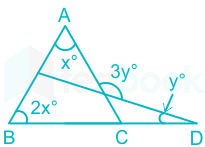
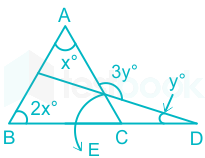
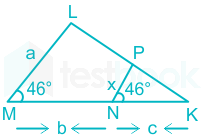
In the given figure, x = ............

  1. ((a))

    (\frac{4 y}{3})

  2. ((b))

    (\frac{2 y}{3})

  3. ((c))

    (\frac{3}{4} y)

  4. ((d))

    (\frac{3}{2} y)

Show Answer
Answer: ((b))

(\frac{2 y}{3})

Given:

Concept used:

The Sum of the three angles of a triangle is 180°

Calculations:

In ▵ABC,

∠A + ∠B + ∠C = 180°

⇒ x + 2x + ∠C = 180°

=> 3x + ∠C = 180°

⇒ ∠C = 180° - 3x . (Internal)....(1)

Now, again, in ▵EDC,

∠E + ∠D + ∠C = 180°

⇒ 180° - 3y + y + ∠C = 180°

⇒ ∠C = 2y (External)  

⇒ ∠C = 180° - 2y (Internal)  ....(2)

Equating both the equation,

180° - 3x = 180° - 2y

⇒ 3x = 2y

⇒ x = (\dfrac{2 y}{3})

∴ The answer is (\dfrac{2 y}{3})

43

If ([5+\left(\frac{3}{a}\right)] \times [b+\left(\frac{1}{2}\right)]=19), then values of a and b are -

  1. ((a))

    a = 8; b = 4

  2. ((b))

    a = 7; b = 3

  3. ((c))

    ​a = 5; b = 2

  4. ((d))

    a = 5; b = 4

Show Answer
Answer: ((b))

a = 7; b = 3

Calculation:

By applying option elimination method,

from option 2 :

⇒ a =7 and b =3

Putting value of a and b

⇒ [5+((3\over7))] × [3+((1\over2))]

⇒ (38\over7)  × (7\over2)  = 19

∴ The correct answer is a = 7, b = 3.

44

In an examination, 33% marks are required to get pass. A candidate receives 238 marks and gets failed by 26 marks. Maximum marks of examination is -

  1. ((a))

    600

  2. ((b))

    700

  3. ((c))

    800

  4. ((d))

    900

Show Answer
Answer: ((c))

800

Given:

% marks required to pass the exam = 33%

Marks required to pass the exam= 238 + 26 = 264

Calculation:

According to question,

Maximum marks of exam will be 100%.

So,

⇒ 33% = 264

⇒ 100% = (264\over33) × 100 = 800

∴ The correct answer is 800.

45

P and Q started a business together and got profit in the ratio of 3 ∶ 5. If Q invested Rs. 80,000 for 12 months, then P invested Rs. 72,000 for how many months?

  1. ((a))

    6 months

  2. ((b))

    8 months

  3. ((c))

    9 months

  4. ((d))

    10 months

Show Answer
Answer: ((b))

8 months

Given:

Invested amount by Q = 80,000

Invested amount for the month by Q = 12 month

Invested amount by P = 72,000

Ratio of profit = 3 : 5

Concept used:

Profit = Investment × time

Calculation:

Let, the amount invested by P in months = x 

We know that, the profit divide in the ratio of their investment.

So,

 (\Rightarrow \frac{80000×12}{72000×x})  =(5\over3)

x = 8 months.

∴ The correct answer is 8 months.

46

P and Q have some amount. If P gives ₹30 to Q, then Q will have twice the amount left with P. But if Q gives ₹10 to P, then P will have three times the amount left with Q. P has amount-

  1. ((a))

    ₹34

  2. ((b))

    ₹64

  3. ((c))

    ₹62

  4. ((d))

    ₹32

Show Answer
Answer: ((c))

₹62

Calculation:

Let P has x money and Q has y money.

According to question,

Case 1-

⇒ 2 (x − 30) = ( y + 30)

⇒ 2x − 60 = y + 30

⇒ 2x − y = 90--------(1)

Case 2-

⇒ x + 10 = 3(y − 10)

⇒ x + 10 = 3y − 30

⇒ x − 3y = - 40

⇒ 2x − 6y = - 80---------(2)

Subtraction (2) From (1)

⇒ (2x − 6y) − (2x − y) = - 80 - 90   

⇒ −5y = - 170

⇒ 5y = 170

⇒ y = 34

Putting y = 34 in (1)

⇒ 2x − y = 90

⇒ 2x − 34 = 90

⇒ 2x = 90 + 34

⇒ 3x = 124

⇒ x = 62

∴ P had money ₹62.

47

What is the average age of children in the class?

Statement : I. The age of the teacher is as many years as the number of children.

II. Average age is increased by 1 year if the teacher's age is also included.

  1. ((a))

    Statement I alone is sufficient but II alone is not sufficient to answer

  2. ((b))

    Statement II alone is sufficient but I alone not is sufficient to answer

  3. ((c))

    Both statement I and II are not sufficient to answer

  4. ((d))

    Either statement I or II alone sufficient to answer

Show Answer
Answer: ((c))

Both statement I and II are not sufficient to answer

Concept used:

(Average = \frac{\text{Sum of all observations}}{\text{No of observations}})

Calculation:

Let there be x children.

From statement 1- 

Age of teacher = x years.

From statement 2-

Average age of (x + 1) persons = (x + 1) years.

Teacher's age = [(x+1)(x+1)] − x2

= (x2+1+2x) − x2

= (1+2x)

From this, we can't determine the value of x.

Hence, both statements I and II are not sufficient to answer.

48

A work may be completed in 10 days, if X, Y and Z work together. All three started to work together. X left after 4 days, then Y and Z completed the work by taking 10 more days. In how many days could X complete the whole work alone?

  1. ((a))

    15 days

  2. ((b))

    25 days

  3. ((c))

    30 days

  4. ((d))

    35 days

Show Answer
Answer: ((b))

25 days

Given:

Total work completed by X, Y, Z= 10 days

X left after 4 days.

Y and Z completed the remaining work in 10 more days.

Concept used:

Work done = Time × efficiency

Calculation:

According to question,

⇒ (X + Y + Z) 10 = (X + Y + Z) 4 + (Y + Z) 10

⇒ (X + Y + Z) 6 = (Y + Z) 10

⇒ 6X = 4(Y + Z)

⇒ X/(Y + Z) = 2/3

Total Work = (X + Y + Z)10 = 5 × 10 = 50

Time taken by X to complete whole work = 50/2

⇒ 25 days

∴ The correct answer is 25 days.

49

A Sçooty is available for ₹ 50,000 cash or ₹10,400 cash down payments followed by 4 equal annual installments. If the rate of simple interest is 25% per annum, amount of each year installment is-

  1. ((a))

    ₹14,400

  2. ((b))

    ₹14,600

  3. ((c))

    ₹14,800

  4. ((d))

    ₹15,000

Show Answer
Answer: ((a))

₹14,400

Given:

Scooty price = Rs. 50,000

Down payment = Rs. 10,400

Number of installments = 4

Rate of interest = 25% 

Concept used : 

A = P + SI 

Where,

(SI = \frac{{P}×{R}×{T}}{100})

Calculation:

Since Rs.10,400 was given for down payments.

∴ Amount to be paid  = Rs. 39600

According to the question,

⇒ 39600 + 39600 × 25/100 × 4 =

([x + (x + \frac{25x}{100}) + (x + \frac{{25}×{2x}}{100}) + (x +\frac{{25}×{3x}}{100}) ])

⇒ 39600 + 39600 × 25/100 × 4 = ([x + \frac{5x}{4} + \frac{3x}{2} + \frac{7x}{4}])

⇒ (79200 =) (\frac{22x}{4})

⇒ (7200 = \frac{2x}{4})

⇒ x = 14400

∴ The correct answer is Rs.14400.

50

Population of a city is 1,00,000. First year it is increased by 5%, second year decreased by 8% and in the third year increased by 3%. After three years, population of the city is-

  1. ((a))

    99,498

  2. ((b))

    96,600

  3. ((c))

    98,448

  4. ((d))

    84,000

Show Answer
Answer: ((a))

99,498

Given:

The population of the city = 1,00,000

First-year increase = 5%

Second year increase = 8%

Third year increase = 3%

Concept used:

If the original population of a locality is P and r1, r and r3 be the rate of change in 1st. 2nd and 3rd years , then change in the population(increase/decrease) after 3 years is given as 

P(1 + r1/100)(1 - r2/100)(1 + r3/100)

Calculation:

The population of a city = 1,00,000

According to question

= 1,00,000 × 21/20 × 23/25 × 103/100

= 99,498

∴ The correct answer is 99,498.

51

L.C.M. of (q2 + 3q), (q2  + 5q + 6) and (q2 + 4q +3) is equal to-

  1. ((a))

    (q - 3)

  2. ((b))

    q (q + 3)

  3. ((c))

    q (q + 3) (q +2)

  4. ((d))

    q (q + 3) (q +2) (q + 1)

Show Answer
Answer: ((d))

q (q + 3) (q +2) (q + 1)

Calculation:

On factorizing the polynomials given we get,

= (q2  + 3q) 

= q(q+3)

= (q2  + 5q + 6)


= (q2 + 3q+2q+6)


= q(q+3)+2(q+3)

= (q+3)(q+2)

= (q2 + 4q +3)

= (q2 + 3q +q+3)

= q(q+3)+(q+3)

= (q+1)(q+3)

So, the LCM is the least common factor that are these among these equations-

=q(q+1)(q+2)(q+3)

∴ The correct answer is q (q + 3) (q +2) (q + 1).

52

A shopkeeper marks 10% more rate on bicycle than purchase value. He gives 10% rebate on marked value of bicycle to a customer, then on selling the bicycle the shopkeeper will be in-

  1. ((a))

    Profit

  2. ((b))

    Loss

  3. ((c))

    Nether profit nor loss

  4. ((d))

    Can't say

Show Answer
Answer: ((b))

Loss

Given:

Marked Price % = 10 %

Discount % = 10 %

Concept used:

Loss = CP - SP

Discount = MP - SP

Calculation:

Let CP = 100

Then the shopkeeper marks it at 10% more

= 100 × 110/100

= 110

Now, he gives 10% rebate on the mark price.

= 110 × 90/100

= 99

SP = 99

So, CP-SP = 1

∴ There is a loss.

Shortcut Trick

⇒110/100×90/100 = 99/100 

So, 100 - 99 = 1

∴ There is a loss.

53

A boat coves 30 km upstream and 44 km downstream in 10 hours. Again covers 40 km upstream and 55 km downstream in 13 hours. Speed of boat in still water will be-

  1. ((a))

    8 km/h

  2. ((b))

    5 km/h

  3. ((c))

    18 km/h

  4. ((d))

    3 km/h

Show Answer
Answer: ((a))

8 km/h

Given:

Upstream Distances = 30 km and 44 km

Downstream Distances = 40 km and 55 km

Time taken = 10 hr and 13 hr

Concept used :

Speed in upstream = (\frac{D}{x - y})

Speed in downstream = (\frac{D}{x + y})

Where,

x = Speed of boat

y = Speed of stream

Calculation:

Speed in still water = x

Speed of stream = y

Upstream = x - y

Downstream = x - y

(30\over x-y)+(44\over x+y) = 10-------------eq.1

(40\over x-y)+(55\over x+y) = 13-------------eq. 2

Checking the downstream value of 44 and 55.

We can see that it is a multiple of 11.

so, ​from eq 1

x + y = 11---------eq.3

If x + y = 4 then we need x - y = 6 in eq.1 to make it equal to 10.

The multiple of 11 follow both eq.1 and 2 in downstream.

So x-y will give 6 when it divided by 5.

x - y = 5-----------------eq.4

Solving eq.3 and 4

x + y = 11

x - y = 5

x = 8 km/h

∴The correct answer is 8km/h .

54

If 24 is 2/3 of 3/4 of a number, then what will be 1/4 of that number?

  1. ((a))

    10

  2. ((b))

    12

  3. ((c))

    14

  4. ((d))

    16

Show Answer
Answer: ((b))

12

Given:

24 is 2/3 of 3/4 of a number

Calculation:

Let the number be x.

According to the question,

⇒ x × (\dfrac{2}{3}) × (\dfrac{3}{4}) =24

⇒ x = 24 × (\dfrac{3}{2}) × (\dfrac{4}{3}) = 48

Now, x = 48 × (\dfrac{1}{4}) = 12

x = 12

55

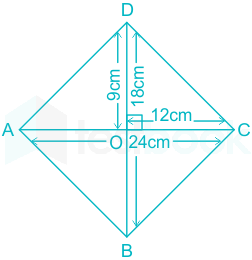
The lengths of the diagonal of a rhombus are 24 cm and 18 cm respectively; length of each side of the rhombus is-

  1. ((a))

    15 cm

  2. ((b))

    25 cm

  3. ((c))

    21 cm

  4. ((d))

    18 cm

Show Answer
Answer: ((a))

15 cm

Given:

The diagonal of the rhombus are 24 cm and 12 cm.

Formula used:

Pythagoras theorem,

h = (\sqrt{P^2 + b^2})

Where, h = Hypotaneous, P = Perpendicular, and b = Base

Calculation:

In ΔOCD,

Using the Pythagoras theorem,

CD = (\sqrt{OC^2 + OD^2})

⇒ (\sqrt{12^2 + 9^2} ) 

⇒ (\sqrt{144 + 81}) = (\sqrt{225}) = 15 cm

∴ The length of each side of the rhombus is 15 cm.

56

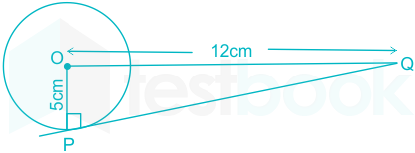
A tangent PQ at point P of a circle of radius 5 cm meets a line passing through center O at a point Q so that OQ = 12 cm. Length of PQ will be-

  1. ((a))

    (\sqrt{119}) cm

  2. ((b))

    13 cm

  3. ((c))

    12 cm

  4. ((d))

    8.5 cm

Show Answer
Answer: ((a))

(\sqrt{119}) cm

Given:

O is the center of a circle of radius = 5cm,  

PQ is tangent to the circle at P. 

PQ meets the line OP passing through O & P. 

OQ=12cm.

Formula used:

Pythagoras theorem,

h = (√{P^2+b^2})

Where, h = Hypotaneous, P = Perpendicular, and b = Base

Calculation:

The angle between a tangent and the radius through the point of contact is 90o.

∠OPQ = 90 

In ΔOPQ,

Using the Pythagoras theorem,

PQ = √(OQ2 - OP2

⇒ √(12- 52

⇒ √(144 - 25)  = √119

∴ The length of PQ is √119

57

Average age of 8 persons is increased by 2 years when two persons of age 20 years and 24 years are replaced by two women. Average age of these two women is-

  1. ((a))

    20 years

  2. ((b))

    25 years

  3. ((c))

    30 years

  4. ((d))

    35 years

Show Answer
Answer: ((c))

30 years

Given:

The average age of 8 persons is increased by 2 years when two persons of age 20 years and 24 years are replaced by two women.

Formula used:

Average = (\dfrac{sum \ of \ observation}{number \ of \ observation})

Calculations:

Let the average of 8 person be x years

So, the total age of 8 persons = 8x

Now, let a and b be the two women who replacing two persons,

According to the question,

⇒ (\dfrac{8x - 20 - 24 + a + b}{8}) = x + 2

⇒​ 8x - 20 - 24 + a + b = 8(x + 2)

⇒​ 8x - 44 + a + b = 8x + 16

⇒​ a + b = 16 + 44

⇒​ a + b = 60

Now, requires an average of these two women = (\dfrac{a + b}{2})

⇒​ (\dfrac{60}{2}) = 30 years

∴ The answer is 30 years

58

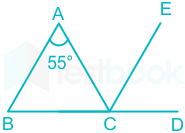
In the given figure, CE is the bisector of ∠ACD. If ∠A = 55° and AB = BC, then ∠ACE = ____

  1. ((a))

    55°

  2. ((b))

    35°

  3. ((c))

    45°

  4. ((d))

    62.5°

Show Answer
Answer: ((d))

62.5°

Given:

Calculations:

AB = BC   (given)

∴ ∠ACB = ∠BAC = 55°

∴ ∠ACD = 180° - ∠ACB = 180° - 55° = 125°

CE is the angle bisector of ∠ACD

∴ ∠ACE = ∠ACD/2 = 125°/2 = 62.5°

∴ ∠ACE = 62.5°

59

For which value of k, the following system of linear equations has infinite solutions?

x + (k + 1)y = 5

(k + 1)x + 9y = 8k - 1

  1. ((a))

    0

  2. ((b))

    1

  3. ((c))

    2

  4. ((d))

    3

Show Answer
Answer: ((c))

2

Given:

x + (k + 1)y = 5

(k + 1)x + 9y = 8k - 1

Concept used:

For a pair of linear equations to have infinitely many solutions, 

(\dfrac{a_1}{a_2}=\dfrac{b_1}{b_2}=\dfrac{c_1}{c_2})

Calculation:

x + (k + 1)y = 5

(k + 1)x + 9y = 8k - 1

a1 = 1, a2 = K+1, b1 = K+1, b2 = 9, c1 = 5, and c2 = 8k - 1

The Linear equation has an infinite solution,

(\dfrac{x}{k+1}=\dfrac{k+1}{9}=\dfrac{5}{-1})

From, (\dfrac{1}{k+1}=\dfrac{k+1}{9})

⇒ (k + 1)2 = 9 

⇒ k + 1 = √9 = ± 3

So, k = 2 and k = -4

From, (\dfrac{1}{k+1}=\dfrac{5}{8k - 1})

⇒ 5(k+1) = 8k-1

⇒ 5k+5 = 8k-1

⇒ 3k = 6

⇒ k = 2

From, (\dfrac{k+1}{9}=\dfrac{5}{8k - 1})

⇒ (k+1) (8k-1) = 45

⇒ 8k2 + 8k - k - 1 = 45

⇒ 8k2 + 7k - 46 = 0

⇒ k = 2 or k = -23/8

So, k=2 is the correct answer.

60

Decimal value of (\frac{13}{5^{3}}) will be-

  1. ((a))

    10.104

  2. ((b))

    9.104

  3. ((c))

    1.104

  4. ((d))

    0.104

Show Answer
Answer: ((d))

0.104

Given:

(\dfrac{13}{5^{3}})

Calculations:

(\dfrac{13}{5^{3}})

= (\dfrac{13}{125})

= 0.104

∴ The answer is 0.104

61

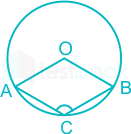
In given figure, O is the centre of the circle and ACBO is a parallelogram. ∠ACB = ____


  1. ((a))

    90°

  2. ((b))

    110°

  3. ((c))

    120°

  4. ((d))

    135°

Show Answer
Answer: ((c))

120°

Given:


Calculations:

Let, join A and B to any point D on the circle. We know that, the angle made by an arc at any point on the circle is half of the angle subtended at the centre.

Let ∠ACB be y and ∠AOB be x

Since, ∠ACB and ∠AOB are opposite angles.


Thus, ∠AOB = ∠ACB = x


∴ ∠ADB = (\dfrac{1}{2}) × ∠AOB


= (\dfrac{1}{2}) × x


Since, ABCD is a cyclic quadrilateral.


∴ ∠ADB + ∠ACB = 180° (sum of opposite angles in cyclic quadrilateral is 180°)


=> (\dfrac{1}{2}) × x + x = 180°


=> x + 2x = 360°


=> 3x = 360°


=> x = (\dfrac{360}{3})


=> x = 120°


∴ The answer is 120°

62

If (2x - 1) is a factor of 2x3 + ax2 + 11x + a + 3, then value of a is-

  1. ((a))

    -5

  2. ((b))

    5

  3. ((c))

    -7

  4. ((d))

    7

Show Answer
Answer: ((c))

-7

Given:

(2x - 1) is a factor of 2x3 + ax2 + 11x + a + 3

Calculations:

As 2x - 1 is one of the factor, then one of the roots will be, x = (\dfrac{1}{2})

Now, putting x = (\dfrac{1}{2}) in the given equation and equating the same to zero.

=> 2 × ((\dfrac{1}{2}))3 + a × ((\dfrac{1}{2}))2 + 11 × (\dfrac{1}{2}) + a + 3 = 0

=> 2 × (\dfrac{1}{8}) + a × (\dfrac{1}{4}) + 11 × (\dfrac{1}{2}) + a + 3 = 0

=> (\dfrac{1}{4}) + (\dfrac{a}{4})(\dfrac{11}{2}) + a + 3 = 0

=> (\dfrac{5a}{4}) + (\dfrac{35}{4}) = 0

=> 5a + 35 = 0

=> 5a = - 35

=> a = (\dfrac{-35}{5})

= - 7

∴ The answer is - 7

63

(\frac{(0.2)^{3}+(0.3)^{3}+(0.5)^{3}-3 \times 0.2 \times 0.3 \times 0.5}{(0.2)^{2}+(0.3)^{2}+(0.5)^{2}-0.2 \times 0.3-0.2 \times 0.5-0.3 \times 0.5}) is equal to -

  1. ((a))

    1

  2. ((b))

    0.8

  3. ((c))

    0.7

  4. ((d))

    0.5

Show Answer
Answer: ((a))

1

Given:

(\frac{(0.2)^{3}+(0.3)^{3}+(0.5)^{3}-3 \times 0.2 \times 0.3 \times 0.5}{(0.2)^{2}+(0.3)^{2}+(0.5)^{2}-0.2 \times 0.3-0.2 \times 0.5-0.3 \times 0.5})

Formula used:

a3 + b3 + c3 - 3abc = (a + b + c)(a2 + b2 + c2- ab - bc - ac)

Calculation:

(\frac{(0.2)^{3}+(0.3)^{3}+(0.5)^{3}-3 \times 0.2 \times 0.3 \times 0.5}{(0.2)^{2}+(0.3)^{2}+(0.5)^{2}-0.2 \times 0.3-0.2 \times 0.5-0.3 \times 0.5})

a3 + b3 + c3 - 3abc = (a + b + c)(a2 + b2 + c2- ab - bc - ac)

⇒ (\frac{(0.2+0.3+0.5){[(0.2)^{2}+(0.3)^{2}+(0.5)^{2}-0.2 \times 0.3-0.2 \times 0.5-0.3 \times 0.5}]}{[(0.2)^{2}+(0.3)^{2}+(0.5)^{2}-0.2 \times 0.3-0.2 \times 0.5-0.3 \times 0.5]})

⇒ (0.2 + 0.3 + 0.5) = 1

∴ The correct answer is 1.

64

A friend says to other "Give me hundred rupees friend! I shall then become twice as rich as you." Other replies, "If you give me ten rupees, I shall be six times as rich as you." How much rupees both have respectively?

  1. ((a))

    ₹140, ₹170

  2. ((b))

    ₹50, ₹170

  3. ((c))

    ₹30, ₹170

  4. ((d))

    ₹40, ₹170

Show Answer
Answer: ((d))

₹40, ₹170

Given:

A friend asks another friend to give Rs. 100 to become twice as rich as him and again the secomd friend asks for Rs. 10 to become six times as rich as him.

Calculations:

Let the amount with one friend be x and another friend be y

Now, according to problem,

x + 100 = 2(y - 100)

=> x + 100 = 2y - 200

=> x - 2y = - 300 (eqn1)

Now, when the other friend asked for 10 rupees, now, money with one friend becomes = x - 10 and another friend becomes = y + 10

Accroding to problem,

y + 10 = 6(x - 10)

=> y + 10 = 6x - 60

=> 6x - y = 70 (eqn2)

Equating both the equations, we get, x = 40

Putting the value of x = 40 in eqn2, we get,

6 × 40 - y = 70

=> y = 240 - 70 = 170

∴ The answer is Rs. 40, Rs. 170

65

Radius of a hemispherical bowl is 3 cm. Find volume of water that can be filled in the bowl.

  1. ((a))

    18π cm3

  2. ((b))

    36π cm3

  3. ((c))

    9π cm3

  4. ((d))

    72π cm3

Show Answer
Answer: ((a))

18π cm3

Given:

Radius of the hemispherical bowl is 3 cm

Formula used:

Volume of hemisphere =(\dfrac{2}{3}) × π × radius3

Calculations:

Radius = 3 cm

∴ Required volume = (\dfrac{2}{3}) × π × 3 × 3 × 3

= 2 × π × 9

= 18π cubic cm

∴ The answer is 18π cubic cm.

66

The average present age of Ritu and Priya is 22. After 8 years, ratio b/w Priya's age to Ritu's age is 7 ∶ 8, then find the ratio of Ritu's age to Priya's age two years ago.

  1. ((a))

    12 ∶ 11

  2. ((b))

    11 ∶ 9

  3. ((c))

    8 ∶ 7

  4. ((d))

    9 ∶ 7

Show Answer
Answer: ((b))

11 ∶ 9

Given:

The average present age of Ritu and Priya is 22. and after 8 years, the ratio between Priya's age to Ritu's age is 7 : 8.

Calculation:

Let the  present age of Ritu and Priya be x and y

Sum of ages of Priya and Ritu = 22 × 2 = 44

⇒ x + y = 44 →(1)

According to the question,

After 8 years,

(\dfrac{x+8}{y+8} = \dfrac{7}{8})

⇒ 8x + 64 = 7y + 56

⇒ 8x - 7y = -8 →(2)

From Eqn (1) and (2), we have

x = 20 years and y = 24 years 

Now, the ratio of Ritu's age to Priya's age two years ago.

⇒ (24 - 2) : (20 - 2)

⇒ 22 : 18

⇒ 11 : 9​

∴ The answer is 11 : 9.

67

A two-digit number gets reversed when 1/5th of it is added to it. Find the 40% of that number.

  1. ((a))

    32

  2. ((b))

    36

  3. ((c))

    20

  4. ((d))

    18

Show Answer
Answer: ((d))

18

Given:

A two-digit number gets reversed when 1/5th of it is added to it.

Calculation:

Let the two-digit number be 10x + y.

According to the question,

(10x + y) + (\dfrac{1}{5})(10x + y) = 10y + x

⇒ 50x + 5y + 10x + y = 50y + 5x

⇒ 60x - 5x  = 50y - 6y

⇒ 55x = 44y

⇒ (\dfrac{x}{y}) = (\dfrac{44}{55}) = (\dfrac{4}{5})

The Number = 10x + y 

⇒ 10 × 4 + 5 = 45

Now, 40% of 45

⇒ (\dfrac{40}{100}) × 45 = 18

∴ The number is 18.

68

How much compound interest will be paid by a person for loan of ₹700 at the rate of 4% annual compound interest for 3 years?

  1. ((a))

    ₹84

  2. ((b))

    ₹28

  3. ((c))

    ₹87.40

  4. ((d))

    ₹124

Show Answer
Answer: ((c))

₹87.40

Given:

Principle = Rs. 700

Time = 3 years

Rate = 4%

Formula used:

CI = P[(1 + R/100)t - 1]

Calculation:

CI = P[(1 + R/100)t - 1]

⇒ 700[(1 + 4/100)3 - 1]

⇒ 700[(26/25)3 - 1]

⇒ 700[(\dfrac{17576-15625}{15625})]

⇒ 700 × (\dfrac{1951}{15625}) = 87.4048 

∴ The answer  is Rs. 87.40

69

5 people were asked about the time in a week they spend in doing social work in their community. They replied 20, 14, 26, 40 and 30 hours respectively. Find the mean (or average) time in a week devoted by them for social work.

  1. ((a))

    20 hours

  2. ((b))

    14 hours

  3. ((c))

    40 hours

  4. ((d))

    26 hours

Show Answer
Answer: ((d))

26 hours

Given:

Spend time in a week 20, 14, 26, 40 and 30 hrs.

Formula used:

Average = Sum of observation / Number of observation

Calculation:

Average = Sum of observation / Number of observation

⇒ (\dfrac{20+14+26+40+30}{5})

⇒ (\dfrac{130}{5}) = 26 hrs.

∴ The answer is 26 years.

70

In the given figure the value of x equals-

  1. ((a))

    (\frac{a b}{a+c})

  2. ((b))

    (\frac{a c}{a+b})

  3. ((c))

    (\frac{\mathrm{ac}}{\mathrm{b}+\mathrm{c}})

  4. ((d))

    (\frac{a b}{b+c})

Show Answer
Answer: ((c))

(\frac{\mathrm{ac}}{\mathrm{b}+\mathrm{c}})

Given:

Calculations:

In triangles LMK and PNK,

∠KML = ∠PNK = 46°

∠K = ∠K (common angle)

∴ ▵LMK ~ ▵PNK (angle angle similarity)

=> (\dfrac{KM}{KN}) = (\dfrac{LM}{PN})

=> (\dfrac{b + c}{c}) = (\dfrac{a}{x})

=> x = (\dfrac{ac}{b + c})

∴ The answer is (\dfrac{ac}{b + c})

71

If least common multiple of two numbers is 225 and the highest common factor is 5, then find the numbers when one of the numbers is 25?

  1. ((a))

    75

  2. ((b))

    65

  3. ((c))

    15

  4. ((d))

    45

Show Answer
Answer: ((d))

45

Given:

LCM = 225, HCF = 5, and One of the number is 25.

Formula used:

First Number × Second Number = LCM × HCF

Calculation:

Let the second number be x.

First Number × Second Number = LCM × HCF

⇒ 25 × x = 5 × 225

⇒ x = (\dfrac{5×225}{25})

⇒ x = 5 × 9 = 45

∴ The second number is 45.

72

The greatest length of the scale that can measure exactly 30 cm, 90 cm, 1 m 20 cm and 1 m 35 cm lengths is-

  1. ((a))

    5 cm

  2. ((b))

    10 cm

  3. ((c))

    15 cm

  4. ((d))

    30 cm

Show Answer
Answer: ((c))

15 cm

Given:

Length of the scale = 30 cm, 90 cm, 1 m 20 cm, and 1 m 35 cm

Calculation:

1 m 20 cm = 120 cm 

1 m 35 cm = 135 cm  

The greatest length of scale is the HCF of all length.

30 = 2 × 3 × 5

90 = 2 × 3 × 3 × 5

120 = 2 × 2 × 2 × 3 × 5

135 = 3 × 3 × 3 × 5

The HCF of 30, 90, 120, and 135 is 15.

∴ The greatest length of scale must be 15.

73

Voice of which of the following is likely to have minimum frequency?

  1. ((a))

    woman

  2. ((b))

    baby girl

  3. ((c))

    man

  4. ((d))

    baby boy

Show Answer
Answer: ((c))

man

The correct answer is man.

  • A man's voice is of a lower pitch than a child's voice, a baby boy's, or a woman's voice.
  • Man's Voice has the minimum frequency.

Key Points

  • Since the frequency of a sound is proportional to its tone, the human voice is of the lowest frequency compared to others.
  • Pitch means the sharpness of the voice.
  • The man's voice is the least shrill among all the alternatives.
  • Thus, it has the lowest pitch among all and hence the lowest frequency.
  • A girl child has the highest pitch in this group.
74

Which of the following fuel has the maximum calorific value (in kJ/kg)?

  1. ((a))

    Coal

  2. ((b))

    Petrol

  3. ((c))

    Methane

  4. ((d))

    LPG

Show Answer
Answer: ((d))

LPG

The correct answer is LPG.

  • LPG has a maximum calorific value.

Key Points

FuelCalorific Value (Approx.)
Coal30000 J/kg
Petrol45000 kJ/kg
Methane50000 kJ/kg
LPG55000 kJ/kg

Additional Information

  • The calorific value is the amount of heat energy present in the food or fuel and is determined by the complete combustion of a specified amount under constant pressure and under normal conditions.
  • It is also called thermal power.
  • The unit of calorific value is kilojoule per kilogram i.e. KJ/Kg.
75

Which rocks are known as Primary rocks?

  1. ((a))

    metamorphic rocks

  2. ((b))

    sedimentary rocks

  3. ((c))

    igneous rocks

  4. ((d))

    All of the above

Show Answer
Answer: ((c))

igneous rocks

The correct answer is igneous rocks.

  • Igneous rocks are formed by the cooling and solidification of magma (molten rocks).
  • This rock starts the cycle.
  • Hence, it is known as primary rocks.
  • The categories of igneous rocks are extrusive and intrusive.
  • Examples of igneous are pumice stone, Scoria, and granite.

Additional Information

  • Sedimentary rocks- formed by the composition and cementation of layers of sediment (rocks, fragments, organic remains, chemical deposits).
  • Examples of sedimentary rocks are conglomerate, shale, sandstone, gypsum, limestone.
  • Metamorphic Rocks- Formed when existing rocks are changed by intense heat and pressure.
  • Examples of metamorphic rocks are gneiss and schist.
76

Recently, which one of the following was awarded the President's Color?

  1. ((a))

    INS Vikrant

  2. ((b))

    INS Vikramaditya

  3. ((c))

    INS Valsura

  4. ((d))

    INS Sahayadri

Show Answer
Answer: ((c))

INS Valsura

The correct answer is INS Valsura.

Key Points

  • Former President Ram Nath Kovind presented the President's Color to the Navy's premier technical training establishment INS Valsura.
  • The presidential color is given to a military unit in recognition of the exceptional service rendered to the nation in both peace and war.

Additional Information

  • INS Vikrant, also known as Indigenous Aircraft Carrier 1, is an aircraft carrier built by Cochin Shipyard Limited for the Indian Navy.
  • It is the first aircraft carrier to be built in India.
  • INS Vikramaditya is a modified Kiev-class aircraft carrier and the flagship of the Indian Navy, which entered service in 2013.
  • Originally built as Baku and commissioned in 1987, the carrier served with the Soviet Navy.
  • ​INS Sahyadri is a Shivalik class stealth multi-role frigate built for the Indian Navy.
  • This class has better stealth and land attack capabilities than the preceding Talwar-class battleships.
77

Water stored in earthen pots become cool in summer because of-

  1. ((a))

    evaporation

  2. ((b))

    condensation

  3. ((c))

    precipitation

  4. ((d))

    osmosis

Show Answer
Answer: ((a))

evaporation

The correct answer is evaporation.

Key Points

  • Water kept in an earthen pot remains cool even in summer due to evaporation.
  • The clay pot has a large number of very small pores through which the water stored inside the pot continues to evaporate and takes the latent heat needed to evaporate from the clay pot and the remaining water.
  • Therefore, the heat from the earthen pot and the water is reduced and this cools the water inside the pot.

Additional Information

  • Condensation is the process in which water vapor becomes a liquid. This is the reverse of evaporation, where liquid water becomes vapor.
  • In meteorology, precipitation is any product of the condensation of atmospheric water vapor under the gravitational pull from clouds.
  • The main forms of precipitation include drizzle, rain, hail, snow and hail.
  • Osmosis is the spontaneous net movement or diffusion of solvent molecules through a selectively-permeable membrane from an area of high water potential to an area of low water potential, in a direction that equalizes solute concentrations on both sides.
78

The cause of mirage formation in desert is-

  1. ((a))

    the refractive index of atmosphere decreases with decrease in height

  2. ((b))

    the refractive index of atmosphere increases with decrease in height

  3. ((c))

    the refractive index of atmosphere does not change with height

  4. ((d))

    Scattering

Show Answer
Answer: ((b))

the refractive index of atmosphere increases with decrease in height

The correct answer is the refractive index of atmosphere increases with decrease in height.

Key Points

  • The reason why a mirage is formed is that "the refractive index of the atmosphere increases with a decrease in altitude" and so the rays are completely refracted and form a mirage.
  • As we go down in the atmosphere, the air gets denser, and hence the velocity in that medium decreases.
  • Hence, the refractive index increases as we decrease height.

Important Points

  • Mirages are caused by the total internal reflection of light by different layers of air.
  • It is an optical illusion responsible for the appearance of a layer of water over short distances in a desert or road.
  • A mirage is an example of total internal reflection caused by atmospheric refraction.
79

Why oil does not mix with water?

  1. ((a))

    Molecules of oil are non-polar

  2. ((b))

    Molecules of oil are bigger than that of water

  3. ((c))

    Both 1 and 2 are correct

  4. ((d))

    None of the above

Show Answer
Answer: ((a))

Molecules of oil are non-polar

The correct answer is Molecules of oil are non-polar.

Key Points

  • Water is a polar molecule.
  • It has two positive molecules and one negative molecule.
  • In order to dissolve in water, a compound has to be polar.
  • The positive molecule in the compound gets together with the negative molecule in water.
  • The negative molecule in the compound gets together with the positive molecule in water.
  • Oil is not polar, thus it is unable to perform this reaction.
  • Thus, oil does not mix with water.

Additional Information

  • Water can dissolve salt.
  • The positive part of water molecules attracts the negative chloride ions.
  • The negative part of water molecules attracts the positive sodium ions.
80

In which district of Rajasthan the PM WANI Scheme launched recently?

  1. ((a))

    Jaipur

  2. ((b))

    Jodhpur

  3. ((c))

    Udaipur

  4. ((d))

    Pratapgarh

Show Answer
Answer: ((d))

Pratapgarh

The correct answer is Pratapgarh.

Key Points

  • PM WANI Scheme launched in Pratapgarh.​ First PM Vani Scheme launched in Rajasthan state,
  • youth will get better internet facility,
  • data offices will be opened in every panchayat and village.

Additional Information

  • Pradhan Mantri WiFi Access Network Initiative (PM Vani Yojana) has been started by Prime Minister Narendra Modi.
  • Through this scheme, the facility of Wi-Fi in all public places will be made available by the government.
  • This facility will be free.
  • There will be a massive WiFi revolution in the country through PM-WANI Yojana.
  • Businesses will also get a boost through this scheme.
  • Employment opportunities will also increase through PM Vani Yojana.
81

The 5G test bed for Army Training Command will be established at-

  1. ((a))

    Army College of Telecommunication, in Bombay

  2. ((b))

    Military College of Telecommunication Engineering, in Mhow

  3. ((c))

    Military College of Science and Telecommunication, in Bangalore

  4. ((d))

    Army College of Science and Telecommunication, in Indore

Show Answer
Answer: ((b))

Military College of Telecommunication Engineering, in Mhow

The correct answer is Military College of Telecommunication Engineering, in Mhow.

Key Points

  • The Army Training Command (ARTRAC) is collaborating with IIT-Madras to set up a 5G testbed at the Military College of Telecommunications, Mhow, Indore, to assist the Army in implementing 5G technology for operational applications, especially at international borders.
  • In telecommunications, 5G broadband is the fifth-generation technology standard for cellular networks that cellular phone companies began deploying worldwide in 2019, and is the planned successor to the 4G network that provides connectivity to most current cellphones.
82

Areolar connective tissue is not found in-

  1. ((a))

    between the teeth and gums

  2. ((b))

    between internal organs

  3. ((c))

    around blood vessels

  4. ((d))

    the bone marrow

Show Answer
Answer: ((a))

between the teeth and gums

The correct answer is between the teeth and gums.

Key Points

  • Areolar connective tissue is the type of tissue which connects and surrounds different organs in the human body.
  • Areolar connective tissue is found between the skin and muscles, blood vessels and nerves, and bone marrow.

Important Points

  • Blood is a type of connective tissue.
  • Bone is another example of connective tissue.
  • Two bones can be connected to each other by another type of connective tissue called the ligament.
  • Another type of connective tissuecartilage, smoothens bone surfaces at joints and is also present in the nose, ear, trachea and larynx.
83

The presence of the cell wall enables the cells of plants, fungi and bacteria to exist without bursting in which medium?

  1. ((a))

    Isotonic

  2. ((b))

    Hypertonic

  3. ((c))

    Hypotonic

  4. ((d))

    All of the above

Show Answer
Answer: ((c))

Hypotonic

The correct answer is Hypotonic.

Key Points

  • The presence of the cell wall enables the cells of plants, fungi and bacteria to exist in hypotonic media without bursting.
  • If the medium surrounding the cell has a higher water concentration than the cell, meaning that the outside solution is very dilute, the cell will gain water by osmosis.
  • Such a solution is known as a hypotonic solution.

Additional Information

  • Isotonic: If the medium has exactly the same water concentration as the cell, there will be no net movement of water across the cell membrane. Such a solution is known as an isotonic solution.
  • Hypertonic: If the medium has a lower concentration of water than the cell, meaning that it is a very concentrated solution, the cell will lose water by osmosis. Such a solution is known as a hypertonic solution.
84

The PSLV-C52 successfully launched which satellite from the first launch pad of Satish Dhawan Space Centre, Sriharikota?

  1. ((a))

    EOS-01

  2. ((b))

    EOS-02

  3. ((c))

    EOS-03

  4. ((d))

    EOS-04

Show Answer
Answer: ((d))

EOS-04

The correct answer is EOS-04.

  • On February 14, 2022, Polar Satellite Launch Vehicle PSLV-C52 successfully launched the EOS-04 satellite from the first launch pad of Satish Dhawan Space Center (SDSC), SHAR, Sriharikota.
  • ​The EOS-04 weighs 1,710 kg and is designed to provide high-quality images in all weather conditions for applications such as agriculture, forestry and plantation, soil moisture and hydrology, and flood mapping with a mission life of ten years.

Additional Information

  • The first of these newly designated satellites, EOS-01, launched in November 2020, is currently in orbit.
  • EOS-02 is a micro-satellite to be flown on a new launch vehicle named SSLV (Small Satellite Launch Vehicle).
  • While the launch of EOS-03 failed in August 2021.
85

GSAT-24 satellite was launched on space launch vehicle, by French company-

  1. ((a))

    Arianespace

  2. ((b))

    SpaceX

  3. ((c))

    Rocket lab

  4. ((d))

    Ariane 5

Show Answer
Answer: ((a))

Arianespace

The correct answer is Arianespace.

  • The GSAT-24 satellite built by ISRO for NewSpace India Limited (NSIL) was successfully launched by French company Arianespace from Kourou in French Guiana (South America).
  • GSAT-24 is a 24-Ku band communication satellite, weighing 4180 kg, with pan-India coverage to meet the needs of DTH applications.
  • The commercial arm of ISRO, NSIL was established in March 2019 and is a Central Public Sector Enterprise (CPSE) under the Department of Space (DOS).

Additional Information

  • SpaceX: Space Exploration Technologies Corp. is an American spacecraft manufacturer, space launch provider, and satellite communications corporation headquartered in Hawthorne, California.
  • SpaceX was founded in 2002 by Elon Musk.
  • Rocket Lab is a public American aerospace manufacturer and launch services provider, with a New Zealand subsidiary
  • Ariane 5 is a European heavy-lift space launch vehicle developed and operated by Arianespace for the European Space Agency (ESA).
86

At which height GPS satellites are placed?

  1. ((a))

    9000 km

  2. ((b))

    36,000 km

  3. ((c))

    20,200 km

  4. ((d))

    30,200 km

Show Answer
Answer: ((c))

20,200 km

The correct answer is 20,200 km.

  • GPS satellites fly in circular orbits at an altitude of 10,900 nautical miles (20,200 km) and for a period of 12 hours.

Additional Information

  • The Global Positioning System (GPS), originally Navstar GPS, is a satellite-based radio navigation system owned by the United States government and operated by the United States Space Force.
  • It is one of the global navigation satellite systems (GNSS) that provide geographic location and time information to GPS receivers anywhere on or near Earth where four or more GPS satellites have an unobstructed line of sight.
  • The GPS project was started by the U.S. Department of Defense in 1973.
87

NH-925A was used for emergency landing of which IAF aircraft?

  1. ((a))

    Hercules DC-130J

  2. ((b))

    Hercules C-130J

  3. ((c))

    Hercules KC-130J

  4. ((d))

    Hercules MC-130J

Show Answer
Answer: ((b))

Hercules C-130J

The correct answer is Hercules C-130J.

  • For the first time, IAF's C-130J Super Hercules transport aircraft along with Defense Minister Rajnath Singh, Road Transport Minister Nitin Gadkari, and Air Chief Marshal RKS Bhadauria landed on National Highway-925A in Rajasthan's Barmer.

Additional Information

  • The Lockheed Martin C-130J Super Hercules is a four-engine turboprop military transport aircraft.
  • The C-130J is a comprehensive update of the Lockheed C-130 Hercules, with new engines, flight deck, and other systems.
  • The C-130J is the newest version of the C-130 Hercules and the only model in production.
  • National Highway 925A, commonly known as NH 925A, is a national highway in India.
  • It is a spur route of National Highway 25.
  • NH-925A runs in the state of Rajasthan in India.
  • NH925A connects Satta and Gandhav in the state of Rajasthan.
88

How long does it take for a GPS signal to reach the earth?

  1. ((a))

    1/25 second

  2. ((b))

    1/10 second

  3. ((c))

    1/20 second

  4. ((d))

    1/15 second

Show Answer
Answer: ((d))

1/15 second

The correct answer is 1/15 second.

  • It takes about 1/15 seconds for a GPS signal to reach the Earth's surface.

Additional Information

  • The Global Positioning System (GPS), originally Navstar GPS, is a satellite-based radio navigation system owned by the United States government and operated by the United States Space Force.
  • It is one of the global navigation satellite systems (GNSS) that provide geographic location and time information to GPS receivers anywhere on or near Earth where four or more GPS satellites have an unobstructed line of sight.
  • The GPS project was started by the U.S. Department of Defense in 1973.
89

In which months does rainfall occur through the western disturbances in Rajasthan?

  1. ((a))

    July and August

  2. ((b))

    April and May

  3. ((c))

    September and October

  4. ((d))

    December and January

Show Answer
Answer: ((d))

December and January

The correct answer is December and January.

  • Rainfall in Rajasthan occurs sometimes in December-January, there is rain in the form of 'Mawat' from western disturbances.

Key Points

  • The climate of Rajasthan in northwestern India is generally arid or semi-arid and has fairly hot temperatures throughout the year with extreme temperatures in both summer and winter.
  • More than 90% of the rainfall in Rajasthan comes from the summer south-west monsoon winds.
  • In winter, minimum rainfall is also received from western disturbances.
  • The rainy season in Rajasthan is of short duration, the monsoon reaches Rajasthan between June 15 and July 15 and starts returning in September.
90

Desert Development Programme was started in Rajasthan in the year-

  1. ((a))

    1974-75

  2. ((b))

    1977-78

  3. ((c))

    1981-82

  4. ((d))

    1999

Show Answer
Answer: ((b))

1977-78

The correct answer is 1977-78.

Key Points

  • The desert development programme started in 1977-78.
  • The programme was initiated by the central government under the recommendations of the National Commission on Agriculture.
  • The objective of the programme​
  • To minimise the effects of adverse climatic conditions.
  • To restore ecological balance through natural resources.
  • To control desertification.
  • The programme also aims to
  • Achieve ecological balance.
  • To promote overall economic development.
  • Improving the socio-economic conditions of the people inhabiting the programme areas.
91

Match the following -

List-IList-II
(a)Barkhan(i)Abu mountain block
(b)Lathi series(ii)Sand dune
(c)Inselberg(iii)Dry lake
(d)Playa(iv)Underground water belt

Correct code is -

  1. ((a))

    (a) - (ii), (b) - (iv), (c) - (iii), (d) - (i)

  2. ((b))

    (a) - (iv), (b) - (ii), (c) - (i), (d) - (iii)

  3. ((c))

    (a) - (iii), (b) - (iv), (c) - (i), (d) - (ii)

  4. ((d))

    (a) - (ii), (b) - (iv), (c) - (i), (d) - (iii)

Show Answer
Answer: ((d))

(a) - (ii), (b) - (iv), (c) - (i), (d) - (iii)

The correct answer is (a) - (ii), (b) - (iv), (c) - (i), (d) - (iii).

Key Points

  • Barkhan - Most dynamic crescent-shaped sand dunes which cause maximum damage. Most-Shekhawati area but more in Jaisalmer in western Rajasthan.
  • Lathi series - The geological water belt spread in Jaisalmer.
  • Dhad or Talli – Playa lakes formed in Bikaner-Churu to fill rainwater.
  • An inselberg or monadock is an isolated rock hill, knob, ridge or small mountain that rises abruptly from the surrounding plain of a gently sloping or virtually flat. 
  • From the point of view of topography, the Abu mountain block of Rajasthan was called a huge Inselberg.
92

Sirohi, Pali and Jalore districts come under which agro-climatic zone of Rajasthan?

  1. ((a))

    I-A

  2. ((b))

    II-A

  3. ((c))

    II-B

  4. ((d))

    III-B

Show Answer
Answer: ((c))

II-B

The correct answer is II-B.

Key Points

Agro-climatic zones of Rajasthan:

ZoneAreaDistricts Covered
IAArid western plainBarmer and part of Jodhpur
IBIrrigated north-western plainSriganganagar, Hanumangarh
ICHyper arid partial irrigated zoneBikaner, Jaisalmer, Churu
IIAInternal drainage dry zoneNagaur, Sikar, Jhunjhunu, Part of Churu
IIBTransitional plain of Luni basinJalore, Pali, Part of Sirohi, Jodhpur
IIIASemi-arid eastern plainsJaipur, Ajmer, Dausa, Tonk
IIIBFlood-prone eastern plainAlwar, Dholpur, Bharatpur, Karoli, Sawai Madhopur
IVASub-humid southern plainsBhilwara, Sirohi, Udaipur, Chittorgarh
IVBHumid southern plainsDungarpur, Udaipur, Banswara, Chittorgarh, Pratapgarh
VHumid south-eastern plainKota, Jhalawar, Bundi, Baran
93

Which is not correctly matched?

  1. ((a))

    Vagad - Dungarpur-Banswara

  2. ((b))

    Mewat - Alwar-Bharatpur

  3. ((c))

    Bhomat - Pratapgarh-Chittorgarh

  4. ((d))

    Hadoti - Kota-Bundi-Jhalawar

Show Answer
Answer: ((c))

Bhomat - Pratapgarh-Chittorgarh

Bhomat - Pratapgarh-Chittorgarh is not correctly matched.

Key Points

  • Vagad: The tribal area of Banswara and Dungarpur is called Vagad.
  • Mewat: In the eastern part of Alwar Bharatpur districts, people of 'Meo caste' reside, hence this area is called Mewat.
  • Bhomat: The inaccessible hilly region of the Aravallis in Dungarpur, East Sirohi and Udaipur districts is known as Bhomat.
  • Hadoti: Kota, Bundi, Baran, and Jhalawar together became Hadoti.

Important Points

  • Malwa: The region of the eastern princely states of Jhalawar and Pratapgarh.
  • Rath: Mandawar, Behror, Banusar tehsils of Alwar district together form the Rath region.
  • Shekhawati: Sikar, Churu, Jhunjhunu districts are known as Shekhawati.
  • Matsya Region: Alwar, Bharatpur, Dholpur, part of Karauli.
94

Which statement is not correct?

  1. ((a))

    Dry teak forests are found in Southern parts of Rajasthan.

  2. ((b))

    Mixed deciduous forests are found in Udaipur, Chittorgarh and Sirohi districts.

  3. ((c))

    Sub-tropical evergreen forests are found in Mount Abu region.

  4. ((d))

    Tropical thorn forests are mostly found in Eastern part of Rajasthan.

Show Answer
Answer: ((d))

Tropical thorn forests are mostly found in Eastern part of Rajasthan.

Tropical thorn forests are mostly found in Eastern part of Rajasthan is NOT correct.

Key Points

  • Tropical forests are found in the Jaisalmer district of Rajasthan.
  • Tropical forests are found in arid and semi-arid regions.
  • This forest extends from the western Indo-Pak border and merges into dry deciduous mixed forests in the Aravalli and southeastern plateau.

Additional Information

  • Forest in Rajasthan:
  • Dhokra Forest - Most Karauli, Sawai Madhopur, Jaipur
  • Palas Van (Dhak Van) -
  • Nickname: Flame of the Forest.
  • Found in Rajsamand.
  • Salar Forest – Udaipur, Rajsamand, Alwar, Ajmer
  • Teak Forest – Banswara
95

Which of the following medicinal plants is not included in Rajasthan Ghar-Ghar Aushadhi Yojana?

  1. ((a))

    Aswagandha

  2. ((b))

    Musli

  3. ((c))

    Gilloy

  4. ((d))

    Kalmegh

Show Answer
Answer: ((b))

Musli

The correct answer is Musli.

  • Musli is not included in Rajasthan Ghar-Ghar Aushadhi Yojana.

Key Points

  • Ghar Ghar Aushadhi Yojana was launched by the Government of Rajasthan on 1st August 2021.
  • Through this scheme, medicinal plants will be made available to one crore 26 lakh families in the state.
  • Tulsi, Giloy, Kalmegh, and Ashwagandha saplings will be distributed free of cost to every family in the state.
96

As per the new system of soil classification, the 'Alfisols' soil is found in Rajasthan in-

  1. ((a))

    Jaipur, Alwar and Kota

  2. ((b))

    Churu, Jhunjhunu and Sikar

  3. ((c))

    Jaisalmer and Barmer

  4. ((d))

    Pratapgarh and Sirohi

Show Answer
Answer: ((a))

Jaipur, Alwar and Kota

The correct answer is Jaipur, Alwar and Kota.

Key Points

  • Alfisols
  • Districts: Jaipur, Alwar, Bharatpur, Sawai Madhopur, Tonk, Bhilwara, Chittorgarh, Banswara, Udaipur, Dungarpur, Bundi, Kota, and parts of Jhalawar.
  • These are mature soils with medium to high profile growth.

Additional Information

  • Soils in Rajasthan:
  • Aridisols - Aridisols are found in the dry climatic regions of Rajasthan. It is found in some areas of Churu, Sikar, Jhunjhunu, Nagaur, Jodhpur, Pali and Jalore.
  • Entisol - The color of this soil is light yellow-brown. It is found in almost all the districts of West Rajasthan.
  • Inceptisol - This soil can be found anywhere in areas of semiarid to humid climates. Apart from this, this soil is also found in the plains of alluvial soils in Sirohi, Pali, Rajsamand, Udaipur, Bhilwara and Chittorgarh districts.
  • Vertisols - This soil contains a lot of clay. Vertisols are found in most areas of Jhalwara, Bandra, Kota and Bundi of Rajasthan.
97

The 'Great Artesian Basin' is located at-

  1. ((a))

    South America

  2. ((b))

    North America

  3. ((c))

    Australia

  4. ((d))

    Antarctica

Show Answer
Answer: ((c))

Australia

The correct answer is Australia.

  • The Great Artesian Basin (GAB) is one of the largest underground water sources in the world and the largest groundwater basin in Australia.
  • In fact, it is the only reliable resource of fresh water in all of inland Australia.

Key Points

  • The Great Artesian Basin is one of Australia's most important water resources.
  • It covers an area of 1.7 million square kilometers, about 22 percent of the continent – including 12 percent of New South Wales.
  • The basin is the largest and deepest artesian basin in the world. The basin is 3,000 meters (9,800 ft) deep in places and is estimated to contain 64,900 cubic kilometers (15,600 cu mi) of groundwater.
98

The 'Submarine Canyons' are locate on/in-

  1. ((a))

    Continental shelf

  2. ((b))

    Continental slopes

  3. ((c))

    Deep sea plains

  4. ((d))

    Ocean deeps

Show Answer
Answer: ((b))

Continental slopes

The correct answer is Continental slopes.

  • Submarine canyon, any of a class of narrow steep-sided valleys that cut into continental slopes and continental rises of the oceans.

Additional Information

  • The continental shelf is the edge of a continent that lies beneath the ocean.
  • Continents are the seven main parts of land on Earth.
  • A continental shelf extends from the coastline of a continent to a drop-off point called a shelf break.
  • The continental slope is the slope between the outer edge of the continental shelf and the deep ocean floor.
  • The continental slope is cut by submarine basins in several places.
  • The continental slope marks the seafloor of the continental shelf.
  • An abyssal plain is an underwater plain on the deep sea floor, usually found at depths between 3,000 meters (9,800 ft) and 6,000 meters (20,000 ft).
  • Typically located between a continental uplift and a mid-ocean ridge, abyssal plains cover more than 50% of the Earth's surface.
  • The depth of the ocean is the deepest part of the ocean.
  • They are long, narrow, steep-sided and flat-bottomed depressions on the ocean floor.
99

'Funafuti' is a-

  1. ((a))

    River in Japan

  2. ((b))

    Lake in Japan

  3. ((c))

    Atoll

  4. ((d))

    Currency of Tuvalu

Show Answer
Answer: ((c))

Atoll

The correct answer is Atoll.

  • Funafuti is an atoll and the capital of the island nation of Tuvalu.
  • It has a population of 6,320 people (2017 census), and therefore has more people than the rest of Tuvalu, with about 60% of the population.

Additional Information

  • Japan is an island country in East Asia.
  • It is located in the northwestern Pacific Ocean, and is bounded by the Sea of Japan in the west, while extending from the Sea of Okhotsk in the north to the East China Sea, the Philippine Sea, and Taiwan in the south.
  • Capital: Tokyo
  • Currency: Japanese yen
100

Which isohyet separates the Sandy Arid Plains and Semi-arid Transitional Plains of Rajasthan?

  1. ((a))

    10 cm

  2. ((b))

    50 cm

  3. ((c))

    75 cm

  4. ((d))

    25 cm

Show Answer
Answer: ((d))

25 cm

The correct answer is 25 cm.

Key Points

  • The line dividing the sandy arid plains and the semi-arid transitional plain is the climate, that is, 25 cm isohytes.
  • The westernmost belt which is 'The Great Desert' is covered with sand dunes which extends along the border of Pakistan from the Great Rann to Punjab.
  • The volume and extent of sand dunes greatly influence the economic activities of the region.
  • 63 percent of the sand dune area of ​​Rajasthan is concentrated in the desert districts of Barmer, Jaisalmer and Bikaner.

Additional Information

  • Dhundhar- Jaipur, Dausa, Sawai Madhopur, Tonk and northern part of Karauli.
  • Gorwar- South-western part of Rajasthan; having historical capitals- Nadol, Chandrawati and Sirohi. It covers region of Jalore, Sirohi and southern portion of Pali.
  • Hadoti- districts like Bundi, Baran, Jhalawar and Kota are part of this region.
  • Marwar- Barmer, Jodhpur, Jalore, Nagaur and Pali.
  • Mewar- South- central region of Rajasthan:
  • In this region the districts covered are- Bhilwara, Chittorgarh, Rajsamand, Udaipur, Pirawa tehsil of Jhalawar (Rajasthan), Neemuch and Mandsaur of M.P. and some parts of Gujarat.
  • Mewat- Aravalli range in Alwar district, Pahari, Nagaur, Kaman tehsils in Bharatpur district of Rajasthan and some part of Mathura district of U.P.
  • Shekhawati- Jhunjhunu, Sikar, Churu and a part of Nagaur and Jaipur.
  • Vagad- region in south-eastern Rajasthan.
101

Which one of the following is not a salt water lake?

  1. ((a))

    Kavod

  2. ((b))

    Deedwana

  3. ((c))

    Rewasa

  4. ((d))

    Jait sagar

Show Answer
Answer: ((d))

Jait sagar

The correct answer is Jait sagar.

  • Jait Sagar Lake, Bundi is not a salt water lake.
  • Located close to the Taragarh Fort, this lake is surrounded by hills and covered with pretty lotus flowers that bloom during winter and monsoon.

Key Points

  • Saline (Salt) Water lakes
  • This are considered as remains of Tethys Sea.
  • Deedwana, Lunkaransar, Sambhar, Panchpadra etc.
  • Other Salt lakes in Rajasthan:
  • Nagaur: Degana, Kuchaman
  • Jodhpur: Falaudi
  • Sikar: Rewasa
  • Jaisalmer: Kavod
  • Major fresh or sweet water lakes of Rajasthan are Fateh Sagar, Jaisamand, Pichola, Udaisagar, Swaroop Sagar, Pushkar, Ana Sagar, Foy Sagar etc.
102

Which state has the maximum Ramsar wetland sites in India?

  1. ((a))

    Uttarakhand

  2. ((b))

    Madhya Pradesh

  3. ((c))

    Odisha

  4. ((d))

    Tamil Nadu

Show Answer
Answer: ((d))

Tamil Nadu

The correct answer is Tamil Nadu .

  • The state of Tamil Nadu (14) has the most Ramsar sites in India, followed by the state of Uttar Pradesh with 10 sites.

Important Points

  • Five new Ramsar sites (wetlands of international importance) were announced in July 2022 by the Minister of Environment, Forest and Climate Change, Shri Bhupendra Yadav.
  • Thus the total number of Ramsar sites increased to 80.
  • The five new Ramsar sites are Karikili Bird Sanctuary, Pallikaranai Marsh Reserve Forest and Pichavaram Mangroves in Tamil Nadu, Sakhya Sagar in Madhya Pradesh and Pala Wetlands in Mizoram.
  • Chilika Lake (Orissa) and Keoladeo National Park (Rajasthan) were recognized as the first Ramsar Sites of India.

Additional Information

  • The Ramsar Convention was signed in 1971 with the aim of conservation and wise use of wetlands with local, national and international cooperation for overall sustainable development of the world.
  • Ramsar sites are kept in the Montreux record to track any major ecological changes that may affect any wetland site in a positive or reverse way.
  • The Ramsar Convention came into force in India on 1 February 1982.
103

Match List-I with List-II and choose the correct answer from the code given below-

List-I (City)List-II (Industry)
(i)Detroit(a)Cutlery
(ii)Sheffield(b)Automobile
(iii)Los Angeles(c)Film
(iv)Multan(d)Pottery
  1. ((a))

    (i) - (c), (ii) - (a), (iii) - (b), (iv) - (d)

  2. ((b))

    (i) - (b), (ii) - (a), (iii) - (c), (iv) - (d)

  3. ((c))

    (i) - (b), (ii) - (c), (iii) - (a), (iv) - (d)

  4. ((d))

    (i) - (b), (ii) - (c), (iii) - (d), (iv) - (a)

Show Answer
Answer: ((b))

(i) - (b), (ii) - (a), (iii) - (c), (iv) - (d)

The correct answer is (i) - (b), (ii) - (a), (iii) - (c), (iv) - (d).

Key Points

  • Detroit is known as the center of the automobile industry.
  • "Big Three" auto manufacturers General Motors, Ford and Stelantis North America (Chrysler) are headquartered in Metro Detroit.
  • The city of Sheffield in England is famous for the production of cutlery since the 17th century.
  • Los Angeles is known for its Mediterranean climate, ethnic and cultural diversity, Hollywood film industry, and vast metropolitan area.
  • Multan in Pakistan is famous for Pottery.
104

Which Topography is found along the foothills of the Shiwaliks?

  1. ((a))

    Bhangar

  2. ((b))

    Khadar

  3. ((c))

    Bhabar

  4. ((d))

    Delta

Show Answer
Answer: ((c))

Bhabar

The correct answer is Bhabar.

  • Bhabar is that narrow strip of plain covered with pebbles and situated in the foothills of Shivaliks from Indus to Teesta.
  • ​Shivalik Range, also called Shivalik Hills or Outer Himalayas, Shivalik also spelled Shivalik, Sub-Himalayan Range of the northern Indian subcontinent.

Additional Information

  • The Bhangar regions are beyond the floodplains, which are higher, and have older alluvial soils that are higher in sandy loam content than Khadar.
  • The Bangar region is less prone to flooding but is generally more sandy and less fertile.
  • Deltas are wetlands that form as rivers empty their water and sediment into another body of water, such as an ocean, lake, or another river.
105

Which river enters into Rajasthan from North direction?

  1. ((a))

    Chambal

  2. ((b))

    Mahi

  3. ((c))

    Ghagghar

  4. ((d))

    Kantli

Show Answer
Answer: ((c))

Ghagghar

The correct answer is Ghagghar.

Key Points

Ghagghar :

  • It enters Rajasthan from the North direction and flows through Hanumangarh, Talwara, Anupgarh, and Suratgarh.
  • Ghaggar flows across the international border through Sri Ganganagar district and assumes the name, Hakra, near Fort Abbas City in Pakistan.
  • The river finally enters into Bhawalpur district of Pakistan where it gets lost in sand dunes.
  • The Ghaggar Plain is a combined plain of the two major rivers Ghaggar and Harka.
  • It consists of flat plains, with a gentle gradient toward the west.
  • It is situated in the Ganganagar and Hanumangarh districts of Rajasthan as the Ghaggar basin falls into Ganganagar(60.62%) and Hanumangarh(39.38%).

Additional InformationChambal :

  • The Chambal is the chief tributary of the Yamuna River.
  • It rises in the Vindhya Range just south of Mhow, western Madhya Pradesh state.
  • From its source, it flows north into the southeastern Rajasthan state.

Mahi :

  • The Mahi river rises in Madhya Pradesh and flows through Rajasthan and Gujarat into the Arabian Sea.
  • The Ghaggar-Hakra River is an intermittent river in India and Pakistan that flows only during the monsoon season.
  • The river is known as Ghaggar in India, before the Ottu barrage, and as the Hakra in Pakistan.

Kantli :

  • The Katli River is a rainfed seasonal river of the Shekhawati region of Rajasthan in India.
106

Which of the following districts is not covered by Aravalli afforestation project?

  1. ((a))

    Sikar

  2. ((b))

    Pali

  3. ((c))

    Nagaur

  4. ((d))

    Ajmer

Show Answer
Answer: ((d))

Ajmer

Ajmer is NOT correct.

Key Points

  • Aravalli Plantation Program (1992) – in 10 districts (5 North, 5 South):
  • Northern part – Jaipur, Alwar, Jhunjhunu, Sikar, Nagaur.
  • Southern partPali, Chittor, Udaipur, Sirohi, Banswara.
  • Purpose – Development of trees, expansion of water catchment area.

Additional Information

  • Banas Ground Water Conservation Program (1999-2000)-
  • It was run by the state government in 4 districts – Tonk, Jaipur, Dausa, Sawai Madhopur.
  • Rajasthan Forestry and Biodiversity Project- 
  • Japanese organization JICA (Japan Agency of International Corporation) started from the year 2003-04 in 18 districts of Rajasthan.
107

Normal Lapse rate of temperature in troposphere is-

  1. ((a))

    5.5°C/1000 meter

  2. ((b))

    6.5°C/1000 meter

  3. ((c))

    10°C/1000 meter

  4. ((d))

    3°C/1000 meter

Show Answer
Answer: ((b))

6.5°C/1000 meter

The correct answer is 6.5°C/1000 meter.

  • Normal Lapse rate is the rate of decrease in temperature with height.
  • The normal Lapse rate of temperature in the troposphere is 6.5°C per 1,000 m on an average.
  • The temperature of the troposphere generally decreases as altitude increases.

Additional Information

Altitude Region (m)Lapse Rate in degree celsius/kmLayer of Atmosphere
0-110006.5Troposphere
11000-200000.0upper-boundary of the tropopause
20,000-32,000-1.0Stratosphere
32,000-47,000-2.8Upper Stratosphere
108

Which one of the following (Mineral - Production area) is not correctly matched?

  1. ((a))

    Garnet - Rajmahal

  2. ((b))

    Emerald - Kalaguman

  3. ((c))

    Pyrite - Sarwar

  4. ((d))

    Soap stone - Rishabdev

Show Answer
Answer: ((c))

Pyrite - Sarwar

Pyrite - Sarwar is not correctly matched.

Key Points

  • In Rajmahal (Tonk) - Garnet
  • Kalaguman Region (Rajsamand) - Panna, Emerald
  • Saladipur (Sikar) - Pyrites
  • In Devpura, Udaipur, Rishabdev - Soapstone
  • Janakpura and Sarwar - Copper

Additional Information

  • Rajasthan is known as a museum of minerals.
  • ​79 types of minerals are found here - 58 major and 21 minor.
  • Marble is the main mineral of Rajasthan in terms of the sale price.
  • Highest production of wood in Rajasthan.
  • Rajasthan has the largest number of mines in the country.
  • Rajasthan ranks fifth in the country in terms of income from the mining sector.
  • Rajasthan is rich in minerals in the Aravalli region and plateau region.
109

Which of the following is not correctly matched?

  1. ((a))

    National Desert Park - Jaisalmer

  2. ((b))

    Joganiya Mata Temple - Bhilwara

  3. ((c))

    Sunehri Kothi - Sikar

  4. ((d))

    Moosi Maharani ki Chhatri - Alwar

Show Answer
Answer: ((c))

Sunehri Kothi - Sikar

Sunehri Kothi - Sikar is NOT correctly matched.

  • Sunehri Kothi is a magnificent hall in the city of Tonk, Rajasthan.

Additional Information

  • Desert National Park is a national park located near the cities of Jaisalmer and Barmer in the Indian state of Rajasthan.
  • It is one of the largest national parks covering an area of 3162 sq km.
  • The temple of Joganiya Mata is situated in the lap of nature at a distance of 24 kms from Mandalgarh town of Bhilwara district.
  • Musi Maharani Ki Chhatri is a major monument of historical importance, located in Alwar, Rajasthan.
  • This two-story building was built by Vinay Singh in honor of Maharaja Bakhtawar Singh and his queen Musi in the year 1815 after Christ.
110

When was "Mukhyamantri Yuva Sambal Yojana" started in Rajasthan?

  1. ((a))

    10th March, 2019

  2. ((b))

    1st February, 2019

  3. ((c))

    10th March, 2020

  4. ((d))

    1st February, 2020

Show Answer
Answer: ((b))

1st February, 2019

The correct answer is 1st February, 2019.

  • Mukhyamantri Yuva Sambal Yojana:
  • This scheme will be implemented in the entire state of Rajasthan.
  • This scheme has been implemented on 1st February 2019.

Key Points

  • Mukhyamantri Yuva Sambal Yojana:
  • The main objective of Mukhyamantri Yuva Sambal Yojana is to provide financial assistance to the unemployed by getting them their due.
  • Under the Rajasthan Berojgari Bhatta Yojana, the government will give Rs 4500 to women, Divyangjan and transgender and Rs 4000 to men for a period of two years.
  • Earlier this allowance was 3500 to 3000 which has been increased in the financial year of 2019-20.
111

The earth reaches its perihelion in-

  1. ((a))

    July

  2. ((b))

    January

  3. ((c))

    September

  4. ((d))

    March

Show Answer
Answer: ((b))

January

The correct answer is January.

  • Perihelion always occurs in early January.
  • On January 3, Earth is closest to the Sun (147 million km).
  • This condition is called perihelion.
  • Aphelion always occurs in early July.
  • During its revolution around the Sun, Earth is at its furthest (152 million km) from the Sun on July 4.
  • This position of the earth is called aphelion.

Additional Information

  • Earth's surface receives most of its energy in short wavelengths.
  • The energy received by the earth is known as incoming solar radiation which in short is called insolation.
  • The solar output received at the top of the atmosphere varies slightly over a year due to the variation in the distance between the Earth and the Sun.
112

Among the following which is the first Wind Power Project in Rajasthan?

  1. ((a))

    Devgarh Wind Power Project

  2. ((b))

    Bithadi Wind Power Project

  3. ((c))

    Phalodi Wind Power Project

  4. ((d))

    Amarsagar Wind Power Project

Show Answer
Answer: ((d))

Amarsagar Wind Power Project

The correct answer is Amarsagar Wind Power Project.

  • The first wind power project in Rajasthan was established on 10 April 1999 at Amarsagar in Jaisalmer district.
  • ​Plant set up by Renewable Energy Corporation in the state:- Amar Sagar - Jaisalmer State's first wind power project with 2 MW capacity.
  • This is United Rajasthan State Electricity Corporation Ltd. Established in 1999 by Non-conventional Energy.

Additional Information

  • Devgarh Pratapgarh:
  • The state's second wind power project was established on 6 March 2001 at Devgarh, Pratapgarh.
  • Bithadi Phalodi Jodhpur:
  • State's third wind power project has been set up in Mas Bithadi village of Phalodi town.
  • ​Phalodi Solar Power Plant:
  • It is a 50 MW photo-voltaic power plant in Phalodi city of Rajasthan state in India.
  • The plant was built and commissioned by Welspun Energy under the Jawaharlal Nehru National Solar Mission to promote ecologically sustainable development.
113

According to the Indira Gandhi lift Canal Project, which statements are incorrect?

(i) This project was previously known as Rajasthan Canal and was later renamed as Indira Gandhi lift Canal Project in 1982.

(ii) There are 9 lift canals in the Indira Gandhi lift Canal Project.

(iii) The Canal was conceived by Sardul Singh.

(iv) The canal does not passes through Haryana.

  1. ((a))

    (i) and (ii) only

  2. ((b))

    (i), (ii) and (iii) only

  3. ((c))

    (ii), (iii) and (iv) only

  4. ((d))

    (i), (ii), (iii) and (iv)

Show Answer
Answer: ((d))

(i), (ii), (iii) and (iv)

The correct answer is (i), (ii), (iii), and (iv).

Key Points

  • Indira Gandhi Nahar Pariyojana – IGNP (Rajasthan Canal)
  • In 1948, Kanwarsain made the outline of IGNP on the subject of the need for water in Bikaner state.
  • Inauguration - On 31 March 1958.
  • Swaroop (Outline) – Rajasthan feeder is from Harike Barrage (Sutlej Vyas Sangam) to Masita Wali (Hanumangarh). Its total length is 204 km.
  • It is 170 km in Punjab-Haryana and 34 km in Rajasthan.
  • It was renamed Indira Gandhi Nahar Pariyojana on 2 November 1984.
  • The total lift canals are '7'.
  • These lift canals and IGNP will be completed in 2011-12.
  • It provides irrigation to 8 districts and drinking water to 10 districts. District- Ganganagar, Jaisalmer, Bikaner, Jodhpur, Hanumangarh, Nagaur, Sikar, Churu, Barmer for irrigation and drinking water in Jhunjhunu.
114

According to the 73rd amendment of the Panchayati Raj System of the Constitution, Which statements are correct?

(i) In Panchayati Raj Institutions at least 2/3 of the post of Chairperson are reserved for women.

(ii) 11th schedule was added in the Constitution by the 73rd Constitutional Amendment.

(iii) Madhya Pradesh was the first state to implement the 73rd Constitutional Amendment.

(iv) The 73rd Constitutional Amendment Act came into force from April 24, 1994.

  1. ((a))

    (i) and (iii)

  2. ((b))

    (ii) and (iii)

  3. ((c))

    (ii), (iii) and (i)

  4. ((d))

    (ii), (iii) and (iv)

Show Answer
Answer: ((b))

(ii) and (iii)

The correct answer is (ii) and (iii).

Key Points

  • According to the 73rd amendment of the Panchayati Raj System of the Constitution:
  • One-third of the seats in Panchayati Raj Institutions and a third of the chair positions at all levels of institutions covered by Part IX of the Constitution are reserved for women, according to stipulations in Article 243 D of the Constitution.
  • The eleventh schedule of the constitution adopted by the 73rd Amendment comprises 29 issues over which the Panchayats shall have administrative control. Articles 243H enables the State Legislature to make by law provisions for imposing taxes, etc. by the panchayat.
  • The first state to implement the 73rd Constitutional Amendment 1992 into effect was Madhya Pradesh.
  • On 24 April 1993, the Constitution (73rd Amendment) Act became effective. It was passed in 1992.
  • The Act empowered the State Governments to take necessary steps so as to formalize the Gram Panchayats and help them to operate as their own units. Government.
115

Vertisol soil is found in which part of Rajasthan?

  1. ((a))

    North-Western part

  2. ((b))

    South-Western part

  3. ((c))

    South-Eastern part

  4. ((d))

    Eastern part

Show Answer
Answer: ((c))

South-Eastern part

The correct answer is the South-Eastern part.

  • Vertisols -
  • This soil contains a lot of clay, due to which its color is black.
  • Vertisols are found in most areas of Jhalawar, Baran, Kota and Bundi of Rajasthan (South-Eastern part).

Additional Information

  • Aridisols - Aridisols are found in the dry climatic regions of Rajasthan. It is found in some areas of Churu, Sikar, Jhunjhunu, Nagaur, Jodhpur, Pali and Jalore.
  • Alfisols - Alfisols are found in Jaipur, Alwar, Dausa, Bharatpur, Sawai Madhopur, Tonk, Bhilwara, Chittorgarh, Banswara, Dungarpur, Bundi, Kota, Rajsamand, Udaipur, Bandra and Jhalawar districts of Rajasthan.
  • Entisol - The color of this soil is light yellow-brown.
  • Entisol is found in almost all the districts of West Rajasthan.
  • Inceptisol - This soil can be found anywhere in areas of semiarid to humid climates.
  • Apart from this, this soil is also found in the plains of alluvial soils in Sirohi, Pali, Rajsamand, Udaipur, Bhilwara, and Chittorgarh districts.
116

Which of the following river is not related with Inland drainage?

  1. ((a))

    Sabi

  2. ((b))

    Ghaggar

  3. ((c))

    Kakni

  4. ((d))

    Sagi

Show Answer
Answer: ((d))

Sagi

The correct answer is Sagi.

  • Sagi river is not related to Inland drainage.
  • Origin: The Sagi river originates from the hills of Jaswantpura in the Jalore district.
  • Sagi river flows from the Jaswantpura hills of Jalore and joins the Luni river near Gandhav village of Barmer district.
  • Inland drainage rivers: Kakni, Kantli, Sabi, Ghaggar, Mentha, Bandi, Rupangarh etc.

Key Points

  • The most interesting feature of the drainage system of Rajasthan is that about 60.2 percent area of the state has an inland drainage system.
  • Almost the entire area of this region is wetted by the Aravalli Divide and includes streams in a large number of isolated basins such as the Sota-Sabi Basin, the Kantali Basin, and the Barah Basin and, the Luni Basin.
117

Which of the following lakes of Rajasthan is not included in National Lake Conservation Programme?

  1. ((a))

    Fateh Sagar

  2. ((b))

    Nakki

  3. ((c))

    Ana Sagar

  4. ((d))

    Rajsamand

Show Answer
Answer: ((d))

Rajsamand

The correct answer is Rajsamand.

  • Rajsamand Lake of Rajasthan is not covered under National Lake Conservation Programme (NLCP).

Key Points

  • National Lake Conservation Plan (NLCP):
  • Under the Centrally Sponsored Scheme of the National Lake Conservation Programme (NLCP), five lakes in the State are included:
  • Fateh Sagar, Udaipur
  • Pichhola, Udaipur
  • Ana Sagar, Ajmer
  • Pushkar, Ajmer
  • Nakki, Mount Abu, Sirohi

Additional Information

  • The Ministry of Environment and Forests has been implementing the National Lake Conservation Plan (NLCP) since 2001 for the conservation and management of polluted and degraded lakes in urban and semi-urban areas.
  • The major objectives of the NLCP include encouraging and assisting state governments with sustainable management and conservation of lakes.
118

Which one of the following (Irrigation project - District) is not correctly matched?

  1. ((a))

    Bilas - Baran

  2. ((b))

    Chauli - Dungarpur

  3. ((c))

    Panchana - Karauli

  4. ((d))

    Gardara - Bundi

Show Answer
Answer: ((b))

Chauli - Dungarpur

Chauli - Dungarpur is not correctly matched.

  • Chauli Dam is situated in Chauli area, near the town of Himmatgarh in the Jhalawar District of Rajasthan.

Additional Information

  • Medium Irrigation Project in Baran
  • (i) Parvan Medium Irrigation Project,
  • (ii) Baithli Medium Irrigation Project,
  • (iii) Bilas Medium Irrigation Project.
  • Medium Irrigation Project in KarauliPanchana Dam, Kali Seal and Indira Sagar Lift Scheme.
  • Medium Irrigation Project in Bundi – in Gudha, Pabalpura, Chakan and Gardara.
119

Which oilseed is grown in Rabi season in Rajasthan?

  1. ((a))

    Mustard

  2. ((b))

    Groundnut

  3. ((c))

    Soybean

  4. ((d))

    Sesame

Show Answer
Answer: ((a))

Mustard

The correct answer is Mustard.

  • In Rajasthan,
  • Mustard, taramira and linseed are the main oilseed crops of Rabi season.
  • Groundnut, soybean, sesame and castor are prominent in Kharif oilseed crops.

Key Points

  • The major mustard producing districts in Rajasthan are Bharatpur (highest), Alwar, Jaipur, Ganganagar, Dholpur and Sawai Madhopur.
  • Central Mustard Research Center was established on October 20, 1993 in the Eighth Five Year Plan at Sever in Bharatpur district.
  • The biggest mustard market of Rajasthan is located in Sumerpur (Pali).
120

Which (Industrial Park - Place) is not correctly matched?

  1. ((a))

    Leather Park - Achrol

  2. ((b))

    Japanese park - Neemrana

  3. ((c))

    Stone park - Dholpur

  4. ((d))

    Hosiery park - Chopanki

Show Answer
Answer: ((a))

Leather Park - Achrol

Leather Park - Achrol is NOT correctly matched.

  • Leather Complex - Manpura- Machedi, Jaipur.

Key Points

  • Japanese park are located in Neemrana industrial area of Alwar district of Rajasthan.
  • Stone Park – Established in Mandore (Jodhpur), Mandana (Kota), Sikandra (Dausa), Vishnoda (Dholpur).
  • Hosiery park - Chopanki
121

Which (Dam - District) is not correctly matched?

  1. ((a))

    Gosunda dam - Chittorgarh

  2. ((b))

    Hingonia dam - Jaipur

  3. ((c))

    Mora Sagar dam - Tonk

  4. ((d))

    Panchana dam - Karauli

Show Answer
Answer: ((c))

Mora Sagar dam - Tonk

Mora Sagar dam - Tonk is not correctly matched.

  • Medium Irrigation Project in Sawai Modhopur- Morel Dam, Pipalda, Surwal and Mora Sagar.

Key Points

  • Gosunda dam - Chittorgarh
  • Hingonia dam - Jaipur
  • Medium Irrigation Project in Karauli – Panchana Dam, Kali Seal and Indira Sagar Lift Scheme.

Important Points

  • Medium Irrigation Project in Jodhpur – Jaswant Sagar (on Luni River).
  • Medium Irrigation Project at Tonk- Tordi Sagar (on Khari river).
  • Medium Irrigation Project in Rajsamand - Rajsamand (on Gomti river) and Nandsamand (on Banas river).
  • Medium Irrigation Project in Jalore – Bankli Dam (on Sukri river) and Bari Sedra (on Bandi river).
122

Which one of the following (Tribe - Place/Area) is not correctly matched?

  1. ((a))

    Damor - Dungarpur

  2. ((b))

    Kathodi - Simalwara

  3. ((c))

    Garasia - Sirohi

  4. ((d))

    Sahariya - Baran

Show Answer
Answer: ((b))

Kathodi - Simalwara

The correct answer is Kathodi - Simalwara.

Key Points

  • The majority of the Kathodi Tribes can be found in Jhadol in Udaipur District.
  • Thus, option 2 is incorrectly matched.
  • They got the name kathodi because of their profession of obtaining “katha” from “kher tree”.

Additional Information

  • The majority of the Damor Tribes can be found in 10-12 Panchayats of the Damriya region.
  • It is a region of Simalwara panchayat which is in the Dungarpur Districts.
  • Garasiya Tribe resides in Sirohi District in and around Aburoad area.
  • Sahariya tribes are settled in the Hadothi region, Shahbad and Kishanganj villages and jungles of Baran District.
123

Which (Handicraft - Place) is not correctly matched?

  1. ((a))

    Bandhej Tie and Dye - Jaipur

  2. ((b))

    Masuria Saree - Kaithoon

  3. ((c))

    Wooden Toys - Bassi

  4. ((d))

    Tarkashi Work - Udaipur

Show Answer
Answer: ((d))

Tarkashi Work - Udaipur

Tarkashi Work - Udaipur is NOT correctly matched.

Key Points

  • Tarakashi art is one of the famous handicrafts of Rajasthan.
  • ​The art of making ornaments from thin silver wires is called Tarakashi art.
  • The main center of this art is Nathdwara (Rajsamand).

Additional Information

  • Bandhej - The state's Bandhej or Mothda is world famous. In this, Bandhej of Shekhawati and Marwar are famous. Lahariya and Pomcha of Jaipur are famous.
  • Akola - Bandhej and Dabu print art of Chittorgarh.
  • Masuria Muslin, Kota Doria Sarees – Kota.
  • Wooden Toys: Major centers – Udaipur, Bassi village (Chittaurgarh), Nagaur, Jaipur.
124

The 'Chambal and 'Mahi Sugandha' are improved varieties of which crop?

  1. ((a))

    Gram

  2. ((b))

    Mustard

  3. ((c))

    Rice

  4. ((d))

    Sugarcane

Show Answer
Answer: ((c))

Rice

The correct answer is Rice.

  • Mahi Sugandha is primarily a variety of rice.
  • Mahi Sugandha has been declared as a Basmati variety under the Seeds Act, 1966.
  • It is a semi-dwarf variety (87-98 cm), takes about 129-135 days to grow and yields 45-60 qtl/ha.

Key Points

  • The general characteristics of Mahi Sugandha are-
  • long and thin grain
  • strong aroma
  • Non-sticky and long after cooking
125

Which (Place - Energy Source) is not correctly matched?

  1. ((a))

    Jaisalmer - Wind Energy

  2. ((b))

    Rawatbhata - Atomic Energy

  3. ((c))

    Gorir - Solar Energy

  4. ((d))

    Giral - Geothermal Energy

Show Answer
Answer: ((d))

Giral - Geothermal Energy

Giral - Geothermal Energy is not correctly matched.

Key Points

  • Giral Lignite Thermal Power Station:
  • Thumbli Village, Tehsil Shiv (Barmer)
  • Lignite based (2 × 125 = 250 MW power plant installed) at Giral by Rajasthan Rajya Vidyut Utpadan Nigam with financial support from KLF Germany

Additional Information

  • Rajasthan's first wind power plant:- Amar Sagar (Jaisalmer) established in 1999.
  • Atomic Power House of Rajasthan, Rawatbhata (Chittorgarh)
  • It is operated by Nuclear Energy Corporation.
  • It was established in collaboration with Canada
  • Country's second and Rajasthan's first nuclear power station.
  • Gaurir Solar Plant:- Jhunjhunu
126

Degana-Bhakri in Rajasthan is famous for which mineral?

  1. ((a))

    Beryllium

  2. ((b))

    Copper

  3. ((c))

    Tungsten

  4. ((d))

    Silver

Show Answer
Answer: ((c))

Tungsten

The correct answer is Tungsten.

  • Degana-Bhakri in Rajasthan is famous for Tungsten.
  • Tungsten:
  • Mostly in Degana (Revat hill, Nagaur).
  • Also Nanakararabao (Pali).

Additional Information

  • Rajasthan is known as the museum of minerals.
  • Rajasthan accounts for 22 percent of the entire country's production.
  • 79 types of minerals are found here - 58 major and 21 minor.
MineralsDeposit area in Rajasthan
Asbestos- Dhand (Ajmer) - Bagore, Leswa (Bhilwara) - Chota, Pastor (Dungarpur-Banswara) - Dholi, Bhojpura (Tonk)
Wolestonite- Khera-Uparla (Pali) - Belka Pahar (Sirohi)
Manganese- Banswara
Copper- Khetri (Sikar) - Madan-Kudan, Kolihan, Banawas (Jhunjhunu)
127

How many districts were affected by famine in Rajasthan in 2020-21?

  1. ((a))

    9

  2. ((b))

    21

  3. ((c))

    10

  4. ((d))

    6

Show Answer
Answer: ((d))

6

The correct answer is 6.

Key Points

Loss due to famine/scarcity situation in Rajasthan as per Economic Survey of Rajasthan:

Agriculture YearNo. of Districts AffectedNo. of Villages AffectedPopulation Affected (in Lakhs)
2020-216206221.62
2021-2210612274.28

Additional Information

  • Agricultural Drought:
  • When crops are affected due to moisture pressure and lack of rainfall.
  • Meteorological Drought:
  • When there is a deficit of more than 25 percent in rainfall (than normal) in an area.
  • Hydrology Drought:
  • When surface water and groundwater levels decrease as a result of recurring meteorological droughts.
128

The agriculture done by slash and burn in Rajasthan is called-

  1. ((a))

    Kachhabu

  2. ((b))

    Pal

  3. ((c))

    Walra

  4. ((d))

    Gameti

Show Answer
Answer: ((c))

Walra

The correct answer is Walra.

  • The 'Slash-and-burn' agricultural method of farming is also known as Walra in Rajasthan.
  • Slash-and-burn agriculture is a type of farming in which forests are burned and cleared to make way for crops.
  • Slash and burn agriculture is primitive subsistence farming.

Additional Information

NameRegion
‘Bewar’ or ‘Dahiya’Madhya Pradesh
‘Podu’ or ‘Penda’Andhra Pradesh
‘Pama Dabi’Orissa
‘Kumari’Western Ghats
‘Kuruwa’Jharkhand
‘Khil’Himalayan region
129

Which one of the following (Research institute - State/place) is not matched correctly?

  1. ((a))

    Central Sugarcane Research Institute - Coimbatore

  2. ((b))

    Central Plantation Crops Research Institute - Kasargod

  3. ((c))

    Central Coffee Research Institute - Bellary

  4. ((d))

    Central Tobacco Research Institute - Rajahmundry

Show Answer
Answer: ((c))

Central Coffee Research Institute - Bellary

Central Coffee Research Institute - Bellary is not correctly matched.

  • The Central Coffee Research Institute, established in 1925, is located in the heart of the coffee fields, near Balahonnur in the Chikmagalur district of Karnataka.

Additional Information

Research InstituteLocationDetails
Central Sugarcane Research InstituteCoimbatore, Tamil Nadu- The Central Sugarcane Research Institute established in 1912  is located in Coimbatore, Tamil Nadu, India. - It works under the Indian Council of Agricultural Research.
Central Plantation Crops Research InstituteKasaragod, Kerela- The Central Plantation Crops Research Institute (CPCRI) was established in 1970 by the Indian Council of Agricultural Research.
Central Tobacco Research InstituteRajahmundry, Andhra Pradesh- The function of CTRI was taken over by the Indian Council of Agricultural Research (ICAR) in 1965. - It was established in 1947.
130

The agriculture and allied sector is expected to contribute to ____________ percent in Rajasthan's Gross State Value Added (GSVA) at current prices during the year 2020-21.

  1. ((a))

    20.77

  2. ((b))

    29.77

  3. ((c))

    27.77

  4. ((d))

    33.77

Show Answer
Answer: ((b))

29.77

The correct answer is 29.77.

  • The agriculture and Allied Sector is expected to contribute 29.77 percent to Rajasthan's Gross State Value Added (GSVA) at current prices during the year 2020-21.
  • As per the preliminary forecast for the year 2020-21, the total food grain production in the State is expected to be 271.33 lakh tonnes showing an increase of 2.08 percent as compared to the production of 265.81 lakh tonnes for the previous year.

Important Points

  • Following are the salient features of the Budget Estimates for the year 2022-23:
  • In the budget estimate for the year 2022-23, there is a revenue receipt of Rs 2 lakh 14 thousand 977 crores 23 lakh.
  • In the budget estimate for the year 2022-23, there is a revenue expenditure of Rs 2 lakh 38 thousand 465 crores 79 lakh.
  • The revenue deficit in the budget estimate for the year 2022-23 is Rs 23,488 crore 56 lakh.
  • The fiscal deficit for the year 2022-23 is Rs 58,211 crore 55 lakh, which is 4.36 percent of the GSDP.​
131

Which crop showed the highest increase in output during 35 years from 1980-81 to 2015 in Rajasthan?

  1. ((a))

    Bajra

  2. ((b))

    Wheat

  3. ((c))

    Rapeseed and Mustard

  4. ((d))

    Sugarcane

Show Answer
Answer: ((c))

Rapeseed and Mustard

The correct answer is Rapeseed and Mustard.

  • Rapeseed and Mustard showed the highest increase in output during 35 years from 1980-81 to 2015 in Rajasthan.
  • In Rajasthan, Alwar, Bharatpur, Kota, Jaipur, Shri Ganganagar and Bikaner are the major trend centers and are the major producers of mustard and rapeseed.

Key Points

  • Food crops of Rajasthan-
  • Cereals - millet, wheat, jowar, maize, barley, rice, rag
  • Pulses - Gram, Moong, Urad, Arhar, Moth, Chawla, Lentil, Soyabean, Pea
  • Major commercial crops of Rajasthan-
  • Oilseeds – Rye and mustard, sesame, groundnut, castor, soybean, linseed, taramira, sunflower.
  • Fibrous crops – cotton, flax, jute.

Important Points

  • Major agricultural research centers in the state:
  • National Research Center on Rapeseed-Mustard (NRCRM), Bharatpur
  • National Mustard Research Center - Sever (Bharatpur)
  • National Center for Algebraic Spices - Tabeeji (Ajmer)
  • Central Agricultural Research Center- Durgapura (Jaipur)
  • Suratgarh Agriculture Farm- Ganganagar
132

On the basis of populations of tribes, the place of Rajasthan in India is-

  1. ((a))

    3rd

  2. ((b))

    2nd

  3. ((c))

    4th

  4. ((d))

    6th

Show Answer
Answer: ((d))

6th

The correct answer is 6th.

Key Points

Tribes of Rajasthan:

  • Rajasthan has been home to several tribal and nomadic communities, the tribes of Rajasthan constitute about 13.48% of the population of Rajasthan (Census 2011).
  • Rajasthan ranks 6th in India on the basis of tribal population (Madhya Pradesh has first place).
  • Among the districts of Rajasthan, Udaipur has the highest tribal population while Bikaner has the least.
  • Each of these tribes can be identified by its own culture, customs, trades, fairs, and festivals.
  • The Bhils and Minas constitute the majority of the population of the tribes of Rajasthan.
133

When was Rajasthan Agro-Processing Agribusiness and Agri Exports Promotion Policy launched?

  1. ((a))

    17 December, 2019

  2. ((b))

    18 December, 2020

  3. ((c))

    17 December, 2018

  4. ((d))

    18 December, 2017

Show Answer
Answer: ((a))

17 December, 2019

The correct answer is 17 December 2019.

Key Points

  • On 17th December 2019, Rajasthan Chief Minister Ashok Gehlot launched the Rajasthan Agri-processing, Agribusiness and Agri Export Promotion Policy 2019 to encourage agro-processing and Agri exports in the state and increase the income of farmers.
  • ​The policy seeks to make Rajasthan a production and supply hub for processed agricultural products and a preferred destination for investors, processors, and exporters.

Additional Information

Rajasthan
Position in India
Products
FirstMustard, Guar, carom-seeds, Coriander, Fenugreek, Henna, Isabgol, Wool
SecondGram, Cumin seeds, Vegetables, Milk
ThirdSoybean, Pulses, Oilseeds
FourthGarlic
134

Which of the following is not a beneficiary crop through the Maavath?

  1. ((a))

    Gram

  2. ((b))

    Wheat

  3. ((c))

    Groundnut

  4. ((d))

    Mustard

Show Answer
Answer: ((c))

Groundnut

The correct answer is Groundnut.

  • The crops of gram, mustard, and wheat get benefit from Maavath. than this, then the Groundnut crop can be damaged.

Additional Information

  • The total area of ​​Rajasthan is 3 lakh 42 thousand 2 hundred 39 sq km., which is 10.41 percent of the country.
  • Rajasthan has 11 percent of the total area of ​​the country under cultivable land and 50 percent of the state's gross irrigated area while 30 percent of the net irrigated area.
  • 60 percent area of ​​Rajasthan is desert and 10 percent area is hilly.
  • Therefore, the agricultural work is not completed and there is a lack of means of irrigation in the desert.
135

In Rajasthan 'Jeevan Dhara Yojana' is related with-

  1. ((a))

    Insurance for poor

  2. ((b))

    To build irrigation wells for SC and ST

  3. ((c))

    Health facility for SC and ST

  4. ((d))

    Drinking water for urban areas

Show Answer
Answer: ((b))

To build irrigation wells for SC and ST

The correct answer is To build irrigation wells for SC and ST.

Key Points

  • The 'Jeevandhara' scheme is related to building irrigation wells for SC and ST.
  • The amount allocated for Jeevan Dhara Yojana can be used for secondary irrigation like digging of irrigation ponds, construction of water harvesting places, and freed bonded laborers and people of SC, and ST for the development of the land.
  • The development of such land includes the land that has been received by these people in the form of land donation or available land found in excess of the land limit.
136

Which one of the following enterprise is not of government of Rajasthan?

  1. ((a))

    The Hi-tech Precision Glass Limited - Dholpur

  2. ((b))

    Rajasthan State Chemical Limited - Deedwana

  3. ((c))

    Sambhar Salts Limited

  4. ((d))

    Ganganagar Sugar Mills Limited

Show Answer
Answer: ((c))

Sambhar Salts Limited

The correct answer is Sambhar Salts Limited.

Key Points

  • Public Sector Enterprises by Union Government:
  • Hindustan Salts Limited, Jaipur
  • HPCL Rajasthan Refinery Limited
  • Rajasthan Drugs and Pharmaceuticals Limited, Jaipur
  • Rajasthan Electronics and Instruments Limited (REIL)., Jaipur
  • Sambhar Salts Limited, Jaipur

Additional Information

  • Rajasthan State Chemical Works:
  • It is one of the state PSU's in Rajasthan.
  • It was established in the year 1964.
  • It is mainly situated in the Deedwana village in the Nagaur district of Rajasthan.
  • Rajasthan State Ganganagar Sugar Mills (RSGSM)
  • (A Government of Rajasthan Undertaking)
  • Hi-tech Precision Glass LTD is a State Govt company, incorporated on 18 March 1963.
137

In which year did Gandhiji wrote the book 'Hind Swaraj'?

  1. ((a))

    1897

  2. ((b))

    1906

  3. ((c))

    1909

  4. ((d))

    1919

Show Answer
Answer: ((c))

1909

The correct answer is 1909.

Key Points

  • Hind Swaraj or Indian Home Rule in 1909 by Mohandas K. Gandhi has a book.
  • In this he wrote his thoughts on Swaraj, modern civilization, mechanization etc.
  • The book was banned in India in 1910 by the British government as a seditious text.
  • Originally written in Gujarati, it was later translated into other languages including French.

Important Points

  • Literary Works of Gandhi:
  • Hind Swarajya (1909),
  • Indian Home Rule (1910),
  • Sermon on the Sea (1924 – the American edition of Hind Swaraj),
  • Dakshina Africana Satyagrahano Itihasa / Satyagraha in South Africa (1924-25),
  • The Story of My Experiments With Truth (1924-25),
  • Mangalaprabhata (1930),
  • India’s Case for Swaraj (1931)
138

Which of the following is an example Monolithic Architecture?

  1. ((a))

    Dharmraj Rath of Mahabalipuram

  2. ((b))

    Mahabodhi Temple of Gaya

  3. ((c))

    Brihadeshwara Temple of Thanjavur

  4. ((d))

    Meenakshi Temple of Madurai

Show Answer
Answer: ((a))

Dharmraj Rath of Mahabalipuram

The correct answer is Dharmraj Rath of Mahabalipuram.

  • Dharmaraja Ratha is a monument in the Pancha Ratha complex at Mahabalipuram on the Coromandel Coast of the Bay of Bengal in the Kancheepuram district of the Indian state of Tamil Nadu.
  • It is an example of monolithic Indian rock-cut architecture.

Key Points

  • Monolithic architecture refers to free-standing structures made from a single piece of material.
  • Monolithic architecture, like the Ellora Kailasanathar temple, is often rock-cut, but monolithic structures can also be cast from artificial materials such as concrete.

Additional Information

  • The Mahabodhi Temple, a UNESCO World Heritage Site, is an ancient Buddhist temple in Bodh Gaya.
  • Brihadisvara Temple, locally known as Thanjai Periya Kovil, and also known as Rajarajeshwaram, is a Hindu Dravidian-style temple dedicated to Lord Shiva located on the south bank of the Kaveri River in Thanjavur, Tamil Nadu.
  • Arulmigu Meenakshi Amman Temple is located on the southern bank of the Vaigai River in the temple city of Madurai, Tamil Nadu, India.
  • It is dedicated to Goddess Meenakshi, a form of Parvati, and his consort, Sundareswarar, a form of Shiva.
139

Who among the following got constructed Patwon ki Haveli?

  1. ((a))

    Salim Singh

  2. ((b))

    Nathmal

  3. ((c))

    Jorawar Mal

  4. ((d))

    Guman Chand

Show Answer
Answer: ((d))

Guman Chand

The correct answer is Guman Chand.

Key Points

  • Patwon ki Haveli was built in 1805 by Guman Chand Patwa.
  • Located in Jaisalmer city.
  • Patwon ki Haveli is made up of five Havelis.
  • His first mansion is called 'Kothari ki Patwa Haveli'.
  • In this, Mahadji Scindia, the Maratha ruler of Gwalior, has been inscribed on the mirrors of the 'Deepghars' of a haveli.

Additional Information

  • Salim Singh's Haveli
  • Built-in the 18th century by Salim Singh, the Prime Minister of Jaisalmer. The 5-story Havelis are famous for their stone carvings and fine mesh.
  • Nathmal Ki Haveli
  • A 5-story mansion built of yellow stones, late 19th century.
  • This haveli was built during the time of Maharawal Barisal.
  • The craftsmen of this haveli were 'Hathi' and 'Lalu'.
140

Asind (Bhilwara) is related to which of the following folk deity?

  1. ((a))

    Deonarayan Ji

  2. ((b))

    Mallinath Ji

  3. ((c))

    Meha Ji

  4. ((d))

    Ramdev Ji

Show Answer
Answer: ((a))

Deonarayan Ji

The correct answer is Deonarayan Ji.

  • A fair is held in Asind (Bhilwara) on Bhadrapada Shukla Saptami in the memory of Devnarayan ji.

Key Points

  • Devnarayan ji's phad:
  • Devnarayan ji's Phad is the longest folk saga of Rajasthan state.
  • A musical instrument called Jantar is used.
  • This Phad is recited by the unmarried Bhopa-Bhopi of the Gurjar caste.
  • In 1992 AD, the Indian Postal Department issued a postage stamp of Dev Narayan Ji.
141

Match the following-

Column - IColumn - II
(I)Hotra(a)The chief priest who performs the Yajna
(II)Udgata(b)One who chants the hymns of Rigveda
(III)Adhvaryu(c)One who recites the verses of Samveda
(IV)Purohit(d)One who reads the Mantras of Yajurveda
  1. ((a))

    I - (b), II - (c), III - (d), IV - (a)

  2. ((b))

    I - (a), II - (c), III - (d), IV - (b)

  3. ((c))

    I - (b), II - (a), III - (d), IV - (c)

  4. ((d))

    I - (b), II - (d), III - (c), IV - (a)

Show Answer
Answer: ((a))

I - (b), II - (c), III - (d), IV - (a)

The correct answer is  I - (b), II - (c), III - (d), IV - (a).

Key Points

The correct match is-

Column - IColumn - II
HotaOne who chants the hymns of Rigveda
UdgataOne who recites the verses of Samveda
AdhvaryuOne who reads the Mantras of Yajurveda
PurohitThe chief priest who performs the Yajna

Additional Information

  • Udgata was a great scholar of Samaveda.
  • Lord Vishnu incarnated in the form of Ved Vyasa and was divided into four divisions – Rig, Yaju, Sama and Atharva.
  • From Yajurveda there is Adhvaryava (action of Adhwaryu), from Rigveda there is Hautra (action of being), from Samaveda there is Udgata (action of Udgata) and from Atharvaveda, there is Brahmatva (action of Brahma).
  • In the Yagya, there are four main types of Ritvigas
  • Adhvaryu, Hota, Udgata, and Brahma.
142

Which of the following is a string instrument?

  1. ((a))

    Satara

  2. ((b))

    Morchang

  3. ((c))

    Rawaj

  4. ((d))

    Bankia

Show Answer
Answer: ((c))

Rawaj

The correct answer is Rawaj.

  • Rawaj:
  • The Rawaj instrument resembles a sarangi instrument in appearance.
  • Rawaj is a string instrument.
  • It is made from Vaadan Nakhvi (Jawa, Mijrab).
  • Rawal people play in their folk drama and Rammat programs.
  • This musical instrument is famous for the Rammat of Rawals.

Additional Information

  • Musical instruments can be mainly divided into four categories:
  • Tat musical instrument:
  • Stringed musical instruments such as sitar, iktara, veena, kamaycha, Sarangi, etc.
  • Sushir musical instrument:
  • wind instruments - eg, flute, clarinet, pongi, Morchang.
  • Avandh Musical Instrument:
  • Leather-covered musical instruments like dhol, nagada, chang dhaf etc.
  • Ghana Instrument:
  • A musical instrument made of metal that makes a sound when struck. Such as tongs, khadtal, manjira etc.
143

Which of the following is not correctly matched as per Schools of Rajputana Paintings and their styles?

  1. ((a))

    Mewar School - Nathdwara and Deogarh Styles

  2. ((b))

    Marwar School - Kishangarh and Nagaur Styles

  3. ((c))

    Hadoti School - Kota and Bundi Styles

  4. ((d))

    Dhundhar School - Chavand and Udaipur Styles

Show Answer
Answer: ((d))

Dhundhar School - Chavand and Udaipur Styles

The correct answer is Dhundhar School - Chavand and Udaipur Styles.

  • Dhudhad School: Jaipur style, Amer style, Uniara style, Shekhawati style, Alwar style.

Key Points

  • On the geographical basis, the Rajasthani painting style is divided into four parts. which are called schools:
  • Mewar School: Udaipur style, Nathdwara style, Chavand style, Deogarh style, Shahpura style.
  • Marwar School: Jodhpur style, Bikaner style, Jaisalmer style, Nagaur style, Kishangarh style.
  • Dhudhad School: Jaipur style, Amer style, Uniara style, Shekhawati style, Alwar style.
  • Hadoti School: Kota style, Bundi style, Jhalawar style.
144

When the Rajputana Madhya Bharat Sabha was established?

  1. ((a))

    1916

  2. ((b))

    1917

  3. ((c))

    1918

  4. ((d))

    1919

Show Answer
Answer: ((c))

1918

The correct answer is 1918.

Key Points

  • The office of Rajputana Madhya Bharat Sabha assembly was in Ajmer.
  • It was established in 1918 AD in the Marwari library of Chandni Chowk during the Delhi Congress session.
  • Its first session was organized under the chairmanship of Mahamahopadhyay Pandit Girdhar Sharma.
  • Its second session was held on 29 December 1919 in Amritsar, while in March 1920 the third session was held in Ajmer under the chairmanship of Jamnalal Bajaj.

Important Points

  • The president of Rajputana Madhya Bharat Sabha was Jamnalal Bajaj and the vice-president was Ganesh Shankar Vidyarthi.
  • The role of the organization's weekly newspaper "Rajasthan Kesari" and active workers in this work is noteworthy.
145

The inscription, which claims the victory of Pratihara King Kakkuka over Abhir?

  1. ((a))

    Bijolia inscription

  2. ((b))

    Arthuna inscription

  3. ((c))

    Ghatiyala inscription

  4. ((d))

    Chirva inscription

Show Answer
Answer: ((c))

Ghatiyala inscription

The correct answer is Ghatiyala inscription.

  • Kakkuka got two inscriptions engraved which are famous as Ghatiyala's inscription.
  • Jayastambhas were also established by him in Ghatiyala and Mandore.

Additional Information

  • The Pratihara dynasty was established in the Gurjaratra region in southwest Rajasthan.
  • They trace their origin to Lakshmana.
  • Lakshmana was the Pratihara (gatekeeper) of Rama.
  • Hence this dynasty came to be known as the Pratihara dynasty.
  • Being related to the branch of Gurjars, Gurjar is called Pratihara in history.
  • In the Aihole inscription of the Chalukya king Pulakesian II of Badami, the Gurjara caste is mentioned for the first time in the epigraphic form.
  • According to the famous historian Ramesh Chandra Mazumdar, the Gurjara Pratiharas acted as a deterrent to the Arab invaders from the sixth century to the twelfth century and played the role of the gatekeeper (Pratihara) of India.
146

Arrange the following early ruler of the Rathore dynasty of Marwar into chronological order?

(i) Rao Siha

(ii) Rao Asthan

(iii) Rao Dhoohad

(iv) Rao Raipal

Choose the correct code-

  1. ((a))

    (i), (iii), (ii), (iv)

  2. ((b))

    (i), (iv), (iii), (ii)

  3. ((c))

    (i), (iii), (iv), (ii)

  4. ((d))

    (i), (ii), (iii), (iv)

Show Answer
Answer: ((d))

(i), (ii), (iii), (iv)

The correct answer is (i), (ii), (iii), (iv).

Key Points

  • Rao Sihaji (1273 AD)
  • ​The founder of the Rathor dynasty of Jodhpur was Rao Siha, who was the great-grandson of Jaichand Gahadwal of Kannauj.
  • Rao Asthan Ji (1274-1292 AD)
  • Asthan Ji was the son of Rao Singhaji, who established the Rathore kingdom in Marwar.
  • After Asthan Ji, Dhoohad ji sat on the throne of Marwar.
  • Rao Dhoohad Ji (1292-1309 AD)
  • Rao Raipal Rathore was the eldest son of Rao Dhoohad.
  • He was the fourth ruler of the Rathore dynasty of Marwar.
  • In 1309 AD, after the death of his father Rao Dhoohad, Rao Raipal was coronated.

Additional Information

  • In the northern and western parts of Rajasthan, the kingdom of the Rathore dynasty Rajputs was established, which is called Marwar.
  • The literal meaning of Rathod is Rashtrakuta.
  • The original place of the Rathores of Jodhpur was Kannauj.
147

Match the following-

Ancient divisions
of Rajasthan
Modern districts
(a)Ananta-Gochar(i)Sirohi
(b)Swarnagiri(ii)Pratapgarh
(c)Kanthal(iii)Jalore
(d)Arbuda(iv)Sikar
  1. ((a))

    a - (iv), b - (iii), c - (ii), d - (i)

  2. ((b))

    a - (ii), b - (iii), c - (iv), d - (i)

  3. ((c))

    a - (i), b - (ii), c - (iii), d - (iv)

  4. ((d))

    a - (iii), b - (iv), c - (ii), d - (i)

Show Answer
Answer: ((a))

a - (iv), b - (iii), c - (ii), d - (i)

The correct answer is a - (iv), b - (iii), c - (ii), d - (i).

Key Points

  • Ananta Gochar: The region from Sikar to Sambhar was called Ananta Gochar.
  • In the southeast of the Jalore district lie the medium-altitude mountain ranges.
  • The 2408 feet high hill of the Aravalli ranges spread on the eastern end of Jalore is called Swarnagiri.
  • Kanthal: The area of the Mahi river around Pratapgarh is Kanthal.
  • Arbuda Devi Temple is known as Adhar Devi Shaktipeeth.
  • The temple is situated on a hill 3 km away from Mount Abu, Sirohi in Rajasthan.

Additional Information

  • Godwad: The southern part of the Pali district is called Godwad.
  • Brij Region: The region of the princely states of Bharatpur, Dholpur, and Karauli was known as Brij Kshetra.
  • Daang: Infertile rugged area with rough land situated in the Chambal basin is called Daang area.
  • Mewat: In the eastern part of Alwar Bharatpur districts, people of 'Meo caste' reside, hence this area is called Mewat.
148

Match the following-

AuthorWork
(a)Jayanaka(i)Hammira Mahakavya
(b)Nayanchandra Suri(ii)Samaraichchakaha
(c)Chandra Shekhar(iii)Prithviraj Vijay
(d)Haribhadra Suri(iv)Surjan-Charitra
  1. ((a))

    a - (iv), b - (iii), c - (ii), d - (i)

  2. ((b))

    a - (iii), b - (i), c - (iv), d - (ii)

  3. ((c))

    a - (i), b - (ii), c - (iii), d - (iv)

  4. ((d))

    a - (iii), b - (iv), c - (ii), d - (i)

Show Answer
Answer: ((b))

a - (iii), b - (i), c - (iv), d - (ii)

The correct answer is a - (iii), b - (i), c - (iv), d - (ii).

Key Points

  • Hammir Mahakavya is a famous historical text, which is related to the history of Rajasthan.
  • Its author was 'Nayanchandra Shuri'.
  • In this text, there is a mention of the attack on Ranthambore by Rana Hammir and Sultan Alauddin Khilji of Delhi.
  • Samaraicchakaha is one such narrative work of Acharya Haribhadra Suri (eighth century) written in Prakrit language.
  • Prithviraj Vijay is an ancient Sanskrit text.
  • Between the year 1191-93 AD, this book was composed by the Kashmiri Pandit 'Jayanaka'.
  • Information about Prithviraj III is obtained through this book.
  • Surjan Charitra is a book written by the poet Chandrashekhar.
  • In this book, the character of Rao Surjan Hada, the ruler of Bundi's princely state of Rajasthan has been described.
149

Helru Institution is associated with-

  1. ((a))

    Garasiya tribe

  2. ((b))

    Saharia tribe

  3. ((c))

    Bhil tribe

  4. ((d))

    Meena tribe

Show Answer
Answer: ((a))

Garasiya tribe

The correct answer is Garasiya tribe.

Key Points

  • Few words related to the Garasiya tribe:
  • Sahlot – The head is called Sahlot.
  • Heleru - Co-operative organization doing development work for the Garasiya tribe.
  • Mautana is a prevalent practice in the Udaipur division, under which a fine is charged for bloodshed.
  • Vadhautara – The amount recovered in the death ritual is called Vadhautara.
150

The 'Hela Khyal' folk music belongs to which areas of Rajasthan?

  1. ((a))

    Bhilwara - Ajmer

  2. ((b))

    Sikar - Jhunjhunu

  3. ((c))

    Jodhpur - Bikaner

  4. ((d))

    Dausa - Sawai Madhopur

Show Answer
Answer: ((d))

Dausa - Sawai Madhopur

The correct answer is Dausa - Sawai Madhopur.

Key Points

  • Hela Khyal:
  • Originator - Shayar Hela
  • Famous in - Lalsot (Dausa), Karauli, Sawai Madhopur
  • Hela Khayal is done after the Gangaur festival.
  • Instrument - Nobat

Additional Information

Major folk dramas of Rajasthan:

KhyalLocation
Turra Kalangi KhyalNimbahera, Ghosunda (Chittor) Neemuch (MP)
Ali Bakshi KhayalMundawar (Alwar)
Kuchamani KhyalNagaur and Nearby Areas
Shekhawati (chirwa) khayalSikar, Khandela, Jayal (Nagaur) of Shekhawati region
Jaipuri khyalJaipur and Nearby Areas
Kanhaiya khyal(Karauli), Sawai Madhopur, Bharatpur, Dholpur
151

'Chaar Bait' is the folk drama of-

  1. ((a))

    Bharatpur

  2. ((b))

    Jaipur

  3. ((c))

    Tonk

  4. ((d))

    Jalore

Show Answer
Answer: ((c))

Tonk

The correct answer is Tonk.

  • In the Charbait folk singing style prevalent in Tonk of Rajasthan, singers sing songs in emotion by standing on their knees like qawwals playing dhap.
  • Some singers also sing while jumping high and tossing the cover.
  • ​This genre is basically a poetic form of Pathani origin, which was earlier sung in the Pashto language.

Important Points

  • The tradition of Charbait in Tonk was started during the time of Nawab Faizulla.
  • It was started in Tonk by the Caliph Karim Khan Nihang sent by Abdul Karim Khan.
152

Match the following-

HandicraftPlace
(1)Ajrakh print(i)Nathdwara
(2)Jajam print(ii)Chittorgarh
(3)Pichwai(iii)Aakola
(4)Dabu print(iv)Barmer
  1. ((a))

    1 - (iv), 2 - (ii), 3 - (i), 4 - (iii)

  2. ((b))

    1 - (ii), 2 - (iv), 3 - (i), 4 - (iii)

  3. ((c))

    1 - (i), 2 - (ii), 3 - (iii), 4 - (iv)

  4. ((d))

    1 - (iii), 2 - (i), 3 - (iv), 4 - (ii)

Show Answer
Answer: ((a))

1 - (iv), 2 - (ii), 3 - (i), 4 - (iii)

The correct answer is 1 - (iv), 2 - (ii), 3 - (i), 4 - (iii).

Key Points

  • Ajrak Print
  • The Ajrak print of Barmer is famous.
  • Red and blue are used in this print.
  • Khatri caste is famous for doing this work.
  • Jajam / Azam Print
  • The Jajam print of Chittorgarh is famous.
  • Red and green are used in this type of printing.
  • Pichwai art
  • The art of depicting the life of Lord Krishna on cloth is called 'Pichwai art.
  • This art is famous in Nathdwara (Rajsamand).
  • This art is developed by the artists of Mathura.
  • Dabu print
  • Akola village of Chittorgarh district is famous for Dabu print.
  • Dabu means to suppress.
153

What is 'Maruvani'?

  1. ((a))

    A program broadcast from Jaipur radio station

  2. ((b))

    Monthly magazine of Rajasthani language

  3. ((c))

    Dictionary of Rajasthani language

  4. ((d))

    Top collection of Rajasthani songs

Show Answer
Answer: ((b))

Monthly magazine of Rajasthani language

The correct answer is Monthly magazine of Rajasthani language.

  • 'Maruvani' is a Monthly magazine in the Rajasthani language.
  • It is published by Rajasthani Pracharini Sabha (Jaipur).

Additional Information

Major Newspapers And Magazines of Rajasthan:

MagazinesPublisher
Jagati JotRajasthani Bhasha Sahitya and Sanskriti Akademi (Bikaner)
Rajasthani GangaRajasthani Jnanpith Institute (Bikaner)
Janam BhomRajasthani Bhasha Sahitya and Sanskriti Akademi (Bikaner)
PanihariRajasthani Language Children's Literature Publication Laxmangarh (Sikar)
MaruchakraRupayan Institute (Jodhpur)
MarubharatiBirla Education Trust, Pilani (Jhunjhunu)
MaruvaniRajasthani Pracharini Sabha (Jaipur)
154

Naulakha Baori near Dungarpur was built by-

  1. ((a))

    Nathavati

  2. ((b))

    Premal Devi

  3. ((c))

    Ramarasade

  4. ((d))

    Kishori Devi

Show Answer
Answer: ((b))

Premal Devi

The correct answer is Premal Devi.

Key Points

  • Naulakha Baori was built in 1586 AD.
  • It was built by Premal Devi, the wife of Maharawal Askaran.
  • This stepwell is located in the Dungarpur district of Rajasthan.

Additional Information

  • Anarkali ki Baori: The stepwell was built by Anarkali, the maid of Rani Nathavati in the Chhatrapura area (Bundi).
  • Kakiji ki Baori: This stepwell located in Indragarh (Bundi) was built by Maharani Ali, wife of Sardar Singh, the overlord of Indragarh.
  • Bhavaldevi Baori: This grand stepwell situated in Bundi was built by Bhavaldevi, the wife of Maharao Bhavsingh.
155

Which fort amongst the following is put in the category of 'Dhanwan Fort'?

  1. ((a))

    Chittorgarh fort

  2. ((b))

    Gagron fort (Jhalawar)

  3. ((c))

    Mehrangarh fort (Jodhpur)

  4. ((d))

    Sonargarh fort (Jaisalmer)

Show Answer
Answer: ((d))

Sonargarh fort (Jaisalmer)

The correct answer is Sonargarh fort (Jaisalmer).

  • Sonargarh fort (Jaisalmer) is put in the category of 'Dhanwan Fort'.

Key Points

FortDetailsExamples
Giri FortFort situated on a high hill or mountainChittor fort, Mehrangarh fort (Jodhpur)
Dhanvan FortFort  built in the desertJaisalmer fort
Water FortSuch a fort that is surrounded by huge water bodies.Gagron fort
156

On the banks of which river did Ganeshwar civilization develop?

  1. ((a))

    Ghagghar

  2. ((b))

    Luni

  3. ((c))

    Kantli

  4. ((d))

    Banas

Show Answer
Answer: ((c))

Kantli

The correct answer is Kantli.

Key Points

  • Ganeshwar civilization in Rajasthan is situated at some distance from the Neem ka Thana district.
  • ​Chalcolithic tools have been found in excavations from the Ganeshwar civilization.
  • Ganeshwar civilization is situated on the banks of Kantli river.
  • The Ganeshwar civilization is considered to be the pre-Harappan civilization.
  • The Ganeshwar civilization flourished in 2800 BC.
  • Ganeshwar civilization is also called 'Pushkar of Archaeology'.

Important Points

  • The excavation work of the Ganeshwar civilization was done by Ratanchandra Agrawal in 1977 and detailed excavation was done by Vijay Kumar in 1978-79.
157

"Ijlas Khas" was founded by

  1. ((a))

    Maharaja Banne Singh

  2. ((b))

    Maharaja Ajit Singh

  3. ((c))

    Maharana Sajjan Singh

  4. ((d))

    Rana Bhagwant Singh

Show Answer
Answer: ((c))

Maharana Sajjan Singh

The correct answer is Maharana Sajjan Singh.

  • On March 10, 1877, Maharana Sajjan Singh established a new state council 'Ijlas Khas' in the state of Mewar.
  • In August 1880, Maharana Sajjan Singh abolished 'Ijlas Khas' and 'Rajshree Mahandraj Sabha' was formed in its place.

Important Points

  • At the time of Maharaja Dungar Singh in Bikaner, the judicial system was established according to the British provinces.
  • For the first time in Rajasthan, the principle of separation of power was implemented by Maharaja Ganga Singh in Bikaner in the year 1910.
  • In the state of Mewar, 'Mahkama Khas' (Supreme Justice Court) was established in 1869 by Maharana Shambhu Singh.
158

Bamlu, Likhmadesar, Panchala Siddha are related with the sect-

  1. ((a))

    Bishnoi Sect

  2. ((b))

    Nimbark Sect

  3. ((c))

    Ramsnehi Sect

  4. ((d))

    Jasnathi Sect

Show Answer
Answer: ((d))

Jasnathi Sect

The correct answer is Jasnathi Sect.

Key Points

  • Jasnathi sect has a large number of followers, mainly people of Jat caste, Sardarshahr, (Chow) Nagaur, Panchala Siddha (Marwar), Jodhpur, Barmer, Churu, Ganganagar, Bikaner and other places in Rajasthan and Haryana, Punjab.
  • The main disciples of Jasnath ji are Haroji Maharaj (Bamlu), Hansoji Maharaj (Likhmadesar), Paaloji Maharaj.

Additional Information

  • The Jasnathi sect is a Jat caste sect mainly present in the Bikaner divisions of Jodhpur, Rajasthan (India).
  • Its founder is considered to be Jasnathji.
  • It is considered necessary to follow thirty-six rules in this community.
  • Katriyasar in Bikaner is their main site.
  • The fire dance is performed here by the people of Jasnathi sect.
159

In which year the Right to Hearing Act has come into force in Rajasthan?

  1. ((a))

    2010

  2. ((b))

    2014

  3. ((c))

    2012

  4. ((d))

    2018

Show Answer
Answer: ((c))

2012

The correct answer is 2012.

  • Rajasthan is the first state to implement the Right to hearing Act to redress public grievances.
  • Rajasthan government implemented the Right to Hearing Act on 1 August 2012, with the aim of providing a time-bound hearing and disposal of complaints.
  • Right to Hearing Act, 2012 complements the Public Services Guarantee Act, which covers 153 services of 18 departments.

Additional Information

  • Important provisions of the Rajasthan Right to Hearing Act 2012:
  • On receipt of the complaint, a unique registration number will be given on each complaint by the Public Hearing Officer or the person receiving the complaint.
  • Every Public Hearing Officer shall fix at least two days in a week for the hearing of complaints received under the Act.
  • No fee shall be payable along with the memorandum of complaint, first appeal or second appeal, and revision application.
  • Provision for citizens to have an opportunity of getting their grievances heard near their residences like Gram Panchayat, Tehsil, Subdivision, or District level.
  • Public Hearing Officers (PHOs) and Appellate Authorities have been constituted and it will be mandatory to hear and resolve complaints within the stipulated time.
  • The complainant has the right to appeal up to two levels if he is dissatisfied.
  • The PHO has to dispose of the complaint within 15 days and if the complaint is rejected, the reasons should be given in writing.
160

The ruler of Dholpur at the time of revolution of 1857 was-

  1. ((a))

    Udaibhan Singh

  2. ((b))

    Ram Singh

  3. ((c))

    Keerat Singh

  4. ((d))

    Bhagwant Singh

Show Answer
Answer: ((d))

Bhagwant Singh

The correct answer is Bhagwant Singh.

Key Points

  • Dholpur - Ruler Bhagwant Singh
  • Dholpur was the only princely state where the command of the rebellion was in the hands of the revolutionaries from outside the state (Indore and Gwalior).
  • The rebels retained control of the state for two months.
  • The army of Patiala liberated the state from the rebels.
  • Leadership:- Rao Ramchandra and Hiralal

Additional Information

  • During the revolt of 1857, George Patrik Lawrence was the A.G.G., and Rajasthan was divided into 6 British Cantonments:
  • ​Naseerabad – Ajmer
  • Devali (Deoli) – Tonk
  • Erinpura (Arinpura) – Pali
  • Nimach – Madhypradesh (Present)
  • Kherwara – Udaipur
  • Beawar (Byawar) – Ajmer

Attempt this paper under real exam conditions

Timed interface, section switching, instant scoring, and question-by-question analytics — free.

Start Timed Attempt