Official Paper

MPESB Hospital Assistant: : (26 June 2026, All Shift) Memory-Based Paper (Previous Year Paper)

100 questions · 120 minutes · with answers · free

Test (100 questions)

Directions: Read the given passage carefully and answer the questions that follow by selecting the most appropriate option.

Work expands so as to fill the time available for its completion. The general recognition of this fact is shown in the proverbial phrase, "It is the busiest man who has time to spare". Thus, an elderly lady at leisure can spend the entire day writing a postcard to her niece. An hour will be spent in finding the postcard, another hunting for spectacles, half an hour to search for the address, an hour and a quarter in composition and twenty minutes in deciding whether or not to take an umbrella when going to the pillar-box in the street. The total effort that would occupy a busy man for three minutes, all told, may in this fashion leave another person completely exhausted after a day of doubt, anxiety and toil.

1

What is the total time spent by the elderly lady in writing a postcard?

  1. ((a))

    Three minutes

  2. ((b))

    A full day

  3. ((c))

    Four hours and five minutes

  4. ((d))

    Half an hour

Show Answer
Answer: ((b))

A full day

The correct answer is "A full day".

Key Points

  • The third sentence of the passage says "Thus, an elderly lady at leisure can spend the entire day writing a postcard to her niece".
  • From this sentence of the passage, we can say that the total time spent by the elderly lady in writing a postcard is a full day.
  • Hence, the correct answer is **option 2.**​

Hinglish

  • Passage का तीसरा वाक्य कहता है, "Thus, an elderly lady at leisure can spend the entire day writing a postcard to her niece".
  • Passage के इस वाक्य से, हम कह सकते हैं कि वृद्ध महिला द्वारा पोस्टकार्ड लिखने में बिताया गया कुल समय एक पूरा दिन है।
  • अत: सही उत्तर विकल्प 2 है।

Important Points

  • ​Given below are the points, we should keep in mind while solving questions of reading comprehension(नीचे दिए गए बिंदु हैं, हमें रीडिंग कॉम्प्रिहेंशन के प्रश्नों को हल करते समय ध्यान में रखना चाहिए-)-
  • Identify the purpose of reading. Try to go through the question first then the passage so that you can just focus on the things you need to look in the passage.(पढ़ने के उद्देश्य को पहचानें। पहले प्रश्न को फिर गद्यांश को पढ़ने का प्रयास करें ताकि आप केवल उन चीजों पर ध्यान केंद्रित कर सकें जिनकी आपको गद्यांश में देखने की आवश्यकता है।)
  • Anticipate what may lie ahead. Look out for specific information in the passage.(अनुमान लगाएं कि आगे क्या हो सकता है। पैसेज में विशिष्ट जानकारी के लिए देखें।)
  • Read the passage quickly to get a general idea of meaning or to find specific information, e.g. figures or names.(अर्थ का सामान्य विचार प्राप्त करने या विशिष्ट जानकारी प्राप्त करने के लिए गद्यांश को शीघ्रता से पढ़ें, उदा। आंकड़े या नाम।)

2

What happens when the time to be spent on some work increases?

  1. ((a))

    The work is done smoothly.

  2. ((b))

    The work is done leisurely

  3. ((c))

    The work consumes all the time

  4. ((d))

    The work needs additional time

Show Answer
Answer: ((c))

The work consumes all the time

The correct answer is "The work consumes all the time".

Key Points

  • The first sentence of the passage says "Work expands so as to fill the time available for its completion".
  • From this sentence of the passage, we can say that when the time to be spent on some work increases, the work consumes all the time.
  • Hence, the correct answer is option 3​.

Hinglish

  • गद्यांश का पहला वाक्य कहता है, "Work expands so as to fill the time available for its completion".
  • गद्यांश के इस वाक्य से हम कह सकते हैं कि जब किसी काम में लगने वाला समय बढ़ता है तो काम में सारा समय लग जाता है।
  • अत: सही उत्तर विकल्प 3 है।
3

What does the expression 'pillar-box' stand for?

  1. ((a))

    A box attached to the pillar

  2. ((b))

    A box in the pillar

  3. ((c))

    Box office

  4. ((d))

    A pillar-type postbox

Show Answer
Answer: ((d))

A pillar-type postbox

The correct answer is "A pillar-type postbox".

Key Points

  • The fourth sentence of the passage says "An hour will be spent in finding the postcard, another hunting for spectacles, half an hour to search for the address, an hour and a quarter in composition and twenty minutes in deciding whether or not to take an umbrella when going to the pillar-box in the street". (Passage का चौथा वाक्य कहता है  "An hour will be spent in finding the postcard, another hunting for spectacles, half an hour to search for the address, an hour and a quarter in composition and twenty minutes in deciding whether or not to take an umbrella when going to the pillar-box in the street"
  • From this sentence of the passage, we can say that the expression 'pillar-box' stands for a pillar-type postbox.(परिच्छेद के इस वाक्य से, हम कह सकते हैं कि अभिव्यक्ति 'पिलर-बॉक्स' एक स्तंभ-प्रकार के पोस्टबॉक्स के लिए है।)
  • Hence, the correct answer is option 4​.(अत: सही उत्तर विकल्प 4 है।)
4

Who is the person likely to take more time to do work?

  1. ((a))

    A busy man

  2. ((b))

    An elderly person

  3. ((c))

    A man of leisure

  4. ((d))

    An exhausted person

Show Answer
Answer: ((c))

A man of leisure

The correct answer is "A man of leisure".

Key Points

  • The last sentence of the passage says "The total effort that would occupy a busy man for three minutes, all told, may in this fashion leave another person completely exhausted after a day of doubt, anxiety and toil". Passage का अंतिम वाक्य कहता है, "The total effort that would occupy a busy man for three minutes, all told, may in this fashion leave another person completely exhausted after a day of doubt, anxiety and toil"
  • From this sentence of the passage, we can say that the person likely to take more time to do work is a man of leisure.(passage के इस वाक्य से, हम कह सकते हैं कि जिस व्यक्ति को काम करने में अधिक समय लगने की संभावना है, वह फुरसत का आदमी है।)
  • Hence, the correct answer is option 3​.(अत: सही उत्तर विकल्प 3 है।)
5

Point out the most appropriate explanation of sentence, "Work expands so as to fill the time available for its completion".

  1. ((a))

    The more work there is to be done the more the time neeeded.

  2. ((b))

    Whatever time is available for a given amount of work, all of it will be used.

  3. ((c))

    If you have more time, you can do more work.

  4. ((d))

    If you have some important work to do, you should always have some additional time.

Show Answer
Answer: ((b))

Whatever time is available for a given amount of work, all of it will be used.

The correct answer is "Whatever time is available for a given amount of work, all of it will be used".

Key Points

  • The second sentence of the passage says The general recognition of this fact is shown in the proverbial phrase, "It is the busiest man who has time to spare" and the third sentence of the passage says "Thus, an elderly lady at leisure can spend the entire day writing a postcard to her niece". (Passage का दूसरा वाक्य कहता है कि*"It is the busiest man who has time to spare"* and the third sentence of the passage says "Thus, an elderly lady at leisure can spend the entire day writing a postcard to her niece".)
  • From these sentences of the passage, we can say that the most appropriate explanation of the sentence, "Work expands so as to fill the time available for its completion" is whatever time is available for a given amount of work, all of it will be used.(Passage के इन वाक्यों से, हम कह सकते हैं कि वाक्य की सबसे उपयुक्त व्याख्या, "कार्य का विस्तार होता है ताकि उसके पूरा होने के लिए उपलब्ध समय को पूरा किया जा सके" किसी दिए गए कार्य के लिए जो भी समय उपलब्ध है, वह सब होगा उपयोग किया गया।)
  • Hence, the correct answer is option 2​. (अत: सही उत्तर विकल्प 2 है।)
6

Improve the bracketed part of the sentence. If there is no improvement needed. Then choose 'No improvement'.

Whenever my students come across new words, I ask them (to look for them) in the dictionary.

  1. ((a))

    to look it up

  2. ((b))

    to look them up

  3. ((c))

    to look at them

  4. ((d))

    No improvement

Show Answer
Answer: ((b))

to look them up

The correct answer is 'to look them up.'

Key Points

  • In the underlined segment, the phrasal verb ''look for'' is incorrect.
  • The phrasal verb ''look for'' means an attempt to find someone or something.
  • The given sentence is saying something about finding a new words in the dictionary.
  • New words is plural and therefore we use look them instead of look it.
  • Therefore, the phrasal verb ''look up'' should be used in place of the phrasal verb ''look for''.
  • The phrasal verb ''look up'' means to search for and find a piece of information in some kind of authoritative reference, like a dictionary or encyclopedia.

Hence, the correct answer is option 2.

Correct Sentence: Whenever my students come across new words, I ask them to look them up in the dictionary.

7

In the following question, some parts of the sentence may have errors. Find out which part of the sentence has an error and select the appropriate option. If a sentence is free from error, select ‘No Error’.

The car’s wheel (A)/is punctured in the (B)/middle of the road at night. (C)/No error (D)

  1. ((a))

    A

  2. ((b))

    B

  3. ((c))

    C

  4. ((d))

    D

Show Answer
Answer: ((a))

A

The correct answer is ‘Part A’.

Key Points

  • The above sentence is grammatically incorrect.
  • The error lies in part A of the given sentence.
  • The above sentence is an example of a noun.
  • A noun is a naming word. It can be the name of a thing, place, person, animal, or feeling.
  • As per the general rule, possessive case is used with the nouns of living things, do not use 's' with nonliving things, use 'of'
  • Example:
  • This is leg of table. (correct)
  • This is table’s leg. (incorrect)
  • According to the explanation given above, ‘wheel of car’ is the correct use in place of the “car's wheel”.

Correct sentence: The wheel of the car is punctured in the middle of the road at night.

8

Directions: Each item in this section has a sentence with three underlined parts labelled as (a), (b) and (c). Read each sentence to find out whether there is any error in any underlined part and indicate your response on the answer sheet against the corresponding letter, i.e., (a) or (b) or (c). If you find no error, your response should be indicated as (d).

The prisoner was (a)/ accused for stealing (b)/ from his landlord (c)/No error(d).

  1. ((a))

    (a)

  2. ((b))

    (b)

  3. ((c))

    (c)

  4. ((d))

    (d)

Show Answer
Answer: ((b))

(b)

The correct answer is "accused for stealing".

Key Points

  • There is an error in preposition in this sentence. The error lies in the second part of this sentence. The word "for" is erroneous.
  • Let's understand the implication of the incorrect preposition:
  • For: when discussing a rationale or purpose for anything, we use the word "for."
  • Example: I'm leaving for breakfast now.
  • Let's understand the implication of the correct preposition:
  • Of: belonging to, connected with, or part of something/somebody.
  • Example: The back of the book is torn.
  • The preposition 'of' is used with 'accused'.
  • Therefore, "for" should be changed to "of" because it is inaccurate.
<br>

Correct Sentence: The prisoner was accused of stealing from his landlord. 

Additional Information

  • Let's know more about prepositions:
  • Prepositions are words or phrases that are used in front of a noun, pronoun, or noun phrase to indicate time, place, location, direction, or spatial relationships, or to present an object.
  • A preposition is typically placed before the word or phrase it refers to, or the preposition's object.
  • The Preposition should be followed by an object form of the Pronoun.
  • Examples: "in," "at," "on," "of," and "to."
9

Direction : Fill in the blanks with appropriate word.

I was reading the newspaper _________ Sachin came to me.

  1. ((a))

    when

  2. ((b))

    than

  3. ((c))

    at that time 

  4. ((d))

    since

Show Answer
Answer: ((a))

when

The correct answer is 'when' (Option 1).

 Key Points

  • 'When' is a conjunction that is used to relate two events happening at the same time.
  • In this sentence, 'when' is used to connect two events - 'reading the newspaper' and 'Sachin came to me'.
  • 'When' indicates that these two events occurred simultaneously.
  • 'When' is used to denote the specific time during which another action occurred.
  • So, 'when' is used to specify the timing of the event 'Sachin came to me' in relation to 'I was reading the newspaper'.

Therefore, the correct answer is Option 1.

10

Find the part of the given sentence that has an error in it. If there is no error, choose 'No error'.

Weather of South India is more (1)/ hotter than (2)/ that of North India (3)/.No error (4)

  1. ((a))

    4

  2. ((b))

    1

  3. ((c))

    2

  4. ((d))

    3

Show Answer
Answer: ((b))

1

The correct answer is part-1 "Weather of South India is more"

Key Points

  • In the first part of the sentence double comparative degrees are used.
  • Comparative degree of 'Much' is used for 'hotter' which is already comparative degree of hot.
  • Hence, 'More' has to be removed to make the sentence correct.

Thus, the error part of the sentence is option (2) part 1, i.e., "Weather of South India is more."

The errorless sentence will be: -

  • Weather of South India is hotter than that of North India.
11

Directions: Fill in the blank with an appropriate word.

What thus began by chance, was continued by _______, written by incoherent parcels, and after long intervals of neglect _______ as humor and occasions permitted.

  1. ((a))

    Entreaty, resumed

  2. ((b))

    Impart, propriety

  3. ((c))

    Consecrate, proceeds

  4. ((d))

    Fathom, objective

Show Answer
Answer: ((a))

Entreaty, resumed

The correct answer is option 1.

Explanation:

Options 2 and 3 are rejected because they do not fit the blanks grammatically.

Options 4 is rejected because it does not make any sense when used in the blank.

Thus, leaving option 1 as the only correct answer. It forms a perfectly meaningful and grammatically correct sentence.

Additional Information

Let's see the meanings of the given words: 

'Entreaty' means 'request' and 'resumed means 'restarted'.

'Impart' means 'to communicate' and 'propriety' means 'decency'.

'Consecrate' means 'to bless' and 'proceeds' means 'income'.

'Fathom' means 'to understand' and 'objective' means 'impartial'.

So the Complete sentence is

What was thus begun by chance, was continued by entreaty, written by incoherent parcels, and after long intervals of neglect resumed as humor and occasions permitted.

12

Select the most appropriate option to fill in the blank.

This initiative has been sharply criticised as grossly inefficient and _______

  1. ((a))

    Capricious 

  2. ((b))

    Counterproductive  

  3. ((c))

    Calumny 

  4. ((d))

    Canonical 

Show Answer
Answer: ((b))

Counterproductive  

The correct answer is: Counterproductive.

Key Points

  • Counterproductive means having the opposite of the desired effect or outcome. (उल्टा)
  • In this context, it means that the initiative is not achieving its intended goals and may even be causing harm.

Therefore, the correct answer is option 2.

Complete sentence: The initiative has been sharply criticised as grossly inefficient and counterproductive.

Additional Information

  • Capricious means impulsive and unpredictable, which does not fit the context of the sentence. (मनमौजी)
  • Calumny means false and malicious statements about someone, which is not relevant to the sentence. (अपवाद)
  • Canonical means conforming to a general rule or principle, which is not relevant to the sentence. (धर्मवैधानिक)
13

Direction: Choose the correct option to complete the sentence.

Does anyone know why today's meeting ______ until next week?

  1. ((a))

    will have been postponed 

  2. ((b))

    postponed

  3. ((c))

    will have postponed 

  4. ((d))

    has been postponed 

Show Answer
Answer: ((d))

has been postponed 

The correct answer is 'has been postponed.'

Key Points  

  • It is clear that the given sentence is stating about the Present Tense.
  • We can see the first part of the sentence is in the Present Tense.
  • Verb tense consistency refers to keeping the same tense throughout a clause.
  • We don't want to have one time period being described in two different tenses.
  • So, to maintain a verb tense consistency, we have to use Present tense in the blank.
  • Let us explore the given options:
  • Will have been postponed: Future Perfect Continuous Tense
  • Postponed: Simple Past Tense
  • Will have postponed: Future Perfect Tense
  • Has been postponed: Present Perfect Continuous Tense
  • Therefore, the correct answer is Option 4.​

Correct sentence: Does anyone know why today's meeting has been postponed until next week?

14

Direction: Select the most appropriate word to fill in the blank.

The bottom surface of the sea ice is a thick slurry of floating ice crystals, and my descent _______ them in motion.

  1. ((a))

    has setting

  2. ((b))

    had set

  3. ((c))

    has set

  4. ((d))

    have set

Show Answer
Answer: ((c))

has set

The correct answer is "Has set".

Key Points

  • The most appropriate phrase to fill in the blank is "has set".
  • In this sentence, we are describing an action that happened in the past but is still relevant in the present.
  • The action is the descent, which has an effect on the state of the ice crystals on the bottom surface of the sea ice.
  • So, you should use the present perfect tense, which is formed by using "has" or "have" followed by the past participle form of the verb.
  • In this case, the past participle of the verb "set" is "set."

Therefore, the correct answer is "Option 3".

Complete Sentence: The bottom surface of the sea ice is a thick slurry of floating ice crystals, and my descent has set them in motion.

15

Fill in the blanks with the suitable tense in the given sentence:

New sources of energy _________ developed. This will become increasingly important as oil reserves _________ up.

  1. ((a))

    is being, are used

  2. ((b))

    has been, have been used

  3. ((c))

    have been, is used

  4. ((d))

    are being, are used

Show Answer
Answer: ((d))

are being, are used

The correct answer is Option 4. 

Key Points

  • In the given sentence, we are discussing the development of new sources of energy and their importance in relation to the depletion of oil reserves.
  • Let's analyze the two blanks separately:
  • New sources of energy are being developed.
  • In this part of the sentence, we are talking about an ongoing process of developing new sources of energy. The correct tense to use is the present continuous tense, which indicates actions happening at the present moment or around the present time. Therefore, "are being" is the appropriate verb form to use here.
  • This will become increasingly important as oil reserves are used up.
  • Here, we are discussing a future consequence or result of the ongoing development of new energy sources. The correct tense to use is the simple present tense, which is commonly used to express general truths, habitual actions, or future events that are scheduled or planned. In this case, we are referring to the future importance of new energy sources as a result of oil reserves being used up. Therefore, "are used" is the suitable verb form to complete the sentence.
  • Putting it all together, the correct answer is: New sources of energy are being developed. This will become increasingly important as oil reserves are used up.
16

The following sentence has been split into four segments. Identify the segment that contains a grammatical error.

She watched / the thief who / steal the purse / in the bus.

  1. ((a))

    the thief who

  2. ((b))

    in the bus

  3. ((c))

    steal the purse

  4. ((d))

    She watched

Show Answer
Answer: ((c))

steal the purse

Here, the correct answer is Steal the purse.

Key Points

  • The segment that contains a grammatical error is segment 3: "steal the purse."
  • The sentence is in the past tense, but this segment uses the present tense form of the verb "steal" instead of the past tense form "stole".
  • Option 3: "steal the purse" is the correct answer as it contains the grammatical error.

Therefore, the correct sentence should be "She watched the thief who stole the purse in the bus."

17

Spot the error in the given sentence and select the correct sentence from the options given.

Is Savita is joining us for lunch today?

  1. ((a))

    Is Savita joining us for lunch today?

  2. ((b))

    Savita is joined us for lunch today?

  3. ((c))

    Savita joining us for lunch today?

  4. ((d))

    Are Savita joining us for lunch today?

Show Answer
Answer: ((a))

Is Savita joining us for lunch today?

The correct answer is 'Is Savita joining us for lunch today?'.

Key Points

  • Among the given sentence the correctly structured sentence is 'Is Savita joining us for lunch today?'.
  • This sentence is an example of present continuous tense which starts with a helping verb.
  • The structure of these kinds of sentences is: Is/Am/Are + Subject + V1 + ing + Object?
  • Example: Are we going to the picnic this evening?
  • Thus, the correct answer is Option 1.

Correct Sentence: Is Savita joining us for lunch today?

18

The following sentence has been split into four segments. Identify the segment that contains a grammatical error.

But this immortality / will have purchased / at the price of / his immortal part.

  1. ((a))

    will have purchased

  2. ((b))

    at the price of

  3. ((c))

    his immortal part

  4. ((d))

    But this immortality

Show Answer
Answer: ((a))

will have purchased

Here the correct answer is Option 1.

Key Points

  • The correct answer is segment 1: "will have purchased".
  • The correct verb tense to use in this sentence is "will have been purchased" to convey that the immortality has been obtained.
  • The given sentence is in passive voice and future perfect tense.
  • The structure for such sentences is:-
  • Subject + will + has/have + been + V3 + Object.
  • For example:
  • The project will have been completed by the team by the end of the month.
  • The cake will have been baked by the time the guests arrive.
  • Thus, the correct answer is Option 1.


So, the corrected sentence will be: "But this immortality will have been purchased at the price of his immortal part."

19

Within argumentative essay writing, the thesis statement generally appears in which part of the essay?

  1. ((a))

    Introduction

  2. ((b))

    Conclusion

  3. ((c))

    Bibliography

  4. ((d))

    Appendix

Show Answer
Answer: ((a))

Introduction

The correct answer is Introduction.

Key Points

  • The thesis statement is the central argument or claim of an essay, and it sets the tone and direction for the rest of the writing.
  • In an argumentative essay, the thesis statement typically appears in the introduction to provide readers with a clear understanding of the essay's purpose and stance.
  • The introduction serves as the starting point where the writer engages the audience and introduces the topic, making it the ideal location for the thesis statement.
  • Placing the thesis statement in the introduction allows readers to grasp the writer's position and the main points that will be discussed throughout the essay.

Therefore, the correct answer is Option 1.

Additional Information

  • Conclusion: The conclusion summarizes the main points and reinforces the thesis, but it does not introduce the thesis statement.
  • Bibliography: The bibliography lists sources referenced in the essay, unrelated to the thesis statement.
  • Appendix: The appendix includes supplementary material, not the thesis statement.
20

In academic essay writing, what is the primary function of the thesis statement?

  1. ((a))

    To present a clear and concise argument that the essay will develop

  2. ((b))

    To conclude the essay with a final thought

  3. ((c))

    To introduce the topic in a general manner

  4. ((d))

    To provide a brief summary of the main points discussed 

Show Answer
Answer: ((a))

To present a clear and concise argument that the essay will develop

The correct answer is To present a clear and concise argument that the essay will develop.

Key Points

  • The thesis statement is a crucial component of an academic essay, typically placed at the end of the introduction.
  • Its primary function is to provide a clear and specific argument or claim that the essay will support and elaborate on throughout its structure.
  • A strong thesis statement helps guide the reader by outlining the essay's purpose and direction, ensuring a focused and cohesive discussion.
  • Unlike a mere topic introduction or summary, it presents a clear stance that the essay will argue and substantiate with evidence.
  • This makes it a fundamental aspect of effective academic writing, setting the tone and framework for the essay's content.

Therefore, the correct answer is Option 1.

Additional Information

  • Option 2: Concluding the essay is the function of the conclusion paragraph, not the thesis statement.
  • Option 3: Introducing the topic is part of the introduction, but the thesis statement goes beyond this by presenting a specific argument.
  • Option 4: Summarizing the main points is typically a role of the conclusion, not the thesis statement.
  • The thesis statement is a roadmap for the essay, ensuring clarity and focus for both the writer and the reader.
21

मनोबल शब्द में कौन सी सन्धि है?

  1. ((a))

    हल

  2. ((b))

    विसर्ग 

  3. ((c))

    स्वर

  4. ((d))

    व्यंजन

Show Answer
Answer: ((b))

विसर्ग 

'मनोबल' में सन्धि है - विसर्ग

Key Points

  • 'मनोबल' का संधि विच्छेद - मनः + बल होता है। 'मनोबल' शब्द में विसर्ग संधि है।
  • विसर्ग संधि का  नियम - अगर संधि के समय विसर्ग से पहले ‘अ’ हो और बाद में घोष व्यंजन या हो तो विसर्ग 'ओ' में बदल जाता है।
  • उदाहरण - मनः + भाव = मनोभाव, यशः + दा = यशोदा आदि।​

Important Pointsविसर्ग संधि-

  • जब संधि करते समय विसर्ग के बाद स्वर या व्यंजन वर्ण के आने से जो विकार उत्पन्न होता है, हम उसे विसर्ग संधि कहते हैं। 
  • जैसे - अंतः + ध्यान = अंतर्ध्यान, निः + तेज़ = निस्तेज आदि।

Additional Information

संधिपरिभाषाउदाहरण
व्यंजनजब संधि करते समय व्यंजन के साथ स्वर या कोई व्यंजन के मिलने से जो रूप में परिवर्तन होता है, उसे ही व्यंजन संधि कहते हैं।दिक् + गज = दिग्गज जगत + ईश = जगदीश
दीर्घजब दो शब्दों की संधि करते समय (अ, आ) के साथ (अ, आ) हो तो 'आ' बनता है, जब (इ, ई) के साथ (इ, ई) हो तो 'ई' बनता है, जब (उ, ऊ) के साथ (उ, ऊ) हो तो 'ऊ' बनता है।परम + अर्थ = परमार्थ (अ + अ = आ), कवि + ईश्वर = कवीश्वर (इ + ई = ई), वधू + ऊर्जा = वधूर्जा (ऊ + उ = ऊ) ।
स्वरदो स्वरों के मेल से होने वाले विकार (परिवर्तन) को स्वर-संधि कहते हैं।मुनि + इंद्र = मुनींद्र (इ + इ = ) महा + ऋषि = महर्षि (​आ + ऋ = अर्)
22

'जगन्नाथ' शब्द में कौन-सी संधि है ?

  1. ((a))

    गुण संधि 

  2. ((b))

    विसर्ग संधि

  3. ((c))

    व्यंजन संधि

  4. ((d))

    स्वर संधि

Show Answer
Answer: ((c))

व्यंजन संधि

'जगन्नाथ' शब्द में संधि है- व्यंजन संधि

Key Points

  • ​'जगन्नाथ' शब्द में व्यंजन संधि है। इसका सही संधि-विच्छेद 'जगत् + नाथ' (हलन्त 'त्' + न्) होता है।
  • व्यंजन संधि का नियम : 
  • अगर किसी वर्ग के पहले वर्ण (क्, च्, ट्, त्, प्) का मिलन न या वर्ण ( ङ,ञ ज, ण, न, म) के साथ हो
  • तो क् का ङ्, च् का ज्, ट् का ण्, त् का न्, तथा प् का म् में परिवर्तन हो जाता है।
  • ​उदाहरण- उत् + मूलन = उन्मूलन, उत् + नति = उन्नति, वाक् + मय = वाङ्मय, षट् + मूर्ति : षण्मूर्ति।

Important Points

संधि- - संधि के भेद हैं - 1. स्वर, 2. व्यंजन और 3. विसर्ग। - दो या दो से अधिक वर्णों (स्वर या व्यंजन) के मिलने से उत्पन्न विकार (परिवर्तन) को संधि कहते हैं। - जैसे - रवि + इंद्र = रवींद्र (इ + इ = ई)।
संधिपरिभाषाउदाहरण
स्वरदो स्वरों के मेल से उत्पन्न होने वाले विकार को स्वर संधि कहते हैं। इसके इसके पाँच भेद हैं- दीर्घ, गुण, वृद्धि, यण, अयादि।देव + आलय = देवालय (​अ + आ = आ)
व्यंजनव्यंजन के बाद किसी स्वर या व्यंजन के आने से उस व्यंजन में जो परिवर्तन होता है, वह व्यंजन संधि कहलाता है।उत् + नयन = उन्नयन(त् + न = न् )।
विसर्गविसर्ग के साथ स्वर अथवा व्यंजन के मिलने से जो विकार उत्पन्न होता है, उसे विसर्ग संधि कहते हैं।मनः + बल = मनोबल

Additional Information

संधिपरिभाषाउदाहरण
गुणजब संधि करते समय (अ, आ) के साथ (इ, ई) हो तो 'ए' बनता है, जब (अ, आ) के साथ (उ, ऊ) हो तो 'ओ' बनता है, जब (अ, आ) के साथ (ऋ) हो तो 'अर्' बनता है तो यह गुण संधि कहलाती है।​महा + ईश = महेश (आ + ई = ए) सर्व + उदय = सर्वोदय (अ + उ = ओ) ​ देव + ऋषि = देवर्षि (अ + ऋ = अर्)
23

निम्‍नलिखित मे से ‘नारिकेल’ का तद्भव शब्‍द क्‍या होगा ?

  1. ((a))

    नारिकेल

  2. ((b))

    नारियल

  3. ((c))

    ननांदृपति

  4. ((d))

    पिपासा

Show Answer
Answer: ((b))

नारियल

सही उत्तर - नारियल

Key Points

  • तद्भव शब्द वे शब्द हैं जो संस्कृत से विकसित होकर हिंदी में परिवर्तित (सरल) रूप में प्रयुक्त होते हैं।
  • तद्भव' का अर्थ है 'उससे (संस्कृत से) उत्पन्न'। ये तत्सम शब्दों (शुद्ध संस्कृत) का बिगड़ा हुआ रूप हैं,
  • जैसे: हस्त (तत्सम)  हाथ (तद्भव),कर्म (तत्सम) काम (तद्भव)।

Additional Informationअन्य तत्सम तत्भव शब्द :

तत्समतत्भव शब्द
अट्टालिकाअटारी
क्षेत्रखेत
रात्रिरात
दुग्धदूध
हस्तहाथ
दधिदही
अग्निआग
24

रौद्र रस का स्थायी भाव क्या है?

  1. ((a))

    नाराज़गी

  2. ((b))

    चीखना

  3. ((c))

    विकराल

  4. ((d))

    क्रोध

Show Answer
Answer: ((d))

क्रोध

रौद्र रस का स्थाई भाव "क्रोध" होगा। क्योंकि क्रोध के कारण ही व्यक्ति में रौद्र रूप का आवरण होता है। 

Key Points

परिभाषा:

जहां क्रोध की व्यंजना हो वहां रौद्र रस माना जाता है।

काव्य के अनुसार सहृदय में वासना रूप से विद्यमान क्रोध नामक स्थाई भाव अपने अनुरूप विभाव ,

अनुभाव और संचारी भाव के सहयोग से जब अभिव्यक्त होकर आस्वाद रूप धारण कर लेता है तब वहां रौद्र रस माना जाता है।

रौद्र रस के अवयव:

रस का नामरौद्र रस
रस का स्थाई भावक्रोध
आलम्बनअपराधी व्यक्ति ,शत्रु ,विपक्षी , दुराचारी ,लोक पीड़ा , अत्यचरी , अन्यायी।
उद्दीपनअनिष्ट कार्य ,निंदा ,कठोर वचन , अपमानजनक वाक्य।
अनुभावआँख लाल होना ,होठों का फड़फड़ाना ,भौंटों का रेढा होना ,दांत पीसना ,शत्रुओं को ललकारना ,अस्त्र-शस्त्र चलाना।
संचारी भावमोह ,उग्रता ,आशा ,हर्ष ,स्मृति ,भावेग ,चपलता ,मति ,उत्सुकता ,अमर्ष आदि**।**

Additional Informationउदाहरण: 

  • सुनत लखन के बचन कठोर। परसु सुधरि धरेउ कर घोरा
  • अब जनि देर दोसु मोहि लोगू। कटुबादी बालक बध जोगू। ।

उपरोक्त प्रसंग सीता स्वयंवर का है , जिसमें लक्ष्मण के द्वारा मुनि परशुराम को भड़काने क्रोध दिलाने का प्रसंग है।

लक्ष्मण परशुराम के क्रोध को इतना बढ़ा देते हैं कि वह बालक लक्ष्मण का वध करने को आतुर होते हैं।

उनकी भुजाएं फड़फड़ाने लगती है।

इसे देखकर वहां दरबार में उपस्थित सभी राजा-राजकुमार थर-थर कांपने लगते हैं। क्योंकि परशुराम के क्रोध को सभी भली-भांति जानते हैं।

25

निम्‍नलिखित में से “सास ” का तत्‍सम शब्‍द क्‍या होगा?

  1. ((a))

    श्‍वशुर

  2. ((b))

    स्‍वश्रू

  3. ((c))

    पौष

  4. ((d))

    पूस

Show Answer
Answer: ((b))

स्‍वश्रू

सही उत्तर - स्वश्रू

Key Points

  • 'सास' एक तद्भव शब्द है, जिसका तत्सम रूप 'स्वश्रू' होता है।
  • तत्सम शब्द वे शब्द होते हैं जो संस्कृत भाषा से बिना किसी परिवर्तन के हिंदी में ज्यों के त्यों प्रयोग किए जाते हैं।
  • तद्भव संस्कृत के वे शब्द जो परिवर्तित होकर हिंदी में आए हैं।
  • अन्य उदाहरण:
  • अग्नि - आग
  • दुग्ध - दूध

अन्य विकल्प -

शब्द/विकल्पविग्रह/अर्थभेद/प्रकार
श्वशुरयह 'ससुर' का तत्सम रूप है।तत्सम
पौषयह 'पूस' (एक हिंदी महीना) का तत्सम रूप है।तत्सम
पूसयह 'पौष' का तद्भव रूप है।तद्भव

Important Points 

 उत्पत्ति के आधार पर शब्द के भेद-

  1. तत्सम
  2. तद्भव
  3. देशज
  4. विदेशज (आगत)
  5. संकर

Additional Informationअन्य तत्सम तत्भव शब्द :

तत्समतत्भव शब्द
शलाकासलाई
श्रेष्ठसेठ
कृषककिसान
अंगुष्ठअंगूठा
घटिकाघड़ी
कार्यकारज
धैर्यधीरज
26

 बालगोबिन भगत "कबीर" को क्या मानते थे?

  1. ((a))

    साहब

  2. ((b))

    गुरु

  3. ((c))

    शिष्य

  4. ((d))

    मित्र

Show Answer
Answer: ((a))

साहब

सही उत्तर  साहब है । 

  • बालगोबिन भगत रामवृक्ष_बेनीपुरी की रेखाचित्र विधा की रचना है।
  • साहब अर्थात अपना सर्वस्रेष्ठ मानते थे।
  • बालगोविन् भगत साठ साल की उम्र के व्यक्ति थे। जो संत समागम में आस्था रखते थे। संगीत साधना में उनकी काफी रुचि थी।

Key Points 

  • जन्म -1899    मुजफ्फरपुर
  • मृत्यु-1968    मुजफ्फरपुर
  • व्यवसाय -लेखक, पत्रकार, कवि
  • राजनैतिक पार्टी - भारतीय राष्ट्रीय कांग्रेस
  • रचनाएँ   - माटी की मूर्ति ,पतितों के देश में ,चिता के फूल,लाल तारा ,कैदी की पत्नी ,माटी,गेहूँ और गुलाब, जंजीरें और दीवारें
  • नाटक -अम्बपाली,  सीता की माँ ,संघमित्रा -1948-50अमर ज्योति ,तथागत,सिंहल विजय शकुन्तला, रामराज्य, नेत्रदान  गाँव के देवता
  • इनका जन्म २३ दिसंबर, 1899    को उनके पैतृक गाँव मुजफ्फरपुर जिले (बिहार) के बेनीपुर गाँव के एक भूमिहर ब्राह्मण परिवार में हुआ था। उसी के आधार पर उन्होंने अपना उपनाम 'बेनीपुरी' रखा था।

 Additional Information

  • रामवृक्ष_बेनीपुरी साप्ताहिक मासिक पत्रिकाओं का भी सम्पासदन करते थे जैसे - तरुण भारत,किसान मित्र तथा जनता आदि।
  • इन्हे कलम का जादूगर भी कहा जाता है।
27

लेखक ने ट्रेन में सेकण्ड क्लास का टिकट क्यों खरीदा?

  1. ((a))

    अमीरी प्रदर्शन के लिए

  2. ((b))

    नई कहानी के विषय में सोचने के लिए

  3. ((c))

    आरामदायक सफर के लिए

  4. ((d))

    पैसों की कमी के कारण

Show Answer
Answer: ((b))

नई कहानी के विषय में सोचने के लिए

लेखक ने ट्रेन में सेकण्ड क्लास का टिकट नई कहानी के विषय में सोचने के लिए खरीदा। 

Key Pointsलखनवी अंदाज-

  • रचनाकार - यशपाल साहब
  • विधा - कहानी
  • विषय - 
  • प्रस्तुत निबन्ध में लेखक का व्यंग्य का संदेश है कि जीवन में स्थूल और सूक्ष्म दोनों का महत्व है।
  • केवल गंध के सहारे किसी का पेट नहीं भर सकता।
  • जो लोग केवल गंध और काल्पनिक स्वाद के सहारे पेट भरने का दिखावा करते हैं, वे ढोंगी हैं।
  • इस व्यंग्य का और भी संदेश है कि कहानी के लिए कोई न कोई पात्र और विचार अवश्य होना चाहिए।
  • बिना घटना और धात्र के कहानी लिखना निरर्थक है।

Important Pointsयशपाल-

  • जन्म-1903-1977ई.
  • यशपाल हिन्दी साहित्य के प्रेमचंदोत्तर युगीन कथाकार हैं।
  • उपन्यास -
  • ​दादा कामरेड(1941 ई.)
  • देशद्रोही(1943 ई.)
  • दिव्या(1945 ई.)
  • पार्टी कामरेड(1946 ई.)
  • मेरी तेरी उसकी बात(1974 ई.) आदि।
  • कहानियाँ-
  • पिंजरे की उड़ान(1939 ई.)
  • तर्क का तूफान(1944 ई.)
  • भस्मावृत चिंगारी(1946 ई.)
  • फूलो का कुर्ता(1949 ई.)
  • धर्मयुद्ध(1950 ई.)
  • उत्तमी की मां(1955 ई.)
  • सच बोलने की भूल(1962 ई.) आदि।
28

'वीर रस' का स्थायी भाव क्या है?

  1. ((a))

    उत्साह 

  2. ((b))

    हास 

  3. ((c))

    शोक 

  4. ((d))

    वात्सल्य 

Show Answer
Answer: ((a))

उत्साह 

सही उत्तर है - ‘उत्साह’।

  • वीर रस का स्थायी भाव उत्साह है।

Key Points

  • वीर रस : जब किसी रचना या वाक्य आदि से वीरता जैसे स्थायी भाव की उत्पत्ति होती है, तो उसे वीर रस कहा जाता है।
  • आचार्य रामचंद्र शुक्ल वीर रस को चारणों की पारिवारिक सम्पत्ति मानते थे।

Additional Information

रस का प्रकारस्थायी भाव
वीभत्स रसघृणा, जुगुप्सा
हास्य रसहास
करुण रसशोक
रौद्र रसक्रोध
वीर रसउत्साह
भयानक रसभय
शृंगार रसरति
अद्भुत रसआश्चर्य
शांत रसनिर्वेद
भक्ति रसअनुराग,देव रति
29

मधुप गुनगुना कर कह जाता, कौन कहानी यह अपनी,

मुरझाकर गिर रहीं पत्तियाँ, देखो कितनी आज घनी।

इस गंभीर अनंत-नीलिमा में असंख्य जीवन-इतिहास,

यह लो, करते ही रहते हैं, अपना व्यंग्य मलिन उपहास।

तब भी कहते हो-कह डालूँ, दुर्बलता अपनी बीती,

तुम सुनकर सुख पाओगे, यह गागर रीति।

मुरझाकर गिर रही पत्तियाँ किसकी प्रतीक हैं?

  1. ((a))

    खुशियाें की

  2. ((b))

    उदासी का

  3. ((c))

    निराशाओं का

  4. ((d))

    इनमें से कोई नहीं 

Show Answer
Answer: ((c))

निराशाओं का

सही उत्तर  निराशाओं का है। 

Key Points

  • "आत्मकथ्य" जयशंकर प्रसाद जी की रचना है ,जो "हंस" पत्रिका में सम्पादित हुई थी। ​
  • कवि मनरूपी भौरे के माध्यम से अपने दुःख को व्यक्त करता है।
  • भावार्थ -
  • कवि कहता है कि जीवनरूपी उपवन में मन रूपी भौरा गुन-गुना कर पता नहीं कौन- सी कहानी कह जाता है
  • दूसरी तरफ उपवन की सभी पत्तियाँ मुरझाकर गिर रही है , जो कवि के निराश ,हताश मन की और संकेत करती है।
  • आगे कवि कहता है पत्तियों का मुरझाकर गिरना अर्थात दुःख के पीझे अनंत,असंख्य गंभीर निराश इच्छाओं की गाथा रही जो उचित वातावरण ,स्थान न पाने की वजह से मुरझाकर मिट गई।
  • इस असहनीय पीड़ा एवं दुर्बलता को लोग पुनः दुहराने की बात करते है। उन्हें मेरे दुःख के सागर का अंदाज़ है क्या ? उन्हें तो उसे सुनकर प्रसंन्नता ही आएगी।

Additional Information

कवि परिचय:

  • जयशंकर प्रसाद छायावादी कवि हैं।
  • जीवनकाल: 1889 -1937
  • प्रमुख रचनाएँ - झरना ,आँसू, लहर, कामायनी।
  • नाटक ग्रन्थ - चन्द्रगुप्त, स्कंदगुप्त,अजातशत्रु ,ध्रुवस्वामिनी, जन्मेजय का नाग-यज्ञ।
  • उपन्यास - कंकाल ,तितली ,इरावती(अधूरा )।


भाषागत विशेषताएं:

  • आत्मकथ्य कविता में खड़ी बोली हिंदी का प्रयोग है।
  • अलंकार: मानवीकरण, रूपक, पुनरुक्ति, अनुप्रास।
  • बिम्बात्मक शैली का प्रयोग है।
30

लोहे के चने चबाना- मुहावरे का सही अर्थ क्या है?

  1. ((a))

    बुरी तरह पराजित करना

  2. ((b))

    नियम विरुद्ध काम करना

  3. ((c))

    काफी कठिन काम करना

  4. ((d))

    क्रोध भड़काना

Show Answer
Answer: ((c))

काफी कठिन काम करना

'लोहे के चने चबाना' मुहावरे का सही अर्थ है- काफी कठिन काम करना

Key Points

  • 'लोहे के चने चबाना' मुहावरे का अर्थ किसी अत्यंत कठिन या दुसाध्य कार्य को करना होता है।
  • मुहावरा एक ऐसा वाक्यांश है जो अपने साधारण अर्थ को छोड़कर किसी विशेष अर्थ को व्यक्त करता है। वाक्य में इसका प्रयोग स्वतंत्र न होकर प्रसंग के अनुसार होता है।
  • वाक्य प्रयोग: भारतीय सैनिकों के सामने दुश्मन सेना को 'लोहे के चने चबाने' पड़े।
  • वाक्य प्रयोग: उच्च पद प्राप्त करने के लिए आज के समय में 'लोहे के चने चबाने' पड़ते हैं।

अन्य विकल्प -

विकल्पसंबंधित मुहावराप्रकार
बुरी तरह पराजित करनादाँत खट्टे करनामुहावरा अर्थ
नियम विरुद्ध काम करनाउल्टी गंगा बहानामुहावरा अर्थ
क्रोध भड़कानाआग में घी डालनामुहावरा अर्थ

Important Points 
 मुहावरों की मुख्य विशेषताएँ-

  1. मुहावरा अपूर्ण वाक्य होता है, इसका प्रयोग स्वतंत्र रूप से नहीं किया जा सकता।
  2. मुहावरे का अर्थ प्रसंग के अनुसार बदल जाता है और यह लाक्षणिक होता है।
  3. मुहावरे के मूल रूप में कोई परिवर्तन (जैसे शब्दों का पर्यायवाची बदलना) नहीं किया जाता।

Additional Information

नामपरिभाषाउदाहरण
मुहावराऐसा शब्द समूह या वाक्यांश जो अपने वाच्य अर्थ को छोड़कर किसी विशिष्ट अर्थ की प्रतीति कराए।आँखों का तारा = बहुत प्यारा होना अंगारे उगलना = कठोर वचन कहना
31

निम्नलिखित में से स्वर संधि वाला शब्द है

  1. ((a))

    जगन्नाथ

  2. ((b))

    दुश्शासन

  3. ((c))

    अधोगति

  4. ((d))

    विधूदय

Show Answer
Answer: ((d))

विधूदय

सही उत्तर - विधूदय

Key Points

  • यह स्वर संधि का उदाहरण है क्योंकि इसका संधि-विच्छेद विधु + उदय से हुआ है, जिसमें 'उ' और 'उ' मिलकर 'ऊ' बनाते हैं।

Important Points

  • जगन्नाथ: यह व्यंजन संधि है (जगत् + नाथ)।
  • दुश्शासन: यह विसर्ग संधि है (दुः + शासन)।
  • अधोगति: यह विसर्ग संधि है (अधः + गति)।

Additional Information

  • संधि की परिभाषा - दो निकटवर्ती वर्णों के परस्पर मेल से जो विकार (परिवर्तन) होता है वह संधि कहलाता है।
  • संधि के तीन प्रकार निम्न है -
  • स्वर संधि - स्वर का स्वर में मिलन ही स्वर संधि कहलाते है। उदाहरण - देवालय = देव + आलय ।
  • व्यंजन संधि - एक व्यंजन का मेल एक स्वर से या दो व्यंजन का मेल ही व्यंजन संधि कहलाता है। उदाहरण - जगन्नाथ = जगत् + नाथ।
  • विसर्ग संधि - विसर्ग का वर्ण में परिवर्तन हो या वर्ण का विसर्ग में परिवर्तन हो। उदाहरण - रजोगुण - रज: + गुण।
  • स्वर संधि के 5 भेद होते है।
32

घोड़ा दौड़ता है। वाक्य में ________ क्रिया है। दिए गए विकल्प में से क्रिया के उचित भेद को चुन कर वाक्य पूर्ण करें -

  1. ((a))

    प्रेरणार्थक क्रिया

  2. ((b))

    सकर्मक क्रिया

  3. ((c))

    अकर्मक क्रिया

  4. ((d))

    पूर्वकालिक क्रिया

Show Answer
Answer: ((c))

अकर्मक क्रिया

'घोड़ा दौड़ता है' वाक्य में क्रिया का सही उदाहरण/उत्तर है- अकर्मक क्रिया

मुख्य बिंदु

  • 'घोड़ा दौड़ता है' वाक्य में 'दौड़ना' क्रिया का फल सीधे कर्ता (घोड़ा) पर पड़ रहा है और इसमें किसी कर्म की आवश्यकता नहीं है, इसलिए यह अकर्मक क्रिया है।
  • जिस क्रिया के कार्य का फल सीधा कर्ता पर पड़ता है और उसे कर्म की आवश्यकता नहीं होती, उसे अकर्मक क्रिया कहते हैं।
  • उदाहरण: बच्चा रोता है, पक्षी उड़ते हैं

अन्य विकल्प -

विकल्पअर्थप्रकार
प्रेरणार्थक क्रियाजहाँ कर्ता स्वयं कार्य न कर किसी को प्रेरित करता है।क्रिया का रूप
सकर्मक क्रियाजिस क्रिया के साथ कर्म का होना अनिवार्य है।क्रिया का भेद
पूर्वकालिक क्रियाजब मुख्य क्रिया से पहले कोई अन्य क्रिया समाप्त हो।क्रिया का रूप

महत्वपूर्ण बिंदु 
 कर्म के आधार पर क्रिया के भेद-

  1. सकर्मक क्रिया (Transitive Verb)
  2. अकर्मक क्रिया (Intransitive Verb)

अतिरिक्त जानकारी

प्रकार/भेदपरिभाषाउदाहरण
सकर्मक क्रियाजहाँ क्रिया का फल कर्म पर पड़ता है।राम आम खाता है। सीता पत्र लिखती है।
अकर्मक क्रियाजहाँ क्रिया का फल सीधा कर्ता पर पड़ता है।मोहन सोता है। बच्चा हँसता है।
33

क्रिया के संबंध में कौन-सा युग्म असंगत है ?

  1. ((a))

    भिखारी चिल्ला रहे थे। - अकर्मक क्रिया

  2. ((b))

    वह विद्यालय से आकर खाना खाएगा। - पूर्वकालिक क्रिया

  3. ((c))

    बगीचे में मोर नाच रहा है। - सकर्मक क्रिया

  4. ((d))

    घूमना स्वास्थ्य के लिए हितकर है। - क्रियार्थक क्रिया

Show Answer
Answer: ((c))

बगीचे में मोर नाच रहा है। - सकर्मक क्रिया

क्रिया के संबंध में असंगत युग्म का सही उत्तर है- बगीचे में मोर नाच रहा है। - सकर्मक क्रिया

Key Points

  • विकल्प 2 'बगीचे में मोर नाच रहा है' असंगत है क्योंकि 'नाचना' एक अकर्मक क्रिया है, सकर्मक नहीं।
  • जिस क्रिया का फल सीधे कर्ता पर पड़ता है और जिसमें कर्म की आवश्यकता नहीं होती, उसे अकर्मक क्रिया कहते हैं।
  • अन्य उदाहरण: राम सो रहा है। पक्षी आकाश में उड़ रहे हैं।

अन्य विकल्प -

वाक्यविग्रह/अर्थभेद/प्रकार
भिखारी चिल्ला रहे थे।यहाँ 'चिल्लाना' क्रिया का प्रभाव सीधा कर्ता (भिखारी) पर पड़ रहा है।अकर्मक क्रिया
वह विद्यालय से आकर खाना खाएगा।'खाएगा' क्रिया से पहले 'आकर' क्रिया संपन्न हुई है।पूर्वकालिक क्रिया
घूमना स्वास्थ्य के लिए हितकर है।यहाँ 'घूमना' क्रिया संज्ञा की तरह व्यवहार कर रही है।क्रियार्थक क्रिया

Important Points 
 कर्म के आधार पर क्रिया के भेद-

  1. अकर्मक क्रिया (Intransitive Verb)
  2. सकर्मक क्रिया (Transitive Verb)

Additional Information

प्रकार/भेदपरिभाषाउदाहरण
सकर्मक क्रियाजिस क्रिया के कार्य का फल कर्म पर पड़ता है, उसे सकर्मक क्रिया कहते हैं। इसमें कर्म उपस्थित रहता है।राम आम खाता है। (आम = कर्म) सीता पत्र लिखती है। (पत्र = कर्म)
पूर्वकालिक क्रियाजब कर्ता एक क्रिया को समाप्त करके दूसरी क्रिया शुरू करता है, तो पहली क्रिया पूर्वकालिक कहलाती है।वह पढ़कर सो गया। (पढ़कर = पूर्वकालिक) बच्चा दूध पीकर रोने लगा। (पीकर = पूर्वकालिक)
34

परशुराम के क्रोध का मूल कारण क्या था?

  1. ((a))

    लक्ष्मण की व्यंग्यपूर्ण उक्तियाँ

  2. ((b))

    शिव धनुष का टूटना

  3. ((c))

    शिव धनुष का पुराना पड़ जाना

  4. ((d))

    उपरोक्त सभी कथन सत्य हैं।

Show Answer
Answer: ((b))

शिव धनुष का टूटना

सही उत्तर है - शिव धनुष का टूटना।

  • जब सीता स्वयंवर में राम ने शिव धनुष उठाया और उसपे प्रत्यंचा चढ़ाई तब वह टूट गया।
  • इसी से परशुराम क्रोधित होकर जनक की सभा में आ पहुंचे।
  • जब उन्हे पता चला की श्रीराम ने धनुष तोड़ा है तब वे उन्हे कटु वचन कहने लगे।
  • रचना:- राम लक्ष्मण परशुराम संवाद(रामचरितमानस)

रचनाकार:- तुलसीदास

भाषा:- अवधी

35

'रामचरितमानस' की रचना शैली क्या है?

  1. ((a))

    दोहा-चौपाई शैली

  2. ((b))

    बरवै शैली

  3. ((c))

    भसनवी शैली

  4. ((d))

    सभी 1, 2, तथा 3

Show Answer
Answer: ((a))

दोहा-चौपाई शैली

  • 'रामचरितमानस' की रचना शैली 'दोहा-चौपाई' शैली है। अतः दोहा-चौपाई शैली सही विकल्प होगा। अन्य सभी विकल्प गलत है।

Key Points

  • रामचरितमानस के रचयिता तुलसीदास जी थे। वे भगवान् राम के परम भक्त थे। अतः उनको सगुण भक्ति शाखा में गिना जाता है।
  • तुलसीदास ने कई कालजयी रचनाये लिखी जिनका कालक्रम निम्न अनुससार है।
  • रामललानहछू (1582)
  • वैराग्य संदीपनी  (1612)
  • जानकीमंगल (1582)
  • रामचरितमानस (1574)
  • पार्वतीमंगल (1582)
  • गीतावली (1571)
  • विनयपत्रिका (1582)
  • कृष्णगीतावली (1571)
  • बरवै रामायण (1612)
  • दोहावली (1583)
  • कवितावली (1612)

निम्नलिखित गद्यांश के आधार पर पूछे गए प्रश्नों के सही विकल्प का चयन करें-

हमारा देश विश्व के महत्त्वपूर्ण और अग्रणी देशों में एक है। यह एक कृषि-प्रधान देश है। यहाँ के अधिकांश लोग खेती के काम में लगे हुए हैं। चाय, तम्बाकू और विभिन्न फलों आदि के लिए विश्व के अनेक देश इसपर निर्भर हैं। यहाँ की भूमि लगभग हर तरह के खनिजों से परिपूर्ण है। इससे भारत को ही नहीं, बल्कि विश्व के अन्य विकसित देशों को भी उद्योग-धंधे चलाने में सहायता मिलती है। भारत ने विश्व को विकास-क्रम में विज्ञान, गणित, चिकित्सा, दर्शन, साहित्य, कला आदि क्षेत्रों में बहुत कुछ दिया है। अब तो विज्ञान और तकनीक के विकास ने इसे रेलवे, कम्प्यूटर, आधुनिक वाहनों और संचार आदि क्षेत्रों में विश्व-स्तर पर प्रभावशाली बना दिया है। अंतरिक्ष-विज्ञान और परमाणु-ऊर्जा के क्षेत्र में विश्व के विकसित देश भी इसका लोहा मानने लगे हैं। यह शान्ति के पुजारी के रूप में विख्यात रहा है। इसने समय-समय पर दुनिया का मार्गदर्शन भी किया है।

36

भारत को कृषि प्रधान देश क्यों कहा गया है?

  1. ((a))

    क्योंकि यहाँ की मिट्टी बहुत उपजाऊ है

  2. ((b))

    क्योंकि यहाँ के अधिकतर लोग खेती से जुड़े हैं

  3. ((c))

    क्योंकि यहाँ कृषि से सबसे अधिक निर्यात होता है

  4. ((d))

    क्योंकि यहाँ वर्षा अधिक होती है

Show Answer
Answer: ((b))

क्योंकि यहाँ के अधिकतर लोग खेती से जुड़े हैं

इस प्रश्न का सही उत्तर विकल्प 2 है , निचे दिए उत्तर के फॉर्मेट मे html code में उत्तर दे।

इसका सही उत्तर 'क्योंकि यहाँ के अधिकतर लोग खेती से जुड़े हैं' है।

Key Points

गद्यांश के अनुसार:

  • भारत को एक कृषि-प्रधान देश माना गया है।
  • गद्यांश में स्पष्ट रूप से उल्लेख है कि यहाँ के अधिकांश लोग खेती के काम में लगे हुए हैं, इसी कारण इसे कृषि-प्रधान कहा जाता है।
  • भारत चाय, तम्बाकू और विभिन्न फलों के उत्पादन में भी अग्रणी है, जिस पर विश्व के कई देश निर्भर हैं।
  • अतः, सही उत्तर यह है कि यहाँ के अधिकतर लोग खेती से जुड़े हैं।

Additional Informationअन्य विकल्पों का विश्लेषण:

क्योंकि यहाँ की मिट्टी बहुत उपजाऊ है -

  • यद्यपि भारत की मिट्टी उपजाऊ है, लेकिन गद्यांश में इसे कृषि-प्रधान कहने का मुख्य कारण जनसंख्या की कृषि पर निर्भरता को बताया गया है।

क्योंकि यहाँ कृषि से सबसे अधिक निर्यात होता है -

  • गद्यांश में निर्यात का उल्लेख है (जैसे चाय और फल), लेकिन यह कृषि-प्रधान कहलाने का प्राथमिक आधार नहीं बताया गया है।

क्योंकि यहाँ वर्षा अधिक होती है -

  • गद्यांश में वर्षा या जलवायु संबंधी कारकों का कोई उल्लेख नहीं किया गया है।
37

भारत की खनिज-संपदा से किस क्षेत्र को सबसे अधिक बल मिला है?

  1. ((a))

    शिक्षा और स्वास्थ्य

  2. ((b))

    उद्योग और निर्माण

  3. ((c))

    साहित्य और दर्शन

  4. ((d))

    राजनीति और कूटनीति

Show Answer
Answer: ((b))

उद्योग और निर्माण

इस प्रश्न का सही उत्तर option 2 है , निचे दिए उत्तर के फॉर्मेट मे html code में उत्तर दे , niche diya html code sirf sample demo hai

इसका सही उत्तर 'उद्योग और निर्माण' है।

Key Points

गद्यांश के अनुसार,

  • भारत की भूमि लगभग हर तरह के खनिजों से परिपूर्ण है।
  • गद्यांश में स्पष्ट रूप से उल्लेख किया गया है कि इन खनिजों से भारत और विश्व के अन्य विकसित देशों को उद्योग-धंधे चलाने में बड़ी सहायता मिलती है।
  • खनिज संसाधनों की उपलब्धता किसी भी देश के औद्योगिक विकास और निर्माण क्षेत्र की रीढ़ होती है।
  • इसलिए, भारत की खनिज-संपदा ने सबसे अधिक उद्योग और निर्माण के क्षेत्र को बल दिया है।

Additional Information अन्य विकल्पों का विश्लेषण:

शिक्षा और स्वास्थ्य -

  • गद्यांश में भारत के योगदान के रूप में चिकित्सा का उल्लेख है, लेकिन इसे खनिज-संपदा से सीधा नहीं जोड़ा गया है।

साहित्य और दर्शन -

  • ये भारत के बौद्धिक और सांस्कृतिक योगदान हैं, जिनका आधार खनिज नहीं बल्कि मानवीय चिंतन और सृजनात्मकता है।

राजनीति और कूटनीति -

  • यद्यपि भारत विश्व स्तर पर प्रभावशाली बना है, लेकिन गद्यांश खनिज-संपदा का लाभ मुख्य रूप से उद्योगों को मिलने की बात करता है।
38

भारत ने किन क्षेत्रों में अपने ऐतिहासिक योगदान के कारण विश्व का ध्यान आकर्षित किया है?

  1. ((a))

    राजनीति, अर्थशास्त्र, व्यापार

  2. ((b))

    शिक्षा, भूगोल, जलवायु

  3. ((c))

    दर्शन, गणित, चिकित्सा

  4. ((d))

    संगीत, वास्तुकला, शिल्पकला

Show Answer
Answer: ((c))

दर्शन, गणित, चिकित्सा

इस प्रश्न का सही उत्तर 'दर्शन, गणित, चिकित्सा' है।

Key Points

गद्यांश के अनुसार:

  • गद्यांश में उल्लेख किया गया है कि भारत ने विश्व को विकास-क्रम में विज्ञान, गणित, चिकित्सा, दर्शन, साहित्य और कला आदि क्षेत्रों में बहुत कुछ दिया है।
  • ये क्षेत्र भारत के ऐतिहासिक योगदान को दर्शाते हैं, जिससे उसने पूरे विश्व का ध्यान अपनी ओर आकर्षित किया है।
  • दिए गए विकल्पों में से दर्शन, गणित और चिकित्सा ही वे क्षेत्र हैं जिनका सीधा वर्णन गद्यांश में भारत के योगदान के रूप में मिलता है।
  • इसलिए, सही उत्तर दर्शन, गणित, चिकित्सा है।

Additional Informationगद्यांश से प्राप्त अन्य महत्वपूर्ण तथ्य:

  • आधुनिक विकास: भारत ने अब रेलवे, कंप्यूटर, आधुनिक वाहनों और संचार के क्षेत्रों में भी विश्व-स्तर पर अपनी प्रभावशाली पहचान बनाई है।
  • शक्तिशाली क्षेत्र: अंतरिक्ष-विज्ञान और परमाणु-ऊर्जा के क्षेत्र में विकसित देश भी भारत की शक्ति (लोहा) मानने लगे हैं।
  • शांति का प्रतीक: भारत विश्व भर में शांति के पुजारी के रूप में प्रसिद्ध है और इसने सदैव दुनिया का मार्गदर्शन किया है।
  • संसाधन: भारत खनिजों से परिपूर्ण है और एक कृषि-प्रधान देश है, जिसके कारण कई विकसित देश भी उद्योग-धंधों के लिए इस पर निर्भर हैं।
39

भारत की भूमि किस कारण प्रसिद्ध है?

  1. ((a))

    समृद्ध नदियों के लिए

  2. ((b))

    रेगिस्तानी विस्तार के लिए

  3. ((c))

    ऊँचे पर्वतों के लिए

  4. ((d))

    हर प्रकार के खनिजों के लिए

Show Answer
Answer: ((d))

हर प्रकार के खनिजों के लिए

इस प्रश्न का सही उत्तर option 4 है , निचे दिए उत्तर के फॉ र्मेट मे html code में उत्तर दे , niche diya html code sirf sample demo hai

इसका सही उत्तर 'हर प्रकार के खनिजों के लिए' है।।

Key Points

गद्यांश के अनुसार:

  • गद्यांश में स्पष्ट रूप से वर्णित है कि भारत की भूमि लगभग हर तरह के खनिजों से परिपूर्ण है।
  • यहाँ की खनिज-संपदा इतनी विशाल है कि इससे न केवल भारत को, बल्कि विश्व के अन्य विकसित देशों को भी अपने उद्योग-धंधे चलाने में बड़ी सहायता मिलती है।
  • यही कारण है कि भारत की भूमि को खनिजों के संदर्भ में समृद्ध और प्रसिद्ध माना गया है।
  • अतः, सही उत्तर 'हर प्रकार के खनिजों के लिए' है।

Additional Information अन्य विकल्पों का विश्लेषण:

समृद्ध नदियों के लिए -

  • यद्यपि भारत एक नदियों का देश है, लेकिन प्रस्तुत गद्यांश में भूमि की प्रसिद्धि का मुख्य आधार खनिजों की उपलब्धता को बताया गया है।

रेगिस्तानी विस्तार के लिए -

  • भारत के एक भाग में थार का रेगिस्तान स्थित है, किंतु यह भूमि की सकारात्मक प्रसिद्धि या समृद्धि का परिचायक नहीं है।

ऊँचे पर्वतों के लिए -

  • भारत अपने ऊँचे हिमालय पर्वतों के लिए वैश्विक स्तर पर प्रसिद्ध है, परंतु गद्यांश के विशिष्ट संदर्भ में खनिजों को ही प्रधानता दी गई है।

निम्नलिखित गद्यांश के आधार पर पूछे गए प्रश्नों के सही विकल्प का चयन करें-

हमारा देश विश्व के महत्त्वपूर्ण और अग्रणी देशों में एक है। यह एक कृषि-प्रधान देश है। यहाँ के अधिकांश लोग खेती क�� काम में लगे हुए हैं। चाय, तम्बाकू और विभिन्न फलों आदि के लिए विश्व के अनेक देश इसपर निर्भर हैं। यहाँ की भूमि लगभग हर तरह के खनिजों से परिपूर्ण है। इससे भारत को ही नहीं, बल्कि विश्व के अन्य विकसित देशों को भी उद्योग-धंधे चलाने में सहायता मिलती है। भारत ने विश्व को विकास-क्रम में विज्ञान, गणित, चिकित्सा, दर्शन, साहित्य, कला आदि क्षेत्रों में बहुत कुछ दिया है। अब तो विज्ञान और तकनीक के विकास ने इसे रेलवे, कम्प्यूटर, आधुनिक वाहनों और संचार आदि क्षेत्रों में विश्व-स्तर पर प्रभावशाली बना दिया है। अंतरिक्ष-विज्ञान और परमाणु-ऊर्जा के क्षेत्र में विश्व के विकसित देश भी इसका लोहा मानने लगे हैं। यह शान्ति के पुजारी के रूप में विख्यात रहा है। इसने समय-समय पर दुनिया का मार्गदर्शन भी किया है।

40

अग्रणी का अर्थ बताइए-

  1. ((a))

    तेज गति से चलनेवाला

  2. ((b))

    सबसे महान

  3. ((c))

    अगला पहिया

  4. ((d))

    आगे चलने वाला

Show Answer
Answer: ((d))

आगे चलने वाला

इस प्रश्न का सही उत्तर option 4 है , निचे दिए उत्तर के फॉर्मेट मे html code में उत्तर दे

इसका सही उत्तर 'आगे चलने वाला' है।

Key Points

गद्यांश के अनुसार,

  • गद्यांश की पहली पंक्ति में कहा गया है कि 'हमारा देश विश्व के महत्त्वपूर्ण और अग्रणी देशों में एक है।'
  • अग्रणी शब्द का अर्थ होता है - जो सबसे आगे रहता हो, श्रेष्ठ हो या जो नेतृत्व प्रदान करता हो।
  • अतः अग्रणी का सबसे उपयुक्त अर्थ आगे चलने वाला है।
  • इसलिए, सही उत्तर आगे चलने वाला है।

Additional Information अन्य विकल्पों का विश्लेषण:

तेज गति से चलनेवाला -

  • इसे द्रुतगामी या तीव्रगामी कहा जाता है, जो केवल गति को दर्शाता है, श्रेष्ठता को नहीं।

सबसे महान -

  • महानता एक गुण है, जबकि अग्रणी किसी व्यवस्था या क्रम में सबसे आगे होने की स्थिति को दर्शाता है।

अगला पहिया -

  • यह एक वस्तु का भाग है, इसका किसी व्यक्ति या देश की उन्नति की स्थिति से सीधा संबंध नहीं है।
41

Eight spheres of radius 6 cm are melted into a large sphere. Find the surface area of the large sphere.

  1. ((a))

    1886.25 sq.units

  2. ((b))

    1810.29 sq.units

  3. ((c))

    1795.62 sq.units

  4. ((d))

    1956.23 sq.units

Show Answer
Answer: ((b))

1810.29 sq.units

Given:

Number of small spheres = 8

The radius of small sphere = 6 cm

Formula used:

The volume of the sphere = (4/3) × πr3

The surface area of the sphere = 4 × πr2

Where r = radius of the sphere

Calculation:

The volume of eight spheres = 8 × (4/3) × 22/7 × 63

Let the radius of the large sphere be R cm.

Volume of the large sphere = 4/3 × πR3

Then,

⇒ 8 × 4/3 × (22/7) × 63 = 4/3 × πR3

⇒ R = 12 cm

∴ Surface area of sphere = 4 × (22/7) × 12 × 12

= 1810.29 sq. units

42

Which among the given numbers are exactly divisible by 8, 9, 11?

  1. ((a))

    559312

  2. ((b))

    558962

  3. ((c))

    447480

  4. ((d))

    541055

Show Answer
Answer: ((c))

447480

Shortcut Trick

Check divisibility of 9: Sum of digits must be divisible by 9.

Option 1: 5+5+9+3+1+2 = 25 (No)

Option 2: 5+5+8+9+6+2 = 35 (No)

Option 3: 4+4+7+4+8+0 = 27 (Yes, 27 is divisible by 9)

Option 4: 5+4+1+0+5+5 = 20 (No)

∴ The correct answer is 447480.

Alternate Method

Given: Numbers 8, 9, 11.

Formula Used: LCM of (8, 9, 11) or checking individual divisibility rules.

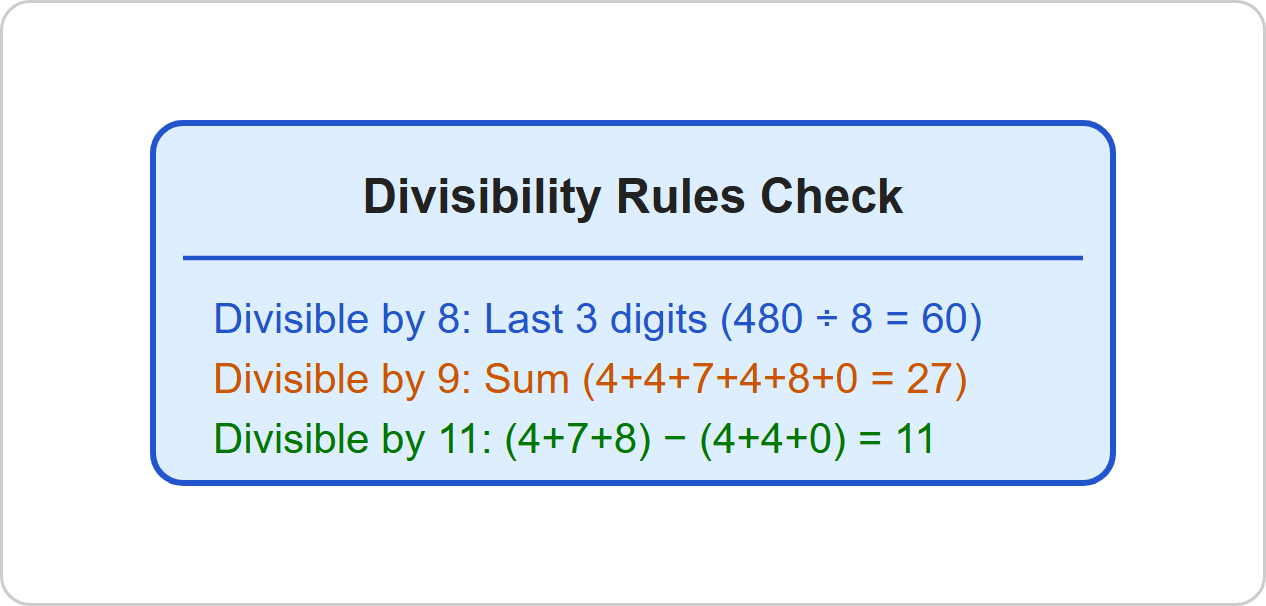
⇒ Divisibility by 8: Last three digits (480) ÷ 8 = 60. (Satisfied)

⇒ Divisibility by 9: Sum of digits (4+4+7+4+8+0) = 27. (27 ÷ 9 = 3, Satisfied)

⇒ Divisibility by 11: (Sum of digits at odd places) − (Sum of digits at even places)

⇒ (4 + 7 + 8) − (4 + 4 + 0) = 19 − 8 = 11. (11 ÷ 11 = 1, Satisfied)

∴ The correct answer is 447480.

Additional Information

Divisibility by 8

A number is divisible by 8 if its last three digits are divisible by 8 or are three zeros.

Divisibility by 9

A number is divisible by 9 if the sum of all its digits is a multiple of 9.

Divisibility by 11

Difference between the sum of digits at odd places and sum of digits at even places must be 0 or a multiple of 11.

43

When a number is increased by 24, it becomes 110% of itself. What is the number?

  1. ((a))

    288

  2. ((b))

    360

  3. ((c))

    216

  4. ((d))

    240

Show Answer
Answer: ((d))

240

Let the number be ‘x’.

When a number is increased by 24, it becomes 110% of itself.

⇒ x + 24 = 110% of x

⇒ x + 24 = 1.1x

⇒ x = 24/0.1

⇒ x = 240

∴ The number is 240

44

What is the mode of the data 20, 21, 15, 16, 20, 17, 18, 16, 15, 14, 19, 20, 18, 14, and 20?

  1. ((a))

    19

  2. ((b))

    20

  3. ((c))

    21

  4. ((d))

    18

Show Answer
Answer: ((b))

20

Shortcut Trick

Mode is defined as the observation that appears most frequently in the data set.

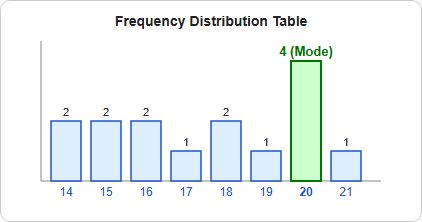
By inspection, the number 20 appears 4 times, which is more than any other number in the list.

Numbers like 14, 15, 16, and 18 appear only 2 times, while 17, 19, and 21 appear only once.

∴ The correct answer is 20.

Alternate Method

Given data: 20, 21, 15, 16, 20, 17, 18, 16, 15, 14, 19, 20, 18, 14, 20

Formula: Mode = Value with the Maximum Frequency

Frequency of each term:

⇒ 14 occurs 2 times

⇒ 15 occurs 2 times

⇒ 16 occurs 2 times

⇒ 17 occurs 1 time

⇒ 18 occurs 2 times

⇒ 19 occurs 1 time

⇒ 20 occurs 4 times

⇒ 21 occurs 1 time

⇒ Maximum frequency is 4, which belongs to the number 20.

∴ The correct answer is 20.

Additional Information

Mean (Arithmetic Average)

It is the sum of all observations divided by the total number of observations: Mean = Σxi ÷ n.

Median

The middle value of a data set when it is arranged in ascending or descending order. For odd n, it is the ((n+1)/2)th term.

Empirical Relationship

For a moderately skewed distribution, the relationship between mean, median, and mode is: Mode = 3 × Median − 2 × Mean.

Bimodal and Multimodal Data

If two or more values have the same maximum frequency, the data set is called bimodal (two modes) or multimodal (multiple modes).

45

If sin A = cos B and both A and B are acute angles, what is the value of A + B?

  1. ((a))

    45°

  2. ((b))

    60°

  3. ((c))

    90°

  4. ((d))

    70°

Show Answer
Answer: ((c))

90°

Shortcut Trick For any two acute angles A and B, if sin A = cos B, the angles are complementary. This is based on the co-function identity: sin θ = cos(90° − θ). Comparing sin A = cos B with the identity, we get A = 90° − B. Rearranging the equation: A + B = 90°. ∴ The correct answer is 90°. Alternate Method Given: sin A = cos B A and B are acute angles (0° < A, B < 90°). Formula Used: Trigonometric complementary angle identity: cos θ = sin(90° − θ)

Calculations: ⇒ sin A = cos B Substitute cos B with sin(90° − B): ⇒ sin A = sin(90° − B) Since both are acute angles, we can equate the angles directly: ⇒ A = 90° − B Add B to both sides: ⇒ A + B = 90° ∴ The correct answer is 90°. Additional Information Complementary Angle Identities Trigonometric ratios of complementary angles follow these rules: sin θ = cos(90°−θ), tan θ = cot(90°−θ), and sec θ = cosec(90°−θ). Right-Angled Triangle Property In a right-angled triangle, the sum of the two acute angles is always 90°, as the total sum of angles is 180° and one angle is exactly 90°. Acute Angle Definition An acute angle is an angle measuring more than 0° and less than 90°. Trigonometric ratios for these angles are always positive.

46

How many whole numbers are there between 244 and 332 which are exactly divisible by 7?

  1. ((a))

    15

  2. ((b))

    23

  3. ((c))

    8

  4. ((d))

    13

Show Answer
Answer: ((d))

13

Numbers that are divisible by 7 between 244 and 332,

⇒ 245, 252.........329

Using AP:

an = a + (n - 1)d

329 = 245 + (n - 1) × 7

n = 13

∴ There are 13 numbers

47

If one card is drawn at random from 52 cards, then find the probability of getting a number card.

  1. ((a))

    (\frac{11}{13})

  2. ((b))

    (\frac{8}{13})

  3. ((c))

    (\frac{10}{13})

  4. ((d))

    (\frac{9}{13})

Show Answer
Answer: ((d))

(\frac{9}{13})

Given:

Total Cards = 52 

Calculation:

In a standard deck of 52 cards, there are 4 suits (hearts, diamonds, clubs, spades), each consisting of 13 cards.

The number cards are those from 2 to 10.

Therefore, there are 9 number cards in each suit, and hence 4 ×9  = 36 number cards

So, the probability of drawing a number card (from 2 to 10) from a standard deck of 52 cards = 36/52.

To simplify the fraction, divide the numerator and the denominator by their largest common divisor, which is 4, to get the simplified fraction = 9/13.

Therefore, the probability of getting a number card is 9/13.

48

The sum of two numbers is 50 and their difference is 10. The larger number is:

  1. ((a))

    25

  2. ((b))

    30

  3. ((c))

    35

  4. ((d))

    20

Show Answer
Answer: ((b))

30

Shortcut Trick

To find the larger number when the sum and difference of two numbers are known:

Larger Number = (Sum + Difference) ÷ 2

⇒ (50 + 10) ÷ 2 = 60 ÷ 2 = 30

∴ The correct answer is 30.

Alternate Method

Given:

Sum of two numbers = 50

Difference of two numbers = 10

Formula Used:

For two numbers x and y: x + y = S and x − y = D

Calculations:

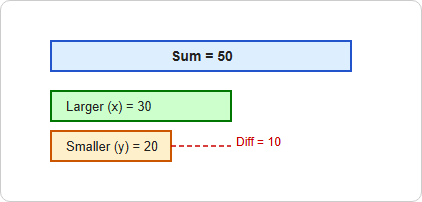
Let the larger number be x and the smaller number be y.

⇒ x + y = 50 --- (1)

⇒ x − y = 10 --- (2)

By adding equation (1) and equation (2):

⇒ (x + y) + (x − y) = 50 + 10

⇒ 2x = 60

⇒ x = 60 ÷ 2

⇒ x = 30

To find y, substitute x in equation (1):

⇒ 30 + y = 50

⇒ y = 50 − 30 = 20

∴ The correct answer is 30.

Additional Information

Direct Calculation for Smaller Number

The smaller number can be calculated directly using the formula: (Sum − Difference) ÷ 2.

Linear Equations in Two Variables

This problem is a basic application of simultaneous linear equations which can be solved using substitution, elimination, or cross-multiplication methods.

Product and Sum Identity

The relationship between the numbers can also be expressed through the identity: (x + y)2 − (x − y)2 = 4xy.

49

What will be the total surface area of a right circular cone whose perpendicular height is 6 cm and slant height is 10 cm? [Use π = 3.14] 

  1. ((a))

    400 cm2

  2. ((b))

    452.16 cm2

  3. ((c))

    300 cm2

  4. ((d))

    552 cm2

Show Answer
Answer: ((b))

452.16 cm2

Given:

Perpendicular height of the cone = 6 cm

Slant height of the cone = 10 cm

π = 3.14

Formula Used:

Total surface area of a cone = π × r × l + π × r2

r = √(l2 - h2)

Calculation:

⇒ r = √(102 - 62)

⇒ r = √(100 - 36)

⇒ r = √64

⇒ r = 8 cm

⇒ Total surface area = π × r × l + π × r2

⇒ Total surface area = 3.14 × 8 × 10 + 3.14 × 82

⇒ Total surface area = 3.14 × 80 + 3.14 × 64

⇒ Total surface area = 251.2 + 200.96

⇒ Total surface area = 452.16 cm2

∴ The correct answer is 452.16 cm2.

50

Find the curved surface area of hemisphere whose radius is √7 units.

  1. ((a))

    11 sq.units

  2. ((b))

    55 sq.units

  3. ((c))

    44 sq.units

  4. ((d))

    33 sq.units

Show Answer
Answer: ((c))

44 sq.units

Given

Radius of hemisphere  = √7 units.

Formula used

Curved surface area of hemisphere = 2πr

Calculation

Curved surface area of hemisphere = 2 × (22/7) × √7 × √7

⇒ 44 sq.units

∴ Curved surface area of hemisphere is 44 sq. units

51

A line passes through the points ((x,2)) and ((3,-4)) and has a slope of (2). What is the value of (x)?

  1. ((a))

    2

  2. ((b))

    8

  3. ((c))

    6

  4. ((d))

    4

Show Answer
Answer: ((c))

6

Shortcut Trick

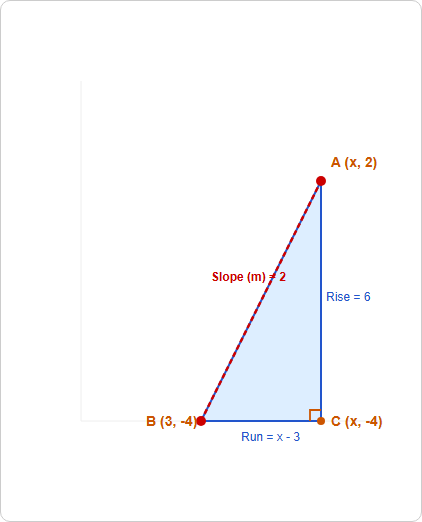
The slope (m) is the ratio of the change in y-coordinates to the change in x-coordinates: m = Δy / Δx.

Given m = 2, Δy = 2 − (−4) = 6, and Δx = x − 3.

⇒ 2 = 6 / (x − 3)

⇒ x − 3 = 6 / 2 = 3

⇒ x = 3 + 3 = 6

∴ The correct answer is 6.

Alternate Method

Given:

Point 1: (x1, y1) = (x, 2)

Point 2: (x2, y2) = (3, −4)

Slope: m = 2

Formula Used:

The slope of a line passing through (x1, y1) and (x2, y2) is: m = (y2 − y1) / (x2 − x1)

Calculations:

⇒ m = (y2 − y1) / (x2 − x1)

⇒ 2 = (−4 − 2) / (3 − x)

⇒ 2 = −6 / (3 − x)

⇒ 2 × (3 − x) = −6

⇒ 6 − 2x = −6

⇒ −2x = −6 − 6

⇒ −2x = −12

⇒ x = −12 / −2

⇒ x = 6

∴ The correct answer is 6.

Additional Information

Slope-Intercept Form

The equation of a line can be written as y = mx + c, where m is the slope and c is the y-intercept.

Parallel and Perpendicular Lines

Two lines are parallel if their slopes are equal (m1 = m2) and perpendicular if the product of their slopes is −1 (m1 × m2 = −1).

Point-Slope Form

The equation of a line passing through (x1, y1) with slope m is given by y − y1 = m(x − x1).

52

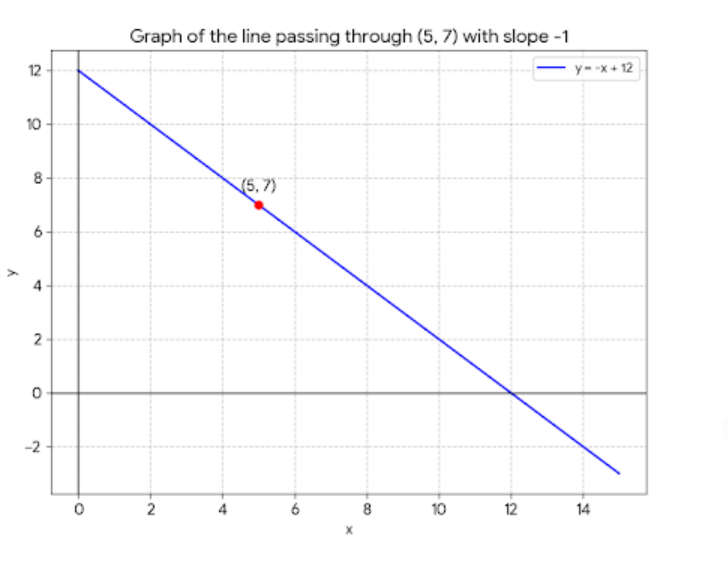
A line passes through the point (5, 7) and has a slope of -1. What is the equation of the line?

  1. ((a))

    y = -x + 12

  2. ((b))

    y = (\frac{x}{5}) + 19

  3. ((c))

    y = -2x - 4

  4. ((d))

    y = 4x - 6

Show Answer
Answer: ((a))

y = -x + 12

Given:

The line passes through the point (5, 7)

Slope of the line = −1

Calculation:

The general form of a straight line is:

y = mx + c

Substitute the given slope:

y = −x + c

Since the line passes through (5, 7), substitute x = 5 and y = 7:

7 = −5 + c

c = 12

Equation of the line:

y = −x + 12

Correct option: y = −x + 12

53

If 'p' and 'q' are the zeros of the polynomial f(x) = 16x2 - 9, then the value of p2 + q2 =

  1. ((a))

    (\frac{9}{8})

  2. ((b))

    (\frac{3}{2})

  3. ((c))

    (\frac{9}{4})

  4. ((d))

    (\frac{3}{4})

Show Answer
Answer: ((a))

(\frac{9}{8})

Given:

Equation f(x) = 16x2 - 9.

p and q are the roots

Formula Used:

For general equation ax2 + bx + c = 0 

Sum of roots = (\frac{-b}{a})

product of roots = (\frac{c}{a})

Calculation:

Sum of roots p +q = 0

Product of roots pq = (\frac{-9}{16})

We know that,

⇒ (p + q)2 = p2 + q2 + 2pq

⇒ 0 =  p2 + q2 + 2((\frac{-9}{16}))

⇒ p2 + q2 = (\frac{9}{8}) .

54

If sin θ + cos θ = 5/4, and θ is acute, what is the value of sin4 θ +  cos4 θ?

  1. ((a))

    225/16

  2. ((b))

    431/512

  3. ((c))

    677/85

  4. ((d))

    239/18

Show Answer
Answer: ((b))

431/512

Given:

sinθ + cosθ = 5/4

θ is acute

Formula Used:

(sinθ + cosθ)2 = sin2θ + cos2θ + 2sinθcosθ

sin2θ + cos2θ = 1

sin4θ + cos4θ = (sin2θ + cos2θ)2 − 2sin2θcos2θ

Calculation:

⇒ (5/4)2 = 1 + 2sinθcosθ

⇒ 25/16 = 1 + 2sinθcosθ

⇒ 2sinθcosθ = 25/16 − 1 = 9/16

⇒ sinθcosθ = 9/32

⇒ sin2θcos2θ = (9/32)2 = 81/1024

⇒ sin4θ + cos4θ = 1 − 2 × 81/1024

⇒ = 1 − 162/1024

⇒ = (1024 − 162)/1024 = 862/1024

⇒ = 431/512

∴ The correct answer is 431/512.

55

The mean and mode of a data set are ( 52 ) and ( 55 ), respectively. Find the median of the data set.

  1. ((a))

    51

  2. ((b))

    48

  3. ((c))

    50

  4. ((d))

    53

Show Answer
Answer: ((d))

53

Shortcut Trick

Apply the Empirical Relationship formula: Mode = 3 × Median − 2 × Mean.

Substitute the given values: 55 = 3 × Median − 2 × 52.

55 + 104 = 3 × Median ⇒ 159 = 3 × Median.

Median = 159 ÷ 3 = 53.

∴ The correct answer is 53.

Alternate Method

Given:

Mean of the data set = 52

Mode of the data set = 55

Formula Used:

For a moderately skewed distribution, the relationship between measures of central tendency is:

Mode = 3 × Median − 2 × Mean

Mean (52) Median (?) Mode (55) Empirical Relationship Scale

Calculations:

⇒ 55 = 3 × Median − 2 × 52

⇒ 55 = 3 × Median − 104

⇒ 3 × Median = 55 + 104

⇒ 3 × Median = 159

Median = 159 ÷ 3

Median = 53

∴ The correct answer is 53.

Additional Information

Empirical Relationship

This formula is also known as Karl Pearson's formula and is applicable for moderately asymmetrical (skewed) frequency distributions.

Symmetric Distribution

In a perfectly symmetrical distribution, the Mean, Median, and Mode are all equal (Mean = Median = Mode).

Skewness Observation

Since Mean < Median < Mode (52 < 53 < 55) in this case, the data set is negatively skewed (left-skewed).

Mean, Median, and Mode Definitions

Mean is the arithmetic average, Median is the middle-most value when data is sorted, and Mode is the most frequently occurring value.

56

Each edge of a cube is increased by 30%. What will be the increase in its surface area? 

  1. ((a))

    90%

  2. ((b))

    60%

  3. ((c))

    30%

  4. ((d))

    69%

Show Answer
Answer: ((d))

69%

Given:

Each edge of a cube is increased by 30%.

Formula Used:

Surface area of a cube = 6a2, where a is the edge of the cube.

Percentage increase in surface area = ((New surface area - Original surface area) / Original surface area) × 100

Calculation:

Let the original length of each edge of the cube be a.

⇒ New length of each edge = a + 30% of a = a × (1 + 0.3) = 1.3a

Original surface area = 6a2

New surface area = 6 × (1.3a)2 = 6 × 1.69a2 = 10.14a2

⇒ Percentage increase in surface area = ((10.14a2 - 6a2) / 6a2) × 100

= ((4.14a2) / 6a2) × 100

= (4.14 / 6) × 100

= 0.69 × 100

= 69%

The increase in its surface area is 69%.

57

The value of sin4 θ + cos4 θ  is equal to:

  1. ((a))

    1

  2. ((b))

    1 - 2 sin2 θ cos2 θ

  3. ((c))

    sin2 θ +cos2 θ

  4. ((d))

    2sin2 θ cos2 θ

Show Answer
Answer: ((b))

1 - 2 sin2 θ cos2 θ

Given:

sin4θ + cos4θ

Formula Used:

a2 + b2 = (a + b)2 − 2ab

sin2θ + cos2θ = 1

Calculation:

⇒ sin4θ + cos4θ = (sin2θ + cos2θ)2 − 2sin2θcos2θ

⇒ = 12 − 2sin2θcos2θ

⇒ = 1 − 2sin2θcos2θ

∴ The correct answer is 1 - 2 sin2 θ cos2 θ.

58

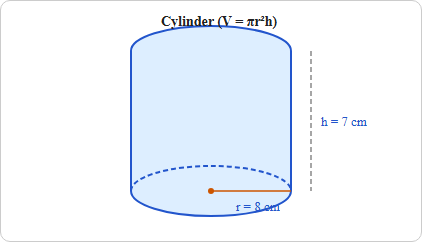
The lateral surface area of a cylinder is 352 cm2. If its height is 7 cm, then its volume (in cm) is ∶ Take π=22/7

  1. ((a))

    1243

  2. ((b))

    1408

  3. ((c))

    1078

  4. ((d))

    891

Show Answer
Answer: ((b))

1408

Shortcut Trick

LSA = 2πrh = 352 cm2 and h = 7 cm.

Radius (r) = LSA ÷ (2 × π × h) = 352 ÷ (2 × 22/7 × 7) = 352 ÷ 44 = 8 cm.

Volume = πr2h = (LSA × r) ÷ 2 = (352 × 8) ÷ 2 = 176 × 8.

Volume = 1408 cm3.

∴ The correct answer is 1408 cm3.

Alternate Method

Given:

Lateral Surface Area (LSA) of cylinder = 352 cm2

Height (h) = 7 cm

π = 22/7

Formula:

Lateral Surface Area = 2πrh

Volume of Cylinder = πr2h

Calculations:

⇒ 2 × (22/7) × r × 7 = 352

⇒ 44 × r = 352

⇒ r = 352 ÷ 44

⇒ r = 8 cm

⇒ Volume = π × r2 × h

⇒ Volume = (22/7) × 8 × 8 × 7

⇒ Volume = 22 × 64

⇒ Volume = 1408 cm3

∴ The correct answer is 1408 cm3.

Additional Information

Total Surface Area of Cylinder

The total surface area includes the lateral area and the area of two circular bases: TSA = 2πrh + 2πr2 = 2πr(r + h).

Volume of Cone

A cone with the same radius and height as a cylinder has exactly one-third its volume: Volume = (1/3)πr2h.

Base Area of Cylinder

The area of the circular base or top is given by the formula: Area = πr2.

59

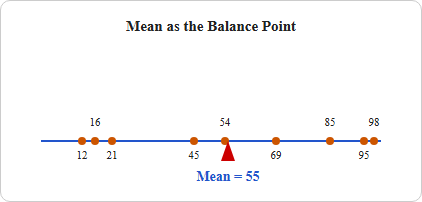
The arithmetic mean of the observations 16, 85, 98, 12, 69, 95, 21, 45 and 54 is:

  1. ((a))

    62

  2. ((b))

    48

  3. ((c))

    55

  4. ((d))

    63

Show Answer
Answer: ((c))

55

Shortcut Trick

Assume a base mean of 50.

Calculate net deviation from 50: −34 + 35 + 48 − 38 + 19 + 45 − 29 − 5 + 4 = 45.

Average deviation = 45 ÷ 9 = 5.

Arithmetic Mean = Base + Average Deviation = 50 + 5 = 55.

∴ The correct answer is 55.

Alternate Method

Given: Observations = 16, 85, 98, 12, 69, 95, 21, 45, 54

Formula: Arithmetic Mean = (Sum of all observations) ÷ (Total number of observations)

⇒ Sum = 16 + 85 + 98 + 12 + 69 + 95 + 21 + 45 + 54

⇒ Sum = 495

⇒ Total count (n) = 9

⇒ Arithmetic Mean = 495 ÷ 9 = 55

∴ The correct answer is 55.

Additional Information

Arithmetic Mean Formula

The mean (μ) is calculated as Σxi ÷ n, where Σxi is the sum of observations and n is the total number.

Deviation Property

The sum of deviations of all observations from their arithmetic mean is always zero: Σ(xi − Mean) = 0.

Combined Mean

If two groups have sizes n1, n2 and means x1, x2, the combined mean is (n1x1 + n2x2) ÷ (n1 + n2).

60

In a bag containing 5 red, 4 black and 6 orange balls. A ball is selected at random, what is the probability of getting a red or black ball?

  1. ((a))

    3/5

  2. ((b))

    (\frac{1}{15})

  3. ((c))

    (\frac{1}{5})

  4. ((d))

    (\frac{2}{3})

Show Answer
Answer: ((a))

3/5

Concept use:

P(AUB) = P(A) + P(B) - P(A∩B)

If A and B are mutually exclusive 

P(AUB) = P(A) + P(B)

Calculations:

Let P(A) be the probability of getting red ball & P(B) be the probability of getting black ball

P(A) = Number of favourable outcomes/ Total number of outcomes = 5/15 

P(B) = Number of favourable outcomes/ Total number of outcomes = 4/15

as A and B are mutually exclusive 

P(AUB) = P(A) + P(B) = 5/15 + 4/15 = 9/15 = 3/5

Hence, The Correct option is 1.

61

Which among the following festivals is also known as "Festival of Festivals"?

  1. ((a))

    Chapchar Kut

  2. ((b))

    Hornbill Festival

  3. ((c))

    Moatsu

  4. ((d))

    Wangala

Show Answer
Answer: ((b))

Hornbill Festival

The correct answer is Option 2

Key Points

  • The festival that is also known as the "Festival of Festivals" is the Hornbill Festival.
  • The Hornbill Festival is a major cultural event celebrated in Nagaland, a state in northeastern India.
  • The festival showcases the rich cultural heritage of the Naga people and brings together various tribes to display their customs, traditions, music, dance, and handicrafts.
  • The Hornbill Festival is often referred to as the "Festival of Festivals" because it combines multiple Naga tribal festivals into one grand event, making it a celebration of the diverse Naga culture.

Additional Information

  • Chapchar Kut: Chapchar Kut is a festival celebrated by the Mizos, an ethnic group in the northeastern state of Mizoram, India.
  • It is a spring festival held in March after the completion of the Jhum cultivation (slash and burn agriculture) when the Mizos prepare their fields for the new agricultural cycle.
  • Moatsu: Moatsu is a festival celebrated by the Ao Naga tribe in the state of Nagaland, India.
  • It typically occurs in the first week of May and marks the completion of sowing seeds and the beginning of a new agricultural season
  • Wangala: Wangala, also known as the Hundred Drums Festival, is a harvest festival celebrated by the Garo tribe in the northeastern Indian state of Meghalaya.
62

What does the right of inheritance lead to?

  1. ((a))

    barren land

  2. ((b))

    land pollution

  3. ((c))

    division of land

  4. ((d))

    land subsidence

Show Answer
Answer: ((c))

division of land

The correct answer is Division of land.

Key Points

  • The right of inheritance, specifically in the context of land or property, often leads to the division of land among heirs.
  • Inheritance laws differ across countries and cultures, but the common principle is the passing of property, rights, obligations, debts, and even titles upon the death of an individual.
  • The division of land can sometimes lead to fragmentation, creating smaller and potentially less productive plots.
  • This can have significant implications for agricultural practices and rural development.

Additional Information

  • There are various forms of inheritance, including primogeniture (where the eldest son inherits everything), ultimogeniture (where the youngest son inherits everything), and partible inheritance (where the property is divided among heirs).
  • In some cases, laws have been enacted to prevent excessive fragmentation of agricultural land.
  • For example, in India, the Land Ceiling Act sets a maximum size for agricultural holdings and prohibits their further subdivision. While the division of land is the most direct outcome of inheritance, it can indirectly contribute to other issues such as land disputes and, in some cases, may influence land use and contribute to environmental concerns.
63

Tamil Nadu coast gets a large portion of its rain during ________ and __________.

  1. ((a))

    April and May

  2. ((b))

    October and November

  3. ((c))

    May and June

  4. ((d))

    August and September 

Show Answer
Answer: ((b))

October and November

The correct answer is October-November.

Key Points

  • Tamil Nadu is located on the eastern coast of India.
  • South India usually receives rainfall from south west monsoons.
  • But these south west monsoon arising from Arabian Sea gets obstructed by Western Ghats.
  • Hence, Tamil Nadu receives most of its rain from north east and retreating monsoons during winter season.
  • Moreover, many low pressure systems develop in the Bay of Bengal during this period and move towards the east coast of Tamil Nadu causing heavy rainfall.

 Tamil Nadu receives rainfall from Northeast trade winds.

  • From early June to mid-September, between 100- 120 days is the duration of the monsoon. Some places like Tamil Nadu receive a major portion of its rainfall during October and November, but most parts of the country receive rainfall from June to September.
  • During the winter season, the winds prevailing in the country are the Northeast trade winds.
  • In major parts of the country, it is a dry season, as the winds blow from land to sea.
  • When the winds blow from sea to land, it picks up moisture from the sea and brings rainfall to the country.
  • Due to the geographical location, the east coast receives rainfall as the north east trade winds blow from sea to land in this location. Hence the coast of Tamil Nadu receives winter rainfall.

Additional Information Monsoon

  • Generally, across the world, the monsoons are experienced in the tropical area roughly between 20° N and 20° S.
  • The climate of India is described as the ‘monsoon’ type. In Asia, this type of climate is found mainly in the south and the southeast.
  • Out of a total of 4 seasonal divisions of India, monsoon occupies 2 divisions, namely.
  • The southwest monsoon season - Rainfall received from the southwest monsoons is seasonal in character, and occurs between June and September.
  • The retreating monsoon season - The months of October and November are known for retreating monsoons.
  • Factors Influencing South-West Monsoon Formation
  • The differential heating and cooling of land and water create a low pressure on the landmass of India while the seas around experience comparatively high pressure.
  • The shift of the position of Inter Tropical Convergence Zone (ITCZ) in summer, over the Ganga plain (this is the equatorial trough normally positioned about 5°N of the equator. It is also known as the monsoon-trough during the monsoon season).
64

Which of the following duties was NOT added by the 42nd amendment to the Indian Constitution?

  1. ((a))

    To provide opportunities for education to one’s child or ward between the ages of six and fourteen years

  2. ((b))

    To value and preserve the rich heritage of the country’s composite culture

  3. ((c))

    To safeguard public property and to abjure violence

  4. ((d))

    To uphold and protect the sovereignty, unity and integrity of India

Show Answer
Answer: ((a))

To provide opportunities for education to one’s child or ward between the ages of six and fourteen years

The correct answer is To provide opportunities for education to one’s child or ward between the ages of six and fourteen years.

Key Points

  • The 42nd Amendment of the Constitution of India:
  • The 42nd Amendment of the Constitution of India was enacted in the year 1976.
  • It is officially known as the Constitution Act, of 1976.
  • It was enacted during the Emergency by the Indian National Congress Head Indira Gandhi.
  • It is considered the most controversial Constitutional Amendment in Indian history.
  • Added three new Directive Principles viz., equal justice and free legal aid, the participation of workers in the management of industries, and protection of the environment, forests, and wildlife.
  • Provided for the creation of the All-India Judicial Service.

Shortened the procedure for disciplinary action by taking away the right of a civil servant to make representation at the second stage after the inquiry (i.e., on the penalty proposed).

  • It is often called a "mini-Constitution" or the "Constitution of Indira".

Additional Information

  • There are three ways in which the Constitution can be amended:-
  • Amendment by a simple majority of the Parliament
  • Amendment by a special majority of the Parliament
  • Amendment by a special majority of the Parliament and the ratification of at least half of the state legislatures.
  • Amendment by a simple majority-
  • Admission or establishment of new states, Formation of new states, Rules of procedure in Parliament, Salaries and Allowances, etc are covered under this.
  • Amendment by the special majority-
  • The special majority- a majority of 2/3rd members present and voting supported by more than 50% of the total strength of the house.
  • The provisions which can be amended by this way include (i) Fundamental Rights; (ii) Directive Principles of State Policy; and (iii) All other provisions which are not covered by the first and third categories.
  • Amendment by a special majority of the Parliament and the ratification of at least half of the state legislatures-
  • Those provisions of the Constitution which are related to the federal structure of the polity can be amended by this.
  • For instance, the election of the president, distribution of legislative powers between union and states, any of the lists in the seventh schedule, etc.
65

At Independence, about ______ percent of the India’s population was dependent on agriculture.

  1. ((a))

    30

  2. ((b))

    50

  3. ((c))

    100

  4. ((d))

    75

Show Answer
Answer: ((d))

75

The correct answer is 75.

Key Points

  • At the time of India's independence in 1947, approximately 75 per cent of the country's population relied on agriculture for their livelihoods.
  • Agriculture played a central role in the rural economy, with a majority of the rural population engaged in farming or related agricultural activities.
  • Most agricultural practices in India were characterized by subsistence farming, where farmers grew crops primarily to meet the needs of their own families and local communities.
  • Agricultural practices were predominantly labour-intensive, with limited use of modern machinery or technology in farming operations.

Additional Information

  • Agricultural population distribution according to Census 2011:
  • According to the 2011 census, the majority of India's agricultural population resided in rural areas, reflecting the strong rural-urban divide in agricultural distribution.
  • The census data revealed that a significant portion of India's population, approximately 67 per cent, was engaged in agricultural activities, highlighting the continued importance of agriculture in the country's economy.
  • The census also highlighted regional disparities in agricultural population distribution, with certain states and regions having a higher concentration of agricultural workers compared to others.
  • The census data indicated a trend of fragmented landholdings in India, with a large number of farmers cultivating small plots of land.
  • This pattern of small-scale farming has implications for productivity and agricultural practices.
  • The census revealed a gender disparity in the agricultural workforce, with a majority of agricultural workers being male.
  • However, it also indicated a significant contribution by women to agricultural activities, highlighting their crucial role in the sector.
66

Swami Dayanand Saraswati founded the _______, an organisation that attempted to reform Hinduism.

  1. ((a))

    Arya Samaj

  2. ((b))

    Adi Hindu Samaj

  3. ((c))

    Vedant Samaj

  4. ((d))

    Adi Dharam Samaj

Show Answer
Answer: ((a))

Arya Samaj

The correct answer is Arya Samaj.

Key Points

  • Swami Dayanand Saraswati:-​
  • Dayananda Saraswati [1824-1883] was the first to give the call for Swarajya – "India for Indians" – in 1876.
  • For his own inspiration, Swami Dayanand went to the Vedas which he regarded as infallible.
  • He rejected all later religious thought if it conflicted with the Vedas.
  • This total dependence on Vedas and their infallibility gave his teachings orthodox coloring.
  • He was opposed to idolatry, ritual, and priesthood and particularly to the prevalent caste practices and popular Hinduism as preached by Brahmins
  • ​Swami Dayanand met Keshub Chandra Sen, Vidyasagar, Justice Ranade, Gopal Hari Deshmukh, and other modern religious and social reformers.
  • He took inspiration from the Vedas and considered them to be ‘India’s Rock of Ages, the infallible, and the true original seed of Hinduism.
  • He gave the slogan “Back to the Vedas”.
  • Dayananda’s slogan of ‘Back to the Vedas’ was a call for a revival of Vedic learning and Vedic purity of religion and not a revival of Vedic times.
  • He accepted modernity and displayed a patriotic attitude to national problems.
  • Arya Samaj:-
  • Arya Samaj is a Hindu reform movement founded by 'Swami Dayanand Saraswati'.
  • Dayanand Saraswati had inspired the Arya Samaj from Swami Virjanand of Mathura in Bombay in 1875.
  • Arya Samaji believed in pure Vedic tradition and rejected idol worship, avatars, sacrifice, false rituals, and superstitions.
  • In this, untouchability and caste discrimination were opposed and women and Shudras were also given the right to wear Yagyopaveet and read the Vedas.

Additional Information

  • Vedant Samaj:-
  • It also known as the Vedanta Society, is a religious and philosophical organization based on the teachings of Vedanta, a school of Hindu philosophy.
  • Vedanta is derived from the Upanishads, ancient texts that form the philosophical and spiritual foundation of Hinduism.
  • Adi Dharma Samaj:-
  • It is a religious and social organization based in Bali, Indonesia. It was founded in the early 20th century as a response to the dominant religious practices of the time, which were primarily based on Hinduism.
  • Adi Dharma Samaj sought to promote a form of Hinduism that was more inclusive and accessible to the local Balinese people.
67

_________falls under the Ministry of textiles.

  1. ((a))

    Samarth Scheme

  2. ((b))

    Ambekar Social Innovation & Incubation Mission

  3. ((c))

    MPLADS (Members of Parliament Local Area Development Scheme)

  4. ((d))

    Merchandise Export From India Scheme

Show Answer
Answer: ((a))

Samarth Scheme

The correct answer is Samarth Scheme.

Key Points

  • About Samarth Scheme
  • The Ministry of Textiles is implementing the Samarth-Scheme for Capacity Building in the Textiles Sector.
  • It is a placement-oriented programme targeting the skill development of 10 lakh youth in the entire value chain of textiles, excluding Spinning & Weaving in the organized Sector.
  • Implementing Agencies
  • Ministry of textiles
  • Institutions/Organizations of the Ministry of Textiles/State Governments having training infrastructure and placement tie-ups with the textile industry.
  • Reputed training institutions/ NGOs/ Societies/ Trusts/ Organizations/ Companies /Start-Ups / Entrepreneurs active in the textile sector having placement tie-ups with the textile industry.

Additional Information

  • Features of the SAMARTH Scheme
  • Training of Trainers (ToT),
  • Aadhar Enabled Biometric Attendance System (AEBAS),
  • CCTV recording of the training programme,
  • dedicated call centre with a helpline number,
  • mobile app-based Management,
  • Information System (MIS) and
  • on-line monitoring of the training process.
  • Objectives
  • To provide demand-driven, placement-oriented National Skills Qualifications Framework (NSQF) compliant skilling programmes to incentivize and supplement the efforts of the industry in creating jobs in the organized textile and related sectors, covering the entire value chain of textile, excluding Spinning and Weaving.
  • To promote skilling and skill up-gradation in the traditional sectors of handlooms, handicrafts, sericulture and jute.
  • To enable the provision of sustainable livelihood either by wage or self-employment to all sections of the society across the country.
68

As per the Census 2011, what was the literacy rate in India?

  1. ((a))

    74.04%

  2. ((b))

    88.23% 

  3. ((c))

    65.27%

  4. ((d))

    69.90%

Show Answer
Answer: ((a))

74.04%

The correct answer is 74.04%.

Key Points

  • Literacy Characteristics of India, census 2011:
  • The results of the 2011 census revealed that there has been an increase in literacy in the country.
  • The literacy rate in the country is 74.04 per cent
  • More precisely, 82.14% for males and 65.46% for females.
  • Kerala retained its position by being on top with a 93.91 percent literacy rate.
  • The other two States and UTs, followed by Kerala are Lakshadweep (92.28 percent) and Mizoram (91.58 percent).
  • Bihar with a literacy rate of 63.82 percent ranks last in the country preceded by Arunachal Pradesh (66.95 percent) and Rajasthan (67.06 percent).

Additional Information

  • Population Size:
  • As per the Census 2011, India's total population was 1.21 billion, making it the world's second-most populous country after China.
  • It represented an increase of more than 181 million people over the population recorded in the 2001 Census.
  • Literacy Rate:
  • The Census 2011 reported a literacy rate of 74.04%, with male literacy at 82.14% and female literacy at 65.46%.
  • This marked a significant improvement in literacy rates compared to the previous census in 2001.
  • Gender Ratio:
  • The 2011 Census recorded a gender ratio of 943 females per 1000 males, which was a slight improvement from the 2001 Census where the ratio was 933 females per 1000 males.
  • Urbanization:
  • The Census 2011 indicated an increase in urbanization with the urban population accounting for 31.16% of the total population.
  • There was a significant rise in the number of towns and cities compared to 2001.
  • Largest State:
  • The most populous state in India, according to the 2011 Census, was Uttar Pradesh, with over 200 million people.
  • The least populous state was Sikkim, with a population of about 610,000.
69

______ spent a lot of time at Harshavardhana's court and left a detailed account of what he saw.

  1. ((a))

    Xuan Zang

  2. ((b))

    Faxian

  3. ((c))

    Kang Seng

  4. ((d))

    Yijing

Show Answer
Answer: ((a))

Xuan Zang

The correct answer is Xuan Zang.

Key Points 

  • Hiuen Tsang or Xuan Zang was a Chinese buddhist monk who travelled over land from China to India during the reign of king Harshavardhana to obtain Buddhist scriptures.
  • Xuan Zang also visited the court of the king Harshavardhana and wrote about his experiences.
  • He described Harsha's court, his life and left a detailed account of what he saw.
  • He wrote about the economic, social life and religious sects of that period.
  • He also mentioned about the revenue system during Harshavardhana's reign.
  • Xuan Zang is also known as the prince of pilgrims because he visited significant pilgrims centres associated with the life of Buddha.

Additional Information

  • FaXian was a Chinese Buddhist pilgrim who came to India during the rule of Chandragupta II.
  • I Qing was a Chinese traveller who came to India about 50 years after Xuan Zang's visit. He came to India to visit places associated with the life of the Buddha.
  • Sung Yun, a Chinese Buddhist monk visited the north-western part of India in the year 518 AD in search of Buddhist texts. He was sent by the Buddhist Empress Hu.
70

The Supreme Court of India passed a judgment in ________ in which it declared the practice of Triple Talaq as unconstitutional and the practice of the same be void.

  1. ((a))

    2018

  2. ((b))

    2014

  3. ((c))

    2017

  4. ((d))

    2013

Show Answer
Answer: ((c))

2017

The correct answer is 2017.

Key Points

  • In 2017, the Supreme Court of India passed a landmark judgment declaring the practice of Triple Talaq as unconstitutional.
  • Triple Talaq refers to the Islamic practice where a husband can instantly divorce his wife by saying the word "Talaq" (divorce) three times, often in a single setting.
  • The court ruled that Triple Talaq violates the fundamental rights of Muslim women guaranteed under the Indian Constitution, including the right to equality and non-discrimination.
  • The Supreme Court declared the practice of Triple Talaq void, meaning it has no legal validity or effect.
  • Following the judgment, the practice of Triple Talaq is no longer recognized as a valid form of divorce in India, providing Muslim women with greater protection and ensuring their right to fair and dignified divorce proceedings.

Important Points

  • Supreme Court of India:
  • Article 124 of the Constitution of India establishes the Supreme Court as the highest court in the country and defines its composition and jurisdiction.
  • It serves as the final court of appeal and has the power of constitutional review.
  • The Supreme Court consists of a Chief Justice and a maximum of 34 judges.
  • The President of India appoints judges based on recommendations from the Chief Justice and other senior judges.
  • One of the key functions of the Supreme Court is to safeguard the Constitution of India.
  • It has the power to interpret the Constitution and ensure that the laws enacted by the legislature are in line with constitutional provisions.
  • The Supreme Court has jurisdiction over the entire territory of India and deals with both constitutional and legal matters.
  • It hears appeals from the High Courts and other subordinate courts.
71

In which among the following states, Arabica coffee grown in India?

  1. ((a))

    Assam

  2. ((b))

    Uttarakhand

  3. ((c))

    West Bengal

  4. ((d))

    Karnataka

Show Answer
Answer: ((d))

Karnataka

The correct answer is Karnataka.

Key Points

  • Karnataka is the largest coffee-producing state in India.
  • After Karnataka, the next state which accounts for the highest share of coffee production in India is Kerala.
  • Kerala produces around 21% of India’s coffee.
  • Both Karnataka and Kerala together account for around 90% of the total coffee produced in India.
  • The third highest coffee-producing state in India is Tamil Nadu which accounts for 5% of the total coffee produced in India.
  • Coffee is also grown in Northeastern India, Odisha, and Andhra Pradesh.
  • The most well-known species of coffee grown in India are Robusta and Arabica.
  • Arabica coffee species was introduced in the Baba Budan Giri hill ranges of Karnataka in the 17th century.
  • Coffee from India is exported to other countries such as Germany, France, Russia, Spain, Slovenia, Belgium, Netherlands, Greece, the USA, and the United Kingdom.

Additional Information

StateImportant Crops
AssamTea, Rice, Jute, Sugarcane, Oilseeds
UttarakhandRice, Wheat, Maize, Millets, Pulses
West BengalRice, Jute, Tea, Sugarcane, Potatoes
72

______ was an Act passed to make a provision for levy and collection of tax on intra-State supply of goods or services.

  1. ((a))

    The Central Goods and Services Tax Act

  2. ((b))

    The Central Gifts and Services Tax Act

  3. ((c))

    The Central Goods and Secured Tax Act

  4. ((d))

    The Cost of Goods and Services Tax Act

Show Answer
Answer: ((a))

The Central Goods and Services Tax Act

The correct answer is Option 1

Key Points

  • The Central Goods and Services Tax Act (CGST Act) is an act that was passed in India to provide a framework for the levy and collection of tax on intra-State supply of goods or services.
  • It is a key component of the Goods and Services Tax (GST) regime in India, which is a comprehensive indirect tax system implemented to replace multiple indirect taxes levied by the central and state governments.
  • The CGST Act was enacted by the Parliament of India and came into effect on July 1, 2017.
  • It is one of the four legislations that together form the GST laws in India, the other three being the Integrated Goods and Services Tax (IGST) Act, the Union Territory Goods and Services Tax (UTGST) Act, and the Goods and Services Tax Compensation to States Act.

Additional Information

  • Key features of the CGST Act include:
  • Registration: The Act mandates that businesses engaged in the supply of goods or services above a specified threshold need to register under GST.
  • Levy and Collection of Tax: The CGST Act lays down provisions for the levy and collection of tax on the intra-State supply of goods and services.
  • Input Tax Credit: The Act allows registered businesses to claim input tax credit for the tax paid on inputs used in the course of business.
  • Filing of Returns: The CGST Act prescribes the procedure for filing periodic returns by registered taxpayers.
  • Assessment and Audit: The Act empowers tax authorities to conduct audits and assessments to ensure compliance with GST provisions.
73

During emergency which fundamental rights cannot be suspended?

  1. ((a))

    Article 14-15

  2. ((b))

    Article 20-21

  3. ((c))

    Article 18-19

  4. ((d))

    Article 16-17

Show Answer
Answer: ((b))

Article 20-21

The correct answer is Article 20 and 21.

Key Points 

  • The only two fundamental rights that cannot be rescinded are articles 20 and 21.
  • Article 20: This Article prohibits self-incrimination.
  • Article 21: This Article guards an individual's right to life and personal liberty.
  • Fundamental rights during National Emergency:
  • Articles 358 and 359 describe the effect of a National Emergency on Fundamental Rights.
  • These two provisions are explained below:
  • Suspension of Fundamental Rights under Article 19:
  • According to Article 358, when a proclamation of National Emergency is made, the six fundamental rights under Article 19 are automatically suspended.
  • Article 19 is automatically revived after the expiry of the emergency.
  • The 44th Amendment Act laid out that Article 19 can only be suspended when the National Emergency is laid on the grounds of war or external aggression and not in the case of armed rebellion.

Additional Information

  • Suspension of other Fundamental Rights:
  • Under Article 359, the President is authorized to suspend, by order, the right to move any court for the enforcement of Fundamental Rights during a National Emergency.
  • Thus, remedial measures are suspended and not Fundamental Rights.
  • The suspension of enforcement relates to only those Fundamental Rights that are specified in the Presidential Order.
  • The suspension could be for the period during the operation of an emergency or for a shorter period.
  • The Order should be laid before each House of Parliament for approval.
  • The 44 Amendment Act mandates that the President cannot suspend the right to move to the court for the enforcement of Fundamental Rights guaranteed by Articles 20 and 21.
74

Which article of the Indian Constitution deals with the ‘protection of life and personal liberty’?

  1. ((a))

    Article 19

  2. ((b))

    Article 21

  3. ((c))

    Article 20

  4. ((d))

    Article 22

Show Answer
Answer: ((b))

Article 21

The correct answer is Article 21.

Key Points

  • According to Article 21: “Protection of Life and Personal Liberty: No person shall be deprived of his life or personal liberty except according to procedure established by law.”
  • This fundamental right is available to every person, citizens and foreigners alike.
  • Article 21 provides two rights:
  • Right to life
  • Right to personal liberty
  • The fundamental right provided by Article 21 is one of the most important rights that the Constitution guarantees.
  • The Supreme Court of India has described this right as the ‘heart of fundamental rights’.
  • The right specifically mentions that no person shall be deprived of life and liberty except as per the procedure established by law. This implies that this right has been provided against the State only. State here includes not just the government, but also, government departments, local bodies, the Legislatures, etc.

Additional Information

ArticleDescription
Article 19It guarantees six freedoms to every citizen. 1. Speech and expression 2. Assembly 3. Association or Unions 4. Movement throughout the territory of India 5. Residence 6. Profession
Article 20Protection with respect to the conviction for offences.
Article 21Protection of life and personal liberty
Article 21 ARight to education
Article 22Protection against arrest and detention in certain cases
Article 23Prohibition of traffic in human beings and forced labor
Article 24Prohibition of employment of children in factories, etc
75

Revenue receipts are __________ as they do not lead to a claim on the government.

  1. ((a))

    capital receipts

  2. ((b))

    reinforceable

  3. ((c))

    redeemable

  4. ((d))

    non-redeemable

Show Answer
Answer: ((d))

non-redeemable

The correct answer is non-redeemable

Key Points:

  • There is a constitutional requirement in India (Article 112) to present before the Parliament a statement of estimated receipts and expenditures of the government in respect of every financial year which runs from 1 April to 31 March.
  • This ‘Annual Financial Statement’ constitutes the main budget document.
  • Therefore, the budget comprises of the-Revenue Budget and the Capital Budget.
  • The Revenue Budget shows the current receipts of the government and the expenditure that can be met from these receipts.
  • Revenue receipts are receipts of the government which are non-redeemable, that is, they cannot be reclaimed from the government.
  • They are divided into tax and non-tax revenues.
  • They can not be claimed by the government under special circumstances.
76

Which of the following organisations conducts the sample surveys for calculating poverty line in India?

  1. ((a))

    Ministry of Finance

  2. ((b))

    RBI

  3. ((c))

    CSO

  4. ((d))

    NSSO

Show Answer
Answer: ((d))

NSSO

The correct answer is  NSSO (National Sample Survey Office).

Key Points

  • The National Sample Survey Office (NSSO) is the organization responsible for conducting sample surveys in India, including those used for calculating the poverty line.
  • The NSSO operates under the Ministry of Statistics and Programme Implementation of the Government of India. It is one of the largest organizations in India conducting sample surveys on various socio-economic aspects of the country.
  • The NSSO conducts regular household surveys to collect data on various socio-economic indicators, including income, expenditure, employment, and poverty. These surveys involve sampling households across different regions of the country to gather representative data.
  • The poverty line in India is determined based on the data collected through these sample surveys conducted by the NSSO.
  • The poverty line is an important benchmark used to assess the extent of poverty and to formulate policies and programs for poverty alleviation in the country.

Additional Information

  • It's worth mentioning that the Central Statistics Office (CSO), another organization under the Ministry of Statistics and Programme Implementation, is also involved in the compilation and analysis of various statistical data, including national income, economic growth, and other economic indicators. However, when it comes to calculating the poverty line, the primary responsibility lies with the NSSO.
  • The Ministry of Finance and the Reserve Bank of India (RBI) are not directly involved in conducting sample surveys for calculating the poverty line. However, they may use the data and analysis provided by organizations like the NSSO and CSO for policymaking and economic planning purposes.
77

The term of the Lok Sabha, unless dissolved is _____ from the date appointed for its first meeting.

  1. ((a))

    6 years

  2. ((b))

    5 Years

  3. ((c))

    3 Years 

  4. ((d))

    4 years

Show Answer
Answer: ((b))

5 Years

The correct answer is 5.

Key Points

  • Lok Sabha is the lower house of India's bicameral Parliament.
  • The Hindi name of Lok Sabha was adopted by the house of the people on 14th May 1954.
  • The full term of a Lok Sabha is 5 years.
  • Fifth Lok Sabha from 1971 to 1977(5 years 10 months and 6 days) is the longest Lok Sabha in India.
  • Twelfth Lok Sabha from 1998 to 1999(1 year 1 month and 4 days) is the shortest Lok Sabha in India.

Additional Information

  • Lok Sabha is constituted under article 81 of the constitution.
  • G. V Mavlankar is the father of Lok Sabha.
  • The maximum strength of the Lok Sabha is fixed at 552.
  • Money bill can introduce only in Lok Sabha and not in Rajya Sabha.
  • A resolution to discontinue a national emergency can be passed on by the Lok Sabha.
  • Uttar Pradesh has the maximum membership in Lok Sabha.
78

Original text of the Indian Constitution contained ______ articles. 

  1. ((a))

    376

  2. ((b))

    395

  3. ((c))

    386

  4. ((d))

    440

Show Answer
Answer: ((b))

395

The correct answer is 395.

Key Points:

  • Indian Constitution was adopted by the Constituent Assembly of India on 26 November 1949 and became effective on 26 January 1950.
  • There were 395 articles 8 schedules originally in the Constitution of India.
  • Prem Behari Narain Raizada wrote the Indian Constitution by hand.
  • Dr. BR Ambedkar is known as the father of the Indian Constitution.

Additional Information:

  • The Indian Constitution was prepared in 2 years 11 months 18 days.
  • It was decided to declare 26 November as Constitution Day.
  • The National Flag of India was adopted on 22 July 1947.
  • The ratio of the width of the flag to its length is 2 : 3.
  • The National Flag has 24 spokes.
79

Article 17 of the Constitution of India deals with ______.

  1. ((a))

    abolition of untouchability

  2. ((b))

    equality before law

  3. ((c))

    abolition of titles

  4. ((d))

    right to education

Show Answer
Answer: ((a))

abolition of untouchability

The correct answer is Option1

Key Points

  • Article 17 of the Constitution of India deals with the "abolition of untouchability."
  • It states that untouchability is abolished, and its practice in any form is forbidden.
  • The article prohibits any discrimination on the grounds of untouchability and enforces the principle of equality among all citizens.
  • The Constitution of India aims to eliminate the social evil of untouchability and promote social justice and equality in the country.

 Additional Information

  • Equality before Law: It is not specifically addressed in Article 17 but is guaranteed under Article 14, which states that every person shall be equal before the law and have equal protection of the law.
  • This provision ensures that all individuals, regardless of their caste, creed, gender, religion, or social status, are treated equally under the law.
  • Abolition of Titles: It is covered under Article 18, which prohibits the conferment of titles.
  • According to Article 18, no citizen of India can accept or hold any title from any foreign state, and no person can be granted a title by the government of India, except military and academic distinctions.
  • This provision aims to promote equality by eliminating the system of hereditary titles and privileges.
  • Right to Education: It is a fundamental right guaranteed to all Indian citizens under Article 21A of the Constitution.
  • Article 21A states that the state shall provide free and compulsory education to all children between the ages of 6 and 14 years.
  • This provision reflects the commitment of the Indian government to ensure equal opportunities and access to education for all children, irrespective of their social or economic background.
80

In which region did the Swadeshi Movement have the strongest impact on people? 

  1. ((a))

    Bengal

  2. ((b))

    Kashmir

  3. ((c))

    Berar

  4. ((d))

    United Provinces

Show Answer
Answer: ((a))

Bengal

the correct answer is Bengal.

Key Points

  • The Swadeshi Movement had the strongest impact on the people of Bengal.
  • The movement was a boycott of British goods and a promotion of Indian-made goods.
  • It was started in 1905 in response to the British decision to partition Bengal.
  • The movement was led by Bengali intellectuals and students, and it quickly spread throughout the province.
  • The Swadeshi Movement had a number of important impacts on the people of Bengal.
  • First, it helped to raise national consciousness and to create a sense of unity among Bengalis.
  • Second, it helped to develop a sense of economic self-reliance among Bengalis.
  • Third, it helped to create a new generation of political leaders who would later play a leading role in the Indian independence movement.

Additional Information

OptionRegion
KashmirThe Swadeshi Movement had a limited impact in Kashmir. This was due to a number of factors, including the region's remote location, its Muslim majority, and the strong influence of the Maharaja.
BerarThe Swadeshi Movement had a small impact in Berar. This was due to the region's small population and its distance from the centers of the movement.
United ProvincesThe Swadeshi Movement had a moderate impact in the United Provinces. This was due to the region's large population and its proximity to the centers of the movement.

Important Points

  • Swadeshi Movement
  • The movement had its roots in the anti-partition movement which was started to oppose Lord Curzon’s decision of dividing the province of Bengal.
  • The Anti-Partition Campaign was launched by Moderates to exert pressure on the government to prevent the unjust partition of Bengal from being implemented.
  • In the 1906 Congress Session held at Calcutta, the INC under the presidentship of Dadabhai Naoroji declared self-government or Swaraj as the goal of INC.
  • The Extremists (or the Garam Dal) gained a dominant influence over the Swadeshi Movement in Bengal after 1905 till 1908.
  • School and college students were the most active participants of the movement.
  • Traditionally home-centered women too took active part in the movement.
  • By 1908, the Swadeshi Movement was almost over in an open phase due to government’s violent repression.
81

Sphalerite is the ore of which of the following metals?

  1. ((a))

    Copper

  2. ((b))

    Silver

  3. ((c))

    Zinc

  4. ((d))

    Tin

Show Answer
Answer: ((c))

Zinc

The correct answer is Zinc. 

Key Points

  • Sphalerite is a mineral that is the primary ore of zinc.
  • It is a zinc sulfide (ZnS) mineral and is commonly found in hydrothermal veins, as well as in sedimentary and metamorphic deposits.
  • Sphalerite is usually yellow, brown, or black in color and has a resinous or greasy luster.
  • Zinc is an important metal that is widely used in various industries.
  • It has excellent anti-corrosion properties and is commonly used as a protective coating for steel (galvanization).
  • Zinc is also an essential nutrient for humans and plays a vital role in various biological processes.

Additional Information

  • Copper: Copper ore is typically found in minerals such as chalcopyrite, bornite, and malachite.
  • Silver: Silver is often found in its native form or in various silver-bearing minerals such as argentite and proustite.
  • Tin: Tin is commonly obtained from the mineral cassiterite, which is a tin oxide ore.
82

Identify a way to reduce the pollution caused due to burning of fossil fuels

  1. ((a))

    By lowering the temperature of burning

  2. ((b))

    By increasing the efficiency of the combustion process

  3. ((c))

    By increasing the number of carbon molecules

  4. ((d))

    By decreasing the latent heat

Show Answer
Answer: ((b))

By increasing the efficiency of the combustion process

The correct answer is Option 2

Key Points

  • Increasing the efficiency of the combustion process can indeed help reduce the pollution caused by burning fossil fuels. Here are a few ways in which efficiency improvements can be achieved:
  • Advanced Combustion Technologies: Utilizing advanced combustion technologies such as pre-combustion chambers, staged combustion, and optimized fuel-air mixing can enhance combustion efficiency. These methods ensure that fuel is burned more completely, reducing the production of pollutants.
  • Fuel Quality: Using higher-quality fuels with lower impurities and better combustion properties can improve combustion efficiency and reduce emissions. This includes using cleaner-burning fuels such as low-sulfur diesel or natural gas instead of coal or heavy oils.
  • Cogeneration and Combined Heat and Power (CHP) Systems: Cogeneration or CHP systems produce both electricity and useful heat from the same energy source. By capturing waste heat from power generation and utilizing it for heating or other industrial processes, these systems improve overall energy efficiency, reducing the need for separate fuel burning and associated emissions.
  • Energy Efficiency Measures: Implementing energy efficiency measures in industrial processes, buildings, and transportation can reduce the overall energy demand. By using energy more efficiently, the need for burning fossil fuels can be minimized, thereby lowering pollution levels.
  • Carbon Capture and Storage (CCS): CCS technologies capture carbon dioxide (CO2) emissions from power plants and industrial facilities and store them underground or use them for other purposes. While not directly increasing combustion efficiency, CCS can help reduce greenhouse gas emissions and mitigate the environmental impact of burning fossil fuels.
  • It is important to note that while increasing combustion efficiency can reduce pollution per unit of energy generated, it does not eliminate the fundamental environmental concerns associated with the combustion of fossil fuels.
  • Transitioning to cleaner and renewable energy sources remains crucial for achieving significant reductions in pollution and combating climate change.
83

What is the colour of the flame when magnesium burns in the presence of oxygen?

  1. ((a))

    Yellow

  2. ((b))

    Red

  3. ((c))

    White

  4. ((d))

    Green

Show Answer
Answer: ((c))

White

The correct answer is White

Key Points

  • When magnesium burns in the presence of oxygen, it produces a bright white flame.
  • The intense white light is a result of the high temperature and the emission of electromagnetic radiation across a broad spectrum, including visible light.
  • This characteristic white light is often described as blinding or dazzling due to its brightness.

Additional Information

  • Magnesium:-
  • Magnesium is a chemical element with the symbol "Mg" and atomic number 12.
  • It is a shiny gray metal and belongs to the alkaline earth metal group on the periodic table.
  • Magnesium is the eighth-most abundant element in the Earth's crust and the third-most abundant element dissolved in seawater.
  • Oxygen:-
  • Oxygen is a chemical element with the symbol "O" and atomic number 8.
  • It is a member of the chalcogen group on the periodic table, a highly reactive nonmetal, and an oxidizing agent that readily forms oxides with most elements as well as with other compounds.
  • Oxygen is the third-most abundant element in the universe and makes up about 21% of Earth's atmosphere by volume.
84

 ______ are present only in plant cells.

  1. ((a))

    Mitochondria

  2. ((b))

    Nucleus

  3. ((c))

    Golgi apparatus

  4. ((d))

    Plastids

Show Answer
Answer: ((d))

Plastids

The correct answer is Option 4

Key Points

  • Plastids are membrane-bound organelles found only in plant cells and some algae.
  • They are involved in various cellular functions and are responsible for several important processes in plants, such as photosynthesis, storage of pigments, and synthesis of essential compounds.
  • Mitochondria, nucleus, and Golgi apparatus are present in both plant and animal cells.
  • Mitochondria are the powerhouse of the cell and are responsible for energy production.
  • The nucleus is the control center of the cell, containing the genetic material.
  • The Golgi apparatus is involved in modifying, sorting, and packaging proteins for transportation within the cell or for secretion outside the cell.

Additional Information

  • A plant cell is a eukaryotic cell found in plants.
  • It has a rigid cell wall made of cellulose and contains chloroplasts for photosynthesis.
  • Plant cells have a large central vacuole for storage and maintaining cell rigidity.
  • They also have a nucleus, various organelles, and plasmodesmata for cell communication.
  • Plant cells are specialized for photosynthesis and have unique structures to carry out this process.
85

What is the chemical formula of Calcium Carbonate?

  1. ((a))

    CaSO4

  2. ((b))

    CaCO3

  3. ((c))

    CaCO2

  4. ((d))

    CaO

Show Answer
Answer: ((b))

CaCO3

The correct answer is Option 2

Key Points

  • CaCO3:
  • This is the correct chemical formula for Calcium Carbonate.
  • It consists of one calcium ion (Ca2+) bonded to one carbonate ion (CO32-).
  • Calcium carbonate is a naturally occurring compound and is the main component of minerals such as limestone, marble, and chalk.
  • It is widely used in industries such as construction, manufacturing, agriculture, and as a dietary supplement.

Additional Information

  • CaSO4:
  • This is the chemical formula for Calcium Sulfate.
  • It consists of one calcium ion (Ca2+) bonded to one sulfate ion (SO42-).
  • Calcium sulfate is commonly found as the mineral gypsum and is used in various applications, including construction materials and as a food additive.
  • CaO:
  • This is the chemical formula for Calcium Oxide, also known as quicklime or burnt lime.
  • It consists of one calcium ion (Ca2+) bonded to one oxygen ion (O2-).
  • Calcium oxide is a white, caustic, alkaline crystalline solid.
  • It is commonly used in various applications, including as a desiccant, in cement production, and as a component in certain chemical processes.
86

Which vitamin is also known as Thiamin?

  1. ((a))

    Vitamin B2

  2. ((b))

    Vitamin B3

  3. ((c))

    Vitamin B1

  4. ((d))

    Vitamin B12

Show Answer
Answer: ((c))

Vitamin B1

The correct answer is Option 3

Key Points

  • Vitamin B1:
  • Vitamin B1 is also known as Thiamin, as mentioned earlier.
  • It is an essential vitamin that is necessary for the metabolism of carbohydrates into energy.
  • Thiamin also plays a crucial role in nerve function, muscle function, and the proper functioning of the heart.
  • It is important for maintaining a healthy nervous system and overall energy production in the body.

Additional Information

  • Vitamin B2:
  • Vitamin B2 is also known as Riboflavin.
  • It is an essential vitamin that plays a crucial role in energy production, metabolism of fats, carbohydrates, and proteins, and maintenance of healthy skin, eyes, and nervous system.
  • It is involved in the conversion of food into energy and acts as an antioxidant in the body.
  • Vitamin B3:
  • Vitamin B3 is also known as Niacin.
  • It is an important nutrient that helps the body convert food into energy, metabolize fats and proteins, and maintain healthy skin, nerves, and digestive system.
  • Niacin is also known for its role in cholesterol regulation and is often used to treat high cholesterol levels.
  • Vitamin B12:
  • Vitamin B12, also known as Cobalamin, is a water-soluble vitamin that is essential for the formation of red blood cells, neurological function, and DNA synthesis.
  • It is primarily found in animal-based foods, and deficiency in B12 can lead to anemia and neurological problems.
  • Vitamin B12 is important for maintaining healthy blood cells and supporting the proper functioning of the nervous system.
87

Identify a redox reaction. 

  1. ((a))

    2Pb(NO3)2(s) - → - Heat 2PbO(s) + 4NO2(g) + O2(g)

  2. ((b))

    CaCO3(s) - → - Heat CaO(s) + CO2(g)

  3. ((c))

    MnO2 + 4HCl → MnCl2 + 2H2O + Cl2

  4. ((d))

    Pb(s) + CuCl2(aq) → PbCl2(aq) + Cu(s)

Show Answer
Answer: ((c))

MnO2 + 4HCl → MnCl2 + 2H2O + Cl2

The correct answer is MnO2 + 4HCl → MnCl2 + 2H2O + Cl2.

Key PointsRedox reaction-

  • A redox (reduction-oxidation) reaction is a type of chemical reaction that involves the transfer of electrons between species.
  • It consists of two simultaneous processes: reduction and oxidation.
  • Reduction: In a redox reaction, reduction refers to the gain of electrons by a species. During reduction, the oxidation state of the species decreases, indicating a decrease in its positive charge or an increase in its negative charge.
  • Oxidation: Oxidation, on the other hand, involves the loss of electrons by a species. It leads to an increase in the oxidation state of the species, indicating an increase in its positive charge or a decrease in its negative charge.

Important PointsExample of redox reaction-

  • MnO2 + 4HCl → MnCl2 + 2H2O + Cl2
  • ​MnO2 is manganese dioxide, and HCl is hydrochloric acid.
  • In this reaction, manganese dioxide (MnO2) reacts with hydrochloric acid (HCl) to produce manganese(II) chloride (MnCl2), water (H2O), and chlorine gas (Cl2).
  • MnO2 acts as the oxidizing agent, while HCl acts as the reducing agent.
  • The manganese dioxide undergoes reduction, meaning it gains electrons. It is reduced from an oxidation state of +4 in MnO2 to +2 in MnCl2.
  • The hydrochloric acid undergoes oxidation, meaning it loses electrons. The chlorine atoms in HCl are oxidized from an oxidation state of -1 to 0 in Cl2.
  • As a result of the reaction, two hydrogen atoms from the hydrochloric acid combine with one oxygen atom from the manganese dioxide to form water (H2O).
  • Simultaneously, the remaining chlorine atoms from the hydrochloric acid combine to form chlorine gas (Cl2).
  • Overall, the reaction involves the transfer of electrons from manganese dioxide to hydrochloric acid, resulting in the formation of new compounds and the liberation of chlorine gas.
88

The mode of nutrition in which organisms take in nutrients from dead and decaying matter is called ______ nutrition.

  1. ((a))

    Monotrophic

  2. ((b))

    Saprotrophic

  3. ((c))

    Autotrophic

  4. ((d))

    Heterotrophic

Show Answer
Answer: ((b))

Saprotrophic

The correct answer is Saprotropic.

Key Points

  • Saprotrophic nutrition is the mode of nutrition in which organisms obtain nutrients by decomposing dead and decaying organic matter.
  • Saprotrophs, also known as decomposers, secrete digestive enzymes to break down complex organic compounds into simpler substances.
  • They absorb the nutrients from the decomposed matter, playing a vital role in recycling nutrients back into the ecosystem.
  • Examples of saprotrophs include fungi (such as mushrooms and moulds) and certain bacteria.

Additional Information

  • Autotrophic:
  • Autotrophic nutrition is the mode of nutrition in which organisms can synthesize their own food using inorganic substances and an external energy source.
  • Autotrophs convert sunlight or inorganic compounds into organic compounds through photosynthesis or chemosynthesis.
  • They include green plants, algae, and some bacteria.
  • Autotrophs are primary producers in food chains, serving as a source of energy for heterotrophs.
  • Heterotrophic:
  • Heterotrophic nutrition is the mode of nutrition in which organisms obtain their food by consuming organic matter produced by other organisms.
  • Heterotrophs cannot synthesize their own food and rely on consuming plants, animals, or other organic materials for nutrients.
  • Examples of heterotrophs include animals, fungi (except for a few species), and most bacteria.
  • Heterotrophs play important roles as consumers and decomposers in food chains and nutrient cycles.
  • Monostrophic:
  • A monographic diet, also known as the mono diet or single-food diet, involves eating only one food item or one type of food.
  • Examples of monotrophic diets include consuming solely potatoes or apples or restricting oneself to fruits or meats.
  • Monotrophic diets may be followed for reasons such as food faddism, crash dieting, initiating an elimination diet, or exploring extreme forms of alternative medicine.
89

The chemical name of the acid present in vinegar is called ______. 

  1. ((a))

    nitric acid

  2. ((b))

    acetic acid

  3. ((c))

    formic acid

  4. ((d))

    malonic acid

Show Answer
Answer: ((b))

acetic acid

The correct answer is Option 2

Key Points

  • The acid present in vinegar is known as Acetic Acid.
  • Its chemical formula is CH3COOH.
  • Acetic acid is responsible for the sour taste and pungent smell of vinegar.

Additional Information

  • Nitric Acid: Nitric acid is a strong mineral acid with the chemical formula HNO3.
  • It is a highly corrosive and reactive acid.
  • Nitric acid is commonly used in various industrial processes, such as the production of fertilizers, explosives, dyes, and pharmaceuticals.
  • It is a clear, colorless liquid with a strong, pungent odor.
  • Formic Acid: Formic acid, also known as methanoic acid, has the chemical formula HCOOH.
  • It is a weak acid that is naturally found in the venom of certain ants and bees.
  • Formic acid is commonly used as a preservative and antibacterial agent in various industries, including agriculture, textile, and leather.
  • It is a colorless liquid with a strong, pungent odor.
  • Malonic Acid: Malonic acid, with the chemical formula C3H4O4, is a dicarboxylic acid.
  • It is a white crystalline solid that is soluble in water.
  • Malonic acid is primarily used in organic synthesis as a building block for the production of various compounds, including pharmaceuticals, agrochemicals, and polymers.
  • It plays a crucial role in the malonic ester synthesis, a widely used method in organic chemistry to introduce carbon atoms into a molecule.
90

Three of the following four are examples of Coelenterata phylum, and therefore form a group. Which is the one that does not belong to that group?

  1. ((a))

    Sea-pen

  2. ((b))

    Liver fluke

  3. ((c))

    Brain coral

  4. ((d))

    Sea anemone

Show Answer
Answer: ((b))

Liver fluke

The correct answer is Liver fluke.

 Key Points

  • ​Liver fluke:-​
  • Liver flukes are a type of parasitic flatworm that infects the liver of various animals, including humans. The most common liver fluke species that infect humans are Fasciola hepatica and Fasciola gigantic.
  • These parasites are prevalent in certain parts of the world, particularly in regions with agricultural practices involving the consumption of raw or undercooked freshwater plants contaminated with the fluke's larvae.
  • Coelenterata phylum:-
  • The phylum Coelenterata, also known as Cnidaria, is a diverse group of aquatic animals that includes jellyfish, corals, sea anemones, and hydroids.
  • However, it's important to note that the term "Coelenterata" is considered outdated and is no longer used in modern taxonomic classifications.
  • The phylum Cnidaria is the accepted and current term for this group of animals.

Additional Information

  • Sea pen:-
  • It is a type of marine animal belonging to the order Pennatulacea.
  • Sea pens are colonial organisms that resemble old-fashioned quill pens, hence their name.
  • They are soft-bodied and belong to the same phylum as corals and sea anemones, known as Cnidaria.
  • Brain coral
  • It is a type of coral that belongs to the family Mussidae and the order Scleractinia.
  • It is named after its unique appearance, which resembles the convoluted surface of a brain.
  • Brain corals are found in tropical and subtropical marine environments, particularly in the Caribbean Sea and the Indo-Pacific region.
  • Sea anemone:-
  • It is a marine invertebrate belonging to the phylum Cnidaria.
  • They are closely related to jellyfish and coral and are known for their unique appearance and behavior.
  • Sea anemones are named after the terrestrial flower, as their body shape and colorful tentacles resemble the petals of an open flower.
91

Which among the following elements has atomic number 33?

  1. ((a))

    Arsenic

  2. ((b))

    Barium

  3. ((c))

    Neon

  4. ((d))

    Iodine

Show Answer
Answer: ((a))

Arsenic

The correct answer is Arsenic.

Key Points

  • Arsenic (As):
  • Arsenic is a chemical element with the symbol As and atomic number 33.
  • Arsenic is a metalloid. It has various allotropes.
  • The primary use of arsenic is in alloys of lead (for example, in car batteries and ammunition).
  • Arsenic is a common n-type dopant in semiconductor electronic devices.
  • It is also a component of the III-V compound semiconductor gallium arsenide.
  • Arsenic and its compounds, especially trioxide, are used in the production of pesticides, treated wood products, herbicides, and insecticides.
  • Arsenic contamination of groundwater is a problem that affects millions of people across the world.

Additional Information

  • Barium
  • Barium is a chemical element represented by the symbol Ba and atomic number 56 on the periodic table.
  • It is a soft, silvery alkaline earth metal.
  • Neon 
  • Neon is a chemical element with the symbol Ne and atomic number 10.
  • It's a noble gas that is colorless, odorless, and tasteless.
  • Iodine
  • Iodine is a chemical element with the symbol I and atomic number 53 on the periodic table. ​
92

What is the white precipitate formed in the reaction of sodium sulphate and barium chloride?

  1. ((a))

    Barium hydroxide 

  2. ((b))

    Sodium chloride

  3. ((c))

    Sodium oxide 

  4. ((d))

    Barium sulphate

Show Answer
Answer: ((d))

Barium sulphate

The correct answer Barium sulphate.

Key Points

  • The white precipitate formed in the reaction of sodium sulfate and barium chloride is barium sulfate.
  • The chemical reaction is as follows:

Na2SO4(aq) + BaCl2(aq) → BaSO4(s) + 2NaCl(aq)

  • In this reaction, the sodium and chloride ions from each reactant switch places to form sodium chloride and barium sulfate.
  • Barium sulfate is a white, insoluble precipitate.

Additional Information

Here is a table of the incorrect options with their chemical formula and name:

OptionChemical FormulaName
Barium hydroxideBa(OH)2A white, water-soluble solid
Sodium chlorideNaClA white, water-soluble salt
Sodium oxideNa2OA white, water-insoluble solid
93

Moss and Marchantia comes under which of the following?

  1. ((a))

    Algae

  2. ((b))

    Gymnosperms

  3. ((c))

    Pteridophytes

  4. ((d))

    Bryophytes

Show Answer
Answer: ((d))

Bryophytes

Correct Answer Bryophytes

**Key Points:**Bryophyta

  • These are small terrestrial plants.
  • They show differentiation in the body design, with stem, leaf-like structures, and root-like structures.
  • "Moss" and "Marchantia" are both types of plants belonging to the division Bryophyta.
  • Bryophyta is one of the divisions or phyla of non-vascular plants, which also include liverworts (such as Marchantia) and hornworts.
  • Mosses, liverworts, and hornworts are all grouped under the division Bryophyta.

Pteridophyta

  • ​Plants from this group have well-developed roots, stems and leaves and separate tissues for the conduction of food and water. But, they do not bear flowers and fruits.
  • They reproduce with the help of spores formed along the back or posterior surface of their leaves.
  • Examples- ferns like Nephrolepis, Marsilea, Pteris, Adiantum, Equisetum, Selaginella, Lycopodium, etc.

Additional InformationConcept-

  • Kingdom plants are divided into five groups- Thallophytes, Bryophytes, Pteridophytes, Gymnosperms, and Angiosperms.
  • The gymnosperms (gymnos : naked, Sperma: seeds) are planted in which the ovules are not enclosed by any ovary wall and remain exposed, both before and after fertilization.
  • The seeds that develop post-fertilization, are not covered, i.e., are naked.
  • Gymnosperms include medium-sized trees or tall trees and shrubs.
  • The leaves in gymnosperms are well-adapted to withstand extremes of temperature, humidity, and wind.
  • The characteristics of Gymnosperms-
  • They do not produce flowers.
  • Seeds are not formed inside a fruit.
  • They are not differentiated into an ovary, style, and stigma.
  • Since stigma is not present, they are pollinated directly by the wind.
  • Examples of gymnosperms are- Cycas, pinus, etc.

Explanation-

Professor Divya Darshan(D.D) Pant has divide gymnosperms into three divisions.

Additional Information

  • Carolus Linnaeus gave the two kingdom system classification.
  • Plantae and Animalia.
  • R.H. Whittaker proposed a five-kingdom classification.
  • Monera, protista, fungi, plantae and anamalia.
94

How many balanced meals of average size each day should adolescents have? 

  1. ((a))

    three

  2. ((b))

    six

  3. ((c))

    one

  4. ((d))

    two

Show Answer
Answer: ((a))

three

The correct answer is three.

Key Points

  • Nutrition:
  • Adolescents are in a stage of rapid growth and development.
  • They need balanced and nutritious meals to support this growth.
  • Three balanced meals a day can help provide the necessary nutrients, vitamins, and minerals.
  • Energy Levels:
  • Eating three meals a day helps maintain energy levels throughout the day.
  • This is important as adolescents often engage in many activities, including school, sports, and hobbies.
  • Health:
  • Regular meals contribute to overall health.
  • Skipping meals can lead to overeating later in the day or choosing fast food and snacks that are not as nutritious.
  • Habits:
  • Establishing the habit of having three meals a day can help adolescents learn about portion sizes and make healthier food choices.
  • This habit can also contribute to a balanced diet.
  • Hunger Management:
  • Eating three meals a day can help manage hunger levels and prevent overeating or binge eating.

Additional Information

  • Additional Info about Adolescents:
  • Adolescence is a transitional stage of physical and psychological development that generally occurs during the period from puberty to legal adulthood.
  • It's a critical period of growth and development, so proper nutrition is crucial.
  • Adolescents require a higher intake of energy and nutrients compared to adults because they are growing and developing rapidly.
  • This includes not only physical growth but also cognitive development.
  • Regular exercise and a balanced diet can help ensure healthy development during these years.
95

Which of the following pair of cell - shape is correct?

I. Red blood cells - Spherical shape

II. Muscle cells - Spindle shape

  1. ((a))

    Neither I nor II

  2. ((b))

    Both I and II

  3. ((c))

    Only II

  4. ((d))

    Only I

Show Answer
Answer: ((c))

Only II

The correct answer is Only II.

Key Points

  • Red blood cells might appear round in some microscopic images, their actual shape is more complex.
  • Red blood cells are bio-concave disks, which means they are disk-shaped but indented on both sides, almost like a donut without a hole.
  • This shape increases the cell's surface area, allowing for more efficient gas exchange.
  • Muscle cells - Spindle shape:
  • Many types of muscle cells, specifically skeletal and smooth muscle cells, are elongated and often referred to as spindle-shaped.
  • This shape aids in their function of contraction and movement.

Additional Information

  • Blood cells are the cells that circulate in the blood and make up most of its solid component.
  • They are produced in the bone marrow and have a variety of functions that are necessary for life.
  • Blood cells can be grouped into three types:
  • Red Blood Cells (RBCs) or Erythrocytes: These are the most common type of blood cell and the body's principal means of delivering oxygen to body tissues via the blood. RBCs contain hemoglobin, a protein that binds to oxygen.
  • They have a unique biconcave disc shape that allows them to maneuver through the smallest blood vessels and increases their surface area to facilitate the diffusion of oxygen.
  • White Blood Cells (WBCs) or Leukocytes: These cells are part of the immune system and help the body fight infections and other diseases.
  • They are much fewer in number than red blood cells.
  • There are several types of white blood cells, including neutrophils, lymphocytes, monocytes, eosinophils, and basophils, each with its own function in the immune response.
  • Platelets or Thrombocytes: These are small, colorless cell fragments in our blood that form clots and stop or prevent bleeding.
  • Platelets are essential for coagulation, which is the process of blood clot formation to stop bleeding following a vascular injury.
96

In human body, the food passes through a continuous canal which begins at ______ and ends at anus.

  1. ((a))

    stomach

  2. ((b))

    buccal cavity

  3. ((c))

    food pipe

  4. ((d))

    rectum

Show Answer
Answer: ((b))

buccal cavity

The correct answer is a buccal cavity.

Key Points

  • The human digestive system consists of a continuous canal through which food passes.
  • The canal begins at the buccal cavity and ends at the anus.
  • Human Digestion system-
  • ​The human digestive system consists of several organs and structures involved in the process of digestion.
  • The canal begins at the buccal cavity, also known as the mouth or oral cavity, where food enters the body.
  • After being chewed and mixed with saliva, the food is formed into a small, soft mass called a bolus.
  • The bolus then passes through the pharynx, which is the junction between the buccal cavity and the esophagus.
  • From the pharynx, the food travels down the esophagus, also known as the food pipe or the gullet.
  • The esophagus is a muscular tube that propels food toward the stomach through rhythmic contractions called peristalsis.
  • Once the food reaches the stomach, it undergoes further digestion through the action of stomach acids and enzymes.
  • The stomach mixes the food with gastric juices and breaks it down into a semi-liquid mixture called chyme.
  • The chyme is then gradually released into the small intestine, the longest part of the digestive tract.
  • In the small intestine, the majority of nutrient absorption takes place, aided by specialized structures called villi.
  • The small intestine consists of three sections: the duodenum, jejunum, and ileum.
  • After passing through the small intestine, the remaining waste material enters the large intestine, also known as the colon.
  • In the large intestine, water and electrolytes are absorbed from the waste, forming solid feces.
  • The feces are stored in the rectum until they are eliminated from the body through the anus during the process of defecation.

97

H2SO4 is the chemical formula for __________.

  1. ((a))

    Oil of Vitriol

  2. ((b))

    Green Vitriol

  3. ((c))

    Muriatic Acid

  4. ((d))

    Blue Vitriol 

Show Answer
Answer: ((a))

Oil of Vitriol

The correct answer is Oil of Vitriol.

Key Points

  • Oil of Vitriol is an old term for sulfuric acid, and H2SO4 is indeed the chemical formula for sulfuric acid.
  • It is a highly corrosive and strong acid commonly used in various industrial processes, such as battery production, fertilizers, and chemical synthesis.
  • Oil of Vitriol was historically used in alchemy and early chemical experiments.
  • The term "oil" in its name refers to the oily texture of concentrated sulfuric acid.

Additional Information

  • Green Vitriol:
  • Green Vitriol refers to iron(II) sulfate, which has the chemical formula FeSO4.
  • It is a green-coloured salt that can be found in nature as mineral, but it can also be prepared by dissolving iron in sulfuric acid.
  • Green Vitriol is used in various applications, including water treatment, dyes, pigments, and as a fertilizer.
  • Muriatic Acid:
  • Muriatic Acid is an alternative name for hydrochloric acid, which has the chemical formula HCl.
  • HCl is a strong, corrosive acid that is widely used in chemical laboratories, metal cleaning, and pickling processes.
  • The term "muriatic" comes from "muria," which means brine or saltwater, as hydrochloric acid was historically produced from salt.
  • Blue Vitriol:
  • Blue Vitriol refers to copper(II) sulfate, with the chemical formula CuSO4.
  • It is a blue-coloured crystalline salt that is used in various applications, such as agriculture as a fungicide and herbicide, in electroplating, and as a laboratory reagent.
  • Blue Vitriol has been historically used for various purposes, including dyeing, tanning, and in medicine as an astringent.
98

A pot exposed to moist air for a long time. It acquires a light, green coating. What is the vessel made of?

  1. ((a))

    Phosphorus

  2. ((b))

    Carbon

  3. ((c))

    Copper

  4. ((d))

    Iron

Show Answer
Answer: ((c))

Copper

The correct answer is Copper.

Key Points

  • When a copper vessel is exposed to moist air for a long time, it undergoes a chemical reaction with oxygen and moisture in the air, leading to the formation of a green coating called copper oxide.
  • This green coating, known as patina, is a natural corrosion product that forms on the surface of copper due to oxidation.
  • The formation of the green coating is a protective process that helps prevent further corrosion of the copper. It acts as a barrier between the copper surface and the surrounding air, protecting the underlying copper from further oxidation.

Additional Information

  • Copper is a highly corrosion-resistant metal, which makes it suitable for various applications, including plumbing, electrical wiring, and the production of cookware and decorative items.
  • The green patina formed on copper objects is often considered aesthetically pleasing and is valued for its unique appearance. It is commonly seen on copper roofs, statues, and other copper objects exposed to the environment over time.
99

According to Joule's Law of Heating, which of the following groups correctly represents the factors that are directly proportional to the heat (H) produced in a resistor?

  1. ((a))

    Current, Resistance, Time

  2. ((b))

    Square of Current, Resistance, Time

  3. ((c))

    Potential Difference, Square of Resistance, Time

  4. ((d))

    Square of Current, Inverse of Resistance, Time

Show Answer
Answer: ((b))

Square of Current, Resistance, Time

The correct answer is Square of Current, Resistance, Time.

Key Points

  • Joule's Law of Heating: The amount of heat (H) generated in a conductor is given by the formula: H = I²Rt.
  • Proportionalities:
  • Heat is directly proportional to the square of the current (I²).
  • Heat is directly proportional to the resistance (R).
  • Heat is directly proportional to the time (t) for which the current flows.
100

Which of the following groups represents valid mathematical expressions for calculating Electric Power (P) in a circuit?

  1. ((a))

    VI, I/R, V²/R

  2. ((b))

    V/I, I²R, V²/R

  3. ((c))

    VI, I²R, V²/R

  4. ((d))

    VI, I²R, R/V²

Show Answer
Answer: ((c))

VI, I²R, V²/R

The correct answer is VI, I²R, V²/R.

Key Points

  • Electric Power (P): The rate at which electrical energy is consumed.
  • Formulas:
  • P = VI (Product of voltage and current).
  • P = I²R (Derived by substituting V = IR into P = VI).
  • P = V²/R (Derived by substituting I = V/R into P = VI).

Attempt this paper under real exam conditions

Timed interface, section switching, instant scoring, and question-by-question analytics — free.

Start Timed Attempt