Official Paper

MPESB Hospital Assistant: : (25 June 2026, All Shift) Memory-Based Paper (Previous Year Paper)

100 questions · 120 minutes · with answers · free

Test (100 questions)

Read the comprehension and answer the following five questions from the text:

Recent global efforts to address climate change have increasingly intersected with economic policy, reflecting growing recognition that environmental sustainability and economic growth are not mutually exclusive. Governments worldwide are implementing green stimulus packages that incentivize renewable energy investment, promote energy efficiency, and support just transitions for workers affected by fossil fuel phase-outs. These policies aim to create employment opportunities in emerging sectors such as solar, wind, and electric mobility while reducing carbon emissions.

Critics, however, caution that poorly designed green interventions can exacerbate economic inequality if benefits accrue mainly to wealthy investors or technologically advanced regions. They argue for safeguards that ensure equitable access to resources, financing, and training for marginalized communities. Central to these debates is the concept of a “just transition”—the idea that economic restructuring should protect vulnerable workers and distribute opportunities fairly.

At the international level, climate finance commitments have become a focal point of negotiation. Developed nations have pledged billions of dollars annually to support climate adaptation and mitigation in developing economies, which are disproportionately affected by environmental degradation despite contributing relatively little to historical emissions. Yet gaps remain between pledges and actual disbursements, raising questions about accountability and trust among global partners. As policymakers attempt to reconcile economic recovery with climate goals, the balance between ambition and practicality continues to shape the future of sustainable development.

1

The main theme of the passage is:

  1. ((a))

    The conflict between technology and climate policy

  2. ((b))

    The interfacing of economic policy and environmental sustainability

  3. ((c))

    The history of fossil fuels in global development

  4. ((d))

    The cultural resistance to green investment

Show Answer
Answer: ((b))

The interfacing of economic policy and environmental sustainability

The correct answer is Option 2: The interfacing of economic policy and environmental sustainability.

Key Points

  • The passage emphasizes that environmental sustainability and economic growth are not mutually exclusive.
  • It discusses green stimulus packages linking renewable energy investment with employment generation.
  • The concept of “just transition” highlights the integration of economic restructuring with social equity.
  • International climate finance negotiations further demonstrate the intersection of environmental goals and economic commitments.
  • The overall focus is on balancing economic recovery with climate objectives.

Therefore, the correct answer is Option 2.

Additional Information

  • Option 1: The passage does not focus on technology–policy conflict.
  • Option 3: It does not provide a historical account of fossil fuels.
  • Option 4: Cultural resistance is not the central concern; rather, policy integration is.

2

The passage suggests that green stimulus policies aim to:

  1. ((a))

    Prioritize economic growth over environmental goals

  2. ((b))

    Replace all traditional industries immediately

  3. ((c))

    Support employment in renewable sectors while cutting emissions

  4. ((d))

    Limit international cooperation on climate finance

Show Answer
Answer: ((c))

Support employment in renewable sectors while cutting emissions

The correct answer is Option 3: Support employment in renewable sectors while cutting emissions.

Key Points

  • The passage states that green stimulus packages incentivize renewable energy investment and promote energy efficiency.
  • They aim to create employment opportunities in sectors such as solar, wind, and electric mobility.
  • These measures are designed to reduce carbon emissions alongside economic growth.
  • The policies reflect an integration of economic recovery with environmental sustainability.
  • The dual objective clearly aligns with supporting renewable employment while cutting emissions.

Therefore, the correct answer is Option 3.

Additional Information

  • Option 1: Incorrect, as the passage stresses that economic growth and environmental goals are not mutually exclusive.
  • Option 2: Incorrect, since the text does not advocate immediate replacement of all traditional industries.
  • Option 4: Incorrect, as international climate finance cooperation is emphasized rather than limited.
3

Critics of green stimulus packages believe that:

  1. ((a))

    Environmental sustainability always leads to inequality

  2. ((b))

    Only fossil fuel industries should receive subsidies

  3. ((c))

    Equity safeguards are necessary to prevent injustice

  4. ((d))

    Renewable investment creates no jobs

Show Answer
Answer: ((c))

Equity safeguards are necessary to prevent injustice

The correct answer is Option 3.

Key Points

  • The passage states that critics warn green interventions may exacerbate economic inequality if poorly designed.
  • They argue benefits should not accrue only to wealthy investors or advanced regions.
  • Critics advocate for safeguards ensuring equitable access to resources, financing, and training.
  • The idea of a “just transition” emphasizes protecting vulnerable workers and fair distribution of opportunities.
  • Thus, their concern centers on equity and justice in implementation.

Therefore, the correct answer is Option 3.

Additional Information

  • Option 1: Incorrect, as critics do not claim sustainability always leads to inequality, only that poor design can.
  • Option 2: Incorrect, since the passage does not advocate subsidies for fossil fuel industries.
  • Option 4: Incorrect, as renewable sectors are explicitly mentioned as creating employment opportunities.
4

Which of the following is implied as a challenge in global climate finance?

  1. ((a))

    Excessive economic growth in developing nations

  2. ((b))

    Over-achievement of environmental goals

  3. ((c))

    The gap between pledged funds and actual disbursements

  4. ((d))

    Bilateral trade disputes unrelated to climate

Show Answer
Answer: ((c))

The gap between pledged funds and actual disbursements

The correct answer is Option 3: The gap between pledged funds and actual disbursements.

Key Points

  • The passage explicitly mentions that gaps remain between pledges and actual disbursements.
  • This gap raises concerns regarding accountability and trust among global partners.
  • Climate finance commitments are described as a focal point of negotiation, indicating unresolved challenges.
  • The issue lies not in pledging funds but in the implementation and delivery of promised resources.
  • This directly implies a structural challenge in global climate financing mechanisms.

Therefore, the correct answer is Option 3.

Additional Information

  • Option 1: Not mentioned as a concern in the passage.
  • Option 2: The text does not suggest over-achievement of environmental goals.
  • Option 4: Trade disputes unrelated to climate are not discussed.
5

The phrase “just transition” in the passage refers to:

  1. ((a))

    A shift toward renewable energy without economic safeguards

  2. ((b))

    Protection of workers and fair distribution of opportunities

  3. ((c))

    Rapid elimination of all fossil fuels

  4. ((d))

    Technological upgrades for wealthy investors

Show Answer
Answer: ((b))

Protection of workers and fair distribution of opportunities

The correct answer is Option 2: Protection of workers and fair distribution of opportunities.

Key Points

  • The passage defines “just transition” as ensuring economic restructuring protects vulnerable workers.
  • It emphasizes the fair distribution of opportunities during shifts away from fossil fuels.
  • The concept arises in response to concerns about economic inequality.
  • It includes safeguards such as equitable access to resources, financing, and training.
  • The idea integrates environmental change with social and economic justice.

Therefore, the correct answer is Option 2.

Additional Information

  • Option 1: Incorrect, as safeguards are central to the concept.
  • Option 3: Incorrect, since the passage does not advocate rapid elimination without planning.
  • Option 4: Incorrect, as the focus is on vulnerable communities, not wealthy investors.
6

Select the most suitable option to fill in the blank in the given sentence.
We ____________ in the garden when it suddenly started raining.

  1. ((a))

    were sitting

  2. ((b))

    sat

  3. ((c))

    are sitting

  4. ((d))

    have sat

Show Answer
Answer: ((a))

were sitting

The correct answer is 'were sitting'.


Key Points

  • The sentence describes a long action that was in progress in the past when it was interrupted by a shorter action.
  • The Past Continuous Tense is used to describe an ongoing action in the past. Its structure is: Subject + was/were + verb + -ing.
  • The word 'when' is used here to introduce a sudden event (started raining) expressed in the Simple Past Tense.
  • Since the subject 'We' is plural, the plural auxiliary verb 'were' followed by 'sitting' is the grammatically correct choice.

Therefore, the correct answer is Option 1.


Complete Sentence: "We were sitting in the garden when it suddenly started raining."


Additional Information

  • Option 2: 'sat' is the Simple Past Tense; it would imply a completed sequence rather than an ongoing action being interrupted.
  • Option 3: 'are sitting' is in the Present Continuous Tense, which is incorrect because the sentence refers to a past event (indicated by 'started').
  • Option 4: 'have sat' is in the Present Perfect Tense and does not fit the context of an action interrupted at a specific moment in the past.
7

Select the most appropriate option to fill in the blank.
Rupesh told me to buy the bus tickets for him, ____________________.

  1. ((a))

    but I don’t wanted to

  2. ((b))

    but I am not wanting to

  3. ((c))

    but I haven’t wanted

  4. ((d))

    but I didn’t want to

Show Answer
Answer: ((d))

but I didn’t want to

The correct answer is 'but I didn’t want to'.


Key Points

  • The sentence uses the verb told, which is the simple past tense form of tell.
  • To maintain tense consistency throughout the sentence, the action that follows the conjunction but should also be in the past tense.
  • The phrase didn’t want to is the correct simple past tense construction (did + not + base form verb).

Therefore, the correct answer is Option 4.


Complete Sentence: 'Rupesh told me to buy the bus tickets for him, but I didn’t want to.'


Additional Information

  • Option 1: 'but I don’t wanted to' is grammatically incorrect because do, does, or did must be followed by the base form of the verb (want), not the past form (wanted).
  • Option 2: 'but I am not wanting to' is in the present continuous tense. Furthermore, want is a stative verb and is usually not used in continuous forms in standard English.
  • Option 3: 'but I haven’t wanted' is in the present perfect tense, which implies an action starting in the past and continuing to the present, which does not fit the specific past context of the request.
8

Select the most appropriate word for the blank in the sentence given below:

<br>

She ___ breakfast when I arrived.

  1. ((a))

    was eating

  2. ((b))

    are eating

  3. ((c))

    is eating

  4. ((d))

    were eating

Show Answer
Answer: ((a))

was eating

The correct answer is 'was eating'.


Key Points

  • The sentence describes an action that was ongoing in the past at the specific time when another action occurred (arrived).
  • To express a continuous action in the past, the Past Continuous Tense (was/were + verb + ing) is used.
  • The subject 'She' is third-person singular, which requires the auxiliary verb 'was' instead of 'were'.
  • Therefore, 'was eating' is the grammatically correct choice to complete the sentence.

Therefore, the correct answer is Option 1.


Complete Sentence: 'She was eating breakfast when I arrived.'


Additional Information

  • Option 2: 'are eating' is incorrect because it is the present continuous form used for plural subjects, which does not match the past context or the singular subject.
  • Option 3: 'is eating' is incorrect because it is the present continuous form, but the sentence refers to a past event ('arrived').
  • Option 4: 'were eating' is incorrect because 'were' is used with plural subjects (we, they, you), while 'She' is singular.
9

Select the most appropriate word for the blank in the sentence given below:

<br>

The teacher _______ the students to submit their assignments.

  1. ((a))

    ask

  2. ((b))

    asks

  3. ((c))

    asked

  4. ((d))

    are asking

Show Answer
Answer: ((c))

asked

The correct answer is 'asked'.


Key Points

  • The verb 'asked' is the past tense form of the verb 'ask.'
  • The sentence describes a completed action where the teacher requested something from the students, making the simple past tense 'asked' appropriate.
  • The subject 'The teacher' is singular, which makes several other options grammatically incompatible.

Therefore, the correct answer is Option 3.


Complete Sentence: 'The teacher asked the students to submit their assignments.'


Additional Information

  • Option 1: 'ask' is incorrect because it is the plural/base form of the verb and does not agree with the singular subject 'The teacher' in the simple present tense.
  • Option 2: 'asks' is the third-person singular present form; while grammatically possible for habitual actions, 'asked' is the standard answer provided for this specific context.
  • Option 4: 'are asking' is incorrect because 'are' is a plural auxiliary verb, but the subject 'The teacher' requires the singular auxiliary 'is.'
10

Use suitable auxiliary verb to fill in the blank space:

Mother says you ______ to go to the market at once.

  1. ((a))

    Have

  2. ((b))

    Are

  3. ((c))

    Shall

  4. ((d))

    Will

Show Answer
Answer: ((a))

Have

The correct answer is 'Have'.

Key Points

  • Here, in the given fill-in-the-blank, the most appropriate auxiliary verb is 'have'.
  • The structure of these kinds of sentences as follows: 'Have to + V1'
  • It is used to convey compulsion to do certain things. 
  • Example: My car is out of order so I have to hire a taxi. ( It shows compulsion to hire a taxi)
  • Therefore, as per the points mentioned above, we find that the correct answer is Option 1.

Correct Sentence: Mother says you have to go to the market at once.

11

Choose the correct form of the modal auxiliary verb for the given sentence:

Jenny ______ able to leave the hospital within six hours after he fell ill seriously.

  1. ((a))

    was

  2. ((b))

    can

  3. ((c))

    is

  4. ((d))

    is being

Show Answer
Answer: ((a))

was

The correct answer is 'was'.

Key Points

  • The tense here should be past tense, as we are talking about an event that happened in the past.
  • Among the given option 'was' is in the past tense and it is the only correct option
  • Hence, the correct answer is option 1.

Complete Sentence: Jenny was able to leave the hospital within six hours after he fell ill seriously.

12

Directions: Use a suitable auxiliary verb to fill in the blank space:

You ____ catch the train at once.

  1. ((a))

    will

  2. ((b))

    can

  3. ((c))

    shall

  4. ((d))

    must

Show Answer
Answer: ((d))

must

The correct answer is 'must.'

Key Points

  • The given sentence is saying something about catching a train at once.
  • The use of the word ''at once'' in the sentence indicates immediately.
  • Therefore, the most appropriate auxiliary verb to be filled in the blank is 'must'.
  • 'Must' means be obliged to; should (expressing necessity).
  • Example: Desperate diseases must have desperate cures.

Hence, the correct answer is option 4.

Complete Sentence: You must catch the train at once.

Additional Information

  • Let us explore the other options:
  • 'Will' is used for expressing facts about ability or capacity.
  • 'Can' means be able to.
  • 'Shall' is used for expressing an instruction, command, or obligation.
13

Directions: Choose the correct form of modal auxiliary verb for the given sentence:

I ______ have gone if my car had been in a working condition.

  1. ((a))

    might

  2. ((b))

    may

  3. ((c))

    can

  4. ((d))

    must

Show Answer
Answer: ((a))

might

The correct answer is 'might'.

Key Points

As per the context of the sentence, we are depicting a possible situation that could have happened if certain conditions were met.

  • Let us explore the given options:
  • ''Might'' is used for expressing a possibility based on an unfulfilled condition.
  • Example: If wishes were horses, beggars might ride.
  • ''May'' is used for expressing possibility.
  • Example: From a little spark may burst a mighty flame.
  • ''Can'' means be able to.
  • Example: No one can disgrace us but ourselves.
  • ''Must'' means be obliged to; should (expressing necessity).
  • Example: If you want knowledge, you must toil for it.

Hence, the correct answer is option 1.

Complete Sentence: I might have gone if my car had been in a working condition.

14

Identify the segment in the sentence which contains a grammatical error.

Girish always practises the justice and cares for moral principles.

  1. ((a))

    the justice and cares

  2. ((b))

    for moral principles

  3. ((c))

    Girish always practises

  4. ((d))

    No error

Show Answer
Answer: ((a))

the justice and cares

The erroneous part is 'the justice and cares'.

Key Points

  • The segment "the justice" in the sentence "He always practises the justice and cares for moral principles" seems to have an issue with article usage. The article "the" is generally not used before the abstract noun "justice" when referring to the principle itself, as "justice" is often considered an abstract concept.
  • In English, when discussing abstract concepts, articles aren't always necessary. "Justice" as a concept doesn't typically require an article. It's more common to speak of justice as a broad idea without using "the."
  • Consider this revised sentence: "He always practises justice and cares for moral principles."
  • This revision omits "the" before "justice" to maintain clarity and consistency. It's concise and effectively communicates the idea that the person consistently applies the principles of justice and morality in their actions.
  • However, if the intention is to refer to a specific system of justice or a particular aspect of justice that is known and specific to the context being discussed, the usage of "the" might vary. But in most cases when speaking about the concept of justice in a general sense, omitting "the" works best.
15

Identify the segment in the sentence which contains a grammatical error.

Instead of being (A)/ helpful he was (B)/ being hindrance (C)/ No Error (D)

  1. ((a))

    helpful he was

  2. ((b))

    being hindrance

  3. ((c))

    No Error

  4. ((d))

    Instead of being

Show Answer
Answer: ((b))

being hindrance

The erroneous part is 'being hindrance'.

Key Points

  • In the sentence, the phrase "being hindrance" is grammatically incorrect because it lacks an article before the noun "hindrance."
  • Articles (like "a" or "the") are used to specify or generalize a noun. In this case, the noun "hindrance" refers to something that is causing an obstruction or acting as an obstacle.
  • When using a noun like "hindrance," it usually requires an article before it to make the sentence grammatically accurate. The corrected phrase would be "being a hindrance." Here, "a" acts as the indefinite article, indicating that the person in question was acting as one among many possible hindrances.
  • So, the revised sentence would be: "Instead of being helpful, he was being a hindrance." This correction ensures grammatical accuracy by properly introducing the noun "hindrance" with the necessary article.
16

Identify the segment in the sentence which contains a grammatical error.

My father is / taking a rest after / a long journey / to Mysore.

  1. ((a))

    taking a rest after

  2. ((b))

    a long journey

  3. ((c))

    My father is 

  4. ((d))

    to Mysore

Show Answer
Answer: ((a))

taking a rest after

The erroneous part is '​taking a rest after'.

Key Points

  • The segment that contains a grammatical error is "taking a rest after."
  • The corrected sentence should be: "My father is taking rest after a long journey to Mysore."
  • The error lies in the usage of the article "a" before "rest." In this context, the article is unnecessary. When referring to the act of resting in general or after an activity like a journey, we typically don't use an article before "rest."
  • Example: 
  • Incorrect: "She is taking a rest after a long walk."
  • Correct: "She is taking rest after a long walk."
  • In this corrected sentence, "rest" is used without the article "a" because it refers to the general act of resting after an activity, and articles are not needed in such cases.
17

Direction: Select the most appropriate options to fill in the blanks.

______ blind girl from nowhere came knocking this morning, to borrow ______ honey.

  1. ((a))

    no word ______ the

  2. ((b))

    The ______ the

  3. ((c))

    A ______ some

  4. ((d))

    The ______ a

Show Answer
Answer: ((c))

A ______ some

The correct answer is 'A _____ some.'

Key Points 

  • In English, there are three articles: a, an, and the.
  • Articles are used before nouns or noun equivalents and are a type of adjective.
  • The definite article (the) is used before a noun to indicate that the identity of the noun is known to the reader.
  • The indefinite article (a, an) is used before a noun that is general or when its identity is not known.
  • There are certain situations in which a noun takes no article.
  • the (before a singular or plural noun)
  • a (before a singular noun beginning with a consonant sound)
  • an (before a singular noun beginning with a vowel sound)
  • The word “some” is a determiner meaning an unspecified amount, so it goes well with noncount nouns.
  • In this sentence, we are talking about the non-particular subject "blind girl" which starts with a consonant sound.
  • So, we must use "a" for the first blank.
  • "Honey" is a noncountable noun, so we must use "some" in the second blank.
  • Therefore, the correct answer is Option 3.

​​Correct sentence: A blind girl from nowhere came knocking this morning, to borrow some honey.

18

Direction: Select the most appropriate option to improve the underlined segment in the given sentence. In case no improvement is needed, select 'No improvement'.

How many time are you taking to complete this assignment?

  1. ((a))

    much time are you takes

  2. ((b))

    much time you will take

  3. ((c))

    No improvement

  4. ((d))

    much time will you take

Show Answer
Answer: ((d))

much time will you take

The correct answer is 'much time will you take.'

Key Points

  • The error lies in the part "many time" of the sentence.
  • The given sentence is an interrogative sentence and we must write it in the simple future tense as the sentence is talking about the future.
  • The simple future is a verb tense that's used to talk about things that haven't happened yet.
  • Structure: How + adverb + noun + will/shall + Subject + V1 + Object.
  • We use "much" if the noun is non-countable (e.g., water, sand).
  • Example: I don’t have much money.
  • We use "many" if the noun is countable (e.g., oranges, children).
  • Example: They own many houses.
  • ​The noun "time" is a non-countable noun, so we must use "much" before it.
  • ​Out of all the options, Option 4 has the correct structure.
  • ​Therefore, the correct answer is Option 4.

Correct sentence: How much time will you take to complete this assignment?

19

What is the theme of the poem ‘Amanda!’?

  1. ((a))

    Complete all the wishes of child

  2. ((b))

    Children need only freedom

  3. ((c))

    Control and Freedom in childhood

  4. ((d))

    none of the above

Show Answer
Answer: ((c))

Control and Freedom in childhood

The correct answer is ‘Control and Freedom in childhood’.

Key Points

  • The poem ‘Amanda!’ is written by  Robin Klein.
  • The poem focuses on the upbringing of a small child, whose name is Amanda.
  • She faces the difficulties of growing up when her mother expects her to behave responsibly and she desires to escape from the duties of growing up.
  • The poem emphasizes the battle to maintain the freedom and joy of childhood when adult duties start to take control.
  • Children indeed need to be taught good manners and etiquette but parents must also remember to give their infants their personal space, and ample time to learn and enjoy their youth life.

Therefore, the correct answer is option 3.

20

Which of the following is considered a poor practice when writing the conclusion of an academic essay?

  1. ((a))

    Introducing a completely new piece of evidence or a new sub-topic.

  2. ((b))

    Restating the thesis in a new way.

  3. ((c))

    Summarizing the main points discussed in the body paragraphs.

  4. ((d))

    Leaving the reader with a "final thought" or a call to action.

Show Answer
Answer: ((a))

Introducing a completely new piece of evidence or a new sub-topic.

The correct answer is '1' i.e. Introducing a completely new piece of evidence or a new sub-topic .

Key Points

  • The conclusion of an academic essay should summarize and reinforce the key points discussed, not introduce new ideas or evidence.
  • Introducing a new sub-topic or piece of evidence in the conclusion can confuse the reader and detract from the essay’s cohesiveness.
  • Effective conclusions restate the thesis in a new way, summarize the main points, and leave the reader with a strong final impression or call to action.

Correct practice: Restate the thesis, summarize the main arguments, and leave the reader with a final thought or call to action.

Additional Information

  • Good practices for writing conclusions:
  • Restate the thesis in a fresh way to reinforce your argument.
  • Summarize the key points discussed in the body paragraphs without repeating them verbatim.
  • End with a thought-provoking final statement or call to action to leave a lasting impression.
  • Poor practices for writing conclusions:
  • Introducing new arguments, evidence, or sub-topics.
  • Using overly generic or cliched statements.
  • Failing to provide a sense of closure or leaving the essay abruptly.
21

लेखक बालगोबिन भगत की किस बात पर सबसे ज्यादा मुग्ध थे?

  1. ((a))

    उनकी साहब की सेवा पर

  2. ((b))

    उनके मधुर गान पर

  3. ((c))

    उनके गृहस्थ होते हुए भी साधु होने पर

  4. ((d))

    उनके नृत्य पर

Show Answer
Answer: ((b))

उनके मधुर गान पर

सही उत्तर - उनके मधुर गान पर

Key Points

  • बालगोबिन भगत' रामवृक्ष बेनीपुरी द्वारा रचित एक प्रसिद्ध रेखाचित्र है, जो 60 वर्षीय गृहस्थ के माध्यम से साधुता की परिभाषा को पुनर्परिभाषित करता है।
  • कबीरपंथी भगत सादगी, ईमानदारी और मधुर गायन के धनी थे। बेटा, बहू और खेती होने के बावजूद वे नि:स्वार्थ, रूढ़िमुक्त और कबीर के आदर्शों पर चलने वाले सच्चे संत थे।
22

सही संधि-विच्छेद पहचानिए:

<br>

वातावरण का सही संधि-विच्छेद है -

  1. ((a))

    वात + आवरण

  2. ((b))

    वाता + वरण

  3. ((c))

    वाता + अवरण

  4. ((d))

    इनमें से कोई नहीं

Show Answer
Answer: ((a))

वात + आवरण

वातावरण का सही संधि-विच्छेद है- वात + आवरण

Key Points

  • 'वातावरण' का संधि विच्छेद 'वात + आवरण' होता है।
  • इसमें दीर्घ स्वर संधि का प्रयोग हुआ है।
  • नियम: जब (अ, आ) के बाद (अ, आ) आए तो दोनों मिलकर 'आ' हो जाते हैं।
  • यहाँ वात (त् + अ) + आवरण (आ) मिलकर 'ता' (त् + आ) बनाते हैं।
  • वात का अर्थ है 'वायु' और आवरण का अर्थ है 'ढका हुआ' या 'घेरा'।

अन्य विकल्पों का विश्लेषण -

  • वाता + वरण - यह विच्छेद सार्थक नहीं है क्योंकि 'वाता' कोई सार्थक शब्द नहीं है।
  • वाता + अवरण - यह व्याकरणिक दृष्टि से अशुद्ध है।

Important Points 


  • दो वर्णों के मेल से होने वाले विकार (परिवर्तन) को संधि कहते हैं।
  • संधि के मुख्य तीन भेद होते हैं:
  • स्वर संधि: दो स्वरों के मेल से होने वाला विकार।
  • व्यंजन संधि: व्यंजन के साथ स्वर या व्यंजन के मेल से होने वाला विकार।
  • विसर्ग संधि: विसर्ग के साथ स्वर या व्यंजन के मेल से होने वाला विकार।

Additional Information 


स्वर संधि के भेदपरिभाषा / नियमउदाहरण
दीर्घ संधिसमान स्वर मिलकर दीर्घ हो जाते हैं। (अ/आ + अ/आ = आ, इ/ई + इ/ई = ई, उ/ऊ + उ/ऊ = ऊ)पुस्तकालय (पुस्तक + आलय)
गुण संधिअ/आ के बाद इ/ई आए तो 'ए', उ/ऊ आए तो 'ओ' और ऋ आए तो 'अर्' हो जाता है।सुरेंद्र (सुर + इंद्र)
वृद्धि संधिअ/आ के बाद ए/ऐ आए तो 'ऐ' और ओ/औ आए तो 'औ' हो जाता है।सदैव (सदा + एव)
यण संधिइ/ई, उ/ऊ, ऋ के बाद कोई असमान स्वर आए तो क्रमशः 'य', 'व', 'र' हो जाता है।अत्यधिक (अति + अधिक)
23

'आत्मकथ्य' कविता के लेखक है ?

  1. ((a))

    सूरदास 

  2. ((b))

    तुलसीदास 

  3. ((c))

    सूर्यकांत त्रिपाठी 'निराला'

  4. ((d))

    जयशंकर प्रसाद

Show Answer
Answer: ((d))

जयशंकर प्रसाद

'आत्मकथ्य' कविता के लेखक जयशंकर प्रसाद है।

Key Points

  • अत्मकथ्य कविता जयशंकर प्रसाद द्वारा लिखी गई है।
  • जयशंकर प्रसाद छायावादी कावी थे।
  • जयशंकर प्रसाद: जन्म- 1889 (वाराणसी),  मृत्यु- 1937 ।
  • जयशंकर प्रसाद की प्रमुख काव्य-कृतियाँ हैं - चित्राधार, कानन कुसुम, झरना, आँसू, लहर और कामायनी आदि है।
  • जयशंकर प्रसाद के द्वारा रचित नाटक- अजातशत्रु, चंद्रगुप्त, स्कंदगुप्त और ध्रुवस्वामिनी आदि।
  • जयशंकर प्रसाद के द्वारा रचित उपन्यास- कंकाल, तितली और इरावती आदि।

अन्य विकल्प-

रचनाकाररचना
सूरदाससूरसागर, साहित्य लहरी और सूर सारावली आदि।
तुलसीदासकवितावली, गीतावली, दोहावली,
कृष्णगीतावली, विनयपत्रिका आदि।
सूर्यकांत त्रिपाठी 'निराला'अनामिका, परिमल,
गीतिका, कुकुरमुत्ता और नए पत्ते आजि।
24

'आत्मकथ्य' कविता के अनुसार  कवि के सरल स्वभाव के कारण किसने धोखा दिया है? 

  1. ((a))

    प्रेमिका ने

  2. ((b))

    मित्रों ने

  3. ((c))

    सम्बन्धियों ने

  4. ((d))

    कोई नहीं

Show Answer
Answer: ((b))

मित्रों ने

सही उत्तर  मित्रों ने है। 

Key Points

  • कवि के सरल स्वभाव का फायदा उनकी मित्रों ने उठाया।
  • "आत्मकथ्य" जयशंकर प्रसाद जी की रचना ���ै ,जो "हंस" पत्रिका में सम्पादित हुई थी।
  • आत्मकथा कवि के मन की उपज नहीं बल्कि मित्रों के विशेष आग्रह पर असहमति के तर्क से कविता "आत्मकथ्य" है।
  • ​कविता की निम्न पंक्तियों से भाव स्पष्ट होता है:
  • किंतु कहीं ऐसा न हो कि तुम ही खाली करने वाले-

अपने को समझो, मेरा रस ले अपनी भरने वाले।

 Additional Information

कवि परिचय:

  • जयशंकर प्रसाद छायावादी कवि हैं।
  • जीवनकाल: 1889 -1937
  • प्रमुख रचनाएँ - झरना ,आँसू, लहर, कामायनी।
  • नाटक ग्रन्थ - चन्द्रगुप्त, स्कंदगुप्त,अजातशत्रु ,ध्रुवस्वामिनी, जन्मेजय का नाग-यज्ञ।
  • उपन्यास - कंकाल ,तितली ,इरावती(अधूरा )।


भाषागत विशेषताएं:

  • आत्मकथ्य कविता में खड़ी बोली हिंदी का प्रयोग है।
  • अलंकार: मानवीकरण, रूपक, पुनरुक्ति, अनुप्रास।
  • बिम्बात्मक शैली का प्रयोग है।
25

'बालगोबिन भगत' रेखाचित्र के आधार पर बताइए कि लेखक को बालगोबिन किस कारण संन्यासी लगते हैं ?

  1. ((a))

    संन्यासियों जैसी वेशभूषा के कारण

  2. ((b))

    साधु-संगति के कारण

  3. ((c))

    मानवीयता के कारण

  4. ((d))

    पूजा-पाठ में निमग्न रहने के कारण

Show Answer
Answer: ((c))

मानवीयता के कारण

'बालगोबिन भगत' रेखाचित्र के आधार पर लेखक को बालगोबिन संन्यासी लगने का सही उत्तर है- मानवीयता के कारण

Key Points

  • रामवृक्ष बेनीपुरी द्वारा रचित रेखाचित्र 'बालगोबिन भगत' में लेखक ने यह स्पष्ट किया है कि संन्यास का आधार बाहरी वेशभूषा नहीं, बल्कि मानवीय सरोकार होता है।
  • लेखक के अनुसार बालगोबिन भगत अपनी मानवीयता, लोक संस्कृति और सामूहिक चेतना के कारण संन्यासी प्रतीत होते थे। उनकी वेशभूषा साधारण थी, लेकिन उनके विचार और आचरण एक सच्चे संन्यासी के थे।
  • बालगोबिन भगत कबीर के आदर्शों पर चलते थे और अपनी कमाई पर भी अपना अधिकार नहीं मानते थे, जो उनके निस्वार्थ व्यक्तित्व को दर्शाता है।
  • उदाहरण के लिए, पुत्र की मृत्यु पर शोक मनाने के बजाय उसे 'उत्सव' की तरह मनाना उनकी आध्यात्मिक उच्चता और मानवीयता का प्रतीक है।

अन्य विकल्प -

शब्द/विकल्पविग्रह/अर्थविवरण
साधु-संगतिसाधुओं की संगतियद्यपि वे साधु स्वभाव के थे, परंतु केवल संगति मात्र उन्हें संन्यासी नहीं बनाती थी।
पूजा-पाठपूजा और पाठवे केवल रस्मी पूजा-पाठ में विश्वास नहीं रखते थे, बल्कि आचरण की शुद्धता पर बल देते थे।

Important Points 

 'बालगोबिन भगत' पाठ के मुख्य तत्व-

  1. सामाजिक कुरीतियों का विरोध: बालगोबिन भगत ने विधवा-विवाह का समर्थन कर समाज की रूढ़ियों को तोड़ा।
  2. कबीरपंथ का प्रभाव: वे कबीर को 'साहब' मानते थे और उनके पदों का गायन करते थे।
  3. मृत्यु के प्रति दृष्टिकोण: वे मृत्यु को विरहिणी आत्मा का परमात्मा से मिलन मानते थे।

Additional Information

विधा/अवधारणापरिभाषाविशेषता
रेखाचित्र (Sketch)जब किसी व्यक्ति, वस्तु या घटना का शब्दों के माध्यम से ऐसा चित्रण किया जाए कि पाठक के सामने चित्र उपस्थित हो जाए।सजीवता = शब्दों का प्रभाव यथार्थवाद = वास्तविक जीवन का चित्रण
26

'लखनवी अंदाज' व्यंग्य के रचनाकार हैं:

  1. ((a))

    यशपाल

  2. ((b))

    रांगेय राघव

  3. ((c))

    स्वयंप्रकाश

  4. ((d))

    हरिशंकर परसाई

Show Answer
Answer: ((a))

यशपाल

सही उत्तर है -यशपाल

  • लखनवी अंदाज की विधा व्यंग्य है।

Key Points

  • यशपाल जी की प्रमुख कहानियां  -दूसरी नाक, परदा ,मक्रील

Additional Information हरिशंकर परसाई

  • वे हिंदी के पहले रचनाकार है¸ जिन्होंने व्यंग्य को विधा का दरजा दिलाया
  • प्रमुख रचनाएं
  • कहानी–संग्रह: हँसते हैं रोते हैं, जैसे उनके दिन फिरे, भोलाराम का जीव।
  • उपन्यास: रानी नागफनी की कहानी, तट की खोज, ज्वाला और जल।
  • संस्मरण: तिरछी रेखाएँ।
  • हरिशंकर परसाई के व्यंग्य 'शिकायत मुझे भी है'
  • व्यंग्य लेखन से हिंदी साहित्य को समृद्ध बनाने और हरिशंकर परसाई बहुमूल्य योगदान के लिए उन्हें 1982 में साहित्य अकादमी पुरस्कार से सम्मानित किया गया

​ ​ 

​​रांगेय राघव की प्रमुख रचनाएँ 

  • -विषाद मठ, उबाल, राह न रुकी, बारी बरणा खोल दो, देवकी का बेटा, रत्ना की बात, भारती का सपूत, यशोधरा जीत गयी, घरौंदा, लोई का ताना, लखिमा की आँखें, मेरी भव बाधा हरो,

स्वयं प्रकाश

  • प्रमुख रचनाएँ: स्वयं प्रकाश अपने समय के प्रसिद्ध कहानीकार हैं। ...
  • कहानी संग्रह: मात्रा और भार (1975), सूरज कब निकलेगा (1981), आसमां कैसे-कैसे (1982), अगली किताब (1988), आएंगे अच्छे दिन भी (1991), आदमी जात का आदमी (1994), अगले जनम (2002), संधान (2006), छोटू उस्ताद (2015)।
27

तुलसीदास जी ने रामचरितमानस के ’राम-लक्ष्मण-परशुराम संवाद‘ में निम्‍न में से किस रस का प्रयोग किया है ?

  1. ((a))

    वीर रस

  2. ((b))

    हास्‍य रस

  3. ((c))

    क्रोध रस

  4. ((d))

    भयानक रस

Show Answer
Answer: ((a))

वीर रस

सही उत्तर है- वीर रस

Key Points

  • तुलसीदास जी द्वारा रचित रामचरितमानस के 'बालकांड' से उद्धृत इस संवाद में लक्ष्मण और परशुराम के बीच वीरता और ओजपूर्ण संवाद हुआ है।
  • साहित्य में जहाँ उत्साह नामक स्थायी भाव जागृत होता है, वहाँ वीर रस होता है। इसमें ओज गुण की प्रधानता होती है।
  • उदाहरण: "वीर तुम बढ़े चलो, धीर तुम बढ़े चलो।"
  • उदाहरण: "बुंदेले हरबोलों के मुँह हमने सुनी कहानी थी, खूब लड़ी मर्दानी वह तो झाँसी वाली रानी थी।"

अन्य विकल्प -

शब्द/विकल्पविग्रह/अर्थभेद/प्रकार
हास्य रसकिसी की विचित्र वेशभूषा, चेष्टा आदि को देखकर हृदय में जो हास का भाव उत्पन्न होता है।काव्य रस
क्रोध (रौद्र रस)अपराध या अपमान के कारण हृदय में उत्पन्न क्रोध का भाव। (विकल्प में क्रोध भाव दिया गया है, जिसका रस 'रौद्र' है)।काव्य रस
भयानक रसकिसी भयानक वस्तु या अनिष्टकारी व्यक्ति को देखने से उत्पन्न भय की स्थिति।काव्य रस

Important Points 

 रस के प्रमुख भेद-

  1. शृंगार रस
  2. हास्य रस
  3. करुण रस
  4. रौद्र रस
  5. वीर रस
  6. भयानक रस
  7. बीभत्स रस
  8. अद्भुत रस
  9. शांत रस
  10. वत्सल रस
  11. भक्ति रस

Additional Information

प्रकार/भेदपरिभाषाउदाहरण
रौद्र रसजब किसी काव्य में किसी व्यक्ति के द्वारा क्रोध के प्र��र्शन का वर्णन होता है, तो वहाँ रौद्र रस होता है।श्रीकृष्ण के सुन वचन अर्जुन क्षोभ से जलने लगे। सब शील अपना भूलकर करतल युगल मलने लगे।
28

असुमेलित विकल्प का चयन कीजिए -

  1. ((a))

    मुक्तावली = मुक्त + अवली = दीर्घ स्वर संधि

  2. ((b))

    मनोविकार = मनः + विकार = विसर्ग संधि

  3. ((c))

    भवन्नाम = भवत् + नाम = व्यंजन संधि

  4. ((d))

    षडानन = षट् + आनन = व्यंजन संधि

Show Answer
Answer: ((a))

मुक्तावली = मुक्त + अवली = दीर्घ स्वर संधि

दिए गए विकल्पों में से 'असुमेलित' विकल्प का सही उत्तर है- मुक्तावली = मुक्त + अवली = दीर्घ स्वर संधि

Key Points

  • 'मुक्तावली' का सही संधि विच्छेद मुक्ता + अवली होता है, न कि 'मुक्त + अवली'।
  • यहाँ 'मुक्ता' (मोती) और 'अवली' (पंक्ति) के मेल से 'मुक्तावली' (मोतियों की माला) शब्द बना है। इसमें दीर्घ स्वर संधि का नियम लागू होता है।
  • नियम: जब ह्रस्व या दीर्घ 'अ, इ, उ' के बाद समान स्वर (ह्रस्व या दीर्घ) आएँ, तो दोनों मिलकर क्रमशः आ, ई, ऊ (दीर्घ) हो जाते हैं। यहाँ आ + अ = आ का मेल हुआ है।
  • अन्य उदाहरण:
  • विद्या + अर्थी = विद्यार्थी (आ + अ = आ)
  • हिम + आलय = हिमालय (अ + आ = आ)

अन्य विकल्प -

शब्द/विकल्पविग्रह/अर्थभेद/प्रकार
मनोविकारमनः + विकार (विसर्ग का 'ओ' में परिवर्तन)विसर्ग संधि
भवन्नामभवत् + नाम (त् का न् में परिवर्तन)व्यंजन संधि
षडाननषट् + आनन (ट् का ड् में परिवर्तन)व्यंजन संधि

Important Points 
 संधि के मुख्य भेद-

  1. स्वर संधि: दो स्वरों के मेल से होने वाला परिवर्तन।
  2. व्यंजन संधि: व्यंजन का व्यंजन या स्वर से मेल होने पर उत्पन्न विकार।
  3. विसर्ग संधि: विसर्ग के साथ स्वर या व्यंजन के मेल से होने वाला विकार।

Additional Information

प्रकार/भेदपरिभाषाउदाहरण
दीर्घ संधिदो समान स्वर मिलकर दीर्घ हो जाते हैं।भानु + उदय = भानूदय कपि + ईश = कपीश
व्यंजन संधियदि पहले शब्द के अंत में व्यंजन हो और दूसरे के आदि में स्वर या व्यंजन हो।वाक् + ईश = वागीश उत् + लास = उल्लास
29

निम्न में से गणों की संख्या कितनी है?

  1. ((a))

    आठ

  2. ((b))

    चार

  3. ((c))

    छ:

  4. ((d))

    दस

Show Answer
Answer: ((a))

आठ

गणों की संख्या का सही उत्तर है- आठ

Key Points

  • छन्द शास्त्र के अनुसार तीन वर्णों के समूह को गण कहा जाता है। वर्णिक छन्दों की गणना 'गण' के आधार पर ही की जाती है।
  • गणों की कुल संख्या आठ होती है, जिन्हें याद करने का प्रसिद्ध सूत्र 'यमाताराजभानसलगा' है। इस सूत्र के पहले आठ वर्ण आठ गणों के सूचक हैं।
  • लघु वर्ण को 'l' (एक मात्रा) और गुरु वर्ण को 'S' (दो मात्रा) के रूप में दर्शाया जाता है।
  • उदाहरण: यगण (यमाता - ISS) और मगण (मातारा - SSS)।

अन्य विकल्प -

शब्द/विकल्पविग्रह/अर्थभेद/प्रकार
चारछन्द में सामान्यतः चार चरण होते हैं, परन्तु यह गणों की संख्या नहीं है।संख्या वाचक
छ:कुण्डलिया और छप्पय जैसे छन्दों में छ: चरण होते हैं।संख्या वाचक
दससूत्र 'यमाताराजभानसलगा' में कुल दस वर्ण हैं, लेकिन गण केवल आठ ही होते हैं।संख्या वाचक

Important Points 

 छन्द के प्रमुख अंगों के भेद-

  1. चरण या पद
  2. वर्ण और मात्रा
  3. संख्या और क्रम
  4. गण (तीन वर्णों का समूह)
  5. गति (छन्द के पढ़ने का प्रवाह)
  6. यति (विराम)
  7. तुक (समान उच्चारण वाले शब्द)

Additional Information​आठ गण और उनके मात्रा-स्वरूप (यमाताराजभानसलगा):

  1. यगण (यमाता): I S S (लघु-गुरु-गुरु) - आदि लघु
  2. मगण (मातारा): S S S (गुरु-गुरु-गुरु) - सर्व गुरु
  3. तगण (ताराज): S S I (गुरु-गुरु-लघु) - अंत लघु
  4. रगण (राजभा): S I S (गुरु-लघु-गुरु) - मध्य लघु
  5. जगण (जभान): I S I (लघु-गुरु-लघु) - मध्य गुरु
  6. भगण (भानस): S I I (गुरु-लघु-लघु) - आदि गुरु
  7. नगण (नसल): I I I (लघु-लघु-लघु) - सर्व लघु
  8. सगण (सलगा): I I S (लघु-लघु-गुरु) - अंत गुरु
30

सोक बिकल सब रोवहिं रानी, रूपु सीलु बलु तेजु बखानी ।

करहि बिलाप अनेक प्रकारा, परहिं भूमितल बारहिं बारा ॥

इन काव्य पंक्तियों में कौन-सा रस है ?

  1. ((a))

    अद्भुत

  2. ((b))

    भयानक

  3. ((c))

    करुण

  4. ((d))

    वात्सल्य

Show Answer
Answer: ((c))

करुण

दी गई काव्य पंक्तियों "सोक बिकल सब रोवहिं रानी..." में निहित रस का सही उत्तर है- करुण रस

Key Points

  • इन काव्य पंक्तियों में राजा दशरथ की मृत्यु के बाद उनकी रानियों के विलाप और शोक का वर्णन किया गया है,
  • जहाँ रानियाँ उनके रूप, शील और बल का बखान करते हुए बार-बार भूमि पर गिरकर विलाप कर रही हैं।
  • जहाँ किसी प्रिय वस्तु या व्यक्ति के विनाश, अनिष्ट या वियोग से हृदय में जो क्षोभ उत्पन्न होता है, वहाँ करुण रस होता है। इसका स्थायी भाव शोक है।
  • उदाहरण: "अभी तो मुकुट बँधा था माथ, हुए कल ही हल्दी के हाथ।"

Important Points 

 हिंदी साहित्य में रस के भेद-

  1. शृंगार रस (स्थायी भाव: रति)
  2. हास्य रस (स्थायी भाव: हास)
  3. करुण रस (स्थायी भाव: शोक)
  4. रौद्र रस (स्थायी भाव: क्रोध)
  5. वीर रस (स्थायी भाव: उत्साह)
  6. भयानक रस (स्थायी भाव: भय)
  7. बीभत्स रस (स्थायी भाव: जुगुप्सा/घृणा)
  8. अद्भुत रस (स्थायी भाव: विस्मय)
  9. शांत रस (स्थायी भाव: निर्वेद)

Additional Information-

शब्द/विकल्पविग्रह/अर्थउदाहरण
अद्भुतकिसी अलौकिक या आश्चर्यजनक वस्तु को देखकर उत्पन्न विस्मय का भाव। स्थायी भाव - विस्मय​बिनु पद चलै सुनै बिनु काना।
कर बिनु कर्म करै विधि नाना।।
भयानककिसी डरावनी वस्तु या व्यक्ति को देखने से उत्पन्न भय की स्थिति। स्थायी भाव - भय​चीख रही थी रात भयानक, सन्नाटा था मौन अपार।
काले बादलों की ओट से, गूँज रही थी मौत की पुकार।।
वात्सल्यमाता-पिता का अपनी संतान के प्रति प्रेम या स्नेह का भाव। स्थायी भाव - वत्सलता​मैया मोरी मैं नहीं माखन खायो।
भोर भये गयौनि के पाछे, मधुवन मोहि पठायो॥
31

‘बुरी तरह पराजित होना’ अर्थ के लिए सही मुहावरा क्या है?

  1. ((a))

    रफू चक्कर होना

  2. ((b))

    मुँह की खाना

  3. ((c))

    बुखार उतरना

  4. ((d))

    नाक का बाल होना

Show Answer
Answer: ((b))

मुँह की खाना

'बुरी तरह पराजित होना' का सही उत्तर है: 'मुँह की खाना'

Key Points

  • 'मुँह की खाना' मुहावरे का सही अर्थ 'बुरी तरह पराजित होना' होगा।

  • वाक्य प्रयोग — कारगिल युद्ध में पाकिस्तानी सेना को भारतीय सेना के सामने मुँह की खानी पड़ी।

  • परिभाषा - जब कोई वाक्यांश अपने सामान्य अर्थ को छोड़कर किसी विशेष अर्थ को प्रकट करता है, तो उसे मुहावरा कहते हैं।

अन्य विकल्प-

मुहावराअर्थ
रफू चक्कर होनाभाग जाना
बुखार उतरनाक्रोध शांत होना
नाक का बाल होनाबहुत प्रिय होना

Additional Information

कुछ महत्वपूर्ण संबंधित शब्द -

मुहावराअर्थ
दाँत खट्टे करनाबुरी तरह हराना
लोहा लेनायुद्ध करना/मुकाबला करना
आँखों का ताराअत्यंत प्यारा
हवा से बातें करनाबहुत तेज दौड़ना
32

निम्‍नलिखित में से कौन-सा शब्‍द अव्‍ययीभाव समास का सही उदाहरण है?

  1. ((a))

    कुमार श्रमणा

  2. ((b))

    यथासंभव

  3. ((c))

    लम्‍बोदर

  4. ((d))

    राधाकृष्‍ण

Show Answer
Answer: ((b))

यथासंभव

अव्‍ययीभाव समास का सही उदाहरण है- यथासंभव

Key Points

  • 'यथासंभव' अव्ययीभाव समास का एक उदाहरण है, जिसका अर्थ है "जैसा संभव हो सके" या "जहाँ तक संभव हो"
  • जहाँ प्रथम पद या पूर्व पद प्रधान हो तथा समस्त पद क्रिया विशेषण अव्यय हो, उसे अव्ययीभाव समास कहते हैं।
  • अव्ययीभाव समास के पहले पद में अनु, आ, प्रति, यथा, भर, हर आदि आते है।
  • उदाहरण - आजीवन = जीवन भर, यथार्थ = अर्थ के अनुसार।

अन्य विकल्प -

शब्दसमास विग्रहसमास का नाम
कुमारश्रमणाकुमारी है जो श्रमणाकर्मधारय समास
​लम्बोदरलंबा है उदर/पेट जिनका अर्थात् गणेशबहुव्रीहि समास
राधाकृष्णराधा और कृष्णद्वन्द्व समास

Important Points 

 समास के भेद-

  1. तत्पुरुष समास
  2. कर्मधारय समास
  3. द्विगु समास
  4. द्वन्द्व समास
  5. बहुव्रीहि समास
  6. अव्ययीभाव समास

Additional Information

समासपरिभाषाउदाहरण
कर्मधारयजिस समास के दोनों शब्दों के बीच विशेषण-विशेष्य अथवा उपमान-उपमेय का सम्बन्ध हो, उसे कर्मधारय समास कहलाता है। पहचान: विग्रह करने पर दोनों पद के मध्य में ‘रुपी’ , 'है जो', 'के समान' आदि आते हैं।मंदाग्नि = मंद है जो अग्नि चरणकमल = कमल के समान चरण कीर्तिलता = कीर्ति रूपी लता
बहुव्रीहिजिस समास में प्रथम पद एवं द्वितीय पद दोनों की प्रधानता न हो बल्कि कोई तीसरा पद की प्रधानता हो, उसे बहुव्रीहि समास कहते हैं।गिरिधर - गिरि (पर्वत) को धारण करने वाले - कृष्ण चंद्रशेखर - चंद्रमा है शेखर (मस्तक) पर जिनके - शिवजी
द्वंद्वजिस समास में समस्तपद के दोनों पद प्रधान हों या दोनों पद सामान हों एवं दोंनों पदों को मिलाते समय ‘और’, ‘अथवा’, ‘या’, ‘एवं’ आदि योजक लुप्त हो जाएँ, वह समास द्वंद्व समास कहलाता है।धर्म-अधर्म = धर्म या अधर्म गुण-दोष = गुण और दोष
33

निम्न में से 'आस्तीन का सांप' मुहावरे का सही अर्थ कौन-सा है ?

  1. ((a))

    कपटी मित्र

  2. ((b))

    थोड़ी सी मदद करना

  3. ((c))

    सर पर आ जाना

  4. ((d))

    इशारे से कुछ कहना

Show Answer
Answer: ((a))

कपटी मित्र

'आस्तीन का सांप' मुहावरे का सही अर्थ है- कपटी मित्र

मुख्य बिंदु

  • 'आस्तीन का सांप' मुहावरे का प्रयोग ऐसे व्यक्ति के लिए किया जाता है जो हमारे साथ मित्र बनकर रहता है, लेकिन वास्तव में वह हमारा शत्रु होता है और गुप्त रूप से नुकसान पहुँचाने की कोशिश करता है।
  • व्याकरणिक रूप से, जब कोई शब्द समूह अपने सामान्य अर्थ को छोड़कर किसी विशेष अर्थ की प्रतीति कराए, तो उसे मुहावरा कहते हैं। 'आस्तीन का सांप' एक प्रसिद्ध हिंदी मुहावरा है जिसका संबंध विश्वासघात से है।
  • उदाहरण 1: संचित को मैं अपना सच्चा दोस्त मानता था, लेकिन वह तो आस्तीन का सांप निकला।
  • उदाहरण 2: व्यापार में किसी पर भी अंधा विश्वास न करें, क्योंकि आज के समय में आस्तीन के सांपों की कमी नहीं है।

अन्य विकल्प -

शब्द/विकल्पविग्रह/अर्थभेद/प्रकार
थोड़ी सी मदद करनाकिसी की अल्प सहायता प्रदान करनावाक्यांश
सर पर आ जानाकिसी कार्य या संकट का अत्यंत निकट होनामुहावरा
इशारे से कुछ कहनासंकेत के माध्यम से अपनी बात प्रकट करनावाक्यांश

महत्वपूर्ण बिंदु 
 मुहावरे की विशेषताएँ-

  1. मुहावरा अपना मूल रूप कभी नहीं बदलता (जैसे 'आस्तीन' की जगह 'कमीज' नहीं लिख सकते)।
  2. मुहावरे का प्रयोग स्वतंत्र रूप से न होकर वाक्य के अंतर्गत किया जाता है।
  3. इसका अर्थ अभिधा (सीधा अर्थ) न होकर लक्षणा (लाक्षणिक अर्थ) होता है।

अतिरिक्त जानकारी

प्रकार/भेदपरिभाषाउदाहरण
मुहावराऐसे वाक्यांश जो अपने शाब्दिक अर्थ को छोड़कर किसी विशेष अर्थ के लिए रूढ़ हो गए हों।अंगूठा दिखाना = साफ़ मना कर देना आँखों का तारा = बहुत प्यारा होना
34

'पवन' का सन्धि विच्छेद है:

  1. ((a))

    पा+वन

  2. ((b))

    पो+अन

  3. ((c))

    पौ+अन

  4. ((d))

    पाव+अन

Show Answer
Answer: ((b))

पो+अन

सही उत्तर है- पो+अन

Key Points

  • 'पवन' का सही संधि विच्छेद पो + अन है। यह अयादि स्वर संधि का उदाहरण है।
  • अयादि संधि के नियमानुसार, जब के साथ कोई अन्य स्वर (जैसे ) मिलता है, तो का परिवर्तन 'अव' में हो जाता है।
  • यहाँ पो (प् + ओ) + अन (अ + न) के मेल से प् + अव् + अ + न = पवन बनता है।
  • अन्य उदाहरण: भो + अन = भवन, पो + इत्र = पवित्र

अन्य विकल्प -

विकल्पसंधि पद/अर्थनियम/प्रकार
पौ + अनपावनअयादि संधि (औ+अ=आव)
पा + वनअर्थहीनकोई संधि नहीं
पाव + अनअशुद्ध रूप-

Important Points 
 संधि के मुख्य भेद-

  1. स्वर संधि (दो स्वरों का मेल)
  2. व्यंजन संधि (व्यंजन का व्यंजन या स्वर से मेल)
  3. विसर्ग संधि (विसर्ग का स्वर या व्यंजन से मेल)

Additional Information

प्रकारपरिभाषा (अयादि संधि)उदाहरण
अयादि संधियदि ए, ऐ, ओ, औ के बाद कोई भिन्न स्वर आए तो ए का अय, ऐ का आय, ओ का अव और औ का आव हो जाता है।ने + अन = नयन गै + अक = गायक
35

दिए गए विकल्पों में से तत्सम शब्द की पहचान कीजिए।

  1. ((a))

    आखेट

  2. ((b))

    अटारी

  3. ((c))

    अनाड़ी

  4. ((d))

    उछाह

Show Answer
Answer: ((a))

आखेट

दिए गए विकल्पों में तत्सम शब्द का सही उत्तर है: आखेट

Key Points

  • 'आखेट' शब्द का सही तद्भव रूप 'अहेर' होगा।

  • 'आखेट' शब्द का अर्थ — शिकार

  • तत्सम की परिभाषा - संस्कृत भाषा के वे शब्द जो हिंदी भाषा में बिना किसी परिवर्तन के मूल रूप में प्रयोग किए जाते हैं, उन्हें तत्सम शब्द कहते हैं। जैसे: अग्नि, सूर्य, रात्रि आदि।

अन्य विकल्प-

तद्भव शब्दतत्सम शब्द
अटारीअट्टालिका
अनाड़ीअनार्य
उछाहउत्साह

Additional Information

कुछ महत्वपूर्ण संबंधित शब्द -

तद्भवतत्सम
आँखअक्षि
आमआम्र
खेतक्षेत्र
दहीदधि

निम्नलिखित पद्य के आधार पर प्रश्नों के उत्तर दें।

क्षमा शोभती उस भुजंग को,

जिसके पास गरल हो।

उसको क्या जो दंतहीन,

विषरहित, विनीत, सरल हो।

तीन दिवस तक पंथ माँगते

रघुपति सिंधु किनारे ।

बैठे पढ़ते रहे छंद

अनुनय के प्यारे-प्यारे।।

उत्तर में जब एक नाद भी

उठा नहीं सागर से ।

उठी अधीर धधक पौरुष की

आग राम के शर से ।।

सिंधु देह धर 'त्राहि-त्राहि

करता आ गिरा शरण में।

चरण पूज दासता ग्रहण की,

बँधा मूढ 'बंधन में ।।

सच पूछो तो शर में ही

बसती है दीप्ति विनय की।

संधि-वचन संपूज्य उसी का

जिसमें शक्ति विजय की।।

सहनशीलता, क्षमा, दया को

तभी पूछता जग है,

बल का दर्प चमकता उसके

पीछे जब जगमग है।

36

प्रस्तुत प्रस्तुत काव्यांश में “संधि वचन संपूर्ण उसी का जिसमें शक्ति विजय की" पंक्ति का भाव सौंदर्य स्पष्ट कीजिए ।

  1. ((a))

    दुर्बल व्यक्ति का सभी उपह���स करते हैं।

  2. ((b))

    दुर्बल व्यक्ति से संधि प्रस्ताव का कोई औचित्य नहीं है। 

  3. ((c))

    दुर्बल व्यक्ति की कोई बात नहीं मानता।

  4. ((d))

    दुर्बल व्यक्ति कोई काम नहीं कर सकता।

Show Answer
Answer: ((b))

दुर्बल व्यक्ति से संधि प्रस्ताव का कोई औचित्य नहीं है। 

काव्यांश में दी गई पंक्ति "संधि-वचन संपूज्य उसी का जिसमें शक्ति विजय की" का सही भाव है- दुर्बल व्यक्ति से संधि प्रस्ताव का कोई औचित्य नहीं है।

Key Points

  • प्रस्तुत पंक्ति का अर्थ है कि समाज या शत्रु उसी व्यक्ति के शांति और समझौते (संधि) के प्रस्ताव का सम्मान करता है, जिसके पास विजय प्राप्त करने की शक्ति होती है।
  • कवि रामधारी सिंह 'दिनकर' के अनुसार, यदि कोई अक्षम या शक्तिहीन व्यक्ति संधि की बात करता है, तो उसे उसकी महानता नहीं बल्कि उसकी विवशता या डर समझा जाता है।
  • उदाहरण के लिए, जब तक भगवान राम ने अपना धनुष नहीं उठाया, तब तक समुद्र ने उनकी प्रार्थना नहीं सुनी। जैसे ही राम ने अपनी शक्ति का प्रदर्शन किया, समुद्र तुरंत उनकी शरण में आ गया।
  • अतः, क्षमा और दया जैसे गुण तभी शोभा देते हैं जब व्यक्ति शक्तिशाली हो।

अन्य विकल्प -

शब्द/विकल्पविग्रह/अर्थभेद/प्रकार
दुर्बल व्यक्ति का सभी उपहास करते हैं।इसका अर्थ है कि समाज कमजोर का मजाक उड़ाता है, जो संधि के संदर्भ में नहीं है।सामाजिक स्थिति
दुर्बल व्यक्ति की कोई बात नहीं मानता।यह कथन सामान्य है, जबकि पंक्ति विशेष रूप से संधि और विजय की शक्ति पर केंद्रित है।सामान्य कथन
दुर्बल व्यक्ति कोई काम नहीं कर सकता।यह व्यक्ति की अक्षमता को दर्शाता है, समझौते की गरिमा को नहीं।अक्षमता बोधक

Important Points 

 काव्य में प्रयुक्त रसों के भेद-

  1. वीर रस: जहाँ पौरुष, शक्ति और उत्साह का वर्णन हो (इस पद्य में मुख्य रूप से है)।
  2. रौद्र रस: जहाँ क्रोध का भाव जागृत हो (जैसे राम का क्रोध)।
  3. शांत रस: जहाँ विनीत भाव या विनय का वर्णन हो।

Additional Information

प्रकार/भेदपरिभाषाउदाहरण
वीर रस (Veer Ras)युद्ध अथवा कठिन कार्य को करने के लिए हृदय में जो उत्साह जाग्रत होता है, उसे वीर रस कहते हैं।उठी अधीर धधक पौरुष की = आग राम के शर से। बुंदेले हरबोलों के मुँह = हमने सुनी कहानी थी।
37

प्रस्तुत प्रस्तुत काव्यांश की "पौरुष की आग राम के शर से" पंक्ति में निहित अलंकार कौन सा है?

  1. ((a))

    अनुप्रास

  2. ((b))

    उत्प्रेक्षा

  3. ((c))

    रूपक

  4. ((d))

    यमक

Show Answer
Answer: ((c))

रूपक

काव्यांश की पंक्ति "पौरुष की आग राम के शर से" में निहित अलंकार का सही उत्तर है- रूपक अलंकार

Key Points

  • "पौरुष की आग" में रूपक अलंकार है क्योंकि यहाँ 'पौरुष' (उपमेय) पर 'आग' (उपमान) का अभेद आरोप किया गया है, अर्थात पौरुष को ही आग मान लिया गया है।
  • जहाँ गुण की अत्यंत समानता दर्शाने के लिए उपमेय और उपमान में अभिन्नता बताई जाए, वहाँ रूपक अलंकार होता है। इसमें 'सा, सी, से' जैसे वाचक शब्दों का प्रयोग नहीं होता।
  • उदाहरण:
  • मैया मैं तो चंद्र-खिलौना लैहों। (यहाँ चंद्रमा को ही खिलौना बताया गया है)
  • चरण-कमल बंदौ हरि राई। (यहाँ चरणों को ही कमल माना गया है)

अन्य विकल्प -

शब्द/विकल्पविग्रह/अर्थभेद/प्रकार
अनुप्रासजहाँ एक ही वर्ण की आवृत्ति बार-बार हो। उदा- ​कालिंदी कूल कदंब की डारन,(यहाँ 'क' वर्ण की आवृत्ति है।)शब्दालंकार
उत्प्रेक्षाजहाँ उपमेय में उपमान की संभावना व्यक्त की जाए (मानो, जानो)। उदा- "मानो अरुण रंग का घड़ा" - फटे सिर में लाल घड़े की कल्पना।अर्थालंकार
यमकजहाँ एक ही शब्द एक से अधिक बार आए और अर्थ भिन्न हों। उदा- ​काली घटा का घमंड घटा। ​पहली 'घटा' का अर्थ 'बादल' है और दूसरी 'घटा' का अर्थ 'कम होना' है।शब्दालंकार

Important Points 

 अलंकार के मुख्य भेद-

  1. शब्दालंकार: जहाँ शब्दों के प्रयोग से काव्य में चमत्कार उत्पन्न हो।
  2. अर्थालंकार: जहाँ अर्थ के माध्यम से काव्य में सौंदर्य बढ़े।
  3. उभयालंकार: जहाँ शब्द और अर्थ दोनों के कारण चमत्कार उत्पन्न हो।

Additional Information

प्रकार/भेदपरिभाषाउदाहरण
उपमा अलंकारजहाँ दो वस्तुओं की समानता के आधार पर तुलना की जाए। यहाँ सा, सी, से, सम जैसे शब्दों का प्रयोग होता है।मुख बाल रवि सम लाल होकर। पीपर पात सरिस मन डोला।
38

प्रस्तुत काव्यांश में कौन सा रस है?

  1. ((a))

    वात्सल्य रस

  2. ((b))

    श्रृंगार रस

  3. ((c))

    वीभत्स रस

  4. ((d))

    वीर रस

Show Answer
Answer: ((d))

वीर रस

प्रस्तुत काव्यांश में 'रस' का सही उत्तर है- वीर रस

Key Points

  • दिए गए काव्यांश में कवि रामधारी सिंह 'दिनकर' ने शक्ति और पौरुष का वर्णन किया है।
  • इसमें राम के क्रोध और उनकी शक्ति के माध्यम से विजय प्राप्ति का उत्साह दिखाया गया है, इसलिए यहाँ वीर रस है।
  • जब किसी रचना या वाक्य से वीरता जैसे स्थायी भाव की उत्पत्ति होती है, तो उसे वीर रस कहा जाता है। इसका स्थायी भाव उत्साह होता है।
  • अन्य उदाहरण: "बुंदेले हरबोलों के मुँह हमने सुनी कहानी थी, खूब लड़ी मर्दानी वह तो झाँसी वाली रानी थी।"

अन्य विकल्प -

विकल्पविग्रह/अर्थस्थायी भाव
वात्सल्य रसजहाँ माता-पिता का संतान के प्रति प्रेम व्यक्त हो।वत्सल (स्नेह)
श्रृंगार रसजहाँ नायक और नायिका के सौंदर्य तथा प्रेम का वर्णन हो।रति
वीभत्स रसजहाँ घृणित वस्तुओं या दृश्यों को देखकर मन में ग्लानि उत्पन्न हो।जुगुप्सा (घृणा)

Important Points 

 काव्य शास्त्र के अनुसार रस के मुख्य भेद-

  1. श्रृंगार रस
  2. हास्य रस
  3. करुण रस
  4. रौद्र रस
  5. वीर रस
  6. भयानक रस
  7. वीभत्स रस
  8. अद्भुत रस
  9. शांत रस

Additional Information

प्रकार/भेदपरिभाषाउदाहरण
वीर रसयुद्ध अथवा कठिन कार्य को करने के लिए मन में जो उत्साह जाग्रत होता है, उसे वीर रस कहते हैं।"मानव जब जोर लगाता है, पत्थर पानी बन जाता है।"
रौद्र रसविरोधी पक्ष द्वारा अपमान करने या किसी पूज्य व्यक्ति की निंदा से जो क्रोध उत्पन्न होता है।"श्रीकृष्ण के सुन वचन अर्जुन क्षोभ से जलने लगे।"
39

कौनसा विकल्प व्याल का पर्यायवाची शब्द नहीं है?

  1. ((a))

    भुजंग

  2. ((b))

    उरग

  3. ((c))

    काग

  4. ((d))

    नाग

Show Answer
Answer: ((c))

काग

'व्याल' का पर्यायवाची शब्द नहीं है का सही उत्तर है- काग

Key Points

  • 'व्याल' शब्द का अर्थ सर्प (साँप) होता है।
  • दिए गए विकल्पों में 'काग' का अर्थ 'कौआ' होता है, इसलिए यह 'व्याल' का पर्यायवाची नहीं है।
  • शेष तीनों विकल्प (भुजंग, उरग, नाग) सर्प के ही समानार्थी हैं।
  • पद्य में प्रयुक्त 'भुजंग' शब्द भी सर्प के लिए ही आया है (क्षमा शोभती उस भुजंग को...)।
  • वे शब्द जो समान अर्थ प्रकट करते हैं, उन्हें पर्यायवाची या समानार्थी शब्द कहा जाता है।
  • व्याल के अन्य पर्यायवाची: अहि, फणी, विषधर, पन्नग।
  • काग के अन्य पर्यायवाची: काक, वायस, पिशुन, करठ।

अन्य विकल्प -

शब्द/विकल्पविग्रह/अर्थभेद/प्रकार
भुजंगवह जो भुजाओं (बाँहों) के समान टेढ़ा-मेढ़ा चलता है।पर्यायवाची (सर्प)
उरगउर (छाती) के बल चलने वाला जीव।पर्यायवाची (सर्प)
नागविषैला फणधारी सर्प।पर्यायवाची (सर्प)

Important Points 

 पर्यायवाची शब्द के मुख्य भेद-

  1. पूर्ण पर्याय: जब एक शब्द के स्थान पर दूसरा शब्द रखने से अर्थ में कोई अंतर न आए।
  2. पूर्णापूर्ण पर्याय: जब एक कार्य के लिए तो शब्द समान हो पर दूसरे के लिए न हो।
  3. अपूर्ण पर्याय: जब शब्दों के अर्थ में सूक्ष्म अंतर विद्यमान हो।

Additional Information

शब्दपर्यायवाची शब्द
इंद्रशक्र, मघवा, बिडौजा, जीमूतवाहन, सुनासीर, पुरुहूत।
चोरखनक, मोषक, कुंभिल, साहसिक, तस्कर, रजनीचर।
तोताकीर, शुक, सुआ, सुग्गा, रक्ततुंड, दाड़िमप्रिय।
पर्वतशैल, नग, भूधर, मेरु, महीधर, अचल, तुंग।
यमराजकीनाश, कृतांत, शमन, जीवितेश, दंडधर, धर्मराज।
राजामहीप, भूपाल, नरेशा, नरेंद्र, क्षितीश, भूप।
विष्णुदामोदर, मुकुंद, ऋषिकेश, गोपीनाथ, जलशायी, उपेंद्र।
हाथीद्विरद, कुंभी, गयंद, सिंदूर, वितुंड, मतंग, नाग।
40

"दीप्ति" शब्द का विलोम शब्द बताइए।

  1. ((a))

    अंधकार

  2. ((b))

    आकाश

  3. ((c))

    सूर्य

  4. ((d))

    जल

Show Answer
Answer: ((a))

अंधकार

उपर्युक्त पद्य के संदर्भ में "दीप्ति" शब्द का विलोम शब्द का सही उत्तर है- अंधकार

Key Points

  • 'दीप्ति' शब्द का अर्थ है - प्रकाश, चमक, आभा या प्रभा। चूँकि इसका अर्थ उजाले से संबंधित है, इसलिए इसका ठीक विपरीत अर्थ 'अंधकार' होगा।
  • व्याकरण के अनुसार, जो शब्द किसी शब्द का उल्टा या विपरीत अर्थ प्रकट करते हैं, उन्हें विलोम शब्द कहते हैं।
  • अन्य उदाहरण: आलोक का विलोम तिमिर, उजाला का विलोम अँधेरा

अन्य विकल्प -

शब्द/विकल्पविलोम शब्दअर्थ
आकाशपातालनभ या गगन
सूर्यचंद्रमादिनकर या रवि
जलथल / अग्निनीर या पानी

Important Points 

 विलोम शब्द (Antonyms) के निर्माण के मुख्य तरीके-

  1. उपसर्ग जोड़कर (जैसे: मान - अपमान)
  2. उपसर्ग परिवर्तन द्वारा (जैसे: सुलभ - दुर्लभ)
  3. लिंग परिवर्तन द्वारा (जैसे: राजा - रानी)
  4. नञ् समास द्वारा (जैसे: सार्थक - निरर्थक)

Additional Information

शब्दविलोम शब्द
ऋतअनृत
एकांतअनेकांत
कर्कशकोमल
चीरन्तननश्वर
प्रफुल्लम्लान
बरबरसभ्य
युयुत्सामैत्री
श्लाघ्यअश्लाघ्य
41

A letter is chosen at random from the letters of the word 'DISTRIBUTION'. What is the probability of getting a letter other than T?

  1. ((a))

    11/12

  2. ((b))

    5/6

  3. ((c))

    1/6

  4. ((d))

    1/4

Show Answer
Answer: ((b))

5/6

Given :

To find the probability of getting letters other than T in 'DISTRIBUTION'

Formula used :

(Probability = \dfrac{Number\ of\ Favourable\ Outcomes}{Total\ number \ of\ Outcomes})

Calculation :

Total number of letter except 'T' in the word = 10

Total number of letters in the word = 12

Probability of getting letters other than T = (\dfrac{10}{12}=\dfrac{5}{6})

∴ The answer is (\dfrac{5}{6}) .

42

If the mode of the data 8, 6, 6, x, 5, 5, 6, 8, 8, 10, 5 is 6, then what is the value of x?

  1. ((a))

    10

  2. ((b))

    6

  3. ((c))

    7

  4. ((d))

    5

Show Answer
Answer: ((b))

6

Given:

Given data is 8, 6, 6, x, 5, 5, 6, 8, 8, 10, 5

Mode = 6

Formula:

The mode of a set of data values is the value that appears most often.

Calculation:

Mode of the data = 6

If we put x = 6, then the number of 6 appears most often than any other i.e. 4 times, so the value of x will be 6.

Whatever be the value of x, the most occurring number must be 6, as it is given mode = 6.

Already 5,8, and 6 are occurring three times. So, for 6 to become the mode of the data, it must occur most times, hence, the value of x is 6.

43

What is the mean of mode, median and range of the data given below ?

9, 11, 4, 7, 10, 23, 21, 29, 23, 33, 18

  1. ((a))

    20

  2. ((b))

    21

  3. ((c))

    (\frac{68}{3})

  4. ((d))

    (\frac{70}{3})

Show Answer
Answer: ((d))

(\frac{70}{3})

Shortcut Trick

Arrange the data in ascending order: 4, 7, 9, 10, 11, 18, 21, 23, 23, 29, 33.

Mode = Most frequent term = 23.

Median = Middle (6th) term = 18.

Range = Maximum − Minimum = 33 − 4 = 29.

Required Mean = (23 + 18 + 29) ÷ 3 = 70/3.

∴ The correct answer is 70/3.

Alternate Method

Given:

Data set: 9, 11, 4, 7, 10, 23, 21, 29, 23, 33, 18

Formula Used:

Mean = Sum of observations ÷ Total number of observations

Median (for odd n) = ((n + 1) ÷ 2)th observation

Range = Maximum value − Minimum value

Mode = Observation with the highest frequency

4

7

9

10

11

18

21

23

23

29

33

Mode

Median

Range = 33 − 4 = 29 Required Mean = (23 + 18 + 29) ÷ 3 = 70/3

Calculations:

⇒ Sorted data: 4, 7, 9, 10, 11, 18, 21, 23, 23, 29, 33

⇒ Number of terms (n) = 11

⇒ Median = ((11 + 1) ÷ 2)th term = 6th term = 18

⇒ The number 23 appears maximum times (2 times), so Mode = 23

⇒ Minimum value = 4 and Maximum value = 33

⇒ Range = 33 − 4 = 29

⇒ Required Mean = (Mode + Median + Range) ÷ 3

⇒ Required Mean = (23 + 18 + 29) ÷ 3 = 70 ÷ 3 = 70/3

∴ The correct answer is 70/3.

Additional Information

Mean

Mean (Average) is the sum of all observations divided by the total number of observations. Formula: Mean = Sum ÷ n.

Median

For a sorted data set, if the number of terms (n) is odd, Median = ((n+1) ÷ 2)th term. If n is even, Median is the average of (n ÷ 2)th and (n ÷ 2 + 1)th terms.

Mode

Mode is the value that appears most frequently in a data set. A set may have one mode, more than one mode, or no mode at all.

Range

Range is the difference between the highest and lowest values in the data set. It provides a quick measure of data spread.

44

The graph of y = 4x - 5 passes through which point?

  1. ((a))

    (1, -1)

  2. ((b))

    (0, -5)

  3. ((c))

    (2, 3)

  4. ((d))

    All the above

Show Answer
Answer: ((d))

All the above

Shortcut Trick

Substitute the coordinates (x, y) from each option directly into the equation y = 4x − 5.

For (1, −1): −1 = 4(1) − 5 ⇒ −1 = −1 (True)

For (0, −5): −5 = 4(0) − 5 ⇒ −5 = −5 (True)

For (2, 3): 3 = 4(2) − 5 ⇒ 3 = 8 − 5 ⇒ 3 = 3 (True)

Since all points satisfy the equation, the graph passes through all of them.

∴ The correct answer is All the above.

Alternate Method

Given:

The linear equation of the graph: y = 4x − 5

Concept Used:

A point (x, y) lies on a line if its coordinates completely satisfy the given linear equation when substituted into it.

Calculation:

(0, −5)

(1, −1)

(2, 3)

y = 4x − 5 X Y

⇒ Testing point (1, −1):

⇒ −1 = 4 × (1) − 5

⇒ −1 = −1 (Satisfies the equation)

⇒ Testing point (0, −5):

⇒ −5 = 4 × (0) − 5

⇒ −5 = −5 (Satisfies the equation)

⇒ Testing point (2, 3):

⇒ 3 = 4 × (2) − 5

⇒ 3 = 8 − 5 ⇒ 3 = 3 (Satisfies the equation)

⇒ As all the given points make the equation true, the graph of the line passes through all of them.

∴ The correct answer is All the above.

Additional Information

Slope-Intercept Form

The equation of a straight line is commonly expressed as y = mx + c, where m is the slope (steepness) of the line and c is the y-intercept (where the line intersects the Y-axis).

Finding Axis Intercepts

To find the x-intercept, set y = 0 and solve for x. To find the y-intercept, set x = 0 and solve for y. For the line y = 4x − 5, the y-intercept is −5 and the x-intercept is 5/4.

Collinear Points

If three or more points lie exactly on the same straight line, they are mathematically defined as collinear. This is confirmed if they satisfy the same single linear equation.

45

({tan60^\circ + cot30^\circ \over tan30^\circ}=?)

  1. ((a))

    6

  2. ((b))

    2√3

  3. ((c))

    3√3

  4. ((d))

    4√3

Show Answer
Answer: ((a))

6

tan60° = √3, cot30° = √3 and tan30° = 1/√3

Putting values in given equation, we get

(√3 + √3)/1/√3 = 2√3 × √3 = 6.

46

Two coins are tossed simultaneously. What is the probability of getting exactly one head?

  1. ((a))

    1/3

  2. ((b))

    1/2

  3. ((c))

    1

  4. ((d))

    1/4

Show Answer
Answer: ((b))

1/2

Shortcut Trick

Total outcomes for two coins = 22 = 4.

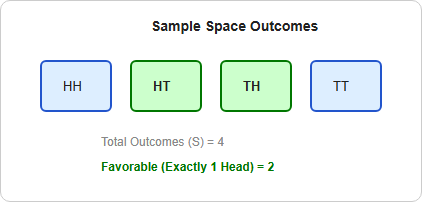
Possible outcomes: HH, HT, TH, TT.

Outcomes with exactly one head: HT and TH (Total = 2).

Probability = Favorable Outcomes ÷ Total Outcomes = 2 ÷ 4 = 1/2.

∴ The correct answer is 1/2.

Alternate Method

Given: Two coins are tossed simultaneously.

Formula Used: Probability P(E) = n(E) ÷ n(S), where n(E) is the number of favorable outcomes and n(S) is the total number of outcomes.

Sample space (S) = {HH, HT, TH, TT}

⇒ Total number of outcomes n(S) = 4

Favorable outcomes (E) for exactly one head = {HT, TH}

⇒ Number of favorable outcomes n(E) = 2

⇒ P(E) = n(E) ÷ n(S) = 2 ÷ 4

⇒ P(E) = 1/2

∴ The correct answer is 1/2.

Additional Information

Sample Space for n Coins

When tossing n unbiased coins simultaneously, the total number of possible outcomes is 2n.

Range of Probability

The probability of any event E always lies between 0 and 1, inclusive (0 ≤ P(E) ≤ 1). 0 indicates an impossible event, and 1 indicates a sure event.

Complementary Events

The sum of the probability of an event occurring and the probability of it not occurring is always 1: P(E) + P(E') = 1.

47

Find the distance between the points A(4,-3) and B(-4,3).

  1. ((a))

    8

  2. ((b))

    10

  3. ((c))

    6

  4. ((d))

    14

Show Answer
Answer: ((b))

10

Given :

To find the Distance between the points A(4,-3) and B(-4,3).

Formula used :

Distance between two points (x,y) and (X,Y) = (\sqrt{(X-x)^2+(Y-y)^2} )

Calculation :

Distance = (\sqrt{(X-x)^2+(Y-y)^2}) = (\sqrt{(-4-4)^2+(3-(-3))^2}) = (\sqrt{64+36}) = 10

∴ The answer is 10 .

48

A factor of the expression x3 - 2x + 1 is:

  1. ((a))

    x - 1

  2. ((b))

    x + 1

  3. ((c))

    x + 2

  4. ((d))

    x - 2

Show Answer
Answer: ((a))

x - 1

Concept used:

Factor theorem:

If f(x) be a polynomial of degree n ≥ 1, a belong to Real number then  x - a is the factor of polynomial f(x) if f(a) = 0. 

Calculation:

put x = 1 in the polynomial x3 - 2x + 1

1 - 2 + 1 = 0 

⇒ x - 1 is the factor of x3 - 2x + 1.

put x = -1  in the polynomial x3 - 2x + 1

⇒ -1 -2(-1) + 1 ≠ 0 

⇒ x + 1 is not the factor of the polynomial x3 - 2x + 1.

put x = -2 in polynomial  -8 + 4 + 1 ≠ 0 

⇒ x + 2 is not the factor of polynomial 

put x = 2 in polynomial 8 - 4 + 1 ≠ 0 

⇒ x - 2 is not the factor of the polynomial 

∴ option 1 is correct

49

Find the median of given data.

{13, 2, 5, 18, 6, 3, 6, 7, 8, 11, 17}

  1. ((a))

    6

  2. ((b))

    6.5

  3. ((c))

    7

  4. ((d))

    8

Show Answer
Answer: ((c))

7

Shortcut Trick

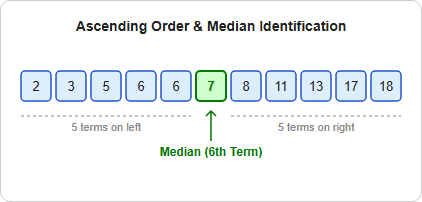
Arrange the given 11 terms in ascending order:

2, 3, 5, 6, 6, 7, 8, 11, 13, 17, 18

Since the number of terms (n = 11) is odd, the median is the middle-most term:

Median = ((11 + 1) ÷ 2)th term = 6th term = 7

∴ The correct answer is 7.

Alternate Method

Given Data: {13, 2, 5, 18, 6, 3, 6, 7, 8, 11, 17}

Total number of observations (n): 11

Formula:

When n is odd, Median = value of ((n + 1) ÷ 2)th observation.

Step-by-step calculation:

⇒ Arrange the data in ascending order: 2, 3, 5, 6, 6, 7, 8, 11, 13, 17, 18

⇒ Count the total number of observations, n = 11

⇒ Since n is odd, the median is the ((n + 1) ÷ 2)th term.

⇒ Median term position = (11 + 1) ÷ 2 = 6th term

⇒ The 6th term in the sorted list is 7.

⇒ Therefore, the median of the given data is 7.

Why other options are incorrect:

Option (1) 6: This is the mode of the dataset (since 6 appears twice, which is the highest frequency), not the median.

Option (2) 6.5: This would be the median if there were 12 terms and the middle terms were 6 and 7, but here we have an odd number of terms (11), so the median must be a single middle value, which is exactly 7.

Option (4) 8: This is the 7th term in the sorted list, which is not the middle-most term.

∴ The correct answer is 7.

Additional Information

Median for Even Number of Terms

If the number of observations (n) is even, the median is the average of the (n ÷ 2)th and ((n ÷ 2) + 1)th terms: Median = [Value of (n/2)th term + Value of (n/2 + 1)th term] ÷ 2.

Mean (Arithmetic Average)

Mean is the sum of all observations divided by the total number of observations: Mean = (∑ xi) ÷ n.

Mode

Mode is the value that appears most frequently in a data set. A dataset can have one mode, more than one mode (multimodal), or no mode at all.

Empirical Relationship

For a moderately skewed distribution, the relationship between mean, median, and mode is: Mode = 3 × Median − 2 × Mean.

50

If one zero of the polynomial x2 -5x + k is 2, then the value of k will be:

  1. ((a))

    5

  2. ((b))

    6

  3. ((c))

    0

  4. ((d))

    None of these 

Show Answer
Answer: ((b))

6

Concept Used:

If any polynomial p(x) has a root of x = a, then p(a) = 0.

Explanation:

If one zero of the polynomial x2 - 5x + k is 2, it means that when you substitute x = 2 into the polynomial, the result should be equal to zero.

⇒ 22 - 5 × 2 + k = 0

⇒ 4 - 10 + k = 0

⇒ -6 + k = 0

⇒ k = 6

So, the value of k that makes one zero of the polynomial x2 - 5x + k equal to 2 is k = 6.

51

A fair die is rolled once. What is the probability of getting an even number?

  1. ((a))

    ( \frac{1}{2} )

  2. ((b))

    ( \frac{1}{3} )

  3. ((c))

    ( \frac{1}{6} )

  4. ((d))

    ( \frac{2}{3} )

Show Answer
Answer: ((a))

( \frac{1}{2} )

Shortcut Trick

Total faces on a die = 6 (1, 2, 3, 4, 5, 6).

Even faces = 3 (2, 4, 6).

Probability = Even faces ÷ Total faces = 3 ÷ 6 = 1/2.

∴ Answer = 1/2

Alternate Method

Given:

A fair die is rolled once.

Total possible outcomes S = {1, 2, 3, 4, 5, 6}

Formula used:

Probability P(E) = n(E) ÷ n(S)

Die Roll Outcomes 1 2 3 4 5 6 Total Outcomes n(S) = 6 Even Outcomes (Green) n(E) = 3 P = 3/6 = 1/2

Calculations:

⇒ Sample space n(S) = 6

⇒ Even numbers E = {2, 4, 6}

⇒ Number of favorable outcomes n(E) = 3

⇒ Probability P(E) = 3 ÷ 6

⇒ P(E) = 1/2

∴ The correct answer is (1).

52

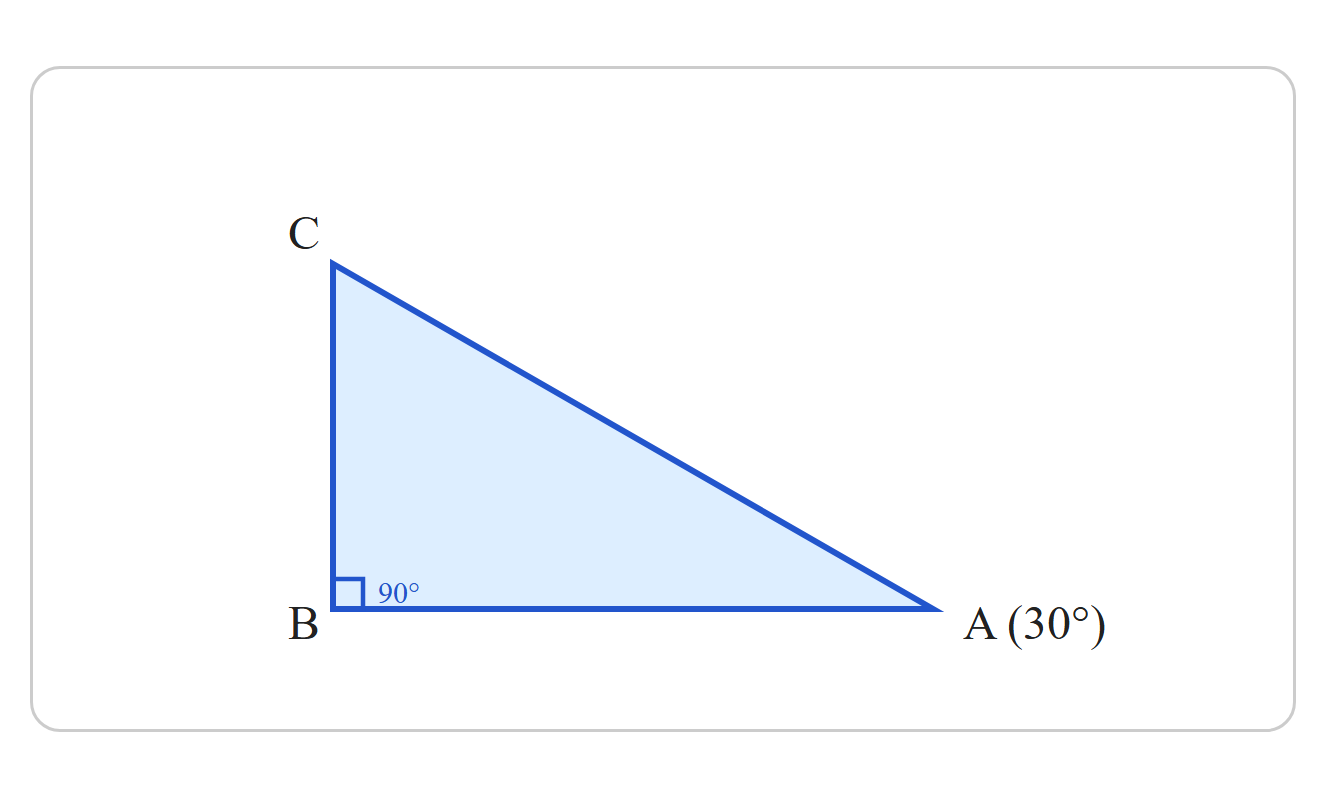
In a triangle ∠ B = 90° and ∠ A = 30° then sin2 A – cos2 A + tan2 A:

  1. ((a))

    – 3/12

  2. ((b))

    1/6

  3. ((c))

    2/6

  4. ((d))

    – 1/6

Show Answer
Answer: ((d))

– 1/6

Shortcut Trick

Directly substitute ∠A = 30° into the expression: sin2 30° − cos2 30° + tan2 30°.

Value substitution: (1/2)2 − (√3/2)2 + (1/√3)2

Calculation: 1/4 − 3/4 + 1/3 = − 2/4 + 1/3 = − 1/2 + 1/3 = − 1/6.

∴ The correct answer is − 1/6.

Alternate Method

Given: In triangle ABC, ∠B = 90° and ∠A = 30°.

Formula Used: Standard trigonometric values: sin 30° = 1/2, cos 30° = √3/2, tan 30° = 1/√3.

The expression to evaluate is sin2 A − cos2 A + tan2 A.

⇒ Expression = (sin 30°)2 − (cos 30°)2 + (tan 30°)2

⇒ Expression = (1/2)2 − (√3/2)2 + (1/√3)2

⇒ Expression = 1/4 − 3/4 + 1/3

⇒ Expression = (1 − 3)/4 + 1/3

⇒ Expression = − 2/4 + 1/3

⇒ Expression = − 1/2 + 1/3

⇒ Expression = (− 3 + 2)/6

⇒ Expression = − 1/6

∴ The correct answer is − 1/6.

Additional Information

Trigonometric Identities

Fundamental identities include sin2θ + cos2θ = 1 and 1 + tan2θ = sec2θ.

Double Angle Relation

The term (sin2A − cos2A) is equal to − (cos2A − sin2A), which simplified is − cos 2A.

Standard Values at 30°

For θ = 30°: sin θ = 0.5, cos θ = 0.866, tan θ = 0.577.

53

An investment of ₹62,000 decreased by 10% in the first year and increased by 12% in the second year. What was the value of the investment at the end of the two-year period?

  1. ((a))

    ₹62,486

  2. ((b))

    ₹63,696

  3. ((c))

    ₹62,496

  4. ((d))

    ₹61,496

Show Answer
Answer: ((c))

₹62,496

Shortcut Trick

Net percentage change = a + b + (ab ÷ 100)

Here, a = −10% and b = +12%

Net % change = −10 + 12 + [(−10 × 12) ÷ 100] = 2 − 1.2 = 0.8% (increase)

Final Value = 62,000 + 0.8% of 62,000 = 62,000 + 496 = 62,496

∴ The correct answer is ₹62,496.

Alternate Method

Given:

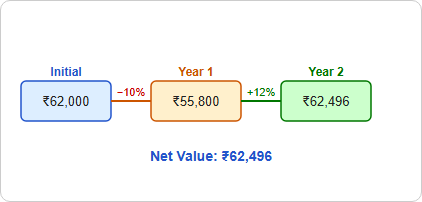
Initial Investment = ₹62,000

First year decrease = 10%

Second year increase = 12%

Calculations:

Value after 1st Year = 62,000 − (10% of 62,000)

Value after 1st Year = 62,000 − 6,200 = ₹55,800

Value after 2nd Year = 55,800 + (12% of 55,800)

⇒ 12% of 55,800 = (12 ÷ 100) × 55,800 = 12 × 558 = 6,696

Final Value = 55,800 + 6,696 = ₹62,496

∴ The correct answer is ₹62,496.

Additional Information

Successive Percentage Change

When a value changes by x% and then y%, the effective change is (x + y + xy/100)%. This is also applicable to Compound Interest calculations.

Multiplying Factor Method

For an x% increase, multiply by (1 + x/100). For an x% decrease, multiply by (1 − x/100). In this case: 62000 × 0.90 × 1.12.

Commutative Property of Change

The final value remains the same regardless of the order of percentage changes (i.e., 12% increase followed by 10% decrease yields the same result).

54

The area of the curved surface of a cone is 195π cm2. If the slant height of the cone is 12 cm, find the radius of the base.

  1. ((a))

    17 cm

  2. ((b))

    16.25 cm

  3. ((c))

    14 cm

  4. ((d))

    15.5 cm

Show Answer
Answer: ((b))

16.25 cm

Given:

Curved surface area (CSA) of the cone = 195π cm2.

Slant height (l) = 12 cm.

Formula Used:

Curved Surface Area (CSA) of a cone = π × r × l

Calculation:

CSA = π × r × l

⇒ 195π = π × r × 12

⇒ 195 = r × 12

⇒ r = 195 / 12

⇒ r = 16.25

The radius of the base is 16.25 cm.

55

Ifsin θ = (\frac{8}{17}), and θ lies in the 2nd quadrant, find cos θ.

  1. ((a))

    (-\frac{15}{17})

  2. ((b))

    (\frac{12}{17})

  3. ((c))

    (\frac{14}{17})

  4. ((d))

    (-\frac{12}{17})

Show Answer
Answer: ((a))

(-\frac{15}{17})

Shortcut Trick

The numbers 8, 15, and 17 form a standard Pythagorean triplet.

Given sin θ = Perpendicular / Hypotenuse = 8 / 17.

This directly implies that the Base is 15.

In the 2nd quadrant, the cosine ratio (Base / Hypotenuse) is always negative.

Therefore, cos θ = −15 / 17.

∴ The correct answer is −15/17.

Alternate Method

Given:

sin θ = 8 / 17

θ lies in the 2nd quadrant.

Formula Used:

sin2θ + cos2θ = 1

X Y

θ r = 17 y = 8 x = −15

Calculations:

⇒ cos2θ = 1 − (8 / 17)2

⇒ cos2θ = 1 − 64 / 289

⇒ cos2θ = (289 − 64) / 289

⇒ cos2θ = 225 / 289

⇒ cos θ = ±√(225 / 289)

⇒ cos θ = ±15 / 17

Since θ lies in the 2nd quadrant, the value of cos θ must be negative.

⇒ cos θ = −15 / 17

∴ The correct answer is −15/17.

Additional Information

ASTC Rule (Quadrant Signs)

Quadrant I: All positive | Quadrant II: sin & cosec positive | Quadrant III: tan & cot positive | Quadrant IV: cos & sec positive.

Pythagorean Triplets

Common triplets like (3, 4, 5), (5, 12, 13), and (8, 15, 17) help find missing sides of a right-angled triangle directly without manual calculations.

Trigonometric Identities

The three core Pythagorean identities are sin2θ + cos2θ = 1, sec2θ − tan2θ = 1, and cosec2θ − cot2θ = 1.

56

The height of a right circular cone is 10 cm and its base radius is 24 cm. What is the curved surface area (in cm2) of the cone?

  1. ((a))

    640π 

  2. ((b))

    620π 

  3. ((c))

    580π

  4. ((d))

    624π

Show Answer
Answer: ((d))

624π

Shortcut Trick

The radius (24) and height (10) form a Pythagorean triplet with the slant height (l).

Triplet base (5, 12, 13) × 2 → (10, 24, 26). Thus, slant height l = 26 cm.

Curved Surface Area = π × r × l

CSA = π × 24 × 26 = 624π cm2.

∴ The correct answer is 624π cm2.

Alternate Method

Given:

Radius of the base (r) = 24 cm

Height of the cone (h) = 10 cm

Formula Used:

Slant height (l) = √(r2 + h2)

Curved Surface Area (CSA) = π × r × l

h = 10 r = 24 l = ? Curved Surface Area = πrl

Calculations:

⇒ l = √(242 + 102)

⇒ l = √(576 + 100)

⇒ l = √676

⇒ l = 26 cm

⇒ CSA = π × 24 × 26

⇒ CSA = 624π cm2

∴ The correct answer is 624π cm2.

Additional Information

Total Surface Area of a Cone

TSA includes both the curved surface and the circular base: TSA = πrl + πr2 = πr(l + r).

Volume of a Cone

The space occupied by the cone is given by: V = (1/3) × πr2h.

Frustum of a Cone

When the top of a cone is sliced off parallel to the base, the curved surface area of the resulting frustum is πl(r1 + r2).

57

A pyramid has a square base and its slant height is 17 cm and its vertical height is 15 cm. What is the volume of the pyramid?

  1. ((a))

    1280 cu.cm

  2. ((b))

    1380 cu.cm

  3. ((c))

    1180 cu.cm

  4. ((d))

    1480 cu.cm

Show Answer
Answer: ((a))

1280 cu.cm

Shortcut Trick

Using the Pythagorean triplet (8, 15, 17):

Height (h) = 15, Slant height (l) = 17 ⇒ Half of base side (a/2) = 8 cm.

Base side (a) = 8 × 2 = 16 cm.

Volume of pyramid = (1/3) × Area of base × h

Volume = (1/3) × 162 × 15 = 256 × 5 = 1280 cu.cm.

∴ The correct answer is 1280 cu.cm.

Alternate Method

Given:

Slant height (l) = 17 cm

Vertical height (h) = 15 cm

The base is a square with side 'a'.

For a pyramid with a square base, the relation between height, slant height, and side is:

l2 = h2 + (a/2)2

⇒ 172 = 152 + (a/2)2

⇒ 289 = 225 + (a/2)2

⇒ (a/2)2 = 289 − 225

⇒ (a/2)2 = 64

⇒ a/2 = √64 = 8 cm

⇒ a = 16 cm

The formula for the Volume of a Pyramid is:

Volume = (1/3) × (Base Area) × (Vertical Height)

⇒ Volume = (1/3) × a2 × h

⇒ Volume = (1/3) × (16 × 16) × 15

⇒ Volume = 256 × 5

⇒ Volume = 1280 cu.cm.

∴ The correct answer is 1280 cu.cm.

Additional Information

Slant Height vs Slant Edge

Slant height (l) is the altitude of a triangular face, while slant edge (e) is the distance from the vertex to a corner of the base: e2 = h2 + (d/2)2, where d is the diagonal of the base.

Lateral Surface Area (LSA)

For a regular pyramid, LSA = (1/2) × Perimeter of base × Slant height. For a square base: LSA = 2 × a × l.

Total Surface Area (TSA)

TSA = Base Area + Lateral Surface Area. For a square base: TSA = a2 + 2al.

58

Cost price of an article is Rs. 9500. If the loss percentage is 22 percent, then what is the selling price of the article? 

  1. ((a))

    Rs. 7280

  2. ((b))

    Rs. 7520 

  3. ((c))

    Rs. 7500

  4. ((d))

    Rs. 7410

Show Answer
Answer: ((d))

Rs. 7410

Given:

Cost Price = Rs. 9500

Loss % = 22%

Formula used:

SP = C.P(100 - Loss %)/100

Where,

S.P = Selling Price, C.P = Cost Price

Calculation:

By the using formula, we get

S.P = C.P(100 - Loss %)/100

⇒ S.P = 9500(100 - 22)/100

⇒ S.P = 7410

∴ Selling Price of the article is Rs. 7410

59

The surface area of a sphere is 4π cm2. The volume of the sphere is:

  1. ((a))

    (\frac{4\pi}{3} , \text{cm}^3 )

  2. ((b))

    (\frac{2\pi}{3} , \text{cm}^3)

  3. ((c))

    (\frac{5\pi}{3} , \text{cm}^3)

  4. ((d))

    (\frac{13\pi}{3} , \text{cm}^3)

Show Answer
Answer: ((a))

(\frac{4\pi}{3} , \text{cm}^3 )

Shortcut Trick

Surface Area = 4πr2 = 4π ⇒ r2 = 1 ⇒ r = 1 cm.

Volume = (4/3)πr3 = (4/3)π(1)3 = 4π/3 cm3.

∴ The correct answer is 4π/3 cm3.

Alternate Method

Given: Surface area of the sphere = 4π cm2.

Formula used: Surface area = 4πr2; Volume = (4/3)πr3.

⇒ 4πr2 = 4π

⇒ r2 = 1

Radius (r) = 1 cm

Volume = (4/3) × π × (1)3

Volume = 4π/3 cm3

∴ The correct answer is 4π/3 cm3.

Additional Information

Hemisphere formulas

For a hemisphere of radius r, Curved Surface Area = 2πr2 and Total Surface Area = 3πr2.

Volume of Hemisphere

The volume of a hemisphere is exactly half of a sphere: V = (2/3)πr3.

Ratio of SA to Volume

For any sphere, the ratio of its Surface Area to its Volume is 3/r.

60

One of the zeros of the polynomial f(x) = 2x2 + 7x - 4 is

  1. ((a))

    2

  2. ((b))

    (\frac{1}{2})

  3. ((c))

    (-\frac{1}{2})

  4. ((d))

    -2

Show Answer
Answer: ((b))

(\frac{1}{2})

Given:

f(x) = 2x2 + 7x - 4

Calculations:

2x2 + 7x - 4 = 0

=> 2x2 + 8x - x - 4 = 0

=> 2x(x + 4) - 1(x + 4) = 0

=> (2x - 1)(x + 4) = 0

=> 2x - 1 = 0, x + 4 = 0

=> x =  (\dfrac{1}{2}), - 4

Value of x cannot be negative, so, x =  (\dfrac{1}{2})

∴ The answer is  (\dfrac{1}{2})

61

Which part and article of the Indian Constitution are related to the Panchayati Raj Institution?

  1. ((a))

    Part -IX, Article 243(A) to 243(0)

  2. ((b))

    Part-X, Article 243(A) to 243(O)

  3. ((c))

    Part -IX, Article 243(P) to 243(Z)

  4. ((d))

    Part X, Article 243(P) to 243(Z)

Show Answer
Answer: ((a))

Part -IX, Article 243(A) to 243(0)

The correct answer is Part -IX, Article 243(A) to 243(O).

Key Points

  • Part IX of the Indian Constitution deals with the Panchayati Raj Institutions.
  • Articles 243(A) to 243(O) specifically outline the provisions related to the structure, composition, and functioning of Panchayati Raj Institutions.
  • The 73rd Amendment Act of 1992 led to the inclusion of Part IX in the Constitution, emphasizing the role of local self-government in rural areas.
  • The amendment aimed to provide a uniform structure for Panchayati Raj Institutions across the country, thereby ensuring democratic decentralization.

Additional Information

  • 73rd Amendment Act:
  • It was enacted in 1992 and came into force on 24 April 1993.
  • This amendment is a significant step towards decentralization, empowering rural local bodies.
  • It mandates the establishment of Panchayats at the village, intermediate, and district levels.
  • Gram Sabha:
  • The Gram Sabha is the foundation of the Panchayati Raj system, consisting of all registered voters within the jurisdiction of a village Panchayat.
  • It acts as a deliberative body that ensures accountability and transparency in the functioning of Panchayats.
  • Three-tier system:
  • The Panchayati Raj system operates on a three-tier structure, comprising the Village Panchayat, the Panchayat Samiti (Intermediate level), and the Zila Parishad (District level).
  • This structure facilitates better governance and administration at the grassroots level.
  • Reservation of Seats:
  • The 73rd Amendment provides for the reservation of seats for Scheduled Castes, Scheduled Tribes, and women (not less than one-third) in Panchayats.
  • This ensures inclusive participation and representation of marginalized communities in the decision-making process.
62

“Purna Swaraj” as the goal of nationalism in India was aimed to achieve __________ .

  1. ((a))

    Partial freedom

  2. ((b))

    Complete independence

  3. ((c))

    Indian identity

  4. ((d))

    Partition

Show Answer
Answer: ((b))

Complete independence

The correct answer is: 'Complete independence'.

Key Points

  • Purna Swaraj was aimed to achieve complete independence for India.
  • This goal was officially adopted by the Indian National Congress on 26 January 1930, declaring the objective of full independence from British rule.
  • The term "Purna Swaraj" translates to "complete self-rule" and signified the determination to attain total sovereignty and self-governance.
  • It marked a significant shift from earlier demands for Dominion Status to an outright call for full independence.

Incorrect Options

  • Partial freedom
  • This option is incorrect as "Purna Swaraj" explicitly aimed for complete independence, not partial freedom.
  • Indian identity
  • While the movement for Purna Swaraj was intertwined with the strengthening of Indian identity, the primary goal was full independence, not merely an assertion of identity.
  • Partition
  • The idea of partition was not a goal of the Purna Swaraj declaration. Partition of India came later as a result of different political developments.

Hence, the correct answer is complete independence, and other options do not align with the goal of Purna Swaraj.

Additional Information

  • Purna Swaraj and its significance:
  • The Purna Swaraj declaration was a pivotal moment in the Indian independence movement, symbolizing a clear and unequivocal break from British colonial rule.
  • It galvanized the Indian population and intensified the freedom struggle, leading to widespread civil disobedience and non-cooperation movements.
  • Indian National Congress (INC) role:
  • The INC played a central role in advocating for Purna Swaraj, leading mass mobilizations and negotiating with the British for independence.
  • Leaders like Mahatma Gandhi, Jawaharlal Nehru, and Subhas Chandra Bose were instrumental in championing the cause of complete independence.
63

Which among the following statements is/are correct with respect to Reserve Bank of India?

  1. ((a))

    RBI was established on April 1, 1935

  2. ((b))

    RBI was nationalized on January 1, 1950

  3. ((c))

    It was set on the recommendations of the Hilton Young Commission

  4. ((d))

    Both 1 and 3

Show Answer
Answer: ((d))

Both 1 and 3

The Correct Answer is Option 4 i.e  Both 1 and 3.

  • Reserve Bank of India:
  • The Reserve Bank of India was established on April 1, 1935, in accordance with the provisions of the Reserve Bank of India Act, 1934.
  • It acts as a Banker to the Government as well as banker to banks.
  • Shaktikanta Das is the present Governor of RBI.
  • The Reserve Bank of India was set up on the basis of the recommendations of the Hilton Young Commission.
  • RBI was nationalized on January 1, 1949. (This makes the statement 2 incorrect).
64

President’s rule is mentioned in Article ________ of the Indian Constitution.

  1. ((a))

    356

  2. ((b))

    345

  3. ((c))

    376

  4. ((d))

    252

Show Answer
Answer: ((a))

356

The correct answer is option 1, i.e. 356.

  • President’s rule is mentioned in Article 356 of the Indian Constitution.
  • Article 345- Official language or languages of a State.
  • Article 376- Conditions for appointment of Chief Justice of High court.
  • Article 252- Power of Parliament to legislate for two or more States.
65

What is the role of rainwater harvesting in the Jal Shakti Abhiyan?

  1. ((a))

    To increase groundwater depletion

  2. ((b))

    To store excess rainwater for future use

  3. ((c))

    To promote urbanization

  4. ((d))

    To reduce agricultural activities

Show Answer
Answer: ((b))

To store excess rainwater for future use

The correct answer is To store excess rainwater for future use.

Key Points

  • The Jal Shakti Abhiyan (JSA) was launched by the Government of India in 2019 as a time-bound, mission-mode campaign to promote water conservation and water security across the country.
  • The primary role of rainwater harvesting in this initiative is to collect and store excess rainwater during the monsoon season, ensuring that this water is available for future use during dry periods and to recharge groundwater aquifers. Hence, statement 2 is correct.
  • The mission aims to combat groundwater depletion by replenishing underground water tables through scientific conservation methods, rather than increasing the rate of depletion. Hence, statement 1 is incorrect.
  • While the campaign is implemented in both rural and urban areas, its core objective is water sustainability and ecological restoration, not the promotion of urbanization. Hence, statement 3 is incorrect.
  • The Jal Shakti Abhiyan actually supports and enhances agricultural activities by providing reliable water sources for irrigation through watershed development and water harvesting, rather than reducing them. Hence, statement 4 is incorrect.

Additional Information

  • The Ministry of Jal Shakti was established in May 2019 by merging the Ministry of Water Resources, River Development & Ganga Rejuvenation and the Ministry of Drinking Water and Sanitation to provide a unified approach to water management.
  • The Catch the Rain campaign, launched under the National Water Mission, uses the tagline Catch the rain, where it falls, when it falls to encourage the creation of Rain Water Harvesting Structures (RWHS) suitable to the climatic conditions of various regions.
  • The initiative initially targeted 256 water-stressed districts and 1,592 water-stressed blocks across India, focusing on urgent interventions to prevent a severe water crisis.
  • Key intervention areas of the Jal Shakti Abhiyan include renovation of traditional water bodies (such as tanks and ponds), reuse and recharge structures, watershed development, and intensive afforestation.
  • The campaign is designed as a Jan Andolan (People's Movement), emphasizing community participation and awareness to make water conservation a part of daily life for every citizen.

Important Points

  • Rainwater harvesting techniques promoted under the mission include rooftop rainwater harvesting for buildings, percolation pits, check dams, and recharge wells to maximize the absorption of water into the soil.
  • The mission leverages funds and labor from the Mahatma Gandhi National Rural Employment Guarantee Act (MGNREGA) to construct and maintain water conservation infrastructure in rural areas.
  • The Jal Shakti Abhiyan: Catch the Rain 2024 campaign focuses on the theme Sustainablity of Ground Water Sources for Drinking Water, highlighting the critical need to protect drinking water sources.
  • The Central Nodal Officers (CNOs) and Technical Officers from the Central Government visit districts to coordinate with District Collectors and ensure the effective implementation of water-saving measures.
  • Data from the Central Ground Water Board (CGWB) is used to identify priority areas where the water table has fallen significantly, ensuring that resources are directed where they are most needed.
66

Which government scheme primarily focuses on improving access to banking, insurance, and remittance facilities for all households in India?

  1. ((a))

    Pradhan Mantri Jeevan Jyoti Bima Yojana (PMJJBY)

  2. ((b))

    Pradhan Mantri Suraksha Bima Yojana (PMSBY)

  3. ((c))

    Pradhan Mantri Jan Dhan Yojana (PMJDY)

  4. ((d))

    Stand-Up India Scheme

Show Answer
Answer: ((c))

Pradhan Mantri Jan Dhan Yojana (PMJDY)

The correct answer is Pradhan Mantri Jan Dhan Yojana (PMJDY).

Key Points

  • Pradhan Mantri Jan Dhan Yojana (PMJDY) was launched on 28 August 2014 by Prime Minister Narendra Modi.
  • The scheme focuses on providing universal access to banking services, including a basic savings bank account, financial literacy, insurance, and pension.
  • PMJDY aims to ensure financial inclusion for all households in India by offering affordable financial services such as bank accounts, insurance, remittance, and credit facilities.
  • Under PMJDY, beneficiaries receive a zero-balance savings account, a RuPay debit card, and an overdraft facility of up to Rs. 10,000 after six months of satisfactory operation.
  • As of 2023, PMJDY has enrolled more than 48 crore beneficiaries, emphasizing its role in improving financial literacy and accessibility in rural and urban India.

Additional Information

  • Features of PMJDY:
  • Accounts under PMJDY can be opened with zero balance.
  • Provides a Rs. 2 lakh accident insurance cover for RuPay cardholders.
  • Offers an overdraft facility of Rs. 10,000 per account to eligible beneficiaries.
  • Encourages direct benefit transfer (DBT) for government subsidies and welfare schemes.
  • Introduced a mobile banking facility for account holders to access their accounts digitally.
  • Pradhan Mantri Jeevan Jyoti Bima Yojana (PMJJBY):
  • A government-backed life insurance scheme launched on 9 May 2015.
  • Provides life insurance coverage of Rs. 2 lakh for an annual premium of Rs. 436.
  • Available to individuals aged 18 to 50 years with a bank account.
  • Pradhan Mantri Suraksha Bima Yojana (PMSBY):
  • A government-backed accident insurance scheme launched on 9 May 2015.
  • Provides accident cover of Rs. 2 lakh for accidental death and full disability, and Rs. 1 lakh for partial disability.
  • Available to individuals aged 18 to 70 years with a bank account.
  • Stand-Up India Scheme:
  • Launched on 5 April 2016, this scheme aims to promote entrepreneurship among women and Scheduled Castes/Scheduled Tribes.
  • Provides bank loans ranging from Rs. 10 lakh to Rs. 1 crore for setting up greenfield enterprises.
  • Focuses on industries such as manufacturing, services, and trading sectors.

Important Points

  • Financial Inclusion Index (FI Index):
  • Developed by the Reserve Bank of India (RBI) to measure the extent of financial inclusion across the country.
  • Incorporates parameters such as access, usage, and quality of financial services.
  • The FI Index for 2023 showed significant improvement due to schemes like PMJDY.
  • Impact of PMJDY:
  • Has contributed significantly to reducing India's unbanked population.
  • Improved financial literacy and inclusion in rural areas.
  • Facilitated the implementation of welfare schemes through direct benefit transfer (DBT).
67

Article 51A of the Indian constitution deals with the:

  1. ((a))

    Fundamental Duties 

  2. ((b))

    Fundamental Right

  3. ((c))

    Both of the above

  4. ((d))

    None of the above

Show Answer
Answer: ((a))

Fundamental Duties 

The correct answer is Fundamental Duties.

  • The Amendment inserted Article 51A to create a new part called IV- A in the constitution.

Key Points

  • In Article 51A prescribed the Fundamental duties to the citizens.
  • The 42nd Amendment of the constitution of India enacted in 1976, laid down the Fundamental Duties of Indian citizens to the nation.
  • In 1976 Saran Singh committee recommended Fundamental duties to be added in the Constitution
  • In article 51A of the Indian Constitution clearly specified the duty of citizens to protect the environment.
68

Who was the president of the Indian National Congress during the Lucknow Session in 1916?

  1. ((a))

    Aurobindo Ghosh

  2. ((b))

    Dadabhai Naoroji

  3. ((c))

    Ambica Charan Mazumdar

  4. ((d))

    Lala Lajpat Rai

Show Answer
Answer: ((c))

Ambica Charan Mazumdar

The correct answer is Ambica Charan Mazumdar

Key Points

  • Ambica Charan Mazumdar was the congress president when Lucknow Pact was signed.
  • The Lucknow Pact was an agreement that reached between the Indian National Congress and the Muslim League.
  • It was adopted by the Congress at its Lucknow session on December 29 and by the league on Dec. 31, 1916.
  • The Muslim League was led by Mohammed Ali Jinnah.
SessionPresidentYear
CalcuttaAnnie Besant1917
CalcuttaShri Dadabhai Naoroj1906
CalcuttaMoti Lal Nehru1928
69

'Article 330' of the Indian Constitution deals with: 

  1. ((a))

    Reservation of seats in the Lok Sabha for Scheduled Castes and Scheduled Tribes

  2. ((b))

    Reservation of Seats for High Educated Persons

  3. ((c))

    Reservation of Seats for Women in Legislative Assembly

  4. ((d))

    Reservation of Seats for Challenged Persons in Lok Sabha

Show Answer
Answer: ((a))

Reservation of seats in the Lok Sabha for Scheduled Castes and Scheduled Tribes

The correct answer is Option 1.

Key Points

  • According to Article-330 of the Constitution -
  • Members of the Scheduled Castes and Scheduled Tribes are represented in the Lok Sabha on the basis of population ratio.

Additional Information

  • ​Article-331 gives the President the right that if the Anglo-Indian community is not adequately represented in the Lok Sabha,
  • So he can nominate two representatives of the said community.
  • Article-332 of the Constitution for the SC/ST category in the State Assemblies whereas
  • Article-333 provides for reservations (Assembly) for the Anglo-Indian community.
70

Globalisation refers to:

  1. ((a))

    Isolation

  2. ((b))

    Integration of economies

  3. ((c))

    War

  4. ((d))

    Colonisation

Show Answer
Answer: ((b))

Integration of economies

The correct answer is - Integration of economies

Key Points

  • Globalisation
  • It refers to the process of rapid integration or interconnection between countries through the movement of goods, services, technology, and capital.
  • The primary objective is the integration of economies, allowing national markets to interact within a larger global market.
  • It involves the expansion of international trade and the flow of Foreign Direct Investment (FDI) across national borders.
  • The process is facilitated by improvements in transportation and information technology, making communication and logistics more efficient.

Additional Information

  • Liberalisation
  • It is the process of removing trade barriers and restrictions set by the government, which is a key stepping stone toward globalisation.
  • It allows private players to enter industries previously reserved for the public sector and encourages foreign competition.
  • Multinational Corporations (MNCs)
  • MNCs are companies that own or control production in more than one nation.
  • They play a major role in globalisation by spreading production and services globally to take advantage of lower costs and proximity to markets.
  • World Trade Organization (WTO)
  • The WTO is an international body that deals with the global rules of trade between nations.
  • Its main function is to ensure that trade flows as smoothly, predictably, and freely as possible, promoting the goals of globalisation.
  • Impact of Technology
  • The Information and Communication Technology (ICT) revolution has significantly accelerated globalisation by enabling real-time financial transactions and data sharing.
  • Advancements in containerisation have reduced the cost of transporting goods over long distances, further boosting global trade.
71

Which among the following dates is incorrectly matched in relation with the France revolution?

  1. ((a))

    1789- Convocation of Estates General, Third Estate forms National Assembly, the Bastille is stormed, peasant revolts in the countryside.

  2. ((b))

    1791- A constitution is framed to limit the powers of the king and to guarantee basic rights to all human beings. 

  3. ((c))

    1800- Napoleon becomes emperor of France, annexes large parts of Europe.

  4. ((d))

    1815- Napoleon defeated at Waterloo

Show Answer
Answer: ((c))

1800- Napoleon becomes emperor of France, annexes large parts of Europe.

Some important dates

1774- Louis XVI becomes king of France, faces empty treasury and growing discontent within the society of the Old Regime.
1789- Convocation of Estates General, Third Estate forms National Assembly, the Bastille is stormed, peasant revolts in the countryside.
1791- A constitution is framed to limit the powers of the king and to guarantee basic rights to all human beings.
1792-93- France becomes a republic, the king is beheaded. The overthrow of the Jacobin republic, a Directory rules France.
1804- Napoleon becomes emperor of France, annexes large parts of Europe. Hence, option 3rd is incorrect.
1815- Napoleon defeated at Waterloo.


Key Points

Livre – Unit of currency in France, discontinued in 1794

Clergy – Group of persons invested with special functions in the church

Tithe – A tax levied by the church, comprising one-tenth of the agricultural produce

Taille – Tax to be paid directly to the state

72

Indian gets the largest share of GDP from which of the following sectors?

  1. ((a))

    Construction sector

  2. ((b))

    Service sector

  3. ((c))

    Agriculture sector

  4. ((d))

    Manufacturing sector

Show Answer
Answer: ((b))

Service sector

The correct answer is Service Sector.


Important Points

  • The service sector, also known as the tertiary sector, is the third tier in the three-sector economy.
  • Instead of product production, this sector produces services maintenance and repairs, training, or consulting.
  • Examples of service sector jobs include housekeeping, tours, nursing, and teaching.
  • The services sector is the largest sector in India.
  • The services sector accounts for 53.66% of the total India's GVA of Rs. 137.51 lakh crore.
  • The industrial sector is at the second spot and contributing around 31% of the Indian GDP.
  • The service sector makes an important contribution to GDP in most countries, providing jobs, inputs, and public services for the economy.
  • Trade-in services can improve economic performance and provide a range of traditional and new export opportunities.
  • The MSME sector is and regarded as the backbone of the Indian economy.
  • It churns out over 6000 products that are highly sought after across the global marketplaces.
  • It employs 40% of the country's workforce, next only to the agricultural sector.


Additional Information

  • The Agriculture sectors comprise establishments primarily engaged in growing crops, raising animals, and harvesting fish and other animals from a farm, ranch, or their natural habitats.
  • Agriculture is the most important sector of the Indian Economy.18 percent of India's gross domestic product (GDP) and provides employment to 50% of the countries workforce. India is the world's largest producer of pulses, rice, wheat, spices, and spice products.
  • The Manufacturing sector comprises establishments engaged in the mechanical, physical, or chemical transformation of materials, substances, or components into new products.
73

Match the following classical dance forms with States of India:-

a. Sattriya1. Tamil Nadu
b. Mohiniattam2. Kerala
c. Bharatnatyam3. Andhra Pradesh
d. Kuchipudi4. Assam
  1. ((a))

    a - 4, b - 2, c - 1, d - 3

  2. ((b))

    a - 1, b -3, c - 2, d - 4

  3. ((c))

    a - 1, b - 2, c - 3, d - 4

  4. ((d))

    a - 2, b - 1, c - 4, d - 3

Show Answer
Answer: ((a))

a - 4, b - 2, c - 1, d - 3

The correct answer is a - 4, b - 2, c - 1, d - 3.

Important Points

Some Indian States and their dances:

STATEDANCES
Tamil NaduBharatanatyam, Mayil Attam, Karakattam.
Keralakathakali, Thirvathirakali, Kolkali.
Andhra PradeshKuchipudi.
KarnatakaKarga, Lambi, Yakshagan, Huttari.
PunjabBhangra, Giddha, Bhand, Daff, Dhaman.
Himachal PradeshJhali, Chharhi, Nati, Dangi, Jhora.
JharkhandMundari Dance, Sarhul, Barao, Karma Munda, Agni, Mardana Jhumar, Paika, Phagua, Jhitka, Danga.
AssamBihu, Satriya, Naga dance, Khel Gopal, Natpuja, Maharas, Canoe, Jhumura Hobjanai.
Madhya PradeshAada, Khada Nach, Selabhadoni, Maanch, Phulpati, Grida.
BiharBakho-Bakhain, Sama Chakwa, Bidesia, Jata-Jatin, Panwariya.
RajasthanGhumar, Chakri, Ganagor, Ghapal, Kalbeliya.
74

Which state is the ‘Sugar Bowl’ of India ?

  1. ((a))

    Tamil Nadu

  2. ((b))

    Uttar Pradesh

  3. ((c))

    Maharashtra

  4. ((d))

    Andhra Pradesh

Show Answer
Answer: ((b))

Uttar Pradesh

The correct answer is Uttar Pradesh.

  • Uttar Pradesh is the largest producer of sugarcane followed by Maharashtra and Tamil Nadu.
  • Tamil Nadu is the 'Yarn Bowl' of India and produces 40% of the total Yarn in India.
75

The ‘Dronacharya Award’ is given to __________

  1. ((a))

    Sports Editor

  2. ((b))

    Umpire

  3. ((c))

    Coach

  4. ((d))

    Sportsperson

Show Answer
Answer: ((c))

Coach

The correct answer is Coach.

Key Points

  • Dronacharya award is given by the Ministry of Youth Affairs and Sports, Government of India, for excellence in sports coaching.
  • The award is known as after Drona, often referred to as "Dronacharya" or "Guru Drona", a personality from the Sanskrit epic Mahabharata of ancient India.
  • The  Dronacharya award contains a medallion, a certificate, and a money prize of Rs 15 lakh(lifetime) and 10 Lakh (regular).

Additional Information

  • Major Dhyan Chand Khel Ratna Award:
  • It is that the highest sporting award given by the Ministry of Youth Affairs and Sports for the spectacular and top performance within the field of sports by a sportsperson.
  • This, award contains a medallion, a certificate, and a money prize of Rs 25 lakh.
  • Arjuna Awards:
  • This award is given by the Ministry of Youth Affairs and Sports, Government of India to acknowledge outstanding action in National sports.
  • Instituted in 1961, the award carries a money prize of Rs 15 Lakh, a bronze sculpture of Arjuna, and a scroll.
76

Which of the following is not a member of the South Asian Association of Regional Cooperation (SAARC)?

  1. ((a))

    Myanmar 

  2. ((b))

    Pakistan

  3. ((c))

    Bhutan

  4. ((d))

    Nepal

Show Answer
Answer: ((a))

Myanmar 

The correct answer is Myanmar.

Key Points

  • The first summit of SAARC was held in Dhaka, Bangladesh on 7–8 December 1985.
  • It was attended by Bangladesh, Maldives, Pakistan, Sri Lanka, Bhutan Nepal, and India.


Important Points

  • The South Asian Association for Regional Cooperation (SAARC) was established with the signing of the SAARC Charter in Dhaka on 8 December 1985.
  • The SAARC Secretariat was established in Kathmandu on 16 January 1987.
  • SAARC comprises of eight-member States:
  • Afghanistan
  • Bangladesh
  • Bhutan
  • India
  • Maldives
  • Nepal
  • Pakistan
  • Sri Lanka


Additional Information

  • You can remember the names of SAARC Countries using the mnemonic
  • "MBBS PAIN" for Maldives, Bhutan, Bangladesh, Sri Lanka, Pakistan, Afghanistan, India, Nepal.
77

Which river originates from Amarkantak of Madhya Pradesh ?

  1. ((a))

    Tapti

  2. ((b))

    Mahi

  3. ((c))

    Narmada

  4. ((d))

    Tungabhadra

Show Answer
Answer: ((c))

Narmada

The correct answer is Narmada.

Key Points

  • River Narmada emerges from Amarkantak Hill of Maikal Range, Madhya Pradesh.
  • The mouth of this river is the Gulf of Khambhat (Arabian Sea), Gujarat.
  • The mighty Narmada River as well the Son, the Mahanadi, and Arnadoh which is a major tributary of the Godavari all arise in the Amarkantak plateau.
  • Major dams on the Narmada river are Sardar Sarovar Dam, Indira Sagar Dam, Omkareshwar Dam, Bargi Dam, etc.

Important Points

RiverSourceMouth
TaptiSatpura RangeThe Arabian Sea, Gulf of Khambhat
MahiVindhya RangeThe Arabian Sea, Gulf of Khambhat
TungabhadraVaraha Parvata, Western GhatsKrishna River
78

The latitude that runs through the middle of India is:-

  1. ((a))

    Equator

  2. ((b))

    Tropic of Capricorn

  3. ((c))

    Tropic of Cancer

  4. ((d))

    Arctic Circle

Show Answer
Answer: ((c))

Tropic of Cancer

The correct answer is Tropic of Cancer.

  • The Tropic of Cancer passes through eight states in India: Gujarat (Jasdan), Rajasthan (Kalinjarh), Madhya Pradesh (Shajapur), Chhattisgarh (Sonhat), Jharkhand (Lohardaga), West Bengal (Krishnanagar), Tripura (Udaipur), and Mizoram (Champhai).

  • The Tropic of Cancer is a parallel of latitude on the Earth, 23.5 degrees north of the equator.
  • Mahi River is the only river in India that cuts the Tropic of Cancer twice, first in Madhya Pradesh from where it flows towards Rajasthan and enters Gujarat where it cuts for the second time.


Important Points

Equator- It is an imaginary line around the middle of a planet or other celestial body. - It is halfway between the North Pole and the South Pole, at 0 degrees latitude. - An equator divides the planet into a Northern Hemisphere and a Southern Hemisphere.
Tropic of Capricorn- This latitude corresponds to the southernmost declination of the Sun's ecliptic to the celestial equator. - Latitude approximately 23°27′ S of the terrestrial Equator.
Arctic Circle- Arctic Circle, parallel, or line of latitude around the Earth, at approximately 66°30′ N.
79

Who was the first recipient of Padma Vibhushan?

  1. ((a))

    Dr. Bir Bhan Bhatia

  2. ((b))

    Subhash Chandra Bose

  3. ((c))

    Pandit Jawaharlal Nehru

  4. ((d))

    Satyandra Nath Bose

Show Answer
Answer: ((d))

Satyandra Nath Bose

The correct answer is Satyendra Nath Bose.

Key Points

  • Satyendra Nath Bose was awarded the Padma Vibhushan award C. Rajagopalachari, Sarvepalli Radhakrishnan and C. V. Raman were awarded the Bharat Ratna award.
  • Satyanedranath Bose along with Meghnad Saha graduated from Presidency College Calcutta.
  • Rabindranath Tagore dedicated his book on science, “Visva-Parichay”, to Satyendra Nath Bose in 1937.
  • Satyanedranath Bose was honoured with the title Padma Vibhushan in 1954.
  • Bose-Einstein condensate (BEC) is called the fifth state of matter named after him.
  • It is formed when a gas of bosons having low densities is cooled to temperatures close to absolute zero.

Additional Information 

  • Padma Vibhushan is the second-highest civilian award in India which is for those who are doing outstanding service without distinction of race, occupation and position.
  • Bharat Ratna is the highest civilian award in India which is for those who are doing outstanding service without distinction of race, occupation and position.
80

The book "Letters from a Father to Daughter" was written by

  1. ((a))

    Mahatma Gandhi

  2. ((b))

    V.B. Patel

  3. ((c))

    Jawaharlal Nehru

  4. ((d))

    S. Radhakrishnan

Show Answer
Answer: ((c))

Jawaharlal Nehru

The correct answer is Jawaharlal Nehru.

Key Points

  • Letters from a Father to his Daughter is a collection of letters written by Jawaharlal Nehru to his daughter Indira Priyadarshini, originally published in 1929 by Allahabad law journal press at Nehru's request and consisting of only the 30 letters sent in the summer of 1928 when Indira was 10 years old.


Important Points

AuthorsBooks
V.B. PatelBharat Vibhajan
Mahatma GandhiMy experiments with truth
S. RadhakrishnanThe Hindu view of Life
81

Consider the following reaction:

Fe2O3(s) + 2Al(s) → 2Fe(s) + Al2O3(s)

Which of the following statements about the given reaction is NOT correct?

  1. ((a))

    It is an example of displacement reaction

  2. ((b))

    It is highly endothermic reaction

  3. ((c))

    Fe2O3 acts as oxidizing agent

  4. ((d))

    This reaction is applicable to joining of railway tracks

Show Answer
Answer: ((b))

It is highly endothermic reaction

The correct answer is It is a highly endothermic reaction.

Key Points

  • In the given reaction, aluminum (Al) displaces iron (Fe) from iron(III) oxide (Fe2O3), resulting in the formation of iron and aluminum oxide. Hence, it is an example of displacement reaction.
  • Displacement reactions, such as the one shown in the equation, are typically exothermic.
  • The transfer of electrons between the reactants releases energy. It means it is an exothermic reaction. Hence, option 2 is incorrect.
  • In this case, aluminum is oxidized (loses electrons), and iron(III) oxide is reduced (gains electrons).
  • The overall reaction is exothermic.
  • In the given reaction, iron(III) oxide (Fe2O3) is reduced to form iron (Fe), indicating that Fe2O3 acts as an oxidizing agent, as it accepts electrons from aluminum.
  • The reaction between iron(III) oxide and aluminum is used in thermite welding, which is a method of joining metal pieces, including railway tracks.
  • The intense heat generated during the reaction melts the iron and aluminum oxide, facilitating the welding process.
82

What is the method called by which Copper-T is placed in the uterus?

  1. ((a))

    Intercourse

  2. ((b))

    Contraception

  3. ((c))

    Pregnancy

  4. ((d))

    Fertilization

Show Answer
Answer: ((b))

Contraception

The correct answer is contraception.

  • Contraception is the method by which Copper-T is placed in the uterus.

Key Points

  • Contraception:
  • It is also known as birth control.
  • It is a method used to prevent pregnancy.
  • Methods of contraception:
  • combined pill
  • condoms
  • contraceptive injection
  • contraceptive patch
  • diaphragms
  • intrauterine device (IUD) (Copper-T)
  • intrauterine system (IUS)
  • Copper-T is placed in the uterus.

83

Which compound is the primary constituent of Plaster of Paris?

  1. ((a))

    Calcium Sulphate Hemihydrate

  2. ((b))

    Potassium Chloride

  3. ((c))

    Calcium Carbonate

  4. ((d))

    Sodium Chloride

Show Answer
Answer: ((a))

Calcium Sulphate Hemihydrate

CONCEPT:

Plaster of Paris

  • Plaster of Paris is primarily composed of Calcium Sulphate Hemihydrate (CaSO4·½H2O).
  • It is a quick-setting material obtained by heating gypsum (CaSO4·2H2O) to approximately 150°C.
  • During heating, gypsum loses water molecules and forms Calcium Sulphate Hemihydrate, which is commonly known as Plaster of Paris.
  • The chemical reaction is as follows:

CaSO4·2H2O → CaSO4·½H2O + 1½H2O (on heating)

EXPLANATION:

  • Plaster of Paris is widely used in construction, art, and medical applications due to its ability to set quickly when mixed with water.
  • When mixed with water, it reabsorbs the lost water molecules and forms gypsum again:

CaSO4·½H2O + 1½H2O → CaSO4·2H2O

 Additional Information

  • Potassium Chloride - Not related to Plaster of Paris.
  • Calcium Carbonate - It is a different compound with no connection to Plaster of Paris.
  • Sodium Chloride - Common table salt, not relevant here.

Therefore, the primary constituent of Plaster of Paris is Calcium Sulphate Hemihydrate.

84

________ is a thin membrane that adjusts the pupil to control the amount of light entering the eye.

  1. ((a))

    Iris

  2. ((b))

    Cornea

  3. ((c))

    Sclera

  4. ((d))

    Retina

Show Answer
Answer: ((a))

Iris

Iris is the coloured part of the eye that controls the amount of light that enters the eye. It can expand or contract to control the amount of light entering the eye.

85

Which of the following term refers to farsightedness?

  1. ((a))

    Optic Atrophy

  2. ((b))

    Astigmatism

  3. ((c))

    Hyperopia 

  4. ((d))

    Refraction 

Show Answer
Answer: ((c))

Hyperopia 

Visual Defects: When a person is not able to see objects with ‘normal’ vision, he is said to have visual defects. The criterion for a person to have normal vision is if he can see an object of 1.5 mm length from 5 meters.

Key Points

The visual defects are of two types:

Hyperopia (or farsightedness):

  • When a person can see far objects but can’t see near objects, he is said to have hyperopia.
  • It is a refractive error, which means that the eye does not bend or refract light properly to a single focus to see images clearly.
  • In hyperopia, distant objects look somewhat clear, but close objects appear more blurred.
  • It is most commonly known as farsightedness, which results from the failure of the cornea.

Myopia (or nearsightedness):

  • Nearsightedness (myopia) is a common vision condition in which you can see objects near to you clearly, but objects farther away are blurry.

It occurs when the shape of your eye causes light rays to bend (refract) incorrectly, focusing images in front of your retina instead of on your retina.

Hence, we conclude that farsightedness is also called hyperopia.

86

WBC plays an important role in our body

  1. ((a))

    for immune system

  2. ((b))

    to maintain water balance

  3. ((c))

    to act as buffer system

  4. ((d))

    to act as a chemical messenger

Show Answer
Answer: ((a))

for immune system

  • White blood cells are an important part of the immune system which helps in fighting infections by attacking bacteria, viruses, and germs that invade the body.
  • White blood cells are also known as leukocytes.
  • They help in protecting the body against both infectious disease and foreign invaders.
  • WBC are produced in the bone marrow.
87

Which of the following threats to biodiversity is the main cause of extinction?

  1. ((a))

    Overexploitation

  2. ((b))

    Habitat Loss and Fragmentation

  3. ((c))

    Co-extinction

  4. ((d))

    Invasive Alien Species

Show Answer
Answer: ((b))

Habitat Loss and Fragmentation

The correct answer is Habitat Loss and Fragmentation

Key Points

  • Habitat Loss and Fragmentation: It is the main cause of extinction globally.
  • The destruction and division of natural environments drastically reduce the area available for species to survive and thrive.
  • A prime example of this threat is the massive reduction of rainforests, which formerly covered 14% of the Earth's surface but now cover merely 6%.
  • The ongoing clearing of the Amazon Rainforest for soy cultivation and beef production further exemplifies how severe habitat loss directly drives active species extinction.

Additional Information

  • Overexploitation: This threat involves the excessive use of natural resources for activities like farming and gathering fuelwood, leading to the creation of wastelands. An example is the loss of mangroves due to aquaculture expansion.
  • Co-extinction: This ecological phenomenon occurs when the extinction of one species causes the inevitable extinction of others that strictly depend on it, such as specific host-parasite relationships.
  • Invasive Alien Species: Non-native species introduced into a new environment outcompete native organisms for resources. Examples in India include Lantana, Water hyacinth, and Eucalyptus.
  • Climate Change: Rapid environmental shifts cause the destruction of essential habitats, such as coral reefs, and the loss of food sources, posing a severe threat to animals like polar bears.

Important Points

  • The combined impact of these threats has resulted in a 68% average population decline in mammals, birds, fish, reptiles, and amphibia since 1970, as documented by the WWF Living Planet Report 2020.
88

The following reaction is known as:

AgNO3 + NaCl → AgCl + NaNO3

  1. ((a))

    double displacement reaction

  2. ((b))

    combination reaction

  3. ((c))

    decomposition reaction

  4. ((d))

    displacement reaction 

Show Answer
Answer: ((a))

double displacement reaction

The correct answer is double displacement reaction.

Key Points

  • A double displacement reaction occurs when two compounds exchange ions to form two new compounds.
  • In the given reaction: AgNO3 + NaCl → AgCl + NaNO3, the silver ion (Ag+) and sodium ion (Na+) exchange their anions (NO3- and Cl- respectively).
  • The product AgCl is a white precipitate, which confirms the reaction as a double displacement reaction.
  • This type of reaction is commonly observed in aqueous solutions, especially when one of the products is insoluble and precipitates out.
  • Double displacement reactions are also known as precipitation reactions when a solid precipitate is formed.

Additional Information

  • Double Displacement Reaction:
  • It is a chemical reaction where two compounds exchange their ions to form two new compounds.
  • The general formula is: AB + CD → AD + CB.
  • These reactions often occur in aqueous solutions.
  • Examples include neutralization reactions and precipitation reactions.
  • Precipitation Reaction:
  • A type of double displacement reaction where an insoluble substance (precipitate) is formed.
  • Example: BaCl2 + Na2SO4 → BaSO4 (precipitate) + 2NaCl.
  • Precipitates are generally indicated by a solid (↓) in chemical equations.
  • Combination Reaction:
  • A reaction where two or more reactants combine to form a single product.
  • Example: 2H2 + O2 → 2H2O.
  • Decomposition Reaction:
  • A reaction where a single compound breaks down into two or more simpler products.
  • Example: 2HgO → 2Hg + O2.
  • Displacement Reaction:
  • A reaction where one element replaces another in a compound.
  • Example: Zn + CuSO4 → ZnSO4 + Cu.
89

Which is the master gland of the body?

  1. ((a))

    Pituitary

  2. ((b))

    Typhus

  3. ((c))

    Spleen

  4. ((d))

    Brunner gland

Show Answer
Answer: ((a))

Pituitary

The correct answer is Pituitary.

Key Points

  • Pituitary: The pituitary gland, which hangs by a thin stalk from the hypothalamus, is called the master gland of the body because it regulates the activity of the endocrine glands.
  • Spleen: It is the largest organ in the lymphatic system. It is an important organ for keeping bodily fluids balanced. It is located under the ribcage and above the stomach in the left upper quadrant of the abdomen
  • Typhus: Typhus fevers are a group of diseases caused by bacteria that are spread to humans by fleas, lice, and chiggers
  • Brunner gland: It helps in secreting of alkaline-based mucus to protect the duodenal lining from the acid secreted in the stomach
90

Identify the equation which represents ohm's law.

  1. ((a))

    V = IR

  2. ((b))

    I = VR

  3. ((c))

    R = I/V

  4. ((d))

    P = VI

Show Answer
Answer: ((a))

V = IR

Correct answer is V = I R

Key Points

  • Ohm's Law (E = IR) is as fundamentally important as Einstein's Relativity equation (E = mc²) is to physicists.
  • When spelled out, it means voltage = current x resistance, or volts = amps x ohms, or V = A x Ω.
  • Ohm's law states that the current through a conductor between two points is directly proportional to the voltage across the two points.
  • One of the most basic and important laws of electric circuits is Ohm's law.
  • Ohm's law - Wikipedia

Additional Information

  • Archimede's Principle states that a body immersed in a fluid experiences an upthrust equal to the weight of the fluid displaced, and this is fundamental to the equilibrium of a body floating in still water.​
  • Newton's first law states that every object will remain at rest or in uniform motion in a straight line unless compelled to change its state by the action of an external force.
  • Newton's laws of motion are three basic laws of classical mechanics that describe the relationship between the motion of an object and the forces acting on it.
91

What is the typical oxide used along with aluminium in a thermite reaction?

  1. ((a))

    Magnesium oxide

  2. ((b))

    Copper oxide

  3. ((c))

    Zinc oxide

  4. ((d))

    Iron (III) oxide

Show Answer
Answer: ((d))

Iron (III) oxide

The correct answer is Iron (III) oxide.

Key Points

  • A thermite reaction is a highly exothermic chemical reaction between a metal powder and a metal oxide. The most common and typical version involves Aluminium powder and Iron (III) oxide (Fe2O3).
  • In this process, Aluminium acts as a strong reducing agent because it has a higher affinity for oxygen than iron. It reduces the Iron (III) oxide to produce molten iron and Aluminium oxide (Al2O3).
  • The reaction is represented by the chemical equation: Fe2O3 + 2Al → Al2O3 + 2Fe + Heat. The heat generated is so intense that the iron produced is in a liquid (molten) state.
  • Because of the production of molten iron, this reaction is extensively used for welding broken railway tracks and heavy machinery parts on-site where traditional welding is difficult.
  • While other metal oxides like Copper oxide or Chromium oxide can technically undergo similar reactions with aluminium, Iron (III) oxide is the standard "thermite" component used in industrial and civil engineering applications. Hence, the correct answer is Iron (III) oxide.

Additional Information

  • History and Discovery: The thermite process was discovered and patented by the German chemist Hans Goldschmidt in the year 1893. It is often referred to as the Goldschmidt reaction or the aluminothermic process.
  • Temperature: The reaction can reach temperatures of approximately 2500°C (4500°F), which is sufficient to melt almost any metal.
  • Ignition: Thermite is stable at room temperature and requires a very high activation energy to start. Typically, a Magnesium ribbon or a mixture of Potassium Permanganate and Glycerin is used as a fuse to provide the initial heat required for ignition.
  • Applications:
  • Railway Industry: Used for Thermite Welding (or Exothermic Welding) to join rails together, ensuring a smooth surface for trains.
  • Military: Used in incendiary weapons and grenades to destroy enemy equipment, as the molten iron can melt through thick armor or engine blocks.
  • Metallurgy: Employed in the reduction of ores for metals that are difficult to extract using carbon, such as Chromium and Manganese.

Important Points

  • Redox Nature: The thermite reaction is a classic example of a Redox (Reduction-Oxidation) reaction and a displacement reaction, where a more reactive metal (Aluminium) displaces a less reactive metal (Iron) from its oxide.
  • Reactivity Series: The success of the reaction depends on Aluminium being positioned higher than Iron in the reactivity series of metals.
  • Safety: Due to the extreme temperatures and the fact that it is nearly impossible to extinguish once started (as it carries its own supply of oxygen within the metal oxide), it poses significant fire hazards and requires specialized safety protocols.
  • States of Matter: The reactants are usually in powdered form to increase the surface area, ensuring a faster and more consistent reaction rate upon ignition.
92

If the carbon atoms fixed by producers already have passed through three species, the trophic level of the last species would be. 

  1. ((a))

    scavenger

  2. ((b))

    tertiary producer

  3. ((c))

    tertiary consumer

  4. ((d))

    secondary consumer

Show Answer
Answer: ((c))

tertiary consumer

The correct answer is tertiary consumer

Explanation:

  • Primary Producers (Trophic Level 1): These are organisms such as plants, algae, and certain bacteria that convert carbon dioxide into organic matter through photosynthesis. They form the base of the food chain.
  • Primary Consumers (Trophic Level 2): These are herbivores that directly consume the primary producers. For example, a rabbit eating grass.
  • Secondary Consumers (Trophic Level 3): These are carnivores or omnivores that eat primary consumers. For example, a snake eating a rabbit.
  • Tertiary Consumers (Trophic Level 4): These are carnivores that eat secondary consumers. For example, an eagle eating a snake.
93

Which of the following is a biodegradable waste?

  1. ((a))

    Nylon

  2. ((b))

    Plastics

  3. ((c))

    Wool

  4. ((d))

    Polythene bags

Show Answer
Answer: ((c))

Wool

Wool is a biodegradable product as it can be broken down biologically into natural raw materials such as carbon dioxide, water and naturally occurring minerals.

94

In a parallel combination, if the resistance of one branch is halved, what happens to the total resistance?

  1. ((a))

    Total resistance decreases

  2. ((b))

    Total resistance remains the same

  3. ((c))

    Total resistance doubles

  4. ((d))

    Total resistance increases slightly

Show Answer
Answer: ((a))

Total resistance decreases

The correct answer is Total resistance decreases.

Key Points

  • In a parallel combination of resistors, the equivalent resistance (Rp) is calculated using the reciprocal formula: 1/Rp = 1/R1 + 1/R2 + ... + 1/Rn.
  • When the resistance of one branch (e.g., R1) is halved, its individual reciprocal value (1/R1) effectively doubles because 1/(R/2) equals 2/R.
  • This increase in one of the terms within the summation leads to a higher value for the total sum of reciprocals (1/Rp).
  • Since the total resistance (Rp) is the inverse of this sum, an increase in the sum 1/Rp mathematically results in a decrease of the value Rp.
  • A core principle of parallel circuits is that the total effective resistance is always strictly less than the resistance of the smallest individual branch; thus, lowering any single branch resistance inevitably pulls the total resistance even lower.

 Additional Information

  • Circuit Characteristics:
  • In a parallel network, the potential difference (voltage) across each branch remains constant, which is why household wiring utilizes this configuration.
  • According to Ohm's Law (V = IR), if the total resistance of a circuit decreases while the voltage remains constant, the total current drawn from the power source must increase.
  • Power and Energy:
  • The total power dissipated in a parallel circuit is given by P = V2/R. As the equivalent resistance decreases, the overall power consumption of the circuit increases.
  • Adding more branches in parallel or reducing the resistance of existing branches facilitates more paths for charge carriers, thereby reducing the overall impedance to current flow.
95

Name the hormone that helps during childbirth by contracting the uterus.

  1. ((a))

    Insulin

  2. ((b))

    Leptin

  3. ((c))

    Oxytocin

  4. ((d))

    Trypsin

Show Answer
Answer: ((c))

Oxytocin

The hormone that helps during childbirth by contracting the uterus is Oxytocin. It stimulates powerful contractions that help in thinning and opening the cervix, move the baby down and out of the birth canal, push out the placenta, and limit bleeding at the site of the placenta.

96

What does one study in Paleontology?

  1. ((a))

    Plant and Animal fossils

  2. ((b))

    Volcanoes

  3. ((c))

    Atmosphere

  4. ((d))

    Rocks

Show Answer
Answer: ((a))

Plant and Animal fossils

The correct answer is Plant and Animal fossils.


Important Points

  • Paleontology is the study of past life forms using fossils.
  • An example of paleontology is the branch of geology that studies dinosaurs.
  • The study of the forms of life existing in prehistoric or geologic times, as represented by the fossils of plantsanimals, and other organisms.

Additional Information

  • Volcanology, also spelled vulcanology, the discipline of the geologic sciences that is concerned with all aspects of volcanic phenomena.
  • Volcanology, A geologist uses a rock hammer to sample active pahoehoe lava for geochemical analysis on the Kilauea volcano, Hawaii.
  • Meteorology is the study of the atmosphereatmospheric phenomena, and atmospheric effects on our weather.
  • The atmosphere is the gaseous layer of the physical environment that surrounds a planet. ... Meteorology is a subdiscipline of the atmospheric sciences, a term that covers all studies of the atmosphere.
  • ​Petrology is the study of rocks - igneous, metamorphic, and sedimentary - and the processes that form and transform them.
  • Mineralogy is the study of the chemistry, crystal structure, and physical properties of the mineral constituents of rocks.
97

An element 'X' is burnt in air to form a compound 'Y'. Aqueous solution of 'Y' turns blue litmus red. On the basis this observation, select the correct statement from the following. 

  1. ((a))

    'Y' will react with an acid to form salt and water. 

  2. ((b))

    'Y' will react with a metal to form salt and water. 

  3. ((c))

    'Y' will react with a non-metal oxide to form salt and water. 

  4. ((d))

    'Y' will react with a base to form salt and water. 

Show Answer
Answer: ((d))

'Y' will react with a base to form salt and water. 

The correct answer is 'Y' will react with a base to form salt and water. 

Concept:

Acids:

  • They are sour in taste.
  • They turn blue litmus red.
  • Its pH value ranges from 1 to 7 on the pH scale.

Bases:

  • They are bitter in taste and soapy to touch.
  • They turn red litmus blue.
  • Its pH value ranges from 7 to 14 on the pH scale.

Explanation:

  • The aqueous solution of 'Y' turns blue litmus red.
  • Acids turn blue litmus red. Therefore, Y is an acid.
  • Element X burns in air to form Y.
  • So, X will form an oxide Y when burnt in the air.
  • Non-metallic oxides are acidic in nature.
  • So, X should be a non-metal.
  • Acid and base react to form salt and water.

'Y' is an acid that will react with a base to form salt and water. ​

98

Kushan Emperor Kanishka was transformed into Buddhism by whom? 

  1. ((a))

    Vishnugope

  2. ((b))

    Aswaghosha

  3. ((c))

    Agrasen 

  4. ((d))

    Birupaksha

Show Answer
Answer: ((b))

Aswaghosha

The correct answer is Aswaghosha.

Key Points

  • Kushan Emperor Kanishka is believed to have converted to Buddhism under the influence of the Buddhist scholar and monk Aswaghosha.
  • Aswaghosha was a Buddhist philosopher and dramatist, considered the greatest poet and playwright in Sanskrit after Kalidasa.
  • Aswaghosha played a crucial role in spreading Buddhism and is credited with converting the Kushan emperor Kanishka to Buddhism.
  • Apart from his influential role, he is also known for his philosophical works and as the author of "Buddhacharita," a biography of Buddha.
  • Emperor Kanishka is also well-known for convening the Fourth Buddhist Council in Kashmir, which was an attempt to discuss and reconcile differences in Buddhist doctrines.
  • His reign marked a significant period of expansion and development for Buddhism, spreading it along the Silk Road into parts of Central Asia and China.
  • Kanishka was a great patron of Buddhism, however, he also respected other religious traditions and included Zoroastrians, Greeks, and Hindus in his court.

Additional Information

  • Agrasen:
  • Maharaja Agrasen is a legendary figure and is known as the progenitor of the Agrawal community.
  • He was a contemporary to the last Tirthankara, Mahavira.
  • Birupaksha: 
  • The term "Birupaksha" is most commonly associated with a deity worshipped in the Indian temples at Hampi and Pattadakal.
99

‘Jallikattu’, is a sport, popular in:-

  1. ((a))

    Karnataka

  2. ((b))

    Tamil Nadu

  3. ((c))

    Andhra Pradesh

  4. ((d))

    Kerala

Show Answer
Answer: ((b))

Tamil Nadu

The correct answer is Tamil Nadu.

Key Points

  • Jallikattu is typically practiced in the Indian state of Tamil Nadu as a part of Pongal celebrations on Mattu Pongal day, which occurs annually in January.
  • It involves releasing a bull into a crowd of people where participants attempt to grab its hump and ride it for as long as possible.


Additional Information

  • Maramadi Bull Surfing race is famous in Kerala.
  • Vallam Kali or traditional snake boat race famous sport in Kerala.
  • Hori Habba is another rural sport practiced mainly in the Shivamogga districts of Karnataka.
  • Bullock cart race in Maharashtra was a popular tradition in various parts of the state known as Bailgada Sharyat.
  • Pallanguzhi is a Tamil traditional indoor board game.
  • Dhopkhel is a ball game from Assam state played between two teams during the festival of Bihu.
  • Camel Racing is famous in Rajasthan.
100

The chief constituent of 'Gobar' gas is 

  1. ((a))

    Carbon dioxide

  2. ((b))

    Methane

  3. ((c))

    Ethane

  4. ((d))

    Hydrogen

Show Answer
Answer: ((b))

Methane

The correct answer is Methane.

Important Points

  • Biogas is consists of Methane**, Hydrogen, Carbon dioxide.**
  • Methane is the Main Constituent of Gobar gas or Biogas.
  • Biogas is a type of biofuel that is naturally produced from the decomposition of organic waste.
  • When organic matter, such as food scraps and animal waste, breaks down in an anaerobic environment, they release a blend of gases, primarily methane and carbon dioxide.
  • Because this decomposition happens in an anaerobic environment, the process of producing biogas is also known as anaerobic digestion.
  • Anaerobic digestion is a natural form of waste-to-energy that uses the process of fermentation to breakdown organic matter.
  • Animal manure, food scraps, wastewater, and sewage are all examples of organic matter that can produce biogas by anaerobic digestion.
  • Due to the high content of Methane in biogas ( 50-75%), biogas is flammable, and therefore produces a deep blue flame, and can be used as an energy source.
  • Biogas also called an environmentally friendly energy source.

Attempt this paper under real exam conditions

Timed interface, section switching, instant scoring, and question-by-question analytics — free.

Start Timed Attempt