Official Paper

MP Forest Guard/Jail Prahari: (15 June 2026, All Shift) Memory-Based Paper (Previous Year Paper)

100 questions · 120 minutes · with answers · free

Test (100 questions)

1

Vishwa Hindi Divas or World Hindi Day is celebrated on January 10th every year to mark the ________.

  1. ((a))

    Anniversary of India joining Commonwealth Nations.

  2. ((b))

    Anniversary of the first time that Hindi was spoken in the United Nations General.

  3. ((c))

    Anniversary of Hindi declared as the an official language

  4. ((d))

    None of the above

Show Answer
Answer: ((b))

Anniversary of the first time that Hindi was spoken in the United Nations General.

The correct answer is Anniversary of the first time that Hindi was spoken in the United Nations General.

Key Points

  • World Hindi Day:
  • World Hindi Day is celebrated every year on January 10.
  • World Hindi Day commemorates the anniversary of the first time that Hindi was spoken in the United Nations General.
  • World Hindi Day was first celebrated in 2006 by former Prime Minister Dr. Manmohan Singh.

Additional Information

  • India became a member of the 'Commonwealth of Nations' on 17 May, 1945.
  • Hindi became the official language of the Union of India in 1950.
2

______ part of xylem tissue in plants stores food.

  1. ((a))

    Vessels

  2. ((b))

    Xylem fibres

  3. ((c))

    Xylem parenchyma

  4. ((d))

    Tracheids

Show Answer
Answer: ((c))

Xylem parenchyma

The Correct Answer is  Xylem parenchyma.

 Key PointsXylem:

  • It is plant tissue that transports food water and other dissolved minerals from roots to other parts of the plant.
  • It also provides mechanical strength to the plant body.
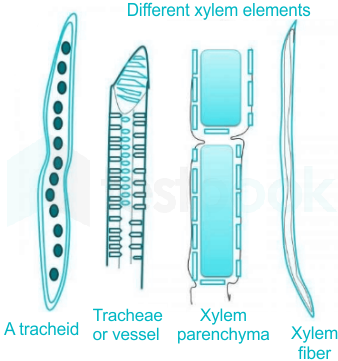
  • Xylem consists of Tracheids, Vessels, Xylem Fibres, Xylem Parenchyma.
  • Tracheids and vessels are the conducting elements of Xylem.
  • Xylem fibres provide strength to the tracheids and vessels.
  • The xylem parenchyma cells are mainly involved in the storage of carbohydrate, fats and water conduction.

3

Where is the Satkhanda Mahal located?

  1. ((a))

    Gwalior

  2. ((b))

    Datia

  3. ((c))

    Bhopal

  4. ((d))

    Dhar

Show Answer
Answer: ((b))

Datia

The correct answer is Datia.

  • The Satkhanda Mahal located in Datia.

Key Points

  • It was built in the Indo-Islamic style by the ruler of Bundelkhand, Maharaja Bir Singh Deo, to welcome the Mughal emperor Jehangir.
  • Datia Mahal is a 7-storied architecture with two floors positioned in the basement.
  • It is only made out of stone and bricks without any usage of wood or iron. So, the whole 7- storied building stands without any support of metal or even wood.
  • Datia Mahal is one of the great examples of Indo-Islamic architectures in India. A blend of Rajputana and Mughal styles gives it a luxurious look.

Additional Information

PlaceFamous Palace
Gwalior- Jai Vilas Palace. - Gujari Mahal. - Man Mandir Palace.
Bhopal- Gohar Mahal. - Shaukat Mahal. - Rani Kamlapati palace.
Dhar- Rani Roopmati Pavillion. - Hindola Mahal. - Baz Bahadur's Palace.
4

Where was the first steel plant set-up in India?

  1. ((a))

    Bokaro

  2. ((b))

    Jamshedpur

  3. ((c))

    Bhadravati

  4. ((d))

    Rourkela

Show Answer
Answer: ((b))

Jamshedpur

The correct answer is Jamshedpur.

Important Points

  • The first steel plant in India was set up in India at Jamshedpur.
  • It was established by Jamsedji Nusserwanji Tata in 1907.
  • Jamshedpur is an industrial city in Jharkhand. 
  • Jamshedpur is the first planned industrial city in India.
  • The city was founded by Jamsetji Tata.
  • The city is also called Tatanagar.
  • The construction of the first steel plant as well as the city officially began in 1908.
  • Tata Steel is the largest industry in Jamshedpur.

Additional Information

  • Jamsedji Nusserwanji Tata is popularly called the "Father of Indian Industry".
  • Tata Iron and Steel Company Limited (TISCO) is considered the first iron and steel industry in India.
  • Steel Authority of India(SAIL) is the authority that controls all steel plants under the public sector in India.
  • India became the second top steel producer in 2019 by replacing Japan.
  • Bokaro Steel Plant is the fourth integrated public sector steel plant in India built with the help of Russia.
  • Rourkela Steel Plant is the first integrated steel plant in the public sector in India built with the help of West Germany.
  • Visvesvaraya Iron and Steel Plant (VISL) is located in the city of Bhadravathi in Karnataka.

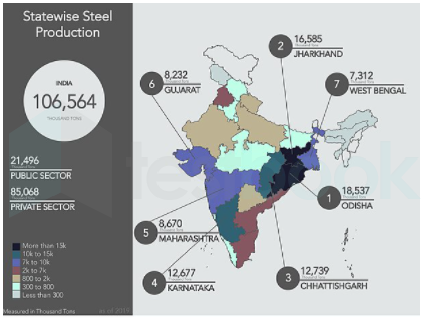
Image of all the steel production all over in India:

5

Which of the following ores is/are found in Madhya Pradesh?

  1. ((a))

    Magnesium

  2. ((b))

    Iron

  3. ((c))

    Both 1 and 2

  4. ((d))

    None of these

Show Answer
Answer: ((c))

Both 1 and 2

The correct answer is Both 1 and 2.

Key Points

  • Minerals of Madhya Pradesh
  • In terms of mineral production, Madhya Pradesh comes in third in the nation.
  • The geology and geotectonic features of Madhya Pradesh are favourable.
  • 7.71% of the nation's coal reserves are located in Madhya Pradesh.
  • Minerals that are mainly found in Madhya Pradesh are:
  • Manganese ore
  • Magnesium
  • Iron ore
  • Copper ore
  • Dolomite
  • Coal
  • Bauxite
  • Limestone

Additional Information

  • Malajkhand in Madhya Pradesh is the site of the largest open-cast copper mine in India.
  • The only diamond-producing state in India is Madhya Pradesh.
  • The only active diamond mines in India are at Panna, Madhya Pradesh.
6

Mysore Brothers are known for playing which musical instrument?

  1. ((a))

    Guitar

  2. ((b))

    Flute

  3. ((c))

    Mandolin

  4. ((d))

    Violin

Show Answer
Answer: ((d))

Violin

The correct answer is Violin.

Key Points

  • The Mysore Brothers, Dr. Mysore Manjunath and Dr. Mysore Nagaraj, are renowned for their exceptional artistry on the violin.
  • They are globally acclaimed musicians in the field of Carnatic classical music, a prominent form of South Indian classical music.
  • The brothers have performed in prestigious venues worldwide, including the Royal Albert Hall in London and the Sydney Opera House.
  • They are known for their unique blend of technical brilliance, emotive expressions, and improvisational skills in their violin performances.
  • Dr. Mysore Manjunath and Dr. Mysore Nagaraj have received numerous accolades, including the Sangeet Natak Akademi Award and the Karnataka Rajyotsava Award, for their contributions to music.

Additional Information

  • Violin in Carnatic Music
  • The violin was introduced into Carnatic music in the 18th century by Baluswami Dikshitar, who adapted it to suit Indian classical music styles.
  • In Carnatic music, the violin is often used as an accompaniment instrument to vocalists and also as a solo instrument.
  • Unlike in Western classical music, the violin in Carnatic music is played while sitting cross-legged, with the instrument resting on the player’s shoulder and ankle.
  • Carnatic Music
  • Carnatic music is one of the two main traditions of Indian classical music, the other being Hindustani music.
  • It primarily focuses on kriti compositions, which are devotional songs composed by revered saints like Tyagaraja, Muthuswami Dikshitar, and Syama Sastri.
  • Raga (melodic framework) and Tala (rhythmic cycles) form the backbone of Carnatic music.
  • Violin Techniques in Carnatic Music
  • Carnatic violinists use intricate bowing techniques and microtonal variations (gamakas) to match the expressive requirements of the raga.
  • The techniques emphasize smooth transitions between notes, creating a continuous and melodic flow.
  • Recognition of Mysore Brothers
  • The Mysore Brothers have contributed significantly to spreading Indian classical music on global platforms.
  • Their collaborations with Western classical, jazz, and world music artists have added a unique dimension to their art.
7

How many total Padma Awards have been announced by the Government of India for the year 2025?

  1. ((a))

    136

  2. ((b))

    137

  3. ((c))

    138

  4. ((d))

    139

Show Answer
Answer: ((d))

139

The Correct Answer is 139.

In News

  • Padma Awards 2025 announced.

Key Points

  • Padma Awards - one of the highest civilian Awards of the country, are conferred in three categories, namely, Padma Vibhushan, Padma Bhushan and Padma Shri.
  • The Awards are given in various disciplines/ fields of activities, viz.- art, social work, public affairs, science and engineering, trade and industry, medicine, literature and education, sports, civil service, etc.
  • ‘Padma Vibhushan’ is awarded for exceptional and distinguished service; ‘Padma Bhushan’ for distinguished service of high order and ‘Padma Shri’ for distinguished service in any field.
  • The awards are announced on the occasion of Republic Day every year.
  • These Awards are conferred by the President of India at ceremonial functions which are held at RashtrapatiBhawan usually around March/ April every year.
  • For the year 2025, the President has approved conferment of 139 Padma Awards including 1 duo case (in a duo case, the Award is counted as one).
  • The list comprises 7 Padma Vibhushan, 19 Padma Bhushan and 113 Padma Shri Awards.
  • 23 of the awardees are women and the list also includes 10 persons from the category of Foreigners/NRI/PIO/OCI and 13 Posthumous awardees.
  • Go through this link for all the winners: https://pib.gov.in/PressReleasePage.aspx?PRID=2096285
8

“Walar dance” is performed by

  1. ((a))

    Female

  2. ((b))

    Male

  3. ((c))

    Male and Female

  4. ((d))

    None of these

Show Answer
Answer: ((c))

Male and Female

The correct answer is Male and Female.

Key Points

  • The Walar dance of Rajasthan is a beautiful and enthusiastic tribal dance performed particularly by Male and females.
  • The 'Walar' danced by women is without instruments.
  • Whereas in 'Walar' performed in duet form of men and women, drums are played.
  • Walar is an important dance of a Rajasthani tribe- Garasia
  • Known to be a prototype of the famous Ghoomar dance of Rajasthan, it also involves simple circular movements of dancers on beats.
  • It is believed that its sophisticated version was performed in royal places of Rajasthan
  • Gangaur and Teej festivals are the best occasions to watch Valar dance.
9

Under which schedule of the Wildlife Protection Act, 1972 is the Indian Grey Wolf listed?

  1. ((a))

    II

  2. ((b))

    I

  3. ((c))

    IV

  4. ((d))

    V

Show Answer
Answer: ((b))

I

The correct answer is 2.

Key Points

  • The Indian Grey Wolf (Canis lupus pallipes) is listed under Schedule I of the Wildlife Protection Act, 1972, which provides it the highest level of protection against poaching and hunting.
  • Schedule I species are considered critically endangered or highly threatened, and harming them is a punishable offense under Indian law.
  • The inclusion under Schedule I aims to conserve the dwindling population of the Indian Grey Wolf, which faces threats like habitat destruction and human-wildlife conflict.
  • India's Wildlife Protection Act, 1972, is a comprehensive legislation aimed at the conservation of wildlife and biodiversity through the categorization of species across six schedules.
  • Illegal killing or capturing of a Schedule I species, including the Indian Grey Wolf, can result in imprisonment of up to seven years and a fine.

Additional Information

  • Wildlife Protection Act, 1972:
  • This act was enacted to safeguard wildlife and their habitats, and it provides a legal framework for the establishment of protected areas like national parks and sanctuaries.
  • The act categorizes animals into Schedules I-VI, with Schedule I providing the highest protection and Schedule VI focusing on plant conservation.
  • Threats to the Indian Grey Wolf:
  • Major threats include habitat fragmentation, retaliatory killings by farmers due to livestock predation, and competition with feral dogs for resources.
  • Its population is declining in many regions of India, necessitating strict conservation measures.
  • Conservation Efforts in India:
  • India has several conservation programs and policies in place, including Project Tiger and Project Elephant, with similar initiatives being encouraged for other endangered species like the Indian Grey Wolf.
  • Protected areas such as national parks and wildlife sanctuaries play a crucial role in preserving wolf habitats.
  • Role of Schedules in Wildlife Protection:
  • Schedules in the Wildlife Protection Act categorize species based on their conservation status and the level of protection required.
  • Species listed in Schedule I and II are provided the highest legal protection, while those in lower schedules like V may be considered less endangered or even vermin in certain contexts.
10

Suva is the capital of which country?

  1. ((a))

    Mauritius

  2. ((b))

    Fiji

  3. ((c))

    Sweden

  4. ((d))

    Argentina

Show Answer
Answer: ((b))

Fiji

The correct answer is option 2 i.e Fiji

Suva is the capital city of Fiji.

CountryFiji
CapitalSuva
PresidentJioji Konrote
Prime MinisterFrank Bainimarama (as of August 2020)
CurrencyFijian dollar
11

Which of the following was added to the list of official languages of India in 1967?

  1. ((a))

    Manipuri

  2. ((b))

    Nepali

  3. ((c))

    Konkani

  4. ((d))

    Sindhi

Show Answer
Answer: ((d))

Sindhi

The correct answer is Sindhi.

Key Points

  • The Sindhi language was added to the list of languages in the Indian Constitution by the 21st Amendment in 1967.
  • It was added to the 8th schedule by the 21st Amendment Act of 1967.

Additional Information

  • There are 22 languages that have been recognized in the eighth schedule of the Indian constitution.
  • Part XVII of the Indian constitution deals with the official languages of India from articles 343 to 351.
  • Originally, only 14 languages were mentioned and later, after several amendments, the other languages were added.
  • The Sindhi language was added to the 8th schedule by the 21st Amendment Act of 1967.
  • Konkani, Manipuri and Nepali were added by the 71st Amendment Act of 1992.
  • Bodo, Dongri, Maithili and Santhali were added by the 92nd Amendment Act of 2003.
  • Of all the 22 official languages the Hindi language is spoken by most of Indians.
12

Which among the following books is written by Aurobindo Ghosh?

  1. ((a))

    India's Message

  2. ((b))

    The Life Divine

  3. ((c))

    Unity of India

  4. ((d))

    At the feet of Mahatma Gandhi

Show Answer
Answer: ((b))

The Life Divine

The Correct Answer is Option 2 i.e The Life Divine.


Author NameName of the famous books
M. N. Roy1. India in Transition 2. The Future of Indian Politics 3. India's Message 4. What Do We Want?
Aurobindo Ghosh1. Savitri: A Legend and a Symbol 2. The Mother 3. The Life Divine 4. Synthesis of Yoga 5. The Hour of God
Rajendra Prasad1. India Divided 2. Mahatma Gandhi and Bihar 3. Satyagraha in Champaran 4. The Unity of India 5. At The Feet of Mahatma Gandhi
13

Who is responsible for Enforcement of the provisions of the wild Life (Protection) Act,1972?

  1. ((a))

    Additional Chief Conservator of Forest

  2. ((b))

    Chief Conservator of Forest

  3. ((c))

    Forest Guard

  4. ((d))

    Wild life Department

Show Answer
Answer: ((a))

Additional Chief Conservator of Forest

The Correct Answer is Additional Chief Conservator of Forest.

Key PointsAdditional Chief conservator of forest is responsible for-

(J) Nature preservation and protection ofwild life in the State.

{2) Enforcement of the provisions oft he wild Lite (Protection) Act,]972, in the State

(3) Creation, supervision and management of National parks and Sanctuaries in the State.

( 4) Functioning as Administration/supervision of Zoo ..

(5) Breeding of endangered and threatened species of wild life at breeding Centres .

(6) Census of  important wild life species.

14

Which one of the following Union Territories of India has the highest literacy rate?

  1. ((a))

    Lakshadweep

  2. ((b))

    Daman and Diu

  3. ((c))

    Chandigarh

  4. ((d))

    Andaman and Nicobar Islands

Show Answer
Answer: ((a))

Lakshadweep

The correct answer is Lakshadweep.

Key Points

  • The literacy rate is the total percentage of the population of an area at a particular time aged seven years or above who can read and write with understanding. Literacy is a key for every country's socio-economic progress, and the rate of literacy in India has grown to 74.00% (2011 figure) from 12% at the end of British rule in 1947.
  • According to Census 2011 Lakshadweep, with a literacy rate of 92.28%, is the Union Territory with the highest literacy rate in India. Hence, Option 1 is correct.
  • The female literacy rate of Lakshadweep is 88.25%.
  • Kerala ranks the highest in terms of literacy rate with a 93.91% literacy rate.
  • Overall, Kerala ranks highest among female literacy rates in India with a 91.98% literacy rate.
  • Bihar ranks the last in the country with a literacy rate of 61.8%.
  • In terms of male literacy rate, Lakshadweep ranks first overall with a 96.11% literacy rate.
  • Chandigarh’s female literacy rate is 81.38%.
  • Puducherry’s female literacy rate is 81.22%.
  • Andaman and Nicobar Islands female literacy rate is 81.84%

Additional Information

  • Top 10 Indian States/Union Territories with Highest Literacy Rates
RankIndia/State/Union TerritoryLiteracy rate (%) - 2011 Census
1Kerala94
2Lakshadweep91.85
3Mizoram91.33
4Goa88.22
5Tripura87.22
6Daman & Diu87.10
7Andaman & Nicobar86.63
8Delhi86.21
9Chandigarh86.05
10Puducherry85.85
15

According to Ashokan edicts, how many years after becoming the king did Ashoka wage war on Kalinga?

  1. ((a))

    Five

  2. ((b))

    Eight

  3. ((c))

    Six

  4. ((d))

    Seven

Show Answer
Answer: ((b))

Eight

The correct answer is Eight.

Key Points

  • Ashoka edicts
  • In Ashoka edicts, the emperor (Ashoka) refers to himself as Devnampiya Piyadasi which means beloved of Gods.
  • Ashoka was the first king to make a direct connection to the people via his inscriptions.
  • Ashoka edicts are the 33 inscriptions engraved on the rocks and pillars by the Mauryan Empire.
  • They were the proclamation by the emperor to the public at large which carried the message about the idea and practice of dharma.
  • Ashoka inscriptions were scattered throughout Afghanistan, Pakistan, India, Nepal and Bangladesh.
  • There are four types of Ashoka edicts:
  1. Major rock edicts
  2. Minor rock edicts
  3. Major pillar edicts
  4. Minor pillar edicts
  • Kalinga War
  • The major rock edict XIII describes the victory of Ashoka in the Kalinga war.
  • It explains the conquest through dhamma instead of war.
  • Ashoka fought the Kalinga war, which was completed in the 8th year of Ashoka’s reign in 261 BC.
16

Which of the following revolutionaries stated during his trial that “he did not wish to glorify the cult of the bomb and pistol but wanted a revolution in society”?

  1. ((a))

    Bhagat Singh

  2. ((b))

    Surya Sen

  3. ((c))

    Sachindra Nath Sanyal

  4. ((d))

    Barindra Kumar Ghosh

Show Answer
Answer: ((a))

Bhagat Singh

The correct answer is Bhagat Singh.

Key Points

  • Bhagat Singh stated during his trial that “he did not wish to glorify the cult of the bomb and pistol but wanted a revolution in society”.
  • During the early 20th century Indian independence movement, Bhagat Singh was a revolutionary hero.
  • He participated in two well-known attacks on British authority, one on a local police head and the other on the Delhi Central Legislative Assembly.
  • Bhagat Singh, a fierce critic of British rule in India, was hanged in 1931 at the age of 23 for engaging in activities deemed criminal.

Additional Information

  • Surya Sen, an Indian revolutionary best known for organising the 1930 Chittagong Armory Raid, played a significant role in the campaign for Indian independence from British control in India.
  • A revolutionary from India, Sachindra Nath Sanyal, was a co-founder of the Hindustan Republican Army, which was established to engage in military resistance against the British Empire in India.
  • A journalist and revolutionary from India, Barindra Kumar Ghosh was a founding member of the revolutionary Jugantar Bengali weekly.
17

The first 'Backward Classes Commission' was appointed in _____ .

  1. ((a))

    1953

  2. ((b))

    1951

  3. ((c))

    1960

  4. ((d))

    1958

Show Answer
Answer: ((a))

1953

The correct answer is 1953.

Key Points

  • Backward Classes Commission: The first Backward Classes Commission in India was established in 1953.
  • Kaka Kalelkar: The commission was chaired by Kaka Kalelkar.
  • Objective: The main objective of the commission was to identify the conditions of socially and educationally backward classes.
  • Report Submission: The commission submitted its report in 1955, recommending measures for the upliftment of backward classes.
  • Impact: The findings of the commission laid the foundation for future policies and reservations for backward classes in India.

Additional Information

CommissionDescription
Mandal CommissionAlso known as the Second Backward Classes Commission, it was established in 1979 under B.P. Mandal to identify socially or educationally backward classes.
National Commission for Backward Classes (NCBC)It was established in 1993 to consider inclusion in and exclusion from the lists of backward classes.
Rohini CommissionFormed in 2017 to examine the sub-categorization of Other Backward Classes (OBCs).
18

Which of the following caves are a series of 29 Buddhist cave temples?

  1. ((a))

    Ellora caves

  2. ((b))

    Ajanta Caves

  3. ((c))

    Barabar Caves

  4. ((d))

    Elephanta Caves

Show Answer
Answer: ((b))

Ajanta Caves

Key Points

Ajanta Caves-

  • The Ajanta Caves are a series of 29 Buddhist cave temples in Ajanta, India, some of which date from the 2nd century BC. Encompassing both Theravada and Mahayana Buddhist traditions, the Ajanta caves preserve some of the best masterpieces of Buddhist art in India.
  • Out of 29, 25 caves were used as Viharas or residential caves while 4 were used as Chaitya or prayer hills.
  • It is said that Buddhist monks lived, studied and prayed in Ajanta caves for a long time.
  • The Ajanta Caves were carved in the 2nd century BC out of a horseshoe-shaped cliff along the Waghora River.
  • The caves were designated a UNESCO World Heritage site in 1983.

Ellora caves- 

  • The Ellora caves, locally known as 'Verul Leni' is located on the Aurangabad - Chalisgaon road at a distance of 30 km north - northwest of Aurangabad, in the Indian state of Maharashtra.
  • Ellora is one of the largest rock-cut monastery - temple caves complexes in the world, and a UNESCO World Heritage Site.
  • The cave temples and monasteries at Ellora, excavated out of the vertical face of an escarpment, are 26 km north of Aurangabad.
  • Sculptors, inspired by Buddhism, Jainism and Hinduism, created elaborate rock carvings. Extending in a linear arrangement, the 34 caves contain Buddhist Chaityas or halls of worship, Viharas or monasteries and Hindu and Jain temples.
  • Spanning a period of about 600 years between the 5th and 11th century A.D., the earliest excavation here is of the Dhumar Lena (Cave 29).
  • The Kailasha temple features the largest single monolithic rock excavation in the world.
  • During the regime of the Rashtrakuta were the famous Ellora caves of Maharashtra built.

Extra facts:

  • Madhya Pradesh- Bagh Caves
  • Maharashtra - Ajanta Caves, Bhaja Caves, Elephanta Caves, Ellora Caves, Kanheri Caves
  • Karnataka- Badami Caves
  • Bihar - Barabar Caves
  • Madhya Pradesh- Udaygiri Caves
  • Andhra Pradesh - Borra Caves
  • Tamilnadu - Varah Caves
19

Which of the following is related to the Special address by the Governor?

  1. ((a))

    Article 176

  2. ((b))

    Article 123

  3. ((c))

    Article 177

  4. ((d))

    Article 173

Show Answer
Answer: ((a))

Article 176

The correct answer is Article 176.

Key Points

  • Article 176 defines a Special address by the Governor.
  • At the commencement of the first session after each general election to the Legislative Assembly and at the commencement of the first session of each year, the Governor shall address the Legislative Assembly or, in the case of a State having a Legislative Council, both Houses assembled and inform the Legislature of the causes of its summons.
  • Provision shall be made by the rules regulating the procedure of the House or either House for the allotment of time for discussion of the matters referred to in such address.​

Additional Information

Article 169• Article 169- States about the Abolition of certain legislative councils in states.
Article 176• Article 176- States about the Special address by the governor.
Article 177• Article 177- States about the Rights of minister and advocate general as respects of the houses.
Article 178• Article 178- States about The Speaker and deputy speaker of the state legislative assembly.
Article 182• Article 182- States about The chairman and deputy chairman of a state legislate council.
Article 183• Article 183- States about the Vacation and resignation of, and removal from, the office of chairman and deputy chairman in the state legislature.
Article 180• Article 180- States the Power of the deputy speaker or another person to perform the duties of the office of, or to act as a speaker in the state legislature.
Article 179• Article 179- States about the Vacation and resignation of, and removal from, the office of speaker and deputy speaker in the state legislature.
Article 181• Article 181- States about The Speaker or the deputy speaker no to preside while a resolution for his removal from the office is under consideration in the state legislature
Article 175• Article 175- States the Right of the governor to address and send messages to the houses of the house.
Article 174• Article 174- States about the Sessions of the state legislature, propagation and dissolution.
Article 173• Article 173- States about the Qualification for membership of the state legislature.
Article 172• Article 172- States about the Duration of the state legislature.
Article 171• Article 171- States about the Composition of the legislative council.
Article 170• Article 170- States about the Composition of the legislative assembly.
20

How can the sum mentioned in a bond or instrument under the Indian Forest Act be recovered in case of a breach?

  1. ((a))

    Only through a civil lawsuit in court

  2. ((b))

    As an arrear of land revenue, regardless of Section 74 of the Indian Contract Act, 1872

  3. ((c))

    The Government cannot recover the amount in case of a breach

  4. ((d))

    By imposing a criminal penalty instead of financial recovery

Show Answer
Answer: ((b))

As an arrear of land revenue, regardless of Section 74 of the Indian Contract Act, 1872

The correct answer is Option 2

Key Points

  • Section 85 of the Indian Forest Act states that if a person binds himself by a bond to perform or abstain from certain acts and breaches the conditions, the entire sum specified in the bond can be recovered as an arrear of land revenue.
  • This provision applies notwithstanding Section 74 of the Indian Contract Act, 1872, which ordinarily limits penalty recovery to reasonable compensation.
21

निम्‍नलिखित में तद्भव शब्द कौन सा है?

  1. ((a))

    षष्‍ठ

  2. ((b))

    छत्र

  3. ((c))

    छाता

  4. ((d))

    छाया

Show Answer
Answer: ((c))

छाता

दिए गए विकल्पों में सही उत्तर विकल्प 3 ‘छाता’ है। अन्य विकल्प अनुचित उत्तर होंगे।

Key Points

स्पष्टीकरण: 

उपर्युक्त शब्दों में ‘छाता’ तद्भव शब्द है। इसलिए ‘छाता’ इसका सही उत्तर है। इसका तत्सम शब्द ‘छत्र’ होगा। अन्य विकल्प इसके असंगत उत्तर हैं।

छाता - वर्षा या धूप से बचने के लिए कपड़े आदि का बना हुआ एक आच्छादन। 

अन्य विकल्प:

तत्समतद्भव
षष्ठछठा
छत्रछाता
छायाछाँह

Additional Information

विशेष:

शब्दपरिभाषाउदाहरण
तत्समऐसे शब्द जो संस्कृत से ज्यों के त्यों लिए गए, तत्सम होते हैं।कूप, उष्ट्र, पंचम आदि
तद्भवसंस्कृत से हिंदी में आने पर जिन शब्दों का रूप बदल गया हो, तद्भव कहलाते हैं।आग, काम, पाँच आदि
22

'सारंग' शब्द का पर्यायवाची है:

  1. ((a))

    चातक 

  2. ((b))

    सिंह 

  3. ((c))

    कोयल 

  4. ((d))

    उक्त सभी 

Show Answer
Answer: ((d))

उक्त सभी 

सही उत्तर है -  ‘उक्त सभी’।

  • सारंग’ के पर्यायवाची शब्द : चातक, सिंह, कोयल।
  • अत : विकल्प उक्त सभी सही उत्तर होगा।

Key Points

  • सारंग’ के अन्य पर्यायवाची : केसरी, शेर, महावीर, हरि, मृगपति, वनराज, शार्दूल, नाहर मृगराज आदि।

समानार्थी शब्द:

  • वे शब्द जिनका अर्थ एक समान होता हैं समानार्थी शब्द कहलाते हैं।

समानर्थी शब्द को हम पर्यायवाची शब्द भी कहते है। ‘पर्याय’ का अर्थ है ‘समान’ तथा ‘वाची’ का अर्थ है ‘बोले जाने वाले’ अर्थात

समान बोले जाने वाले शब्दों को हम पर्यायवाची शब्द या समानार्थी शब्द कहते है।

Additional Informationपर्यायवाची शब्द के उदाहरण :

  • गौरव - मान, सम्मान, महत्त्व, बड़प्पन।
  • झंडा - ध्वजा, केतु, पताका, निसान।
  • हंस - चक्रांग, मानसौक, कलहंस, मराल, कारंडव, सरस्वती वाहन।
  • इन्द्राणि - इन्द्रवधू, मधवानी, शची, शतावरी, पोलोमी।
23

निम्नलिखित में से कौन-सा स्त्री-प्रत्यय छत्तीसगढ़ी में नहीं है?

  1. ((a))

    -वती 

  2. ((b))

    -मती

  3. ((c))

    -ओला

  4. ((d))

    -आइन

Show Answer
Answer: ((c))

-ओला

दिए गए विकल्पों में सही उत्तर विकल्प 3 'ओला’ है। अन्य विकल्प इसके अनुचित उत्तर हैं। 

Key Points

  • दिए गए विकल्पों में से 'ओला' प्रत्यय छत्तीसगढ़ी में नहीं है।
  • 'ओला' शब्द स्त्री प्रत्यय भी नहीं है।
  • यह प्रत्यय हिन्दी का है जिससे बना शब्द है - सँपोला।
  • अन्य विकल्प इसके त्रुटिपूर्ण उत्तर हैं।

Additional Information

  • शब्दों के बाद जो अक्षर या समूह लगाया जाता है उसे प्रत्यय कहते हैं।
  • प्रत्यय वे शब्द हैं जो दूसरे शब्दों के अन्त में जुड़कर, अपनी प्रकृति के अनुसार, शब्द के अर्थ में परिवर्तन कर देते हैं।
  • प्रत्यय शब्द दो शब्दों से मिलकर बना है – प्रति + अय।
  • 'प्रति' का अर्थ है साथ में पर बाद में और 'आय' का अर्थ है चलने वाला।
24

'मछली' शब्द का पर्यायवाची है :

  1. ((a))

    शफरी

  2. ((b))

    मीन

  3. ((c))

    उक्त सभी

  4. ((d))

    झष

Show Answer
Answer: ((c))

उक्त सभी

सही विकल्प है - उक्त सभी।

  • मछली का पर्यायवाची शब्द मीन, झष, मत्स्य, जलजीवन, शफरी, मकर, झख आदि होता है।

Key Points 

पर्यायवाची :- जो शब्द समान अर्थ के कारण किसी दूसरे शब्द की जगह ले लेते हैं उन्हें पर्यायवाची शब्द कहते हैं। ​​

Additional Information 


शब्दपर्यायवाची
अतिथिमेहमान ,पाहुन ,आगंतुक, अभ्यागत।
अश्वघोड़ा,आशुविमानक, तुरंग, घोटक, हय, तुरंगम, वाजि, सैंधव, रविपुत्र।
अरण्यजंगल, वन, कानन, अटवी, कान्तार, विपिन।
अंतरिक्षखगोल, नभमंडल, गगनमंडल, आकाशमंडल।
अंबरआकाश, आसमान, गगन, फलक, नभ।
आँखनेत्र, नयन, चक्षु, दृग, लोचन, अक्षि, नजर, अक्ष, चश्म।
आकाशनभ, अनन्तं, अभ्रं, पुष्कर, शून्य, तारापथ, अंतरिक्ष, आसमान, फलक, व्योम, दिव, खगोल, गगन, अम्बर।
कान्तिप्रकाश, आलोक, उजाला, दीप्ति, छवि, सुषमा,आभा, प्रभा, छटा, द्युति।
किरणअंशु, रश्मि, कला, कर, गो, प्रभा, दीधिति, मयूख, मरीचि।
25

निम्नलिखित में से अशुद्ध वाक्य कौन-सा है?

  1. ((a))

    अनिल ने कल दो खिलौने ख़रीदे।

  2. ((b))

    लक्ष्य ने शिक्षक से विभा की शिकायत की।

  3. ((c))

    एक विद्यार्थी को दो पुस्तक मिलेगी।

  4. ((d))

    नव्या की बहन शिमला में पढ़ती है।

Show Answer
Answer: ((c))

एक विद्यार्थी को दो पुस्तक मिलेगी।

अशुद्ध वाक्य "एक विद्यार्थी को दो पुस्तक मिलेगी" है। अन्य विकल्प असंगत है। 

Key Points

  • वाक्य- एक विद्यार्थी को दो पुस्तक मिलेगी।
  • इस वाक्य में वचन संबंधी अशुद्धि है।
  • पुस्तक की जगह पुस्तक के बहुवचन रूप पुस्तकें होगा।
  • शुद्ध वाक्य- एक विद्यार्थी को दो पुस्तकें मिलेगी।

Important Points

  • वचन संबंधी अशुद्धि- 
  • जिन वाक्यों में वचन के आधार पर गलतियां या अशुद्धियां पाई जाती है, वहां पर वचन संबंधी अशुद्धियां होती है।
  • इसमें बहुवचन के स्थान पर एक वचन और एकवचन के स्थान पर बहुवचन बना दिया जाता है।
  • जिससे वाक्य अशुद्ध हो जाता है।
  • जैसे-
  • अशुद्ध- तीन घटना घटित हुई।
  • शुद्ध- तीन घटनाएं घटित हुई।
26

निम्नलिखित में तत्सम शब्द कौन सा है

  1. ((a))

    दन्त

  2. ((b))

    दही

  3. ((c))

    दाढ़ी

  4. ((d))

    दाई

Show Answer
Answer: ((a))

दन्त

दिए गए विकल्पों में सही उत्तर विकल्प 1 'दन्त’  होगा। अन्य विकल्प इसके अनुचित उत्तर हैं। 

Key Points 

  • दिए गए शब्दों में 'दन्त' शब्द तत्सम है जिसका तद्भव रूप 'दांत' होगा।
  • ऐसे शब्द जो संस्कृत से ज्यों के त्यों लिए गए, तत्सम होते हैं।
  • अन्य सभी शब्द तद्भव हैं।

अन्य विकल्प: 

तद्भवतत्सम
दहीदधि
दाईधात्री
दाढ़ीदंष्ट्रिका

Additional Information 

तत्समऐसे शब्द जो संस्कृत से ज्यों के त्यों लिए गए, तत्सम होते हैं।कूप, उष्ट्र, पंचम आदि
अर्द्ध तत्समऐसे शब्द जो संस्कृत से थोड़ा परिवर्तित होकर हिंदी में आए हैं।कार्य से कारज, धैर्य से धीरज आदि
तद्भवसंस्कृत से हिंदी में आने पर जिन शब्दों का रूप बदल गया हो, तद्भव कहलाते हैं।आग, काम, पाँच आदि
27

'कृतज्ञ' का विलोम है-

  1. ((a))

    कुकृत्य

  2. ((b))

    कृतघ्न

  3. ((c))

    परोपकार

  4. ((d))

    कपटी

Show Answer
Answer: ((b))

कृतघ्न

'कृतज्ञ' का विलोम है- कृतघ्न

  • कृतज्ञता का अर्थ है अपने प्रति की हुई श्रेष्ठ और उत्कृष्ट सहायता के लिए श्रद्धावान होकर दूसरे व्यक्ति के समक्ष सम्मान प्रदर्शन करना।
  • कृतघ्न का अर्थ है किए हुए उपकार को न माननेवाला।

Key Points​अन्य विकल्प 

  • कुकृत्य का विलोम सुकृत्य
  • परोपकार का विलोम अपकार
  • कपटी का विलोम निष्कपट

Additional Information

  • विलोमार्थक शब्द/ विलोम: 'विलोम’ शब्द का अर्थ है- उल्टा या विपरीत।
  • अत: किसी शब्द का उल्टा अर्थ व्यक्त करने वाला शब्द विलोमार्थक शब्द कहलाता है।
  • विलोमार्थक शब्दों को विपर्यायवाची, प्रतिलोमार्थक और विलोम शब्द भी कहते हैं।
  • कुछ महत्वपूर्ण विलोम शब्द:-
शब्दविलोम शब्द
ख्यातकुख्यात
प्रख्यातअख्यात
विज्ञअज्ञ
अभिज्ञअनभिज्ञ
कदाचारसदाचार
दुराचारसदाचार
28

अनाथ बच्चों को यथाशक्ति दान करना चाहिए।

रेखांकित शब्द में समास होगा:

  1. ((a))

    अव्ययीभाव समास

  2. ((b))

    द्विगु समास

  3. ((c))

    तत्पुरुष समास

  4. ((d))

    द्वन्द्व समास 

Show Answer
Answer: ((a))

अव्ययीभाव समास

उपर्युक्त विकल्पों में से ‘यथाशक्ति’ शब्द अव्ययीभाव समास का उदहारण है| शेष विकल्प गलत हैं।

Key Points 

स्पष्टीकरण – अव्ययीभाव समास में पहला शब्द अव्यय होता है बाद का शब्द कोई संज्ञा शब्द होता है। अव्यय और संज्ञा के योग से बनता है और इसका क्रिया विशेष के रूप में प्रयोग किया जाता है। अव्ययीभाव समास में पहला पद अव्यय होता है तथा प्रधान होता है।

अव्यय का शाब्दिक अर्थ होता है – जो व्यय न हो। जिनके रूप में लिंग, वचन, पुरुष, कारक, काल आदि की वजह से कोई परिवर्तन नहीं होता उसे अव्यय शब्द कहते हैं।

यथाशक्ति = शक्ति के अनुसार| इस शब्द में लिंग, वचन, पुरुष, कारक, काल आदि की वजह से कोई परिवर्तन नहीं होगा|  यथाशक्ति में पहला पद प्रधान है और यदि पहले पद को हटा दिया जाय तो दूसरा पद निश्चित सटीक अर्थ प्रदान नहीं करता है| शक्ति कितनी है यह पता नहीं चलता है।

Additional Information 

विशेष

समास : जब दो या दो से अधिक शब्दों से मिलकर जो नया और छोटा शब्द बनता है उस शब्द को समास कहते हैं। समास के छः भेद है|
समासपरिभाषाउदहारण
अव्ययीभाव समासउस समास को अव्ययीभाव समास कहते है जिसका प्रथम पद अव्यय होता है और उसका अर्थ प्रधान होता है|यथाशक्ति : शक्ति के अनुसार।
द्विगु समासवह समास जिसका पहला पद संख्यावाचक होता है तथा समस्तपद किसी समूह का बोध करता है तो वह द्विगु समास कहलाता है|नवरात्र : नौ रात्रियों का समूह
तत्पुरुष समासवह समास जिसका प्रथम पद गौण होता है एवं उत्तरपद प्रधान होता है व समास करते वक़्त बीच की विभक्ति का लोप हो जाता है।मूर्ति को बनाने वाला : मूर्तिकार
बहुब्रीहि समासजिस समास के समस्तपदों में से कोई भी पद प्रधान नहीं हो एवं दोनों पद मिलकर किसी तीसरे पद की और संकेत करते हैं, वह समास बहुव्रीहि समास कहलाता है।चक्रपाणि : चक्र है पानी  पाणि में जिसके अर्थात विष्णु
29

इनमें से अर्द्धविराम कौन-सा चिन्ह है?

  1. ((a))

    ,

  2. ((b))

    ;

  3. ((c))

  4. ((d))

    :

Show Answer
Answer: ((b))

;

दिए गए विकल्पों में ‘ ; अर्द्धविराम का चिह्न है| अन्य विकल्प असंगत हैं। अतः सही विकल्प 2  ‘ ; ’ है।

अन्य विकल्प-

( ; )  -> अर्धविराम का चिह्न है।

( ) -> पूर्ण विराम का चिह्न है। 

( , )  -> अल्प विराम का चिह्न है।

( : )  -> उपविराम का चिह्न है।

30

"या अनुरागी चित्त की, गति समझै नहीं कोय।

ज्यों ज्यों बूडै स्याम रंग, त्यों त्यों उज्ज्वल होय।।"

इस पंक्ति में कौन सा अलंकार है?

  1. ((a))

    भ्रांतिमान

  2. ((b))

    उत्प्रेक्षा

  3. ((c))

    विरोधाभास

  4. ((d))

    उपमा

Show Answer
Answer: ((c))

विरोधाभास

या अनुरागी चित्त की, गति समझै नहीं कोय।

ज्यों ज्यों बूडै स्याम रंग, त्यों त्यों उज्ज्वल होय।। में विरोधाभासअलंकार है।

Mistake Pointsया अनुरागी चित्त की, गति समुझै नहिं कोई।

ज्यों-ज्यों बूडै स्याम रंग, त्यों-त्यों उज्जलु होइ॥

  • दोहे में “ज्यों ज्यों ………………….. उज्जलु होय॥ में विरोधाभास अलंकार तथा ‘अनुरागी’ और ‘स्याम रँग’ में श्लेष अलंकार है।
  • अतः प्रश्न में विरोधाभास अलंकार दिया हुआ है तो इसका उत्तर विरोधाभास अलंकार होगा।

Key Points

 विरोधाभास-

  • जहाँ बाहर से तो विरोध जान पड़े, किन्तु यथार्थ में विरोध न हो।
  • जहाँ वास्तविक विरोध न होने पर भी विरोध का आभास हो वहाँ विरोधाभास अलंकार होता है;

Important Points

विरोधाभास अलंकार के उदाहरण:- - जब से है आँख लगी तबसे न आँख लगी। - यह अथाह प��नी रखता है यह सूखा-सा गात्र। - प्रियतम को समक्ष पा कामिनी
न जा सकी न ठहर सकी। - आई ऐसी अद्भुत बेला
ना रो सका न विहँस सका। - ना खुदा ही मिला ना बिसाले सनम
ना इधर के रहे ना उधर के रहे।

Additional Informationभ्रांतिमान:- जहां पर समानता के कारण किसी वस्तु में अन्य वस्तु का भ्रम हो जाए वहां भ्रांतिमान अलंकार होता है।

उदाहरण- फिरत घरन नूतन पथिक चले चकित चित भागि।

                फूल्यो देख पलास वन, समुहें समुझि दवागि ।।

उत्प्रेक्षा:- जहां संभावना व्यक्त करने वाले शब्द जनु,जानो,जानहुँ,मनु,मानौ,मनहुँ,मानहुँ,इव,निश्चय आदि शब्द आते हैं। 

उदाहरण-  उस काल मारे क्रोध के तनू काँपने उसका लगा।

                 मानो हवा के वेग से सोता हुआ सागर जगा ॥

उपमा:- जब किसी व्यक्ति या वस्तु की तुलना किसी दूसरे व्यक्ति या वस्तु से की जाए वहाँ पर उपमा अलंकार होता है।

उदाहरण- मुख चन्द्रमा-सा सुन्दर है।

31

इनमें ‘प्रत्येक’ शब्द का संधि विच्छेद कौनसा है ?

  1. ((a))

    प्रति + एक

  2. ((b))

    प्रत + ऐक

  3. ((c))

    प्रत्ये + क

  4. ((d))

    प्र + त्येक

Show Answer
Answer: ((a))

प्रति + एक

सही उत्तर है - "प्रति + एक" l

Key Points

  • ‘प्रत्येक’ शब्द का संधि विच्छेद = "प्रति + एक" l
  • प्रत्येक शब्द में यण संधि है।
  • अन्य विकल्प गलत उत्तर है क्योंकि इनमें से किसी की भी संधि करने पर हमें 'प्रत्येक' शब्द प्राप्त नहीं होता l

Additional Information

  • पास-पास स्थित पदों के समीप विद्यमान वर्णों के मेल से होने वाले विकार को संधि कहते हैं।
  • संधि के तीन भेद होते हैं -
  • स्वर संधि,
  • व्यंजन संधि
  • विसर्ग संधि।
  • यण संधि की परिभाषा:-
  • इक् (इ, उ, ऋ, लृ) वर्ण के परे असमान स्वर होने पर इक् (इ, उ, ऋ, लृ) के स्थान पर क्रमशः यण् (य्, व्, र्, ल्) का आदेश होता है।
  • जैसे:- अति + अधिक = अत्यधिक (इ + अ = य) l
32

'संयोग' में किस उपसर्ग का प्रयोग हुआ है?

  1. ((a))

    सम्

  2. ((b))

    सन्

  3. ((c))

    संगी

  4. ((d))

    सुन

Show Answer
Answer: ((a))

सम्

दिए गए विकल्पों में सही उत्तर विकल्प 1 'सम्' होगा। अन्य विकल्प इसके त्रुटिपूर्ण उत्तर हैं। 

Key Points

  • दिए गए विकल्पों में से 'संयोग' शब्द में 'सम्' उपसर्ग है।
  • सम् + योग = संयोग।
  • सम् उपसर्ग से बने अन्य शब्द हैं - सम् + यम =  संयम, सम् +कीर्ण = संकीर्ण आदि।
  • अन्य विकल्प इसके अनुचित उत्तर हैं।

Additional Information

  • उपसर्ग हमेशा शब्दों के पहले जोड़े जाते हैं।
  • जुड़ने के बाद ये उस शब्द में जो विशेष परिवर्तन करते हैं वही उपसर्ग होता है।
  • जैसे - अभि + कर्ता = अभिकर्ता।
33

'श्वेता पढ़ रही थी।' वाक्य में किस काल की क्रिया का प्रयोग हुआ है?

  1. ((a))

    पूर्ण भूत

  2. ((b))

    संदिग्ध भूत

  3. ((c))

    अपूर्ण भूत

  4. ((d))

    सामान्य भूत

Show Answer
Answer: ((c))

अपूर्ण भूत

इसका सही उत्तर 'अपूर्ण भूत' है।

Key Points 

  • वाक्य - 'श्वेता पढ़ रही थी।'
  • इस वाक्य में क्रिया की अपूर्णता का बोध हो रहा है।
  • अर्थात, यह वाक्य यह संकेत करता है कि श्वेता पढ़ने की प्रक्रिया में थी, लेकिन यह स्पष्ट नहीं करता कि कार्य समाप्त हुआ या नहीं।
  • इस प्रकार, यह वाक्य अपूर्ण भूतकाल का उदाहरण है, इसलिए 'अपूर्ण भूत' सही उत्तर है।

Additional Information 

भूतकालजिस क्रिया से कार्य की समाप्ति का बोध हो, उसे भूतकाल की क्रिया कहते हैं। भूतकाल के छह भेद होते हैं-उदाहरण
सामान्य भूतकालजिससे भूतकाल की क्रिया के विशेष समय का ज्ञान न हो, उसे सामान्य भूतकाल कहते हैं।राधा गयी।
आसन्न भूतकालक्रिया के जिस रूप से यह पता चले कि क्रिया अभी कुछ समय पहले ही पूर्ण हुई है, उसे आसन्न भूतकाल कहते हैं।मैंने आम खाया है।
पूर्ण भूतकालक्रिया के जिस रूप से यह ज्ञात हो कि कार्य पहले ही पूरा हो चुका है, उसे पूर्ण भूतकाल कहते हैं।उसने मोहन को मारा था।
अपूर्ण भूतकालजिस क्रिया से यह ज्ञात हो कि भूतकाल में कार्य सम्पन्न नहीं हुआ था - अभी चल रहा था, उसे अपूर्ण भूत कहते हैं।मोहन सो रहा था।
संदिग्ध भूतकालइसमें यह सन्देह बना रहता है कि भूतकाल में कार्य पूरा हुआ या नही।दुकानें बंद हो चुकी होंगी।
हेतुहेतुमद् भूतकालभूतकाल में एक क्रिया के होने या न होने पर दूसरी क्रिया का होना या न होना निर्भर करता है, तो वह हेतुहेतुमद् भूतकाल क्रिया कहलाती है।यदि वर्षा होती, तो फसल अच्छी होती।
34

'यश' का विलोम है-

  1. ((a))

    हानि

  2. ((b))

    अपमान

  3. ((c))

    अपयश

  4. ((d))

    दुर्भाग्य

Show Answer
Answer: ((c))

अपयश

'यश' का विलोम है- अपयश

यश  का अर्थ- ख्याति, प्रसिद्धि

अपयश का अर्थ- अपकीर्ति, बदनामी

Key Pointsअन्य विकल्प-

शब्दविलोम
हानिलाभ
अपमानमान
दुर्भाग्यसौभाग्य
35

निम्न विकल्पों में से उस विकल्प का चयन कीजिए जो दिए गए वाक्य के अनुसार वाक्य भेद का सही विकल्प हो।

मैंने आज घर की सफ़ाई नहीं की।

  1. ((a))

    निषेधवाचक वाक्य

  2. ((b))

    संदेहवाचक वाक्य

  3. ((c))

    संकेतवाचक वाक्य

  4. ((d))

    विधानवाचक वाक्य

Show Answer
Answer: ((a))

निषेधवाचक वाक्य

'मैंने आज घर की सफ़ाई नहीं की' वाक्य निषेधवाचक वाक्य है।

Key Points

  • कार्य का न होना
  • वाक्य में नहीं शब्दों प्रयोग

Important Points

निषेधवाचक वाक्य के अन्य उदाहरण- - राधा आज स्कूल नहीं जाएगी। - आज मैं फिल्म देखने नहीं जाऊंगा। - हम आज कहीं पर भी घूमने नहीं जाएंगे। - राकेश आज राधा को नहीं मारेगा। - पूनम आज पढ़ाई नहीं करेगी। - रितिक आज खेलने नहीं जाएगा। - कौशल अपनी किताब मुझे नहीं देगा।

Additional Information   निषेधवाचक वाक्य:-

  • ऐसे वाक्य जिनसे किसी कार्य के ना होने का बोध प्रकट होता है,

        उसे निषेधवाचक वाक्य कहते हैं।

                **जैसे :-**मैंने खाना नहीं खाया।

36

निम्नलिखित प्रश्न में, चार विकल्पों में से, उस विकल्प का चयन करें जो दिए गए लोकोक्ति का सही अर्थ वाला विकल्प है।

कभी घी घना तो कभी मुठ्ठी चना -

  1. ((a))

    परिस्थितियाँ कभी एक सी नहीं रहती 

  2. ((b))

    अधिक परिश्रम कम लाभ 

  3. ((c))

    थोड़े में बहुत कुछ कहना 

  4. ((d))

    एक निष्ठ होकर काम करना 

Show Answer
Answer: ((a))

परिस्थितियाँ कभी एक सी नहीं रहती 

दिए गए विकल्पों में से सही उत्तर विकल्प 1 'परिस्थितियाँ कभी एक सी नहीं रहती’ है। अन्य विकल्प इसके गलत उत्तर हैं। 

Key Points 

  • लोकोक्ति - कभी घी घना तो कभी मुठ्ठी चना।
  • अर्थ - परिस्थितियाँ कभी एक सी नहीं रहती।
  • वाक्य - वह सच्चा साधु है; जो कुछ पाता है वही खाकर संतुष्ट हो जाता है – कभी घी घना, कभी मुट्ठी चना।

अन्य विकल्प - 

  • गागर में सागर भरना - थोड़े में बहुत कुछ कहना
  • अधिक परिश्रम कम फल - ऊंची दुकान फीके पकवान
  • करले सो काम भाजले सो राम - एक निष्ठ होकर काम करना

Additional Information 

  • किसी विशेष स्थान पर प्रसिद्ध हो जाने वाले कथन को 'लोकोक्ति' कहते हैं।
  • दूसरे शब्दों में जब कोई पूरा कथन किसी प्रसंग विशेष में उद्धत किया जाता है तो लोकोक्ति कहलाता है।
  • इसी को कहावत भी कहते हैं।
37

सही वर्तनी वाले शब्द का चयन करें।

  1. ((a))

    पात्रवाधू

  2. ((b))

    पुत्रवधू

  3. ((c))

    पूत्रवधू

  4. ((d))

    पुत्रवधु

Show Answer
Answer: ((b))

पुत्रवधू

सही वर्तनी वाले शब्द है - 'पुत्रवधू'

  • पुत्रवधू - पुत्र की पत्नी, पतोहू।
  • अन्य सभी विकल्प वर्तनी की दृष्टि से गलत है।

Mistake Points

  • पात्रवाधू - (अ व उ की मात्रा से सम्बन्धित त्रुटि)
  • पूत्रवधू - (उ की मात्रा से सम्बन्धित त्रुटि)
  • पुत्रवधु - ( की मात्रा से सम्बन्धित त्रुटि)

Key Points

  • किसी शब्द में आये हुए अक्षरों को मात्राओं सहित कहने या लिखने की रीति को वर्तनी कहते हैं। वर्तनी का सीधा सम्बन्ध उच्चारण से होता है।
  • यदि उच्चारण शुद्ध होगा तो वर्तनी शुद्ध होगी और यदि उच्चारण अशुद्ध होगा तो वर्तनी भी अशुद्ध होगी।

Additional Information कुछ अशुद्ध से शुद्ध शब्द:-

  • अशुद्ध - शुद्ध
  • उन्नती - उन्नति
  • घनिष्ट - घनिष्ठ
  • प्रदर्शिनी - प्रदर्शनी
  • भाष्कर - भास्कर
  • अन्तर्ध्यान - अन्तर्धान
  • संसारिक -  सांसारिक
  • अध्यात्मिक - आध्यात्मिक
38

इनमें से लोकोक्ति नहीं है?

  1. ((a))

    यह वह गुड नहीं जिसे चींटी खाए

  2. ((b))

    अपना उल्लू सीधा करना 

  3. ((c))

    नानी के आगे ननिहाल की बातें 

  4. ((d))

    टके की चटाई,नौ टका विदाई

Show Answer
Answer: ((b))

अपना उल्लू सीधा करना 

विकल्प 2 "अपना उल्लू सीधा करना" लोकोक्ति नहीं है।

Key Points

  • 'अपना उल्लू सीधा करना' - यह एक मुहावरा है
  • अर्थ – अपना हित साधना, अपना काम निकालना।
  • अन्य तीनों विकल्प लोकोक्ति हैं। विश्लेषण -
लोकोक्तिअर्थ
यह वह गुड नहीं जिसे चींटी खाएतुमको यहां से कुछ भी प्राप्त नहीं होगा।
नानी के आगे ननिहाल की बातेंउस आदमी के सामने अपनी बड़ाई करना जो आपको और आपके काम को बहुत पहले से जनता हो"।
टके की चटाई,नौ टका विदाईखर्च अधिक और लाभ कम होना।


Additional Information

  • लोकोक्ति को कहावतें भी कहते हैं। कहावतें कही हुई बातों के समर्थन में होती है। महापुरुषों, कवियों व संतों के कहे हुए ऐसे कथन जो स्वतंत्र और आम बोलचाल की भाषा में कहे गए हैं जिसमें उनका भाव निहित होता है तो ये लोकोक्तियाँ कहलाती है। प्रत्येक लोकोक्ति के पीछे कोई न कोई घटना व कहानी होती है।
  • जैसे –
  • लोकोक्ति:- अंधे के हाथ बटेर लगना।
  • अर्थ:- परिश्रम के बिना ही सफलता मिलना।
  • वाक्य में प्रयोग:-
  • सुजल के पास पैसा तो बहुत है पर अक्ल रत्ती भर भी नहीं है। वो कहते हैं ना आँख का अन्धा गाँठ का पूरा, वही बात हो गई।
39

निम्नलिखित में से मुहावरा "निन्यानवे के फेर में पड़ना" का क्या अर्थ है ?

  1. ((a))

    शर्मसार होना ।

  2. ((b))

    धन संग्रह की चिन्ता में पड़ना ।

  3. ((c))

    मनचाही करना।

  4. ((d))

    खाली हाथ।

Show Answer
Answer: ((b))

धन संग्रह की चिन्ता में पड़ना ।

मुहावरा "निन्यानवे के फेर में पड़ना" का अर्थ है - धन संग्रह की चिन्ता में पड़ना ।

Key Points

  • 'निन्यानवे के फेर में पड़ना' का अर्थ - धन संग्रह की चिन्ता में पड़ना । वाक्य प्रयोग - रमन पढ़ाई छोड़ कर "निन्यानवे के फेर में पड़ा हुआ है"।
  • मुहावरा - ऐसे वाक्यांश, जो सामान्य अर्थ का बोध न कराकर किसी विलक्षण अर्थ को प्रकट करते है, उसे मुहावरा कहते है।
  • उदाहरण के लिए - पगड़ी रखना- इज्जत बचाना। वाक्य प्रयोग - हल्दी घाटी में झाला सरदार ने राजपूतों की "पगड़ी रख ली"।

Important Points 

मुहावराअर्थ
चुल्लू भर पानी में डूब मरनाशर्मसार होना ।
मन मारनाअपनी इच्छाओं या आकांक्षाओं को दबाना या त्यागना।
खाली हाथ लौटनाकुछ भी न पाना।

Additional Information 


मुहावराअर्थवाक्य प्रयोग
आग बबूला होनागुस्सा होनाशैतान बच्चों को देखकर अध्यापक "आग बबूला हो गए"।
घड़ों पानी पड़नाशर्मिंदा होनाअपनी करतूतों का कच्चा चिटटा राजा साहब के मुँह से सुनकर उन पर "घड़ों पानी पड़ गया"।
पानी पानी होनालज्जित होना​जब मयंक की चोरी को पकड़ा गया तब वह "पानी-पानी हो गया"।
अलाद्दीन का चिरागआश्चर्यजनक या अद्भुत वस्तु।सुरेश कलम पाकर ऐसे चल पड़ा जैसे उसे अलाद्दीन का "चिराग मिल गया हो"।
40

'रति: + अंश' के योग से निर्मित सही सन्धि-शब्द ज्ञात कीजिए-

  1. ((a))

    रत्यंश

  2. ((b))

    रतिःअंश

  3. ((c))

    रतींश

  4. ((d))

    रतिरंश

Show Answer
Answer: ((d))

रतिरंश

दिए गए विकल्पों में से विकल्प 4 **'**रतिरंश' सही सन्धि-शब्द है।

Key Points

  • रति: + अंश के योग से निर्मित सही सन्धि-शब्द - 'रतिरंश'
  • रतिरंश में विसर्ग संधि है।
  • अन्य विकल्प निरर्थक हैं।

Additional Information

  • विसर्ग संधि से आशय जब विसर्ग का स्वर अथवा व्यंजन के साथ मेल होने पर जो भी परिवर्तन होता है, उसे विसर्ग संधि कहते हैं। दूसरे शब्दों में विसर्ग का व्यंजन या स्वर के परस्पर मेल से जो भी परिवर्तन उत्पन्न होता है, उसे विसर्ग संधि कहते हैं।
  • विसर्ग संधि के उदाहरण -
  • तपः + बल = तपोबल
  • पुरः + हित = पुरोहित
  • नियम - यदि किसी भी पद के आखिर में या अंत में “अ” स्वर के अलावा कोई अन्य स्वर आये और उसके बाद में विसर्ग आये तथा दूसरे शब्द के शुरू में वर्ण का तीसरा, चौथा, पांचवा अक्षर “य्, र्, ल्, व्” में से कोई आये तो वर्ण अगले वर्ण के ऊपर चढ़ जाता है और विसर्ग “र” हो जाता है।
  • उदाहरण - 
  • निः + गुण = निर्गुण
  • दु: + उपयोग = दुरूपयोग
  • दू: + गुण = दुर्गुण
41

Select the option that expresses the given sentence in active voice.

She had been appointed by the company as the in-charge to look after the issues

  1. ((a))

    The company had appointed her as the in-charge to look after the issues.

  2. ((b))

    The company was appointed her as the in-charge to look after the issues.

  3. ((c))

    The company has appointed her as the in-charge to look after the issues.

  4. ((d))

    The company appointed her as the in-charge to look after the issues.

Show Answer
Answer: ((a))

The company had appointed her as the in-charge to look after the issues.

The correct answer is option 1) i.e. The company had appointed her as the in-charge to look after the issues.

Explanation  

  • In Active Voice, a sentence emphasizes subject performing an action.
  • In Passive Voice, a sentence emphasizes the action or the object of the sentence.
  • The given sentence is in the passive voice and 'She' is the subject and 'the company' is the object.
  • When we convert this sentence into active voice, the subject 'She' of the passive voice becomes 'her' as the object, the object 'the company' becomes the subject.
  • The active format "had + past form of the verb" should be used.
  • This is the active and passive voice rule for the past perfect tense.
  • Hence, "The company had appointed her as the in-charge to look after the issues" is the correct active voice.
<br>


  • Verbs of passive format have a different set of tenses (*V3 - Past participle or Third form of the Verb) as given below in the table:


TENSEACTIVEPASSIVEPASSIVE CONVERSION
Present SimpleHe plays footballam/is/are + V3Football is played by him
Present ContinuousHe is playing footballam/is/are + being +V3Football is being played by him
Present PerfectHe has played footballHas/have + been+ V3Football has been played by him
Present Perfect ContinuousHe has been playing footballNot used and unusual.Not used and unusual
Past SimpleHe played footballWas/were + V3Football was played by him
Past ContinuousHe was playing footballWas/were + being + V3Football was being played by him
Past PerfectHe had played footballHad + been + V3Football had been played by him
Past Perfect ContinuousHe had been playing footballNot used and unusualNot used and unusual
Future SimpleHe will play footballWill + be + V3Football will be played by him
Future ContinuousHe will be playing footballNot used and unusualNot used and unusual
Future PerfectHe will have played footballWill have been + V3Football will have been played by him
Future Perfect ContinuousHe will have been playing footballNot used and unusualNot used and unusual


  • The sentences of the following tenses cannot be converted into Passive voice:
  • ​Present Perfect Continuous (or Progressive) Tense.
  • Past Perfect Continuous (or Progressive) Tense.
  • Future Continuous (or Progressive) Tense.
  • Future Perfect Continuous (or Progressive) Tense.
42

Convert the following passive voice sentence into active voice: "The old shipwreck was discovered in the deep Pacific Ocean by a team of dedicated marine archaeologists last summer."

  1. ((a))

    Last summer, a team of dedicated marine archaeologists discovered the old shipwreck in the deep Pacific Ocean.

  2. ((b))

    A team of dedicated marine archaeologists was discovered the old shipwreck in the deep Pacific Ocean last summer

  3. ((c))

    The deep Pacific Ocean was discovered by a team of dedicated marine archaeologists with the old shipwreck last summer.

  4. ((d))

    The old shipwreck discovered a team of dedicated marine archaeologists in the deep Pacific Ocean last summer.

Show Answer
Answer: ((a))

Last summer, a team of dedicated marine archaeologists discovered the old shipwreck in the deep Pacific Ocean.

The correct answer is 'Option 1' i.e., "Last summer, a team of dedicated marine archaeologists discovered the old shipwreck in the deep Pacific Ocean."

 Key Points

  • The sentence is in simple past tense passive voice.
  • To convert it into active voice, 'was discovered by' changes to 'discovered'.
  • In passive voice, the object ('the old shipwreck') of the active voice becomes the subject.
  • Option 1 follows the active voice structure correctly and maintains the original meaning of the sentence: "Subject + Verb + Object".
  • Therefore, the correct answer is, "Last summer, a team of dedicated marine archaeologists discovered the old shipwreck in the deep Pacific Ocean."

 Additional Information

  • Option 2 fumbles the verb tense by joining two past tense verbs 'was' and 'discovered', which is incorrect.
  • Option 3 incorrectly exchanges the shipwreck and the deep Pacific Ocean.
  • Option 4 absurdly suggests that the shipwreck discovered the archaeologists.
43

In the following question, some parts of the sentence may have errors. Find out which part of the sentence has an error and select the appropriate option. If a sentence is free from error, select ‘No Error’.

As soon my father comes (A)/back from the office, (B)/my mother gets the tea. (C)/No error (D)

  1. ((a))

    A

  2. ((b))

    B

  3. ((c))

    C

  4. ((d))

    D

Show Answer
Answer: ((a))

A

The correct answer is ‘Part A’.

Key Points

  • The above sentence is grammatically incorrect.
  • The error lies in part A of the given sentence.
  • The above sentence is an example of conjunction.
  • As per the general rule, the conjunction 'as soon as' is used to denote two actions taking place simultaneously.
  • The correct pair of the above conjunction is "as soon as".
  • Example:
  • As soon as he saw other children he became playful. (correct)
  • As soon he saw other children he became playful. (incorrect)
  • According to the explanation and example that are given above, ‘as soon as’ is the correct use in place of “as soon”.

Correct sentence: As soon as my father comes back from the office, my mother gets the tea.

Additional Information

  • As per the general rule, 'no sooner' should never be followed by the word 'when'.
  • Example: 
  • No sooner had I started mowing the lawn than it started raining. (correct)
  • No sooner had I started mowing the lawn when it started raining. (incorrect)
44

Some parts of the sentence have errors and some have none. Find out which part of the sentence has an error. The number of parts is your answer. If there is no error, your answer is D i.e. No error.

Rakesh is as better as, if not (A)/better than all the members of the club  (B)/ which is known as the Rotary club. (C)/No error (D)

  1. ((a))

    A

  2. ((b))

    B

  3. ((c))

    C

  4. ((d))

    D

Show Answer
Answer: ((a))

A

The correct answer is ‘Part A’.

Key Points

  • The above sentence is grammatically incorrect.
  • The error lies in part A of the given sentence.
  • The given above sentence is an example of a synthesis of positive degree and a comparative degree in a sentence.
  • As per the general rule, when in the same sentence two adjectives in different degrees of comparison are used, both should be complete in themselves.
  • Let’s have a look at the structural form of the given rule:
  • Subject + positive degree, + if not + comparative degree + than + object.
  • Example:
  • My father is as rich as, if not richer than your mother.  (correct)
  • My father is as richer as, if not richer than your mother. (incorrect)
  • According to the explanation and example that are given above, ‘as good as’ is the correct use in place of “as better as”.

Correct sentence: Rakesh is as good as, if not better than all the members of the club which is known as the Rotary club.

Additional Information

  • As per the general rule, for comparison of equality or similarity between two persons, things, or qualities we use a positive degree.
  • Example:
  • She is as beautiful as her sister. (correct)
  • She is as more beautiful as her sister. (incorrect)
45

Direction: Select the most appropriate option to fill in the blank.

Don’t go to the neighbour’s garden, ______ not allowed to go there.

  1. ((a))

    your 

  2. ((b))

    yore 

  3. ((c))

    yor 

  4. ((d))

    you’re

Show Answer
Answer: ((d))

you’re

The correct answer is "you're".

Key Points

  • The blank in the sentence "Don’t go to the neighbour’s garden, ________ not allowed to go there." is meant to indicate a contraction for 'you are'.
  • The sentence is basically saying "You are not allowed to go there."
  • "You’re" is a contraction of 'you are', which communicates the intended meaning perfectly in this context.
  • ExampleYou need to wear seat belts when you're in the car.
  • Hence, filling the blank with "you're" will complete the sentence correctly as: "Don’t go to the neighbour’s garden, you’re not allowed to go there."
  • So, the correct answer is "Option 4."

Correct sentence: Don’t go to the neighbour’s garden, you're not allowed to go there.


Additional Information

  • Analyzing the other options:
  • "your" is a possessive adjective, used before a noun to show something that belongs to "you", which doesn't fit this context.
  • "yore" is a noun that refers to times long past and doesn't make sense in this context.
  • "yor" is not a recognized English word, so it's not a suitable option.
46

Fill in the blanks with suitable Preposition from the given alternatives.

We are going to deal ___________ technical subject.

  1. ((a))

    over

  2. ((b))

    with

  3. ((c))

    until

  4. ((d))

    under

Show Answer
Answer: ((b))

with

The correct solution is 'with'.

Key Points

  • A preposition is a word used before a noun or pronoun to express the relationship between them and the other elements in the sentence.
  • In the sentence given, we have to show the relationship between the noun 'technical subject' with the rest of the sentence.
  • The most appropriate preposition would thus be 'with' as it denotes accompaniment.
  • The sentence would become. 'We are going to deal with technical subject', making it a simple present tense.
  • Hence the correct answer is Option 2.
47

In the following question, out of the four alternatives, select the alternative which will improve the highlighted part of the sentence. In case no improvement is needed, select "No Improvement". 

All the members of the team wished each and other on their victory.

  1. ((a))

    one other

  2. ((b))

    each another

  3. ((c))

    one another

  4. ((d))

    No improvement

Show Answer
Answer: ((c))

one another

The correct answer is 'one another'.

Key Points

  • A pronoun is a word that replaces a noun to avoid its repetition.
  • Reciprocal pronouns are used to express a mutual action or relationship. These are: 
  • Each other: each in a group of two.
  • Example: Ram and Sheila helped each other.
  • One another: each in a group of more than two.
  • Example: The group of girls often stayed in one another's houses.
  • In the given sentence, all the members of the team wished one another on their victory. (A team is of more than two persons.)
  • So, 'one another' is the correct replacement for the highlighted phrase.
<br>

Correct sentence: All the members of the team wished one another on their victory. 

Hinglish

  • एक pronoun एक ऐसा शब्द है जो noun की पुनरावृत्ति से बचने के लिए एक noun की जगह लेता है।
  • Reciprocal pronouns का उपयोग पारस्परिक क्रिया या संबंध को व्यक्त करने के लिए किया जाता है। ये:
  • Each other: प्रत्येक दो के समूह में।
  • उदाहरण: Ram and Sheila helped each other.
  • One another: दो से अधिक के समूह में प्रत्येक।
  • उदाहरण: The group of girls often stayed in one another's houses.
  • दिए गए वाक्य में, टीम के सभी सदस्य एक-दूसरे की जीत की कामना करते हैं। (एक टीम दो से अधिक व्यक्तियों की है।)
  • इसलिए, 'one another' हाइलाइट किए गए वाक्यांश के लिए सही प्रतिस्थापन है।
48

Directions: Select the most appropriate option to substitute the underlined segment in the given sentence. If there is no need to substitute it, select ‘No improvement’.

There are many health-related benefits in becoming active and participating in local sport and recreational activity.

  1. ((a))

    becomes active and participates 

  2. ((b))

    become active and participate in 

  3. ((c))

    No improvement 

  4. ((d))

    becoming active and participating

Show Answer
Answer: ((c))

No improvement 

The correct answer is 'No improvement.'

Key Points

  • In the underlined segment, there is no need for any substitution.
  • The gerund or present participle form of the verb 'becoming' in the sentence is in its correct form.
  • The adjective 'active' means (of a thing) working; operative in the sentence is correctly used.
  • The conjunction 'and' which is used to connect words of the same part of speech, clauses, or sentences, that are to be taken jointly is correctly used.
  • The gerund or present participle form of the verb 'participating' in the sentence is in its correct form.
  • The preposition 'in' is expressing the situation of something that is or appears to be enclosed or surrounded by something else is correctly used.

Hence, the correct answer is option 3.

49

Select the option that can be used as a one-word substitute for the given group of words.

A sound that cannot be heard

  1. ((a))

    Audible

  2. ((b))

    Inaudible

  3. ((c))

    Indelible

  4. ((d))

    Inedible

Show Answer
Answer: ((b))

Inaudible

The correct answer is 'Inaudible'.

Key Points

  • The most appropriate word for the given group of words is 'Inaudible'.
  • It means 'not loud enough to be heard'. (जो जल्‍दी या आसानी से सुनाई न पड़े, कष्‍टश्राव्‍य; अश्रव्‍य)
  • Example: She spoke so quietly that she was almost inaudible.

Correct Answer: Inaudible.

Additional Information

  • Let's look at the meaning of other words:
  • Audible: that can be heard. (श्रव्‍य; सुनी जा सकने योग्‍य)
  • Indelible: that cannot be removed or washed out. (जो हटाया या धोया न जा सके; अमिट, अलोप्‍य, स्‍थायी)
  • Inedible: not suitable to be eaten. (जो खाने के लायक़ न हो; अखाद्य)
50

Select the option that can be used as a one-word substitute for the given group of words.

Person who portrays bad character roles in cinema

  1. ((a))

    Villain

  2. ((b))

    Altruist

  3. ((c))

    Warrior

  4. ((d))

    Sadist

Show Answer
Answer: ((a))

Villain

The correct answer is 'Villain'.

Key Points

  • Villain is ​the main bad character in a story, play.
  • Example: In most of his films he has played villains, but in this one, he’s a good guy.
  • From the given meaning and example,' villain' is a one-word substitute for the given group of words.
  • Thus, the correct answer is option 1.

Additional Information

  • Altruist  is a person unselfishly concerned for or devoted to the welfare of others
  • Sadist : A sadist is someone who enjoys inflicting pain on others, sometimes in a sexual sense.
51

Choose the word which is nearest in meaning to the given word:- 

INTIMIDATE

  1. ((a))

    Mislead

  2. ((b))

    Misplace

  3. ((c))

    Frighten

  4. ((d))

    Demoralise

Show Answer
Answer: ((c))

Frighten

The correct answer is 'Frighten'.

Key Points

  • ​The word ‘Intimidate’(verb) means- "to frighten or threaten somebody, often in order to make him/her do something". (किसी को डराना या धमकाना प्रायः कोई काम करवाने के लिए; अभित्रस्‍त करना)
  • *E.g. She refused to be intimidated by their threats.*
  • Let’s have a look at the meaning of the words that are given in the options:
  • Mislead(verb)- “to make somebody have the wrong idea or opinion about somebody/something”. (किसी व्यक्ति या वस्‍तु के विषय में ग़लत धारणा देना; गुमराह या पथभ्रष्‍ट करना)
  • Misplace(verb)- “to lose something temporarily by forgetting where you have put it”. (आपने इसे कहाँ रखा है, यह भूलकर अस्थायी रूप से कुछ खोना)
  • Frighten(verb)- “to make somebody/something afraid or shocked”. (व्‍यक्ति या वस्‍तु को भयभीत कर देना या सदमा पहुँचाना)
  • Demoralise(verb)- “to make somebody lose confidence or the courage to continue doing something”. (किसी का मनोबल गिराना या उत्‍साहभंग करना कि वह काम करना बंद कर दे)
  • Therefore, as per the points mentioned above, we find that ‘Frighten’ is the correct synonym of the given word.

Additional Information

  • The synonyms of the given word 'Intimidate' are-  'Frighten', 'menace', 'scare', 'terrorize', 'threaten', etc.
  • The antonyms of the given word 'Intimidate' are- 'assure', 'encourage', 'calm', 'incite', etc.
  • Example of 'Intimidate' in a sentence: 
  • They were intimidated into accepting a pay cut by the threat of losing their jobs.
52

Select the most appropriate synonym of the underlined word.

The sun was shining bright and intense in the sky.

  1. ((a))

    Weak

  2. ((b))

    Subtle

  3. ((c))

    Mild

  4. ((d))

    Strong

Show Answer
Answer: ((d))

Strong

The correct answer is Option 4)

Key Points

  • The word "intense" means something that is very strong, extreme, or having a high degree of strength or force. (तीव्र)
  • Example: The intense heat of the desert made it difficult to travel during the day.
  • "Strong" refers to having great physical power or force; it can also mean something that is intense or powerful. (मजबूत)
  • Example: The strong winds caused the trees to sway violently.

Hence, we can infer that the synonym of "intense" is "strong".

Additional Information

Here are the other options explained along with their Hindi meanings and example sentences:

  • Weak (कमजोर): Lacking physical strength or power.
  • Example: The weak bridge could not withstand the heavy load.
  • Subtle (सूक्ष्म): So delicate or precise as to be difficult to analyze or describe.
  • Example: There was a subtle change in her expression that only a few noticed.
  • Mild (हल्का): Not severe or strong; gentle.
  • Example: The weather was mild and pleasant, perfect for a walk in the park.
53

Select the word from the following that is most similar in meaning to the word in capital letters:

GRACIOUS

  1. ((a))

    Haughty 

  2. ((b))

    Affable

  3. ((c))

    Discourteous 

  4. ((d))

    Churlish

Show Answer
Answer: ((b))

Affable

The correct answer is 'Affable'.


Key Points

  • Gracious: (कृतज्ञ): Kind and considerate in manner or attitude.
  • Example: She was a gracious host, making sure all her guests felt welcome.
  • Affable: (सौहार्दपूर्ण): Friendly, approachable, and easy to talk to.
  • Example: He was an affable person, always ready with a smile and a kind word.
  • Hence, the correct synonym is 'Affable'.

Therefore, the correct answer is “Option 2”.


Additional Information

  • Haughty: (अहंकारी): Arrogant and disdainful; having or showing an attitude of superiority.
  • Example: He was a haughty man who looked down on others.
  • Discourteous: (अशिष्ट): Rude and impolite; lacking in good manners.
  • Example: She was discourteous to her guests, not even offering them a seat.
  • Churlish: (कंजूस): Ungenerous or mean in behaviour or attitude; lacking in courtesy or good manners.
  • Example: He was a churlish person, never willing to help others.
54

Select the most appropriate meaning of the given idiom.

To walk the tight rope

  1. ((a))

    Be an expert

  2. ((b))

    Be very cautious 

  3. ((c))

    Be well trained 

  4. ((d))

    Be very nervous 

Show Answer
Answer: ((b))

Be very cautious 

The correct answer is 'be very cautious'.

Key Points

  • The given idiom 'To walk the tight rope' means to  be in situation where mistake is dangerous,to be in a situation where one must be very cautious.
  • Example:  He was walking a tightrope trying to keep everybody happy.
  • Therefore, from the given meaning and it's example sentence, we are clear that the given idiom means to be very cautious.
  • Hence,the correct answer is option 2.
55

In the following question, out of the given four alternatives, select the alternative which best expresses the meaning of the Idiom / Phrase.

To make merry

  1. ((a))

    To find loopholes 

  2. ((b))

    To get married

  3. ((c))

    To enjoy oneself

  4. ((d))

    To make excuses

Show Answer
Answer: ((c))

To enjoy oneself

The correct answer is Option 3)

Key Points

  • The idiom "To make merry" means to have fun and enjoy oneself. (आनंद लेना)
  • Example: The villagers gathered to make merry at the annual festival.
  • "To enjoy oneself" refers to having a good time and experiencing pleasure and happiness. (मज़ा करना)
  • Example: We went to the beach to enjoy ourselves and relax.

Hence, we can infer that the meaning of 'To make merry' is 'To enjoy oneself'.

Additional Information

Here are the other options explained along with their Hindi meanings and example sentences:

  • To find loopholes (कमियाँ ढूँढना): To search for gaps or weaknesses in a system or argument.
  • Example: Lawyers often try to find loopholes in the law to benefit their clients.
  • To get married (शादी करना): To enter into a marital relationship.
  • Example: They decided to get married after dating for five years.
  • To make excuses (बहाने बनाना): To give reasons that are not true or that try to hide the real reason for something.
  • Example: He is always making excuses for being late to work.
56

Direction: Choose the correct form of tense from the given options:

Umesh ______ very fast when the traffic police tried to stop him.

  1. ((a))

    was driving

  2. ((b))

    driving

  3. ((c))

    drives

  4. ((d))

    is driving

Show Answer
Answer: ((a))

was driving

The correct answer is 'was driving.'


Key Points 

  • We can see the second part of the sentence is in the Past Tense.
  • It denotes that when the traffic cops attempted to pull Umesh over, he was moving quite quickly.
  • So, we need to write this sentence in the Past Tense.
  • Let us examine the options:
  • Was driving: Past Continuous Tense of the verb "drive"
  • Structure: Subject + was/were + V1 + ing + Object
  • Driving: "-ing" form of the verb "drive"
  • DrivesSimple Present Tense of the verb "drive"
  • Is driving: Present Continuous Tense of the verb "drive"
  • Structure: Subject + is/am/are + V1 + ing + Object
  • ​Thus, the correct answer is Option 1.

Correct sentence: Umesh was driving very fast when the traffic police tried to stop him.

57

Select the correct indirect form of the given sentence.

The trainmaster said, "The train is out of the station now."

  1. ((a))

    The trainmaster said that the train had been out of the station then.

  2. ((b))

    The trainmaster said that the train has been out of the station then.

  3. ((c))

    The trainmaster said that the train was out of the station then.

  4. ((d))

    The trainmaster said that the train was out of the station now.

Show Answer
Answer: ((c))

The trainmaster said that the train was out of the station then.

The correct answer is '​The trainmaster said that the train was out of the station then.'

Key Points

  • The given sentence is in the Simple Present Tense.
  • The rules of Direct and Indirect speech for interrogative sentence conversions.
  • The reporting verb said/said to is changed in asked, demanded, ordered, and enquired as per the nature of the sentence.
  • The conjunction 'that' is used.
  • The first person in reported speech changes according to the subject of reporting speech.
  • In Reported Speech change of the second person depends on the object of reporting speech.
  • The third person remains unchanged.
  • Now changes to then.
  • Simple Present Tense converts to Simple Past Tense.
  • Structure: (Subject+ V1+object) (Direct Speech)

                  (Subject+ V2+ object) (Indirect Speech)

  • Example:  Navin said, “He is young.”

                                     Navin said that he was young.           

Additional Information  

  • If the reporting verb is in the past tense, then the direct sentence is changed in its past tense.
  • If the direct sentence contains the universal truth, then it remains unchanged in the Indirect Speech.
  • The tense of direct speech remains unchanged when the reporting verb is in the present or future tense.

Hinglish

  • दिया गया वाक्य Simple Present Tense में है।
  • प्रश्नवाचक वाक्य रूपांतरण के लिए प्रत्यक्ष और अप्रत्यक्ष भाषण के नियम।
  • Simple Present Tense,  Simple Past Tense में कनवर्ट करता है।
  • 'That' शब्द का प्रयोग हुआ है।
  • Said/said to रिपोर्टिंग क्रिया वाक्य की प्रकृति के अनुसार Asked, demanded, ordered, enquired में बदल जाती है।
  • रिपोर्ट किए गए भाषण में first person रिपोर्टिंग भाषण के विषय के अनुसार बदलता है।
  • रिपोर्टेड स्पीच में second person का परिवर्तन रिपोर्टिंग स्पीच के उद्देश्य पर निर्भर करता है।
  • Third person अपरिवर्तित रहता है।
  • Now, then परिवर्तित रहता है।
  • Structure: (Subject+ V1+object) (Direct Speech)

                  (Subject+ V2+ object) (Indirect Speech)

  • Example:  Navin said, “He is young.”

                                      Navin said that he was young.

58

Choose the correct direct speech of the given reported speech:

He said I'd better go because it was late.

  1. ((a))

    He said, "You'd better go because it's late."

  2. ((b))

    He said, "You'd better be gone because it was late."

  3. ((c))

    He said, "I'd better go because it was late."

  4. ((d))

    He said, "You'd better go because it was late."

Show Answer
Answer: ((a))

He said, "You'd better go because it's late."

The correct answer is He said, "You'd better go because it's late".

Key Points

  • The following rules should be followed while converting an indirect speech to direct speech:
  • Use the reporting verb, "say" or "said to" in its correct tense.
  • In Indirect Speech when there is a request, order, suggestion or advice given we can avoid 'that' in indirect speech. There is a suggestion mentioned in the given question.
  • Direct speech to indirect speech examples:
  • Direct: She said to her, “Please complete it.”
  • Indirect: She requested her to complete it.
  • Direct: Hamid said to Ramid, “Sit down.”
  • Indirect: Hamid ordered Ramid to sit down.
  • Insert quotation marks, question mark, exclamation, and full stop, wherever necessary.
  • Put a comma before the statement.
  • Write the first word of the statement with a capital letter.
  • Change the past tense into present tense wherever the reporting verb is in the past tense.
  • Convert the past perfect either into past tense or present perfect as found necessary.
  • Be careful about the order of words in the question.

Hence, the correct answer is  'He said, "You'd better go because it's late".'


Additional Information

  • Had better is similar to should, but it’s used for more urgent advice with bad consequences if you don’t follow it.
  • Ex. You had better quit smoking or you’ll die.
  • Should is a modal verb that has more than one meaning. The obvious meaning is that we use to give advice (eg. You should quit smoking), but it could also mean that you expect something to happen in the future.
59

Choose the correctly spelt word:

  1. ((a))

    Colonel

  2. ((b))

    Collonel

  3. ((c))

    Colonal

  4. ((d))

    Cornel

Show Answer
Answer: ((a))

Colonel

The correct answer is '1' i.e. Colonel .

Key Points

  • Option 1, Colonel, is the correct spelling of the word.
  • It refers to a rank in the military.
  • The other options are incorrect spellings:
  • Collonel (Option 2): Incorrect as it contains an extra 'l'.
  • Colonal (Option 3): Incorrect as the vowel 'o' is misplaced.
  • Cornel (Option 4): Incorrect as it is a completely different spelling.

Additional Information

  • Colonel is pronounced as “kər-nəl”, which is different from its spelling.
  • The word originated from the French word “colonel” and the Italian word “colonnello”, leading to the unique pronunciation.
60

Choose the correct spelling of a word meaning 'harmless'.

  1. ((a))

    Innocuous

  2. ((b))

    Inoccuous

  3. ((c))

    Innocous

  4. ((d))

    Innocuouss

Show Answer
Answer: ((a))

Innocuous

The correct answer is '1' i.e. Innocuous .

Key Points

  • The word "innocuous" means harmless or not likely to provoke any adverse effects.
  • Option 1, "Innocuous," is the correct spelling of the word.
  • Options 2, 3, and 4 are incorrect as they contain spelling errors, such as missing or extra letters.

Correct sentence: The correct spelling of a word meaning "harmless" is "innocuous."

Additional Information

  • Definition: Innocuous is derived from the Latin word "innocuus," meaning harmless or safe.
  • Usage: Used to describe things, actions, or statements that are not harmful, offensive, or dangerous.
  • Example: His comment was completely innocuous and didn’t offend anyone.
61

Total surface area of a sphere is 324π cm2, then find 2/3rd volume of sphere.

  1. ((a))

    920π cm3

  2. ((b))

    1020π cm3

  3. ((c))

    972π cm3

  4. ((d))

    648π cm3

Show Answer
Answer: ((d))

648π cm3

Given:

Total surface area of sphere = 324π

Formula:

Total surface area of sphere = 4πr2

Volume of sphere = (4/3)πr3

Calculation:

According to the question

4πr2 = 324π

⇒ r2 = 324/4

⇒ r2 = 81

⇒ r = 9

Volume of sphere = (4/3) πr3

⇒ (4/3) × π × 9 × 9 × 9

⇒ 972π cm3

∴ 2/3rd volume of sphere = 972π × (2/3) = 648π cm3

62

A man bought 2 articles for Rs. 3050 each. He sold one article at 10% loss and another at 20% profit. The total profit/loss percentage he earned is:

  1. ((a))

    10% profit

  2. ((b))

    10% loss

  3. ((c))

    5% loss

  4. ((d))

    5% profit

Show Answer
Answer: ((d))

5% profit

Shortcut Trick

When the Cost Price (CP) of two articles is the same, the net profit or loss percentage is the arithmetic mean of the individual profit/loss percentages.

Net Profit/Loss % = (Percentage 1 + Percentage 2) ÷ 2

Net % = (−10% + 20%) ÷ 2 = 10% ÷ 2 = 5%

Since the result is positive, it is a profit.

∴ The correct answer is 5% profit.

Alternate Method

Given:

CP of Article 1 = ₹3050

CP of Article 2 = ₹3050

Loss on Article 1 = 10%

Profit on Article 2 = 20%

Formula Used:

Selling Price (SP) = CP × (100 ± Profit/Loss %) ÷ 100

Profit % = (Total SP − Total CP) ÷ Total CP × 100

Calculations:

⇒ Total CP = 3050 + 3050 = ₹6100

⇒ SP1 = 3050 × (90 ÷ 100) = ₹2745

⇒ SP2 = 3050 × (120 ÷ 100) = ₹3660

⇒ Total SP = 2745 + 3660 = ₹6405

⇒ Net Profit = 6405 − 6100 = ₹305

⇒ Net Profit % = (305 ÷ 6100) × 100

⇒ Net Profit % = 5%

∴ The correct answer is 5% profit.

Additional Information

Same Selling Price Case

If two articles are sold at the same Selling Price (SP), one at x% profit and another at x% loss, there is always a net loss of (x/10)2 %.

Profit and Loss Basics

Profit % and Loss % are always calculated on the Cost Price (CP) unless stated otherwise in the question.

Successive Percentage Change

For two successive changes of a% and b%, the net effective change is given by [a + b + (a × b ÷ 100)]%.

63

Some men promised to do a job in 18 days but six of them became absent and remaining did the job in 20 days. What is the original number of men?

  1. ((a))

    30

  2. ((b))

    40

  3. ((c))

    60

  4. ((d))

    20

Show Answer
Answer: ((c))

60

Given:

Number of days taken to complete the work = 18 days

Absent men = 6

Total number of days taken to complete the work = 20 days

Concept Used:

(M_1D_1=M_2D_2)

Calculation:

Let x number of men can do the work in 18 days.

Number of men completed the work in 20 days = x – 6

Equating both the equations for the work,

⇒ (x) × 18 = 20 × (x – 6)

⇒ 18x = 20x – 120

⇒ 20x – 18x = 120

⇒ 2x = 120

⇒ x = 60

Therefore, the original number of men is 60.

64

Teena, Reena and Sheena start a business with investment of respectively ₹ 24000, ₹ 28000 and ₹ 20000. Teena invests for 8 months, Reena invest for 10 months and Sheena invests for one year. If the total profit at the end of year is ₹ 25810, then what is the share of Teena?

  1. ((a))

    ₹6960

  2. ((b))

    ₹10150

  3. ((c))

    ₹7940

  4. ((d))

    ₹8700

Show Answer
Answer: ((a))

₹6960

Given:

Teena, Reena and Sheena start a business with investment of respectively ₹ 24000, ₹ 28000 and ₹ 20000

Teena invests for 8 months, Reena invest for 10 months and Sheena invests for one year.

Total Profit = 25810

Concept:

Ratio in which profit divides = Sum of money invested by individual × Duration for which money is invested.

Calculation:

Ratio in which profit divides = 24000 × 8 : 28000 × 10 : 20000 × 12

⇒ Ratio = 24 × 8 : 28 × 10 : 20 × 12

⇒ Ratio = 24 : 35 : 30

Share of Teena 

⇒ 25810 × 24/(24 + 35 + 30)

⇒ 25810 × 24/89

⇒ 290 × 24

⇒ Rs. 6960

∴ The share of teena is Rs. 6960.

65

A person travels equal distances at speeds of 5 km/h, 8 km/h and 10 km/h and takes a total time of 2 hours and 33 minutes. The total distance travelled by him was:

  1. ((a))

    18 km

  2. ((b))

    10 km

  3. ((c))

    5 km

  4. ((d))

    8 km

Show Answer
Answer: ((a))

18 km

Given

Three speeds = 5 km/h, 8 km/h and 10 km/h

Formula used

Time = Distance/Speed; 1 hour = 60 minutes

Calculation

let the distance travelled in each speed  is x km

Time taken in each speed by a person to travel same disatnce = x/5; x/8 and x/10

According to question

(x/5) + (x/8) + (x/10) = 2 + (33/60)

⇒ (8x + 5x + 4x)/40 = 2 + (11/20)

⇒ 17x/40 = (40 + 11)/20

⇒ 17x/40 = 51/20

⇒ x = (51 × 40)/(17 × 20)

⇒ x = 6

Total distance travelled in three different speed = 6 + 6 + 6

⇒ 18 km

∴ Total distance travelled by a person is 18 km

66

In a mixture of 75 liters, the ratio of milk to water is 3 : 2. If the ratio is to be 1 : 2, how much of water should be added?

  1. ((a))

    65 liters

  2. ((b))

    90 liters 

  3. ((c))

    60 liters

  4. ((d))

    50 liters

Show Answer
Answer: ((c))

60 liters

Shortcut Trick

Initial Milk : Water = 3 : 2

Final Milk : Water = 1 : 2 ⇒ 3 : 6 (Multiplying by 3 to equate Milk)

Milk is constant at 3 units, while Water increases from 2 to 6 units (+4 units).

Initial mixture = 3 + 2 = 5 units = 75 liters ⇒ 1 unit = 15 liters.

Water added = 4 units × 15 = 60 liters.

∴ The correct answer is 60 liters.

Alternate Method

Initial 75 L

M : W = 3 : 2 Milk = 45 L Water = 30 L

Water x Liters

Final 75 + x L

M : W = 1 : 2 Milk = 45 L Water = 30 + x L

Given:

Total volume of the initial mixture = 75 liters

Ratio of milk to water = 3 : 2

Calculation:

⇒ Quantity of milk = (3 / 5) × 75 = 45 liters

⇒ Quantity of water = (2 / 5) × 75 = 30 liters

Let x liters of water be added to the mixture.

Since only water is added, the absolute quantity of milk remains unchanged.

The new ratio of milk to water becomes 1 : 2.

⇒ Milk / Water = 1 / 2

⇒ 45 / (30 + x) = 1 / 2

⇒ 45 × 2 = 30 + x

⇒ 90 = 30 + x

⇒ x = 90 − 30

⇒ x = 60

∴ The correct answer is 60 liters.

Additional Information

Constant Component Concept

When a specific component (e.g., water) is added or removed from a mixture, the quantity of the other component (e.g., milk) remains unchanged. Equating the constant element's ratio parts is the fastest shortcut to solving these problems.

Replacement Method

When a part of a mixture is withdrawn, the remaining mixture retains the original ratio. If an equal amount of one component is then added, only the new ratio changes based on the added component.

Rule of Alligation

Used to find the ratio in which two mixtures of varying concentrations should be mixed: (Quantity of Cheaper) ÷ (Quantity of Dearer) = (Price of Dearer − Mean Price) ÷ (Mean Price − Price of Cheaper).

67

Two numbers are in the ratio of 3 : 4. If 60% of the first number is 144, then 30% of the second number will be:

  1. ((a))

    120

  2. ((b))

    69

  3. ((c))

    96

  4. ((d))

    92

Show Answer
Answer: ((c))

96

Given:

First number : Second number = 3 : 4

Concept used:

New Number = Old Number × (100 + Increase%)/100

Calculation:

Let the first and second number be 3a and 4a respectively

According to the question,

3a × 60/100 = 144

⇒ a = 80

⇒ Second number = 4a = 4 × 80 = 320

30% of the second number = 320 x 30/100 = 96

∴  30% of the second number is 96.

68

In an exam, Naveen got 21 percent marks and he failed by 25 marks. If he gets 46 percent marks, then he fails by 5 marks. What are the maximum marks of the exam?

  1. ((a))

    60

  2. ((b))

    80

  3. ((c))

    120

  4. ((d))

    100

Show Answer
Answer: ((b))

80

Given:

Naveen got 21% marks and failed by 25 marks. If he gets 46% marks, he fails by 5 marks.

Solution:

Let the maximum marks of the exam be x.

Naveen’s required passing marks = Marks he got + marks he failed by.

At 21%:

⇒ 21% of x + 25 = Passing marks

At 46%:

⇒ 46% of x + 5 = Passing marks

Since the passing marks are the same:

⇒ 21% of x + 25 = 46% of x + 5

Simplify the equation:

⇒ 0.21x + 25 = 0.46x + 5

⇒ 0.25x = 20

⇒ x = 80

∴ The maximum marks of the exam are 80.

69

The expenditure of Manav is 200% more than his savings. If his income increases by 18% and saving increase by 64%, then what is the percentage increase/decrease in his expenditure?

  1. ((a))

    Increases by (2{2 \over 3} )%

  2. ((b))

    Increase by (3{1\over 3})%

  3. ((c))

    Decreases by (3{1\over 3})%

  4. ((d))

    Decreases by (6 {1\over 2})%

Show Answer
Answer: ((a))

Increases by (2{2 \over 3} )%

Shortcut Trick

Ratio of Expenditure to Savings = 300 : 100 = 3 : 1

Total Income parts = 3 + 1 = 4

Using Weighted Average: (Income % × Total) = (Exp % × Exp parts) + (Sav % × Sav parts)

18 × 4 = (x × 3) + (64 × 1)

72 = 3x + 64 ⇒ 3x = 8 ⇒ x = 8/3 = 2 2/3 %

∴ The correct answer is Increases by 2 2/3 %.

Alternate Method

Given:

Expenditure = 200% more than Savings

Income Increase = 18%, Savings Increase = 64%

Formula:

Income = Expenditure + Savings

⇒ Let Savings = 100

⇒ Expenditure = 100 + 200 = 300

⇒ Total Income = 300 + 100 = 400

⇒ New Income = 400 + (18% of 400) = 400 + 72 = 472

⇒ New Savings = 100 + (64% of 100) = 164

⇒ New Expenditure = New Income − New Savings = 472 − 164 = 308

⇒ Increase in Expenditure = 308 − 300 = 8

⇒ Percentage Increase = (8 ÷ 300) × 100 = 8/3 = 2 2/3 %

∴ The correct answer is Increases by 2 2/3 %.

Additional Information

Income, Expenditure, and Savings

Income is always the sum of Expenditure and Savings. Percentage changes in components follow the rule of weighted averages based on their initial ratios.

Percentage Change Shortcut

Total Change % = (v1 × p1 + v2 × p2) ÷ (p1 + p2), where v is value change and p is the weight or part ratio.

Base Value Consideration

Always ensure the base (initial value) for percentage calculation remains consistent. For increases 'X% more than Y', the value is Y × (1 + X/100).

70

If the sum of diagonals of a rhombus is 98 cm and the perimeter of the rhombus is 164 cm. Find the area of rhombus.

  1. ((a))

    160 cm2

  2. ((b))

    150 cm2

  3. ((c))

    140 cm2

  4. ((d))

    720 cm2

Show Answer
Answer: ((d))

720 cm2

Given:

Sum of diagonals of the rhombus = 98 cm

The perimeter of the rhombus = 164 cm

Formula used:

Area of a rhombus = xy/2

x and y are diagonals of the rhombus

The perimeter of the rhombus = 4a

a = (\sqrt{(x/2)^2 + (y/2)^2})

a = edge of the rhombus

Calculation:

According to the question

x + y = 98 cm    ----(i)

4a = 164

⇒ a = 41 cm

⇒ 412 = (x/2)2 + (y/2)2

⇒ 1681 = (\dfrac{x^2 + y^2}{4})

⇒ x2 + y2 = 6724    ----(ii)

We know that (x + y)2 = x2 + y2 + 2xy

From (i) and (ii), we have 

⇒ 982 = 6724 + 2xy

⇒ xy = 1440

Area of the rhombus = 1440/2

∴ The area of the rhombus is 720 cm2.

71

A sum of Rs. 2500 becomes Rs. 8100 in 2 years at a certain rate of compound interest. What will be the sum (in Rs.) after 4 years?

  1. ((a))

    29824

  2. ((b))

    36284

  3. ((c))

    41624

  4. ((d))

    26244

Show Answer
Answer: ((d))

26244

Calculation:

Principal = 2500 & Amount = 8100

As we know, A = P (1 + r/100)2

⇒ (1 + r/100)2 = 81/25

⇒ 1 + r/100 = 9/5

⇒ r = 80%

Amount after 4 years

A = 2500 (1 + 80/100)4

⇒ A = 2500 × 9/5 × 9/5 × 9/5 × 9/5

∴ A = 26244

72

What is the value of 1980 ÷ 9 + [-77 + {-1980 + ((\frac{1}{4}) of 7920)}] ?

  1. ((a))

    1980

  2. ((b))

    143

  3. ((c))

    164

  4. ((d))

    1990

Show Answer
Answer: ((b))

143

Given: The simplified value of the equation is 143.

1980 ÷ 9 + [-77 + {-1980 + (1/4 of 7920)}]

Concept used:

BODMAS rule

Calculations:

1980 ÷ 9 + [-77 + {-1980 + (1/4 × 7920)}]

⇒ 1980 ÷ 9 + [-77 + {-1980 + (7920/4)}]

⇒ 1980 ÷ 9+ [-77 + {-1980 + (1980)}]

⇒ 1980 ÷ 9+ [-77 + {-1980 + 1980}]

⇒ 1980 ÷ 9 + [-77 + {0}]

⇒ 220 + [-77]

⇒ 220 - 77 = 143

∴ The simplified value of the equation is 143.

73

Pipe X can fill a tank in 12 hours and pipe Y can fill the same tank in 36 hours. In how many hours both pipe X and pipe Y together can fill one-third part of the tank?

  1. ((a))

    9 hours

  2. ((b))

    3 hours

  3. ((c))

    15 hours

  4. ((d))

    27 hours

Show Answer
Answer: ((b))

3 hours

Shortcut Trick

Time taken by both pipes to fill the whole tank = (12 × 36) ÷ (12 + 36)

Time taken for whole tank = 432 ÷ 48 = 9 hours

To fill one-third of the tank, the time required is simply 1/3 of the total time.

Required time = 9 × (1/3) = 3 hours

∴ The correct answer is 3 hours.

Alternate Method

Given:

Time taken by Pipe X to fill the tank = 12 hours

Time taken by Pipe Y to fill the tank = 36 hours

PipeHoursTotal WorkEfficiency
X12363
Y361

Calculations:

⇒ Total capacity of the tank (Total Work) = 36 units

⇒ Combined efficiency of Pipe X and Pipe Y = 3 + 1 = 4 units/hour

⇒ We need to find the time to fill one-third part of the tank.

⇒ Required work = 36 × (1/3) = 12 units

⇒ Time required = Required work ÷ Combined efficiency

⇒ Time required = 12 ÷ 4 = 3 hours

∴ The correct answer is 3 hours.

Additional Information

Two Pipes Filling a Tank

If pipe A fills a tank in x hours and pipe B fills it in y hours, total time taken together = (x × y) ÷ (x + y) hours.

One Filling and One Emptying Pipe

If pipe A fills in x hours and pipe B empties in y hours (where y > x), time taken to fill = (x × y) ÷ (y − x) hours.

Part of Tank Filled

To fill a specific fraction of the tank, simply multiply the total time taken to fill the entire tank by that fraction.

74

The compound interest compounded annually on a sum of money for 2 years is ₹1,128.6 and the simple interest on the same sum for the same period is ₹1,080. What is the difference between the compound interest compounded annually and the simple interest for 3 years?

  1. ((a))

    ₹165.174

  2. ((b))

    ₹170.174

  3. ((c))

    ₹150.174

  4. ((d))

    ₹160.174

Show Answer
Answer: ((c))

₹150.174

(Formula Used:

1. SI = (P × R× T\over100)

For CI

2. A = P × (1 + (R\over 100))T

3. CI = A - P

Where, P = Principal, R = Rate, T = Time, A = Amount

4. Effective rate = r1 + r2 + (r_1 × r_2 \over 100)

Where “r1” and “r2” are rates of interest during successive years

Concept Used:

SI and CI for the first year is the same. The difference in the CI and SI for 2 years is due to the compounding part of the interest for the first year.

Calculation:

According to the question

SI for 2 years = ₹ 1,080

⇒ SI for 1 year = ₹ 1,080 ÷ 2 = ₹ 540

Difference between CI and SI for 2 years

⇒ ₹1,128.6 -  ₹1,080 =  ₹48.6

Using SI formula

⇒ R = (48.6× 100\over540× 1) = 9%

Calculating principal using the SI formula

⇒ P = (1080× 100\over9× 2) = ₹ 6000

Effective compound interest rate for 2 years

⇒ 9 + 9 +(9 × 9\over100) = 18.81%

Effective compound interest rate for 3 years

⇒ 18.81 + 9 + (18.81 × 9\over100) = 27.81 + 1.6929 = 29.5029%

Effective simple interest rate for 3 years = 3 × 9 = 27%

Since the difference in the interest would be due to the difference in the rate component

⇒ Difference in the interest rate = 29.5029% - 27% = 2.5029%

⇒ Difference in the interest at 2.5029% = (6000× 2.5029× 1\over100) = ₹150.174

∴ The difference in the interest is ₹ 150.174.

Alternate Method Formula Used:

For 2 years, CI - SI = P × (R/100)2

For 3 years, CI - SI = P × (R/100)2 × (300 + R)/100

Calculation:

SI for 2 years = ₹ 1,080

⇒ SI for 1 year = ₹ 1,080 ÷ 2 = ₹ 540

Difference between CI and SI for 2 years

⇒ ₹1,128.6 -  ₹1,080 =  ₹48.6

Using SI formula

⇒ R = (48.6× 100\over540× 1) = 9%

Calculating principal using the SI formula

⇒ P = (1080× 100\over9× 2) = ₹ 6000

Now, according to the formula for 3 years

CI - SI = 6000 × (9/100)2 × (300 + 9)/100

⇒ CI - SI = 6000 × (81/10000) × 309/100

⇒ CI - SI = 150.174

∴ The correct answer is option 3

75

The average weight of 8 persons is increased by 2.5 kg when a new person replaces the one whose weight is 45 kg. What is the weight of the new person?

  1. ((a))

    63 kg

  2. ((b))

    60 kg

  3. ((c))

    65 kg

  4. ((d))

    62 kg

Show Answer
Answer: ((c))

65 kg

given: 

Total number of persons 8. Is

Average weight increased by 2.5 kg

Calculation:

total weight increased,

8 x 2.5 kg = 20 kg

Replaced person's weight = 45 kg

new person's weight,

(45 + 20) kg  = 65 kg

The weight of the new person is 65 kg.

76

At present, A is younger than B by 8 years. If 4 years ago, their ages were in the ratio 1 ∶ 2, then what is the present age of B (in years)?

  1. ((a))

    12

  2. ((b))

    20

  3. ((c))

    11

  4. ((d))

    18

Show Answer
Answer: ((b))

20

Shortcut Trick

Age difference remains constant at 8 years.

4 years ago, Ratio A : B = 1 : 2. Difference = 2 − 1 = 1 unit.

1 unit = 8 years → B's age 4 years ago = 2 × 8 = 16 years.

Present age of B = 16 + 4 = 20 years.

∴ The correct answer is 20 years.

Alternate Method

Given: Present age difference = 8 years. Ratio 4 years ago = 1 : 2.

Formula: Age = Ratio unit × Value + Time elapsed.

⇒ Let ages 4 years ago be x and 2x.

⇒ Difference = 2x − x = 8

x = 8

⇒ B's age 4 years ago = 2 × 8 = 16 years.

⇒ B's Present age = 16 + 4 = 20 years.

∴ The correct answer is 20 years.

Additional Information

Constant Age Difference

The numerical difference between the ages of two persons never changes regardless of the number of years passed or gone by.

Ratio Proportionality

If ages are in ratio a : b and the difference is D, then one unit equals D ÷ (b − a).

77

A dishonest merchant uses a false weight of 200 gm instead of 250 gm. What is his profit percentage?

  1. ((a))

    15%

  2. ((b))

    25%

  3. ((c))

    20%

  4. ((d))

    10%

Show Answer
Answer: ((b))

25%

Shortcut Trick

Profit % = [Error ÷ (True Weight − Error)] × 100

Here, Error = 250 gm − 200 gm = 50 gm

Profit % = (50 ÷ 200) × 100

Profit % = 1/4 × 100 = 25%

∴ The correct answer is 25%.

Alternate Method

Given:

True Weight (Promised) = 250 gm

False Weight (Actual) = 200 gm

Formula Used:

Profit % = [ (True Weight − False Weight) ÷ False Weight ] × 100

Calculations:

⇒ Profit = 250 gm − 200 gm = 50 gm

⇒ Profit % = (50 ÷ 200) × 100

⇒ Profit % = (1 ÷ 4) × 100

⇒ Profit % = 25%

The dishonest merchant gains 25% by using a false weight.

∴ The correct answer is 25%.

Additional Information

Dishonest Dealer Concept

When a dealer sells goods at cost price but uses less weight, the profit is calculated on the actual weight delivered to the customer.

Combined Profit (Cheating at both ends)

If a dealer cheats by x% while buying and y% while selling, the total profit % = [ (100 + x)(100 + y) ÷ 100 ] − 100.

Weight and Price Relationship

Price is inversely proportional to weight for a fixed cost. Ratio of Weights = 250:200 = 5:4, then Ratio of Profit (Price) = 4:5, giving a 1/4 = 25% gain.

78

The sum of all prime numbers between 60 and 90 is:

  1. ((a))

    610

  2. ((b))

    523

  3. ((c))

    373

  4. ((d))

    460

Show Answer
Answer: ((b))

523

Shortcut Trick

List all prime numbers in the range 60 to 90: 61, 67, 71, 73, 79, 83, 89.

Apply grouping method for faster addition:

(61 + 89) + (67 + 83) + (71 + 79) + 73

⇒ 150 + 150 + 150 + 73 ⇒ 450 + 73 = 523.

∴ The correct answer is 523.

Alternate Method

Given: Numbers in the range (60, 90).

A prime number is a natural number greater than 1 that is divisible only by 1 and itself. We check every odd number in the range (since even numbers > 2 are composite):

⇒ Identify primes between 60 and 70: 61, 67

⇒ Identify primes between 70 and 80: 71, 73, 79

⇒ Identify primes between 80 and 90: 83, 89

⇒ Sum = 61 + 67 + 71 + 73 + 79 + 83 + 89

⇒ Sum = (61 + 67) + (71 + 73 + 79) + (83 + 89)

⇒ Sum = 128 + 223 + 172

⇒ Sum = 523.

∴ The correct answer is 523.

Additional Information

Prime Numbers

Numbers that have exactly two factors: 1 and the number itself. 2 is the only even prime number.

Composite Numbers

Numbers having more than two factors. 1 is neither prime nor composite.

Twin Primes

Pairs of prime numbers that have a difference of 2 (e.g., 71 and 73 in this range).

Testing Primality

To check if a number N is prime, divide it by primes up to √N. If no prime divides N, then N is prime.

79

In a mixture, the ratio of a chemical X and water is 15 ∶ 9. When 48 litres of this mixture is replaced with water, the ratio becomes 11 ∶ 13. Find the quantity of water after replacement.

  1. ((a))

    97.5 litres

  2. ((b))

    99 litres

  3. ((c))

    92 litres

  4. ((d))

    102.5 litres

Show Answer
Answer: ((a))

97.5 litres

Given : 

Ratio of a chemical X and water is 15 ∶ 9.

48 litres of this mixture is replaced with water, the ratio becomes 11 ∶ 13.

Calculation : 

48 liters of water is taken out in which chemical X is 30 and water is 18.

⇒ 15x - 30/(9x - 18 + 48) = 11/13

⇒ 15x - 30/(9x + 30) = 11/13

⇒ 195x - 390 = 99x + 330

⇒ 96x = 720

⇒ x = 720/96 = 7.5

Quantity of water after replacement = 9 × 7.5 + 30 = 97.5

∴ The correct answer is 97.5.

80

Three partners P, Q and R invest ₹1,000, ₹1,200 and ₹1,500, respectively, in a business. What should be the share of Q if the total profit is ₹666?

  1. ((a))

    ₹216

  2. ((b))

    ₹275

  3. ((c))

    ₹252

  4. ((d))

    ₹284

Show Answer
Answer: ((a))

₹216

Shortcut Trick

Ratio of investments = 1000 : 1200 : 1500 = 10 : 12 : 15.

Since the time period is identical, profit is distributed in the ratio of their investments.

Share of Q = [12 ÷ (10 + 12 + 15)] × Total Profit

Share of Q = (12 ÷ 37) × 666 = 12 × 18 = 216.

∴ The correct answer is ₹216.

Alternate Method

Given:

Investment of P = ₹1000

Investment of Q = ₹1200

Investment of R = ₹1500

Total profit = ₹666

Formula Used:

When the investment time is the same for all partners, Profit Ratio = Capital Ratio.

Investment and Profit Share Ratio

P 10 parts ₹1000

Q 12 parts ₹1200

R 15 parts ₹1500

Total Profit = ₹666 (37 parts)

Calculation:

⇒ Ratio of profits (P : Q : R) = 1000 : 1200 : 1500

⇒ Simplifying the ratio, we get 10 : 12 : 15

⇒ Sum of ratio parts = 10 + 12 + 15 = 37 parts

⇒ Value of 37 parts = ₹666

⇒ Value of 1 part = 666 ÷ 37 = ₹18

⇒ Profit share of Q = 12 parts

⇒ Share of Q = 12 × 18 = ₹216

∴ The correct answer is ₹216.

Additional Information

Different Time Periods

If partners invest for different durations, their profit is shared in the ratio of the product of their Capital and Time (C1 × T1 : C2 × T2).

Working & Sleeping Partners

A working partner receives a fixed salary or a specific percentage of the total profit for managing the business. The remaining profit is distributed among all partners according to their investment ratios.

Compound Partnership

When a partner withdraws or adds money during the year, their capital is broken into time segments. The equivalent capital is calculated as (Amount1 × Months1) + (Amount2 × Months2).

81

Which of the following is a vulnerable species?

  1. ((a))

    Himalayan brown bear

  2. ((b))

    Hornbill

  3. ((c))

    Asiatic cheetah

  4. ((d))

    Asiatic elephant

Show Answer
Answer: ((d))

Asiatic elephant

The answer is Asiatic elephant

**Key Points:**Vulnerable Species: 

  • Species whose population has declined to levels from where it is likely to move into the endangered category in the near future if the negative factors continue to operate.
  • Examples:
  • Blue sheep, Asiatic elephant, Gangetic dolphin

Endemic Species:

  • Species that are only found in some particular areas usually isolated by natural or geographical barriers.
  • Examples:
  • Andaman teal, Nicobar pigeon, Andaman wild pig, Mithun in Arunachal Pradesh

Additional Information:

  • Based on the International Union for Conservation of Nature and Natural Resources (IUCN), we can classify the plant and animal species as:

Normal Species:

  • Species whose population levels are considered to be normal for their survival, such as cattle, sal, pine, rodents, etc.

Endangered Species:

  • Species that are in danger of extinction.
  • The survival of such species is difficult if the negative factors that have led to a decline in their population continue to operate.
  • Examples:
  • Blackbuck, Crocodile, Indian wild ass, Indian rhino, Lion-tailed macaque, Sangai (brow-antlered deer in Manipur)

Rare Species:

  • Species with a small population may move into the endangered or vulnerable category if the negative factors affecting them continue to operate.
  • Examples:
  • Himalayan brown bear, Wild Asiatic buffalo, Desert fox and Hornbill

Extinct Species:

  • Species that are not found after searches of known or likely areas where they may occur.
  • A species may be extinct from a local area, region, country, continent or the entire earth.
  • Examples:
  • Asiatic cheetah, Pink head duck
82

The horizontal rows in Mendeleev's periodic table are called as: 

  1. ((a))

    Periods

  2. ((b))

    Gradation

  3. ((c))

    Subgroups 

  4. ((d))

    Groups 

Show Answer
Answer: ((a))

Periods

The correct answer is Periods.

Additional Information

  • The periodic table which is also known as the periodic table of elements, is a tabulated form of display of the chemical elements, which are put in order by atomic number, electron configuration, and recurring chemical properties.
  • The structure of the table depicts periodic trends.
  • The seven rows of the table, called periods, commonly have metals on the left and nonmetals on the right.
  • The columns, called groups, contain elements with identical chemical properties.
  • Six groups have recognized names as well as allocated numbers: for example, group 17 elements are the halogens; and group 18 are the noble gases.
83

Modern electrical generator works on _______ principle.

  1. ((a))

    Magnetic Induction

  2. ((b))

    Electromagnetic Induction

  3. ((c))

    Electrical Induction

  4. ((d))

    Electrical Energy

Show Answer
Answer: ((b))

Electromagnetic Induction

The correct answer is Electromagnetic Induction.

  • The modern electrical generator works on the Electromagnetic Induction principle.

Additional Information

  • Faraday’s first law of electromagnetic induction states that whenever a conductor is placed in a varying magnetic field, emf is induced which is called induced emf. If the conductor circuit is closed, the current will also circulate through the circuit and this current is called induced current.
  • Faraday's second law of electromagnetic induction states that the magnitude of emf induced in the coil is equal to the rate of change of flux that linkages with the coil. The flux linkage of the coil is the product of a number of turns in the coil and flux associated with the coil.

Important Points

  • Electric generator function-
  • ​An Electric generator works on the principle of Faraday's law of Electromagnetic Induction.
  • An electric generator uses mechanical energy to generate electricity applying Faraday's law of induction.
  • It spins a coil at a constant rate in a magnetic field to induce an oscillating emf.
  • A conductor coil (a copper coil tightly wound onto a metal core) is rotated rapidly between the poles of a horseshoe-type magnet. The conductor coil along with its core is known as an armature.
  • The armature is connected to a shaft of a mechanical energy source such as a motor and rotated.
  • The mechanical energy required can be provided by engines operating on fuels such as diesel, petrol, natural gas, etc., or via renewable energy sources.
  • When the coil rotates, it cuts the magnetic field which lies between the two poles of the magnet.
  • The magnetic field will interfere with the electrons in the conductor to induce a flow of electric current inside it.
84

What does the sum total of the population of the same kind of organisms known as?

  1. ((a))

    Kingdom

  2. ((b))

    Class

  3. ((c))

    Phylum

  4. ((d))

    Species

Show Answer
Answer: ((d))

Species

The correct answer is Species.

Important Points

  • The sum total of the populations of the same kind of organisms is called species.
  • Species are often defined as a group of individuals with similar characteristics, where they can interbreed to produce fertile offsprings.

Taxonomy

  • Taxonomy is the branch of biology that deals with naming, describing, and classification of all living organisms including plants.
  • Classification is based on behavioral, genetic, and biochemical variations.
  • Organisms are classified into seven main categories:  kingdom, phylum, class, order, family, genus, and species.
  • The scientific classification of humans is as follows:
  • Kingdom:  Animalia
  • Phylum: Chordata
  • Class: Mammalia
  • Order: Primates
  • Family: Hominidae
  • Genus: Homo
  • Species: Sapiens
85

Which type of lens is found in the human eye?

  1. ((a))

    Concave lens

  2. ((b))

    Convex lens

  3. ((c))

    Cylindrical lens

  4. ((d))

    Parabolic lens

Show Answer
Answer: ((b))

Convex lens

The eye has crystalline or convex lens. It can adjust its focus and provides us with a clear picture of the objects that we see.

86

Foam is used as fire extinguishers in the case of a

  1. ((a))

    Class A fire

  2. ((b))

    Class B fire

  3. ((c))

    Class C fire

  4. ((d))

    Ordinary fire

Show Answer
Answer: ((b))

Class B fire

The correct answer is Class B fire.

Explanation:

Foam is used to put out Class B fire which involves flammable or combustible liquids such as gasoline, kerosene, oils, paints and tar. A layer of foam is applied to the surface of the fuel to stop the production of vapors. If the liquid can no longer release any vapors to mix with the air, the fire goes out.

Additional Information

Classes of fire extinguishers:

These are based on the class of fire to be put out.

Class A :

  • This is suitable for cloth, wood, rubber, paper, various plastics, and regular combustible fires.
  • Class A fire extinguishers are designed to put out fires that have started from household items that are made out of materials that will quickly ignite. These materials include paper products and furniture made from wood.
  • The Type A fire extinguisher contains water. The letter A stands for ash. A fire that burns from household items will leave ashes.

Class B :

  • This is suitable for grease, gasoline or oil-based fire is usually filled with a dry chemical.
  • Class B fire extinguishers are used to put out fires that have started from highly flammable liquids. These liquids include any type of lacquer or oil-based paint products, paint thinners and lacquer thinners, oils, and gasoline.
  • The letter B represents a barrel. Most of these chemicals are transported in a barrel-like container.
  • Example - Foam

Class C :

  • This is suitable for electrical fires caused by appliances, tools and other plugged in gear. It can contain either halon or CO2. Halon is expensive and depletes the ozone layer and its use is restricted.
  • Class C fire extinguishers are used to put out fires that have started from an electrical source. The source could be from appliances, lighting or your electrical system.
  • This extinguisher uses carbon dioxide to put out the fire. Carbon dioxide will basically remove the oxygen from the air around the fire. Carbon dioxide is also used in some Type B extinguishers.

Class D:

  • This is used for water-reactive metals such as burning magnesium and will be located in factories using such metals.
  • Class D extinguishers are used to put out fires on metals that are capable of burning. These types of metals are found in the manufacturing industry only. This extinguisher uses a dry powder to put out the fire.

Class K :

  • This contains a special purpose wet chemical agent for use in kitchen fires and deep fryers to stop fires started by vegetable oils, animal fats, or other fats started in cooking appliances.

87

Who is known as the 'Father of DNA Fingerprinting' in India?

  1. ((a))

    Dr. Rajaji Trivedi

  2. ((b))

    M. S. Swaminathan

  3. ((c))

    Dr. Lalji Singh

  4. ((d))

    C. N. R. Rao

Show Answer
Answer: ((c))

Dr. Lalji Singh

The Correct Answer is Dr. Lalji Singh.

Key Points 

  • The father of DNA Fingerprinting in India is Dr. Lalji Singh. He was from Jaunpur, Uttar Pradesh.
  • Famous Books of Dr. Lalji Singh: My Travails in the Witness Box, DNA Fingerprinting: The Witness Within

Additional Information Some important Scientist’s names:

ScientistsStudy
Carl LinnaeusFather of Taxonomy
HippocratesFather of Medicine
Hugo de VriesFather of Mutation Theory
Leonardo Da VinciFather of Palaeontology
William HarveyFather of Blood circulation
Karl LandsteinerFather of Blood Groups
Gregor MendelFather of Modern Genetics
Robert HookeFather of Cytology
W. M. StanleyFather of virology
Edward JennerFather of Immunology
LeeuwenhoekFather of Microbiology
Eugene OdumFather of Ecology
Louis PasteurFather of Bacteriology
Marcello MalpighiFather of Microscopy
CharakaFather of Indian Medicine
SusrutaFather of Indian surgery
Birbal SahniFather of Indian Palaeobotany
R. MishraFather of Indian Ecology
88

Sometimes after doing physical work we get muscle cramps. This results due to

  1. ((a))

    non-conversion of glucose to pyruvate.

  2. ((b))

    non-conversion of glucose to lactic acid.

  3. ((c))

    conversion of pyruvate to lactic acid.

  4. ((d))

    conversion of pyruvate to alcohol.

Show Answer
Answer: ((c))

conversion of pyruvate to lactic acid.

Concept:

  • Muscle cramps happen when anaerobic respiration takes place in our muscle cells.
  • When we are doing heavy physical work/exercise then there is a lack of oxygen as demanded by the muscles cause this.

Explanation:

The below figure explains the flow of conversion of glucose to energy -

  • When the Pyruvate converted into lactic acid instead of CO2 + Energy + H2O
  • Muscle cramps occur.
  • A hot water bath or a massage can help in getting relief from muscle cramps. These two things improve blood circulation, thereby increasing the supply of oxygen to the muscles.

Hence, after doing physical work we get muscle cramps are due to the conversion of pyruvate to lactic acid.

89

Saliva present in our mouth helps in the conversion of 

  1. ((a))

    protein to peptone

  2. ((b))

    protein to amino acids

  3. ((c))

    starch to maltose

  4. ((d))

    glucose to fructose

Show Answer
Answer: ((c))

starch to maltose

Concept:

  • Saliva is a fluid present in our mouth.
  • It is secreted by salivary glands.
  • Functions of saliva:
  • ​Keeps the mouth moist.
  • Wetting food and permitting the initiation of swallowing.
  • Protecting the oral mucosa from drying out.
  • Fight germs in the mouth.
  • Saliva is made up of:
  • ​98% water
  • 2% digestive enzymes

Explanation:

  • Our food is composed of complex substances.
  • To digest food, it needs to be converted into a simpler form.
  • Our saliva contains an enzyme called salivary amylase.
  • Salivary amylase breaks starch into maltose and dextrin.

Thus, saliva with the help of salivary amylase converts starch into maltose.

Important Points

Starch is a:

  • complex carbohydrate.
  • produced by green plants during photosynthesis.
  • it is stored in plants as energy.

Maltose is a:

Maltose is an intermediate sugar formed by the action of amylase-catalyzed hydrolysis of starch.

Additional Information

Different enzymes released for digestion:

EnzymeFunctionFound in
Amylasebreaks starch to maltosesaliva
Proteasebrakes protein to amino acidspancreas
Lipasebreaks lipids(oil and fats) into glycerol and fatty acids.pancreas
90

Who discovered the pasteurization of milk?

  1. ((a))

    Alexander Fleming

  2. ((b))

    Karl Bergmann

  3. ((c))

    Louis Agassiz

  4. ((d))

    Louis Pasteur

Show Answer
Answer: ((d))

Louis Pasteur

The correct answer is Louis Pasteur.

Key Points

  • The pasteurization process was discovered by Louis Pasteur.
  • It is the process that kills harmful bacteria by heating milk to a specific temperature.
  • The process of pasteurization involves heating milk to about 70°C for at least 15 to 30 seconds.
  • By doing so, it prevents the growth of microbes.

Additional Information

  • Alexander Fleming - In 1928, Alexander Fleming discovered penicillin. This discovery led to the introduction of antibiotics that greatly reduced the number of deaths from infection.
  • Karl Bergmann - Karl Bergmann was a German biologist who is known for Bergmann's Rule that predicts the relation between animal body size with latitude and elevation.
  • Lewis Agassiz - Louis Agassiz has been called the "Father of Glaciology" and the "First Naturalist." He is one of the greatest contributors to the science of water. He discovered evidence of a time when the frozen state of water changed Earth's landscape.
91

Which apparatus is used in the laboratory for measuring the heat capacity of a substance? 

  1. ((a))

    Hygrometer

  2. ((b))

    Manometer

  3. ((c))

    Calorimeter

  4. ((d))

    Colorimeter

Show Answer
Answer: ((c))

Calorimeter

The Correct Answer is Calorimeter.

Key Points

  • A calorimeter is an object used to measure the heat of chemical reactions or physical changes as well as the heat potential for calorimetry, or the method of measuring it.
  • Among the most popular types are differential scanning calorimeters, isothermal micro calorimeters, titration calorimeters and accelerated rate calorimeters.
  • A basic calorimeter is essentially a thermometer that is connected to a metal container full of water suspended over a chamber of combustion.
  • It is one of the measurement instruments used in thermodynamics, chemistry, and biochemistry science.

Important Points 

  • A manometer is a pressure measurement device. A typical simple manometer is made up of a glass U-shaped tube filled with some liquid. Because of its high density, the liquid is usually mercury.
  • A hygrometer is a device used to determine the quantity of water vapour in enclosed spaces, air, or soil.
  • A colourimeter is a device that calculates the absorption by a particular solution of specific wavelengths of light used in colourimetry.
92

Which of the following is the general formula of alkane?  

  1. ((a))

    C2nH2n

  2. ((b))

    CnH2n+2

  3. ((c))

    CnHn

  4. ((d))

    CnH2n

Show Answer
Answer: ((b))

CnH2n+2

The correct answer is CnH2n+2.

Key Points

  • Alkanes are a class of hydrocarbons that consist of only single bonds between carbon atoms.
  • The general formula for alkanes is CnH2n+2, where n represents the number of carbon atoms.
  • Alkanes are also known as paraffins and are saturated hydrocarbons.
  • They are the simplest type of hydrocarbon and are typically found in natural gas and petroleum.
  • Examples of alkanes include methane (CH4), ethane (C2H6), and propane (C3H8).
  • Alkanes are used as fuels and lubricants due to their properties.

 Additional Information

  • C2nH2n
  • This formula does not correspond to any common class of hydrocarbons.
  • CnHn
  • This formula does not align with any known hydrocarbons.
  • CnH2n
  • This formula represents the general formula for alkenes, which are unsaturated hydrocarbons containing at least one carbon-carbon double bond.
93

The chemical formula of ammonium sulphate is ______.

  1. ((a))

    Ca2SO4

  2. ((b))

    (NH4)SO4

  3. ((c))

    (NH4)2SO4

  4. ((d))

    Na2SO4

Show Answer
Answer: ((c))

(NH4)2SO4

The correct answer is (NH4)2SO4.

Key Points

  • The chemical formula of ammonium sulfate is (NH4)2SO4.
  • Ammonium sulfate is a salt with the chemical formula (NH4)2SO4.
  • It consists of two ammonium ions (NH4+) and one sulfate ion (SO42-).
  • It is widely used as a fertilizer for alkaline soils.
  • The compound provides essential nutrients like nitrogen and sulfur to plants.

Additional Information

  • Ammonium Ions (NH4+)
  • Ammonium ions are positively charged ions derived from ammonia (NH3).
  • They play a critical role in the nitrogen cycle and are an important source of nitrogen for plants.
  • Sulfate Ion (SO42-)
  • Sulfate is a polyatomic anion with the empirical formula SO42-.
  • It is widely found in nature and is an essential nutrient for plants, aiding in amino acid and protein synthesis.
  • Uses of Ammonium Sulfate
  • Primarily used as a soil fertilizer, providing essential nutrients to crops.
  • Also used in water treatment, food processing, and as a flame retardant.
  • Properties of Ammonium Sulfate
  • It appears as a white crystalline solid.
  • Highly soluble in water and has a salty taste.
94

The milk-secreting cells of the mammary glands are

  1. ((a))

    cells of the alveoli.

  2. ((b))

    cells of the mammary lobe.

  3. ((c))

    cells of the lactiferous duct.

  4. ((d))

    None of the above

Show Answer
Answer: ((a))

cells of the alveoli.

Key Points

Mammary gland - 

  • A functional mammary gland is characteristic of all female mammals.
  • The mammary glands are paired structures (breasts) that contain glandular tissue and a variable amount of fat.
  • The glandular tissue of each breast is divided into 15-20 mammary lobes containing clusters of cells called alveoli.
  • The cells of alveoli secrete milk, which is stored in the cavities (lumens) of alveoli.
  • The alveoli open into mammary tubules.
  • The tubules of each lobe join to form a mammary duct.
  • Several mammary ducts join to form a wider mammary ampulla which is connected to the lactiferous duct through which milk is sucked out.
  • Thereby, cells of the alveoli are the milk-secreting cells of the alveoli.

4MAMMARY GLAND– Modified sweat gland insup fascia– No connective tissuecovering.– Accessory femalereproductive org

Important Points 

  • Mammary glands are modified sweat glands that secrete out milk as an exocrine secretion
95

A raised hammer possesses:

  1. ((a))

    Kinetic energy

  2. ((b))

    Mechanical energy

  3. ((c))

    Muscular energy

  4. ((d))

    Potential energy

Show Answer
Answer: ((d))

Potential energy

  • The energy possessed by a body by virtue of its position is called Potential energy.
  • Potential Energy is given by mgh

Where m = mass of the body

g = acceleration due to gravity

the h = height of the body

  • When a hammer is raised, it posses potential energy due to the height of the hammer.
  • Additional Information:
  1. Kinetic energy is the energy which is possessed by the body due to its motion.
  2. Muscular energy is the energy produced by the continues movement of muscles.
  3. Mechanical energy is the energy produced due to both the motion and position of the body. It is the sum of kinetic energy and potential energy.
96

. The pH value increase from 7 to 14 represents a:

  1. ((a))

    Decrease in OH- ion concentration

  2. ((b))

    Increase in H+ ion concentration

  3. ((c))

    Decrease in H+ ion concentration

  4. ((d))

    Increase in OH- ion concentration

Show Answer
Answer: ((d))

Increase in OH- ion concentration

  • The pH value increase from 7 to 14 represents an increase in OH- ion concentration.
  • pH scale measures the alkalinity and acidity of water soluble substances.
  • The pH value increase from 0 to 7 represents anything acidic.
  • pH 1:

• Solutions with a pH of 1 are highly acidic.

• At pH 1, the concentration of hydrogen ions in the solution is very high.

  • pH 7 (Neutral):

• At pH 7, the concentration of H+ ions equals the concentration of OH− ions.

• Water molecules self-ionize, forming equal concentrations of H+ and −OH− ions:

2H2O⇌H3O+OH−.

97

In the context of plant and animal kingdoms, what does chemotaxonomy primarily focus on?

  1. ((a))

    The classification of organisms based on their ecological roles.

  2. ((b))

    The classification of organisms based on their chemical composition.

  3. ((c))

    The examination of genetic sequences in mitochondrial DNA.

  4. ((d))

    The classification of organisms based on their morphological characteristics. 

Show Answer
Answer: ((b))

The classification of organisms based on their chemical composition.

The correct answer is The classification of organisms based on their chemical composition..

Key Points

  • Chemotaxonomy is a method of biological classification based on the chemical composition of organisms.
  • This approach utilizes the presence of specific chemical compounds such as alkaloids, terpenoids, flavonoids, and other secondary metabolites.
  • It helps in identifying and differentiating species based on their biochemical markers.
  • Chemotaxonomy is particularly useful in the classification of plants and microorganisms.

Additional Information

  • Alkaloids: Naturally occurring chemical compounds containing basic nitrogen atoms, often found in plants and having significant pharmacological effects.
  • Terpenoids: A large and diverse class of organic compounds produced by a variety of plants, especially conifers, and by some insects. They often have strong odors and can serve ecological roles.
  • Flavonoids: A group of plant metabolites thought to provide health benefits through cell signaling pathways and antioxidant effects.
  • Secondary Metabolites: Organic compounds that are not directly involved in the normal growth, development, or reproduction of an organism, often playing a role in plant defense.
  • Biochemical Markers: Molecules that can be measured in biological samples, acting as indicators of biological and pathogenic processes or pharmacological responses to a therapeutic intervention.
98

Flight of rockets and jet planes is the practical application of the principle of - 

  1. ((a))

    conservation of mass

  2. ((b))

    conservation of linear momentum

  3. ((c))

    conservation of energy

  4. ((d))

    conservation of force

Show Answer
Answer: ((b))

conservation of linear momentum

The correct answer is conservation of linear momentum.

Key Points

  • The Jet engine works on the phenomenon of Conservation of Linear Momentum.
  • It produces a large volume of gases through the combustion of fuel, which is allowed to escape in a backward direction through a jet.
  • The backward rushing gas gains large momentum because of high velocity.
  • It thus imparts an equal and opposite momentum to the jet engine.
  • The jet engine, thus, moves forward at high speed.

Additional Information

  • Momentum: Momentum is the product of the mass and the velocity of an object or particle. It is a vector quantity.
  • The standard unit of momentum magnitude is the kilogram-meter per second (kg·m/s).
  • P = m v
  • Where P = momentum, m = mass of the body, and v = velocity of the body.
  • Conservation of Linear Momentum: Conservation of Linear Momentum states that a body in motion retains its total momentum (product of mass and vector velocity) unless an external force is applied to it.
99

What happens when dilute hydrochloric acid is added to iron fillings?

  1. ((a))

    Hydrogen gas and iron chloride are produced

  2. ((b))

    Chlorine gas and iron hydroxide are produced.

  3. ((c))

    No reaction takes place

  4. ((d))

    Iron salt and water are produced

Show Answer
Answer: ((a))

Hydrogen gas and iron chloride are produced

The correct answer is Hydrogen gas and iron chloride are produced.

Key Points

  • Reaction of hydrochloric acid and Iron:
  • When dilute Hydrochloric acid is added to iron filings, iron chloride & hydrogen gas are produced.
  • In this reaction, iron displaces hydrogen from hydrochloric acid to form iron chloride and hydrogen gas.
  • The reaction can be represented as:
  • Fe + 2HCl⟶FeCl2 ​ + H2
100

Which of the following is the common name of a natural admixture mineral of zinc carbonate and hydrous zinc silicate?

  1. ((a))

    Borax

  2. ((b))

    Calamine

  3. ((c))

    Chalk

  4. ((d))

    Benzol

Show Answer
Answer: ((b))

Calamine

The correct answer is "Calamine".

Key Points

Calamine:

  • A natural admixture mineral of Zinc carbonate and hydrous Zinc silicate.
  • Because the two ores are very similar and often occur together, the name calamine was given to the mixture but also incorrectly used for the separate minerals.
  • To differentiate the minerals, they were given new names of:
  • smithsonite(zinc carbonate)
  • Hemimorphite (hydrous zinc silicate).

Additional Information

  • Borax: (6sodium borate/sodium tetraborate/ disodium tetraborate)
  • It is used as a household cleaner and a booster for laundry detergent.
  • Chalk:
  • It is a soft, white, porous, sedimentary carbonate rock.
  • Chalk is a form of limestone composed of the mineral calcite and originally formed deep under the sea
  • Formed by the compression of microscopic plankton that had settled to the sea floor.
  • Benzol(aka benzene):
  • It is a crude form of benzene, containing toluene, xylene, and other hydrocarbons
  • It is obtained from coal tar or coal gas and used as a fuel

Attempt this paper under real exam conditions

Timed interface, section switching, instant scoring, and question-by-question analytics — free.

Start Timed Attempt