Official Paper

MP Excise Constable Memory Based Paper (Held On: 9th and 10th September 2025) (Previous Year Paper)

100 questions · 120 minutes · with answers · free

Test (100 questions)

1

If tan (3A) = cot (A - 22°), where 3A is an acute angle, then what is the value of A?

  1. ((a))

    25°

  2. ((b))

    27°

  3. ((c))

    28°

  4. ((d))

    30°

Show Answer
Answer: ((c))

28°

Given:

tan(3A) = cot(A - 22°), where 3A is an acute angle,

Calculation:

cot(x) = tan(90° - x).

(\tan(3A) = \tan\left(90^∘ - (A - 22^∘)\right))

(\tan(3A) = \tan\left(90^∘ - A + 22^∘\right))

(\tan(3A) = \tan(112^∘ - A))

Since the tangent function is periodic with a period of 180°, we have:

(3A = 112^∘ - A + n \cdot 180^∘)

where n is an integer. Since 3A is an acute angle, (i.e. (0  < A < 90).

3A = 112 - A

4A = 112

A = 28

∴ The correct answer is 28∘.
2

The sum of three consecutive multiples of 9 is 2457, find the smallest one.

  1. ((a))

    810

  2. ((b))

    990

  3. ((c))

    819

  4. ((d))

    999

Show Answer
Answer: ((a))

810

Shortcut Trick

Average of consecutive numbers is always the middle term.

Middle number = Total Sum ÷ Count ⇒ 2457 ÷ 3 = 819.

Since they are multiples of 9, the numbers are (819 − 9), 819, and (819 + 9).

Smallest number = 819 − 9 = 810.

∴ The correct answer is 810.

Alternate Method

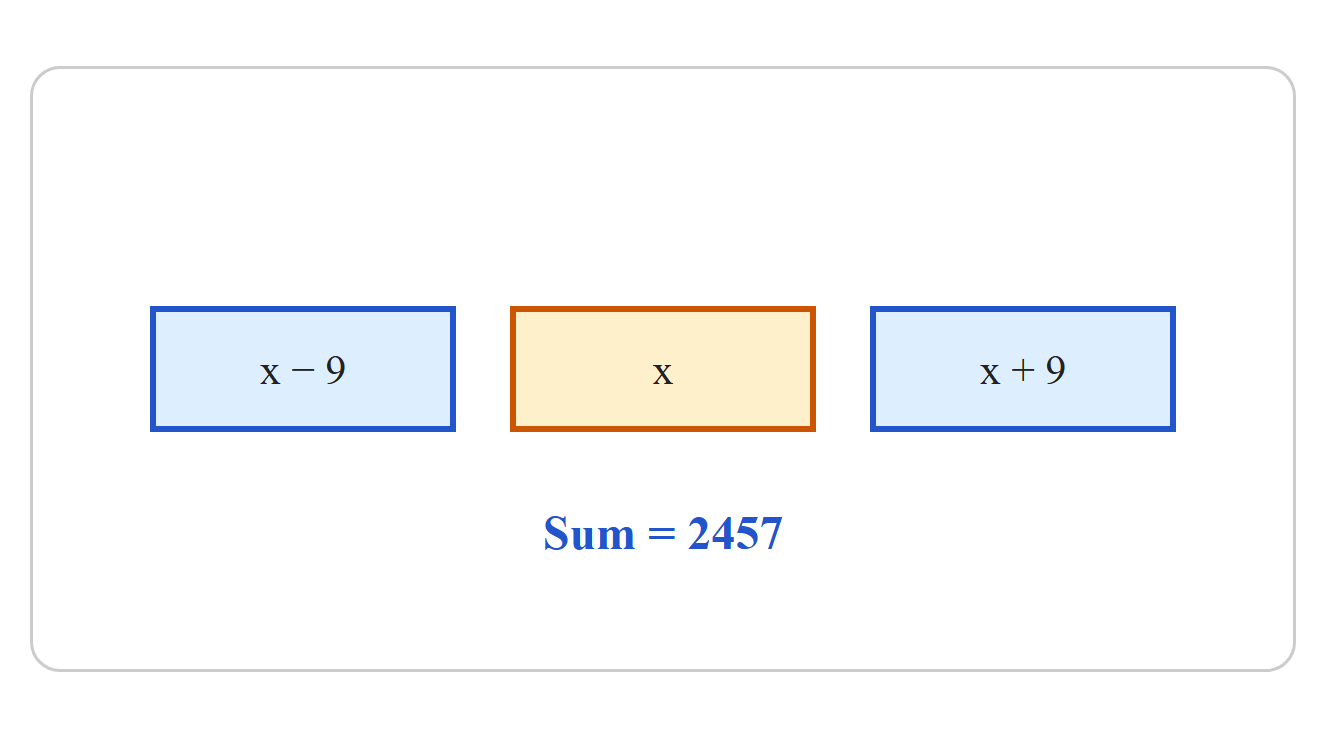
Let the three consecutive multiples of 9 be (x − 9), x, and (x + 9).

Given: Sum of these numbers = 2457

⇒ (x − 9) + x + (x + 9) = 2457

⇒ 3x = 2457

⇒ x = 2457 ÷ 3

⇒ x = 819

⇒ Smallest number = x − 9 = 819 − 9 = 810

∴ The correct answer is 810.

Additional Information

Arithmetic Progression (AP)

Consecutive multiples of any number 'n' always form an Arithmetic Progression with common difference 'd' = n.

Middle Term Property

For an odd number of terms in AP, the Average (Sum ÷ Count) is always equal to the middle term of the series.

Multiple Check

A number is a multiple of 9 if the sum of its digits is divisible by 9. For 810, 8 + 1 + 0 = 9, which is divisible by 9.

3

The number of prime numbers lying between 400 and 430 is: 

  1. ((a))

    6

  2. ((b))

    4

  3. ((c))

    5

  4. ((d))

    3

Show Answer
Answer: ((b))

4

Shortcut Trick

Identify numbers in the range 400 to 430 that are not divisible by 2, 3, 5, 7, 11, 13, 17, or 19.

Numbers to check: 401, 403, 407, 409, 413, 419, 421, 427, 429.

Eliminate: 403 (13×31), 407 (11×37), 413 (7×59), 427 (7×61), 429 (3×143).

Remaining Prime Numbers: 401, 409, 419, 421.

∴ The correct answer is 4.

Alternate Method

Given: Range of numbers between 400 and 430.

Method: To check if a number n is prime, test divisibility by all primes ≤ √n. Here, √430 ≈ 20.7, so test primes 2, 3, 5, 7, 11, 13, 17, 19.

⇒ 401: Not divisible by 2, 3, 5, 7, 11, 13, 17, 19 → Prime

⇒ 403: 13 × 31 = 403 → Not Prime

⇒ 407: 11 × 37 = 407 → Not Prime

⇒ 409: Not divisible by 2, 3, 5, 7, 11, 13, 17, 19 → Prime

⇒ 419: Not divisible by 2, 3, 5, 7, 11, 13, 17, 19 → Prime

⇒ 421: Not divisible by 2, 3, 5, 7, 11, 13, 17, 19 → Prime

⇒ List of primes: {401, 409, 419, 421}

⇒ Total count = 4

∴ The correct answer is 4.

Additional Information

Definition of Prime Numbers

A prime number is a natural number greater than 1 that has no positive divisors other than 1 and itself.

Primality Test Rule

To check if N is prime, divide N by all prime numbers less than or equal to √N. If none divide N, then N is prime.

Twin Primes

Pairs of prime numbers that have a difference of 2 (e.g., 419 and 421 are twin primes).

4

The marked price of an article is 150 percent of the cost price. If 20 percent discount is given, then what will be the profit percentage?

  1. ((a))

    20 percent

  2. ((b))

    12.5 percent

  3. ((c))

    25 percent

  4. ((d))

    10 percent

Show Answer
Answer: ((a))

20 percent

Given

Marked price is 150% of the cost price

Discount given is 20%

Concept:

Profit percentage is calculated as (Selling price - Cost price)/Cost price × 100%

Solution:

Selling price after discount = 150% - 20% of 150% = 150% - 30% = 120%

Profit percentage = (Selling price - Cost price)/Cost price × 100% = (120% - 100%)/100% × 100% = 20%

Therefore, the profit percentage is 20%.

Alternate MethodMP/CP = (100 + profit%)/(100 - loss%)

150/100 = (100 + p)/80 ⇒ P = 120 -100 = 20%

5

In an election between two candidates, the first gets 75% of the total valid votes. If 20% votes are invalid among 2,48,000 votes, then how many votes were cast in the favour of the other candidate?

  1. ((a))

    53800

  2. ((b))

    46800

  3. ((c))

    49600

  4. ((d))

    56600

Show Answer
Answer: ((c))

49600

Shortcut Trick

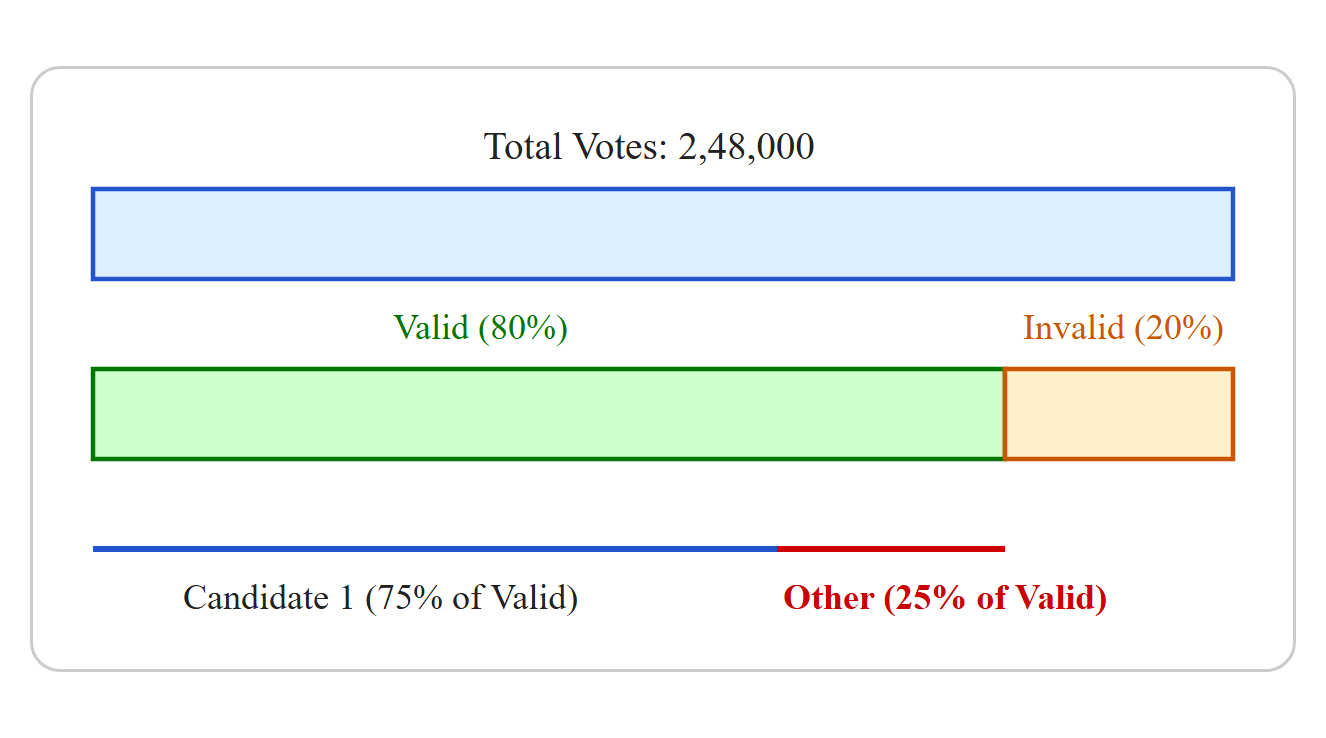
Total Votes = 2,48,000

Valid Votes = 80% of 2,48,000 (since 20% are invalid)

Other Candidate's Votes = 25% of Valid Votes (since first gets 75%)

⇒ Required Votes = 2,48,000 × (80/100) × (25/100)

⇒ Required Votes = 2,48,000 × (4/5) × (1/4) = 2,48,000 ÷ 5 = 49,600

∴ The correct answer is 49600 votes.

Alternate Method

Given:

Total votes cast = 2,48,000

Invalid votes = 20%

First candidate's share of valid votes = 75%

Calculations:

⇒ Number of Valid Votes = 2,48,000 − (20% of 2,48,000)

⇒ Valid Votes = 2,48,000 × 0.80 = 1,98,400

⇒ Share of the Other Candidate = 100% − 75% = 25% of valid votes

⇒ Votes for other candidate = 1,98,400 × (25/100)

⇒ Votes for other candidate = 1,98,400 ÷ 4

⇒ Votes for other candidate = 49,600

∴ The correct answer is 49600 votes.

Additional Information

Valid Votes Concept

In election problems, the winner and loser percentages are always calculated on the Valid Votes unless stated otherwise. Valid Votes = Total Votes − Invalid Votes.

Percentage Multiplier

To find a value after a percentage decrease (like invalid votes), multiply by (100 − x)/100. For 20% invalid, the multiplier is 0.80.

Majority Margin

The Majority or Margin is the difference between the winner's votes and the runner-up's votes. Margin = (Winner % − Loser %) × Valid Votes.

6

4 years ago, the average age of a family of 4 members was 16 years. A baby is born today. What will be the present average age of 5 members of the family?

  1. ((a))

    15 years

  2. ((b))

    22 years

  3. ((c))

    18 years

  4. ((d))

    16 years

Show Answer
Answer: ((d))

16 years

Data:

Average age of a family of 4 members 4 years ago = 16 years.

Concept:

The current average age is calculated by adding the years passed to the old average, and the average age after adding a new member is calculated by dividing the total age by the number of members.

Solution:

Current average age = 16 + 4 = 20 years,

Total age of family now = 20 × 4 = 80 years,

Average age after the baby is born = (80 + 0) / 5 = 16 years.

Therefore, the present average age of the family of 5 members is 16 years.

7

The population of a city is 8000. If the number of males increases by 8% and that of females by 12% then the population will become 8680. Find the number of females in the city.

  1. ((a))

    2500

  2. ((b))

    1500

  3. ((c))

    2000

  4. ((d))

    1000

Show Answer
Answer: ((d))

1000

Shortcut Trick

Total population increase = 8680 − 8000 = 680.

If all 8000 were males, increase = 8% of 8000 = 640.

Excess increase = 680 − 640 = 40.

This 40 represents the extra 4% (12% − 8%) of the females.

4% of females = 40 ⇒ Total females = (40 ÷ 4) × 100 = 1000.

∴ The correct answer is 1000.

Alternate Method

Given:

Initial population = 8000

Final population = 8680

Male growth rate = 8%

Female growth rate = 12%

Formula Used:

Total Increase = (Growth % of Males × Males) + (Growth % of Females × Females)

Calculations:

⇒ Total increase = 8680 − 8000 = 680

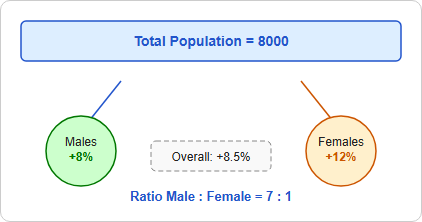
⇒ Overall increase percentage = (680 ÷ 8000) × 100 = 8.5%

⇒ Using alligation method:

⇒ Ratio of Males to Females = (12 − 8.5) : (8.5 − 8)

⇒ Ratio = 3.5 : 0.5 = 7 : 1

⇒ Total ratio parts = 7 + 1 = 8 units

⇒ 8 units = 8000

⇒ 1 unit = 1000

⇒ Number of females = 1 unit = 1000

∴ The correct answer is 1000.

Additional Information

Rule of Alligation

It is a shortcut to find the ratio in which two components are mixed to get a mean value: Ratio = (Higher Value − Mean) : (Mean − Lower Value).

Percentage Change

The percentage change is calculated as: (Final Value − Initial Value) ÷ Initial Value × 100.

Weighted Average

The net change in a population can be seen as a weighted average of the changes in its subgroups (males and females).

8

In a class of 45 students, there are 20 girls who scored an average of 42 marks in a test of 50 marks. If the class average is 36, what are the average marks of the boys?

  1. ((a))

    32.50

  2. ((b))

    32.10

  3. ((c))

    30.80

  4. ((d))

    31.20

Show Answer
Answer: ((d))

31.20

Given:

Total students in class = 45

There are 20 girls who scored an average of 42 marks a test of 50 marks.

The class average is 36.

Calculations:

Let the average marks scored by boys be a.

According to the question

⇒ Average of class = 36 = (42 × 20 + 25 × a)/45

⇒1620 – 840 = 25a

⇒ a = 780/25 = 31.20

∴ Boys average marks are 31.20.

9

If Rs.10000 amounts to Rs.11664 invested in compound interest (compounded annually) for two years then the annual rate of compound interest is

  1. ((a))

    10%

  2. ((b))

    9%

  3. ((c))

    8%

  4. ((d))

    6%

Show Answer
Answer: ((c))

8%

Let the rate of interest be r

We know that, CA = (p{\left[ {1; + ;\frac{r}{{100}}} \right]^n})

Here, p = Rs.10000, n = 2 years, CA = Rs. 11664

(\begin{array}{l} 11664; = ;10000{\left[ {1; + ;\frac{r}{{100}}} \right]^2}\ \Rightarrow ;\frac{{11664}}{{10000}}; = ;{\left[ {1; + ;\frac{r}{{100}}} \right]^2} \end{array})

Taking square - root of both sides,

(\begin{array}{l} \left[ {1; + ;\frac{r}{{100}}} \right]; = ;\frac{{108}}{{100}}\ \Rightarrow ;\frac{r}{{100}}; = ;\frac{{108}}{{100}} - 1 \end{array})

⇒ r = 8%

10

A, B and C together can finish a piece of work in 20 days. A alone can finish the work in 40 days. What part of the work B and C together can finish in a day?

  1. ((a))

    1/5

  2. ((b))

    1/20

  3. ((c))

    1/10

  4. ((d))

    1/40

Show Answer
Answer: ((d))

1/40

Shortcut Trick

Let total work = LCM(20, 40) = 40 units.

Combined efficiency of A, B, and C = 40 ÷ 20 = 2 units/day.

Efficiency of A alone = 40 ÷ 40 = 1 unit/day.

Efficiency of B and C together = 2 − 1 = 1 unit/day.

Part of the work completed by B and C in 1 day = 1 / 40.

∴ The correct answer is 1/40.

Alternate Method

Given:

Time taken by A, B, and C together to finish the work = 20 days

Time taken by A alone to finish the work = 40 days

Formula Used:

Total Work = LCM of given days

Efficiency = Total Work ÷ Time Taken

PersonDaysTotal WorkEfficiency
A + B + C204040 ÷ 20 = 2
A4040 ÷ 40 = 1

Calculations:

⇒ Efficiency of (B + C) = Efficiency of (A + B + C) − Efficiency of A

⇒ Efficiency of (B + C) = 2 − 1 = 1 unit/day

⇒ Part of the work B and C together finish in a day = Efficiency of (B + C) ÷ Total Work

⇒ Part of work = 1 ÷ 40 = 1/40

∴ The correct answer is 1/40.

Additional Information

Time & Work Relation

Total Work = Efficiency × Time taken. Time taken and efficiency are inversely proportional to each other for a given amount of work.

Pipes & Cisterns

Works on the same concept as Time & Work, but filling pipes have positive efficiency while emptying pipes have negative efficiency.

Work & Wages

Total wages are always distributed in the ratio of the actual total work done by the individuals, not just their efficiency or time.

11

A batsman scores 50, 56, 42, 38 and 78 in his 5 innings. How much does he need to score in his 6th inning to get his average to 60 in 6 innings?

  1. ((a))

    90

  2. ((b))

    96

  3. ((c))

    100

  4. ((d))

    106

Show Answer
Answer: ((b))

96

Given

Scores in first 5 innings = [50, 56, 42, 38, 78]

Target average = 60

Concept:

The average is calculated by the total sum divided by the number of elements.

Calculation:

⇒ Total score in first 5 innings = Sum of given scores = 50 + 56 + 42 + 38 + 78 = 264

⇒ Target total score for 6 innings = Average × Total innings = 60 × 6 = 360

⇒ Score needed in 6th innings = Target total score - Total score in first 5 innings = 360 - 264 = 96

Therefore, the batsman needs to score 96 in his 6th innings.

12

Average of 6 consecutive even numbers is 35, What will be the sum of smallest and largest even number among these 6 numbers? 

  1. ((a))

    68

  2. ((b))

    72

  3. ((c))

    70

  4. ((d))

    66

Show Answer
Answer: ((c))

70

Shortcut Trick

For any sequence of consecutive even or odd numbers, the numbers form an Arithmetic Progression (AP).

In an AP, the average of all terms is equal to the average of the first and last terms.

⇒ Average = (Smallest Number + Largest Number) ÷ 2

⇒ Smallest + Largest = 2 × Average

⇒ Sum = 2 × 35 = 70

∴ The correct answer is 70.

Alternate Method

Given:

Average of 6 consecutive even numbers = 35

Formula Used:

Average = Sum of observations ÷ Number of observations

30 Smallest

32

34

36

38

40 Largest

Avg = 35

Sum = 30 + 40 = 70

Calculations:

⇒ Let the 6 consecutive even numbers be x, x + 2, x + 4, x + 6, x + 8, and x + 10.

⇒ Sum of these 6 numbers = x + (x + 2) + (x + 4) + (x + 6) + (x + 8) + (x + 10)

⇒ Sum = 6x + 30

⇒ Average = (6x + 30) ÷ 6 = x + 5

⇒ We are given that the average is 35.

⇒ x + 5 = 35

⇒ x = 35 − 5 = 30

⇒ The smallest number = x = 30

⇒ The largest number = x + 10 = 30 + 10 = 40

⇒ Sum of smallest and largest number = 30 + 40 = 70

∴ The correct answer is 70.

Additional Information

Average of an Arithmetic Progression (AP)

For any sequence with a constant difference (like consecutive numbers), the average is simply (First Term + Last Term) ÷ 2.

Consecutive Even/Odd Numbers

Any sequence of consecutive even or odd numbers has a common difference of 2. For n numbers, the difference between the largest and smallest term is exactly 2 × (n − 1).

Sum of 'n' terms in AP

The total sum of terms in an arithmetic sequence can be calculated quickly as: Sum = n × Average.

13

If the population of a town is 1,21,000 and it grows at a rate of 10% per year, what will the difference be between the population of the town three years from now and the population of the town two years ago?

  1. ((a))

    14641

  2. ((b))

    40,051

  3. ((c))

    13,310

  4. ((d))

    61,051

Show Answer
Answer: ((d))

61,051

Shortcut Trick

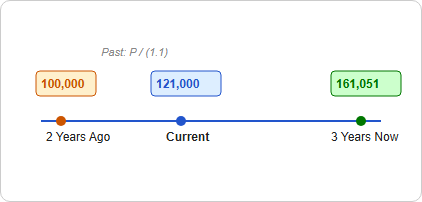
Net multiplier for 3 years ahead at 10% growth = (1.1)3 = 1.331

Net multiplier for 2 years ago at 10% growth = 1 ÷ (1.1)2 = 1 ÷ 1.21

Difference = (1,21,000 × 1.331) − (1,21,000 ÷ 1.21)

Difference = 1,61,051 − 1,00,000 = 61,051

∴ The correct answer is 61,051.

Alternate Method

Given:

Current Population (P) = 1,21,000

Annual Growth Rate (r) = 10%

Formula Used:

Future Population = P × (1 + r/100)n

Past Population = P ÷ (1 + r/100)n

Calculations:

⇒ Population 3 years from now = 1,21,000 × (1 + 10/100)3

⇒ Population 3 years from now = 1,21,000 × (1.1)3 = 1,21,000 × 1.331 = 1,61,051

⇒ Population 2 years ago = 1,21,000 ÷ (1 + 10/100)2

⇒ Population 2 years ago = 1,21,000 ÷ (1.1)2 = 1,21,000 ÷ 1.21 = 1,00,000

⇒ Required Difference = 1,61,051 − 1,00,000 = 61,051

∴ The correct answer is 61,051.

Additional Information

Population Growth Formula

The population after n years is given by Pn = P0(1 + R/100)n, where P0 is the initial population and R is the annual rate of growth.

Population Decrease/Depreciation

If the population decreases at a rate R, the formula becomes Pn = P0(1 − R/100)n.

Successive Growth Rates

If the growth rates for different years are R1, R2, etc., then Pfinal = P0(1 + R1/100)(1 + R2/100)...

14

If Seema invests ₹17,650 in an account that yields 8.5% p.a. simple interest, then how much (to nearest ₹) will she have after 5 years?

  1. ((a))

    25,151

  2. ((b))

    21,155

  3. ((c))

    25,115

  4. ((d))

    21,551

Show Answer
Answer: ((a))

25,151

Given:

Total amount = ₹17,650

The rate of interest = 8.5%

Formula used:

S.I. = (P × R × T)/100

Where, S.I. = Simple interest; P = Total amount; R = Rate of interest; T = Time (years)

Calculation:

The total amount = Total simple interest + Total invested amount

= [(17650 × 8.5 × 5)/100] + 17650

= 7501.25 + 17650

= ₹25151.25

= ₹25151 (to nearest ₹)

∴ Seema will have ₹25151 after five years.

15

Meenu is 38 years old. Her daughter is 8 years old. In how many years will Meenu be double her daughter's age?

  1. ((a))

    22

  2. ((b))

    25

  3. ((c))

    20

  4. ((d))

    24

Show Answer
Answer: ((a))

22

Given:

Meenu is 38 years old.

Her daughter is 8 years old.

Calculation:

Let, after x years will Meenu be double her daughter's age

As per the question,

⇒ 38 + x = 2 × (8 + x)

⇒  x = 22 years

∴ The correct option is 1

16

The face value of an item is ₹480. There is a loss of ₹40 after giving 25% discount on the marked price of the item. The percentage of loss on the item is:

  1. ((a))

    12.5

  2. ((b))

    15

  3. ((c))

    8

  4. ((d))

    10

Show Answer
Answer: ((d))

10

Face value = 480 Rs

Discount = 25% 

So, Selling price = 360 Rs

Loss = 40 Rs

Cost Price = 400 Rs

Loss percent = 40/400 * 100 = 10%

17

Two men do the same journey by travelling at the speed of 18 km/h and 24 km/h, respectively. If one man takes 20 minutes more than the other man, then the distance (in km) of the total journey is:

  1. ((a))

    24

  2. ((b))

    20

  3. ((c))

    18

  4. ((d))

    21

Show Answer
Answer: ((a))

24

Given:

Speed of one person, S1 = 18 km/hour

Speed of second person, S2 = 24 km/hour

T1 – T2 = 20 minutes

Formula used:

Speed = Distance/Time

Calculation:

Let the distance be x km.

Time taken by first person

⇒ Time = Distance/Speed

⇒ x/18 hour

Time taken by second person

⇒ x/24 hour

T1 – T2 = 20 minutes

⇒ x/18 – x/24 = 20/60

⇒ (4x – 3x)/72 = 1/3

⇒ x = 72/3

⇒ x = 24 km

∴ The distance travelled is 24 km.


Required distance = {(S1 × S2)/(S2 – S1)} × (T1 – T2)

⇒ {(18 × 24)/(24 – 18)} × (20/60)

⇒ (18 × 24)/6) × (1/3)

⇒ 24 km

∴ The distance travelled is 24 km

18

The speed of a train including stoppages is 75 kmph and excluding stoppages, the speed of the train is 90 kmph. For how many minutes does the train stop per hour? 

  1. ((a))

    10 minutes

  2. ((b))

    15 minutes

  3. ((c))

    20 minutes

  4. ((d))

    11 minutes

Show Answer
Answer: ((a))

10 minutes

Shortcut Trick

Stoppage time per hour = [(Faster Speed − Slower Speed) ÷ Faster Speed] × 60 min

Stoppage time per hour = [(90 − 75) ÷ 90] × 60

Stoppage time per hour = (15 ÷ 90) × 60

Stoppage time per hour = (1 ÷ 6) × 60 = 10 minutes

∴ The correct answer is 10 minutes.

Alternate Method

Given:

Speed without stoppages = 90 kmph

Speed with stoppages = 75 kmph

Without Stoppage (90 kmph)

Distance covered in 1 hr = 90 km With Stoppage (75 kmph)

Distance covered in 1 hr = 75 km

15 km

10 min stop

Calculations:

⇒ Distance covered in 1 hr without stop = 90 km

⇒ Distance covered in 1 hr with stop = 75 km

⇒ Decrease in distance due to stoppage = 90 − 75 = 15 km

⇒ Stoppage time = Time taken to cover the lost 15 km at normal speed of 90 kmph

⇒ Stoppage time (in hr) = Distance ÷ Speed = 15 ÷ 90 = 1 ÷ 6 hr

⇒ Stoppage time (in min) = (1 ÷ 6) × 60 = 10 minutes

∴ The correct answer is 10 minutes.

Additional Information

Direct Stoppage Time Formula

Stoppage time per hour = (Difference in Speed ÷ Speed without Stoppages) × 60 minutes.

Average Speed

Average Speed = Total Distance ÷ Total Time. It represents the uniform speed needed to cover the same distance in the same total time.

Unit Conversions

To convert kmph to m/s, multiply by 5 ÷ 18. To convert m/s to kmph, multiply by 18 ÷ 5.

19

The monthly salaries of A and B are in the ratio 5 : 6. If both of them get a salary increment of Rs. 2000, the new ratio becomes 11 : 13. What is the new monthly salary of A?

  1. ((a))

    Rs. 20000

  2. ((b))

    Rs. 24000

  3. ((c))

    Rs. 26000

  4. ((d))

    Rs. 22000

Show Answer
Answer: ((d))

Rs. 22000

Shortcut Trick

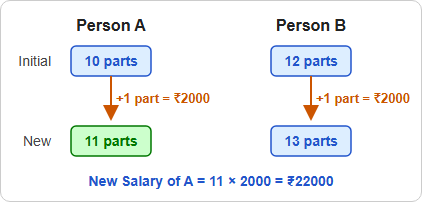
Initial salary ratio of A and B = 5 : 6 (gap between terms is 1).

New salary ratio after ₹2000 increment = 11 : 13 (gap between terms is 2).

To make the gap equal, multiply the initial ratio by 2 → 10 : 12.

Now, the increment in ratio parts for both A and B = 11 − 10 = 13 − 12 = 1 part.

Since 1 ratio part = ₹2000, the new salary of A (11 parts) = 11 × 2000 = ₹22000.

∴ The correct answer is ₹22000.

Alternate Method

Given:

Initial salary ratio of A and B = 5 : 6

Increment for both = ₹2000

New salary ratio of A and B = 11 : 13

Calculations:

Let the initial salaries of A and B be 5x and 6x respectively.

After an increment of ₹2000, their salaries become (5x + 2000) and (6x + 2000).

⇒ (5x + 2000) ÷ (6x + 2000) = 11 ÷ 13

⇒ 13 × (5x + 2000) = 11 × (6x + 2000)

⇒ 65x + 26000 = 66x + 22000

⇒ 66x − 65x = 26000 − 22000

⇒ x = 4000

We need to find the new monthly salary of A.

⇒ New salary of A = 5x + 2000

⇒ New salary of A = 5 × 4000 + 2000

⇒ New salary of A = 20000 + 2000 = ₹22000

∴ The correct answer is ₹22000.

Additional Information

Compound Ratio

For two given ratios a : b and c : d, the compound ratio is calculated by multiplying the antecedents together and the consequents together, giving ac : bd.

Duplicate & Triplicate Ratios

The duplicate ratio of a : b is defined as a2 : b2. Similarly, the triplicate ratio is a3 : b3.

Invertendo & Alternendo

If four variables are in proportion a : b = c : d, then by the property of Invertendo b : a = d : c, and by Alternendo a : c = b : d.

20

A man has 25 paise, 50 paise and 1 Rupee coins. There are 220 coins in all and the total amount is 160. If there are thrice as many 1 Rupee coins as there are 25 paise coins, then what is the number of 50 paise coins?

  1. ((a))

    60

  2. ((b))

    120

  3. ((c))

    40

  4. ((d))

    80

Show Answer
Answer: ((a))

60

Given:

Total coin = 220

Total money = Rs. 160

There are thrice as many 1 Rupee coins as there are 25 paise coins.

Concept used:

Ratio method is used.

Calculation:

Let the 25 paise coins be 'x'

So, one rupees coins = 3x

50 paise coins = 220 – x – (3x) = 220 – (4x)

According to the questions,

3x + [(220 – 4x)/2] + x/4 =160

⇒ (12x + 440 – 8x + x)/4 = 160

⇒  5x + 440 = 640

⇒ 5x = 200

⇒ x = 40

So, 50 paise coins = 220 – (4x) = 220 – (4 × 40) = 60

∴ The number of 50 paise coin is 60.

21

Evaluate the following expression.

([ \frac{-4}{7} \div \frac{1}{12}] \div [- \frac{4}{5} \times \big{(-2)-(- \frac{2}{7}) \big} ])

  1. ((a))

    -5

  2. ((b))

    -(\frac {1} {5})

  3. ((c))

    (\frac {1} {5})

  4. ((d))

    5

Show Answer
Answer: ((a))

-5

Given:

([ \frac{-4}{7} \div \frac{1}{12}] \div [- \frac{4}{5} \times \big{(-2)-(- \frac{2}{7}) \big} ])

Concept used:

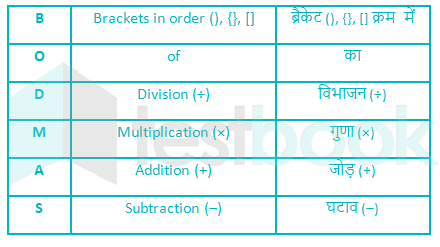
Follow the BODMAS rule according to the table given below:

Calculation:

([ \frac{-4}{7} \div \frac{1}{12}] \div [- \frac{4}{5} \times \big{(-2)-(- \frac{2}{7}) \big} ])

⇒ ([ \frac{-4}{7} \times 12] \div [- \frac{4}{5} \times \big{(-2)+(\frac{2}{7}) \big} ])

⇒ ([ \frac{-48}{7}] \div [- \frac{4}{5} \times (\frac{-12}{7}) \big} ])

⇒ ([ \frac{-48}{7}] \div [ \frac{48}{35} ])

⇒ ([ \frac{-48}{7}] \times [ \frac{35}{48} ])

⇒ - 5

22

A bag contains 6 white and 4 red balls. Three balls are drawn at random. What is the probability that one ball is red and the other two are white?

  1. ((a))

    (\frac{7 }{12 })

  2. ((b))

    (\frac{1 }{12 })

  3. ((c))

    (\frac{3 }{10 })

  4. ((d))

    (\frac{ 1}{2 })

Show Answer
Answer: ((d))

(\frac{ 1}{2 })

Given:

A bag contains 6 white and 4 red balls

Concept used:

Probability of occurrence of the event, P(E) = (Number of favorable outcome, n(E))/(Number of possible outcome, n(S))

Calculation:

Here, total number of balls in the bag = 6 + 4 = 10

Number of ways in which 2 white balls can be drawn from 6 white balls and 1 red ball can be drawn from 4 red balls = n(E) = 6C2 × 4C1

⇒ 60

Total number of ways in which 3 balls can be drawn out of all the all the balls = n(S) = 10C3 

⇒ 120

So, Probability P(E) = n(E)/n(S)

⇒ 60/120 

⇒ 1/2

∴ The required answer is (\frac{ 1}{2 }).

23

If sinθ = 5/13, then find the value of (cotθ - tanθ)/2cotθ ?

  1. ((a))

    143/195

  2. ((b))

    119/254

  3. ((c))

    173/288

  4. ((d))

    119/288

Show Answer
Answer: ((d))

119/288

Given:

sinθ = 5/13

Concept used:

Using the concept of trigonometric ratios.

Calculation:

sinθ = 5/13

cosθ = √(1 - sin2θ)

⇒ cosθ = √(1 - 25/169)

⇒ cosθ = 12/13

tanθ = sinθ/cosθ 

⇒ tanθ = (5/13)/(12/13)

⇒ tanθ = 5/12

cotθ = 1/tanθ 

⇒ cotθ = 12/5

(cotθ - tanθ)/2cotθ

⇒ (12/5 - 5/12)/(2 × 12/5)

⇒ (119/60)/(24/5)

⇒ 119/288

∴ The value of (cotθ - tanθ)/2cotθ is 119/288.

24

A triangle and a parallelogram have the same base 28 cm and the same area. If the height of the parallelogram is 12 cm, then find the length of the altitude of the triangle.

  1. ((a))

    28 cm

  2. ((b))

    23 cm

  3. ((c))

    24 cm

  4. ((d))

    21 cm

Show Answer
Answer: ((c))

24 cm

Given:

A triangle and a parallelogram have the same base 28 cm and the same area.

The height of the parallelogram is 12 cm.

Concept used:

  1. Area of a parallelogram = Base × Height
  2. Area of a triangle = 1/2 × Height × Base

Calculation:

Area of the parallelogram = 28 × 12 = 336 cm2

Let the length of the altitude of the triangle be H cm.

​According to the question,

1/2 × H × 28 = 336

⇒ H = 12 × 2

⇒ H = 24

∴ The length of the altitude of the triangle is 24 cm.

25

The perimeter of the rectangular park is 34m, whereas its area is 60m2. What is the length of the diagonal?

  1. ((a))

    13 m

  2. ((b))

    11 m

  3. ((c))

    5 m

  4. ((d))

    9 m

Show Answer
Answer: ((a))

13 m

Given:

Perimeter of the rectangular park is 34m.

Area = 60 m2

Formula used:

Perimeter = 2(l + b)

Area = l × b

Length of diagonal =√l2 + b2

Calculation:

According to question,

l + b = 17

l × b = 60

We know,

(l + b)= l+ b2 + 2 lb

⇒ 289 = l2 + b2 + 2 × 60

⇒ l2 + b2 = 169

Length of diagonal = √l2 + b2

⇒ √169

⇒ 13


∴ The correct answer is 13 m.

26

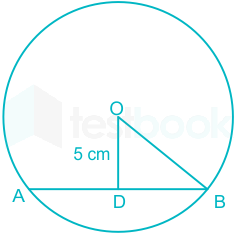
The length of the chord of a circle is 24 cm, and the perpendicular distance between the centre and the chord is 5 cm. The radius of the circle is: 

  1. ((a))

    10 cm

  2. ((b))

    13 cm

  3. ((c))

    12 cm

  4. ((d))

    24 cm

Show Answer
Answer: ((b))

13 cm

Given:

The length of the chord of a circle is 24 cm, and the perpendicular distance between the centre and the chord is 5 cm. 

Concept used:

Chord Length Using Perpendicular Distance from the Center = (2 × \sqrt{(r^2 − d^2)}) (Where r = radius of the circle, d = distance between the centre and the chord)

Calculation:

Let the radius of the circle be R.

Here,

AB = 24 cm long chord

OD = Perpendicular distance between the centre and chord

OB = Radius

​According to the concept,

24 = (2 × \sqrt{(R^2 − 5^2)})

⇒ 12 = (\sqrt{(R^2 − 5^2)})

⇒ 144 = R2 - 52

⇒ R2 = 169

⇒ R = 13

∴ The radius of the circle is 13 cm.

27

Find the roots of the equation 3x2+ 6x + 3 = 0.

  1. ((a))

    -3, 3

  2. ((b))

    -3, 6

  3. ((c))

    -3, -2

  4. ((d))

    -1, -1

Show Answer
Answer: ((d))

-1, -1

Given:

Quadratic equation 3x2+ 6x + 3 = 0

Concept used:

if (x - a)(x - b) = 0, then

(x - a) = 0 or (x - b) = 0

x = a or x = b

Calculation:

3x2+ 6x + 3 = 0

⇒ 3x2+ 3x + 3x + 3 = 0

⇒ 3x(x + 1) + 3(x + 1) = 0

⇒ (3x + 3)(x + 1) = 0

⇒ x = -1 or -1

∴ The roots of the equation 3x2+ 6x + 3 = 0 is -1 or -1.

28

If the product of zeros of the polynomial f(x) = ax3  + 4x2 - 2x - 6 is 2, then the value of 'a' =

  1. ((a))

    4

  2. ((b))

    3

  3. ((c))

    -2

  4. ((d))

    -1

Show Answer
Answer: ((b))

3

Shortcut Trick

For any cubic polynomial, the product of zeroes is given by the formula: −d/a.

Comparing with the given polynomial f(x) = ax3 + 4x2 − 2x − 6, we have the constant term d = −6.

Product of zeroes = −(−6) ÷ a = 6/a.

Given that the product is 2 ⇒ 6/a = 2 ⇒ a = 3.

∴ The correct answer is 3.

Alternate Method

Given:

The polynomial is f(x) = ax3 + 4x2 − 2x − 6.

The product of zeroes of this polynomial is 2.

Formula Used:

For a standard cubic polynomial of the form f(x) = Ax3 + Bx2 + Cx + D, the product of its zeroes (αβγ) is given by:

αβγ = −D/A = −(constant term) ÷ (coefficient of x3)

Calculations:

Comparing the given polynomial f(x) = ax3 + 4x2 − 2x − 6 with the standard cubic form:

⇒ A = a

⇒ B = 4

⇒ C = −2

⇒ D = −6

Now, substitute these coefficients into the product of zeroes formula:

⇒ Product of zeroes = −(−6) ÷ a

⇒ 2 = 6/a

⇒ 2 × a = 6

⇒ a = 3

Thus, the value of the coefficient 'a' is 3.

∴ The correct answer is 3.

Additional Information

Cubic Polynomial Relations

For a cubic polynomial f(x) = ax3 + bx2 + cx + d with roots α, β, and γ, the relations are: Sum of roots = −b/a, Sum of products taken two at a time = c/a, and Product of roots = −d/a.

Quadratic Polynomial Relations

For a quadratic polynomial f(x) = ax2 + bx + c with roots α and β, the relations are: Sum of roots = −b/a, and Product of roots = c/a.

General Polynomial Root Product

For any nth-degree polynomial, the product of all roots is given by (−1)n × (constant term) ÷ (leading coefficient).

29

Given n(U) = 20, n(A) = 12, n(B) = 9, n(A ⋂ B) = 4, where U is the universal set, A and B are subsets of U, then n((A ⋃ B)c)

  1. ((a))

    17

  2. ((b))

    9

  3. ((c))

    11

  4. ((d))

    3

Show Answer
Answer: ((d))

3

Concept:

  • n(U), n(A), and n(B) denote the number of elements in sets U, A, and B respectively.
  • A ⋃ B = A + B - (A ∩ B)
  • (A ⋃ B)c = U - (A ⋃ B)

Calculation:

Given, n(U) = 20, n(A) = 12, n(B) = 9 and n(A ∩ B) = 4.

According to the formula, 

n(A ⋃ B) = n(A) + n(B) - n(A ∩ B)

⇒ 12 + 9 - 4 = 17

Again, according to the formula mentioned above, 

n(A ⋃ B)c = n(U) - n(A ⋃ B) = 20 - 17 = 3

30

The equation of a line is given by 4y – 6x + 9 = 0. Find the slope of other line which is perpendicular to it.

  1. ((a))

    -2/3

  2. ((b))

    2/3

  3. ((c))

    3/2

  4. ((d))

    -3/2

Show Answer
Answer: ((a))

-2/3

Given:

4y – 6x + 9 = 0       ----(1)

Concept used:

Equation of perpendicular line x cos a + y sin a = P       ----(2)

Calculation:

Comparing eq. (1) and (2)

cos a = – 6 and sin a = 4 and P = – 9

Slope, m = tan a = sin a/cos a = -4/6 = -2/3

∴ The correct answer is -2/3

Alternate Method

4y – 6x + 9 = 0

⇒ y = 3x/2 + 9/4

Comparing it with y = mx + c

m = 3/2

The slope of perpendicular lines

m1m2 = -1      where m1 = 3/2

⇒ m2 = -2/3

31

If PRIMATE is coded as MOFJXQB, then how will COW be coded as?

  1. ((a))

    ZLT

  2. ((b))

    EDC

  3. ((c))

    RFV

  4. ((d))

    TGB

Show Answer
Answer: ((a))

ZLT

If PRIMATE is coded as MOFJXQB

→ P – 3 = M

→ R – 3 = O

→ I – 3 = F

→ M – 3 = J

→ A – 3 = X

→ T – 3 = Q

→ E – 3 = B

Similarly,

→ C – 3 = Z

→ O – 3 = L

→ W – 3 = T

Hence, “COW” will be coded as “ZLT”.

32

Select the Venn diagram that best illustrates the relationship between the following classes.

Mobile, Internet, webmail

  1. ((a))

  2. ((b))

  3. ((c))

  4. ((d))

Show Answer
Answer: ((b))

webmail is the part of the internet while mobile is electronic equipment.

So the diagram which shows the best relation between the given three variables is:

Hence, the figure in option 2 is the correct answer.

33

Select the correct option that indicates the arrangement of the following words in a logical and meaningful order.

  1. Month
  2. Day
  3. Decade
  4. Year
  5. Century
  1. ((a))

    3, 5, 4, 1, 2 

  2. ((b))

    5, 4, 3, 1, 2

  3. ((c))

    5, 3, 4, 1, 2

  4. ((d))

    3, 5, 1, 4, 2

Show Answer
Answer: ((c))

5, 3, 4, 1, 2

The correct chronological progression of time is :

  1. Century (100 years)
  2. Decade (10 years)
  3. Year (12 months)
  4. Month (30 days)
  5. Day (24 hours)

Hence, "5, 3, 4, 1, 2" is the correct answer.

34

If A + B means A is the mother of B, A × B means A is the husband of B and A ÷ B means A is the daughter of B. In the expression Y × Q ÷ Z + K, what is the relation between Z and Y?

  1. ((a))

    Z is the father-in-law of Y.

  2. ((b))

    Z is the father of Y.

  3. ((c))

    Z is the mother-in-law of Y.

  4. ((d))

    Z is the daughter of Y.

Show Answer
Answer: ((c))

Z is the mother-in-law of Y.

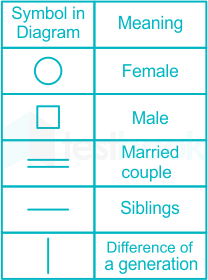
A is
+×÷
MotherHusbandDaughter
Of B


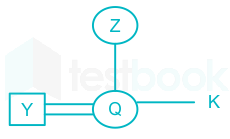
Drawing the diagram for ‘Y × Q ÷ Z + K’,

Z is the mother-in-law of Y.

Hence, option 3 is the correct answer.

35

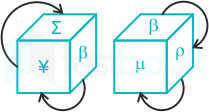
Two positions of the same dice are shown. There are six symbol on the cube that is ¥, (\infty), (\mu), (\rho), (\beta), (\sum), what will be in the front of symbol (\beta)?

  1. ((a))

    ∞ 

  2. ((b))

    ρ 

  3. ((c))

    ¥

  4. ((d))

    ∑ 

Show Answer
Answer: ((a))

∞ 

Logic: If two dice position have a face common than their clockwise or anticlockwise number/letter are know as opposite number/letter.

While moving in clockwise direction from the common face (ß) in both the positions.

There are six symbols on the cube that is (\beta), (\rho), (\mu), ¥, (\sum), (\infty)

From both the dice positions, opposite pairs will be as-

DICE 1(\beta)¥(\sum)
DICE 2(\beta)(\rho)(\mu)

Here, (\beta) is opposite with (\infty).

Hence, (\infty) is correct answer.

36

Select the option that is related to the third term in the same way as the second term is related to the first term.

VERGT : TCPER :: FMZQO : ?

  1. ((a))

    GNARP

  2. ((b))

    DKXOM

  3. ((c))

    HOBSQ

  4. ((d))

    ELYPN

Show Answer
Answer: ((b))

DKXOM

Explanation:

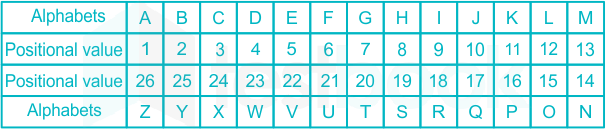
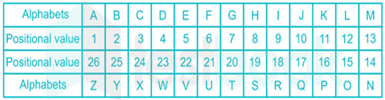
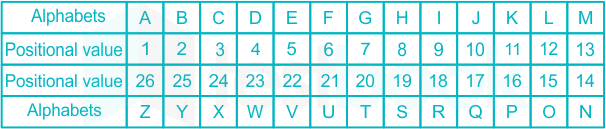
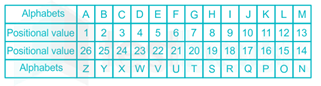
According to the English alphabets and their positional values:

<br>

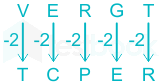
The pattern followed in the given series is:

   Alphabets are decreased by 2 positional values.

<br>

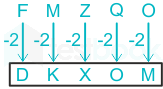
Similarly,

<br>

Hence the correct answer is option 2

37

In this question, three statements are given, followed by two conclusions numbered I and II. Assuming the statements to be true, even if they seem to be at variance with commonly known facts, decide which of the conclusions logically follows/follow from the statements.

Statements:

All mangoes are fruits.

Some mangoes are pears.

All pears are vegetables.

Conclusions:

I. Some mangoes are vegetables.

II. Some fruits are vegetables.

  1. ((a))

    Neither conclusion I nor II follows.

  2. ((b))

    Only conclusion I follows.

  3. ((c))

    Both conclusions I and II follow.

  4. ((d))

    Only conclusion II follows.

Show Answer
Answer: ((c))

Both conclusions I and II follow.

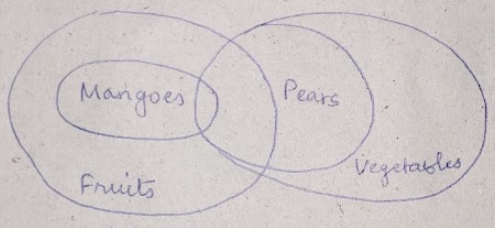
The least possible venn diagram is shown below,

Conclusions:

I. Some mangoes are vegetables → True (Some mangoes are pears and all pears are vegetables implies that some mangoes which are pears are also vegetables).

II. Some fruits are vegetables → True (All mangoes are fruits, some mangoes are pears and all pears are vegetables implies that some fruits which are pears are also vegetables).

Hence, the correct answer is "Both conclusions I and II follow".

38

Amongst six people, D, E, F, G, H, and I, each has a different age. They are standing in a line according to their age in an increasing order. F is older than E but younger than D. D is younger than I. E is older than G. G is older than H. Who comes in 4th position in increasing order of age?

  1. ((a))

    F

  2. ((b))

    E

  3. ((c))

    H

  4. ((d))

    I

Show Answer
Answer: ((a))

F

Given: Amongst six people, D, E, F, G, H, and I, each has a different age.

  1. F is older than E but younger than D.

D > F > E

  1. D is younger than I.

I > D > F > E

  1. E is older than G.

I > D > F > E > G

  1. G is older than H.

I > D > F > E > G > H

So, F comes in 4th position in increasing order of age.

Hence, the correct answer is "F".

39

Select the number from among the given options that can replace the question mark (?) in the following series.

86, 89, 95, 104, ?, 131, 149

  1. ((a))

    122

  2. ((b))

    116

  3. ((c))

    114

  4. ((d))

    113

Show Answer
Answer: ((b))

116

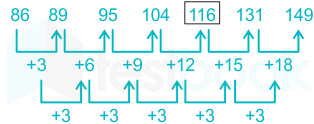
The pattern followed here is:

Hence, '116' is the correct answer.

40

A series is given with one term missing. Select the correct alternative from the given ones that will complete the series.

XJ, WL, VN, UP, ?

  1. ((a))

    TU

  2. ((b))

    TR

  3. ((c))

    ST

  4. ((d))

    SU

Show Answer
Answer: ((b))

TR

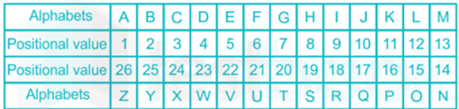
The table shows the place value of the alphabet from A to Z and Z to A.

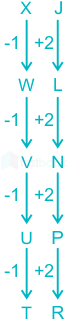
The pattern followed here is :


Hence, the correct answer is "TR".

41

In the following question below some statements are given followed by some conclusions. Taking the given statements to be true even if they seem to be at variance from commonly known facts, read all the conclusions and then decide which of the given conclusions logically follows the given statements.

Statement:

I. Some bells are golden

II. Some bells are red.

Conclusion:

I. Some red are golden

II. No golden is red

  1. ((a))

    Only conclusion II follows

  2. ((b))

    Both conclusions I and II follow

  3. ((c))

    Only conclusion I follows

  4. ((d))

    Either conclusion I or II follow

Show Answer
Answer: ((d))

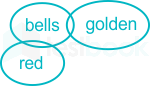
Either conclusion I or II follow

Concept:

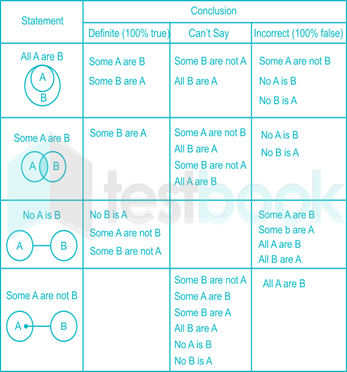
  1. We have to check the conclusions are 100% match with the statement. If the conclusion is 100% match with the given statement then the conclusion is true. If there is a 1% chance of not following the statement then the conclusion is considered to be false.

  2. The possibility case can be considered to be "false" in "definite case".

  3. In Possibility case, either "can" or "possible" word must be present.

According to the given statement,

Statement:

I. Some bells are golden

II. Some bells are red.

The possible Venn diagram is as follows:

Conclusion:

I. Some red are golden. (False, it can be true but not definite.)

II. No golden is red. (False, it can be true but not definite.)

Both the Conclusions are complimentary terms.

Hence, ​Either conclusion I or II follow

Note: 

Conditions of Either-or case:

  1. The elements should be the same in both the statements.
  2. Individually both the conclusions should be false.
  3. One conclusion should be positive and one conclusion should be negative (Complementary pair)

The two complementary pairs are:

  1. All + Some not

  2. No + Some

Additional Information

42

Two figures given on the left side of (::) are related with some logic/rule/relation. Select the missing figure on the right of (::) from the given alternatives based on the same logic/rule/relation.

  1. ((a))

  2. ((b))

  3. ((c))

  4. ((d))

Show Answer
Answer: ((b))

The logic followed is:

From figure 1 to 2:

i) The top symbols of the figures are exchanging there positions.

ii) The letter inside the circle is exchanging there places.

Similarly,

From figure 3 to 4:

i) The top symbols of the figures will exchange there positions.

ii) The symbols inside the circle will exchange there places.

Thus only figure 2 will satisfy the given above condition.

The complete pattern will be:

Hence, the correct answer is "Option 2".

43

After arranging the given words according to dictionary order, which word will come at ‘Second’ position ?

  1. Dietetic
  2. Diestrus
  3. Diestrum
  4. Dieldrin
  5. Diestock
  1. ((a))

    Diestrus

  2. ((b))

    Dietetic

  3. ((c))

    Diestock

  4. ((d))

    Dieldrin

Show Answer
Answer: ((c))

Diestock

The correct order as per the dictionary is shown below:

  1. Dieldrin

  2. Diestock

  3. Diestrum

  4. Diestrus

  5. Dietetic

Here, we can see that the word at the Second position is Diestock.

Hence, the correct answer is " Diestock ".

44

A paper is folded and cut as shown in the given figures. How will it appear when unfolded?

  1. ((a))

  2. ((b))

  3. ((c))

  4. ((d))

Show Answer
Answer: ((c))

The image obtained when the paper is unfolded is as shown below**:**

Hence, the correct answer is "option (3)."

45

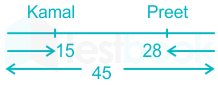
Kamal is 15th from the left end of a row of 45 students and Preet is 28th from the right end in the same row. How many students are there between them in the row?

  1. ((a))

    3

  2. ((b))

    2

  3. ((c))

    4

  4. ((d))

    1

Show Answer
Answer: ((b))

2

According to given information;

Total number of students = 45

Kamal position from left = 15

Preet position from right = 28

Number of student between Kamal and Preet = Total student - (Kamal position + Preet position)

= 45 - (15 + 28)

= 45 - 43

= 2

Hence, there are two students between Kamal and Preet.

46

Three of the following four words are alike in a certain way and one is different. Find the odd one out. 

  1. ((a))

    Moon

  2. ((b))

    Mars

  3. ((c))

    Mercury

  4. ((d))

    Venus

Show Answer
Answer: ((a))

Moon

The pattern followed here is:

Moon is a satellite and the other three options are planets.

Hence, the correct answer is Moon.

47

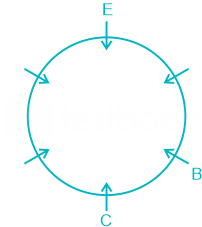
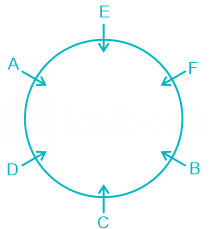
Six students are sitting around a circular table facing the centre. A is an immediate neighbour of both E and D. E sits third to the right of C. D sits third to the left of F. E is an immediate neighbour of F. B sits second to the left of E. Who sits to the immediate left of C? 

  1. ((a))

    B

  2. ((b))

    D

  3. ((c))

    E

  4. ((d))

    A

Show Answer
Answer: ((b))

D

Given: Six students are sitting around a circular table facing the centre.

E sits third to the right of C.

B sits second to the left of E.


E is an immediate neighbour of F.

A is an immediate neighbour of both E and D.

D sits third to the left of F.

Here, D sits to the immediate left of C.

Hence, the correct answer is 'Option 2'.

48

If 6 May 2005 is a Friday, then what will the day of the week on 25 September 2018?

  1. ((a))

    Friday

  2. ((b))

    Sunday

  3. ((c))

    Tuesday

  4. ((d))

    Thursday

Show Answer
Answer: ((c))

Tuesday

Given: 6 May 2005 was Friday.

Now,

2005 to 2018 = 13 Years (10 Ordinary Years and 3 Leap Years).

And, In 13 Years = 3 Leap years and 10 Ordinary Years.

So, 3 Leap Years have 6 odd days,

And, 10 Ordinary Years have 10 odd days.

Total odd days = 6 + 10 = 16.

16 odd days → 16/7 = 2 weeks and 2 odd days.

then, 6 May 2018 will be Friday + 2 = Sunday.

Now, the number of days between 6 May 2018 to 25 September 2018

= 25(May) + 30(June) + 31(July) + 31(August) + 25(September) = 142 days.

= 142 days → 142/7 = 20 weeks and 2 odd days.

So, 25 September 2018 will be Sunday + 2 = Tuesday.

Hence, the correct answer is "Option 3".

49

If 20th November 2012 is Tuesday, what would be the day of the week on 20th November 2018?

  1. ((a))

    Friday

  2. ((b))

    Thursday

  3. ((c))

    Wednesday

  4. ((d))

    Tuesday

Show Answer
Answer: ((d))

Tuesday

The pattern followed here is:

Every ordinary year contains = 1 Odd day

Every leap year contains = 2 Odd days

20th November 2012 is Tuesday.

2018 ⇒ Ordinary year ⇒ 1 Odd day

But, 2016 ⇒ Leap year ⇒ 2 odd days.

Therefore, the total years gap = 6 (2012 - 2018)

Total Days (odd) = 7 (1 extra odd day of 2016)

Day on 20th November 2018 = (Tuesday + 7 days)

⇒ Tuesday

Hence, the correct answer is "Option (4)".

50

Four letter-cluster have been given, out of which three are alike in some manner and one is different. Select the odd one

  1. ((a))

    JLN

  2. ((b))

    OQS

  3. ((c))

    UWY

  4. ((d))

    ADG

Show Answer
Answer: ((d))

ADG

According to the English alphabet and their positional values:

<br>

The pattern followed in the given options is:

Option 1) 

Option 2) 

Option 3) 

Option 4) 

So, ADG is the odd one. 

Hence, the correct answer is option 4).

51

In the following question, select the word which cannot be formed using the letters of the given word.

MONTESSORI

  1. ((a))

    SORT

  2. ((b))

    MORE

  3. ((c))

    MOUSE

  4. ((d))

    NEST

Show Answer
Answer: ((c))

MOUSE

  1. SORT: MONTESSORI, hence, the word can be formed.

  2. MORE: MONTESSORI, hence, the word can be formed.

  3. MOUSE: ‘U’ in ‘MOUSE’ does not come in the word “MONTESSORI”.

  4. NEST: MONTESSORI, hence, the word can be formed.

Hence, 'MOUSE' is the word which cannot be formed using the given word.

52

Each of the five people K, L, M, P and Q is of a different weight. It is known that the number of people heavier than P is the same as the number of people lighter than Q. L is the heaviest and K is not the lightest. Who is the lightest?

  1. ((a))

    M

  2. ((b))

    L

  3. ((c))

    Q

  4. ((d))

    P

Show Answer
Answer: ((a))

M

Given data :

  1. Number of people heavier than P is the same as the number of people lighter than Q and L is the heaviest.

 L > P > _ > Q > _  or  L > Q > _ > P > _

2) K is not the lightest.

 L > P > K > Q > M  or  L > Q > K > P > M

Hence, 'M' is the lightest among all people.

53

Find the next number in the series:

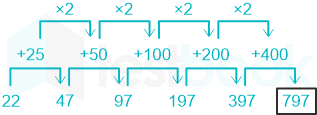
22, 47, 97, 197, 397, ?

  1. ((a))

    799 

  2. ((b))

    798 

  3. ((c))

    800 

  4. ((d))

    797

Show Answer
Answer: ((d))

797

The logic followed here is:

Hence, the correct answer is "797".

54

Four letter clusters have been given out of which three are alike in some manner while one is different. Select the odd one.

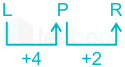
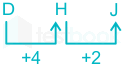
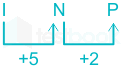
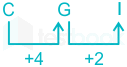
  1. ((a))

    LPR

  2. ((b))

    DHJ

  3. ((c))

    INP

  4. ((d))

    CGI

Show Answer
Answer: ((c))

INP

The logic followed here is:

1) 

2) 

3) 

4) 

This shows the "INP" as odd one out.

Hence, the correct answer is "INP".

55

Select the option that is related to the third term in the same way as the second term is related to the first term. 

8 : 32 : : 16 : ?

  1. ((a))

    256

  2. ((b))

    128

  3. ((c))

    312

  4. ((d))

    36

Show Answer
Answer: ((b))

128

Logic - Number : Number x (Number/2)

8 : 8 x (8/2)

8:32

Similarly,

16 : 16 x (16/2)

16 : 128.

Hence, the correct answer is 128.

56

Select the option that can replace the question mark (?) in the following series.

  1. ((a))

  2. ((b))

  3. ((c))

  4. ((d))

Show Answer
Answer: ((b))

The pattern followed is,

The symbols in the given image are rotating in clock – wise direction.

The image which will come next in the series is,

Hence, option 2 is the correct answer.

 Select the option that can replace the question mark (?) in the following series.

57

In the following question, select the word which cannot be formed using the letters of the given word.

PITCHINGS

  1. ((a))

    SIP

  2. ((b))

    CHIT

  3. ((c))

    HINGS

  4. ((d))

    HANGS

Show Answer
Answer: ((d))

HANGS

The word HANGS cannot be formed as letter ‘A’ is not present in the word PITCHINGS.

58

In a certain code language, “TRUMP” is written as “46321” and “GRAIN” is written as “76598”. How is “GRUNT” written in that code language?

  1. ((a))

    23684

  2. ((b))

    23847

  3. ((c))

    67834

  4. ((d))

    76384

Show Answer
Answer: ((d))

76384

The pattern followed here is:-

TRUMP is coded as 46321

TRUMP
46321

GRAIN is coded as 76598

GRAIN
76598

Similarly,

GRUNT is coded as 76384

GRUNT
76384

Hence, the correct answer is "76384".

59

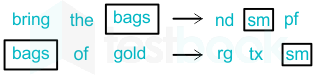
In a certain code language, ‘bring the bags’ is written as ‘nd sm pf’ and ‘bags of gold’ is written as ‘rg tx sm’. How is ‘bags’ written in the given language?

  1. ((a))

    rg

  2. ((b))

    nd

  3. ((c))

    sm

  4. ((d))

    pf

Show Answer
Answer: ((c))

sm

According to the given information,

Thus, according to the given codes 'sm' is the code for the word 'bags'.

Hence, the correct answer is "Option 3".

60

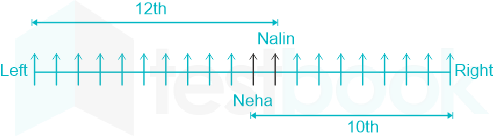
All 20 students in a class are standing in a straight line facing north. Neha is 10th from the right end while Nalin is 12th from the left end. How many people stand between Neha and Nalin? 

  1. ((a))

    Three 

  2. ((b))

    Zero 

  3. ((c))

    Two 

  4. ((d))

    One

Show Answer
Answer: ((b))

Zero 

According to the given information,

Given:- Neha is 10th from the right end and Nalin is 12th from the left end.

Here, we can see that zero people are standing between Neha and Nalin.

Hence, the correct answer is "Zero".

61

Select the option that is related to the third word in the same way as the second word is related to the first word. (The words must be considered as meaningful English words and must not be related to each other based on the number of letters/number of consonants/vowels in the word.)

Bull : Cow :: Gander : ?

  1. ((a))

    Doe

  2. ((b))

    Goose

  3. ((c))

    Mare

  4. ((d))

    Hen

Show Answer
Answer: ((b))

Goose

The pattern followed here is:

'Bull' is a male 'Cow'.

Similarly, let us check each option,

  1. 'Doe' is a female 'deer'.
  2. **'**Goose" is a female 'Gander'.
  3. 'Mare' is a female 'Horse'.
  4. 'Hen' is a female 'Cock'.

Hence, 'Goose' is the correct answer.

62

In a certain code "CHAIR" is coded as "381918" then how will "TABLE" be coded ?

  1. ((a))

    2112125

  2. ((b))

    2012135

  3. ((c))

    2012125

  4. ((d))

    2012126

Show Answer
Answer: ((c))

2012125

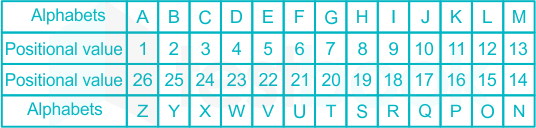
Table show alphabet serial number –

<br>

The pattern for the code is as follows,

CHAIR → C = 3, H = 8, A = 1, I = 9, R = 18 → 381918

Similarly,

TABLE → T = 20, A = 1, B = 2, L = 12, E = 5 → 2012125

Hence, TABLE is coded as 2012125.

63

Directions: Read the following information carefully and answer the following questions:

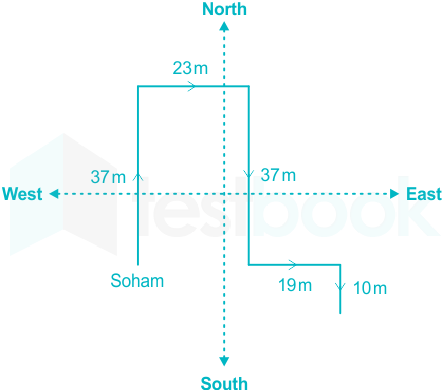
Soham walked 37m towards the north. After walking 23m in his right direction, he then turned to his right and walked 37m. He turned to his left and walked 19m. He then turned south and walks 10m. In which direction is he with respect to the starting point?

  1. ((a))

    North-east

  2. ((b))

    South-west

  3. ((c))

    South-east

  4. ((d))

    North-west

Show Answer
Answer: ((c))

South-east

According to the information given in the question,

hence, Soham is in the south-east direction with respect to the starting point

64

Four number-pairs are given out of which three are alike in a certain way and one is different. Select the number-pair that is different from the rest.

  1. ((a))

    80 - 8000

  2. ((b))

    8 - 8

  3. ((c))

    36 - 729

  4. ((d))

    20 - 155

Show Answer
Answer: ((d))

20 - 155

The pattern followed is:         

  1. 80 - 8000 → 20 × 4 = 80 : 203 = 8000         
  2. 8 - 8 → 2 × 4 = 8 : 23 = 8
  3. 36 - 729 →  9 × 4 = 36 : 93  = 729
  4. 20  155 → 5 × 4 = 20 : 53 = 125 ≠ 155

All follow the same pattern except “20 - 155”

Hence, 20 - 155 is the correct answer.

65

Select the option that is related to the third letter cluster in the same way as the second letter cluster is related to the first letter cluster,

DAK : FCM :: PVH : ?

  1. ((a))

    RJZ

  2. ((b))

    SXJ

  3. ((c))

    RXJ

  4. ((d))

    RXI

Show Answer
Answer: ((c))

RXJ

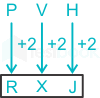
The logic followed here is:

For, DAK : FCM

Similarly, for PVH : 

Hence, the correct answer is "Option 3".

66

Sound waves with frequency greater than________  are called ultrasound.

  1. ((a))

    2 kHz

  2. ((b))

    0.2 kHz

  3. ((c))

    20 kHz

  4. ((d))

    20 Hz

Show Answer
Answer: ((c))

20 kHz

  • Sound waves with a frequency greater than 20 kHz are called ultrasound.
  • Our ears cannot hear sounds of frequencies lower than 20 Hz and higher than 20,000 Hz (20 kHz). Sound with a frequency smaller than 20 Hz is called infrasound.
  • Dogs, mice, bats, dolphins, etc have a special ability to hear ultrasonic sounds. They can also produce ultrasound waves.
67

Which of the following salts will give an aqueous solution having pH of almost 7?

(i) NH4Cl

(ii) Na2CO3

(iii) K2SO4

  1. ((a))

    Both (i) and (ii)

  2. ((b))

    Only (ii)

  3. ((c))

    Only (i)

  4. ((d))

    Only (iii)

Show Answer
Answer: ((d))

Only (iii)

The correct answer is Only (iii).

Key Points

  • The salt which will give an aqueous solution having pH of almost 7 is K2SO4.
  • K2SO4 is a neutral salt as it is formed by the combination of a strong base (KOH) and a strong acid (H2SO4).
  • K2SO4 will not affect the pH of the aqueous solution as it does not produce any H+ or OH- ions.
  • K2SO4 is used as a fertilizer in agriculture as it provides essential nutrients to the plants.

Additional Information

  • The keyword mentioned in the question is pH, which is a measure of the acidity or basicity of a solution.
  • NH4Cl is commonly used as a buffer in laboratory experiments as it can maintain a constant pH in the solution.
  • NH4Cl is an acidic salt as NH4+ ion is acidic in nature and it will produce H+ ions in aqueous solution, resulting in a lower pH.
  • Na2CO3 is a basic salt as CO32- ion is basic in nature and it will produce OH- ions in aqueous solution, resulting in a higher pH.
  • Na2CO3 is used in the manufacturing of glass, detergents, and paper as it can act as a cleaning agent due to its basic nature.
68

The phenotypic ratio in the F2 generation is ________.

  1. ((a))

    1 : 2 : 3

  2. ((b))

    9 : 3 : 3 : 1

  3. ((c))

    1 : 3 : 3 : 9

  4. ((d))

    1 : 2 : 5

Show Answer
Answer: ((b))

9 : 3 : 3 : 1

The correct answer is 9 : 3 : 3 : 1

Key Points

  • The phenotypic ratio in the F2 generation is  9 : 3 : 3 : 1.
  • In the F2 generation of Mendel's dihybrid cross, the phenotypic ratio is 9:3:3:1 but here 9 and 1 represent the parental types i.e., they show the parental phenotype but 3 and 3 represent the recombinants i.e., showing one character of one parent and the other character of another parent.
  • So, the phenotypic ratio of recombinants is 3:3 i.e., 1:1.

Additional Information

  • A monohybrid cross is a mating between individuals who have different alleles at one genetic locus of interest.
  • In a monohybrid cross, the pure breed tall and dwarf homozygous plants were crossed.
  • The result of F1 generation explains the Law of Dominance while that of F2 explains the Law of segregation.
  • The F1 generation being all tall despite being heterozygous explains the dominant feature of the allele ‘T’ over ‘t’ of the gene T/t.
  • The fact that none of the parents of the F2 were dwarf, yet the dwarf plant was obtained in F2 explains that in a heterozygous individual, both the different alleles segregate from each other while gamete formation.
69

Rocket works on the principle of conservation of:

  1. ((a))

    Force

  2. ((b))

    Momentum

  3. ((c))

    Velocity

  4. ((d))

    Mass

Show Answer
Answer: ((b))

Momentum

The correct answer is Momentum.

CONCEPT:

  • Conservation of Momentum: According to this principle, in an isolated system, the vector sum of linear momenta of all bodies of a system is conserved and is not affected due to their mutual action and reaction.
  • If two bodies of different masses collide with each other and there is no external force acted on it then,

The initial momentum of bodies = Final momentum of bodies

​EXPLANATION:

  • In a rocket, gasses at high temperatures and pressure are created by the combustion of fuel.
  • They escape with a high constant velocity via a nozzle.
  • The large, backward momentum of the gasses gives the rocket an equal forward momentum.
  • However, due to the decrease in the mass of the rocket fuel system, the acceleration of the rocket continues to increase.
  • Thus a rocket works on the principle of conservation of Momentum. So option 2 is correct.
  • Since the energy of the rocket's fuel converts into heat energy that propels the rocket. So the energy of the rocket only is not conserved. The energy of the rocket and the surrounding will be conserved but not of the rocket.
  • Similarly, the mass of the rocket decreases as the fuel burns. So mass is not conserved.
  • There is no rotation in the rocket so no meaning of spin angular momentum here.
70

The double stranded structure of DNA was first described by which of the following scientists?

  1. ((a))

    Crick & Watson

  2. ((b))

    Singer & Nicholson

  3. ((c))

    Urey & Miller

  4. ((d))

    Harshey & Chase

Show Answer
Answer: ((a))

Crick & Watson

Explanation:

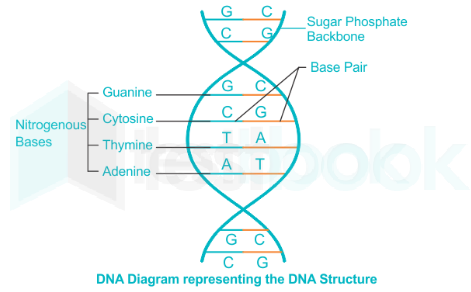
  • The double-stranded structure of DNA was first described by Crick & Watson.
  • They proposed a scheme in 1953 that says DNA is a semi-conservative double-helical structure.
  • Some of the salient features of the Watson & Crick double-helical model are:
  1. It is made of two polynucleotide chains, where the backbone is constituted by sugar-phosphate, and the bases project inside.
  2. The two chains have antiparallel polarity. It means if one chain has the polarity 5', the other has 3'.
  3. The bases in two strands are paired through hydrogen bonds (H-bonds) forming base pairs (bp).
  4. Adenine forms two hydrogen bonds with Thymine from the opposite strand and vice-versa. Similarly, Guanine is bonded with Cytosine with three H-bonds.
  5. As a result, always a purine comes opposite to pyrimidine. This generates an approximately uniform distance between the two strands of the helix
  6. The two chains are coiled in a right-handed fashion. The pitch of the helix is 3.4 nm (a nanometre is one-billionth of a metre, that is 10-9 m) and there are roughly 10 bp in each turn Consequently, the distance between a bp in a helix is approximately 0.34 nm.
  7. The plane of one base pair stacks over the other in a double helix. This, in addition to H-bonds, confers stability of the helical structure

Additional Information

  • Singer and Nicholson proposed the fluid mosaic model in the year 1972.
  • This is the latest and most widely accepted model for the cell membrane.
  • According to it, proteins are arranged in the phospholipid bilayer as the mosaic pattern. Thus the membrane is termed as ''protein iceberg floating in a sea of phospholipid'' or Gulab jamun (protein) in a concentrated solution (phospholipid) of sugar.
  • Hershey and Chase conducted experiments on bacteriophage to prove that DNA is the genetic material.
  • S.L. Miller & H.C. Urey provided experimental evidence of chemical evolution.
71

What is the major product when ethanol reacts with potassium dichromate (K2Cr2O7) in an acidic medium?

  1. ((a))

    Ethanal

  2. ((b))

    Ethene

  3. ((c))

    Ethyl ethanoate

  4. ((d))

    Ethanoic acid

Show Answer
Answer: ((d))

Ethanoic acid

The correct answer is Ethanoic acid.

Key Points

  • When ethanol (C2H5OH) reacts with potassium dichromate (K2Cr2O7) in an acidic medium, it undergoes oxidation.
  • Potassium dichromate in the presence of acid acts as a strong oxidizing agent.
  • The primary alcohol ethanol is first oxidized to ethanal (acetaldehyde), which is further oxidized to ethanoic acid (acetic acid).
  • This two-step oxidation process results in the formation of ethanoic acid as the major product.

Additional Information

  • Ethanol (C2H5OH):
  • Ethanol, commonly known as alcohol, is a volatile, flammable, colorless liquid with a slight characteristic odor.
  • It is used in alcoholic beverages, as a solvent, and as a fuel.
  • Potassium Dichromate (K2Cr2O7):
  • Potassium dichromate is a common inorganic chemical reagent, mostly used as an oxidizing agent in various laboratory and industrial applications.
  • In the presence of acid, it acts as a strong oxidizing agent and can oxidize primary alcohols to carboxylic acids.
  • Oxidation Reactions:
  • Oxidation involves the loss of electrons or an increase in the oxidation state of a molecule, atom, or ion.
  • In organic chemistry, oxidation often involves the addition of oxygen to a compound or the removal of hydrogen.
  • Ethanoic Acid (CH3COOH):
  • Ethanoic acid, also known as acetic acid, is a colorless liquid organic compound with the chemical formula CH3COOH.
  • It is the main component of vinegar and has a distinctive sour taste and pungent smell.
  • Ethanoic acid is widely used in the production of synthetic fibers, plastics, food additives, and as a chemical reagent in laboratories.

The correct answer is Option 2.

72

Which of the following gases is the most harmful to the ozone layer? 

  1. ((a))

    Carbon dioxide 

  2. ((b))

    Chlorofluorocarbon

  3. ((c))

    Nitrogen oxide 

  4. ((d))

    Sulphur dioxide 

Show Answer
Answer: ((b))

Chlorofluorocarbon

  • Chlorofluorocarbon gas is the most harmful to the ozone layer. There are three most harmful gases which may destroy ozone layer namely - Chlorofluorocarbons, Hydrochlorofluorocarbons and Halons.
  • Chlorofluorocarbons contain carbon, chlorine, and fluorine. These compounds react with the ozone layer in the stratosphere and cause the ozone to decrease.
  • It allows more alpha rays from the sun to reach the surface of the earth which may lead to skin cancer.
73

Which among the following is a genetic disease?

  1. ((a))

    Naru

  2. ((b))

    Haemophilia

  3. ((c))

    Leprosy

  4. ((d))

    Measles

Show Answer
Answer: ((b))

Haemophilia

The correct answer is Haemophilia.

Concept-

  • Genetic disorders may be grouped into two categories – Mendelian disorders and Chromosomal disorders.
  • Mendelian disorders are mainly determined by alteration or mutation in a single gene.
  • These disorders are transmitted to the offspring on the same lines as we have studied in the principle of inheritance.
  • The pattern of inheritance of such Mendelian disorders can be traced in a family by the pedigree analysis.

Explanation

  • The most common and prevalent Mendelian disorders are Haemophilia, Cystic fibrosis, Sickle-cell anemia, Colour blindness, Phenylketonuria, Thalassemia, etc.
  • Haemophilia is a sex-linked recessive disease, which shows its transmission from unaffected carrier female to some of the male progeny has been widely studied.
  • In this disease, a single protein that is a part of the cascade of proteins involved in the clotting of blood is affected.
  • Due to this, in an affected individual, a simple cut will result in non-stop bleeding.
  • The heterozygous female (carrier) for hemophilia may transmit the disease to sons.
  • The possibility of a female becoming hemophilic is extremely rare because the mother of such a female has to be at least carrier and the father should be hemophilic (unviable in the later stage of life).
  • The family pedigree of Queen Victoria shows a number of hemophilic descendants as she was a carrier of the disease.

Therefore Haemophilia is a genetic disease.

Additional InformationLeprosy

  • Leprosy is a chronic infectious disease caused by Mycobacterium leprae. Leprosy is also known as Hansen’s disease.
  • Symptoms of Leprosy includes-
  • Skin lesions with loss of sensation to pin pick
  • The skin over the affected areas appear less pigmented than the surrounding skin
  • Thickened nerves
  • Positive skin smears.

Measles

  • Measles is a highly contagious viral disease.
  • It is one of the leading causes of death among children all over the world.
  • Symptoms of Measles includes
  • Red and watery eyes
  • Dry hacking cough and sore throat
  • Runny nose
  • Conjunctivitis
  • Tiny white spots inside the mouth

Naru / Bala

  • Naru or Bala is caused by white thread-like roundworms.
  • Cyclops is the microbe responsible for it.
  • It is transmitted through water.
  • Boils on the skin, fever are its symptoms.
74

Which of the following is used in cough syrups?

  1. ((a))

    Ethanol

  2. ((b))

    Propanol 

  3. ((c))

    Butanol

  4. ((d))

    Texanol 

Show Answer
Answer: ((a))

Ethanol

The correct answer is Ethanol.

Key Points

  • Ethanol (C2H5OH) is used in cough syrups and tonics because it is a very good solvent.
  • Ethanol (also called ethyl alcohol, grain alcohol, drinking alcohol, spirits, or simply alcohol) is an organic chemical compound. It is a simple alcohol with the chemical formula C2H5OH.
  • Ethanol is a volatile, flammable, colorless liquid with a slight characteristic odor. It is a psychoactive substance recreational drug and an active ingredient in alcoholic drinks.
  • Ethanol, often in high concentrations, is used to dissolve many water-insoluble medications and related compounds. Liquid preparations of pain medications, cough, and cold medicines, and mouthwashes, for example, may contain up to 25% ethanol and may need to be avoided in individuals with adverse reactions to ethanol such as alcohol-induced respiratory reactions.
  • Ethyl alcohol is used in cough syrups and tonics for the cure of respiratory and cough-related diseases.
  • Because of its high solubility, ethanol is used in cough syrups and tonics.

Additional Information Butanol:-

  • 1-Butanol, also known as butan-1-ol or n-butanol, is a primary alcohol with the chemical formula C₄H₉OH and a linear structure.
  • Isomers of 1-butanol are isobutanol, butan-2-ol and tert-butanol. The unmodified term butanol usually refers to the straight-chain isomer.
  • It is used as a solvent for fats, waxes, shellacs, resins, gums, and varnish, in making hydraulic fluids, and in medications for animals. determine potentially hazardous exposures.

 Propanol:-

  • Propan-1-ol is a primary alcohol with the formula CH₃CH₂CH₂OH and is sometimes represented as PrOH or n-PrOH. It is a colorless liquid and an isomer of 2-propanol.
  • Most commonly propanol is used as a solvent or it is used to produce other solvents such as antifreeze, lacquer formulations, soaps, dye solutions, window cleaners, and more.
  • Compounds of propanol like isopropanol or isopropyl alcohol are most commonly used in the printing industry and in printing ink.

 Texanol:-

  • It is an ideal choice as a retarder solvent for use in coil coatings and high-bake enamels.
  • Its unique balance of properties also makes it useful for a variety of chemical specialty applications such as ore flotation/frothing, oil-drilling muds, wood preservative carriers, and floor polishes.
75

What is the SI unit of temperature?

  1. ((a))

    Fahrenheit

  2. ((b))

    Centigrade

  3. ((c))

    Rankine

  4. ((d))

    Kelvin

Show Answer
Answer: ((d))

Kelvin

Explanation:

Celsius scale:

  • In this scale, a lower fixed point (ice point) is taken and the upper fixed point (steam point) is taken 100°.
  • The temperature measured on this scale all in degree celsius (°C).

Fahrenheit scale:

  • This scale of temperature has a lower fixed point at 32° F and an upper fixed point at 212° F.
  • The change in temperature of 1° F corresponds to a change of less than 1° on the Celsius scale.

Kelvin scale:

  • The Kelvin temperature scale is also known as the thermodynamic scale. The triple point of water is also selected to be the zero of the scale of temperature.
  • The temperatures measured on this scale are in Kelvin (K).
  • The S.I unit of temperature is Kelvin.

Note:

  • The Kelvin is the primary unit of temperature but is often used in conjunction with the Celsius degree, which has the same magnitude. Therefore option 1 is correct.
  • The definition implies that absolute zero (0 K) is equivalent to −273.15 °C.

All these temperatures are related to each other by the following relationship:

(\frac{{F - 32}}{9} = \frac{C}{5} = \frac{{K - 273}}{5})

76

What causes hydrophobia?

  1. ((a))

    Rabies virus

  2. ((b))

    Bacteria

  3. ((c))

    Acute virus

  4. ((d))

    Varroa virus

Show Answer
Answer: ((a))

Rabies virus

  • Rabies virus causes hydrophobia that is the condition of extreme or irrational fear of water, especially as a symptom of rabies in humans.
  • Rabies virus transmitted through the saliva of infected animals like dogs, cats, etc. to humans.
  • The virus can affect the body in one of two ways:
  1. It enters the peripheral nervous system (PNS) directly and migrates to the brain.
  2. It replicates within muscle tissue, where it is safe from the host’s immune system. From here, it enters the nervous system through the neuromuscular junctions.
  • Early vaccination is the only way to prevent rabies.
  • There are two types of vaccine one is Anti-Rabies Serum and another one is Anti-Rabies Vaccine.
77

The unit of surface tension is

  1. ((a))

    same as unit of force

  2. ((b))

    energy per unit area

  3. ((c))

    force per unit length

  4. ((d))

    dimensionless

Show Answer
Answer: ((c))

force per unit length

Explanation: 

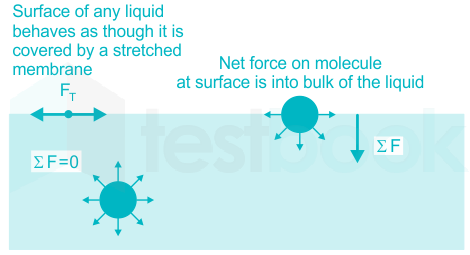
Surface Tension:

  • It is defined as force per unit length in the plane of the liquid surface at right angles to either side of an imaginary line drawn to the surface.
  • Mathematically,

(Surface;Tension = \frac{{Force}}{{Length}})

  • It is the tendency of the liquid surface to shrink into a minimum surface area.
  • The SI Unit of surface tension is N m-1
  • It allows insects to float and slide on the water surface, usually more dense than water
  • The molecules at the surface have unbalanced force rather than molecules at deeper and the resultant force moves downward this is surface tension.

Work done in increasing the surface area

We know that, Work (W) = Force (F) × Displacement (d)

∴ W = σ × L × Δx

∴ W = σ × (B × Δx) = σ × (change in Surface Area)

(\therefore \sigma =\frac{Work}{ChangeinSurface~area})

So, from here, The unit of Surface tension is energy per unit area

78

Which of the following chemicals is used in photography?

  1. ((a))

    Aluminium hydroxide

  2. ((b))

    Potassium nitrate

  3. ((c))

    Sodium chloride

  4. ((d))

    Silver bromide

Show Answer
Answer: ((d))

Silver bromide

The correct answer is Silver bromide.

Key Points

  • Silver bromide (AgBr) is a light-sensitive compound used in photographic films and papers.
  • When exposed to light, silver bromide decomposes to form metallic silver, which creates an image.
  • It has been a crucial component in traditional black and white photography.
  • Silver bromide crystals are suspended in a gelatin emulsion that coats photographic films and papers.

Additional Information

  • Photographic Process
  • Photography relies on the light-sensitive properties of silver halides, such as silver bromide.
  • When light hits the silver bromide crystals on the photographic film, it causes a chemical reaction that creates a latent image.
  • This latent image is then developed using a series of chemical baths that convert the exposed silver bromide into metallic silver, making the image visible.
  • The film is then fixed to remove any unreacted silver bromide, ensuring the image is permanent and does not degrade over time.
  • Other Chemicals in Photography
  • Aluminium hydroxide: Mainly used as an antacid and in water purification, not used in photography.
  • Potassium nitrate: Used in fertilizers, food preservation, and fireworks, not relevant to photography.
  • Sodium chloride: Common table salt, used in various applications including food and de-icing, not used in photography.
  • Modern Digital Photography
  • With the advent of digital photography, the use of silver bromide has significantly decreased.
  • Digital cameras use electronic sensors to capture images, which are then stored as digital files.
  • Despite this, silver bromide is still used in certain artistic and specialized photographic processes.
79

The element, which has zero electron affinity in the 3rd period is -

  1. ((a))

    Al 

  2. ((b))

    Ar 

  3. ((c))

    S

  4. ((d))

    P

Show Answer
Answer: ((b))

Ar 

The correct answer is Ar

Key Points

  • Argon (Ar) is the element in the 3rd period of the periodic table that has zero electron affinity.
  • Electron affinity is the energy change that occurs when an electron is added to a neutral atom in the gaseous state to form a negative ion.
  • Noble gases like Argon have a complete valence shell, making them stable and unlikely to gain an electron, hence their electron affinity is zero.
  • Other elements in the 3rd period such as Aluminum (Al), Sulfur (S), and Phosphorus (P) have non-zero electron affinity.

Additional Information

  • Electron Affinity generally becomes more negative as you move from left to right across a period, indicating a greater tendency to gain electrons.
  • The 3rd period of the periodic table includes elements from Sodium (Na) to Argon (Ar).
  • Elements with high electron affinity tend to form anions more readily.
  • Noble gases, including Argon, are characterized by their lack of chemical reactivity due to their filled valence electron shells.
  • Understanding electron affinity is crucial in predicting the chemical behavior of elements.
80

Electrolysis of aq. NaCl produces 

  1. ((a))

    Acidity

  2. ((b))

    Alkalinity

  3. ((c))

    1 & 2 both

  4. ((d))

    None

Show Answer
Answer: ((b))

Alkalinity

Concept: -

  • Electrolysis of sodium chloride is an important process to manufacture many bulk chemicals of commercial utility like chlorine, sodium hydroxide, etc.
  • During the electrolysis of aqueous NaCl solution, at the cathode, hydrogen is obtained from water, and at the anode, chlorine is obtained from NaCl.
  • The over-voltage required for the formation of oxygen is much larger than that required for the formation of chlorine.
  • Hence, chlorine gas is liberated in the electrolysis of aqueous NaCl.

Explanation: -

  • The electrolysis of an aqueous solution of sodium chloride (NaCl) gives three products.
  • They are sodium hydroxide (NaOH), Chlorine gas, and hydrogen gas.
  • Reaction: 2NaCl + 2H2O → 2NaOH + H2 + Cl2​
  • We know, that NaOH is a base.

Conclusion: -

Electrolysis of aq. NaCl produces Alkalinity.

Hence, the correct option is (2).

81

Which river is not related to Chambal water flow?

  1. ((a))

    Banas River

  2. ((b))

    Parvati River

  3. ((c))

    Kalisindh River

  4. ((d))

    Jakham River

Show Answer
Answer: ((d))

Jakham River

The tributaries of the Chambal include ShipraKalisindh, Banas, Parbati, Seep, Kuwari, Kuno, Alniya, etc.

Key Points

  • The Chambal River, called Charmanvati in ancient times, is the largest of the rivers flowing through Rajasthan State.
  • This is a major tributary of the Yamuna which is 960 km long.
  • Located in Central India, the river comprises a significant portion of the Greater Gangetic Drainage System.
  • The Chambal River runs according to a north-to-northeasterly itinerary through Madhya Pradesh
  • It creates the border between Madhya Pradesh and Rajasthan prior to twisting to the southeast to meet the Yamuna in the state of Uttar Pradesh.

Thus, the Jakham River is not a tributary river of the Chambal River and hence does not related to it.

82

Lata Mangeshkar was born at which of the following place?

  1. ((a))

    Nagpur

  2. ((b))

    Indore

  3. ((c))

    Bhopal

  4. ((d))

    Mumbai

Show Answer
Answer: ((b))

Indore

The correct answer is Indore

Key Points

Lata Mangeshkar:

  • Lata Mangeshkar, also known as the 'Nightingale of India', is one of the most versatile singers in the Indian film industry.
  • Lata was born on September 28, 1929, to classical singer and theatre artist Pandit Deenanath Mangeshkar and Shevanti in Indore, Madhya Pradesh.  Hence statement 2 is correct.
  • She has worked with several legendary music directors including Madan Mohan, R D Burman, the duo Laxmikant-Pyarelal and A R Rahman.
  • Lata Mangeshkar has received several awards and accolades during her eight-decade-long career.
  • In 1974, she became the first Indian to perform at the Royal Albert Hall.
  • She is the recipient of three National Film Awards, 15 Bengal Film Journalists' Association Awards, four Filmfare Best Female Playback Awards, two Filmfare Special Awards, Filmfare Lifetime Achievement Awards and many more.
  • Lata Mangeshkar was bestowed with the Dadasaheb Phalke Award in 1989.
  • In 2001, she was awarded the Bharat Ratna, India's highest civilian honour.
83

Which National Waterway is associated with the Brahmaputra River? 

  1. ((a))

    National Waterway 1 

  2. ((b))

    National Waterway 3

  3. ((c))

    National Waterway 2

  4. ((d))

    National Waterway 5

Show Answer
Answer: ((c))

National Waterway 2

The correct answer is National Waterway 2.

Key Points

  • National Waterway 2 (NW-2) is a 891 km long stretch on the Brahmaputra River in Assam.
  • This waterway extends from Dhubri to Sadiya in the state of Assam.
  • It was declared as National Waterway 2 in 1988 under the National Waterways Act.
  • NW-2 is significant for the transportation of cargo and passengers, contributing to the economic development of the region.

Additional Information

  • National Waterways in India:
  • India has a total of 111 National Waterways declared under the National Waterways Act, 2016.
  • These waterways are intended to promote and develop inland water transport.
  • Inland Water Transport:
  • It is a mode of transport where goods and passengers are transported via navigable rivers, canals, and backwaters.
  • This mode of transportation is cost-effective and environmentally friendly.
  • Significance of NW-2:
  • NW-2 serves as a major waterway for trade and commerce in the Northeast region of India.
  • It plays a crucial role in the transportation of tea, coal, petroleum products, and other goods.
  • Challenges:
  • Challenges such as seasonal variations in water levels and the need for regular dredging impact the effectiveness of inland water transport.
  • Infrastructure development and maintenance are critical for the efficient operation of these waterways.
84

Karishma Yadav was awarded the Vikram Award 2019 for ______ by the Government of Madhya Pradesh.

  1. ((a))

    hockey

  2. ((b))

    shooting

  3. ((c))

    archery

  4. ((d))

    swimming

Show Answer
Answer: ((a))

hockey

The correct answer is Hockey.

Key Points

  • International hockey player Karishma Yadav has received the Vikram Award from the Madhya Pradesh government for excellence in sports.
  • Chief Minister Shri Chouhan felicitated players and coaches with Vikram, Eklavya, Vishwamitra, and Lifetime Achievement Award at Madhya Pradesh Shikhar Khel Alankaran Samaroh 2019 in Minto Hall.
  • Olympian hockey player Shri Inam-ur-Rehman of Bhopal was honoured with the Life Time Achievement Award of 2019.

Additional Information

  • For the year 2020, 13 Eklavya, 10 Vikram, 3 Vishwamitra, 1 Late Prabhash Joshi, and 1 Lifetime Achievement Award have been announced by the Madhya Pradesh government.
  • The Lifetime Achievement Award for the year 2020 will be given to Padma Shri Abhay Chhajlani, while Olympic hockey player of the state Vivek Sagar will be awarded the state's best Vikram Award.
  • The list of persons announced for the year 2020 state-level sports awards is as follows-
  • Eklavya Award:
  • Individual Category - Sushma Verma, Kayaking-Canoeing (Sehore), Tushita Singh, Soft Tennis (Bhopal), Sparsh Khare, Wushu (Jabalpur), Arjun Singh, Horse Riding (Bhopal), Sunil Davar, Athletics (Barwani), Gauranshi Sharma, Badminton (Divyang) (Bhopal), Rammilan Yadav, Sailing (Tikamgarh), Ankit Sharma, Fencing (Gwalior), Anuradha Ahirwar, Archery (Bhopal), Preeti Rajak, Shooting (Hoshangabad), Shashank Patel, Taekwondo (Bhopal).
  • Group Category – Sadhna Sengar, Hockey (Hoshangabad) and Dhruvraj Kurre, Powerlifting (Bhopal).
  • Vikram Award:
  • Individual Category - Vishwajit Singh, Canoe-Slalom (Hoshangabad), Sunidhi Chauhan, Shooting (Bhopal), Nidhi Nanhet, Karate (Balaghat), Paridhi Joshi, Horse Riding (Indore), Manju Bamboria, Boxing (Ujjain), Ekta Yadav, Sailing (Bhopal). Party Sports - Vivek Sagar Prasad, Hockey (Hoshangabad), Harshvardhan Tomar, Basketball (Gwalior), Pooja Malviya, Mallakhamb (Ujjain).
  • Divyang Category - Prachi Yadav, Para Canoe (Gwalior).
  • Vishwamitra Award:
  • Individual Category – Virendra Dabas, Para Swimming and Para Athletics (Gwalior) and Richpal Singh Salaria, Archery (Jabalpur).
  • Group Category - Dr. Habib Hassan is involved.
  • Lifetime Achievement Award: Abhay Chhajlani, Padma Shri, and former President Indore Table Tennis Association.
  • Late Prabhas Joshi Sports Award: Vaishnavi Kahar, Mallakhamb (Ujjain).
85

The Indore-Manmad Rail Project will connect Madhya Pradesh to which Indian state?

  1. ((a))

     Gujarat

  2. ((b))

     Maharashtra

  3. ((c))

    Rajasthan

  4. ((d))

    Chhattisgarh

Show Answer
Answer: ((b))

 Maharashtra

The correct answer is option 2

Key Points

  • The Indore-Manmad Rail Project will link Indore in Madhya Pradesh with Manmad in Maharashtra.
  • The Indore-Manmad railway line will cover 309 km, out of which 170 km falls in Madhya Pradesh and 139 km in Maharashtra.
  • It will improve rail connectivity between Central India and Western India.
86

Gwalior, Bhind, Morena, Sheopur-Kala, and Shivpuri are which type of Agro-climatic Zone of Madhya Pradesh?

  1. ((a))

    Vindhya Plateau

  2. ((b))

    Central Narmada Valley

  3. ((c))

    Kymore Plateau & Satpura Hills

  4. ((d))

    Gird Region

Show Answer
Answer: ((d))

Gird Region

The correct answer is Gird Region.

Key Points

  • Agro-Climatic Regions and Crop Zones in M.P.
  • | Sr. | AGRO-CLIMATIC REGIONS | SOIL TYPE | DISTRICTS COVERED | | --- | --- | --- | --- | | 1. | Chattisgarh plains | Red & Yellow(Medium) | Balaghat. | | 2. | Northern Hill Regionof Chhattisgarh | Red & Yellow Medium black & skeletal(Medium/light) | Shahdol, Mandla, Dindori, Anuppur, Sidhi(Partly), Umaria. | | 3. | Kymore Plateau & Satpura Hills | Mixed red and black soils(Medium) | Rewa,Satna,Panna,Jabalpur,Seoni, Katni, Sidhi (except Singroli tehsil ). | | 4. | Central Narmada Valley | Deep black (deep) | Narsinghpur, Hoshangabad Sehore(Partly), Raisen(Partly). | | 5. | Vindhya Plateau | deep black(Medium/Heavy) | Raisen(except Bareli Teh.),Sehore(except Budni Teh.),Guna(Partly). | | 6. | Gird Region | Alluvial (Light) | Gwalior, Bhind, Morena, Sheopur-Kala, Shivpuri,(except Pichore, Karera, Narwar, Khania- dana Teh.), Guna(except Aron, Raghogarh, Chachoda Tehsil) Ashoknagar. Hence, Option 4 is correct. | | 7. | Bundelkhand | Mixed red and black(Medium) | Chhattarpur,Datia,Tikamgarh, & Shivpuri(Partly) | | 8. | Satpura Plateau | Shallow black (Medium) | Betul & Chhindwara | | 9. | Malwa Plateau | Medium Black (Medium) | Mandsaur, Neemuch, Ratlam, Ujjain, Dewas, Indore, Shajapur, Rajgarh & Dhar (Partly) Jhabua(Partly) | | 10. | Nimar Plains | Medium Black (Medium) | Khandwa, Burhanpur, Khargone, Barwani, Harda, Dhar (Partly) District. | | 11. | Jhabua Hills | Medium black skeletal (Light/Medium) | Jhabua District. (except Petlawad Tehsil) & Dhar (Partly). |

87

Which state topped the medal tally at the Khelo India Youth Games 2025?

  1. ((a))

    Haryana

  2. ((b))

    Maharashtra

  3. ((c))

    Rajasthan

  4. ((d))

    Karnataka

Show Answer
Answer: ((b))

Maharashtra

The correct answer is Maharashtra.

In News

  • Maharashtra topped the medal tally at the Khelo India Youth Games 2025 with 158 medals (58 gold, 47 silver).

Key Points

  • Maharashtra topped the medal tally with 158 medals, including 58 gold and 47 silver, at the Khelo India Youth Games 2025.
  • Haryana secured the second position with 117 medals, followed by Rajasthan with 60 medals.
  • Uttar Pradesh won the gold medal in boys' basketball, while Karnataka clinched the gold in girls' basketball.

Additional Information

  • Khelo India Youth Games
  • India's premier national sporting event for youth, aimed at encouraging sports and identifying talent across the country.
  • The games provide a platform for young athletes to showcase their skills in various sports disciplines.
  • Closing Ceremony
  • The Khelo India Youth Games 2025 concluded with a grand and colorful ceremony held at the Pataliputra Sports Complex, Patna.
  • Basketball Achievements
  • Uttar Pradesh and Karnataka's victory in boys' and girls' basketball showcased their strength in the sport.
88

Which of the following waterfall is not on Narmada river?

  1. ((a))

    Keoti

  2. ((b))

    Mandhar

  3. ((c))

    Dardi

  4. ((d))

    Kapil Dhara

Show Answer
Answer: ((a))

Keoti

The correct answer is Keoti.

  • Keoti waterfall is in Mahan Nadi.
  • It is located in the Sirmaur of Rewa district in Madhya Pradesh.

Key Points

  • Other major waterfalls in Rewa are:
  • Purva on Tons river.
  • Bahuti on the Sellar river.
  • Chachai on Beehar river.

Important Points

  • Major waterfalls on the Narmada river are:
  • Mandhar near Handia-Barwah.
  • Dardi near Khandwa.
  • Kapil Dhara in Amarkantak.
  • Dhunadhar in Jabalpur.
  • Sahastra Dhara near Khargaon.
89

One of the 12 Jyotirlingas in India is present in ________ in Madhya Pradesh.

  1. ((a))

    Rewa

  2. ((b))

    Ujjain

  3. ((c))

    Sagar

  4. ((d))

    Indore

Show Answer
Answer: ((b))

Ujjain

The correct answer is Ujjain.

Key Points

  • One of the 12 Jyotirlingas in India is present in Ujjain in Madhya Pradesh
  • ​It is known as the Mahakaleshwar Jyotirlinga and is dedicated to Lord Shiva.
  • It is on the banks of river Shipra.
  • Madhya Pradesh has two Jyotirlingas, the other being Omkareshwar Jyotirlinga which is located in Mandhata.

Additional Information 

JyotirlingaState
SomnathGujarat
MallikarjunaAndhra Pradesh
Vaijnath/VaidyanathJharkhand
KedarnathUttarakhand
NageshwarGujarat
TriambakeshwarMaharashtra
BhimashankarMaharashtra
RameshwarTamil Nadu
GrishneshwarMaharashtra
Kashi VishwanathUttar Pradesh
90

In which year the novel of Bankim Chandra Chatterjee "Anandmath" was published?

  1. ((a))

    1880 A.D.

  2. ((b))

    1882 A.D.

  3. ((c))

    1896 A.D.

  4. ((d))

    1888 A.D.

Show Answer
Answer: ((b))

1882 A.D.

The correct answer is: '1882 A.D.'.)

Key Points

  • Publication of "Anandmath":
  • Bankim Chandra Chatterjee's novel "Anandmath" was first published in 1882.
  • "Anandmath" is considered one of the most important works of Bankim Chandra Chatterjee and is set during the Sannyasi Rebellion in the late 18th century.
  • The novel played a significant role in the Indian independence movement, particularly through its song "Vande Mataram," which became a patriotic anthem.

Incorrect Options

  • 1880 A.D.:
  • This year is incorrect as "Anandmath" was published two years later, in 1882.
  • 1896 A.D.:
  • This year is incorrect as "Anandmath" was published earlier, in 1882.
  • 1888 A.D.:
  • This year is incorrect as "Anandmath" was published six years earlier, in 1882.

Additional Information

  • About Bankim Chandra Chatterjee:
  • Bankim Chandra Chatterjee, also known as Bankim Chandra Chattopadhyay, was a prominent Indian novelist, poet, and journalist.
  • He is often considered one of the greatest writers in Bengali literature and is best known for his works that inspire nationalism and patriotism.
  • Significance of "Vande Mataram":
  • "Vande Mataram," the song from "Anandmath," became a symbol of the Indian independence movement and was later adopted as the national song of India.
  • The song was composed in Sanskrit and Bengali and was a source of inspiration for many freedom fighters.
91

With which of the following organisations was Henry Louis Vivian Derozio, a teacher of Hindu College of Calcutta, associated?

  1. ((a))

    Paramahansa Mandali

  2. ((b))

    Sree Narayana Dharma Paripalana Yogam

  3. ((c))

    Rahnumai Mazdayasan Sabha

  4. ((d))

    Young Bengal Movement

Show Answer
Answer: ((d))

Young Bengal Movement

The Correct answer is Young Bengal Movement.

Key Points

  • Henry Louis Vivian Derozio, a teacher at Hindu College, Calcutta, is considered the founder of the Young Bengal Movement.
  • The movement was started in the early 19th century in Bengal and was inspired by the ideals of the French Revolution and the principles of rationality, liberty, and freedom of thought.
  • Derozio and his followers, known as the Derozians, emphasized secularism, scientific thinking, and social reform.
  • The movement criticized the orthodox and superstitious practices prevalent in Indian society at that time.
  • The members of the Young Bengal Movement were noted for their efforts to promote education, women's rights, and freedom of expression.
  • Derozio encouraged his students to question established norms and adopt a more progressive and liberal outlook.
  • The movement played a pivotal role in shaping the social and intellectual awakening that later became part of the Bengal Renaissance.
  • Though the movement faced criticism for being too radical and failed to achieve widespread popularity, its legacy lies in its contribution to the modernization of Indian society.

Additional Information

  • Paramahansa Mandali
  • The Paramahansa Mandali was a secret socio-religious group founded in 1849 in Bombay (Mumbai).
  • It worked to promote monotheism and challenged caste discrimination and idol worship.
  • The members were inspired by Vedantic philosophy and aimed to bring about social reform, particularly in areas such as women’s rights and untouchability.
  • Sree Narayana Dharma Paripalana Yogam
  • Founded in 1903 in Kerala, this organization was established by Sree Narayana Guru.
  • It aimed to promote social equality, education, and the upliftment of marginalized communities.
  • The organization is known for its slogan: "One Caste, One Religion, One God for Man."
  • Rahnumai Mazdayasan Sabha
  • It was a reformist Zoroastrian organization founded in 1851 in Bombay (Mumbai) by prominent Parsi leaders.
  • The Sabha aimed to bring reforms to Parsi religious practices and worked for the educational and social advancement of the Parsi community.
92

Tropic of Cancer does not passes through ?

  1. ((a))

    Ujjain

  2. ((b))

    Jabalpur

  3. ((c))

    Indore

  4. ((d))

    Bhopal

Show Answer
Answer: ((c))

Indore

The correct answer is Indore.

Key Points

  • The Tropic of Cancer (23 1/2 degrees) bisects MP in almost two parts- North MP and South MP.
  • The tropic of cancer is almost parallel to the river Narmada and passes through the following 14 districts of M.P - Shahdol, Umaria, Katni, Jabalpur, Damoh, Sagar, Raisen, Vidisha, Bhopal, Sehore, Rajgarh, Agar, Ujjain and Ratlam.

Important Points

  • There are 17 countries(Including Taiwan) through which the tropic of cancer passes.
  • The tropic of cancer is the only latitude pass through India.
  • The tropic of cancer passes through 8 Indian states.
  • Gujarat.
  • Rajasthan.
  • Madhya Pradesh.
  • Chhatisgarh.
  • Jharkhand.
  • West Bengal.
  • Tripura.
  • Mizoram.
  • Mahi River is the only river in India that passes the tropic of cancer twice.
93

Who has been appointed as Congo's first female prime minister amid escalating violence in the country's eastern region?

  1. ((a))

    Albele Ndele

  2. ((b))

    Ngozi Okonjo Iweala

  3. ((c))

    Judith Suminwa Tuluka

  4. ((d))

    Palumba Lumumba

Show Answer
Answer: ((c))

Judith Suminwa Tuluka

The correct answer is Judith Suminwa Tuluka

In News

  • Judith Suminwa Tuluka has been appointed as Congo's first female prime minister.

Key Points

  • She aims to address the worsening violence in the eastern region bordering Rwanda.
  • Tuluka's appointment comes amidst a long-standing conflict involving over 120 armed groups.
  • The violence has displaced millions and poses a significant humanitarian crisis.
  • She pledges to work towards peace and development in her role.

Additional Information

  • The Democratic Republic of the Congo is a country in Central Africa.
  • By land area, the DRC is the second-largest country in Africa and the 11th-largest in the world.
  • With a population of around 112 million, the Democratic Republic of the Congo is the most populous Francophone country in the world.
  • Capital: Kinshasa
  • Official language: French
  • Currency: Congolese Franc
94

According to the history, who established Gwalior?

  1. ((a))

    Rana Singh

  2. ((b))

    Samrat Ashok

  3. ((c))

    King Vikramaditya

  4. ((d))

    Suraj Sen

Show Answer
Answer: ((d))

Suraj Sen

The Correct Answer is Suraj Sen.

  • According to history, Suraj Sen established Gwalior.
  • According to a legend, Gwalior was founded in 8 A.D., after a local chieftain, Suraj Sen, was healed of leprosy from a drink supplied to him by a holy man named Gwalip. Subsequently, Suraj set up a town and fort and called them after Gwalip.
  • He constructed a palace within the fort called "Gwalior" after the sage, and eventually, the town that developed around the fort took the same name.
  • The river, from which Suraj Sen quenched his thirst later, was also known as Swarnrekha Nadi.
  • Gwalior is a major town in the central Indian state of Madhya Pradesh and one of the Counter-Magnet towns.

Key Points

  • The Gurjara-Pratihara dynasty ruled Gwalior around the 9th century, and during their reign, they founded the Telika Mandir temple.
  • Gwalior was attacked in 1021 by forces led by Mahmud Ghazni, but they were repulsed.
  • Chaturbhuj Temple at Gwalior Fort claims the very first occurrence of zero as a written number in the world.
  • Gwalior is a major town in the central Indian state of Madhya Pradesh and one of the Counter-Magnet towns.
95

Which among the following is the longest National Highway(NH) in Uttar Pradesh?

  1. ((a))

    NH 9

  2. ((b))

    NH 19

  3. ((c))

    NH 27

  4. ((d))

    NH 35

Show Answer
Answer: ((b))

NH 19

The correct answer is NH 19

  • The old Name of NH 19 was NH 2.
  • It was also a part of the GT road.
  • NH 2 was from Delhi to Kolkata.
  • The total length of National highways in Uttar Pradesh is 11,737 km.
  • About National Highway:
  • The Ministry of Road Transport and Highways is primarily responsible for the development and maintenance of National Highways (NH).
  • These highways are constructed for inter-state movements of goods and passengers.
  • They traverse the length and width of the country connecting the National and State capitals, major ports and rail junctions and link up with border roads and foreign highways.
  • The Central Government may, by notification in the Official Gazette, declare any other highway to be a national highway.
  • The length of the National Highway in the state of Maharashtra is 17,757 km, which is the longest length among the states.
  • The total length of National highways in India is 132,500 km.
National HighwayPlacesLength (Km.)
New NameOld Name
192Agra - Firozabad - Shikohabad - Sirsaganj - Jaswantnagar - Etawah - Sarai - Muradganj - Sikandra - Rasdhan - Bara - Sachendi - Kanpur - Moharajganj - Aung - Fatehpur - Haswa - Sat Narain - Khaga - Palhana - Kaushambi - Allahabad - Saidabad - Handia - Gopiganj - Mirza Murad - Varanasi - Chandauli - Saiyad Raja - Bihar border655.2
924, 87Delhi Border - Ghaziabad - Hapur - Rajabpur - Didauli - Pakbara - Moradabad - Rampur -Bilaspur - Uttrakhand Border147.6
272, 3, 8B,  8A, 15, 14, 76, 25, 28, 29, 57, 31, 31D, 31C, 37, 36 & 54MP Border - Jhansi - Baragaon - Ghirgaon - Amargarh - Moth - Pirauna - Orai - Usargaon - Kalpi - Bara - Kanpur - Unnao - Ajgain - Lucknow.Bara Banki - Ramsanehighat - Faizabad - Haraiya - Basti - Khalilabad - Piprauli - Gorakhpur - Hata - Kasia - Fazilnagar - Pawanagar - Tamkuhi - Bihar Border581.0
3576Kabrai- Banda - Khuhand - Attarra - Badausa - Karwi - Raipura -Mau - Shankargarh - Bara - Jasra - Allahabad - Naini - Astabhuja - Mirzapur629.2
96

The Fourth Schedule of the Indian Constitution deals with which of the following?

  1. ((a))

    Allotment of seats in the State Legislative Council

  2. ((b))

    Allotment of seats in Rajya Sabha

  3. ((c))

    Allotment of seats in Lok Sabha

  4. ((d))

    Allotment of seats in the State Legislative Assembly

Show Answer
Answer: ((b))

Allotment of seats in Rajya Sabha

The correct answer is Allotment of seats in Rajya Sabha.

Key Points

  • The Fourth Schedule of the Indian Constitution deals with the Allotment of seats in Rajya Sabha from each state and some union territory.
  • According to Article 80 of the Indian Constitution, the potential sitting capacity of the Rajya Sabha is 250 (238 elected, 12 appointed).
  • Uttar Pradesh has the maximum number of 31 seats in the Rajya Sabha.
  • Only three Union Territories of Delhi (3 seats), Jammu and Kashmir (4 seats), and Puducherry (1 seat) have Rajya Sabha seats.

Additional Information

Schedule of the Indian ConstitutionSubject Matter
First ScheduleNames of the States and Union Territories with their territorial jurisdiction.
Second ScheduleProvisions relating to the emoluments, allowances, privileges.
Third ScheduleForms of Oaths or Affirmations.
Fourth ScheduleAllocation of seats in the Rajya Sabha to the states and the union territories.
Fifth ScheduleProvisions relating to the administration and control of scheduled areas and scheduled tribes.
Sixth ScheduleProvisions relating to the administration of tribal areas in the states of Assam, Meghalaya, Tripura, and Mizoram.
Seventh ScheduleDivision of powers between the Union and the States in terms of List I (Union List), List II (State List), and List III (Concurrent List).
Eighth ScheduleLanguages recognized by the Constitution.
Ninth ScheduleActs and Regulations of the state legislatures dealing with land reforms and the abolition of the zamindari system and of the Parliament dealing with other matters.
Tenth ScheduleProvisions relating to disqualification of the members of Parliament and State Legislatures on the ground of defection.
Eleventh ScheduleSpecifies the powers, authority, and responsibilities of Panchayats.
Twelfth ScheduleSpecifies the powers, authority, and responsibilities of Municipalities.

Shortcut Trick

  • Nemonic for twelve schedules of Indian constitution:
  • 'TEARS OF OLD PM'
  • Territory, Emolument, Affirmation, Rajya sabha seat allocation, Schedule Area, Other schedule areas, Federal division of tasks, Official languages, Land reforms, Defection, Panchayat raj, Municipality.
97

Bhimbetka rock shelters are located in which of the following districts of Madhya Pradesh?

  1. ((a))

    Ratlam

  2. ((b))

    Chhatarpur

  3. ((c))

    Raisen

  4. ((d))

    Guna

Show Answer
Answer: ((c))

Raisen

The correct answer is Raisen.

Key Points

  • The Rock Shelters of Bhimbetka is located in the Raisen District of Madhya Pradesh.
  • It is located near Abdullaganj town and inside the Ratapani Wildlife Sanctuary (Southern edge of Vindhya Range).
  • It was declared a UNESCO World Heritage Site in 2003.

Additional Information

  • Bhimbetka was discovered by archaeologist V S Wakankar in 1957.​
  • It was one of the oldest paintings in India and the world.
  • The Bhimbetka rock shelters are an archaeological site of the Paleolithic age.
  • These cave paintings show tremendous similarity to the aboriginal rock paintings of the Savanna regions of Australia, the paintings done by pygmies of the Kalahari Desert, and the Paleolithic Lascaux cave paintings of France.
98

Which of the following is correct about Chief Minister Shivraj Singh Chouhan?

  1. He holds the portfolio of the Department of General Administration, Public Relations, Narmada Valley Department, and Aviation.
  2. He was elected from the Budhni constituency.
  3. He is the longest-serving Chief Minister of the state.
  1. ((a))

    1 and 2 

  2. ((b))

    2 and 3

  3. ((c))

    1 and 3 

  4. ((d))

    All of the Above

Show Answer
Answer: ((d))

All of the Above

The correct answer is All of the Above.

Key Points

  • Shivraj Singh Chouhan:
  • Chief Minister Shivraj Singh Chouhan is a member of the Legislative Assembly from Budhni, a town in the Sehore district of Madhya Pradesh.
  • He is the longest-serving CM of the state.
  • He took oath as the CM of Madhya Pradesh for the 4th time on March 23, 2020.
  • Newly joined, former Member of Parliament Jyotiraditya Scindia was elected from the Guna constituency.
  • He is a candidate of the BJP for the 2020 Indian Rajya Sabha elections from Madhya Pradesh
  • He handles the Department of General Administration, Public Relations, Narmada Valley Department, Aviation, and the departments not allotted to any other Minister.

99

By Rajasthan and Madhya Pradesh (Transfer of Territories) Act, 1959, some territory of which of the following districts of Rajasthan was transferred to Mandsaur district of Madhya Pradesh?

  1. ((a))

    Kota

  2. ((b))

    Chittorgarh

  3. ((c))

    Pratapgarh

  4. ((d))

    Baran

Show Answer
Answer: ((b))

Chittorgarh

The correct answer is - Chittorgarh

Key Points

  • Rajasthan and Madhya Pradesh (Transfer of Territories) Act, 1959
  • This Act was enacted to reorganize boundaries and transfer certain territories between the states of Rajasthan and Madhya Pradesh.
  • It aimed to address administrative and geographical challenges by realigning district borders.
  • Chittorgarh District
  • Under the provisions of this Act, parts of the Chittorgarh district in Rajasthan were transferred to Mandsaur district in Madhya Pradesh.
  • This adjustment was based on factors like proximity, administrative convenience, and integration of contiguous areas.
  • Mandsaur District
  • Mandsaur district, located in the northwestern part of Madhya Pradesh, received specific territories from Rajasthan as per the Act.
  • It shares its border with Rajasthan, making the transfer of certain areas from Chittorgarh logical for governance purposes.

Additional Information

  • Chittorgarh
  • Chittorgarh is a historic district in Rajasthan, known for the Chittorgarh Fort, a UNESCO World Heritage Site.
  • The district was geographically vast, which led to administrative considerations for transferring some parts to Madhya Pradesh.
  • Interstate Transfers
  • India has witnessed several boundary reorganizations between states under the States Reorganization Act, 1956 and subsequent legislations like the Rajasthan and Madhya Pradesh (Transfer of Territories) Act, 1959.
  • Such transfers aim to improve administrative efficiency, address local grievances, and ensure better governance.
  • Mandsaur District's Characteristics
  • Mandsaur is known for its opium production and ancient temples such as the Pashupatinath Temple.
  • The integration of territories from Rajasthan enhanced its administrative and cultural diversity.
100

Which city launched India’s first digital house address project?

  1. ((a))

    Indore

  2. ((b))

    Surat

  3. ((c))

    Pune

  4. ((d))

    Bhopal

Show Answer
Answer: ((a))

Indore

The Correct Answer is Indore.

In News

  • Indore Launches India's First Digital House Address Project With QR Codes.

Key Points

  • Indore Municipal Corporation (IMC) has launched a digital house address project — claimed to be India’s first of its kind.
  • The project includes installing digital plates with unique QR codes outside every house.
  • It was launched as a pilot project in Ward 82, Sudama Nagar, Indore.
  • The QR code can be scanned with a mobile phone to access the house’s GPS-based digital address.
  • It enables payment of local taxes like property tax and water tax.
  • Citizens can also use it to lodge complaints regarding civic amenities.
  • The project aims to enhance smart governance by integrating citizen services with digital technology.

Attempt this paper under real exam conditions

Timed interface, section switching, instant scoring, and question-by-question analytics — free.

Start Timed Attempt