Official Paper

MP Excise Constable Memory Based Paper (Held On: 13th and 14th September 2025) (Previous Year Paper)

100 questions · 120 minutes · with answers · free

Test (100 questions)

1

What is the solution of the following equations ?

2x + 3y = 12 and 3x − 2y = 5

  1. ((a))

    x = 3, y = 2

  2. ((b))

    x = 2, y = 3

  3. ((c))

    x = −2, y = 3

  4. ((d))

    x = 3, y = −2

Show Answer
Answer: ((a))

x = 3, y = 2

Shortcut Trick

The fastest way to solve systems of linear equations is to verify the given options.

Check Option (1): x = 3, y = 2

In 2x + 3y = 12: 2(3) + 3(2) = 6 + 6 = 12 (Satisfied)

In 3x − 2y = 5: 3(3) − 2(2) = 9 − 4 = 5 (Satisfied)

Since both equations are satisfied, Option (1) is the correct solution.

∴ The correct answer is x = 3, y = 2.

Alternate Method

Given Equations:

2x + 3y = 12 ... (i)

3x − 2y = 5 ... (ii)

Method Used: Elimination Method

⇒ To eliminate y, multiply equation (i) by 2 and equation (ii) by 3:

⇒ 2 × (2x + 3y = 12) → 4x + 6y = 24 ... (iii)

⇒ 3 × (3x − 2y = 5) → 9x − 6y = 15 ... (iv)

⇒ Add equations (iii) and (iv):

⇒ (4x + 9x) + (6y − 6y) = 24 + 15

⇒ 13x = 39

⇒ x = 39 ÷ 13 = 3

⇒ Substitute x = 3 into equation (i):

⇒ 2(3) + 3y = 12

⇒ 6 + 3y = 12

⇒ 3y = 12 − 6 = 6

⇒ y = 6 ÷ 3 = 2

∴ The correct answer is x = 3, y = 2.

Additional Information

Nature of Solutions for a1x + b1y = c1 and a2x + b2y = c2

A unique solution exists if a1/a2 ≠ b1/b2. No solution exists if a1/a2 = b1/b2 ≠ c1/c2 (parallel lines). Infinite solutions exist if a1/a2 = b1/b2 = c1/c2 (coincident lines).

Cramer's Rule

For a system of equations, x = Dx/D and y = Dy/D, where D is the determinant of coefficients and Dx, Dy are determinants replaced by constants.

Substitution Method

Solve one equation for one variable (e.g., x = (12 − 3y)/2) and substitute it into the other equation to find the value of the second variable.
2

A number is tripled and 6 is added to it. If the resultant is doubled it becomes 54. What is the original number?

  1. ((a))

    14

  2. ((b))

    7

  3. ((c))

    10

  4. ((d))

    5

Show Answer
Answer: ((b))

7

Given:

A number is tripled and 6 is added to it

Calculation:

Let, the original number = x

According to the question,

⇒ (3x + 6) × 2 = 54

⇒ 3x + 6 = 27

⇒ 3x = 21

⇒ x = 7

3

The sum of interior angle of a regular polygon is 1440° , then the number of sides is:

  1. ((a))

    8

  2. ((b))

    10

  3. ((c))

    12

  4. ((d))

    6

Show Answer
Answer: ((b))

10

The sum of the interior angles of a regular polygon of n-sides = (n – 2) × 180°

⇒ 1440 = (n – 2) × 180°

⇒ 8 = n – 2

⇒ n = 10

∴ The regular polygon has 10 sides. This is known as a decagon

4

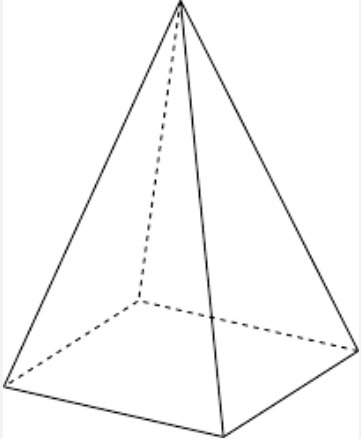
A rectangular pyramid has 5 vertices and 8 edges. How many faces does it have?

  1. ((a))

    1

  2. ((b))

    5

  3. ((c))

    3

  4. ((d))

    7

Show Answer
Answer: ((b))

5

Given : 

Number of vertices of rectangular pyramid = 5

Number of edges of rectangular pyramid = 8

Formula used:

Using Euler's Formula : F + V - E = 2

Where F = Face, V = Vertices and E = Edge

Calculation:

F + V - E = 2

⇒ F + 5 - 8 = 2

∴ Number of face = 5

5

Ram sold his car in Rs. 60000 and he gets 50% profit. Then, what will be the selling price if he is sold his car at 40% profit?

  1. ((a))

    Rs 56,000

  2. ((b))

    Rs 60,000

  3. ((c))

    Rs 50,000

  4. ((d))

    Rs 55,000

Show Answer
Answer: ((a))

Rs 56,000

Shortcut Trick

SP1 at 50% profit ⇒ 150% of CP = 60,000

1% of CP = 60,000 ÷ 150 = 400

Desired SP2 at 40% profit ⇒ 140% of CP

SP2 = 400 × 140 = 56,000

∴ The correct answer is Rs 56,000.

Alternate Method

Given: SP1 = Rs 60,000, Profit1 = 50%, New Profit = 40%

Formula: CP = [SP × 100] / [100 + Profit%]

CP (100%) SP2 (140%) SP1 (150%) +50% Profit +40% Profit Rs 60,000 Rs 56,000

⇒ CP = (60,000 × 100) / (100 + 50)

⇒ CP = 6,000,000 ÷ 150 = Rs 40,000

⇒ New SP = CP × (100 + 40) / 100

⇒ New SP = 40,000 × (140 ÷ 100)

⇒ New SP = 40,000 × 1.4 = Rs 56,000

∴ The correct answer is Rs 56,000.

Additional Information

Cost Price (CP) and Selling Price (SP)

Cost Price is the price at which an item is bought, and Selling Price is the price at which it is sold. Profit occurs when SP > CP.

Profit Percentage Formula

Profit % = [(SP − CP) ÷ CP] × 100. It is always calculated on the Cost Price unless specified otherwise.

Successive Selling Prices

If SP1 at P1% is known, then SP2 at P2% can be found as: SP2 = [SP1 ÷ (100 + P1)] × (100 + P2).

6

On selling two items each at Rs 1250, the trader makes an overall profit of 25 percent. If the cost price of one item was Rs. 900, what was the cost price of the other?

  1. ((a))

    Rs. 1100

  2. ((b))

    Rs. 1250

  3. ((c))

    Rs. 1000

  4. ((d))

    Rs. 1200

Show Answer
Answer: ((a))

Rs. 1100

Given:

The selling price of each item = Rs 1250

Profit = 25%

Cost price = Rs 900

Formula used:

Profit = S.P - C.P

S.P = (100 + P%)/100 × C.P

Calculation:

The selling price of each item = Rs 1250

Profit = 25%

The cost price of one item = Rs 900

Let the cost price of other item be x

Total cost price = (900 + x)

Total selling price = Rs 2500

S.P = (100 + P%)/100 × C.P

S.P = [(100 + 25%)/100 × (900 + x)]

⇒ S.P = [(125/100) × (900 + x)]

⇒ 2500 = (5/4) × (900 + x)

⇒ 2000 = 900 + x

⇒ x = 1100

∴ The cost price of other item is Rs 1100.

Alternate Method

Concept used:

C.P = S.P × 100/(100 + P%)

Where,

C.P → Cost price 

S.P →  Selling price 

P% → Profit% 

Calculations:

Total cost price of both the articles = 1250 × 2 = 2500

Total cost price = 2500 × 100/125 = Rs. 2000

The cost price of second item = Total cost price – Cost price of the first item 

⇒ 2000 – 900 = 1100

∴ The cost price of the second item is Rs. 1100

7

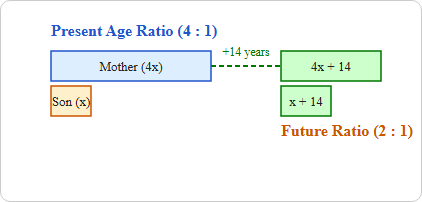
The ratio of the present ages of a mother and a son is 4 : 1 Fourteen years from now, the ratio of their ages will be 2 : 1. The present age (in years) of the mother is:

  1. ((a))

    32

  2. ((b))

    36

  3. ((c))

    28

  4. ((d))

    24

Show Answer
Answer: ((c))

28

Shortcut Trick

Equate the ratio difference by making the age gap constant between the mother and son.

Present Ratio = 4 : 1 (Gap = 3 units) | Future Ratio (after 14 years) = 2 : 1 (Gap = 1 unit).

Multiply the future ratio by 3 to equalize gaps: Future Ratio = 6 : 3.

Increase in units for Mother = 6 − 4 = 2 units → 2 units = 14 years → 1 unit = 7 years.

Present age of Mother = 4 units × 7 = 28 years.

∴ The correct answer is 28 years.

Alternate Method

Given:

Present age ratio (Mother : Son) = 4 : 1

Ratio after 14 years = 2 : 1

Calculations:

Let the present age of the Mother be 4x and the Son be x.

⇒ According to the question, after 14 years:

⇒ (4x + 14) / (x + 14) = 2 / 1

⇒ 4x + 14 = 2 × (x + 14)

⇒ 4x + 14 = 2x + 28

⇒ 4x − 2x = 28 − 14

⇒ 2x = 14

⇒ x = 7

⇒ Present age of Mother = 4x = 4 × 7 = 28 years.

∴ The correct answer is 28 years.

Additional Information

Constant Age Difference

The numerical difference between the ages of two persons always remains constant, regardless of how many years pass.

Ratio Balancing Method

To solve age problems quickly, multiply the ratios by the difference of the other ratio to ensure the unit change is consistent with the time elapsed.

Cross-Product Method

For a ratio a:b becoming c:d after x years, use the formula: 1 unit = [x × (c − d)] / [(a × d) − (b × c)].

8

The ages of A and B are in the ratio 2 : 5. Eight years later, the ratio of their ages will be 22 : 43. Their present ages are (in years):

  1. ((a))

    14, 35

  2. ((b))

    16, 40

  3. ((c))

    18, 45

  4. ((d))

    20, 50

Show Answer
Answer: ((a))

14, 35

Given - 

Ratio of present age of A and B is 2 : 5

After 8 year ratio becomes 22 : 43

Solution - 

Let the present age be 2x and 5x.

⇒ After 8 year

⇒ ages of A and B become (2x + 8) and (5x + 8)

⇒ According to question,

⇒ {(2x + 8)/(5x + 8)} = 22/43

⇒ 86x + 43 × 8 = 110x + 22 × 8

⇒ 110x - 86x = 8 × (43 - 22)

⇒ 24x = 168

⇒ x = 7

⇒ present age of A = 2x = 14 year 

⇒ present age of B = 5x = 35 year

∴ present ages of A and B be 14 year and 35 year.

9

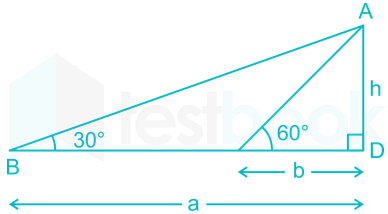
What is the height of the tower, if angles of elevation from two points at distances a and b (a > b) from its foot and in the same straight line are 30° and 60° respectively?

  1. ((a))

    (\sqrt {a - b})

  2. ((b))

    (\sqrt {\frac{a}{b}})

  3. ((c))

    (\sqrt {ab})

  4. ((d))

    (\sqrt {b - a})

Show Answer
Answer: ((c))

(\sqrt {ab})

In Δ ABD:

tan 30° = h/a

1/√3 = h/a   ---(i)

In Δ ACD:

tan 60° = h/b

√3 = h/b---(ii)

From (i) and (ii)

We get: h2 = a × b

h = √(ab)

10

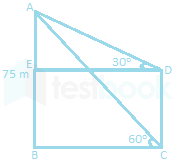
From the top of a building 75 meters high, the angle of depression of the top and bottom of a tower are observed to be 30° and 60°. The height of the tower in meters is

  1. ((a))

    60

  2. ((b))

    65

  3. ((c))

    50

  4. ((d))

    55

Show Answer
Answer: ((c))

50

The given information can be represented diagrammatically as follows.

Where,

AB is the height of the building and CD is the height of the tower.

In ΔABC,

tan 60o = AB/BC

⇒ BC = 75/√3 = 25√3 m

In ΔAED,

tan 30o = AE/ED

⇒ 1/√3 = AE/25√3        (∵ BC = ED = 25√3 m)

⇒ AE = 25 m

Height of the tower = CD = EB = AB – AE = 75 – 25 = 50 m

∴ Height of the tower = 50 m

11

The value of 21 × [(9 - 4) ÷ {(8 ÷ 8 of 4) + (4 ÷ 4 of 2)}] is:

  1. ((a))

    140

  2. ((b))

    80

  3. ((c))

    100

  4. ((d))

    20

Show Answer
Answer: ((a))

140

Given:

21 × [(9 - 4) ÷ {(8 ÷ 8 of 4) + (4 ÷ 4 of 2)}]

Concept used:

Calculation:

21 × [(9 - 4) ÷ {(8 ÷ 8 of 4) + (4 ÷ 4 of 2)}]

⇒ 21 × [(9 - 4) ÷ {(8 ÷ 32) + (4 ÷ 8)}]

⇒ 21 × [5 ÷ {1/4 + 1/2}]

⇒ 21 × [5 ÷ 3/4]

⇒ 21 × 20/3

⇒ 140

∴ Required answer is 140

12

Find the value of (162 ÷ 9) ÷ 3 - (343 ÷ 49) ÷ 7.

  1. ((a))

    (\frac{{ - 1}}{7})

  2. ((b))

    5

  3. ((c))

    53

  4. ((d))

    -1

Show Answer
Answer: ((b))

5

Given:

(162 ÷ 9) ÷ 3 - (343 ÷ 49) ÷ 7

Concept used:

Calculation:

(162 ÷ 9) ÷ 3 - (343 ÷ 49) ÷ 7

⇒ 18 ÷ 3 - 7 ÷ 7

⇒ 6 - 1

⇒ 5

∴ The value of (162 ÷ 9) ÷ 3 - (343 ÷ 49) ÷ 7 is 5.

13

Raveena and Suniti have a total of Rs. 127, Suniti and Avinash have Rs. 153, while Avinash and Raveena have Rs. 160. How much money does Raveena have?

  1. ((a))

    Rs. 93

  2. ((b))

    Rs. 60

  3. ((c))

    Rs. 67

  4. ((d))

    Rs. 70

Show Answer
Answer: ((c))

Rs. 67

Shortcut Trick

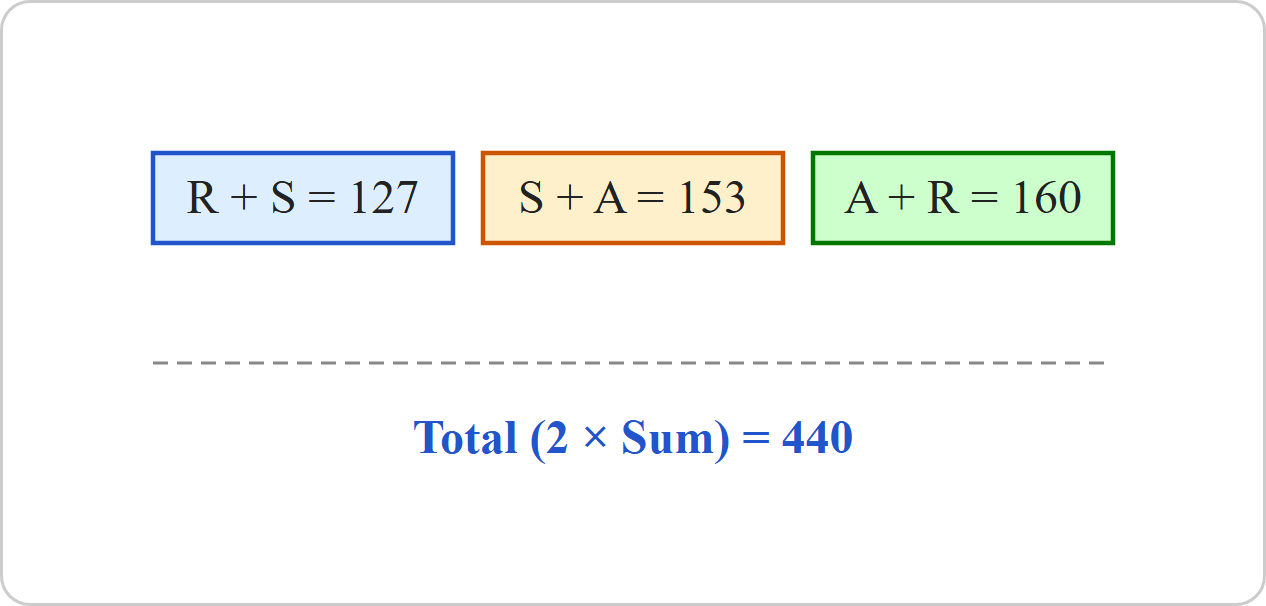
Sum of all pairs = 127 + 153 + 160 = 440.

Sum of individuals (R + S + A) = 440 ÷ 2 = 220.

Raveena's share = (R + S + A) − (Suniti + Avinash) = 220 − 153 = 67.

∴ The correct answer is Rs. 67.

Alternate Method

Given:

Raveena (R) + Suniti (S) = Rs. 127 ---(i)

Suniti (S) + Avinash (A) = Rs. 153 ---(ii)

Avinash (A) + Raveena (R) = Rs. 160 ---(iii)

Adding equations (i), (ii), and (iii):

⇒ 2 × (R + S + A) = 127 + 153 + 160

⇒ 2 × (R + S + A) = 440

⇒ R + S + A = 220 ---(iv)

To find Raveena's money (R), subtract equation (ii) from (iv):

⇒ R = (R + S + A) − (S + A)

⇒ R = 220 − 153

⇒ R = 67

∴ The correct answer is Rs. 67.

Additional Information

Sum of Cyclic Pairs

When sums of pairs like (A+B), (B+C), and (C+A) are given, the individual sum (A+B+C) is always half the total sum of those pairs.

Ratio & Proportion application

Similar logic is used in Time and Work when two people work in pairs. Efficiency of (A+B+C) = (Sum of efficiencies of pairs) ÷ 2.

14

1200 apples were distributed among a group of boys. Each boy got thrice many of the apples as the number of boys in that group. The number of boys in the group was:

  1. ((a))

    15

  2. ((b))

    40

  3. ((c))

    20

  4. ((d))

    25

Show Answer
Answer: ((c))

20

Given:

Apples = 1200

Calculation:

Let the number of boys in the group = m

Now, as per the given statement,

Each boy got 3m apples.

Thus total apples can be equated,

m x 3 x m = 1200

m2 = 400

m = 20

Hence, there was a total of 20 boys in the group.

15

The price of sugar increases by 20% due to the festive season. By what percentage should a family reduce the consumption of sugar so that there is no change in the expenditure?

  1. ((a))

    20%

  2. ((b))

    (8\frac{1}{3}% )

  3. ((c))

    (16\frac{2}{3}%)

  4. ((d))

    (16\frac{1}{3}% )

Show Answer
Answer: ((c))

(16\frac{2}{3}%)

Shortcut Trick

Price increase = 20% = +1/5

To keep the total expenditure constant, consumption must be reduced proportionally.

Reduction in consumption = 1 ÷ (5 + 1) = 1/6

Converting 1/6 to percentage = (1 ÷ 6) × 100 = 16 2/3%

∴ The correct answer is 16 2/3%.

Alternate Method

Given:

Increase in the price of sugar = 20%

Formula Used:

Reduction % = [R ÷ (100 + R)] × 100

(where R is the percentage increase in price)

+20% Price Increase

Reduce Exp. back to 100 Decrease % = (20 ÷ 120) × 100

100 Original Exp.

120 New Exp.

Calculations:

⇒ Let the initial price of sugar be ₹100.

⇒ After a 20% increase, the new price = ₹120.

⇒ Since expenditure must remain the same, the family can only afford sugar worth ₹100 at the new price.

⇒ Required reduction in consumption = 120 − 100 = 20.

⇒ Percentage reduction = (Reduction ÷ New Price) × 100

⇒ Percentage reduction = (20 ÷ 120) × 100

⇒ Percentage reduction = (1 ÷ 6) × 100 = 50 ÷ 3 % = 16 2/3%

∴ The correct answer is 16 2/3%.

Additional Information

AB Rule for Constant Product

If A × B = Constant and A increases by x%, then B must decrease by [x ÷ (100 + x)] × 100% to keep the product unchanged.

Successive Percentage Change

If price changes by a% and consumption by b%, the net change in expenditure is (a + b + ab ÷ 100)%. For constant expenditure, equate this formula to zero to find the unknown.

Common Fraction to Percentage Equivalents

1/5 = 20%, 1/6 = 16 2/3%, 1/7 = 14 2/7%, 1/8 = 12 1/2%. Memorizing these directly saves calculation time in percentage questions.

16

There are 3 students in a group. If the weight of any student is added to the average weight of the other two the sums received are 48 kg, 52 kg, and 59 kg. The average weight (in kg) of the three students is:

  1. ((a))

    27

  2. ((b))

    26.5

  3. ((c))

    27.5

  4. ((d))

    28

Show Answer
Answer: ((b))

26.5

Shortcut Trick

Let the weights of the three students be x, y, and z.

The given conditions are: x + (y+z)/2 = 48, y + (x+z)/2 = 52, and z + (x+y)/2 = 59.

Summing these: (x + y + z) + (2x + 2y + 2z)/2 = 48 + 52 + 59.

⇒ 2 × (x + y + z) = 159.

⇒ Average = (x + y + z) ÷ 3 = 159 ÷ (2 × 3) = 159 ÷ 6 = 26.5 kg.

∴ The correct answer is 26.5 kg.

Alternate Method

Given: Sums of one weight and the average of the other two are 48 kg, 52 kg, and 59 kg.

Let the weights be A, B, and C.

⇒ A + (B + C)/2 = 48 → (2A + B + C) = 96 ... (i)

⇒ B + (A + C)/2 = 52 → (A + 2B + C) = 104 ... (ii)

⇒ C + (A + B)/2 = 59 → (A + B + 2C) = 118 ... (iii)

Adding equations (i), (ii), and (iii):

⇒ (2A + B + C) + (A + 2B + C) + (A + B + 2C) = 96 + 104 + 118

⇒ 4A + 4B + 4C = 318

⇒ 4(A + B + C) = 318

⇒ A + B + C = 318 ÷ 4 = 79.5 kg

⇒ Average weight = (A + B + C) ÷ 3 = 79.5 ÷ 3 = 26.5 kg

∴ The correct answer is 26.5 kg.

Additional Information

Average Weight Concept

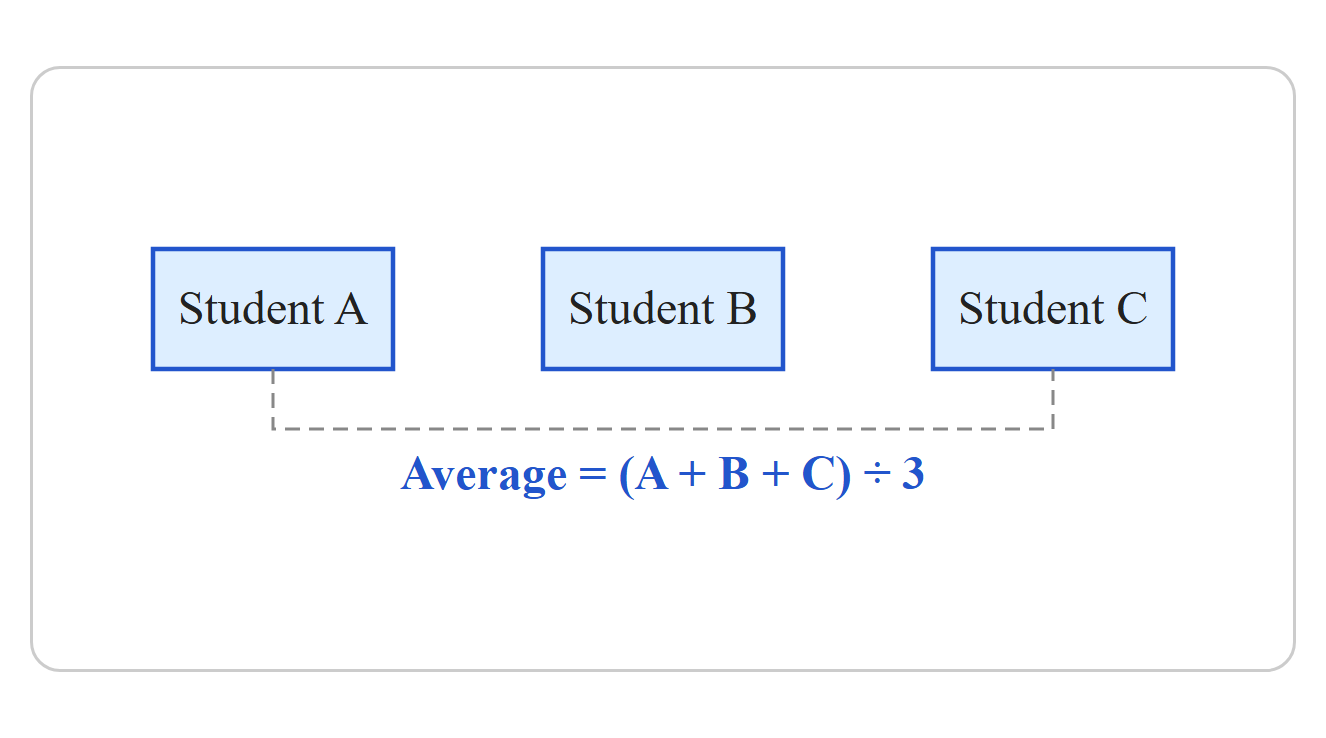
The average of n observations is the sum of observations divided by n. Formula: Average = Sum ÷ n.

Weighted Average

When groups have different sizes, the combined average is (n1A1 + n2A2) ÷ (n1 + n2).

17

Calculate the standard deviation for the following data. 

3, 4, 5, 6, 7

  1. ((a))

    2

  2. ((b))

    (\sqrt{3})

  3. ((c))

    (\sqrt{2})

  4. ((d))

    (\sqrt{6})

Show Answer
Answer: ((c))

(\sqrt{2})

Given:

Data set: 3, 4, 5, 6, 7

Formula used:

Standard Deviation (SD) = √(Σ(x - mean)² / N)

Where,

Σ represents the sum of all values

x is each value in the dataset

mean is the average of the dataset

N is the total number of data points

Calculations:

Step 1: Calculate the mean

Mean = (3 + 4 + 5 + 6 + 7) / 5

Mean = 25 / 5

Mean = 5

Step 2: Calculate the squared differences from the mean

(3 - 5)² = (-2)² = 4

(4 - 5)² = (-1)² = 1

(5 - 5)² = (0)² = 0

(6 - 5)² = (1)² = 1

(7 - 5)² = (2)² = 4

Step 3: Sum of squared differences

Sum = 4 + 1 + 0 + 1 + 4 = 10

Step 4: Divide by the number of data points (N = 5)

Variance = 10 / 5 = 2

Step 5: Take the square root to get the standard deviation

SD = √2

Therefore, the standard deviation is 2.

18

x + 4 = 0 is the equation of a line, which is:

  1. ((a))

    Parallel to x-axis and passing through (0, 4)

  2. ((b))

    Parallel to x-axis and passing through (0, -4)

  3. ((c))

    Parallel to y-axis and passing through (-4, 0)

  4. ((d))

    Parallel to y-axis and passing through (4, 0)

Show Answer
Answer: ((c))

Parallel to y-axis and passing through (-4, 0)

Given:

x + 4 = 0

Calculations:

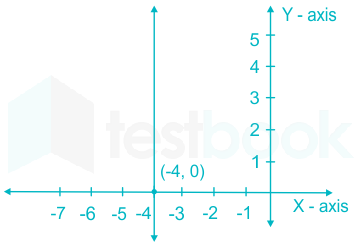
x = – 4

The equation on the graph is as shown below:

The above equation is parallel to y-axis and passes through (-4, 0)

19

If A = {1, 2, 5, 7} and B = {2, 4, 6} then find the number of proper subsets of A U B ?

  1. ((a))

    127

  2. ((b))

    64

  3. ((c))

    63

  4. ((d))

    31

Show Answer
Answer: ((c))

63

CONCEPT:

Union:

Let A and B be two sets. The union of A and B is the set of all those elements which belong to either A or B or both A and B i.e A ∪ B = {x : x ∈ A or x ∈ B}

Note: If A is a non-empty set such that n(A) = m then numbers of proper subsets of A is given by 2m - 1.

CALCULATION:

Given: A = {1, 2, 5, 7} and B = {2, 4, 6}

As we know that,  A ∪ B = {x : x ∈ A or x ∈ B}.

⇒ A ∪ B = {1, 2, 4, 5, 6, 7}

As we can see that, the number of elements present in A U B = 6 i.e n(A U B) = 6

As we know that, if A is a non-empty set such that n(A) = m then numbers of proper subsets of A is given by 2m - 1.

So, the number of proper subsets of A Δ B = 26 - 1 = 63

Hence, the correct option is 3.

20

(x + 6) is a factor of f(x) = x3 + 3x2 + 4x + P then value of P is

  1. ((a))

    42

  2. ((b))

    132

  3. ((c))

    192

  4. ((d))

    82

Show Answer
Answer: ((b))

132

If (x - a) is a factor of p(x), then p(a) = 0.

P(-6) = (- 6)3 + 3(- 6)2 + 4(- 6) + P = 0

⇒ - 216 + 108 - 24 + P = 0

⇒ P = 240 - 108 = 132

∴ P = 132

21

If the zeroes of the quadratic polynomial x2 + (a + 1) x + b are 2 and -3, then -

  1. ((a))

    a = -7, b = -1

  2. ((b))

    a = 5, b = -1

  3. ((c))

    a = 2, b = -6

  4. ((d))

    a = 0, b = -6

Show Answer
Answer: ((d))

a = 0, b = -6

Given:

Zeroes of quadratic polynomial x2 + (a + 1) x + b is 2, - 3.

Calculations:

Sum of zeros, 

2 + (- 3) = - (\dfrac{a + 1}{1})

=> (\dfrac{a + 1}{1}) = 1

=> a + 1 = 1

=> a = 1 - 1

=> a = 0

Again, 2 × (- 3) = b

=> b = - 6

The answer is a = 0, b = - 6

22

The ratio of the monthly incomes of A and B is 11 : 13 and the ratio of their expenditures is 9 : 11. If both of them manage to save Rs. 4,000 per month, then find the difference in their incomes (in Rs.)

  1. ((a))

    4,000

  2. ((b))

    2,500

  3. ((c))

    3,000

  4. ((d))

    3,200

Show Answer
Answer: ((a))

4,000

Shortcut Trick

Income ratio of A and B = 11 : 13

Expenditure ratio of A and B = 9 : 11

Since the difference between the ratio parts for both A and B is equal (11 − 9 = 2 and 13 − 11 = 2), these 2 units represent the savings directly.

2 units = ₹4,000

Difference in their incomes = 13 units − 11 units = 2 units

∴ The correct answer is ₹4,000.

Alternate Method

Given:

Income ratio of A and B = 11 : 13

Expenditure ratio of A and B = 9 : 11

Savings of both A and B = ₹4,000 each

Income A = 11 units

Income B = 13 units

Exp. A = 9 units

Exp. B = 11 units

-2 units = ₹4000

-2 units = ₹4000

Formula Used:

Income − Expenditure = Savings

Calculations:

Let the incomes of A and B be 11x and 13x respectively.

Let their expenditures be 9y and 11y respectively.

⇒ 11x − 9y = 4000 .... (i)

⇒ 13x − 11y = 4000 .... (ii)

Since both equal ₹4,000, we can equate equations (i) and (ii):

⇒ 11x − 9y = 13x − 11y

⇒ 11y − 9y = 13x − 11x

⇒ 2y = 2x

⇒ x = y

Substitute x = y in equation (i):

⇒ 11x − 9x = 4000

⇒ 2x = 4000

⇒ x = 2000

Now, to find the difference in their incomes:

⇒ Difference = 13x − 11x = 2x

⇒ Difference = 2 × 2000 = 4000

∴ The correct answer is ₹4,000.

Additional Information

Income, Expenditure & Savings Relation

The foundational rule for all such problems is: Income = Expenditure + Savings. Any two known variables can be used to find the third.

Ratio Balancing Method

When the difference in ratio parts is not inherently equal across quantities, we balance the ratio gaps by multiplying the first ratio by the difference of the second ratio's terms, and vice versa.

Cross-Multiplication Trick

If an initial ratio a:b changes by quantities x and y to become c:d, then the value of 1 ratio unit can be evaluated instantly using |ad − bc| = |dx − cy|.

23

Find the degree of the polynomial 4x4 + 3x3 + 2x2 + x + 1.

  1. ((a))

    0

  2. ((b))

    1

  3. ((c))

    2

  4. ((d))

    4

Show Answer
Answer: ((d))

4

Given

4x4 + 3x3 + 2x2 + x + 1

Concept

The degree of a polynomial is the highest of the degrees of its individual terms with non-zero coefficients.

Solution

Degree of the polynomial in 4x4 = 4

Degree of the polynomial in 3x3 = 3

Degree of the polynomial in 2x= 2

Degree of the polynomial in x = 1

Hence, the highest degree is 4.

∴ Degree of polynomial = 4

24

A tradesman marks his goods at such a price that after allowing a discount of 31%, he makes a profit of 15%. What is the marked price of an article whose cost price is Rs. 3,420?

  1. ((a))

    ₹5,700

  2. ((b))

    ₹5,200

  3. ((c))

    ₹5,475

  4. ((d))

    ₹5,550

Show Answer
Answer: ((a))

₹5,700

Given:

Discount = 31%,  profit = 15%.

cost price is Rs. 3,420

Formula used:

Market price = ((100+profit) / (100 - discount)) × cost price

Calculation:

As per the question,

The market price will be,

⇒ (100 + 15 / 100 - 31) × 3420

⇒ ₹ 5700

  ∴ The correct option is 1

25

Two trains of equal lengths take 13 seconds and 26 seconds, respectively, to cross a pole. If these trains are moving in the same direction, then how long will they take to cross each other?

  1. ((a))

    40 seconds

  2. ((b))

    50 seconds

  3. ((c))

    39 seconds

  4. ((d))

    52 seconds

Show Answer
Answer: ((d))

52 seconds

Shortcut Trick

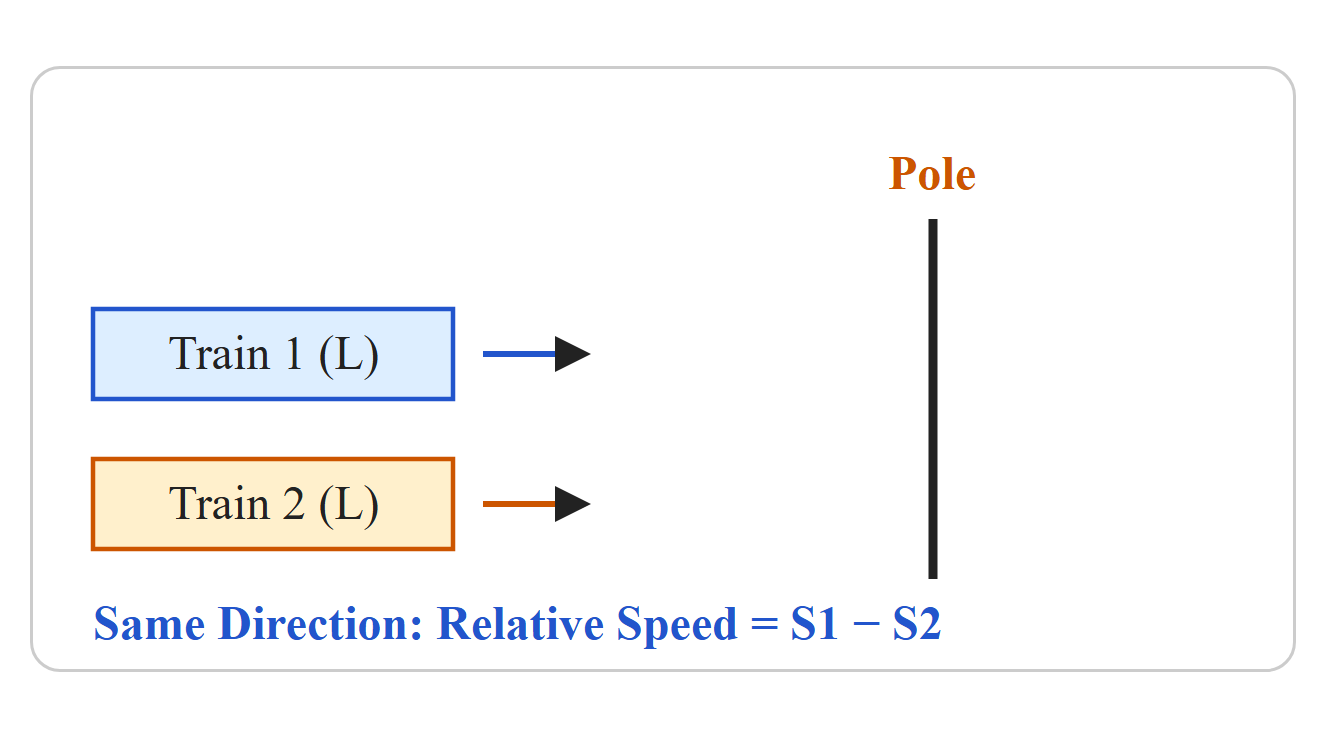
When two trains of equal length cross a pole in t1 and t2 seconds respectively.

Time taken to cross each other in same direction = [2 × t1 × t2] ÷ [t2 − t1]

⇒ Time = [2 × 13 × 26] ÷ [26 − 13]

⇒ Time = [2 × 13 × 26] ÷ 13 = 2 × 26 = 52 seconds.

∴ The correct answer is 52 sec.

Alternate Method

Given:

Length of each train = L (Let LCM of 13 and 26 = 26 units)

Time taken by Train 1 = 13 sec | Time taken by Train 2 = 26 sec

Formula Used:

Speed = Distance ÷ Time | Relative Speed (Same Direction) = S1 − S2

Calculations:

⇒ Let length of each train (L) = 26 m

⇒ Speed of Train 1 (S1) = 26 ÷ 13 = 2 m/s

⇒ Speed of Train 2 (S2) = 26 ÷ 26 = 1 m/s

⇒ Relative Speed = S1 − S2 = 2 − 1 = 1 m/s

⇒ Total distance to cross each other = L + L = 26 + 26 = 52 m

⇒ Time taken = Total Distance ÷ Relative Speed = 52 ÷ 1 = 52 seconds

∴ The correct answer is 52 sec.

Additional Information

Relative Speed in Opposite Direction

When two objects move in opposite directions, their relative speed is the sum of their individual speeds (S1 + S2).

Crossing a Stationary Object

To cross a pole or a person, a train must cover a distance equal to its own length (L). To cross a platform of length P, it must cover (L + P).

Unit Conversion

To convert km/hr to m/s, multiply by 5/18. To convert m/s to km/hr, multiply by 18/5.

26

Find the difference between the simple interest and the compound interest payable annually on a sum of Rs. 6,500 at 7% per annum for 3 years. (Correct to two decimal places.)

  1. ((a))

    Rs. 94.34

  2. ((b))

    Rs. 97.78

  3. ((c))

    Rs. 98.73

  4. ((d))

    Rs. 95.67

Show Answer
Answer: ((b))

Rs. 97.78

Shortcut Trick

For 3 years, the difference between CI and SI is given by: D = P(R/100)2 × (3 + R/100)

Substituting the values: D = 6500 × (7/100)2 × (3 + 7/100)

D = 6500 × (49/10000) × (3.07)

D = 31.85 × 3.07 = 97.7795

Rounding to two decimal places, we get ₹97.78.

∴ The correct answer is ₹97.78.

Alternate Method

Year 0 Year 1 Year 2 Year 3

P = ₹6500

R = 7% p.a. Difference (CI − SI) for 3 Years

Given:

Principal (P) = ₹6,500

Rate (R) = 7% per annum

Time (T) = 3 years

Formula Used:

Difference (D) = P × (R/100)2 × [(300 + R)/100]

Calculations:

⇒ D = 6500 × (7/100)2 × [(300 + 7)/100]

⇒ D = 6500 × (49/10000) × (307/100)

⇒ D = (6500 × 49 × 307) ÷ 1000000

⇒ D = (65 × 49 × 307) ÷ 10000

⇒ D = (3185 × 307) ÷ 10000

⇒ D = 977795 ÷ 10000

⇒ D = ₹97.7795

⇒ D ≈ ₹97.78

∴ The correct answer is ₹97.78.

Additional Information

Difference for 2 years

The difference between CI and SI for 2 years is D = P(R/100)2.

Effective Rate of Compound Interest

For 3 years, the effective CI rate is 3R + 3R2/100 + R3/10000. For R=7%, Effective Rate = 22.5043%.

Relationship between CI and SI

For the first year (if compounded annually), CI = SI. From the second year onwards, CI > SI because interest is earned on interest.

27

The Perimeter of a triangular surface is 144 cm and the sides are in the ratio 3 ∶ 4 ∶ 5. The cost of painting the surface at the rate of Rs. 5/cm2, is

  1. ((a))

    Rs. 4200

  2. ((b))

    Rs. 4320

  3. ((c))

    Rs. 3980

  4. ((d))

    Rs. 3850

Show Answer
Answer: ((b))

Rs. 4320

Given:

Perimeter = 144 cm

Sides = 3 : 4 : 5

Rate = Rs. 5/cm2 

Concept used: 

Perimeter = sum of all sides

Area = ( \dfrac{1}{2} ) x base x height

Calculation:

Let's, take the three sides = 3m, 4m and 5m respectively.

⇒ 3m + 4m + 5m = 144

⇒ 12m = 144

⇒ m = 12

Three sides will be  

⇒ Hypotenuse = 5m = 5 x 12 = 60 cm

⇒ Height = 4m = 4 x 12 = 48 cm

⇒ Base = 3m = 3 x 12 = 36 cm

⇒ Area = (1/2) x 48 x 36

⇒ 24 x 36

⇒ 864 cm2 

⇒ Total cost = 5 x 864

⇒ 4320 Rs.

∴ The cost of painting the surface at the rate of Rs. 5/cm2, is Rs. 4320.

28

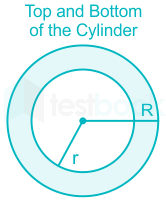
The total surface area of a hollow metal cylinder, open at both ends of external radius 6 cm and height 8 cm, is 200 π cm2. The thickness of the metal in the cylinder is

  1. ((a))

    3 cm

  2. ((b))

    5 cm

  3. ((c))

    4 cm

  4. ((d))

    2 cm

Show Answer
Answer: ((d))

2 cm

Given :

Total surface area of hollow cylinder (T.S.A) = 200 π cm2

External radius(R) = 6 cm

Height of cylinder(h) = 8 cm

Formula used :

T.S.A = (2\pi h(r+R)+2\pi(R^2-r^2))

Calculation :

(200\pi = 2\pi\times 8(6+r)+2\pi(36-r^2))

⇒  (200 = 16(6+r)+2(36-r^2))

⇒ (r^2-8r+16=0)

On solving the equation, we get

r = 4,4

Thickness of the metal in cylinder = 6 - 4  = 2 cm

∴ The answer is 2 cm .

29

Surface area of a sphere is 28 cm2. If the sphere is divided into two hemispheres, then the total surface area of one of the hemispheres is

  1. ((a))

    35 cm2

  2. ((b))

    27 cm2

  3. ((c))

    29 cm2

  4. ((d))

    21 cm2

Show Answer
Answer: ((d))

21 cm2

Given:

Surface area of a sphere is 28 cm2

Formula Used:

We know that the curved surface area of the sphere = 4πr

Surface area of hemisphere = 3πr2 

Calculation:

⇒ 4 × (\frac{22}{7}) × r= 28

⇒ r2 = (\frac{28× 7}{88} )

⇒ r2 = (\frac{49}{22} )

Since, if this sphere is divided into two hemispheres, then total surface area of one hemisphere = 3πr2

⇒ 3 × (\frac{22}{7}) × (\frac{49}{22} ) 

⇒ 21 cm2

Hence, option 4 is correct answer.

30

In a panchayat election, there were two candidates A and B. Candidate A got 42% of the votes and lost to B by 8000 votes. What is the total number of votes? 

  1. ((a))

    30000

  2. ((b))

    3000

  3. ((c))

    5000

  4. ((d))

    50000

Show Answer
Answer: ((d))

50000

Given data:

Candidate A's vote share = 42%

Difference in votes between candidates A and B = 8000 votes

Concept:

The difference between the votes of the two candidates can be expressed as a percentage of the total votes.

Solution:

Candidate B's vote share = 100% - 42% = 58%

The difference between the vote shares of B and A = 58% - 42% = 16%

⇒ 16% of Total votes = 8000 votes

We can find the total number of votes (T) from this equation

⇒ T = 8000 / (16 / 100)

⇒ T = 8000 × 100 / 16

⇒ T = 50000

Therefore the total number of votes is 50000.

31

From the given alternatives, select the word which CANNOT be formed using the letters of the given word.

UNIVERSITY

  1. ((a))

    Tune

  2. ((b))

    Until

  3. ((c))

    Very

  4. ((d))

    Try

Show Answer
Answer: ((b))

Until

Let’s check each option,

  1. TUNE → can be formed as UNIVERSITY.

  2. UNTIL → cannot be formed as there is no ‘L’ in UNIVERSITY.

  3. VERY → can be formed as UNIVERSITY.

  4. TRY → can be formed as UNIVERSITY.

Hence, UNTIL can’t be formed from word UNIVERSITY.

32

You are going to purchase medicines for your ailing mother. After going some distance you find a boy crushed under a fast driven vehicle whose driver is trying to escape. What shall you do?

  1. ((a))

    You will immediately carry the injured boy to nearby hospital.

  2. ((b))

    You will catch hold of the vehicle driver.

  3. ((c))

    You will inform the police about the accident.

  4. ((d))

    You will inform the parents of the injured boy.

Show Answer
Answer: ((a))

You will immediately carry the injured boy to nearby hospital.

The most appropriate and immediate reaction should be to take the injured to the hospital. The first thing to do is to try to save the life of the injured person. 

The actions mentioned in option 2, 3 and 4 should be done next.

Hence, option 1 is the correct answer.

33

Choose the most suitable description of the following three words.

Judo, Karate, Taekwondo

  1. ((a))

    They can be performed by actors only.

  2. ((b))

    They are performed in a studio

  3. ((c))

    They are important events in the Olympic Games

  4. ((d))

    They are names of martial arts

Show Answer
Answer: ((d))

They are names of martial arts

Given:

Judo, Karate and Taekwondo.

Judo → Judo is a martial art that emphasizes the use of quick movement and leverage to throw an opponent.

Karate → Karate is an unarmed martial art.

Taekwondo → Taekwondo is a Korean martial art form.

Judo, karate and taekwondo are part of the summer Olympics but they are not important events in the Olympic Games.

Hence, the correct answer is "Option (4)".

34

Out of the given options, three are similar in a certain manner. However, one option is NOT like the other three. Select the option which is different from the rest.

  1. ((a))

    Statistics

  2. ((b))

    Ecosystem

  3. ((c))

    Trigonometry

  4. ((d))

    Algebra

Show Answer
Answer: ((b))

Ecosystem

The logic follows here is,

Statistics, Trigonometry, and Algebra are the branches of Mathematics. 

While, 

Ecosystem is the branch of Science.

Thus, the Ecosystem is different from the rest.

Hence, the correct answer is "Ecosystem".

35

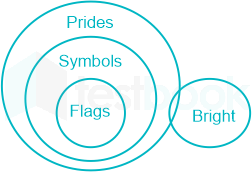
Read the given statements and conclusions carefully. Assuming that the information given in the statements is true, even if it appears to be at variance with commonly known facts, decide which of the given conclusions logically follow(s) from the statements.

Statements :

All flags are symbols.

All symbols are prides.

Some prides are bright.

Conclusions :

(I) All flags are prides.

(II) Some flags are bright is a possibility.

(III) Some symbols are bright is a possibility.

  1. ((a))

    Only conclusion I follows

  2. ((b))

    Only conclusion II follows

  3. ((c))

    All conclusions I, II and III follow

  4. ((d))

    Both conclusions I and II follow

Show Answer
Answer: ((c))

All conclusions I, II and III follow

Statements :

All flags are symbols.

All symbols are prides.

Some prides are bright.

The Venn diagram as per the given statements:

Conclusions :

(I) All flags are prides. → Follow (Because all flags are symbols and all symbols are pride so that all flags are pride is definitely true)

(II) Some flags are bright is a possibility. → Follow (There is no direct relation between flags and bright so it can be possible but not definitely true)

(III) Some symbols are bright is a possibility. → Follow (There is no direct relation between symbols and bright so it can be possible but not definitely true)

Hence, the correct answer is "All conclusions I, II and III follow".

36

Select the letter-cluster from among the given options that can replace the question mark (?) in the following series.

BKR, DNV, FQZ, ?, JWH

  1. ((a))

    HSC

  2. ((b))

    THE

  3. ((c))

    HUD

  4. ((d))

    HTD

Show Answer
Answer: ((d))

HTD

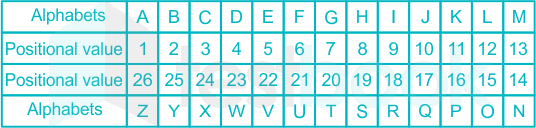
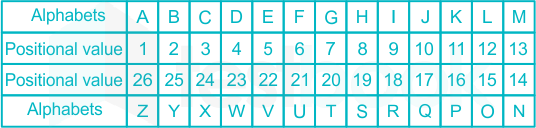
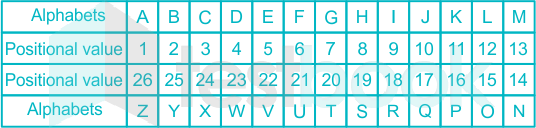
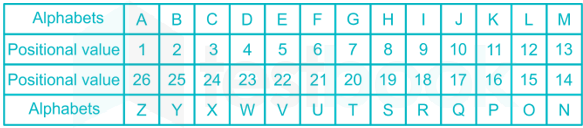
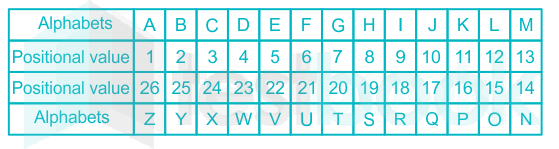
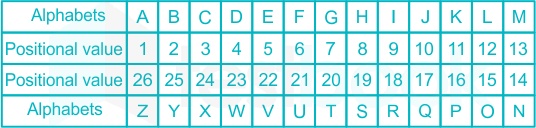
Table show alphabet serial number –

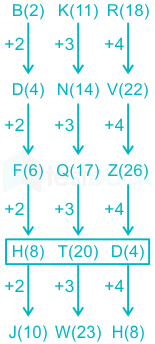
The pattern followed is,

Hence, “HTD” is the complete series.

37

In the following question, select the missing number from the given series.

67, 64, 59, 52, ?

  1. ((a))

    43

  2. ((b))

    47

  3. ((c))

    49

  4. ((d))

    45

Show Answer
Answer: ((a))

43

The series follows the odd number subtraction rule starting from 3.

67 - 3 = 64

64 - 5 = 59

59 - 7 = 52

52 - 9 = 43

The next odd number after 7 is 9. Thus, subtracting 9 from 52, we obtain 43.

Therefore, 43 is the correct answer.

38

Read the following information and answer the given question-

Aarti is older than Muskan. Gajendra is older than Muskan but younger than Aarti. Keshav is younger than Rajendra and Muskan. Muskan is older than Rajendra.

Whose age is between Rajendra and Gajendra ?

  1. ((a))

    Keshav

  2. ((b))

    Muskan

  3. ((c))

    Aarti

  4. ((d))

    None of these

Show Answer
Answer: ((b))

Muskan

According to the given information:

(1) Aarti is older than Muskan.

Aarti > Muskan

(2) Gajendra is older than Muskan but younger than Aarti.

Aarti > Gajendra > Muskan

(3) Keshav is younger than Rajendra and Muskan. Muskan is older than Rajendra.

Muskan > Rajendra > Keshav

Final arrangement:

Aarti > Gajendra > Muskan > Rajendra > Keshav

Here, Muskan's age is in between Gajendra and Rajendra.

Hence, the correct answer is "Muskan".

39

In a code language, GOOFY is written as EMMDW. 

How will EMMA be written as in that code language?

  1. ((a))

    CKKY

  2. ((b))

    BJJA

  3. ((c))

    BJJY

  4. ((d))

    CKKA

Show Answer
Answer: ((a))

CKKY

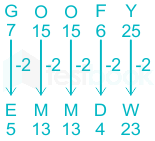
The logic followed here is:

GOOFY is written as EMMDW

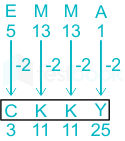
Similarly,

EMMA will be written as

Hence, "Option 1" is the correct answer.

40

Four pairs of letter-clusters have been given, out of which three are alike in some manner and one is different. Select the one that is different.

  1. ((a))

    MPT : JRS

  2. ((b))

    PJQ : MGP

  3. ((c))

    WKH : TMG

  4. ((d))

    QJS : NLR

Show Answer
Answer: ((b))

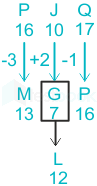
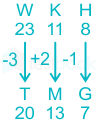
PJQ : MGP

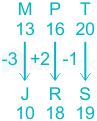
The pattern followed is,

Option (1): MPT : JRS

Option (2): PJQ : MGP

Option (3): WKH : TMG

Option (4): QJS : NLR

All follow the same pattern, except ' PJQ : MGP’.

Hence, “ PJQ : MGP” is the odd one.

41

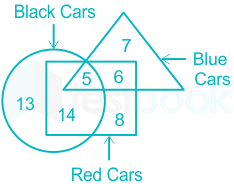
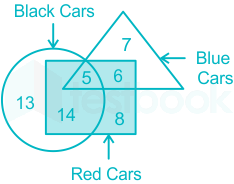
How many red cars are there?

  1. ((a))

    31

  2. ((b))

    22

  3. ((c))

    28

  4. ((d))

    33

Show Answer
Answer: ((d))

33

According to the given Venn diagram:

The shaded area shows the "Red Cars".

So, there are: 14 + 5 + 6 + 8 = 33 red cars are there in the given figure.

Hence, the correct answer is "33".

42

Select the option that is related to the third term, in the same way, the second term is related to the first term.

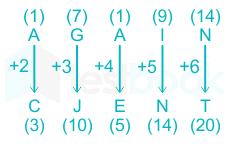
AGAIN : CJENT :: HEART : ?

  1. ((a))

    JHEXZ

  2. ((b))

    JGEWY

  3. ((c))

    JHEWZ

  4. ((d))

    JIDWZ

Show Answer
Answer: ((c))

JHEWZ

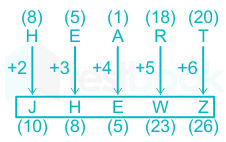
The pattern followed here is:

Each letter is increasing by +2, +3, +4, +5, +6.

Similarly,

Hence, “HEART” can be written as “JHEWZ”.

43

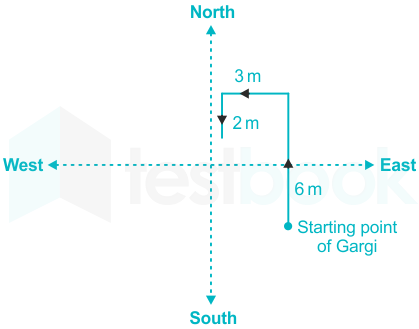
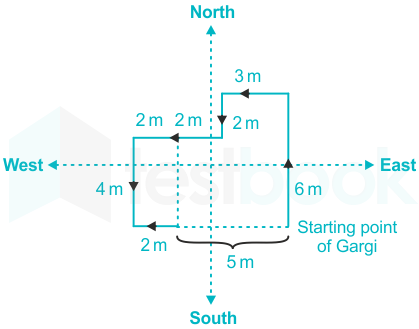
Gargi walks 6 m towards the North. She takes a left turn and walks 3 m. She again, takes a left turn and walks 2 m. Now, she takes a right turn and walks 4 m. Then she takes a left turn and walks 4 m. She takes a last left turn and walks 2 m. How far is Gargi from the starting point?

  1. ((a))

    3 m

  2. ((b))

    4 m

  3. ((c))

    5 m

  4. ((d))

    6 m

Show Answer
Answer: ((c))

5 m

According to given information :

  • Gargi walks 6 m towards the North.
  • She takes a left turn and walks 3 m.
  • She again takes a left turn and walks 2 m.

  • Now, she takes a right turn and walks 4 m.
  • Then she takes a left turn and walks 4 m.
  • She takes a last left turn and walks 2 m.

​The following diagram can be drawn according to the given information:

Clearly, Gargi is '5 m' far from the starting point.

Hence, the correct answer is "5 m".

44

You are Superintendent of Police (SP) of a district. A woman approaches you regarding domestic violence and harassment by her in-laws. Her complaint could not be registered in local police station because of political pressure. As SP you get this fact confirmed from the concerned police station. In such a circumstance what will be your first priority?

  1. ((a))

    Ask the woman to approach the National Commission of Women as getting the complaint registered would be very difficult.

  2. ((b))

    Ask her to bring medical report of physical injuries.

  3. ((c))

    Call in-laws and advise them not to harm the woman.

  4. ((d))

    Ask the station officer of police station to register her complaint after medical examination.

Show Answer
Answer: ((d))

Ask the station officer of police station to register her complaint after medical examination.

StatementCorrectnessReason
Ask the woman to approach the National Commission of Women as getting the complaint registered would be very difficult.Partially CorrectReferring her to NCW isn't exactly wrong, what's wrong here is not following the oath and promise to serve and outweighing your duty
Ask her to bring medical report of physical injuries.WrongAsking her  medical report for initial registration of complaint and without starting any investigation is just meaningless.
Call in-laws and advise them not to harm the woman.WrongNot following the due process of law and justice and trying to settle things without any initiation of process
Ask the station officer of police station to register her complaint after medical examination.CorrectAll required process are being done.


Therefore, Option 4 is the correct answer.

45

Select the figure that will come next in the following figure series.

  1. ((a))

  2. ((b))

  3. ((c))

  4. ((d))

Show Answer
Answer: ((b))

The pattern follows in the question figure is:

  1. The number of parts of the figure gets decreased in each step.
  2. Letter at the uppermost corner: 

F - 1 = E

E - 1 = D

D - 1 = C

C - 1 = B

  1. Letter at the lowermost position:

U + 1 = V

V + 1 = W

W + 1 = X

X + 1 = Y

Hence, the figure in option 2 is the correct answer.

46

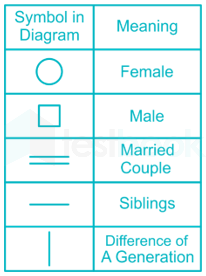
If ‘A + B’ means ‘A is the son of B’; ‘A - B’ means ‘A is the daughter of B’, ‘A & B’ means ‘A is the father of B’ and ‘A @ B’ means ‘A is the mother of B’, then what does P + R & Q - S mean?

  1. ((a))

    R is the daughter of Q

  2. ((b))

    P is the sister of Q

  3. ((c))

    S is the brother of Q

  4. ((d))

    S is the mother of P

Show Answer
Answer: ((d))

S is the mother of P

Preparing the family tree using the following symbols:

After decoding the expression P + R & Q - S we get,

P is the son of R. R is the father of Q. Q is the daughter of S.

The possible tree diagram will be:

Hence, S is the mother of P.

47

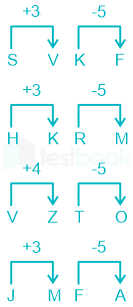
Three of the following four letter-clusters are alike in a certain way and one is different. Pick the odd one out.

  1. ((a))

    SVKF

  2. ((b))

    HKRM

  3. ((c))

    VZTO

  4. ((d))

    JMFA

Show Answer
Answer: ((c))

VZTO

The pattern followed is as follows:

Hence, VZTO is the odd one among the given alternative.

48

1st January 2018 was a Monday. Which of the following years will also start on a Monday?

  1. ((a))

    2022

  2. ((b))

    2023

  3. ((c))

    2020

  4. ((d))

    2024

Show Answer
Answer: ((d))

2024

To repeat the same day on the same date of the same month there has to be a gap of years with 7 odd days.

In 2018 number of odd days = 1,

In 2019 number of odd days = 1,

In 2020 number of odd days = 2,

In 2021 number of odd days = 1,

In 2022 number of odd days = 1,

In 2023 number of odd days = 1

So, till 1st January 2024 number of odd days = 1 + 1 + 2 + 1 + 1 + 1 = 7

Thus, 1st January 2024 will be a Monday.

49

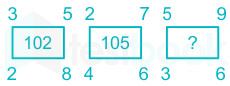
Find the missing number.

  1. ((a))

    105

  2. ((b))

    151

  3. ((c))

    210

  4. ((d))

    117

Show Answer
Answer: ((b))

151

The logic followed here is:

Figure i) 32 + 52 + 82 + 22 = 9 + 25 + 64 + 4 = 102

Figure ii) 22 + 72 + 62 + 42 = 4 + 49 + 36 + 16 = 105

Figure iii) 52 + 92 + 62 + 32 = 25 + 81 + 36 + 9 = 151

Hence, '151' is the missing number.

50

Select the number that is related to the third number in the same way as the second number is related to the first number.

14 ∶ 392 ∶∶ 21 ∶ ?

  1. ((a))

    882

  2. ((b))

    880

  3. ((c))

    691

  4. ((d))

    778

Show Answer
Answer: ((a))

882

Logic: Second number = First number x First number x 2

For the given 14 ∶ 392 → 14 (\times) 14 (\times) 2 = 392

Similarly for 21 : ? → 21 (\times) 21 (\times) 2 = 882

Thus, the missing number is 882.

Hence, the correct answer is 'option 1'.

51

When a paper is folded and cut as shown below, how will it appear when unfolded?

  1. ((a))

  2. ((b))

  3. ((c))

  4. ((d))

Show Answer
Answer: ((d))

The image obtained when the paper is unfolded is,

Hence, option 4 is the correct answer.

52

In a queue of 80 people, Angelina is 13th from the right and Margareta is 18th from the left. How many people are there between Angelina and Margareta?

  1. ((a))

    48

  2. ((b))

    38

  3. ((c))

    50

  4. ((d))

    49

Show Answer
Answer: ((d))

49

  • Total number of people = 80
  • Position of Angelina from right = 13
  • Position of Margareta from left =18
  • Number of people between Margareta and Angelina = 80 - (18 + 13) = 49

Hence, 49 is the correct answer.

53

A certain number of people are sitting in a row, facing north. D sits fourth to the right of A. B sits third to the right of D. C sits fifth to the left of A. There are only two persons between B and E. If no other person is sitting in the row, what is the total number of persons seated?

  1. ((a))

    9

  2. ((b))

    14

  3. ((c))

    16

  4. ((d))

    11

Show Answer
Answer: ((c))

16

The following seating arrangement is as follows:

1) D sits fourth to the right of A.

2) B sits third to the right of D and two persons between B and E.

3) C sits fifth to the left of A.

So the final arrangement is as follows 


Hence, the correct answer is "16".

54

‘Cardiologist’ is related to ‘Heart’ in the same way as ‘Chiropractor’ is related to ‘________’.

  1. ((a))

    Skin

  2. ((b))

    Chest

  3. ((c))

    Foot

  4. ((d))

    Joints

Show Answer
Answer: ((d))

Joints

Cardiologist is a doctor who treats ailments related to heart

Similarly,

Chiropractor is a healthcare professional whose practice involves the treatment of ailments related to joints.

Hence, 'Chiropractor' is related to Joints'.

55

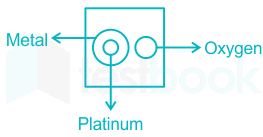
Choose the most suitable Venn diagram for the following words. Jk

Metal, Platinum, Oxygen

  1. ((a))

  2. ((b))

  3. ((c))

  4. ((d))

Show Answer
Answer: ((d))

Platinum is a metal.

And,

Oxygen is a colourless, odourless gas.

The correct Venn diagram representation is,

Hence, option 4 is the correct answer.

56

Rubi and Juhi are sisters. Krishna is Juhi's father's father. Reshma is the mother of Arvind. Arvind is the father of Rohit, who is the only brother of Rubi. How is Krishna related to Rohit?

  1. ((a))

    Mother's brother

  2. ((b))

    Father's father

  3. ((c))

    Father

  4. ((d))

    Mother's father

Show Answer
Answer: ((b))

Father's father

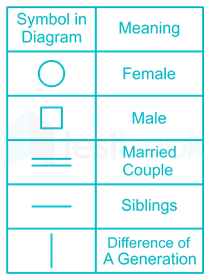
Preparing the family tree using the following symbols,

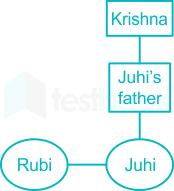
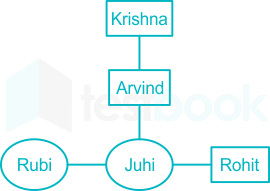
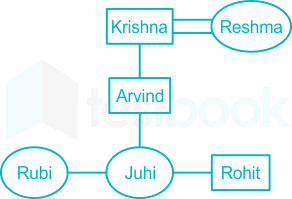
We can dram following Family Tree from the information given above:

  1. Rubi and Juhi are sisters.

  2. Krishna is Juhi’s father's father.

  1. Arvind is the father of Rohit, who is the only brother of Rubi.

  1. Reshma is the mother of Arvind.

Hence, Krishna is "Father's father" of Rohit.

57

It was Sunday on January 1, 2006 A.D. What was the day on January 1, 2010 A.D.?

  1. ((a))

    Sunday

  2. ((b))

    Saturday

  3. ((c))

    Friday

  4. ((d))

    Wednesday

Show Answer
Answer: ((c))

Friday

The logic follows here is:

Given, on 1st January 2006 it was Sunday.

Then, on 31st December, 2005 it was Saturday.

Number of odd days from the year 2006 to the year 2009 = (1 + 1 + 2 + 1) = 5 days.

31 December 2005 + 5 = Thursday

∴ On 31st December 2009, it was Thursday.

Thus, on 1st January, 2010 it was Friday.

Hence, the correct answer is "Friday".

Additional Information

Year - One year has 365 days or 366 days on this basis the year is divided into two parts:

  • Normal year - It has 365 days.
  • Leap year - It has 366 days and completely divisible by 4.
<br>

Century leap year - The year which is exactly divisible by 400. Example - 1200, 1600, 2000 etc.

Counting of Odd days

Ordinary Year: 365 days (52 weeks + 1 days)

= 1 Odd days

Leap Year: 366 days (52 weeks + 2 days)

= 2 Odd day

In an ordinary year, there are 365 days and on dividing 365 by 7,

we get remainder = 1 so this extra one day is taken as an odd day.

Similarly, in a leap year, there are 366 days and on dividing 366 by 7,

we get remainder = 2 so these extra days are taken as the odd days.

Thus, the remainder, which we get after dividing the number of days by 7 is considered as odd days.

58

The school principal has received complaints from parents about bullying in the schoolyard during lunch break. He wants to investigate and end this situation as soon as possible. So he has asked the teachers to watch closely. Which of the following situation requires action?
  1. ((a))

    Four girls are surrounding another girl and have possession on her bag

  2. ((b))

    A girl sitting quietly without interaction

  3. ((c))

    Two boys playing basketball are arguing

  4. ((d))

    Three boys are huddled over a video game, which is not allowed in school

Show Answer
Answer: ((a))

Four girls are surrounding another girl and have possession on her bag

The situation which points towards an act of bullying requires action.

  1. Four girls are surrounding another girl and have possession on her bag → It clearly indicates an act of bullying as one girl is surrounded by four and have possession on her bag. So, this situation requires action.

  2. A girl sitting quietly without interaction → It does not indicates an act of bullying.

  3. Two boys playing basketball are arguing → It does not indicates an act of bullying.

  4. Three boys are huddled over a video game, which is not allowed in school → It does not indicates an act of bullying.

Hence, ‘option 1’ is the correct answer.

59

Select the option that is related to the third term in the same way as the second term is related to the first term.

WORLD : 231518124 : : CLOUD : ?

  1. ((a))

    31215214

  2. ((b))

    31215210

  3. ((c))

    3121515

  4. ((d))

    31215211

Show Answer
Answer: ((a))

31215214

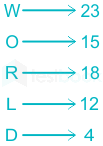
The positional values of the English alphabet is as follows:

The pattern followed here is: Positional value of the letter 

WORLD : 231518124 

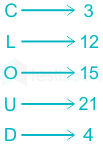
Similarly, CLOUD : ?

CLOUD : 31215214

Hence, 'option 1' is the correct answer.

60

Direction : In the following question, a word has been given, followed by four other words, one of which cannot be formed by using the letters of the given word. Find that word.

OBSTETRICIAN

  1. ((a))

    SOBER

  2. ((b))

    TERMITE

  3. ((c))

    RETAIN

  4. ((d))

    SIREN

Show Answer
Answer: ((b))

TERMITE

The logic followed here is:

The word OBSTETRICIAN has the letters O, B, S, T, E, R, I, C, A, N.

(1) SOBER → OBSTETRICIAN → Can be formed.

(2) TERMITE → OBSTETRICIAN → Can not be formed (M is missing).

(3) RETAIN → OBSTETRICIAN → Can be formed 

(4) SIREN → OBSTETRICIAN → Can be formed.

So, the word that can not be formed by using the letters of the given word OBSTETRICIAN is "TERMITE".

Hence, the correct answer is "Option 2".

61

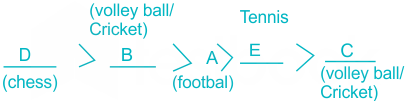
Five members A, B, C, D and E have different heights. They play one among different games namely cricket, football, chess, tennis and volley ball. No two members play same game. A is shorter than only two members and plays football. The tallest member among them plays chess. B is taller than E but shorter than D. E plays Tennis and he is not the shortest.

Who among them plays chess?

  1. ((a))

    B

  2. ((b))

    C

  3. ((c))

    E

  4. ((d))

    D

Show Answer
Answer: ((d))

D

Given: Five members A, B, C, D and E have different heights. They play one among different games namely cricket, football, chess, tennis and volley ball. No two members play same game.

  1. A is shorter than only two members and plays football.

  1. The tallest member among them plays chess.

  1. E plays Tennis and he is not the shortest.

  1. B is taller than E but shorter than D.

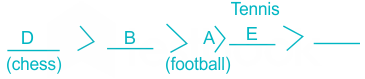
Thus, final arrangement:

Thus, D among them plays chess.

Hence, the correct answer is "D".

62

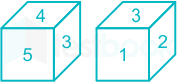
Which among the following is the opposite of 3 in the given Dice? 

  1. ((a))

    5

  2. ((b))

    6

  3. ((c))

    2

  4. ((d))

    3

Show Answer
Answer: ((b))

6

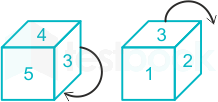
Taking dice positions 5 as common,

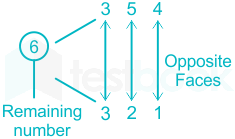
Moving clockwise from the Common number 1,

Pair of opposite numbers:

3 - 6

5 - 2

4 - 1

So, the opposite number to 3 is 6.

Hence, the correct answer is "6".

63

Select the combination of letters that when sequentially placed in the blanks of the given series will complete the series.

Q _ T _ S _ K _ R _ _ K _ R S

  1. ((a))

    K R Q T S K T

  2. ((b))

    K R Q T S Q T

  3. ((c))

    K R Q T S Q R

  4. ((d))

    K R T R S Q T

Show Answer
Answer: ((b))

K R Q T S Q T

Given :- Q _ T _ S _ K _ R _ _ K _ R S

By checking options and substituting accordingly.

1) K R Q T S K T → Q K T R S - Q K T R S - K K T R S

2) K R Q T S Q T → Q K T R S - Q K T R S - Q K T R S

  • Here pattern "QKTRS" is repeated.

3) K R Q T S Q R → Q K T R S - Q K T R S - Q K R R S

4) K R T R S Q T → Q K T R S - T K R R S - Q K T R S

  • Option (2) gives the pattern of :- Q K T R S - Q K T R S - Q K T R S

Hence, the correct answer is "K R Q T S Q T".

64

You have been posted as a station in charge in a police station where the previous officers used to exploit the vendors due to which mindset of the locals towards police has been changed. You will

  1. ((a))

    Take it as an advantage to get freebies from the vendors.

  2. ((b))

    Show them the real face of police by your duty.

  3. ((c))

    Tell them that you are not like others.

  4. ((d))

    Apply for the transfer to some good place.

Show Answer
Answer: ((b))

Show them the real face of police by your duty.

The correct answer is Option 2: Show them the real face of police by your duty.

StatementCorrectnessReasoning
Take it as an advantage to get freebies from the vendors.IncorrectIt shows a lack of sense of responsibility. You should serve the people not exploit them.
Show them the real face of police by your duty.CorrectIt shows your leadership qualities where you came forward to enhance the image of the police in people's minds which was demeaned by the previous staff. It reflects your courage and self-confidence.
Tell them that you are not like others.IncorrectIt shows that you care about your own image only.
Apply for the transfer to some good place.IncorrectIt shows that you can't take criticism.


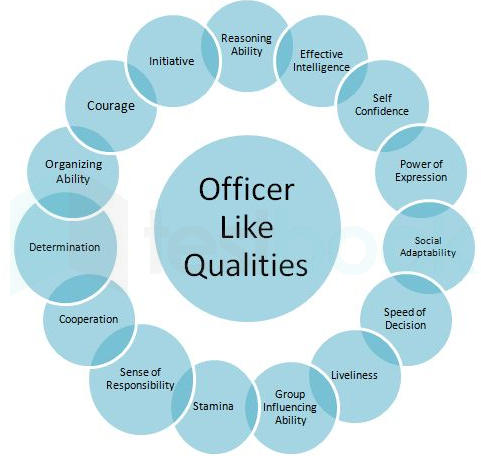
  • Qualities Projected in this situation:  (Sense of responsibility, Self-confidence, Courage, Determination, Dedication and Social adaptability)

Key Points

  • Checklist for attempting SRT questions:
  1. Read the question and options carefully.
  2. Look for options that are realistic, optimistic, and reflect officer-like qualities.
  3. Do not skip any situation.
  4. Relegate the negative sentences and choose the most logical option among the remaining. As time is an important factor, hence your thinking ability should be swift.
  5. React quickly and be logical.

Additional Information

Officer qualities:

65

Find the odd number pair from the given alternatives.

  1. ((a))

    (92, 67)

  2. ((b))

    (63, 38)

  3. ((c))

    (39, 15)

  4. ((d))

    (74, 49)

Show Answer
Answer: ((c))

(39, 15)

The difference between the first and the second number is 17, except option 3.

Let’s check each option.

  1. 92 – 67 = 25

  2. 63 – 38 = 25

3) 39 – 15 = 24 ≠ 25

4)74 – 49 = 25

Hence, (39, 15) is odd pair.

66

The gravitational potential energy of an object of mass ‘m’ raised through a height ‘h’ from the earth’s surface is given by _______

  1. ((a))

    m a

  2. ((b))

    m a v

  3. ((c))

    m g h

  4. ((d))

    m g v

Show Answer
Answer: ((c))

m g h

The correct answer is m g h.

Key Points

  • Gravitational potential energy is the energy possessed by an object due to its position in a gravitational field.
  • The formula for gravitational potential energy is given by U = mgh, where 'm' is mass, 'g' is the acceleration due to gravity, and 'h' is the height.
  • This formula assumes that the height 'h' is small compared to the radius of the Earth, so the gravitational force can be considered constant.
  • The unit of gravitational potential energy in the International System of Units (SI) is the Joule (J).

Additional Information

  • Gravity
  • Gravity is a force that attracts two bodies towards each other, depending on their masses and the distance between them.
  • The acceleration due to gravity on Earth is approximately 9.8 m/s².
  • Potential Energy
  • Potential energy is the stored energy of an object due to its position or state.
  • It can be converted into other forms of energy, such as kinetic energy.
  • Kinetic Energy
  • Kinetic energy is the energy that an object possesses due to its motion.
  • The formula for kinetic energy is given by KE = 0.5 * m * v², where 'm' is mass and 'v' is velocity.
  • Conservation of Energy
  • The law of conservation of energy states that energy cannot be created or destroyed, only transformed from one form to another.
  • In a closed system, the total energy remains constant.
67

The zygote would develop into a female child if the sex determining pair of chromosomes is made up of

  1. ((a))

    A set of XX chromosomes

  2. ((b))

    A set of YY chromosomes

  3. ((c))

    A set of XY chromosomes

  4. ((d))

    Both XX and YY chromosomes

Show Answer
Answer: ((a))

A set of XX chromosomes

The correct answer is A set of XX chromosomes.

Key Points

  • The sex-determining mechanism in humans is the XY type. Humans contain 23 pairs of chromosomes.
  • The sex of the child is determined by the father's chromosomes.
  • 22 pairs of chromosomes are the same in both males and females, which are called autosomes.
  • The 23rd pair is different in both sexes and is known as the sex chromosome.
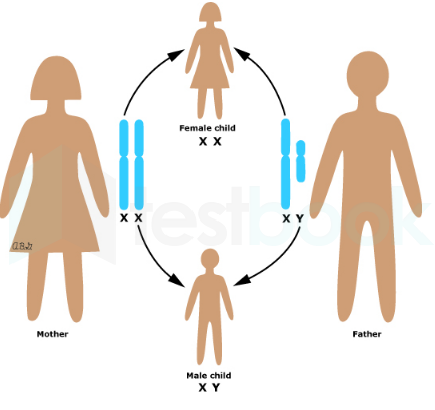
  • Females have a pair of X chromosomes and males have X and Y chromosomes as sex chromosomes.
  • Hence, The zygote would develop into a female child if the sex determining pair of chromosomes is made up of a set of XX chromosomes.

Important Points 

  • In humans, the females have XX sex chromosomes while the males have XY chromosomes.
  • Hence, The zygote would develop into a female child if the sex determining pair of chromosomes is made up of a set of XX chromosomes.
  • When the X chromosome of a female unites with the X chromosome of a male, a girl will be born and when the X chromosome of females unites with the Y chromosome of a male, a boy will be born.
  • Thus, the sex chromosome of males (father) determines the sex of the child.​
Mother/FatherXY
XXX (Daughter)XY(Son)
XXX(Daughter)XY(Son)

68

What distinguishes a plant cell from an animal cell?

  1. ((a))

    Nucleus

  2. ((b))

    Presence of Cytoplasm

  3. ((c))

    Presence of Cell Membrane

  4. ((d))

    Presence of Cell Wall

Show Answer
Answer: ((d))

Presence of Cell Wall

The correct answer is Option 4.

Key Points

  • The cell wall is the outer covering of a cell. It surrounds the plasma membrane of plant cells and provides tensile strength and protection against mechanical and osmotic stress.
  • The cell wall is present in plant cells and absent in animal cells. Hence, the correct answer is Option 4.

Additional Information

  • The plasma membrane (also called the cell membrane) is the membrane found in all cells that separates the interior of the cell from the outside environment.
  • In bacterial and plant cells, a cell wall is attached to the plasma membrane on its outside surface.
  • The plasma membrane is present in both plant cells and animal cells.
  • A vacuole is a membrane-bound cell organelle.
  • In animal cells, vacuoles are generally small and help sequester waste products.
  • In plant cells, vacuoles help maintain water balance.
69

What are the products formed during photosynthesis?

  1. ((a))
    Glucose, Water and Oxygen

  2. ((b))

    Glucose and Oxygen

  3. ((c))

    Starch and Oxygen

  4. ((d))

    Starch, Water and Oxygen

Show Answer
Answer: ((a))

Glucose, Water and Oxygen

Explanation:

Photosynthesis is the process through which plants utilize sunlight to make food and it takes place inside the green part (chloroplasts) of the plant.

  • The correct equation to represent the overall process of photosynthesis is given as:

6CO2 + 12H2O (\mathop \to \limits^{Light}) C6 H12 O6 + 6H2O + 6O2

Where **CH12 O**represents glucoseH2O represents water.**O**represents Oxygen.

  • Photosynthesis takes place in the green leaves of plants, and it is the process through which green leafy plants synthesize their food.

Mistake PointsIn general, the equation wrote as -

6CO2 + 12H2O (\mathop \to \limits^{Light}) C6 H12 O6 + 6H2O

But the water produced is vaporized.

70

Charles Darwin gave the idea of _________.

  1. ((a))

    biological classification

  2. ((b))

    cell as a unit of life

  3. ((c))

    gene

  4. ((d))

    evolution

Show Answer
Answer: ((d))

evolution

Concept - 

  • Charles Darwin was a British naturalist who first gave the idea of evolution.
  • Charles Darwin is regarded as the "Father of Evolution."
  • Because of his contributions to the development of evolution theory, his hypothesis helped to dispel many of the old beliefs that the creation of different organisms was a divine occurrence or act of the Almighty.
  • Darwin's book "The Origin of Species" was published in the 1850s within which he defined his understanding of evolution along with Natural selection.
  • Evolution -
  • Biological evolution is based on the premise that populations and species of organisms evolve over time.
  • He came to the conclusion that evolution occurred over a very long period of time.
  • Since the changes and adaptations take a long time to stabilize and give rise to a new species, it is a slow and steady process.
  • He suggested that organisms evolve (or, as he put it, "descent with modification") and that all living things descend from a common ancestor.
  • Species continue to evolve or change over time. The requirements of an organism change as the climate changes, and they adapt to the new environment. Adaptation refers to the process of adapting over time in response to natural requirements.
  • Natural selection - 
  • Natural selection is the mechanism suggested by Darwin for evolution. Darwin also suggested natural selection as a method for evolution.
  • Natural resources are scarce, species with heritable traits that favor survival and reproduction will appear to leave more offspring than their peers, increasing the frequency of the traits over generations. Hence, inculcating the process of natural selection.
  • Natural selection is also termed as "Survival of the fittest".
  • Natural selection allows populations to adapt to their environments over time, or become increasingly well-suited to them.
  • Darwin discovered that adjacent islands in the Galápagos had finch species that were similar but not identical. He also stated that each finch species was well-suited to its climate and function. Wide, tough beaks were found in species that ate large seeds, while small, sharp beaks were found in species that ate insects.
  • Finally, he noted that the finches (and other animals) present on the Galápagos Islands were identical to species found on Ecuador's mainland but distinct from those found elsewhere.

Explanation - 

  • Charles Darwin is called the father of evolution.
  • He provided the concept of evolution stating it as a slow and gradual process where population and species of organisms evolve over time.
  • Hence, the correct answer for this question is - Evolution.

Important Points

  • The concept of evolution was first given by Charles Darwin.
  • The first criteria of biological classification was given by Aristotle on the basis of simple morphological characters.
  • Cell as a unit of life was first recognized by Schleiden and Schwann in their cell theory.
  • Cell theory by Schleiden and Schwann stated -
  1. All cells only come from preexisting cells (the principle of biogenesis).
  2. Cells are the fundamental units of life.
  • The term "gene" was coined by Wilhelm Johannsen to describe the Mendelian units of heredity.
71

The central nervous system that receives information from all parts of the body and integrates it is constituted by:

  1. ((a))

    only the heart 

  2. ((b))

    only the brain

  3. ((c))

    the brain and the spinal cord 

  4. ((d))

    only the spinal cord

Show Answer
Answer: ((c))

the brain and the spinal cord 

The correct answer is the brain and the spinal cord.

Key Points

  • The central nervous system (CNS) consists of the brain and the spinal cord.
  • The brain is the control center, responsible for processing and integrating information from the body and coordinating activity.
  • The spinal cord serves as a conduit for signals between the brain and the rest of the body, and it also manages reflex actions.
  • The CNS is critical for all voluntary and involuntary functions, including movement, thought, sensation, and homeostasis.

Additional Information

  • Peripheral Nervous System (PNS):
  • Comprises all the nerves that lie outside the central nervous system.
  • Divided into the somatic nervous system (controls voluntary movements) and autonomic nervous system (controls involuntary functions).
  • Neurons:
  • Basic functional units of the nervous system.
  • Responsible for transmitting electrical and chemical signals throughout the body.
  • Reflex Arc:
  • The neural pathway that mediates a reflex action.
  • Involves sensory neurons, interneurons, and motor neurons.
  • Brain Regions:
  • Cerebrum: Responsible for higher brain functions like thought and action.
  • Cerebellum: Coordinates voluntary movements and balance.
  • Brainstem: Controls basic life functions such as breathing, heartbeat, and blood pressure.
72

In a series combination of resistances:

  1. ((a))

    The voltage remains same

  2. ((b))

    The current and voltage remain same

  3. ((c))

    The current and voltage both vary

  4. ((d))

    The current remains same

Show Answer
Answer: ((d))

The current remains same

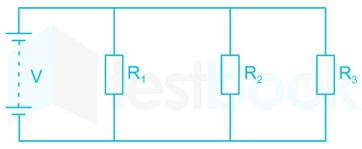
Parallel Circuit: When resistors are connected with several conducting paths between the sources of emf. In a parallel connection, the voltage remains the same across all resistors, but the current will be different.

Total resistance ( \frac{1}{{{R}}}= \frac{1}{{{R_1}}} + \frac{1}{{{R_2}}} + \frac{1}{{{R_3}}}) 

Current in each resistor is different and can be calculated by using Ohm’s law

({I_1} = \frac{V}{{{R_1}}},{I_2} = \frac{V}{{{R_2}}},{I_3} = \frac{V}{{{R_3}}})

The total current is the sum of the three separate currents

(I = {I_1} + {I_2} + {I_3})

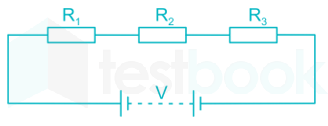
Series Circuit: When resistors are connected with only one conducting path they are said to be connected in series. The same current flows through the all resistances but the voltage drop will be different and proportional to the resistance. 

The total resistance in a series circuit is given as

R = R1 + R2 + R3

In a series connection, the resistances are connected end-to-end

73

What is the chemical formula of Propyne?

  1. ((a))

    C4H5

  2. ((b))

    C3H4

  3. ((c))

    C4H4

  4. ((d))

    C3H5

Show Answer
Answer: ((b))

C3H4

The correct answer is C3H4.

Key Points

  • Propyne is an alkyne compound that contains a triple bond between two carbon atoms.
  • Its chemical formula is C3H4, which means it has three carbon atoms and four hydrogen atoms.
  • Propyne is also known as methylacetylene, and it is used in the production of synthetic rubber and plastics.
  • The correct chemical formula is important in understanding the properties and behavior of the compound in chemical reactions.

Additional Information

  • C4H5 is the chemical formula for butyne.
  • It has two isomeric organic chemical components and one triple bond.
  • C4H4 is the chemical formula for 1,3-butadiene.
  • Though it can also be found in trace amounts in fuel and polymers, its primary application is in the manufacturing of synthetic rubber.
  • C3H5 is the chemical formula for propene.
  • It is the second most basic hydrocarbon in the alkene class and possesses one double bond.
74

Atmospheric pressure is measured with a _______.

  1. ((a))

    Hygrometer

  2. ((b))

    Barometer

  3. ((c))

    Hydrometer

  4. ((d))

    Altimeter

Show Answer
Answer: ((b))

Barometer

The correct answer is Barometer.

Key Points

  • Atmospheric pressure is measured with a barometer.
  • The air around you has weight, and it presses against everything it touches.
  • That pressure is called atmospheric pressure.
  • A barometer is a scientific instrument used in meteorology to measure atmospheric pressure.
  • A simple barometer consists of a long glass tube (closed at one end, open at the other) filled with mercury and turned upside down into a container of mercury.
  • The barometer works by balancing the mercury in the glass tube against the outside air pressure, just like a set of scales.
  • Mercury Barometer is used to measure atmospheric pressure and  1atm = 76 cm of Hg column.

Additional Information

  • Altimeter: 
  • An altimeter is a device that measures the altitude of a location's distance above sea level.
  • Most altimeters are barometric, meaning they measure altitude by calculating the location's air pressure.
  • Air pressure decreases as altitude increases.
  • Types of altimeter -
  • Barometric altimeter, Radio altimeter, Laser altimeter, GPS, Galileo.
  • Hydrometer:
  • A hydrometer is an instrument used for measuring the relative density of liquids based on the concept of buoyancy.
  • They are typically calibrated and graduated with one or more scales such as specific gravity.
  • Hydrometers can be divided into two general classes -
  • liquids heavier than water
  • liquids lighter than water
  • Hygrometer:
  • A hygrometer is an instrument used to measure the amount of water vapor in the air, in soil, or in confined spaces.
  • Humidity measurement instruments usually rely on measurements of some other quantities such as -
  • temperature, pressure, mass, a mechanical or electrical change in a substance as moisture is absorbed.
75

Rise in sugar levels in blood is detected by the

  1. ((a))

    Liver

  2. ((b))

    Gallbladder

  3. ((c))

    Kidney

  4. ((d))

    Pancreas

Show Answer
Answer: ((d))

Pancreas

  • Rise in sugar levels in the blood is detected by the Pancreas.
  • The pancreas detects the rise in blood glucose and starts to secrete insulin.
  • The pancreas is a gland that is located in the abdomen of the body. It is part of the digestive system which produces insulin and other important enzymes and hormones that help in breaking down the foods.
  • After eating something, the carbohydrates in food are broken down into glucose and passed into the bloodstream.
  • In response to rising glucose in the bloodstream, insulin is released from the beta cells of the pancreas which regulate the body’s glucose or sugar level.
  • Any disorder in the pancreas leads to diabetes.
76

In aerobic respiration, glucose breaks down into ______.

  1. ((a))

    Carbon dioxide, water, energy

  2. ((b))

    Carbon dioxide, alcohol, energy

  3. ((c))

    Water, alcohol, energy

  4. ((d))

    Carbon dioxide, energy

Show Answer
Answer: ((a))

Carbon dioxide, water, energy

The correct answer isCarbon dioxide, water, energy.

  • In aerobic respiration, glucose breaks down into Carbon dioxide, water, energy.

Key Points

  • Aerobic Respiration:
  • The respiration which takes place in the presence of oxygen is known as aerobic respiration.
  • In this process, in fact, each glucose molecule is converted into two molecules of pyruvic acid by the process, called glycolysis.
  • Glycolysis takes place in the cytoplasm of the cell.
  • The pyruvic acid formed, releases energy with the formation of carbon dioxide and water.
  • C6H12O6+ 6O2→ 6CO2+ 6H2O + energy

Additional Information

  • Anaerobic Respiration
  • The respiration which takes place in the absence of oxygen is known as anaerobic respiration.
  • In this process, the respiratory substances are incompletely oxidized to carbon dioxide and alcohol.
77

Which of the following organism breathes from skin?

  1. ((a))

    Snake

  2. ((b))

    Earthworm

  3. ((c))

    Monkey

  4. ((d))

    Humans

Show Answer
Answer: ((b))

Earthworm

An earthworm is a tube-shaped, segmented worm found in the phylum Annelida. They are commonly found living in soil, feeding on live and dead organic matter.

78

Which of the following planets is considered as Earth’s twin planet?

  1. ((a))

    Neptune

  2. ((b))

    Uranus

  3. ((c))

    Venus

  4. ((d))

    Mars

Show Answer
Answer: ((c))

Venus

The correct answer is Venus.

Key Points

  • Venus:-
  • Venus is sometimes called Earth's twin because Venus and Earth are almost the same size, have about the same mass (they weigh about the same), and have a very similar composition (are made of the same material).
  • They are also neighboring planets.
  • However, Venus and Earth are also very different.
  • Venus has an atmosphere that is about 100 times thicker than Earth's and has surface temperatures that are extremely hot.
  • Venus does not have life or water oceans like Earth does.
  • Venus also rotates backward compared to Earth and the other planets.

Additional Information

  • Neptune:-
  • It was discovered on the basis of the law of gravitation.
  • It is the farthest known planet from the Sun in the Solar System.
  • Its revolution period is 164 years and the rotation period is 16 hours and 7 minutes.
  • Neptune and Uranus are the only two planets discovered with the help of a telescope.
  • Uranus:-
  • It is the seventh planet from the Sun and has the third-largest diameter in our solar system.
  • It was the first planet found with the aid of a telescope, Uranus was discovered in 1781 by astronomer William Herschel, although he originally thought it was either a comet or a star.
  • Mars:-​
  • Mars is called Red Planet.
  • It has two satellites - Phobos and Deimos.
  • Mars is the fourth planet in the solar system.
  • It is the second smallest planet in the solar system.
  • In English Mars carries the name of the Roman God of War.
79

Which is the longest beach in India?

  1. ((a))

    Juhu Beach

  2. ((b))

    Dandi Beach

  3. ((c))

    Puri Beach

  4. ((d))

    Marina Beach

Show Answer
Answer: ((d))

Marina Beach

The correct answer is Marina Beach.

  • Marina Beach is the longest beach in India.
  • Marina beach is located in Chennai, Tamil Nadu.
  • It lies along the Bay of Bengal.
  • Marina Beach is also the world’s second-longest beach.
  • The beach was renovated by Governor Mountstuart Elphinstone Grant Duff in the 1880s.
  • Two prominent statues of Mahatma Gandhi is situated on the Marina beach.
  • Marina Beach is one of the most crowded beaches in India.

Additional Information

  • Juhu Beach is located in Mumbai in Maharashtra.
  • Dandi Beach is located in Dandi village, Gujarat.
  • Puri Beach is located in Puri, Odisha.
80

Who was the first woman Chief Minister of Independent India? 

  1. ((a))

    Jayalalitha

  2. ((b))

    Padmaja Naidu

  3. ((c))

    Sucheta Kriplani

  4. ((d))

    Vijaya Lakshmi Pandit 

Show Answer
Answer: ((c))

Sucheta Kriplani

The correct answer is Sucheta Kriplani.

Key Points

  • Sucheta Kripalani was an Indian freedom fighter.
  • Sucheta Kriplani was the first woman Chief Minister of Independent India.
  • She was elected as the chief minister of Uttar Pradesh from the Kanpur constituency.
  • She served as the chief minister of the Uttar Pradesh government from 1963 to 1967.
  • She came to the forefront of the Indian national movement during the Quit India Movement.
  • She was a member of the Constituent Assembly of India.

Additional Information

  • Nandini Satpathy was the second woman Chief Minister of Independent India.
  • She served as the Chief Minister of Odisha from 1972 to 1976.
  • Jayalalitha served six times as the Chief Minister of Tamil Nadu for over fourteen years between 1991 and 2016.
  • Padmaja Naidu was the second woman governor of Independent India after Sarojini Naidu.
  • She served as the first women governor of West Bengal from 1956 to 1967.
  • Vijaya Lakshmi Pandit was the first female president of the United Nations General Assembly.
  • She also served as the first women governor of Maharasthra from 1962 to 1964.
81

The Attorney General of India is appointed by the President under which article?

  1. ((a))

    Article 165

  2. ((b))

    Article 76

  3. ((c))

    Article 148

  4. ((d))

    Article 153

Show Answer
Answer: ((b))

Article 76

The correct answer is Article 76.

Key Points

  • Article 76 of the Constitution provides for the office of the Attorney General of India.
  • The Attorney General (AG) of India is a part of the Union Executive. Attorney General is the highest law officer in the country.
  • Attorney General is appointed by the President on the advice of the government.
  • K.K. Venugopal was appointed the 15th Attorney General of India in 2017. He succeeded Mukul Rohatgi who was Attorney General from 2014-2017.
  • The current Attorney General of India is R. Venkataramani
  • Solicitor General of India and Additional Solicitor General of India assists the Attorney General in fulfillment of the official responsibilities.

Additional Information

ArticleDescription
Article 165Article 165 deals with the Advocate General for the State.
Article 148Article 148 broadly deals with the CAG appointment, oath, and conditions of service.
Article 153Article 153 says that there shall be a Governor for each State. One person can be appointed as Governor for two or more States.
82

Who was the first speaker of the Lok Sabha? 

  1. ((a))

    K. S. Hegde

  2. ((b))

    Hukam Singh

  3. ((c))

    M. A. Ayyangar 

  4. ((d))

    Ganesh Mavlankar

Show Answer
Answer: ((d))

Ganesh Mavlankar

The correct answer is Ganesh Mavlankar.

Key Points

  • Ganesh Mavlankar was the first speaker of the Lok Sabha.
  • Ganesh Mavlankar is considered as the father of Lok Sabha.
  • He was popularly called 'Dada Saheb'.
  • He was the Speaker of the Constituent Assembly (Legislative) and the Provisional Parliament (1947-52).
  • He served as the Speaker of the Bombay Legislative Assembly from 1937 to 1946.
  • He was the President of the Central Legislative Assembly (1946-47).
  • The first Lok Sabha was constituted in 1952.

Additional Information

  • M. A. Ayyangar was the first deputy speaker of the Lok Sabha.
  • Hukum Singh was the third Speaker of the Lok Sabha.
  • K. S. Hegde was the seventh Speaker of the Lok Sabha.
83

Which of the following kings embraced Buddism after the Kalinga war?

  1. ((a))

    Bindusara

  2. ((b))

    Rashtrakoota

  3. ((c))

    Ashoka

  4. ((d))

    Akbar

Show Answer
Answer: ((c))

Ashoka

The correct answer is Ashoka.

Key Points

  • Ashoka adopted Buddhism after observing the brutality of the Kalinga War.
  • The Kalinga war was the most famous war fought between the Mauryan Emperor Ashoka the Great and the State of Kalinga.
  • Ashoka embraced Buddhism under the influence of a Buddhist monk, Upagupta.
  • Kalinga war was a horrifying event as mentioned in the 13th Rock Edict of Ashoka.

Important Points

  • Ashoka was the son of Bindusara. He was the governor of Taxila and Ujjain during his father’s reign.
  • Ashoka sat on the throne around 268 B.C after successfully defeating his brothers.
  • Ashoka’s mother’s name was Subhadrangi. His wife’s name was Devi or Vedisa who was a princess of Ujjaini.

Additional Information

KingsImportant Points
BindusaraBindusara was the son of Chandragupta Maurya and Durdhara. He was born in 320 BC and ruled from 298 BC to 272 BC. Bindusara also had contact with the Seleucid Syrian king Antiochus I, who sent Deimachus as ambassador to his (Bindusara) court.
RashtrakootaThe Rashtrakutas (755 - 975 A.D.) were of Kannada origin and the Kannada language was their mother tongue. Dantidurga was the founder of the Rashtrakuta dynasty.
AkbarAkbar ruled India from 1556 to 1605 AD. He was the son of Humayun, who ruled over India for 26 years. In 1582, he promulgated a new religion called Din Ilahi or Divine Faith. He abolished the pilgrim tax and in 1564, he abolished jaziya.
84

The Ramakrishna Mission was founded by 

  1. ((a))

    Swami Vivekananda 

  2. ((b))

    Ramakrishna Paramahamsa

  3. ((c))

    Sarada Devi 

  4. ((d))

    Mahendranath Gupta 

Show Answer
Answer: ((a))

Swami Vivekananda 

The correct answer is Swami Vivekananda.

Key Points

  • Swami Vivekananda was born on 12th January 1863.
  • His birthday is celebrated as national youth day in India.
  • The Ramakrishna Mission was founded by Swami Vivekananda.
  • It was founded in 1897.
  • The headquarters of Ramakrishna Mission is located at Belur Math in West Bengal.
  • "Atmano mokshartham Jagat Hitaya cha" is the motto of Ramakrishna Mission.
  • Narendranath Datta is the original name of Swami Vivekananda.
  • He is considered the patriotic saint of India.
  • "Go back to Gita" is a famous slogan raised by Swami Vivekananda.
  • He attended the parliament of religions held in Chicago on 11th September 1893.
  • He died on 4th July 1902 at the age of 39.

Additional Information

  • Ramakrishna Paramahamsa is the guru of Swami Vivekananda.
  • Sarada Devi was the wife and spiritual consort of Sri Ramakrishna Paramahamsa.
  • Mahendranath Gupta was a disciple of Sri Ramakrishna Paramahamsa.
85

Where was the maiden flight-trial of the Stratospheric Airship Platform conducted?

  1. ((a))

    Pokhran

  2. ((b))

    Sheopur

  3. ((c))

    Agra

  4. ((d))

    Gwalior

Show Answer
Answer: ((b))

Sheopur

The Correct Answer is Sheopur.

In News

  • DRDO successfully conducts maiden flight-trials of Stratospheric Airship Platform; System to enhance India’s earth observation and surveillance capabilities.

Key Points

  • DRDO successfully conducted the maiden flight-trial of a Stratospheric Airship Platform.
  • The trial was held at the Sheopur site in Madhya Pradesh.
  • The airship was developed by Aerial Delivery Research and Development Establishment (ADRDE) in Agra, Uttar Pradesh.
  • The airship was launched to an altitude of around 17 kilometers.
  • It carried an instrumental payload, and data was collected from onboard sensors.
  • This data will aid in creating high-fidelity simulation models for future high-altitude missions.
  • Raksha Mantri Rajnath Singh congratulated DRDO and highlighted its importance for earth observation and ISR (Intelligence, Surveillance, Reconnaissance) capabilities.
  • The system places India among the few nations with such indigenous stratospheric airship technology.
86

Jai Vilas Mahal is situated in which of the following district?

  1. ((a))

    Gwalior

  2. ((b))

    Bhopal

  3. ((c))

    Ujjain

  4. ((d))

    Rewa

Show Answer
Answer: ((a))

Gwalior

The correct answer is Gwalior.

Key Points

  • The Jai Vilas Mahal, also known as the Jai Vilas Palace, is located in Gwalior.
  • It was established in 1874 by Maharajadhiraj Shrimant Jayajirao Scindia, the Maharaja of Gwalior, Ujjain.
Name of the PalaceYearBuilt by
Jahangir Mahal(Orchha)17th centuryVir Singh Deo
Lal Bagh Palace(Indore)1886Maharaja Shivaji Rao Holkar
Bandhavgarh Fort(Umaria)10th centuryGond Empire

Additional Information

StateMadhya Pradesh
Established1st November 1956
Chief MinisterDr. Mohan Yadav
CapitalBhopal
Districts55
HeadquartersBhopal City
LegislatureUnicameral (230)
Area (Total)308,252 (km) (132,139 (sq mi)
Population (2011) total72,625,809
Density240/km (610 sq/mi)
Literacy rate70.06%
Sex Ratio931
Lok Sabha Constituencies29 seats
Rajya Sabha Constituencies11 seats
High courtJabalpur high court
87

The eastern most point in India is

  1. ((a))

    Indira point

  2. ((b))

    Indira col

  3. ((c))

    Kanyakumari

  4. ((d))

    Kibithu

Show Answer
Answer: ((d))

Kibithu

The correct answer is Kibithu.

Key Points

  • Arunachal Pradesh is the easternmost state of India.
  • The easternmost point in India is Kibithu.
  • Kibithu is a town in the Anjaw district of Arunachal Pradesh state.
  • It is located on the LAC (line of actual control).
  • Gujarat is the westernmost state of India.
  • Ghuar Mota in the Kutch region of Gujarat is the westernmost point in India.
  • Tamilnadu is the southernmost state of India.
  • Indira Point is the Southernmost point of land in the territory of India.
  • Indira Col is the northernmost point of land in the territory of India.
  • Kanyakumari is the southernmost town in mainland India.

Additional Information

  • The mainland of India extends between 8°4'N and 37°6'N latitudes.
  • The latitude of the northernmost point of India, nearest to minutes is 37° 6'.
  • The latitude of the southernmost point of India, nearest to minutes is 8°4'.
  • The mainland of India extends between 68°7'E and 97°25'E longitudes.
  • The equator represents the zero degrees latitude.
  • The equator is the longest latitude.
  • All latitudes are parallel to the equator.
88

The only congress session that was held in Madhya Pradesh, Tripuri Congress session was held in which year?

  1. ((a))

    1937

  2. ((b))

    1938

  3. ((c))

    1939

  4. ((d))

    1940

Show Answer
Answer: ((c))

1939

The correct answer is 1939.

Key Points

  • Tripuri Congress session was held in 1939 at Tripuri near Jabalpur.
  • It was presided over by Subhash Chandra Bose.
  • Later Subhash Chandra Bose resigned from Congress after that the session was presided by Dr. Rajendra Prasad.

Additional Information

  • In India, the Flag Satyagraha for 1st time was initiated in Jabalpur.
  • The Flag Satyagraha started from Jabalpur in 1923, after which it became famous all over the state.
  • This satyagraha was led by Devdas Gandhi, Ram Gopal Acharya and Dr. Rajendra Prasad.
  • The local leaders were Prem Chandra, Todarmal, Sita ram Jadhav, Kanhiyalal, Kanchodilal, etc. unveiled the Tiranga at the townhall successfully.
  • Earlier during the Non-Cooperation Movement Congress leader Ajmal Khan and Jabalpur Congress Committee decided to unveil Tiranga on Municipality.
  • Deputy Collector of Jabalpur put off and crushed down the Tiranga by foot.
  • Pt. Sundarlal, Subhadra Kumari Chauhan, Laxman Singh Chauhan, Narhari Agarwal marched a procession against insulting Tiranga.
  • For suppressing the movement, Sunderlal was sentenced to 6 months imprisonment for hoisting the national flag here.
  • After this incident, 'Flag Satyagraha' started at the national level from Nagpur on 13th April 1939.
89

Who is considered as the father of Indian Space Programme?

  1. ((a))

    Dr. Vikram Ambalal Sarabhai

  2. ((b))

    Dr. Satish Dhawan

  3. ((c))

    Dr. Homi J. Bhabha

  4. ((d))

    Dr. Krishaswami Kasturirangan

Show Answer
Answer: ((a))

Dr. Vikram Ambalal Sarabhai

The correct answer is Dr. Vikram Ambalal Sarabhai.

Key Points 

  • Dr. Vikram Ambalal Sarabhai is the father of the Indian Space Programme.
  • Dr. Vikram Ambalal Sarabhai initiated space research.
  • He also helped to develop nuclear power in India.
  • The Indian National Committee for Space Research (INCOSPAR) was found in 1962.
  • Vikram Sarabhai was the first chairperson of INCOSPAR.

Important Points

  • Dr. Satish Dhawan is regarded as the father of experimental fluid dynamics research in India.
  • Dr. Dhawan became chairman of the Indian Space Research Organisation (ISRO) in 1972.
  • Dr. Homi J. Bhabha is known as the “father of the Indian nuclear program.”
  • Dr. Homi J. Bhabha was the first Chairman of The Atomic Energy Commission of India.
  • Dr. Krishaswami Kasturirangan headed the Indian Space Research Organisation from 1994 to 2003.
  • Dr. Krishnaswamy Kasturirangan along with his team drafted the New Education policy(2020).
90

Who was the youngest person to become the President of the Indian National Congress?

  1. ((a))

    Jawahar Lal Nehru

  2. ((b))

    Abul Kalam Azad

  3. ((c))

    Anand Mohan Bose

  4. ((d))

    Bhupendra Nath Bose

Show Answer
Answer: ((b))

Abul Kalam Azad

The correct answer is Abul Kalam Azad.

Important Points

  • Maulana Abul Kalam Azad was made president in the special session of the Indian National Congress held in Delhi in 1923.
  • He was the youngest person (35 years old) to hold the post of the President's post of the Indian National Congress.
  • Abul Kalam Azad was the President of the Indian National Congress for six consecutive years from 1940 – 1946.

Additional Information

  • Maulana Abul Kalam Azad
  • ​Born on 11th November 1888 in Mecca, Saudi-Arabia.
  • Wrote weekly journals Al-Hilal and Al-Balagh.
  • Famously called Congress Showboy.
  • Participated in the Non-Cooperation Movement, the Quit India movement, etc.
  • He was First Education Minister.
  • His birth anniversary is celebrated as National Education Day(11th November).
  • Posthumously awarded Bharat Ratna in 1992.
91

Who introduced the dual government system?

  1. ((a))

    Robert Clive 

  2. ((b))

    Warren Hastings 

  3. ((c))

    Lord Cornwallis

  4. ((d))

    Lord Wellesley

Show Answer
Answer: ((a))

Robert Clive 

The correct answer is Robert Clive.

Key Points

  • Robert Clive was the governor of Bengal during 1757-1760 and again during 1765-1767.
  • He led the Company’s army against Sirajuddaulah at Plassey in 1757.
  • The dual government system in India was introduced by Robert Clive.
  • He introduced the dual government system in Bengal in 1765.
  • It was continued till 1772.
  • The administration of Bengal was divided into Diwani and Nizamat as a result of the dual government system.
  • Robert Clive is known as the 'Babur of British India'.

Additional Information

  • Warren Hastings is the only governor who was impeached by the British government in India.
  • Warren Hastings abolished the dual government system in 1772.
  • The system of Permanent Settlement and civil services were introduced by Lord Cornwallis.
  • The Subsidiary Alliance System in India was introduced by Lord Wellesley.
92

Which of the following dynasty established its capital in Vidisha and built the archway of Sanchi Stupa?

  1. ((a))

    Maurya Dynasty

  2. ((b))

    Sunga Dynasty

  3. ((c))

    Satavahana Dynasty

  4. ((d))

    Kushan Dynasty

Show Answer
Answer: ((b))

Sunga Dynasty

The correct answer is Sunga Dynasty.

Key Points

  • "Vidisha" was made its capital by Pushyamitra, the ruler of the Sunga dynasty.
  • The Sunga dynasty was founded by Pushyamitra Sunga in 185 BC.
  • The information about the Satavahana dynasty is found in the "Article of Sanchi".
  • The Satavahana dynasty was founded by "Simuk" and coins of Gautamiputra Shatakarni are obtained from "Ujjain".
  • Gautamiputra Shatkarni ruled from Malwa to Maheshwar after defeating Saka King 'Nahapan'.
  • In the first-century BC 'Ujjain' was the major commercial center of North India.
  • Kanishka was the greatest ruler of the Kushan dynasty.
93

The civil disobedience movement was started in

  1. ((a))

    1942

  2. ((b))

    1914

  3. ((c))

    1928

  4. ((d))

    1930

Show Answer
Answer: ((d))

1930

The correct answer is 1930.

Important Points

  • The civil disobedience movement was started in 1930 (12th March 1930 – 6th April 1930).
  • The Civil Disobedience Movement was launched by Mahatma Gandhi.
  • It was another important movement that began as a protest against the Simon commission.
  • The Civil Disobedience Movement was a form of non-cooperation to pressure the British government to accept the demands of the Indian people.
  • It began with the famous Dandi March of Gandhi, on 12th March 1930.
  • Gandhi left the Sabarmati Ashram at Ahmadabad along with his 78 delegates.
  • The act of making salt was a symbol of the Indian people's refusal to live under British-made laws or under British rule.
94

Which of the following mountains divides the Yamuna and Son rivers?

  1. ((a))

    Bhander mountain

  2. ((b))

    Vindhyan Mountain

  3. ((c))

    Kaimur Mountain

  4. ((d))

    Maikal Mountain

Show Answer
Answer: ((c))

Kaimur Mountain

The correct answer is Kaimur Mountain.

Key Points

  • Kaimur Mountain:
  • Kaimur Mountain is the eastern expansion of the Vindhyachal Mountains.
  • It extends from Katangi near Jabalpur (MP) to Sasaram, Bihar.
  • Total Area: 480 km2.
  • It divides the Yamuna and Son rivers.
  • Sidhi, Singrauli, Rewa, and Katni come under this mountain range.

Additional Information

About Vindhyachal Mountain Range

  • Vindhyanchal Mountain Range:
  • Extends from east to west in the north part of the Narmada river valley.
  • It is older than the Himalayas.
  • It adjoins Aravali in the west.
  • The order of mountains from west to east is: 
  1. Vindhyan Mountains
  2. Bhander Mountains
  3. Kaimur Mountains
  • Vindhyan Mountains:
  • Located in the north of Narmada river.
  • Also called residual mountains.
  • Janapao, Dhajari, Sigar mountains, and Mandu are situated here.
  • Bhander Mountains:
  • Extends in the northern part of MP.
  • Bagh hills are part of this range.
  • Kalinjar, Ajaygarh, Datia, and Gwalior Fort are located in this range.

Important Points

  • Maikal Mountain is part of the Satpura Mountain ranges.
  • Located in Seoni, Balaghat, Mandla, Anuppur, and Dindori district of MP.
  • The highest peak of this range is Dhupgarh(1350 m).
95

Sonagiri is a pilgrimage centre for ________.

  1. ((a))

    Jains

  2. ((b))

    Muslims

  3. ((c))

    Buddhists

  4. ((d))

    Sikhs

Show Answer
Answer: ((a))

Jains

The correct answer is Jains.

Key Points

  • Sonagiri is a place in the state of Madhya Pradesh which is located in the Datia district.
  • The place has a lot of Jain temples dating from the 9th century onwards.
  • The place is popular among devotees and ascetic saints to practice self-discipline, austerity, and to attain moksha.
  • A famous Jain museum is also located in Sonagiri.
  • According to Jain texts, since the time of Chandraprabhu (the 8th Teerthankar), five and a half crores of ascetic saints have achieved moksha (liberation) here.
  • There are a total of 103 temples with 77 on hill and 26 in the village.

Image of Sonagiri Temple:

96

Muskan Kirar belongs to which sports?

  1. ((a))

    Kayaking

  2. ((b))

    Sailing

  3. ((c))

    Archery

  4. ((d))

    Athletics

Show Answer
Answer: ((c))

Archery

The correct answer is Archery.

Key Points

  • Muskan Kirar is an archery player in India.
  • She is from Jabalpur in Madhya Pradesh.
  • She is a gold medal winner in the women's compound event at the Archery Asia Cup (stage 1) in 2018.
  • She won the gold medal in the 37th sub-junior National Archery competition in 2017.
  • She represented India in the senior Asian Championship held at Dhaka in 2017.
  • She was trained at the Madhya Pradesh archery academy in Bhopal by Richpal Singh Salaria.

Image of Muskan Kirar:

Additional Information

​Important Archery players in India are:

  • Deepika Kumari.
  • Tarundeep Rai.
  • Atanu Das.
  • Pravin Jadhav.
  • Laxmirani Majhi.
  • Ankita Bhakat
  • Jayanta Talukdar.
  • Bombayla Devi Laishram.
97

 How much reward is offered under the Rahveer Scheme to individuals who help road accident victims?

  1. ((a))

    ₹10,000

  2. ((b))

    ₹15,000

  3. ((c))

    ₹20,000

  4. ((d))

    ₹25,000

Show Answer
Answer: ((d))

₹25,000

The Correct Answer is ₹25,000.

In News

  • Madhya Pradesh govt approves Rahveer scheme to promote road safety & timely assistance during accidents.

Key Points

  • Rahveer Yojana launched by Madhya Pradesh government.
  • Offers ₹25,000 reward to individuals who help road accident victims reach primary health centers.
  • Aims to save lives with timely treatment and promote road safety awareness.
  • Recognizes such individuals as “Rahveers”.
  • MP is among top five states in road accidents.
  • Between 2018–2022, 58,580 deaths occurred due to road accidents in MP.
98

Mata Tila dam is built on which of the following river?

  1. ((a))

    Son

  2. ((b))

    Ken

  3. ((c))

    Tawa

  4. ((d))

    Betwa

Show Answer
Answer: ((d))

Betwa

The correct answer is Betwa.

Key Points

  • Mata Tila Dam is a multi-purpose project.
  • It is on river Betwa in Uttar Pradesh & Madhya Pradesh. Hence option 4 is correct.
  • It is located in Lalitpur district in Uttar Pradesh.
  • It was built in 1958.
  • It has the capacity to generate about 45 MW of power,

99

Which of the following methods is most useful for the enzymatic amplification of specific gene segment of DNA?

  1. ((a))

    DNA hybridization

  2. ((b))

    Nucleotide sequencing

  3. ((c))

    Polymerase chain reaction

  4. ((d))

    Reverse transcription

Show Answer
Answer: ((c))

Polymerase chain reaction

The correct answer is the Polymerase chain reaction.

  • The polymerase chain reaction is most useful for the enzymatic amplification of specific gene segments of DNA.

Key Points

  • The polymerase chain reaction is a technique to make copies of a specific DNA region in vitro.
  • It is used to make enough of the target DNA region so that it can be analyzed or used in some other way.
  • It is based on a thermostable DNA polymerase, Taq polymerase, and requires DNA primers designed specifically for the DNA region of interest.

Additional Information

  • DNA hybridization is the process of combining two complementary single-stranded DNA or RNA molecules and enabling them to form a single double-stranded molecule through base pairing.
  • Nucleotide sequencing is defined as a process of determining the order of nucleotides.
  • Nucleotides are defined as organic molecules that act as monomers or the subunits of nucleic acids.
  • They are known as the building blocks for nucleic acids.
  • Reverse transcription is the enzyme-mediated synthesis of a DNA molecule from an RNA template.
  • The resulting DNA is known as cDNA and can be used as a template for PCR amplification.
  • Reverse transcription followed by PCR is known as RT-PCR (reverse transcription-PCR).
100

Which of the following carbon allotropes is/are good conductor(s) of electricity ?

  1. Diamond
  2. Graphite
  3. Fullerene

Select the correct answer using the code given below :

  1. ((a))

    1 only

  2. ((b))

    1 and 2 only

  3. ((c))

    2 only

  4. ((d))

    1 and 3 only

Show Answer
Answer: ((c))

2 only

The correct answer is 2 only.

Key Points

  • Allotropy
  • It is the property of some chemical elements to exist in two or more different forms, or allotropes when found in nature. There are several allotropes of carbon.
  • Diamond
  • It is a well-known allotrope of carbon that exhibits hardness and high dispersion of light.
  • It is the hardest known natural mineral and finds applications in cutting, drilling, and jewelry, and as a potential semiconductor material.
  • It is a poor conductor of electricity due to the absence of valence electrons but a good conductor of heat.
  • Graphene
  • It is a single layer of carbon atoms arranged in one plane; layers of graphene make up graphite.
  • It is a material of interest due to its high electron mobility and its possible applications in electronics.
  • Graphite
  • Graphite is covalently bonded with three surrounding carbon atoms thus has valence electron that makes them electric conductors.
    • It is a good conductor of heat and electricity. Hence, Option 3 is correct.
  • Fullerenes
  • It is a class of carbon allotropes in which carbon takes the form of a hollow sphere, ellipsoid, or tube.
  • This class of materials includes carbon nanotubes, buckyballs, and the newly discovered nanobuds.
  • Fullerene has a valence electron since one electron remains unbonded while they make pentagons and hexagons.


Attempt this paper under real exam conditions

Timed interface, section switching, instant scoring, and question-by-question analytics — free.

Start Timed Attempt