Shortcut Trick
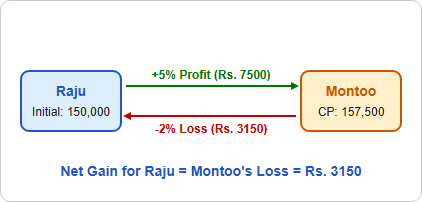
When an original owner repurchases an item, their net financial gain is exactly equal to the second person's cash loss.
Montoo's Cost Price = 150000 × (100 + 5) ÷ 100 = Rs. 157500.
Montoo's Loss = 2% of 157500 = Rs. 3150.
This loss amount represents Raju's exact net profit.
∴ The correct answer is Rs. 3150.

Alternate Method
Given:
Original CP of the car for Raju = Rs. 150000
Raju's profit percentage = 5%
Montoo's loss percentage = 2%
Calculations:
⇒ Selling Price (SP) of Raju = CP × (100 + Profit%) ÷ 100
⇒ SP of Raju = 150000 × (100 + 5) ÷ 100 = 150000 × 105 ÷ 100 = Rs. 157500
⇒ This SP becomes the Cost Price for Montoo.
⇒ SP of Montoo = 157500 × (100 − 2) ÷ 100 = 157500 × 98 ÷ 100 = Rs. 154350
⇒ Raju initially made a profit of: 157500 − 150000 = Rs. 7500
⇒ To repurchase the car, Raju paid an extra amount over the original CP: 154350 − 150000 = Rs. 4350
⇒ Raju's net financial gain = Initial Profit − Extra amount paid
⇒ Net gain = 7500 − 4350 = Rs. 3150
∴ The correct answer is Rs. 3150.

Additional Information
Closed Loop Repurchase
If person A sells an item to person B and later buys it back, A's net physical assets are restored. Their net financial gain exactly equals B's net cash loss.
Successive Transactions
When an item changes hands sequentially, the final price is determined by chaining the percentage changes: Final Price = Initial Price × (1 ± P1/100) × (1 ± P2/100).
Profit and Loss Basics
Profit occurs when Selling Price > Cost Price (Profit = SP − CP). Loss occurs when Cost Price > Selling Price (Loss = CP − SP). Both are fundamentally calculated based on the Cost Price.