Official Paper

Bihar Jeevika (Community Coordinator) : (09 Dec 2025) MBT (Previous Year Paper)

70 questions · 80 minutes · with answers · free

Test (70 questions)

1

Which is considered as the most ancient part of the world by historians?

  1. ((a))

    Gangetic Valley

  2. ((b))

    Southem part of Vindhya Mountain

  3. ((c))

    North Western Indian Valley

  4. ((d))

    North Eastern part of India

Show Answer
Answer: ((b))

Southem part of Vindhya Mountain

The correct answer is Southern part of Vindhya Mountain.

Key Points

  • The Southern part of the Vindhya Mountains is considered one of the most ancient parts of the world by historians, particularly in terms of human habitation.
  • The Vindhya mountain range holds significant historical and cultural value and is often associated with ancient texts and the origins of early settlements in India.
  • The southern part of this region is known to have been inhabited by some of the earliest human civilizations, providing archaeological evidence of ancient life.
  • The Vindhyas have been a geographical barrier between northern and southern India, influencing cultural and historical developments in both regions.

Additional Information

  • The Vindhya mountain range stretches across central India, from the state of Gujarat in the west to the eastern state of Madhya Pradesh.
  • Ancient texts, including the Mahabharata and Ramayana, mention the Vindhyas as a significant landmark, marking the transition between different regions and cultures.
  • The range is rich in biodiversity and has been a significant source of minerals, including coal and limestone, which played a crucial role in the region’s economy and development.

2

Prakrit was the official language under which of the following dynasty?

  1. ((a))

    Nanda Dynasty

  2. ((b))

    Satavahana dynasty

  3. ((c))

    Shishunaga Dynasty

  4. ((d))

    Haryanka Dynasty

Show Answer
Answer: ((b))

Satavahana dynasty

The correct answer is Satavahana dynasty.

Key Points

  • Prakrit was the official language of the Satavahana kingdom.
  • It was the golden age of Prakrit under the reign of Hala of Satavahanas.
  • The majority of satavahana inscriptions were written in Prakrit. Prakrit was the common language as well as the language of literature.
  • The Satavahanas preferred Prakrit to Sanskrit as their official language.
  • Prakrit refers to a group of Indo-Aryan languages and dialects that were spoken in ancient India.
  • Some current researchers include all Middle Indo-Aryan languages together as "Prakrits," while others emphasise the languages' separate evolution from Sanskrit's history, which is often separated by caste, religion, and geography.

Important Points

  • The Satavahanas were an ancient Indian dynasty centred in the Deccan region, also known as the Andhras in the Puranas.
  • Most modern academics believe the Satavahana dynasty began in the late second century BCE and lasted until the early third century CE, however, some researchers place the start of their rule as early as the third century BCE, based on the Puranas but without archaeological evidence.
  • The present-day states of Andhra Pradesh, Telangana, and Maharashtra were all part of the Satavahana monarchy.
  • They ruled areas of modern-day Gujarat, Madhya Pradesh, and Karnataka at various times.
  • During various eras, the dynasty had different capital cities, including Pratishthana (Paithan) and Amaravati (Dharanikota).

Additional Information

  • During the 4th century BCE, and perhaps the 5th century BCE, the Nanda dynasty ruled in the northern Indian subcontinent.
  • The Shaishunaga dynasty is thought to have been the second governing dynasty of ancient India's Magadha empire.
  • The Haryanka dynasty succeeded the Pradyota and Barhadratha dynasties as the third governing dynasty of Magadha, an ancient Indian empire.
3

Which of the following solutions is identified by smell?

  1. ((a))

    Sugar in water

  2. ((b))

    Salt in water

  3. ((c))

    Potassium permanganate in water

  4. ((d))

    Dettol in water

Show Answer
Answer: ((d))

Dettol in water

The correct answer is Dettol in water.

Key Points

  • Dettol is a well-known antiseptic liquid that has a distinctive smell, making it easily identifiable.
  • The smell of Dettol is due to the presence of chloroxylenol, which is its active ingredient.
  • When Dettol is dissolved in water, its characteristic smell remains, allowing it to be identified by olfactory senses.
  • Other solutions like sugar in water, salt in water, and potassium permanganate in water do not have a strong smell, making them harder to identify by smell alone.
  • Dettol is commonly used for cleaning and disinfecting surfaces, as well as for first aid purposes due to its antiseptic properties.

Additional Information

  • Salt in Water
  • Salt (sodium chloride) dissolved in water does not have any significant odor.
  • It is commonly used in cooking and food preservation.
  • Sugar in Water
  • Sugar dissolved in water is sweet to taste but does not have any specific smell.
  • It is widely used in beverages and culinary preparations.
  • Potassium Permanganate in Water
  • Potassium permanganate in water has a pink or purple color, but it does not have a strong smell.
  • It is often used as a disinfectant and in water treatment processes.
4

Jhijhiya is a famous folk dance of Bihar and is performed in the mythological town of Mithila. This dance is performed by women only. The whole Navaratri 'nine nights' festival is celebrated to worship the three forms of Lord ______.

  1. ((a))

    Kali, Lakshmi, Durga  

  2. ((b))

    Sita, Durga, Laxmi 

  3. ((c))

    Lakshmi, Parvati and Saraswati

  4. ((d))

    Sita, Kali and Parvati 

Show Answer
Answer: ((c))

Lakshmi, Parvati and Saraswati

The correct answer is Lakshmi, Parvati and Saraswati.

Key Points

  • Jhijhiya is a popular folk dance of Bihar, India, that is performed exclusively by women.
  • The dance is performed during the Navaratri festival, which lasts for nine nights and is dedicated to the worship of the three forms of the Hindu goddess Durga: Kali, Lakshmi, and Saraswati.
  • The festival is celebrated in the mythological town of Mithila, which is located in the northern part of Bihar.
  • Jhijhiya is a fast-paced dance that is accompanied by traditional musical instruments such as the dhol, shehnai, and bansuri.
  • The dance is typically performed by groups of women who wear colorful sarees and bangles, and the movements involve a lot of footwork and hand gestures.

Additional Information

  • Kali is one of the three forms of Durga, but the festival is dedicated to the worship of all three forms, not just Kali.
  • Sita is not one of the three forms of Durga, and therefore, this option is incorrect.
  • Parvati is one of the forms of the Hindu goddess Durga, but the festival is dedicated to the worship of Kali, Lakshmi, and Saraswati, not Sita, Kali, and Parvati.
5

Who among the following is the author of the book 'Neeraj Chopra: The Man Who Made History'?

  1. ((a))

    Shamya Dasgupta

  2. ((b))

    Norris Pritam

  3. ((c))

    Navdeep Singh Gill

  4. ((d))

    Samir Chopra

Show Answer
Answer: ((b))

Norris Pritam

The correct answer is Norris Pritam

Key Points

  • Norris Pritam is the author of Neeraj Chopra: The Man Who Made History,
  • It is a book about the life of India's first Olympic gold medalist in track and field.
  • Pritam is a sports journalist based in New Delhi.
  • He has covered six Olympic Games, six Asian Games, Commonwealth Games, and World Championships.
  • The book chronicles Neeraj Chopra's journey from a village boy to an Olympic gold medalist.
  • It also describes how his family supported him in his pursuit of sports. ​

Additional Information

  • Some recently released books:​​
BooksAuthors
The Legend of Birsa MundaTuhin A. Sinha and Ankita Verma
Bose: The Untold Story of An Inconvenient NationalistChandrachur Ghose
Gajapati: A king without a kingdomAshok Bal
India's Ancient Legacy of WellnessRekha Chaudhari
Gandhitopi GovernorYarlagadda Lakshmi Prasad
Public Service EthicsPrabhat Kumar
Cooking to Save Your LifeAbhijit Banerjee
Resolved: Uniting Nations in a Divided WorldBan Ki-moon
Nehru: The Debates that Defined IndiaTripurdaman Singh and Adeel Hussain
The Cinema of Satyajit RayBhaskar Chattopadhyay
6

The balance of exports and imports of goods is referred to as the ______.

  1. ((a))

    Balance of payment

  2. ((b))

    Trade balance

  3. ((c))

    Trade surplus

  4. ((d))

    Trade deficit

Show Answer
Answer: ((b))

Trade balance

The correct Option is the Trade Balance.

The balance of exports and imports of goods is referred to as the Trade Balance.

Key Points

  • The Trade Balance is the difference between the value of goods that a country or economic area exports and the value of goods imports.
  • India has a negative Bilateral Trade Balance with China, Saudi Arabia, Switzerland, Iraq, and South Korea. India has the highest trade deficit with China. India has a surplus trade balance with USA, UK, Bangladesh, Nepal, and UK.
  • The Balance of Payment of a country is the difference between all the money flowing into the country and the outflow of the money to the rest of the world.
  • The Trade Surplus is a situation in a country when the value of goods exports is more than the value of goods imports.
  • The Trade Deficit is a situation in a country when the value of goods imports is more than the value of goods exports

Important Points

  • Trade Balance = Value of goods Exports -  Value of goods Imports
  • Trade Surplus: Value of goods Exports >  Value of goods imports
  • Trade Deficit: Value of goods Imports >  Value of goods  Exports
  • Balance of Payment = Money flowing into the country - Outflow of the money to the rest of the world
7

Who has been appointed as the interim Chairman of the Airports Authority of India (AAI)? (August 2024)

  1. ((a))

    Manish Bhaskar

  2. ((b))

    M Suresh

  3. ((c))

    Abhay Muduli

  4. ((d))

    Abhijeet Parida

Show Answer
Answer: ((b))

M Suresh

The correct answer is M Suresh.

Key Points

  • M Suresh has been appointed as the interim Chairman of the Airports Authority of India (AAI).
  • He currently serves as the Member, Air Navigation Services at AAI.
  • Suresh will hold the interim position for three months or until a regular Chairman is appointed.

Important Points

  • Airports Authority of India (AAI): AAI is responsible for creating, upgrading, maintaining, and managing civil aviation infrastructure in India.
  • Interim Appointment: M Suresh's appointment as interim Chairman is a temporary measure until a permanent chairman is appointed.
  • Previous Role: Before becoming interim Chairman, Suresh was the Member, Air Navigation Services, overseeing air navigation operations.
  • Duration of Tenure: The interim role is set for a duration of three months, subject to further orders or appointment of a permanent successor.

Additional Information

  • Air Navigation Services: This division of AAI is responsible for ensuring safe and efficient air traffic management and navigation services across India.
  • AAI's Responsibilities: Besides managing airports, AAI also handles airport security, air traffic control, and airport development projects.
8

Who has been named TIME's 2024 Person of the Year?

  1. ((a))

    Donald Trump

  2. ((b))

    Elon Musk

  3. ((c))

    Volodymyr Zelenskyy

  4. ((d))

    Vladimir Putin

Show Answer
Answer: ((a))

Donald Trump

The correct answer is Donald Trump

In News

  • Donald Trump has been named Time magazine's Person of the Year for 2024, marking his second recognition after 2016.

Key Points

  • The title honors individuals who have shaped the world, for better or worse, in a significant way.
  • Trump, as President-elect, joins a list of notable figures, including several U.S. presidents-elect, though it is not always guaranteed.
  • Last year, Taylor Swift was awarded the title for 2023.
  • The decision reflects Time's history of selecting influential figures, such as Queen Elizabeth II (1952) and the Apollo 8 astronauts (1968), over U.S. presidential candidates.
9

Who released the book "Khaki Mein Sthitapragya," written by former Uttarakhand DGP Anil Raturi, which is based on his memoirs and experiences as an IPS officer?

  1. ((a))

    Gurmit Singh

  2. ((b))

    Narendra Modi

  3. ((c))

    Pushkar Singh Dhami

  4. ((d))

    Amit Shah

Show Answer
Answer: ((c))

Pushkar Singh Dhami

The correct answer is Pushkar Singh Dhami

In News

  • The book "Khaki Mein Sthitiprajna" by former DGP of Uttarakhand Anil Ratudi was launched by Chief Minister Pushkar Singh Dhami on September 21, 2024.

Key Points

  • This book is based on Ratudi's experiences and challenges faced during his three-and-a-half-decade career as an IPS officer.
  • The Chief Minister praised Ratudi for his equanimity and patience, especially in difficult situations.
  • The CM emphasized that remaining calm in both success and failure is an essential quality for police officers.
  • Anil Ratudi highlighted in his book the importance of using the powers given to the police for human welfare.
  • On this occasion, Radha Ratudi sang a devotional song, and several prominent individuals, including DGP Abhinav Kumar, were present.
10

Which of the following is the main cause of 'bad lands'?

  1. ((a))

    Scanty rainfall

  2. ((b))

    Soil erosion

  3. ((c))

    Excessive forest cover

  4. ((d))

    Open defecation

Show Answer
Answer: ((b))

Soil erosion

The correct answer is Soil erosion.

Key Points

  • Badlands are a type of dry terrain where softer sedimentary rocks and clay-rich soils have been extensively eroded.
  • Badlands are arid regions where the hills are badly eroded under the action of water due to occasional rainstorms or the flow of river streams.
  • Gullies and ravines represent them.
  • Badland is rugged topography, usually of relatively low relief.
  • Badland is associated with the arid and semi-arid regions.

Additional Information

  • Types of Erosion are as follows
  • Rain Drop Erosion - Due to falling raindrops on the soil surface.
  • Sheet Erosion- Uniform removal of soil in thin layers from the surface.
  • Rill Erosion - Erosion takes place through numerous narrow streamlets.
  • Gully Erosion - Occurs due to runoff of surface water causing the removal of soil and forming gullies due to erosion.
  • Stram Bank Erosion- Nothing but away from banks of a stream or a river.
11

_________ are not enforceable by court but it is important that State acknowledge them while ​making laws.

  1. ((a))

    Constitutional remedies

  2. ((b))

    Fundamental duties

  3. ((c))

    Directive principles

  4. ((d))

    Fundamental rights

Show Answer
Answer: ((c))

Directive principles

The correct answer is Directive principles.

Key Points

  • Directive Principles of State Policy are mentioned in Part IV of the Indian Constitution.
  • They are not enforceable by any court, meaning that they are not justiciable.
  • However, they are fundamental in the governance of the country and it is the duty of the State to apply these principles in making laws.
  • The Directive Principles aim to create social and economic conditions under which citizens can lead a good life.
  • They act as guidelines to the central and state governments of India to frame laws and policies.

 Additional Information

  • Constitutional remedies
  • Constitutional remedies are mentioned in Article 32 and 226 of the Indian Constitution.
  • They provide citizens the right to move the Supreme Court or High Courts for the enforcement of their fundamental rights.
  • Fundamental duties
  • Fundamental duties are mentioned in Part IV-A of the Indian Constitution.
  • They are not enforceable by law but are considered important for the progress and integrity of the country.
  • There are 11 fundamental duties listed under Article 51A.
  • Fundamental rights
  • Fundamental rights are mentioned in Part III of the Indian Constitution.
  • They are justiciable, meaning that they are enforceable by the courts.
  • These rights are essential for the overall development of individuals and to maintain the dignity of individuals.
12

Gol Gumbaz is the mausoleum of the king Mohammed Adil Shah. It is a part of _______.

  1. ((a))

    Bundelkhand

  2. ((b))

    Bharatpur

  3. ((c))

    Panipat

  4. ((d))

    Bijapur

Show Answer
Answer: ((d))

Bijapur

The correct answer is Bijapur.

Key Points

  • Gol Gumbaz is a 17th-century mausoleum located in Bijapur, a city in Karnataka, India.
  • It is the tomb of Mohammad Adil Shah and houses his mortal remains.
  • The mausoleum is notable for its scale and exceptionally large dome.
  • The building is on UNESCO's "tentative list" to become a World Heritage Site in 2014.
  • It is the second-largest dome ever built, next in size only to St Peter’s Basilica in Rome.
  • A particular attraction in this monument is the central chamber, where every sound is echoed seven times.
  • Another attraction at the Gol Gumbaz is the **Whispering Gallery, where even minute sounds can be heard clearly 37 meters away.**​

Additional Information

  • Mohammed Adil Shah
  • ​Mohammed Adil Shah was the son of Ibrahim Adil Shah II.
  • He was the seventh ruler of Bijapur, crowned in 1627 at the age of 15 years.
  • He assisted the Mughals with their campaigns against the Ahmednagar Sultanate.
  • He signed a peace treaty with the Mughals in 1636.
  • Kingdom attained its dominions stretched from the Arabian Sea to the Bay of Bengal.
  • Bijapur also attained peace and prosperity during Mohammed’s reign.
  • His kingdom yielded an annual revenue of seven crores and eighty-four lakh rupees.
  • He died in 1656 and was buried in the Gol Gumbaz.
13

Where will India's first sunken museum be inaugurated?

  1. ((a))

    Red Fort

  2. ((b))

    Qutub Minar

  3. ((c))

    Fatehpur Sikri

  4. ((d))

    Humayun's Tomb

Show Answer
Answer: ((d))

Humayun's Tomb

The correct answer is ​Humayun's Tomb

In News

  • India's First Sunken Museum will open at the Humayun Tomb complex in Delhi on July 29, 2024.

Key Points

  • Union Culture and Tourism Minister Gajendra Singh Shekhawat and Prince Rahim Aga Khan will attend the opening.
  • The museum design is inspired by traditional Indian 'baolis' (stepwells), integrating historical and modern elements.
  • Exhibits include:
  • Restored artifacts from Humayun’s Tomb.
  • Rare items such as 'farmans', an astrolabe, a celestial sphere, and a 16th/17th-century warrior’s helmet.
  • Technological features:
  • 3-D videos depicting historical scenes.
  • Detailed scale models of the Nizamuddin Dargah complex.
  • Humayun’s Tomb:
  • Constructed in 1569-70, commissioned by Empress Bega Begum.
  • First garden tomb in India, influencing Mughal architecture including the Taj Mahal.
  • The tomb is a UNESCO World Heritage Site known for its Persian architectural influences and intricate designs.
14

Which of the following carbon compounds is classified as an alcohol?

  1. ((a))

    Propanal

  2. ((b))

    Propanol

  3. ((c))

    Propanoic

  4. ((d))

    Propanone

Show Answer
Answer: ((b))

Propanol

The correct answer is Propanol.

Key Points

  • An alcohol is an organic compound with a hydroxyl group (-OH) attached to a carbon atom.
  • Propanol, also known as propyl alcohol, has the chemical formula C3H7OH.
  • Propanol is a three-carbon alcohol, specifically a primary alcohol.
  • It is commonly used as a solvent and in the manufacture of other chemicals.
  • In contrast, Propanal (an aldehyde), Propanoic (a carboxylic acid), and Propanone (a ketone) do not contain the hydroxyl group characteristic of alcohols.

Additional Information

  • Aldehydes
  • These compounds have a carbonyl group (C=O) bonded to at least one hydrogen atom.
  • Propanal is an example of an aldehyde with the formula CH3CH2CHO.
  • Carboxylic Acids
  • These compounds contain a carboxyl group (-COOH).
  • Propanoic acid, also known as propionic acid, has the formula C2H5COOH.
  • Ketones
  • These compounds have a carbonyl group (C=O) bonded to two carbon atoms.
  • Propanone, commonly known as acetone, has the formula (CH3)2CO.
15

Who is know as the 'father of all India services'?

  1. ((a))

    Sardar Vallabhbhai Patel

  2. ((b))

    Lal Bahadur Shastri

  3. ((c))

    J. B. Kripalani

  4. ((d))

    Jawaharlal Nehru

Show Answer
Answer: ((a))

Sardar Vallabhbhai Patel

The Correct answer is Sardar Vallabhbhai Patel.

Key Points

  • Sardar Vallabhbhai Patel is known as the 'father of all India services'.
  • He played a crucial role in the formation of the Indian Administrative Service (IAS) and the Indian Police Service (IPS).
  • Patel was India's first Deputy Prime Minister and Minister of Home Affairs.
  • His efforts were instrumental in integrating the princely states into the Indian Union after independence.
  • He is also referred to as the 'Iron Man of India' for his determination and strong leadership.

 Additional Information

  • Lal Bahadur Shastri
  • Lal Bahadur Shastri was the second Prime Minister of India.
  • He is known for the slogan "Jai Jawan Jai Kisan" and his role in the Green Revolution.
  • J. B. Kripalani
  • J. B. Kripalani was a prominent Indian freedom fighter and politician.
  • He served as the President of the Indian National Congress during the transfer of power in 1947.
  • Jawaharlal Nehru
  • Jawaharlal Nehru was the first Prime Minister of independent India.
  • He is known for his vision of a modern India and his contributions to nation-building.
16

The distance between the pole and focus of a spherical mirror, in terms of its radius of curvature R, is equal to:

  1. ((a))

    R/2

  2. ((b))

    R/4

  3. ((c))

    2R

  4. ((d))

    R

Show Answer
Answer: ((a))

R/2

The correct answer is R/2.

Key Points

  • The distance between the pole and the focus of a spherical mirror is known as the focal length (f).
  • The radius of curvature (R) is the distance between the pole and the center of curvature of the mirror.
  • The focal length of a spherical mirror is half of its radius of curvature.
  • Mathematically, this relationship is expressed as (f=\frac{R}{2})
  • This applies to both concave and convex mirrors.

Additional Information

  • Concave Mirrors
  • These mirrors curve inward like a spoon and can form real or virtual images depending on the position of the object.
  • They are often used in applications like telescopes and shaving mirrors.
  • Convex Mirrors
  • These mirrors curve outward and always form virtual, diminished, and upright images.
  • They are commonly used as rear-view mirrors in vehicles.
  • Mirror Formula
  • The mirror equation (\frac{1}{f}=\frac{1}{v}+\frac{1}{u}) relates the focal length (f), image distance (v), and object distance (u) for spherical mirrors.
  • This formula is applicable to both concave and convex mirrors.
17

Which of the following is the hills of Bihar?

  1. ((a))

    Rajgir

  2. ((b))

    Bateshwar

  3. ((c))

    Ramshila

  4. ((d))

    All of the above

Show Answer
Answer: ((d))

All of the above

The correct answer is All of the above.

Key Points

List of the waterfall:List of lakes:List of hot springs:List of hills:
KakolatAnupamMajhar kundRajgir
TelharKharagpurDhua KundBarabar
KarkatKanwarSita kundBateshwar
Rishi kundKaimur range
North tankBrahmayoni
Ramshila
Pretshila
18

What is the third proportional to 28 and 112?

  1. ((a))

    448

  2. ((b))

    224

  3. ((c))

    84

  4. ((d))

    336

Show Answer
Answer: ((a))

448

Shortcut Trick

For two given numbers 'a' and 'b', their third proportional is given directly by the formula: b2 ÷ a.

Here, a = 28 and b = 112.

Third proportional = (112 × 112) ÷ 28

Third proportional = 112 × 4 = 448

∴ The correct answer is 448.

Alternate Method

Given:

First number = 28

Second number = 112

Formula Used:

If three numbers a, b, and c are in continued proportion, then a : b :: b : c, which gives c = b2 ÷ a.

Continued Proportion (a : b :: b : c)

28

:

112

::

112

:

c

28 × c = 112 × 112

Calculations:

⇒ Let the third proportional be c.

⇒ 28 : 112 :: 112 : c

⇒ 28 ÷ 112 = 112 ÷ c

⇒ c = (112 × 112) ÷ 28

⇒ c = 4 × 112

⇒ c = 448

∴ The correct answer is 448.

Additional Information

Mean Proportional

The mean proportional between two numbers a and b is the square root of their product. Formula: √(a × b).

Fourth Proportional

If four numbers are in proportion (a : b :: c : d), then 'd' is the fourth proportional. Formula: d = (b × c) ÷ a.

Compound Ratio

When two or more ratios are multiplied together, it is known as a compound ratio. For a:b and c:d, compound ratio is (a × c) : (b × d).

19

If the average age of 5 students is 16 years. If the teacher is included then the average age is increased by 1 year. What is the age of the teacher?

  1. ((a))

    44

  2. ((b))

    36

  3. ((c))

    22

  4. ((d))

    48

Show Answer
Answer: ((c))

22

Total age of 5 students = (16 \times 5 = 80) years.

Now total candidate is 5 + 1 = 6

New average is = 16 + 1 =17 years

After new candidates join the group then total age is:(17 \times 6 = 102)years

Age of new student : (102 - 80 = 22) Year

20

A bag contains Rs. 840 in the form of 2 rupee, 5 rupee and 10 rupee coins. The number of coins of 2 rupee, 5 rupee and 10 rupee are in the ratio of 5 : 7 : 6. What is the total number of coins in the bag?

  1. ((a))

    158

  2. ((b))

    132

  3. ((c))

    102

  4. ((d))

    144

Show Answer
Answer: ((d))

144

Given:

Ratio of coins of Rs. 2, Rs. 5, and Rs. 10 = 5 ∶ 7 ∶ 6

Formula Used:

Total rupees = Number of coins × Value of the coin

Calculation:

According to the ratio given:

Let the 2 rupee, 5 rupee and 10 rupee coin be = 5x, 7x and 6x respectively

Total rupees = Rs. 840

⇒ 5x × 2 + 7x × 5 + 6x × 10 = Rs. 840

⇒ 105x = 840

⇒ x = 840/105

⇒ x = 8

The total number of coins in the bag = 5x + 7x + 6x = 18x

18x → 18 × 8 = 144

The total number of coins in the bag is 144

21

A person covers a total distance of 270 km by bike. In the first 4 hours, its speed is 50 km/h and it decreases to 35 km/h in the remaining journey. What is the average speed of the bike?

  1. ((a))

    39 km/h

  2. ((b))

    45 km/h

  3. ((c))

    48 km/h

  4. ((d))

    42 km/h

Show Answer
Answer: ((b))

45 km/h

Given:

Total Distance = 270 km

In the first 4 hours, its speed is 50 km/h and it decreases to 35 km/h in the remaining journey.

Formula Used:

Average Speed = Total Distance/Total Time

Calculation:

Total Distance = 270 km

In the first 4 hours, its speed is 50 km/h

⇒ Disatnce covered = 50 × 4 = 200 km

Remaining diatance covered in 35 km/h

⇒ Time = (270 - 200)/35

⇒ 2 h

Total Time = 4 + 2 = 6 h

Average speed = 270/6

⇒ 45 km/h

∴ The average speed of the bike is 45 km/h.

22

The population of a town increases every year by 4%. If its present population is 50,000, then after 2 years it will be

  1. ((a))

    53,900

  2. ((b))

    54,000

  3. ((c))

    54,900

  4. ((d))

    54,080

Show Answer
Answer: ((d))

54,080

Given:

The population of a town increases every year = 4%. 

The present population = 50,000

Calculation:

According to the question

The population of a town increases after 1 year

⇒ [50,000 + (4% of 50,000)] 

⇒ [50,000 + (4/100) × 50,000] 

⇒ (50,000 + 2000) = 52,000

Again, the population of a town increases after 2 years

⇒  [52,000 + (4% of 52,000)]

⇒ (52,000 + 2080) = 54,080

∴ The required value is 54,080

Alternate Method  Ratio method:

4% = 1/25, 

first-year      second year

 25                     26

25                      26

Present population 25 × 25→ 50000, 1→ 80 

Present population after two year = 80 × 26 × 26 = 54080.

23

A man can swim in still water at a speed of 6 km/h, but he takes thrice as long to swim upstream as downstream. The speed of the man, when swimming downstream is: 

  1. ((a))

    3 km/h

  2. ((b))

    2 km/h 

  3. ((c))

    9 km/h

  4. ((d))

    6 km/h

Show Answer
Answer: ((c))

9 km/h

Given:- 

To find:- Speed of man, swimming downstream

Formula used:- Distance = speed × time

Calculation**:-** Let the speed of the river be ' x km/h

⇒Speed of man during upstream = 6 - x

⇒Speed of man during downstream = 6 + x

Let the distance be D km

Time taken in the upstream = 3 × (Time taken in the downstream)

Since, Time = ({Distance\over speed})

⇒({D\over(6-x)}= {3D\over(6+x)})

⇒3(6 - x) = (6 + x)

⇒18 - 3x = 6 + x

⇒4x = 12

⇒x = 3 km/h

The speed of the stream is 3 km/h

The speed of man when going downstream = 6 + x = 6 + 3 = 9 km/h

The speed of man when swimming downstream is 9 km/h

24

When difference between compound and simple interest for three years is ₹228 at 4% interest per annum, the principal is ₹______

  1. ((a))

    48075

  2. ((b))

    46300

  3. ((c))

    47295

  4. ((d))

    46875

Show Answer
Answer: ((d))

46875

Shortcut Trick

Direct formula for CI and SI difference for 3 years is D = P × (R/100)2 × (300 + R)/100.

Here, D = 228 and R = 4%.

⇒ 228 = P × (4/100)2 × (304/100)

⇒ 228 = P × (1/625) × (76/25)

⇒ P = (228 × 15625) ÷ 76 = 3 × 15625

∴ The correct answer is ₹46875.

Alternate Method

Given:

Difference between CI and SI for 3 years (D) = ₹228

Rate of Interest (R) = 4% per annum

Time (T) = 3 years

Formula Used:

Difference (D) = P × (R/100)2 × (300 + R)/100

Tree Method for 3 Years CI vs SI Difference

Principal (P)

SI (Yr 1)

SI (Yr 2)

SI (Yr 3)

d

2d

x

d = P × (R/100)^2 x = d × (R/100) Diff = 3d + x

Calculations:

⇒ 228 = P × (4/100)2 × (300 + 4)/100

⇒ 228 = P × (1/25)2 × (304/100)

⇒ 228 = P × (1/625) × (76/25)

⇒ P = (228 × 625 × 25) ÷ 76

⇒ P = 3 × 15625

⇒ P = 46875

∴ The correct answer is ₹46875.

Additional Information

Difference for 2 Years

The difference between CI and SI for exactly 2 years is given by the formula: D = P × (R/100)2.

Effective Rate of Compound Interest

For 2 years, the effective compound interest rate is calculated as [R + R + (R2 ÷ 100)]% of the principal.

Tree Method for CI

A visual technique that clearly separates interest on principal (the simple interest part) and interest on previous interest (the difference part) across different years.

25

If at same rate of interest, in 2 years, the simple interest is ₹40 and compound interest is ₹65, then what is the principal (in ₹)?

  1. ((a))

    16

  2. ((b))

    11

  3. ((c))

    9

  4. ((d))

    20

Show Answer
Answer: ((a))

16

Shortcut Trick

For 2 years, Rate (R%) = [200 × (CI − SI)] ÷ SI

⇒ R = [200 × (65 − 40)] ÷ 40 = (200 × 25) ÷ 40 = 5000 ÷ 40 = 125%

Now, Principal (P) = (SI × 100) ÷ (R × T)

⇒ P = (40 × 100) ÷ (125 × 2) = 4000 ÷ 250 = 16

∴ The correct answer is ₹16.

Alternate Method

Given:

Simple Interest (SI) for 2 years = ₹40

Compound Interest (CI) for 2 years = ₹65

P = ?

1st Yr: ₹20

2nd Yr: ₹20

Diff: ₹25

Rate (R%)

Total SI = ₹40 | Total CI = ₹20 + ₹20 + ₹25 = ₹65

Calculations:

⇒ Simple Interest remains the same for every year. Thus, SI for 1 year = ₹40 ÷ 2 = ₹20.

⇒ Difference between CI and SI for 2 years = ₹65 − ₹40 = ₹25.

⇒ In compound interest, this extra ₹25 in the 2nd year is the interest earned on the 1st year's simple interest (₹20).

⇒ Rate of Interest (R) = (Interest on Interest ÷ SI for 1 year) × 100

⇒ R = (25 ÷ 20) × 100 = 125%

⇒ We know that SI for 1 year = (P × R × T) ÷ 100

⇒ 20 = (P × 125 × 1) ÷ 100

⇒ 20 = P × 1.25

⇒ P = 20 ÷ 1.25 = 16

∴ The correct answer is ₹16.

Additional Information

SI vs CI Difference for 2 Years

The difference between compound interest and simple interest for 2 years is given by the formula D = P × (R ÷ 100)2.

SI vs CI Difference for 3 Years

For 3 years, the difference formula becomes D = P × (R ÷ 100)2 × (3 + R ÷ 100).

Relation between SI and CI for 2 Years

If the principal and rate are the same, CI for 2 years can be directly related to SI using: CI = SI × (1 + R ÷ 200).

26

The numerator of a fraction is decreased by 25% and the denominator is increased by 25%. New fraction is how much percentage less than the original fraction?

  1. ((a))

    45%

  2. ((b))

    25%

  3. ((c))

    40%

  4. ((d))

    50%

Show Answer
Answer: ((c))

40%

Shortcut Trick

Let the original fraction be 100/100 = 1.

New Numerator = 100 − 25 = 75

New Denominator = 100 + 25 = 125

New Fraction = 75 ÷ 125 = 3/5 = 0.6 (which is 60% of the original).

Percentage decrease = (1 − 0.6) × 100% = 40%.

∴ The correct answer is 40%.

Alternate Method

Given:

The numerator of a fraction is decreased by 25%.

The denominator of the fraction is increased by 25%.

Formula Used:

Percentage Decrease = [(Original Value − New Value) ÷ Original Value] × 100%

Calculations:

Original Fraction = 100%

New Fraction = 60%

Decrease = 40%

Decrease = 100% − 60% = 40%

⇒ Let the original fraction be x / y.

⇒ New Numerator = x − (25/100) × x = 0.75x

⇒ New Denominator = y + (25/100) × y = 1.25y

⇒ New Fraction = 0.75x ÷ 1.25y = (75 ÷ 125) × (x / y) = 3/5 × (x / y)

⇒ Decrease in fraction = (x / y) − [3/5 × (x / y)] = 2/5 × (x / y)

⇒ Percentage decrease = [{2/5 × (x / y)} ÷ (x / y)] × 100%

⇒ Percentage decrease = 2/5 × 100% = 40%

∴ The correct answer is 40%.

Additional Information

Percentage Change

Percentage change is calculated as [(Final Value − Initial Value) ÷ Initial Value] × 100. A negative result indicates a decrease, while a positive result indicates an increase.

Successive Percentage Change

When a value is sequentially changed by x% and then by y%, the net percentage change can also be found using the effective formula: Net Change = x + y + (x × y) ÷ 100.

Fraction to Percentage Conversion

To convert a fraction into a percentage, multiply it by 100. For example, the fraction 3/5 expressed as a percentage is 3/5 × 100% = 60%. Therefore, any value that drops to 60% of its original has observed a 40% reduction.

27

A and B entered into a partnership with Rs. 8000 and Rs. 12000 respectively. Out of the total profit of Rs. 30000, A gets a share of 10% as he started the business and the rest is divided between them in the ratio of their investment. Find the share of A.

  1. ((a))

    35900

  2. ((b))

    7500

  3. ((c))

    13800

  4. ((d))

    12500

Show Answer
Answer: ((c))

13800

Shortcut Trick

A's starting bonus = 10% of 30000 = Rs. 3000.

Remaining profit = 30000 − 3000 = Rs. 27000.

Profit ratio of A and B = 8000 : 12000 = 2 : 3.

A's share from investment = (2 ÷ 5) × 27000 = Rs. 10800.

Total share of A = 3000 + 10800 = Rs. 13800.

∴ The correct answer is Rs. 13800.

Alternate Method

Given:

A's investment = Rs. 8000

B's investment = Rs. 12000

Total Profit = Rs. 30000

A gets 10% of the total profit for starting the business.

Total Profit = Rs. 30000

A's 10% Salary Rs. 3000

Remaining Profit Rs. 27000

A: Rs. 10800

B: Rs. 16200

Formula Used:

Profit Ratio = (Investment of A × Time period of A) : (Investment of B × Time period of B)

Calculations:

⇒ Bonus received by A = 10% of Rs. 30000

⇒ Bonus received by A = (10 ÷ 100) × 30000 = Rs. 3000

⇒ Remaining profit to be distributed = 30000 − 3000 = Rs. 27000

⇒ Ratio of investments of A and B = 8000 : 12000

⇒ Simplification of ratio = 2 : 3

⇒ Sum of ratio parts = 2 + 3 = 5 parts

⇒ Share of A in the remaining profit = (2 ÷ 5) × 27000

⇒ Share of A in remaining profit = 2 × 5400 = Rs. 10800

⇒ Total share of A = Bonus + Investment Share

⇒ Total share of A = 3000 + 10800 = Rs. 13800

∴ The correct answer is Rs. 13800.

Additional Information

Working Partner vs Sleeping Partner

A working partner receives a salary or a fixed percentage of the profit for actively managing the business, before the remaining profit is divided based on the capital ratio.

Simple Partnership

If the time periods are identical for all partners, the final profit is distributed strictly in the ratio of the capitals invested by them (C1 : C2).

Compound Partnership

When capital is invested for different durations, the profit ratio is calculated as the product of capital and time: (C1 × T1) : (C2 × T2).

28

Table shows year wise productions of four crops (in tons) in a village during 2018-2019 to 2021-2022.

Year\CropsPulsesWheatRiceOthers
2018-19410720400600
2019-20380680350580
2020-21320790420510
2021-22250690270490

The difference between the average production of wheat and the average production of pulses (in tons) over the year is:

  1. ((a))

    380

  2. ((b))

    360

  3. ((c))

    370

  4. ((d))

    350

Show Answer
Answer: ((a))

380

Calculation

The average production of wheat = (720 + 680 + 790 + 690)/4

= 2880/4

= 720

The average production of pulses = (410 + 380 + 320 + 250)/4

= 1360/4  

= 340

Difference = 720 - 340 = 380

The answer is 380.

29

Study the following table and answer the question given below it. The following table represents the sales of batteries manufactured by a company over the years.

Number of different types of batteries sold by a company over the years (Numbers in Thousand)

Types of Batteries
Year4AH7AH32AH35AH55AHTotal
201275144114102108543
20139012610284126528
20149611475105135525
2015105901509075510
201690751357590465
20171056016545120495
201811585160100145605
<br>

What was the approximate percentage increase in the total number of batteries sold in 2018 when compared to that in 2012?

  1. ((a))

    13%

  2. ((b))

    11%

  3. ((c))

    9%

  4. ((d))

    15%

Show Answer
Answer: ((b))

11%

Given:

Batteries sold in 2012 = 543

Batteries sold in 2018 = 605

Calculation:

Difference in batteries sold = 605 - 543 = 62

Required Percentage = (\dfrac{62}{543}) × 100 = 11%

∴ The approximate percentage increase in the total number of batteries sold in 2018 when compared to that in 2012 is 11%.

30

Which figure should replace the question mark (?) if the series were to be continued?

  1. ((a))

  2. ((b))

  3. ((c))

  4. ((d))

Show Answer
Answer: ((b))

Logic here followed is:

For 1 and 2 figure:


For 2 and 3 figure:

For 3 and 4 figures:

For 4 and 5 figures:

Hence, the correct answer is option 2.

31

Select the term that relates to the third term in the same way that the second term relates to the first term.

Tom : cat :: Jack : ?

  1. ((a))

    Ass

  2. ((b))

    Jenny

  3. ((c))

    Sow

  4. ((d))

    Horse

Show Answer
Answer: ((a))

Ass

AnimalMale
CatTom
AssJack

A male cat is known as Tom while a male donkey/ass is called as Jack.

Hence, ‘Ass’ is the correct answer.

32

If I denotes ‘÷’, J denotes ‘×’, K denotes ‘−’ and L denotes ‘+’, then what will come in place of ‘?’ in the following equation?

37 L 25 K (14 J 2) L (2 J 13) K (62 I 31) = ?

  1. ((a))

    58

  2. ((b))

    56

  3. ((c))

    60

  4. ((d))

    62

Show Answer
Answer: ((a))

58

Given information:

AlphabetDenotation
I÷
J×
K-
L+


Now let's denote the operators in the given equation:

37 L 25 K (14 J 2) L (2 J 13) K (62 I 31) = ?

37 + 25 - (14 × 2) + (2 × 13) - (62 ÷ 31) = ?

Applying the BODMAS rule i.e. Bracket of Division Multiplication Addition Subtraction.

We get,

= 37 + 25 - (28) + (26) - (2) 

= 37 + 25 - 28 + 26 - 2

= 88 - 28 - 2

= 88 - 30

= 58 

Hence, the correct answer is 58.

33

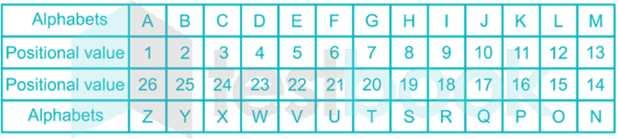
If all the letters in the word “NEGOTIATE” are arranged in alphabetical order from right to left end then the position of how many alphabet(s) will remain unchanged?

  1. ((a))

    Zero

  2. ((b))

    One

  3. ((c))

    Two

  4. ((d))

    Three

Show Answer
Answer: ((a))

Zero

The newly formed will be as follows:

NEGOTIATE
TTONIGEEA

We can observe that position of all the alphabets is changed.

Hence, “Zero” is the correct answer.

Mistake Points Please note that the alphabets are to be arranged from right to left and NOT from left to right.

34

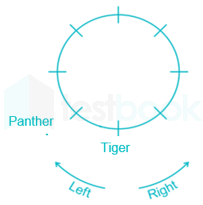
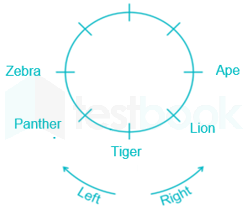
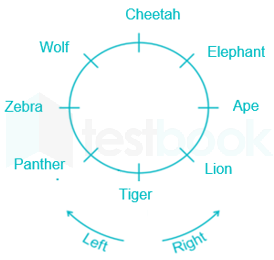
8 wild animals came around a pond to drink water. They are all facing inwards. Zebra and Ape are on opposite sides of the pond. Panther is on the adjacent left of Tiger. Cheetah, who is on the adjacent right of Elephant, is closest to the Wolf. The lion is standing in between Tiger and Ape. Find out who is standing opposite the Panther?

  1. ((a))

    Wolf

  2. ((b))

    Lion

  3. ((c))

    Cheetah

  4. ((d))

    Elephant

Show Answer
Answer: ((d))

Elephant

Let’s draw the diagram and place all the animals in their respective positions.

  1. Panther is on the adjacent left of Tiger.

  1. The lion is standing between Tiger and Ape.

  2. Zebra and Ape are on opposite sides of the pond.

  1. Cheetah, who is on the adjacent right of Elephant, is closest to the Wolf. Three spots are left now and we have only one possibility.

The animal standing opposite Panther is Elephant. Hence, Elephant is correct.

35

Which of the following numbers will replace the question mark (?) in the given series?

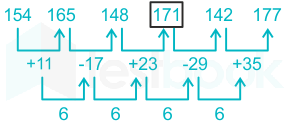
154, 165, 148, ?, 142, 177

  1. ((a))

    174

  2. ((b))

    162

  3. ((c))

    171

  4. ((d))

    168

Show Answer
Answer: ((c))

171

The pattern followed here is :

<br>

Hence, "171" is the correct answer.

36

A group of alphabets are given with each being assigned a number. These have to be unscrambled into a meaningful word and correct order of letters may be indicated from the given responses.

OULYTA
123456
  1. ((a))

    234165

  2. ((b))

    123654

  3. ((c))

    315246

  4. ((d))

    364125

Show Answer
Answer: ((d))

364125

Let’s check each option:

  1. 234165 ULYOAT

  2. 123654 OULATY

  3. 315246 LOTUYA

4) 364125 → LAYOUT

Hence, ‘364125’ represents a meaningful word ‘LAYOUT’.

37

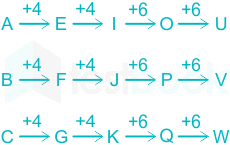
Select the letter-cluster from among the given options that can replace the question mark (?) in the following series.

ABC, EFG, IJK, OPQ, ?

  1. ((a))

    TUV

  2. ((b))

    XYZ

  3. ((c))

    UVW

  4. ((d))

    RST

Show Answer
Answer: ((c))

UVW

Given: ABC, EFG, IJK, OPQ, ?

The logic follows here is:

Hence, UVW is the correct answer.

38

Select the correct option that indicates the arrangement of the given words in the order in which they appear in an English dictionary.

  1. Freeze
  2. Freedom
  3. Fryer
  4. Frozen
  5. Fraud
  6. Fringe
  1. ((a))

    5, 6, 2, 1, 4, 3 

  2. ((b))

    5, 2, 1, 6, 3, 4

  3. ((c))

    5, 1, 2, 6, 4, 3 

  4. ((d))

    5, 2, 1, 6, 4, 3

Show Answer
Answer: ((d))

5, 2, 1, 6, 4, 3

The correct option that indicates the arrangement of the given words in the order in which they appear in an English dictionary is shown below:

  1. Fraud
  2. Freedom
  3. Freeze
  4. Fringe
  5. Frozen
  6. Fryer

Hence, ‘5, 2, 1, 6, 4, 3’ is the correct answer.

39

Direction: In question below, select the related word/letter/number from the given alternatives

9 : 24 :: ? : 6

  1. ((a))

    5

  2. ((b))

    3

  3. ((c))

    6

  4. ((d))

    1

Show Answer
Answer: ((b))

3

9 × 3 = 27 – 3 = 24

3 × 3 = 9 – 3 = 6

Thus, 3 is the correct answer.

40

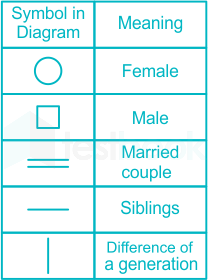
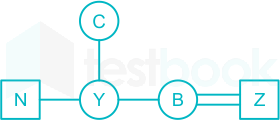
N is the brother of Y and Y is the sister of B. B is the wife of Z and C is the mother of Y. How Z is related to C?

  1. ((a))

    Son-in-law

  2. ((b))

    Daughter

  3. ((c))

    Maternal Uncle

  4. ((d))

    Sister

Show Answer
Answer: ((a))

Son-in-law

Family Chart:

Given: 

N is the brother of Y,

Y is the sister of B,

B is the wife of Z.

C is the mother of Y.

So, Z is Son in law of C.

Hence, the correct answer is "Option 1".

41

What is the function of a router in a computer network?

  1. ((a))

    To display web pages

  2. ((b))

    To connect devices wirelessly

  3. ((c))

    To manage network security

  4. ((d))

    To provide Internet access to multiple devices

Show Answer
Answer: ((d))

To provide Internet access to multiple devices

The correct answer is To provide Internet access to multiple devices.

Key Points

  • A router is a device that forwards data packets between computer networks.
  • It is designed to distribute Internet access to multiple devices within a network, allowing them to communicate with external networks.
  • Routers work at the network layer (Layer 3) of the OSI model, utilizing IP addresses to determine the best path for data transmission.
  • It can connect both wired and wireless devices, enabling seamless communication within and outside the network.

Additional Information

  • Switch: A switch operates at the data link layer (Layer 2) of the OSI model. It connects multiple devices within the same network and uses MAC addresses to forward data to the correct device.
  • Access Point: Access points enable wireless devices to connect to a wired network using Wi-Fi technology. It acts as a bridge between wireless and wired connections.
  • Firewall: A firewall is a security device that monitors and controls incoming and outgoing network traffic based on predetermined security rules. It protects the network from unauthorized access.
  • Modem: A modem modulates and demodulates signals for Internet access. It connects a home or business network to the Internet through an ISP (Internet Service Provider).
42

Which of the following devices converts human-understandable instructions and data into a form that computers understand and process?

  1. ((a))

    Printer

  2. ((b))

    Monitor

  3. ((c))

    Input devices

  4. ((d))

    Output devices

Show Answer
Answer: ((c))

Input devices

The correct answer is Input devices.

Key Points

  • Input devices are hardware components that allow users to provide data and instructions to a computer system.
  • These devices convert human-readable data into a machine-readable form that computers can process.
  • Examples of input devices include keyboards, mice, scanners, microphones, and cameras.
  • Input devices play a crucial role in enabling user interaction with computers and other electronic devices.

Additional Information

  • Output Devices: Output devices are hardware components that display or present the processed data from a computer system to the user. Examples include monitors, printers, and speakers.
  • Printer: A printer is an output device that converts digital data into physical, printed form. It does not process or convert instructions for computer understanding.
  • Monitor: A monitor is another output device that displays visual information to the user, but it does not convert data for computer processing.
  • Input and Output Devices: Some devices, like touchscreens, serve as both input and output devices, enabling two-way interaction with the user.
43

In MS-Word, which of the following shortcut key is used to reduce the size of a letter/character by one point at a time?

  1. ((a))

    Ctrl + Shift + {

  2. ((b))

    Alt + Ctrl + -

  3. ((c))

    Ctrl + ]

  4. ((d))

    Ctrl + [

Show Answer
Answer: ((d))

Ctrl + [

The correct answer is Ctrl + [​​.

Key Points

  • Ctrl + ]
  • It is used to reduce the size of a letter/character by one point at a time in Microsoft Word.

Additional Information 

  • Ctrl + [
  • It is used to Decrease selected font -1pts in Microsoft Word.
  • Microsoft Word
  • Microsoft Word is a word processing software developed by Microsoft.
  • It was first released on October 25, 1983, under the name Multi-Tool Word for Xenix systems.
44

DVD stands for:

  1. ((a))

    Dual Video Disc

  2. ((b))

    Durable Video Disc

  3. ((c))

    Digital Versatile Disc

  4. ((d))

    Discrete Versatile Disc

Show Answer
Answer: ((c))

Digital Versatile Disc

The correct answer is Digital Versatile Disc.

Key Points

  • DVD stands for Digital Versatile Disc.
  • It is a digital optical disc storage format invented and developed in 1995.
  • DVDs are primarily used for storing movies, software, data, and other multimedia content.
  • Compared to CDs, DVDs offer higher storage capacity and better video/audio quality.

Additional Information

  • Dual Video Disc: This is incorrect as DVDs are not referred to as "Dual Video Disc."
  • Durable Video Disc: Though DVDs are durable, this is not the correct full form.
  • Discrete Versatile Disc: This is an incorrect term and is not used for DVDs.
  • Digital Versatile Disc: This is the correct full form of DVD, which reflects its versatility in storing digital media.
45

What does "HTTP" stand for?

  1. ((a))

    HyperText Transmission Protocol 

  2. ((b))

    HyperText Transport Protocol 

  3. ((c))

    HyperText Transfer Protocol 

  4. ((d))

    HyperText Transfer Procedure 

Show Answer
Answer: ((c))

HyperText Transfer Protocol 

The correct answer is HyperText Transfer Protocol.

Key Points

  • HTTP stands for HyperText Transfer Protocol, which is a protocol used for transferring hypertext documents on the World Wide Web.
  • It is the foundation of any data exchange on the web and facilitates communication between web browsers and servers.
  • HTTP operates at the application layer of the OSI model.
  • It is a stateless protocol, meaning each request from a client to a server is independent of the previous one.
  • HTTP is used for accessing websites, APIs, and other web-based services.

Additional Information

  • HTTPS: HTTPS (HyperText Transfer Protocol Secure) is an extension of HTTP that uses encryption (via SSL/TLS) to secure communication between the client and server.
  • Protocol Layers: HTTP is an application-layer protocol, meaning it operates at the topmost layer of the OSI model.
  • Other Protocols: Other protocols at the application layer include FTP (File Transfer Protocol), SMTP (Simple Mail Transfer Protocol), and DNS (Domain Name System).
  • Stateless Nature: Since HTTP is stateless, techniques like cookies and sessions are used to maintain state and track user activities.
46

____monitors user activity on the internet and transmits that information in the background to someone else, thus eating the user's internet bandwidth.

  1. ((a))

    Operating system

  2. ((b))

    Hardware

  3. ((c))

    Adware

  4. ((d))

    Spyware

Show Answer
Answer: ((d))

Spyware

The correct answer is Spyware.

Key Points

  • Spyware is a type of malicious software that monitors user activity on the internet.
  • It transmits the collected information in the background to someone else, often without the user's knowledge.
  • This type of malware can significantly slow down internet speeds by consuming bandwidth.
  • Spyware can gather various types of data, including personal information, browsing habits, and login credentials.

Additional Information

  • Operating System
  • An operating system (OS) is system software that manages computer hardware and software resources.
  • It provides common services for computer programs and is essential for running application software.
  • Examples include Windows, macOS, Linux, and Android.
  • Hardware
  • Hardware refers to the physical components of a computer system.
  • This includes the central processing unit (CPU), memory, storage devices, and input/output devices.
  • Hardware is essential for the operation of software, which runs on these physical components.
  • Adware
  • Adware is a type of software that automatically displays or downloads advertising material.
  • It is often bundled with free software and can be intrusive, affecting user experience.
  • Unlike spyware, adware primarily focuses on delivering ads rather than stealing information.
47

Microsoft Excel and Microsoft Word are examples of

  1. ((a))

    Utility Software

  2. ((b))

    Operating System

  3. ((c))

    Application Software

  4. ((d))

    Programming Language

Show Answer
Answer: ((c))

Application Software

Software is a collection of instructions or computer programmes used to run computers to carry out particular activities.

Key Points

  • Software instructs a computer on how to run, to put it another way.
  • It can be categorized into types: Application software and System software.
  • Application software is used by end users and is created to perform a particular purpose.
  • Application software instructs the computer to carry out user-provided commands.
  • Some examples of application software are Microsoft Word, spreadsheets, Microsoft Excel, VLC media player, Firefox or Google Chrome, accounting applications, and photoshop.

Thus, Microsoft Excel and Microsoft Word are examples of Application Software. 

Additional Information

  • Programming Language is a method of notation for creating computer programmes.  language.
  • Utility Software helps users maintain and care for their computer systems.
  • Operating Systems are important sets of programmes that control resources and offer services to other software.
48

Which was the chief component of the first generation computers, which occupied a huge amount of space and consumed a lot of electricity? 

  1. ((a))

    Vacuum Tubes and Valves 

  2. ((b))

    Transistors 

  3. ((c))

    Integrated Circuits 

  4. ((d))

    Large scale integrated Circuits 

Show Answer
Answer: ((a))

Vacuum Tubes and Valves 

The correct answer is Vacuum Tubes and Valves.

Key Points

  • The first generation of computers (1940-1956) were primarily made using vacuum tubes and valves.
  • These computers were massive, often taking up entire rooms, and they consumed a significant amount of electricity.
  • Vacuum tubes were used for circuitry and magnetic drums for memory, which made these computers very large and inefficient.

Additional Information

  • Transistors: Introduced in the second generation of computers (1956-1963), transistors replaced vacuum tubes and made computers smaller, faster, cheaper, and more energy-efficient.
  • Integrated Circuits: Used in the third generation of computers (1964-1971), integrated circuits combined multiple transistors into a single chip, further reducing size and cost while increasing performance.
  • Large Scale Integrated Circuits: These are used in the fourth generation of computers (1971-present). They integrate thousands of transistors onto a single chip, leading to the development of microprocessors and personal computers.
49

If you want to change a word written in uppercase to lowercase in Microsoft Word, which among the following shortcut keys would you use?

  1. ((a))

    Shift + F4

  2. ((b))

    Shift + F3 

  3. ((c))

    F4

  4. ((d))

    F7

Show Answer
Answer: ((b))

Shift + F3 

The correct answer is Shift + F3.

Key Points

  • Shift + F3 is the shortcut key used in Microsoft Word to change the case of the selected text. It cycles through three options: UPPERCASE, lowercase, and Capitalize Each Word.
  • This shortcut is very handy for quickly transforming text without needing to navigate through menus.

Additional Information

  • Shift + F4: This shortcut is used to repeat the last "Find" action in Microsoft Word. It is not used for changing the case of text.
  • F4: This key repeats the last action performed in Microsoft Word. It is useful for repeating formatting actions but does not change text case.
  • F7: This is the shortcut key for the spell check and grammar check feature in Microsoft Word. It helps in finding and correcting spelling and grammatical errors in your document.
50

Ctrl + F1 key is used to

  1. ((a))

    Open the File menu

  2. ((b))

    Open the help dialog box

  3. ((c))

    Hide/show the Ribbon

  4. ((d))

    Display the shortcut menu

Show Answer
Answer: ((c))

Hide/show the Ribbon

Ctrl + F1 key combination is used to show the Ribbon when it’s hidden and hide it when it is visible. Pressing the F1 key opens the Office Assistant (help dialog box).

51

Which body acts as the apex at the district level in Panchayati Raj?

  1. ((a))

    Zilla Parishad

  2. ((b))

    Panchayat Samiti

  3. ((c))

    Municipal Corporation

  4. ((d))

    Gram Panchayat

Show Answer
Answer: ((a))

Zilla Parishad

The correct answer is Zilla Parishad.

Key Points

  • Zilla Parishad is the apex body at the district level in the three-tier Panchayati Raj system in India.
  • It functions as the governing and administrative authority for rural development and local self-governance at the district level.
  • The Zilla Parishad supervises and coordinates the activities of the Panchayat Samiti and Gram Panchayat under its jurisdiction.
  • The members of the Zilla Parishad are elected representatives from various constituencies within the district.
  • It is headed by the President, who is elected from among its members, with the District Collector serving as the administrative link between the Zilla Parishad and the state government.

Additional Information

  • Panchayati Raj System:
  • It is a decentralized form of governance introduced by the 73rd Constitutional Amendment Act of 1992.
  • It consists of a three-tier structure: Gram Panchayat (village level), Panchayat Samiti (block level), and Zilla Parishad (district level).
  • This system empowers local self-governance and promotes participatory democracy.
  • Functions of Zilla Parishad:
  • Formulates and implements development plans for the district, focusing on areas such as health, education, and agriculture.
  • Coordinates the activities of various departments and monitors the execution of government programs.
  • Allocates funds to Panchayat Samitis and oversees their utilization.
  • Composition of Zilla Parishad:
  • It consists of elected members, representatives of Panchayat Samitis, and members of the Legislative Assembly and Parliament from the district.
  • Seats are reserved for Scheduled Castes, Scheduled Tribes, and women as per constitutional provisions.
  • Key Legislations:
  • The Panchayati Raj System operates under the provisions of the 73rd Amendment Act of the Indian Constitution.
  • It is governed by state-specific Panchayati Raj Acts, which outline the roles, responsibilities, and powers of the Zilla Parishad.
52

Which of the following statements about the Gram Sabha is correct?

  1. ((a))

    It consists only of elected members of the Gram Panchayat.

  2. ((b))

    It has authority to override the decisions of the Panchayat.

  3. ((c))

    It meets only once every five years

  4. ((d))

    It comprises all adult voters in the Panchayat area; its role is defined by state law. 

Show Answer
Answer: ((d))

It comprises all adult voters in the Panchayat area; its role is defined by state law. 

The correct answer is It comprises all adult voters in the Panchayat area; its role is defined by state law..

Key Points

  • Gram Sabha: The Gram Sabha is the cornerstone of the Panchayati Raj system in India. It comprises all adult voters in the jurisdiction of a Gram Panchayat. This ensures that every eligible voter in the village has an equal say in decision-making processes.
  • Role and Authority: The role of the Gram Sabha is defined by state laws, as the Panchayati Raj system is governed by state-specific legislation under the ambit of the 73rd Constitutional Amendment Act, 1992. It can discuss and approve development plans, expenditure, and other matters concerning the village.
  • Statement 1: The statement that the Gram Sabha consists only of elected members of the Gram Panchayat is incorrect. The Gram Sabha is a broader body that includes all adult voters, not just elected members.
  • Statement 2: The statement claiming that the Gram Sabha has the authority to override the Panchayat's decisions is incorrect. While the Gram Sabha plays a critical role in decision-making, its powers are regulated by state legislation and do not necessarily include overriding Panchayat decisions.
  • Statement 3: The claim that the Gram Sabha meets only once every five years is incorrect. The Gram Sabha is required to meet at regular intervals, as determined by state laws, often multiple times a year.
  • Statement 4: The statement that the Gram Sabha comprises all adult voters in the Panchayat area and its role is defined by state law is correct. This aligns with the provisions of the Panchayati Raj system and the Constitution.
  • Hence, the correct answer is It comprises all adult voters in the Panchayat area; its role is defined by state law.

Additional Information

  • Gram Sabha's Constitutional Background:
  • 73rd Constitutional Amendment Act: This amendment in 1992 introduced the concept of Gram Sabha as part of the three-tier Panchayati Raj system in India. It emphasizes direct participation of people at the grassroots level.
  • Gram Sabha is mentioned under Article 243A of the Indian Constitution, which empowers state governments to define its functions.
  • Functions of Gram Sabha:
  • It acts as a deliberative body where policies and decisions related to the village's development and welfare are discussed.
  • The Gram Sabha approves the annual budget and plans of the Gram Panchayat.
  • The body discusses issues such as land management, social welfare, and development programs.
  • Importance of Gram Sabha:
  • It ensures transparency and accountability in governance at the village level.
  • It promotes participatory democracy by involving citizens directly in decision-making processes.
  • It acts as a check on the functioning of Gram Panchayat and ensures that decisions are made in the interest of the community.

Important Points

  • Key Legislative Provisions:
  • The functions and powers of the Gram Sabha are defined by state-specific Panchayati Raj Acts. These laws vary across states in India.
  • The Gram Sabha must meet at least twice a year to discuss and approve key matters, including social audits and development programs.
  • Historical Context:
  • 1992: The 73rd Amendment Act laid the foundation for the institutionalization of Gram Sabha, recognizing its importance in rural governance.
  • Article 243A: This article serves as the primary constitutional provision for Gram Sabha, ensuring its legal existence and mandate.
53

Which of the following programmes was launched in 2000 to improve cold storage facilities for agricultural products in India?

  1. ((a))

    Grameen Bhandaran Yojana

  2. ((b))

    Pradhan Mantri Fasal Bima Yojana

  3. ((c))

    National Horticulture Mission

  4. ((d))

    Rashtriya Krishi Vikas Yojana

Show Answer
Answer: ((a))

Grameen Bhandaran Yojana

The Correct answer is Grameen Bhandaran Yojana.

Key Points

  • Grameen Bhandaran Yojana was launched in the year 2000 by the Government of India.
  • The primary objective of this scheme is to improve cold storage facilities and enhance the storage infrastructure for agricultural products in India.
  • This scheme aimed to reduce post-harvest losses and ensure the availability of storage facilities at the farm level.
  • Under this scheme, farmers and other eligible organizations are provided financial assistance to construct godowns, warehouses, and cold storage units.
  • It enables farmers to store their produce scientifically and sell it at remunerative prices.
  • The scheme also seeks to encourage private and cooperative sector participation in the creation of storage infrastructure.
  • By improving storage conditions, the scheme contributes to the goal of food security in India.

Additional Information

  • Pradhan Mantri Fasal Bima Yojana
  • This scheme was launched in 2016 and focuses on providing crop insurance to farmers.
  • It aims to protect farmers against crop losses caused by natural calamities, pests, and diseases.
  • It is not related to cold storage or storage facilities.
  • National Horticulture Mission
  • Launched in 2005-06, this mission aims to promote horticulture development in India.
  • It focuses on the production of fruits, vegetables, spices, and medicinal plants, but does not directly address cold storage infrastructure.
  • Rashtriya Krishi Vikas Yojana
  • This scheme was initiated in 2007 to encourage states to increase public investment in agriculture and allied sectors.
  • It does not specifically focus on creating cold storage facilities.
54

'Vision 2035 : Public Health Surveillance in India' is related with

  1. ((a))

    Agriculture Commission

  2. ((b))

    Population Commission

  3. ((c))

    'NITI' Aayog

  4. ((d))

    Census Commission

Show Answer
Answer: ((c))

'NITI' Aayog

The correct answer is NITI Aayog.

Key Points

  • Vision 2035: Public Health Surveillance in India is a comprehensive document released by NITI Aayog that outlines a roadmap for strengthening public health surveillance in India.
  • The initiative emphasizes integrating digital technology and data analytics to enhance health surveillance systems, making them more efficient and future-ready.
  • It aims at transitioning from a reactive response to diseases to a proactive and predictive approach, focusing on preventive healthcare strategies.
  • The framework identifies key areas such as interoperability, real-time data sharing, and collaboration among health systems to improve decision-making and response times.
  • It aligns with India's commitment to achieving Universal Health Coverage (UHC) and strengthening the healthcare system under Sustainable Development Goals (SDGs).

Additional Information

  • NITI Aayog:
  • Established in January 2015, NITI Aayog replaced the Planning Commission as the policy think tank of the Government of India.
  • Its primary objective is to provide strategic direction and create a framework for long-term policy and programs.
  • NITI Aayog promotes cooperative federalism by fostering partnerships between the central and state governments.
  • It focuses on sectors such as health, education, agriculture, and technology to drive India's development agenda.
  • Public Health Surveillance:
  • It refers to the systematic collection, analysis, and interpretation of health-related data to inform public health decisions and actions.
  • Surveillance systems help in early detection of outbreaks, monitoring trends, and evaluating the impact of health interventions.
  • Digital technologies like Artificial Intelligence (AI) and Machine Learning (ML) are increasingly used to enhance surveillance capabilities.
  • Universal Health Coverage (UHC):
  • UHC ensures that all individuals and communities receive essential health services without financial hardship.
  • It is a key target under the United Nations Sustainable Development Goals (SDG 3).
  • India is working towards achieving UHC through initiatives like Ayushman Bharat and improved public health surveillance systems.
  • Sustainable Development Goals (SDGs):
  • A global framework adopted by the United Nations in 2015, comprising 17 goals aimed at ending poverty, protecting the planet, and ensuring peace and prosperity.
  • SDG 3 focuses on good health and well-being, emphasizing universal health coverage, disease prevention, and health system strengthening.
55

Which Ministry is primarily responsible for implementing most rural development schemes in India?

  1. ((a))

    Ministry of Social Justice and Empowerment 

  2. ((b))

    Ministry of Agriculture and Farmers Welfare

  3. ((c))

    Ministry of Panchayati Raj

  4. ((d))

    Ministry of Rural Development

Show Answer
Answer: ((d))

Ministry of Rural Development

The Correct answer is Ministry of Rural Development.

Key Points

  • The Ministry of Rural Development is primarily responsible for implementing various rural development schemes in India.
  • It aims to improve the quality of life in rural areas by focusing on poverty alleviation, employment generation, infrastructure development, and social security.
  • Some of the key programs implemented by this ministry include Mahatma Gandhi National Rural Employment Guarantee Act (MGNREGA), Pradhan Mantri Awas Yojana-Gramin (PMAY-G), National Social Assistance Programme (NSAP), and Pradhan Mantri Gram Sadak Yojana (PMGSY).
  • This ministry ensures that resources are utilized effectively for sustainable development in rural areas.
  • It also works in collaboration with other ministries and state governments to ensure inclusive growth and development in rural regions.
  • The Ministry of Rural Development plays a critical role in achieving the Sustainable Development Goals (SDGs) related to rural areas.

Additional Information

  • Ministry of Social Justice and Empowerment
  • This ministry focuses on the welfare and empowerment of marginalized and disadvantaged sections of society, including Scheduled Castes (SCs), Scheduled Tribes (STs), Other Backward Classes (OBCs), and persons with disabilities.
  • It is responsible for implementing programs like the Pre-Matric and Post-Matric Scholarships, National Fellowship for SC students, and Deendayal Disabled Rehabilitation Scheme (DDRS).
  • Ministry of Agriculture and Farmers Welfare
  • This ministry is responsible for policies and programs related to agriculture, food production, and farmers' welfare.
  • It implements schemes like the Pradhan Mantri Fasal Bima Yojana (PMFBY), Pradhan Mantri Kisan Samman Nidhi (PM-KISAN), and Soil Health Card Scheme.
  • The focus is on improving agricultural productivity and ensuring farmers' income security.
  • Ministry of Panchayati Raj
  • This ministry is responsible for the decentralized governance system in rural areas through the Panchayati Raj Institutions (PRIs).
  • It facilitates the devolution of powers and resources to these institutions as per the 73rd Constitutional Amendment Act.
  • The ministry plays a key role in enhancing rural self-governance and enabling local communities to participate in decision-making processes.
56

National Mission in Interdisciplinary Cyber Physical Systems (NM-ICPS) was launched in which of the following years?

  1. ((a))

    2022

  2. ((b))

    2020

  3. ((c))

    2015

  4. ((d))

    2018

Show Answer
Answer: ((d))

2018

The correct answer is 2018.

Key Points

  • The National Mission on Interdisciplinary Cyber-Physical Systems (NM-ICPS) was launched by the Government of India in 2018.
  • NM-ICPS is spearheaded by the Department of Science and Technology (DST) of India.
  • The mission's primary aim is to foster technological innovation and research in emerging fields such as robotics, artificial intelligence, and IoT.
  • A total of 25 Technology Innovation Hubs (TIHs) have been established under NM-ICPS to address challenges and promote collaboration.
  • The initiative targets advancing the field of Cyber-Physical Systems (CPS) to enhance India's global competitiveness in technology.

Additional Information

  • Cyber-Physical Systems (CPS):
  • CPS refers to integrated systems where physical processes are tightly interconnected with computational systems.
  • Examples include smart grids, autonomous vehicles, and precision agriculture systems.
  • Technology Innovation Hubs (TIHs):
  • Under NM-ICPS, TIHs serve as collaborative platforms for academic institutions, industries, and government organizations.
  • They facilitate research and development in areas such as AI, machine learning, and IoT.
  • Mission Objectives:
  • Promote advanced research and development in CPS.
  • Strengthen India's technological infrastructure and capacity.
  • Address societal challenges through innovative solutions.
  • Role of the DST:
  • The Department of Science and Technology (DST) oversees the implementation of NM-ICPS.
  • It ensures collaboration between academia, industry, and government for effective execution.
57

Which of the following scheme works on a 'Hub and Spoke Model'?

  1. ((a))

    Foodgrains SAMPADA Yojana

  2. ((b))

    Mega Food Park Scheme

  3. ((c))

    National Mission on Animal Husbandry

  4. ((d))

    Operation Greens

Show Answer
Answer: ((b))

Mega Food Park Scheme

The correct answer is Mega Food Park Scheme.

Key Points

  • The Mega Food Park Scheme is designed to create a robust food processing infrastructure across the country by leveraging the "Hub and Spoke Model."
  • Under this model, the food park acts as the central hub, with smaller primary processing centers (PPCs) and collection centers (CCs) as spokes.
  • It aims to provide a mechanism to link agricultural production to the market by bringing together farmers, processors, and retailers under one framework.
  • The scheme was launched by the Ministry of Food Processing Industries (MoFPI) to reduce wastage of agricultural produce and increase value addition.
  • Each Mega Food Park is expected to generate significant direct and indirect employment opportunities, particularly in rural areas.

Additional Information

  • Hub and Spoke Model:
  • This is a system of distribution in which a central facility (hub) is connected to smaller facilities (spokes).
  • In the Mega Food Park Scheme, the hub is the central processing unit, while PPCs and CCs serve as spokes to aggregate and process raw materials.
  • Objectives of the Mega Food Park Scheme:
  • To increase the processing of perishables in India and reduce post-harvest losses.
  • To provide state-of-the-art infrastructure for food processing in a cluster-based approach.
  • Components of a Mega Food Park:
  • A Central Processing Centre (CPC) with modern infrastructure facilities like cold storage, logistics, and packaging units.
  • Primary Processing Centers (PPCs) and Collection Centers (CCs) for the aggregation of raw materials.
  • Eligibility and Funding:
  • Eligible entities include private sector entities, state government entities, or cooperatives.
  • The scheme provides financial assistance up to 50% of the total project cost in general areas and up to 75% in difficult and hilly areas.
58

When was the Kushal Yuva Program launched?

  1. ((a))

    2 Oct 2015

  2. ((b))

    10 Sep 2016

  3. ((c))

    16 Dec 2016

  4. ((d))

    1 Jan 2017

Show Answer
Answer: ((c))

16 Dec 2016

The correct answer is Fri Dec 16 2016 00:00:00 GMT+0530 (India Standard Time).

Key Points

  • Kushal Yuva Program: The Kushal Yuva Program is an initiative under the Bihar Skill Development Mission, which aims to enhance the employability of youth in Bihar by training them in essential skills.
  • It was launched on December 16, 2016, as part of the “Skill Development Mission” of the Government of Bihar.
  • The program targets youth aged between 15 to 28 years, specifically those who have passed Class 10 but are not pursuing higher education or formal employment.
  • Objective: The primary objective is to provide young individuals with soft skills, basic computer literacy, and communication skills, enabling them to secure jobs or start their entrepreneurial ventures.
  • The program is designed to complement the existing government skill development programs and focuses on building life skills among youth.
  • Structure: The training under the Kushal Yuva Program is divided into three main modules: communication skills, basic computer knowledge, and life skills.
  • The program is implemented through a network of training centers established across Bihar, ensuring accessibility for rural and urban youth alike.
  • Hence, the correct answer is Fri Dec 16 2016 00:00:00 GMT+0530 (India Standard Time).

Additional Information

  • Key Features of the Kushal Yuva Program:
  • Skill Development Focus: It focuses on non-technical skills that are essential for making youth employable, such as interpersonal communication, problem-solving skills, and computer literacy.
  • Eligibility Criteria: The program targets youth aged 15-28 years who have completed their 10th standard education and are currently unemployed or not pursuing higher studies.
  • Training Duration: The duration of the training program is generally 240 hours, spread across several weeks, depending on the modules.
  • Implementation: The program is delivered through government-recognized training centers, ensuring standardized training and accessibility for all.
  • Impact and Benefits:
  • Employment Opportunities: By equipping youth with basic computer knowledge and soft skills, the program increases their employability across various sectors.
  • Entrepreneurial Development: The life skills module fosters a sense of self-reliance among youth, encouraging them to explore entrepreneurial opportunities.
  • Social Impact: The program helps in reducing unemployment and enhancing the economic productivity of the state.

Important Points

  • Comparison with Other Skill Development Programs:
  • Unlike other programs that focus solely on technical skills, the Kushal Yuva Program emphasizes soft skills and computer literacy, which are crucial for basic employability.
  • This program caters specifically to those who are not pursuing formal education or technical training, filling a critical gap in skill development initiatives.
  • Government of Bihar’s Role:
  • The Kushal Yuva Program is part of Bihar’s broader mission to enhance youth employability and reduce unemployment rates in the state.
  • It complements initiatives like the Student Credit Card Scheme and Self Help Allowance Scheme under the Seven Resolves of the Bihar government.
59

Pradhan Mantri Matru Vandana Yojana (PMMVY) offers Rs. ____ ​maternity benefit through Aadhaar linked DBT.

  1. ((a))

    7000

  2. ((b))

    2000

  3. ((c))

    5000

  4. ((d))

    8000

Show Answer
Answer: ((c))

5000

The correct answer is 5000.

Key Points

  • Pradhan Mantri Matru Vandana Yojana (PMMVY) is a flagship maternity benefit program launched by the Government of India in 2017 under the Ministry of Women and Child Development.
  • The scheme provides financial support of Rs. 5000 to pregnant women and lactating mothers (PW&LM) for their first living child to compensate for wage loss during pregnancy and after delivery.
  • The benefit is provided in three installments, subject to certain conditions such as early registration of pregnancy, at least one antenatal check-up, and registration of childbirth and immunization of the child.
  • The funds are transferred directly to the bank account of the beneficiaries through the Aadhaar-linked Direct Benefit Transfer (DBT) system, ensuring transparency and preventing leakage of funds.
  • The scheme aims to promote institutional deliveries, reduce infant mortality and malnutrition rates, and improve health-seeking behavior among pregnant women.

Additional Information

  • Eligibility Criteria under PMMVY:
  • Pregnant women and lactating mothers aged 19 years and above are eligible to receive benefits for their first child.
  • The scheme applies to women who are not employed under the Central Government or State Government or a Public Sector Undertaking (PSU).
  • Women who are beneficiaries of similar maternity schemes by the state governments are not eligible for PMMVY.
  • Installment Structure of the Scheme:
  • First installment: Rs. 1000 is provided upon early registration of pregnancy at an Anganwadi Centre (AWC) or authorized health facility.
  • Second installment: Rs. 2000 is released after at least one antenatal check-up at six months of pregnancy.
  • Third installment: Rs. 2000 is given after childbirth is registered and the child receives the first cycle of immunization as per the guidelines of the Ministry of Health and Family Welfare (MoHFW).
  • Objectives of PMMVY:
  • To provide partial compensation for wage loss during childbirth and childcare, allowing women to rest adequately during and after pregnancy.
  • To encourage pregnant women and lactating mothers to utilize health services.
  • To promote health-seeking behavior and early breastfeeding practices, contributing to the Government of India’s goal of improving maternal and infant health indicators.
  • Impact of the Scheme:
  • PMMVY has reached millions of women across India, providing crucial financial support during pregnancy and early motherhood.
  • It has contributed to an increase in institutional deliveries and a reduction in maternal and infant mortality rates.

Important Points

  • PMMVY is a centrally sponsored scheme implemented in collaboration with state governments and UT administrations.
  • The scheme is aligned with the objectives of the National Food Security Act (NFSA), 2013, which mandates maternity benefits for women.
  • It complements other government initiatives such as Janani Suraksha Yojana (JSY) and aims to strengthen maternal and child health services across India.
  • The use of the Aadhaar-linked DBT mechanism ensures that funds reach the intended beneficiaries directly, reducing chances of corruption and delays.
60

What is the name of the scheme launched by the Jharkhand state to encourage widow remarriage?

  1. ((a))

    Punarvivah Yojana

  2. ((b))

    Vidhwa Punarvivah Protsahan Yojana

  3. ((c))

    Women Empowerment Initiative

  4. ((d))

    Widows Welfare Scheme

Show Answer
Answer: ((b))

Vidhwa Punarvivah Protsahan Yojana

The Correct answer is Vidhwa Punarvivah Protsahan Yojana.

Key Points

  • Vidhwa Punarvivah Protsahan Yojana is an initiative by the Jharkhand state government to promote and encourage the remarriage of widows.
  • The scheme is aimed at improving the social and economic conditions of widowed women in the state.
  • Under this scheme, financial assistance is provided to widows and their new husbands to encourage their remarriage.
  • The scheme is designed to eliminate the stigma associated with widow remarriage and promote the concept of women's empowerment.
  • Such initiatives are a step towards ensuring gender equality and improving the overall societal mindset towards widowed women.
  • This is part of the welfare measures undertaken by the state to uplift vulnerable groups.
  • Jharkhand’s government has introduced this scheme keeping in mind the necessity of providing social security to widowed women.

Additional Information

  • Punarvivah Yojana
  • This option is incorrect as it does not refer to any specific scheme implemented by the Jharkhand state government.
  • The term "Punarvivah" means remarriage, but there is no official scheme by this name in Jharkhand related to widow remarriage.
  • Women Empowerment Initiative
  • This option is a generic term and does not refer to any particular scheme launched by the Jharkhand state government.
  • While women empowerment is a significant focus of many schemes, it is not the specific title of the scheme encouraging widow remarriage.
  • Widows Welfare Scheme
  • This is also a general term that may apply to various schemes aimed at providing welfare to widows but does not specifically refer to the Vidhwa Punarvivah Protsahan Yojana.
61

What is the main purpose of Panchayati Raj?

  1. ((a))

    To increase employment 

  2. ((b))

    To increase agriculture production

  3. ((c))

    To increase people's political awareness

  4. ((d))

    To enable people to participate in development administration

Show Answer
Answer: ((d))

To enable people to participate in development administration

The correct answer is option 4.

Key Points

  • The Panchayati Raj System (73rd Amendment, 1992) was introduced to promote decentralized governance.
  • Its main purpose is to give people a direct role in decision-making and participation in planning and implementation of development programmes at the local level.
  • While it can indirectly promote employment, agriculture, and awareness, the core objective is grassroots democracy and participatory development administration.

Additional Information

Panchayati Raj System

  • Constitutional Basis
  • Introduced by the 73rd Constitutional Amendment Act, 1992.
  • Came into effect on 24 April 1993 (celebrated as National Panchayati Raj Day).
  • Inserted Part IX (Articles 243–243O) and the 11th Schedule (29 subjects).
  • Structure (3-Tier System)
  • Gram Panchayat – at the village level.
  • Panchayat Samiti (Block/Mandal/Taluk) – at the intermediate level.
  • Zila Parishad – at the district level.
  • 👉 States with population below 20 lakhs may have only two tiers (Gram Panchayat & Zila Parishad).
  • Key Provisions
  • Elections: Direct elections every 5 years to all three levels (Article 243E).
  • Reservation:
  • 1/3rd of seats for women (now extended to 50% in some states).
  • Seats for SCs, STs, and OBCs in proportion to population.
  • State Election Commission (SEC): Conducts elections to Panchayats (Article 243K).
  • State Finance Commission (SFC): Reviews financial position and recommends fund devolution every 5 years (Article 243I).
  • Tenure: 5 years (can be dissolved earlier).
  • Powers & Responsibilities: Planning and implementing schemes for economic development and social justice across 29 subjects in the 11th Schedule (like agriculture, rural housing, education, health, drinking water, roads, poverty alleviation).
  • Sources of Revenue
  • Local taxes (property tax, water tax, professional tax).
  • Grants-in-aid from State Government.
  • Funds recommended by the Finance Commission (both Central and State).
  • Centrally Sponsored Schemes (like MGNREGA, PMGSY, etc.).
62

What is the primary objective of the Self Help Group (SHG) Bank Linkage Programme in India?

  1. ((a))

    Providing institutional credit to the poor

  2. ((b))

    Facilitating foreign investment in rural areas

  3. ((c))

    Promoting large-scale agricultural projects

  4. ((d))

    Encouraging self-employment among urban youth

Show Answer
Answer: ((a))

Providing institutional credit to the poor

The correct answer is Providing institutional credit to the poor.

Key Points

  • The Self Help Group (SHG) Bank Linkage Programme was initiated by the National Bank for Agriculture and Rural Development (NABARD) in 1992 to extend institutional credit to the economically weaker sections in rural areas.
  • Its primary objective is to provide institutional credit to the poor by linking banks with SHGs to foster financial inclusion and empower rural communities.
  • SHGs are small groups of individuals, typically 10-20 members, who come together to save, pool resources, and access loans from banks to meet their financial needs.
  • The programme has played a pivotal role in poverty alleviation, women empowerment, and promoting entrepreneurship among marginalized sections of society.
  • The Reserve Bank of India (RBI) has issued guidelines to banks for their active participation in this programme, ensuring that SHGs receive adequate credit support.
  • This initiative has led to significant growth in microfinance and has become a model for financial inclusion worldwide.

Additional Information

  • Self Help Groups (SHGs):
  • SHGs are informal groups formed voluntarily by people of similar socio-economic backgrounds.
  • The concept originated in India during the 1980s as a way to promote collective savings and credit access among the rural poor.
  • SHGs primarily focus on women empowerment, helping them participate actively in financial decision-making.
  • Examples include groups formed for agricultural activities, handicrafts, and small-scale businesses.
  • Features and Benefits of SHG-Bank Linkage Programme:
  • Provides collateral-free loans to SHGs, making credit accessible to those who lack traditional assets.
  • Promotes group accountability, reducing the risk of loan defaults.
  • Encourages saving habits among members, fostering financial discipline.
  • Strengthens the social capital through collective decision-making and mutual trust.
  • Impact of the Programme:
  • The programme has been instrumental in improving the standard of living and economic conditions of rural households.
  • It has empowered women to become self-reliant and financially independent.
  • Facilitated access to education, healthcare, and livelihood opportunities for poor families.
  • As of 2023, over 85 lakh SHGs have been linked to banks, benefitting millions across India.
  • Role of NABARD:
  • NABARD is the apex financial institution in India responsible for rural development and agriculture financing.
  • It provides guidelines, capacity-building initiatives, and refinancing support to banks involved in SHG lending.
  • Conducts training programmes to enhance the skills of SHG members in areas such as financial literacy, entrepreneurship, and management.

Important Points

  • Option 2: Facilitating foreign investment in rural areas is not the objective of the SHG-Bank Linkage Programme.
  • Option 3: Promoting large-scale agricultural projects is unrelated to SHGs, which focus on small-scale activities.
  • Option 4: Encouraging self-employment among urban youth is not the focus of this programme, as it primarily targets rural areas and communities.
  • The SHG-Bank Linkage Programme is one of the most successful models for financial inclusion and poverty alleviation globally.
63

What is the minimum age to contest in Panchayat elections as per Article 243F?

  1. ((a))

    25 years

  2. ((b))

    18 years

  3. ((c))

    30 years

  4. ((d))

    21 years

Show Answer
Answer: ((d))

21 years

The correct answer is 21 years.

Key Points

  • As per Article 243F of the Constitution of India, the minimum age required to contest in Panchayat elections is 21 years.
  • This provision ensures that individuals contesting elections have attained a reasonable level of maturity and understanding to take on responsibilities in governance.
  • The age limit is applicable uniformly across all states for Panchayat elections. Hence, 21 years is the correct minimum age.
  • Individuals below 21 years are ineligible to stand for election in Panchayats, as per the guidelines established by Article 243F. This eligibility criterion is crucial to maintaining the sanctity of decentralized governance.
  • The minimum age requirement aligns with the need for candidates to be capable of taking informed decisions and fulfilling administrative duties effectively. Hence, option 4 is correct.
  • Thus, the correct minimum age to contest Panchayat elections is 21 years.

Additional Information

  • Article 243F of the Constitution:
  • Article 243F provides details regarding disqualifications for membership in Panchayats. It specifies the eligibility criteria, including the minimum age required for candidates contesting elections.
  • The article also includes provisions for other disqualifications as determined by the state legislature or specified in relevant laws.
  • Importance of Age Criterion:
  • The age criterion ensures that candidates possess the maturity required for administrative functions and decision-making.
  • It is part of the broader framework of decentralized governance, where elected representatives are entrusted with responsibilities for local administration.
  • Example: A candidate must be at least 21 years old to contest in Panchayat elections in states like Uttar Pradesh, Bihar, and Karnataka, as per their state laws aligned with Article 243F.
  • Role of Panchayats:
  • Panchayats are the foundation of local self-governance in India, established under the 73rd Constitutional Amendment Act, 1992.
  • They play a crucial role in rural development by implementing schemes related to agriculture, health, education, and infrastructure.
  • The elected representatives of Panchayats are responsible for policy implementation at the grassroots level. Therefore, the age limit ensures that representatives are capable of handling these responsibilities effectively.

Important Points

  • Age Criteria in Other Elections:
  • For Lok Sabha elections, the minimum age to contest is 25 years, as per Article 84 of the Constitution.
  • For State Legislative Assembly elections, the minimum age is also 25 years, as per Article 173.
  • For Municipal elections, the minimum age varies between states but is generally 21 years, similar to Panchayat elections.
  • Significance of 73rd Amendment:
  • The 73rd Constitutional Amendment Act, 1992 established the Panchayati Raj system and mandated elections at the village, intermediate, and district levels.
  • It empowers rural communities to participate in governance and decision-making processes, ensuring local development and welfare.
  • The amendment also provides for the inclusion of women and marginalized sections of society in governance through reservation policies.
64

‘The Start-up India’ scheme of Government of India was launched in

  1. ((a))

    February, 2017

  2. ((b))

     January, 2016

  3. ((c))

    March, 2018

  4. ((d))

    April, 2016

Show Answer
Answer: ((b))

 January, 2016

The correct answer is January, 2016.

Key Points

  • The Start-up India initiative was launched by the Government of India in January 2016 to foster entrepreneurship and promote innovation.
  • The scheme was officially announced on 16th January 2016 by Prime Minister Narendra Modi.
  • The initiative aims to simplify processes for startups, provide funding support, and create a robust ecosystem for innovation.
  • It focuses on three key areas: simplification and handholding, funding support and incentives, and industry-academia partnership and incubation.
  • The Department for Promotion of Industry and Internal Trade (DPIIT) is the nodal agency overseeing the implementation of the Start-up India scheme.

Additional Information

  • Definition of a Startup:
  • A startup is defined as an entity that is registered for less than 10 years, has an annual turnover not exceeding INR 100 crores, and focuses on innovation, development, or improvement of products or services.
  • Benefits under the Scheme:
  • Startups receive tax exemptions for the first three years after incorporation under certain conditions.
  • Fast-tracking of patent applications with up to an 80% rebate on filing fees.
  • Startup India Hub:
  • A dedicated platform to assist startups by connecting them with investors, mentors, and incubators.
  • Funding Support:
  • Under the "Fund of Funds for Startups (FFS)," the Government provides INR 10,000 crore to support venture capital funding.
  • Impact:
  • The initiative has led to the emergence of several unicorn startups in India and has helped position the country as a global startup hub.
65

The 'Ayushman Bharat' scheme launched by the Indian government aims to provide:

  1. ((a))

    Financial assistance for farmers

  2. ((b))

    Free education for girls

  3. ((c))

    Health insurance for the economically vulnerable population

  4. ((d))

    Subsidized medicine for homeless

Show Answer
Answer: ((c))

Health insurance for the economically vulnerable population

The correct answer is Health insurance for the economically vulnerable population.

Key Points

  • The Ayushman Bharat scheme, also known as Pradhan Mantri Jan Arogya Yojana (PM-JAY), was launched by the Government of India in September 2018.
  • It aims to provide health insurance coverage of up to Rs. 5 lakhs per family per year for secondary and tertiary healthcare services.
  • The scheme primarily targets economically vulnerable families identified based on the Socio-Economic Caste Census (SECC) data.
  • Beneficiaries can avail of cashless healthcare services at public and private empanelled hospitals across India.
  • Ayushman Bharat is considered the world’s largest government-funded healthcare program, focusing on universal health coverage.

Additional Information

  • Key Features of Ayushman Bharat-PMJAY:
  • The scheme covers over 10 crore poor and vulnerable families across India, benefiting approximately 50 crore individuals.
  • It includes expenses related to pre-hospitalization, hospitalization, and post-hospitalization care.
  • There is no restriction on family size, age, or gender under this scheme.
  • PM-JAY encourages a paperless and portable health insurance system, enabling beneficiaries to avail of services anywhere in the country.
  • Health and Wellness Centers (HWCs):
  • Under Ayushman Bharat, 1.5 lakh Health and Wellness Centers are being established to provide comprehensive primary healthcare services.
  • These centers focus on preventive healthcare and treatment for non-communicable diseases.
  • HWCs aim to deliver affordable healthcare services closer to rural and underserved populations.
  • Funding and Implementation:
  • The scheme is fully funded by the Government of India, with the cost shared between the central and state governments.
  • It is implemented by the National Health Authority (NHA), which oversees its operations.
  • Eligibility Criteria:
  • Families are selected based on SECC data, with priority given to Scheduled Castes, Scheduled Tribes, and other disadvantaged groups.
  • No enrollment fee is required for beneficiaries, ensuring equitable access for all eligible individuals.
66

The main focus of Smart Cities Mission in India is:

  1. ((a))

    Telecommunication

  2. ((b))

    Urban Poverty Alleviation

  3. ((c))

    Development of smart infrastructure and technology

  4. ((d))

    Information Technology

Show Answer
Answer: ((c))

Development of smart infrastructure and technology

The Correct answer is Development of smart infrastructure and technology.

Key Points

  • The Smart Cities Mission in India aims to transform urban areas into sustainable and citizen-friendly spaces.
  • Its primary focus is on the development of smart infrastructure and technology, which includes solutions that improve urban living.
  • The mission emphasizes the use of Information and Communication Technology (ICT) to enhance governance, service delivery, and overall infrastructure.
  • Key aspects of smart infrastructure include smart roads, smart waste management, efficient water supply systems, renewable energy integration, and intelligent urban mobility solutions.
  • It prioritizes environmentally sustainable practices such as energy efficiency, low carbon emissions, and better resource management.
  • The initiative encourages citizen participation in urban planning and governance, ensuring that solutions are inclusive and tailored to local needs.
  • The mission aligns with global commitments such as the United Nations Sustainable Development Goals (SDGs) and India's efforts toward sustainable urbanization.
  • Some cities under this mission include Pune, Bhubaneswar, Surat, and Kochi, where smart solutions are being implemented.

 Additional Information

  • Telecommunication
  • Telecommunication refers to the transmission of information over distances using technologies such as telephones, satellites, and the internet.
  • While telecommunication is an important part of urban development, it is not the primary focus of the Smart Cities Mission.
  • The mission incorporates telecommunication within its broader framework of ICT but emphasizes urban infrastructure and technology-driven solutions.
  • Urban Poverty Alleviation
  • Urban Poverty Alleviation involves initiatives aimed at improving the living conditions of economically disadvantaged people in cities.
  • Though the Smart Cities Mission indirectly addresses poverty through better urban planning and infrastructure, it is not the main focus of the mission.
  • Programs such as National Urban Livelihoods Mission (NULM) are more directly aimed at poverty alleviation.
  • Information Technology
  • Information Technology (IT) is a subset of smart infrastructure and is used to implement smart solutions in governance, transportation, and resource management.
  • While IT is an integral part of the mission, the broader focus is on infrastructure and technology-driven urban development.
67

Pradhan Mantri Jeevan Jyoti Bima Yojana (PMJJBY) provides one year renewable life cover to all subscribing bank account holders in the age group of _____ years.

  1. ((a))

    20 to 30

  2. ((b))

    25 to 35

  3. ((c))

    18 to 50 

  4. ((d))

    25 to 65

Show Answer
Answer: ((c))

18 to 50 

The correct answer is 18 to 50 years.

Key Points

  • Pradhan Mantri Jeevan Jyoti Bima Yojana (PMJJBY) is a government-backed life insurance scheme launched by PM Narendra Modi on 9 May 2015.
  • The scheme provides life insurance cover of Rs. 2 lakh for a yearly premium of Rs. 436.
  • It is available to all bank account holders within the age group of 18 to 50 years.
  • The scheme is designed to ensure that the underprivileged sections of society have access to affordable life insurance.
  • The insurance cover is renewable annually, and the premium is automatically debited from the subscriber's bank account to ensure seamless continuity.

Additional Information

  • Eligibility Criteria:
  • Individuals aged between 18 to 50 years with an active bank account can enroll in PMJJBY.
  • The scheme is not available to those who are not part of the age criteria or do not have a bank account.
  • Policy Coverage:
  • The scheme provides a life cover of Rs. 2 lakh in case of death of the insured due to any reason.
  • Coverage starts from June 1 to May 31 and is renewable annually.
  • Implementation:
  • The scheme is implemented by the Life Insurance Corporation of India (LIC) and other participating insurance providers.
  • The premium amount of Rs. 436 is automatically debited from the policyholder's account.
  • Complementary Schemes:
  • The Pradhan Mantri Suraksha Bima Yojana (PMSBY) complements PMJJBY by providing accident insurance coverage.
  • Together, PMJJBY and PMSBY aim to ensure comprehensive financial security for the underserved sections of society.

Important Points

  • The scheme is part of the Indian government's financial inclusion initiative aimed at providing affordable insurance to the economically weaker sections.
  • It ensures that life insurance penetration increases across all segments of society, making financial security accessible to all citizens.
  • Subscribers who exit the scheme can rejoin after paying the premium, provided they meet the eligibility criteria.
  • The scheme is designed to address the issue of low insurance coverage in India, where many families are vulnerable to financial instability due to the untimely demise of a breadwinner.
68

What is the primary objective of the Saansad Adarsh Gram Yojana (SAGY)?

  1. ((a))

    To create employment through government-run industries in rural areas

  2. ((b))

    To replace all existing rural development schemes

  3. ((c))

    To provide direct financial assistance to all villagers

  4. ((d))

    To empower villagers to make choices and develop their own model villages

Show Answer
Answer: ((d))

To empower villagers to make choices and develop their own model villages

The Correct answer is To empower villagers to make choices and develop their own model villages.

Key Points

  • Saansad Adarsh Gram Yojana (SAGY) was launched by the Government of India on 11th October 2014.
  • The scheme aims to create model villages by leveraging existing schemes and empowering villagers.
  • It encourages Members of Parliament (MPs) to take responsibility for developing villages in their constituencies into Adarsh Grams (model villages).
  • The focus is on holistic rural development by improving basic amenities, infrastructure, healthcare, and education.
  • It emphasizes community participation, allowing villagers to make decisions and implement activities for their development.
  • SAGY does not provide direct financial assistance but focuses on the effective utilization of resources from existing government schemes and programs.
  • The scheme aims to ensure the development of villages in areas such as sanitation, housing, livelihood, public transport, and governance.
  • Key principles include people's participation, local governance, and convergence of schemes.
69

In which of the following years was the Pradhan Mantri Gram Sadak Yojana (PMGSY) launched by the Government of India to provide connectivity to unconnected habitations as part of a poverty reduction strategy?

  1. ((a))

    2002

  2. ((b))

    1997

  3. ((c))

    2005

  4. ((d))

    2000

Show Answer
Answer: ((d))

2000

The correct answer is 2000.

Key Points

  • Pradhan Mantri Gram Sadak Yojana (PMGSY) was launched by the Government of India in the year 2000. It aims to provide connectivity to unconnected rural habitations through all-weather roads.
  • This scheme was developed as a part of the Government’s poverty reduction strategy, recognizing the importance of rural roads in boosting economic growth and improving access to basic services.
  • Rural connectivity under PMGSY ensures better access to markets, healthcare, education, and other essential services for people living in rural areas.
  • The scheme is implemented by the Ministry of Rural Development and is funded by both the Central and State Governments. Hence, the correct answer is 2000.

Additional Information

  • Features of PMGSY:
  • The primary objective of PMGSY is to provide all-weather road connectivity to eligible unconnected habitations in rural areas. These are defined as those with a population of 500+ in plain areas and 250+ in hilly, tribal, or desert areas.
  • The roads constructed under PMGSY are designed using modern engineering techniques to ensure durability and sustainability.
  • PMGSY contributes significantly to poverty reduction by enhancing connectivity, reducing isolation, and promoting social and economic development.
  • Implementation Details:
  • The scheme is implemented by the Ministry of Rural Development in collaboration with state-level agencies.
  • Funds for PMGSY are shared between the Central Government (60%) and the State Governments (40%).
  • The scheme uses a geographic information system (GIS) for planning and monitoring purposes.
  • Achievements:
  • Since its inception, PMGSY has significantly improved rural infrastructure, contributing to better agricultural productivity and increased access to healthcare and education.
  • The scheme has helped in the construction of thousands of kilometers of roads, connecting previously isolated regions.

Important Points

  • Key Milestones:
  • PMGSY was launched on December 25, 2000, under the leadership of the then Prime Minister Atal Bihari Vajpayee.
  • The scheme is part of the broader effort to achieve inclusive development and bridge the urban-rural divide.
  • Challenges:
  • Implementation faces challenges such as land acquisition issues, delays in project completion, and maintenance concerns.
  • Efforts are ongoing to address these challenges through better planning, use of technology, and increased funding.
70

Which level of health care in India is responsible for dealing with more complex health problems that cannot be managed at the primary or secondary level?

  1. ((a))

    Quaternary care

  2. ((b))

    Tertiary Health Care

  3. ((c))

    Basic health care

  4. ((d))

    Urgent health care

Show Answer
Answer: ((b))

Tertiary Health Care

The correct answer is Tertiary Health Care.

Key Points

  • Tertiary Health Care is responsible for handling complex and specialized health problems that cannot be effectively addressed at the primary or secondary levels of health care.
  • This level of care includes services provided by specialists and super-specialists in well-equipped hospitals with advanced facilities.
  • It involves the use of highly sophisticated medical technology and expertise to manage critical conditions.
  • Examples of facilities offering tertiary care include teaching hospitals, specialty hospitals, and advanced diagnostic centers.
  • Common services provided at this level include neurosurgery, cardiac surgery, cancer treatment, organ transplantation, and advanced diagnostics.
  • Tertiary care facilities often act as referral centers for patients from primary and secondary health care units.
  • In India, institutions like All India Institute of Medical Sciences (AIIMS) and Post Graduate Institute of Medical Education and Research (PGIMER) are examples of tertiary care providers.
  • Tertiary care is crucial for improving health outcomes in cases of severe or life-threatening conditions.

Additional Information

  • Quaternary Care
  • Quaternary care is an extension of tertiary care and involves even more specialized and experimental treatments.
  • It includes highly advanced medical research and procedures that are not widely available.
  • Examples include rare genetic disorder treatments and innovative surgeries.
  • Basic Health Care
  • Basic health care refers to primary health care services like immunizations, maternal and child health services, and treatment of common illnesses.
  • These services are usually provided at local health centers and clinics.
  • Urgent Health Care
  • Urgent health care focuses on treating non-life-threatening medical conditions that require immediate attention.
  • Examples include care for minor injuries, infections, or sudden illnesses.

Attempt this paper under real exam conditions

Timed interface, section switching, instant scoring, and question-by-question analytics — free.

Start Timed Attempt