Official Paper

Bihar Jeevika (Block IT Executive) : (20 Nov 2025, Morning Shift) MBT (Previous Year Paper)

60 questions · 70 minutes · with answers · free

Test (60 questions)

1

Couple burial was found in which of the following Harappan sites?

  1. ((a))

    Mohenjodaro

  2. ((b))

    Harappa

  3. ((c))

    Chanhudado

  4. ((d))

    Lothal

Show Answer
Answer: ((d))

Lothal

The correct answer is Lothal.

Key Points

  • Couple burial was found from Lothal at the Harappan sites.
  • Lothal was one of the southernmost city of the ancient Indus valley civilisation located in the Bhal region of Gujarat.
  • Burial or interment is the ritual act of placing a dead person or animals, sometimes with objects, into the ground.

2

Who discovered the process of fermentation?

  1. ((a))

    Ernst Haeckel

  2. ((b))

    Louis Pasteur

  3. ((c))

    Robert Koch

  4. ((d))

    Joseph Lister

Show Answer
Answer: ((b))

Louis Pasteur

The correct answer is Louis Pasteur.

Key Points

  • Louis Pasteur, a renowned French microbiologist and chemist, discovered the process of fermentation in the 1850s. This groundbreaking discovery highlighted the role of microorganisms in converting sugars into alcohol or lactic acid.
  • Pasteur demonstrated that fermentation is caused by living microorganisms, particularly yeasts and bacteria, which contradicted the earlier belief that it was purely a chemical process.
  • He established that specific microbes are responsible for different types of fermentation, such as alcoholic fermentation (by yeasts) and lactic acid fermentation (by certain bacteria).
  • This discovery laid the foundation for modern microbiology and biotechnology, as it allowed scientists to manipulate microbes for various industrial and medical applications.
  • Pasteur also developed the process of pasteurization, which involves heating liquids like milk and wine to kill harmful microbes without altering the product's taste or quality.

Additional Information

  • Louis Pasteur:
  • Born: December 27, 1822, in Dole, France.
  • Known as the "Father of Microbiology" for his contributions to microbiology, including the discovery of fermentation, pasteurization, and vaccines for diseases like rabies and anthrax.
  • His work proved the germ theory of disease, establishing that microorganisms are responsible for many diseases.
  • Fermentation:
  • Fermentation is a metabolic process in which microorganisms convert organic compounds, such as sugars, into simpler substances like alcohol, acids, and gases.
  • It is widely used in industries for producing products like wine, beer, yogurt, cheese, and bread.
  • Types of fermentation include alcoholic fermentation (produces ethanol and carbon dioxide) and lactic acid fermentation (produces lactic acid).
  • Contributions of Other Scientists:
  • Ernst Haeckel: A German biologist and philosopher, known for his work in evolutionary theory and for coining terms like "ecology." He did not contribute to fermentation research.
  • Robert Koch: A German physician and microbiologist, famous for identifying the causative agents of diseases like tuberculosis and anthrax. He focused on infectious diseases rather than fermentation.
  • Joseph Lister: An English surgeon who pioneered antiseptic surgery techniques. He was not involved in fermentation studies.
  • Applications of Fermentation:
  • Food production: Used in making bread, wine, beer, and dairy products.
  • Pharmaceuticals: Key in producing antibiotics, insulin, and vaccines.
  • Biofuels: Used in producing ethanol as a renewable energy source.
  • Waste management: Helps in biodegradation of organic waste.

Important Points

  • Pasteurization: Developed by Louis Pasteur, it involves heating liquids to eliminate harmful microorganisms without compromising taste or nutritional value.
  • Alcoholic Fermentation: A process where yeasts convert sugars into ethanol and carbon dioxide, widely used in brewing and winemaking.
  • Lactic Acid Fermentation: Conducted by bacteria, producing lactic acid, essential for yogurt and cheese production.
  • Industrial Importance: Fermentation is crucial in sectors like food, pharmaceuticals, and energy, showcasing its versatility and significance.
3

Who among the following addresses the first session after each General Election to the House of People? 

  1. ((a))

    Prime Minister

  2. ((b))

    Parliamentary Affairs Minister 

  3. ((c))

    President

  4. ((d))

    Speaker of the Lok Sabha

Show Answer
Answer: ((c))

President

The correct answer is President.

Key Points

  • Article 87 of the Indian Constitution mandates that the President shall address the first session after each General Election to the House of People (Lok Sabha) and the commencement of the first session every year.
  • This address is known as the President’s Address, and it is a constitutional requirement as per Article 87.
  • The President’s Address outlines the policies and programs of the government for the upcoming year and highlights its vision.
  • This speech serves as an introduction to the government’s agenda and is a crucial event in the parliamentary calendar, marking the beginning of the legislative process.
  • The address is debated in both houses of Parliament, and members have the opportunity to discuss and respond to it.

Additional Information

  • Role of the President:
  • The President is the constitutional head of the state and represents the unity and integrity of the nation.
  • Under Article 53, the President exercises executive powers, either directly or through subordinate officers.
  • The President’s address is delivered in the presence of members of both the Lok Sabha and the Rajya Sabha.
  • Process of the President’s Address:
  • Following the address, a motion of thanks is moved in both houses of Parliament.
  • During the debate on the motion of thanks, members discuss the policies and programs mentioned in the address.
  • Amendments to the motion of thanks can be proposed, and it is an opportunity for members to critique the government’s agenda.
  • Significance of the President’s Address:
  • The address is a ceremonial occasion and sets the tone for the legislative business of the year.
  • It provides an insight into the priorities and objectives of the government.
  • It is a platform for the government to communicate its achievements and future plans to the members of Parliament and the public.
  • Historical Context:
  • The tradition of the President’s Address has been followed since the adoption of the Indian Constitution.
  • It reflects the parliamentary practices of countries like the United Kingdom, where the monarch delivers a speech outlining the government’s agenda.

Important Points

  • Article 87:
  • It specifies that the President shall address both houses of Parliament at the commencement of the first session after a General Election and the first session every year.
  • The President’s Address is an integral part of the parliamentary proceedings and is a constitutional obligation.
  • Constitutional Framework:
  • The President’s Address is prepared by the government and reflects its policies and legislative agenda.
  • The speech is an important document that provides a roadmap for the government’s plans and initiatives.
  • Debate on Motion of Thanks:
  • The motion of thanks is a crucial discussion that allows members to express their views on the President’s Address.
  • It is an opportunity for the opposition to highlight shortcomings and for the government to defend its policies.
4

Match List- with List-II and choose your answer from the code given below.

List – I (Governors)List - II (States)
a.Shri Arif Mohammad Khan1.Rajasthan
b.Shri La Ganesan2.Nagaland
c.Shri Jagdish Mukhi3.Bihar
d.Shri Kalraj Mishra4.Assam
  1. ((a))

    a - 1, b - 3, c - 4, d - 2

  2. ((b))

    a - 2, b - 1, c - 4, d - 3

  3. ((c))

    a - 3, b - 2, c - 4, d - 1

  4. ((d))

    a - 1, b - 2, c - 3, d - 4

Show Answer
Answer: ((c))

a - 3, b - 2, c - 4, d - 1

The correct answer is a - 3, b - 2, c - 4, d - 1

Key Points

  • Shri Arif Mohammad Khan → Bihar. Appointed as Governor of Bihar on 2 January 2025.
  • Shri La Ganesan → Nagaland. Assumed office as Governor of Nagaland on 20 February 2023. His passing in August 2025.
  • **Shri Jagdish Mukhi → Assam. Took charge as Governor of Assam on **10 October 2017 (served till 20 February 2023).
  • Shri Kalraj Mishra → Rajasthan. Assumed office as Governor of Rajasthan. Tenure 9 September 2019 to July 2024.
  • The appointment of governors is governed by Article 155 of the Indian Constitution, which states that the Governor of a state shall be appointed by the President of India.

Additional Information

  • Governor's Role and Responsibilities:
  • The Governor is the constitutional head of the state and acts as the representative of the President of India.
  • Under Article 163, the Governor exercises executive powers with the aid and advice of the Council of Ministers headed by the Chief Minister.
  • Governors also have discretionary powers in certain situations, such as recommending President's Rule under Article 356.
  • Key Facts about Governors:
  • The tenure of a Governor is typically 5 years, but they serve at the pleasure of the President.
  • Governors must meet eligibility criteria under Article 157, which includes being a citizen of India and being at least 35 years old.
  • Governors play a significant role in legislative matters, including giving assent to bills, reserving bills for the President's consideration, and addressing the state legislature.
  • Other Notable Governors:
  • Shri Banwarilal Purohit is the Governor of Punjab.
  • Shri R.N. Ravi served as the Governor of Tamil Nadu.
  • Important Articles in Context:
  • Article 154: Vests executive power of the state in the Governor.
  • Article 200: Grants the Governor the power to assent, withhold, or reserve bills passed by the state legislature.

Important Points

  • Governor's Appointment:
  • The President of India appoints Governors based on the recommendation of the Union government.
  • The Governor's role is largely ceremonial, but they have significant powers during times of constitutional crises.
  • Constitutional Provisions:
  • Article 158: Specifies conditions for the Governor's office, such as not holding any other office of profit.
  • Article 361: Provides immunity to the Governor from legal proceedings for actions taken in official capacity.
  • Recent Developments:
  • Governors have increasingly played a pivotal role in resolving political deadlocks in state legislatures.
  • In certain states, Governors have been involved in controversies surrounding their discretionary powers.
5

Appellate Jurisdiction of Supreme Court in regard to criminal matters is

  1. ((a))

    Related to political matters only

  2. ((b))

    Unlimited

  3. ((c))

    Not defined in the Constitution

  4. ((d))

    Limited

Show Answer
Answer: ((d))

Limited

The correct answer is Limited.

Key Points

  • The Appellate Jurisdiction of the Supreme Court in India refers to its authority to hear appeals against the judgments of lower courts such as the High Courts.
  • In the context of criminal matters, the appellate jurisdiction of the Supreme Court is limited as specified in the Constitution of India.
  • Under Article 134 of the Indian Constitution, the Supreme Court has appellate jurisdiction in criminal cases involving substantial questions of law or cases where a High Court has reversed an acquittal to impose a death sentence.
  • Appeals in criminal cases to the Supreme Court also require certification by the High Court that the case involves a substantial legal question or has grave importance.
  • This ensures that only cases of significant judicial and constitutional importance are brought before the Supreme Court for adjudication.

Additional Information

  • Article 134 of the Indian Constitution:
  • This article defines the appellate jurisdiction of the Supreme Court in criminal cases.
  • It specifically allows appeals to the Supreme Court in cases where a High Court has reversed an acquittal and sentenced the accused to death.
  • It also allows appeals in cases where the High Court certifies that the case involves a substantial question of law.
  • Appeals with Special Leave (Article 136):
  • Under this provision, the Supreme Court can grant special leave to appeal in any case, including criminal matters, where it deems it necessary to address a legal or constitutional question.
  • This power is discretionary and allows the Court to provide justice in cases of exceptional importance.
  • High Court Certification:
  • In most criminal cases, the High Court must certify that the matter involves a substantial question of law before it can be appealed to the Supreme Court.
  • This certification acts as a filter to ensure that the Supreme Court does not get overburdened with ordinary criminal cases.
  • Death Penalty Appeals:
  • The Supreme Court has exclusive jurisdiction to hear appeals in cases where the High Court has imposed a death penalty after reversing an acquittal.
  • This ensures the highest level of judicial scrutiny in cases involving capital punishment.

Important Points

  • The appellate jurisdiction of the Supreme Court is not unlimited. It only entertains cases that meet specific constitutional and legal criteria.
  • In addition to criminal matters, the Supreme Court also has appellate jurisdiction over civil cases under Article 133 of the Indian Constitution.
  • The Supreme Court’s jurisdiction can also extend to disputes between states or between the Union and states under its original jurisdiction (Article 131).
  • The limited appellate jurisdiction ensures that the Supreme Court focuses on cases with substantial constitutional or legal implications.
6

Kunwar Singh fought his last war against which English captain?

  1. ((a))

    Eyre

  2. ((b))

    Lugard

  3. ((c))

    Le Grand

  4. ((d))

    Douglas 

Show Answer
Answer: ((c))

Le Grand

The correct answer is Le Grand.

Key Points

  • Kunwar Singh, a key figure in the Indian Revolt of 1857, was a renowned freedom fighter from Jagdispur, Bihar.
  • He was a Zamindar who led a rebellion against the British East India Company during the First War of Indian Independence.
  • In the final stages of the revolt, Kunwar Singh fought his last battle against Captain Le Grand of the British forces. This battle took place near his hometown of Jagdispur.
  • Kunwar Singh displayed exceptional valor and military strategy despite being in his 80s, showcasing his unyielding spirit against colonial forces.
  • Before succumbing to injuries in April 1858, Kunwar Singh defeated the British forces and reclaimed Jagdispur, marking one of the most significant victories in the revolt.

Additional Information

  • Kunwar Singh:
  • Born in 1777, Kunwar Singh belonged to a royal family of the Ujjainiya Rajputs in Jagdispur.
  • He actively participated in the 1857 revolt, leading his forces against British troops in Bihar and nearby regions.
  • Despite limited resources and advanced age, Kunwar Singh executed guerrilla warfare strategies that baffled British commanders.
  • Captain Lugard:
  • Captain Lugard was a British officer tasked with suppressing the revolt in Bihar.
  • He led British forces against Kunwar Singh during the final stages of the rebellion.
  • Despite his efforts, he faced defeat at the hands of Kunwar Singh near Jagdispur in April 1858.
  • 1857 Revolt:
  • The revolt, known as the First War of Indian Independence, was a widespread uprising against British rule.
  • It began in Meerut and spread across northern and central India, involving leaders like Kunwar Singh, Rani Lakshmibai, and Nana Sahib.
  • The revolt was fueled by grievances such as the Doctrine of Lapse, cultural disrespect, and economic exploitation.
  • Jagdispur:
  • Jagdispur, located in present-day Bihar, was Kunwar Singh’s ancestral estate and a critical site during the revolt.
  • After defeating British forces, Kunwar Singh temporarily reclaimed Jagdispur, symbolizing resistance against colonial powers.

Important Points

  • Legacy of Kunwar Singh:
  • Kunwar Singh is celebrated as one of India’s greatest freedom fighters, and his contributions to the 1857 revolt are widely acknowledged.
  • His bravery and leadership continue to inspire generations in the struggle for independence.
  • Several landmarks and institutions in Bihar are named after him, honoring his legacy.
  • End of the Revolt:
  • The revolt ended with the suppression of major leaders by 1858, but it sowed seeds of nationalism among Indians.
  • Kunwar Singh’s victory at Jagdispur was one of the last significant events of the rebellion.
7

Mule Hunter. ai has been introduced by

  1. ((a))

    CERT.In

  2. ((b))

    RBI

  3. ((c))

    NPCI

  4. ((d))

    SEBI

Show Answer
Answer: ((b))

RBI

The correct answer is Reserve Bank of India (RBI).

Key Points

  • Mule Hunter.ai is an advanced platform introduced by the Reserve Bank of India (RBI) to tackle financial fraud and cybercrime.
  • It is designed to detect and prevent fraudulent activities in the banking and financial sector, particularly focusing on money mule operations.
  • The initiative aims to enhance cyber security and reduce the risks associated with money laundering and other illegal financial transactions.
  • Money mules are individuals who transfer stolen money or illegally obtained funds between different accounts, often unwittingly.
  • This platform leverages artificial intelligence (AI) and machine learning (ML) algorithms for real-time monitoring and analysis of suspicious transactions.

Additional Information

  • Reserve Bank of India (RBI):
  • Established in 1935, the RBI is India's central banking institution responsible for regulating the monetary policy of the country.
  • The RBI plays a critical role in ensuring the stability of the financial system and promoting economic growth.
  • It supervises and regulates banks, manages foreign exchange, and oversees payment systems in India.
  • Recently, RBI has focused on enhancing cybersecurity measures to combat modern financial challenges.
  • It is headquartered in Mumbai, Maharashtra.
  • Money Mule Operations:
  • Money mule operations involve using individuals to transfer illicit funds between accounts to disguise the origin of the money.
  • These operations are often part of larger cybercrime networks and contribute to money laundering schemes.
  • In many cases, money mules are unaware of their involvement in illegal activities.
  • Detecting and preventing money mule operations is critical for safeguarding the financial system.
  • Artificial Intelligence (AI) in Banking:
  • AI is increasingly used in the banking sector for fraud detection, risk management, and enhancing customer experience.
  • It enables real-time analysis of large datasets to identify patterns of fraudulent behavior.
  • AI-powered tools like Mule Hunter.ai provide actionable insights to prevent financial crimes.
  • Other Cybersecurity Initiatives:
  • The RBI has launched various initiatives to strengthen cyber resilience in banks, including guidelines for data protection and cyber threat management.
  • Financial institutions are encouraged to adopt state-of-the-art technology solutions to mitigate cyber risks.
  • Collaborations with international organizations help in combating global financial fraud.

Important Points

  • Role of AI in Financial Security: AI can identify trends, flag anomalies, and predict fraudulent activities, making it indispensable in combating financial crimes.
  • Global Cyber Threats: Financial institutions worldwide face increasing cyber threats, making platforms like Mule Hunter.ai essential for risk mitigation.
  • Impact of Money Laundering: Money laundering undermines economic stability and trust in financial institutions, emphasizing the need for stringent measures.
  • RBI's Commitment: The RBI's initiatives reflect its commitment to protecting India's financial ecosystem from emerging threats.
8

If A's income is 40% less than B's income, then how much percent is B's income more than A's income?

  1. ((a))

    65.66

  2. ((b))

    64.66

  3. ((c))

    66.66

  4. ((d))

    55.66

Show Answer
Answer: ((c))

66.66

Given

B's income - A's income = 40%

Formula used

Percent of A to B = A/B x 100%

Solution

Let the income of B = 100x

Then, A's income = 60x

⇒ B's income - A's income = 40x

⇒ 40x/60x × 100

⇒ 2/3 × 100

⇒ 66.66%

B's income is 66.66% more than A's income.

9

A shopkeeper sells an article for Rs. 200 with a loss of 20%. Find the Cost Price of the article.

  1. ((a))

    250

  2. ((b))

    240

  3. ((c))

    280

  4. ((d))

    300

Show Answer
Answer: ((a))

250

Given:

Selling Price (SP) = Rs. 200

Loss = 20%

Concept Used:

To find the Cost Price (CP) when there is a loss, we use the formula:

Formula Used:

CP = SP / (1 - Loss%)

Calculation:

CP = 200 / (1 - 20/100)

⇒ CP = 200 / (1 - 0.20)

⇒ CP = 200 / 0.80

⇒ CP = 250

∴ The Cost Price of the article is Rs. 250

10

Rs. 490 is divided among A, B and C such that A's share is half that of B's and thrice that of C's. What is C's share?

  1. ((a))

    Rs. 245

  2. ((b))

    Rs. 147

  3. ((c))

    Rs. 49

  4. ((d))

    Rs. 294

Show Answer
Answer: ((c))

Rs. 49

Given:

A's share is half that of B's and thrice that of C's.

Calculation:

Let the share of A be 3x

So, share of B = 3x × 2 = 6x and share of C = 3x × (1/3) = x

Now,

3x + 6x + x = 490

⇒ 10x = 490

⇒ x = 49

So, C's share is Rs. 49

∴ C's share is Rs. 49.

11

The present ages of three friends are in proportions 3 ∶ 5 ∶ 7. Four years ago, the sum of their ages was 48. What are the present ages of all three friends (in years) ?

  1. ((a))

    12 years, 20 years and 28 years

  2. ((b))

    15 years, 21 years and 28 years

  3. ((c))

    12 years, 25 years and 30 years

  4. ((d))

    16 years, 20 years and 28 years

Show Answer
Answer: ((a))

12 years, 20 years and 28 years

Given:

The ratio of the present ages of three friends is 3 ∶ 5 ∶ 7.

The sum of their ages was 48 before four years.

Calculation:

Let the current age of three friends be 3x, 5x and 7x respectively.

Again, it is given that four years ago, the sum of their ages was 48.

(3x – 4) + (5x – 4) + (7x – 4) = 48

15x – 12 = 48

⇒ 15x = 60

⇒ x = 60/15 = 4

⇒ 3x = 3 × 4 = 12

⇒ 5x = 5 × 4 = 20

⇒ 7x = 7 × 4 = 28

The present ages of three friends are 12 years, 20 years and 28 years respectively.

12

A bag contains Rs. 210 in the form of 1 rupee coins, 50 Paise coins and 25 Paise coins in the ratio 3 ∶ 5 ∶ 6. The number of 25 Paise coins in the bag is:

  1. ((a))

    30

  2. ((b))

    90

  3. ((c))

    150

  4. ((d))

    180

Show Answer
Answer: ((d))

180

Given:

Total amount = 210

Ratio of the coins = 3 : 5 : 6

Concept used:

1 Rs. = 100 paise

Calculation:

Let's assume the number of one-rupee coins = 3a

The number of 50 paise coins = 5a

The number of 25 paise coins = 6a

⇒ (1 x 3a) + (0.5 x 5a) + (0.25 x 6a) = 210

⇒ 3a + 2.5a + 1.5a = 210

⇒ 7a = 210

⇒ a = 210/7

⇒ a = 30

The number of 25 paise coins = 6a

⇒ 6 x 30

⇒ 180

∴ The number of 25 Paise coins in the bag is 180.

13

Successive discounts of 12%, 15%, and 18% amount to a single discount of x%. Find x.

  1. ((a))

    38.646

  2. ((b))

    36.684

  3. ((c))

    38.664

  4. ((d))

    36.864

Show Answer
Answer: ((c))

38.664

Shortcut Trick

Net discount for two rates a and b = a + b − (a × b / 100).

For 12% and 15%: 12 + 15 − (12 × 15 / 100) = 27 − 1.8 = 25.2%.

For 25.2% and 18%: 25.2 + 18 − (25.2 × 18 / 100) = 43.2 − 4.536 = 38.664%.

∴ The correct answer is 38.664%.

Alternate Method

Given: Successive discounts = 12%, 15%, and 18%

Formula: Final Price = MP × (100 − d1)/100 × (100 − d2)/100 × (100 − d3)/100

MP = 100 −12% −15% −18% Net SP = 61.336 Total Discount = 38.664%

⇒ Let Marked Price (MP) = 100 units ⇒ Price after 1st discount = 100 × (88/100) = 88 units ⇒ Price after 2nd discount = 88 × (85/100) = 74.8 units ⇒ Price after 3rd discount = 74.8 × (82/100) = 61.336 units ⇒ Single equivalent discount = MP − Final Price = 100 − 61.336 = 38.664 units ⇒ Discount percentage = (38.664/100) × 100 = 38.664%

∴ The correct answer is 38.664%.

Additional Information

Successive Discount Property

The order in which successive discounts are applied does not change the final selling price. For example, 10% and 20% give the same net result as 20% and 10%.

Effective Discount Formula

For n discounts d1, d2, ... dn, the effective discount is 1 − [(1 − d1/100)(1 − d2/100)...(1 − dn/100)].

Relation between MP and SP

Selling Price (SP) = Marked Price (MP) − Discount. Always calculate discount percentage on the Marked Price (MP).

14

The average of 45 numbers is 150. Later it is found that a number 46 is wrongly written as 91, then find the correct average.

  1. ((a))

    151

  2. ((b))

    147

  3. ((c))

    149

  4. ((d))

    153

Show Answer
Answer: ((c))

149

Given:

The average of 45 data is 150

46 is wrongly written as 91

Concept used:

Average = Sum of total observations/Total number of observations

Calculation:

The total sum of all 45 number = 150 × 45 = 6750

Now, 46 is wrongly written as 91

The correct sum of data = 6750 – (91 – 46) = 6705

Then, Correct average of the data = 6705/45 = 149

∴ The correct average is 149

Difference between wrong and actual numbers = 91 – 46 = 45

As the actual number is less than the wrong number

So the average decreased by 45/45 = 1

The correct average = 150 – 1 = 149

∴ The correct average is 149

15

A car covers a certain distance in 3 h with a speed of 108 km/h. If the speed is reduced by 27 km/h, then the time taken by the car to cover the same distance will be:

  1. ((a))

    2(\frac {1} {2}) h

  2. ((b))

    2 h

  3. ((c))

    3(\frac {1} {2}) h

  4. ((d))

    4 h

Show Answer
Answer: ((d))

4 h

Given:

Speed = 108 km/h

Time = 3 h

Formula:

Distance = Speed × Time

Solution:

The distance covered by the car is 108 × 3 = 324 km.

If the speed is reduced by 27 km/h, the new speed is 108 - 27 = 81 km/h.

The new time taken by the car to cover the same distance is 324/81 = 4 h.

Therefore, the time taken by the car to cover the same distance will be 4 h.

The answer is 4 h.

16

What principal amount will become ₹1440 in 4 years at a simple interest rate of 5%?

  1. ((a))

    Rs. 1180

  2. ((b))

    Rs. 1200

  3. ((c))

    Rs 1080

  4. ((d))

    Rs. 1240

Show Answer
Answer: ((b))

Rs. 1200

Given:

A = Rs. 1440, T = 4 years, R = 5%

Formula Used:

A = P + (P × R × T)/100

Calculation:

According to the question,

1440 = P + [(P × 5 × 4)/100]

⇒ 1440 = P + P/5

⇒ 6P/5 = 1440

⇒ P = 1440 × 5/6

⇒ P = 1200

Shortcut Trick

Let the sum be 100%

Simple interest for 4 years = 4 × 5 = 20%

⇒ 120% = 1440

⇒ 100% = 1200

17

The following table shows the percentage population of four towns below poverty line and the proportion of males and females:

TownPercentage of population below poverty lineBelow poverty lineAbove poverty  line
Male : FemaleMale : Female
A101 ∶ 33 ∶ 2
B153 ∶ 41 ∶ 2
C202 ∶ 35 ∶ 3
D254 ∶ 55 ∶ 4
<br>

If the total population of town C is 8000 then what is the number of females above the poverty line in state C ?

  1. ((a))

    2000

  2. ((b))

    2200

  3. ((c))

    2400

  4. ((d))

    2600

Show Answer
Answer: ((c))

2400

Calculation:

Total population of town C = 8000

Number of people below poverty line = 20% of 8000 = (20 / 100) × 8000 = 1600

Number of people above poverty line = 8000 - 1600 = 6400

For people above the poverty line in town C, the ratio of males to females is 5:3.

The total parts representing the population above the poverty line = 6400

Since the ratio is 5 males : 3 females, we calculate the number of females as:

Number of parts for females = 3 × (Total people above poverty line / Total parts)

⇒ 3 × (6400 / 8) = 3 × 800 = 2400

Hence, the number of females above the poverty line in town C is 2400.

18

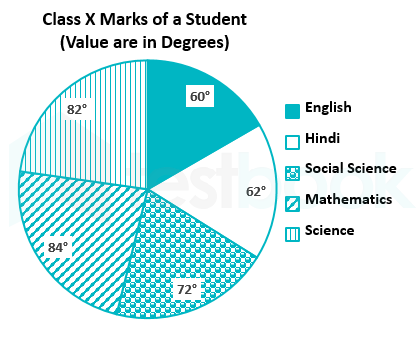
The given chart shows the marks scored by a class X student in different subjects.

If the total marks are 1800, then find the marks in social science.

  1. ((a))

    350

  2. ((b))

    306

  3. ((c))

    360

  4. ((d))

    72

Show Answer
Answer: ((c))

360

Given

Total marks are 1800.

Calculation

The marks in social science = 72°

⇒ 360° → 1800

⇒ 72° → (1800 × 72)/360

⇒ 72° → 360

The marks in social science is 360.

19

What is the difference between the range of temperatures of the five cities and the average of temperatures of the five cities?

City NameTemperature in celcius
Kolkata30
Mumbai34
Delhi40
Lucknow41
Kanpur35
  1. ((a))

    21 degree Celsius

  2. ((b))

    23 degree Celsius

  3. ((c))

    27 degree Celsius

  4. ((d))

    25 degree Celsius

Show Answer
Answer: ((d))

25 degree Celsius

Concept used:

Range = Maximum value - Minimum value 

Average = sum of observations/Number of observations

Calculation:

According to the question

The range of temperatures of the five cities = Maximum value - Minimum value 

⇒ (41 - 30) = 11

Now, the average of temperatures of the five cities = (30 + 34 + 40 + 41 + 35)/5

⇒ (180/5) = 36

Now, the difference between the range of temperatures of the five cities and the average of temperatures of the five cities

⇒ (36 - 11) = 25 degree Celsius

∴ The required difference is 25 degree Celsius.

20

Directions: In the following question, out of the given four alternatives, select the correct option which is different from the given set.

202 - 40, 305 - 150, 120 - 0

  1. ((a))

    132 - 26

  2. ((b))

    152 - 31

  3. ((c))

    241 - 24

  4. ((d))

    223 - 66

Show Answer
Answer: ((b))

152 - 31

The logic follows here is:

In 202 - 40

⇒ 20 × 2 

⇒ 40

In 305 - 150

⇒ 30 × 5

⇒ 150

In 120 - 0

⇒ 12 × 0 

⇒ 0

Now, check the options one by one,

  1. In 132 - 26

⇒ 13 × 2

⇒ 26

2) In 152 - 31

⇒ 15 × 2

⇒ 30 

  1. In 241 - 24

⇒ 24 × 1

⇒ 24

  1. In 223 - 66

⇒ 22 × 3

⇒ 66

Hence, the correct answer is 152 - 31.

21

The jumbled letters of words are given below. Each letter has been numbered. Choose the option which gives the correct order of the letters as indicated by the numbers to form a meaningful word.

V A R S T E

1 2 3 4 5 6

  1. ((a))

    2, 3, 1, 6, 4, 5

  2. ((b))

    3, 2, 4, 5, 6,1

  3. ((c))

    4, 5, 2, 3, 1, 6

  4. ((d))

    6, 3, 4, 5, 2, 1

Show Answer
Answer: ((c))

4, 5, 2, 3, 1, 6

Given:

V A R S T E

1 2 3 4 5 6

Meaningful word - STARVE

Code for the above word - 4,5,2,3,1,6

Hence, 4, 5, 2, 3, 1, 6 is correct.

22

In a row of people Manu is 7th from bottom end of row. Shrey is 10 ranks above Manu. If Shrey is 8th from top end, then how many people are there in this row?

  1. ((a))

    25

  2. ((b))

    26

  3. ((c))

    24

  4. ((d))

    23

Show Answer
Answer: ((c))

24

If Manu is 7th from bottom end, Shrey is 10 ranks above Manu and Shrey is 8th from top end,

Then, start from the bottom Manu is 7th, Shrey is 10 ranks above Manu and 8th from the top

Hence the total people are: 7 + 10 + (8 - 1) = 24.

23

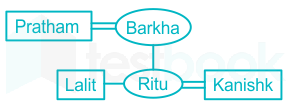
Pratham is married to Barkha. Barkha is mother of Ritu who is sister of Lalit. Ritu is married to Kanishk. How is Lalit related to Kanishk if number of male members is more than female members in the family?

  1. ((a))

    Brother – in - law

  2. ((b))

    Brother

  3. ((c))

    Father

  4. ((d))

    Father – in - law

Show Answer
Answer: ((a))

Brother – in - law

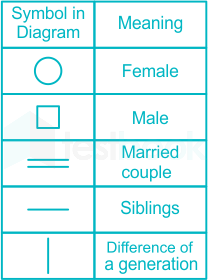
Preparing the family tree using the following symbols:

Possible tree diagram will be

If number of male members is more than female members in the family then Lalit is a male.

Hence, If number of male members is more than female members Lalit is brother – in – law of Kanishk.

24

Which two signs should be interchanged to make the below equation mathematically correct?

8 + 32 ÷ 16 × 11 - 5 = 22

  1. ((a))

    × and ÷

  2. ((b))
    • and +
  3. ((c))

    ÷ and -

  4. ((d))
    • and ×
Show Answer
Answer: ((d))
  • and ×

1. × and ÷

8 + 32 × 16 ÷ 11 - 5 = 22

⇒ 8 + 32 × 1.45 - 5 = 22

⇒ 8 + 46.54 - 5 = 22

54.54 - 5 = 22

⇒ 49.54 ≠ 22

2. - and +

8 - 32 ÷ 16 × 11 + 5 = 22

⇒ 8 + 2 × 11 - 5 = 22

8 + 22 - 5 = 22

30 - 5 = 22

⇒ 25 ≠ 22

3. ÷ and -

8 + 32 - 16 × 11 ÷ 5 = 22

⇒ 8 + 32 - 16 × 2.2 = 22

⇒ 8 + 32 - 35.2 = 22

40 - 35.2 = 22

⇒ 4.8 ≠ 22

4. + and ×

8 × 32 ÷ 16 + 11 - 5 = 22

⇒ 8 × 2 + 11 - 5 = 22

16 + 11 - 5 = 22

27 - 5 = 22

⇒ 22 = 22

Hence, '+ and ×' is the correct answer.

25

Directions: In the following question, select the related word/Letter from the given alternatives.

A.P.J. Abdul Kalam : Wings of Fire :: Mahatma Gandhi : ?

  1. ((a))

    Atmakatha

  2. ((b))

    An Autobiography

  3. ((c))

    The Story of my Experiments with Truth

  4. ((d))

    Courage and Conviction

Show Answer
Answer: ((c))

The Story of my Experiments with Truth

The story of my Experiments with Truth is an autobiography of Mahatma Gandhi.

26

Three statements are given followed by three conclusions numbered I, II and III. Consider the statements assuming them to be true even if they seem to be at variance from commonly known facts, and state which of the conclusions logically follow from the given statements?

statement:

Some envelopes are papers.

All paper are pulp.

All pulp are leaves.

The conclusion

(I) Some leaves are papers.

(II) Some pulp is paper.

(III) All papers are leaves.

  1. ((a))

    All conclusions I, II and III follow.

  2. ((b))

    Only conclusion II follows.

  3. ((c))

    Conclusion only I and III follow.

  4. ((d))

    Conclusion only I follow.

Show Answer
Answer: ((a))

All conclusions I, II and III follow.

Statement:

Some envelopes are papers.

All paper are pulp.

All pulp are leaves.

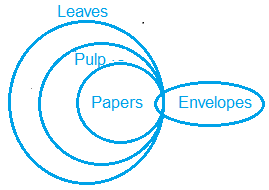
Venn diagram:

Conclusion:

(I) Some leaves are papers → Follow → Since 'all papers are pulp' and 'all pulp are leaves' then it can be said that some leaves are papers and the same can be seen in the Venn diagram thus the conclusion follows.

(II) Some pulp is paper → Follow → We have 'all paper are pulp' which means there is some part of pulp that is connected to papers and therefore the conclusion follows.

(III) All papers are leaves → Follow → From the statements, 'all papers are pulp' and 'all pulp are leaves', it is safe to say that all papers are leaves as they are connected with a direct link i.e., pulp thus the conclusion follows.

So all conclusions I, II and III follow.

Hence the correct answer is option 1)

27

Select the correct mirror image of the given figure when the mirror is placed at MN.

  1. ((a))

  2. ((b))

  3. ((c))

  4. ((d))

Show Answer
Answer: ((a))

The correct mirror image of the given figure is:

Hence, the correct answer is "Option 1".

28

Directions: Choose the correct option from the given ones that will complete the series.

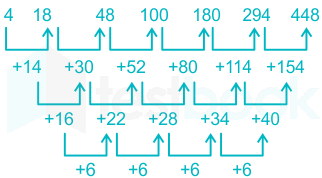
4, 18, 48, 100, 180, 294, ?

  1. ((a))

    448

  2. ((b))

    525

  3. ((c))

    502

  4. ((d))

    385

Show Answer
Answer: ((a))

448

The given series is:

4, 18, 48, 100, 180, 294, ?

The pattern follows here is:

⇒ 22 × 1 = 4

⇒ 32 × 2 = 18

⇒ 42 × 3 = 48

⇒ 52 × 4 = 100

⇒ 62 × 5 = 180

⇒ 7× 6 = 294

82 × 7 = 448

Hence, the correct answer is "448".

Alternate MethodThe pattern follows here is;

Hence, the correct answer is "448".

29

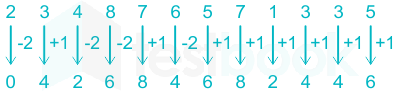
If in the number sequence 2 3 4 8 7 6 5 7 1 3 3 5, all the odd numbers are increased by one and all the even numbers are decreased by two, then the new number sequence is arranged in ascending order, which will be the eighth number from the right?

  1. ((a))

    4

  2. ((b))

    2

  3. ((c))

    8

  4. ((d))

    6

Show Answer
Answer: ((a))

4

As per the given information,

Given number sequence: 2 3 4 8 7 6 5 7 1 3 3 5

  • If all the odd numbers are increased by one and all the even numbers are decreased by two :

  • The new number sequence is arranged in ascending order, then the new arrangement is:

​0 2 2 4  4 4 4 6 6 6 8 8

  • **Now the eighth number from the right will be:**​

​​(left)   0 2 2 4  4 4 4 6 6 6 8 8  (right)

Thus,  the eighth number from the right will be '4'.

​Hence, the correct answer is "4".

30

A B C D E F G H I J K L M N O P Q R S T U V W X Y Z

In the above series, the 4th letter to the right of the 19th letter from the left is:

  1. ((a))

    X

  2. ((b))

    W

  3. ((c))

    V

  4. ((d))

    D

Show Answer
Answer: ((b))

W

Left Side: A B C D E F G H I J K L M N O P Q R S T U V W X Y Z : Right Side

The 19th letter from the left is: S

And the 4th letter to the right of S : W

Hence, "W" is the correct answer.

31

What is the full form of MICR?

  1. ((a))

    Magnetic Ink Credit Recognition

  2. ((b))

    Magnetic Ink Card Recognition 

  3. ((c))

    Magnetic Ink Character Recognition 

  4. ((d))

    Magnetic Ink Code Recognition 

Show Answer
Answer: ((c))

Magnetic Ink Character Recognition 

The correct answer is Magnetic Ink Character Recognition.

Key Points

  • MICR is used by the banking industry to ease the processing and clearance of cheques and other documents.
  • Numbers and characters found on the bottom of checks are printed using the Magnetic Ink.
  • When a document that contains this ink needs to be read, it passes through a machine, which magnetizes the ink and then translates the magnetic information into characters.
32

Which of the following options contains extensions of MS-Office files?

  1. ((a))

    xlsx, docx, pdfx

  2. ((b))

    xlsx, docx, pptx

  3. ((c))

    xls, doc, pdf

  4. ((d))

    ppt, doc, pdf

Show Answer
Answer: ((b))

xlsx, docx, pptx

The correct answer is xlsx, docx, pptx

Important Points

  • .xlsx, .docx, .pptx contains extensions of MS-Office files.
  • XLSX – is an Excel workbook.
  • DOCX is part of Microsoft Office Open XML specification (also known as OOXML or OpenXML) and was introduced with Office 2007. DOCX is a zipped, XML-based file format. Microsoft Word 2007 and later use DOCX as the default file format when creating a new document. Support for loading and saving legacy DOC files is also included (Docx – Word document).
  • PPTX – is a PowerPoint Open XML Presentation file.
  • Office Open XML (OOXML) format was introduced with Microsoft Office 2007 and became the default format of Microsoft Excel ever since. Excel-related file extensions of this format include: .xlsx, .xlsm, .xltx, .xltm.

Additional Information

  • XLS – Legacy Excel worksheets; officially designated "Microsoft Excel Worksheet".
  • DOC – Legacy Word document.
  • The Portable Document Format (PDF) is a file format developed by Adobe.
  • PPT – Legacy PowerPoint presentation.
33

________ is a type of cybercrime attack where the cyber-criminals flood a website with useless traffic to overwhelm the network. 

  1. ((a))

    Cyberstalking

  2. ((b))

    Phishing

  3. ((c))

    Distributed Denial of Service Attack

  4. ((d))

    Spoofing

Show Answer
Answer: ((c))

Distributed Denial of Service Attack

The correct answer is Distributed Denial of Service Attack.

Key Points

Distributed denial-of-service (DDoS):

  • It is an attack is a malicious attempt to disrupt the normal traffic of a targeted server, service or network by overwhelming the target or its surrounding infrastructure with a flood of Internet traffic.
  • DDoS attacks achieve effectiveness by utilizing multiple compromised computer systems as sources of attack traffic.
  • Exploited machines can include computers and other networked resources such as IoT devices.

Additional Information

Spoofing:

  • It is a broad term for the type of behavior that involves a cybercriminal masquerading as a trusted entity or device to get you to do something beneficial to the hacker — and detrimental to you.

Phishing:

  • It is an attack that attempts to steal your money, or your identity, by getting you to reveal personal information -- such as credit card numbers, bank information, or passwords -- on websites that pretend to be legitimate.

Cyberstalking:

  • It is a crime committed when someone uses the internet and other technologies to harass or stalk another person online.
34

In source data entry devices, what is full form of OMR?

  1. ((a))

    Open Mark Recognition

  2. ((b))

    Optical Mark Recognition

  3. ((c))

    Optical Message Reader

  4. ((d))

    Open Message Recognition

Show Answer
Answer: ((b))

Optical Mark Recognition

Key Points


  • Optical Mark Reading (OMR) is a method of entering data into a computer system.
  • Optical Mark Readers reads pencil or pen marks made in pre-defined positions on paper forms as responses to questions or tick list prompts.
  • The OMR technology could be used if data is to be collected from a large number of sources simultaneously, a large volume of data must be collected and processed in a short period of time, information mainly comprises the selection of categories or "tick box" answers to multiple-choice questions.
  • The OMR data entry system contains the information to convert the presence or absence of marks into a computer data file.
35

Which of the following is NOT a computer hardware?

  1. ((a))

    Software

  2. ((b))

    CPU

  3. ((c))

    Floppy disk

  4. ((d))

    Motherboard

Show Answer
Answer: ((a))

Software

Computer hardware:

  • While hardware refers to the physical components of a computer system (like CPU, floppy disk, motherboard), software is a collection of instructions or programs that tell the hardware what to do.
  • This can include things such as operating systems, application software, and utilities. So, it's not a tangible component you can physically handle like the other options in the list.
36

_______ acts as an interface connecting the computer user to the computer hardware.

  1. ((a))

    Compiler Software

  2. ((b))

    Operating System

  3. ((c))

    Internet

  4. ((d))

    Utility Software

Show Answer
Answer: ((b))

Operating System

The correct answer is Operating System.

Key Points

  • Operating System acts as an interface connecting the computer user to the computer hardware.
  • It is system software that manages computer hardware, software resources, and provides common services for computer programs.
  • It sits in between the applications you run and the hardware, using the hardware drivers as the interface between the two.
  • For example, when an application wants to print something, it hands that task off to the operating system.
  • Following are some of the important functions of an operating System: Memory Management, Processor Management, Device Management, File Management, Security, Control over system performance, Job accounting, Error detecting aids, Coordination between other software and users.
  • Some of the commonly used Operating Systems-
  • Microsoft Windows
  • Apple macOS
  • Linux
  • Android
  • Apple's iOS
  • UNIX
37

Which of the following facts is incorrect regarding the control unit of the computer?

  1. ((a))

    It receives instructions from memory, interprets them, and directs the operation of the computer.

  2. ((b))

    It processes and stores data.

  3. ((c))

    It manages and coordinates all the units of the computer.

  4. ((d))

    It is responsible for controlling the transfer of data and instructions between other units of the computer.

Show Answer
Answer: ((b))

It processes and stores data.

The correct answer is It processes and stores data.

Key Points

The control unit (CU) is a crucial component of the computer's central processing unit (CPU). Here's a brief explanation of why each statement is correct or incorrect:

  • It receives instructions from memory, interprets them, and directs the operation of the computer.
  • Correct. The control unit fetches instructions from the computer's memory, decodes them to understand what specific operations need to be performed, and then directs the other parts of the CPU to execute those operations.
  • It processes and stores data.
  • Incorrect. The processing and storage of data are primarily the functions of the arithmetic logic unit (ALU) and memory/storage components, not the control unit. The ALU performs arithmetic and logical operations, while different types of memory (like RAM, hard drives, etc.) are responsible for storing data.
  • It manages and coordinates all the units of the computer.
  • Correct. The control unit coordinates the activities of all other units within the computer, ensuring that they work in harmony and follow the instructions of the currently executing program.
  • It is responsible for controlling the transfer of data and instructions between other units of the computer.
  • Correct. The control unit manages the flow of data and instructions between the CPU, memory, and peripheral devices, making sure that the right data is in the right place at the right time for processing.

Therefore, the statement "It processes and stores data" is incorrect regarding the functions of the control unit.

Additional Information

  • The word computer is derived from the word compute. In the year 1833, English mechanical engineer Charles Babbage designed the first analytical engine. He is known as the father of the computer.
  • In the beginning, computers are used for calculating large numbers and can only store a small amount of data.
38

What is the full form of SQL? 

  1. ((a))

    Sample Query List

  2. ((b))

    Structure Query Language

  3. ((c))

    Sample Query Language

  4. ((d))

    Structured Query List

Show Answer
Answer: ((b))

Structure Query Language

The correct answer is Structure Query Language.

Key Points

  • SQL stands for Structure Query Language.
  • It is a standard language used for managing and manipulating databases.
  • SQL is used to query, insert, update, and modify data stored in a relational database.
  • It is essential for database management and is widely used in various applications.
39

Which input device cannot be used to work in MS Office ?

  1. ((a))

    Scanner

  2. ((b))

    Light Pen

  3. ((c))

    Mouse

  4. ((d))

    Joy Stick

Show Answer
Answer: ((d))

Joy Stick

The correct answer is Joy Stick.

Key Points

  • Joy Stick:
  • A joystick is primarily used for video games, flight simulators, and other applications that require fine control of movement and navigation.
  • While it could theoretically be used to control a cursor in a manner similar to a mouse, it's not practical or standard for use with MS Office.
  • It doesn't have the precision necessary for text editing and other typical Office tasks.

Additional Information

  • Scanner: While not a direct input device for working in MS Office, a scanner can be used to import documents or images into Office programs.
  • Light Pen: A light pen can be used in some circumstances to interact with MS Office, especially on touch screen or interactive whiteboard environments, similar to a stylus.
  • Mouse: A mouse is a standard input device used in MS Office for navigation, selection, and execution of commands.
40

Which one of the following memory units is considered as the largest?

  1. ((a))

    Peta Byte (PB)

  2. ((b))

    Exa Byte (EB)

  3. ((c))

    Zetta Byte (ZB)

  4. ((d))

    Yotta Byte (YB)

Show Answer
Answer: ((d))

Yotta Byte (YB)

The correct answer is Yotta Byte (YB).

Key Points

  • Yotta Byte (PB) is considered the largest.
  • 1 Yotta Byte (YB) = 1024 Zettabytes

Additional Information

Data Measurement Chart:

UnitExpansion
1 BitSingle Binary Digit (0 or 1)
1 Nibble4 bits (half a byte)
1 Byte (1B)8 bits
1 Kilobyte (1KB)1024 Bytes
1 Megabyte (1MB)1024 Kilobytes
1 Gigabyte (1GB)1024 Megabytes (1024 × 1024 KB)
1 Terabyte (1TB)1024 Gigabytes (1024 × 1024 × 1024 KB)
1 Petabyte (1PB)1024 Terabytes
1 Exabyte (1EB)1024 Petabytes
1 Zettabyte (1ZB)1024 Exabytes
1 Yottabyte (1YB)1024 Zettabytes
41

What is the full form of ‘SQL' in terms of computer terminology?

  1. ((a))

    Server Query Locator

  2. ((b))

    Schedule Query Link

  3. ((c))

    Status Query language

  4. ((d))

    Structured Query Language

Show Answer
Answer: ((d))

Structured Query Language

The correct answer is Structured Query Language.

Key Points

  • SQL stands for Structured Query Language.
  • It is a standard language used to communicate with and manage databases.
  • SQL is used to perform tasks such as update data on a database or retrieve data from a database.
  • It is widely used in database management systems like MySQL, PostgreSQL, Microsoft SQL Server, Oracle, and SQLite.

Additional Information

  • Server Query Locator (Option 1) is not a recognized term in database management. It is not related to SQL.
  • Schedule Query Link (Option 2) is also not a recognized term in database management. It is not related to SQL.
  • Status Query Language (Option 3) is another incorrect term that does not pertain to SQL. There is no such language as Status Query Language in the realm of databases.
42

Which of the following is the 5th generation AI programming language?

  1. ((a))

    SQL

  2. ((b))

    C++

  3. ((c))

    C

  4. ((d))

    Prolog

Show Answer
Answer: ((d))

Prolog

The correct answer is option 4.

Key Points

  • What is a 5th Generation Programming Language (5GL)?
  • 5GLs are logic-based or constraint-based languages.
  • They are designed primarily for Artificial Intelligence (AI) and problem-solving using rules, rather than procedural code.
  • In 5GLs, the programmer specifies the problem, and the machine figures out how to solve it.
  • About Prolog:
  • Full Form: Programming in Logic
  • Introduced in: 1972
  • Purpose: Primarily used for AI applications such as natural language processing, expert systems, and automated reasoning. Hence, option 4 is correct.
  • Key Feature: Works based on facts, rules, and queries.

Additional Information

  • SQL (Structured Query Language):
  • Used for managing and querying databases.
  • Not an AI programming language.
  • C++:
  • A general-purpose, object-oriented programming language.
  • Commonly used for systems programming, not specifically for AI logic.
  • C:
  • A procedural language, foundational but not suited for AI logic-based tasks.
43

________ datatype is used to store fixed length character string in SQL.

  1. ((a))

    int

  2. ((b))

    varchar

  3. ((c))

    float

  4. ((d))

    char

Show Answer
Answer: ((d))

char

The correct answer is char.

 Key PointsCHAR Datatype

  • It is a datatype in SQL which is used to store character string of fixed length specified.
  • If the length of the string is less than set or fixed length, then it is padded with extra blank spaces so that its length became equal to the set length when PAD_CHAR_TO_FULL_LENGTH SQL mode is enabled.
  • The storage size of the CHAR datatype is n bytes (set length).
  • We should use this datatype when we expect the data values in a column are of the same length.
  • Example: Suppose if we declare a char(50), then it will allocate a memory for 50 characters to hold 50 characters of data.
  • In case, if we insert only 10 characters of a string, then only 10 characters of memory will be used and remaining 40 characters of memory will be wasted.

 Additional Information

VARCHAR Datatype

  • In sql, varchar means variable characters and it is used to store non-unicode characters.
  • It is a datatype in SQL which is used to store character string of variable length, but a maximum of the set length specified.
  • If the length of the string is less than set or fixed length, then it will store as it is without padded with extra blank spaces.
  • The storage size of the VARCHAR datatype is equal to the actual length of the entered string in bytes.
  • It will allocate the memory based on the number of characters inserted.
  • Example: Suppose if we declare varchar(50), then it will allocate memory of 0 characters at the time of declaration.
  • Now if we insert only 10 characters of a string, then it will allocate memory for only 10 characters.
44

The Correct order of SQL expression is

  1. ((a))

    Select, group by, where, having

  2. ((b))

    Select, having, group by, where

  3. ((c))

    Select, having, where, group by

  4. ((d))

    Select, where, group by, having

Show Answer
Answer: ((d))

Select, where, group by, having

The correct answer is Select, where, group by, having.

Additional Information

Six Operations to Order: SELECT, FROM, WHERE, GROUP BY, HAVING, and ORDER BY. Because the database executes query components in a specific order,

SELECT select_list [ INTO new_table ]  [ FROM table_source ]

[ WHERE search_condition ]

[ GROUP BY group_by_expression ]

[ HAVING search_condition ]

[ ORDER BY order_expression [ ASC | DESC ] ]

Hence Option 4 is correct

45

Which one among the following is NOT a non-procedural computer language?

  1. ((a))

    LISP

  2. ((b))

    Python

  3. ((c))

    Prolog

  4. ((d))

    ML

Show Answer
Answer: ((b))

Python

The correct answer is Option 2

Key Points

  • LISP:
  • LISP (List Processing) is a functional programming language, which is considered non-procedural because it focuses on the use of functions and avoids specifying a sequence of instructions.
  • Hence, option 1 is incorrect.
  • Python:
  • Python is primarily a procedural and object-oriented programming language, where the programmer explicitly writes out the sequence of steps to be followed.
  • While Python supports some functional programming features, it is not classified as a non-procedural language.
  • Hence, option 2 is correct.
  • Prolog:
  • Prolog (Programming in Logic) is a logic programming language that is non-procedural, focusing on what to solve rather than how to solve it.
  • Hence, option 3 is incorrect.
  • ML:
  • ML (Meta Language) is another functional programming language that is non-procedural, emphasizing expressions rather than explicit control flow.
  • Hence, option 4 is incorrect.
  • Since Python is not a non-procedural language, option 2 is the correct answer
46

Which command is used to remove an index from the database in SQL?

  1. ((a))

    ROLL BACK INDEX

  2. ((b))

    DELETE INDEX

  3. ((c))

    REMOVE INDEX

  4. ((d))

    DROP INDEX

Show Answer
Answer: ((d))

DROP INDEX

The correct answer is Option 4) DROP INDEX.

Key Points

  • The DROP INDEX command is used in SQL to remove an existing index from a table.
  • It deletes the index permanently from the database, freeing up space and resources.
  • Syntax (for MySQL):

DROP INDEX index_name ON table_name;

  • Syntax (for SQL Server):

DROP INDEX table_name.index_name;

  • Indexes help speed up query performance, but unnecessary or unused indexes can be dropped to improve database efficiency.

Additional Information 

  • Incorrect Options:
  • ROLL BACK INDEX: No such command exists in SQL. ROLLBACK is used to undo transactions, not to drop indexes.
  • DELETE INDEX: DELETE is used for deleting records from a table, not indexes.
  • REMOVE INDEX: Not a valid SQL command for dropping indexes.
  • Always ensure that the index is no longer required before dropping it to avoid performance issues in future queries.
47

Which of the following is not a cause of the cyber attack?

  1. ((a))

    Phishing

  2. ((b))

    Malware

  3. ((c))

    Denial of Service

  4. ((d))

    Firewall

Show Answer
Answer: ((d))

Firewall

The correct answer is Firewall.

Key Points

  • A firewall is not a cause of a cyber attack.
  • Firewalls protect our computers from cyber attacks.
  • A firewall is a network security system that monitors and restricts network traffic based on **predefined security rules.**​

Additional Information

  • Phishing - Phishing is a type of social engineering in which an attacker sends a phoney message to fool a person into giving up important information or allowing dangerous software, such as ransomware, to be installed on the victim's system.
  • Malware - Malware is malicious software that is intended to harm or destroy computers and computer systems.
  • Denial of Service - A Denial-of-Service attack is an attempt to bring a machine or network to a halt, rendering it unreachable to its intended users.
48

_______ is a Linux distribution used for penetration testing and hacking.

  1. ((a))

    Arch

  2. ((b))

    Fedora

  3. ((c))

    Gentoo

  4. ((d))

    Kali

Show Answer
Answer: ((d))

Kali

The correct answer is Kali.


  • Kali Linux is a Debian-derived Linux distribution designed for digital forensics and penetration testing
  • It is maintained and funded by Offensive Security Ltd
  • Kali Linux has over 600 pre-installed penetration-testing programs, including Armitage (a graphical cyber attack management tool), John the Ripper password cracker, etc
49

Which of the following is a method of cyber attack that encodes the data of other programs or protocols in DNS queries and responses?

  1. ((a))

    DNS Shadowing

  2. ((b))

    DNS Spooling

  3. ((c))

    DNS Spoofing

  4. ((d))

    DNS Tunneling

Show Answer
Answer: ((d))

DNS Tunneling

The correct answer is DNS Tunneling.

Key Points

  • DNS Tunneling is a method of cyber attack that encodes the data of other programs or protocols in DNS queries and responses.
  • It is often used to bypass security controls and exfiltrate data from a network.
  • Attackers use DNS requests to carry data payloads to a remote server that the attacker controls.
  • DNS Tunneling can be used for various malicious purposes, including data theft, command and control communication, and more.

Additional Information

  • DNS Shadowing: This involves attackers creating subdomains within a compromised domain to host malicious content. It is not related to encoding data in DNS queries.
  • DNS Spooling: This term is not commonly used in cybersecurity and does not pertain to any known attack method involving DNS queries.
  • DNS Spoofing: Also known as DNS cache poisoning, this attack involves corrupting DNS data to redirect traffic to malicious sites. It does not involve encoding data in DNS queries.
50

Which of the following is NOT an integral component of the MS-Office 365 suite?

  1. ((a))

    MS-Access

  2. ((b))

    MS-Excel

  3. ((c))

    MS-Word

  4. ((d))

    MS-Paint

Show Answer
Answer: ((d))

MS-Paint

The correct answer is MS-Paint.

Key Points

  • ​MS-Paint is not a component of MS Office 365.
  • The main components of MS Office are given below:
  • Microsoft Teams,
  • Word, Excel.
  • Powerpoint.
  • Outlook.
  • One note.
  • One drive.

Additional Information

  • Microsoft word is a word processor software developed by Microsoft in 1983.
  • OneDrive is the Microsoft cloud service that connects you to all your files. It lets you stock and save your files, share them with others, and get to them from any place on all your devices.
  • Microsoft Access is a database management system (DBMS) used to store and manage data.
51

Which one of the following is 'not' input device?

  1. ((a))

    Magnetic Ink character recognisation

  2. ((b))

    Optical mark Recognisation (OMR)

  3. ((c))

    Trackball

  4. ((d))

    Speaker

Show Answer
Answer: ((d))

Speaker

The correct answer is Speaker.

  • Speaker is a 'not' input device.

Key PointsInput device 

  • An input device is a piece of computer hardware equipment used to provide data and control signals to an information processing system such as a computer or information appliance.
  • Examples of input devices include keyboards, mouse, scanners, digital cameras and joysticks.
  • **Speakers are one of the most common output devices used with computer systems.**​

Additional InformationOutput Unit

  • An output device is any piece of computer hardware equipment that converts information into human-readable form.
  • It can be text, graphics, tactile, audio, and video. Some of the output devices are Visual Display Units i.e. a Monitor, Printer graphic Output devices, Plotters, Speakers, etc.
52

What is the name of the main screen area you see after you turn on your computer and log on to Windows?

  1. ((a))

    Desktop

  2. ((b))

    Applications

  3. ((c))

    Windows

  4. ((d))

    Frame

Show Answer
Answer: ((a))

Desktop

The correct answer is Desktop.

Key Points

  • Desktop is the name of the main screen area you see after you turn on your computer and log on to Windows.
  • ​It serves as a surface for work, like the top of an actual desk.
  • It is the primary user interface of a computer.
  • It includes the desktop background (or wallpaper) and icons of files and folders that may have been saved to the desktop.
  • In Windows, the desktop includes a taskbar, which is located at the bottom of the screen by default.

Additional Information

  • Application
  • It is a computer software package that performs a specific function for an end user or another application based on carefully designed features.
  • Applications for desktop or laptop computers are sometimes called desktop applications, while those for mobile devices are called mobile apps.
  • Windows
  • It is a graphical operating system developed by Microsoft.
  • It allows users to view and store files, run the software, play games, watch videos, and provides a way to connect to the internet.
  • Frame
  • ​It is the digital data transmission unit in telecommunication and computer networking.
  • It helps identify data packets used in networking and telecommunications structures.
  • In packet switched systems, a frame is a simple container for a single network packet.
  • In other telecommunications systems, a frame is a repeating structure supporting time-division multiplexing.
53

Consider a formula "=B2+4" in cell A1 of MS-Excel 2010. If cell A1 is copied and pasted into D4, then what will be the formula in D4?

  1. ((a))

     =B4+7

  2. ((b))

    =D4+4

  3. ((c))

    =B2+4

  4. ((d))

    =E5+4

Show Answer
Answer: ((d))

=E5+4

The correct answer is =E5+4.

Key Points 

  • If a formula = B2 + 4 is in cell A1 then cell A1 is copied into D4, then the formula in D4 will be = E5 + 4.

  • How to Write Formulas in Excel
  • All Excel formulas start with an equal (=) sign.
  • The answer to the formula is displayed in the cell into which the formula is entered.
  • Cells are referenced in a formula by their column-row identifier.
  • The symbols for addition, subtraction, multiplication, and division are: + - * /
  • We do not have to enter capital letters in the formula, They will be capitalized automatically.
54

Which of the following network devices stores the IP address?

  1. ((a))

    Modem

  2. ((b))

    Switch

  3. ((c))

    Repeater

  4. ((d))

    Router

Show Answer
Answer: ((d))

Router

The correct answer is Router.

Key Points

  • An Internet Protocol (IP) address is a series of numbers using which a computer or any electronic device is identified.
  • Every computer or device has its own IP address and these are categorized as IPv4 and IPv6.
  • The Routers are network layer devices that are used for receiving, analyzing and forwarding the data packets among computers in the different networks.
  • In general, a network connects to the public internet through a router and this router is assigned an IP address by the Internet Service Provider or ISP. Hence option 4 is correct.
  • When a data packet arrives, the router analyzes the optimal route for the transmission of the data.

Additional Information

  • A Repeater (also called signal booster) is a device that regenerates signals after they travel over a longer distance maintaining the signal strength constant.
  • A Modem is a networking device that modulates digital data from a computer into analog signals for transmission.
  • A Switch is a multiport device that connects devices within the network and transmits the data packets between the devices.
55

Which of the following is used to close a tab on a browser?

  1. ((a))

    Ctrl + T

  2. ((b))

    Ctrl + W

  3. ((c))

    Ctrl + Y

  4. ((d))

    Ctrl + A

Show Answer
Answer: ((b))

Ctrl + W

The correct answer is Ctrl + W.

Key Points

In computer software like Internet browser, a tab is a clickable area at the top of a window. Some shortcuts related to tabs are:

  • Ctrl+1-8 – Switch to the specified tab, counting from the left.
  • Ctrl+9 – Switch to the last tab.
  • Ctrl+Tab – Switch to the next tab – in other words, the tab on the right. (Ctrl+Page Up also works, but not in Internet Explorer.)
  • Ctrl+Shift+Tab – Switch to the previous tab – in other words, the tab on the left. (Ctrl+Page Down also works, but not in Internet Explorer.)
  • Ctrl+W, Ctrl+F4 – Close the current tab.
  • Ctrl+Shift+T – Reopen the last closed tab.
  • Ctrl+T – Open a new tab.
  • Ctrl+N – Open a new browser window.
  • Alt+F4 – Close the current window.
56

The _________ formula is MS-Excel 2010 has the primary function of summing numbers in specific cells.

  1. ((a))

    SUM

  2. ((b))

    AVERAGE

  3. ((c))

    COUNT

  4. ((d))

    IF

Show Answer
Answer: ((a))

SUM

The correct answer is SUM.

Key Points

  • Excel provides a few arithmetic in-built functions for faster calculations like SUM, COUNT, AVERAGE, COUNTIF etc.
  • To calculate the aggregate of the values in the cell, use the SUM function. Hence option 1 is correct.
  • Write the sum function in the formula bar as =SUM(value1, value2). Here values indicate the reference of the cell.
  • If you want to add two numbers in the cells A2 and A15, then write the formula as =SUM(A2:A15).
  • To calculate the sum of values present in cells from A2, A15 and B2, B15, use =SUM(A2:A15, B2:B15).

Additional Information

  • The COUNT function provides the number of entries in the range of the given cells. Its syntax is COUNT(value1, value2...).
  • If you have an array from A1 and A10, use the formula =COUNT(A1:A10), this gives you the output as 10.
  • IF function in Excel lets you make logical comparisons between different values. It gives the results as True/False.
  • The AVERAGE() function returns the average of the arguments. Its syntax is AVERAGE(number 1, [number 2],......). For example, AVERAGE(B1:25) returns the average of the numbers in between the cells B1 and B25.
57

DNS is an acronym for __________.

  1. ((a))

    Domain Name Security

  2. ((b))

    Domain Number System

  3. ((c))

    Document Name System

  4. ((d))

    Domain Name System

Show Answer
Answer: ((d))

Domain Name System

The correct answer is Domain Name System.

Key Points

DNS is an acronym for Domain Name System.

  • The Domain Name System (DNS) is the phonebook of the Internet. Humans access information online through domain names, like testbook.com or espn.com. Web browsers interact through Internet Protocol (IP) addresses. DNS translates domain names to IP addresses so browsers can load Internet resources.
  • Each device connected to the Internet has a unique IP address which other machines use to find the device. DNS servers eliminate the need for humans to memorize IP addresses such as 192.168.1.1 (in IPv4), or more complex newer alphanumeric IP addresses such as 2400: cb00: 2048: 1:: c629: d7a2 (in IPv6).

Additional Information 

  • The process of DNS resolution involves converting a hostname (such as www.testbook.com) into a computer-friendly IP address (such as 104.20.37.240). An IP address is given to each device on the Internet, and that address is necessary to find the appropriate Internet device - like a street address is used to find a particular home. When a user wants to load a webpage, a translation must occur between what a user types into their web browser (testbook.com) and the machine-friendly address necessary to locate the testbook.com webpage.
  • In order to understand the process behind the DNS resolution, it’s important to learn about the different hardware components a DNS query must pass between. For the web browser, the DNS lookup occurs “behind the scenes” and requires no interaction from the user’s computer apart from the initial request.
58

What is searched using a search engine?

  1. ((a))

    Ambiguous Information

  2. ((b))

    Web pages

  3. ((c))

    Web pages for specified index terms

  4. ((d))

    Web pages for information using specified search terms

Show Answer
Answer: ((d))

Web pages for information using specified search terms

The correct answer is Web pages for information using specified search terms

Key Points

  • A search engine is a web-based tool that enables users to locate information on the World Wide Web. Popular examples of search engines are Google, Yahoo!, and MSN Search. Search engines utilize automated software applications (referred to as robots, bots, or spiders) that travel along with the Web, following links from page to page, site to site. The information gathered by the spiders is used to create a searchable index of the Web.

  • Every search engine uses different complex mathematical formulas to generate search results. The results for a specific query are then displayed on the SERP. Search engine algorithms take the key elements of a web page, including the page title, content, and keyword density, and come up with a ranking for where to place the results on the pages.
  • Each search engine’s algorithm is unique, so a top ranking on Yahoo! does not guarantee a prominent ranking on Google, and vice versa. To make things more complicated, the algorithms used by search engines are not only closely guarded secrets, they are also constantly undergoing modification and revision. This means that the criteria to best optimize a site must be surmised through observation, as well as trial and error — and not just once, but continuously.
59

Which of the following elements, when poorly implemented, is most likely to undermine the credibility and impact of an otherwise well-researched MS PowerPoint presentation?

  1. ((a))

    Embedding multimedia elements such as videos

  2. ((b))

     Inconsistent use of slide masters and templates

  3. ((c))

    The choice of transition effects between slides

  4. ((d))

    The inclusion of speaker notes for reference

Show Answer
Answer: ((b))

 Inconsistent use of slide masters and templates

The correct answer is Inconsistent use of slide masters and templates.

Key Points

  • Inconsistent use of slide masters and templates can lead to a lack of uniformity in design, making the presentation appear unprofessional and reducing its credibility.
  • Proper use of slide masters ensures consistent formatting, including font styles, colors, and layouts throughout the presentation.
  • Templates provide a structured and visually appealing design, contributing to the clarity and impact of the presentation.
  • Disorganized or conflicting slide designs may distract the audience, undermining the content's effectiveness and overall message delivery.
  • Maintaining design consistency aligns with best practices for creating high-quality presentations that convey professionalism and attention to detail.

Additional Information

  • Slide Masters:
  • Slide masters are pre-designed layouts that control the appearance of slides in a presentation.
  • Using slide masters ensures uniformity in font styles, colors, and layout across multiple slides.
  • They save time by allowing users to apply consistent formatting without manually editing each slide.
  • Templates:
  • Templates are pre-designed slide decks that provide a cohesive visual structure.
  • They allow users to focus on content creation rather than design elements.
  • Templates are especially useful for maintaining brand identity in corporate presentations.
  • Best Practices for PowerPoint Presentations:
  • Limit the use of animations and transitions to avoid distracting the audience.
  • Ensure text is legible by using appropriate font sizes and contrasting colors.
  • Include visuals like charts and images to complement the content and aid understanding.
  • Proofread content thoroughly to avoid grammatical errors or inconsistencies.
  • Impact of Poor Design:
  • Poor design choices can divert attention from the presentation's core message.
  • It may result in disengagement from the audience and a loss of credibility.
  • Professionally designed presentations foster trust and enhance the speaker's authority.
60

Which of the following is the correct full form of JPEG?

  1. ((a))

    Joint Photography Exports Group

  2. ((b))

    Joint Pixel Experts Group

  3. ((c))

    Joint Photographic Experts Group

  4. ((d))

    Joint Pixel Exports Group

Show Answer
Answer: ((c))

Joint Photographic Experts Group

The correct answer is Joint Photographic Experts Group (JPEG).

Key Points

  • JPEG stands for Joint Photographic Experts Group.
  • JPEG is a standard image format for containing lossy and compressed image data.
  • JPEG is a unique compression feature, that allows JPEG files to be used widely on the Internet, Computers, and Mobile Devices.

Additional Information 

  • Some important abbreviations used in Computer:
  • BIOS - Basic Input Output System
  • CAD - Computer-Aided Design
  • EDVAC - Electronic Discrete Variable Automatic Computer
  • EPROM - Erasable Programmable Read-Only Memory
  • FORTRAN - FORmula TRANslation
  • GPRS - General Packet Radio Service

Attempt this paper under real exam conditions

Timed interface, section switching, instant scoring, and question-by-question analytics — free.

Start Timed Attempt