Official Paper

Bihar Jeevika (Area Coordinator) : (28 Nov 2025) MBT (Previous Year Paper)

70 questions · 80 minutes · with answers · free

Test (70 questions)

1

Ustad Allauddin Khan, the legendary sarod player, was from which of the following gharanas of music?

  1. ((a))

    Kasur-Patiala

  2. ((b))

    Benaras

  3. ((c))

    Maihar

  4. ((d))

    Rangeela

Show Answer
Answer: ((c))

Maihar

The correct answer is Maihar

Key Points 

  • In Ustad Allauddin Khan honor, a Sangeet Samaroh is organized annually in Maihar, Satna
  • It is organized by the Ustad Allauddin Khan Sangeet Academy in collaboration with the Madhya Pradesh Sanskriti Parishad.
  • Allauddin Khan Sangeet Samaroh of Maihar is a three-day festival.
  • Allauddin Khan totally reshaped Indian classical music's Maihar Gharana.
  • Allauddin Khan was also known as Baba Allauddin Khan.
  • He was an Indian sarod player.
2

The Large Hadron Collider (LHC) used in the CERN project is a particle accelerator located on the border between

  1. ((a))

    Spain and France

  2. ((b))

    France and Germany

  3. ((c))

    Spain and Switzerland

  4. ((d))

    France and Switzerland

Show Answer
Answer: ((d))

France and Switzerland

The correct answer is:France and Switzerland

Key Points

  • The Large Hadron Collider (LHC) used in the CERN project is a particle accelerator located on the border between France and Switzerland
  • The Large Hadron Collider (LHC) is a particle accelerator located at the European Organization for Nuclear Research (CERN) in Switzerland.
  • It is the world's largest and most powerful particle collider, used to study the properties of elementary particles and the forces that govern their interactions.
  • The LHC works by accelerating particles to very high energies and then colliding them at extremely high speeds to create new particles and study their properties
3

_____, Hiuen Tsang, visited India during the reign of Harshavardhana.

  1. ((a))

    Russian traveller

  2. ((b))

    Francis traveller

  3. ((c))

    Portuguese traveller

  4. ((d))

    Chinese traveller

Show Answer
Answer: ((d))

Chinese traveller

The Chinese traveller, Hiuen Tsang, visited India during the reign of Harshavardhana.

Key Points

  • Hiuen Tsang, also known as Xuanzang, was a Chinese traveler who visited India during the reign of Harshavardhana.
  • Hiuen Tsang is renowned for his significant contributions to the documentation of India's history, culture, and Buddhist heritage.
  • During the 7th century, Hiuen Tsang embarked on a perilous journey from China to India with the primary purpose of visiting the holy Buddhist sites and studying Buddhist philosophy and scriptures.
  • Hiuen Tsang arrived in India around 630 CE, during the reign of Harshavardhana, who was a prominent ruler of the North Indian kingdom of Thanesar.
  • Harshavardhana was a patron of Buddhism and welcomed scholars and travelers from various regions.
  • During his stay in India, Hiuen Tsang traveled extensively across different parts of the country, visiting major Buddhist centers, universities, and monasteries.
  • He spent several years in places such as Nalanda, the renowned center of learning, and Bodh Gaya, the site of Buddha's enlightenment.
  • One of the significant contributions of Hiuen Tsang was his collection of Buddhist scriptures.
  • He painstakingly translated numerous texts from Sanskrit into Chinese, preserving and disseminating Buddhist teachings and philosophy in East Asia.
  • His translations played a crucial role in the development and spread of Buddhism in China and other regions.

Hence, the correct answer is Chinese traveller.

4

The Ashokan edicts, found in places like Vaishali and Nandangarh in Bihar, were inscribed in which language?

  1. ((a))

    Sanskrit

  2. ((b))

    Prakrit

  3. ((c))

    Pali

  4. ((d))

    Brahmi

Show Answer
Answer: ((b))

Prakrit

The correct answer is Prakrit

Key Points

  • The Ashokan edicts were inscribed in Prakrit language.
  • Prakrit was the vernacular language during Ashoka's reign and was used for communicating with the common people.
  • The script used for the inscriptions is known as Brahmi.
5

Which jurist's views were prominently featured in the recently launched book "Beyond the Courtroom" by Subhash Sharma?

  1. ((a))

    Fali S. Nariman

  2. ((b))

    Justice R. M. Lodha

  3. ((c))

    K. K. Venugopal

  4. ((d))

    CJI D.Y. Chandrachud

Show Answer
Answer: ((a))

Fali S. Nariman

The correct answer is Fali S. Nariman.

In News

  • Fali S. Nariman's legal insights were central to the book "Beyond the Courtroom" by Subhash Sharma.

Key Points

  • Fali S. Nariman's speeches and articles on constitutional law are featured in the book "Beyond the Courtroom".
  • The book covers Nariman's perspectives on democracy, judicial roles, and the Indian Constitution.
  • Nariman’s views on the dynamic nature of the Constitution and its interpretation by the judiciary are highlighted.
  • The book also offers advice for young lawyers and discusses ethical considerations in law practice.

Additional Information

  • Fali S. Nariman
  • Renowned Indian jurist, instrumental in shaping constitutional law in India.
  • His contributions to the legal field include advocating for judicial independence and the protection of fundamental rights.
  • Fali Sam Nariman (10 January 1929 – 21 February 2024) was an Indian jurist.
  • He was a senior advocate to the Supreme Court of India from 1971 and was the President of the Bar Association of India from 1991 to 2010.
  • He was honoured with the 19th Lal Bahadur Shastri National Award for Excellence in Public Administration in 2018.
  • Nariman was awarded the Padma Bhushan (1991), Padma Vibhushan (2007) and Gruber Prize for Justice (2002) and was a nominated member of the Rajya Sabha, the Upper House of the Parliament of India for a term (1999–2005).
  • Basic Structure Doctrine
  • A doctrine established by the Supreme Court in 1973, asserting that Parliament cannot alter the basic structure of the Constitution.
  • The Role of Judiciary
  • Fali Nariman emphasized the judiciary's role in interpreting the Constitution and ensuring its dynamism in evolving social contexts.
6

The Twelfth Schedule of the Constitution is related to which of the following?

  1. ((a))

    Provisions relating to the emoluments, allowances, privileges.

  2. ((b))

    Specifies the powers, authority and responsibilities of Panchayats.

  3. ((c))

    Specifies the powers, authority and responsibilities of Municipalities.

  4. ((d))

    Names of the States and Union Territories with their territorial jurisdiction.

Show Answer
Answer: ((c))

Specifies the powers, authority and responsibilities of Municipalities.

​The correct answer is option 3.

Key Points

  • Schedules of the Indian Constitution:
Schedule NumberSubject Matter
First ScheduleNames of the States and Union Territories with their territorial jurisdiction.
Second ScheduleProvisions relating to the emoluments, allowances, privileges.
Third ScheduleForms of Oaths or Affirmations.
Fourth ScheduleAllocation of seats in the Rajya Sabha to the states and the union territories.
Fifth ScheduleProvisions relating to the administration and control of scheduled areas and scheduled tribes.
Sixth ScheduleProvisions relating to the administration of tribal areas in the states of Assam, Meghalaya, Tripura and Mizoram.
Seventh ScheduleDivision of powers between the Union and the States in terms of List I (Union List), List II (State List) and List III (Concurrent List).
Eighth ScheduleLanguages recognized by the Constitution.
Ninth ScheduleActs and Regulations of the state legislatures dealing with land reforms and the abolition of the zamindari system and of the Parliament dealing with other matters.
Tenth ScheduleProvisions relating to disqualification of the members of Parliament and State Legislatures on the ground of defection.
Eleventh ScheduleSpecifies the powers, authority and responsibilities of Panchayats.
Twelfth Schedule ScheduleSpecifies the powers, authority and responsibilities of Municipalities.
7

Name the First permanent President of the Constituent Assembly of India.

  1. ((a))

    Rajendra Prasad

  2. ((b))

    B. R. Ambedkar

  3. ((c))

    Sachidananda Sinha

  4. ((d))

    B. N. Rau

Show Answer
Answer: ((a))

Rajendra Prasad

The Correct Answer is Rajendra Prasad.

Confusion Points

  • The Constituent Assembly started its work on 9th December 1946 with Dr. Sachhidanand as its interim President.
  • Two days later, on 11th December 1946, Dr. Rajendra Prasad was elected as the permanent President of the Constituent Assembly.

Key Points

  • Dr. Rajendra Prasad was elected president, and Harendra Coomar Mookerjee, a Christian from Bengal and former vice-chancellor of Calcutta University, was elected vice-president.
  • Mookerjee was appointed governor of West Bengal after India became a republic, and he also chairs the assembly's Minorities Committee.
  • B. N. Rau, a lawyer who drafted the initial draught of the constitution and later became a judge at The Hague's Permanent Court of International Justice, was appointed constitutional advisor to the assembly.
  • The Constituent Assembly of India was chosen to draft the Indian Constitution.
  • The 'Provincial Assembly' selected it. Its members acted as the nation's first Parliament since India gained independence from the British government in 1947.
  • M. N. Roy, a pioneer of the Indian Communist movement and a proponent of radical democracy, suggested the concept of a Constituent Assembly in 1934.
  • It became an official demand of the Indian National Congress in 1935, and on 15 November 1939, C. Rajagopalachari made the demand for a Constituent Assembly based on adult franchise, which the British approved in August 1940.
  • Dr. B.R. Ambedkar(Bhimrao Ramji Ambedkar) chaired the Constitutional Drafting Committee.
8

Which of the following is an endemic species?

  1. ((a))

    Nicobar pigeon

  2. ((b))

    Indian wild ass

  3. ((c))

    Desert fox

  4. ((d))

    Indian rhino

Show Answer
Answer: ((a))

Nicobar pigeon

The correct answer is Nicobar pigeon.

Key Points

  • Endemic species are those species of plants and animals that are found exclusively in a particular area or specific habitat.
  • They are not naturally found anywhere else. A particular type of animal or plant may be endemic to a zone, a state, or a country.
  • The destruction of their habitat, increasing population, and introduction of new species may affect the natural habitat of endemic species and endanger their existence.
  • Examples - Sal and wild mango are endemic flora of the while Bison, Indian giant squirrel, Nicobar pigeon, and flying squirrel are endemic fauna.

Additional Information

Some of the important Endemic species of India are:

  • Asiatic Lion in Gir Forest.
  • Nilgiri Tahr in Nilgiri Hills.
  • Sangai Deer in Loktak Lake.
  • Purple Frog in the Western Ghats.
  • Kashmir Stag in Kashmir Valley.
  • Lion-Tailed Macaque in the Western Ghats.
  • Pygmy Hog in Assam.
  • Malabar Civet in the Western Ghats.
9

Which one among the following is not a feature of Xerophytes?

  1. ((a))

    Smaller leaves

  2. ((b))

    Large number of stomata

  3. ((c))

    Waxy cuticle

  4. ((d))

    Stomata in pits

Show Answer
Answer: ((b))

Large number of stomata

The correct answer is  Large number of stomata.

Key PointsFeatures of Xerophytes

  • Xerophytes are plants adapted to survive in environments with very little water, such as deserts.
  • Smaller leaves: Xerophytes often have smaller leaves to reduce the surface area for water loss through transpiration. Hence, statement 1 is correct.
  • Waxy cuticle: These plants typically have a thick, waxy cuticle on their leaves and stems to minimize water loss. Hence, statement 3 is correct.
  • Stomata in pits: The stomata (pores for gas exchange) are often located in pits to reduce water loss. This adaptation helps to trap moisture and reduce the rate of transpiration. Hence, statement 4 is correct.
  • Large number of stomata: Xerophytes generally have fewer stomata to minimize water loss. Having a large number of stomata would increase water loss, which is not a characteristic feature of xerophytes. Hence, statement 2 is incorrect.

Additional Information

  • Xerophytes are a type of plant that has adapted to survive in an environment with little available water, such as deserts or ice- or snow-covered regions in the Alps or the Arctic.
  • Some examples of xerophytes include cacti, succulents, and some types of grasses.
  • Adaptations of xerophytes include:
  • Thickened leaves or stems to store water.
  • Deep root systems to access water from deeper soil layers.
  • Leaf modifications such as spines to reduce water loss.
  • CAM photosynthesis (Crassulacean Acid Metabolism) allows them to take in CO2 at night, reducing water loss.
  • Understanding the adaptations of xerophytes is crucial for agricultural practices in arid regions, as these plants can inform the development of drought-resistant crops.
10

By whom was the Lodi dynasty founded?

  1. ((a))

    Ibrahim Lodi

  2. ((b))

    Sikandar Lodi

  3. ((c))

    Bahlol Lodi

  4. ((d))

    Khizr Khan

Show Answer
Answer: ((c))

Bahlol Lodi

The correct answer is Bahlol Lodi.

Key Points

  • Bahlul Lodhi was the founder of the Lodhi dynasty.
  • He ​was the chief of the Pashtun Lodhi Tribe.
  • He became sultan in 1451.
  • He was the first Afghani King.
  • He introduced new copper coins called Bahloli Coins.
  • He conquered Gwalior, Santhal, Sakit, and Mewat.
  • He ruled over Delhi till 1489.

Additional Information

  • Sikander Lodhi
  • He was the son of Bahlol Lodhi who conquered Bihar and Western Bengal.
  • He founded the city of Agra and moved his capital from Delhi to Agra.
  • He introduced the Gaz-i-Sikandari of 32 digits for measuring cultivated fields.
  • Ibrahim Lodhi
  • He was the last ruler of Lodhi as well as Delhi Sultanate who ruled from 1517 to 1526.
  • He was the son of the second ruler of the Lodhi dynasty Sikander Lodhi.
  • He was defeated by Babur in the First Battle of Panipat in 1526.
  • Khizr Khan was the founder of the Sayyid dynasty.
11

The Rajya Sabha is dissolved after

  1. ((a))

    every five years

  2. ((b))

    every six years

  3. ((c))

    on the advice of the Prime Minister

  4. ((d))

    None of the above

Show Answer
Answer: ((d))

None of the above

The Correct Answer is None of the Above.

  • Rajya Sabha never dissolves.

Key Points

  • In the Rajya Sabha in India, states are represented on the basis of population.
  • In the Rajya Sabha, 12 members are nominated by the President from persons having special knowledge or practical experience of literature, science, art and social service.
  • The normal function of the Vice-President is to act as the ex-officio Chairman of the Rajya Sabha.

Additional Information

  • He draws his salary in his capacity as the ex-officio Chairman of Rajya Sabha.
  • The President is elected by members of the Electoral College consisting of the elected members of both the Houses of Parliament and of the state legislatures.
  • The Constitution of India is the lengthiest and the most comprehensive of all the written constitutions of the world.
  • The Constitution of India establishes a Parliamentary form of government both at the Centre and in the States.
12

Consider the following events and arrange these in chronological order and select the correct answer from the codes given below : 

  1. Treaty of Srirangappatanam
  2. Treaty of Surat 
  3. Treaty of Salbai 
  4. Treaty of Bassein

Codes :

  1. ((a))

    4, 1, 3, 2

  2. ((b))

    2, 3, 1, 4

  3. ((c))

    1, 2, 3, 4

  4. ((d))

    4, 3, 2, 1

Show Answer
Answer: ((b))

2, 3, 1, 4

The correct answer is - Option 2: 2, 3, 1, 4

Key Points

  • Treaty of Surat (1775)
  • Signed between the British East India Company and Raghunathrao, a claimant to the Peshwa throne.
  • Marked the beginning of British involvement in Maratha politics during the First Anglo-Maratha War.
  • Treaty of Salbai (1782)
  • Ended the First Anglo-Maratha War.
  • Established peace between the British and the Marathas, restoring territory captured by both sides.
  • Treaty of Srirangapatnam (1792)
  • Signed after the Third Anglo-Mysore War between Tipu Sultan and the British.
  • Tipu Sultan ceded significant territory and paid war indemnities.
  • Treaty of Bassein (1802)
  • Signed between the British East India Company and Baji Rao II, the Peshwa.
  • Established British control over Maratha territories and led to the Second Anglo-Maratha War.

Additional Information

  • Anglo-Maratha Wars
  • Series of three wars fought between the British East India Company and the Maratha Empire.
  • The wars led to the eventual decline of Maratha power and the rise of British dominance in India.
  • Anglo-Mysore Wars
  • Four wars fought between the British and the Kingdom of Mysore under rulers like Hyder Ali and Tipu Sultan.
  • Resulted in British control over Mysore and the eventual defeat of Tipu Sultan.
  • Impact of Treaties
  • These treaties significantly altered the balance of power in India, paving the way for British colonial expansion.
  • They highlight the strategic alliances and conflicts that shaped the colonial history of India.
13

Who among the following was not known as a moderate in the National Movement?

  1. ((a))

    Bal Gangadhar Tilak

  2. ((b))

    Dadabhai Naoroji

  3. ((c))

    MG Ranade

  4. ((d))

    Gopal Krishna Gokhale

Show Answer
Answer: ((a))

Bal Gangadhar Tilak

The correct answer is Bal Gangadhar Tilak.

Key Points

  • In 1907, Congress was divided into groups of extremists and moderates.
  • Moderates wanted to resolve government issues through deliberations whereas Extremists believed in strikes, agitation, and boycott to force their demands.
  • The Extremist camp was led by Lal Bal and Pal and the moderate camp was led by Gopal Krishna Gokhale.
  • Bal Gangadhar Tilak-
  • Bal Gangadhar Tilak was born on 23 July 1856, in Ratnagiri, Maharashtra.
  • Tilak joined the Indian National Congress (INC) in 1890.
  • The Swadeshi movement was started by Bal Gangadhar Tilak in 1905 and focused on the boycott of foreign goods and the promotion of indigenous goods.
  • Bal Gangadhar Tilak along with Annie Besant and G.S. Khapadre founded the All India home rule league in 1916.
  • He rejoined the Indian National Congress in 1916 after the split.
  • Bal Gangadhar Tilak started two grand public events. They are Ganesh Chaturthi ( in 1893) and Shiv Jayanti (1895) to achieve unity and bring about national spirit among the masses.
  • Tilak started weeklies like Kesari and Mahratta before India gained freedom. Mahratta was an English weekly, while Kesari was a Marathi weekly.
  • In addition, he was given the honorary title of ‘Lokmanya,’ which signifies acceptance by the people.

Additional Information

  • Dadabhai Naoroji 
  • Dadabhai Naoroji is also known as the ‘Grand Old Man of India'.
  • He became the first Indian to become a member of the House of Commons in Britain.
  • Write a book ‘Poverty and Un-British Rule in India’ which focused on the economic drain of India because of British policies.
  • Gopal Krishna Gokhale
  • Regarded as Mahatma Gandhi’s political guru.
  • Founded the Servants of India Society.
  • MG Ranade
  • Govind Ranade, one of the founding members of the Indian National Congress.
  • Mahadev Govind Ranade played an important role in the establishment and promotion of the Prarthana Samaj, the Poona Sarvajanik Sabha, and the Vakrittvottejak Sabha.
14

Consider the following statements regarding INS Rajali:

I. It is located near Arakkonam in Andhra Pradesh and was commissioned in 1992.

II. It houses the INAS 312 squadron, operating P-8I aircraft for maritime reconnaissance and anti-submarine warfare.

III. The air station has the longest military runway in Asia, and it also hosts the navy’s Helicopter Training School.

IV. INS Rajali operates directly under the Southern Naval Command of the Indian Navy.

Which of the statements given above is/are correct?

  1. ((a))

    II and III only

  2. ((b))

    I and IV only

  3. ((c))

    I, II, and IV only

  4. ((d))

    II, III, and IV only

Show Answer
Answer: ((a))

II and III only

The correct answer is Option 1

In News

  • The Indian Navy’s Eastern Naval Command hosted a two-day seminar on Long-Range Maritime Reconnaissance (LRMR) at INS Rajali, highlighting India’s growing maritime surveillance role.

Key Points

  • INS Rajali is located near Arakkonam in Tamil Nadu, not Andhra Pradesh. Commissioned on March 11, 1992. Hence, Statement I is incorrect.
  • It is home to INAS 312 squadron, operating P-8I aircraft, vital for maritime reconnaissance and anti-submarine warfare. Hence, Statement II is correct.
  • INS Rajali indeed has the longest military runway in Asia, and also hosts the Helicopter Training School. Hence, Statement III is correct.
  • It operates under the Eastern Naval Command, not the Southern Naval Command. Hence, Statement IV is incorrect.

Additional Information

  • INS Rajali covers 2,200 acres and is located 80 km west of Chennai.
  • Named after ‘Rajali’, an aggressive bird of the Hawk family common in coastal Tamil Nadu.
  • Operates P-8I aircraft and MQ-9B Sea Guardian drones, extending India’s long-range maritime surveillance capabilities.
  • Garrison strength: 4,700 personnel, making it India’s largest and most modern naval air station.
15

Which sports initiative received the maximum budget allocation in 2025?

  1. ((a))

    Fit India Movement

  2. ((b))

    Khelo India Initiative

  3. ((c))

    National Sports Development Fund

  4. ((d))

    Target Olympic Podium Scheme (TOPS)

Show Answer
Answer: ((b))

Khelo India Initiative

The Correct answer is Khelo India Initiative.

Key Points

  • The Khelo India Initiative was launched by the Government of India in 2018 to revive the sports culture in India and to identify as well as nurture young talent.
  • It aims to build a strong framework for all sports played in the country and to make India a great sporting nation.
  • In the Union Budget 2025-26, the scheme received a major push with an allocation of ₹1000 crore, the highest among all sports initiatives.
  • The funding supports activities such as Khelo India Youth Games, Khelo India University Games, Khelo India Winter Games, and Khelo India Women’s League.
  • The initiative also covers creation of sports infrastructure, talent identification, coaching support, and scholarships for promising athletes.
  • It includes the National Centre of Excellence (NCOE) and State Centres of Excellence to provide scientific training and modern facilities.
  • By increasing the budget, the government emphasizes grassroots-level promotion, with a vision to prepare athletes for Olympics, Asian Games, and Commonwealth Games.

 Additional Information

  • Fit India Movement
  • Launched in 2019 by the Prime Minister of India.
  • It is a nationwide campaign to encourage people to include physical activity and healthy eating habits in their daily lives.
  • It focuses more on health and fitness awareness rather than direct sports development.
16

Gogabil Bird Sanctuary is situated in which district of Bihar?

  1. ((a))

    Arwal

  2. ((b))

    Aurangabad

  3. ((c))

    Katihar

  4. ((d))

    Banka

Show Answer
Answer: ((c))

Katihar

The correct answer is Katihar.

<br>

Key Points

  • The Gogabil lake in Katihar district is one of the largest wetlands in Bihar.
  • It is spread over 73.88 acres of land.
  • It is now been declared the state's first bird conservation reserve.
  • Nearly 300 migratory birds come to the lake.
  • Among the different species of migratory birds, there are around 90 species of threatened birds, including stork, black-necked stork, white ibis.
<br>

Additional Information

  • Bihar is located in the eastern region of India.
  • It is an entirely land-locked state.
  • Bihar shares geographical boundaries with
  • West Bengal in the east.
  • Uttar Pradesh in the west.
  • Jharkhand in the South.
  • It also shares an international border in the north with Nepal.
17

Which of the following options is NOT a function of Gram Panchayats?

  1. ((a))

    Scrutinises and approves budgets of the Block Samities

  2. ((b))

    Management of local public resources

  3. ((c))

    Development of village facilities

  4. ((d))

    Collection of local taxes

Show Answer
Answer: ((a))

Scrutinises and approves budgets of the Block Samities

The correct answer is Scrutinises and approves budgets of the Block Samities.

Key Points

  • The administrative functions of Gram Panchayats are:
  • Maintenance, repair, and building of wells drains, bridges, and other public works and welfare projects.
  • Install and maintain good street lamps.
  • Give forth primary education to the children.
  • The economic and social functions (not obligatory) of Gram Panchayats are:
  • Build libraries, wedding venues, etc.
  • Create and manage cooperative credit societies and fair-priced businesses.
  • Create orchards, ponds, and gardens.
  • Judicial activities (Nyaya Panchayat; the state judicial service decides jurisdiction) of Gram Panchayats are:
  • Ensure prompt and affordable justice.
  • Can levy fines of up to 100 rupees.
  • Not using legal counsel.

Important Points

  • The Gram Panchayat may request modifications to the budget, which the Zilla Parishad may approve or reject within the time frame specified.

Additional Information

  • In Indian villages, the basic local governing body is called the Gram Panchayat.
  • In India, the grassroots level has a democratic structure. It is a political organisation that serves as the cabinet of the village.
  • The Gram Sabha serves as the Gram Panchayat's main body. The Gram Sabha elects the individuals that make up the Gram Panchayat.
  • India has well over 250,000 Gram Panchayats.
18

The difference between CI and SI for 3 years at the rate of 20% per annum is Rs.160. What is the principal lent?

  1. ((a))

    1200

  2. ((b))

    1190

  3. ((c))

    1250

  4. ((d))

    1150

Show Answer
Answer: ((c))

1250

Given:-

CI - SI = 160

Rate of interest(r) = 20%

Time(t) = 3 years

Formula used:-

Ci = P[(1 + r/100)t - 1]

SI = ( P × r × t)/100

Calculation:-

CI - SI = P[{(1 + 20/100)3 - 1} - {20 × 3}/100]

⇒ 160 = P[(6/5 × 6/5 × 6/5) - 1 - 6/10]

⇒ 160 = P[(2160 - 750 - 1250)/1250]

⇒ P = (160 × 1250)/160

⇒ P = 1250

Shortcut Trick Calculation:-

Difference between CI and SI for 3 years,

D = P((\large{\frac{r}{100}})^2).((\large{\frac{r}{100} + 3}))

∴ 160 = P(20/100)2.(20/100 + 3)

⇒ 160 = P(1/5 × 1/5)(16/5)

⇒ P = 160 × (125/16)

⇒ P = 1250.

19

When 30% of a number is added to 49, the result is itself, then the number is:

  1. ((a))

    60

  2. ((b))

    70

  3. ((c))

    80

  4. ((d))

    81

Show Answer
Answer: ((b))

70

Calculation:

Let the number be x,

⇒ 30/100 × x + 49 = x

⇒ 30x/100 - x = -49

⇒ -70x/100 = -49

⇒ 7x = 490

⇒ x = 70

∴ The correct answer is 70.

20

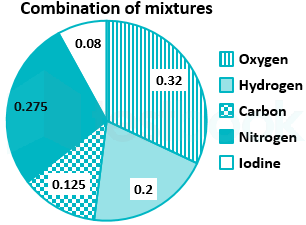
Pie-chart showing the combination of mixtures made up of different elements. Which element is equal to the average contribution of all the elements?

  1. ((a))

    Oxygen

  2. ((b))

    Iodine

  3. ((c))

    Hydrogen

  4. ((d))

    Carbon

Show Answer
Answer: ((c))

Hydrogen

Given:

Pi-chart showing the combination of mixtures made up of different elements

Formula used:

Average = (The sum of all items) /(The number of total items) 

Calculations:

Average = (0.08 + 0.32 + 0.2 + 0.125 + 0.275) /5

Average = 1/5 = 0.2

According to the question 

Hydrogen element = 0.2

∴ correct option is (3)

21

A person drives a car for 4 hours at the speed of 75 kmph and for next 6 hours at the speed of 90 kmph. Find the average speed of the car during the entire journey.

  1. ((a))

    84 kmph

  2. ((b))

    80 kmph

  3. ((c))

    85 kmph

  4. ((d))

    82.50 kmph

Show Answer
Answer: ((a))

84 kmph

Given:

He drives for 4 hours at the speed of 75 kmph

He drives for 6 hours at the speed of 90 kmph

Concept:

Average speed = Total distance / Total time

Calculation:

Total distance = 4 hours ×  75 kmph + 6 hours ×  90 kmph = 300 km + 540 km = 840 km

Total time = 4 hours + 6 hours = 10 hours

 Average speed = 840 km / 10 hours = 84 kmph

Therefore, the average speed of the car during the entire journey is 84 kmph.

22

An article is sold at ₹800 by giving the article at 20% discount. If the article is sold without giving any discount the seller earned 25% profit. Find the cost price of the article.

  1. ((a))

    ₹1250

  2. ((b))

    ₹800

  3. ((c))

    ₹1000

  4. ((d))

    ₹750

Show Answer
Answer: ((b))

₹800

Given:

An article is sold at ₹800 by giving the article at 20% discount.

If the article is sold without giving any discount the seller earned 25% profit.

Formula used:

(1) Selling Price = (100% - D%) of Marked Price

Where, 

D, is the value of the discount per cent

(2) Cost price = (\frac{\text {Selling Price}}{100\text {%} + \text {Profit %}})

Calculation:

In the first case:

The selling price of the article = ₹800

The discount (in per cent) given on the article = 20%

The marked price of the article = (\frac{₹800}{100\text {%} - 20\text {%}}) = (\frac{₹800}{0.8}) = ₹1000

In the second case:

The article is sold at 0% discount.

The marked price of the article = ₹1000

The selling price of the article = ₹1000

The profit per cent earned = 25% 

The cost price of the article =  (\frac{₹1000}{\text {100%+25%}}) = ₹800

∴ The cost price of the article is ₹800.

23

Three years ago, the average age of a husband, wife, and child was 26 years, and that of the wife and the child, 5 years ago, was 20 years. The present age of the husband is:

  1. ((a))

    39 years

  2. ((b))

    42 years

  3. ((c))

    37 years

  4. ((d))

    45 years

Show Answer
Answer: ((c))

37 years

Shortcut Trick

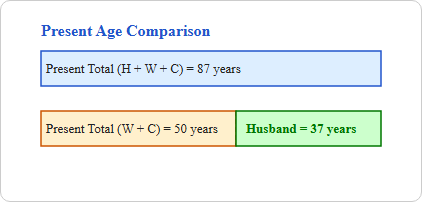
Present average of Husband, Wife, and Child = 26 + 3 = 29 years

Present total age of Husband, Wife, and Child = 29 × 3 = 87 years

Present average of Wife and Child = 20 + 5 = 25 years

Present total age of Wife and Child = 25 × 2 = 50 years

Present age of Husband = 87 − 50 = 37 years

∴ The correct answer is 37 years.

Alternate Method

Given:

Average age of Husband (H), Wife (W), and Child (C) 3 years ago = 26 years

Average age of Wife (W) and Child (C) 5 years ago = 20 years

Formula: Total Age = Average Age × Number of Persons

⇒ Total age of (H + W + C) 3 years ago = 26 × 3 = 78 years ⇒ Present total age of (H + W + C) = 78 + (3 persons × 3 years) = 78 + 9 = 87 years ⇒ Total age of (W + C) 5 years ago = 20 × 2 = 40 years ⇒ Present total age of (W + C) = 40 + (2 persons × 5 years) = 40 + 10 = 50 years ⇒ Present age of Husband = (Present total of H, W, C) − (Present total of W, C) ⇒ Present age of Husband = 87 − 50 = 37 years

∴ The correct answer is 37 years.

Additional Information

Effect of Time on Average Age

If the present average age of a group of n people is A, then after k years, their average age will be A + k, and k years ago, it was A − k.

Sum of Ages

The total sum of ages of n people increases by n × k after k years, as each individual's age increases by k.

Finding Age of a New Member

Age of new member = (New Average × New Strength) − (Old Average × Old Strength).

24

The average of seven consecutive even numbers is 36. What is the difference between the highest and lowest numbers?

  1. ((a))

    5

  2. ((b))

    2

  3. ((c))

    12

  4. ((d))

    15

Show Answer
Answer: ((c))

12

Shortcut Trick

For n consecutive even or odd numbers, the difference between the largest and smallest number is 2 × (n − 1).

Number of terms (n) = 7

Difference = 2 × (7 − 1)

Difference = 2 × 6 = 12

∴ The correct answer is 12.

Alternate Method

Given: Average of 7 consecutive even numbers = 36

Formula Used: Average of consecutive terms in Arithmetic Progression (AP) = Middle Term (if n is odd)

30

32

34

36 Average

38

40

42

Difference = 42 − 30 = 12

⇒ Let the seven consecutive even numbers be n1, n2, n3, n4, n5, n6, n7.

⇒ Since there are 7 terms (odd), the middle term n4 is the average.

⇒ n4 = 36

⇒ Consecutive even numbers have a common difference of 2.

⇒ Lowest number (n1) = n4 − (3 × 2) = 36 − 6 = 30

⇒ Highest number (n7) = n4 + (3 × 2) = 36 + 6 = 42

⇒ Difference = 42 − 30 = 12

∴ The correct answer is 12.

Additional Information

Average of AP

For any arithmetic progression, Average = (First Term + Last Term) ÷ 2.

Sum of Consecutive Even Numbers

The sum of first n even numbers is given by n × (n + 1).

General Difference Property

In any AP with n terms and common difference d, the difference between the nth term and the 1st term is always (n − 1) × d.

25

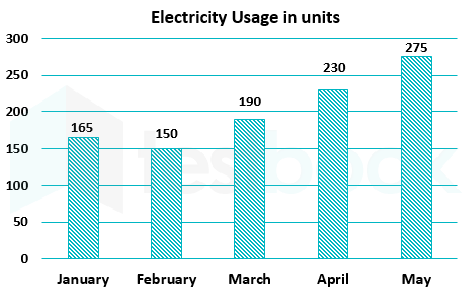
Based on the following bar graph answer the question.

The following is the electricity consumption of a household. The fixed rate is Rs.180 per month and variable rate is Rs. 3.50 per unit.

What is the average monthly electricity charge for all the five months?

  1. ((a))

    Rs. 707

  2. ((b))

    Rs. 794

  3. ((c))

    Rs. 887

  4. ((d))

    Rs. 743

Show Answer
Answer: ((c))

Rs. 887

Calculation:

Average consumption of electricity over 5 months

⇒ (165 + 150 + 190 + 230 + 275)/5

⇒ 202 units

Average variable cost

⇒ 202 × 3.5 = Rs. 707

Now, the average monthly electricity charge for all the five months

⇒ 707 + 180 = Rs. 887

∴ The average monthly electricity charge for all five months is Rs. 887.

26

What will be the simple interest on Rs. 8800 for 9 months at 20/3% per annum?

  1. ((a))

    Rs. 230 

  2. ((b))

    Rs. 123

  3. ((c))

    Rs. 560

  4. ((d))

    Rs. 440

Show Answer
Answer: ((d))

Rs. 440

Given:

P = Rs.8800

R = 20/3%

T = 9 months

Formula Used:

I = PRT/100

I = Simple Interest, P = Principal amount,

R = Rate of Interest, T = Time Period

Calculation:

I = PRT/100 = (8800 × 20 × 9)/(100 × 3 × 12)

⇒ I = 88 × 5 = 440

∴ Simple Interest is Rs.440

27

A started a business with an investment of Rs. 10000. B joined with A after 4 months. At the end of the year the profit got by A and B is same. Then find the investment of B.

  1. ((a))

    Rs. 15,000

  2. ((b))

    Rs. 7,000

  3. ((c))

    Rs. 9,000

  4. ((d))

    Rs. 10,000

Show Answer
Answer: ((a))

Rs. 15,000

Given:

Investment of A = Rs. 10000, after 4 months of A's investment B joined.

Profit is same for both.

Formula used:

Investment × time = profit

Calculations:

Let the profit be 1

Let the investment of B = Rs. x

Time taken by A = 12 months = 1year

Time taken by B = (12 - 4) = 8 months

So, A : B = 10000 × 12 : x × 8

In terms of profit, A : B = (\dfrac{10000 × 12}{x × 8}) : (\dfrac{1}{1})

x = (\dfrac{10000 × 12}{8})

x = 5000 × 3 = Rs. 15000

∴ The answer is Rs. 15000

28

In an election between candidate A and candidate B. If the total number of votes cast is 10,000 and candidate A won the election by 1000 votes. Find the percentage of votes acquired by candidate B.

  1. ((a))

    45%

  2. ((b))

    50%

  3. ((c))

    55%

  4. ((d))

    40%

Show Answer
Answer: ((a))

45%

Shortcut Trick

Winning margin % = (1000 ÷ 10000) × 100 = 10%.

In a two-candidate election, Loser's % = (100% − Margin %) ÷ 2.

Candidate B's % = (100% − 10%) ÷ 2

Candidate B's % = 90% ÷ 2 = 45%.

∴ The correct answer is 45%.

Alternate Method

Given:

Total number of votes cast = 10000

Winning margin of Candidate A = 1000 votes

Calculations:

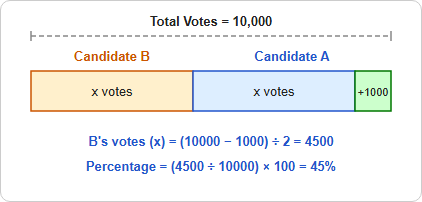
⇒ Let the number of votes acquired by candidate B be x.

⇒ Since candidate A won by 1000 votes, votes acquired by A = x + 1000

⇒ Total votes = Votes of A + Votes of B

⇒ x + x + 1000 = 10000

⇒ 2x + 1000 = 10000

⇒ 2x = 9000

⇒ x = 4500

⇒ Votes acquired by candidate B = 4500

⇒ Percentage of votes acquired by B = (4500 ÷ 10000) × 100

⇒ Percentage = 45%

∴ The correct answer is 45%.

Additional Information

Winning Margin Percentage

Winning margin % is the exact difference between the percentage of the winner and the loser: Margin % = Winner % − Loser %.

Valid vs Invalid Votes

In many election problems, a certain percentage of votes are declared invalid. The winning margin and percentages are always calculated based on valid votes unless stated otherwise.

Successive Percentage Rules

If an electorate has X voters, out of which y% didn't vote and z% votes were invalid, Valid Votes = X × (1 − y/100) × (1 − z/100).

29

A train travelling at 76 km/h crosses a 450 m long platform in 27 seconds. What is the length of the train?

  1. ((a))

    130 m

  2. ((b))

    110 m

  3. ((c))

    100 m

  4. ((d))

    120 m

Show Answer
Answer: ((d))

120 m

Shortcut Trick

Speed in m/s = 76 × 5/18 = 190/9 m/s

Total Distance = Speed × Time = (190/9) × 27 = 570 m

Train Length = Total Distance − Platform Length

Train Length = 570 − 450 = 120 m

∴ The correct answer is 120 m.

Alternate Method

Given:

Speed of the train = 76 km/h

Length of the platform = 450 m

Time taken to cross = 27 sec

Formula Used:

Total Distance = Speed × Time

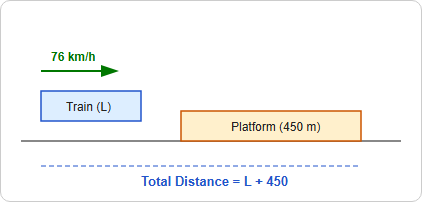
When a train crosses a platform, Total Distance = Length of Train + Length of Platform.

Calculations:

⇒ Speed in m/s = 76 × (5/18) m/s

⇒ Speed = 190/9 m/s

⇒ Total Distance = (Length of Train + 450) m

⇒ Length of Train + 450 = Speed × Time

⇒ Length of Train + 450 = (190/9) × 27

⇒ Length of Train + 450 = 190 × 3

⇒ Length of Train + 450 = 570

⇒ Length of Train = 570 − 450

⇒ Length of Train = 120 m

∴ The correct answer is 120 m.

Additional Information

Unit Conversion

To convert speed from km/h to m/s, multiply by 5/18. To convert m/s to km/h, multiply by 18/5.

Train Crossing a Point Object

When a train crosses a pole, tree, or a stationary person, the total distance traveled is equal to the length of the train itself.

Relative Speed

When two objects move in the opposite direction, relative speed = S1 + S2. In the same direction, relative speed = S1 − S2.

30

How many meaningful English words can be formed with the second, fourth, fifth, and sixth letters of the word HOCKEY (when counted from left to right) using each letter only once in each word?

  1. ((a))

    Three

  2. ((b))

    Two

  3. ((c))

    Zero

  4. ((d))

    One

Show Answer
Answer: ((d))

One

Let's identify the second, fourth, fifth, and sixth letters of the word "HOCKEY":

Second letter: O, Fourth letter: K, Fifth letter: E, Sixth letter: Y

So, the letters we have are: O, K, E, and Y.

Now, let's see if we can form meaningful English words with these letters:

OKEY - Not a standard English word.

YOKE - A meaningful English word (a wooden crosspiece fastened over the necks of two animals and attached to the plow or cart that they are to pull).

KEYO - Not a standard English word.

Therefore, only one meaningful English word can be formed.

Hence, the correct answer is "Option 4".

31

In a certain code language, "HOSPITAL" is written as "FJQQJQBI". How will "PATIENTS" be written as in that language?

  1. ((a))

    IXEQUOIJ

  2. ((b))

    UQJIOEXI

  3. ((c))

    EXIUQJIO

  4. ((d))

    EXIUQOIJ

Show Answer
Answer: ((c))

EXIUQJIO

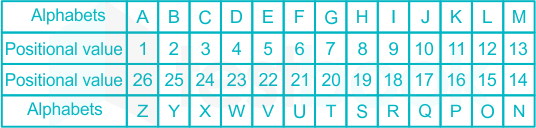
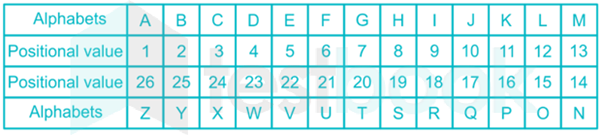
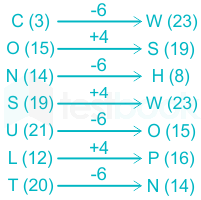
The positions of the letters according to the English alphabet series:

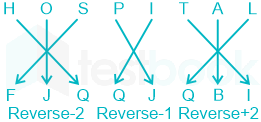
The pattern for this code is as follows;

  • First three letters opposite alphabet - 2 = Alphabet
  • Middle two letters opposite alphabet -1 = Alphabet
  • Last three letters opposite alphabet + 2 = Alphabet

Given:

"HOSPITAL" is written as "FJQQJQBI"

Similarly;

"PATIENTS" be written as

Hence, "EXIUQJIO" is the correct answer.

Additional Information

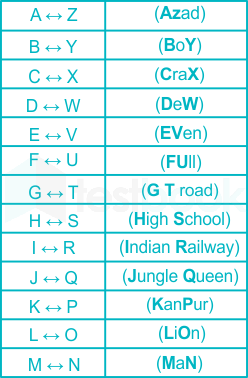
Shortcut to remember the reverse positional letters.

32

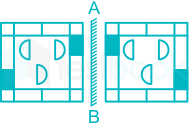
If a mirror is placed on the line AB, then which of the given alternative figures will be the correct image of the question figure?

  1. ((a))

  2. ((b))

  3. ((c))

  4. ((d))

Show Answer
Answer: ((b))

The mirror image of this image is:

Hence, the correct answer is "Option (2)".

33

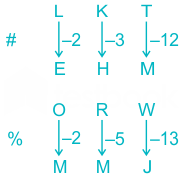
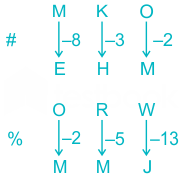
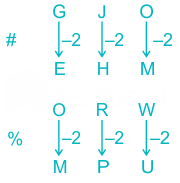
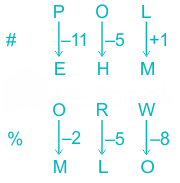
Which of the following letter-clusters should replace # and % so that the pattern and relationship followed between the letter-cluster pair on the left side of :: is the same as that on the right side of :: ?

: EHM :: ORW : %

  1. ((a))

    = LKY, % = MMJ

  2. ((b))

    = MKO, % = MMJ 

  3. ((c))

    = GJO, % = MPU

  4. ((d))

    = POL, % = MLO

Show Answer
Answer: ((c))

= GJO, % = MPU

Concept:

The logic followed here is :-

Difference in place value is same.

Check from option,

Option 1, # = LKY, % = MMJ

Option 2, # = MKO, % = MMJ 

Option 3, # = GJO, % = MPU

Option 4, # = POL, % = MLO

So, in option 3 difference is same.

Hence, the correct answer is "Option 3".

34

Each of the letters below has been assigned a unique number. Select the combination of numbers such that the corresponding letters when arranged accordingly will form a meaningful word.

CELSMU
345678
  1. ((a))

    7, 4, 5, 3 8, 6

  2. ((b))

    6, 8, 7, 4, 5, 3

  3. ((c))

    6, 8, 5, 7, 4, 3

  4. ((d))

    7, 8, 6, 3, 5, 4

Show Answer
Answer: ((d))

7, 8, 6, 3, 5, 4

The code of the letters according to the question:

CELSMU
345678


Upon decoding the options, we get:

1) 7, 4, 5, 3 8, 6 → MELCUS

  1. 6, 8, 7, 4, 5, 3 → SUMELC

  2. 6, 8, 5, 7, 4, 3 → SULMEC

  3. 7, 8, 6, 3, 5, 4 → MUSCLE


Among the above four words, 'MUSCLE' is the only meaningful word.

Hence, "option (4)" is correct.

35

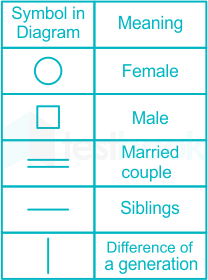
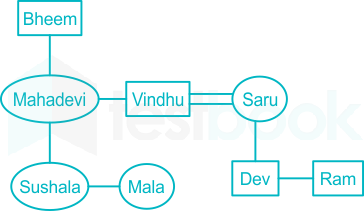
Sushala and Mala are sisters. Their mother Mahadevi has a brother named Vindhu. Vindhu is married to Saru. Saru has two sons, Dev and Ram. Bheem is the father in law of Saru. How is Bheem related to Mala?

  1. ((a))

    Uncle

  2. ((b))

    Father

  3. ((c))

    Brother in law

  4. ((d))

    Maternal Grand father

Show Answer
Answer: ((d))

Maternal Grand father

Family Chart:

Family Tree:

Bheem is the maternal grandfather of Mala.

Hence, the correct answer is "Maternal Grandfather".

36

In a certain code language, 'FEATURE' is written as 'ZIUXOVY' and 'CONSULT' is written as 'WSHWOPN'. How will 'PROMISE' be written in that language?

  1. ((a))

    JUIPCVY

  2. ((b))

    IVHQBWX

  3. ((c))

    IUHPBVX

  4. ((d))

    JVIQCWY

Show Answer
Answer: ((d))

JVIQCWY

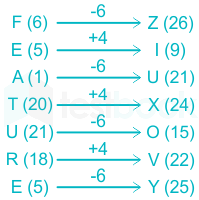
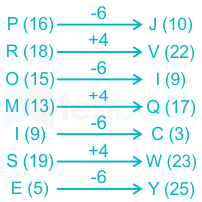
The position of letters according to the English alphabet series:

The pattern followed here is as follows:

'FEATURE' is written as 'ZIUXOVY'

And,

'CONSULT' is written as 'WSHWOPN

Similarly,

'PROMISE' is written as '?'

Hence, "JVIQCWY" is the correct answer.

37

How many such digits are there in the number 7346285, which are as far away from the beginning of the number, as they will be when arranged in ascending order within the number ?

  1. ((a))

    None

  2. ((b))

    One

  3. ((c))

    Two

  4. ((d))

    Three

Show Answer
Answer: ((c))

Two

Original number : 

7 3 4 6 2 8 5

Ascending order :

2 3 4 5 6 7 8

Positional distance between 3 and 4 are same in both arrangements.

Therefore, Option 3 is the correct answer.

38

Direction: In the questions given below, a series is given, with one number / letter missing. Choose the correct alternative from the given ones that will complete the series.

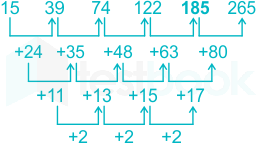
15, 39, 74, 122, ?, 265

  1. ((a))

    151

  2. ((b))

    165

  3. ((c))

    171

  4. ((d))

    185

Show Answer
Answer: ((d))

185

The pattern followed is:

Hence, the correct answer is "185".

39

Seven persons – P, Q, R, S, T, U and V are sitting in a straight line facing north, but not necessarily in the same order. P is sitting at the centre of the row. Between P and Q only one person sits. S sits second from the left corner. Between U and T only one person sits and T at the right corner. R does not sit in any corner. Who is sitting between P and Q?

  1. ((a))

    V

  2. ((b))

    S

  3. ((c))

    U

  4. ((d))

    R

Show Answer
Answer: ((c))

U

Persons: P, Q, R, S, T, U and V

  1. P is sitting at the centre of the row.

  1. Between P and Q only one person sits.

  2. S sits second from the left corner.

  1. Between U and T only one person sits and T at the right corner.

  1. R do not sit in any corner.

Hence, “U” is sitting between P and Q.

40

Select the option that is related to the third number in the same way as the second number is related to the first number and the sixth number is related to the fifth number.

11 : 111 :: 13 : ? :: 19 : 351

  1. ((a))

    179.00

  2. ((b))

    159.00

  3. ((c))

    181.00

  4. ((d))

    161.00

Show Answer
Answer: ((b))

159.00

The logic followed here is:

Logic: (First number2) - 10 = Second number.

Now,

For, 11 : 111

⇒ (112) - 10 = 121 - 10 = 111.

For, 19 : 351

⇒ (192) - 10 = 361 - 10 = 351.

Similarly, for 13 ∶ ?

⇒ (132) - 10 = 169 - 10 = 159.

Hence, the missing number is "159".

41

Which function is used to count the number of cells that contain numbers, in a range?

  1. ((a))

    Sum()

  2. ((b))

    Count ()

  3. ((c))

    Countif()

  4. ((d))

    Sumif()

Show Answer
Answer: ((b))

Count ()

The correct answer is Count().

Key Points

  • The Count() function is used to count the number of cells that contain numbers within a specified range.
  • It does not count empty cells or cells that contain text or logical values like TRUE or FALSE.
  • For example, if you have a range of cells A1:A10, and some cells contain numbers while others are empty or have text, Count(A1:A10) will only return the count of cells with numbers.
  • This function is particularly useful for quickly determining the number of numeric entries in a dataset.
  • The syntax for the Count() function is straightforward: Count(range).
  • Using this function can help in statistical analysis, data validation, and other functions where numeric counts are necessary.

Additional Information

  • If you need to count cells based on specific criteria, you can use the Countif() function.
  • For summing up numbers, the Sum() function is used, and for conditional summing, the Sumif() function is applicable.
  • The Count() function is available in various spreadsheet software like Microsoft Excel, Google Sheets, and others.
  • The Count() function can also be combined with other functions for more complex data analysis.
42

Which among the following is not an Image file format?

  1. ((a))

    SVG

  2. ((b))

    CSV

  3. ((c))

    BMP

  4. ((d))

    WebP

Show Answer
Answer: ((b))

CSV

The correct answer is CSV.

Key Points

File FormatFull-FormDescription
SVGScalable Vector GraphicsIt is an image format for two-dimensional-based vector graphics.
CSVComma-Separated ValuesIt is a file format used to store tabular data, such as a spreadsheet or database.
BMPBit MaPIt is a digital image file format used to display the image independently of the display device.
WebPWebP
(No full form)
Developed by Google, it is an image format that provides lossless and lossy compression for images on the web.
43

________ is a type of application software used for communication

  1. ((a))

    FTP

  2. ((b))

    Word processing

  3. ((c))

    Database

  4. ((d))

    Image editing

Show Answer
Answer: ((a))

FTP

The correct answer is FTP.

  • FTP  is a type of application software used for communication.

Key Points

File Transfer Protocol- The File Transfer Protocol is a standard communication protocol used for the transfer of computer files from a server to a client on a computer network. - FTP is built on a client-server model architecture using separate control and data connections between the client and the server.
Word Processing- Word Processing refers to the act of using a computer to create, edit, save and print documents. - In order to perform word processing, specialized software (known as a Word Processor) is needed. - One example of a Word Processor is Microsoft Word, but other word processing applications are also widely used.
Database- In computing, a database is an organized collection of data stored and accessed electronically from a computer system. - Where databases are more complex they are often developed using formal design and modelling techniques.
Image editing- Image editing encompasses the processes of altering images, whether they are digital photographs, traditional photo-chemical photographs, or illustrations.
44

In MS PowerPoint 2019, which shortcut key is used to start presentation from current slide?

  1. ((a))

    Alt + F5

  2. ((b))

    Tab + F5

  3. ((c))

    Ctrl + F5

  4. ((d))

    Shift + F5

Show Answer
Answer: ((d))

Shift + F5

The correct answer is Shift + F5.

Key Points

This table lists the most frequently used shortcuts in PowerPoint for Windows:

To do thisPress
Start a presentation from the beginning.F5
Start a presentation from the current slide.Shift+F5
Start the presentation in Presenter View.Alt+F5
Hide the pointer and navigation buttons.Ctrl+H
45

System software acts as a bridge between the hardware and _____ software?

  1. ((a))

    Management

  2. ((b))

    Processing

  3. ((c))

    Utility

  4. ((d))

    Application

Show Answer
Answer: ((d))

Application

The correct answer is Application

Key Points

  • An application, or application program, is a software program that runs on your computer. Web browsers, e-mail programs, word processors, games, and utilities are all applications. The word "application" is used because each program has a specific application for the user.
  • In contrast, system software consists of programs that run in the background, enabling applications to run. These programs include assemblers, compilers, file management tools, and the operating system itself. Applications are said to run on top of the system software since the system software is made of "low-level" programs. While system software is automatically installed with the operating system, you can choose which applications you want to install and run on your computer.
  • Macintosh programs are typically called applications, while Windows programs are often referred to as executable files. This is why Mac programs use .APP file extension, while Windows programs use the .EXE extension. Though they have different file extensions, Macintosh and Windows programs serve the same purpose and can both be called applications.
46

What is the name given to those applications that combine text, sound, graphics, motion video, and/or animation?

  1. ((a))

    Motionware

  2. ((b))

    Multimedia 

  3. ((c))

    Anigraphics

  4. ((d))

    Videoscapes

Show Answer
Answer: ((b))

Multimedia 

Key Points

  • Multimedia is the name given to those applications that combine text, sound, graphics, motion video, and animation.
  • Multimedia means that computer information can be represented through audio, video, and animation in addition to traditional media.
  • A multimedia is a form of communication that combines different content forms such as text, audio, images, animations, or video into a single interactive presentation, in contrast to traditional mass media which featured little to no interaction from users, such as printed material or audio recordings.

Additional InformationMotion Ware is software that allows for the set-up, download, and analysis of data captured using the Motion Watch 8 or PRO-Diary hardware.

Hence, the correct answer is Multimedia.

47

In MS Word, which option allows you to quickly remove all formatting from selected text while retaining the underlying text content?

  1. ((a))

    Cut

  2. ((b))

    Clear Formatting

  3. ((c))

    Paste Special

  4. ((d))

    Format Painter

Show Answer
Answer: ((b))

Clear Formatting

The correct answer is Clear Formatting.

Key Points

  • The "Clear Formatting" option allows you to quickly remove all applied formatting (like bold, italics, font size, color, etc.) from the selected text while preserving the actual text content.
  • It can be found under the Home tab in the Font group, represented by an eraser icon labeled "Clear Formatting."
  • You can also use the keyboard shortcut Ctrl + Spacebar to clear character formatting or Ctrl + Q to clear paragraph formatting.
  • This feature is useful when you want to revert text to the default formatting without manually changing individual formatting elements.
  • It removes custom formatting but retains the document's underlying style settings, such as the default font and paragraph styles set for the document.

Additional Information

  • Cut function in MS Word
  • The Cut function removes the selected text or object from its original location and places it in the clipboard, allowing you to paste it elsewhere in the document.
  • You can quickly perform the Cut action using the keyboard shortcut Ctrl + X.
  • The Cut option is typically used when you want to relocate content within the document or transfer it between documents.
  • Paste Special in MS Word
  • The Paste Special feature allows you to paste copied content in various formats, such as plain text, formatted text, or an image, depending on how you want the content to appear.
  • You can access Paste Special by using the keyboard shortcut Ctrl + Alt + V or by selecting it from the Paste drop-down in the Home tab.
  • It is useful when you need to control how content is pasted, for example, when you want to paste data as unformatted text or as a specific object, such as a picture or HTML content.
  • Format Painter in MS Word
  • Format Painter is a tool that allows you to copy formatting (such as font, color, size, and style) from one section of text and apply it to another, making formatting consistent across the document.
  • It is located in the Home tab under the Clipboard group, represented by a paintbrush icon.
  • You can use Format Painter by selecting the text with the desired formatting, clicking the Format Painter icon, and then selecting the text you want to apply the formatting to. Double-clicking the icon allows you to apply formatting to multiple sections.
48

Which of the following is incorrect with reference to plug-ins in web browsers?

  1. ((a))

     Applications intended for use in web browsers

  2. ((b))

    Plug-in are like ActiveX controls.

  3. ((c))

    Plug-in can be executed outside the web browser.

  4. ((d))

    Adobe Flash is an example of an application that is available as a plug-in.

Show Answer
Answer: ((c))

Plug-in can be executed outside the web browser.

Plug-in can be executed outside the web browser is incorrect.

Key Points

  • A plugin is software that acts as an add-on to a web browser and gives the browser additional functionality.
  • For example, Macromedia Flash Player is a plugin that allows the web browser to display animations using the Flash format.
  • Since plug-ins act as extensions of web browsers, they cannot be executed outside it.​​
  • Adobe Flash Player plug-in can be used to play videos, games, and other interactive content.

Additional Information

  • An ActiveX control is a small program that other applications can reuse to enable the same functionality without extra development work.
  • These controls typically have been implemented as plugins to enhance various types of web applications.
49

Linux is a type of _______ software

  1. ((a))

    Application

  2. ((b))

    Open Source

  3. ((c))

    Adware

  4. ((d))

    Complier

Show Answer
Answer: ((b))

Open Source

The correct answer is Open Source

Key Points

  • Open Source Software -
  • This refers to software whose source code is freely available and can be modified or distributed by anyone.
  • Open source software is typically created as a collaborative effort in which programmers improve upon the code and share the changes within the community. Linux is an example of open source software.

Additional Information

  • Application Software - This is a type of computer software designed to perform a group of coordinated functions, tasks, or activities for the benefit of the user. Examples include web browsers, word processors, and multimedia players.
  • Adware - This is software that downloads or displays unwanted ads when a user is online, in some instances, it can be considered a type of malware (malicious software). Adware could lead to security vulnerabilities and slow system performance.
  • Compiler - This is a type of software that transforms computer code written in one programming language (the source language) into another programming language (the target language). Essentially, it translates a human-readable programming language into a language that a computer can understand, enabling the code to be executed.
50

Who is known as father of data processing?

  1. ((a))

    Alan Turing

  2. ((b))

    Vinton Cerf

  3. ((c))

    Herman Hollerith

  4. ((d))

    John McCarthy

Show Answer
Answer: ((c))

Herman Hollerith

The correct answer is Herman Hollerith.

  • Herman Hollerith is the Father of Data Processing.
  • Data processing is the process of collection and manipulation of items of data to produce meaningful information.

Additional Information

  • Alan Turing is the father of Computer science.
  • Vinton Cerf is the father of the Internet.
  • John McCarthy is the father of Artificial Intelligence.
  • Important personalities and Inventions:
PersonalityKnown as
Seymour CrayFather of Supercomputer.
Vijay P BhatakarFather of Indian Supercomputer.
Charles BabbageFather of the Computer.
Claude ShannonFather of Information Theory.
Richard StallmanFather of Free software.
Ray TomlinsonFather of Email.
Tim Berners-LeeFather of the World Wide Web.
51

What is the normal "term of Office" of Gram Panchayat?

  1. ((a))

    1 year

  2. ((b))

    5 years

  3. ((c))

    4 years

  4. ((d))

    3 years

Show Answer
Answer: ((b))

5 years

The correct answer is 5 years.

Key Points

  • The normal term of office for a Gram Panchayat in India is 5 years.
  • This is defined under the Article 243E of the Indian Constitution, which specifies the duration of Panchayats.
  • The term of a Gram Panchayat is calculated from the date of its first meeting after the general elections.
  • However, it can be dissolved before the completion of its term under certain circumstances, such as the failure to perform its duties.
  • Re-elections must be held before the expiry of the 5-year term to ensure the continuity of local self-governance.

 Additional Information

  • 1 year
  • Gram Panchayats are not typically elected for a term of 1 year as it would be impractical for governance and developmental projects.
  • 4 years
  • A term of 4 years is not common for Gram Panchayats and is not supported by the Indian Constitution.
  • 3 years
  • A 3-year term is also not in alignment with the constitutional provisions for the term of a Gram Panchayat.
52

In Desert Development Programme the funding ratio between centre and state with effect from 1st April, 1999 was-

  1. ((a))

    30 : 7

  2. ((b))

    75 : 25

  3. ((c))

    50 : 50

  4. ((d))

    60 : 40

Show Answer
Answer: ((b))

75 : 25

The correct answer is 75 : 25.

Key Points

  • The Desert Development Programme (DDP) is aimed at combating desertification and mitigating the effects of drought in desert areas.
  • The funding ratio between the central and state governments for the DDP was revised to 75:25 with effect from 1st April 1999.
  • This means that 75% of the funding is provided by the central government, while the remaining 25% is contributed by the state government.
  • The program is implemented in arid, semi-arid, and dry sub-humid areas of India to promote sustainable land management and improve the livelihoods of people living in these regions.

Additional Information

  • Desertification
  • Desertification refers to the process by which fertile land becomes desert as a result of various factors, including drought, deforestation, and inappropriate agriculture.
  • It leads to the degradation of land in arid, semi-arid, and dry sub-humid areas.
  • Drought Mitigation
  • Drought mitigation involves measures to reduce the impact of drought on the environment and human life.
  • It includes activities such as water conservation, sustainable agriculture practices, and the development of drought-resistant crops.
  • Sustainable Land Management
  • Sustainable land management refers to the use of land resources in a way that meets the needs of the present without compromising the ability of future generations to meet their own needs.
  • It includes practices that maintain and enhance the productivity of land while protecting the environment.
  • Livelihood Improvement
  • Livelihood improvement initiatives aim to enhance the living standards and economic well-being of people, particularly in rural and underdeveloped areas.
  • These initiatives may include skill development, access to credit, and the promotion of income-generating activities.
53

What is the term for the organic matter resulting from the composting process?

  1. ((a))

    Biomass

  2. ((b))

    Humus

  3. ((c))

    Effluent

  4. ((d))

    Leachate

Show Answer
Answer: ((b))

Humus

The correct answer is Humus.

Key Points

  • While "humus" is a term often associated with organic matter in soil, particularly the stable organic matter that remains after decomposition.
  • Compost typically consists of partially decomposed organic matter, rich in nutrients and beneficial microorganisms, and is used as a soil amendment or fertilizer.
  • Humus is the dark organic matter in soil that is formed by the decomposition of plant and animal matter. It is a kind of soil organic matter.

Additional Information

  • Biomass: It is the total quantity or weight of plants and animals in a particular area or volume.
  • Effluent is wastewater from sewers or industrial outfalls that flows directly into surface waters, either untreated or after being treated at a facility.
  • A leachate is any liquid that, in the course of passing through matter, extracts soluble or suspended solids, or any other component of the material through which it has passed.
54

A term used to designate the total amount of digestible organic nutrient in animal feeding is __________.

  1. ((a))

    Total Digestible Nutrients

  2. ((b))

    Total Diluted Nutrients

  3. ((c))

    Total Dissolved Nutrients

  4. ((d))

    Total Diet Nutrients 

Show Answer
Answer: ((a))

Total Digestible Nutrients

TDN is the total amount of digestible nutrients in the form of digestible carbohydrates, protein, lipid, fibre components present in the animal feeds. The energy content of the animal feed is expressed as TDN and it denotes the sum of all the digestible organic nutrients and is related to the digestible energy directly. This is useful to calculate beef and cow rations (forage).

55

Which of the following state introduced 'Chirayu Health Insurance' Scheme in India ?

  1. ((a))

    Uttar Pradesh

  2. ((b))

    Madhya Pradesh

  3. ((c))

    Kerala

  4. ((d))

    Haryana

Show Answer
Answer: ((d))

Haryana

The correct answer is Haryana

Key Points

  • The government of Haryana introduced the 'Chirayu Health Insurance' Scheme.
  • This scheme is aimed at providing health insurance coverage to the state's residents.
  • The 'Chirayu Health Insurance' Scheme is part of the state's broader efforts to enhance healthcare accessibility and affordability.
  • The scheme is expected to cover a significant portion of the population, ensuring they receive necessary medical care without financial strain.
  • The initiative aligns with the state's commitment to improving public health infrastructure and outcomes.

Additional Information

  • Health Insurance
  • Health insurance is a type of insurance coverage that pays for medical and surgical expenses incurred by the insured.
  • It can also provide coverage for disability or long-term nursing or custodial care needs.
  • Policies differ in terms of the amount of coverage, the type of medical services covered, and the premiums paid.
  • In India, health insurance is often provided by both public and private insurers.
  • Ayushman Bharat Scheme
  • Also known as Pradhan Mantri Jan Arogya Yojana (PM-JAY), it aims to provide free health coverage at the secondary and tertiary levels to poor and vulnerable sections of the society.
  • PM-JAY provides a cover of up to Rs. 5 lakhs per family per year.
  • It is considered the world's largest government-funded health assurance scheme.
  • Beneficiaries are identified based on the Socio-Economic Caste Census (SECC) database.
  • National Health Mission (NHM)
  • Launched by the Government of India in 2013, the NHM aims to provide accessible, affordable, and quality healthcare to the rural population.
  • It encompasses two sub-missions: the National Rural Health Mission (NRHM) and the National Urban Health Mission (NUHM).
  • NHM focuses on strengthening healthcare systems, promoting maternal and child health, and controlling communicable and non-communicable diseases.
  • Health Insurance Regulatory and Development Authority of India (IRDAI)
  • IRDAI is the regulatory body tasked with overseeing the insurance sector in India.
  • It ensures the orderly growth of the insurance industry and protects policyholders' interests.
  • IRDAI regulates health insurance products, ensuring they meet the required standards and provide adequate coverage to policyholders.
56

Kushal Yuva Program is implemented by

  1. ((a))

    Bihar Lok Seva Mission

  2. ((b))

    Bihar Skill Development Mission

  3. ((c))

    Bihar Employment Directorate

  4. ((d))

    Bihar Technical Council

Show Answer
Answer: ((b))

Bihar Skill Development Mission

The correct answer is Bihar Skill Development Mission.

Key Points

  • Kushal Yuva Program (KYP): It is an initiative implemented under the Bihar Skill Development Mission, aiming to enhance the employability of youth in Bihar.
  • The program focuses on imparting soft skills, computer literacy, and communication skills to youth aged between 15 and 25 years, enabling them to secure better employment opportunities.
  • Eligibility Criteria: Youth must be residents of Bihar, aged between 15-25 years, and must have passed 10th grade. Hence, the implementation aligns with the target demographic.
  • Objective: The primary aim of the KYP is to bridge the skills gap by providing training in crucial areas such as communication, soft skills, and basic IT skills, thereby enhancing their employability. Hence, this aligns with Bihar Skill Development Mission's goals.
  • Implementation: The program is executed in partnership with various training centers across Bihar, ensuring accessibility to youth in urban and rural areas. This ensures inclusivity in skill development.
  • Funding: The program is funded by the Government of Bihar under the Bihar Skill Development Mission, showcasing the state’s commitment to improving youth employability.
  • Hence, the correct answer is Bihar Skill Development Mission.

Additional Information

  • Bihar Skill Development Mission (BSDM):
  • The BSDM was established by the Government of Bihar to address the skill gap among the state's youth and enhance their employability.
  • It focuses on providing vocational training, skill development programs, and employment-linked training to youth across various sectors.
  • Programs under BSDM include the Kushal Yuva Program, Employment Linked Skill Training Program (ELSTP), and Recognition of Prior Learning (RPL).
  • The mission aims to create an ecosystem of skill development by collaborating with training providers, industries, and institutions.
  • Features of the Kushal Yuva Program:
  • The program includes training in basic computer skills, soft skills, and language proficiency, essential for employment.
  • The training duration is typically 240 hours, divided into modules for effective learning.
  • Youth enrolled in the program receive certifications, increasing their employment prospects in both government and private sectors.
  • Impact of the Program:
  • The program has helped thousands of youth in Bihar secure better employment opportunities and develop their careers.
  • It contributes to reducing unemployment and improving the socio-economic conditions of the state.

Important Points

  • Eligibility: Applicants must be residents of Bihar, aged between 15-25 years, and have passed Class 10.
  • Program Accessibility: Training centers are spread across urban and rural areas to ensure inclusivity.
  • Certification: Upon completion, participants receive certifications recognized by the Government of Bihar.
  • Focus Areas: The program emphasizes computer literacy, soft skills, and language proficiency for holistic development.
  • Funding: The program is fully funded by the Government of Bihar, reflecting its commitment to youth development.
57

Which of the following is a primary activity in rural areas?

  1. ((a))

    Banking

  2. ((b))

    Agriculture

  3. ((c))

    Manufacturing

  4. ((d))

    Software development

Show Answer
Answer: ((b))

Agriculture

The correct answer is Agriculture.

Key Points

  • Agriculture is the primary activity in rural areas and forms the backbone of the rural economy in India.
  • It involves cultivation of crops, animal husbandry, and other allied activities that provide direct employment to a majority of the rural population.
  • India is one of the leading producers of crops such as rice, wheat, pulses, and spices due to its extensive agricultural practices.
  • About 58% of India's population is dependent on agriculture for their livelihood, according to government statistics.
  • Agriculture also contributes significantly to India's GDP and supports industries like textiles, food processing, and export businesses.

Additional Information

  • Primary Activities: These are activities directly related to natural resources, such as agriculture, fishing, forestry, and mining.
  • Importance of Agriculture: It ensures food security, provides employment, and supports rural development in India.
  • Green Revolution: Introduced in the 1960s, it significantly improved agricultural productivity through the use of high-yield crop varieties, fertilizers, and irrigation techniques.
  • Allied Activities: Activities like dairy farming, poultry farming, and horticulture are also considered part of the agricultural sector.
  • Initiatives like Pradhan Mantri Krishi Sinchai Yojana and PM-KISAN aim to support farmers and boost agricultural productivity in India.
58

The Government, on the advice of the National Advisory Council, has passed the National Rural Employment Guarantee Act is: 

  1. ((a))

    Employment Guarantee Act, 2005 

  2. ((b))

    Employment Guarantee Act, 2007 

  3. ((c))

    Employment Guarantee Act, 2003 

  4. ((d))

    Employment Guarantee Act, 2006 

Show Answer
Answer: ((a))

Employment Guarantee Act, 2005 

The correct answer is Employment Guarantee Act, 2005.

Key Points

  • The National Rural Employment Guarantee Act (NREGA) was enacted by the Government of India in 2005.
  • The primary objective of NREGA is to enhance the livelihood security of people in rural areas by guaranteeing 100 days of wage employment in a financial year to a rural household.
  • The Act was later renamed as Mahatma Gandhi National Rural Employment Guarantee Act (MGNREGA) in 2009.
  • MGNREGA aims to ensure sustainable development by creating durable assets such as roads, canals, ponds, and wells.
  • The scheme focuses on the economic and social empowerment of women and promotes their participation by ensuring that one-third of the beneficiaries are women.

Additional Information

  • Right to Work
  • The NREGA is a social security measure that falls under the Right to Work enshrined in the Constitution of India.
  • It is the first Act to legally guarantee wage employment at an unprecedented scale.
  • Implementation Mechanism
  • The Act is implemented by the Ministry of Rural Development, Government of India.
  • Gram Panchayats play a crucial role in planning and implementation at the grassroots level.
  • Funding
  • The scheme is funded by the Central Government.
  • States are responsible for providing unemployment allowance if the state fails to provide employment within 15 days of application.
  • Transparency and Accountability
  • Social audits are conducted to ensure transparency and accountability in the implementation of the scheme.
  • Use of Information Technology and Management Information System (MIS) for monitoring and evaluation.
59

'Aao Bihar Yojna' scheme related to

  1. ((a))

    Bihar Tourism

  2. ((b))

    New Start up

  3. ((c))

    Establishment of new industrial unit

  4. ((d))

    Industrial development

Show Answer
Answer: ((c))

Establishment of new industrial unit

The correct answer is the establishment of a new industrial unit.

  • Aao Bihar Yojana scheme which aims to encourage investment and for the establishment of the new industrial unit and technical institutions in Bihar.
  • Under this scheme, any person who owns 2 acres or more land and wants to sell their land for the establishment of industries or institutions can enlist their land with respective Collector/District Magistrate.
  • The details are then published by BIADA on the website.
60

What does the '2nd M' stand for in PM JANMAN?

  1. ((a))

    Maha 

  2. ((b))

    Mission

  3. ((c))

    Mastery

  4. ((d))

    Multipurpose

Show Answer
Answer: ((a))

Maha 

The correct answer is Maha.

In News

  • The Ministry of Tribal Affairs organized the National Conference on PM JANMAN at Bharat Mandapam, New Delhi.
  • The conference focuses on six core areas: rural development, schools, water, Anganwadis, and multipurpose centers.
  • It involves 88 districts from 18 states to draft action plans and improve grassroots implementation.
  • PM JANMAN stands for The Union Cabinet approved Pradhan Mantri Janjati Adivasi Nyaya Maha Abhiyan (PM JANMAN).

Key Points

  • The initiative is part of India’s larger efforts to empower tribal communities and ensure their socio-economic welfare.
  • Core areas include improving educational infrastructure, water supply, and integrated rural development.
  • It encourages participation from districts across 18 states to ensure effective implementation.

Additional Information

  • PM JANMAN ( Pradhan Mantri Janjati Adivasi Nyaya Maha Abhiyan )
  • A comprehensive initiative to address the needs of tribal communities in India.
  • Aims to improve infrastructure, education, and access to basic amenities in tribal areas.
  • Encourages collaborative efforts among states to share best practices and formulate effective action plans.
  • Bharat Mandapam
  • The venue of the conference, Bharat Mandapam, is a state-of-the-art convention center in New Delhi.
  • It has hosted several high-profile national and international events.
61

What is the average value of productive asset support under SJY?

  1. ((a))

    ₹20,000

  2. ((b))

    ₹40,000

  3. ((c))

    ₹60,000

  4. ((d))

    ₹1,20,000

Show Answer
Answer: ((c))

₹60,000

The correct answer is ₹60,000.

Key Points

  • The average value of productive asset support under SJY is ₹60,000.
  • SJY refers to a government program aimed at providing productive assets to beneficiaries.
  • Productive asset support ensures sustainable livelihood development for individuals and families.
  • The support amount is carefully determined to be sufficient for initiating productive activities.

Additional Information

  • Option 1 (₹20,000): This amount is relatively low and may not be sufficient to support meaningful productive activities for sustainable livelihood.
  • Option 2 (₹40,000): While higher than ₹20,000, this amount might still be inadequate for certain types of productive asset investments, such as agricultural tools, machinery, or commercial setups.
  • Option 4 (₹1,20,000): This amount is significantly higher than the average support provided and may not align with the budgetary allocations or program guidelines under SJY.
62

Municipal councilors in India are elected for how many years? 

  1. ((a))

    5 years

  2. ((b))

    6 years

  3. ((c))

    4 years

  4. ((d))

    3 years

Show Answer
Answer: ((a))

5 years

The correct answer is 5 years.

Key Points

  • Municipal councilors in India are elected for a term of 5 years.
  • This term length is similar to that of other local government bodies in India, such as Panchayats.
  • Municipal elections are conducted by the State Election Commissions, which are independent bodies responsible for ensuring free and fair elections.
  • After the completion of the 5-year term, new elections are held to elect the next set of councilors.

Additional Information

  • Municipal Councils
  • Municipal Councils are a form of local self-government in India that administer urban areas with populations between 20,000 and 300,000.
  • They are established under the Constitution of India, specifically under the 74th Amendment Act, 1992.
  • They are responsible for providing basic civic amenities and infrastructure to the urban population, such as water supply, drainage, roads, and street lighting.
  • The head of the Municipal Council is known as the President or Chairperson, who is elected by the councilors from among themselves.
  • 74th Amendment Act, 1992
  • This amendment to the Indian Constitution was enacted to strengthen local self-governance in urban areas through the establishment of Municipalities.
  • It provides for a three-tier structure of urban local bodies: Municipal Corporations for larger urban areas, Municipal Councils for smaller urban areas, and Nagar Panchayats for transitioning areas.
  • The Act mandates regular elections every five years and provides for the reservation of seats for Scheduled Castes, Scheduled Tribes, and women.
  • It also introduces the concept of a State Finance Commission to review the financial position of municipalities and make recommendations for the devolution of funds.
  • State Election Commissions
  • State Election Commissions (SECs) are independent bodies established under Article 243K and 243ZA of the Indian Constitution.
  • SECs are responsible for conducting elections to local bodies, including Municipalities and Panchayats, within their respective states.
  • They ensure that elections are conducted in a free, fair, and transparent manner, much like the Election Commission of India does for national and state-level elections.
  • SECs have the authority to prepare electoral rolls, delimit constituencies, and oversee the election process, including the counting of votes and declaration of results.
63

The Ex-officio secretary of Panchayat Samiti is

  1. ((a))

    Nyay Sachiv

  2. ((b))

    Block Development Officer

  3. ((c))

    District Education Officer

  4. ((d))

    None of these

Show Answer
Answer: ((b))

Block Development Officer

The correct answer is Block Development Officer.

Key Points

  • The Block Development Officer (BDO) acts as the Ex-officio Secretary of the Panchayat Samiti.
  • The Panchayat Samiti is the intermediate level of the three-tier Panchayati Raj system, established under the Indian Constitution's Article 243.
  • The BDO oversees the implementation of developmental programs and ensures administrative efficiency within the block.
  • As Ex-officio Secretary, the BDO facilitates coordination between the Panchayat Samiti and other government departments for effective governance.
  • The BDO also assists in the preparation and execution of the block-level budget and development plans.

Additional Information

  • Panchayati Raj System:
  • It is a decentralized form of government in India where each village is responsible for its own affairs, governed under the 73rd Constitutional Amendment Act, 1992.
  • The system consists of three tiers: Gram Panchayat (village level), Panchayat Samiti (block level), and Zilla Parishad (district level).
  • Role of Panchayat Samiti:
  • It is responsible for planning and executing development programs at the block level.
  • It acts as a link between the Gram Panchayat and the Zilla Parishad.
  • Block Development Officer:
  • BDO is a government official responsible for development and administrative activities in a block.
  • They supervise the execution of various state and central government schemes at the block level.
  • Nyay Sachiv:
  • The Nyay Sachiv (Secretary of Justice) is responsible for legal and judicial matters but does not hold administrative authority over the Panchayat Samiti.
64

The Odisha government has introduced a monthly pension of ₹20,000 for individuals imprisoned during which event?

  1. ((a))

    1984 Riots

  2. ((b))

    The Emergency (1975-77)

  3. ((c))

    Veteran Freedom Fighter

  4. ((d))

    1971 India - Bangladesh - Pakistan war

Show Answer
Answer: ((b))

The Emergency (1975-77)

The correct answer is The Emergency (1975-77)

In News

  • The Odisha government has announced a ₹20,000 monthly pension for individuals who were imprisoned during the Emergency between 1975-1977.

Key Points

  • The pension is available for individuals who were detained under the Maintenance of Internal Security Act (MISA) during the Emergency and are still alive as of January 1, 2025.
  • The benefits include medical expense coverage for the eligible individuals.
  • A notification from the state's home department, issued on January 13, 2025, made this decision official.
  • The state has set up state-level and district-level committees to identify the eligible beneficiaries.
  • The application process requires individuals to submit an application to the Collector and District Magistrate, including:
  • Proof of detention during the Emergency.
  • Names of three co-detainees.
  • An affidavit confirming their imprisonment under MISA.
  • Chief Minister Mohan Charan Majhi confirmed that the pension was introduced following demands from those imprisoned during the Emergency and added that health insurance and railway benefits would be included.
  • The Odisha government aims to ensure that those who suffered during the Emergency receive the support they are entitled to.
65

Project Lifeline, a dairy development initiative in India, focuses on

  1. ((a))

    Establishing large processing plants

  2. ((b))

    Promoting export of value-added dairy products

  3. ((c))

    Improving milk chilling facilities

  4. ((d))

    Empowering small and marginal dairy farmers

Show Answer
Answer: ((d))

Empowering small and marginal dairy farmers

The correct answer is Empowering small and marginal dairy farmers

Key Points

  • Project Lifeline itself suggests a focus on supporting those who need it most.
  • "Lifeline" implies providing essential resources or assistance.
  • Dairy development initiatives typically target areas like improving infrastructure, access to resources, and knowledge for small-scale farmers.
  • Large processing plants and export promotion are more likely goals for established dairy businesses, not necessarily the focus of an initiative aimed at empowering smaller farmers.
  • Project Lifeline's focus:
  • Supporting and empowering small and marginal dairy farmers
  • This could involve various aspects like:
  • Improved access to veterinary services and training
  • Providing resources for better cattle breeds or nutrition
  • Helping farmers connect to markets and cooperatives for better prices
  • By empowering these farmers, Project Lifeline aims to improve their livelihoods and the overall dairy sector.
66

When was the National Rural Health Mission (NRHM) launched by the Government of India?

  1. ((a))

    26 January 2006 

  2. ((b))

    12 April 2004

  3. ((c))

    12 April 2005

  4. ((d))

    8 March 2004

Show Answer
Answer: ((c))

12 April 2005

The correct answer is  Apr 12 2005.

Key Points

  • The National Rural Health Mission (NRHM) was launched by the Government of India on April 12, 2005. It aimed to provide accessible, affordable, and quality healthcare to the rural population, especially vulnerable groups.
  • The mission was introduced as part of the National Health Policy to address deficiencies in healthcare infrastructure and improve health indicators like infant mortality rate and maternal mortality rate.
  • NRHM primarily targeted 18 states where health indicators were particularly poor. These included states like Bihar, Uttar Pradesh, Rajasthan, Madhya Pradesh, and others.
  • The mission focused on strengthening the public health system through interventions like ASHA (Accredited Social Health Activist), improving infrastructure, and integrating primary, secondary, and tertiary healthcare services.
  • NRHM also worked on improving sanitation, nutrition, and safe drinking water as complementary health interventions. It sought to reduce gaps in healthcare access between urban and rural areas.
  • The mission emphasized community participation and introduced mechanisms for decentralization to empower local health facilities and improve their functionality.
  • The Janani Suraksha Yojana, a key component of NRHM, aimed to promote institutional deliveries and reduce maternal and infant mortality rates.
  • Hence, the correct answer is Tue Apr 12 2005.

Additional Information

  • Objectives of NRHM:
  • Strengthening rural healthcare infrastructure: Building new health facilities like Primary Health Centres (PHCs), Community Health Centres (CHCs), and sub-centres.
  • Human resources: Recruiting healthcare workers, including ASHA workers, nurses, and doctors, to fill gaps in rural health services.
  • Disease control: Strengthening programs for communicable diseases like malaria, tuberculosis, and HIV/AIDS, as well as non-communicable diseases.
  • Key Features:
  • ASHA workers: Serving as a bridge between the healthcare system and the community, these workers provided essential health services and promoted awareness.
  • Decentralization: Empowering local governing bodies like Panchayati Raj Institutions (PRIs) to plan and implement health initiatives.
  • Janani Suraksha Yojana: Financial incentives for institutional deliveries to reduce maternal and infant mortality.
  • Achievements:
  • Increased institutional deliveries: A rise in institutional deliveries was observed across states due to programs like Janani Suraksha Yojana.
  • Improved health indicators: Significant improvements were seen in infant mortality rate, maternal mortality rate, and life expectancy.

Important Points

  • NRHM's integration: In 2013, NRHM was subsumed under the National Health Mission (NHM), which also included the National Urban Health Mission (NUHM).
  • Focus Areas: NRHM prioritized maternal health, child health, family planning, communicable diseases, and infrastructure development.
  • Funding Mechanism: The mission received funding through a mix of central and state government contributions, ensuring shared responsibility.
67

Which of the following organ from the cattle is not used in pharmaceutical product?

  1. ((a))

    Pancreas

  2. ((b))

    Liver

  3. ((c))

    Skin

  4. ((d))

    Bone

Show Answer
Answer: ((c))

Skin

Skin is not used in pharmaceutical product, it is usually used in leather manufacturing industries.

Pancreas contains insulin used for treating diabetes, Chymotrypsin can burn heals and wounds, Pancreatin aids digestion of food and glucagon treats hypoglycemia or low blood sugar.

Liver contains Heparin is used as anti-coagulant and liver extract is used as treatment of anemia.

Pituitary gland contain Prolactin promotes lactation; Vasopressin controls intestinal and renal functions.

Bone contains Bone marrow is used in the treatment of blood disorders.

Thus option (e) is the correct answer.

68

What is the time period of Murrah buffalo between her birth and her first pregnancy?

  1. ((a))

    37 months

  2. ((b))

    40 months

  3. ((c))

    45 months

  4. ((d))

    48 months

Show Answer
Answer: ((a))

37 months

The correct answer is 37 months.

  • Murrah buffalo is considered as the most expensive buffalo in Haryana.
  • It gives 20-25 litres of milk in a day.
  • Murrah buffalo is also known with other names - Black Gold, Asian tractor.
  • It is found maximum in Jind District of Haryana.
  • The Maximum population of buffalo in Haryana is found in the Bhiwani district.
  • Buffalo research centre in Haryana is in the Hisar district.

Additional Information

  • Chief Minister of Haryana – Manohar Lal Khattar
  • Literacy rate - 67.91 per cent
  • Sex ratio – 879
  • Child sex ratio - 834
  • Total Legislature seats - 90
69

To keep updated about the livestock population, Department of animal husbandry and dairying releases livestock census. Read the following sentence and choose the incorrect one. 

  1. ((a))

    First census was released in 1919

  2. ((b))

    Total bovine population - 302.79 million

  3. ((c))

    Both rural and urban areas are covered 

  4. ((d))

    All are correct

Show Answer
Answer: ((d))

All are correct

The Correct Answer is All are correct

About Livestock Census - 

  • 20th edition of livestock census was released in 2019.
  • The census is released by the Department of Animal Husbandry and dairying, Ministry of Fisheries, Animal Husbandry, and dairying.
  • The first census was conducted in 1919.
  • It covered both rural and urban areas.
  • 20th edition collected online data for the first time.

Important highlights of 20th Livestock Census - 

  • Total Poultry - 851.81 million
  • Total backyard poultry - 317.07 million
  • Total commercial poultry - 534.74 million
  • Total Livestock population - 535.78 million
  • Total bovine population - 302.79 million
  • Total buffaloes - 109.85 million
  • Total sheep - 74.26 million
  • Total goat population - 148.88 million
70

Who is empowered to review financial position of the Panchayats?

  1. ((a))

    Chairman of Block Committee

  2. ((b))

    Chief Minister

  3. ((c))

     Chairman of District Council

  4. ((d))

    Finance Commission constituted by the Governor

Show Answer
Answer: ((d))

Finance Commission constituted by the Governor

The correct answer is option 4.

Key Points

  • Article 243-I: The Governor of a State constitutes a State Finance Commission every 5 years.
  • Its main function is to review the financial position of Panchayats and recommend:
  • Distribution of taxes, duties, tolls, and fees between the State and Panchayats.
  • Principles for grants-in-aid to Panchayats from the Consolidated Fund of the State.
  • Measures to improve the financial position of Panchayats.

Attempt this paper under real exam conditions

Timed interface, section switching, instant scoring, and question-by-question analytics — free.

Start Timed Attempt