Official Paper

Bihar Jeevika (Area Coordinator) : (27 Nov 2025) MBT (Previous Year Paper)

70 questions · 80 minutes · with answers · free

Test (70 questions)

1

What was the capital of the Maurya Empire during the rule of Ashoka?

  1. ((a))

    Prayag

  2. ((b))

    Pataliputra

  3. ((c))

    Ujjain

  4. ((d))

    Ayodhya

Show Answer
Answer: ((b))

Pataliputra

The correct answer is Pataliputra.

Key Points

  • Ashoka was a Mauryan ruler, not a Gupta ruler, and he ruled the Maurya Empire from around 268–232 BCE with his main seat of power in Pataliputra.
  • During Ashoka’s reign, Pataliputra (modern Patna, Bihar) served as the political and administrative capital of the Maurya Empire.
  • Pataliputra was one of the largest and most strategic cities of ancient India, located near the Ganga River, which made it ideal for governance, trade, and defense.
  • Although the Gupta Empire centuries later also had Pataliputra as its capital, in the context of Ashoka, the correct answer remains Pataliputra.

Additional Information

  • Maurya Empire:
  • The Maurya Empire (322 BCE – 185 BCE) was the first great pan-Indian empire, founded by Chandragupta Maurya with the guidance of Chanakya (Kautilya).
  • Its capital was Pataliputra (modern Patna), and it expanded across most of the Indian subcontinent.
  • The most notable ruler was Ashoka the Great (268–232 BCE), who initially expanded the empire through warfare but later embraced Buddhism after the Kalinga War, spreading it across Asia.
  • The Mauryan administration was highly centralized, with a vast bureaucracy, standing army, and use of spies (as described in Kautilya’s Arthashastra).
  • Megasthenes, the Greek ambassador, visited the Mauryan court and described it in his work Indica.
  • The empire declined after Ashoka’s death and finally ended around 185 BCE with the assassination of the last Mauryan ruler, Brihadratha, by Pushyamitra Shunga, who founded the Shunga dynasty.
  • Other Notable Cities:
  • Ujjain: Served as an important commercial and cultural hub.
  • Prayag: Also known as Allahabad, it is a significant city in Hindu religion.
  • Ayodhya: Revered as the birthplace of Lord Rama.
  • Ashoka:
  • Ashoka was a prominent Mauryan emperor, not a Gupta ruler.
  • He is known for spreading Buddhism and his rule based on moral governance.
  • His capital was Pataliputra.
2

Which of the following Harappan trading ports is found in Afghanistan?

  1. ((a))

    Shortugai

  2. ((b))

    Padri

  3. ((c))

    Alamgirpur

  4. ((d))

    Rangpur

Show Answer
Answer: ((a))

Shortugai

The correct answer is Shortugai.

Key Points

  • Shortugai is an ancient Harappan trading port located in present-day Afghanistan.
  • It served as a significant commercial center for the Indus Valley Civilization around 2000 BCE.
  • Shortugai was strategically situated near lapis lazuli mines, allowing the Harappans to trade precious stones.
  • The site has yielded artifacts typical of Harappan culture, including seals, beads, and pottery.

Additional Information

  • Harappan Civilization
  • Also known as the Indus Valley Civilization, it flourished around 3300 BCE to 1300 BCE.
  • It is renowned for its advanced urban planning, architecture, and social organization.
  • Key sites include Harappa, Mohenjo-Daro, and Dholavira.
  • The civilization is noted for its use of standardized weights and measures, and a script that remains undeciphered.
  • Harappan Trade
  • Harappans engaged in extensive trade within the Indian subcontinent and with Mesopotamia and Egypt.
  • Key exports included cotton, beads, pottery, and precious stones.
  • They imported goods such as copper, tin, and luxury items.
  • Archaeological Discoveries at Shortugai
  • Excavations have unearthed Harappan seals, pottery, and lapis lazuli.
  • The presence of these artifacts indicates a thriving trade network.
  • Shortugai provides evidence of the Harappan presence beyond the Indian subcontinent.
  • Indus Script
  • The script consists of symbols and has been found on seals, pottery, and other artifacts.
  • Despite numerous attempts, the script has not been deciphered yet.
  • Understanding the script could provide deeper insights into the Harappan society and culture.
3

Which one of the following is a modified stem?

  1. ((a))

    Turnip

  2. ((b))

    Pneumatophores of Mangrove plants

  3. ((c))

    Cactus (Opuntea) Phylloclade

  4. ((d))

    Cabbage

Show Answer
Answer: ((c))

Cactus (Opuntea) Phylloclade

The correct answer is Cactus (Opuntia) Phylloclade.

Key Points

  • The phylloclade of Opuntia (commonly known as prickly pear cactus) is a modified stem that performs photosynthesis and stores water.
  • In Opuntia, the true leaves are reduced to spines to minimize water loss, and the stem becomes flattened and green to carry out photosynthesis.
  • The modification helps Opuntia adapt to arid and semi-arid environments by conserving water.
  • Phylloclades are characteristic of xerophytic plants (plants adapted to dry environments) and perform multiple functions such as photosynthesis, water storage, and reproduction.
  • These adaptations make Opuntia a classic example of a stem modified for survival in extreme environmental conditions.

Additional Information

  • Definition of Modified Stem: A modified stem is an altered form of the plant stem that develops specialized structures to perform functions like storage, reproduction, or adaptation to environmental stress.
  • Phylloclade Characteristics: Phylloclades are flattened or cylindrical stems that resemble leaves and serve as the primary photosynthetic organ in xerophytes.
  • Examples of Modified Stems: Other examples of modified stems include potato tubers (storage), ginger rhizomes (storage and reproduction), and the tendrils of grapevines (support).
  • Opuntia Adaptations: Besides the phylloclade, Opuntia has a thick cuticle, sunken stomata, and spines instead of leaves to reduce water loss and survive in deserts.
  • Pneumatophores and Turnip: Pneumatophores (Mangrove plants) are modified roots for gas exchange, and turnip is a modified taproot for storage, not a stem.
4

When did Sir Syed Ahmed Khan find the Scientific Society to translate English books on science and other subjects into Urdu?

  1. ((a))

    1852

  2. ((b))

    1872

  3. ((c))

    1882

  4. ((d))

    1864

Show Answer
Answer: ((d))

1864

The correct answer is 1864.

Key Points

  • Sir Syed Ahmed Khan founded the Scientific Society in 1864.
  • The main objective was to translate Western works on science and other subjects into Urdu.
  • It aimed to promote modern scientific knowledge among Indians, especially Muslims.
  • The society played a crucial role in the educational and social reform movement in India.
  • It was one of the first institutions to promote Western education and knowledge in India.

Additional Information

  • Sir Syed Ahmed Khan
  • Born on October 17, 1817, in Delhi, India.
  • He was a prominent Muslim reformer, educator, and politician.
  • He is best known for founding the Aligarh Muslim University in 1875.
  • His efforts were aimed at modernizing Muslim education and promoting social reforms.
  • Scientific Society
  • Established in 1864 in Ghazipur, India.
  • It was one of the first institutions in India to translate Western scientific works into Urdu.
  • The society published journals and books to spread scientific knowledge.
  • It served as a platform for intellectual discussions and debates.
  • Impact of the Scientific Society
  • Contributed to the spread of modern education among Muslims in India.
  • Encouraged the adoption of Western scientific knowledge and methodologies.
  • Played a significant role in the educational and social reform movement of the 19th century.
  • Helped bridge the gap between traditional and modern education systems.
  • Aligarh Movement
  • Started by Sir Syed Ahmed Khan to promote modern education among Muslims.
  • Aimed at creating a class of educated Muslims who could serve in government and other modern professions.
  • The movement led to the establishment of the Muhammadan Anglo-Oriental College, which later became Aligarh Muslim University.
  • It emphasized the importance of scientific and rational thinking.
5

What is the theme of the Grameen Bharat Mahotsav 2025?

  1. ((a))

    Empowering Villages through Technology

  2. ((b))

    Building a Resilient Rural India for a Viksit Bharat 2047

  3. ((c))

    Economic Transformation through Cooperatives

  4. ((d))

    Sustainable Agriculture for Rural Development

Show Answer
Answer: ((b))

Building a Resilient Rural India for a Viksit Bharat 2047

The correct answer is Building a Resilient Rural India for a Viksit Bharat 2047.

In News

  • Prime Minister Narendra Modi inaugurated the Grameen Bharat Mahotsav 2025 on January 4th, 2025, at Bharat Mandapam, New Delhi.

Key Points

  • The theme of the Mahotsav is "Building a Resilient Rural India for a Viksit Bharat 2047".
  • It celebrates rural India's entrepreneurial spirit and cultural heritage.
  • Focus areas include empowering rural women, enhancing infrastructure, fostering innovation, and promoting financial security.
  • The motto of the event is “गांव बढ़े, तो देश बढ़े”.

Additional Information

  • Grameen Bharat Mahotsav 2025
  • Aims to enhance rural livelihoods through technology and innovation.
  • Features workshops, discussions, and masterclasses to foster self-reliant economies.
  • Special focus on empowering rural women and supporting sustainable agricultural practices.
  • Significance
  • Encourages collaboration between government officials, rural entrepreneurs, artisans, and stakeholders.
  • Showcases India's rich cultural heritage through vibrant performances and exhibitions.
6

What is the unit of measuring astronomical distance?

  1. ((a))

    Light year

  2. ((b))

    Angstrom

  3. ((c))

    Weber

  4. ((d))

    Lux

Show Answer
Answer: ((a))

Light year

The correct answer is Light year.

Key Points

  • A light year is a unit of astronomical distance that refers to the distance light travels in one year.
  • It is approximately 9.46 trillion kilometers (or about 5.88 trillion miles).
  • Light years are primarily used to measure distances between celestial objects such as stars, galaxies, and other astronomical entities.
  • This unit is significant because the immense distances in space make conventional units like kilometers or miles impractical for measurement.
  • For example, the nearest star system to the Sun, Alpha Centauri, is about 4.37 light years away.

Additional Information

  • Angstrom (Å): A unit used to measure wavelengths of light, equal to 10-10 meters. It is not suitable for measuring astronomical distances.
  • Weber: The SI unit of magnetic flux, used in physics to describe the strength of magnetic fields. It has no relevance to distance measurement.
  • Lux: The SI unit of illuminance, used to measure light intensity. It is unrelated to distance measurements.
  • Parsec: Another unit of astronomical distance, where 1 parsec equals approximately 3.26 light years. It is commonly used in professional astronomy.
  • Speed of Light: Light travels at a speed of approximately 299,792 kilometers per second (in a vacuum), which is the basis for the definition of a light year.
7

Who are the authors of the book "Memories and Milestones", marking 60 years of the animal welfare organization "Blue Cross of India"?

  1. ((a))

    V. Sriram and Lashman

  2. ((b))

    Dr. Chinny Krishna and Justice PN Prakash

  3. ((c))

    Maneka Gandhi and A.L. Somayaji

  4. ((d))

    Usha Sundaram and Sardar Patel

Show Answer
Answer: ((a))

V. Sriram and Lashman

M The correct answer is V. Sriram and Lashman.

In News

  • The book "Memories and Milestones", documenting 60 years of Blue Cross of India, was authored by historian V. Sriram and Lashman.

Key Points

  • Justice PN Prakash, Former Judge of Madras High Court, released the book in Chennai on March 15, 2025.
  • The book covers Blue Cross’s contributions to animal welfare, including pioneering initiatives like the Animal Birth Control (ABC) program.
  • Notable attendees included Maneka Gandhi, an animal rights activist, and A.L. Somayaji, former Advocate General of Tamil Nadu.
  • Blue Cross was the first Indian animal welfare organization to receive the GuideStar India Platinum Level certification for transparency in 2013.

Additional Information

  • Maneka Gandhi and A.L. Somayaji
  • Attended the book launch event but were not the authors.
  • Dr. Chinny Krishna and Justice PN Prakash
  • Dr. Chinny Krishna is a co-founder of Blue Cross, while Justice PN Prakash released the book.
  • Usha Sundaram and Sardar Patel
  • Usha Sundaram was India’s first woman pilot, and Sardar Patel played a key role in India’s unification but had no connection to the book.
8

Afferent neurons in the peripheral nervous system are responsible for which of the

following?

  1. ((a))

    Integrating reflex responses at the spinal cord level only

  2. ((b))

    Facilitating secretion of neurotransmitters exclusively

  3. ((c))

    Conveying motor commands from the brain to muscles

  4. ((d))

    Transmitting sensory information from receptors to the central nervous system

Show Answer
Answer: ((d))

Transmitting sensory information from receptors to the central nervous system

The correct answer is Transmitting sensory information from receptors to the central nervous system.

Key Points

  • Afferent neurons, also known as sensory neurons, are part of the peripheral nervous system responsible for carrying sensory information to the central nervous system (CNS).
  • These neurons transmit data from sensory receptors located in tissues, organs, and skin to the brain and spinal cord.
  • The information carried by afferent neurons includes stimuli such as touch, pain, temperature, and body position.
  • Afferent neurons play a critical role in enabling the CNS to process external and internal environmental changes.
  • The sensory signals transmitted by afferent neurons are essential for generating reflex actions and conscious responses.

Additional Information

  • Peripheral Nervous System (PNS): The PNS consists of nerves outside the brain and spinal cord, divided into the somatic and autonomic nervous systems.
  • Efferent neurons: These are motor neurons that carry signals from the CNS to muscles and glands, enabling movement and physiological responses.
  • Reflex arc: Afferent neurons are integral to reflex arcs, where sensory inputs trigger immediate motor responses, bypassing higher brain processing.
  • Types of sensory receptors: Include mechanoreceptors (touch), thermoreceptors (temperature), nociceptors (pain), and photoreceptors (light).
  • Neurotransmission: Sensory neurons use electrochemical signals to transmit information across synapses to the CNS for processing.
9

Which of the following rulers was not related to Sangam State Chera?

  1. ((a))

    Nedeon

  2. ((b))

    UdayinJarral

  3. ((c))

    Nedunjaral

  4. ((d))

    Nedum

Show Answer
Answer: ((a))

Nedeon

Nedeon was not related to Sangam State Chera.

  • Sangam period (from 3rd century BC to 3rd century AD) is the phase of history which existed in ancient Tamil Nadu and Kerala.
  • Udiyanjeral (or UthiyanCheralatan) was the first recorded Chera ruler of the Sangam period in ancient South India.
  • He was succeeded by his son, NedumCheralathan, or NedunjeralAthan
  • Nedunjaral, or Nedum, born to Udiyanjeral, was a powerful ruler who ruled the kingdom for 58 years as a Crown Prince first and then as an absolute king.
  • The Cherasruled over an area including north Travancore, Cochin and South Malabar.
  • The Chera Capital was located at Vanji.
10

Which of the following schemes aims to provide an integrated property validation solution for rural India?

  1. ((a))

    WDF

  2. ((b))

    SVAMITVA

  3. ((c))

    NRLM

  4. ((d))

    PCGS

Show Answer
Answer: ((b))

SVAMITVA

The correct answer is SVAMITVA.

Key Points

  • SVAMITVA scheme aims to provide an integrated property validation solution for rural India.
  • The scheme was launched by the Ministry of Panchayati Raj in April 2020.
  • The objective of the scheme is to survey rural inhabited lands using drones and provide property cards to the landowners.
  • The property cards will help in reducing property-related disputes, enable landowners to use their property as collateral for loans, and improve the overall rural economy.

Additional Information

  • WDF (Women Development Fund) is a scheme launched by the Ministry of Women and Child Development.
  • Its goal is to provide financial assistance to women entrepreneurs.
  • NRLM (National Rural Livelihood Mission) is a poverty alleviation scheme.
  • It was launched by the Ministry of Rural Development.
  • PCGS (Partial Credit Guarantee Scheme) is a scheme launched by the Ministry of Finance to provide credit guarantee to lenders for loans given to MSMEs.
11

The Hindu scripture, the Srimad Bhagavad Gita, which is believed to be narrated by Lord Krishna to Arjun during the Mahabharata war between the Pandavas and Kauravas, is composed in how many chapters?

  1. ((a))

    15

  2. ((b))

    16

  3. ((c))

    21

  4. ((d))

    18

Show Answer
Answer: ((d))

18

The correct answer is 18.

Key Points

  • The Srimad Bhagavad Gita consists of 18 chapters.
  • Each chapter is called a "Yoga" and is designated to address different aspects of life and spirituality.
  • The chapters are a conversation between Lord Krishna and the warrior prince Arjuna.
  • The text is part of the Indian epic Mahabharata, specifically the Bhishma Parva (Book of Bhishma).

Additional Information

  • Significance of Chapters
  • Each chapter of the Bhagavad Gita is termed as a "Yoga," meaning a path to spiritual realization.
  • For instance, Chapter 2 is called "Sankhya Yoga," which discusses the philosophy of knowledge and understanding.
  • Chapter 11, "Vishvarupa Darshana Yoga," reveals the universal form of Krishna.
  • Core Themes
  • The Gita addresses key themes such as duty (dharma), righteousness, and the nature of reality.
  • It provides guidance on how to live a balanced life and achieve spiritual enlightenment.
  • Historical Context
  • The Bhagavad Gita was written between 5th and 2nd century BCE.
  • It is considered one of the most important texts in Hindu philosophy and literature.
  • Philosophical Impact
  • The Gita has influenced many Indian leaders, including Mahatma Gandhi, who considered it his "spiritual dictionary."
  • Its teachings extend beyond religion and have universal appeal in the realms of philosophy, ethics, and psychology.
12

Religious saint-poets between the 13th to 17th centuries, Dnyaneshwar, Namdev, Eknath and Tukaram, belonged to which Indian state?

  1. ((a))

    Tamil Nadu

  2. ((b))

    Kerala

  3. ((c))

    Maharashtra

  4. ((d))

    Gujarat

Show Answer
Answer: ((c))

Maharashtra

The correct answer is Maharashtra.

Key Points

  • Dnyaneshwar, Namdev, Eknath, and Tukaram are renowned saint-poets from Maharashtra.
  • They are associated with the Bhakti movement, which emphasized devotion and the personal relationship with God.
  • Dnyaneshwar wrote the 'Dnyaneshwari,' a commentary on the Bhagavad Gita in Marathi.
  • Tukaram is known for his Abhanga devotional poetry and his role in spreading the Varkari tradition.

Additional Information

  • The Bhakti movement was a devotional trend that originated in South India in the 7th century and spread to the north.
  • Saint-poets like Dnyaneshwar and Tukaram are regarded as social reformers who opposed caste discrimination and promoted equality.
  • Maharashtra is known for its rich cultural heritage and has produced many influential spiritual leaders.
  • The Varkari sect, to which Tukaram belonged, is a prominent religious movement in Maharashtra, characterized by pilgrimage to Pandharpur.
  • Namdev's hymns are included in the Guru Granth Sahib, the holy scripture of Sikhism, reflecting his broad influence beyond Maharashtra.
13

Who is the Chief Officer in Panchayati Samiti

  1. ((a))

    Dissemination officer

  2. ((b))

    Development officer

  3. ((c))

    Accountant

  4. ((d))

    Office Superintendent

Show Answer
Answer: ((b))

Development officer

The correct answer is Development officer.

  • Panchayat Samiti is an intermediate level of the Panchayati Raj Institutions.
  • Chief Executive Officer of Panchayat Samiti is Block Development Officer.
  • The development officer is an officer of the State Civil Service.
  • Panchayat Samiti is also known by the name of Janpad Panchayat.

Key Points

  • Indian polity provides for three-tier Panchayati Raj Institutions in India.
  • Gram Panchayat at the village level.
  • Janpad Panchayat or Panchayat Samiti at intermediate level.
  • Zila Panchayat at the district level.

Additional Information

  • The 73rd Constitutional Amendment Act was passed in 1992, which gave constitutional status to the Panchayati Raj Institutions.
  • Generally, the CEO of Zila Panchayat is an IAS officer.
  • BDO is the Chief Officer of Janpad Panchayat.
  • Secretary is appointed at the village level, he calls the gram sabha and keeps records of its proceedings.
14

 Who won India’s first gold medal at the ISSF Junior World Cup in Suhl, Germany?

  1. ((a))

    Adriyan Karmakar

  2. ((b))

    Kanak

  3. ((c))

    Manu Bhaker

  4. ((d))

    Prachi

Show Answer
Answer: ((b))

Kanak

The Correct Answer is ​Kanak.

In News

  • Shooter Kanak wins India’s first gold medal at Junior World Cup in Germany.

Key Points 

  • Kanak won India’s first gold medal at the ISSF Junior World Cup 2025 in Suhl, Germany.
  • She competed in the Women’s 10 metre Air Pistol event.
  • Final score: 239 points.
  • Defeated:
  • Anna Dulce (Moldova), two-time Olympian and European Champion, by 1.7 points.
  • Chen Yen-Ching (Chinese Taipei) won bronze.
  • Kanak previously won silver at the Junior World Championship in Lima 2024.
15

Who translated the first volume of the Ain-i-Akbari into English?

  1. ((a))

    Henry Blochmann

  2. ((b))

    Abul Fazl

  3. ((c))

    H.S. Jarrett ​​

  4. ((d))

    William Jones

Show Answer
Answer: ((a))

Henry Blochmann

The correct answer is - Henry Blochmann

Key Points

  • Henry Blochmann
  • He was a noted Orientalist and linguist associated with the Asiatic Society of Bengal.
  • Translated the first volume of the Ain-i-Akbari into English, which was published in 1873.
  • His translation is considered a standard edition for scholarly reference.

Additional Information

  • Ain-i-Akbari
  • Originally written by Abul Fazl, one of Akbar’s Navratnas and his court historian.
  • Part of the larger work Akbarnama, it details the administration, culture, and economy of the Mughal Empire under Akbar.
  • Later Volumes
  • The second and third volumes of the Ain-i-Akbari were translated by H.S. Jarrett in the years 1891 and 1894 respectively.
  • Asiatic Society of Bengal
  • Published the English translation in its Bibliotheca Indica series, a prestigious academic collection of oriental texts.
16

Who became the emperor of Delhi in 1414 AD?

  1. ((a))

    Ala-ud-din Khilji

  2. ((b))

    Bahlul Khan

  3. ((c))

    Khizr Khan

  4. ((d))

    Razia Sultana

Show Answer
Answer: ((c))

Khizr Khan

The correct answer is Khizr Khan.

Key Points

  • Khizr Khan was the founder of the Sayyid dynasty in India.
  • He became the ruler of Delhi in 1414 AD after overthrowing the Tughlaq dynasty.
  • Khizr Khan ruled from 1414 AD to 1421 AD.
  • He was appointed as the governor of Multan by Timur, who invaded India in 1398 AD.

Additional Information

  • Sayyid Dynasty
  • The Sayyid dynasty ruled the Delhi Sultanate from 1414 to 1451 AD.
  • It was the fourth dynasty of the Delhi Sultanate, following the Tughlaq dynasty.
  • The dynasty's founders claimed descent from Prophet Muhammad.
  • Major rulers included Khizr Khan, Mubarak Shah, Muhammad Shah, and Ala-ud-din Alam Shah.
  • Timur's Invasion
  • Timur, also known as Tamerlane, invaded India in 1398 AD.
  • His invasion led to significant destruction and weakening of the Tughlaq dynasty.
  • Timur appointed Khizr Khan as the governor of Multan, which later enabled him to establish the Sayyid dynasty.
  • Delhi Sultanate
  • The Delhi Sultanate was an Islamic empire based in Delhi that stretched over large parts of the Indian subcontinent for 320 years (1206-1526 AD).
  • It comprised five dynasties: the Mamluk, Khalji, Tughlaq, Sayyid, and Lodi dynasties.
17

Evidence of Mauryan civilization is available at which of the following places?

  1. ((a))

    Bairath

  2. ((b))

    Pipar

  3. ((c))

    doonara

  4. ((d))

    Ahar

Show Answer
Answer: ((a))

Bairath

The correct answer is Bairath.

Key Points

  • Bairath, located in Rajasthan, is an important archaeological site providing evidence of the Mauryan civilization.
  • Excavations at Bairath have uncovered the remains of a Buddhist monastery and a circular stupa from the Mauryan period.
  • The site also includes Ashokan edicts, which are inscriptions made by Emperor Ashoka, a prominent Mauryan ruler.
  • Findings from Bairath highlight the spread of Buddhism during the Mauryan era and the architectural advancements of the time.

Additional Information

  • Mauryan Empire
  • The Mauryan Empire (322–185 BCE) was the first major empire in the Indian subcontinent and was founded by Chandragupta Maurya.
  • It reached its zenith under Ashoka, who promoted the spread of Buddhism and established a centralized form of governance.
  • Ashokan Edicts
  • These are a series of inscriptions on pillars, rocks, and cave walls made by Emperor Ashoka.
  • They provide valuable insights into Ashoka’s policies, including his promotion of Dhamma (moral law) and efforts to spread Buddhism.
  • Buddhist Architecture
  • The Mauryan period saw significant advancements in Buddhist architecture, including the construction of stupas, viharas (monasteries), and chaityas (prayer halls).
  • These structures were often adorned with intricate carvings and inscriptions.
  • Archaeological Significance of Bairath
  • Bairath’s archaeological findings have been crucial in understanding the early spread of Buddhism in India.
  • The site’s artifacts and structures provide evidence of the cultural and religious developments during the Mauryan period.
18

A man on a trip travels the first 240 kms at 120 kmph and the next 150 kms at 50 kmph. Find the average speed of the journey. 

  1. ((a))

    78 kmph

  2. ((b))

    70 kmph

  3. ((c))

    75 kmph

  4. ((d))

    72 kmph

Show Answer
Answer: ((a))

78 kmph

Concept:

Average Speed = Total Distance/Total time

Calculation:

A man on a trip travels the first 240 km at 120 kmph

Time taken to travel 240 km = 240/120 = 2 hours

The next 150 km at 50 kmph.

Time taken = 150/50 = 3 hours

Total time = 5 hour

Average speed = (\frac{240\ +\ 150}{5}) = (\frac{390}{5}) = 78 km/hr

∴ His average speed for the whole journey (in Kmph) is 78 km/hr.

19

The simple interest on a certain principal amount for 4 years at 10% per annum is half of the compound interest on Rs. 1000 for 2 years at 20% per annum. Find the principal amount 

  1. ((a))

    Rs. 500

  2. ((b))

    Rs. 450

  3. ((c))

    Rs. 650

  4. ((d))

    Rs. 550

Show Answer
Answer: ((d))

Rs. 550

Calculation:

The effective rate of 20% for 2years is = 20 + 20 + (20 × 20)/100 = 44%

So, C.I on 1000 for 2 years is = 1000 × 44/100 = 440

Let the principal invest in S.I be P

Now, according to the question,

(P × 4 × 10)/100 = 440/2

⇒ P = 1100/2 = 550

∴  The principal amount be 550

20

Salaries of Rohan and Soham are in the ratio 2 ∶ 3. If the salary of each is increased by ₹ 2,000, the new ratio becomes 40 ∶ 57. What is Soham's present salary ?

  1. ((a))

    ₹ 25,500

  2. ((b))

    ₹ 17,000

  3. ((c))

    ₹ 34,000

  4. ((d))

    ₹ 20,000

Show Answer
Answer: ((b))

₹ 17,000

Shortcut Trick

Initial Ratio = 2 : 3 (Difference = 1 unit)

New Ratio = 40 : 57 (Difference = 17 units)

Equating differences: Multiply (2 : 3) by 17 → 34 : 51

Increase in units = 40 − 34 = 6 units ⇒ 6 units = ₹ 2,000

Soham's present salary = 51 units = (2,000 ÷ 6) × 51 = ₹ 17,000

∴ The correct option is B.

Alternate Method

Given: Initial Ratio = 2 : 3, Increase = ₹ 2,000, Final Ratio = 40 : 57

Formula Used: (Initial Salary + Increase) / (Initial Salary + Increase) = New Ratio

Rohan: 34 units + 2000 (6u) Soham: 51 units + 2000 (6u) Total Units (Final): Rohan = 40, Soham = 57

Let the present salaries of Rohan and Soham be 2x and 3x respectively.

⇒ (2x + 2000) / (3x + 2000) = 40 / 57

⇒ 57 × (2x + 2000) = 40 × (3x + 2000)

⇒ 114x + 114,000 = 120x + 80,000

⇒ 120x − 114x = 114,000 − 80,000

⇒ 6x = 34,000

⇒ x = 34,000 ÷ 6 = 17,000 ÷ 3

⇒ Soham's present salary = 3x = 3 × (17,000 ÷ 3) = ₹ 17,000

∴ The correct option is B.

Additional Information

Ratio Balancing Method

When the same value is added to or subtracted from both terms of a ratio A:B, multiply the terms by the difference of the new ratio C:D to make the increment equal in units.

Cross-Multiplication Method

For a ratio a:b becoming c:d after adding k, the value of 1 unit = |(dk − bk)| / |(ad − bc)|. This is a direct formulaic approach for ratio changes.

Duplicate and Sub-duplicate Ratios

The duplicate ratio of a:b is a2:b2, and the sub-duplicate ratio is √a:√b. These are frequently used in area and side-length problems.

21

The price of sugar is increased by 40%. By what percentage must one cut down on the consumption of sugar so that no extra amount has to be incurred on sugar?

  1. ((a))

    33.5%

  2. ((b))

    28.5%

  3. ((c))

    66.6%

  4. ((d))

    26.6%

Show Answer
Answer: ((b))

28.5%

Shortcut Trick

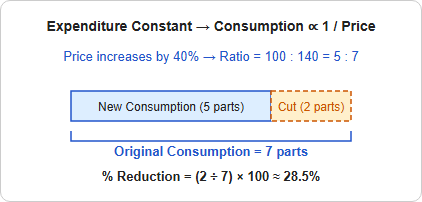
Using the fractional reduction rule for constant expenditure:

Price increase = 40% = 2/5

If price increases by a fraction a/b, consumption must decrease by a/(a+b) to keep expenditure constant.

Required consumption reduction = 2 / (2 + 5) = 2/7

Percentage reduction = (2 ÷ 7) × 100 = 28.57% ≈ 28.5%

∴ The correct answer is 28.5%.

Alternate Method

Given:

Percentage increase in the price of sugar = 40%

Concept Used:

When Expenditure remains constant, Price and Consumption are inversely proportional (Expenditure = Price × Consumption).

Calculations:

⇒ Let the initial price of sugar be ₹100 per unit and initial consumption be 100 units.

⇒ Initial Expenditure = 100 × 100 = ₹10000

⇒ New price of sugar after 40% increase = ₹140 per unit

⇒ To keep the expenditure constant at ₹10000, New Consumption = 10000 ÷ 140 = 500 / 7 units

⇒ Reduction in consumption = Original Consumption − New Consumption

⇒ Reduction in consumption = 100 − (500 / 7) = (700 − 500) / 7 = 200 / 7 units

⇒ Percentage reduction = [(Reduction in consumption) ÷ (Original Consumption)] × 100

⇒ Percentage reduction = [(200 / 7) ÷ 100] × 100

⇒ Percentage reduction = 200 / 7 % = 28.57%

⇒ Looking at the options, it is approximately 28.5%.

∴ The correct answer is 28.5%.

Additional Information

Price & Consumption Rule (Increase)

If the price of a commodity increases by R%, the required percentage reduction in consumption so as not to increase the overall expenditure is given by [R ÷ (100 + R)] × 100%.

Price & Consumption Rule (Decrease)

If the price of a commodity decreases by R%, the permissible percentage increase in consumption to maintain the exact same expenditure is given by [R ÷ (100 − R)] × 100%.

Constant Product Rule

For any equation of the form A × B = Constant, if variable A increases by a fraction of x/y, then variable B must decrease by the fraction x/(x+y) to keep their product constant.

22

If the difference between S.I. and C.I. for 2 years on a sum of money lent at 5% is Rs. 6, then the sum is

  1. ((a))

    Rs. 2200

  2. ((b))

    Rs. 2400

  3. ((c))

    Rs. 2600

  4. ((d))

    Rs. 2000

Show Answer
Answer: ((b))

Rs. 2400

FOR COMPOUND INTEREST

We know the formula for compound interest-         

(⇒ {\bf{CI}} = \left[ {{\bf{P}}\left{ {{{\left( {1 + \frac{{\bf{R}}}{{100}}} \right)}^T} - 1} \right}} \right])

CI = Compound interest

P = Principal

R = Rate of interest

T = Time period

We have

(\begin{array}{l} {\rm{CI}} = \left[ {{\rm{P}}\left{ {{{\left( {1 + \frac{5}{{100}}} \right)}^2} - 1} \right}} \right]\ {\rm{CI}} = \left[ {{\rm{P}}\left{ {1.1025 - 1} \right}} \right]\ {\rm{CI}} = \left[ {0.1025 × {\rm{P}}} \right] \end{array})

FOR SIMPLE INTEREST

We know that, formula for simple interest:

(S.I. = \frac{{P × R × T}}{{100}})

S.I. = Simple Interest

P = principal

R = Rate of interest

T = Time

(\begin{array}{l} S.I. = \frac{{P × 5 × 2}}{{100}}\ S.I. = 0.1 × P \end{array})

We have CI – SI = Rs 6

⇒ 0.1025P – 0.1P = Rs 6

⇒ 0.0025P = Rs 6

(⇒ P = \frac{{6}}{{0.0025}})

⇒ P = Rs 2400


In the case of compound interest, the rate of interest increased successively. 

And in the case of the simple interest rate of interest is the same for every year.

The effective rate of interest of two years in the case of compound interest.

{5 + 5 + (5×5)/100} = 10.25%

Effective rate of  interest for two years in case of simple interest

5 + 5 = 10%

According to the question:

Difference of Compound interest and simple interest = Rs.6

As we calculated:

10.25% - 10% = 0.25% 

⇒ 0.25% = Rs.6

⇒ 100% = 2400

∴ the principal is Rs.2400

Formula used:

Difference between C.I and S.I for 2 years = PR2/1002

Where P = Principal, R = Rate of interest

Calculation:

 Let principal be P

So, from question,

(P × 52)/1002 = 6

⇒ P = 6 × 4 × 100 = 2400

∴ Principal is Rs. 2400

23

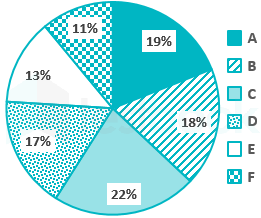
Direction: The following pie chart shows the percentage distribution of the total number of students selected in an entrance exam from six different schools (A, B, C, D, E and F) in year 2020.

Total number of students selected from all six schools in 2020 = 3200

Find the difference in  number of students selected in exam from schools B, C, and D together and  number of students selected in exam from schools A, E, and F together?

  1. ((a))

    448

  2. ((b))

    440

  3. ((c))

    558

  4. ((d))

    428

Show Answer
Answer: ((a))

448

The number of students selected in exam from school B, C and D together = (18% + 22% + 17%) of 3200

⇒ 57% of 3200

⇒ 1824

The number of students selected in exam from school A, E and F together = (19% + 13% + 11%) of 3200

⇒ 43% of 3200

⇒ 1376

∴ required difference = (1824 – 1376) = 448

24

Ram borrowed Rs. 8000 at 12% p.a. simple interest and Sham borrowed Rs. 9100 at 10% p.a. simple interest. In how many years will their amounts of debts be equal?

  1. ((a))

    24 years

  2. ((b))

    22 years

  3. ((c))

    18 years

  4. ((d))

    20 years

Show Answer
Answer: ((b))

22 years

Given:

Principal of Ram = Rs. 8000

Rate of interest (For Ram) = 12%

Principal of Sham = Rs. 9100 

Rate of interest (For Sham) = 10%

Amount of Ram and Sham are equal

Formula used:

SI (= \frac{{{\rm{P;}} \times {\rm{;R;}} \times {\rm{;T}}}}{{100}})

Amount = P + S.I.

Calculation:

Let the required time be y years.

Amount of Ram = Amount of Sham

8000 + [8000 × (12/100) × y] = 9100 + [9100 × (10/100) × y]

⇒ 8000 + 960 y = 9100 + 910 y

⇒ 960 y - 910 y = 9100 - 8000

⇒ 50 y = 1100

⇒ y = 22 years

∴ The time taken to debt become equal is 22 years

25

The average age of 20 boys is 15 years. If the age of 10 girls is added to them, the average age of all will be 14 years. then what will be the average age of the girls?

  1. ((a))

    10

  2. ((b))

    12

  3. ((c))

    13

  4. ((d))

    16

Show Answer
Answer: ((b))

12

Given:

Average age of 20 boys = 15

Calculation:

Let the average age of girls be x years

According to the question,

20 × 15 + 10x = 420

⇒ 300 + 10x = 420

⇒ 10x = 120

⇒ x = 12

⇒ Average = 12 years

∴ The average age of the girls will be 12 years.

Shortcut TrickAverage decreased by 1 year

Total decreased = (20 + 10) × 1 [20 boys and 10 girls]

⇒ 30

Average = Previous average – (Total change/No. of new students)

⇒ 15 – 30/10

⇒ 15 – 3

⇒ 12

∴ The average age of the girls will be 12 years.

26

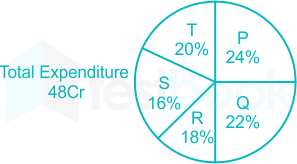
Directions: The following pie chart shows the expenditure (in percentage) of five companies P, Q, R, S and T in one year 2020?

<br>

By how much percent expenditure of company Q & R together is greater than that of company P?

  1. ((a))

    33.33%

  2. ((b))

    60%

  3. ((c))

    66.67%

  4. ((d))

    75%

Show Answer
Answer: ((c))

66.67%

Calculation:

Total expenditure = 48 cr

Expenditure of company Q & R together = (22 + 18)% = 40% of Total expenditure

⇒ ((\frac{40}{{100}}) × 48) = 19.2

Expenditure of company P = (24% of 48) = ((\frac{24}{{100}}) × 48) = 11.52

Percentage of expenditure of Q & R greater in terms of P

= [(19.2 - 11.52)/11.52] × 100

⇒ ((\frac{7.68}{{11.52}}) × 100) = ((\frac{768}{{11.52}})) = 66.67%

∴ The required percentage is 66.67%

27

A boat can travel 15 km upstream and 18 km downstream in 4 hours. Also, it can go 18 km upstream and 15 km downstream in 4 hours 15 minutes. What is the speed of boat in still water?

  1. ((a))

    12 km/h

  2. ((b))

    9 km/h

  3. ((c))

    8 km/h

  4. ((d))

    10 km/h

Show Answer
Answer: ((b))

9 km/h

Given: 

The boat can cover 15 km upstream and 18 km downstream distance in total 4 hours

Also, it can cover 18 km upstream and 15 km downstream distance in total 4 hours 15 minutes(17/4 hours)

Formula used:

Speed = distance/time

Upstream speed(u) = b - w

Downstream speed(d) = b + w

b = speed of the boat in still water

w = speed of the stream

Calculation:

According to the question:

(15/u) + (18/d) = 4

⇒ 15d + 18u = 4ud     ----eq.3

⇒ 255d + 306u = 68ud    ----eq.1

(18/u) + (15/d) = 17/4

⇒ 18d + 15u = 17/4(ud)

⇒ 72d + 60u = 17ud

⇒ 288d + 240u = 68ud     ----eq.2

By comparing eq.1 and eq.2:

288d + 240u = 255d + 306u

⇒ d/u = 2/1

Let d = 2x and u = x

Put in eq.3:

30x + 18x = 8x2

⇒ x = 6

⇒ u = b - w = 6     ----eq.4

⇒ d = b + w = 12     ----eq.5

From eq. 4 and eq.5, b = 9

∴ Speed of the boat in still water = 9 km/h

28

Ravi started a business by investing ₹ 50,000. After six months, Raju joined his business by investing ₹ 1,00,000. In the one year since Ravi invested, they earned a profit of ₹63,000. What is Raju's share in the profit?

  1. ((a))

    ₹31,500

  2. ((b))

    ₹31,000

  3. ((c))

    ₹32,500

  4. ((d))

    ₹32,000

Show Answer
Answer: ((a))

₹31,500

Shortcut Trick

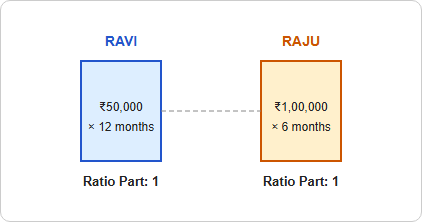
Profit sharing ratio = (Investment × Time) ratio

Ravi : Raju = (50,000 × 12) : (1,00,000 × 6)

Ravi : Raju = 6,00,000 : 6,00,000 = 1 : 1

Since the ratio is 1 : 1, the profit is divided equally.

Raju profit share = ₹63,000 ÷ 2 = ₹31,500

∴ The correct answer is ₹31,500.

Alternate Method

Given:

Investment of Ravi = ₹50,000 | Time period = 12 months

Investment of Raju = ₹1,00,000 | Time period = 6 months (Joined after 6 months)

Total Annual Profit = ₹63,000

Formula Used:

Profit Ratio = (Capital1 × Time1) : (Capital2 × Time2)

⇒ Ravi profit equivalent = 50,000 × 12 = 6,00,000

⇒ Raju profit equivalent = 1,00,000 × 6 = 6,00,000

⇒ Profit Ratio (Ravi : Raju) = 6,00,000 : 6,00,000

⇒ Ratio = 1 : 1

⇒ Total Ratio Parts = 1 + 1 = 2 units

⇒ 2 units = ₹63,000

⇒ 1 unit = ₹63,000 ÷ 2 = ₹31,500

⇒ Raju share (1 unit) = ₹31,500

∴ The correct answer is ₹31,500.

Additional Information

Partnership Profit Rule

In any business partnership, the Profit (P) is directly proportional to the product of Capital (C) and Time (T). Formula: P1 : P2 = C1T1 : C2T2.

Types of Partners

An Active Partner manages the business and may take a salary before profit distribution, while a Sleeping Partner only provides capital.

Compound Partnership

When partners invest different amounts for different durations of time, it is called a compound partnership, where effective capital is calculated per unit of time.

29

By selling 32 articles, a shopkeeper gains the selling price of 12 articles. His gain percentage is∶ 

  1. ((a))

    (31\dfrac{1}{4})%

  2. ((b))

    (50\dfrac{1}{2})%

  3. ((c))

    60%

  4. ((d))

    64%

Show Answer
Answer: ((c))

60%

Given:

On selling 32 articles gain is equal to selling price 12 articles.

Formula Used:

Gain = SP – CP

Gain percent = Gain/CP × 100

Calculation:

According to the question,

⇒ Selling price of 32 articles = Cost price of 32 articles + Selling price of 12 articles

⇒ 32SP = 32CP + 12SP

⇒ 20SP = 32CP

⇒ 5SP = 8CP

SP = 8 and CP = 5 

Gain = SP – CP

Gain = 8 – 5 = 3

Percent gain = Gain/CP × 100

⇒ Percent gain = 3/5 × 100

⇒ Percent gain = 60%

∴ His percent gain is 60%.

30

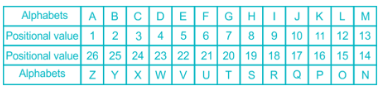
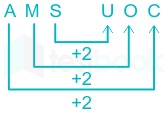
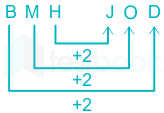
Select the missing pair (fifth letter group : sixth letter group) which is related in the same way as the first letter group is related to the second letter group and the third letter group is related to the fourth letter group.

AMS : UOC :: PGL : NIR :: ?

  1. ((a))

    LDK : MEN

  2. ((b))

    SRF : HUU

  3. ((c))

    BMH : JOD

  4. ((d))

    TFB : DHW

Show Answer
Answer: ((c))

BMH : JOD

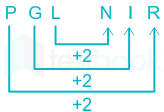
The pattern followed here is:

AMS : UOC 

PGL : NIR

similarly,

BMH: JOD

Hence, the correct answer is "Option (3)".

31

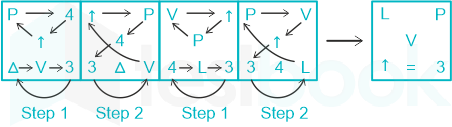
Identify the figure given in the options that when put in place of the question mark (?) will logically complete the series.

  1. ((a))

  2. ((b))

  3. ((c))

  4. ((d))

Show Answer
Answer: ((a))

The logic followed here is:

Logic: Step 1 and Step 2 are being followed on alternate basis.

Hence, the correct answer is "Option 1".

32

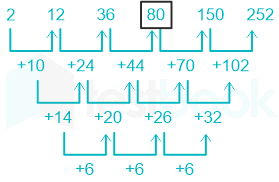
Which of the following numbers will replace the question mark (?) in the given series?

2, 12, 36, ?, 150, 252

  1. ((a))

    30

  2. ((b))

    60

  3. ((c))

    50

  4. ((d))

    80

Show Answer
Answer: ((d))

80

Given:

2, 12, 36, ?, 150, 252

The logic followed in the given series:

Here, '80' is the missing number.

Hence, the correct answer is "Option (4)".

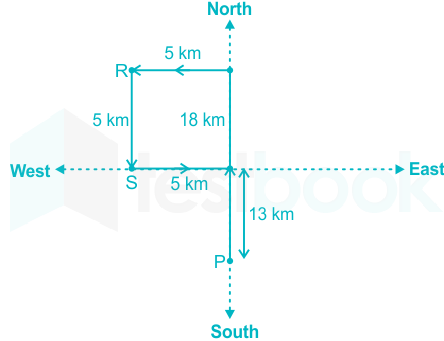
33

Manish started from point P and walked 18 km towards north and reached at point Q. He then took left turn and walked 5 km and reach at point R. Again he took left turn and walked 5 km and reached at point S. Again take a left turn and walked 5 km and reached at point T. How far is he from point P to point T?

  1. ((a))

    5 km

  2. ((b))

    13 km

  3. ((c))

    18 km

  4. ((d))

    23 km

Show Answer
Answer: ((b))

13 km

As per the given information;

Hence, "13 km" is the correct answer.

34

Select the letter-cluster that can replace the question mark (?) in the following series.

CXB, HUI, MRP, ROW, ?

  1. ((a))

    VKE

  2. ((b))

    VKC

  3. ((c))

    WLD

  4. ((d))

    WLZ

Show Answer
Answer: ((c))

WLD

The pattern followed is,

Hence, “WLD” is the correct answer.

35

A boy pointing to a man said, "He is the father of my father's father's son's wife." How is that person related to the boy's father?

  1. ((a))

    Uncle

  2. ((b))

    Nephew

  3. ((c))

    Son in law

  4. ((d))

    Son

Show Answer
Answer: ((a))

Uncle

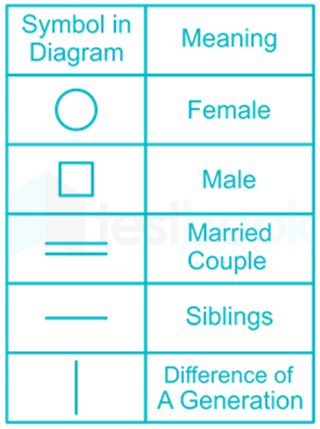
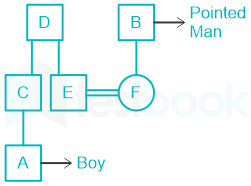
Using the following symbols, let's prepare the family tree.

Given:

  • It is given that the man is the father of the boy's father's father's son's wife.
  • Let the boy be A and man be B.
  • Also, let the boy's father be C and boy's father's father be D.
  • And, let the boy's grandfather's other son be E and boy's grandfather's son's wife be F.

Analyzing the given statement, we get

Family chart:

Hence, the correct answer is 'Uncle'.

36

Select the combination of numbers so that the letters arranged accordingly will form a meaningful word:-

REPYTOHCI
123456789
  1. ((a))

    374869152

  2. ((b))

    743681925

  3. ((c))

    374689152

  4. ((d))

    743681952

Show Answer
Answer: ((d))

743681952

Check option one by one:

1) 374869152

374869152
PHYCOIRTE


2) 743681925

743681925
HYPOCRIET


3) 374689152

374689152
PHYOCIRTE


4) 743681952

743681952
HYPOCRITE


'HYPOCRITE' is a meaningful English word.

Hence, the correct answer is 743681952.

37

If a mirror is placed on line AB, then which of the given answer figures will be the correct image of the question figure.

  1. ((a))

  2. ((b))

  3. ((c))

  4. ((d))

Show Answer
Answer: ((d))

The Correct mirror image of the given figure when the mirror is placed at the left side of  AB:

38

If A denotes 'addition', B denotes 'multiplication', C denotes 'subtraction', and D denotes 'division', then what will be the value of the following equation?

4 B 12 A 18 C (72 D 6) = ?

  1. ((a))

    60

  2. ((b))

    54

  3. ((c))

    48

  4. ((d))

    63

Show Answer
Answer: ((b))

54

Given equation: 4 B 12 A 18 C (72 D 6) = ?

Decoding the given information :

SymbolABCD
Means+×-÷

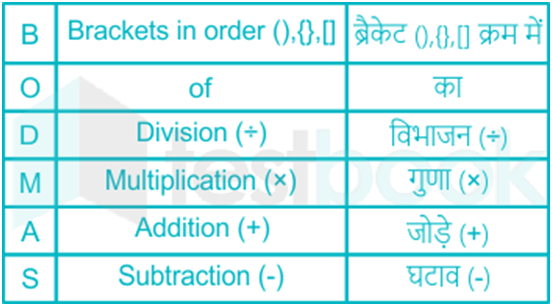
Now, replacing the sign from left to right and using BODMAS rule, we get :

New equation : 4 × 12 + 18 - (72 ÷ 6) = ?

Calculation :

⇒ 4 × 12 + 18 - (72 ÷ 6) = ?

⇒ 4 × 12 + 18 - 12 = ?

⇒ 48 + 18 - 12 = ?

⇒ 66 - 12 = 54.

Hence, the correct answer is "Option 2".

39

Four numbers are given in the given question, three of them are similar in some way and one is different. Find the odd one.

  1. ((a))

    10

  2. ((b))

    222

  3. ((c))

    68

  4. ((d))

    120

Show Answer
Answer: ((d))

120

The logic follows here is:-

23 + 2 = 10

63 + 6 = 222

43 + 4 = 68

53 + 5 = 130

Number 120 is not follow the pattern

Hence, "120" is the correct answer.

40

How many meaningful English words can be formed using second, third, sixth and seventh letters of the word ‘CRACKER’ (when counted from left to right) using each letter only once in each word?

  1. ((a))

    Two

  2. ((b))

    One

  3. ((c))

    Three

  4. ((d))

    Zero

Show Answer
Answer: ((a))

Two

The meaningful words that can be formed using second, third, sixth and seventh letters of the word ‘CRACKER’ (when counted from left to right) using each letter only once in each word is shown below,

  1. REAR → (Noun) The back part of something, especially a building or vehicle.

  2. RARE → (Adjective) Not common; infrequent.

Hence, the correct answer is "Two".

41

A region of computer memory where frequently accessed data can be stored for rapid access is called: 

  1. ((a))

    Cache 

  2. ((b))

    Token

  3. ((c))

    Cookie

  4. ((d))

    Plug-in

Show Answer
Answer: ((a))

Cache 

The correct answer is option 1) i.e. Cache.

Key Points

  • The basic purpose of cache memory is to store program instructions that are frequently re-referenced by software during operation.
  • Fast access to these instructions increases the overall speed of the software program.
  • Cache memory is not associated with ROM, rather it is called as CPU or Random access memory which a computer microprocessor can access more quickly than a regular RAM.
  • This memory is typically integrated directly with the CPU chip or placed on a separate chip that has a separate bus interconnect with the CPU.
42

In MS PowerPoint 2016, on the ________ menu, the ________ group contains commands for formatting text in your document.

  1. ((a))

    Home; Paragraph

  2. ((b))

    Review; Paragraph

  3. ((c))

    View; Font

  4. ((d))

    Home; Font

Show Answer
Answer: ((d))

Home; Font

The correct answer is Home; Font

Key Points

In Microsoft PowerPoint 2016, the "Home" tab on the Ribbon, which is a part of the user interface, is where you can find common commands related to creating, formating, and editing presentations.

  • The "Home" tab comprises several groups such as Clipboard, Slides, Font, Paragraph, Drawing, and Editing.
  • The "Font" group specifically contains commands for formatting text in your document. It includes commands like changing the typeface (font), the size of the text, the color of the text, making text bold, italicized, or underlined, etc.

So, the answer is 4) Home; Font because it refers to a menu (Home) and a group (Font) where formatting text commands are located in Microsoft PowerPoint 2016.

43

Microsoft windows is a _______.

  1. ((a))

    Touch User Interface

  2. ((b))

    Voice User Interface

  3. ((c))

    CUI

  4. ((d))

    GUI

Show Answer
Answer: ((d))

GUI

The correct answer is GUI.

Key Points

  • Microsoft Windows versions use the GUI model of communication.
  • GUI is the acronym for Graphical User Interface.
  • Graphical User Interface refers to a user interface using mouse, icons, and windows.
  • It displays objects that convey information, and represent actions that can be taken by the user.
  • The objects change colour, size, or visibility when the user interacts with them.

Additional Information

  • VUI or Voice user interfaces allow the user to interact with a system through voice or speech commands.
  • Assistants such as Siri, Google Assistant, and Alexa, are examples of VUIs.
  • A touch user interface is a pointing technology based upon the sense of touch or haptics.
  • CUI or character user interface works by allowing the user to issue commands as one or more lines of command lines to a program.
  • It is also known as the command-line user interface.
44

To check the examination answer books, _______ device is used.

  1. ((a))

    OCR

  2. ((b))

    OMR

  3. ((c))

    MICR

  4. ((d))

    CRT

Show Answer
Answer: ((b))

OMR

The correct option is OMR.

Key Points

OMR (Optical Mark Reader)

  • OMR or optical mark reader is the device that reads if a mark made by pen or pencil is present or absent.
  • It is basically used in multiple-choice asked questions.
  • The light is thrown on paper and the reflected light is checked.
  • It is designed to look for checkmarks at specific points.
  • It is widely used to check the answers marked in examinations.

Additional Information

OCR ( Optical Character Recognition)

  • This device is used for high-speed reading of printed as well as handwritten paper.
  • The OCR is used where there is the requirement of large billings.
  • Practically, It can be used to convert scanned data into characters.

MICR (Magnetic Ink Character Recognition)

  • MICR technology is used for identifying marked areas of magnetic ink on different platforms.
  • It is used extensively in the banking systems.
  • The banks use it for processing payment checks and other papers.

CRT (Cathode Ray Tube)

  • CRT is an old technology used for making monitor screens.
  • Nowadays, this technology is replaced by the latest technology such as LED, LCD screens.
45

Which of the following is the correct option for using 'justify' alignment to a paragraph in a document? 

  1. ((a))

    Aligns text only to the left

  2. ((b))

    Aligns text only to the right

  3. ((c))

    Aligns text to both left and right edges

  4. ((d))

    Align text in the center

Show Answer
Answer: ((c))

Aligns text to both left and right edges

The correct answer is Aligns text to both left and right edges

Key Points

  • Justify alignment adjusts the spacing between words so that the text is aligned evenly along both the left and right margins.
  • This creates a clean and formal look for the text, often used in newspapers, magazines, and documents where neatness is important.
  • Justified text can sometimes create uneven spacing between words, which may affect readability.
  • It is different from left, right, or center alignment, which only align text to one side or the center.

Additional Information

  • In most word processors, justify alignment can be applied by selecting the paragraph and clicking the "Justify" button in the toolbar or using a keyboard shortcut.
  • It is important to consider the type of document and audience when deciding to use justify alignment, as it may not be suitable for all types of text.
  • For example, justified text is often used in formal documents and publications but may not be suitable for casual or creative writing where readability and flow are prioritized.
  • Experimenting with different alignments and reviewing the document is recommended to achieve the desired visual effect and readability.
46

What is the term used when you press and hold the left mouse key and move the mouse around the slide? 

  1. ((a))

    Dragging 

  2. ((b))

    Moving 

  3. ((c))

    Highlighting  

  4. ((d))

    Selecting 

Show Answer
Answer: ((a))

Dragging 

The correct answer is Dragging

Key Points

  • Dragging is the action of pressing and holding the left mouse key while moving the mouse around. This action is often used to move objects or select areas on the screen.
  • It is a common technique used in various software applications, including presentation slides, to reposition elements or select text and objects.
  • When you drag an object, it follows the movement of the mouse until you release the button.
  • This functionality is essential for organizing and manipulating content within slides or other graphical interfaces.

Additional Information

  • Moving: Refers to changing the position of an object or text, but typically this is done after selecting it, which may involve dragging.
  • Highlighting: Often refers to selecting text or objects by dragging the cursor across them while holding down the mouse button, making them stand out.
  • Selecting: This is a broader term that includes highlighting, dragging, and other actions used to choose elements on the screen.
47

_______ computers are used in big institutions like insurance and banking, where many people have to use the same data repeatedly.

  1. ((a))

    Mini

  2. ((b))

    Mainframe

  3. ((c))

    Super

  4. ((d))

    Nano

Show Answer
Answer: ((b))

Mainframe

The correct answer is Mainframe.

Key Points

  • Mainframe computers:
  • This computer is used primarily by large organizations for critical applications; bulk data processing, such as census, industry and consumer statistics, enterprise resource planning; and transaction processing. Hence, Option 2 is correct.
  • They are larger and have more processing power than some other classes of computers: minicomputers, servers, workstations, and personal computers.
  • Mainframes are built to be reliable for transaction processing as it is commonly understood in the business world: the commercial exchange of goods, services, or money.
  • A typical transaction, as defined by the Transaction Processing Performance Council, updates a database system for inventory control (goods), airline reservations (services), Railway, or banking (money) by adding a record. Hence, Option 3 is correct.

Additional Information

  • Mini Computer:
  • A minicomputer, or colloquially mini, is a class of smaller general-purpose computers that developed in the mid-1960s and sold for much less than mainframe and mid-size computers from IBM and its direct competitors.
  • Micro Computer:
  • A microcomputer is a small, relatively inexpensive computer with a microprocessor as its central processing unit.
  • It includes a microprocessor, memory, and minimal input/output circuitry mounted on a single printed circuit board.
  • Super Computer:
  • A supercomputer is a computer with a high level of performance as compared to a general-purpose computer.
  • The performance of a supercomputer is commonly measured in floating-point operations per second instead of million instructions per second. Since 2017, some supercomputers can perform over 10¹⁷ FLOPS.
48

______ function in MS-Excel 2010 rounds a number to the nearest integer or to the nearest multiple of significance.

  1. ((a))

    CEILING

  2. ((b))

    IF

  3. ((c))

    FLOOR

  4. ((d))

    COUNTIF

Show Answer
Answer: ((a))

CEILING

The correct answer is CEILING

Key Points

  • The CEILING function in MS Excel 2010 rounds a number up to the nearest multiple of a specified significance.
  • It can round to the nearest integer or to the nearest multiple of significance depending on the value you set for the significance argument.
  • For example, if you use CEILING(7.3, 1), it rounds 7.3 up to the next whole number, which is 8.
  • You can also specify a different multiple for rounding.
  • For example, if you use CEILING(7.3, 0.5), it will round 7.3 up to 7.5, the nearest multiple of 0.5.

Additional Information

  • IF: The IF function checks whether a condition is true or false and returns different values based on the result. It is not used for rounding numbers.
  • FLOOR: The FLOOR function rounds a number down to the nearest multiple of significance (opposite of CEILING).
  • COUNTIF: The COUNTIF function counts the number of cells that meet a specified condition or criteria. It does not round numbers.
49

________ ensures secure transfer of data over an unsecured network, such as the Internet.

  1. ((a))

    Antivirus

  2. ((b))

    Hacking

  3. ((c))

    Cracking

  4. ((d))

    Cryptography

Show Answer
Answer: ((d))

Cryptography

Cryptography includes a set of techniques for scrambling or disguising data so that it is available only to someone who can restore the data to its original form.

Cryptography helps ensure data confidentiality, data integrity, authentication, and non - repudiation.

50

Directories in operating system are used for

  1. ((a))

    keeping tracks of Program

  2. ((b))

    keeping tracks of Process

  3. ((c))

    keeping tracks of Hardware

  4. ((d))

    keeping tracks of Files

Show Answer
Answer: ((d))

keeping tracks of Files

The correct answer is keeping tracks of Files.

Key Points

  • Directories in an operating system are essential for organizing files.
  • They provide a hierarchical structure to store and retrieve files efficiently.
  • Directories can contain both files and other directories, allowing for a nested structure.
  • They help in managing file permissions, access control, and keeping track of file metadata such as creation date, modification date, and size.

Additional Information

  • File System:
  • A file system organizes and manages the storage and retrieval of data on a disk drive.
  • Common file systems include NTFS, FAT32, and ext4.
  • They allow users to create, delete, read, write, and modify files and directories.
  • Metadata:
  • Metadata is data that provides information about other data.
  • In the context of files, metadata includes details such as file size, file type, creation date, and last modified date.
  • Access Control:
  • Access control mechanisms determine who can access and modify files and directories.
  • Permissions can be set for different users and groups to ensure security and data integrity.
  • Hierarchical Structure:
  • The hierarchical structure allows for organizing files into a tree-like structure with directories and subdirectories.
  • This organization makes it easier to navigate and manage large numbers of files.
51

Which of the following subjects is included in the 11th Schedule of the Indian Constitution?

  1. ((a))

    Banking and Insurance

  2. ((b))

    Rural Housing

  3. ((c))

    Railways

  4. ((d))

     Atomic Energy

Show Answer
Answer: ((b))

Rural Housing

The Correct Answer is Rural Housing

Key Points

  • The 11th Schedule (added by the 73rd Amendment, 1992) lists 29 functional items that may be devolved to Panchayats.
  • Rural Housing is one such subject.

Additional Information

  • Other key items include agriculture, minor irrigation, animal husbandry, education, health, and women’s development.
  • These subjects enable local self-governments to plan and implement grassroots development.
  • The actual devolution varies by state, depending on political and administrative will.
52

What is the primary goal of the Indian government's Bhashini project?

  1. ((a))

    To create a multilingual AI platform for real-time translation among Indian languages

  2. ((b))

    To establish a national database of dialects

  3. ((c))

    To develop a new programming language for Indian developers

  4. ((d))

    To digitise ancient Indian manuscripts

Show Answer
Answer: ((a))

To create a multilingual AI platform for real-time translation among Indian languages

The correct answer is To create a multilingual AI platform for real-time translation among Indian languages..

Key Points

  • Bhashini Project Overview: The Bhashini project is a government initiative by the Indian Ministry of Electronics and Information Technology (MeitY). It aims to create a multilingual Artificial Intelligence (AI) platform designed for facilitating real-time translation and interpretation across various Indian languages.
  • This project is aligned with the vision of Digital India and aims to eliminate language barriers across the country by leveraging cutting-edge AI and machine learning technologies.
  • Purpose: The primary goal is to ensure that people from all linguistic backgrounds in India can access digital content and services in their native languages. This supports the inclusion of individuals from different regions.
  • Focus on Indian Languages: India is a linguistically diverse country with 22 scheduled languages and hundreds of dialects. The Bhashini project seeks to bridge the gap by creating a comprehensive multilingual ecosystem for communication, especially in regional languages.
  • Components: The project includes the development of language datasets, APIs, and AI solutions to support translation, transcription, and interpretation services for Indian languages.
  • Applications: The project can be applied to education, governance, e-commerce, healthcare, and other domains to ensure that people from different linguistic backgrounds can access necessary services and resources.

Additional Information

  • Importance of Multilingual AI:
  • India's linguistic diversity: With over 1.3 billion people speaking a variety of languages, a multilingual AI platform is crucial for fostering inclusivity and removing language as a barrier to communication and information access.
  • Applications in public services: The platform can enable access to government services, education, and healthcare in local languages, ensuring that citizens from rural and remote areas are not left behind in the digital revolution.
  • Economic impact: By allowing businesses to interact with customers in their native languages, the project can help boost local and regional economies.
  • Government Initiatives Supporting Bhashini:
  • Digital India Programme: Launched in 2015, this initiative aims to transform India into a digitally empowered society and knowledge economy. Bhashini complements this goal by breaking language barriers.
  • Indian Language Internet Alliance (ILIA): An initiative aimed at increasing Indian language content on the internet, providing a digital space for local languages, which aligns with the Bhashini project.

Important Points

  • Global Context:
  • UNESCO: The United Nations Educational, Scientific and Cultural Organization (UNESCO) has emphasized the importance of language preservation and promotion for cultural diversity.
  • AI in language technologies: Major companies like Google and Microsoft are also working on AI-powered translation tools, which further emphasizes the importance of multilingual technology.
  • Future Prospects:
  • The Bhashini project has the potential to position India as a global leader in language technology, fostering innovation and collaboration in this domain.
  • It will also play a crucial role in preserving and promoting India’s rich linguistic heritage in the digital age.
53

Which government initiative primarily focuses on improving human development by ensuring healthcare and nutrition for women and children? 

  1. ((a))

    Digital India 

  2. ((b))

     Beti Bachao, Beti Padhao

  3. ((c))

    Skill India Mission

  4. ((d))

    Poshan Abhiyaan

Show Answer
Answer: ((d))

Poshan Abhiyaan

The correct answer is Poshan Abhiyaan.

Key Points

  • Poshan Abhiyaan, also known as the National Nutrition Mission, was launched by the Government of India on 8 March 2018, coinciding with International Women's Day.
  • The initiative aims to address the issue of malnutrition among women, children, and adolescents by ensuring proper nutrition and healthcare facilities.
  • It primarily focuses on reducing stunting, undernutrition, anemia (among young children and women), and low birth weight in babies, targeting children aged 0-6 years and pregnant women.
  • The program utilizes technology-driven solutions, such as mobile apps and real-time monitoring systems, to track progress and ensure effective delivery of services.
  • Under Poshan Abhiyaan, initiatives like Poshan Pakhwada and Rashtriya Poshan Maah are implemented annually to create awareness about nutrition and promote community participation.

Additional Information

  • Features of Poshan Abhiyaan:
  • The mission adopts a multi-ministerial approach involving ministries like Women and Child Development, Health, and Education.
  • It is implemented in collaboration with state governments to ensure coverage across all districts in India.
  • The program promotes behavioral change among communities through awareness campaigns, workshops, and training programs.
  • Funds under Poshan Abhiyaan are shared between the Central Government and State Governments in a 60:40 ratio (90:10 for North-Eastern states and Himalayan states).
  • The initiative incorporates the use of Anganwadi Workers and ASHA workers to directly engage with beneficiaries, ensuring last-mile delivery.
  • Relevant Data:
  • India has the highest number of malnourished children globally, with reports showing that 35.5% of children under the age of 5 years are stunted, as per the National Family Health Survey (NFHS-5) conducted in 2019-2021.
  • The mission targets to reduce stunting to 25% by 2022, from the baseline of 38.4% recorded in the NFHS-4.
  • It aims to reduce anemia among women and children by 3% annually and ensure 100% coverage of pregnant women with supplementary nutrition.
  • Comparison with Other Schemes:
  • Digital India: Focuses on digital empowerment of citizens and is unrelated to healthcare or nutrition.
  • Beti Bachao, Beti Padhao: Aims to improve the sex ratio and promote education for girls but does not address healthcare and nutrition directly.
  • Skill India Mission: Focuses on enhancing vocational skills for employment and is not related to nutrition or healthcare.
  • Poshan Abhiyaan: Specifically targets nutrition and healthcare improvements for women and children, making it the most relevant initiative for the question.
  • Global Context:
  • The initiative aligns with the Sustainable Development Goals (SDG), particularly SDG 2 (Zero Hunger) and SDG 3 (Good Health and Well-being).
  • India's efforts under Poshan Abhiyaan contribute to global objectives of reducing malnutrition and improving health outcomes.

Important Points

  • Poshan Abhiyaan involves the use of ICT-based real-time monitoring to ensure transparency and accountability in service delivery.
  • The initiative complements existing schemes like the Integrated Child Development Services (ICDS) and Mid-Day Meal Scheme, amplifying their impact.
  • Community participation through initiatives like Poshan Melas and Village Health and Nutrition Days enhances the program's outreach and effectiveness.
  • The Jan Andolan aspect of Poshan Abhiyaan aims to make nutrition a people-centric movement, encouraging grassroots involvement.
54

Which of the following is the primary objective of the Shyama Prasad Mukherji Rurban Mission (SPMRM)? 

  1. ((a))

    Electrification of rural households

  2. ((b))

    Development of rural clusters with urban-like facilities 

  3. ((c))

    Skill development for rural youth

  4. ((d))

    Ensuring 100 days of wage employment in rural areas 

Show Answer
Answer: ((b))

Development of rural clusters with urban-like facilities 

The correct answer is Development of rural clusters with urban-like facilities.

Key Points

  • Shyama Prasad Mukherji Rurban Mission (SPMRM): Launched by the Government of India in 2016, the primary objective of this mission is to transform rural areas into economically, socially, and physically sustainable regions with the provision of urban-like facilities while retaining the essence of rural life.
  • The mission focuses on developing rural clusters by providing essential infrastructure and services, such as roads, electricity, water supply, sanitation, digital connectivity, healthcare, education, and skill development facilities.
  • SPMRM is aimed at reducing the migration of rural population to urban areas by creating sustainable and inclusive communities in rural regions. This strengthens rural economies. Hence, the correct answer is "Development of rural clusters with urban-like facilities."
  • The mission targets clusters of villages with a population of 25,000 to 50,000 in plain areas and 5,000 to 15,000 in hilly, tribal, and desert areas to ensure equitable development across regions.
  • SPMRM operates through two distinct categories of clusters: Non-Tribal Clusters and Tribal Clusters, catering to the specific needs of these regions.
  • The mission is a comprehensive approach that integrates various schemes of the government to provide urban-like amenities in rural areas, boosting the rural population's overall quality of life.

Additional Information

  • Specific Characteristics of Each Option:
  • Option 1: Electrification of rural households – While electrification is an important component of rural development, it is not the primary objective of SPMRM. The Deen Dayal Upadhyaya Gram Jyoti Yojana (DDUGJY) focuses on rural electrification.
  • Option 3: Skill development for rural youth – Skill development is a significant goal under SPMRM, but it is a part of the broader objective of creating urban-like facilities in rural clusters. Independent schemes like Pradhan Mantri Kaushal Vikas Yojana (PMKVY) focus exclusively on skill development.
  • Option 4: Ensuring 100 days of wage employment in rural areas – This refers to the Mahatma Gandhi National Rural Employment Guarantee Act (MGNREGA), which ensures employment opportunities in rural areas. However, it is not the primary focus of SPMRM.
  • Implementation of SPMRM:
  • The mission identifies clusters that have potential for growth and provides them with the necessary support to become "Rurban" clusters through integrated and participatory planning.
  • A Critical Gap Funding (CGF) is provided to support the development of infrastructure in these clusters.
  • SPMRM incorporates convergence of schemes like MGNREGA, PMKVY, NRLM, and other state-level programs to achieve its objectives.

Important Points

  • Focus on Rural Development:
  • SPMRM aims to bridge the rural-urban divide by providing urban-like facilities in rural areas while preserving their cultural and natural heritage.
  • The mission ensures a holistic development approach, including economic development, environmental sustainability, and social inclusion.
  • Key Features:
  • SPMRM targets 300 rural clusters across India for development into Rurban areas.
  • The program emphasizes public-private partnerships (PPPs) and community participation for effective implementation.
55

In which of the following years was the first ever National Agriculture Policy announced? 

  1. ((a))

    2000

  2. ((b))

    2010

  3. ((c))

    2003

  4. ((d))

    2005

Show Answer
Answer: ((a))

2000

The correct answer is 2000.

Key Points

  • The first National Agriculture Policy of India was announced in the year 2000.
  • This policy was introduced to address the issues related to growth, sustainability, and equity in agriculture.
  • The primary focus of the policy was to achieve a growth rate of 4% per annum in agriculture and allied sectors.
  • It aimed to ensure the efficient use of resources and promote technology-driven agriculture.
  • The policy emphasized the importance of diversification in agriculture to meet the demand for food and non-food products.
  • It highlighted the need for private sector participation in agricultural development, including investments in infrastructure, research, and marketing.
  • The policy also stressed the importance of improving rural infrastructure, including irrigation systems, power, and transport.
  • It supported the adoption of measures to ensure food security and promote agricultural exports.
  • The National Agriculture Policy of 2000 laid the foundation for several reforms in the agricultural sector, including the promotion of research and development, credit facilities, and farmer welfare programs.

Additional Information

  • 2010
  • No specific agriculture policy was introduced in 2010. However, significant steps were taken during this period to implement plans under existing policies.
  • During this time, India focused on initiatives like the National Food Security Mission (NFSM) and improving the agricultural supply chain.
  • 2003
  • No major agriculture policy was introduced in 2003. However, the government continued to focus on enhancing agricultural productivity through various schemes.
  • The year saw efforts in expanding the reach of the National Agricultural Insurance Scheme.
  • 2005
  • No agriculture policy was introduced in 2005. However, several programs like Rashtriya Krishi Vikas Yojana (RKVY) were announced later as part of ongoing reforms.
  • The focus was on improving productivity and addressing rural issues in the long term.
56

What was the main aim of IRDP (Integrated Rural Development Programme) ?

  1. ((a))

    To provide free food to rural families

  2. ((b))

    To promote urban employment

  3. ((c))

    To assist poor rural families in acquiring assets or skills for self-employment

  4. ((d))

    To build schools in villages

Show Answer
Answer: ((c))

To assist poor rural families in acquiring assets or skills for self-employment

The Correct answer is To assist poor rural families in acquiring assets or skills for self-employment.

Key Points

  • The Integrated Rural Development Programme (IRDP) was launched in 1978-79 and extended throughout India by 1980.
  • The main aim of the IRDP was to assist poor rural families in improving their standard of living by helping them acquire productive assets or develop self-employment skills.
  • This programme was targeted at families living below the poverty line (BPL).
  • IRDP combined various central and state government schemes to provide subsidies and bank loans to rural households for activities such as agriculture, animal husbandry, cottage industries, and small businesses.
  • The programme focused on creating employment opportunities and promoting sustainable livelihoods in rural areas.
  • It was implemented through a network of District Rural Development Agencies (DRDAs).
  • The IRDP aimed to integrate different sectors of development, including education, health, and skill development, to provide a comprehensive approach to rural upliftment.
  • It was one of the most significant poverty alleviation programmes launched by the Government of India.

Additional Information

  • To provide free food to rural families
  • This option refers to programmes like the Public Distribution System (PDS) and the Antyodaya Anna Yojana, which aim to provide subsidized or free food to families living below the poverty line.
  • While these programmes address food security, they differ from the IRDP, which focuses on asset creation and skill development for self-employment.
  • To promote urban employment
  • This option is unrelated to the IRDP as the programme specifically targets rural areas.
  • Urban employment-related programmes include initiatives like the National Urban Livelihoods Mission (NULM), which focuses on urban poverty alleviation.
  • To build schools in villages
  • Building schools in villages is a goal often associated with educational schemes like the Sarva Shiksha Abhiyan (SSA).
  • While rural education is vital for development, it is not the primary focus of the IRDP.
57

The 'Special Food Grain Production Programme (SFPP) on Pulses' was implemented during the year ______.

  1. ((a))

    1968-69

  2. ((b))

    1972-73

  3. ((c))

    1982-83 

  4. ((d))

    1988-89

Show Answer
Answer: ((d))

1988-89

The correct answer is 1988-89.

Key Points

  • Special Food Grain Production Programme (SFPP) on Pulses was launched in 1988-89 by the Government of India to address the issue of inadequate production of pulses in the country.
  • The programme aimed to increase the production of pulses through focused interventions, including better technology adoption, improved seed distribution, and enhanced farming practices.
  • This initiative was part of a broader effort to ensure food security and reduce dependency on imports of pulses, which were a crucial source of protein for the Indian population. Hence, the correct answer is 1988-89.
  • The programme targeted specific regions where pulse cultivation was feasible and promoted research and development in pulse farming to improve productivity.
  • The SFPP on Pulses was integrated with other agricultural development programmes to align efforts and resources effectively. Hence, this initiative has had a significant impact on pulse production.

Additional Information

  • Importance of Pulses in Agriculture and Nutrition:
  • Pulses are a vital source of protein in the Indian diet, especially for vegetarians. They are also rich in essential nutrients like fiber, vitamins, and minerals.
  • India is one of the largest producers and consumers of pulses, but demand often exceeds supply, leading to imports to meet domestic needs.
  • The SFPP on Pulses was introduced to improve self-sufficiency in pulse production and reduce reliance on imports.
  • Government Initiatives for Pulse Production:
  • In addition to the SFPP, the government has implemented various schemes such as the National Food Security Mission (NFSM) to promote pulse production.
  • Under the NFSM, subsidies are provided for quality seeds, fertilizers, and farm machinery to enhance pulse cultivation.
  • Research institutions like the Indian Institute of Pulses Research (IIPR) contribute to the development of better pulse varieties and farming techniques.

Important Points

  • Characteristics of Pulses:
  • Pulses are leguminous crops that improve soil fertility through nitrogen fixation. This makes them an essential component of sustainable agriculture.
  • Common types of pulses grown in India include chickpeas (gram), pigeon peas (arhar), lentils (masoor), mung beans, and urad.
  • Impact of SFPP:
  • The SFPP contributed significantly to improving pulse yields and reducing the yield gap in pulse cultivation.
  • It emphasized the use of high-yielding varieties and the adoption of modern farming practices.
  • The initiative also helped farmers increase their income by providing access to better resources and technologies.
58

When was the Rural Landless Employment Guarantee Programme (RLEGP) launched?

  1. ((a))

    2 October 1985

  2. ((b))

    15 August 1983 

  3. ((c))

    1 April 1980

  4. ((d))

    26 January 1982

Show Answer
Answer: ((b))

15 August 1983 

The correct answer is 15 August 1983.

Key Points

  • The Rural Landless Employment Guarantee Programme (RLEGP) was launched on 15 August 1983. It was introduced as a flagship scheme to provide employment to landless rural individuals.
  • The programme aimed to guarantee employment opportunities in rural areas, focusing on the landless laborers who lacked stable income sources.
  • RLEGP was a part of India's broader efforts to reduce poverty and promote rural development by generating employment and improving the living standards of rural populations.
  • This scheme was designed to work in tandem with other rural development programmes, such as the Integrated Rural Development Programme (IRDP).
  • The scheme was introduced by the government to address the challenges of unemployment, poverty alleviation, and socio-economic disparity in rural areas of India.
  • It focused on creating productive assets, ensuring that the employment provided not only benefited individuals but also contributed to the long-term development of rural infrastructure.
  • Hence, the correct answer is 15 August 1983.

Additional Information

  • Objectives of RLEGP:
  • Employment generation: The programme aimed to provide 100 days of employment annually to rural landless laborers.
  • Asset creation: Employment under RLEGP was linked to the creation of durable assets, including roads, irrigation canals, schools, and health centers in rural areas.
  • Poverty alleviation: It targeted the poorest sections of society, focusing on improving their livelihoods and reducing poverty.
  • Implementation and Funding:
  • The programme was centrally funded by the Government of India to ensure uniform implementation across different states.
  • State governments were responsible for the execution of the programme, tailoring it to the specific needs of their rural population.
  • Impact and Legacy:
  • RLEGP laid the foundation for subsequent rural employment schemes, such as the National Rural Employment Guarantee Act (NREGA) introduced in 2005.
  • It highlighted the importance of addressing rural unemployment and poverty as a means of achieving sustainable development.

Important Points

  • Comparison with other programmes:
  • While RLEGP focused solely on the landless rural laborers, schemes like IRDP focused on integrated rural development, covering a broader spectrum of beneficiaries.
  • The National Rural Employment Guarantee Scheme (NREGS), introduced later, provided a legal guarantee for employment, building upon the framework established by RLEGP.
  • Significance of the launch date:
  • 15 August, the date of India’s Independence, was chosen for the launch to signify the importance of empowering the rural population as part of the nation-building process.
59

The Atmanirbhar Bharat Scheme announced by the Government helps in:

  1. Enhancing India's manufacturing capabilities and exports across the industries

  2. Incentivizing foreign investments for domestic production

Out of these:

  1. ((a))

    1 is correct

  2. ((b))

    2 is correct

  3. ((c))

     Both 1 and 2 are correct

  4. ((d))

    Neither 1 nor 2 is correct

Show Answer
Answer: ((c))

 Both 1 and 2 are correct

The correct answer is option 3.

Key Points

1) “Enhancing India's manufacturing capabilities and exports across the industries”

  • ✔️ Correct.
  • Under Atmanirbhar Bharat Abhiyan and the Production Linked Incentive (PLI) schemes, the focus is on boosting domestic manufacturing, competitiveness, and exports.

2) “Incentivizing foreign investments for domestic production”

  • ✔️ Correct.
  • The scheme does not mean isolation. It actively encourages FDI in sectors like electronics, pharmaceuticals, defence, textiles, etc., to build India as a global manufacturing hub.

Correct Answer:

    1. Both 1 and 2 are correct
60

 Who among the following are eligible for the training programs under Deen Dayal Upadhyay – Gramin Kaushalya Yojana (DDU-GKY)?

  1. ((a))

    Individuals between the ages of 15 and 35 years

  2. ((b))

    Individuals between the ages of 15 and 25 years

  3. ((c))

    Individuals between the ages of 18 and 35 years

  4. ((d))

    Individuals between the ages of 25 and 55 years

Show Answer
Answer: ((a))

Individuals between the ages of 15 and 35 years

The correct answer is Individuals between the ages of 15 and 35 years.

Key Points

  • Deen Dayal Upadhyay – Gramin Kaushalya Yojana (DDU-GKY) is a flagship program under the Ministry of Rural Development (MoRD), Government of India. It aims to provide skill training to rural youth to enhance their employability.
  • The program is specifically designed for individuals aged between 15 and 35 years. This age group is considered ideal for acquiring skills and entering the workforce. Hence, the eligibility criteria mentioned in the correct option are accurate.
  • Special provisions: For certain categories like Scheduled Castes (SC), Scheduled Tribes (ST), and Persons with Disabilities (PwDs), the upper age limit has been relaxed up to 45 years.
  • The program targets youth from Below Poverty Line (BPL) households, households with National Rural Employment Guarantee Act (NREGA) job card holders, and other disadvantaged sections of society.
  • The training program under DDU-GKY is designed to address the skill gap among rural youth and prepare them for industry-relevant job roles. It includes classroom training, practical sessions, and on-the-job training.
  • The program ensures placement support after completion of the training, with a focus on wage employment in various sectors.
  • Hence, the correct answer is Individuals between the ages of 15 and 35 years.

Additional Information

  • Overview of DDU-GKY:
  • DDU-GKY was launched on 25th September 2014, coinciding with the birth anniversary of Pandit Deen Dayal Upadhyay. It is part of the National Rural Livelihoods Mission (NRLM).
  • The scheme aims to skill rural youth in various domains like healthcare, construction, retail, hospitality, and IT/ITES, helping them secure sustainable livelihoods.
  • It emphasizes the inclusion of socially disadvantaged groups such as women, minorities, SC/ST, and PwDs, ensuring equitable access to opportunities.
  • Eligibility Criteria:
  • Age: The standard age limit for eligibility is 15 to 35 years. However, relaxations are provided for vulnerable groups, extending the upper age limit to 45 years.
  • Socio-economic status: Priority is given to individuals from BPL families, households with NREGA job card holders, or families identified by the Social Economic Caste Census (SECC).
  • Training Features:
  • Duration: Training programs typically range from 3 to 12 months, depending on the skill sector.
  • It includes practical training sessions, industry exposure, and soft skills development, along with digital literacy.
  • Placement support is provided, with a focus on securing wage employment in sectors such as retail, manufacturing, healthcare, and IT.

Important Points

  • Implementation:
  • DDU-GKY works through a network of Project Implementing Agencies (PIAs). These agencies are responsible for training delivery, placement, and post-placement support.
  • The program is monitored by state rural livelihood missions to ensure quality and transparency.
  • Achievements:
  • Since its inception, DDU-GKY has trained and placed thousands of rural youth, contributing to employment generation and rural development.
  • It has partnered with various industries and organizations to ensure training aligns with market demands.
61

What is the focus of the Scheme of Human Resources Development in Sports?

  1. ((a))

    Training and development of sports professionals

  2. ((b))

    Building swimming pools for agile swimmers

  3. ((c))

    Construction of gyms in every part of India

  4. ((d))

    Establishing fitness clubs for youngsters

Show Answer
Answer: ((a))

Training and development of sports professionals

The correct answer is Training and development of sports professionals.

Key Points

  • The Scheme of Human Resources Development in Sports focuses on training and developing skilled sports professionals, including athletes, coaches, and support staff.
  • The scheme aims to enhance the overall sports ecosystem by providing specialized training, resources, and infrastructure to nurture talent.
  • It emphasizes creating opportunities for young athletes to receive professional guidance and participate in national and international competitions.
  • Collaboration with national and international organizations is promoted to ensure the adoption of global best practices in sports training.
  • Scholarships, financial aid, and other incentives are provided to encourage participation and excellence in sports.

Additional Information

  • Sports Authority of India (SAI): The primary body responsible for sports development in India. It oversees training programs and provides infrastructure for athletes.
  • Khelo India Programme: Launched by the Government of India to promote sports at the grassroots level and identify young talent for advanced training.
  • National Sports Development Fund (NSDF): A fund established to mobilize resources for sports development and assist talented athletes with financial support.
  • Role of Coaches: The scheme recognizes the importance of well-trained coaches in developing athletes and conducts regular workshops and certification programs.
  • International Partnerships: The scheme encourages partnerships with foreign sports organizations to facilitate knowledge exchange and advanced training methods.
62

What was the main aim of TRYSEM (Training for Rural Youth for Self-Employment)?

  1. ((a))

    Offering free education in rural areas

  2. ((b))

    Upgrading skills of rural youth to tackle unemployment

  3. ((c))

    Providing loans to farmers

  4. ((d))

    Building infrastructure in villages 

Show Answer
Answer: ((b))

Upgrading skills of rural youth to tackle unemployment

The Correct answer is Upgrading skills of rural youth to tackle unemployment.

Key Points

  • TRYSEM stands for Training for Rural Youth for Self Employment.
  • The program was launched by the Government of India in 1979 as a part of the Integrated Rural Development Program (IRDP).
  • The primary aim of TRYSEM was to provide technical and entrepreneurial skills to rural youth between the ages of 18 to 35 years, enabling them to find self-employment opportunities.
  • It focused on providing training in various vocational skills, such as carpentry, tailoring, mechanics, masonry, and other trades, which were demand-driven and suited for rural areas.
  • The program targeted economically and socially weaker sections, including Scheduled Castes (SC), Scheduled Tribes (ST), women, and other underprivileged groups.
  • TRYSEM aimed to reduce rural unemployment and enhance the productivity of youth by aligning their skills with local employment opportunities.
  • It was implemented through collaboration between government agencies, non-government organizations (NGOs), and private institutions.
  • Post-training, the participants were often provided assistance to start their own enterprises or were linked with credit schemes like IRDP to help them establish their businesses.

Additional Information

  • Offering free education in rural areas
  • This option refers to initiatives aimed at providing free education to rural communities, but it is unrelated to TRYSEM, which is focused on skill development for self-employment.
  • Programs like Samagra Shiksha or Mid-Day Meal Scheme are examples of government efforts to improve education access in rural India.
  • Providing loans to farmers
  • This option focuses on financial assistance to farmers, typically offered through schemes like Kisan Credit Card (KCC) or PM Kisan Yojana.
  • While TRYSEM indirectly helped beneficiaries by linking them with credit schemes, its main objective was skill development, not direct loan provision.
  • Building infrastructure in villages
  • Building rural infrastructure is often the focus of programs like PMGSY (Pradhan Mantri Gram Sadak Yojana) or MGNREGA (Mahatma Gandhi National Rural Employment Guarantee Act).
  • TRYSEM did not focus on physical infrastructure development but rather on human resource development.
63

The Make in India initiative aims to boost domestic manufacturing. In which year was the 'Make in India' campaign launched?

  1. ((a))

    2012

  2. ((b))

    2016

  3. ((c))

    2018

  4. ((d))

    2014

Show Answer
Answer: ((d))

2014

The Correct answer is 2014.

Key Points

  • The Make in India initiative was launched on 25th September 2014 by the Government of India.
  • This program was introduced by the Prime Minister of India, Narendra Modi, to transform India into a global manufacturing hub.
  • The initiative aims to encourage companies to manufacture their products in India and incentivize dedicated investments into the manufacturing sector.
  • The campaign focuses on job creation, skill development, and boosting domestic manufacturing.
  • It targets various sectors, including automobiles, textiles, chemicals, IT, aviation, pharmaceuticals, and electronics, among others.
  • Under this initiative, the government has simplified regulations and policies to attract both domestic and foreign investments.
  • The campaign introduced initiatives like liberalization of FDI policy, ease of doing business, and improving infrastructure.
  • The Make in India logo features a lion made of cogs, representing manufacturing strength and national pride.

Additional Information

  • 2012
  • This option is incorrect as the Make in India initiative was launched two years later, in 2014.
  • 2016
  • This year is incorrect as it marks two years after the official launch of the Make in India campaign.
  • 2018
  • Although this year witnessed further developments under the Make in India initiative, the campaign was originally launched in 2014.
64

Which of the following Articles deals with the composition of the panchayats?

  1. ((a))

    Article 243B

  2. ((b))

    Article 243D 

  3. ((c))

    Article 243A

  4. ((d))

    Article 243C

Show Answer
Answer: ((d))

Article 243C

The correct answer is Article 243C.

Key Points

  • Article 243C deals with the composition of Panchayats in India as per the 73rd Constitutional Amendment Act, 1992.
  • The composition of Panchayats includes directly elected members at the village, intermediate, and district levels.
  • It mandates that the Chairperson of a Panchayat at the village level is elected as per the procedure established by state legislation.
  • It provides flexibility to states to determine the representation of members, reservation for Scheduled Castes (SCs), Scheduled Tribes (STs), and women, and other relevant details.
  • Reservation of seats in every Panchayat is done according to Articles 243D and 243T, ensuring inclusivity.

Additional Information

  • 73rd Constitutional Amendment Act, 1992:
  • Introduced Panchayati Raj institutions (PRIs) in India to promote decentralized governance.
  • Added Part IX to the Constitution and Articles 243 to 243O.
  • Mandates a three-tier system: Village, Intermediate, and District levels.
  • Article 243A:
  • Empowers Gram Sabha as the foundation of the Panchayati Raj system.
  • The Gram Sabha comprises all registered voters within a village Panchayat's jurisdiction.
  • Article 243B:
  • Provides for the establishment of Panchayats at various levels in every state.
  • States have the discretion to decide whether to establish Panchayats at the intermediate level based on population.
  • Article 243D:
  • Mandates reservation of seats for Scheduled Castes (SCs), Scheduled Tribes (STs), and women in Panchayats.
  • Reservation for women is not less than one-third of the total seats.
  • Panchayati Raj:
  • It is a system of governance at the rural level to ensure grassroots democracy.
  • First introduced in Nagaur, Rajasthan, on 2nd October 1959.
65

If a Panchayat is dissolved before completing its 5-year term, elections must be held within:

  1. ((a))

    3 months

  2. ((b))

    6 months 

  3. ((c))

    9 months

  4. ((d))

    1 year

Show Answer
Answer: ((b))

6 months 

The Correct Answer is 6 months

Key Points

  • Under Article 243E(3)(b) of the Constitution, if a Panchayat is dissolved, elections must be conducted within six months from the date of its dissolution.
  • The newly elected Panchayat continues for the remainder of the original five-year term.

Additional Information

  • The 73rd Constitutional Amendment Act, 1992, gave constitutional status to Panchayati Raj Institutions (PRIs).
  • It mandates regular elections to ensure accountability and continuity in local governance.
  • The State Election Commission (SEC) is responsible for conducting these elections under Article 243K.
66

How many public sector banks are operating in India, as on 1 May 2025?

  1. ((a))

    8

  2. ((b))

    14

  3. ((c))

    12

  4. ((d))

    10

Show Answer
Answer: ((c))

12

The correct answer is 12.

Key Points

  • Public Sector Banks (PSBs) are banks where the majority stake, usually more than 50%, is held by the Government of India.
  • As of 1 May 2025, there are 12 Public Sector Banks operating in India. This number is a result of several mergers and consolidations undertaken by the government in the past few years.
  • The banking consolidation process was initiated to strengthen the financial system, improve operational efficiency, and reduce the number of smaller banks for better resource management.
  • Major mergers: In 2020, the Government of India undertook significant mergers of PSBs. For example, Oriental Bank of Commerce and United Bank of India were merged with Punjab National Bank. Similarly, Allahabad Bank merged with Indian Bank.
  • These mergers reduced the number of PSBs from 27 to 12, with the aim to enhance customer experience, financial inclusion, and banking services across India.
  • Examples of PSBs: Some of the largest Public Sector Banks include State Bank of India (SBI), Punjab National Bank (PNB), Bank of Baroda (BoB), Canara Bank, and Indian Bank.
  • These banks are regulated by the Reserve Bank of India (RBI) and play a crucial role in the Indian economy by providing credit to various sectors like agriculture, industry, trade, and services.
  • Hence, the correct answer is 12.

Additional Information

  • Reasons for Bank Mergers:
  • The Government of India initiated the consolidation of banks to create fewer but larger entities. This helps improve their global competitiveness and ensures a more robust financial system.
  • Mergers allow banks to pool resources, reduce operational costs, and enhance customer services by leveraging technology and infrastructure.
  • Example: The merger of Bank of Baroda with Vijaya Bank and Dena Bank created one of the largest PSBs in India.
  • Role of Public Sector Banks:
  • PSBs provide financial services to individuals, businesses, and industries. They play a key role in promoting financial inclusion by offering services in rural and semi-urban areas.
  • Government schemes: PSBs implement various government initiatives like Pradhan Mantri Jan Dhan Yojana, PM Mudra Yojana, and Atal Pension Yojana to encourage savings and provide credit facilities.
  • PSBs contribute to economic development by providing credit to priority sectors like agriculture, micro and small enterprises, and education.

Important Points

  • Facts about PSBs:
  • The State Bank of India (SBI) is the largest public sector bank in India, with a significant presence across the country and abroad.
  • Banking reforms: The Indian government has consistently worked to improve the operational efficiency of PSBs through reforms like recapitalization and the introduction of technology-driven services.
  • The Reserve Bank of India (RBI) supervises the functioning of all banks in India, including PSBs, to ensure financial stability.
  • Global Comparisons:
  • India’s banking system, especially PSBs, is one of the largest in the world, providing services to millions of customers.
  • Countries like the United States and United Kingdom also have a mix of public and private banks, but the dominance of government-owned banks is more pronounced in India.
67

Which body supervises and conducts elections to Panchayats and Municipalities in Haryana?

  1. ((a))

    Haryana Public Service Commission

  2. ((b))

    State Election Commission

  3. ((c))

    Election Commission of India

  4. ((d))

    High Court of Punjab & Haryana

Show Answer
Answer: ((b))

State Election Commission

The Correct Answer is State Election Commission

Key Points

  • The State Election Commission supervises and conducts elections to Panchayats and Municipalities in Haryana.
  • It operates under the provisions of the Indian Constitution.
  • The Election Commission of India handles parliamentary and state legislative assembly elections.

Additional Information

  • The State Election Commission ensures free and fair local body elections in the state.
  • HPSC (Haryana Public Service Commission) deals with civil services recruitment, not elections.
  • Legal disputes related to elections can be adjudicated by the High Court of Haryana.
68

Women play a significant role in rural livelihoods and household management. What is the minimum percentage of seats reserved for women in Panchayati Raj Institutions? 

  1. ((a))

    43%

  2. ((b))

    33%

  3. ((c))

    50%

  4. ((d))

    25%

Show Answer
Answer: ((b))

33%

The correct answer is 0.33.

Key Points

  • Women play a significant role in rural livelihoods and household management, contributing substantially to the economic and social fabric of rural areas.
  • In India, Article 243D of the Constitution mandates that at least one-third (33%) of seats in Panchayati Raj Institutions (PRIs) be reserved for women.
  • This reservation is aimed at empowering women and increasing their participation in local governance and decision-making processes.
  • The reservation applies to seats at all levels of PRIs, including Gram Panchayat, Block Panchayat, and District Panchayat, ensuring representation across the governance hierarchy.
  • Several states, such as Bihar and Rajasthan, have gone beyond the constitutional mandate, reserving 50% of seats for women in Panchayati Raj Institutions.

Additional Information

  • Panchayati Raj Institutions (PRIs):
  • PRIs are a system of rural local governance in India, established under the 73rd Constitutional Amendment Act of 1992.
  • They consist of three tiers: Gram Panchayat at the village level, Panchayat Samiti at the block level, and Zila Parishad at the district level.
  • PRIs aim to decentralize power and bring governance closer to the people, promoting participatory democracy.
  • Empowerment of Women:
  • The reservation of seats for women in PRIs is a crucial step towards achieving gender equality in governance.
  • It helps women gain experience in leadership roles, enhancing their confidence and decision-making abilities.
  • Studies have shown that women leaders in PRIs often prioritize issues like education, healthcare, and sanitation, leading to improved outcomes in these areas.
  • State Initiatives:
  • States like Kerala and Karnataka have implemented innovative programs to train women elected representatives in PRIs.
  • These initiatives aim to enhance the capacity of women leaders, enabling them to effectively perform their duties and address community needs.
  • Challenges in Implementation:
  • Despite the reservation, women in PRIs often face challenges such as patriarchal attitudes, lack of training, and limited access to resources.
  • Efforts are needed to address these barriers and ensure that women can fully participate and lead in local governance.

Important Points

  • 73rd Constitutional Amendment Act:
  • Introduced in 1992, this act laid the foundation for the Panchayati Raj system in India.
  • It added Part IX to the Constitution and provided for the establishment of Gram Sabha and PRIs.
  • It also introduced the concept of reservation for Scheduled Castes (SCs), Scheduled Tribes (STs), and women in PRIs.
  • Significance of Women's Reservation:
  • Women's representation in PRIs plays a critical role in addressing gender disparities and ensuring inclusive governance.
  • It also serves as a platform for women to voice their concerns and contribute to community development.
  • Global Perspective:
  • India's efforts to ensure women's representation in local governance align with global goals like the UN Sustainable Development Goals (SDGs), particularly Goal 5 on achieving gender equality.
  • Countries like Rwanda have also implemented gender quotas in governance, with women holding over 60% of parliamentary seats.
69

Which of the following Acts aims to prevent money laundering in India?

  1. ((a))

    SEBI

  2. ((b))

    FEMA

  3. ((c))

    PMLA

  4. ((d))

    FCRA

Show Answer
Answer: ((c))

PMLA

The correct answer is Prevention of Money Laundering Act (PMLA).

Key Points

  • The Prevention of Money Laundering Act (PMLA), 2002, was enacted by the Government of India to combat money laundering activities.
  • It came into force on 1st July 2005 and aims to prevent and control money laundering while confiscating and seizing property involved in such activities.
  • The Act empowers authorities such as the Enforcement Directorate (ED) to investigate and prosecute cases related to money laundering.
  • PMLA mandates that reporting entities such as banks, financial institutions, and intermediaries maintain records of transactions and verify the identity of clients.
  • The Act also ensures compliance with international standards set by the Financial Action Task Force (FATF), a global watchdog for combating money laundering and terrorist financing.

Additional Information

  • Money Laundering:
  • Money laundering refers to the process of disguising illicit funds to make them appear legitimate.
  • It typically involves three stages: placement, layering, and integration.
  • Placement refers to introducing illegal money into the financial system, layering involves obscuring the origin of funds, and integration completes the laundering process by embedding the funds into the legitimate economy.
  • Enforcement Directorate (ED):
  • The ED is the key agency under PMLA responsible for investigating and prosecuting money laundering cases.
  • It has the authority to attach, confiscate properties, and take legal action against offenders.
  • FATF:
  • The Financial Action Task Force is an intergovernmental organization established in 1989 to combat money laundering, terrorism financing, and other related threats.
  • India is a member of FATF and complies with its recommendations to enhance global efforts against financial crimes.
  • Associated Legislations:
  • FEMA: Foreign Exchange Management Act regulates foreign exchange transactions but does not address money laundering.
  • SEBI: Securities and Exchange Board of India oversees capital markets but is not directly related to money laundering prevention.
  • FCRA: Foreign Contribution Regulation Act regulates foreign contributions but does not cover money laundering.
70

Who is the facilitator or mentor of Self Help Group - Bank Linkage Program (SHG-BLP)?

  1. ((a))

    NABARD

  2. ((b))

    SEBI

  3. ((c))

    SIDBI

  4. ((d))

    NHB

Show Answer
Answer: ((a))

NABARD

The correct answer is NABARD.

Key Points

  • National Bank for Agriculture and Rural Development (NABARD) is the key facilitator and mentor of the Self Help Group - Bank Linkage Program (SHG-BLP).
  • SHG-BLP was introduced in 1992 by NABARD, in collaboration with various banks, to provide microfinance support to the rural poor and promote financial inclusion.
  • The program aims to empower rural households, especially women, by giving them access to formal banking systems and enabling them to take loans for income-generating activities.
  • Under this program, Self Help Groups (SHGs), which are informal associations of 10-20 individuals, are formed. These groups save money collectively and also access bank loans for their financial needs.
  • NABARD plays a crucial role in the capacity-building of SHGs, training their members, and ensuring a smooth linkage between SHGs and banks.

Additional Information

  • NABARD (National Bank for Agriculture and Rural Development):
  • Established on 12 July 1982, NABARD is an apex regulatory body for the overall regulation and licensing of regional rural banks and cooperative banks in India.
  • It was formed to implement the recommendations of the Shivraman Committee, replacing the Agricultural Credit Department and Rural Planning and Credit Cell of RBI.
  • The primary role of NABARD is to provide refinance support for building rural infrastructure, promoting sustainable agriculture, and generating rural employment through various initiatives like SHG-BLP.
  • Self Help Group - Bank Linkage Program (SHG-BLP):
  • Launched in 1992, this program is considered the largest microfinance program in the world.
  • It aims to create a self-sustainable model where poor rural communities can save collectively and access loans for their needs and small-scale businesses.
  • The program has been highly successful in empowering women, as most SHGs are women-led, promoting gender equity and self-reliance.
  • By March 2023, the program had connected over 13 million SHGs and nearly 120 million households to formal financial institutions.
  • SEBI (Securities and Exchange Board of India):
  • SEBI was established in 1988 and given statutory powers on 30 January 1992.
  • Its primary role is to regulate the securities market and protect the interests of investors by implementing rules and guidelines.
  • SEBI is not involved in microfinance or rural development programs like SHG-BLP.
  • SIDBI (Small Industries Development Bank of India):
  • SIDBI, established in 1990, focuses on the promotion, financing, and development of Micro, Small, and Medium Enterprises (MSMEs).
  • While it supports small-scale industries, it does not directly operate the SHG-BLP.
  • NHB (National Housing Bank):
  • NHB was established in 1988 under the National Housing Bank Act, 1987, as a wholly-owned subsidiary of the Reserve Bank of India (RBI).
  • Its primary objective is to promote housing finance institutions and provide financial assistance for housing infrastructure.
  • It is not associated with microfinance or the SHG-BLP.

Important Points

  • The SHG-BLP has been a cornerstone program for financial inclusion in India, especially for rural women.
  • NABARD provides financial and training support to NGOs, banks, and SHGs involved in this initiative.
  • In recent years, SHG-BLP has expanded to include digital initiatives for easier credit access and monitoring.
  • The success of SHG-BLP has inspired similar programs in other countries aiming to promote grassroots economic development.

Attempt this paper under real exam conditions

Timed interface, section switching, instant scoring, and question-by-question analytics — free.

Start Timed Attempt