Official Paper

Bihar Jeevika (Accountant) : (19 Nov 2025, Morning Shift) MBT (Previous Year Paper)

70 questions · 80 minutes · with answers · free

Test (70 questions)

1

Indigo cultivation peasants launched "Non-cultivation of Indigo" movement in 1860 from which village?

  1. ((a))

    Govindpur

  2. ((b))

    Champaran

  3. ((c))

    Midnapur

  4. ((d))

    Murshidabad

Show Answer
Answer: ((a))

Govindpur

The correct answer is - Govindpur

Key Points

  • Indigo Cultivation Peasants' Movement
  • The "Non-cultivation of Indigo" movement was initiated in 1860 by peasants who were protesting against the oppressive and exploitative practices of British planters.
  • The village of Govindpur in Bengal became the focal point of this significant agrarian protest.
  • The movement was marked by the refusal of peasants to grow indigo plants, which were in high demand for the dye industry but yielded very low profits for the growers.
  • This movement was a precursor to larger agrarian revolts and set the stage for future resistance against colonial exploitation.

Additional Information

  • Champaran
  • Champaran is another significant location related to indigo cultivation but in a different context. It was the site of Mahatma Gandhi's first major involvement in the Indian independence movement in 1917, known as the Champaran Satyagraha.
  • The Champaran Satyagraha aimed to address the grievances of indigo farmers who were forced to grow indigo under oppressive conditions.
  • Midnapur
  • Midnapur, a district in Bengal, was also a significant area for various anti-colonial movements but not specifically known for the 1860 indigo cultivation protest.
  • This region has a rich history of participation in revolutionary activities during the British colonial period.
  • Murshidabad
  • Murshidabad was an important administrative and commercial center during the British colonial period but was not the focal point of the indigo cultivation protest in 1860.
  • It was historically significant as the capital of Bengal during the Nawabi rule before British colonization.

2

Which Indian state will host the 39th National Games in 2027?

  1. ((a))

    Meghalaya

  2. ((b))

    Assam

  3. ((c))

    Manipur

  4. ((d))

    Arunachal Pradesh

Show Answer
Answer: ((a))

Meghalaya

The correct answer is Meghalaya

In News

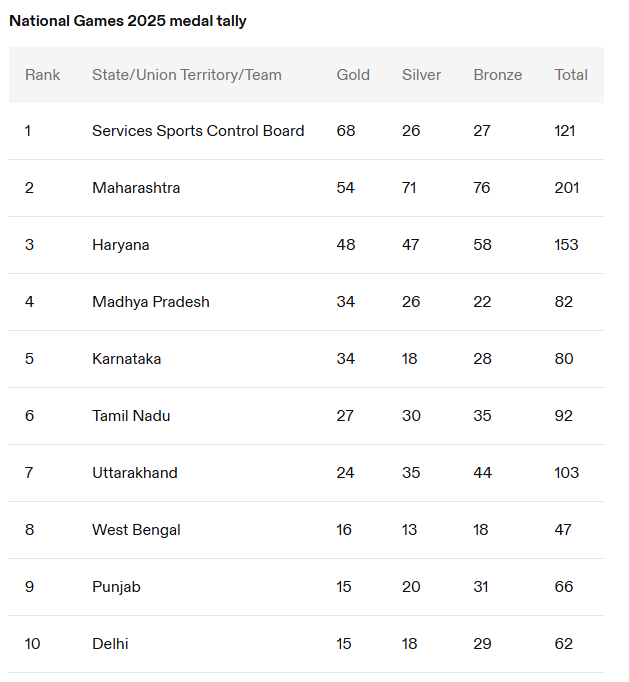
  • National Games 2025 is being held in Uttarakhand in its 38th edition.

The 39th edition will take place in Meghalaya.

Key Points

  • Athletes from 28 states, 8 Union Territories, and Services are competing in 32 sports.
  • The event began on January 26, 2025, with the triathlon; Sarungbam Athouba Meitei (Manipur) won the first gold.
  • Maharashtra’s Dolly Devidas Patil won the women’s triathlon and helped her team win the triathlon mixed relay.
  • Services lead the medal tally with 97 medals: 54 gold, 22 silver, and 21 bronze.
  • 30 teams have won at least one gold medal in the ongoing competition.
  • The Raja Bhalindra Singh Trophy is awarded to the overall winner, determined by points from finishing positions.
  • Since 1985, Services have won the most titles (4), while Maharashtra holds 3 championships.
  • Top athletes include Lovlina Borgohain (boxing), Swapnil Kusale, Sarabjot Singh, Vijay Kumar (shooting).
  • Athletics stars include Tajinderpal Singh Toor (shot put), Parul Chaudhary (steeplechase), and Jyothi Yarraji (100m hurdles).

Additional Information 

3

The National Film Awards are delivered by which organisation in India?

  1. ((a))

    National Film Archives of India

  2. ((b))

    Sahitya Akademi

  3. ((c))

    National School Of Drama

  4. ((d))

    Ministry of Information and Broadcasting

Show Answer
Answer: ((d))

Ministry of Information and Broadcasting

The Correct answer is Ministry of Information and Broadcasting.

Key Points

  • The National Film Awards are one of the most prestigious film awards in India.
  • It is administered by the Ministry of Information and Broadcasting, Government of India.
  • These awards aim to encourage the production of quality films that contribute to the development of Indian cinema.
  • The awards are presented annually and are considered to be the highest honor in the field of cinema in India.
  • The Directorate of Film Festivals, a body under the Ministry, is responsible for organizing the awards and other related events.
  • The National Film Awards were first instituted in 1954.
  • Apart from recognizing artistic excellence, the awards also honor films in regional languages, promoting India's linguistic and cultural diversity.
  • There are various categories of awards, including Best Feature Film, Best Director, Best Actor, Best Actress, and Lifetime Achievement Awards.
  • The awards are decided by a national jury, which comprises experts and professionals from the film industry.
  • The awards ceremony is usually held in New Delhi, and the awards are presented by the President of India.

 Additional Information

  • National Film Development Corporation
  • The National Film Development Corporation of India (NFDC) was established in 1975 to promote and finance the production of Indian films.
  • It primarily focuses on independent cinema and art-house films.
  • NFDC plays a vital role in the co-production of films and organizing film festivals, but it is not responsible for the National Film Awards.
  • Sahitya Akademi
  • The Sahitya Akademi is India's National Academy of Letters, established in 1954.
  • It is responsible for promoting and recognizing literary works in Indian languages, not cinema.
  • The Akademi gives awards in 24 languages, including translations, for outstanding literary contributions.
  • National School of Drama
  • The National School of Drama (NSD) is a premier theatre training institute in India, established in 1959.
  • It focuses on training in theatre arts, including acting, direction, and stagecraft.
  • NSD is not involved in the field of films or the National Film Awards.

Important Points

CategoryWinner(s)
Best Actor (shared)Shah Rukh Khan (Jawan), Vikrant Massey (12th Fail)
Best ActressRani Mukerji (Mrs Chatterjee Vs Norway)
Best Feature Film12th Fail
Best Hindi FilmKathal: A Jackfruit Mystery
Best Supporting ActorVijayaraghavan (Pookalam), Muthupettai (Parking)
Best Supporting ActressUrvashi (Ullozhokku), Janaki (Vash)
Best Malayalam FilmUllozhokku
Best Non-Feature FilmFlowering Man
Best DocumentaryGod Vulture and Human
Best Telugu FilmBhagavanth Kesari
Best Tamil FilmParking
Best Popular Film Providing Wholesome EntertainmentRocky Aur Rani Ki Prem Kahani (also won Best Choreography)
Best Female Playback SingerShilpa Rao (Jawan)
Best Male Playback SingerBaby
Best Action DirectionHanu-man (Telugu)
Best Music Direction (Songs)Vaathi (Tamil)
Best Production Designer2018 – Everyone is a Hero (Malayalam)
Best CinematographyThe Kerala Story (Hindi)
Best EditingPookalam (Malayalam)
Best Sound DesignAnimal (Hindi)
Best Make-up/Costume DesignerSam Bahadur
Special Mention (Re-recording Mixer)Animal – M R Radhakrishnan
4

Which of the following Government scheme is related to financial inclusion ?

  1. ((a))

    PMJBY

  2. ((b))

    UJJWALA YOJANA

  3. ((c))

    PMJDY

  4. ((d))

    PM-UDAY

Show Answer
Answer: ((c))

PMJDY

The correct answer is PMJDY.

Important Points

Pradhan Mantri Jan Dhan Yojana (PMJDY):

  • The goal of PMJDY, or the National Mission for Financial Inclusion, is to guarantee affordable access to financial services such banking, savings, and deposit accounts, remittance, credit, insurance, and pension.
  • The Indian government places a strong emphasis on financial inclusion because it is essential for reducing poverty. The growth of our nation is hampered by the exclusion of a substantial portion of the population from any access to financial services. To ensure that everyone benefited from growth and development, a plan for financial empowerment of citizens was desperately needed.
  • Jan Dhan Pradhan Mantri the Hon'ble Prime Minister Shri Narendra Modi introduced Yojana, the largest financial inclusion effort in the world, on August 15, 2014, from the Red Fort's ramparts, and he officially inaugurated it on August 28, 2014, across the nation. The Prime Minister had termed the event as a festival to mark the release of the underprivileged from a cycle of poverty when he launched the Yojana.

  • The Prime Minister had stated, "This Government has embraced this duty." A further email from the prime minister urging bank personnel to help meet the goal of 7.5 crore bank accounts and end financial untouchability was addressed to an estimated 7.25 lakh recipients."

Additional Information

PMJJBY:

  • Pradhan Mantri Jeevan Jyoti Bima Yojana (PMJJBY) is a one-year life insurance scheme available for renewal every year.
  • The plan requires covered participants to pay an annual premium, which is automatically withheld from their bank accounts.

UJJWALA YOJANA: 

  • On May 1, 2016, Prime Minister of India Narendra Modi introduced the Pradhan Mantri Ujjwala Yojana (PMUY; Prime Minister's Lighting Scheme), which will provide 50 million LPG connections to women from Below Poverty Line (BPL) families.

PM-UDAY:

  • The PM-UDAY scheme is for conferment of property rights to the residents of 1731 Unauthorized Colonies (UCs) in Delhi.
  • The regularization of UCs entails approval of layout plans of the colony, which in turn requires fire clearances of the colony and the properties therein from Department of Delhi Fire Services, Govt of NCT of Delhi
5

Which boxer in the women’s 66kg category won gold at the 38th National Games 2025?

  1. ((a))

    Lovlina Borgohain

  2. ((b))

    Ankushita Boro

  3. ((c))

    Jaismine Lamboria

  4. ((d))

    Nivedita Kari

Show Answer
Answer: ((b))

Ankushita Boro

The correct answer is Ankushita Boro.

In News

  • Junior world champion Ankushita Boro won gold in the women’s 66kg welterweight category at the 38th National Games 2025.
  • She defeated Uttarakhand’s Kajal 5-0 to secure her victory.

Key Points

  • Ankushita Boro created history by winning her third consecutive gold medal at the National Games.
  • Lovlina Borgohain won gold in the women’s 75kg category, defeating Pranshu Rathore.
  • Shiva Thapa won silver in the men’s 63.5kg category after losing to Vanshaj of Services Sports Central Board.
  • The 38th National Games 2025 featured 13 boxing categories in both men's and women's divisions.

Additional Information

  • Other Notable Boxing Winners:
  • Women’s 60kg Division: Jaismine Lamboria (gold)
  • Women’s Flyweight 50kg: Nivedita Kari (gold)
  • Women’s Bantamweight 54kg: Divya Panwar (gold)
  • Men’s 51kg Flyweight: Mandengbam Singh (gold)
  • Event Duration: The 38th National Games began on January 28 and will continue till February 14, 2025.
6

Name the Indian revolutionary who shot Michael O'Dwyer the Lt.Governor of Punjab at the time of the Jallianwala Bagh massacre after twenty years.

  1. ((a))

    General Vaidya

  2. ((b))

    Bagat Singh

  3. ((c))

    Chandrashekhar Azad

  4. ((d))

    Udham Singh

Show Answer
Answer: ((d))

Udham Singh

The correct answer is - Udham Singh

Key Points

  • Udham Singh
  • Udham Singh was an Indian revolutionary best known for assassinating Michael O'Dwyer, the former Lieutenant Governor of Punjab, in 1940.
  • This act was in retaliation for O'Dwyer's role in the Jallianwala Bagh massacre in 1919, where British troops killed hundreds of unarmed Indian civilians.
  • Udham Singh was deeply affected by the massacre and vowed to avenge the deaths, which he eventually did by traveling to London and shooting O'Dwyer.
  • He was subsequently arrested, tried, and hanged for the assassination.

  • Udham Singh is considered a martyr and hero in the Indian independence movement.

Additional Information

  • General Vaidya
  • General Arun Shridhar Vaidya was an Indian Army Chief of Staff who played a key role in Operation Blue Star in 1984.
  • He was assassinated in 1986 by Sikh militants in retaliation for the operation.
  • Bhagat Singh
  • Bhagat Singh was an Indian socialist revolutionary whose acts of dramatic violence against the British in India, including the bombing of the Central Legislative Assembly in Delhi, made him a folk hero of the Indian independence movement.
  • He was executed in 1931 for his involvement in the killing of British police officer John Saunders.
  • Chandrashekhar Azad
  • Chandrashekhar Azad was a prominent revolutionary in the Indian independence movement who reorganized the Hindustan Socialist Republican Association (HSRA) after the death of its founder, Ram Prasad Bismil.
  • He was involved in several significant revolutionary activities and died in 1931 in a shootout with the police.
7

"Not me, but you" is the motto of which one of the following youth organizations/schemes?

  1. ((a))

    Rashtriya Yuva Sashaktikaran Karyakram

  2. ((b))

    National Service Scheme (NSS)

  3. ((c))

    National Young Leaders Programme

  4. ((d))

    National Discipline Scheme (NDS)

Show Answer
Answer: ((b))

National Service Scheme (NSS)

The correct answer is National Service Scheme (NSS).

Key Points

  • The motto "Not me, but you" belongs to the National Service Scheme (NSS), emphasizing selfless service towards the community.
  • NSS was launched in 1969, the birth centenary year of Mahatma Gandhi, by the Ministry of Youth Affairs and Sports.
  • The main objective of NSS is to develop the personality and character of students through voluntary community service.
  • It aims to instill the idea of social welfare in students and provide service to society without bias.
  • Activities under NSS include blood donation camps, tree plantation drives, disaster relief efforts, and health awareness programs.

Additional Information

  • National Cadet Corps (NCC)
  • A youth development movement in India aiming to groom disciplined and patriotic citizens.
  • Provides basic military training to school and college students.
  • Promotes leadership, camaraderie, and selfless service among youth.
  • Bharat Scouts and Guides
  • A voluntary, non-political educational movement for young people.
  • Aims to contribute to the development of young people in achieving their full physical, intellectual, emotional, social, and spiritual potentials.
  • Encourages the spirit of friendship, self-discipline, and service to others.
  • National Youth Parliament Scheme
  • Launched to strengthen the roots of democracy, inculcate healthy habits of discipline, and enable students to develop tolerance for diverse opinions.
  • Encourages the youth to engage in constructive dialogue and public speaking.
  • Promotes awareness about the functioning of democratic institutions and parliamentary procedures.
  • Rashtriya Yuva Sashaktikaran Karyakram
  • An umbrella scheme by the Ministry of Youth Affairs and Sports.
  • Aims to empower youth through various programs and activities.
  • Focuses on youth development through skill development, employment, and entrepreneurship opportunities.
8

Which of the following is not a financial inclusion scheme?

  1. ((a))

    Suraksha Bandhan Scheme

  2. ((b))

    HRIDAY

  3. ((c))

    Swabhimaan

  4. ((d))

    Atal Pension Yojana

Show Answer
Answer: ((b))

HRIDAY

HRIDAY is a scheme related to urban planning. Rest all are financial inclusion schemes to target different groups and ensure maximum financial inclusion in the country.

9

The first Indian Institute of Technology (IIT) was established at

  1. ((a))

    Kharagpur 

  2. ((b))

    Kanpur

  3. ((c))

    Bombay

  4. ((d))

    Chennai

Show Answer
Answer: ((a))

Kharagpur 

The correct answer is Kharagpur .

Key Points

  • The first Indian Institute of Technology was established in Kharagpur, West Bengal.
  • Its establishment was a significant step in the development of technical education in India after its independence.
  • The foundation of IIT Kharagpur was laid in 1950.
  • The formal inauguration of the institute took place in 1951.
  • The establishment of IIT Kharagpur was inspired by the Massachusetts Institute of Technology (MIT) in the United States.
  • The aim was to create premier institutions for technical education and research in India.
  • The initial name proposed for the institute was the Eastern Higher Technical Institute.
  • However, it was later renamed as the Indian Institute of Technology, Kharagpur.
  • The institute started with a focus on engineering disciplines.
  • Over the years, it has expanded its academic programs to include science, management, law, and architecture.
  • IIT Kharagpur played a pivotal role in shaping the technical workforce of India.
  • It has produced numerous distinguished alumni who have made significant contributions in various fields globally.
  • The campus of IIT Kharagpur is vast and includes academic buildings, residential halls, research facilities, and sports complexes.
  • The institute has consistently been ranked among the top engineering and technology institutes in India.
  • It is recognized for its rigorous academic curriculum and research excellence.
  • IIT Kharagpur has collaborations with various national and international institutions for research and academic exchange.
  • The institute has contributed significantly to technological advancements and industrial development in India.
  • It continues to be a center of innovation and learning, attracting talented students from across the country.
  • The establishment of IIT Kharagpur paved the way for the creation of other IITs across India.
  • These institutions collectively form a prestigious network of engineering and technology education in the country.
  • IIT Kharagpur remains a symbol of India's commitment to technical education and scientific progress.
  • The legacy of the first IIT continues to inspire and guide the development of technical higher education in India.
10

Who was the Judge who presided over Gandhiji's trial after the withdrawal of the Non-Cooperation Movement ?

  1. ((a))

    Justice C.N. Broomfield

  2. ((b))

    Justice William Hodges

  3. ((c))

    Justice Joseph Noel

  4. ((d))

    Justice Thomas Barker

Show Answer
Answer: ((a))

Justice C.N. Broomfield

The correct answer is: 'Justice C.N. Broomfield'.

Key Points

  • Justice C.N. Broomfield was the judge who presided over Mahatma Gandhi's trial in 1922.
  • Gandhiji was tried for his involvement in the Non-Cooperation Movement, which aimed at gaining full independence from British rule.
  • The trial took place after the movement was called off due to the Chauri Chaura incident, where a violent mob killed 22 policemen.
  • Justice Broomfield sentenced Gandhi to six years of imprisonment for sedition, but praised him for his moral and ethical integrity during the trial.

Incorrect Options

  • Justice William Hodges
  • There is no historical record of a Judge William Hodges presiding over any significant trial involving Mahatma Gandhi.
  • Justice Joseph Noel
  • Justice Joseph Noel is not associated with any trial of Mahatma Gandhi. His name does not appear in historical accounts relating to Gandhi's legal battles.
  • Justice Thomas Barker
  • Similarly, Justice Thomas Barker did not preside over any notable trial involving Mahatma Gandhi. His name is not linked with Gandhiji's legal history.

Hence, the correct answer is Justice C.N. Broomfield, and the other options are not relevant to the trial of Mahatma Gandhi after the withdrawal of the Non-Cooperation Movement.

Additional Information

  • Non-Cooperation Movement:
  • Launched by Mahatma Gandhi in 1920, the Non-Cooperation Movement was a significant part of the Indian independence struggle against British colonial rule.
  • It aimed to resist British rule through non-violent means such as boycotting British goods, institutions, and services.
  • The movement was abruptly called off in 1922 after the Chauri Chaura incident, where a violent clash resulted in the death of policemen, contradicting the movement's non-violent principles.
  • Chauri Chaura Incident:
  • On February 5, 1922, a violent altercation between the police and protesters in the town of Chauri Chaura, Uttar Pradesh, led to the death of 22 policemen.
  • In response to this violence, Gandhiji called off the Non-Cooperation Movement, emphasizing the importance of non-violence in the struggle for independence.
11

Which scheme aims to digitize Indian language books for education as per the Union Budget 2025-26?

  1. ((a))

    Gyan Bharatam Mission

  2. ((b))

    Bharatiya Bhasha Pustak Scheme

  3. ((c))

    National Digital Library Initiative

  4. ((d))

    Vidya Samriddhi Yojana

Show Answer
Answer: ((b))

Bharatiya Bhasha Pustak Scheme

The correct answer is Bharatiya Bhasha Pustak Scheme.

In News

  • The Union Budget 2025-26 introduced the Bharatiya Bhasha Pustak Scheme to digitize Indian language books and enhance accessibility in education.
Key Points

  • The Bharatiya Bhasha Pustak Scheme aims to digitize books in regional languages to promote inclusive education.

  • This initiative is part of the National Education Digital Mission, ensuring that students across India can access educational content in their native languages.
  • The scheme will help in preserving indigenous literature and knowledge while integrating it with modern digital learning tools.
  • The government also announced the Gyan Bharatam Mission, which aims to conserve over 1 crore manuscripts.

Additional Information

  • Bharatiya Bhasha Pustak Scheme
  • Focuses on digitizing books in regional languages.
  • Aims to make multilingual educational content available online.
  • Supports e-learning platforms, libraries, and government schools.
  • Gyan Bharatam Mission
  • Works towards digitizing and conserving ancient Indian manuscripts.
  • Aims to preserve and promote India's literary heritage.
  • Other Key Education Initiatives in Budget 2025-26
  • ₹500 crore Centre of Excellence in AI for Education to integrate AI into learning.
  • Five National Centres of Excellence for Skilling established through global partnerships.
  • Investment in digital libraries to expand access to study materials.
12

Which of the following organisations won the Pulitzer Prize for Public Service in 2025?

  1. ((a))

    The New York Times

  2. ((b))

    ProPublica

  3. ((c))

    The Washington Post

  4. ((d))

    Reuters

Show Answer
Answer: ((b))

ProPublica

The correct answer is ProPublica.

Key Points

  • ProPublica, an independent, nonprofit newsroom, won the Pulitzer Prize for Public Service in 2025.
  • The Pulitzer Prize for Public Service is considered the most prestigious among the Pulitzer categories, awarded for impactful investigative journalism.
  • ProPublica is known for its focus on stories that expose abuses of power and injustices, often leading to significant reforms.
  • Its winning entry in 2025 highlighted investigations into systemic issues, including government accountability and corporate malfeasance.
  • ProPublica's investigative journalism is funded through donations and grants, allowing it to remain independent and free of corporate or political influence.

Additional Information

  • Pulitzer Prize:
  • The Pulitzer Prizes are awards for achievements in newspaper, magazine, online journalism, literature, and musical composition within the United States.
  • Established in 1917 by provisions in the will of Joseph Pulitzer, a Hungarian-American journalist and newspaper publisher.
  • The awards are administered by Columbia University in New York City.
  • Public Service is the only Pulitzer Prize category where the winner receives a gold medal instead of cash.
  • Investigative Journalism:
  • Investigative journalism involves in-depth reporting to uncover information often hidden from the public.
  • It requires significant research and fact-checking to ensure the accuracy of the findings.
  • This type of journalism often tackles issues like corruption, abuses of power, or systemic failures.
  • It plays a crucial role in holding governments, corporations, and institutions accountable.
  • ProPublica's Approach:
  • ProPublica collaborates with other newsrooms to maximize the impact of its investigations.
  • Its work often leads to legislative changes, policy reforms, and increased public awareness.
  • ProPublica publishes its investigations online for free, making them accessible to a broad audience.
  • It adheres to the highest standards of journalistic integrity and transparency.
  • Importance of Public Service Journalism:
  • Public service journalism aims to inform citizens and empower them to make educated decisions.
  • It highlights pressing societal issues, encouraging public discourse and action.
  • This form of journalism is vital for maintaining a well-functioning democracy.
  • It often requires significant resources and commitment due to the complexity and sensitivity of the topics involved.
13

The University Grants Commission (UGC) was established in:

  1. ((a))

    1948

  2. ((b))

    1953

  3. ((c))

    1956

  4. ((d))

    1961

Show Answer
Answer: ((c))

1956

The correct answer is 1956.

Key Points

  • The University Grants Commission (UGC) was established in 1956 by an act of Parliament.
  • UGC is a statutory body set up by the Indian government under the Ministry of Education.
  • The primary objective of UGC is to coordinate, determine, and maintain standards of higher education in India.
  • UGC provides recognition to universities in India and disburses funds to such recognized universities and colleges.
  • It also oversees the development and maintenance of higher education institutions to ensure their effective functioning.

Additional Information

  • University Grants Commission Act, 1956:
  • This act provides for the establishment of the UGC.
  • It outlines the functions and powers of the UGC, including the coordination and determination of standards in universities.
  • Autonomous Colleges:
  • UGC grants autonomous status to colleges that have high academic standards.
  • Autonomous colleges have the freedom to design their own curriculum and conduct their own examinations.
  • National Assessment and Accreditation Council (NAAC):
  • Established by the UGC in 1994 to assess and accredit institutions of higher education in India.
  • NAAC evaluates the quality of education and infrastructure in universities and colleges.
  • National Eligibility Test (NET):
  • UGC conducts the NET examination to determine eligibility for college and university level lectureship and for the award of Junior Research Fellowship (JRF).
  • NET ensures that only qualified individuals are recruited for teaching positions in higher education institutions.
14

Deendayal Antyodaya Yojana - National Rural Livelihood Mission (DAY-NRLM) seeks to

  1. ((a))

    Alleviate rural poverty through building sustainable community institution of the poor.

  2. ((b))

    Alleviate poverty among SC and ST class.

  3. ((c))

    Provide employment to rural females.

  4. ((d))

    Provide subsidised food grains to rural females.

Show Answer
Answer: ((a))

Alleviate rural poverty through building sustainable community institution of the poor.

The correct answer is Alleviate rural poverty through building sustainable community institutions for the poor.

Key Points

  • Deendayal Antyodaya Yojana - National Rural Livelihood Mission (DAY-NRLM) 
  • It was launched by the Ministry of Rural Development (MoRD), Government of India in June 2011.
  • It aims at creating efficient and effective institutional platforms of the rural poor, enabling them to increase household income through sustainable livelihood enhancements and improved access to financial services.
  • It is aided in part through investment support from the World Bank.
  • In addition, the poor would be facilitated to achieve increased access to rights, entitlements, and public services, diversified risk, and better social indicators of empowerment.
  • The blocks and districts in which all components of N.R.L.M are implemented are treated as ‘intensive’ blocks and districts, whereas the remaining as ‘non-intensive’ blocks and districts.
  • In a typical intensive block, the first 3 years are spent building the organizations of the poor by mobilizing them into SHGs, Federations at Village, Cluster level, and Block levels.

Additional Information

  • At the national level, the Ministry of Rural Development (MoRD) is required to provide technical and professional support to the states to establish the Mission societies.
  • At the state level, the State Rural Livelihoods Mission (SRLM) constituted by State Government, would oversee the implementation of all NRLM-related activities in the state.
  • The District Mission Management Unit (DMMU) of the SRLM would be responsible for meeting NRLM objectives and implementing NRLM activities in the district.
15

Which Kannada short story collection by Banu Mushtaq earned a spot on the 2025 International Booker Prize longlist?

  1. ((a))

    Heart Lamp

  2. ((b))

    The Prophetic Lamp

  3. ((c))

    Samskara

  4. ((d))

    Broken Echoes

Show Answer
Answer: ((a))

Heart Lamp

The correct answer is Heart Lamp

In News

  • Banu Mushtaq's short story collection "Heart Lamp" has earned a spot on the 2025 International Booker Prize longlist.

Key Points

  • "Heart Lamp" marks a historic first for Kannada literature, being the first Kannada work ever longlisted for the International Booker Prize.
  • The collection consists of 12 stories focused on Muslim communities in southern India, with emotional depth and cultural significance.
  • The book impressed the judges for its sharp, vivid, and emotionally powerful storytelling, highlighting the experiences of marginalized individuals.
  • The translation, by Deepa Bhasthi, has been praised for making Mushtaq's stories accessible to a global audience.

Additional Information

  • International Booker Prize
  • The International Booker Prize recognizes exceptional works of long-form fiction and short story collections that have been translated into English and published in the UK or Ireland.
  • The prize includes a cash award of £50,000, which is equally shared between the author and the translator.
  • Banu Mushtaq
  • Banu Mushtaq is a Karnataka-based writer, activist, and lawyer known for her poignant storytelling and exploration of social issues within marginalized communities.
  • U.R. Ananthamurthy
  • U.R. Ananthamurthy's novel "Samskara" was longlisted for the Man Booker International Prize in 2013, marking a milestone for Kannada literature on the global stage.
16

Where was the 7th Bihar Khelo India Youth Games inaugurated by Prime Minister Narendra Modi?

  1. ((a))

    Patna

  2. ((b))

    Gaya

  3. ((c))

    Bodhgaya

  4. ((d))

    Bhagalpur

Show Answer
Answer: ((a))

Patna

The correct answer is Patna.

In News

  • Prime Minister Narendra Modi inaugurated the 7th Bihar Khelo India Youth Games, held in Patna, Bihar.

Key Points

  • The 7th Bihar Khelo India Youth Games were inaugurated in Patna, emphasizing sports development in the state.
  • Over 1,000 Khelo India centres have been opened to nurture young talent, including traditional games like Gatka, Kalarypattu, and Kho Kho.
  • The event highlights the government's commitment to promoting sports and youth development in India.

Additional Information

  • Khelo India Youth Games
  • The Khelo India Youth Games are an initiative by the Government of India to encourage young athletes to take up sports and develop their skills.
  • The games also promote traditional Indian sports alongside more popular international sports.
  • Traditional Games in Khelo India
  • Games like Gatka, Kalarypattu, and Kho Kho are being included to preserve and promote India's rich sporting heritage.
17

'e-KALPA' initiative of the Ministry of Human Resources, Government of India is a project on _________.

  1. ((a))

    Embedded systems and Robotics outreach

  2. ((b))

    Comprehensive self-review and analysis for CBSE affiliated schools and parents.

  3. ((c))

    Skills Acquisition and Knowledge Awareness for Livelihood Promotion 

  4. ((d))

    Creating Digital-learning Environment for Design

Show Answer
Answer: ((d))

Creating Digital-learning Environment for Design

e-KALPA: Creating Digital-learning Environment for Design also called e-Kalpa is an initiative of the Ministry of Human Resources, Government of India as part of the National Mission in Education through Information and Communication Technology (NMEICT). 

  • ​This project presents three initiatives –
  • providing digital online content for design,
  • a social networking environment for design and
  • higher learning and creating a digital resource database on design.

Important Points

Digital InitiativesProject on
e-Yantra- Robotics outreach project - The goal of e-Yantra is to complement existing Higher Education systems worldwide and solve local problems across a variety of domains such as: Agriculture, Disaster, Manufacturing Defense, Home, Smart Cities and Service Industries through technology.
Saransh- Saransh is a tool for comprehensive self-review and analysis for CBSE affiliated schools and parents. - It enables them to analyze students' performance in order to take remedial measures. - Saransh brings schools, teachers and parents closer, so that they can monitor the progress of students and help them improve their performance.
Skill Acquisition and Knowledge Awareness for Livelihood Promotion- Skill Acquisition and Knowledge Awareness for Livelihood Promotion (“SANKALP”) is a programme of the Ministry of Skill Development with loan assistance from the World Bank.
18

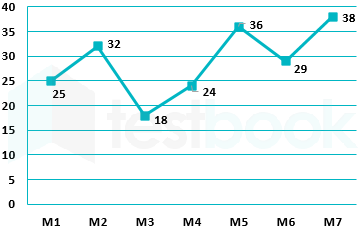
The line chart given below shows the production (in 10000 s) of cars in 7 different months.

Production of cars in month M4 is what percent of the production of cars in month M2?

  1. ((a))

    125%

  2. ((b))

    75%

  3. ((c))

    66.66%

  4. ((d))

    83.33%

Show Answer
Answer: ((b))

75%

GIVEN:

A line chart which shows the production (in 10000 s) of cars in 7 different months.

FORMULA USED:

Percentage = (quantity1/quantity2) × 100

CALCULATION:

Production of car in Months M4 = 24

Production of car in Months M2 = 32

Percentage = (24/32) ×100 = 75%

19

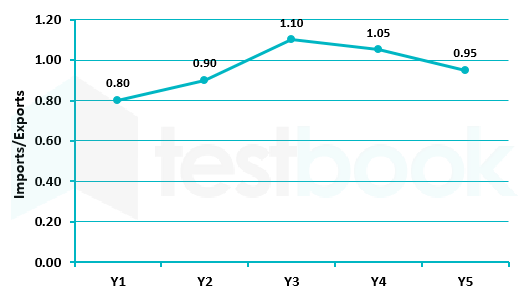
The line chart given below shows the ratio of imports to exports for a country for 5 consecutive years. Y1, Y2, Y3, Y4 and Y5.

If the exports for year Y3 is Rs. 35,000 crore, then what will be imported (in crores) for the year Y3?

  1. ((a))

    Rs. 35,500

  2. ((b))

    Rs. 38,500

  3. ((c))

    Rs. 43,500

  4. ((d))

    Rs. 41,500

Show Answer
Answer: ((b))

Rs. 38,500

The ratio of import and export for Y3 is 1.1

Also exports for year Y3 is Rs. 35000 crore

∴ Imports for year Y3 = 35000 × 1.1 = Rs. 38500 crore

20

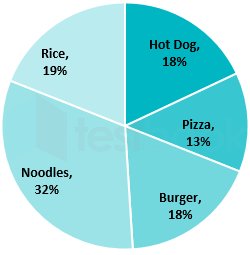
Given below is the pie chart for favourite dishes for people in Mangolia . If the total population of Mangolia is 36000

How many persons have noodles and pizza as their favourite dishes?

  1. ((a))

    16000

  2. ((b))

    16200

  3. ((c))

    16500

  4. ((d))

    16800

Show Answer
Answer: ((b))

16200

Percentage of people having noodles & pizza as their favourite dishes = 32 + 13 = 45%

Total no. of people = 36000

∴ No. of people having noodles & pizza as their favourite dishes = 45% of 36000

= 9/20 × 36000 = 16200

21

Two candidates are contesting in an election. All votes are valid votes. A candidate who gets 38% of votes is rejected by 28,800 votes. The total number of votes polled is:

  1. ((a))

    1,15,000

  2. ((b))

    1,50,000

  3. ((c))

    1,32,500

  4. ((d))

    1,20,000

Show Answer
Answer: ((d))

1,20,000

Given:

A candidate who gets 38% of the votes is rejected by 28,800 votes.

Calculation:

Let the total votes polled be x.

The number of votes the winner gets = 62% of x

⇒ (62x\over100) 

Number of votes received by the lost candidates = 38% of x

⇒ (38x\over100) 

Difference,

(62x\over100) - (38x\over100) = 2,88,00

⇒ (24x\over100) = 2,88,00

⇒ x = ({2,88,00 \times 100}\over24) = 1,20,000

∴ The total number of votes polled is 1,20,000.

Shortcut Trick

Rejected candidates gets vote 38%

Selected candidate gets vote (100 - 38)% = 62%

Difference between both candidates vote = 62% - 38% = 24%

Value of 24 % = 28,800

⇒ 1% = 28,800 / 24 =1200

⇒ 100% = 1200 × 100 = 1,20,000 (Total vote)

∴ Option 4 is correct.

22

The marked price of an article is 35% above its cost price. After giving a 20% discount on the marked price, it is sold for Rs. 432. What is the cost price of the article?

  1. ((a))

    Rs. 425

  2. ((b))

    Rs. 420

  3. ((c))

    Rs. 380

  4. ((d))

    Rs. 400

Show Answer
Answer: ((d))

Rs. 400

Shortcut Trick

Let, the cost price = 100 units

∴ Market price = 100 + 100  of 35% = 135 units

The selling price = 135 - 135 of 20% = 108 units

So, 108 units = Rs. 432

⇒ 100 units = (432/108) × 100 = Rs. 400

∴ The cost price of the article is Rs. 400

Alternate Method

Given:

The marked price of an article is 35% above its cost price

The selling price = Rs. 432

Formula used:

S.P. = (100 - Discount%)/100 × M.P.

Calculation:

Let, the cost price of the article = x

Then, the market price = 135x/100

So, (135x/100) × [(100 - 20)/100] = 432

⇒ (135x/100) × (80/100) = 432

⇒ x = 432 × (100/135) × (100/80)

⇒ x = 400

∴ The cost price of the article is Rs. 400

23

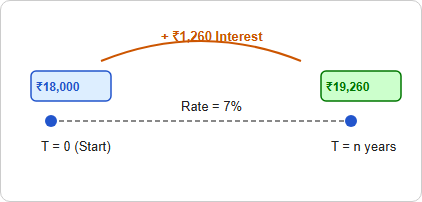
The compound interest on ₹18,000 at 7% per annum, compounded annually, is ₹1,260. What is the period of time?

  1. ((a))

    1 year

  2. ((b))

    2 years

  3. ((c))

    3 years

  4. ((d))

    4 years

Show Answer
Answer: ((a))

1 year

Shortcut Trick

Calculate the Total Interest Percentage: (Interest ÷ Principal) × 100

Total Interest % = (1260 ÷ 18000) × 100 = 7%

Given the Annual Rate of Interest is 7% per annum.

Since the total interest percentage (7%) matches the annual rate (7%), the Time Period must be exactly 1 year.

∴ The correct answer is 1 year.

Alternate Method

Given:

Principal (P) = ₹18,000

Compound Interest (CI) = ₹1,260

Rate (R) = 7% per annum

Formula: Amount (A) = Principal (P) + Compound Interest (CI)

Calculation:

⇒ Amount (A) = 18000 + 1260 = ₹19,260

⇒ Formula for Compound Interest: A = P(1 + R/100)n

⇒ 19260 = 18000(1 + 7/100)n

⇒ 19260 ÷ 18000 = (107/100)n

⇒ 1.07 = (1.07)n

⇒ (1.07)1 = (1.07)n

⇒ n = 1

∴ The correct answer is 1 year.

Additional Information

Compound Interest Formula

The formula for the total amount is A = P(1 + r/n)nt, where n is the number of times interest is compounded per year.

CI vs SI for the First Year

For the first year (or the first compounding period), Simple Interest and Compound Interest are always equal on the same principal and rate.

Effective Interest Rate

When interest is compounded more than once a year, the Effective Annual Rate (EAR) is higher than the nominal rate, calculated as [(1 + r/n)n − 1] × 100.

24

If the principal amount is Rs.1000, the rate of interest is 5% per annum, and the time period is 2 years, what is the simple interest earned?

  1. ((a))

    Rs.50

  2. ((b))

    Rs.10

  3. ((c))

    Rs.100

  4. ((d))

    Rs.150

Show Answer
Answer: ((c))

Rs.100

Given:

Principal Amount (P) = Rs.1000

Rate of Interest (R) = 5% per annum

Time Period (T) = 2 years

Formula Used:

Simple Interest (SI) = (P × R × T) / 100

Calculation:

SI = (1000 × 5 × 2) / 100

⇒ SI = (10000) / 100

⇒ SI = 100

The simple interest earned is Rs.100.

25

A wallet contain Rs. 900 total. Wallet containing 100 rupee notes, Rs. 50 rupee notes and 20 rupee notes in the ratio of 2 : 3 : 5. Find the no of notes of each kind.

  1. ((a))

    4, 6, 8

  2. ((b))

    4, 6, 10

  3. ((c))

    4, 6, 5

  4. ((d))

    3, 6, 10

Show Answer
Answer: ((b))

4, 6, 10

Given:

The wallet contains Rs. 900 

A wallet containing 100 rupee notes, Rs. 50 rupee notes and 20 rupee notes in the ratio of 2 : 3 : 5

Calculation:

A wallet containing 100 rupee notes, Rs. 50 rupee notes and 20 rupee notes in the ratio of 2 : 3 : 5

So, total 100 rupees notes are 2x, total 50 rupees notes are 3x, total 20 rupees notes are 5x

Now, A/Q

(2x) × 100 + (3x) × 50 + (5x) × 20 = 900

⇒ 200x + 150x + 100x = 900

⇒ 450x = 900

⇒ x = 2

So, Total Rs 100 notes is 2 × 2 = 4

Total Rs 50 notes = 3 × 2 = 6

Total Rs 20 notes = 5 × 2 = 10

26

A boy goes to school at a speed of 10 km/hr. He comes back with a speed of 15 km/hr. His average speed for the whole journey is:

  1. ((a))

    12.5 km/hr

  2. ((b))

    14 km/hr

  3. ((c))

    12 km/hr

  4. ((d))

    13 km/hr

Show Answer
Answer: ((c))

12 km/hr

Formula Used:

Average Speed = 2ab/(a + b)

Applicable when one travels at speed a for half the distance and speed b for the other half of the distance.

In this case, the average speed is the harmonic mean of the two speeds. On similar lines, you can modify this formula for one-third distance.

Calculation:

Using the above formula - 

⇒ a = 10 km/hr, b = 15 km/hr

⇒ Average speed = (\frac{2\times 10\times 15}{10+15}) = 12 km/hr

∴ The correct answer is 12km/hr 

Additional Information

  1. Average Speed = (a + b)/2

Applicable when one travels at speed a for half the time and speed b for another half of the time.

In this case, the average speed is the arithmetic mean of the two speeds.

  1. Average Speed = 3abc/(ab + bc + ca)

Applicable when one travels at speed a for one-third of the distance, at speed b for another one-third of the distance, and at speed c for the rest of the one-third of the distance.

27

A, B and C invested Rs. 10,000, Rs. 12,000, and Rs. 15,000, respectively, for 5, 6, and 9 months, respectively, in a business. If A's share in the profit is Rs. 2,500, then the total profit is:

  1. ((a))

    Rs. 12,700

  2. ((b))

    Rs. 12,650

  3. ((c))

    Rs. 12,850

  4. ((d))

    Rs. 12,550

Show Answer
Answer: ((c))

Rs. 12,850

Shortcut Trick

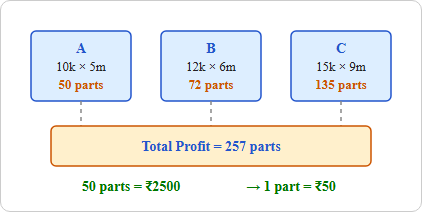
Profit Ratio of A, B and C = (10 × 5) : (12 × 6) : (15 × 9) = 50 : 72 : 135

Total profit in ratio parts = 50 + 72 + 135 = 257 parts

Given A's profit = 50 parts = Rs. 2500 ⇒ 1 part = Rs. 50

Total Profit = 257 parts = 257 × 50 = Rs. 12,850

∴ The correct answer is Rs. 12,850.

Alternate Method

Given:

Investment of A = Rs. 10,000, Time = 5 months

Investment of B = Rs. 12,000, Time = 6 months

Investment of C = Rs. 15,000, Time = 9 months

A's profit share = Rs. 2,500

Formula Used:

Profit Ratio = Investment × Time

Calculations:

⇒ Profit ratio (A : B : C) = (10000 × 5) : (12000 × 6) : (15000 × 9)

⇒ Profit ratio = 50000 : 72000 : 135000 = 50 : 72 : 135

⇒ Let the profits of A, B, and C be 50x, 72x, and 135x respectively.

⇒ Total profit = 50x + 72x + 135x = 257x

⇒ Given A's profit = 50x = 2500

⇒ x = 2500 ÷ 50 = 50

⇒ Total Profit = 257x = 257 × 50 = 12850

∴ The correct answer is Rs. 12,850.

Additional Information

Compound Partnership

When capitals of partners are invested for different time periods, the profit or loss is distributed in the ratio of the product of their capital and time.

Simple Partnership

When capitals of partners are invested for the same period of time, the profit or loss is distributed in the exact ratio of their original investments.

Working and Sleeping Partners

A working partner manages the business and receives a specific salary or percentage. A sleeping partner only invests capital. The remaining profit after salary deduction is shared in the investment ratio.

28

A fruit seller had some apples. He sells 60% apples and still has 420 apples. Originally, he had:

  1. ((a))

    1025 apples

  2. ((b))

    1075 apples

  3. ((c))

    1050 apples

  4. ((d))

    1100 apples

Show Answer
Answer: ((c))

1050 apples

Given:

He sells 60% apples.

Apples left = 420

Calculation:

Let originally he had x apples.

Then, according to the question

⇒ (100 - 60)% of x = 420

⇒ ((\frac{40}{{100}}) × x) = 420

⇒ (\frac{2x}{{5}}) = 420

⇒ x = 1050 

∴ The required apples he had is 1050.

Shortcut TrickHe sells 60% apples i.e., 40% is still left

⇒ 40% = 420 apples

⇒ 100% = 1050 apples

29

A train crosses a station platform in 36 seconds and crosses a man standing on the platform in 20 seconds. If the speed of the train is 54 km/h, what is the length of the platform?

  1. ((a))

    360 m

  2. ((b))

    240 m

  3. ((c))

    120 m

  4. ((d))

    300 m

Show Answer
Answer: ((b))

240 m

Given:

A train crosses a station platform in 36 seconds

And crosses a man standing on the platform in 20 seconds

The speed of the train is 54 km/h

Formula Used:

Speed = Distance/Time

Calculation:

Let the length of the train be x m and the length of the platform be y m 

According to the question

54 × (5/18) = x/20

⇒ 15 × 20 = x

⇒ x = 300 m

Again, According to the question

⇒ 54 × (5/18) = (300 + y) /36

⇒ 15 × 36 = 300 + x

⇒ y = 540 – 300

⇒ y = 240

∴ The length of the platform is 240.

Shortcut Trick As given train cross its length in 20 seconds.

So the train cross the platform in = 36 – 20 = 16 seconds

The distance covered by train in 16 seconds = 54 × (5/18) × 16 = 240

30

Which of the following letter-clusters should replace # and % so that the pattern and relationship followed between the letter-cluster pair on the left side of :: is the same as that on the right side of :: ?

: HJE :: OQL : %

  1. ((a))

    = MLI, % = KJK

  2. ((b))

    = HGY, % = LHU

  3. ((c))

    = LNI, % = KMH

  4. ((d))

    = PKO, % = NHU

Show Answer
Answer: ((c))

= LNI, % = KMH

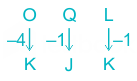
The logic followed here is:

Option 1) # = MLI, % = KJK ⇒ MLI : HJE : : OQL : KJK

Option 2) # = HGY, % = LHU ⇒ HGY : HJE : : OQL : LHU 

Option 3) # = LNI, % = KMH ⇒ LNI : HJE : : OQL : KMH 

Option 4) # = PKO, % = NHU ⇒ PKO : HJE : : OQL : NHU 

Hence, the correct answer is "Option 3".

31

Select the option that is related to the fifth letter-cluster in the same way as the second letter-cluster is related to the first letter-cluster and the fourth letter-cluster is related to the third letter-cluster.

GIU : QUI :: POT : HOJ :: EJM : ?

  1. ((a))

    JKT

  2. ((b))

    STQ

  3. ((c))

    SNK

  4. ((d))

    YTK

Show Answer
Answer: ((b))

STQ

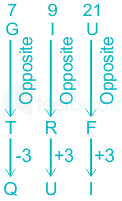
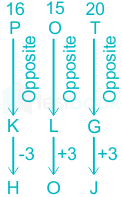
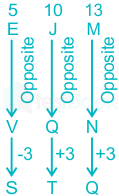
The logic followed here is :-

  • GIU : QUI

And,

  • POT : HOJ

Similarly,

  • EJM : ?

Hence, the correct answer is "STQ".

32

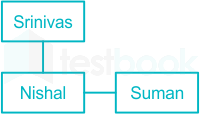
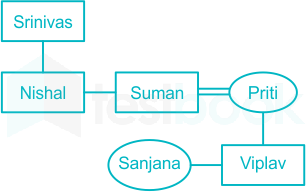
Nishal and Suman are brothers. Priti’s son Viplav is the brother of Sanjana. Srinivas is the father of Nishal. Suman and Priti are a married couple and have one son and one daughter. How is Sanjana related to Srinivas?

  1. ((a))

    Grandson

  2. ((b))

    Daughter-in-law

  3. ((c))

    Niece

  4. ((d))

    Granddaughter

Show Answer
Answer: ((d))

Granddaughter

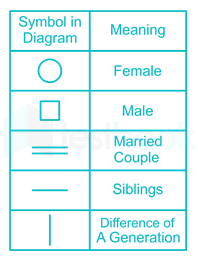
Preparing the family tree using the following symbols,

According to the given information,

  1. Nishal and Suman are brothers.

2) Srinivas is the father of Nishal.

3) Priti's son Viplav is the brother of Sanjana

  1. Suman and Priti are a married couple and have one son and one daughter

(It means Viplav is the male and Sanjana is the female)

So, Sanjana is the Granddaughter of Srinivas.

Hence, the correct answer is "Granddaughter".

33

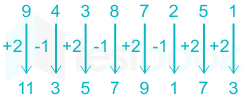
If 2 is added to each odd digit and 1 is subtracted from each even digit in the number 94387251, what will be the sum of the first, fifth and last digits in the new number thus formed?

  1. ((a))

    14

  2. ((b))

    12

  3. ((c))

    11

  4. ((d))

    10

Show Answer
Answer: ((c))

11

According to the given information:

When 2 is added to each odd digit and 1 is subtracted from each even digit in the number 94387251,


Now the new number is: 113579173

Now, the sum of the first, fifth and last digit is,

1 + 7 + 3 = 11

Hence the correct answer is option 3)

34

Which one of the mirror images of the following combination is correct when the mirror is place at 'PQ'?

  1. ((a))

  2. ((b))

  3. ((c))

  4. ((d))

Show Answer
Answer: ((b))

The correct mirror image of the given figure when the mirror is held at the right side is:

Hence, "option (2)" is the correct answer.

35

Seven persons A, B, C, D, E, F, and G sit in a row facing towards the north (not necessarily in the same order). At least two persons sit between E and F. Three persons sit between C and D. A sits second to the left of D. B sits to the immediate left of G. C is not a neighbor of E. Which of the following seating arrangement is correct from left to right?

  1. ((a))

    AEDBGFC

  2. ((b))

    BGCFAED

  3. ((c))

    BGCAFED

  4. ((d))

    ADEBGFC

Show Answer
Answer: ((a))

AEDBGFC

Seven persons A, B, C, D, E, F, and G sit in a row facing towards the north (not necessarily in the same order). 

i) A sits second to the left of D

ii) Three persons sit between C and D

iii) B sits to the immediate left of G.

iv) C is not a neighbor of E.

v) At least two persons sit between E and F.

Now arrangement should be-

Hence, Option (1) is correct.

36

Find the missing number in the series given below.

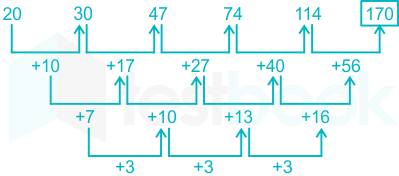
20, 30, 47, 74, 114, ?

  1. ((a))

    170

  2. ((b))

    180

  3. ((c))

    210

  4. ((d))

    125

Show Answer
Answer: ((a))

170

The pattern followed is:

Hence, the correct answer is "170".

37

In the following question, select the odd number pair from the given alternatives.

  1. ((a))

    167 - 45

  2. ((b))

    257 - 73

  3. ((c))

    517 - 38

  4. ((d))

    421 - 10

Show Answer
Answer: ((d))

421 - 10

The following pattern is,

167 - 45 → (1 × 6 × 7) + 3 = 45

257 – 73 → (2 × 5 × 7) + 3 = 73

517 - 38 → (5 × 1 × 7) + 3 = 38

But in 421 - 10, (4 × 2 × 1) + 2 = 10 which is not equal to 11.

Thus, 421 – 10 is odd one.

38

The statements below are followed by two conclusions labeled I and II. Assuming that the information in the statements is true, even if it appears at variance with generally established facts, decide which conclusion(s) logically and definitely follow(s) from the information given in the statements.

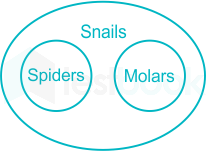
Statements:

All spiders are snails.

All molars are snails.

Conclusion:

I. No spider is a molar.

II. Some spiders are molars.

  1. ((a))

    Only conclusion II follows.

  2. ((b))

    Only conclusion I follows.

  3. ((c))

    Either conclusion I or conclusion II follows.

  4. ((d))

    Both conclusions follow.

Show Answer
Answer: ((c))

Either conclusion I or conclusion II follows.

Concept:

  • The neither-nor case is applicable when both the conclusions are false, whether definite or not.
  • The either-or case is applicable for a pair of statements only if either of the following pair of keywords is used AND only if the following conditions are satisfied:

Keywords:

  1. All and some not
  2. Some and no

Conditions:

  1. The same elements are used in the two conclusions. For example, in this case, the elements jungles and malls are common to both conclusions.
  2. Both conclusions should be possibilities. That is, they should be false because the conclusion is possible but not definite.

Then, the pair of conclusions are considered as complementary pairs.

The least possible Venn diagram is,

Conclusion I: No spider is a molar → False (This is definitely false)

Conclusion II: Some spiders are molars → False (This is possible but not definite)

Explanation:

In the given question, the keywords provided (Some and no) satisfy the concept of the Either-or case.

Conclusion I and Conclusion II form a complementary pair.

Hence, “either conclusion I or conclusion II” follows.

39

If each letter of the word 'EXECUTIVE' is arranged in English alphabetical order, how many letter positions will remain unchanged?

  1. ((a))

    None of these

  2. ((b))

    Three

  3. ((c))

    Two

  4. ((d))

    Four

Show Answer
Answer: ((b))

Three

Given word: EXECUTIVE

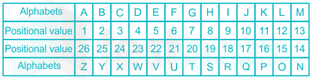
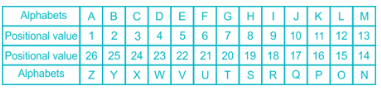
The position and positional value of letters in English alphabets.


Now, each letter of the word 'EXECUTIVE' is arranged in English alphabetical order:

LetterEXECUTIVE
Alphabetical orderCEEEITUVX


Here, 'Three' letters (E), (T), (V) will remain unchanged after arrange the words in Alphabetical order.

Hence, the correct answer is 'Option 2'.

40

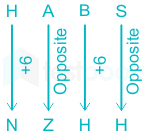
Select the missing pair (Third letter group : Fourth letter group) which is related in the same way as the first letter group is related to the second letter group and the fifth letter group is related to the sixth letter group.

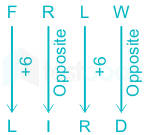
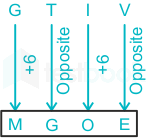
HABS : NZHH :: ? :: FRLW : LIRD

  1. ((a))

    CALK : IZRQ

  2. ((b))

    LRBD : RIIW

  3. ((c))

    GTIV : MGOE

  4. ((d))

    AMKW : GNQC

Show Answer
Answer: ((c))

GTIV : MGOE

The logic followed here is:


and

similarly,

Hence, the correct answer is "Option (3)".

41

DTP is a computer abbreviation, it means 

  1. ((a))

    Document Top Publishing

  2. ((b))

    DeskTop Publishing

  3. ((c))

    DeskTop Programming

  4. ((d))

    Digital Type Program

Show Answer
Answer: ((b))

DeskTop Publishing

The correct answer is DeskTop Publishing.

Key Points

  • DTP is a computer abbreviation, it means DeskTop Publishing.
  • Desktop publishing (DTP) refers to the use of a digital desktop for laying out and constructing documents.
  • It is also known as computer-aided publishing.
  • It may also refer simply to the creation and construction of digital documents on a desktop.

Important Points

  • Desktop-publishing software can be used to create layouts for a wide range of different publications, such as newspaper and magazine brochures, posters, flyers, leaflets and catalogue books and e-books PDF web pages banners newsletter designs. Start.
42

What is the purpose of function AVERAGEA() in MS-Excel?

  1. ((a))

    It returns the average of the arguments.

  2. ((b))

    It returns the average of the values in the list of arguments.

  3. ((c))

    It returns the average of all cells that meet multiple criteria.

  4. ((d))

    It returns the average of all the cells in a range that meet a given criteria.

Show Answer
Answer: ((b))

It returns the average of the values in the list of arguments.

The correct answer is it returns the average of the values in the list of arguments.

Key Points

  • AVERAGEA() function in MS Excel calculates the average of the values in the list of arguments. Hence option 2 is correct.
  • Its syntax is AVERAGEA(value 1, [value 2],.....). Here value 1 is required and the subsequent values are optional. 1 to 255 cells, or variables for which you want to calculate the average.
  • Arguments can be numbers, names, arrays or references that contain numbers, the text representation of numbers or logical values such as True or False etc.
  • Arguments that contain TRUE evaluate as 1 and arguments that contain FALSE are evaluated as 0.

Additional Information

  • The AVERAGE() function returns the average of the arguments. Its syntax is AVERAGE(number 1, [number 2],......). For example, AVERAGE(B1:25) returns the average of the numbers in between the cells B1 and B25.
  • AVERAGEIF() function returns the average of all the cells in the range that meet the given criteria. Its syntax is AVERAGEIF(range, criteria, [average_range]). Here, the range is the number of cells and it is required. Criteria means conditions, it can be an expression, number or array, logical etc.
  • AVERAGEIFS() function returns the average of all cells that meet multiple criteria. Its syntax is AVERAGEIFS(average_range, criteria_range1, [criteria_range 2, criteria2],....).
43

In MS Word, you can display the "Find and Replace" Dialog box by pressing which of the following Function Keys?

  1. ((a))

    F5

  2. ((b))

    CTRL + F5

  3. ((c))

    CTRL + F4  

  4. ((d))

    F4

Show Answer
Answer: ((a))

F5

The correct answer is F5.

Key Points

  • In MS Word, pressing F5 opens the "Find and Replace" dialog box, allowing users to quickly search and replace text within the document.
  • This feature is essential for editing large documents efficiently, as it helps locate specific text and make necessary changes without manual searching.

Additional Information

  • Option 2: CTRL + F5 – This shortcut is generally used to refresh the page in web browsers or reset the window size in some applications.
  • Option 3: CTRL + F4 – This combination is typically used to close the active document or window.
  • Option 4: F4 – In MS Word, the F4 key is used to repeat the last action performed.
44

Which of the following function keys is used in excel to display or hide the ribbon?

  1. ((a))

    F1 alone

  2. ((b))

    Ctrl+F1

  3. ((c))

    Alt+F1

  4. ((d))

    Alt+Shift+F1

Show Answer
Answer: ((b))

Ctrl+F1

The correct answer is Ctrl+F1.

Key Points

  • To go to the Ribbon, press Alt, and then, to move between tabs, use the Right Arrow and Left Arrow keys.
  • To hide the Ribbon so you have more room to work, press Ctrl+F1. Repeat to display the Ribbon again.

Additional Information

Shortcut keysDescription
F1 aloneGet help on the selected command or control in the ribbon.
Alt+F1Create an embedded chart of the data in the current range.
Alt+Shift+F1inserts a new worksheet.
45

State whether the following statements are true or false.

(i) In MS Word, 'Landscape' is a valid page margins option.

(ii) In MS Word, 'Portrait' is a valid page margins option.

  1. ((a))

    (i) False, (ii) False

  2. ((b))

    (i) False, (ii) True

  3. ((c))

    (i) True, (ii) True

  4. ((d))

    (i) True, (ii) False

Show Answer
Answer: ((a))

(i) False, (ii) False

The correct answer is Option 1.

Key Points

  • Statement (i): "Landscape" is a valid page margins option in MS Word:
  • In MS Word, "Landscape" is not a page margin option but a page orientation. Page orientation refers to the layout of the page, either horizontal (Landscape) or vertical (Portrait). Page margins, on the other hand, define the blank spaces between the content and the edges of the page.
  • Thus, the statement "Landscape is a valid page margins option" is False.
  • Statement (ii): "Portrait" is a valid page margins option in MS Word:
  • Similar to Landscape, "Portrait" is a page orientation, not a page margin option. Portrait refers to a vertical layout, while page margins refer to customizable blank spaces around the content.
  • Thus, the statement "Portrait is a valid page margins option" is False.
  • Clarification of Page Margins:
  • Page margins in MS Word are customizable blank spaces around the text on a page. They include options such as Normal, Narrow, Moderate, Wide, Mirrored, etc.
  • These options can be adjusted via the "Layout" tab under the "Margins" section.
  • Page Orientation:
  • The "Orientation" feature in MS Word allows users to choose between two layouts: Landscape (horizontal) and Portrait (vertical).
  • This feature is located under the "Layout" tab in the "Page Setup" section.

Additional Information

  • Page Margins in MS Word:
  • Page margins are the spaces between the text and the edge of the page.
  • MS Word provides pre-defined margin options such as Normal (1 inch), Narrow (0.5 inch), Wide (2 inches), Moderate, and customizable margins.
  • Margins are essential for ensuring proper alignment of text and enhancing the visual presentation of documents.
  • Users can access margin settings under the "Layout" tab and select the "Margins" dropdown menu.
  • Page Orientation in MS Word:
  • Page orientation determines the direction in which the content is displayed on the page.
  • There are two types of orientations: Portrait (vertical layout) and Landscape (horizontal layout).
  • Users can change page orientation under the "Layout" tab in the "Page Setup" section.
  • Orientation is commonly used for presentations, brochures, and documents requiring specific layouts.
  • Differences Between Margins and Orientation:
  • Margins: Refer to the blank spaces around the text, measured in inches or centimeters.
  • Orientation: Refers to the overall layout of the page, either vertical or horizontal.
  • Both settings are independent of each other but contribute to the overall formatting of a document.
  • Applications of Margins and Orientation:
  • Margins ensure proper alignment and readability of text in professional documents.
  • Orientation is used for specific document types, such as landscape for charts or tables and portrait for letters or essays.

Important Points

  • Quick Access: Margins and orientation settings in MS Word are located under the "Layout" tab.
  • Customization: Both page margins and orientation can be customized based on the document's requirements.
  • Professional Usage: Proper use of margins and orientation is critical for creating professional and visually appealing documents.
  • Printing Considerations: Adjusting margins and orientation ensures the document fits well when printed.
46

Which of the following was the first counting tool?

  1. ((a))

    Aba Zaba

  2. ((b))

    Abacus

  3. ((c))

    Punch Card

  4. ((d))

    Stepped Reckoner

Show Answer
Answer: ((b))

Abacus

The correct answer is Abacus.

Key Points

  • The Abacus is regarded as the first counting tool. It was used in ancient times for arithmetic processes and is still in use in some parts of the world today.
  • It is composed of a frame with rods, on which beads are moved to perform mathematical calculations.
  • The Abacus predates modern numerical systems and was instrumental in the development of mathematical concepts.

Additional Information

  • Aba Zaba: This is actually a type of candy bar and has no relevance to counting tools or historical mathematical instruments.
  • Punch Card: Punch cards were used for data input and storage in early computing machines, such as those developed by Herman Hollerith for the 1890 U.S. Census. They are not considered counting tools.
  • Stepped Reckoner: Invented by Gottfried Wilhelm Leibniz in the 17th century, the Stepped Reckoner was an early mechanical calculator capable of addition, subtraction, multiplication, and division. While significant, it was developed much later than the Abacus.
47

A plotter is used for :  

  1. ((a))

    Printing letters  

  2. ((b))

    Printing numbers 

  3. ((c))

    Printing letters and numbers 

  4. ((d))

    Printing drawings and maps 

Show Answer
Answer: ((d))

Printing drawings and maps 

The correct answer is Printing drawings and maps.

Key Points

  • The plotter is basically a type of Printer.
  • It is an output device of the computer.
  • It uses a pen to create a print on paper or media.
  • The output is created on vector graphics.
  • It means that the dots are printed which are joined by lines and curves to produce text and images.
  • Plotters are present in many designs used for printing large format prints.
  • It includes architecture like layouts, building plans, ship designs, CAD (computer-aided design), big canvas prints, and any other engineering drawing.
  • The plotters utilize pens or markers to draw graphics on an output media.
  • These pens move differently according to the technology deployed by a plotter.
  • Three types of plotters are most popular for their ability to allow you to create different designs.
  • Drum Plotters.
  • Flat Bed Plotters
  • Ink Jet Plotters
48

The important system components like the central processing unit (CPU) and random access memory (RAM) modules are connected directly to the ______. 

  1. ((a))

    Magnetic Tape

  2. ((b))

    Mother Board

  3. ((c))

    Optical Disk

  4. ((d))

    Flash Memory

Show Answer
Answer: ((b))

Mother Board

The correct answer is Option 2

Key Points

  • The important system components like the central processing unit (CPU) and random access memory (RAM) modules are connected directly to the Motherboard.
  • The motherboard acts as the main circuit board of a computer system, providing electrical connections and pathways for various hardware components to communicate with each other.
  • The CPU is typically inserted into a socket on the motherboard, and the RAM modules are installed into slots on the motherboard.

Additional Information

  • Magnetic Tape: Magnetic tape is a medium used for long-term storage of data.
  • It is typically used for backup purposes rather than directly connecting components like CPU and RAM.
  • Magnetic tape drives are separate devices that connect to a computer system.
  • Optical Disk: An optical disk is a storage medium that uses laser technology to read and write data.
  • Examples of optical disks include CDs, DVDs, and Blu-ray discs.
  • While optical drives can be connected to the motherboard, they are used primarily for reading and writing data from optical disks rather than directly connecting the CPU and RAM.
  • Flash memory is a type of non-volatile memory that retains data even when power is removed.
  • It is commonly used in USB flash drives, solid-state drives (SSDs), and memory cards.
  • Flash memory can be connected to the motherboard through various interfaces such as USB, SATA, or PCIe.
49

Which of the following memory is working on the switch on the computer system?

  1. ((a))

    Hard Disk

  2. ((b))

    ROM

  3. ((c))

    RAM

  4. ((d))

    BIOS

Show Answer
Answer: ((b))

ROM

The computer loads data from read-only memory (ROM) and performs a power-on self-test (POST) to make sure all the major components are functioning properly.

50

How does a computer get infected by virus ?

  1. ((a))

    When a firewall is present

  2. ((b))

    When antivirus software is active

  3. ((c))

    When downloading unknown software from the internet

  4. ((d))

    When working on MS Office software in the local computer

Show Answer
Answer: ((c))

When downloading unknown software from the internet

The correct answer is When downloading unknown software from the internet.

Key Points

  • There are several ways a computer can get infected by a virus and most of them involve downloadingeither intentionally or unintentionallyinfected files.
  • Pirated music or movies, photos, free games and toolbars are common culprits, as are phishing/spammy emails with attachments.
  • The computer can be protected from viruses by installing valid anti-virus software on our computer.
<br>

Additional Information

Types of Computer Virus:

  • Boot Sector Virus.
  • Polymorphic Virus.
  • Resident Virus.
  • Multipartite Virus.
  • Web Scripting Virus
51

Statutory audit is often known as:

  1. ((a))

    Management audit

  2. ((b))

    Cost audit

  3. ((c))

    Internal audit

  4. ((d))

    Financial audit

Show Answer
Answer: ((d))

Financial audit

Key PointsAuditing is the systematic and scientific examination of the books of accounts and records of a business so as to enable the auditor to satisfy himself that the Balance Sheet and the Profit and Loss Account are properly drawn up so as to exhibit a true and fair view of the financial state of affairs of the business and profit or loss for the financial period.

Important PointsStatutory audit - 

  • Governmental organizations and industry regulators both require statutory audits.
  • The statutory audit process is complex and entails knowing how a company entity's operating environment and controls work.
  • A statutory audit is a form of audit that is required by law or a statute to ensure that the book of accounts presented to the public and regulators is true and fair.
  • A statutory audit is required if the company satisfies specific conditions. Statutory audits typically refer to financial audits.

Additional InformationManagement audit - The objective of a management audit is to analyze and evaluate the skills and capacities of a company's management in achieving its goals.

Cost audit - The audit of cost records is known as a cost audit. Cost auditing is the process of confirming the costs associated with producing any good, service, or activity using records kept by an organization in compliance with approved cost accounting standards.

Internal audit - Internal auditing is a procedure used by firms to identify the system's flaws and enhance the relevant areas to increase productivity.

52

The difference between the Economic and Accounting Costs of a firm are

  1. ((a))

    the explicit costs of the firm. 

  2. ((b))

    the Corporate Taxes on profit.

  3. ((c))

    the opportunity costs of the factors of production that the firm owns.

  4. ((d))

    the sunk costs incurred by the firm.

Show Answer
Answer: ((c))

the opportunity costs of the factors of production that the firm owns.

The correct answer is - The opportunity costs of the factors of production that the firm owns.

Key Points

  • Economic Costs vs. Accounting Costs:
  • Economic costs include both explicit costs (direct monetary payments) and implicit costs (opportunity costs of resources owned by the firm).
  • Accounting costs, on the other hand, only account for explicit costs incurred during production, such as wages, raw materials, and rent.
  • The difference arises because economic costs consider the opportunity cost of using resources, such as the potential income the firm could have earned if it had used its resources elsewhere.
  • Opportunity Costs:
  • These refer to the benefits foregone from the next best alternative use of a resource.
  • For example, if a firm uses its own building for production, the opportunity cost is the rent it could have earned if the building was leased out to another party.
  • Opportunity costs are a critical factor in economic decision-making and are included in economic costs but excluded from accounting costs.

Additional Information

  • Explicit Costs:
  • These are the direct, out-of-pocket expenses a firm incurs, such as payments for wages, raw materials, and utilities.
  • Explicit costs are included in both accounting and economic costs, so they do not explain the difference between the two.
  • Corporate Taxes:
  • Corporate taxes are levied on the profits of a firm and are considered an explicit cost.
  • Since corporate taxes are included in accounting costs, they do not account for the difference between accounting and economic costs.
  • Sunk Costs:
  • Sunk costs are past costs that have already been incurred and cannot be recovered.
  • These costs are not relevant for future decision-making and are typically excluded from both economic and accounting costs.
53

What was the Inca's accounting system called?

  1. ((a))

    Cuneiform

  2. ((b))

    Hieroglyphics

  3. ((c))

    Tepochcalli

  4. ((d))

    Quipu

Show Answer
Answer: ((d))

Quipu

The accounting system of Incas was called as Quipu.

Key Points

  • The largest of the indigenous civilisations in South America was that of the Quechuas or Incas in Peru.
  • In the twelfth century the first Inca, Manco Capac, established his capital at Cuzco.
  • Expansion began under the ninth Inca and at its maximum extent the Inca empire stretched 3,000 miles from Ecuador to Chile.
  • The basis of the Inca civilisation was agriculture.
  • Their weaving and pottery were of a high quality.
  • They did not develop a system of writing.
  • However, there was an accounting system in place – the quipu, or cords upon which knots were made to indicate specific mathematical units.
  • Some scholars now suggest that the Incas wove a sort of code into these threads.

Hence, the correct answer is Quipu.

54

In which year did Government of India separate Accounting functions from Audit?

  1. ((a))

    1976

  2. ((b))

    1985

  3. ((c))

    1990

  4. ((d))

    1967

Show Answer
Answer: ((a))

1976

The correct answer is 1976.

Key Points

  • In 1976, Government of India separated Accounting functions from Audit.
  • In 1971 the central government enacted the Comptroller and Auditor General (Duties, Powers, and Conditions of Service) Act, 1971.
  • The Act made CAG responsible for both accounting and auditing duties for central and state governments.
  • In 1976 CAG, was relieved from accounting functions.
  • The accounting functions were transferred to the Controller General of Accounts (CGA).

Important Points

  • The Controller General of Accounts (CGA), in the Department of Expenditure, Ministry of Finance, is the Principal Accounting Adviser to Government of India and is responsible for establishing and maintaining a technically sound Management Accounting System.
  • The Office of CGA prepares monthly and annual analysis of expenditure, revenues, borrowings and various fiscal indicators for the Union Government.
  • Under Article 150 of the Constitution, the Annual Appropriation Accounts (Civil) and Union Finance Accounts are submitted to Parliament on the advice of Comptroller and Auditor General of India.
  • It further formulates policies relating to general principles, form and procedure of accounting for the Central and State Governments.
55

Which of the following is an Indian Labour Law and Social Security measure aimed at guaranteeing the "Right to work" ?

  1. ((a))

    Indian Institute of Management Act 

  2. ((b))

    Mahatma Gandhi National Rural Employment Guarantee Act

  3. ((c))

    The Payment of wages (Amendment) Act, 2017

  4. ((d))

    Citizenship Act

Show Answer
Answer: ((b))

Mahatma Gandhi National Rural Employment Guarantee Act

The correct answer is Option 2

Mahatma Gandhi National Rural Employment Guarantee Act

Key Points

  • MGNREGA is one of the largest work guarantee programmes in the world which was launched in 2005.
  • The primary objective of the scheme is to guarantee 100 days of employment in every financial year.
  • Unlike earlier employment guarantee schemes, MGNREGA aims at addressing the causes of chronic poverty through a rights-based framework.

Additional Information 

Employees Provident Fund and Miscellaneous Provision Act :

  • Employees Provident Fund and Miscellaneous Provisions Act, 1952 is a Social Security Act passed by the Government of India.
  • It includes Social Security Schemes namely Provident Fund, Pension and Insurance to industrial employees.
  • Under this scheme, every employee is required to make a contribution towards the provident fund at the rate of 12% of the Basic Wages, Dearness Allowance and cash value of food concession.
  • Further, the employer also makes an equal amount of contribution as the employee towards the fund.

Indian Institute of Management Act :

  • Indian Institutes of Management  Act came in 2017.
  • This law brings greater transparency and autonomy to the working of the IIMs.
  • The act declares 20 existing Indian Institutes of Management (IIMs) as institutions of national importance and confers on them the power to grant degrees.
  • Each IIM will have an executive body i.e. Board of Governors, comprising up to 19 members.

Citizenship Act :

  • It is an Act to provide for the acquisition and determination of Indian citizenship.
  • The Citizenship Act, 1955 was amended 6 times in 1986, 1992, 2003, 2005, 2015 and 2019.
  • The purpose of the Citizenship Amendment Act, 2019 is to give Indian citizenship to illegal migrants of 6 communities i.e. Hindu, Sikh, Buddhist, Christian, Parsi, and Jain) belong to Bangladesh, Pakistan, and Afghanistan.
56

 Accounting can take into account:

  1. ((a))

    Only monetary transactions

  2. ((b))

    Only non-monetary transactions

  3. ((c))

    Both of the above (A) & (B) 

  4. ((d))

     None of these

Show Answer
Answer: ((a))

Only monetary transactions

The Correct Answer is Only monetary transactions.

Important Points

  • The money measurement concept states that a business should only record an accounting transaction if it can be expressed in terms of money.
  • This means that the focus of accounting transactions is on quantitative information, rather than on qualitative information.
  • Thus, a large number of items are never reflected in a company's accounting records, which means that they never appear in its financial statements.
  • Only monetary transactions are recorded in accounting.

Additional Information

  • The concept of money measurement states that only those transactions and happenings in an organization that can be expressed in terms of money such as the sale of goods or payment of expenses or receipt of income, etc. are to be recorded in the book of accounts.
  • All such transactions or happenings which can not be expressed in monetary terms, for example, the appointment of a manager, do not find a place in the accounting records of a firm.
  • Another important aspect of the concept of money measurement is that the records of the transactions are to be kept not in the physical units but in the monetary unit.
57

When subsidiary books are maintained, the entry for special discounts to customers is done in:

  1. ((a))

    Journal

  2. ((b))

    Sales book

  3. ((c))

    Cash book

  4. ((d))

    None of these

Show Answer
Answer: ((a))

Journal

The correct answer is Journal.

Key Points

  • The books known as subsidiary books are used to systematically record transactions with a similar character.
  • They are also referred to as Daybooks or particular journals.
  • It is difficult to enter all the transactions in one journal and publish them to different accounts in large company organisations.
  • The journal is thus separated into numerous subsidiary books in order to facilitate the quick and correct recording of all transactions. There is a separate book for each sort of transaction.

Important PointsJournal Proper: It is a book in which all miscellaneous transactions which are not recorded in any other subsidiary book are called a journal proper, so any special discount given to customers shown in this book.

Additional InformationTypes of Subsidiary Book

  1. Cash Book: A cash book is a prime entry book that keeps track of all transactions that a company makes using both cash and bank instruments.
  2. Purchase Book - One of the special purpose books, a purchase book is where a business records all of its credit purchases.
  3. Sales Book - A business enters all credit sales into a sales book, one of the subsidiary books.
  4. Purchase Returns Book - A purchase returns book, often referred to as a returns outward book, is created to document the products that a company returns to its suppliers.
  5. Sales Return Book - Also referred to as a returns inward book, a sales return book is created to keep track of the goods that customers return to a business.
  6. Journal Proper - A journal proper is a book that contains all unrelated transactions that are not recorded in any other subsidiary books.
  7. The Bills Receivable Book is a book that keeps track of all bills owed to a company; its total is displayed on the debit side of the B/R account.
  8. The sum of the bills payable book is reported on the credit side of the B/P account. Bills Payable Book is one of the subsidiary books that records all bills payable by a business.
58

Internal check/audit of receipts in a subordinate office is arranged by

  1. ((a))

    The department under rule 41 of GF and AR

  2. ((b))

    The treasury office under rule 41 of GF and AR

  3. ((c))

    The Department under rule 40 of GF and AR

  4. ((d))

    The treasury office under rule 40 of GF and AR

Show Answer
Answer: ((a))

The department under rule 41 of GF and AR

Key Points

Rule 41: Internal Check/ Audit:

  • Departments shall arrange internal check/audit of receipts in the subordinate offices by their Internal Check parties. For this purpose they will issue regulations for the guidance of such parties.

Additional Information

  • Rule 40: Departments shall make rules defining remission and abandonment of revenue for the guidance of their officers.

Hence, Internal check/audit of receipts in a subordinate office is arranged by The department under rule 41 of GF and AR.

59

What are the benefits of PRIA Soft (Panchayatraj Institute Accounting Software).

  1. ((a))

    For Panchayati Raj Institutions to effectively monitor their accounts.

  2. ((b))

    Increases the credibility of Panchayats.

  3. ((c))

    Increases the ability of higher officials to monitor.

  4. ((d))

    All of the above

Show Answer
Answer: ((d))

All of the above

The correct answer is All of the above.

Key Points

  • PRIA Soft (Panchayat Raj Institutions Accounting Software) offers a variety of benefits for Panchayats, including:
  • 1. Effective monitoring of accounts: PRIA Soft allows Panchayats to track all their financial transactions in a centralized database. This makes it easier to monitor their spending, identify areas where they can save money, and ensure that funds are being used efficiently.
  • 2. Increased credibility: By providing accurate and transparent financial information, PRIA Soft helps to increase the credibility of Panchayats. This makes it easier for them to attract funding and secure grants from government and other agencies.
  • 3. Enhanced monitoring by higher officials: PRIA Soft allows higher officials in the government to monitor the financial activities of Panchayats more effectively. This helps to ensure that Panchayats are accountable for their actions and that funds are being used for their intended purposes.
  • 4. Improved financial management: PRIA Soft provides Panchayats with a range of tools and features that can help them to improve their financial management. This includes features such as:
  • Budgeting: PRIA Soft allows Panchayats to create and track their budgets.
  • Accounting: PRIA Soft provides a comprehensive accounting system that tracks all of the Panchayat's income and expenses.
  • Reporting: PRIA Soft generates a variety of reports that can help Panchayats to track their financial performance.
  • Inventory management: PRIA Soft helps Panchayats to track their inventory of assets.
60

The Indian Government Accounting Standards are formulated and recommended by the

  1. ((a))

    Institute of Chartered Accountants of India

  2. ((b))

    Institute of Cost Accountants of India

  3. ((c))

    Government Accounts Standards Advisory Board

  4. ((d))

    Government Financial Accounting Board

Show Answer
Answer: ((c))

Government Accounts Standards Advisory Board

The correct answer is: Government Accounts Standards Advisory Board.

The Indian Government Accounting Standards (IGAS) are formulated and recommended by the Government Accounts Standards Advisory Board (GASAB). This body is responsible for improving government accounting and aligning it with international practices.

Key Points

  • GASAB's Role:
  • GASAB was established by the Comptroller and Auditor General of India (CAG) to formulate Indian Government Accounting Standards.
  • It aims to modernize government accounting and ensure transparency and accountability in financial reporting.
  • Alignment with International Practices:
  • GASAB ensures that Indian accounting standards are aligned with internationally accepted practices.
  • The focus is on adopting accrual-based accounting systems for improved financial management.
  • Government Accounting:
  • The standards aim to strengthen public financial management and improve the accuracy of government accounts.

Additional Information

  • Other Bodies:
  • Institute of Chartered Accountants of India (ICAI): ICAI primarily focuses on accounting standards for corporate entities, not government accounting.
  • Institute of Cost Accountants of India: This body specializes in cost accounting, not government financial standards.
61

Which of the following Acts of 1947 regulates the Indian labour law with regard to trade unions as well as individual workmen?

  1. ((a))

    Indian Councils Act

  2. ((b))

    Charter Act

  3. ((c))

    Rowlatt Act 

  4. ((d))

    Industrial Disputes Act

Show Answer
Answer: ((d))

Industrial Disputes Act

The correct answer is Industrial Disputes Act. 

Key Points

  • ​The Indian Labour Law is governed by the Industrial Disputes Act, 1947 in as much as it relates to trade unions and specific workers employed in any industry on the Indian mainland.
  • The Act also establishes:
  • a clause that provides for the worker to be compensated in the event of a shutdown, layoff, or retrenchment.
  • the process for obtaining advance approval from the relevant government to lay off employees, retrench them or shut down industrial facilities.
  • the steps to be taken in response to unfair labour practices by an employer, a trade union, or employees.

Additional Information

  • Indian Councils Act:
  • The Indian Councils Act of 1861 was an Act of the British Parliament that changed the way India's executive council operated such that it operated as a cabinet with a portfolio structure.
  • Six "ordinary members" made up this cabinet, each in charge of a different division of the Calcutta government: the home, revenue, military, law, finance, and (from 1874) public works.
  • Charter Act:
  • The East India Company's monopoly over India was broken by the Charter legislation of 1813.
  • Yet, the business was able to maintain its monopoly in commerce with China and trade in tea with India.
  • Rowlatt Act:
  • The Imperial Legislative Council, British India's legislature, passed the Rowlatt Acts in February 1919.
  • The acts permitted the incarceration of suspects without a trial and allowed for the trial of some political crimes without juries.
62

How many applications are included in Panchayat Enterprise Suite (PES)?

  1. ((a))

    11

  2. ((b))

    16

  3. ((c))

    10

  4. ((d))

    15

Show Answer
Answer: ((a))

11

The correct answer is 11.

Key Points

  • Under e-Panchayat a suite of 11 Core Common Applications has been envisaged that address nearly the entire spectrum of Panchayats' functioning viz. from internal core functions such as Planning, Monitoring, Implementation, Budgeting, Accounting, Social Audit, etc. to citizen service delivery operations like issue of certificates, licenses etc.
  • Together these eleven software Applications constitute the Panchayat Enterprise Suite (PES).
  • Four of these Software Applications - namely PRIASoft, PlanPlus, National Panchayat Portal and Local Government Directory have been in use by the States/UTs for over three years now.
  • Six more Applications namely Area Profiler, ServicePlus, National Asset Directory, ActionSoft, Social Audit & Meeting Management, and Trainings Management were launched on the occasion of National Panchayati Raj Day on 24th April, 2012.
  • These 11 Applications are:
  • PRIASoft
  • PlanPlus
  • National Panchayat Portal (NPP)
  • Local Government Directory
  • ActionSoft
  • National Asset Directory (NAD)
  • Area Profiler
  • ServicePlus
  • Social Audit and Meeting Management (SAMM)
  • Trainings Management
  • Gram Manchitra (GIS Application)
63

In which of the following types of audit, the plans and policies of the organization are examined in detail?

  1. ((a))

    In cost audit

  2. ((b))

    In management audit

  3. ((c))

    In financial audit

  4. ((d))

    In tax audit

Show Answer
Answer: ((b))

In management audit

The correct answer is management audit.

Management Audit is a process of examination and evaluation of the performance of managerial functions. It also covers the organizational structure of a company. It involves a critical review of policies, processes, procedures, and operations which form part of the internal control system. It analyses the effectiveness of the utilization of different resources. Management audit thus is an appraisal of both policies and actions. 

  1. A cost audit represents the verification of cost accounts and checking on the adherence to the cost accounting plan. Cost audit ascertains the accuracy of cost accounting records to ensure that they are in conformity with cost accounting principles, plans, procedures, and objectives.
  2. A 'financial audit' is conducted to provide an opinion on whether "financial statements" are stated in accordance with specified criteria.
  3. A tax audit determines whether financial records and transactions are correctly recorded and accounted for. This, in turn, ensures that the records reflect the actual income of the taxpayer and that the claims for deductions made are accurate.
64

Which one among the following is the earliest labour law in India? 

  1. ((a))

    Contract Labour (Regulation and Abolition) Act 

  2. ((b))

    Trade Unions Act

  3. ((c))

    Employee’s Compensation Act  

  4. ((d))

    Factories Act

Show Answer
Answer: ((d))

Factories Act

The correct answer is Factories Act.

Key Points

  • Contract Labour (Regulation and Abolition) Act, 1970
  • Trade Unions Act, 1926
  • Employees Compensation Act, 1923
  • The Indian Factories Act, 1881

Hence, from above it is clear that earliest labour law in India is Factories Act, 1881.

65

Under Section 144 of the Companies Act 2013, an auditor can render services as are approved by the ______.

  1. ((a))

    Audit Committee

  2. ((b))

    BOD and Audit Committee

  3. ((c))

    BOD

  4. ((d))

    None of the above 

Show Answer
Answer: ((b))

BOD and Audit Committee

The correct answer is BOD or Audit Committee

Key Points

  • Auditor: An auditor is an authorized person who verifies and reviews the financial records and financial statements of a company and ensures that they are prepared in accordance with the norms.
  • He also checks whether any tampering or manipulation has been done with the financial data with the aim of hiding any fraud or malpractice within the company.
  • As per Section 144 of the Companies Act 2013, a company auditor is responsible for providing services that have been approved by the company's board of directors or audit committee.
  • However, section 144 also prohibits a company auditor from performing certain non-audit services after being designated as a company auditor.
66

Which form is used to file an application for obtaining Permanent Account Number(PAN) by an Indian resident ?

  1. ((a))

    Form 49B

  2. ((b))

    Form 49A

  3. ((c))

    Form 49

  4. ((d))

    Form 49AA

Show Answer
Answer: ((b))

Form 49A

Form 49A is used to file an application for obtaining Permanent Account Number(PAN) by an Indian resident.

Key Points

PAN Application Form 49A

  • Form 49A is the application form for the allotment of Permanent Account Number for Indian residents. Any individual who is a resident of India and wishes to apply for PAN should compulsorily fill the form 49A as it is the application form.

Important Points

  1. One can download the application form online from the NSDL e-Governance official website or the UTIITSL website. Once the form is filled with the correct details, the applicant can make the payment online and submit the form with the required documents and photographs.
  2. PAN stands for Permanent Account Number. It is a 10-digit character alphanumeric number allotted to the PAN Cardholder served in the form of Government-issued identification. It helps in the identification of income taxpayers or PAN cardholders. PAN card required in case of your salary is under the taxable slab, taxable professional fees, for opening a bank account, or for sale or purchase of assets.

 Additional Information

  1. Form 49B is for application for allotment of TAN number or collection and deduction account number under section 203A of the Income Tax Act, 1961
  2. Form 49AA is the application form for the allotment of Permanent Account Number for Foreign residents and entities incorporated outside India.
67

As per the format of Balance sheet prescribed as per Schedule III of Companies act 2013, Intangible assets is shown under the heading of ______.

  1. ((a))

    Other Non-current assets

  2. ((b))

    Current assets

  3. ((c))

    Fixed Assets

  4. ((d))

    Miscellaneous Expenditure

Show Answer
Answer: ((c))

Fixed Assets

The correct answer is Fixed Assets

Key PointsFixed Assets: These assets are those assets of the business which are of permanent nature. These assets are expected to last more than one year. Fixed assets are assets that a business intends to utilize in the long run to create revenue.

Intangible assets: These are the assets of the business that do not have a physical existence.

These include the following:

  • Goodwill
  • Patents
  • Trademarks
  • Intellectual Property Rights
  • Computer Software
  • License
  • Copyrights

As per Schedule III of Companies act 2013, Intangible assets are mentioned under the heading of Fixed Assets.

68

Which of the following is required while vouching Cash Purchases ?

  1. ((a))

    Examine Debtor Ledger

  2. ((b))

    Examine Cash Sales

  3. ((c))

    Examine credit sales

  4. ((d))

    Examine payment in Cash book

Show Answer
Answer: ((d))

Examine payment in Cash book

The correct answer is to Examine payment in Cashbook

Key Points

  • Vouching: Vouching is one of the activities of an auditor in process of auditing, in which an auditor checks each and every entry in the books of accounts and verifies it with the evidence available in the form of vouchers.
  • Vouchers are nothing but the cash memo, bills other documents that were issued or received at the time of the transaction for future references.
  • The process of Vouching is performed to check the authenticity of the transactions.

Important Points

  • Examine Debtor Ledger: The debtor ledger contains all the transactions related to persons to whom goods are sold on credit. Since it records all the credit transactions, It is not required in vouching for Cash Purchases.
  • Examine Cash Sales: Cash sales represent the number of goods sold on a cash basis. These are not required in vouching Cash Purchases.
  • Examine credit sales: Credit sales represent the number of goods sold on a credit basis. These are not required in vouching Cash Purchases.
  • Examine payment in Cashbook: Cashbook records all the transactions relating to cash payments and cash receipts. Since purchases made on cash are recorded in Cashbook, these must be verified in vouching of Cash purchases.
69

Which of the following account will be credited when a typewriter is sold that has been used in the office?

  1. ((a))

    Office equipment account

  2. ((b))

    Cash account

  3. ((c))

    Sales account

  4. ((d))

    Purchase account

Show Answer
Answer: ((a))

Office equipment account

The correct answer is Office equipment account

Key Points

  • The Office Equipment account is a fixed asset account that tracks the cost of equipment used in the office.
  • When the typewriter is sold, it is considered a disposal of the fixed asset, and the Office Equipment account needs to be credited to reduce the balance.
  • The amount of the credit will be the book value of the typewriter, which is the original cost of the typewriter minus any accumulated depreciation.

Important Points The journal entry for the sale of the typewriter will be as follows:

ParticularsDebitCredit
Cash A/cxxxx
To Office equipment A/cxxxx
Sale of the typewriter
70

To whom is the term "insider trading" related?

  1. ((a))

    Hawala

  2. ((b))

    Public

  3. ((c))

    Share Market

  4. ((d))

    Tax

Show Answer
Answer: ((c))

Share Market

The correct answer is Share Market.

  • The term insider trading is associated with the share market.
  • Insider trading is the buying or selling of a publicly-traded company's stock by someone who has non-public, material information about that stock.

Key Points

  • Material non-public information is any information that could substantially impact an investor's decision to buy or sell the stocks that have not been made available to the public.
  • Insider trading is illegal and comes with stern penalties including both potential fines and jail time.
  • Securities and Exchange Board of India (SEBI) have stringent rules to prevent insider trading.

Additional Information

  • Hawala: Hawala is the underground, cheap and instant medium to transfer the huge amount of money.
  • Hawala is cheaper and less cumbersome than formal remittance channels such as banks, Western Union or Money Gram.
  • Hawala system is used by Criminals, Businessmen, and Nonresidents to remit money.
  • Halawa system is the backbone of the underworld, drugs/arms mafias, terrorists and smugglers. Businessmen use it transfer money to evade tax.

Attempt this paper under real exam conditions

Timed interface, section switching, instant scoring, and question-by-question analytics — free.

Start Timed Attempt