Official Paper

SSC MTS 2024 Official Paper (Held On: 08 Oct, 2024 Shift 3) (Previous Year Paper)

90 questions · 90 minutes · with answers · free

Session 1 (40 questions)

1

A fast train takes 1 hour less than a slow train for a journey of 96 km. If the speed of the slow train is 8 km/h less than that of the fast train, then find the speeds of the fast train and slow train respectively

  1. ((a))

    26 km/h, 34 km/h

  2. ((b))

    32 km/h, 24 km/h

  3. ((c))

    34 km/h, 28 km/h 

  4. ((d))

    12 km/h, 14 km/h 

Show Answer
Answer: ((b))

32 km/h, 24 km/h

Shortcut Trick

Use the direct formula for speed difference: Distance = [Product of Speeds ÷ Difference of Speeds] × Time Difference.

96 = [S1 × S2 ÷ 8] × 1 ⇒ S1 × S2 = 96 × 8 = 768.

From the given options, only 32 × 24 = 768 and the difference 32 − 24 = 8 km/h satisfies the condition.

Hence, the speeds are 32 km/h and 24 km/h.

∴ The correct answer is 32 km/h, 24 km/h.

Alternate Method

Given:

Total Distance = 96 km

Time Difference (ΔT) = 1 hour

Speed Difference = 8 km/h

Formula Used:

Time = Distance ÷ Speed

Calculations:

Let the speed of the fast train be x km/h.

Then, the speed of the slow train is (x − 8) km/h.

⇒ 96/(x − 8) − 96/x = 1

⇒ 96[ (x − (x − 8)) / (x(x − 8)) ] = 1

⇒ 96 × 8 = x2 − 8x

⇒ x2 − 8x − 768 = 0

⇒ x2 − 32x + 24x − 768 = 0

⇒ x(x − 32) + 24(x − 32) = 0

⇒ (x − 32)(x + 24) = 0

⇒ x = 32 (Speed cannot be negative, so x ≠ −24)

Speed of fast train = 32 km/h

Speed of slow train = 32 − 8 = 24 km/h

∴ The correct answer is 32 km/h, 24 km/h.

Additional Information

Speed-Time Relation

For a constant distance, speed is inversely proportional to time (S ∝ 1/T). If speed increases, time decreases.

Quadratic Shortcut

In equations like x2 − Sx + P = 0, the sum of roots is S and the product is P. In speed problems, the positive root is the answer.

Average Speed

If a journey is covered at two different speeds x and y for equal distances, the average speed is (2xy) ÷ (x + y).
2

By selling 20 cakes, a shopkeeper earns selling price of 4 cakes. Determine the profit percentage.

  1. ((a))

    10%

  2. ((b))

    25% 

  3. ((c))

    20% 

  4. ((d))

    4%

Show Answer
Answer: ((b))

25% 

Given:

By selling 20 cakes, a shopkeeper earns selling price of 4 cakes.

Formula used:

Profit Percentage = (ProfitCost Price)×100\left(\dfrac{\text{Profit}}{\text{Cost Price}}\right) \times 100

Calculation:

Let SP of 1 cake be ₹1.

⇒ SP of 20 cakes = ₹20.

⇒ Profit = SP of 4 cakes = ₹4.

⇒ CP of 20 cakes = ₹20 - ₹4 = ₹16.

⇒ CP of 1 cake = ₹0.80.

⇒ Profit per cake = ₹1 - ₹0.80 = ₹0.20.

⇒ Profit Percentage = (0.200.80)×100\left(\dfrac{0.20}{0.80}\right) \times 100

⇒ Profit Percentage = 25%

∴ The correct answer is option 2.

3

The average weight of a family of five members (in kg) whose weights are 40 kg, 49 kg, 56 kg, 65 kg and 38 kg is:

  1. ((a))

    48.6

  2. ((b))

    49.6

  3. ((c))

    50.6

  4. ((d))

    51.6

Show Answer
Answer: ((b))

49.6

Given:

Weights of family members (in kg) = 40, 49, 56, 65, 38

Formula used:

Average weight = Sum of weightsNumber of members\dfrac{\text{Sum of weights}}{\text{Number of members}}

Calculation:

Sum of weights = 40 + 49 + 56 + 65 + 38

⇒ Sum of weights = 248 kg

Number of members = 5

Average weight = 2485\dfrac{248}{5}

⇒ Average weight = 49.6 kg

∴ The correct answer is option 2.

4

What sum (in ₹) will earn a simple interest of ₹240 in 2 years at 16% per year rate of interest?

  1. ((a))

    1500

  2. ((b))

    1000

  3. ((c))

    750

  4. ((d))

    375

Show Answer
Answer: ((c))

750

Given:

Simple Interest (SI) = ₹240

Time (t) = 2 years

Rate of Interest (r) = 16% per year

Formula used:

SI = P×r×t100\dfrac{P × r × t}{100}

Where, P = Principal amount

Calculation:

240 = P×16×2100\dfrac{P × 16 × 2}{100}

⇒ 240 = 32P100\dfrac{32P}{100}

⇒ 240×10032\frac{240 × 100}{32} = \()P

⇒ P = 750

∴ The correct answer is option (3).

5

Find the simple interest (in ₹) on ₹4000 as a sum borrowed at 3% per year rate of interest for 6 years.

  1. ((a))

    720

  2. ((b))

    660

  3. ((c))

    760

  4. ((d))

    880

Show Answer
Answer: ((a))

720

Shortcut Trick

Effective rate of interest for 6 years = 3% × 6 = 18%

Simple Interest = 18% of Principal

⇒ Simple Interest = (18 ÷ 100) × 4000

⇒ Simple Interest = 18 × 40 = 720

∴ The correct answer is ₹720.

Alternate Method

Given:

Principal (P) = ₹4000

Rate (R) = 3% p.a.

Time (T) = 6 years

Formula Used:

Simple Interest (I) = (P × R × T) ÷ 100

Calculations:

⇒ I = (4000 × 3 × 6) ÷ 100

⇒ I = 40 × 18

⇒ I = 720

∴ The correct answer is ₹720.

Additional Information

Total Amount Formula

The final amount after adding simple interest is given by A = P + I, which can also be written directly as A = P(1 + RT ÷ 100).

Simple vs Compound Interest

For the first year (when compounded annually), Simple Interest and Compound Interest are identical. From the second year onwards, Compound Interest is greater than Simple Interest for the same rate.

Time to Double Investment

Under Simple Interest, a sum of money doubles itself when the earned interest equals the principal. This always happens in Time = 100 ÷ R years.

6

The average weight of a family of five members (in kg) whose weights are 40 kg, 49 kg, 56 kg, 66 kg and 38 kg is:

  1. ((a))

    48.8

  2. ((b))

    49.8

  3. ((c))

    50.8

  4. ((d))

    51.8

Show Answer
Answer: ((b))

49.8

Given:

Weights of family members: 40 kg, 49 kg, 56 kg, 66 kg, 38 kg

Formula used:

Average weight = (Sum of weights) / (Number of family members)

Calculation:

Sum of weights = 40 + 49 + 56 + 66 + 38

⇒ Sum of weights = 249 kg

Number of family members = 5

⇒ Average weight = 249 / 5

⇒ Average weight = 49.8 kg

∴ The correct answer is option (2).

7

A person got an article at 22% discount, if he got no discount, then he had to pay ₹1,760 more. How much did he pay (in ₹) for the article?

  1. ((a))

    5,120

  2. ((b))

    5,360

  3. ((c))

    5,640

  4. ((d))

    6,240

Show Answer
Answer: ((d))

6,240

Shortcut Trick

The extra amount to be paid without a discount represents the discount value itself.

Given: 22% Discount = ₹1,760

Unitary Value: 1% = 1760 ÷ 22 = ₹80

The person paid (100% − 22%) = 78% of the Marked Price.

Total amount paid = 78 × 80 = ₹6,240

∴ The correct answer is ₹6,240.

Alternate Method

Given:

Discount Percentage = 22%

Difference between Marked Price and Selling Price (Discount Value) = ₹1,760

Calculations:

⇒ Let the Marked Price of the article be ₹X.

Discount = 22% of X = ₹1,760

⇒ (22 ÷ 100) × X = 1760

⇒ X = (1760 × 100) ÷ 22

⇒ X = 80 × 100 = ₹8,000

Selling Price = Marked PriceDiscount

Selling Price = 8000 − 1760 = ₹6,240

∴ The correct answer is ₹6,240.

Additional Information

Marked Price (MP) and Selling Price (SP)

The Marked Price is the price printed on the label. Selling Price is the price after applying discounts: SP = MP × (100 − D%) ÷ 100.

Relationship between MP and CP

If a profit P% is made after a discount D%, then MP ÷ CP = (100 + P) ÷ (100 − D).

Successive Discounts

For two successive discounts a% and b%, the equivalent single discount is (a + b − [a × b ÷ 100])%.

8

A solid spherical item is melted into the shape of a cylinder mounted by a cone having same radius. The diameters of the cylinder and sphere are 21 cm each. What is the height (in cm) of the cone if the height of the cylinder is 7 cm? Take

  1. ((a))

    21

  2. ((b))

    10.5

  3. ((c))

    14

  4. ((d))

    7

Show Answer
Answer: ((a))

21

Given:

Diameter of the sphere = Diameter of the cylinder = 21 cm

Radius of the sphere and cylinder (r) = 21 ÷ 2 = 10.5 cm

Height of the cylinder = 7 cm

Formula used:

Volume of sphere = 43πr3\frac{4}{3} \pi r^3

Volume of cylinder = πr2h\pi r^2 h

Volume of cone = 13πr2h\frac{1}{3} \pi r^2 h

Since the sphere is melted into the cylinder and cone,

Volume of sphere = Volume of cylinder + Volume of cone

Calculation:

43×227×10.53\frac{4}{3} \times \frac{22}{7} \times 10.5^3 = (227×10.52×7\frac{22}{7} \times 10.5^2 \times 7) + (13×227×10.52×h\frac{1}{3} \times \frac{22}{7} \times 10.5^2 \times h)

43×227×1157.625\frac{4}{3} \times \frac{22}{7} \times 1157.625 = 227×110.25×7\frac{22}{7} \times 110.25 \times 7 + 13×227×110.25×h\frac{1}{3} \times \frac{22}{7} \times 110.25 \times h

43×22×165.375\frac{4}{3} \times 22 \times 165.375 = 22×110.2522 \times 110.25 + 115.5×h115.5 \times h

48514851 = 2425.52425.5 + 115.5×h115.5 \times h

48512425.5=115.5h4851 - 2425.5 = 115.5h

⇒ h=2425.5115.5h = \frac{2425.5}{115.5}

⇒ h=21h = 21

∴ The height of the cone is 21 cm.

9

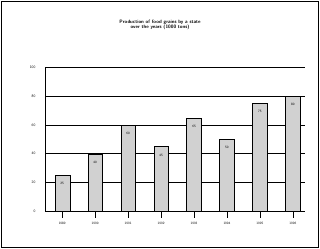
Study the given bar graph carefully and answer the following question.

<br>

What was the difference in the production of food grains between 1991 and 1994?

  1. ((a))

    5000 tons

  2. ((b))

    500 tons

  3. ((c))

    10000 tons

  4. ((d))

    15000 tons

Show Answer
Answer: ((c))

10000 tons

Given:

Production of food grains in 1991 = 60,000 tons

Production of food grains in 1994 = 50,000 tons

Formula used:

Difference = Production in 1991 - Production in 1994

Calculation:

Difference = 60,000 - 50,000

⇒ Difference = 10,000 tons

∴ The correct answer is option (3).

10

The centroid of a ΔXYZ is G. The area of ΔXYZ is 45 cm2. The area of ΔGYZ is:

  1. ((a))

    22.5 cm2

  2. ((b))

    7.5 cm2

  3. ((c))

    15 cm2

  4. ((d))

    30 cm2

Show Answer
Answer: ((c))

15 cm2

Given:

The centroid of a ΔXYZ is G.

The area of ΔXYZ is 45 cm2.

Formula used:

The centroid of a triangle divides it into three smaller triangles of equal area.

Calculation:

The centroid divides the triangle into three triangles of equal area.

⇒ Area of ΔGYZ = Area of ΔXYZ3\frac{\text{Area of } ΔXYZ}{3}

⇒ Area of ΔGYZ = 453\frac{45}{3}

⇒ Area of ΔGYZ = 15 cm2

∴ The correct answer is option (3).

11

360 toffees are distributed among Pushkal, Quadir and Rustam in the ratio 2 : 3 : 4. After distribution, Quadir gives 20% of his toffees to Pushkal and Rustam gives 25% of his toffees to Pushkal. What is the new ratio of toffees with Pushkal, Quadir and Rustam?

  1. ((a))

    5 : 4 : 6

  2. ((b))

    7 : 3 : 5

  3. ((c))

    6 : 4 : 5

  4. ((d))

    3 : 5 : 7

Show Answer
Answer: ((c))

6 : 4 : 5

Shortcut Trick

Total ratio units = 2 + 3 + 4 = 9 units → 360 toffees. So, 1 unit = 40.

Initial: Pushkal = 80, Quadir = 120, Rustam = 160.

Quadir gives 20% of 120 = 24; Rustam gives 25% of 160 = 40.

New counts: Pushkal = 80 + 24 + 40 = 144, Quadir = 120 − 24 = 96, Rustam = 160 − 40 = 120.

New Ratio = 144 : 96 : 120 = 6 : 4 : 5.

∴ The correct answer is 6 : 4 : 5.

Alternate Method

Given:

Total toffees = 360

Initial distribution ratio (Pushkal : Quadir : Rustam) = 2 : 3 : 4

Formula Used:

Individual share = (Individual ratio / Sum of ratios) × Total value

Percentage value = (Percentage / 100) × Total quantity

⇒ Sum of ratio parts = 2 + 3 + 4 = 9

Pushkal (Initial) = (2/9) × 360 = 80

Quadir (Initial) = (3/9) × 360 = 120

Rustam (Initial) = (4/9) × 360 = 160

Toffees from Quadir = 20% of 120 = 0.20 × 120 = 24

Toffees from Rustam = 25% of 160 = 0.25 × 160 = 40

⇒ New Pushkal = 80 + 24 + 40 = 144

⇒ New Quadir = 120 − 24 = 96

⇒ New Rustam = 160 − 40 = 120

⇒ New Ratio = 144 : 96 : 120

⇒ Divide all by 24 (HCF): 6 : 4 : 5

∴ The correct answer is 6 : 4 : 5.

Additional Information

Ratio Distribution Rule

To divide a quantity N into a ratio a : b : c, the parts are calculated as N × a/(a+b+c), N × b/(a+b+c), and N × c/(a+b+c).

Simplifying Ratios

A ratio a : b : c can be simplified by dividing each term by their Highest Common Factor (HCF) to reach its simplest form.

Percentage of a Quantity

x% of a value y is calculated as (x/100) × y. In transfers, this amount is subtracted from the source and added to the recipient.

12

R earns ₹55,000 per month and his annual expenditure is ₹4,50,000. What is his percentage of savings per annum?

  1. ((a))

    31.82%

  2. ((b))

    38.12%

  3. ((c))

    36.21%

  4. ((d))

    32.81%

Show Answer
Answer: ((a))

31.82%

Given:

Monthly Income (I) = ₹55,000

Annual Expenditure (E) = ₹4,50,000

Formula used:

Savings = Annual Income - Annual Expenditure

Annual Income = Monthly Income × 12

Percentage of Savings = SavingsAnnual Income×100\dfrac{\text{Savings}}{\text{Annual Income}} \times 100

Calculation:

Annual Income = ₹55,000 × 12

⇒ Annual Income = ₹6,60,000

Savings = Annual Income - Annual Expenditure

⇒ Savings = ₹6,60,000 - ₹4,50,000 = ₹2,10,000

Percentage of Savings = 2,10,0006,60,000×100\dfrac{2,10,000}{6,60,000} \times 100

⇒ Percentage of Savings = 31.82%

∴ The correct answer is option 1.

13

A car travels 80 km at the speed of 20 km/h and the next 30 km at the speed of 30 km/h. What is its average speed?

  1. ((a))

    20 km/h

  2. ((b))

    22 km/h

  3. ((c))

    40 km/h

  4. ((d))

    30 km/h

Show Answer
Answer: ((b))

22 km/h

Given:

A car travels 80 km at the speed of 20 km/h and the next 30 km at the speed of 30 km/h.

Formula used:

Average Speed = Total Distance / Total Time

Calculation:

Total Distance = 80 km + 30 km = 110 km

Time taken for first part = Distance / Speed = 80 km / 20 km/h = 4 hours

Time taken for second part = Distance / Speed = 30 km / 30 km/h = 1 hour

Total Time = 4 hours + 1 hour = 5 hours

⇒ Average Speed = Total Distance / Total Time

⇒ Average Speed = 110 km / 5 hours

⇒ Average Speed = 22 km/h

∴ The correct answer is option (2).

14

The HCF of 513, 1134 and 1215 is

  1. ((a))

    27

  2. ((b))

    19

  3. ((c))

    45

  4. ((d))

    43

Show Answer
Answer: ((a))

27

Shortcut Trick

The HCF of numbers is always a factor of the difference between any two of those numbers.

Difference between 1215 and 1134 = 81.

Difference between 1134 and 513 = 621.

The HCF must be a factor of the smallest difference, which is 81.

Among the given options, only 27 is a factor of 81 (81 ÷ 27 = 3).

Checking 27 for all numbers: 513 ÷ 27 = 19, 1134 ÷ 27 = 42, 1215 ÷ 27 = 45.

∴ The correct answer is 27.

Alternate Method

Given: Three numbers 513, 1134, and 1215.

Method: Prime Factorization Method

⇒ 513 = 3 × 3 × 3 × 19 = 33 × 19

⇒ 1134 = 2 × 3 × 3 × 3 × 3 × 7 = 2 × 34 × 7

⇒ 1215 = 3 × 3 × 3 × 3 × 3 × 5 = 35 × 5

⇒ To find the HCF, identify the common prime factors and take the lowest power of each.

⇒ The common prime factor for all three numbers is 3.

⇒ The lowest power of 3 present in all terms is 33.

⇒ HCF = 33 = 3 × 3 × 3 = 27.

∴ The correct answer is 27.

Additional Information

Highest Common Factor (HCF)

The HCF (also known as GCD) is the largest positive integer that divides each of the integers without leaving a remainder.

Relationship between HCF and LCM

For any two numbers 'a' and 'b', the product of the numbers is equal to the product of their HCF and LCM: a × b = HCF(a, b) × LCM(a, b).

Division Method for HCF

To find HCF of large numbers, divide the larger number by the smaller one and then divide the previous divisor by the remainder until the remainder becomes zero. The last divisor is the HCF.

15

A vessel is in the form of a hollow hemisphere mounted by a hollow cylinder. The diameter of the hemisphere is 28 cm, and the total height of the vessel is 20 cm. Find the inner surface area (in cm²) of the vessel.(Use π=227\pi = \frac{22}{7})

  1. ((a))

    1720

  2. ((b))

    1760

  3. ((c))

    1780

  4. ((d))

    1740

Show Answer
Answer: ((b))

1760

Given:

Radius of the hemisphere (r) = 14 cm (since r = d/2)

Total height of the vessel = 20 cm

Height of the cylinder (h) = 20 cm - 14 cm = 6 cm

Formula used:

Inner surface area of the vessel = Curved surface area of the hemisphere + Curved surface area of the cylinder

Curved surface area of hemisphere = 2πr2

Curved surface area of cylinder = 2πrh

Calculation:

Curved surface area of hemisphere = 2 × (22/7) × 14 × 14

⇒ Curved surface area of hemisphere = 1232 cm2

Curved surface area of cylinder = 2 × (22/7) × 14 × 6

⇒ Curved surface area of cylinder = 528 cm2

Inner surface area of the vessel = 1232 cm2 + 528 cm2

⇒ Inner surface area of the vessel = 1760 cm2

∴ The correct answer is option 2.

16

Reena sells an article at 12% below its cost price. Had she sold it for ₹540 more, she would have gained 15%. At what price should she sell the article to gain 20%?

  1. ((a))

    ₹2,004

  2. ((b))

    ₹2,040

  3. ((c))

    ₹2,400

  4. ((d))

    ₹4,200

Show Answer
Answer: ((c))

₹2,400

Given:

Reena sells an article at 12% below its cost price. Had she sold it for ₹540 more, she would have gained 15%.

Formula used:

Selling Price (SP) = Cost Price (CP) + Profit

Profit% = ProfitCP×100\dfrac{Profit}{CP} \times 100

Calculations:

Let CP = x

SP at 12% loss = x - 0.12x = 0.88x

SP at 15% profit = x + 0.15x = 1.15x

Given, 1.15x = 0.88x + 540

⇒ 0.27x = 540

⇒ x = 2000

To gain 20%, SP should be: 2000 + 0.20 × 2000

⇒ SP = 2000 + 400 = 2400

∴ The correct answer is option (3).

17

The mean of marks secured by 3 students in grade A of class XI is 83, that of 4 students of grade B is 76 and that of 5 students of grade C is 85. What will be the mean of marks of the students of three grades of Class XI?

  1. ((a))

    80.5

  2. ((b))

    81

  3. ((c))

    80

  4. ((d))

    81.5

Show Answer
Answer: ((d))

81.5

Shortcut Trick

Use the Weighted Average formula to find the overall mean directly.

Total Weighted Sum = (3 × 83) + (4 × 76) + (5 × 85) = 249 + 304 + 425 = 978

Total Number of Students = 3 + 4 + 5 = 12

Overall Mean = 978 ÷ 12 = 81.5

∴ The correct answer is 81.5 marks.

Alternate Method

Given:

Grade A: Number of students (n1) = 3, Mean (x1) = 83

Grade B: Number of students (n2) = 4, Mean (x2) = 76

Grade C: Number of students (n3) = 5, Mean (x3) = 85

Formula Used:

Overall Mean = (Total Sum of Marks) ÷ (Total Number of Students)

Calculations:

⇒ Total marks for Grade A = 3 × 83 = 249

⇒ Total marks for Grade B = 4 × 76 = 304

⇒ Total marks for Grade C = 5 × 85 = 425

⇒ Total sum of marks = 249 + 304 + 425 = 978

⇒ Total students = 3 + 4 + 5 = 12

⇒ Combined Mean = 978 ÷ 12

⇒ Combined Mean = 81.5

∴ The correct answer is 81.5 marks.

Additional Information

Combined Mean Formula

For n groups, the combined mean is x̄combined = (n11 + n22 + ... + nnn) ÷ (n1 + n2 + ... + nn).

Arithmetic Mean Relation

The Sum of all observations is always equal to the Mean multiplied by the Number of observations (Sum = Mean × N).

Property of Deviations

The algebraic sum of deviations of a set of observations from their arithmetic mean is always zero.

18

There are 40 students in a class. Their average weight is 60 kg. Two students left the class. Then the average weight is reduced by 500 g. Find the weight of the two students who left the class (in kg).

  1. ((a))

    140

  2. ((b))

    130

  3. ((c))

    129

  4. ((d))

    139

Show Answer
Answer: ((d))

139

Given:

Number of students (N) = 40

Average weight (A) = 60 kg

Reduction in average weight = 500 g = 0.5 kg

Formula used:

Total weight of students before any student left = N × A

Total weight of students after two students left = (N-2) × (A - 0.5)

Calculations:

Total weight before students left = 40 × 60 = 2400 kg

New average weight after two students left = 60 - 0.5 = 59.5 kg

Total weight after students left = (40 - 2) × 59.5 = 38 × 59.5 = 2261 kg

Weight of the two students who left = Total weight before - Total weight after

⇒ Weight of the two students who left = 2400 - 2261 = 139 kg

∴ The correct answer is option (4).

19

Ekta invested some amount at a rate 9% per annum and earns a S.I. of ₹810 after 3 years. If the rate of interest is increased by 3%, then how much more interest (in ₹) would have Ekta earned on the same amount in the same time period?

  1. ((a))

    240

  2. ((b))

    405

  3. ((c))

    270

  4. ((d))

    540

Show Answer
Answer: ((c))

270

Given:

Simple Interest (SI) = ₹810

Rate (r) = 9% per annum

Time (t) = 3 years

Formula used:

SI = P×r×t100\dfrac{P \times r \times t}{100}

Calculations:

810 = P×9×3100\dfrac{P \times 9 \times 3}{100}

⇒ P = 810×10027\dfrac{810 \times 100}{27}

⇒ P = ₹3000

New Rate (rnew) = 9% + 3% = 12%

New Interest (SInew) = P×rnew×t100\dfrac{P \times r_{new} \times t}{100}

SInew = 3000×12×3100\dfrac{3000 \times 12 \times 3}{100}

⇒ SInew = ₹1080

Difference in Interest = SInew - SI

Difference = ₹1080 - ₹810 = ₹270

∴ The correct answer is option (3).

20

The table below shows the number of students enrolled in four colleges over the four years.

YearPQRS
2019520578298416
2020625603365254
2021715476548325
2022539235258842

What is the average number of students studying per year in college Q over the given years?

  1. ((a))

    455

  2. ((b))

    473

  3. ((c))

    505

  4. ((d))

    548

Show Answer
Answer: ((b))

473

Given:

The table shows the number of students enrolled in four colleges over the four years.

Formula used:

Average number of students per year = (Sum of students over the years) / (Number of years)

Calculation:

Sum of students in college Q over the years = 578 + 603 + 476 + 235

⇒ Sum = 578 + 603 + 476 + 235

⇒ Sum = 1892

Number of years = 4

⇒ Average number of students = 1892 / 4

⇒ Average number of students = 473

∴ The correct answer is option (2).

21

In a certain code language, 'COPY' is coded as '2846' and 'APES' is coded as '7321'. What is the code for 'P' in that language?

  1. ((a))

    3

  2. ((b))

    4

  3. ((c))

    1

  4. ((d))

    2

Show Answer
Answer: ((d))

2

Logic followed here is,

Logic : P is common in both word and 2 is common in both code.

So code for P is 2.

Hence the correct answer is "Option 2"

22

What should come in place of the question (?) in the following series?

4, -27, -58, -89, -120, ?

  1. ((a))

    151

  2. ((b))

    -131

  3. ((c))

    -151

  4. ((d))

    -141

Show Answer
Answer: ((c))

-151

Logic followed here is 

Logic: Next number is decreased by 31.

Hence the correct answer is "Option 3"

23

Which two signs should be interchanged to make the following equation mathematically correct?

15 × 14 − 8 + 12 ÷ 4 = 5

  1. ((a))

    × and +

  2. ((b))

     ÷ and -

  3. ((c))

    × and -

  4. ((d))

    ÷ and +

Show Answer
Answer: ((a))

× and +

Given:

Equation: 15 × 14 - 8 + 12 ÷ 4 = 5

Formula used:

Calculation:

Original equation: 15 × 14 - 8 + 12 ÷ 4 = 5

Let's test each option:

1) × and +

Equation After signs interchanged :

15 + 14 - 8 × 12 ÷ 4 = 5

⇒ 15 + 14 - 8 × 4

⇒15 + 14 - 24

⇒ 29 - 24 = 5

This option is correct.

    • and -

Equation after signs interchanged:

15 × 14 + 8 - 12 ÷ 4 = 5

⇒ 210 + 8 - 3 = 215 ≠ 5

This option is incorrect.

  1. × and -

Equation after signs interchanged:

15 - 14 + 8 + 12 ÷ 4 = 5

⇒ 15 - 14 + 8 + 3 = 12 ≠ 5

This option is incorrect.

  1. ÷ and +

Equation after signs interchanged: 

15 × 14 - 8 ÷ 12 + 4 = 5

⇒ 210 - 2/3 + 4  ≠ 5

This option is incorrect.

∴ The correct answer is option 1) × and +.

24

Select the correct mirror image of the given figure when the mirror is placed at MN as shown below.

  1. ((a))

  2. ((b))

  3. ((c))

  4. ((d))

Show Answer
Answer: ((a))

Correct mirror image is,

Hence the correct answer is "Option 1"

25

Select the figure from the options that can replace the question mark (?) and logically complete the series.

  1. ((a))

  2. ((b))

  3. ((c))

  4. ((d))

Show Answer
Answer: ((b))

Logic follow here is,

Logic: figure is rotate in anticlockwise direction with 90° and arow and circle change its colour from white to black respectively.

Hence the correct answer is "Option 2"

26

Select the figure from among the given options that can replace the question mark (?) in the following series and complete the pattern.

  1. ((a))

  2. ((b))

  3. ((c))

  4. ((d))

Show Answer
Answer: ((b))

Logic followed here is,

Logic: Pattern are same from 1st figure to 2nd figure and from 3rd to 4th.

Similarly, Pattern are same from 2nd figure to 3rd figure and from 4th to 5th figure. 

Hence the correct answer is "Option 2"

27

Select the figure from the given options that will replace the question mark (?) in the figure given below to complete the pattern.

  1. ((a))

  2. ((b))

  3. ((c))

  4. ((d))

Show Answer
Answer: ((c))

Logic follow here is 

Logic: White and Black reversed upside down, and the second image is mirror image of the first image.

For first figure

Similarly for second image:

Hence the correct answer is "Option 3"

28

MHPL is related to OJRN in a certain way based on the English alphabetical order. In the same way, PKSO is related to RMUQ. To which of the following is SNVR related following the same logic?

  1. ((a))

    PUTX

  2. ((b))

    UPXT

  3. ((c))

    PUXT

  4. ((d))

    UPTX

Show Answer
Answer: ((b))

UPXT

Logic followed here is

Logic: Every letter is increased by 2 .

For - MHPL : OJRN

For - PKSO : RMUQ

Similarly for, SNVR : UPXT

Hence the correct answer is "Option 2"

29

What should come in place of the question mark (?) in the given series based on the English alphabetical order?

SXG, QVI, OTK, MRM, ?

  1. ((a))

    LPP

  2. ((b))

    KPO

  3. ((c))

    KPP

  4. ((d))

    LPO

Show Answer
Answer: ((b))

KPO

Logic follow here is,

Next letter is KPO

Hence the correct answer is "Option 2"

30

Read the given statements and conclusions carefully. Assuming that the information given in the statements is true, even if it appears to be at variance with commonly known facts, decide which of the given conclusions logically follow(s) from the statements.

Statements:

All leaves are trees.

Some trees are plants.

Conclusions:

(i) Some leaves are plants.

(ii) All leaves are trees.

  1. ((a))

    Only conclusion II follows

  2. ((b))

    Both conclusions I and II follow

  3. ((c))

    Only conclusion I follows

  4. ((d))

    Neither conclusion I nor II follows

Show Answer
Answer: ((a))

Only conclusion II follows

Statements:

All leaves are trees.

Some trees are plants..

The least possible Venn diagram for the given statements is as shown below :

Conclusions:

(i) Some leaves are plants.. → Not Follow (There is no direct relation between leaves and plants.)

(ii) All leaves are trees.. → Follow (As all leaves are trees are given in the statement.)

∴ Here, Only conclusion II follows

Hence, "Option 1" is the correct answer.

31

"NQRP" is related to "TWXV" in a certain way based on the English alphabetical order. In the same way, "FHIG" is related to "LNOM." To which of the following is "LOPN" related following the same logic?

  1. ((a))

    QTUS

  2. ((b))

    RUVT

  3. ((c))

    QSTR

  4. ((d))

    RSQT

Show Answer
Answer: ((b))

RUVT

Logic follow here is,

For "NQRP" is related to "TWXV" 

 "FHIG" is related to "LNOM."

Similarly for "LOPN" - RUVT

Hence the correct answer is **"Option 2"**​

32

In a certain code language, 'MASTER' is coded as '917032', and 'STREAK' is coded as '371259'. What is the code for 'K' in 'STREAK'?

  1. ((a))

    7

  2. ((b))

    5

  3. ((c))

    3

  4. ((d))

    9

Show Answer
Answer: ((b))

5

Logic followed here is 

Logic: ASTER is common in both the word and 9 1 7 3 2 is common in both the code 

In STREAK, K is not common and 5 is not common in the code

So, code for K is 5

Hence the correct answer is "Option 2."

33

L, M, N, O, P, Q and R are sitting around a circular table, facing the centre (but not necessarily in the same order). Only three people are sitting between R and O when counted from the left of R. Only M is sitting between L and N. N is an immediate neighbour of O. P is sitting third to the right of L.

<br>

Who is sitting second to the left of O?

  1. ((a))

    Q

  2. ((b))

    L

  3. ((c))

    R

  4. ((d))

    P

Show Answer
Answer: ((a))

Q

Given, L, M, N, O, P, Q and R are sitting around a circular table, facing the centre (but not necessarily in the same order).

Only three people are sitting between R and O when counted from the left of R.

Only M is sitting between L and N.

N is an immediate neighbour of O.

P is sitting third to the right of L.

And Q sit at remaining place. 

Possible seating arrangement is,

Q is sitting second to the left of O

Hence the correct answer is "Option 1"

34

What will come in the place of '?' in the following equation, if '+' and '÷' are interchanged and 'x' and '-' are interchanged?

48 x 16 - 20 ÷ 21 + 7 = ?

  1. ((a))

    259

  2. ((b))

    269

  3. ((c))

    -269

  4. ((d))

    -259

Show Answer
Answer: ((c))

-269

Formula used:

Calculation:

Given equation:

48 × 16 - 20 ÷ 21 + 7 = ?

Interchange: + and ÷, × and -

After interchanging the operators, the equation becomes:

48 - 16 × 20 + 21 ÷ 7 

⇒ 48 - 320 + 3 = -269.

Hence the correct answer is Option 3.

35

16 is related to 176 following a certain logic. Following the same logic, 21 is related to 231. To which of the following is 33 related, following the same logic?

<br>

(NOTE: Operations should be performed on the whole numbers, without breaking down the numbers into its constituent digits. E.g. 13 - Operations on 13 such as adding / subtracting / multiplying, etc., to 13 can be performed. Breaking down 13 into 1 and 3 and then performing mathematical operations on 1 and 3 is not allowed.)

  1. ((a))

    363

  2. ((b))

    361

  3. ((c))

    364

  4. ((d))

    362

Show Answer
Answer: ((a))

363

Logic followed here is, 

First number × 11 = Second number

For, 16 is related to 176

16 × 11 = 176 

And  21 is related to 231

21 × 11 = 231

similarly for, 33

33 × 11 = 363

Hence the correct answer is "Option 1"

36

Read the given statements and conclusions carefully. Assuming that the information given in the statements is true, even if it appears to be at variance with commonly known facts, decide which of the given conclusions logically follow(s) from the statements.

Statements:

All pencils are remotes.

Some pencils are ACs.

Conclusions:

[1] Some ACs are remotes.

[2] All remotes are ACs.

  1. ((a))

    Only conclusion [1] follows

  2. ((b))

    Neither conclusion [1] nor [2] follows

  3. ((c))

    Both conclusions [1] and [2] follow

  4. ((d))

    Only conclusion [2] follows

Show Answer
Answer: ((a))

Only conclusion [1] follows

Statements:

All pencils are remotes.

Some pencils are ACs.

The least possible Venn diagram for the given statements is as shown below :

Conclusions:

[1] Some ACs are remotes. → Follow (As All pencils are remotes and some pencils are ACs then some ACs are remotes is possible as you can see from venn diagram.)

[2] All remotes are ACs. → Not Follow (Not possible because there is no direct link between remotes and ACs.)

∴ Here, Only conclusion I follows

Hence, "Option 1" is the correct answer.

37

In a certain code language, if HOUSE is coded as 67 and GROUND is coded as 83, then how will KITCHEN be coded?

  1. ((a))

    119

  2. ((b))

    110

  3. ((c))

    130

  4. ((d))

    122

Show Answer
Answer: ((a))

119

Logic followed here is,

HOUSE is coded as 67

GROUND is coded as 83

Similarly for  KITCHEN

Hence the correct answer is "Option 1"

38

Select the option in which the numbers share the same relationship as that shared by the given pair of numbers.

48 : 42

  1. ((a))

    63 : 28

  2. ((b))

    65 : 28

  3. ((c))

    80 : 32

  4. ((d))

    48 : 24

Show Answer
Answer: ((a))

63 : 28

Logic followed here is, 

Logic: (First digit × Second digit) + 10 = Second number

For, 48 : 42

4 × 8 + 10 = 32 + 10 = 42(Second number.)

Check each option.

Option 1: 63 : 28

(6 × 3) + 10 = 18 + 10 = 28

⇒ This option matches the logic.

Option 2: 65 : 28

(6 × 5) + 10 = 30 + 10 = 40

⇒ 40 ≠ 28, so this option is incorrect.

Option 3: 80 : 32

(8 × 0) + 10 = 0 + 10 = 10

⇒ 10 ≠ 32, so this option is incorrect.

Option 4: 48 : 24

(4 × 8) + 10 = 32 + 10 = 42

⇒ 42 ≠ 24, so this option is incorrect.

∴ The correct answer is option 1: 63 : 28.

39

A, B, C, L, M, Y and X are sitting around a circular table facing the centre (but not necessarily in the same order). Only two people sit between B and L when counted from the right of L. X sits to the immediate left of Y. A sits to the immediate right of M. Y is an immediate neighbour of L.

Who sits fourth to the right of C?

  1. ((a))

    L

  2. ((b))

    M

  3. ((c))

    A

  4. ((d))

    X

Show Answer
Answer: ((b))

M

Given, A, B, C, L, M, Y and X are sitting around a circular table facing the centre (but not necessarily in the same order).

Only two people sit between B and L when counted from the right of L.

Y is an immediate neighbour of L.

X sits to the immediate left of Y.

A sits to the immediate right of M.

And C sits at the remaining place.

From diagram, M sits fourth to the right of C.

Hence the correct answer is "Option 2"

40

In a certain code language, ‘he may eat rice’ is written as ‘ki mi ji li’ and ‘she will like rice’ is written as ‘ni qi mi pi’. How is ‘rice’ written in the given language?

  1. ((a))

    qi

  2. ((b))

    ni

  3. ((c))

    ji

  4. ((d))

    mi

Show Answer
Answer: ((d))

mi

Logic followed here is,

Logic : rice is common in both the language, and mi is common in both the code.

Hence the correct answer is "Option 4"

Session 2 (50 questions)

41

Two masses of 1 kg and 2 kg were dropped from a height of 3.2 metres. Their respective velocities just before touching the ground will be:

(Assume acceleration due to gravity g = 10 m/s2)

  1. ((a))

    8 m/s and 4 m/s

  2. ((b))

    3.2 m/s for both

  3. ((c))

    4 m/s and 8 m/s

  4. ((d))

    8 m/s for both

Show Answer
Answer: ((d))

8 m/s for both

The correct answer is 8 m/s for both.

Key Points

  • The velocities of objects falling freely under gravity are independent of their masses.
  • Both the 1 kg and 2 kg masses will experience the same acceleration due to gravity (g = 10 m/s²).
  • The velocity just before touching the ground is determined by the equation v=2ghv = \sqrt{2gh}, where g is the acceleration due to gravity and h is the height from which the object is dropped.
  • Using the formula v=2×10×3.2=64=8,m/sv = \sqrt{2 \times 10 \times 3.2} = \sqrt{64} = 8 , \text{m/s}, both masses will have the same velocity just before hitting the ground.

Additional Information

  • Acceleration due to Gravity:
  • Gravity is a fundamental force that attracts objects towards the center of the Earth.
  • The value of acceleration due to gravity near Earth's surface is approximately 9.8 m/s² but is commonly approximated as 10 m/s² for simplicity in calculations.
  • The value of gravity can vary depending on location, altitude, and Earth's irregular shape.
  • Free Fall:
  • When an object is dropped, and the only force acting on it is gravity, it is said to be in free fall.
  • Objects in free fall accelerate at a constant rate due to gravity, regardless of their mass.
  • Formula for Velocity in Free Fall:
  • The velocity of an object just before hitting the ground can be found using the formula v=2ghv = \sqrt{2gh}, where g is the gravitational acceleration and h is the height.
  • This equation assumes there is no air resistance.
  • Mass and Gravity:
  • In the absence of air resistance, all objects fall at the same rate regardless of their mass. This was famously demonstrated by Galileo.
42

The igneous, sedimentary and metamorphic rocks are interconvertible through a continuous process called:

  1. ((a))

    lithification

  2. ((b))

    metamorphism

  3. ((c))

    rock cycle

  4. ((d))

    weathering and erosion

Show Answer
Answer: ((c))

rock cycle

The correct answer is rock cycle.

Key Points

  • The rock cycle is a continuous process through which rocks are transformed from one type to another over geological time scales.
  • It involves the formation, breakdown, and reformation of rocks due to various geological processes.
  • Igneous rocks can be broken down into sediments that form sedimentary rocks, which can then be subjected to heat and pressure to become metamorphic rocks.
  • Metamorphic rocks can melt to form magma, which cools to become igneous rocks, thus completing the cycle.
  • The rock cycle is driven by Earth's internal heat, plate tectonics, and surface processes like weathering and erosion.

Additional Information

  • Igneous Rocks
  • Formed from the cooling and solidification of magma or lava.
  • Examples include granite (intrusive) and basalt (extrusive).
  • Sedimentary Rocks
  • Formed from the accumulation and lithification of sediments.
  • Examples include sandstone, limestone, and shale.
  • Metamorphic Rocks
  • Formed from the alteration of existing rocks due to high heat, pressure, or chemically active fluids.
  • Examples include marble (from limestone) and schist (from shale).
  • Weathering and Erosion
  • Weathering is the breakdown of rocks at Earth's surface due to atmospheric conditions.
  • Erosion involves the removal and transportation of weathered material by natural agents like water, wind, and ice.
43

'Sange Meel Se Mulaqat' is the documentary of which famous musician?

  1. ((a))

    Zakir Hussain

  2. ((b))

    Bismillah Khan

  3. ((c))

    Hari Prasad Chaurasia

  4. ((d))

    MS Gopalakrishnan

Show Answer
Answer: ((b))

Bismillah Khan

The correct answer is Bismillah Khan.

Key Points

  • Bismillah Khan was a renowned Indian musician credited with popularizing the shehnai, a traditional Indian wind instrument.
  • The documentary 'Sange Meel Se Mulaqat' focuses on the life and musical journey of Bismillah Khan.
  • Bismillah Khan received India's highest civilian honors, including the Bharat Ratna in 2001.
  • He performed at the Red Fort on India's first Independence Day in 1947, marking the beginning of a tradition.
  • Bismillah Khan's contribution to Indian classical music is celebrated globally, and he is remembered as a cultural icon.

Additional Information

  • Shehnai
  • The shehnai is a double-reed instrument traditional to India, often used in auspicious occasions and classical music.
  • It is similar to the oboe and is known for its rich and soulful sound.
  • Bismillah Khan is credited with elevating the shehnai from a folk instrument to one of classical status.
  • Bharat Ratna
  • It is the highest civilian award in India, instituted in 1954.
  • The award recognizes exceptional service towards the advancement of art, literature, and science, and in recognition of public service of the highest order.
  • Indian Classical Music
  • It is divided into two major traditions: Hindustani (North Indian) and Carnatic (South Indian) music.
  • Indian classical music is characterized by its raga (melodic framework) and tala (rhythmic patterns).
  • Prominent instruments include the sitar, tabla, and shehnai.
  • Independence Day Performance
  • Bismillah Khan's performance at the Red Fort on August 15, 1947, is a historic moment in Indian history.
  • His shehnai rendition signified the dawn of India's independence from British rule.
44

Who among the following adopted the policy of consolidation in place of expansion by eliminating the rebels?

  1. ((a))

    Shamsuddin Iltutmish

  2. ((b))

    Raziya

  3. ((c))

    Nasiruddin Mahmud

  4. ((d))

    Ghiyasuddin Balban

Show Answer
Answer: ((d))

Ghiyasuddin Balban

The correct answer is Ghiyasuddin Balban.

Key Points

  • Ghiyasuddin Balban was the Sultan of Delhi from 1266 to 1287.
  • He adopted a policy of consolidation by eliminating the rebels and maintaining strict control over his territories.
  • Balban is known for his strong centralized administration and efforts to strengthen the Sultanate against internal and external threats.
  • He implemented a policy of "blood and iron" to suppress revolts and rebellions, ensuring the stability and security of his rule.

Additional Information

  • Shamsuddin Iltutmish
  • Iltutmish was the third Sultan of Delhi and a prominent ruler of the Mamluk dynasty.
  • He is known for consolidating the Delhi Sultanate and introducing important administrative reforms.
  • Iltutmish completed the construction of the Qutub Minar in Delhi.
  • He introduced the silver tanka and the copper jital, standardizing the monetary system of the Sultanate.
  • Raziya
  • Raziya, also known as Razia Sultan, was the first and only female ruler of the Delhi Sultanate.
  • She ruled from 1236 to 1240 and was known for her administrative skills and efforts to promote gender equality.
  • Raziya faced significant opposition from the nobility and was eventually overthrown.
  • Nasiruddin Mahmud
  • Nasiruddin Mahmud was the Sultan of Delhi from 1246 to 1266.
  • He was a nominal ruler, with real power being held by his deputy, Ghiyasuddin Balban.
  • Mahmud's reign is noted for the consolidation of the Sultanate's administration and military.
  • Ghiyasuddin Balban's Policies
  • Balban emphasized a strong and centralized administration to ensure the Sultanate's stability.
  • He implemented a strict policy of law and order, using harsh measures to suppress rebellions and maintain control.
  • Balban's reign marked the beginning of the consolidation of the Sultanate, setting the stage for future rulers.
45

'The Namesake', 'Unaccustomed Earth' and 'The Lowland' are novels written by who among the following authors?

  1. ((a))

    Arundhati Roy

  2. ((b))

    Jhumpa Lahiri

  3. ((c))

    Aravind Adiga

  4. ((d))

    Shobha De

Show Answer
Answer: ((b))

Jhumpa Lahiri

The correct answer is Jhumpa Lahiri.

Key Points

  • Jhumpa Lahiri is a renowned American author known for her works exploring the Indian immigrant experience in the United States.
  • Her debut short story collection, "Interpreter of Maladies", won the Pulitzer Prize for Fiction in 2000.
  • "The Namesake" (2003) is a novel by Lahiri that was also adapted into a successful film directed by Mira Nair.
  • "Unaccustomed Earth" (2008) is a collection of short stories that debuted at number one on The New York Times bestseller list.
  • "The Lowland" (2013) was shortlisted for the Man Booker Prize and the National Book Award for Fiction.

Additional Information

  • Interpreter of Maladies:
  • This is a collection of nine short stories by Jhumpa Lahiri, published in 1999.
  • The collection deals with the lives of Indians and Indian Americans who are caught between their roots and the "New World."
  • It won the Pulitzer Prize for Fiction and the Hemingway Foundation/PEN Award in 2000.
  • The Namesake:
  • The novel explores themes of identity, cultural assimilation, and the generational gap within immigrant families.
  • It tells the story of Gogol Ganguli, an American-born son of Indian immigrants, and his struggle with his identity.
  • Unaccustomed Earth:
  • A collection of eight stories that focus on the Bengali American community.
  • The book explores themes of family, migration, and the diasporic experience.
  • It received critical acclaim and was named one of the top ten books of the year by The New York Times Book Review.
  • The Lowland:
  • The novel is set in both India and the United States, and deals with themes of political unrest and personal loss.
  • The story revolves around two brothers, one who gets involved in the Naxalite movement in India and the other who moves to the US for higher studies.
  • It was shortlisted for the Man Booker Prize in 2013.
46

Which of the following types of emergencies is declared under Article 360 of the Indian Constitution?

  1. ((a))

    State Emergency

  2. ((b))

    Financial Emergency

  3. ((c))

    National Emergency

  4. ((d))

    Constitutional Emergency

Show Answer
Answer: ((b))

Financial Emergency

The correct answer is Financial Emergency.

Key Points

  • Article 360 of the Indian Constitution empowers the President of India to declare a Financial Emergency if they are satisfied that the financial stability or credit of India or any part of its territory is threatened.
  • During a Financial Emergency, the executive authority of the Union extends to giving directions to any State to observe certain canons of financial propriety or such other directions as deemed necessary.
  • Article 360 allows the President to reduce the salaries and allowances of all or any class of persons serving in the State and the Union.
  • Under the Financial Emergency, the President can also reserve all money bills or other financial bills for their consideration after they are passed by the legislature of the State.
  • No Financial Emergency has been declared in India so far.

Additional Information

  • National Emergency (Article 352)
  • Declared on grounds of war, external aggression, or armed rebellion.
  • It results in a modification of the federal structure of India, leading to a centralization of power.
  • During National Emergency, fundamental rights under Article 19 are automatically suspended, and other rights can also be suspended by a presidential order.
  • State Emergency (Article 356)
  • Also known as President's Rule, it can be proclaimed on the failure of constitutional machinery in a state.
  • During President's Rule, the state legislature is either dissolved or suspended, and the state comes under the direct control of the central government.
  • The Governor administers the state in the name of the President.
  • Constitutional Emergency
  • It is another term used for State Emergency under Article 356.
  • It occurs when a state government is unable to function according to the constitutional provisions.
  • This provision has been used numerous times since independence.
  • Parliamentary Approval
  • A Financial Emergency must be approved by both houses of Parliament within two months of its declaration.
  • If approved, it remains in force indefinitely until it is revoked by the President.
  • The resolution approving the Financial Emergency needs to be passed by a simple majority.
47

When is the National Unity Day celebrated in India?

  1. ((a))

    26 January

  2. ((b))

    31 October

  3. ((c))

    2 October

  4. ((d))

    14 November

Show Answer
Answer: ((b))

31 October

The correct answer is Fri Oct 31 2025 00:00:00 GMT+0530 (India Standard Time).

Key Points

  • National Unity Day, also known as Rashtriya Ekta Diwas, is celebrated in India on October 31 every year.
  • This day commemorates the birth anniversary of Sardar Vallabhbhai Patel, who played a key role in the unification of India.
  • It was introduced by the Government of India in 2014 to honor Sardar Patel's contributions to national integration.
  • Various events such as the "Run for Unity" are organized across the country to mark this occasion.
  • The day emphasizes the importance of maintaining the country's unity and integrity.

Additional Information

  • Sardar Vallabhbhai Patel
  • Also known as the "Iron Man of India".
  • First Deputy Prime Minister and Home Minister of independent India.
  • Played a crucial role in the integration of over 500 princely states into the Indian Union.
  • His efforts and strategies were pivotal in maintaining the nation's unity post-independence.
  • Statue of Unity
  • Located in the state of Gujarat, India.
  • It is the world's tallest statue, standing at a height of 182 meters (597 feet).
  • Dedicated to Sardar Vallabhbhai Patel and inaugurated on October 31, 2018.
  • Symbolizes Patel's vision of a united India.
  • Run for Unity
  • An annual event organized on National Unity Day.
  • Aims to promote national integration and communal harmony.
  • Participants from various walks of life join to reinforce the message of unity.
  • National Unity Day Pledge
  • People take a pledge to preserve the unity, integrity, and security of the nation.
  • Emphasizes the importance of working towards a stronger and more unified India.
  • Often recited in schools, colleges, and government offices on this day.
48

Which material was largely used to build the stupa at Piprahwa in uttar pradesh ?

  1. ((a))

    Bricks

  2. ((b))

    Marble

  3. ((c))

    Sandstone

  4. ((d))

    Granite Stone

Show Answer
Answer: ((a))

Bricks

The correct answer is Bricks.

Key Points

  • The stupa at Piprahwa in Uttar Pradesh is one of the earliest Buddhist stupas in India.
  • It was constructed using bricks, which was a common building material in ancient Indian architecture.
  • The stupa is believed to date back to the time of Emperor Ashoka, around the 3rd century BCE.
  • Excavations at the site have revealed a significant number of relics associated with the Buddha, suggesting the stupa's religious importance.
  • The use of bricks in the construction provided durability and a method to easily create the dome-like structure typical of stupas.

Additional Information

  • Stupa Architecture:
  • A stupa is a mound-like or hemispherical structure containing relics and used as a place of meditation.
  • The structure typically includes a dome (anda), a base (medhi), and a railing (vedika).
  • Some stupas, like the Great Stupa at Sanchi, are decorated with intricate carvings and sculptures.
  • Emperor Ashoka:
  • Ashoka was an Indian emperor of the Maurya Dynasty who ruled almost all of the Indian subcontinent from c. 268 to 232 BCE.
  • He is remembered for his role in spreading Buddhism across Asia and his efforts to propagate Buddhist values through edicts and monuments.
  • Archaeological Excavations:
  • Excavations at Piprahwa have unearthed a variety of significant artifacts, including reliquaries and ancient inscriptions.
  • These findings have provided valuable insights into early Buddhist practices and the spread of Buddhism in India.
  • Brick Construction:
  • Bricks have been used in construction since ancient times, offering advantages such as uniformity, strength, and durability.
  • In ancient India, bricks were typically made from local clay and baked in kilns to ensure longevity.
49

How many components are there in the New India Literacy Program (NILP) scheme launched by the Union Ministry of Education in March 2023?

  1. ((a))

    Seven

  2. ((b))

    Three

  3. ((c))

    Nine

  4. ((d))

    Five

Show Answer
Answer: ((d))

Five

The correct answer is Five.

Key Points

  • The New India Literacy Program (NILP) scheme was launched by the Union Ministry of Education in March 2023.
  • The NILP scheme aims to achieve universal literacy by focusing on both basic literacy and numeracy.
  • There are five components in the NILP scheme.
  • The program targets all non-literates aged 15 years and above in the country.
  • The scheme is aligned with the National Education Policy (NEP) 2020, which emphasizes adult education and lifelong learning.

Additional Information

  • National Education Policy (NEP) 2020
  • NEP 2020 is a comprehensive framework to guide the development of education in India.It aims to transform the Indian education system by 2040.
  • The policy emphasizes equity, inclusion, and quality education for all.
  • It includes provisions for early childhood care and education, reforms in school and higher education, and vocational education.
  • Adult Education
  • Adult education refers to the practice of teaching and educating adults.
  • It aims to improve literacy, numeracy, and essential life skills among adults.
  • Adult education programs are crucial for achieving sustainable development goals.
  • They help in enhancing employment opportunities and overall socio-economic development.
  • Basic Literacy and Numeracy
  • Basic literacy refers to the ability to read and write simple texts.
  • Numeracy involves basic mathematical skills, such as addition, subtraction, multiplication, and division.
  • Both are essential for personal and professional development.
  • Improving literacy and numeracy rates is a priority for many educational programs worldwide.
  • Lifelong Learning
  • Lifelong learning is the continuous pursuit of knowledge for personal or professional reasons.
  • It enhances social inclusion, active citizenship, and personal development.
  • Lifelong learning can be formal, non-formal, or informal.
  • It is a key component of the NEP 2020 and the NILP scheme.
50

In June 2023, which country conferred the 'Order of the Nile' award on Narendra Modi?

  1. ((a))

    Lebanon

  2. ((b))

    Turkey

  3. ((c))

    Egypt

  4. ((d))

    Singapore

Show Answer
Answer: ((c))

Egypt

The correct answer is Egypt.

Key Points

  • In June 2023, Egypt conferred the 'Order of the Nile' award on Indian Prime Minister Narendra Modi.
  • The 'Order of the Nile' is the highest state honor awarded by the government of Egypt.
  • This award was given to Narendra Modi in recognition of his efforts to strengthen the bilateral relationship between India and Egypt.
  • The award ceremony took place during Modi's visit to Egypt, where he engaged in various diplomatic and strategic discussions.

Additional Information

  • Order of the Nile
  • The Order of the Nile is Egypt's highest state honor, established in 1915.
  • It is awarded to both Egyptian and foreign nationals for outstanding services and contributions.
  • The order consists of a collar, a star, and a sash worn with an insignia.
  • Prominent recipients include heads of state, prime ministers, and other distinguished personalities.
  • India-Egypt Relations
  • India and Egypt share a rich history of strong bilateral ties, dating back to ancient civilizations.
  • Both countries collaborate in various fields such as defense, trade, and cultural exchange.
  • Recent engagements have focused on enhancing strategic partnerships and economic cooperation.
  • Diplomatic Awards
  • Diplomatic awards are honors given by a country to foreign nationals to recognize their contribution to bilateral relations.
  • These awards can be in the form of medals, orders, or decorations.
  • Such awards strengthen diplomatic ties and acknowledge mutual respect and cooperation.
  • State Visits
  • State visits are formal visits by a head of state to another country, typically involving high-level diplomatic meetings.
  • These visits often result in the signing of agreements and the announcement of joint initiatives.
  • State visits are significant for fostering international relations and cooperation.
51

According to National Multidimensional Poverty Index 2023 (A Progress Review), what was the proportion of population in multidimensional poverty (Headcount Ratio) in urban India in 2019-2021?

  1. ((a))

    2.12%

  2. ((b))

    11.32%

  3. ((c))

    5.27%

  4. ((d))

    6.96%

Show Answer
Answer: ((c))

5.27%

The correct answer is 0.0527.

Key Points

  • The National Multidimensional Poverty Index (MPI) measures multiple deprivations at the household level across health, education, and standard of living dimensions.
  • The proportion of the population in multidimensional poverty in urban India for the period 2019-2021 was 0.0527, as per the National MPI 2023 report.
  • The MPI uses data from the National Family Health Survey (NFHS) to compute the multidimensional poverty index.
  • The MPI not only reflects the incidence of poverty but also its intensity, offering a more comprehensive understanding of poverty.
  • The 2023 report shows progress in urban poverty reduction efforts, reflecting improvements in living standards, education, and health.

Additional Information

  • National Family Health Survey (NFHS)
  • It is a large-scale, multi-round survey conducted in a representative sample of households throughout India.
  • The survey provides essential data on health, nutrition, family welfare, and related issues.
  • NFHS-5, conducted in 2019-2021, provided the data used for the National MPI 2023.
  • Multidimensional Poverty Index (MPI)
  • Developed by the Oxford Poverty and Human Development Initiative (OPHI) and the United Nations Development Programme (UNDP).
  • It measures acute poverty by considering multiple deprivations across health, education, and living standards.
  • The MPI identifies both the share of people who are multidimensionally poor and the average number of deprivations each poor person experiences.
  • Urban Poverty
  • Refers to poverty in urban areas, characterized by lack of access to adequate housing, sanitation, clean water, and other essential services.
  • Urban poverty is often exacerbated by rapid urbanization, leading to the growth of slums and informal settlements.
  • Policies aimed at reducing urban poverty focus on improving infrastructure, access to education, health services, and employment opportunities.
  • Policy Implications
  • The MPI provides a framework for policymakers to design targeted interventions to address multiple dimensions of poverty.
  • It helps in monitoring the effectiveness of poverty reduction programs and policies over time.
  • Data from the MPI can guide resource allocation to areas where poverty is most acute.
52

In which of the followings years was the National Population Policy of India released?

  1. ((a))

    1995

  2. ((b))

    2000

  3. ((c))

    2015

  4. ((d))

    1952

Show Answer
Answer: ((b))

2000

The correct answer is 2000.

Key Points

  • The National Population Policy (NPP) of India was released in the year 2000.
  • The policy aimed to address the unmet needs for contraception, healthcare infrastructure, and health personnel, and to provide integrated service delivery for basic reproductive and child health care.
  • One of the key goals of the NPP 2000 was to achieve a stable population by 2045, consistent with the requirements of sustainable economic growth, social development, and environmental protection.
  • The policy emphasized the need for universal access to quality health care and education, and it included strategies to promote delayed marriage and childbearing and to ensure child survival.
  • It also set specific targets, such as reducing the Total Fertility Rate (TFR) to replacement levels by 2010 and achieving universal immunization of children.

Additional Information

  • National Health Policy 2017
  • The policy aims to achieve the highest possible level of health and well-being for all ages, through a preventive and promotive health care orientation in all developmental policies, and universal access to good quality health care services without anyone having to face financial hardship as a consequence.
  • It also seeks to increase the life expectancy at birth from 67.5 to 70 by 2025.
  • It emphasizes preventive healthcare, universal access to quality health services, and reducing out-of-pocket expenses for healthcare.
  • Reproductive, Maternal, Newborn, Child and Adolescent Health (RMNCH+A) Strategy
  • This approach focuses on providing comprehensive care at all stages of life, starting from adolescence to childhood, reproductive age, pregnancy, and childbirth.
  • It aims to reduce maternal and child mortality and improve the health and nutritional status of women and children.
  • Mission Indradhanush
  • Launched in December 2014, it aims to cover all those children who are either unvaccinated or are partially vaccinated against vaccine-preventable diseases.
  • The mission focuses on improving immunization coverage and ensuring that children receive life-saving vaccines.
  • Total Fertility Rate (TFR)
  • It refers to the average number of children that would be born to a woman over her lifetime.
  • Replacement level fertility is typically around 2.1 children per woman.
  • Achieving a TFR of 2.1 is essential for population stabilization.
53

A ______ happens in chess when a player gives up material during the initiation to seek some kind of compensation.

  1. ((a))

    Blockade

  2. ((b))

    Nick

  3. ((c))

    Gambit

  4. ((d))

    Castling

Show Answer
Answer: ((c))

Gambit

The correct answer is Gambit.

Key Points

  • A gambit in chess involves a player sacrificing material, usually a pawn, to gain a strategic advantage such as better positioning or initiative.
  • The term "gambit" is derived from the Italian word "gambetto," meaning to trip someone.
  • Common examples include the King’s Gambit and the Queen’s Gambit, which are well-known chess openings.
  • Gambits can be accepted or declined by the opponent, leading to different lines of play.
  • They are often used to surprise an opponent and force them into less familiar territory.

Additional Information

  • King’s Gambit
  • A historical chess opening starting with the moves 1.e4 e5 2.f4.
  • It aims to control the center quickly and open lines for an aggressive attack.
  • Popular during the 19th century, it is less common in modern high-level play due to its risky nature.
  • Queen’s Gambit
  • A classical chess opening starting with 1.d4 d5 2.c4.
  • The objective is to offer the c4 pawn to gain a strong central presence.
  • It is considered one of the most reliable and strategic openings in chess.
  • Accepted vs. Declined Gambits
  • In an accepted gambit, the opponent takes the offered material.
  • In a declined gambit, the opponent avoids taking the material, instead focusing on other strategic goals.
  • Strategic Purpose
  • Gambits are used to disrupt the opponent’s plans and create dynamic positions.
  • They often lead to complex and tactical middle games.
54

match the political parties of British India in column A with their respective founders in column B.

Column A (Political Parties)Column B (Founders)
a. All India Forward Blociv. Subhash Chandra Bose
b. Arya Samaji. Dayananda Sarasvati
c. The Congress Socialist Partyii. Jai Prakash Narayan
d. The Indian National Liberal Federationiii. Surendra Nath Banerjee
  1. ((a))

    a-iv, b-i, c-ii, d-iii

  2. ((b))

    a-iii, b-iv, c-i, d-ii

  3. ((c))

    a-ii, b-iii, c-iv, d-i

  4. ((d))

    a-iii, b-i, c-iv, d-iii

Show Answer
Answer: ((a))

a-iv, b-i, c-ii, d-iii

The correct answer is Option 1: a-iv, b-i, c-ii, d-iii.

Key Points

  • All India Forward Bloc was founded by Subhash Chandra Bose in 1939 after he resigned from the Indian National Congress.
  • Arya Samaj was founded by Dayananda Sarasvati in 1875 to promote values and practices based on the infallibility of the Vedas.
  • The Congress Socialist Party was founded by Jai Prakash Narayan in 1934 as a socialist caucus within the Indian National Congress.
  • The Indian National Liberal Federation was founded by Surendra Nath Banerjee in 1918 to support constitutional reforms and a more moderate approach to achieving Indian self-rule.

Additional Information

  • Subhash Chandra Bose
  • He was a prominent leader of the Indian independence movement.
  • Bose formed the Indian National Army (INA) to fight against British rule.
  • Dayananda Sarasvati
  • He was a key figure in the Hindu reform movements.
  • He promoted the idea of Swaraj (self-rule) and return to the Vedic values.
  • Jai Prakash Narayan
  • He was an Indian independence activist and political leader.
  • He played a significant role in the Quit India Movement and later led the JP Movement against Indira Gandhi's government.
  • Surendra Nath Banerjee
  • He was one of the earliest Indian political leaders during the British Raj.
  • Banerjee was instrumental in the founding of the Indian National Association, which later merged with the Indian National Congress.
55

Which of the following statements is/are correct about the Union Government budget in India?

a. The Budget reflects the vision of the government in fulfilling the aspirations of people.

b. The Budget is the summary report of the financial performance of the government in power.

c. The Budget provides details of expenditures meted out by various Union Government ministries.

  1. ((a))

    All a, b and c

  2. ((b))

    Only a and b

  3. ((c))

    Only c

  4. ((d))

    Only a

Show Answer
Answer: ((a))

All a, b and c

The correct answer is All a, b and c.

Key Points

  • The Union Government budget in India is a comprehensive financial statement that outlines the government's economic vision and policy priorities.
  • It reflects the vision of the government in fulfilling the aspirations of the people by detailing plans for development and reforms (statement a).
  • The Budget also serves as a summary report of the financial performance of the government in power, providing insights into revenue and expenditure (statement b).
  • Furthermore, the Budget provides detailed accounts of expenditures incurred by various Union Government ministries and departments (statement c).
  • The Union Budget is presented annually by the Finance Minister in Parliament and includes both revenue and capital budget estimates for the upcoming fiscal year.

Additional Information

  • Revenue Budget
  • Comprises the government's revenue receipts (tax and non-tax revenues) and the expenditure met from these revenues.
  • Revenue expenditures are those that do not result in the creation of assets, such as salaries, subsidies, and interest payments.
  • Capital Budget
  • Includes capital receipts (borrowings and disinvestments) and capital expenditures (outlays on asset creation like infrastructure).
  • Capital expenditures are aimed at enhancing the productive capacity of the economy.
  • Fiscal Deficit
  • It is the gap between total revenue and total expenditure of the government, excluding borrowings.
  • A high fiscal deficit indicates the government is borrowing more to meet its expenses.
  • Union Budget Presentation
  • The Union Budget is presented by the Finance Minister in the Parliament, typically on February 1st each year.
  • The budget covers the financial year, which runs from April 1 to March 31 of the following year.
56

Kaal Baisakhi belongs to which state from the following?

  1. ((a))

    Punjab

  2. ((b))

    Rajasthan

  3. ((c))

    West Bengal

  4. ((d))

    Bihar

Show Answer
Answer: ((c))

West Bengal

The correct answer is West Bengal.

Key Points

  • Kaal Baisakhi, also known as Nor'westers, is a local thunderstorm that occurs in the Indian state of West Bengal.
  • These thunderstorms typically occur during the pre-monsoon season, from March to May.
  • The storms are characterized by sudden, powerful winds, heavy rain, and occasionally hail.
  • Kaal Baisakhi plays a crucial role in providing relief from the intense heat of the summer and in aiding the growth of crops like jute and paddy in West Bengal.
  • This weather phenomenon is a significant aspect of the climate in the region and greatly influences the agricultural patterns.

Additional Information

  • Terminology:
  • The term "Kaal Baisakhi" is derived from the Bengali words "Kaal" meaning "fateful" and "Baisakhi" indicating the Bengali month of Baisakh (April-May).
  • Formation:
  • Kaal Baisakhi is formed due to the heating of the land, which causes the air to rise and form cumulonimbus clouds, leading to thunderstorms.
  • Impact:
  • While these storms are beneficial for agriculture, they can also cause significant damage to property, infrastructure, and can lead to fatalities.
  • Geographical Spread:
  • Besides West Bengal, Kaal Baisakhi also affects regions in Assam, Odisha, Bihar, and parts of Bangladesh.
  • Historical Significance:
  • Historical records and local folklore often mention Kaal Baisakhi, emphasizing its long-standing presence and impact in the region.
57

Which of the following statements is NOT true about Plastids?

  1. ((a))

    Starch, oils and protein granules are stored in chromoplasts.

  2. ((b))

    They have their own ribosomes.

  3. ((c))

    They have their own DNA.

  4. ((d))

    Stroma is found in chloroplast.

Show Answer
Answer: ((a))

Starch, oils and protein granules are stored in chromoplasts.

The correct answer is Starch, oils and protein granules are stored in chromoplasts..

Key Points

  • Chromoplasts are primarily involved in the synthesis and storage of pigments, particularly carotenoids, which give red, yellow, and orange colors to plant tissues.
  • Plastids, including chromoplasts, have their own DNA and ribosomes, indicating their evolutionary origin from endosymbiotic bacteria.
  • Chloroplasts, another type of plastid, contain stroma, which is a fluid matrix that houses the enzymes necessary for the synthesis of organic molecules during photosynthesis.
  • Amyloplasts are the type of plastids that store starch, while elaioplasts store oils and proteinoplasts store proteins, not chromoplasts.

Additional Information

  • Chloroplasts:
  • These are the most well-known plastids and are responsible for photosynthesis in plant cells.
  • They contain chlorophyll, the green pigment that captures light energy.
  • The inner membrane of chloroplasts surrounds the stroma and thylakoid membranes where the light-dependent reactions occur.
  • Leucoplasts:
  • These are non-pigmented plastids found in non-photosynthetic tissues of plants, such as roots and seeds.
  • They are involved in the synthesis and storage of starches, oils, and proteins.
  • Endosymbiotic Theory:
  • This theory suggests that plastids like chloroplasts and mitochondria originated from free-living bacteria that were engulfed by ancestral eukaryotic cells.
  • The evidence supporting this theory includes the presence of their own DNA and ribosomes within these organelles.
  • Function of Stroma:
  • The stroma is the site of the Calvin cycle, where carbon dioxide is fixed into glucose using ATP and NADPH generated in the light-dependent reactions.
  • It contains enzymes, ribosomes, and small circular DNA molecules.
58

In the animal kingdom, which of the following phyla includes animals with a segmented body?

  1. ((a))

    Chordata

  2. ((b))

    Arthropoda

  3. ((c))

    Annelida

  4. ((d))

    Mollusca

Show Answer
Answer: ((c))

Annelida

The correct answer is Annelida.

Key Points

  • Annelida is a phylum of segmented worms, which includes earthworms, leeches, and marine worms.
  • Members of the Annelida phylum have bodies divided into repetitive segments called metameres.
  • This segmentation allows for greater flexibility and mobility, facilitating burrowing and other locomotive behaviors.
  • Annelids possess a true coelom, a body cavity completely lined with mesoderm, which aids in the function of their hydrostatic skeleton.

Additional Information

  • Metamerism: This refers to the segmentation of the body into a series of repeated units, which is a key characteristic of Annelida.
  • Closed Circulatory System: Annelids have a closed circulatory system, meaning that blood is enclosed within blood vessels and is pumped by a heart.
  • Setae: Many annelids possess small bristle-like structures called setae on each segment, which help in locomotion and anchorage.
  • Ecological Role: Annelids play a significant role in soil health as decomposers and by aerating the soil, which is vital for plant growth.
  • Clitellum: In earthworms, a thickened, glandular section of the body known as the clitellum secretes mucus during reproduction, aiding in the transfer of sperm and the formation of a cocoon for the developing embryos.
59

Which of the following is NOT associated with the Iron Age in India?

  1. ((a))

    Smelting

  2. ((b))

    Painted grey ware

  3. ((c))

    Northern black polished ware

  4. ((d))

    Mehrauli iron pillar

Show Answer
Answer: ((d))

Mehrauli iron pillar

The correct answer is Mehrauli iron pillar.

Key Points

  • The Mehrauli iron pillar is a historical monument located in Delhi, India.
  • This pillar is famous for its rust-resistant composition of metals and dates back to the Gupta period (around the 4th century AD).
  • It is not associated with the Iron Age in India, which primarily spans from around 1500 BC to 200 BC.
  • The pillar is believed to have been constructed during the reign of Chandragupta II (375-415 AD).
  • The pillar's inscription and construction techniques are distinct from those of the Iron Age, which makes it an exceptional artifact from the Gupta period rather than the Iron Age.

Additional Information

  • Iron Age in India
  • The Iron Age in India began around 1500 BC and lasted until approximately 200 BC.
  • This period is characterized by the widespread use of iron tools and weapons, which significantly enhanced agricultural productivity and warfare.
  • Notable cultures from this period include the Painted Grey Ware culture and the Northern Black Polished Ware culture.
  • Iron smelting and metallurgy were significant advancements during this time, leading to the development of more durable and efficient tools.
  • Painted Grey Ware (PGW)
  • PGW is a type of pottery associated with the Vedic period in northern India.
  • It dates back to the Iron Age and is characterized by its grey color and painted geometric designs.
  • PGW sites are often linked to the early Indo-Aryan settlements in the region.
  • Northern Black Polished Ware (NBPW)
  • NBPW is a type of fine pottery that emerged during the later part of the Iron Age in India, around 700-200 BC.
  • This pottery is known for its highly polished black surface and was used by the Mauryan Empire and other contemporary cultures.
  • NBPW is considered a hallmark of urbanization and socio-economic development in ancient India.
  • Gupta Period
  • The Gupta period, spanning from the 4th to the 6th century AD, is known as the Golden Age of India.
  • This era witnessed significant advancements in science, mathematics, astronomy, religion, and art.
  • The Mehrauli iron pillar is an example of the high level of metallurgical skill achieved during this time.
60

Which of the following committees was set up to investigate into the infamous Jallianwala Bagh massacre?

  1. ((a))

    Sadlar Committee

  2. ((b))

    Hunter Committee

  3. ((c))

    Henry Fowler Committee

  4. ((d))

    Butler Committee

Show Answer
Answer: ((b))

Hunter Committee

The correct answer is Hunter Committee.

Key Points

  • The Hunter Committee was formed by the British government in 1919 to investigate the Jallianwala Bagh massacre.
  • The committee was named after Lord William Hunter, who was the chairman of the investigative panel.
  • The committee consisted of both British and Indian members, aiming to provide a comprehensive investigation.
  • Despite the investigation, the committee faced criticism for its perceived bias and failure to hold General Dyer fully accountable.
  • The committee's findings highlighted the brutal nature of the massacre, which intensified the Indian independence movement.

Additional Information

  • Jallianwala Bagh Massacre
  • Occurred on April 13, 1919, when British troops under General Reginald Dyer fired on a peaceful gathering in Amritsar, Punjab.
  • The massacre resulted in the deaths of hundreds of unarmed men, women, and children, with thousands more injured.
  • The event marked a turning point in the Indian independence movement, galvanizing widespread public outrage.
  • Rabindranath Tagore renounced his knighthood in protest against the massacre.
  • The massacre is commemorated annually in India and is seen as a symbol of colonial oppression and resistance.
  • General Reginald Dyer
  • General Dyer was the British officer responsible for ordering the troops to open fire at Jallianwala Bagh.
  • He justified his actions as a necessary measure to suppress potential rebellion.
  • Dyer was later relieved of his command but was never formally tried or punished for his role in the massacre.
  • His actions were widely condemned both in India and internationally.
  • Indian Independence Movement
  • The Jallianwala Bagh massacre significantly intensified the Indian struggle for independence from British rule.
  • Leaders like Mahatma Gandhi called for non-cooperation and civil disobedience against British authority.
  • The massacre led to a surge in nationalist sentiment and a unified demand for self-governance.
  • It highlighted the need for a cohesive and organized movement to achieve independence.
  • Lord William Hunter
  • Lord Hunter was a British politician and judge who chaired the committee investigating the Jallianwala Bagh massacre.
  • His committee's report was criticized for being lenient towards General Dyer and other British officials involved.
  • Despite the committee's shortcomings, it brought international attention to the atrocities committed in Amritsar.
61

From which of the following countries has the Indian Constitution borrowed the concept of the Concurrent List?

  1. ((a))

    Australia

  2. ((b))

    Russia

  3. ((c))

    USA

  4. ((d))

    Ireland

Show Answer
Answer: ((a))

Australia

The correct answer is Australia.

Key Points

  • The concept of the Concurrent List in the Indian Constitution has been borrowed from the Constitution of Australia.
  • The Concurrent List allows both the Union and the State Governments to legislate on certain matters.
  • This list includes subjects like marriage, bankruptcy, trade unions, and education.
  • In case of a conflict between Union and State laws on a concurrent subject, the law made by the Union Government prevails.
  • The inclusion of the Concurrent List ensures a balance of power and responsibilities between the central and state governments.

Additional Information

  • Union List
  • The Union List consists of subjects on which only the central government can legislate.
  • It includes matters of national importance like defense, foreign affairs, atomic energy, and railways.
  • There are 97 subjects listed under the Union List in the Seventh Schedule of the Indian Constitution.
  • State List
  • The State List comprises subjects on which only the state governments can legislate.
  • It includes matters of local or state importance such as police, public health, and agriculture.
  • There are 66 subjects listed under the State List in the Seventh Schedule of the Indian Constitution.
  • Seventh Schedule
  • The Seventh Schedule of the Indian Constitution outlines the division of powers between the Union and State governments.
  • It contains three lists: the Union List, the State List, and the Concurrent List.
  • This schedule is crucial for maintaining the federal structure of India.
  • Residual Powers
  • Residual powers refer to subjects not mentioned in any of the three lists.
  • According to the Indian Constitution, residual powers rest with the Union Government.
  • This provision ensures that any new subject of legislation that arises is dealt with at the national level.
62

__________ was launched by the Government of India in 2020 to make the country and its citizens independent and self-sufficient in all respects.

  1. ((a))

    Smart Cities Mission

  2. ((b))

    Swachh Bharat Mission

  3. ((c))

    Digital India Mission

  4. ((d))

    Atmanirbhar Bharat Abhiyan

Show Answer
Answer: ((d))

Atmanirbhar Bharat Abhiyan

The correct answer is Atmanirbhar Bharat Abhiyan.

Key Points

  • The Atmanirbhar Bharat Abhiyan was launched by the Government of India in May 2020 to make the country and its citizens self-reliant.
  • This initiative aims to provide a stimulus package of INR 20 lakh crore, which is equivalent to 10% of India's GDP.
  • The Abhiyan focuses on five main pillars: Economy, Infrastructure, System, Vibrant Demography, and Demand.
  • The goal is to promote local manufacturing, boost local markets, and reduce dependence on imports.
  • The package covers various sectors, including MSMEs, agriculture, and public health, among others.

Additional Information

  • MSME Sector
  • Micro, Small, and Medium Enterprises (MSMEs) are the backbone of the Indian economy, contributing significantly to GDP and employment.
  • Under Atmanirbhar Bharat Abhiyan, the government announced collateral-free automatic loans worth INR 3 lakh crore for MSMEs.
  • The initiative also includes a Fund of Funds with a corpus of INR 10,000 crore to provide equity funding for MSMEs.
  • Revised definition of MSMEs to include larger enterprises and allow them to take advantage of the schemes.
  • Agriculture Sector
  • The package includes INR 1 lakh crore for the Agriculture Infrastructure Fund for farm-gate infrastructure for farmers.
  • The government also announced INR 20,000 crore for the Pradhan Mantri Matsya Sampada Yojana (PMMSY) to develop marine and inland fisheries.
  • Reforms to amend the Essential Commodities Act and promote barrier-free inter-state trade of agricultural products.
  • Focus on improving storage and logistics to reduce post-harvest losses.
  • Public Health
  • The package allocates INR 15,000 crore to strengthen public health infrastructure in the wake of the COVID-19 pandemic.
  • Emphasis on ramping up testing facilities, creating additional hospital beds, and ensuring the availability of essential medical supplies.
  • Enhanced focus on research and development of vaccines and treatments for COVID-19.
  • Support for states to improve their healthcare systems and prepare for future health crises.
63

Which of the following war dances is performed in Ngada festival and is performed by the tribes of Nagaland?

  1. ((a))

    Jowara

  2. ((b))

    Dalkhai

  3. ((c))

    Rengma

  4. ((d))

    Garadi

Show Answer
Answer: ((c))

Rengma

The correct answer is Rengma.

Key Points

  • The Rengma tribe is one of the indigenous tribes of Nagaland, India.
  • The war dance performed by the Rengma tribe during the Ngada festival is a traditional dance that symbolizes bravery and valor.
  • Ngada is a post-harvest festival celebrated by the Rengma Nagas, usually in late November.
  • The dance is performed with traditional attire and weapons, showcasing the tribe's rich cultural heritage.
  • Ngada festival is a significant cultural event for the Rengma tribe, involving various rituals, feasts, and dances.

Additional Information

  • Nagaland Tribes
  • Nagaland is home to 16 major tribes, each with its unique traditions and cultural practices.
  • Some of the prominent tribes include Angami, Ao, Sumi, Lotha, and Chakhesang.
  • Each tribe celebrates its own festivals, which are crucial to their cultural identity.
  • Ngada Festival
  • The Ngada festival marks the end of the agricultural year for the Rengma tribe.
  • It involves rituals such as offerings to ancestors, community feasts, and traditional dances.
  • The festival also serves as a time for reconciliation and strengthening community bonds.
  • War Dances in India
  • War dances are a significant part of many tribal cultures in India, symbolizing strength and unity.
  • Other notable war dances include the Bihu dance of Assam and the Kalaripayattu of Kerala.
  • These dances often incorporate traditional weapons and elaborate costumes.
  • Traditional Attire and Weapons
  • During the war dance, participants wear traditional attire that often includes feathers, beads, and animal skins.
  • Weapons such as spears, shields, and swords are used as part of the dance to demonstrate warrior skills.
  • These elements are integral to preserving the historical and cultural narratives of the tribes.
64

Which edition of the Pro Kabaddi League was started in December 2023?

  1. ((a))

    12th

  2. ((b))

    11th

  3. ((c))

    10th

  4. ((d))

    8th

Show Answer
Answer: ((c))

10th

The correct answer is 10th.

Key Points

  • The 10th edition of the Pro Kabaddi League commenced in December 2023.
  • The Pro Kabaddi League (PKL) was first launched in 2014, and it has gained immense popularity over the years.
  • PKL is a professional-level kabaddi league in India, organized by Mashal Sports and backed by Star India.
  • Each season of the league features teams representing various cities across India, competing in a franchise-based format.
  • The league has played a significant role in popularizing the sport of kabaddi in India and worldwide.

Additional Information

  • History of Pro Kabaddi League
  • The league was inspired by the success of the Kabaddi tournament at the 2006 Asian Games and the Kabaddi World Cup held in 2004.
  • It was launched with the objective of transforming kabaddi into a professional sport with a large fan base.
  • The inaugural season took place in 2014 with eight teams participating.
  • Format of PKL
  • The league follows a franchise-based model similar to that of the Indian Premier League (IPL) in cricket.
  • Each team comprises players from various countries, including India, Iran, South Korea, and others.
  • The league is played in a double round-robin format followed by playoffs and a final to determine the champion.
  • Impact of PKL
  • PKL has significantly increased the popularity and viewership of kabaddi in India and internationally.
  • The league has provided a platform for local talent to showcase their skills and gain recognition.
  • It has also contributed to the economic growth of the sport by attracting sponsors, advertisers, and media coverage.
  • Recent Developments in PKL
  • The league has introduced technological advancements such as video referrals and data analytics to enhance the viewing experience.
  • PKL has expanded its reach by broadcasting matches in multiple languages and on digital platforms.
  • The league continues to innovate with new team formations, player auctions, and fan engagement activities.
65

Mallika Sarabhai was honoured with the Padma Bhushan in 2010 for her contribution to which of the following fields?

  1. ((a))

    Dance

  2. ((b))

    Literature

  3. ((c))

    Painting

  4. ((d))

    Singing

Show Answer
Answer: ((a))

Dance

The correct answer is Dance.

Key Points

  • Mallika Sarabhai was honoured with the Padma Bhushan in 2010 for her exceptional contribution to the field of Dance.
  • She is a celebrated Indian classical dancer, known primarily for her proficiency in the Bharatanatyam and Kuchipudi dance forms.
  • Mallika Sarabhai is also an accomplished choreographer and has been instrumental in using dance as a medium for social change.
  • She is the daughter of the renowned Indian classical dancer Mrinalini Sarabhai and the notable space scientist Vikram Sarabhai.
  • Her work in dance and choreography has been recognized globally, making significant contributions to Indian classical dance.

Additional Information

  • Bharatanatyam
  • Bharatanatyam is one of the oldest classical dance traditions of India originating from Tamil Nadu.
  • It is known for its fixed upper torso, bent legs, and intricate footwork combined with expressive hand gestures and facial expressions.
  • Bharatanatyam performances are usually accompanied by classical Carnatic music.
  • This dance form is deeply rooted in the Natya Shastra, an ancient Indian treatise on performing arts.
  • Kuchipudi
  • Kuchipudi is a classical Indian dance form from Andhra Pradesh.
  • It is known for its fast rhythms and fluid movements, often involving intricate footwork and dramatic storytelling.
  • Kuchipudi traditionally begins with a prayer and includes both pure dance (Nritta) and interpretative dance (Nritya).
  • It is typically accompanied by Carnatic music and involves a lot of stage craft, including elaborate costumes and makeup.
  • Mrinalini Sarabhai
  • Mrinalini Sarabhai was an Indian classical dancer and choreographer in Bharatanatyam and Kathakali.
  • She founded the Darpana Academy of Performing Arts in Ahmedabad in 1949.
  • She was awarded the Padma Bhushan in 1992 for her contribution to Indian classical dance.
  • Mrinalini Sarabhai has trained thousands of students and has choreographed numerous classical and contemporary works.
  • Vikram Sarabhai
  • Vikram Sarabhai was an Indian physicist and astronomer, widely regarded as the father of the Indian space program.
  • He established the Indian National Committee for Space Research (INCOSPAR) in 1962, which later became ISRO.
  • Vikram Sarabhai played a crucial role in setting up the Indian Space Research Organisation (ISRO).
  • He was awarded the Padma Bhushan in 1966 and the Padma Vibhushan posthumously in 1972.
66

Select the most appropriate ANTONYM of the word given in brackets to fill in the blank.

He was able to do _____(tedious) jobs and hence decided to be in the airline service, which demanded 12 long hours of service.

  1. ((a))

    irksome

  2. ((b))

    delightful

  3. ((c))

    riotous

  4. ((d))

    timid

Show Answer
Answer: ((b))

delightful

The correct answer is: Option 2.

Key Points

  • The word "tedious" means something that is too long, slow, or dull; tiresome or monotonous. (नीरस)
  • Example: The tedious task of sorting a huge stack of paperwork seemed never-ending.
  • "Delightful" refers to something that is very pleasing, charming, or enjoyable. (आनंददायक)
  • Example: The delightful weather made the picnic even more enjoyable.
  • Hence, we can infer that the opposite of 'tedious' is 'delightful'.

Therefore, the correct answer is: Option 2.

Additional Information

Here are the other options explained along with their Hindi meanings and example sentences:

  • Irksome (कष्टप्रद): Causing annoyance or irritation.
  • Example: The constant noise from the construction site was irksome to the residents.
  • Riotous (उन्मादी): Marked by or involving public disorder.
  • Example: The riotous crowd was difficult for the police to control.
  • Timid (डरपोक): Showing a lack of courage or confidence; easily frightened.
  • Example: The timid child hid behind his mother when strangers approached.
67

Select the most appropriate option that can substitute the underlined segment without changing its meaning in the given sentence.

Family planning programs play a crucial role in promoting reproductive health and empowering individuals to make informed choices, contributing to sustainable population growth and a healthier society.

  1. ((a))

    promoting a viable population increase

  2. ((b))

    discouraging a sustainable population upswing

  3. ((c))

    supporting sustainable population explosion

  4. ((d))

    fostering an unbalanced population growth

Show Answer
Answer: ((a))

promoting a viable population increase

The correct answer is '1' i.e. promoting a viable population increase .

Key Points

  • The given sentence emphasizes the role of family planning programs in sustainable population growth.
  • Option 1, "promoting a viable population increase," maintains the idea of sustainability and growth, which aligns with the original meaning.
  • Options 2, 3, and 4 introduce negativity or excessiveness (discouraging, explosion, unbalanced growth) that is not intended in the original context.

Correct sentence: Family planning programs play a crucial role in promoting reproductive health and empowering individuals to make informed choices, contributing to promoting a viable population increase and a healthier society.

Additional Information

  • Family planning programs are typically associated with sustainable and controlled population growth, which is reflected in option 1.
  • Ensuring a viable population increase implies growth that is manageable and beneficial to the society in the long term.
68

Based on the situation in the given sentence, select the most appropriate idiom for the underlined segment.

Having known to the facts, the manager disregarded the arguments of the customer.

  1. ((a))

    Turned a deaf ear

  2. ((b))

    Bite the Bullet

  3. ((c))

    Turned out

  4. ((d))

    Turned against

Show Answer
Answer: ((a))

Turned a deaf ear

The correct answer is: Option 1.

Key Points

  • The word "Turned a deaf ear" means to ignore or refuse to listen to someone or something. (अनसुना करना)
  • Example: Despite repeated complaints, the manager turned a deaf ear to the workers' grievances.
  • "Bite the Bullet" refers to facing a painful or difficult situation with courage. (हिम्मत जुटाना)
  • Example: She decided to bite the bullet and tell her boss the truth about the mistake.
  • "Turned out" means to happen or end in a particular way. (प्रकट होना)
  • Example: The event turned out to be a huge success.
  • "Turned against" means to become hostile or opposed to someone or something. (विरोधी हो जाना)
  • Example: After the incident, many of his supporters turned against him.

Therefore, the correct answer is: Option 1.

Additional Information

Here are the other options explained along with their Hindi meanings and example sentences:

  • Bite the Bullet (हिम्मत जुटाना): To face a painful or difficult situation with courage.
  • Example: She decided to bite the bullet and tell her boss the truth about the mistake.
  • Turned out (प्रकट होना): To happen or end in a particular way.
  • Example: The event turned out to be a huge success.
  • Turned against (विरोधी हो जाना): To become hostile or opposed to someone or something.
  • Example: After the incident, many of his supporters turned against him.
69

Select the sentence that contains a spelling error.

  1. ((a))

    They had been disgrantled with the company due to various reasons.

  2. ((b))

    Despite his formidable appearance, he possesses a kind heart.

  3. ((c))

    We saw a pride of lions nonchalantly roaming in the forest.

  4. ((d))

    He has made significant improvement in the last few weeks.

Show Answer
Answer: ((a))

They had been disgrantled with the company due to various reasons.

The correct answer is: Option 1.

Key Points

  • The word "disgrantled" is incorrect in option 1.
  • The correct word should be "disgruntled" (असंतुष्ट)
  • Example: They had been disgruntled with the company due to various reasons.

Therefore, the correct answer is: Option 1.

Additional Information

Here are the other options explained along with their Hindi meanings and example sentences:

  • Formidable (भयावह): Inspiring fear or respect through being impressively large, powerful, intense, or capable.
  • Example: Despite his formidable appearance, he possesses a kind heart.
  • Nonchalantly (अनासक्त): In a casually calm and relaxed manner.
  • Example: We saw a pride of lions nonchalantly roaming in the forest.
  • Significant (महत्वपूर्ण): Sufficiently great or important to be worthy of attention; noteworthy.
  • Example: He has made significant improvement in the last few weeks.
70

The given sentence is divided into four segments. Select the option that has the segment with a grammatical error.

<br>

I left my / coat in the /hospital when I/ had visit Alex.

  1. ((a))

    I left my

  2. ((b))

    hospital when I

  3. ((c))

    coat in the

  4. ((d))

    had visit Alex.

Show Answer
Answer: ((d))

had visit Alex.

The correct answer is '4' i.e. had visit Alex .

Key Points

  • The phrase "had visit Alex" is incorrect.
  • After the verb "had," the past participle form of the verb should be used.
  • The correct past participle form of "visit" is "visited."

Correct sentence: I left my coat in the hospital when I had visited Alex.

Additional Information

  • The past perfect tense is used to show that one action was completed before another took place.
  • The rest of the sentence segments "I left my," "coat in the," and "hospital when I" are grammatically correct.
71

Select the most appropriate option to fill in the blank.

The CEO came up with a groundbreaking strategy to ______________ new markets and capitalise on emerging trends

  1. ((a))

    break off

  2. ((b))

    break out

  3. ((c))

    break down

  4. ((d))

    break into

Show Answer
Answer: ((d))

break into

The correct answer is Option 4.


Key Points

  • The phrasal verb "break into" means to enter a new area of activity, especially a new market.
  • This fits the context perfectly as the CEO is looking to enter new markets and take advantage of emerging trends.
  • The other options (break off, break out, break down) do not fit contextually or grammatically in the sentence.

Therefore, the correct answer is Option 4.


Additional Information

  • Break off: This means to end something abruptly, which does not fit the context.
  • Break out: This means to start suddenly, especially something negative, which is irrelevant here.
  • Break down: This means to stop functioning or to analyze something in detail, neither of which fits the context.
72

Select the most appropriate synonym of the given word.

Vigorous

  1. ((a))

    Academic

  2. ((b))

    Energetic

  3. ((c))

    Guarded

  4. ((d))

    Furious

Show Answer
Answer: ((b))

Energetic

The correct answer is: Option 2.

Key Points

  • The word "Vigorous" means strong, healthy, and full of energy. (जोशपूर्ण, ऊर्जावान)
  • Example: He gave a vigorous performance that left the audience in awe.
  • "Energetic" refers to having or showing a lot of energy; lively and active. (ऊर्जावान)
  • Example: The kids were energetic after the long recess.
  • Hence, we can infer that the synonym of 'Vigorous' is 'Energetic'.

Therefore, the correct answer is: Option 2.

Additional Information

Here are the other options explained along with their Hindi meanings and example sentences:

  • Academic (शैक्षणिक): Relating to education and scholarship.
  • Example: His academic achievements have been recognized worldwide.
  • Guarded (सतर्क): Cautious and having reservations.
  • Example: She gave a guarded response to the sensitive question.
  • Furious (क्रोधित): Extremely angry.
  • Example: He was furious when he found out the truth.
73

Select the most appropriate ANTONYM of the given word.

Contrary

  1. ((a))

    Transformational

  2. ((b))

    Reverse

  3. ((c))

    Similar

  4. ((d))

    Forward

Show Answer
Answer: ((c))

Similar

The correct answer is: Similar.

Key Points

  • The word "Contrary" means opposite in nature, direction, or meaning. (विपरीत)
  • Example: Her views are contrary to mine on this subject.
  • "Similar" refers to something that is almost the same as something else; having a resemblance in appearance, character, or quantity, without being identical. (समान)
  • Example: The two paintings are quite similar in style and technique.
  • Hence, we can infer that the opposite of 'Contrary' is 'Similar'.

Therefore, the correct answer is: Similar.

Additional Information

Here are the other options explained along with their Hindi meanings and example sentences:

  • Transformational (परिवर्तनकारी): Relating to or involving transformation or change.
  • Example: The transformational leader inspired the team to achieve great things.
  • Reverse (उल्टा): Going in or turned toward the direction opposite to that previously stated.
  • Example: He drove the car in reverse to back out of the driveway.
  • Forward (आगे): In the direction that one is facing or traveling; toward the front.
  • Example: She took a step forward to greet her friend.
74

Select the most appropriate adjective to fill in the blank.

<br>

They needed a ________ answer for every question.

  1. ((a))

    precise

  2. ((b))

    more precise

  3. ((c))

    most precise

  4. ((d))

    preciser

Show Answer
Answer: ((a))

precise

The correct answer is Option 1.


Key Points

  • The adjective "precise" is the most appropriate choice for the blank as it conveys the need for accuracy in the answers.
  • "More precise" and "most precise" indicate comparative and superlative degrees, which are not required in this context.
  • "Preciser" is not a valid English word.

Therefore, the correct answer is Option 1.


Additional Information

  • More precise: This indicates a comparison, which is unnecessary in the given context.
  • Most precise: This indicates the superlative degree, which is also unnecessary here.
  • Preciser: This is incorrect as it is not a valid English word.
75

Select the correct spelling of the underlined word.

<br>

She has a magnificient personality.

  1. ((a))

    Megnificent

  2. ((b))

    Magnifiecient

  3. ((c))

    Magnificent

  4. ((d))

    Megnifiecent

Show Answer
Answer: ((c))

Magnificent

The correct answer is option 3.

Key Points

The misspelled word is 'magnificient'.

  • The correct spelling would be 'magnificent'.
  • The word 'magnificent' is an adjective which means 'impressively beautiful, elaborate, or extravagant'. (भव्य)
  • For Example -
  • She gave a magnificent performance at the concert.

Therefore, the correct answer would be 'magnificent'.

Additional Information

Let's understand the meanings of the other marked words - 

  • Megnificent - This is a misspelling of 'magnificent'.
  • Magnifiecient - This is an incorrect formation and also a misspelling of 'magnificent'.
  • Megnifiecent - This is a misspelling, combining parts of incorrect forms of the word 'magnificent'.
76

Select the most appropriate option that can substitute the underlined words in the given sentence.

<br>

The walls of the marriage hall were covered by beautiful purple curtains.

  1. ((a))

    covered with

  2. ((b))

    covered upon

  3. ((c))

    covered of

  4. ((d))

    covered on

Show Answer
Answer: ((a))

covered with

The correct answer is '1' i.e. covered with .

Key Points

  • The correct preposition to use in this context is "with."
  • The phrase "covered with" is used to indicate that something is being used as a cover or is spread over an area.
  • Options 2, 3, and 4, "covered upon," "covered of," and "covered on" are not appropriate prepositions to use with "covered" in this context.

Correct sentence: The walls of the marriage hall were covered with beautiful purple curtains.

Additional Information

  • Using the correct preposition is essential for conveying the accurate meaning of a sentence.
  • “Covered with” is commonly used to describe something that is coated or overlaid with a particular substance or material.
77

Select the most appropriate ANTONYM of the given word.

<br>

Haste

  1. ((a))

    Speed

  2. ((b))

    Delay

  3. ((c))

    Twist

  4. ((d))

    Quick

Show Answer
Answer: ((b))

Delay

The correct answer is: Option 2.

Key Points

  • The word "Haste" means excessive speed or urgency of movement or action; hurry. (जल्दी)
  • Example: In his haste to leave, he forgot his keys on the table.
  • "Delay" refers to making someone or something late or slow; a period of time by which something is late or postponed. (विलंब)
  • Example: The flight was delayed due to bad weather conditions.
  • Hence, we can infer that the opposite of 'haste' is 'delay'.

Therefore, the correct answer is: Option 2.

Additional Information

Here are the other options explained along with their Hindi meanings and example sentences:

  • Speed (गति): The rate at which someone or something moves or operates.
  • Example: He increased his speed to overtake the car in front.
  • Twist (मोड़): Form into a bent, curling, or distorted shape.
  • Example: She twisted her ankle while running.
  • Quick (तेज़): Moving fast or doing something in a short time.
  • Example: He made a quick decision to avoid the accident.
78

Select the grammatically correct sentence.

  1. ((a))

    The teacher from a South explained the theory in the detailed manner.

  2. ((b))

    A teacher from South explained the theory in the detailed manner.

  3. ((c))

    The teacher from the South explained the theory in a detailed manner.

  4. ((d))

    The teacher from an South explained a theory in a detailed manner.

Show Answer
Answer: ((c))

The teacher from the South explained the theory in a detailed manner.

The correct answer is '3' i.e. The teacher from the South explained the theory in a detailed manner.

Key Points

  • "The South" is used with the definite article "the" to refer to a specific region.
  • "a detailed manner" correctly uses the indefinite article "a" before "detailed manner."

The other options contain the following errors:

  • Option 1: "from a South" should be "from the South" and "in the detailed manner" should be "in a detailed manner."
  • Option 2: "A teacher from South" should be "The teacher from the South" and "in the detailed manner" should be "in a detailed manner."
  • Option 4: "from an South" should be "from the South" and "a theory" should be "the theory."

Correct sentence: The teacher from the South explained the theory in a detailed manner.

Additional Information

  • When referring to specific regions such as "the South," "the North," "the East," and "the West," it is common to use the definite article "the."
  • Using the appropriate articles "a" and "the" helps convey accurate meaning in a sentence.
79

Select the most appropriate option to fill in the blanks.

<br>

If 2023 was ____ year consumers helped stave off a recession with an unexpected surge in spending, many economists ____ 2024 will be the time shoppers finally tighten their belts.

  1. ((a))

    an, thought

  2. ((b))

    a, see

  3. ((c))

    the, predict

  4. ((d))

    a, wanted

Show Answer
Answer: ((c))

the, predict

The correct answer is Option 3.


Key Points

  • "the" is the most appropriate article to use before "year" in this context, as it specifies a particular year.
  • "predict" is the correct verb as it conveys that economists foresee or expect something to happen in the future.
  • The other options either do not fit the grammatical structure or do not convey the intended meaning accurately.

Therefore, the correct answer is Option 3.


Additional Information

  • Option 1: "An" is incorrect as it does not fit with "year" and "thought" does not convey the intended meaning.
  • Option 2: "A" does not specify a particular year, and "see" is not contextually appropriate.
  • Option 4: "A" is incorrect for the same reason as above, and "wanted" does not fit the context.
80

In the following sentence the underlined part contains an error. Alternatives to the underlined part are given as options. Select the correct alternative.

Playing ‘hide-n-seek’ is the one of the fond memories of my childhood.

  1. ((a))

    most fondest

  2. ((b))

    fonder

  3. ((c))

    more fonder

  4. ((d))

    fondest

Show Answer
Answer: ((d))

fondest

The correct alternative is '4' i.e. fondest.

Key Points

  • The superlative form "fondest" is used to express the highest degree of fondness.
  • The phrase "the one of the" is redundant and incorrect. It should be "one of the."

The other options contain the following errors:

  • Option 1: "most fondest" is incorrect because "fondest" is already a superlative form and does not need "most."
  • Option 2: "fonder" is the comparative form, but the sentence requires the superlative form.
  • Option 3: "more fonder" is incorrect because "fonder" is already a comparative form and does not need "more."

Correct sentence: Playing hide-n-seek is one of the fondest memories of my childhood.

81

Select the most appropriate synonym of the word "Pamper" from the given sentence.

I always feel that nuclear families always mollycoddle their kids without directing them to the correct path or denying their unrealistic demands.

  1. ((a))

    Path

  2. ((b))

    Demands

  3. ((c))

    Nuclear

  4. ((d))

    Mollycoddle

Show Answer
Answer: ((d))

Mollycoddle

The correct answer is: Option 4 i.e. Mollycoddle.

Key Points

  • The word "Pamper" means to treat with excessive care and attention; to spoil. (लाड़ करना)
  • Example: She loves to pamper her pet dog with treats and toys.
  • "Mollycoddle" refers to treating someone in an overprotective way, indulging them excessively. (अत्यधिक लाड़ करना)
  • Example: Parents should avoid mollycoddling their children to help them grow independent.
  • Hence, we can infer that the synonym of 'Pamper' is 'Mollycoddle'.

Therefore, the correct answer is: Option 4 i.e. Mollycoddle.

Additional Information

Here are the other options explained along with their Hindi meanings and example sentences:

  • Path (पथ): A way or track laid down for walking or made by continual treading.
  • Example: The path through the forest was narrow and winding.
  • Demands (मांग): An insistent and peremptory request, made as if by right.
  • Example: Workers are protesting for their demands to be met.
  • Nuclear (परमाणु): Relating to the nucleus of an atom or a family unit consisting of two parents and their children.
  • Example: The nuclear family structure is becoming more common in urban areas.
82

Select the most appropriate option to fill in the blank.

<br>

The old man shared his ________ wisdom with the young generation.

  1. ((a))

    trivial

  2. ((b))

    sagacious

  3. ((c))

    ephemeral

  4. ((d))

    frivolous

Show Answer
Answer: ((b))

sagacious

The correct answer is Option 2.


Key Points

  • "Sagacious" means having or showing keen mental discernment and good judgment; wise.
  • This fits the context perfectly as the old man is sharing wise and profound insights with the young generation.
  • The other options (trivial, ephemeral, frivolous) do not convey the intended meaning of wisdom and insight.

Therefore, the correct answer is Option 2.


Additional Information

  • Trivial: Means of little value or importance, which is not suitable for describing wisdom.
  • Ephemeral: Means lasting for a very short time, which does not fit the context of wisdom.
  • Frivolous: Means not having any serious purpose or value, which is contrary to the idea of wisdom.
83

Select the most appropriate meaning of the given idiom.

<br>

Clear as mud

  1. ((a))

    A dirty surrounding

  2. ((b))

    Very easy to understand

  3. ((c))

    A clean surface

  4. ((d))

    Very difficult to understand

Show Answer
Answer: ((d))

Very difficult to understand

The correct answer is: Option 4.

Key Points

  • The idiom "Clear as mud" means something that is very difficult to understand. (समझने में बहुत कठिन)
  • Example: The instructions he gave were as clear as mud, and nobody knew what to do next.
  • "Clear as mud" refers to something that is not at all clear or is very confusing. (बहुत उलझन भरा)
  • Example: The legal document was clear as mud to the layperson.

Therefore, the correct answer is: Option 4.

Additional Information

Here are the other options explained along with their Hindi meanings and example sentences:

  • Option 1: A dirty surrounding (गंदा परिवेश): An area that is not clean.
  • Example: The park had become a dirty surrounding due to the litter left by visitors.
  • Option 2: Very easy to understand (समझने में बहुत आसान): Something that is simple to comprehend.
  • Example: The math problem was very easy to understand.
  • Option 3: A clean surface (साफ सतह): A surface that is free of dirt or stains.
  • Example: The table had a clean surface after it was wiped down.
84

Select the option that rectifies the spelling of the underlined word in the given sentence.

The children were excited to ride the carusel.

  1. ((a))

    Carousell

  2. ((b))

    Carousel

  3. ((c))

    Carrousel

  4. ((d))

    Karusel

Show Answer
Answer: ((b))

Carousel

The correct answer is: Option 2.

Key Points

  • The word "carusel" is incorrect and needs to be rectified.
  • Carusel is not a recognized English word and thus has no meaning. 
  • Example: The children were excited to ride the carusel. (Incorrect sentence)
  • "Carousel" refers to a rotating machine or device, often at amusement parks, where people ride on seats or animals that go up and down. (झूला)
  • Example: The children were excited to ride the carousel at the amusement park.

Therefore, the correct answer is: Option 2.

Additional Information

Here are the other options explained along with their Hindi meanings and example sentences:

  • Carousell (कोई अर्थ नहीं): This is an incorrect spelling and does not have any meaning.
  • Example: The children were excited to ride the carousell. (Incorrect sentence)
  • Carrousel (झूला): An alternative but less common spelling of "carousel".
  • Example: The children were excited to ride the carrousel at the amusement park.
  • Karusel (कोई अर्थ नहीं): This is an incorrect spelling and does not have any meaning.
  • Example: The children were excited to ride the karusel. (Incorrect sentence)
85

Change the following sentence into positive degree.

Yash is not better than Harsh.

  1. ((a))

    Yash is best than Harsh.

  2. ((b))

    Yash is as good as Harsh.

  3. ((c))

    Yash and Harsh both are good.

  4. ((d))

    Yash is not good than Harsh.

Show Answer
Answer: ((b))

Yash is as good as Harsh.

The correct alternative in positive degree is '2' i.e. Yash is as good as Harsh.

Key Points

  • The positive degree compares two equals using "as ... as" structure.
  • The original sentence, “Yash is not better than Harsh,” means they are equal in quality.

The other options contain the following errors:

  • Option 1: "Yash is best than Harsh" is incorrect because "best" is the superlative form and "than" is used for comparative degree.
  • Option 3: "Yash and Harsh both are good" does not imply equality between the two in the same precise manner as the original sentence.
  • Option 4: "Yash is not good than Harsh" is grammatically incorrect because "good" should be in the comparative form "better" when used with "than."

Correct sentence: Yash is as good as Harsh.

In the following passage, some words have been deleted. Read the passage carefully and select the most appropriate option to fill in each blank.

We should remember that all religions (1) ________ good conduct in life, the foundation of which should rest on (2) ________. Without the basis of morality, philosophy would remain mere polemics, and religion would be (3) ________ and vain. Nobody can say that he is religious unless he is (4) ________ and unselfish. It is realised that by constant endeavour through thought, word and deed, one could (5) ________ absolute peace of mind.

86

Select the most appropriate option to fill in blank number 1

  1. ((a))

    abandon

  2. ((b))

    preach

  3. ((c))

    refrain

  4. ((d))

    depart

Show Answer
Answer: ((b))

preach

The correct answer is 'preach' (option 2).


Key Points

  • The context of the passage is discussing what religions teach or advocate for, focusing on good conduct.
  • The word "preach" is the most appropriate choice as it means to advocate or promote, which fits the context of religions promoting good conduct.
  • Other options ("abandon,” "refrain,” and "depart”) do not convey the idea of advocating or teaching good conduct.

Therefore, the correct answer is 'Option 2'.


Complete Passage: We should remember that all religions (1) preach good conduct in life, the foundation of which should rest on (2) morality. Without the basis of morality, philosophy would remain mere polemics, and religion would be (3) fruitless and vain. Nobody can say that he is religious unless he is (4) moral and unselfish. It is realised that by constant endeavour through thought, word and deed, one could (5) achieve absolute peace of mind.


Additional Information

  • Abandon: This means to leave or give up, which does not fit the context.
  • Refrain: This means to hold back or abstain from, which does not fit the context.
  • Depart: This means to leave, which does not fit the context.
87

Select the most appropriate option to fill in blank number 2

  1. ((a))

    evil

  2. ((b))

    boundaries

  3. ((c))

    unconscientiousness

  4. ((d))

    ethics

Show Answer
Answer: ((d))

ethics

The correct answer is 'ethics' (option 4).


Key Points

  • The passage discusses the foundation of good conduct in life, which aligns with the principles of ethics and morality.
  • The word "ethics" is the most appropriate choice as it refers to the moral principles that govern behavior, fitting the context of the passage.
  • Other options ("evil,” "boundaries,” and "unconscientiousness”) do not fit the context of building good conduct on a moral foundation.

Therefore, the correct answer is 'Option 4'.


Complete Passage: We should remember that all religions (1) preach good conduct in life, the foundation of which should rest on (2) ethics. Without the basis of morality, philosophy would remain mere polemics, and religion would be (3) fruitless and vain. Nobody can say that he is religious unless he is (4) moral and unselfish. It is realised that by constant endeavour through thought, word and deed, one could (5) achieve absolute peace of mind.


Additional Information

  • Evil: This does not fit the context of establishing a foundation for good conduct.
  • Boundaries: This does not fit the context of establishing a moral foundation.
  • Unconscientiousness: This is not related to the concept of morality or ethics.
88

Select the most appropriate option to fill in blank number 3

  1. ((a))

    useful

  2. ((b))

    popular

  3. ((c))

    rational

  4. ((d))

    meaningless

Show Answer
Answer: ((d))

meaningless

The correct answer is 'meaningless' (option 4).


Key Points

  • The passage discusses the necessity of morality for philosophy and religion to have substance and value.
  • The word "meaningless" appropriately conveys the idea that without morality, philosophy and religion would lack significance.
  • Other options ("useful,” "popular,” and "rational”) do not accurately convey the intended idea of lacking significance.

Therefore, the correct answer is 'Option 4'.


Complete Passage: We should remember that all religions (1) preach good conduct in life, the foundation of which should rest on (2) ethics. Without the basis of morality, philosophy would remain mere polemics, and religion would be (3) meaningless and vain. Nobody can say that he is religious unless he is (4) moral and unselfish. It is realised that by constant endeavour through thought, word and deed, one could (5) achieve absolute peace of mind.


Additional Information

  • Useful: This does not convey the idea of lacking significance.
  • Popular: This does not fit the context of lacking significance or value.
  • Rational: This does not fit the context of lacking significance or value.
89

Select the most appropriate option to fill in blank number 4

  1. ((a))

    grotesque

  2. ((b))

    lethargic

  3. ((c))

    truthful

  4. ((d))

    insensitive

Show Answer
Answer: ((c))

truthful

The correct answer is 'truthful' (option 3).


Key Points

  • The passage discusses the necessity of being moral and unselfish to be considered truly religious.
  • The word "truthful" aligns with the qualities of being moral and unselfish, fitting the context of the passage.
  • Other options ("grotesque,” "lethargic,” and "insensitive”) do not fit the context of describing a religious and moral individual.

Therefore, the correct answer is 'Option 3'.


Complete Passage: We should remember that all religions (1) preach good conduct in life, the foundation of which should rest on (2) ethics. Without the basis of morality, philosophy would remain mere polemics, and religion would be (3) meaningless and vain. Nobody can say that he is religious unless he is (4) truthful and unselfish. It is realised that by constant endeavour through thought, word and deed, one could (5) achieve absolute peace of mind.


Additional Information

  • Grotesque: This does not fit the context of describing a religious and moral individual.
  • Lethargic: This does not fit the context of describing a religious and moral individual.
  • Insensitive: This does not fit the context of describing a religious and moral individual.
90

Select the most appropriate option to fill in blank number 5

  1. ((a))

    scatter

  2. ((b))

    forfeit

  3. ((c))

    acquire

  4. ((d))

    divide

Show Answer
Answer: ((c))

acquire

The correct answer is 'acquire' (option 3).


Key Points

  • The passage discusses the result of constant endeavour through thought, word, and deed.
  • The word "acquire" appropriately matches the idea of gaining or achieving something, fitting the context of achieving absolute peace of mind.
  • Other options ("scatter,” "forfeit,” and "divide”) do not convey the idea of attaining or achieving peace of mind.

Therefore, the correct answer is 'Option 3'.


Complete Passage: We should remember that all religions (1) preach good conduct in life, the foundation of which should rest on (2) ethics. Without the basis of morality, philosophy would remain mere polemics, and religion would be (3) meaningless and vain. Nobody can say that he is religious unless he is (4) truthful and unselfish. It is realised that by constant endeavour through thought, word and deed, one could (5) acquire absolute peace of mind.


Additional Information

  • Scatter: This does not fit the context of achieving peace of mind.
  • Forfeit: This does not fit the context of achieving peace of mind.
  • Divide: This does not fit the context of achieving peace of mind.

Attempt this paper under real exam conditions

Timed interface, section switching, instant scoring, and question-by-question analytics — free.

Start Timed Attempt