Shortcut Trick
Difference between first and last number = 3 × (Average of first three − Average of last three)
⇒ First − Last = 3 × (18 − 14) = 12
Given: First + Last = 16
Subtracting both: 2 × Last = 16 − 12 = 4 ⇒ Last = 2
∴ The correct answer is 2.

Alternate Method
Let the four numbers be A, B, C, and D.
Given:
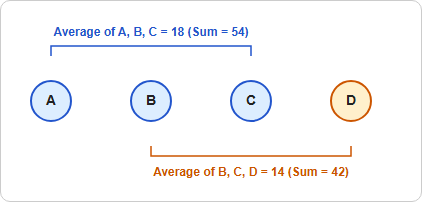
Average of first three numbers (A, B, C) = 18
Average of last three numbers (B, C, D) = 14
Sum of first and last number (A + D) = 16
Formula Used:
Average = Sum of observations ÷ Number of observations
⇒ Sum of observations = Average × Number of observations
Calculations:
⇒ Sum of first three numbers: A + B + C = 18 × 3 = 54 --- (Equation 1)
⇒ Sum of last three numbers: B + C + D = 14 × 3 = 42 --- (Equation 2)
Subtracting Equation 2 from Equation 1:
⇒ (A + B + C) − (B + C + D) = 54 − 42
⇒ A − D = 12 --- (Equation 3)
Given that the sum of the first and last number is 16:
⇒ A + D = 16 --- (Equation 4)
Subtracting Equation 3 from Equation 4:
⇒ (A + D) − (A − D) = 16 − 12
⇒ 2D = 4
⇒ D = 2
∴ The correct answer is 2.

Additional Information
Average of Arithmetic Progression (AP)
For any sequence in AP, the average is the middle term (if the number of terms is odd) or the average of the two middle terms (if even). It is also calculated as (First term + Last term) ÷ 2.
Weighted Average Formula
When two groups of sizes n1 and n2 having averages A1 and A2 are combined, the weighted average is given by: (n1 × A1 + n2 × A2) ÷ (n1 + n2).
Average Change on New Entry
If a new value is added to a group and the average increases by x, the new value = Old Average + (New Number of Members × x).