Previous Year Paper

RRB Group D Previous Year Paper (Held on: 6 Oct 2022 Shift 1)

100 questions · 90 minutes · with answers · free

CBT (100 questions)

1

In a class test, a certain number of students got different ranks based on their marks. Vivek is ranked 12th from the top and 15th from the bottom. How many total students gave the test ?

  1. ((a))

    27

  2. ((b))

    26

  3. ((c))

    32

  4. ((d))

    35

Show Answer
Answer: ((b))

26

According to the given statement, we have

Vivek is ranked 12th from the top and 15th from the bottom. 

So, we have 12 + 15 - 1 = 26 students

Thus, there are 26 students who gave the test.

Hence, the correct answer is 'option 2'.

2

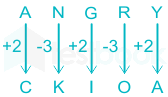
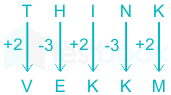
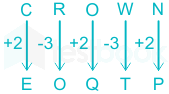
In a certain code language, 'ANGRY' is coded as 'CKIOA' and 'THINK' is coded as 'VEKKM'. How will 'CROWN’ be coded in that language ?

  1. ((a))

    EOQTP

  2. ((b))

    FOQUP

  3. ((c))

    FPRUQ

  4. ((d))

    EPRTQ

Show Answer
Answer: ((a))

EOQTP

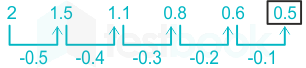
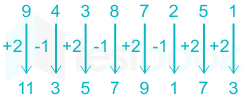
The alphabets and their positions are:

For the word code language, 'ANGRY' is coded as 'CKIOA'

And for the word 'THINK' is coded as 'VEKKM'.

Similarly for the word 'CROWN’ we have

Thus, the code language for the given word is EOQTP.

Hence, the correct answer is 'option 1'.

3

In accordance to Fleming's left hand rule used to find the direction of force on a current carrying conductor placed inside a magnetic field, the centre finger and the index finger represent the directions of ________ and __________.

  1. ((a))

    force, magnetic field

  2. ((b))

    magnetic field, current

  3. ((c))

    current, magnetic field

  4. ((d))

    magnetic field, force

Show Answer
Answer: ((c))

current, magnetic field

The correct answer is current, magnetic field.

Key Points

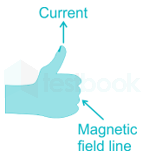
  • In accordance to Fleming's left hand rule used to find the direction of force on a current carrying conductor placed inside a magnetic field, the centre finger and the index finger represent the directions of current and magnetic field.
  • Fleming's left-hand rule can be expressed as stretching the right hand's thumb, middle finger, and forefinger until they are all perpendicular to one another and the middle finger denotes the direction of current in the conductor, while the forefinger denotes the direction of the magnetic field.
4

Which of the following statements is/are correct?

A) Classification is necessary in order to compare the physical and chemical properties of the elements.

B) Classification is necessary to arrange the same kind of elements in the same group.

C) Classification is not necessary to arrange the same kind of elements in the same group.

  1. ((a))

    A, B and C

  2. ((b))

    Only B and C

  3. ((c))

    Only A and B

  4. ((d))

    Only A

Show Answer
Answer: ((c))

Only A and B

The correct answer is Only A and B.

Key Points

  • To compare the physical and chemical characteristics of the elements and put similar elements in the same group, classification is required and we must research every one of the almost 118 known elements.
  • However, it is hard to recall all the physical and chemical features of every element, therefore we must group them according to some shared traits so that, if we study the qualities of one element, we can learn the properties of other elements as well.


Additional Information

  • We can more systematically and orderly evaluate and comprehend properties of elements and their compounds with the aid of classification.
  • We can predict the properties of the elements and the compounds they form based on their places in the Periodic Table and vice versa thanks to classification.
  • The associated properties of the elements and their compounds from various groups are now simpler to study, comprehend, compare, and contrast.
5

Which of the following processes does NOT occur during photosynthesis ?

  1. ((a))

    Splitting of water molecules

  2. ((b))

    Absorption of light energy

  3. ((c))

    Reduction of carbon dioxide

  4. ((d))

    Absorption of oxygen

Show Answer
Answer: ((d))

Absorption of oxygen

The correct answer is Absorption of oxygen.

Key Points

  • The three phases of the photosynthesis cycle are as follows: Chlorophyll absorbs light energy and splits water molecules into oxygen and hydrogen. Chemical energy is created from light energy. Carbohydrates are created as a result of the reduction of carbon dioxide.
  • In this, water is oxidised to produce oxygen while carbon dioxide is reduced to glucose and it follows that the reaction is an oxidation-reduction one.

Additional Information

  • Plants absorb water (H2O) and carbon dioxide (CO2) from the soil and atmosphere during the process photosynthesis.
  • Water gets oxidised, which means it loses electrons, while carbon dioxide is reduced, which means it receives electrons, inside the plant cell  where chlorophyll is present.
  • Water is converted into oxygen and carbon dioxide into glucose as a result of this process.
6

An adult human being has only ________ incisors in his/her mouth.

  1. ((a))

    twelve

  2. ((b))

    eight

  3. ((c))

    ten

  4. ((d))

    four

Show Answer
Answer: ((b))

eight

The correct answer is eight.

Key Points

  • The front teeth seen in the majority of mammals are called incisors (from the Latin incidere, "to cut").
  • In all, there are eight in humans (two on each side, top and bottom) therefore, each jaw has four incisors, two canines, four premolars, and six molars that make up the adult dentition.
  • In both the upper and lower jaws, the four front teeth are referred to as incisors. They primarily use them to chop food.
  • Central incisors are the two incisors that are located on either side of the midline. The lateral incisors are the two teeth that are next to the central incisors.
7

H, N, P, T,  W and Y live on six different floors of the same building. The lowermost floor in the building is numbered 1. the floor above it, number 2 and so on till the topmost floor is numbered 6.

H lives on an odd numbered floor but not on floor number 3. Only two people live between H and N. P lives on an odd numbered floor above N. Only two people live between P and T. Neither T nor W Live on the topmost floor. How many people live below T ?

  1. ((a))

    Two

  2. ((b))

    Three

  3. ((c))

    More than three

  4. ((d))

    One

Show Answer
Answer: ((d))

One

According to the given statements :

Step 1) H lives on an odd-numbered floor but not on floor number 3. Only two people live between H and N.

FloorPerson
6
5
4N
3
2
1H

We place H at 1 & N at 4 because two people live between H and N.

<br>

Step 2) P lives on an odd-numbered floor above N. Only two people live between P and T.

FloorPerson
6
5P
4N
3
2T
1H

We place P above N and T above H such that only two people live between P and T.

<br>

Step 3) Neither T nor W Live on the topmost floor. 

FloorPerson
6Y
5P
4N
3W
2T
1H

Now we place W at 3 because it cannot be on top & then we place Y at the only floor left that is 6.

From the arrangement we can see that, only 1 person lives below T.

Hence, the correct answer is Option 4.

8

Which gas is produced during electrolysis of brine, that burns with a pop sound?

  1. ((a))

    CI2

  2. ((b))

    H2

  3. ((c))

    O2

  4. ((d))

    N2

Show Answer
Answer: ((b))

H2

The correct answer is H2.

Key Points

  • Salt hydroxide, hydrogen, and chlorine are produced during the electrolysis of brine.
  • Hydrogen is a byproduct that is regularly burned with chlorine in the traditional chlor-alkali business to create hydrochloric acid.

Additional Information

  • Brine can be obtained from industrial facilities, salt mining operations, or the waste stream of reverse osmosis (RO) desalination plants, can be processed to produce useful chemicals like sodium hydroxide (NaOH) or hydrochloric acid (HCl).
  • Due to their efficiency as conductors and the quantity of free electrons they have available for transfer, carbon electrodes are utilised in electrolysis.
  • Carbon not only has a high melting point but is also a good conductor of electricity and this means that a variety of various reactions can be facilitated using it.
9

The Ministry of Women and Child Development, Government of India, celebrated the International Women's Day week from ________ 2022 as an 'Iconic Week’ as a part of ‘Azadi Ka Amrit Mahotsav’.

  1. ((a))

    1 to 8 March

  2. ((b))

    15 to 22 March

  3. ((c))

    22 to 28 March

  4. ((d))

    8 to 15 March

Show Answer
Answer: ((a))

1 to 8 March

The correct answer is 1 to 8 March.

Key Points

  • The Government is celebrating 75 years of India’s Independence as Azadi Ka Amrit Mahotsav (AKAM), an initiative to honour India’s glorious history and unique diversity of language, culture, and people.
  • It is being celebrated by the Ministry between 07th March 2022 to 13th March 2022, to build a movement that activates Hon’ble Prime Minister Shri Narendra Modi’s vision of India 2.0, an Atmanirbhar Bharat.
  • To disseminate information about the important events of the Ministry under AKAM, the Ministry has published a booklet on Azadi Ka Amrit Mahotsav in the form of a weekly calendar.
  • Celebrating e-Shram- Reaching milestone of 25 crore registration of unorganised workers, launch of e-Shram on UMANG app, launch of Donate-a-Pension, launch of e-book and award distribution at Vigyan Bhawan, New Delhi on 07th March.

Additional Information

  • International Women’s Day celebration: “Valuing, Empowering and Making Women workforce feel Special” through a unique week-long Social Security Service. (Ensuring 100% processing of Claims of Women on 8th March in the country) at India Habitat Centre, New Delhi on 08th March 2022.
  • 230th Meeting of the Central Board of Trustees (CBT) on 11th and 12th March 2022 at Guwahati.
  • Special programmes will be organised in the entire iconic week by DTNBWED on the contribution of women in freedom struggle, unorganised workers, women empowerment, road & fire safety, central trade union, etc at 27 places across India.
  • Job fairs, placement drives, and placement-oriented camps will be held in the entire iconic week with special focus on SC/STs and differently-abled by DGE at 65 places across India.
10

Select the option that represents the letters that, when placed from left to right in the blanks below, will complete the letter series.

E _ F G _ E _ F G H E _ G G H _ F G H_

  1. ((a))

    EGFHFF

  2. ((b))

    EFHHFH

  3. ((c))

    EHFFEH

  4. ((d))

    EHFGEH

Show Answer
Answer: ((c))

EHFFEH

Given: E _ F G _ E _ F G H E _ G G H _ F GF H_

Let's check all the options as:

1) EGFHFF: E E F G G / E F F G H / E H G G H / F F G H F  → No particular pattern follows.

2) EFHHFH : E E F G H / E H F G H / E H G G H /  F F G H H  → No particular pattern follows.

  1. EHFFEH : E E F G H /  E F F G H / E F G G H / E F G H H  → Here a particular pattern follows (Series of EFGH follows where EE repeated then FF, GG and then HH)

4) EHFGEH : E E F G H / E F F G H / E G G G H /  E F G H H → No particular pattern follows.

Thus, the series gets completed with EHFFEH.

Hence, the correct answer is 'option 3'.

11

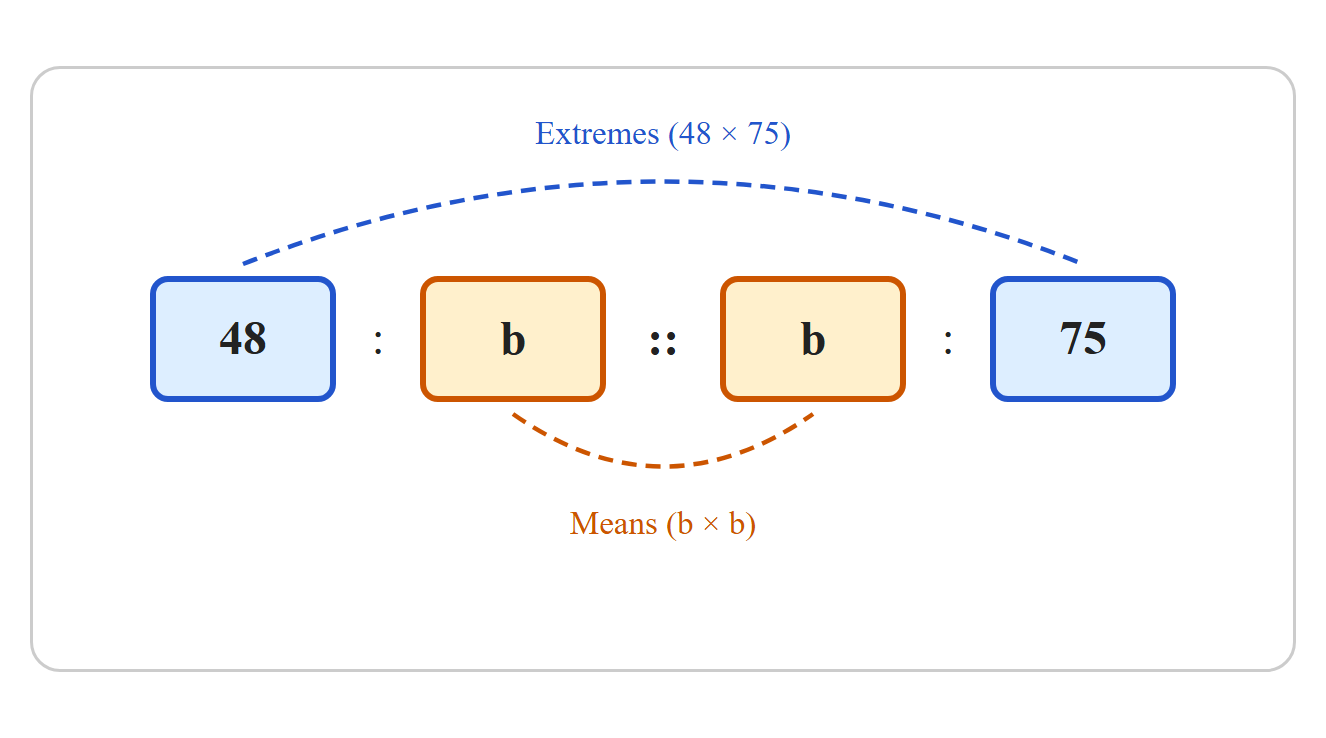
If 48 : b :: b : 75, and b> 0, find the value of b.

  1. ((a))

    65

  2. ((b))

    60

  3. ((c))

    70

  4. ((d))

    55

Show Answer
Answer: ((b))

60

Shortcut Trick

When a : b :: b : c, b is the mean proportional.

Direct formula: b = √(a × c)

b = √(48 × 75)

b = √(3600) = 60

∴ The correct answer is 60.

Alternate Method

Given: 48 : b :: b : 75 and 0**.**

Formula Used: Product of means = Product of extremes

⇒ 48/b = b/75

⇒ b2 = 48 × 75

⇒ b2 = (16 × 3) × (3 × 25)

⇒ b2 = 16 × 9 × 25

⇒ b = √(16 × 9 × 25)

⇒ b = 4 × 3 × 5

⇒ b = 60

∴ The correct answer is 60.

Additional Information

Mean Proportional

For two numbers a and c, the mean proportional b is given by b = √(ac).

Third Proportional

If a : b :: b : c, then c is called the third proportional to a and b, where c = b2/a.

Fourth Proportional

If a : b :: c : d, then d is the fourth proportional, given by d = (b × c)/a.

12

If 2 is multiplied to each odd digit and 1 is added to each even digit in the number 6311624, what will be the difference between the largest of the digits and the smallest of the digits thus formed ?

  1. ((a))

    6

  2. ((b))

    3

  3. ((c))

    5

  4. ((d))

    4

Show Answer
Answer: ((c))

5

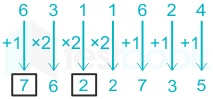
According to the given statements we have:

The pattern follows here is:

Odd digit →  Odd digit × 2

Even digit →  Even digit + 1

The largest digit is 7 and the smallest digit is 2.

So, the difference = 7 - 2 = 5

Thus,  the difference between the largest of the digits and the smallest of the digits is 5.

Hence, the correct answer is 'option 3'.

13

Regulating the natural flow of a river by building large dams affects agriculture in downstream regions by ___________  .

  1. ((a))

    lowering the water table due to reduced water flow

  2. ((b))

    blocking annual deposits of mineral rich sediment from floods.

  3. ((c))

    making the water salty due to reduced water supply

  4. ((d))

    preventing the recharging of ground water during monsoons.

Show Answer
Answer: ((b))

blocking annual deposits of mineral rich sediment from floods.

The correct answer is blocking annual deposits of mineral rich sediment from floods.

Key Points

  • Benefits Of Large Dams:
  • Water is essential for the sustenance of all forms of life on earth. It is not evenly distributed all over the world and even its availability at the same locations is not uniform over the year.
  • No doubt the rivers are a great gift of nature and have been playing a significant role in the evolution of various civilizations, nonetheless on many occasions, rivers, at the time of floods, have been playing havoc with the life and property of the people.
  • These dams provide water storage that has enabled large cities like Phoenix, Arizona, to grow in desert regions. They supply hydropower that has electrified many rapidly expanding industrial and urban economies, from Seattle to Shanghai.
  • Large dams are also important in agriculture. About half of the world’s large dams were built primarily for irrigation, many of them in Asia as the Green Revolution spread (WCD, 2000).
  • Large dams became a prominent instrument for economic development in the past century. Worldwide, the number of large dams stood at 5000 in 1950 (ICOLD, 1998); three-quarters of these were in North America, Europe, and other industrial regions.

Additional Information

  • We have developed the first global estimate of the number of 'potentially affected' people, based on a new database of more than 120 river-specific case studies and a GIS analysis of populations located downstream of the ~7000 largest dams.
  • If a new dam has been planned in the context of a national, regional, or river-basin planning process as described above, then the intended role of the dam will be understood by all parties, at least at the conceptual level.
  • Disadvantages Include:
  • The building of large dams can result in serious ecological damage. For example, the building of the Hoover Dam in the USA prompted a number of earthquakes and has depressed the earth's surface at its location.
  • Dams built on or near the border between two countries may also block the progress of a river in one country. This means that the water supply from the same river in the neighboring country is not under their control anymore. This can result in serious issues between neighboring countries.
14

A sum of Rs. 150 is divided into two parts. The first part is Rs. 2 more than three times the second part. Find the second part.

  1. ((a))

    Rs. 37

  2. ((b))

    Rs. 35

  3. ((c))

    Rs. 115

  4. ((d))

    Rs. 113

Show Answer
Answer: ((a))

Rs. 37

Shortcut Trick

Subtract the excess amount from the Total Sum: 150 − 2 = 148.

The first part is now exactly 3 times the second part, creating a ratio of 3 : 1.

Total ratio parts = 3 + 1 = 4 units.

4 units = 148 ⇒ 1 unit = 148 ÷ 4 = 37.

Since the Second Part represents 1 unit, its value is 37.

∴ The correct answer is Rs. 37.

Alternate Method

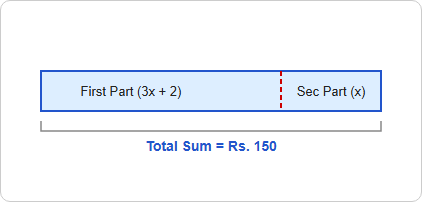
Given:

Total Sum = Rs. 150

Relation: First Part = 3 × Second Part + 2

Let the Second Part be x.

Then, the First Part = 3x + 2.

⇒ First Part + Second Part = Total Sum

⇒ (3x + 2) + x = 150

⇒ 4x + 2 = 150

⇒ 4x = 150 − 2

⇒ 4x = 148

⇒ x = 148 ÷ 4

⇒ x = 37

∴ The correct answer is Rs. 37.

Additional Information

Linear Equations in One Variable

Equations of the form ax + b = c are used to find unknown quantities by isolating the variable using inverse operations.

Sum of Parts Rule

When a quantity is divided into multiple components, the arithmetic sum of all parts must always equal the original whole value.

Verification Technique

Always verify the answer by checking if the first part (3 × 37 + 2 = 113) and the second part (37) add up to the total sum (113 + 37 = 150).

15

Which of the following statements is NOT true?

  1. ((a))

    In the short run, a firm cannot vary all the inputs.

  2. ((b))

    A firm, in order to produce different levels of output in the long run may not vary one of the inputs.

  3. ((c))

    One of the factors cannot be varied, and therefore, remain fixed in the short run.

  4. ((d))

    In the long run, all factors of production can be varied.

Show Answer
Answer: ((b))

A firm, in order to produce different levels of output in the long run may not vary one of the inputs.

The correct answer is A firm, in order to produce different levels of output in the long run may not vary one of the inputs.

Key Points

  • A firm is a for-profit business organisation such as a corporation, limited liability company(LLC), or partnership that provides professional services.
  • The long run is a period of time in which all factors of production and costs are variable.
  • The short run is a period when some factors of production are fixed and some are variable.
  • The output of a long run cannot be varied by increasing the inputs but it can be done by increasing any one of the factors of production not all.
  • The factors are fixed in the short run.

Additional Information

  • The short run, as economists use the phrase, is characterized by at least one fixed factor of production so the proportion of inputs can be changed, the law of variable proportion will only operate in the short run.
  • in the long run, all factors are variables as producers have enough time to organize all factor inputs in the appropriate proportions to achieve the minimum efficient scale.
16

A show ticket costs Rs. 7.50 for a parent and Rs.3 for a child. If a total of Rs. 5,925 is collected by selling 952 tickets in all, then find the number of children’s tickets sold.

  1. ((a))

    500

  2. ((b))

    300

  3. ((c))

    270

  4. ((d))

    682

Show Answer
Answer: ((c))

270

Shortcut Trick

Assume all 952 tickets were sold to parents at ₹ 7.50 each.

Total collection would be = 952 × 7.5 = ₹ 7140.

Actual collection = ₹ 5925. Difference = 7140 − 5925 = ₹ 1215.

Difference in ticket price = 7.50 − 3.00 = ₹ 4.50.

Number of children tickets = 1215 ÷ 4.5 = 270.

∴ The correct answer is 270.

Alternate Method

Given:

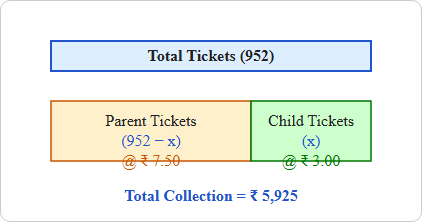
Price of Parent ticket = ₹ 7.50

Price of Child ticket = ₹ 3.00

Total tickets sold = 952

Total amount collected = ₹ 5925

Let the number of child tickets be x.

Then, the number of parent tickets = (952 − x).

⇒ Total Collection = (Price of Parent × No. of Parent) + (Price of Child × No. of Child)

⇒ 5925 = 7.50 × (952 − x) + 3.00 × x

⇒ 5925 = 7140 − 7.50x + 3.00x

⇒ 5925 = 7140 − 4.50x

⇒ 4.50x = 7140 − 5925

⇒ 4.50x = 1215

⇒ x = 1215 ÷ 4.50

⇒ x = 270

∴ The correct answer is 270.

Additional Information

Alligation Method

This problem can also be solved using the Alligation rule by finding the average price per ticket (Total Amount ÷ Total Tickets) and comparing it with individual prices.

Linear Equations in Two Variables

If p is parents and c is children, solve system: p + c = 952 and 7.5p + 3c = 5925 using substitution or elimination.

Weighted Average Concept

The total value is the weighted average of the two groups, where the weights are the number of tickets sold in each category.

17

Frogs have a pair of lungs like human beings but they can also breathe through their:

  1. ((a))

    spiracles

  2. ((b))

    tracheae

  3. ((c))

    slippery and moist skin

  4. ((d))

    gills

Show Answer
Answer: ((c))

slippery and moist skin

The correct answer is slippery and moist skin.

Key Points

  • Frogs have lungs, just like humans, and they can drown if their lungs fill with water.
  • Frogs have skin-based breathing as well and if their skin dries up, they are unable to absorb oxygen since they must maintain moisture in order to breathe via their skin.

Additional Information

  • The aperture in the exoskeletons of insects and some spiders that allows air to enter the trachea is known as a spiracle or stigma.
  • The tracheal tubes in an insect's respiratory system are principally responsible for delivering oxygen straight into the animal's tissues.
  • Many aquatic species use their gills as respiratory organs to take in dissolved oxygen from the water and expel the carbon dioxide.
  • Some species as like hermit crabs have modified their gills to enable breathing on land as long as the environment is kept moist.
18

Study the given pie-chart and answer the following question.

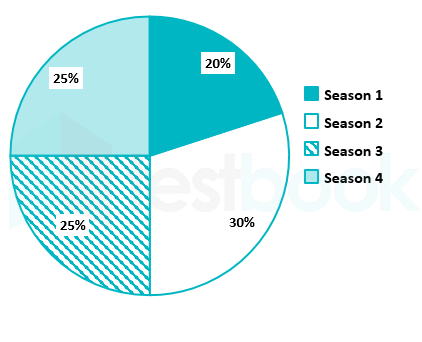
The given pie chart depicts the number of episodes watched of four different seasons (1, 2, 3 and 4). The total number of episodes watched of the four seasons together is 60.

What is the central angle corresponding to the number of episodes watched of season 3?

  1. ((a))

    90o

  2. ((b))

    108o

  3. ((c))

    84o

  4. ((d))

    80o

Show Answer
Answer: ((a))

90o

Given:

Total number of episodes watched = 60

Calculation:

Percentage of episodes watched in season 3 = 25%

Number of episodes watched in season 3 = 25100×60\frac{25}{100}\times 60 = 15

Total central angle in a circle = 360º

⇒ Central angle corresponding to the number of episodes watched of season 3 = 1560×360\frac{15}{60}\times 360 = 90º

Therefore, the central angle corresponding to the number of episodes watched in season 3 is 90º.

19

‘Three statements are given followed by two conclusions numbered I and II. You have to take the statements to be true, even if they seem to be at variance with commonly known facts, and decide which of the conclusions logically follow(s) from the statements.

Statements:

Some Watches are Clocks.

All Clocks are Towers.

All Towers are Bricks.

Conclusions:

(I) Some Bricks are Watches.

(II) All Clocks are Bricks.

  1. ((a))

    Only conclusion (I) follows.

  2. ((b))

    Both conclusions (I) and (II) follow.

  3. ((c))

    Only conclusion (II) follows.

  4. ((d))

    Neither conclusion (I) nor (II) follows.

Show Answer
Answer: ((b))

Both conclusions (I) and (II) follow.

Statements:

Some Watches are Clocks.

All Clocks are Towers.

All Towers are Bricks.

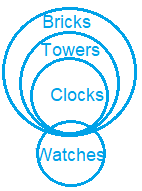
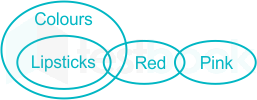
Venn diagram:

Conclusions:

(I) Some Bricks are Watches → Follow → From the diagram we can see that some bricks are watches because some clocks are watches so the conclusion follow.

(II) All Clocks are Bricks → Follow → Since given some clocks are towers and all towers are bricks. Thus, all clocks are bricks follow.

Thus, both conclusions (I) and (II) follow.

Hence, the correct answer is Option 2.

20

‘Which of the following mountains and states/UT is NOT correct matched?

  1. ((a))

    Saser Kangari  -  Ladakh

  2. ((b))

    K2 mountain  - Himachal Pradesh

  3. ((c))

    Nandadevi - Uttarakhand

  4. ((d))

    Kanchenjunga - Sikkim

Show Answer
Answer: ((b))

K2 mountain  - Himachal Pradesh

The correct answer is K2 mountain - Himachal Pradesh.

Key Points

  • K2, Chinese Qogir Feng, also called Mount Godwin Austen, called locally Dapsang or Chogori, the world’s second highest peak (28,251 feet [8,611 meters]), second only to Mount Everest.
  • K2 is located in the Karakoram Range and lies partly in a Chinese-administered enclave of the Kashmir region within the Uygur Autonomous Region of Xinjiang, China, and partly in the Gilgit-Baltistan portion of Kashmir under the administration of Pakistan.
  • The glacier- and snow-covered mountain rises from its base at about 15,000 feet (4,570 meters) on the Godwin Austen Glacier, a tributary of the Baltoro Glacier.
  • The mountain was discovered in 1856 by Col. T.G. Montgomerie of the Survey of India, and it was given the symbol K2 because it was the second peak measured in the Karakoram Range.

Additional Information

  • Saser Kangari
  • India's Saser Kangri (sometimes spelt Sasir Kangri) is a mountain. It is the tallest mountain in the Saser Muztagh, which is the Karakoram range's easternmost subrange. Ladakh, India's most northern union territory, contains Sasir Kangri.
  • Nandadevi
  • ​After Kangchenjunga, Nanda Devi is the second-highest peak in India and the tallest one that is totally within the nation. (Kangchenjunga is on the border of India and Nepal). It is the world's 23rd-highest peak.
  • Before calculations in 1808 revealed Dhaulagiri to be higher, Nanda Devi was thought to be the tallest peak in the world.
  • Kanchenjunga ​
  • After Kangchenjunga, Nanda Devi is the second-highest peak in India and the tallest one that is totally within the nation. (Kangchenjunga is on the border of India and Nepal). It is the world's 23rd-highest peak.
  • Before calculations in 1808 revealed Dhaulagiri to be higher, Nanda Devi was thought to be the tallest peak in the world.
21

A 12 V battery is connected across an unknown resistor. If a current of 2 mA is flowing through the circuit, the value of the resistance is _________ .

  1. ((a))

    600 ohm

  2. ((b))

    6 ohm

  3. ((c))

    6000 ohm

  4. ((d))

    60 ohm

Show Answer
Answer: ((c))

6000 ohm

The correct answer is option 3)6000 ohm

Given:

V=12V,I=2mA=0.002AV=12V,I=2mA=0.002A

To find:

Resistance (R)

Formula used:

Ohm's law: V=IRV=IR

Calculations:

As,

V=IRV=IR

R=VIR={V\over I}

R=120.002=6000ohmR={12\over 0.002}=6000 ohm

Therefore, the value of Resistance is 6000ohm.

22

Which of the following statements is/are true regarding the centre of curvature of a spherical mirror?

(S - I) The centre of curvature (C) of a spherical mirror is the centre of the sphere of which the mirror is a cut part.

(S - II) The aperture (D) of a spherical mirror is the diameter of the sphere of which the mirror is a cut part.

(S - III) The principal focus (F) is strictly the mid-point between the pole (P) and the centre of curvature (C) of a spherical mirror.

  1. ((a))

    (S - I)and (S - II)only

  2. ((b))

    (S - I) and (S - III) only

  3. ((c))

    (S - I) only

  4. ((d))

    (S - I),(S - II) and (S - III)

Show Answer
Answer: ((b))

(S - I) and (S - III) only

The correct answer is (S - I) and (S - III) only.

Key Points

  • There are two different kinds of curved mirrors: those that diverge parallel incident light rays and those that converge parallel incident light rays.
  • The curved mirrors that are cut from a reflecting sphere are known as spherical mirrors.
  • Concave mirrors and convex mirrors are two types of spherical mirrors that, respectively, converge and diverge parallel incident light beams.
  • A spherical mirror's centre of curvature is referred to as the centre of the sphere it is a part of and to put it another way, it is the sphere's centre where the spherical mirror is cut.
  • In a spherical mirror, the area of the mirror where light is actually reflected is known as the aperture of the mirror.
23

A shopkeeper offers a scheme of either selling articles at successive discounts of 30% and 20% or one where a customer can “buy 2, get 1 free”. The positive difference in overall nominal percentage discounts offered in the two schemes is: 

  1. ((a))

    1123\frac{2}{3}%

  2. ((b))

    1013\frac{1}{3}%

  3. ((c))

    1113\frac{1}{3}%

  4. ((d))

    1023\frac{2}{3}%

Show Answer
Answer: ((d))

1023\frac{2}{3}%

Shortcut Trick

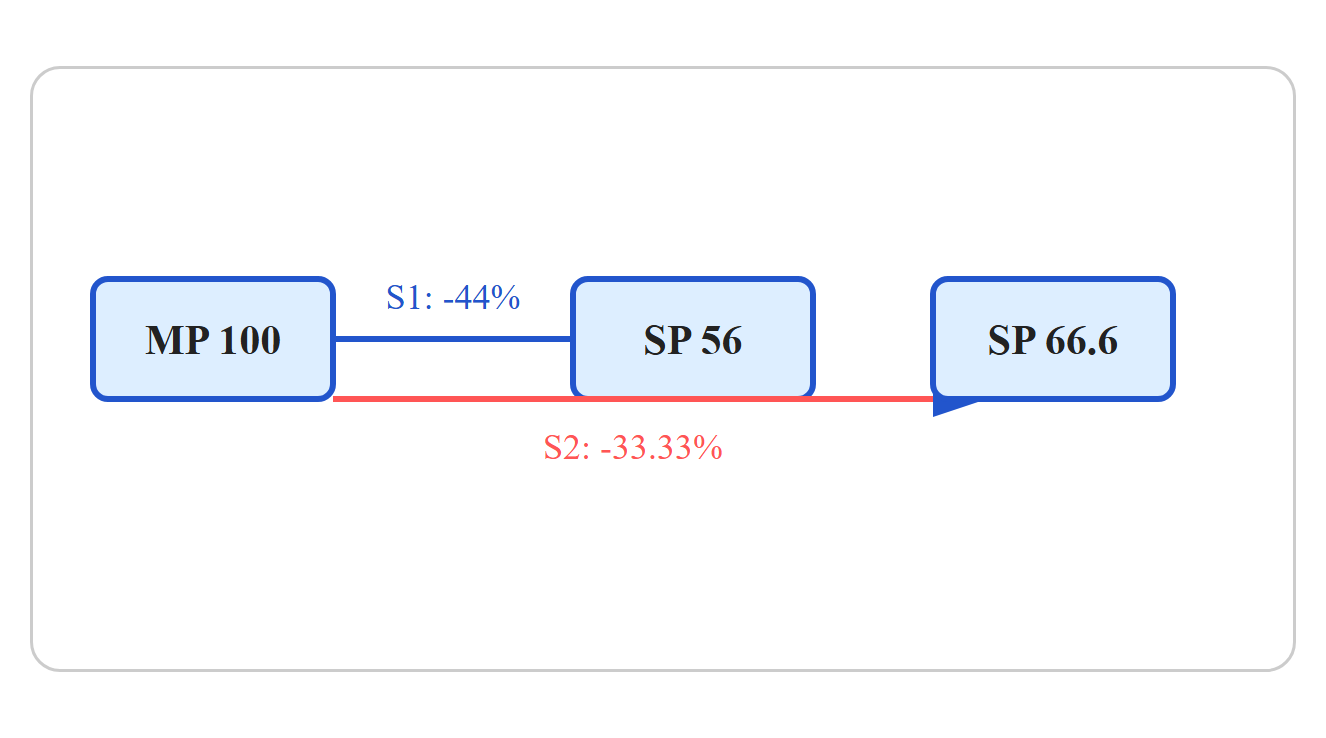
Scheme 1 Successive Discount = a + b − (a × b) ÷ 100 = 30 + 20 − (30 × 20) ÷ 100 = 44%.

Scheme 2 Buy 2 Get 1 Free = [Free Articles ÷ Total Articles] × 100 = [1 ÷ (2 + 1)] × 100 = 33 1/3%.

Difference in discount percentage = 44% − 33 1/3% = 10 2/3%.

∴ The correct answer is 10 2/3 %.

Alternate Method

Given → Scheme 1: 30% and 20% successive discounts. Scheme 2: Buy 2 get 1 free. Formulas: Successive Discount = a + b − ab ÷ 100 | BxGy Discount% = [y ÷ (x+y)] × 100.

Scheme 1 Net Discount = 30 + 20 − (30 × 20)/100 = 50 − 6 = 44%. ⇒ Scheme 2 Net Discount = [1 ÷ (2 + 1)] × 100 = 100/3 = 33 1/3%. ⇒ Difference = 44 − 33 1/3 = 10 2/3%.

∴ The correct answer is 10 2/3 %.

Additional Information

Successive Discounts

When two or more discounts are applied one after another, it is called a successive discount. Resultant d% = 100 − [100 × (100−d1)/100 × (100−d2)/100].

Buy x Get y Free Concept

In this scheme, the discount is calculated on the total number of articles (paid + free). Discount % = [Free Articles ÷ (Buy + Free)] × 100.

24

Rama Navami is a Hindu spring festival that commemorates God Rama's birthday, which is usually comes in the month of ________.

  1. ((a))

    June

  2. ((b))

    July

  3. ((c))

    April

  4. ((d))

    August

Show Answer
Answer: ((c))

April

The correct answer is April.

Key Points

  • Born to King Dashratha and Queen Kaushalya in Ayodhya in the Tretha Yug, Ram is considered the seventh incarnation of Vishnu, and his birth is commemorated as Ram Navami in India.
  • It is celebrated as a spring Hindu festival on the ninth day of Chaitra Navratri which marks the birth of Ram, the seventh avatar of Vishnu.
  • This festival falls in the Shukla Paksha (brighter half) of the Chaitra month of the Hindu calendar. This year, Ram Navami will be celebrated by Hindus in India on April 21.
  • Ram Navami is recorded in Rama recitals, especially in Ramayana which is considered one of the two great Sanskrit epics of the Hindu religion. The story of Ram Navami is also called the Vratha Katha.

Additional Information

  • It describes how King Dashratha and his three queens - Kaushalya, Kaikeyi, and Sumitra performed the Putra Kamesti Yagna on the advice of Rishi Vashishth when neither of King Dashratha’s wives was able to bear him an heir.
  • The queens conceived soon after they consumed the kheer and on the ninth day of Chaitra month, Queen Kaushalya gave birth to Rama. Bharat, Lakshman, and Shatrugana were born to the other queens.
  • Rama had to step back as the rightful heir of Ayodhya due to the promise made by King Dashratha to his third wife Kaikeyi. However, he ruled the kingdom once he came back from 14 years of exile and became a just and loved ruler.
  • Hindus also perform the rituals of Kanya Puja on this day, where 9 girls are invited at home and paid respect as Hindus believe that they are the manifestation of Devi. A prasad consisting of sooji halwa, kala chana and puri is also prepared and offered to the girls after the puja ritual.
25

‘The volume of a right circular cylinder is 814 cm3. If the radius and the height of the cylinder are equal. find the height (in cm) of the cylinder.

(Use,π=227)(Use,\pi = \frac{22}{7})

  1. ((a))

    2592\sqrt[2]{{259}}

  2. ((b))

    22593\sqrt[3]{{259}}

  3. ((c))

    2593\sqrt[3]{{259}}

  4. ((d))

    2953\sqrt[3]{{295}}

Show Answer
Answer: ((c))

2593\sqrt[3]{{259}}

Shortcut Trick

Volume of cylinder V = π × r2 × h

Given r = h, ∴ V = π × h3

814 = (22/7) × h3

h3 = 814 × (7/22) = 37 × 7 = 259

h = 3√259 cm

∴ The correct option is C.

Alternate Method

Given:

Volume of cylinder (V) = 814 cm3

Radius (r) = Height (h)

Value of π = 22/7

Formula Used:

Volume of a right circular cylinder = πr2h

Code
 r    h Condition: r = h Volume = 814 cm³

Calculations:

⇒ Volume = π × r2 × h

⇒ 814 = (22/7) × h2 × h (since r = h)

⇒ 814 = (22/7) × h3

⇒ h3 = (814 × 7) ÷ 22

⇒ h3 = 37 × 7

⇒ h3 = 259

⇒ h = 3√259 cm

∴ The correct option is C.

Additional Information

Curved Surface Area (CSA) of Cylinder

The area of the curved surface is given by the formula 2πrh.

Total Surface Area (TSA) of Cylinder

The total area including the two circular bases is 2πr(r + h).

Hollow Cylinder Volume

Volume of a hollow cylinder with external radius R and internal radius r is π(R2 − r2)h.

26

A shopkeeper finds that when he sells one kind of rice at Rs 50 per kg, he loses 20%. when he sells another kind of rice at Rs 72 per kg, he gains 20%. If he mixes them in the ratio 3 : 2 and sells the mixture at Rs 64 per kg., then what is his ‘overall gain percentage (correct to one decimal place)?

  1. ((a))

    5.4%

  2. ((b))

    4.1%

  3. ((c))

    4.5%

  4. ((d))

    5.6%

Show Answer
Answer: ((b))

4.1%

Shortcut Trick

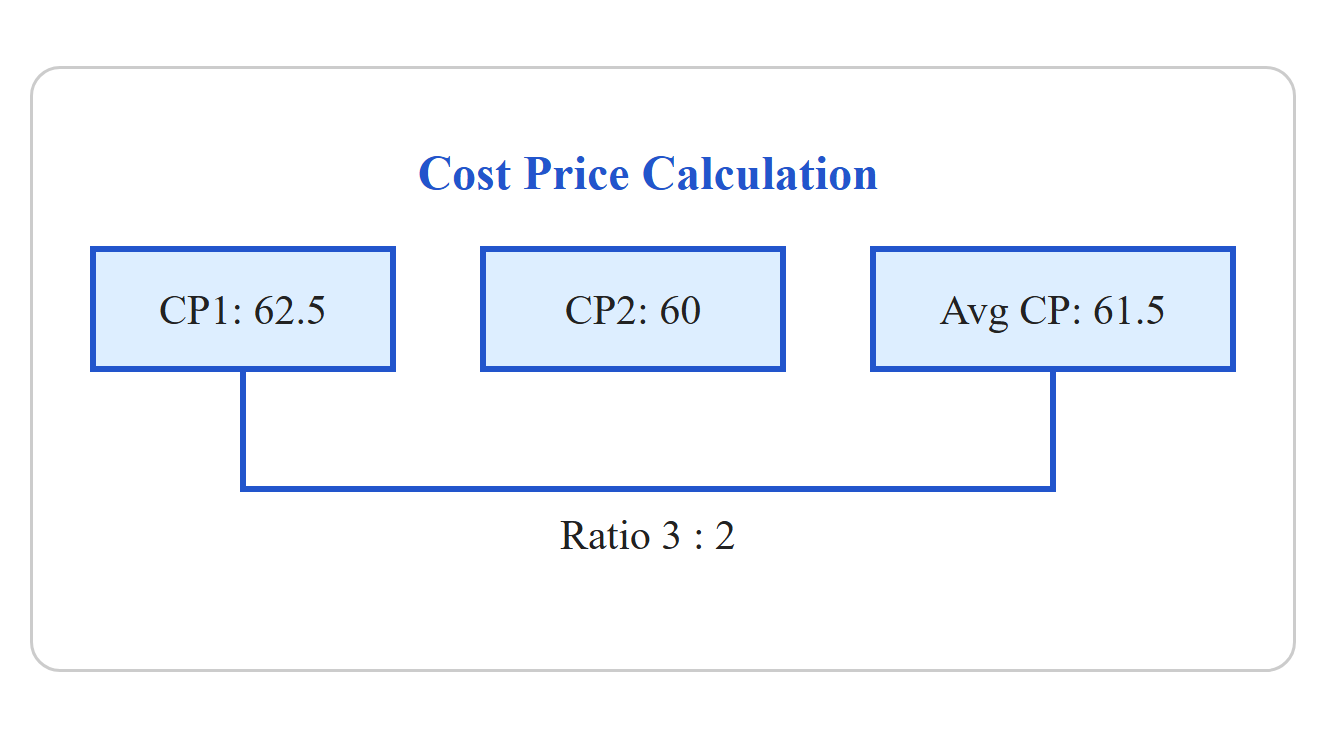
CP of first rice = 50 ÷ 0.8 = 62.5 and CP of second rice = 72 ÷ 1.2 = 60.

Weighted average CP = (62.5 × 3 + 60 × 2) ÷ 5 = (187.5 + 120) ÷ 5 = 307.5 ÷ 5 = 61.5.

Profit = 64 − 61.5 = 2.5.

Gain % = (2.5 ÷ 61.5) × 100 ≈ 4.065%.

Rounding to one decimal place, we get 4.1%.

∴ The correct answer is 4.1%.

Alternate Method

Given: SP1 = Rs 50, Loss1 = 20%; SP2 = Rs 72, Gain2 = 20%; Ratio = 3 : 2; SPmix = Rs 64.

Formulas: CP = SP × 100 ÷ (100 ± P/L%); Gain% = (Total SP − Total CP) ÷ Total CP × 100.

⇒ CP of first variety = 50 × (100 ÷ 80) = Rs 62.5 per kg.

⇒ CP of second variety = 72 × (100 ÷ 120) = Rs 60 per kg.

⇒ Total CP for 5 kg (3kg + 2kg) = (62.5 × 3) + (60 × 2) = 187.5 + 120 = Rs 307.5.

⇒ Total SP for 5 kg = 64 × 5 = Rs 320.

⇒ Overall Gain = 320 − 307.5 = Rs 12.5.

⇒ Overall Gain % = (12.5 ÷ 307.5) × 100 = 1250 ÷ 307.5 ≈ 4.065%.

∴ The correct answer is 4.1%.

Additional Information

Weighted Average Method

When two items are mixed, the average cost price is calculated as (n1c1 + n2c2) ÷ (n1 + n2).

Profit and Loss on Mixture

Profit percentage is always calculated on the total cost price of the mixture, not the individual components.

27

The sum of a number and its reciprocal is -2. Find the quadratic equation associated with the situation and also the number.

  1. ((a))

    x+ 2x + 1 = 0, x = 1

  2. ((b))

    x+ 2x - 1 = 0, x = -1

  3. ((c))

    x + 2x + 1 = 0, x = -1

  4. ((d))

    x2 - 2x + 1 = 0, x = -1

Show Answer
Answer: ((c))

x + 2x + 1 = 0, x = -1

Shortcut Trick

If the sum of a number and its reciprocal is −2, the number must be −1 because −1 + (1/−1) = −1 − 1 = −2.

The quadratic equation for a root x = −1 (repeated) is (x + 1)2 = 0.

Expanding the identity (a + b)2 gives x2 + 2x + 1 = 0.

∴ The correct answer is x2 + 2x + 1 = 0, x = −1.

Alternate Method

Given: The sum of a number x and its reciprocal 1/x is −2.

Method: Formulate a quadratic equation by clearing the fraction and solve for x.

⇒ x + 1/x = −2

⇒ (x2 + 1) / x = −2

⇒ x2 + 1 = −2x

⇒ x2 + 2x + 1 = 0

⇒ x2 + x + x + 1 = 0

⇒ x(x + 1) + 1(x + 1) = 0

⇒ (x + 1)(x + 1) = 0

⇒ (x + 1)2 = 0

⇒ x + 1 = 0

⇒ x = −1

∴ The correct answer is x2 + 2x + 1 = 0, x = −1.

Additional Information

Nature of Roots

For a quadratic equation ax2 + bx + c = 0, the discriminant D = b2 − 4ac determines the nature. If D = 0, roots are real and equal.

Reciprocal Sum Property

If x + 1/x = 2, then x = 1. If x + 1/x = −2, then x = −1. This is a common property used in algebraic simplifications.

Perfect Square Trinomial

The expression x2 + 2x + 1 is a perfect square, represented as (x + 1)2, which always yields a single unique root when equated to zero.

28

According to right hand thumb rule, ________ represent(s) the direction of current.

  1. ((a))

    the little finger

  2. ((b))

    the fore finger

  3. ((c))

    the middle finger

  4. ((d))

    the thumb

Show Answer
Answer: ((d))

the thumb

The correct answer is the thumb

Key Points

  • According to the right-hand thumb rule, the thumb represents the direction of the current.
  • To use the right-hand thumb rule, you should position your right hand so that the thumb points in the direction of the current.
  • The direction in which your fingers curl around the conductor represents the direction of the magnetic field lines.
  • This rule is a convenient way to visualize the relationship between the current flowing through a conductor and the resulting magnetic field.

Additional Information

  • The right-hand thumb rule is helpful in understanding the orientation of magnetic fields in various applications such as electromagnets, solenoids, and generators.
  • This rule differs from Fleming's left-hand rule, which is used for determining the direction of force in motors.
  • By adhering to this rule, one can predict the behavior of magnetic fields and currents in electrical circuits and devices.
29

H, N, P, T, W and Y live on six different floors of the same building. The lowermost floor in the building is numbered 1, the floor above it is numbered 2 and so on and the topmost floor is numbered 6. H lives on one of the floors above floor number 4. Only three people live between H and N. P lives immediately above N. Only three people live between P and T. W lives on one of the odd-numbered floors below T. Who lives immediately above Y?

  1. ((a))

    H

  2. ((b))

    W

  3. ((c))

    N

  4. ((d))

    T

Show Answer
Answer: ((a))

H

According to the given statements :

Step 1)  H lives on one of the floors above floor number 4. Only three people live between H and N.

FloorPerson
6
5H
4
3
2
1N

We place H at 4 & N at 1 so that only three people live between H and N.

Step 2) P lives immediately above N. Only three people live between P and T.

FloorPerson
6T
5H
4
3
2P
1N

Now we place P just above N & place T at 6 such that only three people live between P and T.

Step 3) W lives on one of the odd-numbered floors below T. 

FloorPerson
6T
5H
4Y
3W
2P
1N

Now we place W at 3 according to the condition & then place Y at the only floor left which is 4.

From the arrangement, we can see that, H lives immediately above Y.

Hence, the correct answer is Option 1.

30

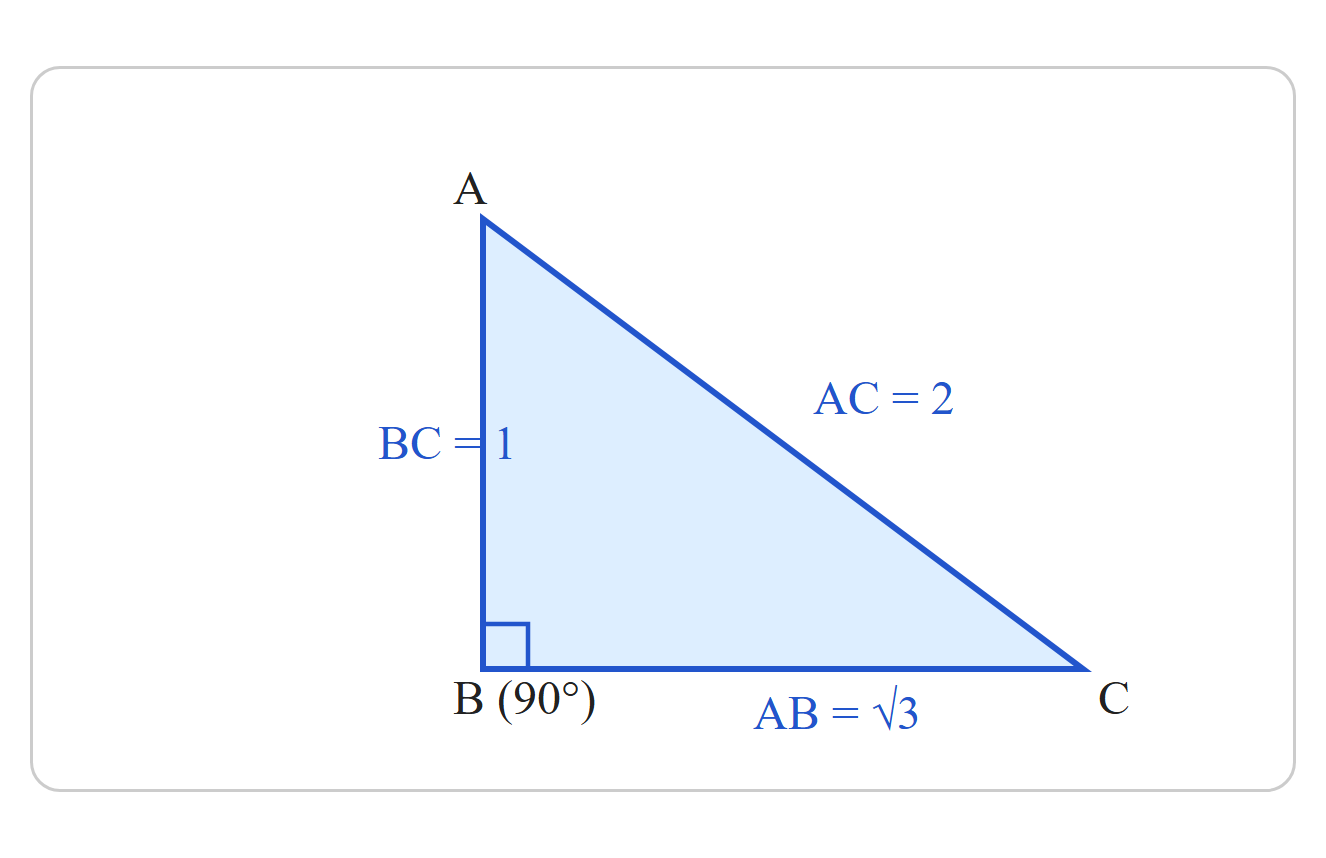
In a right-angled triangle ABC, right-angled at B, if tan A = 13\frac{1}{{\sqrt 3 }},the value of

(sin A cos C + cos A sin C) is:

  1. ((a))

    1

  2. ((b))

    34\frac{3}{4}

  3. ((c))

    12\frac{1}{2}

  4. ((d))

    14\frac{1}{4}

Show Answer
Answer: ((a))

1

Shortcut Trick

If tan A = 1/√3, then A = 30°.

In a right-angled triangle ABC (right-angled at B), A + C = 90°.

C = 90° − 30° = 60°.

The expression sin A cos C + cos A sin C is the expansion of sin(A + C).

Value = sin(30° + 60°) = sin 90° = 1.

∴ The correct answer is 1.

Alternate Method

Given: Right-angled triangle ABC at B, tan A = 1/√3.

Formula Used: sin θ = opposite/hypotenuse; cos θ = adjacent/hypotenuse.

⇒ tan A = BC/AB = 1/√3. Let BC = 1, AB = √3.

⇒ AC = √(AB2 + BC2) = √(3 + 1) = √4 = 2.

⇒ sin A = BC/AC = 1/2; cos A = AB/AC = √3/2.

⇒ sin C = AB/AC = √3/2; cos C = BC/AC = 1/2.

⇒ Expression = (1/2 × 1/2) + (√3/2 × √3/2)

⇒ Value = 1/4 + 3/4 = 4/4 = 1.

∴ The correct answer is 1.

Additional Information

Trigonometric Sum Identities

The formula sin(A + B) = sin A cos B + cos A sin B is a fundamental identity used to simplify expressions involving sums of angles.

Complementary Angles

In any right-angled triangle, the two acute angles are complementary, meaning A + C = 90°, thus sin A = cos C and cos A = sin C.

Standard Trigonometric Values

For 30°: sin = 1/2, cos = √3/2, tan = 1/√3. For 60°: sin = √3/2, cos = 1/2, tan = √3.

31

In March 2022, under the project of setting up health clinics in schools, a health clinic at a government school that will focus on the physical and mental well-being of students was inaugurated in which state of India?

  1. ((a))

    West Bengal

  2. ((b))

    Punjab

  3. ((c))

    Delhi

  4. ((d))

    Andhra Pradesh

Show Answer
Answer: ((c))

Delhi

The correct answer is Delhi.

Key Points

  • This will be achieved through the joint efforts and close coordination between Ministry of Health & Family Welfare and Department of School Education and Literacy, Ministry of Human Resource and Development at all levels (Centre and State).
  • Provision of IFA and Albendazole tablets by teachers through WIFS and NDD programme respectively.
  • The health promotion activities will be given a special focus. Age appropriate health education for the students will be taken up to influence behavior and enhance skills.
  • At the State level, Coordination Committee will be constituted under the co-chairpersonship of Principal Secretary (s) Health and Education with Secretaries of Women and Child Development, Drinking Water and Sanitation, Panchayati Raj and other relevant department as members.

Additional Information

  • The Delhi government on Monday inaugurated 20 ‘Aam Aadmi School Clinics’ as part of a pilot project to focus on the mental well-being and physical health of students.
  • “A healthy mind will contribute to a healthy society and ultimately a healthier nation. The Aam Aadmi School Clinics consists of doctors and psychologists who will listen to the problems of students.
  • “These clinics will screen 30 students each day and have an adequate supply of medicines for them.
  • This list of medicines has been curated keeping in mind the specific needs of adolescents, with a primary focus on anaemia, malnutrition, refractive errors, worm infestation, and menstrual hygiene,” the government said.
32

The LCM of 62 and 30 is:

  1. ((a))

    310

  2. ((b))

    9300

  3. ((c))

    930

  4. ((d))

    1860

Show Answer
Answer: ((c))

930

Shortcut Trick

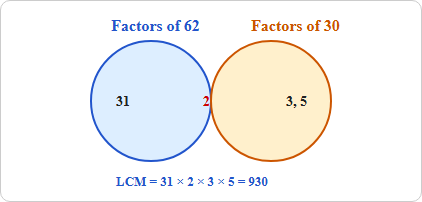
To find the LCM quickly, find the HCF first. HCF of 62 and 30 is 2.

Reduce the numbers to their simplest ratio: 62 : 30 → 31 : 15

LCM = Cross-product of the original numbers and the ratio parts: 62 × 15 = 930 (or 30 × 31 = 930).

Thus, the LCM of 62 and 30 is 930.

∴ The correct answer is 930.

Alternate Method

Given: Numbers are 62 and 30.

Formula: LCM = Product of the highest powers of all prime factors.

Step-by-step factorization:

Prime factors of 62 = 21 × 311

Prime factors of 30 = 21 × 31 × 51

LCM = 21 × 31 × 51 × 311

LCM = 30 × 31

LCM = 930

Comparing this result with the given options, we find it matches Option 3.

∴ The correct answer is 930.

Additional Information

HCF and LCM Relation

For any two numbers 'a' and 'b', the product of the numbers is equal to the product of their HCF and LCM: a × b = HCF(a, b) × LCM(a, b).

Least Common Multiple (LCM)

The LCM is the smallest integer that is a multiple of two or more given numbers.

Division Method

In the division method, you divide the numbers by prime numbers until the quotient is 1. The LCM is the product of all divisors used.

33

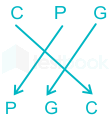
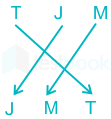
Given below are two letter-cluster pairs in which the second letter-cluster is related to the first letter-cluster following a certain logic. Select the letter-cluster pair from among the options that follows the same logic. 

CPG : PGC

TJM : JMT

  1. ((a))

    UQK : QKU

  2. ((b))

    UQK : KQU

  3. ((c))

    UQK : QKV

  4. ((d))

    UQK : QUK

Show Answer
Answer: ((a))

UQK : QKU

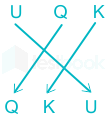
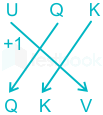
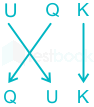
The alphabets and their positions are:

Given:

CPG : PGC and TJM : JMT

 and 

Let's check all the options are:

1) UQK : QKU

2) UQK : KQU

3) UQK : QKV

4) UQK : QUK

Thus, the pair UQK : QKU follows the same logic.

Hence, the correct answer is 'option 1'.

34

Which Five-Year Plan emphasised the setting up of Basic and Heavy Industries so as to establish a strong base for rapid industrialization, self-reliance, and technological development?

  1. ((a))

    Third Five - Year Plan

  2. ((b))

    First Five - Year Plan

  3. ((c))

    Fourth Five - Year Plan

  4. ((d))

    Second Five - Year Plan

Show Answer
Answer: ((d))

Second Five - Year Plan

The correct answer is Second Five - Year Plan.

Key Points

  • The Second Five-Year Plan placed a strong emphasis on industrial development.
  • This policy was in force until the termination of the Fifth Plan by the Janata government in 1978.
  • A comprehensive approach to promote economic development, with heavy industry at its core.
  • The plan aimed to substitute basic and capital good industries, and various hydroelectric power projects and five steel plants were established in Bhilai, Durgapur, and Rourkela with the assistance of foreign countries such as the Soviet Union, the United Kingdom, and West Germany.
  • The plan also included the expansion of railway lines in the north-east region of the country.
  • In 1957, a talent search and scholarship program was initiated to identify and train talented young students for work in the field of nuclear power.
  • The objective of the program was to build a skilled workforce that would support the country's push towards industrialization and modernization.

Additional Information

  • First Five - Year Plan​
  • ​The planning ethos underpinned the Indian economy from 1947 to 2017. The Planning Commission (1951–2014) and the NITI Aayog devised, carried out, and supervised this through the Five-Year Plans. (2015-2017).
  • The commission has a nominated deputy chairman who is a cabinet minister, with the prime minister serving as the ex-officio chairman. The commission's last deputy chairman is Montek Singh Ahluwalia. (resigned on 26 May 2014). In March 2017, the Twelfth Plan's tenure came to an end.
  • The Gadgil formula was adopted in 1969 as a result of the distribution of state resources prior to the Fourth Plan being based on schematic patterns rather than a transparent and objective procedure.
35

The ideal waste disposal method in case of metal is:

  1. ((a))

    reusing

  2. ((b))

    recycling

  3. ((c))

    composting

  4. ((d))

    incineration

Show Answer
Answer: ((b))

recycling

The correct answer is recycling.

Key Points 

  • Recycling is considered the ideal method for waste disposal of metal.
  • Metal waste can be processed and used again, reducing the need to extract new raw materials.
  • Recycling metal also reduces energy consumption and greenhouse gas emissions associated with mining and refining new metals.
  • Metal recycling can be done through various methods such as shredding, smelting, and refining.
  • Different metals have different recycling rates, some metals such as aluminium have high recycling rates, while others like titanium have low recycling rates.
  • Many countries have laws and regulations that encourage or mandate the recycling of certain metals.
  • Metal recycling not only benefits the environment but also has economic advantages, as recycled metal is usually cheaper than newly extracted metal.

Additional Information

  • Reusing
  • Reusing something is putting it to use again, whether for what it was intended for in the first place (traditional reuse) or for a different purpose. (creative reuse or repurposing). It needs to be separated from recycling, which entails disassembling used objects to produce raw materials for the creation of new ones.
  • Composting
  • A combination of substances called compost is used to fertilise plants and enhance the physical, chemical, and biological qualities of soil. It is frequently made by composting organic waste, including manure and food scraps.
  • Incineration
  • The combustion of compounds found in the garbage is a step in the waste treatment process known as incineration. Waste-to-energy facilities are the usual name for industrial waste incineration plants.
  • The term "thermal treatment" refers to incinerating waste and other high-temperature waste treatment methods.
36

A sum of money triples itself at a certain rate of compound interest in 10 years. In how many years will it amount to 9 times of itself?

  1. ((a))

    15 years

  2. ((b))

    20 years

  3. ((c))

    30 years

  4. ((d))

    25 years

Show Answer
Answer: ((b))

20 years

Shortcut Trick

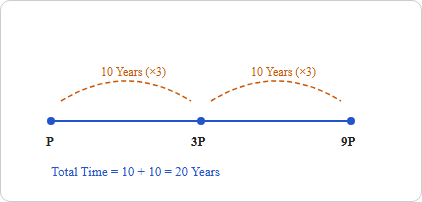
In Compound Interest, if a sum becomes n times in t years, then it becomes nk times in k × t years.

Given: 3 times in 10 years (n = 3, t = 10).

Target: 9 times, which is 32 (so, k = 2).

Required time = k × t = 2 × 10 = 20 years.

∴ The correct answer is 20 years.

Alternate Method

Given:

Time (t1) = 10 years

Amount (A1) = 3 × Principal (P)

Target Amount (A2) = 9 × Principal (P)

Formula Used:

A = P(1 + r/100)t

Calculations:

⇒ Case 1: 3P = P(1 + r/100)10

⇒ 3 = (1 + r/100)10 --- (Equation 1)

⇒ Case 2: 9P = P(1 + r/100)T

⇒ 9 = (1 + r/100)T

⇒ 32 = (1 + r/100)T --- (Equation 2)

⇒ Substituting the value of 3 from Eq 1 into Eq 2:

⇒ ((1 + r/100)10)2 = (1 + r/100)T

⇒ (1 + r/100)20 = (1 + r/100)T

⇒ Comparing powers: T = 20 years

∴ The correct answer is 20 years.

Additional Information

Compound Interest Multiplication Rule

In CI, money grows geometrically. If it becomes m times in t years, it will become mn times in n × t years.

Rule of 72

A quick way to estimate the time required to double an investment: Time ≈ 72 ÷ Interest Rate.

Simple Interest Growth

Unlike CI, in SI, if a sum triples (increases by 200%) in 10 years, it will take 40 years to become 9 times (increase by 800%) because the growth is linear.

37

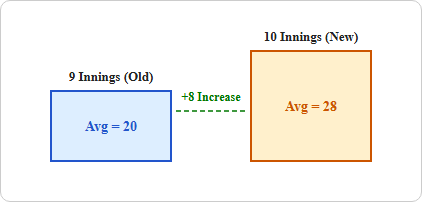
Vishnu scored X runs in his 10th innings. After scoring those runs, his average increased by 8 runs. If the new average is 28, then find the value of X.

  1. ((a))

    110

  2. ((b))

    90

  3. ((c))

    105

  4. ((d))

    100

Show Answer
Answer: ((d))

100

Shortcut Trick

Runs in nth innings = New Average + (Previous Innings × Increase in Average)

Value of X = 28 + (9 × 8)

X = 28 + 72 = 100

∴ The correct answer is 100.

Alternate Method

Given:

Total innings = 10

New average = 28

Increase in average = 8

Old average (after 9 innings) = New average − Increase = 28 − 8 = 20

Total runs after 9 innings = 9 × 20 = 180

Total runs after 10 innings = 10 × 28 = 280

X (Runs in 10th innings) = Total runs (10 innings) − Total runs (9 innings)

⇒ X = 280 − 180 = 100

∴ The correct answer is 100.

Additional Information

Batsman Average Formula

The average of a batsman is calculated as Total Runs ÷ Number of Innings played (assuming the player got out in all innings).

Net Change in Sum

When a new value is added to a group, the new sum = (Old Average × Old Count) + New Value. Alternatively, New Value = New Average + (Old Count × Change in Average).

Weighted Average

The combined average of two groups is given by (n1A1 + n2A2) ÷ (n1 + n2), where n is the count and A is the average of each group.

38

The sum of two numbers is 205. If one of these numbers is reduced by 5% and the other is increased by 10%, the resulting numbers are equal to each other. Find the smaller of the two initial numbers.

  1. ((a))

    95

  2. ((b))

    100

  3. ((c))

    105

  4. ((d))

    110

Show Answer
Answer: ((a))

95

Shortcut Trick Ratio of the two numbers is the inverse ratio of their percentage multipliers. Let the numbers be A and B. Multiplier for A = 0.95 and for B = 1.10. A : B = 110 : 95 ⇒ 22 : 19 Total units = 22 + 19 = 41 units ⇒ 205 1 unit = 205 ÷ 41 = 5 Smaller number = 19 units × 5 = 95. ∴ The correct answer is 95.

Alternate Method Given: Sum of two numbers = 205. Reduction in one = 5%, Increase in other = 10%.

Let the first number be x and the second number be y. ⇒ x + y = 205 --- (Eq. 1) ⇒ 95% of x = 110% of y ⇒ 0.95x = 1.10y ⇒ x / y = 110 / 95 ⇒ x / y = 22 / 19 ⇒ Let x = 22k and y = 19k ⇒ 22k + 19k = 205 ⇒ 41k = 205 ⇒ k = 205 ÷ 41 = 5 ⇒ Smaller number (y) = 19 × 5 = 95 ∴ The correct answer is 95.

Additional Information Percentage Change to Multiplier An increase of r% means a multiplier of (1 + r/100), and a decrease of r% means a multiplier of (1 − r/100). Inverse Variation in Ratios If A × m1 = B × m2, then the ratio of the quantities A : B is always m2 : m1. Ratio Distribution To find the smaller part in ratio a : b of sum S, use the formula: Value = [b / (a + b)] × S, where b < a.

39

The symbol for resistance (R) is denoted with ________.

  1. ((a))

  2. ((b))

  3. ((c))

  4. ((d))

Show Answer
Answer: ((c))

The correct answer is option 3.

Key Points

  • The Greek letter omega, as well as occasionally the letter R, stand in for the ohm, the SI unit for resistance.
  • When a material has a voltage of one volt and a current of one amp symbolised as A, the resistance of the material is one ohm.
  • The letter R stands for resistance in an electric circuit and the obstruction to current flow in an electrical circuit is measured by resistance.
  • The Greek letter omega (Ω) represents the unit of measurement for resistance which is known as ohms.

Additional Information

  • Named after the German physicist and mathematician Georg Simon Ohm, the ohm is the unit of electrical resistance that is measured using direct current (1789-1854).
  • Ohm's law states that the resistance R is equal to the voltage V across a conductor divided by the current I passing through it therefore,

R = V / I.

40

Refer to the following letter, number, symbol series and answer the question. 

(Left) Z & U P # 2 9 ! 3 B @ 7 4 $ L 5 T 8 5 * X (Right)

If all the numbers are dropped from the series, which of the following will be tenth from the left?

  1. ((a))
  2. ((b))

    L

  3. ((c))

    T

  4. ((d))

    $

Show Answer
Answer: ((b))

L

According to the given conditions 

Given: (Left) Z & U P # 2 9 ! 3 B @ 7 4 $ L 5 T 8 5 * X (Right)

If all the numbers are dropped from the series, we will have

(Left) Z & U P # ! B @ $ L T * X (Right) 

Thus, L will be the tenth from the left.

Hence, the correct answer is 'option 2'.

41

Consider the given statement and decide which of the given assumptions is/are implicit in the statement. 

Statement:

During winters, the sky is very clear at night.

Assumptions:

1 The sunsets early in the winter months.

II During winter, it even rains.

  1. ((a))

    Neither assumptions I nor II is implicit

  2. ((b))

    Both assumptions I and II are implicit

  3. ((c))

    Only assumption I is implicit

  4. ((d))

    Only assumption II is implicit

Show Answer
Answer: ((a))

Neither assumptions I nor II is implicit

According to the given statement, we have during winters the sky is very clear at night.

Assumptions:

I The sunsets early in the winter months → Not Implict: Since they have not mentioned anything about the sunset.

II During winter, it even rains → Not Implict: Since they have not mentioned anything about the rains

Thus, neither assumptions I nor II is implicit 

Hence, the correct answer is 'option 1'.

42

Which is the smallest fraction among the options given below?

  1. ((a))

    1981150\frac{1981}{150}

  2. ((b))

    1981155\frac{1981}{155}

  3. ((c))

    1981153\frac{1981}{153}

  4. ((d))

    1981152\frac{1981}{152}

Show Answer
Answer: ((b))

1981155\frac{1981}{155}

Given:

Smallest fraction among the options below.

Concept Used:

With the same numerator, whose denominator value is the largest, that will be the smallest fraction.

Calculation:

From the options given,

Numerator = 1981

Among all the denominator's values, Largest Denominator = 155

Smallest fraction = 1981155\frac{1981}{155} = 12.78

Therefore, the smallest fraction among the options is 1981155\frac{1981}{155}.

43

Who among the following was one of the recipients of the Major Dhyan Chand Khel Ratna Award 2021?

  1. ((a))

    Neeraj Chopra

  2. ((b))

    Mary Kom

  3. ((c))

    Jwala Gutta

  4. ((d))

    Virat Kohli

Show Answer
Answer: ((a))

Neeraj Chopra

The correct answer is Neeraj Chopra.

Key Points

  • The Major Dhyan Chand Khel Ratna Award is presented by the Indian government and the Department of Sport to those sportspersons who have excelled in their sports over a period of four years.
  • Neeraj Chopra is the first Asian athlete to win an Olympic gold medal in Men's Javelin throw, is among the 12 sportspersons named for the country's highest sporting award - the Dhyan Chand Khel Ratna Award.
  • List of sportspersons to win the award are:
  • Neeraj Chopra (Athletics), Ravi Kumar (Wrestling), Lovlina Borgohain (Boxing), Sreejesh P.R (Hockey), Avani Lekhara (Para Shooting), Sumit Antil (Para-Athletics), Pramod Bhagat (Para Badminton), Krishna Nagar (Para Badminton), Manish Narwal (Para Shooting), Mithali Raj (Cricket), Sunil Chhetri (Football), and Manpreet Singh (Hockey).
  • Major Dhyan Chand Khel Ratna Award was previously known as Rajiv Gandhi Khel Ratna Award.

Additional Information

  • Mary Kom is the first Indian female boxer to win a gold medal in the Asian Games in 2014 at Incheon, South Korea and is the first Indian female boxer to win gold at the 2018 Commonwealth Games.
  • Mary Kom is also the only boxer to become Asian Amateur Boxing Champion for a record six times.
  • Jwala Gutta is an Indian badminton player. She has a total of 316 match wins in both the disciplines—the most by any Indian—and peaked at no. 6 in the world rankings.
  • Virat Kohli is an Indian international cricketer and former captain of the Indian national team.
44

Precipitation reactions are a specific class of ________.

  1. ((a))

    combination reactions

  2. ((b))

    double displacement reactions

  3. ((c))

    redox reactions

  4. ((d))

    Decomposition reactions

Show Answer
Answer: ((b))

double displacement reactions

The correct answer is double displacement reactions.

Key Points

  • When dissolved substances react, then one (or more) solid products are produced, that is known as a precipitation reaction.
  • Many of these processes, also known as double displacement, double replacement, or metathesis reactions, involve the exchange of ions between ionic compounds in aqueous solutions.

Additional Information

  • When two chemicals interact by transferring ions, a double displacement reaction occurs, creating two new molecules.
  • In the twofold displacement process, positive ions trade places with negative ions.
  • In water-soluble ionic compounds, numerous double displacement reactions take arise.
45

If today is Monday the 22nd of January 2020, then what date and day will it be after 100 days from today?

  1. ((a))

    3 May 2020, Thursday

  2. ((b))

    1 May 2020, Wednesday

  3. ((c))

    1 May 2020, Monday

  4. ((d))

    2 May 2020, Wednesday

Show Answer
Answer: ((b))

1 May 2020, Wednesday

Given : Today is Monday the 22nd of January 2020.

100 days from today = 98 + 2 days  (98 is a multiple of 7)

100 days from today = Monday + 2 days

100 days from today = Wednesday

Thus, the date and day will it be after 100 days from today will be 1 May 2020, Wednesday.

Hence, the correct answer is Option 2.

46

Find the value of n, when 2-7 × 23n+4 = 211 ÷ \div 2.

  1. ((a))

    2

  2. ((b))

    5

  3. ((c))

    3

  4. ((d))

    4

Show Answer
Answer: ((c))

3

Given:

2-7 × 23n+4 = 211 ÷ \div 25

Concept Used:

With the same base in multiplication, the power gets added while in the division, the power gets subtracted.

Calculation:

⇒ 2-7 × 23n+4 = 211 ÷ \div 25

⇒ 2-7+3n+4 = 211–5

⇒ 23n–3 = 26

Equating the powers, we get

⇒ 3n – 3 = 6

⇒ 3n = 6 + 3 = 9

⇒ n = 93\frac{9}{3} = 3

Therefore, the required value of n is 3.

47

What is the habitat of the Musk Deer?

  1. ((a))

    High alpine environments above altitudes of 2500 m

  2. ((b))

    Plains of the Ganga below altitudes of 500 m

  3. ((c))

    Western Ghat

  4. ((d))

    Thar desert

Show Answer
Answer: ((a))

High alpine environments above altitudes of 2500 m

The correct answer is High alpine environments above altitudes of 2500 m

Key Points 

  • Musk deer are small, forest-dwelling mammals that are native to Himalayan states.
  • They are known for their strong musk odour, which is produced by glands located near their genitals.
  • It inhabits high alpine environments above altitudes of 2,500 m.
  • Musk deer are an endangered species due to overhunting for their musk, which is used in perfumes and traditional medicine.
  • They are elusive and solitary animals, and they are active mainly at night.

Additional Information 

  • Western Ghat​
  • Habitat destruction: The Western Ghats, a biodiversity hotspot in India, has been heavily impacted by human activities such as logging, mining, and urbanization which have led to the destruction of the natural habitat of musk deer.
  • Overhunting: Musk deer have been heavily hunted for their musk, which is used in perfumes and traditional medicine. This overhunting has led to a significant decline in musk deer populations in the Western Ghats region.
  • The Desert 
  • Habitat: Musk deer are forest-dwelling animals and are not adapted to survive in desert conditions. They require a moist and shaded environment with plenty of vegetation to survive. Deserts are typically characterized by a lack of water, vegetation and shade, making it an inhospitable habitat for musk deer.
  • Temperature: Deserts have extremely high temperatures during the day and low temperatures at night, which are not suitable for musk deer. They are adapted to survive in a cool and moist environment, and the harsh desert temperatures would be detrimental to their survival.
48

How many such pairs of letters are there in the word PLATE (in both forward and backward directions) which have as. ‘many letters between them in the word as there are in the English alphabetical order?

  1. ((a))

    One

  2. ((b))

    None

  3. ((c))

    Two

  4. ((d))

    Three

Show Answer
Answer: ((b))

None

We have:

When we analyze the letters we find out that there is no such pair which have as many letters between them in the word as there are in the English alphabetical order.

Thus, there is none such letters for the given word.

Hence, the correct answer is Option 2.

49

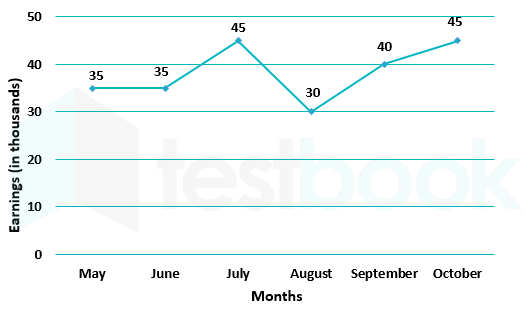
The following graph shows the earnings of Mr. Rajesh from his grocery shop, over the months. Study the graph and answer the question.

What is the respective ratio of the total earnings in May, June and July together to the total earnings in August, September and October together?

  1. ((a))

    1 : 1

  2. ((b))

    2 : 1

  3. ((c))

    11 : 21

  4. ((d))

    1 : 2

Show Answer
Answer: ((a))

1 : 1

Given:

Calculation:

Total earnings in May, June, and July = 35000 + 35000 + 45000

Total earnings in May, June, and July = 115000

Total earnings in August, September, and October = 30000 + 40000 + 45000

Total earnings in August, September, and October = 115000

Respective ratio of total earnings = 115000115000\frac{115000}{115000} = 1 : 1

Therefore, the respective ratio of the total earnings in May, June, and July together to the total earnings in August, September, and October together is 1 : 1.

50

‘Three statements are given followed by two conclusions numbered I and II. You have to take the statements to be true, even if they seem to be at variance with commonly known facts and decide which of the conclusions logically follow(s) from the statements

Statements:

Some Pots are Mud.

Some Flowers are Mud.

All Mud are Worms.

Conclusions:

(I) Some Flowers are Worms.

(ii) Some Pots are Flowers.

  1. ((a))

    Neither conclusion (I) nor (II) follows.

  2. ((b))

    Only conclusion (II) follows.

  3. ((c))

    Only conclusion (I) follows.

  4. ((d))

    Both conclusions (I) and (II) follow.

Show Answer
Answer: ((c))

Only conclusion (I) follows.

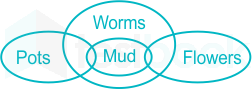
According to the given statements, the Venn diagram we get as:

Let's check all the conclusions:

(I) Some Flowers are Worms →Follows: (Since given some flowers are mud and all mud are worms. Thus some flowers are worms is true.)

(ii) Some Pots are Flowers → Does not follows: (Since there is no definite relation between Pots and Flowers, therefore, some pots are flowers is not true.)

Thus, only the conclusion I follow.

Hence, the correct answer is 'option 3'.

51

In Jainism, who is a Tirthankara?

  1. ((a))

    A saviour and spiritual teacher of the dharma who teaches the way to moksha, or liberation.

  2. ((b))

    A person who believes in one God and one spirit and believes in rebirth.

  3. ((c))

    A person who never believes in God.

  4. ((d))

    A group of pilgrims.

Show Answer
Answer: ((a))

A saviour and spiritual teacher of the dharma who teaches the way to moksha, or liberation.

The correct answer is:  A saviour and spiritual teacher of the dharma who teaches the way to moksha, or liberation.

Key Points

  • Tirthankaras are spiritual leaders in Jainism who have achieved enlightenment
  • They have helped others to achieve the same by establishing the principles of Jainism and showing the path to liberation
  • Tirthankaras are believed to be human beings who have attained a state of perfection and have become free from the cycle of birth and death.

Additional Information

  • Tirthankaras are considered to be the embodiment of compassion and non-violence.
  • Jains believe that there have been 24 Tirthankaras in the current cosmic age.
  • Each Tirthankara has a unique emblem and symbol that represents them, such as a lion, elephant, and so on.
  • Tirthankaras are believed to have attained enlightenment through their own efforts and not through any external help.
  • Tirthankaras are not considered as gods, but rather as role models for Jains to follow to achieve spiritual liberation.
  • Jains believe that by following the teachings of Tirthankaras, one can attain the ultimate goal of Jainism, which is liberation from the cycle of birth and death.
52

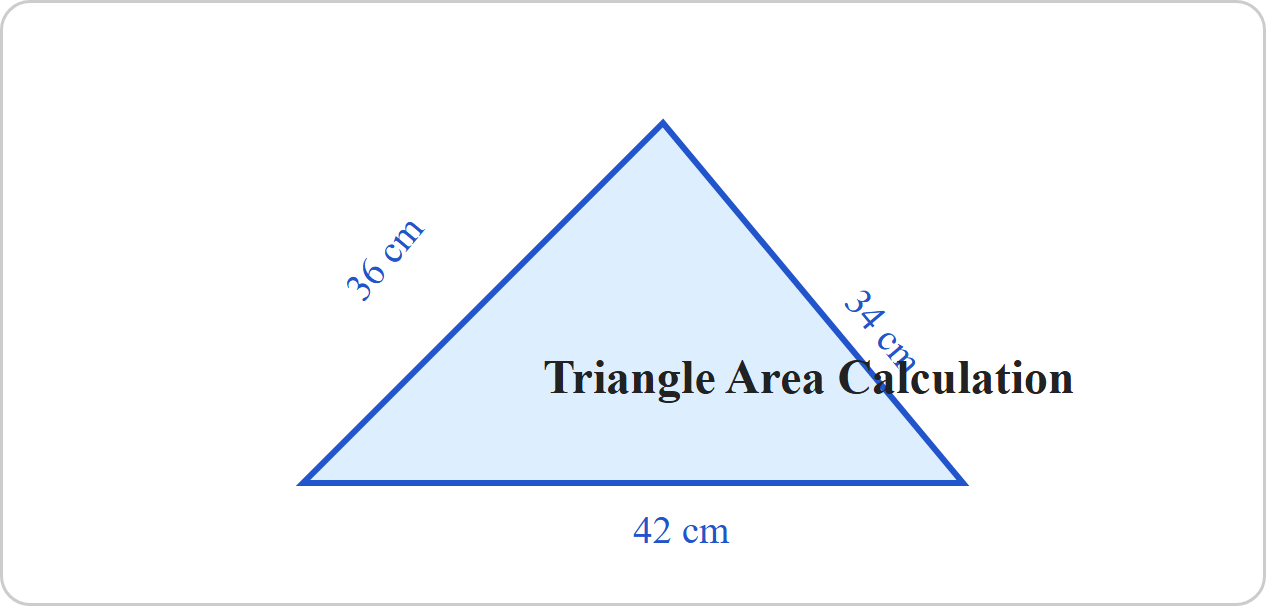
Find the area of a triangle whose sides measure 42 cm, 36 cm and 34 cm, respectively.

  1. ((a))

    112110\sqrt {110} cm2

  2. ((b))

    56110\sqrt {110} cm2

  3. ((c))

    1455\sqrt {55} cm2

  4. ((d))

    2855\sqrt {55} cm2

Show Answer
Answer: ((b))

56110\sqrt {110} cm2

Shortcut Trick

Use Heron's Formula for a triangle with sides a, b, and c.

Semi-perimeter s = (42 + 36 + 34) ÷ 2 = 112 ÷ 2 = 56 cm.

Area = √[s(s − a)(s − b)(s − c)] = √[56 × (56 − 42) × (56 − 36) × (56 − 34)]

Area = √[56 × 14 × 20 × 22] = √[784 × 440] = 28 × 2√110 = 56√110 cm2.

∴ The correct answer is 56√110 cm2.

Alternate Method

Given: Sides a = 42 cm, b = 36 cm, c = 34 cm.

Formula Used: Area = √[s(s−a)(s−b)(s−c)], where s = (a+b+c)/2

⇒ s = (42 + 36 + 34) ÷ 2

⇒ s = 112 ÷ 2 = 56 cm

⇒ Area = √[56 × (56 − 42) × (56 − 36) × (56 − 34)]

⇒ Area = √[56 × 14 × 20 × 22]

⇒ Area = √[(14 × 4) × 14 × (4 × 5) × (2 × 11)]

⇒ Area = 14 × 2 × 2 √[5 × 2 × 11]

⇒ Area = 56 √110 cm2

∴ The correct answer is 56√110 cm2.

Additional Information

Heron's Formula

Used to find the area of any triangle when all three sides are known: Area = √[s(s−a)(s−b)(s−c)].

Equilateral Triangle Area

For a triangle with all sides equal to 'a', Area = (√3 ÷ 4) × a2.

Right-Angled Triangle Area

Area = 1/2 × Base × Height. This is a specific case of the general triangle area formula.

53

A statement is given followed by four conclusions. Find out which conclusion is true based on the given statement.

Statement: P < Q < R ≤ S = T ≤ U

Conclusions:

  1. Q ≤ T

  2. T > U

  3. Q ≤ U

  4. S ≤ U

  1. ((a))

    3

  2. ((b))

    4

  3. ((c))

    1

  4. ((d))

    2

Show Answer
Answer: ((b))

4

Given: P < Q < R ≤ S = T ≤ U

⇒ P < Q < R ≤ S ≤ U

Let's check all the conclusions as:

  1. Q ≤ T → Not True

⇒ Q < R ≤ S = T

⇒ Q < T

  1. T > U → Not True

⇒ T ≤ U

  1. Q ≤ U → Not True

⇒ Q < R ≤ S = T ≤ U

⇒ Q < U

  1. S ≤ U → True

⇒ S = T ≤ U

⇒ S ≤ U

Thus, conclusion 4 is true.

Hence, the correct answer is 'option 2'.

54

A beam of light after passing through a concave lens appears to diverge from a point 25 cm behind the lens. The power of the lens is

  1. ((a))
    • 0.25 D
  2. ((b))
    • 0.25 D
  3. ((c))
    • 4 D
  4. ((d))
    • 4 D
Show Answer
Answer: ((d))
  • 4 D

The correct answer is - 4 D.

Key Points

  • A beam of light after passing through a concave lens appears to diverge from a point 25 cm behind the lens then power of the lens is -4 D
  • If the focal length is specified in metres, the lens's power is calculated in diopters (D).
  • A diverging lens has a negative optical power, whereas a converging lens has a positive optical power.

Additional Information

  • When a parallel beam is incident on a concave lens after refraction through the lens, it seems to deviate from the lens's focus.
  • Consequently, the lens's focal length is 25 cm and the focal length of a concave lens is negative by sign convention.
55

Select the option that is related to the third term in the same way as the second term is related to the first term and the sixth term is related to the fifth term.

48 : 16 :: 96 : ? :: 108 : 21

  1. ((a))

    22

  2. ((b))

    21

  3. ((c))

    20

  4. ((d))

    23

Show Answer
Answer: ((c))

20

The pattern followed in the given series is:

        (First term ÷ 12) + 12 = Second term

Now we apply the pattern on the given series:

48 : 16 

(48 ÷ 12) + 12 = 16

4 + 12 = 16

16 = 16

108 : 21

(108 ÷ 12) + 12 = 21

9 + 12 = 21

21 = 21

96 : ? 

(96 ÷ 12) + 12 = ?

8 + 12 = ?

20 = Answer

Hence the correct answer is option 3)

56

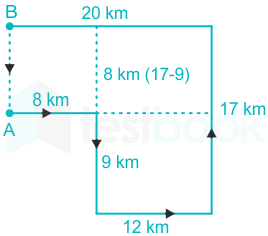
Vinay starts from Point A and drives 8 km towards the east. He then takes a right turn, drives 9 km, turns left and drives 12 km. He then takes a left turn and drives 17 km. He takes a final left turn, drives 20 km and stops at Point B. How far and towards which direction should he drive in order to reach Point A from Point B? (All turns are 90 degree turns only)

  1. ((a))

    6 km towards the north

  2. ((b))

    2 km towards the south

  3. ((c))

    8 km towards the south

  4. ((d))

    4 km towards the east

Show Answer
Answer: ((c))

8 km towards the south

According to the given information we have:

1) Vinay starts from Point A and drives 8 km towards the east.

  1. He then takes a right fun, drives 9 km, tums left and drives 12 km.

  2. He then takes a left turn and drives 17 km.

  3. He takes a final left turn, drives 20 km and stops at Point B. 

Thus, he travels 8 km towards the south direction to reach point A from point B.

Hence, the correct answer is 'option 3'.

57

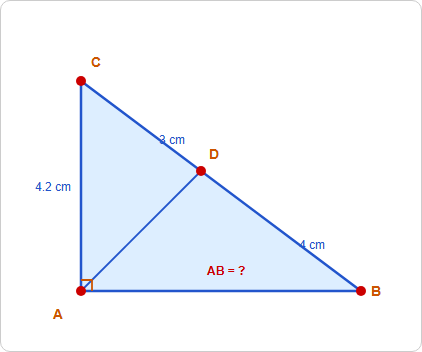
In Δ\DeltaABC, AD\overline {AD} bisects \angleA and D is a point on BC\overline {BC}. If m (AC\overline {AC}) = 4.2 cm, m (BD\overline {BD}) = 4 cm and m (BC\overline {BC}) = 7 cm, then find m (AB\overline {AB}).

  1. ((a))

    5.2 cm

  2. ((b))

    4.2 cm

  3. ((c))

    4.8 cm 

  4. ((d))

    5.6 cm

Show Answer
Answer: ((d))

5.6 cm

Shortcut Trick

By Angle Bisector Theorem, the ratio of sides is equal to the ratio of the base segments.

DC = BC − BD = 7 − 4 = 3 cm.

AB / AC = BD / DC

AB / 4.2 = 4 / 3

AB = 1.4 × 4 = 5.6 cm.

∴ The correct answer is 5.6 cm.

Alternate Method

Given: AC = 4.2 cm, BD = 4 cm, BC = 7 cm.

Formula Used: Angle Bisector Theorem: AB / AC = BD / DC.

Calculations:

⇒ DC = BC − BD

⇒ DC = 7 − 4 = 3 cm

⇒ According to the Angle Bisector Theorem, the internal bisector of an angle of a triangle divides the opposite side in the ratio of the sides containing the angle.

⇒ AB / AC = BD / DC

⇒ AB / 4.2 = 4 / 3

⇒ AB = (4 × 4.2) / 3

⇒ AB = 4 × 1.4

⇒ AB = 5.6 cm

∴ The

58

According to Newland's Law of Octaves, every________ element had properties similar to that of the first element

  1. ((a))

    fourth

  2. ((b))

    eighth

  3. ((c))

    seventh

  4. ((d))

    sixth

Show Answer
Answer: ((b))

eighth

The correct answer is eighth.

Key Points

  • The properties of every eighth element, like the eighth note of the musical scale, were comparable to those of the first element, according to Newland's Law of Octaves.
  • The law of octaves is a generalisation in chemistry that states that if chemical elements are ordered in order of increasing atomic weight, those with comparable physical and chemical properties follow intervals of seven elements J.A.R. Newlands of England formulated this generalisation in 1865.
  • John Alexander Newland proposed the Newlands law of octaves and organised the 56 elements into octaves in 1865.
  • He organised the elements in order of increasing atomic weight and discovered that every eighth element has characteristics that are comparable to those of the first element.
59

Which incident intensified British control over India’s foreign trade?

  1. ((a))

    Building railways

  2. ((b))

    Drainage of Indian wealth

  3. ((c))

    British' s monopoly on foreign trade

  4. ((d))

    Opening of Suez Canal

Show Answer
Answer: ((d))

Opening of Suez Canal

The correct answer is  Opening of Suez Canal

Key Points

  • The opening of the Suez Canal in 1869 greatly impacted British control over India's foreign trade.
  • The canal provided a shorter and more efficient route for trade between Europe and India, reducing travel time and costs.
  • This increased trade with Europe and gave Britain more control over India's economy and resources.

Additional Information

  • The opening of the Suez Canal greatly reduced the travel time and costs for ships travelling between Europe and India.
  • This allowed British merchants to trade more efficiently with India and other parts of Asia.
  • As a result, British businesses and trade with India increased significantly, which led to an increase in British control over India's foreign trade.
  • The British East India Company was the main beneficiary of this trade expansion, as it had a monopoly over India's foreign trade.
  • The opening of the canal also led to an increase in demand for Indian goods such as cotton, tea, and spices in Europe.
60

Subject Expert Committee (SEC) on COVID- 19, India, has recommended which of the following vaccines for phase II/III clinical trial in the age group 2 to 18 Years in May 2021?

  1. ((a))

    Covishield

  2. ((b))

    Covaxin

  3. ((c))

    Sputnik light vaccine

  4. ((d))

    Corbevax

Show Answer
Answer: ((b))

Covaxin

The correct answer is Covaxin.

Key Points

  • Covaxin is India’s indigenous Covid-19 vaccine.
  • Covaxin is developed by Bharat Biotech, Hyderabad in collaboration with the Indian Council of Medical Research’s National Institute of Virology, Pune.
  • In order to formulate the policy and guidelines for approval of new drugs**, clinical trials and banning of drugs an Expert Committee was constituted by the Ministry of  Health & Family Welfare.**
  • Coronavirus disease (COVID-19) is an infectious disease caused by the SARS-CoV-2 virus.

Additional Information

  • ​​Covishield is a recombinant, replication-deficient chimpanzee adenovirus vector encoding the SARS-CoV-2 Spike (S) glycoprotein against COVID-19.
  • ​Sputnik light Vaccine was created by Russian scientists based on advanced scientific and clinical research.
  • Corbevax is a protein subunit COVID-19 vaccine developed by Texas Children's Hospital Center for Vaccine Development and Baylor College of Medicine in Houston, Texas and Dynavax technologies based in Emeryville, California.
61

Six students, A, B, C, D, E and F, participated in one of the International Mathematics Olympiad. Each of them scored different marks. C scored more than D but less than B. E scored less than A. B scored more than A but less than F.C scored less than E. Who scored the maximum marks among the given students?

  1. ((a))

    E

  2. ((b))

    A

  3. ((c))

    F

  4. ((d))

    B

Show Answer
Answer: ((c))

F

According to the given statements, we have

  1. Six students, A, B, C, D, E and F, participated in one of the International Mathematics Olympiad. Each of them scored different marks. C scored more than D but less than B.

⇒ D < C < B

  1. E scored less than A. B scored more than A but less than F.

⇒ E < A < B < F

  1. C scored less than E.

⇒ C < E 

Thus, the final marks scored will be arranged as:

⇒ D < C < E < A < B < F

Thus, F scored the maximum marks among the given students.

Hence, the correct answer is 'option 3'.

62

Which of the following numbers will replace the question mark (?) in the given number series?

87, 88, 80, 107, 43, ?

  1. ((a))

    70

  2. ((b))

    126

  3. ((c))

    168

  4. ((d))

    98

Show Answer
Answer: ((c))

168

The logic here is:

Thus, the missing number is 168

Hence the correct answer is 'option 3'.

63

At present, the difference of the ages of a mother and son is 30 years. 15 years ago, the mother’s age was twice the then age of the son. The present age (in years) of the mother is:

  1. ((a))

    75

  2. ((b))

    90

  3. ((c))

    45

  4. ((d))

    60

Show Answer
Answer: ((a))

75

Shortcut Trick

The age difference between two people remains constant throughout their lives.

15 years ago, Ratio of Mother : Son = 2 : 1. Difference = 2 − 1 = 1 unit.

Since the difference is 30 years, 1 unit = 30 years.

Mother's age 15 years ago = 2 units = 2 × 30 = 60 years.

Present age of Mother = 60 + 15 = 75 years.

∴ The correct answer is 75 years.

Alternate Method

Given: Difference = 30 years; 15 years ago Mother = 2 × Son.

Let the age of the son 15 years ago be x.

Age of the mother 15 years ago = 2x.

⇒ Present age of son = x + 15

⇒ Present age of mother = 2x + 15

⇒ (2x + 15) − (x + 15) = 30

⇒ x = 30

⇒ Present age of Mother = 2 × 30 + 15

⇒ Present age of Mother = 60 + 15 = 75 years.

∴ The correct answer is 75 years.

Additional Information

Constant Age Difference

The numerical difference between the ages of two persons remains the same regardless of how many years pass or go back.

Ratio Scaling

If the ratio of ages changes over time, equate the parts to the constant difference to find the value of one unit quickly.

Future/Past Calculations

For 'n' years ago, subtract n from present age. For 'n' years hence, add n to the present age.

64

Which of the following statements about carbon is correct?

  1. ((a))

    Carbon is metalloid in nature.

  2. ((b))

    Carbon is a noble gas.

  3. ((c))

    Carbon is non-metal in nature.

  4. ((d))

    Carbon is metal in nature.

Show Answer
Answer: ((c))

Carbon is non-metal in nature.

The correct answer is Carbon is non-metal in nature.

Key Points

  • With an atomic number of 6 and an atomic mass of 12, carbon is a solid non-metal.
  • One can classify the elements into metals or non-metals based on certain characteristics that apply to both metals and non-metals.

Additional Information

  • ​​To create a covalent bond, carbon produces 4 electrons.
  • It exists in a variety of allotropes and other forms and these have unique properties, such as diamond and graphite.
  • Under typical circumstances, carbon is rather inert.
  • The symbol C is used to identify this chemical.
  • It has the atomic number 6 because its nucleus has six protons.
  • Tetravalent and nonmetallic describe carbon.
65

The following figure shows the human heart. LA = left auricle; LV = left ventricle; RA = right auricle; RV = right ventricle. Where are the valves located?

  1. ((a))

     At all positions: 1, 2, 3, 4, 5 and 6

  2. ((b))

    At positions 1, 2, 4 and 6

  3. ((c))

    At positions 2, 3, 4 and 5

  4. ((d))

    At positions 4, 5 and 6

Show Answer
Answer: ((c))

At positions 2, 3, 4 and 5

The correct answer is At positions 2, 3, 4 and 5

Key Points

  • In the heart, valves are located at specific points to control the flow of blood. Here are four main valves in the heart:
  • The tricuspid valve is located between the right atrium and the right ventricle.
  • The pulmonary valve is located between the right ventricle and the pulmonary artery.
  • The mitral valve is located between the left atrium and the left ventricle.
  • The aortic valve is located between the left ventricle and the aorta

Additional Information

  • The tricuspid valve is composed of three leaflets, or cusps, that open and close to allow blood to flow from the right atrium to the right ventricle.
  • The pulmonary valve is composed of three leaflets, which open and close to allow blood to flow from the right ventricle to the pulmonary artery, which then carries the oxygen-poor blood to the lungs for oxygenation.
  • The mitral valve is composed of two leaflets, which open and close to allow blood to flow from the left atrium to the left ventricle.
  • The aortic valve is also composed of three leaflets, which open and close to allow blood to flow from the left ventricle to the aorta, which then carries oxygen-rich blood to the rest of the body.
  • These valves have a specific structure that allows them to open and close tightly, preventing backflow of blood.
66

Town Q is to the south-east of Town P. Town R is to the south-west of Town Q. Town R is to the south of Town P. Town S is to the west of Town R. What is the direction of Town P with respect to Town S?

  1. ((a))

    South-east

  2. ((b))

    North

  3. ((c))

    South-west

  4. ((d))

    North-east

Show Answer
Answer: ((d))

North-east

According to the given statements we have:

1)  Town Q is to the south-east of Town P.

  1. Town R is to the south-west of Town Q.

  2. Town R is to the south of Town P.

  3. Town S is to the west of Town R.

Thus,  the direction of Town P with respect to Town S is North-East.

Hence, the correct answer is 'option 4'.

67

In _________, it was decided by the Government of India to declare Indian languages ​​that meet the requirements of some as "classical languages".

  1. ((a))

    2010

  2. ((b))

    2008

  3. ((c))

    2004

  4. ((d))

    2006

Show Answer
Answer: ((c))

2004

The correct answer is option 3)2004

Key Points

  • According to the article 343, in India the official language of the country is Hindi in the Devanagiri script.
  • In the year 2004, it was decided by the Government of India to declare Indian languages ​​that meet the requirements of some as "classical languages".
  • As per the eight schedule of the Indian constitution we have 22 languages in India.
  • With this in 2004, Tamil was decided as the classical language of India by the Government of India.

​ 

Additional Information

  • Classical languages and their adopted years are as follows:
Tamil2004
Kannada2008
Sanskrit2005
Telugu2008
Malayalam2014
  • For a language to be classical, it must be having an antiquity of history and if a valuable heritage is found it can be declared.
  • The literary must be truely unique for a classical language not a copied one.
68

Which of the following options is the closest approximate value which will come in place of the question mark (?) in the following equation?

18.01 × 3.99 + 9.99 × 3.99 = ?

  1. ((a))

    92

  2. ((b))

    112

  3. ((c))

    122

  4. ((d))

    84

Show Answer
Answer: ((b))

112

Given:

18.01 × 3.99 + 9.99 × 3.99

Calculation:

⇒ 18.01 × 3.99 + 9.99 × 3.99

⇒ (18 + 0.01) × (4 – 0.01) + (10 – 0.01) × (4 – 0.01)

⇒ 72 – 0.18 + 0.04 – 0.0001 + 40 – 0.1 – 0.04 + 0.0001

⇒ 112 – 0.18 – 0.1

⇒ 112 – 0.28 = 111.72 \approx 112

Therefore, the value in place of question mark should be 112.

69

The LCM of two numbers is 14 times their HCF. If one of the numbers is 36 and the sum of the LCM and the HCF is 270, then the other number is:

  1. ((a))

    126

  2. ((b))

    144

  3. ((c))

    252

  4. ((d))

    234

Show Answer
Answer: ((a))

126

Shortcut Trick

Ratio of LCM to HCF is 14 : 1.

Sum of ratios = 14 + 1 = 15 units.

15 units = 270 → 1 unit (HCF) = 18.

LCM = 14 × 18 = 252.

Other number = (LCM × HCF) ÷ First number = (252 × 18) ÷ 36 = 126.

∴ The correct answer is 126.

Alternate Method

Given:

Sum of LCM and HCF = 270

LCM = 14 × HCF

One number (a) = 36

Formula Used:

LCM × HCF = Product of two numbers (a × b)

Calculations:

⇒ 14H + H = 270

⇒ 15H = 270

⇒ HCF (H) = 18

⇒ LCM (L) = 14 × 18 = 252

⇒ 36 × Second number = 252 × 18

⇒ Second number = (252 × 18) ÷ 36

⇒ Second number = 252 ÷ 2 = 126

∴ The correct answer is 126.

Additional Information

HCF and LCM Relation

For any two numbers a and b, HCF(a, b) × LCM(a, b) = a × b. This property holds true only for two numbers.

HCF as a Factor

The HCF of two or more numbers is always a factor of their LCM. In this case, 252 ÷ 18 = 14.

Co-prime Numbers

If two numbers are co-prime, their HCF is 1 and their LCM is equal to the product of the two numbers.

70

Which of the following events.is known as the Calcutta killings?

  1. ((a))

    Quit India movement

  2. ((b))

    Direct action day

  3. ((c))

    Salt satyagraha

  4. ((d))

    Bengal satyagraha

Show Answer
Answer: ((b))

Direct action day

The correct answer is Direct Action Day.

 Key Points

  • Muhammad Ali Jinnah named August 16th, 1946 as Direct Action Day and asked Muslims nationwide to stop all commercial activities.
  • This was done to exert pressure on the British government to accede the demand of establishment of a Pakistan dominated by Muslims.
  • ‘Direct Action Day’ led to the start of multiple violent incidents that took place for a few days known as the Week of the long Knives.
  • He wanted Muslims to stop all commerce and trade but his call unintentionally sparked the greatest racial rioting of the 20th century.

 Additional Information

  • ​The goal of the 3-person cabinet mission sent by Clement Atlee in 1946 was to finalize plans for the handover of power from the British Raj to the Indian leadership.
  • The Mission discussed initial proposals for the structure of the future Dominion of India and its government with leaders of the Indian National Congress and the All India Muslim League.
  • Under pressure from Jinnah’s Muslim League, the Mission proposed an alternative plan to divide India into Hindu-majority India and Muslim-majority Pakistan.
  • Jinnah decided to boycott the Constituent Assembly to apply pressure on Congress and the British because he feared Hindu dominance in the assembly post independence.
71

Which of the following is NOT one of the determinants of demand?

  1. ((a))

    Future expectation to change in price

  2. ((b))

    Income of consumer

  3. ((c))

    Price of goods

  4. ((d))

    Taste and preference of seller

Show Answer
Answer: ((d))

Taste and preference of seller

The correct answer is the Taste and preference of the seller.

 Key Points

  • The taste preference of the seller is not a determinant of demand because it depends upon the taste preference of buyers or individuals.
  • Taste and Preferences of consumers are influenced by advertisements, changes in fashion, climate, new innovations etc.
  • Demand for those goods increases and consumers develop a strong taste preference**.**
  • If the taste or preference of a product is fading (decreasing), its demand will decrease.
  • The demand function is D×= f(Px,Pr,Y,T,E)
  • Px = Price of own community
  • Pr = Price of related goods
  • Y = Income
  • T = Taste in Preference of buyers
  • E = Expectations.

 Additional Information

  • Future expectations:- If the consumer expects an important change in the ability of the commodity in near future, he may decide to change his present demand for the commodity which leads to a raise in his present demand for the commodity at its existing price.
  • Income of consumer:- change in the income of the consumer also influences his demand for different goods. The demand for normal goods tends to increase with the increase in income and vice versa.
  • Price of goods:- demand for a commodity is also influenced by changes in the price of related goods.
  • There are of two types:

              (a) Substitute Goods

              (b) Complementary Goods.

72

Seven people (E, F, G, H, I, J and K), are sitting in a straight row, facing north. Only three people sit between E and I. Only two people sit to the right of J. E sits third to the left of J. H is an immediate neighbour of E and G. K is not an immediate neighbour of E. Who sits in the exact middle position of the row?

  1. ((a))

    J

  2. ((b))

    H

  3. ((c))

    I

  4. ((d))

    G

Show Answer
Answer: ((d))

G

According to the given statements we have

Seven people (E, F, G, H, I, J and K), are sitting in a straight row, facing north.

  1. Only three people sit between E and I. Only two people sit to the right of J. E sits third to the left of J.

  1. H is an immediate neighbour of E and G.

  1. K is not an immediate neighbour of E. Thus the final arrangement is:

Thus G sits in the exact middle position of the row.

Hence the correct answer is 'option 4'.

73

A and B can do a piece of work in 9 days and 12 days, respectively. A starts the work and they work on alternate days. They can finish the work in:

  1. ((a))

    11 14\frac{1}{4} days

  2. ((b))

    11 days

  3. ((c))

    10 14\frac{1}{4} days

  4. ((d))

    10 27\frac{2}{7} days

Show Answer
Answer: ((c))

10 14\frac{1}{4} days

Shortcut Trick

Total Work (LCM of 9, 12) = 36 units.

Efficiency: A = 4 units/day, B = 3 units/day.

Work done in 1 cycle (2 days) = 4 + 3 = 7 units.

In 5 cycles (10 days), work done = 7 × 5 = 35 units.

Remaining 1 unit done by A on 11th day in 1/4 day.

∴ The correct answer is 10 1/4 days.

Alternate Method

Given: Time taken by A = 9 days, Time taken by B = 12 days. They work on alternate days starting with A.

PersonDaysTotal WorkEfficiency
A9364
B123

⇒ Total efficiency in a 2-day cycle = 4 + 3 = 7 units/cycle

⇒ Number of full cycles = 36 ÷ 7 = 5 cycles

⇒ Work completed in 10 days = 5 × 7 = 35 units

⇒ Remaining work = 36 − 35 = 1 unit

⇒ On 11th day, it is A's turn. Time taken by A = 1/4 day

⇒ Total time = 10 + 1/4 = 10 1/4 days

∴ The correct answer is 10 1/4 days.

Additional Information

Alternate Day Concept

In alternate day problems, identify the unit of work per cycle. The person who starts the work always handles the remainder if it is less than their daily efficiency.

Efficiency and Time

Efficiency is inversely proportional to time. Total Work = Efficiency × Time. Using LCM to find Total Work simplifies calculations by avoiding fractions.

74

Which figure shows the correct location of the liver (shown as the pink shape) in the human body (given that the person is facing you, the reader)?

  1. ((a))

    Figure 4 

  2. ((b))

    Figure 1

  3. ((c))

    Figure 2

  4. ((d))

    Figure 3

Show Answer
Answer: ((d))

Figure 3

The correct answer is figure 3.

Key Points

  • The liver is the largest glandular organ in the body and it is located in the right upper quadrant of the abdomen, just below the diaphragm.
  • The liver is protected by the rib cage, which helps to keep it in place and prevent injury.
  • The liver is located in close proximity to other abdominal organs, such as the stomach, pancreas, and intestines.
  • The liver has a dual blood supply, receiving both oxygenated blood from the hepatic artery and nutrient-rich blood from the portal vein.
  • The liver plays a crucial role in many bodily functions, including metabolism, detoxification, and the production of bile.

Additional Information

  • The liver is situated in the right upper quadrant of the abdomen, and it occupies most of the upper right side of the abdominal cavity.
  • It is located between the diaphragm and the stomach, and it extends from the level of the right fifth rib to the level of the lower border of the right hemidiaphragm.
  • The liver is located in proximity to the gallbladder, which sits just beneath it on the right side of the abdomen.
  • The liver is also closely related to the right kidney, which sits just below it on the back side of the abdominal cavity.
  • The liver and the gallbladder are connected by the common bile duct, which carries bile from the liver to the gallbladder for storage and release into the small intestine.
  • The liver also has close relationship with the spleen which is located on the left upper quadrant of the abdomen and the pancreas which is located behind the stomach.
75

Find the value of (3 + 11) × 4 ÷ (6 + 1) - 21

  1. ((a))

    15

  2. ((b))

    13

  3. ((c))

    -13

  4. ((d))

    -15

Show Answer
Answer: ((c))

-13

Given:

(3 + 11) × 4 ÷ (6 + 1) - 21 

Concept Used:

BODMAS = Bracket, Of, Division, Multiplication, Addition, Subtraction

Calculation:

⇒ (3 + 11) × 4 ÷ (6 + 1) – 21

⇒ (14 × 4) ÷ 7 – 21

⇒ 56 ÷ 7 – 21

⇒ 8 – 21 = -13

Therefore, the simplified value is -13.

76

A group of numbers/symbols is coded using letters as per the table given below and the conditions that follow. The correct combination of codes following the conditions is your answer.

Number /symbol2%435$@9#+8^79
Code LetterLDBSGAHKLZFXQY


Conditions: 

(i) If the first element is a symbol and the last element is a number, the codes for these two (the first and the last elements) are to be interchanged.

(ii) If the first element is an odd number and the last element is an even number, the first and last elements are to be coded as ©.

(iii) If both the second and third elements are perfect squares, the third element is to be coded as the code for the second element. 

What will be the code for $ 2 3 % 4 ?

  1. ((a))

    ASLDB

  2. ((b))

    BLDSA

  3. ((c))

    ALSDB

  4. ((d))

    BLSDA

Show Answer
Answer: ((d))

BLSDA

Given:

Number /symbol2%435$@9#+8^79
Code LetterLDBSGAHKLZFXQY

Code for: $ 2 3 % 4

Check all the conditions:

(i) If the first element is a symbol and the last element is a number, the codes for these two (the first and the last elements) are to be interchanged.

⇒ 4 2 3 % $ 

(ii) If the first element is an odd number and the last element is an even number, the first and last elements are to be coded as ©.

⇒ This condition is not satisfied.

(iii) If both the second and third elements are perfect squares, the third element is to be coded as the code for the second element. 

⇒ This condition is not satisfied.

Thus, the code of the given 4 2 3 % $  is BLSDA.

Hence, the correct answer is 'option 4'.

77

The valency of carbon is _______ .

  1. ((a))

    4

  2. ((b))

    2

  3. ((c))

    6

  4. ((d))

    3

Show Answer
Answer: ((a))

4

The correct answer is 4.

Key Points

  • Carbon atoms have four electrons in their outermost shell, also known as the valence shell.
  • In order to achieve a stable electron configuration, carbon atoms typically form chemical bonds with four other atoms or groups of atoms.
  • Carbon can form single, double, and triple bonds with other atoms, depending on the chemical compound.
  • The ability of carbon to form multiple types of bonds with other atoms is a fundamental characteristic of its chemical properties, and is responsible for the diversity of organic compounds in living organisms.
  • Carbon can form covalent bonds with other elements such as hydrogen, oxygen, nitrogen and sulphur.

Additional Information

  • Carbon atoms have four valence electrons in their outermost shell, which allows them to form four covalent bonds with other atoms.
  • Carbon can form single, double or triple bonds with other atoms, depending on the chemical compound. In a single bond, one pair of electrons is shared between the carbon atom and the other atom. In a double bond, two pairs of electrons are shared, and in a triple bond, three pairs of electrons are shared.
  • The ability of carbon to form multiple types of bonds with other atoms is responsible for the diversity of organic compounds, including compounds such as sugars, amino acids, and nucleic acids.
  • Carbon can also form a variety of ring structures, such as cyclohexane, cyclopentane, and benzene, which are important building blocks of many organic compounds.
  • The valency of 4 is not a fixed value, under certain conditions, the carbon atom can form more or less than four covalent bonds.
  • The valency of carbon can be modified by the presence of other elements, or by the addition of functional groups such as -OH, -COOH, -NH2 and so on.
78

Which of the following numbers will replace the question mark (?) in the given series?

2,  1.5,  1.1,  0.8,  0.6 ?

  1. ((a))

    0.4

  2. ((b))

    0.3

  3. ((c))

    0.5

  4. ((d))

    0.6

Show Answer
Answer: ((c))

0.5

The logic here is:

Thus, the next number is 0.5.

Hence, the correct answer is 'option 3'.

79

The following is the data for an image formed by a convex mirror: 

Object distance = 30 cm,

Size of object = 10 cm,

Size of image =2.5 cm,

The focal length of this mirror is ________ .

  1. ((a))

    30 cm

  2. ((b))

    20 cm

  3. ((c))

    15 cm

  4. ((d))

    10 cm

Show Answer
Answer: ((d))

10 cm

The correct answer is 10 cm.

Given:

Image formed by a convex mirror,


Object distance, u= -30 cm

Size of object = 10 cm

Size of image =2.5 cm.

To find:

The focal length (f)

Formula:

m=vum=-{v\over u}

1f=1v+1u{1\over f}={1\over v}+{1\over u}

Calculations:

Here,

m=vum=-{v\over u}

2.510=v30{2.5\over 10}=-{v\over -30}

v=304cmv={30\over 4}cm

Thus, focal length is:

1f=1v+1u{1\over f}={1\over v}+{1\over u}

1f=1304+130{1\over f}={1\over {30\over 4}}+{1\over -30}

1f=430130{1\over f}={4\over 30}-{1\over 30}

1f=330{1\over f}={3\over 30}

f=303=10cmf={30\over 3}=10cm

Thus, the focal length is 10cm.

80

Which of the following statements about fundamental duties of the Indian Constitution is correct?

  1. ((a))

    To preserve the biodiversity is a fundamental duty

  2. ((b))

    To make compulsory education to children of 6 to 14 years as our fundamental duty

  3. ((c))

    To obey parents is a fundamental duty

  4. ((d))

    To save money for future is a fundamental duty

Show Answer
Answer: ((b))

To make compulsory education to children of 6 to 14 years as our fundamental duty

The correct answer is To make compulsory education to children of 6 to 14 years as our fundamental duty.

Key Points

  • Article 51A deals with the Fundamental Duties of the citizen's states.
  • The 86th CAA added a fundamental duty which states that every citizen “Who is a parent or guardian, to provide opportunities for education to his child or, as the case may be, ward between the age of six and fourteen years”.
  • These are moral obligations to the citizens of the country and are non-justiciable.
  • Provisions as to fundamental duties cannot be enforced by writs. They can be promoted only by constitutional methods.
  • Article 51a is confined to citizens unlike some of the articles related to fundamental rights which extend to all persons.
  • So it is the duty of a parent or guardian to provide opportunities for the education of his child.

 Additional Information

  • Article 21A declares that the state shall provide free and compulsory education to all children aged 6 to 14 years.
  • This provision makes only elementary education a fundamental right and not higher or professional education.
  • The right to education is subject to the limits of the economic capacity and development of the state.
  • The government described this step as the dawn of the second revolution in the chapter on citizens' rights.
  • To Obey the parents is not a fundamental duty of the citizens of India however it can be regarded as a moral duty.
81

Article _______ of the Constitution which enshrines one of the Directive Principles of State Policy, lays down that the State shall take steps to organise village panchayats and endow them with such powers and authority as may be necessary to enable them to function as units of self-government.

  1. ((a))

    37

  2. ((b))

    40

  3. ((c))

    48

  4. ((d))

    31

Show Answer
Answer: ((b))

40

The correct answer is Article 40.

Key Points

  • Article 40
  • It is a part of the Indian Constitution's Directive Principles of State Policy.
  • It lays down that the government should establish village panchayats and empower them for self-government.
  • It recognizes the importance of Panchayat Raj Institutions as units of self-government.
  • Article 40 of the Constitution lays down that the State shall take steps to organize village panchayats and endow them with the powers and authority necessary for self-government.
  • After forty years of experience, it has been observed that there is an imperative need to include in the Constitution certain introductory and essential features of Panchayati Raj Institutions
  • The objective is to impart certainty, durability, and strength to the Panchayati Raj Institutions​.

Additional Information

  • Article 37
  • According to Article 37 of the Indian Constitution, no court may implement the Directive Principles of State Policy (DPSP). The outlined concepts are essential to a nation's governance, nevertheless.
  • In order to create and enforce laws in their various jurisdictions, it is the responsibility of the state and federal governments to follow these principles.
  • Article 48
  • ​Bos Indicus is intended to be protected by Article 48 of the constitution.
  • The government created Article 48 for the welfare of cattle and to take steps to secure the bovine wealth of India in response to the ongoing requests from associated religions for action to be made to prohibit cattle butchering.
  • Article 31
  • ​The Indian Constitution's Article 31 addresses property rights and is famous for allowing for the forced purchase of the property. One of the first seven essential rights included in the Indian Constitution was the right to property.
82

A perfect pair of sex chromosomes is found in _______.

  1. ((a))

    human women

  2. ((b))

    starfish

  3. ((c))

    human men

  4. ((d))

    snakes

Show Answer
Answer: ((a))

human women

The correct option is human women

Key Points

  • Women have two X chromosomes (XX) which is considered as a perfect pair of sex chromosomes.
  • This pair of sex chromosomes determines female characteristics.
  • The two X chromosomes are identical in women, which means they carry the same genetic information.
  • Men have one X and one Y chromosome (XY) which is not a perfect pair.
  • The X chromosome plays a role in certain traits and characteristics related to sex determination and fertility.

Additional Information 

  • Women have two copies of the X chromosome (XX), while men have one X and one Y chromosome (XY).
  • The X and Y chromosomes are responsible for determining an individual's sex, with the presence of a Y chromosome resulting in the development of male characteristics and the presence of two X chromosomes resulting in the development of female characteristics.
  • Women have a homogametic sex chromosome pair, which means that the two X chromosomes are identical and carry the same genetic information.
  • This is in contrast to men who have a heterogametic sex chromosome pair, with the X and Y chromosomes carrying different genetic information.
  • The X chromosome carries numerous genes, some of which are responsible for the development of certain traits and characteristics, including those related to sex determination and fertility.
83

Train A leaves station M at 6.00 a.m. and reaches station N at 2.00 p.m. on the same day. Train B leaves station N at 8.00 a.m. and reaches station M at 3.00 p.m. on the same day. Find the time when Trains A and B meet. 

  1. ((a))

    11.00 a.m.

  2. ((b))

    10.48 a.m.

  3. ((c))

    10.45 a.m.

  4. ((d))

    10.55 a.m.

Show Answer
Answer: ((b))

10.48 a.m.

Shortcut Trick

Time taken by Train A = 8 hours and Train B = 7 hours.

Let Total Distance = LCM(8, 7) = 56 units.

Speed of A = 7 units/hr, Speed of B = 8 units/hr.

Distance covered by A in 2 hours (6 a.m. to 8 a.m.) = 7 × 2 = 14 units.

Remaining distance at 8 a.m. = 56 − 14 = 42 units.

Meeting time after 8 a.m. = 42 ÷ (7 + 8) = 42/15 hours = 2 hours 48 minutes.

∴ The correct answer is 10.48 a.m.

Alternate Method

Given:

Train A duration: 6:00 a.m. to 2:00 p.m. = 8 hours.

Train B duration: 8:00 a.m. to 3:00 p.m. = 7 hours.
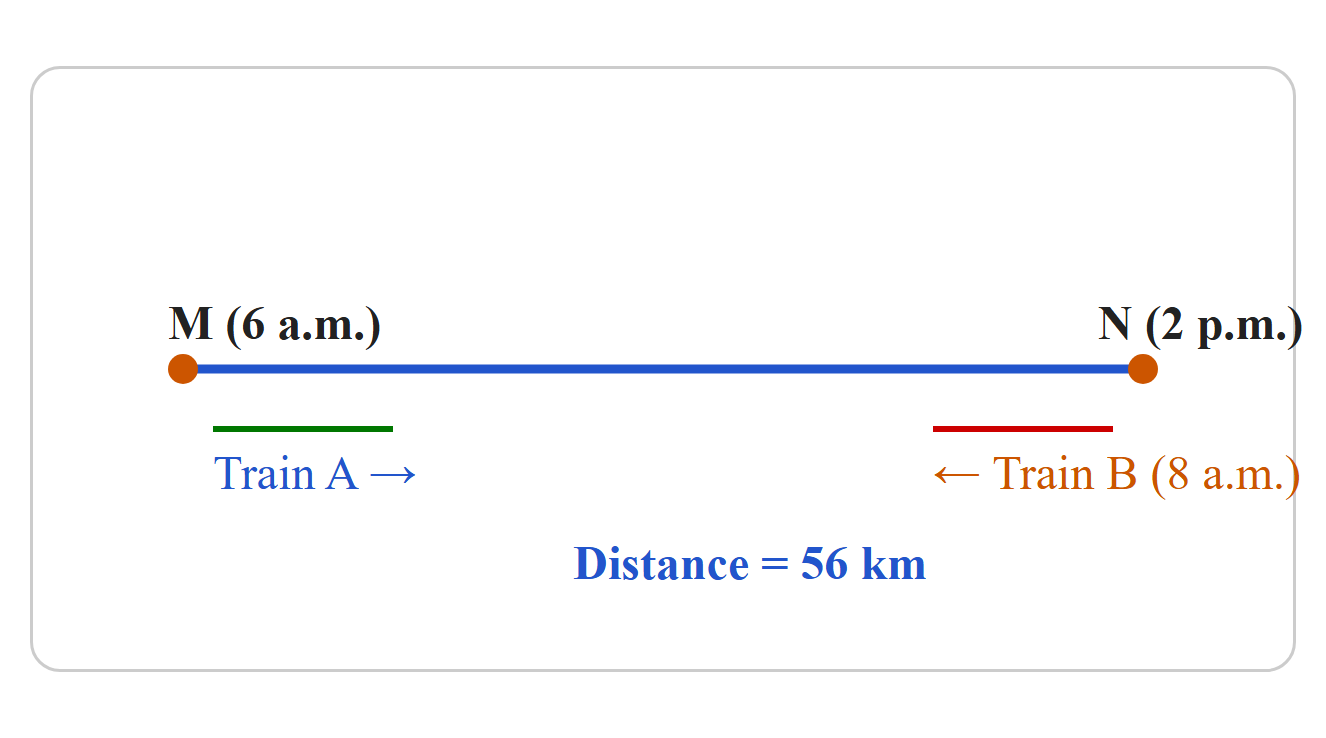
Calculations:

⇒ Let distance between M and N = 56 km (LCM of 8 and 7).

⇒ Speed of Train A = 56 ÷ 8 = 7 km/hr.

⇒ Speed of Train B = 56 ÷ 7 = 8 km/hr.

⇒ Distance covered by A before B starts (from 6 a.m. to 8 a.m.) = 7 × 2 = 14 km.

⇒ Remaining distance = 56 − 14 = 42 km.

⇒ Relative speed = 7 + 8 = 15 km/hr.

⇒ Time taken to meet = 42 ÷ 15 = 2.8 hours.

⇒ 2.8 hours = 2 hours + (0.8 × 60) minutes = 2 hours 48 minutes.

⇒ Meeting time = 8:00 a.m. + 2 hours 48 minutes = 10:48 a.m.

∴ The correct answer is 10.48 a.m.

Additional Information

Relative Speed

When two objects move in opposite directions, their relative speed is the sum of their individual speeds (S1 + S2).

Time and Distance Relation

Distance = Speed × Time. If distance is constant, speed is inversely proportional to time.

Meeting Time Concept

To calculate meeting time, ensure both objects are moving. Calculate the lead distance covered by the first object before the second starts.
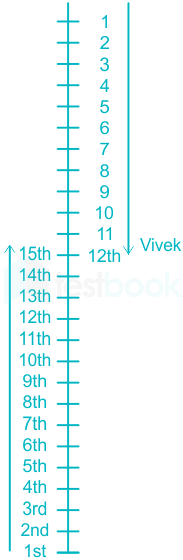
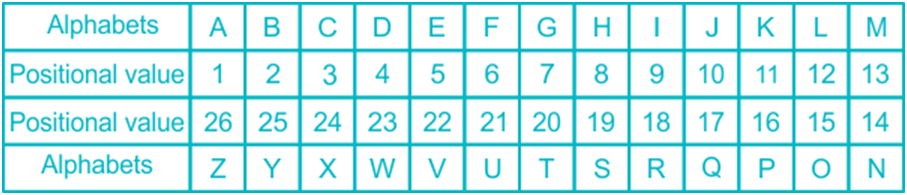
84

Eight friends are sitting around a square table facing the centre. Four of them are sitting at the corners and remaining four are sitting at the exact middle of the four sides. Arhaan is sitting to the immediate left of Sunita. Hari is sitting fourth to the left of Tarini. Tarini is second to the left of Arhaan. Only Daisy is sitting between Tarini and Neelima . Only Prashant is sitting between Hari and Neelima. Yash is sitting fourth to the left of Prashant. Who amongst the following has Tarini and Arhaan as the immediate neighbours?

  1. ((a))

    Neelima

  2. ((b))

    Prashant

  3. ((c))

    Daisy

  4. ((d))

    Yash

Show Answer
Answer: ((d))

Yash

According to the given statements we have:

Eight friends are sitting around a square table facing the centre. 

Four of them are sitting at the corners and the remaining four are sitting at the exact middle of the four sides.

  1. Arhaan(A) is sitting to the immediate left of Sunita(S). Tarini(T) is second to the left of Arhaan(A).

  1. Hari(H) is sitting fourth to the left of Tarini(T). Only Daisy(D) is sitting between Tarini(T) and Neelima(N). Only Prashant(P) is sitting between Hari(H) and Neelima(N).

  1. Yash(Y) is sitting fourth to the left of Prashant(P). Thus the sitting arrangement is:

Thus, Yash is the immediate neighbours Tarini and Arhaan. 

Hence, the correct answer is 'option 4'.

85

If 2 is added to each odd digit and 1 is subtracted from each even digit in the number 94387251, what will be the sum of the first, fifth and last digits in the new number thus formed?

  1. ((a))

    14

  2. ((b))

    12

  3. ((c))

    11

  4. ((d))

    10

Show Answer
Answer: ((c))

11

According to the given information:

When 2 is added to each odd digit and 1 is subtracted from each even digit in the number 94387251,


Now the new number is: 113579173

Now, the sum of the first, fifth and last digit is,

1 + 7 + 3 = 11

Hence the correct answer is option 3)

86

Lokapavani and Bhavani are tributaries of the River ______.

  1. ((a))

    Cauvery

  2. ((b))

    Godavari

  3. ((c))

    Krishna

  4. ((d))

    Mahanadi

Show Answer
Answer: ((a))

Cauvery

The correct answer is Cauvery.

Key Points

  • One of the five rivers that flow through the Mandya district is the Lokapavani. One of the tributaries of the Cauvery River, this is a perennial river.
  • It has its source in Honakare and travels through the slopes of Arighatta. Near Srirangapatna, it merges with the Cauvery.
  • The Nilgiri hills of the Western Ghats are the source of the Bhavani River.
  • After that, it flows back towards Tamil Nadu through Kerala's Silent Valley National Park.

 Additional Information

  • In the Erode district of Tamil Nadu, the Bhavanisagar Dam is located on the Bhavani River.
  • The dam is among the greatest earthen dams on the planet.
  • Many people come to this holy location to take a dip in the waters of the Sangam point of the Lokapavani and Cauvery with other tributaries of the Cauvery Hemavati.
  • One of Kerala's three rivers that run eastward is the Bhavani River.
87

The resistivity of a material of length 5 m is 1.6 × 10-8 ohm-m. If the length of the material is increased by 10 m, then the value of resistivity is ______.

  1. ((a))

    12.4 × 10⁻⁸

  2. ((b))

    0.8 × 10⁻⁸

  3. ((c))

    3.2 × 10⁻⁸

  4. ((d))

    1.6 × 10⁻⁸

Show Answer
Answer: ((d))

1.6 × 10⁻⁸

The correct answer is option 4)1.6 × 10-8

Given:

Resistivity is 1.6 × 10-8 of material of length 5m

To find:

Resistivity at length 10m.

Calculations:

As, R=pLAR={pL\over A} we have resistivity and length related to each other but as the length doubles the area reduces and thus no change in the resistivity occurs and thus resistivity remains constant if we increase the length many times.

So, the resistivity at a 10m length increase is 1.6 × 10-8 ohm-m.

88

Three statements are given followed by two conclusions numbered I and II. You have to take the statements to be true, even if they seem to be at variance with commonly known facts and decide which of the conclusions logically follow(s) from the statements.

Statements:

Some Lipsticks are Red.

Some Red are Pink.

All Lipsticks are Colours.

Conclusions:

(I) Some Lipsticks are Pink.

(II) Some Colours are Red.

  1. ((a))

    Neither conclusion (I) nor (II) follows.

  2. ((b))

    Only conclusion (I) follows. 

  3. ((c))

    Both conclusions (I) and (II) follow:

  4. ((d))

    Only conclusion (II) follows.

Show Answer
Answer: ((d))

Only conclusion (II) follows.

According to the given statements, we get the Venn diagram as

Let's check all the conclusions as

(I) Some Lipsticks are Pink → Does not follow: There is no definite relation between Lipsticks and Pink. Thus some lipsticks are pink is not possible.

(II) Some Colours are Red → Follows: Since given some lipsticks are red and all lipsticks are colours. Thus, some colours are red is true.

Thus, only conclusion II follows.

Hence, the correct answer is 'option 4'.

89

Which of the following is divisible by 4?

  1. ((a))

    2124

  2. ((b))

    2125

  3. ((c))

    2123

  4. ((d))

    2122

Show Answer
Answer: ((a))

2124

Shortcut Trick

A number is divisible by 4 if its last two digits are divisible by 4.

Check last two digits: 24 ÷ 4 = 6 (Remainder 0).

Other options: 25, 23, 22 are not divisible by 4.

∴ The correct answer is 2124.

Alternate Method

Given: Numbers 2124, 2125, 2123, 2122.

Rule: Divisibility by 4 rule states that the number formed by the tens and units digits must be a multiple of 4.

⇒ For 2124: Last two digits = 24. Since 24 = 4 × 6, it is divisible.

⇒ For 2125: Last two digits = 25. Since 25 = 4 × 6 + 1, it is not divisible.

⇒ For 2123: Last two digits = 23. Since 23 = 4 × 5 + 3, it is not divisible.

⇒ For 2122: Last two digits = 22. Since 22 = 4 × 5 + 2, it is not divisible.

∴ The correct answer is 2124.

Additional Information

Divisibility by 2

A number is divisible by 2 if its last digit is even (0, 2, 4, 6, or 8).

Divisibility by 8

A number is divisible by 8 if its last three digits are divisible by 8.

Divisibility by 3

A number is divisible by 3 if the sum of its digits is divisible by 3.

90

Arrange the following metals in the correct order of reactivity.

K, Al, Fe, Au, Pb

  1. ((a))

    K > Al > Pb > Fe > Au

  2. ((b))

    K > Al > Fe > Pb > Au

  3. ((c))

    K > Al > Fe > Au > Pb

  4. ((d))

    K > Fe > Al > Pb > Au

Show Answer
Answer: ((b))

K > Al > Fe > Pb > Au

The correct answer is K > Al > Fe > Pb > Au

Key Points

  • Potassium is the most reactive metal among the list and will react violently with water and air.
  • Aluminium is less reactive than potassium but more reactive than iron, it can react with oxygen to form a protective layer of aluminium oxide.
  • Iron is less reactive than aluminium and more reactive than gold, it can rust when it comes in contact with water and oxygen.
  • Gold is a very unreactive metal and does not react with air or water, it is used in jewellery and electronic devices.

Additional Information

  • The reactivity series is based on the relative ease with which metals lose electrons, the most reactive metals lose electrons more easily than less reactive metals.

Reactivity of Metals

  • Reactivity Series: The reactivity series ranks metals based on their reactivity, particularly their tendency to oxidize (lose electrons) and form positive ions. Metals at the top of the series, like potassium (K) and aluminum (Al), are highly reactive, while those at the bottom, like gold (Au), are less reactive.
  • Chemical Behavior: A more reactive metal more readily participates in chemical reactions, such as combining with non-metals (like oxygen, forming oxides) or displacing other metals from solutions of their salts (like replacing the metal in a compound).
91

Find the measure of each interior angle of a regular hexagon. 

  1. ((a))

    135°

  2. ((b))

    45 °

  3. ((c))

    120 °

  4. ((d))

    80 °

Show Answer
Answer: ((c))

120 °

Shortcut Trick

For any regular polygon with n sides, the measure of each exterior angle is 360° ÷ n.

For a regular hexagon, n = 6.

⇒ Each exterior angle = 360° ÷ 6 = 60°.

Since the sum of an interior angle and its adjacent exterior angle is always 180°:

⇒ Each interior angle = 180° − 60° = 120°.

∴ The correct answer is 120°.

Alternate Method

Given: A regular hexagon.

Formula Used:

  1. Sum of all interior angles of a polygon with n sides = (n − 2) × 180°
  2. Each interior angle of a regular polygon = [(n − 2) × 180°] ÷ n

Calculations:

⇒ Number of sides (n) = 6

⇒ Sum of all interior angles = (6 − 2) × 180°

⇒ Sum = 4 × 180° = 720°

⇒ Each interior angle = 720° ÷ 6

⇒ Each interior angle = 120°

∴ The correct answer is 120°.

Additional Information

Sum of Exterior Angles

For any convex polygon, the sum of all exterior angles is always 360°.

Number of Diagonals

The number of diagonals in a polygon with n sides is given by the formula: [n × (n − 3)] ÷ 2. For a hexagon, it is 9.

Area of a Regular Hexagon

If the side length is a, the area is [3 × √3 ÷ 2] × a2, which consists of 6 equilateral triangles.

92

According to clause (2) of ________ of the Constitution of India, the President of India appoints the Chief Justice of India.

  1. ((a))

    Article 127

  2. ((b))

    Article 121

  3. ((c))

    Article 124

  4. ((d))

    Article 118

Show Answer
Answer: ((c))

Article 124

The correct answer is Article 124.

Key Points

  • Article 124 deals with the establishment and constitution of supreme court.
  • The chief justice is appointed by the president after the consultation with judges of the supreme court and high courts as he deems necessary..
  • The judges of the supreme court are also appointed by the president.
  • The consultation with the chief justice is obligatory in the case of appointment of judge other than chief justice.

 Additional Information

  • For Chief justice of Supreme court, He should be a Indian Citizen and should have been judge of high court for five years.
  • Article 127 of the Indian Constitution deals with the appointment of ad hoc judges.
  • Article 121 of the Indian Constitution deals with the restriction on the discussion in Parliament.
  • Article 118 of the Indian Constitution deals with the Rules of Procedure.
93

Under The National Air Sports Policy 2022 there will be ______  -tier governance structure for air sports in India.

  1. ((a))

    Six

  2. ((b))

    Three

  3. ((c))

    Four

  4. ((d))

    Two

Show Answer
Answer: ((c))

Four

The correct answer is Four.

Key Points

  • Minister of Civil Aviation Jyotiraditya Scindia launched the National Air Sport Policy (NASP) 2022.
  • It has been established to develop top-notch air sports facilities, equipment, trainers, and services.
  • Adopt international best practices for safety, including but not limited to air sports operations, equipment, maintenance, and training.
  • Improve the performance and participation of Indian athletes in international air sports events.
  • Promote air sports culture throughout the country.

Additional Information

  • The policy will cover the following air sports in India: 
  • Aero modelling and model rocketry
  • Aerobatics
  • Gliding and powered gliding
  • Parachuting (including skydiving, BASE jumping, wing suits, etc.)
  • Paragliding and para motoring (including powered parachute trikes etc.)
  • Rotorcraft (including auto gyro)
  • The supreme governing body is the Air Sports Federation of India (ASFI).
  • Regional or State and Union Territory level units of the national air sports associations, as appropriate (e.g. West/South/North East, etc.).
  • National associations for individual air sports or a set of air sports.
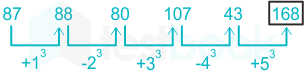
94

If 52\frac{5}{2} is a root of the equation 4xx2 - mxmx + 25 = 0, then the value of m is:

  1. ((a))

    20

  2. ((b))

    50

  3. ((c))

    10

  4. ((d))

    25

Show Answer
Answer: ((a))

20

Shortcut Trick

Since x = 5/2 (or 2.5) is a root of the equation, it must satisfy the quadratic equation.

Substitute x = 2.5 directly into 4x2 − mx + 25 = 0.

4(2.5)2 − 2.5m + 25 = 0

25 − 2.5m + 25 = 0 ⇒ 50 = 2.5m

m = 50 ÷ 2.5 = 20.

∴ The correct answer is 20.

Alternate Method

Given: Quadratic equation 4x2 − mx + 25 = 0 and one root x = 5/2.

To find the value of m, substitute the value of the root in the given equation:

⇒ 4(5/2)2 − m(5/2) + 25 = 0

⇒ 4 × (25 / 4) − 5m / 2 + 25 = 0

⇒ 25 − 5m / 2 + 25 = 0

⇒ 50 − 5m / 2 = 0

⇒ 5m / 2 = 50

⇒ 5m = 50 × 2

⇒ 5m = 100

⇒ m = 100 ÷ 5

⇒ m = 20

∴ The correct answer is 20.

Additional Information

Roots of an Equation

A value k is called a root of the equation f(x) = 0 if and only if f(k) = 0. Substituting the root satisfies the equation.

Sum and Product of Roots

For a quadratic equation ax2 + bx + c = 0, the sum of roots is −b/a and the product of roots is c/a.

Discriminant and Nature of Roots

The term D = b2 − 4ac is the discriminant. If D > 0, roots are real and distinct; if D = 0, roots are real and equal; if D < 0, roots are imaginary.

Standard Form

A quadratic equation is typically expressed in the form ax2 + bx + c = 0, where a, b, and c are constants and a ≠ 0.

95

Select the set in which the numbers are related in the same way as are the numbers of the following sets. 
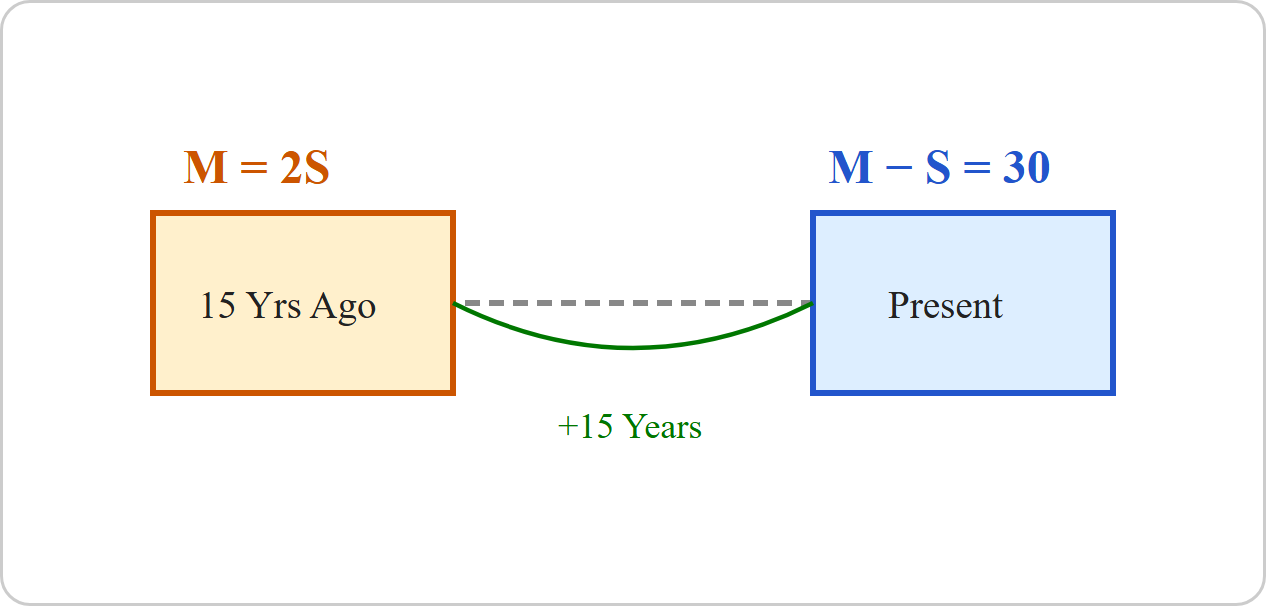
(NOTE: Operations should be performed on the whole numbers, without breaking down the numbers into its constituent digits. EXAMPLE: 13 - Operations on 13 such as adding/subtracting/multiplying etc. to 13 can be performed. Breaking down 13 into 1 and 3 and then performing mathematical operations on 1 and 3 is not allowed)
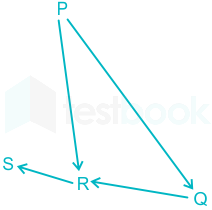
(4, 11, 31)

(3, 9, 25)

  1. ((a))

    (7, 11, 35)

  2. ((b))

    (2, 8, 19)

  3. ((c))

    (5, 13, 29)

  4. ((d))

    (6, 15, 43)

Show Answer
Answer: ((d))

(6, 15, 43)

Logic: 2(First Number + Second Number) + 1 = Third Number

Given

(4, 11, 31) ⇒ 2(4 + 11) + 1 = 31

(3, 9, 25) ⇒ 2(3 + 9) + 1 = 25

Let's check all the options

1) (7, 11, 35) ⇒ 2(7 + 11) + 1 = 37 \ne 35

2) (2, 8, 19) ⇒ 2(2 + 8) + 1 = 21 \ne 19

3) (5, 13, 29) ⇒ 2(5 + 13) + 1 =37 \ne 29

4) (6, 15, 43) ⇒ 2(6 + 15) + 1 = 43

Thus, the set of numbers (6, 15, 43) is done in the same way.

Hence, the correct answer is 'option 4'.

96

An object is placed in front of a concave lens of focal length 15 cm and an image is formed at 7.5 cm. Then the magnification of the lens is:

  1. ((a))

    0.50

  2. ((b))

    1.5

  3. ((c))

    0.75

  4. ((d))

    1.25

Show Answer
Answer: ((a))

0.50

The correct answer is option 1)0.5

Given:

 f=15cm,v=7.5cmf=-15cm,v=-7.5cm

To find:

magnification(m) 

Formula used:

1f=1v1u{1\over f}={1\over v}-{1\over u}


Calculations:

Here ,

1f=1v1u{1\over f}={1\over v}-{1\over u}

1(15)=1(7.5)1u{1\over (-15)}={1\over (-7.5)}-{1\over u}

1u=1(7.5)+115{1\over u}={1\over (-7.5)}+{1\over 15}

1u=10+575{1\over u}={-10+5\over75}

u=755=15cmu=\frac{75}{-5}=-15cm

Magnification is given by,

m=vum={v\over u}

m=7.515=0.5m={-7.5\over -15}=0.5

Therefore, the magnification of the lens is 0**.5**

97

Kamal is the father of Vishnu. The sum of their present ages is 60 years. If 6 years ago, Kamal’s age was 5 times the then age of Vishnu, then find the present age (in years) of Vishnu.

  1. ((a))

    15

  2. ((b))

    20

  3. ((c))

    10

  4. ((d))

    14

Show Answer
Answer: ((d))

14

Shortcut Trick

Sum of ages 6 years ago = 60 − (2 × 6) = 48 years.

Ratio of Kamal : Vishnu was 5 : 1.

Total ratio parts = 5 + 1 = 6 units → 48 years.

1 unit = 8 years ∴ Vishnu's age 6 years ago was 8 years.

Present age of Vishnu = 8 + 6 = 14 years.

∴ The correct answer is 14 years.

Alternate Method

Given: Sum of Kamal (K) and Vishnu (V) = 60 years. 6 years ago, K − 6 = 5 × (V − 6).

Calculations:

⇒ Let Vishnu's age 6 years ago be x. Then Kamal's age was 5x.

⇒ Present age of Vishnu = x + 6 and Kamal = 5x + 6.

⇒ Sum = (5x + 6) + (x + 6) = 60

⇒ 6x + 12 = 60

⇒ 6x = 48 ⇒ x = 8

⇒ Present age of Vishnu = 8 + 6 = 14 years.

∴ The correct answer is 14 years.

Additional Information

Age Difference Property

The difference between the ages of two people always remains constant, regardless of the number of years passed or preceding.

Sum of Ages Shift

If the sum of ages of 'n' people is S today, then 't' years ago, the sum was S − (n × t).

Ratio Balancing

When solving age problems with ratios, ensure the ratio gap matches the year gap by multiplying the ratios with suitable constants.

98

Which of the following acid-base pairs will produce a salt of ammonium chloride?

  1. ((a))

    HNO3 - NH4OH

  2. ((b))

    H2SO4 - NH4OH

  3. ((c))

    HCl - NH4OH

  4. ((d))

    HCl - NaOH

Show Answer
Answer: ((c))

HCl - NH4OH

The correct answer is HCl - NH4OH.

Key Points

  • There are three major classifications of substances known as acids or bases. The Arrhenius definition states that an acid produces H+ in solution and a base produces OH-.
  • This theory was developed by Svante Arrhenius in 1883. Later, two more sophisticated and general theories were proposed.
  • In 1884, the Swedish chemist Svante Arrhenius proposed two specific classifications of compounds; acids and bases.
  • An Arrhenius acid is a compound that increases the concentration of H+ ions that are present when added to water. These H+ ions form the hydronium ion (H3O+) when they combine with water molecules. This process is represented in a chemical equation by adding H2O to the reactants side.

Additional Information

  • Acids and bases are important compounds in the natural world, so their chemistry is central to any discussion of chemical reactions. There are several theories of acid-base behaviour.
  • The Arrhenius theory, named after Swedish physicist Svante August Arrhenius, views an acid as a substance that increases the concentration of the hydronium ion (H3O+) in an aqueous solution and a base as a substance that increases the hydroxide ion (OH−) concentration.
  • According to the Arrhenius theory, acid-base reactions involve the combination of the hydrogen ion (H+) and the hydroxide ion to form water.
  • A somewhat more general acid-base theory, the Brønsted-Lowry theory, named after Danish chemist Johannes Nicolaus Brønsted and English chemist Thomas Martin Lowry, defines an acid as a proton donor and a base as a proton acceptor.
99

This question is based on the five, three-digit numbers given below.

(Left) 567 243 186 689 427 (Right)

(Example- 123 — First digit = 1, second digit = 2 and third digit = 3)

NOTE - All operations to be done from left to right.

What will be the resultant if the first digit of the second greatest number is added to the third digit of the smallest number?

  1. ((a))

    12

  2. ((b))

    11

  3. ((c))

    10

  4. ((d))

    13

Show Answer
Answer: ((b))

11

Given: (Left) 567 243 186 689 427 (Right)

According to the given information, we have 

Second greatest number = 567 ⇒ First digit = 5

Smallest number = 186 ⇒ Third digit = 6

Next, adding the first digit and the third digit = 5 + 6 = 11

Thus, the result will be 11.

Hence, the correct answer is 'option 2'.

100

In February 2022, which service provider announced that it will land its next-generation multi-terabit India-Asia-Xpress (IAX) undersea cable system in Hulhumale, Maldives?

  1. ((a))

    Bharti Airtel Limited

  2. ((b))

    Reliance Jio Infocomm Limited

  3. ((c))

    Reliance Communications Limited

  4. ((d))

    Vodafone Idea Limited

Show Answer
Answer: ((b))

Reliance Jio Infocomm Limited

The correct answer is Reliance Jio Infocomm Limited.

Key Points

  • India’s largest 4G mobile broadband and digital service provider, Reliance Jio Infocomm Ltd. will land the next generation multi-terabit India-Asia-Xpress (IAX) undersea cable system in the Maldives.
  • On the other hand, the India-Europe-Xpress (IEX) system connects Mumbai to Milan, landing in Savona, Italy, and includes additional landings in the Middle East, North Africa, and the Mediterranean.
  • Undersea cable systems along with data centres support 5G and the digital economy that builds large integrated capacities to enable India’s digital ecosystem.
  • This high capacity and the high-speed system will provide more than 200Tb/s of capacity at speeds of 100Gb/s, over 16,000 kilometres.

Additional Information

  • Bharti Airtel Limited
  • ​Airtel is the brand name of Bharti Airtel Limited, an international telecommunications services provider with headquarters in New Delhi.
  • It runs operations in 18 nations in South Asia, Africa, and the Channel Islands. Airtel currently offers 4G and 4G+ services throughout India and 5G services in a few key cities.
  • Reliance Communications Limited
  • Voice, 2G, 3G, and 4G data services were all provided by Reliance Communications Limited (RCOM), an Indian mobile network operator with headquarters in Navi Mumbai, Maharashtra.
  • The business declared bankruptcy in February 2019 because it was unable to sell assets to pay off its debt.
  • Vodafone Idea Limited
  • ​Vodafone Idea is an Indian mobile network provider with offices in Gandhinagar and Mumbai. It is a GSM operator that covers the entire country of India and offers service on 2G, 3G, 4G, 4G+, VoLTE, and VoWiFi.
  • With 228.60 million subscribers as of December 31, 2022, Vi is the third-largest mobile communications network in India and the tenth-largest mobile communications network globally.

Attempt this paper under real exam conditions

Timed interface, section switching, instant scoring, and question-by-question analytics — free.

Start Timed Attempt