Official Paper

RRB Technician Grade III Official Paper (Held On: 10 March, 2026 Shift 3) (Previous Year Paper)

100 questions · 90 minutes · with answers · free

Mathematics (25 questions)

1

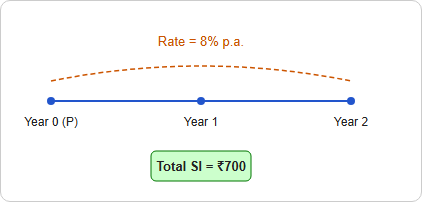
At a simple interest rate of 8% per annum, how much amount (in ₹ units) will be the simple interest amount of ₹700 in 2 years?

  1. ((a))

    3875

  2. ((b))

    4575

  3. ((c))

    4375

  4. ((d))

    4775

Show Answer
Answer: ((c))

4375

Shortcut Trick

Calculate the Effective Interest Rate: 8% × 2 years = 16%.

Since 16% of the Principal equals the Simple Interest (₹700):

Principal = (700 ÷ 16) × 100

Principal = 43.75 × 100 = 4375.

∴ The correct answer is ₹4375.

Alternate Method

Given values from the problem:

Simple Interest (SI) = ₹700

Rate of Interest (R) = 8% per annum

Time Period (T) = 2 years

Formula used for Simple Interest:

⇒ SI = (P × R × T) / 100

Substitute the given values to find the Principal (P):

⇒ 700 = (P × 8 × 2) / 100

⇒ 700 = (P × 16) / 100

⇒ P × 16 = 700 × 100

⇒ P = 70000 / 16

⇒ P = 4375

∴ The correct answer is ₹4375.

Additional Information

Total Amount in Simple Interest

The total amount (A) after T years is the sum of the Principal and the interest: A = P + SI = P(1 + RT/100).

Compound Interest (CI)

Interest is calculated on the principal and the accumulated interest: A = P(1 + r/100)n.

SI vs CI Difference

For a period of 2 years, the difference between Compound Interest and Simple Interest is given by: D = P(r/100)2.
2

If 2tanA=3 2 \tan A = 3 , what is the value of (secA+tanA1)(secAtanA+1) (\sec A + \tan A - 1)(\sec A - \tan A + 1) ?

  1. ((a))

    23\frac{2}{3}

  2. ((b))
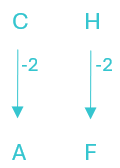
    2

  3. ((c))
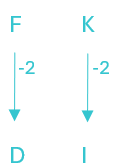
    3

  4. ((d))

    13\frac{1}{3}

Show Answer
Answer: ((c))

3

Shortcut Trick

Rewrite the expression (sec A + tan A − 1)(sec A − tan A + 1) as [sec A + (tan A − 1)][sec A − (tan A − 1)].

Applying the difference of squares identity (x + y)(x − y) = x2 − y2:

Expression = sec2 A − (tan A − 1)2 = sec2 A − (tan2 A − 2 tan A + 1).

Using sec2 A − tan2 A = 1, it simplifies to: (sec2 A − tan2 A) + 2 tan A − 1 = 1 + 2 tan A − 1 = 2 tan A.

Since it is given that 2 tan A = 3, the final value is 3.

∴ The correct answer is 3.

Alternate Method

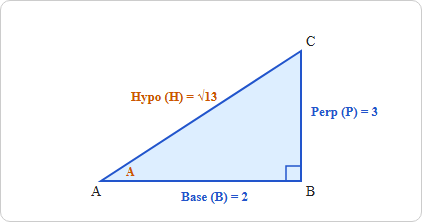
Given: 2 tan A = 3 ⇒ tan A = 3/2

Formula Used: In a right-angled triangle, tan A = Perpendicular / Base and sec A = Hypotenuse / Base.

Calculations:

⇒ Let Perpendicular (P) = 3 and Base (B) = 2.

Hypotenuse (H) = √(32 + 22) = √(9 + 4) = √13.

sec A = H / B = √13 / 2 and tan A = 3 / 2.

⇒ Expression = (√13/2 + 3/2 − 1) × (√13/2 − 3/2 + 1)

⇒ [(√13 + 3 − 2) / 2] × [(√13 − 3 + 2) / 2]

⇒ [(√13 + 1) / 2] × [(√13 − 1) / 2]

⇒ (√13 + 1)(√13 − 1) / 4

⇒ (13 − 1) / 4 = 12 / 4 = 3.

∴ The correct answer is 3.

Additional Information

Trigonometric Pythagorean Identities

Fundamental relations: sin2 A + cos2 A = 1, 1 + tan2 A = sec2 A, and 1 + cot2 A = cosec2 A.

Difference of Squares

The algebraic identity (a + b)(a − b) = a2 − b2 is frequently used to simplify trigonometric products involving conjugate pairs.

Reciprocal Relations

Definitions based on a right triangle: sec A = 1/cos A, cosec A = 1/sin A, and tan A = sin A / cos A.

3

Given that 740.45=x 74^{0.45} = x , 740.12=y 74^{0.12} = y and xz=y2 x^z = y^2 , then the value of z is close to:

  1. ((a))

    1.45

  2. ((b))

    3.99

  3. ((c))

    2.52

  4. ((d))

    0.53

Show Answer
Answer: ((d))

0.53

Shortcut Trick

Directly equate the powers since the base 74 is common to both x and y.

From xz = y2, the relationship is: (Power of x) × z = (Power of y) × 2.

Substitute the given exponents: 0.45 × z = 0.12 × 2.

0.45z = 0.24z = 24 ÷ 45 = 8/15 ≈ 0.53.

∴ The correct answer is 0.53.

Alternate Method

Given:

x = 740.45

y = 740.12

xz = y2

Method Used: Apply Laws of Indices for powers of the same base.

Calculation:

⇒ Substitute x and y in the equation xz = y2:

⇒ (740.45)z = (740.12)2

⇒ 74(0.45 × z) = 74(0.12 × 2)

⇒ 740.45z = 740.24

⇒ Since the bases are equal, their exponents must also be equal:

⇒ 0.45z = 0.24

⇒ z = 0.24 ÷ 0.45

⇒ z = 24/45

⇒ z = 8/15 ≈ 0.533

∴ The correct answer is 0.53.

Additional Information

Power Rule of Indices

For any non-zero base a, the rule (am)n = am × n states that raising a power to another power involves multiplying the exponents.

Equality of Exponential Expressions

If ax = ay and a is a positive constant (a ≠ 1), then the exponents x and y must be equal (x = y).

Product Rule of Indices

When multiplying two expressions with the same base, add the exponents: am × an = am + n.

4

In a family, the sum of the ages of a father and son is 50 years. 10 years from now, the difference in their ages will be 20 years. Find the ratio of the son's age to the father's age.

  1. ((a))

    3:7

  2. ((b))

    5:8

  3. ((c))

    2:7

  4. ((d))

    4:7

Show Answer
Answer: ((a))

3:7

Shortcut Trick

The age difference between two people always remains constant over time.

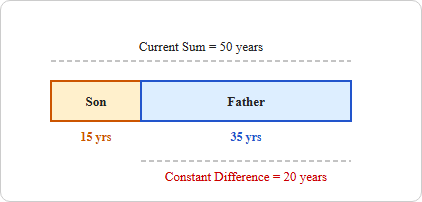
Difference = 20 years | Sum = 50 years.

Father's age = (Sum + Difference) ÷ 2 = (50 + 20) ÷ 2 = 35 years.

Son's age = (Sum − Difference) ÷ 2 = (50 − 20) ÷ 2 = 15 years.

Ratio of Son to Father = 15 : 35 = 3 : 7.

∴ The correct answer is 3:7.

Alternate Method

Given:

Current Sum of ages = 50 years

Difference in ages (10 years hence) = 20 years

Formula Used:

If (x + y) = A and (x − y) = B, then x = (A + B) ÷ 2 and y = (A − B) ÷ 2

Calculations:

⇒ Let Father's age be F and Son's age be S.

⇒ F + S = 50 --- (Equation 1)

⇒ After 10 years, ages will be (F + 10) and (S + 10).

⇒ (F + 10) − (S + 10) = 20 ⇒ F − S = 20 --- (Equation 2)

⇒ Adding (1) and (2): 2F = 70 ⇒ F = 35 years.

⇒ Substituting F in (1): 35 + S = 50 ⇒ S = 15 years.

⇒ Required Ratio = S : F = 15 : 35

⇒ Ratio = 3 : 7.

∴ The correct answer is 3:7.

Additional Information

Property of Age Difference

The difference between the ages of two individuals remains the same throughout their lives, regardless of the number of years passed.

Ratio Simplification

A ratio a : b is simplified by dividing both terms by their Highest Common Factor (HCF). Here, HCF(15, 35) = 5.

Linear Equations in Two Variables

For equations of type x + y = S and x − y = D, the values are solved as x = (S + D) ÷ 2 and y = (S − D) ÷ 2.

5

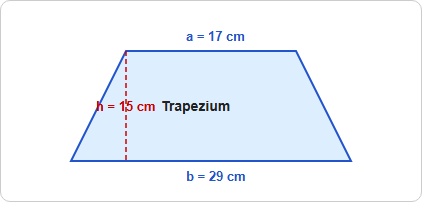
A trapezium has parallel sides of lengths 17 cm and 29 cm, and the distance between them is 15 cm. What is the area of the trapezium?

  1. ((a))

    345 cm2

  2. ((b))

    315 cm2

  3. ((c))

    325 cm2

  4. ((d))

    335 cm2

Show Answer
Answer: ((a))

345 cm2

Shortcut Trick

Area of a trapezium is simply the product of the average of the parallel sides and the height.

Average of parallel sides = (17 + 29) ÷ 2 = 23 cm

Area = Average × Height = 23 × 15 = 345 cm2

∴ The correct answer is 345 cm2.

Alternate Method

Given:

Length of first parallel side (a) = 17 cm

Length of second parallel side (b) = 29 cm

Height (distance between them, h) = 15 cm

Formula Used:

Area of Trapezium = 1/2 × (Sum of parallel sides) × Height

Calculations:

⇒ Area = 1/2 × (17 + 29) × 15

⇒ Area = 1/2 × 46 × 15

⇒ Area = 23 × 15

⇒ Area = 345 cm2

∴ The correct answer is 345 cm2.

Additional Information

Perimeter of a Trapezium

The total boundary length of a trapezium is the sum of all its four sides: Perimeter = a + b + c + d.

Median of a Trapezium

The median is the line segment connecting the midpoints of the non-parallel sides. Its length is the average of the parallel sides: Median = (a + b) ÷ 2.

Isosceles Trapezium

A trapezium where the non-parallel sides are equal in length and the base angles are equal.

6

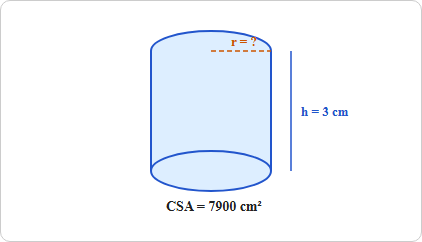
A cylindrical rod has an outer curved surface area of 7900 cm2. If the length of the rod is 3 cm, then the outer radius (in cm) of the rod, correct to two places of decimal, is:

(Takeπ=22/7) (Take \pi = 22/7)

  1. ((a))

    418.94

  2. ((b))

    417.52

  3. ((c))

    420.85

  4. ((d))

    419.12

Show Answer
Answer: ((a))

418.94

Shortcut Trick

Direct formula for radius (r) from Curved Surface Area (CSA): r = CSA ÷ (2 × π × h)

Substitute values: r = 7900 ÷ (2 × 22/7 × 3)

r = (7900 × 7) ÷ (2 × 22 × 3) = 55300 ÷ 132

r ≈ 418.94 cm

∴ The correct answer is 418.94 cm.

Alternate Method

Given:

Curved Surface Area (CSA) = 7900 cm2

Length (h) of the rod = 3 cm

π = 22/7

Formula Used:

Curved Surface Area of a cylinder = 2 × π × r × h

Calculations:

⇒ 7900 = 2 × (22/7) × r × 3

⇒ 7900 = (132 / 7) × r

⇒ r = (7900 × 7) ÷ 132

⇒ r = 55300 ÷ 132

⇒ r = 418.939393...

⇒ r ≈ 418.94 cm

∴ The correct answer is 418.94 cm.

Additional Information

Total Surface Area (TSA) of a Cylinder

The TSA includes both the curved surface and the two circular bases: TSA = 2πr(r + h).

Volume of a Cylinder

The volume represents the space occupied by the cylinder: Volume = πr2h.

Relationship between Radius and Diameter

The diameter (d) is twice the radius (r): d = 2r or r = d/2.

Conversion Factor

Ensure all units are consistent (e.g., all in cm or all in m) before applying formulas. 1 m = 100 cm.

7

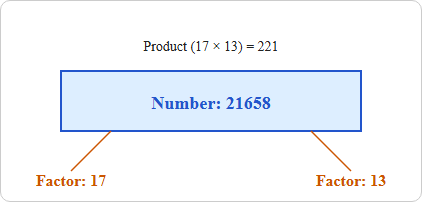
Which of the following numbers is divisible by both 17 and 13?

  1. ((a))

    22372

  2. ((b))

    21658

  3. ((c))

    21401

  4. ((d))

    20049

Show Answer
Answer: ((b))

21658

Shortcut Trick

Since 17 and 13 are both prime numbers, any number divisible by both must be divisible by their LCM.

LCM(17, 13) = 17 × 13 = 221.

Check for a multiple of 221: 221 × 100 = 22100. The nearest value is 21658.

22100 − 21658 = 442. Since 442 ÷ 221 = 2, then 21658 is exactly divisible.

∴ The correct answer is 21658.

Alternate Method

Given: Divisors are 17 and 13.

Concept: For a number to be divisible by two coprime numbers, it must be divisible by their product.

Calculations:

⇒ Divisibility Product = 17 × 13 = 221

⇒ Check Option 1: 22372 ÷ 221 ≈ 101.23 (No)

⇒ Check Option 2: 21658 ÷ 221 = 98 (Yes)

⇒ Check Option 3: 21401 ÷ 221 ≈ 96.83 (No)

⇒ Check Option 4: 20049 ÷ 221 ≈ 90.71 (No)

∴ The correct answer is 21658.

Additional Information

Divisibility Rule of 13

Multiply the last digit by 4 and add it to the remaining number. If the result is divisible by 13, the original number is also divisible.

Divisibility Rule of 17

Multiply the last digit by 5 and subtract it from the remaining number. If the result is divisible by 17, the original number is also divisible.

Co-prime Property

If a number is divisible by two co-prime numbers a and b, then it is necessarily divisible by their product (a × b).

8

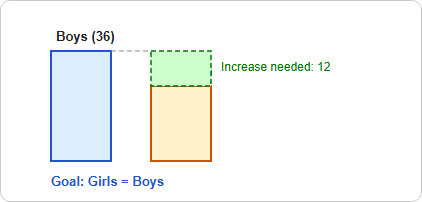
In a class, there are 36 boys and 24 girls. By what percentage should the number of girls be increased so that it becomes equal to the number of boys?

  1. ((a))

    60%

  2. ((b))

    30%

  3. ((c))

    40%

  4. ((d))

    50%

Show Answer
Answer: ((d))

50%

Shortcut Trick

Ratio of Boys to Girls = 36 : 24 = 3 : 2.

To make the number of Girls (2 units) equal to Boys (3 units), the increase needed = 3 − 2 = 1 unit.

Percentage increase = (Increase / Initial units of girls) × 100.

Percentage increase = (1 / 2) × 100 = 50%.

∴ The correct answer is 50%.

Alternate Method

Given:

Number of Boys = 36

Number of Girls = 24

Formula Used:

Percentage Increase = [(Target Value − Original Value) / Original Value] × 100

Calculations:

⇒ Target number of Girls = 36

⇒ Required increase in Girls = 36 − 24 = 12

⇒ Percentage increase = (12 / 24) × 100

⇒ Percentage increase = (1 / 2) × 100

⇒ Percentage increase = 50%

∴ The correct answer is 50%.

Additional Information

Percentage Increase vs Decrease

Percentage change is always calculated on the original (base) value. Increase % = (Difference / Original) × 100.

Fractional Conversion

1/2 = 50%, 1/3 = 33.33%, 1/4 = 25%, 1/5 = 20%. Knowing these helps in solving Quantitative Aptitude questions faster.

Base Change Property

If A is 50% more than B, then B is 33.33% less than A. The percentage value changes when the base value is shifted.

9

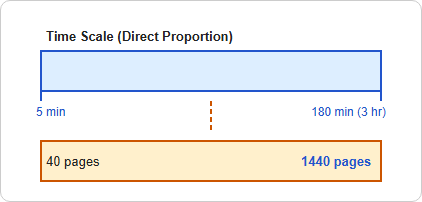
If 40 pages are printed in 5 minutes by a printer, how many pages will be printed in 3 hours?

  1. ((a))

    1560

  2. ((b))

    1620

  3. ((c))

    1440

  4. ((d))

    1810

Show Answer
Answer: ((c))

1440

Shortcut Trick

Rate of printer = 40 ÷ 5 = 8 pages/min.

Total time in minutes = 3 × 60 = 180 min.

Total pages printed = 180 × 8 = 1440.

∴ The correct answer is 1440 pages.

Alternate Method

Given:

Pages printed = 40

Time taken = 5 min

Target time = 3 hr

Formula Used:

Total Pages = (Pages ÷ Time) × Target Time

⇒ Conversion of time: 1 hr = 60 min

⇒ 3 hr = 3 × 60 = 180 min

⇒ Pages printed in 1 min = 40 ÷ 5 = 8 pages

⇒ Pages printed in 180 min = 180 × 8

⇒ Total pages = 1440

∴ The correct answer is 1440 pages.

Additional Information

Direct Proportion

When two quantities increase or decrease at the same rate, they are in direct proportion. Formula: x1/y1 = x2/y2.

Unitary Method

A technique where you find the value of a single unit (e.g., pages per 1 minute) and then multiply it by the required amount.

Time Conversions

To convert hours to minutes, multiply by 60. To convert minutes to seconds, multiply by 60.

10

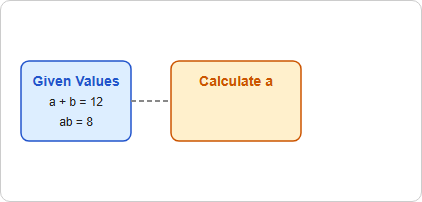
If a + b =12 and ab=8 then the numerical value of (ab+ba)(\frac{a}{b}+\frac{b}{a}) will be:

  1. ((a))

    16

  2. ((b))

    14

  3. ((c))

    12

  4. ((d))

    20

Show Answer
Answer: ((a))

16

Shortcut Trick

The expression (a/b + b/a) simplifies to (a2 + b2) / ab.

Using the identity (a + b)2 = a2 + b2 + 2ab, we get a2 + b2 = (a + b)2 − 2ab.

Substitute values: [122 − 2 × 8] / 8.

Value = [144 − 16] / 8 = 128 / 8 = 16.

∴ The correct answer is 16.

Alternate Method

Given:

a + b = 12

ab = 8

Formula Used:

(a + b)2 = a2 + b2 + 2ab

Calculations:

⇒ Target expression = a/b + b/a

⇒ By taking LCM of denominators: (a2 + b2) / ab

⇒ We know (a + b)2 = a2 + b2 + 2ab

⇒ 122 = a2 + b2 + 2(8)

⇒ 144 = a2 + b2 + 16

⇒ a2 + b2 = 144 − 16 = 128

⇒ Putting this in target: 128 / 8 = 16

∴ The correct answer is 16.

Additional Information

Algebraic Identity for Squares

(a − b)2 = a2 + b2 − 2ab. This can be used to find a2 + b2 if the difference and product are known.

Sum of Cubes

a3 + b3 = (a + b)(a2 − ab + b2) or a3 + b3 = (a + b)3 − 3ab(a + b).

Relationship between Identities

(a + b)2 − (a − b)2 = 4ab. This relates the sum, difference, and product of two numbers.

11

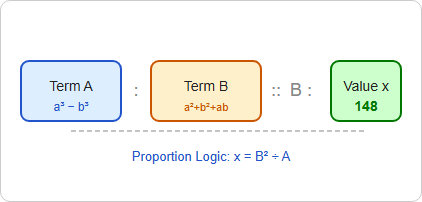
Find the third proportional to a3 − b3 and a2 + b2 + ab, when a = 16 and b = 12.

  1. ((a))

    148

  2. ((b))

    150

  3. ((c))

    158

  4. ((d))

    160

Show Answer
Answer: ((a))

148

Shortcut Trick

The Third Proportional (x) to A and B is given by x = B2 ÷ A.

Given: A = a3 − b3 = (a − b)(a2 + ab + b2) and B = a2 + b2 + ab.

x = (a2 + ab + b2)2 ÷ [(a − b)(a2 + ab + b2)] = (a2 + ab + b2) ÷ (a − b).

Substitute a = 16 and b = 12: x = (162 + 122 + 16 × 12) ÷ (16 − 12) = 592 ÷ 4 = 148.

∴ The correct answer is 148.

Alternate Method

Given: a = 16 and b = 12. We need to find the third proportional to A = (a3 − b3) and B = (a2 + b2 + ab).

Formula: If x is the third proportional to A and B, then A : B :: B : x, which means x = B2/A.

⇒ A = a3 − b3 = (16 − 12)(162 + 16 × 12 + 122)

⇒ A = 4 × (256 + 192 + 144) = 4 × 592 = 2368

⇒ B = a2 + b2 + ab = 162 + 122 + 16 × 12 = 256 + 144 + 192 = 592

⇒ Third Proportional x = B2 ÷ A = (592 × 592) ÷ 2368

⇒ x = (592 × 592) ÷ (4 × 592)

⇒ x = 592 ÷ 4 = 148

∴ The correct answer is 148.

Additional Information

Mean Proportional

The mean proportional between two numbers a and b is √(ab).

Fourth Proportional

If a, b, c, d are in proportion (a:b = c:d), then the fourth proportional d = (b × c) ÷ a.

Algebraic Identity

The identity a3 − b3 = (a − b)(a2 + ab + b2) is frequently used in ratio and simplification problems.

12

Find the value 38 - [27 - (90 ÷ 5 - (12 - 18 ÷ 6) ÷ 3)]

  1. ((a))

    26

  2. ((b))

    24

  3. ((c))

    22

  4. ((d))

    25

Show Answer
Answer: ((a))

26

Given:

38 − [27 − (90 ÷ 5 − (12 − 18 ÷ 6) ÷ 3)]

Formula used:

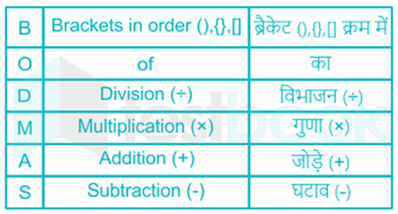
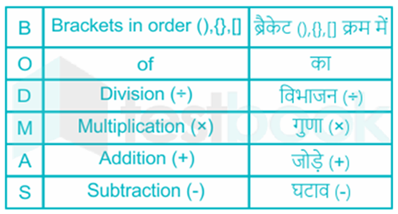
The BODMAS rule is used to solve the expression: Brackets ((), {}, []), Of, Division (÷), Multiplication (×), Addition (+), and Subtraction (−).

Calculation:

38 − [27 − (90 ÷ 5 − (12 − 18 ÷ 6) ÷ 3)]

⇒ 38 − [27 − (18 − (12 − 3) ÷ 3)]

⇒ 38 − [27 − (18 − 9 ÷ 3)]

⇒ 38 − [27 − (18 − 3)]

⇒ 38 − [27 − 15]

⇒ 38 − 12

⇒ 26

∴ The correct answer is option (1).

13

The average age of six girls increases by four months, if a 12 - year old girl is replaced by a new girl. The age of the new girl is:

  1. ((a))

    13 years

  2. ((b))

    15 years

  3. ((c))

    14 years

  4. ((d))

    16 years

Show Answer
Answer: ((c))

14 years

Shortcut Trick

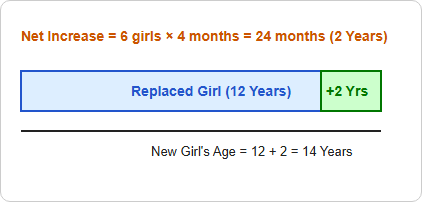
Age of new girl = Age of replaced girl + (Total number of girls × Increase in average)

Age of new girl = 12 years + (6 × 4 months)

Age of new girl = 12 years + 24 months

Since 12 months = 1 year, 24 months = 2 years.

Age of new girl = 12 years + 2 years = 14 years.

∴ The correct answer is 14 years.

Alternate Method

Given:

Total girls = 6

Age of replaced girl = 12 years

Increase in average = 4 months

Formula Used:

Total Increase = Number of Observations × Increase in Average

Age of new person = Age of replaced person + Total Increase

Calculations:

⇒ Total increase in the age of 6 girls = 6 × 4 months

⇒ Total increase = 24 months

⇒ Convert months to years: 24 ÷ 12 = 2 years

⇒ Age of the new girl = 12 + 2

⇒ Age of the new girl = 14 years

∴ The correct answer is 14 years.

Additional Information

Average Concept

Average = (Sum of all observations) ÷ (Number of observations). When a person is replaced, the net change in the sum is the difference between the new value and the old value.

Replacement Rule

If the average increases, New Value > Old Value. If the average decreases, New Value < Old Value. Formula: New = Old ± (Total Number × Change in Average).

Unit Conversion

Always ensure units are consistent. To convert months to years, divide by 12. To convert years to months, multiply by 12.

14

When one-third of a number is increased by 10, the result is 65. Find the sum of the digits of the original number.

  1. ((a))

    12

  2. ((b))

    9

  3. ((c))

    11

  4. ((d))

    14

Show Answer
Answer: ((a))

12

Logic followed here is to translate the given mathematical statement into a linear equation to find the unknown number and then calculate the sum of its digits.

Step 1: Let the original number be x.

According to the given condition:

One-third of the number increased by 10 results in 65.

This can be written mathematically as:

(1 / 3) × x + 10 = 65


Step 2: Solve the equation for x:

(1 / 3) × x = 65 − 10

(1 / 3) × x = 55

To isolate x, multiply both sides by 3:

x = 55 × 3

x = 165

The original number is 165.


Step 3: Find the sum of the digits:

The digits of the number 165 are 1, 6, and 5.

Sum of digits = 1 + 6 + 5

Sum of digits = 12


Therefore, the sum of the digits of the original number is 12.

15

The salary of Mina is ₹ 80,000. Out of which she deposits x% amount at 15% simple interest. If the accumulated amount for the money deposited after 3 years is ₹ 17,400, then find the value of x.

  1. ((a))

    15

  2. ((b))

    25

  3. ((c))

    12

  4. ((d))

    20

Show Answer
Answer: ((a))

15

Shortcut Trick

Effective Interest Rate for 3 years = 15% × 3 = 45%.

Accumulated Amount = 100% (Principal) + 45% (Interest) = 145%.

145% of Principal = ₹ 17,400 ⇒ Principal (Amount deposited) = 17,400 ÷ 1.45 = ₹ 12,000.

Value of x = (12,000 ÷ 80,000) × 100 = 15.

∴ The correct answer is 15.

Alternate Method

Given:

Total Salary = ₹ 80,000

Rate of Interest (R) = 15% per annum

Time Period (T) = 3 years

Accumulated Amount (A) = ₹ 17,400

Formula Used:

Amount (A) = P + SI = P × (1 + (R × T) ÷ 100)

Calculations:

Let the Principal amount deposited be P.

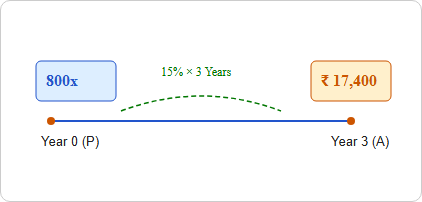
⇒ P = x% of 80,000 = (x ÷ 100) × 80,000 = 800x

⇒ 17,400 = 800x × (1 + (15 × 3) ÷ 100)

⇒ 17,400 = 800x × (1 + 45 ÷ 100)

⇒ 17,400 = 800x × 1.45

⇒ 17,400 = 1,160x

⇒ x = 17,400 ÷ 1,160

⇒ x = 15

∴ The correct answer is 15.

Additional Information

Simple Interest (SI)

It is the interest calculated only on the initial Principal for the entire duration. Formula: SI = (P × R × T) ÷ 100.

Accumulated Amount

The total money returned after the time period, which includes the Principal and the Interest. A = P + SI.

Percentage Change

When a value increases by r% for n years in Simple Interest, the total increase is (r × n)% of the Base Value.

16

A, B, and C invested money in the ratio of 2 : 3 : 4 for periods in the ratio of 6 : 4 : 3, respectively. If the total profit is ₹1,32,000, what is the share of C?

  1. ((a))

    ₹42,000

  2. ((b))

    ₹45,000

  3. ((c))

    ₹44,000

  4. ((d))

    ₹43,000

Show Answer
Answer: ((c))

₹44,000

Shortcut Trick

Profit Ratio = (Investment Ratio) × (Time Ratio)

Profit Ratio (A : B : C) = (2 × 6) : (3 × 4) : (4 × 3) = 12 : 12 : 12 = 1 : 1 : 1

Total units = 1 + 1 + 1 = 3 units

3 units = ₹1,32,000 ⇒ 1 unit = ₹44,000

∴ The correct answer is ₹44,000.

Alternate Method

Given:

Investment ratio of A, B, and C = 2 : 3 : 4

Time period ratio of A, B, and C = 6 : 4 : 3

Total Profit = ₹1,32,000

Formula Used: Profit = Investment × Time

Calculations:

⇒ Ratio of Profit (A : B : C) = (2 × 6) : (3 × 4) : (4 × 3)

⇒ Ratio of Profit (A : B : C) = 12 : 12 : 12

⇒ Simplified Ratio = 1 : 1 : 1

⇒ Total Profit parts = 1 + 1 + 1 = 3 units

⇒ 3 units = ₹1,32,000

⇒ 1 unit = 1,32,000 ÷ 3 = ₹44,000

⇒ Share of C = 1 unit = ₹44,000

∴ The correct answer is ₹44,000.

Additional Information

Partnership Profit Rule

Profit is directly proportional to the product of Capital and Time. If capitals are C1, C2 and times are T1, T2, then Profit Ratio P1 : P2 = (C1 × T1) : (C2 × T2).

Active and Sleeping Partners

An Active partner manages the business and may receive a salary or extra profit percentage, while a Sleeping partner only invests money.

Compound Partnership

When partners invest money for different time periods or change their capital during the business tenure, it is known as a compound partnership.

17

The price of a laptop increased by 20% in the first month, then decreased by 10% in the second month, and increased again by 15% in the third month. If the original price of the laptop was ₹1,20,000, what is the final price after these three changes?

  1. ((a))

    ₹1,38,000

  2. ((b))

    ₹1,49,040

  3. ((c))

    ₹1,42,800

  4. ((d))

    ₹1,41,000

Show Answer
Answer: ((b))

₹1,49,040

Shortcut Trick

Use the Multiplying Factor (MF) for Successive Percentage changes.

Net MF = 1.20 (20% increase) × 0.90 (10% decrease) × 1.15 (15% increase)

Net MF = 1.08 × 1.15 = 1.242

Final Price = 1,20,000 × 1.242 = ₹1,49,040

∴ The correct answer is ₹1,49,040.

Alternate Method

Given:

Original Price of Laptop = ₹1,20,000

Change 1 (Month 1) = +20%

Change 2 (Month 2) = −10%

Change 3 (Month 3) = +15%

Formula Used:

Final Value = Initial Value × (1 ± r1/100) × (1 ± r2/100) × (1 ± r3/100)

Calculations:

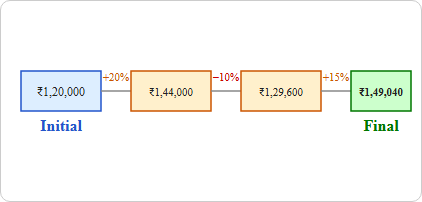
⇒ Price after 1st month = 1,20,000 × (1 + 20/100) = 1,20,000 × 1.2 = ₹1,44,000

⇒ Price after 2nd month = 1,44,000 × (1 − 10/100) = 1,44,000 × 0.9 = ₹1,29,600

⇒ Price after 3rd month = 1,29,600 × (1 + 15/100) = 1,29,600 × 1.15

⇒ 1,29,600 × 1.15 = 1,29,600 + 12,960 (10%) + 6,480 (5%) = ₹1,49,040

∴ The correct answer is ₹1,49,040.

Additional Information

Successive Percentage Formula

For two successive changes x% and y%, the net change is given by (x + y + xy/100)%. Use negative values for a decrease.

Multiplying Factor (MF)

An increase of r% is equivalent to multiplying by (1 + r/100), and a decrease is multiplying by (1 − r/100).

Effective Percentage Change

The order of successive percentage changes (increase or decrease) does not affect the final result.

18

During a sale, 44% of the goods are sold at a profit of 47%. Of the remaining goods, 25% are sold at a profit of 22%, and the rest are sold at a loss of 38%. If the overall profit is x%, what is the value of x?

  1. ((a))

    7.8

  2. ((b))

    12.4

  3. ((c))

    18.5

  4. ((d))

    18

Show Answer
Answer: ((a))

7.8

Shortcut Trick

Assume Total Goods = 100 units.

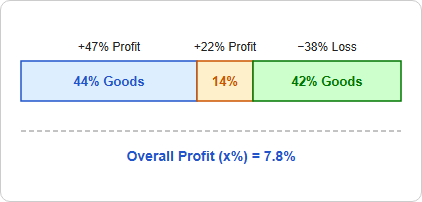
Part 1: 44 units at +47% profit.

Part 2: 25% of (100 − 44) = 14 units at +22% profit.

Part 3: Remaining (56 − 14) = 42 units at −38% loss.

Overall Profit x = (44 × 47 + 14 × 22 − 42 × 38) ÷ 100 = (2068 + 308 − 1596) ÷ 100 = 780 ÷ 100 = 7.8.

∴ The correct answer is 7.8%.

Alternate Method

Given:

Total Percentage of goods = 100%

First part = 44% with Profit = 47%

Remaining goods = 100% − 44% = 56%

Second part = 25% of 56% = 14% with Profit = 22%

Third part = 56% − 14% = 42% with Loss = 38%

Formula Used:

Overall Profit/Loss % = (w1p1 + w2p2 + w3p3) ÷ (w1 + w2 + w3)

Calculations:

⇒ Overall Profit x = (44 × 47 + 14 × 22 + 42 × (−38)) ÷ 100

⇒ x = (2068 + 308 − 1596) ÷ 100

⇒ x = (2376 − 1596) ÷ 100

⇒ x = 780 ÷ 100

⇒ x = 7.8%

∴ The correct answer is 7.8%.

Additional Information

Weighted Average Profit

When goods are divided into parts, the total profit/loss percent is the weighted average of the profit/loss percentages of each part.

Profit and Loss Relationship

Profit is taken as a positive value (+) and loss is taken as a negative value (−) in the combined calculation formula.

Net Change in Percentage

Net % change = ∑(Quantityi × Ratei) ÷ Total Quantity. This is applicable to mixtures, averages, and sales.

19

A can complete a piece of work in 10 days and B can complete the same work in 15 days, when each works individually. Both A and B work together for 3 days. After that, B leaves the work, and A alone completes the remaining work. How many days will A take to finish the remaining work alone?

  1. ((a))

    8 days

  2. ((b))

    6 days

  3. ((c))

    10 days

  4. ((d))

    5 days

Show Answer
Answer: ((d))

5 days

Shortcut Trick

Total work (LCM of 10 and 15) = 30 units.

Efficiency of A = 3 units/day, Efficiency of B = 2 units/day.

Combined efficiency of (A + B) = 3 + 2 = 5 units/day.

Work done by both in 3 days = 5 × 3 = 15 units.

Remaining work = 30 − 15 = 15 units.

Time taken by A to finish alone = 15 ÷ 3 = 5 days.

∴ The correct answer is 5 days.

Alternate Method

Given:

Time taken by A = 10 days

Time taken by B = 15 days

Combined working period = 3 days

Formula Used:

Total Work = Efficiency × Time

Efficiency = Total Work ÷ Individual Time

PersonDaysTotal Work (LCM)Efficiency
A10303
B152

Calculations:

⇒ Efficiency of (A + B) = 3 + 2 = 5 units/day

⇒ Work completed by A and B in 3 days = 5 × 3 = 15 units

⇒ Remaining work = Total Work − Completed Work

⇒ Remaining work = 30 − 15 = 15 units

⇒ Time taken by A for remaining work = 15 ÷ 3

⇒ Time = 5 days

∴ The correct answer is 5 days.

Additional Information

Pipes and Cisterns

Same logic as Time & Work applies; inlet pipes have positive efficiency, and outlet (leakage) pipes have negative efficiency.

Work and Wages

Wages are always distributed in the ratio of the actual work done by each individual (Efficiency × Time).

Alternate Day Work

Calculate the combined work for a single cycle (e.g., 2 days) and then divide the total work by the cycle efficiency.

20

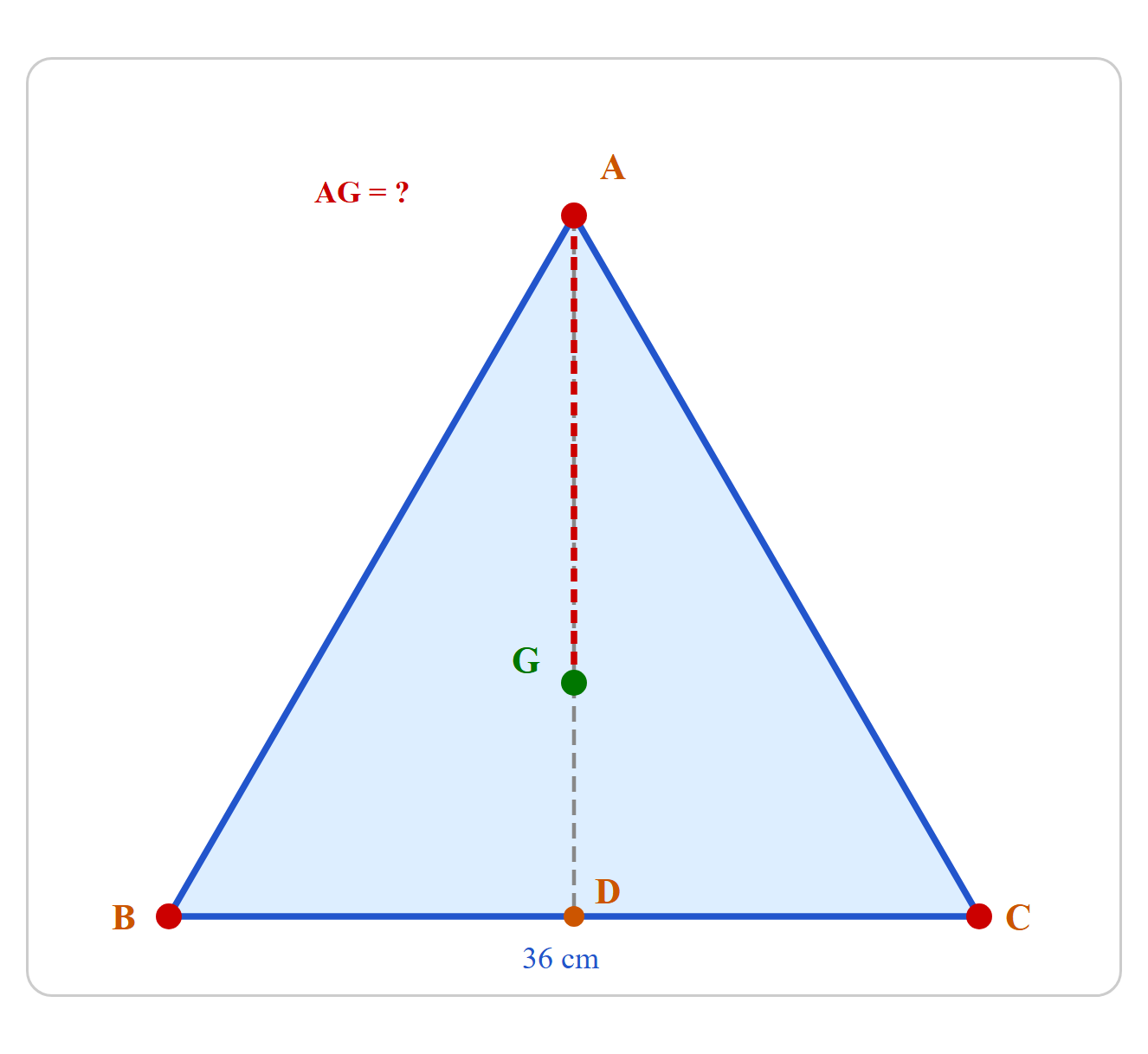
G is the centroid of the equilateral triangle ABC. If AB = 36 cm, then length (in cm) of AG is:

  1. ((a))

    86 8\sqrt{6}

  2. ((b))

    66 6\sqrt{6}

  3. ((c))

    123 12\sqrt{3}

  4. ((d))

    103 10\sqrt{3}

Show Answer
Answer: ((c))

123 12\sqrt{3}

Shortcut Trick

For an equilateral triangle with side a, the circumradius (which is the distance from centroid G to any vertex A) is given by the formula: AG = a / √3.

Given side a = 36 cm.

AG = 36 / √3

AG = (12 × 3) / √3 = 12√3 cm.

∴ The correct answer is 12√3 cm.

Alternate Method

Given: Side of equilateral triangle AB = 36 cm, G is the centroid.

Formula Used: Altitude (h) = (√3/2) × side; Centroid divides altitude in ratio 2 : 1.

Calculations:

⇒ Height of triangle AD = (√3 / 2) × 36

AD = 18√3 cm

⇒ Since G is the centroid, AG = (2 / 3) × AD

AG = (2 / 3) × 18√3

AG = 2 × 6√3

AG = 12√3 cm

∴ The correct answer is 12√3 cm.

Additional Information

Centroid of Equilateral Triangle

In an equilateral triangle, the centroid, circumcenter, orthocenter, and incenter all coincide at the same point.

Inradius vs Circumradius

For side a, the circumradius (AG) is a/√3 and the inradius (GD) is a/(2√3). The ratio is always 2:1.

Area and Height

Height = (√3/2)a and Area = (√3/4)a2.

21

What is the mode of the following data?

50, 43, 40, 51, 44, 46, 40, 43, 41, 45, 46, 40, 45, 47, 45, 49, 47, 40

  1. ((a))

    40

  2. ((b))

    43

  3. ((c))

    45

  4. ((d))

    46

Show Answer
Answer: ((a))

40

Shortcut Trick

Mode is defined as the observation that occurs most frequently in the given data set.

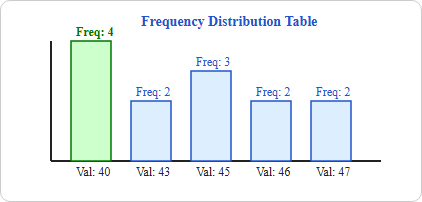
Count the occurrences: 40 appears 4 times, 45 appears 3 times, and others appear 2 or fewer times.

Since 40 has the highest frequency, it is the mode of the data.

∴ The correct answer is 40.

Alternate Method

Given: Data set = 50, 43, 40, 51, 44, 46, 40, 43, 41, 45, 46, 40, 45, 47, 45, 49, 47, 40

Formula Used: Mode = Value with the Maximum Frequency

Calculations:

⇒ Count of 40 = 4

⇒ Count of 43 = 2

⇒ Count of 45 = 3

⇒ Count of 46 = 2

⇒ Count of 47 = 2

⇒ Count of 50, 51, 44, 41, 49 = 1 each

⇒ Maximum Frequency = 4 (for the value 40)

∴ The correct answer is 40.

Additional Information

Measures of Central Tendency

There are three main measures: Mean (average), Median (middle value of sorted data), and Mode (most frequent value).

Empirical Relationship

For a moderately skewed distribution: Mode = 3 × Median − 2 × Mean.

Types of Mode

Data with one mode is unimodal, two modes is bimodal, and more than two modes is multimodal.

22

A can do a piece of work in 63 hours; B and C together can do it in 48 hours, while A and C together can do it in 36 hours. How long (in hours) will B alone take to do it?

  1. ((a))

    113

  2. ((b))

    111

  3. ((c))

    112

  4. ((d))

    114

Show Answer
Answer: ((c))

112

Shortcut Trick

Find efficiency using LCM of 63, 48, and 36 = 1008 units.

Efficiency of A = 1008 ÷ 63 = 16; Efficiency of A + C = 1008 ÷ 36 = 28.

Efficiency of C = 28 − 16 = 12.

Efficiency of B + C = 1008 ÷ 48 = 21 ⇒ Efficiency of B = 21 − 12 = 9.

Time for B = 1008 ÷ 9 = 112 hr.

∴ The correct answer is 112 hr.

Alternate Method

Given:

Time taken by A = 63 hr

Time taken by B + C = 48 hr

Time taken by A + C = 36 hr

Formula Used:

Total Work = LCM of individual time durations

Efficiency = Total Work ÷ Time taken

PersonDays (hr)Total WorkEfficiency
A63100816
B + C4821
A + C3628

Calculations:

⇒ Efficiency of C = Efficiency of (A + C) − Efficiency of A

⇒ Efficiency of C = 28 − 16 = 12

⇒ Efficiency of B = Efficiency of (B + C) − Efficiency of C

⇒ Efficiency of B = 21 − 12 = 9

⇒ Time taken by B alone = Total Work ÷ Efficiency of B

⇒ Time taken by B = 1008 ÷ 9 = 112 hr

∴ The correct answer is 112 hr.

Additional Information

Work and Efficiency Relationship

Efficiency is inversely proportional to the time taken to complete the work. Efficiency = 1 ÷ Time.

Combined Efficiency

When two or more people work together, their combined efficiency is the sum of their individual efficiencies (e.g., EA+B = EA + EB).

Pipes and Cisterns

Similar logic applies where inlet pipes have positive efficiency and outlet (leakage) pipes have negative efficiency.

23

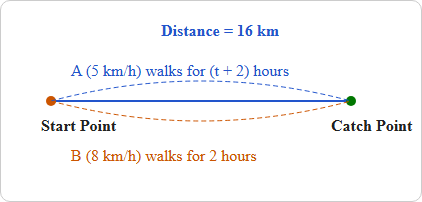
Two persons A and B start from the same point. A walks at 5 km/h. After 't' hours B starts and catches A after 2 hours of his own walking. If B’s speed is 8 km/h, what is the value of 't'?

  1. ((a))

    1.3

  2. ((b))

    1.5

  3. ((c))

    1.2

  4. ((d))

    1.4

Show Answer
Answer: ((c))

1.2

Shortcut Trick

Distance covered by B in 2 hours = 8 × 2 = 16 km.

Since B catches A, A also covers the same 16 km.

Total time taken by A = 16 ÷ 5 = 3.2 hours.

Delay time t = Total time of AB's travel time = 3.2 − 2 = 1.2 hours.

∴ The correct answer is 1.2.

Alternate Method

Given: Speed of A (SA) = 5 km/h, Speed of B (SB) = 8 km/h, Time taken by B = 2 hr.

Formula Used: Distance = Speed × Time; Time = Distance ÷ Speed

⇒ Distance covered by B = SB × Time taken by B

⇒ Distance = 8 × 2 = 16 km

⇒ Total time taken by A to cover 16 km = 16 ÷ 5 = 3.2 hours

⇒ According to the problem, A starts t hours before B.

⇒ Total time taken by A = t + Time taken by B

⇒ 3.2 = t + 2

t = 3.2 − 2 = 1.2

∴ The correct answer is 1.2.

Additional Information

Relative Speed in Same Direction

When two objects move in the same direction, their relative speed is the difference of their speeds (S1 − S2).

Catching Time Formula

Time taken to catch = (Initial distance gap) ÷ (Relative speed). In this case, initial gap = Speed of A × t.

Distance Constant Rule

If distance is constant, the ratio of speeds is inversely proportional to the ratio of times taken (S1/S2 = T2/T1).

24

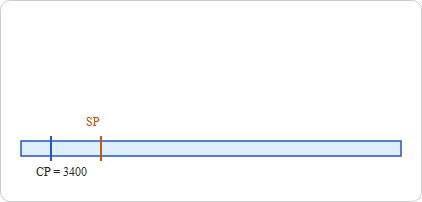
A dealer buys two articles X and Y for ₹3,400 each. He marks each of them at the same price. He sells X by giving two successive discounts of 10% and 50% and still earns ₹323 as profit. If he sells Y at a single discount of 28%, then what is the profit percentage on Y?

  1. ((a))

    75.2%

  2. ((b))

    74.2%

  3. ((c))

    75%

  4. ((d))

    74%

Show Answer
Answer: ((a))

75.2%

Shortcut Trick

Selling Price of Article X = 3400 + 323 = ₹3723

Net multiplier for successive discounts (10% and 50%) = 0.9 × 0.5 = 0.45

Marked Price (MP) = 3723 ÷ 0.45

Selling Price of Article Y (at 28% discount) = (3723 ÷ 0.45) × 0.72 = 3723 × 1.6 = ₹5956.8

Profit on Y = 5956.8 − 3400 = ₹2556.8 → Profit % = (2556.8 ÷ 3400) × 100 = 75.2%

∴ The correct answer is 75.2%.

Alternate Method

Given: Cost Price (CP) of each article = ₹3400; Profit on X = ₹323; Discounts on X = 10% and 50%; Discount on Y = 28%.

Formula: Selling Price (SP) = CP + Profit | SP = MP × (1 − d1/100) × (1 − d2/100) | Profit % = (Profit ÷ CP) × 100.

Selling Price of X = 3400 + 323 = ₹3723

⇒ Effective discount on X = 10 + 50 − (10 × 50 ÷ 100) = 60 − 5 = 55%

Marked Price (MP) = SPX ÷ (100 − 55)% = 3723 ÷ 0.45 = ₹8273.33

Selling Price of Y = MP × (100 − 28)% = 8273.33 × 0.72 = ₹5956.8

Profit on Article Y = 5956.8 − 3400 = ₹2556.8

Profit % on Y = (2556.8 ÷ 3400) × 100 = 75.2%

∴ The correct answer is 75.2%.

Additional Information

Successive Discount Formula

For two successive discounts of a% and b%, the equivalent single discount is given by (a + b − ab/100)%.

Relationship between MP and CP

MP ÷ CP = (100 + Profit%) ÷ (100 − Discount%). This ratio helps find MP directly if Profit% and Discount% are known.

Marked Price Definition

MP is the price printed on an article. Discount is always calculated on the Marked Price, while Profit/Loss is calculated on the Cost Price.

25

Simplify.

<br>

(3.6 × 2.5) − (4.8 ÷ 1.6) + (3.2 × 0.5)

  1. ((a))

    7.6

  2. ((b))

    7.4

  3. ((c))

    7.2

  4. ((d))

    7.8

Show Answer
Answer: ((a))

7.6

Shortcut Trick

According to the BODMAS rule, perform the operations inside the brackets first.

(3.6 × 2.5) = 9.0

(4.8 ÷ 1.6) = 3

(3.2 × 0.5) = 1.6

Result: 9 − 3 + 1.6 = 6 + 1.6 = 7.6

∴ The correct answer is 7.6.

Alternate Method

Given expression: (3.6 × 2.5) − (4.8 ÷ 1.6) + (3.2 × 0.5)

Method used: The BODMAS rule has been followed for simplification.

⇒ (3.6 × 2.5) − (4.8 ÷ 1.6) + (3.2 × 0.5)

⇒ 9.0 − (4.8 & divide; 1.6) + 1.6

⇒ 9.0 − 3.0 + 1.6

⇒ 6.0 + 1.6

⇒ 7.6

∴ The correct answer is 7.6.

Additional Information

BODMAS Rule

In any simplification problem, operations must be performed in the following order: Brackets, Of, Division, Multiplication, Addition, and Subtraction.

Multiplication of Decimals

When multiplying decimal numbers, perform the multiplication as usual; then, count the total number of decimal places in the multiplicand and the multiplier, and place the decimal point in the product by counting that many places from the right.

Division of Decimals

If the divisor is a decimal number, it is convenient to first convert it into a whole number by multiplying both the dividend and the divisor by 10, 100, or 1000.

General Intelligence & Reasoning (25 questions)

26

In a certain code language, ‘mind your business’ is coded as ‘gv tr fy’ and ‘your turn now’ is coded as ‘cb gv kq’. How is ‘your’ coded in the given language? (All the codes are two-letter codes only.)

  1. ((a))

    kq

  2. ((b))

    gv

  3. ((c))

    tr

  4. ((d))

    fy

Show Answer
Answer: ((b))

gv

Logic followed here is.

Logic: The code for a specific word is determined by comparing different statements and identifying the word and code that are common to both.


Therefore, the code for 'your' is gv.

Hence, the correct answer is "Option 2".

27

Choose the pair that follows the same pattern as the two pairs given below. Both pairs follow the same pattern.

<br>

GAU : JDX

REF : UHI

  1. ((a))

    SYI : UZL

  2. ((b))

    CNH : FQK

  3. ((c))

    ZTD : CWH

  4. ((d))

    QEW : SGY

Show Answer
Answer: ((b))

CNH : FQK

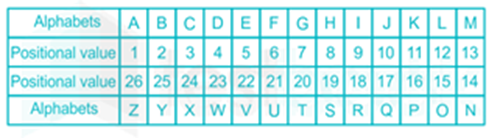
The logic followed in this pattern is a consistent alphabetical shift of +3 for each letter in the group.

For 'GAU' related to 'JDX':

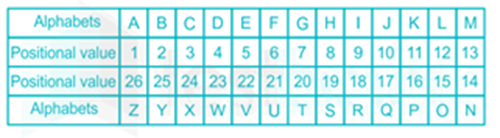
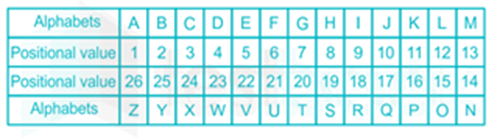
G(7)A(1)U(21)
+3 ↓+3 ↓+3 ↓
J(10)D(4)X(24)

For 'REF' related to 'UHI':

R(18)E(5)F(6)
+3 ↓+3 ↓+3 ↓
U(21)H(8)I(9)

Applying the same logic to 'CNH':

C(3)N(14)H(8)
+3 ↓+3 ↓+3 ↓
F(6)Q(17)K(11)

Thus, CNH is related to FQK using the same pattern.

Hence, the correct answer is 'Option 2'.

28

The position(s) of how many letters will remain unchanged if each letter in the word EDUCATORS is arranged in English alphabetical order?

  1. ((a))

    One

  2. ((b))

    Two

  3. ((c))

    None

  4. ((d))

    Four

Show Answer
Answer: ((c))

None

Given Word:

EDUCATORS

Original Positions:

Position123456789
LetterEDUCATORS
<br>

Arrange the letters in alphabetical order:

A, C, D, E, O, R, S, T, U

Position123456789
LetterACDEORSTU
<br>

Comparison:

PositionOriginalNewSame?
1EANo
2DCNo
3UDNo
4CENo
5AONo
6TRNo
7OSNo
8RTNo
9SUNo

No letter remains at its original position.

Therefore, 0 letters remain unchanged.

Hence, the correct answer is "Option 3 — None".

29

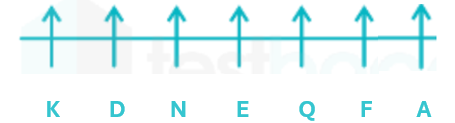
Seven people, A, K, Q, D, E, F and N, are sitting in a row, facing north. D sits sixth from the right end of the row. Only three people sit between F and D. E is the immediate neighbour of Q and N. K sits second to the left of N. Who sits third to the left of A?

  1. ((a))

    D

  2. ((b))

    E

  3. ((c))

    K

  4. ((d))

    Q

Show Answer
Answer: ((b))

E

To solve this linear seating arrangement, we will place the people in a row of seven positions (1 to 7 from left to right) according to the given conditions step-by-step.

1: D sits sixth from the right end of the row. This means D is at the 2nd position from the left.

2: Only three people sit between F and D. Since D is at position 2, counting three spots to the right (3, 4, 5), F must be at position 6.

3: K sits second to the left of N. Also, E is the immediate neighbour of Q and N (which means E is between Q and N).

4: The only remaining person, A, sits at the only remaining position (Pos 7).

<br>

Question: Who sits third to the left of A?

From A at position 7:

1st left: F (Pos 6)

2nd left: Q (Pos 5)

3rd left: E (Pos 4)

Therefore, E sits third to the left of A.

Hence, the correct answer is "Option 2".

30

What will come in the place of ‘?’ in the following equation, if ‘+’ and ‘-’ are interchanged and ‘x’ and ‘÷’ are interchanged?

<br>

8 ÷ 2 + 14 x 7 - 7 = ?

  1. ((a))

    21

  2. ((b))

    14

  3. ((c))

    18

  4. ((d))

    12

Show Answer
Answer: ((a))

21

Given Sign Interchanges:

Original SignNew Sign
+
+
×÷
÷×


The original equation is:

8 ÷ 2 + 14 × 7 − 7 = ?

After replacing the signs according to the instructions, the new equation becomes:

= 8 × 2 − 14 ÷ 7 + 7 

= 8 × 2 - 2 + 7

= 16 - 2 + 7

= 23 - 2

= 21

Therefore, the value that will come in place of '?' is 21.

Hence, the correct answer is "Option 1".

31

In a certain code language,

<br>

A + B means ‘A is the sister of B’

A – B means ‘A is the brother of B’

A x B means ‘A is the wife of B’

A ÷ B means ‘A is the father of B’

<br>

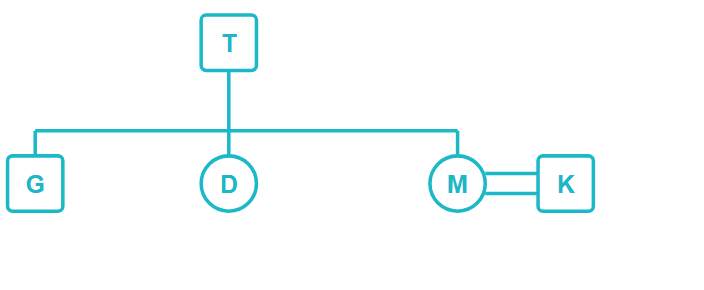
Based on the above, how is T related to K if ‘T ÷ G – D + M x K’?

  1. ((a))

    Wife's brother

  2. ((b))

    Brother

  3. ((c))

    Wife's father

  4. ((d))

    Father

Show Answer
Answer: ((c))

Wife's father

Given:

Let us first decode the given symbols and then draw a family tree.

A is
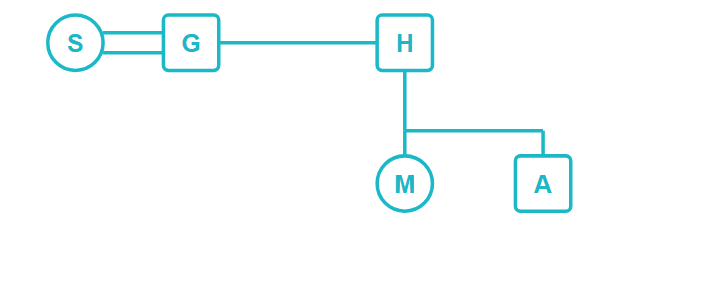
Symbol+×÷
MeaningSisterBrotherWifeFather
of B


On checking: T ÷ G − D + M × K

  1. T ÷ G - 'T ÷ G' means 'T is the father of G'.

  2. G − D - 'G − D' means 'G is the brother of D'.

  3. D + M - 'D + M' means 'D is the sister of M'.

  4. M × K- 'M × K' means 'M is the wife of K'.

Therefore, T is the father of M, who is the wife of KT is the Wife's father of K.

Hence, the correct answer is 'Option 3'.

32

All the individual letters in the word PICKLED are arranged in alphabetical order. How many letters are there in the English alphabetical order between the letter which is second from the left and the one which is fourth from the right in the new letter cluster thus formed?

  1. ((a))

    Three

  2. ((b))

    One

  3. ((c))

    Four

  4. ((d))

    Two

Show Answer
Answer: ((c))

Four

Given Word:

PICKLED

Arrange the letters in alphabetical order:

C, D, E, I, K, L, P

New Letter Cluster:

Position1234567
LetterCDEIKLP
<br>

Required Letters:

  • Second from the left = D
  • Fourth from the right = I
<br>

English alphabetical order:

D → E, F, G, H → I

Letters between D and I are:

→ E

→ F

→ G

→ H

Therefore, there are 4 letters between D and I.

Hence, the correct answer is "Option 3 — Four".

33

According to the English alphabetical series, what should replace the question mark (?) in the given sequence?

<br>

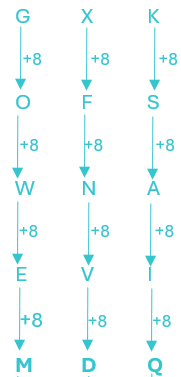
GXK OFS WNA EVI ?

  1. ((a))

    MRF

  2. ((b))

    MDR

  3. ((c))

    MDO

  4. ((d))

    MDQ

Show Answer
Answer: ((d))

MDQ

Logic followed here is.

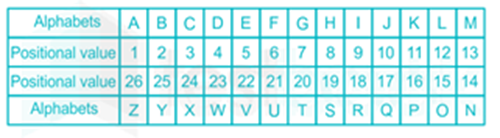
Logic: Every term in the sequence is obtained by adding 8 to the positional values of the corresponding letters of the previous term in the English alphabetical series.


The term that replaces the question mark is MDQ.

Hence, the correct answer is "Option 4".

34

Refer to the following letter series and answer the question that follows. Counting to be done from left to right.

<br>

(Left) S I C X Z O A K L N T E W A Q D F H G U K O (Right)

<br>

How many such consonants are there, each of which is immediately preceded by a vowel and also immediately followed by a vowel?

  1. ((a))

    None

  2. ((b))

    Two

  3. ((c))

    Three

  4. ((d))

    One

Show Answer
Answer: ((b))

Two

Given Series:

(Left) S I C X Z O A K L N T E W A Q D F H G U K O (Right)

Required pattern:

Vowel → Consonant → Vowel

Checking the series:

(Left) S I C X Z O A K L N T E W A A Q D F H G U U K O (Right)

Consonants satisfying the condition:

→ W in (E W A)

→ K in (U K O)

Therefore, there are 2 such consonants.

Hence, the correct answer is "Option 2 — Two".

35

According to the English alphabetical series, what should replace the question mark (?) in the given sequence?

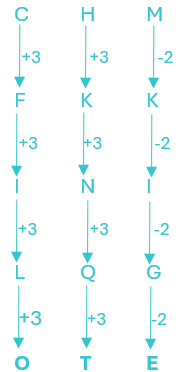
CHM FKK INI LQG ?

  1. ((a))

    OTE

  2. ((b))

    NHG

  3. ((c))

    WAS

  4. ((d))

    HGY

Show Answer
Answer: ((a))

OTE

The logic followed here is based on the positions of letters in the English alphabetical series.

The sequence consists of sets of three letters, where each letter position follows its own specific pattern.


Therefore, the term that replaces the question mark is OTE.

Hence, the correct answer is "Option 1".

36

GDFH is related to JGIK in a certain way based on the English alphabetical order. In the same way, OLNP is related to ROQS. To which of the given options is TQSU related, following the same logic?

  1. ((a))

    WTVX

  2. ((b))

    VTWY

  3. ((c))

    WTUX

  4. ((d))

    WUTX

Show Answer
Answer: ((a))

WTVX

The logic followed in this pattern is a consistent alphabetical shift where each letter is moved forward by 3 positions in the English alphabetical order.

For 'GDFH' related to 'JGIK':

G(7)D(4)F(6)H(8)
+3 ↓+3 ↓+3 ↓+3 ↓
J(10)G(7)I(9)K(11)

For 'OLNP' related to 'ROQS':

O(15)L(12)N(14)P(16)
+3 ↓+3 ↓+3 ↓+3 ↓
R(18)O(15)Q(17)S(19)

Applying the same logic to 'TQSU':

T(20)Q(17)S(19)U(21)
+3 ↓+3 ↓+3 ↓+3 ↓
W(23)T(20)V(22)X(24)

Thus, TQSU is related to WTVX.

Hence, the correct answer is 'Option 1'.

37

What will come in place of the question mark (?) in the given series?

<br>

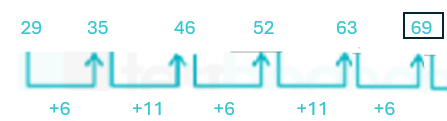
29 35 46 52 63 ?

  1. ((a))

    69

  2. ((b))

    67

  3. ((c))

    70

  4. ((d))

    71

Show Answer
Answer: ((a))

69

The logic followed here is:

The given number series follows an alternating addition pattern of 6 and 11 as shown below:

Thus, the missing term in the series is 69.

Hence, the correct answer is 'Option 1';

38

What will come in place of the question mark (?) in the given series?

<br>

7 21 63 189 567 ?

  1. ((a))

    1703

  2. ((b))

    1700

  3. ((c))

    1701

  4. ((d))

    1702

Show Answer
Answer: ((c))

1701

The logic followed here is:

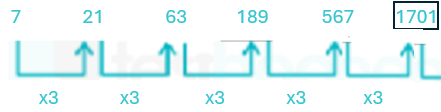
The given series follows a multiplication pattern where each term is obtained by multiplying the previous term by 3.

The given number series is: 7, 21, 63, 189, 567, ?

Thus, the missing term in the series is 1701.

Hence, the correct answer is 'Option 3';

39

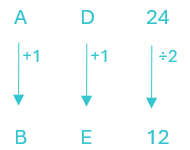
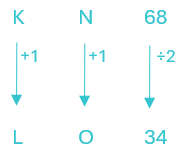
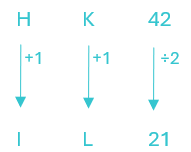
AD 24 is related to BE 12 in a certain way. Following the same pattern, KN 68 is related to LO 34. Following the same pattern, HK 42 is related to which of the following options?

  1. ((a))

    JL 31

  2. ((b))

    IM 21

  3. ((c))

    JM 33

  4. ((d))

    IL 21

Show Answer
Answer: ((d))

IL 21

Given:

AD 24BE 12:

KN 68LO 34:

Following the same pattern for HK 42:

The derived result is IL 21. Based on the calculated number 21, the matching option is THE 21ST.

Hence, the correct answer is 'Option 4'.

40

If 'P' means '×', 'Q' means '÷', 'R' means '−' and 'S' means '+', then what will come in place of the question mark (?) in the following equation?

<br>

53 R 61 S 96 P 3 Q 2 S 28 P 6 R 99 Q 3 S 32 = ?

  1. ((a))

    328

  2. ((b))

    348

  3. ((c))

    303

  4. ((d))

    365

Show Answer
Answer: ((c))

303

Signs and symbols mapping:

PQRS
×÷+

Given Expression:

53 R 61 S 96 P 3 Q 2 S 28 P 6 R 99 Q 3 S 32

Replacing the letters with their respective signs:

= 53 − 61 + 96 × 3 ÷ 2 + 28 × 6 − 99 ÷ 3 + 32

= 53 - 61 + 96 × 1.5 + 28 × 6 - 33 + 32

= 53 - 61 + 144 + 168 - 33 + 32

= 397 - 94

= 303

The result of the expression is 303.

Hence, the correct answer is "Option 3".

41

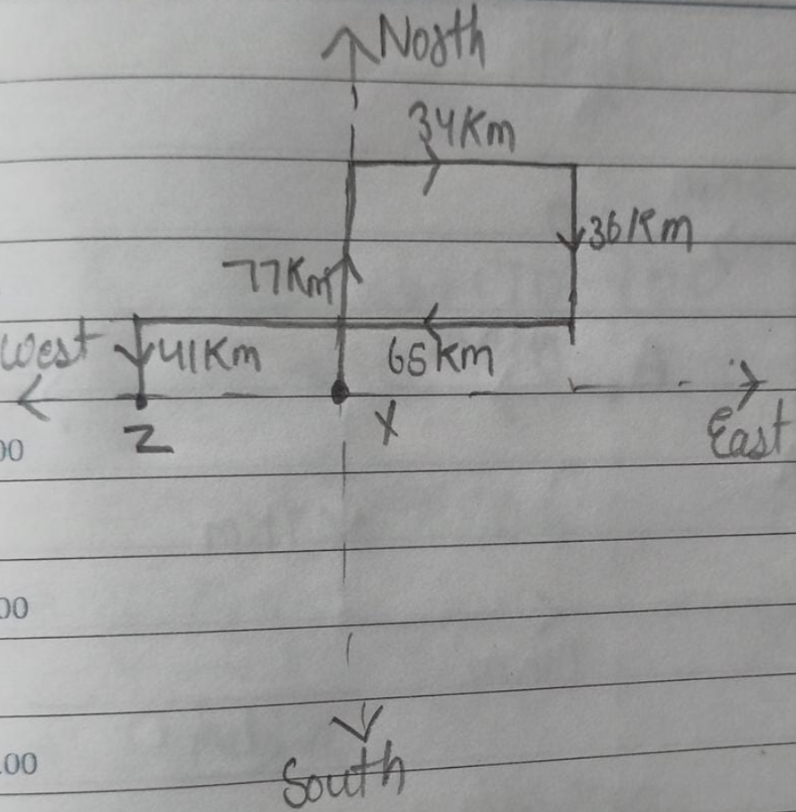
Keval starts from point Y and drives 77 km towards North. He then takes a right turn, drives 34 km, turns right and drives 36 km. He then takes a right turn and drives 65 km. He then turns left, drives 41 km to stop at point Z. How far (shortest distance) and towards which direction should he drive in order to reach point Y again? (All turns are 90-degree turns only unless specified.)

  1. ((a))

    31 km towards east

  2. ((b))

    33 km towards north

  3. ((c))

    30 km towards east

  4. ((d))

    29 km towards west

Show Answer
Answer: ((a))

31 km towards east

According to the movement of Keval described in the question, the path taken is as follows:

  1. Starting Point: Keval starts from Point Y. Let us assume Point Y is at the origin (0, 0).
  2. First Move: He drives 77 km towards North.

Current Position = (0, 77)

  1. Second Move: He takes a Right turn and drives 34 km. Since he was facing North, a right turn is towards the East.

Current Position = (0 + 34, 77) = (34, 77)

  1. Third Move: He turns Right and drives 36 km. Since he was facing East, a right turn is towards the South.

Current Position = (34, 77 − 36) = (34, 41)

  1. Fourth Move: He takes a Right turn and drives 65 km. Since he was facing South, a right turn is towards the West.

Current Position = (34 − 65, 41) = (−31, 41)

  1. Fifth Move: He turns Left and drives 41 km to stop at Point Z. Since he was facing West, a left turn is towards the South.

Final Position (Point Z) = (−31, 41 − 41) = (−31, 0)

Therefore, he should drive 31 km towards East to reach Point Y again.

Hence, the correct answer is "Option 1".

42

Refer to the following number series and answer the question that follows. (All numbers are single-digit numbers only. Counting to be done from left to right only.)

<br>

(Left) 3 5 4 3 6 7 8 9 9 6 6 3 3 7 8 8 1 7 5 3 (Right)

<br>

How many such odd numbers are there, each of which is immediately preceded by an even number and also immediately followed by an odd number?

  1. ((a))

    TWO

  2. ((b))

    ONE

  3. ((c))

    NONE

  4. ((d))

    THREE

Show Answer
Answer: ((d))

THREE

Given Series:

(Left) 3 5 4 3 6 7 8 9 9 6 6 3 3 7 8 8 1 7 5 3 (Right)

Required pattern:

Even Number → Odd Number → Odd Number

Checking the series:

(Left) 3 5 4 3 6 7 8 9 9 9 6 6 6 3 3 3 7 8 8 1 7 7 5 3 (Right)

Odd numbers satisfying the condition:

→ 9 in (8 9 9)

→ 3 in (6 3 3)

→ 1 in (8 1 7)

Therefore, there are 3 such odd numbers.

Hence, the correct answer is "Option 4 — THREE".

43

Based on the English alphabetical order, three of the following four letter-cluster pairs are alike in a certain way and thus form a group. Which is the one that does not belong to that group? (Note: The odd one out is not based on the number of consonants/vowels or their position in the letter-cluster.)

  1. ((a))

    CH – AF

  2. ((b))

    FK – DI

  3. ((c))

    JO – HM

  4. ((d))

    PU – MR

Show Answer
Answer: ((d))

PU – MR

The logic followed here is

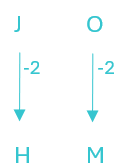
Logic: The position of each letter in the second cluster = Position of the corresponding letter in the first cluster − 2 (based on the English alphabetical order).

Option 1)  CH - AF,

Option 2)  FK - DI,

Option 3)  JO - HM,

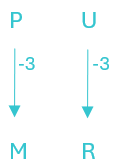
Option 4)  PU - MR,

This pair does not follow the rule as it uses a difference of −3 instead of −2.

Therefore, the letter-cluster pair that is different from the others is PU - MR.

Hence, the correct answer is 'Option 4'.

44

In a row of 47 people facing north, Kamu sits 12th from the left end. If only 12 people sit to the right of Tara, then how many people sit between Kamu and Tara?

  1. ((a))

    20

  2. ((b))

    19

  3. ((c))

    21

  4. ((d))

    22

Show Answer
Answer: ((d))

22

The logic followed here is:

Position of Kamu from the left = 12th

Number of people sitting to the right of Tara = 12

Position of Tara from the right = 12 + 1 = 13th

Total number of people in the row = 47

Position of Tara from the left = Total number of people − Position of Tara from the right + 1

= 47 − 13 + 1

= 35

So, Tara is 35th from the left.

Number of people between Kamu and Tara = Position of Tara from the left − Position of Kamu from the left − 1

= 35 − 12 − 1

= 22

Hence, the correct answer is 'Option 4'.

45

Seven boxes A, B, C, D, E, F and G are kept one over the other but not necessarily in the same order. C is not kept below G. Only five boxes are kept below E. Only one box is kept between C and E. B is kept above A but below G. F is not the topmost box. Which box is kept immediately below F?

  1. ((a))

    E

  2. ((b))

    D

  3. ((c))

    C

  4. ((d))

    B

Show Answer
Answer: ((c))

C

Given:

1) Only five boxes are kept below E.

2) Only one box is kept between C and E.

3) C is not kept below G, and B is kept above A but below G.

PositionBox
7 (Top)
6E
5
4C
3G
2B
1 (Bottom)A


4) F is not the topmost box.

Final Arrangement:

7D
6E
5F
4C
3G
2B
1A


Thus, the box kept immediately below F is C.

Hence, the correct answer is 'Option 3'.

46

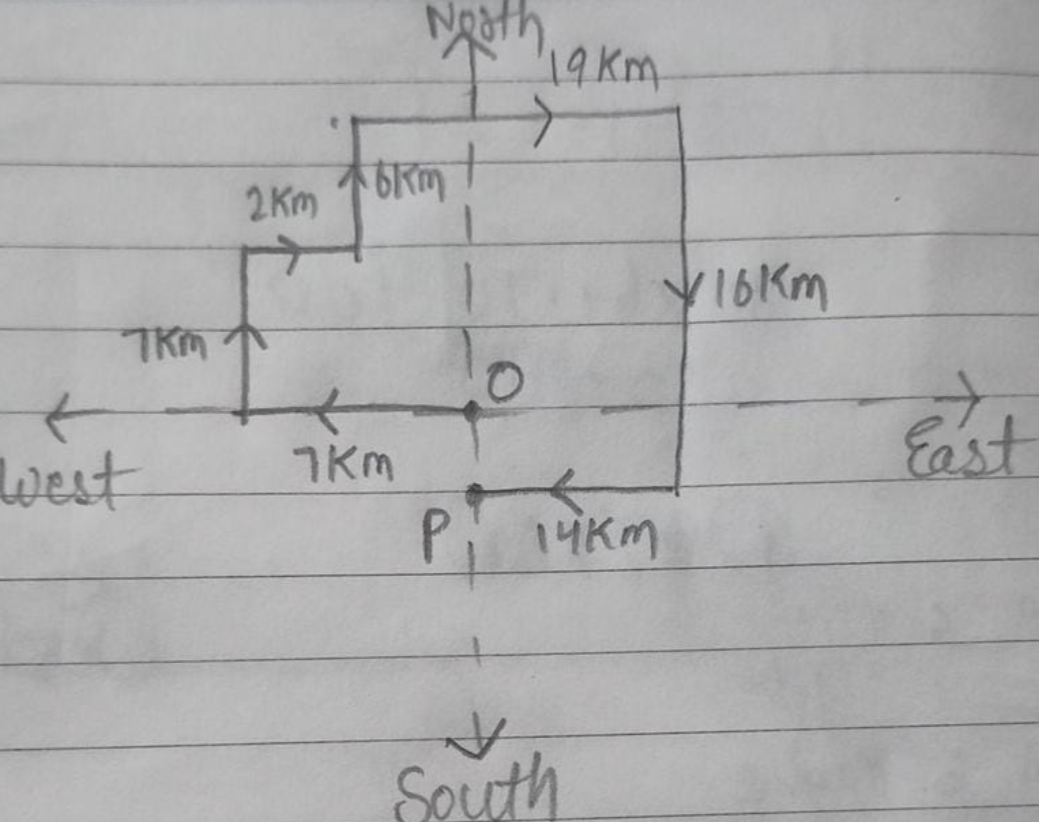
Mr. Ok starts from Point O and drives 7 km towards the west. He then takes a right turn, drives 7 km, turns right and drives 2 km. He then takes a left turn and drives 6 km. He then takes a right turn and drives 19 km. He then takes a right turn and drives 16 km. He then takes a final right turn, drives 14 km and stops at Point P. How far (shortest distance) and towards which direction should he drive in order to reach Point O again? (All turns are 90 degrees turns only unless specified.)

  1. ((a))

    4 km towards South

  2. ((b))

    3 km towards West

  3. ((c))

    3 km towards North

  4. ((d))

    4 km towards East

Show Answer
Answer: ((c))

3 km towards North

Logic followed here is based on the movement of Mr. Ok on a directional plane. We can track his position by calculating the total displacement in the East-West and North-South directions.

Step-by-step movement from Point O:

1. Mr. Ok starts from Point O and drives 7 km towards the west. 2. He then takes a right turn, drives 7 km, turns right and drives 2 km. 3. He then takes a left turn and drives 6 km. 4. He then takes a right turn and drives 19 km. 5. He then takes a right turn and drives 16 km. 6. He then takes a final right turn, drives 14 km and stops at Point P.

Calculation of the Shortest Distance:

Therefore, he should drive 3 km towards North to reach Point O.

Hence, the correct answer is "Option 3".

47

Shreya is the wife of Govind. Govind is the brother of Harshit. Harshit is the father of Mahak. Mahak is the sister of Aditya. How is Shreya related to Aditya?

  1. ((a))

    Mother's brother's daughter

  2. ((b))

    Mother's brother's wife

  3. ((c))

    Father's brother's wife

  4. ((d))

    Father's brother's daughter

Show Answer
Answer: ((c))

Father's brother's wife

Given:

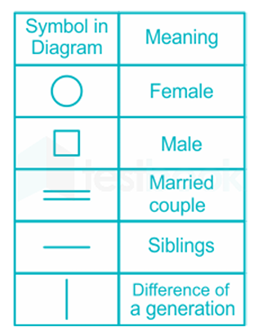
By analyzing the relationships step-by-step, we can construct the family tree:

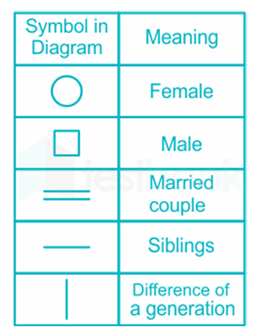
  1. Shreya is the wife of Govind - This means Shreya (Female) and Govind (Male) are a married couple.

  2. Govind is the brother of Harshit - Govind and Harshit (Male) are brothers.

  3. Harshit is the father of Mahak - Harshit is the parent of Mahak (Female).

  4. Mahak is the sister of Aditya - Mahak and Aditya are siblings, which means Harshit is also the father of Aditya.

​Based on the tree, Harshit is the father of Aditya, and Govind is Harshit's brother. Shreya is Govind's wife. Therefore, Shreya is the Father's brother's wife of Aditya.

Hence, the correct answer is 'Option 3'.

48

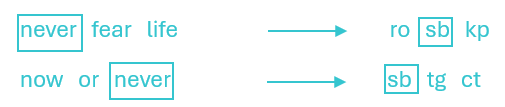
In a certain code language, ‘never fear life’ is coded as ‘ro sb kp’ and ‘now or never’ is coded as ‘sb tg ct’. How is ‘never’ coded in the given language? (All the codes are two-letter codes only.)

  1. ((a))

    sb

  2. ((b))

    kp

  3. ((c))

    ct

  4. ((d))

    tg

Show Answer
Answer: ((a))

sb

Logic followed here is by comparing the given phrases to identify the common words and their corresponding codes.

Given phrases and their codes:

  1. never fear life → ro sb kp

  2. now or neversb tg ct

Hence, the correct answer is "Option 1".

49

Based on the English alphabetical order, three of the following four letter-cluster pairs are alike in a certain way and thus form a group. Which letter-cluster pair DOES NOT belong to that group?

(Note: The odd one out is not based on the number of consonants/vowels or their position in the letter-cluster.)

  1. ((a))

    IK−FK

  2. ((b))

    UW−SU

  3. ((c))

    OQ−MO

  4. ((d))

    DF−BD

Show Answer
Answer: ((a))

IK−FK

The logic followed here is based on the alphabetical positions of the letters.

Logic: Each letter of the second cluster is obtained by subtracting 2 from the alphabetical position of the corresponding letter in the first cluster.

Option 1)  IK-FK,

This pair does not follow the rule.

Option 2) UW-SU,

Option 3) OQ-MO,

Option 4) DF-BD,

Therefore, the letter-cluster pair that is different from the others is IK-FK.

Hence, the correct answer is 'Option 1'.

50

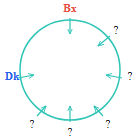
Ap, Bx, Cu, Dk, Ey, Fn and Gm are sitting around a circular table facing the centre. Dk sits to the immediate right of Bx. Cu is the immediate neighbour of Ey and Dk. Fn sits second to the right of Ap. What is the position of Gm with respect to Ey?

  1. ((a))

    Second to the right

  2. ((b))

    Second to the left

  3. ((c))

    Third to the right

  4. ((d))

    Immediate left

Show Answer
Answer: ((a))

Second to the right

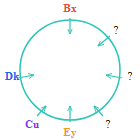
  1. All seven persons face the centre of the table. In this arrangement, Right is counterclockwise and Left is clockwise. Fix Bx at pos(1). Dk sits to the immediate right (counterclockwise) of Bx, which means Dk is at pos(7).

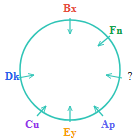
  1. Cu is the immediate neighbour of Ey and Dk. Since Dk is at pos(7) and Bx is at pos(1), Cu must be at pos(6). This places Ey at pos(5).

  1. Fn sits second to the right (counterclockwise) of Ap. The remaining positions are 2, 3, and 4. If we place Ap at pos(4), its second right (pos 4 → pos 3 → pos 2) is pos(2). Thus, Ap is at pos(4) and Fn is at pos(2).

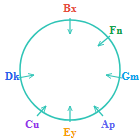
  1. The final remaining person, Gm, fills the last seat at pos(3). All positions are now occupied: Bx(1), Fn(2), Gm(3), Ap(4), Ey(5), Cu(6), Dk(7).

<br>

Starting from Ey at pos(5) and moving clockwise (left), the sequence is: Ey(5)Ap(4)Gm(3). Therefore, Gm is sitting second to the right of Ey.

<br>

Hence, the correct answer is Option 1.

General Science (40 questions)

51

Which type of crop cultivation systematically maintains soil fertility through the sequential cultivation of various crops?

  1. ((a))

    Relay cropping

  2. ((b))

    Monocropping

  3. ((c))

    Crop Rotation

  4. ((d))

    Mixed Farming

Show Answer
Answer: ((c))

Crop Rotation

The correct answer is Crop Rotation.

Key Points

  • Crop Rotation is the systematic practice of growing a series of dissimilar types of crops in the same area in sequential seasons to optimize soil nutrients.
  • This method maintains soil fertility by alternating nutrient-exhaustive crops (like cereals) with nutrient-restorative crops (like legumes).
  • Leguminous plants included in the rotation contain Rhizobium bacteria in their root nodules, which facilitate biological nitrogen fixation, naturally enriching the soil.
  • It effectively breaks the life cycles of pests and diseases that are host-specific, thereby reducing the need for chemical pesticides and improving crop yield.
  • By varying root depths (alternating deep-rooted and shallow-rooted crops), it improves soil structure and prevents soil erosion.

 Additional Information

  • Relay cropping:
  • A method of multiple cropping where a second crop is seeded into an existing standing crop before the first one is harvested.
  • It reduces temporal wastage and utilizes residual soil moisture, though it requires precise timing and management.
  • Monocropping:
  • The agricultural practice of growing a single crop year after year on the same land.
  • Common in industrial farming for wheat or corn, it often leads to soil depletion and increased pathogen buildup.
  • Mixed Farming:
  • An integrated system where crop production is combined with livestock raising on the same farm.
  • It provides economic stability and allows for the recycling of nutrients through animal manure.
52

Addition reactions are characteristic of which type of hydrocarbons?

  1. ((a))

    Only alkanes

  2. ((b))

    Only alkenes

  3. ((c))

    Only alkynes

  4. ((d))

    Both alkynes and alkenes

Show Answer
Answer: ((d))

Both alkynes and alkenes

The correct answer is Both alkynes and alkenes.

Concept

  • Addition reactions are typical of unsaturated hydrocarbons containing double or triple bonds. Therefore, both alkenes and alkynes readily undergo addition reactions.

Key Points

  • Alkenes contain at least one carbon-carbon double bond (C=C), making them unsaturated hydrocarbons.
  • Alkynes contain at least one carbon-carbon triple bond (C≡C), making them highly reactive toward addition reactions.
  • Addition reactions involve the addition of atoms or groups across multiple bonds, converting unsaturated compounds into saturated compounds.
  • Common addition reactions include hydrogenation, halogenation, hydrohalogenation, and hydration.

Additional Information

  • Alkanes
  • Saturated hydrocarbons having only single covalent bonds.
  • General formula: CnH2n+2.
  • Typically undergo substitution reactions rather than addition reactions.
  • Alkenes
  • Unsaturated hydrocarbons containing at least one C=C double bond.
  • General formula: CnH2n.
  • Readily undergo addition reactions due to the presence of a π-bond.
  • Alkynes
  • Unsaturated hydrocarbons containing at least one C≡C triple bond.
  • General formula: CnH2n−2.
  • Can undergo multiple addition reactions because of two π-bonds.
  • Hydrogenation
  • Addition of hydrogen in the presence of catalysts such as nickel, palladium, or platinum.
  • Converts unsaturated hydrocarbons into saturated hydrocarbons.
  • Halogenation
  • Addition of halogens such as chlorine or bromine across double or triple bonds.
  • Used as a test for unsaturation in organic compounds.
53

Identify the product formed when copper metal is exposed to dilute hydrochloric acid.

  1. ((a))

    Salt and chlorine gas

  2. ((b))

    Only Salt

  3. ((c))

    Salt and hydrogen gas

  4. ((d))

    No reaction

Show Answer
Answer: ((d))

No reaction

The correct answer is No reaction.

Key Points

  • The chemical interaction between metals and acids is primarily determined by the Reactivity Series, which ranks metals based on their ability to lose electrons.
  • In this series, Copper (Cu) is located below Hydrogen (H), making it a relatively unreactive or noble metal compared to alkali or alkaline earth metals.
  • For a metal to react with a dilute acid like Hydrochloric acid (HCl) and liberate gas, it must be capable of displacing hydrogen ions from the solution.
  • Since copper has a lower oxidation potential than hydrogen, it cannot reduce H+ ions into Hydrogen gas (H2).
  • The Standard Reduction Potential for the Cu2+/Cu couple is +0.34 V, which is higher than the 0.00 V of the Standard Hydrogen Electrode, confirming the reaction is thermodynamically non-spontaneous.

 Additional Information

  • Reactive Metals and Acids:
  • Metals such as Zinc (Zn), Magnesium (Mg), and Aluminum (Al) are placed above hydrogen in the reactivity series.
  • These metals react with dilute HCl to form metal salts (like ZnCl2) and release Hydrogen gas, which can be identified by a pop sound when tested with a burning splinter.
  • Reaction with Oxidizing Acids:
  • Although copper does not react with dilute HCl, it can react with concentrated Nitric acid (HNO3) or concentrated Sulfuric acid (H2SO4).
  • In these cases, the acids act as oxidizing agents, producing Nitrogen dioxide (NO2) or Sulfur dioxide (SO2) instead of hydrogen gas.
  • Aqua Regia:
  • Copper can be dissolved in Aqua Regia, a potent mixture of concentrated HCl and HNO3 in a 3:1 ratio, which is capable of dissolving even gold and platinum.
54

The difference in electrical conductivity between diamond and graphite arises because:

  1. ((a))

    Both have free electrons, but in different numbers

  2. ((b))

    Diamond has tightly packed ions

  3. ((c))

    Diamond has metallic bonding, graphite does not

  4. ((d))

    Graphite has delocalized electrons; diamond does not

Show Answer
Answer: ((d))

Graphite has delocalized electrons; diamond does not

The correct answer is Graphite has delocalized electrons; diamond does not.

Key Points

  • In Graphite, each carbon atom undergoes sp2 hybridization and is covalently bonded to three other carbon atoms, forming a planar hexagonal lattice.
  • This bonding arrangement uses only three of the four valence electrons for sigma (σ) bonds, leaving one electron in an unhybridized p-orbital on every carbon atom.
  • These fourth electrons overlap laterally to form a large delocalized pi (π) system across the layers, allowing electrons to move freely and conduct electric current.
  • In Diamond, each carbon atom is sp3 hybridized and forms four strong covalent bonds with neighboring atoms in a rigid three-dimensional tetrahedral structure.
  • Because all valence electrons are localized within these specific sigma bonds, there are no free electrons or delocalized charge carriers available, making diamond an excellent electrical insulator.

 Additional Information

  • Bonding and Physical State:
  • Metallic Bonding: Neither diamond nor graphite exhibits metallic bonding; both are allotropes of carbon (a non-metal) held together by covalent bonds.
  • Ionic Character: Carbon-based allotropes are not composed of ions. The suggestion of tightly packed ions is scientifically inaccurate as the atoms are neutrally charged.
  • Intermolecular Forces: While graphite has strong covalent bonds within layers, the layers themselves are held by weak Van der Waals forces, facilitating its use as a solid lubricant.
  • Thermal Conductivity:
  • Interestingly, while diamond is an electrical insulator, it is an exceptional thermal conductor due to efficient lattice vibrations (phonons) within its stiff, high-purity crystal structure.
  • Graphite also conducts heat well along its layers, but its electrical conductivity is specifically restricted to the movement of delocalized electrons.
55

What is formed when the male germ-cell from the pollen grain fuses with the female gamete in flowering plants?

  1. ((a))

    Zygote

  2. ((b))

    Stigma

  3. ((c))

    Pollen grain

  4. ((d))

    Ovule

Show Answer
Answer: ((a))

Zygote

The correct answer is Zygote.

Key Points

  • In flowering plants (Angiosperms), the process of sexual reproduction involves the fusion of male and female gametes, a process formally known as syngamy or fertilization.
  • The male germ-cell is carried by the pollen grain, which is produced in the anther of the flower.
  • The female gamete (egg cell) is located inside the embryo sac, which is itself contained within the ovule found in the ovary.
  • When a pollen grain lands on the stigma, it germinates to form a pollen tube that grows through the style to reach the ovule.
  • The fusion of the haploid male gamete (n) with the haploid female egg cell (n) results in the formation of a diploid cell (2n) called the zygote.
  • The zygote is the primary cell that undergoes subsequent mitotic divisions to develop into an embryo, which eventually grows into a new plant.

 Additional Information

  • Stigma:
  • It is the sticky or feathery receptive part of the pistil (gynoecium) that captures pollen grains during the process of pollination.
  • Pollen grain:
  • These are microscopic structures that represent the male gametophyte generation and contain the generative cell responsible for producing male gametes.
  • Ovule:
  • The ovule is the structure in seed plants that houses the female reproductive cells; after successful fertilization, the ovule matures into a seed.
56

Which of the following is correct regarding the male and female gamete?

  1. ((a))

    Male gamete is small and non-motile; and female gamete is larger and motile.

  2. ((b))

    Male gamete is large and non-motile; and female gamete is smaller and motile.

  3. ((c))

    Male gamete is small and motile; and female gamete is larger and non-motile.

  4. ((d))

    Male gamete is large and motile; and female gamete is smaller and non-motile.

Show Answer
Answer: ((c))

Male gamete is small and motile; and female gamete is larger and non-motile.

The correct answer is Male gamete is small and motile; and female gamete is larger and non-motile.

Key Points

  • Statement 1 suggests male gametes are non-motile and female gametes are motile. In most organisms, the male gamete must actively travel to reach the stationary egg, making this description functionally reversed. Hence, statement 1 is incorrect.
  • Statement 2 claims the male gamete is large and non-motile while the female is smaller and motile. This contradicts the biological principle of Oogamy, where the egg acts as the nutrient-provider and the sperm acts as the delivery vehicle. Hence, statement 2 is incorrect.
  • Statement 3 describes the male gamete as small and motile and the female gamete as larger and non-motile. This is the defining characteristic of oogamous sexual reproduction, where the small, streamlined sperm travels to the stationary, nutrient-rich egg. Hence, statement 3 is correct.
  • Statement 4 posits that the male gamete is large and motile while the female is small and non-motile. A large motile cell would be energetically inefficient for locomotion compared to the streamlined, flagellated sperm cell. Hence, statement 4 is incorrect.

 Additional Information

  • Oogamy:
  • It is the most common form of heterogamy in higher animals and plants, characterized by the fusion of a large, stationary ovum and a small, active spermatozoon.
  • The female gamete is non-motile to conserve energy for storing yolk, cytoplasm, and organelles required for the zygote’s survival.
  • The male gamete is produced in massive quantities and possesses a flagellum or tail, powered by mitochondria, to navigate toward the egg.
  • Other Types of Gametic Fusion:
  • Isogamy: Fusion of gametes that are morphologically and physiologically identical (e.g., in certain algae like Spirogyra).
  • Anisogamy: Fusion of gametes that differ in size or motility; Oogamy is considered an extreme form of anisogamy.
57

Two bodies A and B are travelling in uniform motion, the slope of the distance- time graph of body A is greater than the slope of the distance - time graph of body B. Which of the following statements is correct?

  1. ((a))

    The speed of body A is greater than speed of body B.

  2. ((b))

    The speed of body A is less than the speed of body B.

  3. ((c))

    The speed of body A is equal to the speed of body B.

  4. ((d))

    The acceleration of body A is greater than the acceleration of body B.

Show Answer
Answer: ((a))

The speed of body A is greater than speed of body B.

The correct answer is The speed of body A is greater than speed of body B.

Key Points

  • In a distance-time graph, the slope is defined as the change in distance divided by the change in time. Mathematically, this ratio represents the speed of the object. Hence, statement 1 is correct.
  • A greater slope on a distance-time graph signifies that the object covers a larger distance in a given time interval compared to an object with a smaller slope. Since the slope of body A is greater than body B, body A is moving faster. Hence, statement 2 is incorrect.
  • For the speeds of both bodies to be equal, their distance-time graphs would need to have the same gradient (be parallel). Since the slopes are different, their speeds cannot be equal. Hence, statement 3 is incorrect.
  • The problem specifies that both bodies are in uniform motion. Uniform motion implies moving at a constant speed along a straight path, which means the acceleration for both body A and body B is zero. Hence, statement 4 is incorrect.

 Additional Information

  • Uniform Motion:
  • Characterized by zero acceleration because the velocity does not change over time.
  • The distance-time graph for such motion is always a straight line passing through the origin (if starting from zero distance).
  • The instantaneous speed is equal to the average speed at any point during the journey.
  • Kinematic Graph Interpretations:
  • Slope of Velocity-Time Graph: Represents the acceleration of the object.
  • Area under Velocity-Time Graph: Represents the displacement or distance travelled by the object.
  • Area under Acceleration-Time Graph: Represents the change in velocity.
58

Which of the following relations is incorrect for electric power (P)?

  1. ((a))

    P=I2R

  2. ((b))

    P=V2/R​

  3. ((c))

    P=VI

  4. ((d))

    P=R/V2

Show Answer
Answer: ((d))

P=R/V2

The correct answer is R/V2.

Key Points

  • Electric Power (P) is the rate at which electrical energy is consumed or dissipated in an electrical circuit per unit time.
  • The primary formula for power is the product of Potential Difference (V) and Electric Current (I), expressed as P = VI. Hence, statement 3 is correct.
  • According to Ohm's Law, the relationship between voltage and current is V = IR, where R is the Resistance of the conductor.
  • Substituting V = IR into the power formula results in P = (IR) × I = I2R. Hence, statement 1 is correct.
  • By rearranging Ohm's Law to I = V/R and substituting it into the power formula, we derive P = V × (V/R) = V2/R. Hence, statement 2 is correct.
  • The relation P = R/V2 does not derive from any fundamental electrical laws and is dimensionally incorrect for power. Hence, statement 4 is incorrect.

 Additional Information

  • Units of Measurement:
  • The SI unit of power is the Watt (W), where 1 Watt equals 1 Joule per second.
  • Higher magnitudes are expressed in Kilowatts (kW) or Megawatts (MW).
  • Joule's Law of Heating:
  • The heat produced in a resistor is directly proportional to the square of the Current, the Resistance, and the Time for which the current flows (H = I2Rt).
  • This law is the physical basis for devices like electric heaters, irons, and fuses.
  • Commercial Energy:
  • The commercial unit of electrical energy is the Kilowatt-hour (kWh).
  • 1 kWh is equivalent to 3.6 × 10⁶ Joules.
59

Which statement most accurately describes why food webs provide greater stability to an ecosystem compared to single food chains?

  1. ((a))

    They allow multiple feeding relationships, ensuring balance.

  2. ((b))

    They involve only producers.

  3. ((c))

    They recycle only energy.

  4. ((d))

    They have fewer organisms.

Show Answer
Answer: ((a))

They allow multiple feeding relationships, ensuring balance.

The correct answer is They allow multiple feeding relationships, ensuring balance.

Key Points

  • An ecosystem consists of a complex network of food webs, which are essentially numerous interconnected food chains that represent the transfer of energy and matter.
  • In a simple food chain, the relationship is linear; if one link (species) is removed or suffers a population decline, the organisms above it lose their sole food source, potentially leading to extinction or migration.
  • Food webs provide stability because most predators are polyphagous, meaning they consume more than one type of prey; if one prey population drops, the predator can switch to another available resource.
  • This redundancy and biological diversity ensure that energy flow continues through alternative pathways, maintaining the structural integrity of the biome.
  • The complexity of these feeding relationships promotes homeostasis, which is the ability of an ecosystem to resist change and remain in a state of dynamic equilibrium despite external disturbances like natural disasters or human intervention.

 Additional Information

  • Energy Flow vs. Nutrient Cycling:
  • Energy enters an ecosystem through photosynthesis and follows a unidirectional flow; it is not recycled but is lost as heat at each trophic level.
  • In contrast, nutrients like carbon, nitrogen, and phosphorus are recycled through the actions of decomposers (saprotrophs) in biogeochemical cycles.
  • Trophic Levels:
  • Producers (Autotrophs) form the foundational first trophic level, but food webs must involve consumers (Heterotrophs) and decomposers to function.
  • Food webs inherently involve a significantly larger number of organisms and species interactions compared to a single food chain, which typically only spans 4 to 5 levels.
60

The position of an object can always be described by taking _______ as the point of reference.

  1. ((a))

    Final Position

  2. ((b))

    Displacement

  3. ((c))

    Axis

  4. ((d))

    Origin

Show Answer
Answer: ((d))

Origin

The correct answer is Origin.

Key Points

  • The position of an object refers to its specific location at any given time within a defined space, which requires a reference point to be meaningful.
  • In physics and mathematics, this fixed reference point is known as the Origin, which is the starting point of a coordinate system.
  • The Origin is typically assigned the numerical value of zero for all coordinates (e.g., 0,0 in a 2D plane), allowing for the measurement of distance and direction.
  • To describe the motion of an object, one must specify how its position changes relative to the Origin over a period of time.
  • A Frame of Reference is a system of geometric axes used to describe the location and motion of objects, where the Origin serves as the central anchor.

 Additional Information

  • Displacement:
  • It is a vector quantity that signifies the change in position of an object.
  • It focuses on the straight-line path between the initial position and the final position, regardless of the path taken.
  • Axis:
  • An axis is a fixed reference line (such as the x-axis or y-axis) along which distances are measured.
  • While axes provide the direction for measurement, the Origin provides the specific point from which those measurements begin.
  • Final Position:
  • This describes the specific location of an object at the end of a time interval or a journey.
  • It is a descriptive state of the object rather than a general point of reference for measuring any arbitrary position.
61

If an element 'X' has two isotopes, X-35 and X-37, what is the average atomic mass of chlorine? (X-35 = 75% and X-37 = 25%)

  1. ((a))

    35.5 u

  2. ((b))

    34.5 u

  3. ((c))

    36.0 u

  4. ((d))

    36.5 u

Show Answer
Answer: ((a))

35.5 u

The correct answer is 35.5 u.

Key Points

  • The Average Atomic Mass of an element is the weighted average of the atomic masses of its naturally occurring isotopes based on their relative abundance in nature.
  • To determine the average atomic mass, the mass of each isotope is multiplied by its fractional abundance, and the products are summed: Average Mass = (Mass of Isotope 1 × % Abundance1) + (Mass of Isotope 2 × % Abundance2).
  • For the element Chlorine (X), the standard average atomic mass of 35.5 u is derived from its two primary isotopes, Cl-35 and Cl-37, which exist in a relative ratio of approximately 3:1.
  • In this specific calculation, the distribution is taken as 75% for Cl-35 and 25% for Cl-37.
  • The mathematical derivation is: (35 × 75/100) + (37 × 25/100) = (35 × 0.75) + (37 × 0.25) = 26.25 + 9.25 = 35.5 u.
  • Fractional atomic masses, like 35.5, indicate that the element is a mixture of isotopes with different neutron counts rather than a single type of atom.

 Additional Information

  • Isotopes:
  • These are atoms of the same chemical element that possess the same number of protons (same atomic number) but a different number of neutrons (different mass number).
  • Chemical properties of isotopes remain identical because they share the same electronic configuration and number of valence electrons.
  • Physical properties, such as boiling points, density, and rate of diffusion, vary because these properties depend on the mass of the atom.
  • Atomic Mass Unit (u):
  • Also known as the Unified Atomic Mass Unit, it is defined as exactly 1/12th the mass of a single atom of Carbon-12.
  • This unit allows scientists to compare the relative weights of different atoms and molecules in a standardized scale.
62

Select the appropriate word to complete the analogy. Apical Meristem : Length :: Lateral Meristem : _______

  1. ((a))

    Stem tip

  2. ((b))

    Girth

  3. ((c))

    Node

  4. ((d))

    Only cell differentiation

Show Answer
Answer: ((b))

Girth

The correct answer is Girth.

Key Points

  • The Apical Meristem is a type of meristematic tissue located at the shoot apex and root apex. Its primary function is to facilitate primary growth, which increases the vertical length of the plant.
  • The Lateral Meristem is found in the vascular cambium and cork cambium of plants. Unlike apical meristems, these tissues divide in a radial direction to facilitate secondary growth.
  • This secondary growth results in an increase in the diameter, thickness, or girth of the plant stem and roots, allowing the plant to support more weight and transport more nutrients as it matures.
  • The analogy establishes a relationship between the specific meristematic tissue and the dimension of growth it promotes; therefore, since apical meristem corresponds to length, lateral meristem corresponds to girth.

 Additional Information

  • Intercalary Meristem
  • Located at the base of leaves or internodes (common in monocots like grasses).
  • Responsible for the elongation of internodes and the regrowth of parts removed by grazing animals.
  • Vascular Cambium
  • A specific type of lateral meristem that produces secondary xylem (wood) towards the inside and secondary phloem towards the outside.
  • This process is the fundamental driver behind the formation of annual rings in woody trees.
  • Nodes
  • The specific points on a stem where leaves, branches, and aerial roots originate.
  • The region between two nodes is referred to as an internode.
63

According to Bohr’s model, where are electrons found in an atom?

  1. ((a))

    Fixed positions inside the nucleus

  2. ((b))

    Moving in fixed circular orbits around the nucleus

  3. ((c))

    Randomly scattered inside the atom

  4. ((d))

    Resting outside the atom in free space

Show Answer
Answer: ((b))

Moving in fixed circular orbits around the nucleus

The correct answer is Moving in fixed circular orbits around the nucleus.

Key Points

  • The Bohr Model, introduced by Niels Bohr in 1913, proposed that electrons travel in defined circular paths or stationary orbits around a central nucleus.
  • According to this model, while an electron is in a particular orbit, its energy remains constant, and it does not radiate energy, which explains the stability of atoms.
  • These orbits are known as energy levels or shells and are represented by the principal quantum number (n) or letters K, L, M, N, starting from the nucleus.
  • Electrons can only move from one orbit to another by absorbing or emitting a specific amount of energy (a quantum), rather than existing in the space between these orbits.

 Additional Information

  • Energy Shell Characteristics:
  • The orbit closest to the nucleus (n=1) has the lowest energy level, while shells further away have progressively higher energy levels.
  • The maximum capacity of any shell to hold electrons is governed by the Bohr-Bury formula, which is 2n2.
  • Comparison with Other Models:
  • Thomson Model: Also known as the Plum Pudding Model, it incorrectly suggested that electrons were randomly scattered like seeds in a positive sphere.
  • Rutherford Model: Discovered the nucleus but failed to explain the stability of electron motion, suggesting they might eventually spiral into the center.
  • Angular Momentum: Bohr postulated that the angular momentum of an orbiting electron is quantized and must be an integral multiple of h / 2π, where h is Planck’s constant.
64

______ is a process where the concentration of persistent, non-biodegradable chemicals continuously increases at each immediately higher trophic level of a food chain.

  1. ((a))

    Biological magnification

  2. ((b))

    Biodegradation

  3. ((c))

    Ecological succession

  4. ((d))

    Bioremediation

Show Answer
Answer: ((a))

Biological magnification

The correct answer is Biological magnification.

Key Points

  • Biological magnification, also referred to as biomagnification, is the process where certain substances such as pesticides, heavy metals (like mercury and lead), or polychlorinated biphenyls (PCBs) work their way into lakes, rivers, and the ocean, and then move up the food chain in progressively higher concentrations.
  • The chemicals involved in this process are non-biodegradable, meaning they cannot be broken down by biological organisms or natural environmental degradation. Because these substances are often fat-soluble, they are stored in the adipose tissues of organisms rather than being excreted.
  • As energy is transferred from one trophic level to the next, usually only 10 percent of energy is passed on, but nearly 100 percent of the non-biodegradable toxins are retained. Consequently, a predator must consume a large number of prey, accumulating all the toxins previously stored in those prey organisms.
  • The impact is most severe on apex predators at the top of the ecological pyramid, such as eagles, sharks, or humans. For instance, the use of DDT in the mid-20th century led to high concentrations in birds of prey, causing eggshell thinning and population collapses.

 Additional Information

  • Biodegradation
  • This is a natural process where organic materials are decomposed by biological agents, primarily microbes like bacteria and fungi.
  • It serves as a vital part of the nutrient cycle, converting complex organic matter into simple inorganic molecules like water and carbon dioxide.
  • Ecological succession
  • It is the process of change in the species structure of an ecological community over time.
  • It can be primary (starting on bare surfaces like volcanic rock) or secondary (following a disturbance like a forest fire), eventually leading to a climax community.
  • Bioremediation
  • This is a branch of biotechnology that uses living organisms to remove or neutralize contaminants from a polluted area.
  • Common applications include using specialized bacteria to clean up oil spills or using hyperaccumulator plants to extract heavy metals from soil.
65

If an element forms an ion with a charge of −2, what does this indicate about its valency?

  1. ((a))

    The element has gained 2 protons.

  2. ((b))

    The element has 2 electrons in the nucleus.

  3. ((c))

    The element has gained 2 electrons.

  4. ((d))

    The element has lost 2 electrons.

Show Answer
Answer: ((c))

The element has gained 2 electrons.

The correct answer is The element has gained 2 electrons.

Key Points

  • An ion is an atom or molecule that has a net electrical charge due to the loss or gain of one or more electrons.
  • In a neutral atom, the number of protons (positive charge) is exactly equal to the number of electrons (negative charge). When this balance is disturbed by gaining electrons, the atom becomes a negatively charged ion called an anion.
  • A charge of -2 specifically indicates that the atom has acquired two additional electrons beyond its neutral state. These electrons are added to the valence shell to achieve a stable electronic configuration, typically resembling the nearest noble gas.
  • This process is common among non-metals in Group 16 of the Periodic Table (the Chalcogens). For instance, Oxygen (O) and Sulphur (S) have six valence electrons and naturally seek to gain two more to complete their octet, resulting in O2− and S2− ions.
  • The term valency refers to the combining capacity of an atom; for an element that forms a -2 ion, the valency is 2 because it needs two electrons to stabilize.

 Additional Information

  • Protons and Atomic Number:
  • The number of protons is the Atomic Number (Z) and defines the identity of the element. Gaining or losing protons occurs only in nuclear reactions, not during the formation of chemical ions.
  • Cation Formation:
  • If an element were to lose electrons, it would develop a positive charge and be called a cation. For example, Magnesium (Mg) loses two electrons to form a Mg2+ ion.
  • Atomic Structure:
  • The nucleus contains protons and neutrons, while electrons occupy specific energy levels or shells surrounding the nucleus. Electrons are never located inside the nucleus.
  • Octet Rule:
  • This chemical rule of thumb reflects the observation that atoms of main-group elements tend to combine in such a way that each atom has eight electrons in its valence shell, providing the same electronic configuration as a noble gas.
66

Meristematic tissue contributes to plant growth because its cells:

  1. ((a))

    Contain large central vacuoles

  2. ((b))

    Are permanently differentiated

  3. ((c))

    Have thick secondary walls

  4. ((d))

    Continuously divide throughout life

Show Answer
Answer: ((d))

Continuously divide throughout life

The correct answer is Continuously divide throughout life.

Key Points

  • Meristematic tissues are specialized groups of plant cells that remain in a state of continuous mitotic division throughout the life of the plant.
  • These cells are undifferentiated or totipotent, acting as the primary source of all new cells that eventually differentiate into various specialized tissues.
  • The continuous division of these cells facilitates primary growth, which increases the length of the plant, and secondary growth, which increases the thickness or girth of the plant.
  • Morphologically, meristematic cells are small, isodiametric, and possess a very high nucleo-cytoplasmic ratio, featuring a large nucleus and dense cytoplasm to support rapid replication.
  • These cells lack large central vacuoles because their metabolic focus is on protein synthesis and DNA replication rather than storage or structural support.
  • They are encased in thin primary cell walls made of cellulose, which provides the necessary flexibility for cell elongation and subsequent division.

 Additional Information

  • Types of Meristems by Location:
  • Apical Meristem: Located at the shoot tips and root tips, these are responsible for vertical elongation and primary growth.
  • Lateral Meristem: Includes the vascular cambium and cork cambium, which are essential for secondary thickening in woody plants.
  • Intercalary Meristem: Positioned at the base of leaves or nodes (common in grasses), aiding in the regeneration of parts damaged by herbivores.
  • Permanent Tissues: Unlike meristems, cells in permanent tissues have lost the power of division and are permanently differentiated.
  • Secondary Walls: Tissues like sclerenchyma possess thick, lignified secondary walls that provide mechanical strength but prevent further growth or division.
  • Vacuolation: Mature cells, such as parenchyma, typically contain large central vacuoles for maintaining turgor pressure and nutrient storage.
67

What specialisation is commonly found in the epidermal cells of plant roots to aid in their primary function?

  1. ((a))

    Large air cavities (aerenchyma)

  2. ((b))

    Long, hair-like extensions

  3. ((c))

    Irregularly thickened corners

  4. ((d))

    A thick, waxy coating of cutin

Show Answer
Answer: ((b))

Long, hair-like extensions

The correct answer is Long, hair-like extensions.

Key Points

  • The primary function of plant roots is the absorption of water and dissolved minerals from the soil to support growth and metabolic activities.
  • To maximize efficiency, the epidermal cells of the root, specifically in the region of maturation, develop specialized long, hair-like extensions known as root hairs.
  • Root hairs are unicellular elongations of the epiblema (the outermost layer of the root) that significantly increase the total surface area available for absorption.
  • The presence of these extensions allows the plant to reach into small soil pores and absorb capillary water via osmosis and minerals via active transport.
  • Unlike the epidermis of leaves, the root epidermis in the absorption zone lacks a cuticle, ensuring that the movement of water into the vascular system is not obstructed.

 Additional Information

  • Large air cavities (aerenchyma):
  • These are characteristic of hydrophytes (aquatic plants), where large spaces between cells provide buoyancy and facilitate the internal diffusion of gases like oxygen to submerged parts.
  • Irregularly thickened corners:
  • This feature defines collenchyma cells, a simple permanent tissue that provides mechanical strength and flexibility to young, growing parts of the plant, such as the petiole and stem.
  • Thick waxy coating of cutin:
  • Commonly referred to as the cuticle, this layer is found on the aerial epidermis (leaves and stems) to minimize water loss through transpiration, especially in xerophytic (desert) plants.
68

Which of the following is the method used for refining metals such as copper, zinc and silver?

  1. ((a))

    Extraction

  2. ((b))

    Electrolytic refining

  3. ((c))

    Distillation

  4. ((d))

    Smelting

Show Answer
Answer: ((b))

Electrolytic refining

The correct answer is Electrolytic refining.

Key Points

  • Electrolytic refining is a highly effective electrochemical process used to obtain high-purity metals from impure samples, achieving purity levels of up to 99.9 percent.
  • The setup consists of an anode made of the impure metal and a cathode made of a thin strip of pure metal.
  • A solution of a soluble metal salt of the same metal being refined serves as the electrolyte; for instance, acidified copper sulphate is utilized during copper refining.
  • Upon passing an electric current, metal ions from the anode dissolve into the electrolyte and are simultaneously deposited as pure metal onto the cathode.
  • Impurities that do not dissolve in the electrolyte settle below the anode as anode mud, which often contains valuable metals like Silver (Ag), Gold (Au), and Platinum (Pt).
  • This technique is standard industrial practice for refining Copper (Cu), Zinc (Zn), Nickel (Ni), Silver (Ag), and Gold (Au).

 Additional Information

  • Extraction:
  • Refers to the overarching chemical and physical processes used to obtain a metal from its mineral ore.
  • Includes various stages such as froth flotation, leaching, and roasting depending on the reactivity of the metal.
  • Distillation:
  • A refining method specifically suited for volatile metals that possess a low boiling point.
  • The impure metal is evaporated and the pure metal vapors are condensed, effectively separating them from non-volatile impurities; common for Mercury (Hg) and Zinc (Zn).
  • Smelting:
  • A pyrometallurgical process where metal oxides are reduced to their elemental form by heating beyond the melting point.
  • Typically involves a reducing agent like Coke (Carbon) or Carbon Monoxide to remove oxygen from ores, primarily used in the production of Iron (Fe) and Lead (Pb).
69

A convex mirror produces a magnification of 1/3 when an object is placed at a distance of 30 cm from it. How much will be the image distance?

  1. ((a))
    • 10 cm
  2. ((b))
    • 90 cm
  3. ((c))
    • 10 cm
  4. ((d))
    • 90 cm
Show Answer
Answer: ((a))
  • 10 cm

The correct answer is + 10 cm.

Key Points

  • The magnification (m) produced by a spherical mirror is defined as the ratio of the image distance to the object distance with a negative sign, expressed by the formula m = −v / u, where v is the image distance and u is the object distance.
  • According to the Cartesian sign convention, the object distance (u) is always taken as negative because the object is situated to the left of the mirror. In this problem, the object is placed at 30 cm, so u = −30 cm.
  • A convex mirror always forms a virtual, erect, and diminished image for all positions of the object. Since the image is erect, the magnification (m) is positive, given here as +1/3.
  • By substituting the values into the magnification formula: 1/3 = −v / (−30). The two negative signs in the denominator and the numerator of the right side cancel each other out, simplifying the equation to 1/3 = v / 30.
  • Cross-multiplying to solve for the image distance (v), we get 3 = 30 / v, or v = 30 ÷ 3, which equals +10 cm. A positive value for v indicates that the image is formed behind the mirror.

 Additional Information

  • Convex Mirror Properties:
  • It is also known as a diverging mirror because it diverges parallel rays of light after reflection.
  • The focal length (f) of a convex mirror is always positive, as its principal focus lies behind the mirror.
  • The radius of curvature (R) is also positive and follows the relation R = 2f.
  • The Mirror Formula, 1/f = 1/v + 1/u, can be used to find the focal length once v and u are known; here, 1/f = 1/10 + 1/(−30) = 2/30, so f = 15 cm.
  • They provide a wider field of view compared to plane or concave mirrors, making them ideal for rear-view mirrors in vehicles and security mirrors in shops.
70

If the velocity-time graph is curved (non-linear), the object is moving with _______ motion.

  1. ((a))

    Uniform acceleration

  2. ((b))

    At a constant rate of change of momentum

  3. ((c))

    Non-uniform acceleration

  4. ((d))

    At a constant speed

Show Answer
Answer: ((c))

Non-uniform acceleration

The correct answer is Non-uniform acceleration.

Key Points

  • A velocity-time (v-t) graph is a graphical representation of how an object's velocity changes over a specific period of time.
  • The slope or gradient of a velocity-time graph represents the acceleration of the object. This is derived from the formula a = dv/dt, which signifies the rate of change of velocity.
  • When the graph is non-linear or curved, the slope at different points on the curve is different. This indicates that the acceleration is not constant but varies as time progresses.
  • If the magnitude or direction of acceleration changes over time, the motion is categorized as non-uniform acceleration.
  • In a curved graph, the instantaneous acceleration at any specific time can be found by calculating the slope of the tangent to the curve at that point.

 Additional Information

  • Uniform Acceleration:
  • This occurs when the velocity changes by equal amounts in equal intervals of time.
  • On a velocity-time graph, it is represented by a straight line with a constant, non-zero slope.
  • A common example is an object falling freely under gravity (neglecting air resistance), where the acceleration is constant at approximately 9.8 m/s2.
  • Constant Speed:
  • An object moves at a constant speed if its velocity does not change over time.
  • On a velocity-time graph, this is depicted as a horizontal line parallel to the time axis.
  • Since the slope of a horizontal line is zero, the acceleration of the object is also zero.
  • Constant Rate of Change of Momentum:
  • According to Newton's Second Law of Motion, the rate of change of momentum is proportional to the net external force acting on the body (F = dp/dt).
  • If the momentum changes at a constant rate, the force applied is constant, which results in uniform acceleration for a body of constant mass.
71

Which of the following is NOT attributed to Areolar connective tissues in the human body?

  1. ((a))

    Supporting internal organs

  2. ((b))

    Helping in the repair of tissues

  3. ((c))

    Storing fat globules for insulation

  4. ((d))

    Filling the space inside organs

Show Answer
Answer: ((c))

Storing fat globules for insulation

The correct answer is Storing fat globules for insulation.

Key Points

  • Areolar connective tissue is the most widely distributed type of loose connective tissue in the animal body, characterized by a transparent, gelatinous extracellular matrix.
  • It serves as a packaging tissue that fills the gaps between various organs, thereby filling the space inside organs to maintain their shape. Hence, the attribute of filling space inside organs is correct.
  • This tissue acts as a supportive framework for epithelial tissue and helps in supporting internal organs by binding them to surrounding structures. Hence, the attribute of supporting internal organs is correct.
  • Areolar tissue is actively involved in the repair of tissues after an injury, as it contains fibroblasts that produce fibers and macrophages that clear debris. Hence, the attribute of helping in the repair of tissues is correct.
  • The function of storing fat globules to provide thermal insulation and energy storage is specifically performed by Adipose tissue, which contains specialized cells called adipocytes. Hence, the statement regarding storing fat globules for insulation is NOT an attribute of areolar tissue.

 Additional Information

  • Adipose Tissue:
  • Primarily located beneath the skin (subcutaneous layer) and around organs like the kidneys and eyeballs.
  • Acts as a shock absorber and prevents heat loss from the body, serving as an efficient insulator.
  • Composition of Areolar Tissue:
  • Contains White Collagen fibers (for strength) and Yellow Elastic fibers (for flexibility).
  • Found in the dermis of the skin, around nerves, blood vessels, and between muscles.
  • Contains Mast cells which secrete heparin, histamine, and serotonin during inflammatory responses.
72

For uniform motion, a distance-time graph must pass through the ____.

  1. ((a))

    Any point

  2. ((b))

    Origin

  3. ((c))

    Only (1,1)

  4. ((d))

    (0,1)

Show Answer
Answer: ((b))

Origin

The correct answer is Origin.

Key Points

  • Uniform motion is defined as a type of motion where an object travels equal distances in equal intervals of time, indicating that the velocity remains constant throughout the duration of movement.
  • The mathematical relationship for this motion is expressed by the linear equation s = v × t, where s represents distance, v is the constant speed, and t is time.
  • When plotting this relationship on a Cartesian coordinate system, time is traditionally placed on the x-axis (independent variable) and distance on the y-axis (dependent variable).
  • At the starting instant of observation, where time (t) = 0, the distance (s) covered is also zero; this mathematical coordinate (0,0) is known as the Origin.
  • The resulting graph for uniform motion is a straight line that originates from the Origin, provided the measurement starts from the initial reference point.
  • The slope (gradient) of the straight line in a distance-time graph represents the magnitude of speed; a constant slope confirms that the speed is not changing over time.

 Additional Information

  • Origin (0,0):
  • In kinematics, the origin represents the reference point or the initial state of an object before any motion or time has elapsed.
  • It is the intersection of the abscissa and the ordinate where all coordinate values are null.
  • Non-Uniform Motion:
  • If an object covers unequal distances in equal intervals of time, the motion is non-uniform or accelerated.
  • The distance-time graph for non-uniform motion is a curve, such as a parabola in cases of constant acceleration, rather than a straight line.
  • Significance of the Slope:
  • A steeper slope indicates a higher constant speed, whereas a gentler slope indicates a lower constant speed.
  • If the graph is a horizontal line parallel to the time axis, the slope is zero, meaning the object is at rest (stationary).
73

Which of the following is observed in the case of the solubility of a gas in a liquid?

  1. ((a))

    It decreases with an increase in temperature

  2. ((b))

    It is not affected by temperature

  3. ((c))

    It first increases and then decreases with an increase in temperature

  4. ((d))

    It increases with an increase in temperature

Show Answer
Answer: ((a))

It decreases with an increase in temperature

The correct answer is It decreases with an increase in temperature.

Key Points

  • The process of dissolving a gas in a liquid is generally an exothermic process, meaning that heat is evolved during the dissolution (Gas + Solvent ↔ Solution + Heat).
  • According to Le Chatelier's Principle, if a system at equilibrium is subjected to an increase in temperature, the equilibrium will shift in the direction that absorbs heat (the endothermic direction).
  • Since the dissolution is exothermic, an increase in temperature favors the reverse process, which is the evolution of gas from the liquid, thereby decreasing its solubility.
  • From a molecular perspective, an increase in temperature provides more kinetic energy to the gas molecules dissolved in the liquid, allowing them to overcome the intermolecular attractive forces of the solvent and escape into the gas phase.
  • This phenomenon is widely observed in nature; for example, as water temperature rises in summer, the amount of dissolved oxygen decreases, which can lead to hypoxia in aquatic ecosystems.

 Additional Information

  • Henry's Law:
  • This law states that at a constant temperature, the solubility of a gas in a liquid is directly proportional to the partial pressure of the gas above the liquid.
  • The mathematical expression is C = kP, where C is the concentration of dissolved gas, k is Henry's Law constant, and P is the partial pressure.
  • Enthalpy of Solution (ΔHsoln):
  • For gases, the enthalpy change during dissolution is typically negative (exothermic) because the solute-solvent interactions release more energy than is required to create space in the solvent.
  • Pressure Effects:
  • Unlike solids and liquids, the solubility of gases is significantly affected by external pressure. Increasing pressure increases solubility, a principle utilized in the production of carbonated beverages.
74

Which of the following pairs are correctly matched as structural isomers?

A) Pentane − 2-methylbutane

B) Butane − 2-methylpropane

C) Benzene − cyclohexene

  1. ((a))

    A and B only

  2. ((b))

    A, B and C

  3. ((c))

    B and C only

  4. ((d))

    None

Show Answer
Answer: ((a))

A and B only

The correct answer is A and B only.

Key Points

  • Structural isomerism refers to a phenomenon where compounds share the same molecular formula but possess different structural arrangements or connectivity of atoms within the molecule.
  • Pair A comprises Pentane and 2-methylbutane. Both molecules share the identical molecular formula of C5H12. Pentane is a continuous straight chain, while 2-methylbutane is a branched chain, categorizing them as chain isomers. Hence, statement A is correct.
  • Pair B comprises Butane and 2-methylpropane. Both chemical species are represented by the molecular formula C4H10. Butane (n-butane) represents the unbranched structure, whereas 2-methylpropane (isobutane) represents the branched isomer. Hence, statement B is correct.
  • Pair C involves Benzene and Cyclohexene. Benzene is an aromatic hydrocarbon with the formula C6H6, while cyclohexene is a cycloalkene with the formula C6H10. Because they differ in their hydrogen atom count, they cannot be isomers. Hence, statement C is incorrect.

 Additional Information

  • Chain Isomerism:
  • This is a specific type of structural isomerism where the carbon skeleton arrangement differs.
  • Alkanes like C5H12 have three structural isomers: n-pentane, isopentane, and neopentane (2,2-dimethylpropane).
  • Unsaturation and Aromaticity:
  • Benzene contains three conjugated double bonds within a ring, resulting in high stability and a Degree of Unsaturation of 4.
  • Cyclohexene contains only one double bond within a ring, resulting in a Degree of Unsaturation of 2.
  • For two compounds to be isomers, they must have the same Degree of Unsaturation if they share the same number of carbon atoms.
75

How much work must be performed to increase the velocity of a car weighing 120 kg from 72 km/h to 108 km/h?

  1. ((a))

    4.0×10⁴ J 4.0 \times 10^4 \text{ J}

  2. ((b))

    1.0×10⁴ J 1.0 \times 10^4 \text{ J}

  3. ((c))

    2.0×10⁴ J 2.0 \times 10^4 \text{ J}

  4. ((d))

    3.0×10⁴ J 3.0 \times 10^4 \text{ J}

Show Answer
Answer: ((d))

3.0×10⁴ J 3.0 \times 10^4 \text{ J}

The correct answer is 3.0 × 10⁴ J.

Key Points

  • The mass (m) of the car is 120 kg. The initial velocity (u) is 72 km/h and the final velocity (v) is 108 km/h.
  • To perform calculations in the International System of Units (SI), velocities must be converted from km/h to m/s by multiplying with the factor 5/18.
  • Calculation for u: 72 × (5/18) = 20 m/s.
  • Calculation for v: 108 × (5/18) = 30 m/s.
  • The Work-Energy Theorem states that the Work Done (W) on an object is equal to the change in its Kinetic Energy (K.E.).
  • The formula for work done in this scenario is: W = 1/2 × m × (v2 − u2).
  • Substituting the values: W = 1/2 × 120 × (302 − 202).
  • Solving the equation: W = 60 × (900 − 400) = 60 × 500 = 30,000 Joules.
  • In scientific notation, 30,000 J is expressed as 3.0 × 10⁴ J.

 Additional Information

  • Kinetic Energy (K.E.):
  • It is the energy an object possesses due to its motion.
  • It is a scalar quantity, meaning it has magnitude but no direction.
  • Joule (J):
  • The SI unit of work and energy.
  • 1 Joule is defined as the work done by a force of 1 Newton causing a displacement of 1 meter.
  • Velocity Conversion:
  • The conversion factor 5/18 comes from dividing 1000 meters (1 km) by 3600 seconds (1 hour).
76

In the electrolytic refining of copper, which of the following acts as the anode?

  1. ((a))

    Pure copper plate

  2. ((b))

    Impure copper block

  3. ((c))

    Copper sulphate solution

  4. ((d))

    Carbon electrode

Show Answer
Answer: ((b))

Impure copper block

The correct answer is Impure copper block.

Key Points

  • Electrolytic refining is a technique used to obtain high-purity metals from crude or blister copper obtained through smelting.
  • In this setup, the Anode is the positive electrode, which is made of the impure copper block that needs to be refined.
  • When an electric current is passed through the system, the copper atoms at the anode lose two electrons each to form Cu2+ ions, which dissolve into the electrolyte solution.
  • The process involves the continuous dissolution of the impure anode, leading to its gradual consumption as the metallic copper is converted into aqueous ions.
  • The overall efficiency of this process allows for the production of copper that is approximately 99.99 percent pure, which is essential for electrical conductivity applications.

 Additional Information

  • Cathode:
  • The Cathode acts as the negative electrode and is made of a thin strip or plate of pure copper.
  • The Cu2+ ions from the solution migrate toward this electrode, gain electrons, and deposit as solid pure metal.
  • The chemical reaction at the cathode is: Cu2++2eCu Cu^{2+} + 2e^{-} \rightarrow Cu .
  • Electrolyte:
  • A solution of acidified copper sulphate (CuSO4) mixed with sulphuric acid (H2SO4) is typically used.
  • The acid increases the ionic conductivity of the solution and prevents the hydrolysis of the copper salts.
  • Anode Mud:
  • Insoluble impurities present in the impure copper, such as gold, silver, platinum, antimony, and selenium, do not dissolve in the electrolyte.
  • These substances settle below the anode and are collected as anode mud or anode slime, which is a valuable byproduct for recovering precious metals.
  • Carbon Electrode:
  • While carbon (graphite) is used in many electrolytic processes like the Hall-Heroult process for aluminum, it is not used in the refining of copper as it would not supply the necessary copper ions to the solution.
77

What happens to a light ray that, before striking the lens, either passes through the principal focus (in the case of a convex lens) or appears to be meeting at the principal focus (in the case of a concave lens)?

  1. ((a))

    It emerges parallel to the principal axis after refraction.

  2. ((b))

    After refraction, it bends randomly.

  3. ((c))

    It always converges at the optical center.

  4. ((d))

    It forms an image on the focal plane of the lens.

Show Answer
Answer: ((a))

It emerges parallel to the principal axis after refraction.

The correct answer is It emerges parallel to the principal axis after refraction.

Key Points

  • According to the fundamental rules of geometric optics, a ray of light passing through the principal focus of a convex lens will emerge parallel to the principal axis after undergoing refraction through the lens medium.
  • For a concave lens, a ray of light that is directed toward the principal focus (appearing to meet at the focus on the opposite side) is refracted by the diverging surfaces and emerges parallel to the principal axis.
  • This behavior is consistent with the Principle of Reversibility of Light, which implies that if a ray parallel to the axis passes through the focus, then a ray incident through the focus must become parallel.
  • These rules are essential for constructing ray diagrams to locate the position, nature, and relative size of images formed by spherical lenses.
  • The bending of light occurs at both the air-glass and glass-air interfaces of the lens, governed by Snell's Law, resulting in a net change in direction that aligns the ray with the principal axis.

 Additional Information

  • Standard Rays for Image Formation:
  • A ray passing through the optical center (O) of a lens emerges without any deviation or lateral displacement.
  • A ray incident parallel to the principal axis passes through the principal focus after refraction in a convex lens, or appears to diverge from it in a concave lens.
  • Lens Properties:
  • Convex Lens: Known as a converging lens, it is thicker at the center and converges light rays to a real focus.
  • Concave Lens: Known as a diverging lens, it is thinner at the center and produces a virtual focus.
  • Focal Plane: A vertical plane passing through the focus where images of distant objects (at infinity) are typically formed.
  • Lens Formula: The quantitative relationship is expressed as 1/v − 1/u = 1/f, where v is image distance, u is object distance, and f is focal length.
78

Even though action and reaction forces are equal in size, they may not cause equal accelerations. Why?

  1. ((a))

    Because only the larger force causes acceleration

  2. ((b))

    Because reaction forces are always weaker in effect

  3. ((c))

    Because the forces act on the same object

  4. ((d))

    Because each force acts on a different object, and the objects may have different masses

Show Answer
Answer: ((d))

Because each force acts on a different object, and the objects may have different masses

The correct answer is Because each force acts on a different object, and the objects may have different masses.

Key Points

  • According to Newton's Third Law of Motion, whenever one object exerts a force on a second object, the second object exerts a force of equal magnitude and opposite direction on the first object.
  • It is a fundamental principle that action and reaction forces always act on two different bodies. Because they do not act on the same body, they cannot cancel each other out or produce the same effect on both involved objects.
  • The relationship between force and motion is governed by Newton's Second Law of Motion, which is mathematically represented as F = m × a, or acceleration (a) = F / m.
  • Since the magnitude of force (F) is the same for both objects, the resulting acceleration is inversely proportional to the mass (m) of the object.
  • If the two interacting objects have significantly different inertial masses, the object with the smaller mass will experience a much larger acceleration, while the object with the larger mass will experience a smaller acceleration.

 Additional Information

  • Practical Examples of Action-Reaction Pairs:
  • Recoil of a Gun: When a bullet is fired from a rifle, the force propelling the bullet forward is the action. The rifle experiences an equal reaction force in the opposite direction. However, because the mass of the rifle is much greater than the mass of the bullet, the acceleration (recoil) of the rifle is much lower than the acceleration of the bullet.
  • Walking on the Ground: To walk, a person pushes the ground backward with their feet (action). The ground exerts an equal and opposite force forward on the person (reaction). The Earth does not move perceptibly because its mass is extraordinarily large compared to the human body.
  • Inertia:
  • Mass is the quantitative measure of an object's inertia.
  • A body with higher inertia offers greater resistance to changes in its state of motion, requiring more force to achieve the same acceleration as a lighter body.
79

The centre of curvature (C) of a concave mirror is located ____________.

  1. ((a))

    In front of the mirror

  2. ((b))

    At infinity

  3. ((c))

    At the pole (P)

  4. ((d))

    Behind the mirror

Show Answer
Answer: ((a))

In front of the mirror

The correct answer is In front of the mirror.

Key Points

  • A spherical mirror is a mirror whose reflecting surface is part of a hollow sphere of glass. These mirrors are categorized into concave and convex types based on the direction of their curvature.
  • A concave mirror, also known as a converging mirror, has a reflecting surface that is curved inwards, directed toward the center of the sphere.
  • The centre of curvature (C) is defined as the center of the original hollow sphere of which the mirror forms a part. It is not located on the surface of the mirror but is a point in space.
  • For a concave mirror, because the reflecting surface faces the center of the sphere, the centre of curvature is located in front of the mirror (on the reflecting side).
  • The distance from the pole (P) of the mirror to the centre of curvature (C) is termed the radius of curvature (R).

 Additional Information

  • Convex Mirror:
  • A convex mirror or diverging mirror has a reflecting surface that is curved outwards.
  • Unlike a concave mirror, the centre of curvature for a convex mirror lies behind the mirror, meaning it is situated on the non-reflecting side.
  • Pole (P):
  • The pole is the geometric center of the reflecting surface of a spherical mirror. It lies exactly on the surface of the mirror.
  • Principal Focus (F) and Focal Length (f):
  • The principal focus is the point on the principal axis where light rays parallel to the axis converge (concave) or appear to diverge from (convex) after reflection.
  • The focal length (f) is the distance between the pole (P) and the principal focus (F), which is mathematically half the radius of curvature (f = R/2).
  • Principal Axis:
  • The imaginary straight line passing through the pole and the centre of curvature of a spherical mirror.
80

Which of the following correctly explains why veins have valves but arteries do not?

  1. ((a))

    Veins carry blood at low pressure and require valves to prevent blood from flowing backward.

  2. ((b))

    Arteries are located deep within the body and are supported by muscles.

  3. ((c))

    Arteries carry oxygenated blood and do not require valves.

  4. ((d))

    Veins carry blood at high pressure, so valves protect them from bursting.

Show Answer
Answer: ((a))

Veins carry blood at low pressure and require valves to prevent blood from flowing backward.

The correct answer is Veins carry blood at low pressure and require valves to prevent blood from flowing backward.

Key Points

  • Arteries are responsible for transporting blood away from the heart. Because this blood is pumped directly by the ventricles, it travels under high pressure and at a high velocity, which naturally keeps the flow moving in one direction.
  • Veins, conversely, return blood from the tissues back to the heart. By the time blood reaches the venous system, the initial pressure from the heart has significantly dissipated, resulting in low pressure.
  • Due to this low pressure, especially in the extremities, blood flow is slower and must often move against the force of gravity. This creates a risk of venous reflux or backflow.
  • To ensure unidirectional flow toward the heart, veins are equipped with semilunar valves. These are flaps of endothelium that close shut if blood attempts to flow backward, effectively compartmentalizing the blood.
  • The absence of valves in arteries (except at the base of the aorta and pulmonary artery) is because the constant high-pressure gradient is sufficient to prevent any backward movement of blood.

 Additional Information

  • Structural Comparisons:
  • Arteries: Possess a thick, muscular tunica media and high elastic content to manage the systolic pressure surges.
  • Veins: Have a thinner tunica media and a larger lumen, which allows them to act as capacitance vessels, holding about 65% of the body's blood volume at any given time.
  • Support Mechanisms:
  • While arteries are often located deep to protect them from injury, their lack of valves is purely a hemodynamic necessity, not a result of their anatomical depth.
  • Veins rely heavily on the skeletal muscle pump; when muscles contract, they compress the veins and force blood through the valves toward the heart.
  • Oxygenation Status:
  • The presence of valves is unrelated to oxygen content. Although most arteries carry oxygenated blood, the pulmonary artery carries deoxygenated blood and still functions without internal valves due to the pressure generated by the right ventricle.
81

In a chemical reaction, 5.6 g of sodium reacts with 8.0 g of chlorine to form sodium chloride. What is the mass of sodium chloride formed according to the Law of Conservation of Mass?

  1. ((a))

    8.0 g

  2. ((b))

    13.6 g

  3. ((c))

    12.4 g

  4. ((d))

    14.4 g

Show Answer
Answer: ((b))

13.6 g

The correct answer is 13.6 g.

Key Points

  • The Law of Conservation of Mass, established by Antoine Lavoisier in 1789, dictates that mass is neither created nor destroyed during a chemical reaction in an isolated system.
  • According to this scientific principle, the total mass of the reactants must be equivalent to the total mass of the products formed.
  • In the given reaction, Sodium (Na) and Chlorine (Cl) act as the reactants that combine to produce Sodium Chloride (NaCl).
  • To calculate the result, the mass of sodium (5.6 g) is added to the mass of chlorine (8.0 g), resulting in a sum of 13.6 g.
  • The balanced chemical equation for this process is 2Na + Cl2 → 2NaCl, which consistently maintains the stoichiometric balance of mass.
  • Mathematically, the expression is: Mass of Reactants (5.6 g + 8.0 g) = Mass of Product (13.6 g).

 Additional Information

  • Sodium (Na):
  • It is a highly reactive alkali metal found in Group 1 of the periodic table with an atomic number of 11.
  • In its pure form, it is soft enough to be cut with a knife and is typically stored in oil or kerosene to prevent spontaneous combustion with air or water.
  • Chlorine (Cl):
  • A member of the Halogen family (Group 17), it has an atomic number of 17 and exists naturally as a pale yellow-green diatomic gas.
  • It is a powerful oxidizing agent and is widely used for water purification and the production of polymers like PVC.
  • Sodium Chloride (NaCl):
  • Commonly known as table salt, it is an ionic compound characterized by a face-centered cubic (FCC) lattice structure.
  • It plays a vital role in biological systems by regulating osmotic pressure and nerve impulse transmission.
82

Which property do isobars share?

  1. ((a))

    Same mass number

  2. ((b))

    Same atomic number

  3. ((c))

    Same chemical properties

  4. ((d))

    Same number of protons

Show Answer
Answer: ((a))

Same mass number

The correct answer is Same mass number.

Key Points

  • Isobars are defined as atoms of different chemical elements that possess the same mass number (total number of nucleons) but different atomic numbers.
  • The mass number (represented by A) is the sum of protons and neutrons in the atomic nucleus, whereas the atomic number (represented by Z) is the number of protons.
  • Because isobars have different atomic numbers, they are different chemical elements and occupy different positions in the Modern Periodic Table.
  • A primary example of isobars includes Argon (Z=18, A=40), Potassium (Z=19, A=40), and Calcium (Z=20, A=40). All three have 40 nucleons.
  • Since the number of electrons differs in neutral atoms of isobars, they exhibit distinct chemical properties and physical properties.

 Additional Information

  • Isotopes:
  • Atoms of the same element that have the same atomic number (protons) but different mass numbers.
  • They share identical chemical properties because they have the same electronic configuration.
  • Isotones:
  • Atoms of different elements that have the same number of neutrons.
  • Calculated as: Neutron Number (N) = Mass Number (A) − Atomic Number (Z).
  • Chemical Properties:
  • These are determined by the valence electrons of an atom. Since isobars belong to different groups in the periodic table, their reactivity and bonding behavior vary significantly.
83

The distance between the pole and the position of the object placed in front of a concave mirror is 120 cm. A real and inverted image is formed by this mirror on a screen at 40 cm from the pole of this mirror. What will be the focal length of this mirror?

  1. ((a))

    60 cm -60 \text{ cm}

  2. ((b))

    +30 cm +30 \text{ cm}

  3. ((c))

    30 cm -30 \text{ cm}

  4. ((d))

    +60 cm +60 \text{ cm}

Show Answer
Answer: ((c))

30 cm -30 \text{ cm}

The correct answer is -30 cm.

Key Points

  • According to the Cartesian sign convention, the distance of the object (u) from the pole is always taken as negative because the object is placed to the left of the mirror. Therefore, u = -120 cm.
  • A real and inverted image is formed in front of a concave mirror, meaning the image distance (v) is also negative. Given that the image is formed on a screen 40 cm from the pole, v = -40 cm.
  • The relationship between the focal length (f), the object distance (u), and the image distance (v) is defined by the Mirror Formula: 1/f = 1/v + 1/u.
  • Substituting the given values into the formula: 1/f = 1/(-40) + 1/(-120).
  • To solve the equation, find the least common multiple (LCM) of 40 and 120, which is 120. This leads to: 1/f = (-3 - 1) / 120.
  • Simplifying the expression results in 1/f = -4 / 120. By taking the reciprocal, we find f = -120 / 4 = -30 cm.
  • The negative sign confirms that the mirror is concave, as its principal focus lies in front of the reflecting surface.

 Additional Information

  • Concave Mirror:
  • It is often called a converging mirror because it reflects light rays inward to a single focal point.
  • The focal length of a concave mirror is always negative, whereas for a convex mirror, it is always positive.
  • When the object is placed at a distance greater than the focal length, the image produced is real and inverted.
  • Sign Convention Rules:
  • All distances are measured from the pole (P) of the mirror, which serves as the origin.
  • Distances measured in the same direction as the incident light are positive, and those measured in the opposite direction are negative.
  • The real image distance is negative because it is formed on the same side as the object, while virtual images have positive distances as they are formed behind the mirror.
84

Which of the following is/are NOT true about action reaction forces?

<br>

(i) Action reaction forces are unequal in magnitude and always act in the same direction.

(ii) Action reaction forces act on different bodies.

(iii) Action reaction forces act on the same body.

  1. ((a))

    Only (ii)

  2. ((b))

    Both (i) and (ii)

  3. ((c))

    Only (iii)

  4. ((d))

    Both (i) and (iii)

Show Answer
Answer: ((d))

Both (i) and (iii)

The correct answer is Both (i) and (iii).

Key Points

  • Statement (i) claims that action-reaction forces are unequal in magnitude and act in the same direction. According to Newton's Third Law of Motion, for every action, there is an equal and opposite reaction. This means the forces must have the same numerical value and directions separated by 180 degrees. Hence, statement (i) is incorrect.
  • Statement (ii) mentions that these forces act on different bodies. An action-reaction pair involves the interaction between two separate objects (e.g., Object A exerts a force on Object B, and Object B exerts a force on Object A). Because they act on different entities, they do not cancel each other out to produce equilibrium on a single body. Hence, statement (ii) is correct.
  • Statement (iii) suggests that action-reaction forces act on the same body. By definition, a force pair represents the mutual interaction between two different objects. If both forces were applied to the same body, there would be no external force to initiate motion from a state of rest. Hence, statement (iii) is incorrect.

 Additional Information

  • Fundamental properties of Newton's Third Law include:
  • Simultaneity: The action and reaction forces occur instantaneously. There is no cause-and-effect time delay; one cannot exist without the other.
  • Nature of Forces: Both forces in a pair must be of the same physical category. For instance, if the action is a gravitational force, the reaction must also be a gravitational force.
  • Mathematical Vector Form: It is denoted as F12 = −F21, where the negative sign confirms that the vector directions are diametrically opposed.
  • Practical Application: This principle explains the recoil of a gun, the movement of a jet airplane, and how a swimmer pushes water backward to move forward.
85

A convex mirror of focal length 'X' cm forms an image at a distance of 8 cm when the object is placed at a distance of 40 cm in front of the mirror. What is the value of X?

  1. ((a))

    20/3 cm -20/3 \text{ cm}

  2. ((b))

    10 cm -10 \text{ cm}

  3. ((c))

    +20/3 cm +20/3 \text{ cm}

  4. ((d))

    +10 cm +10 \text{ cm}

Show Answer
Answer: ((d))

+10 cm +10 \text{ cm}

The correct answer is +10 cm.

Key Points

  • The relationship between the focal length (f), object distance (u), and image distance (v) for a spherical mirror is given by the mirror formula: 1/f = 1/v + 1/u.
  • According to the Cartesian sign convention, the object distance (u) is always negative as the object is placed in front of the mirror. Here, u = −40 cm.
  • In a convex mirror, the image is virtual and formed behind the mirror, meaning the image distance (v) is positive. Given, v = +8 cm.
  • By substituting the values into the formula, we get: 1/X = 1/8 + 1/(−40).
  • To solve for X, find a common denominator: 1/X = 5/40 − 1/40.
  • Simplifying the fraction results in: 1/X = 4/40, which reduces to 1/X = 1/10.
  • Therefore, X = +10 cm. The positive sign confirms that the principal focus of a convex mirror lies behind the mirror surface.

 Additional Information

  • Convex Mirror Properties:
  • Commonly referred to as a diverging mirror because it spreads out parallel light rays after reflection.
  • It always produces a diminished, erect, and virtual image, which makes it ideal for use as rear-view mirrors in vehicles to provide a wider field of view.
  • The radius of curvature (R) is twice the focal length (R = 2f). In this scenario, the radius would be 20 cm.
  • Sign Convention Details:
  • All distances are measured from the Pole (P) of the mirror.
  • A concave mirror has a negative focal length because its focus is in front of the reflecting surface.
  • The magnification (m) for a mirror is given by the ratio −v/u; for this convex mirror, m = −8/(−40) = 1/5, indicating the image is 0.2 times the size of the object.
86

If the pH of a solution is 3, what is the concentration of hydrogen ions in the solution?

  1. ((a))

    1×10² M 1 \times 10^{-2} \text{ M}

  2. ((b))

    1×10³ M 1 \times 10^{-3} \text{ M}

  3. ((c))

    3×10³ M 3 \times 10^{-3} \text{ M}

  4. ((d))

    3×10² M 3 \times 10^{-2} \text{ M}

Show Answer
Answer: ((b))

1×10³ M 1 \times 10^{-3} \text{ M}

The correct answer is 1 × 10⁻³ M.

Key Points

  • The pH value of a solution is a mathematical representation of its acidity or alkalinity, defined as the negative logarithm (base 10) of the molar concentration of hydrogen ions (H+).
  • The fundamental formula used to determine pH is pH = −log10[H+], where [H+] is the concentration in moles per liter (M).
  • To calculate the hydrogen ion concentration when the pH is known, the equation is rearranged into its exponential form: [H+] = 10−pH.
  • Given that the pH is 3, we substitute this value into the equation: [H+] = 10−3.
  • This results in a concentration of 0.001 M, which is expressed in scientific notation as 1 × 10⁻³ M.

 Additional Information

  • The pH Scale:
  • Introduced by S.P.L. Sørensen in 1909, the scale typically ranges from 0 to 14 at room temperature (25°C).
  • A pH of 7 indicates a neutral solution, such as pure water, where the concentrations of H+ and OH ions are equal.
  • Solutions with a pH less than 7 are classified as acidic, meaning they have a higher concentration of hydrogen ions.
  • Solutions with a pH greater than 7 are classified as basic or alkaline, containing a lower concentration of hydrogen ions.
  • Logarithmic Nature:
  • The pH scale is logarithmic, meaning each whole number change on the scale represents a tenfold change in ion concentration.
  • A solution with pH 3 has 10 times the concentration of H+ ions compared to a solution with pH 4, and 100 times the concentration compared to a solution with pH 5.
  • In aqueous solutions, the product of hydrogen ion and hydroxide ion concentrations (Kw) is always 1 × 10⁻¹⁴ at 298 K.
87

A device often used in electric circuits to change the resistance without changing the voltage source is the ___________.

  1. ((a))

    Rheostat

  2. ((b))

    Ammeter

  3. ((c))

    Voltmeter

  4. ((d))

    Fuse

Show Answer
Answer: ((a))

Rheostat

The correct answer is Rheostat.

Key Points

  • A Rheostat is a variable electrical resistor used to control the flow of Electric Current by manually increasing or decreasing resistance.
  • It operates on the principle that the Resistance (RR) of a conductor is directly proportional to its length (LL); by moving a sliding contact (wiper), the effective length of the resistive wire in the circuit is adjusted.
  • According to Ohm’s Law (V=IRV = IR), when the resistance is modified while keeping the Voltage Source (VV) constant, the current (II) changes inversely, allowing for precise control of motor speeds or heater temperatures.
  • These devices are typically constructed using a Resistive Wire, such as Nichrome or Constantan, wound around an insulating ceramic cylinder to handle the heat generated by the resistance.

 Additional Information

  • Ammeter:
  • An instrument designed to measure the Electric Current in a circuit in Amperes.
  • It is always connected in Series with the circuit component and possesses exceptionally Low Resistance to avoid altering the circuit current.
  • Voltmeter:
  • Used to measure the Potential Difference between two points in an electrical circuit in Volts.
  • It is connected in Parallel and has High Resistance to ensure it draws negligible current from the main circuit.
  • Fuse:
  • A safety device consisting of a thin wire with a Low Melting Point that melts and breaks the circuit during an Overload or Short Circuit.
  • It acts as a sacrificial component to protect expensive electrical appliances from damage caused by Excessive Current.
88

The rough endoplasmic reticulum is associated with:

  1. ((a))

    Protein synthesis

  2. ((b))

    Enzyme breakdown

  3. ((c))

    Lipid synthesis

  4. ((d))

    DNA replication

Show Answer
Answer: ((a))

Protein synthesis

1) Protein synthesis

 Key Points

  • The Rough Endoplasmic Reticulum (RER) is primarily responsible for the synthesis and folding of proteins.
  • It is called "rough" because its outer surface is studded with ribosomes, which are the actual sites where amino acids are assembled into polypeptide chains.
  • The RER is particularly abundant in cells that are actively involved in protein secretion, such as the cells of the pancreas that produce digestive enzymes or plasma cells that produce antibodies.
  • Once proteins are synthesized on the ribosomes, they enter the lumen of the RER, where they undergo post-translational modifications, such as folding and the addition of carbohydrates (glycosylation).
  • The RER also acts as a quality control center, ensuring that misfolded proteins are identified and either refolded or targeted for degradation.

Additional Information

  • Lipid synthesis: This function is associated with the Smooth Endoplasmic Reticulum (SER). Unlike the RER, the SER lacks ribosomes. It is responsible for the synthesis of essential lipids such as phospholipids and cholesterol, as well as the production of steroid hormones. Additionally, the SER plays a crucial role in the detoxification of drugs and poisons, especially in liver cells.
  • DNA replication: This process takes place within the Nucleus of eukaryotic cells. DNA replication is the biological process of producing two identical replicas of DNA from one original DNA molecule. It occurs during the S-phase of the cell cycle to ensure that each daughter cell receives a complete set of genetic information.
  • Enzyme breakdown: The degradation or breakdown of organic molecules and worn-out cell parts is the primary function of Lysosomes. These are membrane-bound organelles containing digestive enzymes (hydrolases). They are often referred to as the "suicidal bags" of the cell because they can digest the cell itself if it becomes damaged or dies.
  • Endoplasmic Reticulum (ER): This is a continuous membrane system that forms a series of flattened sacs (cisternae) within the cytoplasm. It serves as a major site for metabolic processes and provides a transport network for moving materials within the cell.
  • Ribosomes: These are small, dense granules found either floating freely in the cytoplasm or attached to the RER. They are composed of RNA and proteins and serve as the molecular machines that translate genetic code into proteins.
89

Complete the analogy.

<br>

Kharif : Rainy season :: Rabi :____________

  1. ((a))

    Summer season

  2. ((b))

    Spring season

  3. ((c))

    Autumn season

  4. ((d))

    Winter season

Show Answer
Answer: ((d))

Winter season

The correct answer is Winter season.

Key Points

  • The provided analogy compares the primary cropping seasons in India with the climatic periods in which they are cultivated. While Kharif crops are synonymous with the Rainy season, Rabi crops are fundamentally associated with the Winter season.
  • Rabi crops are typically sown at the beginning of winter, ranging from October to December, and are harvested during the Spring months from April to June.
  • These crops require a relatively cool climate during the growth phase and a warm, dry climate for the germination and ripening of seeds.
  • The term Rabi is derived from the Arabic language, where it literally translates to Spring, referring to the time when the crop is harvested.
  • Major examples of crops grown in this season include Wheat, Barley, Gram (Chickpeas), Peas, and Mustard. Wheat is the most significant rabi crop in India, particularly in states like Punjab, Haryana, and Uttar Pradesh.
  • Unlike Kharif crops, which rely heavily on the Southwest Monsoon, Rabi crops depend on the residual moisture in the soil and irrigation from sources like tubewells or canals.

 Additional Information

  • Kharif Season:
  • Commonly known as monsoon crops, these are sown with the onset of the first rains in June-July and harvested in Autumn (September-October).
  • High-water-requirement crops such as Paddy (Rice), Maize, Jowar, Bajra, Tur, Moong, and Urad are dominant during this period.
  • Zaid Season:
  • This is a short cropping season that occurs during the Summer season, falling between the Rabi harvest and the Kharif sowing (typically from March to June).
  • Farmers produce crops like Watermelon, Muskmelon, Cucumber, and various types of fodder to utilize the land during the peak heat.
  • Spring and Autumn:
  • In the agricultural cycle, Spring is primarily the harvesting period for Rabi crops, while Autumn serves as the harvest period for Kharif crops.
90

Choose a term to complete the analogy.

<br>

Prokaryotic cell : Small and simple :: Eukaryotic cell : _______

  1. ((a))

    Larger and complex

  2. ((b))

    Irregular and simple

  3. ((c))

    Smaller and simple

  4. ((d))

    Same size and complexity

Show Answer
Answer: ((a))

Larger and complex

The correct answer is Larger and complex.

Key Points

  • The analogy compares the structural characteristics of two primary cell types: Prokaryotic and Eukaryotic.
  • Prokaryotic cells, such as Bacteria and Archaea, are termed small and simple because they lack a membrane-bound nucleus and other specialized organelles. Their size typically ranges from 0.1 to 5.0 micrometers.
  • Eukaryotic cells, found in Plants, Animals, and Fungi, are significantly larger, generally measuring between 10 to 100 micrometers in diameter.
  • These cells are considered complex due to internal compartmentalization, where specific metabolic functions are isolated within membrane-bound organelles like the mitochondria, endoplasmic reticulum, and Golgi apparatus.
  • Unlike the simple structure of prokaryotes, eukaryotes possess a well-defined nucleus that serves as the control center, protecting the cell's genetic material.

 Additional Information

  • Genetic Material Organization:
  • In Prokaryotes, DNA is typically a single, circular chromosome located in an irregular region called the nucleoid.
  • In Eukaryotes, DNA is organized into multiple linear chromosomes associated with histone proteins.
  • Cell Division Processes:
  • Prokaryotes reproduce primarily through binary fission, a relatively rapid and straightforward asexual process.
  • Eukaryotes undergo mitosis for growth and meiosis for sexual reproduction, involving complex stages of chromosome alignment and separation.
  • Ribosome Differences:
  • Prokaryotes contain smaller 70S ribosomes.
  • Eukaryotes contain larger 80S ribosomes in the cytoplasm, though they also have 70S ribosomes within their mitochondria and chloroplasts.

General Awareness (10 questions)

91

Which classical dance originated in the South Indian state of Tamil Nadu and is traditionally performed as a devotional offering in temples?

  1. ((a))

    Katthak

  2. ((b))

    Bharatnatyam

  3. ((c))

    Odisi

  4. ((d))

    Mohininatyam

Show Answer
Answer: ((b))

Bharatnatyam

The correct answer is Bharatnatyam.

Key Points

  • Bharatnatyam is a pre-eminent Indian classical dance form that originated in the Tanjore district of Tamil Nadu.
  • Historically known as Sadir or Dasi Attam, it was performed as a devotional offering by Devadasis in Hindu temples.
  • The dance is deeply rooted in the Natya Shastra, an ancient Sanskrit treatise on the performing arts written by the sage Bharata Muni between 200 BCE and 200 CE.
  • It is distinguished by its geometric movements, the Araimandi (half-sitting) posture, and intricate Mudras (hand gestures) used for storytelling.
  • The performance repertoire typically includes Alarippu, Jatiswaram, Shabdam, Varnam, Padam, and Tillana, accompanied by Carnatic music.
  • The revival of this dance form in the 20th century is largely credited to E. Krishna Iyer and Rukmini Devi Arundale, who founded Kalakshetra.

 Additional Information

  • Kathak:
  • Originates from North India, particularly Uttar Pradesh, and is derived from the word Katha meaning storyteller.
  • Features heavy footwork (Tatkar), lightning-fast pirouettes (Chakkars), and influences from both Hindu and Mughal cultures.
  • Odissi:
  • Hails from the state of Odisha and is characterized by the Tribhanga posture, where the body is bent at the neck, torso, and knees.
  • It was historically performed by Maharis in temples and Gotipuas in public spaces.
  • Mohiniyattam:
  • A classical dance form from Kerala, known as the Dance of the Enchantress (Mohini).
  • It is traditionally a solo female dance characterized by graceful, swaying movements that mimic the palm trees of Kerala.
92

What is the focus of the 6G research project at IIIT-Naya Raipur under the TTDF scheme of DST?

  1. ((a))

    Expanding smartphone production facilities.

  2. ((b))

    Building a 50-qubit quantum computer.

  3. ((c))

    Building an AI-driven telecom cloud platform.

  4. ((d))

    Developing a prototype for 6G cell-free communication.

Show Answer
Answer: ((d))

Developing a prototype for 6G cell-free communication.

The correct answer is Developing a prototype for 6G cell-free communication.

Key Points

  • The research project at IIIT-Naya Raipur (Dr. Shyama Prasad Mukherjee International Institute of Information Technology) focuses on building a functional prototype for 6G cell-free massive MIMO (Multiple Input Multiple Output) technology.
  • This initiative is funded under the Telecom Technology Development Fund (TTDF), which is a specialized scheme by the Department of Telecommunications (DoT) (often associated with the broader research goals of DST in multi-departmental collaborations) to foster indigenous telecom innovations.
  • Cell-free communication is a paradigm shift from traditional cellular architectures (like 4G and 5G) where users are served by specific base stations; instead, it uses a distributed network of Access Points (APs) to serve users cooperatively.
  • The primary objective of this prototype is to eliminate the cell-edge problem, ensuring that users experience uniform, high-speed connectivity regardless of their physical location within the network coverage.
  • The project aligns with the Bharat 6G Vision, which aims to position India as a global contributor to 6G standards and technology deployment by the year 2030.

 Additional Information

  • Telecom Technology Development Fund (TTDF):
  • Launched to provide financial support to domestic companies, startups, and academic institutions for R&D in the telecom sector.
  • It targets the creation of Intellectual Property Rights (IPR) within India to achieve the goals of Atmanirbhar Bharat.
  • 6G Technology Characteristics:
  • While 5G focuses on enhanced mobile broadband, 6G is expected to offer speeds up to 1 Tbps, which is nearly 100 times faster than current 5G peaks.
  • It will integrate Artificial Intelligence (AI) at the physical layer and utilize Terahertz (THz) frequencies for massive data transmission.
  • Key applications include holographic teleportation, Internet of Senses, and fully autonomous UAV (Unmanned Aerial Vehicle) networks.
93

How many global initiatives did Prime Minister Modi launch at the 2025 G20 Johannesburg Summit?

  1. ((a))

    Six

  2. ((b))

    FOUR

  3. ((c))

    Five

  4. ((d))

    Seven

Show Answer
Answer: ((a))

Six

The correct answer is Six.

Key Points

  • Prime Minister Narendra Modi represented India at the 20th G20 Summit held in Johannesburg, South Africa, in 2025, which followed the theme of Building a Just World and a Sustainable Planet.
  • The Prime Minister officially launched six global initiatives during his address, focusing on bridging the gap between the Global North and the Global South.
  • These initiatives prioritize Digital Public Infrastructure (DPI), climate finance, and global health, reflecting India's role as a leader of the developing world.
  • One major initiative included the Global South Science and Technology Initiative, designed to share expertise in space exploration, biotechnology, and clean energy among emerging economies.
  • Modi also proposed the Global Green Credit Framework, which incentivizes voluntary environmental actions through carbon-neutral growth strategies.
  • The launch included a Global Biofuel Alliance expansion and a Digital Public Infrastructure Repository, aimed at achieving Sustainable Development Goals (SDGs) by 2030.

 Additional Information

  • G20 Johannesburg Summit 2025:
  • This summit was historic as South Africa became the first African nation to host the G20, marking the final stage of four consecutive presidencies by Global South nations (Indonesia, India, Brazil, and South Africa).
  • The African Union (AU) participated as a permanent member, a status it attained during the 2023 New Delhi Summit under India’s presidency.
  • Key discussions centered on multilateral bank reforms and addressing the debt vulnerabilities of low-income countries.
  • Voice of Global South:
  • India's leadership has consistently advocated for inclusive growth, ensuring that the Global South has a decisive voice in international financial institutions.
  • The six initiatives launched by PM Modi are viewed as a continuation of the Delhi Declaration, aiming to decentralize global supply chains and promote energy security.
94

By which act did the British government introduce provincial autonomy in India instead of diarchy?

  1. ((a))

    Government of India Act 1919

  2. ((b))

    Indian Councils Act 1892

  3. ((c))

    Indian Councils Act 1909

  4. ((d))

    ​Government of India Act 1935

Show Answer
Answer: ((d))

​Government of India Act 1935

The correct answer is Government of India Act 1935.

Key Points

  • The Government of India Act 1935 was a landmark legislation that introduced Provincial Autonomy, granting provinces a separate legal identity and autonomy in their executive and legislative spheres.
  • This Act abolished the system of Diarchy (dual government) in the provinces, which had been previously established under the Government of India Act 1919.
  • The abolition of Diarchy meant that the distinction between Transferred and Reserved subjects at the provincial level was removed, making the provincial executive responsible to the Provincial Legislature.
  • It provided for the appointment of a Governor who was advised by ministers, and these ministers were collectively responsible to the elected provincial assembly.
  • While it ended Diarchy in provinces, the Act proposed the introduction of Diarchy at the Center, though the federal portion of the Act was never fully operationalized.
  • The Act also laid the foundation for an All-India Federation consisting of British Indian provinces and Princely States.

 Additional Information

  • Government of India Act 1919:
  • Also known as the Montagu-Chelmsford Reforms, it introduced Diarchy in provinces.
  • It established a Bicameral Legislature at the central level for the first time.
  • Indian Councils Act 1909:
  • Known as the Morley-Minto Reforms, it is infamous for introducing Separate Electorates for Muslims.
  • It increased the size of legislative councils and allowed members to discuss the Budget and ask supplementary questions.
  • Indian Councils Act 1892:
  • This act expanded the number of non-official members in the councils and introduced a limited form of indirect elections.
  • It empowered the legislative councils to discuss the Annual Financial Statement and address questions to the executive.
95

Which battle fought in 1757 marked the beginning of British political control in India?

  1. ((a))

    Battle of Plassey

  2. ((b))

    Battle of Seringapatam

  3. ((c))

    Battle of Colachel

  4. ((d))

    Battle of Buxar

Show Answer
Answer: ((a))

Battle of Plassey

The correct answer is Battle of Plassey.

Key Points

  • The Battle of Plassey took place on 23 June 1757 in Palashi, Bengal, on the banks of the Bhagirathi River.
  • The conflict was fought between the British East India Company, led by Robert Clive, and the Nawab of Bengal, Siraj-ud-Daulah.
  • The British victory was facilitated by the defection of Mir Jafar, the Nawab's commander-in-chief, who had entered into a secret treaty with the British to become the next Nawab.
  • This battle is historically significant as it transformed a commercial entity into a ruling political power by providing the British with the vast revenues and resources of Bengal.
  • It laid the foundation for nearly two centuries of British colonial rule in the Indian subcontinent.

 Additional Information

  • Battle of Buxar (1764):
  • Fought between the British East India Company and a combined alliance of Mir Qasim, Shuja-ud-Daula (Nawab of Awadh), and Shah Alam II (Mughal Emperor).
  • It resulted in the Treaty of Allahabad in 1765, which granted the British Diwani rights (the right to collect taxes) over Bengal, Bihar, and Odisha.
  • Battle of Seringapatam (1799):
  • This was the concluding battle of the Fourth Anglo-Mysore War.
  • It resulted in the death of Tipu Sultan and the complete British annexation of the Mysore territories.
  • Battle of Colachel (1741):
  • Fought between the Kingdom of Travancore under Marthanda Varma and the Dutch East India Company.
  • It is celebrated for being the first time an Indian kingdom defeated a major European naval power.
96

According to the Ministry of Defence, what was India's all-time high defense production in 2024–25?

  1. ((a))

    ₹2.94 lakh crore

  2. ((b))

    ₹1.54 lakh crore

  3. ((c))

    ₹2.54 lakh crore

  4. ((d))

    ₹3.14 lakh crore

Show Answer
Answer: ((b))

₹1.54 lakh crore

The correct answer is ₹1.54 lakh crore.

Key Points

  • The Ministry of Defence recorded a historic milestone as India's value of defence production reached an all-time high of ₹1.54 lakh crore in the financial year 2024-25, reflecting the success of domestic manufacturing policies.
  • This achievement signifies a robust growth trajectory, driven by the government's strategic focus on the Aatmanirbhar Bharat (Self-Reliant India) initiative to reduce dependence on expensive military imports.
  • The total production value includes contributions from Defence Public Sector Undertakings (DPSUs), other specialized Public Sector Undertakings, and the rapidly growing Private Sector industries.
  • The private sector has seen a significant surge in its contribution, now accounting for a substantial portion of the total production value, supported by the streamlining of Industrial Licenses and the ease of doing business.
  • Strategic policy reforms, including the Defence Acquisition Procedure (DAP) 2020 and the notification of five Positive Indigenisation Lists (covering over 500 items), have been instrumental in reaching this fiscal milestone.

 Additional Information

  • Defence Exports and Global Reach:
  • Parallel to the increase in production, India's defence exports have also hit record levels, reaching approximately ₹21,083 crore, a growth of over 30% compared to the previous year.
  • The country now exports advanced military hardware, such as the BrahMos supersonic cruise missiles, LCA Tejas, and Advanced Light Helicopters (ALH), to more than 85 nations.
  • Modernization and Innovation:
  • iDEX (Innovations for Defence Excellence): This flagship scheme provides a platform for Startups and MSMEs to co-create high-end technology solutions for the Indian Armed Forces.
  • Budgetary Support: The government has consistently allocated nearly 75% of the Defence Capital Procurement Budget for domestic procurement to sustain this production momentum.
  • SRIJAN Portal: An online indigenisation portal that helps the domestic industry take up the manufacturing of items that were previously imported by DPSUs.
97

Which of the following countries, located across the Arabian Sea or the Indian Ocean, shares a maritime boundary with India?

  1. ((a))

     Maldives

  2. ((b))

    Afghanistan 

  3. ((c))

    Mongolia

  4. ((d))

    Russia

Show Answer
Answer: ((a))

 Maldives

The correct answer is Maldives.

Key Points

  • India shares established maritime boundaries with seven countries in the Indian Ocean region: Pakistan, Maldives, Sri Lanka, Indonesia, Thailand, Myanmar, and Bangladesh.
  • The Maldives is an archipelagic nation located in the Arabian Sea and Indian Ocean, situated to the south of India's Lakshadweep Islands.
  • The specific maritime border between India and the Maldives is defined by the Eight Degree Channel, which separates the Indian island of Minicoy from the northernmost atoll of the Maldives, Ihavandippolhu.
  • This boundary was officially established through the 1976 Maritime Boundary Treaty, which demarcated the Exclusive Economic Zones (EEZ) and sovereign rights over the continental shelf in the Arabian Sea.
  • The relationship is strategically significant for Maritime Domain Awareness (MDA) and the security of Sea Lines of Communication (SLOCs) in the southern Indian Ocean.

 Additional Information

  • Afghanistan:
  • A landlocked country in Central/South Asia.
  • It shares a land border with India through the Wakhan Corridor (in the Pakistan-Occupied Kashmir region) but has no access to any sea or ocean.
  • Mongolia:
  • The world's second-largest landlocked country, located in East Asia.
  • It is geographically isolated from India by China and the Himalayas, having no maritime presence.
  • Russia:
  • The largest country in the world by landmass, spanning Eastern Europe and Northern Asia.
  • While it borders the Arctic, Pacific, and Atlantic Oceans, it is thousands of nautical miles away from India's maritime jurisdiction.
  • India's Coastline:
  • India possesses a massive coastline of approximately 7,516.6 km.
  • The mainland coastline is around 5,422.6 km, while the island territories (Andaman and Nicobar and Lakshadweep) contribute 2,094 km.
98

According to the Henley Passport Index 2025, what is India's rank in the world?

  1. ((a))

    83

  2. ((b))

    86

  3. ((c))

    85

  4. ((d))

    84

Show Answer
Answer: ((c))

85

The correct answer is 85.

Key Points

  • The Henley Passport Index 2025 is a global ranking that categorizes countries according to the travel freedom enjoyed by their citizens, specifically focusing on the number of destinations accessible without a prior visa.
  • According to the latest report for 2025, India has been ranked at the 85th position globally.
  • Holding an Indian passport currently allows citizens visa-free or visa-on-arrival access to 58 destinations worldwide, including popular spots like Thailand, Mauritius, and Indonesia.
  • The index serves as a significant indicator of a nation's geopolitical standing, diplomatic health, and the strength of its international reciprocity agreements.
  • The rankings are calculated based on proprietary data which reflects the ongoing shifts in global mobility and international travel policies.

 Additional Information

  • Henley Passport Index Methodology:
  • The index is derived from exclusive data provided by the International Air Transport Association (IATA), which maintains the world's most comprehensive travel information database.
  • It includes 199 different passports and 227 different travel destinations, updated in real-time throughout the year as visa policy changes come into effect.
  • Global Top Performers:
  • Singapore consistently maintains its lead as the world's most powerful passport, granting its holders visa-free access to a record 195 destinations.
  • Other top-tier nations include France, Germany, Italy, Japan, and Spain, which share high-ranking positions due to extensive European and global diplomatic ties.
  • Lowest Ranked Passports:
  • Afghanistan remains at the bottom of the list (ranked 103rd or similar depending on the specific update cycle), with access to only 26 destinations, reflecting regional instability and limited diplomatic reach.
99

Under Article 316 of the Indian Constitution, who among the following appoints the members of the State Public Service Commission (SPSC)?

  1. ((a))

    Governor of the State

  2. ((b))

    Chief Justice of the High Court

  3. ((c))

    Prime Minister of India

  4. ((d))

    President of India

Show Answer
Answer: ((a))

Governor of the State

The correct answer is Governor of the State.

Key Points

  • Article 316 of the Constitution of India deals with the appointment and term of office of members of the Public Service Commissions.
  • The Chairman and other members of a State Public Service Commission (SPSC) are appointed by the Governor of the State.
  • In the case of a Joint State Public Service Commission (JSPSC), which serves two or more states, the power of appointment rests with the President of India rather than the Governors of the respective states.
  • A member of the SPSC holds office for a term of six years from the date on which they enter office or until they attain the age of 62 years, whichever is earlier.
  • The Governor also has the power to appoint an Acting Chairman of the SPSC if the office becomes vacant or if the Chairman is unable to perform their duties due to absence or any other reason.

 Additional Information

  • Removal and Suspension (Article 317):
  • Although the Governor is the appointing authority for SPSC members, they can only be removed from office by the President of India.
  • Removal occurs on the grounds of misbehavior after the Supreme Court has conducted an inquiry and recommended removal.
  • The Governor can only suspend the Chairman or members pending the President’s final decision.
  • Union Public Service Commission (UPSC):
  • Members and the Chairman of the UPSC are appointed by the President of India.
  • The age limit for UPSC members is 65 years, compared to 62 years for SPSC.
  • Incorrect Options:
  • President of India: Appoints members of the UPSC and Joint Public Service Commissions, but not the SPSC.
  • Prime Minister of India: Heads the Union Council of Ministers but does not have direct constitutional authority to appoint members of the SPSC.
  • Chief Justice of the High Court: Responsible for the Judiciary at the state level; they have no role in the administrative appointments of the Public Service Commissions.
100

As part of trade liberalization, in which year did India completely remove Quantitative Restrictions (QRs) on imports?

  1. ((a))

    1996

  2. ((b))

    2005

  3. ((c))

    1998

  4. ((d))

    2001

Show Answer
Answer: ((d))

2001

The correct answer is 2001.

Key Points

  • Quantitative Restrictions (QRs) are non-tariff barriers, such as quotas and import licensing, used by a government to limit the physical quantity of goods that can be imported over a specific period.
  • India maintained these restrictions for decades to protect domestic industries and manage Balance of Payments (BoP) crises, citing the provisions under the General Agreement on Tariffs and Trade (GATT).
  • Following the Economic Reforms of 1991, India began a systematic process of Trade Liberalization to integrate its economy with the global market.
  • A significant turning point occurred when the World Trade Organization (WTO) ruled against India in a dispute triggered by the United States, stating that India’s improved BoP position no longer justified the maintenance of QRs.
  • Consequently, India committed to a phased removal of these barriers. The final batch of 715 items, which included agricultural products and consumer goods, saw the total elimination of QRs on April 1, 2001.
  • This move marked the transition from a command-based licensing regime to a market-linked tariff system, significantly impacting the Exim Policy (Export-Import Policy) of the nation.

 Additional Information

  • New Economic Policy (1991):
  • Commonly referred to as the LPG Model (Liberalization, Privatization, and Globalization), it was spearheaded by then Finance Minister Dr. Manmohan Singh.
  • It aimed to reduce the License-Permit Raj, encourage Foreign Direct Investment (FDI), and dismantle trade barriers to boost industrial efficiency.
  • World Trade Organization (WTO):
  • Established on January 1, 1995, following the Uruguay Round of negotiations, it serves as the global body regulating international trade.
  • India is a founding member and is obligated to adhere to its principles of most-favored-nation (MFN) treatment and the reduction of protectionist measures.
  • Tariffication:
  • After removing QRs, India shifted to Tariffs (customs duties) as the primary tool for regulating imports, which is considered a more transparent and less distortionary method of trade protection.

Attempt this paper under real exam conditions

Timed interface, section switching, instant scoring, and question-by-question analytics — free.

Start Timed Attempt