Lalit deposits ₹42,000 in his account that pays an annual interest rate of 20% compounded half yearly. Calculate the total amount in his account after one year.
- ((a))
₹50,820
- ((b))
₹50,880
- ((c))
₹50,650
- ((d))
₹50,680
Show Answer
₹50,820

Shortcut Trick
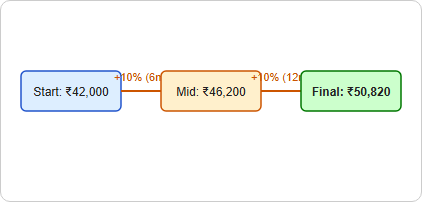
For half-yearly compounding, the rate is halved (10%) and the time is doubled (2 periods).
Effective rate for 2 successive cycles of 10% = 10 + 10 + (10 × 10)/100 = 21%.
Total Amount = 121% of 42,000.
⇒ 42,000 × 1.21 = 50,820.
∴ The correct answer is ₹50,820.

Alternate Method
Given:
Principal (P) = ₹42,000
Annual Rate (R) = 20%
Time (T) = 1 year
Since the interest is compounded half yearly:
⇒ Adjusted Rate (r) = R ÷ 2 = 20% ÷ 2 = 10% per half year
⇒ Number of periods (n) = T × 2 = 1 × 2 = 2
Formula Used:
Amount (A) = P(1 + r/100)n
Calculations:
⇒ A = 42,000 × (1 + 10/100)2
⇒ A = 42,000 × (110/100) × (110/100)
⇒ A = 42,000 × 1.1 × 1.1
⇒ A = 42,000 × 1.21
⇒ A = 50,820
∴ The correct answer is ₹50,820.

Additional Information
Compound Interest Half-Yearly Rule
When interest is compounded half-yearly, the annual rate is divided by 2 and the time (in years) is multiplied by 2 to get the effective number of conversion periods.
Quarterly Compounding
For quarterly compounding, the rate is divided by 4 and the time is multiplied by 4. The formula becomes A = P(1 + R/400)4T.
Successive Percentage Change
Compound interest is an application of successive percentage change. For two periods with rate r, the effective rate is (r + r + r2/100)%.