Official Paper

RRB Technician Grade III Official Paper (Held On: 10 March, 2026 Shift 1) (Previous Year Paper)

100 questions · 90 minutes · with answers · free

Mathematics (25 questions)

1

In a college, class A has 25 students and class B has 30 students. If the number of students in class A increases by 20% in the first year and by 10% in the second year, and the number of students in class B increases by a total of 20% in two years, what is the overall percentage increase in the total number of students in the college over the two years? (Give your answer rounded off to 2 decimal places.)

  1. ((a))

    25.45%

  2. ((b))

    25.85%

  3. ((c))

    20.45%

  4. ((d))

    20.85%

Show Answer
Answer: ((a))

25.45%

Shortcut Trick

Effective percentage increase in Class A = 20 + 10 + (20 × 10) ÷ 100 = 32%.

Percentage increase in Class B = 20%.

Total Increase = (Initial A × 32% + Initial B × 20%) ÷ Total Initial

Total Increase = (25 × 32 + 30 × 20) ÷ 55 = (800 + 600) ÷ 55 = 1400 ÷ 55 ≈ 25.45%.

∴ The correct answer is 25.45%.

Alternate Method

Given: Initial students in Class A = 25, Class B = 30.
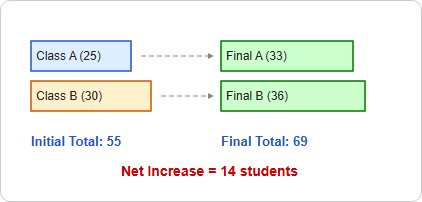
Total Initial Students = 25 + 30 = 55

⇒ Students in Class A after 1st year = 25 + (20% of 25) = 25 + 5 = 30

⇒ Students in Class A after 2nd year = 30 + (10% of 30) = 30 + 3 = 33

⇒ Students in Class B after 2 years = 30 + (20% of 30) = 30 + 6 = 36

Total Final Students = 33 + 36 = 69

Overall Increase = 69 − 55 = 14

Overall % Increase = (14 ÷ 55) × 100 = 25.4545...

∴ The correct answer is 25.45%.

Additional Information

Successive Percentage Increase

If a value increases by x% and then by y%, the net increase is given by [x + y + (xy ÷ 100)]%.

Weighted Average Percentage

The overall percentage change of a combined group is the sum of (individual change × its weight) divided by the total weight.

Base Value in Percentage

Always identify the original total as the base for calculating the overall percentage increase: (Change ÷ Initial Total) × 100.
2

A dealer buys two articles X and Y for ₹700 each. He marks each of them at the same price. He sells X by giving two successive discounts of 60% and 20% and still earns ₹630 as profit. If he sells Y at a single discount of 76%, then what is the profit percentage on Y?

  1. ((a))

    42.5%

  2. ((b))

    41%

  3. ((c))

    42%

  4. ((d))

    41.5%

Show Answer
Answer: ((a))

42.5%

Shortcut Trick

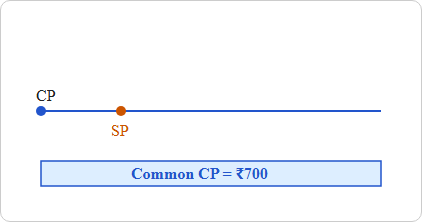
SP of X = 700 + 630 = 1330

Successive discounts of 60% and 20% ⇒ Net multiplier = 0.40 × 0.80 = 0.32

⇒ 32% of MP = 1330

For Article Y, a 76% discount ⇒ SP = (100 − 76)% = 24% of MP

SP of Y = (1330 ÷ 32) × 24 = 1330 × (3/4) = 997.5

Profit percentage on Y = [(997.5 − 700) ÷ 700] × 100 = 42.5%

∴ The correct answer is 42.5%.

Alternate Method

Given:

Cost Price (CP) of X and Y = ₹700 each

Profit on X = ₹630

Successive discounts on X = 60% and 20%

Single discount on Y = 76%

Formula Used:

Selling Price (SP) = Cost Price (CP) + Profit

Net Discount for successive d1 and d2 = [d1 + d2 − (d1 × d2 ÷ 100)]%

SP = Marked Price (MP) × (100 − Discount%) ÷ 100

Calculations:

SP of X = 700 + 630 = 1330

⇒ Effective discount on X = 60 + 20 − (60 × 20 ÷ 100) = 80 − 12 = 68%

SP of X = MP × (100 − 68) ÷ 100 = 0.32 × MP

⇒ 0.32 × MP = 1330 ⇒ MP = 1330 ÷ 0.32 = 4156.25

SP of Y = 4156.25 × (100 − 76) ÷ 100 = 4156.25 × 0.24 = 997.5

Profit on Y = 997.5 − 700 = 297.5

Profit % on Y = (297.5 ÷ 700) × 100 = 42.5%

∴ The correct answer is 42.5%.

Additional Information

Successive Discount Shortcut

Instead of calculating net %, use multiplying factors: Total multiplier = (1 − d1/100) × (1 − d2/100) × ... × (1 − dn/100).

CP-MP-Profit-Discount Relation

The ratio of Marked Price to Cost Price is given by: MP/CP = (100 + Profit%) / (100 − Discount%).

Markup Percentage

The percentage by which the cost price is increased to set the marked price: Markup % = [(MP − CP) ÷ CP] × 100.

3

What sum of money (in ₹) will yield ₹720 as simple interest in 3 years at 6% per annum?

  1. ((a))

    4400

  2. ((b))

    3500

  3. ((c))

    4200

  4. ((d))

    4000

Show Answer
Answer: ((d))

4000

Shortcut Trick

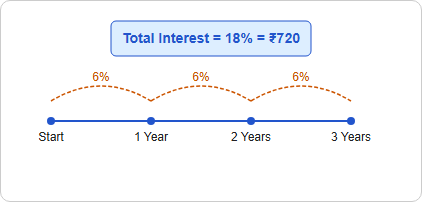
Total interest percentage for 3 years at 6% per annum = 3 × 6% = 18%.

Given that 18% of the Principal = ₹720.

Principal (100%) = (720 ÷ 18) × 100.
Principal = 40 × 100 = ₹4000.

∴ The correct answer is ₹4000.

Alternate Method

Given:

Simple Interest (SI) = ₹720

Time (T) = 3 years

Rate (R) = 6% per annum

Formula Used:

Simple Interest (SI) = (P × R × T) ÷ 100

Where P = Principal, R = Rate of interest, T = Time period

Calculations:

⇒ 720 = (P × 6 × 3) ÷ 100

⇒ 720 = (P × 18) ÷ 100

⇒ P = (720 × 100) ÷ 18

⇒ P = 40 × 100

⇒ P = ₹4000

∴ The correct answer is ₹4000.

Additional Information

Total Amount Formula

The total amount (A) is the sum of the Principal and Simple Interest: A = P + SI = P(1 + RT/100).

Calculating Principal from Amount

If the total amount is given instead of interest, use: P = (A × 100) ÷ (100 + RT).

Effective Rate of Interest

For Simple Interest, the effective rate for the entire period is simply the product of the annual rate and the number of years (R × T).

4

What is the mode of the following data?

<br>

47, 43, 50, 46, 46, 40, 54, 54, 40, 54, 42, 48, 44, 55, 52, 45, 41, 41

  1. ((a))

    46

  2. ((b))

    41

  3. ((c))

    54

  4. ((d))

    40

Show Answer
Answer: ((c))

54

Shortcut Trick

The Mode of a data set is the value that appears most frequently.

By scanning the given numbers, we find the following frequencies:

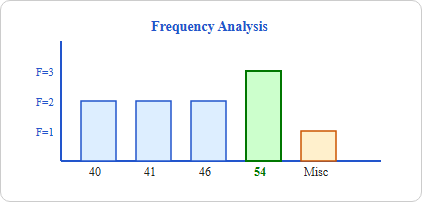
Numbers 40, 41, and 46 each appear 2 times.

The number 54 appears 3 times.

All other numbers appear only once.

∴ The correct answer is 54.

Alternate Method

Given Data: 47, 43, 50, 46, 46, 40, 54, 54, 40, 54, 42, 48, 44, 55, 52, 45, 41, 41

Method: Create a Frequency Distribution to identify the observation with the maximum count.

Calculations for frequency of each unique observation:

⇒ Number 40: 2 occurrences

⇒ Number 41: 2 occurrences

⇒ Number 46: 2 occurrences

⇒ Number 54: 3 occurrences

⇒ Others (47, 43, 50, 42, 48, 44, 55, 52, 45): 1 occurrence each

⇒ Since 54 has the highest count (3), it is the mode of the data.

∴ The correct answer is 54.

Additional Information

Empirical Formula

In a moderately asymmetrical distribution, the relationship is given by: Mode = 3 × Median − 2 × Mean.

Types of Mode

Data with one mode is unimodal, two modes is bimodal, and more than two modes is multimodal.

Median for Ungrouped Data

First, arrange data in ascending order. If n is odd, Median = ((n+1)/2)th term. If n is even, Median is the average of the (n/2)th and (n/2 + 1)th terms.

5

A quantity is first decreased by 12% and then again decreased by 8%. What is the overall percentage decrease?

  1. ((a))

    21.04%

  2. ((b))

    20.96%

  3. ((c))

    19.04%

  4. ((d))

    18.96%

Show Answer
Answer: ((c))

19.04%

Shortcut Trick

For two successive decreases of a% and b%, the overall percentage decrease is calculated as:

Net Decrease = [a + b − (a × b)/100]%

Given a = 12 and b = 8:

Net Decrease = [12 + 8 − (12 × 8)/100]% = [20 − 0.96]% = 19.04%

∴ The correct answer is 19.04%.

Alternate Method

Given:

First decrease = 12%

Second decrease = 8%

Formula Used:

Net Change = Initial Value × (1 − r1/100) × (1 − r2/100)

⇒ Let the initial quantity be 100.
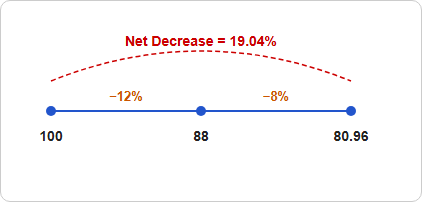
⇒ Value after first decrease = 100 − (12% of 100) = 88.

⇒ Value after second decrease = 88 − (8% of 88).

⇒ Calculation: 88 − (8 × 88)/100 = 88 − 7.04 = 80.96.

Total percentage decrease = 100 − 80.96 = 19.04%.

∴ The correct answer is 19.04%.

Additional Information

Successive Percentage Change

If a value is changed by x% and then by y%, the net percentage change is (x + y + xy/100)%. Use positive for increase and negative for decrease.

Single Equivalent Discount

For two successive discounts of d1% and d2%, the single equivalent discount is (d1 + d2 − d1d2/100)%.

Base Change Rule

Percentage changes are always calculated on the preceding value in a successive series, not the original initial value.

6

If the cost of 8 pens is ₹136, then find the cost of 12 such pens.

  1. ((a))

    ₹204

  2. ((b))

    ₹202

  3. ((c))

    ₹206

  4. ((d))

    ₹208

Show Answer
Answer: ((a))

₹204

Shortcut Trick

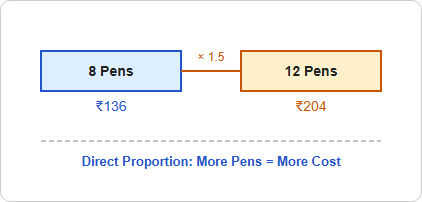
Ratio of Quantity = 8 : 12 ⇒ 2 : 3

Since cost is directly proportional to quantity:

2 units = ₹136

1 unit = 136 ÷ 2 = ₹68

3 units = 68 × 3 = ₹204

∴ The correct answer is ₹204.

Alternate Method

Given:

Total cost of 8 pens = ₹136

Required number of pens = 12

Formula Used:

This problem follows the Unitary Method where we first find the value of one unit.

Cost of N items = (Cost of 1 item) × N

⇒ Cost of 1 pen = Total Cost ÷ Total Pens

⇒ Cost of 1 pen = 136 ÷ 8

⇒ Cost of 1 pen = ₹17

⇒ Now, cost of 12 pens = (Cost of 1 pen) × 12

⇒ Cost of 12 pens = 17 × 12

⇒ Cost of 12 pens = ₹204

∴ The correct answer is ₹204.

Additional Information

Unitary Method

A technique where we find the value of a single unit first to calculate the value of any required number of units.

Direct Proportion

Two quantities are in direct proportion if an increase in one leads to a corresponding increase in the other. Formula: x1/y1 = x2/y2.

Inverse Proportion

When an increase in one quantity causes a decrease in the other (e.g., more men taking less time). Formula: x1 × y1 = x2 × y2.

7

The difference between the present ages of Ayushi and Nidhi is 26 years. Five years ago from now, the sum of their ages was 30 years. If Ayushi is older than Nidhi, find Nidhi's present age (in years).

  1. ((a))

    12

  2. ((b))

    6

  3. ((c))

    7

  4. ((d))

    10

Show Answer
Answer: ((c))

7

Shortcut Trick

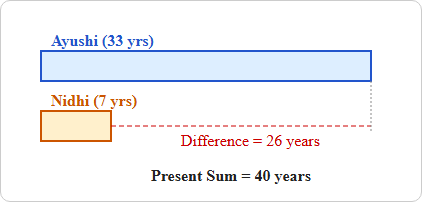
Present Sum of ages = Sum 5 years ago + (2 × 5) = 30 + 10 = 40 years.

Present Difference of ages = 26 years (Given).

Nidhi's age (younger) = (Sum − Difference) ÷ 2 = (40 − 26) ÷ 2 = 14 ÷ 2 = 7 years.

∴ The correct answer is 7 years.

Alternate Method

Given: Difference (Ayushi − Nidhi) = 26 years. Sum (5 years ago) = 30 years.

Let Ayushi's age be A and Nidhi's age be N.

⇒ A − N = 26 ----(Equation 1)

Five years ago, their ages were (A − 5) and (N − 5).

⇒ (A − 5) + (N − 5) = 30

⇒ A + N − 10 = 30

⇒ A + N = 40 ----(Equation 2)

Subtracting Equation 1 from Equation 2:

⇒ (A + N) − (A − N) = 40 − 26

⇒ 2N = 14

⇒ N = 7

∴ The correct answer is 7 years.

Additional Information

Constant Difference Rule

The age difference between two individuals always remains constant, whether calculated in the past, present, or future.

Age Sum Property

If there are 'n' persons, their total sum of ages increases or decreases by (n × t) years over a time period of 't' years.

Sum and Difference Formula

When the Sum (S) and Difference (D) of two numbers are known: Larger number = (S + D) ÷ 2 and Smaller number = (S − D) ÷ 2.

8

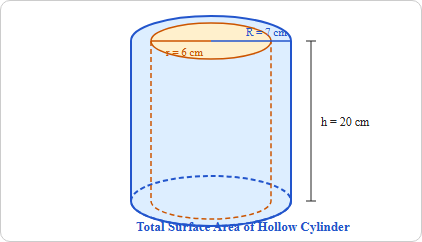
A hollow cylindrical pipe has an external radius of 7 cm, internal radius of 6 cm, and height of 20 cm. Find the total surface area of the pipe (both ends included).

(Useπ=227) (Use \pi = \frac{22}{7})

  1. ((a))

    1716 cm²

  2. ((b))

    1600 cm²

  3. ((c))

    1485 cm²

  4. ((d))

    1670 cm²

Show Answer
Answer: ((a))

1716 cm²

Shortcut Trick

Use the direct formula for Total Surface Area (TSA) of a hollow cylinder:

TSA = 2π(R + r)(h + R − r)

Given: External radius (R) = 7 cm, Internal radius (r) = 6 cm, Height (h) = 20 cm.

TSA = 2 × (22/7) × (7 + 6) × (20 + 7 − 6)

TSA = 2 × (22/7) × 13 × 21 = 44 × 13 × 3 = 1716 cm2.

∴ The correct answer is 1716 cm2.

Alternate Method

Given:

External radius (R) = 7 cm

Internal radius (r) = 6 cm

Height (h) = 20 cm

π = 22/7

Step-by-step Calculation:

⇒ Outer Curved Surface Area = 2 × π × R × h = 2 × (22/7) × 7 × 20 = 880 cm2

⇒ Inner Curved Surface Area = 2 × π × r × h = 2 × (22/7) × 6 × 20 = 5280/7 cm2

⇒ Area of two circular ends (rings) = 2 × π × (R2 − r2) = 2 × (22/7) × (72 − 62)

⇒ Area of ends = 2 × (22/7) × (49 − 36) = 2 × (22/7) × 13 = 572/7 cm2

⇒ Total Surface Area = Outer CSA + Inner CSA + Area of Ends

⇒ TSA = 880 + (5280/7) + (572/7) = 880 + (5852/7)

⇒ TSA = 880 + 836 = 1716 cm2

∴ The correct answer is 1716 cm2.

Additional Information

Volume of Hollow Cylinder

The amount of material used to make the pipe is given by the volume formula: V = πh(R2 − r2).

Lateral Surface Area (LSA)

For a hollow cylinder, LSA is the sum of the outer and inner curved surfaces: LSA = 2πh(R + r).

Cross-sectional Area

The area of the ring formed at the base is A = π(R2 − r2).

9

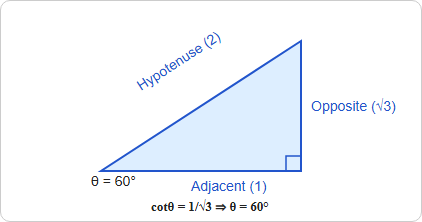
If cotθ=13 cot\theta = \frac{1}{\sqrt{3}} , (0<θ<90) (0^{\circ} < \theta < 90^{\circ}) , then the value of 2sin2θ1+cos2θ+(cosec2θ+sec2θ) \frac{2 - sin^2 \theta}{1 + cos^2 \theta} + (cosec^2 \theta + sec^2 \theta) is :

  1. ((a))

    173 \frac{17}{3}

  2. ((b))

    193 \frac{19}{3}

  3. ((c))

    293 \frac{29}{3}

  4. ((d))

    113 \frac{11}{3}

Show Answer
Answer: ((b))

193 \frac{19}{3}

Shortcut Trick

Given cotθ = 1/√3. Since cot 60° = 1/√3, we have θ = 60°.

Substitute θ = 60° into the expression (treating cos2, cosec2, sec2 as squared terms):

Value = (2 − sin260°) / (1 + cos260°) + (cosec260° + sec260°)

Value = (2 − 3/4) / (1 + 1/4) + (4/3 + 4) = (5/4) / (5/4) + 16/3 = 1 + 16/3 = 19/3.

∴ The correct answer is 19/3.

Alternate Method

Given: cotθ = 1/√3 and 0° < θ < 90°.

Formula Used: In a right-angled triangle, cotθ = Adjacent / Opposite. Trigonometric ratios: sinθ = Opp/Hyp, cosθ = Adj/Hyp, cosecθ = Hyp/Opp, secθ = Hyp/Adj.

θ = 60°

sinθ = √3/2sin2θ = 3/4

cosθ = 1/2cos2θ = 1/4

cosecθ = 2/√3cosec2θ = 4/3

secθ = 2sec2θ = 4

⇒ Expression = (2 − 3/4) / (1 + 1/4) + (4/3 + 4)

⇒ Expression = (5/4) / (5/4) + (4/3 + 12/3)

⇒ Expression = 1 + 16/3

⇒ Expression = (3 + 16) / 3 = 19/3

∴ The correct answer is 19/3.

Additional Information

Trigonometric Table Values

For 60°: sin 60° = √3/2, cos 60° = 1/2, tan 60° = √3, cot 60° = 1/√3, sec 60° = 2, cosec 60° = 2/√3.

Pythagorean Identities

Fundamental identities include: sin2θ + cos2θ = 1, 1 + tan2θ = sec2θ, and 1 + cot2θ = cosec2θ.

Double Angle Formulas

cos 2θ = 2 cos2θ − 1 = 1 − 2 sin2θ and sin 2θ = 2 sinθ cosθ. Note that in simplified text, cos2θ often represents cos2θ depending on context.

10

If x=5+26 x = 5 + 2\sqrt{6} , then find the value of x1x \frac{x - 1}{\sqrt{x}} .

  1. ((a))

    22 2\sqrt{2}

  2. ((b))

    32 3\sqrt{2}

  3. ((c))

    3+2 \sqrt{3} + \sqrt{2}

  4. ((d))

    2 \sqrt{2}

Show Answer
Answer: ((a))

22 2\sqrt{2}

Shortcut Trick

Identify factors of 6 whose sum is 5: these are 3 and 2.

⇒ √x = √3 + √2

The expression (x − 1) / √x simplifies to √x − 1/√x.

Since (√3)2 − (√2)2 = 1, the reciprocal 1/√x is √3 − √2.

⇒ Result = (√3 + √2) − (√3 − √2) = 2√2.

∴ The correct answer is 2√2.

Alternate Method

Given: x = 5 + 2√6

Formula Used: (a + b)2 = a2 + b2 + 2ab and (a + b)(a − b) = a2 − b2

⇒ x = 3 + 2 + 2√(3 × 2)

⇒ x = (√3)2 + (√2)2 + 2 × √3 × √2

⇒ x = (√3 + √2)2

⇒ √x = √3 + √2

⇒ (x − 1) / √x = (x / √x) − (1 / √x) = √x − (1 / √x)

⇒ 1 / √x = 1 / (√3 + √2)

Rationalizing the denominator: 1/(√3 + √2) × (√3 − √2)/(√3 − √2) = √3 − √2

⇒ (x − 1) / √x = (√3 + √2) − (√3 − √2) = 2√2

∴ The correct answer is 2√2.

Additional Information

Square Root of Surds

For a surd of the form a + 2√b, if we find two numbers p and q such that p + q = a and pq = b, then √(a + 2√b) = √p + √q.

Rationalization of Denominators

To rationalize 1/(√a + √b), multiply both numerator and denominator by its conjugate (√a − √b).

Conjugate Rule

If x = a + √b and a2 − b = 1, then the reciprocal 1/x is simply a − √b.

11

A Aarju starts a business with ₹55,000 and after 3 months, Bimla joins Aarju as her partner. After a year, the profit is divided in the ratio 8 : 9. What is Bimla's contribution in the capital?

  1. ((a))

    ₹84,080

  2. ((b))

    ₹82,355

  3. ((c))

    ₹84,240

  4. ((d))

    ₹82,500

Show Answer
Answer: ((d))

₹82,500

Shortcut Trick

In a partnership, Profit Ratio = (Capital × Time) Ratio.

Profit Ratio of Aarju and Bimla = (55000 × 12) : (CapitalB × 9) = 8 : 9.

Cancelling 9 on both sides: 55000 × 12 / CapitalB = 8.

CapitalB = (55000 × 12) ÷ 8 = 55000 × 1.5 = 82,500.
∴ The correct answer is ₹82,500.
Alternate Method

Given Data:

Capital of Aarju (CA) = ₹55,000

Investment Period of Aarju (TA) = 12 months

Investment Period of Bimla (TB) = 12 − 3 = 9 months

Profit Ratio (PA : PB) = 8 : 9

Formula Used:

P1 ÷ P2 = (C1 × T1) ÷ (C2 × T2)

Calculations:

⇒ 8 ÷ 9 = (55000 × 12) ÷ (CB × 9)

⇒ 8 ÷ 9 = (55000 × 12) ÷ (9 × CB)

⇒ 8 × 9 × CB = 55000 × 12 × 9

⇒ 8 × CB = 55000 × 12

⇒ CB = (55000 × 12) ÷ 8

⇒ CB = 55000 × (3 ÷ 2)

⇒ CB = 55000 × 1.5

⇒ CB = 82500

∴ The correct answer is ₹82,500.
Additional Information

Partnership Profit Sharing

In a simple partnership, profits are shared in the ratio of investments if the time period is the same. In a compound partnership, profits are shared in the ratio of the product of capital and time.

Working and Sleeping Partners

A working partner manages the business and may receive an additional share or salary from the profit, whereas a sleeping partner only invests money.

Capital-Time Inverse Relation

For a fixed amount of profit, the capital invested is inversely proportional to the time: C1 × T1 = C2 × T2.

12

The simplified value of 225\sqrt{225} + 0.04\sqrt{0.04} - 4.84\sqrt{4.84} is

  1. ((a))

    13.53

  2. ((b))

    4.03

  3. ((c))

    13

  4. ((d))

    3.82

Show Answer
Answer: ((c))

13

Shortcut Trick

Evaluate the square roots directly by recognizing perfect squares:

√225 = 15

√0.04 = 0.2 (since √4 = 2 and 2 decimal places become 1)

√4.84 = 2.2 (since √484 = 22 and 2 decimal places become 1)

Required value = 15 + 0.2 − 2.2 = 13

∴ The correct answer is 13.

Alternate Method

Given: √225 + √0.04 − √4.84

Method: Convert decimals to fractions to simplify finding the square roots.

⇒ √225 = 15

⇒ √0.04 = √(4 ÷ 100) = 2 ÷ 10 = 0.2

⇒ √4.84 = √(484 ÷ 100) = 22 ÷ 10 = 2.2

⇒ Now, substitute these values back into the expression:

⇒ 15 + 0.2 − 2.2

⇒ 15.2 − 2.2 = 13

∴ The correct answer is 13.

Additional Information

Square Roots of Decimals

The number of decimal places in the square root is always half the number of decimal places in the original number (e.g., √0.0001 = 0.01).

Perfect Squares to Remember

Memorizing squares like 152 = 225, 222 = 484, and 252 = 625 is essential for fast calculation in competitive exams.

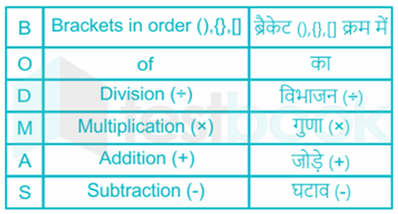
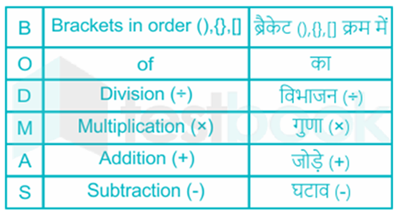
BODMAS Rule

Always follow the BODMAS/VBODMAS priority (Brackets, Orders, Division, Multiplication, Addition, Subtraction) for simplification problems.

13

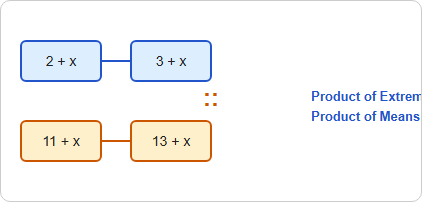
Which number, when added to each of the numbers 2, 3, 11 and 13, will make the resulting numbers in proportion?

  1. ((a))

    7

  2. ((b))

    6

  3. ((c))

    5

  4. ((d))

    4

Show Answer
Answer: ((a))

7

Shortcut Trick

To find the constant number to be added to a, b, c, and d to make them proportional, use the formula:

x = |(ad − bc) ÷ ((a + d) − (b + c))|

Here, a = 2, b = 3, c = 11, d = 13.

x = |(2 × 13 − 3 × 11) ÷ ((2 + 13) − (3 + 11))| = |(26 − 33) ÷ (15 − 14)| = |−7 ÷ 1| = 7.

∴ The correct answer is 7.

Alternate Method

Given: Numbers are 2, 3, 11, and 13. Let the number to be added be x.

Formula Used: If a, b, c, d are in proportion, then (a + x) ÷ (b + x) = (c + x) ÷ (d + x).

⇒ (2 + x) ÷ (3 + x) = (11 + x) ÷ (13 + x)

⇒ (2 + x)(13 + x) = (11 + x)(3 + x)

⇒ 26 + 13x + 2x + x2 = 33 + 3x + 11x + x2

⇒ 26 + 15x = 33 + 14x

⇒ 15x − 14x = 33 − 26

⇒ x = 7

∴ The correct answer is 7.

Additional Information

Fourth Proportional

If four numbers a, b, c, and d are in proportion (a:b = c:d), then d is called the fourth proportional and d = (b × c) ÷ a.

Mean Proportional

The mean proportional between two numbers a and b is given by the formula √(a × b).

Third Proportional

If a, b, and c are in continued proportion (a:b = b:c), then c is the third proportional and c = b2 ÷ a.

14

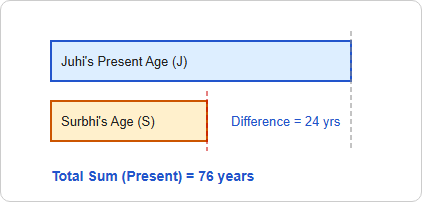
The difference between the present ages of Juhi and Surbhi is 24 years. Five years ago from now, the sum of their ages was 66 years. If Juhi is older than Surbhi, find Surbhi's present age (in years).

  1. ((a))

    18

  2. ((b))

    20

  3. ((c))

    33

  4. ((d))

    26

Show Answer
Answer: ((d))

26

Shortcut Trick

Total age increase for Juhi and Surbhi in 5 years = 5 × 2 = 10 years.

Present Sum of their ages = 66 + 10 = 76 years.

Given Difference in ages = 24 years (Juhi is older).

Surbhi's age (Younger) = (Sum − Difference) ÷ 2 = (76 − 24) ÷ 2 = 52 ÷ 2 = 26 years.

∴ The correct answer is 26 years.

Alternate Method

Given:

Difference between Juhi (J) and Surbhi (S) = 24 years ⇒ J − S = 24

Sum of ages 5 years ago = 66 years.

Formula Used:

Sum of ages after n years = Past Sum + (Number of people × n)

Calculations:

⇒ (J − 5) + (S − 5) = 66

⇒ J + S − 10 = 66

⇒ J + S = 76 ----(Equation 1)

⇒ J − S = 24 ----(Equation 2)

Subtracting Equation 2 from Equation 1:

⇒ (J + S) − (J − S) = 76 − 24

⇒ 2S = 52

⇒ S = 52 ÷ 2 = 26

∴ The correct answer is 26 years.

Additional Information

Constant Age Difference

The numerical difference between the ages of two people always remains the same, regardless of how many years pass or how many years ago it was.

Sum of Ages Rule

If the sum of ages of 'n' persons is 'S' at present, then 'x' years ago, the sum was S − (n × x), and 'x' years hence, it will be S + (n × x).

Finding Individual Values

Given Sum (S) and Difference (D) of two values: Larger = (S + D) ÷ 2 and Smaller = (S − D) ÷ 2.

15

The value of 273 - 223 is:

  1. ((a))

    8888

  2. ((b))

    8823

  3. ((c))

    8923

  4. ((d))

    9035

Show Answer
Answer: ((d))

9035

Shortcut Trick

To find the value of 273 − 223, check the unit digit of the expression.

Unit digit of 273 = unit digit of 73 = 7 × 7 × 7 = 343 → 3

Unit digit of 223 = unit digit of 23 = 2 × 2 × 2 = 8 → 8

Unit digit of the result = (3 − 8) → Borrow 1 → (13 − 8) = 5

Among the given options, only 9035 ends with the digit 5.

∴ The correct answer is 9035.

Alternate Method

Given:

First number (a) = 27

Second number (b) = 22

Formula Used:

a3 − b3 = (a − b)(a2 + ab + b2)

Calculations:

⇒ 273 − 223 = (27 − 22) × (272 + 27 × 22 + 222)

⇒ 273 − 223 = 5 × (729 + 594 + 484)

⇒ 273 − 223 = 5 × (1807)

⇒ 273 − 223 = 9035

∴ The correct answer is 9035.

Additional Information

Sum of Cubes Identity

The sum of two cubes is factored as: a3 + b3 = (a + b)(a2 − ab + b2).

Difference of Squares

One of the most used algebraic identities: a2 − b2 = (a − b)(a + b).

Cube of a Difference

The whole cube of a binomial difference: (a − b)3 = a3 − 3a2b + 3ab2 − b3.

16

A tap fills a tank in 11 hours. Another tap empties the full tank in 22 hours. How long (in hours) will it take to fill the tank completely, if the tank is empty and both the taps are open together?

  1. ((a))

    25

  2. ((b))

    23

  3. ((c))

    24

  4. ((d))

    22

Show Answer
Answer: ((d))

22

Shortcut Trick

Use the direct formula for one filling tap (x) and one emptying tap (y):

Net time taken = (x × y) ÷ (y − x)

Where x = 11 hr and y = 22 hr.

Time = (11 × 22) ÷ (22 − 11) = (11 × 22) ÷ 11 = 22 hr.

∴ The correct answer is 22 hr.

Alternate Method

Given:

Time taken by filling tap = 11 hr

Time taken by emptying tap = 22 hr

Formula Used:

Total Work = LCM of individual times.

Efficiency = Total Work ÷ Time.

TapTime (hr)Total Capacity (LCM)Efficiency
Filling Tap (A)1122 units+2
Emptying Tap (B)22−1

Calculations:

⇒ Efficiency of Filling Tap = 22 ÷ 11 = +2 units/hr

⇒ Efficiency of Emptying Tap = 22 ÷ 22 = −1 units/hr (negative because it empties)

⇒ Net efficiency when both taps are open = 2 − 1 = 1 unit/hr

⇒ Time required to fill the tank = Total Capacity ÷ Net Efficiency

⇒ Time = 22 ÷ 1 = 22 hr

∴ The correct answer is 22 hr.

Additional Information

Inlet and Outlet Pipes

An Inlet pipe fills a tank (positive work), while an Outlet pipe empties it (negative work). Net work is the algebraic sum of their efficiencies.

Time and Efficiency Relation

Time taken to complete a task is inversely proportional to the efficiency. If a tap fills a tank in 'n' hours, its work done in 1 hour is 1/n.

Capacity Calculation

If the flow rate (liters/hr) is given, Capacity = Flow Rate × Time taken to fill the tank.

17

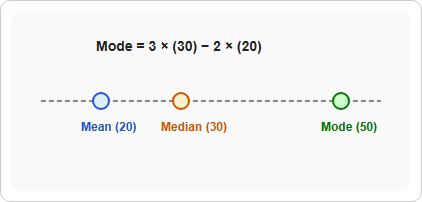
The mean of a data is 20 and its median is 30. The mode (using empirical relation) of the data is:

  1. ((a))

    131

  2. ((b))

    44

  3. ((c))

    50

  4. ((d))

    110

Show Answer
Answer: ((c))

50

Shortcut Trick

The empirical relation between measures of central tendency is Mode = 3 × Median − 2 × Mean.

Substitute the given values: Mode = 3(30) − 2(20).

Mode = 90 − 40 = 50.

∴ The correct answer is 50.

Alternate Method

Given:

Mean of the data = 20

Median of the data = 30

Formula Used:

For a moderately skewed distribution, the empirical formula is:

Mode = 3 × Median − 2 × Mean

Calculations:

Mode = 3 × 30 − 2 × 20

Mode = 90 − 40

Mode = 50

∴ The correct answer is 50.

Additional Information

Empirical Relation Applicability

The formula Mode = 3Median − 2Mean is an approximation used specifically for moderately skewed frequency distributions.

Symmetric Distribution

In a perfectly symmetrical distribution (like the Normal distribution), the Mean, Median, and Mode are all equal (Mean = Median = Mode).

Positively Skewed Distribution

For a positively skewed distribution (tail to the right), the relation is generally Mean > Median > Mode.

Negatively Skewed Distribution

For a negatively skewed distribution (tail to the left), the relation is generally Mean < Median < Mode.

18

Simplify:

(56+13)÷(25+0.3)×0.5+1216 (\frac{5}{6} + \frac{1}{3}) \div (\frac{2}{5} + 0.3) \times 0.5 + \frac{1}{2} - \frac{1}{6}

  1. ((a))

    56 \frac{5}{6}

  2. ((b))

    76 \frac{7}{6}

  3. ((c))

    16 \frac{1}{6}

  4. ((d))

    36 \frac{3}{6}

Show Answer
Answer: ((b))

76 \frac{7}{6}

Shortcut Trick

Simplify brackets first: (5/6 + 2/6) = 7/6 and (0.4 + 0.3) = 0.7 = 7/10.

Apply division and multiplication: (7/6 × 10/7) × 1/2 = 10/6 × 1/2 = 5/6.

Complete addition and subtraction: 5/6 + 1/2 − 1/6 = 4/6 + 3/6 = 7/6.

∴ The correct answer is 7/6.

Alternate Method

Given Expression: ((5/6) + (1/3)) ÷ ((2/5) + 0.3) × 0.5 + (1/2) − (1/6)

Method Used: Apply the BODMAS rule to solve the expression in the correct sequence.

⇒ Step 1 (Solve Brackets): (5/6 + 2/6) ÷ (2/5 + 3/10) × 0.5 + 1/2 − 1/6

⇒ Step 2: (7/6) ÷ (4/10 + 3/10) × 0.5 + 1/2 − 1/6

⇒ Step 3: (7/6) ÷ (7/10) × 0.5 + 1/2 − 1/6

⇒ Step 4 (Division & Multiplication): (7/6 × 10/7) × 1/2 + 1/2 − 1/6

⇒ Step 5: (10/6) × (1/2) + 1/2 − 1/6

⇒ Step 6: 5/6 + 1/2 − 1/6

⇒ Step 7 (Addition & Subtraction): (5/6 − 1/6) + 1/2 = 4/6 + 1/2

⇒ Final Step: 2/3 + 1/2 = (4 + 3)/6 = 7/6

∴ The correct answer is 7/6.

Additional Information

BODMAS / VBODMAS Rule

It defines the order of operations: Vinculum, Brackets, Of, Division, Multiplication, Addition, and Subtraction.

Reciprocal in Division

To divide by a fraction, multiply by its reciprocal: (a/b) ÷ (c/d) = (a/b) × (d/c).

Fraction to Decimal Conversion

Common conversions like 1/2 = 0.5, 2/5 = 0.4, and 1/3 ≈ 0.33 help in speeding up simplification steps.

19

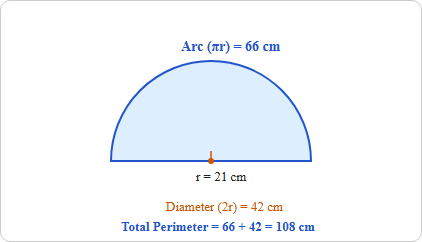
Find the perimeter of the semi-circle of radius 21 cm

(Takeπ=227) (Take \pi = \frac{22}{7})

  1. ((a))

    66 cm

  2. ((b))

    87 cm

  3. ((c))

    108 cm

  4. ((d))

    174 cm

Show Answer
Answer: ((c))

108 cm

Shortcut Trick

For a semi-circle, the relationship between perimeter (P) and radius (r) is simplified as:

P = r × (36/7)

Given radius (r) = 21 cm

P = 21 × (36/7) ⇒ 3 × 36 = 108 cm

∴ The correct answer is 108 cm.

Alternate Method

Given:

Radius (r) of the semi-circle = 21 cm

Value of π = 22/7

Formula Used:

Perimeter of semi-circle = Length of Curved Arc + Diameter

Perimeter = πr + 2r

Calculations:

⇒ Length of curved arc = π × r

⇒ Arc length = (22/7) × 21

⇒ Arc length = 22 × 3 = 66 cm

⇒ Diameter of semi-circle = 2 × r

⇒ Diameter = 2 × 21 = 42 cm

⇒ Total Perimeter = 66 + 42

⇒ Total Perimeter = 108 cm

∴ The correct answer is 108 cm.

Additional Information

Area of Semi-circle

The space occupied by the semi-circle is half the area of a full circle: Area = (1/2) × π × r2.

Perimeter of a Quadrant

For a quarter-circle (quadrant), the perimeter is calculated as (πr/2) + 2r, which simplifies to 25r/7 when π = 22/7.

Circumference vs Perimeter

Circumference usually refers to the distance around a full circle (2πr), while perimeter of a sector or semi-circle includes the straight boundaries (radii or diameter).

20

Pipe A can fill a tank in 12 hours, pipe B in 15 hours, and an outlet C can empty it in 20 hours. A and B are opened together for 5 hours, and then C is also opened. Find the total time to fill the tank.

  1. ((a))

    6.5 hours

  2. ((b))

    6 hours

  3. ((c))

    7.5 hours

  4. ((d))

    5.5 hours

Show Answer
Answer: ((c))

7.5 hours

Shortcut Trick

LCM of 12, 15, and 20 is 60 units (Total Work).

Efficiencies: A = 5, B = 4, C = −3 (outlet).

Work done by A + B in 5 hr = (5 + 4) × 5 = 45 units.

Remaining work = 60 − 45 = 15 units.

Combined efficiency (A + B + C) = 5 + 4 − 3 = 6 units/hr.

Total time = 5 + (15 ÷ 6) = 5 + 2.5 = 7.5 hr.

∴ The correct answer is 7.5 hr.

Alternate Method

Given:

Time taken by Pipe A = 12 hr

Time taken by Pipe B = 15 hr

Time taken by Outlet C = 20 hr

Person/PipeTime (hr)Total WorkEfficiency
Pipe A1260 units5
Pipe B154
Pipe C20−3

Calculations:

⇒ Total capacity of the tank (LCM of 12, 15, 20) = 60 units

⇒ Efficiency of Pipe A = 60 ÷ 12 = 5 units/hr

⇒ Efficiency of Pipe B = 60 ÷ 15 = 4 units/hr

⇒ Efficiency of Outlet C = 60 ÷ 20 = −3 units/hr (negative because it empties)

⇒ Work done by A and B in 5 hours = (5 + 4) × 5 = 45 units

Remaining work = 60 − 45 = 15 units

⇒ Now Pipe C is also opened, so net efficiency = 5 + 4 − 3 = 6 units/hr

⇒ Time to fill remaining tank = 15 ÷ 6 = 2.5 hr

Total time = Initial time + Remaining time = 5 + 2.5 = 7.5 hr

∴ The correct answer is 7.5 hr.

Additional Information

Negative Efficiency

In Pipes and Cisterns, an outlet pipe (leak) is always assigned a negative efficiency because it reduces the total work done by the inlet pipes.

Efficiency Formula

Efficiency = Total Work ÷ Time. Total work is usually taken as the Least Common Multiple (LCM) of the individual time periods.

Work and Wages

If multiple pipes or workers are involved, the total wages are distributed in the ratio of the work done by each, which is (Efficiency × Time).

21

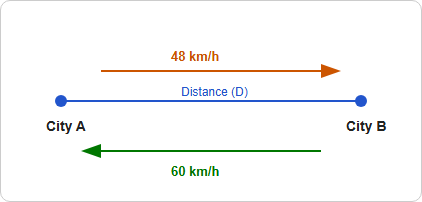
A traveller moves from City A to City B at 48 km/h and returns at 60 km/h. If the total time taken for the whole journey is 9 hours, find the distance between A and B.

  1. ((a))

    270 km

  2. ((b))

    260 km

  3. ((c))

    240 km

  4. ((d))

    250 km

Show Answer
Answer: ((c))

240 km

Shortcut Trick

One-way Distance = [ (Product of Speeds) ÷ (Sum of Speeds) ] × Total Time

⇒ Distance = [ (48 × 60) ÷ (48 + 60) ] × 9

⇒ Distance = [ 2880 ÷ 108 ] × 9

⇒ Distance = 26.666... × 9 = 240 km

∴ The correct answer is 240 km.

Alternate Method

Given: Speed A → B = 48 km/h, Speed B → A = 60 km/h, Total Time = 9 hr.

Formula: Speed is inversely proportional to Time when Distance is constant.

⇒ Ratio of Speeds (A→B : B→A) = 48 : 60 = 4 : 5

⇒ Ratio of Time taken (A→B : B→A) = 5 : 4

⇒ Total time units = 5 + 4 = 9 units

⇒ 9 units = 9 hours ⇒ 1 unit = 1 hour

⇒ Time taken from City A to City B = 5 × 1 = 5 hours

⇒ Distance = Speed × Time = 48 km/h × 5 hr = 240 km

∴ The correct answer is 240 km.

Additional Information

Average Speed Formula

When a person travels equal distances at speeds x and y, the Average Speed for the whole journey is (2xy) ÷ (x + y).

Total Distance vs. Displacement

In this journey, the total distance covered is 2D (480 km), while the displacement is 0 as the traveller returns to the starting point.

Conversion Factor

To convert speed from km/h to m/s, multiply by 5/18. To convert m/s to km/h, multiply by 18/5.

22

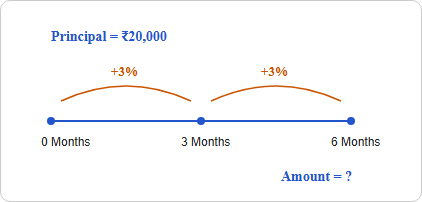
What is the amount on ₹20,000 for six months at 12% annual interest, compounded quarterly?

  1. ((a))

    ₹21218

  2. ((b))

    ₹21335

  3. ((c))

    ₹21934

  4. ((d))

    ₹21823

Show Answer
Answer: ((a))

₹21218

Shortcut Trick

Effective quarterly rate = 12% ÷ 4 = 3%.

Number of quarters in 6 months = 6 ÷ 3 = 2.

Successive percentage change for 2 periods = 3 + 3 + (3 × 3) ÷ 100 = 6.09%.

Total Amount = 106.09% of 20,000 = 200 × 106.09 = 21218.

∴ The correct answer is ₹21218.

Alternate Method

Given:

Principal (P) = ₹20,000

Annual Rate (R) = 12%

Time (T) = 6 months

Formula Used:

For quarterly compounding:

Rate (r) = R ÷ 4 per quarter

Number of periods (n) = T × 4 (where T is in years) or Total Quarters

Amount (A) = P × (1 + r/100)n

Calculations:

⇒ Quarterly rate (r) = 12% ÷ 4 = 3%

⇒ Time (n) = 6 months = 2 quarters

⇒ A = 20,000 × (1 + 3/100)2

⇒ A = 20,000 × (1.03)2

⇒ A = 20,000 × 1.0609

⇒ A = 21,218

∴ The correct answer is ₹21218.

Additional Information

Compound Interest Compounding Frequencies

If interest is compounded Half-yearly, rate becomes R/2 and time becomes 2T. If Quarterly, rate becomes R/4 and time becomes 4T.

Effective Rate of Interest

It is the actual annual interest rate when compounding occurs more than once a year. Formula: (1 + r/n)n − 1, where n is the number of compounding periods.

Difference between CI and SI

For 2 years/periods, the difference (D) between Compound Interest and Simple Interest is given by D = P × (r/100)2.

23

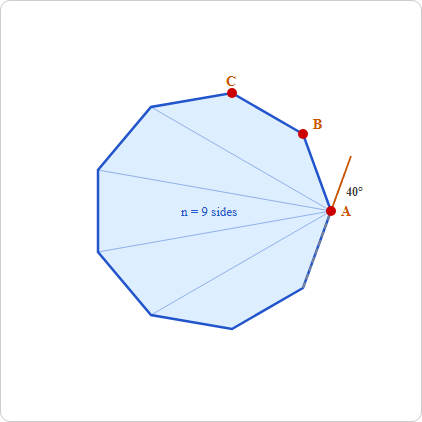
If an exterior angle of a regular polygon is 40°, then find the number of diagonals of the polygon.

  1. ((a))

    35

  2. ((b))

    27

  3. ((c))

    40

  4. ((d))

    45

Show Answer
Answer: ((b))

27

Shortcut Trick

For a regular polygon, the number of sides (n) = 360° ÷ exterior angle.

n = 360° ÷ 40° = 9 sides

The number of diagonals in a polygon of n sides is given by [n × (n − 3)] ÷ 2.

Diagonals = [9 × (9 − 3)] ÷ 2 = [9 × 6] ÷ 2 = 27

∴ The correct answer is 27 diagonals.

Alternate Method

Given:

Measure of each exterior angle of a regular polygon = 40°

Formula Used:

  1. Number of sides (n) = 360° ÷ Exterior angle
  2. Number of diagonals = [n × (n − 3)] ÷ 2

Calculations:

⇒ Let the number of sides of the regular polygon be n.

⇒ We know that the sum of all exterior angles of any polygon is 360°.

⇒ Since it is a regular polygon, each exterior angle is equal.

⇒ n × 40° = 360°

⇒ n = 360° ÷ 40°

⇒ n = 9 (The polygon is a nonagon).

Number of diagonals = [n × (n − 3)] ÷ 2

⇒ Diagonals = [9 × (9 − 3)] ÷ 2

⇒ Diagonals = [9 × 6] ÷ 2

⇒ Diagonals = 54 ÷ 2 = 27

∴ The correct answer is 27 diagonals.

Additional Information

Interior and Exterior Angle Relationship

In any regular polygon, the sum of an interior angle and its adjacent exterior angle is always 180°.

Sum of Interior Angles

The sum of all interior angles of a polygon with n sides is calculated as (n − 2) × 180°.

Each Interior Angle of Regular Polygon

The measure of each interior angle in a regular polygon is [(n − 2) × 180°] ÷ n.

24

A man sells two articles for ₹42000 each. He gets a profit of 45% on one article and loses 45% on the other article. What is his overall profit or loss (to the nearest integer) in this transaction?

  1. ((a))

    ₹21329 profit

  2. ((b))

    ₹21329 loss

  3. ((c))

    ₹21429 loss

  4. ((d))

    ₹21429 profit

Show Answer
Answer: ((b))

₹21329 loss

Shortcut Trick

When two articles are sold at the same Selling Price (SP) with equal Profit% and Loss% (x%), there is always a net loss of (x2/100)%.

Net Loss % = (45 × 45) ÷ 100 = 20.25%.

Total SP = ₹42,000 + ₹42,000 = ₹84,000.

Loss Amount = [Loss% ÷ (100 − Loss%)] × Total SP = [20.25 ÷ 79.75] × 84,000.

Loss Amount ≈ 0.2539 × 84,000 ≈ ₹21,329.

∴ The correct answer is ₹21,329 loss.

Alternate Method

Given: Selling Price of each article = ₹42,000, Profit on first = 45%, Loss on second = 45%.

Formula Used: Cost Price (CP) = [SP × 100] ÷ (100 ± P/L%)

⇒ CP of first article = (42,000 × 100) ÷ 145 ≈ ₹28,965.52

⇒ CP of second article = (42,000 × 100) ÷ 55 ≈ ₹76,363.64

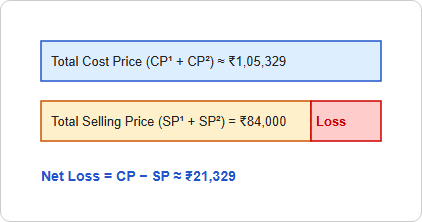
Total CP = 28,965.52 + 76,363.64 = ₹1,05,329.16

Total SP = 42,000 + 42,000 = ₹84,000

Overall Loss = 1,05,329.16 − 84,000 = ₹21,329.16

⇒ Nearest integer = ₹21,329 loss.

∴ The correct answer is ₹21,329 loss.

Additional Information

Net Percentage Change

When a value is increased by x% and then decreased by x%, the net change is always a decrease of x2/100 %.

Same CP Case

If two articles are bought for the same Cost Price and sold at x% profit and x% loss respectively, there is No Profit, No Loss in the whole transaction.

Successive Profit/Loss

For successive changes of a% and b%, net change % = [a + b + (ab/100)]%, where positive values are for profit/increase and negative for loss/decrease.

25

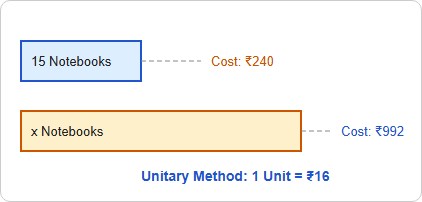
If 15 notebooks cost ₹240, then how many notebooks can be bought with ₹992?

  1. ((a))

    64

  2. ((b))

    62

  3. ((c))

    60

  4. ((d))

    66

Show Answer
Answer: ((b))

62

Shortcut Trick

Using the Ratio Method: 15 notebooks : ₹240 = x notebooks : ₹992

Reducing the first ratio: 1 : (240 ÷ 15) → 1 : 16

This means every 1 notebook costs ₹16.

Number of notebooks (x) = 992 ÷ 16 = 62

∴ The correct answer is 62 notebooks.

Alternate Method

Given:

Initial quantity = 15 notebooks

Initial cost = ₹240

Available amount = ₹992

Formula Used:

Cost of 1 unit = Total Cost ÷ Total Quantity

Required Quantity = Available Amount ÷ Cost of 1 unit

Calculations:

⇒ Cost of 15 notebooks = ₹240

⇒ Cost of 1 notebook = 240 ÷ 15

⇒ Cost of 1 notebook = ₹16

⇒ Number of notebooks for ₹992 = 992 ÷ 16

⇒ Number of notebooks = 62

∴ The correct answer is 62 notebooks.

Additional Information

Unitary Method

A technique where we first find the value of a single unit and then multiply it by the required number of units to find the total value.

Direct Proportion

When two quantities increase or decrease at the same rate, they are in direct proportion. Formula: x1/y1 = x2/y2.

Cost Calculation

Total Cost = Unit Price × Quantity. Conversely, Quantity = Total Cost ÷ Unit Price.

General Intelligence & Reasoning (25 questions)

26

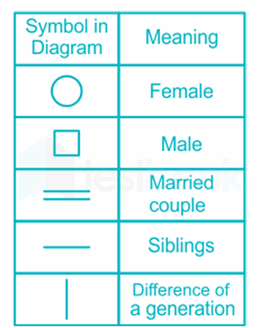
G is the mother of Y. Y is the sister of V. S is the father of L. L is the husband of V. How is G related to L?

  1. ((a))

    Wife's sister

  2. ((b))

    Mother

  3. ((c))

    Wife's mother

  4. ((d))

    Sister

Show Answer
Answer: ((c))

Wife's mother

Given:

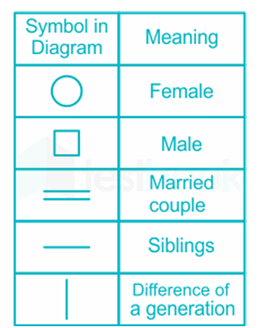
Based on the statement provided, we can identify the following relationships:

PersonRelationshipRelated to
GMotherY
YSisterV
SFatherL
LHusbandV


Let us break down the relations step-by-step to determine how G is related to L:

  1. G is the mother of Y - G is female and belongs to the generation above Y.

  2. Y is the sister of V - Y and V are siblings (both children of G). Since G is the mother of Y, G is also the mother of V.

  3. L is the husband of V - This indicates L (male) and V (female) are a married couple.

  4. S is the father of L - S is the parent of L in the generation above.

Since G is the mother of V, and V is the wife of L, it follows that G is the mother of L’s wife.

Therefore, G is the Wife's mother of L.

Hence, the correct answer is 'Option 3'.

27

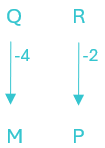
Each letter in the word DEARTHS is changed to the letter immediately following it in the English alphabetical order and then all the letters thus formed are arranged in alphabetical order. Which of the following letters will be fourth from the right in the new group of letters thus formed?

  1. ((a))

    I

  2. ((b))

    E

  3. ((c))

    S

  4. ((d))

    F

Show Answer
Answer: ((a))

I

Given Word:

DEARTHS

Rule:

  • Change each letter to the next letter in the English alphabetical order.
  • Then arrange all the new letters in alphabetical order.
<br>

Transformation:

Original LetterDEARTHS
Next LetterEFBSUIT
<br>

New letters:

E, F, B, S, U, I, T

Arranged alphabetically:

B, E, F, I, S, T, U

Counting from the right:

From Right1st2nd3rd4th5th6th7th
LetterUTSIFEB
<br>

Therefore, the 4th letter from the right is I.

Hence, the correct answer is "Option 1 — I".

28

Seven boxes A, B, C, D, E, F and G are kept one over the other but not necessarily in the same order. Only two boxes are kept below D. Only three boxes are kept between E and D. C is kept above A but below G. B is kept above F but below A. Which box is kept immediately above A?

  1. ((a))

    G

  2. ((b))

    E

  3. ((c))

    C

  4. ((d))

    D

Show Answer
Answer: ((c))

C

Given:

Seven boxes (A, B, C, D, E, F, G) are kept one over the other from 1 (bottom) to 7 (top).

  1. Only two boxes are kept below D.

  2. Only three boxes are kept between E and D.

Position Box

7 (Top) E

6  

5  

4  

3 D

2  

1 (Bottom)  


  1. C is kept above A but below G (G > C > A).

  2. B is kept above F but below A (A > B > F).

Combining the above points, we get the relative order: G > C > A > B > F. These five boxes must fit into the remaining five positions (6, 5, 4, 2, and 1).

Final Arrangement:

7 E

6 G

5 C

4 A

3 D

2 B

1 F


Thus, the box kept immediately above A is C.

Hence, the correct answer is 'Option 3'.

29

In a certain code language,

P + Q means ‘P is the father of Q’

P – Q means ‘P is the wife of Q’

P x Q means ‘P is the brother of Q’

P ÷ Q means ‘P is the son of Q’

<br>

Based on the above, how is G related to K if ‘F – G x H ÷ I – J ÷ K’?

  1. ((a))

    Mother’s father

  2. ((b))

    Mother’s brother

  3. ((c))

    Father’s brother

  4. ((d))

    Son’s Son

Show Answer
Answer: ((d))

Son’s Son

Given:

Let us first decode the given symbols and then draw a family tree.

P is
Symbol+×÷
MeaningFatherWifeBrotherSon
of Q


On checking the expression: F − G × H ÷ I − J ÷ K

  1. F − G - 'F − G' means 'F is the wife of G' (So, G is the husband of F).

  2. G × H - 'G × H' means 'G is the brother of H'.

  3. H ÷ I - 'H ÷ I' means 'H is the son of I' (This means G is also the son of I).

  4. I − J - 'I − J' means 'I is the wife of J' (So, J is the father of G and H).

  5. J ÷ K - 'J ÷ K' means 'J is the son of K'.

Therefore, J is the son of K, and G is the son of J. This means G is the Son's son of K.

Hence, the correct answer is "Option 4".

30

Seven boxes A, B, C, D, E, F and G are kept one over the other but not necessarily in the same order. B is kept third from the top. Only three boxes are kept between D and B. C is kept immediately below G but above F. A is kept below E but above B. How many boxes are kept between C and A?

  1. ((a))

    Two

  2. ((b))

    Four

  3. ((c))

    Three

  4. ((d))

    One

Show Answer
Answer: ((a))

Two

Given:

Seven boxes A, B, C, D, E, F, and G are kept one over the other from 1 (bottom) to 7 (top).

1) B is kept third from the top.

2) Only three boxes are kept between D and B.

3) A is kept above B.

PositionBox
7 (Top)
6A
5B
4
3
2
1 (Bottom)D


4) A is kept below E. (Since A is at position 6, E must be at position 7).

5) C is kept immediately below G.

6) C is kept above F.

Final Arrangement:

7E
6A
5B
4G
3C
2F
1D


Box A is at position 6 and box C is at position 3. The boxes between them are B (5) and G (4).

Thus, two boxes are kept between C and A.

Hence, the correct answer is 'Option 1'.

31

What will come in the place of the question mark (?) in the following equation, if ‘+’ and ‘–’ are interchanged and ‘×’ and ‘÷’ are interchanged?

<br>

48 – 96 × 12 ÷ 4 + 32 = ?

  1. ((a))

    43

  2. ((b))

    42

  3. ((c))

    48

  4. ((d))

    46

Show Answer
Answer: ((c))

48

Sign Transformation:

Original Sign×÷+
New Sign+÷×


Given Equation: 48 − 96 × 12 ÷ 4 + 32

By replacing the signs according to the table above, we get the new equation:

= 48 + 96 ÷ 12 × 4 − 32

= 48 + 8 × 4 - 32

= 48 + 32 - 32

= 48

Therefore, the value that comes in place of the question mark is 48.

Hence, the correct answer is "Option 3".

32

Refer to the following series and answer the question. (All numbers are single-digit numbers only. Counting to be done from left to right.)

(Left) 7 9 2 6 1 2 6 4 8 2 7 5 9 8 6 5 4 2 2 1 3 (Right)

How many such even digits are there, each of the which is immediately preceded by a perfect square and immediately followed by an even digit? (NOTE: 1 is also a perfect square)

  1. ((a))

    Four

  2. ((b))

    Two

  3. ((c))

    Five

  4. ((d))

    Three

Show Answer
Answer: ((c))

Five

Given Series:

(Left) 7 9 2 6 1 2 6 4 8 2 7 5 9 8 6 5 4 2 2 1 3 (Right)

Perfect Squares:

1, 4, 9   (1 is also a perfect square)

Required pattern:

Perfect Square → Even Digit → Even Digit

Checking the series:

(Left) 9 2 6 6 1 2 6 6 4 8 2 2 7 9 8 6 6 5 4 2 2 2 1 3 (Right)

Even digits satisfying the condition:

→ 2 in (9 2 6)

→ 2 in (1 2 6)

→ 8 in (4 8 2)

→ 8 in (9 8 6)

→ 2 in (4 2 2)

Therefore, there are 5 such even digits.

Hence, the correct answer is "Option 3 — Five".

33

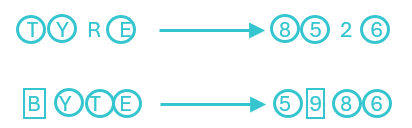
In a certain code language, ‘TYRE’ is coded as ‘8526’ and ‘BYTE’ is coded as ‘5986’. What is the code for ‘B’ in that language?

  1. ((a))

    9

  2. ((b))

    6

  3. ((c))

    2

  4. ((d))

    8

Show Answer
Answer: ((a))

9

Given:

TYRE is coded as '8526'

BYTE is coded as '5986'


Hence, the correct answer is "Option 1".

34

Based on the English alphabetical order, three of the following four letter-cluster pairs are alike in a certain way and thus form a group. Which letter-cluster pair DOES NOT belong to that group?

(Note: The odd one out is not based on the number of consonants/vowels or their position in the letter-cluster.)

  1. ((a))

    OV - QX

  2. ((b))

    KU - MT

  3. ((c))

    DK - FM

  4. ((d))

    HO - JQ

Show Answer
Answer: ((b))

KU - MT

The logic followed here is

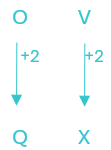
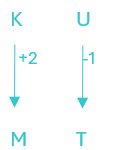
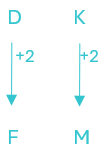
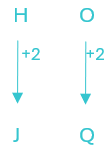
Logic: Second letter-cluster = (Each letter of the first letter-cluster) + 2.

Option 1)  OV - QX,

Option 2) KU - MT,

This pair does not follow the rule.

Option 3) DK - FM

Option 4) HO - JQ,

Therefore, the letter-cluster pair that is different from the others is KU - MT.

Hence, the correct answer is 'Option 2'.

35

Refer to the following letter series and answer the question that follows. Counting to be done from left to right.

<br>

(Left) D J L O E A H O A F A G E B G A N R S H X (Right)

<br>

How many such consonants are there, each of which is immediately preceded by a consonant and also immediately followed by a vowel?

  1. ((a))

    None

  2. ((b))

    One

  3. ((c))

    Two

  4. ((d))

    Three

Show Answer
Answer: ((c))

Two

Given Series:

(Left) D J L O E A H O A F A G E B G A N R S H X (Right)

Required pattern:

Consonant → Consonant → Vowel

Checking the series:

(Left) D J L O O E A H O A F A G E B B G A A N R S H X (Right)

Consonants satisfying the condition:

→ L in (J L O)

→ G in (B G A)

Therefore, there are 2 such consonants.

Hence, the correct answer is "Option 3 — Two".

36

VRHM is related to XTJO in a certain way based on the English alphabetical order. In the same way, DZPU is related to FBRW. To which of the given options is JVFA related, following the same logic?

  1. ((a))

    LXCD

  2. ((b))

    LXHC

  3. ((c))

    LCFD

  4. ((d))

    LKIO

Show Answer
Answer: ((b))

LXHC

The logic followed in this pattern is a consistent alphabetical shift where each letter is moved forward by two positions in the English alphabet.

For 'VRHM' related to 'XTJO':

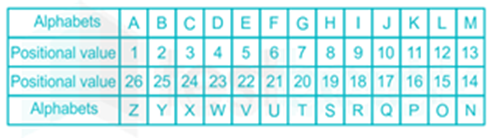
V(22)R(18)H(8)M(13)
+2 ↓+2 ↓+2 ↓+2 ↓
X(24)T(20)J(10)O(15)

For 'DZPU' related to 'FBRW':

D(4)Z(26)P(16)U(21)
+2 ↓+2 ↓+2 ↓+2 ↓
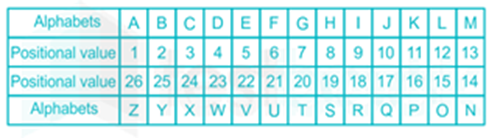
F(6)B(2)R(18)W(23)

Applying the same logic to 'JVFA':

J(10)V(22)F(6)A(1)
+2 ↓+2 ↓+2 ↓+2 ↓
L(12)X(24)H(8)C(3)

Thus, JVFA is related to LXHC.

Hence, the correct answer is 'Option 2'.

37

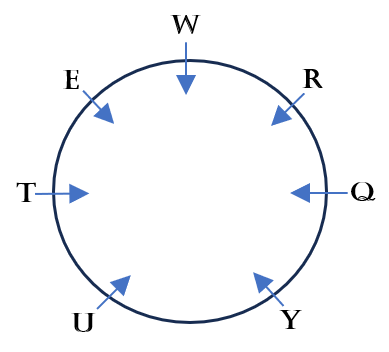
E, R, U, T, Y, W and Q are sitting around a circular table, facing the center of the table.

Only two people sit between T and Q when counted from the left of Q. Only three people sit between W and U when counted from the right of U. E sits to the immediate right of W. Y is an immediate neighbour of U as well as Q.

How many people sit between R and U when counted from the left of R?

  1. ((a))

    3

  2. ((b))

    1

  3. ((c))

    4

  4. ((d))

    2

Show Answer
Answer: ((d))

2

The logic followed here:

Only two people sit between T and Q when counted from the left of Q.

Only three people sit between W and U when counted from the right of U.

E sits to the immediate right of W.

Y is an immediate neighbour of U as well as Q.


So, 2 peoples sit between R and U when counted from the left of R.

Hence, the correct answer is option (4).

38

Select the pair that follows the same pattern as the one followed by the two pairs given below. Both pairs follow the same pattern.

KNG : MLF
GRN : IPM

  1. ((a))

    BGM : DEK

  2. ((b))

    KHR : MFP

  3. ((c))

    IGH : KDG

  4. ((d))

    JSN : LQM

Show Answer
Answer: ((d))

JSN : LQM

The logic followed in this pattern is based on alphabetical shifts according to the positional values of the letters.

For 'KNG' related to 'MLF':

K(11)N(14)G(7)
+2 ↓−2 ↓−1 ↓
M(13)L(12)F(6)

For 'GRN' related to 'IPM':

G(7)R(18)N(14)
+2 ↓−2 ↓−1 ↓
I(9)P(16)M(13)

Applying the same logic to 'JSN':

J(10)S(19)N(14)
+2 ↓−2 ↓−1 ↓
L(12)Q(17)M(13)

The logic requires a +2, −2, −1 shift. Only the pair JSN : LQM satisfies this pattern.

Hence, the correct answer is 'Option 4'.

39

In a certain code language,

A + B means ‘A is the sister of B’

A − B means ‘A is the brother of B’

A × B means ‘A is the wife of B’

A ÷ B means ‘A is the father of B’

<br>

Based on the above, how is S related to N if ‘S ÷ E + W × T − N’?

  1. ((a))

    Brother's father

  2. ((b))

    Brother's wife's father

  3. ((c))

    Wife's father

  4. ((d))

    Brother's wife's brother

Show Answer
Answer: ((b))

Brother's wife's father

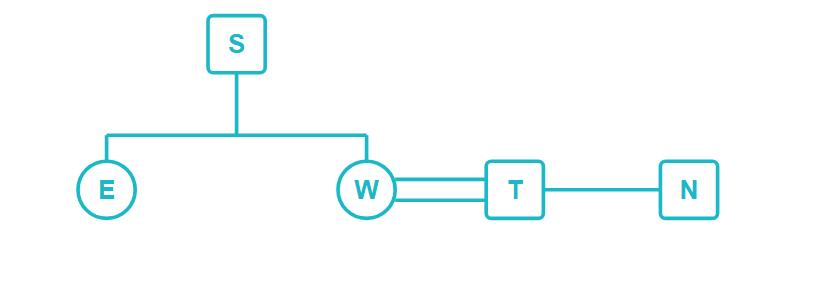
Given:

Let us first decode the given symbols and then draw a family tree.

A is
Symbol+×÷
MeaningSisterBrotherWifeFather
of B


On checking: S ÷ E + W × T − N

  1. S ÷ E - 'S ÷ E' means 'S is the father of E'.

  2. E + W - 'E + W' means 'E is the sister of W'.

  3. W × T - 'W × T' means 'W is the wife of T'.

  4. T − N - 'T − N' means 'T is the brother of N'.

Therefore, S is the father of W, and W is the wife of T (who is the brother of N). Thus, S is the father of N's brother's wife.

Hence, the correct answer is "Option 2".

40

Based on the English alphabetical order, three of the following four letter-cluster pairs are alike in a certain way and thus form a group. Which is the one that does not belong to that group?

(Note: The odd one out is not based on the number of consonants/vowels or their position in the letter-cluster.)

  1. ((a))

    QR - MP

  2. ((b))

    KO - HL

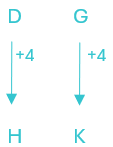
  3. ((c))

    XB - UY

  4. ((d))

    DI - AF

Show Answer
Answer: ((a))

QR - MP

The logic followed here is

Logic: First letter − 3 = Third letter and Second letter − 3 = Fourth letter.

Option 1) QR - MP,

This pair does not follow the rule.

Option 2) KO - HL,

Option 3) XB - UY

Option 4) DI - AF,

Therefore, the letter-cluster pair that is different from the others is QR - MP.

Hence, the correct answer is 'Option 1'.

41

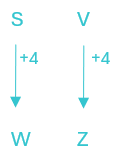
Based on the English alphabetical order, three of the following four letter-cluster pairs are alike in a certain way and thus form a group. Which letter-cluster pair DOES NOT belong to that group?

(Note: The odd one out is not based on the number of consonants/vowels or their position in the letter-cluster.)

  1. ((a))

    UX−XD

  2. ((b))

    FI−JM

  3. ((c))

    DG−HK

  4. ((d))

    SV−WZ

Show Answer
Answer: ((a))

UX−XD

The logic followed here is

Logic: In each pair, the first letter of the second cluster is the 4th letter after the first letter of the first cluster, and the second letter of the second cluster is the 4th letter after the second letter of the first cluster.

Option 1)  UX−XD,

This pair does not follow the rule.

Option 2) FI−JM,

Option 3) DG−HK,

Option 4) SV−WZ,

Therefore, the letter-cluster pair that is different from the others is UX−XD.

Hence, the correct answer is 'Option 1'.

42

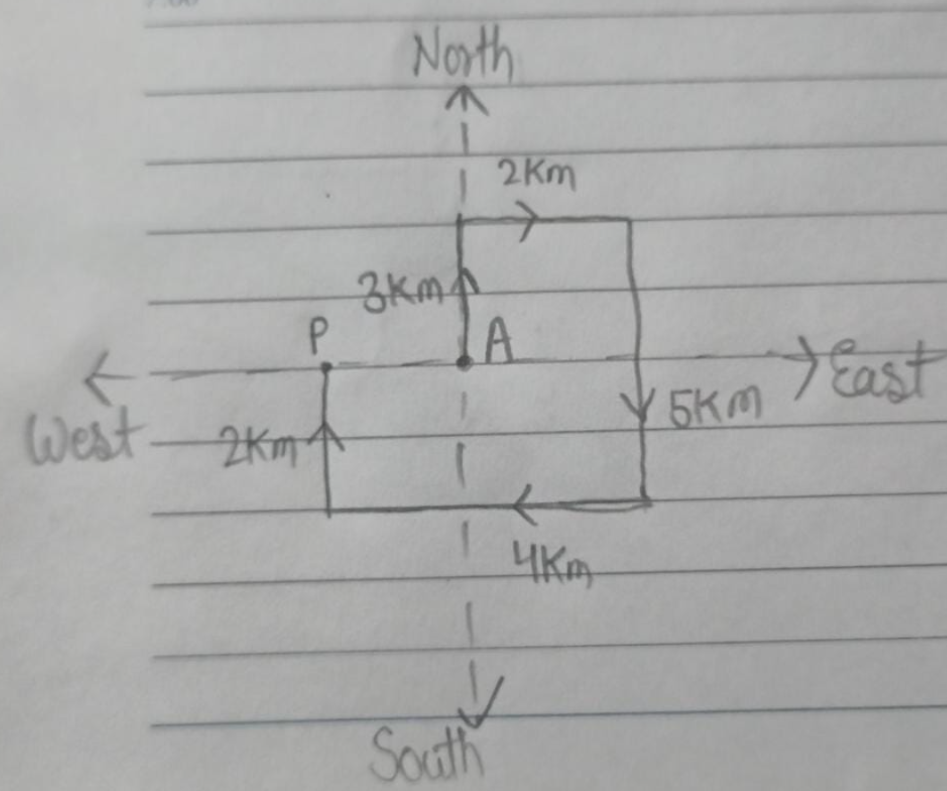
Anu starts from Point A and drives 3 km towards the north. He then takes a right turn, drives 2 km, turns right and drives 5 km. He then takes a right turn and drives 4 km. He takes a final right turn, drives 2 km and stops at Point P. How far (shortest distance) and towards which direction should he drive in order to reach Point A again?

(All turns are 90-degree turns only unless specified.)

  1. ((a))

    4 km to the west

  2. ((b))

    6 km to the east

  3. ((c))

    2 km to the east

  4. ((d))

    8 km to the North

Show Answer
Answer: ((c))

2 km to the east

The logic followed to determine the final position is based on calculating the net displacement in the North-South and East-West directions.

Step-by-step Movement tracking for Anu:

1. Anu starts from Point A and drives 3 km towards the north. 2. He then takes a right turn, drives 2 km, turns right and drives 5 km. 3. He then takes a right turn and drives 4 km. 4. He takes a final right turn, drives 2 km and stops at Point P.

To go from a point in the West back to the starting point, he must drive towards the East.

Therefore, he should drive 2 km to the east.

Hence, the correct answer is "Option 3".

43

What should come in place of ‘?’ in the given series?

<br>

47 54 63 70 79 ?

  1. ((a))

    84

  2. ((b))

    88

  3. ((c))

    83

  4. ((d))

    86

Show Answer
Answer: ((d))

86

The logic followed here is:

The given number series follows an alternating addition pattern as shown below:

475463707986
+7+9+7+9+7

The logic is to add 7 and 9 alternatively to the previous number.

Thus, the missing term in the series is 86.

Hence, the correct answer is 'Option 4';

44

Each vowel in the word PANDEMIC is changed to the letter immediately following it in the English alphabetical order and each consonant is changed to the letter immediately preceding it in the English alphabetical order. Which of the following letters will appear exactly twice in the new group of letters thus formed?

  1. ((a))

    C

  2. ((b))

    M

  3. ((c))

    B

  4. ((d))

    O

Show Answer
Answer: ((c))

B

Given Word:

PANDEMIC

Rule:

  • Each vowel is changed to the next letter in the English alphabet.
  • Each consonant is changed to the previous letter in the English alphabet.

Transformation:

Original LetterPANDEMIC
New LetterOBMCFLJB

New group of letters:

O, B, M, C, F, L, J, B

Letter frequencies:

B → 2 times

O, M, C, F, L, J → 1 time each

Therefore, the letter appearing exactly twice is B.

Hence, the correct answer is "Option 3 — B".

45

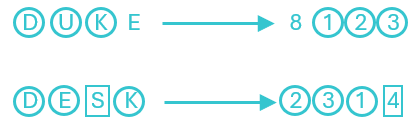
In a certain code language, ‘DUKE’ is coded as ‘8123’ and ‘DESK’ is coded as ‘2314’. What is the code for ‘S’ in that language?

  1. ((a))

    2

  2. ((b))

    4

  3. ((c))

    1

  4. ((d))

    8

Show Answer
Answer: ((b))

4

Logic followed here is.

Logic: The code for the word is determined by comparing the common letters between the words and identifying the corresponding unique digit assigned to the remaining letter.

Given:

DUKE is coded as '8123'

DESK is coded as '2314'

For


Therefore, the code for 'S' is 4.

Hence, the correct answer is "Option 2".

46

Based on the English alphabetical order, three of the following four letter-clusters are alike in a certain way and thus form a group. Which letter-cluster DOES NOT belong to that group?

(Note: The odd one out is not based on the number of consonants/vowels or their position in the letter-cluster.)

  1. ((a))

    KHG

  2. ((b))

    MOL

  3. ((c))

    NPM

  4. ((d))

    GIF

Show Answer
Answer: ((a))

KHG

Logic followed here is.

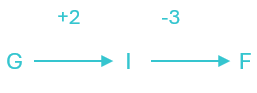
Logic: (1st letter + 2 = 2nd letter) and (2nd letter − 3 = 3rd letter).

For

KHG→

<br>

For

MOL →

<br>

For

NPM →

<br>

For

GIF →


Therefore, the letter-cluster KHG is the odd one out because it does not follow the (+2, −3) pattern common to the others.

Hence, the correct answer is "Option 1".

47

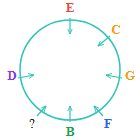
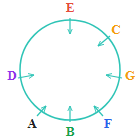
A, B, C, D, E, F and G are sitting around a circular table facing the centre. Only two people are seated between E and F when counted from the right of E. Only two people are seated between F and D when counted from the left of D. Only three people are seated between E and B when counted from the left of B. C is seated to the immediate left of G. How many people are seated between A and F when counted from the right of F?

  1. ((a))

    3

  2. ((b))

    1

  3. ((c))

    2

  4. ((d))

    4

Show Answer
Answer: ((b))

1

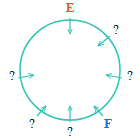
  1. Since all persons face the centre: right = counter-clockwise (CCW), left = clockwise (CW). Fix E at position 1. Only two people are seated between E and F when counted from the right of E: E(1) → pos(2) → pos(3) → F(4).

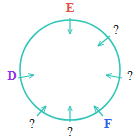
  1. Only two people are seated between F and D from the left of D (CW): D → pos(6) → pos(5) → F(4). Thus, D is at pos(7).

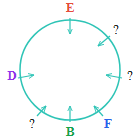
  1. Only three people are seated between E and B from the left of B (CW): B → pos(4) → pos(3) → pos(2) → E(1). B is at pos(5).

  1. C is to the immediate left of G (CW). Available positions are 2, 3, and 6. If G is at pos(3), immediate left is pos(2), which is vacant. So G(3) and C(2).

  1. The remaining person A occupies pos(6). Final arrangement: E(1), C(2), G(3), F(4), B(5), A(6), D(7).

<br>

To find the number of people between A and F when counted from the right of F (CCW): F(4)B(5)A(6). Only B sits between them. Thus, 1 person is seated between A and F.

<br>

Hence, the correct answer is 'Option 2'.

48

EHLF is related to NQUO in a certain way based on the English alphabetical order. In the same way, HKOI is related to QTXR. To which of the following is JMQK related, following the same logic?

  1. ((a))

    VSTZ

  2. ((b))

    SVTZ

  3. ((c))

    VSZT

  4. ((d))

    SVZT

Show Answer
Answer: ((d))

SVZT

The logic followed in this pattern is a series of alphabetical shifts where each letter is moved forward by a fixed number of positions.

For 'EHLF' related to 'NQUO':

E(5)H(8)L(12)F(6)
+9 ↓+9 ↓+9 ↓+9 ↓
N(14)Q(17)U(21)O(15)

For 'HKOI' related to 'QTXR':

H(8)K(11)O(15)I(9)
+9 ↓+9 ↓+9 ↓+9 ↓
Q(17)T(20)X(24)R(18)

Applying the same logic to 'JMQK':

J(10)M(13)Q(17)K(11)
+9 ↓+9 ↓+9 ↓+9 ↓
S(19)V(22)Z(26)T(20)

Thus, JMQK is related to SVZT.

Hence, the correct answer is 'Option 4'.

49

What should come in place of ‘?’ in the given series?

<br>

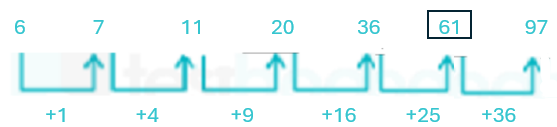
6, 7, 11, 20, 36, 61, ?

  1. ((a))

    105

  2. ((b))

    97

  3. ((c))

    95

  4. ((d))

    110

Show Answer
Answer: ((b))

97

The logic followed in this number series is based on adding the squares starting from 1 to 6 to get the next term.


Therefore, the number that should come in place of the question mark is 97.

Hence, the correct answer is "Option 2".

50

If ‘A’ stands for ‘÷’, ‘B’ stands for ‘×’, ‘C’ stands for ‘+’ and ‘D’ stands for ‘−‘, what will come in place of the question mark ‘?’ in the following equation?

<br>

147 A 3 C 51 D 16 B 3 = ?

  1. ((a))

    50

  2. ((b))

    52

  3. ((c))

    59

  4. ((d))

    54

Show Answer
Answer: ((b))

52

The mapping of letters to operators is as follows:

ABCD
÷×+


For the given equation:

147 A 3 C 51 D 16 B 3 = ? →

By substituting the operators in place of the letters, we get the following expression:

= 147 ÷ 3 + 51 − 16 × 3

= 49 + 51 - 16 × 3

= 49 + 51 - 48

= 100 - 48

= 52

Therefore, the value that will come in place of the question mark is 52.

Hence, the correct answer is "Option 2".

General Science (40 questions)

51

Which of the following statements is/are true regarding the speed of sound?

(i) The speed of sound decreases with an increase in the temperature of the medium.

(ii) The speed of sound in solid state is greater than the speed of sound in gaseous state under the same external conditions.

(iii) The speed of sound is independent of the properties of the medium through which it travels.

  1. ((a))

    Both (i) and (iii)

  2. ((b))

    Both (i) and (ii)

  3. ((c))

    Only (iii)

  4. ((d))

    Only (ii)

Show Answer
Answer: ((d))

Only (ii)

The correct answer is Only (ii).

Key Points

  • Statement (i) claims the speed of sound decreases with temperature. However, the speed of sound in a gas is directly proportional to the square root of the absolute temperature, as shown by the formula v=γRT/M v = \sqrt{\gamma RT/M} . As temperature increases, molecules move faster, transferring the vibrational energy more quickly. Hence, statement (i) is incorrect.
  • Statement (ii) mentions that sound travels faster in solids than in gases. Sound is a mechanical wave that propagates through the interaction of particles. Solids have a much higher elastic modulus (stiffness) and closer atomic arrangement than gases, which allows the disturbance to travel at significantly higher velocities. Hence, statement (ii) is correct.
  • Statement (iii) suggests the speed is independent of medium properties. In reality, the speed of sound is strictly determined by the elasticity and density of the medium through which it travels. It varies from approximately 343 m/s in air to over 5000 m/s in steel. Hence, statement (iii) is incorrect.

 Additional Information

  • Phase of Matter Comparison:
  • In solids, the atoms are tightly bound by strong intermolecular forces, leading to high bulk modulus values and faster transmission.
  • In liquids, the speed is generally higher than in gases but lower than in solids due to moderate compressibility.
  • In gases, the particles are far apart, resulting in the slowest speed of sound among the three states.
  • Medium Properties:
  • Elasticity: This is the primary factor; more elastic (stiffer) materials allow sound to travel faster.
  • Density: While higher density generally decreases speed (v1/ρ v \propto 1/\sqrt{\rho} ), the massive increase in elasticity when moving from gas to solid outweighs the density increase.
  • Humidity: Increased humidity in air slightly increases the speed because water vapor reduces the overall density of the air.
52

Two resistors of 5 Ω and 15 Ω are connected in series to a battery of 10 V. How much will flow through the circuit?

  1. ((a))

    0.4 A

  2. ((b))

    0.5 A

  3. ((c))

    2 A

  4. ((d))

    200 A

Show Answer
Answer: ((b))

0.5 A

The correct answer is 0.5 A.

Key Points

  • In a Series Connection, resistors are connected end-to-end such that the same current flows through each resistor sequentially. The Equivalent Resistance (Req) is calculated by the algebraic sum of individual resistances: Req = R1 + R2 + ... + Rn.
  • For the given circuit, the two resistors are 5 Ω and 15 Ω. Therefore, the total resistance is calculated as: Rtotal = 5 Ω + 15 Ω = 20 Ω.
  • Ohm's Law defines the relationship between voltage (V), current (I), and resistance (R) in an ideal conductor, expressed by the formula: V = I × R.
  • To find the current flowing through the circuit, we rearrange the formula to I = V / R. Substituting the given values: I = 10 V / 20 Ω.
  • Performing the division, the current I = 0.5 A. This indicates that a charge of 0.5 Coulombs passes through any point in the circuit every second.

 Additional Information

  • Series Circuit Characteristics:
  • The Current (I) remains uniform at every point in a series circuit; thus, 0.5 A flows through both the 5 Ω and 15 Ω resistors.
  • The Voltage (V) across the battery is divided among the resistors. Using V = IR, the voltage drop across the 5 Ω resistor is 2.5 V, and across the 15 Ω resistor, it is 7.5 V, totaling the source 10 V.
  • If one component in a series circuit fails or breaks, the entire circuit is interrupted, and current stops flowing completely.
  • Comparison with Parallel Circuits:
  • In a Parallel Connection, the reciprocal of the total resistance is the sum of the reciprocals of individual resistances: 1/Rp = 1/R1 + 1/R2.
  • Parallel circuits maintain the same voltage across all branches, but the total current is the sum of currents through each branch.
  • Units of Measurement:
  • Resistance is measured in Ohms (Ω), named after Georg Simon Ohm.
  • Electric Current is measured in Amperes (A), representing the rate of flow of electric charge.
  • Potential Difference is measured in Volts (V), representing the work done to move a unit charge between two points.
53

Match the elements in Column I with their correct electron distribution in Column II according to the Bohr–Bury rules.

ElementElectron Distribution
A. Sodium (Na)1. 2, 8, 2
B. Magnesium (Mg)2. 2, 8, 1
C. Aluminium (Al)3. 2, 8, 3
D. Calcium (Ca)4. 2, 8, 8, 2
  1. ((a))

    A–2, B–1, C–3, D–4

  2. ((b))

    A–2, B–3, C–4, D–1

  3. ((c))

    A–2, B–3, C–1, D–4

  4. ((d))

    A–1, B–3, C–2, D–4

Show Answer
Answer: ((a))

A–2, B–1, C–3, D–4

The correct answer is A–2, B–1, C–3, D–4.

Key Points

  • Sodium (Na) possesses an atomic number of 11, which indicates it has 11 electrons in its neutral state. According to the Bohr–Bury rules, these are distributed as 2 in the K-shell, 8 in the L-shell, and the remaining 1 in the M-shell. Hence, Sodium (Na) matches with 2, 8, 1.
  • Magnesium (Mg) has an atomic number of 12. Its electron configuration is determined by filling the shells in increasing order of energy, resulting in 2 electrons in the K-shell, 8 in the L-shell, and 2 in the M-shell. Hence, Magnesium (Mg) matches with 2, 8, 2.
  • Aluminium (Al) is the element with atomic number 13. Following the principle of maximum capacity and shell order, it houses 2 electrons in its innermost shell, 8 in the second, and 3 in the third shell. Hence, Aluminium (Al) matches with 2, 8, 3.
  • Calcium (Ca) has an atomic number of 20. While the M-shell can hold up to 18 electrons, the octet rule dictates that the outermost shell cannot have more than 8 electrons; thus, after 8 electrons fill the M-shell, the next 2 enter the N-shell. Hence, Calcium (Ca) matches with 2, 8, 8, 2.

 Additional Information

  • Electronic Configuration Principles:
  • 2n2 Formula: This rule determines the maximum number of electrons a shell can hold, where n represents the orbit number or energy level (K=1, L=2, M=3, N=4).
  • Shell Capacities: Based on the formula, the K-shell holds 2, L-shell holds 8, M-shell holds 18, and N-shell holds 32 electrons.
  • Valence Shell Stability: The outermost shell of any atom cannot accommodate more than 8 electrons, ensuring chemical stability as seen in Noble Gases.
  • Step-wise Filling: Electrons do not occupy a new shell until the inner shells are completely filled, creating a structured electronic arrangement.
  • Valency: The number of electrons in the outermost shell (valence electrons) determines the valency and reactivity of the element.
54

Which of the following is NOT explained by the Universal Law of Gravitation?

  1. ((a))

    Falling of apples from a tree

  2. ((b))

    Weight of objects on Earth

  3. ((c))

    Resistance offered by air to a moving object

  4. ((d))

    Formation of tides

Show Answer
Answer: ((c))

Resistance offered by air to a moving object

The correct answer is Resistance offered by air to a moving object.

Key Points

  • The Universal Law of Gravitation, formulated by Sir Isaac Newton, states that every particle of matter in the universe attracts every other particle with a force directly proportional to the product of their masses and inversely proportional to the square of the distance between their centers.
  • The falling of apples from a tree is caused by the gravitational attraction between the Earth and the apple, pulling the object toward the center of the planet.
  • The weight of objects on Earth is a direct measure of the gravitational force exerted by the Earth on that object, calculated using the relationship Weight = Mass × gravity.
  • The formation of tides in the Earth's oceans is a result of the gravitational pull exerted by the Moon and the Sun, which creates tidal bulges as the Earth rotates.
  • Air resistance, or drag, is a frictional force exerted by air molecules against the motion of an object. This is a contact force dependent on the object's velocity, surface area, and shape, and is not explained by the principles of universal gravitation.

 Additional Information

  • Gravitational Constant (G)
  • It is a universal constant with a value of approximately 6.674×10¹¹ N m2 kg2 6.674 \times 10^{-11} \text{ N m}^{2} \text{ kg}^{-2} .
  • Unlike the acceleration due to gravity (g), G remains constant throughout the universe.
  • Air Resistance (Fluid Friction)
  • It acts in the direction opposite to the relative motion of the object.
  • In a vacuum, where air is absent, air resistance is zero, allowing objects of different masses to fall at the same rate.
  • It is a non-conservative force because the energy spent overcoming it is dissipated as heat.
  • Tidal Forces
  • Tides are influenced more by the Moon than the Sun because of the Moon's proximity to Earth, despite the Sun's much larger mass.
55

A farmer walks along the boundary of a square field with side 11 m, completing one round in 20 seconds. After walking for 3 minutes and 20 seconds, what is the magnitude of the displacement from his starting point?

  1. ((a))

    22 m

  2. ((b))

    11 m

  3. ((c))

    15.56 m

  4. ((d))

    0 m

Show Answer
Answer: ((d))

0 m

The correct answer is 0 m.

Key Points

  • The field is a square with a side length of 11 m. The total perimeter of the field is 4 × 11 = 44 m.
  • The farmer completes one full round of the boundary in 20 seconds.
  • The total time spent walking is 3 minutes and 20 seconds. To calculate this in seconds: (3 × 60) + 20 = 200 seconds.
  • The number of rounds completed is determined by dividing the total time by the time per round. Calculation: 200 / 20 = 10 full rounds.
  • Since the farmer completes exactly 10 rounds, he returns precisely to the starting point on the boundary of the square field.
  • Displacement is a vector quantity defined as the shortest straight-line distance between the initial position and the final position. Because the initial and final positions are the same, the displacement is zero. Hence, the magnitude of displacement is 0 m.

 Additional Information

  • Distance vs. Displacement:
  • Distance is the total path length traveled, which in this case is 10 rounds × 44 m = 440 m. Unlike displacement, it is a scalar quantity and cannot be zero if motion has occurred.
  • Displacement depends only on the endpoints of the motion, not the path taken.
  • Vector Properties:
  • If the farmer had stopped after 10.5 rounds (210 seconds), his displacement would be the diagonal of the square, calculated using the Pythagoras theorem as √(112 + 112), which is approximately 15.56 m.
  • In circular or closed-loop motion, displacement is always zero if the object completes an integer number of revolutions or circuits.
56

If the speed of light in a medium is 2.25 × 10⁸ m/s, its refractive index is ________.

  1. ((a))

    1.33

  2. ((b))

    0.75

  3. ((c))

    1.75

  4. ((d))

    1.5

Show Answer
Answer: ((a))

1.33

The correct answer is 1.33.

Key Points

  • The Refractive Index (n) of a material is a dimensionless physical quantity that indicates the factor by which the speed of light is reduced inside the medium compared to its speed in a vacuum.
  • The mathematical relationship is expressed by the formula n = c / v, where c represents the speed of light in a vacuum and v represents the speed of light in the given medium.
  • The speed of light in a vacuum (c) is a universal physical constant valued at approximately 3 × 10⁸ m/s (more precisely 299,792,458 m/s).
  • Given that the speed of light in the medium is 2.25 × 10⁸ m/s, the calculation is performed as follows: n = (3 × 10⁸) / (2.25 × 10⁸).
  • The 108 terms in the numerator and denominator cancel out, leaving the ratio 3 / 2.25. Converting the decimal, 2.25 is equivalent to 9/4, making the equation 3 / (9/4), which simplifies to 12/9 or 1.33.
  • A refractive index of 1.33 is a significant scientific value as it identifies the medium as liquid water at standard temperature and pressure.

 Additional Information

  • Optical Density and Refraction:
  • The refractive index is a measure of the optical density of a medium; a higher index implies light travels slower and bends more toward the normal when entering from a vacuum.
  • Snell's Law (n1 sinθ1 = n2 sinθ2) utilizes these indices to calculate the change in direction of light at an interface.
  • The Absolute Refractive Index of a vacuum is exactly 1, while for air, it is approximately 1.0003, often rounded to 1 for basic physics calculations.
  • Other common materials include Crown Glass (n ≈ 1.52), Flint Glass (n ≈ 1.66), and Diamond, which has a very high index of 2.42, contributing to its extreme dispersion and brilliance.
  • The refractive index can also depend on the wavelength of light, a phenomenon known as dispersion, which causes the separation of white light into a spectrum when passing through a prism.
57

Which of the following is correct for substitution reaction?

  1. ((a))

    A reaction where atoms or groups in a molecule are replaced by another atom or group.

  2. ((b))

    A reaction where a compound breaks down into simpler substances.

  3. ((c))

    A reaction where two compounds combine to form one.

  4. ((d))

    A reaction where hydrogen is added to a compound.

Show Answer
Answer: ((a))

A reaction where atoms or groups in a molecule are replaced by another atom or group.

The correct answer is A reaction where atoms or groups in a molecule are replaced by another atom or group..

Key Points

  • A substitution reaction is a fundamental chemical process where one atom or a functional group in a molecule is replaced by a different atom or group without changing the basic carbon skeleton.
  • These reactions are primary characteristics of saturated hydrocarbons (alkanes) and aromatic compounds (like benzene) because these molecules lack multiple bonds where addition could occur.
  • In alkanes, substitution usually involves the replacement of hydrogen atoms by halogens (Chlorine, Bromine, or Iodine) in the presence of ultraviolet (UV) light or high temperatures.
  • The general representation of a simple substitution is A-B + C → A-C + B, where C displaces B from the original molecule.
  • For example, in the chlorination of methane (CH4), a chlorine atom replaces a hydrogen atom to produce chloromethane (CH3Cl) and hydrogen chloride (HCl).

 Additional Information

  • Decomposition Reaction:
  • Involves a single chemical compound breaking down into two or more simpler substances or elements.
  • Usually requires an energy input in the form of heat (thermal), light (photolysis), or electricity (electrolysis).
  • Combination Reaction:
  • Occurs when two or more reactants (elements or compounds) unite to form a single, more complex product.
  • Commonly referred to as a synthesis reaction.
  • Hydrogenation:
  • A specific type of addition reaction where hydrogen (H2) is added across the double or triple bonds of unsaturated hydrocarbons.
  • Typically requires catalysts like Nickel (Ni), Palladium (Pd), or Platinum (Pt).
58

Which of the following pairs are isotopes?

  1. ((a))

    ¹²C and ¹⁴N

  2. ((b))

    ¹⁶O and ¹⁶F

  3. ((c))

    ¹H and ²H

  4. ((d))

    ⁴⁰Ca and ⁴⁰Ar

Show Answer
Answer: ((c))

¹H and ²H

The correct answer is 1H and 2H.

Key Points

  • Isotopes are defined as atoms of the same chemical element that have the same atomic number (number of protons) but different mass numbers (sum of protons and neutrons).
  • The pair 1H and 2H represents the isotopes of Hydrogen. Both possess an atomic number of 1, confirming they belong to the same element.
  • 1H, commonly known as Protium, is the most abundant isotope of hydrogen, consisting of one proton and zero neutrons, giving it a mass number of 1.
  • 2H, known as Deuterium or heavy hydrogen, consists of one proton and one neutron, resulting in a mass number of 2.
  • Because isotopes have the same number of protons and electrons, they exhibit nearly identical chemical properties but vary in physical properties such as mass and density.

 Additional Information

  • Isobars:
  • These are atoms of different elements that have the same mass number but different atomic numbers.
  • The pair 16O (Oxygen, atomic number 8) and 16F (Fluorine, atomic number 9) are isobars because they share the same mass of 16.
  • Similarly, 40Ca (Calcium, atomic number 20) and 40Ar (Argon, atomic number 18) are isobars with a mass number of 40.
  • Isotones:
  • These are atoms of different elements that possess the same number of neutrons. For example, 12C and 14N are not isotones because Carbon-12 has 6 neutrons and Nitrogen-14 has 7 neutrons.
  • Atomic Notation:
  • In the notation AX, X is the element symbol, A is the mass number, and the atomic number (Z) is often written as a subscript preceding the symbol.
59

A wire has a resistance of 10 Ω. If it is stretched to three times its original length (volume remaining constant), its new resistance will be _______.

  1. ((a))

    3.33 Ω

  2. ((b))

    30 Ω

  3. ((c))

    10 Ω

  4. ((d))

    90 Ω

Show Answer
Answer: ((d))

90 Ω

The correct answer is 90 omega.

Key Points

  • The Electrical Resistance of a conductor is determined by the formula R = ρ × (L / A), where ρ (rho) represents the Resistivity of the material, L is the Length, and A is the Cross-sectional Area.
  • When a wire is stretched, its physical dimensions change, but its Total Volume remains constant. The volume (V) is calculated as the product of the cross-sectional area and the length (V = A × L).
  • In this scenario, the wire is stretched to three times its original length (L' = 3L). Because the volume is constant (V = A × L = A' × 3L), the new cross-sectional area (A') must decrease to one-third of the original area (A' = A / 3).
  • Substituting the new dimensions into the resistance formula, the new resistance (R') is calculated as: R' = ρ × (3L / (A / 3)). This simplifies to R' = 9 × (ρ × L / A), which is 9 × R.
  • Given the initial resistance is 10 omega, the new resistance becomes 9 × 10 = 90 omega. This demonstrates that for a constant volume, resistance varies with the Square of the Length (R ∝ L2).

 Additional Information

  • Resistivity (ρ):
  • It is an Intrinsic Property of the material, meaning it depends only on the nature of the substance and its Temperature, not on the shape or size.
  • While Resistance increases nine-fold during stretching, the Resistivity remains unchanged as long as the material and temperature are constant.
  • Factors Affecting Resistance:
  • Length: Doubling the length by adding another wire (without stretching) only doubles the resistance because the area remains constant.
  • Area: Increasing the thickness (area) reduces resistance, which is why Thicker Wires are used for high-current applications to minimize power loss.
  • Temperature: For most Metallic Conductors, resistance increases linearly with temperature due to increased electron-ion collisions.
60

Which characteristic best describes parenchyma?

  1. ((a))

    Rigid cells that withstand bending.

  2. ((b))

    Living cells with thin walls, capable of division in young tissues.

  3. ((c))

    Dead at maturity with thick secondary walls.

  4. ((d))

    Cells arranged in a single layer with guarding function.

Show Answer
Answer: ((b))

Living cells with thin walls, capable of division in young tissues.

The correct answer is Living cells with thin walls, capable of division in young tissues.

Key Points

  • Parenchyma is the most fundamental and abundant type of simple permanent tissue, forming the major part of the plant ground tissue system in roots, stems, and leaves.
  • These are living cells at maturity, characterized by a functional protoplast, a prominent nucleus, and a large central vacuole used for storage and maintaining turgor pressure.
  • The cells possess thin primary cell walls primarily composed of cellulose and hemicellulose, which lack lignification, allowing for flexibility and metabolic activity.
  • A critical feature of parenchyma is its meristematic potential; in young tissues or upon injury, these cells can regain the ability for cell division, facilitating wound healing and regeneration.
  • Structurally, they are often isodiametric (spherical or polygonal) with thin walls and prominent intercellular spaces that enable efficient gas exchange within the plant body.

 Additional Information

  • Collenchyma (Option 1):
  • These are living cells with asymmetric primary wall thickenings, specifically at the corners, due to pectin and cellulose deposition.
  • They provide mechanical support and flexibility, allowing young plant organs like the petiole to bend without breaking.
  • Sclerenchyma (Option 3):
  • These cells are typically dead at maturity and characterized by extremely thick secondary walls reinforced with lignin.
  • They provide the primary structural rigidity and mechanical strength to mature plant parts like seeds and vascular bundles.
  • Epidermis (Option 4):
  • This is the outermost single layer of cells covering the entire plant body.
  • It performs a guarding function, protecting against mechanical injury and regulating transpiration through specialized structures like stomata.
61

An object has a mass of 12 kg and moves with a constant speed of 8 m/s. How much kinetic energy does it have?

  1. ((a))

    384 J

  2. ((b))

    512 J

  3. ((c))

    256 J

  4. ((d))

    768 J

Show Answer
Answer: ((a))

384 J

The correct answer is 384 J.

Key Points

  • Kinetic Energy is defined as the energy possessed by an object due to its motion. It represents the work needed to accelerate a body of a given mass from rest to its stated velocity.
  • The fundamental formula for calculating Translational Kinetic Energy is given by: K.E.=12mv2 K.E. = \frac{1}{2} mv^2 .
  • From the problem statement, we have the following data:
  • Mass (m) = 12 kg.
  • Constant Speed (v) = 8 m/s.
  • By substituting these values into the energy equation: K.E.=12×12×(8)2 K.E. = \frac{1}{2} \times 12 \times (8)^2 .
  • Calculating the square of the velocity first: 8 × 8 = 64.
  • Continuing the calculation: 0.5 × 12 × 64 = 6 × 64 = 384.
  • The resulting value for the kinetic energy is 384 Joules (J).

 Additional Information

  • Relationship with Variables:
  • Mass: Kinetic energy is linearly proportional to the mass. If the mass of the object is doubled, the energy doubles.
  • Velocity: Kinetic energy is proportional to the square of the velocity. This means if the speed is doubled, the energy increases by a factor of four.
  • SI Units: The standard International System of Units (SI) unit for energy is the Joule (J). One Joule is defined as 1 kg·m2/s2.
  • Scalar Quantity: Kinetic energy is a scalar quantity, meaning it only has magnitude and no direction. Unlike velocity or momentum, the direction of travel does not affect the total energy value.
  • Work-Energy Theorem: This theorem states that the net work done on an object is equal to the change in its kinetic energy.
62

After fertilisation in humans, where does the growth and development of the embryo mainly occur?

  1. ((a))

    Uterus

  2. ((b))

    Fallopian tube

  3. ((c))

    Vagina

  4. ((d))

    Ovary

Show Answer
Answer: ((a))

Uterus

The correct answer is Uterus.

Key Points

  • The uterus, also known as the womb, is a hollow, thick-walled, pear-shaped muscular organ located in the female pelvic cavity between the bladder and the rectum.
  • After fertilisation occurs in the fallopian tube, the resulting zygote undergoes multiple cell divisions to become a blastocyst, which then travels to the uterus for implantation.
  • Implantation typically occurs 6 to 10 days after fertilisation, where the embryo embeds itself into the endometrium, the vascularized inner lining of the uterine wall.
  • The uterus is the primary site for gestation, providing a protective environment and necessary physiological support for the embryo to develop into a fetus over a period of approximately 280 days or 40 weeks.
  • During pregnancy, the placenta develops within the uterus to facilitate the exchange of oxygen, nutrients, and antibodies from the mother to the developing fetus while removing metabolic waste products.
  • The muscular layer of the uterus, the myometrium, possesses the unique ability to expand significantly during pregnancy and contract powerfully during parturition (childbirth).

 Additional Information

  • Fallopian Tube
  • These are narrow tubes that serve as the pathway for the ovum to travel from the ovary to the uterus and are the specific site where sperm meets the egg for fertilisation, usually in the ampulla region.
  • Ovary
  • The primary female reproductive organs (gonads) responsible for the production of oocytes (eggs) and the secretion of key reproductive hormones, including estrogen and progesterone.
  • Vagina
  • An elastic, muscular canal that connects the cervix to the outside of the body; it serves as the birth canal during delivery and the site for the deposition of semen during intercourse.
63

The far point of a myopic person is 80 cm in front of the eye. Assuming the far point for normal vision is infinity, what is the required power (P) of the corrective lens?

  1. ((a))

    -1.25 D

  2. ((b))

    +1.25 D

  3. ((c))

    -0.80 D

  4. ((d))

    +0.80 D

Show Answer
Answer: ((a))

-1.25 D

The correct answer is -1.25 D.

Key Points

  • Myopia, commonly referred to as nearsightedness, is a vision condition where close objects appear clear, but distant objects are blurry. This occurs when the eyeball is too long or the cornea is too curved, causing light to focus in front of the retina.
  • To correct myopia, a concave lens (diverging lens) is required. This lens diverges incoming light rays so that they appear to originate from the person's actual far point, effectively moving the image onto the retina.
  • The lens formula is expressed as: 1/f = 1/v − 1/u. For a myopic eye to see distant objects, the object is assumed to be at infinity (u = −∞), and the image must be formed at the person's far point (v = −80 cm or −0.8 m).
  • Substituting these values into the formula: 1/f = 1/(−80) − 1/(−∞). Since 1/∞ is 0, we find that the focal length (f) is equal to the far point, which is −80 cm.
  • The Power (P) of a lens is the reciprocal of its focal length in meters (P = 1/f). Converting the focal length, f = −0.8 m. Therefore, P = 1 / (−0.8) = −1.25 Dioptres (D).

 Additional Information

  • Concave Lens Properties:
  • These lenses are thinner at the center and thicker at the edges.
  • They always possess a negative focal length, which results in a negative power value in prescriptions.
  • Dioptre (D):
  • It is the standard unit of measurement for the optical power of a lens or curved mirror.
  • A power of +1.25 D would indicate a convex lens, used for correcting Hypermetropia (farsightedness), where the image forms behind the retina.
64

Which of the following is the best example of uniform circular motion?

  1. ((a))

    Moon revolving around the Earth in a circular orbit

  2. ((b))

    A roller coaster on a loop

  3. ((c))

    A racing car on a curved track slowing down

  4. ((d))

    A yo-yo being swung in a vertical circle at changing speed

Show Answer
Answer: ((a))

Moon revolving around the Earth in a circular orbit

The correct answer is Moon revolving around the Earth in a circular orbit.

Key Points

  • Uniform circular motion is defined as the motion of an object traveling at a constant speed along a circular path.
  • In this type of motion, while the magnitude of velocity (speed) remains unchanged, the direction of motion changes continuously at every point on the path.
  • The Moon revolving around the Earth is a prime example because it maintains a nearly constant speed as it covers its orbit, driven by the Earth’s gravitational pull.
  • The gravitational force acts as the centripetal force, which is always directed toward the center of the orbit, perpendicular to the object's velocity.
  • Since the direction changes at every instant, the object is said to have centripetal acceleration, even though the speed is uniform.
  • This motion is also periodic, meaning the Moon takes the same amount of time to complete one full revolution around the Earth.

 Additional Information

  • Non-Uniform Circular Motion:
  • A roller coaster on a loop or a yo-yo in a vertical circle are examples of non-uniform motion because gravity increases the speed while descending and decreases it while ascending.
  • A racing car slowing down on a curved track involves tangential acceleration (or deceleration), which changes the magnitude of velocity, disqualifying it from being uniform.
  • In uniform circular motion, the angular velocity remains constant, whereas in non-uniform motion, it fluctuates over time.
65

The motion of an athlete running along a circular path with constant speed is an example of accelerated motion because __________.

  1. ((a))

    The athlete's speed is increasing

  2. ((b))

    The direction of motion changes continuously

  3. ((c))

    The mass of the athlete is constant

  4. ((d))

    A constant external force is applied

Show Answer
Answer: ((b))

The direction of motion changes continuously

The correct answer is The direction of motion changes continuously.

Key Points

  • Velocity is defined as a vector quantity, which means it possesses both magnitude (speed) and a specific direction of motion.
  • Acceleration is the rate of change of velocity over time. For an object to accelerate, there must be a change in its speed, its direction, or both.
  • In the case of an athlete running on a circular path, even if the speed remains constant, the direction of their motion is forced to change at every infinitesimal point along the curve to maintain the circular trajectory.
  • Since the direction is changing continuously, the velocity vector is not constant. This change in velocity per unit of time constitutes accelerated motion.
  • This specific form of motion is known as Uniform Circular Motion, where the magnitude of velocity (speed) is fixed, but the motion is still categorized as accelerated due to the directional shift.

 Additional Information

  • Centripetal Acceleration:
  • The acceleration acting on the athlete is directed towards the center of the circular path and is perpendicular to the velocity vector.
  • The formula for this acceleration is a = v2/r, where v is the constant speed and r is the radius of the track.
  • Tangential Velocity:
  • At any given moment, the athlete's velocity vector is tangent to the circle. If the athlete were to suddenly lose grip or stop turning, they would move in a straight line along this tangent.
  • Centripetal Force:
  • According to Newton's Second Law (F = ma), this acceleration requires a centripetal force acting towards the center, which in this case is provided by the friction between the athlete's shoes and the track.
66

Choose a term to complete the analogy.

<br>

Chlorenchyma : Photosynthesis :: Aerenchyma : _______________

  1. ((a))

    Food storage

  2. ((b))

    Buoyancy

  3. ((c))

    Water absorption

  4. ((d))

    Mechanical strength

Show Answer
Answer: ((b))

Buoyancy

The correct answer is Buoyancy.

Key Points

  • Aerenchyma is a specialized modification of parenchyma tissue that contains exceptionally large intercellular air spaces or cavities.
  • In aquatic plants, known as hydrophytes (such as Lotus, Water Hyacinth, and Hydrilla), these air cavities provide buoyancy, allowing the plant parts to float on or remain suspended in water.
  • The analogy follows a tissue-to-function relationship: just as Chlorenchyma (parenchyma containing chloroplasts) is responsible for photosynthesis, Aerenchyma is primarily responsible for providing upthrust or buoyancy.
  • Beyond buoyancy, these air channels facilitate the efficient internal diffusion of gases like oxygen and carbon dioxide from the aerial parts to the submerged roots, which are often in hypoxic (low oxygen) environments.
  • The structure of Aerenchyma consists of thin-walled cells arranged in a way that creates a honeycomb-like framework, maximizing air storage while minimizing weight.

 Additional Information

  • Food Storage
  • This is the fundamental role of simple parenchyma cells found in the cortex of roots and the mesophyll of stems.
  • Storage tissues often contain leucoplasts or amyloplasts to store starch, as seen in potato tubers.
  • Mechanical Strength
  • This is the primary function of Sclerenchyma and Collenchyma.
  • Sclerenchyma consists of dead cells with thick lignified walls, providing rigidity to the plant body.
  • Water Absorption
  • The root hair zone of the epiblema (epidermis of the root) is specifically designed for the absorption of water and minerals from the soil.
  • This process occurs via osmosis and is aided by the xylem for upward conduction.
67

Why is electrolysis used for the extraction of metals high up in the reactivity series, such as sodium and aluminum?

  1. ((a))

    Because these metals have low melting points

  2. ((b))

    Because these metals form volatile oxides

  3. ((c))

    Because these metals exist in native state

  4. ((d))

    Because these metals cannot be reduced by carbon or hydrogen

Show Answer
Answer: ((d))

Because these metals cannot be reduced by carbon or hydrogen

The correct answer is Because these metals cannot be reduced by carbon or hydrogen.

Key Points

  • Metals positioned at the top of the Reactivity Series, such as Potassium (K), Sodium (Na), Calcium (Ca), Magnesium (Mg), and Aluminum (Al), are extremely reactive and possess a very high Chemical Affinity for oxygen.
  • Because these metals are stronger reducing agents than Carbon or Hydrogen, they cannot be extracted from their oxides by heating with coke or hydrogen gas; the carbon is unable to break the powerful Ionic Bonds between the metal and oxygen.
  • The Electrolytic Reduction method is required to provide sufficient energy to decouple these stable compounds. During electrolysis of their molten salts (like Molten Sodium Chloride), the metal ions are discharged at the Cathode.
  • At the negative electrode (Cathode), metal cations gain electrons to become neutral atoms. For example, the reduction of sodium ions is represented as: Na+ + e → Na.
  • This process ensures the production of high-purity metals which would otherwise be impossible to obtain through standard Pyrometallurgical techniques used for medium-reactivity metals like Zinc or Iron.

 Additional Information

  • Native State:
  • Highly reactive metals never occur in the Native State (free form) in nature due to their tendency to react with Oxygen, Moisture, and Carbon Dioxide. Only noble metals like Gold (Au) and Platinum (Pt) are found in their native form.
  • Hall-Heroult Process:
  • This is a specific industrial application for Aluminum extraction where Alumina (Al2O3) is dissolved in molten Cryolite (Na3AlF6) to lower the melting point from 2050°C to about 950°C, enhancing electrical conductivity.
  • Volatility and Melting Points:
  • The oxides of these metals (like MgO or Al2O3) are not volatile; they have extremely high Melting Points and Lattice Enthalpies, making them highly stable solids that resist thermal decomposition.
68

A constant force of 21 N moves a body through 3 m in its own direction. Work done is _____.

  1. ((a))

    63 J

  2. ((b))

    18 J

  3. ((c))

    24 J

  4. ((d))

    7 J

Show Answer
Answer: ((a))

63 J

The correct answer is 63 J.

Key Points

  • In physics, Work Done is defined as the product of the component of the force in the direction of the displacement and the magnitude of this displacement.
  • The mathematical expression for work done is W = F × s × cos(θ), where F represents the magnitude of the constant force, s is the displacement, and θ is the angle between the force and the displacement vector.
  • According to the problem, a constant force of 21 N moves an object through a distance of 3 m in its own direction. This implies that the force and displacement are parallel, resulting in an angle θ = 0°.
  • Since the value of cos(0°) is exactly 1, the formula simplifies to the direct product of force and displacement: W = 21 N × 3 m.
  • Performing the multiplication, we get 21 × 3 = 63. The unit of measurement for work in the International System of Units (SI) is the Joule (J), which is equivalent to one Newton-meter (N·m).

 Additional Information

  • Nature of Work:
  • Scalar Quantity: Even though force and displacement are vector quantities, work is a scalar quantity because it is the dot product of those two vectors. It has magnitude but no direction.
  • Dimensional Formula: The dimensional representation of work is [ML2T−2], which is the same as the dimensions for energy.
  • The Joule (J):
  • One Joule is defined as the amount of work done when a force of 1 Newton displaces a body through 1 meter in the direction of the applied force.
  • In the CGS system, the unit of work is the erg. The relationship between the two is 1 Joule = 107 ergs.
  • Conditions for Zero Work:
  • Work is zero if the displacement is zero (e.g., pushing against a stationary wall).
  • Work is also zero if the force is perpendicular to the displacement (e.g., a person carrying a bucket horizontally, where the force of gravity is at 90° to the motion).
69

Which of the following statements best explains the functional advantage of the pollen tube formation in the process of fertilisation in flowering plants?

  1. ((a))

    It helps the pollen grain to release its stored nutrients for the ovule to develop into a seed

  2. ((b))

    It allows the pollen grain to attach firmly to the stigma for self-pollination to occur efficiently

  3. ((c))

    It ensures direct transfer of the male germ-cell to the ovary, preventing wastage of pollen grains

  4. ((d))

    It enables the ovary to release egg cells toward the pollen grain for fusion to take place

Show Answer
Answer: ((c))

It ensures direct transfer of the male germ-cell to the ovary, preventing wastage of pollen grains

The correct answer is It ensures direct transfer of the male germ-cell to the ovary, preventing wastage of pollen grains.

Key Points

  • The pollen tube is a specialized tubular structure produced by the male gametophyte (pollen grain) after it adheres to the stigma of a flower.
  • The primary functional advantage of this tube is to facilitate Siphonogamy, a process where non-motile male gametes are transported directly to the female gametophyte without the need for external water.
  • The tube germinates from the vegetative cell and grows through the tissues of the stigma and style to reach the ovules located within the ovary.
  • This mechanism ensures that the male germ-cells are delivered precisely to the micropyle of the ovule, thereby minimizing the loss or wastage of gametes during the journey to the egg cell.
  • The formation of the pollen tube is an evolutionary advancement in Angiosperms and Gymnosperms that allows for high fertilization efficiency and successful seed production even in dry environments.

 Additional Information

  • Mechanism of Pollen Tube Growth:
  • The growth of the pollen tube is chemotropic, meaning it is guided by chemical gradients of calcium, boron, and sugars secreted by the synergid cells.
  • The pollen tube typically carries two male gametes; one is destined for the egg cell and the other for the central cell (polar nuclei) during double fertilization.
  • Double Fertilization and Seed Development:
  • Syngamy occurs when one male gamete fuses with the egg cell to form a diploid zygote, which eventually develops into the embryo.
  • Triple Fusion occurs when the second male gamete fuses with the two polar nuclei to form the triploid endosperm, which serves as a nutrient-rich tissue for the developing seed.
  • While the ovule develops into a seed, the ovary matures into a fruit, protecting the genetic material for future generations.
  • Reproductive Structures:
  • The stigma acts as a receptive surface that recognizes compatible pollen through pollen-pistil interaction.
  • The style is the elongated stalk that connects the stigma to the ovary, providing the pathway for the pollen tube to elongate via apical growth.
70

Which of the following combinations best explains why waste generation has become a major environmental issue in modern societies?

  1. ((a))

    Improved lifestyles leading to more disposable and non-biodegradable materials

  2. ((b))

    Increased use of biodegradable materials and better disposal habits

  3. ((c))

    Government regulations that limit the collection of biodegradable waste and its recycling

  4. ((d))

    Reduced use of packaging materials and enhanced recycling

Show Answer
Answer: ((a))

Improved lifestyles leading to more disposable and non-biodegradable materials

The correct answer is Improved lifestyles leading to more disposable and non-biodegradable materials.

Key Points

  • Modern societies have transitioned toward a high-consumption lifestyle, primarily driven by industrialization and increased purchasing power, resulting in a significant rise in per capita waste production.
  • The convenience-driven market has led to the widespread adoption of single-use items and excessive packaging, which are mostly composed of plastics, polystyrene, and other synthetic polymers that do not decompose naturally.
  • Unlike organic waste, non-biodegradable materials persist in the ecosystem for hundreds of years, leading to the clogging of drainage systems, soil degradation, and the accumulation of microplastics in the global food chain.
  • The rapid obsolescence of technology contributes to the exponential growth of Electronic Waste (e-waste), which contains hazardous substances like lead, mercury, and cadmium, posing severe risks to public health and biodiversity.
  • Current urbanization trends prioritize the Linear Economy model (take-make-dispose), which lacks efficient resource recovery mechanisms, making waste management a massive environmental challenge.

 Additional Information

  • Biodegradable Waste:
  • Consists of organic matter such as food scraps, paper, and agricultural residues.
  • These substances are broken down into simpler molecules by microorganisms like bacteria and fungi through natural biological processes.
  • Waste Management Hierarchy:
  • Reduction: The most effective method, involving the limitation of waste at the source.
  • Recycling: Processing used materials into new products to reduce the consumption of fresh raw materials.
  • Composting: A controlled biological process that transforms organic waste into nutrient-rich humus for soil conditioning.
  • Landfilling: The disposal of waste by burying it, which is the least preferred method due to leachate and methane emissions.
71

Which of the following is NOT a factor responsible for grain storage losses?

  1. ((a))

    Rodents

  2. ((b))

    Inadequate moisture and temperature

  3. ((c))

    Fungi and bacteria

  4. ((d))

    High-quality packaging

Show Answer
Answer: ((d))

High-quality packaging

The correct answer is High-quality packaging.

Key Points

  • High-quality packaging is a preventive measure and a management practice used to preserve agricultural produce. It acts as a protective barrier against external factors and is not a cause of grain storage loss.
  • Storage losses are generally classified into biotic factors (living organisms) and abiotic factors (non-living environmental conditions).
  • Packaging technologies, such as hermetic bags or metallic silos, are designed to inhibit the entry of moisture and pests, thereby maintaining the viability and nutritional quality of the grains.
  • Scientifically, airtight packaging reduces the availability of oxygen, which prevents the survival of aerobic insects and suppresses the growth of aerobic fungi.
  • Effective storage management can reduce post-harvest losses, which otherwise range from 10% to 25% of the total production in various agricultural systems due to poor storage conditions.

 Additional Information

  • Biotic Factors:
  • Rodents: Species like Rattus rattus cause massive losses by consuming grains and contaminating them with excreta, urine, and hair, which can transmit diseases like Leptospirosis.
  • Fungi and Bacteria: Microorganisms thrive in stored grains, causing biochemical degradation, discoloration, and the production of dangerous mycotoxins (e.g., Aflatoxin).
  • Abiotic Factors:
  • Inadequate Moisture: High moisture content (typically above 14%) promotes the respiration rate of the grain, leading to internal heating and rapid microbial spoilage.
  • Temperature: Elevated temperatures within a storage unit accelerate the metabolism of insect pests and speed up the deterioration of the grain's chemical composition.
72

Which of the following pairs of compounds contain the same total number of atoms per molecule?

  1. ((a))

    NH₃ and CH₄

  2. ((b))

    C₂H₆O and PCl₃

  3. ((c))

    H₂SO₄ and N₂O₅

  4. ((d))

    CO₂ and H₂O₂

Show Answer
Answer: ((c))

H₂SO₄ and N₂O₅

The correct answer is H2SO4 and N2O5.

Key Points

  • Sulfuric acid (H2SO4) is a strong mineral acid. A single molecule of H2SO4 consists of 2 atoms of Hydrogen, 1 atom of Sulfur, and 4 atoms of Oxygen. By summing these components (2 + 1 + 4), the total atomicity is determined to be 7 atoms per molecule.
  • Dinitrogen pentoxide (N2O5) is a chemical compound that serves as a powerful oxidizer. One molecule of N2O5 contains 2 atoms of Nitrogen and 5 atoms of Oxygen. Adding these together (2 + 5) results in a total count of 7 atoms per molecule.
  • Since both H2SO4 and N2O5 possess exactly 7 atoms in their molecular structure, they represent the pair with an identical total number of atoms.

 Additional Information

  • The atomicity of the other provided pairs is as follows:
  • NH3 and CH4: Ammonia (NH3) has 4 atoms (1 Nitrogen + 3 Hydrogen), while Methane (CH4) has 5 atoms (1 Carbon + 4 Hydrogen).
  • C2H6O and PCl3: Ethanol or Dimethyl ether (C2H6O) contains 9 atoms (2 Carbon + 6 Hydrogen + 1 Oxygen), whereas Phosphorus trichloride (PCl3) contains only 4 atoms (1 Phosphorus + 3 Chlorine).
  • CO2 and H2O2: Carbon dioxide (CO2) is a triatomic molecule with 3 atoms (1 Carbon + 2 Oxygen), while Hydrogen peroxide (H2O2) is a tetraatomic molecule with 4 atoms (2 Hydrogen + 2 Oxygen).
73

What causes only the animal cell to burst when both plant and animal cells are placed in pure water?

  1. ((a))

    Plant cells have a rigid cell wall.

  2. ((b))

    Animal cells have a thicker membrane.

  3. ((c))

    Plant cells can actively pump out water.

  4. ((d))

    Osmosis occurs only in animal cells.

Show Answer
Answer: ((a))

Plant cells have a rigid cell wall.

The correct answer is Plant cells have a rigid cell wall..

Key Points

  • When cells are placed in pure water, which acts as a hypotonic solution, water molecules move into the cells through the process of osmosis to balance solute concentrations.
  • Animal cells are surrounded only by a thin, flexible plasma membrane. As water enters, the internal osmotic pressure increases, causing the cell to swell until the membrane ruptures, a process known as osmotic lysis.
  • Plant cells contain a tough, rigid cell wall located outside the plasma membrane, primarily composed of cellulose, which provides significant mechanical strength.
  • As water enters the plant cell, the large central vacuole fills up and pushes the protoplast against the cell wall, generating turgor pressure.
  • The rigid cell wall exerts an equal and opposite wall pressure against the expanding cytoplasm, which limits further water intake and prevents the cell from bursting.

 Additional Information

  • Hypotonic Solution
  • A solution where the solute concentration is lower than that inside the cell, leading to a net influx of water.
  • Turgidity
  • The state of being turgid helps plants maintain their structural integrity and keep leaves upright for maximum sunlight absorption.
  • Plasmolysis
  • Occurs when a plant cell is placed in a hypertonic solution, causing water to leave the cell and the cell membrane to shrink away from the cell wall.
  • Cellulose
  • A polysaccharide that forms the primary structural component of the green plant cell wall, providing the tensile strength required to withstand internal pressure.
74

The deeply folded inner membrane of mitochondria helps to increase the __________ for ATP generation.

  1. ((a))

    Volume

  2. ((b))

    Colour

  3. ((c))

    Cell wall thickness

  4. ((d))

    Surface area

Show Answer
Answer: ((d))

Surface area

The correct answer is Surface area.

Key Points

  • Mitochondria are double-membrane-bound organelles known as the powerhouse of the cell because they are the primary sites for ATP (Adenosine Triphosphate) synthesis.
  • The inner mitochondrial membrane is deeply folded into finger-like projections called cristae.
  • The primary function of these folds is to vastly increase the surface area of the inner membrane within the limited volume of the organelle.
  • This increased surface area allows for a much larger number of electron transport chain (ETC) complexes and ATP synthase enzymes to be embedded in the membrane.
  • A greater concentration of these proteins enables more efficient oxidative phosphorylation, leading to a higher rate of ATP generation to meet the metabolic demands of the cell.
  • The structure-to-function relationship of the cristae is a classic biological example of maximizing efficiency through geometric optimization.

 Additional Information

  • Mitochondrial Anatomy:
  • Outer Membrane: A smooth phospholipid bilayer containing porins that make it permeable to small molecules and ions.
  • Intermembrane Space: The narrow region between the membranes where protons (H+) are accumulated to establish the proton motive force.
  • Mitochondrial Matrix: The dense internal fluid containing circular DNA, 70S ribosomes, and enzymes for the TCA (Krebs) cycle.
  • Functional Concepts:
  • ATP Synthase: Often called the F0-F1 particle or oxysome, it utilizes the flow of protons back into the matrix to catalyze the conversion of ADP to ATP.
  • Cell Wall Thickness: This term refers to the structural layer outside the plasma membrane in plants (cellulose), fungi (chitin), and bacteria (peptidoglycan); mitochondria do not possess cell walls.
  • Metabolic Activity: Tissues with high energy requirements, such as cardiac muscle, contain mitochondria with a higher density of cristae to support rapid ATP production.
75

Which of the following correctly represents the unit mass of a molecule of water (H2O \text{H}_2\text{O} )?

  1. ((a))

    18 u

  2. ((b))

    10 u

  3. ((c))

    16 u

  4. ((d))

    20 u

Show Answer
Answer: ((a))

18 u

The correct answer is 18 u.

Key Points

  • The molecular mass of a compound is the sum of the atomic masses of all the constituent atoms present in a single molecule of that substance.
  • The chemical formula for water is H2O, indicating it contains two atoms of Hydrogen and one atom of Oxygen.
  • The atomic mass of Hydrogen (H) is approximately 1 u, and the atomic mass of Oxygen (O) is approximately 16 u.
  • To find the total mass, the calculation is performed as: (2 × 1 u) + (1 × 16 u) = 2 u + 16 u = 18 u.
  • The unit u stands for the unified atomic mass unit, which is the standard unit for expressing masses at the atomic scale.

 Additional Information

  • Unified Atomic Mass Unit (u):
  • It is defined as a mass exactly equal to one-twelfth (1/12th) of the mass of one Carbon-12 atom.
  • This unit replaced the older amu (atomic mass unit) to provide a more precise international standard.
  • Molar Mass Comparison:
  • While molecular mass is 18 u (mass of one molecule), the molar mass of water is 18 g/mol.
  • This represents the mass of one mole of water molecules, which equals 6.022 × 10²³ molecules (Avogadro number).
  • Heavy Water (D2O):
  • If Hydrogen is replaced by its isotope Deuterium (which has an atomic mass of 2 u), the resulting substance is called Heavy Water.
  • The molecular mass of D2O is (2 × 2 u) + 16 u = 20 u, which is frequently used as a moderator in nuclear reactors.
76

Which of the following correctly differentiates ligament from tendon in human connective tissue?

  1. ((a))

    Ligament connects bone to bone; tendon connects muscle to bone

  2. ((b))

    Both ligament and tendon connect bones to bones but differ in color

  3. ((c))

    Ligament connects muscle to bone, while tendon connects bone to bone

  4. ((d))

    Tendon is elastic, while ligament is completely non-elastic

Show Answer
Answer: ((a))

Ligament connects bone to bone; tendon connects muscle to bone

The correct answer is Ligament connects bone to bone; tendon connects muscle to bone.

Key Points

  • Ligaments are specialized connective tissues that attach bone to bone. They play a critical role in stabilizing joints and preventing bones from shifting out of place during physical activity. Hence, the description of ligaments connecting bones is correct.
  • Tendons are tough, high-tensile strength fibrous bands that anchor skeletal muscles to bones. Their primary function is to transmit the mechanical force generated by muscle contraction to the bone to initiate movement. Hence, the description of tendons connecting muscle to bone is correct.
  • While both are dense connective tissues, they differ fundamentally in their cellular composition and collagen arrangement to suit their specific mechanical roles in the human musculoskeletal system. Hence, the differentiation provided in the first option is correct.

 Additional Information

  • Ligament Properties:
  • They contain a higher proportion of elastin fibers compared to tendons, which allows for a certain degree of elasticity and flexibility within the joint capsule.
  • A common injury involving the overstretching or tearing of a ligament is known as a sprain.
  • Tendon Properties:
  • They are composed of densely packed, parallel collagen type I fibers, providing the tensile strength needed to withstand heavy loads during locomotion.
  • An injury or overextension of a tendon or the muscle it attaches to is medically termed a strain.
  • Unlike ligaments, tendons are relatively inelastic, which ensures that the force of a muscle contraction is efficiently transferred to the bone without energy loss through stretching.
77

Which condition is required for methane to undergo a substitution reaction with chlorine?

  1. ((a))

    Heat

  2. ((b))

    Electric current

  3. ((c))

    Sunlight

  4. ((d))

    Acidic medium

Show Answer
Answer: ((c))

Sunlight

The correct answer is Sunlight.

Key Points

  • Methane (CH4) is a saturated hydrocarbon belonging to the alkane family, characterized by single covalent bonds between carbon and hydrogen atoms.
  • Alkanes are generally inert at room temperature and do not react with reagents like chlorine in the dark; however, they undergo substitution reactions under specific conditions.
  • The reaction between methane and chlorine is a photochemical reaction that requires the presence of Sunlight or Ultraviolet (UV) radiation to proceed.
  • Light energy provides the necessary activation energy to initiate homolytic fission of the chlorine-chlorine bond, where the shared pair of electrons is split equally between the two atoms.
  • This fission creates highly reactive chlorine free radicals, which are essential intermediates that attack the stable methane molecules to begin the substitution process.

 Additional Information

  • Free Radical Substitution Mechanism:
  • Initiation: The UV light photons break the Cl-Cl bond: Cl2hν2Cl Cl_{2} \xrightarrow{h\nu} 2Cl^{\bullet} .
  • Propagation: A chlorine radical reacts with methane to form hydrogen chloride (HCl) and a methyl radical (CH3). This methyl radical then reacts with another chlorine molecule to produce chloromethane (CH3Cl).
  • Termination: The reaction ends when two radicals combine to form a stable molecule, such as dichloromethane, ethane, or more chloromethane.
  • Successive Substitution:
  • If chlorine is provided in excess, the reaction continues through a chain reaction, successively replacing all hydrogen atoms to form dichloromethane (CH2Cl2), trichloromethane (CHCl3 or chloroform), and finally tetrachloromethane (CCl4 or carbon tetrachloride).
  • Reactivity of Alkanes: Alkanes are often termed paraffins (from Latin 'parum affinis' meaning 'little affinity') because they exhibit low chemical reactivity toward most laboratory reagents due to the high stability of C-H and C-C sigma bonds.
78

Why is regular and controlled irrigation important for crop production?

  1. ((a))

    It increases soil salinity and prevents root growth.

  2. ((b))

    It ensures optimal water supply at critical growth stages.

  3. ((c))

    It reduces fertilizer use by supplying nutrients through water.

  4. ((d))

    It makes plants dependent on artificial watering.

Show Answer
Answer: ((b))

It ensures optimal water supply at critical growth stages.

The correct answer is It ensures optimal water supply at critical growth stages..

Key Points

  • Irrigation is the artificial application of water to the soil for assisting in the growth of agricultural crops. Plants contain nearly 90% water, and regular supply is essential for maintaining cell turgidity and photosynthesis.
  • Controlled irrigation ensures that water is available at critical growth stages, such as crown root initiation (CRI), tillering, flowering, and grain filling. For example, in Wheat, the CRI stage (usually 21 days after sowing) is the most sensitive to moisture stress.
  • Water serves as a solvent for mineral nutrients and fertilizers, facilitating their uptake by the root system and transport to other plant parts through the xylem.
  • Regular supply maintains the soil temperature and protects the crops from both frost and hot air currents, ensuring a stable microclimate for plant development.
  • Controlled application prevents waterlogging, a condition that causes anaerobic environments in the soil, leading to root rot and the accumulation of toxic substances like ethanol.

 Additional Information

  • Irrigation Methods and Efficiency:
  • Drip Irrigation: Also known as trickle irrigation, it provides water directly to the root zone drop by drop, achieving a Water Use Efficiency (WUE) of over 90%.
  • Sprinkler Irrigation: Useful for sandy soils and uneven land, it mimics natural rainfall and prevents excessive percolation losses.
  • Surface Irrigation: Includes furrow, basin, and border irrigation; while widely used, it often leads to higher evaporation and runoff losses.
  • Soil Salinity:
  • Incorrect irrigation practices, especially in arid regions, can lead to capillary action drawing salts to the surface, causing soil salinization which degrades land fertility.
  • Water Productivity:
  • In India, the Pradhan Mantri Krishi Sinchayee Yojana (PMKSY) focuses on Per Drop More Crop to promote efficient water management techniques.
79

Which of the following tissues is responsible for limb and body movement?

  1. ((a))

    Epithelial tissue

  2. ((b))

    Cardiac muscle

  3. ((c))

    Smooth muscle

  4. ((d))

    Skeletal muscle

Show Answer
Answer: ((d))

Skeletal muscle

The correct answer is Skeletal muscle.

Key Points

  • Skeletal muscle is the specific type of muscle tissue that is primarily responsible for the locomotion and voluntary movement of the human body and its various limbs.
  • These muscles are physically attached to the skeleton by tough connective tissues called tendons, allowing them to pull on bones to create movement at joints.
  • They are classified as voluntary muscles because they are under the direct conscious control of the somatic nervous system.
  • Under a microscope, skeletal muscle cells exhibit a striated (striped) appearance due to the highly organized arrangement of actin and myosin filaments within sarcomeres.
  • Beyond movement, these muscles play a critical role in maintaining posture and generating metabolic heat to maintain body temperature.

 Additional Information

  • Cardiac muscle:
  • Located exclusively in the myocardium (the wall of the heart).
  • Responsible for the involuntary, rhythmic contraction required to pump blood throughout the circulatory system.
  • Smooth muscle:
  • Found in the walls of visceral organs such as the esophagus, stomach, intestines, and blood vessels.
  • Controls involuntary actions such as peristalsis and the regulation of blood pressure via vasoconstriction.
  • Epithelial tissue:
  • Serves as a protective barrier covering the body surface and lining internal cavities and ducts.
  • Main functions include secretion, absorption, and filtration, but it does not possess contractile properties for movement.
80

What is the concentration of H+ \text{H}^+ ions in pure water at 25C 25^\circ\text{C} ?

  1. ((a))

    1×10⁵ M 1 \times 10^{-5} \text{ M}

  2. ((b))

    1×10⁷ M 1 \times 10^{-7} \text{ M}

  3. ((c))

    1×101 M 1 \times 10^{-1} \text{ M}

  4. ((d))

    1×10⁴ M 1 \times 10^{-4} \text{ M}

Show Answer
Answer: ((b))

1×10⁷ M 1 \times 10^{-7} \text{ M}

The correct answer is 1 × 10⁻⁷ M.

Key Points

  • Pure water undergoes a process known as self-ionization or auto-ionization, where a tiny fraction of water molecules act as both an acid and a base to produce ions.
  • The chemical equilibrium for this reversible reaction is represented as: H2O + H2O ↔ H3O+ + OH, or more simply as H2O ↔ H+ + OH.
  • The equilibrium constant for this dissociation is called the ionic product of water, symbolized as Kw.
  • At a standard temperature of 25°C (or 298 K), the value of Kw is experimentally determined to be exactly 1.0 × 10⁻¹⁴ mol2/L2.
  • In pure water, every single dissociation event produces one hydrogen ion (H+) and one hydroxide ion (OH), ensuring their concentrations remain perfectly equal: [H+] = [OH].
  • By substituting this equality into the expression Kw = [H+] × [OH], we obtain the equation 1.0 × 10−14 = [H+]2.
  • Taking the square root of both sides leads to the concentration of [H+] = 1.0 × 10⁻⁷ moles per liter (M).

 Additional Information

  • pH Scale and Neutrality:
  • The pH is the negative base-10 logarithm of the hydrogen ion concentration: pH = −log[H+].
  • For pure water at 25°C, the pH is −log(10−7) = 7, defining the neutral point on the scale.
  • Temperature Dependence:
  • The auto-ionization of water is an endothermic process. According to Le Chatelier's Principle, increasing the temperature shifts the equilibrium to the right.
  • At temperatures higher than 25°C, Kw increases, resulting in a higher concentration of H+ ions and a neutral pH lower than 7.
  • Molarity (M):
  • Molarity is a unit of concentration expressing the number of moles of solute per liter of solution.
  • Even in highly acidic or basic solutions, the product of [H+] and [OH] always equals Kw at that specific temperature.
81

Which of the following methods is commonly used to extract metals low in the activity series, such as mercury and copper, from their ores?

  1. ((a))

    Displacement by carbon monoxide gas

  2. ((b))

    Roasting

  3. ((c))

    Electrolysis of molten ore

  4. ((d))

    Reduction with aluminium powder

Show Answer
Answer: ((b))

Roasting

The correct answer is Roasting.

Key Points

  • Metals located at the bottom of the Activity Series, such as Mercury and Copper, are characterized by their very low chemical reactivity. In nature, these metals are predominantly found as Sulfide Ores.
  • Roasting is the metallurgical process specifically used for Sulfide Ores, where the ore is heated strongly in the presence of excess air or oxygen. This process converts the metal sulfides into metal oxides while releasing Sulfur Dioxide (SO2) gas.
  • In the case of Mercury, the extraction from its ore Cinnabar (HgS) involves roasting it in air. The HgS is first converted into Mercuric Oxide (HgO), which, being thermally unstable, is further reduced to metallic mercury upon continued heating: 2HgS+3O2Δ2HgO+2SO2 2HgS + 3O_2 \xrightarrow{\Delta} 2HgO + 2SO_2 followed by 2HgOΔ2Hg+O2 2HgO \xrightarrow{\Delta} 2Hg + O_2 .
  • For Copper, which is often found as Copper Glance (Cu2S), the roasting process converts a portion of the sulfide into Cuprous Oxide (Cu2O). The oxide then reacts with the remaining sulfide in a Self-reduction step to yield pure copper metal: 2Cu2O+Cu2SΔ6Cu+SO2 2Cu_2O + Cu_2S \xrightarrow{\Delta} 6Cu + SO_2 .
  • This thermal reduction method is efficient for these specific metals because their oxides have low stability and can be reduced without the need for strong external reducing agents like Coke or Aluminium.

 Additional Information

  • Electrolysis of molten ore:
  • Used for Highly Reactive Metals like Sodium, Magnesium, and Aluminium located at the top of the activity series.
  • These metals cannot be reduced by carbon because they have a higher affinity for oxygen than carbon does.
  • Reduction with aluminium powder:
  • Known as the Thermite Process, this method is used for Medium Reactivity Metals like Manganese (from MnO2) and Chromium.
  • The reaction is highly Exothermic, and the metal is obtained in a molten state due to the intense heat generated.
  • Displacement by carbon monoxide gas:
  • Commonly employed in the Blast Furnace for the reduction of Iron ores (such as Hematite).
  • Carbon Monoxide (CO) acts as the primary reducing agent at high temperatures to produce Pig Iron.
82

A scientist observed that an iron railing near the sea corroded faster than the same type of railing in a dry city. What could the main reason be?

  1. ((a))

    The city air has less oxygen, preventing rust.

  2. ((b))

    The sea air is more humid, diluting the rusting process.

  3. ((c))

    The iron near the sea is exposed to more sunlight.

  4. ((d))

    Sea air contains salt and moisture, which accelerates rusting.

Show Answer
Answer: ((d))

Sea air contains salt and moisture, which accelerates rusting.

The correct answer is Sea air contains salt and moisture, which accelerates rusting.

Key Points

  • Rusting is an oxidative process where iron reacts with oxygen and moisture (water) to form hydrated iron (III) oxide. For this chemical reaction to occur effectively, both air and water must be present simultaneously on the metal surface.
  • The environment near the sea is characterized by high humidity, meaning the air contains a high concentration of water vapor. This provides the necessary moisture for the corrosion process to begin.
  • Sea air also carries tiny particles of salt, primarily sodium chloride (NaCl). Salt acts as a powerful electrolyte when dissolved in the moisture film on the iron railing.
  • As an electrolyte, salt increases the electrical conductivity of the water, which facilitates the flow of ions between the anodic and cathodic areas on the metal surface. This electrochemical enhancement significantly accelerates the rate of iron degradation compared to the dry air found in inland cities.
  • In a dry city, the lack of sufficient moisture acts as a limiting factor, meaning the oxidation process occurs at a negligible or much slower rate, even if oxygen is abundant.

 Additional Information

  • Chemical Formulation of Rust:
  • The overall chemical reaction for rusting can be expressed as: 4Fe+3O2+xH2O2Fe2O3xH2O 4Fe + 3O_2 + xH_2O \rightarrow 2Fe_2O_3 \cdot xH_2O .
  • The resulting product is a reddish-brown, porous, and flaky substance that does not stick to the metal, allowing further layers of iron to be exposed and corroded.
  • Methods of Prevention:
  • Galvanization: This involves coating the iron or steel with a thin layer of zinc. Zinc is more reactive than iron and acts as a sacrificial anode, corroding itself to protect the underlying iron.
  • Alloying: Mixing iron with elements like chromium and nickel creates stainless steel. Chromium forms a thin, invisible layer of chromium oxide on the surface, which prevents further oxygen penetration.
  • Barrier Protection: Methods such as painting, greasing, or oiling create a physical shield that blocks moisture and air from reaching the iron surface.
83

Why is vegetative propagation useful for agriculture purposes?

  1. ((a))

    It produces identical plants rapidly

  2. ((b))

    It increases genetic variation

  3. ((c))

    It requires seeds for every generation

  4. ((d))

    It prevents diseases naturally

Show Answer
Answer: ((a))

It produces identical plants rapidly

The correct answer is It produces identical plants rapidly.

Key Points

  • Vegetative propagation is a type of asexual reproduction in which new plants are produced from vegetative parts like roots, stems, and leaves, rather than through flowers or seeds.
  • Since the process involves only mitotic cell division and a single parent, the resulting offspring are genetically identical clones, ensuring that desirable characteristics of the parent plant are preserved exactly in the next generation.
  • This method allows for a much faster rate of reproduction compared to sexual reproduction, as it bypasses the time-consuming stages of pollination, fertilization, and seed germination.
  • It is particularly useful for agricultural purposes when dealing with plants that have lost the capacity to produce viable seeds, such as commercial varieties of banana, orange, rose, and jasmine.
  • Farmers can maintain uniformity in crop quality and harvest times, which is essential for large-scale commercial farming and food supply chain management.

 Additional Information

  • Common Techniques:
  • Cutting: A part of the stem or root is placed in moist soil to grow (e.g., Sugarcane).
  • Layering: A branch is lowered to the ground and covered with soil to develop roots while still attached to the parent (e.g., Jasmine).
  • Grafting: Joining a scion (top part) with a stock (rooted part) to combine traits (e.g., Mango).
  • Comparison with Other Options:
  • Genetic Variation: Unlike sexual reproduction, vegetative propagation results in low genetic diversity, which can be a disadvantage if the environment changes or a new pathogen emerges.
  • Disease Prevention: This method does not prevent diseases naturally; in fact, if the parent plant is infected with a virus, the clones will also carry that same infection.
84

An object with a mass of 15 kg is placed 8 m above the ground. How much potential energy does the object have? (Using g=9.8 m/s2 g = 9.8 \text{ m/s}^2 )

  1. ((a))

    1176 J

  2. ((b))

    980 J

  3. ((c))

    1500 J

  4. ((d))

    784 J

Show Answer
Answer: ((a))

1176 J

The correct answer is 1176 J.

Key Points

  • The problem provides three essential variables: the mass (m) of the object which is 15 kg, the height (h) which is 8 m, and the acceleration due to gravity (g) given as 9.8 m/s2.
  • Potential Energy, specifically Gravitational Potential Energy, is the energy stored in an object due to its vertical position or height.
  • The relationship between these variables is defined by the physics formula: P.E. = m × g × h.
  • By substituting the provided values into the equation: P.E. = 15 × 9.8 × 8.
  • Multiplying the mass and height first (15 × 8) results in 120, and then multiplying 120 × 9.8 results in exactly 1176.
  • Since the mass is in kilograms, height is in meters, and gravity is in m/s2, the resulting energy unit is the Joule (J).

 Additional Information

  • Gravitational Potential Energy (GPE):
  • It is a scalar quantity, meaning it possesses magnitude but lacks direction.
  • The reference point is crucial; GPE is typically measured relative to the ground level, where h = 0 and thus P.E. = 0.
  • The Work-Energy Theorem states that the work done to lift an object to a certain height is equal to the Potential Energy gained by the object.
  • SI Units and Constants:
  • The Joule (J) is the SI unit of energy and is equivalent to 1 kg·m2/s2.
  • The value of g (9.8 m/s2) represents the standard Earth gravity; however, this value can fluctuate slightly depending on altitude and latitude.
  • If the object were allowed to fall, this Potential Energy would be converted into Kinetic Energy as it accelerates toward the ground.
85

Which of the following statements is true with respect to the reaction of a metal ‘A’ with metal ‘B’ of its solution, in which metal ‘A’ displaces metal ‘B’?

  1. ((a))

    ‘A’ is more reactive than ‘B’.

  2. ((b))

    The reaction cannot take place at all.

  3. ((c))

    ‘B’ is more reactive than ‘A’.

  4. ((d))

    Both ‘A’ and ‘B’ have the same reactivity.

Show Answer
Answer: ((a))

‘A’ is more reactive than ‘B’.

The correct answer is 'A' is more reactive than 'B'.

Key Points

  • A displacement reaction is a chemical process where a more chemically active element replaces a less active element from its compound or salt solution. Hence, statement 1 is correct.
  • The reaction between metal 'A' and the solution of metal 'B' can only result in displacement if 'A' possesses a higher oxidation potential (greater tendency to lose electrons) than 'B'. Hence, statement 2 is incorrect.
  • According to the Reactivity Series, metals are ranked based on their ability to displace Hydrogen or other metals; a metal can only displace those elements positioned below it in the series. Hence, statement 3 is incorrect.
  • If both metals 'A' and 'B' had the same reactivity, there would be no energetic driving force for the reaction to occur in a specific direction under standard conditions. Hence, statement 4 is incorrect.

 Additional Information

  • The Reactivity Series:
  • This series is an empirical tool used by chemists to predict the spontaneity of single-displacement reactions.
  • Highly reactive metals like Potassium (K) and Sodium (Na) are at the top, while Noble metals like Gold (Au) and Platinum (Pt) are at the bottom.
  • Redox Principles:
  • During the reaction, the more reactive metal 'A' undergoes oxidation (loses electrons) to form a salt.
  • The ions of the less reactive metal 'B' in the solution undergo reduction (gain electrons) to form the pure metal precipitate.
  • Practical Examples:
  • When Iron (Fe) nails are placed in a Copper Sulphate (CuSO4) solution, the iron displaces the copper because Iron is more reactive than Copper.
  • The blue color of the solution fades as Ferrous Sulphate is formed and a brown coating of copper deposits on the nail.
86

Which of the following isotopes is used in the treatment of cancer?

  1. ((a))

    Isotope of iodine

  2. ((b))

    Isotope of uranium

  3. ((c))

    Isotope of carbon

  4. ((d))

    Isotope of cobalt

Show Answer
Answer: ((d))

Isotope of cobalt

The correct answer is Isotope of cobalt.

Key Points

  • Cobalt-60 is the specific radioactive isotope utilized in the medical field for cancer treatment, particularly in a procedure known as teletherapy or external beam radiotherapy.
  • It is an artificially produced isotope generated through the neutron activation of stable Cobalt-59 within a nuclear reactor.
  • Cobalt-60 has a half-life of approximately 5.27 years and undergoes beta decay to reach an excited state of Nickel-60.
  • During this transition, it emits two high-energy gamma rays with energy levels of 1.17 MeV and 1.33 MeV, which are highly effective at penetrating biological tissues.
  • These gamma rays are precisely targeted at malignant tumors to cause molecular damage to the DNA of cancerous cells, effectively inhibiting their ability to replicate and causing cell death.

 Additional Information

  • Isotope of Iodine:
  • Iodine-131 is a critical isotope used in nuclear medicine for the diagnosis and treatment of thyroid-related disorders such as goitre and thyroid carcinoma.
  • Since the thyroid gland naturally concentrates iodine, this isotope can selectively destroy diseased thyroid tissue without affecting the rest of the body.
  • Isotope of Uranium:
  • Uranium-235 is the primary fissile isotope used as nuclear fuel in nuclear power plants to produce energy through controlled nuclear fission.
  • Isotope of Carbon:
  • Carbon-14 is a naturally occurring radioactive isotope used in radiocarbon dating.
  • It allows archaeologists and geologists to determine the age of organic remains and fossils by measuring the decay of carbon after the organism has died.
87

How much work is required to move a charge of 3 C between two points that have a potential difference of 15 V?

  1. ((a))

    45 J

  2. ((b))

    21 J

  3. ((c))

    14 J

  4. ((d))

    5 J

Show Answer
Answer: ((a))

45 J

The correct answer is 45 J.

Key Points

  • The Electric Potential Difference (V) between two points in an electrical circuit is defined as the amount of Work Done (W) in moving a unit Electric Charge (Q) from one point to another.
  • The fundamental relationship between these physical quantities is mathematically expressed by the formula: Work Done (W) = Potential Difference (V) × Charge (Q).
  • According to the problem statement, the magnitude of the Charge (Q) to be moved is 3 C (Coulombs).
  • The Potential Difference (V) maintained between the two specific points in the circuit is 15 V (Volts).
  • By applying the values to the formula, we calculate the work as follows: W = 15 V × 3 C, which results in a value of 45 J.
  • Therefore, the total amount of energy expended or work required to transport the charge is exactly 45 Joules.

 Additional Information

  • Standard International (SI) Units:
  • Joule (J): Named after James Prescott Joule, it is the SI unit of Work and Energy. One Joule is equal to the work done by a force of one Newton acting through a distance of one meter.
  • Volt (V): Named after Alessandro Volta, it is the SI unit for Electric Potential. One Volt is defined as the consumption of one Joule of energy per Coulomb of charge (1 V = 1 J/C).
  • Coulomb (C): Named after Charles-Augustin de Coulomb, it is the SI unit of Electric Charge. It is defined as the quantity of electricity transported in one second by a current of one Ampere.
  • Concept of Electric Potential: It represents the Potential Energy per unit charge. When a charge moves through a potential difference, its electrostatic potential energy changes, which is reflected as the work done on or by the charge.
  • Related Formulas: In broader electrical physics, potential difference is also linked to Current (I) and Resistance (R) through Ohm's Law (V = I × R) and to Power (P) (P = V × I).
88

Which of the following correctly represents a diatomic element?

  1. ((a))

    He

  2. ((b))

    CO

  3. ((c))

    H

  4. ((d))

    H2 \text{H}_2

Show Answer
Answer: ((d))

H2 \text{H}_2

The correct answer is H2.

Key Points

  • A diatomic element consists of molecules made up of exactly two atoms of the same chemical element bonded together.
  • Hydrogen exists naturally as a diatomic molecule, represented by the chemical formula H2, where two hydrogen atoms are joined by a single covalent bond.
  • There are seven elements that naturally exist as homonuclear diatomic molecules under standard temperature and pressure: Hydrogen (H2), Nitrogen (N2), Oxygen (O2), Fluorine (F2), Chlorine (Cl2), Bromine (Br2), and Iodine (I2).
  • The subscript 2 in H2 indicates the presence of two atoms, making it the correct molecular representation of the element in its stable state.

 Additional Information

  • He (Helium):
  • Helium is a Noble Gas (Group 18) and is monatomic, meaning it exists as single, stable atoms.
  • CO (Carbon Monoxide):
  • While CO consists of two atoms, it is a compound (heteronuclear molecule) rather than an element because it contains atoms of two different elements: Carbon and Oxygen.
  • H (Hydrogen Atom):
  • This symbol represents a single Hydrogen atom or the element symbol itself, but it does not represent the stable molecular form of the element as found in nature.
89

How much energy will be available to the tertiary consumer if a food chain begins with 5000 J of energy at the producer level?

  1. ((a))

    5 J

  2. ((b))

    50 J

  3. ((c))

    500 J

  4. ((d))

    0.5 J

Show Answer
Answer: ((a))

5 J

The correct answer is 5 J.

Key Points

  • The flow of energy in an ecosystem is governed by the 10 percent Law, which was formulated by Raymond Lindeman in 1942. This principle states that during the transfer of organic food energy from one trophic level to the next, only about 10 percent of the energy is stored as flesh.
  • Starting at the Producer level (the first trophic level) with an initial energy of 5000 J, the energy available to the next level is calculated by taking 10 percent of the preceding level's energy.
  • The Primary Consumer (second trophic level) receives 10 percent of 5000 J, which is 5000 × 0.10 = 500 J.
  • The Secondary Consumer (third trophic level) receives 10 percent of the energy from the primary consumer, which is 500 × 0.10 = 50 J.
  • The Tertiary Consumer (fourth trophic level) receives 10 percent of the energy from the secondary consumer, which is 50 × 0.10 = 5 J.

 Additional Information

  • Trophic Levels:
  • Producers: These are autotrophs, primarily green plants, that capture solar energy to produce food through photosynthesis. They form the base of the energy pyramid.
  • Consumers: These are heterotrophs that depend on producers for energy. They include herbivores (Primary), carnivores (Secondary), and apex predators (Tertiary).
  • Energy Dissipation: Approximately 90 percent of energy is lost at each step, mainly as heat during respiration and metabolic processes. This massive energy loss limits the length of food chains to typically 4 or 5 levels.
  • Unidirectional Flow: Unlike nutrients, which cycle through the ecosystem, the flow of energy is always unidirectional, moving from lower to higher trophic levels and eventually dissipating into the environment.
90

The principal focus of a concave mirror is:

  1. ((a))

    A point on the mirror where all rays meet

  2. ((b))

    The center of curvature of the mirror

  3. ((c))

    The point where rays parallel to the principal axis converge after reflection

  4. ((d))

    The pole of the mirror

Show Answer
Answer: ((c))

The point where rays parallel to the principal axis converge after reflection

The correct answer is The point where rays parallel to the principal axis converge after reflection.

Key Points

  • A concave mirror is a type of spherical mirror whose reflecting surface is curved inwards, toward the center of the sphere. It is commonly referred to as a converging mirror because it collects light rays and brings them together.
  • The principal focus (F) is a specific point located on the principal axis of the mirror. When a beam of light consisting of rays parallel to the principal axis strikes the concave mirror, the rays follow the laws of reflection and intersect at this point.
  • In the case of a concave mirror, the light rays actually meet at the focus, making it a real focus. This property allows the mirror to be used in devices like solar furnaces to concentrate heat at a single point.
  • The position of the principal focus is exactly halfway between the pole (P) and the center of curvature (C) for mirrors with small apertures.
  • The distance between the pole and the principal focus is defined as the focal length (f) of the mirror.

 Additional Information

  • Center of Curvature (C):
  • This is the center of the hollow sphere of glass of which the mirror was originally a part. It is situated in front of the reflecting surface of a concave mirror.
  • Pole (P):
  • The geometric center or the midpoint of the reflecting surface of a spherical mirror is called the pole. It lies on the surface of the mirror.
  • Radius of Curvature (R):
  • The distance from the pole to the center of curvature. In spherical mirrors of small aperture, the radius of curvature is found to be twice the focal length, represented by the formula R = 2f.
  • Principal Axis:
  • A horizontal straight line that passes through both the pole and the center of curvature, acting as the reference line for object and image distances.

General Awareness (10 questions)

91

Which distinguishing feature primarily differentiates a biosphere reserve from a national park in India, as per conservation and management objectives?

  1. ((a))

    Biosphere Reserves (BRs) focuses exclusively on protection of wild animals.

  2. ((b))

    Biosphere Reserves (BRs) does not aim at conservation of biological diversity.

  3. ((c))

    Biosphere Reserves (BRs) allow research, tourism, and local livelihoods in designated buffer and transition zones.

  4. ((d))

    Biosphere Reserves (BRs) covers a smaller geographical area than national parks.

Show Answer
Answer: ((c))

Biosphere Reserves (BRs) allow research, tourism, and local livelihoods in designated buffer and transition zones.

The correct answer is Biosphere Reserves (BRs) allow research, tourism, and local livelihoods in designated buffer and transition zones.

Key Points

  • Biosphere Reserves are international designations created by UNESCO under the Man and the Biosphere (MAB) Programme to promote a balanced relationship between people and nature.
  • Unlike National Parks, which are strictly for wildlife protection with no human interference, Biosphere Reserves utilize a three-tier zoning system: the Core Zone, Buffer Zone, and Transition Zone.
  • The Core Zone is a legally protected area, often a National Park or Sanctuary, where human activities are strictly prohibited to protect endemic species and genetic diversity.
  • The Buffer Zone surrounds the core and facilitates activities compatible with sound ecological practices, such as environmental education, recreation, ecotourism, and applied research.
  • The Transition Zone is the outermost part where local communities, scientists, and government agencies work together to manage and sustainably develop the area’s resources for local livelihoods.

 Additional Information

  • National Parks (NPs):
  • Established under the Wildlife (Protection) Act, 1972, focusing on the protection of a particular wildlife species and its habitat.
  • Activities like grazing, forestry, and habitat manipulation are strictly prohibited within their boundaries.
  • Conservation Scope:
  • While National Parks typically protect a specific habitat for charismatic megafauna (like tigers or lions), Biosphere Reserves aim to conserve the entire biological diversity including plants, animals, and the microorganisms of an ecosystem.
  • Biosphere Reserves are generally much larger in geographical area than National Parks, often encompassing several protected areas within them.
  • Indian Context:
  • India has 18 notified Biosphere Reserves, the first being the Nilgiri Biosphere Reserve established in 1986.
  • The Great Runn of Kutch is the largest, while Dibru-Saikhowa is among the smallest biosphere reserves in the country.
92

What is the main purpose of the vehicle-mounted Laser DEW MK-II(A) tested by DRDO in April 2025?

  1. ((a))

    Drone neutralization

  2. ((b))

    Space communication

  3. ((c))

    Anti-ballistic missile defense

  4. ((d))

    Satellite launching

Show Answer
Answer: ((a))

Drone neutralization

The correct answer is Drone neutralization.

Key Points

  • The Laser DEW MK-II(A) is a state-of-the-art Directed Energy Weapon system developed by the Defence Research and Development Organisation (DRDO) to counter emerging aerial threats.
  • The primary mission of the system tested in April 2025 is drone neutralization, providing a high-precision solution against Unmanned Aerial Vehicles (UAVs) and micro-drones.
  • It operates by projecting a high-intensity laser beam that causes structural failure or disables the electro-optical sensors and avionics of the target drone within seconds.
  • The vehicle-mounted configuration ensures tactical mobility, allowing the system to be rapidly deployed to protect critical infrastructure, military bases, or mobile columns from aerial reconnaissance and loitering munitions.
  • Unlike kinetic interceptors, the MK-II(A) offers a low cost-per-shot and an infinite magazine capability, provided there is a continuous electrical power supply.

 Additional Information

  • Directed Energy Weapons (DEWs):
  • These weapons utilize concentrated electromagnetic energy, such as lasers or high-power microwaves, to engage targets at the speed of light.
  • They provide pinpoint accuracy and can be scaled to either dazzle (temporarily blind) or destroy a target based on the operational requirement.
  • LASTEC and DRDO:
  • The Laser Science and Technology Centre (LASTEC), based in Delhi, is the nodal laboratory under DRDO responsible for the indigenous development of these systems.
  • India has been expanding its DEW portfolio through projects like KALI and DURGA-II to achieve self-reliance in Counter-Unmanned Aerial Systems (C-UAS) technology.
  • Strategic Advantages:
  • The system is highly effective against drone swarms, where multiple small targets attempt to overwhelm traditional Air Defense systems.
  • It operates with minimal collateral damage, as there are no falling fragments from exploded interceptor missiles.
93

The Second Five-Year Plan (1956–61) was strategically designed to accelerate India’s long-term growth by prioritizing which of the following sectors?

  1. ((a))

    Heavy industries

  2. ((b))

    Renewable energy expansion

  3. ((c))

    Village-level artisan development

  4. ((d))

    Public health infrastructure

Show Answer
Answer: ((a))

Heavy industries

The correct answer is Heavy industries.

Key Points

  • The Second Five-Year Plan, which operated from 1956 to 1961, was primarily based on the Mahalanobis Model, formulated by the renowned Indian statistician Prasanta Chandra Mahalanobis.
  • The core objective of this plan was to achieve rapid industrialization by shifting the economic focus from agriculture to the development of basic and heavy industries.
  • It emphasized the production of capital goods, such as machinery and equipment, which were considered essential for building a self-reliant and sustainable industrial foundation for the Indian economy.
  • During this period, the government established three major steel plants with foreign collaboration: Bhilai (with USSR assistance), Durgapur (with UK assistance), and Rourkela (with West German assistance).
  • The plan also aligned with the Industrial Policy Resolution of 1956, which aimed to establish a socialistic pattern of society by giving the Public Sector a dominant role in the economy.

 Additional Information

  • Mahalanobis Strategy:
  • This economic strategy prioritized the heavy industry sector to ensure long-term growth, even if it meant slower growth in consumer goods in the short term.
  • It was inspired by the industrialization patterns observed in the Soviet Union.
  • Village-level artisan development:
  • While the plan focused on heavy industries, the Karve Committee (Village and Small-Scale Industries Committee) in 1955 suggested that small-scale industries should also be promoted to ensure rural employment.
  • Comparison with the First Plan:
  • The First Five-Year Plan (1951-1956) was based on the Harrod-Domar Model and focused on agriculture, irrigation, and power to stabilize the economy after independence.
  • Key Organizations:
  • The Atomic Energy Commission was headed by Homi J. Bhabha during this era, and the Tata Institute of Fundamental Research was expanded to boost scientific research.
94

Which private Indian company has recently achieved a significant milestone by becoming the first to receive approval for offering satellite-based internet services in India?

  1. ((a))

    Ananth Technologies

  2. ((b))

    Tata Communications

  3. ((c))

    Reliance Jio

  4. ((d))

    SpaceX

Show Answer
Answer: ((a))

Ananth Technologies

The correct answer is Ananth Technologies.

Key Points

  • Ananth Technologies (ATL) has achieved a historic milestone by becoming the first private Indian entity to receive authorization from the Indian National Space Promotion and Authorisation Centre (IN-SPACe) to operate a satellite-based communication network.
  • Headquartered in Hyderabad, the company has been a critical partner for ISRO for over three decades, contributing to the development of over 98 satellites and 75 launch vehicles including the PSLV and GSLV.
  • The authorization allows the firm to establish ground stations and provide satellite-based internet services across the Indian subcontinent, enhancing connectivity in remote and geographically challenging regions.
  • This approval was granted under the framework of the Indian Space Policy 2023, which encourages Non-Government Entities (NGEs) to participate in end-to-end space activities to boost India's share in the global space economy.
  • The move signifies a major shift in the Indian regulatory landscape, moving from a government-controlled model to one that facilitates private sector innovation in the upstream and downstream space segments.

 Additional Information

  • IN-SPACe:
  • An autonomous nodal agency under the Department of Space (DoS) created to promote, handhold, and authorize private space sector activities.
  • It serves as the single-window clearance provider for Non-Government Entities to use ISRO infrastructure and launch facilities.
  • Reliance Jio:
  • Through its joint venture JioSpaceFiber with SES, it aims to provide satellite-based gigabit fiber services using MEO (Medium Earth Orbit) technology.
  • SpaceX:
  • An American aerospace manufacturer that operates Starlink, a massive LEO (Low Earth Orbit) satellite constellation designed for global high-speed internet.
  • Tata Communications:
  • A major Indian telecommunications company that manages one of the world's largest subsea fiber-optic cable networks, providing global data transmission services.
95

Match the following.

<br>

Person Musical Instrument

a. Amir Ali Khan i. Sitar

b. Anoushaka Shankar ii. Ghatam

c. T.H. Vinayakram iii. Sarod

d. Bismillah Khan iv. Shehnai

  1. ((a))

    a-iii; b-i; c-ii; d-iv

  2. ((b))

    a-ii; b-iv; c-i; d-iii

  3. ((c))

    a-iv; b-ii; c-iii; d-i

  4. ((d))

    a-ii; b-iii; c-i; d-iv

Show Answer
Answer: ((a))

a-iii; b-i; c-ii; d-iv

The correct answer is a-iii; b-i; c-ii; d-iv.

Key Points

  • Amir Ali Khan (often associated with the Sarod in classical music contexts) represents the Bangash lineage or specific instrumental traditions of Hindustani Classical Music. Hence, Amir Ali Khan matches with Sarod.
  • Anoushka Shankar is a British-Indian Sitar player and composer who was trained by her father, the legendary Pandit Ravi Shankar, and has received multiple Grammy nominations. Hence, Anoushka Shankar matches with Sitar.
  • T.H. Vinayakram, also known as Vikku Vinayakram, is a world-renowned percussionist who plays the Ghatam, a traditional earthen pot instrument utilized in Carnatic Music. Hence, T.H. Vinayakram matches with Ghatam.
  • Bismillah Khan was a legendary maestro of the Shehnai who was awarded India's highest civilian honor, the Bharat Ratna, in 2001 for his contribution to Indian music. Hence, Bismillah Khan matches with Shehnai.

 Additional Information

  • Musical Instruments and Maestros:
  • Shehnai:
  • It is a tubular wind instrument traditionally played in temples and during weddings in the Indian subcontinent.
  • Ustad Bismillah Khan is credited with bringing the instrument to the global concert stage.
  • Ghatam:
  • A unique percussion instrument made of clay, baked with brass or copper filings to produce a sharp metallic sound.
  • T.H. Vinayakram was part of the global music group Shakti.
  • Sitar:
  • A plucked stringed instrument used in Hindustani Classical Music, believed to have been adapted from the Veena and Sehtar.
  • Sarod:
  • A fretless string instrument known for its deep, resonant, and introspective sound, characterized by a metal fingerboard.
96

Keshab Chandra Sen was a prominent leader of which of the following reform movements in India?

  1. ((a))

    Prarthana Samaj

  2. ((b))

    Brahmo Samaj

  3. ((c))

    Arya Samaj

  4. ((d))

    Ramakrishna Mission

Show Answer
Answer: ((b))

Brahmo Samaj

The correct answer is Brahmo Samaj.

Key Points

  • Keshab Chandra Sen joined the Brahmo Samaj in 1857 and was later appointed its Acharya by Debendranath Tagore in 1862.
  • He was a radical reformer who played a pivotal role in internationalizing the movement and spreading its message beyond Bengal to the Bombay and Madras Presidencies.
  • Under his leadership, the movement focused heavily on women education, remarriage of widows, and the abolition of caste distinctions.
  • In 1866, following ideological differences with Debendranath Tagore regarding radical social reforms and the inclusion of non-Hindu scriptures, Sen broke away to form the Brahmo Samaj of India.
  • His efforts were central to the passing of the Native Marriage Act of 1872 (also known as the Civil Marriage Act), which sought to curb child marriage and legalize inter-caste marriages.

 Additional Information

  • Prarthana Samaj:
  • Founded in 1867 in Bombay by Atmaram Pandurang.
  • It was deeply inspired by the Brahmo Samaj and became a platform for social reform under Justice Mahadev Govind Ranade.
  • Arya Samaj:
  • Established by Swami Dayanand Saraswati in 1875 in Bombay.
  • It promoted the slogan 'Go back to the Vedas' and focused on Suddhi (purification) movements and monotheism.
  • Ramakrishna Mission:
  • Founded by Swami Vivekananda in 1897 at Belur Math near Calcutta.
  • The organization is dedicated to humanitarian relief and social work, following the philosophy of Ramakrishna Paramahansa.
97

Which major operation did the Indian government launch in May 2025 following the terrorist attack in Pahalgam?

  1. ((a))

    Operation Shakti

  2. ((b))

    Operation Vijay

  3. ((c))

    Operation Trident

  4. ((d))

    Operation Sindoor

Show Answer
Answer: ((d))

Operation Sindoor

The correct answer is Operation Sindoor.

Key Points

  • Operation Sindoor was a major counter-terrorism offensive launched by the Indian Government and Security Forces in May 2025.
  • The operation was a direct tactical response to a significant terrorist attack that occurred in Pahalgam, located in the Anantnag district of Jammu and Kashmir.
  • The primary objective was to neutralize infiltrators and destroy terrorist infrastructure embedded in the rugged terrain of the Lidder Valley and surrounding Himalayan ridges.
  • The mission involved a high degree of coordination between the Indian Army, Para Special Forces, and the Jammu and Kashmir Police, utilizing real-time satellite intelligence and drone surveillance.
  • It aimed to restore security for the Amarnath Yatra route and ensure the safety of the local population and tourists in the Kashmir Valley.

 Additional Information

  • Other Significant Indian Operations:
  • Operation Shakti: This refers to the second series of nuclear tests conducted by India at the Pokhran range in May 1998, establishing India as a nuclear-armed state.
  • Operation Vijay: The codename for the military action taken by India during the 1999 Kargil War to evict Pakistani regular soldiers and insurgents from the Line of Control (LoC).
  • Operation Trident: An offensive operation by the Indian Navy during the 1971 Indo-Pakistani War, which involved a devastating attack on the Karachi Port on the night of December 4-5.
98

The provision of 'Single citizenship' for all in the Indian Constitution is adopted from the constitution of which of the following countries?

  1. ((a))

    British Constitution

  2. ((b))

    Australian Constitution

  3. ((c))

    Canadian Constitution

  4. ((d))

    US Constitution

Show Answer
Answer: ((a))

British Constitution

The correct answer is British Constitution.

Key Points

  • The Indian Constitution provides for Single Citizenship, which means that every Indian citizen owes allegiance only to the Union of India, regardless of the state in which they reside.
  • This provision is borrowed from the British Constitution (United Kingdom) to promote fraternity and national integration by removing barriers between different states.
  • In contrast to the United States of America, which follows a system of dual citizenship (national and state), India opted for a unified citizenship to maintain the unity and integrity of the nation.
  • The provisions regarding citizenship are enshrined in Part II of the Constitution of India, covering Articles 5 to 11.

 Additional Information

  • Other features borrowed from the British Constitution:
  • Parliamentary form of government and the Rule of Law.
  • Legislative procedure and Bicameralism.
  • Cabinet System and Prerogative Writs.
  • Features from the US Constitution:
  • Fundamental Rights and Judicial Review.
  • Independence of the Judiciary and Preamble.
  • Impeachment of the President and removal of judges.
  • Features from the Canadian Constitution:
  • Federation with a strong Centre and Residuary Powers vested in the Centre.
  • Advisory jurisdiction of the Supreme Court.
  • Features from the Australian Constitution:
  • Concurrent List and Freedom of trade and commerce.
  • Joint sitting of the two Houses of Parliament.
99

The Supreme Court dismissed which state's plea to halt Karnataka's Mekedatu project in November 2025?

  1. ((a))

    Maharashtra

  2. ((b))

    Tamil Nadu

  3. ((c))

    Goa

  4. ((d))

    Andhra Pradesh

Show Answer
Answer: ((b))

Tamil Nadu

The correct answer is Tamil Nadu.

Key Points

  • The Supreme Court dismissed the legal plea filed by Tamil Nadu that sought an injunction against Karnataka regarding the construction of the Mekedatu balancing reservoir.
  • The verdict delivered in November 2025 clarified that Karnataka can proceed with the preparatory aspects of the project, provided it adheres to the water-sharing quotas established by the Cauvery Water Disputes Tribunal (CWDT) and the 2018 final judgment.
  • The Mekedatu project is primarily intended to provide nearly 4.75 TMC of drinking water to the Bengaluru Metropolitan region and surrounding districts.
  • Tamil Nadu opposed the project on the grounds that it would impede the natural flow of the Cauvery river to the Mettur Dam, potentially affecting irrigation in the Cauvery Delta region.
  • The court emphasized that the Cauvery Water Management Authority (CWMA) remains the regulatory body responsible for ensuring that the project does not violate the existing water allocation framework.

 Additional Information

  • Mekedatu Balancing Reservoir Project:
  • Location: It is situated at the deep gorge known as Mekedatu (Goat's Leap) at the confluence of the Cauvery and Arkavathi rivers in Ramanagara district.
  • Hydropower: The project includes a hydroelectric power station with an estimated capacity of 400 MW.
  • Storage: The proposed reservoir has a storage capacity of approximately 67.16 TMC (Thousand Million Cubic feet) of water.
  • Cauvery River Dispute Context:
  • The Cauvery river is a major lifeline for the states of Karnataka and Tamil Nadu, with its basin also covering parts of Kerala and Puducherry.
  • The Inter-State River Water Disputes Act, 1956 governs the legal mechanisms for resolving such conflicts.
  • The CWMA is a statutory body created to implement the decisions regarding water distribution, ensuring Tamil Nadu receives its share of 177.25 TMC in a normal water year.
100

Which of the following articles of the Constitution of India provides for the mechanism and power of Parliament to amend the Constitution?

  1. ((a))

    Article 362

  2. ((b))

    Article 356

  3. ((c))

    Article 368

  4. ((d))

    Article 372

Show Answer
Answer: ((c))

Article 368

The correct answer is Article 368.

Key Points

  • Article 368, located in Part XX of the Constitution of India, delineates the specific power of Parliament to amend the Constitution and the formal procedures required to do so.
  • An amendment can be initiated only by the introduction of a Bill for the purpose in either House of Parliament (Lok Sabha or Rajya Sabha) and not in the state legislatures.
  • The Constitution provides for three types of amendments: those made by a Simple Majority of Parliament, those requiring a Special Majority (two-thirds of members present and voting), and those requiring a Special Majority plus ratification by at least half of the State Legislatures.
  • The Special Majority procedure ensures that significant changes are not made hastily, requiring a majority of the total membership of each House alongside the two-thirds voting requirement.
  • The Supreme Court established the Basic Structure Doctrine in the Kesavananda Bharati case (1973), ruling that Article 368 does not enable Parliament to alter the fundamental features or the essential framework of the Constitution.

 Additional Information

  • Article 356:
  • Commonly referred to as President's Rule, it deals with the failure of constitutional machinery in a state.
  • Under this provision, the President can take over the executive role of the state government on the report of the Governor or otherwise.
  • Article 362:
  • This article previously concerned the rights and privileges of the rulers of the former Princely States.
  • It was repealed by the 26th Constitutional Amendment Act, 1971, which effectively abolished the Privy Purse system in India.
  • Article 372:
  • It ensures the continuance in force of pre-existing laws until they are altered, repealed, or amended by a competent legislature.
  • This was a transitional provision designed to maintain legal stability after the Constitution came into effect on January 26, 1950.

Attempt this paper under real exam conditions

Timed interface, section switching, instant scoring, and question-by-question analytics — free.

Start Timed Attempt