Official Paper

RRB Technician Grade III Official Paper (Held On: 09 March, 2026 Shift 3) (Previous Year Paper)

100 questions · 90 minutes · with answers · free

Mathematics (25 questions)

1

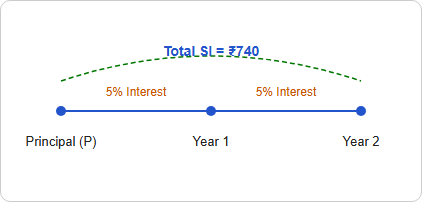
What sum of money (in ₹) will yield ₹740 as simple interest in 2 years at 5% per annum?

  1. ((a))

    6900

  2. ((b))

    7400

  3. ((c))

    7600

  4. ((d))

    7800

Show Answer
Answer: ((b))

7400

Shortcut Trick

Effective Simple Interest Rate = Rate × Time = 5% × 2 = 10%.

Given that 10% of the Principal = ₹740.

So, 100% (the total Sum) = 740 × 10 = ₹7400.

∴ The correct answer is ₹7400.

Alternate Method

Given:

Simple Interest (SI) = ₹740

Time (T) = 2 years

Rate (R) = 5% per annum

Formula Used:

⇒ SI = (P × R × T) ÷ 100
Calculations:

⇒ 740 = (P × 5 × 2) ÷ 100

⇒ 740 = (P × 10) ÷ 100

⇒ 740 = P ÷ 10

⇒ P = 740 × 10

⇒ P = 7400

∴ The correct answer is ₹7400.

Additional Information

Simple Interest (SI) Properties

Simple interest is calculated only on the Principal amount. For any period, the interest remains constant if the rate and principal are unchanged.

Total Amount Formula

The total Amount (A) received after the time period is given by A = Principal (P) + Simple Interest (SI).

Rate and Time relationship

If the Rate is doubled and the Time is halved, the Simple Interest remains the same as the product R × T remains constant.
2

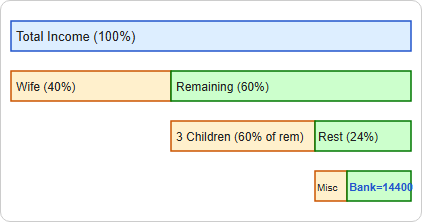
A person gave 40% of his income to his wife to look after household expenditure. He gave 20% of the remaining amount to each of his two sons and one daughter. One - third of the amount now left was spent on miscellaneous items and the remaining amount ���14,400 was deposited in the bank. Find his income.

  1. ((a))

    ₹96,000

  2. ((b))

    ₹1,10,000

  3. ((c))

    ₹90,000

  4. ((d))

    ₹1,00,000

Show Answer
Answer: ((c))

₹90,000

Shortcut Trick

Let total Income = 100%.

After Wife (40%), Remaining = 60%.

Three Children get 3 × 20% = 60% of the remaining amount.

Amount left after children = 40% of 60% = 24%.

Bank deposit (after 1/3 Miscellaneous) = 2/3 × 24% = 16%.

16% = ₹14,400 ⇒ 1% = ₹900 ⇒ 100% = ₹90,000.

∴ The correct answer is ₹90,000.

Alternate Method

Given:

Wife share = 40% of Income

Children share = 20% each (Total 3 children) of Remaining

Miscellaneous = 1/3 of the Balance

Bank Deposit = ₹14,400

Calculations:

⇒ Let total income be x.

⇒ Amount left after Wife = x − 0.40x = 0.60x

⇒ Total share of 3 children = 3 × 20% = 60% of the Remaining amount.

⇒ Amount left after Children = 0.60x − (60% of 0.60x)

⇒ Amount left = 0.60x − 0.36x = 0.24x

⇒ Expenditure on Miscellaneous = 1/3 × 0.24x = 0.08x

⇒ Remaining amount (Bank) = 0.24x − 0.08x = 0.16x

⇒ According to the question: 0.16x = 14,400

⇒ x = 14,400 ÷ 0.16

⇒ x = 1,440,000 ÷ 16

⇒ x = 90,000

∴ The correct answer is ₹90,000.

Additional Information

Percentage of Remaining Amount

When a percentage is taken from the remaining amount, the new base is the previous remainder. Total reduction = (1 − p1)(1 − p2)...(1 − pn) × Original Value.

Successive Percentage Formula

For two successive changes of a% and b%, the effective change is [a + b + (ab/100)]%. In case of expenditure, use negative signs for decreases.

Base Shift Logic

Always identify whether the percentage is applied to the Total Income or the Remaining Balance to avoid calculation errors in distribution problems.

3

Three inlet pipes A, B, and C can fill a tank in 8 hours, 12 hours, and 24 hours, respectively. First, pipe A is opened alone for 1 hour. Then pipe B is opened, and both A and B run together for the next 2 hours. After that, pipe C is also opened, and all three pipes run together until the tank is full. How much total time, from the start, will it take to fill the tank?

  1. ((a))

    4 hour 40 minutes

  2. ((b))

    4 hour 30 minutes

  3. ((c))

    4 hour 20 minutes

  4. ((d))

    4 hour 50 minutes

Show Answer
Answer: ((d))

4 hour 50 minutes

Shortcut Trick

Total tank capacity (LCM of 8, 12, 24) = 24 units.

Efficiencies: Pipe A = 3, Pipe B = 2, Pipe C = 1.

Work in first 3 hours = (1 × 3) + (2 × 5) = 13 units.

Remaining work = 24 − 13 = 11 units.

Time for remaining part = 11 ÷ (3 + 2 + 1) = 1 hr 50 min.

∴ The correct answer is 4 hr 50 min.

Alternate Method

Given:

Time taken by Pipe A = 8 hr

Time taken by Pipe B = 12 hr

Time taken by Pipe C = 24 hr

PipesHoursTotal WorkEfficiency
Pipe A8 hr24 units3
Pipe B12 hr2
Pipe C24 hr1

Calculations:

⇒ Work done by Pipe A in the first 1 hr = 3 × 1 = 3 units.

⇒ Combined efficiency of Pipe A and Pipe B = 3 + 2 = 5 units/hr.

⇒ Work done by A and B in the next 2 hr = 5 × 2 = 10 units.

⇒ Total work done so far = 3 + 10 = 13 units.

⇒ Remaining work to be filled = 24 − 13 = 11 units.

⇒ Combined efficiency of A, B, and C = 3 + 2 + 1 = 6 units/hr.

⇒ Time taken to fill remaining part = 11 ÷ 6 hours = 1 hour + (5/6 × 60) min = 1 hr 50 min.

Total time from start = 1 hr + 2 hr + 1 hr 50 min = 4 hr 50 min.

∴ The correct answer is 4 hr 50 min.

Additional Information

Net Efficiency in Pipes & Cisterns

When multiple pipes operate together, the total efficiency is the algebraic sum of their individual efficiencies (positive for inlet pipes, negative for outlet pipes).

Inverse Relation of Time and Efficiency

The time taken to complete a task is inversely proportional to the efficiency of the pipe. Efficiency = Total Work ÷ Time.

Unit Conversion

To convert hours into minutes, multiply the fractional part of the hour by 60 (e.g., 5/6 hr = 5/6 × 60 = 50 minutes).

4

If a=0.1125, then find the value of 100[1+2(3a)+9a24a]. \text{If } a = 0.1125, \text{ then find the value of } 100 \left[ \sqrt{1 + 2(3a) + 9a^2} - 4a \right] .

  1. ((a))

    88.75

  2. ((b))

    87.75

  3. ((c))

    85.57

  4. ((d))

    87.57

Show Answer
Answer: ((a))

88.75

Shortcut Trick

Recognize the Perfect Square identity: 1 + 6a + 9a2 = (1 + 3a)2.

The square root simplifies to (1 + 3a), reducing the expression to 100 × (1 + 3a − 4a).

This simplifies to 100 × (1 − a).

Substitute a = 0.1125: 100 × (1 − 0.1125) = 100 × 0.8875 = 88.75.

∴ The correct answer is 88.75.

Alternate Method

Given: a = 0.1125

Formula Used: (x + y)2 = x2 + 2xy + y2

⇒ The term inside the square root is 1 + 2(3a) + 9a2.

⇒ 1 + 6a + (3a)2 = (1)2 + 2(1)(3a) + (3a)2 = (1 + 3a)2.

⇒ √(1 + 3a)2 = 1 + 3a.

⇒ The full expression is 100 × [ (1 + 3a) − 4a ].

⇒ 100 × [ 1 − a ].

⇒ 100 × [ 1 − 0.1125 ].

⇒ 100 × 0.8875 = 88.75.

∴ The correct answer is 88.75.

Additional Information

Algebraic Identities

Basic identities like (a + b)2 = a2 + 2ab + b2 and (a − b)2 = a2 − 2ab + b2 are frequently used to simplify radicals.

Square Root Property

For any real number x, √x2 = |x|. In this problem, 1 + 3a is positive since a = 0.1125, so √(1 + 3a)2 = 1 + 3a.

Decimal Calculations

When multiplying a decimal by powers of 10 (10, 100, 1000), move the decimal point to the right by the number of zeros present.

5

The value of 113 - 83 is:

  1. ((a))

    759

  2. ((b))

    806

  3. ((c))

    819

  4. ((d))

    866

Show Answer
Answer: ((c))

819

Shortcut Trick

Check the unit digit of the expression 113 − 83.

Unit digit of 113 = 13 = 1.

Unit digit of 83 = 512 → 2.

Unit digit of the result = 1 − 2 ⇒ (11 − 2) = 9.

Among the given options, only 819 ends with the digit 9.

∴ The correct answer is 819.

Alternate Method

Given:

Expression = 113 − 83

Formula Used:

Direct Cube Calculation or Algebraic identity: a3 − b3 = (a − b)(a2 + ab + b2)

Calculations:

⇒ 113 = 11 × 11 × 11 = 1331

⇒ 83 = 8 × 8 × 8 = 512

⇒ Difference = 1331 − 512

⇒ Result = 819

Using Identity:

⇒ (11 − 8)(112 + 11 × 8 + 82)

⇒ 3 × (121 + 88 + 64)

⇒ 3 × 273 = 819

∴ The correct answer is 819.

Additional Information

Difference of Cubes Identity

The expression a3 − b3 is always divisible by (a − b). The formula is: a3 − b3 = (a − b)(a2 + ab + b2).

Sum of Cubes Identity

The expression a3 + b3 is always divisible by (a + b). The formula is: a3 + b3 = (a + b)(a2 − ab + b2).

Important Cubes for Exams

Memorizing cubes up to 15 is helpful: 113 = 1331, 123 = 1728, 133 = 2197, 143 = 2744, 153 = 3375.

6

Simplify : (1524÷152)÷(18×163+18)+211÷1923 of 2311 \text{Simplify : } \left( \frac{15}{24} \div \frac{15}{2} \right) \div \left( \frac{1}{8} \times \frac{16}{3} + \frac{1}{8} \right) + \frac{2}{11} \div \frac{19}{23} \text{ of } \frac{23}{11}

  1. ((a))

    424 -\frac{4}{24}

  2. ((b))

    419 \frac{4}{19}

  3. ((c))

    523 -\frac{5}{23}

  4. ((d))

    718 \frac{7}{18}

Show Answer
Answer: ((b))

419 \frac{4}{19}

Shortcut Trick

Simplify the expression using VBODMAS by breaking it into two major parts.

Part 1: ((15/24) × (2/15)) ÷ (2/3 + 1/8) ⇒ (1/12) ÷ (19/24) = 2/19.

Part 2: (2/11) ÷ (19/11) [after solving of operator] ⇒ 2/19.

Total = 2/19 + 2/19 = 4/19.

∴ The correct answer is 4/19.

Alternate Method

Given: ((15/24) ÷ (15/2)) ÷ ((1/8) × (16/3) + (1/8)) + (2/11) ÷ (19/23) of (23/11)

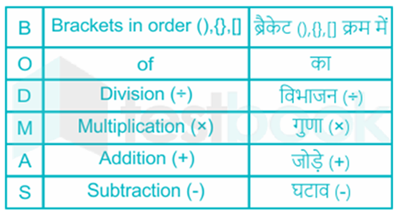
Formula Used: Apply VBODMAS rule (Viniculum, Bracket, Of, Division, Multiplication, Addition, Subtraction).

⇒ First, simplify the inner brackets:

⇒ ((15/24) × (2/15)) ÷ (16/24 + 1/8) + (2/11) ÷ (19/23 × 23/11)

⇒ (2/24) ÷ (2/3 + 1/8) + (2/11) ÷ (19/11)

⇒ (1/12) ÷ (16+3)/24 + (2/11 × 11/19)

⇒ (1/12) ÷ (19/24) + 2/19

⇒ (1/12 × 24/19) + 2/19

⇒ 2/19 + 2/19 = 4/19

∴ The correct answer is 4/19.

Additional Information

VBODMAS Rule

It defines the order of operations: Viniculum (Bar), Brackets (), Of (×), Division (÷), Multiplication (×), Addition (+), and Subtraction (−).

Division of Fractions

To divide two fractions, multiply the first fraction by the reciprocal of the second fraction (a/b ÷ c/d = a/b × d/c).

Of Operator Precedence

In mathematical expressions, the 'of' operator is treated as multiplication but must be solved before division and general multiplication.

7

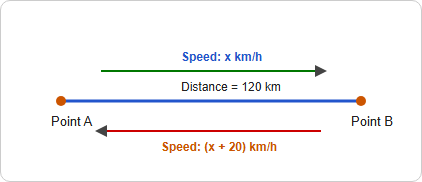
A car travels 120 km at an unknown speed x km/h and then returns at (x + 20) km/h. The average speed for the whole journey is 60 km/h. Find the value of x. (Round to one decimal place.)

  1. ((a))

    50.2

  2. ((b))

    52.4

  3. ((c))

    51.6

  4. ((d))

    54.5

Show Answer
Answer: ((c))

51.6

Shortcut Trick

When two equal distances are covered at speeds s1 and s2, the average speed is given by: 2 × s1 × s2 ÷ (s1 + s2).

Given: s1 = x, s2 = x + 20, and Average Speed = 60 km/h.

⇒ 60 = (2 × x × (x + 20)) ÷ (x + x + 20)

⇒ 30 = (x2 + 20x) ÷ (2x + 20) ⇒ 60x + 600 = x2 + 20x

⇒ x2 − 40x − 600 = 0. Solving via formula: x = (40 + √4000) ÷ 2 ≈ 51.6.

∴ The correct answer is 51.6 km/h.

Alternate Method

Given:

Distance (D) = 120 km | Forward Speed = x km/h | Return Speed = (x + 20) km/h | Average Speed = 60 km/h.

Formula:

Average Speed = Total Distance ÷ Total Time

Calculations:

⇒ Total Distance = 120 + 120 = 240 km

⇒ Total Time = (120 ÷ x) + (120 ÷ (x + 20))

⇒ 60 = 240 ÷ [(120 × (x + 20) + 120 × x) ÷ (x × (x + 20))]

⇒ 60 = 240 × x(x + 20) ÷ (120x + 2400 + 120x)

⇒ 60 = 240 × (x2 + 20x) ÷ (240x + 2400)

⇒ 1 = 4 × (x2 + 20x) ÷ 240(x + 10)

⇒ 60(x + 10) = x2 + 20x

⇒ 60x + 600 = x2 + 20x

⇒ x2 − 40x − 600 = 0

⇒ x = [40 ± √((−40)2 − 4 × 1 × (−600))] ÷ (2 × 1)

⇒ x = [40 ± √(1600 + 2400)] ÷ 2

⇒ x = (40 ± √4000) ÷ 2

⇒ x = (40 + 63.245) ÷ 2 ≈ 51.6225

∴ The correct answer is 51.6 km/h.

Additional Information

Average Speed for Equal Distance

When a journey is divided into 'n' equal distances with speeds v1, v2...vn, the average speed is the Harmonic Mean of the speeds.

Relative Speed

If two objects move in the same direction, relative speed is s1 − s2. If they move in opposite directions, relative speed is s1 + s2.

Quadratic Formula

For an equation ax2 + bx + c = 0, the roots are x = (−b ± √(b2 − 4ac)) ÷ 2a. The term b2 − 4ac is called the Discriminant.
8

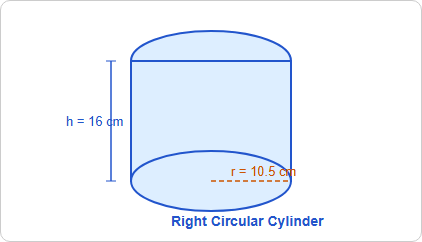
The curved surface area of a right circular cylinder is 1056 cm² and its height is 16 cm. Find the total surface area of the cylinder.

(Use π=227) (\text{Use } \pi = \frac{22}{7})

  1. ((a))

    1479 cm2

  2. ((b))

    1794 cm2

  3. ((c))

    1974 cm2

  4. ((d))

    1749 cm2

Show Answer
Answer: ((d))

1749 cm2

Shortcut Trick

Radius (r) = CSA ÷ (2 × π × h) = 1056 ÷ (2 × 22/7 × 16)

r = (1056 × 7) ÷ 704 = 1.5 × 7 = 10.5 cm

TSA = CSA + 2 × π × r2 = 1056 + 2 × 22/7 × 10.5 × 10.5

TSA = 1056 + 693 = 1749 cm2

∴ The correct answer is 1749 cm2.

Alternate Method

Given:

Curved Surface Area (CSA) of cylinder = 1056 cm2

Height (h) of cylinder = 16 cm

Formula Used:

CSA = 2πrh

Total Surface Area (TSA) = 2πr(h + r)

Calculations:

⇒ 2 × 22/7 × r × 16 = 1056

⇒ (704/7) × r = 1056

⇒ r = (1056 × 7) ÷ 704

r = 1.5 × 7 = 10.5 cm

⇒ TSA = 2 × 22/7 × 10.5 × (16 + 10.5)

⇒ TSA = 44 × 1.5 × 26.5

⇒ TSA = 66 × 26.5

TSA = 1749 cm2

∴ The correct answer is 1749 cm2.

Additional Information

Volume of a Cylinder

The space occupied by a cylinder is calculated as V = πr2h.

Hollow Cylinder

For a hollow cylinder with external radius R and internal radius r, TSA = 2π(R + r)(h + R − r).

Surface Area Ratio

The ratio of TSA to CSA for any cylinder is (h + r) ÷ h.

9

Which of the following numbers is divisible by 11?

  1. ((a))

    512579

  2. ((b))

    502589

  3. ((c))

    502579

  4. ((d))

    513589

Show Answer
Answer: ((c))

502579

Shortcut Trick

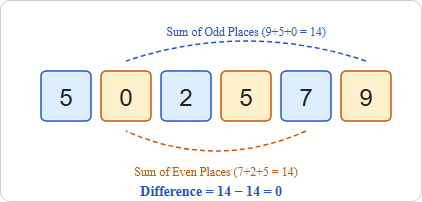
Check the divisibility rule of 11: Sum of digits at odd places − Sum of digits at even places = 0 or a multiple of 11.

For 502579: (9 + 5 + 0) − (7 + 2 + 5) = 14 − 14 = 0.

Since the difference is 0, the number is divisible by 11.

∴ The correct answer is 502579.

Alternate Method

Given: Four numbers to test for divisibility by 11.

Formula Used: A number is divisible by 11 if |(Sum of digits at odd places) − (Sum of digits at even places)| is 0 or 11k.

Checking each option:

⇒ Option 1 (512579): (9 + 5 + 1) − (7 + 2 + 5) = 15 − 14 = 1 (Not divisible by 11)

⇒ Option 2 (502589): (9 + 5 + 0) − (8 + 2 + 5) = 14 − 15 = −1 (Not divisible by 11)

⇒ Option 3 (502579): (9 + 5 + 0) − (7 + 2 + 5) = 14 − 14 = 0 (Divisible by 11)

⇒ Option 4 (513589): (9 + 5 + 1) − (8 + 3 + 5) = 15 − 16 = −1 (Not divisible by 11)

∴ The correct answer is 502579.

Additional Information

Divisibility Rule of 3

A number is divisible by 3 if the sum of all its digits is divisible by 3.

Divisibility Rule of 9

A number is divisible by 9 if the sum of its digits is a multiple of 9.

Divisibility Rule of 7

Double the last digit and subtract it from the remaining number. If the result is divisible by 7, the original number is also divisible by 7.

Divisibility Rule of 11 (Alternative)

Subtract the last digit from the number formed by the remaining digits. Repeat if necessary. If the result is 0 or divisible by 11, the original number is divisible by 11.

10

What is the mode of the following data?

40, 53, 47, 55, 42, 46, 50, 42, 54, 49, 40, 54, 43, 40, 44, 55, 49, 53

  1. ((a))

    53

  2. ((b))

    49

  3. ((c))

    40

  4. ((d))

    55

Show Answer
Answer: ((c))

40

Shortcut Trick

Mode is defined as the most frequent observation in a data set.

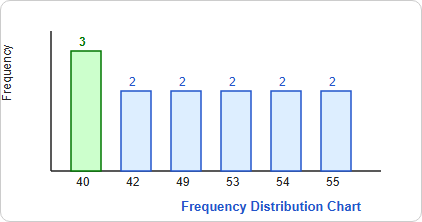
Frequency of 40 → 3 times (Highest)

Frequency of 42, 49, 53, 54, 55 → 2 times each

Frequency of 43, 44, 46, 47, 50 → 1 time each

Since 40 appears most frequently, it is the mode.

∴ The correct answer is 40.

Alternate Method

Given: Observations = 40, 53, 47, 55, 42, 46, 50, 42, 54, 49, 40, 54, 43, 40, 44, 55, 49, 53

Formula: Mode = Value with the maximum frequency.

To find the mode, we construct a frequency table:

⇒ Observation 40: Count = 3

⇒ Observation 42: Count = 2

⇒ Observation 49: Count = 2

⇒ Observation 53: Count = 2

⇒ Observation 54: Count = 2

⇒ Observation 55: Count = 2

⇒ Others (43, 44, 46, 47, 50): Count = 1 each

⇒ Maximum Frequency = 3

⇒ Corresponding value = 40

∴ The correct answer is 40.

Additional Information

Empirical Relationship

For a moderately skewed distribution, the relationship is: Mode = 3 × Median − 2 × Mean.

Bimodal and Multimodal Data

If two or more observations have the same maximum frequency, the data is called bimodal or multimodal.

Central Tendency

Mean, Median, and Mode are three different measures to find the central value of a data set.

11

A sum of money amounts to ₹52,020 in 6 months at the rate of 8% per annum when the interest is compounded quarterly. Find the sum.

  1. ((a))

    ₹51,000

  2. ((b))

    ₹50,000

  3. ((c))

    ₹48,000

  4. ((d))

    ₹49,000

Show Answer
Answer: ((b))

₹50,000

Shortcut Trick

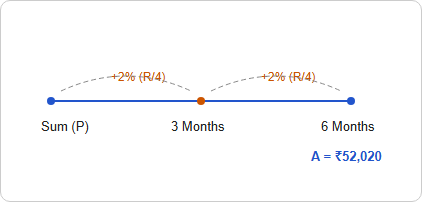
For quarterly compounding, the rate becomes 8% ÷ 4 = 2% per quarter.

Time for 6 months = 2 quarters. Effective interest rate for 2 periods = 2 + 2 + (2 × 2)/100 = 4.04%.

Total Amount percentage = 100% + 4.04% = 104.04%.

Given, 104.04% → ₹52,020

⇒ 1% → ₹500 ⇒ 100% → ₹50,000.

∴ The correct answer is ₹50,000.

Alternate Method

Given:

Amount (A) = ₹52,020

Rate (R) = 8% per annum

Time (T) = 6 months

Formula Used:

For quarterly compounding: A = P(1 + r/400)4n, where n is in years.

Calculations:

⇒ Quarterly rate (r) = 8% ÷ 4 = 2% per quarter

⇒ Number of quarters (n) = 6 months ÷ 3 months = 2

⇒ 52020 = P × (1 + 2/100)2

⇒ 52020 = P × (102/100)2

⇒ 52020 = P × (51/50) × (51/50)

⇒ 52020 = P × (2601 / 2500)

⇒ P = (52020 × 2500) ÷ 2601

⇒ P = 20 × 2500

⇒ P = 50000

∴ The correct answer is ₹50,000.

Additional Information

Compounding Frequencies

If compounded half-yearly, rate = R/2 and time = 2T. If compounded quarterly, rate = R/4 and time = 4T.

Effective Rate of Interest

For two successive periods with rate r%, the effective rate is [r + r + (r × r)/100]%.

Compound Interest vs Simple Interest

For the first compounding period, Simple Interest and Compound Interest are always equal on the same principal and rate.

12

One pipe can fill the tank in 18 min, while another pipe can empty the completely filled tank in 72 min. If both the pipes are operated together on empty tank, how long (in min) will it take to fill two-third of the tank?

  1. ((a))

    64

  2. ((b))

    48

  3. ((c))

    16

  4. ((d))

    32

Show Answer
Answer: ((c))

16

Shortcut Trick Net efficiency = (1/18 − 1/72) = 3/72 = 1/24 per minute. Time to fill the full tank = 24 minutes. Time to fill 2/3 of the tank = 2/3 × 24 = 16 minutes. ∴ The correct answer is 16 min. Alternate Method Given: Filling Pipe time = 18 min Emptying Pipe time = 72 min Formula Used: Total Work = LCM of individual times Efficiency = Total Work ÷ Time

Pipe Time (min) Total Work (LCM) Efficiency (units/min)

Pipe 1 (Fill) 18 72 units 4

Pipe 2 (Empty) 72 −1

Calculations: ⇒ Total capacity of the tank = 72 units ⇒ Combined efficiency of both pipes = 4 − 1 = 3 units/min ⇒ Target to fill two-third of the tank = 2/3 × 72 = 48 units ⇒ Time taken = Target Capacity ÷ Combined Efficiency ⇒ Time taken = 48 ÷ 3 = 16 minutes ∴ The correct answer is 16 min. Additional Information Pipes and Cisterns Basics Filling pipes have positive efficiency, while emptying pipes (leakage) have negative efficiency. Net Efficiency Rule If pipe A fills in x hours and pipe B empties in y hours (y > x), net work done in 1 hour = (1/x − 1/y). Time and Work Relation Total Work = Efficiency × Time. To find time for a fraction of work, multiply Total Work by that fraction before dividing by efficiency.

13

The mean of a data is 41 and its median is 98. The mode (using empirical relation) of the data is:

  1. ((a))

    240

  2. ((b))

    128

  3. ((c))

    212

  4. ((d))

    209

Show Answer
Answer: ((c))

212

Shortcut Trick Use the Empirical Formula: Mode = 3 × Median − 2 × Mean. Substitute the given values: Mean = 41 and Median = 98. Mode = 3(98) − 2(41) = 294 − 82 = 212. ∴ The correct answer is 212.

Alternate Method Given: ⇒ Arithmetic Mean of the data = 41 ⇒ Median of the data = 98 Formula Used: ⇒ Mode = 3 × Median − 2 × Mean

Calculations: ⇒ Mode = (3 × 98) − (2 × 41) ⇒ Mode = 294 − 82 ⇒ Mode = 212 ∴ The correct answer is 212.

Additional Information Symmetrical Distribution In a perfectly symmetrical distribution (like a normal curve), the Mean, Median, and Mode are all equal: Mean = Median = Mode. Skewed Distribution For moderately skewed data, the empirical formula holds true. If Mean > Median > Mode, the data is positively skewed; if Mode > Median > Mean, it is negatively skewed. Karl Pearson Coefficient Skewness can also be calculated as: Skewness = (Mean − Mode) ÷ Standard Deviation.

14

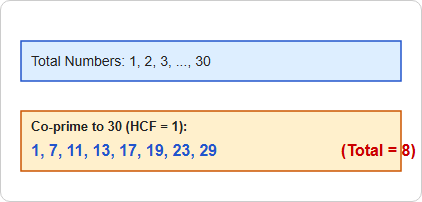
How many positive integers less than 30 are co-prime to 30?

  1. ((a))

    7

  2. ((b))

    5

  3. ((c))

    8

  4. ((d))

    6

Show Answer
Answer: ((c))

8

Shortcut Trick

To find the number of positive integers less than n that are co-prime to n, we use Euler's Totient Function φ(n).

Prime factorize 30: 30 = 21 × 31 × 51.

φ(30) = 30 × (1 − 1/2) × (1 − 1/3) × (1 − 1/5)

φ(30) = 30 × (1/2) × (2/3) × (4/5) = 8.

∴ The correct answer is 8.

Alternate Method

Given: Number = 30.

Formula Used: Two numbers are co-prime if their Highest Common Factor (HCF) is 1. We identify numbers less than 30 that are not divisible by the prime factors of 30 (2, 3, and 5).

Calculations:

⇒ Prime factors of 30 are 2, 3, and 5.

⇒ Numbers to exclude are multiples of 2, 3, or 5.

⇒ Multiples of 2 (up to 29): 2, 4, 6, 8, 10, 12, 14, 16, 18, 20, 22, 24, 26, 28 (14 numbers).

⇒ Multiples of 3 (not excluded): 3, 9, 15, 21, 27 (5 numbers).

⇒ Multiples of 5 (not excluded): 5, 25 (2 numbers).

⇒ Total excluded = 14 + 5 + 2 + (the number 30 itself is not less than 30, but we only check numbers < 30) = 21 numbers.

⇒ Total co-prime numbers = (30 − 1) − 21 = 8.

⇒ The set of co-prime numbers is: {1, 7, 11, 13, 17, 19, 23, 29}.

∴ The correct answer is 8.

Additional Information

Euler's Totient Function

The function φ(n) counts the positive integers up to n that are relatively prime to n. For a prime p, φ(p) = p − 1.

Co-prime Numbers

Two integers a and b are said to be co-prime or relatively prime if their Greatest Common Divisor (GCD) or HCF is 1.

General Formula for φ(n)

If n = p1a × p2b × p3c, then φ(n) = n × (1 − 1/p1) × (1 − 1/p2) × (1 − 1/p3).

15

If sinθ+cosθsinθcosθ=11, then the value of 25tan2θ336cot2θ+21 is: \text{If } \frac{\sin\theta + \cos\theta}{\sin\theta - \cos\theta} = 11, \text{ then the value of } \frac{25 \tan^{2} \theta - 3}{36 \cot^{2} \theta + 2} - 1 \text{ is}:

  1. ((a))

    29 \frac{2}{9}

  2. ((b))

    1

  3. ((c))

    119 \frac{11}{9}

  4. ((d))

    79 \frac{7}{9}

Show Answer
Answer: ((a))

29 \frac{2}{9}

Shortcut Trick

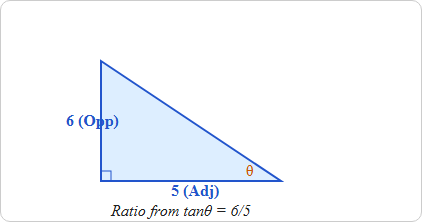
Using Componendo and Dividendo on (sinθ + cosθ)/(sinθ − cosθ) = 11/1, we get tanθ = (11 + 1)/(11 − 1) = 6/5.

Thus, tan2θ = 36/25 and cot2θ = 25/36.

Substitute: (25 × 36/25 − 3) / (36 × 25/36 + 2) − 1 = (36 − 3) / (25 + 2) − 1 = 33/27 − 1.

Final Value = 11/9 − 1 = 2/9.

∴ The correct answer is 2/9.

Alternate Method

Given: (sinθ + cosθ) / (sinθ − cosθ) = 11

Formula Used: tanθ = sinθ/cosθ | cotθ = 1/tanθ

⇒ Divide numerator and denominator of the given equation by cosθ:

⇒ (tanθ + 1) / (tanθ − 1) = 11

⇒ tanθ + 1 = 11(tanθ − 1)

⇒ tanθ + 1 = 11tanθ − 11

⇒ 12 = 10tanθ

tanθ = 12/10 = 6/5

tan2θ = 36/25 and cot2θ = 25/36

⇒ Required Value = (25 × 36/25 − 3) / (36 × 25/36 + 2) − 1

⇒ Value = (36 − 3) / (25 + 2) − 1

⇒ Value = 33/27 − 1

⇒ Value = 11/9 − 1 = 2/9

∴ The correct answer is 2/9.

Additional Information

Componendo and Dividendo Rule

If a/b = c/d, then (a + b) / (a − b) = (c + d) / (c − d). This is useful for solving trigonometric ratios involving sums and differences.

Reciprocal Trigonometric Relations

The cotangent function is the reciprocal of the tangent function, i.e., cotθ = 1/tanθ and cot2θ = 1/tan2θ.

Basic Identity

The relation between tanθ, sinθ, and cosθ is tanθ = sinθ / cosθ. Dividing a linear sine-cosine equation by cosθ often converts it into a tangent equation.

16

Which of the following numbers is not divisible by both 94 and 68?

  1. ((a))

    3196

  2. ((b))

    6392

  3. ((c))

    7990

  4. ((d))

    9588

Show Answer
Answer: ((c))

7990

Shortcut Trick

Find the LCM of 94 and 68 to determine the smallest common multiple.

94 = 2 × 47 | 68 = 4 × 17

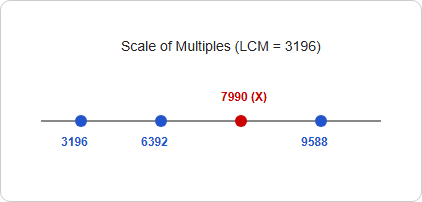
LCM = 4 × 17 × 47 = 3196

Check options: 3196 × 1 = 3196, 3196 × 2 = 6392, 3196 × 3 = 9588.

The number 7990 is not a multiple of 3196.

∴ The correct answer is 7990.

Alternate Method

Given: Divisibility check for 94 and 68.

Formula Used: A number is divisible by both a and b if it is a multiple of their LCM.

⇒ Prime factors of 94 = 21 × 471

⇒ Prime factors of 68 = 22 × 171

LCM (94, 68) = 22 × 171 × 471 = 4 × 17 × 47 = 3196

⇒ Check 3196: 3196 ÷ 3196 = 1 (Divisible)

⇒ Check 6392: 6392 ÷ 3196 = 2 (Divisible)

⇒ Check 9588: 9588 ÷ 3196 = 3 (Divisible)

⇒ Check 7990: 7990 ÷ 3196 = 2.5 (Not Divisible)

∴ The correct answer is 7990.

Additional Information

LCM (Least Common Multiple)

The smallest positive integer that is divisible by each of the given numbers. LCM = Product of the highest powers of all prime factors involved.

Relationship between HCF and LCM

For any two numbers a and b, the product of the numbers is equal to the product of their HCF and LCM: a × b = HCF(a, b) × LCM(a, b).

Divisibility Test

To check if a number is divisible by 94 and 68, it must be divisible by their common prime factors and the remaining co-prime factors (2, 2, 17, and 47).

17

A shopkeeper sold a book at a loss of 7%. If the selling price had been increased by ₹120, there would have been a gain of 17%. What was the cost price (in ₹) of the book?

  1. ((a))

    495

  2. ((b))

    505

  3. ((c))

    510

  4. ((d))

    500

Show Answer
Answer: ((d))

500

Shortcut Trick

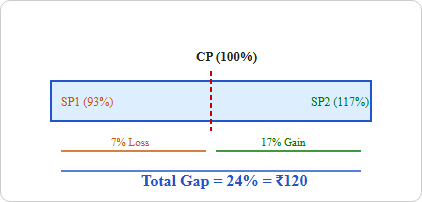
Total percentage difference = 17% (gain) + 7% (loss) = 24%.

This 24% change is caused by the ₹120 increase in Selling Price.

24% of Cost Price = ₹120

100% of Cost Price = (120 ÷ 24) × 100 = 5 × 100 = ₹500.

∴ The correct answer is ₹500.

Alternate Method

Given:

Initial Loss Percentage = 7%

New Gain Percentage = 17%

Difference in Selling Price (SP) = ₹120

Formula Used:

CP = (Increase in SP × 100) ÷ (Total % Difference)

Calculations:

⇒ Let the Cost Price (CP) of the book be 100 units.

⇒ Case 1: Sold at 7% loss, so SP1 = 100 − 7 = 93 units.

⇒ Case 2: Sold at 17% gain, so SP2 = 100 + 17 = 117 units.

⇒ Difference between the two selling prices = 117 − 93 = 24 units.

⇒ According to the question, 24 units = ₹120.

⇒ 1 unit = 120 ÷ 24 = ₹5.

Cost Price = 100 units = 100 × 5 = ₹500.

∴ The correct answer is ₹500.

Additional Information

Cost Price and Selling Price

Profit occurs when SP > CP (Profit = SP − CP) and loss occurs when CP > SP (Loss = CP − SP).

Marked Price and Discount

Marked Price (MP) is the price printed on an item. Discount is always calculated as a percentage of the MP.

Effective Gain/Loss

When moving from a loss state to a gain state, the total percentage change is the sum of the absolute values of the loss % and gain %.

18

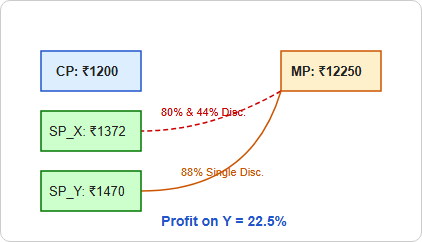
A dealer buys two articles X and Y for ₹1,200 each. He marks each of them at the same price. He sells X by giving two successive discounts of 80% and 44% and still earns ₹172 as profit. If he sells Y at a single discount of 88%, then what is the profit percentage on Y?

  1. ((a))

    21%

  2. ((b))

    21.5%

  3. ((c))

    22.5%

  4. ((d))

    22%

Show Answer
Answer: ((c))

22.5%

Shortcut Trick

Cost Price (CP) of both articles is ₹1,200.

Selling Price of X (SPX) = 1200 + 172 = ₹1,372.

Ratio of Multipliers for SP: X (0.20 × 0.56 = 0.112) and Y (1 − 0.88 = 0.12).

Ratio SPX : SPY = 112 : 120 = 14 : 15.

14 units = ₹1,372 ⇒ 15 units (SPY) = (1372 ÷ 14) × 15 = 98 × 15 = ₹1,470.

Profit on Y = 1470 − 1200 = ₹270 ⇒ Profit % = (270 ÷ 1200) × 100 = 22.5%.

∴ The correct answer is 22.5%.

Alternate Method

Given:

Cost Price (CP) = ₹1,200 for both X and Y.

Profit on X = ₹172.

Marked Price (MP) is same for both.

Step 1: Calculate SP of X

⇒ SPX = CP + ProfitX

⇒ SPX = 1200 + 172 = ₹1,372

Step 2: Calculate MP using successive discounts on X

⇒ Net Multiplier = (1 − 0.80) × (1 − 0.44) = 0.20 × 0.56 = 0.112

⇒ SPX = MP × 0.112

⇒ 1372 = MP × 0.112

⇒ MP = 1372 ÷ 0.112 = ₹12,250

Step 3: Calculate SP of Y

⇒ Discount on Y = 88%

⇒ SPY = MP × (1 − 0.88) = 12250 × 0.12

⇒ SPY = ₹1,470

Step 4: Calculate Profit Percentage on Y

⇒ ProfitY = SPY − CP = 1470 − 1200 = ₹270

⇒ Profit % = (ProfitY ÷ CP) × 100

⇒ Profit % = (270 ÷ 1200) × 100 = 22.5%

∴ The correct answer is 22.5%.

Additional Information

Successive Discounts Formula

For two successive discounts a% and b%, the equivalent single discount is [a + b − (a × b)/100]%.

Mark-up and Profit Relation

The relationship between Mark-up %, Discount %, and Profit % is: (100 + P%) = (100 + M%) × (100 − D%)/100.

Effective Multiplier Method

To find the final value after multiple changes, multiply the initial value by (1 − d1/100) × (1 − d2/100) ... etc.

19

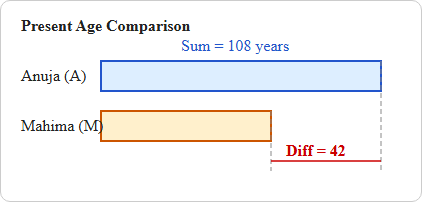
The difference between the ages of Anuja and Mahima is 42 years. Five years ago from now, the sum of their ages was 98 years. If Anuja is older than Mahima, find Mahima's present age (in years).

  1. ((a))

    27

  2. ((b))

    28

  3. ((c))

    29

  4. ((d))

    33

Show Answer
Answer: ((d))

33

Shortcut Trick

Present Sum of ages = Sum 5 years ago + (2 × 5) = 98 + 10 = 108 years.

Age of the younger person (Mahima) = (Present Sum − Difference) ÷ 2

Mahima's age = (108 − 42) ÷ 2 = 66 ÷ 2 = 33 years.

∴ The correct answer is 33 years.

Alternate Method

Given:

Difference between Anuja (A) and Mahima (M) = 42 years

Sum of ages 5 years ago = 98 years

Formula Used:

Present Sum = Past Sum + (Number of people × Years passed)

Calculations:

⇒ Sum of their present ages = 98 + 5 + 5 = 108 years.

⇒ Let Mahima's age be M and Anuja's age be A.

⇒ A − M = 42 ---(Equation 1)

⇒ A + M = 108 ---(Equation 2)

⇒ Subtracting (1) from (2): (A + M) − (A − M) = 108 − 42

⇒ 2M = 66

⇒ M = 33 years.

∴ The correct answer is 33 years.

Additional Information

Constant Difference Property

The difference between the ages of two people remains constant at any point in time (past, present, or future).

Sum of Ages Rule

If the sum of ages of 'n' persons is S now, then 't' years ago, the sum was S − (n × t), and 't' years later, it will be S + (n × t).

Ratio and Age

If the ratio of ages is given, use the constant difference to find the value of one ratio unit: 1 Unit = Difference ÷ (Difference in ratio parts).

20

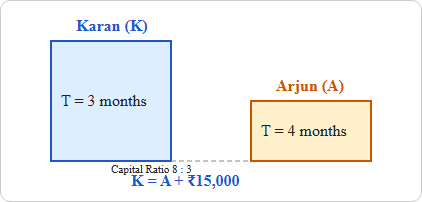
Karan and Arjun start a business. Karan invests ₹15,000 more than Arjun. Karan invests for 3 months, and Arjun invests for 4 months. At the end of the business, the total profit is ₹6,060, and Karan’s share is ₹2,020 more than Arjun’s share. Find the capital contributed by Karan.

  1. ((a))

    ₹24,093

  2. ((b))

    ₹23,885

  3. ((c))

    ₹24,000

  4. ((d))

    ₹24,087

Show Answer
Answer: ((c))

₹24,000

Shortcut Trick

Profit Ratio (Karan : Arjun) = (6060 + 2020) : (6060 − 2020) = 8080 : 4040 = 2 : 1.

Capital Ratio = (Profit ÷ Time) Ratio = (2 ÷ 3) : (1 ÷ 4) = 8 : 3.

Difference between Capitals = 8 − 3 = 5 units ⇒ ₹15,000.

1 unit = ₹3,000 ⇒ Karan's Capital = 8 units = 8 × 3000 = ₹24,000.

∴ The correct answer is ₹24,000.

Alternate Method

Given: Total Profit = ₹6,060, Karan's Profit − Arjun's Profit = ₹2,020, Karan's time = 3 months, Arjun's time = 4 months.

Formula Used: Profit = Capital × Time

Karan's Profit Share (Pk) + Arjun's Profit Share (Pa) = 6060

⇒ Pk − Pa = 2020

⇒ 2Pk = 8080 ⇒ Pk = ₹4,040 and Pa = 6060 − 4040 = ₹2,020

⇒ (Karan Capital × 3) ÷ (Arjun Capital × 4) = 4040 ÷ 2020

⇒ (K × 3) ÷ (A × 4) = 2 ÷ 1

⇒ 3K = 8A ⇒ A = 3K ÷ 8

⇒ K − A = 15000 ⇒ K − (3K ÷ 8) = 15000

⇒ 5K ÷ 8 = 15000 ⇒ 5K = 120000

⇒ K = ₹24,000

∴ The correct answer is ₹24,000.

Additional Information

Partnership Profit Sharing Rule

In any partnership, the ratio of profit distribution is always equal to the ratio of the product of Capital and Time: P1 : P2 = (C1 × T1) : (C2 × T2).

Working vs Sleeping Partner

A Working Partner manages the business and may receive a fixed salary or extra profit percentage, while a Sleeping Partner only invests Capital.

Compound Partnership

A partnership where partners invest different Capitals for different Time Periods is known as a compound partnership.

21

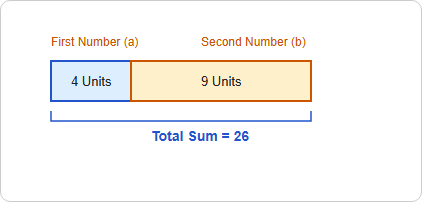
Two numbers are in the ratio of 4 : 9. If their sum is 26, then find the mean proportional between them.

  1. ((a))

    12

  2. ((b))

    14

  3. ((c))

    11

  4. ((d))

    10

Show Answer
Answer: ((a))

12

Shortcut Trick

Sum of ratio parts = 4 + 9 = 13 units.

Given Total Sum = 26 ⇒ 13 units = 26 ⇒ 1 unit = 2.

Numbers are (4 × 2) = 8 and (9 × 2) = 18.

Mean Proportional = √(8 × 18) = √144 = 12.

∴ The correct answer is 12.

Alternate Method

Given: Ratio of two numbers = 4 : 9 and their Sum = 26.

Formula Used: If two numbers are 'a' and 'b', then Mean Proportional = √(a × b).

⇒ Let the two numbers be 4x and 9x.

⇒ 4x + 9x = 26

⇒ 13x = 26

⇒ x = 2

⇒ First number (a) = 4 × 2 = 8

⇒ Second number (b) = 9 × 2 = 18

Mean Proportional = √(8 × 18)

⇒ Mean Proportional = √144 = 12

∴ The correct answer is 12.

Additional Information

Mean Proportional

The mean proportional between two numbers 'a' and 'b' is a value 'x' such that a/x = x/b, which gives x = √(a × b).

Third Proportional

The third proportional to two numbers 'a' and 'b' is a value 'c' such that a : b :: b : c, which gives c = b2/a.

Fourth Proportional

The fourth proportional to three numbers 'a', 'b', and 'c' is 'd' such that a : b :: c : d, calculated as d = (b × c)/a.

22

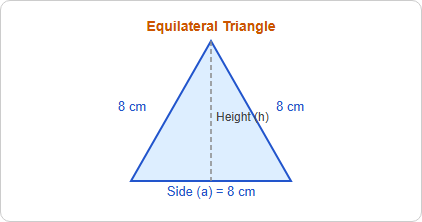
If the length of the side of an equilateral triangle is 8 cm, find its area. (Use  3\sqrt{3} = 1.732).

  1. ((a))

    27.712 sq.cm.

  2. ((b))

    26.812 sq.cm.

  3. ((c))

    28.612 sq.cm.

  4. ((d))

    24.812 sq.cm.

Show Answer
Answer: ((a))

27.712 sq.cm.

Shortcut Trick

Area of an equilateral triangle = 16 × √3 when the side is 8 cm.

Area = 16 × 1.732

Area = 27.712 sq.cm.

∴ The correct answer is 27.712 sq.cm.

Alternate Method

Given:

Length of the side (a) = 8 cm

Value of √3 = 1.732

Formula Used:

Area of an equilateral triangle = (√3 / 4) × a2

Calculations:

⇒ Area = (√3 / 4) × (8)2

⇒ Area = (√3 / 4) × 64

⇒ Area = √3 × 16

⇒ Area = 1.732 × 16

⇒ Area = 27.712 sq.cm.

∴ The correct answer is 27.712 sq.cm.

Additional Information

Height of Equilateral Triangle

The altitude or height (h) is given by the formula h = (√3 / 2) × a.

Perimeter of Equilateral Triangle

Since all sides are equal, the perimeter (P) = 3 × a.

Inradius and Circumradius

The inradius (r) = a / (2√3) and the circumradius (R) = a / √3.

Area in terms of Height

The area can also be calculated as Area = h2 / √3.

23

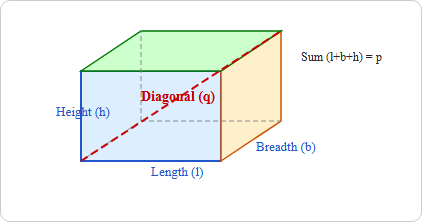
The sum of the length, breadth and height of a cuboid is p cm and its diagonal is q cm. Find its total surface area (in cm2).

  1. ((a))

    p2+q2 p^{2} + q^{2}

  2. ((b))

    p2q22 \frac{p^{2} - q^{2}}{2}

  3. ((c))

    p2q2 p^{2} - q^{2}

  4. ((d))

    (pq)2 (p - q)^{2}

Show Answer
Answer: ((c))

p2q2 p^{2} - q^{2}

Shortcut Trick

Use the direct algebraic relationship: (Sum of all dimensions)2 = (Diagonal)2 + Total Surface Area.

Given Sum (l+b+h) = p and Diagonal = q.

⇒ p2 = q2 + TSA

⇒ TSA = p2 − q2

∴ The correct answer is p2 − q2 cm2.

Alternate Method

Let the length, breadth, and height of the cuboid be l, b, and h respectively.

Given:

⇒ l + b + h = p cm

⇒ Diagonal (d) = √(l2 + b2 + h2) = q cm

Formula Used:

⇒ (l + b + h)2 = l2 + b2 + h2 + 2(lb + bh + hl)

Total Surface Area (TSA) = 2(lb + bh + hl)

Calculations:

⇒ From the diagonal formula: l2 + b2 + h2 = q2

⇒ Squaring the sum of dimensions: (l + b + h)2 = p2

⇒ l2 + b2 + h2 + 2(lb + bh + hl) = p2

⇒ Substituting q2 for the sum of squares: q2 + 2(lb + bh + hl) = p2

⇒ 2(lb + bh + hl) = p2 − q2

⇒ Since TSA = 2(lb + bh + hl)

⇒ TSA = p2 − q2

∴ The correct answer is p2 − q2 cm2.

Additional Information

Volume of a Cuboid

The space occupied by the cuboid is calculated as Volume = l × b × h.

Lateral Surface Area (LSA)

The area of the four side walls of the cuboid is LSA = 2h(l + b).

Diagonal of a Cube

For a cube with side 'a', the diagonal is a√3 and the Total Surface Area is 6a2.

Euler's Formula for Polyhedron

For any convex polyhedron like a cuboid, Faces (F) + Vertices (V) − Edges (E) = 2. For a cuboid: 6 + 8 − 12 = 2.

24

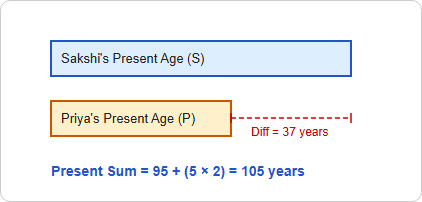
The difference between the ages of Sakshi and Priya is 37 years. Five years ago from now, the sum of their ages was 95 years. If Sakshi is older than Priya, find Priya's present age (in years).

  1. ((a))

    43

  2. ((b))

    34

  3. ((c))

    28

  4. ((d))

    24

Show Answer
Answer: ((b))

34

Shortcut Trick

Present sum of ages = 95 + (5 × 2) = 105 years.

Difference between ages = 37 years.

Since Sakshi is older, Priya's age = (Sum − Difference) ÷ 2.

Priya's age = (105 − 37) ÷ 2 = 68 ÷ 2 = 34 years.

∴ The correct answer is 34 years.

Alternate Method

Given:

Difference between Sakshi (S) and Priya (P) = 37 years

Sum of ages 5 years ago = 95 years

Calculations:

⇒ Let Sakshi's present age be S and Priya's present age be P.

⇒ S − P = 37 → (Equation 1)

⇒ (S − 5) + (P − 5) = 95

⇒ S + P − 10 = 95

⇒ S + P = 105 → (Equation 2)

⇒ Subtracting Eq(1) from Eq(2): (S + P) − (S − P) = 105 − 37

⇒ 2P = 68

⇒ P = 68 ÷ 2 = 34

∴ The correct answer is 34 years.

Additional Information

Constant Age Difference

The difference between the ages of two people always remains the same, regardless of how many years pass or how many years ago you compare them.

Sum of Ages in Time

If the sum of ages of n people is X now, then t years ago, the sum was X − (n × t).

Direct Calculation Formula

If the sum (S) and difference (D) of two numbers are known: Larger number = (S + D) ÷ 2 and Smaller number = (S − D) ÷ 2.

25

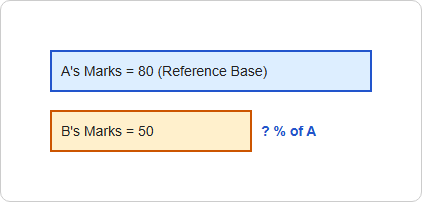
In a test, B got 50 marks while A got 80 marks out of 110 maximum marks. What percentage of A's marks were B's marks?

  1. ((a))

    72.73%

  2. ((b))

    62.5%

  3. ((c))

    160%

  4. ((d))

    110%

Show Answer
Answer: ((b))

62.5%

Shortcut Trick

Ratio of B's marks to A's marks = 50 : 80 = 5 : 8.

Required percentage = (5 ÷ 8) × 100.

Since 1/8 = 12.5%, then 5 × 12.5% = 62.5%.

∴ The correct answer is 62.5%.

Alternate Method

Given:

Marks obtained by B = 50

Marks obtained by A = 80

Formula Used:

Percentage = (Value ÷ Base Value) × 100

Calculations:

⇒ Required Percentage = (B's marks ÷ A's marks) × 100

⇒ Required Percentage = (50 ÷ 80) × 100

⇒ Required Percentage = (5 ÷ 8) × 100

⇒ Required Percentage = 0.625 × 100

⇒ Required Percentage = 62.5%

∴ The correct answer is 62.5%.

Additional Information

Base Value Selection

In percentage questions, the value following the word 'of' or 'than' is usually the denominator (base).

Fraction to Percentage Table

Common fractions: 1/2 = 50%, 1/4 = 25%, 1/5 = 20%, 1/8 = 12.5%, 1/10 = 10%.

Irrelevant Data

The maximum marks (110) is not required for this specific comparison between A and B.

General Intelligence & Reasoning (25 questions)

26

If ‘A’ stands for ‘÷’, ‘B’ stands for ‘×’, ‘C’ stands for ‘+’ and ‘D’ stands for ‘−‘, what will come in place of the question mark ‘?’ in the following equation?

<br>

57 D 34 C 90 A 18 B 6 = ?

  1. ((a))

    54

  2. ((b))

    57

  3. ((c))

    53

  4. ((d))

    55

Show Answer
Answer: ((c))

53

Given mapping:

LetterABCD
Sign÷×+


Equation: 57 D 34 C 90 A 18 B 6 = ?

Replace the letters with their respective signs.

= 57 − 34 + 90 ÷ 18 × 6

= 57 - 34 + 5 × 6

= 57 - 34 + 30

= 87 - 34

= 53

Therefore, the value that will come in place of the question mark is 53.

Hence, the correct answer is "Option 3".

27

Seven boxes, B, F, G, H, R, T and Y, kept one over the other, but not necessarily in the same order.
R is kept immediately above H. G is kept immediately above T. Only one box is kept between H and T. T is kept above R. Only one box is kept below Y. G or B are not kept at the top.
How many boxes are kept above T?

  1. ((a))

    3

  2. ((b))

    2

  3. ((c))

    4

  4. ((d))

    1

Show Answer
Answer: ((b))

2

Given:

Seven boxes B, F, G, H, R, T and Y are kept one over the other.

1) Only one box is kept below Y.

This implies Y is at the 2nd position from the bottom.

2) R is kept immediately above H.

3) T is kept above R.

4) Only one box is kept between H and T.

Combining these points, the vertical sequence is T - R - H (since R is immediately above H, it becomes the single box between T and H).

5) G is kept immediately above T.

So, the continuous block is G, T, R, H.

PositionBox
7 (Top)
6G
5T
4R
3H
2Y
1 (Bottom)


6) G or B are not kept at the top.

Since G is already at position 6, it satisfies the condition. For box B, since it cannot be at position 7, it must be placed at the only other vacant spot, which is position 1.

7) F is the only remaining box, so it must be at the top.

Final Arrangement:

7F
6G
5T
4R
3H
2Y
1B


The boxes kept above T are G and F. There are 2 boxes above T.

Hence, the correct answer is 'Option 2'.

28

Based on the English alphabetical order, three of the following four letter-clusters are alike in a certain way and thus form a group. Which letter-cluster DOES NOT belong to that group?

(Note: The odd one out is not based on the number of consonants/vowels or their position in the letter-cluster.)

  1. ((a))

    UXV

  2. ((b))

    RKL

  3. ((c))

    PSQ

  4. ((d))

    SVT

Show Answer
Answer: ((b))

RKL

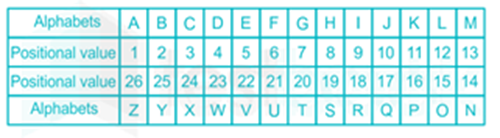
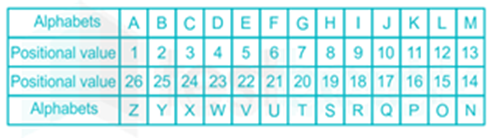
The logic followed here is based on the positional values of the letters in the English alphabetical order.

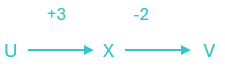
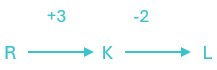
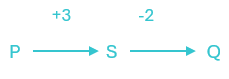
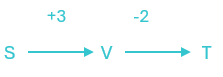
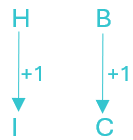
Logic: Second letter = First letter + 3; Third letter = Second letter − 2.

Option 1) UXV,

Option 2) RKL,

This letter-cluster does not follow the +3, −2 pattern.

Option 3) PSQ,

Option 4) SVT,

Therefore, the letter-cluster that is different from the others is RKL.

Hence, the correct answer is 'Option 2'.

29

Seven people H, I, J, K, L, M, and N are sitting in a row facing the north. Only two people are seated to the left of L. Only three people are seated between L and H. I is seated second to the right of J. I is not an immediate neighbour of H. K is seated to the immediate right of M. Who is seated at the extreme left end of the row?

  1. ((a))

    K

  2. ((b))

    J

  3. ((c))

    H

  4. ((d))

    N

Show Answer
Answer: ((d))

N

Logic followed here is.

Based on the given information, seven people are seated in a row facing North. We will place them step-by-step according to the constraints provided.

Step 1: Only two people are seated to the left of L. This means L is at the 3rd position from the left end.

Step 2: Only three people are seated between L and H. Counting three positions to the right of L (4th, 5th, and 6th), H must be at the 7th position (extreme right end).

Step 3: I is seated second to the right of J (Pattern: J _ I). Also, I is not an immediate neighbor of H, so I cannot be at the 6th position. The only valid placement for this pair is J at the 2nd position and I at the 4th position.

Step 4: K is seated to the immediate right of M (Pattern: MK). The only available adjacent seats are the 5th and 6th positions. Thus, M is at the 5th and K is at the 6th position.

Step 5: The only remaining person, N, is placed in the only vacant spot, which is the 1st position (extreme left end).

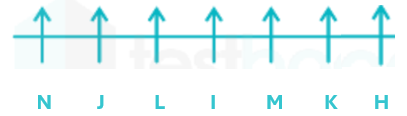
The Final Seating Arrangement is:

By observing the final arrangement, we can see that N is seated at the extreme left end of the row.

Hence, the correct answer is "Option 4".

30

In the following number-pairs, the second number is obtained by applying certain mathematical operations to the first number. Select the set in which the numbers are related in the same way as are the numbers of the following sets.
(NOTE : Operations should be performed on the whole numbers, without breaking down the numbers into its constituent digits. E.g. 13 – Operations on 13 such as adding / subtracting /multiplying etc. to 13 can be performed. Breaking down 13 into 1 and 3 and then performing mathematical operations on 1 and 3 is not allowed.)
32, 192
41, 246

  1. ((a))

    43, 254

  2. ((b))

    44, 364

  3. ((c))

    35, 210

  4. ((d))

    38, 226

Show Answer
Answer: ((c))

35, 210

The logic followed here is:

Logic: Second Number = First Number × 6

For the first set 32, 192

⇒ 32 × 6 = 192.

For the second set 41, 246

⇒ 41 × 6 = 246.

Applying the same logic to the given options:

Checking Option 3: 35, 210

⇒ 35 × 6 = 210.

Hence, the correct answer is 'Option 3'.

31

Seven boxes A, B, C, D, E, F and G are kept one over the other but not necessarily in the same order. E is kept fifth from the bottom. C is kept fifth from the top. Only one box is kept between D and C. F is kept immediately below B. A is not kept below G. How many boxes are kept between G and A?

  1. ((a))

    One

  2. ((b))

    Two

  3. ((c))

    None

  4. ((d))

    Three

Show Answer
Answer: ((a))

One

Given:

Seven boxes (A, B, C, D, E, F, G) are kept one over the other from 1 (bottom) to 7 (top).

1) E is kept fifth from the bottom.

2) C is kept fifth from the top.

3) Only one box is kept between D and C.

PositionBox
7 (Top)
6
5E
4
3C
2
1 (Bottom)D


4) F is kept immediately below B.

5) A is not kept below G.

Final Arrangement:

7B
6F
5E
4A
3C
2G
1D


Thus, only one box (C) is kept between G and A.

Hence, the correct answer is 'Option 1'.

32

What should come in place of ? in the given series based on the English alphabetical order?

<br>

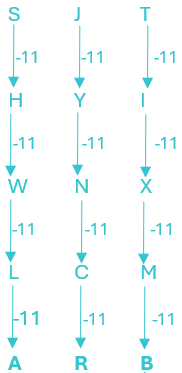
SJT HYI WNX LCM ?

  1. ((a))

    ARB

  2. ((b))

    ABR

  3. ((c))

    ASD

  4. ((d))

    ABS

Show Answer
Answer: ((a))

ARB

The logic followed here is:

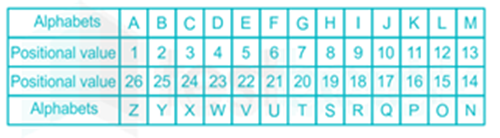
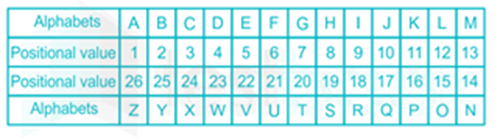
Logic: Each term in the series is obtained by subtracting 11 from the positional value of each letter of the previous term in the English alphabetical order (in a cyclic manner).


Therefore, the term that replaces '?' is ARB.

Hence, the correct answer is "Option 1".

33

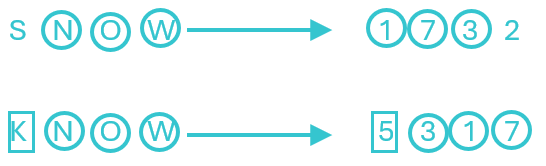
In a certain code language, ‘SNOW’ is coded as ‘1732’ and ‘KNOW’ is coded as ‘5317’. What is the code for ‘K’ in that language?

  1. ((a))

    7

  2. ((b))

    5

  3. ((c))

    2

  4. ((d))

    1

Show Answer
Answer: ((b))

5

Logic followed here is the comparison of common letters and their corresponding numeric codes in the given words.

Given:

SNOW is coded as '1732'

KNOW is coded as '5317'

Therefore, the code for ‘K’ in that language is 5.

Hence, the correct answer is "Option 2".

34

In a certain code language,

<br>

‘A + B’ means ‘A is the son of B’,

‘A @ B’ means ‘A is the sister of B’,

‘A # B’ means ‘A is the wife of B’ and

‘A ÷ B’ means ‘A is the father of B’.

​​​​​​​

How is Q related to H if ‘Q # W + R ÷ G @ H’?

  1. ((a))

    Brother's wife

  2. ((b))

    Brother's daughter

  3. ((c))

    Wife

  4. ((d))

    Daughter

Show Answer
Answer: ((a))

Brother's wife

Given:

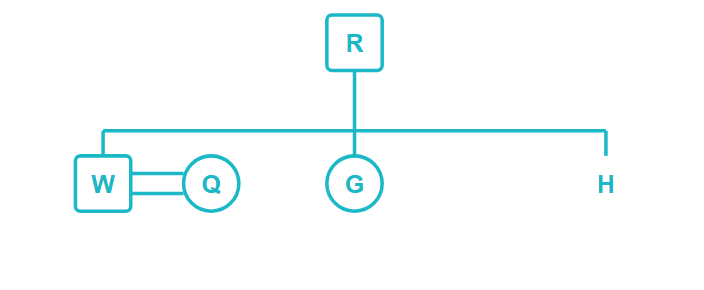
Let us first decode the given symbols and then draw a family tree.

A is
Symbol+@#÷
MeaningSonSisterWifeFather
of B


On checking the expression: Q # W + R ÷ G @ H

  1. Q # W - 'Q # W' means Q is the wife of W. This implies W is the husband of Q.

  2. W + R - 'W + R' means W is the son of R.

  3. R ÷ G - 'R ÷ G' means R is the father of G.

  4. G @ H - 'G @ H' means G is the sister of H.

From the family tree, W, G, and H are siblings. W is the brother of H and Q is the wife of W. Therefore, Q is the Brother's wife of H.

Hence, the correct answer is "Option 1".

35

In the following triad, each group of letters is related to the subsequent one following a certain logic. Select from the given options, the one that follows the same logic.

MATH – AMTH – AHTM
MELT – EMLT – ETLM

  1. ((a))

    HART – RTAH – AHRT

  2. ((b))

    TEAM – AEMT – TEAM

  3. ((c))

    LEAD – ALDE– ADLE

  4. ((d))

    COLD – OCLD – ODLC

Show Answer
Answer: ((d))

COLD – OCLD – ODLC

The logic followed in this pattern is based on a specific positional interchange of letters within each triad of words.

Step 1: The first and second letters of the first word are interchanged to form the second word.

Step 2: The second and fourth letters of the second word are interchanged to form the third word.

For 'MATH - AMTH - AHTM':

MATH
1st ↔ 2nd ↓2nd ↔ 1st ↓
AMTH
2nd ↔ 4th ↓4th ↔ 2nd ↓
AHTM

For 'MELT - EMLT - ETLM':

MELT
1st ↔ 2nd ↓2nd ↔ 1st ↓
EMLT
2nd ↔ 4th ↓4th ↔ 2nd ↓
ETLM

Applying the same logic to 'COLD':

COLD
1st ↔ 2nd ↓2nd ↔ 1st ↓
OCLD
2nd ↔ 4th ↓4th ↔ 2nd ↓
ODLC

Thus, the triad COLD - OCLD - ODLC follows the same logic.

Hence, the correct answer is 'Option 4'.

36

In a certain code language,

A + B means ‘A is the sister of B’

A – B means ‘A is the brother of B’

A x B means ‘A is the wife of B’

A ÷ B means ‘A is the father of B’

Based on the above, how is M related to R if ‘M – K + L ÷ P x R’?

  1. ((a))

    Wife's father

  2. ((b))

    Wife's father's brother

  3. ((c))

    Wife's father's father

  4. ((d))

    Wife's brother

Show Answer
Answer: ((b))

Wife's father's brother

Given:

Let us first decode the given symbols and then draw a family tree.

A is
Symbol+×÷
MeaningSisterBrotherWifeFather
of B


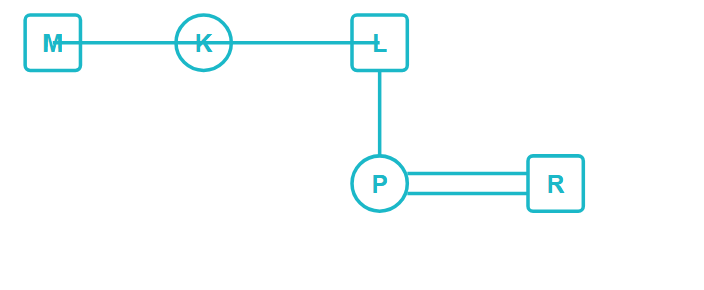
On checking the expression: M − K + L ÷ P × R

  1. M − K - 'M − K' means M is the brother of K.

  2. K + L - 'K + L' means K is the sister of L.

  3. L ÷ P - 'L ÷ P' means L is the father of P.

  4. P × R - 'P × R' means P is the wife of R.

​Based on the tree, L is the father of R's wife P, and M is the brother of L. Therefore, M is the Wife's father's brother of R.

Hence, the correct answer is 'Option 2'.

37

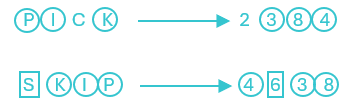
In a certain code language, ‘PICK’ is coded as ‘2384’ and ‘SKIP’ is coded as ‘4638’. What is the code for ‘S’ in that language?

  1. ((a))

    3

  2. ((b))

    8

  3. ((c))

    6

  4. ((d))

    2

Show Answer
Answer: ((c))

6

Logic followed here is by comparing the letters of the words and their corresponding codes to identify the specific code for each letter through the process of elimination.

Given:

PICK is coded as '2384'

SKIP is coded as '4638'

Therefore, the code for the letter S is 6.

Hence, the correct answer is "Option 3".

38

Each vowel in the word THALERS is changed to the letter immediately following it in the English alphabetical order and each consonant is changed to the letter immediately preceding it in the English alphabetical order. How many letters will appear exactly twice in the group of letters thus formed?

  1. ((a))

    3

  2. ((b))

    0

  3. ((c))

    2

  4. ((d))

    1

Show Answer
Answer: ((b))

0

Given Word:

THALERS

Rule:

  • Each vowel is changed to the next letter in the English alphabet.
  • Each consonant is changed to the previous letter in the English alphabet.
<br>

Transformation:

Original LetterTypeNew Letter
TConsonantS
HConsonantG
AVowelB
LConsonantK
EVowelF
RConsonantQ
SConsonantR
<br>

New group of letters:

S, G, B, K, F, Q, R

Every letter appears only once.

Therefore, the number of letters appearing exactly twice = 0.

Hence, the correct answer is "Option 2".

39

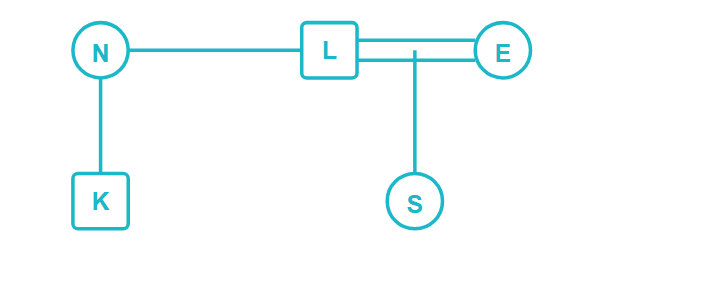
S is the daughter of E. E is the wife of L. N is the mother of K. N is the sister of L. How is S related to K?

  1. ((a))

    Mother's brother's daughter

  2. ((b))

    Mother's brother's wife

  3. ((c))

    Brother's daughter

  4. ((d))

    Brother's wife

Show Answer
Answer: ((a))

Mother's brother's daughter

Given:

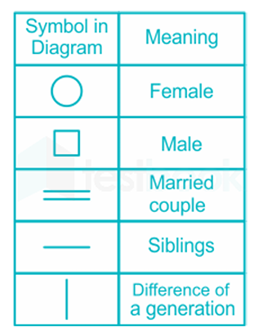
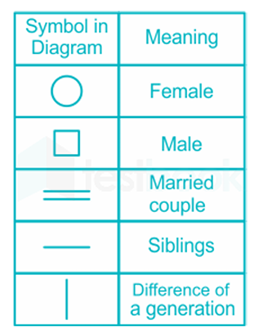
Let us first represent the relationships between the family members using the symbols below to draw a family tree.

SymbolMeaning
RectangleMale
CircleFemale
Horizontal Double LineMarried Couple
Horizontal Single LineSiblings
Vertical LineGeneration Gap


Based on the information provided:

  1. S is the daughter of E - This means S is a female in the generation below E.

  2. E is the wife of L - This means E is female and L is male, and they are a married couple. Consequently, L is the father of S.

  3. N is the sister of L - This establishes N (female) as L's sibling.

  4. N is the mother of K - This means K is in the generation below N.

Therefore, L is the brother of K's mother (N). S is the daughter of L. This makes S the Mother's brother's daughter of K.

Hence, the correct answer is 'Option 1'.

40

Select the set in which the numbers are related in the same way as are the numbers of the following sets.

(Note: Operations should be performed on the whole numbers, without breaking down the numbers into their constituent digits. E.g. 13 – Operations on 13 such as adding/subtracting/multiplying to 13 can be performed. Breaking down 13 into 1 and 3 and then performing mathematical operations on 1 and 3 is not allowed.)

(6, 18, 14)
(8, 20, 16)

  1. ((a))

    (9, 21, 25)

  2. ((b))

    (12, 28,24)

  3. ((c))

    (14, 26, 30)

  4. ((d))

    (13, 25, 21)

Show Answer
Answer: ((d))

(13, 25, 21)

The logic followed here is:

Logic: Second Number = First Number + 12; Third Number = First Number + 8

For the first set (6, 18, 14):

⇒ 6 + 12 = 18

⇒ 6 + 8 = 14

For the second set (8, 20, 16):

⇒ 8 + 12 = 20

⇒ 8 + 8 = 16

Applying the same logic to Option 4:

For the set (13, 25, 21):

⇒ 13 + 12 = 25

⇒ 13 + 8 = 21

Hence, the correct answer is 'Option 4'.

41

In a certain code language,

A # B means ‘A is the sister of B’,

A + B means ‘A is the son of B’,

A ÷ B means ‘A is the wife of B’,

and A @ B means ‘A is the father of B’.

<br>

How is A related to T if ‘A + B # H @ K ÷ T’?

  1. ((a))

    Wife's father's sister's son

  2. ((b))

    Wife's father's sister's husband

  3. ((c))

    Wife's father

  4. ((d))

    Wife's brother

Show Answer
Answer: ((a))

Wife's father's sister's son

Given:

Let us first decode the given symbols and then draw a family tree.

A is
Symbol#+÷@
MeaningSisterSonWifeFather
of B


On checking the expression: A + B # H @ K ÷ T

  1. A + B - 'A + B' means 'A is the son of B'.

  2. B # H - 'B # H' means 'B is the sister of H'.

  3. H @ K - 'H @ K' means 'H is the father of K'.

  4. K ÷ T - 'K ÷ T' means 'K is the wife of T'.

Based on the family tree:

  • T is the husband of K.
  • K's father is H.
  • H's sister is B.
  • B's son is A.

Therefore, A is the Wife's father's sister's son of T.

Hence, the correct answer is "Option 1".

42

Refer to the following series and answer the question. (All numbers are single-digit numbers only. Counting to be done from left to right.)

(Left) 7 2 9 1 3 2 9 4 1 6 8 5 4 3 7 6 4 2 8 1 3 5 (Right)

How many such odd digits are there, each of the which is immediately preceded by an even digit and immediately followed by an even digit?

  1. ((a))

    One

  2. ((b))

    Four

  3. ((c))

    Three

  4. ((d))

    Two

Show Answer
Answer: ((c))

Three

Given Series:

(Left) 7 2 9 1 3 2 9 4 1 6 8 5 4 3 7 6 4 2 8 1 3 5 (Right)

Required pattern:

Even Digit → Odd Digit → Even Digit

Checking the series:

(Left) 7 2 9 1 3 2 9 4 1 6 8 5 4 3 7 6 4 2 8 1 3 5 (Right)

Odd digits satisfying the condition:

→ 9 in (2 9 4)

→ 1 in (4 1 6)

→ 5 in (8 5 4)

Therefore, there are 3 such odd digits.

Hence, the correct answer is "Option 3 — Three".

43

What will come in the place of ‘?’ in the following equation, if ‘+’ and ‘-’ are interchanged and ‘x’ and ‘÷’ are interchanged?

<br>

4 ÷ 2 + 12 x 4 - 3 = ?

  1. ((a))

    4

  2. ((b))

    8

  3. ((c))

    6

  4. ((d))

    9

Show Answer
Answer: ((b))

8

Given sign interchanges:

Original SignInterchanged Sign
÷×
+
×÷
+


Applying the interchanges to the given equation:

Original equation: 4 ÷ 2 + 12 × 4 − 3 = ?

After interchanging the signs, the new equation is:

= 4 × 2 − 12 ÷ 4 + 3 

= 4 × 2 - 3 + 3

= 8 - 3 + 3

= 8 

Therefore, the value that will come in place of '?' is 8.

Hence, the correct answer is "Option 2".

44

Select the pair which follows the same pattern as that followed by the two set of pairs given below. Both pairs follow the same pattern.
HDF−DZB
GCE−CYA

  1. ((a))

    UQS−QMO

  2. ((b))

    UQS−PMN

  3. ((c))

    UPQ−QMO

  4. ((d))

    UPQ−PLN

Show Answer
Answer: ((a))

UQS−QMO

The logic followed in this pattern is a subtraction of 4 from the positional value of each letter in the alphabet.

For 'HDF' related to 'DZB':

H(8)D(4)F(6)
−4 ↓−4 ↓−4 ↓
D(4)Z(26)B(2)

For 'GCE' related to 'CYA':

G(7)C(3)E(5)
−4 ↓−4 ↓−4 ↓
C(3)Y(25)A(1)

Applying the same logic to the options, only 'UQS' to 'QMO' matches:

U(21)Q(17)S(19)
−4 ↓−4 ↓−4 ↓
Q(17)M(13)O(15)

Thus, UQS is related to QMO in the same way as the given pairs.

Hence, the correct answer is 'Option 1'.

45

Refer to the following letter series and answer the question that follows. Counting to be done from left to right.

<br>

(Left) E Z J K A R T S W H M F U C N P D K I E N O A K (Right)

<br>

How many such vowels are there, each of which is immediately preceded by a consonant and also immediately followed by a consonant?

  1. ((a))

    3

  2. ((b))

    1

  3. ((c))

    4

  4. ((d))

    2

Show Answer
Answer: ((d))

2

Given Series:

(Left) E Z J K A R T S W H M F U C N P D K I E N O A K (Right)

Required pattern:

Consonant → Vowel → Consonant

Checking the series:

(Left) E Z J K A R T S W H M F F U C C N P D K K I E E N O A A K (Right)

Vowels satisfying the condition:

→ U in (F U C)

→ O in (N O A)

Therefore, there are 2 such vowels.

Hence, the correct answer is "Option 4 — 2".

46

Each vowel in the word AMBLERS is changed to the letter immediately following it in the English alphabetical order and each consonant is changed to the letter immediately preceding it in the English alphabetical order. How many letters will appear exactly twice in the new group of letters thus formed?

  1. ((a))

    Three

  2. ((b))

    Zero

  3. ((c))

    Two

  4. ((d))

    One

Show Answer
Answer: ((b))

Zero

Given Word:

AMBLERS

Rule:

  • Each vowel is changed to the next letter in the English alphabet.
  • Each consonant is changed to the previous letter in the English alphabet.
<br>

Transformation:

Original LetterTypeNew Letter
AVowelB
MConsonantL
BConsonantA
LConsonantK
EVowelF
RConsonantQ
SConsonantR
<br>

New group of letters:

B, L, A, K, F, Q, R

Every letter appears only once.

Therefore, the number of letters appearing exactly twice = 0.

Hence, the correct answer is "Option 2 — Zero".

47

Based on the English alphabetical order, three of the following four letter-cluster pairs are alike in a certain way and thus form a group. Which letter-cluster pair DOES NOT belong to that group?

(Note: The odd one out is not based on the number of consonants/vowels or their position in the letter-cluster.)

  1. ((a))

    MG - NH

  2. ((b))

    QK - RL

  3. ((c))

    JD - LE

  4. ((d))

    HB - IC

Show Answer
Answer: ((c))

JD - LE

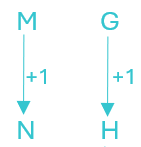
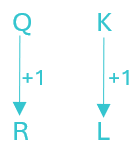
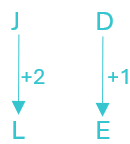
The logic followed here is

Logic: The letters of the second cluster are obtained by adding 1 to the positional values of the corresponding letters of the first cluster in English alphabetical order.

Option 1)  MG - NH,

Option 2) QK - RL,

Option 3) JD - LE

This pair does not follow the rule.

Option 4) HB - IC,

Therefore, the letter-cluster pair that is different from the others is JD - LE.

Hence, the correct answer is 'Option 3'.

48

Seven people, C, D, E, F, J, K and L, are sitting in a row, facing north. Only three people sit between D and J. L sits to the immediate left of J. No one sits to the right of K. Only two people sit between K and L. C sits to the immediate right of E.

How many people sit between F and C?

  1. ((a))

    Three

  2. ((b))

    Two

  3. ((c))

    One

  4. ((d))

    Four

Show Answer
Answer: ((b))

Two

The logic followed here is to arrange the people based on the given directions in a single row facing North.

1. Only three people sit between D and J. 2. L sits to the immediate left of J. 3. No one sits to the right of K. 4. Only two people sit between K and L. 5. C sits to the immediate right of E.

Final Arrangement:

We need to find how many people sit between F and C.

Between C (3rd) and F (6th), the people sitting are L and J.

Total number of people = 2.

Hence, the correct answer is "Option 2".

49

Select the pair which follows the same pattern as that followed by the two set of pairs given below. Both pairs follow the same pattern.
POK−GFB
FEA−WVR

  1. ((a))

    WVR−NMI

  2. ((b))

    WVR−MMH

  3. ((c))

    WUP−MLH

  4. ((d))

    WUP−NMI

Show Answer
Answer: ((a))

WVR−NMI

The logic followed in this pattern is based on alphabetical shifts by subtracting a constant value from the positional value of each letter.

For 'POK' related to 'GFB':

P(16)O(15)K(11)
−9 ↓−9 ↓−9 ↓
G(7)F(6)B(2)

For 'FEA' related to 'WVR':

F(6)E(5)A(1)
−9 ↓−9 ↓−9 ↓
W(23)V(22)R(18)

Applying the same logic to 'WVR':

W(23)V(22)R(18)
−9 ↓−9 ↓−9 ↓
N(14)M(13)I(9)

Thus, WVR is related to NMI using the same pattern.

Hence, the correct answer is 'Option 1'.

50

Based on the English alphabetical order, three of the following four letter-cluster pairs are alike in a certain way and thus form a group. Which is the one that does not belong to that group?

(Note: The odd one out is not based on the number of consonants/vowels or their position in the letter-cluster.)

  1. ((a))

    MP - RT

  2. ((b))

    QT - UX

  3. ((c))

    JM - NQ

  4. ((d))

    PS - TW

Show Answer
Answer: ((a))

MP - RT

The logic followed here is

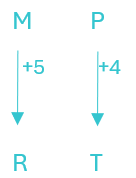
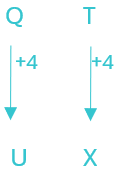
Logic: First letter of the first cluster + 4 = First letter of the second cluster; Second letter of the first cluster + 4 = Second letter of the second cluster.

Option 1) MP − RT,

M + 5 = R and P + 4 = T. This pair does not follow the (+4, +4) rule.

Option 2) QT − UX,

Option 3) JM − NQ,

Option 4) PS − TW,

Therefore, the letter-cluster pair that is different from the others is MP − RT.

Hence, the correct answer is "Option 1".

General Science (40 questions)

51

Which of the following is a ring compound with the molecular formula C₆H₁₂?

  1. ((a))

    Benzene

  2. ((b))

    Cyclohexane

  3. ((c))

    Hexane

  4. ((d))

    Butane

Show Answer
Answer: ((b))

Cyclohexane

The correct answer is Cyclohexane.

Key Points

  • Cyclohexane is an alicyclic hydrocarbon belonging to the cycloalkane series, characterized by a closed-ring structure.
  • The molecular formula C6H12 follows the general formula for cycloalkanes, which is CnH2n.
  • Each of the six carbon atoms in the ring is sp3 hybridized, forming sigma bonds with two adjacent carbon atoms and two hydrogen atoms.
  • Because all carbon-carbon bonds are single bonds, cyclohexane is classified as a saturated hydrocarbon.
  • To maintain the tetrahedral bond angle of approximately 109.5 degrees and minimize ring strain, it adopts non-planar conformations, the most stable being the chair conformation.
  • It is widely used in the industrial production of nylon precursors like adipic acid and caprolactam.

 Additional Information

  • Benzene:
  • It is a cyclic and aromatic hydrocarbon with the molecular formula C6H6.
  • It features a planar hexagonal ring with a delocalized pi-electron system and alternating double bonds.
  • Hexane:
  • It is an acyclic or straight-chain alkane with the molecular formula C6H14.
  • It follows the general formula CnH2n+2 and does not contain a ring structure.
  • Butane:
  • It is an alkane with four carbon atoms and the molecular formula C4H10.
  • It is an open-chain hydrocarbon commonly utilized as a component of Liquefied Petroleum Gas (LPG).
52

What is the pH of a 0.01 M HCl solution?

  1. ((a))

    12

  2. ((b))

    18

  3. ((c))

    8

  4. ((d))

    2

Show Answer
Answer: ((d))

2

The correct answer is 2.

Key Points

  • Hydrochloric acid (HCl) is a strong monoprotic acid, which means it undergoes complete dissociation in an aqueous solution to release hydrogen ions [H+].
  • For a 0.01 M HCl solution, the concentration of hydrogen ions is equal to the concentration of the acid itself, which is 0.01 moles per liter or 10−2 M.
  • The pH scale was developed by Søren Sørensen in 1909 as a way to quantify the acidity or alkalinity of a substance using a logarithmic scale.
  • The mathematical formula used to calculate the pH is pH = −log10[H+], where [H+] represents the molar concentration of hydrogen ions.
  • By substituting the value, we calculate pH = −log10(0.01). Since 0.01 is 10−2, the logarithm of 10−2 is −2.
  • The final calculation, −(−2), results in a pH value of 2, indicating that the solution is highly acidic.

 Additional Information

  • Characteristics of the pH Scale:
  • The pH scale typically ranges from 0 to 14 at standard room temperature (25°C).
  • A pH of 7 is defined as neutral, which is the value for pure water where the concentration of H+ equals OH.
  • Values less than 7 signify acidity, while values greater than 7 signify basicity or alkalinity.
  • Concentration and Strength:
  • Molarity (M) is the unit of concentration representing the number of moles of solute per liter of solution.
  • Strong acids like HCl, H2SO4, and HNO3 have extremely high acid dissociation constants (Ka), unlike weak acids like citric acid.
  • The pH of human gastric juice is approximately 1.5 to 3.5, which closely aligns with the acidity of a 0.01 M to 0.1 M hydrochloric acid solution.
53

When sound propagates through air, the region of high pressure created by a vibrating object pushing the air forward is called _________.

  1. ((a))

    Transverse wave

  2. ((b))

    Medium Boundary

  3. ((c))

    Rarefaction (R)

  4. ((d))

    Compression (C)

Show Answer
Answer: ((d))

Compression (C)

The correct answer is Compression (C).

Key Points

  • Sound is a mechanical wave that requires a physical medium like air, water, or solids for its propagation. It travels specifically as a longitudinal wave, where the particles of the medium oscillate parallel to the direction of energy transport.
  • When a vibrating object moves forward, it exerts a mechanical force on the surrounding air particles, pushing them closer together. This localized increase in particle density leads to a corresponding increase in pressure.
  • This specific region of high pressure and high density is scientifically termed as Compression (C). On a graphical representation of a sound wave, compressions are depicted as the crests or peaks.
  • The transmission of sound is essentially the movement of these pressure variations through the medium. The vibrating object creates a series of compressions and rarefactions that travel away from the source at the speed of sound (approximately 343 meters per second in dry air at 20 degrees Celsius).
  • The amount of pressure in a compression is directly related to the amplitude of the sound wave, which determines the loudness perceived by the human ear.

 Additional Information

  • Rarefaction (R):
  • This is the region of low pressure created when the vibrating object moves backward, allowing air particles to spread out.
  • It is characterized by minimum density and serves as the troughs in a wave diagram.
  • Transverse wave:
  • Unlike sound in air, these waves involve particle displacement perpendicular to the direction of wave motion.
  • Common examples include electromagnetic waves and waves generated on a vibrating string.
  • Medium Boundary:
  • This represents the physical limit where one medium ends and another begins.
  • At this junction, sound energy can undergo reflection (echoes), refraction (bending), or transmission into the second medium.
54

How long does an unfertilized egg survive after being released from the ovary?

  1. ((a))

    Almost a day

  2. ((b))

    Two hours

  3. ((c))

    One week

  4. ((d))

    One month

Show Answer
Answer: ((a))

Almost a day

The correct answer is Almost a day.

Key Points

  • Ovulation is the biological process where a mature oocyte (egg) is released from the Graafian follicle of the ovary into the Fallopian tube.
  • Once released, the egg remains viable for fertilization for a very limited window, typically lasting between 12 to 24 hours. This timeframe aligns with the description of almost a day.
  • The egg moves through the ampulla of the Fallopian tube, which is the primary site where fertilization by sperm occurs.
  • If the egg is not fertilized within this 24-hour period, it begins to undergo apoptosis (programmed cell death) and loses its metabolic activity.
  • Following its degradation, the unfertilized egg is eventually absorbed by the body or shed along with the uterine lining (endometrium) during the menstrual phase of the cycle.

 Additional Information

  • Hormonal Triggers:
  • The release of the egg is triggered by a sharp rise in Luteinizing Hormone (LH), known as the LH surge, which occurs approximately 14 days before the start of the next period.
  • Estrogen levels rise before ovulation to prepare the cervical mucus, making it more hospitable for sperm survival.
  • Reproductive Longevity:
  • While the egg survives for only one day, human sperm can survive inside the female reproductive tract for 3 to 5 days.
  • This difference in longevity creates a fertile window of about 6 days, during which intercourse can lead to pregnancy even if it occurs several days before ovulation.
  • Post-Ovulation Phase:
  • After the egg is released, the empty follicle transforms into the Corpus Luteum, which secretes Progesterone to thicken the endometrium for possible implantation.
55

Which group of organisms is responsible for breaking down dead bodies and waste into simple substances, returning them to the soil?

  1. ((a))

    Only a parasite

  2. ((b))

    Consumers

  3. ((c))

    Decomposers

  4. ((d))

    Producers

Show Answer
Answer: ((c))

Decomposers

The correct answer is Decomposers.

Key Points

  • Decomposers are specialized organisms, predominantly fungi and bacteria, that perform the vital function of breaking down complex organic matter from dead remains and nitrogenous wastes.
  • They utilize enzymes to decompose organic molecules into simpler inorganic forms, such as carbon dioxide, water, and nutrients like nitrogen and phosphorus.
  • By returning these essential elements to the soil, decomposers ensure nutrient cycling, which maintains soil fertility and allows autotrophs to thrive.
  • In the trophic structure, they occupy a unique position as they process energy from all levels once the organisms die, effectively acting as the recycling unit of the biosphere.

 Additional Information

  • Producers:
  • Identified as autotrophs, these organisms, including green plants and cyanobacteria, synthesize their own organic food using sunlight via photosynthesis.
  • They represent the base of the ecological pyramid.
  • Consumers:
  • These are heterotrophs that cannot manufacture food and must ingest other organisms.
  • They include herbivores (primary), carnivores (secondary/tertiary), and omnivores.
  • Parasites:
  • Organisms that sustain themselves by living on or within a host organism, often causing pathogenic effects or nutritional depletion.
  • Examples include Plasmodium, leeches, and Cuscuta plants.
56

The SI unit of force (F) is __________ .

  1. ((a))

    kg m/s²

  2. ((b))

    Joule

  3. ((c))

    N m

  4. ((d))

    kg m/s

Show Answer
Answer: ((a))

kg m/s²

The correct answer is kg m/s2.

Key Points

  • Force (F) is defined as any interaction that, when unopposed, changes the motion of an object. In physics, the relationship between force, mass, and acceleration is governed by Newton's Second Law of Motion.
  • The mathematical formula for force is F = m × a, where m represents mass and a represents acceleration.
  • In the International System of Units (SI), the standard unit for mass is the kilogram (kg), and the standard unit for acceleration is meters per second squared (m/s2).
  • By substituting these base units into the formula, the derived SI unit for force becomes kg m/s2.
  • This specific combination of base units is formally named the Newton (N), where 1 N = 1 kg m/s2, signifying the force needed to accelerate a 1 kg mass at 1 m/s2.

 Additional Information

  • Joule:
  • The SI unit for Work and Energy.
  • It is defined as the work done when a force of one Newton displaces an object by one meter.
  • Dimensionally, it is represented as kg m2/s2.
  • N m (Newton-meter):
  • Commonly used as the unit for Torque or Moment of Force.
  • While it is dimensionally equivalent to the Joule, it is used specifically for rotational force to distinguish it from scalar energy units.
  • kg m/s:
  • The SI unit for Linear Momentum (p) and Impulse (J).
  • It represents the product of an object's mass and its velocity.
  • It describes the quantity of motion possessed by a moving body.
57

If a sample of air is compressed to half its volume, which of the following statements is correct?

  1. ((a))

    The composition of air remains same because it is a mixture.

  2. ((b))

    The proportion of gases changes.

  3. ((c))

    The composition of air changes.

  4. ((d))

    Air becomes a compound on compression.

Show Answer
Answer: ((a))

The composition of air remains same because it is a mixture.

The correct answer is The composition of air remains same because it is a mixture..

Key Points

  • Air is a homogeneous mixture of various gases, primarily Nitrogen (78%), Oxygen (21%), and trace amounts of Argon and Carbon Dioxide. Since these components are not chemically bonded, they retain their individual properties even when physical conditions change. Hence, statement 1 is correct.
  • When a sample of air is compressed, the intermolecular distance between the gas molecules decreases, but the total number of molecules of each gas type remains constant within the container. Therefore, the ratio or proportion of the constituent gases does not alter. Hence, statement 2 is incorrect.
  • Compression is a purely physical change that affects state variables like pressure, volume, and density. It does not involve any chemical transformation, meaning the molecular composition of the air remains identical before and after compression. Hence, statement 3 is incorrect.
  • The formation of a compound requires a chemical reaction involving the breaking and forming of chemical bonds in fixed stoichiometric proportions. Physical compression does not provide the conditions or the mechanism to turn a gaseous mixture into a compound. Hence, statement 4 is incorrect.

 Additional Information

  • Boyle's Law:
  • This law states that for a fixed amount of an ideal gas kept at a constant temperature, Pressure (P) is inversely proportional to Volume (V).
  • The mathematical relationship is expressed as P×V=k P \times V = k . When the volume is reduced to half, the pressure of the air sample doubles, but the chemical identity of the gas molecules remains the same.
  • Characteristics of Mixtures:
  • Variable Composition: Unlike compounds, mixtures do not have a fixed formula, though a trapped sample maintains its ratio unless filtered.
  • Physical Separation: Components of air can be separated using physical methods such as fractional distillation of liquid air.
  • Energy Changes: No energy (in the form of heat or light) is significantly released or absorbed during the simple mixing or compression of air gases at standard conditions.
58

An object moving at a speed of 25 m/s is brought to a state of rest in 5 seconds. Therefore, the final velocity is _________.

  1. ((a))

    5 m/s

  2. ((b))

    25 m/s

  3. ((c))

    0 m/s

  4. ((d))

    20 m/s

Show Answer
Answer: ((c))

0 m/s

The correct answer is 0 m/s.

Key Points

  • State of Rest: In the field of Classical Mechanics, an object is defined to be at rest when its velocity is zero relative to a chosen reference frame.
  • Final Velocity (v): This is the vector quantity representing the speed and direction of an object at the end of a measured time interval. Since the object is brought to rest, its velocity naturally reaches 0 m/s.
  • Initial Velocity (u): The object was originally moving at a speed of 25 m/s. This serves as the starting velocity before the retarding force was applied.
  • Time Factor (t): The duration for this change is 5 seconds. While time is used to calculate the rate of deceleration, it does not alter the fact that the object eventually stops moving entirely.

 Additional Information

  • Acceleration and Retardation:
  • Deceleration: The object experiences negative acceleration, also known as retardation, as its velocity decreases from 25 m/s to 0 m/s.
  • Calculation: Using the first equation of motion, v = u + at, the acceleration (a) is determined as (v − u) ÷ t. Substituting the values: (0 − 25) ÷ 5 = −5 m/s2.
  • Kinematic Concepts:
  • Vector Property: Velocity is a vector, meaning a value of 0 m/s indicates no magnitude and no direction of motion.
  • Kinetic Energy: As the final velocity reaches zero, the kinetic energy of the object, which is proportional to v2, also becomes zero.
  • Newtonian Physics: This scenario follows Newton's Second Law, where a net force (like braking) acts opposite to the direction of motion to change the momentum until the object is stationary.
59

In the process of electrolytic refining of copper, which of the following is correctly matched?

  1. ((a))

    Electrolyte – Acidified Copper Sulfate Solution

  2. ((b))

    Anode-pure copper

  3. ((c))

    Cathode — Impure Copper

  4. ((d))

    Cathode Mud — Pure Copper Crystals

Show Answer
Answer: ((a))

Electrolyte – Acidified Copper Sulfate Solution

The correct answer is Electrolyte – Acidified Copper Sulfate Solution.

Key Points

  • In the process of electrolytic refining of copper, the electrolyte consists of a water-soluble salt of the metal, specifically an acidified copper sulfate solution (CuSO4), which allows the transfer of copper ions. Hence, statement 1 is correct.
  • The anode is made from a thick block of impure copper that is to be purified; during electrolysis, copper atoms from the anode lose electrons and enter the solution as ions. Hence, statement 2 is incorrect.
  • The cathode is a thin strip of pure copper where the dissolved Cu2+ ions from the electrolyte gain electrons and deposit as high-purity metal. Hence, statement 3 is incorrect.
  • Anode mud consists of insoluble impurities like antimony, selenium, silver, and gold that settle at the bottom of the cell specifically under the anode, not the cathode. Hence, statement 4 is incorrect.

 Additional Information

  • Chemical Transformations:
  • At the Anode (Oxidation): Cu (impure) → Cu2+ + 2e.
  • At the Cathode (Reduction): Cu2+ + 2e → Cu (pure).
  • Role of Sulfuric Acid:
  • Small amounts of dilute sulfuric acid are added to the copper sulfate solution to enhance electrical conductivity and prevent the precipitation of basic copper salts.
  • Industrial Application:
  • This method is crucial for producing copper with a purity level exceeding 99.9%, which is vital for the electrical industry to ensure maximum conductivity in wires.
60

What are the two main categories of factors that cause storage losses in agricultural products?

  1. ((a))

    Biotic and Abiotic

  2. ((b))

    Mechanical and Thermal

  3. ((c))

    Harvesting and Processing

  4. ((d))

    Chemical and Electrical

Show Answer
Answer: ((a))

Biotic and Abiotic

The correct answer is Biotic and Abiotic.

Key Points

  • Storage losses in agricultural products are primarily categorized into biotic and abiotic factors, which significantly impact the quantity and quality of the stored produce.
  • Biotic factors comprise all living organisms that can damage the grains, including insects, rodents, mites, fungi, and bacteria. These organisms consume the product or contaminate it with their waste.
  • Abiotic factors are non-living environmental components, with the most critical being moisture content and temperature. Inappropriate levels of these factors accelerate chemical and biological degradation.
  • The combination of these factors leads to a series of negative outcomes such as discoloration of produce, substantial weight loss, and a significant reduction in the germination capacity of seeds.
  • Proper management of these factors is essential to prevent marketability loss, ensuring that the food remains safe and viable for human consumption or future planting.

 Additional Information

  • Biotic Agent Characteristics:
  • Insects and Pests: Species like the pulse beetle or rice weevil bore into grains, causing internal damage.
  • Microorganisms: Fungi and molds thrive in high-moisture environments, often producing toxins that make the produce poisonous.
  • Rodents: Rats and mice not only consume the grain but also damage storage structures and packaging.
  • Abiotic Control Measures:
  • Drying: Agricultural products should be dried properly in sunlight and then in the shade to reduce moisture levels to below 12% before storage.
  • Temperature Control: Maintaining a cool environment inhibits the metabolic rate of both the stored seeds and the pests.
  • Fumigation: The use of chemical fumigants helps in eradicating biotic threats within the storage containers.
61

An object is traveling in a straight line at a constant speed of 50 m/s. What is the displacement of the car in 10 seconds, and what type of motion does the car undergo?

  1. ((a))

    500 m and Uniform Motion

  2. ((b))

    5 m and Non-uniform Motion

  3. ((c))

    5 m and Uniform Motion

  4. ((d))

    500 m and Non-uniform Motion

Show Answer
Answer: ((a))

500 m and Uniform Motion

The correct answer is 500 m and Uniform Motion.

Key Points

  • Displacement is defined as the change in position of an object. For an object moving in a straight line at a constant velocity, displacement is calculated using the formula: Displacement = Velocity × Time.
  • Given that the constant speed (velocity in a straight line) is 50 m/s and the time interval is 10 seconds, the displacement is 50 m/s × 10 s = 500 m.
  • Uniform Motion occurs when an object travels in a straight line and covers equal distances in equal intervals of time. Because the object maintains a steady speed of 50 m/s without any change, it is categorized as uniform motion.
  • In this scenario, the acceleration of the car is zero, as there is no change in the magnitude or direction of the velocity vector over the 10-second period.

 Additional Information

  • Non-uniform Motion:
  • This type of motion involves an object covering unequal distances in equal intervals of time, indicating a variable velocity.
  • It implies the presence of acceleration or deceleration, such as a vehicle moving in congested traffic or an object freely falling under gravity.
  • Kinematic Graphs:
  • In Uniform Motion, the Distance-Time graph is a straight line with a constant slope, where the slope represents the speed.
  • The Velocity-Time graph for uniform motion is a horizontal line parallel to the time axis, indicating that velocity does not change with time.
62

What is the importance of sexual reproduction in creating diversity within plant populations?

  1. ((a))

    It combines DNA from two parents to create new variations.

  2. ((b))

    It copies DNA without any changes.

  3. ((c))

    This prevents any variations from occurring.

  4. ((d))

    This accelerates DNA copying errors.

Show Answer
Answer: ((a))

It combines DNA from two parents to create new variations.

The correct answer is It combines DNA from two parents to create new variations.

Key Points

  • Sexual reproduction involves the fusion of haploid gametes (sperm from pollen and egg from the ovule) to form a diploid zygote, integrating genetic information from two distinct individuals.
  • The process of meiosis is central to sexual reproduction, where homologous chromosomes undergo crossing over (recombination), exchanging genetic segments to create unique chromatids.
  • Independent assortment during metaphase I of meiosis further shuffles maternal and paternal chromosomes, ensuring that each gamete has a statistically unique genetic blueprint.
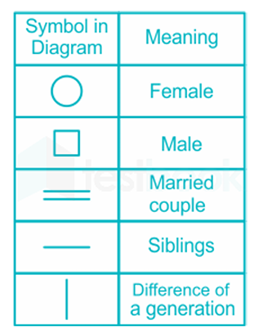
  • By combining diverse alleles, sexual reproduction produces genotypic variation, which manifests as phenotypic diversity within a plant population.
  • This genetic variability is essential for evolutionary adaptation, as it allows populations to harbor traits that may provide a survival advantage against changing environmental conditions, pathogens, or predators.

 Additional Information

  • Asexual Reproduction Comparison:
  • Unlike sexual reproduction, asexual reproduction (such as budding, fragmentation, or vegetative propagation) involves only one parent and produces genetically identical clones.
  • It relies on mitosis, which specifically functions to copy DNA without changes, effectively preventing variations unless a random mutation occurs.
  • DNA Copying and Mutations:
  • While DNA polymerase occasionally makes errors during replication, biological systems have proofreading mechanisms to minimize these errors.
  • Accelerating DNA copying errors (mutations) is generally harmful to an organism and is not a regulated mechanism for creating healthy diversity like recombination is.
63

The molecular mass of a compound is '60'. If it contains 40% carbon, 6.7% hydrogen, and 53.3% oxygen, what is the molecular formula?

  1. ((a))

    C₃H₆O₃

  2. ((b))

    C₂H₄O₂

  3. ((c))

    CH₂O

  4. ((d))

    C₄H₈O₄

Show Answer
Answer: ((b))

C₂H₄O₂

The correct answer is C2H4O2.

Key Points

  • Calculate the Relative Number of Moles for each element by dividing the given percentage composition by their respective Atomic Masses: For Carbon (C), 40 / 12 = 3.33; for Hydrogen (H), 6.7 / 1 = 6.7; and for Oxygen (O), 53.3 / 16 = 3.33.
  • Determine the Simplest Molar Ratio by dividing each mole value by the smallest numerical value obtained (3.33). This yields a ratio of 1 Carbon : 2 Hydrogen : 1 Oxygen.
  • Identify the Empirical Formula based on this ratio, which is CH2O.
  • Calculate the Empirical Formula Mass by summing the atomic masses: (1 × 12) + (2 × 1) + (1 × 16) = 30 g/mol.
  • Find the Molecular Multiplier (n) by dividing the given Molecular Mass of the compound (60) by the Empirical Formula Mass (30). Thus, n = 60 / 30 = 2.
  • Determine the Molecular Formula by multiplying the Empirical Formula by the multiplier 'n': 2 × (CH2O) = C2H4O2.

 Additional Information

  • Empirical vs. Molecular Formula:
  • The Empirical Formula represents the lowest whole-number ratio of atoms in a compound. In this case, CH2O is the empirical formula for various carbohydrates and organic acids.
  • The Molecular Formula represents the actual number of each type of atom in a molecule. C2H4O2 identifies the compound as Ethanoic Acid (commonly known as Acetic Acid).
  • Properties of Ethanoic Acid (C2H4O2):
  • It is a Carboxylic Acid with a pungent smell and is the key component of Vinegar.
  • Its Molar Mass is exactly 60.05 g/mol, which aligns with the value provided in the problem.
  • Other compounds like Methyl Formate also share this molecular formula but differ in structural arrangement (Isomers).
64

The mass of an object remains constant everywhere (on Earth or the Moon), whereas its weight changes due to __________________.

  1. ((a))

    While the SI unit of weight is Newtons, that of mass is kilograms.

  2. ((b))

    Weight depends on the local value of g, which varies depending on the location.

  3. ((c))

    The amount of money depends on inertia, not weight

  4. ((d))

    Weight is a scalar quantity, whereas mass is a vector quantity.

Show Answer
Answer: ((b))

Weight depends on the local value of g, which varies depending on the location.

The correct answer is Weight depends on the local value of g, which varies depending on the location..

Key Points

  • Mass is an intrinsic property representing the quantity of matter in an object; it is a measure of inertia and remains constant regardless of the object's location in the universe.
  • Weight is the gravitational force exerted on an object by a large body like a planet or a moon.
  • The relationship between the two is defined by the formula Weight (W) = mass (m) × acceleration due to gravity (g).
  • The value of g (acceleration due to gravity) is determined by the mass and radius of the celestial body. On Earth, g is approximately 9.8 m/s2, while on the Moon, it is about 1.62 m/s2 (roughly 1/6th of Earth's gravity).
  • Because weight is directly proportional to the local gravitational field strength, an object's weight fluctuates as it moves between different celestial bodies or even different altitudes and latitudes on Earth.

 Additional Information

  • Scalar vs. Vector Quantities:
  • Mass is a scalar quantity, meaning it possesses only magnitude.
  • Weight is a vector quantity because it has both magnitude and a specific direction pointing toward the center of the massive body (source of gravity).
  • SI Units:
  • The standard SI unit for measuring mass is the Kilogram (kg).
  • Since weight is a force, its SI unit is the Newton (N).
  • Measurement Tools:
  • Mass is typically measured using a beam balance or an ordinary balance.
  • Weight is measured using a spring balance, which calculates the pull of gravity on the object.
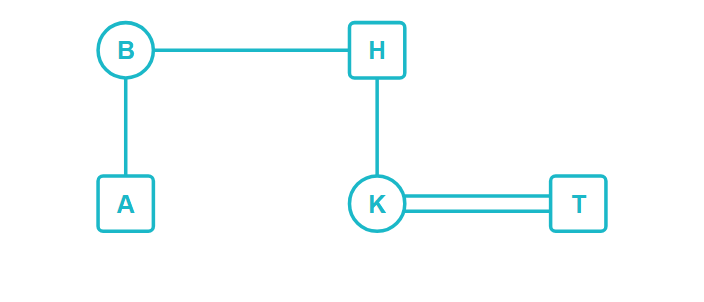
65

Which of the following is the best method to prevent iron from rusting in coastal areas?

  1. ((a))
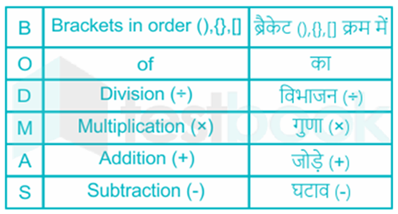
    Galvanization

  2. ((b))

    Periodically heating the iron

  3. ((c))

    Dipping in cold water

  4. ((d))

    Painting with oil-based paints

Show Answer
Answer: ((a))

Galvanization

The correct answer is Galvanization.

Key Points

  • Galvanization is a metallurgical process where a protective zinc coating is applied to iron or steel components to prevent environmental corrosion.
  • In coastal areas, the atmosphere is highly saturated with moisture and sodium chloride (salt), which acts as a powerful electrolyte, accelerating the electrochemical reaction of rusting.
  • The process typically involves Hot-Dip Galvanizing, where the metal is submerged in a bath of molten zinc at approximately 450 degrees Celsius, creating a series of zinc-iron alloy layers topped by a pure zinc outer layer.
  • The protection provided is twofold: it offers a physical barrier and cathodic protection. Because zinc has a more negative standard electrode potential (approx −0.76V) compared to iron (−0.44V), it acts as a sacrificial anode.
  • Even if the coating is mechanically damaged or scratched, the surrounding zinc will oxidize preferentially, sparing the underlying iron from the formation of Fe2O3.xH2O (rust).

 Additional Information

  • Corrosion Mechanisms in Coastal Regions:
  • The high relative humidity (often above 70%) and salinity in marine air can increase the corrosion rate of unprotected iron by 10 to 100 times compared to inland desert environments.
  • Painting with oil-based paints provides only a temporary barrier; UV radiation and salt spray in coastal zones cause paint to brittle, crack, and fail, leading to localized pitting corrosion.
  • Alloying: Mixing iron with Chromium (at least 10.5%) and Nickel creates Stainless Steel, which forms a self-healing passive film of chromium oxide.
  • Dipping in cold water or periodically heating are ineffective; in fact, heating can accelerate oxidation by providing the activation energy required for the reaction between iron and oxygen.
  • Anodizing is another surface treatment, but it is specifically used for non-ferrous metals like aluminum and magnesium to thicken their natural oxide layer.
66

The main reason for stars twinkling is ________________.

  1. ((a))

    Atmospheric refraction varying seasonally

  2. ((b))

    The Presence of Clouds

  3. ((c))

    Scattering of Starlight

  4. ((d))

    Nuclear reactions inside stars

Show Answer
Answer: ((a))

Atmospheric refraction varying seasonally

The correct answer is Atmospheric refraction varying seasonally.

Key Points

  • Stars are located at immense distances from the Earth, which makes them act as point-sized sources of light.
  • When starlight enters the Earth's atmosphere, it undergoes Atmospheric Refraction, which is the bending of light as it passes through layers of air with different optical densities.
  • The Earth's atmosphere is not uniform; it consists of multiple layers where temperature and density are constantly changing due to air currents and seasonal variations.
  • Because the Refractive Index of these atmospheric layers is always fluctuating, the path of the starlight is continuously diverted.
  • This causes the apparent position of the star to change slightly and the intensity of light reaching the eye to flicker, leading to the phenomenon known as stellar scintillation or twinkling.

 Additional Information

  • Scattering of Starlight:
  • Scattering occurs when light rays deviate from a straight path upon hitting dust particles or gas molecules (Rayleigh scattering).
  • While scattering is responsible for the blue color of the sky and the reddish hue of the sun during sunset, it is not the primary cause of twinkling.
  • Nuclear Reactions:
  • Stars produce light and heat through nuclear fusion, where hydrogen nuclei combine to form helium under extreme pressure and temperature.
  • This process provides the star's intrinsic luminosity, but the perceived flickering is an atmospheric effect, not a result of internal reactions.
  • Planetary Twinkling:
  • Planets generally do not twinkle because they are much closer to Earth and appear as extended sources (disks) rather than points.
  • The refractive variations from different points on the planet's disk average out, resulting in a steady image.
67

A compound with the molecular formula C2H4O may belong to which of the following functional groups, and what is its IUPAC name?

  1. ((a))

    Ether, Ethane

  2. ((b))

    Aldehyde, Ethanol

  3. ((c))

    Alcohol, Ethanol

  4. ((d))

    Aldehyde, Ethanal

Show Answer
Answer: ((d))

Aldehyde, Ethanal

The correct answer is Aldehyde, Ethanal.

Key Points

  • The molecular formula C2H4O corresponds to a compound with a Degree of Unsaturation (DoU) of 1. This value is derived from the formula 2C+2H2 \frac{2C + 2 - H}{2} , indicating the presence of either one pi bond (double bond) or a ring structure.
  • For a two-carbon chain with one oxygen atom, the most stable structure containing a carbonyl group (C=O) is an aldehyde. The structural formula is CH3CHO.
  • In IUPAC nomenclature, a two-carbon aldehyde is named by taking the root name of the alkane (ethane) and replacing the suffix '-e' with '-al'. Therefore, the name is Ethanal.
  • The functional group present is the aldehyde group, denoted as -CHO, where the carbon atom is double-bonded to oxygen and single-bonded to hydrogen.

 Additional Information

  • Ethanol
  • Formula: C2H6O.
  • Classification: Primary Alcohol.
  • Structure: CH3CH2OH. It contains only sigma bonds (DoU = 0) and cannot be the answer for C2H4O.
  • Ethane
  • Formula: C2H6.
  • Classification: Alkane (Saturated Hydrocarbon).
  • It contains no oxygen atoms, making it chemically inconsistent with the provided molecular formula.
  • Acetaldehyde
  • This is the common name for Ethanal.
  • Key Uses: It is a vital intermediate in the synthesis of acetic acid, ethyl acetate, and various synthetic resins.
  • Ethenol (Vinyl Alcohol)
  • This is a structural isomer of Ethanal with the same formula C2H4O.
  • However, it is highly unstable and undergoes keto-enol tautomerization to transform into the more stable Ethanal form.
68

Implantation of developing embryo occurs in which part of the female reproductive system in human beings?

  1. ((a))

    Fallopian tubes

  2. ((b))

    Lining of the uterus

  3. ((c))

    Cervix

  4. ((d))

    Ovary

Show Answer
Answer: ((b))

Lining of the uterus

The correct answer is Lining of the uterus.

Key Points

  • Implantation is defined as the process by which a developing embryo, specifically at the blastocyst stage, adheres to and embeds itself into the inner wall of the female reproductive organ.
  • The specific site for this process is the endometrium, which is the highly vascularized and glandular lining of the uterus that thickens every month in preparation for potential pregnancy.
  • This biological event typically occurs approximately 6 to 10 days after fertilization has taken place in the fallopian tube.
  • During implantation, the trophoblast cells of the blastocyst secrete enzymes that allow it to penetrate the uterine epithelium and sink into the stroma.
  • Successful attachment triggers the production of Human Chorionic Gonadotropin (hCG), which maintains the corpus luteum to continue producing progesterone, thereby preventing the onset of menstruation.

 Additional Information

  • Fallopian tubes
  • These are narrow tubes that link the ovaries to the uterus and serve as the primary site for fertilization.
  • If an embryo implants here instead of the uterus, it results in an ectopic pregnancy, which is a medical emergency.
  • Ovary
  • The primary female reproductive organ responsible for oogenesis (production of eggs) and the secretion of estrogen.
  • It does not host the embryo; its role ends with ovulation, the release of the mature oocyte into the peritoneal cavity.
  • Cervix
  • The lower, narrow portion of the uterus that opens into the vagina.
  • Its main functions include controlling the passage of sperm into the uterus and protecting the fetus during gestation by remaining tightly closed.
69

When several rays parallel to the principal axis fall on a concave mirror, how do the reflected rays behave?

  1. ((a))

    They spread out and appear as if they are emerging from behind the mirror.

  2. ((b))

    They reflect back along the same path.

  3. ((c))

    All of them meet at a single point on the principal axis.

  4. ((d))

    They travel parallel to the principal axis after reflection.

Show Answer
Answer: ((c))

All of them meet at a single point on the principal axis.

The correct answer is All of them meet at a single point on the principal axis.

Key Points

  • A concave mirror is a type of spherical mirror where the reflecting surface is curved inwards, towards the Center of Curvature.
  • When incident light rays travel parallel to the principal axis and strike the concave mirror, they undergo reflection based on the geometry of the sphere.
  • According to the laws of reflection, the reflected rays converge because the normal at the point of incidence (the radius) slants towards the principal axis.
  • This convergence causes all parallel rays to intersect at a specific fixed point on the principal axis, which is defined as the Principal Focus (F).
  • Since the light rays actually meet at this point in front of the mirror, the Principal Focus of a concave mirror is a real point.
  • The distance between the Pole (P) of the mirror and the Principal Focus (F) is known as the focal length (f), which is related to the Radius of Curvature (R) by the formula f = R / 2.

 Additional Information

  • Diverging Behavior:
  • In contrast to concave mirrors, convex mirrors cause parallel rays to spread out after reflection.
  • These rays appear to originate from a virtual focus located behind the mirror, which is why convex mirrors are called diverging mirrors.
  • Reflection through Center of Curvature:
  • If a ray of light passes through the Center of Curvature (C), it strikes the mirror surface perpendicularly (along the normal).
  • In this case, the angle of incidence is 0 degrees, causing the ray to reflect back along its original path.
  • Practical Applications:
  • Concave mirrors are utilized in solar furnaces to concentrate sunlight at a point to produce high heat.
  • They are also used as reflectors in torches and vehicle headlights to produce powerful parallel beams when the light source is placed at the focus.
70

Which of the following epithelial tissues is specialized for absorption and lines the inner surface of the intestine?

  1. ((a))

    Cuboidal Epithelium

  2. ((b))

    Stratified Epithelium

  3. ((c))

    Ciliated Epithelium

  4. ((d))

    Columnar Epithelium

Show Answer
Answer: ((d))

Columnar Epithelium

The correct answer is Columnar Epithelium.

Key Points

  • Columnar epithelium is composed of a single layer of tall, slender cells that appear like pillars or columns in a vertical section.
  • This tissue is specialized for absorption and secretion, making it the primary lining for the inner surface of the intestine and the stomach.
  • The nuclei of these cells are typically oval and located near the basal end (bottom) of the cell.
  • In the small intestine, these cells possess microvilli on their apical surface, forming a brush border that significantly increases the surface area for efficient nutrient absorption.
  • It facilitates the movement of molecules across the epithelial barrier, which is essential for the digestion process.

 Additional Information

  • Cuboidal Epithelium:
  • Consists of cube-shaped cells that are found in the lining of kidney tubules and the ducts of salivary glands.
  • Provides mechanical support and is involved in secretion and excretion.
  • Stratified Epithelium:
  • Composed of multiple layers of cells, primarily designed to protect underlying tissues from mechanical stress and wear and tear.
  • The stratified squamous epithelium forms the outer protective layer of the skin (epidermis).
  • Ciliated Epithelium:
  • These are modified columnar or cuboidal cells that possess hair-like projections called cilia on their free surface.
  • Found in the respiratory tract and fallopian tubes, where they function to move mucus or eggs in a specific direction.
71

Six resistors each of 3 Ω are connected in parallel in a loop. What will be their effective resistance?

  1. ((a))

    18 Ω

  2. ((b))

    3 Ω

  3. ((c))

    0.5 Ω

  4. ((d))

    2 Ω

Show Answer
Answer: ((c))

0.5 Ω

The correct answer is 0.5 Ω.

Key Points

  • In an electrical circuit, when resistors are connected in a parallel combination, the reciprocal of the equivalent resistance (Rp) is the sum of the reciprocals of the individual resistances.
  • The standard formula for calculating the effective resistance for resistors in parallel is 1/Rp = 1/R1 + 1/R2 + 1/R3 + ... + 1/Rn.
  • When all resistors in the parallel arrangement have the same resistance value, the formula simplifies to Rp = R / n, where R is the resistance of a single resistor and n is the total number of resistors.
  • In this problem, the resistance of each component is 3 Ω and the total number of resistors is 6.
  • Applying the simplified formula: Rp = 3 / 6.
  • Performing the division gives a result of 0.5 Ω, representing the total resistance offered by the loop to the current flow.

 Additional Information

  • Voltage and Current in Parallel Circuits:
  • In a parallel circuit, the Potential Difference (Voltage) across every resistor remains constant and is equal to the source voltage.
  • The total current entering the parallel network splits among the branches inversely proportional to their resistance, following Kirchhoff's Current Law.
  • Comparison with Series Circuits:
  • In a series circuit, the equivalent resistance is the sum of all individual values: Rs = R1 + R2 + ... + Rn.
  • If these six 3 Ω resistors were connected in series, the effective resistance would be 3 × 6 = 18 Ω.
  • Practical Significance:
  • Domestic Wiring: Households use parallel circuits so that every appliance receives the same 220V (or 110V depending on the region) and can be operated independently.
  • If one resistor in a parallel loop fails (becomes an open circuit), the remaining branches continue to function normally, unlike in a series circuit.
72

Which of the following best distinguishes a food web from a food chain?

  1. ((a))

    The food chain always has decomposers; it does not have a food web.

  2. ((b))

    A food web transfers total energy; a food chain loses energy.

  3. ((c))

    A food web allows for a bidirectional flow of energy; a food chain is unidirectional.

  4. ((d))

    A food web illustrates multiple trophic levels, whereas a food chain illustrates a single level.

Show Answer
Answer: ((d))

A food web illustrates multiple trophic levels, whereas a food chain illustrates a single level.

The correct answer is A food web illustrates multiple trophic levels, whereas a food chain illustrates a single level..

Key Points

  • A food chain represents a linear sequence of organisms where nutrients and energy are transferred, showing a single pathway of consumption.
  • In this linear model, each organism is assigned to a single trophic level, simplifying the complex interactions found in nature for easier study of biomagnification.
  • A food web is a complex network formed by several interconnected food chains, which more accurately depicts ecosystem relationships.
  • While a chain shows a single connection, a food web illustrates multiple trophic levels simultaneously, as many organisms eat more than one type of prey and can occupy various positions.
  • Energy flow in both models is unidirectional, meaning it moves from producers to higher-order consumers and does not cycle back, following the laws of thermodynamics.

 Additional Information

  • Ecological Concepts and Components:
  • Decomposers: Organisms like fungi and bacteria that break down dead organic matter; they are essential to both food chains and food webs to recycle nutrients.
  • Lindeman's 10% Law: Formulated by Raymond Lindeman in 1942, it states that only about 10% of the energy is transferred to the next trophic level, while 90% is lost as respiration or heat.
  • Trophic Levels: Usually categorized into Primary Producers (plants), Primary Consumers (herbivores), Secondary Consumers (carnivores), and Apex Predators.
  • Ecosystem Stability: Complex food webs provide greater stability than chains because they offer alternative food sources if one species population declines.
73

Read the given Assertion and Reason, and select the correct option based on the analysis of the following statements.

Assertion: A stethoscope utilizes the concept of multiple reflections of sound waves to function.

Reason: Sound waves require a material medium for their propagation.

  1. ((a))

    Both the Assertion and the Reason are true, and the Reason is the correct explanation for the Assertion.

  2. ((b))

    The assertion is true, but the reason is false.

  3. ((c))

    The assertion is false, and the reason is true.

  4. ((d))

    Both the assertion and the reason are true, but the reason is not the correct explanation for the assertion.

Show Answer
Answer: ((d))

Both the assertion and the reason are true, but the reason is not the correct explanation for the assertion.

The correct answer is Both the assertion and the reason are true, but the reason is not the correct explanation for the assertion.

Key Points

  • The Stethoscope is an acoustic medical instrument used for auscultation, or listening to internal sounds of a human body such as the heart and lungs. It functions by transmitting sound from the chest piece through air-filled hollow tubes to the listener's ears. This transmission is achieved via multiple reflections of sound waves against the inner walls of the tubing, which prevents the sound energy from spreading in all directions and ensures it reaches the doctor's ears with sufficient intensity. Hence, the assertion is correct.
  • Sound waves are classified as longitudinal mechanical waves. They propagate through a material medium (solid, liquid, or gas) by causing periodic oscillations of particles in the form of compressions and rarefactions. Because these waves rely on particle-to-particle interaction to transfer energy, they cannot travel through a vacuum (empty space). Hence, the reason is correct.
  • While both statements are factually accurate, the fact that sound requires a medium (reason) does not explain the specific mechanism of multiple reflections (assertion). Multiple reflections occur due to the boundary conditions of the tube and the reflective properties of the material, not simply because a medium exists. Hence, the reason is not the correct explanation for the assertion.

 Additional Information

  • Reflection of Sound:
  • Sound follows the laws of reflection, where the angle of incidence is equal to the angle of reflection relative to the normal.
  • Hard and smooth surfaces are excellent reflectors of sound, whereas porous materials act as absorbers.
  • Applications include Megaphones, Horns, and the design of Concert Hall ceilings to ensure uniform sound distribution.
  • Properties of Sound Waves:
  • The speed of sound depends on the density and elasticity of the medium. It travels fastest in solids, slower in liquids, and slowest in gases.
  • The Stethoscope diaphragm captures high-frequency sounds, while the bell captures lower-frequency sounds.
  • The process of Multiple Reflection is also the principle behind Echoes and Reverberation in large closed spaces.
74

Under the action of a constant force of 5 N, an object undergoes a displacement of 50 m in the direction of the force. How much work is done under the action of this force?

  1. ((a))
    • 250 J
  2. ((b))
    • 250 J
  3. ((c))
    • 25 J
  4. ((d))
    • 25 J
Show Answer
Answer: ((b))
  • 250 J
75

Cross-breeding is performed in livestock to achieve _____.

  1. ((a))

    To reduce milk production

  2. ((b))

    Prolonged Breastfeeding and Immunity

  3. ((c))

    Excessive Draft Power

  4. ((d))

    Only a high milk fat percentage

Show Answer
Answer: ((b))

Prolonged Breastfeeding and Immunity

The correct answer is Prolonged Breastfeeding and Immunity.

Key Points

  • Cross-breeding is a specialized breeding technique where individuals from two different established breeds are mated to produce an offspring known as a hybrid or crossbreed.
  • The primary scientific objective is to exploit Heterosis (also called Hybrid Vigor), a biological phenomenon where the performance of the crossbred offspring exceeds the average of its parents in terms of health, growth, and productivity.
  • In the context of Indian livestock, indigenous breeds like Sahiwal, Red Sindhi, and Gir are crossed with exotic breeds such as Holstein-Friesian, Jersey, and Brown Swiss.
  • Indigenous cattle are naturally resilient to tropical diseases, parasitic infestations, and extreme heat stress, providing the immunity factor essential for survival in local environments.
  • Exotic breeds are genetically selected for high milk production and a prolonged lactation period (referred to as prolonged breastfeeding in common terms), ensuring a consistent milk supply throughout the year.
  • By combining these traits, farmers obtain animals that yield higher volumes of milk for a longer duration while maintaining the physical hardiness to resist diseases like Foot and Mouth Disease (FMD) and Theileriosis.

 Additional Information

  • Lactation Period: This refers to the duration an animal yields milk after parturition. While local breeds may have a lactation period of only 200 days, crossbreeds can extend this to over 300 days.
  • Draft Power:
  • This refers to the physical strength of animals used for tillage, ploughing, and transport.
  • Breeds like Nagori, Hallikar, and Khillari are specifically bred for draft power rather than dairy purposes.
  • Milk Fat Percentage:
  • While Jersey cows are known for high fat content (approx 5 percent), cross-breeding aims for a balance between milk volume and Total Solids (TS).
  • Karan Fries: A notable example of a crossbreed developed at the National Dairy Research Institute (NDRI), Karnal, by crossing Tharparkar and Holstein-Friesian cattle.
  • Sunandini: A famous cross-bred dairy cattle from Kerala, developed using Brown Swiss genetics to improve local stock.
76

What is the main difference between isobars and isotopes?

  1. ((a))

    While isobars have the same atomic number, isotopes have different atomic numbers.

  2. ((b))

    While isotopes are atoms of the same element, isobars belong to different elements.

  3. ((c))

    Isobars have the same mass number but different atomic numbers.

  4. ((d))

    While isobars have the same number of electrons, isotopes do not.

Show Answer
Answer: ((c))

Isobars have the same mass number but different atomic numbers.

The correct answer is Isobars have the same mass number but different atomic numbers..

Key Points

  • Isobars are defined as atoms of different chemical elements that possess the same mass number but have different atomic numbers. The mass number is the sum of protons and neutrons in the nucleus.
  • Because isobars have different atomic numbers, they represent different chemical elements and occupy different positions in the Modern Periodic Table.
  • Isotopes are variants of the same chemical element. They have the same atomic number (number of protons) but a different mass number because they contain a different number of neutrons.
  • The atomic number determines the identity of an element and its chemical properties; therefore, isotopes of an element behave similarly in chemical reactions, while isobars exhibit entirely different chemical behaviors.
  • The physical properties of isobars, such as density and boiling point, are typically different because they belong to different elements, despite having similar atomic masses.

 Additional Information

  • Examples of Isobars:
  • Argon (atomic number 18) and Calcium (atomic number 20) both can have a mass number of 40. They are isobars.
  • Iron and Nickel can also form isobaric pairs, such as those with a mass number of 58.
  • Examples of Isotopes:
  • Hydrogen has three primary isotopes: Protium (0 neutrons), Deuterium (1 neutron), and Tritium (2 neutrons). All have 1 proton.
  • Carbon-12 and Carbon-14 are isotopes used in biological studies and radiocarbon dating.
  • Isotones:
  • These are atoms of different elements that have the same number of neutrons but different atomic numbers and mass numbers. For example, Carbon-14 (8 neutrons) and Oxygen-16 (8 neutrons) are isotones.
77

A current-carrying wire is placed between magnetic poles. A maximum force acts on it when it is ___________.

  1. ((a))

    Outside the magnetic field

  2. ((b))

    Perpendicular to the magnetic field

  3. ((c))

    At 45° to the magnetic field

  4. ((d))

    Parallel to the magnetic field

Show Answer
Answer: ((b))

Perpendicular to the magnetic field

The correct answer is Perpendicular to the magnetic field.

Key Points

  • The mechanical force exerted on a current-carrying conductor placed within an external magnetic field is a result of the Lorentz Force acting on the moving electrons.
  • The magnitude of this force is defined by the mathematical expression F = B I L sin θ, where F is the force in Newtons, B is the magnetic flux density (Tesla), I is the current (Amperes), L is the length of the conductor (meters), and θ is the angle between the conductor and the magnetic field lines.
  • The force is directly proportional to the sine of the angle θ; therefore, the force varies from zero to a maximum value based on the orientation of the wire.
  • When the wire is Perpendicular to the magnetic field, the angle θ is 90°. Since sin 90° = 1 (the maximum possible value for the sine function), the force reaches its maximum possible magnitude, calculated as F = B I L.
  • This maximum force principle is essential for generating the highest possible torque in electric motors, where the armature windings are designed to cut field lines at right angles.

 Additional Information

  • Parallel and Antiparallel Alignment:
  • If the conductor is placed Parallel (0°) or Antiparallel (180°) to the magnetic field, sin θ becomes 0.
  • In this orientation, the magnetic field exerts no force on the current-carrying wire, meaning the wire remains stationary regardless of the current strength.
  • Fleming's Left-Hand Rule:
  • This rule provides the orthogonal direction of the force. When the forefinger (field), middle finger (current), and thumb (force) are held mutually perpendicular, they indicate the relationship between the three vectors.
  • The rule confirms that the force is always perpendicular to the plane containing both the current and the magnetic field.
  • Magnetic Flux Density (B):
  • Commonly referred to as magnetic field strength, it is measured in Tesla (T) or Webers per square meter (Wb/m2).
  • The force increases linearly with the strength of the permanent magnets or electromagnets used to create the field.
78

Which of the following best describes the primary function of nervous tissue?

  1. ((a))

    Contraction for movement

  2. ((b))

    Nutrient Absorption

  3. ((c))

    Transmission of Electrical Impulses

  4. ((d))

    Providing Support and Connection

Show Answer
Answer: ((c))

Transmission of Electrical Impulses

The correct answer is Transmission of Electrical Impulses.

Key Points

  • Nervous tissue is the primary component of the central nervous system (brain and spinal cord) and the peripheral nervous system (nerves), specialized for rapid communication.
  • The fundamental functional unit is the neuron, which possesses a unique structure including a cell body, dendrites (to receive signals), and an axon (to send signals).
  • The tissue functions by generating and conducting bioelectric signals called action potentials, allowing the body to respond to internal and external stimuli.
  • Communication between neurons occurs at specialized junctions called synapses, where the electrical signal is often converted into a chemical signal via neurotransmitters.
  • Nervous tissue also coordinates and controls many body activities, including muscle contraction, glandular secretions, and sensory perception.

 Additional Information

  • Muscular Tissue:
  • Primary function is contraction to facilitate movement and locomotion.
  • Includes skeletal muscle (voluntary), cardiac muscle (involuntary heart muscle), and smooth muscle (walls of internal organs).
  • Connective Tissue:
  • Functions to provide support, bind together different tissues, and protect organs.
  • Examples include bone, cartilage, ligaments, and blood.
  • Epithelial Tissue:
  • Covers external surfaces and lines internal cavities and organs.
  • Its functions include protection, secretion, and nutrient absorption (as seen in the intestinal lining).
  • Neuroglia (Glial Cells):
  • These are non-neuronal cells within the nervous tissue that provide structural support, insulation (myelin), and nutrients to neurons.
79

Which of the following statements regarding Rutherford's atomic model is/are correct?

Statement 1: An atom possesses a positively charged, dense nucleus at its center.

Statement 2: Electrons revolve around the nucleus in circular orbits without losing energy.

Statement 3: Most of the space inside an atom is empty.

  1. ((a))

    Only 1 and 2

  2. ((b))

    1, 2 and 3 only

  3. ((c))

    Only 2 and 3

  4. ((d))

    Only 1 and 3

Show Answer
Answer: ((d))

Only 1 and 3

The correct answer is Only 1 and 3.

Key Points

  • Rutherford's Alpha-particle scattering experiment revealed that a very small fraction of particles were deflected by large angles, indicating that the positive charge and most of the mass are concentrated in a centrally located, extremely small, and dense region called the nucleus. Hence, statement 1 is correct.
  • In Rutherford's model, he proposed that electrons revolve around the nucleus in circular orbits. However, he could not explain why these moving charges would not radiate energy and spiral into the nucleus; the postulate that electrons revolve in specific orbits without losing energy was a cornerstone of the Bohr Atomic Model, not Rutherford's. Hence, statement 2 is incorrect.
  • Observations showed that the vast majority (over 99%) of alpha particles passed through the gold foil without any deviation, which led to the conclusion that most of the space inside an atom is empty. Hence, statement 3 is correct.

 Additional Information

  • Rutherford's Atomic Model (Planetary Model):
  • Proposed in 1911 following the landmark gold foil experiment conducted by Geiger and Marsden.
  • Introduced the concept of the atomic nucleus, which is approximately 105 times smaller than the total diameter of the atom.
  • Calculated that the radius of the nucleus is about 10−15 meters, while the radius of the atom is about 10−10 meters.
  • Limitations and Evolution:
  • According to Maxwell's electromagnetic theory, any charged particle in circular motion (acceleration) must lose energy via electromagnetic radiation.
  • The instability problem of the Rutherford model was later addressed by Niels Bohr in 1913, who introduced stationary energy levels or shells.
  • The model eventually paved the way for the discovery of the proton and later the neutron by James Chadwick.
80

An object travels 16 m in 4 s, and then another 16 m in 2 s. What is the average speed of the object?

  1. ((a))

    4 m/s

  2. ((b))

    8 m/s

  3. ((c))

    5.33 m/s

  4. ((d))

    2.67 m/s

Show Answer
Answer: ((c))

5.33 m/s

The correct answer is 5.33 m/s.

Key Points

  • The Average Speed of an object describes the total path length covered relative to the total duration of the trip.
  • The total distance traveled by the object is the sum of both segments of its journey: 16 m + 16 m = 32 meters.
  • The total time taken to complete the entire journey is the sum of the time intervals: 4 s + 2 s = 6 seconds.
  • The formula for average speed is calculated as: Average Speed = (Total Distance) ÷ (Total Time).
  • Substituting the known values into the equation: Average Speed = 32 m ÷ 6 s = 5.333... m/s.
  • Rounding the result to two decimal places provides the final answer of 5.33 m/s.

 Additional Information

  • Core Characteristics of Speed:
  • Scalar Quantity: Speed is categorized as a scalar quantity because it only provides magnitude and does not specify a direction.
  • Standard Units: The SI unit for speed is meters per second (m/s). Other common units include kilometers per hour (km/h) and miles per hour (mph).
  • Non-Uniform Motion: In this problem, the object covers 16 m in 4 s (speed of 4 m/s) and then 16 m in 2 s (speed of 8 m/s); this variation in speed confirms the object is in non-uniform motion.
  • Dimensional Formula: The physics dimensions for speed are expressed as [M0L1T−1], indicating it is proportional to length and inversely proportional to time.
  • Speedometer and Odometer: While a speedometer records the instantaneous speed of a vehicle, the odometer records the total distance traveled.
81

Which of the following statements correctly distinguishes a compound from a mixture?

  1. ((a))

    Compounds retain the properties of their constituents.

  2. ((b))

    Mixtures can be separated by physical methods, but compounds cannot be made.

  3. ((c))

    Mixtures are formed through chemical reactions.

  4. ((d))

    Compounds show unstable events, mixtures do not show

Show Answer
Answer: ((b))

Mixtures can be separated by physical methods, but compounds cannot be made.

The correct answer is Mixtures can be separated by physical methods, but compounds cannot be made..

Key Points

  • Compounds undergo a chemical change during formation, resulting in a new substance with entirely different properties from its constituent elements; therefore, they do not retain the original properties of their parts. Hence, statement 1 is incorrect.
  • Mixtures consist of substances that are physically blended but not chemically bonded, meaning they can be separated into their original components using physical methods such as filtration, evaporation, or distillation. In contrast, compounds require chemical methods like electrolysis to break their internal chemical bonds. Hence, statement 2 is correct.
  • A mixture is formed through a physical process where no chemical reaction occurs between the components, maintaining the identity of each substance involved. Hence, statement 3 is incorrect.
  • Compounds are typically chemically stable substances with a fixed composition and do not inherently exhibit unstable events or behaviors simply by virtue of being compounds. Hence, statement 4 is incorrect.

 Additional Information

  • Properties of Compounds:
  • Elements in a compound are present in a fixed proportion by mass, following the Law of Constant Proportions.
  • The formation of a compound involves energy exchange in the form of heat or light.
  • A common example is Water (H2O), which is a liquid formed from two gases.
  • Properties of Mixtures:
  • A mixture can have a variable composition and does not have a fixed melting or boiling point.
  • They are classified into homogeneous mixtures (like air) and heterogeneous mixtures (like oil and water).
  • Physical separation relies on differences in solubility, density, or volatility.
82

Choose a word to complete the analogy.

Columnar epithelial tissue: absorption:: Cuboidal epithelial tissue: ____________

  1. ((a))

    Expelling Phlegm

  2. ((b))

    Preventing Wear and Tear

  3. ((c))

    Forming a delicate lining

  4. ((d))

    Mechanical Support

Show Answer
Answer: ((d))

Mechanical Support

The correct answer is Mechanical Support.

Key Points

  • The analogy compares different types of epithelial tissues with their primary physiological roles in the human body.
  • Columnar epithelial tissue is composed of tall, pillar-like cells typically found in the inner lining of the intestine and stomach. Its structure facilitates the movement of substances across the epithelial barrier, aiding in absorption and secretion.
  • Cuboidal epithelial tissue consists of cube-shaped cells with central, spherical nuclei. It is primarily found in the lining of kidney tubules and the ducts of salivary glands.
  • The structural integrity of cuboidal cells provides mechanical support to the secretory and excretory organs, ensuring they maintain their shape and function under physiological pressure.

 Additional Information

  • Ciliated Columnar Epithelium:
  • These cells possess hair-like projections called cilia on their outer surface.
  • Their primary function is to move particles or mucus in a specific direction, such as expelling phlegm and trapped dust from the respiratory tract.
  • Stratified Squamous Epithelium:
  • This tissue is arranged in many layers to prevent wear and tear and accidental injuries.
  • It is predominantly found in the skin, where its multi-layered structure acts as a protective barrier.
  • Simple Squamous Epithelium:
  • This is a single layer of extremely thin, flat cells that form a delicate lining.
  • It is found in locations where the transportation of substances occurs through a selectively permeable surface, such as lung alveoli and blood capillaries.
83

In a prism, if the emergent ray emerges at an angle different from that of the incident ray, what is this angle called?

  1. ((a))

    Angle of incidence

  2. ((b))

    Angle of reflection

  3. ((c))

    Angle of refraction

  4. ((d))

    Angle of inclination

Show Answer
Answer: ((d))

Angle of inclination

The correct answer is Angle of inclination.

Key Points

  • A prism is a transparent optical medium bounded by at least two lateral surfaces inclined at a certain angle. When a ray of light passes through it, it undergoes refraction twice: once upon entering and once upon exiting the medium.
  • The incident ray is the light beam that strikes the first surface of the prism. Due to the change in medium from air to glass, the light slows down and bends toward the normal.
  • The emergent ray is the ray of light that finally comes out of the second surface of the prism. As it moves from glass to air, it speeds up and bends away from the normal.
  • In a rectangular glass slab, the opposite faces are parallel, making the emergent ray parallel to the incident ray. However, in a prism, the refracting surfaces are non-parallel (inclined), meaning the emergent ray travels in a different direction than the incident ray.
  • The angle formed between the original path of the incident ray (extended forward) and the path of the emergent ray (extended backward) is technically known as the Angle of Deviation, which is referred to here as the Angle of inclination. This angle represents the total change in direction light undergoes due to the prism.

 Additional Information

  • Angle of Incidence:
  • It is the angle formed between the incident ray and the normal at the point of incidence on the first refracting surface.
  • According to Snell’s Law, it determines the degree of bending based on the refractive index of the material.
  • Angle of Refraction:
  • It is the angle between the refracted ray and the normal inside the prism material.
  • For a prism, there are two distinct angles of refraction: one at the entry surface and one at the exit surface.
  • Angle of Reflection:
  • This refers to the angle between the reflected ray and the normal when light hits a surface and bounces back into the same medium.
  • While some light may reflect off the prism surface, the primary function of a prism is refraction, not reflection.
84

Which of the following products is formed when ethene (C2H4) reacts with hydrogen (H2) in the presence of a nickel catalyst?

  1. ((a))

    Ethane (C2H6)

  2. ((b))

    Ethyne (C2H2)

  3. ((c))

    Propene (C3H6)

  4. ((d))

    Propane (C3H8)

Show Answer
Answer: ((a))

Ethane (C2H6)

The correct answer is Ethane (C2H6).

Key Points

  • The chemical reaction between ethene (C2H4) and hydrogen (H2) is a classic example of an addition reaction, specifically known as catalytic hydrogenation.
  • In this process, the carbon-carbon double bond (π-bond) in ethene is broken, allowing two hydrogen atoms to be added to the carbon atoms.
  • The reaction requires a catalyst such as Nickel (Ni), Palladium (Pd), or Platinum (Pt) to lower the activation energy; when Nickel is used, the reaction typically requires a temperature between 150°C and 300°C.
  • The product formed is Ethane (C2H6), which is a saturated hydrocarbon belonging to the alkane family.
  • The balanced chemical equation for this reaction is: C2H4 + H2 → C2H6.

 Additional Information

  • Saturated vs. Unsaturated Hydrocarbons:
  • Ethene is an unsaturated hydrocarbon because it contains a double bond, making it more reactive.
  • Ethane is a saturated hydrocarbon containing only single bonds, resulting in lower chemical reactivity.
  • Role of the Nickel Catalyst:
  • Nickel provides a solid surface for adsorption, where hydrogen molecules dissociate into atoms, facilitating their addition to the ethene molecule.
  • This specific industrial application is used in the hydrogenation of vegetable oils to produce solid fats like margarine or vanaspati ghee.
  • Analysis of Other Options:
  • Ethyne (C2H2): An alkyne with a triple bond; its formation would require the removal of hydrogen (dehydrogenation), not addition.
  • Propene (C3H6) and Propane (C3H8): These are three-carbon chains; they cannot be formed from ethene (two carbons) via simple hydrogenation as there is no source of extra carbon.
85

Lysosomes are also known as:

  1. ((a))

    Energy powerhouses

  2. ((b))

    Control centers

  3. ((c))

    Suicidal bags of the cell

  4. ((d))

    Protein factories

Show Answer
Answer: ((c))

Suicidal bags of the cell

The correct answer is Suicidal bags of the cell.

Key Points

  • Lysosomes are membrane-bound vesicular structures formed by the process of packaging in the Golgi apparatus.
  • They are filled with hydrolytic enzymes such as lipases, proteases, and carbohydrases, which are optimally active at an acidic pH.
  • The primary role of these organelles is the intracellular digestion of macromolecules, damaged cellular parts, and foreign invaders like bacteria or viruses.
  • If the cell gets damaged or experiences a metabolic disturbance, the lysosomal membrane may rupture, causing the released digestive enzymes to consume the cell’s own contents.
  • This process of self-destruction, known as autolysis, is why lysosomes are famously called the suicidal bags of the cell.

 Additional Information

  • Energy powerhouses:
  • This refers to Mitochondria, which are responsible for producing Adenosine Triphosphate (ATP) through the process of aerobic respiration.
  • Control centers:
  • This identifies the Nucleus, which contains the genetic material (DNA) and coordinates essential activities such as growth, metabolism, and reproduction.
  • Protein factories:
  • This term describes Ribosomes, the sites where amino acids are assembled into proteins based on instructions from mRNA.
  • Discovery:
  • Lysosomes were discovered by the Belgian scientist Christian de Duve in the mid-1950s, a discovery that contributed to his Nobel Prize in Physiology or Medicine.
86

Isotopes are atoms of the same element that possess _____________.

  1. ((a))

    Number of different protons

  2. ((b))

    There are various chemical properties.

  3. ((c))

    Same mass number, but different atomic numbers.

  4. ((d))

    Same atomic number but different mass numbers.

Show Answer
Answer: ((d))

Same atomic number but different mass numbers.

The correct answer is Same atomic number but different mass numbers..

Key Points

  • Isotopes are atoms of the same chemical element that possess the same number of protons but differ in their number of neutrons.
  • The atomic number (represented by Z) is determined by the number of protons in the nucleus. Since isotopes belong to the same element, their atomic number remains identical, ensuring they occupy the same position in the Periodic Table.
  • The mass number (represented by A) is the sum of protons and neutrons in the atomic nucleus. Because the number of neutrons varies, each isotope of an element has a unique mass number.
  • The concept of isotopes was proposed by Frederick Soddy in 1913, for which he later received the Nobel Prize in Chemistry in 1921.
  • A well-known example is Carbon, which exists naturally as Carbon-12 (6 protons, 6 neutrons) and Carbon-14 (6 protons, 8 neutrons).

 Additional Information

  • Chemical and Physical Properties:
  • Isotopes exhibit nearly identical chemical properties because they have the same electronic configuration and the same number of valence electrons.
  • They exhibit different physical properties, such as density, boiling point, and melting point, due to the differences in their atomic masses.
  • Isobars: These are atoms of different chemical elements that have the same mass number but different atomic numbers. An example includes Argon-40 and Calcium-40.
  • Isotones: These are atoms of different elements that have the same number of neutrons but different atomic numbers and mass numbers.
  • Applications: Certain isotopes are radioactive (radioisotopes) and are used in radiocarbon dating (Carbon-14), nuclear medicine (Iodine-131), and as nuclear fuel (Uranium-235).
87

Which of the following describes a key function of lysosomal enzymes?

  1. ((a))

    Storing genetic material

  2. ((b))

    Breaking down proteins, lipids, and carbohydrates

  3. ((c))

    Transporting molecules across the membrane

  4. ((d))

    Creating new proteins for the cell

Show Answer
Answer: ((b))

Breaking down proteins, lipids, and carbohydrates

The correct answer is Breaking down proteins, lipids, and carbohydrates.

Key Points

  • Lysosomes are membrane-bound organelles containing a variety of hydrolytic enzymes (acid hydrolases) that are capable of digesting all types of biological polymers.
  • The primary function of these enzymes is intracellular digestion, where they break down macromolecules such as proteins, lipids, polysaccharides, and nucleic acids into their basic building blocks.
  • These enzymes function most efficiently in an acidic environment, typically maintaining a pH of about 4.5 to 5.0 within the lysosomal lumen, which is regulated by proton pumps in the membrane.
  • Lysosomes are often referred to as the suicide bags of the cell because if the cell is damaged beyond repair, the lysosomes can burst and release enzymes to digest the entire cell, a process known as autolysis.
  • Beyond digestion of external materials, they are essential for autophagy, which involves the degradation of the cell's own obsolete or damaged organelles to recycle nutrients.

 Additional Information

  • Storing genetic material:
  • This is the function of the Nucleus, which contains the cell's DNA organized into chromosomes.
  • Transporting molecules across the membrane:
  • This role is performed by the Plasma Membrane (cell membrane) through mechanisms like active transport, facilitated diffusion, and ion channels.
  • Creating new proteins for the cell:
  • This is the primary function of Ribosomes, which can be found in the cytoplasm or attached to the Rough Endoplasmic Reticulum.
  • Discovery:
  • Lysosomes were discovered by the Belgian cytologist Christian de Duve in 1955, for which he later received a Nobel Prize.
88

Metals like iron and zinc, which are in the middle of the activity series, are generally summarized (concluded) as follows:

  1. ((a))

    Displacement from an aqueous solution

  2. ((b))

    A heating process involving no reducing agent of any kind.

  3. ((c))

    Reduction of their oxides with carbon or carbon monoxide

  4. ((d))

    Electrolysis of molten salts.

Show Answer
Answer: ((c))

Reduction of their oxides with carbon or carbon monoxide

The correct answer is Reduction of their oxides with carbon or carbon monoxide.

Key Points

  • Metals placed in the middle of the reactivity series, such as Iron (Fe), Zinc (Zn), Lead (Pb), and Copper (Cu), are considered moderately reactive and are often found as sulfide or carbonate ores.
  • Since extracting a metal from its oxide is chemically more efficient, these ores are first converted into oxides through Roasting (heating sulfide ores in excess air) or Calcination (heating carbonate ores in limited air).
  • The metal oxides are then reduced to their respective metallic states using a suitable reducing agent like carbon (coke) or carbon monoxide.
  • This chemical process, known as Smelting, involves the carbon reacting with the oxygen in the metal oxide to form carbon dioxide or monoxide, leaving behind the metal: ZnO + C → Zn + CO.
  • For Iron, the reduction occurs in a blast furnace where carbon monoxide (CO) acts as the primary reducing agent to convert Haematite (Fe2O3) into molten iron.

 Additional Information

  • Electrolysis of molten salts
  • This method is utilized for highly reactive metals (e.g., Sodium, Aluminium, Calcium) located at the top of the activity series.
  • These metals have a very high affinity for oxygen, making it impossible to reduce them using carbon.
  • Heating without a reducing agent (Self-reduction)
  • Metals at the bottom of the activity series (e.g., Mercury, Silver) are so unreactive that their oxides can be reduced to metal by heat alone.
  • For example, Cinnabar (HgS) is converted to Mercuric Oxide (HgO) and then reduced to Mercury (Hg) simply by continued heating.
  • Displacement from aqueous solution
  • Used for extracting less reactive metals by treating their salt solutions with a more reactive metal (e.g., using Iron to displace Copper from Copper Sulfate).
89

A bus moves from one end A to the other end B of a straight 1000 m road in 100 s and then turns around and moves 500 m back to point C in another 100 s. What will be the average velocity (in m/s) and the type of motion of the bus in going from point A to point C?

  1. ((a))

    0.4 m/s and Non-Uniform Motion

  2. ((b))

    0.4 m/s and Uniform Motion

  3. ((c))

    2.5 m/s and Non-Uniform Motion

  4. ((d))

    2.5 m/s and Uniform Motion

Show Answer
Answer: ((c))

2.5 m/s and Non-Uniform Motion

The correct answer is 2.5 m/s and Non-Uniform Motion.

Key Points

  • Displacement is defined as the shortest straight-line distance between the initial position (Point A) and the final position (Point C). The bus travels 1000 m from A to B and then returns 500 m towards A to reach C. Therefore, the net displacement is 1000 − 500 = 500 meters.
  • The total time taken for the entire journey from A to C is the sum of the time taken from A to B and from B to C. This equals 100 s + 100 s = 200 seconds.
  • Average Velocity is calculated by dividing the total displacement by the total time taken. Using the values derived, Average Velocity = 500 / 200 = 2.5 m/s.
  • Non-Uniform Motion occurs when an object covers unequal distances in equal intervals of time or when its direction of motion changes. In this scenario, the bus moves at 10 m/s (1000/100) initially and then at 5 m/s (500/100) in the opposite direction. Since the velocity (magnitude and direction) is not constant, the motion is classified as Non-Uniform.

 Additional Information

  • Uniform Motion:
  • An object is said to be in uniform motion if it travels in a straight line and covers equal distances in equal intervals of time.
  • The acceleration in uniform motion is always zero because the velocity remains constant throughout the duration of the movement.
  • Average Speed:
  • Unlike velocity, average speed depends on the total distance traveled rather than displacement.
  • For this journey, the total distance is 1000 + 500 = 1500 m. The average speed would be 1500 / 200 = 7.5 m/s.
  • Velocity is a vector quantity requiring both magnitude and direction, whereas speed is a scalar quantity.
90

Examine the two statements given below and select the correct option.

Statement A: Nervous tissue is responsible for the rapid transmission of electrical impulses within the body.

Statement B: Nervous tissue primarily provides structural and mechanical support to organs.

  1. ((a))

    A is not correct, but B is correct.

  2. ((b))

    Two statements, A and B, are not correct.

  3. ((c))

    A is correct, but B is not correct.

  4. ((d))

    Two statements, A and B, are correct.

Show Answer
Answer: ((c))

A is correct, but B is not correct.

The correct answer is A is correct, but B is not correct.

Key Points

  • Nervous tissue is highly specialized to receive stimuli and transmit electrical impulses (action potentials) throughout the body to coordinate various functions. Hence, statement A is correct.
  • The neurons, which are the functional units of the nervous system, possess the property of excitability and conductivity, allowing for the rapid relay of information across synapses. Hence, statement A is correct.
  • Connective tissue, rather than nervous tissue, is the primary tissue responsible for providing structural and mechanical support, protection, and binding of different organs. Hence, statement B is incorrect.
  • While nervous tissue facilitates communication and control, it lacks the dense extracellular matrix (like collagen fibers found in connective tissue) required to serve as a structural framework. Hence, statement B is incorrect.

 Additional Information

  • Components of Nervous Tissue:
  • Neurons: Specialized cells consisting of a cell body (cyton), dendrites (receive signals), and a long axon (transmits signals).
  • Neuroglia: Also called glial cells, these provide metabolic support, insulation (via myelin sheaths), and protection to neurons but do not conduct impulses.
  • Other Primary Tissue Types:
  • Epithelial Tissue: Functions in protection, secretion, and absorption across membranes and glandular structures.
  • Muscular Tissue: Composed of elongated cells that contract to produce locomotion and movement within internal organs.
  • Connective Tissue: Includes specialized forms like bone, cartilage, and adipose tissue, which provide the actual mechanical strength and support to the human anatomy.

General Awareness (10 questions)

91

In September 2025, what significant legal position did the Supreme Court of India reiterate under the Scheduled Castes and Scheduled Tribes (Prevention of Atrocities) Act, 1989?

  1. ((a))

    The accused may apply for anticipatory bail under all circumstances.

  2. ((b))

    The provision for anticipatory bail has been removed from the Indian Penal Code.

  3. ((c))

    If a crime under the law is revealed upon a prima facie examination of the FIR, the granting of anticipatory bail is strictly prohibited.

  4. ((d))

    Only the High Court can grant anticipatory bail.

Show Answer
Answer: ((c))

If a crime under the law is revealed upon a prima facie examination of the FIR, the granting of anticipatory bail is strictly prohibited.

The correct answer is If a crime under the law is revealed upon a prima facie examination of the FIR, the granting of anticipatory bail is strictly prohibited..

Key Points

  • The Supreme Court of India reiterated the absolute bar on granting anticipatory bail under Section 18 of the Scheduled Castes and Scheduled Tribes (Prevention of Atrocities) Act, 1989, provided the First Information Report (FIR) discloses a prima facie case.
  • Under this legal framework, Section 438 of the Code of Criminal Procedure (CrPC), or the corresponding Section 482 of the Bharatiya Nagarik Suraksha Sanhita (BNSS), does not apply to offenses registered under the SC/ST Act.
  • The prima facie standard implies that the court must only examine if the essential ingredients of the offense are mentioned in the complaint without a deep merit-based mini-trial at the bail stage.
  • The judicial intent behind this restriction is to protect marginalized communities from intimidation and ensure that the accused do not evade the immediate legal process in serious cases of social discrimination and violence.

 Additional Information

  • The SC/ST (Prevention of Atrocities) Act, 1989:
  • Section 18A: This was inserted through a 2018 Amendment to nullify a previous judgment that had introduced requirements for preliminary inquiries and prior approvals for arrest.
  • Judicial Precedents: In the landmark Prathvi Raj Chauhan vs. Union of India (2020) case, the Supreme Court upheld the constitutional validity of Section 18A, affirming that anticipatory bail can only be granted in exceptional cases where no prima facie case is established.
  • Scope of Atrocities: The Act defines specific crimes against Scheduled Castes and Scheduled Tribes, including social boycott, forced labor, and assault on women, providing for Special Courts to ensure speedy justice.
92

During October 2025, what first-ever scientific observation was made by ISRO’s Chandrayaan-2 orbiter?

  1. ((a))

    The discovery of a newly identified mineral present on the Moon

  2. ((b))

    The effects of Coronal Mass Ejections from the Sun on the Moon

  3. ((c))

    The presence of subsurface water deposits under the lunar surface

  4. ((d))

    The detection of volcanic activity occurring beneath the lunar crust

Show Answer
Answer: ((b))

The effects of Coronal Mass Ejections from the Sun on the Moon

The correct answer is The effects of Coronal Mass Ejections from the Sun on the Moon.

Key Points

  • The Chandrayaan-2 orbiter, equipped with sophisticated instruments, recorded the first-ever observations of Coronal Mass Ejections (CMEs) impacting the lunar environment, providing critical data on space weather.
  • The observation was made possible using the Solar X-ray Monitor (XSM) and the Chandrayaan-2 Large Area Soft X-ray Spectrometer (CLASS), which measured the increased flux of solar protons and heavy ions.
  • Coronal Mass Ejections are large-scale eruptions of magnetized plasma from the Sun's corona that travel through space at high velocities, significantly disturbing the interplanetary medium.
  • This study highlighted how the Moon's tenuous exosphere and plasma environment react when subjected to intense solar activity, marking a milestone in lunar science.
  • The data collected helps scientists understand the interaction of solar wind with non-magnetized celestial bodies, which is essential for future long-term lunar explorations and human habitability.

 Additional Information

  • Chandrayaan-2 Mission:
  • Launched by ISRO on July 22, 2019, using the GSLV Mk-III launch vehicle from the Satish Dhawan Space Centre.
  • The mission was designed to explore the Lunar South Pole and consists of an Orbiter, the Vikram Lander, and the Pragyan Rover.
  • The Orbiter has a mission life of several years and continues to revolve around the Moon in a polar orbit at an altitude of approximately 100 km.
  • Key Payload Functions:
  • The XSM monitors the Solar X-ray spectrum to provide the primary source of illumination for the CLASS instrument, which maps the elemental abundance of the lunar surface.
  • Other instruments like the IIRS (Imaging Infra-Red Spectrometer) are dedicated to the global mapping of minerals and water-ice signatures.
93

Who among the following received the Padma Bhushan award in 2011 for making significant contributions as a Bharatanatyam performer, teacher, composer, and scholar?

  1. ((a))

    Vempati Chinna Satyam

  2. ((b))

    Guru Bipin Singh

  3. ((c))

    C. V. Chandrasekhar

  4. ((d))

    Kalamandalam Gopi

Show Answer
Answer: ((c))

C. V. Chandrasekhar

The correct answer is C. V. Chandrasekhar.

Key Points

  • C. V. Chandrasekhar is a legendary figure in Indian Classical Dance, specifically celebrated for his mastery of the Bharatanatyam style.
  • The Government of India honored him with the Padma Bhushan in 2011 for his exceptional and distinguished service in the field of Performing Arts.
  • He is an alumnus of Kalakshetra, Chennai, where he trained under the iconic Rukmini Devi Arundale and later evolved into a prominent performer, teacher, and scholar.
  • Throughout his career, he has made significant contributions as a composer and choreographer, creating numerous dance dramas that emphasize the spiritual and technical nuances of the Kalakshetra bani.
  • He served as the Head of the Department of Dance and the Dean of the Faculty of Performing Arts at the Maharaja Sayajirao University of Baroda, contributing to the academic growth of Indian dance.
  • Previously, he was also honored with the prestigious Sangeet Natak Akademi Award in 1993 for his contribution to Bharatanatyam.

 Additional Information

  • Vempati Chinna Satyam:
  • A renowned maestro of Kuchipudi, he is credited with refining the dance form and introducing it to a global audience.
  • He founded the Kuchipudi Art Academy in 1963 and received the Padma Bhushan in 1998.
  • Guru Bipin Singh:
  • He was a distinguished director and teacher of Manipuri dance who worked towards systematizing the classical Meitei dance forms.
  • He received the Sangeet Natak Akademi Award in 1966 and was known for establishing the Govindji Nartanalaya.
  • Kalamandalam Gopi:
  • He is one of the most respected Kathakali dancers from Kerala, known for his excellence in the pacha (heroic) style of characters.
  • He was awarded the Padma Shri in 2009 and the Sangeet Natak Akademi Award in 1987.
94

In which Indian state do the Western Ghats reach their maximum elevation, home to Anaimudi—the highest peak in this mountain range?

  1. ((a))

    Tamil Nadu

  2. ((b))

    Kerala

  3. ((c))

    Maharashtra

  4. ((d))

    Karnataka

Show Answer
Answer: ((b))

Kerala

The correct answer is Kerala.

Key Points

  • The Western Ghats, also known as the Sahyadri mountains, constitute a 1,600-kilometer long range that runs parallel to the western coast of the Indian peninsula, passing through six states.
  • The state of Kerala hosts the highest elevation of the entire range at Anaimudi peak, which stands at an altitude of 2,695 meters (8,842 feet) above mean sea level.
  • Located in the Idukki district, Anaimudi is famously known as the Everest of South India because it is the highest point in India south of the Himalayas.
  • The peak is situated at the strategic junction of three mountain sub-ranges: the Annamalai Hills to the north, the Palani Hills to the northeast, and the Cardamom Hills to the south.
  • Geographically, this region is part of the Eravikulam National Park, which serves as a critical conservation zone for the Nilgiri Tahr, an endangered mountain ungulate endemic to these hills.

 Additional Information

  • Comparative Peaks in Other States:
  • Tamil Nadu: The highest peak is Doddabetta in the Nilgiri Hills, reaching an elevation of 2,637 meters, making it the second-highest peak in the Western Ghats.
  • Karnataka: The highest point is Mullayanagiri in the Chikkamagaluru district, standing at approximately 1,930 meters within the Chandra Dhrona Hill Range.
  • Maharashtra: The highest elevation is the Kalsubai Shikhar, which reaches 1,646 meters and is a prominent trekking destination in the Sahyadri range.
  • Ecological Importance:
  • The Western Ghats are a recognized UNESCO World Heritage Site and represent one of the world's eight biodiversity hotspots.
  • The range influences the Indian Monsoon by acting as an orographic barrier, forcing moisture-laden winds from the Arabian Sea to rise and release heavy rainfall on the windward side.
95

In which year did India sign the World Trade Organization (WTO) Agreement and become a founding member of WTO?

  1. ((a))

    1991

  2. ((b))

    1995

  3. ((c))

    1997

  4. ((d))

    1993

Show Answer
Answer: ((b))

1995

The correct answer is 1995.

Key Points

  • The World Trade Organization (WTO) officially commenced its operations on January 1, 1995, following the conclusion of the Uruguay Round of negotiations that lasted from 1986 to 1994.
  • India is a founding member of the WTO, having been one of the 123 nations that signed the Marrakesh Agreement on April 15, 1994, in Morocco.
  • Before the WTO was established, India was an original signatory to the General Agreement on Tariffs and Trade (GATT) since 1947, which served as the predecessor to the WTO.
  • The transition to the WTO in 1995 expanded the scope of international trade rules to include Trade in Services (GATS) and Trade-Related Aspects of Intellectual Property Rights (TRIPS), alongside trade in goods.
  • By becoming a founding member in 1995, India gained a platform to negotiate multilateral trade agreements and access the Dispute Settlement Body to resolve international trade conflicts.

 Additional Information

  • World Trade Organization (WTO):
  • The organization is headquartered in Geneva, Switzerland, and functions as the primary body for supervising and liberalizing international trade.
  • It operates on principles such as Most Favored Nation (MFN) status and National Treatment to ensure non-discriminatory trade between member countries.
  • Significance of 1991:
  • While India joined the WTO in 1995, the groundwork was laid in 1991 when the Indian government introduced LPG (Liberalization, Privatization, and Globalization) reforms under the New Economic Policy.
  • Uruguay Round:
  • This was the 8th round of multilateral trade negotiations conducted within the framework of GATT, leading to the largest reform of the world's trading system since 1947.
96

"To provide opportunities for education to his child or ward between the ages of six and fourteen years" was added to the Indian Constitution as the 11th Fundamental Duty through which of the following amendments?

  1. ((a))

    42nd Constitutional Amendment Act, 1976

  2. ((b))

    61st Constitutional Amendment Act, 1988

  3. ((c))

    44th Constitutional Amendment Act, 1978

  4. ((d))

    86th Constitutional Amendment Act, 2002

Show Answer
Answer: ((d))

86th Constitutional Amendment Act, 2002

The correct answer is 86th Constitutional Amendment Act, 2002.

Key Points

  • The Fundamental Duties were not part of the original Constitution of India; they were added based on the recommendations of the Swaran Singh Committee.
  • The 42nd Constitutional Amendment Act, 1976, introduced Part IV-A and Article 51A, which originally listed 10 Fundamental Duties for Indian citizens.
  • The 86th Constitutional Amendment Act, 2002, expanded this list by adding the 11th Fundamental Duty under Article 51A(k).
  • This duty mandates that a parent or guardian must provide opportunities for education to his child or ward between the ages of 6 and 14 years.
  • The amendment serves as a bridge between the Fundamental Rights of the child and the moral obligations of the parents, ensuring the success of the Right to Education.

 Additional Information

  • 42nd Constitutional Amendment Act, 1976:
  • Often called the Mini-Constitution, it added the words Socialist, Secular, and Integrity to the Preamble and established the primary framework for Fundamental Duties.
  • 44th Constitutional Amendment Act, 1978:
  • This amendment was passed to nullify several provisions of the 42nd Amendment and is notable for removing the Right to Property from the list of Fundamental Rights, making it a legal right under Article 300A.
  • 61st Constitutional Amendment Act, 1988:
  • This act amended Article 326 to lower the voting age for elections to the Lok Sabha and the Legislative Assemblies from 21 years to 18 years.
  • Article 21A:
  • Concurrently introduced by the 86th Amendment, it made Free and Compulsory Education a Fundamental Right for all children in the 6 to 14 age group.
97

Who among the following played a key role in the Santhal Rebellion of 1855–1856?

  1. ((a))

    Birsa Munda and Raghunath Murmu

  2. ((b))

    Lalu Prasad and Sidhu Kanhu

  3. ((c))

    Sidhu Murmu and Kanhu Murmu

  4. ((d))

    Tilka Manjhi and Sidhu Kanhu

Show Answer
Answer: ((c))

Sidhu Murmu and Kanhu Murmu

The correct answer is Sidhu Murmu and Kanhu Murmu.

Key Points

  • The Santhal Rebellion, also known as the Santhal Hool, was a major tribal revolt against the British East India Company and the Zamindari system that took place between 1855 and 1856.
  • The movement was primarily led by four brothers of the Murmu clan: Sidhu, Kanhu, Chand, and Bhairav, from the village of Bhagnadih in present-day Jharkhand.
  • Sidhu Murmu and Kanhu Murmu emerged as the top leaders, mobilizing approximately 60,000 Santhals to wage a guerilla war against the oppressive British administration and local Mahajans (moneylenders).
  • The rebellion was triggered by the introduction of the Permanent Settlement of 1793, which led to the exploitation of the Santhals through high taxes, land alienation, and debt bondage.
  • The leaders claimed a divine mandate, stating that Thakur Jiu (their supreme deity) had ordered them to end the rule of Dikus (outsiders) and establish a Santhal Raj.
  • The uprising was characterized by its intensity, with Santhals using traditional weapons like bows and arrows against the sophisticated firearms of the British military.

 Additional Information

  • Birsa Munda:
  • He was the central figure of the Munda Rebellion, known as Ulgulan (The Great Tumult), which occurred later between 1899 and 1900 in the Chotanagpur plateau.
  • Tilka Manjhi:
  • Recognized as one of the earliest tribal revolutionaries, he led an armed struggle against the British in 1784, nearly seven decades before the 1855 Santhal Rebellion.
  • Administrative Aftermath:
  • In response to the scale of the revolt, the British administration formed the Santhal Parganas as a separate district to ensure specialized governance for the tribes.
  • The Santhal Parganas Tenancy Act was subsequently enacted to provide legal protection to the tribal people regarding their ancestral land rights and to prevent further exploitation by non-tribals.
98

The National Sports Governance Bill, 2025, was introduced to achieve which of the following objective?

  1. ((a))

    To increase budget allocation for Olympic sports

  2. ((b))

    To launch a national-level talent hunt program

  3. ((c))

    To establish rules for recognizing and regulating sports bodies

  4. ((d))

    To improve physical and sports education in schools

Show Answer
Answer: ((c))

To establish rules for recognizing and regulating sports bodies

The correct answer is To establish rules for recognizing and regulating sports bodies.

Key Points

  • The National Sports Governance Bill, 2025, is designed to provide a statutory framework for the governance and regulation of sports in India, effectively codifying the National Sports Development Code of India into law.
  • Its primary objective is to establish a Sports Regulatory Board of India, which will be responsible for granting recognition to National Sports Federations (NSFs) and the Indian Olympic Association (IOA) based on strict compliance with governance standards.
  • The bill mandates transparency and accountability by requiring sports bodies to maintain audited financial statements and placing them under the purview of the Right to Information (RTI) Act.
  • It aims to eliminate administrative monopolies by enforcing age and tenure restrictions for office-bearers, ensuring that no individual holds a leadership position indefinitely.
  • The legislation introduces a structured process for the suspension or withdrawal of recognition if a sports body fails to meet the criteria for ethical management and fair elections.

 Additional Information

  • Regulatory Mechanisms:
  • Sports Regulatory Board: Acts as the primary oversight body to monitor NSF elections and financial disclosures.
  • Appellate Sports Tribunal: A dedicated legal body established under the bill to settle sports-related disputes and grievances, reducing reliance on civil courts.
  • Athletes Commission: Every recognized federation must establish a commission to ensure athlete representation in the decision-making process.
  • Gender Equality: The bill promotes inclusivity by mandating a minimum 30 percent representation for women in the Executive Committees of sports bodies.
  • Olympic Charter Compliance: The framework ensures that Indian domestic law remains aligned with the principles of the International Olympic Committee (IOC) and the World Anti-Doping Agency (WADA).
99

Through which Constitutional Amendment was the term 'Armed Rebellion' introduced under Article 352 of the Indian Constitution for the declaration of a National Emergency?

  1. ((a))

    44th Constitutional Amendment Act, 1978

  2. ((b))

    61st Constitutional Amendment Act, 1988

  3. ((c))

    86th Constitutional Amendment Act, 2002

  4. ((d))

    42nd Constitutional Amendment Act, 1976

Show Answer
Answer: ((a))

44th Constitutional Amendment Act, 1978

The correct answer is 44th Constitutional Amendment Act, 1978.

Key Points

  • The 44th Constitutional Amendment Act, 1978 was enacted by the Janata Government to undo several changes made by the 42nd Amendment and to provide safeguards against future misuse of emergency powers.
  • Before this amendment, Article 352 allowed the declaration of a National Emergency on the grounds of war, external aggression, or internal disturbance.
  • The term 'internal disturbance' was considered too vague and was replaced by 'armed rebellion' to ensure that a National Emergency could only be proclaimed in the event of a grave security threat involving physical violence.
  • This amendment also introduced the requirement that the President can only issue a proclamation of emergency after receiving a written recommendation from the Union Cabinet.
  • Furthermore, it provided that the proclamation must be approved by both Houses of Parliament within one month by a special majority.

 Additional Information

  • 42nd Constitutional Amendment Act, 1976:
  • Often called the Mini-Constitution, it added the words Socialist, Secular, and Integrity to the Preamble.
  • It introduced Fundamental Duties (Part IV-A) and restricted the power of the Judiciary regarding constitutional validity.
  • 61st Constitutional Amendment Act, 1988:
  • This act amended Article 326 of the Constitution.
  • It reduced the voting age for elections to the Lok Sabha and State Legislative Assemblies from 21 years to 18 years.
  • 86th Constitutional Amendment Act, 2002:
  • Inserted Article 21A, making Right to Education a Fundamental Right for children aged 6 to 14 years.
  • It also added a new Fundamental Duty under Article 51A(k) for parents and guardians.
100

In which country is the military exercise ZAPAD 2025 conducted from 10 to 16 September 2025?

  1. ((a))

    Germany

  2. ((b))

    Japan

  3. ((c))

    Russia

  4. ((d))

    France

Show Answer
Answer: ((c))

Russia

The correct answer is Russia.

Key Points

  • The ZAPAD (which translates to 'West') series of exercises represents a key component of the strategic training cycle for the Russian Armed Forces and the Armed Forces of Belarus.
  • The ZAPAD 2025 military exercise is scheduled to take place from 10 to 16 September 2025, primarily involving the Western Military District of Russia.
  • These exercises are designed to test the Joint Strategic Command and evaluate the interoperability between the forces of the Union State (Russia and Belarus) in a simulated high-intensity conflict scenario.
  • The drills typically involve a massive mobilization of ground troops, paratroopers, naval assets from the Baltic Fleet, and aviation units to practice defensive and counter-offensive maneuvers.
  • Historically, ZAPAD serves as a platform for Russia to demonstrate its military modernization, including new electronic warfare systems, unmanned aerial vehicles (UAVs), and precision-guided munitions.

 Additional Information

  • Russian Strategic Exercise Cycle:
  • Russia conducts four major strategic exercises on a rotating basis: ZAPAD (West), VOSTOK (East), TSENTR (Center), and KAVKAZ (Caucasus).
  • The ZAPAD exercise is specifically scrutinized by NATO due to its proximity to the borders of Poland and the Baltic states.
  • Context of Other Nations:
  • Germany and France are major NATO allies and participate in exercises such as Defender Europe or Air Defender, which are distinct from the Russian-led ZAPAD series.
  • Japan focuses on regional security in the Indo-Pacific, frequently engaging in the Malabar exercise with India, the USA, and Australia.
  • India's Role:
  • In past iterations like ZAPAD 2021, a contingent from the Indian Army participated to enhance military-to-military cooperation and share best practices in counter-terrorism operations.

Attempt this paper under real exam conditions

Timed interface, section switching, instant scoring, and question-by-question analytics — free.

Start Timed Attempt