Official Paper

RRB Technician Grade III Official Paper (Held On: 09 March, 2026 Shift 2) (Previous Year Paper)

100 questions · 90 minutes · with answers · free

Mathematics (25 questions)

1

Simplify: 16x472x2y2+81y44x212xy+9y2(2x3y) \frac{\sqrt{16x^4 - 72x^2y^2 + 81y^4}}{\sqrt{4x^2 - 12xy + 9y^2}} - (2x - 3y) , given that 2x>3y 2x > 3y .

  1. ((a))

    6y2 6y^2

  2. ((b))

    4x 4x

  3. ((c))

    6y 6y

  4. ((d))

    4x2 4x^2

Show Answer
Answer: ((c))

6y 6y

Shortcut Trick

Identify the numerator and denominator as perfect square identities.

Numerator: √(16x4 − 72x2y2 + 81y4) = √(4x2 − 9y2)2 = 4x2 − 9y2

Denominator: √(4x2 − 12xy + 9y2) = √(2x − 3y)2 = 2x − 3y

Simplified Fraction: (4x2 − 9y2) ÷ (2x − 3y) = (2x + 3y)(2x − 3y) ÷ (2x − 3y) = 2x + 3y

Final Expression: (2x + 3y) − (2x − 3y) = 2x + 3y − 2x + 3y = 6y

∴ The correct answer is 6y.

Alternate Method

Given: Expression = [√(16x4 − 72x2y2 + 81y4) ÷ √(4x2 − 12xy + 9y2)] − (2x − 3y) and 2x > 3y.

Formula Used: (a − b)2 = a2 − 2ab + b2 and a2 − b2 = (a − b)(a + b)

⇒ First, simplify the numerator term: 16x4 − 72x2y2 + 81y4 = (4x2)2 − 2 × (4x2) × (9y2) + (9y2)2 = (4x2 − 9y2)2

⇒ Now, simplify the denominator term: 4x2 − 12xy + 9y2 = (2x)2 − 2 × (2x) × (3y) + (3y)2 = (2x − 3y)2

⇒ The given expression becomes: [√(4x2 − 9y2)2 ÷ √(2x − 3y)2] − (2x − 3y)

⇒ Since 2x > 3y, it implies (2x − 3y) is positive. Assuming 2x + 3y is also positive based on provided options.

⇒ [(4x2 − 9y2) ÷ (2x − 3y)] − (2x − 3y)

⇒ [((2x − 3y)(2x + 3y)) ÷ (2x − 3y)] − 2x + 3y

⇒ (2x + 3y) − 2x + 3y = 6y

∴ The correct answer is 6y.

Additional Information

Algebraic Identities

Expressions of the form a2 − 2ab + b2 are perfect squares of (a − b). Identifying these helps in removing square roots during simplification.

Difference of Squares

The identity a2 − b2 = (a − b)(a + b) is widely used to factorize higher-degree terms and simplify algebraic fractions.

Square Root Property

For any real number 'a', √a2 = |a|. The condition 2x > 3y ensures the denominator root is treated as a positive value.
2

The sum of the prime factors of 84 is:

  1. ((a))

    14

  2. ((b))

    18

  3. ((c))

    15

  4. ((d))

    12

Show Answer
Answer: ((d))

12

Shortcut Trick

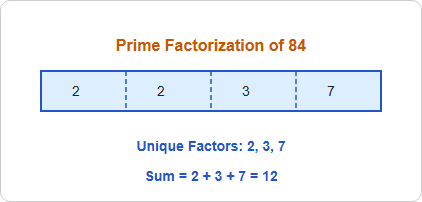
Perform quick prime factorization of 84: 84 = 2 × 2 × 3 × 7.

Identify the distinct prime factors: 2, 3, and 7.

Sum of these factors = 2 + 3 + 7 = 12.

∴ The correct answer is 12.

Alternate Method

Given: The number is 84.

Formula Used: Sum of prime factors = P1 + P2 + ... + Pn (where P are distinct prime bases).

⇒ Step 1: Divide 84 by the smallest prime 2: 84 ÷ 2 = 42.

⇒ Step 2: Divide 42 by 2: 42 ÷ 2 = 21.

⇒ Step 3: Divide 21 by 3: 21 ÷ 3 = 7.

⇒ Step 4: Divide 7 by 7: 7 ÷ 7 = 1.

⇒ Prime factors of 84 = 2 × 2 × 3 × 7 = 22 × 31 × 71.

⇒ Distinct prime factors are 2, 3, and 7.

⇒ Sum = 2 + 3 + 7 = 12.

∴ The correct answer is 12.

Additional Information

Prime Numbers

Numbers that have exactly two factors: 1 and the number itself. Examples: 2, 3, 5, 7, 11, etc.

Distinct Prime Factors

When calculating the sum of prime factors, we generally sum only the unique prime numbers (bases) that divide the given number.

Sum of All Divisors

For a number N = P1a × P2b, sum of all divisors = [(P1a+1 − 1)/(P1 − 1)] × [(P2b+1 − 1)/(P2 − 1)].

3

Simplify: [5 of (2+4)]62÷3+23 of (52)÷9 \frac{[5 \text{ of } (2 + 4)] - {6^2 \div 3} + 2}{3 \text{ of } (5 - 2) \div 9}

  1. ((a))

    18

  2. ((b))

    16

  3. ((c))

    22

  4. ((d))

    20

Show Answer
Answer: ((d))

20

Shortcut Trick

Solve Numerator: (5 × 6) − (36 ÷ 3) + 2 ⇒ 30 − 12 + 2 = 20.

Solve Denominator: (3 × 3) ÷ 9 ⇒ 9 ÷ 9 = 1.

Final Calculation: 20 ÷ 1 = 20.

∴ The correct answer is 20.

Alternate Method

Given:   {[5 of (2 + 4)] − (62 ÷ 3) + 2} / {3 of (5 − 2) ÷ 9}

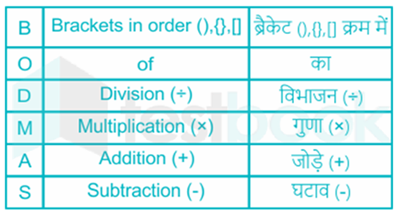
Formula Used: Apply BODMAS (Brackets, Of, Division, Multiplication, Addition, Subtraction) rule.

Step 1: Simplify the Numerator

⇒ [5 of 6] − {36 ÷ 3} + 2

⇒ 30 − 12 + 2

⇒ 18 + 2 = 20

Step 2: Simplify the Denominator

⇒ 3 of 3 ÷ 9

⇒ 9 ÷ 9 = 1

Step 3: Final Division

⇒ Numerator ÷ Denominator

⇒ 20 ÷ 1 = 20

∴ The correct answer is 20.

Additional Information

BODMAS / VBODMAS Rule

Used to solve multiple operations. V (Vinculum/Bar), B (Brackets), O (Of), D (Division), M (Multiplication), A (Addition), S (Subtraction).

Priority of 'Of'

The operator 'of' represents multiplication but is always calculated before Division and Multiplication.

Order of Brackets

Always prioritize solving from the innermost bracket: Circular ()Curly {}Square [].

4

A shopkeeper lists the price of a fan at 36% above its cost price and offers a 25% discount on its list price. If he earns a profit of ₹134, then what is the list price (in ₹) of the fan?

  1. ((a))

    9,112

  2. ((b))

    8,987

  3. ((c))

    8,851

  4. ((d))

    9,135

Show Answer
Answer: ((a))

9,112

Shortcut Trick

Apply Successive Percentage formula for effective profit: a + b + (ab/100)

Net Profit % = 36 − 25 − (36 × 25)/100 = 11 − 9 = 2%

Given Profit = ₹134 ⇒ 2% of CP = ₹134 ⇒ 1% of CP = ₹67

List Price (Marked Price) = 136% of CP = 136 × 67 = ₹9,112

∴ The correct answer is ₹9,112.

Alternate Method

Given:

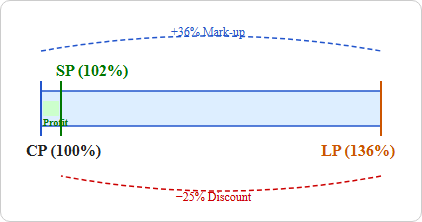
Mark-up = 36% above Cost Price (CP)

Discount = 25% on List Price (LP)

Profit = ₹134

Formula Used:

  1. LP = CP × (100 + Mark-up%)/100
  2. SP = LP × (100 − Discount%)/100
  3. Profit = SP − CP

Let the Cost Price (CP) of the fan be ₹100x.

List Price (LP) = 100x + 36% of 100x = ₹136x

Discount = 25% of 136x = 136x × (25/100) = ₹34x

Selling Price (SP) = LP − Discount = 136x − 34x = ₹102x

Profit = SP − CP = 102x − 100x = 2x

⇒ According to the question: 2x = ₹134

⇒ x = 134 ÷ 2 = ₹67

List Price = 136x = 136 × 67

⇒ 136 × 67 = 9,112

∴ The correct answer is ₹9,112.

Additional Information

Relationship between CP and MP

The direct ratio of Cost Price to Marked Price is given by: CP/MP = (100 − Discount%)/(100 + Profit%).

Successive Discounts

If two successive discounts of d1% and d2% are given, the single equivalent discount is (d1 + d2 − d1d2/100)%.

Mark-up Percentage

It is the percentage by which the Cost Price is raised to decide the Marked Price: Mark-up % = (MP − CP)/CP × 100.

5

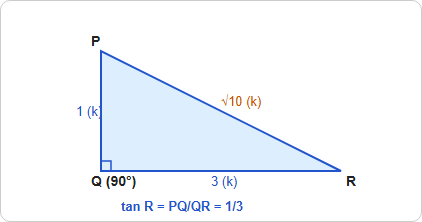
In ΔPQR \Delta PQR , Q=90 \angle Q = 90^\circ . If tanR=13 \tan R = \frac{1}{3} , then the value of 1+secP(3cosRsinP)cosecR(4sinRcosP) 1 + \frac{\sec P (3 \cos R - \sin P)}{cosec R (4 \sin R - \cos P)} is:

  1. ((a))

    7

  2. ((b))

    6

  3. ((c))

    3

  4. ((d))

    5

Show Answer
Answer: ((c))

3

Shortcut Trick

In a right-angled triangle PQR at Q, P + R = 90°, hence complementary relations apply: sec P = cosec R, sin P = cos R, and cos P = sin R.

Substitute these into the expression: 1 + [cosec R (3 cos R − cos R)] ÷ [cosec R (4 sin R − sin R)]

⇒ 1 + (2 cos R) ÷ (3 sin R) = 1 + (2/3) cot R

Given tan R = 1/3 ⇒ cot R = 3.

⇒ 1 + (2/3) × 3 = 1 + 2 = 3.

∴ The correct answer is 3.

Alternate Method

Given: In ΔPQR, ∠Q = 90° and tan R = 1/3.

Let PQ = 1 and QR = 3. Using Pythagoras Theorem:

⇒ PR2 = PQ2 + QR2 = 12 + 32 = 10

⇒ PR = √10

Now, calculate trigonometric ratios for angles P and R:

⇒ sin P = QR/PR = 3/√10 | cos P = PQ/PR = 1/√10 | sec P = √10

⇒ sin R = PQ/PR = 1/√10 | cos R = QR/PR = 3/√10 | cosec R = √10

Substitute these values into the expression 1 + [sec P (3 cos R − sin P)] ÷ [cosec R (4 sin R − cos P)]:

⇒ 1 + [√10 (3 × 3/√10 − 3/√10)] ÷ [√10 (4 × 1/√10 − 1/√10)]

⇒ 1 + [(√10 / √10) × (9 − 3)] ÷ [(√10 / √10) × (4 − 1)]

⇒ 1 + 6 ÷ 3 = 1 + 2 = 3

∴ The correct answer is 3.

Additional Information

Complementary Angle Identities

For any angle θ, sin(90° − θ) = cos θ, tan(90° − θ) = cot θ, and sec(90° − θ) = cosec θ.

Pythagorean Identities

Fundamental relations between ratios: sin2θ + cos2θ = 1, 1 + tan2θ = sec2θ, and 1 + cot2θ = cosec2θ.

Trigonometric Ratios in Right Triangles

sin θ = Perpendicular/Hypotenuse, cos θ = Base/Hypotenuse, tan θ = Perpendicular/Base.

6

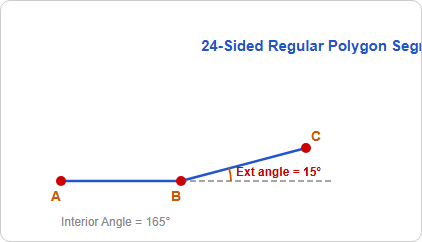
Find the sum of 8 exterior angles of a 24-sided regular polygon.

  1. ((a))

    115°

  2. ((b))

    120°

  3. ((c))

    140°

  4. ((d))

    135°

Show Answer
Answer: ((b))

120°

Shortcut Trick

Each exterior angle of a regular polygon = 360° ÷ n

Given n = 24 sides.

⇒ One exterior angle = 360° ÷ 24 = 15°

⇒ Sum of 8 exterior angles = 8 × 15° = 120°

∴ The correct answer is 120°.

Alternate Method

Given:

Number of sides of the regular polygon (n) = 24

Number of angles to be summed = 8

Formula Used:

  1. Sum of all exterior angles of any convex polygon = 360°
  2. Measure of each exterior angle = 360° ÷ n

Calculations:

⇒ Total sum of all exterior angles = 360°

⇒ Since the polygon is regular, all 24 exterior angles are equal.

⇒ Measure of one exterior angle = 360° ÷ 24

⇒ One exterior angle = 15°

⇒ Sum of 8 such exterior angles = 8 × 15°

⇒ Sum = 120°

∴ The correct answer is 120°.

Additional Information

Sum of Interior Angles

The sum of all interior angles of an n-sided polygon is given by the formula (n − 2) × 180°.

Relation between Angles

At any vertex of a polygon, the sum of the interior angle and the exterior angle is always 180° (linear pair).

Regular Polygon Properties

In a regular polygon, all sides are equal and all interior/exterior angles are equal. The measure of each interior angle is [(n − 2) × 180°] ÷ n.

7

When one-third of a number is increased by 55, the result is 83. Find the sum of the digits of the original number.

  1. ((a))

    13

  2. ((b))

    9

  3. ((c))

    12

  4. ((d))

    14

Show Answer
Answer: ((c))

12

Logic followed here is.

Logic: The original number is determined by formulating and solving a linear equation based on the given conditions, followed by calculating the sum of its digits.

Step 1: Finding the original number

Let the original number be x.

According to the statement, one-third of the number (x / 3) increased by 55 results in 83.

(x / 3) + 55 = 83

Subtract 55 from both sides of the equation:

x / 3 = 83 − 55

x / 3 = 28

Multiply both sides by 3 to isolate x:

x = 28 × 3

x = 84

The original number is 84.


Step 2: Finding the sum of the digits

The digits of the number 84 are 8 and 4.

Sum of the digits = 8 + 4

Sum of the digits = 12


Therefore, the sum of the digits of the original number is 12.

8

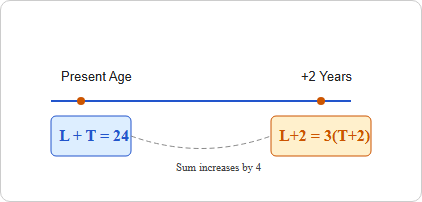
The sum of the present ages of Lokesh and Taresh is 24 years. After 2 years, Lokesh's age will be three times that of Taresh. Lokesh's present age (in years) is:

  1. ((a))

    12

  2. ((b))

    19

  3. ((c))

    17

  4. ((d))

    22

Show Answer
Answer: ((b))

19

Shortcut Trick

Present sum of ages = 24 years.

Sum after 2 years = 24 + (2 persons × 2 years) = 28 years.

After 2 years, ratio of Lokesh to Taresh = 3 : 1 (Total = 4 units).

4 units = 28 years ⇒ 1 unit = 7 years.

Lokesh's age after 2 years = 3 units = 3 × 7 = 21 years.

Lokesh's present age = 21 − 2 = 19 years.

∴ The correct answer is 19 years.

Alternate Method

Given: Sum of present ages = 24 years | Future condition (after 2 years) = Lokesh is 3 times Taresh.

Formula: Total Sum Change = Present Sum + (Number of Persons × Number of Years)

Let Lokesh's present age be L and Taresh's present age be T.

⇒ L + T = 24 --- (Eq. 1)

⇒ T = 24 − L

According to the condition after 2 years:

⇒ L + 2 = 3 × (T + 2)

⇒ L + 2 = 3 × ((24 − L) + 2)

⇒ L + 2 = 3 × (26 − L)

⇒ L + 2 = 78 − 3L

⇒ L + 3L = 78 − 2

⇒ 4L = 76

⇒ L = 76 ÷ 4 = 19

∴ The correct answer is 19 years.

Additional Information

Sum of Ages Property

If the sum of ages of 'n' people is S, then after 'x' years, the new sum will be S + (n × x).

Constant Age Difference

The difference between the ages of two individuals remains constant throughout their lives, regardless of the years passed.

Ratio of Ages

When a ratio is given for a future or past time, always adjust the total sum or individual ages to that specific point in time before applying the ratio.

9

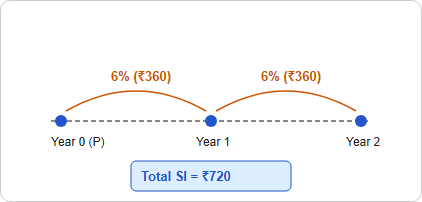
What sum of money (in ₹) will yield ₹720 as simple interest in 2 years at 6% per annum?

  1. ((a))

    6000

  2. ((b))

    5500

  3. ((c))

    6200

  4. ((d))

    6400

Show Answer
Answer: ((a))

6000

Shortcut Trick

Calculate the Effective Interest Rate: 6% × 2 years = 12%.

Since 12% of the Principal equals ₹720:

12% → 720

1% → 720 ÷ 12 = 60

100% (Principal) → 60 × 100 = 6000

∴ The correct answer is ₹6000.

Alternate Method

Given:

Simple Interest (SI) = ₹720

Rate (R) = 6% per annum

Time (T) = 2 years

Formula Used:

Simple Interest (SI) = (P × R × T) ÷ 100

Or, Principal (P) = (SI × 100) ÷ (R × T)

Calculations:

⇒ P = (720 × 100) ÷ (6 × 2)

⇒ P = 72000 ÷ 12

⇒ P = 6000

∴ The correct answer is ₹6000.

Additional Information

Total Amount Formula

The total amount (A) at the end of the period is the sum of the Principal and Simple Interest: A = P + SI.

Effective Rate of Interest

In Simple Interest, the effective rate for the entire duration is simply the product of the annual rate and time (R × T).

Constant Interest

In Simple Interest, the interest remains the same for every year because it is always calculated on the original Principal.

10

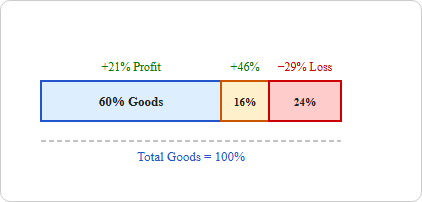
During a sale, 60% of the goods are sold at a profit of 21%. Of the remaining goods, 40% are sold at a profit of 46%, and the rest are sold at a loss of 29%. If the overall profit is x%, then what is the value of x?

  1. ((a))

    3.5

  2. ((b))

    13

  3. ((c))

    9.5

  4. ((d))

    3

Show Answer
Answer: ((b))

13

Shortcut Trick

Assume total goods = 100 units.

P1 (60 units) → Profit = 60 × 21 = +1260

P2 (40% of 40 = 16 units) → Profit = 16 × 46 = +736

P3 (Remaining 24 units) → Loss = 24 × (−29) = −696

Overall profit = (1260 + 736 − 696) ÷ 100 = 1300 ÷ 100 = 13%

∴ The correct answer is 13.

Alternate Method

Given:

Part 1 = 60% of goods sold at 21% profit.

Part 2 = 40% of (100 − 60)% = 16% of goods sold at 46% profit.

Part 3 = (100 − 60 − 16)% = 24% of goods sold at 29% loss.

Formula Used:

Overall Profit/Loss % = (w1p1 + w2p2 + w3p3) ÷ (w1 + w2 + w3)

Calculations:

⇒ Let total quantity be 100 units.

Profit from Part 1 = 60 × (21/100) = 12.6 units

Profit from Part 2 = 16 × (46/100) = 7.36 units

Loss from Part 3 = 24 × (29/100) = 6.96 units

Net Profit = 12.6 + 7.36 − 6.96

Net Profit = 19.96 − 6.96 = 13 units

Overall Profit % (x) = (13 ÷ 100) × 100 = 13%

⇒ x = 13

∴ The correct answer is 13.

Additional Information

Weighted Average Profit

When items are sold in different lots, the overall profit is the weighted sum of profits divided by the total quantity: Net % = Σ(ni × pi) ÷ Σni.

Profit and Loss Basics

Profit % = (Profit ÷ CP) × 100 and Loss % = (Loss ÷ CP) × 100. Loss is always treated as a negative value in weighted average calculations.

Successive Percentage Change

If a value changes by a% then b%, the effective change is [a + b + (a × b)/100]%. This applies to successive discounts or markup followed by discount.

11

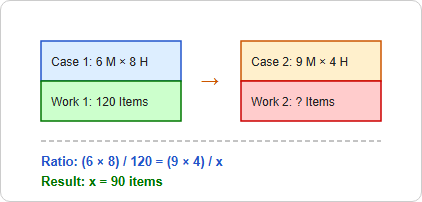
If 6 machines produce 120 items in 8 hours, how many items can 9 machines produce in 4 hours at the same rate?

  1. ((a))

    120

  2. ((b))

    90

  3. ((c))

    80

  4. ((d))

    60

Show Answer
Answer: ((b))

90

Shortcut Trick

Apply the Chain Rule formula: (M1 × T1) ÷ W1 = (M2 × T2) ÷ W2

Substitute values: (6 × 8) ÷ 120 = (9 × 4) ÷ W2

⇒ 48 ÷ 120 = 36 ÷ W2

⇒ 1 ÷ 2.5 = 36 ÷ W2

⇒ W2 = 36 × 2.5 = 90

∴ The correct answer is 90 items.

Alternate Method

Given: M1 = 6 machines, W1 = 120 items, T1 = 8 hours.

Find: W2 (items) for M2 = 9 machines and T2 = 4 hours.

Formula: (M1 × D1 × H1) ÷ W1 = (M2 × D2 × H2) ÷ W2

Step-by-step calculation:

⇒ Work done per machine hour = 120 ÷ (6 × 8)

⇒ Rate = 120 ÷ 48 = 2.5 items per machine hour

⇒ Total machine hours in Case 2 = 9 machines × 4 hours = 36 machine hours

⇒ Total items (W2) = 36 × 2.5

⇒ W2 = 90 items

∴ The correct answer is 90 items.

Additional Information

The General Chain Rule Formula

For work problems involving multiple entities, time, and efficiency: (M1 × D1 × H1 × E1) ÷ W1 = (M2 × D2 × H2 × E2) ÷ W2, where M is number of men/machines, D is days, H is hours, E is efficiency, and W is work.

Direct and Inverse Proportion

Work is directly proportional to the number of machines and time. Conversely, for a fixed amount of work, the number of machines is inversely proportional to the time taken.

Unitary Method

Always find the output of 1 unit of the entity in 1 unit of time (e.g., 1 machine in 1 hour) to simplify complex variations.

12

A and B can complete a work in 12 days and 8 days, respectively. They started doing the work together but after 2 days, B had to leave, and A completed the remaining work alone. The whole work was completed in ________ days.

  1. ((a))

    8

  2. ((b))

    7

  3. ((c))

    9

  4. ((d))

    10

Show Answer
Answer: ((c))

9

Shortcut Trick

Total Work (LCM of 12 and 8) = 24 units.

Efficiency: A = 2, B = 3. Combined efficiency = 5.

Work done by A and B in 2 days = 5 × 2 = 10 units.

Remaining work = 24 − 10 = 14 units.

Time taken by A to finish remaining work = 14 ÷ 2 = 7 days.

Total time to complete the work = 2 + 7 = 9 days.

∴ The correct answer is 9 days.

Alternate Method

Given: Time taken by A = 12 days, Time taken by B = 8 days. Work started together for 2 days.

Formula Used: Total Work = Efficiency × Time taken.

PersonDaysTotal WorkEfficiency
A12242
B83

⇒ Combined efficiency of A and B = 2 + 3 = 5 units/day.

⇒ Work completed in first 2 days = 5 × 2 = 10 units.

⇒ Remaining work to be completed by A = 24 − 10 = 14 units.

⇒ Time taken by A alone = 14 ÷ 2 = 7 days.

⇒ Total time for the whole work = Initial 2 days + A's 7 days = 9 days.

∴ The correct answer is 9 days.

Additional Information

Work and Wages

Wages are always distributed in the ratio of the efficiency of the workers (or work done) when they work for the same duration.

Pipes and Cisterns

The same LCM concept applies where inlet pipes have positive efficiency and outlet (leakage) pipes have negative efficiency.

Alternate Day Work

In alternate day problems, calculate the work done in one cycle (sum of efficiencies) and then divide the total work by the cycle value.
13

Simplify: 25 of ((34÷0.25)+12)13 \frac{2}{5} \text{ of } ((\frac{3}{4} \div 0.25) + \frac{1}{2}) - \frac{1}{3}

  1. ((a))

    1415 \frac{14}{15}

  2. ((b))

    1615 \frac{16}{15}

  3. ((c))

    1315 \frac{13}{15}

  4. ((d))

    1715 \frac{17}{15}

Show Answer
Answer: ((b))

1615 \frac{16}{15}

Shortcut Trick

Convert decimals to fractions: 0.25 = 1/4.

Solve the inner division: 3/4 ÷ 1/4 = 3.

Add the fraction in brackets: 3 + 1/2 = 7/2.

Calculate 'of' and subtract: (2/5 × 7/2) − 1/3 = 7/5 − 1/3 = 16/15.

∴ The correct answer is 16/15.

Alternate Method

Given Expression: (2/5) of (((3/4) ÷ 0.25) + 1/2) − 1/3

We follow the BODMAS rule to simplify the expression step-by-step.

⇒ (2/5) of ((0.75 ÷ 0.25) + 0.5) − 1/3

⇒ (2/5) of (3 + 0.5) − 1/3

⇒ (2/5) of (3.5) − 1/3

⇒ (2/5) × (7/2) − 1/3

⇒ (2 × 7) / (5 × 2) − 1/3

⇒ 7/5 − 1/3

⇒ (7 × 3 − 1 × 5) / 15

⇒ (21 − 5) / 15

⇒ 16/15

∴ The correct answer is 16/15.

Additional Information

BODMAS Rule

It defines the order of operations: Brackets, Of, Division, Multiplication, Addition, and Subtraction.

Of Operator

The 'of' operator is equivalent to multiplication but takes precedence over regular division and multiplication in the hierarchy.

Reciprocal in Division

Dividing by a fraction is the same as multiplying by its reciprocal: (a/b) ÷ (c/d) = (a/b) × (d/c).

14

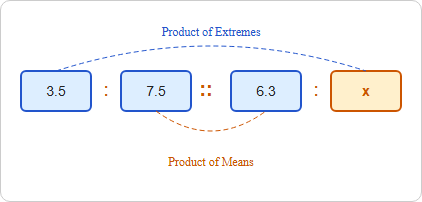
Find the fourth proportional to 3.5, 7.5, and 6.3.

  1. ((a))

    12.5

  2. ((b))

    11.5

  3. ((c))

    13.5

  4. ((d))

    14.5

Show Answer
Answer: ((c))

13.5

Shortcut Trick

The fourth proportional to a, b, and c is calculated as (b × c) ÷ a.

Ratio of the first two terms 3.5 : 7.5 simplifies to 7 : 15 (multiplying by 2).

For the numbers to be in proportion, 7 : 15 = 6.3 : x.

Since 7 × 0.9 = 6.3, the value of x must be 15 × 0.9 = 13.5.

∴ The correct answer is 13.5.

Alternate Method

Given:

First number (a) = 3.5

Second number (b) = 7.5

Third number (c) = 6.3

Formula Used:

Let the fourth proportional be x. Then, a : b :: c : x.

According to the property of proportions, Product of Extremes = Product of Means.

a × x = b × c

Calculations:

⇒ 3.5 × x = 7.5 × 6.3

⇒ x = (7.5 × 6.3) ÷ 3.5

⇒ x = (75 × 63) ÷ 350 (removing decimals)

⇒ x = (75 × 9) ÷ 50 (dividing 63 and 350 by 7)

⇒ x = (3 × 9) ÷ 2 (dividing 75 and 50 by 25)

⇒ x = 27 ÷ 2

⇒ x = 13.5

∴ The correct answer is 13.5.

Additional Information

Mean Proportional

For two numbers a and b, the mean proportional is given by x = √(a × b).

Third Proportional

For two numbers a and b, the third proportional c satisfies a : b = b : c, which means c = b2 ÷ a.

Continued Proportion

Quantities a, b, c, d... are in continued proportion if a/b = b/c = c/d and so on.

15

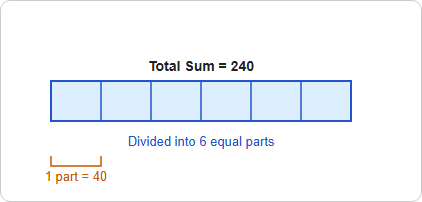
The sum of 6 numbers is 240. Find their average.

  1. ((a))

    38

  2. ((b))

    39

  3. ((c))

    41

  4. ((d))

    40

Show Answer
Answer: ((d))

40

Shortcut Trick

The Average is simply the Total Sum divided by the Count of numbers.

Average = 240 ÷ 6 = 40.

∴ The correct answer is 40.

Alternate Method

Given:

Sum of 6 numbers = 240

Total count of numbers (n) = 6

Formula Used:

Average = (Sum of all observations) ÷ (Total number of observations)

Calculations:

⇒ Total Sum = 240

⇒ Total numbers = 6

⇒ Average = 240 ÷ 6

⇒ Average = 40

∴ The correct answer is 40.

Additional Information

Basic Average Concept

The average (arithmetic mean) is the central value of a data set, calculated by dividing the sum of values by their count.

Total Sum Calculation

If the average and the number of terms are known, the Total Sum can be found as: Sum = Average × Number of terms.

Average of First 'n' Natural Numbers

The average of the first n natural numbers is given by the formula: (n + 1) ÷ 2.

Average of Arithmetic Progression (AP)

For any series in AP, the average is always (First Term + Last Term) ÷ 2.

16

A and B together can complete a task in 10 days, B and C in 12 days and A and C in 15 days. How long will A, B and C take to complete the task working together?

  1. ((a))

    9 days

  2. ((b))

    7 days

  3. ((c))

    10 days

  4. ((d))

    8 days

Show Answer
Answer: ((d))

8 days

Shortcut Trick

Total Work (LCM of 10, 12, 15) = 60 units.

Efficiencies: (A+B) = 6, (B+C) = 5, (A+C) = 4.

Combined efficiency 2(A+B+C) = 6 + 5 + 4 = 15.

Efficiency (A+B+C) = 15 ÷ 2 = 7.5.

Time taken = 60 ÷ 7.5 = 8 days.

∴ The correct answer is 8 days.

Alternate Method

Given: (A+B) takes 10 days, (B+C) takes 12 days, and (A+C) takes 15 days.

Formula Used: Total Work = Time × Efficiency

PersonDaysTotal WorkEfficiency
A + B10606
B + C125
A + C154

⇒ Total efficiency of (A+B), (B+C), and (A+C) = 6 + 5 + 4 = 15

⇒ 2 × (Efficiency of A + B + C) = 15

⇒ Efficiency of A, B and C together = 15 ÷ 2 = 7.5

⇒ Time taken by A, B and C = Total Work ÷ Combined Efficiency

⇒ Time taken = 60 ÷ 7.5 = 8 days

∴ The correct answer is 8 days.

Additional Information

Individual Efficiency

To find A's individual efficiency, subtract (B+C) efficiency from (A+B+C) total efficiency: 7.5 − 5 = 2.5.

Work and Wages

Wages are always distributed in the ratio of the work done by each person or the ratio of their efficiencies.

Pipes and Cisterns

This logic is identical to pipes filling a tank, where an outlet pipe performs negative work (efficiency is subtracted).

17

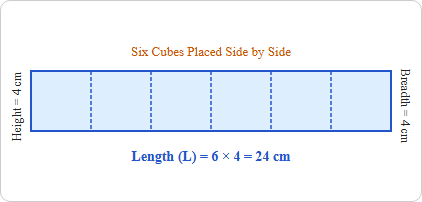
Six cubes each of side 4 cm, are placed adjacent to each other. Find the volume of the cuboid so formed.

  1. ((a))

    64 cm3 64 \text{ cm}^3

  2. ((b))

    512 cm3 512 \text{ cm}^3

  3. ((c))

    384 cm3 384 \text{ cm}^3

  4. ((d))

    256 cm3 256 \text{ cm}^3

Show Answer
Answer: ((c))

384 cm3 384 \text{ cm}^3

Shortcut Trick

Total volume of a cuboid formed by joining n identical cubes is simply the sum of the volumes of all individual cubes.

Volume of one cube = side3 = 43 = 64 cm3

Total Volume = 6 × 64 = 384 cm3

∴ The correct answer is 384 cm3.

Alternate Method

Given: Side of each cube (a) = 4 cm and Number of cubes (n) = 6.

When six cubes are placed adjacent to each other in a row, the dimensions of the resulting cuboid are:

Formula Used: Volume of Cuboid = Length (L) × Breadth (B) × Height (H)

⇒ Length (L) = 6 × 4 = 24 cm

⇒ Breadth (B) = 4 cm

⇒ Height (H) = 4 cm

⇒ Volume = 24 × 4 × 4

⇒ Volume = 24 × 16

⇒ Volume = 384 cm3

∴ The correct answer is 384 cm3.

Additional Information

Total Surface Area of Cuboid

The total area of all six faces of a cuboid is calculated as TSA = 2(LB + BH + HL).

Diagonal of a Cuboid

The length of the longest rod that can be placed inside a cuboid is given by √(L2 + B2 + H2).

Volume of a Cube

For a cube where all sides are equal (L = B = H = a), the volume is a3 and the lateral surface area is 4a2.

18

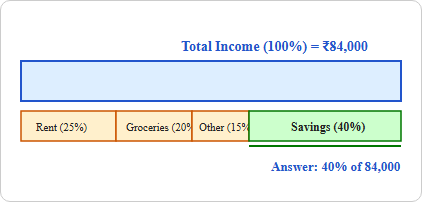
Naveena's monthly income is ₹84,000. She spends 25% of his income on house rent, 20% on groceries, 15% on other household expenses, and saves the remaining amount. How much money (in ₹) does she save every month?

  1. ((a))

    33,000

  2. ((b))

    33,600

  3. ((c))

    32,600

  4. ((d))

    32,000

Show Answer
Answer: ((b))

33,600

Shortcut Trick

Total percentage spent = 25% + 20% + 15% = 60%

Percentage saved = 100% − 60% = 40%

Monthly Savings = 40% of 84,000 = 40 × 840 = 33,600

∴ The correct answer is ₹33,600.

Alternate Method

Given:

Monthly Income of Naveena = ₹84,000

House Rent = 25%

Groceries = 20%

Other Expenses = 15%

Formula used:

Savings = Total Income − Total Expenditure

Savings = Income × [100 − (Spent1 + Spent2 + Spent3)] / 100

Calculations:

⇒ Total Expenditure % = 25% + 20% + 15% = 60%

⇒ Savings % = 100% − 60% = 40%

⇒ Savings Amount = (40 / 100) × 84,000

⇒ Savings Amount = 0.4 × 84,000

⇒ Savings Amount = 33,600

∴ The correct answer is ₹33,600.

Additional Information

Income Expenditure Identity

Total Income is always the sum of Expenditure and Savings. Income = Expenditure + Savings.

Successive Percentage Concept

If the problem states spending on the 'remaining' amount, we use the multiplier method: Final Savings = Income × (100−r1)/100 × (100−r2)/100.

Percentage to Fraction Conversion

Quick calculations can be done by converting common percentages to fractions: 25% = 1/4, 20% = 1/5, 40% = 2/5.

19

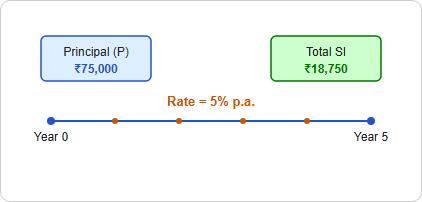
Calculate the simple interest if the principal amount is ₹75,000, the rate is 5%, and the time is 5 years.

  1. ((a))

    ₹18,750

  2. ((b))

    ₹3750

  3. ((c))

    ₹16,870

  4. ((d))

    ₹7,850

Show Answer
Answer: ((a))

₹18,750

Shortcut Trick

Net Simple Interest percentage = Rate × Time

Net Interest % = 5% × 5 = 25%

Simple Interest = 25% of ₹75,000

SI = 75,000 ÷ 4 = ₹18,750

∴ The correct answer is ₹18,750.

Alternate Method

Given:

Principal (P) = ₹75,000

Rate (R) = 5% per annum

Time (T) = 5 years

Formula Used:

Simple Interest (SI) = (P × R × T) ÷ 100

Calculations:

⇒ SI = (75,000 × 5 × 5) ÷ 100

⇒ SI = 750 × 25

⇒ SI = ₹18,750

∴ The correct answer is ₹18,750.

Additional Information

Total Amount Formula

The Total Amount (A) is the sum of the principal and the interest earned: A = P + SI.

Rate of Interest Calculation

To find the Rate (R) when other values are known: R = (SI × 100) ÷ (P × T).

Constant Interest Property

In Simple Interest, the interest amount remains the same for every year if the principal and rate are constant.

20

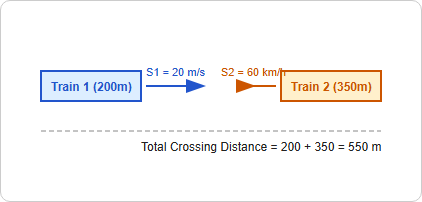
A 200 m long train passes a man standing on a platform in 10 seconds. How long will it take to cross another 350 m long train running at 60 km/h in the opposite direction?

  1. ((a))

    15 seconds

  2. ((b))

    12 seconds

  3. ((c))

    16 seconds

  4. ((d))

    14 seconds

Show Answer
Answer: ((a))

15 seconds

Shortcut Trick

Speed of Train 1 = 200 ÷ 10 = 20 m/s

Speed of Train 2 = 60 × 5/18 = 50/3 m/s

Relative Speed (Opposite) = 20 + 50/3 = 110/3 m/s

Required Time = (Total Length) ÷ (Relative Speed) = (200 + 350) ÷ (110/3) = 15 sec

∴ The correct answer is 15 sec.

Alternate Method

Given: Length of first train (L1) = 200 m, Time to cross man = 10 sec, Length of second train (L2) = 350 m, Speed of second train (S2) = 60 km/h.

Formula Used: Speed = Distance ÷ Time | Relative Speed (Opposite) = S1 + S2

⇒ Speed of the first train (S1) = Distance ÷ Time = 200 ÷ 10 = 20 m/s

⇒ Speed of the second train (S2) in m/s = 60 × (5/18) = 50/3 m/s

⇒ When two trains move in opposite directions, their relative speed is the sum of their individual speeds.

Relative Speed = S1 + S2 = 20 + 50/3 = (60 + 50)/3 = 110/3 m/s

⇒ Total distance to be covered while crossing = L1 + L2 = 200 + 350 = 550 m

⇒ Time taken = Total Distance ÷ Relative Speed = 550 ÷ (110/3) = 550 × 3 ÷ 110

⇒ Time taken = 5 × 3 = 15 sec

∴ The correct answer is 15 sec.

Additional Information

Relative Speed Concepts

When two objects move in opposite directions, relative speed = S1 + S2. When moving in the same direction, relative speed = |S1 − S2|.

Unit Conversion

To convert speed from km/h to m/s, multiply by 5/18. To convert from m/s to km/h, multiply by 18/5.

Train Crossing Distance

To cross a point object (man, pole), distance = length of train. To cross a platform or another train, distance = sum of both lengths.

21

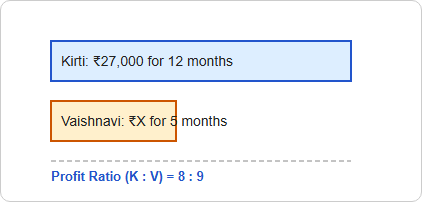
Kirti starts a business with ₹27,000 and after 7 months, Vaishnavi joins Kirti as her partner. After a year, the profit is divided in the ratio 8 : 9. What is Vaishnavi's contribution in the capital?

  1. ((a))

    ₹72,900

  2. ((b))

    ₹73,360

  3. ((c))

    ₹72,750

  4. ((d))

    ₹72,875

Show Answer
Answer: ((a))

₹72,900

Shortcut Trick

Profit Ratio = (Capital × Time) Ratio

Kirti (K) : Vaishnavi (V) = (27000 × 12) : (CapitalV × 5)

Given Profit Ratio = 8 : 9

⇒ (27000 × 12) / (CapitalV × 5) = 8 / 9

⇒ CapitalV = (27000 × 12 × 9) / (5 × 8) = 675 × 108 = 72900

∴ The correct answer is ₹72,900.

Alternate Method

Given:

Kirti's Capital (CK) = ₹27,000

Kirti's investment period (TK) = 12 months

Vaishnavi joins after 7 months, so investment period (TV) = 12 − 7 = 5 months

Profit Ratio (PK : PV) = 8 : 9

Formula used:

Ratio of Profits = (Capital1 × Time1) : (Capital2 × Time2)

Calculations:

⇒ (CK × TK) / (CV × TV) = PK / PV

⇒ (27000 × 12) / (CV × 5) = 8 / 9

⇒ 324000 / (5 × CV) = 8 / 9

⇒ 5 × CV × 8 = 324000 × 9

⇒ 40 × CV = 2916000

⇒ CV = 2916000 ÷ 40

⇒ CV = 72900

∴ The correct answer is ₹72,900.

Additional Information

Partnership Profit Distribution

When investments are for different time periods, profit is distributed based on the product of Capital and Time. P1 : P2 = C1T1 : C2T2.

Active vs Sleeping Partner

An Active Partner manages the business and may receive a salary or extra profit share, while a Sleeping Partner only provides capital.

Investment Calculation

To find Capital when Profit and Time are known: Capital = Profit ÷ Time. To find Time: Time = Profit ÷ Capital.

22

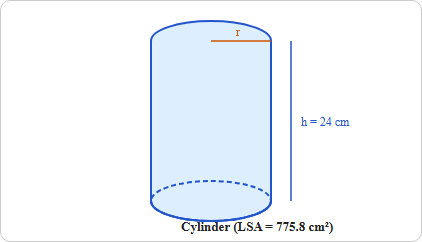
If the lateral surface area of a cylinder is 775.8 cm2 and its height is 24 cm, then find its volume. (Use π = 3.14 and round off to two decimal places.)

  1. ((a))

    1962.74 cm3

  2. ((b))

    1984.78 cm3

  3. ((c))

    2016.67 cm3

  4. ((d))

    1996.63 cm3

Show Answer
Answer: ((d))

1996.63 cm3

Shortcut Trick

Direct relation: Volume = (Lateral Surface Area)2 ÷ (4 × π × Height)

Given LSA = 775.8 cm2, Height = 24 cm, π = 3.14

Volume = (775.8 × 775.8) ÷ (4 × 3.14 × 24)

Volume = 601865.64 ÷ 301.44 = 1996.6346...

Rounding to two decimal places, we get 1996.63 cm3.

∴ The correct answer is 1996.63 cm3.

Alternate Method

Given: Lateral Surface Area (LSA) = 775.8 cm2, Height (h) = 24 cm, π = 3.14

Formula Used:

  1. Lateral Surface Area of a Cylinder = 2 × π × r × h
  2. Volume of a Cylinder = π × r2 × h

Step 1: Find the radius (r) using the Lateral Surface Area formula.

⇒ 775.8 = 2 × 3.14 × r × 24

⇒ 775.8 = 150.72 × r

⇒ r = 775.8 ÷ 150.72

⇒ r ≈ 5.1473 cm

Step 2: Calculate the Volume of the Cylinder.

Volume = 3.14 × (5.1473)2 × 24

Volume = 3.14 × 26.4947 × 24

Volume = 1996.6348...

Volume ≈ 1996.63 cm3

∴ The correct answer is 1996.63 cm3.

Additional Information

Total Surface Area of Cylinder

The Total Surface Area (TSA) includes both the lateral area and the area of the two circular bases: TSA = 2πr(r + h).

Volume of a Hollow Cylinder

If a cylinder is hollow with external radius R and internal radius r, the volume of material is: V = πh(R2 − r2).

Base Area and Perimeter

The area of the circular base is πr2 and its perimeter (circumference) is 2πr. LSA can also be written as Perimeter of Base × Height.

23

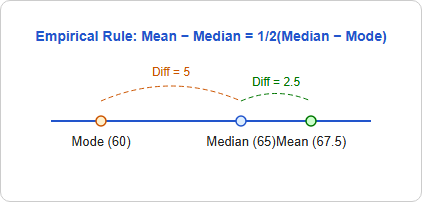
If the median and the mode are given as 65 and 60, respectively, find the mean.

  1. ((a))

    68

  2. ((b))

    67.5

  3. ((c))

    62.5

  4. ((d))

    70

Show Answer
Answer: ((b))

67.5

Shortcut Trick

Apply the Empirical formula: 2 × Mean = 3 × MedianMode

2 × Mean = 3 × 65 − 60

2 × Mean = 195 − 60

2 × Mean = 135

Mean = 135 ÷ 2 = 67.5

∴ The correct answer is 67.5.

Alternate Method

Given:

Median = 65

Mode = 60

Formula Used:

The relationship between Mean, Median, and Mode is given by: Mode = 3(Median) − 2(Mean)

Calculations:

Mode = 3 × Median − 2 × Mean

⇒ 60 = 3 × 65 − 2 × Mean

⇒ 60 = 195 − 2 × Mean

⇒ 2 × Mean = 195 − 60

⇒ 2 × Mean = 135

Mean = 135 ÷ 2

Mean = 67.5

∴ The correct answer is 67.5.

Additional Information

Empirical Formula

For a moderately skewed distribution, the relationship is MeanMode = 3 × (MeanMedian).

Symmetrical Distribution

In a perfectly symmetrical distribution, the values of Mean, Median, and Mode are all equal (Mean = Median = Mode).

Skewness Types

If Mean > Median > Mode, the distribution is positively skewed. If Mode > Median > Mean, it is negatively skewed.

24

Simplify: [(12024÷(4+2))×2(50÷5+6)]+[(18+12×28)(9÷3+5)] [(120 - 24 \div (4 + 2)) \times 2 - (50 \div 5 + 6)] + [(18 + 12 \times 2 - 8) - (9 \div 3 + 5)]

  1. ((a))

    232

  2. ((b))

    262

  3. ((c))

    252

  4. ((d))

    242

Show Answer
Answer: ((d))

242

Shortcut Trick

Solve the expression by breaking it into two major square brackets using BODMAS.

First bracket: [ (120 − 4) × 2 − (10 + 6) ] → [ 232 − 16 ] = 216.

Second bracket: [ (18 + 24 − 8) − (3 + 5) ] → [ 34 − 8 ] = 26.

Total: 216 + 26 = 242.

∴ The correct answer is 242.

Alternate Method

Given: [(120 − 24 ÷ (4 + 2)) × 2 − (50 ÷ 5 + 6)] + [(18 + 12 × 2 − 8) − (9 ÷ 3 + 5)]

Formula Used: VBODMAS rule (Viniculum, Brackets, Of, Division, Multiplication, Addition, Subtraction)

⇒ [(120 − 24 ÷ 6) × 2 − (10 + 6)] + [(18 + 24 − 8) − (3 + 5)]

⇒ [(120 − 4) × 2 − 16] + [(42 − 8) − 8]

⇒ [116 × 2 − 16] + [34 − 8]

⇒ [232 − 16] + 26

⇒ 216 + 26

⇒ 242

∴ The correct answer is 242.

Additional Information

BODMAS Rule

It specifies the order: Brackets, Of, Division, Multiplication, Addition, and Subtraction. Always follow this hierarchy to avoid errors in simplification.

Types of Brackets

Standard order of solving is: Circular Brackets ( ), then Curly Brackets { }, and finally Square Brackets [ ].

Signs Multiplication Rule

(+) × (+) = (+), (−) × (−) = (+), (+) × (−) = (−), and (−) × (+) = (−). This applies to division as well.

25

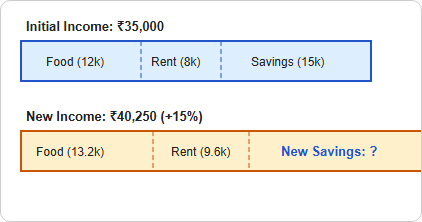
A family's monthly income increased by 15%. They increased their monthly expenditure on food by 10% and on rent by 20%. If their initial monthly expenditure on food was ₹12,000 and on rent was ₹8,000, and their initial monthly savings were ₹15,000, what are their new monthly savings? (Assume that there is no other expenditure.)

  1. ((a))

    ₹17,450

  2. ((b))

    ₹15,000

  3. ((c))

    ₹18,650

  4. ((d))

    ₹25,000

Show Answer
Answer: ((a))

₹17,450

Shortcut Trick

Total Initial Income = 12,000 + 8,000 + 15,000 = ₹35,000

Net increase in Income = 15% of 35,000 = ₹5,250

Net increase in Expenditure = (10% of 12,000) + (20% of 8,000) = 1,200 + 1,600 = ₹2,800

Increase in Savings = Income increase − Expenditure increase = 5,250 − 2,800 = ₹2,450

New Savings = 15,000 + 2,450 = ₹17,450

∴ The correct answer is ₹17,450.

Alternate Method

Given:

Initial Food Exp = ₹12,000 | Initial Rent Exp = ₹8,000 | Initial Savings = ₹15,000

Growth rates: Income +15%, Food +10%, Rent +20%

Formula Used:

Income = Food Expenditure + Rent Expenditure + Savings

⇒ Total Initial Income = 12,000 + 8,000 + 15,000 = 35,000

New Income = 35,000 × (115/100) = 35,000 × 1.15 = 40,250

New Food Exp = 12,000 × (110/100) = 13,200

New Rent Exp = 8,000 × (120/100) = 9,600

Total New Exp = 13,200 + 9,600 = 22,800

New Savings = New IncomeTotal New Exp

New Savings = 40,250 − 22,800 = 17,450

∴ The correct answer is ₹17,450.

Additional Information

Income-Expenditure Relationship

Income is always the sum of total Expenditure and Savings. Formula: I = E + S.

Percentage Change Formula

New Value = Old Value × (100 ± Change%)/100. Use (+) for increase and (−) for decrease.

Net Change in Savings

Change in Savings (ΔS) = Change in Income (ΔI) − Change in Expenditure (ΔE).

General Intelligence & Reasoning (25 questions)

26

What will come in the place of ‘?’ in the following equation, if ‘+’ and ‘-’ are interchanged and ‘x’ and ‘÷’ are interchanged?

<br>

3 ÷ 5 + 16 x 8 - 8 = ?

  1. ((a))

    20

  2. ((b))

    21

  3. ((c))

    18

  4. ((d))

    17

Show Answer
Answer: ((b))

21

Given Sign Interchanges:

Original Sign+×÷
New Sign+÷×


Original Equation:

3 ÷ 5 + 16 × 8 − 8 = ?

Replacing the signs according to the interchange rules:

= 3 × 5 − 16 ÷ 8 + 8 

= 3 × 5 - 2 + 8

= 15 - 2 + 8

= 23 - 2

= 21

Therefore, the value that will come in place of '?' is 21.

Hence, the correct answer is "Option 2".

27

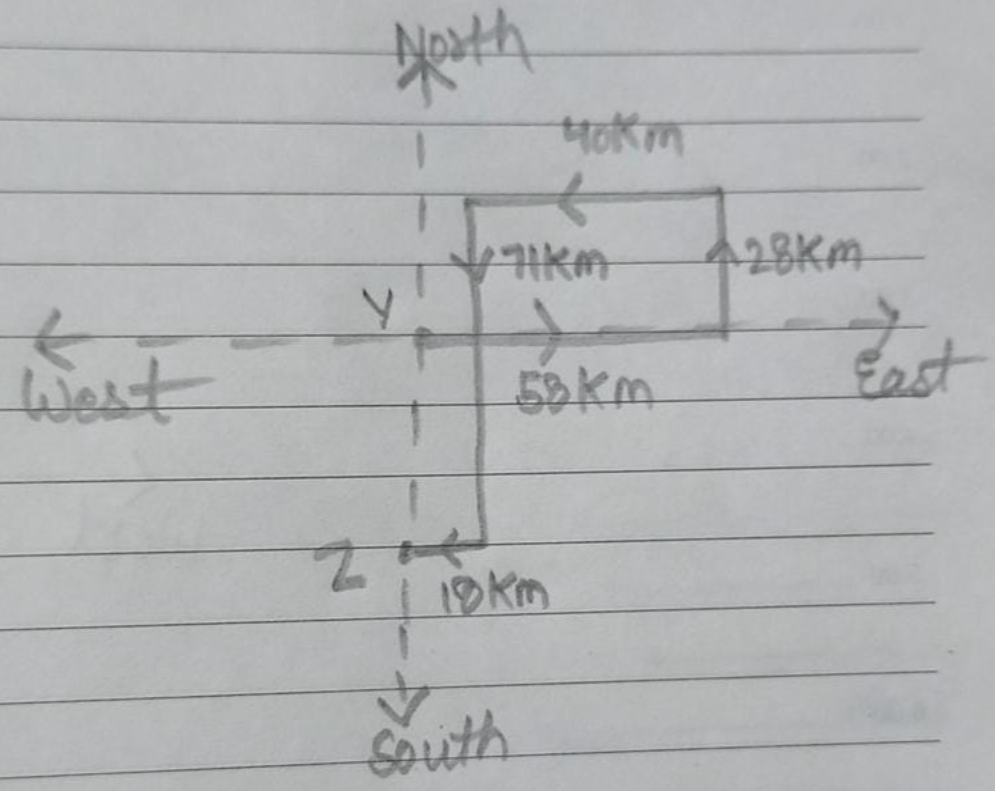
Natesh starts from point Y and drives 58 km towards East. He then takes a left turn, drives 28 km, turns left and drives 40 km. He then takes a left turn and drives 71 km. He takes a right turn, drives 18 km to stop at point Z. How far (shortest distance) and towards which direction should he drive in order to reach point Y again? (All turns are 90-degree turns only unless specified.)

  1. ((a))

    45 km towards west

  2. ((b))

    43 km towards north

  3. ((c))

    39 km towards south

  4. ((d))

    41 km towards north

Show Answer
Answer: ((b))

43 km towards north

Logic followed here is based on the directional path taken by Natesh from his starting position to his final position.

Step-by-step Movement:

  • Natesh starts at Point Y.
  • He drives 58 km towards East.
  • He takes a left turn (which is towards the North) and drives 28 km.
  • He turns left (which is towards the West) and drives 40 km.
  • He takes another left turn (which is towards the South) and drives 71 km.
  • Finally, he takes a right turn (which is towards the West) and drives 18 km to reach Point Z.
<br>

Therefore, he should drive 43 km towards north to reach point Y.

Hence, the correct answer is "Option 2".

28

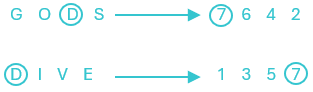
In a certain code language, ‘GODS’ is coded as ‘7642’ and ‘DIVE’ is coded as ‘1357’. What is the code for ‘D’ in that language?

  1. ((a))

    1

  2. ((b))

    4

  3. ((c))

    7

  4. ((d))

    3

Show Answer
Answer: ((c))

7

Logic followed here is.

Logic: The code for a specific letter is determined by identifying common letters and their corresponding common digits across different coded words.

Analysis of the given codes:

GODS is coded as '7642'

DIVE is coded as '1357'


Therefore, the code for 'D' is 7.

Hence, the correct answer is "Option 3".

29

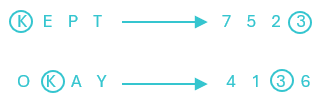
In a certain code language, ‘KEPT’ is coded as ‘7523’ and ‘OKAY’ is coded as ‘4136’. What is the code for ‘K’ in that language?

  1. ((a))

    3

  2. ((b))

    7

  3. ((c))

    1

  4. ((d))

    5

Show Answer
Answer: ((a))

3

Logic followed here is the comparison of words and their corresponding codes to identify the unique digit assigned to each letter.

For

KEPT is coded as '7523'

OKAY is coded as '4136'

Therefore, the code for 'K' is 3.

Hence, the correct answer is "Option 1".

30

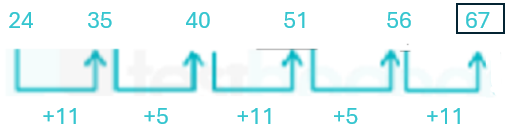
What should come in place of ‘?’ in the given series?

<br>

24 35 40 51 56 ?

  1. ((a))

    70

  2. ((b))

    68

  3. ((c))

    69

  4. ((d))

    67

Show Answer
Answer: ((d))

67

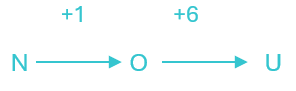
Logic followed here is.

Logic: The series follows an alternating addition pattern where the numbers 11 and 5 are added to consecutive terms to find the next number.


Therefore, the number that should come in place of ‘?’ in the series is 67.

Hence, the correct answer is "Option 4".

31

If ‘A’ stands for ‘÷’, ‘B’ stands for ‘×’, ‘C’ stands for ‘+’ and ‘D’ stands for ‘−’, what will come in place of the question mark (?) in the following equation?

<br>

3 B 2 D 12 A 4 C 3 = ?

  1. ((a))

    6

  2. ((b))

    12

  3. ((c))

    8

  4. ((d))

    4

Show Answer
Answer: ((a))

6

Deciphering the given code:

LetterOperationSymbol
ADivision÷
BMultiplication×
CAddition+
DSubtraction


Calculation of the Equation:

Given equation: 3 B 2 D 12 A 4 C 3 = ?

Substituting the symbols:

= 3 × 2 − 12 ÷ 4 + 3

= 3 × 2 - 3 + 3

= 6 - 3 + 3

= 6

Therefore, the correct value in place of the question mark is 6.

Hence, the correct answer is "Option 1".

32

Rajdeep ranked 64th from the top and 23rd from the bottom in his class. How many students are there in his class?

  1. ((a))

    84

  2. ((b))

    86

  3. ((c))

    87

  4. ((d))

    85

Show Answer
Answer: ((b))

86

The logic followed here is:

Position of Rajdeep from the top = 64th

Position of Rajdeep from the bottom = 23rd

To find the total number of students in the class, the following formula is used:

Total number of students = (Position from top + Position from bottom) − 1

= (64 + 23) − 1

= 87 − 1

= 86

So, there are 86 students in the class.

Hence, the correct answer is 'Option 2'.

33

Refer to the following letter series and answer the question. Counting to be done from left to right.

(Left) M M C R V I K Z J N L U W X W F O Y X F G(Right)

How many such consonants are there, each of which is immediately preceded by a vowel and also immediately followed by a vowel?

  1. ((a))

    Two

  2. ((b))

    None

  3. ((c))

    One

  4. ((d))

    Three

Show Answer
Answer: ((b))

None

Given Series:

(Left) M M C R V I K Z J N L U W X W F O Y X F G (Right)

Required pattern:

Vowel → Consonant → Vowel

Checking the series:

(Left) M M C R V I K Z J N L U W X W F O Y X F G (Right)

There is no consonant which is immediately preceded by a vowel and immediately followed by a vowel.

Consonants satisfying the condition:

→ None

Therefore, there are 0 such consonants.

Hence, the correct answer is "Option 2 — None".

34

Based on the English alphabetical order, three of the following four letter-cluster pairs are alike in a certain way and thus form a group. Which letter-cluster pair DOES NOT belong to that group?
(Note: The odd one out is not based on the number of consonants/vowels or their position in the letter-cluster.)

  1. ((a))

    AB−EF

  2. ((b))

    NO−RS

  3. ((c))

    XY−AE

  4. ((d))

    JK−NO

Show Answer
Answer: ((c))

XY−AE

The logic followed here is

Logic: The letters in each cluster are consecutive, and the letters of the second cluster are each 4 positions ahead of the corresponding letters in the first cluster.

Option 1)  AB-EF,

A + 4 = E; B + 4 = F. (AB and EF are both consecutive letter pairs).

Option 2) NO-RS,

N + 4 = R; O + 4 = S. (NO and RS are both consecutive letter pairs).

Option 3) XY-AE

X + 4 = B ≠ A; Y + 4 = C ≠ E. Also, A and E are not consecutive letters.

This pair does not follow the rule.

Option 4) JK-NO,

J + 4 = N; K + 4 = O. (JK and NO are both consecutive letter pairs).

Therefore, the letter-cluster pair that is different from the others is XY-AE.

Hence, the correct answer is 'Option 3'.

35

Seven people, A, V, C, L, E, K and N, are sitting in a row, facing north. Only four people sit to the left of E. Only four people sit to the right of L. Only one person sits between K and L. V sits to the immediate left of A. C does not sit to the left of N. Who sits third to the right of C?

  1. ((a))

    E

  2. ((b))

    L

  3. ((c))

    K

  4. ((d))

    A

Show Answer
Answer: ((d))

A

Based on the given information, we can determine the seating arrangement of seven people A, V, C, L, E, K, and N sitting in a row facing North.

Key Points

1. Position of E: Only four people sit to the left of E. This implies E is at the 5th position from the left.

2. Position of L: Only four people sit to the right of L. This implies L is at the 3rd position from the left.

3. Position of K: Only one person sits between K and L. Since E is already at the 5th position, K must be at the 1st position.

4. Position of V and A: V sits to the immediate left of A. We need two consecutive vacant seats. The available positions are 2, 4, 6, and 7. The only consecutive pair is 6 and 7. Thus, V is at the 6th position and A is at the 7th position.

5. Position of C and N: C does not sit to the left of N, which means C sits to the right of N. The remaining positions are 2nd and 4th. Therefore, N must be at the 2nd position and C must be at the 4th position.

Seating Arrangement:

Therefore, A sits third to the right of C.

Hence, the correct answer is "Option 4".

36

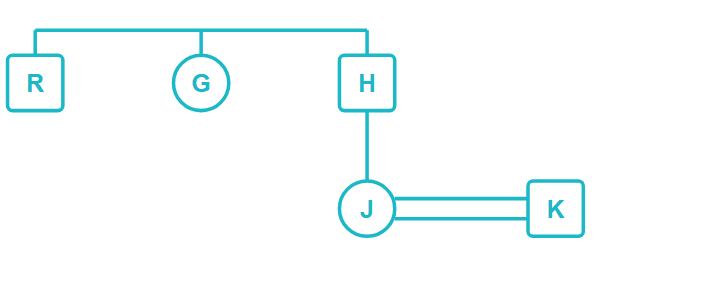
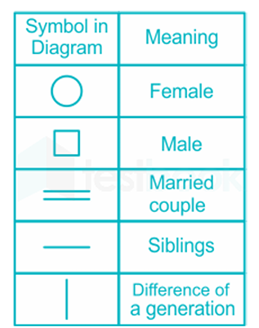
Rajat is the brother of Garima. Garima is the sister of Harish. Harish is the father of Jyoti. Jyoti is the wife of Karan. How is Rajat related to Karan?

  1. ((a))

    Wifes mothers brother

  2. ((b))

    Wife's mother's father

  3. ((c))

    Wife's father's brother

  4. ((d))

    Wife's father's father

Show Answer
Answer: ((c))

Wife's father's brother

Based on the family relationships described, we can determine the connection between Rajat and Karan by breaking it down step-by-step:

  1. Rajat and Garima: Rajat is the brother of Garima. This establishes them as siblings.

  2. Garima and Harish: Garima is the sister of Harish. This implies that Rajat, Garima, and Harish are all siblings from the same generation.

  3. Harish and Jyoti: Harish is the father of Jyoti. As Rajat is the brother of Harish, Rajat is the paternal uncle of Jyoti.

  4. Jyoti and Karan: Jyoti is the wife of Karan. This means Harish is Karan's father-in-law.

Therefore, Rajat is the brother of Harish, who is the father of Karan's wife JyotiRajat is the Wife's father's brother of Karan.

Hence, the correct answer is 'Option 3'.

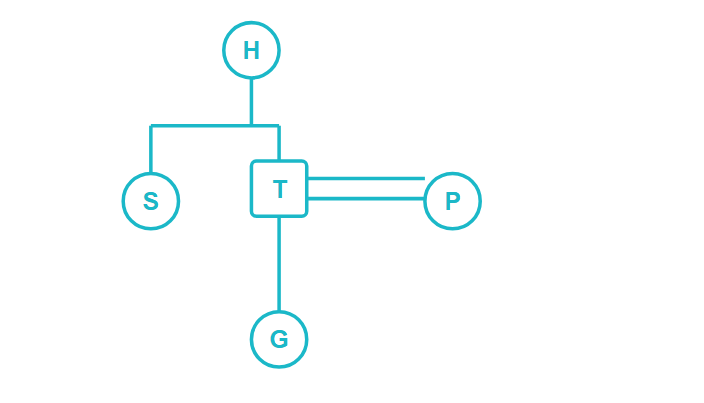
37

In a certain code language,

P + Q means ‘P is the mother of Q’

P – Q means ‘P is the sister of Q’

P x Q means ‘P is the father of Q’

P ÷ Q means ‘P is the daughter of Q’

<br>

Based on the above, how is H related to G if ‘H + S – T x G ÷ P’?

  1. ((a))

    Mother’s mother

  2. ((b))

    Father’s mother

  3. ((c))

    Father’s sister

  4. ((d))

    Sister

Show Answer
Answer: ((b))

Father’s mother

Given:

Let us first decode the given symbols and then draw a family tree.

P is
Symbol+×÷
MeaningMotherSisterFatherDaughter
of Q


On checking the expression: H + S − T × G ÷ P

  1. H + S − 'H + S' means 'H is the mother of S'.

  2. S − T − 'S − T' means 'S is the sister of T'.

  3. T × G − 'T × G' means 'T is the father of G'.

  4. G ÷ P − 'G ÷ P' means 'G is the daughter of P'.

Based on the family tree, H is the mother of T, and T is the father of G. Therefore, H is the Father's mother of G.

Hence, the correct answer is 'Option 2'.

38

All 59 people are standing in a row facing North. Mahesh is 20th from the right end, while Kailash is 14th from the left end. How many people are there between Mahesh and Kailash?

  1. ((a))

    25

  2. ((b))

    26

  3. ((c))

    24

  4. ((d))

    23

Show Answer
Answer: ((a))

25

The logic followed here is:

Total number of people standing in a row = 59

Position of Mahesh from the right end = 20th

Position of Kailash from the left end = 14th

Position of Mahesh from the left end = Total number of people − Position of Mahesh from the right end + 1

= 59 − 20 + 1

= 40

So, Mahesh is 40th from the left end.

Number of people between Mahesh and Kailash = Position of Mahesh from the left − Position of Kailash from the left − 1

= 40 − 14 − 1

= 25

Hence, the correct answer is 'Option 1'.

39

Each letter in the word LANDMARK is arranged in alphabetical order. How many letters are there in the English alphabetical order between the letter which is fourth from the left and the one which is second from the right in the new letter cluster thus formed?

  1. ((a))

    5

  2. ((b))

    2

  3. ((c))

    3

  4. ((d))

    4

Show Answer
Answer: ((b))

2

Given Word:

LANDMARK

Arrange the letters in alphabetical order:

Position12345678
LetterAADKLMNR
<br>

Required letters:

  • 4th from the left = K
  • 2nd from the right = N

English alphabetical order:

K L M N

Letters between K and N are:

L, M

Total letters between them = 2.

Hence, the correct answer is "Option 2 (2)".

40

Select the pair which follows the same pattern as that followed by the two set of pairs given below. Both pairs follow the same pattern.

CMO : DKP
WKL : XIM

  1. ((a))

    GFR : GDR

  2. ((b))

    OIY : PGZ

  3. ((c))

    HFC : HDC

  4. ((d))

    DQG : DNH

Show Answer
Answer: ((b))

OIY : PGZ

The logic followed in this pattern is a series of alphabetical shifts applied to each letter of the trio.

For 'CMO' related to 'DKP':

C(3)M(13)O(15)
+1 ↓−2 ↓+1 ↓
D(4)K(11)P(16)

For 'WKL' related to 'XIM':

W(23)K(11)L(12)
+1 ↓−2 ↓+1 ↓
X(24)I(9)M(13)

Applying the same logic to the options, only 'OIY : PGZ' follows this pattern:

O(15)I(9)Y(25)
+1 ↓−2 ↓+1 ↓
P(16)G(7)Z(26)

Thus, OIY is related to PGZ in the same manner.

Hence, the correct answer is 'Option 2'.

41

The position(s) of how many letters will remain unchanged if each letter in the word "VISCOMETRY" is arranged in alphabetical order?

  1. ((a))

    Four

  2. ((b))

    Two

  3. ((c))

    Three

  4. ((d))

    One

Show Answer
Answer: ((c))

Three

Given Word:

VISCOMETRY

Original Positions:

Position12345678910
LetterVISCOMETRY
<br>

Arrange the letters in alphabetical order:

Position12345678910
LetterCEIMORSTVY
<br>

Comparison:

PositionOriginalNewSame?
1VCNo
2IENo
3SINo
4CMNo
5OOYes
6MRNo
7ESNo
8TTYes
9RVNo
10YYYes

The letters remaining unchanged are:

→ O (Position 5)

→ T (Position 8)

→ Y (Position 10)

Therefore, 3 letters remain unchanged.

Hence, the correct answer is "Option 3".

42

Select the set in which the numbers are related in the same way as are the numbers of the following sets.

(Note: Operations should be performed on the whole numbers, without breaking down the numbers into their constituent digits. E.g. 13 – Operations on 13 such as adding/subtracting/multiplying to 13 can be performed. Breaking down 13 into 1 and 3 and then performing mathematical operations on 1 and 3 is not allowed.)

(5, 18, 24)
(9, 22, 28)

  1. ((a))

    (11, 36, 42)

  2. ((b))

    (4, 17, 11)

  3. ((c))

    (8, 21, 27)

  4. ((d))

    (6, 19, 13)

Show Answer
Answer: ((c))

(8, 21, 27)

The logic followed here is:

Logic: Second Number = First Number + 13; Third Number = Second Number + 6

For the first set (5, 18, 24)

⇒ 5 + 13 = 18

⇒ 18 + 6 = 24

For the second set (9, 22, 28)

⇒ 9 + 13 = 22

⇒ 22 + 6 = 28

Applying the same logic to Option 3: (8, 21, 27)

⇒ 8 + 13 = 21

⇒ 21 + 6 = 27

Hence, the correct answer is 'Option 3'.

43

Refer to the following series and answer the question (All numbers are single-digit numbers only. Counting is to be done from left to right.)

<br>

(Left) 2 8 1 3 5 2 6 7 3 4 9 6 7 8 4 1 3 4 6 (Right)

<br>

How many such even digits are there each of which is immediately preceded by an odd digit and immediately followed by an even digit?

  1. ((a))

    Two

  2. ((b))

    Three

  3. ((c))

    One

  4. ((d))

    Four

Show Answer
Answer: ((b))

Three

Given Series:

(Left) 2 8 1 3 5 2 6 7 3 4 9 6 7 8 4 1 3 4 6 (Right)

Required pattern:

Odd Digit → Even Digit → Even Digit

Checking the series:

(Left) 2 8 5 2 6 6 7 3 3 4 9 9 9 6 7 7 7 8 4 4 1 3 4 6 (Right)

Even digits satisfying the condition:

→ 2 in (5 2 6)

→ 6 in (9 6 7)

→ 8 in (7 8 4)

Therefore, there are 3 such even digits.

Hence, the correct answer is "Option 2".

44

Select the pair which follows the same pattern as that followed by the two pairs given below. Both pairs follow the same pattern.

CVT : DXW
OBL : PDO

  1. ((a))

    NAU : OCX

  2. ((b))

    SKP : TLQ

  3. ((c))

    HZE : IAG

  4. ((d))

    DXG : EZK

Show Answer
Answer: ((a))

NAU : OCX

The logic followed in this pattern is a series of incremental alphabetical shifts applied to each letter of the first term to obtain the second term.

For 'CVT' related to 'DXW':

C(3)V(22)T(20)
+1 ↓+2 ↓+3 ↓
D(4)X(24)W(23)

For 'OBL' related to 'PDO':

O(15)B(2)L(12)
+1 ↓+2 ↓+3 ↓
P(16)D(4)O(15)

Applying the same logic to 'NAU':

N(14)A(1)U(21)
+1 ↓+2 ↓+3 ↓
O(15)C(3)X(24)

Thus, the pair that follows the same pattern is NAU : OCX.

Hence, the correct answer is 'Option 1'.

45

Based on the alphabetical order, three of the following four are alike in a certain way and thus form a group. Which is the one that does not belong to that group?

(Note: The odd man out is not based on the number of consonants/vowels or their position in the letter cluster.)

  1. ((a))

    NOU

  2. ((b))

    GHN

  3. ((c))

    NOD

  4. ((d))

    DEK

Show Answer
Answer: ((c))

NOD

The logic followed here is

Logic: First letter + 1 = Second letter; Second letter + 6 = Third letter.

Option 1) NOU,

Option 2) GHN,

Option 3) NOD

This letter cluster does not follow the rule.

Option 4) DEK,

Therefore, the letter cluster that is different from the others is NOD.

Hence, the correct answer is 'Option 3'.

46

Dhiraj starts from Point A and drives 11 km towards west. He then takes a right turn, drives 8 km, turns right and drives 14 km. He then takes a right turn and drives 11 km. He takes a final right turn, drives 3 km and stops at Point P. How far (shortest distance) and towards which direction should he drive in order to reach Point A again?

<br>

(All turns are 90° turns only unless specified.)

  1. ((a))

    3 km to the north

  2. ((b))

    3 km to the east

  3. ((c))

    3 km to the south

  4. ((d))

    5 km to the west

Show Answer
Answer: ((a))

3 km to the north

The path taken by Dhiraj can be analyzed by tracking the direction and distance at each turn, starting from Point A as the origin (0, 0) on a coordinate plane:

Given:

1. Dhiraj starts from Point A and drives 11 km towards west. 2. He then takes a right turn, drives 8 km, turns right and drives 14 km. 3. He then takes a right turn and drives 11 km. 4. He takes a final right turn, drives 3 km and stops at Point P.


Therefore, Dhiraj should drive 3 km to the north to reach Point A again.

Hence, the correct answer is "Option 1".

47

What should come in place of ? in the given series based on the English alphabetical order?

<br>

DGYL XKTQ ROOV LSJA ?

  1. ((a))

    EWEE

  2. ((b))

    FVDF

  3. ((c))

    EVDE

  4. ((d))

    FWEF

Show Answer
Answer: ((d))

FWEF

Logic followed here is:

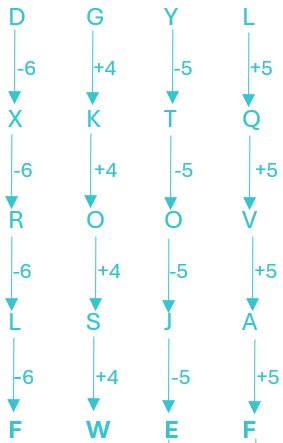
The letters in the series follow a mathematical pattern where each subsequent term is derived by adding or subtracting a constant value from the positional values of the letters in the preceding term.

Analysis of the sequence:

<br>

Therefore, the missing term in the given series based on the English alphabetical order is FWEF.

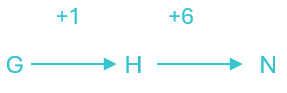
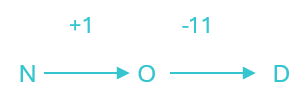
Hence, the correct answer is "Option 4".

48

BIRD is related to CLSG in a certain way based on the English alphabetical order. In the same way, RAIN is related to SDJQ. To which of the given options is STAR related, following the same logic?

  1. ((a))

    TWBU

  2. ((b))

    TWCV

  3. ((c))

    UVCU

  4. ((d))

    UWCV

Show Answer
Answer: ((a))

TWBU

The logic followed in this pattern is based on alphabetical shifts where the letters are incremented by specific values in an alternating sequence.

For 'BIRD' related to 'CLSG':

B(2)I(9)R(18)D(4)
+1 ↓+3 ↓+1 ↓+3 ↓
C(3)L(12)S(19)G(7)

For 'RAIN' related to 'SDJQ':

R(18)A(1)I(9)N(14)
+1 ↓+3 ↓+1 ↓+3 ↓
S(19)D(4)J(10)Q(17)

Applying the same logic to 'STAR':

S(19)T(20)A(1)R(18)
+1 ↓+3 ↓+1 ↓+3 ↓
T(20)W(23)B(2)U(21)

Thus, STAR is related to TWBU.

Hence, the correct answer is 'Option 1'.

49

Based on the English alphabetical order, three of the following four letter-cluster pairs are alike in a certain way and thus form a group. Which is the one that does not belong to that group? (Note: The odd one out is not based on the number of consonants/vowels or their position in the letter-cluster.)

  1. ((a))

    TL – NF

  2. ((b))

    ME – HA

  3. ((c))

    WO – QI

  4. ((d))

    YQ – SK

Show Answer
Answer: ((b))

ME – HA

The logic followed here is:

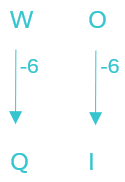
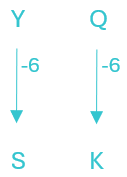
Logic: The difference between the positional values of the first letters of the two clusters is 6, and the difference between the positional values of the second letters of the two clusters is 6.

Option 1) TL - NF

Option 2) ME - HA

This pair does not follow the rule as the differences are 5 and 4 instead of 6.

Option 3) WO - QI

Option 4) YQ - SK

Therefore, the letter-cluster pair that is different from the others is ME - HA.

Hence, the correct answer is 'Option 2'.

50

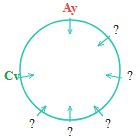
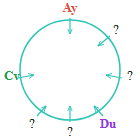
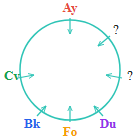
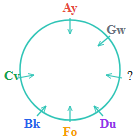
Ay, Bk, Cv, Du, Es, Fo and Gw are sitting around a circular table facing the centre. Cv sits to the immediate right of Ay. Du sits third to the left of Ay. Bk is the immediate neighbour of Fo and Cv. Gw is not an immediate neighbour of Du. What is the position of Es with respect to Fo?

  1. ((a))

    Second to the right

  2. ((b))

    Third to the left

  3. ((c))

    Immediate right

  4. ((d))

    Immediate left

Show Answer
Answer: ((a))

Second to the right

  1. Since all persons face the centre: right = counterclockwise, left = clockwise. Fix Ay at pos(1). Cv sits to the immediate right of Ay (counterclockwise): Ay(1)Cv(7).

  1. Du sits third to the left of Ay (clockwise): Ay(1) → pos(2) → pos(3) → Du(4). Thus, Du is at pos(4).

  1. Bk is the immediate neighbour of Fo and Cv. Since Cv is at pos(7) and Ay is at pos(1), Bk must be at pos(6). Fo then must be at pos(5).

  1. Gw is not an immediate neighbour of Du. The remaining positions are pos(2) and pos(3). Neighbors of Du(4) are pos(3) and pos(5). Since Gw cannot be at pos(3), Gw must be at pos(2).

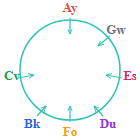
  1. The final person, Es, occupies the last remaining position, pos(3). The full arrangement is: Ay(1), Gw(2), Es(3), Du(4), Fo(5), Bk(6), Cv(7).

<br>

Position of Es with respect to Fo: From Fo(5), moving counterclockwise (right) → Du(4) (1st right) → Es(3) (2nd right). Therefore, Es sits second to the right of Fo.

<br>

Hence, the correct answer is 'Option 1'.

General Science (40 questions)

51

A concave lens has a focal length of 15 cm. If it forms an image 10 cm from the lens, how far away is the object placed from the lens?

  1. ((a))

    -25 cm

  2. ((b))

    -30 cm

  3. ((c))

    +30 cm

  4. ((d))

    +6 cm

Show Answer
Answer: ((b))

-30 cm

The correct answer is -30 cm.

Key Points

  • According to the New Cartesian Sign Convention, the focal length (f) of a concave lens is always taken as negative; hence, f = −15 cm.
  • Since a concave lens always produces a virtual and erect image on the same side as the object, the image distance (v) is also negative; hence, v = −10 cm.
  • The relationship between the object distance (u), image distance (v), and focal length (f) is given by the Lens Formula: 1f=1v1u \frac{1}{f} = \frac{1}{v} - \frac{1}{u} .
  • To find the object distance (u), we rearrange the formula: 1u=1v1f \frac{1}{u} = \frac{1}{v} - \frac{1}{f} .
  • By substituting the values: 1/u = 1/(−10) − 1/(−15). This simplifies to 1/u = −1/10 + 1/15.
  • Finding a common denominator (30), the equation becomes: 1/u = (−3 + 2) / 30 = −1/30.
  • Therefore, u = −30 cm, indicating the object is placed 30 cm in front of the lens.

 Additional Information

  • Concave Lens Characteristics:
  • It is known as a diverging lens because it spreads out light rays that travel parallel to its principal axis.
  • The images formed are consistently virtual, erect, and diminished in size, regardless of the object's position.
  • The magnification (m) for a concave lens is always positive and less than 1, calculated as m = v/u.
  • Sign Convention Rules:
  • All distances are measured from the optical center of the lens.
  • Distances measured in the direction of incident light are positive, while those measured against it are negative.
  • The object distance (u) is almost always negative in standard optical setups as objects are placed to the left of the lens.
52

A porter lifts a 10 kg luggage from the ground and places it on his head at a height of 2.5 m. What is the work done by the porter on the luggage? (Using g =10 m/s2)

  1. ((a))

    100 J

  2. ((b))

    25 J

  3. ((c))

    500 J

  4. ((d))

    250 J

Show Answer
Answer: ((d))

250 J

The correct answer is 250 J.

Key Points

  • Work Done is defined in physics as the product of the Force applied to an object and the Displacement of that object in the direction of the force.
  • When a porter lifts luggage vertically against gravity, the force required is equal to the Weight of the luggage, which is calculated as Mass (m) × Acceleration due to gravity (g).
  • The specific values provided in the problem are: Mass (m) = 10 kg, Height (h) = 2.5 m, and Acceleration due to gravity (g) = 10 m/s2.
  • The formula used for calculating the work done against gravity is W = m × g × h, which also represents the Gravitational Potential Energy gained by the object.
  • By substituting the values into the equation: W = 10 kg × 10 m/s2 × 2.5 m.
  • Performing the multiplication: 10 × 10 = 100; then 100 × 2.5 = 250. Thus, the total work performed is 250 Joules.

 Additional Information

  • Work Done (W):
  • It is a Scalar Quantity, meaning it has magnitude but no specific direction in space.
  • The SI Unit of work is the Joule (J), where 1 J = 1 Newton-meter (N·m).
  • Work can be positive, negative, or zero depending on the Angle (θ) between the force vector and the displacement vector (W = Fs cosθ).
  • Acceleration due to Gravity (g):
  • On Earth, the standard value is approximately 9.8 m/s2, though for simplified competitive exam calculations, it is often taken as 10 m/s2.
  • It represents the constant acceleration experienced by an object in Free Fall near the Earth's surface.
  • Potential Energy:
  • Lifting an object increases its Stored Energy based on its position. This is specifically termed Gravitational Potential Energy.
  • The work done by the porter is effectively transferred into the luggage as this form of energy.
53

During the extraction of metals from their ores, the removal of gangue is an important preliminary step. Which of the following statements most accurately explains why different concentration methods (such as hydraulic washing, froth flotation and magnetic separation) are used for different ores?

  1. ((a))

    Because the choice of concentration method depends on the melting point of the ore and gangue

  2. ((b))

    Because all ores have identical physical properties but different chemical compositions

  3. ((c))

    Because gangue particles are chemically reactive and must be removed by oxidation before extraction

  4. ((d))

    Because each method exploits specific differences in physical and chemical properties between the ore and the gangue

Show Answer
Answer: ((d))

Because each method exploits specific differences in physical and chemical properties between the ore and the gangue

The correct answer is Because each method exploits specific differences in physical and chemical properties between the ore and the gangue.

Key Points

  • Concentration of Ore, also known as ore dressing or beneficiation, is the process of removing unwanted earthy and rocky impurities called gangue from the mined ore.
  • The selection of a specific concentration method is strictly governed by the physical and chemical properties of the metal compound and the gangue particles.
  • Hydraulic Washing (Gravity Separation) utilizes the difference in specific gravities between the ore and the gangue; typically, the ore is heavier than the impurities.
  • Magnetic Separation is applied when either the ore or the gangue possesses magnetic properties, allowing separation via electromagnetic rollers.
  • Froth Flotation exploits differences in surface wettability; sulphide ores are preferentially wetted by oils (like pine oil) while gangue is wetted by water.
  • Chemical methods, such as Leaching, are used when the ore is soluble in a particular solvent while the gangue remains insoluble.

 Additional Information

  • Hydraulic Washing:
  • Commonly used for oxide ores like Haematite (Fe2O3) and Cassiterite (SnO2).
  • Involves an upward stream of running water to wash away lighter gangue.
  • Froth Flotation Details:
  • Collectors: Substances like pine oils or xanthates that enhance the non-wettability of mineral particles.
  • Froth Stabilizers: Compounds like cresols and aniline which stabilize the froth.
  • Depressants: Used to separate two sulphide ores (e.g., using NaCN to separate ZnS from PbS).
  • Leaching Examples:
  • Bauxite (Aluminium ore) is concentrated using hot concentrated NaOH (Bayer’s process).
  • Gold and Silver are leached using dilute solutions of NaCN or KCN in the presence of air.
54

An object is placed at 100 cm on the left of a convex lens of focal length 40 cm. Where should a screen be placed to right of the lens so that the image formed is real, inverted and smaller in size as compared to the object size?

  1. ((a))

    The screen should be placed anywhere between 20 cm and 40 cm from the lens.

  2. ((b))

    The screen should be placed at 40 cm from the lens.

  3. ((c))

    The screen should be placed anywhere between 40 cm and 80 cm from the lens.

  4. ((d))

    The screen should be beyond 100 cm from the lens.

Show Answer
Answer: ((c))

The screen should be placed anywhere between 40 cm and 80 cm from the lens.

The correct answer is The screen should be placed anywhere between 40 cm and 80 cm from the lens.

Key Points

  • According to the Cartesian sign convention, the focal length (f) of a convex lens is positive (+40 cm), and the object distance (u) is negative (−100 cm) as it is placed on the left side.
  • Applying the Lens Formula, 1/f = 1/v − 1/u, we substitute the values: 1/40 = 1/v − 1/(−100), which simplifies to 1/v = 1/40 − 1/100. Calculating the Least Common Multiple (LCM) of 40 and 100 gives 200, resulting in 1/v = (5 − 2) / 200 = 3/200, thus v = 66.67 cm.
  • For a convex lens, the point 2F is located at twice the focal length, which is 2 × 40 = 80 cm. Since the object is placed at 100 cm (which is beyond 2F), the laws of optics dictate that the image must form between F (40 cm) and 2F (80 cm) on the opposite side.
  • The linear magnification (m) is defined as the ratio of image distance (v) to object distance (u). Here, m = (200/3) / (−100) = −2/3 ≈ −0.67. The negative sign confirms the image is real and inverted, while a magnitude less than 1 confirms it is diminished (smaller).
  • Since the image is real, it can only be captured on a screen placed exactly at the point of convergence, which in this scenario is within the 40 cm to 80 cm range from the optical center.

 Additional Information

  • Convex Lens Image Characteristics:
  • Object at Infinity: Image forms at the focus (F), is real, inverted, and highly diminished.
  • Object at 2F: Image forms at 2F on the other side, is real, inverted, and same size as the object.
  • Object between F and 2F: Image forms beyond 2F, is real, inverted, and magnified.
  • Object at F: Image forms at infinity, is real, inverted, and highly magnified.
  • Object between F and Optical Center: Image is virtual, erect, and magnified, appearing on the same side as the object.
  • Power of a Lens: It is the reciprocal of the focal length in meters (P = 1/f). For this lens, the power would be +2.5 Dioptres.
55

Which of the following is a molecule formed by two atoms of the same element?

  1. ((a))

    O₃

  2. ((b))

    CO

  3. ((c))

    H₂O

  4. ((d))

    H₂

Show Answer
Answer: ((d))

H₂

The correct answer is H2.

Key Points

  • A molecule is the smallest unit of a chemical element or compound that can exist freely; it is formed when two or more atoms are chemically joined by covalent bonds.
  • H2 (Hydrogen) is a homonuclear diatomic molecule, meaning it is composed of exactly two atoms of the same element.
  • In an H2 molecule, two hydrogen atoms share their single valence electrons to achieve a stable duplet configuration, forming a single covalent bond.
  • Under standard temperature and pressure (STP), hydrogen exists as a colorless, odorless, and highly flammable diatomic gas.
  • This structure is distinct from polyatomic molecules or heteronuclear molecules, which involve either more than two atoms or atoms from different elements.

 Additional Information

  • O3 (Ozone):
  • It is an allotrope of oxygen consisting of three oxygen atoms, making it a homonuclear triatomic molecule.
  • It is primarily found in the Earth's stratosphere, where it protects the biosphere from harmful ultraviolet (UV) radiation.
  • CO (Carbon Monoxide):
  • It is a heteronuclear diatomic molecule because it consists of two atoms, but they are of different elements: carbon and oxygen.
  • It is a toxic gas produced during the incomplete combustion of hydrocarbons and binds strongly to hemoglobin in the blood.
  • H2O (Water):
  • It is a heteronuclear triatomic molecule composed of two hydrogen atoms and one oxygen atom.
  • The atoms are held together by polar covalent bonds, giving water its unique properties as a universal solvent.
56

In the respiratory tract, columnar epithelium possesses cilia. What is the primary function of these cilia?

  1. ((a))

    To move and push mucus forward to clear it

  2. ((b))

    To secrete substances onto the epithelial surface

  3. ((c))

    To increase the surface area for absorption only

  4. ((d))

    To provide only mechanical support to the tract

Show Answer
Answer: ((a))

To move and push mucus forward to clear it

The correct answer is To move and push mucus forward to clear it.

Key Points

  • The respiratory tract is lined with a specialized tissue known as ciliated columnar epithelium, which consists of tall, pillar-like cells equipped with hair-like projections called cilia on their apical surface.
  • The primary function of these cilia is to exhibit a coordinated, rhythmic, and unidirectional beating motion.
  • This movement effectively propels mucus (produced by specialized cells) along the surface of the epithelium.
  • In the trachea and bronchi, the cilia move the mucus layer, which traps inhaled particles, pathogens, and dust, upward toward the pharynx or throat.
  • This biological mechanism, often referred to as the mucociliary escalator, is a critical defense system that prevents foreign contaminants from reaching the alveoli of the lungs, thereby maintaining a clear and healthy airway.

 Additional Information

  • Glandular Specialization:
  • While the primary role of the ciliated cells is movement, the respiratory lining also contains Goblet cells, which are specialized for the secretion of mucus to keep the tract moist and trap debris.
  • Microvilli vs. Cilia:
  • In other parts of the body like the small intestine, columnar cells possess microvilli instead of cilia.
  • Unlike cilia, microvilli are non-motile and function specifically to increase surface area for the absorption of nutrients rather than moving substances across the surface.
  • Structural Integrity:
  • The columnar epithelium provides a level of mechanical support and protection due to its thickness, but this is a secondary attribute compared to the active transport function of the cilia.
  • Damage to these cilia (e.g., from smoking or infections) can lead to the accumulation of mucus, resulting in a persistent cough or respiratory infections.
57

What is the main advantage of using olfactory indicators?

  1. ((a))

    They are useful for visually impaired individuals.

  2. ((b))

    They change colour sharply.

  3. ((c))

    They give exact pH values.

  4. ((d))

    They can be used for all solutions.

Show Answer
Answer: ((a))

They are useful for visually impaired individuals.

The correct answer is They are useful for visually impaired individuals.

Key Points

  • Olfactory indicators are specific substances whose odor or smell varies significantly depending on whether they are placed in an acidic or basic medium.
  • The primary advantage of these indicators is their accessibility; since they do not rely on color transitions, they enable visually impaired individuals to participate in acid-base titrations and laboratory experiments using their sense of smell.
  • Common laboratory examples include onion, vanilla essence, and clove oil, which undergo distinct chemical changes when they interact with Hydrogen ions (H+) or Hydroxyl ions (OH).
  • In a basic medium, the characteristic pungent smell of onion or the sweet scent of vanilla typically disappears, whereas these smells are retained in an acidic medium.

 Additional Information

  • Types of Indicators:
  • Natural Indicators: Derived from natural sources like Litmus (from Lichens), Turmeric, and Red Cabbage extract. Litmus turns red in acids and blue in bases.
  • Synthetic Indicators: Man-made chemicals such as Phenolphthalein (colorless in acid, pink in base) and Methyl Orange (red in acid, yellow in base).
  • Universal Indicators: A mixture of several indicators that shows different colors at different concentrations of Hydrogen ions in a solution, providing a pH value from 0 to 14.
  • Limitations:
  • Unlike pH meters or Universal Indicators, olfactory indicators cannot provide the strength of an acid or base; they only indicate the qualitative nature of the solution.
  • They do not change color sharply; rather, they operate through neutralization reactions that affect volatile organic compounds responsible for scent.
58

Which structure is present in plant cells but absent in animal cells?

  1. ((a))

    Cell wall

  2. ((b))

    Cytoplasm

  3. ((c))

    Endoplasmic reticulum

  4. ((d))

    Mitochondria

Show Answer
Answer: ((a))

Cell wall

The correct answer is Cell wall.

Key Points

  • The cell wall is a rigid, structural layer surrounding certain types of cells, situated outside the cell membrane. It is a distinguishing feature of plant cells, fungi, algae, and most bacteria.
  • In plants, the cell wall is primarily composed of cellulose, a complex carbohydrate (polysaccharide). It also contains hemicellulose, pectin, and sometimes lignin for extra rigidity.
  • The primary function of the cell wall is to provide structural support, protection against mechanical stress, and to maintain the shape of the cell. It allows plants to grow to great heights without a skeleton.
  • It plays a vital role in regulating turgor pressure. When water enters a plant cell via osmosis, the cell wall prevents the cell from bursting by exerting an opposing pressure.
  • Animal cells do not have a cell wall; they only possess a flexible plasma membrane, which allows for movement and the formation of specialized tissues like muscles.

 Additional Information

  • Cytoplasm:
  • This is the jelly-like substance consisting of cytosol and organelles. It is present in both plant and animal cells and is the site for most enzymatic reactions and metabolic activities.
  • Endoplasmic Reticulum (ER):
  • A network of membranes involved in protein and lipid synthesis. It exists in two forms: Rough ER (with ribosomes) and Smooth ER (without ribosomes). It is a common feature in all eukaryotic cells.
  • Mitochondria:
  • Known as the powerhouse of the cell, these organelles are responsible for cellular respiration and the production of ATP (Adenosine Triphosphate). They are found in both plant and animal cells.
  • Chloroplasts:
  • Like the cell wall, chloroplasts are another organelle found in plant cells but absent in animal cells. They contain chlorophyll and are responsible for photosynthesis.
  • Vacuoles:
  • While both cell types may have vacuoles, plant cells typically feature one large central vacuole that can occupy up to 90 percent of the cell volume, whereas animal cells have small, temporary vacuoles.
59

What are the tiny blobs present on stick-like structures in Rhizopus called?

  1. ((a))

    Spores

  2. ((b))

    Roots

  3. ((c))

    Hyphae

  4. ((d))

    Sporangia

Show Answer
Answer: ((d))

Sporangia

The correct answer is Sporangia.

Key Points

  • Rhizopus, popularly known as bread mold, is a genus of common saprophytic fungi that grows on organic substrates like moist bread, fruits, and vegetables.
  • The structure of Rhizopus consists of thread-like filaments called hyphae. During the asexual reproduction phase, certain hyphae grow vertically upward into the air; these are called sporangiophores.
  • The sporangiophores bear tiny, dark, knob-like or blob-like structures at their tips, which are known as sporangia.
  • Inside each sporangium, numerous microscopic reproductive units called spores are produced through mitosis.
  • The sporangia act as protective sacs for these spores until they are fully mature and ready for dispersal.
  • When the sporangium matures, its outer wall ruptures, releasing the spores into the atmosphere to be carried by wind or water to a new growth medium.

 Additional Information

  • Spores:
  • These are asexual reproductive cells enclosed in thick, protective walls that enable them to survive unfavorable environmental conditions like extreme heat or dehydration.
  • Hyphae:
  • These are the vegetative, branching filaments of the fungus. In Rhizopus, they are coenocytic, meaning they are continuous tubes without cross-walls (septa), containing multiple nuclei.
  • Rhizoids (Root-like structures):
  • Although fungi do not have true roots, Rhizopus develops rhizoids at the base of the sporangiophores to anchor the fungus and secrete digestive enzymes to absorb nutrients from the substrate.
  • Stolons:
  • These are horizontal hyphae that spread across the surface of the food source, allowing the fungus to colonize larger areas rapidly.
60

Which of the following is the correct relation between the object distance (u), image distance (v) and focal length (f) of a convex lens?

  1. ((a))

    (1/v) - (1/u) = 1/f

  2. ((b))

    v - u = f

  3. ((c))

    (1/v) x (1/ u) = 1/f

  4. ((d))

    v + u = f

Show Answer
Answer: ((a))

(1/v) - (1/u) = 1/f

The correct answer is (1/v) − (1/u) = 1/f.

Key Points

  • The Lens Formula is a mathematical expression that relates the object distance (u), image distance (v), and the focal length (f) for any spherical lens.
  • The general form of the lens formula is 1/v − 1/u = 1/f, where distances are measured from the optical center of the lens.
  • This formula holds true for both convex (converging) and concave (diverging) lenses, provided the appropriate New Cartesian Sign Convention is applied to the values.
  • In this relation, u is the distance of the object from the lens, v is the distance of the image from the lens, and f represents the focal length, which is the distance between the optical center and the principal focus.
  • It is important to distinguish this from the Mirror Formula, which is 1/v + 1/u = 1/f; the lens formula specifically requires the subtraction of the reciprocal of the object distance.

 Additional Information

  • Cartesian Sign Convention:
  • The object distance (u) is always taken as negative because the object is placed to the left of the lens.
  • The focal length (f) of a convex lens is always positive, while for a concave lens, it is always negative.
  • Distances measured in the direction of the incident light are positive, and those measured opposite to the incident light are negative.
  • Lens Power (P):
  • The Power of a lens is defined as the reciprocal of its focal length in meters (P = 1/f).
  • The S.I. unit of power is the Dioptre (D). Convex lenses have positive power, whereas concave lenses have negative power.
  • Magnification (m):
  • Magnification produced by a lens is the ratio of the height of the image to the height of the object.
  • It is also related to distances as m = v/u. A positive magnification indicates a virtual and erect image, while a negative magnification indicates a real and inverted image.
61

Which of the following statements are correct?

<br>
  1. Colloids appear homogeneous because their particles are very small.
  2. Colloids are truly homogeneous at the molecular level.
  3. Colloidal particles scatter light.
  4. Milk is a colloidal solution.
  1. ((a))

    1 and 2 only

  2. ((b))

    1, 2, 3 and 4

  3. ((c))

    2 and 4 only

  4. ((d))

    1, 3 and 4 only

Show Answer
Answer: ((d))

1, 3 and 4 only

The correct answer is 1, 3 and 4 only.

Key Points

  • Colloidal particles are extremely small, typically ranging between 1 nanometer and 1000 nanometers in diameter. Because they are too small to be seen individually by the naked eye, the mixture gives the appearance of being uniform or homogeneous. Hence, statement 1 is correct.
  • While they look uniform, colloids are actually heterogeneous mixtures. They consist of a dispersed phase (the particles) and a dispersion medium (the continuous phase). Unlike true solutions, the particles do not dissolve at the molecular or ionic level. Hence, statement 2 is incorrect.
  • The particles in a colloid are large enough to scatter a beam of light passing through them. This phenomenon is known as the Tyndall Effect, which makes the path of light visible within the medium. Hence, statement 3 is correct.
  • Milk is a natural colloidal solution where liquid fat globules are dispersed in water. It is specifically classified as an emulsion because both the dispersed phase and the medium are liquids. Hence, statement 4 is correct.

 Additional Information

  • Properties of Colloids:
  • Stability: Colloids are relatively stable; their particles do not settle down when left undisturbed for a long period, distinguishing them from suspensions.
  • Brownian Motion: Colloidal particles show a continuous zig-zag motion due to unbalanced bombardment by molecules of the dispersion medium.
  • Separation: They cannot be separated by standard filtration because the particles pass through filter paper; however, they can be separated using centrifugation.
  • Classification: Based on the state of the dispersed phase and medium, they are categorized into aerosols (fog), foams (whipped cream), sols (paints), and gels (gelatin).
62

The versatile nature of carbon is responsible for the formation of which of the following types of compounds?

  1. ((a))

    Organic compounds

  2. ((b))

    Ionic compounds

  3. ((c))

    Metallic compounds

  4. ((d))

    Inorganic compounds

Show Answer
Answer: ((a))

Organic compounds

The correct answer is Organic compounds.

Key Points

  • Carbon possesses a unique electronic configuration (atomic number 6), with four electrons in its outermost shell, leading to the property of tetravalency. This allows it to form four stable covalent bonds with other atoms.
  • The extraordinary ability of carbon to link with other carbon atoms to form long linear chains, branched chains, and closed rings is known as catenation. This is due to the high C-C bond energy (approximately 347 kJ/mol).
  • Carbon atoms can form single, double, or triple bonds with themselves and other elements like hydrogen, oxygen, nitrogen, and halogens, resulting in an immense variety of molecular geometries.
  • The versatile nature of carbon, specifically through catenation and tetravalency, is the fundamental reason behind the existence of millions of Organic compounds, which serve as the basis for all living organisms.
  • The small size of the carbon nucleus enables it to hold onto shared pairs of electrons strongly, ensuring the stability of complex carbon-based structures even in large molecular weights.

 Additional Information

  • Classification Comparison:
  • Inorganic compounds: These generally lack C-H bonds. While some carbon-containing substances like carbonates, bicarbonates, and cyanides are classified here, they do not exhibit the complex catenation seen in organic molecules.
  • Ionic compounds: Formed by the transfer of electrons between atoms with high electronegativity differences, typically a metal and a non-metal, whereas carbon compounds are primarily covalent.
  • Metallic compounds: These involve metallic bonding where valence electrons are delocalized in a lattice, a property unrelated to the molecular versatility of carbon in forming specific chemical compounds.
  • Isomerism: Carbon's versatility also allows for structural isomerism, where the same set of atoms can be arranged in different ways to form compounds with distinct chemical and physical properties.
  • Biological Significance: Key biomolecules such as carbohydrates, lipids, proteins, and nucleic acids (DNA/RNA) are all organic compounds defined by carbon's unique bonding capabilities.
63

Read the given Assertion (A) and Reason (R) and select the most appropriate option.

<br>

(A): A woman has normal ovulation and fertilisation, but the zygote is expelled without attaching to the uterine wall because implantation has failed.

(R): Implantation is the process by which the blastocyst embeds in the endometrium to establish pregnancy.

  1. ((a))

    Both A and R are true, and R is the correct explanation of A

  2. ((b))

    A is false, but R is true

  3. ((c))

    A is true, but R is false

  4. ((d))

    Both A and R are true, but R is not the correct explanation of A

Show Answer
Answer: ((a))

Both A and R are true, and R is the correct explanation of A

The correct answer is Both A and R are true, and R is the correct explanation of A.

Key Points

  • Assertion (A) describes a clinical scenario where reproductive milestones like ovulation and fertilisation occur successfully, yet the zygote (which develops into a blastocyst) is lost. This happens specifically because the embryo fails to adhere to the uterine wall, a condition known as implantation failure. Hence, statement A is correct.
  • Reason (R) provides the biological definition of implantation, which is the critical stage where the blastocyst attaches to and embeds itself within the endometrium (the vascular lining of the uterus). This connection is essential to transition from a mobile embryo to an established pregnancy. Hence, statement R is correct.
  • The relationship between the two statements is direct: since the successful establishment of pregnancy depends entirely on the blastocyst embedding in the endometrium, the failure of this specific mechanism (as defined in R) is the fundamental reason why the embryo is expelled and cannot continue development (as described in A). Hence, R is the correct explanation of A.

 Additional Information

  • Blastocyst Structure:
  • It consists of an outer layer called the trophoblast, which eventually forms the placenta.
  • The inner cell mass (embryoblast) is the group of cells that will eventually differentiate into the fetus.
  • Endometrial Receptivity:
  • The endometrium becomes receptive to the embryo during a specific timeframe known as the implantation window, usually between days 20 and 24 of a typical menstrual cycle.
  • This process is heavily regulated by hormones like progesterone, which prepares the uterine lining for nidation.
  • Fertilisation Site:
  • The fusion of gametes usually occurs in the ampullary region of the Fallopian tube before the resulting embryo travels toward the uterus over several days.
64

An echo is heard in 6 s. If the distance of the reflecting surface from the source is 990 m, then how much is the speed of sound?

  1. ((a))

    660 m/s

  2. ((b))

    165 m/s

  3. ((c))

    330 m/s

  4. ((d))

    1320 m/s

Show Answer
Answer: ((c))

330 m/s

The correct answer is 330 m/s.

Key Points

  • An echo is the phenomenon where a sound is heard again due to its reflection from a distant obstacle or reflecting surface.
  • For an observer to hear an echo, the sound wave must travel from the source to the reflecting surface and back to the observer.
  • Therefore, the total distance covered by the sound is exactly twice the distance between the source and the reflecting surface (2 × d).
  • In this problem, the distance (d) is given as 990 m. Thus, the total distance traveled by the sound wave is 2 × 990 = 1980 m.
  • The time interval (t) taken for the sound to travel this total distance is given as 6 s.
  • The speed of sound (v) is calculated using the standard formula: Speed = Total Distance / Total Time.
  • By substituting the values, we get: v = 1980 / 6 = 330 m/s.

 Additional Information

  • Persistence of Hearing:
  • The sensation of sound persists in the human brain for approximately 0.1 seconds.
  • To distinguish an echo from the original sound, the reflected sound must reach the ear after at least 0.1 s.
  • Minimum Distance for Echo:
  • Assuming the speed of sound in air is 344 m/s, the total distance for an echo at 0.1 s would be 34.4 m.
  • Consequently, the minimum distance of the reflecting surface from the source must be half of that, which is 17.2 meters.
  • Nature of Sound Waves:
  • Sound is a mechanical longitudinal wave that requires a material medium (solid, liquid, or gas) to propagate.
  • The speed of sound generally increases with the temperature of the medium and is highest in solids.
65

Blood pressure is recorded as two values: _________ pressure, measured when the heart contracts, and ___________ pressure, measured when the heart relaxes.

  1. ((a))

    Diastolic; Systolic

  2. ((b))

    Systolic; Diastolic

  3. ((c))

    Diastolic; Venous

  4. ((d))

    Maximum; Systolic

Show Answer
Answer: ((b))

Systolic; Diastolic

The correct answer is Systolic; Diastolic.

Key Points

  • Blood pressure is the force exerted by circulating blood against the walls of the body's arteries, which are the primary vessels transporting blood from the heart to the rest of the body.
  • The first number in a reading represents systolic pressure, which occurs when the heart's ventricles contract to push blood into the aorta and systemic circulation.
  • During the systolic phase, the pressure in the arteries is at its maximum level due to the active pumping action of the cardiac muscle.
  • The second number represents diastolic pressure, which is measured when the heart muscle relaxes and the heart chambers refill with blood.
  • During the diastolic phase, the arterial pressure drops to its lowest point before the next contraction begins.
  • A standard healthy blood pressure reading for an average adult is typically considered to be around 120/80 mmHg.

 Additional Information

  • Sphygmomanometer:
  • The clinical instrument used to measure blood pressure, consisting of an inflatable cuff and a mercury or mechanical manometer.
  • Venous Pressure:
  • This refers to the blood pressure in the veins or the right atrium of the heart; it is significantly lower than arterial pressure and is not part of standard blood pressure readings.
  • Hypertension:
  • A medical condition where the blood pressure is chronically elevated, often defined as 140/90 mmHg or higher, increasing the risk of stroke and heart disease.
  • Unit of Measurement:
  • Blood pressure is recorded in millimeters of mercury (mmHg), a tradition originating from early pressure gauges that used liquid mercury columns.
66

If the gravitational force experienced by a body of mass 'm' on the surface of Earth is 'X' N. If the mass of the body is tripled, what will be the value of the gravitational force experienced by the body?

  1. ((a))

    X N

  2. ((b))

    X/9 N

  3. ((c))

    X/3 N

  4. ((d))

    3X N

Show Answer
Answer: ((d))

3X N

The correct answer is 3X N.

Key Points

  • According to Newton's Universal Law of Gravitation, every particle attracts every other particle in the universe with a force that is directly proportional to the product of their masses and inversely proportional to the square of the distance between their centers.
  • The formula for the gravitational force (F) is expressed as F = (G × M × m) / R2, where G is the Universal Gravitational Constant, M is the mass of the Earth, m is the mass of the object, and R is the radius of the Earth.
  • From the formula, it is evident that the gravitational force is directly proportional to the mass of the object (F ∝ m) when the mass of the Earth and the radius remain constant.
  • In the given scenario, the initial force is X for a mass m. If the mass is tripled to 3m, the new force F' becomes (G × M × 3m) / R2, which is equivalent to 3 × [(G × M × m) / R2].
  • Substituting the value of the initial force, we get F' = 3X. Therefore, tripling the mass results in tripling the gravitational force experienced by the body.

 Additional Information

  • Mass vs. Weight:
  • Mass is an intrinsic property of matter and remains constant regardless of location, measured in kilograms (kg).
  • Weight is the gravitational force acting on an object, calculated as W = m × g, where g is the acceleration due to gravity.
  • Acceleration due to Gravity (g):
  • The value of g on the surface of Earth is approximately 9.8 m/s2.
  • Crucially, g is independent of the mass of the falling object; however, the total force (X) depends on the object's mass.
  • Universal Gravitational Constant (G):
  • Its value is approximately 6.674 × 10⁻¹¹ N⋅m2/kg2 and remains the same throughout the universe.
67

If a velocity–time graph shows a horizontal straight line, the object is moving with ________.

  1. ((a))

    Non-uniform acceleration

  2. ((b))

    No velocity

  3. ((c))

    Constant velocity

  4. ((d))

    Zero displacement

Show Answer
Answer: ((c))

Constant velocity

The correct answer is Constant velocity.

Key Points

  • In a Velocity-Time (v-t) graph, the velocity is represented on the y-axis (vertical) and the time is represented on the x-axis (horizontal).
  • A horizontal straight line parallel to the time axis implies that for any given time interval, the value of velocity remains unchanged.
  • When the velocity of an object does not change with respect to time, the object is said to be moving with uniform motion or constant velocity.
  • The slope of a velocity-time graph provides the acceleration of the object; since a horizontal line has a zero slope, the acceleration of the object is zero.
  • The displacement of the object during a specific time interval can be calculated by finding the area under the horizontal line within that interval.

 Additional Information

  • Non-uniform acceleration:
  • This is represented by a curved line on a velocity-time graph, indicating that the rate of change of velocity is not constant.
  • Zero Velocity:
  • If the horizontal line lies exactly on the x-axis (where y = 0), it indicates the object is at rest and has no velocity.
  • Uniform Acceleration:
  • This is represented by a straight line inclined at a constant angle to the time axis, where the velocity increases or decreases at a steady rate.
  • Significance of Area:
  • In physics, the integral of velocity with respect to time gives displacement; geometrically, this is the rectangular area formed under the constant velocity line.
68

If producers increase in number and herbivores decrease in number, what is the likely sudden consequence in the food chain?

  1. ((a))

    Carnivore population will decrease due to less food.

  2. ((b))

    Decomposers population will decline suddenly.

  3. ((c))

    Producers will decrease due to overgrazing.

  4. ((d))

    Carnivore population will increase.

Show Answer
Answer: ((a))

Carnivore population will decrease due to less food.

The correct answer is Carnivore population will decrease due to less food.

Key Points

  • In an ecosystem, the food chain represents a linear sequence of organisms where nutrients and energy are transferred from one trophic level to another.
  • Producers, primarily green plants, occupy the first trophic level and convert solar energy into chemical energy through photosynthesis.
  • Herbivores are the primary consumers that depend directly on producers for sustenance; if their population decreases, the available energy for the next level is restricted.
  • Carnivores act as secondary consumers that rely on herbivores as their primary food source; a sudden drop in the herbivore population results in a scarcity of prey.
  • Due to the lack of available biomass and energy from herbivores, the carnivore population will inevitably decline because they cannot directly consume producers to meet their metabolic needs.
  • This imbalance creates a trophic cascade where the increase in producers occurs because there are fewer herbivores to consume them, but the higher levels suffer from starvation.

 Additional Information

  • Trophic Levels:
  • Producers: These are autotrophs like plants and phytoplankton that form the base of the ecological pyramid.
  • Herbivores: Also known as primary consumers, these organisms possess specialized digestive systems to process plant cellulose.
  • Carnivores: These are secondary or tertiary consumers that regulate the population of lower trophic levels through predation.
  • Decomposers: Organisms like bacteria and fungi that break down dead organic matter; their population usually fluctuates based on the total biomass available rather than a specific increase in producers.
  • Energy Flow: According to Lindeman's 10 percent law, only 10 percent of the energy is transferred to each higher trophic level, making the survival of carnivores highly sensitive to herbivore density.
69

A train starts from rest and reaches a speed of 216 km/h in 10 minutes. If its acceleration is uniform, what is the value of the acceleration?

  1. ((a))

    0.6 m/s2

  2. ((b))

    0.1 m/s2

  3. ((c))

    0.4 m/s2

  4. ((d))

    1.0 m/s2

Show Answer
Answer: ((b))

0.1 m/s2

The correct answer is 0.1 m/s2.

Key Points

  • The train starts from rest, which implies that the initial velocity (u) is 0 m/s.
  • The final velocity (v) is provided as 216 km/h. To perform calculations in SI units, this must be converted to meters per second (m/s) by multiplying by the factor 5/18. Thus, v = 216 × (5/18) = 60 m/s.
  • The time duration (t) is given as 10 minutes. This must be converted into seconds for consistency with SI units: t = 10 × 60 = 600 seconds.
  • According to the first equation of motion for uniform acceleration, the relationship between velocity, time, and acceleration is expressed as v = u + at.
  • Rearranging the formula to solve for acceleration (a), we get a = (v − u) / t. Substituting the known values: a = (60 − 0) / 600 = 60 / 600 = 0.1 m/s2.

 Additional Information

  • Acceleration:
  • It represents the vector quantity describing the rate of change of velocity over time.
  • The standard SI unit for measuring acceleration is m/s2 (meters per second squared).
  • If the velocity of an object increases, the acceleration is positive; if it decreases, it is termed retardation or deceleration.
  • Uniform Motion vs. Non-Uniform Motion:
  • In uniform acceleration, the velocity changes by equal amounts in equal time intervals, resulting in a linear velocity-time graph.
  • The slope of a velocity-time graph provides the magnitude of the acceleration.
  • The area under a velocity-time graph represents the displacement covered by the object.
  • Unit Conversions:
  • To convert km/h to m/s, multiply by 5/18.
  • To convert m/s to km/h, multiply by 18/5.
  • Ensuring all variables are in the International System of Units (SI) is crucial for solving physics problems accurately.
70

A student heats 10 g of calcium carbonate in a closed container. It decomposes into 5.6 g of calcium oxide and carbon dioxide gas. What will be the mass of carbon dioxide produced?

  1. ((a))

    4.4 g

  2. ((b))

    15.6 g

  3. ((c))

    10.0 g

  4. ((d))

    5.0 g

Show Answer
Answer: ((a))

4.4 g

The correct answer is 4.4 g.

Key Points

  • The chemical reaction described is the thermal decomposition of calcium carbonate (CaCO3) into calcium oxide (CaO) and carbon dioxide (CO2).
  • This process is governed by the Law of Conservation of Mass, which states that mass is neither created nor destroyed in a chemical reaction. Therefore, the total mass of the reactants must equal the total mass of the products in a closed system.
  • The balanced chemical equation for the reaction is: CaCO3(s) → CaO(s) + CO2(g).
  • According to the data provided: The mass of the reactant (calcium carbonate) is 10 g, and the mass of one product (calcium oxide) is 5.6 g.
  • Applying the conservation principle: Mass of CaCO3 = Mass of CaO + Mass of CO2.
  • By substituting the values: 10 g = 5.6 g + Mass of CO2.
  • To find the mass of the gas produced, we subtract the mass of the solid residue from the initial mass: Mass of CO2 = 10 g − 5.6 g = 4.4 g.

 Additional Information

  • Law of Conservation of Mass:
  • Established by Antoine Lavoisier in 1789, this law is a pillar of modern chemistry.
  • It dictates that the number of atoms of each element remains constant throughout the reaction, ensuring stoichiometric balance.
  • Calcium Carbonate (CaCO3):
  • Commonly found in nature as limestone, chalk, or marble.
  • It has a molar mass of approximately 100.1 g/mol.
  • Calcium Oxide (CaO):
  • Frequently called quicklime, it is used extensively in industrial applications such as water treatment and glass making.
  • It has a molar mass of approximately 56.1 g/mol.
  • Carbon Dioxide (CO2):
  • A greenhouse gas with a molar mass of approximately 44.01 g/mol.
  • In an open container, this gas would escape, causing an apparent loss in mass; however, in a closed container, the total mass remains measurable and constant.
71

A wooden block of mass 50 kg is placed on a smooth horizontal surface. A constant horizontal force of 'X' N is applied on it while it is at rest. The block acquires a velocity of 10 m/s in 2 s. What is the value of X?

  1. ((a))

    10 N

  2. ((b))

    250 N

  3. ((c))

    25 N

  4. ((d))

    100 N

Show Answer
Answer: ((b))

250 N

The correct answer is 250 N.

Key Points

  • Identify the given physical quantities: The mass (m) of the wooden block is 50 kg. The block starts from rest, which means the initial velocity (u) is 0 m/s.
  • The block reaches a final velocity (v) of 10 m/s within a time (t) of 2 s.
  • Calculate the acceleration (a) of the block using the first kinematic equation of motion. The formula is defined as a = (v − u) / t.
  • By substituting the given values: a = (10 m/s − 0 m/s) / 2 s = 5 m/s2. This indicates the rate at which the block's velocity increases per second.
  • Apply Newton's Second Law of Motion to find the force. The law states that Force (F) is the product of mass (m) and acceleration (a), represented by the formula F = m × a.
  • Substitute the mass and calculated acceleration into the formula to find the value of X: X = 50 kg × 5 m/s2 = 250 N.

 Additional Information

  • Newton's Second Law of Motion:
  • It provides the definition for the magnitude of force. It states that the net force acting on an object is equal to the rate of change of its linear momentum.
  • The SI unit of force is the Newton (N). One Newton is the force required to provide an acceleration of 1 m/s2 to a mass of 1 kg.
  • Smooth Horizontal Surface:
  • The term smooth implies that there is zero friction between the block and the surface. Therefore, the applied force X is the net unbalanced force acting on the block.
  • On a horizontal surface, the weight (mg) of the block acting downwards is perfectly balanced by the normal reaction force acting upwards, resulting in zero vertical motion.
  • Equations of Motion:
  • The calculation assumes uniform acceleration, meaning the force X remains constant throughout the 2 s interval.
  • Other related equations for uniform acceleration include s = ut + (1/2)at2 and v2 = u2 + 2as.
72

The ratio of the unit mass of a molecule of nitrogen (N₂) to that of an oxygen molecule (O₂) is approximately:

  1. ((a))

    7 : 8

  2. ((b))

    28 : 16

  3. ((c))

    8 : 7

  4. ((d))

    14 : 32

Show Answer
Answer: ((a))

7 : 8

The correct answer is 7 : 8.

Key Points

  • The molecular mass of a compound is calculated by summing the atomic masses of all the individual atoms present in one molecule of that substance.
  • A nitrogen molecule (N2) consists of two nitrogen atoms. Since the atomic mass of nitrogen (N) is approximately 14 atomic mass units (u), the total unit mass of one N2 molecule is 2 × 14 = 28 u.
  • An oxygen molecule (O2) consists of two oxygen atoms. Given that the atomic mass of oxygen (O) is approximately 16 atomic mass units (u), the total unit mass of one O2 molecule is 2 × 16 = 32 u.
  • To find the required ratio of the mass of a nitrogen molecule to an oxygen molecule, we compare their respective molecular masses: 28 : 32.
  • The ratio 28 : 32 can be simplified by dividing both numbers by their greatest common divisor, which is 4. This yields 28/4 : 32/4, resulting in the final ratio of 7 : 8.

 Additional Information

  • Atomic Mass Unit (u):
  • This is a standard unit of mass that quantifies mass on an atomic or molecular scale.
  • It is defined as exactly 1/12th of the mass of a single unbound neutral atom of carbon-12 in its nuclear and electronic ground state.
  • Diatomic Nature:
  • Both Nitrogen and Oxygen are classified as homonuclear diatomic molecules under standard temperature and pressure conditions.
  • Other elements that naturally exist as diatomic molecules include Hydrogen (H2), Fluorine (F2), Chlorine (Cl2), Bromine (Br2), and Iodine (I2).
  • Molar Mass vs. Molecular Mass:
  • While molecular mass refers to the mass of one single molecule (in u), molar mass refers to the mass of one mole of the substance (6.022 × 10²³ molecules) expressed in grams per mole (g/mol).
  • The numerical value remains identical; thus, the molar mass ratio for N2 to O2 is also 28 g/mol : 32 g/mol.
73

Which of the following is the correct formula for the compound calcium phosphate?

  1. ((a))

    CaPO4

  2. ((b))

    Ca2(PO4)3

  3. ((c))

    Ca4(PO4)3

  4. ((d))

    Ca3(PO4)2

Show Answer
Answer: ((d))

Ca3(PO4)2

The correct answer is Ca3(PO4)2.

Key Points

  • Calcium (Ca) is an element belonging to Group 2 of the periodic table, known as the alkaline earth metals. It possesses two electrons in its outermost shell, which it loses to achieve stability, forming a divalent cation with a charge of +2 (Ca2+).
  • The Phosphate ion (PO4) is a polyatomic anion consisting of one phosphorus atom and four oxygen atoms. It carries a net negative charge of −3 (PO43−).
  • The chemical formula for an ionic compound is determined by balancing the total positive and negative charges to ensure the molecule is electrically neutral.
  • Using the criss-cross method, the magnitude of the charge of the calcium ion (2) becomes the subscript for the phosphate group, and the magnitude of the charge of the phosphate ion (3) becomes the subscript for calcium.
  • To balance the total charge, three Ca2+ ions (total charge +6) combine with two PO43− ions (total charge −6), resulting in the stable chemical formula Ca3(PO4)2.

 Additional Information

  • Properties and Occurrences of Calcium Phosphate
  • Biological Importance: It is a vital mineral in the human body, serving as the primary structural component of tooth enamel and bone tissue. In the skeletal system, it often exists as hydroxyapatite.
  • Industrial Applications: It is extensively used in the production of phosphorus fertilizers. When treated with sulfuric acid, it yields single superphosphate (SSP), which provides essential nutrients to crops.
  • Physical State: Pure calcium phosphate is a white solid that is relatively insoluble in water, which is why it remains stable within the biological structures of living organisms.
  • Food Industry: It is utilized as an anti-caking agent (E341) in powdered foods and as a calcium supplement in dairy products and cereals to enhance nutritional value.
74

Which of the following statements about natural acid-base indicators is correct?

  1. ((a))

    China rose (Hibiscus) extract turns green in bases.

  2. ((b))

    Methyl orange is a natural indicator extracted from turmeric.

  3. ((c))

    Turmeric turns red in basic solution.

  4. ((d))

    Red litmus turns blue in acids.

Show Answer
Answer: ((c))

Turmeric turns red in basic solution.

The correct answer is Turmeric turns red in basic solution.

Key Points

  • China rose (Hibiscus) extract is a natural indicator that changes its color to magenta (dark pink) in acidic solutions and green in basic solutions. Hence, statement 1 is correct.
  • Methyl orange is a synthetic indicator, not a natural one. It is chemically synthesized and exhibits a red color in acidic media and yellow in basic media. Hence, statement 2 is incorrect.
  • Turmeric contains a natural yellow pigment called curcumin. This substance remains yellow in acidic or neutral solutions but undergoes a chemical reaction in the presence of a base, turning red or reddish-brown. Hence, statement 3 is correct.
  • Litmus is a natural dye extracted from lichens. Red litmus paper is used to identify bases as it turns blue in basic solutions, while it remains red in acidic solutions. Hence, statement 4 is incorrect.

 Additional Information

  • Acid-Base Indicators are substances that change color based on the hydrogen ion concentration (pH) of a solution.
  • Natural Indicators:
  • Red Cabbage: Turns red in acids and green/yellow in bases.
  • Onion/Vanilla: Known as olfactory indicators, their characteristic smell disappears in basic solutions but persists in acids.
  • Synthetic Indicators:
  • Phenolphthalein: A colorless organic compound that remains colorless in acidic solutions but turns deep pink in basic environments.
75

What is the main purpose of balanced nutrient management in crops?

  1. ((a))

    To eliminate water requirements

  2. ((b))

    To promote weed growth

  3. ((c))

    To optimize soil fertility and crop yield

  4. ((d))

    To maximize pesticide use

Show Answer
Answer: ((c))

To optimize soil fertility and crop yield

The correct answer is To optimize soil fertility and crop yield.

Key Points

  • Balanced Nutrient Management (BNM) involves the application of essential plant nutrients, including Nitrogen (N), Phosphorus (P), and Potassium (K), along with secondary and micronutrients, in the correct proportions required by specific crops.
  • The primary objective is to enhance soil fertility by replenishing nutrients extracted by previous harvests, thereby preventing soil degradation and ensuring long-term agricultural sustainability.
  • By providing a steady and balanced supply of nutrients, BNM significantly improves crop yield, quality, and the plants overall resistance to biotic and abiotic stresses.
  • It improves Nutrient Use Efficiency (NUE), ensuring that the maximum amount of applied fertilizer is actually absorbed by the plant rather than being lost to the environment through leaching or volatilization.
  • Scientific BNM is often guided by soil testing, which helps in determining the exact nutrient deficit of a specific land parcel, leading to precision farming.

 Additional Information

  • Water Requirements and Pesticides:
  • Nutrient management cannot eliminate water requirements; in fact, nutrients are transported into the plant through osmosis and transpiration, which require adequate soil moisture.
  • While healthy plants are more resistant to pests, the goal is never to maximize pesticide use, as excessive chemicals lead to soil toxicity and environmental pollution.
  • NPK Ratios:
  • In many regions like India, the ideal NPK ratio for cereal crops is often recommended as 4:2:1, but imbalances often occur due to the over-application of Urea.
  • The Soil Health Card Scheme, launched in 2015, is a major initiative to promote balanced nutrient use based on 12 key soil parameters.
  • Ecological Impact:
  • Imbalanced fertilization, particularly the excess use of nitrogen, can lead to eutrophication of nearby water bodies and the emission of Nitrous Oxide (N2O), a potent greenhouse gas.
76

The burning of carbon to form carbon dioxide is an example of a/an:

  1. ((a))

    Reversible reaction

  2. ((b))

    Photochemical reaction

  3. ((c))

    Exothermic reaction

  4. ((d))

    Endothermic reaction

Show Answer
Answer: ((c))

Exothermic reaction

The correct answer is Exothermic reaction.

Key Points

  • The burning of carbon (such as coal or charcoal) in the presence of oxygen to produce carbon dioxide is a fundamental combustion reaction.
  • The chemical equation for this process is represented as: C(s) + O2(g) → CO2(g) + Heat.
  • An exothermic reaction is defined as a chemical change that releases energy to the surrounding environment, usually in the form of heat or light.
  • In this reaction, the energy required to break the bonds in the reactants (carbon and oxygen) is less than the energy released when new bonds are formed in the product (carbon dioxide).
  • Consequently, the enthalpy change (ΔH) for the burning of carbon is negative, indicating that heat is evolved during the process.

 Additional Information

  • Endothermic reaction:
  • These reactions absorb energy from the surroundings, often resulting in a temperature drop.
  • A common example is photosynthesis, where plants absorb solar energy to convert carbon dioxide and water into glucose.
  • Reversible reaction:
  • A reaction where the products can react together to reform the original reactants under specific conditions.
  • The burning of carbon is generally an irreversible reaction because the carbon dioxide gas typically escapes, making it impossible to spontaneously revert to solid carbon.
  • Photochemical reaction:
  • A reaction triggered by the absorption of electromagnetic radiation, specifically visible or ultraviolet light.
  • The formation of smog and the decomposition of silver bromide in photography are standard examples.
77

Which of the following is a function of the Golgi apparatus?

  1. ((a))

    Photosynthesis

  2. ((b))

    ATP production

  3. ((c))

    Protein synthesis

  4. ((d))

    Packaging and secretion of materials

Show Answer
Answer: ((d))

Packaging and secretion of materials

The correct answer is Packaging and secretion of materials.

Key Points

  • The Golgi apparatus, also known as the Golgi complex, is a membrane-bound organelle found in eukaryotic cells, first described by the Italian biologist Camillo Golgi in 1898.
  • Its primary function is the processing, modification, and packaging of proteins and lipids that are synthesized in the Endoplasmic Reticulum (ER).
  • The organelle consists of flattened, stack-like structures called cisternae, which have a distinct polarity with a cis-face (receiving side) and a trans-face (shipping side).
  • Materials to be secreted are loaded into secretory vesicles that bud off from the trans-face and move toward the plasma membrane or other intracellular targets.
  • Beyond packaging, it is involved in glycosylation (adding sugar chains to proteins) and the formation of lysosomes and peroxisomes.
  • In plant cells, the Golgi (often referred to as dictyosomes) is responsible for synthesizing complex polysaccharides like pectin and hemicellulose for the cell wall.

 Additional Information

  • Photosynthesis:
  • This process occurs in the chloroplasts, which contain chlorophyll to capture solar energy and convert it into chemical energy (glucose).
  • ATP production:
  • Commonly referred to as the powerhouse of the cell, the mitochondria generate Adenosine Triphosphate (ATP) through oxidative phosphorylation and the Krebs cycle.
  • Protein synthesis:
  • The ribosomes are the cellular machinery responsible for protein synthesis, either floating freely in the cytosol or attached to the Rough Endoplasmic Reticulum (RER).
78

A concave lens forms a virtual image when the object is placed __________.

  1. ((a))

    Beyond 2F only

  2. ((b))

    At infinity only

  3. ((c))

    At any position in front of the lens.

  4. ((d))

    At 2F only

Show Answer
Answer: ((c))

At any position in front of the lens.

The correct answer is At any position in front of the lens.

  • A concave lens always forms a virtual, erect, and diminished image irrespective of the position of the object placed in front of it.

Key Points

  • A concave lens is also known as a diverging lens because it diverges the rays of light passing through it.
  • The image formed by a concave lens is always virtual and erect.
  • The image formed is diminished in size compared to the object.
  • The image is formed between the optical center and the principal focus of the concave lens, regardless of the object position.

Additional Information

  • Convex Lens
  • A convex lens is called a converging lens.
  • It can form real as well as virtual images depending on the object position.
  • When the object is placed within the focal length, the image formed is virtual and magnified.
  • Virtual Image
  • A virtual image cannot be obtained on a screen.
  • It is formed when light rays only appear to meet.
  • Virtual images are generally erect.
  • Real Image
  • A real image can be obtained on a screen.
  • It is formed when light rays actually meet after reflection or refraction.
  • Real images are generally inverted.
  • Principal Focus
  • The principal focus is the point where rays parallel to the principal axis appear to diverge from or converge after refraction.
  • A concave lens has a virtual principal focus.
79

If decomposers were removed from an ecosystem, what would be the most immediate consequence?

  1. ((a))

    Accumulation of waste and dead matter, disrupting nutrient cycling

  2. ((b))

    Rapid increase in herbivore population

  3. ((c))

    Increased plant growth due to more dead organic matter

  4. ((d))

    Decrease in sunlight reaching producers

Show Answer
Answer: ((a))

Accumulation of waste and dead matter, disrupting nutrient cycling

The correct answer is Accumulation of waste and dead matter, disrupting nutrient cycling.

Key Points

  • Decomposers, primarily bacteria and fungi, serve as the final link in the food chain by breaking down complex organic compounds from dead plants and animals into simpler inorganic substances.
  • The most immediate physical consequence of their removal is the cessation of decomposition, leading to a massive accumulation of detritus (dead organic matter) and waste products across the landscape.
  • Nutrient cycling, or the biogeochemical cycle, would be fundamentally halted because essential elements such as Nitrogen, Phosphorus, and Carbon would remain locked within the dead biomass rather than being returned to the soil or atmosphere.
  • Without the process of mineralization performed by decomposers, primary producers (plants) would eventually exhaust the available nutrients in the soil, leading to a collapse of the ecosystem productivity.
  • The removal of these saprotrophs disrupts the energy flow within the ecosystem, as the energy stored in dead tissues becomes a 'dead end' instead of being recycled back into the biotic community.

 Additional Information

  • Role of Decomposers in the Food Web:
  • They are often classified as saprophytes because they feed on decaying matter via extracellular digestion.
  • Unlike detritivores (like earthworms) which ingest and internally digest organic matter, decomposers secrete enzymes to break down substances like cellulose and lignin.
  • Analysis of Incorrect Concepts:
  • Herbivore population: Instead of an increase, herbivores would face a population crash due to the eventual death of plants that lack the nutrients normally recycled by decomposers.
  • Plant growth: Plants cannot directly utilize dead organic matter; they require inorganic ions released through microbial activity. Therefore, plant growth would decline, not increase.
  • Sunlight: The presence or absence of microscopic decomposers does not influence the amount of solar radiation reaching the Earth's surface or the chlorophyll in producers.
  • Ecosystem Services: Decomposers maintain soil fertility and prevent the environment from being buried under layers of biological waste, acting as the biosphere's natural recycling agents.
80

Which component of phloem is responsible for the transport of food in plants?

  1. ((a))

    Companion cells

  2. ((b))

    Sieve tubes

  3. ((c))

    Phloem fibers

  4. ((d))

    Phloem parenchyma

Show Answer
Answer: ((b))

Sieve tubes

The correct answer is Sieve tubes.

Key Points

  • Sieve tubes are the primary conducting channels in the phloem of angiosperms, specifically structured for the long-distance translocation of organic nutrients, mainly sucrose.
  • They consist of elongated sieve-tube elements arranged end-to-end, with their end walls transformed into sieve plates characterized by multiple pores that facilitate the flow of cytoplasmic fluid between cells.
  • A unique feature of mature sieve tubes is the absence of a nucleus, ribosomes, and vacuoles, a structural adaptation that reduces internal resistance to the bulk flow of sap.
  • The movement of food occurs from the source (typically leaves where photosynthesis occurs) to various sinks (such as roots, fruits, and storage organs) through a pressure-flow mechanism.
  • Despite lacking a nucleus, sieve tubes remain living cells, maintained by the metabolic activity of adjacent companion cells connected via plasmodesmata.

 Additional Information

  • Companion cells:
  • These are specialized parenchymatous cells that are physically and functionally linked to sieve tubes.
  • They contain a dense cytoplasm and a prominent nucleus, which controls the pressure gradients and metabolic functions of the sieve tube elements.
  • Phloem parenchyma:
  • These are living, elongated cells with tapering ends and dense cytoplasm.
  • Their primary role is the storage of food and the transport of secondary metabolites such as resins, latex, and mucilage.
  • Phloem fibers:
  • Also known as bast fibers, these are dead sclerenchymatous cells with thick cell walls and narrow lumens.
  • They provide mechanical strength and structural support to the plant; commercially, they are extracted from plants like jute, flax, and hemp.
81

When standing still with a heavy load on your head, you expend energy and get tired. Why is zero work done on the load?

  1. ((a))

    Force is not being applied.

  2. ((b))

    There is no displacement of the load.

  3. ((c))

    The time elapsed is irrelevant.

  4. ((d))

    The force applied is vertical.

Show Answer
Answer: ((b))

There is no displacement of the load.

The correct answer is There is no displacement of the load.

Key Points

  • In the field of physics, work done is defined as the product of the magnitude of force applied to an object and the displacement caused in the direction of that force.
  • The standard mathematical expression for work is W = F × d × cos(θ), where W is work, F is the force applied, d is the displacement, and θ is the angle between the force and displacement vectors.
  • When an individual stands perfectly still with a heavy load on their head, they are applying an upward normal force to counteract the force of gravity; however, the object does not move through any distance.
  • Because the displacement (d) is exactly zero, the product of the force and displacement remains zero, regardless of how much force is being exerted or how heavy the load is.
  • The sensation of fatigue or getting tired is due to physiological work where muscles undergo constant contraction and relaxation (isometric exercise) to maintain the posture, which consumes chemical energy from the body, but no mechanical work is performed on the load.

 Additional Information

  • Conditions for Zero Work:
  • Work is zero if the net force acting on the body is zero.
  • Work is zero if the displacement of the body is zero, as seen in the case of a person standing still or pushing against a rigid wall.
  • Work is zero if the force and displacement are perpendicular to each other (angle θ = 90°). A classic example is a coolie walking on a horizontal platform with a load on his head; here, the force is vertical while displacement is horizontal.
  • Units of Work:
  • The SI unit of work is the Joule (J), which is equivalent to 1 Newton-meter (N·m).
  • In the CGS system, the unit of work is the Erg, where 1 Joule is equal to 107 Ergs.
82

Which property of connective tissue enables it to bind and support different body parts?

  1. ((a))

    Presence of contractile proteins

  2. ((b))

    Presence of extracellular matrix

  3. ((c))

    Presence of nerve endings

  4. ((d))

    Presence of cilia

Show Answer
Answer: ((b))

Presence of extracellular matrix

The correct answer is Presence of extracellular matrix.

Key Points

  • Connective tissue is the most abundant and widely distributed tissue type in the human body, performing essential roles in structural support, protection, and insulation.
  • The defining feature of this tissue is the extracellular matrix (ECM), a non-living material that separates the living cells of the tissue. This matrix allows connective tissue to bear weight, withstand great tension, and endure physical trauma.
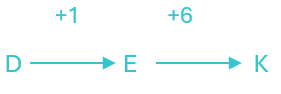
  • The extracellular matrix is composed of two main components: ground substance and fibers. The ground substance can range from fluid (as in blood) to semi-solid (as in cartilage) or hard and calcified (as in bone).
  • Protein fibers within the matrix, such as collagen, elastin, and reticular fibers, provide the necessary tensile strength and elasticity to bind different organs and tissues together.
  • Unlike epithelial tissue, where cells are tightly packed, connective tissue cells are scattered within the ECM, making the matrix the primary element responsible for the tissue's binding and supportive properties.

 Additional Information

  • Contractile proteins:
  • These are primarily actin and myosin, which are the structural components of muscle tissue.
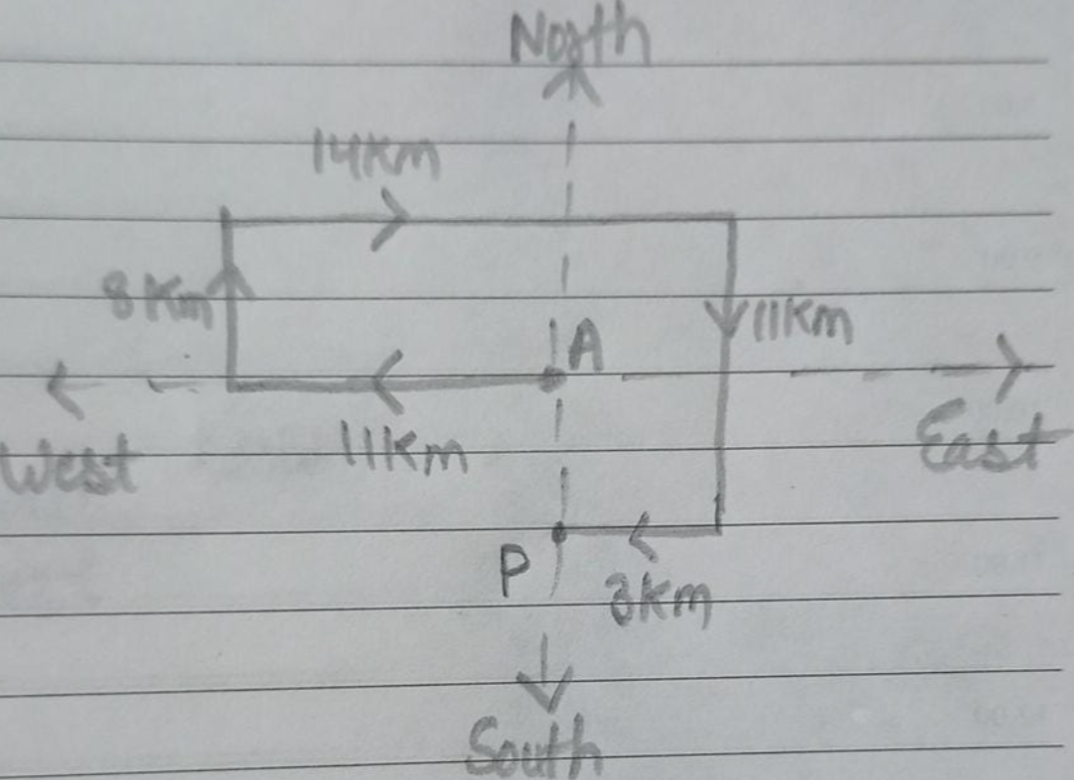
  • Their main function is to facilitate contraction and movement, not to provide structural binding between different body parts.
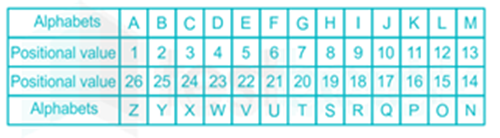
  • Nerve endings:
  • These are specialized structures of the nervous system designed to detect stimuli and transmit electrochemical impulses.
  • While found within connective tissues, they are not the mechanism by which the tissue provides structural support.
  • Cilia:
  • These are microscopic, hair-like projections found on the apical surface of certain epithelial cells.
  • They function to move substances (like mucus) across the cell surface and are not involved in binding body parts together.
  • Major Types of Connective Tissue:
  • Loose Connective Tissue: Includes areolar and adipose tissues.
  • Dense Connective Tissue: Found in tendons (muscle to bone) and ligaments (bone to bone).
  • Specialized Connective Tissue: Includes cartilage, bone, and vascular tissue (blood).
83

Burning of a saturated hydrocarbon will result in which type of flame?

  1. ((a))

    Sooty flame

  2. ((b))

    Green flame

  3. ((c))

    Yellow flame

  4. ((d))

    Clean flame

Show Answer
Answer: ((d))

Clean flame

The correct answer is Clean flame.

Key Points

  • Saturated hydrocarbons, also known as alkanes (such as methane, ethane, and propane), consist entirely of single bonds between carbon atoms and have the general formula CnH2n+2.
  • When these compounds burn in a sufficient supply of oxygen or air, they undergo complete combustion, a process where the hydrocarbon reacts fully with oxygen to produce carbon dioxide (CO2), water vapor (H2O), and a significant amount of heat.
  • The carbon-to-hydrogen ratio in saturated hydrocarbons is relatively low compared to unsaturated ones, ensuring that all carbon atoms are oxidized without leaving behind unburnt solid residues.
  • The absence of unburnt carbon particles (soot) results in a non-luminous, blue, and clean flame, which is the most efficient form of combustion for heating purposes.
  • In household appliances like LPG stoves, holes are provided for air entry to ensure that the saturated hydrocarbons (butane and propane) burn with a clean blue flame; if these holes are blocked, the flame may turn yellow due to incomplete combustion.

 Additional Information

  • Sooty Flame
  • Commonly produced by unsaturated hydrocarbons like alkenes (double bonds) and alkynes (triple bonds) because they have a higher percentage of carbon.
  • The high carbon content leads to incomplete combustion, releasing unburnt carbon particles into the air as smoke or soot.
  • Yellow Flame
  • A luminous flame indicating incomplete combustion where tiny particles of carbon get heated and glow, giving the flame a characteristic yellow or orange color.
  • Green Flame
  • Typically associated with the presence of specific metal ions or chemical compounds, such as boron, barium, or copper, rather than the standard combustion of simple hydrocarbons.
84

The speed of sound depends primarily on the nature and ____________ of the medium.

  1. ((a))

    Amplitude

  2. ((b))

    Volume

  3. ((c))

    Temperature

  4. ((d))

    Pressure

Show Answer
Answer: ((c))

Temperature

The correct answer is Temperature.

Key Points

  • The speed of sound is not a universal constant; it varies depending on the physical properties and the nature of the medium (solid, liquid, or gas) through which it propagates.
  • The temperature of the medium is a primary factor because it directly influences the kinetic energy of the particles; higher temperatures cause molecules to vibrate more vigorously, allowing sound waves to travel faster.
  • For a gaseous medium, the velocity of sound is given by the formula v=γRTM v = \sqrt{\frac{\gamma RT}{M}} , where v represents speed, γ \gamma is the adiabatic index, R is the universal gas constant, T is the absolute temperature, and M is the molar mass.
  • The relationship demonstrates that the speed of sound is directly proportional to the square root of the absolute temperature (vT v \propto \sqrt{T} ).
  • In dry air at 0°C (273 K), the speed of sound is approximately 331 m/s, whereas at 20°C, it increases to about 343 m/s.

 Additional Information

  • Pressure
  • For an ideal gas, changes in pressure do not affect the speed of sound if the temperature remains constant, as the density changes proportionately to the pressure.
  • Amplitude
  • This refers to the maximum displacement of particles in the medium and determines the loudness or energy of the sound, but it has no effect on the propagation speed.
  • Medium Density and Elasticity
  • Sound travels fastest in solids due to their high bulk modulus (elasticity) and slowest in gases.
  • In liquids and solids, the speed is determined by the ratio of elasticity to density.
  • Humidity
  • Increased humidity reduces the effective density of air, which leads to a slight increase in the speed of sound compared to dry air.
85

Which of these is an example of a solid sol?

  1. ((a))

    Coloured gem

  2. ((b))

    Cheese

  3. ((c))

    Jelly

  4. ((d))

    Smoke

Show Answer
Answer: ((a))

Coloured gem

The correct answer is Coloured gem.

Key Points

  • A solid sol is a specific type of colloidal system where both the dispersed phase (the substance being distributed) and the dispersion medium (the continuous phase) are in the solid state.
  • Coloured gemstones, such as ruby, sapphire, and emerald, are primary examples of solid sols because they consist of solid metal oxide impurities dispersed within a solid mineral crystal lattice.
  • The intense colors in these gems result from the dispersion of transition metal ions (like chromium or iron) throughout the host solid, creating a stable solid-in-solid mixture that cannot be separated by physical filtration.
  • In these systems, the particles are within the colloidal range (typically 1 nm to 1000 nm), allowing them to interact with light and produce specific optical effects without settling out over time.
  • Another common example of a solid sol is milky glass, where solid particles are dispersed within the glass matrix during the manufacturing process.

 Additional Information

  • Classification of other options:
  • Cheese and Jelly: These are classified as Gels. In this system, the dispersed phase is a liquid and the dispersion medium is a solid, resulting in a semi-solid, elastic consistency.
  • Smoke: This is categorized as a Solid Aerosol. It consists of fine solid particles (such as soot or ash) dispersed in a gas (air).
  • Emulsions: These involve a liquid dispersed in another liquid, such as milk, butter, or face cream.
  • Sols: These consist of solid particles dispersed in a liquid medium, commonly seen in paints, muddy water, and cell fluids.
  • Foams: These are formed when a gas is dispersed in a liquid (e.g., whipped cream) or a gas is dispersed in a solid (e.g., pumice stone or foam rubber).
86

An ultrasonic wave has a frequency of 33 kHz. What will be the speed of this wave if its wavelength is 0.01 m?

  1. ((a))

    3.3 m/s

  2. ((b))

    330 m/s

  3. ((c))

    0.33 m/s

  4. ((d))

    33 m/s

Show Answer
Answer: ((b))

330 m/s

The correct answer is 330 m/s.

Key Points

  • The speed of an ultrasonic wave (or any wave) is determined by the relationship between its frequency and its wavelength, defined by the formula: Speed (v) = Frequency (f) × Wavelength (λ).
  • The frequency provided is 33 kHz. In physics calculations, frequencies must be converted to the SI unit Hertz (Hz). Since 1 kHz = 103 Hz, 33 kHz is equal to 33,000 Hz.
  • The wavelength of the wave is given as 0.01 m. This value is already in the standard SI unit (meters) required for the calculation.
  • By substituting the known values into the equation: v = 33,000 Hz × 0.01 m.
  • The product of these two values results in a wave speed of 330 m/s.

 Additional Information

  • Ultrasonic Waves:
  • These are longitudinal mechanical waves with frequencies higher than 20,000 Hz (20 kHz), which is the upper threshold of human hearing.
  • They possess high energy and shorter wavelengths, allowing them to penetrate deep into materials, making them useful for medical imaging (ultrasonography) and industrial cleaning.
  • Animals like bats and dolphins use these waves for echolocation to navigate and hunt.
  • Frequency and Period:
  • Frequency (f) is the number of cycles per second. It is the reciprocal of the Time Period (T), where f = 1/T.
  • Higher frequency waves carry more energy compared to lower frequency waves of the same amplitude.
  • Speed of Sound:
  • The speed of sound varies depending on the medium (fastest in solids, slowest in gases) and factors like temperature and humidity.
  • At 0°C, the speed of sound in dry air is approximately 331 m/s, and at 20°C, it increases to about 343 m/s.
87

The formation of micelles in soap solution occurs due to:

  1. ((a))

    hydrogen bonding with water molecules

  2. ((b))

    electrostatic attraction between ions

  3. ((c))

    dispersion forces only

  4. ((d))

    hydrophobic and hydrophilic interactions in water

Show Answer
Answer: ((d))

hydrophobic and hydrophilic interactions in water

The correct answer is hydrophobic and hydrophilic interactions in water.

Key Points

  • Soap molecules are typical surfactants, such as sodium stearate (C17H35COONa), which possess a dual-natured structure consisting of a polar hydrophilic head and a non-polar hydrophobic tail.
  • The hydrophilic head is an ionic carboxylate group (COO) that has a strong affinity for water, while the hydrophobic tail is a long hydrocarbon chain that repels water.
  • At low concentrations in an aqueous solution, soap behaves as a normal electrolyte; however, when the concentration reaches the Critical Micelle Concentration (CMC), the molecules undergo self-assembly.
  • Micelle formation occurs as a result of hydrophobic and hydrophilic interactions, where the hydrophobic tails aggregate in the center of a spherical cluster to minimize contact with water, while the hydrophilic heads face outward to remain in contact with the solvent.
  • This spontaneous formation is entropy-driven, primarily due to the hydrophobic effect, which reduces the structured cage of water molecules around the non-polar tails, thereby lowering the system's Gibbs free energy.

 Additional Information

  • Analysis of Other Options:
  • Hydrogen Bonding: Although water molecules form hydrogen bonds with each other and the soap heads, this interaction alone does not drive the clustering of the long hydrocarbon chains into micelles.
  • Electrostatic Attraction: In reality, the anionic heads of soap molecules experience electrostatic repulsion due to identical negative charges; the hydrophobic effect must be strong enough to overcome this repulsion for a micelle to be stable.
  • Dispersion Forces: While London dispersion forces occur between the hydrocarbon tails in the core, they are significantly weaker than the hydrophobic interactions that initiate the assembly in water.
  • Key Parameters for Micellization:
  • Critical Micelle Concentration (CMC): For most soaps, the CMC is approximately 10−4 to 10−3 mol L−1 at room temperature.
  • Kraft Temperature (Tk): This is the temperature above which the solubility of the surfactant increases sharply, allowing the formation of associated colloids or micelles.
  • Cleansing Action: The hydrophobic core of the micelle traps non-polar grease and oil, while the hydrophilic exterior keeps the entire aggregate suspended in water, enabling the removal of dirt.
88

In a velocity–time graph, the graph is a straight horizontal line at 10 m/s for 5 seconds. Then the distance travelled is ____________.

  1. ((a))

    5 m

  2. ((b))

    10 m

  3. ((c))

    2 m

  4. ((d))

    50 m

Show Answer
Answer: ((d))

50 m

The correct answer is 50 m.

Key Points

  • In kinematics, a velocity-time graph (v-t graph) illustrates the relationship between an object's velocity and the time elapsed.
  • A straight horizontal line parallel to the time axis indicates that the object is moving with a constant velocity, meaning its speed and direction do not change over time.
  • The geometric area enclosed between the velocity-time graph and the time axis represents the total distance or displacement covered by the object during that period.
  • For a horizontal line at 10 m/s over a duration of 5 seconds, the shape formed under the graph is a rectangle with a height of 10 units and a width of 5 units.
  • The mathematical formula for distance in uniform motion is Distance = Velocity × Time.
  • By substituting the given values, Distance = 10 m/s × 5 s = 50 m, confirming the total path length covered is 50 meters.

 Additional Information

  • Slope of the Graph:
  • The slope (gradient) of a velocity-time graph represents the acceleration of the object.
  • Since a horizontal line has a zero slope, the acceleration of the object in this scenario is 0 m/s2, confirming uniform motion.
  • Units and Dimensions:
  • The S.I. unit of velocity is meters per second (m/s), and time is measured in seconds (s).
  • Multiplying these units results in (m/s) × s = m, which is the standard unit for distance.
  • Variable Velocity:
  • If the graph were a slanted straight line starting from the origin, it would represent uniformly accelerated motion, where the area would be calculated as a triangle (1/2 × base × height).
89

Which of the following practices directly contributes to crop yield improvement?

  1. ((a))

    Planting the same crop year after year

  2. ((b))

    Delayed harvest

  3. ((c))

    Timely irrigation and fertilization

  4. ((d))

    Ignoring pest signs

Show Answer
Answer: ((c))

Timely irrigation and fertilization

The correct answer is Timely irrigation and fertilization.

Key Points

  • Irrigation is the artificial application of water to crops at necessary intervals. Timely irrigation is vital to prevent moisture stress, particularly during critical growth stages such as seedling establishment, flowering, and grain filling, which are essential for reaching maximum yield potential.
  • Fertilization involves the application of essential nutrients like Nitrogen (N), Phosphorus (P), and Potassium (K). These macronutrients are fundamental for protein synthesis, photosynthesis, and cellular respiration, which directly enhance the biomass production of the crop.
  • The synergy between water management and nutrient supply ensures that the plant maintains high turgor pressure and efficient metabolic activity. This leads to vigorous growth and a higher harvest index, contributing significantly to crop yield improvement.

 Additional Information

  • Inefficient Practices:
  • Monoculture: Planting the same crop year after year leads to soil nutrient depletion and the accumulation of host-specific pests and pathogens, ultimately reducing the overall yield.
  • Delayed Harvest: Waiting too long to harvest can cause grain shattering, lodging, and increased exposure to microbial spoilage or pest damage, leading to substantial quantitative losses.
  • Pest Neglect: Ignoring signs of infestation or disease allows the problem to cross the economic threshold level (ETL), resulting in severe damage to the photosynthetic surface and decreasing the market value of the produce.
90

Meristematic tissue in plants is mainly characterized by:

  1. ((a))

    Permanent storage cells.

  2. ((b))

    Small, actively dividing cells with thin walls.

  3. ((c))

    Large, highly vacuolated cells.

  4. ((d))

    Mature cells with thick walls.

Show Answer
Answer: ((b))

Small, actively dividing cells with thin walls.

The correct answer is Small, actively dividing cells with thin walls.

Key Points

  • Meristematic tissues are defined as a group of young, immature cells that are in a continuous state of division and contribute to the growth of the plant.
  • The cells of this tissue are generally small, isodiametric, or spherical in shape, ensuring they can be compactly arranged without intercellular spaces.
  • These cells possess thin cellulosic cell walls, which are necessary to allow for rapid expansion and frequent cytokinesis during the growth process.
  • They are characterized by dense cytoplasm, a prominent nucleus, and a very high metabolic rate, which is required to support constant cellular replication.
  • Unlike permanent tissues, meristematic cells typically lack vacuoles or have very small ones, as their primary function is proliferation rather than storage or structural support.

 Additional Information

  • Classification based on Position:
  • Apical Meristem: Located at the root tips and shoot tips, these are responsible for primary growth and increasing the length of the plant.
  • Lateral Meristem: Found along the longitudinal axis of stems and roots (e.g., vascular cambium and cork cambium), they facilitate secondary growth and increase the girth or thickness.
  • Intercalary Meristem: Positioned between permanent tissues, often at the base of nodes or leaves in monocots, assisting in the elongation of internodes.
  • Comparison with Permanent Tissues:
  • Parenchyma: Often contains large, highly vacuolated cells primarily used for storage of food or water.
  • Sclerenchyma: Composed of mature cells with thick, lignified walls that provide mechanical strength but lose the ability to divide.
  • Collenchyma: Provides flexibility with cells that have unevenly thickened walls at the corners.

General Awareness (10 questions)

91

Under the 2018 amendments in Foreign Direct Investment (FDI) policy approved by the Cabinet, the maximum Foreign Direct Investment (FDI) permitted under the automatic route in Single Brand Retail Trading (SBRT) is _____

  1. ((a))

    40%

  2. ((b))

    85%

  3. ((c))

    100%

  4. ((d))

    60%

Show Answer
Answer: ((c))

100%

The correct answer is 100%.

Key Points

  • In January 2018, the Union Cabinet, chaired by the Prime Minister, approved several amendments in the Foreign Direct Investment (FDI) policy to simplify and liberalize the regime for investors.
  • The most notable change was permitting 100% FDI under the automatic route for Single Brand Retail Trading (SBRT), which eliminated the need for Government approval for investments exceeding 49%.
  • Before this amendment, while 100% FDI was allowed in SBRT, only up to 49% could be brought in via the automatic route, and any stake beyond that required approval from the Foreign Investment Promotion Board (FIPB) or its successor bodies.
  • The policy move was designed to improve the Ease of Doing Business in India, encouraging global brands like Apple, IKEA, and Nike to set up wholly-owned subsidiaries and retail stores directly.
  • Single Brand Retail Trading involves the sale of products that are sold under the same brand name globally and are branded during manufacturing, ensuring a uniform consumer experience.

 Additional Information

  • Local Sourcing Norms:
  • For entities with more than 51% FDI in SBRT, there is a mandatory requirement to source 30% of the value of goods from India, preferably from MSMEs and local artisans.
  • The 2018 policy allowed incremental sourcing for global operations by the brand entity to be set off against the 30% local sourcing requirement for a period of five years.
  • FDI Routes in India:
  • Automatic Route: The non-resident investor or the Indian company does not require any prior approval from the Reserve Bank of India (RBI) or the Government of India.
  • Government Route: Prior approval is mandatory through the Foreign Investment Facilitation Portal (FIFP), managed by the DPIIT under the Ministry of Commerce and Industry.
  • Policy Impact:
  • These reforms aimed to boost domestic manufacturing, generate employment, and provide Indian consumers with access to a wider variety of global products and technologies.
92

With reference to fluvial geomorphic processes in the Indian subcontinent, the Indo-Gangetic Plains have been formed predominantly due to the long-term accumulation of which specific type of deposits?

  1. ((a))

    Glacial till deposited directly by valley glaciers

  2. ((b))

    Aeolian sand deposits formed under arid climatic conditions

  3. ((c))

    Marine sediments laid down by repeated sea transgressions

  4. ((d))

    Alluvial sediments deposited by Himalayan river systems

Show Answer
Answer: ((d))

Alluvial sediments deposited by Himalayan river systems

The correct answer is Alluvial sediments deposited by Himalayan river systems.

Key Points

  • The Indo-Gangetic Plains, also known as the Great Plains of India, represent a massive aggradational surface located between the Himalayas in the north and the Peninsular Plateau in the south.
  • Geologically, these plains were formed within a vast foredeep or geosynclinal trough that was created during the Himalayan orogeny as the Indian plate collided with the Eurasian plate.
  • The formation is the result of continuous fluvial action by the three major perennial river systems: the Indus, the Ganga, and the Brahmaputra, along with their numerous tributaries.
  • Over millions of years, these rivers carried vast quantities of sediments from the eroding mountains and deposited them in the depression, eventually filling it to create a flat, fertile expanse.
  • Statistical data indicates that the depth of the alluvial deposits in this region is significant, generally ranging from 1,000 to 2,000 meters, making it one of the largest and deepest alluvial basins in the world.
  • The plains cover an area of approximately 7 lakh square kilometers, stretching about 2,400 kilometers from west to east, dominated by features like Bhabar, Terai, Bhangar, and Khadar.

 Additional Information

  • Alluvial Sediments:
  • These are unconsolidated materials including silt, clay, sand, and gravel transported by water.
  • The Khadar region represents newer alluvium deposited by annual floods, while Bhangar represents older, higher alluvium containing calcareous kankar nodules.
  • Himalayan River Systems:
  • These are perennial rivers fed by glacier melt and monsoon rainfall, ensuring a high sediment-carrying capacity.
  • They are responsible for creating extensive floodplains, natural levees, and the world's largest delta, the Sundarbans.
  • Other Deposition Types:
  • Glacial Till: Poorly sorted sediment deposited directly by glaciers, primarily found in high-altitude Himalayan valleys, not the plains.
  • Aeolian Deposits: Wind-blown sand and loess, dominant in the Thar Desert of Rajasthan.
  • Marine Sediments: Deposits formed in sea environments, found along the Indian coastline and the Rann of Kutch, rather than the continental interior.
93

The Constitution of India provided for how many types of emergencies in Part XVIII, from Articles 352 to 360?

  1. ((a))

    Six

  2. ((b))

    Five

  3. ((c))

    Three

  4. ((d))

    Four

Show Answer
Answer: ((c))

Three

The correct answer is Three.

Key Points

  • The Constitution of India delineates extraordinary provisions under Part XVIII, spanning from Articles 352 to 360, to deal with situations that threaten the security and stability of the nation.
  • The first type is a National Emergency, governed by Article 352, which can be declared by the President of India if there is a grave threat to the security of India or any part thereof due to war, external aggression, or armed rebellion.
  • The second type is the State Emergency, popularly known as President's Rule, under Article 356. It is invoked when the constitutional machinery in a state fails, or under Article 365 if a state fails to comply with directions from the Union government.
  • The third type is a Financial Emergency, outlined in Article 360, which the President may proclaim if the financial stability or credit of India, or any part of its territory, is deemed to be in immediate danger.
  • These provisions effectively transform the federal structure of the Indian political system into a unitary one, allowing the Central Government to exercise supreme authority to manage the crisis.

 Additional Information

  • Procedural Characteristics and History
  • The 44th Amendment Act of 1978 introduced significant safeguards, such as requiring a written recommendation from the Cabinet for a National Emergency and replacing the term 'internal disturbance' with 'armed rebellion'.
  • While a National Emergency has been declared three times in India (1962, 1971, and 1975), a Financial Emergency under Article 360 has never been invoked since the inception of the Constitution.
  • Under Article 359, the President has the power to suspend the right to approach the courts for the enforcement of Fundamental Rights, except those guaranteed under Articles 20 and 21.
  • The concept of emergency provisions in the Indian Constitution is heavily influenced by the Government of India Act, 1935, and the Weimar Constitution of Germany regarding the suspension of rights.
94

The NAVYA (Nurturing Aspirations through Vocational Training for Young Adolescent Girls) initiative, launched on 24 June 2025, is for which age group?

  1. ((a))

    16 - 18 years

  2. ((b))

    12 - 14 years

  3. ((c))

    18 - 20 years

  4. ((d))

    14 - 16 years

Show Answer
Answer: ((a))

16 - 18 years

The correct answer is 16 - 18 years.

Key Points

  • The NAVYA (Nurturing Aspirations through Vocational Training for Young Adolescent Girls) initiative was officially launched on 24 June 2025.
  • The program specifically targets adolescent girls in the age group of 16 - 18 years, a vital demographic that is often at risk of dropping out of the formal education system.
  • The primary goal of the initiative is to provide specialized vocational training and skill development to empower young women and enhance their future employability.
  • The scheme focuses on bridging the gap between academic learning and industry requirements, ensuring that girls are equipped with market-relevant skills before they enter the professional world.
  • By focusing on this specific age bracket, NAVYA aims to foster economic independence and provide a sense of direction to young girls during their formative years.

 Additional Information

  • Strategic Goals of the Initiative:
  • The program aligns with the Skill India Mission and the Beti Bachao Beti Padhao framework to improve gender parity in the labor force.
  • Training modules often include digital literacy, healthcare assistance, textiles, and Information Technology (IT) services.
  • Participants receive certification upon completion, which is recognized by various industrial sectors and government bodies.
  • Social and Economic Impact:
  • Focusing on the 16 - 18 years age group helps in delaying the age of marriage and reducing maternal mortality by keeping girls engaged in productive learning.
  • The initiative also includes life skills training, such as financial literacy, self-defense, and effective communication, to build overall confidence.
  • It targets rural and underprivileged urban areas to ensure that the benefits of vocational education reach the most vulnerable populations.
95

Which country launched the first indigenous, Low-Cost Gene Therapy for Sickle Cell Disease, named "BIRSA 101"?

  1. ((a))

    Spain

  2. ((b))

    India

  3. ((c))

    China

  4. ((d))

    Japan

Show Answer
Answer: ((b))

India

The correct answer is India.

Key Points

  • India has achieved a significant milestone in medical biotechnology by launching BIRSA 101, its first indigenous, low-cost gene therapy specifically designed to treat Sickle Cell Disease (SCD).
  • The therapy was developed through the collaborative efforts of premier institutions, including the Council of Scientific and Industrial Research (CSIR) and the Institute of Genomics and Integrative Biology (IGIB), highlighting India’s growing capability in gene-editing technologies.
  • The name BIRSA is a tribute to the legendary tribal leader Birsa Munda, reflecting the primary target of this medical intervention, as Sickle Cell Disease disproportionately affects tribal communities across the Indian subcontinent.
  • This therapy utilizes CRISPR-Cas9 technology to correct the genetic mutation in hemoglobin, offering a potential one-time cure that is significantly more affordable than international alternatives which can cost upwards of 2 to 3 million dollars.
  • By localizing the production and clinical trial process, India aims to provide life-saving treatment to thousands of patients who previously had no access to advanced genomic medicine.

 Additional Information

  • Sickle Cell Disease (SCD):
  • It is a hereditary blood disorder where red blood cells assume an abnormal, rigid, sickle shape, leading to anemia, organ damage, and severe pain crises.
  • The Government of India launched the National Sickle Cell Anemia Elimination Mission in 2023, with the ambitious goal of eliminating the disease by the year 2047.
  • Gene Therapy Landscape:
  • Traditional treatments were limited to blood transfusions and bone marrow transplants, which are often risky or unavailable to the masses.
  • The BIRSA 101 initiative represents a shift toward personalized medicine and high-end molecular therapeutics within the Atmanirbhar Bharat (Self-Reliant India) framework.
96

At which session of the Indian National Congress did the party formally split into the Moderates and the Extremists?

  1. ((a))

    Surat session 1907

  2. ((b))

    Bombay session 1910

  3. ((c))

    Delhi session 1912

  4. ((d))

    Calcutta session 1906

Show Answer
Answer: ((a))

Surat session 1907

The correct answer is Surat session 1907.

Key Points

  • The Indian National Congress (INC) formally split into two groups—the Moderates and the Extremists—during the Surat session held in 1907 on the banks of the Tapti River.
  • The session was presided over by Dr. Rash Behari Ghosh, whose candidacy was a major point of contention between the two factions.
  • The Moderates, led by leaders like Gopal Krishna Gokhale and Pherozeshah Mehta, believed in constitutional methods, petitions, and gradual reforms within the framework of British Rule.
  • The Extremists, led by the trio Lal-Bal-Pal (Lala Lajpat Rai, Bal Gangadhar Tilak, and Bipin Chandra Pal), advocated for a more radical approach involving Mass Agitation, Self-Reliance, and the extension of the Swadeshi Movement across India.
  • The disagreement reached a breaking point over the resolutions passed in the previous session; the Extremists wanted to emphasize Swaraj, while the Moderates were hesitant to adopt such aggressive terminology, leading to a chaotic session and a formal organizational separation.

 Additional Information

  • Calcutta Session 1906:
  • Presided over by Dadabhai Naoroji, the 'Grand Old Man of India'.
  • The session is historic because the goal of Swaraj (Self-government) was first publicly adopted by the Congress.
  • Four major resolutions on Boycott, Swadeshi, National Education, and Self-government were passed to pacify the rising tensions between factions.
  • Reunion at Lucknow (1916):
  • The split lasted for nearly nine years until the Lucknow Session in 1916, presided over by Ambica Charan Mazumdar.
  • Efforts by Annie Besant and Bal Gangadhar Tilak played a crucial role in bringing the two wings back together.
  • Other Sessions:
  • The Bombay Session 1910 was presided over by Sir William Wedderburn.
  • The Delhi Session 1912 was presided over by Raghunath Narasinha Mudholkar.
97

Which bank joins the India Bullion Exchange as a special category client?

  1. ((a))

    Bank of India

  2. ((b))

    Punjab National Bank

  3. ((c))

    State Bank of India

  4. ((d))

    Indian Bank

Show Answer
Answer: ((c))

State Bank of India

The correct answer is State Bank of India.

Key Points

  • The State Bank of India (SBI) has achieved a milestone by becoming the first Public Sector Bank (PSB) to join the India International Bullion Exchange (IIBX) as a Special Category Client (SCC).
  • The IIBX is India's first International Bullion Exchange, situated in the Gujarat International Finance Tec-City (GIFT City) in Gandhinagar, established to provide a transparent platform for bullion trading.
  • As an SCC, SBI is empowered to participate directly in the exchange to facilitate the import of gold and silver for its domestic clients, specifically Qualified Jewellers.
  • This participation follows the regulatory framework set by the Reserve Bank of India (RBI) and the International Financial Services Centres Authority (IFSCA), which allows Scheduled Commercial Banks to act as intermediaries in the bullion market.
  • The integration of SBI into the IIBX ecosystem is expected to significantly increase trading volumes and provide better price discovery for the Indian bullion market, which is one of the largest in the world.

 Additional Information

  • India International Bullion Exchange (IIBX):
  • Inaugurated in July 2022, it aims to make India a price setter rather than a price taker in the global bullion market.
  • The exchange offers various products, including Gold 995 and Gold 999 purity, along with Silver contracts.
  • Special Category Client (SCC) framework:
  • Introduced by the RBI in May 2022 to allow Indian banks to operate as Professional Clearing Members or Trading Members at GIFT-IFSC.
  • Banks must maintain a minimum Capital to Risk-weighted Assets Ratio (CRAR) as per Basel III norms to qualify for this status.
  • GIFT City (Gujarat International Finance Tec-City):
  • It serves as India's first International Financial Services Centre (IFSC), designed to compete with global financial hubs like Singapore, Dubai, and London.
  • It provides a tax-neutral environment and a streamlined regulatory regime for international financial entities.
98

Under the new scheme for first-time Women, SC and ST entrepreneurs, announced in the Union Budget 2025-26, what is the maximum loan amount that can be availed?

  1. ((a))

    ₹50 lakh

  2. ((b))

    ₹1 crore

  3. ((c))

    ₹2 crore

  4. ((d))

    ₹5 crore

Show Answer
Answer: ((c))

₹2 crore

The correct answer is ₹2 crore.

Key Points

  • In the Union Budget 2025-26, the Government of India announced a significant enhancement of financial support targeted at first-time entrepreneurs to foster a robust startup ecosystem.
  • The scheme specifically prioritizes individuals from the Scheduled Castes (SC), Scheduled Tribes (ST), and Women categories to ensure inclusive economic growth and social equity.
  • Under this revamped initiative, the maximum loan amount that can be availed by eligible entrepreneurs has been increased to ₹2 crore per borrower.
  • The primary objective of increasing the limit to ₹2 crore is to support greenfield enterprises in manufacturing, services, or the trading sector, allowing for higher capital expenditure.
  • This measure is part of the broader Viksit Bharat strategy, aimed at empowering marginalized sections to become job creators rather than job seekers.

 Additional Information

  • The Union Budget 2025-26, presented by Finance Minister Nirmala Sitharaman, emphasizes four key pillars: Garib (Poor), Mahilayen (Women), Yuva (Youth), and Annadata (Farmer).
  • Credit Guarantee Support: To facilitate these high-value loans of up to ₹2 crore, the government provides credit guarantee covers, reducing the risk for lending institutions like Scheduled Commercial Banks.
  • Entrepreneurship Promotion: This enhancement follows the success of earlier versions of the Stand-Up India scheme, which previously had a lower ceiling, thereby reflecting the rising costs of technology and machinery.
  • Ease of Access: The scheme is integrated with the Jan Samarth Portal, enabling a digital and transparent application process to improve the Ease of Doing Business for new entrants.
  • Economic Impact: By targeting first-time entrepreneurs, the government aims to stimulate the MSME sector, which contributes significantly to India’s GDP and export earnings.
99

Division of legislative subjects into union, state and concurrent List is contained in which of the following schedules of the Constitution of India?

  1. ((a))

    Seventh Schedule

  2. ((b))

    Fifth Schedule

  3. ((c))

    Ninth Schedule

  4. ((d))

    Eleventh Schedule

Show Answer
Answer: ((a))

Seventh Schedule

The correct answer is Seventh Schedule.

Key Points

  • The Seventh Schedule of the Constitution of India establishes the federal distribution of powers between the Union and the States.
  • It is divided into three distinct lists: List I (Union List), List II (State List), and List III (Concurrent List).
  • Article 246 serves as the constitutional basis for this schedule, defining the legislative jurisdiction of Parliament and State Legislatures.
  • List I (Union List) currently comprises 100 subjects (originally 97) such as Defense, Foreign Affairs, Atomic Energy, Banking, and Communication, where the Central Government holds exclusive authority.
  • List II (State List) consists of 61 subjects (originally 66) including Public Order, Police, Public Health, and Agriculture, governed primarily by state governments.
  • List III (Concurrent List) features 52 subjects (originally 47) like Education, Forests, Marriage, and Criminal Law, allowing both the Union and States to legislate, though central laws prevail in case of conflict.
  • The 42nd Constitutional Amendment Act of 1976 famously transferred five subjects from the State List to the Concurrent List to promote uniformity.

 Additional Information

  • Fifth Schedule:
  • Contains provisions related to the administration and control of Scheduled Areas and Scheduled Tribes.
  • It excludes the tribal areas of Assam, Meghalaya, Tripura, and Mizoram, which are covered under the Sixth Schedule.
  • Ninth Schedule:
  • Introduced by the 1st Constitutional Amendment Act (1951) to protect land reform laws and other regulations from judicial scrutiny.
  • Laws included here were initially immune to challenges regarding Fundamental Rights violations.
  • Eleventh Schedule:
  • Added by the 73rd Constitutional Amendment Act (1992) to empower Panchayati Raj Institutions.
  • It lists 29 functional items intended to promote rural development and local self-governance.
100

Which dance form is performed by men wearing long colorful robes and tall conical caps in Jammu & Kashmir?

  1. ((a))

    Hikat

  2. ((b))

    Chholiya

  3. ((c))

    HurkaBaul

  4. ((d))

    Dumhal

Show Answer
Answer: ((d))

Dumhal

The correct answer is Dumhal.

Key Points

  • Dumhal is a prestigious folk dance originating from the Jammu and Kashmir region, specifically performed by the Wattal tribe on special ceremonial occasions.
  • The performance is exclusively conducted by male dancers who dress in long, vibrant colorful robes and wear distinctive tall conical caps that are frequently embellished with beads and shells.
  • The dance is ritualistic in nature and begins only after a banner is ceremoniously planted into the ground at a designated spot, serving as the focal point for the dancers.
  • Dancers move in a graceful circular formation around this banner, accompanied by the rhythmic beats of large drums known as the Duff, while the participants sing folk choruses in unison.
  • Historically, this dance was performed to seek divine intervention or blessings during times of distress or for the fulfillment of specific community prayers.

 Additional Information

  • Hikat:
  • It is a traditional folk dance of Jammu and Kashmir usually performed by young girls and boys.
  • The dancers interlock their arms and spin in circles, maintaining perfect balance while dancing to the tunes of Rabbi music.
  • Chholiya:
  • A famous martial art-style dance originating from the Kumaon region of Uttarakhand.
  • It is primarily a sword dance performed during wedding processions and is believed to ward off evil spirits.
  • HurkaBaul:
  • An agricultural folk dance associated with the state of Uttarakhand.
  • It is performed during the cultivation of paddy and maize, where the name refers to Hurka (the percussion instrument) and Baul (the song structure).

Attempt this paper under real exam conditions

Timed interface, section switching, instant scoring, and question-by-question analytics — free.

Start Timed Attempt