During a sale, 40% of the goods are sold at a 17% profit; 25% of the remaining goods are sold at a 22% profit; and the rest are sold at a 10% loss. Assuming all goods have the same cost price, what is the overall profit percentage?
- ((a))
5.8%
- ((b))
6.2%
- ((c))
5.6%
- ((d))
6.8%
Show Answer
5.6%

Shortcut Trick
Use the Weighted Average method by simplifying quantity ratios.
Ratio of goods: 40% : (25% of 60%) : (Remaining 45%) → 40 : 15 : 45 → 8 : 3 : 9
Net Profit % = [ (8 × 17) + (3 × 22) + (9 × −10) ] ÷ (8 + 3 + 9)
Net Profit % = [ 136 + 66 − 90 ] ÷ 20 = 112 ÷ 20 = 5.6%
∴ The correct answer is 5.6%.

Alternate Method
Given:
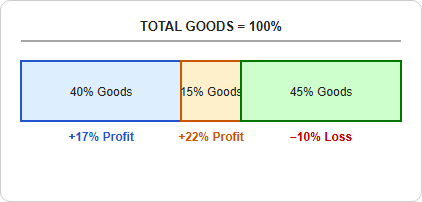
Total goods = 100%
Part 1: 40% of goods at 17% Profit.
Part 2: 25% of the remaining (100% − 40% = 60%) goods at 22% Profit.
Part 3: Rest of the goods at 10% Loss.
Calculations:
⇒ Quantity of Part 1 = 40%
⇒ Quantity of Part 2 = 25% × (100 − 40)% = 0.25 × 60% = 15%
⇒ Quantity of Part 3 = 100% − (40% + 15%) = 100% − 55% = 45%
⇒ Assume Cost Price (CP) of 1 unit = ₹1. Total CP = ₹100.
⇒ Profit from Part 1 = 40 × (17/100) = ₹6.8
⇒ Profit from Part 2 = 15 × (22/100) = ₹3.3
⇒ Loss from Part 3 = 45 × (10/100) = ₹4.5
⇒ Total Profit/Loss = 6.8 + 3.3 − 4.5 = ₹5.6
⇒ Overall Profit % = (Total Profit ÷ Total CP) × 100 = (5.6 ÷ 100) × 100 = 5.6%
∴ The correct answer is 5.6%.

Additional Information
Weighted Average Profit
When different quantities (q1, q2...) are sold at different profit rates (p1, p2...), the overall profit percentage is (q1p1 + q2p2 + ...) ÷ (q1 + q2 + ...).
Profit and Loss Basics
Profit % = (Profit ÷ CP) × 100, and Loss % = (Loss ÷ CP) × 100. Profit or Loss is always calculated on the Cost Price (CP) unless stated otherwise.
Effective Percentage Change
For two successive changes a% and b%, the effective change is [a + b + (ab/100)]%. This is useful in Successive Discounts or compound growth scenarios.