Official Paper

RRB Technician Grade III Official Paper (Held On: 06 March, 2026 Shift 3) (Previous Year Paper)

100 questions · 90 minutes · with answers · free

Mathematics (25 questions)

1

If a regular polygon has an interior angle of 156°, then find the sum of its 7 exterior angles.

  1. ((a))

    168°

  2. ((b))

    165°

  3. ((c))

    172°

  4. ((d))

    156°

Show Answer
Answer: ((a))

168°

Shortcut Trick

For any regular polygon, the sum of an interior angle and an exterior angle at a vertex is always 180°.

Exterior angle = 180° − 156° = 24°

Since the polygon is regular, all its exterior angles are equal.

Sum of 7 exterior angles = 7 × 24° = 168°

∴ The correct answer is 168°.

Alternate Method

Given:

Interior angle of the regular polygon = 156°

Formula Used:

  1. Exterior Angle = 180° − Interior Angle
  2. Sum of 'k' exterior angles = k × Exterior Angle (for a regular polygon)
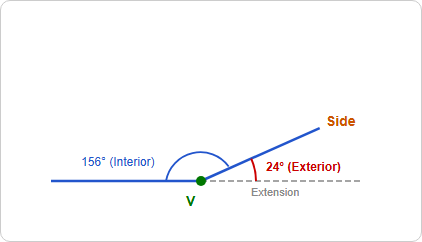
Calculations:

⇒ One Exterior angle = 180° − 156°

⇒ One Exterior angle = 24°

⇒ In a regular polygon, all exterior angles are of the same measure.

⇒ Measure of 7 exterior angles = 7 × 24°

⇒ Required Sum = 168°

∴ The correct answer is 168°.

Additional Information

Sum of Exterior Angles

The sum of the exterior angles of any convex polygon, regardless of the number of sides, is always 360°.

Number of Sides

The number of sides (n) of a regular polygon can be calculated using the formula: n = 360° ÷ Exterior Angle. Here, n = 360 ÷ 24 = 15 sides.

Interior Angle Sum

The sum of all interior angles of an n-sided polygon is given by (n − 2) × 180°.
2

Simplify:12 of (12÷12 of 12+12)12 \text{Simplify}: \frac{1}{2} \text{ of } (\frac{1}{2} \div \frac{1}{2} \text{ of } \frac{1}{2} + \frac{1}{2}) - \frac{1}{2}

  1. ((a))

    0.75

  2. ((b))

    0.25

  3. ((c))

    1

  4. ((d))

    0.5

Show Answer
Answer: ((a))

0.75

Shortcut Trick

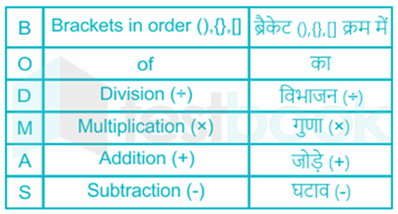
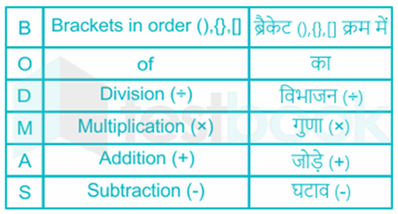
Solve using VBODMAS priority: Brackets → Of → Division → Addition → Subtraction.

Inner part: (1/2 ÷ (1/2 of 1/2) + 1/2) = (1/2 ÷ 1/4 + 1/2) = (2 + 1/2) = 2.5.

Outer part: (1/2 of 2.5) − 0.5 = 1.25 − 0.5 = 0.75.

∴ The correct answer is 0.75.

Alternate Method

Given Expression: (1/2) of ((1/2) ÷ (1/2) of (1/2) + (1/2)) − (1/2)

Method: Applying the BODMAS rule to simplify the operations step by step.

⇒ 1/2 of (1/2 ÷ (1/2 × 1/2) + 1/2) − 1/2

⇒ 1/2 of (1/2 ÷ 1/4 + 1/2) − 1/2

⇒ 1/2 of (1/2 × 4 + 1/2) − 1/2

⇒ 1/2 of (2 + 1/2) − 1/2

⇒ 1/2 × 5/2 − 1/2

⇒ 5/4 − 1/2

⇒ 1.25 − 0.5 = 0.75

∴ The correct answer is 0.75.

Additional Information

VBODMAS Rule

It stands for Vinculum, Bracket, Of, Division, Multiplication, Addition, and Subtraction. It defines the specific sequence of operations to solve any mathematical expression.

Priority of 'Of' Operator

The 'Of' operator represents multiplication but is prioritized higher than Division and Multiplication in the order of operations.

Fraction Division

To divide a number by a fraction, we multiply the number by the reciprocal of that fraction (e.g., a ÷ b/c = a × c/b).

3

The volume of a cylinder having diameter 20 cm and height 42 cm is:

(Take π=227) (\text{Take } \pi = \frac{22}{7})

  1. ((a))

    13202 cm3

  2. ((b))

    13200 cm3

  3. ((c))

    13210 cm3

  4. ((d))

    13196 cm3

Show Answer
Answer: ((b))

13200 cm3

Shortcut Trick

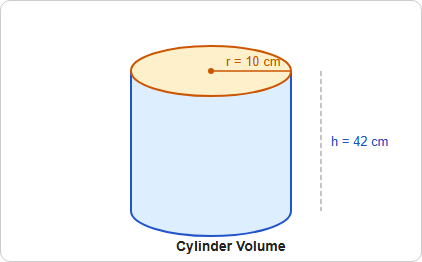
Radius (r) = Diameter ÷ 2 = 20 ÷ 2 = 10 cm.

Volume = πr2h = (22 ÷ 7) × 10 × 10 × 42.

Since 42 is a multiple of 7, the calculation becomes: 22 × 100 × 6.

Volume = 132 × 100 = 13200 cm3.

∴ The correct answer is 13200 cm3.

Alternate Method

Given:

Diameter of the cylinder (d) = 20 cm

Height of the cylinder (h) = 42 cm

π = 22 ÷ 7

Formula Used:

Volume of Cylinder = πr2h

Where r is the radius and h is the height.

Calculations:

Radius (r) = Diameter ÷ 2

Radius (r) = 20 ÷ 2 = 10 cm

Volume = (22 ÷ 7) × (10)2 × 42

Volume = (22 ÷ 7) × 100 × 42

Volume = 22 × 100 × (42 ÷ 7)

Volume = 22 × 100 × 6

Volume = 132 × 100

Volume = 13200 cm3

∴ The correct answer is 13200 cm3.

Additional Information

Curved Surface Area (CSA) of Cylinder

The area of the side surface of the cylinder is given by the formula: CSA = 2 × π × r × h.

Total Surface Area (TSA) of Cylinder

The sum of the curved surface area and the areas of the two circular bases: TSA = 2πr(r + h).

Volume of a Hollow Cylinder

If R is the external radius and r is the internal radius, then Volume = π × (R2 − r2) × h.

4

Simplify:

[{(96 ÷ (4 × 4)) + (36 ÷ (9 × 3))} + {(14 × 2 ÷ 4) + (18 ÷ (3 × 3)}]

  1. ((a))

    393 \frac{39}{3}

  2. ((b))

    693 \frac{69}{3}

  3. ((c))

    493 \frac{49}{3}

  4. ((d))

    593 \frac{59}{3}

Show Answer
Answer: ((c))

493 \frac{49}{3}

Shortcut Trick

Break the expression into four independent segments using the BODMAS rule.

Segment 1: 96 ÷ (4 × 4) = 96 ÷ 16 = 6

Segment 2: 36 ÷ (9 × 3) = 36 ÷ 27 = 4/3

Segment 3: (14 × 2 ÷ 4) = 28 ÷ 4 = 7

Segment 4: 18 ÷ (3 × 3) = 18 ÷ 9 = 2

Total = (6 + 4/3) + (7 + 2) = 15 + 4/3 = 49/3

∴ The correct answer is 49/3.

Alternate Method

Given Expression: [{(96 ÷ (4 × 4)) + (36 ÷ (9 × 3))} + {(14 × 2 ÷ 4) + (18 ÷ (3 × 3))}]

Method Used: BODMAS (Brackets, Of, Division, Multiplication, Addition, Subtraction).

⇒ [{(96 ÷ 16) + (36 ÷ 27)} + {(28 ÷ 4) + (18 ÷ 9)}]

⇒ [{6 + 4/3} + {7 + 2}]

⇒ [{(18 + 4) / 3} + 9]

⇒ [22/3 + 9]

⇒ (22 + 27) / 3

⇒ 49/3

∴ The correct answer is 49/3.

Additional Information

The BODMAS/VBODMAS Rule

Always solve in the order: Vinculum (Bar), Brackets (), Of, Division, Multiplication, Addition, and Subtraction.

Types of Brackets

Standard order for solving nested brackets is: Small Brackets ( )Curly Brackets { }Square Brackets [ ].

Fraction Simplification

To add a whole number and a fraction like x + a/b, use the formula (x × b + a) / b.

5

The number of tourists visiting a fort rose by 30% in summer and then dropped by 35% in monsoon. What is the overall percentage change?

  1. ((a))

    12.5% decrease

  2. ((b))

    12.5% increase

  3. ((c))

    15.5% decrease

  4. ((d))

    15.5% increase

Show Answer
Answer: ((c))

15.5% decrease

Shortcut Trick

Apply the successive percentage change formula: [x + y + (xy ÷ 100)]%

Where x = +30% (increase) and y = −35% (decrease).

Net Change = 30 − 35 + [(30 × −35) ÷ 100]

Net Change = −5 − 10.5 = −15.5%

Negative sign indicates a percentage decrease.

∴ The correct answer is 15.5% decrease.

Alternate Method

Given: Initial tourists increase = 30%; Subsequent monsoon decrease = 35%.

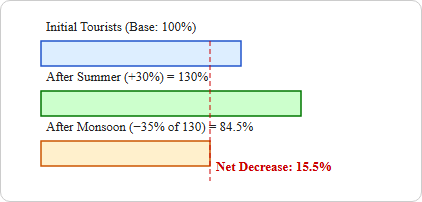
⇒ Let the initial number of tourists be 100.

⇒ Number of tourists after summer increase = 100 + (30% of 100) = 130.

⇒ Number of tourists after monsoon drop = 130 − (35% of 130).

Monsoon drop amount = (35 ÷ 100) × 130 = 45.5.

⇒ Final tourists count = 130 − 45.5 = 84.5.

Overall percentage change = 100 − 84.5 = 15.5%.

∴ The correct answer is 15.5% decrease.

Additional Information

Effective Percentage Change

For two successive changes of a% and b%, the net change is given by the formula [a + b + (ab ÷ 100)]%.

Multiplier Method

The final value can be calculated as Initial Value × (1 + r1 ÷ 100) × (1 + r2 ÷ 100). In this case: 1 × 1.30 × 0.65 = 0.845.

Profit and Loss Context

This same logic applies to successive discounts or a markup followed by a discount in Profit and Loss problems.

6

When one-third of a number is increased by 55, the result is 77. Find the sum of the digits of the original number.

  1. ((a))

    13

  2. ((b))

    10

  3. ((c))

    12

  4. ((d))

    15

Show Answer
Answer: ((c))

12

The logic followed to solve this problem is based on linear equations and basic arithmetic.

1. Formulating the Equation:

Let the original number be x.

According to the question, one-third of the number increased by 55 results in 77.

The equation is: (x / 3) + 55 = 77

2. Solving for the Original Number (x):

First, subtract 55 from both sides of the equation to isolate the term with x:

x / 3 = 77 − 55

x / 3 = 22

Now, multiply both sides by 3 to find the value of x:

x = 22 × 3

x = 66

So, the original number is 66.


Key Points

3. Calculating the Sum of the Digits:

The digits of the original number 66 are 6 and 6.

Sum of the digits = 6 + 6 = 12


Therefore, the sum of the digits of the original number is 12.

7

A train 240 meters long crosses a bridge 420 meters long in 22 seconds. What is the speed of the train in km/h?

  1. ((a))

    112 km/h

  2. ((b))

    116 km/h

  3. ((c))

    104 km/h

  4. ((d))

    108 km/h

Show Answer
Answer: ((d))

108 km/h

Shortcut Trick

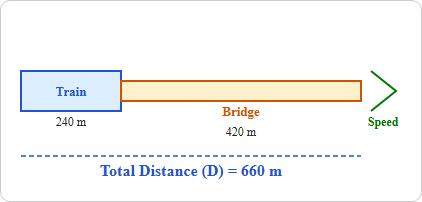
Total Distance = Train Length + Bridge Length = 240 + 420 = 660 m

Speed in m/s = Total Distance ÷ Time = 660 ÷ 22 = 30 m/s

Convert to km/h: 30 × 18/5 = 6 × 18 = 108 km/h

∴ The correct answer is 108 km/h.

Alternate Method

Given:

Length of the Train (L1) = 240 m

Length of the Bridge (L2) = 420 m

Time taken (t) = 22 sec

Formula Used:

Speed = Total Distance ÷ Time

Total Distance = (Length of Train + Length of Bridge)

Calculations:

⇒ Total Distance = 240 + 420 = 660 m

⇒ Speed = 660 ÷ 22

⇒ Speed = 30 m/s

⇒ To convert m/s to km/h, multiply by 18/5

⇒ Speed = 30 × (18 ÷ 5)

⇒ Speed = 6 × 18 = 108 km/h

∴ The correct answer is 108 km/h.

Additional Information

Unit Conversion Rules

1 km/h = 5/18 m/s | 1 m/s = 18/5 km/h. Multiply by these factors to switch between units quickly.

Train Crossing a Static Object

When a train crosses a platform, bridge, or another stationary train, the distance is the sum of both lengths. When it crosses a pole or man, distance is just the train length.

Relative Speed

If two objects move in the opposite direction, relative speed = S1 + S2. If they move in the same direction, relative speed = |S1 − S2|.

8

Find the number of pairs of coprime numbers between 11 and 19 (both inclusive).

  1. ((a))

    29

  2. ((b))

    26

  3. ((c))

    30

  4. ((d))

    28

Show Answer
Answer: ((d))

28

Shortcut Trick

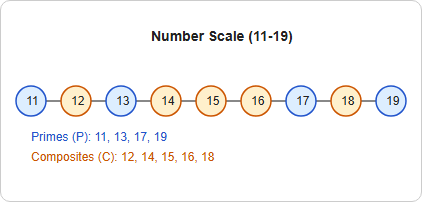
Total numbers in the range [11, 19] = 9.

Total possible pairs = 9C2 = (9 × 8) / 2 = 36.

Non-coprime pairs from even numbers {12, 14, 16, 18} = 4C2 = 6.

Non-coprime pairs from multiples of 3 {12, 15, 18} = (12, 15) and (15, 18) = 2 unique pairs.

Total non-coprime pairs = 6 + 2 = 8.

∴ The correct answer is 28 pairs.

Alternate Method

Given: The range of numbers is from 11 to 19 (both inclusive).

Formula: Two numbers are coprime if their Highest Common Factor (HCF) or Greatest Common Divisor (GCD) is 1.

⇒ Total numbers (n) = 9

⇒ Total possible pairs = n(n − 1) / 2 = (9 × 8) / 2 = 36

⇒ Identifying non-coprime pairs (GCD > 1):

⇒ Pairs with factor 2: (12, 14), (12, 16), (12, 18), (14, 16), (14, 18), (16, 18) = 6 pairs

⇒ Pairs with factor 3: (12, 15), (15, 18) = 2 pairs

⇒ Total non-coprime pairs = 6 + 2 = 8

⇒ Number of coprime pairs = Total pairs − Non-coprime pairs

⇒ Coprime pairs = 36 − 8 = 28

∴ The correct answer is 28 pairs.

Additional Information

Coprime Numbers

Two numbers are coprime if their only common factor is 1. This means HCF(a, b) = 1.

Consecutive Integers

Any two consecutive integers are always coprime to each other (e.g., 14 and 15).

Prime Numbers and Coprimality

A prime number is coprime to every other number that is not a multiple of itself.

Twin Primes

Prime numbers that have a difference of 2 are called twin primes (e.g., 11 and 13, 17 and 19).

9

The average of three numbers is 20. If two numbers are 11 and 21, respectively, then the third number is:

  1. ((a))

    29

  2. ((b))

    27

  3. ((c))

    28

  4. ((d))

    30

Show Answer
Answer: ((c))

28

Shortcut Trick

Base Average = 20

Deviation of 11 = 11 − 20 = −9

Deviation of 21 = 21 − 20 = +1

Net deviation for first two numbers = −9 + 1 = −8

To maintain the average, 3rd number deviation must be +8 ⇒ 20 + 8 = 28

∴ The correct answer is 28.

Alternate Method

Given:

Average of three numbers = 20

First number = 11

Second number = 21

Formula Used:

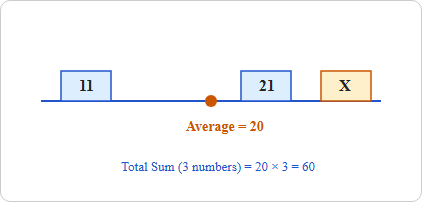
Sum of numbers = Average × Total count of numbers

Calculations:

⇒ Sum of three numbers = 20 × 3

⇒ Sum of three numbers = 60

⇒ Sum of the two given numbers = 11 + 21

⇒ Sum of two numbers = 32

⇒ Third number = (Sum of three numbers) − (Sum of two numbers)

⇒ Third number = 60 − 32

⇒ Third number = 28

∴ The correct answer is 28.

Additional Information

Arithmetic Mean Formula

The average or mean is calculated as the sum of all observations divided by the total number of observations: A = (Σxi) ÷ n.

Concept of Net Deviation

The sum of deviations of all observations from their arithmetic mean is always zero. This is a powerful property used to find missing values in a dataset.

Weighted Average

When two groups with averages A1 and A2 and sizes n1 and n2 are combined, the combined average is (n1A1 + n2A2) ÷ (n1 + n2).

10

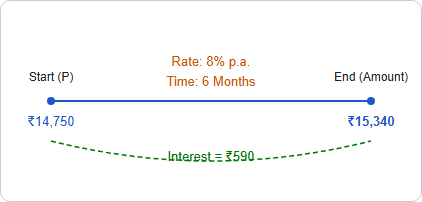
Smita borrowed ₹14,750 from her friend at a simple interest rate of 8% per annum. She repaid the amount after 6 months. How much did she pay in total?

  1. ((a))

    ₹ 15355

  2. ((b))

    ₹ 15375

  3. ((c))

    ₹ 15390

  4. ((d))

    ₹ 15340

Show Answer
Answer: ((d))

₹ 15340

Shortcut Trick

Interest for 12 months = 8%, so Interest for 6 months = 4%.

Total repayment Amount = 100% (Principal) + 4% (Interest) = 104%.

Total amount = 1.04 × 14,750 = 15,340.

∴ The correct answer is ₹ 15340.

Alternate Method

Given: Principal (P) = ₹14,750, Rate (R) = 8% p.a., Time (T) = 6 months.

Formula Used: SI = (P × R × T) / 100; Amount (A) = P + SI

Time (T) in years = 6 / 12 = 0.5 years

Simple Interest (SI) = (14750 × 8 × 0.5) / 100

⇒ SI = (14750 × 4) / 100 = 147.5 × 4 = 590

Total Amount (A) = Principal + Simple Interest

⇒ Total Amount = 14750 + 590 = 15340

∴ The correct answer is ₹ 15340.

Additional Information

Simple Interest (SI)

It is calculated only on the principal amount of a loan or deposit. SI = (P × R × T) / 100.

Time Conversion Rule

While calculating interest, the time (T) must always be in years. Months are divided by 12, and days are usually divided by 365.

Amount in SI

The total repayable amount is the sum of the original principal and the interest earned: A = P[1 + (RT/100)].

11

If sin2θ3sinθ+2cos2θ\frac{\sin^2\theta - 3\sin\theta + 2}{\cos^2\theta} = 1, where 0° < θ < 90°, then the value of (cot 32\frac{3}{2}θ + cos 3θ) is :

  1. ((a))

    0

  2. ((b))

    1

  3. ((c))

    2

  4. ((d))

    -1

Show Answer
Answer: ((b))

1

Shortcut Trick

The equation (sin2θ − 3sinθ + 2) / cos2θ = 1 simplifies to (2 − sinθ) / (1 + sinθ) = 1.

⇒ 2 − sinθ = 1 + sinθ ⇒ 2sinθ = 1 ⇒ sinθ = 1/2.

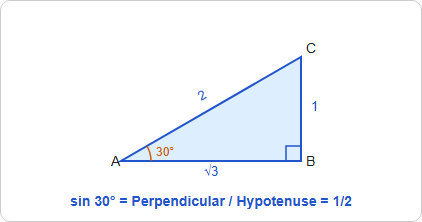
For sinθ = 1/2 in the range 0° < θ < 90°, we get θ = 30°.
Substitute θ = 30° into the required expression: cot(1.5 × 30°) + cos(3 × 30°) = cot 45° + cos 90°.
⇒ 1 + 0 = 1.
∴ The correct answer is 1.

Alternate Method

Given: (sin2θ − 3sinθ + 2) / cos2θ = 1 where 0° < θ < 90°.

Formula Used: cos2θ = 1 − sin2θ | Quadratic Factorization

⇒ sin2θ − 3sinθ + 2 = cos2θ

⇒ sin2θ − 3sinθ + 2 = 1 − sin2θ

⇒ 2sin2θ − 3sinθ + 1 = 0

⇒ 2sin2θ − 2sinθ − sinθ + 1 = 0

⇒ 2sinθ(sinθ − 1) − 1(sinθ − 1) = 0

⇒ (2sinθ − 1)(sinθ − 1) = 0

⇒ sinθ = 1/2 or sinθ = 1

⇒ Since 0° < θ < 90°, θ = 30°

⇒ Value = cot(3/2 × 30°) + cos(3 × 30°)

⇒ Value = cot 45° + cos 90° = 1 + 0 = 1

∴ The correct answer is 1.

Additional Information

Trigonometric Quadrant Rule

In the first quadrant (0° to 90°), all trigonometric ratios are positive.

Standard Value of cot 45°

The value of cot 45° is always 1, as it is the reciprocal of tan 45°.

Complementary Angle Identities

sin(90° − θ) = cosθ and tan(90° − θ) = cotθ.

12

A can do a certain work at the same time in which B and C together can do it. If A and B together could do it in 6 days and C alone in 42 days, then B alone could do it in ________ days.

  1. ((a))

    42

  2. ((b))

    14

  3. ((c))

    28

  4. ((d))

    56

Show Answer
Answer: ((b))

14

Shortcut Trick

Total daily work of (A + B + C) = 1/6 + 1/42 = 8/42 = 4/21.

Given A = B + C, so total daily work = A + (B + C) = 2A.

2A = 4/21 ⇒ A efficiency = 2/21.

B efficiency = (A + B) − A = 1/6 − 2/21 = 3/42 = 1/14.

∴ The correct answer is 14 days.

Alternate Method

Given:

Time taken by (A + B) = 6 days

Time taken by C = 42 days

Efficiency condition: Efficiency of A = Efficiency of (B + C)

PersonDaysTotal WorkEfficiency
(A + B)6427
C421

Calculations:

⇒ Total Efficiency of (A + B + C) = 7 + 1 = 8 units/day

⇒ Since Efficiency A = B + C, then A + (B + C) = 8 becomes 2 × A = 8

⇒ Efficiency of A = 8 ÷ 2 = 4 units/day

⇒ Efficiency of B = Efficiency of (A + B) − Efficiency of A

⇒ Efficiency of B = 7 − 4 = 3 units/day

⇒ Time taken by B alone = Total Work ÷ Efficiency of B

⇒ Time taken by B = 42 ÷ 3 = 14 days

∴ The correct answer is 14 days.

Additional Information

Efficiency and Time Relation

Efficiency is inversely proportional to the time taken. If a person is twice as efficient as another, they will take half the time to complete the same work.

Combined Work Formula

If X takes 'a' days and Y takes 'b' days, they together take (a × b) ÷ (a + b) days.

Work and Wages

Wages are distributed in the ratio of work done or the ratio of efficiencies when all persons work for the same duration.

13

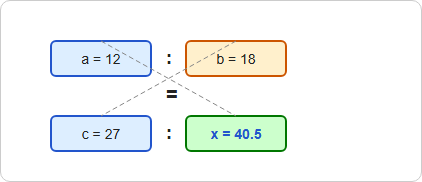
If a : b = c : x, then find x when a = 12, b = 18, and c = 27.

  1. ((a))

    43.5

  2. ((b))

    40.5

  3. ((c))

    42.5

  4. ((d))

    45.5

Show Answer
Answer: ((b))

40.5

Shortcut Trick

The relationship a : b = c : x represents a proportion where x is the fourth proportional.

Logic: Product of Extremes (a × x) = Product of Means (b × c).

⇒ 12 × x = 18 × 27

⇒ x = (18 × 27) ÷ 12 = 486 ÷ 12 = 40.5

∴ The correct answer is 40.5.

Alternate Method

Given:

Values: a = 12, b = 18, c = 27

Formula Used:

For a proportion a : b = c : d, the ratio of the first two terms equals the ratio of the last two terms: a/b = c/d

Calculations:

⇒ a/b = c/x

⇒ 12/18 = 27/x

⇒ 2/3 = 27/x (Simplifying 12/18 by dividing by 6)

⇒ 2 × x = 3 × 27

⇒ 2x = 81

⇒ x = 81 ÷ 2

⇒ x = 40.5

∴ The correct answer is 40.5.

Additional Information

Fourth Proportional

When four quantities a, b, c, d are in proportion (a:b = c:d), d is the fourth proportional given by d = (b × c) ÷ a.

Third Proportional

In a continued proportion a:b = b:c, c is called the third proportional and is calculated as c = b2 ÷ a.

Mean Proportional

The mean proportional between two numbers a and b is √(a × b), such that a:x = x:b.

Compounded Ratio

The compounded ratio of two ratios a:b and c:d is defined as (a × c) : (b × d).

14

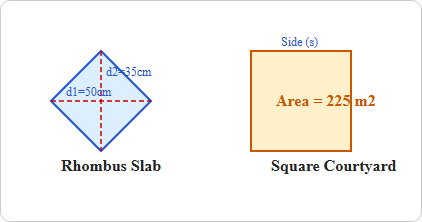
A garden walkway is to be paved with 2,500 rhombus-shaped stone slabs, each having diagonals of 50 cm and 35 cm. What is the total cost of polishing the walkway if the rate is ₹5 per square meter. Also, if an additional 6.25 m² of area is added so that the walkway becomes a square-shaped courtyard, what will be the side of this square courtyard?

  1. ((a))

    ₹1222.15, 17 meters

  2. ((b))

    ₹1319.45, 19 meters

  3. ((c))

    ₹1109.25, 16 meters

  4. ((d))

    ₹1093.75, 15 meters

Show Answer
Answer: ((d))

₹1093.75, 15 meters

Shortcut Trick

Total Area (m2) = 2,500 × (1/2 × 0.50 × 0.35) = 2,500 × 0.0875 = 218.75 m2.

Total Cost = 218.75 × ₹5 = ₹1093.75.

Courtyard Area = 218.75 + 6.25 = 225 m2.

Side of Square = √225 = 15 m.

∴ The correct answer is ₹1093.75, 15 m.

Alternate Method

Given:

Number of slabs = 2,500

Diagonals of rhombus (d1, d2) = 50 cm, 35 cm

Polishing rate = ₹5 per m2

Additional area = 6.25 m2

Calculations:

⇒ Area of 1 rhombus slab = 1/2 × d1 × d2

⇒ Area of 1 slab = 1/2 × 50 × 35 = 875 cm2

⇒ Total area of 2,500 slabs = 2,500 × 875 = 2,187,500 cm2

⇒ Total area in m2 = 2,187,500 ÷ 10,000 = 218.75 m2

Total polishing cost = 218.75 × 5 = ₹1093.75

⇒ Area of square courtyard = Total area + 6.25

⇒ Area of square = 218.75 + 6.25 = 225 m2

⇒ Side of square = √Area = √225 = 15 m

∴ The correct answer is ₹1093.75, 15 m.

Additional Information

Area of Rhombus

The area of a rhombus can also be calculated as Base × Height if the side and altitude are given.

Unit Conversion

1 m2 = 10,000 cm2. Always convert units to a common system (SI) before calculating costs.

Properties of Square

Area of a square = side2. Therefore, the side length is the square root of the total area.

15

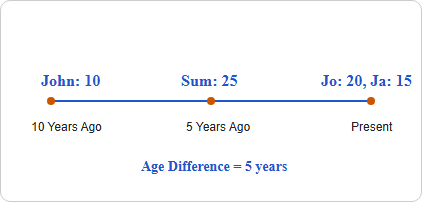
Five years ago from now, the sum of the ages of John and his sister Jane was 25 years. If John is now twice as old as he was ten years ago, find the difference between their present ages (in years).

  1. ((a))

    6

  2. ((b))

    8

  3. ((c))

    7

  4. ((d))

    5

Show Answer
Answer: ((d))

5

Shortcut Trick

If John is twice as old as 10 years ago, then the 10-year gap represents half his current age.

John's present age = 10 × 2 = 20 years.

Sum of ages 5 years ago was 25, so the present sum increases by 5 for each person (5 × 2 = 10).

Present sum = 25 + 10 = 35 years.

Jane's age = 35 − 20 = 15 years.

Difference = 20 − 15 = 5 years.

∴ The correct answer is 5 years.

Alternate Method

Given: Sum of John and Jane 5 years ago = 25 years. John's current age = 2 × (Age 10 years ago).

Formula Used: Present Age = Past Age + Time Interval; Difference = Age1 − Age2.

⇒ Let John's present age be x.

⇒ According to the condition: x = 2(x − 10)

⇒ x = 2x − 20 ⇒ x = 20 years.

⇒ Let Jane's present age be y.

⇒ Sum 5 years ago: (x − 5) + (y − 5) = 25

⇒ (20 − 5) + (y − 5) = 25

⇒ 15 + y − 5 = 25 ⇒ y + 10 = 25

⇒ y = 15 years.

⇒ Difference between present ages = 20 − 15 = 5 years.

∴ The correct answer is 5 years.

Additional Information

Constant Age Difference

The difference between the ages of two individuals remains the same throughout their lives, regardless of how many years pass.

Sum of Ages in the Future/Past

If the sum of ages of 'n' people is S now, then after 't' years, the sum will be S + (n × t).

Age Ratios

When ages are given in ratios, always use a constant multiplier 'k' (e.g., 3k and 4k) to represent the actual ages before applying time shifts.

16

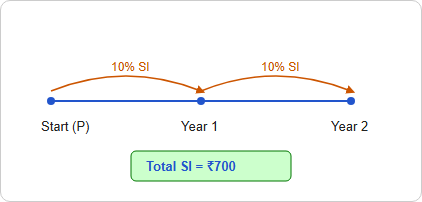
What sum of money (in ₹) will yield ₹700 as simple interest in 2 years at 10% per annum?

  1. ((a))

    3000

  2. ((b))

    3900

  3. ((c))

    3500

  4. ((d))

    3700

Show Answer
Answer: ((c))

3500

Shortcut Trick

The Effective Rate of Interest for 2 years at 10% per annum = 10% × 2 = 20%.

Given that 20% of the Principal (P) = ₹700.

To find the total Principal (100%), we multiply by 5.

⇒ P = 700 × 5 = 3500.

∴ The correct answer is ₹3500.

Alternate Method

Given:

Simple Interest (SI) = ₹700

Time (T) = 2 years

Rate of Interest (R) = 10% per annum

Formula Used:

SI = (P × R × T) ÷ 100

Calculations:

⇒ 700 = (P × 10 × 2) ÷ 100

⇒ 700 = (P × 20) ÷ 100

⇒ 700 = P ÷ 5

⇒ P = 700 × 5

⇒ P = 3500

∴ The correct answer is ₹3500.

Additional Information

Total Amount Formula

The total sum returned after adding interest is Amount (A) = P + SI = P × (1 + RT/100).

Constant Nature of SI

Unlike compound interest, Simple Interest remains the same every year because it is always calculated on the original Principal.

SI vs CI Difference

For a period of 2 years, the difference between Compound Interest and Simple Interest is given by D = P × (R/100)2.

17

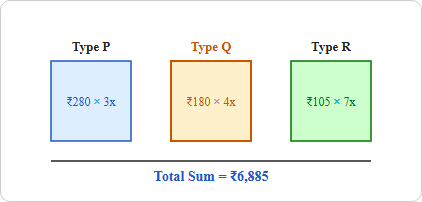
The prices of articles of type P, Q and R are ₹280, ₹180 and ₹105, respectively. Govind buys articles of the three types in the ratio 3 : 4 : 7 for a total of ₹6,885. How many articles of type Q did he purchase?

  1. ((a))

    9

  2. ((b))

    18

  3. ((c))

    12

  4. ((d))

    20

Show Answer
Answer: ((c))

12

Shortcut Trick

Relative cost per ratio set = (280 × 3) + (180 × 4) + (105 × 7) = 840 + 720 + 735 = 2295

Value of 1 ratio unit = Total cost ÷ Relative cost = 6885 ÷ 2295 = 3

Number of type Q articles = 4 units × 3 = 12

∴ The correct answer is 12.

Alternate Method

Given:

Prices of type P, Q, R = ₹280, ₹180, ₹105

Quantity ratio = 3 : 4 : 7

Total amount spent = ₹6,885

Formula Used:

Total Cost = (PriceP × QuantityP) + (PriceQ × QuantityQ) + (PriceR × QuantityR)

Calculations:

⇒ Let the number of articles of type P, Q, and R be 3x, 4x, and 7x respectively.

⇒ Total spending = (280 × 3x) + (180 × 4x) + (105 × 7x)

⇒ 6885 = 840x + 720x + 735x

⇒ 6885 = 2295x

⇒ x = 6885 ÷ 2295

⇒ x = 3

⇒ Number of articles of type Q = 4x = 4 × 3 = 12

∴ The correct answer is 12.

Additional Information

Ratio Scaling Factor

When a ratio A : B : C is given, the actual values can be expressed as Ax, Bx, and Cx, where 'x' is the constant of proportionality or scaling factor.

Weighted Average Cost

The total cost of different items is the sum of products of their individual prices and their respective quantities: Total = Σ(Pricei × Quantityi).

Unitary Method in Ratios

To find the value of one part, divide the total quantity by the sum of the ratio parts weighted by their respective values.

18

Simplify:

2n+32×2n2×2n+2 \dfrac{2^{n+3} - 2 \times 2^n}{2 \times 2^{n+2}}

  1. ((a))

    23 \frac{2}{3}

  2. ((b))

    32 \frac{3}{2}

  3. ((c))

    34 \frac{3}{4}

  4. ((d))

    38 \frac{3}{8}

Show Answer
Answer: ((c))

34 \frac{3}{4}

Shortcut Trick

To simplify quickly, substitute a convenient value for the variable n. Let n = 0.

Expression = (20+3 − 2 × 20) ÷ (2 × 20+2)

Expression = (23 − 2 × 1) ÷ (2 × 22) = (8 − 2) ÷ (2 × 4)

Expression = 6 ÷ 8 = 3/4

∴ The correct answer is 3/4.

Alternate Method

Given: (2n+3 − 2 × 2n) ÷ (2 × 2n+2)

Method: Factor out the common term 2n from both the numerator and the denominator using the Law of Exponents (am+n = am × an).

⇒ (2n × 23 − 2 × 2n) ÷ (2 × 2n × 22)

⇒ [2n × (23 − 2)] ÷ [2n × (2 × 22)]

⇒ (23 − 2) ÷ (2 × 22)

⇒ (8 − 2) ÷ (2 × 4)

⇒ 6 ÷ 8

⇒ 3/4

∴ The correct answer is 3/4.

Additional Information

Product Rule of Exponents

When multiplying terms with the same base, add their powers: am × an = am+n.

Quotient Rule of Exponents

When dividing terms with the same base, subtract their powers: am ÷ an = am−n.

Zero Exponent Property

Any non-zero base raised to the power of zero is always equal to 1: a0 = 1.

19

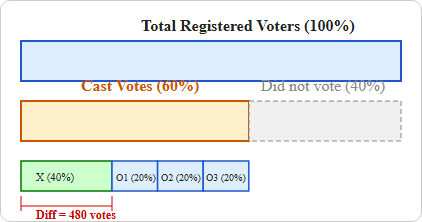
In an election with four candidates, 60% of all registered voters voted. Candidate X got 40% of the cast votes. The rest were split equally among the other three candidates. If Candidate X received 480 more votes than each of the others, how many registered voters were there?

  1. ((a))

    5600

  2. ((b))

    4000

  3. ((c))

    6200

  4. ((d))

    4800

Show Answer
Answer: ((b))

4000

Shortcut Trick

Let the total cast votes be 100%.

Candidate X got 40%, so the remaining 60% is shared by 3 candidates → 20% each.

Difference between Candidate X and others = 40% − 20% = 20%.

20% of cast votes = 480 → 100% of cast votes = 480 × 5 = 2400.

Given 60% of registered voters = 2400, then 100% = (2400 ÷ 60) × 100 = 4000.

∴ The correct answer is 4000.

Alternate Method

Given:

⇒ Total Registered Voters = 100%

Cast Votes = 60% of Registered Voters

Candidate X = 40% of Cast Votes

⇒ Others = Equal split of remaining (100% − 40%) = 20% of Cast Votes each

Calculations:

⇒ Let Total Registered Voters = V

Cast Votes = 0.60V

⇒ Votes for X = 0.40 × (0.60V) = 0.24V

⇒ Total remaining cast votes = 0.60V − 0.24V = 0.36V

⇒ Votes for each other candidate = 0.36V ÷ 3 = 0.12V

⇒ Given difference: 0.24V − 0.12V = 480

⇒ 0.12V = 480

⇒ V = 480 ÷ 0.12

⇒ V = 4000

∴ The correct answer is 4000.

Additional Information

Percentage of a Percentage

When a value is a percentage of another percentage, the effective percentage of the original base is (A × B) ÷ 100.

Registered vs Cast Votes

Registered voters (Voter List) is the 100% base. Cast votes are the actual subset used for candidate distribution.

Base Change Rule

To find the total from a part: Total = (Value ÷ Percentage) × 100.

20

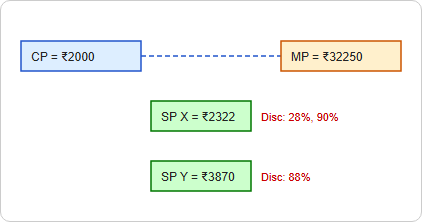
A dealer buys two articles X and Y for ₹2,000 each. He marks each of them at the same price. He sells X by giving two successive discounts of 28% and 90% and still earns ₹322 as profit. If he sells Y at a single discount of 88%, then what is the profit percentage on Y?

  1. ((a))

    93%

  2. ((b))

    93.5

  3. ((c))

    92%

  4. ((d))

    92.5%

Show Answer
Answer: ((b))

93.5

Shortcut Trick

Selling Price (SP) of X = 2000 + 322 = 2322.

Multiplication factor for X after 28% and 90% discounts = 0.72 × 0.10 = 0.072.

Marked Price (MP) = 2322 ÷ 0.072 = 32250.

SP of Y after 88% discount = 32250 × 0.12 = 3870.

Profit % on Y = [(3870 − 2000) ÷ 2000] × 100 = (1870 ÷ 20) = 93.5%.

∴ The correct answer is 93.5%.

Alternate Method

Given:

Cost Price (CP) of X and Y = ₹2,000 each.

Profit on X = ₹322.

Discounts on X = 28% and 90% (successive).

Discount on Y = 88% (single).

Formula Used:

SP = CP + Profit

SP = MP × (100 − D1)/100 × (100 − D2)/100

Profit % = (Profit ÷ CP) × 100

Calculations:

Selling Price of X (SPX) = CP + Profit = 2000 + 322 = ₹2,322

⇒ SPX = MP × (1 − 0.28) × (1 − 0.90)

⇒ 2322 = MP × 0.72 × 0.10

⇒ 2322 = MP × 0.072

⇒ MP = 2322 ÷ 0.072 = ₹32,250

Selling Price of Y (SPY) = MP × (1 − 0.88)

⇒ SPY = 32250 × 0.12 = ₹3,870

Profit on Y = SPY − CP = 3870 − 2000 = ₹1,870

Profit % on Y = (1870 ÷ 2000) × 100 = 93.5%

∴ The correct answer is 93.5%.

Additional Information

Successive Discounts

If two successive discounts are d1% and d2%, the single equivalent discount is (d1 + d2 − d1d2/100)%.

Marked Price and Discount

Discount is always calculated on the Marked Price (MP). SP = MP − Discount.

Profit Percentage

Profit % is always calculated on the Cost Price (CP). Profit % = [(SP − CP) ÷ CP] × 100.

21

Varun buys mangoes at the rate of 3 kg for ₹15 and sells them at 5 kg for ₹50. To earn ₹125 as profit, what quantity of mangoes (in kg) must he sell?

  1. ((a))

    27

  2. ((b))

    28

  3. ((c))

    25

  4. ((d))

    26

Show Answer
Answer: ((c))

25

Shortcut Trick

Profit per kg = (Selling Price ÷ Selling Quantity) − (Cost Price ÷ Buying Quantity)

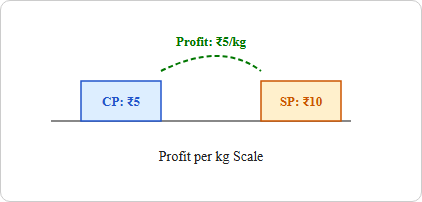
Profit per kg = (50 ÷ 5) − (15 ÷ 3) = 10 − 5 = ₹5

Required Quantity = Total Profit ÷ Profit per kg

Required Quantity = 125 ÷ 5 = 25 kg

∴ The correct answer is 25 kg.

Alternate Method

Given:

Cost Price (CP) of 3 kg Mangoes = ₹15

Selling Price (SP) of 5 kg Mangoes = ₹50

Target Profit = ₹125

Formula Used:

Profit = Selling Price (SP)Cost Price (CP)

Quantity = Total Profit ÷ Profit per unit

Calculations:

CP of 1 kg Mangoes = 15 ÷ 3 = ₹5

SP of 1 kg Mangoes = 50 ÷ 5 = ₹10

Profit on 1 kg Mangoes = 10 − 5 = ₹5

⇒ Let the Quantity to be sold be 'x' kg

⇒ Total Profit = Profit per kg × Quantity

⇒ 125 = 5 × x

⇒ x = 125 ÷ 5

⇒ x = 25 kg

∴ The correct answer is 25 kg.

Additional Information

Profit Percentage

It is the profit expressed as a percentage of the Cost Price: Profit% = (Profit ÷ CP) × 100.

Relationship between SP and CP

When there is a profit, Selling Price (SP) = CP × (100 + Profit%) ÷ 100.

Marked Price and Discount

Discount is always calculated on the Marked Price (MP). SP = MP − Discount.

22

A can complete the work in 16 days and B can complete it in 24 days. They work together for 5 days, then A leaves. How many more days will B take to complete the remaining work?

  1. ((a))

    13.5 days

  2. ((b))

    11.5 days

  3. ((c))

    12.5 days

  4. ((d))

    10.5 days

Show Answer
Answer: ((b))

11.5 days

Shortcut Trick

Total Work = LCM(16, 24) = 48 units.

Efficiencies: A = 3 units/day, B = 2 units/day.

Work done together in 5 days = (3 + 2) × 5 = 25 units.

Remaining work = 48 − 25 = 23 units.

Additional days for B = 23 ÷ 2 = 11.5 days.

∴ The correct answer is 11.5 days.

Alternate Method

Given:

Time taken by A = 16 days

Time taken by B = 24 days

Working together duration = 5 days

Formula Used:

Total Work = Efficiency × Time

PersonDaysTotal WorkEfficiency
A16483
B242

Calculations:

Total Work (LCM of 16 and 24) = 48 units

Efficiency of A = 48 ÷ 16 = 3 units/day

Efficiency of B = 48 ÷ 24 = 2 units/day

⇒ Combined Efficiency of (A + B) = 3 + 2 = 5 units/day

⇒ Work completed by A and B in 5 days = 5 × 5 = 25 units

Remaining Work = 48 − 25 = 23 units

⇒ Time taken by B to complete remaining work = Remaining Work ÷ Efficiency of B

⇒ Time = 23 ÷ 2 = 11.5 days

∴ The correct answer is 11.5 days.

Additional Information

Efficiency and Time Relation

Efficiency is inversely proportional to the time taken to complete the work (E ∝ 1/T). If ratio of time is x:y, the ratio of efficiency is y:x.

Pipes and Cisterns

This concept follows the same logic where inlet pipes have positive efficiency and outlet (leakage) pipes have negative efficiency.

Combined Work Formula

If A completes work in 'a' days and B in 'b' days, they together complete it in (a × b) ÷ (a + b) days.

Work and Wages

Wages are always distributed in the ratio of the actual work done by each individual, which is (Efficiency × Time Active).

23

Find the highest common factor (HCF) of the two numbers 64 and 148.

  1. ((a))

    6

  2. ((b))

    4

  3. ((c))

    2

  4. ((d))

    3

Show Answer
Answer: ((b))

4

Shortcut Trick

Use the Successive Division Method: Divide the larger number by the smaller one until the remainder is zero.

148 ÷ 64 → Remainder = 20

64 ÷ 20 → Remainder = 4

20 ÷ 4 → Remainder = 0

The last divisor which leaves a remainder of zero is the HCF.

∴ The correct answer is 4.

Alternate Method

Given: The numbers are 64 and 148.

Formula: HCF is the product of the lowest powers of common prime factors.

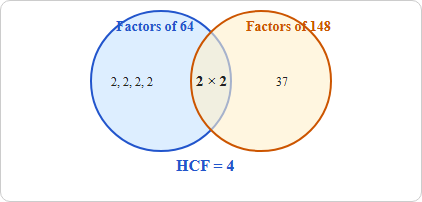
⇒ Prime factorization of 64 = 2 × 2 × 2 × 2 × 2 × 2 = 26

⇒ Prime factorization of 148 = 2 × 2 × 37 = 22 × 37

⇒ Common prime factor is 2.

⇒ Lowest power of common factor = 22

⇒ HCF = 2 × 2 = 4

∴ The correct answer is 4.

Additional Information

HCF and LCM Relation

For any two numbers a and b, the product of the numbers is equal to the product of their HCF and LCM: a × b = HCF(a, b) × LCM(a, b).

Co-prime Numbers

Two numbers are called co-prime if their Highest Common Factor (HCF) is 1. Example: 8 and 15 are co-prime numbers.

HCF of Fractions

The HCF of fractions is calculated as: HCF of Numerators ÷ LCM of Denominators.

24

Simplify (2pq+11q)2(2pq11q)2 (2pq + 11q)^2 - (2pq - 11q)^2 .

  1. ((a))

    44pq2

  2. ((b))

    88p2q

  3. ((c))

    44p2q2

  4. ((d))

    88pq2

Show Answer
Answer: ((d))

88pq2

Shortcut Trick

Use the algebraic identity: (a + b)2 − (a − b)2 = 4ab.

Here, let a = 2pq and b = 11q.

Applying the values into the formula: 4 × (2pq) × (11q).

⇒ 4 × 2 × 11 × p × q × q = 88pq2.

∴ The correct answer is 88pq2.

Alternate Method

Given: (2pq + 11q)2 − (2pq − 11q)2

Formula Used: (a + b)2 = a2 + 2ab + b2 and (a − b)2 = a2 − 2ab + b2

⇒ Expansion of (2pq + 11q)2 = (2pq)2 + 2(2pq)(11q) + (11q)2 = 4p2q2 + 44pq2 + 121q2

⇒ Expansion of (2pq − 11q)2 = (2pq)2 − 2(2pq)(11q) + (11q)2 = 4p2q2 − 44pq2 + 121q2

⇒ Subtracting the two results: (4p2q2 + 44pq2 + 121q2) − (4p2q2 − 44pq2 + 121q2)

⇒ 4p2q2 − 4p2q2 + 121q2 − 121q2 + 44pq2 + 44pq2

⇒ 88pq2

∴ The correct answer is 88pq2.

Additional Information

Sum of squares identity

(a + b)2 + (a − b)2 = 2(a2 + b2). This identity simplifies expressions involving the addition of symmetric squared binomials.

Difference of two squares

(a + b)(a − b) = a2 − b2. This is a fundamental algebraic identity used for factoring and simplification.

Square of a binomial

(a + b)2 = a2 + 2ab + b2. The middle term (2ab) is key when performing algebraic expansion or finding roots.

25

If the mean of a distribution is 78 and the median is 61, then the value of mode is:

  1. ((a))

    31.5

  2. ((b))

    45

  3. ((c))

    50

  4. ((d))

    27

Show Answer
Answer: ((d))

27

Shortcut Trick

Use the Empirical Relationship formula: Mode = 3 × Median − 2 × Mean.

Direct substitution: Mode = 3 × 61 − 2 × 78.

Mode = 183 − 156 = 27.

∴ The correct answer is 27.

Alternate Method

Given:

Mean = 78

Median = 61

Formula Used:

The relationship between the measures of central tendency for a moderately skewed distribution is:

Mode = 3 × Median − 2 × Mean

Calculations:

⇒ Mode = 3(61) − 2(78)

⇒ Mode = 183 − 156

⇒ Mode = 27

∴ The correct answer is 27.

Additional Information

Empirical Relationship

This formula (Mode = 3 Median − 2 Mean) is specifically applicable to moderately skewed distributions.

Symmetric Distribution

In a perfectly symmetrical distribution (like the Normal Distribution), the Mean, Median, and Mode are all equal: Mean = Median = Mode.

Skewness Identification

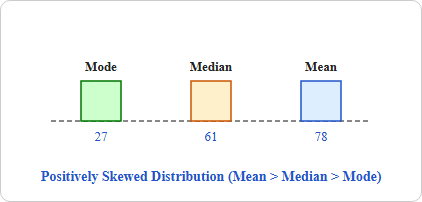
If Mean > Median > Mode, the distribution is Positively Skewed. If Mean < Median < Mode, it is Negatively Skewed.

Mean Formula

Mean = (∑ fixi) ÷ (∑ fi), which represents the arithmetic average of the data set.

General Intelligence & Reasoning (25 questions)

26

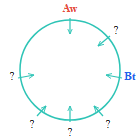
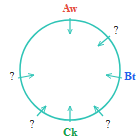
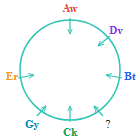
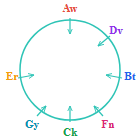
Aw, Bt, Ck, Dv, Er, Fn and Gy are sitting around a circular table facing the centre. Bt sits second to the right of Aw. Ck sits third to the left of Aw. Er sits to the immediate right of Gy. Dv sits second to the right of Er. What is the position of Fe with respect to Er?

  1. ((a))

    Second to the left

  2. ((b))

    Immediate right

  3. ((c))

    Third to the right

  4. ((d))

    Third to the left

Show Answer
Answer: ((d))

Third to the left

  1. Since all persons face the centre: right = counterclockwise, left = clockwise. Fix Aw at pos(1). Bt sits second to the right of Aw (counterclockwise): Aw(1) → pos(2) → Bt(3).

  1. Ck sits third to the left of Aw (clockwise): Aw(1) → pos(7) → pos(6) → Ck(5).

  1. Er sits to the immediate right of Gy (counterclockwise). Dv sits second to the right of Er. The only available adjacent slots fitting this chain GyEr → skip → Dv are pos(6), pos(7), and pos(2). So, Gy(6), Er(7), and Dv(2).

  1. The only remaining person Fn (Fe) occupies the last vacant position, pos(4). Final: Aw(1), Dv(2), Bt(3), Fn(4), Ck(5), Gy(6), Er(7).

<br>

To find the position of Fe (Fn) with respect to Er, we count from Er at pos(7) to Fn at pos(4). Moving clockwise (left): Er(7) → Gy(6) → Ck(5) → Fn(4). This is third to the left.

<br>

Hence, the correct answer is 'Option 4'.

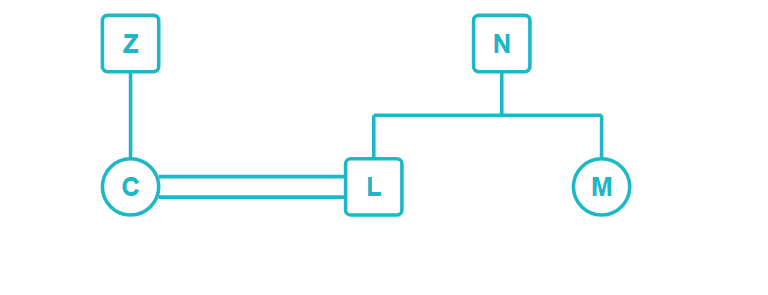
27

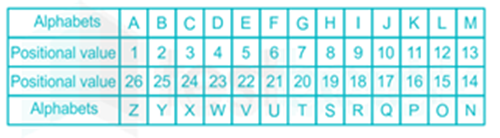
What should come in place of ? in the given series based on the English alphabetical order?

<br>

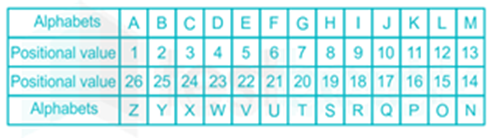
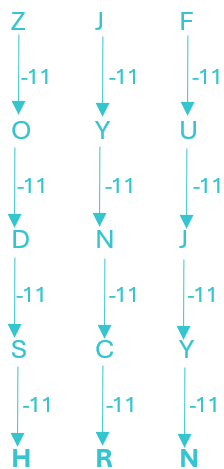
ZJF OYU DNJ SCY ?

  1. ((a))

    HUY

  2. ((b))

    HRN

  3. ((c))

    HTY

  4. ((d))

    HRT

Show Answer
Answer: ((b))

HRN

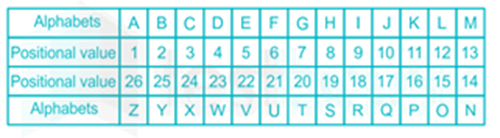
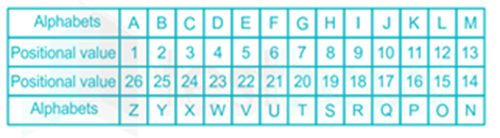
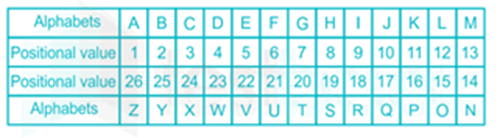
The logic followed here is that each letter in the term is obtained by subtracting 11 from the positional value of the corresponding letter of the previous term in the English alphabetical series.

The term completing the series is HRN.

Hence, the correct answer is "Option 2".

28

If ‘P’ stands for ‘×’, ‘Q’ stands for ‘÷’, ‘R’ stands for ‘−’ and ‘S’ stands for ‘+’, then what will come in place of the question mark (?) in the following equation?

<br>

71 S 45 P 5 R 15 Q 5 P 6 S 13 R 74 S 69 = ?

  1. ((a))

    292

  2. ((b))

    246

  3. ((c))

    286

  4. ((d))

    311

Show Answer
Answer: ((c))

286

Logic:

LetterOperation
P× (Multiplication)
Q÷ (Division)
R− (Subtraction)
S+ (Addition)


Given Equation:

71 S 45 P 5 R 15 Q 5 P 6 S 13 R 74 S 69 = ?

After replacing the letters with their respective signs, we get:

= 71 + 45 × 5 − 15 ÷ 5 × 6 + 13 − 74 + 69

= 71 + 45 × 53 × 6 + 13 − 74 + 69

= 71 + 225 - 18 + 13 - 74 + 69

= 378 - 92

= 286

Therefore, the value that will come in place of the question mark is 286.

Hence, the correct answer is "Option 3".

29

Select the pair which follows the same pattern as that followed by the two pairs given below. Both pairs follow the same pattern.

WRT : VPQ
GUA : FSX

  1. ((a))

    SBL : RZM

  2. ((b))

    NXR : MVO

  3. ((c))

    FOY : EMW

  4. ((d))

    OVQ : LTO

Show Answer
Answer: ((b))

NXR : MVO

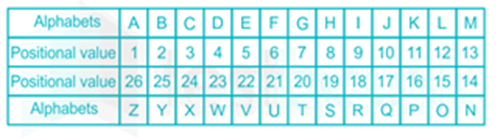
The logic followed in this pattern is a series of alphabetical shifts where each consecutive letter in the term is decreased by a progressively increasing integer.

For 'WRT' related to 'VPQ':

W(23)R(18)T(20)
−1 ↓−2 ↓−3 ↓
V(22)P(16)Q(17)

For 'GUA' related to 'FSX':

G(7)U(21)A(27)
−1 ↓−2 ↓−3 ↓
F(6)S(19)X(24)

Applying the same logic to 'NXR' from the options:

N(14)X(24)R(18)
−1 ↓−2 ↓−3 ↓
M(13)V(22)O(15)

Thus, the pair NXR : MVO follows the same pattern.

Hence, the correct answer is 'Option 2'.

30

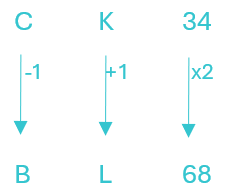
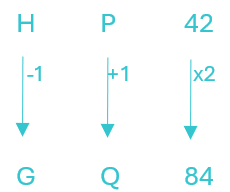
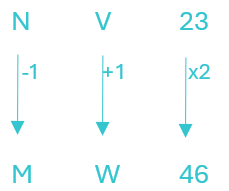
CK 34 is related to BL 68 in a certain way. In the same way, HP 42 is related to GQ 84. To which of the following is NV 23 related, following the same logic?

  1. ((a))

    MW 48

  2. ((b))

    MW 46

  3. ((c))

    OU 44

  4. ((d))

    OW 46

Show Answer
Answer: ((b))

MW 46

Given:

The logic followed in the series is as follows:

CK 34 → BL 68:

HP 42 → GQ 84:

Similarly, for NV 23:

NV 23 → MW 46:

Hence, the correct answer is 'Option 2'.

31

Based on the English alphabetical order, three of the following four letter-cluster pairs are alike in a certain way and thus form a group. Which is the one that does not belong to that group? (Note: The odd one out is not based on the number of consonants/vowels or their position in the letter-cluster.)

  1. ((a))

    MD – QH

  2. ((b))

    SJ – WN

  3. ((c))

    VL – YO

  4. ((d))

    PG – TK

Show Answer
Answer: ((c))

VL – YO

The logic followed here is:

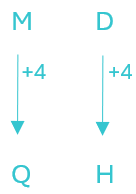
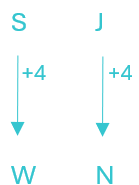
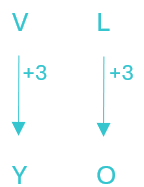
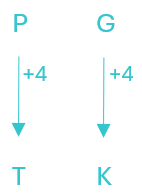
Logic: Each letter in the second cluster is obtained by adding 4 to the alphabetical position of the corresponding letter in the first cluster.

Option 1) MD - QH,

Option 2) SJ - WN,

Option 3) VL - YO

This pair does not follow the +4 rule.

Option 4) PG - TK,

Therefore, the letter-cluster pair that is different from the others is VL - YO.

Hence, the correct answer is 'Option 3'.

32

What will come in the place of ‘?’ in the following equation, if ‘+’ and ‘-’ are interchanged and ‘x’ and ‘÷’ are interchanged?

<br>

7 ÷ 2 + 64 x 8 - 8 = ?

  1. ((a))

    14

  2. ((b))

    12

  3. ((c))

    18

  4. ((d))

    16

Show Answer
Answer: ((a))

14

Signs Interchanged:

Original SignNew Sign
÷×
+
×÷
+


Given Equation: 7 ÷ 2 + 64 × 8 − 8

After interchanging the signs, the new equation is:

= 7 × 2 − 64 ÷ 8 + 8

= 7 × 2 - 8 + 8

= 14 - 8 + 8

= 14

Therefore, the value that will come in place of the question mark is 14.

Hence, the correct answer is "Option 1".

33

In a certain code language,

A @ B means ‘A is the brother of B’,

A x B means ‘A is the daughter of B’,

A o B means ‘A is the father of B’, and

A ≥ B means ‘A is the wife of B’.

Based on the above, how is Z related to N if 'Z o C ≥ L @ M x N'?

  1. ((a))

    Wife's brother

  2. ((b))

    Father's mother

  3. ((c))

    Son's wife's father

  4. ((d))

    Mother's father

Show Answer
Answer: ((c))

Son's wife's father

Given:

Let us first decode the given symbols and then draw a family tree.

A is
Symbol@×oge
MeaningBrotherDaughterFatherWife
of B


On checking: Z o C ge L @ M × N

  1. Z o C - 'Z o C' means 'Z is the father of C'.

  2. C ge L - 'C ge L' means 'C is the wife of L'.

  3. L @ M - 'L @ M' means 'L is the brother of M'.

  4. M × N - 'M × N' means 'M is the daughter of N'.

Therefore, L is the son of N, and C is the wife of L. Since Z is the father of C, Z is the father of N's son's wife.

Hence, the correct answer is "Option 3".

34

In the following number-pairs, the second number is obtained by applying certain mathematical operations to the first number. Select the set in which the numbers are related in the same way as are the numbers of the following sets.

(Note: Operations should be performed on the whole numbers, without breaking down the numbers into their constituent digits. E.g. 13 – Operations on 13 such as adding/subtracting/multiplying to 13 can be performed. Breaking down 13 into 1 and 3 and then performing mathematical operations on 1 and 3 is not allowed.)

29, 59
35, 71

  1. ((a))

    53, 105

  2. ((b))

    41, 83

  3. ((c))

    56, 112

  4. ((d))

    46, 91

Show Answer
Answer: ((b))

41, 83

The logic followed here is:

Logic: Second Number = (First Number × 2) + 1

For the first set 29, 59

⇒ (29 × 2) + 1

⇒ 58 + 1 = 59.

For the second set 35, 71

⇒ (35 × 2) + 1

⇒ 70 + 1 = 71.

Applying the same logic to the options:

Checking Option 2: 41, 83

⇒ (41 × 2) + 1

⇒ 82 + 1 = 83.

Hence, the correct answer is 'Option 2'.

35

Seven boxes A, B, C, D, E, F and G are kept one over the other but not necessarily in the same order. Exactly five boxes are kept between E and B. D is kept fifth from the bottom. F is kept immediately below A but above E. C is not kept below A. G is kept below B but above D. How many boxes are kept between C and G?

  1. ((a))

    Two

  2. ((b))

    One

  3. ((c))

    Three

  4. ((d))

    Four

Show Answer
Answer: ((b))

One

Given:

Seven boxes (A, B, C, D, E, F, G) are kept one over the other from 1 (bottom) to 7 (top).

1) D is kept fifth from the bottom.

2) G is kept below B but above D.

3) Exactly five boxes are kept between E and B.

Since D is at position 5, G must be at position 6 and B must be at position 7 (top) to satisfy the condition that G is below B and above D. Since B is at position 7 and there are five boxes between B and E, E must be at position 1 (bottom).

PositionBox
7 (Top)B
6G
5D
4
3
2
1 (Bottom)E


4) F is kept immediately below A but above E.

5) C is not kept below A. (This implies C is kept above A)

The remaining positions are 2, 3, and 4. If A is at position 3, F will be at position 2 (immediately below A). Then C must occupy position 4, which is above A, satisfying all conditions.

Final Arrangement:

7B
6G
5D
4C
3A
2F
1E


From the final arrangement, we can see that box D is kept between C and G.

Thus, there is only one box kept between C and G.

Hence, the correct answer is 'Option 2'.

36

Refer to the following letter series and answer the question that follows.

(Left) L F Q T G P S C I O E R Y B M J X D K N H (Right)

How many letters are there in the English alphabetical series between the letter that is fifth from the left end and third from the right end of the series?

  1. ((a))

    Two

  2. ((b))

    One

  3. ((c))

    Four

  4. ((d))

    Three

Show Answer
Answer: ((d))

Three

Given Series:

(Left) L F Q T G P S C I O E R Y B M J X D K N H (Right)

Required letters:

  • 5th from the left = G
  • 3rd from the right = K
<br>

English alphabetical order:

G H I J K

Letters between G and K are:

H, I, J

Total letters between them = 3.

Hence, the correct answer is "Option 4".

37

Each vowel in the word WAMBLES is changed to the letter immediately following it in the English alphabetical order and each consonant is changed to the letter immediately preceding it in the English alphabetical order. How many letters will appear exactly twice in the new group of letters thus formed?

  1. ((a))

    Three

  2. ((b))

    One

  3. ((c))

    Two

  4. ((d))

    Zero

Show Answer
Answer: ((d))

Zero

Given Word:

WAMBLES

Rule:

  • Each vowel is changed to the next letter in the English alphabet.
  • Each consonant is changed to the previous letter in the English alphabet.
<br>

Transformation:

Original LetterTypeNew Letter
WConsonantV
AVowelB
MConsonantL
BConsonantA
LConsonantK
EVowelF
SConsonantR
<br>

New group of letters:

V, B, L, A, K, F, R

Every letter appears only once.

Therefore, the number of letters appearing exactly twice = 0.

Hence, the correct answer is "Option 4 — Zero".

38

Six friends B, C, L, M, N and O are sitting around a circular table facing the center of the table. Only three people sit between B and M when counted from the right of B. B sits second to the left of O. L sits second to the left of C. N is an immediate neighbor of both M and O. How many people sit between B and N when counted from the right of B?

  1. ((a))

    One

  2. ((b))

    Three

  3. ((c))

    Four

  4. ((d))

    Two

Show Answer
Answer: ((d))

Two

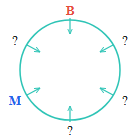
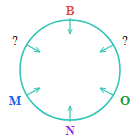
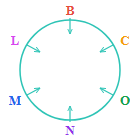
  1. Six friends are sitting around a circular table facing the centre. Right direction is counterclockwise and Left direction is clockwise. Fix B at position (1). Only three people sit between B and M from the right of B: B(1) → pos(2) → pos(3) → pos(4) → M(5).

  1. B sits second to the left of O. Left of O is clockwise. So O must be at position (3): O(3) → pos(2) → B(1).

  1. N is an immediate neighbor of both M and O. Since O is at (3) and M is at (5), N must be at position (4).

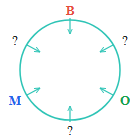
  1. L sits second to the left of C. Left is clockwise. Remaining positions are (2) and (6). If C is at (2), then clockwise: C(2) → pos(1) → L(6). This fits the arrangement.

<br>

To find how many people sit between B and N when counted from the right of B (counterclockwise from B): B(1)C(2)O(3)N(4). There are two people (C and O) between them.

<br>

Hence, the correct answer is 'Option 4'.

39

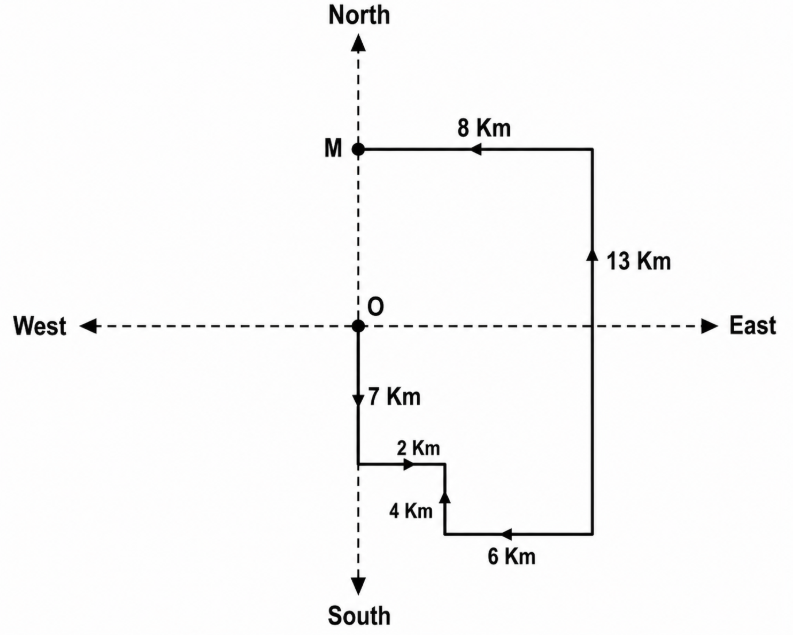
Mr. O starts from Point L and drives 7 km towards the south. He then takes a left turn, drives 2 km, turns right and drives 4 km. He then takes a left turn and drives 6 km. He then takes a left turn and drives 13 km. He takes a final left turn, drives 8 km and stops at Point M. How far (shortest distance) and towards which direction should he drive in order to reach Point L again? (All turns are 90 degrees turns only unless specified.)

  1. ((a))

    2 km towards South

  2. ((b))

    4 km towards South

  3. ((c))

    7 km towards East

  4. ((d))

    7 km towards West

Show Answer
Answer: ((a))

2 km towards South

Logic followed here is to track the Displacement of Mr. O in the North-South and East-West directions starting from Point L.

Given:

1. Mr. O starts from Point L and drives 7 km towards the south. 2. He then takes a left turn, drives 2 km, turns right and drives 4 km.  3. He then takes a left turn and drives 6 km. 4. He then takes a left turn and drives 13 km. 5. He takes a final left turn, drives 8 km and stops at Point M.

Step-by-step Movement:

Therefore, the shortest distance is 2 km towards the South.

Hence, the correct answer is "Option 1".

40

Select the pair which follows the same pattern as that followed by the two pairs given below. Both pairs follow the same pattern.

BYR : ZWP
HEZ : FCX

  1. ((a))

    MAU : LZU

  2. ((b))

    SIV : QGT

  3. ((c))

    ZBG : XYD

  4. ((d))

    GWK : DVH

Show Answer
Answer: ((b))

SIV : QGT

The logic followed in this pattern is a consistent alphabetical shift applied to each letter in the group.

For 'BYR' related to 'ZWP':

B(2)Y(25)R(18)
−2 ↓−2 ↓−2 ↓
Z(26)W(23)P(16)

For 'HEZ' related to 'FCX':

H(8)E(5)Z(26)
−2 ↓−2 ↓−2 ↓
F(6)C(3)X(24)

Checking Option 2 'SIV : QGT' using the same logic:

S(19)I(9)V(22)
−2 ↓−2 ↓−2 ↓
Q(17)G(7)T(20)

Thus, the pair SIV : QGT follows the same pattern as the given pairs.

Hence, the correct answer is 'Option 2'.

41

Based on the English alphabetical order, three of the following four letter-clusters are alike in a certain way and thus form a group. Which letter-cluster DOES NOT belong to that group?

(Note: The odd one out is not based on the number of consonants/vowels or their position in the letter-cluster.)

  1. ((a))

    UHG

  2. ((b))

    EJH

  3. ((c))

    QVT

  4. ((d))

    PUS

Show Answer
Answer: ((a))

UHG

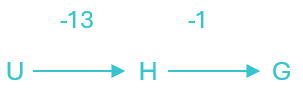
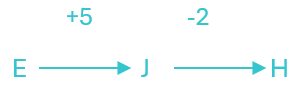
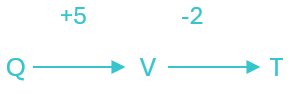
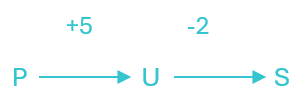
Logic followed here is.

Logic: In the given letter-clusters, the first letter is increased by 5 to obtain the second letter, and the second letter is decreased by 2 to obtain the third letter of the cluster.

For UHG:

For EJH:

For QVT:

For PUS:


The pattern observed in EJH, QVT, and PUS is (+5, −2). However, UHG does not follow this pattern.

Therefore, the odd letter-cluster is UHG.

Hence, the correct answer is "Option 1".

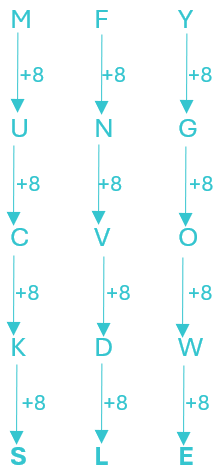
42

What should come in place of ? in the given series based on the English alphabetical order?

<br>

MFY UNG CVO KDW ?

  1. ((a))

    SLP

  2. ((b))

    SLE

  3. ((c))

    SLO

  4. ((d))

    SEL

Show Answer
Answer: ((b))

SLE

The logic followed in this series is that each letter of the term is shifted by a constant value of +8 to obtain the corresponding letter of the next term.

Pattern:

<br>

The term completing the series is SLE.

Hence, the correct answer is "Option 2".

43

Select the set in which the numbers are related in the same way as are the numbers of the following sets.

(Note: Operations should be performed on the whole numbers, without breaking down the numbers into their constituent digits. E.g. 13 – Operations on 13 such as adding/subtracting/multiplying to 13 can be performed. Breaking down 13 into 1 and 3 and then performing mathematical operations on 1 and 3 is not allowed.)

(5, 16, 3)
(6, 18, 3)

  1. ((a))

    (6, 19, 4)

  2. ((b))

    (7, 28, 4)

  3. ((c))

    (4, 13, 2)

  4. ((d))

    (8, 40, 12)

Show Answer
Answer: ((d))

(8, 40, 12)

The logic followed here is:

Logic: Second Number = (First Number + Third Number) × 2

For the first set (5, 16, 3)

⇒ (5 + 3) × 2

⇒ 8 × 2 = 16.

For the second set (6, 18, 3)

⇒ (6 + 3) × 2

⇒ 9 × 2 = 18.

Applying the same logic to the options, we evaluate (8, 40, 12)

⇒ (8 + 12) × 2

⇒ 20 × 2 = 40.

Hence, the correct answer is 'Option 4'.

44

Suraj is the brother of Ganesh. Ganesh is the father of Harshita. Harshita is the sister of Vidhi. Vidhi is the wife of Bheem. How is Suraj related to Bheem?

  1. ((a))

    Wife's father's brother

  2. ((b))

    Wife's father's father

  3. ((c))

    Wife's mother's brother

  4. ((d))

    Wife's mother's father

Show Answer
Answer: ((a))

Wife's father's brother

Given:

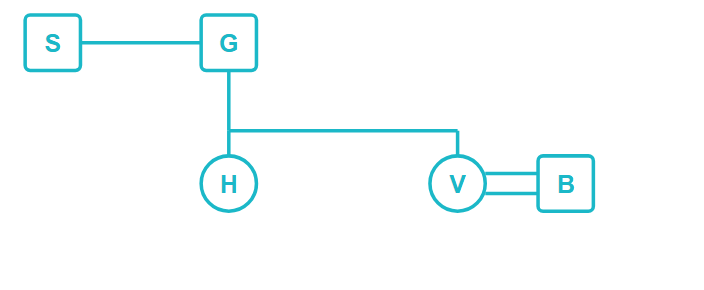
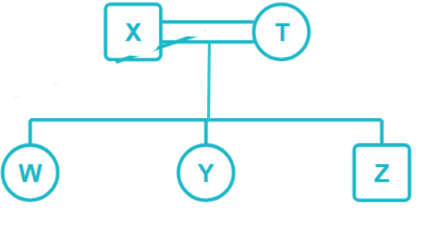
Based on the given information, let us draw a family tree to understand the relationships between the individuals.

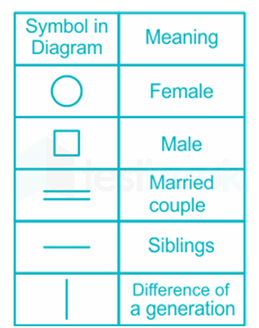
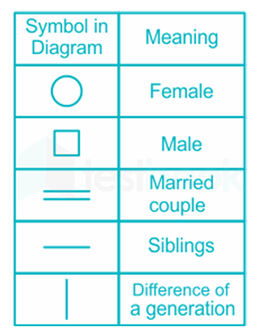
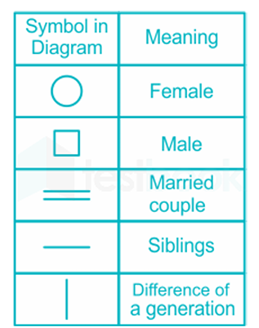
Family Tree Symbols
Symbol=
MeaningMaleFemaleMarried


  1. Suraj is the brother of Ganesh - This means both Suraj and Ganesh are males and belong to the same generation.

  2. Ganesh is the father of Harshita - Ganesh is the male parent of Harshita.

  3. Harshita is the sister of Vidhi - Both Harshita and Vidhi are daughters of Ganesh, making them females and siblings.

  4. Vidhi is the wife of Bheem - Vidhi is the female spouse of Bheem (who is male).

Legend: S: Suraj, G: Ganesh, H: Harshita, V: Vidhi, B: Bheem.

Therefore, Suraj is the brother of Ganesh, who is the father of Bheem's wife (Vidhi) → Suraj is the Wife's father's brother of Bheem.

Hence, the correct answer is 'Option 1'.

45

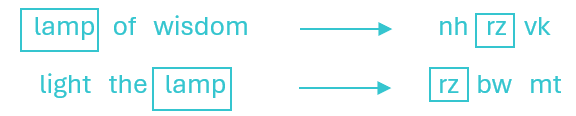
In a certain code language, ‘lamp of wisdom’ is coded as ‘nh rz vk’ and ‘light the lamp’ is coded as ‘rz bw mt’. How is ‘lamp’ coded in the given language? (All the codes are two-letter codes only.)

  1. ((a))

    bw

  2. ((b))

    mt

  3. ((c))

    rz

  4. ((d))

    nh

Show Answer
Answer: ((c))

rz

The logic followed here is based on the common word comparison method between the given coded statements.

Analysis of the given phrases:

  1. 'lamp of wisdom' → 'nh rz vk'
  2. 'light the lamp' → 'rz bw mt'

Therefore, the code for lamp in the given language is rz.

Hence, the correct answer is "Option 3".

46

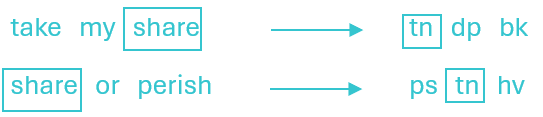
In a certain code language, ‘take my share’ is coded as ‘tn dp bk’ and ‘share or perish’ is coded as ‘ps tn hv’. How is ‘share’ coded in the given language? (All the codes are two-letter codes only.)

  1. ((a))

    tn

  2. ((b))

    bk

  3. ((c))

    dp

  4. ((d))

    hv

Show Answer
Answer: ((a))

tn

Logic followed here is comparison of sentences to find common words and their corresponding codes.

Given:

Sentence 1: 'take my share' is coded as 'tn dp bk'

Sentence 2: 'share or perish' is coded as 'ps tn hv'

Therefore, the code for 'share' must be 'tn'.

Hence, the correct answer is "Option 1".

47

In a certain code language,

<br>

A ~ B means ‘A is the father of B’,

A ¥ B means ‘A is the daughter of B’,

A £ B means ‘A is the son of B’, and

A ≤ B means ‘A is the sister of B’.

<br>

Based on the above, how is W related to T if ‘W ¥ X ~ Y ≤ Z £ T’?

  1. ((a))

    Wife

  2. ((b))

    Sister

  3. ((c))

    Daughter

  4. ((d))

    Mother

Show Answer
Answer: ((c))

Daughter

Given:

Let us first decode the given symbols and then draw a family tree.

A is
Symbol~¥£le
MeaningFatherDaughterSonSister
of B


On checking: W ¥ X ~ Y le Z £ T

  1. W ¥ X - 'W ¥ X' means 'W is the daughter of X'.

  2. X ~ Y - 'X ~ Y' means 'X is the father of Y'.

  3. Y le Z - 'Y le Z' means 'Y is the sister of Z'.

  4. Z £ T - 'Z £ T' means 'Z is the son of T'.

Therefore, W is the sister of Z, who is the son of T → W is the Daughter of T.

Hence, the correct answer is 'Option 3'.

48

The position(s) of how many letters will remain unchanged if each letter in the word ALTERING is arranged in the English alphabetical order?

  1. ((a))

    Three

  2. ((b))

    Two

  3. ((c))

    One

  4. ((d))

    None

Show Answer
Answer: ((c))

One

Given Word:

ALTERING

Original Positions:

Position12345678
LetterALTERING
<br>

Arrange the letters in alphabetical order:

Position12345678
LetterAEGILNRT
<br>

Comparison:

PositionOriginalNewSame?
1AAYes
2LENo
3TGNo
4EINo
5RLNo
6INNo
7NRNo
8GTNo
<br>

Only one letter remains in its original position.

Hence, the correct answer is "Option 3".

49

Refer to the following letter series and answer the question that follows. Counting to be done from left to right.

<br>

(Left) B E X Q K P X I O R G J M Y H M S M O T T (Right)

<br>

How many such vowels are there, each of which is immediately preceded by a consonant and also immediately followed by a consonant?

  1. ((a))

    Three

  2. ((b))

    None

  3. ((c))

    Two

  4. ((d))

    One

Show Answer
Answer: ((c))

Two

Given Series:

(Left) B E X Q K P X I O R G J M Y H M S M O T T (Right)

Required pattern:

Consonant → Vowel → Consonant

Checking the series:

(Left) B E X Q K P X I O R G J M Y H M S M M O T T (Right)

Vowels satisfying the condition:

→ E in (B E X)

→ O in (M O T)

Therefore, there are 2 such vowels.

Hence, the correct answer is "Option 3".

50

Mr. Kell ranked 155th from the bottom and 37th from the top in his class. How many students are there in his class?

  1. ((a))

    191

  2. ((b))

    197

  3. ((c))

    199

  4. ((d))

    198

Show Answer
Answer: ((a))

191

The logic followed here is:

Rank of Mr. Kell from the top = 37th

Rank of Mr. Kell from the bottom = 155th

To find the total number of students in the class, the following formula is used:

Total number of students = (Position from the top + Position from the bottom) − 1

= (37 + 155) − 1

= 192 − 1

= 191

So, there are 191 students in the class.

Hence, the correct answer is 'Option 1'.

General Science (40 questions)

51

Choose a term to complete the analogy.

<br>

Skeletal Muscle : Voluntary :: Cardiac Muscle : _______________

  1. ((a))

    Involuntary

  2. ((b))

    Unbranched

  3. ((c))

    Striated

  4. ((d))

    Multinucleate

Show Answer
Answer: ((a))

Involuntary

The correct answer is Involuntary.

Key Points

  • The analogy compares muscle types based on their functional control mechanism. Skeletal muscles are attached to the skeleton and are controlled by the somatic nervous system, meaning they are under conscious or voluntary control.
  • Cardiac muscle, specifically located in the myocardium (the middle layer of the heart wall), functions automatically to pump blood throughout the body without conscious intervention.
  • The contraction of cardiac tissue is regulated by the autonomic nervous system and specialized pacemaker cells (like the SA node), which classifies its movement as involuntary.
  • While both skeletal and cardiac muscles exhibit striations due to the organized arrangement of sarcomeres, the defining functional difference in this analogy is the nature of their neural regulation.

 Additional Information

  • Muscle Tissue Characteristics:
  • Cardiac Muscle:
  • Structurally, these cells are branched and typically contain only one or two central nuclei.
  • They possess unique intercalated discs containing gap junctions and desmosomes, which allow for rapid electrical communication and synchronized contraction (functional syncytium).
  • Skeletal Muscle:
  • These are long, cylindrical, and unbranched fibers.
  • They are multinucleate, with nuclei located at the periphery of the cell to accommodate the dense packing of myofibrils.
  • Smooth Muscle:
  • Found in the walls of hollow organs like the stomach and intestines; these are non-striated, spindle-shaped, and also involuntary.
52

An object is launched straight upward and reaches a maximum height of 1000 cm. What was the initial velocity of the object? (Take g = 9.8 m/s2)

  1. ((a))

    2 m/s

  2. ((b))

    6 m/s

  3. ((c))

    14 m/s

  4. ((d))

    10 m/s

Show Answer
Answer: ((c))

14 m/s

The correct answer is 14 m/s.

Key Points

  • The problem provides the maximum height (h) as 1000 cm. To maintain consistency with the SI unit of acceleration due to gravity (g), which is 9.8 m/s2, the height must be converted to meters. Thus, 1000 cm ÷ 100 = 10 meters.
  • In vertical motion, when an object reaches its maximum height, its final velocity (v) becomes 0 m/s instantaneously before it begins its descent.
  • To find the initial velocity (u), we apply the third equation of motion under gravity: v2 = u2 − 2gh. The negative sign is used because the object is moving upward against the force of gravity.
  • Substituting the known values into the equation: 02 = u2 − (2 × 9.8 × 10). This simplifies to 0 = u2 − 196.
  • Rearranging the equation gives u2 = 196. Taking the square root of both sides, we get u = √196, which equals 14 m/s.

 Additional Information

  • Equations of Motion under Gravity:
  • v = u ± gt: Relates velocity and time (t).
  • h = ut ± (1/2)gt2: Relates displacement and time.
  • v2 = u2 ± 2gh: Relates velocity and displacement without requiring time.
  • The sign is positive (+) when the object falls downward and negative (−) when projected upward.
  • Acceleration due to Gravity (g):
  • Standard value is 9.80665 m/s2 at sea level.
  • It is a vector quantity always directed toward the center of the Earth.
  • The value of g decreases with altitude and increases slightly from the equator to the poles due to the Earth's ellipsoidal shape.
53

Which of the following components is absent in lymph but present in blood?

  1. ((a))

    Plasma

  2. ((b))

    Platelets

  3. ((c))

    Water

  4. ((d))

    White blood cells (WBCs)

Show Answer
Answer: ((b))

Platelets

Lymph is a fluid connective tissue that is similar to blood plasma but lacks red blood cells, platelets, and large plasma proteins. While lymph contains white blood cells (specifically lymphocytes), it does not contain platelets, which are essential for blood clotting and are found in blood.

54

Which of the following statements is FALSE about mass number?

  1. ((a))

    It may differ for isotopes of the same element.

  2. ((b))

    It represents total nucleons in the atom.

  3. ((c))

    It is equal to twice the atomic number for all elements.

  4. ((d))

    It is always a whole number.

Show Answer
Answer: ((c))

It is equal to twice the atomic number for all elements.

The correct answer is It is equal to twice the atomic number for all elements..

Key Points

  • Isotopes are defined as atoms of the same element that possess the same atomic number but different mass numbers. This variation occurs because isotopes have different quantities of neutrons in their nuclei. Hence, statement 1 is correct.
  • The mass number (denoted by the symbol A) represents the total count of protons and neutrons located within the nucleus of an atom. These particles are collectively referred to as nucleons. Hence, statement 2 is correct.
  • The relationship where the mass number is exactly twice the atomic number (A = 2Z) applies to some light stable nuclides like Helium-4 or Carbon-12, but it is not a universal rule. For example, in Hydrogen-1 (Protium), the mass number is 1 while the atomic number is 1, and in Sodium, the atomic number is 11 while the mass number is 23. Hence, statement 3 is incorrect.
  • The mass number is a count of discrete subatomic particles (protons and neutrons); therefore, it must always be a whole number. This is distinct from relative atomic mass, which can be fractional. Hence, statement 4 is correct.

 Additional Information

  • Mass Number vs. Atomic Mass:
  • Mass Number is the integer sum of nucleons.
  • Atomic Mass is the weighted average of the masses of all naturally occurring isotopes of an element, often resulting in non-integers, such as Chlorine having an atomic mass of approximately 35.5.
  • Atomic Notation: In standard chemical notation, an element is represented as ZAX _{Z}^{A}X , where A is the mass number and Z is the atomic number.
  • Neutron Calculation: The number of neutrons (n) in an atom is determined by the formula n=AZ n = A − Z .
55

Along with phosphorus and potassium, fertilisers mainly supply which of the following to crops?

  1. ((a))

    Zinc only

  2. ((b))

    Nitrogen

  3. ((c))

    Calcium only

  4. ((d))

    Magnesium only

Show Answer
Answer: ((b))

Nitrogen

The correct answer is Nitrogen.

Key Points

  • Fertilisers are chemical substances supplied to the soil or plant tissues to provide one or more nutrients essential to plant growth. The most common commercial fertilisers are centered around the NPK triad, which stands for Nitrogen (N), Phosphorus (P), and Potassium (K).
  • Nitrogen is the most critical element for plant growth as it is a major component of chlorophyll, the green pigment in plants responsible for photosynthesis, converting sunlight into chemical energy.
  • Scientifically, nitrogen is a core part of amino acids, which form proteins, and nucleic acids like DNA and RNA, which allow plants to grow and reproduce.
  • The Haber-Bosch process is the primary industrial method used to produce ammonia, the precursor to most nitrogenous fertilisers like Urea and Ammonium Nitrate.
  • While Phosphorus is vital for energy transfer (ATP) and root development, and Potassium regulates osmosis and enzyme activation, Nitrogen promotes rapid vegetative growth and lush green foliage.
  • Statistical data indicates that Urea is the most widely used nitrogenous fertiliser globally, typically containing about 46% nitrogen by weight.

 Additional Information

  • Secondary Macronutrients:
  • Calcium: Essential for cell wall structure and transport of other nutrients; a deficiency often leads to blossom end rot in fruits.
  • Magnesium: The central atom of the chlorophyll molecule; without it, plants cannot capture sun energy for photosynthesis.
  • Micronutrients:
  • Zinc: Needed in trace amounts for hormone production (specifically auxins) and internode elongation.
  • NPK Ratio: This is a labeling convention found on fertiliser bags (e.g., 10-20-10), representing the percentage of available Nitrogen, Phosphate (P2O5), and Potash (K2O).
56

Select the correct option regarding the given statements.

<br>

Statement 1: The compound CH₃–CH₂–CHO is propanone.

Statement 2: Aldehydes are named using the suffix '–al'.

  1. ((a))

    Statement 1 is true but Statement 2 is false.

  2. ((b))

    Both statements are true but Statement 2 is not the correct explanation of Statement 1.

  3. ((c))

    Statement 1 is false but Statement 2 is true.

  4. ((d))

    Both statements are true and Statement 2 is the correct explanation of Statement 1.

Show Answer
Answer: ((c))

Statement 1 is false but Statement 2 is true.

The correct answer is Statement 1 is false but Statement 2 is true.

Key Points

  • The chemical structure CH3−CH2−CHO consists of a three-carbon chain with a terminal carbonyl group bonded to a hydrogen atom, identifying it as an aldehyde. Under IUPAC nomenclature, a three-carbon aldehyde is named propanal, whereas propanone is a ketone with the formula CH3−CO−CH3. Hence, statement 1 is incorrect.
  • The IUPAC system for naming organic compounds dictates that the presence of an aldehyde functional group is indicated by replacing the terminal '-e' of the parent alkane name with the suffix -al. For instance, ethane becomes ethanal and propane becomes propanal. Hence, statement 2 is correct.

 Additional Information

  • Aldehydes:
  • These are compounds containing the −CHO functional group, where the carbon atom is double-bonded to oxygen and single-bonded to hydrogen.
  • The aldehyde group is always located at the terminal position (end) of a carbon chain, meaning the carbon in this group is always assigned carbon-1 in numbering.
  • Common examples include methanal (formaldehyde) and ethanal (acetaldehyde), which are used extensively in industrial synthesis.
  • Ketones:
  • These feature a carbonyl group (C=O) located at a non-terminal position, meaning it is bonded to two other carbon atoms.
  • They are named using the suffix -one.
  • Propanone, also known as acetone, is the simplest ketone and is widely used as a solvent in laboratory and industrial applications.
57

Which characteristic defines non-uniform motion?

  1. ((a))

    Constant speed

  2. ((b))

    Covering unequal distances in equal intervals of time

  3. ((c))

    Equal displacement in equal time intervals

  4. ((d))

    Zero acceleration

Show Answer
Answer: ((b))

Covering unequal distances in equal intervals of time

The correct answer is Covering unequal distances in equal intervals of time.

Key Points

  • Non-uniform motion is defined as the type of motion where an object covers unequal distances in equal intervals of time, indicating that the velocity of the object is not constant.
  • In this type of motion, the speed of the object changes at different points during its journey, which means the instantaneous speed fluctuates rather than remaining steady.
  • The distance-time graph for an object in non-uniform motion is represented by a curved line, showing that the slope (which represents speed) varies over time.
  • Because the velocity (magnitude or direction) is changing, the object is always subjected to acceleration or deceleration.
  • A real-world example is a car moving in heavy traffic, where the driver frequently applies brakes and accelerates, causing the car to cover different distances in each consecutive minute.

 Additional Information

  • Uniform Motion:
  • Characterized by an object covering equal distances in equal intervals of time.
  • The velocity remains constant, and the direction of motion does not change.
  • The acceleration in uniform motion is strictly zero because there is no change in velocity.
  • Its distance-time graph is a straight line with a constant slope.
  • Acceleration:
  • It is the rate of change of velocity with respect to time, measured in meters per second squared (m/s2).
  • Positive acceleration occurs when the speed increases, while negative acceleration (retardation) occurs when the speed decreases.
  • In non-uniform motion, acceleration can be uniform (velocity changes at a constant rate) or non-uniform (velocity changes at varying rates).
58

Which of the following is NOT a correct use or property of sodium hydrogen carbonate, NaHCO₃?

  1. ((a))

    It is used in baking as a leavening agent.

  2. ((b))

    It is used as a strong acid.

  3. ((c))

    It is used in fire extinguishers.

  4. ((d))

    It is used in antacids.

Show Answer
Answer: ((b))

It is used as a strong acid.

The correct answer is It is used as a strong acid..

Key Points

  • Sodium Hydrogen Carbonate (NaHCO3), commonly known as baking soda, is used as a leavening agent in baking because it reacts with acidic components to release carbon dioxide gas, which causes dough to rise. Hence, statement 1 is correct.
  • Sodium hydrogen carbonate is a basic salt derived from a strong base (NaOH) and a weak acid (H2CO3); it has a pH of approximately 8.3 and does not behave as a strong acid. Hence, statement 2 is incorrect.
  • It is a crucial component in soda-acid fire extinguishers, where it reacts with an acid to produce a heavy blanket of carbon dioxide gas that cuts off the oxygen supply to the fire. Hence, statement 3 is correct.
  • Due to its mildly alkaline nature, it is widely used as an antacid to neutralize the excess hydrochloric acid produced in the stomach, thereby relieving acidity and heartburn. Hence, statement 4 is correct.

 Additional Information

  • Sodium Hydrogen Carbonate Characteristics:
  • Chemical Formula: NaHCO3, also referred to as sodium bicarbonate.
  • Production: It is manufactured using the Solvay process, involving the reaction of sodium chloride, ammonia, and carbon dioxide in water.
  • Decomposition: When heated above 50°C, it decomposes into sodium carbonate (Na2CO3), water, and carbon dioxide.
  • Strong Acids vs. Weak Bases: Strong acids like HCl or H2SO4 fully ionize in water, whereas NaHCO3 is a weak base used to neutralize such acids in chemical spills and medical applications.
59

Select the correct option regarding the given statements.

<br>

Statement 1: Metals and non-metals react by sharing electrons.

Statement 2: The bond formed between them is covalent.

  1. ((a))

    Both statements are true.

  2. ((b))

    Statement 1 is true; Statement 2 is false.

  3. ((c))

    Both statements are false.

  4. ((d))

    Statement 1 is false; Statement 2 is true.

Show Answer
Answer: ((c))

Both statements are false.

The correct answer is Both statements are false.

Key Points

  • Statement 1 suggests that metals and non-metals react by sharing electrons. However, in chemical reactions between these two groups, metals (which have low ionization energy) typically lose electrons to form positive cations, while non-metals (which have high electron affinity) gain those electrons to form negative anions. This process is defined as electron transfer rather than sharing. Hence, statement 1 is incorrect.
  • Statement 2 posits that the bond formed between a metal and a non-metal is covalent. A covalent bond involves the mutual sharing of electron pairs, which generally occurs between two non-metals. The bond resulting from the strong electrostatic force of attraction between oppositely charged ions (formed by electron transfer) is known as an ionic bond or electrovalent bond. Hence, statement 2 is incorrect.

 Additional Information

  • Ionic Compounds:
  • These compounds, such as Sodium Chloride (NaCl) or Magnesium Chloride (MgCl2), typically exist as crystalline solids.
  • They possess high melting and boiling points due to the strong inter-ionic attraction.
  • They are generally soluble in polar solvents like water but insoluble in organic solvents like kerosene or petrol.
  • They conduct electricity in the molten state or in aqueous solution due to the movement of free ions.
  • Covalent Compounds:
  • Formed by atoms of non-metals to achieve a stable noble gas configuration.
  • Examples include Methane (CH4), Water (H2O), and Carbon Dioxide (CO2).
  • These substances usually have low melting and boiling points because the intermolecular forces (like Van der Waals forces) are relatively weak compared to ionic bonds.
  • Octet Rule: Atoms tend to gain, lose, or share electrons to have eight electrons in their outermost shell, ensuring maximum chemical stability.
60

If an object is placed between F1 and 2F1 of a convex lens, the image produced is ________. (F1 is the position of the principal focus.)

  1. ((a))

    Same size, real, inverted

  2. ((b))

    Diminished, real, inverted

  3. ((c))

    Enlarged, real, inverted

  4. ((d))

    Enlarged, virtual, erect

Show Answer
Answer: ((c))

Enlarged, real, inverted

The correct answer is Enlarged, real, inverted.

Key Points

  • When an object is positioned between the first principal focus (F1) and the center of curvature (2F1) of a convex lens, the rays of light originating from the object undergo refraction to form an image on the opposite side of the lens.
  • According to the rules of ray diagrams, a ray incident parallel to the principal axis passes through the second principal focus (F2) after refraction.
  • Another ray passing through the optical center (O) of the convex lens travels straight without any angular deviation.
  • These refracted rays actually intersect at a specific point located beyond 2F2 on the other side, characterizing the image as real and inverted.
  • Since the image is formed further away from the lens than the object is (image distance v > object distance u), the linear magnification (m = v/u) is greater than 1, resulting in an enlarged or magnified image.

 Additional Information

  • Convex Lens Image Characteristics:
  • Object at 2F1: The image is formed exactly at 2F2, is real, inverted, and the same size as the object.
  • Object beyond 2F1: The image is formed between F2 and 2F2 and is diminished, real, and inverted.
  • Object at F1: The rays emerge parallel after refraction, meaning the image is formed at infinity and is highly enlarged.
  • Object between F1 and Optical Center: This is the only case where a convex lens produces a virtual, erect, and enlarged image, which appears on the same side as the object.
  • Thin Lens Formula: The relationship between object distance (u), image distance (v), and focal length (f) is given by 1/f = 1/v − 1/u.
61

The atomic number of oxygen is 8. What does this mean?

  1. ((a))

    Oxygen has 8 neutrons in its nucleus

  2. ((b))

    Oxygen has 8 atoms in each molecule

  3. ((c))

    Oxygen has 8 protons in its orbit

  4. ((d))

    Oxygen has 8 protons and 8 electrons

Show Answer
Answer: ((d))

Oxygen has 8 protons and 8 electrons

The correct answer is Oxygen has 8 protons and 8 electrons.

Key Points

  • The atomic number (represented by the symbol Z) of a chemical element is defined as the total number of protons found in the nucleus of an atom.
  • For Oxygen, an atomic number of 8 signifies that every oxygen atom contains exactly 8 protons in its central core.
  • In any electrically neutral atom, the number of negatively charged electrons must equal the number of positively charged protons to balance the net charge.
  • As a result, a neutral oxygen atom possesses 8 electrons arranged in its electron shells (2 in the first shell and 6 in the second shell).

 Additional Information

  • Subatomic Particles and Structure:
  • Protons: These are positively charged particles that define the identity of the element. They are located inside the nucleus, not in the orbits.
  • Electrons: These are negatively charged particles that move around the nucleus in specific energy levels or orbitals.
  • Neutrons: These are uncharged particles located in the nucleus. The number of neutrons is determined by the Mass Number (A) minus the Atomic Number (Z). While the most common isotope of oxygen (Oxygen-16) has 8 neutrons, other isotopes like Oxygen-18 have 10 neutrons.
  • Molecular Structure:
  • The number of atoms in a molecule is known as atomicity. Oxygen usually exists as a diatomic molecule (O2), which means it has 2 atoms per molecule, whereas Ozone (O3) has 3.
62

Which of the following is NOT a combination reaction?

  1. ((a))

    NH3+HClNH4Cl NH_3 + HCl \rightarrow NH_4Cl

  2. ((b))

    2Cu+O2Heat2CuO 2Cu + O_2 \xrightarrow{Heat} 2CuO

  3. ((c))

    CaO+H2OCa(OH)2 CaO + H_2O \rightarrow Ca(OH)_2

  4. ((d))

    CuO+H2HeatCu+H2O CuO + H_2 \xrightarrow{Heat} Cu + H_2O

Show Answer
Answer: ((d))

CuO+H2HeatCu+H2O CuO + H_2 \xrightarrow{Heat} Cu + H_2O

The correct answer is CuO + H2 → Cu + H2O.

Key Points

  • A combination reaction (also known as a synthesis reaction) occurs when two or more reactants (elements or compounds) combine chemically to form a single product. The general form is represented as A + B → AB.
  • The reaction NH3 + HCl → NH4Cl involves ammonia and hydrogen chloride gas reacting to form a single solid product, ammonium chloride. Since there is only one product, it is a combination reaction.
  • In 2Cu + O2 → 2CuO, elemental copper reacts with oxygen upon heating to produce copper(II) oxide. As multiple reactants form one product, this is a combination reaction.
  • The reaction CaO + H2O → Ca(OH)2 involves calcium oxide (quicklime) reacting vigorously with water to produce calcium hydroxide (slaked lime). This is a classic example of a combination reaction.
  • The equation CuO + H2 → Cu + H2O shows copper oxide reacting with hydrogen to produce copper and water. Because there are two distinct products formed, it does not meet the criteria of a combination reaction.

 Additional Information

  • Redox and Displacement: The reaction CuO + H2 → Cu + H2O is categorized as a Redox Reaction.
  • Reduction: The CuO is reduced to Cu because it loses oxygen.
  • Oxidation: The H2 is oxidized to H2O because it gains oxygen.
  • Displacement: This can also be viewed as a displacement reaction where hydrogen displaces copper from its oxide due to the reactivity series.
  • Exothermic Nature: Many combination reactions, such as the formation of slaked lime, are highly exothermic, releasing significant amounts of thermal energy during the process.
63

Why is tungsten used almost exclusively for making filaments of electric bulbs?

  1. ((a))

    It has low electrical resistance.

  2. ((b))

    It does not allow heat to pass.

  3. ((c))

    It has a very high melting point.

  4. ((d))

    It readily oxidizes at high temperatures.

Show Answer
Answer: ((c))

It has a very high melting point.

The correct answer is It has a very high melting point..

Key Points

  • Tungsten, also known as Wolfram, is used for bulb filaments because it possesses the highest melting point of any pure metal, recorded at approximately 3422 degrees Celsius.
  • Incandescent bulbs operate by heating a filament to extremely high temperatures (around 2500 degrees Celsius) so that it glows and emits visible light; tungsten can withstand this heat without melting or losing structural integrity.
  • The metal exhibits very low vapor pressure at high temperatures, which minimizes the rate of sublimation and prevents the filament from thinning out too quickly during operation.
  • Tungsten has high tensile strength, allowing it to be drawn into extremely thin coiled wires that are durable enough to survive the mechanical stresses within a glass envelope.
  • Its resistivity is sufficient to generate the necessary heat energy through Joule heating (H = I2Rt) when an electric current passes through the thin wire.

 Additional Information

  • Inert Gas Filling:
  • To prevent the filament from oxidizing at high temperatures, bulbs are filled with chemically inactive gases such as Argon or Nitrogen.
  • This environment suppresses tungsten evaporation, thereby increasing the lifespan of the electric bulb.
  • Properties of Tungsten:
  • Atomic Number: It has an atomic number of 74 and belongs to the d-block of the periodic table.
  • Thermal Conductivity: It possesses good thermal conductivity, which helps in the distribution of heat along the filament length.
  • Efficiency: While effective, tungsten bulbs are less efficient than LEDs as most energy is lost as Infrared radiation (heat) rather than light.
64

When a small piece of sodium metal is added to chlorine gas under controlled conditions, a vigorous reaction occurs producing sodium chloride. Which of the following statements best explains the reason for the stability of the product formed?

  1. ((a))

    Sodium donates one electron to chlorine, forming oppositely charged ions held by strong electrostatic forces.

  2. ((b))

    Sodium and chlorine share one electron each, forming a stable covalent bond.

  3. ((c))

    Both sodium and chlorine attain stability by forming a metallic lattice with delocalized electrons.

  4. ((d))

    Sodium gains one electron from chlorine, forming a neutral molecule through mutual sharing.

Show Answer
Answer: ((a))

Sodium donates one electron to chlorine, forming oppositely charged ions held by strong electrostatic forces.

The correct answer is Sodium donates one electron to chlorine, forming oppositely charged ions held by strong electrostatic forces..

Key Points

  • Sodium (Na), with an atomic number of 11, has a single valence electron ([Ne] 3s1) which it donates to Chlorine (Cl) to achieve a stable Octet, resulting in the formation of Na+ and Cl ions bonded by Coulombic attraction. Hence, statement 1 is correct.
  • Covalent bonds are formed by the mutual sharing of electron pairs between atoms, typically occurring between non-metals with low electronegativity differences, which does not characterize the metal-nonmetal bond in NaCl. Hence, statement 2 is incorrect.
  • A metallic lattice consists of metal cations surrounded by a sea of delocalized electrons; this structure is found in pure Sodium metal but is replaced by an ionic crystal structure once the reaction with Chlorine occurs. Hence, statement 3 is incorrect.
  • In this redox reaction, Sodium undergoes oxidation by losing an electron to become a positive cation, while Chlorine undergoes reduction by gaining that electron; sodium never gains electrons from chlorine. Hence, statement 4 is incorrect.

 Additional Information

  • Ionic Bond Stability:
  • Octet Rule: The transfer allows both atoms to reach the electronic configuration of Noble Gases (Neon for Sodium and Argon for Chlorine).
  • Lattice Energy: The stability is significantly enhanced by the Lattice Energy, which is the energy released when gaseous ions pack together to form a solid ionic crystal.
  • Crystal Structure: Sodium Chloride forms a Face-Centered Cubic (FCC) lattice where each ion is coordinated by six ions of the opposite charge.
  • Electronegativity: The large difference in Electronegativity (Sodium ≈ 0.9, Chlorine ≈ 3.0) ensures that the bond is purely Ionic rather than covalent.
65

An unbalanced force of 100 N acts on a body at rest such that it acquires a velocity of 5 m/s in 10 s. How much is the mass of the body?

  1. ((a))

    2 kg

  2. ((b))

    50 kg

  3. ((c))

    5 kg

  4. ((d))

    200 kg

Show Answer
Answer: ((d))

200 kg

The correct answer is 200 kg.

Key Points

  • Identify the given physical quantities: The Unbalanced Force (F) is 100 N, the Initial Velocity (u) is 0 m/s (since the body is at rest), the Final Velocity (v) is 5 m/s, and the Time Interval (t) is 10 s.
  • Calculate the Acceleration (a) of the body using the first equation of motion or the definition of acceleration, which is the rate of change of velocity. The formula is a = (v − u) / t.
  • Substituting the values: a = (5 − 0) / 10, which results in a = 0.5 m/s2.
  • Apply Newton's Second Law of Motion, which mathematically states that Force (F) = Mass (m) × Acceleration (a).
  • To find the Mass (m), rearrange the formula to m = F / a.
  • Substituting the known values into the equation: m = 100 / 0.5. This calculation yields a result of 200 kg.

 Additional Information

  • Newton's Second Law of Motion:
  • It establishes a quantitative relationship between Force, Mass, and Acceleration.
  • The law states that the acceleration of an object is directly proportional to the Net Force acting on it and inversely proportional to its Mass.
  • The SI unit of force is the Newton (N), which is equivalent to 1 kg·m/s2.
  • Inertia and Mass:
  • Mass is a fundamental property of matter that quantifies the amount of Inertia an object possesses.
  • Higher mass results in greater resistance to changes in the state of Motion or Rest.
  • Unlike weight, mass is a Scalar Quantity and remains constant regardless of gravitational changes.
66

At high altitudes such as hill stations, water boils at a temperature lower than 100°C, whereas in a pressure cooker it boils above 100°C. Which of the following statements correctly explains this phenomenon?

  1. ((a))

    Water molecules at high altitude have lower kinetic energy than at sea level, so they boil at a lower temperature.

  2. ((b))

    Boiling point of a liquid is independent of external pressure and depends only on temperature.

  3. ((c))

    Boiling point of a liquid increases with an increase in atmospheric pressure and decreases with a decrease in atmospheric pressure.

  4. ((d))

    Boiling point of a liquid decreases with an increase in atmospheric pressure and increases with a decrease in atmospheric pressure.

Show Answer
Answer: ((c))

Boiling point of a liquid increases with an increase in atmospheric pressure and decreases with a decrease in atmospheric pressure.

The correct answer is Boiling point of a liquid increases with an increase in atmospheric pressure and decreases with a decrease in atmospheric pressure..

Key Points

  • The boiling point of a liquid is defined as the temperature at which its vapor pressure equals the external atmospheric pressure surrounding the liquid.
  • At high altitudes, such as hill stations, the atmospheric pressure is significantly lower than at sea level due to the thinner air column above. Because the external pressure is lower, water requires less heat to match its vapor pressure with the environment, causing it to boil at temperatures below 100°C.
  • In a pressure cooker, the steam produced is trapped inside a sealed container, which rapidly increases the internal pressure. This elevated pressure prevents water molecules from escaping into the gas phase until a much higher temperature is reached, typically around 120°C.
  • The physical principle involved is that the boiling point is directly proportional to the external pressure; as pressure increases, more thermal energy is needed to facilitate the phase change from liquid to gas.

 Additional Information

  • Vapor Pressure:
  • It is the pressure exerted by a vapor in thermodynamic equilibrium with its condensed phases at a given temperature in a closed system.
  • As temperature increases, the kinetic energy of molecules increases, thereby increasing the vapor pressure.
  • Clausius-Clapeyron Equation:
  • This equation characterizes the phase transition between two states of matter and mathematically relates the dependence of boiling point on pressure.
  • Practical Implications:
  • In mountainous regions, food takes longer to cook in open vessels because the water cannot exceed its low boiling point (e.g., 92°C), providing less heat to the food.
  • Autoclaves used in hospitals for sterilization operate on the same principle as a pressure cooker to reach temperatures high enough to kill resistant bacteria and spores.
67

The effect of thrust on a surface depends on the area on which it acts. Force acting on a smaller area exerts a ___________ compared to a larger area.

  1. ((a))

    Smaller thrust

  2. ((b))

    Zero pressure

  3. ((c))

    Larger pressure

  4. ((d))

    Smaller pressure

Show Answer
Answer: ((c))

Larger pressure

The correct answer is Larger pressure.

Key Points

  • Pressure is defined as the thrust acting perpendicularly per unit area of a surface.
  • The mathematical relationship between these physical quantities is expressed by the formula: Pressure = Thrust / Area.
  • According to this formula, pressure is inversely proportional to the area on which the force (thrust) acts, provided the magnitude of the force remains constant.
  • Therefore, if a force acts on a smaller area, the pressure generated is larger because the force is concentrated over a limited space.
  • In contrast, if the same force acts on a larger area, the pressure becomes smaller as the force is distributed across a wider surface.

 Additional Information

  • Concept of Thrust:
  • Thrust is the total perpendicular force exerted by an object on a surface.
  • The SI unit for thrust is the Newton (N), the same as for any other force.
  • Units of Pressure:
  • The SI unit of pressure is the Pascal (Pa), where 1 Pa = 1 N/m2.
  • It is named in honor of the French mathematician and physicist Blaise Pascal.
  • Real-World Applications:
  • Sharp Tools: Needles, nails, and knives have pointed or sharp edges to reduce the contact area, thereby exerting larger pressure to penetrate surfaces easily.
  • Broad Foundations: High-rise buildings and dams have very wide bases to increase the area and reduce the pressure exerted on the ground to prevent sinking.
  • Heavy Vehicles: Tractors and tanks use wide tires or caterpillar tracks to distribute weight over a larger area, minimizing pressure on soft ground.
68

The gravitational potential energy of an object at a height is the work done to lift it from the ground to that height _____________.

  1. ((a))

    Along a curved path

  2. ((b))

    Against gravity

  3. ((c))

    With constant velocity

  4. ((d))

    In the direction of gravity

Show Answer
Answer: ((b))

Against gravity

The correct answer is Against gravity.

Key Points

  • Gravitational Potential Energy (GPE) is the energy an object possesses due to its position in a gravitational field, typically relative to the Earth's surface.
  • To lift an object of mass m to a height h, an external force must be applied to counteract the object's weight. The weight of an object is the downward force exerted by gravity, calculated as Weight = m × g, where g is the acceleration due to gravity (approximately 9.8 m/s2).
  • Work is mathematically defined as the product of force and displacement. When lifting an object, the displacement is upward, while the gravitational force acts downward.
  • Because the lifting force acts in the opposite direction to the gravitational pull, the process is described as doing work against gravity.
  • This work done is stored in the object as potential energy, expressed by the formula U = mgh. If no other forces (like friction) are present and the object is moved at a constant velocity, the work performed by the external agent exactly equals the gain in Potential Energy.

 Additional Information

  • Conservative Forces and Paths:
  • Gravity is a conservative force, which means the work done to move an object between two points is independent of the path taken. Whether the object is lifted vertically or along a curved path, the GPE depends only on the vertical displacement.
  • Direction of Movement:
  • If an object moves in the direction of gravity (falls downward), the potential energy is converted into kinetic energy, and the work done by gravity is positive while the GPE decreases.
  • Work-Energy Theorem:
  • According to this principle, the total work done on an object is equal to its change in Kinetic Energy. When lifting an object with constant velocity, there is no change in kinetic energy, so the external work done against gravity translates entirely into potential energy.
69

When we observe a star near the horizon, it appears to be slightly higher in the sky than it really is. What is the reason for this?

  1. ((a))

    The star moves rapidly and changes its position.

  2. ((b))

    The Earth's rotation shifts the star upward.

  3. ((c))

    The atmosphere bends the starlight due to gradual changes in refractive index.

  4. ((d))

    The star becomes brighter, making it seem higher.

Show Answer
Answer: ((c))

The atmosphere bends the starlight due to gradual changes in refractive index.

The correct answer is The atmosphere bends the starlight due to gradual changes in refractive index.

Key Points

  • This phenomenon occurs due to Atmospheric Refraction, which is the deviation of light from a straight line as it passes through the Earth's atmosphere.
  • As starlight enters the atmosphere, it travels from a vacuum (rarer medium) into layers of air with increasing density (denser medium).
  • The refractive index of the Earth's atmosphere gradually increases as we move closer to the surface because the air becomes denser near the ground.
  • According to the laws of refraction, when light travels from a rarer to a denser medium, it bends towards the normal. Since the atmosphere consists of layers with varying indices, the light bends continuously.
  • The human eye perceives light as traveling in a straight line. Therefore, when we trace the refracted ray backward, the apparent position of the star appears slightly higher than its actual position, especially when observed near the horizon.

 Additional Information

  • Atmospheric Refraction Effects:
  • Advanced Sunrise and Delayed Sunset: The Sun is visible to us about 2 minutes before the actual sunrise and 2 minutes after the actual sunset due to the same bending of light.
  • Twinkling of Stars: The stars act as point sources of light. As the physical conditions of the atmosphere change, the refractive index fluctuates, causing the apparent position and intensity of light to change, resulting in a twinkling effect.
  • Apparent Flattening of the Sun: At sunrise and sunset, the bottom part of the Sun's disc is closer to the horizon and refracted more than the upper part, making the Sun appear oval or flattened.
  • Refractive Index: It is the ratio of the speed of light in a vacuum to the speed of light in a specific medium. For air at sea level, the refractive index is approximately 1.00029.
70

Why is weed management important in crop production?

  1. ((a))

    Weeds supply nutrients to crops.

  2. ((b))

    Weeds have no impact on crops.

  3. ((c))

    Weeds compete with crops for resources.

  4. ((d))

    Weeds increase crop yield.

Show Answer
Answer: ((c))

Weeds compete with crops for resources.

The correct answer is Weeds compete with crops for resources.

Key Points

  • Weeds are defined as undesirable and unwanted plants that grow alongside cultivated crops, often possessing more aggressive growth characteristics than the main crop.
  • The primary reason for weed management is that these plants engage in interspecific competition for vital limiting resources, specifically soil nutrients (nitrogen, phosphorus, potassium), irrigation water, sunlight, and physical space.
  • Since weeds consume the fertilizers and moisture intended for the crops, their presence leads to nutrient deficiency, causing stunted growth and a significant reduction in the overall crop yield.
  • Uncontrolled weed growth can harbor pests and pathogens, further indirectly damaging the health of the primary agricultural produce.
  • Managing weeds early in the crop life cycle is critical to ensuring that the crop establishes a canopy and utilizes available resources efficiently for biomass production.

 Additional Information

  • Common Weed Examples:
  • Xanthium (Gokhroo), Parthenium (Gajar ghas), and Cyperinus rotundus (Motha) are some of the most prevalent weeds found in Indian agriculture.
  • Control Strategies:
  • Mechanical Methods: Includes uprooting weeds by hand, ploughing, and using tools like the khurpi for weeding.
  • Chemical Methods: The application of herbicides or weedicides, such as 2,4-D, Atrazine, and Butachlor, which are designed to selectively eliminate weeds.
  • Biological Control: Utilizing natural enemies like insects or specific bio-herbicides to suppress the growth of specific weed species.
  • Cultural Methods: Practicing crop rotation, intercropping, and timely sowing of seeds to provide the crop a competitive advantage over weeds.
71

Read the given statements carefully and select the correct option.

<br>

Statement I: The phenomenon of change of liquid into vapours at any temperature below its boiling point is called evaporation.

Statement II: The rate of evaporation increases with an increase of surface area.

  1. ((a))

    Statement I is true but statement II is false.

  2. ((b))

    Both statements I and II are true.

  3. ((c))

    Statement I is false but statement II is true.

  4. ((d))

    Both statements I and II are false.

Show Answer
Answer: ((b))

Both statements I and II are true.

The correct answer is Both statements I and II are true..

Key Points

  • Evaporation is the process of a liquid changing into a gas or vapour at any temperature below its boiling point. It differs from boiling as it is a surface phenomenon, where only the particles at the surface gain enough kinetic energy to break the forces of attraction and escape. Hence, statement I is correct.
  • The rate of evaporation depends heavily on the amount of surface area exposed to the atmosphere. Because evaporation is a surface-based process, increasing the area allows a larger number of molecules to transition from the liquid phase to the vapour phase simultaneously. Hence, statement II is correct.

 Additional Information

  • Several other physical factors influence the evaporation rate in a given environment:
  • Temperature: An increase in temperature provides more thermal energy to the particles, increasing their kinetic energy and speeding up the conversion to vapour.
  • Humidity: This refers to the concentration of water vapour in the air. High humidity levels decrease the evaporation rate because the air is already saturated and cannot easily absorb more moisture.
  • Wind Speed: Increased wind speed moves the water vapour away from the liquid surface immediately after it forms, preventing local saturation and thus increasing the rate of evaporation.
  • Evaporative Cooling: During evaporation, the liquid absorbs the latent heat of vaporization from the surroundings or the remaining liquid, which results in a cooling effect.
72

Which of the following correctly represents the changes that occur in the floral parts after fertilisation?

  1. ((a))

    The ovary develops into a fruit while the ovule becomes a seed

  2. ((b))

    The stigma and ovary both develop into fruits

  3. ((c))

    All floral parts persist and develop into fruits

  4. ((d))

    The ovule develops into a fruit and the ovary becomes a seed

Show Answer
Answer: ((a))

The ovary develops into a fruit while the ovule becomes a seed

The correct answer is The ovary develops into a fruit while the ovule becomes a seed.

Key Points

  • In Angiosperms, the process of fertilization triggers a series of developmental changes where the flower transforms into a fruit containing seeds.
  • The ovule, which contains the embryo sac, undergoes structural changes post-fertilization to develop into the seed. This seed houses the embryo and often a food-storing tissue called the endosperm.
  • The ovary matures and ripens into the fruit. The primary biological function of the fruit is to protect the developing seeds and facilitate their dispersal through various agents like wind, water, or animals.
  • During this transition, most accessory floral parts, including the petals, stamens, style, and stigma, typically wither and fall off as their reproductive roles are completed.

 Additional Information

  • The transformation of floral parts involves specific cellular differentiations:
  • Zygote: The diploid cell formed by the fusion of a male gamete and an egg cell develops into the embryo.
  • Integuments: The outer protective layers of the ovule harden to form the seed coat, consisting of the testa (outer) and tegmen (inner).
  • Ovary Wall: This tissue develops into the pericarp, which is the wall of the fruit. In fleshy fruits, the pericarp differentiates into the exocarp, mesocarp, and endocarp.
  • Triple Fusion: The fusion of the second male gamete with two polar nuclei results in the Primary Endosperm Nucleus (PEN), which develops into the nutrient-rich endosperm.
  • Persistent Calyx: While most sepals fall off, in certain plants like brinjal and tomato, the calyx remains attached even after the fruit matures.
73

Which statement is INCORRECT about isobars?

  1. ((a))

    They have the same mass number.

  2. ((b))

    They have the same number of protons.

  3. ((c))

    Their number of neutrons is different.

  4. ((d))

    They have different chemical properties.

Show Answer
Answer: ((b))

They have the same number of protons.

The correct answer is They have the same number of protons..

Key Points

  • Isobars are defined as atoms of different chemical elements that possess the same mass number (A) but different atomic numbers (Z). Hence, statement 1 is correct.
  • Since the atomic number represents the number of protons in a nucleus and determines the identity of an element, isobars must have a different number of protons by definition. Hence, statement 2 is incorrect.
  • The mass number is the total sum of protons and neutrons; because isobars have the same total sum but different proton counts, the number of neutrons in their nuclei must vary to maintain the constant mass sum. Hence, statement 3 is correct.
  • Chemical properties are governed by the electronic configuration, which depends on the atomic number; because isobars belong to different elements with different atomic numbers, they exhibit distinct chemical behaviors. Hence, statement 4 is correct.

 Additional Information

  • Isotopes:
  • These are atoms of the same element having the same atomic number but different mass numbers.
  • Example: Protium, Deuterium, and Tritium are isotopes of Hydrogen.
  • Isotones:
  • These are atoms of different elements that contain the same number of neutrons.
  • Example: Carbon-14 (6 protons, 8 neutrons) and Oxygen-16 (8 protons, 8 neutrons).
  • Isobar Examples:
  • Argon-40 (18Ar40) and Calcium-40 (20Ca40) are classic examples of isobars, where both share a nucleon count of 40.
  • Physical properties like density and boiling points often differ significantly between isobars due to their distinct elemental identities.
74

Which function is mainly performed by complex permanent tissues in plants?

  1. ((a))

    Transport of water and food

  2. ((b))

    Protection of plant body

  3. ((c))

    Storage of food

  4. ((d))

    Photosynthesis

Show Answer
Answer: ((a))

Transport of water and food

The correct answer is Transport of water and food.

Key Points

  • Complex permanent tissues are composed of more than one type of cell that work together as a unit to perform a common specialized function.
  • The primary function of these tissues is the conduction or transport of materials throughout the plant body, which is why they are also termed vascular tissues.
  • Xylem is the complex tissue responsible for the unidirectional transport of water and dissolved minerals from the roots to the aerial parts of the plant. It consists of tracheids, vessels, xylem parenchyma, and xylem fibers.
  • Phloem is the complex tissue that facilitates the translocation of organic food (mainly sucrose) from the leaves (source) to storage organs and growing regions (sink) in a bidirectional manner. It comprises sieve tubes, companion cells, phloem parenchyma, and phloem fibers.
  • Together, Xylem and Phloem constitute the vascular bundles, which are essential for the survival of plants in terrestrial environments by ensuring efficient resource distribution.

 Additional Information

  • Protection of plant body:
  • This is the function of protective tissues like the Epidermis and Cork (Phellem).
  • The Epidermis protects against water loss, mechanical injury, and invasion by parasitic fungi.
  • Storage of food:
  • This is primarily performed by simple permanent tissues, specifically Parenchyma.
  • Parenchyma cells are thin-walled and have large vacuoles to store starch, fats, and water.
  • Photosynthesis:
  • This occurs in Chlorenchyma, which is a specialized type of parenchyma containing chloroplasts.
  • It is predominantly found in the mesophyll layer of leaves.
75

A charged particle moves perpendicular to the axis of a circular current loop. The force on the particle is ________.

  1. ((a))

    Constant everywhere

  2. ((b))

    Maximum at center

  3. ((c))

    Depends on position and velocity

  4. ((d))

    Always zero

Show Answer
Answer: ((b))

Maximum at center

The correct answer is Maximum at center.

Key Points

  • The magnetic field (B) at any point on the axis of a circular current-carrying loop is always directed along the axis of the loop, passing through its center.
  • The magnitude of the magnetic field at a distance x from the center of a loop with radius R and current I is given by the formula: B=μ0IR22(R2+x2)3/2 B = \frac{\mu_0 I R^2}{2(R^2 + x^2)^{3/2}} . This field reaches its maximum value at the center of the loop where x = 0, simplifying to B=μ0I2R B = \frac{\mu_0 I}{2R} .
  • The magnetic force (F) acting on a charged particle with charge q moving with velocity (v) is determined by the Lorentz Force equation: F = q(v × B), or F = qvB sin(θ) in scalar form.
  • As the particle moves perpendicular to the axis, the angle θ between the velocity vector and the magnetic field vector is 90°. Since sin(90°) = 1, the force magnitude becomes F = qvB.
  • Because the magnetic field strength is greatest at the center of the loop and decreases as one moves away along the axis, the deflecting force experienced by the particle is also maximum at the center.

 Additional Information

  • Lorentz Force Properties:
  • The magnetic force is always perpendicular to the plane containing the velocity and magnetic field vectors.
  • Since the force is perpendicular to motion, the work done by the magnetic field on the charge is zero, and the kinetic energy remains constant.
  • Biot-Savart Law:
  • This fundamental law relates magnetic fields to the magnitude, direction, and proximity of the electric current.
  • It establishes that the field intensity is inversely proportional to the square of the distance from the source element.
  • Directional Rules:
  • The Right-Hand Thumb Rule is used to find the direction of the magnetic field produced by the current loop.
  • Fleming’s Left-Hand Rule can be used to determine the direction of the magnetic force acting on a positive charge.
76

When observing onion peel and cheek cells under a microscope, which part appears lightly stained and contains many organelles?

  1. ((a))

    Cytoplasm

  2. ((b))

    Cell wall only

  3. ((c))

    Cell membrane only

  4. ((d))

    Nucleus

Show Answer
Answer: ((a))

Cytoplasm

The correct answer is Cytoplasm.

Key Points

  • The cytoplasm is the jelly-like, semi-fluid substance that fills the space between the plasma membrane and the nuclear envelope in both plant and animal cells.
  • When observing cells under a light microscope, the cytoplasm appears as a lightly stained region because it has a lower affinity for common biological dyes compared to the nucleus.
  • It serves as the main arena for cellular activities and chemical reactions that keep the cell in a living state, housing various membrane-bound organelles.
  • In onion peel cells (plant cells), the cytoplasm is typically found as a thin layer pushed against the cell wall due to the presence of a large central vacuole.
  • In human cheek cells (animal cells), the cytoplasm is distributed more uniformly throughout the cell and contains organelles like mitochondria, ribosomes, and lysosomes.
  • Dyes like Safranin for onion cells and Methylene Blue for cheek cells are used to provide contrast, making the cytoplasm visible as a transparent or pale background.

 Additional Information

  • Nucleus:
  • A dense, spherical organelle that contains chromatin and the nucleolus; it stains darkly because of its high nucleic acid content.
  • It functions as the control center of the cell, directing growth, metabolism, and genetic inheritance.
  • Cell Wall:
  • A rigid, non-living outer layer composed of cellulose that provides structural support and protection to plant cells.
  • It is completely absent in animal cells, which is a primary distinguishing feature between onion peel and cheek cells.
  • Cell Membrane:
  • A thin, flexible, selectively permeable layer that surrounds the cytoplasm and regulates the transport of materials.
  • It is found in both prokaryotic and eukaryotic cells and consists primarily of a lipid bilayer with embedded proteins.
77

Which organelle is known as the 'powerhouse of the cell' because it performs aerobic respiration?

  1. ((a))

    Nucleus

  2. ((b))

    Ribosome

  3. ((c))

    Lysosome

  4. ((d))

    Mitochondria

Show Answer
Answer: ((d))

Mitochondria

The correct answer is Mitochondria.

Key Points

  • Mitochondria are double-membrane-bound organelles found in the cytoplasm of almost all eukaryotic cells.
  • They are famously known as the powerhouse of the cell because they are the primary sites for aerobic respiration, a process that converts biochemical energy from nutrients into Adenosine Triphosphate (ATP).
  • The organelle features a unique structure with an inner membrane folded into cristae, which significantly increases the surface area available for the Electron Transport Chain and ATP synthase activity.
  • Mitochondria are semi-autonomous, meaning they contain their own circular DNA (mtDNA) and 70S ribosomes, allowing them to produce some of their own proteins and replicate independently of the cell cycle.
  • They play a crucial role in regulating cellular metabolism, the citric acid cycle (Krebs cycle), and apoptosis (programmed cell death).

 Additional Information

  • Nucleus:
  • Commonly referred to as the control center or brain of the cell.
  • It houses the majority of the cell's genetic material in the form of DNA organized into chromosomes.
  • It coordinates vital activities such as growth, intermediary metabolism, and gene expression.
  • Ribosome:
  • Small, granular structures composed of RNA and proteins, serving as the site for protein synthesis.
  • They can be found floating freely in the cytoplasm or attached to the Rough Endoplasmic Reticulum.
  • Lysosome:
  • Known as the suicide bags of the cell because they contain hydrolytic enzymes capable of digesting cellular waste and foreign materials.
  • They are essential for autophagy and the breakdown of complex macromolecules like lipids and proteins.
78

Choose a term to complete the analogy.

<br>

Xylem Parenchyma : Food Storage :: Xylem Fibres : _______________

  1. ((a))

    Supportive function

  2. ((b))

    Transporting minerals

  3. ((c))

    Transporting water vertically

  4. ((d))

    Being tubular structures

Show Answer
Answer: ((a))

Supportive function

The correct answer is Supportive function.

Key Points

  • Xylem is a complex permanent tissue in vascular plants primarily responsible for the conduction of water and minerals from the roots to the aerial parts of the plant.
  • It is composed of four distinct types of elements: Tracheids, Vessels, Xylem Parenchyma, and Xylem Fibres.
  • Xylem Parenchyma consists of living cells with thin cellulose walls; these cells are specialized for food storage (in the form of starch or fats) and the radial conduction of water through ray parenchymatous cells.
  • Xylem Fibres are highly elongated, dead cells characterized by significantly thickened, lignified walls and obliterated central lumens.
  • The primary biological role of these fibres is to provide mechanical strength and structural support to the plant body, allowing it to remain upright and resist physical stresses.
  • In the given analogy, if Xylem Parenchyma is associated with its primary role of Food Storage, then Xylem Fibres must be associated with their primary role, which is the Supportive function.

 Additional Information

  • Conducting Elements:
  • Tracheids: These are elongated, tube-like cells with tapering ends and are dead at maturity. They are the chief water-conducting elements in Gymnosperms and Pteridophytes.
  • Xylem Vessels: These are long, tubular structures formed by a row of cells placed end to end. They are the characteristic feature of Angiosperms and are highly efficient at transporting water vertically.
  • Lignin: This is a complex organic polymer deposited in the cell walls of Xylem Fibres, Tracheids, and Vessels, providing the necessary rigidity and preventing the collapse of the water-conducting tubes under tension.
  • Phloem: Unlike xylem, which conducts water upwards, Phloem is responsible for the translocation of organic nutrients (food) from the leaves to other parts of the plant.
79

Why do cells in a multicellular organism exhibit a wide range of shapes and sizes?

  1. ((a))

    Cell shape is random and unrelated to function.

  2. ((b))

    Their structure is adapted to perform specific functions.

  3. ((c))

    Variation in cell shape and size occurs without any functional significance.

  4. ((d))

    Each cell type contains a different genome in the same organism.

Show Answer
Answer: ((b))

Their structure is adapted to perform specific functions.

The correct answer is Their structure is adapted to perform specific functions..

Key Points

  • The diversity in cell shape and size is a direct result of cellular differentiation, where cells specialize to perform specific tasks within a multicellular organism.
  • The morphology of a cell is governed by its physiological role; for instance, cells involved in absorption often have a large surface-area-to-volume ratio, while those involved in signal transmission are elongated.
  • Structural adaptations allow cells to operate with maximum efficiency. For example, the biconcave disc shape of human red blood cells (approx. 7 micrometers in diameter) provides a high surface area for oxygen binding and allows them to navigate narrow capillaries.
  • In plants, the shape of vessel elements and tracheids is tubular to facilitate the long-distance transport of water and minerals against gravity.

 Additional Information

  • Specific Cell Type Adaptations:
  • Neurons (Nerve Cells): Feature long axons (sometimes exceeding 1 meter) and dendrites to transmit electrical impulses across the body.
  • Muscle Cells: Are elongated and spindle-shaped or cylindrical to facilitate contraction and relaxation for physical movement.
  • Sperm Cells: Possess a flagellum (tail) for motility and a streamlined head containing enzymes for egg penetration.
  • Guard Cells: Their kidney-shaped structure allows them to swell or shrink to regulate the stomata for transpiration and gas exchange.
  • Genomic Consistency: It is a common misconception that different cell types have different DNA. In reality, all somatic cells in an organism contain the same genome, but they exhibit different shapes due to differential gene expression.
80

Multiple reflection of sound can be used to _________.

  1. ((a))

    Increase the frequency of sound

  2. ((b))

    Hear sounds clearly over long distances

  3. ((c))

    Change the pitch of sound

  4. ((d))

    Reduce loudness

Show Answer
Answer: ((b))

Hear sounds clearly over long distances

The correct answer is Hear sounds clearly over long distances.

Key Points

  • Multiple reflection of sound is a physical phenomenon where sound waves bounce off multiple surfaces, such as walls or tubes, before reaching the listener's ear.
  • This principle is utilized in devices like megaphones, horns, and shehnais, which are designed to send sound in a specific direction without allowing it to spread in all directions, thereby maintaining intensity over distance.
  • In a Stethoscope, the sound of the patient's heartbeat reaches the doctor's ears through successive reflections in the rubber tube, ensuring faint internal sounds are amplified and heard distinctly.
  • Architectural structures like concert halls and conference rooms often feature curved ceilings so that sound, after reflecting from the surface, reaches all parts of the hall uniformly.
  • Scientific data shows that by channeling sound waves through a tube or a conical opening, the amplitude of the wave remains higher for a longer distance compared to sound traveling in an open three-dimensional space, where intensity decreases with the square of the distance.

 Additional Information

  • Frequency and Pitch:
  • Frequency is the number of sound wave cycles per second, measured in Hertz (Hz).
  • Pitch is the brain's interpretation of frequency; reflection does not change the inherent frequency of the sound source, so it cannot alter pitch.
  • Loudness:
  • Loudness depends on the amplitude of the vibration. While multiple reflections prevent the rapid decay of loudness by focusing energy, the reflection itself is not a tool to reduce it.
  • Echo and Reverberation:
  • An Echo occurs when a reflected sound is heard after a delay of at least 0.1 seconds from the original sound.
  • Reverberation is the persistence of sound due to repeated reflections, which can sometimes blur clarity if not managed by sound-absorbent materials like compressed fiberboards or heavy curtains.
81

Which muscular tissue in animals is responsible for voluntary movements and is attached to bones?

  1. ((a))

    Unstriated (smooth) muscle

  2. ((b))

    Cardiac muscle

  3. ((c))

    Striated (skeletal) muscle

  4. ((d))

    Tendon

Show Answer
Answer: ((c))

Striated (skeletal) muscle

The correct answer is Striated (skeletal) muscle.

Key Points

  • Striated muscles are primarily attached to the bones of the skeletal system via tendons, which is why they are commonly referred to as skeletal muscles.
  • These tissues are responsible for voluntary movements, meaning their contraction and relaxation are under the conscious control of the somatic nervous system.
  • Under a microscope, these muscles exhibit a characteristic pattern of alternating light and dark bands or striations, which are caused by the precise arrangement of actin and myosin protein filaments.
  • The muscle fibers are long, cylindrical, and unbranched, containing multiple nuclei situated at the periphery, a condition known as being multinucleate.
  • Functionally, these muscles provide the necessary force for locomotion, maintaining body posture, and facilitating various physical activities.

 Additional Information

  • Unstriated (Smooth) Muscle:
  • Found in the walls of hollow visceral organs such as the alimentary canal, bladder, and blood vessels.
  • These are involuntary muscles characterized by spindle-shaped, uninucleate cells that lack visible striations.
  • Cardiac Muscle:
  • Exclusively located in the heart, specifically the myocardium.
  • They are involuntary, branched, and possess intercalated discs that facilitate synchronized rhythmic contractions.
  • Tendon:
  • A dense regular connective tissue rather than a muscular tissue.
  • Its structural role is to connect skeletal muscles to bones, allowing the transmission of tension during muscle contraction.
82

During the formation of coal from plant material, a sequence of chemical and physical changes occurs under high pressure and temperature over millions of years. Which of the following correctly represents the progressive increase in carbon content during the formation of coal?

  1. ((a))

    Lignite → Peat → Anthracite → Bituminous

  2. ((b))

    Peat → Bituminous → Lignite → Anthracite

  3. ((c))

    Peat → Lignite → Bituminous → Anthracite

  4. ((d))

    Peat → Anthracite → Bituminous → Lignite

Show Answer
Answer: ((c))

Peat → Lignite → Bituminous → Anthracite

The correct answer is Peat → Lignite → Bituminous → Anthracite.

Key Points

  • The formation of coal, known as Coalification, is a geological process where buried plant matter transforms into coal through biochemical and physical changes over millions of years.
  • Peat is the initial stage of this transformation; it is a soft, fibrous material with very high moisture content and the lowest carbon concentration (typically below 50%).
  • Lignite, often referred to as brown coal, represents the next stage. It is subjected to more pressure than peat and contains roughly 60% to 70% carbon, making it a low-grade fuel mainly used in electric power generation.
  • Bituminous coal is formed under even greater heat and pressure. It is the most common variety, possessing a carbon content of 70% to 86% and high calorific value, essential for industrial heating and metallurgy.
  • Anthracite is the final and highest grade of coal. It is hard, lustrous, and contains the highest carbon content (over 86% to 95%), producing the most heat with minimal smoke and impurities.

 Additional Information

  • Properties of Coal Stages
  • Moisture Content: This property decreases progressively from Peat to Anthracite, which increases the overall efficiency of combustion.
  • Volatile Matter: Lower-rank coals like Lignite have higher volatile matter, causing them to ignite easily but release more smoke compared to Anthracite.
  • Energy Density: The heating value or energy per unit mass increases as the coal matures through the stages of the coalification series.
  • Geological Significance: Most high-quality Bituminous and Anthracite deposits in India are found in Gondwana rock systems, while Lignite is predominantly found in Tertiary deposits like those in Neyveli, Tamil Nadu.
83

Which of the following explains why most food chains do not exceed four trophic levels?

  1. ((a))

    Predators eat only herbivores

  2. ((b))

    Producers are rare in ecosystems

  3. ((c))

    Decomposers consume all organisms at higher levels

  4. ((d))

    Only 10% of energy passes to the next level

Show Answer
Answer: ((d))

Only 10% of energy passes to the next level

The correct answer is Only 10% of energy passes to the next level.

Key Points

  • The transfer of energy in an ecosystem follows the Ten Percent Law, which was proposed by Raymond Lindeman in 1942.
  • According to this principle, when energy is transferred from one trophic level to the next, only approximately 10% of the energy is captured and stored as organic matter (biomass).
  • The majority of the energy, roughly 90%, is lost to the environment as heat through metabolic processes such as cellular respiration, movement, and growth.
  • As energy moves up the food chain, the total amount of available energy decreases exponentially.
  • By the time energy reaches the fourth or fifth trophic level, the residual energy is typically too low to support a viable population of apex predators.
  • This thermodynamic limitation is the primary reason why food chains are relatively short and rarely exceed four or five levels.

 Additional Information

  • Trophic Levels Structure:
  • Producers (Level 1): Green plants and autotrophs that fix solar energy into chemical energy.
  • Primary Consumers (Level 2): Herbivores that feed directly on producers.
  • Secondary/Tertiary Consumers (Levels 3 & 4): Carnivores and omnivores that consume other animals.
  • Second Law of Thermodynamics: This physical law dictates that energy transformations are never 100% efficient, resulting in increased entropy and energy dissipation as heat.
  • Ecological Pyramids: Concepts developed by Charles Elton illustrate that biomass and energy always form an upright pyramid in most terrestrial ecosystems due to these energy losses.
  • Decomposers: While decomposers (saprotrophs) break down organic matter from all levels, they do not restrict the number of levels; rather, they ensure nutrient cycling within the system.
84

What is the formula unit mass of sodium carbonate (Na₂CO₃)?

(Atomic masses: Na = 23 u, C = 12 u, O = 16 u)

  1. ((a))

    106 u

  2. ((b))

    84 u

  3. ((c))

    98 u

  4. ((d))

    62 u

Show Answer
Answer: ((a))

106 u

The correct answer is 106 u.

Key Points

  • The formula unit mass of a substance is defined as the sum of the atomic masses of all the atoms present in one formula unit of a compound.
  • The chemical formula for Sodium Carbonate is Na2CO3, which signifies that the compound contains two atoms of Sodium (Na), one atom of Carbon (C), and three atoms of Oxygen (O).
  • To calculate the total mass, we multiply the number of atoms by their respective atomic masses:
  • Mass of Sodium (Na): 2 atoms × 23 u = 46 u.
  • Mass of Carbon (C): 1 atom × 12 u = 12 u.
  • Mass of Oxygen (O): 3 atoms × 16 u = 48 u.
  • The total formula unit mass is obtained by adding these individual values together: 46 u + 12 u + 48 u = 106 u.
  • This method is specifically used for ionic compounds, where the term formula unit is used instead of molecular mass, although the numerical calculation remains the same.

 Additional Information

  • Sodium Carbonate (Na2CO3):
  • Commonly referred to as Soda Ash or Washing Soda (when in the decahydrate form Na2CO3·10H2O).
  • It is industrially produced via the Solvay Process, which uses brine (NaCl), limestone (CaCO3), and ammonia (NH3) as raw materials.
  • It serves as a critical raw material in the manufacture of glass, soaps, detergents, and paper.
  • It is also used as a water softener to remove permanent hardness caused by calcium and magnesium ions.
  • Related Compounds and Masses:
  • Sodium Bicarbonate (NaHCO3): Has a formula mass of approximately 84 u (23 + 1 + 12 + 48).
  • Sodium Oxide (Na2O): Has a formula mass of approximately 62 u (46 + 16).
  • Sulfuric Acid (H2SO4): Has a molecular mass of approximately 98 u (2 + 32 + 64).
85

Which method involves coating iron with a layer of zinc to protect it from rusting?

  1. ((a))

    Electroplating

  2. ((b))

    Tinning

  3. ((c))

    Painting

  4. ((d))

    Galvanisation

Show Answer
Answer: ((d))

Galvanisation

The correct answer is Galvanisation.

Key Points

  • Galvanisation is a metallurgical process where a protective zinc coating is applied to iron or steel to prevent rusting and corrosion.
  • The most prevalent technique is hot-dip galvanizing, which involves immersing the metal components into a bath of molten zinc at temperatures typically around 450 °C.
  • The process works by providing sacrificial protection; because zinc is more electrochemically active than iron, it serves as an anode and corrodes first if the surface is damaged, sparing the underlying iron.
  • When exposed to the atmosphere, the zinc reacts with oxygen to form zinc oxide, which then reacts with carbon dioxide to create a dull grey, fairly strong layer of zinc carbonate (ZnCO3).
  • This carbonate layer is insoluble in water and adheres tenaciously to the zinc, providing a stable barrier that prevents further oxidation of the base metal.

 Additional Information

  • Electroplating
  • It uses electrical current to deposit a thin layer of metal, such as chromium, nickel, or silver, onto the surface of another metal.
  • It is widely used in the automobile industry for aesthetics and to enhance wear resistance and conductivity.
  • Tinning
  • This involves coating iron or steel with a layer of tin (Sn).
  • Since tin is non-toxic and resists organic acids, it is primarily used in the manufacturing of food containers (tin cans).
  • Unlike zinc, tin only provides barrier protection; if the layer is scratched, the iron underneath will rust even faster.
  • Painting
  • This is a basic barrier method where a layer of paint prevents moisture and oxygen from reaching the metal surface.
  • It is cost-effective for large structures like bridges and ships but requires frequent re-application as the paint layer degrades over time.
86

Two lens of power (+ 4 D) and (- 6 D) are placed in contact with each other. What will be their combined focal length in cm?

  1. ((a))
    • 10 cm
  2. ((b))
    • 50 cm
  3. ((c))
    • 0.1 cm
  4. ((d))
    • 0.5 cm
Show Answer
Answer: ((b))
  • 50 cm

The correct answer is - 50 cm.

Key Points

  • When two or more thin lenses are placed in physical contact with each other coaxially, the total optical power (P) of the combination is equal to the algebraic sum of the individual powers of the lenses.
  • The formula for the equivalent power is expressed as P = P1 + P2. In this specific case, the given powers are P1 = + 4 D and P2 = − 6 D.
  • By substituting these values into the formula, the net power of the lens combination is calculated as P = (+ 4) + (− 6) = − 2 D.
  • The focal length (f) of a lens system is mathematically defined as the reciprocal of its power. When the power is measured in Dioptres (D), the focal length is initially calculated in meters (m) using the relation f = 1 / P.
  • For the resultant power of − 2 D, the focal length in meters is f = 1 / (− 2) = − 0.5 m.
  • To convert the focal length into centimeters (cm) as required by the question, the value in meters must be multiplied by 100, leading to − 0.5 × 100 = − 50 cm.

 Additional Information

  • Nature of Lens and Power:
  • A convex lens is known as a converging lens and is assigned a positive power because it brings parallel rays of light to a real focus.
  • A concave lens is known as a diverging lens and is assigned a negative power because it causes parallel rays of light to spread out from a virtual focus.
  • Since the resultant power in this calculation is negative (− 2 D), the entire lens combination behaves effectively as a single concave (diverging) lens with a focal length of 50 cm.
  • The S.I. unit of power of a lens is the Dioptre (D), where 1 D is equivalent to the power of a lens whose focal length is exactly 1 meter.
87

The kinetic energy of an object of mass m moving with a velocity of 5 m/s is 25 J. If its velocity is doubled to 10 m/s, what will be its kinetic energy?

  1. ((a))

    50 J

  2. ((b))

    200 J

  3. ((c))

    125 J

  4. ((d))

    100 J

Show Answer
Answer: ((d))

100 J

The correct answer is 100 J.

Key Points

  • Kinetic Energy (K.E.) is the energy an object possesses due to its motion. It is mathematically expressed by the formula K=12mv2 K = \frac{1}{2}mv^{2} , where m represents the mass of the object and v represents its velocity.
  • Based on the initial conditions, the object has a velocity (v1) of 5 m/s and a Kinetic Energy (K1) of 25 J. By rearranging the formula to solve for mass: 25 = 1/2 × m × 52 → 25 = 1/2 × m × 25, which gives a mass (m) of 2 kg.
  • When the velocity (v2) is doubled to 10 m/s, the new kinetic energy is calculated using the same mass: K2 = 1/2 × 2 × 102 = 1 × 100 = 100 J.
  • A fundamental property of this relationship is that Kinetic Energy is directly proportional to the square of the velocity (K ∝ v2). Since the velocity increased by a factor of 2 (from 5 to 10), the kinetic energy must increase by a factor of 22 = 4. Therefore, 25 J × 4 = 100 J.

 Additional Information

  • Nature of Kinetic Energy:
  • It is a scalar quantity, meaning it has magnitude but no specific direction.
  • The SI unit is the Joule (J), defined as kg⋅m2/s2.
  • It can never be negative because mass is positive and the square of velocity is always non-negative.
  • Work-Energy Theorem: It states that the net work done on an object results in a change in its kinetic energy (W = ΔK).
  • Momentum Relationship: Kinetic energy can also be expressed in terms of momentum (p) as K=p22m K = \frac{p^{2}}{2m} .
88

An object is placed at infinity in front of a concave lens. The image formed will be _____________ .

  1. ((a))

    Real, erect, and at the principal focus

  2. ((b))

    Virtual, erect, and enlarged

  3. ((c))

    Virtual, erect, and highly diminished at the focus

  4. ((d))

    Real, inverted, and at infinity

Show Answer
Answer: ((c))

Virtual, erect, and highly diminished at the focus

The correct answer is Virtual, erect, and highly diminished at the focus.

Key Points

  • A concave lens is known as a diverging lens because it bends parallel light rays outward after they pass through it.
  • When an object is positioned at infinity, the rays of light hitting the lens are parallel to the principal axis.
  • After refraction, these rays diverge and do not meet on the other side; however, when produced backward, they appear to meet at the principal focus (F1).
  • The image formed is virtual because the light rays do not actually intersect, and erect because it maintains the same vertical orientation as the object.
  • Since the rays appear to converge at a single point (the focus), the image is considered highly diminished or point-sized.

 Additional Information

  • Image Characteristics of Concave Lenses:
  • Regardless of the position of the object, a concave lens always forms a virtual, erect, and diminished image.
  • The magnification (m) for a concave lens is always positive and less than 1.
  • These lenses are used to correct Myopia (near-sightedness) as they help diverge light before it reaches the eye.
  • Lens Formula and Sign Convention:
  • The relationship between focal length (f), object distance (u), and image distance (v) is given by the formula: 1/f=1/v1/u 1/f = 1/v - 1/u .
  • According to the Cartesian sign convention, the focal length of a concave lens is always negative.
  • A convex lens, by contrast, can form both real and virtual images depending on the distance of the object from the optical center.
89

Which of the following best explains why humans have the highest concentration of harmful chemicals in their bodies?

  1. ((a))

    They are exposed to chemicals through air and water

  2. ((b))

    They occupy the top trophic level in food chains

  3. ((c))

    They consume more pesticides directly than other organisms

  4. ((d))

    They eat large quantities of contaminated animal products

Show Answer
Answer: ((b))

They occupy the top trophic level in food chains

The correct answer is They occupy the top trophic level in food chains.

Key Points

  • The phenomenon responsible for this occurrence is Biological Magnification (or Biomagnification), which refers to the progressive increase in the concentration of harmful chemicals at each higher trophic level.
  • Many agricultural chemicals, such as pesticides (e.g., DDT) and industrial wastes, are non-biodegradable, meaning they cannot be broken down by biological processes or excreted by organisms.
  • These chemicals enter the food chain at the producer level (plants) via soil or water and are transferred to consumers as they feed on the organisms from the level below.
  • Since humans generally occupy the topmost trophic level in most food chains, they consume a large volume of biomass from lower levels, leading to the maximum accumulation of these toxins in their bodies over time.

 Additional Information

  • Trophic Levels:
  • These represent the functional steps in a food chain or food web, beginning with autotrophs (producers) and ending with apex predators.
  • While energy decreases by 90 percent at each step (the 10 percent law), non-biodegradable substances do not dissipate, causing their concentration to spike as the total biomass of the level decreases.
  • Bioaccumulation vs. Biomagnification:
  • Bioaccumulation refers to the buildup of a substance within a single organism's body over its lifetime.
  • Biomagnification refers to the increase in concentration as the substance moves through the entire ecosystem from one level to the next.
  • Health Impacts: High concentrations of heavy metals and synthetic chemicals in humans can lead to carcinogenic effects, reproductive issues, and damage to the nervous system.
90

Unbalanced forces acting on an object always cause _________.

  1. ((a))

    Increase in mass

  2. ((b))

    No change in motion

  3. ((c))

    Object to remain at rest

  4. ((d))

    Change in motion

Show Answer
Answer: ((d))

Change in motion

The correct answer is Change in motion.

Key Points

  • An unbalanced force is defined as a situation where the net force acting on an object is non-zero, meaning the individual forces do not cancel each other out.
  • According to Newton's Second Law of Motion, the acceleration of an object is produced when an unbalanced force acts upon it; this is mathematically represented as Force = mass × acceleration.
  • Because acceleration involves a change in velocity, the application of an unbalanced force must result in a change in motion, which can manifest as a change in speed, a change in direction, or both.
  • If an object is stationary, an unbalanced force will cause it to start moving; if it is already moving, the force will cause it to speed up, slow down, or turn.
  • Unlike balanced forces, which maintain an object's current state of equilibrium, unbalanced forces are the primary cause of mechanical work and kinetic energy variation.

 Additional Information

  • Balanced Forces:
  • These occur when the resultant force is exactly zero Newtons.
  • An object under balanced forces follows Newton's First Law, remaining at rest or continuing at a constant velocity.
  • Mass:
  • In Newtonian physics, mass is a measure of inertia and remains constant regardless of the external forces applied.
  • Forces affect the motion of the mass but do not increase or decrease the quantity of matter itself.
  • Inertia:
  • This is the inherent property of matter that resists changes in its state of motion.
  • The magnitude of the unbalanced force required to change motion is directly proportional to the inertia (mass) of the object.

General Awareness (10 questions)

91

In which of the following years was the 'Indus Water Treaty' signed between India and Pakistan?

  1. ((a))

    1960

  2. ((b))

    1955

  3. ((c))

    1947

  4. ((d))

    1963

Show Answer
Answer: ((a))

1960

The correct answer is 1960.

Key Points

  • The Indus Water Treaty (IWT) is a major water-sharing agreement signed on September 19, 1960, between the Government of India and the Government of Pakistan.
  • The treaty was brokered by the World Bank, which was then known as the International Bank for Reconstruction and Development (IBRD), after nearly a decade of negotiations.
  • The historic document was signed in Karachi by the then Indian Prime Minister Jawaharlal Nehru and the then Pakistani President Ayub Khan.
  • It remains one of the most successful transboundary water treaties in the world, having survived multiple conflicts and wars between the two neighboring nations.

 Additional Information

  • River Allocation and Distribution:
  • The treaty divided the six rivers of the Indus Basin into two distinct groups: the Eastern Rivers and the Western Rivers.
  • Eastern Rivers: India was given exclusive rights over the waters of the Ravi, Beas, and Sutlej.
  • Western Rivers: Pakistan was allocated the waters of the Indus, Jhelum, and Chenab. However, India maintains certain limited rights on these rivers for non-consumptive use, such as run-of-the-river hydroelectric power plants, irrigation, and domestic consumption.
  • Implementation and Dispute Resolution:
  • The Permanent Indus Commission (PIC) was established as a bilateral body to monitor the implementation of the treaty and manage technical data exchange.
  • The commission consists of high-ranking Commissioners from both countries who are required to meet at least once a year.
  • The treaty outlines a three-step dispute resolution mechanism involving Questions (handled by the Commission), Differences (handled by a Neutral Expert), and Disputes (referred to a Court of Arbitration).
92

The Rural Infrastructure Development Fund (RIDF) was established in India in which of the following years?

  1. ((a))

    2000–01

  2. ((b))

    1995–96

  3. ((c))

    2002–03

  4. ((d))

    1993–94

Show Answer
Answer: ((b))

1995–96

The correct answer is 1995-96.

Key Points

  • The Rural Infrastructure Development Fund (RIDF) was established by the Government of India in the financial year 1995-96.
  • The fund was created with the primary objective of providing low-cost developmental loans to State Governments and Union Territories for financing various rural infrastructure projects.
  • The National Bank for Agriculture and Rural Development (NABARD) is the official agency responsible for managing and maintaining the RIDF.
  • The resources for the fund are mobilized from the shortfall in Priority Sector Lending (PSL) targets of Scheduled Commercial Banks operating in India.
  • The initial corpus for the first tranche of the fund (RIDF I) was Rs. 2,000 crore, which has been progressively increased through annual Union Budget allocations.

 Additional Information

  • NABARD (National Bank for Agriculture and Rural Development):
  • It was established on July 12, 1982, following the recommendations of the B. Sivaraman Committee (CRAFICARD).
  • It acts as the apex regulatory body for the overall regulation of Regional Rural Banks (RRBs) and Apex Cooperative Banks in India.
  • Scope of RIDF Projects:
  • Currently, there are 39 eligible activities categorized under three broad sectors: Agriculture and Allied Sectors, Social Sector, and Rural Connectivity.
  • Key eligible projects include minor irrigation, soil conservation, rural drinking water supply, primary school buildings, and rural roads.
  • Financing and Repayment Terms:
  • The loans sanctioned under RIDF are repayable within a period of 7 years, which includes a grace period of 2 years.
  • The interest rates on these loans are usually linked to the Bank Rate prevailing at the time of sanction by the Reserve Bank of India.
93

In India, which of the following is NOT considered as a constitutional body?

  1. ((a))

    Election Commission of India

  2. ((b))

    Finance Commission of India

  3. ((c))

    Union Public Service Commission

  4. ((d))

    National Human Rights Commission

Show Answer
Answer: ((d))

National Human Rights Commission

94

Which of the following amendments to the Indian Constitution is regarded as a major milestone in the country’s taxation system for introducing the Goods and Services Tax (GST)?

  1. ((a))

    86th Amendment, 2002

  2. ((b))

    101st Amendment, 2016

  3. ((c))

    100th Amendment, 2015

  4. ((d))

    97th Amendment, 2011

Show Answer
Answer: ((b))

101st Amendment, 2016

The correct answer is 101st Amendment, 2016.

Key Points

  • The 101st Constitutional Amendment Act, 2016, is the landmark legislation that facilitated the implementation of the Goods and Services Tax (GST), a comprehensive indirect tax on the manufacture, sale, and consumption of goods and services throughout India.
  • This amendment introduced Article 246A, which conferred concurrent powers upon both the Parliament and the State Legislatures to legislate on taxes relating to goods and services.
  • It also led to the insertion of Article 279A, mandating the constitution of the GST Council within sixty days of the commencement of the act to oversee the tax administration and policy.
  • The primary objective was to eliminate the cascading effect of taxes (tax on tax) and replace multiple levies like Excise Duty, Service Tax, VAT, and Entry Tax with a single unified structure.
  • Following the ratification by more than half of the State Legislatures, the GST regime was officially launched across the country on July 1, 2017, under the principle of One Nation, One Tax.

 Additional Information

  • 86th Amendment Act, 2002:
  • This amendment made Education a Fundamental Right for children between 6 and 14 years by inserting Article 21A.
  • It also added a new Fundamental Duty under Article 51A(k) for parents or guardians to provide educational opportunities.
  • 100th Amendment Act, 2015:
  • This act gave effect to the acquiring of certain territories by India and transfer of certain other territories to Bangladesh.
  • It ratified the Land Boundary Agreement (LBA) signed between the two nations to resolve long-standing border disputes involving enclaves.
  • 97th Amendment Act, 2011:
  • It provided constitutional status and protection to cooperative societies.
  • The amendment included the right to form cooperatives as a Fundamental Right under Article 19(1)(c) and added Article 43B to the Directive Principles of State Policy.
95

Which of the following companies has secured a significant contract to indigenously produce the BvS10 Sindhu, an advanced all-terrain armoured vehicle, for the Indian Army?

  1. ((a))

    Larsen & Toubro (L&T)

  2. ((b))

    Mahindra Defence Systems

  3. ((c))

    Bharat Electronics Ltd. (BEL)

  4. ((d))

    Hindustan Aeronautics Ltd. (HAL)

Show Answer
Answer: ((a))

Larsen & Toubro (L&T)

The correct answer is Larsen & Toubro (L&T).

Key Points

  • Larsen & Toubro (L&T) has entered into a licensing and manufacturing agreement with BAE Systems to produce the BvS10 all-terrain vehicle in India.
  • The variant specifically developed for the Indian Army is named the BvS10 Sindhu, reflecting the indigenous customization for local requirements.
  • The project is a significant boost to the Make in India initiative, with manufacturing slated for L&T's Armoured Systems Complex located at Hazira, Gujarat.
  • The BvS10 Sindhu is designed to operate in extreme environments, such as the high-altitude Himalayan borders, marshes, and the desert regions of the Thar and Rann of Kutch.
  • The Indian Army requires these Articulated All-Terrain Vehicles (AATVs) to ensure logistical support and tactical mobility in regions where traditional wheeled or tracked vehicles struggle.

 Additional Information

  • BvS10 Sindhu Features:
  • It is a twin-cabin articulated vehicle that provides exceptional amphibious capabilities and can traverse snow, ice, and soft ground.
  • The vehicle offers superior crew protection against small arms fire and shell splinters while maintaining high payload capacity.
  • Other Entities in the Options:
  • Mahindra Defence Systems: An Indian company specializing in light armoured vehicles like the Armado, but not involved in the BvS10 contract.
  • Bharat Electronics Ltd. (BEL): A public sector undertaking primarily focused on defense electronics, radars, and missile systems.
  • Hindustan Aeronautics Ltd. (HAL): A premier aerospace organization responsible for manufacturing fighter jets like the Tejas and helicopters like the Prachand.
96

Indigenous GSAT-7R weighs 4400 kg, making it the heaviest communication satellite launched from which country?

  1. ((a))

    United State of America

  2. ((b))

    India

  3. ((c))

    Japan

  4. ((d))

    France

Show Answer
Answer: ((b))

India

The correct answer is India.

Key Points

  • The GSAT-7R is an advanced, indigenous communication satellite developed by the Indian Space Research Organisation (ISRO) primarily for the Indian Navy.
  • With a mass of approximately 4400 kg, it represents a significant milestone in the domestic production of high-throughput satellites within India.
  • The satellite is designed to replace the aging GSAT-7 (Rukmini) and is intended to provide secure, real-time communication for maritime assets.
  • The development and launch of a satellite in this weight class underscore India's self-reliance in space technology and its ability to manufacture heavy-duty payloads.
  • It utilizes multiple frequency bands, including UHF, S-band, C-band, and Ku-band, to facilitate network-centric warfare capabilities for the Indian Armed Forces.

 Additional Information

  • GSAT Series Evolution:
  • GSAT-7: Launched in 2013, it was the first dedicated multi-band communication satellite for the Indian Navy to monitor the Indian Ocean Region.
  • GSAT-7A: Known as the 'Angry Bird', it was launched in 2018 to provide connectivity for the Indian Air Force.
  • GSAT-7B: A dedicated satellite approved for the Indian Army to enhance tactical communication.
  • Launch Vehicle Capability:
  • The launch of satellites weighing over 4000 kg is typically handled by the Launch Vehicle Mark 3 (LVM3), formerly known as GSLV Mk III.
  • Before the LVM3 became operational, India often relied on the European Space Agency's Ariane 5 rocket from French Guiana for such heavy payloads.
  • The transition to launching 4400 kg satellites from Indian soil marks a strategic shift in ISRO's heavy-lift capabilities.
97

Which Indian won a bronze medal in the women’s individual compound event at the Archery World Cup Final 2025 in Nanjing?

  1. ((a))

    Deepika Kumari

  2. ((b))

    Jyothi Surekha Vennam

  3. ((c))

    Bhajan Kaur

  4. ((d))

    Ankita Bhakat

Show Answer
Answer: ((b))

Jyothi Surekha Vennam

The correct answer is Jyothi Surekha Vennam.

Key Points

  • Jyothi Surekha Vennam clinched the bronze medal in the women’s individual compound event during the Archery World Cup Final 2025 held in Nanjing, China.
  • Her achievement in this elite season-ending tournament reinforces her status as one of the premier compound archers globally, representing India at the highest level of the sport.
  • The World Cup Final is an exclusive event where only the top performers from the year’s four outdoor stages qualify to compete for the ultimate title.
  • Vennam has been a consistent podium finisher for India, having previously secured multiple medals at the World Archery Championships, Asian Games, and various World Cup stages throughout her career.

 Additional Information

  • Deepika Kumari:
  • She is a highly decorated Indian recurve archer and a former World No. 1.
  • Deepika has represented India in four consecutive Olympic Games (2012, 2016, 2020, and 2024) and has won numerous gold medals at World Cup stages.
  • Ankita Bhakat:
  • A specialist in recurve archery, she made headlines by finishing in fourth place in the mixed team event at the Paris 2024 Olympics.
  • She is a key member of the Indian women’s recurve team and has won medals at the World Youth Championships.
  • Bhajan Kaur:
  • An emerging talent in the recurve discipline who earned her spot in the Indian Olympic contingent for the Paris 2024 Games.
  • She is recognized for her precision and steady rise in the international archery rankings.
98

Who among the following is NOT part of the Trinity of Carnatic Music?

  1. ((a))

    Swathi Thirunal

  2. ((b))

    Muthuswami Dikshitar

  3. ((c))

    Tyagaraja

  4. ((d))

    Shyama Shastri

Show Answer
Answer: ((a))

Swathi Thirunal

The correct answer is Swathi Thirunal.

Key Points

  • The Trinity of Carnatic Music, also referred to as the Three Jewels or Trimurti, consists of three legendary composers of the 18th century who laid the foundation for modern South Indian classical music.
  • The trio includes Tyagaraja, Muthuswami Dikshitar, and Shyama Shastri. Their era is considered the Golden Age of Carnatic Music due to the structural and melodic innovations they introduced.
  • A remarkable historical fact is that all three members of the Trinity were born in the same temple town of Thiruvarur in the Tanjore district of Tamil Nadu.
  • Swathi Thirunal Rama Varma was the Maharaja of the Kingdom of Travancore. Although he was a prolific composer and a major patron of the arts during the same era, he is historically not included in the Trinity.
  • The Trinity is celebrated for perfecting the Kriti musical form, which remains the mainstay of Carnatic music concerts today.

 Additional Information

  • Tyagaraja:
  • He composed primarily in Telugu and was a staunch devotee of Lord Rama.
  • His most famous works include the Pancharatna Kritis (Five Gems) and thousands of devotional songs that emphasize Bhakti (devotion).
  • Muthuswami Dikshitar:
  • His compositions are mostly in Sanskrit and are known for their intellectual depth and complex raga descriptions.
  • He often used the Mudra (signature) Guruguha in his songs and is known for the Navagraha Kritis.
  • Shyama Shastri:
  • The oldest of the three, he was a devotee of Goddess Kamakshi of Kanchipuram and composed mainly in Telugu and Sanskrit.
  • He is credited with popularizing the Swarajati form as a concert piece.
  • Swathi Thirunal:
  • A versatile genius who composed in over eight languages, including Sanskrit, Hindi, Malayalam, and Kannada.
  • His contributions include Varnams, Padams, and Tillanas, and he was instrumental in blending elements of Hindustani and Carnatic styles.
99

India celebrated Engineers Day on 15 Sep 2025 with the theme “Deep Tech & Engineering Excellence” in memory of whom?

  1. ((a))

    Srinivasa Ramanujan

  2. ((b))

    A.P.J. Abdul Kalam

  3. ((c))

    Jagadish Chandra Bose

  4. ((d))

    Sir M. Visvesvaraya

Show Answer
Answer: ((d))

Sir M. Visvesvaraya

The correct answer is Sir M. Visvesvaraya.

Key Points

  • National Engineers Day is celebrated every year on September 15 in India to honor the birth anniversary of Sir Mokshagundam Visvesvaraya, a pioneer in the field of engineering and nation-building.
  • For the year 2025, the theme of the celebration was 'Deep Tech & Engineering Excellence', highlighting the integration of frontier technologies like Artificial Intelligence (AI), Quantum Computing, and Robotics into modern engineering practices.
  • Sir M. Visvesvaraya, popularly known as the 'Architect of Modern Mysore', served as the 19th Diwan of Mysore from 1912 to 1918 and was instrumental in the industrialization of the region.
  • He was the chief engineer responsible for the construction of the Krishna Raja Sagara Dam in Mysuru, which was then the largest reservoir in Asia, and he invented automatic weir water floodgates first installed at the Khadakwasla Reservoir in Pune.
  • In recognition of his monumental contributions to the public good and engineering, he was conferred with the Bharat Ratna, India's highest civilian award, in 1955.

 Additional Information

  • Srinivasa Ramanujan:
  • A world-renowned mathematician whose birth anniversary on December 22 is celebrated as National Mathematics Day.
  • He is famous for his work on elliptic functions, continued fractions, and the Hardy-Ramanujan number 1729.
  • A.P.J. Abdul Kalam:
  • Known as the 'Missile Man of India', he served as the 11th President of India and played a key role in the Pokhran-II nuclear tests.
  • His birth anniversary on October 15 is recognized globally as World Students Day.
  • Jagadish Chandra Bose:
  • A polymath and pioneer in the investigation of radio and microwave optics; he is often credited with inventing the Crescograph to measure plant growth.
  • He founded the Bose Institute in Kolkata, dedicated to interdisciplinary research.
100

Which of the following is the highest peak of the Western Ghats mountain range?

  1. ((a))

    Mahabaleshwar, Sahyadri plateau region

  2. ((b))

    Doddabetta, Nilgiri Hills

  3. ((c))

    Anaimudi, Anamalai Hills

  4. ((d))

    Mullayanagiri, Baba Budan Hills

Show Answer
Answer: ((c))

Anaimudi, Anamalai Hills

The correct answer is Anaimudi, Anamalai Hills.

Key Points

  • Anaimudi is the highest peak in the Western Ghats and is widely recognized as the highest point in South India.
  • It stands at an elevation of 2,695 meters (8,842 feet) and is located in the Idukki district of Kerala.
  • The peak is strategically situated at the junction of three major mountain ranges: the Anamalai Hills to the north, the Palani Hills to the northeast, and the Cardamom Hills to the south.
  • The name Anaimudi literally translates to Elephant's forehead in Malayalam and Tamil, referring to the mountain's resemblance to an elephant's head.
  • It is part of the Eravikulam National Park, which is a significant conservation area for the endangered Nilgiri Tahr.
  • The peak is a prominent monadnock and represents the highest point in India south of the Himalayas.

 Additional Information

  • Doddabetta:
  • Located in the Nilgiri Hills of Tamil Nadu, it is the highest peak in that specific range.
  • With an elevation of 2,637 meters, it is the second-highest peak in the Western Ghats.
  • Mullayanagiri:
  • It is the highest peak in the state of Karnataka, standing at an altitude of 1,930 meters.
  • It is part of the Baba Budan Giri range in the Chikkamagaluru district.
  • Mahabaleshwar:
  • A significant hill station in the Sahyadri range (Western Ghats) of Maharashtra.
  • It stands at an elevation of 1,438 meters and serves as the source of the Krishna River.

Attempt this paper under real exam conditions

Timed interface, section switching, instant scoring, and question-by-question analytics — free.

Start Timed Attempt