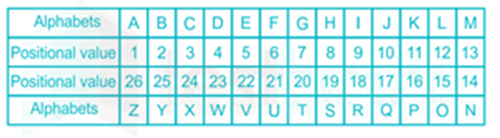
Official Paper

RRB Technician Grade III Official Paper (Held On: 06 March, 2026 Shift 2) (Previous Year Paper)

100 questions · 90 minutes · with answers · free

Mathematics (25 questions)

1

A shopkeeper sold a book at a loss of 6%. If the selling price had been increased by ₹960, there would have been a gain of 19%. What was the cost price (in ₹) of the book?

  1. ((a))

    3850

  2. ((b))

    3845

  3. ((c))

    3840

  4. ((d))

    3835

Show Answer
Answer: ((c))

3840

Shortcut Trick

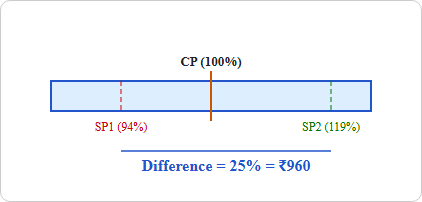
The total difference in percentage = Gain % − (Loss %) = 19% − (−6%) = 25%.

This 25% change is equal to the increase in Selling Price of ₹960.

25% of Cost Price = ₹960

⇒ 100% of Cost Price = 960 × 4 = ₹3840.

∴ The correct answer is ₹3840.

Alternate Method

Given:

Initial Loss = 6%

Final Gain = 19%

Increase in Selling Price (SP) = ₹960

Formula Used:

SP = CP × (100 ± Profit or Loss %)/100
Let the Cost Price (CP) be ₹x.

⇒ Initial Selling Price (SP1) = x × (100 − 6)/100 = 0.94x

⇒ New Selling Price (SP2) = x × (100 + 19)/100 = 1.19x

⇒ According to the question: SP2 − SP1 = 960

⇒ 1.19x − 0.94x = 960

⇒ 0.25x = 960

⇒ x = 960 ÷ 0.25

⇒ x = 960 × 4 = 3840

∴ The correct answer is ₹3840.

Additional Information

Profit and Loss Percentage

Profit % = (Profit ÷ CP) × 100 and Loss % = (Loss ÷ CP) × 100. Both are always calculated on the Cost Price unless stated otherwise.

Selling Price Calculation

When Profit % is P, SP = CP × (100 + P)/100. When Loss % is L, SP = CP × (100 − L)/100.

Marked Price and Discount

Discount is always calculated on the Marked Price (MP). SP = MP − Discount. Discount % = (Discount ÷ MP) × 100.
2

Three workers A, B, C can finish a job in 10, 15, and 20 hours respectively. A and B start; after 2 hours, C joins and they finish the remaining work in t hours. What is the value of t? (Rounded off to the nearest integer.)

  1. ((a))

    4

  2. ((b))

    3

  3. ((c))

    5

  4. ((d))

    6

Show Answer
Answer: ((b))

3

Shortcut Trick

Total Work = LCM(10, 15, 20) = 60 units.

Efficiencies: A = 6, B = 4, C = 3; Combined (A+B+C) = 13 units/hr.

Work done by A and B in 2 hr = (6 + 4) × 2 = 20 units.

Remaining work = 60 − 20 = 40 units.

Time for remaining work (t) = 40 ÷ 13 ≈ 3 hr

∴ The correct answer is 3 hr.

Alternate Method

Given: Time taken by A = 10 hr, B = 15 hr, and C = 20 hr.

Formula: Efficiency = Total Work ÷ Time Taken

PersonDaysTotal WorkEfficiency
A1060 (LCM)60 ÷ 10 = 6
B1560 ÷ 15 = 4
C2060 ÷ 20 = 3

⇒ Efficiency of A and B working together = 6 + 4 = 10 units/hr

⇒ Work done by A and B in the first 2 hr = 10 × 2 = 20 units

⇒ Remaining work to be completed = 60 − 20 = 40 units

⇒ Combined efficiency of A, B, and C = 6 + 4 + 3 = 13 units/hr

⇒ Time taken to finish remaining work (t) = 40 ÷ 13 ≈ 3.08 hr

⇒ So, the value of t = 3 hr

∴ The correct answer is 3 hr.

Additional Information

Total Work using LCM

Taking the Least Common Multiple (LCM) of individual time periods is the most efficient way to assign a value to total work.

Efficiency Relation

Efficiency is inversely proportional to the time taken to complete the work (E ∝ 1/T).

Combined Work Formula

If multiple people work together, their individual efficiencies are added to find the total rate of work per unit time.

3

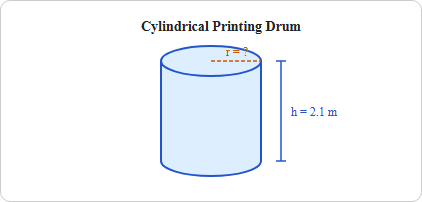
A cylindrical printing drum of length 2.1 m makes 350 complete revolutions and prints 4158 m² of fabric. What is the radius of the drum? (Take π=22/7 \pi = 22/7 )

  1. ((a))

    70 cm

  2. ((b))

    80 cm

  3. ((c))

    60 cm

  4. ((d))

    90 cm

Show Answer
Answer: ((d))

90 cm

Shortcut Trick

Total Area printed = Number of revolutions × Curved Surface Area (CSA)

4158 = 350 × 2 × (22/7) × r × 2.1

4158 = 44 × 350 × 0.3 × r

4158 = 4620 × r ⇒ r = 4158 ÷ 4620 = 0.9 m

r = 0.9 × 100 cm = 90 cm

∴ The correct answer is 90 cm.

Alternate Method

Given:

Length of the cylindrical drum (h) = 2.1 m

Number of revolutions (n) = 350

Total printed area = 4158 m2

Formula Used:

Curved Surface Area of Cylinder = 2 × π × r × h

Total Area = n × Curved Surface Area

Calculations:

⇒ Total Area = n × (2 × π × r × h)

⇒ 4158 = 350 × 2 × (22/7) × r × 2.1

⇒ 4158 = 350 × 2 × 22 × r × 0.3

⇒ 4158 = 4620 × r

⇒ r = 4158 ÷ 4620

⇒ r = 0.9 m

⇒ r = 0.9 × 100 cm

⇒ r = 90 cm

∴ The correct answer is 90 cm.

Additional Information

Volume of a Cylinder

The capacity of a cylindrical container is given by the formula V = πr2h.

Total Surface Area of a Cylinder

It includes the curved area and the areas of the two circular bases: TSA = 2πr(r + h).

Unit Conversion

Always ensure units are consistent. 1 meter (m) = 100 centimeters (cm) and 1 m2 = 10,000 cm2.

4

If 10cos2θ+7sin2θ=7, where 0θ90, then the value of (sinθ+cosθ) is: \text{If } 10 \cos^2 \theta + 7 \sin^2 \theta = 7, \text{ where } 0^\circ \le \theta \le 90^\circ, \text{ then the value of } (\sin\theta + \cos\theta) \text{ is}:

  1. ((a))

    1

  2. ((b))

    2

  3. ((c))

    -1

  4. ((d))

    0

Show Answer
Answer: ((a))

1

Shortcut Trick

Test the standard trigonometric values for θ within the range 0° ≤ θ ≤ 90°.

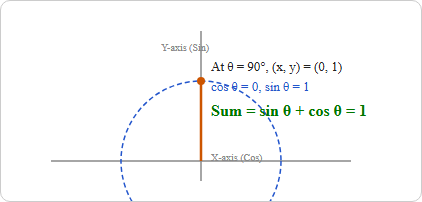
If we put θ = 90°, then cos 90° = 0 and sin 90° = 1.

LHS: 10(0)2 + 7(1)2 = 0 + 7 = 7. Since LHS = RHS, θ = 90° is correct.

Value required: sin 90° + cos 90° = 1 + 0 = 1.

∴ The correct answer is 1.

Alternate Method

Given: 10 cos2 θ + 7 sin2 θ = 7 and 0° ≤ θ ≤ 90°

Formula Used: sin2 θ + cos2 θ = 1

⇒ 10 cos2 θ + 7 sin2 θ = 7

⇒ 3 cos2 θ + 7 cos2 θ + 7 sin2 θ = 7

⇒ 3 cos2 θ + 7(cos2 θ + sin2 θ) = 7

⇒ 3 cos2 θ + 7(1) = 7

⇒ 3 cos2 θ = 7 − 7

⇒ 3 cos2 θ = 0

⇒ cos θ = 0

⇒ Since 0° ≤ θ ≤ 90°, θ = 90°

⇒ Now, sin θ + cos θ = sin 90° + cos 90°

⇒ 1 + 0 = 1

∴ The correct answer is 1.

Additional Information

Trigonometric Identities

Fundamental identities include sin2θ + cos2θ = 1, 1 + tan2θ = sec2θ, and 1 + cot2θ = cosec2θ.

Specific Values for Sine and Cosine

sin 0° = 0, sin 90° = 1 | cos 0° = 1, cos 90° = 0.

Quadratic Form in Trig

Equations of the form a cos2θ + b sin2θ = c can be solved by converting all terms to either sin2θ or cos2θ using basic identities.

5

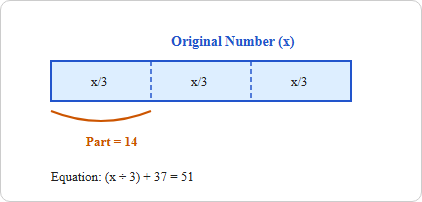
When one-third of a number is increased by 37, the result is 51. Find the sum of the digits of the original number.

  1. ((a))

    8

  2. ((b))

    9

  3. ((c))

    3

  4. ((d))

    6

Show Answer
Answer: ((d))

6

Shortcut Trick

Value of one-third of the number = Final Result − Increase

⇒ 51 − 37 = 14

Original number = 14 × 3 = 42

Sum of the digits = 4 + 2 = 6

∴ The correct answer is 6.

Alternate Method

Given:

Let the original number be x.

According to the question, one-third of x increased by 37 equals 51.

Calculations:

⇒ (x/3) + 37 = 51

⇒ x/3 = 51 − 37

⇒ x/3 = 14

⇒ x = 14 × 3

⇒ x = 42

Now, calculate the sum of the digits of 42:

⇒ Sum = 4 + 2 = 6

∴ The correct answer is 6.

Additional Information

Linear Equation in One Variable

An equation of the form ax + b = c, where x is the unknown variable and a, b, c are constants.

Digit Sum Concept

The digit sum is the sum of all individual digits of a number. For example, for 123, the sum is 1 + 2 + 3 = 6.

Divisibility by 3 and 9

A number is divisible by 3 (or 9) if the sum of its digits is divisible by 3 (or 9).

6

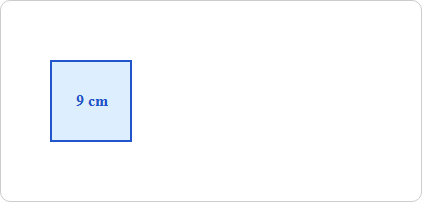
The area of a square is 9 cm2. Its perimeter is equal to the perimeter of a regular hexagon. What is the area (in cm2) of the hexagon?

  1. ((a))

    42342\sqrt{3}

  2. ((b))

    32

  3. ((c))

    636\sqrt{3}

  4. ((d))

    40

Show Answer
Answer: ((c))

636\sqrt{3}

Shortcut Trick

Side of square = √9 = 3 cm ⇒ Perimeter = 4 × 3 = 12 cm.

Side of regular hexagon = 12 ÷ 6 = 2 cm.

Area of hexagon = 6 × (Area of equilateral triangle with side 2 cm).

Area = 6 × (√3 ÷ 4 × 22) = 6 × √3 = 6√3 cm2.

∴ The correct answer is 6√3 cm2.

Alternate Method

Given:

Area of square = 9 cm2

Perimeter of square = Perimeter of regular hexagon

Formula Used:

  1. Area of square = a2 (where a = side)
  2. Perimeter of square = 4a
  3. Perimeter of regular hexagon = 6s (where s = side)
  4. Area of regular hexagon = (3√3 ÷ 2) × s2

Calculations:

⇒ a2 = 9 cm2

⇒ a = √9 = 3 cm

Perimeter of square = 4 × 3 = 12 cm

Perimeter of hexagon = 6s = 12 cm

⇒ s = 12 ÷ 6 = 2 cm

Area of hexagon = (3√3 ÷ 2) × 22

Area of hexagon = (3√3 ÷ 2) × 4

Area of hexagon = 3√3 × 2 = 6√3 cm2

∴ The correct answer is 6√3 cm2.

Additional Information

Regular Hexagon Area

A regular hexagon is composed of 6 equilateral triangles. Area = 6 × (√3/4 × s2) = (3√3/2)s2.

Internal Angles

Each internal angle of a regular hexagon is 120° and the sum of all internal angles is 720°.

Circumradius and Inradius

For a regular hexagon of side s, the circumradius (R) = s and the inradius (r) = (√3/2)s.

7

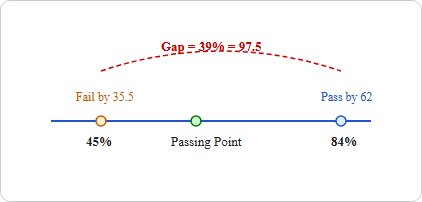
A student scored 84% of the maximum marks in an exam and passed by 62 marks. But when he scored 45% of the marks in the same exam, he failed by 35.5 marks. Find the maximum marks of the exam.

  1. ((a))

    250

  2. ((b))

    240

  3. ((c))

    225

  4. ((d))

    265

Show Answer
Answer: ((a))

250

Shortcut Trick

Difference in percentage = 84% − 45% = 39%

Total difference in marks = 62 (pass) + 35.5 (fail) = 97.5 marks

Since 39% corresponds to 97.5, then 1% = 97.5 ÷ 39 = 2.5

Maximum Marks (100%) = 2.5 × 100 = 250

∴ The correct answer is 250.

Alternate Method

Given:

Case 1: Score = 84%, Result = Passed by 62 marks

Case 2: Score = 45%, Result = Failed by 35.5 marks

Formula Used:

Passing Marks = (Score% × Max Marks) − Pass Margin

Passing Marks = (Score% × Max Marks) + Fail Margin

Calculations:

⇒ Let Maximum Marks be x.

Passing Marks = 0.84x − 62

Passing Marks = 0.45x + 35.5

⇒ 0.84x − 62 = 0.45x + 35.5

⇒ 0.84x − 0.45x = 35.5 + 62

⇒ 0.39x = 97.5

x = 97.5 ÷ 0.39

x = 250

∴ The correct answer is 250.

Additional Information

Passing Percentage

The minimum score required to pass. Passing % = (Passing Marks ÷ Maximum Marks) × 100.

Percentage to Absolute Value

To find the total value when a percentage difference is known: Total = (Difference in values ÷ Difference in %) × 100.
Passing Marks Relation

Obtained Marks + Failing Marks = Passing Marks = Obtained Marks − Passing Margin.

8

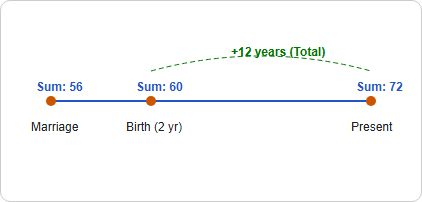
The average age of a husband and wife at the time of their marriage was 28 years. Their daughter was born two years after their marriage. If the present average age of all three family members is 24 years, how many years ago from now, did the couple get married?

  1. ((a))

    8

  2. ((b))

    4

  3. ((c))

    6

  4. ((d))

    7

Show Answer
Answer: ((c))

6

Shortcut Trick

Sum of ages of husband and wife at marriage = 28 × 2 = 56 years.

Sum of ages 2 years later (when daughter was born) = 56 + (2 × 2) + 0 = 60 years.

Present total age of 3 family members = 24 × 3 = 72 years.

Increase in total age since daughter's birth = 72 − 60 = 12 years.

Years passed since daughter's birth = 12 ÷ 3 = 4 years.

Total years since marriage = 2 (before birth) + 4 (after birth) = 6 years.

∴ The correct answer is 6 years.

Alternate Method

Given:

Average age of husband and wife at marriage = 28 years

Time after marriage when daughter was born = 2 years

Present average age of 3 members = 24 years

Formula Used:

Total Age = Average Age × Number of persons

Calculations:

⇒ Sum of ages of husband (H) and wife (W) at marriage = 28 × 2 = 56

⇒ Let they got married 'x' years ago.

⇒ Present age of H + W = 56 + 2x

⇒ Present age of daughter (born 2 years after marriage) = x − 2

⇒ Present total sum = (56 + 2x) + (x − 2)

⇒ 24 × 3 = 54 + 3x

⇒ 72 = 54 + 3x

⇒ 3x = 72 − 54

⇒ 3x = 18

⇒ x = 6

∴ The correct answer is 6 years.

Additional Information

Average Age Concept

If the current average age of n people is A, then after k years, the average age will be A + k.

Sum of Ages

Total sum of ages increases by (Number of people × Number of years) over a period of time.

Birth in Average Problems

When a child is born, the number of members in the family increases, which immediately affects the denominator in the average calculation.

9

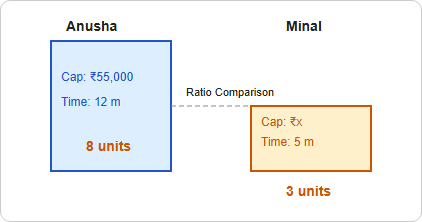
Anusha starts a business with ₹55,000 and after 7 months, Minal joins Anusha as her partner. After a year, the profit is divided in the ratio 8 : 3. What is Minal's contribution in the capital?

  1. ((a))

    ₹48,745

  2. ((b))

    ₹49,410

  3. ((c))

    ₹50,755

  4. ((d))

    ₹49,500

Show Answer
Answer: ((d))

₹49,500

Shortcut Trick

Profit Ratio = Capital × Time

Ratio of (Anusha : Minal) = (55,000 × 12) : (CapitalM × 5) = 8 : 3

⇒ (11,000 × 12) : (CapitalM) = 8 : 3

⇒ 1,32,000 / CapitalM = 8 / 3

⇒ CapitalM = (1,32,000 × 3) / 8 = 16,500 × 3 = 49,500

∴ The correct answer is ₹49,500.
Alternate Method

Given:

Anusha's Capital (CA) = ₹55,000

Anusha's Time (TA) = 12 months

Minal's Time (TM) = 12 − 7 = 5 months

Profit Ratio (PA : PM) = 8 : 3

Formula Used:

Ratio of Profits = (Capital1 × Time1) / (Capital2 × Time2)

Calculations:

⇒ Let Minal's capital be ₹x.

⇒ PA / PM = (CA × TA) / (CM × TM)

⇒ 8 / 3 = (55,000 × 12) / (x × 5)

⇒ 8 / 3 = 6,60,000 / 5x

⇒ 8 × 5x = 6,60,000 × 3

⇒ 40x = 19,80,000

⇒ x = 19,80,000 / 40

⇒ x = 49,500

∴ The correct answer is ₹49,500.
Additional Information

Partnership Basic Rule

Profit is shared in the ratio of the product of Investment and Time Period: P1 : P2 = C1 × T1 : C2 × T2.
Compound Partnership

When partners invest different amounts for different time periods, it is called a compound partnership.

Working Partner

A partner who manages the business is a working partner and often receives a salary or fixed percentage of profit before the remaining profit is divided.

10

One pipe can fill the tank in 20 min, while another pipe can empty the completely filled tank in 45 min. If both the pipes are operated together on empty tank, how long (in min) will it take to fill one-fourth of the tank?

  1. ((a))

    18

  2. ((b))

    36

  3. ((c))

    9

  4. ((d))

    27

Show Answer
Answer: ((c))

9

Shortcut Trick

Net Efficiency of both pipes = 9 (Filling) − 4 (Emptying) = 5 units/min.

Total Capacity (LCM of 20, 45) = 180 units.

Work to fill one-fourth of the tank = 180 ÷ 4 = 45 units.

Time taken = 45 ÷ 5 = 9 min.

∴ The correct answer is 9 min.

Alternate Method

Given:

Time taken by Filling Pipe = 20 min

Time taken by Emptying Pipe = 45 min

Formula Used:

Total Work = Efficiency × Time

PipeTime (min)Total Capacity (LCM)Efficiency
Filling Pipe (A)20180+9
Emptying Pipe (B)45−4

Calculations:

⇒ Total capacity of the tank = LCM(20, 45) = 180 units.

⇒ Net efficiency when both pipes work together = 9 − 4 = 5 units/min.

⇒ Required part of the tank to be filled = 1/4 × 180 = 45 units.

⇒ Time taken = Required Capacity ÷ Net Efficiency

⇒ Time taken = 45 ÷ 5

⇒ Time taken = 9 min.

∴ The correct answer is 9 min.

Additional Information

Pipes & Cisterns Basics

Filling pipes are considered as positive work (+), while emptying pipes (leaks) are considered as negative work (−).

Net Work Done

If pipe A fills in 'x' hours and pipe B empties in 'y' hours, net work in 1 hour = (1/x − 1/y).

Time and Efficiency Relationship

Efficiency is inversely proportional to the time taken to complete the work (Efficiency = 1/Time).

11

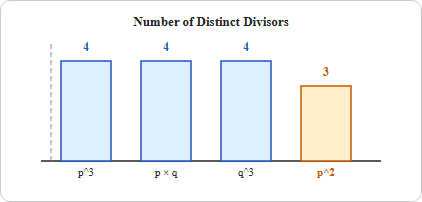
Which of the following numbers DOES NOT have exactly four distinct positive divisors?

  1. ((a))

    p3 for prime p p^3 \text{ for prime } p

  2. ((b))

    pq for distinct primes p and q p \cdot q \text{ for distinct primes } p \text{ and } q

  3. ((c))

    q3 for prime q q^3 \text{ for prime } q

  4. ((d))

    p2 for prime p p^2 \text{ for prime } p

Show Answer
Answer: ((d))

p2 for prime p p^2 \text{ for prime } p

Shortcut Trick

Total divisors for any prime power pn is (n + 1).

Option 1 & 3: p3 and q3 ⇒ 3 + 1 = 4 divisors.

Option 2: p × q ⇒ (1 + 1) × (1 + 1) = 4 divisors.

Option 4: p2 ⇒ 2 + 1 = 3 divisors.

∴ The correct answer is p2 for prime p.

Alternate Method

Given: Four expressions where p and q are prime numbers.

Formula Used: If a number is written in its prime factored form N = am × bn, the total number of positive divisors is (m + 1) × (n + 1).

⇒ For p3: The divisors are 1, p, p2, p3. Total = 4.

⇒ For p × q: The divisors are 1, p, q, pq. Total = 4.

⇒ For q3: Similar to p3, the divisors are 1, q, q2, q3. Total = 4.

⇒ For p2: The divisors are 1, p, p2. Total = 3.

⇒ Therefore, p2 has 3 divisors, which is not equal to 4.

∴ The correct answer is p2 for prime p.

Additional Information

Divisor Rule for Powers

If N = pa, where p is prime, the number of factors is always (a + 1). For example, 22 = 4 has (2 + 1) = 3 factors (1, 2, 4).

Perfect Squares Property

Every perfect square has an odd number of distinct factors, while non-perfect squares always have an even number of factors.

Prime Product Property

The product of two distinct prime numbers (p × q) always results in exactly 4 divisors: {1, p, q, pq}.

12

What is the mode of the following data?

55, 48, 50, 55, 44, 52, 45, 52, 44, 49, 55, 54, 44, 54, 43, 45, 55, 47

  1. ((a))

    55

  2. ((b))

    54

  3. ((c))

    45

  4. ((d))

    44

Show Answer
Answer: ((a))

55

Shortcut Trick

The mode is the value that appears most frequently in a data set.

Frequency of 55 → 4 times (at positions 1, 4, 11, 17)

Frequency of 44 → 3 times (at positions 5, 9, 13)

Frequency of 52, 45, and 54 → 2 times each

Frequency of 48, 50, 49, 43, and 47 → 1 time each

Highest frequency is 4, which belongs to the number 55.

∴ The correct answer is 55.

Alternate Method

Given data set: 55, 48, 50, 55, 44, 52, 45, 52, 44, 49, 55, 54, 44, 54, 43, 45, 55, 47

Formula: Mode = Observation with the maximum frequency.

Frequency Distribution Value: 55 Freq: 4 (MAX) Value: 44 Freq: 3 Value: 52/45 Freq: 2 Mode = 55 (Highest occurring value)

⇒ Counting the occurrences of each unique number in the list:

⇒ 43: 1 time | 44: 3 times | 45: 2 times | 47: 1 time | 48: 1 time

⇒ 49: 1 time | 50: 1 time | 52: 2 times | 54: 2 times | 55: 4 times

⇒ The value 55 occurs 4 times, which is more than any other value.

⇒ Therefore, Mode = 55.

∴ The correct answer is 55.

Additional Information

Empirical Formula

For a moderately skewed distribution, the relationship is: Mode = 3 × Median − 2 × Mean.

Types of Data Distributions

Unimodal has one mode, Bimodal has two modes, and Multimodal has more than two modes. If no value repeats, there is no mode.

Central Tendency Measures

Mean is the average, Median is the middle value after sorting, and Mode is the most frequent value.

13

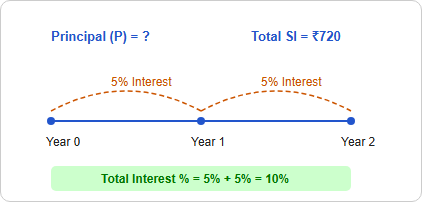
What sum of money (in ₹) will yield ₹720 as simple interest in 2 years at 5% per annum?

  1. ((a))

    6700

  2. ((b))

    7400

  3. ((c))

    7600

  4. ((d))

    7200

Show Answer
Answer: ((d))

7200

Shortcut Trick

Total interest percentage for 2 years = Rate × Time = 5% × 2 = 10%.

Given that 10% of Principal = ₹720.

To find the sum of money (100%), we multiply by 10.

Principal = 720 × 10 = ₹7200.

∴ The correct answer is ₹7200.

Alternate Method

Given:

Simple Interest (SI) = ₹720

Time (T) = 2 years

Rate (R) = 5% per annum

Formula Used:

Simple Interest (SI) = (P × R × T) ÷ 100

Calculations:

⇒ 720 = (P × 5 × 2) ÷ 100

⇒ 720 = (P × 10) ÷ 100

⇒ 720 = P ÷ 10

⇒ P = 720 × 10

⇒ P = ₹7200

∴ The correct answer is ₹7200.

Additional Information

Amount in Simple Interest

The total Amount (A) is the sum of the Principal (P) and the Simple Interest (SI). Formula: A = P + SI = P(1 + RT/100).

Rate of Interest Calculation

If the sum, interest, and time are known, the Rate (R) can be calculated as R = (SI × 100) ÷ (P × T).

Constant Interest Property

In Simple Interest, the interest earned remains the same every year because it is always calculated on the original Principal.

14

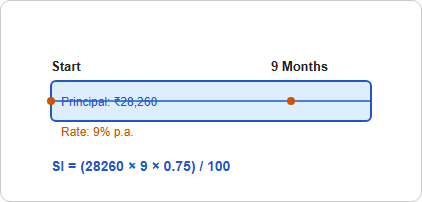
Anisha borrowed ₹28,260 from her friend at 9% per annum, simple interest. She returned the amount after 9 months. How much interest did she pay?

  1. ((a))

    ₹ 1907.55

  2. ((b))

    ₹ 1948.20

  3. ((c))

    ₹ 1970.75

  4. ((d))

    ₹ 1933.25

Show Answer
Answer: ((a))

₹ 1907.55

Shortcut Trick

Total interest percentage for 9 months at 9% per annum = 9 × (9 ÷ 12) = 6.75%.

Simple Interest = 6.75% of ₹28,260.

⇒ 28260 × 0.0675 = 1907.55.

∴ The correct answer is ₹1907.55.

Alternate Method

Given:

Principal (P) = ₹28,260

Rate of interest (R) = 9% per annum

Time period (T) = 9 months

Formula Used:

Simple Interest (SI) = (P × R × T) ÷ 100

Calculations:

⇒ T in years = 9 ÷ 12 = 3/4 years

⇒ SI = (28260 × 9 × 3/4) ÷ 100

⇒ SI = (28260 × 27) ÷ 400

⇒ SI = 763020 ÷ 400

⇒ SI = 1907.55

∴ The correct answer is ₹1907.55.

Additional Information

Total Amount Formula

The total amount (A) to be returned after the time period is the sum of the Principal and the Interest: A = P + SI.

Time Conversion for Interest

When time is given in months, divide by 12 to convert to years. When given in days, divide by 365 (standard year) or 366 (leap year).

Effective Rate of Interest

Effective Rate = R × T. In this case, 9% × 0.75 = 6.75% is the total interest percentage applied to the principal.

15

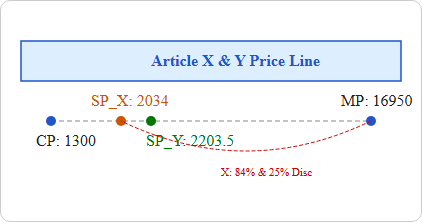
A dealer buys two articles X and Y for ₹1,300 each. He marks each of them at the same price. He sells X by giving two successive discounts of 84% and 25% and still earns ₹734 as profit. If he sells Y at a single discount of 87%, then what is the profit percentage on Y?

  1. ((a))

    69.5%

  2. ((b))

    68.5%

  3. ((c))

    69%

  4. ((d))

    68%

Show Answer
Answer: ((a))

69.5%

Shortcut Trick

SP of Article X = 1300 + 734 = 2034.

Effective selling price factor for X = (1 − 0.84) × (1 − 0.25) = 0.16 × 0.75 = 0.12 of MP.

Selling price for Y = (1 − 0.87) = 0.13 of MP.

Since 12 units = 2034, then 13 units = (2034 ÷ 12) × 13 = 169.5 × 13 = 2203.5.

Profit on Article Y = 2203.5 − 1300 = 903.5.

Profit % = 903.5 ÷ 13 = 69.5%.

∴ The correct answer is 69.5%.

Alternate Method

Given:

Cost Price (CP) of Article X and Article Y = ₹1300 each.

Successive discounts on X = 84% and 25%.

Profit on X = ₹734.

Discount on Y = 87%.

Formula Used:

  1. Selling Price (SP) = CP + Profit
  2. SP = MP × (1 − d1/100) × (1 − d2/100)
  3. Profit % = (Profit / CP) × 100

Calculations:

SP of Article X = 1300 + 734 = ₹2034.

⇒ Let the Marked Price (MP) be M.

⇒ M × (1 − 84/100) × (1 − 25/100) = 2034

⇒ M × 0.16 × 0.75 = 2034

⇒ M × 0.12 = 2034

⇒ M = 2034 / 0.12 = ₹16950.

SP of Article Y = MP × (1 − 87/100) = 16950 × 0.13

SP of Article Y = ₹2203.5.

Profit on Article Y = 2203.5 − 1300 = ₹903.5.

Profit % = (903.5 / 1300) × 100 = 69.5%.

∴ The correct answer is 69.5%.

Additional Information

Successive Discounts Formula

When two successive discounts of a% and b% are given, the single equivalent discount is calculated as (a + b − ab/100)%.

Markup and Discount Relation

Profit % can be related to markup and discount as: (100 + P)/(100 − D) = MP/CP, where P is profit % and D is discount %.

Successive Percentage Change

For any quantity changing by x% and then y% successively, the net percentage change is given by (x + y + xy/100)%.

16

Two numbers are in the ratio of 4 : 5, and their HCF is 16. Find the LCM of the two numbers.

  1. ((a))

    360

  2. ((b))

    340

  3. ((c))

    320

  4. ((d))

    380

Show Answer
Answer: ((c))

320

Shortcut Trick

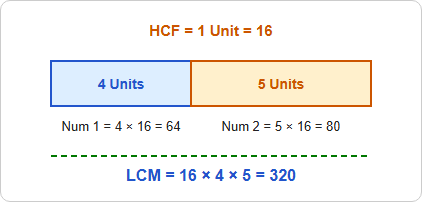
Given Ratio = 4 : 5 and HCF = 16.

Trick: LCM = HCF × Product of the Ratio terms.

LCM = 16 × 4 × 5 = 320.

∴ The correct answer is 320.

Alternate Method

Given:

Ratio of two numbers = 4 : 5

Highest Common Factor (HCF) = 16

Formula Used:

If the ratio of two numbers is a : b and their HCF is x, then the numbers are ax and bx.

LCM of these numbers = x × a × b (where a and b are coprime).

Let the numbers be 4k and 5k.

Since the HCF is the common factor k, we have:

⇒ k = 16

⇒ First number = 4 × 16 = 64

⇒ Second number = 5 × 16 = 80

⇒ LCM(64, 80) = 16 × 4 × 5

⇒ LCM = 320

∴ The correct answer is 320.

Additional Information

Product of Two Numbers Rule

For any two positive integers, the product of the numbers is equal to the product of their HCF and LCM: n1 × n2 = HCF × LCM.

HCF as a Factor of LCM

The Highest Common Factor of any set of numbers is always a factor of their Least Common Multiple.

Coprime Numbers Property

If two numbers are coprime (HCF = 1), then their LCM is simply the product of the numbers themselves.

17

If x2 1x2\frac{1}{x^2} = 16 and x \ne 0, then what is the value of x4 + 1x4\frac{1}{x^4} ?

  1. ((a))

    260

  2. ((b))

    252

  3. ((c))

    254

  4. ((d))

    258

Show Answer
Answer: ((c))

254

Shortcut Trick

For any algebraic expression where xn + 1/xn = k, the value of the squared power term x2n + 1/x2n is given by k2 − 2.

Here, the power is being doubled from 2 to 4, so n = 2 and the given value k = 16.

Applying the trick: x4 + 1/x4 = 162 − 2.

256 − 2 = 254.

∴ The correct answer is 254.

Alternate Method

Given: x2 + 1/x2 = 16

Formula Used: (a + b)2 = a2 + b2 + 2ab (Algebraic Identity for Squaring)

⇒ To find the value of x4 + 1/x4, we square the given equation on both sides:

⇒ (x2 + 1/x2)2 = (16)2

⇒ (x2)2 + (1/x2)2 + 2 × (x2) × (1/x2) = 256

⇒ x4 + 1/x4 + 2 = 256

⇒ x4 + 1/x4 = 256 − 2

⇒ x4 + 1/x4 = 254

∴ The correct answer is 254.

Additional Information

Successive Squaring

If x + 1/x = a, then x2 + 1/x2 = a2 − 2. To find x4 + 1/x4, we apply the same rule to the new result: (a2 − 2)2 − 2.

Reciprocal Cube Identity

If x + 1/x = a, then the value of x3 + 1/x3 is calculated as a3 − 3a.

Negative Reciprocal Relation

If x − 1/x = a, then x2 + 1/x2 = a2 + 2. Note the sign change in the constant term when the original expression is negative.

18

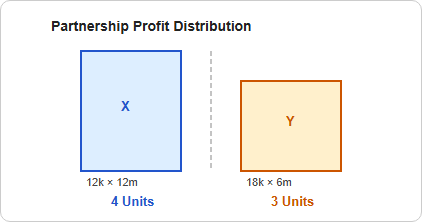
A person X invests ₹12,000 for 12 months and person Y invests ₹18,000 but withdraws his investment after 6 months. If the total profit earned on their investment is ₹25,200, what is X’s share in the profit?

  1. ((a))

    ₹16,800

  2. ((b))

    ₹15,700

  3. ((c))

    ₹13,900

  4. ((d))

    ₹14,400

Show Answer
Answer: ((d))

₹14,400

Shortcut Trick

Profit Ratio (X : Y) = (Capital × Time)X : (Capital × Time)Y

Profit Ratio = (12,000 × 12) : (18,000 × 6) = 144,000 : 108,000 = 4 : 3

Total Ratio parts = 4 + 3 = 7 units → ₹25,200

1 unit = ₹3,600

X's share = 4 × ₹3,600 = ₹14,400

∴ The correct answer is ₹14,400.

Alternate Method

Given:

Investment of X = ₹12,000 for 12 months

Investment of Y = ₹18,000 for 6 months

Total Profit = ₹25,200

Formula Used:

Profit Ratio = (Investment1 × Time1) : (Investment2 × Time2)

Calculations:

⇒ Profit Ratio (X : Y) = (12,000 × 12) : (18,000 × 6)

⇒ Profit Ratio (X : Y) = 1,44,000 : 1,08,000

⇒ Simplifying by 36,000: Ratio = 4 : 3

⇒ Total profit units = 4 + 3 = 7 units

⇒ 7 units = ₹25,200

⇒ 1 unit = ₹25,200 ÷ 7 = ₹3,600

X's share = 4 units = 4 × ₹3,600 = ₹14,400

∴ The correct answer is ₹14,400.

Additional Information

Compound Partnership

When partners invest different amounts for different periods of time, the profit is shared in the ratio of the product of their capital and time period (Capital × Time).

Ratio of Capitals

If the profit ratio and time ratio are given, the capital ratio can be found as (Profit1/Time1) : (Profit2/Time2).

Working vs Sleeping Partner

A working partner manages the business and often receives a fixed percentage of total profit as salary before the remaining profit is distributed among all partners.

19

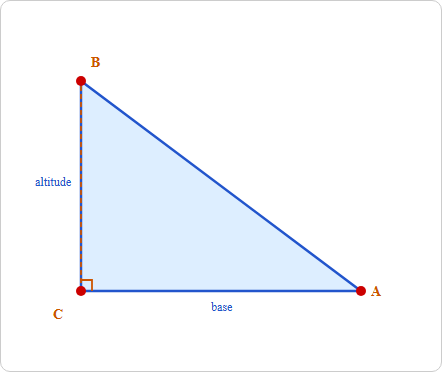
Which of the following is not a property of triangles ?

(i) The sum of three angles of a triangle is always 180°.

(ii) Area of a triangle is defined as (1/3 × base × length of altitude)

(iii) The perimeter of a triangle is the sum of lengths of all three sides.

(iv) The exterior angle of a triangle is equal to the sum of its interior opposite angles.

  1. ((a))

    (ii)

  2. ((b))

    (i)

  3. ((c))

    (iv)

  4. ((d))

    (iii)

Show Answer
Answer: ((a))

(ii)

Shortcut Trick

The area of a triangle is fundamentally defined by half the product of its base and corresponding altitude.

Formula: Area = 1/2 × base × altitude.

In the given options, statement (ii) specifies the fraction as 1/3, which is used for calculating the volume of pyramids or cones, not the area of a 2D triangle.

Other properties (i), (iii), and (iv) are standard geometric theorems for all triangles.

∴ The correct answer is (ii).

Alternate Method

Given: Four statements regarding the properties of a triangle.

Formula Used: Angle Sum Property, Area Formula, Perimeter Definition, and Exterior Angle Theorem.

Verification of properties:

Property (i): Sum of internal angles = ∠A + ∠B + ∠C = 180°. This is always true for any Euclidean triangle.

Property (ii): Mathematical Area of a triangle = 1/2 × base × altitude. The given statement (ii) uses 1/3, making it incorrect.

Property (iii): Perimeter = Length(AB) + Length(BC) + Length(CA). This is the standard definition of perimeter for any polygon.

Property (iv): According to the Exterior Angle Theorem, the exterior angle at any vertex equals the sum of the two opposite interior angles.

⇒ Therefore, statement (ii) is not a property of a triangle.

∴ The correct answer is (ii).

Additional Information

Heron's Formula

For a triangle with sides a, b, and c, the area is √[s(s−a)(s−b)(s−c)], where s is the semi-perimeter (a+b+c)/2.

Triangle Inequality Theorem

The sum of the lengths of any two sides of a triangle must always be strictly greater than the length of the third side.

Pythagoras Theorem

In a right-angled triangle, the square of the hypotenuse is equal to the sum of the squares of the other two sides (a2 + b2 = c2).

20

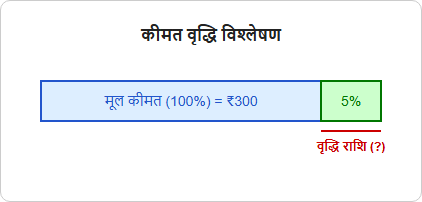
If the cost of a book is ₹300 and its price is increased by 5%, by how much will the new price exceed the original price?

  1. ((a))

    ₹15

  2. ((b))

    ₹20

  3. ((c))

    ₹25

  4. ((d))

    ₹10

Show Answer
Answer: ((a))

₹15

Shortcut Trick

वृद्धि राशि ज्ञात करने के लिए सीधे प्रतिशत निकालें:

300 का 5% = 300 × 0.05

⇒ 3 × 5 = 15

∴ The correct answer is ₹15.

Alternate Method

दिया गया है:

पुस्तक की मूल कीमत = ₹300

कीमत में वृद्धि प्रतिशत = 5%

सूत्र: वृद्धि राशि = मूल कीमत × (वृद्धि प्रतिशत ÷ 100)

⇒ वृद्धि राशि = 300 × (5 ÷ 100)

⇒ वृद्धि राशि = 300 × 0.05

⇒ वृद्धि राशि = 15

अतः, नई कीमत मूल कीमत से ₹15 अधिक होगी।

∴ The correct answer is ₹15.

Additional Information

प्रतिशत वृद्धि (Percentage Increase)

जब किसी वस्तु के मूल्य में प्रतिशत वृद्धि होती है, तो बढ़ी हुई राशि (मूल मूल्य × दर) ÷ 100 होती है।

नया मूल्य (New Price)

वृद्धि के बाद नया मूल्य = मूल मूल्य + वृद्धि राशि। इस प्रश्न में नया मूल्य 300 + 15 = ₹315 होगा।

प्रतिशत कमी (Percentage Decrease)

यदि कीमत में 5% की कमी होती, तो कमी की राशि ₹15 होती और नया मूल्य ₹285 होता।

21

If x=5+252 x = \frac{\sqrt{5} + 2}{\sqrt{5} - 2} and y=525+2 y = \frac{\sqrt{5} - 2}{\sqrt{5} + 2} , then find the value of x2+y2 x^2 + y^2 .

  1. ((a))

    322

  2. ((b))

    311

  3. ((c))

    302

  4. ((d))

    312

Show Answer
Answer: ((a))

322

Shortcut Trick

If x = (√a + √b)/(√a − √b) and y is its reciprocal, then x + y = 2(a + b)/(a − b) and xy = 1.

Here, a = 5 and b = 4 (since 2 = √4), so x + y = 2(5 + 4) / (5 − 4) = 18.

Using the algebraic identity, x2 + y2 = (x + y)2 − 2xy.

x2 + y2 = 182 − 2(1) = 324 − 2 = 322.

∴ The correct answer is 322.

Alternate Method

Given: x = (√5 + 2)/(√5 − 2) and y = (√5 − 2)/(√5 + 2)

Formula Used: x2 + y2 = (x + y)2 − 2xy

Rationalizing x: x = [(√5 + 2) × (√5 + 2)] / [(√5 − 2) × (√5 + 2)]

⇒ x = (√5 + 2)2 / (5 − 4) = 5 + 4 + 4√5 = 9 + 4√5

Rationalizing y: y = [(√5 − 2) × (√5 − 2)] / [(√5 + 2) × (√5 − 2)]

⇒ y = (√5 − 2)2 / (5 − 4) = 5 + 4 − 4√5 = 9 − 4√5

⇒ x + y = (9 + 4√5) + (9 − 4√5) = 18

⇒ xy = (9 + 4√5)(9 − 4√5) = 81 − 16(5) = 81 − 80 = 1

⇒ x2 + y2 = (18)2 − 2(1)

⇒ x2 + y2 = 324 − 2 = 322

∴ The correct answer is 322.

Additional Information

Sum of Squares Identity

The expression a2 + b2 can be written as (a + b)2 − 2ab or (a − b)2 + 2ab depending on the given values.

Conjugate Surds

The conjugate of (√a + b) is (√a − b). Their product (√a + b)(√a − b) = a − b2 results in a rational number.

Reciprocal Sum Property

If x = √a + √b and y = √a − √b where a − b = 1, then x and y are reciprocals of each other, meaning xy = 1.

22

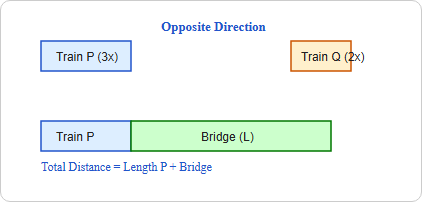
The lengths of two trains starting from stations P and Q are in the ratio 3 : 2. When they run in opposite directions at speeds of 54 km/h and 72 km/h, respectively, they cross each other in 30 seconds. The train starting from P crosses a bridge in 90 seconds. Find the length of the bridge.

  1. ((a))

    740 meters

  2. ((b))

    720 meters

  3. ((c))

    780 meters

  4. ((d))

    620 meters

Show Answer
Answer: ((b))

720 meters

Shortcut Trick

Relative Speed = (54 + 72) × 5/18 = 35 m/s.

Total Length (P + Q) = 35 × 30 = 1050 m.

Length of Train P = (3/5) × 1050 = 630 m.

Total Distance covered by P in 90 sec = 15 × 90 = 1350 m.

Length of Bridge = 1350 − 630 = 720 m.

∴ The correct answer is 720 m.

Alternate Method

Given:

Ratio of lengths of Train P and Train Q = 3 : 2

Speed of Train P (SP) = 54 km/h | Speed of Train Q (SQ) = 72 km/h

Time to cross each other = 30 sec | Time for P to cross bridge = 90 sec

Formula Used:

Distance = Speed × Time | Relative Speed (Opposite) = S1 + S2

Calculations:

⇒ Let Length of Train P = 3x and Train Q = 2x

⇒ SP in m/s = 54 × (5/18) = 15 m/s

⇒ SQ in m/s = 72 × (5/18) = 20 m/s

⇒ Relative Speed = 15 + 20 = 35 m/s

⇒ (3x + 2x) = 35 × 30

⇒ 5x = 1050 ⇒ x = 210

⇒ Length of Train P = 3 × 210 = 630 m

⇒ When P crosses bridge of length L:

⇒ 630 + L = 15 × 90

⇒ 630 + L = 1350

⇒ L = 1350 − 630 = 720 m

∴ The correct answer is 720 m.

Additional Information

Relative Speed Concept

When two objects move in opposite directions, their relative speed is S1 + S2. In the same direction, it is |S1 − S2|.

Unit Conversion

To convert km/h to m/s, multiply by 5/18. To convert m/s to km/h, multiply by 18/5.

Train Crossing Objects

Total distance = Train length + Object length (if object has length like a bridge, platform, or tunnel). For a pole or man, distance = Train length only.

23

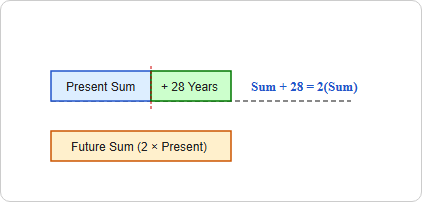
Fourteen years from now, the sum of A's and B's ages will be twice the sum of their current ages. If A is currently 8 years older than B, what is A's present age?

  1. ((a))

    16

  2. ((b))

    12

  3. ((c))

    10

  4. ((d))

    18

Show Answer
Answer: ((d))

18

Shortcut Trick

Total years added to the sum of ages in 14 years = 14 × 2 = 28 years.

Given: Future Sum = 2 × Present Sum ⇒ Present Sum + 28 = 2 × Present Sum.

⇒ Present Sum (A + B) = 28 years.

Age difference (A − B) = 8 years.

A's present age = (Sum + Difference) ÷ 2 = (28 + 8) ÷ 2 = 18 years.

∴ The correct answer is 18.

Alternate Method

Given:

Difference between A's age and B's age = 8 years.

Condition: Age sum 14 years later = 2 × (Age sum now).

Let B's present age be x years.

Then A's present age = (x + 8) years.

According to the question:

⇒ [(x + 8) + 14] + [x + 14] = 2 × [(x + 8) + x]

⇒ (x + 22) + (x + 14) = 2 × (2x + 8)

⇒ 2x + 36 = 4x + 16

⇒ 4x − 2x = 36 − 16

⇒ 2x = 20

⇒ x = 10

A's present age = x + 8 = 10 + 8 = 18 years.

∴ The correct answer is 18.

Additional Information

Constant Age Difference

The numerical difference between the ages of two individuals remains the same throughout their lives, regardless of how many years pass.

Sum and Difference Rule

If the Sum (S) and Difference (D) of two ages are known, then Elder age = (S + D) ÷ 2 and Younger age = (S − D) ÷ 2.

Ratio Method in Ages

When ages are given in ratios at different time periods, ensure the ratio difference between the two individuals is made equal to solve for the multiplier.

24

Simplify: [(36+4×(3+2×(52)))÷(6+3)]+[(40(6+3×2))+(8×26)] [ ( 36 + 4 \times ( 3 + 2 \times ( 5 - 2 ) ) ) \div ( 6 + 3 ) ] + [ ( 40 - ( 6 + 3 \times 2 ) ) + ( 8 \times 2 - 6 ) ]

  1. ((a))

    38

  2. ((b))

    42

  3. ((c))

    52

  4. ((d))

    46

Show Answer
Answer: ((d))

46

Shortcut Trick

Solve the inner brackets first: 3 + 2 × 3 = 9 and 40 − 12 = 28.

Simplify the first major term: (36 + 4 × 9) ÷ 9 ⇒ 72 ÷ 9 = 8.

Simplify the second major term: 28 + (16 − 6) ⇒ 28 + 10 = 38.

Combine the results: 8 + 38 = 46.

∴ The correct answer is 46.

Alternate Method

Given: [ ( 36 + 4 × ( 3 + 2 × ( 5 − 2 ) ) ) ÷ ( 6 + 3 ) ] + [ ( 40 − ( 6 + 3 × 2 ) ) + ( 8 × 2 − 6 ) ]

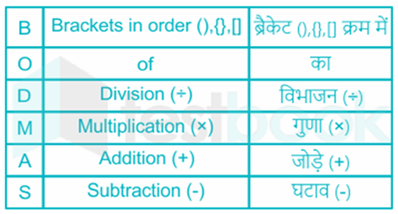
According to the BODMAS rule, we solve in the order: Brackets, Of, Division, Multiplication, Addition, and Subtraction.

⇒ [ ( 36 + 4 × ( 3 + 2 × 3 ) ) ÷ 9 ] + [ ( 40 − ( 6 + 6 ) ) + ( 16 − 6 ) ]

⇒ [ ( 36 + 4 × 9 ) ÷ 9 ] + [ ( 40 − 12 ) + 10 ]

⇒ [ ( 36 + 36 ) ÷ 9 ] + [ 28 + 10 ]

⇒ [ 72 ÷ 9 ] + 38

⇒ 8 + 38 = 46

∴ The correct answer is 46.

Additional Information

BODMAS / VBODMAS Rule

It defines the sequence of operations: Vinculum (Bar), Brackets, Of (multiplication), Division, Multiplication, Addition, and Subtraction.

Order of Brackets

Always simplify parentheses ( ) first, then curly braces { }, and finally square brackets [ ].

Arithmetic Precedence

In expressions with only addition and subtraction or only multiplication and division, solve from left to right.

25

Simplify: (56+13)÷(25+0.3)×0.5+56 ( \frac{5}{6} + \frac{1}{3} ) \div ( \frac{2}{5} + 0.3 ) \times 0.5 + \frac{5}{6}

  1. ((a))

    53 \frac{5}{3}

  2. ((b))

    13 \frac{1}{3}

  3. ((c))

    56 \frac{5}{6}

  4. ((d))

    16 \frac{1}{6}

Show Answer
Answer: ((a))

53 \frac{5}{3}

Shortcut Trick

Convert all terms to simple fractions: (5/6 + 2/6) ÷ (4/10 + 3/10) × 1/2 + 5/6

Solve brackets: (7/6) ÷ (7/10) × 1/2 + 5/6

Apply division and multiplication: (7/6 × 10/7) × 1/2 + 5/6 = 10/6 × 1/2 + 5/6

Final addition: 5/6 + 5/6 = 10/6 = 5/3

∴ The correct answer is 5/3.

Alternate Method

Given: ((5/6) + (1/3)) ÷ ((2/5) + 0.3) × 0.5 + (5/6)

Method Used: BODMAS Rule (Brackets, Orders, Division, Multiplication, Addition, Subtraction)

⇒ Step 1 (Solve first bracket): (5/6 + 2/6) = 7/6

⇒ Step 2 (Solve second bracket): (2/5 + 3/10) = (4/10 + 3/10) = 7/10

⇒ Step 3 (Substitute values): (7/6) ÷ (7/10) × 0.5 + 5/6

⇒ Step 4 (Perform division): 7/6 × 10/7 = 10/6

⇒ Step 5 (Perform multiplication): 10/6 × 1/2 = 5/6

⇒ Step 6 (Final addition): 5/6 + 5/6 = 10/6

⇒ Simplify: 5/3

∴ The correct answer is 5/3.

Additional Information

BODMAS Rule

This rule defines the order of operations: Brackets (), Of (multiplication), Division (÷), Multiplication (×), Addition (+), and Subtraction (−).

Fraction Division

To divide two fractions, multiply the first fraction by the reciprocal of the second fraction: a/b ÷ c/d = a/b × d/c.

Decimal to Fraction Conversion

Convert decimals to fractions by placing the number over a power of 10. For example, 0.3 = 3/10 and 0.5 = 5/10 = 1/2.

General Intelligence & Reasoning (25 questions)

26

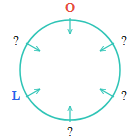
Six friends B, C, L, M, N and O are sitting around a circular table facing the center of the table. L sits fourth to the right of O. Only one person sits between M and N when counted from the left of M. L sits third to the left of C. B is an immediate neighbor of C and N. How many people sit between L and B when counted from the left of B?

  1. ((a))

    Three

  2. ((b))

    One

  3. ((c))

    Four

  4. ((d))

    Two

Show Answer
Answer: ((a))

Three

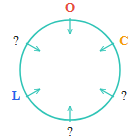
  1. Since all persons face the centre: right = counter-clockwise (CCW), left = clockwise (CW). Fix O at pos(1). L sits fourth to the right of O (CCW): O(1)234L(5).

  1. L sits third to the left of C. This means C sits third to the right of L (CCW): L(5)61C(2). So, C is at pos(2).

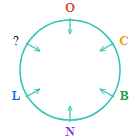
  1. B is an immediate neighbor of C and N. Since O is at pos(1), B must be at pos(3) to be next to C, and N must be at pos(4) so that B is also next to N.

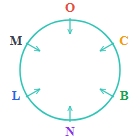
  1. The last person M fills the remaining pos(6). This fits the condition: one person (L) sits between M and N from the left of M (CW): M(6)L(5)N(4).

<br>

To find the number of people between L and B when counted from the left of B (clockwise direction): Starting from B(3) going CW: C(2), O(1), M(6), and then we reach L(5). The people sitting between them are C, O, and M, which is a total of three people.


Hence, the correct answer is 'Option 1'.

27

Based on the English alphabetical order, three of the following four letter-clusters are alike in a certain way and thus form a group. Which letter-cluster DOES NOT belong to that group?


(Note: The odd one out is not based on the number of consonants/vowels or their position in the letter-cluster.)

  1. ((a))

    TYE

  2. ((b))

    MRX

  3. ((c))

    PUA

  4. ((d))

    GKP

Show Answer
Answer: ((d))

GKP

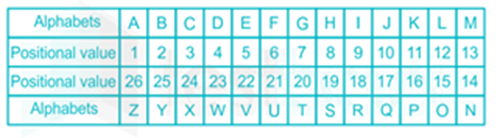
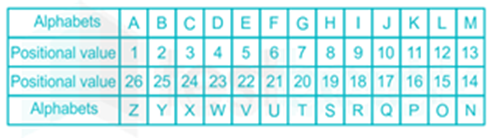
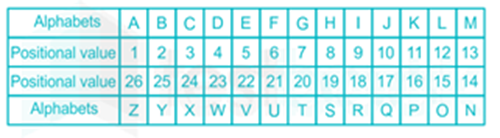
The logic followed here is the gap between the letters based on their positional values in the English alphabetical series.

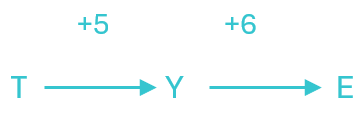
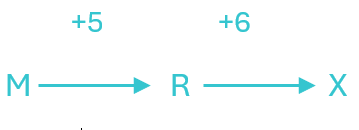
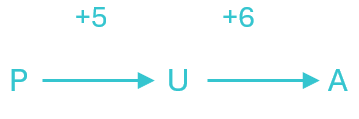
Logic: 1st Letter + 5 = 2nd Letter and 2nd Letter + 6 = 3rd Letter.

Option 1) TYE,

Option 2) MRX,

Option 3) PUA

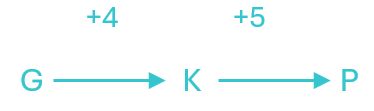
Option 4) GKP

This letter-cluster follows a +4, +5 pattern and does not belong to the group.

Therefore, the letter-cluster that is different from the others is GKP.

Hence, the correct answer is 'Option 4'.

28

What should come in place of ? in the given series based on the English alphabetical order?

<br>

LPF KOE JND IMC ?

  1. ((a))

    HLB

  2. ((b))

    HKB

  3. ((c))

    HKA

  4. ((d))

    HLA

Show Answer
Answer: ((a))

HLB

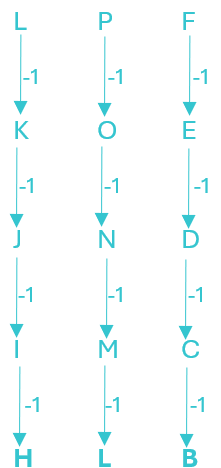
The logic followed here is based on the English alphabetical series where each letter of the subsequent term is obtained by subtracting 1 from the positional value of the corresponding letter in the previous term.

The next term in the series is HLB.

Hence, the correct answer is "Option 1".

29

The position(s) of how many letters will remain unchanged if each letter in the word COMBINED is arranged in the English alphabetical order?

  1. ((a))

    None

  2. ((b))

    Two

  3. ((c))

    Three

  4. ((d))

    One

Show Answer
Answer: ((d))

One

The logic followed here is to compare the position of each letter in the word COMBINED with its position when the letters are arranged in English alphabetical order.

Original Word:

COMBINED
1st2nd3rd4th5th6th7th8th


Arranging letters in English Alphabetical Order:

BCDEIMNO
1st2nd3rd4th5th6th7th8th


Comparison of positions:

  • Position 1: C → B (Changed)
  • Position 2: O → C (Changed)
  • Position 3: M → D (Changed)
  • Position 4: B → E (Changed)
  • Position 5: I → I (Unchanged)
  • Position 6: N → M (Changed)
  • Position 7: E → N (Changed)
  • Position 8: D → O (Changed)

Only the letter I remains in the same position as in the original word.

Therefore, the position of One letter remains unchanged.

Hence, the correct answer is "Option 4".

30

In a certain code language, ‘door closed now’ is coded as ‘vt xg uk’ and ‘school is closed’ is coded as ‘cw uk ne’. How is ‘closed’ coded in the given language? (All the codes are two letter codes only.)

  1. ((a))

    uk

  2. ((b))

    ne

  3. ((c))

    xg

  4. ((d))

    vt

Show Answer
Answer: ((a))

uk

Logic followed here is.

The code for a specific word is determined by comparing the given sentences to identify the unique common word and its corresponding common code.

Analysis of the given sentences:

  1. 'door closed now' is coded as 'vt xg uk'

  2. 'school is closed' is coded as 'cw uk ne'

Therefore, 'closed' is coded as 'uk'.

Hence, the correct answer is "Option 1".

31

What should come in place of ‘?’ in the given series?

<br>

44 52 61 71 82 ?

  1. ((a))

    96

  2. ((b))

    94

  3. ((c))

    98

  4. ((d))

    92

Show Answer
Answer: ((b))

94

Logic followed here is:

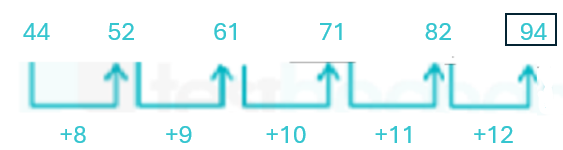
Logic: The difference between consecutive terms in the series increases by 1 at each step, representing a sequence of consecutive natural numbers starting from 8.


Therefore, the missing number that should come in place of the question mark is 94.

Hence, the correct answer is "Option 2".

32

A, B, C, P, S, T and U are sitting in a straight line facing the north. Only three people are seated to the left of S. Only A is seated to the right of B. Only three people are seated between B and C. P is seated at some place to the left of T, but at some place to the right of U. How many people are seated between U and T?

  1. ((a))

    Three

  2. ((b))

    One

  3. ((c))

    Two

  4. ((d))

    Four

Show Answer
Answer: ((a))

Three

The arrangement of seven people A, B, C, P, S, T, and U sitting in a straight line facing North is determined as follows:

1) Only three people are seated to the left of S.

2) Only A is seated to the right of B.

3) Only three people are seated between B and C.

4) P is seated at some place to the left of T, but at some place to the right of U.


Final Arrangement:

Calculation of people between U and T:

U is at the 1st position and T is at the 5th position.

The people seated between them are C (2nd), P (3rd), and S (4th).

Total number of people = 3.

Therefore, there are three people seated between U and T.

Hence, the correct answer is "Option 1".

33

Select the pair which follows the same pattern as that followed by the two pairs given below. Both pairs follow the same pattern.

KSD : HPA
FXM : CUJ

  1. ((a))

    HRC : EOY

  2. ((b))

    NBJ : JZH

  3. ((c))

    LIQ : IFN

  4. ((d))

    ATU : XRS

Show Answer
Answer: ((c))

LIQ : IFN

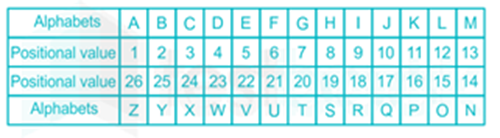
The logic followed in this pattern is based on a consistent shift in the alphabetical positions of the letters.

For 'KSD' related to 'HPA':

K(11)S(19)D(4)
−3 ↓−3 ↓−3 ↓
H(8)P(16)A(1)

For 'FXM' related to 'CUJ':

F(6)X(24)M(13)
−3 ↓−3 ↓−3 ↓
C(3)U(21)J(10)

Applying the same logic to 'LIQ':

L(12)I(9)Q(17)
−3 ↓−3 ↓−3 ↓
I(9)F(6)N(14)

Thus, LIQ is related to IFN by the same pattern.

Hence, the correct answer is 'Option 3'.

34

Based on the English alphabetical order, three of the following four letter-cluster pairs are alike in a certain way and thus form a group. Which letter-cluster pair DOES NOT belong to that group?

(Note: The odd one out is not based on the number of consonants/vowels or their position in the letter-cluster.)

  1. ((a))

    QK - VH

  2. ((b))

    AE - FB

  3. ((c))

    WH - BD

  4. ((d))

    GQ - LN

Show Answer
Answer: ((c))

WH - BD

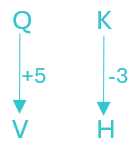
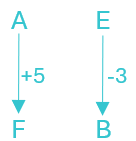
The logic followed here is

Logic: First letter of the second cluster = First letter of the first cluster + 5; Second letter of the second cluster = Second letter of the first cluster − 3.

Option 1)  QK - VH,

Option 2) AE - FB,

Option 3) WH - BD

This pair does not follow the rule.

Option 4) GQ - LN,

Therefore, the letter-cluster pair that is different from the others is WH - BD.

Hence, the correct answer is 'Option 3'.

35

What should come in place of ? in the given series based on the English alphabetical order?

<br>

NPM LQJ JRG HSD ?

  1. ((a))

    FTA

  2. ((b))

    HGT

  3. ((c))

    NHY

  4. ((d))

    MNJ

Show Answer
Answer: ((a))

FTA

The logic followed here is based on the positional values of letters in the English alphabetical series.

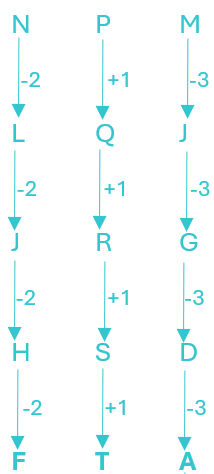
The series consists of three letter positions in each term. Let's analyze the pattern for each position independently:

Therefore, the term that should come in place of the question mark is FTA.

Hence, the correct answer is "Option 1".

36

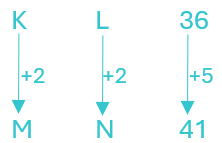
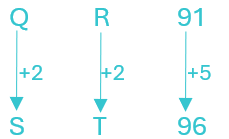
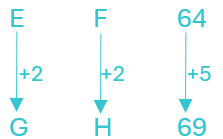
KL 36 is related to MN 41 in a certain way. In the same way, QR 91 is related to ST 96. To which of the following is EF 64 related, following the same logic?

  1. ((a))

    GI 69

  2. ((b))

    IJ 79

  3. ((c))

    HI 68

  4. ((d))

    GH 69

Show Answer
Answer: ((d))

GH 69

Given:

KL 36 : MN 41

QR 91 : ST 96

EF 64 : GH 69

Hence, EF 64 relates to GH 69 following the same pattern.

Hence, the correct answer is 'Option 4'.

37

In a certain code language,

A + B means ‘A is the son of B’

A – B means ‘A is the brother of B’

A @ B means ‘A is the daughter of B’

A # B means ‘A is the father of B’

Based on the above, how is F related to O if ‘F # L – R @ O’?

  1. ((a))

    Son

  2. ((b))

    Father

  3. ((c))

    Husband

  4. ((d))

    Brother

Show Answer
Answer: ((c))

Husband

Given:

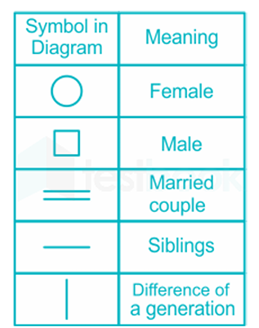
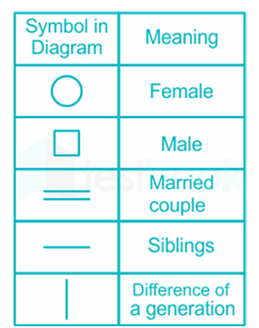
Let us first decode the given symbols and then draw a family tree.

A is
Symbol+@#
MeaningSonBrotherDaughterFather
of B


On checking the expression: F # L − R @ O

  1. F # L - 'F # L' means 'F is the father of L'.

  2. L − R - 'L − R' means 'L is the brother of R'.

  3. R @ O - 'R @ O' means 'R is the daughter of O'.

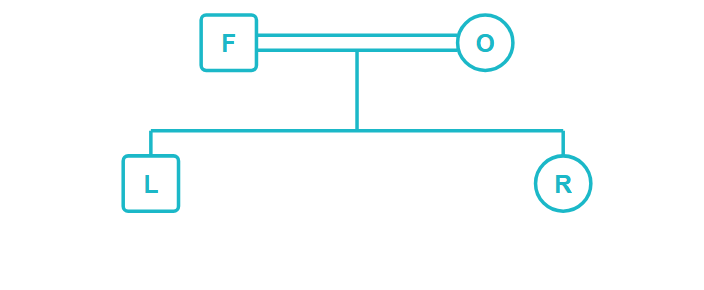
Therefore, F is the father of L and R, and O is the mother of R. Thus, F is the husband of O.

Hence, the correct answer is 'Option 3'.

38

Mr. Kell ranked 84th from the top and 123rd from the bottom in his class. How many students are there in his class?

  1. ((a))

    206

  2. ((b))

    432

  3. ((c))

    453

  4. ((d))

    244

Show Answer
Answer: ((a))

206

The logic followed here is:

Position of Mr. Kell from the top = 84th

Position of Mr. Kell from the bottom = 123rd

To find the Total number of students in the class, we use the formula:

Total number of students = (Rank from the top + Rank from the bottom) − 1

= (84 + 123) − 1

= 207 − 1

= 206

Hence, the correct answer is 'Option 1'.

39

Ritik is the brother of Kajal. Kajal is the wife of Abhishek. Abhishek is the father of Megha. Megha is the sister of Priti. How is Ritik related to Priti?

  1. ((a))

    Father's brother

  2. ((b))

    Mother's brother

  3. ((c))

    Mother's father

  4. ((d))

    Father's father

Show Answer
Answer: ((b))

Mother's brother

Given:

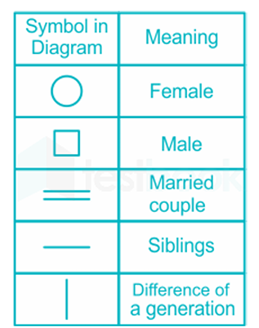
Based on the relationship description, let us draw a family tree.

  1. Ritik is the brother of Kajal - Ritik (Male) and Kajal (Female) are siblings.

  2. Kajal is the wife of Abhishek - Kajal and Abhishek (Male) are a married couple.

  3. Abhishek is the father of Megha - Abhishek is the parent of Megha (Female).

  4. Megha is the sister of Priti - Megha and Priti are siblings.

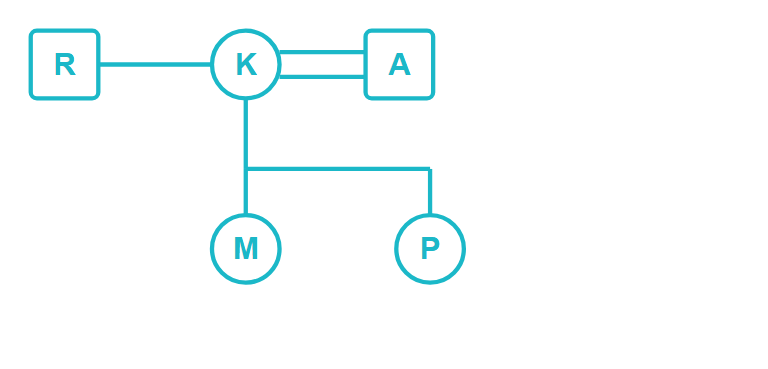
Since Kajal is the mother of Priti and Ritik is the brother of Kajal, Ritik is the Mother's brother of Priti.

Hence, the correct answer is 'Option 2'.

40

Each letter in the word DANGEROUS is arranged in alphabetical order. How many letters are there in the English alphabetical order between the letter which is fourth from the left and the one which is fourth from the right in the new letter cluster thus formed?

  1. ((a))

    8

  2. ((b))

    7

  3. ((c))

    6

  4. ((d))

    9

Show Answer
Answer: ((b))

7

Given Word:

DANGEROUS

Arrange the letters in alphabetical order:

Position123456789
LetterADEGNORSU
<br>

Required letters:

  • 4th from the left = G
  • 4th from the right = O

Letters between G and O in the English alphabet are:

H, I, J, K, L, M, N

Total letters between them = 7.

Hence, the correct answer is "Option 2".

41

Select the set in which the numbers are related in the same way as are the numbers of the following sets.

(Note: Operations should be performed on the whole numbers, without breaking down the numbers into their constituent digits. E.g. 13 – Operations on 13 such as adding/subtracting/multiplying to 13 can be performed. Breaking down 13 into 1 and 3 and then performing mathematical operations on 1 and 3 is not allowed.)

(5, 12, 28)
(4, 11, 26)

  1. ((a))

    (3, 10, 16)

  2. ((b))

    (7, 16, 36)

  3. ((c))

    (8, 19, 42)

  4. ((d))

    (6, 13, 30)

Show Answer
Answer: ((d))

(6, 13, 30)

The logic followed here is:

Logic: Second Number = First Number + 7; Third Number = (Second Number × 2) + 4

For the first set (5, 12, 28)

⇒ 5 + 7 = 12.

⇒ (12 × 2) + 4 = 24 + 4 = 28.

For the second set (4, 11, 26)

⇒ 4 + 7 = 11.

⇒ (11 × 2) + 4 = 22 + 4 = 26.

Applying the same logic to the set in Option 4

(6, 13, 30)

⇒ 6 + 7 = 13.

⇒ (13 × 2) + 4 = 26 + 4 = 30.

Hence, the correct answer is 'Option 4'.

42

Refer to the following series and answer the question (All numbers are single-digit numbers only. Counting is to be done from left to right.)

<br>

(Left) 7 9 8 5 1 8 4 3 5 6 9 7 4 5 2 4 1 3 4 8 7 6 4 (Right)

<br>

How many such odd digits are there each of which is immediately preceded by an even digit and also immediately followed by an odd digit?

  1. ((a))

    Three

  2. ((b))

    One

  3. ((c))

    Two

  4. ((d))

    More than three

Show Answer
Answer: ((d))

More than three

Given Series:

(Left) 7 9 8 5 1 8 4 3 5 6 9 7 4 5 2 4 1 3 4 8 7 6 4 (Right)

Required pattern:

Even Digit → Odd Digit → Odd Digit

Checking the series:

(Left) 7 9 8 5 1 1 8 4 4 3 5 5 6 9 7 7 4 5 2 2 4 1 3 3 4 8 7 6 4 (Right)

Odd digits satisfying the condition:

→ 5 in (8 5 1)

→ 3 in (4 3 5)

→ 9 in (6 9 7)

→ 1 in (4 1 3)

Therefore, there are 5 such odd digits.

Hence, the correct answer is "Option 4 — More than three".

43

WIND is related to VHOE in a certain way based on the English alphabetical order. In the same way, FIRE is related to EHSF. To which of the given options is GOLD related, following the same logic?

  1. ((a))

    FNME

  2. ((b))

    EMNF

  3. ((c))

    FLNE

  4. ((d))

    FMNF

Show Answer
Answer: ((a))

FNME

The logic followed in this pattern is a combination of specific alphabetical shifts for each letter position.

For 'WIND' related to 'VHOE':

W(23)I(9)N(14)D(4)
−1 ↓−1 ↓+1 ↓+1 ↓
V(22)H(8)O(15)E(5)

For 'FIRE' related to 'EHSF':

F(6)I(9)R(18)E(5)
−1 ↓−1 ↓+1 ↓+1 ↓
E(5)H(8)S(19)F(6)

Applying the same logic to 'GOLD':

G(7)O(15)L(12)D(4)
−1 ↓−1 ↓+1 ↓+1 ↓
F(6)N(14)M(13)E(5)

Thus, GOLD is related to FNME.

Hence, the correct answer is 'Option 1'.

44

If ‘A’ stands for ‘÷’, ‘B’ stands for ‘×’, ‘C’ stands for ‘+’ and ‘D’ stands for ‘−’, what will come in place of the question mark (?) in the following equation?

<br>

1 B 3 D 10 A 5 C 2 = ?

  1. ((a))

    1

  2. ((b))

    4

  3. ((c))

    3

  4. ((d))

    2

Show Answer
Answer: ((c))

3

Logic followed here is the substitution of letters with their assigned mathematical operators and then solving the expression using the BODMAS rule.

LetterABCD
Sign÷×+


Given Expression:

1 B 3 D 10 A 5 C 2 = ?

After replacing the letters with mathematical signs, we get:

= 1 × 310 ÷ 5 + 2

= 3 - 2 + 2

= 3

Therefore, the value that will come in place of the question mark is 3.

Hence, the correct answer is "Option 3".

45

In a row of 50 people facing north, Cara is 19th from the right end. If Gita sits 19th to the left of Cara, what is Gita’s position from the left end of the line?

  1. ((a))

    16th

  2. ((b))

    15th

  3. ((c))

    13th

  4. ((d))

    14th

Show Answer
Answer: ((c))

13th

The logic followed here is:

Total number of people in the row = 50

Position of Cara from the right end = 19th

Position of Gita relative to Cara = 19th to the left

Position of Gita from the right end = Position of Cara from the right end + 19

= 19 + 19

= 38th

Position of Gita from the left end = (Total number of people − Position of Gita from the right end) + 1

= (50 − 38) + 1

= 12 + 1

= 13th

Hence, the correct answer is 'Option 3'.

46

In a certain code language, ‘conflict of interest’ is coded as ‘gu ky bz’ and ‘end this conflict’ is coded as ‘ky tg cn’. How is ‘conflict’ coded in the given language? (All the codes are two-letter codes only.)

  1. ((a))

    ky

  2. ((b))

    tg

  3. ((c))

    bz

  4. ((d))

    cn

Show Answer
Answer: ((a))

ky

Logic followed here is based on the common word comparison method.

Given:

‘conflict of interest’ is coded as ‘gu ky bz’

‘end this conflict’ is coded as ‘ky tg cn’

The code for conflict is ky.

Hence, the correct answer is "Option 1".

47

In a certain code language,

A @ B means ‘A is the brother of B’,

A x B means ‘A is the daughter of B’,

A o B means ‘A is the father of B’, and

A ≥ B means ‘A is the wife of B’.

Based on the above, how is Z related to N if 'Z x C ≥ L o M @ N'?

  1. ((a))

    Daughter

  2. ((b))

    Wife

  3. ((c))

    Sister

  4. ((d))

    Mother

Show Answer
Answer: ((c))

Sister

Given:

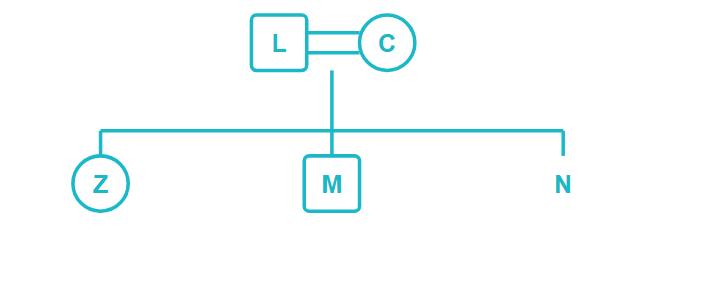
Let us first decode the given symbols and then draw a family tree.

A is
Symbol@×oge
MeaningBrotherDaughterFatherWife
of B


On checking: Z × C ge L o M @ N

  1. Z × C - 'Z × C' means 'Z is the daughter of C'.

  2. C ge L - 'C ge L' means 'C is the wife of L'.

  3. L o M - 'L o M' means 'L is the father of M'.

  4. M @ N - 'M @ N' means 'M is the brother of N'.

Therefore, Z and M are siblings of N, and all are children of L and C. Since Z is female, she is the sister of N.

Hence, the correct answer is 'Option 3'.

48

What will come in the place of ‘?’ in the following equation, if ‘+’ and ‘-’ are interchanged and ‘x’ and ‘÷’ are interchanged?

<br>

6 ÷ 2 + 24 x 6 - 4 = ?

  1. ((a))

    14

  2. ((b))

    16

  3. ((c))

    10

  4. ((d))

    12

Show Answer
Answer: ((d))

12

Sign Interchanges

+ is replaced by
is replaced by+
× is replaced by÷
÷ is replaced by×

Equation Transformation

The original equation is: 6 ÷ 2 + 24 × 6 − 4 →

By substituting the signs according to the given logic:

New Equation: 

= 6 × 2 − 24 ÷ 6 + 4

= 6 × 2 - 4 + 4

= 12 - 4 + 4

= 12

Therefore, the value that will come in the place of ? is 12.

Hence, the correct answer is "Option 4".

49

Refer to the following letter series and answer the question that follows. Counting to be done from left to right.

(Left) D U A L J X E I H R S B W P K T C V M F Y (Right)

How many such vowels are there, each of which is immediately preceded by a consonant and also immediately followed by a vowel?

  1. ((a))

    None

  2. ((b))

    One

  3. ((c))

    Two

  4. ((d))

    Three

Show Answer
Answer: ((c))

Two

Given Series:

(Left) D U A L J X E I H R S B W P K T C V M F Y (Right)

Required pattern:

Consonant → Vowel → Vowel

Checking the series:

(Left) D U A L J X E I H R S B W P K T C V M F Y (Right)

Vowels satisfying the condition:

→ U in (D U A)

→ E in (X E I)

Therefore, there are 2 such vowels.

Hence, the correct answer is "Option 3".

50

Ankur starts from Point A and drives 11 km towards east. He then takes a right turn, drives 7 km, turns right and drives 14 km. He then takes a right turn and drives 12 km. He takes a final right turn, drives 3 km and stops at Point P. How far (shortest distance) and towards which direction should he drive in order to reach Point A again?

<br>

(All turns are 90° turns only unless specified.)

  1. ((a))

    5 km to the north

  2. ((b))

    4 km to the south

  3. ((c))

    5 km to the south

  4. ((d))

    4 km to the north

Show Answer
Answer: ((c))

5 km to the south

Given:

1. Ankur starts from Point A and drives 11 km towards east. 2. He then takes a right turn, drives 7 km. 3. Then he turns right and drives 14 km. 4. He then takes a right turn and drives 12 km. 5. He takes a final right turn, drives 3 km and stops at Point P.

Following the movements described in the question, we can track Ankur path step-by-step from Point A to Point P.

Therefore, he should drive 5 km to the south to reach Point A.

Hence, the correct answer is "Option 3".

General Science (40 questions)

51

Which of the following non-metals is a good conductor of electricity in the solid state due to the presence of delocalized electrons within its crystal lattice?

  1. ((a))

    Graphite

  2. ((b))

    Sulphur

  3. ((c))

    Phosphorus

  4. ((d))

    Iodine

Show Answer
Answer: ((a))

Graphite

The correct answer is Graphite.

Key Points

  • Graphite is a unique allotrope of carbon that functions as a conductor despite the general insulating nature of non-metals.
  • The crystal structure of graphite consists of hexagonal layers where each carbon atom is sp2 hybridized and covalently bonded to three other carbon atoms.
  • Because carbon has four valence electrons, only three are utilized in forming strong sigma bonds within the planar sheets.
  • The fourth valence electron is located in an unhybridized p-orbital perpendicular to the plane of the carbon atoms.
  • These p-orbitals overlap laterally to form a delocalized pi-electron system that extends across the entire layer of the lattice.
  • The presence of these mobile, delocalized electrons allows graphite to conduct electricity efficiently along the direction of its layers when a potential difference is applied.
  • In contrast, the van der Waals forces between the layers are weak, contributing to graphite's lubricating properties but not its conductivity.

 Additional Information

  • Sulphur:
  • Exists predominantly as S8 molecules with a puckered ring structure.
  • It is an insulator because all its valence electrons are locked in covalent bonds, leaving no free electrons for conduction.
  • Phosphorus:
  • Found in various allotropes like white phosphorus (P4) and red phosphorus (polymeric).
  • These structures consist of discrete molecules or chains where electrons are localized, making it a poor conductor.
  • Iodine:
  • A halogen that forms diatomic molecules (I2) arranged in a molecular crystal lattice.
  • The lack of delocalized electrons or ions in the solid state prevents the flow of electric current.
  • Diamond:
  • Another carbon allotrope with sp3 hybridization forming a three-dimensional tetrahedral structure.
  • All valence electrons are involved in strong C-C bonds, resulting in it being an excellent electrical insulator.
52

Which of the following is/are NOT true about the distance-time graph for a body moving in uniform motion?

<br>

(i) The slope of the distance-time graph gives the acceleration of the body.

(ii) The lesser the slope of the graph the slower the body is moving.

(iii) The area under this graph gives the speed of the body.

  1. ((a))

    Only (iii)

  2. ((b))

    Only (ii)

  3. ((c))

    Both (i) and (ii)

  4. ((d))

    Both (i) and (iii)

Show Answer
Answer: ((d))

Both (i) and (iii)

The correct answer is Both (i) and (iii).

Key Points

  • In a distance-time graph, the slope (gradient) is defined as the change in distance divided by the change in time (Δd/Δt), which represents the speed of the object. Acceleration is the rate of change of velocity over time and is not directly represented by the slope of a distance-time graph. Hence, statement (i) is incorrect.
  • For a body in uniform motion, the graph is a straight line. A lesser slope (a flatter line) indicates that the body covers less distance in a given time interval, meaning the magnitude of its speed is lower. Hence, statement (ii) is correct.
  • The area under a graph is the integral of the y-axis variable with respect to the x-axis variable. For a distance-time graph, this would be the product of distance and time (unit: meter·seconds), which does not correspond to speed (unit: meters per second) or any standard kinematic quantity. Hence, statement (iii) is incorrect.

 Additional Information

  • Uniform Motion Characteristics:
  • An object is in uniform motion if it travels in a straight line and covers equal distances in equal intervals of time.
  • In this state, the velocity is constant, and the resultant acceleration is zero.
  • The distance-time graph is always a linear plot with a constant gradient.
  • Speed-Time (or Velocity-Time) Graphs:
  • In a velocity-time graph, the slope represent the acceleration of the body.
  • The area under the velocity-time graph represents the displacement or total distance traveled by the body.
  • For uniform motion, the velocity-time graph is a horizontal line parallel to the time axis, indicating a slope of zero (zero acceleration).
53

A car of mass 1000 kg moving with a velocity of 20 m/s comes to rest in 10 s after applying the brakes. What is the value of the force applied by the brakes?

  1. ((a))
    • 500 N
  2. ((b))
    • 2000 N
  3. ((c))
    • 5000 N
  4. ((d))
    • 200 N
Show Answer
Answer: ((b))
  • 2000 N

The correct answer is − 2000 N.

Key Points

  • According to Newton's Second Law of Motion, the force (F) applied to an object is directly proportional to the rate of change of its linear momentum, commonly expressed as F = m × a, where 'm' is mass and 'a' is acceleration.
  • The acceleration (a) of the car is calculated using the first equation of motion or the definition of acceleration: a = (v − u) / t. Here, u is the initial velocity, v is the final velocity, and t is the time interval.
  • Given parameters: Mass (m) = 1000 kg, Initial Velocity (u) = 20 m/s, Final Velocity (v) = 0 m/s (as the car comes to rest), and Time (t) = 10 s.
  • Calculating acceleration: a = (0 − 20) / 10 = −2 m/s2. The negative sign indicates retardation or deceleration due to braking.
  • Applying the force formula: F = 1000 kg × (−2 m/s2) = −2000 N. The negative sign signifies that the braking force is acting in the direction opposite to the car's motion.

 Additional Information

  • Kinematics and Dynamics:
  • Newton (N): The SI unit of force. One Newton is the force required to accelerate a mass of 1 kg at a rate of 1 m/s2.
  • Retardation: It is defined as negative acceleration. In this case, the brakes provide a resistive force that reduces the kinetic energy of the vehicle.
  • Impulse: The change in momentum (m × Δv) is also known as impulse, which is equal to the product of force and the time interval (F × t).
  • Direction of Force: In physics, the sign of the force indicates vector direction relative to the chosen coordinate system; a negative result confirms it is a resistive force.
54

The extent of bending of light rays achieved by a lens is expressed in terms of its ___________.

  1. ((a))

    Power

  2. ((b))

    Magnification

  3. ((c))

    Aperture

  4. ((d))

    Image Distance

Show Answer
Answer: ((a))

Power

The correct answer is Power.

Key Points

  • The Power of a lens represents its capacity to bend light rays. It is defined as the tangent of the angle by which it converges or diverges a beam of light falling at a unit distant from the optical center.
  • It is mathematically defined as the reciprocal of the focal length (f) of the lens. The formula is expressed as P = 1/f, where the focal length must be in meters.
  • The SI unit of optical power is the Dioptre (represented by D). One Dioptre is equal to 1 m−1.
  • A convex lens has a positive focal length, and therefore its power is positive. Conversely, a concave lens has a negative focal length, making its power negative.
  • A lens with a shorter focal length has a greater ability to bend light rays, meaning it has higher power compared to a lens with a longer focal length.

 Additional Information

  • Magnification:
  • It is the ratio of the height of the image to the height of the object.
  • It indicates how many times the image is enlarged or diminished relative to the object size.
  • Aperture:
  • It refers to the effective diameter of the light-transmitting area of the lens.
  • The intensity of the image formed depends on the size of the aperture, as it controls the amount of light entering the system.
  • Image Distance:
  • It is the distance between the optical center of the lens and the position of the image formed, denoted by v.
  • According to the Lens Formula, 1/f = 1/v − 1/u, where u is the object distance.
55

What unique feature allows mitochondria to produce some of their own proteins?

  1. ((a))

    They contain their own DNA and ribosomes.

  2. ((b))

    They produce ATP.

  3. ((c))

    They have two membranes.

  4. ((d))

    Their outer membrane is porous.

Show Answer
Answer: ((a))

They contain their own DNA and ribosomes.

The correct answer is They contain their own DNA and ribosomes.

Key Points

  • Mitochondria are often referred to as the powerhouse of the cell because they are the primary sites for ATP (Adenosine Triphosphate) synthesis through aerobic respiration.
  • They are classified as semi-autonomous organelles because they possess their own genetic material, known as mitochondrial DNA (mtDNA), and their own ribosomes.
  • The mtDNA is typically a small, circular molecule that encodes for several essential proteins, tRNAs, and rRNAs required for the organelle's function.
  • Mitochondria contain 70S ribosomes, which are structurally similar to those found in prokaryotic organisms, allowing them to perform protein synthesis within the mitochondrial matrix independently of the cell nucleus.
  • While most cellular proteins are encoded by nuclear DNA and imported from the cytoplasm, these organelles produce about 13 critical polypeptides involved in the oxidative phosphorylation system.

 Additional Information

  • Endosymbiotic Theory:
  • The presence of independent DNA and ribosomes supports the theory that mitochondria evolved from an ancient endosymbiosis between a primitive eukaryote and an aerobic bacterium.
  • Structural Components:
  • Double Membrane: Mitochondria consist of an inner membrane and an outer membrane. The inner membrane is folded into cristae to maximize the surface area for energy production.
  • Porous Outer Membrane: This membrane contains special proteins called porins, which permit the free diffusion of molecules smaller than 5,000 Daltons.
  • ATP Production:
  • While mitochondria produce ATP, this is a metabolic function and does not directly provide the genetic blueprint or machinery for protein manufacturing.
56
  1. A precipitation reaction occurs when two aqueous solutions react to form an insoluble solid.
  2. The solid formed is called a precipitate.
  3. All precipitation reactions involve acids and bases only.
<br>

Which of the above statements are correct?

  1. ((a))

    2 and 3 only

  2. ((b))

    1, 2, and 3

  3. ((c))

    1 and 3 only

  4. ((d))

    1 and 2 only

Show Answer
Answer: ((d))

1 and 2 only

The correct answer is 1 and 2 only.

Key Points

  • A precipitation reaction occurs when two aqueous solutions containing soluble salts are mixed together, resulting in a double displacement reaction that yields an insoluble ionic solid. Hence, statement 1 is correct.
  • The insoluble solid that emerges from the liquid mixture is scientifically referred to as a precipitate, and its formation indicates that the product has exceeded its solubility limit in the given solvent. Hence, statement 2 is correct.
  • While some acid-base reactions might produce a precipitate, the vast majority of precipitation reactions involve salts; conversely, acid-base reactions are fundamentally neutralization reactions that primarily produce water and a soluble salt. Hence, statement 3 is incorrect.

 Additional Information

  • Common Precipitation Examples:
  • Silver Chloride (AgCl): When Silver Nitrate (AgNO3) reacts with Sodium Chloride (NaCl), a white precipitate of AgCl is formed.
  • Barium Sulphate (BaSO4): The reaction between Barium Chloride (BaCl2) and Sodium Sulphate (Na2SO4) produces a white insoluble solid.
  • Lead Iodide (PbI2): Mixing Lead Nitrate and Potassium Iodide results in a striking yellow precipitate.
  • Industrial and Laboratory Uses:
  • Qualitative Analysis: Used to detect the presence of specific cations or anions in an unknown solution based on the color and solubility of the precipitate.
  • Water Treatment: Used to remove contaminants like magnesium, calcium, and heavy metals from hard water or industrial wastewater.
  • Pigment Production: Many industrial dyes and pigments are manufactured through controlled precipitation processes.
57

Which of the following salts, when dissolved in water, will produce a neutral solution?

  1. ((a))

    Sodium chloride (NaCl)

  2. ((b))

    Potassium hydroxide (KOH)

  3. ((c))

    Ammonium chloride (NH4Cl)

  4. ((d))

    Sodium acetate (CH3COONa)

Show Answer
Answer: ((a))

Sodium chloride (NaCl)

The correct answer is Sodium chloride (NaCl).

Key Points

  • Sodium chloride (NaCl) is classified as a neutral salt because it is the product of a neutralization reaction between a strong acid (Hydrochloric acid, HCl) and a strong base (Sodium hydroxide, NaOH).
  • When dissolved in water, NaCl dissociates completely into its constituent ions, Na+ and Cl. These ions are the conjugate species of a strong base and a strong acid, respectively, and therefore have negligible tendency to react with water.
  • Since neither the cation nor the anion undergoes salt hydrolysis, the concentration of hydrogen ions (H+) and hydroxyl ions (OH) remains equal to that of pure water.
  • Consequently, the pH value of the resulting aqueous solution is approximately 7.0 at 25°C, characterizing the solution as neutral.

 Additional Information

  • Potassium hydroxide (KOH):
  • It is not a salt but a strong base. It dissociates to release a high concentration of OH ions, resulting in a strongly alkaline solution with a pH typically greater than 13.
  • Ammonium chloride (NH4Cl):
  • This is an acidic salt formed from a strong acid (HCl) and a weak base (Ammonium hydroxide). The NH4+ ion undergoes cationic hydrolysis, releasing H+ ions into the solution and lowering the pH below 7.
  • Sodium acetate (CH3COONa):
  • This is a basic salt derived from a weak acid (Acetic acid) and a strong base (NaOH). The acetate ion (CH3COO) undergoes anionic hydrolysis, producing OH ions and making the solution alkaline (pH > 7).
58

A gardener buried five different substances in a garden: banana peels, newspaper, cotton cloth, plastic bottle and metal spoon. How many of the substances he buried were biodegradable?

  1. ((a))

    Two

  2. ((b))

    Three

  3. ((c))

    One

  4. ((d))

    Four

Show Answer
Answer: ((b))

Three

The correct answer is Three.

Key Points

  • Among the five substances buried by the gardener, Banana peels, Newspaper, and Cotton cloth are the three that are classified as biodegradable.
  • Banana peels are organic waste products from plants that consist of biological tissue, which microorganisms like bacteria and fungi can decompose into humus within approximately 2 to 5 weeks.
  • Newspaper is primarily made from wood pulp, which contains cellulose; this organic compound is easily broken down by soil enzymes and moisture, typically taking 10 to 30 days to disappear.
  • Cotton cloth is a natural textile derived from the Gossypium plant; because it is composed of natural fibers, it is susceptible to biological decay and generally decomposes within 2 to 5 months in a garden environment.

 Additional Information

  • Biodegradable substances are materials that can be broken down into simpler, non-toxic substances by the action of living organisms like decomposers.
  • Natural materials like paper, wood, animal waste, and plant remains are essential for maintaining the nutrient cycle in the soil.
  • The process of biodegradation requires specific environmental conditions including moisture, oxygen, and the presence of aerobic or anaerobic bacteria.
  • Non-biodegradable substances are materials that cannot be decomposed by biological processes and persist in the environment for long periods.
  • Plastic bottles are made from synthetic polymers like Polyethylene Terephthalate (PET), which lack the chemical bonds that bacteria can recognize and break, lasting for up to 450 years.
  • Metal spoons, often made of stainless steel or aluminum, are inorganic and do not undergo biological decay, though they may eventually undergo corrosion or oxidation over centuries.
59

Which statement best describes the arrangement of electrons in Thomson's atomic model?

  1. ((a))

    Electrons are located at the center of the atom

  2. ((b))

    Electrons are embedded in a positively charged sphere

  3. ((c))

    Electrons are found only on the surface of the atom

  4. ((d))

    Electrons revolve around the nucleus

Show Answer
Answer: ((b))

Electrons are embedded in a positively charged sphere

The correct answer is Electrons are embedded in a positively charged sphere.

Key Points

  • J.J. Thomson proposed his model of the atom in 1898, shortly after he discovered the electron, the first subatomic particle.
  • According to this model, an atom is envisioned as a positively charged sphere where negatively charged electrons are embedded into it, similar to seeds in a fruit.
  • This model is widely known as the Plum Pudding Model or the Watermelon Model due to the specific arrangement of its components.
  • In the Watermelon analogy, the red edible part represents the positive charge distributed throughout the atom, while the black seeds represent the electrons.
  • Thomson hypothesized that the magnitude of the positive and negative charges is equal, which ensures that the atom remains electrically neutral.

 Additional Information

  • Rutherford Atomic Model:
  • Unlike Thomson's static model, Ernest Rutherford proposed in 1911 that electrons revolve around a nucleus in circular paths.
  • This model was based on the Alpha-particle scattering experiment, which proved the existence of a dense, central nucleus.
  • Bohr Atomic Model:
  • Proposed by Niels Bohr in 1913, it refined the arrangement by stating that electrons move in discrete orbits with fixed energy levels.
  • Shortcomings of Thomson Model:
  • It could not explain the stability of the atom or the results of later experiments showing that most of an atom is empty space.
  • It failed to account for the scattering of alpha particles through large angles, which necessitated the concept of a central positive core.
60

The principal function of the plasma membrane is to:

  1. ((a))

    Serve as the site of ATP synthesis.

  2. ((b))

    Provide rigid support and prevent cell swelling.

  3. ((c))

    Store the cell’s genetic material.

  4. ((d))

    Regulate movement of substances across the cell.

Show Answer
Answer: ((d))

Regulate movement of substances across the cell.

The correct answer is Regulate movement of substances across the cell.

Key Points

  • The plasma membrane, also referred to as the cell membrane, is a biological membrane that separates the interior of all cells from the outside environment.
  • It is selectively permeable, which is its most vital characteristic, allowing it to control the influx and efflux of nutrients, ions, and metabolic waste products.
  • The structure is primarily composed of a phospholipid bilayer with embedded integral proteins and peripheral proteins that act as channels or pumps.
  • It maintains homeostasis within the cell by facilitating transport mechanisms such as simple diffusion, facilitated diffusion, and active transport using ATP.
  • The Fluid Mosaic Model describes the membrane as a dynamic structure where proteins float in or on the fluid lipid bilayer, enabling cell signaling and recognition.

 Additional Information

  • ATP Synthesis:
  • In eukaryotic cells, the primary site for ATP (Adenosine Triphosphate) production is the mitochondria via the process of oxidative phosphorylation.
  • Cell Wall:
  • Provides rigid support and structural integrity; it is found in plants (cellulose), fungi (chitin), and prokaryotes (peptidoglycan) but is absent in animal cells.
  • Nucleus:
  • Acts as the genetic control center of the cell, housing the chromosomes and DNA (Deoxyribonucleic Acid), protecting them from the metabolic activities of the cytoplasm.
61

All of the following functions are performed by different components of a Xylem tissue, EXCEPT:

  1. ((a))

    Providing mechanical support

  2. ((b))

    Storing food

  3. ((c))

    Transporting food from leaves

  4. ((d))

    Transporting water and minerals vertically

Show Answer
Answer: ((c))

Transporting food from leaves

The correct answer is Transporting food from leaves.

Key Points

  • Xylem is a complex conducting tissue in vascular plants that primarily facilitates the upward movement of water and dissolved minerals from the roots.
  • It consists of four specialized components: tracheids, vessel elements, xylem parenchyma, and xylem fibers.
  • Tracheids and vessels are the primary water-conducting elements that form long, hollow tubes to ensure vertical transport of fluids throughout the plant.
  • Xylem fibers are highly lignified, dead cells with thick walls that function to provide mechanical support and structural rigidity to the plant body.
  • Xylem parenchyma is the only living component of the xylem tissue, specifically designed for storing food materials such as starch and assisting in lateral water conduction.
  • The process of transporting organic solutes and food from the leaves to other parts of the plant is called translocation, which is the exclusive function of the phloem tissue.

 Additional Information

  • Phloem Tissue:
  • Sieve Tube Elements: These are long, tube-like structures that lack a nucleus at maturity and are responsible for the bidirectional transport of sucrose.
  • Companion Cells: These specialized cells are closely associated with sieve tubes and maintain the pressure gradient required for nutrient movement.
  • Phloem Parenchyma: Responsible for storing food and secretion of substances like resins and mucilage.
  • Direction of Flow: While xylem flow is unidirectional (root to leaf), phloem flow is multidirectional, moving nutrients from source to sink.
  • Vascular Bundle:
  • The combination of xylem and phloem constitutes the vascular bundle, which serves as the circulatory system for higher plants.
  • The cambium layer, found in dicotyledonous plants between xylem and phloem, is responsible for secondary growth and thickening of the stem.
62

Which statement is true about mass number?

  1. ((a))

    It is the sum of protons and neutrons in an atom

  2. ((b))

    It is always twice the atomic number

  3. ((c))

    It is equal to the number of electrons in an atom

  4. ((d))

    It is the total number of protons and electrons in an atom

Show Answer
Answer: ((a))

It is the sum of protons and neutrons in an atom

The correct answer is It is the sum of protons and neutrons in an atom.

Key Points

  • The mass number (represented by the symbol A) of an atom is defined as the total number of protons and neutrons present in its nucleus. Since these two particles reside in the nucleus, they are collectively known as nucleons. Hence, statement 1 is correct.
  • In many light elements, the mass number is approximately twice the atomic number (e.g., Helium has 2 protons and 2 neutrons, A=4), but this is not a universal law. As elements become heavier, the proportion of neutrons increases to provide nuclear stability, making the mass number significantly more than twice the atomic number. Hence, statement 2 is incorrect.
  • The number of electrons in a neutral atom is equal to the atomic number (Z), which is the number of protons. The mass number focuses on the dense particles within the nucleus, and electrons have negligible mass compared to nucleons. Hence, statement 3 is incorrect.
  • While the sum of protons and electrons equals the total charge components of a neutral atom, it does not define the mass number. The mass number is strictly the count of heavy subatomic particles in the nucleus. Hence, statement 4 is incorrect.

 Additional Information

  • Atomic Notation:
  • In standard chemical notation, an element is written as AZX, where A is the mass number, Z is the atomic number, and X is the chemical symbol.
  • The number of neutrons (n) can be calculated by the formula: n = A − Z.
  • Isotopes:
  • Isotopes are atoms of the same element that have the same atomic number (protons) but different mass numbers due to a different number of neutrons.
  • For example, Carbon-12 (6 protons, 6 neutrons) and Carbon-14 (6 protons, 8 neutrons) are isotopes used in radiocarbon dating.
  • Atomic Mass vs. Mass Number:
  • The mass number is always a whole number representing a count of particles.
  • The atomic mass is the weighted average of the masses of all naturally occurring isotopes of that element, which is why it often appears as a decimal on the Periodic Table.
63

In the substitution reaction of methane (CH4) with chlorine (Cl2) under UV light, what is the first product formed?

  1. ((a))

    Dichloromethane (CH2Cl2)

  2. ((b))

    Carbon tetrachloride (CCl4)

  3. ((c))

    Methyl chloride (CH3Cl)

  4. ((d))

    None of the above

Show Answer
Answer: ((c))

Methyl chloride (CH3Cl)

The correct answer is Methyl chloride (CH3Cl).

<br>

When methane reacts with chlorine in the presence of ultraviolet (UV) light, a free-radical substitution reaction occurs, and the first product formed is methyl chloride (chloromethane), CH3Cl.

Key Points

  • The first substitution product of methane and chlorine is methyl chloride (CH3Cl).
  • The reaction takes place in the presence of UV light or sunlight, which initiates free-radical formation.
  • One hydrogen atom of methane is replaced by one chlorine atom during the first substitution step.
  • Further chlorination can produce dichloromethane (CH2Cl2), chloroform (CHCl3), and carbon tetrachloride (CCl4).

Additional Information

  • Substitution Reaction
  • A reaction in which one atom or group in a molecule is replaced by another atom or group.
  • Alkanes typically undergo free-radical substitution reactions with halogens.
  • Methyl Chloride (CH3Cl)
  • Also known as chloromethane.
  • It is the first product formed during the chlorination of methane.
  • Used in the production of silicones and other organic compounds.
  • Dichloromethane (CH2Cl2)
  • Formed during further chlorination of methyl chloride.
  • Commonly used as an industrial solvent.
  • Carbon Tetrachloride (CCl4)
  • The final product when all four hydrogen atoms of methane are replaced by chlorine atoms.
  • Historically used in fire extinguishers and cleaning agents.
  • Free Radical Mechanism
  • Initiation: Cl2 → 2Cl· (under UV light)
  • Propagation: CH4 + Cl· → CH3· + HCl
  • Propagation: CH3· + Cl2 → CH3Cl + Cl·
64

A student mixes sand, salt and water in a beaker and stirs well. After some time, what will be observed?

  1. ((a))

    Sand settles at the bottom, while salt dissolves in water.

  2. ((b))

    All components dissolve completely, forming a clear solution.

  3. ((c))

    Sand remains permanently suspended in water, making the mixture cloudy.

  4. ((d))

    Sand and salt both remain undissolved, forming two distinct layers.

Show Answer
Answer: ((a))

Sand settles at the bottom, while salt dissolves in water.

The correct answer is Sand settles at the bottom, while salt dissolves in water.

Key Points

  • Salt (Sodium Chloride, NaCl) is an ionic compound that is highly soluble in water; its ions dissociate and are surrounded by water molecules through a process called hydration, forming a homogeneous solution.
  • Sand, primarily composed of Silicon Dioxide (SiO2), is insoluble in water because the strong covalent bonds within its crystal lattice cannot be overcome by the dipole-dipole interactions of water.
  • The combination of sand and water forms a suspension, a type of heterogeneous mixture where large particles are visible and do not chemically bond with the solvent.
  • Because sand has a higher density (approximately 2.65 g/cm3) than water (1.0 g/cm3), the particles undergo sedimentation and sink to the bottom of the beaker due to gravity once stirring stops.

 Additional Information

  • Mixture Classification:
  • Homogeneous Mixture: A mixture with a uniform composition, such as the brine solution (saltwater) where the solute is evenly distributed.
  • Heterogeneous Mixture: A mixture where components remain physically separate, like the sand-water suspension.
  • Separation Techniques:
  • Filtration: This method uses a porous barrier to separate the insoluble sand from the liquid phase based on particle size.
  • Decantation: This involves carefully pouring out the supernatant liquid (the salt solution) after the sand has completely settled.
  • Evaporation: This process recovers the dissolved salt by heating the solution until the water vaporizes, leaving the salt crystals behind.
  • Solubility Limit: At room temperature (25°C), the solubility of salt in water is approximately 36 grams per 100 ml.
65

When white light is incident obliquely on a glass prism, which of the following statement(s) is/are NOT true?

<br>

(i) Red colour undergoes minimum deviation.

(ii) The speed of violet colour is the least while travelling through the prism.

(iii) Refractive index of green colour is more than the violet colour.

(iv) Refractive index of red colour is more than blue colour.

  1. ((a))

    Both (i) and (ii)

  2. ((b))

    Both (ii) and (iii)

  3. ((c))

    Both (i) and (iv)

  4. ((d))

    Both (iii) and (iv)

Show Answer
Answer: ((d))

Both (iii) and (iv)

The correct answer is Both (iii) and (iv).

Key Points

  • When white light is incident on a glass prism, it undergoes dispersion, splitting into its constituent colors (VIBGYOR) because each color travels at a different speed in the glass medium.
  • Statement (i) explains that red light has the longest wavelength in the visible spectrum; since the angle of deviation is inversely proportional to wavelength, red bends the least. Hence, statement (i) is correct.
  • Statement (ii) pertains to the speed of light, which is calculated as v=cn v = \frac{c}{n} . Because violet light experiences the highest refractive index, it travels at the slowest speed within the prism. Hence, statement (ii) is correct.
  • Statement (iii) suggests that green has a higher refractive index than violet. In reality, according to Cauchy's formula, the refractive index decreases as wavelength increases; since violet has a shorter wavelength than green, violet has a higher refractive index. Hence, statement (iii) is incorrect.
  • Statement (iv) claims the refractive index of red is more than blue. However, red light has a significantly longer wavelength than blue light, resulting in a lower refractive index for red. Hence, statement (iv) is incorrect.

 Additional Information

  • Refractive Index and Wavelength Relationship:
  • The refractive index (n) of a material is not constant but varies with the frequency of light, a phenomenon known as chromatic dispersion.
  • Violet Light: It has the shortest wavelength (approximately 400 nm) and highest frequency, leading to the maximum deviation from the original path.
  • Red Light: It has the longest wavelength (approximately 700 nm) and lowest frequency, leading to the minimum deviation.
  • Visible Spectrum Order: The sequence from longest to shortest wavelength is Red, Orange, Yellow, Green, Blue, Indigo, and Violet.
  • Speed in Vacuum: All colors of light travel at the same speed of approximately 3×10⁸ 3 \times 10^{8} m/s in a vacuum, but their speeds differ when they enter a dense medium like glass.
66

A cyclist riding at constant speed on a circular track is an example of which type of motion?

  1. ((a))

    Oscillatory motion

  2. ((b))

    Uniform circular motion

  3. ((c))

    Linear motion

  4. ((d))

    Non-uniform motion

Show Answer
Answer: ((b))

Uniform circular motion

The correct answer is Uniform circular motion.

Key Points

  • Uniform circular motion is defined as the motion of an object traveling at a constant speed along a circular path.
  • In this scenario, while the cyclist maintains a steady speed, the direction of motion changes continuously at every point along the circular track, meaning the velocity is constantly changing.
  • Because the velocity is changing due to the direction, the cyclist undergoes centripetal acceleration, which is always directed toward the center of the circle.
  • The magnitude of velocity (speed) remains unchanged, which distinguishes it from non-uniform circular motion where the speed would fluctuate.

 Additional Information

  • Linear Motion:
  • Also referred to as rectilinear motion, it occurs when an object moves in a straight line.
  • In this type of motion, the direction remains constant unless the object reverses its path.
  • Oscillatory Motion:
  • This is the to-and-fro or periodic motion of an object about a fixed mean position.
  • Classic examples include the movement of a simple pendulum or a tuning fork.
  • Non-uniform Motion:
  • An object is said to be in non-uniform motion if its speed changes as it moves, covering unequal distances in equal intervals of time.
  • If the cyclist were accelerating or braking on the track, the motion would be classified as non-uniform circular motion.
67

In a homogeneous mixture, the size of particles of solute is typically:

  1. ((a))

    Between 1 nm and 1000 nm

  2. ((b))

    Larger than 1 µm

  3. ((c))

    Less than 1 nm

  4. ((d))

    Visible to the naked eye

Show Answer
Answer: ((c))

Less than 1 nm

The correct answer is Less than 1 nm.

Key Points

  • A homogeneous mixture is a type of mixture where the components are distributed with uniform composition and properties throughout the entire mass, commonly known as a True Solution.
  • In a True Solution, the size of the solute particles is extremely small, typically measuring less than 1 nanometer (1 nm = 10−9 meters) in diameter.
  • Because these particles are at the molecular or ionic level, they cannot be seen even with the aid of a powerful microscope.
  • Due to their minute size, they do not scatter a beam of light passing through the medium, meaning they do not exhibit the Tyndall effect.
  • These particles pass easily through filter paper and parchment membranes, making them impossible to separate from the solvent using standard filtration techniques.
  • The mixture is highly stable, and the solute particles do not settle down when left undisturbed because of their constant kinetic motion and negligible mass.

 Additional Information

  • Colloids:
  • These are heterogeneous mixtures where the particle size ranges between 1 nm and 1000 nm.
  • They are large enough to scatter a beam of light (Tyndall effect) but small enough to remain suspended indefinitely without settling.
  • Suspensions:
  • These are heterogeneous mixtures containing large particles, typically larger than 1000 nm (1 μm).
  • The particles are visible to the naked eye, do not pass through filter paper, and eventually settle at the bottom due to gravity.
  • Units of Measurement:
  • 1 Nanometer (nm) is equal to 10−9 meters.
  • 1 Micrometer (μm) is equal to 10−6 meters or 1000 nm.
68

Choose a term to complete analogy.

<br>

Axon : Single long process :: Dendrite : _______________

  1. ((a))

    Protective connective tissue

  2. ((b))

    Cell body with nucleus

  3. ((c))

    Rapid stimulus transmission

  4. ((d))

    Many short, branched parts

Show Answer
Answer: ((d))

Many short, branched parts

The correct answer is Many short, branched parts.

Key Points

  • The neuron or nerve cell is the structural and functional unit of the nervous system, specialized for the reception and transmission of electrical impulses.
  • A typical neuron consists of three distinct regions: the cell body (Cyton), dendrites, and a single axon.
  • The axon is a long, slender, and single cytoplasmic extension that originates from the axon hillock; its primary role is to carry nerve impulses away from the cell body toward a synapse or effector organ.
  • Dendrites are the multiple, short, and highly branched protoplasmic processes that project from the cell body.
  • The primary function of dendrites is to receive afferent signals (stimuli) from other neurons or sensory receptors and conduct them toward the soma or cell body.
  • The branching nature of dendrites increases the surface area significantly, allowing a single neuron to receive thousands of synaptic inputs simultaneously.

 Additional Information

  • Cell body with nucleus:
  • Commonly known as the Soma or Cyton, it contains the nucleus and Nissl’s granules (groups of ribosomes and rough endoplasmic reticulum).
  • It serves as the metabolic center of the neuron where protein synthesis and cellular maintenance occur.
  • Protective connective tissue:
  • In the peripheral nervous system, nerves are bundled and protected by layers such as the epineurium, perineurium, and endoneurium.
  • The myelin sheath, produced by Schwann cells, provides electrical insulation around the axon.
  • Rapid stimulus transmission:
  • This refers to the functional efficiency of the axon, especially those that are myelinated.
  • The Nodes of Ranvier allow for saltatory conduction, which significantly speeds up the transmission of action potentials.
69

Which of the following is represented by a circle with the letter 'V' in a circuit diagram?

  1. ((a))

    Vacuum diode

  2. ((b))

    Voltmeter

  3. ((c))

    Voltage regulator

  4. ((d))

    Variable resistance

Show Answer
Answer: ((b))

Voltmeter

The correct answer is Voltmeter.

Key Points

  • In electrical circuit diagrams, a voltmeter is represented by a circle with the uppercase letter 'V' inscribed inside it.
  • The primary function of this instrument is to measure the potential difference (voltage) between two specific points in an electric circuit, with the standard unit being the Volt (V).
  • To ensure measurement accuracy, a voltmeter is always connected in parallel with the component whose voltage is being measured, as voltage remains constant across parallel branches.
  • A characteristic feature of a voltmeter is its high internal resistance; this prevents it from drawing significant current from the main circuit. In theoretical physics, an ideal voltmeter is considered to have infinite resistance.
  • The sensitivity of the device can be modified using a high-value resistor, known as a multiplier, connected in series with the internal galvanometer mechanism.

 Additional Information

  • Variable Resistance (Rheostat):
  • Represented by a zigzag line with an arrow passing through it or a sliding contact arrow pointing toward it.
  • It is used to vary the current in a circuit by manually changing the resistance value without interrupting the circuit flow.
  • Vacuum Diode:
  • A legacy electronic device symbolized by a circle containing a cathode and an anode.
  • It functions as a rectifier, allowing electric current to flow in only one direction, and was the precursor to the modern semiconductor p-n junction diode.
  • Voltage Regulator:
  • Often represented by a functional block or a Zener diode symbol (a triangle with a 'Z' shaped bar).
  • Its core purpose is to maintain a constant output voltage level despite fluctuations in input voltage or varying load conditions.
70

Which of the following is true about Fleming’s left-hand rule?

  1. ((a))

    If the thumb points in the direction of force and the forefinger in the direction of current, the middle finger shows the direction of magnetic field.

  2. ((b))

    If the forefinger points in the direction of magnetic field and the middle finger in the direction of current, the thumb shows the direction of motion or force on the conductor.

  3. ((c))

    It is used only in electric circuits and not in devices like motors or loudspeakers.

  4. ((d))

    If the thumb points in the direction of current and the middle finger in the direction of magnetic field, the forefinger shows the direction of force.

Show Answer
Answer: ((b))

If the forefinger points in the direction of magnetic field and the middle finger in the direction of current, the thumb shows the direction of motion or force on the conductor.

The correct answer is If the forefinger points in the direction of magnetic field and the middle finger in the direction of current, the thumb shows the direction of motion or force on the conductor.

Key Points

  • Fleming’s Left-Hand Rule is a mnemonic used to determine the direction of force acting on a current-carrying conductor when placed within an external magnetic field. Hence, statement 2 is correct.
  • The rule assigns the Thumb to the direction of Force (or motion), the Forefinger to the Magnetic Field, and the Middle Finger to the Electric Current, provided they are held mutually perpendicular. Hence, statement 1 is incorrect.
  • This principle is the fundamental basis for the operation of Electric Motors, where electrical energy is converted into mechanical motion, and Loudspeakers. Hence, statement 3 is incorrect.
  • Correct orientation requires the Forefinger to represent the field and the Middle Finger to represent the current to correctly identify the Thumb as the force vector. Hence, statement 4 is incorrect.

 Additional Information

  • Physical Components:
  • Magnetic Field (B): Represents the flux lines moving from the North Pole to the South Pole.
  • Electric Current (I): Represents the flow of conventional current (from positive to negative).
  • Force (F): Also known as the Lorentz Force, it is calculated by the formula F = BIL sin(θ), where θ is the angle between the conductor and the field.
  • Comparison with Right-Hand Rule:
  • While the Left-Hand Rule is applied to Motors (input current produces motion), Fleming’s Right-Hand Rule is applied to Generators (input motion produces induced current).
  • In the right-hand version, the Thumb represents motion, the Forefinger field, and the Middle Finger represents the direction of the Induced Current.
  • Applications:
  • Used in designing Galvanometers, DC Motors, and electromagnetic actuators.
  • Critical for understanding how charged particles (like electrons or protons) deflect when entering a magnetic field in Particle Accelerators.
71

When chemicals such as pesticides enter food chains and get more concentrated at higher levels, the process is known as ____.

  1. ((a))

    Photosynthesis

  2. ((b))

    Biological magnification

  3. ((c))

    Biodegradation

  4. ((d))

    Eutrophication

Show Answer
Answer: ((b))

Biological magnification

The correct answer is Biological magnification.

Key Points

  • Biological magnification, also termed biomagnification or bioamplification, refers to the progressive increase in the concentration of toxic substances at each successive trophic level of a food chain.
  • This phenomenon occurs with chemicals that are non-biodegradable and lipophilic (fat-soluble), meaning they cannot be broken down by metabolic processes or excreted easily, causing them to accumulate in adipose tissues.
  • As energy is transferred through the food web, predators must consume large quantities of prey from lower levels; consequently, they ingest all the accumulated toxins stored in those organisms, leading to a massive increase in chemical concentration.
  • A scientific landmark for this process was the study of DDT (Dichlorodiphenyltrichloroethane), which showed that while water contained only 0.000003 parts per million (ppm), fish-eating birds at the top of the chain had concentrations as high as 25 ppm.
  • High levels of these toxins in apex predators can result in reproductive failure, immune system suppression, and in the case of birds, the thinning of eggshells, which significantly impacts biodiversity.

 Additional Information

  • Photosynthesis:
  • A biological process used by photoautotrophs, such as green plants and cyanobacteria, to convert light energy into chemical energy.
  • It utilizes chlorophyll to transform carbon dioxide and water into glucose, releasing oxygen as a vital byproduct for aerobic life.
  • Biodegradation:
  • The natural breakdown of organic matter by microorganisms like bacteria and fungi into simpler, non-toxic substances like CO2 and water.
  • It is a crucial component of the nutrient cycle, though many modern synthetic pesticides are specifically designed to resist this process.
  • Eutrophication:
  • An environmental process where water bodies receive excess nutrients, particularly nitrates and phosphates, often from agricultural runoff.
  • This leads to algal blooms that block sunlight and deplete dissolved oxygen, creating hypoxic conditions or dead zones where aquatic life cannot survive.
72

What distinguishes broilers from layers in poultry farming?

  1. ((a))

    Both are raised equally for meat and eggs

  2. ((b))

    Only broilers lay eggs

  3. ((c))

    Layers are raised for meat; broilers for eggs

  4. ((d))

    Broilers are raised for meat; layers for eggs

Show Answer
Answer: ((d))

Broilers are raised for meat; layers for eggs

The correct answer is Broilers are raised for meat; layers for eggs.

Key Points

  • Broilers are poultry birds specifically bred and reared for meat production. They are known for their fast growth rate and high muscle development, typically reaching market weight within 6 to 8 weeks.
  • Layers are chickens raised primarily for commercial egg production. These birds reach sexual maturity and start laying eggs at approximately 18 to 20 weeks of age.
  • The nutritional requirements differ significantly; broilers need a diet rich in protein and vitamins for rapid growth, while layers require high amounts of calcium and minerals to produce strong eggshells.
  • Environmental management for layers involves strictly controlled lighting cycles (photoperiodism) to stimulate the pituitary gland for consistent egg laying, whereas broilers require space and conditions optimized for feed conversion efficiency.

 Additional Information

  • Broiler Characteristics:
  • Common breeds include the Cornish Cross and Plymouth Rock.
  • They exhibit a high feed conversion ratio (FCR), meaning they efficiently turn feed into body mass.
  • Management focuses on floor space, ventilation, and hygiene to prevent diseases like Coccidiosis.
  • Layer Characteristics:
  • The White Leghorn is one of the most popular breeds used for white egg production.
  • Layers are kept for a longer duration, often producing eggs for 52 to 72 weeks before their productivity declines.
  • Egg quality is maintained through a diet balanced in phosphorus and Vitamin D3.
73

Select a term to complete the given analogy.

<br>

Binary Fission : Bacteria :: Fragmentation : _________

  1. ((a))

    Birds

  2. ((b))

    Algae

  3. ((c))

    Mammals

  4. ((d))

    Insects

Show Answer
Answer: ((b))

Algae

The logic followed here is:

Logic: Mode of asexual reproduction in specific organisms.

Here,

Binary Fission : Bacteria → Binary Fission is a method of asexual reproduction where a parent cell divides into two identical daughter cells, which is the primary mode of reproduction in Bacteria.

Similarly,

Fragmentation : Algae → Fragmentation is a type of asexual reproduction where an organism breaks into several fragments, each of which matures into a new individual. This process is commonly observed in Algae (such as Spirogyra).

Hence, the correct answer is 'Option 2'.

74

Consider the following statements regarding the size of an atom.

<br>

Statement 1: The size of an atom is approximately in the range of 0.1 nm to 0.5 nm.

<br>

Statement 2: Atomic size increases as we move from left to right in a period of the periodic table.

<br>

Statement 3: The radius of a hydrogen atom is about 10⁻¹⁰ meters.

<br>

Which of the above statements is/are correct?

  1. ((a))

    Only 1 and 3

  2. ((b))

    Only 1 and 2

  3. ((c))

    Only 1, 2 and 3

  4. ((d))

    Only 2 and 3

Show Answer
Answer: ((a))

Only 1 and 3

The correct answer is Only 1 and 3.

Key Points

  • The atomic size refers to the distance between the center of the nucleus and the outermost shell of an atom. Most atoms have a size or diameter that falls within the range of 0.1 nm to 0.5 nm (1 to 5 Angstroms). Hence, statement 1 is correct.
  • Across a period in the modern periodic table, the atomic radius actually decreases from left to right. This occurs because the atomic number increases, leading to a higher nuclear charge (more protons) that pulls the valence electrons closer to the nucleus, despite them being in the same energy level. Hence, statement 2 is incorrect.
  • The hydrogen atom is the smallest neutral atom. Its atomic radius is approximately 37 pm (picometers) to 53 pm (Bohr radius). In terms of order of magnitude, 1 Angstrom is equal to 10−10 m, which represents the standard scale for the radius of a hydrogen atom. Hence, statement 3 is correct.

 Additional Information

  • Group Trends:
  • In a group, the atomic size increases from top to bottom.
  • This is due to the addition of new electron shells at each successive element, which increases the distance between the nucleus and the outermost electrons, overriding the increase in nuclear charge.
  • Measurement Units:
  • Nanometer (nm): 1 nm = 10−9 m.
  • Angstrom (Å): 1 Å = 10−10 m or 0.1 nm.
  • Picometer (pm): 1 pm = 10−12 m.
  • Effective Nuclear Charge (Zeff):
  • This is the net positive charge experienced by an electron in a multi-electron atom. It is the primary driver for the contraction of atomic size across a period.
75

Newton’s first law of motion explains the concept of _________.

  1. ((a))

    Balanced forces

  2. ((b))

    Change in momentum

  3. ((c))

    Continuous acceleration

  4. ((d))

    Net force being non-zero

Show Answer
Answer: ((a))

Balanced forces

The correct answer is Balanced forces.

Key Points

  • Newton’s First Law of Motion, often referred to as the Law of Inertia, states that an object will persist in its state of rest or uniform motion in a straight line unless acted upon by an external unbalanced force.
  • The law fundamentally explains the behavior of objects under the influence of balanced forces, which occurs when the vector sum of all external forces acting on a body is exactly zero.
  • When forces are balanced, there is no change in the magnitude or direction of the object’s velocity, meaning the acceleration remains zero.
  • This principle was first published by Sir Isaac Newton in 1687 within his monumental work, Philosophiæ Naturalis Principia Mathematica, establishing the foundation for Classical Mechanics.
  • The law serves as a qualitative definition of force as the external agent capable of changing a body's state of inertia.

 Additional Information

  • Inertia:
  • It is the inherent property of matter that resists changes in its state of motion or rest.
  • The mass of an object is the quantitative measure of its inertia; objects with higher mass require greater force to change their velocity.
  • Common examples include Inertia of Rest (dust falling from a carpet when beaten) and Inertia of Motion (passengers falling forward when a moving bus brakes suddenly).
  • Net Force and Acceleration:
  • A non-zero net force refers to unbalanced forces, which cause an object to accelerate as per Newton’s Second Law.
  • Continuous acceleration implies a constant application of an unbalanced force, which contradicts the equilibrium state described in the First Law.
  • The change in momentum is defined as the product of mass and the change in velocity, which is directly proportional to the impressed force.
76

Which of the following is NOT an application of the Archimede's Principle?

  1. ((a))

    Speedometers

  2. ((b))

    Lactometers

  3. ((c))

    Designing of submarines

  4. ((d))

    Hydrometers

Show Answer
Answer: ((a))

Speedometers

The correct answer is Speedometers.

Key Points

  • Archimedes' Principle states that when a body is immersed fully or partially in a fluid, it experiences an upward buoyant force that is equal to the weight of the fluid displaced by it.
  • Speedometers are instruments designed to measure and display the instantaneous speed of a vehicle. They typically function using Eddy currents, magnetic sensors, or GPS technology and do not rely on fluid displacement or buoyancy.
  • Lactometers are used to determine the purity of milk by measuring its density. Since the instrument floats at different levels based on the fluid's weight and displacement, it is a direct application of Archimedes' Principle.
  • Hydrometers are devices used to measure the specific gravity or relative density of liquids. They operate by observing the depth to which a calibrated glass tube sinks in a liquid, which is governed by the upward thrust of the displaced fluid.
  • The Designing of submarines and ships heavily relies on this principle to ensure stability and buoyancy. Submarines specifically utilize ballast tanks to alter their weight by taking in or discharging water, allowing them to submerge or surface by manipulating the displaced volume.

 Additional Information

  • Buoyant Force:
  • It is the upward force exerted by a fluid on an object.
  • The magnitude of this force is calculated as the product of the density of the fluid, the acceleration due to gravity, and the volume of the displaced fluid.
  • Specific Gravity:
  • It is a dimensionless quantity representing the ratio of the density of a substance to the density of pure water at 4 degrees Celsius.
  • Instruments like Hydrometers use this ratio to identify the composition of various liquids like battery acid or antifreeze.
  • Eddy Current Mechanism:
  • Found in traditional speedometers, where a rotating magnet creates a magnetic field that induces currents in a non-ferrous metal cup, creating torque without physical contact.
77

Four test tubes contain solutions of CuSO₄, MgSO₄, ZnSO₄, and AgNO₃. A student adds zinc metal to each test tube. In which test tube(s) will a reaction occur?

  1. ((a))

    With all solutions

  2. ((b))

    CuSO₄ only

  3. ((c))

    CuSO₄ and AgNO₃ only

  4. ((d))

    ZnSO₄ only

Show Answer
Answer: ((c))

CuSO₄ and AgNO₃ only

The correct answer is CuSO4 and AgNO3 only.

Key Points

  • Chemical reactions between a metal and a salt solution depend on the Reactivity Series, where a more reactive metal displaces a less reactive metal from its compound.
  • Zinc (Zn) is positioned higher than Copper (Cu) in the reactivity series. When Zinc metal is added to CuSO4, a displacement reaction occurs, forming Zinc Sulphate and solid Copper.
  • Zinc is significantly more reactive than Silver (Ag). Consequently, Zinc reacts with AgNO3 to displace Silver, resulting in the formation of Zinc Nitrate and metallic Silver deposits.
  • Magnesium (Mg) is located above Zinc in the reactivity series, making it more reactive. Therefore, Zinc cannot displace Magnesium from the MgSO4 solution, and no reaction occurs.
  • Adding Zinc to a ZnSO4 solution results in no observable chemical change because a metal does not react with its own salt solution to produce a new substance.

 Additional Information

  • Reactivity Gradient: The metals involved follow the reactivity order: Magnesium (Mg) > Zinc (Zn) > Copper (Cu) > Silver (Ag).
  • Magnesium: An alkaline earth metal that is highly electropositive.
  • Zinc: A transition metal often used in galvanization and as a reducing agent in chemical labs.
  • Copper and Silver: These are noble-like metals found lower in the series, making them easily displaced by Zinc.
  • Visual Indicators:
  • The Blue vitriol (CuSO4) solution loses its blue color as Cu2+ ions are reduced to Copper metal.
  • Displacement of Silver from Silver Nitrate typically results in a lustrous grey or silver precipitate on the surface of the Zinc strip.
  • Standard Reduction Potential: Zinc has a standard reduction potential of −0.76 V, which is lower than Copper (+0.34 V) and Silver (+0.80 V), allowing it to act as the anode or reducing agent in these specific redox pairs.
78

The primary purpose of check-dams in irrigation is to ______________.

  1. ((a))

    To worsen erosion of top soil

  2. ((b))

    To increase groundwater by storing rainwater

  3. ((c))

    To channel river water for factory operations

  4. ((d))

    To lower the quality of the soil

Show Answer
Answer: ((b))

To increase groundwater by storing rainwater

The correct answer is To increase groundwater by storing rainwater.

Key Points

  • A check-dam is a small, often temporary, barrier constructed across a drainage ditch, swale, or channel to lower the velocity of flow.
  • The primary objective of these structures is to promote groundwater recharge. By slowing down the surface runoff, the dam creates a small pool that allows water to percolate through the soil layers into the underground aquifers.
  • In arid and semi-arid regions, check-dams serve as a vital tool for water harvesting, ensuring that rainwater is not lost as flash floods but is instead stored beneath the surface for future irrigation needs.
  • These structures significantly reduce soil erosion by trapping sediments and silt, which would otherwise be carried away by fast-moving water, thus preserving the fertility of the land.
  • By maintaining a higher water table, check-dams ensure that nearby borewells and open wells remain functional even during the dry summer months.

 Additional Information

  • Watershed Management:
  • Check-dams are a core component of integrated watershed management, which aims to conserve every drop of rain within a specific geographical area.
  • They can be constructed using various materials such as boulders, gabions (wire cages filled with rocks), logs, or reinforced concrete.
  • Environmental Impact:
  • Unlike large-scale dams, check-dams have a minimal ecological footprint and do not involve large-scale displacement of local populations.
  • They improve soil moisture content, which directly benefits the growth of natural vegetation and crops in the immediate vicinity.
  • Siltation control provided by these dams prevents the clogging of larger downstream reservoirs and riverbeds.
79

If mass is doubled and g remains constant, weight becomes ________.

  1. ((a))

    Same

  2. ((b))

    Half

  3. ((c))

    Four times

  4. ((d))

    Double

Show Answer
Answer: ((d))

Double

The correct answer is Double.

Key Points

  • The Weight of an object is defined as the gravitational force with which a celestial body, such as the Earth, attracts the object toward its center.
  • Mathematically, weight is expressed by the formula W = m × g, where m represents the mass of the object and g represents the acceleration due to gravity.
  • This equation indicates that weight is directly proportional to the mass of the object when the gravitational acceleration remains constant.
  • If the mass is doubled (2m) and g is kept constant, the new weight (Wnew) becomes (2m) × g, which is equivalent to 2W.
  • Consequently, any linear change in mass results in an identical linear change in weight, provided the gravitational field strength does not fluctuate.

 Additional Information

  • Mass:
  • It is a scalar quantity that measures the inertia or the total quantity of matter within a body.
  • The SI unit of mass is the kilogram (kg), and it remains constant regardless of the object's location in the universe.
  • Weight:
  • It is a vector quantity because it has a specific direction, which is always towards the center of the planet.
  • The SI unit of weight is the Newton (N).
  • Unlike mass, weight varies depending on the value of g; for instance, an object's weight on the Moon is approximately 1/6th of its weight on Earth due to the Moon's weaker gravity.
  • Acceleration due to Gravity (g):
  • On the surface of the Earth, its standard value is taken as 9.8 m/s2.
  • It reaches its maximum at the poles and its minimum at the equator, and becomes zero at the center of the Earth.
80

If the molecular mass of an alkane is 44, then its molecular formula is:

  1. ((a))

    CH₄

  2. ((b))

    C₂H₆

  3. ((c))

    C₃H₈

  4. ((d))

    C₄H₁₀

Show Answer
Answer: ((c))

C₃H₈

The correct answer is C3H8.

  • Alkanes have the general molecular formula CnH2n+2. The molecular mass of the alkane can be calculated using the atomic masses of carbon (12 u) and hydrogen (1 u).

Key Points

  • For propane (C3H8), molecular mass = (3 × 12) + (8 × 1) = 36 + 8 = 44 u.
  • Therefore, the alkane having molecular mass 44 is C3H8 (Propane).
  • Propane is the third member of the alkane homologous series.
  • Alkanes are saturated hydrocarbons containing only single covalent bonds between carbon atoms.

Additional Information

  • Methane (CH4)
  • First member of the alkane series.
  • Molecular mass = 12 + 4 = 16 u.
  • Ethane (C2H6)
  • Second member of the alkane series.
  • Molecular mass = (2 × 12) + (6 × 1) = 30 u.
  • Propane (C3H8)
  • Third member of the alkane series.
  • Molecular mass = 44 u.
  • Commonly used as LPG fuel.
  • Butane (C4H10)
  • Fourth member of the alkane series.
  • Molecular mass = (4 × 12) + (10 × 1) = 58 u.
  • Alkanes
  • General formula: CnH2n+2.
  • Known as saturated hydrocarbons because they contain only single bonds.
  • Major constituents of natural gas and petroleum.
81

SONAR technology uses ultrasound to ________.

  1. ((a))

    Measure atmospheric pressure

  2. ((b))

    Produce high temperatures

  3. ((c))

    Locate underwater objects

  4. ((d))

    Measure electric current

Show Answer
Answer: ((c))

Locate underwater objects

The correct answer is Locate underwater objects.

Key Points

  • SONAR is an acronym for Sound Navigation and Ranging. It is a sophisticated device that utilizes ultrasonic waves to determine the distance, direction, and speed of underwater objects such as submarines, icebergs, or sunken ships.
  • The system typically comprises a transmitter and a detector mounted on the hull of a vessel. The transmitter emits high-frequency ultrasound waves that travel through the water medium.
  • When these waves encounter an object or the seabed, they are reflected back as echoes. These reflected waves are captured by the detector, which converts the acoustic energy into electrical signals for processing.
  • The distance to the object is calculated using the formula 2d = v × t, where 'd' is the distance, 'v' is the speed of sound in water, and 't' is the total time interval between the transmission and reception. This specific technique is known as echo-ranging.

 Additional Information

  • Ultrasound refers to sound waves with frequencies above 20,000 Hz, which are beyond the audible range of human hearing.
  • Different scientific instruments serve the other functions mentioned:
  • Barometer: A scientific instrument primarily used to measure atmospheric pressure to forecast weather changes.
  • Ammeter: An electrical instrument used to measure the electric current flowing through a circuit in Amperes.
  • Pyrometer: A type of remote-sensing thermometer used to measure exceptionally high temperatures of surfaces, often in industrial furnaces.
  • SONAR is also used by marine animals like bats and dolphins (biological sonar) for echolocation to navigate and find prey in dark or murky environments.
82

A block of mass 20 kg is dropped from the top of a building of height 200 m. What will be the velocity with which the block will hit the ground? (Take the value of g = 10 m/s2)

  1. ((a))

    20√10 m/s

  2. ((b))

    20√5 m/s

  3. ((c))

    20 m/s

  4. ((d))

    40 m/s

Show Answer
Answer: ((a))

20√10 m/s

The correct answer is 20√10 m/s.

Key Points

  • The block is in a state of free fall, which occurs when an object is dropped from a height and moves solely under the influence of gravity.
  • The initial velocity (u) is 0 m/s because the object starts from a stationary position at the top of the 200 m building.
  • The acceleration due to gravity (g) is constant and given as 10 m/s2, acting downwards towards the ground.
  • To find the final velocity (v), we utilize the third equation of motion: v2=u2+2gh v^2 = u^2 + 2gh .
  • By substituting the known values, the equation becomes: v2=02+2×10×200 v^2 = 0^2 + 2 × 10 × 200 .
  • Simplifying the expression leads to v2=4000 v^2 = 4000 .
  • The final velocity (v) is obtained by taking the square root of the result: v=4000=400×10=2010 v = \sqrt{4000} = \sqrt{400 × 10} = 20\sqrt{10} m/s.

 Additional Information

  • Equations of Motion:
  • These equations are valid only for objects moving with uniform acceleration.
  • First Equation: v=u+at v = u + at relates velocity and time.
  • Second Equation: s=ut+12at2 s = ut + \frac{1}{2}at^2 relates displacement and time.
  • Conservation of Energy:
  • The Potential Energy (PE) at the top (mgh mgh ) is converted into Kinetic Energy (KE) at the ground (12mv2 \frac{1}{2}mv^2 ).
  • Equating PE and KE shows that the velocity is independent of mass, as the variable m cancels out from both sides.
  • Free Fall Characteristics:
  • In a vacuum, a 20 kg block and a lighter object would hit the ground with the same velocity if dropped from the same height.
  • The displacement (s) in vertical motion is simply the height (h) of the fall.
83

Which of the following statements correctly explains the working principle of dialysis in an artificial kidney?

  1. ((a))

    Dialysis reabsorbs essential nutrients and salts like a normal kidney.

  2. ((b))

    Dialysis removes wastes from blood by diffusion across a semi-permeable membrane.

  3. ((c))

    Dialysis removes nitrogenous wastes from blood through active transport.

  4. ((d))

    Dialysis uses high pressure to force wastes out of the blood into the dialysing fluid.

Show Answer
Answer: ((b))

Dialysis removes wastes from blood by diffusion across a semi-permeable membrane.

The correct answer is Dialysis removes wastes from blood by diffusion across a semi-permeable membrane..

Key Points

  • An artificial kidney is a specialized medical device used to perform hemodialysis, which filters nitrogenous waste products from the blood in patients suffering from renal failure.
  • The device contains a series of tubes with a semi-permeable lining (typically made of cellulose) that are submerged in a tank filled with dialysing fluid. Hence, the membrane serves as a selective barrier.
  • The dialysing fluid is formulated to have an osmotic pressure identical to blood but is entirely devoid of nitrogenous wastes like urea and uric acid.
  • Waste products move from the blood into the dialysing fluid by diffusion, a passive process driven by the concentration gradient across the membrane. Hence, statement 2 is correct.
  • In a biological kidney, the renal tubules perform selective reabsorption of glucose, amino acids, and salts; however, an artificial kidney lacks this reabsorption capability. Hence, statement 1 is incorrect.
  • The movement of solutes in dialysis does not involve active transport, which requires ATP or cellular energy to move molecules against a gradient. Hence, statement 3 is incorrect.
  • While the human Glomerulus utilizes high hydrostatic pressure for ultrafiltration, the fundamental working principle of the dialysis machine is chemical exchange via diffusion. Hence, statement 4 is incorrect.

 Additional Information

  • Nitrogenous Waste Products:
  • Urea: The primary waste product formed in the liver during the breakdown of proteins.
  • Creatinine: A metabolic byproduct of muscle metabolism that must be cleared to prevent toxicity.
  • Dialysing Fluid Composition:
  • Contains electrolytes such as Sodium, Potassium, and Calcium at physiological levels.
  • Includes Bicarbonate to help regulate the pH level of the patient’s blood and neutralize acidity.
  • Maintains an isotonic state relative to healthy blood to prevent unwanted fluid shifts.
84

Which of the following is NOT a reason for carbon’s versatility?

  1. ((a))

    Formation of ionic bonds

  2. ((b))

    Catenation

  3. ((c))

    Ability to form single, double and triple bonds

  4. ((d))

    Tetravalency

Show Answer
Answer: ((a))

Formation of ionic bonds

The correct answer is Formation of ionic bonds.

Key Points

  • Carbon is situated in Group 14 of the periodic table with an atomic number of 6 and an electronic configuration of 2, 4. This means it has four electrons in its outermost shell, leading to the property of Tetravalency.
  • The term Catenation refers to carbon's unique ability to form strong covalent bonds with other carbon atoms. This allows for the creation of exceptionally long chains, branched structures, and complex rings, which is the foundation of Organic Chemistry.
  • Due to its small atomic size, carbon can form multiple bonds, including Single Bonds, Double Bonds, and Triple Bonds. This is possible because the carbon nucleus can effectively hold the shared electrons in pπ-pπ orbital overlaps.
  • Carbon does not form Ionic Bonds because losing four electrons to form a C4+ ion requires an enormous amount of Ionization Energy. Conversely, gaining four electrons to form a C4- ion would be highly unstable, as a nucleus with six protons cannot easily hold ten electrons.
  • The versatility of carbon is strictly due to its ability to share electrons and form stable covalent structures, rather than the transfer of electrons associated with ionic bonding.

 Additional Information

  • Tetravalency:
  • Enables carbon to bond with four other atoms of carbon or atoms of other monovalent elements like Hydrogen, Chlorine, or Bromine.
  • It allows for directional bonding, leading to various geometric shapes like Tetrahedral, Trigonal Planar, and Linear.
  • Catenation:
  • While elements like Silicon or Sulfur show catenation, the C-C bond energy is much higher, making carbon chains far more stable and less reactive to air and water.
  • This property allows for the existence of Isomers, where compounds have the same molecular formula but different structural arrangements.
  • Multiple Bond Formation:
  • Carbon forms stable multiple bonds with Oxygen, Nitrogen, and Sulfur, which are essential for the functional groups found in biological molecules like proteins and DNA.
  • The strength of these bonds is attributed to the Small Atomic Radius of carbon, which ensures a strong nuclear pull on the bonding pair of electrons.
85

Which description correctly characterises parenchyma cells in the pith of a mature stem?

  1. ((a))

    Large, loosely arranged living cells for storage.

  2. ((b))

    Thick-walled lignified cells for mechanical strength.

  3. ((c))

    Sclerenchyma fibers forming a protective cylinder.

  4. ((d))

    Tightly packed dead cells that aid in support and conduction.

Show Answer
Answer: ((a))

Large, loosely arranged living cells for storage.

The correct answer is Large, loosely arranged living cells for storage..

Key Points

  • Parenchyma is the most fundamental and abundant type of simple permanent tissue, forming the major part of various plant organs like roots, stems, and leaves.
  • In a mature dicot stem, the pith (or medulla) occupies the central core and is composed entirely of parenchyma cells that remain living at maturity.
  • These cells are typically isodiametric or rounded in shape, possessing thin primary cell walls composed of cellulose and pectin.
  • The pith parenchyma is characterized by a loose arrangement with prominent intercellular spaces, which are essential for aeration and the storage of metabolic reserves.
  • The primary physiological function of these cells in the pith is the storage of food materials, such as starch, proteins, oils, and water, to support the plant during different growth phases.
  • Unlike specialized vascular tissues, parenchyma cells in the pith retain their protoplasm and the potential for cell division, a property known as totipotency.

 Additional Information

  • Mechanical and Conducting Tissues:
  • Sclerenchyma: These are dead cells at maturity with thick, lignified secondary walls. They provide mechanical strength and rigidity but are not typically found in the central pith of mature herbaceous stems.
  • Xylem and Phloem: These are complex tissues specialized for conduction. Xylem consists of vessels and tracheids (dead at maturity) for water transport, whereas the pith is a non-conducting ground tissue.
  • Collenchyma: Located usually in the hypodermis (below the epidermis), these living cells have localized pectic thickenings and provide flexible support to growing parts.
  • Tissue Distribution: In monocot stems, the ground tissue is not differentiated into a distinct pith and cortex; instead, vascular bundles are scattered throughout the parenchymatous ground tissue.
86

Where in the body would you expect to find a single layer of extremely thin, flat epithelial cells designed for the transport of substances (gases) across a delicate lining?

  1. ((a))

    Skin, to prevent wear and tear

  2. ((b))

    Lining of kidney tubules, for mechanical support

  3. ((c))

    Lining of lung alveoli, for gas exchange

  4. ((d))

    Inner lining of the intestine, for absorption

Show Answer
Answer: ((c))

Lining of lung alveoli, for gas exchange

The correct answer is Lining of lung alveoli, for gas exchange.

Key Points

  • The tissue described is the Simple Squamous Epithelium, which is characterized by a single layer of extremely thin, flat, and scale-like cells.
  • These cells form a delicate lining that facilitates the transport of substances across a semi-permeable membrane through the process of diffusion.
  • In the Lung Alveoli, this thinness is critical for the efficient exchange of Oxygen and Carbon Dioxide between the air sacs and the surrounding capillaries.
  • Due to its minimal thickness, it provides the shortest possible distance for gas molecules to travel, ensuring rapid respiratory exchange.

 Additional Information

  • Stratified Squamous Epithelium:
  • Found in the Skin, where epithelial cells are arranged in many layers to prevent wear and tear and provide protection to the body.
  • Cuboidal Epithelium:
  • Found in the Lining of Kidney Tubules and ducts of salivary glands.
  • Consists of cube-shaped cells that provide mechanical support and assist in secretion and absorption.
  • Columnar Epithelium:
  • Found in the Inner Lining of the Intestine, where tall, pillar-like cells facilitate absorption and secretion.
  • In parts like the respiratory tract, these may have Cilia (hair-like projections) to move mucus forward.
87

In chemical industries, bleaching powder acts mainly as:

  1. ((a))

    A reducing agent

  2. ((b))

    A catalyst

  3. ((c))

    A neutralising agent

  4. ((d))

    An oxidising agent

Show Answer
Answer: ((d))

An oxidising agent

The correct answer is An oxidising agent.

Key Points

  • Bleaching powder, chemically identified as Calcium Hypochlorite, has the molecular formula CaOCl2. It is widely recognized as a powerful oxidising agent in various industrial chemical processes.
  • Its oxidative capability stems from its ability to release nascent oxygen. When bleaching powder reacts with moisture or dilute acids, it liberates Chlorine gas, which subsequently forms Hypochlorous acid (HClO) in the presence of water.
  • The Hypochlorous acid further decomposes to yield Nascent Oxygen ([O]). This nascent oxygen is highly reactive and facilitates the oxidation of colored organic compounds, turning them into colorless substances, which is the fundamental mechanism of bleaching.
  • In the Textile Industry, it is used for bleaching cotton and linen, while in the Paper Industry, it is utilized to whiten wood pulp.
  • Beyond bleaching, its role as an oxidising agent makes it essential for disinfecting drinking water supplies by destroying bacteria and other harmful microorganisms through cellular oxidation.

 Additional Information

  • Chemical Preparation:
  • Bleaching powder is manufactured by the action of Chlorine gas on dry slaked lime (Calcium Hydroxide, Ca(OH)2).
  • The industrial production typically occurs in a Hasenclever plant or a Bachmann plant.
  • Conceptual Distinctions:
  • Reducing Agent: These substances donate electrons and undergo oxidation themselves. Bleaching powder acts as an electron acceptor, making it the opposite of a reducing agent.
  • Neutralising Agent: These are used to balance pH levels in acid-base reactions. Although bleaching powder is slightly basic, its primary industrial utility is its redox potential rather than its acidity-correcting properties.
  • Catalyst: A substance that speeds up a reaction without being consumed. Bleaching powder is a reactant that is chemically transformed during the bleaching and disinfection process.
  • Chloroform Production: It is also used as a key reagent in the synthesis of Chloroform (CHCl3) through its reaction with ethanol or acetone.
88

A sound source has a frequency of 50 Hz. How many vibrations does it complete in one minute?

  1. ((a))

    3000

  2. ((b))

    50

  3. ((c))

    600

  4. ((d))

    5000

Show Answer
Answer: ((a))

3000

The correct answer is 3000.

Key Points

  • Frequency is defined as the number of complete cycles, vibrations, or oscillations that occur per unit of time. The standard SI unit for frequency is the Hertz (Hz).
  • One Hertz corresponds to one vibration per second. Therefore, a sound source with a frequency of 50 Hz completes exactly 50 vibrations every second.
  • The time duration provided in the problem is one minute. To calculate the total number of vibrations using the standard formula, the time must be converted into seconds.
  • Since 1 minute is equal to 60 seconds, the total time interval for the observation is 60 seconds.
  • The total number of vibrations is calculated by multiplying the frequency by the total time (Total Vibrations = Frequency × Time).
  • Substituting the values: 50 vibrations/second × 60 seconds = 3000 vibrations. Thus, the source completes 3000 full cycles in one minute.

 Additional Information

  • Time Period (T): It is the time required for one complete vibration. It is the inverse of frequency (T = 1/f). For a frequency of 50 Hz, the time period is 1/50 = 0.02 seconds.
  • Audible Range: The range of frequencies that the average human ear can perceive is between 20 Hz and 20,000 Hz. A 50 Hz sound is within the audible spectrum and is perceived as a very low-pitched sound.
  • Pitch and Frequency: The pitch of a sound depends on the frequency of the vibration. Higher frequency results in a high-pitched or shrill sound, whereas lower frequency results in a deep or bass sound.
  • Infrasonic and Ultrasonic:
  • Frequencies below 20 Hz are known as infrasonic sounds, which are often produced by earthquakes or large animals like elephants.
  • Frequencies above 20,000 Hz are known as ultrasonic sounds, used in medical imaging (Ultrasound) and by animals like bats for navigation.
  • Wave Equation: The relationship between the speed of sound (v), frequency (f), and wavelength (λ) is given by v = f × λ.
89

An electric oven has a power of 1200 W when it is operated at 100 V. How much will be the current flowing through the oven?

  1. ((a))

    0.08 A

  2. ((b))

    1.2 A

  3. ((c))

    12 A

  4. ((d))

    8 A

Show Answer
Answer: ((a))

0.08 A

90

Which of the following is NOT known to reproduce through fission?

  1. ((a))

    Paramecium

  2. ((b))

    Leishmania

  3. ((c))

    Amoeba

  4. ((d))

    Hydra

Show Answer
Answer: ((d))

Hydra

The correct answer is Hydra.

Key Points

  • Hydra is a multicellular freshwater organism belonging to the phylum Cnidaria. It is primarily known for reproducing through budding, an asexual process where a small outgrowth or bud forms on the parent body due to repeated mitotic cell divisions at a specific site.
  • Once the bud matures and develops tiny tentacles and a mouth, it constricts at the base and detaches to become a new independent organism. This is distinct from fission, which involves the splitting of a single parent cell.
  • Amoeba, Leishmania, and Paramecium are all unicellular protozoans that reproduce through various forms of fission, where the parent cell divides into two or more daughter cells.
  • Fission is the simplest method of asexual reproduction in single-celled organisms, while Hydra utilizes more complex cellular differentiation and regenerative cells for its reproductive processes.

 Additional Information

  • Amoeba:
  • Reproduces via simple binary fission, where the division of the nucleus and cytoplasm can occur along any plane or axis.
  • Leishmania:
  • The causative parasite of Kala-azar (Visceral Leishmaniasis).
  • It exhibits binary fission in a definite longitudinal orientation in relation to its whip-like flagellum.
  • Paramecium:
  • A ciliated protozoan that typically undergoes transverse binary fission.
  • It possesses two types of nuclei, a macronucleus and a micronucleus, both of which participate in the division process to ensure genetic continuity.

General Awareness (10 questions)

91

Which instrument is described as a hand drum used by tribal communities in the hilly areas of Tripura and Meghalaya?

  1. ((a))

    Dhak

  2. ((b))

    Dama

  3. ((c))

    Davandi

  4. ((d))

    Chyabrung

Show Answer
Answer: ((b))

Dama

The correct answer is Dama.

Key Points

  • The Dama is a traditional percussion instrument, specifically a long, narrow hand drum widely used by tribal communities in the hilly terrains of Meghalaya and Tripura.
  • It is most prominently associated with the Garo tribe and serves as a vital cultural element during their major social and religious ceremonies.
  • The instrument is traditionally crafted from a hollowed-out wooden log, usually from the Gambhar tree or other local timber, with animal hide (typically goat skin) stretched tightly across the circular ends to produce a resonant sound.
  • It plays a central role in the Wangala Festival, popularly known as the One Hundred Drums Festival, which is a harvest celebration dedicated to the Sun God Saljong.

 Additional Information

  • Dhak:
  • A large barrel-shaped membranophone predominantly used in West Bengal and Bangladesh.
  • It is an essential part of the Durga Puja celebrations and is typically played using two thin wooden sticks rather than bare hands.
  • Davandi:
  • A small, hourglass-shaped drum similar to the damaru, commonly found in the folk music traditions of Maharashtra and Southern India.
  • It is often used by wandering folk singers or in specific local rituals to accompany devotional performances.
  • Chyabrung:
  • The Chyabrung is a traditional drum belonging to the Limbu community residing in Sikkim, Darjeeling, and Nepal.
  • It is hung around the neck and played with both hands during the Chyabrung dance (Kelang), performed during harvest festivals like Chasok Tangnam.
92

The Chota Nagpur Plateau of eastern India is especially known for the abundance of which of the following mineral resources that support the country’s industry?

  1. ((a))

    Diamond-bearing kimberlite rocks

  2. ((b))

    Coal and iron ore deposits

  3. ((c))

    Limestone used primarily for cement manufacture

  4. ((d))

    Petroleum and natural gas reserves

Show Answer
Answer: ((b))

Coal and iron ore deposits

The correct answer is Coal and iron ore deposits.

Key Points

  • The Chota Nagpur Plateau is a continental plateau in eastern India, covering much of Jharkhand as well as adjacent parts of Odisha, West Bengal, and Chhattisgarh.
  • It is famously known as the Mineral Heart of India because it stores a vast variety of minerals, accounting for nearly 40 percent of the country's total mineral wealth.
  • The region contains the largest Gondwana coal deposits in the country, primarily located in the Damodar Valley area including Jharia, Raniganj, and Bokaro, which fuel the nation's thermal power and metallurgical sectors.
  • Abundant high-grade iron ore (Hematite) is found in the Singhbhum district of Jharkhand and the Mayurbhanj-Keonjhar belt of Odisha, making it the backbone of the Iron and Steel Industry.
  • The availability of these two critical resources in close proximity led to the development of major industrial hubs such as Jamshedpur (TISCO), Bokaro, and Durgapur.

 Additional Information

  • Mineral Diversity:
  • The plateau is also the world's leading producer of Mica, concentrated in the Koderma region, and holds significant Bauxite and Copper reserves.
  • Incorrect Options Context:
  • Diamond-bearing kimberlite: These are primarily located in the Panna district of Madhya Pradesh and parts of the Raipur district in Chhattisgarh, not the Chota Nagpur Plateau.
  • Petroleum and natural gas: These fossil fuels are found in sedimentary basins such as Mumbai High, Assam (Digboi), and the Krishna-Godavari offshore basin.
  • Limestone: While present, it is not the defining industrial mineral of this specific plateau; it is more extensively mined for cement in Rajasthan, Madhya Pradesh, and Andhra Pradesh.
93

Vice‑President CP Radhakrishnan inaugurated the 30th CII Partnership Summit in which city?

  1. ((a))

    New Delhi

  2. ((b))

    Patna

  3. ((c))

    Visakhapatnam

  4. ((d))

    Ahmedabad

Show Answer
Answer: ((c))

Visakhapatnam

The correct answer is Visakhapatnam.

Key Points

  • The 30th edition of the CII Partnership Summit was inaugurated by CP Radhakrishnan in the port city of Visakhapatnam, Andhra Pradesh.
  • The summit was organized by the Confederation of Indian Industry (CII) in partnership with the Department for Promotion of Industry and Internal Trade (DPIIT), Ministry of Commerce and Industry, and the State Government of Andhra Pradesh.
  • This milestone 30th edition serves as a premier platform for global leaders, policymakers, and business icons to discuss economic growth, international trade, and investment opportunities.
  • The choice of Visakhapatnam, often referred to as the City of Destiny, highlights its strategic importance as an industrial hub and its contribution to India's maritime trade and blue economy.
  • The summit focused on themes such as Sustainable Development, Inclusive Growth, and Technological Innovation in a rapidly changing global economic landscape.

 Additional Information

  • Confederation of Indian Industry (CII):
  • It is a non-government, not-for-profit, industry-led organization founded in 1895.
  • Headquartered in New Delhi, it works closely with the Government of India on policy issues to enhance the efficiency and competitiveness of Indian Industry.
  • Historical Context of the Summit:
  • The Partnership Summit was launched in 1995 to commemorate the Centenary of CII.
  • Since its inception, it has emerged as one of the most prominent international investment summits in India, facilitating high-level B2B and B2G networking.
  • Department for Promotion of Industry and Internal Trade (DPIIT):
  • Operating under the Ministry of Commerce and Industry, DPIIT is responsible for formulating and implementing industrial policy and Foreign Direct Investment (FDI) policy.
  • It plays a pivotal role in the Make in India and Startup India initiatives to boost the manufacturing sector.
94

Reserve Bank of India (RBI) has raised India’s GDP growth forecast for FY26 to .

  1. ((a))

    7.3%

  2. ((b))

    6.9%

  3. ((c))

    6.8%

  4. ((d))

    6.7%

Show Answer
Answer: ((a))

7.3%

The correct answer is 7.3%.

Key Points

  • The Reserve Bank of India (RBI), during its Monetary Policy Committee (MPC) meeting in December 2024, released the growth projections for the financial year 2025-26 (FY26), pegging the real GDP growth at 7.3%.
  • The quarterly breakup for the FY26 growth forecast is as follows: Q1 at 7.3%, Q2 at 7.4%, Q3 at 7.2%, and Q4 at 7.1%, indicating a steady economic momentum throughout the year.
  • The projection is supported by factors such as resilient investment activity, improving rural demand, and a sustained uptick in the services sector, which continues to be a primary driver of the Indian economy.
  • RBI Governor Shaktikanta Das noted that while global headwinds persist, the domestic structural reforms and strong corporate balance sheets provide a cushion for achieving this 7.3% growth target.

 Additional Information

  • Monetary Policy Committee (MPC):
  • The MPC is a statutory body under the RBI Act, 1934, responsible for determining the Policy Repo Rate to achieve the inflation target.
  • It consists of six members, including three from the RBI and three external members appointed by the Government of India.
  • The primary objective is to maintain price stability while keeping the objective of economic growth in focus, targeting an inflation rate of 4% with a tolerance band of +/- 2%.
  • GDP Growth Metrics:
  • Real GDP is calculated using constant prices (base year 2011-12 in India) to account for inflation, providing a clearer picture of actual economic expansion.
  • The Gross Value Added (GVA) is another critical metric used by the RBI to analyze supply-side performance across sectors like Agriculture, Industry, and Services.
  • Sustained Capital Expenditure (Capex) by the Central Government is a key catalyst mentioned by the RBI for achieving high growth rates in FY26.
95

Which among the following slogans was popularised by Bal Gangadhar Tilak?

  1. ((a))

    Liberty is our dream and we must attain it

  2. ((b))

    Give me blood and I will give you freedom

  3. ((c))

    Swaraj is my birthright and I shall have it

  4. ((d))

    Freedom is our goal and we shall achieve it

Show Answer
Answer: ((c))

Swaraj is my birthright and I shall have it

The correct answer is Swaraj is my birthright and I shall have it.

Key Points

  • Bal Gangadhar Tilak, also known as Lokmanya Tilak, popularised the iconic slogan Swaraj is my birthright and I shall have it to ignite the spirit of independence among Indians.
  • The slogan was prominently used during the Home Rule Movement around 1916, signaling a shift in the Indian National Movement toward a more assertive demand for self-governance.
  • Tilak was a key leader of the Extremist faction within the Indian National Congress, advocating for Swaraj (Self-Rule) rather than mere administrative reforms.
  • By using this slogan, he successfully mobilised the masses, transforming the freedom struggle from an elite-driven movement into a mass movement.
  • He was famously described by British colonial authorities as the Father of the Indian Unrest due to his radical nationalist activities and influential writings.

 Additional Information

  • Give me blood and I will give you freedom:
  • This slogan was given by Subhash Chandra Bose, also known as Netaji.
  • It was used to recruit and inspire soldiers of the Indian National Army (INA) or Azad Hind Fauj to fight against the British Empire during World War II.
  • Contributions of Bal Gangadhar Tilak:
  • He started two influential newspapers: Kesari in Marathi and The Mahratta in English.
  • Tilak introduced public celebrations of Ganesh Chaturthi and Shivaji Jayanti to build national unity and cultural pride.
  • He authored several books, including Gita Rahasya, which he wrote during his imprisonment in Mandalay Jail, and The Arctic Home in the Vedas.
  • He was a founding member of the Deccan Education Society and the Fergusson College in Pune.
96

Which country has requested WTO dispute consultations with India regarding certain Indian measures in the automotive and renewable energy sectors?

  1. ((a))

    China

  2. ((b))

    England

  3. ((c))

    America

  4. ((d))

    Brazil

Show Answer
Answer: ((a))

China

The correct answer is China.

Key Points

  • On September 11, 2024, China formally requested World Trade Organization (WTO) dispute consultations with India.
  • The dispute centers on Indian measures affecting the automotive and renewable energy sectors, specifically targeting certain import duties and subsidies provided by the Indian government.
  • China claims that these measures are inconsistent with various provisions of the General Agreement on Tariffs and Trade (GATT) 1944 and the Agreement on Subsidies and Countervailing Measures (SCM Agreement).
  • The request specifically highlights concerns regarding local content requirements and financial incentives that China argues disadvantage foreign products in the Indian market.
  • This action marks a significant escalation in trade tensions between the two neighbors, following India's increased scrutiny of Chinese investments and imports under its Atmanirbhar Bharat initiative.

 Additional Information

  • WTO Dispute Settlement Process:
  • Consultations: The first stage where parties attempt to resolve differences within 60 days.
  • Panel Establishment: If consultations fail, the complaining nation can request a Dispute Settlement Panel to adjudicate the matter.
  • India's Strategic Sectors:
  • The Automotive sector in India is supported by the Production Linked Incentive (PLI) Scheme for Advanced Chemistry Cell (ACC) and Auto Components.
  • In Renewable Energy, India has implemented the Approved List of Models and Manufacturers (ALMM) to boost domestic manufacturing of Solar Photovoltaic (PV) modules.
  • USA and Brazil:
  • While the United States and Brazil have had past trade disagreements with India regarding sugar subsidies and poultry imports, they are not the initiators of this specific 2024 automotive and renewable energy complaint.
97

What is the primary objective of the ‘Aapki Punji Aapka Adhikar’ campaign, launched in 2025?

  1. ((a))

    Digitizing all personal banking accounts under the Jan Dhan and UPI framework for transparency

  2. ((b))

    Facilitating speedy settlement and rightful return of unclaimed financial assets to legitimate claimants

  3. ((c))

    Encouraging citizens to invest in long-term pension and insurance instruments for wealth creation

  4. ((d))

    Expanding micro-credit access for small businesses and self-help groups across rural districts

Show Answer
Answer: ((b))

Facilitating speedy settlement and rightful return of unclaimed financial assets to legitimate claimants

The correct answer is Facilitating speedy settlement and rightful return of unclaimed financial assets to legitimate claimants.

Key Points

  • The Aapki Punji Aapka Adhikar campaign was launched in 2025 as a nationwide mission to address the growing volume of unclaimed financial assets across the country.
  • Its primary objective is to create a centralized and simplified framework that allows legal heirs and legitimate owners to identify and recover funds that have been lying dormant.
  • The initiative focuses on various asset classes, including bank deposits, matured insurance policies, unpaid dividends, and matured debentures that have not been claimed for years.
  • The campaign employs technological integration to facilitate speedy settlements, reducing the bureaucratic hurdles and lengthy paperwork previously associated with legacy claims.
  • It aims to enhance financial justice by ensuring that household savings are returned to the families or individuals who are the rightful beneficiaries.

 Additional Information

  • Unclaimed Deposits and Assets:
  • In the banking sector, accounts are classified as unclaimed if they remain inoperative or inactive for a continuous period of 10 years.
  • Such funds are periodically transferred to the Depositor Education and Awareness (DEA) Fund, which is maintained and monitored by the Reserve Bank of India (RBI).
  • Technological Support:
  • The campaign heavily utilizes the UDGAM (Unclaimed Deposits-Gateway to Access Information) portal, which acts as a single window for citizens to search for their deposits across multiple banks.
  • Advanced KYC (Know Your Customer) verification and biometric authentication are used to prevent fraudulent claims during the settlement process.
  • Preventive Measures:
  • Beyond recovery, the campaign emphasizes financial literacy by urging account holders to maintain active nominations.
  • It encourages periodic updates of contact details and Aadhaar linking to ensure that assets do not become untraceable in the future.
98

Which of the following dimensions is NOT directly included in the Human Development Index (HDI)?

  1. ((a))

    Human security

  2. ((b))

    A decent standard of living

  3. ((c))

    Being knowledgeable

  4. ((d))

    A long and healthy life

Show Answer
Answer: ((a))

Human security

The correct answer is Human security.

Key Points

  • The Human Development Index (HDI) is a summary measure of average achievement in key dimensions of human development, developed by the United Nations Development Programme (UNDP).
  • It was created by Pakistani economist Mahbub ul Haq and Indian economist Amartya Sen in 1990 to emphasize that people and their capabilities should be the ultimate criteria for assessing development.
  • The index is calculated using three specific dimensions: a long and healthy life, being knowledgeable, and a decent standard of living.
  • Human security is a distinct conceptual framework introduced in the 1994 Human Development Report that addresses freedom from fear and freedom from want, but it is not used as a quantitative variable in the primary HDI calculation.

 Additional Information

  • A long and healthy life:
  • This dimension is assessed by the Life Expectancy at Birth indicator.
  • It reflects the overall health status of a population and the effectiveness of the healthcare system.
  • Being knowledgeable:
  • Measured through two indicators: Mean years of schooling for adults aged 25 years and older, and Expected years of schooling for children of school-entering age.
  • These metrics provide a holistic view of the educational attainment and potential within a country.
  • A decent standard of living:
  • Measured by Gross National Income (GNI) per capita adjusted for Purchasing Power Parity (PPP) in international dollars.
  • This accounts for the differences in the cost of living and inflation rates across different nations.
  • Other Related Indices:
  • The UNDP also publishes the Inequality-adjusted HDI (IHDI), the Gender Development Index (GDI), and the Multidimensional Poverty Index (MPI) to provide a more comprehensive view of social progress.
99

Words 'Integrity', 'Socialist' and 'Secular' were added to the Preamble of the Constitution of India by which of the following amendments?

  1. ((a))

    24th Amendment, 1971

  2. ((b))

    42nd Amendment, 1976

  3. ((c))

    44th Amendment, 1978

  4. ((d))

    52nd Amendment, 1985

Show Answer
Answer: ((b))

42nd Amendment, 1976

The correct answer is 42nd Amendment, 1976.

Key Points

  • The 42nd Amendment Act, passed in 1976, is historically significant as it remains the only time the Preamble of the Constitution of India has been amended to date.
  • This amendment officially inserted three specific terms into the Preamble: Socialist, Secular, and Integrity, thereby redefining the nature of the Indian State.
  • The description of India was transformed from a Sovereign Democratic Republic to a Sovereign Socialist Secular Democratic Republic.
  • Furthermore, the phrase unity of the Nation was amended to read unity and integrity of the Nation to emphasize national cohesion.
  • The amendment was enacted during the National Emergency under the administration of Prime Minister Indira Gandhi, following the recommendations of the Swaran Singh Committee.

 Additional Information

  • Mini-Constitution:
  • The 42nd Amendment is widely known as the Mini-Constitution due to the extensive and sweeping changes it introduced across various Articles and Schedules.
  • It added Part IV-A (Fundamental Duties) and Part XIV-A (Administrative Tribunals) to the Constitution.
  • 24th Amendment, 1971:
  • This act affirmed the Parliamentary power to amend any part of the Constitution, including Fundamental Rights, in response to the Golaknath case.
  • 44th Amendment, 1978:
  • Introduced by the Janata Government to restore democratic safeguards and notably removed the Right to Property from the list of Fundamental Rights, making it a legal right under Article 300A.
  • 52nd Amendment, 1985:
  • Introduced the Anti-Defection Law by adding the Tenth Schedule to the Constitution to curb political instability caused by floor-crossing.
100

Which of the following British Indian government legislation separated for the first time 'provincial budgets' from the 'central budget' and authorised the provincial legislatures to enact their budgets?

  1. ((a))

    Indian Councils Act of 1909

  2. ((b))

    Government of India Act of 1935

  3. ((c))

    Government of India Act of 1919

  4. ((d))

    Indian Councils Act of 1892

Show Answer
Answer: ((c))

Government of India Act of 1919

The correct answer is Government of India Act of 1919.

Key Points

  • The Government of India Act of 1919, popularly known as the Montagu-Chelmsford Reforms, was enacted based on the recommendations of Edwin Montagu (Secretary of State) and Lord Chelmsford (Viceroy).
  • A fundamental shift in the fiscal administration occurred when this Act separated Provincial budgets from the Central budget for the first time in British Indian history.
  • The legislation empowered Provincial Legislatures to formulate and enact their own budgets, thereby granting a degree of financial independence to the provinces from the Government of India.
  • The Act demarcated and separated the Central and Provincial subjects, relaxing the central control over the provinces by allowing them to make laws on their respective lists of subjects.
  • It introduced the system of Dyarchy (dual government) in the eight major provinces, where provincial subjects were further divided into Transferred and Reserved categories.
  • The Transferred subjects were administered by the Governor with the help of ministers responsible to the Legislative Council, while Reserved subjects were handled by the Governor and his executive council without responsibility to the legislature.
  • The Act also provided for the establishment of a Public Service Commission, which led to the setting up of the Central Public Service Commission in 1926 for recruiting civil servants.

 Additional Information

  • Indian Councils Act of 1909:
  • Also known as the Morley-Minto Reforms, it significantly increased the size of the legislative councils.
  • It introduced separate electorates for Muslims, effectively legalizing communalism in the Indian political structure.
  • It allowed for the first time the association of Indians with the executive councils of the Viceroy and Governors; Satyendra Prasad Sinha became the first Indian to join the Viceroy's Executive Council.
  • Government of India Act of 1935:
  • Proposed the establishment of an All-India Federation consisting of provinces and princely states as units.
  • It abolished Dyarchy in the provinces and introduced Provincial Autonomy in its place.
  • The Act provided for the establishment of the Reserve Bank of India to control the currency and credit of the country.
  • Indian Councils Act of 1892:
  • Increased the number of non-official members in the Central and Provincial Legislative Councils.
  • It increased the functions of legislative councils and gave them the power of discussing the budget, though they could not yet vote on it or separate it from the central budget.

Attempt this paper under real exam conditions

Timed interface, section switching, instant scoring, and question-by-question analytics — free.

Start Timed Attempt