Official Paper

RRB Technician Grade III Official Paper (Held On: 06 March, 2026 Shift 1) (Previous Year Paper)

100 questions · 90 minutes · with answers · free

Mathematics (25 questions)

1

Find the product of the common prime factors of the numbers 1950, 1560 and 2340.

  1. ((a))

    480

  2. ((b))

    390

  3. ((c))

    360

  4. ((d))

    520

Show Answer
Answer: ((b))

390

Shortcut Trick

Find the HCF of the given numbers: 1950, 1560, and 2340.

Divide by common divisor 10: 195, 156, 234.

Divide by common divisor 13: 15, 12, 18.

Divide by common divisor 3: 5, 4, 6.

Product of common divisors = 10 × 13 × 3 = 390.

Prime factors of 390 are 2, 3, 5, and 13. Their product is 390.

∴ The correct answer is 390.

Alternate Method

Given: Numbers are 1950, 1560, and 2340.

Formula Used: Prime factorization method to find common factors.
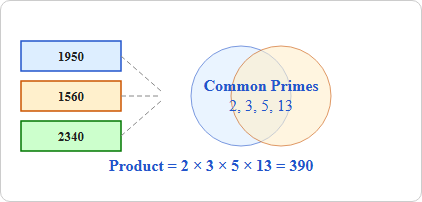
Perform prime factorization for each number:

⇒ 1950 = 21 × 31 × 52 × 131

⇒ 1560 = 23 × 31 × 51 × 131

⇒ 2340 = 22 × 32 × 51 × 131

Identify the common prime factors present in all three numbers:

⇒ The common primes are 2, 3, 5, and 13.

Calculate the product of these common prime factors:

⇒ Product = 2 × 3 × 5 × 13

⇒ Product = 6 × 65 = 390

∴ The correct answer is 390.

Additional Information

Highest Common Factor (HCF)

The HCF is the product of the lowest powers of all common prime factors. In this case, HCF = 21 × 31 × 51 × 131 = 390.

Least Common Multiple (LCM)

The LCM is the product of the highest powers of all prime factors involved in the numbers. For these numbers, LCM = 23 × 32 × 52 × 131 = 23400.

Prime Factorization

Every composite number can be expressed as a unique product of prime numbers. Common prime factors are those primes that appear in the factorization of all given numbers.
2

During a sale 50% of the goods are sold at 40% profit, 40% of the remaining goods are sold at 13% profit and the still remaining goods are sold at a loss of 32%. If there is an overall profit of x%, then what is the value of x?

  1. ((a))

    13

  2. ((b))

    13.5

  3. ((c))

    12.5

  4. ((d))

    14

Show Answer
Answer: ((a))

13

Shortcut Trick

Weighted average profit % = (Portion1 × P1 + Portion2 × P2 + Portion3 × P3)

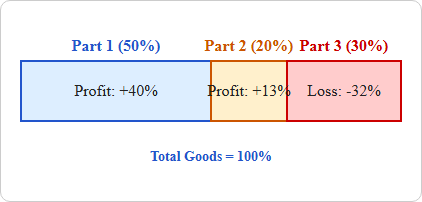
Portion 1 = 50%; Portion 2 = 40% of 50% = 20%; Portion 3 = 100% − 50% − 20% = 30%

Net profit x = (0.50 × 40) + (0.20 × 13) + (0.30 × −32)

x = 20 + 2.6 − 9.6 = 13

∴ The correct answer is 13.

Alternate Method

Given:

Total goods = 100 units (Assumed CP = ₹1/unit, Total CP = ₹100)

First part = 50% of 100 = 50 units at 40% profit.

Second part = 40% of remaining goods (50) = 20 units at 13% profit.

Third part = still remaining goods = 100 − 50 − 20 = 30 units at 32% loss.

Calculations:

⇒ Profit from Part 1 = 40% of 50 = (40 ÷ 100) × 50 = ₹20

⇒ Profit from Part 2 = 13% of 20 = (13 ÷ 100) × 20 = ₹2.6

⇒ Loss from Part 3 = 32% of 30 = (32 ÷ 100) × 30 = ₹9.6

⇒ Total Net Profit = 20 + 2.6 − 9.6 = ₹13

Overall profit x% = (Total Profit ÷ Total CP) × 100

⇒ x = (13 ÷ 100) × 100 = 13

∴ The correct answer is 13.

Additional Information

Weighted Average Profit Formula

When items are sold in different parts, the net profit/loss percentage is given by (n1p1 + n2p2 + ...) ÷ (n1 + n2 + ...), where n is quantity and p is profit%.

Successive Percentage of Remainder

If a% is removed, and then b% of the remaining is taken, the second part as a percentage of the whole is b × (100 − a) ÷ 100.

Profit and Loss Basics

Profit % = (SP − CP) ÷ CP × 100. A loss is treated as a negative profit in calculation of the overall net change.

3

A shopkeeper lists the price of a fan at 36% above its cost price and offers a 25% discount on its list price. If he earns a profit of ₹179, then what is the list price (in ₹) of the fan?

  1. ((a))

    12247

  2. ((b))

    12172

  3. ((c))

    12166

  4. ((d))

    12213

Show Answer
Answer: ((b))

12172

Shortcut Trick

Let Cost Price (CP) = 100 units

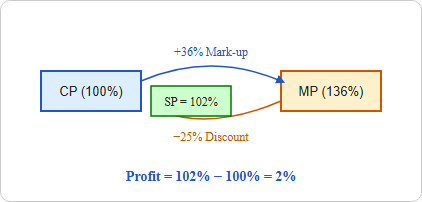
List Price (MP) = 100 + 36% = 136 units

Selling Price (SP) = 136 − 25% of 136 = 136 − 34 = 102 units

Profit = SP − CP = 102 − 100 = 2 units

Given 2 units = ₹179 ⇒ 1 unit = ₹89.5

List Price = 136 units = 136 × 89.5 = ₹12172

∴ The correct answer is ₹12172.

Alternate Method

Given:

Mark-up Percentage = 36%

Discount Percentage = 25%

Actual Profit = ₹179

Formula Used:

Effective Profit % = Mark-up% − Discount% − [(Mark-up% × Discount%) ÷ 100]

Calculations:

⇒ Effective Profit % = 36 − 25 − [(36 × 25) ÷ 100]

⇒ Effective Profit % = 11 − [900 ÷ 100] = 11 − 9 = 2%

⇒ 2% of Cost Price = ₹179

⇒ 1% of CP = 179 ÷ 2 = ₹89.5

⇒ Cost Price (100%) = 89.5 × 100 = ₹8950

List Price (MP) = CP × (136 ÷ 100)

⇒ List Price = 8950 × 1.36

⇒ List Price = ₹12172

∴ The correct answer is ₹12172.

Additional Information

Relationship between CP and MP

The ratio of Cost Price to Marked Price is given by CP/MP = (100 − D%)/(100 + P%), where D is discount and P is profit.

Mark-up Percentage

Mark-up % = [(MP − CP) ÷ CP] × 100. It represents the percentage by which the list price is higher than the cost price.

Successive Percentage Change

When a value is increased by x% and then decreased by y%, the net change is [x − y − (xy/100)]%.

4

If x is the third proportional to 2 and y, and y is the third proportional to x and 18, then what is the value of y?

  1. ((a))

    333 3\sqrt[3]{3}

  2. ((b))

    433 4\sqrt[3]{3}

  3. ((c))

    533 5\sqrt[3]{3}

  4. ((d))

    633 6\sqrt[3]{3}

Show Answer
Answer: ((d))

633 6\sqrt[3]{3}

Shortcut Trick

If c is the third proportional to a and b, then c = b2/a.

Given x = y2/2 and y = 182/x.

Substituting x: y = 324 ÷ (y2/2) ⇒ y = 648/y2.

y3 = 648 ⇒ y = ³√(216 × 3) = 6³√3.

∴ The correct answer is 6³√3.

Alternate Method

Given:

First set: 2, y, and x are in continued proportion.

Second set: x, 18, and y are in continued proportion.

Formula Used:

If a : b = b : c, then b2 = ac.

Calculations:

⇒ From the first condition: y2 = 2 × x ⇒ x = y2/2

⇒ From the second condition: 182 = x × y ⇒ 324 = xy

⇒ Substituting the value of x in the second equation:

⇒ 324 = (y2/2) × y

⇒ 324 × 2 = y3

⇒ y3 = 648

⇒ y = ³√(216 × 3)

⇒ y = 6 × ³√3

∴ The correct answer is 6³√3.

Additional Information

Mean Proportional

The mean proportional between two numbers a and b is defined as √(ab).

Fourth Proportional

If a : b :: c : d, then d is the fourth proportional to a, b, c and is calculated as d = (b × c) / a.

Third Proportional

If a : b :: b : c, then c is the third proportional to a and b, calculated as c = b2 / a.

Continued Proportion

Three numbers a, b, c are in continued proportion if the ratio of the first to the second is equal to the ratio of the second to the third (a/b = b/c).

5

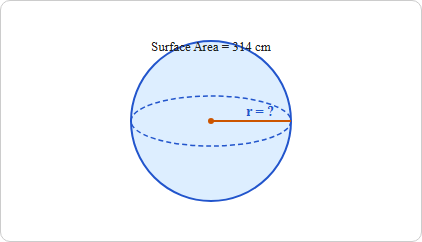
If the surface area of a sphere is 314 cm2, find its radius.

(Take π = 3.14)

  1. ((a))

    0.5 cm

  2. ((b))

    0.05 cm

  3. ((c))

    50 cm

  4. ((d))

    5 cm

Show Answer
Answer: ((d))

5 cm

Shortcut Trick

Directly apply the relation: 4r2 = Surface Area ÷ π

4r2 = 314 ÷ 3.14 = 100

r2 = 100 ÷ 4 = 25

r = √25 = 5 cm

∴ The correct answer is 5 cm.

Alternate Method

Given:

Surface Area (SA) of the sphere = 314 cm2

Value of π = 3.14

Formula Used:

Surface Area of a sphere = 4 × π × r2

Calculations:

⇒ 314 = 4 × 3.14 × r2

⇒ 314 = 12.56 × r2

⇒ r2 = 314 ÷ 12.56

⇒ r2 = 25

⇒ r = √25

⇒ r = 5 cm

∴ The correct answer is 5 cm.

Additional Information

Volume of a Sphere

The total space occupied by a sphere is given by Volume = (4/3) × π × r3.

Hemisphere Formulas

For a hemisphere: Curved Surface Area = 2πr2 and Total Surface Area = 3πr2.

Volume of a Hemisphere

The volume of a hemisphere is exactly half of a sphere: Volume = (2/3) × π × r3.

6

A, B, C, and D can do a piece of work in 12, 15, 20, and 30 days, respectively. All start together, but D leaves after 2 days, C leaves 3 days before the completion, and B leaves 2 days before the completion. Determine the total time required to complete the work.

  1. ((a))

    5 days 20 hours

  2. ((b))

    6 days 2 hours

  3. ((c))

    5 days 10 hours

  4. ((d))

    8 days 6 hours

Show Answer
Answer: ((b))

6 days 2 hours

Shortcut Trick

Total Work = LCM(12, 15, 20, 30) = 60 units. Efficiencies: A=5, B=4, C=3, D=2.

Subtract work of person leaving after starting: 60 − (D × 2) = 60 − 4 = 56 units (D is removed).

Add work of persons leaving before completion: 56 + (C × 3) + (B × 2) = 56 + 9 + 8 = 73 units.

Total time = Adjusted Work ÷ (Sum of efficiencies of A, B, and C) = 73 ÷ 12 = 61/12 days.

Converting fraction to hours: 1/12 × 24 = 2 hours.

∴ The correct answer is 6 days 2 hr.

Alternate Method

Given: Time taken by A = 12 days, B = 15 days, C = 20 days, and D = 30 days.

Formula Used: Total Work = Efficiency × Time | Efficiency = Total Work ÷ Time

PersonDaysTotal WorkEfficiency
A1260 (LCM)5
B154
C203
D302

⇒ Let the total time to complete the work be x days.

D works for 2 days, C works for (x − 3) days, B works for (x − 2) days, and A works for all x days.

⇒ Total work equation: (5 × x) + 4 × (x − 2) + 3 × (x − 3) + (2 × 2) = 60

⇒ 5x + 4x − 8 + 3x − 9 + 4 = 60

⇒ 12x − 13 = 60

⇒ 12x = 73

⇒ x = 73 ÷ 12 = 61/12 days

⇒ 6 days + (1/12 × 24) hours = 6 days 2 hours.

∴ The correct answer is 6 days 2 hr.

Additional Information

Leaving Before vs. After Completion

If a person leaves n days after starting, subtract their work and exclude them. If they leave n days before completion, add their hypothetical work and keep them in the divisor.

Work and Wages

Wages are always distributed in the ratio of the actual work done by each person, which is (Efficiency × Time Spent).

Pipes and Cisterns Analogy

Similar to Time and Work, but inlet pipes have positive efficiency and outlet/leak pipes have negative efficiency.

7

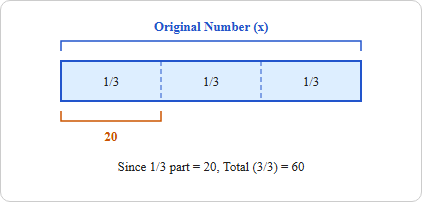
When one-third of a number is increased by 87, the result is 107. Find the sum of the digits of the original number.

  1. ((a))

    3

  2. ((b))

    6

  3. ((c))

    5

  4. ((d))

    8

Show Answer
Answer: ((b))

6

Shortcut Trick

Value of one-third of the number = 107 − 87 = 20.

Original Number = 20 × 3 = 60.

Sum of digits of the number = 6 + 0 = 6.

∴ The correct answer is 6.

Alternate Method

Given:

Result after increasing one-third of a number by 87 = 107

Formula Used:

Linear Equation: (1/n) × x + c = R (where x is the original number)

Calculations:

Let the original number be x.

⇒ (1/3) × x + 87 = 107

⇒ x/3 = 107 − 87

⇒ x/3 = 20

⇒ x = 20 × 3

⇒ x = 60

Now, calculate the sum of the digits of the number 60:

⇒ Sum = 6 + 0 = 6

∴ The correct answer is 6.

Additional Information

Linear Equations

A linear equation in one variable is an equation which can be written in the form ax + b = 0, where a and b are constants and x is the variable.

Sum of Digits Property

The sum of the digits is often used in divisibility rules. For example, a number is divisible by 3 or 9 if the sum of its digits is divisible by 3 or 9 respectively.

Fraction Manipulation

To find the whole from a part, multiply the value of the part by the reciprocal of the fraction (e.g., if 1/n = V, then Total = V × n).

8

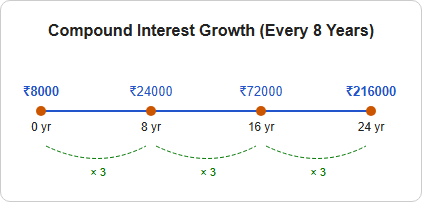
If a sum of ₹8000 becomes thrice of itself after 8 years on compound interest, then how much will it become after 24 years?

  1. ((a))

    ₹206000

  2. ((b))

    ₹216000

  3. ((c))

    ₹253000

  4. ((d))

    ₹236000

Show Answer
Answer: ((b))

₹216000

Shortcut Trick

In Compound Interest, if a sum becomes n times in t years, it becomes nk times in k × t years.

Given: Sum becomes 3 times in 8 years.

Target time = 24 yearsk = 24 ÷ 8 = 3.

New Amount = Principal × 338000 × 27 = ₹216000.

∴ The correct answer is ₹216000.

Alternate Method

Given:

Principal (P) = ₹8000

Time (t) = 8 years, Amount (A) = 3P

Total Time (T) = 24 years

Formula Used:

A = P(1 + r/100)n

Calculations:

⇒ 3P = P(1 + r/100)8

⇒ (1 + r/100)8 = 3

⇒ For 24 years, Amount (A) = P(1 + r/100)24

⇒ A = 8000 × [(1 + r/100)8]3

⇒ A = 8000 × 33

⇒ A = 8000 × 27

⇒ A = ₹216000

∴ The correct answer is ₹216000.

Additional Information

CI Multiplication Property

If a sum grows by a factor of m in t years, it will grow by a factor of mk in k × t years.

Rule of 72

To estimate the time required to double an investment, divide 72 by the annual interest rate r (Time ≈ 72 ÷ r).

Difference between CI and SI for 2 Years

The difference D between CI and SI for 2 years is given by D = P × (r/100)2.

9

What is the decimal form of 72+32.5+1.245+34 \frac{7}{2} + 32.5 + 1.245 + \frac{3}{4} ?

  1. ((a))

    37.995

  2. ((b))

    35.005

  3. ((c))

    39.778

  4. ((d))

    32.125

Show Answer
Answer: ((a))

37.995

Shortcut Trick

Convert fractions to decimals directly: 7/2 = 3.5 and 3/4 = 0.75.

Group numbers for easier addition: (3.5 + 32.5) + (1.245 + 0.75).

36 + 1.995 = 37.995.

∴ The correct answer is 37.995.

Alternate Method

Given Expression: 7/2 + 32.5 + 1.245 + 3/4

Method: Convert all terms into decimal form and perform vertical addition.

⇒ Convert 7/2: 7 ÷ 2 = 3.5

⇒ Convert 3/4: 3 ÷ 22 = 0.75

⇒ Substitute the values: 3.5 + 32.5 + 1.245 + 0.75

⇒ Aligning by decimal point:

   03.500

  32.500

   01.245

  • 00.750

−−−−−−−

  37.995

∴ The correct answer is 37.995.

Additional Information

Decimal Addition Rule

Always align the decimal points vertically. If numbers have different lengths, add trailing zeros (e.g., 3.5 becomes 3.500) to avoid errors in place value.

Common Fraction to Decimal Conversions

Memorize standard conversions for speed: 1/2 = 0.5, 1/4 = 0.25, 3/4 = 0.75, 1/5 = 0.2, and 1/8 = 0.125.

Simplification Priority (BODMAS)

In expressions with mixed operators, solve fractions (division) and multiplication before final addition or subtraction.

10

A can finish a work in 5 days and B can do the same work in 50 days. B worked alone for 10 days and left the job. In how many days can A alone finish the remaining work?

  1. ((a))

    4.5

  2. ((b))

    4

  3. ((c))

    3

  4. ((d))

    3.5

Show Answer
Answer: ((b))

4

Shortcut Trick

Total work = LCM of 5 and 50 = 50 units.

Efficiency of A = 50 ÷ 5 = 10 units/day; Efficiency of B = 50 ÷ 50 = 1 unit/day.

Work done by B in 10 days = 10 × 1 = 10 units.

Remaining work = 50 − 10 = 40 units.

Days taken by A = 40 ÷ 10 = 4 days.

∴ The correct answer is 4 days.

Alternate Method

Given:

Time taken by A = 5 days

Time taken by B = 50 days

Duration B worked alone = 10 days

Formula Used:

Work = Efficiency × Time

Efficiency = Total Work ÷ Time

PersonDaysTotal WorkEfficiency
A55010
B501

Calculations:

⇒ Total work (LCM of 5, 50) = 50 units

⇒ Work completed by B in 10 days = Efficiency of B × Time

⇒ Work done by B = 1 × 10 = 10 units

⇒ Remaining work = Total Work − Work done by B

⇒ Remaining work = 50 − 10 = 40 units

⇒ Days taken by A alone = Remaining work ÷ Efficiency of A

⇒ Days taken by A = 40 ÷ 10 = 4 days

∴ The correct answer is 4 days.

Additional Information

Efficiency-Time Relationship

The efficiency of a person is inversely proportional to the time taken to complete a work: Efficiency ∝ 1/Time.

Combined Work Rule

If two people work together, their combined efficiency is the sum of their individual efficiencies: EffTotal = EffA + EffB.

LCM Method for Total Work

Always assume the total work as the Least Common Multiple (LCM) of the number of days given to simplify calculations into whole numbers.
11

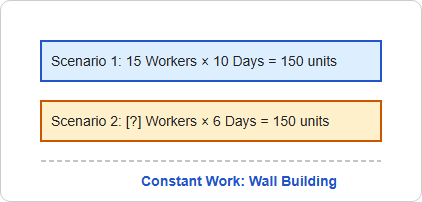
If 15 workers can build a wall in 10 days, how many workers are needed to build it in 6 days?

  1. ((a))

    20

  2. ((b))

    22

  3. ((c))

    25

  4. ((d))

    26

Show Answer
Answer: ((c))

25

Shortcut Trick

Total work remains constant: M1 × D1 = M2 × D2

Product of workers and days in first case = Product in second case.

15 × 10 = M2 × 6

150 = 6 × M2M2 = 25

∴ The correct answer is 25 workers.

Alternate Method

Given:

Initial workers (M1) = 15

Initial days (D1) = 10

Required days (D2) = 6

Formula Used:

M1 × D1 = M2 × D2

Calculations:

⇒ 15 × 10 = M2 × 6

⇒ 150 = 6 × M2

M2 = 150 ÷ 6

M2 = 25

∴ The correct answer is 25 workers.

Additional Information

Chain Rule Formula

The general formula for work problems is (M1 × D1 × H1) ÷ W1 = (M2 × D2 × H2) ÷ W2, where H is hours and W is work.

Inverse Proportion

For a fixed amount of work, the number of workers is inversely proportional to the time taken. If time decreases, workers must increase.

Work and Efficiency

Total Work = Total Efficiency × Time. If efficiency of each worker is 1, then Total Work = Number of Workers × Time.

12

Simplify (5z-12y)2 + (12z+5y)2 - 144z2.

  1. ((a))

    25z2+169y2 25z^{2} + 169y^{2}

  2. ((b))

    32z2+170y232z^{2} + 170y^{2}

  3. ((c))

    31z2+161y231z^{2} + 161y^{2}

  4. ((d))

    24z2+171y224z^{2} + 171y^{2}

Show Answer
Answer: ((a))

25z2+169y2 25z^{2} + 169y^{2}

Shortcut Trick

Identify the standard algebraic identity: (az − by)2 + (bz + ay)2 = (a2 + b2)(z2 + y2).

Substitute a = 5 and b = 12: (52 + 122)(z2 + y2) = (25 + 144)(z2 + y2) = 169z2 + 169y2.

Subtract the remaining term: 169z2 + 169y2 − 144z2 = 25z2 + 169y2.

∴ The correct answer is 25z2 + 169y2.

Alternate Method

Given Expression: (5z − 12y)2 + (12z + 5y)2 − 144z2

Formulas Used: (a − b)2 = a2 + b2 − 2ab and (a + b)2 = a2 + b2 + 2ab

⇒ [(5z)2 + (12y)2 − 2(5z)(12y)] + [(12z)2 + (5y)2 + 2(12z)(5y)] − 144z2

⇒ [25z2 + 144y2 − 120zy] + [144z2 + 25y2 + 120zy] − 144z2

⇒ 25z2 + 144z2 − 144z2 + 144y2 + 25y2 − 120zy + 120zy

⇒ 25z2 + 169y2 + 0

⇒ 25z2 + 169y2

∴ The correct answer is 25z2 + 169y2.

Additional Information

Algebraic Identities

The square of a binomial sum is (a + b)2 = a2 + 2ab + b2, while the square of a binomial difference is (a − b)2 = a2 − 2ab + b2.

Brahmagupta-Fibonacci Identity

The product of two sums of squares is itself a sum of squares: (a2 + b2)(c2 + d2) = (ac − bd)2 + (ad + bc)2.

Pythagorean Triplet

In this problem, the coefficients 5, 12, and 13 form a Pythagorean triplet where 52 + 122 = 132 = 169.

13

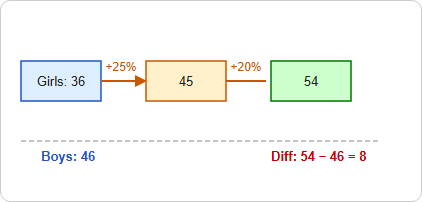
A classroom has 46 boys and 36 girls. If the number of girls is increased successively by 25% followed by another 20%, by how many will the number of girls exceed the number of boys?

  1. ((a))

    10

  2. ((b))

    8

  3. ((c))

    12

  4. ((d))

    6

Show Answer
Answer: ((b))

8

Shortcut Trick

Net percentage increase = x + y + (xy/100)

Successive increase of 25% and 20% = 25 + 20 + (25 × 20 / 100) = 50%

New number of girls = 36 + 50% of 36 = 36 + 18 = 54

Difference = 54 − 46 = 8

∴ The correct answer is 8.

Alternate Method

Given:

Initial number of boys = 46

Initial number of girls = 36

Calculations:

⇒ Number of girls after 25% increase = 36 × (1 + 25/100) = 36 × 1.25 = 45

⇒ Number of girls after subsequent 20% increase = 45 × (1 + 20/100) = 45 × 1.2 = 54

⇒ Difference between final girls and boys = 54 − 46 = 8

∴ The correct answer is 8.

Additional Information

Successive Percentage Change

When a value is changed by a% and then by b%, the effective change is (a + b + ab/100)%. This is also known as the compounding effect.

Fractional Equivalence

To solve quickly, use fractions: a 25% increase is multiplying by 5/4, and a 20% increase is multiplying by 6/5. Total multiplier = 5/4 × 6/5 = 3/2 (or 1.5).

Percentage Difference

Percentage difference = (Difference / Reference Value) × 100. Always identify the base (denominator) correctly based on the phrasing of the question.

14

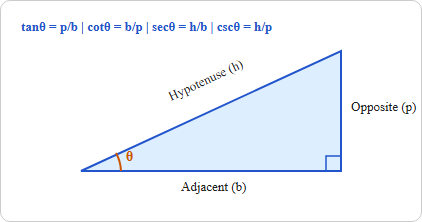
The value of 4 + tan2θ  + cot2θ - sec2θ cosec2θ is:

  1. ((a))

    2

  2. ((b))

    0

  3. ((c))

    -2

  4. ((d))

    4

Show Answer
Answer: ((a))

2

Shortcut Trick

Substitute a standard angle θ = 45° to quickly evaluate the expression.

At θ = 45°: tan 45° = 1, cot 45° = 1, sec 45° = √2, and cosec 45° = √2.

Expression = 4 + (1)2 + (1)2 − (√2)2 x (√2)2

Expression = 4 + 1 + 1 − 2 x 2 = 6 − 4 = 2

∴ The correct answer is 2.

Alternate Method

Given: The trigonometric expression is 2 + tan2θ + cot2θ − sec2θ cosec2θ.

Formula Used:

  1. 1 + tan2θ = sec2θ ⇒ tan2θ = sec2θ − 1
  2. 1 + cot2θ = cosec2θ ⇒ cot2θ = cosec2θ − 1
  3. sec2θ + cosec2θ = sec2θ × cosec2θ

Calculations:

⇒ 4 + tan2θ + cot2θ − sec2θ cosec2θ

⇒ 4 + (sec2θ − 1) + (cosec2θ − 1) − sec2θ cosec2θ

⇒ 4 + sec2θ + cosec2θ − 2 − sec2θ cosec2θ

⇒ 2 + sec2θ + cosec2θ − sec2θ cosec2θ

⇒ 2 + (1/cos2θ + 1/sin2θ) − sec2θ cosec2θ

⇒ 2 + [(sin2θ + cos2θ) / (sin2θ cos2θ)] − sec2θ cosec2θ

⇒ 2 + [1 / (sin2θ cos2θ)] − sec2θ cosec2θ

⇒ 2 + sec2θ cosec2θ − sec2θ cosec2θ = 2

∴ The correct answer is 2.

Additional Information

Sum-to-Product Identity

For secant and cosecant, the sum of their squares is equal to the product of their squares: sec2θ + cosec2θ = sec2θ × cosec2θ.

Tangent and Cotangent Relation

The expression tan θ + cot θ can be simplified as 1/(sin θ cos θ), which is also equal to sec θ cosec θ.

Pythagorean Identities

Always remember sin2θ + cos2θ = 1, 1 + tan2θ = sec2θ, and 1 + cot2θ = cosec2θ as they are the building blocks for such simplifications.

15

Simplify:

8×8+6×6+[6×4÷2×(3 of 2)36÷(6×3)+(8×3)]÷2 8 \times 8 + 6 \times 6 + [6 \times {4 \div 2 \times (3 \text{ of } 2)} - {36 \div (6 \times 3) + (8 \times 3)}] \div 2

  1. ((a))

    123

  2. ((b))

    153

  3. ((c))

    93

  4. ((d))

    73

Show Answer
Answer: ((a))

123

Shortcut Trick

Solve the expression by segmenting it into smaller independent parts using VBODMAS.

Outer segments: 8 × 8 + 6 × 6 = 64 + 36 = 100.

Inner parts: 6 × {2 × 6} − {2 + 24} = 72 − 26 = 46.

Combine and divide: 100 + 46 ÷ 2 = 100 + 23 = 123.

∴ The correct answer is 123.

Alternate Method

Given Expression: 8 × 8 + 6 × 6 + [6 × {4 ÷ 2 × (3 of 2)} − {36 ÷ (6 × 3) + (8 × 3)}] ÷ 2

We use the BODMAS rule to simplify the expression step by step.

⇒ 8 × 8 + 6 × 6 + [6 × {4 ÷ 2 × 6} − {36 ÷ 18 + 24}] ÷ 2

⇒ 64 + 36 + [6 × {2 × 6} − {2 + 24}] ÷ 2

⇒ 100 + [6 × 12 − 26] ÷ 2

⇒ 100 + [72 − 26] ÷ 2

⇒ 100 + 46 ÷ 2

⇒ 100 + 23 = 123

∴ The correct answer is 123.

Additional Information

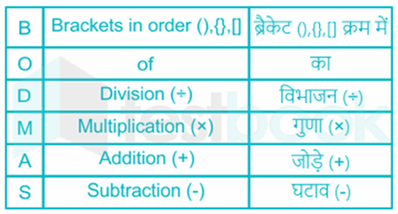
BODMAS Hierarchy

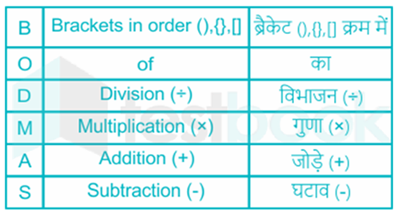
The order of operations is Brackets (), Of (powers/roots), Division (÷), Multiplication (×), Addition (+), and Subtraction (−). If a vinculum (bar) is present, solve it before brackets.

Bracket Sequence

Always solve from the innermost bracket outwards: start with Parentheses ( ), then Braces { }, and finally Square brackets [ ].

Of vs Multiplication

The 'Of' operator mathematically represents multiplication but holds a higher precedence than both Division and standard Multiplication in the sequence.

16

Find the value of 36[10314÷2(10÷2×34+7)] 36 - [10 - 3 {14 \div 2 - (10 \div 2 \times 3 - 4 + 7)}] .

  1. ((a))

    -7

  2. ((b))

    7

  3. ((c))

    -5

  4. ((d))

    5

Show Answer
Answer: ((a))

-7

Shortcut Trick

Solve the expression by following the BODMAS rule from the innermost bracket outwards.

  1. Innermost Bracket: (10 ÷ 2 × 3 − 4 + 7) = 5 × 3 − 4 + 7 = 18
  2. Curly Bracket: {14 ÷ 2 − 18} = 7 − 18 = −11
  3. Square Bracket: [10 − 3 × (−11)] = 10 + 33 = 43
  4. Final Calculation: 36 − 43 = −7

∴ The correct answer is -7.

Alternate Method

Given Expression: 36 − [10 − 3 {14 ÷ 2 − (10 ÷ 2 × 3 − 4 + 7)}]

Formula Used: BODMAS rule (Brackets, Of, Division, Multiplication, Addition, Subtraction)

⇒ 36 − [10 − 3 {14 ÷ 2 − (5 × 3 − 4 + 7)}]

⇒ 36 − [10 − 3 {7 − (15 − 4 + 7)}]

⇒ 36 − [10 − 3 {7 − 18}]

⇒ 36 − [10 − 3 {−11}]

⇒ 36 − [10 + 33]

⇒ 36 − 43

⇒ −7

∴ The correct answer is -7.

Additional Information

BODMAS Rule

The acronym stands for Brackets, Of, Division, Multiplication, Addition, and Subtraction, which defines the hierarchy of mathematical operations.

Bracket Priority

Always prioritize parentheses () first, followed by curly braces {}, and finally square brackets [].

Multiplication of Signs

Remember that multiplying two negative numbers results in a positive product (− × − = +).

17

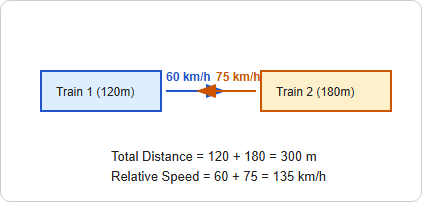
Two trains of lengths 120 m and 180 m are running in opposite directions at speeds of 60 km/h and 75 km/h, respectively. In how many seconds will they completely cross each other?

  1. ((a))

    11 seconds

  2. ((b))

    10 seconds

  3. ((c))

    8 seconds

  4. ((d))

    9 seconds

Show Answer
Answer: ((c))

8 seconds

Shortcut Trick

Relative Speed in opposite directions = 60 + 75 = 135 km/h.

Convert to m/s: 135 × 5/18 = 37.5 m/s.

Total Distance = Sum of lengths = 120 + 180 = 300 m.

Time = 300 ÷ 37.5 = 8 sec.

∴ The correct answer is 8 sec.

Alternate Method

Given:

Length of Train 1 (L1) = 120 m

Length of Train 2 (L2) = 180 m

Speed of Train 1 (S1) = 60 km/h

Speed of Train 2 (S2) = 75 km/h

Formula Used:

Time = (Total Distance) ÷ (Relative Speed)

Calculations:

⇒ Total Distance = 120 + 180 = 300 m

⇒ Relative Speed (Opposite Directions) = S1 + S2

⇒ Relative Speed = 60 + 75 = 135 km/h

⇒ Convert speed to m/s = 135 × (5 ÷ 18)

⇒ Relative Speed = 7.5 × 5 = 37.5 m/s

⇒ Time taken = 300 ÷ 37.5

⇒ Time taken = 3000 ÷ 375 = 8 sec

∴ The correct answer is 8 sec.

Additional Information

Relative Speed Concept

When two objects move in opposite directions, relative speed is S1 + S2. When they move in the same direction, relative speed is |S1 − S2|.

Unit Conversion

To convert speed from km/h to m/s, multiply by 5/18. To convert from m/s to km/h, multiply by 18/5.

Crossing Stationary Objects

Time to cross a pole or man = Train Length ÷ Speed. Time to cross a platform or bridge = (Train Length + Platform Length) ÷ Speed.

18

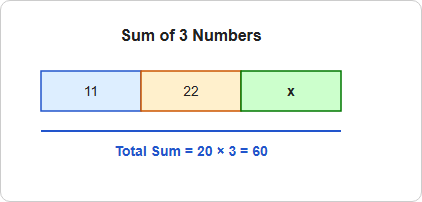
The average of three numbers is 20. If the two numbers are 11 and 22, respectively, then the third number is:

  1. ((a))

    26

  2. ((b))

    27

  3. ((c))

    28

  4. ((d))

    29

Show Answer
Answer: ((b))

27

Shortcut Trick

Using the Net Deviation method from the Average (20):

Deviation of 11 = 11 − 20 = −9

Deviation of 22 = 22 − 20 = +2

Third number deviation = 0 − (−9 + 2) = +7

Third number = 20 + 7 = 27

∴ The correct answer is 27.

Alternate Method

Given:

Average of three numbers = 20

First number = 11 | Second number = 22

Formula Used:

Sum of numbers = Average × Total count

⇒ Sum of 3 numbers = 20 × 3 = 60

⇒ 11 + 22 + Third Number = 60

⇒ 33 + Third Number = 60

Third Number = 60 − 33

Third Number = 27

∴ The correct answer is 27.

Additional Information

Arithmetic Mean (Average)

The average is the central value of a set of numbers, calculated by dividing the total sum by the count of numbers.
Property of Deviations

The algebraic sum of the deviations of a set of values from their arithmetic mean is always zero.

Weighted Average Formula

When groups have different sizes: Weighted Avg = (n1×x1 + n2×x2) ÷ (n1 + n2).

19

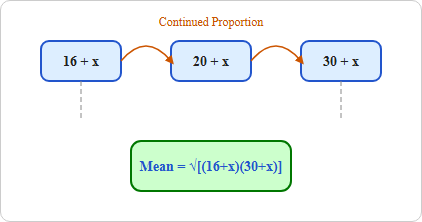
If a number is added to each of the numbers 16, 20 and 30, then the resulting numbers are in the continued proportion. Find the mean proportional between the largest and smallest of the resulting numbers.
  1. ((a))

    269 \frac{26}{9}

  2. ((b))

    203 \frac{20}{3}

  3. ((c))

    509 \frac{50}{9}

  4. ((d))

    403 \frac{40}{3}

Show Answer
Answer: ((b))

203 \frac{20}{3}

Shortcut Trick

For numbers a, b, c to be in continued proportion by adding x, use the shortcut: x = (b2 − ac) / (a + c − 2b).

Here, a = 16, b = 20, c = 30 ⇒ x = (202 − 16 × 30) / (16 + 30 − 2 × 20) = (400 − 480) / (46 − 40) = −80 / 6 = −40/3.

Smallest number = 16 − 40/3 = 8/3 | Largest number = 30 − 40/3 = 50/3.

Mean proportional = √(Smallest × Largest) = √(8/3 × 50/3) = √(400/9) = 20/3.

∴ The correct answer is 20/3.

Alternate Method

Given: Initial numbers are 16, 20, 30. A number x is added to each.

Formula Used: If a, b, c are in continued proportion, then b2 = ac. The mean proportional of m and n is √(m × n).

⇒ Resulting numbers: (16 + x), (20 + x), (30 + x)

⇒ According to the condition: (16 + x) / (20 + x) = (20 + x) / (30 + x)

⇒ (16 + x)(30 + x) = (20 + x)2

⇒ 480 + 16x + 30x + x2 = 400 + 40x + x2

⇒ 480 + 46x = 400 + 40x

⇒ 46x − 40x = 400 − 480

⇒ 6x = −80 ⇒ x = −40/3

⇒ Smallest number = 16 − 40/3 = (48 − 40) / 3 = 8/3

⇒ Largest number = 30 − 40/3 = (90 − 40) / 3 = 50/3

⇒ Mean proportional = √(8/3 × 50/3) = √(400/9) = 20/3

∴ The correct answer is 20/3.

Additional Information

Mean Proportional

The mean proportional between two numbers a and b is defined as x = √(ab), such that a : x = x : b.

Third Proportional

If three numbers a, b, and c are in continued proportion (a/b = b/c), then c is called the third proportional and c = b2/a.

Fourth Proportional

If four numbers a, b, c, and d are in proportion (a : b = c : d), then d is the fourth proportional and d = (b × c) / a.

20

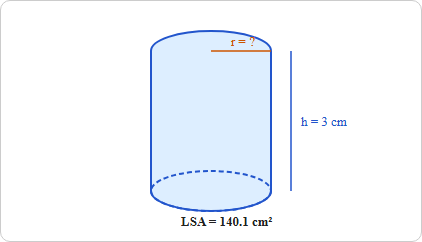
If the lateral surface area of a cylinder is 140.1 cm2 and its height is 3 cm, then find its volume. (Use π = 3.14 and round off to two decimal places.)

  1. ((a))

    520.91 cm3

  2. ((b))

    559.99 cm3

  3. ((c))

    562.32 cm3

  4. ((d))

    570.58 cm3

Show Answer
Answer: ((a))

520.91 cm3

Shortcut Trick

Direct formula connecting Volume (V) and Lateral Surface Area (LSA): V = (LSA2) ÷ (4 × π × h)

V = (140.1 × 140.1) ÷ (4 × 3.14 × 3)

V = 19628.01 ÷ 37.68

V ≈ 520.913...

∴ The correct answer is 520.91 cm3.

Alternate Method

Given:

Lateral Surface Area (LSA) = 140.1 cm2

Height (h) = 3 cm

π = 3.14

Formula Used:

LSA of Cylinder = 2 × π × r × h

Volume of Cylinder = π × r2 × h

Step 1: Find the radius (r)

⇒ 2 × 3.14 × r × 3 = 140.1

⇒ 18.84 × r = 140.1

⇒ r = 140.1 ÷ 18.84

⇒ r ≈ 7.4363 cm

Step 2: Find the volume

⇒ Volume = π × r2 × h

⇒ Volume = 3.14 × (7.4363)2 × 3

⇒ Volume = 9.42 × 55.2985...

⇒ Volume ≈ 520.9123...

∴ The correct answer is 520.91 cm3.

Additional Information

Total Surface Area (TSA) of a Cylinder

It includes the lateral area and the area of the two circular bases: TSA = 2πrh + 2πr2 = 2πr(r + h).

Volume of a Hollow Cylinder

The volume of the material in a hollow cylinder with outer radius R and inner radius r is: V = πh(R2 − r2).

Curved Surface Area vs Lateral Surface Area

For a cylinder, the curved surface area (CSA) is the same as the lateral surface area (LSA), excluding the base areas.

21

The sum of the present ages of Sharad and Adarsh is 36 years. After 2 years from now, Sharad's age will be three times that of Adarsh. Sharad's present age (in years) is:

  1. ((a))

    28

  2. ((b))

    24

  3. ((c))

    37

  4. ((d))

    26

Show Answer
Answer: ((a))

28

Shortcut Trick

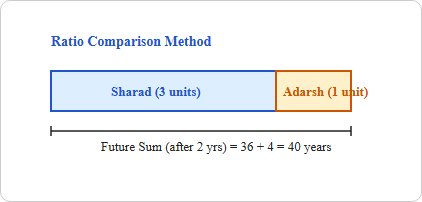
Total sum after 2 years = 36 + (2 × 2) = 40 years (both ages increase by 2).

Ratio after 2 years (Sharad : Adarsh) = 3 : 1.

Total parts = 3 + 1 = 4 units → 40 years ∴ 1 unit = 10 years.

Sharad's age after 2 years = 3 units = 3 × 10 = 30 years.

Sharad's present age = 30 − 2 = 28 years.

∴ The correct answer is 28 years.

Alternate Method

Given:

Sum of present ages of Sharad and Adarsh = 36 years.

Relationship after 2 years: Sharad = 3 × Adarsh.

Calculations:

⇒ Let the present age of Adarsh be x years.

⇒ Present age of Sharad = (36 − x) years.

⇒ After 2 years, Adarsh's age = (x + 2).

⇒ After 2 years, Sharad's age = (36 − x) + 2 = (38 − x).

⇒ According to the condition: (38 − x) = 3 × (x + 2)

⇒ 38 − x = 3x + 6

⇒ 4x = 32

x = 8 (Adarsh's present age)

⇒ Sharad's present age = 36 − 8 = 28 years.

∴ The correct answer is 28 years.

Additional Information

Constant Age Difference

The difference between the ages of two people remains the same at any point in time, whether in the past, present, or future.

Sum of Ages Rule

If the sum of ages of n persons is S, then after t years, the new sum will be S + (n × t).

Ratio Unitary Method

When a ratio A:B and the total value V are known, the value of 1 unit is calculated as V ÷ (A + B).

22

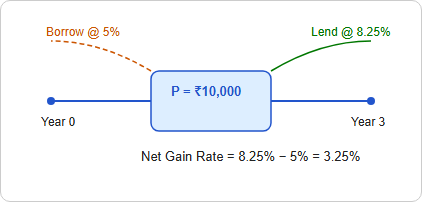
A person borrows ₹10,000 for 3 years at 5% per annum simple interest. He immediately lends it to another person at 814 8\frac{1}{4}% per annum simple interest for 3 years. What is his gain (in ₹) in the transaction per year?

  1. ((a))

    375

  2. ((b))

    450

  3. ((c))

    400

  4. ((d))

    325

Show Answer
Answer: ((d))

325

Shortcut Trick

The Gain per year is the difference between the lending rate and the borrowing rate applied to the Principal.

Rate difference = 8(1/4)% − 5% = 8.25% − 5% = 3.25%

Gain per year = 3.25% of ₹10,000

Gain per year = (3.25 ÷ 100) × 10,000 = 3.25 × 100 = ₹325

∴ The correct answer is ₹325.

Alternate Method 

Given:

Principal (P) = ₹10,000

Borrowing Rate (R1) = 5% per annum

Lending Rate (R2) = 8(1/4)% = 8.25% per annum

Time (T) = 3 years

Formula Used:

Simple Interest (SI) = (P × R × T) ÷ 100

Calculations:

⇒ Total Interest paid in 3 years = (10,000 × 5 × 3) ÷ 100

⇒ Total Interest paid = 100 × 15 = ₹1,500

⇒ Total Interest earned in 3 years = (10,000 × 8.25 × 3) ÷ 100

⇒ Total Interest earned = 100 × 24.75 = ₹2,475

⇒ Total Gain in 3 years = Interest earned − Interest paid

⇒ Total Gain = 2,475 − 1,500 = ₹975

⇒ Gain in the transaction per year = 975 ÷ 3

⇒ Gain per year = ₹325

∴ The correct answer is ₹325.

Additional Information

Simple Interest Principle

Simple interest is calculated only on the initial principal amount of a loan or deposit. Formula: SI = P × R × T ÷ 100.

Effective Gain Rate

When a person borrows at R1 and lends at R2, the net profit rate per year is R2 − R1, provided the principal and time basis are the same.

Compound Interest vs Simple Interest

Unlike SI, Compound Interest is calculated on the principal plus any accumulated interest from previous periods. Amount = P(1 + R/100)n.

23

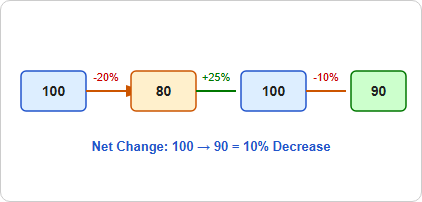
The value of a machine is first depreciated by 20%. It is then appreciated by 25% and finally depreciated by 10%. Find the overall percentage change in its value.

  1. ((a))

    12% decrease

  2. ((b))

    8% decrease

  3. ((c))

    5% decrease

  4. ((d))

    10% decrease

Show Answer
Answer: ((d))

10% decrease

Shortcut Trick

Use the Successive Multiplying Factor method.

Net Multiplying Factor = 0.80 (20% decrease) × 1.25 (25% increase) × 0.90 (10% decrease)

Net Factor = (0.80 × 1.25) × 0.90 = 1.00 × 0.90 = 0.90

Overall Change % = (Final Factor − 1) × 100 = (0.90 − 1) × 100 = −10%

A negative sign indicates a percentage decrease.

∴ The correct answer is 10% decrease.

Alternate Method

Given:

First Change = 20% Depreciation (−)

Second Change = 25% Appreciation (+)

Third Change = 10% Depreciation (−)

Let the Initial Value of the machine be 100.

⇒ Value after 20% depreciation = 100 − (20% of 100) = 100 − 20 = 80

⇒ Value after 25% appreciation = 80 + (25% of 80) = 80 + 20 = 100

⇒ Value after 10% depreciation = 100 − (10% of 100) = 100 − 10 = 90

⇒ Total change in value = 100 − 90 = 10

⇒ Overall Percentage Change = (Total Change ÷ Initial Value) × 100

⇒ Overall Percentage Change = (10 ÷ 100) × 100 = 10%

∴ The correct answer is 10% decrease.

Additional Information

Successive Percentage Change Formula

For two successive percentage changes of a% and b%, the effective change is given by the formula: [a + b + (ab/100)]%.

Fractional Equivalents

Calculations become faster using fractions: 20% = 1/5, 25% = 1/4, and 10% = 1/10. For depreciation, multiply by (1 − fraction), and for appreciation, multiply by (1 + fraction).

Net Change Principle

The order of percentage changes does not affect the final result. A 20% decrease followed by a 25% increase results in the same final value as a 25% increase followed by a 20% decrease.

24

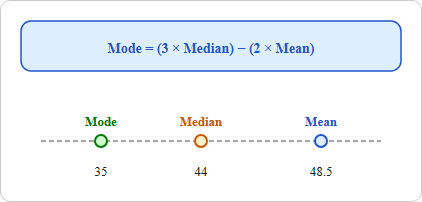
For a given data, the mean is 48.5 and the median is 44. The mode of the data is:

  1. ((a))

    35

  2. ((b))

    32

  3. ((c))

    42

  4. ((d))

    25

Show Answer
Answer: ((a))

35

Shortcut Trick

Use the empirical relationship formula: Mode = 3 × Median − 2 × Mean.

Substituting the given values: Mode = 3 × 44 − 2 × 48.5

Mode = 132 − 97 = 35.

∴ The correct answer is 35.

Alternate Method

Given:

Mean = 48.5

Median = 44

Formula Used:

The relationship between the three measures of central tendency is given by: Mode = 3 × Median − 2 × Mean.

Calculations:

⇒ Mode = 3 × 44 − 2 × 48.5

⇒ Mode = 132 − 97

⇒ Mode = 35

∴ The correct answer is 35.

Additional Information

Empirical Relationship Constraints

This formula is an approximation and works best for moderately skewed frequency distributions. It is not applicable for highly skewed or J-shaped distributions.

Symmetrical Distribution

In a perfectly symmetrical distribution (like the Normal distribution), the Mean, Median, and Mode are all equal: Mean = Median = Mode.

Positively vs Negatively Skewed

If Mean > Median > Mode, the data is positively skewed. If Mean < Median < Mode, the data is negatively skewed.

25

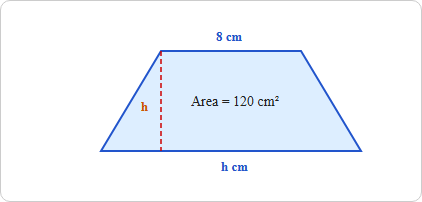
The length of one of the two parallel sides of a trapezium is 8 cm, while the length of the other side of this pair of parallel sides is equal to the distance between this pair of parallel sides. If the area of the trapezium is 120 cm2, then what is the distance (in cm) between the said pair of parallel sides?

  1. ((a))

    12

  2. ((b))

    15

  3. ((c))

    10

  4. ((d))

    20

Show Answer
Answer: ((a))

12

Shortcut Trick

Area of trapezium = ½ × (Sum of parallel sides) × Height

Given: Side 1 = 8 cm, Side 2 = h, Height = h, Area = 120 cm2

⇒ 120 = ½ × (8 + h) × h ⇒ h(h + 8) = 240

By checking options: If h = 12, then 12 × (12 + 8) = 12 × 20 = 240 (Matches!)

∴ The correct answer is 12 cm.

Alternate Method

Given:

Parallel side a = 8 cm

Parallel side b = Distance h

Area = 120 cm2

Formula Used:

⇒ Area of Trapezium = ½ × (a + b) × h

Calculations:

⇒ 120 = ½ × (8 + h) × h

⇒ 240 = 8h + h2

⇒ h2 + 8h − 240 = 0

⇒ h2 + 20h − 12h − 240 = 0

⇒ h(h + 20) − 12(h + 20) = 0

⇒ (h − 12)(h + 20) = 0

⇒ Since h cannot be negative, h = 12 cm.

∴ The correct answer is 12 cm.

Additional Information

Area of Trapezium

It is defined as the product of the average of the parallel sides and the vertical distance between them: Area = ½ × (sum of parallel sides) × h.

Median of a Trapezium

The median is a line segment connecting the midpoints of the non-parallel sides. Its length L = ½ × (a + b). Area can also be written as Area = L × h.

Isosceles Trapezium

A trapezium where the non-parallel sides are equal in length and the base angles are equal. The diagonals of an isosceles trapezium are always equal.

General Intelligence & Reasoning (25 questions)

26

WAVE is related to XBXG in a certain way based on the English alphabetical order. In the same way, KING is related to LJPI. To which of the given options is SONG related, following the same logic?

  1. ((a))

    RPOI

  2. ((b))

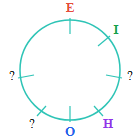
    TPPI

  3. ((c))

    RRPK

  4. ((d))

    TRPK

Show Answer
Answer: ((b))

TPPI

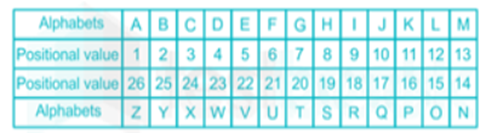
The logic followed in this pattern is a combination of alphabetical shifts.

For 'WAVE' related to 'XBXG':

W(23)A(1)V(22)E(5)
+1 ↓+1 ↓+2 ↓+2 ↓
X(24)B(2)X(24)G(7)

For 'KING' related to 'LJPI':

K(11)I(9)N(14)G(7)
+1 ↓+1 ↓+2 ↓+2 ↓
L(12)J(10)P(16)I(9)

Applying the same logic to 'SONG':

S(19)O(15)N(14)G(7)
+1 ↓+1 ↓+2 ↓+2 ↓
T(20)P(16)P(16)I(9)

Thus, SONG is related to TPPI.

Hence, the correct answer is 'Option 2'.

27

Each letter in the word EDITORIAL is arranged in alphabetical order. How many letters are there in the English alphabetical order between the letter which is fourth from the left and the one which is second from the right in the new letter cluster thus formed?

  1. ((a))

    7

  2. ((b))

    5

  3. ((c))

    8

  4. ((d))

    6

Show Answer
Answer: ((c))

8

Given:

Word = EDITORIAL

Arrange the letters in alphabetical order:

Position123456789
LetterADEIILORT

Required letters:

  • 4th from the left = I
  • 2nd from the right = R

Letters between I and R in the English alphabet are:

J, K, L, M, N, O, P, Q

Total letters between them = 8.

Hence, the correct answer is "Option 3".

28

The position(s) of how many letters will remain unchanged if each letter in the word "FOXHUNTERS" is arranged in alphabetical order?

  1. ((a))

    Three

  2. ((b))

    Two

  3. ((c))

    None

  4. ((d))

    One

Show Answer
Answer: ((c))

None

Given:

Word = FOXHUNTERS

Original Positions:

Position12345678910
LetterFOXHUNTERS
<br>

Arrange the letters in alphabetical order:

Position12345678910
LetterEFHNORSTUX
<br>

Comparison:

PositionOriginalNewSame?
1FENo
2OFNo
3XHNo
4HNNo
5UONo
6NRNo
7TSNo
8ETNo
9RUNo
10SXNo
<br>

No letter remains in its original position.

Hence, the correct answer is "Option 3".

29

A, B, C, P, S, T and U are sitting in a straight line facing the north. Only two people are seated between T and U. Only C is seated to the right of S. Only one person is seated between U and S. A is seated at some place to the right of P, but at some place to the left of B. How many people are seated between B and P?

  1. ((a))

    Three

  2. ((b))

    One

  3. ((c))

    Four

  4. ((d))

    Two

Show Answer
Answer: ((d))

Two

Logic followed here is: Determine the fixed positions of individuals based on the given constraints to reconstruct the full linear arrangement.

For the position of S and C:

Only C is seated to the right of S. In a row of seven people facing North, this places S at the 6th position and C at the 7th position.

For the position of U:

Only one person is seated between U and S. Since S is at the 6th position, U must be at the 4th position.

For the position of T:

Only two people are seated between T and U. Since U is at the 4th position, T must be at the 1st position (4 − 3 = 1).

Similarly, for P, A, and B:

The remaining empty positions are 2, 3, and 5. A is seated at some place to the right of P, but at some place to the left of B. This establishes the sequence P → A → B. Therefore, P is at the 2nd position, A is at the 3rd position, and B is at the 5th position.

Final Seating Arrangement:

<br>


To find the number of people seated between B and P:

Position of P = 2

Position of B = 5

People seated between them are at positions 3 and 4, which are A and U.

Total count = 2

Hence, the correct answer is "Option 4".

30

A, E, I, O, F, G and H are sitting around a circular table facing the centre of the table.

Only two people sit between E and O when counted from the right of E. Only two people sit between O and I. Only three people sit between E and H. A sits to the immediate left of G.

Who sits third to the left of F?

  1. ((a))

    A

  2. ((b))

    E

  3. ((c))

    I

  4. ((d))

    G

Show Answer
Answer: ((d))

G

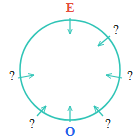
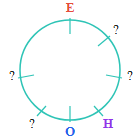
  1. Since all persons face the centre: right = counterclockwise (CCW), left = clockwise (CW). Fix E at pos(1). Only two people sit between E and O when counted from the right of E (CCW): E(1) → pos(7) → pos(6) → O(5). So O is at pos(5).

  1. Only three people sit between E and H. Counting CCW from E(1): skip pos(7), pos(6), pos(5) → H(4). Since pos(5) is already taken by O, H must be at pos(4).

  1. Only two people sit between O and I. From O(5), counting CCW: skip pos(4), pos(3) → I(2). Counting CW: skip pos(6), pos(7) → E(1). Thus, I is at pos(2).

  1. A sits to the immediate left of G. Left is clockwise (CW). The remaining positions are 3, 6, and 7. If G sits at pos(6), its immediate left (CW) is pos(7), which is available for A. (If G was at 7, left is E; if G was at 3, left is H). So, G is at pos(6) and A is at pos(7).

  1. The remaining person F fills pos(3). Final arrangement clockwise: E(1), I(2), F(3), H(4), O(5), G(6), A(7).

<br>

To find who sits third to the left of F, move clockwise from F(3): 1st left is H(4), 2nd left is O(5), and 3rd left is G(6). Therefore, G sits third to the left of F.

<br>

Hence, the correct answer is 'Option 4'.

31

In a row of 29 people facing north, Karan is 9th from the right end. If Ramesh sits fifth to the left of Karan, what is Ramesh’s position from the left end of the line?

  1. ((a))

    16th

  2. ((b))

    14th

  3. ((c))

    15th

  4. ((d))

    17th

Show Answer
Answer: ((a))

16th

The logic followed here is:

Total number of people in the row = 29

Position of Karan from the right end = 9th

Ramesh sits 5th to the left of Karan.

Since everyone is facing North, moving to the left of Karan (who is already at the 9th position from the right) means moving further away from the right end.

Position of Ramesh from the right end = Position of Karan from the right end + 5

= 9 + 5

= 14th from the right end

To find Ramesh's position from the left end, we use the formula:

Position from the left end = (Total number of people − Position from the right end) + 1

= (29 − 14) + 1

= 15 + 1

= 16th

So, Ramesh is 16th from the left end.

Hence, the correct answer is "Option 1".

32

Select the set in which the numbers are related in the same way as are the numbers of the following sets.

(Note: Operations should be performed on the whole numbers, without breaking down the numbers into their constituent digits. E.g. 13 – Operations on 13 such as adding/subtracting/multiplying to 13 can be performed. Breaking down 13 into 1 and 3 and then performing mathematical operations on 1 and 3 is not allowed.)

(8, 3, 7)
(9, 4, 9)

  1. ((a))

    (13, 8, 15)

  2. ((b))

    (11, 5, 13)

  3. ((c))

    (12, 17, 35)

  4. ((d))

    (7, 2, 5)

Show Answer
Answer: ((d))

(7, 2, 5)

The logic followed here is:

Logic: Third Number = (First Number + Second Number) − 4

For the first set (8, 3, 7)

⇒ (8 + 3) − 4

⇒ 11 − 4 = 7.

For the second set (9, 4, 9)

⇒ (9 + 4) − 4

⇒ 13 − 4 = 9.

Applying the same logic to Option 4

(7, 2, 5)

⇒ (7 + 2) − 4

⇒ 9 − 4 = 5.

Hence, the correct answer is 'Option 4'.

33

Select the pair which follows the same pattern as that followed by the two pairs given below. Both pairs follow the same pattern.

NEX : RIB
VBS : ZFW

  1. ((a))

    GWR : IZU

  2. ((b))

    QKE : TNH

  3. ((c))

    YSD : CUF

  4. ((d))

    TAJ : XEN

Show Answer
Answer: ((d))

TAJ : XEN

The logic followed in this pattern is a series of alphabetical shifts where each letter in the first term is moved forward by 4 positions to obtain the corresponding letter in the second term.

For 'NEX' related to 'RIB':

N(14)E(5)X(24)
+4 ↓+4 ↓+4 ↓
R(18)I(9)B(2)

For 'VBS' related to 'ZFW':

V(22)B(2)S(19)
+4 ↓+4 ↓+4 ↓
Z(26)F(6)W(23)

Applying the same logic to 'TAJ':

T(20)A(1)J(10)
+4 ↓+4 ↓+4 ↓
X(24)E(5)N(14)

Thus, TAJ is related to XEN following the pattern of +4 shifts for each character.

Hence, the correct answer is 'Option 4'.

34

Based on the English alphabetical order, three of the following four letter-cluster pairs are alike in a certain way and thus form a group. Which is the one that does not belong to that group? (Note: The odd one out is not based on the number of consonants/vowels or their position in the letter-cluster.)

  1. ((a))

    GO – MU

  2. ((b))

    FN – KS

  3. ((c))

    HP – NV

  4. ((d))

    CK – IQ

Show Answer
Answer: ((b))

FN – KS

The logic followed here is

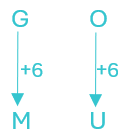
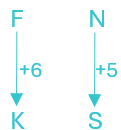
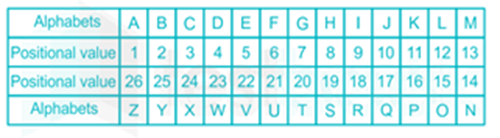
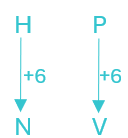
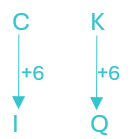
Logic: The positional values of the letters in the second cluster are obtained by adding 6 to the positional values of the corresponding letters in the first cluster in English alphabetical order.

Option 1)  GO - MU,

Option 2) FN - KS,

This pair follows a +5 pattern instead of +6, and thus does not belong to the group.

Option 3) HP - NV

Option 4) CK - IQ,

Therefore, the letter-cluster pair that is different from the others is FN - KS.

Hence, the correct answer is 'Option 2'.

35

Refer to the following letter series and answer the question that follows. Counting to be done from left to right.

(Left) F Z I U K J Q D H M C X O E N L P G B E A (Right)

How many such vowels are there, each of which is immediately preceded by a consonant and also immediately followed by a vowel?

  1. ((a))

    One

  2. ((b))

    None

  3. ((c))

    Two

  4. ((d))

    Three

Show Answer
Answer: ((d))

Three

Given Series:

(Left) F Z I U K J Q D H M C X O E N L P G B E A (Right)

Required pattern:

Consonant → Vowel → Vowel

Checking the series:

(Left) F Z I U K J Q D H M C X O E N L P G B E A (Right)

Vowels satisfying the condition:

→ I in (Z I U)

→ O in (X O E)

→ E in (B E A)

Therefore, there are 3 such vowels.

Hence, the correct answer is "Option 4".

36

Select the pair that follows the same pattern as the one followed by the two set of pairs given below. Both pairs follow the same pattern.

IRQ : KPP
MEU : OCT

  1. ((a))

    RQN : TOM

  2. ((b))

    CMR : EKP

  3. ((c))

    GRP : IPN

  4. ((d))

    FJM : HGL

Show Answer
Answer: ((a))

RQN : TOM

The logic followed in this pattern is a series of alphabetical shifts for each letter in the set.

For 'IRQ' related to 'KPP':

I(9)R(18)Q(17)
+2 ↓−2 ↓−1 ↓
K(11)P(16)P(16)

For 'MEU' related to 'OCT':

M(13)E(5)U(21)
+2 ↓−2 ↓−1 ↓
O(15)C(3)T(20)

Applying the same logic to 'RQN' to find its relation to 'TOM':

R(18)Q(17)N(14)
+2 ↓−2 ↓−1 ↓
T(20)O(15)M(13)

Thus, the pair RQN : TOM follows the same pattern.

Hence, the correct answer is 'Option 1'.

37

Based on the alphabetical order, three of the following four are alike in a certain way and thus form a group. Which is the one that does not belong to that group?

(Note: The odd man out is not based on the number of consonants/vowels or their position in the letter cluster.)

  1. ((a))

    PQV

  2. ((b))

    BCH

  3. ((c))

    IJO

  4. ((d))

    FGO

Show Answer
Answer: ((d))

FGO

The logic followed here is based on the difference between the positional values of the letters in the English alphabetical series.

1) PQV

<br>


2) BCH

<br>


3) IJO

<br>


4) FGO

Comparing the patterns observed:

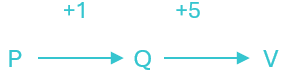
The letter clusters PQV, BCH, and IJO follow a pattern of +1, +5 between their letters.

However, the cluster FGO follows a pattern of +1, +8.

Therefore, FGO is the odd one out from the group.

Hence, the correct answer is "Option 4".

38

Based on the English alphabetical order, three of the following four letter-cluster pairs are alike in a certain way and thus form a group. Which letter-cluster pair DOES NOT belong to that group?

(Note: The odd one out is not based on the number of consonants/vowels or their position in the letter-cluster.)

  1. ((a))

    EW – BB

  2. ((b))

    KM – HR

  3. ((c))

    HK – DP

  4. ((d))

    QC – NH

Show Answer
Answer: ((c))

HK – DP

The logic followed here is

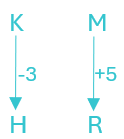
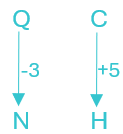
Logic: The first letter of the cluster is decreased by 3 and the second letter of the cluster is increased by 5 in alphabetical order to obtain the second cluster.

Option 1)  EW - BB,

Option 2) KM - HR,

Option 3) HK - DP

In this pair, the first letter is decreased by 4 instead of 3. This pair does not follow the rule.

Option 4) QC - NH,

Therefore, the letter-cluster pair that is different from the others is HK - DP.

Hence, the correct answer is 'Option 3'.

39

Based on the English alphabetical order, three of the following four letter-clusters are alike in a certain way and thus form a group. Which letter-cluster DOES NOT belong to that group?

(Note: The odd one out is not based on the number of consonants/vowels or their position in the letter-cluster.)

  1. ((a))

    ILJ

  2. ((b))

    EHF

  3. ((c))

    YTW

  4. ((d))

    JMK

Show Answer
Answer: ((c))

YTW

Logic followed here is.

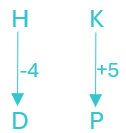
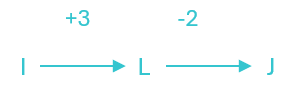
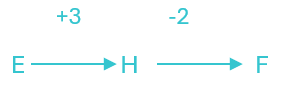
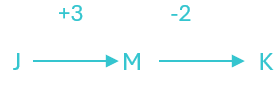
Logic: The difference between the positional values of the first and second letters is +3, and the difference between the second and third letters is −2.

1) ILJ:

2) EHF:

<br>


3) YTW:

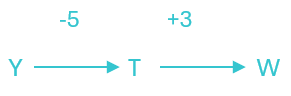
Pattern is −5, +3, which is different from others.


4) JMK:

The pattern followed in ILJ, EHF, and JMK is (+3, −2), whereas YTW follows (−5, +3).

Therefore, the odd cluster is YTW.

Hence, the correct answer is "Option 3".

40

Refer to the following series and answer the question (All numbers are single-digit numbers only. Counting is to be done from left to right.)

<br>

(Left) 6 8 2 1 4 8 7 1 3 7 2 4 8 9 5 4 3 5 2 7 (Right)

<br>

How many such digits are there each of which is immediately preceded by a perfect square and immediately followed by an odd digit? (NOTE: 1 is also a perfect square.)

  1. ((a))

    Three

  2. ((b))

    Two

  3. ((c))

    Four

  4. ((d))

    One

Show Answer
Answer: ((c))

Four

Given Series:

(Left) 6 8 2 1 4 8 7 1 3 7 2 4 8 9 5 4 3 5 2 7 (Right)

Required pattern:

Perfect Square → Digit → Odd Digit

(Perfect Squares: 1, 4, 9)

Checking the series:

(Left) 6 8 2 1 4 8 7 1 3 7 2 4 8 9 5 4 3 5 2 7 (Right)

Digits satisfying the condition:

→ 8 in (4 8 7)

→ 3 in (1 3 7)

→ 8 in (4 8 9)

→ 3 in (4 3 5)

Therefore, there are 4 such digits.

Hence, the correct answer is "Option 3".

41

If ‘A’ stands for ‘÷’, ‘B’ stands for ‘×’, ‘C’ stands for ‘+’ and ‘D’ stands for ‘−’, what will come in place of the question mark (?) in the following equation?

<br>

2 B 1 D 14 A 2 C 7 = ?

  1. ((a))

    2

  2. ((b))

    1

  3. ((c))

    4

  4. ((d))

    3

Show Answer
Answer: ((a))

2

Logic followed here is the substitution of letters with mathematical operators and solving the expression using the BODMAS rule.

Operator Mapping Table:

LetterStands for
A÷
B×
C+
D-


The given expression is:

2 B 1 D 14 A 2 C 7 = ?

Replacing the letters with their respective mathematical symbols:

= 2 × 114 ÷ 2 + 7


= 2 - 7 + 7

= 2 

Therefore, the value that will come in place of the question mark is 2.

Hence, the correct answer is "Option 1".

42

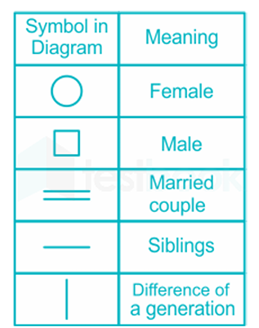
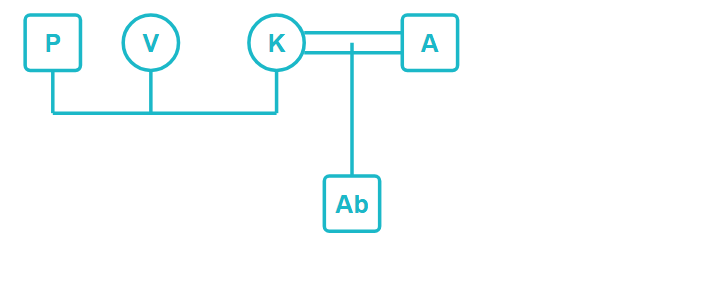
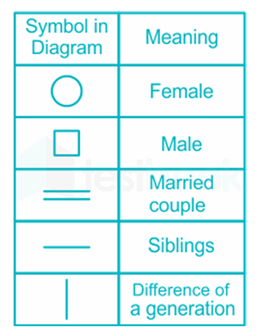
Piyush is the brother of Vidhi. Vidhi is the sister of Kunti. Kunti is the wife of Arjun. Arjun is the father of Abhimanyu. How is Piyush related to Abhimanyu?

  1. ((a))

    Father's brother

  2. ((b))

    Mother's brother

  3. ((c))

    Mother's father

  4. ((d))

    Father's father

Show Answer
Answer: ((b))

Mother's brother

Given:

Let us first decode the given relationships and then draw a family tree.

1) Piyush is the brother of Vidhi.

2) Vidhi is the sister of Kunti.

3) Kunti is the wife of Arjun.

4) Arjun is the father of Abhimanyu.

5) As Kunti is the wife of Arjun and Arjun is the father of Abhimanyu, it implies that Kunti is the mother of Abhimanyu.

Therefore, Piyush is the brother of Kunti, and Kunti is the mother of AbhimanyuPiyush is the Mother's brother of Abhimanyu.

Hence, the correct answer is 'Option 2'.

43

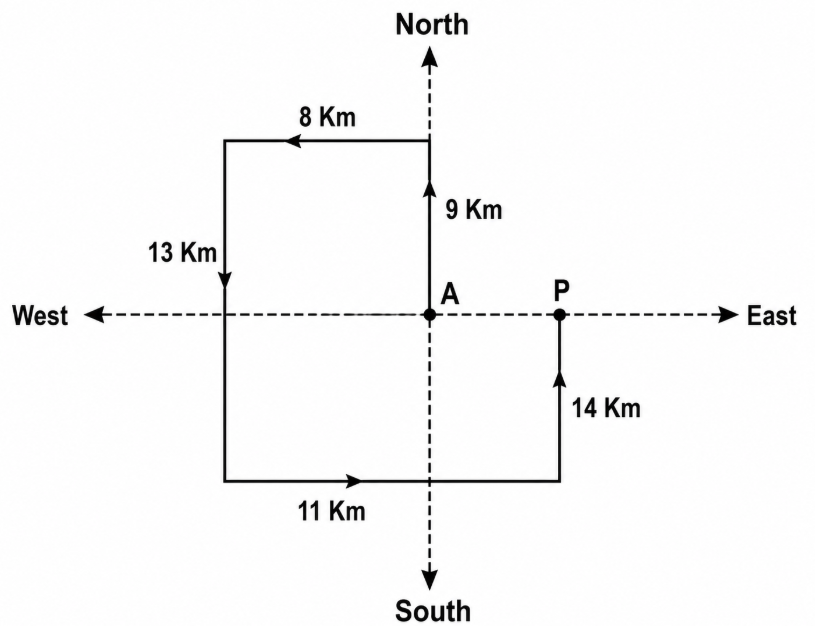
Raju starts from Point A and drives 9 km towards north. He then takes a left turn, drives 8 km, turns left and drives 13 km. He then takes a left turn and drives 11 km. He takes a final left turn, drives 4 km and stops at Point P. How far (shortest distance) and towards which direction should he drive in order to reach Point A again?

<br>

(All turns are 90° turns only unless specified.)

  1. ((a))

    3 km to the east

  2. ((b))

    4 km to the east

  3. ((c))

    2 km to the east

  4. ((d))

    3 km to the west

Show Answer
Answer: ((d))

3 km to the west

The logic followed here is based on tracing the directional path of Raju to find his final position (Point P) relative to his starting position (Point A).

Step-by-step Movement:

  1. Starting at Point A, Raju drives 9 km North.
  2. He turns left (now facing West) and drives 8 km.
  3. He turns left (now facing South) and drives 13 km.
  4. He turns left (now facing East) and drives 11 km.
  5. He takes a final left turn (now facing North) and drives 4 km to stop at Point P.


Therefore, Raju should drive 3 km to the west to reach Point A.

Hence, the correct answer is "Option 4".

44

In a certain code language,

A + B means ‘A is the son of B’,

A - B means ‘A is the brother of B’,

A x B means ‘A is the wife of B’, and

A ÷ B means ‘A is the father of B’.

Based on the above, how is Z related to H if 'Z+U-NxC÷H’?

  1. ((a))

    Father

  2. ((b))

    Mother's brother's Son

  3. ((c))

    Brother's Son

  4. ((d))

    Mother's brother

Show Answer
Answer: ((b))

Mother's brother's Son

Given:

Let us first decode the given symbols and then draw a family tree.

A is
Symbol+×÷
MeaningSonBrotherWifeFather
of B


On checking: Z + U − N × C ÷ H

  1. Z + U - 'Z + U' means 'Z is the son of U'.

  2. U − N - 'U − N' means 'U is the brother of N'.

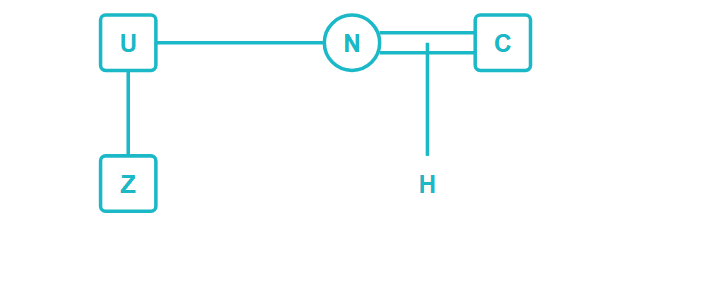
  3. N × C - 'N × C' means 'N is the wife of C'.

  4. C ÷ H - 'C ÷ H' means 'C is the father of H'.

​Therefore, Z is the son of U, who is the brother of H's mother (N) → Z is the Mother's brother's Son of H.

Hence, the correct answer is 'Option 2'.

45

What should come in place of ‘?’ in the given series?

<br>

31 44 52 65 73 ?

  1. ((a))

    80

  2. ((b))

    82

  3. ((c))

    84

  4. ((d))

    86

Show Answer
Answer: ((d))

86

The logic followed here is:

The given number series follows an alternating addition pattern as explained below:

The given number series is: 31, 44, 52, 65, 73, ?

314452657386
+13+8+13+8+13

Thus, the missing term in the series is 86.

Hence, the correct answer is 'Option 4';

46

What will come in the place of ‘?’ in the following equation, if ‘+’ and ‘-’ are interchanged and ‘x’ and ‘÷’ are interchanged?

<br>

5 ÷ 2 + 16 x 4 - 4 = ?

  1. ((a))

    14

  2. ((b))

    10

  3. ((c))

    12

  4. ((d))

    8

Show Answer
Answer: ((b))

10

Given sign interchanges:

Original SignNew Sign
+
+
×÷
÷×


The given equation is:

5 ÷ 2 + 16 × 4 − 4 = ?

After interchanging the signs as per the instructions, the equation becomes:

= 5 × 2 − 16 ÷ 4 + 4

= 5 × 2 - 4 + 4

= 10 - 4 + 4

= 10

Therefore, the value that will come in place of the question mark is 10.

Hence, the correct answer is "Option 2".

47

In a certain code language,

A + B means ‘A is the mother of B’

A - B means ‘A is the brother of B’

A x B means ‘A is the sister of B’

A ÷ B means ‘A is the daughter of B’

<br>

Based on the above, how is G related to K if ‘G + H ÷ I - J x K’?

  1. ((a))

    Brother's wife

  2. ((b))

    Sister

  3. ((c))

    Brother's daughter

  4. ((d))

    Daughter

Show Answer
Answer: ((a))

Brother's wife

Given:

Let us first decode the given symbols and then draw a family tree.

A is
Symbol+×div
MeaningMotherBrotherSisterDaughter
of B


On checking: G + H div I − J × K

  1. G + H - 'G + H' means 'G is the mother of H'.

  2. H div I - 'H div I' means 'H is the daughter of I'.

  3. I − J - 'I − J' means 'I is the brother of J'.

  4. J × K - 'J × K' means 'J is the sister of K'.

Since G is the mother of H and I is the father of H, G is the wife of I. As I is the brother of K, G is the Brother's wife of K.

Hence, the correct answer is 'Option 1'.

48

In a certain code language, ‘CRAB’ is coded as ‘8642’ and ‘BENT’ is coded as ‘1358’. What is the code for ‘B’ in that language?

  1. ((a))

    8

  2. ((b))

    1

  3. ((c))

    2

  4. ((d))

    3

Show Answer
Answer: ((a))

8

Logic followed here is.

Logic: The code for a specific letter is determined by identifying the common letter across different words and the corresponding common digit in their codes.

For

CRAB is coded as 8642

BENT is coded as 1358


By the method of comparison, since 'B' is the only common letter and '8' is the only common digit, the code for 'B' must be 8.

Hence, the correct answer is "Option 1".

49

In a row of 45 people facing north, Pari is 14th from the right end. If Bittu sits 20th to the left of Pari, what is Bittu’s position from the left end of the line?

  1. ((a))

    11th

  2. ((b))

    12th

  3. ((c))

    10th

  4. ((d))

    13th

Show Answer
Answer: ((b))

12th

The logic followed here is:

Total number of people in the row = 45

Position of Pari from the right end = 14th

Bittu sits 20th to the left of Pari.

Position of Bittu from the right end = Position of Pari from the right end + 20

= 14 + 20

= 34th

To find Bittu’s position from the left end, we use the formula:

Position from the left = (Total number of people − Position from the right) + 1

= (45 − 34) + 1

= 11 + 1

= 12th

Hence, the correct answer is 'Option 2'.

50

In a certain code language, ‘MIND’ is coded as ‘7542’ and ‘DOPE’ is coded as ‘1436’. What is the code for ‘D’ in that language?

  1. ((a))

    1

  2. ((b))

    3

  3. ((c))

    2

  4. ((d))

    4

Show Answer
Answer: ((d))

4

Logic followed here is the comparison of the common letters and their corresponding digits in the given coded words.

For the given words:

MIND is coded as '7542'

DOPE is coded as '1436'

Therefore, the code for 'D' is 4.

Hence, the correct answer is "Option 4".

General Science (40 questions)

51

Which of the following is an example of a double displacement reaction?

  1. ((a))

    Na2SO4+BaCl2BaSO4+2NaCl Na_2SO_4 + BaCl_2 \rightarrow BaSO_4 + 2NaCl

  2. ((b))

    CaCO3CaO+CO2 CaCO_3 \rightarrow CaO + CO_2

  3. ((c))

    2H2+O22H2O 2H_2 + O_2 \rightarrow 2H_2O

  4. ((d))

    Fe+CuSO4FeSO4+Cu Fe + CuSO_4 \rightarrow FeSO_4 + Cu

Show Answer
Answer: ((a))

Na2SO4+BaCl2BaSO4+2NaCl Na_2SO_4 + BaCl_2 \rightarrow BaSO_4 + 2NaCl

The correct answer is Na2SO4 + BaCl2 → BaSO4 + 2NaCl.

Key Points

  • A double displacement reaction is a type of chemical process where two compounds react, and the positive ions (cations) and the negative ions (anions) of the two reactants switch places to form two new compounds.
  • In the reaction Na2SO4 + BaCl2 → BaSO4 + 2NaCl, the Sodium ions (Na+) from sodium sulfate pair with the Chloride ions (Cl) from barium chloride.
  • Simultaneously, the Barium ions (Ba2+) pair with the Sulfate ions (SO42−) to form Barium sulfate.
  • This specific reaction is also classified as a precipitation reaction because Barium sulfate is an insoluble white solid that settles out of the solution.
  • The general representation for such reactions is AB + CD → AD + CB, where A and C are cations, and B and D are anions.

 Additional Information

  • Decomposition Reaction:
  • Seen in CaCO3 → CaO + CO2, where a single reactant breaks down into two or more simpler products upon heating (thermal decomposition).
  • Combination Reaction:
  • Represented by 2H2 + O2 → 2H2O, where two or more substances combine to form a single new product.
  • Single Displacement Reaction:
  • Exemplified by Fe + CuSO4 → FeSO4 + Cu, where a more reactive metal (Iron) displaces a less reactive metal (Copper) from its salt solution.
  • Reactivity Series: This governs single displacement reactions, ensuring that only a higher-ranking element can displace a lower-ranking one.
52

A convex mirror used as a rear-view mirror in a car has a radius of curvature of 4.00 m. A bus is located 6.00 m in front of the mirror. What will be the position and nature of the image formed?

  1. ((a))

    Image is formed at 3.0 m in front of the mirror

  2. ((b))

    Image is formed at 1.2 m behind the mirror

  3. ((c))

    Image is formed at 1.5 m behind the mirror

  4. ((d))

    The image is formed at 3.0 m behind the mirror

Show Answer
Answer: ((c))

Image is formed at 1.5 m behind the mirror

The correct answer is Image is formed at 1.5 m behind the mirror.

Key Points

  • For a Convex Mirror, the Radius of Curvature (R) is always taken as positive. Given R = +4.00 m, the Focal Length (f) is calculated using the relation f = R/2, which gives f = +2.00 m.
  • According to the New Cartesian Sign Convention, the Object Distance (u) is always negative because the object is placed in front of the mirror. Here, u = −6.00 m.
  • The Mirror Formula is expressed as 1/f = 1/v + 1/u, where v represents the Image Distance.
  • Rearranging the formula to solve for the image distance: 1/v = 1/f − 1/u. Substituting the known values: 1/v = 1/2.00 − 1/(−6.00).
  • This simplifies to 1/v = 1/2.00 + 1/6.00. Taking the Least Common Multiple (LCM) of 2 and 6, we get 1/v = (3 + 1) / 6.00 = 4 / 6.00.
  • Calculating the reciprocal, v = 6.00 / 4 = +1.5 m. The positive sign indicates that the image is formed on the other side of the mirror.

 Additional Information

  • Nature of Image:
  • In a Convex Mirror, the image formed for a real object is always Virtual and Erect.
  • The image is located between the Pole (P) and the Principal Focus (F) behind the mirror.
  • The Magnification (m) is given by m = −v/u. In this case, m = −1.5 / (−6.0) = +0.25. Since 0 < m < 1, the image is diminished (smaller than the object).
  • Practical Application:
  • Rear-view Mirrors: Convex mirrors are used in vehicles because they provide a wider field of view compared to plane mirrors, allowing drivers to see traffic over a large area behind them.
  • The images are always upright, which is essential for safe driving observations.
53

Which of the following is a complex permanent tissue responsible for the transport of water in plants?

  1. ((a))

    Collenchyma

  2. ((b))

    Parenchyma

  3. ((c))

    Xylem

  4. ((d))

    Phloem

Show Answer
Answer: ((c))

Xylem

The correct answer is Xylem.

Key Points

  • Xylem is classified as a complex permanent tissue because it consists of several types of cells—tracheids, vessels, xylem parenchyma, and xylem fibres—that function together as a single unit to transport fluids.
  • Its primary physiological role is the unidirectional transport of water and dissolved minerals from the soil, absorbed by roots, to the leaves and other aerial parts of the plant.
  • The conducting elements, namely tracheids and vessels, are dead cells at maturity characterized by thickened lignified walls, which provide significant mechanical strength to the plant body.
  • The movement of water through the xylem is facilitated by physical forces such as transpiration pull and root pressure, forming a continuous water column throughout the plant.
  • Xylem parenchyma is the only living component of the xylem tissue, primarily involved in the storage of food and the lateral conduction of water.

 Additional Information

  • Phloem:
  • It is a complex permanent tissue responsible for the bidirectional translocation of organic nutrients (food), primarily sucrose, from leaves to storage organs.
  • It comprises sieve tubes, companion cells, phloem parenchyma, and phloem fibres.
  • Simple Permanent Tissues:
  • Parenchyma: These are living cells with thin cellulosic walls; they are specialized for photosynthesis, storage, and secretion.
  • Collenchyma: Composed of living cells with unevenly thickened corners due to cellulose and pectin deposits, providing flexibility and mechanical support to young plant parts like petioles.
54

If 9 g of water contains 1 g of hydrogen and 8 g of oxygen, then 36 g of water will contain:

  1. ((a))

    3 g of hydrogen and 24 g of oxygen

  2. ((b))

    4 g of hydrogen and 32 g of oxygen

  3. ((c))

    4 g of hydrogen and 24 g of oxygen

  4. ((d))

    3 g of hydrogen and 32 g of oxygen

Show Answer
Answer: ((b))

4 g of hydrogen and 32 g of oxygen

The correct answer is 4 g of hydrogen and 32 g of oxygen.

Key Points

  • The calculation is based on the Law of Definite Proportions (also known as Proust's Law), which states that a chemical compound always contains its component elements in a fixed ratio by mass, regardless of its source.
  • Given that 9 g of water contains 1 g of hydrogen and 8 g of oxygen, the mass ratio of Hydrogen to Oxygen in water is established as 1:8.
  • To determine the components in 36 g of water, we calculate the proportionality constant by dividing the target mass by the reference mass: 36 g ÷ 9 g = 4.
  • By applying this factor of 4 to the original components, the mass of hydrogen required is 1 g × 4 = 4 g.
  • Similarly, the mass of oxygen required is 8 g × 4 = 32 g.
  • The sum of the individual masses (4 g + 32 g) equals the total mass of 36 g, satisfying the Law of Conservation of Mass.

 Additional Information

  • Law of Constant Proportions:
  • This fundamental law of stoichiometry was formulated by the French chemist Joseph Proust in 1799.
  • It confirms that a pure chemical substance like H2O will always have the same elements in the same mass percentage.
  • Composition of Water:
  • Water is composed of two hydrogen atoms and one oxygen atom.
  • Considering the approximate atomic masses (H ≈ 1 u, O ≈ 16 u), the molecular mass of water is 18 u.
  • The mass ratio is (2 × 1) : 16, which simplifies to 1:8, perfectly aligning with the experimental data provided in the question.
55

The process wherein the body of the living organism splits into two exactly identical halves is termed as ___________.

  1. ((a))

    binary fission

  2. ((b))

    budding

  3. ((c))

    multiple fission

  4. ((d))

    fragmentation

Show Answer
Answer: ((a))

binary fission

The correct answer is binary fission.

Key Points

  • Binary fission is a specific type of asexual reproduction where a single parent organism divides into two equal and identical daughter cells.
  • The process initiates with the replication of DNA, ensuring each new cell receives a copy of the genetic blueprint.
  • This is followed by karyokinesis, the division of the nucleus, and subsequent cytokinesis, the division of the cytoplasm and organelles.
  • It is the most common mode of reproduction in prokaryotic organisms such as Bacteria and Archaea, allowing for exponential population growth in favorable environments.
  • In unicellular eukaryotes like Amoeba, the division can happen in any plane, whereas in Leishmania, which has a flagellum at one end, division occurs in a longitudinal plane.
  • Because the daughter cells are genetically identical to the parent, they are considered clones.

 Additional Information

  • Budding:
  • A process where a new individual develops as an outgrowth or bud from the parent body due to repeated cell division at a specific site.
  • Commonly observed in organisms like Yeast (unicellular) and Hydra (multicellular).
  • Multiple Fission:
  • A method where a single parent cell divides into many daughter cells simultaneously.
  • The malarial parasite Plasmodium uses this method to replicate rapidly within a host cell.
  • Fragmentation:
  • Occurs when a multicellular organism breaks into multiple pieces or fragments upon reaching maturity, and each piece regenerates into a new organism.
  • This is a characteristic reproductive method for Spirogyra and certain planarians.
56

If a lens forms a real and inverted image, the height of the image h' is generally taken as _____________.

  1. ((a))

    Negative, only if the object is virtual

  2. ((b))

    Positive, but less than the object height

  3. ((c))

    Negative, as it is below the axis

  4. ((d))

    Positive, as it is above the axis

Show Answer
Answer: ((c))

Negative, as it is below the axis

The correct answer is Negative, as it is below the axis.

Key Points

  • According to the New Cartesian Sign Convention, the principal axis of the lens is treated as the X-axis, and the optical center is treated as the origin.
  • Distances measured perpendicular to and above the principal axis (along the positive Y-axis) are taken as positive.
  • Distances measured perpendicular to and below the principal axis (along the negative Y-axis) are taken as negative.
  • A real image formed by a spherical lens is always inverted relative to the object.
  • Since an inverted image is oriented downwards below the principal axis, its height (h') is mathematically assigned a negative sign. Hence, the statement is correct.

 Additional Information

  • Magnification (m):
  • It is the ratio of the height of the image (h') to the height of the object (h), expressed as m = h'/h.
  • For real and inverted images, the magnification value is always negative because h' is negative and h is positive.
  • For virtual and erect images, the height h' is positive, resulting in a positive magnification value.
  • Image Characteristics:
  • Real Images: Formed by the actual convergence of light rays and can be obtained on a screen.
  • Virtual Images: Formed when light rays appear to diverge from a point; they are always erect and cannot be caught on a screen.
  • Object Height: By convention, the object is usually placed above the principal axis, so the object height (h) is typically considered positive.
57

When applying the equations of motion to an object moving under gravitational force and thrown vertically upwards, the acceleration (a) should be taken as ______.

  1. ((a))

    Negative, as it opposes the initial motion.

  2. ((b))

    Positive, as gravity is constant.

  3. ((c))

    Positive, as it is in the direction of velocity.

  4. ((d))

    Independent of the direction of motion.

Show Answer
Answer: ((a))

Negative, as it opposes the initial motion.

The correct answer is Negative, as it opposes the initial motion.

Key Points

  • When an object is projected vertically upwards, its initial velocity (u) is directed in the upward direction.
  • The acceleration due to gravity (g) is a constant force that always acts downwards, directed toward the center of the Earth.
  • In the standard Cartesian sign convention for kinematics, the direction of the initial displacement or velocity is typically considered positive. Since the acceleration vector (gravity) is opposite to the direction of the initial upward velocity, it is taken as negative.
  • This negative acceleration acts as a retardation (deceleration), causing the object's speed to decrease uniformly until it reaches zero at the highest point of its flight.
  • Applying this to the equations of motion, the variable a is substituted with −g to accurately model the slowing down of the object as it rises against the pull of gravity.

 Additional Information

  • Modified Equations of Motion: For upward vertical motion, the standard formulas change as follows:
  • v=ugt v = u − gt
  • h=ut12gt2 h = ut − \frac{1}{2}gt^{2}
  • v2=u22gh v^{2} = u^{2} − 2gh
  • Acceleration due to Gravity (g): On Earth, its average value is 9.8 m/s2. While the magnitude is constant near the surface, its vector direction is the defining factor for the sign in equations.
  • Maximum Height: At this point, the final velocity (v) is 0. The time taken to reach this height is calculated as t = u/g.
  • Downward Motion: If the object is dropped from a height, the initial velocity and acceleration are in the same direction (downwards), and thus both are usually taken as positive or negative depending on the chosen frame of reference.
58

Which of the following correctly explains the adaptation of desert plants in photosynthesis?

  1. ((a))

    Photosynthesis is restricted to night-time only to minimise water loss.

  2. ((b))

    Carbon dioxide uptake occurs at night and carbohydrates are synthesized during the day.

  3. ((c))

    Light energy is captured at night and converted into starch for daytime use.

  4. ((d))

    Oxygen is absorbed at night while carbon dioxide is released during the day.

Show Answer
Answer: ((b))

Carbon dioxide uptake occurs at night and carbohydrates are synthesized during the day.

The correct answer is Carbon dioxide uptake occurs at night and carbohydrates are synthesized during the day..

Key Points

  • Desert plants, categorized as Xerophytes, utilize a specialized photosynthetic adaptation known as Crassulacean Acid Metabolism (CAM) to survive in extremely arid conditions.
  • To prevent excessive water loss through Transpiration, these plants keep their Stomata tightly closed during the day when temperatures are high.
  • At night, the Stomata open to take in Carbon Dioxide (CO2) from the atmosphere, which is then fixed into Malic Acid and stored in the cell Vacuoles.
  • During the following day, the stored Malic Acid is transported out of the vacuole and broken down to release Carbon Dioxide internally within the leaf cells.
  • This internal CO2 is then processed through the Calvin Cycle using the energy (ATP and NADPH) generated by the Light-Dependent Reactions occurring in the Chloroplasts.
  • This temporal separation of Carbon Fixation and the Calvin Cycle ensures the plant can perform photosynthesis while conserving maximum water.

 Additional Information

  • Photosynthetic Pathways:
  • C3 Plants: Fix carbon directly into a 3-carbon compound during the day; they are common in temperate regions but lose significant water in heat.
  • C4 Plants: Separate carbon fixation and the Calvin cycle spatially in different cell types (Mesophyll and Bundle Sheath cells).
  • CAM Plants: Examples include Cacti, Pineapples, Agave, and Aloe Vera, which separate these processes by time (Night vs. Day).
  • Ecological Importance:
  • The Water-Use Efficiency (WUE) of CAM plants is significantly higher than that of C3 or C4 plants, allowing them to inhabit regions where Precipitation is scarce.
  • The Waxy Cuticle on the surface of these plants further assists in reducing non-stomatal water loss.
59

What will be the wavelength of a sound wave whose frequency is 220 Hz and speed is 440 m/s in a given medium?

  1. ((a))

    2 m

  2. ((b))

    440 m

  3. ((c))

    220 m

  4. ((d))

    0.5 m

Show Answer
Answer: ((a))

2 m

The correct answer is 2 m.

Key Points

  • The physical relationship between the velocity of a wave, its frequency, and its wavelength is defined by the fundamental wave equation: v = f × λ. This principle applies to all periodic waves, including acoustic and electromagnetic waves.
  • The frequency (f) of the sound wave is given as 220 Hz. In physics, frequency represents the number of cycles or vibrations that occur in one second. The unit Hertz (Hz) is equivalent to s−1.
  • The speed of sound (v) in the specific medium is provided as 440 m/s. The speed of a wave depends on the density and elasticity of the medium through which it travels.
  • To solve for the wavelength (λ), the equation is rearranged to λ = v / f. Wavelength is the spatial distance between two consecutive corresponding points of the wave, such as two compressions or rarefactions.
  • By substituting the given values: λ = 440 / 220. Dividing the velocity by the frequency yields a result of 2 m. This means the wave repeats its pattern every 2 meters in that medium.

 Additional Information

  • Sound Waves:
  • Sound is a mechanical wave that requires a material medium (solid, liquid, or gas) for propagation. It is characterized as a longitudinal wave because the particles of the medium oscillate parallel to the direction of wave motion.
  • In air at standard room temperature (20°C), the speed of sound is approximately 343 m/s, whereas it is significantly faster in liquids like water (approx. 1480 m/s) and solids like iron (approx. 5120 m/s).
  • Human Audibility:
  • The standard audible range for human beings is between 20 Hz and 20,000 Hz. The frequency in this problem (220 Hz) falls well within this range and corresponds to a relatively low pitch.
  • Frequencies below 20 Hz are termed infrasonic, while those above 20 kHz are termed ultrasonic.
  • Wavelength and Energy:
  • In a given medium, because wave speed is constant for a specific set of conditions, the wavelength is inversely proportional to the frequency. Therefore, higher frequency sounds have shorter wavelengths.
60

Choose a term to pair the analogy.

<br>

Nucleus : Eukaryotic Cell :: Nucleoid : _______

  1. ((a))

    Plant Cell

  2. ((b))

    Multicellular Organism

  3. ((c))

    Animal Cell

  4. ((d))

    Prokaryotic Cell

Show Answer
Answer: ((d))

Prokaryotic Cell

The correct answer is Prokaryotic Cell.

Key Points

  • The analogy compares a cellular structure to the specific category of organism it characterizes. A Nucleus is a membrane-bound organelle that contains the genetic material and is the hallmark of a Eukaryotic Cell.
  • Similarly, a Nucleoid is the region within a Prokaryotic Cell where the primary DNA is located. Unlike the nucleus, the nucleoid is not enclosed by a nuclear envelope or membrane.
  • The Nucleoid typically contains a single, circular chromosome consisting of double-stranded DNA, which is essential for the growth, survival, and reproduction of prokaryotes like Bacteria.
  • While eukaryotes compartmentalize their genome within a nucleus to protect it and regulate gene expression, prokaryotes maintain their genetic information in the Nucleoid, allowing for efficient transcription and translation in the cytoplasm.

 Additional Information

  • Cellular Categories:
  • Prokaryotic Cells: These are generally unicellular organisms belonging to the domains Bacteria and Archaea. They lack membrane-bound organelles and possess 70S Ribosomes.
  • Eukaryotic Cells: These include Plant Cells, Animal Cells, and Fungi. They are characterized by a Nucleus, Mitochondria, and a complex cytoskeleton.
  • Multicellular Organisms:
  • These organisms consist of many Eukaryotic Cells working in coordination. Since they are composed of eukaryotic units, they contain Nuclei rather than nucleoids.
  • Microscopic Scale:
  • Prokaryotes are significantly smaller, typically ranging from 0.1 to 5.0 micrometers in diameter, whereas Eukaryotes range from 10 to 100 micrometers.
61

Which of the following correctly explains why toothpaste is basic in nature?

  1. ((a))

    To react with water and release hydrogen ions

  2. ((b))

    To neutralise the acid formed in the mouth after eating food

  3. ((c))

    To lower the pH of saliva and prevent cavities

  4. ((d))

    To provide an acidic medium for enzyme action in saliva

Show Answer
Answer: ((b))

To neutralise the acid formed in the mouth after eating food

The correct answer is To neutralise the acid formed in the mouth after eating food.

Key Points

  • The mouth contains various bacteria that break down food particles, specifically sugars and carbohydrates, into organic acids such as lactic acid through fermentation.
  • Tooth enamel is the hardest substance in the human body, composed of calcium hydroxyapatite (a crystalline form of calcium phosphate), but it begins to corrode when the pH level in the mouth falls below 5.5.
  • Toothpaste is formulated to be mildly basic (alkaline) to counteract the acidic environment created by bacterial activity.
  • The interaction between the basic toothpaste and the acidic residues in the mouth is a neutralization reaction, which results in the formation of salt and water, effectively raising the pH level.
  • By neutralizing these acids, toothpaste prevents the demineralization of enamel, thereby protecting the teeth from cavities, dental caries, and long-term decay.

 Additional Information

  • Chemical Components of Toothpaste:
  • Fluoride: Most toothpastes contain sodium fluoride or stannous fluoride, which aids in remineralization by creating fluorapatite, a substance more resistant to acid than hydroxyapatite.
  • Abrasives: Ingredients like calcium carbonate and hydrated silica help physically remove plaque and food debris from the tooth surface.
  • The pH Scale:
  • The pH scale ranges from 0 to 14; a value of 7 is neutral, values below 7 are acidic, and values above 7 are basic (alkaline).
  • A basic medium (like toothpaste) accepts hydrogen ions (H+) or provides hydroxide ions (OH) to neutralize acidity.
  • Saliva Function:
  • Human saliva has a natural buffering capacity and a slightly acidic to neutral pH (approx. 6.2 to 7.6), but it cannot always keep up with the rapid acid production after consuming high-sugar foods.
62

Even though people eat different types of food, they may still absorb harmful chemical residues. This is because ____________.

  1. ((a))

    Food grains absorb only useful chemicals from soil

  2. ((b))

    Chemicals persist and accumulate via biomagnification

  3. ((c))

    Pesticides are completely destroyed during cooking

  4. ((d))

    All plants produce natural pesticides

Show Answer
Answer: ((b))

Chemicals persist and accumulate via biomagnification

The correct answer is Chemicals persist and accumulate via biomagnification.

Key Points

  • Biomagnification, also known as biological magnification, is the process where the concentration of toxic substances increases significantly as they move up through successive trophic levels in a food chain.
  • Many modern pesticides and industrial chemicals are non-biodegradable and biopersistent, meaning they do not break down easily through natural biological or chemical processes.
  • These harmful residues are typically fat-soluble (lipophilic), which allows them to be stored in the adipose tissues (fat) of organisms rather than being metabolized or excreted.
  • When a predator eats multiple prey organisms, it ingests all the accumulated toxins from each individual, leading to a much higher concentration in its own body.
  • Humans usually occupy the position of top consumers in various food webs, consuming a wide variety of plants and animals that have already concentrated these chemical residues.
  • Because of this cumulative effect, even small amounts of chemicals sprayed on crops or released into water bodies can reach hazardous levels in human tissues.

 Additional Information

  • Bioaccumulation:
  • This refers to the increase in the concentration of a substance in a single organism over time, compared to the substance's concentration in the surrounding environment.
  • Pesticide Persistence:
  • Many organochlorines like DDT are highly stable and can remain in the ecosystem for decades, continuing to enter the food chain long after their initial application.
  • Standard food processing or cooking techniques are often insufficient to destroy these synthetic compounds, as many are resistant to high heat.
  • Plant Absorption:
  • Plants do not selectively absorb only 'useful' chemicals; they frequently take up heavy metals (like lead and cadmium) and systemic pesticides through their root systems along with water and minerals.
63

Which connective tissue forms the framework of the external ear, tip of the nose, and the ends of long bones?

  1. ((a))

    Cartilage

  2. ((b))

    Areolar tissue

  3. ((c))

    Adipose tissue

  4. ((d))

    Bone

Show Answer
Answer: ((a))

Cartilage

The correct answer is Cartilage.

Key Points

  • Cartilage is a specialized type of skeletal connective tissue characterized by a solid but pliable intercellular material that is capable of resisting compression.
  • The matrix of this tissue is composed of chondroitin salts and collagen fibers, which provide both structural integrity and a degree of flexibility.
  • The specific cells found in cartilage are called chondrocytes, which are enclosed in small cavities known as lacunae within the matrix they secrete.
  • While most of the cartilaginous skeleton in vertebrate embryos is replaced by bone in adults, cartilage remains in critical locations such as the tip of the nose, external ear joints (pinna), and intervertebral discs.
  • It also forms articular cartilage at the ends of long bones, where it provides a smooth, lubricated surface to facilitate low-friction movement within joints.

 Additional Information

  • Areolar tissue:
  • A common type of loose connective tissue located beneath the skin.
  • It serves as a support framework for the epithelium and contains cells like fibroblasts, macrophages, and mast cells.
  • Adipose tissue:
  • Another type of loose connective tissue specialized for the storage of fats.
  • It is found mainly beneath the skin and acts as an insulator and energy reservoir.
  • Bone:
  • A dense connective tissue with a hard and non-pliable ground substance.
  • It is rich in calcium salts and collagen fibers, which give bone its strength to provide the primary structural frame of the body.
64

Which of the following situations shows zero acceleration?

  1. ((a))

    A car moving with constant speed on a straight road

  2. ((b))

    A ball thrown upward

  3. ((c))

    A train speeding up

  4. ((d))

    An aeroplane taking off

Show Answer
Answer: ((a))

A car moving with constant speed on a straight road

The correct answer is A car moving with constant speed on a straight road.

Key Points

  • Acceleration is defined as the rate of change of velocity over time. It is represented by the formula a = (v − u) / t, where v is the final velocity and u is the initial velocity.
  • Velocity is a vector quantity, meaning it possesses both magnitude (speed) and direction. Acceleration occurs if either the speed or the direction of motion changes.
  • In the case of a car moving at a constant speed on a straight road, the magnitude of velocity is unchanging, and the direction is fixed. Therefore, the change in velocity (Δv) is zero, resulting in zero acceleration.
  • According to Newton's First Law of Motion, an object moving with constant velocity has a net external force of zero acting upon it, which is consistent with the condition of zero acceleration.

 Additional Information

  • Ball thrown upward:
  • An object thrown vertically experiences a constant acceleration due to gravity (g), which is approximately 9.8 m/s2 downward.
  • Even at the peak of its trajectory where instantaneous velocity is zero, the acceleration remains non-zero.
  • A train speeding up:
  • When a vehicle increases its speed, it undergoes positive acceleration.
  • This involves a change in the magnitude of velocity over a specific time interval.
  • An aeroplane taking off:
  • During a takeoff roll, an aircraft accelerates from a standstill to reach its liftoff speed.
  • This represents a significant linear acceleration required to generate the necessary aerodynamic lift.
  • Uniform Circular Motion:
  • Even if an object moves at a constant speed in a circle, its direction changes at every point.
  • This change in direction results in centripetal acceleration directed toward the center of the path.
65

Why is biological magnification a health risk even with limited pesticide use?

  1. ((a))

    Pesticides affect only soil microorganisms, not higher organisms

  2. ((b))

    Non-biodegradable pesticides accumulate at successive trophic levels

  3. ((c))

    The toxicity of pesticides decreases as they move up the food chain

  4. ((d))

    Non-biodegradable pesticides are immediately excreted and do not persist

Show Answer
Answer: ((b))

Non-biodegradable pesticides accumulate at successive trophic levels

The correct answer is Non-biodegradable pesticides accumulate at successive trophic levels.

Key Points

  • Biological magnification, or biomagnification, is the process where certain toxic substances, such as pesticides or heavy metals, increase in concentration as they move up the food chain.
  • These chemicals are non-biodegradable, meaning they cannot be broken down by biological processes or enzymes within an organism's body.
  • Because these substances are often fat-soluble, they are not excreted through urine but are instead stored in the adipose tissues of organisms at each trophic level.
  • As a predator eats multiple prey items, it ingests all the accumulated toxins from those individuals, leading to a exponentially higher concentration in the top consumers.
  • Since humans occupy the highest trophic level in many ecological systems, the maximum concentration of these harmful chemicals gets accumulated in our bodies, leading to chronic health issues, reproductive failure, and hormonal imbalances.

 Additional Information

  • Common Biomagnifiers:
  • DDT (Dichlorodiphenyltrichloroethane): A classic example of a pesticide that caused bird eggshells to thin, leading to population declines in bald eagles.
  • Mercury: Often found in aquatic ecosystems, it magnifies in fish like tuna and swordfish, posing risks to human neurological health.
  • Bioaccumulation vs. Biomagnification:
  • Bioaccumulation refers to the build-up of a substance within a single organism over its lifetime.
  • Biomagnification refers to the increase in concentration as the substance transfers from one trophic level to the next.
  • Impact on Ecosystems:
  • The accumulation of toxins can disrupt the energy flow and nutrient cycling by killing off key species or reducing their reproductive success.
66

Which calculation correctly determines the formula unit mass of CaCl2?

  1. ((a))

    Atomic mass of Ca + (atomic mass of Cl ÷ 2) = 40 + 17.75 = 57.75 u

  2. ((b))

    Atomic mass of Ca + atomic mass of Cl = 40 + 35.5 = 75.5 u

  3. ((c))

    Atomic mass of Ca × atomic mass of Cl = 40 × 35.5 = 1420 u

  4. ((d))

    Atomic mass of Ca + (2 × atomic mass of Cl) = 40 + 71 = 111 u

Show Answer
Answer: ((d))

Atomic mass of Ca + (2 × atomic mass of Cl) = 40 + 71 = 111 u

The correct answer is Atomic mass of Ca + (2 times atomic mass of Cl) = 40 + 71 = 111 u.

Key Points

  • The formula unit mass of a substance is defined as the sum of the atomic masses of all atoms present in the formula unit of an ionic compound. It is numerically equivalent to molecular mass but used specifically for compounds composed of ions.
  • In the chemical formula for Calcium Chloride (CaCl2), there is one atom of Calcium (Ca) and two atoms of Chlorine (Cl).
  • The atomic mass of Calcium (Ca) is approximately 40 u. Calcium is a group 2 alkaline earth metal with an atomic number of 20.
  • The atomic mass of Chlorine (Cl) is approximately 35.5 u. This fractional value is the weighted average of its naturally occurring isotopes, Chlorine-35 and Chlorine-37.
  • To calculate the formula unit mass, the mass of Ca is added to twice the mass of Cl: 40 + (2 × 35.5).
  • Multiplying the mass of Chlorine by two gives 71 u. Adding this to the 40 u of Calcium results in a total of 111 u.

 Additional Information

  • Calcium (Ca):
  • It is an essential alkaline earth metal used in construction, cement production, and biological functions like bone mineralization.
  • In CaCl2, it exists as a Ca2+ cation.
  • Chlorine (Cl):
  • It is a highly reactive halogen found in Group 17 of the periodic table.
  • In CaCl2, it exists as two Cl anions to balance the charge of the calcium ion.
  • Unified Atomic Mass Unit (u):
  • The unit u represents the unified atomic mass unit, where 1 u is exactly 1/12th the mass of an atom of Carbon-12.
  • It is approximately equal to 1.66 × 10⁻²⁷ kg.
  • Stoichiometry and Bonding:
  • Calcium Chloride is an ionic compound formed by the electrostatic attraction between oppositely charged ions.
  • The formula CaCl2 represents the simplest whole-number ratio of ions in the crystal lattice.
67

What is the work done on an object if its displacement is zero, even when a force is applied?

  1. ((a))

    Zero

  2. ((b))

    Infinite

  3. ((c))

    Positive

  4. ((d))

    Negative

Show Answer
Answer: ((a))

Zero

The correct answer is Zero.

Key Points

  • In the field of physics, work done is defined as the product of the component of the force acting on an object and the displacement caused by that force in its own direction.
  • The mathematical expression for work is W = F × s × cos(θ), where W represents work, F denotes the magnitude of the applied force, s is the magnitude of the displacement, and θ is the angle between the force and displacement vectors.
  • When an object remains stationary (s = 0) despite the application of an external force, the total mechanical work performed on the object is calculated as W = F × 0 × cos(θ) = 0.
  • This scenario occurs frequently in real-world situations, such as a person pushing against a load-bearing wall or a student holding a heavy textbook at a constant height; although biological energy is consumed, no physical work is done on the objects because they do not move.
  • Since work measures the transfer of energy, a lack of displacement implies that no energy has been transferred to the object to change its kinetic or potential energy state through that specific force.

 Additional Information

  • Variations of Work Done:
  • Positive Work: Occurs when the force and displacement are in the same direction (0° ≤ θ < 90°), such as an object in free fall where gravity does positive work.
  • Negative Work: Occurs when the force acts opposite to the direction of motion (90° < θ ≤ 180°), commonly seen with frictional forces or air resistance.
  • Zero Work (Angular): Work is also zero when the force is applied perpendicularly to the direction of motion (θ = 90°), such as centripetal force in circular motion.
  • Standard Units:
  • The SI unit of work is the Joule (J), named after the English physicist James Prescott Joule.
  • One Joule is defined as the work done by a force of one Newton causing a displacement of one meter.
68

The resistivity of an alloy is generally higher than its constituent metals, and this property makes alloys suitable for ___________.

  1. ((a))

    Heating elements (e.g., nichrome)

  2. ((b))

    Filaments of electric bulbs (e.g., tungsten)

  3. ((c))

    Circuit fuses (e.g., lead/tin alloy)

  4. ((d))

    Connecting wires (e.g., copper transmission lines)

Show Answer
Answer: ((a))

Heating elements (e.g., nichrome)

The correct answer is Heating elements (e.g., nichrome).

Key Points

  • An alloy is a metallic substance composed of two or more elements, generally exhibiting physical properties that differ from its constituent pure metals.
  • The electrical resistivity (ρ) of an alloy is significantly higher than that of the pure metals from which it is made, which directly increases the electrical resistance (R = ρl/A) of the component.
  • According to Joule's Law of Heating (H = I2Rt), a higher resistance leads to the generation of more thermal energy when an electric current passes through the material.
  • Alloys such as Nichrome (a blend of nickel, chromium, manganese, and iron) do not readily undergo oxidation or burn at high temperatures, even when they become red-hot.
  • These properties make alloys the preferred choice for constructing heating elements in household appliances such as electric irons, toasters, and room heaters.

 Additional Information

  • Filaments of electric bulbs:
  • Primarily made of Tungsten because of its exceptionally high melting point (3422°C), allowing it to emit light without melting.
  • Connecting wires:
  • Materials like Copper (Cu) and Aluminum (Al) are used because they have extremely low resistivity, ensuring minimal energy loss as heat during power transmission.
  • Circuit fuses:
  • These use alloys of Lead (Pb) and Tin (Sn) specifically for their low melting point, designed to melt and break the circuit during an overcurrent or short circuit.
69

Which of the following factor helps in increasing crop yield?

  1. ((a))

    Ignoring crop protection

  2. ((b))

    Using only rainwater for irrigation

  3. ((c))

    Using poor seeds without irrigation

  4. ((d))

    Using quality seeds, irrigation, fertilisers, crop protection

Show Answer
Answer: ((d))

Using quality seeds, irrigation, fertilisers, crop protection

The correct answer is Using quality seeds, irrigation, fertilisers, crop protection.

Key Points

  • Quality seeds, particularly High Yielding Varieties (HYV), are developed to have a higher germination rate and better genetic potential, which directly correlates to a significant increase in the total biomass and grain weight produced per hectare.
  • Irrigation provides a controlled and consistent water supply to the soil, which is essential for the process of transpiration and nutrient uptake; it mitigates the risks associated with erratic rainfall and drought conditions.
  • Fertilisers supplement the soil with vital macronutrients such as Nitrogen (N), Phosphorus (P), and Potassium (K), which are often depleted during intensive farming, ensuring optimal plant growth and metabolic functions.
  • Crop protection involves the strategic use of pesticides, herbicides, and fungicides to shield crops from biotic stresses like insects, weeds, and pathogens that can otherwise destroy up to 30−40% of the potential yield.

 Additional Information

  • The Green Revolution:
  • Initiated in India during the mid-1960s, this movement focused on the modern agricultural package of HYV seeds, chemical inputs, and improved irrigation infrastructure.
  • M.S. Swaminathan is widely recognized as the Father of the Green Revolution in India for his role in introducing high-yielding wheat and rice varieties.
  • The use of chemical fertilisers helped India transition from a ship-to-mouth economy to a self-sufficient, food-surplus nation.
  • Impact of Neglecting Factors:
  • Rainfed agriculture is highly susceptible to climate change, making it less reliable for high-density food production compared to irrigated farming.
  • Poor seed quality results in uneven plant stands and low resistance to environmental stressors, drastically reducing the efficiency of other inputs like water and fertilisers.
70

What is the primary reason curved ceilings are used in concert halls?

  1. ((a))

    To reflect sound evenly

  2. ((b))

    To block noise

  3. ((c))

    To absorb sound

  4. ((d))

    To decorate the hall

Show Answer
Answer: ((a))

To reflect sound evenly

The correct answer is To reflect sound evenly.

Key Points

  • The use of curved ceilings in concert halls and auditoriums is based on the principle of the reflection of sound. Sound waves behave similarly to light waves when they encounter a surface.
  • A curved surface (specifically concave) acts as a reflector that directs sound waves downward. This ensures that the sound is evenly distributed across the entire seating area, including the corners and the far back of the hall.
  • When sound waves from the stage hit the concave ceiling, they are reflected back at specific angles (where the angle of incidence equals the angle of reflection) toward the audience.
  • This architectural design prevents the sound from being lost in the upper reaches of the building and eliminates acoustic shadows, which are dead zones where sound is faint or inaudible.
  • By creating multiple reflections that are directed toward the listeners, the sound intensity and clarity are significantly enhanced for everyone in the venue.

 Additional Information

  • Soundboards:
  • A soundboard is a curved wooden or metal board placed behind the speaker or performer. The source of sound is placed at the principal focus of the board, which reflects the sound as a parallel beam toward the audience.
  • Reverberation Control:
  • While reflection is necessary, excessive reflection can cause reverberation, where sound persists too long and becomes blurred. Architects use sound-absorbent materials like compressed fiberboard, plaster, or heavy draperies to balance reflection and absorption.
  • Acoustic Design Elements:
  • In addition to curved ceilings, modern halls use diffusers to scatter sound randomly and bass traps to manage low-frequency energy, ensuring high-fidelity audio reproduction.
71

Select the correct option regarding the given statements.

<br>

Statement 1: Suspensions scatter light.

Statement 2: When particles settle down, they no longer scatter light.

  1. ((a))

    Statement 1 is true and Statement 2 is false.

  2. ((b))

    Both statements are true, and Statement 2 explains Statement 1.

  3. ((c))

    Both statements are true, but Statement 2 does not explain Statement 1.

  4. ((d))

    Both statements are false.

Show Answer
Answer: ((c))

Both statements are true, but Statement 2 does not explain Statement 1.

The correct answer is Both statements are true, but Statement 2 does not explain Statement 1.

Key Points

  • A suspension is a heterogeneous mixture in which the solute particles do not dissolve but remain suspended throughout the bulk of the medium. These particles are large enough (typically greater than 1000 nm) to be seen by the naked eye and are capable of scattering a beam of light passing through them, which makes the path of light visible. Hence, statement 1 is correct.
  • The scattering of light by particles in a mixture is known as the Tyndall Effect. In a suspension, this effect is prominent as long as the particles remain distributed in the solvent. Hence, statement 1 is correct.
  • Suspensions are inherently unstable systems. When left undisturbed for a period, the relatively large and heavy particles settle down at the bottom of the container due to the force of gravity, a process known as sedimentation. Once the particles have settled, the mixture loses its turbidity and its ability to scatter light effectively because the large particles are no longer in the path of the beam. Hence, statement 2 is correct.
  • While both statements are scientifically accurate, the fact that particles stop scattering light after settling (Statement 2) is a result of the mixture's instability and does not provide the causal mechanism for why suspensions scatter light in their active state (Statement 1). The scattering is fundamentally caused by particle size and optical interference. Hence, statement 2 does not explain statement 1.

 Additional Information

  • Types of Mixtures based on Particle Size:
  • True Solutions: These are homogeneous mixtures with a particle size less than 1 nm. They do not scatter light, and the path of the beam is not visible.
  • Colloids: These mixtures have particle sizes between 1 nm and 1000 nm. They are stable and do not settle, yet they are large enough to exhibit the Tyndall Effect.
  • Suspensions: These have the largest particles (over 1000 nm). They scatter light but are unstable and can be separated by filtration.
  • Physical Separation:
  • Unlike solutions and colloids, the particles of a suspension can be separated from the mixture using filter paper because of their large dimensions.
72

The urine formed in the kidneys passes through the ______ into the _____ where it is stored until excreted.

  1. ((a))

    urethra; ureters

  2. ((b))

    urinary bladder; urethra

  3. ((c))

    ureters; urinary bladder

  4. ((d))

    nephrons; urethra

Show Answer
Answer: ((c))

ureters; urinary bladder

The correct answer is ureters; urinary bladder.

Key Points

  • The Urinary System consists of the kidneys, ureters, urinary bladder, and urethra, working together to filter blood and eliminate liquid waste.
  • Urine is continuously produced in the Kidneys through the filtration of blood and then travels to the Renal Pelvis, a funnel-shaped structure.
  • The Ureters are two muscular tubes, typically 25 to 30 cm (10-12 inches) long, that connect each kidney to the urinary bladder.
  • Urine does not flow simply by gravity; the Smooth Muscles in the walls of the ureters create waves of Peristalsis to force urine downward into the bladder.
  • The Urinary Bladder is a hollow, distensible muscular organ located in the Pelvic Cavity that serves as a reservoir for storing urine until it is excreted.
  • In a healthy adult, the bladder can hold approximately 400 to 600 mL of urine before the pressure triggers the urge to urinate.

 Additional Information

  • Urethra:
  • This is the final canal through which urine is discharged from the body during Micturition.
  • In biological females, the urethra is short (about 4 cm), while in biological males, it is longer (about 20 cm) and also serves as a passage for semen.
  • Nephrons:
  • These are the microscopic structural and functional units of the kidney, with each kidney containing approximately 1 million nephrons.
  • They perform three primary processes: Glomerular Filtration, Tubular Reabsorption, and Tubular Secretion to maintain blood Homeostasis.
  • Internal and External Sphincters:
  • The Internal Urethral Sphincter is involuntary, whereas the External Urethral Sphincter is under voluntary control, allowing humans to decide when to release urine.
73

Read the following statements carefully and choose the correct option.

<br>

Statement 1: Members of a homologous series differ by a –CH₂– group.

Statement 2: Each successive member of a homologous series differs from the previous one by 12 u in molecular mass.

  1. ((a))

    Both statements are false.

  2. ((b))

    Both statements are true and Statement 2 is the correct explanation of Statement 1.

  3. ((c))

    Statement 1 is true but Statement 2 is false.

  4. ((d))

    Both statements are true but Statement 2 is not the correct explanation of Statement 1.

Show Answer
Answer: ((c))

Statement 1 is true but Statement 2 is false.

The correct answer is Statement 1 is true but Statement 2 is false.

Key Points

  • A homologous series is defined as a sequence of organic compounds that possess the same functional group and similar chemical properties, where each successive member differs from the previous one by a methylene unit, which is the -CH2- group. Hence, statement 1 is correct.
  • The molecular mass of any member in a series is determined by the sum of the atomic masses of its constituent atoms. Since successive members differ by a -CH2- group, the difference in their molecular masses is calculated as the mass of one Carbon atom (12 u) plus two Hydrogen atoms (2 × 1 u), totaling 14 u. Hence, statement 2 is incorrect.

 Additional Information

  • Characteristics of Homologous Series:
  • General Formula: All members of a specific series can be represented by a single general molecular formula. For instance, Alkanes follow CnH2n+2, Alkenes follow CnH2n, and Alkynes follow CnH2n−2.
  • Chemical Properties: Because they share the same functional group, all members exhibit almost identical chemical reactions.
  • Physical Properties: There is a gradual gradation in physical properties such as melting point, boiling point, and solubility as the molecular mass increases. For example, the boiling point increases with the increase in the number of carbon atoms due to stronger Van der Waals forces.
  • Example Calculation: In the Alkane series, Methane (CH4) has a mass of 16 u, while Ethane (C2H6) has a mass of 30 u. The difference is 30 − 16 = 14 u, which corresponds to the -CH2- unit.
74

The symbol ‘B’ represents which element?

  1. ((a))

    Barium

  2. ((b))

    Bromine

  3. ((c))

    Beryllium

  4. ((d))

    Boron

Show Answer
Answer: ((d))

Boron

The correct answer is Boron.

Key Points

  • The chemical symbol B represents Boron, which is a chemical element with the atomic number 5.
  • It is classified as a metalloid, meaning it exhibits properties intermediate between those of typical metals and non-metals.
  • Boron is located in Group 13 and Period 2 of the Periodic Table, serving as the head of the boron group.
  • The electronic configuration of Boron is 1s2 2s2 2p1, indicating it has three electrons in its outermost shell.
  • It is a rare element in the Solar System and Earth's crust, primarily produced by cosmic ray spallation and not by stellar nucleosynthesis.
  • Boron is never found as a free element on Earth; it occurs naturally in water-soluble compounds such as borates, borax, and boric acid.
  • The element was first isolated in 1808 by the French chemists Joseph Louis Gay-Lussac and Louis Jacques Thénard, and independently by the British chemist Sir Humphry Davy.

 Additional Information

  • Beryllium (Be):
  • Identified by the symbol Be with atomic number 4.
  • It is a steel-gray, strong, and lightweight alkaline earth metal used in high-speed aircraft and satellite components.
  • Barium (Ba):
  • Represented by the symbol Ba with atomic number 56.
  • A soft, silvery-white metal belonging to the alkaline earth metal group, frequently used in drilling fluids for oil wells and as a contrast agent in medical imaging.
  • Bromine (Br):
  • Represented by the symbol Br with atomic number 35.
  • It is a member of the Halogen group and is the only non-metallic element that is a liquid at room temperature.
  • Significance of Boron:
  • Boron is essential for the cell walls of plants and is used in the manufacture of borosilicate glass, which is highly resistant to thermal shock.
  • In nuclear technology, Boron-10 is used as a neutron absorber in the control rods of nuclear reactors due to its high neutron capture cross-section.
75

When potassium reacts with water, we observe:

  1. ((a))

    Formation of a greenish compound

  2. ((b))

    Gentle bubbling and slow reaction

  3. ((c))

    Bright flame and rapid reaction

  4. ((d))

    No visible change

Show Answer
Answer: ((c))

Bright flame and rapid reaction

The correct answer is Bright flame and rapid reaction.

Key Points

  • Potassium (K) is an Alkali Metal located in Group 1 of the periodic table, characterized by its extreme chemical reactivity due to a single valence electron.
  • When potassium comes into contact with water, a highly exothermic reaction occurs, represented by the chemical equation: 2K + 2H2O → 2KOH + H2.
  • The reaction produces Potassium Hydroxide and releases Hydrogen gas. The heat generated is so intense that it causes the evolved hydrogen gas to ignite almost instantly.
  • This combustion results in a distinctive lilac-colored flame (light purple), which is a signature identification for the presence of potassium ions.
  • During the process, the metal reacts so rapidly that it melts into a small silvery ball and skims across the surface of the water before eventually disappearing.

 Additional Information

  • Reactivity of Group 1 Metals:
  • Lithium: Reacts slowly with water, causing steady effervescence (bubbling) as hydrogen is released, but it does not usually catch fire.
  • Sodium: Reacts vigorously and melts into a ball, producing a yellow flame if the hydrogen ignites.
  • Rubidium and Caesium: These are even more reactive than potassium and react explosively even with cold water.
  • Storage Protocols: Because potassium reacts violently with atmospheric moisture and oxygen, it must be stored submerged in kerosene or paraffin oil to maintain its metallic state.
  • Density: Potassium is less dense than water, which is why it floats and moves on the surface during the chemical reaction.
76

Which of the following best describes the primary function of connective tissue?

  1. ((a))

    Conducting electrical impulses for rapid communication.

  2. ((b))

    Producing force through contraction and relaxation.

  3. ((c))

    Absorbing digested nutrients across epithelial surfaces.

  4. ((d))

    Supporting and providing structural framework to body parts.

Show Answer
Answer: ((d))

Supporting and providing structural framework to body parts.

The correct answer is Supporting and providing structural framework to body parts.

Key Points

  • Connective tissue is the most diverse and abundant type of tissue in the human body, primarily functioning to bind, support, and protect organs while providing a structural framework.
  • Unlike other tissues, it consists of a relatively small number of cells (such as fibroblasts, adipocytes, and chondrocytes) embedded in a large volume of extracellular matrix (ECM).
  • The extracellular matrix is composed of ground substance and protein fibers, including collagen for tensile strength, elastin for elasticity, and reticular fibers for structural support.
  • Physiologically, connective tissue develops from the mesoderm and ranges from fluid types like blood (linking systems) to solid types like bone (providing the skeletal scaffold).
  • Specialized connective tissues like ligaments connect bones to bones, while tendons connect muscles to bones, ensuring mechanical stability during movement.

 Additional Information

  • Nervous Tissue
  • Function: Responsible for conducting electrical impulses (action potentials) and rapid communication between body parts.
  • Components: Consists of neurons (excitable cells) and neuroglia (supporting cells) located in the brain, spinal cord, and peripheral nerves.
  • Muscular Tissue
  • Function: Specialized for contraction and relaxation to produce force, enabling locomotion and internal movements.
  • Types: Includes skeletal muscle (voluntary), smooth muscle (involuntary), and cardiac muscle (found in the heart).
  • Epithelial Tissue
  • Function: Forms protective barriers, linings, and is involved in secretion and selective absorption of nutrients.
  • Location: Found in the epidermis of the skin and the inner linings of the digestive tract and respiratory system.
77

Plants get macro-nutrients mainly from the ________, and micro-nutrients in small quantities from the ________.

  1. ((a))

    air ; water

  2. ((b))

    sunlight ; minerals

  3. ((c))

    water ; sand

  4. ((d))

    soil ; soil

Show Answer
Answer: ((d))

soil ; soil

The correct answer is soil ; soil.

Key Points

  • Plants require 16 essential nutrients for proper growth, which are obtained from air, water, and soil. While air provides Carbon and Oxygen, and water provides Hydrogen, the remaining 13 nutrients are supplied by the soil.
  • Macro-nutrients are those elements required by plants in relatively large quantities for the formation of plant biomass and cellular structures. Out of the nine macro-nutrients, Nitrogen (N), Phosphorus (P), Potassium (K), Calcium (Ca), Magnesium (Mg), and Sulphur (S) are primarily absorbed from the soil.
  • Micro-nutrients, or trace elements, are essential for enzymatic reactions and metabolic functions but are needed in very minute quantities. The soil provides all seven primary micro-nutrients: Iron (Fe), Manganese (Mn), Boron (B), Zinc (Zn), Copper (Cu), Molybdenum (Mo), and Chlorine (Cl).
  • The root system absorbs these minerals from the soil solution through the process of ion exchange. These nutrients are critical for maintaining the osmotic balance and metabolic activity of the plant.

 Additional Information

  • Nutrient Categories:
  • Critical Macro-nutrients: Nitrogen is a major component of chlorophyll and proteins. Phosphorus is essential for ATP and DNA synthesis. Potassium helps in stomatal regulation.
  • Specific Micro-nutrient Roles: Zinc is necessary for auxin synthesis, while Iron is a constituent of ferredoxin and cytochromes involved in the electron transport chain.
  • Soil Composition: The ability of soil to supply these nutrients depends on its pH level, organic matter content, and cation exchange capacity.
78

Dhritiman tries to extract magnesium from magnesium oxide using carbon. The attempt fails. What is the reason?

  1. ((a))

    The reaction produces carbon monoxide only.

  2. ((b))

    Carbon reacts violently with oxygen.

  3. ((c))

    Magnesium forms a volatile compound with carbon.

  4. ((d))

    Carbon is less reactive than magnesium.

Show Answer
Answer: ((d))

Carbon is less reactive than magnesium.

The correct answer is Carbon is less reactive than magnesium.

Key Points

  • Magnesium is placed above carbon in the reactivity series, making it more reactive than carbon.
  • Carbon can reduce the oxides of metals that are less reactive than carbon, such as zinc, iron, and lead, but it cannot reduce magnesium oxide (MgO).
  • Magnesium oxide (MgO) is a highly stable compound with a strong ionic bond, requiring electrolysis rather than carbon reduction for the extraction of magnesium.
  • Industrial extraction of magnesium is carried out by the electrolysis of molten magnesium chloride (MgCl₂), not by heating magnesium oxide with carbon.
  • Hence, the attempt fails because carbon is less reactive than magnesium.

Additional Information

  • Reactivity Series:
  • Potassium, Sodium, Calcium, Magnesium, Aluminium, Carbon, Zinc, Iron, Lead, Copper, Silver, Gold (decreasing order of reactivity).
  • Metals above carbon in the series cannot be extracted by carbon reduction.
  • Carbon Reduction:
  • Carbon acts as a reducing agent by removing oxygen from metal oxides.
  • It is effective only for metals that are less reactive than carbon.
  • Extraction of Magnesium:
  • Commercially obtained by the electrolysis of molten magnesium chloride.
  • This process produces magnesium at the cathode and chlorine gas at the anode.
  • Examples of Metals Extracted by Carbon Reduction:
  • Iron from hematite (Fe₂O₃).
  • Zinc from zinc oxide (ZnO).
  • Lead from lead oxide (PbO).
  • Highly Reactive Metals:
  • Potassium, Sodium, Calcium, Magnesium, and Aluminium are generally extracted by electrolysis because chemical reducing agents like carbon cannot displace them from their compounds.
79

Which of the following statements about Thomson’s model of an atom is/are correct?

<br>

Statement 1. An atom consists of a positively charged sphere with electrons embedded in it.

<br>

Statement 2. The mass of the atom is due to neutrons located in the nucleus.

<br>

Statement 3. The model is often compared to a watermelon with seeds representing electrons.

  1. ((a))

    Only 1

  2. ((b))

    Only 2 and 3

  3. ((c))

    Only 1, 2, and 3

  4. ((d))

    Only 1 and 3

Show Answer
Answer: ((d))

Only 1 and 3

The correct answer is Only 1 and 3.

Key Points

  • Statement 1: Proposed by J.J. Thomson in 1898, this model suggests the atom is a positively charged sphere with electrons embedded throughout, ensuring the atom remains electrically neutral. Hence, statement 1 is correct.
  • Statement 2: This model assumed mass was distributed uniformly; however, the nucleus and neutrons were not yet discovered. The nucleus was identified by Ernest Rutherford in 1911, and neutrons by James Chadwick in 1932. Hence, statement 2 is incorrect.
  • Statement 3: The model is famously visualized as a watermelon, where the red part represents the positive charge and the seeds represent the electrons, or alternatively as a plum pudding. Hence, statement 3 is correct.

 Additional Information

  • J.J. Thomson (1856−1940):
  • He was a British physicist and was awarded the Nobel Prize in Physics in 1906.
  • He is credited with the discovery of the electron, which was the first subatomic particle identified.
  • His experiments with cathode ray tubes led to the determination of the charge-to-mass ratio (e/m) of electrons.
  • Limitations of the Model:
  • It failed to explain the stability of the atom and the alpha-particle scattering results.
  • It was eventually superseded by the Rutherford Nuclear Model and the Bohr Model.
80

Which of the following is an example of a double displacement reaction?

  1. ((a))

    H₂ + Cl₂ → 2HCl

  2. ((b))

    AgNO₃ + NaCl → AgCl + NaNO₃

  3. ((c))

    2Mg + O₂ → 2MgO

  4. ((d))

    Na2O + H2O→ 2 NaOH

Show Answer
Answer: ((b))

AgNO₃ + NaCl → AgCl + NaNO₃

The correct answer is AgNO3 + NaCl → AgCl + NaNO3.

Key Points

  • A double displacement reaction, also known as a metathesis reaction, occurs when two ionic compounds react and exchange their cations and anions to form two entirely new compounds.
  • In the reaction AgNO3 + NaCl → AgCl + NaNO3, the Silver (Ag+) ion from Silver Nitrate exchanges partners with the Sodium (Na+) ion from Sodium Chloride.
  • The Nitrate (NO3) ion and Chloride (Cl) ion switch their respective positions, resulting in the formation of Silver Chloride and Sodium Nitrate.
  • This specific example is also categorized as a precipitation reaction because AgCl is an insoluble solid that falls out of the solution as a white precipitate.
  • The general chemical equation for this type of reaction is represented as AB + CD → AD + CB, where A and C are cations and B and D are anions.

 Additional Information

  • Reaction Types in Options:
  • Combination Reactions: The reactions H2 + Cl2 → 2HCl, 2Mg + O2 → 2MgO, and Na2O + H2O → 2NaOH are all examples of combination (synthesis) reactions where two or more reactants combine to form a single product.
  • Oxidation of Magnesium: The reaction 2Mg + O2 → 2MgO is also an oxidation reaction and a combustion reaction characterized by the intense release of light and heat.
  • Formation of Bases: The reaction Na2O + H2O → 2NaOH demonstrates how metallic oxides (basic oxides) react with water to form metal hydroxides, which are strong alkalis.
  • Hydrochloric Acid Synthesis: The direct combination of Hydrogen and Chlorine gas is a fundamental method for producing Hydrogen Chloride, which becomes hydrochloric acid when dissolved in water.
81

Which type of epithelial tissue is primarily specialized for absorption in the human intestine?

  1. ((a))

    Simple columnar epithelium

  2. ((b))

    Simple squamous epithelium

  3. ((c))

    Stratified squamous epithelium

  4. ((d))

    Simple cuboidal epithelium

Show Answer
Answer: ((a))

Simple columnar epithelium

The correct answer is Simple columnar epithelium.

Key Points

  • Simple columnar epithelium consists of a single layer of tall, slender cells with nuclei usually located near the basal surface.
  • This tissue is primarily found lining the digestive tract, specifically the stomach, small intestine, and large intestine, where it performs critical functions of secretion and absorption.
  • In the human intestine, these cells are specialized with microvilli on their apical surface, which significantly increases the surface area available for the absorption of nutrients and water.
  • The presence of goblet cells interspersed within this epithelium allows for the secretion of mucus, which lubricates the intestinal lining and protects it from digestive enzymes.

 Additional Information

  • Simple squamous epithelium:
  • Composed of a single layer of flat, scale-like cells.
  • Its thinness allows for rapid diffusion and filtration.
  • It is predominantly found in the alveoli of the lungs, the lining of blood vessels (endothelium), and the Bowman's capsule in kidneys.
  • Simple cuboidal epithelium:
  • Consists of cube-shaped cells with a central spherical nucleus.
  • Commonly functions in secretion and absorption within kidney tubules, thyroid follicles, and the surface of the ovaries.
  • Stratified squamous epithelium:
  • Comprised of multiple layers of cells, with the outermost layer being flat.
  • Its primary function is protection against mechanical stress and chemical abrasion.
  • It is found in the skin (keratinized) and the lining of the mouth and esophagus (non-keratinized).
82

Which statement correctly describes the universal law of gravitation?

  1. ((a))

    The gravitational force decreases when the masses of the objects increase.

  2. ((b))

    The gravitational force depends only on the distance between the objects, not their masses.

  3. ((c))

    The gravitational force increases as the distance between objects increases.

  4. ((d))

    The gravitational force increases with the product of the masses and decreases with the square of the distance between them.

Show Answer
Answer: ((d))

The gravitational force increases with the product of the masses and decreases with the square of the distance between them.

The correct answer is The gravitational force increases with the product of the masses and decreases with the square of the distance between them..

Key Points

  • The Universal Law of Gravitation, formulated by Sir Isaac Newton in 1687, describes the attractive force between any two objects with mass in the universe.
  • According to this law, the magnitude of the force (F) is directly proportional to the product of the masses of the two interacting objects (m1×m2 m_1 \times m_2 ). Hence, statement 4 is partially correct regarding mass proportionality.
  • The law further specifies that the force is inversely proportional to the square of the distance (r2 r^2 ) between the centers of the two objects. This is known as the inverse-square law. Hence, statement 4 is fully correct.
  • Mathematically, the relationship is expressed as F=Gm1m2r2 F = G \frac{m_1 m_2}{r^2} , where G represents the Universal Gravitational Constant.
  • The force acts along the line joining the centers of the two masses, making it a central force that is always attractive in nature.

 Additional Information

  • Universal Gravitational Constant (G):
  • The value of G is constant throughout the universe and is approximately 6.674×10¹¹ N m2 kg2 6.674 \times 10^{-11} \text{ N m}^2 \text{ kg}^{-2} .
  • This constant was first accurately measured by Henry Cavendish in 1798 using a torsion balance.
  • Properties of Gravitational Force:
  • It is the weakest of the four fundamental forces of nature but has an infinite range.
  • It does not depend on the medium between the two objects.
  • It obeys Newtons Third Law of Motion, as the forces exerted by the two bodies on each other are equal in magnitude and opposite in direction.
  • It is a conservative force, meaning the work done by gravity depends only on the initial and final positions, not the path taken.
83

Which of the following statement(s) is/are true regarding the magnetic field line pattern around a straight current carrying wire?

<br>

(i) The magnetic field lines around a current carrying wire are in the form of concentric circles.

(ii) The magnetic field lines around a current carrying wire intersect at various points.

(iii) The magnetic field lines move farther apart as one moves away from the wire.

  1. ((a))

    Both (ii) and (iii)

  2. ((b))

    Only (ii)

  3. ((c))

    Only (i)

  4. ((d))

    Both (i) and (iii)

Show Answer
Answer: ((d))

Both (i) and (iii)

The correct answer is Both (i) and (iii).

Key Points

  • The magnetic field lines around a straight current-carrying conductor are in the form of concentric circles that are centered on the wire and exist in a plane perpendicular to the wire. Hence, statement (i) is correct.
  • Magnetic field lines never intersect each other because if they did, it would mean that at the point of intersection, a magnetic compass would point in two different directions simultaneously, which is physically impossible. Hence, statement (ii) is incorrect.
  • The magnitude of the magnetic field produced by a straight wire decreases as the distance from the wire increases. To represent this weakening field intensity graphically, the circular field lines are drawn farther apart as the distance from the conductor increases. Hence, statement (iii) is correct.

 Additional Information

  • Right-Hand Thumb Rule:
  • This rule is used to determine the direction of magnetic field lines.
  • If the thumb of the right hand points in the direction of the electric current, the curled fingers indicate the direction of the magnetic field.
  • Mathematical Relation:
  • The magnetic field strength B is directly proportional to the current (I) passing through the wire.
  • The magnetic field strength B is inversely proportional to the distance (r) from the wire, represented by the relationship B ∝ I / r.
  • Oersted's Discovery:
  • Hans Christian Oersted first observed in 1820 that a compass needle is deflected when placed near a wire carrying an electric current, proving that electricity and magnetism are related.
84

For an object moving with uniform velocity, the height of its velocity-time graph remains constant with time. This results in a graph that is a _________.

  1. ((a))

    Curve

  2. ((b))

    Vertical line

  3. ((c))

    Straight line passing through the origin

  4. ((d))

    Straight line parallel to the x-axis

Show Answer
Answer: ((d))

Straight line parallel to the x-axis

The correct answer is Straight line parallel to the x-axis.

Key Points

  • Uniform velocity occurs when an object covers equal displacements in equal intervals of time, implying that both speed and direction remain constant throughout the motion.
  • In a velocity-time (v-t) graph, time is conventionally plotted on the horizontal x-axis, while velocity is plotted on the vertical y-axis.
  • Because the velocity does not change with respect to time, the y-coordinate (representing velocity) remains fixed at a specific value for every point on the time axis.
  • Geometrically, a set of points sharing the same ordinal value (constant height) results in a horizontal straight line that never intersects the x-axis unless the velocity is zero.
  • The slope of a velocity-time graph represents the acceleration of the object; for uniform velocity, the change in velocity is zero, resulting in a zero slope, which corresponds to a line parallel to the x-axis.

 Additional Information

  • Displacement from Graph:
  • The area under the curve in a velocity-time graph provides the total displacement of the object. For uniform motion, this area is a rectangle with the formula Displacement = Velocity × Time.
  • Straight line passing through the origin:
  • This specific graph shape represents uniform acceleration where the object starts from a state of rest (initial velocity is zero). The velocity increases linearly with time.
  • Curve:
  • A non-linear or curved line on a v-t graph indicates variable acceleration, where the rate of change of velocity is not constant over time.
  • Vertical line:
  • A line parallel to the y-axis is physically impossible in kinematics as it would suggest an object possesses multiple velocities at the exact same instant or has infinite acceleration.
85

Which quantity decreases when a solid object is immersed in water?

  1. ((a))

    Apparent weight

  2. ((b))

    Buoyant force

  3. ((c))

    Mass

  4. ((d))

    Density

Show Answer
Answer: ((a))

Apparent weight

The correct answer is Apparent weight.

Key Points

  • When a solid object is immersed in water, it experiences an upward force known as the buoyant force or upthrust. This phenomenon is governed by Archimedes’ Principle, which states that the upward buoyant force is equal to the weight of the fluid displaced by the object.
  • The apparent weight is the net downward force acting on the object while it is submerged. It is calculated by the formula: Apparent Weight = True Weight − Buoyant Force.
  • Because the buoyant force acts in the opposite direction to the force of gravity (true weight), the effective weight of the object decreases, making it feel lighter than its actual weight in a vacuum or air.
  • The magnitude of this decrease depends directly on the density of the fluid and the volume of the displaced fluid. In water, which has a high density compared to air, this reduction is significant and easily measurable.

 Additional Information

  • Mass:
  • It is an intrinsic property of matter representing the quantity of atoms and molecules in an object.
  • Mass is a scalar quantity and remains constant regardless of the object's location or the medium it is placed in.
  • Density:
  • Defined as the mass per unit volume of a substance. For a solid, non-porous object, neither its total mass nor its physical volume changes upon immersion.
  • Therefore, the density remains invariant during the process of immersion in water.
  • Buoyant Force:
  • This force is an interaction between the fluid and the object. It does not decrease; rather, it is the exerted pressure from the fluid that creates the upward lift.
  • It is calculated as ρ × g × V, where ρ is the density of the fluid, g is acceleration due to gravity, and V is the submerged volume.
86

What does the given circuit symbol represent?

  1. ((a))

    Switch in the closed position

  2. ((b))

    A wire

  3. ((c))

    Variable resistance or rheostat

  4. ((d))

    A battery

Show Answer
Answer: ((c))

Variable resistance or rheostat

The correct answer is Variable resistance or rheostat.

Key Points

  • A rheostat is an electrical component specifically designed to provide a variable resistance in a circuit, allowing for the precise manual control of current magnitude.
  • The circuit symbol for this component is typically represented as a zigzag line (ANSI) or a rectangle (IEC) with an oblique arrow passing through it or a sliding contact arrow pointing towards it.
  • Functionally, it operates based on Ohm's Law, where the relationship between voltage (V), current (I), and resistance (R) is expressed as I = V ÷ R; thus, increasing resistance directly reduces current for a constant voltage.
  • The device is frequently constructed using Nichrome wire wound around an insulating ceramic core, utilizing a wiper to adjust the length of the conductor included in the circuit.
  • It is widely used in real-world applications such as light dimmers, motor speed controllers, and fan regulators to adjust power levels without disconnecting the circuit.

 Additional Information

  • Switch in the closed position:
  • A closed switch indicates a completed conductive path, signifying that the circuit is in the ON state and electrons can flow.
  • Its symbol is shown as a line connecting two terminal dots or a bridge making contact, preventing open-circuit conditions.
  • A wire:
  • Represented by a simple straight line, it serves as a conductor to connect various nodes within a schematic.
  • In ideal circuit analysis, wires are assumed to have zero resistance, facilitating perfect energy transmission.
  • A battery:
  • A battery is a source of direct current (DC) consisting of multiple electrochemical cells connected in series to provide electromotive force (EMF).
  • Its symbol features alternating long parallel lines (the positive terminal) and short, thicker lines (the negative terminal).
87

A clean strip of calcium metal is added to cold water and the reaction is observed. Compared to sodium and magnesium, which of the following statements correctly describes calcium’s reactivity and the nature of products formed?

  1. ((a))

    Calcium reacts less vigorously than sodium but more than magnesium, forming calcium hydroxide and hydrogen gas.

  2. ((b))

    Calcium reacts explosively like sodium, forming calcium hydroxide and hydrogen gas.

  3. ((c))

    Calcium reacts slowly with cold water, producing calcium oxide and oxygen gas.

  4. ((d))

    Calcium does not react with cold water but only with steam, forming calcium oxide and hydrogen gas.

Show Answer
Answer: ((a))

Calcium reacts less vigorously than sodium but more than magnesium, forming calcium hydroxide and hydrogen gas.

The correct answer is Calcium reacts less vigorously than sodium but more than magnesium, forming calcium hydroxide and hydrogen gas..

Key Points

  • Calcium (Ca) is an alkaline earth metal located in Group 2 of the periodic table. Its reactivity with water is moderate compared to the highly explosive alkali metals like Sodium.
  • When Calcium is added to cold water, it reacts to form Calcium Hydroxide [Ca(OH)2] and Hydrogen gas (H2). The chemical equation is represented as: Ca + 2H2O → Ca(OH)2 + H2.
  • The reaction is exothermic, but the heat evolved is not sufficient for the Hydrogen gas to catch fire, unlike the reaction of Sodium or Potassium with water.
  • A distinct physical observation during this reaction is that the Calcium metal starts floating on the surface of the water because bubbles of Hydrogen gas formed stick to the surface of the metal pieces.
  • In the reactivity series, Sodium is placed above Calcium, making it more reactive, while Magnesium is placed below Calcium, making it less reactive with cold water.

 Additional Information

  • Sodium (Na):
  • Belongs to Group 1 (Alkali metals).
  • Reacts violently and explosively with cold water.
  • The reaction is so exothermic that the produced Hydrogen gas catches fire immediately.
  • Magnesium (Mg):
  • Does not react with cold water at a significant rate.
  • It reacts with hot water to form Magnesium Hydroxide and Hydrogen.
  • When reacted with steam, it produces Magnesium Oxide (MgO) and Hydrogen gas.
  • Calcium Hydroxide:
  • Also known as slaked lime.
  • It is used in white-washing and as a chemical reagent in various industrial processes.
88

If both solute and solvent masses are doubled, the concentration (mass %) of the solution will:

  1. ((a))

    Become half

  2. ((b))

    Double

  3. ((c))

    Increase by 25%

  4. ((d))

    Remain the same

Show Answer
Answer: ((d))

Remain the same

The correct answer is Remain the same.

Key Points

  • The mass percentage (w/w%) of a solution is a way of expressing its concentration by calculating the mass of the solute divided by the total mass of the solution, then multiplying by 100.
  • The fundamental formula for mass percentage is: Concentration (%) = [Mass of Solute / (Mass of Solute + Mass of Solvent)] × 100.
  • If we assume the initial mass of the solute is m and the initial mass of the solvent is M, the total initial mass of the solution is m + M.
  • When both masses are doubled, the new mass of the solute becomes 2m and the new mass of the solvent becomes 2M. Consequently, the new total mass of the solution is 2m + 2M, which can be factored as 2(m + M).
  • Substituting these new values into the formula gives: [2m / 2(m + M)] × 100. In this expression, the constant factor of 2 in the numerator and denominator cancels out completely.
  • The resulting simplified formula is identical to the original one: [m / (m + M)] × 100. Therefore, the mass percentage remains unchanged despite the increase in the total quantity of the mixture.

 Additional Information

  • Intensive Property: Concentration is considered an intensive property of matter, meaning it does not depend on the system size or the amount of material present in the system.
  • Solute: The component of a solution that is dissolved and usually present in a smaller amount.
  • Solvent: The medium, such as water, benzene, or alcohol, in which the solute is dissolved.
  • Solution: A homogeneous mixture of two or more substances where the particles are distributed at the molecular level.
  • Other Concentration Units:
  • Molarity (M): Defined as the number of moles of solute per liter of solution; it is affected by temperature changes because volume changes with temperature.
  • Molality (m): Defined as the number of moles of solute per kilogram of solvent; it is preferred in thermodynamics because it is independent of temperature.
  • Mole Fraction: The ratio of the moles of one component to the total moles of all components in the mixture.
89

If the force of gravitation between the Earth and the Moon is 'F F ' N, then how much will be the force between the Earth and the Moon if the distance between them is doubled? (Keep all the other parameters the same.)

  1. ((a))

    4F 4F

  2. ((b))

    F/4 F/4

  3. ((c))

    2F 2F

  4. ((d))

    F/2 F/2

Show Answer
Answer: ((b))

F/4 F/4

The correct answer is F/4.

Key Points

  • Newton's Law of Universal Gravitation states that the force of attraction between two objects is directly proportional to the product of their masses and inversely proportional to the square of the distance between their centers.
  • The mathematical formula for this force is F = G (m1 × m2) / r2, where F represents the gravitational force, G is the universal gravitational constant, m1 and m2 are the masses of the two bodies, and r is the distance between them.
  • Initially, the force between the Earth and the Moon is given as F. If the initial distance is r, then F = G (Me × Mm) / r2.
  • According to the problem, the distance is doubled, meaning the new distance r' is equal to 2r. All other parameters, including the masses and the gravitational constant, remain unchanged.
  • Substituting the new distance into the formula, the new force F' becomes G (Me × Mm) / (2r)2, which simplifies to G (Me × Mm) / 4r2.
  • Comparing the two equations, F' = (1/4) × [G (Me × Mm) / r2], which simplifies to F' = F/4.

 Additional Information

  • Inverse Square Law:
  • This law is a fundamental principle in physics where a specified physical quantity or intensity is inversely proportional to the square of the distance from the source.
  • In the context of gravity, if the distance is tripled, the force becomes F/9; if the distance is halved, the force increases to 4F.
  • Universal Gravitational Constant (G):
  • The value of G is approximately 6.674 × 10⁻¹¹ N m2 kg−2.
  • It was first measured by Henry Cavendish in 1798.
  • Properties of Gravitational Force:
  • It is the weakest of the four fundamental forces in nature but has an infinite range.
  • It is a central force, acting along the line joining the centers of the two interacting masses.
  • It is independent of the medium between the two bodies.
90

What is the primary function of the cell wall in plant cells?

  1. ((a))

    Control cell division

  2. ((b))

    Control cellular respiration

  3. ((c))

    Transport nutrients

  4. ((d))

    Provide rigidity and protection

Show Answer
Answer: ((d))

Provide rigidity and protection

The correct answer is Provide rigidity and protection.

Key Points

  • The cell wall is a non-living, rigid, and semi-permeable outer layer found in plant cells, situated outside the cell membrane.
  • Its primary chemical component in plants is cellulose, a complex polysaccharide that provides high tensile strength and structural durability.
  • The main function is to provide structural support and rigidity, allowing plants to grow to significant heights and maintain a defined shape without an internal skeleton.
  • It serves as a protective barrier that shields the cell from mechanical stress, physical injury, and infection by pathogens like bacteria or fungi.
  • The cell wall helps the cell withstand turgor pressure; this internal pressure exerted by the central vacuole keeps the plant turgid and prevents the cell from bursting in hypotonic environments.
  • It facilitates communication and transport between adjacent cells through plasmodesmata, which are narrow channels crossing the cell walls.

 Additional Information

  • Cell Wall Composition:
  • In fungi, the cell wall is primarily made of chitin, which is also found in the exoskeletons of arthropods.
  • In bacteria, the wall is composed of peptidoglycan (murein), which is essential for survival in diverse osmotic conditions.
  • Algal cell walls often contain cellulose along with other substances like galactans, mannans, and calcium carbonate.
  • Cellular Respiration: This process is managed by the mitochondria, often called the powerhouse of the cell, where glucose is oxidized to produce ATP.
  • Cell Division: This is a complex process regulated by the nucleus, which contains the genetic material (DNA), and involves structures like spindle fibers.
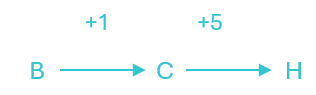
  • Nutrient Transport: While the cell wall allows the passage of water and solutes, the plasma membrane is the structure responsible for selective permeability, controlling exactly which substances enter or leave the cell.

General Awareness (10 questions)

91

Which Article of the Constitution of India provides for the establishment of the National Commission for Scheduled Castes (NCSC) to safeguard the rights of the Scheduled Castes?

  1. ((a))

    Article 340

  2. ((b))

    Article 338

  3. ((c))

    Article 350

  4. ((d))

    Article 330

Show Answer
Answer: ((b))

Article 338

The correct answer is Article 338.

Key Points

  • Article 338 of the Constitution of India mandates the establishment of the National Commission for Scheduled Castes (NCSC), a constitutional body dedicated to protecting the rights of the Scheduled Castes.
  • The commission is entrusted with the duty to investigate and monitor all matters relating to the safeguards provided for the Scheduled Castes under the Constitution or any other laws of the country.
  • The 89th Constitutional Amendment Act, 2003, bifurcated the former joint commission into two separate entities: the National Commission for Scheduled Castes under Article 338 and the National Commission for Scheduled Tribes (NCST) under Article 338A.
  • The NCSC consists of a Chairperson, a Vice-Chairperson, and three other members, all of whom are appointed by the President of India by warrant under his hand and seal.
  • While investigating any matter or inquiry, the commission possesses all the powers of a Civil Court, specifically regarding the summoning of witnesses and the production of documents.

 Additional Information

  • Article 340:
  • Empowers the President to appoint a commission to investigate the conditions of socially and educationally backward classes.
  • This article formed the basis for the establishment of the Mandal Commission in 1979.
  • Article 330:
  • Provides for the reservation of seats for the Scheduled Castes and the Scheduled Tribes in the House of the People (Lok Sabha).
  • The number of reserved seats is determined by the proportion of their population in each State or Union Territory.
  • Article 350:
  • Relates to the language to be used in representations for the redress of grievances to any authority of the Union or a State.
  • It is associated with Article 350B, which provides for a Special Officer for Linguistic Minorities.
92

Who was chosen as the first president of the Indian National Congress (INC) during its first session?

  1. ((a))

    Surendranath Banerjee

  2. ((b))

    Womesh Chandra Bonnerjee

  3. ((c))

    Bipin Chandra Pal

  4. ((d))

    Pherozeshah Mehta

Show Answer
Answer: ((b))

Womesh Chandra Bonnerjee

The correct answer is Womesh Chandra Bonnerjee.

Key Points

  • The Indian National Congress (INC) held its inaugural session from December 28 to December 31, 1885, marking the beginning of a structured national movement in India.
  • Womesh Chandra Bonnerjee, a distinguished Bengali barrister, was elected as the first President of the session, representing the Moderate phase of Indian politics.
  • The venue for this historic meeting was Gokuldas Tejpal Sanskrit College in Bombay (present-day Mumbai).
  • The session was initially planned to be held in Poona, but the location was shifted to Bombay following a sudden outbreak of cholera in the city.
  • The formation of the Congress was facilitated by Allan Octavian Hume (A.O. Hume), a retired British official who served as the first General Secretary.
  • A total of 72 delegates from across India attended the first session, primarily consisting of lawyers, journalists, and intellectuals.

 Additional Information

  • Surendranath Banerjee:
  • Founded the Indian National Association in 1876, which was a precursor to the INC.
  • He was absent from the first INC session because he was presiding over the National Conference in Calcutta at the same time.
  • Bipin Chandra Pal:
  • Recognized as the 'Father of Revolutionary Thoughts' in India and a key leader of the Swadeshi Movement.
  • He was a member of the Extremist group within the Congress, forming the famous Lal-Bal-Pal trio with Lala Lajpat Rai and Bal Gangadhar Tilak.
  • Pherozeshah Mehta:
  • A prominent Moderate leader often referred to as the 'Lion of Bombay' for his influence in the Bombay Municipal Corporation.
  • He served as the President of the Congress during its 1890 session held in Calcutta.
93

The recent $131 million deal for cutting-edge surveillance technology from HawkEye 360 involves which two countries ?

  1. ((a))

    India and Ukraine

  2. ((b))

    India and United States

  3. ((c))

    India and Russia

  4. ((d))

    India and Japan

Show Answer
Answer: ((b))

India and United States

The correct answer is India and United States.

Key Points

  • The 131 million dollar procurement deal marks a significant milestone in defense technology cooperation between India and the United States, specifically involving the Ministry of Defence (MoD) and HawkEye 360.
  • HawkEye 360 is a premier United States-based commercial satellite data and analytics firm specializing in Radio Frequency (RF) signal mapping and geospatial intelligence.
  • The primary objective of this technology acquisition is to enhance Maritime Domain Awareness (MDA) in the Indian Ocean Region (IOR) by detecting and tracking radio frequency signals from vessels.
  • This surveillance capability allows for the monitoring of dark ships—vessels that have intentionally disabled their Automatic Identification Systems (AIS) to avoid detection while engaging in illegal activities.
  • The deal was facilitated under the INDUS-X (India-U.S. Defense Acceleration Ecosystem) framework, which aims to bridge the gap between defense startups and government agencies in both nations.

 Additional Information

  • HawkEye 360 Technology:
  • Utilizes a constellation of low-Earth orbit (LEO) satellites to identify and geolocate signals such as VHF marine radio, UHF push-to-talk, and L-band satellite communications.
  • Provides critical data for border security, national defense, and disaster response by providing a comprehensive RF map of the earth.
  • INDUS-X Initiative:
  • Launched in June 2023 during the state visit of Prime Minister Narendra Modi to Washington D.C.
  • Operates under the broader iCET (Initiative on Critical and Emerging Technology) led by the National Security Advisors of India and the USA.
  • Focuses on co-development and co-production of advanced aerospace and maritime technologies.
94

In June 2025, Indian author Banu Mushtaq, in her acclaimed book Heart Lamp, explores which central theme through her vivid portrayal of everyday characters?

  1. ((a))

    Environmental activism

  2. ((b))

    Caste and religious oppression

  3. ((c))

    Economic reforms

  4. ((d))

    Political leadership

Show Answer
Answer: ((b))

Caste and religious oppression

The correct answer is Caste and religious oppression.

Key Points

  • Heart Lamp is a celebrated collection of short stories by the veteran Kannada writer and activist Banu Mushtaq, translated to reach a wider global audience.
  • The central theme of the book revolves around Caste and religious oppression, particularly focusing on the intersectional struggles of Muslim women within the socio-political landscape of Karnataka.
  • Mushtaq utilizes a realist narrative style to depict how everyday characters navigate the complexities of communalism, patriarchy, and social stratification.
  • The stories highlight the marginalization of minority groups, providing a nuanced perspective on how religious identity and caste hierarchies dictate access to justice and dignity.
  • By focusing on ordinary lives, the author exposes the structural violence inherent in communal divisions while celebrating the quiet resilience of those living on the fringes of society.

 Additional Information

  • Banu Mushtaq:
  • She is a prominent feminist voice in South Indian literature and a practicing advocate who has dedicated her life to legal activism for women.
  • Her literary works are deeply influenced by her legal background, often addressing issues of domestic violence, family law, and civil liberties.
  • She has been a recipient of the prestigious Karnataka Sahitya Academy Award, recognizing her enduring impact on Kannada literature.
  • Context of the Work:
  • Heart Lamp serves as a critical document of the minority experience in India, challenging monolithic narratives and providing a space for subaltern voices.
  • The book is significant for its exploration of secularism and the pluralistic fabric of Indian society during periods of heightened religious polarization.
95

Which of the following initiatives was introduced in India during Union budget 2020-21 to support farmers by enabling efficient air transportation of agricultural produce across domestic and international routes?

  1. ((a))

    National Farm Logistics Mission

  2. ((b))

    Krishi Air Connect Programme

  3. ((c))

    Krishi Udan Scheme

  4. ((d))

    Rural Export Enhancement Initiative

Show Answer
Answer: ((c))

Krishi Udan Scheme

The correct answer is Krishi Udan Scheme.

Key Points

  • The Krishi Udan Scheme was officially launched by the Union Finance Minister during the Union Budget 2020-21 presentation to improve the value realization of agricultural products through air transportation.
  • The primary objective of this initiative is to facilitate the seamless and efficient movement of agricultural produce, specifically focusing on perishable goods, to domestic and international markets.
  • The scheme is implemented by the Ministry of Civil Aviation in collaboration with the Airports Authority of India (AAI) and the AAI Cargo Logistics and Allied Services Company Limited (AAICLAS).
  • It aims to bridge the logistical gap for farmers located in remote areas, hilly terrains, and tribal districts, ensuring their produce reaches consumption centers with minimal transit loss.
  • By leveraging air connectivity, the government intends to promote the export of agricultural products under the broader Doubling Farmers Income mission and the Agri-Export Policy.

 Additional Information

  • Krishi Udan 2.0:
  • Following the success of the initial launch, Krishi Udan 2.0 was introduced in October 2021 to further optimize the agri-harvest transportation ecosystem.
  • This version focuses on 53 airports across the country, with a specific emphasis on the North-Eastern Region (NER), Hilly States, and Island territories.
  • The government provides financial incentives by granting full waivers on Landing, Parking, TNLC (Terminal Navigational Landing Charges), and RNFC (Route Navigation Facility Charges) for freighter and P2C aircraft.
  • The e-Kushal (Krishi Udaan for Sustainable Holistic Agri-Logistics) online platform was integrated to facilitate information dissemination and real-time data sharing among stakeholders.
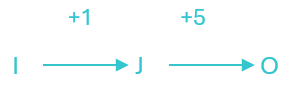
  • It works in tandem with other schemes like Operation Greens (Top to Total) to strengthen cold chain logistics and reduce the carbon footprint of agricultural transport.
96

Which of the following bodies approved the appointment of S Krishnan as Chairman of J&K Bank?

  1. ((a))

    NITI Aayog

  2. ((b))

    Insurance Regulatory and Development Authority of India(IRDAI)

  3. ((c))

    Reserve Bank of India

  4. ((d))

    Ministry of Finance

Show Answer
Answer: ((c))

Reserve Bank of India

The correct answer is Reserve Bank of India.

Key Points

  • The Reserve Bank of India (RBI) granted its approval for the appointment of S Krishnan as the Part-time Chairman of Jammu and Kashmir Bank (J&K Bank) in November 2023.
  • This approval was issued in accordance with Section 10BB and Section 35B of the Banking Regulation Act, 1949, which grants the RBI the authority to regulate the appointment of Chairmen, MDs, and CEOs in scheduled commercial banks.
  • The Board of Directors of J&K Bank recommended S Krishnan to lead the board, ensuring that the institution maintains high standards of corporate governance and regulatory compliance.
  • The tenure for this appointment is set for a period of three years, during which S Krishnan is expected to oversee the strategic direction of the Srinagar-headquartered bank.
  • The Reserve Bank of India, as the central banking institution, performs this function to safeguard the interests of depositors and ensure the efficient management of banking entities within the Indian financial system.

 Additional Information

  • Profile of S Krishnan:
  • He previously served as the Managing Director and CEO of Punjab & Sind Bank from September 2020 to May 2022.
  • His career includes significant leadership roles such as Executive Director at both Syndicate Bank and Canara Bank, amassing over 38 years of banking experience.
  • Jammu and Kashmir Bank (J&K Bank):
  • Incorporated in 1938, it is a Scheduled Commercial Bank where the Government of Jammu & Kashmir holds a majority stake.
  • It operates as the primary financial institution for the Union Territories of Jammu & Kashmir and Ladakh.
  • Other Regulatory Bodies:
  • IRDAI: Established in 1999, the Insurance Regulatory and Development Authority of India regulates the insurance and re-insurance industries.
  • NITI Aayog: Replacing the Planning Commission in 2015, it serves as the apex public policy think tank of the Government of India.
  • Ministry of Finance: A ministry of the Government of India concerned with the economy, taxation, and financial legislation.
97

Which of the following dancers is acclaimed for their mastery and teaching of Odissi?

  1. ((a))

    Kelucharan Mohapatra

  2. ((b))

    Sitara Devi

  3. ((c))

    Vempati Chinna Satyam

  4. ((d))

    Kalamandalam Leelamma

Show Answer
Answer: ((a))

Kelucharan Mohapatra

The correct answer is Kelucharan Mohapatra.

Key Points

  • Kelucharan Mohapatra was a legendary Indian classical dancer, choreographer, and percussionist who is credited with the 20th-century revival of Odissi, a classical dance form originating from Odisha.
  • He was the first person from the state of Odisha to be honored with the Padma Vibhushan in 2000, which is India's second-highest civilian award.
  • Known for his mastery of Abhinaya (expressive acting), he extensively researched ancient temple sculptures, such as those at the Konark Sun Temple and Puri Jagannath Temple, to reconstruct and systematize Odissi movements.
  • In 1993, he established Srjan, a premier dance institution in Bhubaneswar, to pass on his knowledge to future generations, training iconic dancers like Sonal Mansingh and Samyukta Panigrahi.
  • Apart from dancing, he was an expert player of the Pakhawaj, Mridangam, and Tabla, integrating deep rhythmic complexity into his choreographic works.

 Additional Information

  • Sitara Devi:
  • She was an eminent exponent of Kathak and was often referred to as the Kathak Queen; she received the Sangeet Natak Akademi Award in 1969 and the Padma Shri in 1973.
  • Vempati Chinna Satyam:
  • He was a renowned Kuchipudi dancer and teacher who founded the Kuchipudi Art Academy in Madras (now Chennai) in 1963 to refine and promote this Andhra Pradesh dance form.
  • Kalamandalam Leelamma:
  • A prominent Mohiniyattam dancer from Kerala, she was highly regarded for her performances and her academic contributions at the Kerala Kalamandalam deemed university.
98

Which of the following British Indian government legislations provided for the establishment of a Supreme Court at Calcutta, comprising one chief justice and three other judges?

  1. ((a))

    Regulating Act of 1773

  2. ((b))

    Charter Act of 1793

  3. ((c))

    Amending Act of 1781

  4. ((d))

    Pitt’s India Act of 1784

Show Answer
Answer: ((a))

Regulating Act of 1773

The correct answer is Regulating Act of 1773.

Key Points

  • The Regulating Act of 1773 was the first major step taken by the British Parliament to exercise control over the East India Company’s administration in India.
  • Section 13 of this legislation specifically authorized the British Crown to establish a Supreme Court of Judicature at Fort William in Calcutta.
  • The Act mandated that the court would consist of a Chief Justice and three other judges (Puisne Judges) to oversee legal matters involving British subjects and those in the service of the Company.
  • Established in 1774, the court functioned as a Court of Record with wide-ranging civil and criminal jurisdiction; Sir Elijah Impey was appointed as the first Chief Justice.
  • The Act also transformed the Governor of Bengal into the Governor-General of Bengal, with Warren Hastings being the first to hold this prestigious post.
  • It prohibited the employees of the East India Company from engaging in any private trade or accepting presents and bribes from the local population to curb corruption.

 Additional Information

  • Pitt’s India Act of 1784:
  • This Act introduced a system of double government by establishing the Board of Control to supervise political and military affairs.
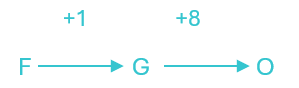
  • It clearly distinguished between the commercial and political functions of the Company for the first time.
  • Amending Act of 1781:
  • Known as the Act of Settlement, it was passed to rectify the defects and jurisdictional ambiguities of the Regulating Act of 1773.
  • It exempted the Governor-General and Council from the jurisdiction of the Supreme Court for their official acts.
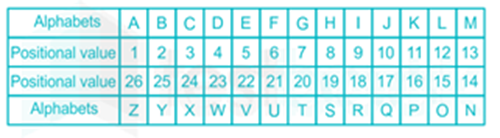
  • Charter Act of 1793:
  • It renewed the East India Company’s monopoly over Indian trade for an additional period of twenty years.
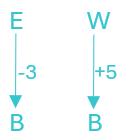
  • It laid down the rule that the members of the Board of Control would be paid out of Indian revenues.
99

The Government has proposed to include which Union Territory under the ambit of Article 240 of the Constitution?

  1. ((a))

    Lakshadweep

  2. ((b))

    Chandigarh

  3. ((c))

    Puduchery

  4. ((d))

    New Delhi

Show Answer
Answer: ((b))

Chandigarh

The correct answer is Chandigarh.

Key Points

  • The Ministry of Home Affairs (MHA) has proposed to amend Article 240 of the Constitution of India to include the Union Territory of Chandigarh within its ambit.
  • Article 240 empowers the President of India to make regulations for the peace, progress, and good government of certain Union Territories, which have the same force as an Act of Parliament.
  • Currently, Chandigarh does not have its own legislative assembly, and most laws are extended from the state of Punjab or enacted directly by the Parliament.
  • The proposed inclusion aims to streamline the legislative process, allowing the President to enact specific regulations for Chandigarh without requiring a formal Parliamentary session for every administrative requirement.
  • This move is intended to enhance ease of doing business and simplify the legal framework governing the city's unique administrative structure as a joint capital.

 Additional Information

  • Article 240:
  • Specifically covers Andaman and Nicobar Islands, Lakshadweep, Dadra and Nagar Haveli and Daman and Diu, and Puducherry.
  • For Puducherry, the President can only make regulations when the Legislative Assembly is dissolved or suspended.
  • New Delhi:
  • Governed under Article 239AA, which provides a special status with a Legislative Assembly and a Council of Ministers.
  • It is not included under Article 240 because it has its own dedicated constitutional framework for governance.
  • Chandigarh Administration:
  • It was constituted as a Union Territory on November 1, 1966, following the reorganization of Punjab.
  • It is managed by an Administrator appointed under Article 239, traditionally the Governor of Punjab.
100

Which distinctive drainage characteristic best describes the river Luni of north-western India?

  1. ((a))

    It forms a large, well-developed delta at its mouth.

  2. ((b))

    It flows directly into the Arabian Sea.

  3. ((c))

    It is the only glacier-fed perennial Himalayan river.

  4. ((d))

    It terminates in an inland salt marsh in the Rann region without reaching the sea.

Show Answer
Answer: ((d))

It terminates in an inland salt marsh in the Rann region without reaching the sea.

The correct answer is It terminates in an inland salt marsh in the Rann region without reaching the sea..

Key Points

  • The Luni River is the primary and largest river system in the Thar Desert region of northwest India, primarily flowing through the state of Rajasthan.
  • It originates in the Pushkar Valley of the Aravalli Range, specifically near Ajmer, at an elevation of approximately 550 meters above sea level.
  • A defining characteristic of the Luni is its endorheic nature, meaning it belongs to an internal drainage system where the water does not reach any ocean or sea.
  • The river flows southwest through the Marwar region before finally terminating in the marshy lands of the Rann of Kutch in Gujarat.
  • It covers a total length of approximately 495 kilometers and serves as a vital water source for the arid districts of Nagaur, Pali, Jodhpur, Barmer, and Jalore.

 Additional Information

  • Hydrological Properties:
  • The river is unique because its water is fresh in the upper reaches but turns saline after it reaches Balotra in the Barmer district due to the high salt content of the desert soil.
  • It is an ephemeral river, characterized by high seasonal variations, often remaining dry during non-monsoon months.
  • Major Tributaries:
  • The left-bank tributaries include the Sukri, Mithri, Bandi, Khari, Jawai, and Guhiya, while the Jojari is the only significant right-bank tributary.
  • Significance in Geography:
  • The Luni Basin is bounded by the Aravalli Range on the east and the Thar Desert on the west, acting as a crucial geographic barrier.
  • Unlike Himalayan rivers like the Ganga or Indus, it is not glacier-fed and relies strictly on monsoonal rainfall.

Attempt this paper under real exam conditions

Timed interface, section switching, instant scoring, and question-by-question analytics — free.

Start Timed Attempt