Official Paper

DSSSB Jail Warder : (1 Dec 2025) Memory-Based Paper (Previous Year Paper)

200 questions · 120 minutes · with answers · free

General intelligence and Reasoning Ability 1 (20 questions)

1

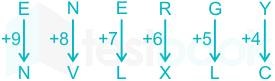
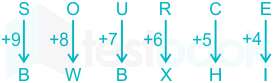
In a certain code language ENERGY is written as NVLXLC. Then what is the code for SOURCE in same code language?

  1. ((a))

    HIBWB

  2. ((b))

    BWBIH

  3. ((c))

    BWBXHI

  4. ((d))

    BBWHIK

Show Answer
Answer: ((c))

BWBXHI

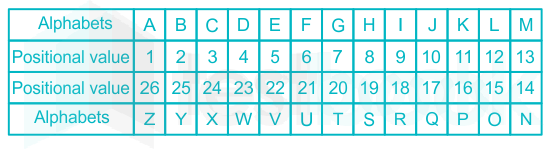
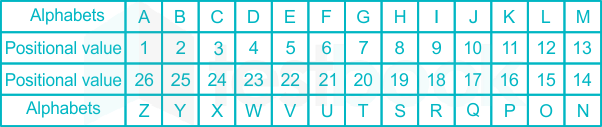
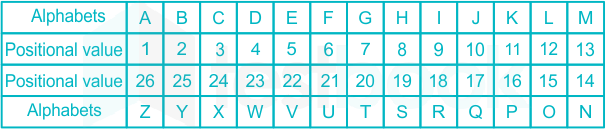
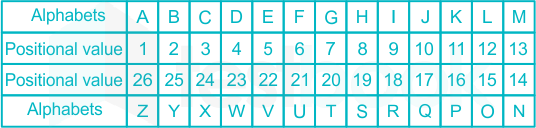
According to the English alphabet series and its positional value:

The pattern followed here is:

Similarly;

Hence, "BWBXHI" is the correct answer.

2

Eight people R, S, T, U, V, W, X and Y are living in a building having eight floors but not necessarily in the same order such as bottommost floor is numbered as 1 to the topmost floor numbered as 8. W lives four floor below Y and immediate above S. S lives on a prime numbered floor. There are odd number of floors between X and V. V is two floor above U. X neither lives at a prime numbered floor nor at the topmost floor. R lives below T but not adjacent to X. Then what is the position of R with respect to U?

  1. ((a))

    Four floors below

  2. ((b))

    Immediate above

  3. ((c))

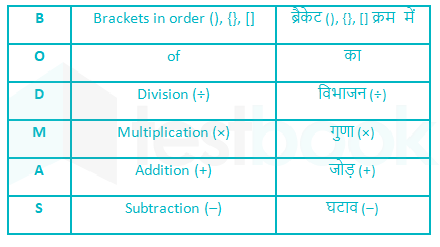
    Two floor above

  4. ((d))

    Five floors below

Show Answer
Answer: ((d))

Five floors below

Given :

  • Eight people - R, S, T, U, V, W, X and Y are living in a building having eight floors.
  • Bottommost floor is numbered as 1 to the topmost floor numbered as 8.

​Explanation :

1) W lives four floor below Y and immediate above S.

  1. S lives on a prime numbered floor.
FloorsPerson
Case - 1Case - 2
8Y
7Y
6
5
4W
3WS
2S
1

3) There are odd number of floors between X and V.

  1. V is two floor above U.

5) X neither lives at a prime numbered floor nor at the topmost floor.

FloorsPerson
Case - 1Case - 2
8VY
7YV
6U
5U
4XW
3WS
2S
1X

6) R lives below T but not adjacent to X.

As is case - (2) there is no possible position for R, therefore this case is eliminated.

FloorsPerson
Case - 1
8V
7Y
6U
5T
4X
3W
2S
1R

Thus, according to the final arrangement R is five floors below U.

Hence, "Five floors below" is the correct answer.

3

Find the missing term in the series.

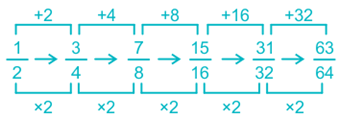
1/2, 3/4, 7/8, 15/16, 31/32, (?)

  1. ((a))

    63/64

  2. ((b))

    62/63

  3. ((c))

    63/62

  4. ((d))

    66/64

Show Answer
Answer: ((a))

63/64

The pattern followed here is:

Numerator is getting added by denominator of previous term and denominator is getting multiply by 2 in every next term.


Hence, the correct answer is 63/64.

4

Directions: In making decisions about important questions, it is desirable to be able to distinguish between strong and weak arguments. Strong arguments are those, which are both important and directly related to the question. Weak arguments are those, which are of minor importance and also may not be directly related to the question or may be related to a trivial aspect of the question. The question below is followed by two arguments numbered I and II. You have to decide which of the arguments a Strong argument is and which a weak argument is.

Statement:

Should there be a total ban on the production of cigarettes in India?

Arguments:

I) Yes, It is harmful to both smokers and also for passive smokers.

II) No, this will render a large number of people jobless.

  1. ((a))

    Only argument I is strong

  2. ((b))

    Only argument II is strong

  3. ((c))

    Both arguments I and II are strong

  4. ((d))

    Either argument I or II is strong

Show Answer
Answer: ((d))

Either argument I or II is strong

Here both the arguments are providing a valid reason but on two different grounds. One is on the grounds of health, while the other is on the ground of employment.

Hence, Either argument I or II is strong.

5

Select the option that is related to the fifth letter-cluster in the same way as the second letter-cluster is related to the first letter-cluster and the fourth letter-cluster is related to the third letter-cluster.

LZY : LYZ  :: QWE : EQW :: HGM : ?

  1. ((a))

    KHM

  2. ((b))

    GHM

  3. ((c))

    GTM

  4. ((d))

    FGD

Show Answer
Answer: ((b))

GHM

LOGIC: Arrange according to alphabetical order

And,

Similarly,

Hence, the correct answer is "GHM".

6

In the following which is the odd one out?

  1. ((a))

    Cave

  2. ((b))

    Face

  3. ((c))

    Veneer

  4. ((d))

    Surface

Show Answer
Answer: ((a))

Cave

The logic followed is:

Face, Veneer, and Surface is used in reference to the outermost or outer part of something.

But,

A cave is a naturally formed underground chamber in hills.

Hence, the correct answer is "Cave".

Important PointsSurface: The outside part of anything.

Face: It is a surface that is presented to the view or the outer part of anything that can be shown.

Veneer: A decorative covering of fine wood.

7

Which given of the following sets of letters when sequentially placed at the gaps in the letter series below shall complete it?

bb_b_ab_cbba_bcbb_____

  1. ((a))

    a c b a c

  2. ((b))

    a c b b b

  3. ((c))

    c b b b a

  4. ((d))

    a b b b c

Show Answer
Answer: ((c))

c b b b a

The logic is:

bbcbba/bbcbba/bbcbba

After dividing the series in three equal parts, we see that a similar pattern is repeated.

So, the letters that will complete the series is ‘c b b b a’.

Hence, ‘c b b b a’ is the correct answer.

8

Which letter cluster will replace the question mark (?) to complete the given series?

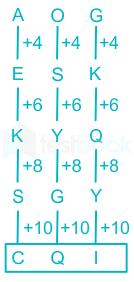
AOG, ESK, KYQ, SGY, ?

  1. ((a))

    IWO

  2. ((b))

    CQI

  3. ((c))

    AOG

  4. ((d))

    KZQ 

Show Answer
Answer: ((b))

CQI

The logic followed here is:

<br>

Hence, ‘CQI’ is the correct answer.

9

Select the missing number in the given series

16, 108, 384, 1000, ?

  1. ((a))

    2160

  2. ((b))

    2125

  3. ((c))

    2150

  4. ((d))

    1500

Show Answer
Answer: ((a))

2160

The pattern followed is,

23 × 2 = 16

33 × 4 = 108

43 × 6 = 384

53 × 8 = 1000

Similarly

63 × 10 = 2160

Hence, ‘2160’ is the correct answer.

10

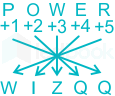
In a certain code language PRIYA is written as FCLTQ, and POWER is written as WIZQQ. Then what is the code for RADHA?

  1. ((a))

    SCGLF

  2. ((b))

    LFGCS

  3. ((c))

    FLGCS

  4. ((d))

    FLKTR

Show Answer
Answer: ((c))

FLGCS

According to the English alphabet series and its positional value:

The pattern followed here is:

And;

Similarly;

Hence, "FLGCS" is the correct answer.

11

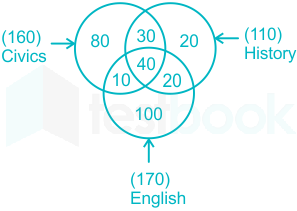
In a class, 110 students like history, 160 students like civics and 170 students likes English. Also, 10 students like both civics and English 20 students like both history and English, 30 students like both civics and history and 40 students like all three subject. How many students like only English?

  1. ((a))

    100

  2. ((b))

    80

  3. ((c))

    20

  4. ((d))

    40

Show Answer
Answer: ((a))

100

Number of students who like history = 110

Number of students who like civics = 160

Number of students who like English = 170

Number of students who like civics and English = 10

Number of students who like English and history = 20

Number of students who like civics and history = 30

Number of students who likes all three subject = 40

Number of student who only likes English = 170 – 10 – 20 – 40 = 100

Hence, ‘100’ is the correct answer.

12

Direction: Read the given statements and conclusions carefully. Assuming that the information given in the statements is true, even if it appears to be at variance with commonly known facts, decide which of the given conclusions logically follow from the statements.

Statements:

  1. Some paper are copies
  2. No copies are kind

Conclusions:

I. Some copies are papers

II. Some papers are kind

III. No paper is kind

  1. ((a))

    Only Conclusion II and either conclusion I or III follow.

  2. ((b))

    Only conclusions I and II follow.

  3. ((c))

    Only conclusion I and either conclusion II or III follow.

  4. ((d))

    Only conclusions I and III follow.

Show Answer
Answer: ((c))

Only conclusion I and either conclusion II or III follow.

The least possible Venn diagram for the given statements is as follow

I. Some copies are papers → True

As from statement “1. Some paper are copies”. So, some copies are definitely papers.

II. Some papers are kind → False

It’s possible but not definite. In this case, alternate diagram can be drawn as follows:

In the first diagram this conclusion is false. But from the alternate diagram, conclusion II follows.

III. No paper is kind → False

It’s possible but not definite. From the first diagram this conclusion satisfies. But from the alternate diagram conclusion III fails.

Conclusion II and III forms a complimentary pair of “Some-No”. From this we conclude that either conclusion II or III follow.

Therefore, Only conclusion I and either conclusion II or III follow.

Conditions for “Either-Or” case between two conclusions:

  1. Two entities in both the conclusion should be same.
  2. Both the conclusions should form complementary pair of “All-Some Not” or “No-Some”.

Note that sequence of entities in both the statements should be same in case of “All-Some Not” pair.

  1. Both the conclusions should be possible in some possible Venn diagrams.
  2. Both conclusion should NOT be simultaneously true (or false) in a single possible Venn diagram.
13

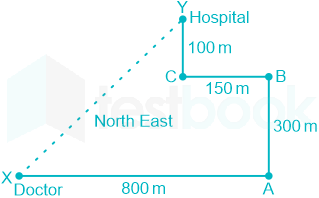
A doctor is located at X and his hospital is located at Y. There is no straight lane from the doctor’s house to the hospital. So, the doctor first goes to A which is 800 m due east of X, then goes to B which is 300 m due north of A, then to C which is 150 m due west of B and finally reaches the hospital at Y which is 100 m due north of C. With respect to the doctor's house the correct direction of the hospital is

  1. ((a))

    north-east

  2. ((b))

    north-west

  3. ((c))

    south-east

  4. ((d))

    south-west

Show Answer
Answer: ((a))

north-east

Concept:

  • A map is a representation or a drawing of the earth’s surface or a part of it drawn on a flat surface according to a scale.
  • There are three components of Maps – distance, direction and symbol.

Explanation:

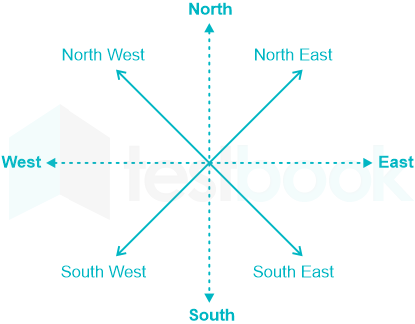
  • There are four major directions, North, South, East and West. They are called cardinal points.
  • The other four intermediate directions are north-east (NE), southeast(SE), south-west (SW) and north-west (NW).

  • We can locate any place more accurately with the help of these intermediate directions.
  • We can find out the direction of a place with the help of a compass.

Given: 

  • The Doctor is located at X.
  • He first goes to A which is 800 m due east of X.
  • Then, he goes to B which is 300 m due north of A.
  • Then, again he goes to C which is 150 m due west of B.
  • And, then finally he goes to Y which is 100 m due north of C.

Hence, from the above diagram, it becomes clear that with respect to the doctor's house the correct direction of the hospital is north-east.

14

Directions: In the question below is given a statement followed by two conclusions numbered I and II. You have to assume all the information in the statement to be true, then consider the conclusions and decide which of them follow the statement. Select the correct option.

Statement: A student from Brijlal college of science and technology got selected for an internship with NASA.

Conclusions:

I.  All students of Brijlal College of science and technology are genius.

II. NASA hires interns from Brijlal institute of science and technology only.

  1. ((a))

    Only Conclusion I follows

  2. ((b))

    Only Conclusion II follows

  3. ((c))

    Both I and II follow

  4. ((d))

    Neither I nor II follows

Show Answer
Answer: ((d))

Neither I nor II follows

The correct answer is Option 4

We cannot tell from the statement that all students in the said college are genius because only 1 got selected for an internship in NASA.

Since the statement says that the student got selected, it means that NASA follows a process of selection and it cannot be said that NASA hires from the said college only.

Hence both the conclusions are incorrect.

15

Among six boxes in a rack, E is placed two boxes above the box D. Box A is placed immediately above box C. Box B is placed adjacent to box F and box E. Box E is not placed at the top of the stack. Which one of the following statement can definitely be concluded from the above information?

  1. ((a))

    Box B is placed above box E.

  2. ((b))

    Box F is placed above box A.

  3. ((c))

    More than one box is placed between box C and F.  

  4. ((d))

    Box D is placed three boxes below box C.

Show Answer
Answer: ((c))

More than one box is placed between box C and F.  

i) Among six boxes in a rack, E is placed two boxes above the box D.

Case 1Case 2Case 3
Box No.BoxesBoxesBoxes
6E
5E
4E
3D
2D
1D
<br>

ii) Box A is placed immediately above box C.

Case 1.1Case 1.2Case 2Case 3.1Case 3.2
Box No.BoxesBoxesBoxesBoxesBoxes
6AEE
5CEA
4EEAC
3ACDD
2CDA
1DDC
<br>

iii) Box B is placed adjacent to box F and box E.

This eliminates case 2 and 3.1.

iv)  Box E is not placed at the top of the stack.

This eliminates case 3.2.

Case 1.1Case 1.2
Box No.BoxesBoxes
6AF
5CB
4EE
3BA
2FC
1DD
<br>
  1. Box B is placed above box E. → possible but not definite.

  2. Box F is placed above box A. → possible but not definite.

3) More than one box is placed between box C and F.  → Definitely True

  1. Box D is placed three boxes below box C. → possible but not definite.

Hence, correct answer is option 3.

16

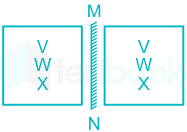
In the following question, choose the correct mirror­ image from amongst the four alternatives 1), 2), 3) and 4) given along with it. The mirror may be represented by a line MN.

  1. ((a))

  2. ((b))

  3. ((c))

  4. ((d))

Show Answer
Answer: ((c))

Below diagram represent mirror image of question figure.

17

In a certain code language,

'A # B' means 'A is the son of B',

'A % B' means 'A is the daughter of B',

'A & B' means 'A is the father of B',

'A @ B' means 'A is the brother of B'.

If 'M # N % P & Q @ T', then how is M related to T?

  1. ((a))

    Nephew

  2. ((b))

    Husband

  3. ((c))

    Brother

  4. ((d))

    Son

Show Answer
Answer: ((a))

Nephew

The logic followed here is:

Given 

A # B' means 'A is the son of B',

'A % B' means 'A is the daughter of B',

'A & B' means 'A is the father of B',

'A @ B' means 'A is the brother of B'.

A is
Symbol#%&@
MeaningSonDaughterFatherBrother
Of B

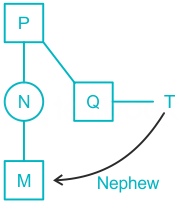
Here, M # N % P & Q @ T

Now, draw the family tree


Therefore, M is the Nephew of T.

Hence, "Option (1)" is the correct answer.

18

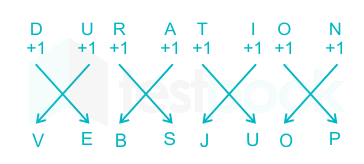
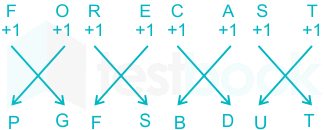
In a certain code language, "DURATION" is written as "VEBSJUOP". How will "FORECAST" be written as in that language?

  1. ((a))

    PGSFBDTU

  2. ((b))

    PGFSUTB

  3. ((c))

    PGSFUTBD

  4. ((d))

    PGFSBDUT

Show Answer
Answer: ((d))

PGFSBDUT

The positions of the letters according to the English alphabet series:

The pattern for this code is as follows;

Similarly;

hence, "PGFSBDUT" is the correct answer.

19

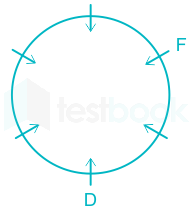
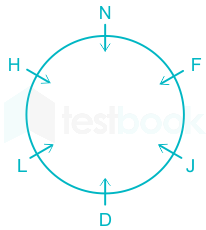
Six friends, D, F, H, J, L and N, are sitting around a circular table facing towards the centre and at equal distance from each other (not necessarily in the same order). F is second to the right of D. L is to the immediate right of H. H and J are facing towards each other. Counting from the left of J, how many friends are sitting between J and N?

  1. ((a))

    0

  2. ((b))

    1

  3. ((c))

    2

  4. ((d))

    3

Show Answer
Answer: ((d))

3

  1. F is second to the right of D.

2) L is to the immediate right of H.

  1. H and J are facing towards each other.

So, this case is possible only when H is sitting second left of D.

Hence, there are 3 people between J and N from the left of J.

20

Choose the alternative which is an odd word/number/letter pair out of the given alternatives.

  1. ((a))

    100 - Police

  2. ((b))

    102 - Women Helpline

  3. ((c))

    101 - Fire

  4. ((d))

    108 - Medical

Show Answer
Answer: ((b))

102 - Women Helpline

Emergency helpline numbers is as follows;

100Police
102Ambulance
101Fire
108Medical
181Women Helpline
<br>

102 is the emergency number of Ambulance not for the woman helpline.

Hence, "102 - Women Helpline" is the odd one out and hence it is considered as the correct answer.

Confusion Points

  • "112" is the Single Emergency number which provide you all services like fire brigade, and ambulance or the police.

General intelligence and Reasoning Ability 2 (20 questions)

21

Choose the odd one out from the given alternatives.

  1. ((a))

    74-88

  2. ((b))

    14-20

  3. ((c))

    26-38

  4. ((d))

    58-70

Show Answer
Answer: ((a))

74-88

The logic followed here is:

Option 1: 74-88

88 -74 = 14, which is not divisible by 6.

Option 2: 14-20

20 - 14 =  6, which is divisible by 6.

Option 3: 26-38

38 - 26 = 12, which is divisible by 6.

Option 4: 58-70

70 - 58 = 12, which is divisible by 6.

So, Option 1 is different from others.

Hence, "option 1" is the correct answer.

22

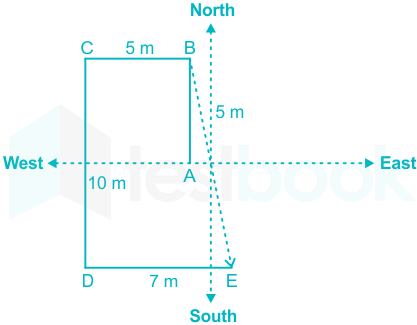
Point B is 5 m North of point A. Point C is 5 m West of point B. Point D is 10 m South of point C. Point E is 7m East of point D. In which of the following directions is point E, with reference to point B?

  1. ((a))

    South-East

  2. ((b))

    East

  3. ((c))

    West

  4. ((d))

    South-West

Show Answer
Answer: ((a))

South-East

The logic followed is:

i) Point B is 5 m North of point A.

ii) Point C is 5 m West of point B.

iii) Point D is 10 m South of point C.

iv) Point E is 7m East of point D.

Drawing the Diagram as per the given information.

Thus we can see the direction of E is South-East with reference to point B.

Hence, the correct answer is "South-East".

23

From the given answer figures, select the one in which the question figure is hidden/embedded.

  1. ((a))

  2. ((b))

  3. ((c))

  4. ((d))

Show Answer
Answer: ((d))

On close observation, we find that the problem figure is embedded in figure (4) as shown below.

Hence, the correct answer is figure 4.

24

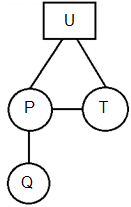
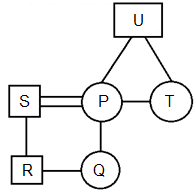
Six persons, P, Q, R, S, T and U, are sitting in a room. There are equal males and females. There is at least one married couple in the room. Q is P's daughter. S is the father of two persons - one male and one female. P and T are daughters of U. Who is the married couple?

  1. ((a))

    P and S

  2. ((b))

    U and S

  3. ((c))

    U and Q

  4. ((d))

    Q and T

Show Answer
Answer: ((a))

P and S

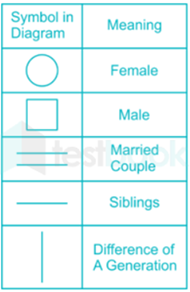
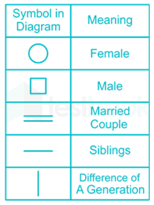
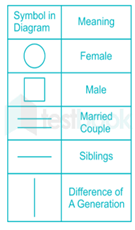
From the given information we draw a tree using the symbols:

<br>

P and T are daughters of U and Q is P's daughter.


 Out of 6 people half of them are female i.e. 3 so R, S and U are males.

There is no information given about R but we have S is the father of one male and female and we are left with only R so R is the son of S.


<br>

Since there is at least one married couple all the conditions fit when we place S and P as a couple.

Hence the correct answer is option 1)

25

If a + b means a × b, a - b means a + b, a × b means a - b, and a ÷ b means a ÷ b, then what is the value of the following expression: 20 + 5 - 10 × 2 ÷ 4

What is the value of the expression after replacing the operations based on the given definitions?

  1. ((a))

    50

  2. ((b))

    109.5

  3. ((c))

    25

  4. ((d))

    0

Show Answer
Answer: ((b))

109.5

The Correct answer is Option 2. 

Key Points​

Breaking down the expression based on the defined operations:

20 + 5 becomes 20 × 5 = 100.

5 - 10 becomes 5 + 10 = 15.

10 × 2 becomes 10 - 2 = 8.

2 ÷ 4 remains 2 ÷ 4 = 0.5.

 20 + 5 - 10 × 2 ÷ 4

after replacing the operations

Final expression: 20 × 5 + 10 - 2 ÷ 4 =

100 + 10 - 0.5 = 109.5.

Hence Correct answer is  Option 2 (109.5)

26

Select the missing number in the given series

66, 91, 120, 153, 190, ?

  1. ((a))

    225.5

  2. ((b))

    201

  3. ((c))

    114

  4. ((d))

    231

Show Answer
Answer: ((d))

231

The pattern followed is,

6 × 11 = 66

7 × 13 = 91

8 × 15 = 120

9 × 17 = 153

10 × 19 = 190

Similarly

11 × 21 = 231

Hence, ‘231’ is the correct answer.

27

In a certain code, '247' means 'spread red carpet'; '256' means 'dust one carpet' and '264' means 'one red carpet'. Which digit in that code means 'dust' ?

  1. ((a))

    2

  2. ((b))

    3

  3. ((c))

    5

  4. ((d))

    6

Show Answer
Answer: ((c))

5

In the first and second statements, the common code digit is '2' and the common word is 'carpet'.

So, '2' means 'carpet'.

In the second and third statements, the common code digit is '6' and the common word is 'one'.

So, '6' means 'one'.

Therefore, in the second statement, '5' means 'dust'.

28

Select the correct combination of mathematical signs to replace the * signs and to balance the given equation.

(\sqrt(330*6)) *  4 * 13 * 10 * 2 * 7

  1. ((a))

    +, -, +, ÷, =, ×

  2. ((b))

    ×, +, -, +, ÷ , =

  3. ((c))

    +, -, ÷, =, -, ×

  4. ((d))

    -, ×, =, ×, ÷, +

Show Answer
Answer: ((d))

-, ×, =, ×, ÷, +

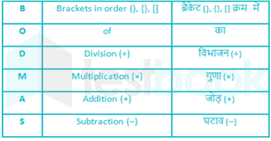
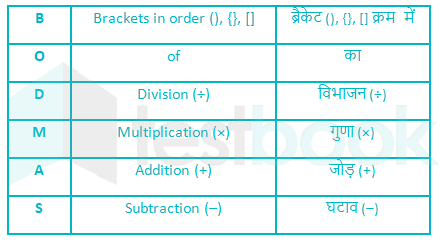
We substitute the values in the given equation and solve it using the BODMAS rule:


Option 1.  +, -, +, ÷, =, ×

(\sqrt(330+6)) - 4 + 13 ÷ 10 = 2 × 7

(\sqrt336)- 4 + 13 ÷ 10 = 2 × 7

18.33 - 4 + 1.3 = 2 × 7

18.33 - 5.3 = 2 × 7

18.33 - 5.3 = 14

13.03 ≠ 14

LHS ≠ RHS

Option 2. ×, +, -, +, ÷ , =

√(330 × 6) + 4 - 13 + 10 ÷ 2 = 7

(\sqrt1980) + 4 - 13 + 10 ÷ 2 = 7

44.49 + 4 - 13 + 5 = 7

48.49 - 18 = 7

30.49 ≠ 7

LHS ≠ RHS

Option 3. +, -, ÷, =, -, ×

√(330 + 6) - 4 ÷ 13 = 10 - 2 × 7

√336 - 4 ÷ 13 = 10 - 2 × 7

(\sqrt336)- 0.30 = 10 - 2 × 7

18.33 - 0.30 = 10 - 14

18.03 ≠ - 4

LHS ≠ RHS

Option 4: -, ×, =, ×, ÷, +

√(330 - 6) × 4 = 13 × 10 ÷ 2 + 7

(\sqrt324) × 4 = 13 × 10 ÷ 2 + 7

18 × 4 = 13 × 5 + 7

72 = 65 + 7

72 = 72

LHS = RHS.

Hence, the correct answer is '-, ×, =, ×, ÷, +'.

29

A piece of paper is folded and punched as shown below in the question figure. From the given answer figures, indicate how it will appear when opened.

  1. ((a))

  2. ((b))

  3. ((c))

  4. ((d))

Show Answer
Answer: ((d))

The given figure when unfolded is as follows:

Hence, the correct answer is Option 4.

30

Direction: Study the following information carefully and answer the questions based on it.

Eight friends – P, Q, R, S, T, U, V, and W are sitting in a linear row and all are facing the North direction.

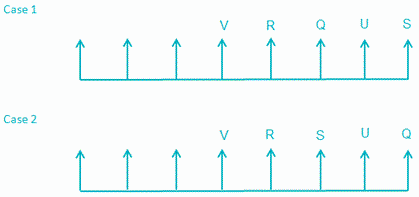
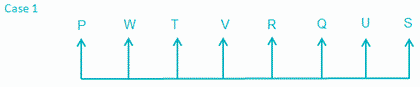
‘V’ has three peoples on the left and four peoples on right. ‘V’ has ‘U’ in right but not immediate right. The neighbours of ‘U’ are ‘Q’ and ‘S’ and one of the neighbours of ‘U’ is in end. ‘R’ sits second to the left of ‘U’. ‘W’ does not sit in ends. The position of ‘T’ is second left from ‘R’ and third left from Q.

Who is sitting in the extreme left end?

  1. ((a))

    P

  2. ((b))

    Q

  3. ((c))

    R

  4. ((d))

    S

Show Answer
Answer: ((a))

P

  1. Eight friends –P, Q, R, S, T, U, V, and W are sitting in a linear row and all are north direction
  2. ‘V’ has three peoples in the left and four peoples on right.

  1. ‘V’ has ‘U’ in right but not immediate right.
  2. The neighbours of ‘U’ are ‘Q’ and ‘S’ and one of the neighbours of ‘U’ is in ends.
  3. ‘R’ sits second to left of ‘U’.

  1. ‘W’ does not sit in ends.
  2. The position of ‘T’ is second left from ‘R’ and third left from Q. (Implies case 2 is wrong)

Hence, ‘P’ is sitting in the extreme left end.

31

Directions: The question consists of two statements, an assertion (A) and a reason (R). Read both the statements and decide which of the following answer choice correctly depicts the relationship between these two statements.

Assertion:(A) There are 206 bones in an adult human body and each one has a specific shape and function.Truste bone plays a very important role in making all the mechanics of your body function properly.

Reason:(R) Human ear is made up of a thin plate of yellow elastic cartilage and it does not have bones.

  1. ((a))

    Both A and R are true and R is the correct explanation of A.

  2. ((b))

    Both A and R are true and R is not the correct explanation of A.

  3. ((c))

    A is true but R is false.

  4. ((d))

    A is false but R is true.

Show Answer
Answer: ((c))

A is true but R is false.

Option 3.A is true but R is false.

The human skeleton is the internal framework of the human body. It is composed of around 270 bones at birth this number decreases to around 206 bones by adulthood after some bones get fused together. So, babies have more bones than adults.

The smallest bone in the human body is Y Y-shaped bone in-ear called stapes. So, the external human ear is made up of cartilage and is not a bone structure while the internal human ear is a canal made by the fusion of three bones mallus, incus, and stapes. They are popularly called the ear ossicles and were given their Latin names for their distinctive shapes; they are also referred to as the hammer, anvil, and stirrup, respectively. So, A is true and R is false.

 Hence, option 3 is correct.

32

Direction: In the question given below, are two statements followed by a few conclusions as options. You have to take the two given statements to be true even if they seem to be at variance with commonly known facts. Read all the conclusions and then decide which of the given conclusion follows from the two given statements disregarding commonly known facts.

Statements:

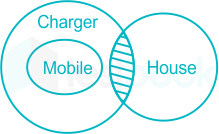
All mobile are charger

Some charger are house

Conclusions:

I. All charger are mobile 

II. Some mobile are house

III. All house are mobile

IV. Some house are charger

  1. ((a))

    Conclusion I, II, and III follows 

  2. ((b))

    Both conclusion II and IV follows

  3. ((c))

    No conclusion follows

  4. ((d))

    Only conclusion IV follows

Show Answer
Answer: ((d))

Only conclusion IV follows

The least possible Venn diagram is:

I. All charger are mobile → false (It is possible but not definite)

II. Some mobile are house → false (It is possible but not definite)

III. All house are mobile → false (It is possible but not definite)

IV. Some house are charger → true (because All mobile are charger and some charger are house)

Hence, Only conclusion IV follows.

33

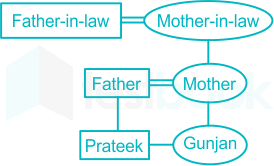
Showing a photograph of a girl, Prateek said, “This is Gunjan. She is my father’s mother-in-law’s husband’s only daughter’s daughter.”

How is Gunjan related to Prateek?

  1. ((a))

    Mother

  2. ((b))

    Sister

  3. ((c))

    Daughter

  4. ((d))

    Niece

Show Answer
Answer: ((b))

Sister

Preparing the family tree by using the following symbol:

The family tree as per the given information:

Here, Gunjan is the sister of Prateek.

Hence, the correct answer is "Option (2)".

34

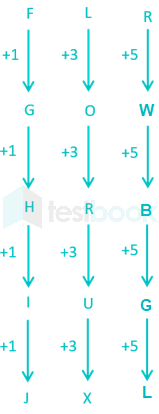
Which letter cluster will replace the question mark (?) to complete the given series?

FLR, GOW, HRB, IUG, ?

  1. ((a))

    JXN

  2. ((b))

    KLM

  3. ((c))

    JYM

  4. ((d))

    JXL

Show Answer
Answer: ((d))

JXL

The logic followed here is:


Hence, ‘JXL’ is the correct answer.

35

Select the option that is related to the third number in the same way as the second number is related to the first number and the sixth number is related to the fifth number.

498 : 187 :: 348 : ? :: 762 : 269

  1. ((a))

    113

  2. ((b))

    101

  3. ((c))

    73

  4. ((d))

    131

Show Answer
Answer: ((d))

131

The logic followed here is :-

(First number ÷ 3) + sum of digits of first number = Second number

  • 498 : 187 → (498 ÷ 3) + (4 + 9 + 8) = 166 + 21 = 187
  • 348 : ? → (348 ÷ 3) + (3 + 4 + 8) = 116 + 15 = 131
  • 762 : 269 → (762 ÷ 3) + (7 + 6 + 2) = 254 + 15 = 269

Hence, the correct answer is "131".

36

Select the option that is related to the fifth word in the same way as the second word is related to the first word and the fourth word is related to the third word.

Aerophobia: Flying :: Cibophobia: Food ::? : Rooms

  1. ((a))

    Lockiophobia

  2. ((b))

    Somniphobia

  3. ((c))

    Koinoniphobia

  4. ((d))

    Zoophobia

Show Answer
Answer: ((c))

Koinoniphobia

The pattern followed in the given series is:

Aerophobia: Flying - Phobia name: Phobia caused by

Cibophobia: Food - Phobia name: Phobia caused by

Similarly,

? : Rooms - ? will be the phobia name.

We consider the given options:

1) Lockiophobia: Fear of childbirth.

  1. Somniphobia: Fear of sleep.

3) Koinoniphobia: Fear of rooms.

  1. Zoophobia: Fear of animals.

Hence the correct answer is option 3.

37

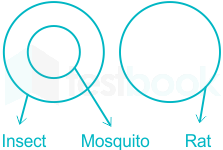
Select the option that correctly represents the relationship among the following:

Rat, Mosquito, Insect

  1. ((a))

  2. ((b))

  3. ((c))

  4. ((d))

Show Answer
Answer: ((d))

All mosquitos are insects but rats are not related to insects.

The correct Venn diagram representation is,

Hence, option 4 is the correct answer.

38

Direction: In the question given below, are two statements followed by a few conclusions as options. You have to take the two given statements to be true even if they seem to be at variance with commonly known facts. Read all the conclusions and then decide which of the given conclusion follows from the two given statements disregarding commonly known facts.

Statements:

I. All roads are houses

II. some houses are stores

Conclusions:

I. some roads are stores

II. All houses are roads

III. All stores are roads

IV. some houses are roads

  1. ((a))

    Both conclusion I and II follows

  2. ((b))

    Conclusion I, II and III follows

  3. ((c))

    Only conclusion IV follows

  4. ((d))

    No conclusion follows

Show Answer
Answer: ((c))

Only conclusion IV follows

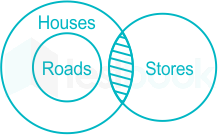
The least possible Venn diagram is:

Conclusions:

I. some roads are stores → false (All roads are houses and some houses are stores but there is no direct relation given between roads and stores.)

II. All houses are roads → false (it is possible but not definite because all roads are houses and some houses are stores.)

III. All stores are roads → false (because All roads are houses and some houses are stores.)

IV. some houses are roads → true (because All roads are houses and some houses are stores.)

Hence, Only conclusion IV follows.

39

'Mirror' is related to Reflection' as 'water' is related to __________.

  1. ((a))

    Conduction

  2. ((b))

    Dispersion

  3. ((c))

    Immersion

  4. ((d))

    Refraction

Show Answer
Answer: ((d))

Refraction

The logic follows here is : 

Light rays falling on a mirror undergo reflection.

Similarly,

light rays falling on water undergo ‘refraction.’

Hence, the correct answer is “Option (4).”

Additional Information

  • Conduction: Process by which heat energy is transmitted through collisions between neighboring atoms or molecules
  • Dispersion: The separation of light into colors by refraction or diffraction with formation of a spectrum
  • Immersion: The act of dipping something in a substance, completely covering it.
40

I, J, K, L, M and N have their birthdays in different months- January, February, April, July, August and December but not necessarily in the same order.

Two people have birthday between N and J’s birthday. M’s birthday is not in the second half of the year. The birthday of N is either in January or August. K’s birthday falls in month having minimum number of days. At the most three people have birthdays between N and I’s birthday.

Which of the following statement is true?

  1. ((a))

    I’s birthday is in January.

  2. ((b))

    K’s birthday is preceded by N.

  3. ((c))

    L’s birthday is in December.

  4. ((d))

    N’s birthday is in February.

Show Answer
Answer: ((c))

L’s birthday is in December.

Member: I, J, K, L, M and N.

Month: January, February, April, July, August and December.

  1. The birthday of N is either in January or August.
  2. Two people have birthday between N and J’s birthday.
  3. M’s birthday is not in the second half of the year.
MonthPerson
Case ICase II
JanuaryN
February
AprilJ
JulyJM
AugustMN
DecemberMM


  1. K’s birthday falls in month having minimum number of days.

(So, K’s birthday falls in February.)

  1. At the most three people have birthdays between N and I’s birthday.

(Case II will be eliminated as it doesn’t satisfy point 5.)

(I’s birthday falls in August refer to point 5 and only one month left for L’s birthday i.e. December.)

MonthPerson
JanuaryN
FebruaryK
AprilM
JulyJ
AugustI
DecemberL


  1. I’s birthday is in January → false.

  2. K’s birthday is preceded by N → false.

  3. L’s birthday is in December → true.

  4. N’s birthday is in February → false.

Hence, ‘L’s birthday is in December’ is the correct statement.

General Awareness 1 (20 questions)

41

Lavani is a folk dance of ______.

  1. ((a))

    Manipur

  2. ((b))

    Andhra Pradesh

  3. ((c))

    Jammu & Kashmir

  4. ((d))

    Maharashtra

Show Answer
Answer: ((d))

Maharashtra

Lavani is a folk dance of Maharashtra. It is a combination of traditional song and dance, which is particularly performed to the beats of Dholki which is a percussion instrument. Lavani is noted for its powerful rhythm and has contributed substantially to the development of Marathi folk theatre.

42

What is the full form of CRR in Economics?

  1. ((a))

    Current repo rate

  2. ((b))

    Cost reserve ratio

  3. ((c))

    Cash reserve ratio

  4. ((d))

    Change request ratio

Show Answer
Answer: ((c))

Cash reserve ratio

The correct answer is Cash reserve ratio.

Key Points

Cash Reserve Ratio (CRR)- It is the amount of money that the banks are required to deposit with the RBI, in the form of cash. - The amount of money should not be less than the specified percentage of Net Demand & Time Liabilities.
UseThrough CRR, the RBI controls excess money flow in the economy.
It helps in regulating liquidity or monetary stability in the country.
The banks are not allowed to use the money, kept with RBI, for economic and commercial purposes.
FormCash & cash equivalents
ReturnBanks don't earn any interest as a return on the money kept as CRR.
Maintained byIt is maintained by the Reserve Bank of India.
RBI reduces the CRR to increase the money supply in the market.
RBI increases the CRR to decrease the money supply in the market.
43

Which of the following compounds contains only one carbon-carbon single bond?

  1. ((a))

    Ethane

  2. ((b))

    Propane

  3. ((c))

    Butane

  4. ((d))

    Methane

Show Answer
Answer: ((a))

Ethane

The correct answer is Ethane.

Key Points

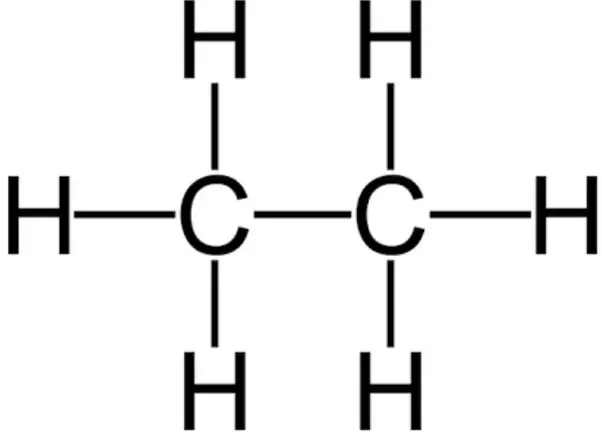
  • Ethane is a saturated hydrocarbon among given options.
  • Saturated hydrocarbons are molecules with only single bonds.

What is ethane? - Quora

 - Ethane

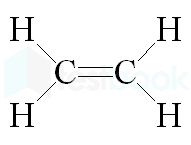
Ethene - Molecule of the month - December 2006 - HTML-only version

 - Ethene

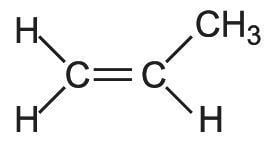
Propene - Alchetron, The Free Social Encyclopedia

  • Propene

acetylene - Wikidata

  • Acetylene
  • Only ethane has all single bond while others have a double and triple bond.
  • Methane, Ethane, Propane, Butane, etc are examples of saturated hydrocarbons.
  • Alkanes are saturated hydrocarbons and classified as a type of aliphatic hydrocarbon.
  • Bonding between every single bond in a saturated hydrocarbon is covalent in nature**.**

Additional Information

  • Unsaturated hydrocarbons contain multiple bonding and contain less than the maximum number of hydrogens per carbon.
  • Unsaturated hydrocarbons have double or triple covalent between adjacent carbon atoms.
  • Aromatic hydrocarbons are a special case of unsaturated hydrocarbons.
44

Who is the first Indian to have won the Pulitzer Prize?

  1. ((a))

    Gobind Behari Lal 

  2. ((b))

    Geeta Anand

  3. ((c))

    Sanghamitra Kalita

  4. ((d))

    Jhumpa Lahiri

Show Answer
Answer: ((a))

Gobind Behari Lal 

The correct answer is Gobind Behari Lal.

  • Pulitzer Prize- The Pulitzer Prize is an award for achievements in newspaper, magazine, and online journalism, literature, and musical composition within the United States.

Key Points

  • In 1937, Gobind Behari Lal had won the Pulitzer Prize for journalism, along with four others, for his coverage in the field of science.
  • Gobind Behari Lal was an Indian-American journalist and independence activist.

Additional Information

  • Geeta Anand was awarded the Pulitzer Prize for Explanatory Reporting in the year 2003.
  • Jhumpa Lahiri was awarded the Pulitzer Prize for Fiction in the year 2000.
  • Sanghamitra Kalita was awarded the Pulitzer Prize for Breaking News Reporting in the year 2016.
45

Where is the Namib Desert located?

  1. ((a))

    Southern Africa

  2. ((b))

    United States

  3. ((c))

    Brazil

  4. ((d))

    Afghanistan

Show Answer
Answer: ((a))

Southern Africa

The Correct Answer is Option 1 i.e Southern Africa.

CountryFamous Deserts
USASonoran Desert, Mojave Desert, The Great Basin Desert, Chihuahuan Desert
AfghanistanRegistan Desert, Dasht-e Khash, Dasht-e Leil
Southern AfricaNamib desert, Kalahari desert, Karoo desert
46

 Tropical Evergreen Forests are also known as ______. 

  1. ((a))

    Tropical Mangrove Forests

  2. ((b))

    Tropical Rainforests

  3. ((c))

     Tropical Coniferous Forests

  4. ((d))

    Tropical Deciduous Forests

Show Answer
Answer: ((b))

Tropical Rainforests

The correct answer is the option 2 i.e. Tropical Rainforests.

Key Points

  • Tropical evergreen forests are dense, multi-layered, and found in the areas receiving heavy rainfall.
  • This type of forest is rich in numerous species of trees.
  • It is very dense even the sunlight does not reach the ground.
  • Tropical rainforests found in areas of tropical rainforest climate.
  • It receives an average rainfall of at least 60 mm and known as also "lowland equatorial evergreen rainforest".
  • Thus, these forests always see "Green" and are known as "Evergreen Forests".
47

What will be the power of a concave lens of focal length 5m?

  1. ((a))

    5 D

  2. ((b))

    -5 D

  3. ((c))

    0.2 D

  4. ((d))

    -0.2 D

Show Answer
Answer: ((d))

-0.2 D

  • The power of a lens is given by (P = \frac{1}{f})
  • Where f is the focal length of the lens.
  • In the case of a concave lens, the power will always be negative as the focal length is negative.
  • So, (P = \frac{1}{-5} = -0.2D)
48

What is the planned production capacity of SAIL’s Bokaro Steel Plant after the Rs 20,000 crore expansion?

  1. ((a))

    10.00 MTPA

  2. ((b))

    7.55 MTPA

  3. ((c))

    6.50 MTPA

  4. ((d))

    5.25 MTPA

Show Answer
Answer: ((b))

7.55 MTPA

The correct answer is 7.55 MTPA.

In News

  • Union Minister HD Kumaraswamy unveiled a Rs 20,000 crore expansion plan for SAIL’s Bokaro Steel Plant, increasing production capacity from 5.25 MTPA to 7.55 MTPA.

Key Points

  • The expansion plan includes a new 4,500 cubic meter blast furnace, thin slab casting, direct rolling facility, and sinter plant expansion.
  • The investment will create 2,500 permanent jobs and 10,000 indirect jobs.
  • The project aligns with the Aatmanirbhar Bharat vision and aims to develop a 300 MTPA steel industry by 2030.
  • SAIL is also focusing on decarbonisation and renewable energy initiatives, including 150 MW solar power projects.

Additional Information

  • Decarbonisation Initiatives
  • Reduction of carbon emissions from 2.67 tonnes per tonne of crude steel to less than 2.2 tonnes by 2030.
  • Renewable energy push: 30 MW floating solar, 20 MW land-based solar, and 100 MW procurement from Solar Energy Corporation of India.
  • Raw Material Security
  • Development of Tasra coal mine, expected to produce 3.5 MTPA of domestic coking coal by September 2025, reducing India’s import dependence.
  • Upgradation of Chasnala Washery to lower ash content in coal from 28% to 17% for efficient steel production.
  • India’s Steel Industry Goals
  • India targets a 300 MTPA steel industry by 2030 to meet domestic and export demands.
  • The expansion of Bokaro Steel Plant is a step towards achieving self-reliance in steel production under the Developed India 2047 vision.
49

The market in which loans of money can be obtained is called?

  1. ((a))

    Reserve market

  2. ((b))

    Institutional market

  3. ((c))

    Money market

  4. ((d))

    Exchange market

Show Answer
Answer: ((c))

Money market

The correct answer is the Money market.

Key Points

  • The money market is the market for short-term funds.
  • It provides means for raising funds for meeting short-term needs of cash on one hand and deployment of surplus funds for short period on the other.
  • Instruments in the money market are :
  • Call money:
  • It is a method used by commercial banks to borrow funds from each other to be able to maintain the Cash Reserve Ratio (CRR).
  • It is a short-term finance repayable on demand, with a maturity period of 1 day to 15 days.
  • The interest paid-on-call money loan is known as the call rate.
  • It is a highly fluctuating rate that changes from day to day and sometimes even from hour to hour.
  • Commercial bill:
  • It is a bill of exchange used to finance the working capital requirement of a business firm.
  • It is a short-term, unsecured promissory note, negotiable and transferable by endorsement and delivery with a fixed maturity period.
  • When the seller makes credit sales, it draws a bill of exchange on the buyer, to pay the amount on a certain date.
  • On acceptance by the buyer, it becomes a trade bill.
  • This trade bill, when presented to the bank for discounting, and the bank accepts, is called a commercial bill.
  • Thus the money market is appropriate answer.
50

In 2015, India's National Disaster Response Force helped which country in Earthquake disaster?

  1. ((a))

    Bhutan

  2. ((b))

    Sri Lanka

  3. ((c))

    Nepal

  4. ((d))

    Afghanistan

Show Answer
Answer: ((c))

Nepal

The correct answer is Nepal.

Key Points

  • In 2015, Nepal experienced a devastating earthquake, known as the Gorkha Earthquake, with a magnitude of 7.8.
  • The National Disaster Response Force (NDRF) of India was deployed to Nepal to assist in rescue and relief operations.
  • India launched Operation Maitri, a comprehensive relief and rescue operation to support Nepal during this disaster.
  • The NDRF teams played a key role in rescuing people trapped in debris, providing medical assistance, and distributing essential supplies.
  • This humanitarian assistance strengthened the bilateral relations between India and Nepal, showcasing India’s commitment to regional cooperation.

Additional Information

  • National Disaster Response Force (NDRF):
  • Established in 2006, the NDRF is a specialized force created for disaster response in India.
  • It functions under the Ministry of Home Affairs and is composed of 12 battalions equipped to handle natural and man-made disasters.
  • The NDRF has been deployed in various national and international disaster operations.
  • Operation Maitri:
  • It was India’s relief and rescue operation for Nepal after the 2015 earthquake.
  • The operation included deploying the Indian Army, Air Force, and the NDRF for rescue, medical aid, and supply distribution.
  • India provided monetary aid, essential supplies, and technical assistance to support Nepal’s recovery.
  • Gorkha Earthquake (2015):
  • The earthquake struck Nepal on April 25, 2015, causing over 9,000 fatalities and affecting millions of people.
  • It caused widespread destruction in Kathmandu Valley, including heritage sites like the Dharahara Tower and Durbar Square.
  • The disaster triggered avalanches in the Himalayas, including a deadly avalanche at Mount Everest.
  • India-Nepal Relations:
  • India and Nepal share close historical, cultural, and economic ties, and India is one of Nepal’s largest trading partners.
  • India has consistently supported Nepal in times of need, including disaster relief, infrastructure development, and economic aid.
  • The 2015 earthquake relief efforts underscored India’s role as a key regional partner in humanitarian assistance.
51

Which of the following is not a Commercial Bank?

  1. ((a))

    HSBC

  2. ((b))

    State Bank of India

  3. ((c))

    ICICI Bank

  4. ((d))

    SIDBI

Show Answer
Answer: ((d))

SIDBI

The correct answer is SIDBI

Key Points

  • SIDBI does not accept deposits and hence it is a financial institution, not a commercial bank.
  • Small Industries Development Bank of India is the apex regulatory body for the overall licensing and regulation of micro, small and medium enterprise finance companies in India.
  • SIDBI was incorporated on 02nd April 1990 by the Government of India as a wholly owned subsidiary of IDBI Bank.

Additional Information

  • A commercial bank is a financial institution that accepts deposits from the public and gives loans for consumption and investment purposes to earn profit.
  • It can also refer to a bank, or a division of a larger bank, that deals with corporations or a large/medium-sized business to differentiate it from a retail bank and an investment bank.
  • Commercial banks include private sector banks and public sector banks.
52

What is the revised growth forecast for India in FY25 according to the IMF's latest update in January 2025?

  1. ((a))

    6.8%

  2. ((b))

    6.5%

  3. ((c))

    6.6%

  4. ((d))

    6.4%

Show Answer
Answer: ((b))

6.5%

The correct answer is 6.5%.

In News

  • The International Monetary Fund (IMF) has revised India’s growth forecast for FY25 to 6.5%, down from the earlier estimate of 7%.

Key Points

  • The downgrade is attributed to a sharper-than-expected slowdown in industrial activities in India.
  • Despite the FY25 downgrade, the IMF has maintained India’s growth projections for FY26 and FY27 at 6.5%.
  • The Reserve Bank of India (RBI) also lowered its growth forecast for FY25 to 6.6%.
  • The falling rupee has been identified as a concern for growth, inflation, and exports.

Additional Information

  • IMF (International Monetary Fund)
  • An international organization that works to ensure global financial stability and promote economic growth.
  • Publishes the World Economic Outlook, which provides projections for global and regional economies.
  • Falling Rupee Impact
  • Depreciation of the rupee can lead to higher inflation, as imports become costlier.
  • Exports may become more competitive globally, but weak global demand could limit gains.
  • Global Growth Projections
  • IMF projects global growth at 3.3% for 2025 and 2026, below the historical average of 3.7%.
  • Advanced economies are expected to see inflation converge to targets faster than emerging economies.
53

Which organization received the Subhash Chandra Bose Aapda Prabandhan Puraskar for 2025?

  1. ((a))

    ISRO

  2. ((b))

    INCOIS

  3. ((c))

    NDRF

  4. ((d))

    IMD

Show Answer
Answer: ((b))

INCOIS

The correct answer is INCOIS.

In News

  • Indian National Centre for Ocean Information Services (INCOIS) has been honored with the Subhash Chandra Bose Aapda Prabandhan Puraskar for 2025.
  • INCOIS runs the Indian Tsunami Early Warning Centre, recognized by UNESCO for its excellence in tsunami monitoring and alert dissemination.
  • Its advisories significantly aided in disaster response during Cyclone Phailin (2013) and Cyclone Hudhud (2014).
  • Technologies like SARAT support the Indian Coast Guard in search and rescue missions, and SynOPS integrates real-time oceanic data to bolster disaster management.

Key Points

  • Subhash Chandra Bose Aapda Prabandhan Puraskar: India’s prestigious award honoring outstanding contributions in the field of disaster management.
  • INCOIS: Functions under the Ministry of Earth Sciences, providing essential ocean-based information, early warnings, and advisories for natural disasters.
  • Indian Tsunami Early Warning Centre: A UNESCO-certified system offering real-time monitoring to protect coastal populations from tsunamis.
  • SARAT and SynOPS: Advanced tools enhancing search and rescue operations, as well as real-time data integration for robust disaster response.

Additional Information

  • INCOIS Achievements
  • Developed early warning solutions to safeguard lives and property in coastal regions.
  • Internationally recognized for tsunami warning capabilities, particularly after the 2004 Indian Ocean tsunami.
  • Significance of the Award
  • Named after Netaji Subhash Chandra Bose, reflecting courage and dedication to public service.
  • Awards individuals and organizations demonstrating exemplary work in disaster risk reduction and management.
54

When was the first census in India? 

  1. ((a))

    1861

  2. ((b))

    1872

  3. ((c))

    1881

  4. ((d))

    1882

Show Answer
Answer: ((b))

1872

The correct answer is 1872.

Key Points

  • A population census is the method by which demographic, social, cultural and economic data relating to each and every person in that country are compiled, collected, analysed and disseminated at a specific time over 10 years.
  • The first census was conducted in India in 1872, but regular census started in 1881.
  • The first census in all India was conducted by the British Raj authorities.

Additional Information

  • The 15th Census of India and the 7th Census of Independent India-2011 was started on 1st April 2010 with President being the first citizen to be enumerated, followed by the Vice President of India.
  • The slogan of census 2011 was ‘Our Census, Our future’.
  • C. Chandramouli was the Census Commissioner of India 2011.
  • The population of the nation as per the provisional figures of Census 2011 is 1210.19 million of which 623.7 million (51.54%) are males and 586.46 million (48.46%) are females.
  • Uttar Pradesh is the most populous state in India its population is more than the population of Brazil.

Thus, first census started in 1872.

55

A tissue is a group of _____ cells performing a _____ function. 

  1. ((a))

    Different, different

  2. ((b))

    Similar, similar

  3. ((c))

    Different, specific

  4. ((d))

    Similar, different 

Show Answer
Answer: ((b))

Similar, similar

The correct answer is: Similar, Similar

Key Points

  • A group of similar cells performing similar functions is known as tissue.
  • A tissue is an ensemble of similar cells and their extracellular matrix from the same origin that together carry out a specific function.
  • Organs are then formed by the functional grouping together of multiple tissues.

Additional Information

  • Types of tissues:
  • Classification of tissues can be done in two parts, first is animal tissues, and the second one is plant tissues.
  • Animal tissues: The function of animal tissues differs from organism to organism. There are four types of animal tissues-
  • Connective Tissues:
  • Help in maintaining the form of the organism’s body as well as its organs.
  • These tissues also provide internal support to the body.
  • They help in holding the organs together.
  • They also resist the entering of pathogens in the body.
  • There are various forms of connective tissues, such as bone ligaments, tendons, cartilage, etc.
  • Connective tissues can be further divided into fibrous, fluid, and skeletal connective tissue
  • Muscles Tissues:
  • Muscle tissues, as the name suggests, helps in the movement of the body.
  • They produce force and generate motion for the movement of the body as well as movement inside organs.
  • There are three types of muscle tissues; mainly, they are skeletal, cardiac, and visceral or smooth muscle tissue.
  • Nervous Tissues:
  • The tissues that are mainly associated with the central nervous system are known as nervous tissue.
  • They are mainly found in the brain and spinal cord.
  • This tissue is responsible for the communication network inside the body.
  • Epithelial Tissues:
  • These are the tissues that cover outer parts of the body organs such as the skin, the digestive tract’s inner lining, etc.
  • They perform various functions such as act as a sensory reception, helps in filtration and certain other metabolic activities as well.
  • It also helps in various processes like diffusion and secretion. Epithelial tissues protect internal organs from pathogens as well.
56

 Which forests are known as the monsoon forests? 

  1. ((a))

     Tropical Evergreen Forests 

  2. ((b))

    Montane Forests 

  3. ((c))

    Tropical Deciduous Forests 

  4. ((d))

    Mangrove Forests

Show Answer
Answer: ((c))

Tropical Deciduous Forests 

The correct answer is Tropical Deciduous Forests.

Important Points

  • Tropical deciduous forests are also called monsoon forests because the trees in these forests shed their leaves during the dry season and re-grow during the monsoon.

Key Points

  • Tropical Evergreen Forests:
  • These types of forests are found in the equatorial and tropical regions with more than 200 cms annual rainfall.
  • The leaves of trees in such forests are very wide.
  • Example: Mahogany, Redwood, Palm, etc.
  • Tropical Deciduous Forests:
  • These are popularly known as monsoon forests.
  • The trees in these types of forests shed their leaves during the dry season and re-grow during the monsoon.
  • These types of forests receive rainfall in the range of 70-200 cms.
  • These types of forests are further classified as Moist Deciduous Forests and Dry Deciduous Forests.
  • Montane Forests:
  • In these types of forests, vegetation varies according to altitude.
  • Mangrove forests:
  • These are formed along the banks of river estuaries.
  • These are also called Tidal Forests.
  • Mangrove forests of Sundarbans are the largest mangrove forests in the world.
57

Which Latin-American country declared a 60-day state of emergency in seven provinces due to rising crime and organized armed groups in January 2025?

  1. ((a))

    Colombia

  2. ((b))

    Peru

  3. ((c))

    Venezuela

  4. ((d))

    Ecuador

Show Answer
Answer: ((d))

Ecuador

The correct answer is Ecuador.

In News

  • President Daniel Noboa of Ecuador declared a 60-day state of emergency in seven provinces, including Guayas and Manabí.
  • The decision was made to address rising crime and combat organized armed groups.

Key Points

  • The emergency measures include the suspension of home and correspondence inviolability.
  • Night curfews have been implemented in 20 cantons to maintain public safety.
  • Ecuador is fighting internal armed conflict against criminal groups labeled as terrorists.
  • Guayas and Manabí are among the seven provinces under the state of emergency.

Additional Information

  • State of Emergency
  • A legal declaration used by governments to address crises requiring extraordinary measures.
  • Involves temporary suspension of normal laws and enforcement of special rules to ensure public safety.
  • Ecuador
  • A country located in northwestern South America, bordered by Colombia, Peru, and the Pacific Ocean.
  • Known for its biodiversity, the Galápagos Islands, and challenges with organized crime in recent years.
  • Ecuador capital: Quito.
58

The rocks formed by the condensation of liquid substances of the earth are called-

  1. ((a))

    Sedimentary 

  2. ((b))

    Metamorphic

  3. ((c))

    Igneous 

  4. ((d))

    None of these

Show Answer
Answer: ((c))

Igneous 

The correct answer is Igneous.

Important Points

  • The igneous rocks (Ignis – in Latin means ‘Fire’) are formed when magma cools and solidifies.
  • As igneous rocks form out of magma and lava from the interior of the earth, they are known as primary rocks.
  • When magma in its upward movement cools and turns into a solid form it is called igneous rock. Hence, option 3 is the correct answer.
  • The process of cooling and solidification can happen in the earth’s crust or on the surface of the earth.

Additional Information 

  • Igneous rocks are classified based on texture.
  • The texture depends upon the size and arrangement of grains or other physical conditions of the materials.
  • If molten material is cooled slowly at great depths, mineral grains may be very large.
  • Sudden cooling (at the surface) results in small and smooth grains.
  • Intermediate conditions of cooling would result in intermediate sizes of grains making up igneous rocks.
  • Granite, gabbro, pegmatite, basalt, volcanic breccia, and tuff are some examples of igneous rocks.
59

Who is the first Indian Woman to win an Individual Olympic Medal ?

  1. ((a))

    Karnam Malleshwari

  2. ((b))

    Sania Mirza

  3. ((c))

    P. V. Sindhu

  4. ((d))

    Saina Nehwal

Show Answer
Answer: ((a))

Karnam Malleshwari

The correct answer is Karnam Malleshwari.

Key Points

Karnam Malleswari:

  • At the Sydney 2000 Olympic Games, weightlifter Karnam Malleswari marked her place in Olympic and Indian sports history.
  • As she lifted 110 kg in the “snatch” and 130 kg in the “clean and jerk” for a total of 240 kg, she took the bronze medal and became India’s first woman to win an Olympic medal.

Important PointsPV Sindhu:

  • PV Sindhu became the first Indian woman athlete to win two individual Olympic medals as she won the bronze medal at the Tokyo Olympics.
  • She had won the silver medal at the 2016 Rio Olympics.
60

Which of these is NOT a Kharif crop?

  1. ((a))

    Wheat

  2. ((b))

    Groundnut

  3. ((c))

    Paddy

  4. ((d))

    Maize

Show Answer
Answer: ((a))

Wheat

The Correct Answer is Wheat.

Key Points

  • Kharif Season:
  • Kharif crops also are known as monsoon crops as they are cultivated in the monsoon season.
  • These crops are sown at the beginning of the rainy season.
  • Rice, maize, bajra, ragi, paddy, sorghum, soybean, groundnut, cotton, etc are all Kharif types of crops.
  • Zaid Season:
  • It is a short season between Kharif and Rabi seasons.
  • The crops grown during this season are known as Zaid crops.
  • Pumpkin, cucumber, watermelon, bitter gourd etc are all zaid types of crops.
  • Rabi Season:
  • These are the crops that are sown at the end of the monsoon season or at the beginning of the winter season.
  • These crops also are known as winter crops.
  • Wheat, Mustard, Pulses, Barley, etc. are all Rabi types of crops.

General Awareness 2 (20 questions)

61

The Tripartite Struggle, also known as the Kannauj Triangle Wars, took place in the 8th and 9th centuries, between which of these three great Indian dynasties?

  1. ((a))

    The Paramars, The Chauhans The Gahadavalas

  2. ((b))

    The Palas, The Pratiharas and The Rashtrakutas

  3. ((c))

    The Pandayas, The Pratiharas and The Rashtrakutas

  4. ((d))

    The Cholas, The Pratiharas and The Rashtrakutas

Show Answer
Answer: ((b))

The Palas, The Pratiharas and The Rashtrakutas

The correct answer is The Palas, The Pratiharas and The Rashtrakutas.

Key Points

  • The Tripartite Struggle for Kanauj had happened between
  • The Palas of Bengal.
  • The Pratiharas of Central India.
  • The Rashtrakutas of Deccan.
  • ​​The struggle lasted for 200 years and weakened all of them which enabled the Turks to overthrow them.
  • Medieval History of India: 
  • The period of Medieval History of India lies between the 8th and the 18th century A.D.
  • The medieval period is a crucial period in the history of India because of the developments in the field of languages, art, religion & culture.
  • The period has proved the effect of other religions on the Indian culture.
  • Rise of the Rajput clans is the beginning of the Medieval period.
  • Division of Medieval history: 
  • The medieval period is generally divided into two stages:
  • Early medieval period(8th – 12th century A.D): 
  • The early medieval period was a major characterized by regional political & social development.
  • The regional kingdoms had softened boundaries.
  • They were less defined political by administration and coalition than communal affiliation, temple, language.
  • Later Medieval period(12th-18th century A.D): 
  • The late medieval age began around 1200 AD.
  • The period was characterized in part by Islamic conquests.
  • It was made possible by the sheer multiplicity of states in the subcontinent.
62

Which of the following is NOT an example of major industrial regions of India?

  1. ((a))

    Gujarat region

  2. ((b))

    Hugli region

  3. ((c))

    Chota Nagpur region

  4. ((d))

    Northern Malabar region

Show Answer
Answer: ((d))

Northern Malabar region

The correct answer is the Northern Malabar region.

Key Points

  • The major industrial region in India
  • Mumbai-Pune Industrial Region​
  • The Hugli Industrial Region
  • Bengaluru-Tamil Nadu Industrial Region
  • Gujarat Industrial Region
  • Chotanagpur Industrial Region
  • Vishakhapatnam-Guntur Industrial Region
  • Gurgaon-Delhi-Meerut Industrial Region
  • Kollam-Thiruvananthapuram Industrial Region

Additional Information 

  • Mumbai-Pune industrial region:  There are more than 8000 registered factories only in greater Mumbai, out of which 350 belong to cotton textiles.
  • ​The other industries of the region are engineering goods, chemical industries, food processing industries, leather goods, pharmaceuticals, and film industries.
  • Chotanagpur in Jharkhand; This industrial region cover Jharkhand, Odisha, Southern Bihar, and western parts of West Bengal. Having a large concentration of iron and steel industry, it is often called as the ‘Ruhr of India’.
  • Vishakhapatnam-Guntur Industrial Region; Agriculture and rich mineral resources in the hinterlands of these ports provide a solid base to industrial growth in this region. Coal fields of the Godavari basin are the main source of energy.
  • ​The petroleum refinery at Visakhapatnam facilitated the growth of several petrochemical industries.
  • Vishakhapatnam has the most modern iron and steel plant.
63

Ustad Allauddin Khan, the legendary sarod player, was from which of the following gharanas of music?

  1. ((a))

    Kasur-Patiala

  2. ((b))

    Benaras

  3. ((c))

    Maihar

  4. ((d))

    Rangeela

Show Answer
Answer: ((c))

Maihar

The correct answer is Maihar

Key Points 

  • In Ustad Allauddin Khan honor, a Sangeet Samaroh is organized annually in Maihar, Satna
  • It is organized by the Ustad Allauddin Khan Sangeet Academy in collaboration with the Madhya Pradesh Sanskriti Parishad.
  • Allauddin Khan Sangeet Samaroh of Maihar is a three-day festival.
  • Allauddin Khan totally reshaped Indian classical music's Maihar Gharana.
  • Allauddin Khan was also known as Baba Allauddin Khan.
  • He was an Indian sarod player.
64

The pH of a solution is 3. When its pH changes to 6, then H+ ion concentration:

  1. ((a))

    Increases 2 times

  2. ((b))

    Increases three times

  3. ((c))

    Decreases 100 times

  4. ((d))

    Decreases 1000 times

Show Answer
Answer: ((d))

Decreases 1000 times

  • The correct answer is option 4, i.e., Decreases 1000 times.
  • When its pH changes to 6, then H+ ion concentration, decreases 1000 times.
  • pH tells the concentration of hydrogen ions, lower the pH, higher is the hydrogen ion concentration.
  • Acids have pH ranging from 1-6, pH 7 denotes neutral solution, and pH in the range of 8-14 denotes bases.
  • The formula for calculating pH is: pH = - log [H +]
  • pH of 3 = 10 -3 H +
  • pH of 6 = 10 -6 H +
  • From the above values, we can clearly see that H + ion concentration decreases by 1000 times.
65

Which of the following rulers built the mosque called ‘Adhai-din-ka-Jhopra’?

  1. ((a))

    Balban

  2. ((b))

    Abraham Lodi

  3. ((c))

    Iltutmish

  4. ((d))

    Qutub-ud-Din-Aibak

Show Answer
Answer: ((d))

Qutub-ud-Din-Aibak

The correct answer is option 4 i.e., Qutub-ud-din Aibak

  • Qutub-ud-din Aibak was the founder of the Slave dynasty in India, who ruled from 1206 to 1210.
  • Qutub-ud-din Aibak was also known as Lakh Baksha Sultan because of his generosity.
  • He laid the foundation of Qutub Minar which was later completed by Iltutmish.
  • The Quwwat-al-Islam mosque was also commissioned by him.
  • He built the famous 'Adhai Din Ka Jhonpra' mosque in the city of Ajmer, Rajasthan.
  • In 1210, while playing Chaugan, he fell from the horse and died. His tomb is located in Anarkali Bazaar at Lahore.
RulerReignImportant Points
Balban1266-87He was the most powerful ruler of the Mamluk or the Slave dynasty. He broke up the 'Chahalgani', a group of the forty most important rulers. The tomb of Balban is located in Mehrauli, New Delhi
Iltutmish1211-36He was the effective founder of the Delhi Sultanate. He started the Iqta system. The tomb of Iltutmish is located in Qutab Minar Complex, Delhi
Ibrahim Lodi1517-26He was the last ruler of the Lodhi dynasty. He was defeated by Babar (Mughal) in the First Battle of Panipat in 1526. The tomb of Ibrahim Lodhi is located in Panipat.
66

Five types of gold coins were issued by Skandagupta. Which among the following is not one of those type?

  1. ((a))

    Archer type

  2. ((b))

    Horseman type

  3. ((c))

    King and Queen type

  4. ((d))

    Bull type

Show Answer
Answer: ((d))

Bull type

The correct answer is Bull type.

Key Points

  • Five types of gold coins issued by Skandagupta are Archer type, Horseman type, King and queen type, Lion-slayer type and Chhatra type.
  • Also, Skandagupta issued 4 types of silver coins Altar type, Garuda type, Madhyadesha type and Bull type.

Bull type is a type of silver coin issued by Skandagupta.

It is not a type of Gold coin.

So bull type will be the correct answer.

Additional Information

  • Skandagupta
  • He was a ruler of the Gupta dynasty.
  • His period was from 455 AD to 467 AD.
  • He defeated Hunas.
  • He restored the Gupta empire from his enemies.
  • He composed the Bhitari Inscription which was written in 19 lines that describe the ancestors of Skandagupta, about himself and his achievements.
  • The Bhitakari Inscription also mentions the Skandagupta's conflict with Pushyamitra.
67

Who was known as the 'Sculptor' of the Indian Constitution?

  1. ((a))

    V.V. Giri

  2. ((b))

    Rajendra Prasad

  3. ((c))

    Dr. S. Radhakrishnan

  4. ((d))

    B.R. Ambedkar

Show Answer
Answer: ((d))

B.R. Ambedkar

The correct answer is option 4.

Key Points

  • B.R. Ambedkar is known as the sculptor of the Indian constitution.
  • He was the chairman of the drafting committee.

Additional Information

  • V.V. Giri
  • He served as the 4th president of India.
  • He is the only person to be elected as president as an independent candidate.
  • Received Bharat Ratna in 1975.
  • Rajendra Prasad
  • He was the first president of the Republic of India.
  • He was the President of the constituent assembly.
  • Dr. S. Radhakrishnan
  • He was the 2nd president of India.
  • He was the 1st Vice president of India.
68

What is the type of Indian political system?

  1. ((a))

    monarchy

  2. ((b))

    dictatorship

  3. ((c))

    communism

  4. ((d))

    Democracy

Show Answer
Answer: ((d))

Democracy

The correct answer is Democracy.

Key Points

Indian political system:

  • India is a parliamentary democratic secular republic in which the president of India is the head of state & first citizen of India.
  • The preamble declares India to be a sovereign, socialist, secular and democratic republic.
  • The term Democratic implies that the Constitution of India has an established form of Constitution which gets its authority from the will of the people expressed in an election.

​Democracy:

  • Democracy is a form of government in which rulers are elected by the people in a free and fair election, on a universal adult franchise and governed on the basis of certain fundamental rules like a constitution.
  • Democracy is more accountable than other governments to its people, responding to their needs, and sensitivities.
  • According to Dr Bhimrao Ambedkar, one of the founders of the Indian Constitution, 'Democracy means a way of life which consists of the basic principles of freedom, equality, and fraternity.'
  • "Government of the people, by the people and for the people" were the words used by Abraham Lincoln in the year 1863 while talking about democracy.
Political SystemMeaningExample
Monarchygoverned by a king or queenBhutan
Dictatorshipthe leader holds unlimited powersNazi Germany
Communismstate ownership of all factors of productionChina
69

Which of the following gases evolved in a metal acid reaction? 

  1. ((a))

    No gas is evolved 

  2. ((b))

    Depends upon acid

  3. ((c))

    Oxygen 

  4. ((d))

    Hydrogen

Show Answer
Answer: ((d))

Hydrogen

The Correct answer is Hydrogen.

Key Points

  • When an acid reacts with a metal, a displacement reaction takes place in which the metal displaces the hydrogen from the acid to form a salt, and the hydrogen (H2) gas is released**.**
  • Acid + Metal → Salt + Hydrogen
  • Example: Mg + HCl = MgCl2 + H2
  • The salt that is produced depends upon which acid and which metal reacts.

Additional Information

  • Metals readily react with acid and produce hydrogen gas which burns with a pop sound.
  • Metals are placed above hydrogen in reactivity series and displace during a reaction with an acid.
  • As acids have the property of giving H+ ions.
  • A resultant is formed with the release of hydrogen gas.
  • It doesn't matter which metal or which acid is used if there is a reaction we always get hydrogen gas as well as salt.
  • However, how quickly the reaction goes depends on the metal used and how high up in the reactivity series it is.
70

Which countries are participating in the 4th edition of Exercise La Perouse in which INS Mumbai, an indigenously built destroyer, is also participating?

  1. ((a))

    Australia, France, India, Germany, Japan, South Korea, USA, and U.K.

  2. ((b))

    Australia, France, USA, U.K., India, Indonesia, Malaysia, Singapore, and Canada

  3. ((c))

    France, USA, U.K., Germany, Singapore, Italy, Ukraine, Moldova and Canada

  4. ((d))

    India, USA, Singapore, Malaysia, Thailand, Cambodia, Philippines and Australia

Show Answer
Answer: ((b))

Australia, France, USA, U.K., India, Indonesia, Malaysia, Singapore, and Canada

The correct answer is Australia, France, USA, U.K., India, Indonesia, Malaysia, Singapore, and Canada.

In News

  • INS Mumbai, an indigenously built destroyer, is participating in the 4th edition of Exercise La Perouse.

Key Points

  • Countries participating include India, Australia, France, USA, U.K., Indonesia, Malaysia, Singapore, and Canada.
  • Exercise focuses on maritime surveillance, air defense, and tactical interoperability.
  • Includes complex multi-domain exercises for enhanced operational synergy.
  • Aligns with India’s SAGAR vision for a secure Indo-Pacific region.

Additional Information

  • SAGAR Vision
  • Security and Growth for All in the Region, India’s strategic initiative for maritime cooperation.
  • Exercise La Perouse
  • Multinational naval exercise aimed at enhancing tactical interoperability and maritime cooperation.
  • INS Mumbai
  • An indigenously built guided missile destroyer of the Indian Navy.
71

The Ramakrishna Mission stressed the ideal of __________ through social service and selfless action.

  1. ((a))

    bhakti

  2. ((b))

    education

  3. ((c))

    salvation

  4. ((d))

    God

Show Answer
Answer: ((c))

salvation

The correct answer is salvation.

Key Points

  • Ramakrishna Mission (RKM) is a Hindu religious and spiritual organization that forms the core of a worldwide spiritual movement known as the Ramakrishna Movement or the Vedant
  • The mission is named after and inspired by the Indian saint Ramakrishna Paramahamsa and founded by Ramakrishna's chief disciple Swami Vivekananda on 1st May 1897.
  • The mission bases its work on the principles of karma yoga, the principle of selfless work done with a dedication to God.
  • The Ramakrishna Mission has centered around the world and publishes many important Hindu texts.
  • It is affiliated with the monastic organization. Vivekananda was greatly influenced by his guru (teacher) Ramakrishna.
  • The motto of the mission is - Atmano mokshartham Jagat hitaya cha (For one’s own salvation and for the welfare of the world).

Additional Information

  • Swami Vivekananda
  • His original name was Narendranath Dutt.
  • He attended the Parliament of Religions held at Chicago in 1893 AD and published two papers, Prabhudhha Bharat in English and Udbodhana in Bengali.
  • He urged people to inculcate the spirit of liberty, equality and free-thinking.
  • He worked for the emancipation of women.
  • He emerged as a preacher of Neo-Hinduism.
  • He advocated the Doctrine of Service–the service of all human beings.
  • He was considered the spiritual father of the modern nationalist movement.
72

Which among the following was a part of the green revolution strategy?

  1. ((a))

    Chemical fertilizers and pesticides

  2. ((b))

    High yielding variety seeds

  3. ((c))

    Irrigation

  4. ((d))

    All of these

Show Answer
Answer: ((d))

All of these

The correct answer is All of these. ​

Key Points

  • The Green Revolution was a period that began in the 1960s, during which agriculture in India was transformed into a modern industrial system, such as high-yielding variety (HYV) seeds, mechanized farming equipment, irrigation facilities, use of pesticides. and fertilizers.

Important Points

  • The term green revolution was first used by William Gaud and Norman Borlaug is the Father of the Green Revolution.
  • In the year 1965, the government of India launched the Green Revolution with the help of a geneticist, now known as the father of the Green revolution (India) M.S. Swaminathan.
73

Gulf of Mannar Marine Biosphere Reserve is located in which state?

  1. ((a))

    Kerala

  2. ((b))

    Tamil Nadu

  3. ((c))

    Orissa

  4. ((d))

    Andhra Pradesh

Show Answer
Answer: ((b))

Tamil Nadu

The correct answer is Tamil Nadu.

Key Points

  • The Gulf of Mannar Marine Biosphere Reserve is located along the southeastern coast of India in the state of Tamil Nadu.
  • It was established in 1986 and is the first marine biosphere reserve in Southeast Asia.
  • The reserve spans over an area of approximately 10,500 square kilometers and includes 21 islands and adjacent coral reefs.
  • It is part of the larger Gulf of Mannar, which is known for its rich marine biodiversity, including various species of fish, coral, and other marine organisms.
  • The reserve is managed by the Tamil Nadu Forest Department and is also recognized under the Man and Biosphere Programme by UNESCO.

Additional Information

  • Coral Reefs: The Gulf of Mannar is home to one of the richest coral reef ecosystems in the world, with over 100 species of coral.
  • Marine Biodiversity: The reserve supports a diverse range of marine life, including endangered species such as the dugong (sea cow) and several species of sea turtles.
  • Conservation Efforts: The area is protected under the Wildlife Protection Act of 1972, and various conservation programs are in place to preserve its biodiversity.
  • Economic Importance: The Gulf of Mannar is crucial for the local economy, providing livelihoods through fishing, seaweed collection, and tourism.
  • Research and Education: The reserve serves as a site for scientific research and environmental education, promoting sustainable use of marine resources.
74

Ashoka appointed religious officials, known as:

  1. ((a))

    Dhamma-mahamatta

  2. ((b))

    Dhammadhiraja

  3. ((c))

    Dhammadhikari

  4. ((d))

    Dhammadhyaksha

Show Answer
Answer: ((a))

Dhamma-mahamatta

The correct answer is Dhamma-mahamatta.

  • Dhamma-mahamatta was a group of officers instituted to implement and publicize the various aspects of Dhamma.
  • Ashoka made them responsible for carrying his message to various sections of society.
  • Later they became very powerful and started interfering with state politics.

Additional Information

  • Ashoka also is known as "Devanampiya".
  • Piyadasi was the son of Mauryan Emperor Bindusara and was born in 304 BC.
  • His reign lasted from 268 BC to 232 BC.
  • Once he became King, he started expanding his empires by conquest, in the 8th year of his reign he waged a war with Kalinga (present-day Odisha).
  • Ashoka's 13th Rock edicts describe the Kalinga war.
  • Source of Information about Ashoka:
  • There are two main source - 
  • Buddhist sources
  • Ashoka's edicts
  • Ashoka's inscription can be classified into three - 
  • Pillar edicts
  • Major rock edicts
  • Minor rock edicts
  • Ashoka uses his name only in four of these places namely 
  • Maski
  • Brahma Giri (Karnataka)
  • Gujjara (MP)
  • Nettur (AP)
75

Where was the third Bird Festival held, during which 154 bird species were spotted?

  1. ((a))

    Kaziranga National Park

  2. ((b))

    Sundarban Tiger Reserve

  3. ((c))

    Keoladeo National Park

  4. ((d))

    Jim Corbett National Park

Show Answer
Answer: ((b))

Sundarban Tiger Reserve

The correct answer is Sundarban Tiger Reserve

In News

  • 154 species of birds were spotted during the third Sundarban Bird Festival held from January 22-26, 2025.

Key Points

  • The birding event, aimed at promoting avifauna, included 51 migratory species and 103 resident species.
  • Key findings:
  • 45 species of waders, mudflat, and shore birds
  • 8 species of raptors
  • 91 species of forest birds
  • 3 species of waterfowl
  • 7 species of other birds
  • Notably, 12 threatened species were recorded, such as the Eurasian Curlew and Brown-winged Kingfisher.
  • The Sundarban Tiger Reserve played a central role, with significant numbers recorded in core and buffer zones.
  • The Sundarban region, spanning 4,000 sq. km, is home to about 100 tigers.
  • The exercise showed a rise in species diversity compared to previous years (145 species in 2023 and 135 in 2024).
76

Which of the following is a not part of the Indian Parliament?

  1. ((a))

    The President

  2. ((b))

    The Vice-President

  3. ((c))

    The Lok Sabha

  4. ((d))

    The Rajya Sabha 

Show Answer
Answer: ((b))

The Vice-President

The correct answer is The Vice-President.

Key Points

  • The legislature or the Parliament is made of 3 components -
  • The President
  • The Lok Sabha
  • The Rajya Sabha
  • The Vice-President is not a member of Parliament unlike the Speaker of Lok Sabha who is a member of the Parliament by the virtue of being an MP.
  • Thus, option 2 is the correct answer.

Additional Information 

  • As per article 79 of the Constitution, the Parliament of India consists of the President, the Lok Sabha and the Rajya Sabha.
  • The President is a part of the legislature, even though he or she does not sit in Parliament.
  • The main functions of Parliament are - 
  • Control of the Cabinet.
  • Criticism of the Cabinet and of individual Minister.
  • Parliament secures the information authoritatively.
  • Legislation i.e. making laws.
  • Financial control.
  • Bill passed by the House of Parliament cannot become law without the President's assent.
77

Which state has launched the "Garudakshi" online FIR system to report forest and wildlife crimes, in collaboration with the Wildlife Trust of India?

  1. ((a))

    Kerala

  2. ((b))

    Karnataka

  3. ((c))

    Maharashtra

  4. ((d))

    Tamil Nadu

Show Answer
Answer: ((b))

Karnataka

The correct answer is Karnataka

In News

  • Karnataka's forest department has introduced the Garudakshi portal for online FIR registration related to wildlife and forest offenses.

Key Points

  • Pilot implementation: The system is being rolled out in Bengaluru Urban, Bhadravathi, Sirsi, and Male Mahadeshwara Wildlife Sanctuary divisions initially.
  • Phase-wise expansion: Based on feedback, the portal will be extended to other divisions across the state.
  • Software features: Garudakshi includes a Legacy Case Registration Module, Online Forest Offense Registration, Investigation Module, and Reporting and Analytics Module to streamline the process.
  • Public involvement: The portal will also enable the public to file complaints about forest offenses via mobile phones or email.
78

The Jataka tales are associated with which of the following sects?

  1. ((a))

    Lingayat

  2. ((b))

    Shaivism

  3. ((c))

    Jainism

  4. ((d))

    Buddhism

Show Answer
Answer: ((d))

Buddhism

The correct answer is Buddhism.

Key Points

  • Jataka tales are works of literature that are about Gautam Buddha's previous births.
  • Buddhism: Buddhism is a faith that was founded by Siddhartha Gautama ("the Buddha") in 5th Century B.C.
  • The Buddhism religion is based upon the teachings, life experience of its founder Siddhartha Gautam, born in circa 563 BCE.
Born into the royal family of the Sakya clanLumbini
Attainment of Bodhi (enlightenment) under the pipal treeBodhgaya(Bihar)
First Sermon, known as Dharma Chakra - PravartanaSarnath
He died in 483BCE at KushinagarThis event is known as Mahaparinirvan

Additional Information

  • Lingayat: Lingayat also called Virashaiva, a member of a Hindu sect with a wide following in southern India that worships Shiva as the only deity.
  • Shaivism: Shaivism is the branch of Hinduism that worships Shiva as the supreme deity. It is one of the major branches of Hinduism.
  • Jainism: Jainism is a religion that emphasizes complete non - violence, and asceticism.
  • Followers of Jainism are called Jains.
  • J ainism came into prominence in the 6th century B.C, when Lord Mahavira propagated the religion.
  • There were 24 great teachers, the last of whom was Lord Mahavira.
  • The first Tirthankara was Rishabnatha.
79

Which ministry created Kalagram in Prayagraj to showcase the vibrant culture of India during the Mahakumbh?

  1. ((a))

    Ministry of Tourism

  2. ((b))

    Ministry of Culture

  3. ((c))

    Ministry of External Affairs

  4. ((d))

    Ministry of Youth Affairs and Sports

Show Answer
Answer: ((b))

Ministry of Culture

The correct answer is Ministry of Culture

In News

  • Union Minister for Culture and Tourism Gajendra Singh Shekhawat inaugurated Kalagram this evening at Mahakumbh Nagar in Prayagraj. Ministry of Culture has created Kalagram which will showcase the rich and vibrant culture of the country.

Key Points

  • Kalagram showcases India's vibrant culture through Craft, Cuisine, and Culture.
  • Over 14,600 artists will perform at Kalagram during the 45-day event.
  • The initiative offers visitors a chance to explore India's cultural heritage.
  • Mahakumbh symbolizes unity and devotion, expecting 45 crore devotees and 15 lakh foreign tourists over the 45 days.
80

Where will the 8th edition of Indusfood 2025 be inaugurated?

  1. ((a))

    Pragati Maidan, New Delhi

  2. ((b))

    India Exposition Mart Ltd, Greater Noida

  3. ((c))

    Yashobhoomi Dwarka, New Delhi

  4. ((d))

    Bengaluru International Exhibition Centre

Show Answer
Answer: ((b))

India Exposition Mart Ltd, Greater Noida

The correct answer is India Exposition Mart Ltd, Greater Noida.

In News

  • Shri Chirag Paswan, Union Minister of Food Processing Industries, will inaugurate the 8th Edition of Indusfood 2025 at India Exposition Mart Ltd, Greater Noida, on January 8, 2025.

Key Points

  • Indusfood 2025 is Asia’s premier annual F&B trade exhibition, organized by the Trade Promotion Council of India (TPCI) with support from the Department of Commerce, Government of India.
  • This edition will host 2,300 exhibitors from over 30 countries and over 7,500 international buyers.
  • Concurrent events include Indusfood Manufacturing and Indusfood Agritech, to be held in Yashobhoomi Dwarka, New Delhi, from January 9-11, 2025.
  • The event format promotes integration across the farm-to-fork value chain and offers networking and knowledge-sharing opportunities.

Additional Information

  • Indusfood Manufacturing: Focuses on food processing, packaging, and hospitality technology.
  • Indusfood Agritech: Showcases agricultural, fisheries, dairy, and poultry farming technology.
  • Asia President’s Forum: Hosted in India for the first time, bringing together presidents of national chef associations from over 30 Asian countries.

Arithmetical and Numerical Ability 1 (20 questions)

81

The price of sugar is reduced by 20%. Now a person can buy 500g more sugar for Rs. 36. The original price of the sugar per kilogram was?

  1. ((a))

    Rs. 14.40

  2. ((b))

    Rs. 18

  3. ((c))

    Rs. 15.60

  4. ((d))

    Rs. 16.50

Show Answer
Answer: ((b))

Rs. 18

Let the original price of the sugar for 1kg be ‘x’.

Number of kgs = 36/x.

After 20% decrease in price of sugar he can buy 500g more sugar for Rs. 36.

(\Rightarrow \left( {\frac{{36}}{x} + \frac{1}{2};} \right) × \left( {x - \frac{{20}}{{100}}x} \right) = 36)

⇒ 36(0.8) + 0.5(0.8x) = 36

⇒ 0.5(0.8x) = 36 – 36(0.8) = 7.2

⇒ 0.4x = 7.2

⇒ x = 18

∴ The original price of sugar per kg = Rs. 18


20% = 20/100 = 1/5

If Initial price = 5 

then Final price = 4

Quantity α 1/Price

So Initial quantity : Final Quantity = 1/5 : 1/4 = 4 : 5

According to question (5 - 4) = 1 = 500 grams = 0.5 kg

So the initial quantity 4 × 0.5 = 2 Kg

∴ Initial (Original) price per kg = 36/2 = Rs. 18

82

The length of a floor is 125% of its width. If the floor area of 20m2, what will be the sum of the floor length and width | (in m)

  1. ((a))

    10

  2. ((b))

    7

  3. ((c))

    9

  4. ((d))

    8

Show Answer
Answer: ((c))

9

Let the width of floor be x m

⇒ Length of the floor = x × 125/100 = 1.25x

As we know,

Area of the floor = length × width

According to the question

x × 1.25x = 20

⇒ x2 = 20/1.25

⇒ x2 = 16

⇒ x = √16

⇒ x = 4

∴ Sum of length and width of the floor = x + 1.25x = 2.25x = 2.25 × 4 = 9 m

83

Rahul purchased 8 chairs at the rate of Rs. 3500 each, 7 chairs at the rate of Rs. 3000 each and 5 chairs at the rate of Rs. 2200 each. Calculate the average cost of chair.

  1. ((a))

    Rs. 5000

  2. ((b))

    Rs. 2500

  3. ((c))

    Rs. 3000

  4. ((d))

    Rs. 3500

Show Answer
Answer: ((c))

Rs. 3000

Given:

Total chair = 7 + 5 + 8 = 20

Formula used:

Average = Sum of terms/Number of terms

Calculation:

Cost price of 1 chair = Rs. 3500

Cost price of 8 chair = 3500 × 8 = Rs. 28000

Cost price of 1 chairs = Rs. 3000

Cost price of 7 chairs = 3000 × 7 = Rs. 21000

Cost price of 1 chairs = Rs. 2200

Cost price of 5 chairs = 2200 × 5 = Rs. 11000

Total cost of all 20 chairs = (28000 + 21000 + 11000) = 60000

Average cost of chair = 60000/20 = Rs. 3000

∴ Average cost of chair is Rs. 3000

84

The line graphs show the profit (in lakh rupees), for 6 years, of two companies A and B. The ratio of the cumulative profits for these 6 years of Company B to Company A is:

  1. ((a))

    7 : 3

  2. ((b))

    3 : 7

  3. ((c))

    8 : 7

  4. ((d))

    7 : 8

Show Answer
Answer: ((b))

3 : 7

Total profit in 6 years by company B = (30 + 20 – 10 + 20 – 20 – 10) lakh = 30 lakh

Total profit in 6 years by company A = (20 + 10 – 10 + 0 + 20 + 30) lakh = 70 lakh

∴ Required ratio = 30 : 70 = 3 : 7

85

If the number A9257B684 is divisible by 11, then what is the least value of A - B?

  1. ((a))

    14

  2. ((b))

    0

  3. ((c))

    -8

  4. ((d))

    3

Show Answer
Answer: ((c))

-8

Concept used:

For a number to be divisible by 11, the difference between the sum of digits at an even place and odd place either be 0 or 11.

Calculation:         

For a number A9257B684

Sum of digits at even place = 9 + 5 + B + 8 = 22 + B

Sum of digits at odd place = A + 2 + 7 + 6 + 4 = 19 + A

Case (1) - When both sums are equal

A + 19 = B + 22

⇒ A - B = 3

Case(2) - When the difference of the sums is 11

A + 19 - (B + 22) = 11    

⇒ A + 19 - B- 22 = 11

⇒ A - B - 3 = 11

⇒ A - B = 14 

Case(3) - When the difference of the sums is 11

B + 22 - (A + 19) = 11    

⇒ B + 22 - A - 19 = 11

⇒ B - A + 3 = 11

⇒ A - B = -8 

∴ The smallest value of (A - B) will be -8.

86

A is 25% more than B while B is 20% less than C and C is 10% more than D. Which of the following is not true?

  1. ((a))

    B is 22% less than A

  2. ((b))

    A is 10% more than D

  3. ((c))

    B is 12% less than D

  4. ((d))

    A = C

Show Answer
Answer: ((a))

B is 22% less than A

Let D = 100

C = 100 × 110/100 = 110

B = 110 × 80/100 = 88

A = 88 × 125/100 = 110

From option 1

B is less than A by (110 – 88)/110 × 100 = 20%

option 1 is not true

87

A table with the marked price of Rs. 1200 sold after two successive discount 20% and 10% . What will be the equivalent discount of the table?

  1. ((a))

    25%

  2. ((b))

    30%

  3. ((c))

    28%

  4. ((d))

    20%

Show Answer
Answer: ((c))

28%

Let the MP of the table be x

x × (9/10) × (8/10) = 18x/25

Single equivalent discount (\left( {\frac{{{\rm{x;}}-{\rm{;}}\frac{{18{\rm{x}}}}{{25}}}}{{\rm{x}}}{\rm{}} × {\rm{}}100} \right)) = [7x/25x] × 100 = 28%

ALTERNATIVE METHOD :

Equivalent Discount = a + b – a × b/100

⇒ 20 + 10 – 20 × 10/100

⇒ 28%

88

The average height of P, Q and R is 150 cms. If the average height of P and Q is 150 cms and the average height of Q and R is 155 cms then, what is the height of Q?

  1. ((a))

    155 cms

  2. ((b))

    150 cms

  3. ((c))

    160 cms

  4. ((d))

    170 cms

Show Answer
Answer: ((c))

160 cms

Shortcut Trick

Total sum of P, Q and R = 150 × 3 = 450 cms

Sum of P and Q = 150 × 2 = 300 cms

Sum of Q and R = 155 × 2 = 310 cms

Height of Q = (Sum of P&Q) + (Sum of Q&R) − (Sum of P, Q & R)

Height of Q = 300 + 310 − 450 = 160 cms

∴ The correct answer is 160 cms.

Alternate Method

Given:

Average height of P, Q, and R = 150 cms

Average height of P and Q = 150 cms

Average height of Q and R = 155 cms

Formula Used:

Total Sum = Average × Number of observations

⇒ Sum (P + Q + R) = 150 × 3 = 450 cms --- (i)

⇒ Sum (P + Q) = 150 × 2 = 300 cms --- (ii)

⇒ Sum (Q + R) = 155 × 2 = 310 cms --- (iii)

⇒ Adding (ii) and (iii): P + 2Q + R = 300 + 310 = 610 cms

⇒ (P + Q + R) + Q = 610 cms

⇒ Substituting (i) in the above equation:

⇒ 450 + Q = 610

⇒ Q = 610 − 450

⇒ Q = 160 cms

∴ The correct answer is 160 cms.

Additional Information

Fundamental Average Formula

The average of n observations is the ratio of the sum of observations to the total number of observations: Average = Sum ÷ n.

Finding a Common Element

When a group is divided into two overlapping subgroups, the common element is calculated as: Common Value = (Sum of Subgroup 1 + Sum of Subgroup 2) − Total Sum.

Effect of Constant Addition

If a constant value k is added to every observation in a set, the new average will also increase by k.

89

By selling 72 articles, a loss equal to the selling price of 8 articles was incurred. What is the loss percentage?

  1. ((a))

    12%

  2. ((b))

    10%

  3. ((c))

    9%

  4. ((d))

    11%

Show Answer
Answer: ((b))

10%

Let the cost price and selling price of per article are CP and SP.

Given, Loss = 8 × SP

Also,

Loss = 72 × CP – 72 × SP

⇒ 8 × SP = 72 × CP – 72 × SP

⇒ 80 × SP = 72 × CP

⇒ CP/SP = 80/72

Loss percentage = (80 - 72)/80 × 100 = 10%


Let SP of an article = Re 1

Hence, total SP = 72 and loss = 8

now, CP = SP + loss = 80

Loss percentage = (8/80) × 100 = 10%

90

Kira and Kiki can complete a work in 8 days when they work together. Kiki alone can do it in 12 days. After working for 4 days together, Kiki left the work. How many days will Kira take to complete the remaining work?

  1. ((a))

    12 days

  2. ((b))

    14 days

  3. ((c))

    16 days

  4. ((d))

    18 days

Show Answer
Answer: ((a))

12 days

Shortcut Trick

Total work = LCM(8, 12) = 24 units.

Combined efficiency of Kira and Kiki = 24 ÷ 8 = 3 units/day.

Kiki's efficiency = 24 ÷ 12 = 2 units/day → Kira's efficiency = 3 − 2 = 1 unit/day.

Work done in 4 days together = 3 × 4 = 12 units.

Remaining work = 24 − 12 = 12 units.

Kira's time for remaining work = 12 ÷ 1 = 12 days.

∴ The correct answer is 12 days.

Alternate Method

Given:

Time taken by Kira and Kiki together = 8 days

Time taken by Kiki alone = 12 days

Formula Used:

Total Work = Efficiency × Time

Efficiency = Total Work ÷ Time

PersonDaysTotal WorkEfficiency
Kira + Kiki824 (LCM)3
Kiki122

Calculations:

⇒ Efficiency of Kira = (Efficiency of Kira + Kiki) − Efficiency of Kiki

⇒ Efficiency of Kira = 3 − 2 = 1 unit/day

⇒ Work done by both in 4 days = Combined Efficiency × Time

⇒ Work done = 3 × 4 = 12 units

⇒ Remaining work = Total Work − Completed Work

⇒ Remaining work = 24 − 12 = 12 units

⇒ Time taken by Kira to finish remaining work = Remaining Work ÷ Kira's Efficiency

⇒ Time = 12 ÷ 1 = 12 days

∴ The correct answer is 12 days.

Additional Information

Work and Wages

Wages are distributed in the ratio of the efficiency of the workers if they work for the same amount of time, or in the ratio of the actual work done by each.

Negative Work (Pipes & Cisterns)

When a person or pipe undoes the work (like a leak), its efficiency is taken as negative in the combined efficiency calculation.

Alternate Day Work

For alternate work, calculate the total work done in one complete cycle (e.g., 2 days) and then find the number of cycles required to reach the total work.

91

A truck drove 40 km starting at 9 pm and met with an accident at 11 pm, due to which It reduced its speed by 50% and reached the destination in 9 hours after the accident. Find the time taken by truck to reach the destination starting at 9 pm if the accident had not occurred.

  1. ((a))

    5.5 hours

  2. ((b))

    8.5 hours

  3. ((c))

    7.5 hours

  4. ((d))

    6.5 hours

Show Answer
Answer: ((d))

6.5 hours

Given:

A truck drove 40 km starting at 9 pm and met with an accident at 11 pm, due to which It reduced its speed by 50% and reached the destination in 9 hours

Formula:

Distance = speed × time

Calculation:

The truck drove 40 km in 2 hours.

⇒ Speed of truck = 40/2 = 20 km/hr

⇒ Reduced speed of truck = 10 km/hr

It took further 9 hours

⇒ Distance travelled = 10 × 9 = 90 km

⇒ Total distance of journey = 40 + 90 = 130 km

 the required time when no accident had occurred = 130/20 = 6.5 hours

∴ Required time = 130/20 = 6.5 hours

92

By selling 50 lemons for Rs. 60 a man loses 10%. How many should he sell for Rs. 20 to gain 20% in the transaction?

  1. ((a))

    12.5

  2. ((b))

    12

  3. ((c))

    13

  4. ((d))

    13.5

Show Answer
Answer: ((a))

12.5

Shortcut Trick

Use the constant ratio formula: SP1 / (Qty1 × %Value1) = SP2 / (Qty2 × %Value2)

Here, %Value = (100 − Loss%) or (100 + Gain%)

60 / (50 × 90) = 20 / (n × 120)

1 / 75 = 1 / 6n

6n = 75 ⇒ n = 12.5

∴ The correct answer is 12.5.

Alternate Method

Given: SP1 = ₹60, Qty1 = 50 lemons, Loss = 10%, Target Profit = 20%, Target SP2 = ₹20.

Formula: CP = SP × 100 / (100 − Loss%) | New SP = CP × (100 + Gain%) / 100

CP (100%) Loss 10% SP1 = 90% CP Gain 20% SP2 = 120% CP Quantity ∝ 1/Price (for same total SP)

⇒ SP of 1 lemon (Case 1) = 60 ÷ 50 = ₹1.2

⇒ CP of 1 lemon = 1.2 × 100 ÷ 90 = 120 ÷ 90 = ₹4/3

⇒ Required SP per lemon for 20% gain = (4/3) × 120 ÷ 100 = 4 × 1.2 ÷ 3 = ₹1.6

⇒ Total lemons to be sold for ₹20 = Total Amount ÷ SP per lemon

⇒ Number of lemons = 20 ÷ 1.6 = 200 ÷ 16 = 12.5

∴ The correct answer is 12.5.

Additional Information

Unitary Method for Quantity

When the total expenditure remains constant, the ratio of quantities is inversely proportional to the ratio of price per unit.

Profit/Loss on Selling Price

CP = (SP × 100) ÷ (100 ± P/L%). If SP and CP are known, Profit% = (SP − CP) ÷ CP × 100.

Successive Percentage for Profit

If an item is sold at a loss and then a profit is desired, the total change factor is (1 ± r1/100) × (1 ± r2/100).

93

In what time will Rs. 10000 amount to Rs. 13310 at 20% per annum compounded half-yearly?

  1. ((a))

    (1\frac{1}{2};)years

  2. ((b))

    2 years

  3. ((c))

    (2\frac{1}{2})years

  4. ((d))

    3 years

Show Answer
Answer: ((a))

(1\frac{1}{2};)years

Shortcut Trick

Effective rate for half-yearly compounding = 20% ÷ 2 = 10%.

Ratio of Amount to Principal = 13310 ÷ 10000 = 1331 : 1000.

Since 1331 : 1000 = (11 : 10)3, there are 3 half-yearly periods.

Time = 3 ÷ 2 = 1.5 years = 1½ years.

∴ The correct answer is 1½ years.

Alternate Method

Given:

Principal (P) = ₹10,000

Amount (A) = ₹13,310

Rate (R) = 20% per annum

Compounding: Half-yearly

Formula Used:

A = P(1 + r/100)n

Where r = R ÷ 2 (half-yearly rate) and n = 2 × Time in years.

Calculations:

⇒ Half-yearly rate (r) = 20% ÷ 2 = 10%

⇒ 13310 = 10000(1 + 10/100)n

⇒ 13310 ÷ 10000 = (110/100)n

⇒ 1331 ÷ 1000 = (11/10)n

⇒ (11/10)3 = (11/10)n

⇒ n = 3 half-years

⇒ Time = 3 ÷ 2 years = 1.5 years

∴ The correct answer is 1½ years.

Additional Information

Half-Yearly Compounding Rule

When interest is compounded half-yearly, the annual rate is divided by 2 and the time is multiplied by 2 for calculation in the standard formula.

Quarterly Compounding Rule

When interest is compounded quarterly, the annual rate is divided by 4 and the time is multiplied by 4.

Compound Interest Formula

Total Amount (A) = P(1 + r/100)n, and Interest (CI) = A − P.

94

A train can cross a platform of length 610 meter in 50 seconds and it can cross a 450 meter long platform in 42 seconds. Which of the following statements is/are correct?

I. Speed of the train is 72 km/hr.

II. Length of the train is 450 meters.

  1. ((a))

    Both I and II

  2. ((b))

    Neither I nor II

  3. ((c))

    Only II

  4. ((d))

    Only I

Show Answer
Answer: ((d))

Only I

Given:

Time taken by the train to cover 610 m = 50 sec

Time taken by the train to cover 450 m = 42 sec

Formula used:

Time = Distance/Speed

1 m/s = (18/5) km/h

Calculation:

Let the speed of the train be s m/s and the length be l.

Time taken by the train to cover 610 m = 50 sec

⇒ (l + 610)/s = 50

⇒ l + 610 = 50s

⇒ l = 50s - 610

Time taken by the train to cover 450 m = 42 sec

⇒ (l + 450)/s = 42 sec

⇒ l + 450 = 42s

⇒ l = 42s - 450

Now, 50s - 610 = 42s - 450

⇒ 50s - 42s = 610 - 450

⇒ 8s = 160 

⇒ s = 20 m/s

⇒ s = 20 × (18/5) km/h

⇒ s = 72 km/h

Again, l = 50s - 610

⇒ 50 × 20 - 610

⇒ 1000 - 610 

⇒ 390 m

∴ The statement I is correct.

95

In an examination, A scored 50% more marks than C and B scored 100% more marks than C. How much percent lesser marks has A scored than B?

  1. ((a))

    25

  2. ((b))

    (33\frac{1}{3})

  3. ((c))

    30

  4. ((d))

    50

Show Answer
Answer: ((a))

25

Let the the number of C be 100

Number of B = 100 × (200/100) = 200

Number of A = 100 × (150/100) = 150

A get number less than B by = 200 – 150 = 50

A get number less than B by (in %) = 50/200 × 100 = 25%

96

The difference between simple and compound interest on Rs. 1,000 for 3 years at 5% p.a. interest is:

  1. ((a))

    Rs. 8.4

  2. ((b))

    Rs. 10.15

  3. ((c))

    Rs. 7.6

  4. ((d))

    Rs. 9.2

Show Answer
Answer: ((c))

Rs. 7.6

Shortcut Trick

For a period of 3 years, the difference (D) between Compound Interest and Simple Interest is given by the formula: D = P(R/100)2 × (3 + R/100)

Given: Principal (P) = ₹1000, Rate (R) = 5%

D = 1000 × (5/100)2 × (3 + 5/100)

D = 1000 × (1/400) × (3.05) = 2.5 × 3.05 = ₹7.625

Rounding to the nearest option, we get ₹7.6.

∴ The correct answer is ₹7.6.

Alternate Method

Given:

Principal (P) = ₹1000

Rate (R) = 5% per annum

Time (T) = 3 years

Formula Used:

Simple Interest (SI) = (P × R × T) / 100

Compound Interest (CI) = P[(1 + R/100)T − 1]

Calculations:

⇒ SI = (1000 × 5 × 3) / 100 = ₹150

⇒ CI = 1000[(1 + 5/100)3 − 1]

⇒ CI = 1000[(21/20)3 − 1]

⇒ CI = 1000 × (9261/8000 − 1) = 1000 × 1261/8000

⇒ CI = 1261/8 = ₹157.625

⇒ Difference = CI − SI = 157.625 − 150 = ₹7.625

⇒ Difference ≈ ₹7.6

∴ The correct answer is ₹7.6.

Additional Information

Difference for 2 years

The difference between CI and SI for 2 years is D = P(R/100)2.

Effective Rate for CI (3 Years)

The effective interest rate for CI over 3 years is 3R + 3R2/100 + R3/10000 percent.

Finding Principal from Difference

If the 3-year difference (D) is known, Principal (P) = (D × 106) / [R2 × (300 + R)].

97

The following graph shows the number of illiterates in different states of a country in the year 2021.

Total illiterates in 4 states = 4,50,000

<br>

What is the percentage of the total number of illiterates in A, B and C to the illiterates in D in 2021?

  1. ((a))

    126.78%

  2. ((b))

    127.27%

  3. ((c))

    150.57%

  4. ((d))

    110.24%

Show Answer
Answer: ((b))

127.27%

Calculation:

The total number of illiterates in A, B and C is  20 + 14 + 22 = 56%

The total number of illiterates in D is 44%

The required percentage is (56 /44) × 100 = 127.27 %

∴ The correct option is 2

98

Find the value of 4.(\overline {31} ) + 5.(\overline {12} ) + 3.(\overline {21} )

  1. ((a))

    1252/99

  2. ((b))

    1152/99

  3. ((c))

    1352/99

  4. ((d))

    1452/99

Show Answer
Answer: ((a))

1252/99

Given:

4.(\overline {31} ) + 5.(\overline {12} ) + 3.(\overline {21} )

Calculations:

According to the question, we have

Let the value of x, y and z be 4.(\overline {31} ) + 5.(\overline {12} ) + 3.(\overline {21} )

⇒ x = 4.3131...      ----(1)

Multiply both sides by 100

⇒ 100x = 100 × 4

⇒ 100x = 431.31...      ----(2)

Subtract (1) from (2), we have

⇒ 100x – x = 431.31 - 4.31

⇒ 99x = 427

⇒ x = 427/99      ----(3)

Similarly, we can solve other two values

y = 5.(\overline {12} ) = 507/99      ----(4)

And, z = 3.(\overline {21} ) = 318/99      ----(5)

Now, add the values of (3), (4) and (5), we get

⇒ x + y + z = (427/99) + (507/99) + (318/99)

⇒ x + y + z = 1252/99

∴ The value of 4.(\overline {31} ) + 5.(\overline {12} ) + 3.(\overline {21} ) is 1252/99


We can solve this question by short method:

Write the number and subtract the non-repeated part and divide the result by as many as 9 as repeat part followed by and as many as 0 as non-repeating decimal

 ⇒ 4.(\overline {31} ) = (431 – 4)/99 = 427/99

⇒ 5.(\overline {12} ) = (512 – 5)/99 = 507/99

⇒ 3.(\overline {21} ) = (321 – 3)/99 = 318/99

Now, add them

⇒ (427/99) + (507/99) + (318/99)

⇒ 1252/99

∴ The value of 4.(\overline {31} ) + 5.(\overline {12} ) + 3.(\overline {21} ) is 1252/99

99

Study the following graph carefully and answer the question.

For company A, what is the approximate percentage decrease in production from 2015 to 2016?

  1. ((a))

    25%

  2. ((b))

    20%

  3. ((c))

    15%

  4. ((d))

    22%

Show Answer
Answer: ((c))

15%

Given:

Production of company A in 2015 = 3 thousand numbers

Production of company A in 2016 = 2.5 thousand numbers

Concept:

The percentage decrease is calculated by the formula:

Formula Used:

Percentage Decrease = [(Initial Value - Final Value) / Initial Value] × 100

Calculation:

⇒ Initial Value = 3

⇒ Final Value = 2.5

⇒ Percentage Decrease = [(3 - 2.5) / 3] × 100

⇒ Percentage Decrease = [0.5 / 3] × 100

⇒ Percentage Decrease = 0.1667 × 100

⇒ Percentage Decrease = 16.67%

∴ The approximate percentage decrease in production from 2015 to 2016 is 17%.

Answer: None of the given options match exactly, but the closest is Option 3) 15%

100

The pie chart given below shows the annual snowfall received by 7 states of a country. The snowfall is shown as a percentage of total annual snowfall of the country.

If the annual snowfall received by the country is 700 cm. What is the difference in the annual snow falls of S3 and S2?

  1. ((a))

    42 cm

  2. ((b))

    7 cm

  3. ((c))

    Cannot be determined

  4. ((d))

    35 cm

Show Answer
Answer: ((d))

35 cm

CALCULATION:

Annual snow falls of S3 = 20% of 700

Annual snow falls of S2 = 15% of 700

⇒ Difference = (20 – 15)% of 700

∴ Difference = 5% of 700 = 35 cm

Arithmetical and Numerical Ability 2 (20 questions)

101

If the 10-digit number 897359y7x2 is divisible by 72, then what is the value of (3x – y), for the possible maximum value of x and y?

  1. ((a))

    25

  2. ((b))

    23

  3. ((c))

    21

  4. ((d))

    22

Show Answer
Answer: ((b))

23

Divisibility rule of 9: A number divisible by 9 if the sum of its digit is divisible by 9.

Divisibility rule of 8: A number divisible by 8 if the last three digit of the number is divisible by 8

If 10 digit number 897359y7x2 is divisible by 72. So, we can say number also divisible by 9 and 8

⇒ 7x2 is divisible by 8 if x = 9

⇒ 897359y792 is divisible by 9 if y = 4

⇒ 3x – y

⇒ 3 × 9 – 4

⇒ 27 – 4

⇒ 23

102

Find the area of a circle whose circumference is equal to the perimeter of a square with an area of 121 square cm.

  1. ((a))

    220 square cm

  2. ((b))

    110 square cm

  3. ((c))

    154 square cm

  4. ((d))

    77 square cm

Show Answer
Answer: ((c))

154 square cm

Shortcut Trick

Side of square = √121 = 11 cm.

Perimeter of square = 4 × 11 = 44 cm.

Circumference of circle = Perimeter = 44 cm.

Memory trick: For a circle, if Circumference = 44 cm, then Radius = 7 cm and Area = 154 sq. cm.

∴ The correct answer is 154 sq. cm.

Alternate Method

Given: Area of square = 121 sq. cm.

Formula: Area of square = side2; Perimeter = 4 × side; Circumference = 2πr; Area of circle = πr2.

Square (Area = 121)side = 11 cmr = 7Circle (Circum = 44)Area = 154 sq. cm

⇒ Side of square = √121 = 11 cm

⇒ Perimeter of square = 4 × 11 = 44 cm

⇒ Circumference of circle = 2 × (22/7) × r = 44

⇒ r = (44 × 7) ÷ 44 = 7 cm

⇒ Area of circle = (22/7) × 7 × 7 = 154 sq. cm.

∴ The correct answer is 154 sq. cm.

Additional Information

Circle Formulas

Area = πr2 and Circumference = 2πr. When r = 7, Area = 154 and Circumference = 44.

Square Formulas

Area = side2 and Perimeter = 4 × side. The diagonal of a square is side√2.

Perimeter-Area Comparison

For a given perimeter, a circle has the maximum area compared to any other polygon like a square or rectangle.

103

The ratio of boys and girls in a college was 5 : 4. New students admitted and the number of boys went up by 20% and the number of girls went up by 50%. What is the new ratio of boys and girls in the college?

  1. ((a))

    1 : 2

  2. ((b))

    2 : 3

  3. ((c))

    1 : 1

  4. ((d))

    3 : 4

Show Answer
Answer: ((c))

1 : 1

Given:

The ratio of boys and girls in a college was 5 : 4. New students admitted and the number of boys went up by 20% and the number of girls went up by 50%

Calculation:

Let the number of boys and girls initially be 5x and 4x.

Hence, after new students admitted, number of boys = 5x × 120% = 6x

And, number of girls = 4x × 150% = 6x

New ratio of boys and girls = 6x : 6x = 1 : 1

∴ the correct answer is 1 : 1.

104

What is the value of  (\ 1\frac{2}{5}; \div \left[ {\frac{5}{8}of;\left( {\frac{2}{3} - \frac{2}{{15}}} \right)} \right]; + ;\frac{1}{{15}})

  1. ((a))

    32/9

  2. ((b))

    16/5

  3. ((c))

    64/15

  4. ((d))

    14/3

Show Answer
Answer: ((c))

64/15

Concept used:

Calculation:

(1\frac{2}{5}; \div \left[ {\frac{5}{8}of;\left( {\frac{2}{3} - \frac{2}{{15}}} \right)} \right]; + ;\frac{1}{{15}})

( \Rightarrow \frac{7}{5}; \div \left[ {\frac{5}{8}{\rm{;}} \times {\rm{;}}\left( {\frac{{10; - ;2}}{{15}}} \right)} \right]; + ;\frac{1}{{15}})

( \Rightarrow \frac{7}{5}; \div \left[ {\frac{5}{8}{\rm{;}} \times {\rm{;}}\frac{8}{{15}}} \right]; + ;\frac{1}{{15}})

( \Rightarrow \frac{7}{5}; \div \frac{1}{3}; + ;\frac{1}{{15}})

( \Rightarrow \frac{7}{5}{\rm{;}} \times {\rm{;}}3; + ;\frac{1}{{15}})

( \Rightarrow \frac{{21}}{5}; + ;\frac{1}{{15}})

( \Rightarrow \frac{{63; + ;1}}{{15}})

⇒ 64/15

∴ The value is 64/15.

105

Rs. 600 amounts to Rs. 720 in 4 years at simple interest. If the interest rate is increased by 5% of itself, how much would it amount to in the given time period?

  1. ((a))

    Rs. 672

  2. ((b))

    Rs. 762

  3. ((c))

    Rs. 726

  4. ((d))

    Rs. 627

Show Answer
Answer: ((c))

Rs. 726

Given:

Principal = Rs. 600

Time = 4 years

Amount after 4 years = Rs. 720

Formula used:

SI = Amount – Principal

SI = PRT/100

Where, P = Principal

R = Rate of interest

T = Time 

Calculation:

SI = Rs. (720 – 600)

⇒ Rs. 120

Now, according to the question

Rs. 120 = (600 × R × 4)/100

⇒ R = 5%

Now, 5% of 5 = 0.25%

⇒ New rate of interest is (5 + 0.25) = 5.25%

Required SI = Rs. (600 × 5.25 × 4)/100

⇒ Rs. 126

Required amount = Rs. (600 + 126)

⇒ Rs. 726

∴ The required amount is Rs. 726

Mistake Points

Here, it is said that the interest rate is increased by 5% of itself, which means we are increasing 5% on the existing 5% interest. So, we take 5% of 5% according to the question. If we take any other way, the solution will be wrong.

106

A seller sold two cycles for Rs. 6000 each but on one he gained 20% and on the other he lost 20% then what will be the total gain or loss percentage.

  1. ((a))

    4% profit

  2. ((b))

    4% loss

  3. ((c))

    1% profit

  4. ((d))

    No loss or no profit

Show Answer
Answer: ((b))

4% loss

Shortcut Trick

When Selling Price (SP) is same for two articles, and one is sold at x% profit and another at x% loss, there is always a net loss.

Net Loss % = (x ÷ 10)2 %

Given x = 20%

Net Loss % = (20 ÷ 10)2 = 22 = 4%

∴ The correct answer is 4% loss.

Alternate Method

Given: SP of cycle 1 = ₹6000, SP of cycle 2 = ₹6000, Gain% = 20%, Loss% = 20%

Formula Used: Cost Price (CP) = SP × [100 ÷ (100 ± P/L %)]

CP1: ₹5000

+20% Gain

SP: ₹6000 (Each)

CP2: ₹7500

−20% Loss

Total CP: ₹12500 → Total SP: ₹12000 (Loss = 4%)

⇒ CP of first cycle = 6000 × (100 ÷ 120) = ₹5000

⇒ CP of second cycle = 6000 × (100 ÷ 80) = ₹7500

⇒ Total CP = 5000 + 7500 = ₹12500

⇒ Total SP = 6000 + 6000 = ₹12000

⇒ Total Loss = 12500 − 12000 = ₹500

⇒ Loss % = (500 ÷ 12500) × 100 = 4%

∴ The correct answer is 4% loss.

Additional Information

Same Cost Price Case

If two articles are bought at the same CP and one is sold at x% profit and another at x% loss, the net result is always No Profit No Loss.

Successive Percentage Change

If a value is changed by a% and then by b%, the effective net change is [a + b + (a × b) ÷ 100] %.

Dishonest Dealer Formula

Profit % = [ (Error) ÷ (True Value − Error) ] × 100, where error is the weight difference.

107

A, B and C can complete a work in 10, 12 and 15 days respectively. All three of them starts together but after 2 days A leaves the job and B left the job 3 days before the work was completed. C completed the remaining work alone. In how many days was the total work completed?

  1. ((a))

    5

  2. ((b))

    6

  3. ((c))

    7

  4. ((d))

    8

Show Answer
Answer: ((c))

7

Given:

Time taken by A to complete the work = 10 days 

Time taken by B to complete the work = 12 days 

Time taken by C to complete the work = 15 days 

Concept used:

Total work = LCM 

Efficiency = (Total work)/(Total time)

Calculations:

Total work = LCM(10, 12, 15) = 60

PersonTimeTotal workEfficiency
A1060 units60/10 = 6
B1260 units60/12 = 5
C1560 units60/15 = 4

Total efficiency of A, B and C together = 6 + 5 + 4 = 15 

Work done by A, B and C in 2 days = 15 × 2 = 30 units  

Remaining work = 60 – 30 = 30 units

According to the question, B left the job 3 days before the work was completed.

So, in the last 3 days, only C was working 

So, work done by C in 3 days = 4 × 3 = 12 units 

Remaining work = 30 – 12 = 18 units 

These 18 unit work is completed by B and C together

Total efficiency of B and C = 5 + 4 = 9

So, time taken by B and C to complete 18 units of work = 18/9 = 2 days

Total time to complete the work = 2 + 2 + 3 = 7 days 

Total work = LCM(10, 12, 15) = 60

PersonTimeTotal workEfficiency
A1060 units60/10 = 6
B1260 units60/12 = 5
C1560 units60/15 = 4

Let the total number of days taken to finish the work be x.

C worked for all X days.

B worked for (X - 3) days

A worked for 2 days.

Total work by all together = 60 untis

4 × X + 5 × (X - 3) + 6 × 2 = 60

Or, 9X = 63

Or, X = 7 

∴ Total time to complete the work is 7 days

108

A man rows upstream a distance of 9 km or downstream a distance of 18 km taking 3 hours each time. The speed of the boat in still water is

  1. ((a))

    (7\frac{1}{2}:km/h)

  2. ((b))

    (6\frac{1}{2}:km/h)

  3. ((c))

    (5\frac{1}{2}:km/h)

  4. ((d))

    (4\frac{1}{2}:km/h)

Show Answer
Answer: ((d))

(4\frac{1}{2}:km/h)

Given,

A man rows 9 km upstream in = 3 hrs

10 km downstream distance in = 3 hrs

Formula:

If the speed of boat and stream are x km/hr and y km/hr respectively, then

Upstream speed = (x - y) km/hr

Downstream speed = (x + y) km/hr

Calculation:

Let the speed of boat and stream be x km/hr and y km/hr respectively, then

Upstream speed = (x - y)

Downstream speed = (x + y)

According to the question

(x - y) = 9/3

(x - y) = 3   ---(1)

(x + y) = 18/3

(x + y) = 6   ---(2)

Add equation (1) and equation (2)

2x = 9

⇒ x = 9/2

⇒ x = 4.5 km/hr

∴ Speed of boat in still water is 4.5 km/hr.

109

A sum becomes 4 times in 2 years at compound interest. In how many years the same sum will become 16 times?

  1. ((a))

    3

  2. ((b))

    4

  3. ((c))

    2

  4. ((d))

    1

Show Answer
Answer: ((b))

4

Let the sum = P

⇒ (4P = P \times {\left( {1 + \frac{R}{{100}}} \right)^2})

(\Rightarrow 4 = {\left( {1 + \frac{R}{{100}}} \right)^2})             

⇒ (2 = 1 + 0.01R \Rightarrow R = 100)            (1)

When sum becomes 16 times:

⇒ (16P = P \times {\left( {1 + \frac{R}{{100}}} \right)^n})

(\Rightarrow ;16 = {\left( {1 + \frac{{100}}{{100}}} \right)^n})           

⇒ ({2^4} = {2^n})

∴ n = 4 years

110

The difference between (\frac 3 8) and an other number is (\frac 1 5). What is another number?

  1. ((a))

    (\frac 8 {15})

  2. ((b))

    (\frac 2 {3})

  3. ((c))

    (\frac 3 {40})

  4. ((d))

    (\frac 7 {40})

Show Answer
Answer: ((d))

(\frac 7 {40})

Given:

Difference between 3/8 and smaller number = 1/5

Calculation:

Let the another number be 'x'

⇒ (3/8) - x = 1/5

⇒ (3/8) - (1/5) = x

⇒ x = (15 - 8)/40

⇒ x = 7/40

∴ The another number is 7/40.

111

In a class, there are 39 students and their average weight is 51 kg. If we include the weight of the teacher, then the average weight becomes 51.2 kg. What is the weight of the teacher?

  1. ((a))

    53 kg

  2. ((b))

    59 kg

  3. ((c))

    57 kg

  4. ((d))

    51 kg

Show Answer
Answer: ((b))

59 kg

GIVEN:

39 students having average weight = 51 kg

39 students and teachers combined average weight = 51.2 kg 

FORMULA USED :

Average = (( sum of all the values)\over( number of all values ))

CALCULATION :

Average of students = (\frac{sum}{no.of students}) =  51 

⇒ sum/39 = 51 

⇒ sum  of weight of  students = ( 39 × 51) = 1989.

⇒Average of students and teachers including  = (sum \over( no. of students and teachers)) = 51.2

⇒ sum/40 = 51.2 

⇒ sum of the weight of students and teachers = 2048. 

weight of teacher = (sum of the weight of teacher and students - the sum of the weight of students )

⇒ ( 2048 - 1989) = 59 kg.

∴ The weight of the teacher is 59 kg.

Shortcut TrickAverage weight increases by .2 kg and .2 kg are increased in every 39 students.

so the weight of the teacher = .2× 39 + 51.2 = 59kg

112

A fruit seller gave two successive discounts of 10% and 20% to the buyer. Find the net discount given to the buyer.

  1. ((a))

    30%

  2. ((b))

    32%

  3. ((c))

    28%

  4. ((d))

    25%

Show Answer
Answer: ((c))

28%

Given-   

Two successive discounts =10% and 20%

Concept Used -

Discounted Value = Actual Value(1 - Discount%)

Calculation-  

Let the MP be 100

After 1st discount of 10% price becomes 100 -10

⇒ 90

After 2nd discount of 20% price becomes 90 - 18

⇒ 72

∴ The net discount offered to the buyer is 100 - 72

⇒ 28% 

∴ Net discount is 28%.

113

Simplify the following expression.

(12.3 ÷ 0.03) ÷ 2.05 + 2.05

  1. ((a))

    22.05

  2. ((b))

    1000

  3. ((c))

    202.05

  4. ((d))

    2002.5

Show Answer
Answer: ((c))

202.05

Given:

(12.3 ÷ 0.03) ÷ 2.05 + 2.05

Concept used:

Calculation:

(12.3 ÷ 0.03) ÷ 2.05 + 2.05

⇒ ((\frac{123}{10} ÷ \frac{3}{100}) ÷ 2.05 + 2.05)

⇒ ((\frac{123}{10} \times \frac{100}{3}) ÷ 2.05 + 2.05)

⇒ (410 ÷ \frac{205}{100} + 2.05)

⇒ (410 \times \frac{100}{205} + 2.05)

⇒ 200 + 2.05

⇒ 202.05

∴ Required answer is 202.05.

114

The speed of a man for the first 3 hours is 30 km/h and for the next 3 hours his speed is 50 km/h, then find his average speed is what per cent of the average of speeds. 

  1. ((a))

    100

  2. ((b))

    150

  3. ((c))

    200

  4. ((d))

    250

Show Answer
Answer: ((a))

100

Shortcut Trick

When the time intervals are equal (T1 = T2 = 3 hr), the Average Speed is simply the Arithmetic Mean of the speeds.

Average Speed = (30 + 50) ÷ 2 = 40 km/h

Average of Speeds = (30 + 50) ÷ 2 = 40 km/h

Required Percentage = (40 ÷ 40) × 100 = 100%

∴ The correct answer is 100%.

Alternate Method

Given:

Speed 1 (v1) = 30 km/h, Time 1 (t1) = 3 hr

Speed 2 (v2) = 50 km/h, Time 2 (t2) = 3 hr

Formula Used:

Total Distance = (v1 × t1) + (v2 × t2)

Average Speed = Total Distance ÷ Total Time
Calculations:

⇒ Distance for first part = 30 × 3 = 90 km

⇒ Distance for second part = 50 × 3 = 150 km

⇒ Total Distance = 90 + 150 = 240 km

⇒ Total Time = 3 + 3 = 6 hr

⇒ Average Speed = 240 ÷ 6 = 40 km/h

⇒ Average of Speeds = (30 + 50) ÷ 2 = 80 ÷ 2 = 40 km/h

⇒ Percentage = (Average Speed ÷ Average of Speeds) × 100

⇒ Percentage = (40 ÷ 40) × 100 = 100%

∴ The correct answer is 100%.

Additional Information

Average Speed (Equal Distances)

If a person covers two equal distances at speeds x and y, the average speed is 2xy ÷ (x + y).

Average Speed (Equal Time Intervals)

If a person travels at speeds x and y for equal time intervals, the average speed is (x + y) ÷ 2.

General Formula

Average Speed = (Total Distance) ÷ (Total Time) = (d1 + d2 + ...) ÷ (t1 + t2 + ...).

Unit Conversion

To convert km/h to m/s, multiply by 5/18. To convert m/s to km/h, multiply by 18/5.
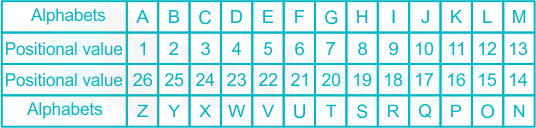
115

A sum of Rs. 10500 becomes Rs. 17745 in 2 years at the rate of compound interest. If the interest is compounded annually, then what will be the rate of interest?

  1. ((a))

    40%

  2. ((b))

    30%

  3. ((c))

    25%

  4. ((d))

    20%

Show Answer
Answer: ((b))

30%

Shortcut Trick

Ratio of Amount to Principal for 2 years = 17745 : 10500

Simplify the ratio (divide by 105): 169 : 100

For a 2-year period, take the square root of the ratio: √169 : √100 = 13 : 10

Rate % = (Difference / Base value) × 100 = (13 − 10) / 10 × 100 = 3 / 10 × 100 = 30%

∴ The correct answer is 30%.

Alternate Method

Given:

Principal (P) = ₹10500

Amount (A) = ₹17745

Time (n) = 2 years

Formula Used:

A = P(1 + R/100)n

Calculations:

⇒ 17745 = 10500(1 + R/100)2

⇒ 17745 / 10500 = (1 + R/100)2

⇒ 1.69 = (1 + R/100)2

⇒ √1.69 = 1 + R/100

⇒ 1.3 = 1 + R/100

⇒ R/100 = 1.3 − 1 = 0.3

⇒ R = 0.3 × 100 = 30%

∴ The correct answer is 30%.

Additional Information

Compound Interest (CI) Basic Formula

Interest is calculated on the initial principal and also on the accumulated interest of previous periods. Formula: CI = P[(1 + R/100)n − 1].

Effective Rate for 2 Years

The effective interest rate for two years can be calculated using the successive percentage formula: Reff = x + y + (xy/100).

Difference between CI and SI for 2 Years

The difference between compound interest and simple interest for a period of 2 years is given by the formula: Difference = P(R/100)2.

Quarterly and Half-Yearly Compounding

If interest is compounded half-yearly, the rate becomes R/2 and time becomes 2n. For quarterly, the rate is R/4 and time is 4n.

116

Two taps P and Q can fill a tank in 24 hours and 18 hours respectively. If the two taps are opened at 11 a.m., then at what time (in p.m.) should the tap P be closed to completely fill the tank at exactly 2 a.m?

  1. ((a))

    5

  2. ((b))

    2

  3. ((c))

    3

  4. ((d))

    4

Show Answer
Answer: ((c))

3

Calculation:

Let the capacity of the tank = 72 litres

Efficiency of pipe P = 72/24 = 3 litres/hour

Efficiency of pipe Q = 72/18 = 4 litres/hour

According to the question,

Total time in which tank has filled = 15 hours

Let the pipe P was closed at after n hours

According to the question

⇒ 3 × (n) + 4 × 15 = 72

⇒ 3n + 60 = 72

⇒ 3n = 12

⇒ n = 4

So, 4 hours after 11:00 am. that means 3:00 pm

∴ the tap P should be closed at 3 : 00 pm

Confusion Points

Not asking about after how many hours the tap should be stopped. It is asking about the time (in p.m.) when the tap will be stopped. [Which is mentioned in the question]

Start at 11 a.m + 4 hours = 3 p.m

117

70% of (A – B) = 49% of (A + B). Then the ratio of A and B is: 

  1. ((a))

    17 ∶ 3

  2. ((b))

    3 ∶ 17

  3. ((c))

    7 ∶ 13

  4. ((d))

    13 ∶ 7

Show Answer
Answer: ((a))

17 ∶ 3

Given:

70% of (A – B) = 49% of (A + B)

Calculation:

According to question:

70 × (A - B)/100 = 49(A + B)/100

⇒ 70(A - B) = 49 (A + B)

⇒ 10(A - B) = 7(A + B)

⇒ 10A – 10B = 7A + 7B

⇒ 10A – 7B = 7A + 10B

⇒ 3A = 17B

⇒ A/B = 17/3

∴ A ∶ B = 17 ∶ 3

The correct option is 1 i.e. 17 ∶ 3

118

If x : y = 5 : 4, then what will be the ratio of (\left( {\frac{x}{y}} \right):\left( {\frac{y}{x}} \right))?

  1. ((a))

    25 : 16

  2. ((b))

    16 : 25

  3. ((c))

    4 : 5

  4. ((d))

    5 : 4

Show Answer
Answer: ((a))

25 : 16

Shortcut Trick

The required ratio is (x/y) : (y/x), which simplifies to (x/y) ÷ (y/x) = (x/y) × (x/y) = (x/y)2.

Given x : y = 5 : 4, substitute the values directly into the squared form.

Required Ratio = (5/4)2 = 25/16.

∴ The correct answer is 25 : 16.

Alternate Method

Given:

The ratio x : y = 5 : 4

Formula Used:

Ratio of a : b is written as a/b. To simplify (a/b) : (c/d), we cross-multiply to get (a × d) : (b × c).

Calculations:

⇒ x/y = 5/4

⇒ y/x = 4/5

⇒ Required Ratio = (x/y) : (y/x)

⇒ Required Ratio = (5/4) : (4/5)

⇒ To remove fractions, multiply both sides by the LCM of 4 and 5 (which is 20):

⇒ (5/4 × 20) : (4/5 × 20)

⇒ 25 : 16

∴ The correct answer is 25 : 16.

Additional Information

Duplicate Ratio

The duplicate ratio of two numbers a : b is the ratio of their squares, which is a2 : b2.

Inverse Ratio

The inverse ratio of a : b is 1/a : 1/b, which simplifies directly to b : a.

Compounded Ratio

The compounded ratio of a : b and c : d is (a × c) : (b × d).

119

Each side of the square park is 25 m. And there are 2.2, m wide two paths passing its center. What is the total cost of laying gravel on the paths at a cost of 1 Rs/dm2?

  1. ((a))

    Rs. 105.16

  2. ((b))

    Rs. 110

  3. ((c))

    Rs. 11,000

  4. ((d))

    Rs. 10,516

Show Answer
Answer: ((d))

Rs. 10,516

Shortcut Trick

Area of two paths = w(L + B − w) where w is path width and L, B are square sides.

Area = 2.2 × (25 + 25 − 2.2) = 2.2 × 47.8 = 105.16 m2.

Convert area to dm2: 1 m2 = 100 dm2 ⇒ 105.16 × 100 = 10516 dm2.

Total cost = 10516 × ₹1 = ₹10,516.

∴ The correct answer is ₹10,516.

Alternate Method

Given: Side of square park (a) = 25 m, Width of path (w) = 2.2 m, Cost = ₹1/dm2.

Area of Path 1 (Horizontal) = length × width = 25 × 2.2 = 55 m2

Area of Path 2 (Vertical) = length × width = 25 × 2.2 = 55 m2

Common Intersection Area = width × width = 2.2 × 2.2 = 4.84 m2

Total Path Area = (55 + 55) − 4.84 = 105.16 m2

Conversion: 1 m = 10 dm ∴ 1 m2 = 100 dm2

Total Area in dm2 = 105.16 × 100 = 10,516 dm2

Total Cost = Area in dm2 × Rate = 10,516 × 1 = ₹10,516

∴ The correct answer is ₹10,516.

Additional Information

Path area formulas

For paths outside a rectangle: Area = 2w(L + B + 2w). For paths inside a rectangle: Area = 2w(L + B − 2w).

Unit conversion

1 meter = 10 decimeters (dm). Therefore, 1 square meter = 102 = 100 square decimeters (dm2).

Central cross paths

When paths intersect at the center, always subtract the square of the width (w2) once as it is counted twice in the calculation.

120

30% of a number is 21 more than 15% of 120. What is the number?

  1. ((a))

    95

  2. ((b))

    110

  3. ((c))

    125

  4. ((d))

    130

Show Answer
Answer: ((d))

130

Shortcut Trick

15% of 120 = 18

Given: 30% of Number = 18 + 21 = 39

If 30% → 39, then 10% → 13

So, 100% → 130

∴ The correct answer is 130.

Alternate Method

Given:

15% of 120 = (15 ÷ 100) × 120 = 18

Let the unknown number be 'x'.

⇒ 30% of x = 15% of 120 + 21

⇒ 0.30 × x = 18 + 21

⇒ 0.30x = 39

⇒ x = 39 ÷ 0.30

⇒ x = 3900 ÷ 30

⇒ x = 130

∴ The correct answer is 130.

Additional Information

Percentage Change

To find a value after a percentage increase: Final Value = Initial Value × (1 + r/100).

Base Change Rule

If A is x% more than B, then B is [x/(100+x)] × 100% less than A.

Fraction Equivalents

Always remember common fractions: 15% = 3/20 and 30% = 3/10 for faster calculation.

English Language 1 (20 questions)

121

Select the most appropriate synonym of the given word.

Follow

  1. ((a))

    Neglect

  2. ((b))

    Scorn

  3. ((c))

    Understand

  4. ((d))

    Lose

Show Answer
Answer: ((c))

Understand

The correct answer is: Option 3 i.e. "Understand".

Key Points

  • The word "Follow" means to go after someone or something or to act according to rules or instructions. It can also mean to comprehend or understand something. (अनुसरण करना/समझना)
  • Example: Please follow the instructions given by your teacher.
  • "Understand" refers to grasping the meaning, significance, or nature of something. (समझना)
  • Example: He took time to understand the complexities of the problem before offering a solution.
  • Hence, "Understand" is the most appropriate synonym for "Follow."

Therefore, the correct answer is: Option 3 i.e. "Understand".

Additional Information

Here are the other options explained along with their Hindi meanings and example sentences:

  • Neglect (उपेक्षा करना): To fail to care for or give proper attention to something or someone.
  • Example: He neglected his health for years, which led to serious issues later.
  • Scorn (तिरस्कार करना): To show contempt or disdain for something or someone.
  • Example: She looked at the outdated ideas with scorn.
  • Lose (खो देना): To be unable to find or keep something.
  • Example: He lost his keys and had to call a locksmith.
122

Select the most appropriate synonym of the given word.

Sturdy

  1. ((a))

    Fat

  2. ((b))

    Weak

  3. ((c))

    Solid

  4. ((d))

    Vast

Show Answer
Answer: ((c))

Solid

The correct answer is: Option 3 i.e. Solid.

Key Points

  • The word "Sturdy" means strongly built or robust, capable of withstanding pressure or force. (मज़बूत)
  • Example: The carpenter made a sturdy wooden chair that could easily support heavy weight.
  • "Solid" refers to something firm, stable, or strong in structure. (ठोस)
  • Example: The foundation of the building was solid, ensuring its durability.
  • Hence, we can infer that the synonym of "sturdy" is "solid".

Therefore, the correct answer is: Option 3 - Solid.

Additional Information

Here are the other options explained along with their Hindi meanings and example sentences:

  • Fat (मोटा): Having a large amount of excess flesh or body weight.
  • Example: The cat grew fat after being fed too many treats.
  • Weak (कमज़ोर): Lacking strength or energy; not strong or robust.
  • Example: After recovering from illness, he still felt weak and needed rest.
  • Vast (विशाल): Very large in size, extent, or amount.
  • Example: The desert stretched out as a vast expanse of sand and sky.
123

Which of the following spellings is incorrect?

  1. ((a))

    Journey 

  2. ((b))

    Amateur

  3. ((c))

    Beneficiary

  4. ((d))

    Aniversary

Show Answer
Answer: ((d))

Aniversary

The correct answer is 'Aniversary'.

Key Points

  • The incorrectly spelt word is 'Aniversary'.
  • The correct spelling is "Anniversary". The word 'anniversary' needs two 'n's.
  • It refers to the yearly recurrence of the date of a past event.
  • It is typically used to commemorate or celebrate a significant occasion that occurred on that specific date in a previous year, such as a wedding, foundation of an institution, or any important historical event.
  • For example, "They celebrated their 10th wedding anniversary last weekend''.
  • The remaining words are correctly spelt.

Therefore, the correct answer is Option 4. 

Additional Information

  • Journey: A trip or voyage from one place to another, often over a long distance or period of time.
  • Amateur: A person who engages in a pursuit, especially a sport, on an unpaid basis or without professional skill.
  • Beneficiary: A person who receives benefits or advantages, especially as a result of a legal arrangement like a will or insurance policy.
124

Which of the following words is spelt correctly?

  1. ((a))

    Shilouette

  2. ((b))

    Silhouette

  3. ((c))

    Shiluoette

  4. ((d))

    Silhuette

Show Answer
Answer: ((b))

Silhouette

The correct answer is: Option 2 i.e. Silhouette.

Key Points

  • The word "silhouette" means an outline that appears dark against a light background, often used to describe the shape or outline of an object. (आकृति)
  • Example: The silhouette of the mountain was striking against the evening sky.
  • "Silhouette" is correctly spelled and is used to describe an outline or shape that is visible due to backlighting. (आकृति)
  • Example: She admired the silhouette of the tree as the sun set behind it.

Therefore, the correct answer is: Silhouette

125

Answer the correctly spelt word from question.

  1. ((a))

    Veterinary 

  2. ((b))

    Veteninary

  3. ((c))

    Vetinary

  4. ((d))

    Vetarinary

Show Answer
Answer: ((a))

Veterinary 

The correct answer is: Option 1 i.e. Veterinary.

Key Points

  • The word "Veterinary" refers to the branch of medicine dealing with the prevention, diagnosis, and treatment of diseases in animals. (पशु चिकित्सा)
  • Example: She decided to pursue a career in veterinary medicine to help sick animals.

Therefore, the correct answer is: Veterinary.

Additional Information

Here are the other options explained along with their Hindi meanings and example sentences:

  • Veteninary: Incorrect spelling, no meaning.
  • Vetinary: Incorrect spelling, no meaning.
  • Vetarinary: Incorrect spelling, no meaning.
126

Choose the word that is correctly spelt.

  1. ((a))

    Indispensible 

  2. ((b))

    Liasion 

  3. ((c))

    Privilige 

  4. ((d))

    Occurred 

Show Answer
Answer: ((d))

Occurred 

The correct answer is: Occurred.

Key Points

  • Let us look at the spelling and meaning of the words.
  • Indispensible
  • This word is incorrectly spelled.
  • The correct spelling is "Indispensable." (अपरिहार्य)
  • It means something that is absolutely necessary or essential and cannot be done without.
  • For example: His expertise was indispensable to the project's success.
  • Liasion
  • This word is incorrectly spelled.
  • The correct spelling is "Liaison." (मेल जोल)
  • It refers to a person who acts as a link or intermediary between two groups or individuals, often for communication or coordination. It can also mean the communication or cooperation itself.
  • For example: She served as a liaison between the marketing and sales teams.
  • Privilige
  • This word is incorrectly spelt.
  • The correct spelling is "Privilege." (विशेषाधिकार)
  • A privilege is a special advantage, right, or benefit that is granted to a particular person or group and is not enjoyed by everyone.
  • For example: Having access to education is a privilege.
  • Occurred:
  • This word is correctly spelled.
  • It is the past tense of the verb "occur," which means to happen or take place. (घटित होना)
  • For example: The accident occurred at the intersection.

Therefore, it is clear that the correct answer is option 4.

127

Select the INCORRECTLY spelt word.

  1. ((a))

    Compact

  2. ((b))

    Compell

  3. ((c))

    Currently

  4. ((d))

    Savage

Show Answer
Answer: ((b))

Compell

The correct answer is "Compell".

Key Points

  • In the given options, the incorrectly spelt word is "Compell".The correct term is "Compel".
  • Compel is a verb that implies pushing or nudging hard or relentlessly (कुछ करने के लिए किसी को बाध्य या विवश करना).
  • Example: The lawyer compelled the killer to stay in jail.
  • Therefore, the correct answer is "Option 2".​​​​​

Additional Information

  • Let's look into the other options.
WordsMeaning
CompactCompact refers to having components that are neatly arranged or packed together in a small space. (छोटा और उठाकर ले जाने में सुविधाजनक)
CurrentlyCurrently refers to the present moment. (वर्तमान में)
SavageSavage means cruel and vicious; aggressively hostile. (अति निर्दय, हिंसक)
  • All of these words are correctly spelt.
128

Select the option that expresses the given sentence in passive voice.

Can you compose an inspiring poem?

  1. ((a))

    Can an inspiring poem be composed?

  2. ((b))

    An inspiring poem can be composed by you.

  3. ((c))

    Can an inspiring poem be composed by you?

  4. ((d))

    Can an inspiring poem by you composed?

Show Answer
Answer: ((c))

Can an inspiring poem be composed by you?

The correct answer is Option 3.


Key Points

  • Passive voice structure: The object of the active voice sentence becomes the subject of the passive voice sentence.
  • In the active voice, the sentence is: "Can you compose an inspiring poem?"
  • To convert to passive voice: Place the object "an inspiring poem" at the beginning.
  • Change the active verb form "compose" to "be composed" (passive infinitive form).
  • Add the preposition "by" followed by the original subject "you."
  • Ensure the question structure remains intact by placing the auxiliary verb "can" at the beginning.

Therefore, the correct answer is Option 3.


Correct Sentence: "Can an inspiring poem be composed by you?"


Additional Information

  • Option 1: "Can an inspiring poem be composed?" – This sentence is in passive voice but lacks the agent "by you."
  • Option 2: "An inspiring poem can be composed by you." – This is a passive voice sentence but not in question form.
  • Option 4: "Can an inspiring poem by you composed?" – This sentence is grammatically incorrect.
129

Select the option that expresses the given sentence in active voice.

Why are you repeatedly called by her?

  1. ((a))

    Why she calls you repeatedly?

  2. ((b))

    Why had she called you repeatedly?

  3. ((c))

    Why was she calling you repeatedly?

  4. ((d))

    Why does she call you repeatedly?

Show Answer
Answer: ((d))

Why does she call you repeatedly?

The correct answer is Option 4.


Key Points

  • To convert the given sentence into active voice, the subject (she) should be placed at the beginning and the verb should match the correct tense.
  • The original sentence in passive voice is: "Why are you repeatedly called by her?"
  • In active voice, it becomes: "Why does she call you repeatedly?"

Therefore, the correct answer is Option 4.


Correct Sentence: "Why does she call you repeatedly?"


Additional Information

  • Option 1: "Why she calls you repeatedly?" – This option lacks the correct structure for a question in active voice.
  • Option 2: "Why had she called you repeatedly?" – Incorrect tense (past perfect) for this context.
  • Option 3: "Why was she calling you repeatedly?" – Incorrect tense (past continuous) for this context.
130

Select the option that expresses the given sentence in active voice.

<br>

Were the plants being grafted by the gardener?

  1. ((a))

    Was the gardener grafting the plants?

  2. ((b))

    Was the gardener grafted the plants?

  3. ((c))

    Were the plants grafting the gardener?

  4. ((d))

    Were the gardener grafting the plants?

Show Answer
Answer: ((a))

Was the gardener grafting the plants?

The correct answer is Option 1.


Key Points

  • Passive voice structure: The object of the active voice sentence becomes the subject of the passive voice sentence.
  • In the passive voice, the sentence is: "Were the plants being grafted by the gardener?"
  • To convert to active voice: Place the subject "the gardener" at the beginning.
  • Change the passive verb form "were being grafted" to "was grafting" (past continuous active).
  • Ensure the object "the plants" remains at the end of the sentence for clarity.

Therefore, the correct answer is Option 1.


Correct Sentence: "Was the gardener grafting the plants?"


Additional Information

  • Option 2: "Was the gardener grafted the plants?" – Incorrect as "grafted" is a past participle and does not form a valid sentence here.
  • Option 3: "Were the plants grafting the gardener?" – Incorrect as it reverses the subject and object.
  • Option 4: "Were the gardener grafting the plants?" – Incorrect due to subject-verb agreement ("were" does not match "the gardener").

A Fox, one day, fell into a deep well and could find no means of escape. Meanwhile, a Goat, overcome with thirst, came to the same well, and seeing the Fox, enquired the reason for which the Fox was in the well. Concealing his sad plight under a merry guise, the Fox indulged in a lavish praise of the water, saying it was excellent beyond measure, and told the goat that he deliberately jumped in the well to enjoy its benefits. He kept encouraging the goat to jump in the well. The Goat, mindful only of his thirst, thoughtlessly jumped down, but just as he drank, the Fox informed him of the difficulty they were both in and suggested a scheme for their common escape. "If," said he, "you will place your forefeet upon the wall and bend your head, I will run up your back and escape, and will help you out afterwards." The Goat readily assented and the Fox leaped upon his back. Steadying himself with the Goat's horns, he safely reached the mouth of the well and made off as fast as he could. When the Goat upbraided him for breaking his promise, he turned around and cried out, "You foolish old fellow! If you had as many brains in your head as you have hairs in your beard, you would never have gone down before you had inspected the way up, nor have exposed yourself to dangers from which you had no means of escape."

131

How did the goat get into the well?

  1. ((a))

    He descended into the well by mistake. 

  2. ((b))

    He was thrown into the well by a passer-by. 

  3. ((c))

    He fell into the well. 

  4. ((d))

    He was lured by the fox. 

Show Answer
Answer: ((d))

He was lured by the fox. 

The correct answer is Option 4.


Key Points

  • The Fox cleverly deceived the Goat by praising the water in the well and pretending that he had jumped in deliberately to enjoy its benefits.
  • The Goat, being extremely thirsty, did not think critically and was lured by the Fox's words.
  • Without assessing the situation, the Goat thoughtlessly jumped into the well.
  • This shows that the Goat was tricked by the Fox rather than falling in by mistake or being pushed in.

Therefore, the correct answer is Option 4.


Additional Information

  • Option 1: Incorrect. The Goat did not descend by mistake; he willingly jumped in after being misled by the Fox.
  • Option 2: Incorrect. There is no mention of a passer-by throwing the Goat into the well.
  • Option 3: Incorrect. The Goat did not accidentally fall; he was lured into the well by the Fox's deception.
132

Identify the tone of the passage.

  1. ((a))

    Cheerful 

  2. ((b))

    Assertive 

  3. ((c))

    Informal 

  4. ((d))

    Didactic 

Show Answer
Answer: ((d))

Didactic 

The correct answer is Option 4.


Key Points

  • The tone of the passage is didactic, meaning it is intended to teach a moral lesson.
  • The story conveys the message of thinking before acting and being cautious of deceitful individuals.
  • The Fox tricks the Goat, demonstrating the importance of wisdom and foresight.
  • Since the passage aims to impart wisdom rather than being cheerful, assertive, or informal, the correct tone is didactic.

Therefore, the correct answer is Option 4.


Additional Information

  • Cheerful: The passage does not have a happy or lighthearted tone.
  • Assertive: The passage does not command or express a forceful opinion.
  • Informal: The language and style of the passage are formal and structured, not conversational.
133

Select the most appropriate title for the passage.

  1. ((a))

    The Fox and the Forest 

  2. ((b))

    The Kind Fox 

  3. ((c))

    The Cunning Goat 

  4. ((d))

    The Fox and the Goat 

Show Answer
Answer: ((d))

The Fox and the Goat 

The correct answer is Option 4.


Key Points

  • The passage revolves around the interaction between a Fox and a Goat.
  • The Fox deceives the Goat into jumping into the well, highlighting the Fox's cunning nature and the Goat's gullibility.
  • The most appropriate title should reflect both key characters involved in the story.
  • Options like "The Kind Fox" and "The Cunning Goat" are misleading, as the Fox was cunning and the Goat was naive.
  • "The Fox and the Goat" appropriately represents both characters and the lesson of the story.

Therefore, the correct answer is Option 4: The Fox and the Goat.


Additional Information

  • Option 1: The Fox and the Forest – The passage does not focus on a forest; the setting is a well.
  • Option 2: The Kind Fox – The Fox is deceptive, not kind, making this an incorrect title.
  • Option 3: The Cunning Goat – The Goat is actually naive and gullible, not cunning.
134

What moral lesson can be drawn from the passage?

  1. ((a))

    Pride comes before a fall. 

  2. ((b))

    Look before you leap. 

  3. ((c))

    One good turn deserves another. 

  4. ((d))

    Honesty is the best policy. 

Show Answer
Answer: ((b))

Look before you leap. 

The correct answer is Option 2.


Key Points

  • The moral lesson from the passage is "Look before you leap."
  • The Goat hastily jumped into the well without considering how he would escape.
  • The Fox took advantage of the Goat’s foolishness and tricked him for his own benefit.
  • This highlights the importance of thinking ahead and evaluating consequences before taking action.

Therefore, the correct answer is Option 2 – Look before you leap.


Additional Information

  • Option 1 – "Pride comes before a fall": This does not fit as the Goat was not prideful but rather careless.
  • Option 3 – "One good turn deserves another": This would apply if the Fox had helped the Goat in return, which he did not.
  • Option 4 – "Honesty is the best policy": This does not relate to the passage as it focuses on deception rather than honesty.
135

Why did the fox invite the goat into the well?

  1. ((a))

    Because the fox needed support to get out of the well. 

  2. ((b))

    Because the fox felt lonely in the well. 

  3. ((c))

    Because the fox wanted the goat to drink the water. 

  4. ((d))

    Because they were friends. 

Show Answer
Answer: ((a))

Because the fox needed support to get out of the well. 

The correct answer is Option 1.


Key Points

  • The Fox was trapped in the well and could not escape on his own.
  • To find a way out, he deceived the Goat by praising the water quality.
  • The Goat, overcome with thirst, believed the Fox and jumped into the well.
  • Once inside, the Fox used the Goat as a stepping stool to climb out, leaving the Goat trapped.

Therefore, the correct answer is Option 1: Because the fox needed support to get out of the well.


Additional Information

  • Option 2: Because the fox felt lonely in the well – This is incorrect, as the Fox's intention was not companionship but escape.
  • Option 3: Because the fox wanted the goat to drink the water – This is incorrect, as the Fox manipulated the Goat for his own benefit.
  • Option 4: Because they were friends – This is incorrect, as the Fox had no friendship with the Goat and used deception to escape.
136

Select the option that expresses the given sentence in indirect speech.

I said to Mohan, “He has a green book.”

  1. ((a))

    I told Mohan that he had had a green book.

  2. ((b))

    I told Mohan that he have a green book.

  3. ((c))

    I told Mohan that he had a green book.

  4. ((d))

    I told Mohan that he has a green book.

Show Answer
Answer: ((c))

I told Mohan that he had a green book.

The correct answer is option 3: "I told Mohan that he had a green book."

Key Points

  • The given sentence is in direct speech. We need to change it into indirect speech.
  • When converting direct speech to indirect speech, we need to make some changes to the original sentence. Here are the rules:
  • The reporting verb (in this case, "said to") is changed to a suitable reporting verb (in this case, "told").
  • The pronouns are changed to reflect the new subject of the sentence. In this case, "I" and "he" remains unchanged.
  • The tense of the verb is changed to reflect the time of the reported speech.
  • In this case, "has" becomes "had" because the original sentence was in the present tense, but the reported speech is in the past tense.
  • Thus, the correct answer is Option 3.

Correct Sentence: "I told Mohan that he had a green book."

137

Select the correct indirect form of the given sentence.

Ramesh said, “I will have finished cooking food for him.”

  1. ((a))

    Ramesh said that he would had ​finished cooking food for him

  2. ((b))

    Ramesh said that he would have ​finish cooking food for him

  3. ((c))

    Ramesh said that he will have ​finished cooking food for him

  4. ((d))

    Ramesh said that he would have finished cooking food for him

Show Answer
Answer: ((d))

Ramesh said that he would have finished cooking food for him

The correct answer is 'Ramesh said that he would have finished cooking food for him.'

Key Points

  • The rules for changing Direct Speech to Indirect Speech:
  • The given sentence is in Future Perfect Tense.
  • 'Will have' changes to 'Would have.'
  • The reporting verb said/said to is changed in told, asked, demanded, ordered, enquired as per the nature of the sentence.
  • Remove the commas and inverted commas.
  • The first person in reported speech changes according to the subject of reporting speech.
  • Use that in the sentence of indirect speech.
  • Structure: (Subject+ will have + V3 + object) (Direct Speech)

                  (Subject+ would have + V3 + object) (Indirect Speech)

  • Example: Shakespeare said, “I will have written another drama.” (Direct speech)

                 Shakespeare said that he would have written another drama. (Indirect speech)

Additional Information   


  • If the sentence of Direct speech has a question that cannot be answered by saying yes or no then it does not use “if” or “whether” in its Indirect speech.
  • Example:  She said to me, “Where did you buy this dress from?” (Direct speech)

                  She asked me where I had bought that dress from. (Indirect speech)

Hinglish    

  • Direct Speech को Indirect Speech में बदलने का नियम:
  • दिया गया वाक्य Future PerfectTense में है।
  • Will have, Would have में बदल जाता है।
  • Said/said to रिपोर्टिंग verb वाक्य की प्रकृति के अनुसार asked, demanded, ordered, enquired में बदल जाती है।
  • Commas और inverted commas हटा दे।
  • Reported speech में first person, reporting speech के subject के अनुसार बदलता है।
  • Indirect speech के वाक्य में  that का प्रयोग करें।
  • Structure: (Subject+ will have + V3 + object) (Direct Speech)

                  (Subject+ would have + V3 + object) (Indirect Speech)

  • Example: Shakespeare said, “I will have written another drama.” (Direct speech)

                 Shakespeare said that he would have written another drama. (Indirect speech)

138

Select the most appropriate indirect form of the given sentence.

David said, “Don’t worry Frank. I will bring you up to date when I meet you next.”

  1. ((a))

    David told Frank not to worry as he would bring him up to date when he met him next.

  2. ((b))

    David told Frank he shouldn’t worry as he will bring him up to date when he meets him next.

  3. ((c))

    David told Frank not to worry as I would bring you up to date when I meet you next.

  4. ((d))

    David told Frank don’t worry as he would bring you up to date when he met him next.

Show Answer
Answer: ((a))

David told Frank not to worry as he would bring him up to date when he met him next.

The correct answer is- 'David told Frank not to worry as he would bring him up to date when he met him next.'

Key Points

  • To change the sentence to an indirect speech we need to follow the following steps:
  • As the reporting speech is in the past tense, said will become told.
  • The inverted commas of reported speech should be removed.
  • As there is a negative imperative sentence (Don't worry Frank) so the sentence should start as "not + to + verb"
  • Not to worry. (for the given sentence)
  • The pronoun I will change to he (as it refers to the subject David)
  • The pronoun you will change to him (as it refers to the object Frank)
  • Thus according to the given steps, option 1 is the correct answer.

And the correct sentence is: David told Frank not to worry as he would bring him up to date when he met him next.

Additional Information 

  • Let's learn more about the change of tense in the reported speech:
  • Present Perfect Changes to Past Perfect
  • Example:
  • Direct: “I have been to Boston”, she told me.
  • Indirect: She told me that she had been to Boston.
  • Simple Present Changes to Simple Past
  • Example:
  • Direct: “I am unwell”, she said.
  • Indirect: She said that she was unwell.
  • Present Continuous Changes to Past Continuous
  • Example:
  • Direct: “I am playing the guitar”, she explained.
  • Indirect: She explained that she was playing the guitar.
  • Present Perfect Changes to Past Perfect
  • Example:
  • Direct: He said, “She has finished her homework“.
  • ​Indirect: He said that she had finished her homework.
139

Direction: Change the Narration-

The teacher said to her, "Do not waste your time."

  1. ((a))

    The teacher advised her do not to waste her time.

  2. ((b))

    The teacher advised her not to waste her time.

  3. ((c))

    The teacher advised her not do not waste her time.

  4. ((d))

    The teacher advised her not to wasted her time.

Show Answer
Answer: ((b))

The teacher advised her not to waste her time.

The correct answer is '​Teacher advised her not to waste her time.'

<br>

Key Points

  • The given sentence is an Imperative, Negative sentence and it is in Direct Speech.
  • The rule for changing an imperative sentence from direct speech to indirect speech:
  • We will use ‘to’ as a joining clause before the reported command or request, and the reported verb will be changed according to the moods of the sentence (e.g., ordered, requested, urged, advised, forbade, or begged).
  • Structure for indirect speech for a negative imperative sentence: reporting verb + noun/pronoun + not + to infinitive  
  • Example: She said, "Don't keep talking." (Direct Speech)

                 She instructed us not to keep talking. (Indirect Speech)

  • Therefore, the correct answer is '​The teacher advised her not to waste her time.'
<br>

Additional Information

  • The sentence which is used to convey a command, a request, or a forbiddance is called an imperative sentence.
  • This type of sentence always takes the second person (you) for the subject but most of the time the subject remains hidden.
  • Example:  Don’t ever touch my phone.

                  Take a step and don’t move.


  • दिया गया वाक्य एक Imperative, Negative sentence है और यह Direct Speech में है।
  • Imperative वाक्य को direct speech से indirect speech में बदलने के नियम:
  • हम reported command या request​ से पहले शामिल होने वाले joining clause के रूप में ‘to’ का उपयोग करेंगे, और reported verb को व��क्य के मूड के अनुसार बदल दिया जाएगा (e.g., ordered, requested, urged, advised, forbade, or begged)।
  • Structure for indirect speech for a negative imperative sentence: reporting verb + noun/pronoun + not + to infinitive 
  • Example: She said, "Don't keep talking." (Direct Speech)

                 She instructed us not to keep talking. (Indirect Speech)

140

Direction: In the following question, a sentence is given in Direct/Indirect speech. Out of the four alternatives, choose the one which best expresses the sentence in Indirect/Direct Speech.

The teacher said to the students, "Birds of a feather flock together".

  1. ((a))

    The teacher told to the students that birds of a feather flock together. 

  2. ((b))

    The teacher told the students that birds of a feather have flock together. 

  3. ((c))

    The teacher told the students that birds of a feather flock together. 

  4. ((d))

    The teacher told the students that birds of a feather flocked together. 

Show Answer
Answer: ((c))

The teacher told the students that birds of a feather flock together. 

The indirect speech of the given sentence is 'The teacher told the students that birds of a feather flock together'.

Key Points 

The teacher said to the students,"Birds of a feather flock together."

Reporting Clause                                                      Reported Speech

  • The sentence that states or declares a feeling, opinion, incident, event, etc., is called an assertive sentence. So, the given speech is an assertive one.
  • While changing the narration of an assertive sentence, we make the following changes:
  • If the reporting verb is in the past tense and the reported speech is an idiom/phrase/universal truth/routine/historical fact etc., there will be no change in the tense, time and place of the reported speech.
  • The given sentence is a proverb.
  • The conjunction 'that' is used in place of commas and inverted commas.
  • 'Said to' changes to told + object, whereas 'said' remains as it is.
  • Example: He said, "The Sun rises in the east." (Direct speech)     (Universal truth)

                 He said that the Sun rises in the east. (Indirect speech)


Final sentence: The teacher told the students that birds of a feather flock together. 

Important Points

  • The proverb 'birds of a feather flock together' means 'those with similar interests or of the same kind tend to form groups'.

  • वह वाक्य जो किसी भावना, राय, घटना, घटना आदि को बताता या घोषित करता है, उसे एक assertive sentence कहा जाता है।
  • एक assertive sentence का narration बदलते समय, हम निम्नलिखित परिवर्तन करते हैं:
  • यदि reporting verb भूत काल में है और reported speech एक मुहावरा / वाक्यांश / सार्वभौमिक सत्य / दिनचर्या / ऐतिहासिक तथ्य आदि है, तो reported speech के tense, time और place में कोई बदलाव नहीं होगा।
  • दिया गया वाक्य एक कहावत है।
  • Comma और inverted commas के स्थान पर 'that' का उपयोग किया जाता है।
  • 'said to' को बदलकर told + object जबकि 'said' में कोई बदलाव नहीं आता।

English Language 2 (20 questions)

141

Given below are four jumbled sentences. Out of the given options, pick the one that gives their correct order.

A. One day the tailor and his wife discovered that their son was not in the house.

B. The father went to the roadside and shouted, “John!”

C. No one answered.

D. They looked in the garden, and did not find him there.

  1. ((a))

    BDAC

  2. ((b))

    ABDC

  3. ((c))

    ADBC

  4. ((d))

    BACD

Show Answer
Answer: ((c))

ADBC

The correct answer is 'ADBC'.

Key Points

  • The given question is an example of a Para Jumble.
  • We know that the first statement of a para jumbled question is usually an independent general statement, a noun, a universal fact, starting off a story, starting of an incident or an event, or it starts with 'most' or 'once'.
  • Sentence A will be the starting line because it contains the main idea of the para jumble i.e. the tailor and his wife discovering that their son was not in the house.
  • However, Sentence D states that they looked in the garden, and did not find him there. So, D will follow A.
  • Further, Sentence B states that the father after looking in the garden went to the roadside and shouted, “John!” & Sentence C states that no one answered. So, C will follow B.
  • Thus, the correct sequence is:
  • A: One day the tailor and his wife discovered that their son was not in the house.
  • D: They looked in the garden, and did not find him there.
  • B: The father went to the roadside and shouted, “John!”
  • C: No one answered.

Correct Sequence: One day the tailor and his wife discovered that their son was not in the house. They looked in the garden, and did not find him there. The father went to the roadside and shouted, “John!” No one answered.

142

Directions: Sentences of a paragraph are given below in jumbled order. Arrange the sentences in the correct order to form a meaningful and coherent paragraph.

A. In fact, he began his career as a peon in a small firm.

B. Before he joined us as the accounts officer, he was a junior clerk.

C. He learnt typing, accounting and even graduated.

D. But he gradually improved his qualifications.

  1. ((a))

    BADC

  2. ((b))

    BCDA

  3. ((c))

    CDAB

  4. ((d))

    CBAD

Show Answer
Answer: ((a))

BADC

The correct answer is 'BADC.'

Key Points

  • The sentence 'B' is independent of any other sentence as it is introducing or giving general information about "an accounts officer". Hence, 'B' is the first part.
  • Sentence A will come after B as it is giving information about the early stage career of the accounts officer who began his career as a peon.
  • Sentence D will come after A as it is giving information about how the man became an accounts officer from a peon i.e. by gradually improving his qualifications.
  • Sentence 'C' concludes by saying that the man learnt typing, accounting, and even done graduation to become an accounts officer.

Paragraph after rearranging the sentences: Before he joined us as the accounts officer, he was a junior clerk. In fact, he began his career as a peon in a small firm. But he gradually improved his qualifications. He learnt typing, accounting and even graduated.

Hint

  • Important Rules to Solve the Para Jumbles:
  • Read the sentences attentively and try to comprehend the idea or theme of the sentence and eliminate the irrelevant options.
  • Try to identify the opening (independent sentence) and closing sentences (concluding sentence).
  • Try to identify the mandatory pairs. Two sentences can be connected through various connectors and other determinants.
143

Directions: Sentences of a paragraph are given below in jumbled order. Arrange the sentences in the correct order to form a meaningful and coherent paragraph.

A. My father is the only breadwinner in the family.

B. My mother happily lends a helping hand in his hard work.

C. I belong to a family where it is difficult to make both ends meet.

D. He earns a rather meager amount, working as a mason.

  1. ((a))

    CBDA

  2. ((b))

    ABCD

  3. ((c))

    CADB

  4. ((d))

    ACBD

Show Answer
Answer: ((c))

CADB

The correct answer is 'CADB.'

Key Points

  • The sentence 'C' is independent of any other sentence as it is introducing or giving general information about "someone who has little money ". Hence, 'C' is the first part.
  • Sentence A will come after C as it is giving information about the only person who earns money i.e. his father.
  • Sentence D will come after A as it is further giving information about the job of the father i.e. what he actually does to earn money.
  • Sentence 'B' concludes by giving information about the mother who helps her husband in his work.

Paragraph after rearranging the sentences: I belong to a family where it is difficult to make both ends meet. My father is the only breadwinner in the family. He earns a rather meager amount, working as a mason. My mother happily lends a helping hand in his hard work. 

Hint

  • Important Rules to Solve the Para Jumbles:
  • Read the sentences attentively and try to comprehend the idea or theme of the sentence and eliminate the irrelevant options.
  • Try to identify the opening (independent sentence) and closing sentences (concluding sentence).
  • Try to identify the mandatory pairs. Two sentences can be connected through various connectors and other determinants.
144

Direction: Select the grammatically correct sentence from the given options.

You can choose either the red car nor the blue car.

  1. ((a))

    You can choose either the red car but the blue car.

  2. ((b))

    You can choose either the red car as well as the blue car.

  3. ((c))

    You can choose either the red car and the blue car.

  4. ((d))

    You can choose either the red car or the blue car.

Show Answer
Answer: ((d))

You can choose either the red car or the blue car.

The correct answer is 'You can choose either the red car or the blue car.'

<br>

Key Points 

  • “Either” is used in the same sentence as “or” to show two or more possibilities or choices.
  • Example: Either he or his wife may attend the function.
  • Therefore, we need to substitute "nor" with "or" to make the sentence grammatically correct.

Correct sentence: You can choose either the red car or the blue car.


Additional Information 

  • Each, every, either and neither are distributive words that are normally used with singular nouns and are placed before the noun
  • Each, either, and neither can be used with plural nouns but must be followed by ‘of.‘
  • Each is a way of seeing the members of a group as individuals.
  • Example: Each of the children received a present.
  • Every is a way of seeing a group as a series of members.​
  • Example: Every child in the world deserves affection.
145

Direction: Select the grammatically correct sentence from the given options.

  1. ((a))

    The pros and a cons of using a laptop for work are debatable.

  2. ((b))

    The pros and cons of using an laptop for work are debatable.

  3. ((c))

    The pros and the cons of using a laptop for work are debatable.

  4. ((d))

    The pros and cons of using a laptop for work are debatable.

Show Answer
Answer: ((d))

The pros and cons of using a laptop for work are debatable.

The correct answer is 'The pros and cons of using a laptop for work are debatable.'

Key Points 

  • In this context, we need to focus on two rules related to articles:
  • If two nouns are connected with the help of the conjunction "and", then the article must be placed in front of the first noun only.
  • Example:
  • The advantages and disadvantages of this project were discussed. [Corerct]
  • The advantages and the disadvantages of this project were discussed. [Incorrect]
  • Use the article "a or an" to indicate any non-specified member of a group or category.
  • The definite article 'the' is used before a noun to indicate that the identity of the noun is known and specific to the reader.
  • Here we are talking about a non-specific "laptop", therefore, we need to use "a" with it.

​Correct sentence: The pros and cons of using a laptop for work are debatable.

146

Direction: Out of the given four sentences, choose the one which is grammatically correct.

  1. ((a))

    All the boys have been playing cricket since morning

  2. ((b))

    All the boys have been playing the cricket from morning

  3. ((c))

    All the boys has being playing cricket for morning

  4. ((d))

    All boys has been playing cricket from morning

Show Answer
Answer: ((a))

All the boys have been playing cricket since morning

The correct answer is- 'All the boys have been playing cricket since morning.'

Key Points 

  • Two rules are needed to be considered here:
  • The subject "boys" is plural, so we need a plural helping verb "have" with it.
  • Therefore, the options "All the boys has being playing cricket for morning" and "All boys has been playing cricket from morning" are opt-out.
  • The word 'from' is always used as a preposition and it is used to refer to a place or time at which any event/action/journey starts/initiates. 
  • Example: I come from Delhi.
  • The word 'since' is used to refer to the time passed between then and now, i.e. from a point in the past until now/present.
  • Example: I haven’t met Neel since evening.
  • ​Therefore, the option "All the boys have been playing the cricket from morning" is incorrect.
  • So, the correct answer is Option 1.

Correct sentence: All the boys have been playing cricket since morning.

147

Direction: Select the grammatically correct sentence from among the given options.

No sooner had I gotten my bags unpacked these I realized that my camera was missing.

  1. ((a))

    No sooner had I gotten my bags unpacked which I realized that my camera was missing.

  2. ((b))

    No sooner had I gotten my bags unpacked that I realized that my camera was missing.

  3. ((c))

    No sooner had I gotten my bags unpacked than I realized that my camera was missing.

  4. ((d))

    No sooner had I gotten my bags unpacked then I realized that my camera was missing.

Show Answer
Answer: ((c))

No sooner had I gotten my bags unpacked than I realized that my camera was missing.

The correct answer is 'No sooner had I gotten my bags unpacked than I realized that my camera was missing.'

Key Points

  • No sooner is used to show that one thing happens immediately after another thing.
  • It is often used with the past perfect and usually followed by "than."
  • Example: No sooner had she finished one project, than she started the next.
  • Hence, "than I realized"​ should be used to make the sentence grammatically correct.

Correct sentence*: No sooner had I gotten my bags unpacked than I realized that my camera was missing.*

Additional Information  


  • A conjunction is a joiner, a word that connects (conjoins) parts of a sentence.
  • Coordinating conjunctions join equals to one another.
  • Example: Most children like sweets and cookies.
  • Coordinating conjunctions go in between items joined, not at the beginning or end.
  • Example: I like coffee, but I don't like tea.
148

Direction: Select the grammatically correct sentence from the given options:

  1. ((a))

    I have many friends; I’ve known the little of them since high school.

  2. ((b))

    I have many friends; I’ve known a few of them since high school.

  3. ((c))

    I have many friends; I’ve known a little of them since high school.

  4. ((d))

    I have many friends; I’ve known little of them since high school.

Show Answer
Answer: ((b))

I have many friends; I’ve known a few of them since high school.

The correct answer is 'I have many friends; I’ve known a few of them since high school.'

Key Points

  • The word 'few' refers to countable nouns and is used with the plural form and 'Little' is generally used to refer to non-countable nouns and is used with the singular form.
  • "A few" means "some (people or things)."
  • It is used to say that there are a small number of people or things.
  • Example: Most of his books are boring, but there are a few that I like. [=I like a small number of them]
  • The word "little" means a bit of or hardly any amount.
  • Example: We have little time left to finish the task.
  • The term "a little" means some or a small quantity.
  • Example: There’s a little chance that the boy will win.
  • 'The little' means 'not much but all of that much available'.
  • ​Example: She drank off the little milk she had.
  • The given sentence is talking about not having many friends, therefore, the correct answer must have the phrase "a few."
  • Also, 'friends' as a noun is countable, thus, 'a few' is the most appropriate determiner that can be used.
  • Therefore, the correct answer is Option 2.

​Correct sentence: I have many friends; I’ve known a few of them since high school.

149

Select the appropriate word to fill in the blank: "By the time she arrives, we _____finished the project."

  1. ((a))

    have

  2. ((b))

    will have

  3. ((c))

    had

  4. ((d))

    would have

Show Answer
Answer: ((b))

will have

The correct answer is 'will have'.

Key Points

  • The phrase "will have" is used to indicate that an action will be completed by a certain future time. (भविष्य के किसी समय तक क्रिया समाप्त हो जाएगी)
  • In the sentence, "By the time she arrives" sets a future time frame by which the action of finishing the project will be completed.
  • The other options do not fit as appropriately:
  • Have indicates present perfect tense, not suitable for specifying future completed actions. (वर्तमान पूर्ण काल)
  • Had indicates past perfect tense, which is used for actions completed before a certain point in the past. (अतीत में किसी समय से पहले पूरी हुई क्रियाएं)
  • Would have indicates a conditional future perfect, used for hypothetical situations. (काल्पनिक स्थितियों के लिए उपयोग किया जाता है)

Therefore, the correct answer is 'Option 2'.

Complete Sentence: By the time she arrives, we will have finished the project.

150

Select the most appropriate phrasal verb to fill in the blank.

The principal asked the students to _________ their homes immediately.

  1. ((a))

    head out

  2. ((b))

    head for

  3. ((c))

    head up 

  4. ((d))

    head off

Show Answer
Answer: ((b))

head for

The correct answer is 'head for'.


Key Points

  • The phrasal verb "head for" means to move in the direction of or to go towards a particular destination.
  • In this context, the principal is instructing the students to move towards their homes, so "head for" is the most appropriate choice.
  • Other options like "head out," "head up," and "head off" do not fit the sentence contextually.

​Therefore, the correct answer is 'Option 2'.

Complete Sentence: The principal asked the students to head for their homes immediately.

Additional Information

  • Head out: means to leave a place or begin a journey.
  • Head up: means to lead or be in charge of something.
  • Head off: means to intercept or prevent something from happening.
151

Select the most appropriate option to fill in the blank.

She ______ the book to her friend.

  1. ((a))

    laned

  2. ((b))

    leant

  3. ((c))

    lend

  4. ((d))

    lent

Show Answer
Answer: ((d))

lent

The correct answer is 'lent'.


Key Points

  • The word "lent" is the correct past tense of the verb "lend" (उधार देना).
  • The sentence requires the past tense as it describes a completed action.
  • The other options: "laned," "leant," and "lend" do not fit grammatically or contextually.

​Therefore, the correct answer is 'Option 4'.

Complete Sentence: She lent the book to her friend.

Additional Information

  • Laned: Not a valid word in this context.
  • Leant: Past tense of "lean," meaning to incline or bend.
  • Lend: Present tense of "lend," meaning to give something temporarily.
152

Select the most appropriate option to improve the underlined segment in the given sentence. If there is no improvement required, select ‘No improvement’.

My sister resembles to my mother a lot in looks and in temperament.

  1. ((a))

    No improvement

  2. ((b))

    resembles

  3. ((c))

    has resemblance to

  4. ((d))

    is resembling to

Show Answer
Answer: ((b))

resembles

The correct answer is Option 2)

Key Points

  • In English, the verb "resemble" is not followed by the preposition "to."
  • Therefore, the correct improvement to the sentence is to remove "to" after "resembles."
  • The other options are either grammatically incorrect or do not fit the context as well as "resembles."

Hence, the correct statement is 'My sister resembles my mother a lot in looks and in temperament.'

<br>

Additional Information

  • Common verbs that do not take a preposition after them include "resemble," "enter," "discuss," and "reach."
  • For example, it is correct to say "enter the room" instead of "enter into the room" and "discuss the issue" instead of "discuss about the issue."
  • Being aware of such verb usage helps in maintaining proper grammar in sentences.
153

Fill in the blanks with the CORRECT option:

I am meeting two friends today. The first one will meet me no ________ than 10 in the morning and the ________ one will meet me in the evening

  1. ((a))

    latter, later

  2. ((b))

    later, latter

  3. ((c))

    letter, latter

  4. ((d))

    latter, letter

Show Answer
Answer: ((b))

later, latter

The correct answer is 'later, latter'.

Key Points

  • The given options uses the combination of three words - later; latter; letter
  • Let us look into how they fit the sentence context - 
  • "Later" refers to a time in the future, so "no later than 10 in the morning" means "not after 10 o'clock in the morning."
  • "Latter" refers to the second of two things or people that have been mentioned, so "the latter one" refers to the second friend.
  • "Letter" refers to a written or printed communication, so it doesn't fit in this context.
  • From the above explanation it is evident that "later, latter" are the correct words that fit the given blanks correctly.
  • Hence, option 2 is the correct answer.

Complete sentence - I am meeting two friends today. The first one will meet me no later than 10 in the morning and the latter one will meet me in the evening.

154

Fill in the blanks with the correct pair of homophones. 

<br>

There is no _______ way to _______ a great novel.

  1. ((a))

    immigrants, emigrants

  2. ((b))

    opposite, apposite

  3. ((c))

    right, write

  4. ((d))

    zealous, jealous

Show Answer
Answer: ((c))

right, write

The correct answer is 'right, write'.

Key Points

  • The given sentence is an example of homophones with double filler.
  • What is a homophone?
  • A word that is pronounced the same as another word but has a different meaning or spelling, or both.
  • Example: The words "sow" and "sew" are homophones.
  • In the given context the most appropriate answer is 'right, write'.
  • Let's look at the meaning of both the words:
  • Right: suitable or correct, or as it should be
  • Write: to create something for other people to read or use, such as a book, poem, letter, or piece of music
  • Therefore, as per the points mentioned above, we find that the correct answer is Option 3.

Correct Sentence: There is no right way to write a great novel.

Additional Information

  • Let's look at the meaning of other words given in the Options:
OptionsMeaning
Option 1immigrants: a person who has come to a different country in order to live there permanently
emigrants: a person who leaves a country permanently to live in another one
Option 2opposite: completely different
apposite: suitable and right for the occasion
Option 3zealous: enthusiastic and eager
jealous: upset and angry because someone that you love seems interested in another person
155

Fill in the blanks with the correct pair of homophones. 

<br>

I turned ________ when I dropped the water ________.

  1. ((a))

    ball, bawl 

  2. ((b))

    caret, carrot

  3. ((c))

    flew, flu

  4. ((d))

    pale, pail

Show Answer
Answer: ((d))

pale, pail

The correct answer is 'pale, pail'. 

Key Points

  • The given sentence is an example of homophones with double filler.
  • What is a homophone?
  • A word that is pronounced the same as another word but has a different meaning or spelling, or both.
  • Example: The words "sow" and "sew" are homophones.
  • In the given context the most appropriate answer is 'pale, pail'.
  • Let's look at the meaning of both the words:
  • Pale**:** used to describe a person's face or skin if it has less color than usual, for example when the person is or ill or frightened, or if it has less color than people generally have
  • Pail**:** a container, usually with a curved handle attached to opposite sides of the top edge
  • Therefore, as per the points mentioned above, we find that the correct answer is Option 4.

Correct Sentence: I turned pale when I dropped the water pail.

Additional Information

  • Let's look at the meaning of other words given in the Options:


OptionsMeaning
Option 1Ball: any object in the shape of a sphere, especially one used as a toy by children or in various sports such as tennis and football
Bawl: to shout in a very loud voice
Option 2Caret: a cursor on a screen that shows where text should be entered
Carrot: a long pointed orange root eaten as a vegetable
Option 3Flew: When a bird, insect, or aircraft flies, it moves through the air
Flu: a common infectious illness that causes fever and headache
156

Parts of the following sentence have been given as options. Select the option that contains an error.

Every students in the hostel decided to travel to Delhi to witness the Republic Day parade.

  1. ((a))

    Republic Day Parade.

  2. ((b))

    to witness the

  3. ((c))

    decided to travel to Delhi

  4. ((d))

    Every students in the hostel

Show Answer
Answer: ((d))

Every students in the hostel

The correct answer is 4 i.e. this part of the sentence has an error.

Key Points

  • In this part of the sentence, the word "students" should be in the singular form "student" to agree with the singular subject "Every".
  • The corrected part should read 'Every student in the hostel' to make the sentence grammatically correct.

Hence, the correct answer is option 4.

Correct sentence: Every student in the hostel decided to travel to Delhi to witness the Republic Day parade.

<br>

Additional Information

  • The subject and verb must agree in number, meaning both need to be singular or both need to be plural.
  • When a singular subject is followed by a phrase or clause that starts with words such as along with, besides, or as well as, the number of the subject does not change. Use a singular verb. For example: The teacher, along with her students, is going on a trip.
157

The following sentence has been split into four segments. Identify the segment that contains a grammatical error.

By this time next year / I will had graduated from college / and started my first job / in the field of marketing.

  1. ((a))

    in the field of marketing

  2. ((b))

    and started my first job

  3. ((c))

    By this time next year

  4. ((d))

    I will had graduated from college

Show Answer
Answer: ((d))

I will had graduated from college

The correct answer is 4 i.e. this part of the sentence contains a grammatical error.

Key Points

  • The phrase "I will had graduated from college" is grammatically incorrect.
  • The correct construction for future perfect tense is "will have" plus the past participle of the verb. Therefore, it should be "I will have graduated from college".

Hence, the correct answer is option 4.

Correct sentence: By this time next year, I will have graduated from college and started my first job in the field of marketing.

<br>

Additional Information

  • The future perfect tense is used to describe an action that will be completed before a specified point in the future.
  • The structure for the future perfect tense is: "will have" + [past participle].
158

Choose the word nearest in meaning to the given word

Curious

  1. ((a))

    Unconcerned

  2. ((b))

    Inquisitive

  3. ((c))

    Disinterested

  4. ((d))

    Ordinary

Show Answer
Answer: ((b))

Inquisitive

The correct answer is: Option 2 i.e. Inquisitive.

Key Points

  • The word "Curious" means eager to know or learn something; showing interest or inquisitiveness. (जिज्ञासु)
  • Example: She was curious about the new technology and asked many questions.
  • The word "Inquisitive" refers to having or showing an interest in learning things, often by asking questions; being curious or nosy. (जिज्ञासु)
  • Example: The inquisitive child kept asking questions about how airplanes fly.
  • Hence, the word "Inquisitive" is nearest in meaning to the word "Curious".

Therefore, the correct answer is: Option 2 (Inquisitive).

Additional Information

Here are the other options explained along with their Hindi meanings and example sentences:

  • Unconcerned (बेपरवाह): Not interested or worried about something.
  • Example: He seemed unconcerned about the outcome of the meeting.
  • Disinterested (निष्पक्ष): Not influenced by personal feelings or interests; impartial.
  • Example: A good judge must remain disinterested in the case at hand.
  • Ordinary (साधारण): Not special, different, or unusual; normal or average.
  • Example: It was just an ordinary day at work with nothing exciting happening.
159

Select the most appropriate synonym of the given word.

Dainty

  1. ((a))

    Harsh

  2. ((b))

    Smooth

  3. ((c))

    Clumsy

  4. ((d))

    Delicate

Show Answer
Answer: ((d))

Delicate

The correct answer is: Delicate.

Key Points

  • The word "Dainty" means something that is delicately small, pretty, or refined. It often refers to things that are attractive due to their fine and delicate nature. (नाज़ुक और सुंदर)
  • Example: She held a dainty teacup in her hand, sipping tea gracefully.
  • "Delicate" refers to something that is fine in texture, quality, or construction and is easily broken or damaged. It can also mean sensitive or gentle. (नाज़ुक)
  • Example: The delicate flowers bloomed beautifully in the spring garden.
  • Hence, the synonym of 'Dainty' is 'Delicate'.

Therefore, the correct answer is: Delicate.

Additional Information

Here are the other options explained along with their Hindi meanings and example sentences:

  • Harsh (कठोर): Something that is rough, severe, or unpleasant.
  • Example: The harsh winter made it difficult to go outside.
  • Smooth (चिकना): Something that is even, flat, or free from roughness.
  • Example: The surface of the marble table was smooth and shiny.
  • Clumsy (अनाड़ी): Lacking grace or skill in movement or performance.
  • Example: His clumsy attempt to fix the vase resulted in it breaking further.
160

Select the most appropriate synonym of the given word.

Seize

  1. ((a))

    Free

  2. ((b))

    Reject

  3. ((c))

    Give

  4. ((d))

    Grab

Show Answer
Answer: ((d))

Grab

The correct answer is: Grab.

Key Points

  • The word "Seize" means to take hold of something suddenly and forcefully. (पकड़ना/छीनना)
  • Example: The police managed to seize the stolen goods from the suspects.
  • "Grab" is the most appropriate synonym for "Seize" because it also refers to taking something quickly or forcefully. (पकड़ना)
  • Example: She grabbed her bag and rushed out of the house to catch the bus.
  • Hence, we can infer that the synonym of 'Seize' is 'Grab'.

Therefore, the correct answer is: Grab.

Additional Information

Here are the other options explained along with their Hindi meanings and example sentences:

  • Free (मुक्त): Not under the control or power of another; able to act or move as desired.
  • Example: The bird was set free after being rescued.
  • Reject (अस्वीकार करना): To refuse to accept or consider something.
  • Example: She decided to reject the job offer due to the long working hours.
  • Give (देना): To transfer possession of something to someone else.
  • Example: He gave her a beautiful bouquet of flowers on her birthday.

Hindi Language 1 (20 questions)

161

निम्नलिखित शब्दों में से एक का अर्थ 'स्त्री' है :

  1. ((a))

    अंगार

  2. ((b))

    अंगना

  3. ((c))

    औगन

  4. ((d))

    अंगजा

Show Answer
Answer: ((b))

अंगना

एक का अर्थ 'स्त्री' है - अंगना

Key Points

  • अंगना - सुंदर अंगों वाली स्त्री, रूपवती, युवती।

अन्य विकल्प -

  • अंगार - अंगारा, दहकता कोयला या पत्थर।
  • औगन - औगुन, दोष, ऐब, बुराई।
  • अंगजा-  बेटी, पुत्री।

Additional Informationकुछ शब्द और उनके अर्थ -

  • भीरुता - कायरता
  • सत्कार - सम्मान
  • अवहेलना - तिरस्कार
  • विलक्षण - अनूठा
  • दारुण - भयंकर
  • विपत्ति - संकट
  • स्पृहा - अभिलाषा
  • प्रकोष्ठ -  कमरा
  • पथिक - राहगीर
  • स्वच्छंदता - मनमानी
162

दिए गए शब्दों का सही तत्सम-तद्भव ज्ञात कीजिए।

  1. ((a))

    चत्वाल - चावल 

  2. ((b))

    कट - कण्ठ

  3. ((c))

    धृष्ठ - ढीठ

  4. ((d))

    उर्ण - और

Show Answer
Answer: ((c))

धृष्ठ - ढीठ

दिए गये विकल्पों मे से 'धृष्ठ - ढीठ' यह तत्सम - तद्भव शब्द का युग्म सही है।

Key Points 

अन्य विकल्प:

तद्भवतत्‍सम
चावलतन्दुल
गलाकण्ठ
ढीठधृष्ठ
ऊनऊर्ण


Additional Information 

शब्दपरिभाषाउदाहरण
तत्सम शब्दऐसे शब्द जो संस्कृत से ज्यों - के - त्यों ले लिए गए हैं।आम्र, उष्ट्र, ऐश्वर्य, षष्ठी आदि।
अर्द्धतत्सम शब्दऐसे शब्द जो संस्कृत से थोड़ा परिवर्तित होकर हिंदी में आये हैं।कार्य से कारज, धैर्य से धीरज आदि।
तद्भव शब्दऐसे शब्द जो संस्कृत से हिंदी में आने पर उनका रूप बदल गया।आग, खीर, छत आदि।
देशज शब्दऐसे शब्द जो देश की अन्य या क्षेत्रीय भाषा से हिंदी में सम्मिलित हुए।थैला, लोटा, टाँग, पगड़ी आदि।
विदेशज/आगत/विदेशी शब्दअन्य देश की भाषा से आये हुए शब्द जो हिंदी भाषा में सम्मिलित हुए। इन विदेशी भाषाओं में मुख्यतः अरबी, फारसी, तुर्की, उर्दू, अंग्रेजी व पुर्तगाली शामिल है।अदालत, ऑफिसर, बुखार, हज़म आदि।
163

'परिव्राजक' शब्द का पर्याय है-

  1. ((a))

    व्यापारी

  2. ((b))

    शिक्षक

  3. ((c))

    संन्यासी

  4. ((d))

    आलसी

Show Answer
Answer: ((c))

संन्यासी

'संन्‍यासी' परिव्राजक शब्‍द का पर्याय है। 

Key Points

  • परिव्राजक शब्‍द के अन्‍य पर्यायवाची- परमहंस, अनिकेत, संन्‍यासी, नीवर, आदि।

अन्‍य विकल्‍प 

शब्‍दपर्यायवाची
शिक्षकगुर, मार्गदर्शक, आचार्य, गुरुदेव, अध्यापक, ब्राह्मण, विप्र आदि।
व्यापारीबनिया, रोजगारी, बणिक, व्‍यवसायी, सौदागर आदि।
आलसीसुस्त, निकम्मा, ठलुआ, काहिल, अकर्मण्य आदि।

Additional Information

शब्‍दपरिभाषाउदाहरण
पर्यायवाची या समानार्थीजिन शब्‍दों से समान अथवा आंशिक समान अर्थ का बोध होता है, उसे पर्यायवाची शब्‍द कहते है। 'पर्यायवाची' शब्‍द को 'समानार्थी' शब्‍द भी कहा जाता है।**यमुना-**अर्कजा, रविजा, सूर्यजा दूध- अमृत, क्षीर, गोरस
164

'नया' शब्द का विलोम शब्द 

  1. ((a))

    नवीन

  2. ((b))

    पुराना

  3. ((c))

    आधुनिक

  4. ((d))

    सामाजिक

Show Answer
Answer: ((b))

पुराना

सही उत्तर है - पुराना।

 Key Points

  • नया शब्द का अर्थ है हाल में उत्पन्न होने वाला।
  • पुराना का अर्थ है जो दीर्घ काल से अस्तित्व में है।
  • अतः यह दोनों शब्द एक दूसरे के विपरीतार्थक हैं।
  • अतः नया का विलोम शब्द होगा पुराना।

Additional Informationविलोम शब्द;- 

  • जो शब्द किसी दूसरे शब्द का उल्टा अर्थ बताते हैं, उन्हें विलोम शब्द या विपरीतार्थक शब्द या विरुद्धार्थी शब्द कहते है।
  • जैसे- हार- जीत, आय- व्यय, आजादी- गुलामी, नवीन- प्राचीन आदि।
165

निम्नलिखित में से लोकोक्ति "चौबे गए छब्बे बनने, दूबे बनकर आए" का क्या अर्थ है?

  1. ((a))

    सफ़ाई सबको पसन्द होती है

  2. ((b))

    स्वार्थी व्यक्ति पक्षपात करता है।

  3. ((c))

    लाभ के बदले हानि

  4. ((d))

    दिखावटी रोना

Show Answer
Answer: ((c))

लाभ के बदले हानि

"लाभ के बदले हानि" दी गई लोकोक्ति का सही अर्थ है। अन्‍य व‍िकल्‍प असंगत हैं। 

Key Points

लोकोक्तिअर्थवाक्‍य प्रयोग
चौबे गए छब्बे बनने, दूबे बनकर आएलाभ के बदले हानिजब कोई व्यक्ति लाभ की आशा से कोई कार्य करता है और उसमें हानि हो जाती है, तब यह कहावत चरितार्थ होती है।

Important Points कुछ महत्‍वपूर्ण मुहावरे- 

मुहावराअर्थवाक्य प्रयोग
कान भरनाचुगली करनाउसने उनके कान भर दिए।
तंग करनापरेशान करनाबच्चों ने टीचर को तंग कर लिया।
कमर कसनातैयार होनापरीक्षा पास है, कमर कस लो।

Additional Information 

मुहावराउदाहरण
मुहावरा का शाब्दिक अर्थ 'अभ्‍यास' है। मुहावरा शब्‍द अरबी भाषा का शब्‍द है। हिंदी में ऐसे वाक्‍यांशों को मुहावरा कहा जाता है। जो अपने साधारण अर्थ को छोड़कर विशेष अर्थ को व्‍यक्‍त करते हैं।अपनी खिचड़ी अलग पकाना-अर्थ- सबसे पृथक् काम करना।
वाक्य प्रयोग-वह अपनी खिचड़ी अलग पकाता है।
166

निम्नलिखित प्रश्न में, चार विकल्पों में से, उस विकल्प का चयन करें जो दिए गए मुहावरे का सही अर्थ वाला विकल्प है।

दाम लगाना

  1. ((a))

    मोलभाव करना

  2. ((b))

    कुछ पैसे देना

  3. ((c))

    मूल्य आँकना

  4. ((d))

    पैसे देने में आनाकानी करना

Show Answer
Answer: ((c))

मूल्य आँकना

दाम लगाना मुहावरे का सही अर्थ है - मूल्य आँकना।

Key Points

  • मुहावरा - ऐसे वाक्यांश, जो सामान्य अर्थ का बोध न कराकर किसी विलक्षण अर्थ को प्रकट करते है, उसे मुहावरा कहते है।
  • उदाहरण के लिए - पगड़ी रखना- इज्जत बचाना। वाक्य प्रयोग - हल्दी घाटी में झाला सरदार ने राजपूतों की "पगड़ी रख ली"।
  • अन्य विकल्प असंगत है।​

Additional Informationमुहावरे के अन्य उदाहरण -

मुहावराअर्थवाक्य प्रयोग
​कंठ का हार होनाबहुत प्रिय होनाराजू अपनी दादी का "कंठ का हार हैं", वह उसका बहुत ख्याल रखती हैं।
खून-पसीना एक करनाअधिक परिश्रम करना"खून पसीना एक करके" विद्यार्थी अपने जीवन में सफल होते है।
​गुड़ गोबर करनाबनाया काम बिगाड़नावीरू ने जरा-सा बोलकर सब "गुड़-गोबर कर दिया"।
​घाव पर नमक छिड़कनादुःख में दुःख देनाराम वैसे ही दुखी है, तुम उसे परेशान करके "घाव पर नमक छिड़क रहे हो"।
167

धैर्यवान व्यक्ति विपत्ति में भी _____ नहीं होता है।

  1. ((a))

    धीर 

  2. ((b))

    दु:खी

  3. ((c))

    विचलित

  4. ((d))

    आवर्ती

Show Answer
Answer: ((c))

विचलित

दिए गए वाक्य के अनुसार उपयुक्त शब्द विचलित है।  इस प्रकार वाक्य का सही रूप है – “धैर्यवान व्यक्ति विपत्ति में भी विचलित नहीं होता है।” विचलित का अर्थ “अस्थिर, चंचल, अधीर, व्याकुल” होता है। अन्य विकल्प असंगत है। अतः सही विकल्प विचलित है।

अन्य विकल्प

विकल्पअर्थ
अधीरपरेशान
दुःखीजिसे दुःख हो
आवर्तीघूमने वाला
168

दिए गए वाक्य का वो वह भाग ज्ञात करें जिसमें कोई त्रुटि है। यदि कोई त्रुटि नहीं है, तो ‘कोई त्रुटि नहीं है’ चुनें।

गाँधी जी (1) \ सत्य या अहिंसा में (2) \ विश्वास करते थे। (3) \ कोई त्रुटि नहीं है (4)

  1. ((a))

    3

  2. ((b))

    4

  3. ((c))

    2

  4. ((d))

    1

Show Answer
Answer: ((c))

2

प्रस्तुत वाक्य के खंड 2 में त्रुटि है।

  • अशुद्ध वाक्य - गाँधी जी सत्य या अहिंसा में विश्वास करते थे।
  • शुद्ध वाक्य -  गाँधी जी सत्य और अहिंसा में विश्वास करते थे।
  • इस वाक्य में अव्यय संबंधित त्रुटि है।

Key Points

  • ऐसे अव्यय शब्द जो किसी संज्ञा शब्द के आगे आकर उस शब्द का संबंध वाक्य के किसी दूसरे शब्द के साथ स्थापित करते हैं, इस तरह के शब्द को संबंध सूचक कहते हैं।
  • इस वाक्य में यौगिक संबंध सूचक 'और' का प्रयोग सही है जो दोनों शब्द के जुड़े होने का अर्थ प्रकट करती है।
  • वहीं 'या' विकल्प सूचक शब्द है।

Important Points

संबंध सूचक के भेदउपभेद
प्रयोग के आधार पर1. संबद्ध संबंध सूचक 2. अनुबद्ध संबंध सूचक
अर्थ के आधार पर1. काल वाचक 2. स्थान वाचक 3. दिशावाचक 4. साधन वाचक 5. हेतु वाचक 6. विषय वाचक 7. व्यतिरेक वाचक 8. विनिमय वाचक 9. सादृश्य वाचक 10. विरोध वाचक 11. सहचारण वाचक 12. संग्रह वाचक 13. तुलना वाचक
व्युत्पत्ति के आधार पर1. मूल संबंध सूचक 2. यौगिक संबंध सूचक

Additional Informationनिम्नलिखित वाक्यगत अशुद्धि होती हैं - 

  • संज्ञा संबंधित त्रुटि
  • लिंग संबंधित अशुद्धियाँ
  • वचन संबंधित अशुद्धियाँ
  • कारक संबंधित अशुद्धियाँ
  • सर्वनाम संबंधित अशुद्धियाँ
  • विशेषण संबंधित अशुद्धियाँ
  • क्रिया संबंधित अशुद्धियाँ
  • अव्यय संबंधित अशुद्धियाँ
  • पदक्रम संबंधित अशुद्धियाँ
169

'गुड़ गन्ने के रसे से बनता है।' इस वाक्य के किस शब्द में वर्तनीगत अशुद्धि है?

  1. ((a))

    रसे

  2. ((b))

    गुड़

  3. ((c))

    गन्ने

  4. ((d))

    बनता

Show Answer
Answer: ((a))

रसे

वाक्य के "रसे" शब्द में वर्तनीगत अशुद्धि है। अन्य विकल्प असंगत है। 

Key Points

  • वाक्य- गुड़ गन्ने के रसे से बनता है।
  • इस वाक्य में रसे शब्द में वर्तनीगत अशुद्धि है।
  • रसे का शुद्ध रूप रस है।
  • शुद्ध वाक्य- गुड़ गन्ने के रस से बनता है।

Important Points

  • वर्तनीगत अशुद्धि- 
  • उच्चारण दोष अथवा शब्द रचना और संधि के नियमोँ की जानकारी की अपर्याप्तता के कारण सामान्यतः वर्तनी अशुद्धि हो जाती है।
  • जहाँ 'श' एवं 'स' एक साथ प्रयुक्त होते हैँ वहाँ 'श' पहले आयेगा एवं 'स' उसके बाद।
  • जैसे-
  • शासन, प्रशंसा, नृशंस, शासक।
170

दिए गए प्रश्न में वाक्य के पहले और अंतिम भाग को क्रमशः (1) और (6) की संख्या दी गई है। इनके बीच में आने वाले अंशों को चार भागों में बाँटकर (अ), (ब), (स), (द) की संख्या दी गई है। इन विभाजित भागों को ध्यानपूर्वक पढ़कर दिए गए विकल्पों में से उचित क्रम का चुनाव कीजिए।

(1) लिपि के _______

(अ) आज तक

(ब) लोग निरन्तर

(स) आविष्कार से

(द) पुस्तकों का

(6) संग्रह करते रहें हैं।

  1. ((a))

    (स), (ब), (अ), (द)

  2. ((b))

    (द), (अ), (स), (ब)

  3. ((c))

    (अ), (ब), (स), (द)

  4. ((d))

    (स), (अ), (ब), (द)

Show Answer
Answer: ((d))

(स), (अ), (ब), (द)

उचित क्रम होगा - (स), (अ), (ब), (द)

Key Points

  • उचित क्रम - 
  • (1) लिपि के _______
  • (स) आविष्कार से
  • (अ) आज तक
  • (ब) लोग निरन्तर
  • (द) पुस्तकों का
  • (6) संग्रह करते रहें हैं।
  • शुद्ध वाक्य - लिपि के आविष्कार से आज तक लोग निरन्तर संग्रह करते रहें हैं।

Additional Information

शब्दअर्थ
लिपिलिखने की क्रिया।
आविष्कारकिसी नई जानकारी के पाये जाने या पता करने की क्रिया
संग्रहजमा करना, एकत्र करना।
171

वणिक का तद्भव है

  1. ((a))

    बसेरा

  2. ((b))

    बनिया

  3. ((c))

    बहनोई

  4. ((d))

    बहन

Show Answer
Answer: ((b))

बनिया

दिए गए विकल्पों में से "बनिया" वणिक का तद्भव है।

  • वणिक तत्सम शब्द है और इसका तद्भव शब्द "बनिया" होगा।

Key Pointsअन्य विकल्प - 

तत्समतद्भव
वासगृहबसेरा
भगिनीपतिबहनोई
भगिनीबहन

Additional Information

  • तत्सम शब्द-  ऐसे शब्द जिनकी उत्पत्ति संस्कृत भाषा में हुई ओर वे हिन्दी भाषा में बिना,
  • किसी परिवर्तन के प्रयोग में आने लगे, ऐसे शब्द तत्सम शब्द कहलाते हैं।
  • जैसे- कवि, माता, विद्या, नदी, फल, पुष्प, पुस्तक, पृथ्वी, क्षेत्र, कार्य, मृत्यु आदि।
  • तद्भव शब्द- ऐसे शब्द जो संस्कृत भाषा से उत्पन्न होते हैं, लेकिन वो रूप बदलकर हिन्दी में आ गए हों,
  • ऐसे शब्द तद्भव शब्द कहलाते हैं।
  • जैसे- दुग्ध —-> दूध
  • अग्नि —-> आग
  • कार्य —> काम
  • कर्पूर —> कपूर
172

दिए गए शब्द का पर्यायवाची शब्द ज्ञात कीजिए।

अभद्र

  1. ((a))

    विलक्षण 

  2. ((b))

    अपूर्व 

  3. ((c))

    असभ्य 

  4. ((d))

    अस्वच्छ 

Show Answer
Answer: ((c))

असभ्य 

अभद्र का पर्याय असभ्य है।

Key Points

  • पर्यायवाची शब्द - एक ही अर्थ का बोध कराने वाले भिन्न - भिन्न शब्दों को पर्यायवाची शब्द कहते है, अतः इनको समानार्थी शब्द भी कहते है।
  • उदाहरण - पक्षी- विहग, खग, द्विज आदि।
  • अभद्र के अन्य पर्याय - अविनीत, अकुलीन, अशिष्ट आदि।

Additional Informationअन्य विकल्प

विलक्षण के अन्य पर्यायनिराला, विचित्र, अनुपम, आश्चर्यजनक आदि।
अपूर्व  के अन्य पर्यायअनुपम, अनूठा, अनोखा आदि।
अस्वच्छ के अन्य पर्यायमैला. गन्दा, अपावन आदि।
173

कौन सा शब्द 'ऐच्छिक' का विलोम है -

  1. ((a))

    अनैच्छिक

  2. ((b))

    आविर्भाव

  3. ((c))

    आंतरिक

  4. ((d))

    औचित्य

Show Answer
Answer: ((a))

अनैच्छिक

'ऐच्छिक' का विलोम- 'अनैच्छिक'

  1. अनैच्छिक अर्थ- 'इच्छा के बिना'
  2. 'ऐच्छिक' अर्थ- 'इच्छा के अनुसार'

Key Pointsविलोम शब्द- विपरीतार्थक शब्दों को विलोम शब्द कहते हैं।

अन्य विकल्प के विलोम शब्द-

  • 'आविर्भाव' अर्थ- 'सामने आना' या 'प्रकट होना'
  • विलोम**- 'तिरोभाव'** अर्थ 'छिप जाना' या 'अदृश्य होना'
  • 'आंतरिक' अर्थ- 'अंदरूनी'
  • विलोम- 'बाह्य' अर्थ 'बाहरी'
  • 'औचित्य' अर्थ- 'उचित भाव'
  • विलोम**- 'अनौचित्य'** अर्थ 'अनुचित भाव'

Additional Informationअन्य विलोम शब्द-

शब्दविलोम
मौनमुखर
ज्येष्ठकनिष्ठ
स्थावरजंगम
आलोकअंधकार
सुशीलदुशील
षंडमर्द
शाश्वतनश्वर
एकाधिकारसर्वाधिकार
कलुषनिष्कलुष

Mistake Points

  1. 'ऐच्छिक' तथा 'अनैच्छिक' दूसरे के विपरीत अर्थ वाले शब्द है अन्य विकल्प के अर्थ अलग है।
  2. 'ऐच्छिक' अर्थ 'इच्छा के अनुसार'
  3. 'अनैच्छिक' अर्थ 'इच्छा के विरुद्ध'
174

निम्नलिखित में से लोकोक्ति "अपनी चिलम भरने को मेरा झोंपड़ा जलाते हो" का क्या अर्थ है ?

  1. ((a))

    सदा वर्तमान की ही चिन्ता करनी चाहिए

  2. ((b))

    खिसियाहट में क्रोधवश लोग अटपटा कार्य करते हैं

  3. ((c))

    अपने घर की बात दूसरों से कहने पर बदनामी होती है

  4. ((d))

    अपने अल्प लाभ के लिए दूसरे की भारी हानि करते हो

Show Answer
Answer: ((d))

अपने अल्प लाभ के लिए दूसरे की भारी हानि करते हो

लोकोक्ति का सही अर्थ- "अपने अल्प लाभ के लिए दूसरे की भारी हानि करते हो" है। अन्‍य व‍िकल्‍प असंगत हैं। 

Key Points

लोकोक्तिअर्थवाक्‍य प्रयोग
अपनी चिलम भरने को मेरा झोंपड़ा जलाते होअपने अल्प लाभ के लिए दूसरे की भारी हानि करते होआज ऐसा समय आ गया है अधिकांश व्यक्ति अपनी चिलम भरने के लिए दूसरे का झोंपड़ा जलाने में गुरेज नहीं करते।

Important Points कुछ महत्‍वपूर्ण मुहावरे- 

मुहावरेअर्थ
अपना उल्लू सीधा करनास्वार्थ सिद्ध करना
आकाश से बातें करनाकाफी ऊँचा होना
उंगली पर नचानावश में करना
जख्म पर नमक छिड़कनादुःखी या परेशान को और परेशान करना
दिल बाग-बाग होनाअत्यधिक हर्ष होना

Additional Information 

मुहावराउदाहरण
मुहावरा का शाब्दिक अर्थ 'अभ्‍यास' है। मुहावरा शब्‍द अरबी भाषा का शब्‍द है। हिंदी में ऐसे वाक्‍यांशों को मुहावरा कहा जाता है। जो अपने साधारण अर्थ को छोड़कर विशेष अर्थ को व्‍यक्‍त करते हैं।अपनी खिचड़ी अलग पकाना-अर्थ- सबसे पृथक् काम करना।
वाक्य प्रयोग-वह अपनी खिचड़ी अलग पकाता है
175

निम्नलिखित प्रश्न में, चार विकल्पों में से, उस विकल्प का चयन करें जो दिये गए मुहावरे का सही अर्थ वाला विकल्प है।

उड़ती चिड़िया पहचानना

  1. ((a))

    बहुत क्रुद्ध होना

  2. ((b))

    बहुत अनुभवी होना

  3. ((c))

    विपरीत कार्य करना

  4. ((d))

    भीतर ही भीतर रोना

Show Answer
Answer: ((b))

बहुत अनुभवी होना

'उड़ती चिड़िया पहचानना' मुहावरे का सही अर्थ वाला विकल्प है - बहुत अनुभवी होना

Key Points

  • 'उड़ती चिड़िया पहचानना' का अर्थ - बहुत अनुभवी होना
  • वाक्य प्रयोग - मेरी दादीजी को इतना अनुभव है कि वह "उड़ती चिड़िया पहचान लेती हैं"।
  • मुहावरा - ऐसे वाक्यांश, जो सामान्य अर्थ का बोध न कराकर किसी विलक्षण अर्थ को प्रकट करते है, उसे मुहावरा कहते है।
  • उदाहरण के लिए - पगड़ी रखना- इज्जत बचाना। वाक्य प्रयोग - हल्दी घाटी में झाला सरदार ने राजपूतों की "पगड़ी रख ली"।

Important Points 

मुहावराअर्थ
आग बबूला होनाबहुत क्रोधित होना।
उल्टी गंगा बहानानियम के विरुद्ध काम करना।
​आँसू पीकर रह जानाभीतर ही भीतर दुःखी होना।

Additional Information 

मुहावराअर्थवाक्य प्रयोग
नमक-मिर्च लगानाबढ़ा-चढ़ाकर कहनामेरे भाई ने "नमक-मिर्च लगाकर" मेरी शिकायत पिता जी से कर डाली।
पेट में दाढ़ी होनाबहुत चालाक होनाउसे सीधा मत समझना। उसके "पेट में दाढ़ी है", किसी भी दिन चकमा दे सकता है।
भीगी बिल्ली होनाडर से दबनावह अपने शिक्षक के सामने "भीगी बिल्ली हो जाता है"।
मूँछों पर ताव देनावीरता की अकड़ दिखानाज्यादा "मूँछों पर ताव मत दो", बजरंग आ गया तो सारी हेकड़ी निकल जाएगी।
176

निम्नलिखित विकल्पों में से 'प्रारम्भ से लेकर अंत तक' वाक्यांश के लिए एक सार्थक शब्द क्या होगा? 

  1. ((a))

    आद्योपान्त

  2. ((b))

    अपरिचय

  3. ((c))

    परिचय

  4. ((d))

    निरक्षर

Show Answer
Answer: ((a))

आद्योपान्त

प्रारम्भ से लेकर अंत तक वाक्यांश के लिए एक शब्द "आद्योपान्त" है। अन्य विकल्प असंगत है।

Key Points

  • प्रारम्भ से लेकर अंत तक- आद्योपान्त।

अन्य विकल्प- 

शब्दवाक्यांश
अपरिचयजिससे परिचित ना हो।
परिचयजिससे परिचित हो।
निरक्षरजिसे अक्षर ज्ञान न हो।

Important Pointsअन्य उदाहरण- 

शब्दवाक्यांश
अनिकेतजिसका कोई घर नहीं हो।
अनिमेषपलक को झपकाए बिना।
अन्तर्यामीजो सबके मन की बात जानता हो।
अनभिज्ञजिसे किसी बात का पता नहीं हो।
177

उस योजना का ______ तैयार किया जा रहा है।

  1. ((a))

    स्वरूप 

  2. ((b))

    प्रारूप

  3. ((c))

    रूपरेखा

  4. ((d))

    कार्यक्रम 

Show Answer
Answer: ((b))

प्रारूप

दिए गए विकल्पों में वाक्य के अनुसार प्रारूप शब्द का प्रयोग उचित है। इस प्रकार वाक्य का शुद्ध रूप है – उस योजना का प्रारूप तैयार किया जा रहा है। प्रारूप का अर्थ है ‘प्राथमिक रूप, खाका।’ अन्य विकल्प असंगत है। अतः सही विकल्प प्रारूप है।

अन्य विकल्प

विकल्पअर्थ
स्वरुपअपनी आकृति
रूपरेखाआकृति का रेखामय रूप
कार्यक्रमकार्य किए जाने की सूची
178

दिए गए वाक्य का वह भाग ज्ञात करें जिसमें कोई त्रुटि है। यदि कोई त्रुटि नहीं है, तो 'कोई त्रुटि नहीं है' चुनें।

बुद्धिमान व्यक्ति की प्रखर बुद्धि हर कार्य में परिलक्षित होती है।

  1. ((a))

    कोई त्रुटि नहीं है।

  2. ((b))

    हर कार्य में परिलक्षित होती है।

  3. ((c))

    बुद्धिमान व्यक्ति की

  4. ((d))

    प्रखर बुद्धि

Show Answer
Answer: ((a))

कोई त्रुटि नहीं है।

सही उत्तर है - "कोई त्रुटि नहीं है l"

Key Points

  • बुद्धिमान व्यक्ति की प्रखर बुद्धि हर कार्य में परिलक्षित होती है। - यह वाक्य शुद्ध वाक्य है l
  • यहां वर्तनी संबंधी, लिंग संबंधी, वचन संबंधी कोई त्रुटि नहीं है l
  • वाक्य का आशय है कि समझदार व्यक्ति की तेज बुद्धि हर काम में निरूपित होती है l
  • अन्य विकल्पों का विश्लेषण:-
  • हर कार्य में परिलक्षित होती है।, प्रखर बुद्धि, बुद्धिमान व्यक्ति की - यह तीनों विकल्प गलत उत्तर है क्योंकि इनमें से किसी भी भाग में कोई त्रुटि नहीं है l

Additional Information

  • बुद्धिमान शब्द के पर्यायवाची :-
  • अक्लमंद, समझदार, मनस्वी, प्रतिभावान, ज्ञानी, विवेकी, तीक्ष्णबुद्धि, कुशाग्रबुद्धि।
  • बुद्धिमान का विलोम शब्द है - मूर्ख l
  • प्रखर शब्द के पर्यायवाची :-
  • तेज, तीव्र, तीक्ष्ण, धारदार, कटु l
  • प्रखर का विलोम शब्द है - मंद l
  • परिलक्षित शब्द के पर्यायवाची :-
  • दृष्टिगोचर, स्पष्ट, देखा-भाला, निरूपित, वर्णित, कथित l
  • परिलक्षित शब्द का विलोम है - परोक्ष l
179

वर्तमान काल की दृष्टि से कौन-सा वाक्य अशुद्ध है?

  1. ((a))

    विकास खाना खाएगा।

  2. ((b))

    सुमन गाती है।

  3. ((c))

    बच्चे हँस रहे हैं।

  4. ((d))

    रमेश पढ़ता है।

Show Answer
Answer: ((a))

विकास खाना खाएगा।

दिए गए विकल्पों मे से विकल्प 1 "विकास खाना खाएगा।" सही है। अन्य विकल्प सही नही है।

Key Points

स्पष्टीकरण:-

  • वर्तमान काल की पहचान होती है कि वाक्य के अंत मे है, हो, हूँ, हो।
  • लेकिन विकास खाना खायेगा मे वाक्य के अंत मे गा है इसीलिए यह वाक्य भविष्य काल का वाक्य है अतः विकल्प 1 सही है।
  • सुमन गाती है। - वर्तमान काल
  • बच्चे हँस रहे हैं। - वर्तमान काल
  • रमेश पढ़ता है। - वर्तमान काल

Additional Information

वर्तमान कालहै ,हूँ, हैंआकाश जा रहा है।
भूतकालथा,थे, थीसीता सो रही थी ।
भविष्य कालगा गे गीतुम कब नहाओगे?
180

निम्नलिखित वाक्यांशों को क्रमानुसार व्यवस्थित कीजिए

A. स्त्रियों की

B. शैली की दृष्टि से

C. अत्यधिक लचीलापन

D. भाषा में

E. होता है

  1. ((a))

    B C D E A

  2. ((b))

    A D B C E

  3. ((c))

    A D C B E

  4. ((d))

    A D E D C

Show Answer
Answer: ((b))

A D B C E

सही उत्तर है - A D B C E 

Key Points

  • क्रम व्यवस्थापन के बाद बना वाक्य:-
  • स्त्रियों की भाषा में शैली की दृष्टि से अत्यधिक लचीलापन होता है।

 Additional Information

  • क्रम व्यवस्थापन का अर्थ है - वाक्यों को सही क्रम में व्यवस्थित करना।
  • सार्थक शब्दों को भाषा के नियमों के अनुरूप क्रम में रखना चाहिए।
  • वाक्य में शब्दों के अनुकूल क्रम के अभाव में अर्थ का अनर्थ हो जाता है।
  • जैसे- नाव में नदी है।
  • इस वाक्य में सभी शब्द सार्थक हैं, फिर भी क्रम के अभाव में वाक्य गलत है।
  • सही क्रम करने पर नदी में नाव है वाक्य बन जाता है, जो शुद्ध है।

Hindi Language 2 (20 questions)

181

निम्नलिखित में से दिए गए शब्द के अर्थ विकल्पों में दिए गए हैं। इनमें से कोई एक विकल्प गलत है। आपको गलत विकल्प अर्थात् जो सम्बन्धित शब्द का अर्थ नहीं है, का चयन करना है।

"अजया”

  1. ((a))

    बकरी

  2. ((b))

    भाँग

  3. ((c))

    विजया

  4. ((d))

    अंकोर

Show Answer
Answer: ((d))

अंकोर

गलत विकल्प अर्थात् जो सम्बन्धित शब्द का अर्थ नहीं है - अंकोर

Key Points

  • 'अजया' के अनेकार्थी शब्द - बकरी, भाँग, विजया, माया।
  • 'अंकोर' के अनेकार्थी शब्द - गोद, भेंट, रिश्वत, कलेवा, दुपहरी।
  • अनेकार्थी शब्द - ऐसे शब्द, जिनके अनेक अर्थ होते है, अनेकार्थी शब्द कहलाते है।

Additional Information कुछ प्रमुख अनेकार्थी शब्द:-

शब्दअनेकार्थी शब्द
अरुणलाल, सूर्य, सूर्य का सारथी, प्रभात का सूर्य।
सारंगसर्प, हरिण, कोयल, चातक, मोर, बाज आदि।
​पतंगसूर्य, पक्षी, टिड्डी, फतिंगा, गुड्डी।
​चपलास्त्री, बिजली, लक्ष्मी, नटखट, चंचल।
निशानते��� करना, चिह्न, यादगार, पताका।
​स्कंधकंधा, पेड़ का तना, ग्रंथ का भाग।
​अब्जकपूर, अरब की संख्या, कमल, चन्द्रमा, शंख।
जलज​कमल, मोती, शंख, मछली, चन्द्रमा, सेवार।
182

कूप शब्द का तद्भव है:

  1. ((a))

    किताब

  2. ((b))

    कूड़ा

  3. ((c))

    कुहरा

  4. ((d))

    कुआँ

Show Answer
Answer: ((d))

कुआँ

सही उत्तर है - "कुआँ" l

Key Points

  • कूप शब्द का तद्भव है :- कुआँ l
  • 'कूप' तत्सम शब्द है l
  • अन्य विकल्प :- किताब, कूड़ा, कुहरा - कूप शब्द के सही तद्भव रूप नहीं है l

Additional Information

  • वे शब्द जो मूलभाषा संस्कृत से ज्यों के त्यों हिंदी में प्रयुक्त किये जाते हैं, उन शब्दों को 'तत्सम' कहा जाता है।
  • उदाहरण : अग्नि, कर्म, कुमार, आम्र, उलूक, गृह आदि।
  • तद्भव शब्द वे शब्द होते हैं, जो संस्कृत भाषा से तो आते हैं, लेकिन वे शब्द हिंदी में जाकर बदल जाते हैं।
  • कुछ तत्सम शब्द और उनके तद्भव रूप :- 
  • आम्र = आम
  • आश्चर्य = अचरज
  • अक्षि = आँख
183

दिए गए शब्द का पर्यायवाची शब्द ज्ञात कीजिए।

कंदश

  1. ((a))

    सूल

  2. ((b))

    खोह 

  3. ((c))

    कनक 

  4. ((d))

    खार 

Show Answer
Answer: ((b))

खोह 

कंदश का पर्यायवाची खोह है।

Key Points

  • पर्यायवाची शब्द - एक ही अर्थ का बोध कराने वाले भिन्न - भिन्न शब्दों को पर्यायवाची शब्द कहते है, अतः इनको समानार्थी शब्द भी कहते है।
  • उदाहरण - पक्षी, विहग, खग, द्विज आदि।
  • कंदश के अन्य पर्याय - गुफा, विवर आदि।

Additional Informationअन्य विकल्प -

सूल के अन्य पर्यायकंटक, काँटा, खार आदि।
कनक के अन्य पर्यायसोना, हेम,स्वर्ण, कंचन आदि।
184

निम्नलिखित में से "स्वकीया" का विलोम शब्द क्या है?

  1. ((a))

    शोक

  2. ((b))

    विषाद

  3. ((c))

    सुराज

  4. ((d))

    परकीया

Show Answer
Answer: ((d))

परकीया

सही उत्तर है - ‘परकीया’।

  • स्वकीया का विलोम परकीया होगा।
  • परकीया का अर्थ : अपने पति के सिवाय दूसरे पुरुष से भी प्रेम करने वाली स्त्री।
  • स्वकीया का अर्थ : वह विवाहिता स्त्री जो केवल अपने पति से प्रेम करती हो।

Key Points अन्य विकल्प:

  • शोक का का अर्थ : किसी आत्मीय की मृत्यु के कारण होने वाला दुख, मातम, पीड़ा, रंज।
  • विषाद का अर्थ है : दुःख, अवसाद, उदासी।
  • सुराज का अर्थ : . स्वराज्य, अच्छा या सुखद राज्य।

Additional Information

  • किसी शब्द का विलोम शब्द उस शब्द के अर्थ से उल्टा या विपरीत अर्थ वाला होता है।
  • विलोम शब्द के उदाहरण:-
  • आय – व्यय
  • ऐसा – वैसा
  • कनीय – वरीय
  • गमन – आगमन
185

निम्नलिखित में से कौन - सा लोकोक्ति का प्रचलित/सही रूप है?

  1. ((a))

    जड़ काटते नहाना और पानी पीते सोना

  2. ((b))

    जड़ काटते खाना और पानी पीते रहना

  3. ((c))

    जड़ काटते जाना और पानी देते रहना

  4. ((d))

    जड़ काटते जाना और हल चलाते रहना

Show Answer
Answer: ((c))

जड़ काटते जाना और पानी देते रहना

व‍िकल्‍प (3) "जड़ काटते जाना और पानी देते रहना" लोकोक्ति का प्रचलित/सही रूप है। अन्‍य व‍िकल्‍प असंगत हैं। 

Key Points

लोकोक्तिअर्थवाक्‍य प्रयोग
जड़ काटते जाना और पानी देते रहनाऊपर से प्रेम दिखाना, अप्रत्यक्ष में हानि पहुँचाते रहनाप्रशान्त जब मुझसे मिलता है हँसकर प्रेम से बात करता है लेकिन पीछे भाई साहब से मेरी बुराई करता है। जब मुझे पता चला तो मैंने उससे कहा कि तुम जड़ काटते हो ऊपर से पानी देते हो।

Important Points  कुछ महत्‍वपूर्ण लोकोक्ति- 

लोकोक्तिअर्थवाक्य प्रयोग
आठ कनौजिये नौ चूल्हे।अलगाव की स्थिति।पूँजीवादी व्यवस्था में समाज इतना स्वार्थी हो गया है कि आठ कनौजिये नौ चूल्हे वाली स्थिति दिखाई देती है।
उद्योगिन्न पुरुषसिंहनुपैति लक्ष्मी।उद्योगी को ही धन मिलता है।सच कहा है किसी ने उद्योगिन्न पुरुषसिंहनुपैति लक्ष्मी अर्थात कर्मयोगी को ही सफलता मिलती है।
ऊधो का लेना न माधो का देना।केवल अपने काम से काम रखना।प्रोफेसर साहब तो बस अध्ययन और अध्यापन में लगे रहते हैं। गुटबन्दी से उन्हें कोई लेना-देना नहीं- ऊधो का लेना न माधो का देना।
एकै साधे सब सधे, सब साधे सब जाय।किसी कार्य को संपन्न कराने के लिए किसी एक समर्थ व्यक्ति का सहारा लेना अच्छा है बजाए अनेक लोगों के पीछे भागने के।अगर प्रमोशन चाहिए तो मंत्रीजी को पकड़ लो, इन अधिकारियों के पीछे भागने से कोई लाभ नहीं। किसी ने ठीक कहा है एकै साधे सब सधे, सब साधे सब जाय'।

Additional Information 

परिभाषाउदाहरण
लोकोक्ति'लोकोक्ति' शब्द 'लोक + उक्ति' शब्दों से मिलकर बना है जिसका अर्थ है- लोक में प्रचलित उक्ति या कथन'। संस्कृत में 'लोकोक्ति' अलंकार का एक भेद भी है तथा सामान्य अर्थ में लोकोक्ति को 'कहावत' कहा जाता है।अंधा सिपाही कानी घोड़ी, विधि ने खूब मिलाई जोड़ी: जहां दो व्यक्ति हों और दोनों ही एक समान मूर्ख, दुष्ट या अवगुणी हों वहां ऐसा कहते हैं।
186

निम्नलिखित प्रश्न में दिए गए चार विकल्पों में से, उस विकल्प का चयन करें जो दिए गए मुहावरे के अर्थ को सर्वश्रेष्ठ रूप से व्यक्त करता है।

पानी की तरह बहाना

  1. ((a))

    नदी पार करना

  2. ((b))

    अँधाधुंध खर्च करना

  3. ((c))

    कीमती न होना

  4. ((d))

    नरम डील होना

Show Answer
Answer: ((b))

अँधाधुंध खर्च करना

'पानी की तरह बहाना' मुहावरे के अर्थ को सर्वश्रेष्ठ रूप से व्यक्त करता है - अँधाधुंध खर्च करना

Key Points

  • 'पानी की तरह बहाना' का अर्थ - अँधाधुंध खर्च करना, वाक्य प्रयोग - आजकल मोहन रूपया "पानी की तरह बहा रहा है"।
  • मुहावरा - ऐसे वाक्यांश, जो सामान्य अर्थ का बोध न कराकर किसी विलक्षण अर्थ को प्रकट करते है, उसे मुहावरा कहते है।
  • जैसे - ​'पौ बारह होना' का अर्थ - बहुत फायदा होना, वाक्य प्रयोग - शगुन को नौकरी मिलते ही उसके 'पौ बारह हो गए"।

Additional Information 

मुहावराअर्थवाक्य प्रयोग
हाथ का मैल होनामहत्वहीन वस्तु होनाअंबानी और अडानी के लिए तो पैसा "हाथ का मेल है"।
आड़े हाथों लेनाझिड़कना, बुरा-भला कहनारमेश ने जब होमवर्क (गृह-कार्य) नहीं किया, तो अध्यापक ने कक्षा में उसे "आड़े हाथों लिया"।
घाट-घाट का पानी पीनाहर प्रकार का अनुभव होनामुन्ना "घाट-घाट का पानी पिए हुए है", उसे कौन धोखा दे सकता है।
किला फतह करनाबहुत कठिन कार्य करनारामू ने बारहवीं पास करके "किला फतह कर लिया हैं"।
चिकना घड़ा होनाबेशर्म होनासुमित ऐसा "चिकना घड़ा है" कि उसके ऊपर कहने सुनने का कोई असर नहीं पड़ता।
187

'फूल की रज' - वाक्य खंड के लिए उपयुक्त शब्द क्या होगा? 

  1. ((a))

    पार्थिव

  2. ((b))

    प्रदोष

  3. ((c))

    पतित

  4. ((d))

    पराग

Show Answer
Answer: ((d))

पराग

फूल की रज वाक्य खंड के लिए उपयुक्त शब्द "पराग" है। अन्य विकल्प असंगत है।

 Key Points

  • फूल की रज- पराग।

अन्य विकल्प- 

शब्दअर्थ
पार्थिवपृथ्वी से संबंध रखनेवाला।
प्रदोषसूर्यास्त का समय।
पतितगिरा हुआ।

Important Pointsवाक्यांश के अन्य उदाहरण- 

शब्दवाक्यांश
अनभिज्ञजिसे किसी बात का पता नहीं हो।
अपव्ययीजो धन को व्यर्थ ही खर्च करता हो।
परोक्षजो सामने नहीं हो।
अपारदर्शीजिसके आर पार नहीं देखा जा सके।
188

निम्नलिखित में से किस वाक्य में व्याकरण दोष नहीं है

  1. ((a))

    मैं जाऊँगा इलाहाबाद l

  2. ((b))

    सेठ ने एक धर्मशाला बनवाई l

  3. ((c))

    तुम बहुत बोलता है l

  4. ((d))

    घोडा बीच में ही डट गया l

Show Answer
Answer: ((b))

सेठ ने एक धर्मशाला बनवाई l

इसका सही उत्तर विकल्प 2 ‘सेठ ने एक धर्मशाला बनवाई l’ है। अन्य विकल्प सही उत्तर नहीं हैं।


Key Points

  • पहले विकल्प में वचन संबंधी अशुद्धि है। ‘बोलता’ की जगह ‘बोलते’ उचित होगा।
  • तीसरे विकल्प में अंग्रेजी जैसा पदक्रम  संबंधी अशुद्धि है। ‘मैं जाऊँगा इलाहाबाद l’ के स्थान पर ‘मैं इलाहबाद जाऊँगा l ’ उचित होगा।
  • चतुर्थ विकल्प में क्रिया संबंधी अशुद्धि है। ‘डट’ के स्थान पर ‘अड़ ’ उचित होगा।
  • इसलिए ‘सेठ ने एक धर्मशाला बनवाई l**’** व्याकरणिक रूप से शुद्ध वाक्य है।
<br>

Additional Information

अन्य विकल्प:-

अशुद्ध वाक्यशुद्ध वाक्य
मैं जाऊँगा इलाहाबाद lमैं इलाहबाद जाऊँगा l
तुम बहुत बोलता है lतुम बहुत बोलते  हो  l
घोडा बीच में ही डट गया lघोडा बीच में ही अड़ गया l
<br>

Important Points

वाक्य सम्प्रेषण की सबसे महत्वपूर्ण और सार्थक इकाई होती है। अतः वाक्यगत अशुद्धियाँ को शुद्ध रूप में लिखना सम्प्रेषण को अधिक सरल बनाता है। वाक्य में, संज्ञा, सर्वनाम, लिंग, वचन, क्रिया-विशेषण, क्रिया, विशेषण आदि संबंधी अशुद्धियाँ हो सकती हैं।

189

दिए गए विकल्पों का वह भाग ज्ञात करें जिसमे कोई त्रुटि है।

  1. ((a))

    समय के साथ- साथ

  2. ((b))

    अराजकता की समस्या तो

  3. ((c))

    इस देश की मूल समस्या

  4. ((d))

    बनती जा रही है।

Show Answer
Answer: ((b))

अराजकता की समस्या तो

इसका सही उत्तर विकल्प 2 है। अन्य विकल्प सही उत्तर नहीं हैं।

Key Points

  • इसमें संज्ञा संबंधी त्रुटि है।
  • यहाँ पर 'की समस्या' अतिरिक्त संज्ञा है।
  • क्योंकि 'अराजकता' स्वयं में ही एक समस्या है।
  • अन्य विकल्प सही उत्तर नहीं हैं।
अशुद्ध वाक्यशुद्ध वाक्य
समय के साथ- साथ अराजकता की समस्या तो इस देश की मूल समस्या बनती जा रही है।समय के साथ- साथ अराजकता तो इस देश की मूल समस्या बनती जा रही है।

  • वाक्य सम्प्रेषण की सबसे महत्वपूर्ण और सार्थक इकाई होती है।
  • अतः वाक्यगत अशुद्धियाँ को शुद्ध रूप में लिखना सम्प्रेषण को अधिक सरल बनाता है।
  • वाक्य में, संज्ञा, सर्वनाम, लिंग, वचन, क्रिया-विशेषण, क्रिया, विशेषण आदि संबंधी अशुद्धियाँ हो सकती हैं।
190

‘जल्दी चलो’ – रेखंकित अंश में कौन-सा विशेषण है?

  1. ((a))

    परिमाणबोधक विशेषण

  2. ((b))

    अनिश्चयवाचक विशेषण

  3. ((c))

    निश्चयवाचक विशेषण

  4. ((d))

    क्रियाविशेषण

Show Answer
Answer: ((d))

क्रियाविशेषण

‘जल्दी चलो' में 'चलो' क्रिया है और 'जल्दी' शब्द क्रिया की विशेषता बता रहा है, इस आधार पर सही विकल्प क्रियाविशेषण है।

Key Points

परिणामबोधक विशेषण अर्थात जिस विशेषण शब्द से वस्तु की मात्रा का पता लगता हो।

अनिश्चय वाचक विशेषण अर्थात जो शब्द संज्ञा या सर्वनाम के अनिश्चित परिणाम बताते हो।

निश्चय वाचक विशेषण अर्थात जो शब्द संज्ञा या सर्वनाम के निश्चित परिणाम बताते हो।


Additional Information

क्रिया विशेषण - वह शब्द जो हमें क्रियाओं की विशेषता का बोध कराते हैं वे शब्द क्रिया विशेषण कहलाते हैं। जैसे - वह धीरे - धीरे बोलता है। क्रिया विशेषण के भेद -
क्रिया – विशेषणपरिभाषाउदाहरण
कालवाचकऐसे शब्द जो क्रिया के होने के समय के बारे में बताते हैं, कालवाचक क्रियाविशेषण कहलाते हैं।राघव कल मेरे घर आया था।, परसों बारिश हुई थी।
रीतिवाचकऐसे क्रियाविशेषण शब्द जो किसी क्रिया के होने की विधि या तरीके का बोध कराते हैं, वे शब्द रीतिवाचक क्रिया विशेषण कहलाते हैं।सरला ध्यान से पढ़ती है।, अनिता फटाफट खाती है।
स्थानवाचकऐसे अविकारी शब्द जो क्रियाओं के होने के स्थान का बोध कराते हैं  स्थानवाचक क्रियाविशेषण कहलाते हैं।तुम बाहर जाकर बैठो।, मैं अंदर पढता हूँ।, वे जमीन पर सोते हैं।
परिमाणवाचकऐसे क्रियाविशेषण शब्द जिनसे क्रिया के परिमाण, संख्या या मात्रा का पता चले, वे शब्द परिमाणवाचक क्रियाविशेषण कहलाते हैं।तुम थोड़ा कम खाओ।, वह बहुत ज्यादा दौड़ता है।

दिए गए अनुच्छेद में कुछ शब्द हटा दिए गए हैं। दिए गए विकल्पों की सहायता से रिक्त स्थान भरें। प्रत्येक संख्या के लिए सबसे उपयुक्त विकल्प का चयन करें।

किसी भी देश की (1)______ चेतना बोली जाने वाली भाषा के (2)______ में (3)______ होती है। (4)______ और साहित्य एक-दूसरे से (5)______ हैं।

191

गद्यांश के रिक्त स्थान (1) के लिए सर्वाधिक उपयुक्त शब्द होगा-

  1. ((a))

    भावी

  2. ((b))

    सांस्कृतिक

  3. ((c))

    राजनीतिक

  4. ((d))

    सामाजिक

Show Answer
Answer: ((b))

सांस्कृतिक

सही उत्तर है - ‘सांस्कृतिक’।

  • गद्यांश के रिक्त स्थान (1) के लिए सर्वाधिक उपयुक्त शब्द होगा - सांस्कृतिक

Key Pointsसंपूर्ण वाक्य:

  • किसी भी देश की सांस्कृतिक चेतना बोली जाने वाली भाषा।

सांस्कृतिक का अर्थ :

  • संस्कृति संबंधी।
  • रीति-रिवाज, कानून, पहनावा, स्थापत्य शैली, सामाजिक मानक और परंपराएँ सभी सांस्कृतिक तत्वों के उदाहरण हैं।

अन्य विकल्प:

  • भावी का अर्थ : भविष्य में होनेवाला।
  • राजनीतिक का अर्थ : राजनीति से संबंधित।
  • सामाजिक का अर्थ : समाज से संबंधित।
192

गद्यांश के रिक्त स्थान (2) के लिए सर्वाधिक उपयुक्त शब्द होगा-

  1. ((a))

    पीछे

  2. ((b))

    साहित्य

  3. ((c))

    आगे

  4. ((d))

    पराक्रम

Show Answer
Answer: ((b))

साहित्य

सही उत्तर है - ‘साहित्य’।

  • गद्यांश के रिक्त स्थान (2) के लिए सर्वाधिक उपयुक्त शब्द होगा - साहित्य

Key Pointsसंपूर्ण वाक्य:

  • किसी भी देश की सांस्कृतिक चेतना बोली जाने वाली भाषा के साहित्य में परिलक्षित होती है।

साहित्य का अर्थ :

  • किसी भाषा के वाचिक और लिखित (शास्त्रसमूह) को साहित्य कह सकते हैं।

अन्य विकल्प:

  • पीछे : पीठ की ओर।
  • आगे : जिस ओर अगला भाग।
  • पराक्रम : शौर्य, सामर्थ्य, बल।
193

 गद्यांश के रिक्त स्थान (3) के लिए सर्वाधिक उपयुक्त शब्द होगा- 

  1. ((a))

    दृष्टिहीन

  2. ((b))

    विध्वंसक

  3. ((c))

    ओझल

  4. ((d))

    परिलक्षित

Show Answer
Answer: ((d))

परिलक्षित

सही उत्तर है - ‘परिलक्षित’।

  • गद्यांश के रिक्त स्थान (3) के लिए सर्वाधिक उपयुक्त शब्द होगा - परिलक्षित

Key Pointsसंपूर्ण वाक्य: 

  • किसी भी देश की सांस्कृतिक चेतना बोली जाने वाली भाषा के साहित्य में परिलक्षित होती है।

परिलक्षित का अर्थ : 

  • अच्छी तरह से देखा-भाला हुआ या जो स्पष्ट रूप से दिखाई पड़ रहा हो।

अन्य विकल्प:

  • दृष्टिहीन का अर्थ : जिसे दिखाई न पड़े, जो न देख सके।
  • विध्वंसक का अर्थ : विध्वंस करनेवाला।
  • ओझल का अर्थ : ग़ायब या छिपा हुआ।
194

 गद्यांश के रिक्त स्थान (5) के लिए सर्वाधिक उपयुक्त शब्द होगा-

  1. ((a))

    पृथक

  2. ((b))

    अभिन्न

  3. ((c))

    भिन्न

  4. ((d))

    अलग

Show Answer
Answer: ((b))

अभिन्न

सही उत्तर है - ‘अभिन्न’।

  • गद्यांश के रिक्त स्थान (5) के लिए सर्वाधिक उपयुक्त शब्द होगा - अभिन्न

Key Pointsसंपूर्ण वाक्य: 

  • समाज और साहित्य एक-दूसरे से अभिन्न हैं।

अभिन्न का अर्थ : 

  • जो भिन्न न तथा एकरूप हो।

अन्य विकल्प:

  • पृथक का अर्थ : हटाया हुआ।
  • भिन्न का अर्थ : जो अलग हो।
  • अलग का अर्थ : जो हटकर हो।
195

गद्यांश के रिक्त स्थान (4) के लिए सर्वाधिक उपयुक्त शब्द होगा- 

  1. ((a))

    संस्था

  2. ((b))

    समाज

  3. ((c))

    परिवार

  4. ((d))

    समुदाय

Show Answer
Answer: ((b))

समाज

सही उत्तर है - ‘समाज’।

  • गद्यांश के रिक्त स्थान (4) के लिए सर्वाधिक उपयुक्त शब्द होगा - समाज

Key Pointsसंपूर्ण वाक्य: 

  • समाज और साहित्य एक-दूसरे से अभिन्न हैं।

समाज का अर्थ : 

  • समाज एक से अधिक लोगों के समुदायों से मिलकर बने एक वृहद समूह को कहते हैं।

अन्य विकल्प:

  • संस्था का अर्थ : सभा या समिति।
  • परिवार का अर्थ : परिवार साधारणतया पति, पत्नी और बच्चों के समूह को कहते हैं, किंतु दुनिया के अधिकांश भागों में वह सम्मिलित

वासवाले रक्त संबंधियों का समूह है जिसमें विवाह और दत्तक प्रथा स्वीकृत व्यक्ति भी सम्मिलित हैं।

  • समुदाय का अर्थ : दल, समूह, झुंड।

निर्देश - निम्नलिखित गद्यांश को पढ़िए तथा पूछे गए प्रश्नों के लिए उचित उत्तर का चयन कीजिए :

पिछले पाँच सालों में ठिगने, कमज़ोर और कुपोषित बच्चों की संख्या में बढ़ोतरी हुई है। यह स्थिति एक दशक के सुधार के एकदम उलट है। दुनियाभर में बच्चों के पोषण को मापने के चार पैमाने होते हैं - लंबाई के हिसाब से वज़न कम होना, लंबाई कम होना, सामान्य से कम वज़न होना और पोषक तत्वों की कमी होना। कुपोषण को उम्र के हिसाब से लंबाई कम होने का अहम कारण माना जाता है। शुरुआत में यदि बच्चे की लंबाई कम रह गई, तो बाद में उसकी वृद्धि की संभावना बहुत कम रह जाती है। बीते कुछ वर्षों में ग्रामीण क्षेत्रों में अति कुपोषित बच्चों की संख्या में कमी आयी थी।

खाद्य सुरक्षा और खाने में विविधता कुपोषण दूर करने के लिए ज़रूरी है। ये दोनों ही बातें सीधे आय से जुड़ी होती हैं। समुचित आय नहीं होगी तो बच्चे और परिवार के अन्य सदस्यों को पोषण मिलना मुमकिन नहीं है। ऐसा आकलन है कि देश में हर साल अकेले कुपोषण से 10 लाख से ज्यादा बच्चों की मौत हो जाती है। शहरी संपन्न वर्ग के बच्चों में चुनौती दूसरी है। यहांँ मोटापा बढ़ता जा रहा है। इसकी एक बड़ी वजह दौड़ - भाग के खेलों में कम हिस्सा लेना है। बाहरी खेलों में हिस्सा लेना शहरी बच्चों ने पहले ही कम कर दिया था। कोरोना काल में तो यह एकदम बंद हो गया।

196

शहरी वर्ग के बच्चे किस समस्या से गुज़र रहे हैं?

  1. ((a))

    कुपोषण की

  2. ((b))

    वज़न कम होने की

  3. ((c))

    मोटापे की

  4. ((d))

    भोजन की कमी की

Show Answer
Answer: ((c))

मोटापे की

शहरी वर्ग के बच्चे मोटापे की समस्या से गुज़र रहे हैं।

Key Points

  • गद्यांश के अनुसार :
  • शहरी संपन्न वर्ग के बच्चों में चुनौती दूसरी है। यहांँ मोटापा बढ़ता जा रहा है।
  • इसकी एक बड़ी वजह दौड़-भाग के खेलों में कम हिस्सा लेना है।
  • बाहरी खेलों में हिस्सा लेना शहरी बच्चों ने पहले ही कम कर दिया था।
  • कोरोना काल में तो यह एकदम बंद हो गया।

 Additional Information

  • कुपोषण का अर्थ है - शरीर को जब  आवश्यक संतुलित आहार जब लम्बे समय तक नहीं मिल पाता है तब वह व्यक्ति कुपोषण का शिकार हो जाता है।
  • कुपोषण का पर्यायवाची -कोष्ठ, शून्यता, भुखमरी, सूखा आदि।

निर्देश - निम्नलिखित गद्यांश को पढ़िए तथा पूछे गए प्रश्नों के लिए उचित उत्तर का चयन कीजिए :

पिछले पाँच सालों में ठिगने, कमज़ोर और कुपोषित बच्चों की संख्या में बढ़ोतरी हुई है। यह स्थिति एक दशक के सुधार के एकदम उलट है। दुनियाभर में बच्चों के पोषण को मापने के चार पैमाने होते हैं - लंबाई के हिसाब से वज़न कम होना, लंबाई कम होना, सामान्य से कम वज़न होना और पोषक तत्वों की कमी होना। कुपोषण को उम्र के हिसाब से लंबाई कम होने का अहम कारण माना जाता है। शुरुआत में यदि बच्च�� की लंबाई कम रह गई, तो बाद में उसकी वृद्धि की संभावना बहुत कम रह जाती है। बीते कुछ वर्षों में ग्रामीण क्षेत्रों में अति कुपोषित बच्चों की संख्या में कमी आयी थी।

खाद्य सुरक्षा और खाने में विविधता कुपोषण दूर करने के लिए ज़रूरी है। ये दोनों ही बातें सीधे आय से जुड़ी होती हैं। समुचित आय नहीं होगी तो बच्चे और परिवार के अन्य सदस्यों को पोषण मिलना मुमकिन नहीं है। ऐसा आकलन है कि देश में हर साल अकेले कुपोषण से 10 लाख से ज्यादा बच्चों की मौत हो जाती है। शहरी संपन्न वर्ग के बच्चों में चुनौती दूसरी है। यहांँ मोटापा बढ़ता जा रहा है। इसकी एक बड़ी वजह दौड़ - भाग के खेलों में कम हिस्सा लेना है। बाहरी खेलों में हिस्सा लेना शहरी बच्चों ने पहले ही कम कर दिया था। कोरोना काल में तो यह एकदम बंद हो गया।

197

बच्चों के पोषण को मापने का पैमाना नहीं है -

  1. ((a))

    वज़न

  2. ((b))

    लंबाई

  3. ((c))

    पोषक तत्व

  4. ((d))

    सामाजिक श्रेणी

Show Answer
Answer: ((d))

सामाजिक श्रेणी

सामाजिक श्रेणी सही उत्तर है।

Key Points

  • दुनियाभर में बच्चों के पोषण को मापने के चार पैमाने होते हैं-लंबाई के हिसाब से वज़न कम होना, लंबाई कम होना, सामान्य से कम वज़न होना और पोषक तत्वों की कमी होना।
  • कुपोषण को उम्र के हिसाब से लंबाई कम होने का अहम कारण माना जाता है।
  • अतः स्पष्ट है कि सामाजिक श्रेणी सही उत्तर है।

Additional Information

  • कुपोषण के प्रकार-
  • निम्न पोषण- वह अवस्था है, जब भोजन की मात्रा काफी समय तक आहार में कम होती हा इसे भुखमरी भी कह सकते हैं।
  • अतिपोषण -जब व्यक्ति एक या अधिक पोषक तत्वों को अपने भोजन में ग्रहण करता है, तो उसे अतिपोषण कहते है।
  • असंतुलित पोषण- असंतुलित आहार  लेने से न केवल शारीरिक और मानसिक विकास बाधित होता है बल्कि व्यक्ति की उत्पादकता भी काफी कम हो जाती है।
198

विगत वर्षों में ग्रामीण क्षेत्र में किन बच्चों की संख्या में कमी आई थी?

  1. ((a))

    कुपोषित बच्चे

  2. ((b))

    मोटापे से ग्रस्त बच्चे

  3. ((c))

    ज़्यादा वज़न वाले बच्चे

  4. ((d))

    कम लंबाई वाले बच्चे

Show Answer
Answer: ((a))

कुपोषित बच्चे

कुपोषित बच्चे सही उत्तर है। 

Key Points

  • गद्यांश के अनुसार:-
  • बीते कुछ वर्षों में ग्रामीण क्षेत्रों में अति कुपोषित बच्चों की संख्या में कमी आयी थी।
  • अतः स्पष्ट है कि कुपोषित बच्चे सही उत्तर है।

Additional Information

  • यूनिसेफ (UNICEF) के अनुसार, वर्ष 2017 में सबसे कम वजन वाले बच्चों की संख्या वाले देशों में भारत 10वें स्थान पर था।
  • एक हालिया रिपोर्ट में विश्व बैंक ने कहा था कि वर्ष 1990 से वर्ष 2018 के बीच भारत ने गरीबी से लड़ने के लिये अतुलनीय कार्य किया है।
199

कुपोषण को दूर किया जा सकता है -

(i) खाद्य सुरक्षा से

(ii) खाने में विविधता से

(iii) आर्थिक आय बढ़ाने से

  1. ((a))

    केवल ii और iii

  2. ((b))

    केवल i और ii

  3. ((c))

    केवल iii और i

  4. ((d))

    ii और iii

Show Answer
Answer: ((b))

केवल i और ii

केवल i और ii उत्तर सही है।

Key Points

  • गद्यांश के अनुसार:-
  • खाद्य सुरक्षा और खाने में विविधता कुपोषण दूर करने के लिए ज़रूरी है।
  • ये दोनों ही बातें सीधे आय से जुड़ी होती हैं। समुचित आय नहीं होगी तो बच्चे और परिवार के अन्य सदस्यों को पोषण मिलना मुमकिन नहीं है।
  • ऐसा आकलन है कि देश में हर साल अकेले कुपोषण से 10 लाख से ज्यादा बच्चों की मौत हो जाती है।
  • अतः स्पष्ट है कि केवल i और ii उत्तर सही है।

Additional Information

  • कुपोषण का विलोम है - पोषण
  • विलोम -जब कोई एक शब्द किसी दूसरे शब्द का उल्टा या विपरीत अर्थ व्यक्त करे तो उसे विलोम शब्द कहा जाता है।
200

अति कुपोषित बच्चे में 'अति' शब्द है-

  1. ((a))

    संज्ञा

  2. ((b))

    क्रिया-विशेषण

  3. ((c))

    विशेषण

  4. ((d))

    प्रविशेषण

Show Answer
Answer: ((d))

प्रविशेषण

प्रविशेषण सही उत्तर है।

Key Points

  • अति शब्द प्रविशेषण का उदाहरण है
  • प्रविशेषण-विशेषण की विशेषता बताने वाले शब्द को प्रविशेषण कहते हैं। अतः उपरोक्त वाक्य में ‘अति’ शब्द प्रविशेषण होगा।

Additional Information

  • संज्ञा - किसी व्यक्ति, वस्तु, प्राणी, गुण, भाव या स्थान के नाम के घोतक शब्द को संज्ञा कहते हैं। संज्ञा एक विकारी शब्द है।
  • क्रिया-विशेषण-जिन शब्दों से क्रिया की विशेषता का पता चलता है, उन शब्दों को हम क्रिया विशेषण कहते हैं।
  • विशेषण -- संज्ञा या सर्वनाम शब्दों की विशेषता बताने वाले शब्दों को विशेषण कहते हैं जैसे: नीला आकाश, लम्बी लड़की आदि।

Attempt this paper under real exam conditions

Timed interface, section switching, instant scoring, and question-by-question analytics — free.

Start Timed Attempt