Official Paper

Chhattisgarh Police SI Prelims 2012 Official Paper (Previous Year Paper)

100 questions · 120 minutes · with answers · free

Full Test (100 questions)

1

Who gives recognition to political parties in India?

  1. ((a))

    Parliament

  2. ((b))

    President

  3. ((c))

    Supreme Court

  4. ((d))

    Election Commission

Show Answer
Answer: ((d))

Election Commission

The correct answer is Election Commission.

Key Points

  • The Election Commission of India
  • It is an autonomous constitutional authority responsible for administering Union and State election processes in India.
  • The body administers elections to the Lok Sabha, Rajya Sabha, and State Legislative Assemblies in India, and the offices of the President and Vice President in the country.
  • Part XV of the Indian constitution deals with elections and establishes a commission for these matters.
  • The Election Commission was established under the Constitution on 25th January 1950.
  • Article 324 to 329 of the constitution deals with powers, function, tenure, eligibility, etc of the commission and the member.
  • Election Commission of India superintendents, direct and control the entire process of conducting elections to Parliament and Legislature of every State and the offices of President and Vice-President of India.
  • The most important function of the commission is to decide the election schedules for the conduct of periodic and timely elections, whether general or bye-elections.
  • It prepares the electoral roll, issues Electronic Photo Identity Card (EPIC).
  • It decides on the location of polling stations, assignment of voters to the polling stations, location of counting centers, arrangements to be made in and around polling stations and counting centers, and all allied matters.
  • It grants recognition to political parties & allots election symbols to them along with settling disputes related to it. Hence, Option 4 is correct.
  • The Commission also has advisory jurisdiction in the matter of post-election disqualification of sitting members of Parliament and State Legislatures.
  • It issues the Model Code of Conduct in elections for political parties and candidates so that no one indulges in unfair practice or there is no arbitrary abuse of powers by those in power.

Additional Information

  • Parliament
  • India has a parliamentary system of government.
  • The Union Parliament is the supreme legislative body in the country.
  • The Indian Parliament is a bicameral legislature consisting of two houses – the Lok Sabha and the Rajya Sabha.
  • The members of the Lok Sabha (House of the People) are directly elected by the people through the voting process.
  • The members of the Rajya Sabha (Council of States) are elected by the members of the states’ legislative assemblies.
  • The Parliament consists of the two Houses and the President of India.
  • President
  • The President of India is the head of the Indian state and is also the first citizen of India. Article 52 of the Indian Constitution mentions that there shall be a President of India. The incumbent President of India is Droupadi Murmu.
  • The detailed information about the election of the president in India and articles related to the President of India will be discussed in this article. The President is an integral part of the union executive along with the Vice President, Prime Minister, the council of ministers, and attorney journal.
  • Supreme Court
  • The Supreme Court of India is the highest judicial court and the final court of appeal under the Constitution of India, the highest constitutional court, with the power of judicial review.
  • India is a federal state and has a single and unified judicial system with a three-tier structure, i.e. Supreme Court, High Courts, and Subordinate Courts.
  • The Indian constitution provides for a provision of Supreme Court under Part V (The Union) and Chapter 6 (The Union Judiciary).
  • Articles 124 to 147 in Part V of the Constitution deal with the organization, independence, jurisdiction, powers, and procedures of the Supreme Court.
  • The Indian constitution under Article 124(1) states that there shall be a Supreme Court of India constituting of a Chief Justice of India (CJI) and, until Parliament by law prescribes a larger number, of not more than seven other Judges.
  • The Jurisdiction of the Supreme Court of India can broadly be categorized into original jurisdiction, appellate jurisdiction, and advisory jurisdiction. However, there are other multiple powers of the Supreme Court.

2

When the offices of President and Vice President of India are vacant, who will discharge their functions?

  1. ((a))

    Prime Minister

  2. ((b))

    Home Minister

  3. ((c))

    Chief Justice of India

  4. ((d))

    The Speaker of Lok Sabha

Show Answer
Answer: ((c))

Chief Justice of India

The correct answer is Chief Justice of India.

Key Points

  • In the event of the occurrence of vacancies in the offices of both the President and the Vice-President, by reason in each case of death, resignation or removal, or otherwise, the Chief Justice of India or, in his absence, the senior-most Judge of the Supreme Court of India available shall discharge the functions of the President until a new President elected in accordance with the provisions of the Constitution to fill the vacancy in the office of the President enters upon his office or a new Vice-President so elected begins to act as President under article 65 of the Constitution, whichever is earlier. Hence, Option 3 is correct.

Important Points

  • Justice Hidayatullah was thereupon sworn in as the Acting President of India on 20th July 1969 and served in that capacity till late V.V. Giri was sworn in as the duly elected President of the Republic.

Additional Information

  • Prime Minister
  • Article 74 of the Constitution deals with the status of the council of ministers while Article 75 deals with the appointment, tenure, responsibility, qualification, oath, and salaries and allowances of the ministers.
  • Article 75 (Other Provisions as to Ministers): The PM shall be appointed by the President and the other Ministers shall be appointed by the President on the advice of the PM.
  • The Ministry of Home Affairs (MHA)
  • It discharges multifarious responsibilities, the important among them being - internal security, border management, Centre-State relations, administration of Union Territories, management of Central Armed Police Forces, disaster management, etc.
  • The Speaker of Lok Sabha
  • Article 93 of the Constitution provides for the election of both the Speaker and the Deputy Speaker.
  • The Speaker is the constitutional and ceremonial head of the House.
  • There is a Speaker and a Deputy Speaker for the Lok Sabha and a Chairman and a Deputy Chairman for the Rajya Sabha.
3

Tobacco smoke is injurious to health because it contains

  1. ((a))

    Carbon monoxide

  2. ((b))

    Nicotine

  3. ((c))

    Polycyclic aromatic hydrocarbon

  4. ((d))

    All of the above

Show Answer
Answer: ((d))

All of the above

The correct answer is All of the above.

Key Points

Tobacco smoke

  • It contains many chemicals that are harmful to both smokers and non-smokers.
  • Breathing even a little tobacco smoke can be harmful.
  • Of the more than 7,000 chemicals in tobacco smoke, at least 250 are known to be harmful, including hydrogen cyanide, carbon monoxide, and ammonia.

Important Points

  • Carbon monoxide
  • It is a colorless, odorless, tasteless, flammable gas that is slightly less dense than air.
  • Carbon monoxide consists of one carbon atom and one oxygen atom.
  • Tobacco smoke contains carbon monoxide which is a poisonous gas.
  • It interferes with the uptake of oxygen in the lungs and with its release from the blood to the tissues that need it.
  • When carbon monoxide is inhaled it combines with hemoglobin in the blood to form carboxyhemoglobin, which reduces the amount of oxygen available to the body's vital organs.
  • Oxygen levels may be reduced by as much as 15%.
  • Nicotine
  • It is a chiral alkaloid that is naturally produced in the nightshade family of plants (most predominantly in tobacco and Duboisia hopwoodii) and is widely used recreationally as a stimulant and anxiolytic.
  • Polycyclic aromatic hydrocarbon
  • Polycyclic aromatic hydrocarbons (PAHs) are a class of chemicals that occur naturally in coal, crude oil, and gasoline.
  • They also are produced when coal, oil, gas, wood, garbage, and tobacco are burned.
  • Naphthalene is a PAH that is produced commercially in the United States to make other chemicals and mothballs.
  • Cigarette smoke contains many PAHs.

Additional Information

E-cigarettes - 

  • Electronic nicotine delivery systems (ENDS) and electronic non-nicotine delivery systems (ENNDS), commonly referred to as e-cigarettes, are devices that heat a liquid to create an aerosol which is then inhaled by the user, these may or may not contain nicotine.
  • The main constituents of the solution by volume are propylene glycol, with or without glycerol, and flavoring agents.
4

Gasoline is obtained from Crude Oil by the process of

  1. ((a))

    Exploration

  2. ((b))

    Fractional Distillation

  3. ((c))

    Distillation

  4. ((d))

    Filtration

Show Answer
Answer: ((b))

Fractional Distillation

The correct answer is Fractional Distillation.

Key Points

  • Fractional distillation
  • It is the process by which oil refineries separate crude oil into different, more useful hydrocarbon products based on their relative molecular weights in a distillation tower.
  • This is the first step in the processing of crude oil, and it is considered to be the main separation process as it performs the initial rough separation of the different fuels.
  • The different components that are separated during this process are known as fractions.
  • Fractions that are separated include gasoline, diesel, kerosene, and bitumen.
  • Fractional distillation allows a lot of useful products to be made from crude oil, with many environmental consequences for the use of those useful products. Hence, Option 2 is correct.
  • Fractional distillation is used since the difference in the boiling points is very less.
  • Vacuum distillation is used for separating mixtures having a high boiling point difference.​

Additional Information

  • Exploration
  • It is the act of searching for the discovery of information or resources, especially in the context of geography or space, rather than research and development that is usually not centered on earth sciences or astronomy.
  • Exploration occurs in all non-sessile animal species, including humans.
  • Distillation, or classical distillation
  • It is the process of separating the components or substances from a liquid mixture by using selective boiling and condensation.
  • Dry distillation is the heating of solid materials to produce gaseous products.
  • Filtration
  • It is a physical separation process that separates solid matter and fluid from a mixture using a filter medium that has a complex structure through which only the fluid can pass.
5

The gas inside the electric bulb is

  1. ((a))

    Air

  2. ((b))

    Oxygen

  3. ((c))

    Nitrogen

  4. ((d))

    Minor nuclei

Show Answer
Answer: ((c))

Nitrogen

The correct answer is Nitrogen.

Key Points

  • The bulbs are filled with chemically inert gases such as nitrogen or argon to prevent oxidation of the tungsten filament used in the bulb.
  • It is a chemical element with atomic number 7 and is denoted by the symbol (N).
  • Nitrogen is odorless, colorless, and generally considered an inert gas in nature.
  • Nitrogen was discovered by chemist and physician Daniel Rutherford in 1772.
  • Any inert gases or noble gases can be filled in electric bulbs, here nitrogen is one of them.
  • Helium, neon, argon, krypton, and argon are the gases used in light bulbs.
  • Argon is a commonly used gas that is used to fill light bulbs.
  • This prolongs the life of the bulb by preventing the tungsten filaments from wearing out too quickly.
  • In modern times nitrogen gas is filled which protects the tungsten fibers. Hence option 3 is correct.

Additional Information

  • Hydrogen
  • The atomic number is 1 and is denoted by the symbol (H).
  • It was discovered by Henry Cavendish.
  • In 1883 Lavashie named hydrogen because it burns with oxygen to form water. Hydrogen is the first element of the periodic table.
  • Carbon dioxide
  • The atomic number is 6 and is denoted by the symbol (CO2).
  • It was discovered by Joseph Black.
  • Oxygen
  • The atomic number is 8and is denoted by the symbol (O).
  • It was discovered by Antoine Lavoisier, Joseph Priestley, and Carl Wilhelm Scheele.
  • Joseph Priestley prepared oxygen gas by heating mercuric oxide in 1664 CE.
6

60% of (\frac{3}{4}^{\rm th}) of 600 is:

  1. ((a))

    450

  2. ((b))

    350

  3. ((c))

    270

  4. ((d))

    360

Show Answer
Answer: ((c))

270

Calculation:

60% of (\frac{3}{4}^{\rm th}) of 600 

⇒ 60/100 × 3/4 × 600 

⇒ 60 × 3/4 × 6

⇒ 270

∴ 60% of (\frac{3}{4}^{\rm th}) of 600 = 270

7

A thief running at a speed of 8 kmph is chased by a policeman whose speed is 10 kmph. If the thief is 100 meters ahead of policeman, the time taken by the policeman to catch the thief will be:

  1. ((a))

    2 minutes

  2. ((b))

    3 minutes

  3. ((c))

    6 minutes

  4. ((d))

    10 minutes

Show Answer
Answer: ((b))

3 minutes

Given:

Speed of thief = 8 km/h 

Speed of policeman = 10 km/h 

Distance to be covered = 100 m 

Formulas used:

Relative speed (same direction) = Speed of policeman - Speed of thief

Time = Distance/Relative Speed 

Calculation:

Time taken by policeman to catch the thief = 100 m/(10 - 8) km/h 

⇒ 100 m/2 km/h 

⇒ 100 m/(2 km × 5/18)

⇒ (100 m/2) × 18/5 

⇒ 180 seconds 

⇒ 180/60 minutes = 3 minutes

∴ Time taken by policeman to catch the thief is 3 minutes.

8

Mosquito : Malaria :: Dog : ?

  1. ((a))

    Plague

  2. ((b))

    Sting

  3. ((c))

    Fang

  4. ((d))

    Rabies

Show Answer
Answer: ((d))

Rabies

The logic follows here is -

As Malaria is caused by Mosquito.

Similarly,

Rabies is caused by Dog.

Hence, "Rabies" is the correct answer.

9

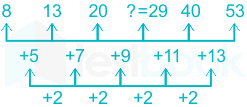
8, 13, 20, ______, 40, 53

  1. ((a))

    25

  2. ((b))

    27

  3. ((c))

    29

  4. ((d))

    31

Show Answer
Answer: ((c))

29

In this series,

We subtract first term from second term and second term from third term and so on. We got resultant again we subtract first term from second term and second term from third term and so on. 

Which are given below -

Hence, "29" is the correct answer.

10

Mean of 2, 4, 3, 5, 6, 9, 7 and 'a' is 6. The value of 'a' is

  1. ((a))

    12

  2. ((b))

    6

  3. ((c))

    8

  4. ((d))

    7

Show Answer
Answer: ((a))

12

Concept Used:

Mean = sum of all observations / number of observations

Calculation:

Mean of 2, 4, 3, 5, 6, 9, 7 and 'a' = 6

6 = (2 + 4 + 3 + 5 + 6 + 9 + 7 + a)/8 

⇒ 48 = 36 + a

∴  a = 12

11

Average age of ten persons learning yoga is 32 years. When the age of their instructor is added, the average age becomes 34 years. The age of the instructor is –

  1. ((a))

    54

  2. ((b))

    52

  3. ((c))

    46

  4. ((d))

    56

Show Answer
Answer: ((a))

54

Given:

Average age of 10 persons = 32 years 

Average age of 11 persons including instructor = 34 years

Formula used:

Average age = Sum of the ages of persons/No of persons 

Calculation:

Total age of 10 persons = 32 years × 10 = 320 years

Total age of 11 persons including instructor = 34 years × 11 = 374

∴ The age of instructor = 374 - 320 = 54 years

12

25% of a number is 20, what is 40% of that number

  1. ((a))

    80

  2. ((b))

    40

  3. ((c))

    32

  4. ((d))

    136

Show Answer
Answer: ((c))

32

Given:

25% of a number is 20

Calculation:

Let the number be = a 

25% × a = 20 

⇒ 25/100 × a = 20 

⇒ a = 20 × 100/25 = 80 

∴ 40% of a = 40/100 × 80 = 32

Alternate Method 25% = 1/4 

⇒ 1/4 = 20

⇒ 4 = 20 × 4 = 80

∴ 40% of the number = 2/5 × 80 = 32

13

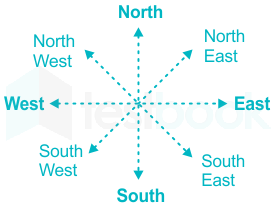
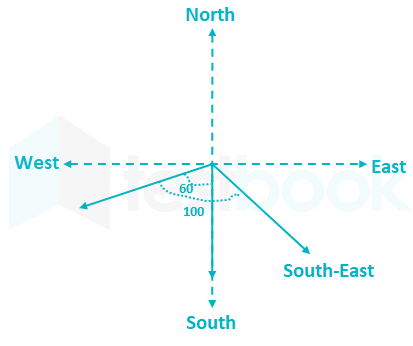
A girl is facing south direction. She turns 60° in clock wise direction and turns 100° in the anticlock wise direction. In which direction is she facing? 

  1. ((a))

    South East

  2. ((b))

    East

  3. ((c))

    North East

  4. ((d))

    South West

Show Answer
Answer: ((a))

South East

A girl is facing south direction. She turns 60° in clock wise direction and turns 100° in the anticlock wise direction.

The diagram are given below -

Hence, "South-East" is the correct answer.

14

Find the sum of first 50 natural numbers

  1. ((a))

    1275

  2. ((b))

    1025

  3. ((c))

    1235

  4. ((d))

    1205

Show Answer
Answer: ((a))

1275

Formula used:

Sum of n natural numbers = n(n + 1)/2 

Calculation:

Sum of 50 natural numbers = 50 × 51/2 

∴ Sum of 50 natural numbers is 1275.

15

Two tables and three chairs cost Rs. 3500, while three tables and two chairs cost Rs. 4000. The cost of the table is Rs. is?

  1. ((a))

    500

  2. ((b))

    1000

  3. ((c))

    1200

  4. ((d))

    1500

Show Answer
Answer: ((b))

1000

Given:

Cost price of 2 tables and 3 chairs = Rs.3500 

Cost price of 3 tables 2 chairs = Rs.4000

Calculation:

Let the cost price of a table be = t 

⇒ Cost price of a chair = c

2t + 3c = 3500       (1)

3t + 2c = 4000       (2) 

By 2 × (1) and 3 × (2) and solving them 

⇒ 4t + 6c = 7000       (3)

⇒ 9t + 6c = 12000     (4)

By (4) - (3):

9t + 6c - 4t - 6c = 12000 - 7000 

⇒ 5t = 5000 

⇒ t = 1000

∴ The cost of one table is Rs.1000.

16

If twelve machines working 7 hours a day can finish a work in 18 days, in how many days will 16 machines working 9 hours a day finish twice the work?

  1. ((a))

    21 days

  2. ((b))

    18 days

  3. ((c))

    24 days

  4. ((d))

    16 days

Show Answer
Answer: ((a))

21 days

Given:

Time taken by 12 machines working 7 hours a day = 18 days 

Formula used:

(M1 × D1 × H1)/W1 = (M2 × D2 × H2)/W2 

Calculation:

By using the above formula for calculating the no of days:

(12 × 18 × 7)/1 = (16 × D2 × 9)/2

⇒ 12 × 18 × 7 × 2/(16 × 9) = D2 

⇒ D2 = 21 days 

∴ 16 machines working 9 hours a day finish twice the work in 21 days.

17

Four years ago, the average age of A and B was 18 years. At present the average age of A, B and C is 24 years. What would be the age of C after 4 years.

  1. ((a))

    28 yrs

  2. ((b))

    30 yrs

  3. ((c))

    32 yrs

  4. ((d))

    34 yrs

Show Answer
Answer: ((c))

32 yrs

Given:

Average age of A & B four years ago = 18 years 

Present age of A, B & C = 24 years 

Formula used:

Average age = Sum of the ages/No of persons 

Calculation:

Sum of the ages of A and B, 4 years ago = 18 × 2 = 36 years 

Sum of the present age of A and B = 4 + 4 + 36 = 44 years 

Sum of the present ages of A, B and C = 24 × 3 = 72 years 

⇒ Present age of C = 72 - 44 = 28 years

∴ C's age after 4 years = 28 + 4 = 32 years.

18

Who looks after the day to day administration of Union Territories?

  1. ((a))

    Central Home Minister

  2. ((b))

    Lt. Governor

  3. ((c))

    President 

  4. ((d))

    Home Minister of State

Show Answer
Answer: ((c))

President 

The correct answer is President.

Key Points

  • Administration of Union Territories
  • President is the de-jure or constitutional head of the state.
  • Article 52 says that there shall be a president of India.
  • President is the first citizen and the supreme commander of the defence forces of India.
  • The President of India is responsible for the administration of a Union Territory which does not have its own elected Legislative Assembly.
  • As per article 239 of the Indian constitution President of India is the chief administrator of union territories. Hence, Option 3 is correct.
  • He appoints an administrator or lieutenant governor for each Union Territories.
  • The election of the president is conducted by the election commission of India.
  • Dr Rajendra Prasad was the first President of India.

Additional Information

  • Union Home Minister
  • Amit Shah was born to Smt. Kusumben and Shri Anilchandra Shah, in an affluent Gujarati family on 22nd October 1964.
  • Amit Shah represents the emerging New India in every sense of the term.
  • Leading the Party from the front for the last five years, he has been remarkably successful in expanding BJP’s organizational footprint, securing one electoral victory after the other in State assembly elections.
  • During his tenure, Party has become the world’s largest political party with over 10 crores of registered members.
  • Lieutenant Governor
  • A Lieutenant Governor also has the same powers.
  • Only three Union Territories — Andaman and Nicobar, Delhi and Puducherry — have Lt. Governors.
  • These powers are in place to ensure checks and balances for the state government and its functioning.
  • The President of India is the head of the Indian state and is also the first citizen of India.
  • Article 52 of the Indian Constitution mentions that there shall be a President of India.
  • Droupadi Murmu is an Indian politician who has been serving as the 15th president of India since 25 July 2022. She is the first person belonging to the tribal community and also the second woman after Pratibha Patil to hold the office.
  • The detailed information about the election of the president in India.
  • The President is an integral part of the union executive along with the Vice President, Prime Minister, the council of ministers, and attorney journal.
19

Sachin Tendulkar hit his hundredth hundred in International cricket in which city?

  1. ((a))

    Kolkata

  2. ((b))

    Dhaka

  3. ((c))

    Chittgong

  4. ((d))

    Karachi

Show Answer
Answer: ((b))

Dhaka

The correct answer is Dhaka.

Key Points

  • March 16, 2012, will be etched in the minds of cricket fans across the globe as the day when Sachin Tendulkar scored his 100th international century.
  • During the Asia Cup clash against Bangladesh at the Sher-e-Bangla National Stadium Dhaka, Tendulkar played a brilliant knock of 114 to bring up his 49th ODI century. Hence, Option 2 is correct.
  • The maestro already had 51 hundred to his name in the longest format.
  • His century was also special in the sense that he breached the three-figure mark after a gap of one year.

Important Points

  • Dhaka
  • It is the capital city of Bangladesh, in southern Asia.
  • Set beside the Buriganga River, it’s at the centre of the national government, trade, and culture.
  • The 17th-century old city was the Mughal capital of Bengal, and many palaces and mosques remain.
  • American architect Louis Khan’s National Parliament House complex typifies the huge, fast-growing modern metropolis.
  • Kolkata (formerly Calcutta)
  • It is the capital of India's West Bengal state.
  • Founded as an East India Company trading post, it was India's capital under the British Raj from 1773–1911.
  • Today it’s known for its grand colonial architecture, art galleries, and cultural festivals.
  • It’s also home to Mother House, headquarters of the Missionaries of Charity, founded by Mother Teresa, whose tomb is on site.
  • Chittagong
  • It is a large port city on the southeastern coast of Bangladesh.
  • The Ethnological Museum has exhibits about the many different ethnic tribes across the country.
  • Zia Memorial Museum, inside the former Old Circuit House, displays items belonging to former president Ziaur Rahman, who was assassinated on the site in 1981.
  • The landmark Chandanpura Mosque has many onion-shaped domes and brightly painted minarets.
  • Karachi
  • It is the largest city in Pakistan and the twelfth-largest city in the world.
  • It is the capital of the Pakistani province of Sindh.
  • Ranked as a beta global city, it is Pakistan's premier industrial and financial centre, with an estimated GDP of $164 billion as of 2019.
20

Mahatma Gandhi was born in

  1. ((a))

    Raj Kot

  2. ((b))

    Ahmedabad 

  3. ((c))

    Porbandar

  4. ((d))

    Gandhi Nagar

Show Answer
Answer: ((c))

Porbandar

The correct answer is Porbandar.

Key Points

  • M.K. Gandhi
  • He was born on October 2, 1869, in Porbandar in what is today India’s western state of Gujarat. Hene, Option 3 is correct.
  • Upon return to British-controlled India in January 1915, Gandhi had acquired the skills both of an accomplished lawyer and a community organizer dedicated to peaceful protest.
  • In South Africa (1893-1915), he had successfully fought the racist regime with a novel method of mass agitation, which he called satyagraha.
  • The idea of satyagraha emphasized the power of truth and the need to search for truth.
  • The International Day of Non-Violence is observed on 2nd October, the birthday of Mahatma Gandhi.
  • Gandhi's Peace Prize is given for social, economic, and political transformation through non-violence and other Gandhian methods.
  • He returned to India from South Africa on 9th January 1915.
  • Pravasi Bharatiya Divas (PBD) is celebrated on 9th January every year to mark the contribution of the Overseas Indian community to the development of India.
  • Rajkot
  • It is a city in the western Indian state of Gujarat.
  • In central Jubilee Garden are the Lang Library, with Gujarati literature, and the Watson Museum, with paintings and artifacts documenting British colonial rule.
  • Kaba Gandhi No Delo, the house where Mahatma Gandhi spent part of his childhood, displays photos of the Indian leader and his belongings.
  • The Rotary Dolls Museum exhibits dolls from around the world.
  • Porbandar
  • It is a city in the Indian state of Gujarat, perhaps best known for being the birthplace of Mahatma Gandhi and Sudama.
  • It is the administrative center of the Porbandar District and it was the former capital of the Porbandar princely state.
  • Ahmedabad
  • In western India, is the largest city in the state of Gujarat.
  • The Sabarmati River runs through its center.
  • On the western bank is the Gandhi Ashram at Sabarmati, which displays the spiritual leader’s living quarters and artifacts.
  • Across the river, the Calico Museum of Textiles, once a cloth merchant's mansion, has a significant collection of antique and modern fabrics.
  • Gandhinagar
  • It is a planned city in the western Indian state of Gujarat.
  • The Akshardham is a massive Hindu temple with ornate carvings and sculpted pillars, plus a water show in its sprawling gardens.
  • Dandi Kutir museum traces the life of leader Mahatma Gandhi, who was born in Gujarat.
  • South, along the Sabarmati River, the Indroda Nature Park has a zoo and botanical gardens, plus an adjacent dinosaur and fossil park.
21

'Quit India' movement call to British was given in 

  1. ((a))

    1940

  2. ((b))

    1941

  3. ((c))

    1942

  4. ((d))

    1943

Show Answer
Answer: ((c))

1942

The correct answer is 1942.

Key Points

  • Quit India Movement
  • On 8th August 1942, Mahatma Gandhi gave a clarion call to end British rule and launched the Quit India Movement at the session of the All-India Congress Committee in Mumbai.
  • Gandhiji gave the call “Do or Die” in his speech delivered at the Gowalia Tank Maidan, now popularly known as August Kranti Maidan.
  • Aruna Asaf Ali popularly known as the 'Grand Old Lady' of the Independence Movement is known for hoisting the Indian flag at the Gowalia Tank Maidan in Mumbai during the Quit India Movement.
  • The slogan ‘Quit India’ was coined by Yusuf Meherally.
  • Meherally had also coined the slogan “Simon Go Back”.

Additional Information

  • On 10th August 1940 – August Offer was announced by Lord Linlithgow viceroy to get the support of Indians in the Second World War.
  • On 11th March 1942 Prime Minister Win still Churchill announced sending a mission under the chairmanship of Sir Stafford Cripps to find out the solution of constitutional deadlock and problems of Indians.
  • With the failure of the Cripps Mission, the Quit India movement was started in 1942 by the Indian leaders, and the resolution of Quit India was drafted by Gandhi Ji. Gandhi Ji gave a call for Do or Die.
  • In 1942 - Indian National Army was founded by Captain Mohan Singh and Niranjan Gill in Singapore. S. C Bose took over its command of 2nd headquarters in Singapore and Rangoon.
  • On 21st October 1943 – Azad Hind Government was set up in Singapore under S.C Bose. There was a women regiment known as Rani Jhansi.
  • In 1945, the Second World War was ended.
  • In 1945 – Shimla Conference or Wavell Plan was proposed by Lord Wavell to solve the political deadlock.
  • In 1946, Cabinet Mission Plan was announced by PM Clement Attlee.
  • On 2nd September 1946 - The interim Government was set up under J.L Nehru.
  • In March 1947 – Lord Mountbatten was sent to India with an aim to find a way to transfer power. Also known as Plan Balkan.
  • On 3rd June Independence of India Act, 1947 was passed by which powers were transferred to two Dominion States India and Pakistan.
22

Who founded the Banaras Hindu University? 

  1. ((a))

    Lala Lajpat Rai

  2. ((b))

    Madan Mohan Malviya

  3. ((c))

    Subhas Chandra Bose

  4. ((d))

    Marco Polo

Show Answer
Answer: ((b))

Madan Mohan Malviya

The correct answer is Madan Mohan Malviya.

Key Points

  • Pt. Madan Mohan Malaviya
  • He Born on 25th December 1861, in Allahabad (now Prayagraj) in Uttar Pradesh, Malviya played a key role in the Indian independence struggle against British rule.
  • He founded the Banaras Hindu University (BHU) in 1916. Hence, Option 2 is correct.
  • He was given the title of ‘Mahamana’ by Rabindranath Tagore and the second President of India, Dr. S. Radhakrishnan gave him the status of a ‘Karmayogi’.
  • Devnagri was introduced in the British-Indian courts because of Malviya’s efforts with the British government.
  • He helped establish the Hindu Mahasabha (“Great Society of Hindus”) in 1906, which brought diverse local Hindu nationalist movements together.
  • Malaviya’s consciousness toward the public led to the launch of his Hindi-language weekly, the Abhyudaya (1907); the Leader of Allahabad, an English-language daily (1909); and the Hindi monthly the Maryada (1910).
  • He died on 12th November 1946, at the age of 84.
  • In 2014, he was posthumously conferred with Bharat Ratna, the country's highest civilian award.

Additional Information

  • Lala Lajpat Rai
  • He was an Indian independence activist.
  • He played a pivotal role in the Indian Independence movement.
  • He was popularly known as Punjab Kesari.
  • He was one of the three members of the Lal Bal Pal triumvirate.
  • Subhas Chandra Bose
  • He was an Indian nationalist whose defiant patriotism made him a hero in India, but whose attempt during World War II to rid India of British rule with the help of Nazi Germany and Imperial Japan left a troubled legacy.
  • Marco Polo
  • He was a Venetian merchant, explorer, and writer who traveled through Asia along the Silk Road between 1271 and 1295.
23

Who wrote the book "India Wins Freedom"?

  1. ((a))

    Mahatma Gandhi

  2. ((b))

    Maulana Azad

  3. ((c))

    Jawahar Lal Nehru

  4. ((d))

    Rabindra Nath Tagore

Show Answer
Answer: ((b))

Maulana Azad

The correct answer is Maulana Azad.

Key Points

  • Maulana Abul Kalam Azad
  • He was originally named Muhiyuddin Ahmad, was born on 11th November 1888 in Mecca, Saudi Arabia.
  • Maulana Azad was a brilliant debater, as indicated by his name - “Abul Kalam” which means “Lord of Dialogues”.
  • He was a proponent of Hindu Muslim unity, opposed to Partition. In 1912, Maulana Abul Kalam Azad started a weekly journal in Urdu called Al-Hilal which played an important role in forging Hindu-Muslim unity after the bad blood created between the two communities in the aftermath of Morley-Minto reforms.
  • The government regarded Al- Hilal as a propagator of secessionist views and banned it in 1914.
  • Maulana Abul Kalam Azad supported the Non-Cooperation Movement started by Gandhiji and entered Indian National Congress in 1920.
  • In 1923, he was elected as the president of the Indian National Congress. He again became the president of Congress in 1940 and remained in the post till 1946.
  • In the field of education, Maulana Azad had been an uncompromising exponent of universalism, a truly liberal and humanitarian educational system.
  • Azad’s ideal was a fusion of the Eastern and Western concepts of man, to create a fully integrated personality. Whereas the Eastern concept dwelt on spiritual excellence and individual salvation, the Western concept laid stress on worldly achievements and social progress.
  • His Works: Basic Concept of Quran, Ghubar-eKhatir, Dars-e-Wafa, India Wins Freedom, etc. Hence, Option 1 is correct.
  • In 1947, he became the first education minister of free India and remained at this post till his death in 1958. In his tenure, he did tremendous work for the uplift of the country. Following are some of them:
  • Maulana Abul Kalam Azad was posthumously awarded India's highest civilian honour, Bharat Ratna in 1992.

Additional Information

  • Important Books list
  • Hind Swaraj’ by Mahatma Gandhi
  • Why I am an Atheist’ by Bhagat Singh
  • Gitanjali’ by Rabindranath Tagore
  • The Golden Threshold’ by Sarojini Naidu
  • ‘India Divided’ by Rajendra Prasad
  • ​‘The Discovery of India’ by Jawaharlal Nehru
  • Unhappy India by Lala Lajpat Rai
  • ​‘Annihilation of Caste by BR Ambedkar​
24

The Indian Financial Year begins on:

  1. ((a))

    January 1

  2. ((b))

    April 1

  3. ((c))

    July 1

  4. ((d))

    None of these

Show Answer
Answer: ((b))

April 1

The correct answer is April 1.

Key Points

  • Indian Financial Year
  • In India, this 1 year period starts from 1st April and ends on 31st March. Hence, Option 2 is correct.
  • This period in which the income is earned is known as the Financial Year or Fiscal Year.
  • The income tax returns are filed and taxes for a company are usually paid in the next year after the end of the Financial Year.
  • This next year in which the income is assessed to tax is called the Assessment Year.
  • So in case, the accounts are being prepared for the year starting 1st April 2013 and ending on 31st March 2014, this period would be called Financial Year 2013-14.
  • And this income would be assessed to tax in the next year and this period would be called Assessment Year 2014-15.
  • The due date for filing income tax returns for a financial year is 31st July/30th Sept of the Assessment Year.
  • Therefore if the income tax returns are being filed for the financial year 2013-14, the due date for filing the income tax returns would be 31st July 2014/30th Sept 2014 as the case may be.
  • In simple terms, Financial Year is the year in which the income is earned and the assessment year is the year in which the income is assessed to tax and all taxes are paid & tax returns filed.
  • The income tax rules and slab rates which are applied for the assessment year 2014-15 would be the same as the rules for the financial year 2013-14 and so on.
  • The financial year is usually denoted as F/Y and the assessment year is denoted as A/Y.
  • As the financial year is the year that is previous to the assessment year, the financial year is sometimes also called the Previous Year for Income Tax purposes.

Additional Information

  • Important Dates
DateDay
Jan 1Army Medical Corps Establishment Day
April 1Orissa Day
June 5World Environment Day
25

One kilo byte is equal to how many bytes?

  1. ((a))

    1000

  2. ((b))

    1024

  3. ((c))

    1048

  4. ((d))

    None of these

Show Answer
Answer: ((b))

1024

The correct answer is 1024 bytes.

Key Points

  • The smallest unit of measurement used for measuring data is a bit.
  • A single bit can have a value of either zero(0) or one(1).
  • It may contain a binary value (such as True/False or On/Off or 1/0) and nothing more.
  • Therefore, a byte, or eight bits, is used as the fundamental unit of measurement for data storage.
  • Computer storage and memory are often measured in megabytes (MB) and gigabytes (GB).
  • A medium-sized novel contains about 1 MB of information.
  • A bit is a binary digit, the smallest increment of data on a computer.
  • A bit can hold only one of two values: 0 or 1, corresponding to the electrical values of off or on, respectively.
  • Because bits are so small, you rarely work with information one bit at a time.
  • Bits are usually assembled into a group of eight to form a byte.
  • A byte contains enough information to store a single ASCII character, like "h".
  • A kilobyte (KB) is 1,024 bytes, not one thousand bytes as might be expected, because computers use binary (base two) math, instead of a decimal (base ten) system. Hence, Option 2 is correct.
  • Computer storage and memory are often measured in megabytes (MB) and gigabytes (GB).
  • A medium-sized novel contains about 1 MB of information.
  • 1 MB is 1,024 kilobytes, or 1,048,576 (1024x1024) bytes, not one million bytes.

Additional Information

  • The smallest piece of data is the bit. The data will be transformed to its binary form.
  • 1 byte = 8 bits
  • 1 kilobyte (KB) = 1024 bytes
  • 1 megabyte (MB) = 1024 kilobytes
  • 1 gigabyte (GB) = 1024 megabytes
  • 1 terabyte (TB) = 1024 gigabytes
  • 1 petabyte (PB) = 1024 terabytes
26

Sound travels fastest through

  1. ((a))

    Vaccum

  2. ((b))

    Steel

  3. ((c))

    Water

  4. ((d))

    Air

Show Answer
Answer: ((b))

Steel

The correct answer is Steel.

Key Points

  • Sound travels fastest through Steel.
  • Sound travels faster in Steel than any other liquid.
  • In steel, the density and elastic properties are more than other given mediums.
  • Steel is a rigid material and it experiences smaller deformations, hence it is having large elastic properties.
  • The density is also higher for steel.
  • Both of these properties have a great impact on the speed of the sound.

Important Points

  • Sound Wave:
  • It is a longitudinal mechanical wave.
  • The longitudinal mechanical waves which lie in the range of 20 Hz to 20,000 Hz are called audible or sound waves.
  • The longitudinal mechanical waves having frequencies less than 20 Hz are called infrasonic.
  • These are produced by earthquakes, volcanic, eruptions, Ocean waves, elephants, and whales.
  • The velocity of sound waves in the air is 330 m/s.
  • The velocity of sound waves in steel is 5920 m/s.

Additional Information

  • Speed of Sound:
  • In a medium, the speed of sound basically depends upon the elasticity and density of the medium.
  • When sound enters from one medium to another medium, its speed and wavelength change but the frequency remains unchanged.
  • In a medium, the speed of sound is independent of frequency.
  • Speed of sound is maximum in solids and minimum in gases.
  • The speed of sound is more in humid air than in dry air because the density of humid air is less than the density of dry air.
  • The unit of loudness is the decibel (dB).
  • Effect of pressure on the speed of sound:
  • The speed of sound is independent of pressure.
  • Effect of temperature on the speed of sound: 
  • The speed of sound increases with the increase in the temperature of the medium.
27

Hydrogen bomb is based on the principle of

  1. ((a))

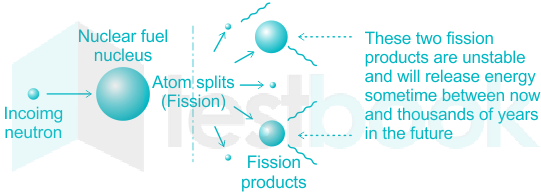
    Nuclear Fission

  2. ((b))

    Nuclear Explosion

  3. ((c))

    Nuclear Fusion

  4. ((d))

    Chain Reaction

Show Answer
Answer: ((c))

Nuclear Fusion

The correct answer is Nuclear Fusion.

Key Points

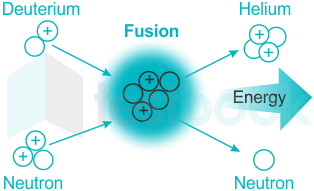
  • Nuclear fusion
  • It is the nuclear reaction in which two or more atomic nuclei are combined to form one or more different atomic nuclei and subatomic particles.
  • Sun and other stars generate light and heat by nuclear fusion.
  • A hydrogen bomb is an immensely powerful bomb whose destructive power comes from the rapid release of energy during the nuclear fusion of isotopes of hydrogen (deuterium and tritium), using an atom bomb as a trigger.
  • The principle behind the hydrogen bomb is based on uncontrollable nuclear fusion. Hence, Option 3 is correct.
  • nuclear bomb based on the fission of uranium is placed at the core of the hydrogen bomb.
  • So hydrogen bomb is based on the principle of Nuclear Fusion Reaction.
  • A hydrogen bomb is based on the principle of nuclear fusion.

Important Points

  • ​Nuclear fusion
  • It is the process where the nuclei of two light atoms combine to form a new nucleus.
  • A hydrogen bomb is considered to be 1,000 times more powerful than an atomic bomb.
  • Hydrogen bombs cause a bigger explosion.
  • As shock waves, blasts, heat, and radiation all have a larger reach than an atomic bomb.

Additional Information

  • A nuclear explosion
  • It is an explosion that occurs as a result of the rapid release of energy from a high-speed nuclear reaction.
  • Atmospheric nuclear explosions are associated with mushroom clouds, although mushroom clouds can occur with large chemical explosions.
  • A chain reaction
  • It refers to a process in which neutrons released in fission produce additional fission in at least one further nucleus.
  • If each neutron releases two more neutrons, then the number of fissions doubles each generation.
28

Osama Bin Laden was killed in

  1. ((a))

    Peshawar

  2. ((b))

    Islamabad

  3. ((c))

    Lahore

  4. ((d))

    Abbottabad

Show Answer
Answer: ((d))

Abbottabad

The correct answer is Abbottabad.

Key Points

  • Osama bin Laden or Usama bin Mohammed bin Awad bin Laden
  • He was the founder of the terrorist organization al-Qaeda.
  • Al-Qaeda claimed responsibility for the September 11 attacks on the United States, along with numerous other mass-casualty attacks worldwide.
  • Laden was a Saudi Arabian, a member of the wealthy bin Laden family, and an ethnic Yemeni Kindite.
  • Bin Laden was on the American Federal Bureau of Investigation's (FBI) lists of Ten Most Wanted Fugitives and Most Wanted Terrorists for his involvement in the 1998 US embassy bombings.
  • From 2001 to 2011, bin Laden was a major target of the War on Terror, as the FBI placed a $25 million bounty on him in their search for him.
  • On May 2, 2011, bin Laden was shot and killed inside a private residential compound in Abbottabad during a covert operation conducted by members of the United States Naval Special Warfare Development Group and Central Intelligence Agency SAD/SOG operators on the orders of then US President Barack Obama.
  • Operation Neptune Spear, 2011, was a precision strike operation executed by the United States Navy Seals in which the long sought after Osama Bin Laden was eliminated under cover of darkness in Abbottabad, Pakistan. Hence, Option 4 is correct.
  • The operation, code-named Operation Neptune Spear, was carried out in a CIA-led operation with Joint Special Operations Command, commonly known as JSOC.
  • The raid was intended to take 40 minutes.
  • The time between the team's entry in and exit from the compound was 38 minutes.

Important Points

  • Abbottabad
  • It is the capital city of Abbottabad District in the Hazara region of eastern Khyber Pakhtunkhwa, Pakistan.
  • It is the 40th largest city in Pakistan and the fourth largest in the province of Khyber Pakhtunkhwa by population.
  • Peshawar
  • It is the capital of the Pakistani province of Khyber Pakhtunkhwa and its largest city.
  • It is the sixth-largest city in Pakistan and the largest Pashtun-majority city in the country.
  • Islamabad
  • It is the capital city of Pakistan and is administered by the Pakistani federal government as part of the Islamabad Capital Territory.
  • It is the ninth-largest city in Pakistan, while the larger Islamabad–Rawalpindi metropolitan area is the country's third-largest with a population of about 4.1 million people.
  • Lahore
  • It is the capital of the Pakistani province of Punjab and is the country's 2nd largest city after Karachi, as well as the 26th largest city in the world.
  • Lahore is one of Pakistan's wealthiest cities with an estimated GDP of $84 billion as of 2019.
29

NCTC stands for

  1. ((a))

    National Conference of Transport Commissioners

  2. ((b))

    National Center for Terrorism

  3. ((c))

    National Care and Training Centre

  4. ((d))

    National Counter Terrorism Centre

Show Answer
Answer: ((d))

National Counter Terrorism Centre

The correct answer is National Counter Terrorism Centre.

Key Points

  • National Counting Terrorism Centre
  • After the 26/11 attacks, Government felt the need to set up a separate body to deal with terrorism.
  • NCTC will derive its powers from the Unlawful Activities Prevention Act(UAPA), 1967.
  • NCTC stands for National Counter Terrorism Centre. Hence, Option 4 is correct.
  • The basic idea is to prevent confusion regarding intelligence inputs and also ensure that none of the police forces from the states enter into a blame game regarding intelligence sharing as one got to see during the 26/11 attacks in Mumbai.
  • The standing council of the NCTC will consist of anti-terror agencies in states.
  • The body will have 3 divisions dealing with collection and dissemination of intelligence, analysis and operations.
  • The NCTC has been designed on the lines of the American NCTC and UK’s “Joint Terrorism Analysis Centre”.
  • Former Home Minister P. Chidambaram and former National Security Adviser (NSA) M.K. Narayanan visited the USA in 2009 to study the working of the American NCTC.
  • It will have the power to conduct searches and arrests in any part of India.
  • It will collect, collate and disseminate data on terrorism.
  • It will also maintain a database on terrorists and their associates including their families.
  • In short, NCTC will serve as a single and effective point of control and coordination of all counter-terrorism measures.

Additional Information

  • It has the power to conduct searches and arrests in any part of India.
  • The NCTC, to be located within the Intelligence Bureau, will carry out counter-terror operations and collect, collate and disseminate data on terrorism.
  • The agency will also maintain a database on terrorists and their associates including their families.
  • The NCTC will also formulate a response to terror threats. It is meant to serve as a single and effective point of control and coordination of all counter-terrorism measures.
  • It will also have the mandate to carry out anti-terror operations, if any, through, or in conjunction with, the State police.
30

CBI stands for

  1. ((a))

    Central Bureau of Intelligence

  2. ((b))

    Central Bureau of Investigation

  3. ((c))

    Central Bureau of Investment

  4. ((d))

    Central Bureau of Infrastructure

Show Answer
Answer: ((b))

Central Bureau of Investigation

The correct answer is Central Bureau Of Investigation.

Key Points

  • Central Bureau of Investigation (CBI)
  • It is the premier investigating police agency in India.
  • It functions under the superintendence of the Deptt. of Personnel, Ministry of Personnel, Pension & Public Grievances, Government of India - which falls under the prime minister’s office.
  • However for investigations of offences under the Prevention of Corruption Act, its superintendence vests with the Central Vigilance Commission.
  • It is also the nodal police agency in India which coordinates investigation on behalf of Interpol Member countries.
  • Its conviction rate is as high as 65 to 70% and it is comparable to the best investigation agencies in the world.
  • Central Bureau of Investigation (CBI)
  • It is the premier investigating police agency in India.
  • It functions under the superintendence of the Deptt. of Personnel, Ministry of Personnel, Pension & Public Grievances, Government of India - which falls under the prime minister’s office.
  • However for investigations of offences under the Prevention of Corruption Act, its superintendence vests with the Central Vigilance Commission.
  • It is also the nodal police agency in India which coordinates investigation on behalf of Interpol Member countries.
  • Its conviction rate is as high as 65 to 70% and it is comparable to the best investigation agencies in the world.
  • During the period of World War II, a Special Police Establishment (SPE) was constituted in 1941 in the Department of War of the British India to enquire into allegations of bribery and corruption in the war related procurements.
  • Later on it was formalized as an agency of the Government of India to investigate into allegations of corruption in various wings of the Government of India by enacting the Delhi Special Police Establishment (DSPE) Act, 1946.
  • CBI derives power to investigate from the Delhi Special Police Establishment Act, 1946.
  • In 1963, the CBI was established by the Government of India with a view to investigate serious crimes related to defence of India, corruption in high places, serious fraud, cheating and embezzlement and social crime, particularly of hoarding, black-marketing and profiteering in essential commodities, having all-India and inter-state ramifications.
  • With the passage of time, CBI started investig
  • The CBI is headed by a Director, an IPS officer with a rank of Director General of Police.
  • The director is selected by a high-profile committee constituted under The Delhi Special Police Establishment (DSPE) Act, 1946 as amended through The Lokpal and Lokayuktas Act, 2013, and has a two-year term.
  • The Appointment Committee consists of:
  • Prime Minister – Chairperson
  • Leader of Opposition of Loksabha or the Leader of the single largest opposition party in the Lok Sabha, if the former is not present due to lack of mandated strength in the Lok Sabha – member
  • Chief Justice of India or a Supreme Court Judge recommended by the Chief Justice – member

Additional Information

  • Into allegations of bribery and corruption in the war related procurements.
  • Later on it was formalized as an agency of the Government of India to investigate into allegations of corruption in various wings of the Government of India by enacting the Delhi Special Police Establishment (DSPE) Act, 1946.
  • CBI derives power to investigate from the Delhi Special Police Establishment Act, 1946.
  • The Appointment Committee consists of:
  • Prime Minister – Chairperson
  • Leader of Opposition of Loksabha or the Leader of the single largest opposition party in the Lok Sabha, if the former is not present due to lack of mandated strength in the Lok Sabha – member
  • Chief Justice of India or a Supreme Court Judge recommended by the Chief Justice – member
31

Who is the chair person of the press council of India?

  1. ((a))

    J.S. Verma 

  2. ((b))

    Swatantra Kumar 

  3. ((c))

    Manu Singhvi 

  4. ((d))

    Markandey Katju

Show Answer
Answer: ((d))

Markandey Katju

The correct answer is Markandey Katju.

Key Points

  • Markandey Katju is an Indian jurist and former Supreme Court judge of India who also served as the chairman of the Press Council of India
  • The Press Council of India was formed in 1966.
  • It is a statutory, adjudicating organization.
  • It is the self regulatory watchdog of the press, for the press and by the press.
  • It operates under the Press Council Act of 1978.

Important Points

  • JS Verma
  • Jagdish Sharan Verma was an Indian jurist who served as the 27th Chief Justice of India from 25 March 1997 to 18 January 1998.
  • He was also the chairman of National Human Rights Commission from 1999 to 2003 and the chairman of the Justice Verma Committee Report on Amendments to Criminal Law.
  • Swatantra Kumar
  • Justice Swatanter Kumar is a retired justice of the Supreme Court of India and former Chairperson of the National Green Tribunal.
  • He is also former Chief Justice of Bombay High Court and Judge of Delhi High Court and Punjab and Haryana High Court.
  • Manu Singhvi
  • Abhishek Manu Singhvi is an Indian lawyer and politician.
  • He is a member and spokesperson of the Indian National Congress.
  • Currently, he is a Member of the Parliament of India representing West Bengal in the Rajya Sabha.
32

India Intelligence collection agencies are

  1. ((a))

    CBI & NIA 

  2. ((b))

    CBI & IB 

  3. ((c))

    IB & RAW

  4. ((d))

    NIA & IB

Show Answer
Answer: ((c))

IB & RAW

The correct answer is IB & RAW.

Key Points

  • IB stands for Intelligence Bureau.
  • RAW stands for Research and Analysis Wing of India.
  • Both agencies are the internal and external intelligence agencies of our country respectively.

Important Points

  • Raw operates operations in India's neighbouring countries for the Indian government.
  • IB operates within the country.
  • Also, IB shares intelligence with the other intelligence agencies and the police.

Additional Information

  • IB director- Arvind Kumar (Oct 2021)
  • RAW Chief -  Samant Goel
33

Facebook is a 

  1. ((a))

    Book which describes faces of human beings

  2. ((b))

    Secret book of criminal faces

  3. ((c))

    Social website 

  4. ((d))

    Website for business promotion

Show Answer
Answer: ((c))

Social website 

The correct answer is Social Website.

Key Points

  • Facebook is an America based multinational technology company.
  • It was founded in 2004 by the students of Harvard College namely Mark Zuckerberg, Andrew McCollum, Eduardo Saverin, Dustin Moskovitz, and Chris Hughes.
  • Its headquarters is in Menlo Park, California, USA.

Important Points

  • It is a social site used to connect with friends, family, and other people by sharing videos, pictures, etc.
34

Yousuf Raza Gilani is Prime Minister of which country? 

  1. ((a))

    Afganistan 

  2. ((b))

    Bangladesh 

  3. ((c))

    Pakistan 

  4. ((d))

    Iraq

Show Answer
Answer: ((c))

Pakistan 

The correct answer is Pakistan.

Key Points

  • Syed Yousaf Raza Gillani/Gilani is a Pakistani politician.
  • He served as 18th prime minister of Pakistan from 25 March 2008 until his retroactive disqualification and ouster by the Supreme Court of Pakistan on 26 April 2012.

Important Points

  • He belongs to Pakistan Peoples Party.
35

Who is Union Minister of India for Railways?

  1. ((a))

    Mamta Banajee 

  2. ((b))

    Lalu Prasad Yadav 

  3. ((c))

    Dinesh Trivedi

  4. ((d))

    Mukul Roy

Show Answer
Answer: ((b))

Lalu Prasad Yadav 

The correct answer is Mr. Lalu Prasad Yadav.

Key Points

  • Lalu Prasad Yadav is an Indian politician, a former Union Minister of Railways.
  • He is the president of the political party Rashtriya Janata Dal, a former Chief Minister of Bihar, and a former Member of Parliament of the Lok Sabha.

Additional Information 

  • Mamta Banarjee
  • Mamata Banerjee is an Indian politician who belongs to the All India Trinamool Congress.
  • She is serving as the ninth and current chief minister of West Bengal since 2011.
  • Dinesh Trivedi
  • Dinesh Trivedi is an Indian politician from Bhartiya Janta Party.
  • He was a Member of Parliament in Rajya Sabha from West Bengal for two separate terms.
  • Mukul Roy
  • Mukul Roy is an Indian politician who belongs to the All India Trinamool Congress.
  • He has also served as a Minister of State in the Shipping Ministry and later Ministry of Railways during the UPA 2 government.
  • He was formerly associated with the Indian National Congress and Bharatiya Janata Party as well.
36

Memogate' scandal is related to which country?

  1. ((a))

    Bangladesh 

  2. ((b))

    Pakistan 

  3. ((c))

    USA 

  4. ((d))

    Sri Lanka

Show Answer
Answer: ((b))

Pakistan 

The correct answer is Pakistan.

Key Points

  • The memogate controversy is also known as the Mullen memo controversy.
  • This controversy revolves around a memorandum seeking the help of the Obama administration in the wake of the Osama bin Laden raid to prevent a military takeover of the civilian government in Pakistan.

Important Points

  • This scandal had occurred around eight years back and brought a terrible political storm in the country.
  • The allegation was on the then President, Asif Ali Zardari of Pakistan for treason.
  • It had triggered a serious civil-military rift in Pakistan.
  • And had been taken to the Supreme Court in 2011 by Nawaz Sharif, the then leader of the opposition.
  • A day after it forced the resignation of Hussain Haqqani, Pakistan’s ambassador to the US of that time.
37

Playing time for full version of National Anthem is

  1. ((a))

    20 seconds

  2. ((b))

    52 seconds 

  3. ((c))

    34 seconds 

  4. ((d))

    45 seconds

Show Answer
Answer: ((b))

52 seconds 

The correct answer is 52 seconds. 

Key Points

  • Our National Anthem is Jana Gana Mana, it approximately takes 52 seconds for the full version.
  • It was composed originally in Bengali by Rabindranath Tagore.
  • It was adopted in its Hindi version by the Constituent Assembly as the National Anthem of our country on 24 January 1950.

Important Points

  • It was sung for the first time in the Calcutta Session of the Indian National Congress on 27 December 1911.
  • It comprises of 5 Stanzas.
38

Who is RBI's Governor?

  1. ((a))

    Sam Pitroda

  2. ((b))

    Subir Gokaran

  3. ((c))

    K.C. Chakrabarty

  4. ((d))

    D. Subba Rao

Show Answer
Answer: ((d))

D. Subba Rao

The correct answer is Mr. D Subha Rao.

Key Point

  • Mr. D Subbarao was the 22nd RBI Governor with the tenure from 5 September 2008- 4 September 2013.
  • The Governor of the RBI acts as the chief executive officer of India's central bank and the ex-officio chair of its Central Board of Directors.

Important Points 

  • The Governor is responsible for maintaining the monetary stability in an economy.
  • The constituting instrument comes under RBI Act, 1934.
  • Sir Osborne Smith was the first governor of RBI.
  • Shaktikanta Das is the current governor of RBI.(Oct 2021)​
39

Who is India's Planning Commission's Deputy Chairman?

  1. ((a))

    Manmohan Singh

  2. ((b))

    Pranab Mukharjee

  3. ((c))

    Montek Singh Ahluwalia

  4. ((d))

    Jai Ram Ramesh

Show Answer
Answer: ((c))

Montek Singh Ahluwalia

The correct answer is Mr. Montek Singh Ahluwalia.

Key Points

  • The Planning Commission was an institution in the Government of India, which formulated India's Five-Year Plans.
  • This institution got dissolved on 17 August 2014 under the care of Prime Minister Narendra Modi and was superseded by a new agency; NITI Aayog.

Important Points 

  • The Planning Commission was formed on 15 March 1950.
  • It takes the Central Ministries and the State Governments into consideration for formulating all annual plans / five year plans.
  • It functions as an advisory body of the apex level.

Additional Information

  • NITI Aayog
  • It is a public policy think tank of the Government of India.
  • It was established with the goal to achieve sustainable development goals with cooperative federalism for promoting growth along with the involvement of State Governments of India in the economic policies.
40

The UN security council has how many permanent members?

  1. ((a))

    5

  2. ((b))

    7

  3. ((c))

    8

  4. ((d))

    15

Show Answer
Answer: ((a))

5

The correct answer is 5.

Key Points

  • The United Nations Security Council (UNSC)is one of the six principal organs of the United Nations, which aims to assure International Peace and Security.
  • It has the authority to establish peacekeeping operations, enact international sanctions, and authorize military action.
  • It is the only UN body with the authority to issue binding resolutions on its member states.

Important Points

  • UNSC Permanent Members also known as the Permanent Five, Big Five, or P5.
  • Its 5 Permanent Members are China, France, Russia, the United Kingdom, and the United States.
  • It comprises 15 members all total permanent and non-permanent members inclusive.
41

The minimum distance between the sun and earth occurs on

  1. ((a))

    Dec. 22

  2. ((b))

    June 21

  3. ((c))

    Sept 22

  4. ((d))

    January 3

Show Answer
Answer: ((d))

January 3

The correct answer is January 3.

 Key Points

  • The minimum distance between the sun and earth is on January 3.
  • The day of 3rd or 4th January is also known as perihelion.
  • The perihelion is the point in the orbit of a planet, asteroid, or comet that is nearest to the sun.
  • It is the opposite of aphelion, which is the point farthest from the sun.
  • At perihelion, the Earth is about 147.5 million km away from the Sun.
  • The word perihelion stems from the Greek words "peri," meaning near, and "Helios," meaning the Greek god of the sun.

Additional Information

DateImportance
Dec. 22In the southern hemisphere, 22nd December has the longest day and the shortest night.
June 21The northern hemisphere will experience its longest day of the year on this date.
Sept 22In the Northern Hemisphere, the autumnal equinox falls about September 22 or 23, as the Sun crosses the celestial equator going south.
42

Match the following

A) Anemometer1) Earthquake
B) Seismograph2) Pressure
C) Psychrometer3) Wind velocity
D) Barograph4) Humidity
  1. ((a))

    A - 1, B - 3, C - 2, D - 4

  2. ((b))

    A - 3, B - 1, C - 2, D - 4

  3. ((c))

    A - 3, B - 1, C - 4, D - 2

  4. ((d))

    A - 1, B - 4, C - 3, D - 2

Show Answer
Answer: ((c))

A - 3, B - 1, C - 4, D - 2

The correct answer is A - 3, B - 1, C - 4, D - 2.

Key Points

InstrumentDescription
AnemometerAn anemometer is a device used for measuring wind speed and direction. Anemometers are important tools for meteorologists, who study weather patterns.
SeismographA seismograph, or seismometer, is an instrument used to detect and record earthquakes.
PsychrometerA psychrometer measures humidity by taking both a wet-bulb and a dry-bulb temperature reading.
BarographA barograph is a barometer that records the barometric pressure over time in graphical form. This instrument is also used to make a continuous recording of atmospheric pressure.
43

The boundary between the North and South Korea is marked by the

  1. ((a))

    Redcliffe Line

  2. ((b))

    38th parallel

  3. ((c))

    49th parallel

  4. ((d))

    17th parallel

Show Answer
Answer: ((b))

38th parallel

The correct answer is the 38th parallel.

Key Points

  • The boundary between North and South Korea is marked by the 38th parallel.
  • U.S. Colonels Charles Bonesteel and Dean Rusk met on August 10, 1945, to develop a plan to divide Korea into two zones of occupation.
  • Using a National Geographic map, they noticed that the 38th parallel roughly divided Korea in half.
  • A demilitarized zone (DMZ) was created along the boundary. The border came into existence roughly around 1953.

Additional Information

BoundaryDescription
Redcliffe LineOn 17 August 1947, the borderline that separated India from Pakistan, known as the Radcliffe Line was revealed.
49th parallelThe 49th Parallel separates the United States of America and Canada.
17th parallelIt is the provisional military demarcation line established in Vietnam by the Geneva Accords (1954).
44

Where is the Forest Research Institute located?

  1. ((a))

    Delhi

  2. ((b))

    Bhopal

  3. ((c))

    Dehradun

  4. ((d))

    Lucknow

Show Answer
Answer: ((c))

Dehradun

The correct answer is Dehradun.

Key Points

  • The Forest Research Institute (FRI) is located in Dehradun, Uttarakhand.
  • FRI was established in the year 1906 as the Imperial Forest Research Institute.
  • It has six museums based on social forestry, pathology, silviculture, timber, non-wood forest products, and entomology.
  • The Forest Research Institute (FRI) and College Area are between Kaulagarh in the north and the Indian Military Academy to the south. The Tons River forms its Western Boundary.

Additional Information

  • The Forest Research Institute Dehradun is located at Dehradun in Uttarakhand is among the oldest institutions of its kind/India.
  • In 1991, it was declared a deemed university by the University Grants Commission.
  • The Forest Research Institute (FRI) is a Natural Resource Service training institute of the Indian Council of Forestry Research and Education and is an institution in the field of forestry research in India for Indian Forest Service cadres and all State Forest Service cadres.
  • It is the biggest forest based training institute in India. Most of the forest officers are a part of this institute.
  • The FRI's building also houses a Botanical Museum and there are many different kinds of trees from around the world.
45

Where is the head office of South-Eastern coal field Limited situated?

  1. ((a))

    Korba

  2. ((b))

    Bastar

  3. ((c))

    Bilaspur

  4. ((d))

    Raipur

Show Answer
Answer: ((c))

Bilaspur

The correct answer is Bilaspur.

Key Points

  • The head office of South-Eastern coal field Limited is situated in Bilaspur.
  • With coal reserves in Chhattisgarh and Madhya Pradesh, SECL operates as many as 89 mines.
  • Of these, 35 are in Madhya Pradesh and 54 are in Chhattisgarh.
  • SECL’s major mining areas including Gevra, Dipka, Kusmunda, Sohagpur produced the highest ever coal since the inception of the company.

Additional Information

  • Coal India Limited (CIL) the state-owned coal mining corporate came into being in November 1975.
  • CIL is a Maharatna company - a privileged status conferred by the Government of India to select state-owned enterprises in order to empower them to expand their operations and emerge as global giants.
  • The subsidiaries of CIL include:
  • Eastern Coalfields Limited (ECL)
  • Bharat Coking Coal Limited (BCCL)
  • Central Coalfields Limited (CCL)
  • Western Coalfields Limited (WCL)
  • South Eastern Coalfields Limited (SECL)
  • Northern Coalfields Limited (NCL)
  • Mahanadi Coalfields Limited (MCL)
46

In which district is Gomarada wild life sanctuary stuated.

  1. ((a))

    Janjgir - Champa

  2. ((b))

    Raigarh

  3. ((c))

    Sarguja

  4. ((d))

    Bilaspur

Show Answer
Answer: ((b))

Raigarh

The correct answer is Raigarh.

Key Points

  • Gomarada wildlife sanctuary is situated near Sarangarh town in the Raigarh district of Chhattisgarh.
  • It is spread over an area of 275 sq km.
  • Some of the species found here include - Nilgiri, Sambars, Gaurs, Barking Deer, Chausingha, Muntjac, Sloth Bear, Wild Boar, Dhole or the wild dog and the Jackel.
  • The Gomarda wildlife sanctuary was established in the year 1983.
  • Chhattisgarh has 3 National Parks and 11 Wildlife Sanctuaries.

Additional Information List of National Park in Chhattisgarh

National ParkLocationYearArea (km2)
Indravati (Kutru) National ParkBijapur19821,258.37
Kanger Valley National ParkBastar1982200
Guru Ghasi Das (Sanjay) National ParkKoriya19811440
<br>

Important wildlife sanctuaries in Chhattisgarh

Barnawapara Wildlife SanctuarySitanadi Wildlife SanctuaryAchanakmar Wildlife Sanctuary
Tamor PinglaUdanti Wildlife SanctuaryGomarda wildlife sanctuaries
47

Total area of Chhattisgarh State is

  1. ((a))

    1,30,194 sq km

  2. ((b))

    1,35,194 sq km

  3. ((c))

    1,02,772 sq km

  4. ((d))

    1,60,194 sq km

Show Answer
Answer: ((b))

1,35,194 sq km

The correct answer is 1,35,194 sq km.

Key Points

  • The total area of Chhattisgarh State is 1,35,194 sq km.
  • Chhattisgarh was formerly a part of Madhya Pradesh. It was granted statehood on November 1, 2000.
  • It is the 10th-largest state in India, with an area of 135,192 km2.
  • It is located in east-central India. It is bounded by the Indian states of Uttar Pradesh and Jharkhand to the north and northeast, Odisha (Orissa) to the east, Telangana to the south, and Maharashtra and Madhya Pradesh to the west.
  • Its capital is Raipur. The population is (2021) 25,540,196.

Additional Information

  • Chhattisgarh can broadly be divided into Central plains drained by Mahanadi and Shivnath Rivers, the picturesque Northern Plateau, and the enchanting Bastar Plateau.
  • Chhattisgarh is the 16th most-populated state in the nation.
  • The official language of the state is Hindi. Odia, Marathi, Telugu are also spoken.
  • The climate of Chhattisgarh is tropical. It is hot and humid because of its proximity to the Tropic of Cancer.
48

Money Bill can be introduced in the State Legislative Assembly with the prior permission of

  1. ((a))

    Governor of the State

  2. ((b))

    Chief Minister of the State

  3. ((c))

    Speaker of Legislative Assembly

  4. ((d))

    Finance Minister of the State

Show Answer
Answer: ((a))

Governor of the State

The correct answer is Governor of the State.

Key Points

  • Money Bill can be introduced in the State Legislative Assembly with the prior permission of the Governor of the State.
  • Every Money Bill when it is transmitted to the Legislative Council under article 198, and when it is presented to the Governor for assent under article 200, the certificate of the Speaker of the Legislative Assembly signed by him that it is a Money Bill.
  • The money Bill cannot be returned by the President to the parliament for its reconsideration, as it is presented in the Lok Sabha with his permission.
  • Some bills require the prior recommendation of the President before their introduction in the Parliament. For example- Money Bill & Finance Bill.

Additional Information

  • A bill is said to be a draft statute that is presented in either house of the Parliament only after being passed by both the houses of the Parliament and it has received the president’s assent.
  • Types of bills:
  • Ordinary Bills - As per Articles 107 and 108 of the Indian Constitution, an ordinary bill is concerned with any matter other than financial subjects.
  • Money bills - Money bills are those bills that are concerned with financial matters like taxation, public expenditure, etc.(Article 110).
  • Financial bill - As per Article 117 of the Indian Constitution, financial bills are those bills that are concerned with financial matters but are different from money bills.
  • Constitutional Amendment Bill - Article 368 of the Indian Constitution is concerned with the provisions of the amendment of the Constitution.
  • Ordinance Replacing Bill - This bill is brought before Parliament to replace an ordinance with or without modifications promulgated by the President under Article 123 of the Indian Constitution.
49

Which of the following is not a constitutional and statutory body?

  1. ((a))

    Finance Commission

  2. ((b))

    Planning Commission

  3. ((c))

    Union Public Service Commission

  4. ((d))

    Election Commission

Show Answer
Answer: ((b))

Planning Commission

The correct answer is Planning Commission.

  • The Planning Commission was established on 15 March 1950, with Prime Minister Jawaharlal Nehru as the chairman.
  • The Planning Commission did not derive its creation from either the Constitution or statute but was an arm of the Central/Union Government.
  • The Commission was responsible to formulate India’s five years plans for social and economic development in India.

Important Points 

  • Planning Commission was replaced by a new institution – NITI AAYOG on January 1, 2015.
  • The emphasis of NITI Aayog is on the ‘Bottom –Up’ approach to envisage the vision of Maximum Governance, Minimum Government, echoing the spirit of ‘Cooperative Federalism.
  • NITI Aayog is the premier policy think tank of the Government of India, providing directional and policy inputs.
  • The chairperson of NITI Aayog is the Prime Minister of India.
  • Suman Bery is currently Vice Chairperson, NITI Aayog

Additional Information 

CommissionDescription
Finance CommissionIt was setup up under Article 280 of the Constitution, its core responsibility is to evaluate the state of finances of the Union and State Governments, recommend the sharing of taxes between them, etc.
Union Public Service CommissionUPSC is a Constitutional Body under Article 315-323 Part XIV Chapter II of the Constitution of India to discharge their duties, functions, and obligations assigned under Article 320.
Election CommissionArticle 324 envisages the powers and constitution of the Election Commission of India.
50

Chhattisgarh was formed on 1st Nov, 2000. It became the ______ state of the union.

  1. ((a))

    25th

  2. ((b))

    26th

  3. ((c))

    27th

  4. ((d))

    28th

Show Answer
Answer: ((b))

26th

The correct answer is 26th.

Key Points

  • Chhattisgarh was formed on 1st Nov 2000. It became the 26th state of the union.
  • The state of Madhya Pradesh was divided into Chhattisgarh and Madhya Pradesh on 01 November 2000.
  • The official language of the state is Hindi. Odia, Marathi, Telugu are also spoken.
  • It is a source of electricity and steel for India, accounting for 15% of the total steel produced in the country.
  • In November 2000, the Government of India, pursuant to legislation passed by Parliament during the summer, created three new states, Chhattisgarh, Uttaranchal, and Jharkhand.

Additional Information

  • In November 2000, three new states were created, namely:
  • Chhattisgarh, from eastern Madhya Pradesh,
  • Uttaranchal (renamed Uttarakhand in 2007), from northwest Uttar Pradesh, and
  • Jharkhand, from the southern districts of Bihar.
  • Chhattisgarh is bounded by southern Jharkhand and Orissa in the east, Madhya Pradesh and Maharashtra in the west, Uttar Pradesh and western Jharkhand in the north, and Andhra Pradesh in the south.
  • Areawise Chhattisgarh is the tenth largest state and population-wise it is the sixteenth most populous state of the nation.
51

Mana Airport at Raipur has been renamed as

  1. ((a))

    Swami Vivekanand Airport

  2. ((b))

    Vir Narayan Singh Airport

  3. ((c))

    B.R. Ambedkar Airport

  4. ((d))

    Rajiv Gandhi Airport

Show Answer
Answer: ((a))

Swami Vivekanand Airport

The correct answer is Swami Vivekanand Airport.

Key Points

  • Mana Airport at Raipur has been renamed Swami Vivekanand Airport.
  • Swami Vivekananda International Airport formerly known as Raipur Airport (Mana Airport) is the major airport serving the state of Chhattisgarh, India.
  • On 24 January 2012, the airport was renamed after Swami Vivekananda, as a tribute to the popular saint who spent a major part of his life in Raipur.
  • It is the busiest airport in Central India and the busiest airport in Chhattisgarh. The airport is located at Mana between Raipur 15 km and Naya Raipur 10 km.
  • Swami Vivekananda International Airport has a single runway and his new integrated terminal was inaugurated on 7 November 2012 by then President of India Pranab Mukherjee.

Additional Information 

AirportDescription
Vir Narayan Singh Cricket StadiumShaheed Veer Narayan Singh International Cricket Stadium is located in Naya Raipur and is also very close to Swami Vivekananda Airport. This stadium is about 21 km from the main city of Raipur. This stadium is named after Veer Narayan Singh who was a landlord from Sonakhan. Veer Narayan Singh was also a freedom fighter who led the 1857 Indian Independence war in Chattisgarh.
B.R. Ambedkar AirportDr Babasaheb Ambedkar International Airport is an international airport serving the city of Nagpur, Maharashtra, India. The airport is located at Sonegaon. It is also known as Sonegaon Airport,
Rajiv Gandhi AirportRajiv Gandhi International Airport is an international airport that serves Hyderabad, the capital of the Indian state of Telangana. It is located in Shamshabad. It was opened on 23 March 2008 to replace Begumpet Airport.
52

What is the total number of districts in Chhattisgarh as on 1st January 2012?

  1. ((a))

    16

  2. ((b))

    18

  3. ((c))

    25

  4. ((d))

    27

Show Answer
Answer: ((d))

27

The correct answer is 27.

Key Points

  • The total number of districts in Chhattisgarh as of 1st January 2012 is 27.
  • At the time of separation from Madhya Pradesh, Chhattisgarh originally had 16 districts.
  • Two new districts Bijapur and Narayanpur were carved out on May 11, 2007, and nine new districts on Jan 1st, 2012.
  • On January 1, 2012, Chhattisgarh Government announced 9 New Districts (27 districts).
  • These 9 districts have been named Sukma, Kondagaon, Balod, Bemetara, Baloda Bazar, Gariaband, Mungeli, Surajpur, and Balrampur.

Additional Information

  • As of October 2021, Chhattisgarh has a total of 32 administrative districts.
  • Four new districts namely Manendragarh, Manpur-Mohla, Sakti, and Sarangarh-Bilaigarh were announced on 15th August 2021.
53

Which one is not a "Padma Shree" awardee from Chhattisgarh? 

  1. ((a))

    Phoolbasan Bai Yadav

  2. ((b))

    Shamshad Begum

  3. ((c))

    Shri Manoj Das

  4. ((d))

    Anuj Sharma

Show Answer
Answer: ((c))

Shri Manoj Das

The correct answer is Shri Manoj Das.

  • Manoj Das was an eminent Indian author who wrote in Odia and English. He passed away at the age of 87 on April 27, 2021.
  • He was awarded the Padma Shri in 2001.
  • He also received the Padma Bhushan in 2020 for his contributions in the field of literature and education.
  • He received the first Sri Aurobindo Puraskar for his research on the lesser-known facts of India’s freedom struggle led by Aurobindo.
  • He was also honored with the Sahitya Akademi Award fellowship.

Additional Information

List of Padma Shree awardees from Chhattisgarh

AwardeeYear
Shree Mukut Dhar Pandeya1976
Smt. Teejan Bai2003
Dr. Arun Trimbak Dabke2004
Shri Punaram Nishad2005
Dr. Mahadev Prasad Pandey2007
Shri John Martin Nelson2008
Shri Gobind Ram Nirmalkar2009
Dr. Surendra Dubey2010
Dr. Pukhraj Bafna2011
Smt. Phoolbasan Yadav2012
Smt. Shamshad Begum2012
Swami G. C. D. Bharti Alias Bharti Bandhu2013
Shri Anuj (Ramanuj) Sharma2014
Smt. Saba Anjum2015
Smt. Mamta Chandrakar2016
<br>
54

What is the validity period for cheques and bank drafts in India from 1" April 2012? 

  1. ((a))

    1 month from the date of issue

  2. ((b))

    2 months from the date of issue

  3. ((c))

    3 months from the date of issue

  4. ((d))

    6 months from the date of issue

Show Answer
Answer: ((c))

3 months from the date of issue

The correct answer is 3 months from the date of issue.

Key Points

  • The validity period for cheques and bank drafts in India from 1" April 2012 is 3 months from the date of issue.
  • As per RBI guidelines, with effect from April 1, 2012, the validity period of Cheques, Demand Drafts, Pay Orders, and Banker's Cheques will be reduced from 6 months to 3 months, from the date of issue of the instrument.
  • When the period of validity ends, the check becomes Stale. Such cheques cannot be submitted to the bank for payment. And if they are submitted for payment, they will be dishonored by the bank.

Additional Information

  • A bank draft is a payment instrument that is issued by the bank at the request of the payer.
  • A cheque is issued by an account holder of the bank ordering the bank to make a specific payment to the person specified, or to the bearer of the cheque.
55

Union budget 2012-13 has increased the service tax rate from 10% to _______.

  1. ((a))

    10.5%

  2. ((b))

    11%

  3. ((c))

    11.5%

  4. ((d))

    12%

Show Answer
Answer: ((d))

12%

The correct answer is 12%.

Key Points

  • Union budget 2012-13 has increased the service tax rate from 10% to 12%.
  • Service tax is a tax levied by the government on service providers on certain service transactions but is actually borne by the customers.
  • It is categorized under Indirect Tax and came into existence under the Finance Act, 1994.
  • Service tax was abolished with the rollout of GST on July 1, 2017, as the new tax subsumed service tax in addition to many other indirect taxes.

Additional Information

  • GST is known as the Goods and Services Tax.
  • It is an indirect tax that has replaced many indirect taxes in India such as excise duty, VAT, services tax, etc.
  • The main objective of the GST was to achieve the ideology of ‘One Nation, One Tax’.
56

Which of the following is the period of the 12th Five year plan of India?

  1. ((a))

    2011 - 16

  2. ((b))

    2010 - 15

  3. ((c))

    2012 - 17

  4. ((d))

    2013 - 18

Show Answer
Answer: ((c))

2012 - 17

The correct answer is 2012-17.

Key Points

  • The period of the 12th Five-year plan of India was 2012- 2017.
  • The aim of the 12th Five Year Plan is to achieve “faster, sustainable and more inclusive growth”.
  • The target for growth rate in the 12th Five-Year Plan was 8%.
  • Planning Commis­sion was set up on 15 March 1950 and the plan era started from 1 April 1951 with the launch­ing of the First Five Year Plan (1951-56).

Important Points

  • Planning Commission was replaced by a new institution – NITI AAYOG on January 1, 2015.
  • The emphasis of NITI Aayog is on the ‘Bottom –Up’ approach to envisage the vision of Maximum Governance, Minimum Government, echoing the spirit of ‘Cooperative Federalism'.
  • NITI Aayog is the premier policy think tank of the Government of India, providing directional and policy inputs.
  • The chairperson of NITI Aayog is the Prime Minister of India.
  • The present Vice-Chairperson of the NITI Aayog as of October 2021 is Dr. Rajiv Kumar.
57

The Third Asian Ministerial Conference on Tiger Conservation 2016 was held

  1. ((a))

    From April 9th to 12th 2016 at Orissa

  2. ((b))

    From April 14th to 17th 2016 at Calcutta

  3. ((c))

    From April 11th to 14th 2016 in New-Delhi

  4. ((d))

    From April 6th to 9th 2016 at Mumbai

Show Answer
Answer: ((c))

From April 11th to 14th 2016 in New-Delhi

The correct answer is From April 11th to 14th 2016 in New Delhi.

Key Points

  • The Third Asian Ministerial Conference on Tiger Conservation 2016 was held from April 11th to 14th 2016 in New Delhi.
  • This was the latest meeting in the Tx2 process to double wild tiger numbers by the year 2022.
  • The Conference was hosted in New Delhi from the 11th to 14th April by the Global Tiger Forum (GTF).
  • The previous two Asian Ministerial Conferences on Tiger Conservation were held in January 2010 in Hua Hin, Thailand, and in October 2012 in Thimphu, Bhutan.
  • The Third Asia Ministerial Conference on Tiger Conservation (3AMC) marks the mid-point in the implementation of the twelve-year Global Tiger Recovery Program (GTRP). The GTRP was launched by heads of government at the St. Petersburg Tiger Summit in 2010.

Additional Information

  • It was hosted by the Global Tiger Forum (GTF) and National Tiger Conservation Authority (NTCA) on behalf of the Government of India.
  • The three-day conference was attended by high-level government representatives from all 13 tiger countries and resulted in a new resolution that guides the next six years of tiger conservation.
  • The Conference was inaugurated with a speech by India Prime Minister Narendra Modi. It was also attended by Mr. Prakash Javadekar, Minister for Environment, Forest, and Climate Change of India.
58

The total number of bones in our body is:

  1. ((a))

    226

  2. ((b))

    206

  3. ((c))

    256

  4. ((d))

    236

Show Answer
Answer: ((b))

206

The correct answer is 206.

  • The adult human body has 206 bones in their body.
  • A baby's body has about 300 bones at birth. These eventually fuse (grow together) to form the 206 bones.
  • Bones are made up of calcium, phosphorus, sodium, and other minerals, as well as the protein collagen.
  • Joints are the place where two bones meet or connect.

Additional Information

  • The human hand, including the wrist, contains 54 bones. There are 26 bones in the human foot.
  • The femur, or thighbone, is the longest and strongest bone of the human skeleton.
  • The stapes, in the middle ear, is the smallest and lightest bone of the human skeleton.
  • Bones function as the skeleton of the human body, allowing body parts to move and protect organs from impact damage.
  • They also produce red and white blood cells.
59

In telecommunication, what does the 'G' in 1G, 2G, 3G and 4G stand for:

  1. ((a))

    Gadget

  2. ((b))

    Generation

  3. ((c))

    Geo-stationary

  4. ((d))

    Geometric

Show Answer
Answer: ((b))

Generation

The correct answer is Generation.

Key Points

  • In telecommunication, 'G' in 1G, 2G, 3G, and 4G stands for Generation.
  • 1G, 2G, 3G, 4G, and 5G represent the five generations of mobile networks where 'G' stands for 'Generation' and the numbers 1, 2, 3, 4, and 5 represent the generation number.
  • Since the early 1980s, one sees a new generation of mobile networks almost every ten years.

Additional Information

  • A major jump in technology was when the wireless networks went from analog to digital.
  • The first-generation (1G) – Systems are voice-oriented analog cellular and cordless telephones.
  • The second-generation (2G) – Delivered digital signal and offered up to 250Kbps speed. Supports voice, text, and data services.
  • The third-generation (3G) – At least 200Kbps up to 3Mbps speed.
  • The fourth-generation (4G) – 4G delivers up to 100Mbps for mobile access, and up to 1Gbps for wireless access.
60

A parallel port is most often used by a 

  1. ((a))

    Printer

  2. ((b))

    Moniter

  3. ((c))

    Mouse

  4. ((d))

    External Storage Device

Show Answer
Answer: ((a))

Printer

The correct answer is Printer.

Key Points

  • A parallel port is most often used by a Printer.
  • The parallel port is found on the back of the computer and is part of the motherboard.
  • The parallel port is found on the back of IBM compatible computers and is a 25-pin (type DB-25) computer interface commonly used to connect printers to the computer.
  • The parallel port interface is virtually non-existent because of the rise of Universal Serial Bus (USB) devices, along with network printing using Ethernet and Wi-Fi-connected printers.

Additional Information

DeviceDescription
MonitorA monitor is an electronic output device that is also known as a video display terminal (VDT) or a video display unit (VDU). It is used to display images, text, video, and graphics information generated by a connected computer via a computer's video card.
MouseThe mouse is a small, movable device that lets you control a range of things on a computer.
External Storage DeviceAn external Storage Device is a storage that's not part of the internal parts (external) of a computer. These drives often connect to the computer using USB, eSATA, or FireWire connection.
61

Nobel Prizes are not given for which of the following fields?

  1. ((a))

    Physics

  2. ((b))

    Chemistry

  3. ((c))

    Peace

  4. ((d))

    Music

Show Answer
Answer: ((d))

Music

The correct answer is Music.

Key Points

  • Nobel Prizes are not given in the fields of Music.
  • Six Nobel Prizes are awarded each year, one in each of the following categories: literature, physics, chemistry, peace, economics, and physiology & medicine.
  • The first Nobel Peace Prize was awarded in 1901. It was given to Henry Dunant (Switzerland) and Frederic Passy (France) for Peace.
  • A total of 590 Nobel awards have been given to 935 Nobel Laureates between 1901-2018.
  • John Bardeen is the only Nobel Laureate who was awarded the Nobel Prize in Physics twice (1956, 1972).
  • Marie Curie is the only woman who has been honoured with a Nobel Prize twice (1903, 1911).

Additional InformationList of Nobel Prize Winners 2021

FieldWinners
ChemistryBenjamin List and David W.C. MacMillan
PhysicsSyukuro Manabe, Klaus Hasselmann and Giorgio Parisi
MedicineDavid Julius and Ardem Patapoutian
Peace PrizeMaria Ressa and Dmitry Muratov
LiteratureAbdulrazak Gurnah
EconomicsDavid Card, Joshua Angrist, and Guido Imbens
62

"Light Year" is

  1. ((a))

    The year in which February has 29 days 

  2. ((b))

    The distance travelled by light in one year

  3. ((c))

    The time in which sunrays reach the earth.

  4. ((d))

    The time in which space craft reaches moon from earth.

Show Answer
Answer: ((b))

The distance travelled by light in one year

The correct answer is The distance travelled by light in one year.

Key Points

  • "Light Year" is The distance travelled by light in one year.
  • The International Astronomical Union defines a light-year is the distance light travels in 365.25 days.
  • A light-year is a distance that light travels in a vacuum in one Julian year (365.25 days).
  • The nearest star to us is about 4.3 light-years away.
  • The Milky Way galaxy is about 150,000 light-years across, and the nearest large galaxy, Andromeda, is 2.3 million light-years away.

Additional Information 

  • The year in which February has 29 days is called a "leap year". This year with an extra day February 29 which is added nearly every four years to the calendar year.
  • Sunlight an average of 8 minutes and 20 seconds to travel from the Sun to the Earth.
  • The first human-made object to touch the Moon was the Soviet Union's Luna 2, on 13 September 1959.
  • The United States' Apollo 11 was the first crewed mission to land on the Moon, on 20 July 1969.
63

Which one of the following is a major port on the East Coast of India?

  1. ((a))

    Kandla

  2. ((b))

    Vishakhapatnam 

  3. ((c))

    Karikal 

  4. ((d))

    Pondicherry (Puducherry) 

Show Answer
Answer: ((b))

Vishakhapatnam 

The correct answer is Vishakhapatnam.

Key Points

  • Vishakhapatnam is one of the major ports located on the East Coast of India.
  • It is one of the 12 major ports of India. It is located on the east coast, midway between Kolkata and Chennai.
  • The port started in 1933 transformed itself into a mega major port.
  • The port contributes significantly to the maritime trade with the economies in the Asia and the Asia Pacific regions at economic cost besides economies in the Persian Gulf, Europe, Americas, and Africa.

Additional Information 

Tuticorin (Tamil Nadu)Paradip (Odisha)
Ennore (Tamil Nadu)Visakhapatnam (Andhra Pradesh)
Chennai (Tamil Nadu)Port Blair (Andaman & Nicobar Island)
Haldia & Kolkata (West Bengal)
  • Kandla Port is located in the Kutch district of the Indian state of Gujarat.
  • Karaikal Port is located near the town of Karaikal in the Union Territory of Pondicherry.
64

Which is India's largest lake? 

  1. ((a))

    Nainital

  2. ((b))

    Sambhar

  3. ((c))

    Sishram

  4. ((d))

    Chilka

Show Answer
Answer: ((d))

Chilka

The correct answer is Chilka.

Key Points

  • India's largest lake is Chilka Lake.
  • Chilika Lake is a brackish water lagoon, spread over the Puri, Khurda, and Ganjam districts of Odisha state on the east coast of India.
  • Chilka Lake is located on the mouth of the Daya River, flowing into the Bay of Bengal, covering an area of over 1,100 km2. It is the biggest lake in India.
  • This lake is the largest coastal lagoon in India and the largest brackish water lagoon in the world.

Additional Information 

LakeDescription
NainitalNainital lake is situated amidst the township of Nainital in Kumaon and is one of the four important lakes of Kumaon. The other three are Sattal Lake, Bhimtal Lake, and Naukuchiyatal Lake.
SambharSambhar Lake is India's largest inland salt-water lake with a surface area of around 230 square kilometers. It is situated in east-central Rajasthan state, west of Jaipur.
SishramIt is located in the Haryana state of India.
65

Which of the following is the smallest ocean of the world?

  1. ((a))

    Pacific

  2. ((b))

    Indian

  3. ((c))

    Atlantic

  4. ((d))

    Arctic

Show Answer
Answer: ((d))

Arctic

The correct answer is Arctic.

Key Points

  • The smallest ocean in the world is the Arctic Ocean.
  • The Central Arctic Ocean is the world's smallest ocean among all the five oceans. and he is surrounded by Eurasia and North America.
  • The Arctic Ocean has a total area of about 14 million square kilometres (5.4 million square miles).
  • The Arctic Ocean is located in the northern hemisphere north of 60 degrees North latitude.
  • The Arctic Ocean derives its name from the word 'arktos' which means 'bear' in Greek.

Additional Information

OceanDescription
PacificThe Pacific Ocean is the largest ocean. The pacific ocean spreads over one-third of the earth.
IndianThe Indian Ocean is the third-largest of the world, covering 70,560,000 km2 (27,240,000 sq mi) or 19.8% of the water on Earth's surface. It is bounded by Asia to the north, Africa to the west, and Australia to the east.
AtlanticThe Atlantic Ocean is the second-largest ocean in the world. The shape of the ocean is like the alphabet 'S'.
66

Which national park is known for the Great Indian one-horned Rhinoceros?

  1. ((a))

    Dudhwa

  2. ((b))

    Kanha

  3. ((c))

    Kaziranga

  4. ((d))

    Gir

Show Answer
Answer: ((c))

Kaziranga

The correct answer is Kaziranga.

Key Points

  • Kaziranga National Park is known for the Great Indian one-horned Rhinoceros.
  • The Kaziranga National Park is located in Kanchanjuri (Nagaon district), Assam. It comprises 90% of the population of greater-one horned rhinos.
  • The Kaziranga National Park was inscribed on the UNESCO World Heritage List in 1985.
  • The park has an immense area of 430 sq. kilometres. The park was given official status by the central government on 11 February 1974.

Additional Information

National ParkLocationEstablished in YearFamous for species
DudhwaLakhimpur, Kheri (Uttar Pradesh)1977Tiger, Sambar deer, hog deer, etc.
KanhaMandla and Balaghat (Madhya Pradesh)1955Barasingha or swamp deer, Indian wild dog, and the most famed the India Tiger.
GirJunagarh, Gujarat1965Asiatic Lions
67

Which of the following cities of India is called the "silicon valley of India"?

  1. ((a))

    Hyderabad

  2. ((b))

    Bangalore

  3. ((c))

    Mumbai

  4. ((d))

    Chennai

Show Answer
Answer: ((b))

Bangalore

The correct answer is Bangalore.

Key Points

  • Bangalore is also known as the "Silicon Valley of India" because of its role in promoting the IT sector of India.
  • ISRO, Infosys, Wipro, HAL, and other Indian technological organizations have their headquarters in Bangalore.
  • In the early 1980s, Narayana Murthy & friends moved from Pune to build Infosys in the city closer to his hometown in Kolar.
  • Bengaluru is also known as - India Science City of India Garden City of India Capital of Karnataka.

Additional Information

CityNicknames
HyderabadCity of Pearls, the City of Nizams, Capital of Telangana
MumbaiThe financial capital of India, City of Dreams
ChennaiAuto Hub of India, Detroit of Asia, Gateway of South India, Health Capital of India, Banking Capital of India, Motor city of India.
68

In Feb 2012, guards from the ship "Enrica Laxie" fired at Indian Fisherman. The ship "Enrica Laxie' belonged to

  1. ((a))

    Egypt

  2. ((b))

    Italy

  3. ((c))

    Korea

  4. ((d))

    Greece

Show Answer
Answer: ((b))

Italy

The correct answer is Italy.

Key Points

  • The ship "Enrica Laxie' belonged to Italy.
  • On 15 February 2012, two Indian fishermen were killed off the coast of Kerala, India. India alleged that the two Italian marines aboard the Italian-flagged commercial oil tanker MB Enrica Lexie killed the fishermen.
  • On 4 April 2013, the Indian National Investigation Agency (NIA) filed a first information report against the two Italian marines in relation to charges including murder, attempted murder, mischief, conspiracy.
  • The issue sparked a conflict of opinions over legal jurisdiction and functional immunity between the governments of India and Italy and has continued to cause diplomatic tension between the two nations.

Additional Information

  • The Italian ship "Enrica Laxie" captain of St. Antony, Freddie Louis, claimed that his vessel was returning from its fishing expedition in the Laccadive Sea when men on board Enrica Lexie began firing at them without provocation for approximately two minutes.
  • Although most of the Italian public opinion is convinced that the two captured marines are innocent, some far-left groups claim they are guilty of killing. Finally, India closes the case against the Italian marines.
69

Aung San Suu Kyi party the National League for Democracy has won the election in

  1. ((a))

    Myanmar

  2. ((b))

    Thailand

  3. ((c))

    South Korea

  4. ((d))

    Hong Kong

Show Answer
Answer: ((a))

Myanmar

The correct answer is Myanmar.

Key Points

  • Aung San Suu Kyi's party the National League for Democracy has won the election in Myanmar (Burma).
  • The National League for Democracy (NLD) is a liberal democratic political party in Myanmar (Burma). It became the country's ruling party after a landslide victory in the 2015 general election but was overthrown in the military in early 2021.
  • In May 1990, the government of Myanmar held free multiparty elections for the first time in almost 30 years, and the National League for Democracy (NLD), the party of Aung San Suu Kyi, won earning 392 out of a total 492 seats. However, the ruling military junta refused to recognize the result.
  • On 21 May 2021, the junta's Union Election Committee announced plans to permanently dissolve the National League for Democracy.

Additional Information

  • Aung San Suu Kyi was born on 19 June 1945 in Yangon Burma. She is a human rights activist.
  • Nobel Peace Prize for 1991 was given to Aung San Suu Kyi of Myanmar (Burma) for her non-violent struggle for democracy and human rights.
  • The National League for Democracy (NLD) was formed in 1990 and was ended when the military again took control of the country in a coup.
  • The party advocates a non-violent movement towards multi-party democracy in Myanmar, which was under military rule from 1962 to 2011. The party also claims to support human rights (including broad-based freedom of speech), the rule of law, and national reconciliation.
70

Abhinav Bindra is a distinguished player in which of the following games?

  1. ((a))

    Swimming

  2. ((b))

    Weightlifting

  3. ((c))

    Shooting

  4. ((d))

    Archery

Show Answer
Answer: ((c))

Shooting

The correct answer is Shooting.

Key Points

  • Abhinav Bindra is a distinguished player in shooting games.
  • Abhinav Bindra made history in Beijing 2008 Olympics by becoming the first Indian to win an individual gold medal.
  • He is the first Indian to have held concurrently the world and Olympic titles for the men's 10-meter air rifle event, having earned those honors at the 2008 Summer Olympics.
  • Abhinav Bindra has also won seven medals at the Commonwealth Games and three medals at the Asian Games.

Additional Information

  • Abhinav Bindra was born in Zirkpur, Punjab.
  • Bindra was the youngest participant in the 1998 Commonwealth Games. He was also the youngest Indian participant at the 2000 Summer Olympics in Sydney.
  • He received more than 150 medals in his 22-year career.
  • He is the recipient of the Padma Bhushan from the Government of India, He also received the Arjun award, and Major Dhyan Chand Khel Ratna award, India's highest sports award.
71

"The Dronacharya Award" is associated with:

  1. ((a))

    Eminent Surgeons

  2. ((b))

    Sports Coaches

  3. ((c))

    Famous Artists

  4. ((d))

    Expert Engineers

Show Answer
Answer: ((b))

Sports Coaches

The correct answer is Sports Coaches.

Key Points

  • "The Dronacharya Award" is associated with the awarding of the sports coaches.
  • The award is named after Drona, often referred to as "Dronacharya" or "Guru Drona" from the epic Mahabharata.
  • "The Dronacharya Award" is awarded annually by the Ministry of Youth Affairs and Sports in the Republic of India.
  • The first recipients of the award were Bhalchandra Bhaskar Bhagwat (Wrestling), Om Prakash Bhardwaj (Boxing), and O. M. Nambiar (Athletics), etc.

Additional Information

  • The list of Dronacharya Award 2020 include:
  • A. Life-Time Category
  • Dharmendra Tiwary (Archery)
  • Purushotham Rai (Athletics)
  • Shiv Singh (Boxing)
  • Romesh Pathania (Hockey)
  • Krishan Kumar Hooda (Kabaddi)
  • Vijay Bhalchandra Munishwar (Para Powerlifting)
  • Naresh Kumar (Tennis)
  • Om Parkash Dahiya (Wrestling)
  • B. Regular Category
  • Jude Felix Sebastian (Hockey)
  • Yogesh Malviya (Mallakhamb)
  • Jaspal Rana (Shooting)
  • Kuldeep Kumar Handoo (Wushu)
  • Gaurav Khanna (Para Badminton)
72

The 2012 Olympics will be held in:

  1. ((a))

    London

  2. ((b))

    Sydney

  3. ((c))

    Beijing

  4. ((d))

    Seoul

Show Answer
Answer: ((a))

London

The correct answer is London.

Key Points

  • The 2012 Olympics will be held in London.
  • 2012 will be London's third time hosting the Games, with the first time being 1908, and the second in 1948.
  • The 2016 Olympics was the XXXI edition of the Olympic games which started in the year 1896 (Athens).

Important Points

  • It was the 30th Summer Olympics (London Olympics 2012) that concluded in London on 12 August 2012.
  • The US topped the medal tally clinching a total of 104 medals, followed by China.
  • India with a total of 6 medals (2 Silver+4Bronze) stood at 55th position.

Additional Information

OlympicVenueYear
XXXI editionRio de Janeiro2016
XXXII editionTokyo2020
XXXIII editionParis2021
73

The "Saka era" began in the year

  1. ((a))

    58 BC

  2. ((b))

    78 BC

  3. ((c))

    58 AD

  4. ((d))

    78 AD

Show Answer
Answer: ((d))

78 AD

The correct answer is 78 AD.

Key Points

  • The "Saka Era" began in the year 78 AD.
  • The Government of India adopted it as Indian National Calendar in 1957.
  • It is believed that the Saka Era was founded by King Kanishka in 78 AD.
  • The Saka calendar consists of 365 days and 12 months which is similar to the structure of the Gregorian Calendar.

Additional Information

  • The Sakas, also known as Shakas in the first century, invaded NorthWest India. Sakas were a group of Iranian Nomadic pastoral tribes.
  • Rudraman I was the greatest Saka ruler; he belonged to the western Kshtatrapa dynasty and was the grandson of Chastana. He ruled in Narmada valley and other parts of Gujarat and Malwa.
  • Vikrama or Vikramaditya is the founder of the Vikrama Era. It is also known as the Malwa era as Vikrama ruled over the Malava country.
74

Synagogue is the place of worship of

  1. ((a))

    Judaism

  2. ((b))

    Shintoism

  3. ((c))

    Zoroastrianism

  4. ((d))

    Taoism

Show Answer
Answer: ((a))

Judaism

The correct answer is Judaism.

Key Points

  • The synagogue is the place of worship of the Judaism community.
  • Judaism is one of the oldest religions of the world, evolved in Egypt about 3,700 years ago.
  • Judaism is the religion, philosophy, and way of life of the Jewish people.
  • The Jews believe in one god as was instituted by Abraham, Who they call Yahweh and from whom all creation flows.
  • The religious scripture Sefer Torah consists of the first five books of the Old Testament.

Additional Information

ReligionSacred Book
ShintoismKojiki or 'Records of Ancient Matters
ZoroastrianismZend Avesta
TaoismTao Te Ching
75

Paper was invented in

  1. ((a))

    Egypt

  2. ((b))

    Greece

  3. ((c))

    China

  4. ((d))

    India

Show Answer
Answer: ((c))

China

The correct answer is China.

Key Points

  • Historical sources credit the invention of paper to Cai Lun, a dignitary serving the imperial Chinese court.
  • In AD 105, he began producing sheets of paper from scraps of old rags, tree bark, and fishing nets.
  • The Japanese immediately learned paper-making techniques and began using pulp derived from mulberry bark to produce this precious material themselves.
  • It wasn’t until the 11th century that paper arrived in Europe, with the Arab conquest of Sicily and Spain.
  • The industrial manufacture of paper began in the 19th century.

Additional Information

  • In 1797, Louis Nicolas Robert created the first Fourdrinier machine, which was able to produce a 60-cm-long sheet.
  • Paper manufacturing uses significant amounts of natural resources.
  • It is estimated that between 2 and 2.5 tonnes of timber and 30-40 cubic meters of water are required to make one tonne of paper.
76

The universal law of gravitation was propounded by

  1. ((a))

    Kepler

  2. ((b))

    Galileo

  3. ((c))

    Newton

  4. ((d))

    Copernicus

Show Answer
Answer: ((c))

Newton

The correct answer is Newton.

Key Points

  • The universal law of gravitation was propounded by Sir Isaac Newton.
  • Newton used the universal law of gravity to prove that the moon is accelerating towards Earth just as a body on Earth is falling towards Earth.
  • According to the Universal law of gravitation, the force between two bodies is directly proportional to their masses and inversely proportional to a square of the distance.
  • The law was given in the year 1687.

Additional Information

LawStatement
Kepler's laws of planetary motionThe orbit of a planet is an ellipse with the Sun at one of the two foci. A line segment joining a planet and the Sun sweeps out equal areas during equal intervals of time. The square of a planet's orbital period is proportional to the cube of the length of the semi-major axis of its orbit.
Galileo's Law of InertiaIt states that - "if no net force acts on an object, the object maintains in the same state of motion".
Copernicus TheoryHe proposed that the Sun is the centre of the solar system and that the planets circle the Sun.
77

TNT (Tri Nitro Toulene) is a/an

  1. ((a))

    Fertilizer

  2. ((b))

    Explosive

  3. ((c))

    Insectiside

  4. ((d))

    Medicine

Show Answer
Answer: ((b))

Explosive

The correct answer is Explosive.

Key Points

  • Trinitrotoluene (TNT) is a pale yellow, solid organic nitrogen compound used chiefly as an explosive.
  • TNT (Tri Nitro Toulene) is prepared by stepwise nitration of toluene. Because TNT melts at 82°C and does not explode below 240°C, it can be melted in steam-heated vessels and poured into casings.
  • For example, TNT explosives are used in military shells, bombs, and grenades, in industrial uses, and in underwater blasting.

Additional Information

Compound/ TermDescription
FertilizerFertilizer is a natural or artificial substance containing chemical elements that improve the growth and productiveness of plants.
InsecticideInsecticides are pesticides that are formulated to kill, harm, repel or mitigate one or more species of insect.
MedicineMedicine is the field of health and healing. It covers diagnosis, treatment, and prevention of disease, medical research, and many other aspects of health.
78

Which of the following is not a member of BRICS?

  1. ((a))

    India

  2. ((b))

    China

  3. ((c))

    Russia

  4. ((d))

    South Korea

Show Answer
Answer: ((d))

South Korea

The correct answer is South Korea.

Key Points

  • South Korea is not a member of BRICS.
  • BRICS started in 2001 as BRIC, an acronym coined by Goldman Sachs for Brazil, Russia, India, and China.
  • South Africa joined the group in the year 2010.
  • BRICS is an acronym for Brazil, Russia, India, China, and South Africa.
  • BRICS accounts for about 40% of the world’s population and about 30% of the GDP.
  • BRICS countries are believed to be the future dominant suppliers of manufactured goods, services, and raw materials by 2050.

Additional Information

  • The first BRIC Summit took place in 2009 in the Russian Federation and focused on issues such as reform of the global financial architecture.
  • The 11th BRICS summit took place in Brazil (Brasilia) from 13 to 14 November 2019.
  • The 2020 BRICS summit was held virtually amid the covid pandemic under the chairmanship of Russia.
  • The 13th BRICS Summit was held under India's Chairmanship on 09 September 2021.
  • China will take over the BRICS chairmanship and host the 14th BRICS Summit in the year 2022.
79

The women representation in panchayat is:

  1. ((a))

    30%

  2. ((b))

    33%

  3. ((c))

    35%

  4. ((d))

    50%

Show Answer
Answer: ((b))

33%

The correct answer is 33%.

Key Points

  • The women's representation in panchayat is a minimum of 33% or one-third of the total seats.
  • Clause (3) of Article 243D of the Constitution ensures participation of women in Panchayati Raj Institutions by mandating not less than one-third reservation for women.
  • Jharkhand leads the way with more than 50% of women's representation at the local level.
  • In 1992, the 73rd and 74th Constitutional Amendments introduced local self-governance or decentralization.

Additional Information

  • The 73rd and 74th Constitutional Amendment Acts, 1992, gave Constitutional status to Panchayati raj institutions (PRIs) and urban local bodies (ULBs) respectively.
  • The amendments mandate the states to establish a three-tier system of Panchayats at the village, intermediate, and district levels and Municipalities in the urban areas respectively.
  • Article 40 lays down that the State shall take steps to organise village panchayats and endow them with such powers and authority as may be necessary to enable them to function as units of self-government.
80

The religious place of Kabir sect is :

  1. ((a))

    Gariyabad

  2. ((b))

    Damakheda

  3. ((c))

    Amarpur

  4. ((d))

    Bagicha

Show Answer
Answer: ((b))

Damakheda

The correct answer is Damakheda.

Key Points

  • The religious place of the Kabir sect is Damakheda.
  • Damakheda is a pilgrimage centre of Kabirpantis near Raipur, the capital of Chhattisgarh and in district Balodabazar – Bhatapara.
  • It is a small village situated 10 km from Simga on Raipur-Bilaspur road. It is considered to be the biggest centre of faith of Kabirpantis.
  • It is believed that 100 years ago, Kabir Math was established here by Guru Agardas Swami, the 12th Guru of Kabirpanth.

Additional Information

  • Kabir Panth is a sect practicing the thoughts and ideas of Sant Kabir.
  • The sect claims to have been founded by spiritual descendants of Sant Kabirdas during the 16th century.
  • The principal religious heritage of the sect is based on songs and verses of the poet-saint. The followers are known as Kabir Panthis.
  • The majority of Kabir Panthis reside in Bihar, Uttar Pradesh, and Chhattisgarh.
81

The propagator of Vaishnava sect, Vallabhacharya was born at:

  1. ((a))

    Rajim

  2. ((b))

    Champaran

  3. ((c))

    Arang

  4. ((d))

    Ratanpur

Show Answer
Answer: ((b))

Champaran

The correct answer is Champaran.

Key Points

  • The propagator of the Vaishnava sect, Vallabhacharya was born at Champaran on 27 April 1479.
  • He was also known as ‘Achinitabhadra’.
  • He was the first to promote Krishna Bhakti on the basis of Maha Bhagavad Purana.
  • He founded the philosophy of Shuddha Advaita which believed in the absolute union.
  • He died in Varanasi in the year 1531.

Additional Information

  • The four sects of Hinduism are- Vaishnavism, Shaivism, Shaktism, and Smartism.
  • Vaishnavism is one of the major forms of modern Hinduism, characterized by devotion to the god Vishnu and his incarnations (avatars).
  • Vaishnavism has four main categories of sampradayas (denominations, sub-schools):
  • the medieval-era Vishishtadvaita school of Ramanuja.
  • the Dvaita school of Madhvacharya.
  • the Dvaitadvaita school of Nimbarkacharya.
  • the Pushtimarg of Vallabhacharya.
82

"Sarhul" is a traditional dance of which of the following tribe?

  1. ((a))

    Oraon

  2. ((b))

    Gond

  3. ((c))

    Bhatra

  4. ((d))

    Muria

Show Answer
Answer: ((a))

Oraon

The correct answer is Oraon.

Key Points

  • "Sarhul" is a traditional dance of the Oraon tribe. It is also celebrated by the Munda and the Ho tribes of Jharkhand.
  • The festival marks the beginning of the New Year and is celebrated every year in the first month of the Hindu calendar, on the third day of the moon or the fortnight of 'Chaitra'.
  • Sarhul marks the advent of the spring season or “Phaagun” and is celebrated till the month of June or “Jeth”.
  • The tribes start the Sarhul festival with the worship of trees and other elements of nature.

Additional Information

TribeDescription
OraonOraon, also called Kurukh, aboriginal people of the Choṭanagpur region in the state of Jharkhand, West Bengal, Odisha, and Chhattisgarh.
GondGonds are one of the largest tribal groups in the world. They are mostly live in Madhya Pradesh, Chhattisgarh, Maharashtra, Andhra Pradesh, Gujarat, Jharkhand, Karnataka, Telangana, Uttar Pradesh, West Bengal, and Odisha.
BhatraBhatra tribe is a primitive tribe mainly found in the central region of the country. They are very similar to the Gond tribe and are largely settled in the Bastar district and the southern part of the Raipur District in Chhattisgarh.
MuriaThe Muria tribe lives in the north-central part of Bastar district, north of the Indravati River, located in Chhattisgarh state in central India.
83

Amritdhara Waterfall is located in the following district?

  1. ((a))

    Jashpur

  2. ((b))

    Sarguja

  3. ((c))

    Koriya

  4. ((d))

    Korba

Show Answer
Answer: ((c))

Koriya

The correct answer is Koriya.

Key Points

  • Amritdhara Waterfall is one of the highest and widest waterfalls in the state of Chhattisgarh and is located in the Koriya district.
  • It originates from the Hasdeo River, which is a tributary of the Mahanadi River.
  • It falls from a height of 90.0 ft. The waterfall is about 10.0–15.0 ft wide.

Additional Information

PlaceDescriptionFamous Spots
JashpurJashpur District lies in the north-eastern corner of the state of Chhattisgarh in India adjoining the border of Jharkhand and Odisha.Badalkhol Abhyaran, Khuriarani Cave, Sograh Aghor Asram, etc.
SargujaSurguja district is located in the northern part of Chhattisgarh State of India.Maheshpur, Deogarh, Ramgarh hill, etc.
KorbaIt is situated on the banks of the confluence of rivers Hasdeo and Ahiran. Korba is the power capital of Chhattisgarh.Devapahari, Kudurmal, Kanki, Tuman, etc.
84

Which of the following pairs is not correct?

  1. ((a))

    Khudia dam - Maniari river

  2. ((b))

    Khutaghat dam - Kharang river

  3. ((c))

    Minimata Bango dam - Arpa river

  4. ((d))

    Bodhghat - Indravati river

Show Answer
Answer: ((c))

Minimata Bango dam - Arpa river

The correct answer is Minimata Bango dam - Arpa river.

<br>

Key Points

  • Minimata Bango Dam is located in the Hasdeo river. It is located in Nawapara, Chhattisgarh.
  • Minimata Bango Dam is a dam constructed in 1961-62 across the Hasdeo river.
  • Minimata Bango Dam has a catchment area of 6,730 km2.
  • It is the longest, widest dam in Chhattisgarh and the first multi-purpose water project in Chhattisgarh. For example- water supply, hydroelectric, tourism, etc.

Additional Information

PairsDescription
Khudia dam - Maniari riverThe Khudia Dam has been constructed by adding three natural hills. Maniari river flows through the middle of these three hills.
Khutaghat dam - Kharang riverThe Khutaghat Dam has built a dam on the calm bank of the Kharang River and helps in the irrigation process of the entire area.
Bodhghat - Indravati riverBodhghat project is on the Indravati river that provides irrigation facilities to farmers of Dantewada, Bijapur, and Sukma districts of Bastar division.
85

The iron ore from Bailladilla is exported to:

  1. ((a))

    China

  2. ((b))

    Japan

  3. ((c))

    Sri Lanka

  4. ((d))

    Maurititus

Show Answer
Answer: ((b))

Japan

The correct answer is Japan.

Key Points

  • The iron ore from Bailladilla is exported to Japan and South Korea.
  • The export happens through the Visakhapatnam Port (Andhra Pradesh).
  • Bailadila-14 mine is the first large-scale open cast mechanized iron ore mine in India for which DPR was prepared by NMDC.
  • National Mineral Development Corporation (NMDC) is India's single largest iron-ore producer and exporter.

Additional Information

  • Iron-ore from the Bailadila region is known to be super high grade having over 66 per cent iron content, free from sulfur and other deleterious material, and the best physical properties needed for steel making.
  • Bailadila iron mines are located in the Dantewada district of the state of Chhattisgarh.
  • A 270 km long slurry (a semi-liquid mixture) pipeline from the Bailadila to the Vizag plant transports the ore slurry.
  • Smelting is done in Vizag (Vishakhapatnam) iron and steel factory.
86

"The Chakradhar Samman' given by the Government of Chhattisgarh relates to the field of:

  1. ((a))

    Music and art

  2. ((b))

    Sports

  3. ((c))

    Fencing

  4. ((d))

    Agriculture

Show Answer
Answer: ((a))

Music and art

The correct answer is Music and Art.

Key Points

  • "The Chakradhar Samman' given by the Government of Chhattisgarh relates to the field of music and art.
  • Raja Chakradhar Singh was born on August 19, 1905, in the Raigarh Princely State.
  • He is also famous by the name of Nanneh Maharaj. He made a specific contribution to the field of music.
  • Dr. Bharati Bandhu (G. C. D. Bharati) won the "The Chakradhar Samman' of 2020.

Additional Information

  • Madhya Pradesh government has established the Chakradhar Dance Center in Bhopal in his name.​
  • He belonged to the Gond dynasty and ruled from 1924 to 1947.
  • He was the son of Raja Bhup Deo Singh, who died in 1917.
87

Which is the oldest veda?

  1. ((a))

    Samveda

  2. ((b))

    Yajurveda

  3. ((c))

    Atharvaveda

  4. ((d))

    Rigveda

Show Answer
Answer: ((d))

Rigveda

The correct answer is Rigveda.

Key Points

  • The oldest Veda is Rigveda in four Indo-Aryan Vedas.
  • The Rigveda is an ancient Indian collection of Vedic Sanskrit hymns.
  • It is a religious text, composed in Sanskrit, that originated in ancient India (1800-1100 BCE.).
  • The Rigveda is divided into ten books which are known as Mandalas. It is a collection of 10,600 verses and 1,028 hymns.
  • As per the Rig Veda, the Universe devised from Prajapati, the initial God and the principle basis of creation.
  • Gayatri mantra (Savitri) is also in Rig-Veda. Indra is the chief deity mentioned in the Rig Veda.

Additional Information

VedaDescription
SamvedaSamveda (1200- 1000 BCE) is one of the four Vedas, The Samveda is the Veda of melodies and chants. It is an ancient Vedic Sanskrit text, and part of the scriptures of Hinduism.
YajurvedaThe Yajurveda is the Veda primarily of prose mantras for worship rituals.
AtharvavedaAtharvaveda's collection of hymns and incantations that forms part of the ancient sacred literature of India known as the Vedas. The language of the Atharvaveda is different from Vedic Sanskrit, preserving pre-Vedic Indo-European archaisms.
88

Who is the first non Indian to receive the "Bharat Ratna"?

  1. ((a))

    Martin Luther King

  2. ((b))

    Mother Teresa

  3. ((c))

    Khan Abdul Gaffar Khan

  4. ((d))

    Nelson Mandela

Show Answer
Answer: ((c))

Khan Abdul Gaffar Khan

The correct answer is Khan Abdul Gaffar Khan.

Key Points

  • Mother Teresa received the Nobel Peace Prize in 1979, for her humanitarian work.
  • She was awarded the country’s highest civilian honor " Bharat Ratna" in the year 1980.
  • Khan Abdul Ghaffar Khan is the first non-Indian to receive the "Bharat Ratna" award.
  • The first two Non-Indians who received the Bharat Ratna are- Khan Abdul Ghaffar Khan(1987) and Nelson Mandela (1990).
  • Khan Abdul Ghaffar Khan was nominated for the Nobel Peace prize in 1985.
  • Khan Abdul Gaffar Khan was known as Badshah Khan and “Sarhadi Gandhi” and Frontier Gandhi.
  • He founded the Khudai Khidmatgar. It was based on a belief in the power of Gandhi’s notion of Satyagraha,

Additional Information

PersonDescription
Martin Luther KingMartin Luther King received the Nobel Peace Prize in 1964 for his non-violent struggle for civil rights for the Afro-American population." Martin Luther King adhered to Gandhi's philosophy of nonviolence.
Mother TeresaMother Teresa received the Nobel Peace Prize in 1979, for her humanitarian work. She was awarded the country’s highest civilian honour " Bharat Ratna" in the year 1980.
Nelson MandelaNelson Mandela received the Nobel Peace Prize in 1983. The award was given for his work for the peaceful termination of the apartheid regime, and for laying the foundations for a new democratic South Africa.
89

Jainism was divided into two sects known as _____________.

  1. ((a))

    Kapalika and Kalamukha

  2. ((b))

    Mahayana and Hinyana

  3. ((c))

    Ajivika and Nyay Vaisheshik

  4. ((d))

    Svetambara and Digambara

Show Answer
Answer: ((d))

Svetambara and Digambara

The correct answer is Svetambara and Digambara.

Key Points

  • Jainism was divided into two sects known as - Svetambara and Digambara.
  • Digambar Jain monks do not wear clothes because they believe clothes are like other possessions, increasing dependency and desire for material things, and desire for anything ultimately leads to sorrow.
  • The Svetambara wore white clothes and covered their bodies as per their monastic discipline.
  • Digambara means sky-clad, and the Svetambara means white-clad.
  • Jainism came into prominence in the 6th century B.C., when Lord Mahavira propagated the religion.
  • There were 24 great teachers (Tirthankars), the last of whom was Lord Mahavira. The first Tirthankar was Risabhanatha.

Additional Information

SectsDescription
Kapalika and KalamukhaKapalika and Kalamukha are members of either of two groups of Shaivite (devotees of Shiva) ascetics, most prominent in India from the 8th to 13th century.
Mahayana and HinayanaAfter the death of Buddha, Buddhism was divided into two sects namely Mahayana and Hinayana. Mahayana Sect of Buddhism believes in the heavenliness of Buddha and believes in Idol Worship. Hinayana follows the original teaching of Buddha. It emphasizes individual salvation through self-discipline and meditation.
Ajivika and Nyay VaisheshikAjivikas is an ancient religion that is not well known, and it is even unclear if they were a divergent sect of the Buddhists or the Jains. The Nyay Vaisheshik systems are two orthodox (astika) systems of Indian philosophy- meaning they admit the Vedas as eternal and infallible- that preexist the Common Era.
90

The Chinese visitor who travelled during the empire of Harsha was?

  1. ((a))

    Itsing

  2. ((b))

    Feihyan

  3. ((c))

    Hiuen Tsang

  4. ((d))

    Vang Heun Tse

Show Answer
Answer: ((c))

Hiuen Tsang

The correct answer is Huen Tsang.

Key Points

  • Huen Tsang is a Chinese visitor who traveled during the reign of Harsha in 630 AD.
  • He traveled to Afghanistan from India to other locations in Central Asia. He was mainly aimed at acquiring awareness of Buddhism and collecting its religious texts.
  • He wrote a thorough description of India in his book 'Si-yu-ki' or 'Record of the Western Countries'.
  • His description was acknowledged at that time as the best available source of knowledge of India's administrative, social and cultural situation.

Additional Information

VisitorDescription
ItsingItsing arrived in India in 673. After visiting the sacred Buddhist sites in Magadha, he resided at the great Nalanda monastery for ten years (676-685), devoting himself to the study of the Vinya.
FeihyanFeihyan a Chinese pilgrim, visited India during the reign of Chandra Gupta II. Feihyan started his voyage to India in 399 A.D. He traveled through the desert of Gobi and reached Khotan where he found many Buddhist monasteries.
Vang Heun TseVang Heun Tse was a Chinese official and Buddhist pilgrim who traveled to India four times during the 7th century.
91

What is "Jhoom"?

  1. ((a))

    Name of a river

  2. ((b))

    A folk dance

  3. ((c))

    A tribe

  4. ((d))

    A form of agriculture

Show Answer
Answer: ((d))

A form of agriculture

The correct answer is A form of agriculture.

Key Points

  • "Jhoom" is a form of agriculture.
  • In this agriculture farming method, the trees and other vegetation that are present on a particular land are cut down to create the field for crop cultivation.
  • "Jhoom" is one of the oldest practices of agriculture systems.
  • Jhoom farming is also known as 'slash and burn agriculture or 'fire-fallow cultivation.
  • It is mostly practiced by the tribal groups in the northeastern states of India like Arunachal Pradesh, Meghalaya, Mizoram, and Nagaland and also in the districts of Bangladesh like Khagrachari and Sylhet.

Additional Information

Type of FarmingMeaning
Primitive Subsistence FarmingThe farming is done with the help of primitive tools like hoe, dao, and digging sticks, and family/community labor. The entire crop is kept for their family consumption.
Shifting AgricultureShifting cultivation is an agricultural system in which a person uses a piece of land, only to abandon or alter the initial use a short time later. For eg. - Jhum.
Plantation FarmingPlantation agriculture is a type of commercial farming in which a single crop is grown for the entire year.
Intensive FarmingIt is a cultivation practice where intensive use of land to obtain a high yield per unit area.
92

Which of the following is not a planet?

  1. ((a))

    Pluto

  2. ((b))

    Mars

  3. ((c))

    Mercury

  4. ((d))

    Venus

Show Answer
Answer: ((a))

Pluto

The correct answer is Pluto.

Key Points

  • According to the International Astronomical UnionPluto is still not an official planet in our solar system.
  • International Astronomical Union is the organization charged with naming all celestial bodies and deciding on their statuses.
  • Pluto was first discovered by a young research assistant Clyde Tombaugh in 1930.
  • Pluto was demoted to dwarf planet status in 2006.

Additional Information

PlanetImportant Points
MarsMars is the fourth planet from the sun and is named after the Roman god of war. It is also known as the red planet due to the presence of iron-rich minerals.
MercuryMercury is the closest planet to the Sun. It is also the smallest planet in the solar system. Mercury has the most craters in the Solar System. Mercury was named after the Roman god of commerce.
VenusVenus is the second brightest natural object in the night sky after the Moon. Venus is hotter than Mercury despite being further away from the Sun.
93

LPG (cooking gas) is a mixture of

  1. ((a))

    Carbon mono oxide and Carbon di oxide

  2. ((b))

    Butane and Propane

  3. ((c))

    Methane and Ethane

  4. ((d))

    Carbon di oxide and oxygen

Show Answer
Answer: ((b))

Butane and Propane

The correct answer is Butane and Propene.

Key Points

  • LPG (cooking gas) is a mixture of Butane and propane.
  • LPG (cooking gas) is a flammable mixture of hydrocarbon gases that include propane, butane, isobutene, and mixtures of the three LPG gases.
  • LPG (cooking gas) is made up of carbon and hydrogen atoms forming propane and butane whilst natural gas is made up of lighter methane, the simplest carbon and hydrogen molecule.
  • LPG (cooking gas) is stored in steel vessels ranging from small BBQ gas bottles to larger gas cylinders and tanks. They are commonly used for generating heat for the home. For example- heating, hot water, cooking including boilers, etc.

Additional Information

  • LPG is an abbreviation of “Liquefied Petroleum Gas”.
  • The main source of obtaining LPG is the process of extracting natural gas from reservoirs.
  • Liquid petroleum gases were discovered in 1912 by Dr. Walter Snelling.
  • It is a non-renewable source of energy.
94

Which is the most important source of revenue for the Central Government?

  1. ((a))

    Income tax

  2. ((b))

    Corporate tax

  3. ((c))

    Central excise

  4. ((d))

    Custom duty

Show Answer
Answer: ((b))

Corporate tax

The correct answer is Corporate tax.

Key Points

  • The most important source of revenue for the Central Government is Corporate tax.
  • Corporate tax is a direct tax imposed by a jurisdiction on the income or capital of corporations or analogous legal entities.
  • Corporate tax is also called corporation tax or company tax.
  • Direct taxes are taxes that are paid directly to the government by an individual/organization. for example- Income tax, goods, and services tax, property tax, wealth tax, etc.

Additional Information

TaxDescription
Income taxIncome tax is a direct tax that a government levies on the income of its citizens. It includes income from house property, profits from business, gains from a profession (such as a bonus), capital gains income, and 'income from other sources.
Central exciseExcise taxes are taxes that are imposed on various goods, services, and activities. Such taxes may be imposed on the manufacturer, retailer, or consumer, depending on the specific tax.
Custom dutyCustoms duty is a kind of indirect tax that is imposed on both exported and imported goods and services.
95

Radio carbon dating technique is used to ascertain the age of ______

  1. ((a))

    Building

  2. ((b))

    Child

  3. ((c))

    Fossil

  4. ((d))

    Rocks

Show Answer
Answer: ((c))

Fossil

The correct answer is Fossil.

Key Points

  • Radiocarbon dating technique is used to ascertain the age of the Fossil**.**
  • Radiocarbon dating is also referred to as carbon dating or carbon-14 dating.
  • Radiocarbon dating is a method for determining the age of an object containing organic material by using the properties of radiocarbon, a radioactive isotope of carbon.
  • The samples that have been radiocarbon dated since the inception of the method include - charcoal, wood, twigs, seeds, bones, shells, leather, peat, lake mud, soil, hair, pottery, pollen, wall paintings, corals, blood residues, fabrics, paper or parchment, resins, and water, etc.

Additional Information

  • Radiocarbon dating is very widely applied to organic samples from archaeological excavation and historical buildings, not only wood but also such materials as bone.
  • Carbon dating is a way of telling the age of a once-living thing by measuring the amount of carbon inside of it.
  • Geologists do not use carbon-based radiometric dating to determine the age of rocks. Carbon dating only works for objects that are younger than about 50,000 years, and most rocks of interest are older than that
96

Milk is an example of

  1. ((a))

    Suspension

  2. ((b))

    Gel

  3. ((c))

    Emulsion

  4. ((d))

    Foam

Show Answer
Answer: ((c))

Emulsion

The correct answer is Emulsion.

Key Points

  • Milk is an emulsion or colloid of butterfat globules within a water-based fluid that contains dissolved carbohydrates and protein aggregates with minerals.
  • An emulsion is a mixture of two or more liquids that are normally immiscible (unmixable or unblendable) owing to liquid-liquid phase separation.
  • Common examples of emulsions include egg yolk, butter, and mayonnaise.

Additional Information

TermDescription
SuspensionA suspension is a heterogeneous mixture of a fluid that contains solid particles sufficiently large for sedimentation. Examples- Muddy water, Milk of magnesia, Sand particles suspended in water, Flour in water, Slaked lime for whitewashing, etc.
GelA gel is a colloidal system in which the dispersed phase is liquid and the dispersion medium is solid. Examples - Curd, cheese, butter, etc.
FoamA foam is a dispersion of a gas in a liquid prepared using a foaming agent, which in most cases consists of one or more surfactants. Examples - whipped cream, fire retardant foam, and soap bubbles, etc.
97

Integrated Circuit Chip in computer is made of_______.

  1. ((a))

    Cromium

  2. ((b))

    Iron oxide

  3. ((c))

    Silicon

  4. ((d))

    Silica

Show Answer
Answer: ((c))

Silicon

The correct answer is Silicon.

Key Points

  • The integrated Circuit Chip in the computer is made of Silicon.
  • The full form of IC Chips is integrated circuit chips. It is made up of semiconductor material which is normally silicon.
  • An integrated circuit (ICs) is an electronic device comprising numerous functional elements such as transistors, resistors, condensers, etc.
  • In the manufacturing process of IC, electronic circuits with components such as transistors are formed on the surface of a silicon crystal wafer.
  • Silicon-made computer integrated chip examples are Microcontrollers, microprocessors, and FPGAs, etc.

Additional Information

MetalDescription/Uses
ChromiumPassivation with hexavalent chromium is used in electrical and electronic equipment, particularly for coating electro-galvanized steel and aluminum.
Iron
oxide
Iron oxides are widespread in nature and play an important role in many geological and biological processes. They are used as iron ores, pigments, catalysts, and in thermite, and occur in hemoglobin. Iron oxides are inexpensive and durable pigments in paints, coatings and coloured concretes.
SilicaSilicon dioxide or Sand or Silica and clay (aluminium silicate) are used to make concrete and cement.
98

Name the cofounder of Apple company who passed away recently.

  1. ((a))

    Steve Wozniak

  2. ((b))

    Tim Cook

  3. ((c))

    Steve Jobs

  4. ((d))

    Larry Page

Show Answer
Answer: ((c))

Steve Jobs

The correct answer is Steve Jobs.

Key Points

  • Steve Jobs was co-founder of Apple company who passed away recently at the age of 56.
  • Steve Jobs suffered from various health-related issues which included pancreatic cancer.
  • He had stepped down from the post of CEO of Apple to make way for new CEO Tim Cook.
  • Steve Jobs was the creator of iconic products such as the Mac, iPod, iPhone, iPad, etc.
  • He died a day after Apple announced the launch of the iPhone 4S. He died on 5th October 2011.

Additional Information

PersonDescription
Steve WozniakSteve Wozniak is an American computer scientist, inventor, and programmer. In partnership with his friend Steve Jobs, Wozniak invented the Apple I computer.
Tim CookTim Cook is an American business executive who has been the chief executive officer of Apple since 2011. Cook previously served as the company's chief operating officer under its co-founder Steve Jobs.
Larry PageLarry Page is an American business magnate, computer scientist, and Internet entrepreneur. He is best known as one of the co-founders of Google, along with Sergey Brin.
99

Which one of the following places in Mumbai was not attacked on 26/11?

  1. ((a))

    Chhatrapati Shivaji Terminus

  2. ((b))

    Taj Hotel

  3. ((c))

    Chabad House

  4. ((d))

    Jhaveri Bazar

Show Answer
Answer: ((d))

Jhaveri Bazar

The correct answer is Jhaveri Bazar.

Key Points

  • The places that were attacked on 26/11 In Mumbai were:
  1. Chhatrapati Shivaji Terminus railway station,
  2. Taj Mahal Palace,
  3. Cafe Leopold,
  4. Cama and Albless Hospital,
  5. Nariman House or Chabad House, and
  6. Oberoi-Trident hotel.
  • On 13 July 2011, blasts occurred at the Opera House, at Zaveri Bazaar, and at Dadar West localities, leaving 26 killed and 130 injured.
  • Zaveri Bazaar is located at Bhuleshwar in South Mumbai and is famous for photo frames, clips, tea-sets, dinnerware, toys, etc.

Additional Information

  • On November 26, 2008, Mumbai fell victim to one of the worst terrorist attacks in Indian history.
  • The members of the terrorist group Lashkar-e-Taiba killed around 166 people and injured thousands.
  • The martyrs of the attack include:
  • Anti-Terrorism Squad (ATS) chief Hemant Karkare,
  • Army Major Sandeep Unnikrishnan,
  • Mumbai’s Additional Police Commissioner Ashok Kamte,
  • Senior Police Inspector Vijay Salaskar, and
  • Assistant Sub-Inspector (ASI) Tukaram Omble.
100

The two highest gallantary awards in India are:

  1. ((a))

    Param Vir Chakra and Ashok Chakra

  2. ((b))

    Param Vir Chakra and Vir Chakra

  3. ((c))

    Ashok Chakra and Mahavir Chakra

  4. ((d))

    Param Vir Chakra and Mahavir Chakra

Show Answer
Answer: ((d))

Param Vir Chakra and Mahavir Chakra

The correct answer is Param Vir Chakra and Mahavir Chakra.

Key Points

  • The two highest gallantry awards in India are Param Vir Chakra and Mahavir Chakra.
  • The Param Vir Chakra is India's highest military decoration, awarded for displaying distinguished acts of valor during wartime.
  • Param Vir Chakra means "Wheel of the Ultimate Brave", and the award is granted for "most conspicuous bravery in the presence of the enemy".
  • The Maha Vir Chakra is the second-highest military honorary award in India, after the Param Vir Chakra, and is awarded for acts of conspicuous gallantry in the presence of the enemy, whether on land, at sea, or in the air.
  • There are a total of 21 recipients of the Param Vir Chakra Medal so far. Some of the recipients include - Major Somnath Sharma, Lance Naik Karam Singh, Subedar Joginder Singh Sahan, company Quarter Master Havildar Abdul Hamid, etc.
  • There are a total of 231 recipients of the Maha Vir Chakra. Some of the recipients include - Brig. Anand Sarup, Nk. Sugan Singh, Squad. Leader Ravinder Nath Bhardwaj, Squad. Leader Ravinder Nath Bhardwaj etc.

Additional Information

Gallantry Awards

AwardsDescription
Vir ChakraVir Chakra is the third-highest honorary gallantry award in India and is conferred to personnel for acts of gallantry in the presence of the enemy on the battlefield
Ashok ChakraAshok Chakra is conferred to civilians or military personnel for most conspicuous bravery or some act of daring or pre-eminent act of valor or self-sacrifice away from the battlefield.
Kirti ChakraThis award is presented to the Indian military decoration awarded for valor, courageous action, or self-sacrifice away from the field of battle and is awarded to civilians as well as military personnel.

Attempt this paper under real exam conditions

Timed interface, section switching, instant scoring, and question-by-question analytics — free.

Start Timed Attempt