Official Paper

Bihar Police SI Memory Based Paper (Held on: 21th Jan 2026 Shift 1) (Previous Year Paper)

100 questions · 120 minutes · with answers · free

Test (100 questions)

1

'बाग में लाल फूल खिले हैं।' वाक्य में प्रयुक्त विशेषण है:

  1. ((a))

    सार्वनामिक विशेषण

  2. ((b))

    परिमाणवाचक विशेषण

  3. ((c))

    संख्यावाचक विशेषण

  4. ((d))

    गुणवाचक विशेषण

Show Answer
Answer: ((d))

गुणवाचक विशेषण

सही उत्तर है - 'गुणवाचक विशेषण' l

Key Points

  • 'बाग में लाल फूल खिले हैं।' - प्रस्तुत वाक्य में 'लाल' शब्द फूलों की विशेषता बताने के कारण विशेषण शब्द है l
  • 'लाल' गुणवाचक विशेषण का उदाहरण है l
  • अन्य विकल्प :-
  • सार्वनामिक विशेषण - किसी वाक्य में संज्ञा शब्दों की विशेषता बताने वाले सर्वनाम शब्दों को सार्वनामिक विशेषण कहते हैं।
  • उदाहरण :- यह कलम राम की है।
  • परिमाणवाचक विशेषण - किसी पदार्थ या वस्तु की मात्रा, परिमाण, नाप या तौल को सूचित करने वाले शब्दों को परिमाणवाचक विशेषण कहते हैं।
  • उदाहरण :- सात लीटर  तेल देना।
  • संख्यावाचक विशेषण - वह विशेषण, जो अपने विशेष्यों की निश्चित या अनिश्चित संख्याओं का बोध कराए, 'संख्यावाचक विशेषण' कहलाता है।
  • उदाहरण :- उस मैदान में पाँच लड़के खेल रहे हैं।

Additional Information

  • गुणवाचक विशेषण - जो शब्द, किसी व्यक्ति या वस्तु के गुण, दोष, रंग, आकार, अवस्था, स्थिति, स्वभाव, दशा, दिशा, स्पर्श, गंध, स्वाद आदि का बोध कराए, 'गुणवाचक विशेषण' कहलाते हैं।
  • उदाहरण :- इंदौर एक स्वच्छ शहर है।

Important Points

  • संज्ञा या सर्वनाम की विशेषता बताने वाले शब्द को विशेषण कहते हैं।
  • विशेषण जिस संज्ञा या सर्वनाम की विशेषता बताता है उसे विशेष्य कहते हैं।
  • जैसे - काला घोड़ा, लम्बा आदमी। यहाँ काला और लम्बा विशेषण हैं तथा घोड़ा और आदमी विशेष्य हैं।
  • विशेष्य या तो संज्ञा रूप में होता है या क्रिया रूप में। जब यह संज्ञा रूप में होता है तो इसे संज्ञा विशेषण कहते हैं।

2

Which one of the following statements about the Shankaracharyas is correct?

  1. ((a))

    They are the custodians of Buddhist texts preserved in four major monasteries across India.

  2. ((b))

    They head the four mathas established by Adi Shankara to preserve and teach Vedic knowledge.

  3. ((c))

    They were appointed by the Vijayanagara kings to reform the spiritual aspect of the temple architecture.

  4. ((d))

    They are spiritual leaders responsible for compiling the Puranas during the Gupta period.

Show Answer
Answer: ((b))

They head the four mathas established by Adi Shankara to preserve and teach Vedic knowledge.

The correct statement is They head the four maths established by Adi Shankara to preserve and teach Vedic knowledge.

Key Points

(a) They are the custodians of Buddhist texts preserved in four major monasteries across India. ❌ Incorrect

  • Shankaracharyas are Hindu religious leaders, not connected to Buddhist texts.
  • The four major maths they head were founded by Adi Shankara, an 8th-century Hindu philosopher, to uphold Vedantic philosophy and Vedic tradition, not Buddhist teachings.

(b) They head the four maths established by Adi Shankara to preserve and teach Vedic knowledge. ✅ Correct

  1. Adi Shankara established four maths (monasteries) at Dwarka, Puri, Sringeri, and Joshimath.
  2. Each Shankaracharya is the religious head of one math and serves as the custodian of one Veda.
  3. These maths function as centres of Vedic learning, spiritual guidance, and guardians of Hindu dharma.

(c) They were appointed by the Vijayanagara kings to reform temple architecture. ❌ Incorrect

  • Although the Sringeri Math received patronage from the Vijayanagara rulers in the 14th century, the Shankaracharyas were not appointed by them nor were they known for temple architecture reforms.
  • Their role was primarily spiritual and philosophical, not architectural.

(d) They are spiritual leaders responsible for compiling the Puranas during the Gupta period. ❌ Incorrect

  • The Puranas were composed over a long span of time, mostly before and during the Gupta period (4th–6th century CE), but Shankaracharya lived in the 8th century CE, after the Gupta era.
  • There’s no evidence linking the Shankaracharyas to Purana compilation.

📌 Summary:

  • The Shankaracharyas are religious heads of the four maths established by Adi Shankara, each entrusted with preserving one Veda, guiding followers of Advaita Vedanta, and overseeing the Dashanami Sampradaya.
3

The perimeters of a circle and a rhombus are same. if the area of the circle is 38.5 cm2 then find the sum of square of the diagonals of the rhombus.

  1. ((a))

    98cm2

  2. ((b))

    108cm2

  3. ((c))

    124cm2

  4. ((d))

    121cm2

Show Answer
Answer: ((d))

121cm2

GIVEN:

Perimeter of circle = Perimeter of rhombus

Area of circle = 38.5 cm2

FORMULA USED:

Area of circle = π × r2

Perimeter of circle = 2 π r

Perimeter of rhombus = 4a

d12 + d22 = 4 a2 in a rhombus

CALCULATION:

π × r2 = 38.5

r2 = 38.5 × 7/22 = 7/2 × 7/2 

r = 7/2 cm

Perimeter of circle= 2 × 22/7 × 7/2 = 22 cm

Perimeter of rhombus = 4a = 22

a = 22/4 = 5.5 cm

d12 + d22 = 4 × 5.5 × 5.5 = 121cm

∴ The answer is 121 cm2

4

इनमें से कौन सा शब्द समूहवाचक संज्ञा नहीं है?

  1. ((a))

    सभा

  2. ((b))

    दल

  3. ((c))

    समिति

  4. ((d))

    उमंग

Show Answer
Answer: ((d))

उमंग

दिए गए विकल्पों में सही उत्तर विकल्प 4 ‘उमंग’ है। अन्य सभी विकल्प अनुचित उत्तर हैं।

  • 'उमंग' अनुभवजन्य वृत्ति का नाम है जो एक प्रकार का भाव है।
  • अतः अनुभव शब्द भाववाचक संज्ञा का उदाहरण है। अन्य विकल्प समूहवाचक संज्ञाएं हैं।


संज्ञा - किसी प्राणी, वस्तु, स्थान, गुण या भाव के नाम को संज्ञा कहते है। संज्ञा के प्रकार -
संज्ञापरिभाषाउदाहरण
व्यक्तिवाचकजो किसी व्यक्ति, स्थान या वस्तु के नाम का बोध कराती है।राम, गंगा, पटना
जातिवाचकजो संज्ञा एक ही प्रकार की वस्तुओं का (पूरी जाति का) बोध कराती है।नदी, पर्वत, लड़की
द्रव्यवाचकजिस संज्ञा शब्द से उस सामग्री या पदार्थ का बोध होता है जिससे कोई वस्तु बनी है।सोना, चाँदी, पानी
समूहवाचकजो संज्ञा शब्द किसी एक व्यक्ति का वाचक न होकर पूरे समूह या समुदाय का वाचक हो।वर्ग, टीम, सभा
भाववाचकजो संज्ञा किसी भाव, गुण, दशा आदि का बोध कराती है।क्रोध, मिठास, यौवन
5

Which dams are there on Mahi river?

  1. ((a))

    Vanakbori

  2. ((b))

    Kadaana

  3. ((c))

    Both of the above

  4. ((d))

    None of the above.

Show Answer
Answer: ((c))

Both of the above

The correct answer is Both of the above.

Key Points

  • Mahi is a river in western India.
  • It rises in Madhya Pradesh and, after flowing through the Vagad region of Rajasthan, enters Gujarat and flows into the Arabian Sea.
  • It is one of Five west-flowing rivers in India, along with the Tapti River, Sabarmati River, Luni River (Endorheic river), and the Narmada River.
  • The exact position of Mahi River origin is Minda Village, which is situated in Dhar district Madhya Pradesh.

 Additional Information

  • Tributaries of Mahi:
  • Som
  • Anas
  • Panam
  • Hydro-electric projects on Mahi River: 
  • Kadana Hydroelectric Project - Gujarat
  • Mahi Hydroelectric Project - Rajasthan
6

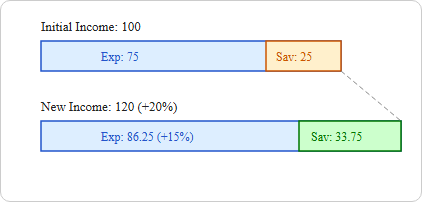
A college student spends 75% of his pocket money. When the pocket money increased by 20%, the expenditure also increased by 15%. What is the increase in the savings?

  1. ((a))

    25%

  2. ((b))

    55%

  3. ((c))

    35%

  4. ((d))

    45%

Show Answer
Answer: ((c))

35%

Shortcut Trick

Ratio of Expenditure to Savings = 75 : 25 = 3 : 1.

Using the weighted average method: Income Increase = (Exp × Exp% + Sav × Sav%) ÷ Total Ratio.

20% = (3 × 15% + 1 × x%) ÷ 4.

80 = 45 + x ⇒ x = 35%.

∴ The correct answer is 35%.

Alternate Method

Given:

Initial Pocket Money (Income) = 100 units

Initial Expenditure = 75% of 100 = 75 units

Initial Savings = 100 − 75 = 25 units

Formula Used:

Income = Expenditure + Savings

Percentage Increase = (Change ÷ Original Value) × 100

Calculations:

⇒ New Pocket Money = 100 + 20% of 100 = 120 units

⇒ New Expenditure = 75 + 15% of 75 = 75 + 11.25 = 86.25 units

⇒ New Savings = New Income − New Expenditure = 120 − 86.25 = 33.75 units

⇒ Increase in Savings = 33.75 − 25 = 8.75 units

⇒ Percentage Increase in Savings = (8.75 ÷ 25) × 100

⇒ Percentage Increase = 0.35 × 100 = 35%

∴ The correct answer is 35%.

Additional Information

Income, Expenditure and Savings Relationship

The basic equation is Income = Expenditure + Savings. Any change in two variables directly impacts the third.

Weighted Average (Alligation Method)

Percentage change in Income is the weighted average of percentage changes in Expenditure and Savings: %ΔI = (E × %ΔE + S × %ΔS) ÷ (E + S).

Percentage Change Formula

To find the percentage increase or decrease, use: [(Final Value − Initial Value) ÷ Initial Value] × 100.

7

'पाठशाला' में कौन-सा समास है?

  1. ((a))

    तत्पुरूष

  2. ((b))

    द्वन्द्व

  3. ((c))

    द्विगु

  4. ((d))

    कर्मधारय

Show Answer
Answer: ((a))

तत्पुरूष

'पाठशाला' में समास है- तत्पुरूष

Key Points

  • 'पाठशाला' में तत्पुरुष समास है
  • 'पाठशाला' का समास विग्रह - 'पाठ के लिए शाला' होता है।
  • इस समास में पूर्व पद गौण तथा उत्तर पद प्रधान होता है, उसे तत्पुरुष समास कहते हैं।
  • इस समास में आने वाले कारक चिन्हों को, से, के लिए, से, का/के/की, में, पर आदि का लोप होता है।
  • उदाहरण - कठफोड़ा = काठ को फोड़ने वाला, भाग्यहीन = भाग्य से हीन, विधानसभा = विधान के लिए सभा आदि।

Important Points समास के भेद-

  1. तत्पुरुष समास
  2. कर्मधारय समास
  3. द्विगु समास
  4. द्वन्द्व समास
  5. बहुव्रीहि समास
  6. अव्ययीभाव समास​

Additional Information

समासपरिभाषाउदाहरण
द्वंद्वजिस समास में समस्तपद के दोनों पद प्रधान हों या दोनों पद सामान हों एवं दोंनों पदों को मिलाते समय ‘और’, ‘अथवा’, ‘या’, ‘एवं’ आदि योजक लुप्त हो जाएँ, वह समास द्वंद्व समास कहलाता है।​ऊंच–नीच = ऊंचे या नीचे राजा–प्रजा = राजा और प्रजा
द्विगुवह समास जिसका पहला पद संख्यावाचक विशेषण होता है तथा समस्तपद किसी समूह या फिर किसी समाहार का बोध करता है तो वह द्विगु समास कहलाता है।त्रिलोक = तीनों लोकों का समाहार सप्तसिंधु = सात सिंधुयों का समूह
कर्मधारयजिस समास के दोनों शब्दों के बीच विशेषण-विशेष्य अथवा उपमान-उपमेय का सम्बन्ध हो, उसे कर्मधारय समास कहलाता है। पहचान: विग्रह करने पर दोनों पद के मध्य में ‘रुपी’ , 'है जो', 'के समान' आदि आते हैं।
महादेव = महान है जो देव देहलता = लता रूपी देह चंद्रमुख = चंद्र के समान मुख
8

Match the pairs correctly.

A.Part  - Ii.Fundamental Rights
B.Part  - IIIii.Panchayat Raj
C.Part  - IXiii.Citizenship
D.Part  - IIiv.The Union and its territory
  1. ((a))

    A - iv, B - ii, C - iii, D - i

  2. ((b))

    A - iii, B - i, C - ii, D - iv

  3. ((c))

    A - ii, B - iii, C - i, D - iv

  4. ((d))

    A - iv, B - i, C - ii, D - iii

Show Answer
Answer: ((d))

A - iv, B - i, C - ii, D - iii

The correct answer is A - iv, B - i, C - ii, D - iii.

Key Points

  • Every year on November 26th, Constitution Day is commemorated as the day the Constitution was adopted.
  • The Indian Constitution is the world's longest constitution.
  • It began with 395 articles divided into 22 parts and eight schedules. The Indian Constitution now contains 448 articles divided into 22 parts and 12 schedules, as well as 105 amendments.
  • Currently, it contains 25 parts:
  • Part I – The Union and its Territories, Articles 1 – 4
  • Part II – Citizenship, Articles 5 -11
  • Part III – Fundamental Rights, Articles 12 – 35
  • Part IV – Directive Principles of State Policy, Articles 36 – 51
  • Part IV A – Fundamental Duties, Articles  51A
  • Part V – The Union, Articles 52 – 151
  • Part VI – The States, Articles 152 – 237
  • Part VII – The States in Part B of First Schedule, Articles 238 [Repealed]
  • Part VIII – The Union Territories, Articles 239 – 242
  • Part IX – The Panchayats, Articles 243 – 243O
  • Part IXA – The Municipalities, Articles 243P – 243ZG
  • Part IXB – The Co-operative Societies, Articles 243ZH – 243ZT
  • Part X – The Scheduled and Tribal Areas, Articles 244 – 244A
  • Part XI – Relation between the Union and the States, Articles 245 – 263
  • Part XII – Finance, Property, Contracts and Suits, Articles 264 – 300A
  • Part XIII – Trade, Commerce, and Intercourse within the territory of India, Articles 301 – 307
  • Part XIV – Services Under the Union and the States, Articles 308 – 323
  • Part XIVA – Tribunals, Articles 323A – 323B
  • Part XV – Elections, Articles 324 – 329A
  • Part XVI – Special provisions relating to certain classes, Articles 330 – 342
  • Part XVII – Official language, Articles 343 – 351
  • Part XVIII – Emergency Provisions, Articles 352 – 360
  • Part XIX – Miscellaneous, Articles 361 – 367
  • Part XX – Amendment of the Constitution 368
  • Part XXI – Temporary, Transitional and Special Provisions, Articles 369 – 392
  • Part XXII – Short Title, Commencement, Authoritative Text in Hindi and Repeals, Articles 393 – 395

9

A sum of Rs. 12,000 amounts to Rs. 15,972 at a certain rate percent per annum in (1\frac{1}{2}) years, when the interest is compounded half-yearly, What will be the amount of the same sum in same time and with the same rate, if interest is compounded annually?

  1. ((a))

    Rs. 15,840

  2. ((b))

    Rs. 15,420

  3. ((c))

    Rs. 15,950

  4. ((d))

    Rs. 14,520

Show Answer
Answer: ((a))

Rs. 15,840

Shortcut Trick

Ratio of Amount to Principal = 15972 ÷ 12000 = 1331/1000 = (11/10)3.

Since time is 3 half-years, compounding factor = 1.1 ⇒ half-yearly rate = 10%.

Annual rate = 10% × 2 = 20%.

For 1.5 years compounded annually, effective multiplying factor = 1.20 (for 1st year) × 1.10 (for 0.5 year) = 1.32.

New Amount = 12000 × 1.32 = 15840.

∴ The correct answer is Rs. 15,840.

Alternate Method

Given:

Principal (P) = Rs. 12,000

Amount (A) after 1.5 years = Rs. 15,972 (compounded half-yearly)

Time = 1.5 years = 3 half-years

Formula Used:

Compound Amount, A = P(1 + R/100)n

12,000 Principal

14,400 After 1 Year

15,840 After 1.5 Yrs

+20%

+10%

Annual Compounding Timeline

Calculations:

⇒ Let the annual rate of interest be R%.

⇒ For half-yearly compounding, rate = R/2 % and time = 3 periods.

⇒ 15972 = 12000 × (1 + R/200)3

⇒ (1 + R/200)3 = 15972 ÷ 12000

⇒ (1 + R/200)3 = 1331 ÷ 1000

⇒ 1 + R/200 = 11/10

⇒ R/200 = 1/10 ⇒ R = 20%

⇒ Now, the same sum is compounded annually for 1.5 years at 20% p.a.

⇒ Amount after 1st year = 12000 × (1 + 20/100) = 14400

⇒ Interest for the remaining 0.5 year = 14400 × (20/2)/100 = 1440

⇒ Final Amount = 14400 + 1440 = 15840

∴ The correct answer is Rs. 15,840.

Additional Information

Half-Yearly Compounding

When interest is compounded half-yearly, the rate of interest is halved (R/2) and the time period is doubled (2T).

Fractional Year Compounding

If time is given in fractions like t = n + a/b years, the formula used is: Amount = P(1 + R/100)n × (1 + (a/b × R)/100).

Simple vs Compound Interest Difference

For the first year, both Simple Interest and Compound Interest are exactly the same. The difference arises from the second period onwards as interest is calculated on accumulated interest.

10

Which of the following is not an example of Kharif crops?

  1. ((a))

    Rice

  2. ((b))

    Groundnut

  3. ((c))

    Maize

  4. ((d))

    Pea

Show Answer
Answer: ((d))

Pea

The correct answer is Pea.

Key Points

  • In India, the agricultural crop year is from July to June.
  • Based on the monsoon, the Indian cropping season is divided into two broad cropping patterns: (i) Kharif and (ii) Rabi.
  • Kharif Crops: 
  • The crops which are sown in the rainy season are called Kharif crops.
  • The rainy season in India is generally from June to September.
  • Paddy, maize, soyabean, groundnut, and cotton are Kharif crops.
  • Rabi Crops:
  • The crops grown in the winter season are called rabi crops.
  • The winter season in India is generally from October to March.
  • Examples of rabi crops are wheat, gram, pea, mustard, and linseed.
  • Pea is an example of Rabi crop which is grown in the months between October and March.
  • Pea belongs to the family Fabaceae.

Thus, Pea is not an example of Kharif crop.

11

A shopkeeper offers the following three schemes. Which scheme has the maximum discount percent?

I. Two successive discounts of 15% and 20%.

II. Buy 4 get 2 free.

III. Buy 6 get 4 free

  1. ((a))

    III only

  2. ((b))

    I only

  3. ((c))

    Both I and II 

  4. ((d))

    II only

Show Answer
Answer: ((a))

III only

Shortcut Trick

Scheme I: Effective discount = 15 + 20 − (15 × 20) ÷ 100 = 32%

Scheme II: Discount % = [Free ÷ (Paid + Free)] × 100 = (2 ÷ 6) × 100 = 33.33%

Scheme III: Discount % = [Free ÷ (Paid + Free)] × 100 = (4 ÷ 10) × 100 = 40%

Comparing the values, Scheme III offers the maximum discount of 40%.

∴ The correct answer is Scheme III.

Alternate Method

Given:

Three discount schemes are provided by a shopkeeper:

I. Two successive discounts of 15% and 20%.

II. Buy 4 get 2 free.

III. Buy 6 get 4 free.

Discount Percentage Comparison

Scheme I

32%

Scheme II

33.33%

Scheme III

40% (Maximum)

Calculations:

For Scheme I: Two successive discounts of 15% and 20%

⇒ Equivalent Discount = a + b − (a × b) ÷ 100

⇒ Equivalent Discount = 15 + 20 − (15 × 20) ÷ 100

⇒ Equivalent Discount = 35 − 300 ÷ 100

⇒ Equivalent Discount = 35 − 3 = 32%

For Scheme II: Buy 4 get 2 free

⇒ Total items = 4 (paid) + 2 (free) = 6

⇒ Discount % = (Free Items ÷ Total Items) × 100

⇒ Discount % = (2 ÷ 6) × 100 = 33.33%

For Scheme III: Buy 6 get 4 free

⇒ Total items = 6 (paid) + 4 (free) = 10

⇒ Discount % = (Free Items ÷ Total Items) × 100

⇒ Discount % = (4 ÷ 10) × 100 = 40%

⇒ Comparing all three schemes: 32%, 33.33%, and 40%.

⇒ The maximum discount is 40% which is provided by Scheme III.

∴ The correct answer is Scheme III.

Additional Information

Successive Discounts

When two or more discounts are given one after another on the marked price. The effective discount of two discounts a% and b% is calculated as [a + b − (a × b) ÷ 100]%.

Buy X Get Y Free Concept

In promotional offers, the free items represent the discount amount, and the total items (paid + free) represent the marked price base. The equivalent Discount % is calculated as [Free Items ÷ Total Items] × 100.

Marked Price vs Selling Price

Selling Price (SP) is the final amount paid by the customer after all discounts are applied to the Marked Price (MP). The formula is SP = MP × (100 − Discount %) ÷ 100.

12

The Tripartite struggle happened among the Palas, the Pratiharas and the ______.

  1. ((a))

    Chandelas

  2. ((b))

    Maukharis

  3. ((c))

    Rashtrakutas

  4. ((d))

    Chalukyas

Show Answer
Answer: ((c))

Rashtrakutas

The correct answer is Rashtrakutas.

Key Points

  • The Tripartite Struggle, also known as the Kannauj Triangle Wars, was a prolonged conflict in the Indian subcontinent from the 8th to the 10th century.
  • The struggle was primarily among three major powers: the Palas of Bengal, the Pratiharas of Malwa, and the Rashtrakutas of the Deccan.
  • This conflict was primarily over the control of the city of Kannauj, a symbol of prestige and political power in northern India during that time.
  • The Rashtrakutas were a prominent dynasty that ruled large parts of the Indian subcontinent between the 6th and 10th centuries.

Additional Information

  • Palas:
  • The Pala Empire was an imperial power during the late classical period on the Indian subcontinent, which originated in the region of Bengal.
  • They were known for their patronage of Buddhism and the establishment of famous institutions such as the Vikramashila and Nalanda universities.
  • The Palas were also known for their contributions to art, architecture, and literature.
  • Key rulers included Gopala, the founder, and Dharmapala, who greatly expanded the empire.
  • Pratiharas:
  • The Pratiharas, also known as the Gurjara-Pratiharas, were an important dynasty that ruled much of northern India from the 6th to the 11th century.
  • They are noted for their resistance against the Arab invasions and their efforts to unify and protect northern India.
  • Their capital was initially at Ujjain and later at Kannauj, which became a significant center of power.
  • Key rulers included Nagabhata I and Mihira Bhoja.
  • Rashtrakutas:
  • The Rashtrakutas were a dynasty that ruled large parts of the Indian subcontinent from the 6th to the 10th century, with their capital at Manyakheta in the Deccan region.
  • They were known for their military prowess and their successful expeditions into northern India, including the capture of Kannauj.
  • The Rashtrakutas were also great patrons of art and architecture, with the rock-cut temples at Ellora being one of their most famous contributions.Key rulers included Dantidurga, the founder, and Krishna I, who commissioned the Kailasa temple at Ellora.
13

In an election, Rashida and Suhana were the only two contestants and all votes cast went in favour of either of these two candidates. If Rashida secured 48% of the votes and lost to Suhana by 832 votes, how many votes were cast in favour of Rashida?

  1. ((a))

    9984

  2. ((b))

    9864

  3. ((c))

    9664

  4. ((d))

    9964

Show Answer
Answer: ((a))

9984

Given:

Rashida got 48% of votes and lost to Suhana by 832 votes.

Calculations:

Let the total number of votes polled be x

Percentage of votes secured by losing candidate = 48%

Percentage of votes secured by winning candidate = 100 - 48 = 52%

According to problem,

48% of x = 52% of x - 832

=> 52% of x - 48% of x = 832

=> (52x - 48x) = 832 × 100

=> 4x = 83200

=> x = (\dfrac{83200}{4})

=> x = 20800

So, votes in favour of Rashida = 20800 × 48%

= 20800 × (\dfrac{48}{100})

= 9984

∴ The answer is 9984

14

Who became the emperor of Delhi in 1414 AD?

  1. ((a))

    Ala-ud-din Khilji

  2. ((b))

    Bahlul Khan

  3. ((c))

    Khizr Khan

  4. ((d))

    Razia Sultana

Show Answer
Answer: ((c))

Khizr Khan

The correct answer is Khizr Khan.

Key Points

  • Khizr Khan was the founder of the Sayyid dynasty in India.
  • He became the ruler of Delhi in 1414 AD after overthrowing the Tughlaq dynasty.
  • Khizr Khan ruled from 1414 AD to 1421 AD.
  • He was appointed as the governor of Multan by Timur, who invaded India in 1398 AD.

Additional Information

  • Sayyid Dynasty
  • The Sayyid dynasty ruled the Delhi Sultanate from 1414 to 1451 AD.
  • It was the fourth dynasty of the Delhi Sultanate, following the Tughlaq dynasty.
  • The dynasty's founders claimed descent from Prophet Muhammad.
  • Major rulers included Khizr Khan, Mubarak Shah, Muhammad Shah, and Ala-ud-din Alam Shah.
  • Timur's Invasion
  • Timur, also known as Tamerlane, invaded India in 1398 AD.
  • His invasion led to significant destruction and weakening of the Tughlaq dynasty.
  • Timur appointed Khizr Khan as the governor of Multan, which later enabled him to establish the Sayyid dynasty.
  • Delhi Sultanate
  • The Delhi Sultanate was an Islamic empire based in Delhi that stretched over large parts of the Indian subcontinent for 320 years (1206-1526 AD).
  • It comprised five dynasties: the Mamluk, Khalji, Tughlaq, Sayyid, and Lodi dynasties.
15

The value of 3 × 8 ÷ 4 of 6 - 6 ÷ 4 × (13 - 15) + 4 - 2 × 9 ÷ 6 × 6 is:

  1. ((a))

    (8\frac{1}{2})

  2. ((b))

    -16

  3. ((c))

    (7\frac{1}{2})

  4. ((d))

    -10

Show Answer
Answer: ((d))

-10

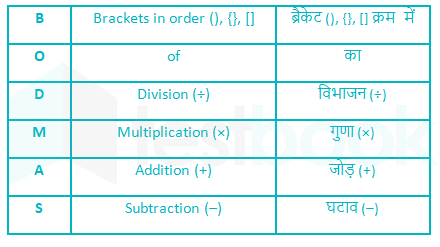
Concept used:

Calculation:

⇒ 3 × 8 ÷ 4 of 6 - 6 ÷ 4 × (13 - 15) + 4 - 2 × 9 ÷ 6 × 6

⇒ 3 × 8 ÷ 24 - (6/4) × (-2) + 4 - 2 × (9/6) × 6

⇒ 3 × (8/24) + 3 + 4 - 18

⇒ 3 × 1/3 + 3 + 4 -18

⇒ 1 + 7 - 18

⇒ 8 - 18

⇒ -10

∴ The correct answer is -10.

16

GDP stands for ?

  1. ((a))

    General Development Product

  2. ((b))

     Global Development Point

  3. ((c))

    Gross Domestic Product

  4. ((d))

    Gross Development Point

Show Answer
Answer: ((c))

Gross Domestic Product

The correct answer is Gross Domestic Product.

Key Points

  • Gross Domestic Product:
  • GDP is the total value of all goods and services produced within a country's borders in a given time period.
  • Depreciation is the decrease in value of an asset over time due to wear and tear, obsolescence, or other factors.
  • NDP:-
  • It is a measure of the net output of the economy and is considered a more accurate indicator of economic growth than GDP.
  • Gross Domestic Product less Depreciation is called Net Domestic Product (NDP). It represents the value of all goods and services produced within a country's borders minus the value of the capital goods (machinery, equipment, buildings, etc.) that were used up in the production process.

 Additional Information

  • Gross Domestic Investment:-
  • It refers to the total amount of money spent on capital goods (machinery, equipment, buildings, etc.) within a country's borders in a given time period.
  • Net National Product:-
  • It is the value of all goods and services produced by a country's residents, including those living abroad, minus depreciation.
  • Gross National Product:-
  • It is the value of all goods and services produced by a country's residents, including those living abroad, without subtracting depreciation.
17

The HCF of (\frac{1}{2},\frac{3}{4},\frac{5}{6}) and (\frac{7}{8}) is:

  1. ((a))

    (\frac{{105}}{2})

  2. ((b))

    (\frac{1}{{24}})

  3. ((c))

    (\frac{7}{{24}})

  4. ((d))

    (\frac{1}{{48}})

Show Answer
Answer: ((b))

(\frac{1}{{24}})

Given:

Four fraction (\frac{1}{2},\frac{3}{4},\frac{5}{6},\frac{7}{8})

Formula used:

H.C.F of fraction (=\frac{\ H.C.F \ of \ numerator}{\ L.C.M \ of \ denominators})

Calculation:

HCF of the fractions

 = (\frac{ \ HCF \ of 1,3,5,7}{\ LCM \ of 2,4,6,8})

=(\frac{1}{24})

Hence the correct answer is option(2).

18

Which state is set to receive its first Integrated Aqua Park under the Pradhan Mantri Matsya Sampada Yojana, laid virtually by PM Narendra Modi?

  1. ((a))

    Assam

  2. ((b))

    Nagaland

  3. ((c))

    Manipur

  4. ((d))

    Tripura

Show Answer
Answer: ((b))

Nagaland

The correct answer is Nagaland.

In News

  • PM Narendra Modi virtually laid the foundation stone for the first Integrated Aqua Park in Nagaland, at Tzudikong in Mokokchung district.

Key Points

  • The Aqua Park will serve as a hub for fisheries-related development and will be the first of its kind in Nagaland.
  • It will focus on fish and seed production and act as a comprehensive resource centre for the fisheries sector.
  • The facility aims to provide market linkages, quality inputs, and equitable pricing for fishery products.
  • It will create new livelihood opportunities, empower educated unemployed youth, and promote sustainable growth in fisheries.

Additional Information

  • Integrated Aqua Park: A comprehensive facility aimed at enhancing fish production, seed quality, and overall development in the fisheries sector.
  • Pradhan Mantri Matsya Sampada Yojana (PMMSY): A flagship central government scheme to promote fisheries, ensure sustainable growth, and boost livelihoods.
  • Livelihood opportunities: Employment avenues generated for youth and local communities through fisheries development activities.
  • Market linkages: Systems connecting producers to buyers, ensuring fair prices and improved access to markets for fishery products.
19

A shopkeeper has 3 different qualities of Oil. 506 litres of 1st quality, 529 litres of 2nd quality and 575 litres of 3rd quality. Find the least possible number of bottles of equal size in which different Oil of different qualities can be filled without mixing?

  1. ((a))

    65

  2. ((b))

    70

  3. ((c))

    49

  4. ((d))

    68

Show Answer
Answer: ((b))

70

Given:

1st quality oil = 506 litres

2nd quality oil = 529 litres

3rd quality oil = 575 litres

Formula used:

To find the least possible number of bottles of equal size, we calculate the HCF (Highest Common Factor) of the given quantities.

Calculation:

Finding the HCF of 506, 529, and 575:

Prime factorization of 506: 2 × 11 × 23

Prime factorization of 529: 23 × 23

Prime factorization of 575: 5 × 5 × 23

Common factor = 23

HCF = 23

Number of bottles required = Total quantity / HCF

For 1st quality: 506 ÷ 23 = 22 bottles

For 2nd quality: 529 ÷ 23 = 23 bottles

For 3rd quality: 575 ÷ 23 = 25 bottles

⇒ Total bottles = 22 + 23 + 25 = 70

∴ The correct answer is option (2).

20

Taxus wallichiana Zucc (Himalayan yew) is a medicinal plant found in which of the following states?

  1. ((a))

    Goa

  2. ((b))

    Jharkhand

  3. ((c))

    Himachal Pradesh

  4. ((d))

    Bihar

Show Answer
Answer: ((c))

Himachal Pradesh

The correct answer is Himachal Pradesh

Key Points

The Himalayan Yew :

  • The Himalayan Yew (Taxus wallachiana) is a medicinal plant found in various parts of Himachal Pradesh and Arunachal Pradesh.
  • The plant holds an important place in traditional medicine and its products are used by the local populations for treating common infections.
  • A chemical compound called ‘taxol’ is extracted from the bark, needles, twigs and roots of this tree, and it has been successfully used to treat some cancers – the drug is now the biggest selling anti-cancer drug in the world.
  • The species is under great threat due to over-exploitation.
  • In the last decade, thousands of yew trees have dried up in various parts of Himachal Pradesh and Arunachal Pradesh.
  • Yew has undergone a recent, range-wide population decline of at least 50% as per IUCN.
  • Due to the illegal cutting of plant parts and other anthropogenic pressures, Himalayan yew is endangered, and threatened with extinction, in Himalaya.
  • Throughout its range in the western Himalayas, it is declining in response to a range of threats.
  • In Afghanistan, up to 50% of the forests where it occurs have been destroyed or heavily logged (UNEP 2003) over the last 30 years.
  • In northwest India and western Nepal, exploitation associated with Taxol production has led to a national decline of up to 90% in Taxus populations throughout the country.
  • Also, in other countries such as Pakistan, overexploitation for fuel, fodder, and medicinal use has led to a significant decline.
  • The decline is continuing and while the causes are largely understood, in many areas they will not be reversible. On this basis, an assessment of Endangered is warranted.
21

Question: Find the HCF of (am - 1) and (an - 1).

Statement I: (a(HCF of m, n) - 1)

Statement II: (a(HCF of m, n)/(LCM of m, n) - 1)

  1. ((a))

    Statement I is true

  2. ((b))

    Statement II is true

  3. ((c))

    Neither Statement I nor Statement II is true.

  4. ((d))

    Both Statement I and Statement II are true

Show Answer
Answer: ((a))

Statement I is true

Given:

(am - 1) and (an - 1)

Formula Used:

HCF of any two numbers of the form (bx - 1) and (b- 1)

= (b(HCF of x, y) - 1)

Calculation:

As per the above formula 

⇒ HCF of (am - 1) and (an - 1) = (a(HCF of m, n) - 1)

∴ The correct answer is Option 1).

22

'Silver Revolution' is related to

  1. ((a))

    precious minerals

  2. ((b))

    rice

  3. ((c))

    cotton 

  4. ((d))

    egg 

Show Answer
Answer: ((d))

egg 

Egg is the right answer.

Key Points

  • The silver revolution is a technique that results in a dramatic rise in egg and poultry output.
  • Indira Gandhi was the driving force behind this movement.
  • This was accomplished through the use of hybrid cocks and hens, as well as the application of applied science to improve egg output.
  • The late Dr. BV Rao, the founder of Venkys (renowned Indian chicken Company), was the driving force behind this chicken industry revolution.
  • Medical advances and science had a significant impact on the Silver Revolution, which lasted from 1969 to 1978.
  • It lasted nine years and contributed to India becoming the world's third-largest egg producer after China and the United States.

Additional Information

  • The White Revolution was launched to increase milk and dairy product output in India. Verghese Kurien, the inventor of the 'billion litres' concept, is regarded as the father of this revolution. AMUL - Anand Milk Union Limited, along with other vital companies, played a significant role in operating the revolution for India.
  • The Green Revolution increased food grain output by utilizing numerous contemporary farming technology and products such as fertilizers, high-yielding variety (HYV) seeds, irrigation infrastructure, and pesticides. M.S. Swaminathan, an Indian geneticist, founded it, and it began under the leadership of Lal Bahadur Shastri.
  • The Blue Revolution (Neel Kranti Mission) in India began in 1985 and is tied to the country's aquaculture. This revolution helped to transform the fishery business into a modern one while also increasing fishers' income. The National Fisheries Development Board (NFDB) contained several components to develop and expand aquaculture activities via the use of modern technologies and equipment.
  • The Golden Revolution, founded by Nirpakh Tutej, lasted from 1991 until 2003. It was a significant movement in India that saw the application of new inventive technology to increase the production of honey and other items such as flowers, fruits, spices, vegetables, and plantation crops.
  • The Black Revolution is linked to an increase in petroleum production in India.  The Indian government implemented different strategies to increase output by combining ethanol, a renewable source of energy, with gasoline to generate biodiesel. This resulted in a beneficial effect in terms of lowering pollution caused by hazardous gas emissions. This project has also assisted farms in switching to less polluting options.
  • In India, the Grey Revolution is related with a rise in fertilizer production. This came after the green revolution, which was responsible for the high-yielding type of seeds. The grey revolution was launched to correct the problems in the agricultural industry. It strives to provide a bright future for farmers while also developing the agriculture sector.
23

A cube of side 5 cm, has been assembled using 125 cubes each of 1 cm edge. One cube is removed from the middle of each of the faces of the cube. What is the surface area (in cm2) of the remaining solid?

  1. ((a))

    155

  2. ((b))

    144

  3. ((c))

    150

  4. ((d))

    174

Show Answer
Answer: ((d))

174

Given:

Side of a larger cube (a) = 5 cm

Side of each smaller cube (b) = 1 cm

Formulae used:

Surface area of a cube = 6(side)2

Change in surface area when one cube is removed = 5(side length of the smaller cube)2 - 1 × (side length of the smaller cube)2

Solution:

The surface area of the larger cube = 6a2 

⇒ 6 × 52 = 6 × 25 = 150 cm2

Increase in surface area when one cube is removed = 5 × b2 - 1 ×  b2 

⇒ 4 × (1 cm)2 = 4 cm2

Total increase in surface area after removing one cube from each face of the larger cube = 6 ×  (increase in area)

⇒ 6 × 4 cm2 = 24 cm2

The overall surface area of the remaining shape is = original surface area + Total increase in surface area

150 cm2 + 24 cm2 = 174 cm2.

∴ Option 4 is the correct answer.

24

According to the Indian calendar, Vasanta Season falls in which months? 

  1. ((a))

    Chaitra-Vaisakha 

  2. ((b))

    Jyaistha-Asadha 

  3. ((c))

    Margashirsa-Pausa 

  4. ((d))

    Sravana-Bhadra  

Show Answer
Answer: ((a))

Chaitra-Vaisakha 

The correct answer is Chaitra-Vaisakha.

Key Points

  • Indian Calendar:-
  • It is also known as the "Saka calendar" or "Saka Samvat," which serves official and legislative purposes and is used alongside the Gregorian calendar.
  • This calendar was introduced by the Calendar Committee in 1957, chaired by Meghnad Saha.
  • The Saka calendar begins with the vernal (Spring) equinox of 78 Common Era (CE), designates its era as Saka Era, and counts years in that era.
  • Chaitra is the first month of the year, and Phalguna is the last, aligning with the solar agricultural cycles.
  • Vasanta Season falls in Chaitra-Vaisakha.

Additional Information

  • The months of the Indian National Calendar (Saka Samvat) are as follows:
  • Chaitra (March 22 to April 21)
  • Vaishakha (April 21 to May 22)
  • Jyaistha (May 22 to June 22)
  • Ashadha (June 22 to July 23)
  • Shravana (July 23 to August 23)
  • Bhadra (August 23 to September 23)
  • Ashwin (September 23 to October 23)
  • Kartika (October 23 to November 22)
  • Agrahayana (November 22 to December 22)
  • Pausha (December 22 to January 21)
  • Magha (January 21 to February 20)
  • Phalguna (February 20 to March 21)
25

Match the following important Harappan sites with their notable features:

S.No.Harappan SiteS.No.Notable Feature
1.LothalADockyard
2.KalibanganBFire altars
3.HarappaCGranary
4.Mohenjo-daroDGreat Bath

Select the correct answer using the codes given below:

  1. ((a))

    1-A, 2-B, 3-C, 4-D

  2. ((b))

    1-C, 2-D, 3-A, 4-B

  3. ((c))

    1-B, 2-A, 3-D, 4-C

  4. ((d))

    1-D, 2-C, 3-B, 4-A

Show Answer
Answer: ((a))

1-A, 2-B, 3-C, 4-D

The correct answer is option 1.

Key Points

  • Lothal is famous for its dockyard, Kalibangan for fire altars, Harappa for its granary, and Mohenjo-daro for the Great Bath. Hence, option 1 is correct.
  • Important Fact: Lothal’s dockyard indicates maritime trade during the Harappan period.
26

Which among the following is a key difference between rural Panchayati Raj institutions and urban local bodies?

  1. ((a))

    Only rural Panchayati Raj institutions have elected representatives.

  2. ((b))

    Urban local bodies handle complex urban infrastructure, unlike Panchayati Raj institutions.

  3. ((c))

    Panchayati Raj institutions levy more taxes than urban local bodies.

  4. ((d))

    Only Panchayati Raj institutions are recognized by the Constitution.

Show Answer
Answer: ((b))

Urban local bodies handle complex urban infrastructure, unlike Panchayati Raj institutions.

The correct answer is option 2

Key Points

  • Urban local bodies are responsible for handling complex infrastructures like roads, public health, and utilities, while Panchayati Raj institutions focus on rural governance.
  • Both systems have elected representatives and are recognized by the Constitution.
  • Hence, option 2 is correct.
27

What proportion of the proposed jobs has been reserved for women as per the Mahatma Gandhi National Rural Employment Guarantee Act (MGNREGA)?

  1. ((a))

    one third

  2. ((b))

    two third

  3. ((c))

    one fourth

  4. ((d))

    half 

Show Answer
Answer: ((a))

one third

The correct answer is one third.

Key PointsThe Mahatma Gandhi National Rural Employment Guarantee Act (MGNREGA):

  • The Mahatma Gandhi National Rural Employment Guarantee Act (MGNREGA) was enacted by the Central Government of India in the year 2005.
  • It mandates that women must receive priority in order for them to make up at least one-third of the beneficiaries.
  • Established by the Ministry of Rural Development.
  • MGNREGA is one of the biggest labor guarantee programs globally.
  • The main goal of the program is to provide adult members of rural households who are willing to perform unskilled manual labor related to public work with 100 days of employment guaranteed per fiscal year.
  • The legally-backed guarantee that any adult living in a rural area would find a job within 15 days of requesting it, or else an "unemployment allowance" must be provided, is the most significant aspect of the MGNREGA framework.
  • By giving women equal pay for equal labour, MGNREGA has been successful in lowering poverty, raising the standard of living in rural households, and empowering them.

Additional Information Right to Work:

  • It is not specifically acknowledged as a fundamental right in the Indian Constitution.
  • It is unenforceable in a court of law because it is included in Part IV of the Constitution (Directive Principles of State Policy) under Article 41.
  • According to Article 41 of the Constitution, “the State shall within the limits of its economic capacity and development, make effective provision for securing the right to work, to education and to public assistance in cases of unemployment, old age, sickness and disablement, and in other cases of undeserved want.”
28

Select the most appropriate ANTONYM of the underlined word in the following sentence.

It was difficult to accommodate the avariciousness of the people.

  1. ((a))

    Generosity

  2. ((b))

    Criticism

  3. ((c))

    Hatred

  4. ((d))

    Envy

Show Answer
Answer: ((a))

Generosity

The correct answer is: Option 1.

Key Points

  • The word "avariciousness" means extreme greed for wealth or material gain. (लोभ)
  • Example: The avariciousness of the businessman led him to exploit his employees.
  • "Generosity" refers to the quality of being kind and generous, often involving giving freely. (उदारता)
  • Example: Her generosity knew no bounds as she donated a large sum to charity.
  • Hence, we can infer that the opposite of "avariciousness" is "generosity".

Therefore, the correct answer is: Option 1.

Additional Information

Here are the other options explained along with their Hindi meanings and example sentences:

  • Criticism (आलोचना): The expression of disapproval of someone or something based on perceived faults or mistakes.
  • Example: Her criticism of the new policy was harsh but fair.
  • Hatred (घृणा): Intense dislike or ill will.
  • Example: His hatred for injustice was evident in his passionate speeches.
  • Envy (ईर्ष्या): A feeling of discontented or resentful longing aroused by someone else's possessions, qualities, or luck.
  • Example: She felt envy towards her friend's success.
29

Which is included in the six school (Shaddarshan) of Indian Philosophy ? 

  1. ((a))

    Satyaarth Prakash

  2. ((b))

    Vaishesika 

  3. ((c))

    Mahabharata

  4. ((d))

    Upanishad 

Show Answer
Answer: ((b))

Vaishesika 

The correct answer is: 'B) Vaishesika.'

Key Points

  • Vaishesika
  • Vaishesika is one of the six classical schools (Shaddarshan) of Indian philosophy.
  • It was founded by the sage Kanada and focuses on metaphysics, particularly the categorization of reality.
  • Its key concept is the atomic theory, which proposes that all matter is composed of indivisible atoms (paramanus).
  • The Vaishesika school emphasizes the importance of logic and reasoning and is closely associated with the Nyaya school, which focuses on epistemology.
  • The ultimate goal in Vaishesika philosophy is the attainment of liberation (moksha) through knowledge of the reality and nature of existence.

Incorrect Statements

  • Satyaarth Prakash
  • Satyaarth Prakash is not part of the six schools of Indian philosophy.
  • It is a book authored by Swami Dayanand Saraswati, advocating reformist and rationalist principles within Hinduism.
  • The text emphasizes monotheism and rejects idolatry and superstitions.
  • Mahabharata
  • The Mahabharata is an epic and not a school of philosophy.
  • While it contains philosophical discourses such as the Bhagavad Gita, it does not belong to the Shaddarshan.
  • Upanishad
  • The Upanishads are ancient texts that are considered the philosophical foundation of Hinduism.
  • They discuss metaphysics, spirituality, and the nature of ultimate reality (Brahman) but are not counted as one of the six schools of philosophy.

Hence, the correct option is: B) Vaishesika.

Additional Information

  • Six Schools of Indian Philosophy (Shaddarshan):
  • Nyaya: Focuses on logic and epistemology, founded by Gautama.
  • Vaishesika: Concerned with metaphysics and the nature of reality, founded by Kanada.
  • Sankhya: Explores dualism between Purusha (consciousness) and Prakriti (matter), attributed to Kapila.
  • Yoga: Deals with spiritual practices and meditation, systematized by Patanjali.
  • Mimamsa: Focuses on rituals and Vedic exegesis, founded by Jaimini.
  • Vedanta: Explores metaphysics and ultimate reality (Brahman), based on the Upanishads, with prominent philosophers like Adi Shankaracharya.
  • Key Contributions of Vaishesika:
  • Introduction of the atomic theory in Indian philosophy.
  • Classification of reality into categories (padarthas) such as substance, quality, action, and relation.
30

In which month is the Inter Tropical Convergence Zone (ITCZ) located around 20°N-25°N latitude (over the Gangetic plain)?

  1. ((a))

    May

  2. ((b))

    August

  3. ((c))

    June

  4. ((d))

    July

Show Answer
Answer: ((d))

July

The correct answer is July.

Key Points

  • The Inter Tropical Convergence Zone (ITCZ) is a region that circles the Earth, near the equator, where the trade winds of the Northern and Southern Hemispheres come together.
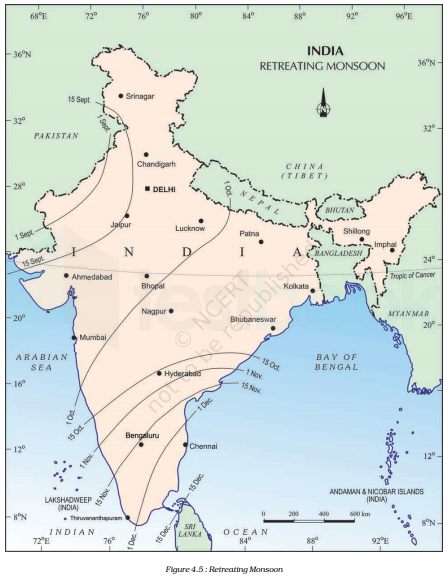
  • In the summer months, particularly in July, the ITCZ shifts northwards to around 20ºN-25ºN latitude, which is over the Gangetic plain in India.
  • This northward shift is due to the intense solar heating of the landmass, which creates low pressure areas that draw the ITCZ northwards.
  • The movement of the ITCZ is significant as it influences the monsoon patterns, bringing heavy rains to the Indian subcontinent during this period.

Additional Information

  • Inter Tropical Convergence Zone (ITCZ)
  • The ITCZ is also known as the Equatorial Convergence Zone or the Doldrums.
  • It is characterized by convective activity which generates often vigorous thunderstorms over large areas.
  • The position of the ITCZ varies seasonally, moving northwards during the Northern Hemisphere summer and southwards during the Southern Hemisphere summer.
  • The ITCZ plays a crucial role in the global climate system and is a key component of the monsoon systems in tropical regions.
  • Monsoon
  • The monsoon is a seasonal reversing wind accompanied by corresponding changes in precipitation.
  • In South Asia, the summer monsoon brings heavy rainfall, which is vital for agriculture but can also lead to floods.
  • The monsoon is driven by the differential heating of land and sea, with the ITCZ acting as a major component in its formation and movement.
  • The onset and intensity of the monsoon are closely monitored by meteorologists to predict weather patterns and prepare for agricultural planning.
  • Gangetic Plain
  • The Gangetic Plain is a large and fertile plain encompassing most of northern and eastern India, parts of Pakistan, and Bangladesh.
  • It is formed by the sediment deposits of the Ganges and its tributaries.
  • The plain is one of the most densely populated regions in the world and is crucial for India's agriculture.
  • The northward shift of the ITCZ during summer months significantly impacts the rainfall distribution in this region.
31

Who among the following had been imprisoned along with Gandhiji during 'Salt Satyagrah"?

  1. ((a))

    Badridatt Pandey

  2. ((b))

    Govind Ballabh Pant

  3. ((c))

    Bhairav Datt

  4. ((d))

    Hariram Kandpal

Show Answer
Answer: ((a))

Badridatt Pandey

The correct answer is Badridatt Pandey.

Key Points

  • Badridatt Pandey was a prominent freedom fighter who played a significant role in the Indian independence movement.
  • He was actively involved in the Salt Satyagraha, a significant part of the Civil Disobedience Movement led by Mahatma Gandhi.
  • During the Salt Satyagraha, Badridatt Pandey was imprisoned along with Mahatma Gandhi and other prominent leaders.
  • His participation in the movement demonstrated his commitment to the struggle for India's independence from British rule.

Additional Information

  • Salt Satyagraha
  • The Salt Satyagraha, also known as the Dandi March, was a nonviolent protest against the British salt monopoly in colonial India.
  • It was led by Mahatma Gandhi from March to April 1930, where he marched 240 miles from Sabarmati Ashram to the coastal village of Dandi in Gujarat.
  • The movement was a pivotal moment in the Indian independence struggle, highlighting the injustice of British rule and galvanizing Indian citizens to join the fight for freedom.
  • The act of making salt by evaporating sea water at Dandi was a form of civil disobedience against the British salt laws, which imposed a tax on salt production and prohibited Indians from collecting or selling salt.
  • Civil Disobedience Movement
  • Launched by Mahatma Gandhi in 1930, the Civil Disobedience Movement was a mass protest against British colonial rule in India.
  • It involved nonviolent resistance and refusal to obey certain laws, demands, and commands of the British government.
  • The movement aimed to achieve complete independence (Purna Swaraj) for India.
  • Key tactics included boycotting British goods, refusing to pay taxes, and breaking colonial laws.
  • The movement saw mass participation from all sections of Indian society and significantly weakened British authority in India.
  • Imprisonment of Leaders
  • During the Salt Satyagraha and the broader Civil Disobedience Movement, many Indian leaders and activists were arrested and imprisoned by the British authorities.
  • Notable figures who were imprisoned alongside Mahatma Gandhi included Badridatt Pandey, Jawaharlal Nehru, Sardar Vallabhbhai Patel, and many others.
  • The imprisonment of these leaders further fueled the Indian population's resolve to fight for independence and highlighted the oppressive nature of British rule.
  • The solidarity and sacrifice shown by these leaders inspired millions of Indians to join the freedom struggle.
32

When did Subhas Chandra Bose announce the formation of Provisional

Government of Free India?

  1. ((a))

    1940

  2. ((b))

    1941

  3. ((c))

    1942

  4. ((d))

    1943

Show Answer
Answer: ((d))

1943

The correct answer is: 1943

Key Points

  • Subhas Chandra Bose announced the formation of the Provisional Government of Free India on October 21, 1943.
  • This government-in-exile was established during World War II with the support of the Axis powers, particularly Japan.
  • The Provisional Government of Free India, also known as Azad Hind, aimed to liberate India from British rule through armed struggle.
  • Bose's government had its headquarters in Singapore and sought recognition from various countries to legitimize its cause.
  • The Provisional Government of Free India had its own currency, civil code, and national anthem.
  • This was part of Bose's effort to establish the legitimacy and sovereignty of the government.
  • The government also had its own army, the Indian National Army (INA), which Bose led into battles against British forces in India.

Incorrect Options

  • 1940
  • This year was significant for the Indian freedom movement as it marked the adoption of the Lahore Resolution by the Muslim League, which called for the creation of Pakistan.
  • 1941
  • In 1941, Subhas Chandra Bose escaped from house arrest in India and made his way to Germany to seek support for the Indian independence struggle.
  • 1942
  • The Quit India Movement was launched by Mahatma Gandhi and the Indian National Congress in 1942, demanding an end to British rule in India.

Hence, the correct answer is 1943, as Subhas Chandra Bose announced the formation of the Provisional Government of Free India in that year.

Additional Information

  • Significance of Azad Hind Government:
  • The establishment of the Provisional Government of Free India was a bold and symbolic act of defiance against British rule.
  • It helped to galvanize support for the Indian independence movement both within India and among the Indian diaspora.
  • The Indian National Army, under the leadership of Subhas Chandra Bose, played a crucial role in inspiring Indian soldiers and civilians to fight for independence.
  • Role of Japan and Axis Powers:
  • Japan provided military and logistical support to the Azad Hind Government and the Indian National Army.
  • The Axis powers saw an opportunity to weaken British influence in Asia by supporting Bose's efforts.
  • Despite the eventual defeat of the Axis powers in World War II, Bose's efforts and the INA's campaigns left a lasting legacy on the Indian independence movement.
33

Who among the following was related to 'Baimbik' dynasty?

  1. ((a))

    Agnimitra

  2. ((b))

    Rudradaman

  3. ((c))

    Kanishka

  4. ((d))

    Gautamiputra Satakarni

Show Answer
Answer: ((a))

Agnimitra

The correct answer is - Agnimitra

Key Points

  • Agnimitra
  • Agnimitra was the second king of the Shunga dynasty, succeeding his father Pushyamitra Shunga.
  • The Shunga dynasty was established after the fall of the Maurya Empire.
  • Agnimitra is a historical figure mentioned in Kalidasa's famous play "Malavikagnimitram".
  • He is known for his military prowess and his role in maintaining the stability of the Shunga kingdom.

Additional Information

  • Rudradaman
  • Rudradaman was a ruler of the Western Satraps in India.
  • He is known for his Junagadh rock inscription, which provides valuable historical information.
  • Rudradaman was a notable patron of Sanskrit literature and arts.
  • Kanishka
  • Kanishka was one of the most prominent rulers of the Kushan dynasty.
  • He is famous for his military conquests and the expansion of the Kushan Empire.
  • Kanishka played a significant role in the spread of Buddhism across Central Asia and China.
  • Gautamiputra Satakarni
  • Gautamiputra Satakarni was a prominent ruler of the Satavahana dynasty in ancient India.
  • He is known for his efforts to restore the power and prestige of the Satavahana dynasty.
  • His reign marked the revival of Brahmanical traditions and Vedic rituals.
34

Which of the following Articles deals with the improvement of public health under the Directive Principles of State Policy in the Indian Constitution?  

  1. ((a))

    Article 40

  2. ((b))

    Article 43

  3. ((c))

    Article 47 

  4. ((d))

    Article 49 

Show Answer
Answer: ((c))

Article 47 

The correct answer is Article 47.

Key PointsArticle 47:

  • Article 47 of The Constitution of India is one of the Directive Principles which directs the State to raise the level of nutrition and the standard of living and to improve public health as among its primary duties and, in particular, the State shall endeavour to bring about prohibition of intoxicating drinks and drugs which are injurious to health.
  • Article 47 lays out the need to adopt a healthier lifestyle by prohibiting intoxicating drugs and drinks. However, this article has faced a lot of criticism and is debatable to the citizens of the nation.
  • Some of the key directives include:
  • Prohibition of toxic drugs and drinks
  • Promoting healthy life for the citizen of the nation
  • raise the level of nutrition and standard of living

DPSP:

  • Part IV of the Constitution of India (Article 36–51) contains the Directive Principles of State Policy (DPSP).
  • DPSP consists of all the ideals which the State should follow and keep in mind while formulating policies and enacting laws for the country.
  • The Directive Principles are classified on the basis of their ideological source and objectives. These are Directives based on:
  • Socialist Principles
  • Gandhian Principles
  • Liberal and Intellectual Principles​
35

Who among the following became India's youngest Olympic medallist by winning a bronze in wrestling at the 2024 Paris Olympics?

  1. ((a))

    Sumit Antil

  2. ((b))

    Aman Sehrawat

  3. ((c))

    Vinod Kumar

  4. ((d))

    Praveen Kumar

Show Answer
Answer: ((b))

Aman Sehrawat

The correct answer is Aman Sehrawat.

Key Points

  • Aman Sehrawat became India's youngest Olympic medallist by winning a bronze in wrestling at the 2024 Paris Paralympics.
  • His achievement is notable because of his young age and the prestigious platform where he won the medal.
  • Wrestling is a popular sport in India, and winning an Olympic medal is a significant accomplishment.
  • Aman Sehrawat’s victory highlights the potential and talent of young athletes in India.
  • This achievement brings pride and inspiration to aspiring wrestlers and athletes in the country.

 Additional Information

  • Sumit Antil
  • Sumit Antil is a prominent Indian Paralympian who won a gold medal in javelin throw at the 2020 Tokyo Paralympics.
  • He set a new world record in the F64 category with his throw.
  • Vinod Kumar
  • Vinod Kumar is an Indian para-athlete who competes in the discus throw event.
  • He initially won a bronze medal in the F52 event at the 2020 Tokyo Paralympics, which was later disqualified due to classification issues.
  • Praveen Kumar
  • Praveen Kumar is an Indian para high-jumper who won a silver medal in the T64 category at the 2020 Tokyo Paralympics.
  • He set a new Asian record with his jump.
36

The main item of import in the post-Gupta period was

  1. ((a))

    Leather goods

  2. ((b))

    Horses

  3. ((c))

    Medicines

  4. ((d))

    Silk

Show Answer
Answer: ((b))

Horses

The correct answer is Horses.

Key Points 

  • The economy in the post-Gupta period witnessed changes in its character.
  • Commercial decline set in during the Gupta period, and it became more pronounced by the middle of the 6th century CE.
  • The Byzantium, however, learned the art of growing silkworms in the middle of the 6th century CE.
  • Consequently, the silk trade was badly affected.
  • Whatever little remained of the contacts with Central Asia and Western Asia were completely wiped off by the Huna invasions.
  • This, however, is not to deny that trade in basic necessities such as salt, iron artifacts, etc continued.
  • Moreover, some long-distance trade went on in prestigious, expensive luxury goods such as precious stones, ivory, and horses.
  • Among them, horses became the main item for trade. Hence, option 2 s the correct answer.
  • It, thus, seems that for quite a few centuries large-scale, organized trade was replaced by itinerant petty traders, pedlars, and trickle trade
  • The decline of trade was just not limited to foreign trade.
  • Long-distance internal trade, too, suffered owing to the weakening of links between coastal towns and the interior towns and further between towns and villages during this period.
37

What is the theme of World Food Safety Day 2025?

  1. ((a))

    Safe Food for All

  2. ((b))

    Food Standards Save Lives

  3. ((c))

    Food Safety: Science in Action

  4. ((d))

    Zero Hunger

Show Answer
Answer: ((c))

Food Safety: Science in Action

The Correct Answer is Food Safety: Science in Action.

In News

  • World Food Safety Day: 7 June.

Key Points

  • World Food Safety Day is observed on 7 June every year.
  • It was established by the United Nations General Assembly in December 2018.
  • The first celebration was held on 7 June 2019.
  • It is promoted by the FAO (Food and Agriculture Organization) and WHO (World Health Organization).
  • The 2025 theme is: “Food Safety: Science in Action.”
38

Who among the following Vijaynagar rulers built the Hazara temple? 

  1. ((a))

    Krishnadevaraya

  2. ((b))

    Aliya Rama Raya

  3. ((c))

    Devaraya II

  4. ((d))

    Venkatpathi Raya

Show Answer
Answer: ((a))

Krishnadevaraya

The correct answer is - Krishnadevaraya

Key Points

  • Krishnadevaraya
  • Krishnadevaraya was one of the most prominent rulers of the Vijayanagara Empire and reigned from 1509 to 1529.
  • He is known for his patronage of arts and architecture, and his reign is often considered the golden age of Telugu literature.
  • The Hazara Rama temple, built during his reign, is located in Hampi and is renowned for its intricate carvings depicting scenes from the Ramayana.
  • The temple served as a private shrine for the royal family and stands as a testament to the architectural and cultural advancements during Krishnadevaraya's rule.

Additional Information

  • Aliya Rama Raya
  • Aliya Rama Raya was a regent and later a ruler of the Vijayanagara Empire. He played a significant role in the Battle of Talikota in 1565, which led to the decline of the empire.
  • He was instrumental in the administration and military campaigns, but there are no records of him building the Hazara Rama temple.
  • Devaraya II
  • Devaraya II, also known as Proudha Devaraya, was a notable ruler of the Vijayanagara Empire who reigned from 1424 to 1446.
  • He is known for his military conquests and patronage of arts, but the Hazara Rama temple was not built during his reign.
  • Venkatpathi Raya
  • Venkatpathi Raya, also known as Venkata II, was a ruler of the Aravidu dynasty of the Vijayanagara Empire who reigned from 1585 to 1614.
  • His reign was marked by efforts to restore the empire's stability, but he is not associated with the construction of the Hazara Rama temple.
39

Which of the following best describes the term “citadel” in the context of Harappan cities? 

  1. ((a))

    A raised area for public buildings and religious activities.

  2. ((b))

    A residential area for the common people.

  3. ((c))

    A marketplace for trade activities.

  4. ((d))

    A burial ground for the elite.

Show Answer
Answer: ((a))

A raised area for public buildings and religious activities.

The correct answer is option 1.

Key Points

  • The citadel in Harappan cities was a raised area where public buildings and possibly religious structures were located. Hence, option 1 is correct.
  • Important Fact: The citadel was an elevated platform, distinct from the lower town where most residents lived.
40

Which of the following was/were the center of Sanyasi Movement in Bihar?

  1. ((a))

    Tirhut

  2. ((b))

    Saran

  3. ((c))

    Purnia

  4. ((d))

    More than one of the above

Show Answer
Answer: ((d))

More than one of the above

The correct answer is More than one of the above.

Key Points

  • The Sanyasi Movement was a significant revolt against the British East India Company during the late 18th century.
  • The movement had strong roots in the regions of Tirhut, Saran, and Purnia in Bihar.
  • It was primarily led by ascetics (Sanyasis) and Fakirs who were displaced or economically oppressed due to the exploitative policies of the British.
  • The movement was a protest against the imposition of harsh taxes and the economic exploitation of local communities.
  • These regions became centers of resistance as local peasants and religious leaders united under the banner of the Sanyasi Movement.

Additional Information

  • Sanyasi Movement:
  • The movement was triggered by socio-economic distress caused by British revenue policies and famine.
  • It was most active in Bengal and Bihar during the late 18th century.
  • British Revenue Policies:
  • The Permanent Settlement Act of 1793 imposed fixed high taxes, burdening peasants and local zamindars.
  • These policies led to widespread poverty and resentment among the rural population.
  • Role of Ascetics:
  • Sanyasis and Fakirs played a pivotal role as leaders of the movement.
  • They mobilized the rural masses and resisted British forces through guerrilla warfare.
  • Legacy:
  • The Sanyasi Movement is considered one of the early forms of organized resistance against British colonial rule.
  • It inspired future revolts and uprisings in India, laying the groundwork for the Indian independence struggle.
Code
41

Who among the following was the Editor of Searchlight newspaper in Bihar?

  1. ((a))

    Ramananda Chatterjee

  2. ((b))

    Mohammad Hasim.

  3. ((c))

    Murali Manohar Prasad

  4. ((d))

    More than one of the above

Show Answer
Answer: ((d))

More than one of the above

The correct answer is More than one of the above.

Key Points

  • Searchlight newspaper was an influential English-language daily published in Bihar.
  • Ramananda Chatterjee was associated with the newspaper, playing a significant role in its editorial operations.
  • Mohammad Hasim contributed as an editor to the Searchlight newspaper during its impactful years.
  • Murali Manohar Prasad also served as an editor, showcasing the collaborative editorial efforts in its history.
  • The Searchlight newspaper was known for its strong stand on social and political issues of the time, making it a prominent publication in Bihar.

Additional Information

  • Searchlight newspaper: Established in 1918, it was one of the leading newspapers in Bihar, addressing critical issues related to freedom, politics, and social reform.
  • Ramananda Chatterjee: Known as the "Father of Indian Journalism," he was associated with various publications that supported India's freedom struggle.
  • Mohammad Hasim: Played an essential role in amplifying the voice of marginalized communities through the newspaper's editorial content.
  • Murali Manohar Prasad: His editorial contributions added depth to the newspaper's coverage of local and national issues.
  • The Searchlight newspaper later merged with The Indian Nation to create The Hindustan Times (Patna edition), reflecting its historical significance in Indian journalism.
Code
42

Under which of the following Articles of the Constitution of India has an Inter-State Council been constituted for coordinating in inter-state disputes?

  1. ((a))

    Article 352

  2. ((b))

    Article 19

  3. ((c))

    Article 356

  4. ((d))

    Article 263

Show Answer
Answer: ((d))

Article 263

The correct answer is Article 263.

Key Points

  • Article 263: 
  • Under Article 263 of the Indian Constitution, Inter-State Council had been formed.
  • It is a non-permanent, constitutional body set up by the presidential order.
  • It was formed under the recommendation of the Sarkaria Commission in the year 1990.
  • It is formed to decentralize the powers to the states, formation of policies, deployment of the central armed force, financial issues, and disputes among states.
  • The Prime Minister of India is the Chairman of the council.

Additional Information

  • Article 352:
  • The national emergency could be declared on the basis of "external aggression or war" and "internal disturbance" in the whole of India or a part of its territory.
  • Article 19:
  • Following are the six fundamental freedom provided under Article 19 of the Constitution of India:
  • Freedom of speech and expression.
  • Freedom to assemble peacefully without arms.
  • Freedom to move freely throughout the territory of India.
  • Freedom to form associations or co-operative societies.
  • Freedom to reside and settle in any part of the territory of India.
  • Freedom to practice any profession or to carry on any trade, business or occupation.
  • Article 356:
  • It is related to the imposition of the President's rule in states.
  • It confers a power upon the President to be exercised only where he is satisfied that a situation has arisen where the government of a State cannot be carried on in accordance with the provisions of the Constitution.
43

In which state is the Kudanukulam Nuclear Power Station located?

  1. ((a))

    Tamil Nadu

  2. ((b))

    Rajasthan

  3. ((c))

    Karnataka

  4. ((d))

    Gujarat

Show Answer
Answer: ((a))

Tamil Nadu

The correct answer is Tamil Nadu.

Key Points

  • Kudanukulam Nuclear Power Station is located in Tamil Nadu.
  • Kudanukulam Nuclear Power Station is the largest nuclear power plant in India.
  • It is situated in the Tirunelveli district of Tamil Nadu.
  • It was built in collaboration with Atomstroyexport, the Russian state company, and Nuclear Power Corporation of India Limited (NPCIL).
  • It has a capacity of 6,000 MW of electricity.
  • The construction of the Kudanukulam Nuclear Power Station began on 31 March 2002.

Additional Information

  • Madras Atomic Power Station located at Kalpakkam is another operational nuclear power plant in Tamil Nadu.
  • Kakrapar Atomic Power Station is a nuclear power station in Gujarat.
  • Kaiga Atomic Power Station is a nuclear power station in Karnataka.
  • Rajasthan Atomic Power Station is a nuclear power station located at Rawatbhata in Rajasthan.
  • Narora Atomic Power Station is a nuclear power station located in Uttar Pradesh.
  • Tarapur Atomic Power Station is a nuclear power station located in Maharashtra.
44

Among the following, who has been Speaker of Lok Sabha prior to his Election as President of India?

  1. ((a))

    Giani Zail Singh

  2. ((b))

    V. V. Giri

  3. ((c))

    Neelam Sanjeeva Reddy

  4. ((d))

    A. P. J. Abdul Kalam

Show Answer
Answer: ((c))

Neelam Sanjeeva Reddy

The correct answer is Option 3.

Key Points

  • Neelam Sanjiva Reddy is the only person who served as the Speaker of the Lok Sabha prior to his election as the President of India. Hence, option 3 is correct.
  • Speaker of Lok Sabha:
  • Neelam Sanjiva Reddy served as the Speaker of the Lok Sabha twice:
  • 1967–1969 (Fourth Lok Sabha)
  • 26 March 1977 – 13 July 1977 (Sixth Lok Sabha).
  • President of India:
  • He was elected as the 6th President of India and served from 25th July 1977 to 24th July 1982.
  • Unique Distinction:
  • He is the only person to have held the offices of:
  • Speaker of the Lok Sabha, and
  • President of India.
  • Other Roles:
  • Before becoming President, he also served as the Chief Minister of Andhra Pradesh and held various cabinet positions.
45

In which of the following years was the battle of Bannihatti fought?

  1. ((a))

    1558

  2. ((b))

    1556

  3. ((c))

    1565

  4. ((d))

    1560

Show Answer
Answer: ((c))

1565

The correct answer is 1565

Key Points

  • The Battle of Talikota, also known as the Battle of Bannihatti  was fought on January 23, 1565.
  • The defeat of Aliya Rama Raya led to the eventual collapse of the polity and reconfigured Deccan politics
  • It is also called the battle of the Rakshasi Tagadi or Bannihatti.
  • This war led to the fall of Vijayanagara.
  • The union of southern states formed against Vijayanagara included - Bijapur, Ahmednagar, Golconda, and Bidar
  • Ali Adilshah was leading this united front.
  • In the Battle of Talikota, Vijayanagara was led by Rama Raya.
  • The hits of the Vijayanagara kings and the Bahmani sultans clashed in three different areas: in the Tungabhadra doab, in the Krishna-Godavari Cachar, and in the Marathwada region.

Additional Information Important Battles

BattleYearCombatants
Battle of Hydaspes326 BCAlexander vs King Porus of Paurava
First Battle of Panipat (1526)1526Babur vs. Ibrahim Lodi
Battle of Haldighati1576Maharana Pratap (Mewar) vs. Akbar's forces
Battle of Plassey1757Robert Clive (British East India Company) vs. Siraj-ud-Daula (Bengal)
Battle of Buxar1764British East India Company vs. Mir Qasim, Shuja-ud-Daula, and the Mughal Empire
Second Battle of Panipat (1556)1556Akbar vs. Hemu (a ruler of North India)
Battle of Zama202 BCChandragupta Maurya (Maurya Empire) vs. Seleucus Nicator (Seleucid Empire)
Battle of Waihind1008-1009Mahmud of Ghazni vs. Indian kingdoms
Battle of Chausa1539Sher Shah Suri vs. Humayun
Battle of Kalinga261 BCAshoka (Mauryan Empire) vs. King of Kalinga
46

Which state topped the medal tally at the Khelo India Para Games 2025?

  1. ((a))

    Haryana

  2. ((b))

    Tamil Nadu

  3. ((c))

    Uttar Pradesh

  4. ((d))

    Maharashtra

Show Answer
Answer: ((a))

Haryana

The Correct Answer is Haryana.

In News

  • Khelo India Para Games 2025 concludes, 18 national records broken.

Key Points

  • The Khelo India Para Games 2025 concluded at JLN Stadium, New Delhi.
  • 18 national records were broken during the event.
  • The second edition of the Khelo India Para Games saw more than 550 medals being secured by para-athletes.
  • Haryana topped the medal tally with 34 gold, 39 silver, and 31 bronze medals.
  • Tamil Nadu secured second place with 28 gold, 19 silver, and 27 bronze medals.
  • Uttar Pradesh finished third with 23 gold, 21 silver, and 20 bronze medals.
  • More than 1,300 para-athletes participated in the event, competing across six sports: Para Archery, Para Athletics, Para Badminton, Para Powerlifting, Para Shooting, and Para Table Tennis.
47

Jhijhiya Dance is a popular folk dance of which of the following states?

  1. ((a))

    Bihar

  2. ((b))

    Uttar Pradesh

  3. ((c))

    Madhya Pradesh

  4. ((d))

    Haryana

Show Answer
Answer: ((a))

Bihar

Jhijhiya Dance

Key Points

  • Jhijhiya Dance is a popular folk dance of Bihar.
  • This dance is traditionally performed during the festival of Dussehra to appease the Goddess Durga.
  • It involves women dancing with earthen pots on their heads, which contain a lit lamp, symbolizing the victory of light over darkness.
  • The dance is accompanied by folk songs that praise the goddess and seek her blessings for prosperity and well-being.

Additional Information

  • Folk dances like Jhijhiya are an integral part of Bihar's cultural heritage, reflecting the traditional practices and beliefs of the community.
  • These dances are not only a form of entertainment but also serve as a medium to pass down cultural values and stories from one generation to the next.
  • Other popular folk dances of Bihar include Jat-Jatin, Bidesia, and Sohar-Khilouna.
  • The state of Bihar has a rich cultural history that is showcased through its various art forms, including dance, music, and festivals.
48

Which of the following is not commercial farming?

  1. ((a))

    commercial grain

  2. ((b))

    mixed

  3. ((c))

    carbon farming

  4. ((d))

    plantation 

Show Answer
Answer: ((c))

carbon farming

The correct answer is 'carbon farming'

Key Points

  • Carbon farming:
  • Carbon farming refers to agricultural practices aimed at sequestering carbon in the soil and vegetation, thereby reducing greenhouse gases in the atmosphere.
  • It is primarily focused on carbon capture and environmental sustainability rather than profit generation.
  • These practices may include no-till farming, cover cropping, agroforestry, and sustainable grazing methods.
  • While it can provide economic benefits through carbon credits or improved soil health, its main goal is not commercial crop or livestock production.

Additional Information

  • Commercial grain farming:
  • Commercial grain farming involves the large-scale cultivation of grains such as wheat, maize, and rice primarily for sale in the market.
  • It is a form of commercial agriculture where profit generation is the main objective.
  • Mixed farming:
  • Mixed farming includes raising crops and livestock simultaneously on the same farm.
  • It is a type of commercial farming wherein both plant and animal products are sold for profit.
  • Plantation farming:
  • Plantation farming involves the large-scale cultivation of cash crops like tea, coffee, rubber, and cotton, often in tropical regions.
  • This type of farming is highly commercialized with the primary aim of exporting the produce.
49

What is the minimum age required to become the Prime Minister of India?

A. 21 Years

B. 25 Years

C. 30 Years

D. 35 Years

  1. ((a))

    D

  2. ((b))

    B

  3. ((c))

    C

  4. ((d))

    A

Show Answer
Answer: ((b))

B

The correct answer is 25 Years.

Key Points

  • In India, to become a Prime minister he/she has to become a Member of Parliament and should be atleast 25 Years of age.

Additional Information

  • According to Article 75,
  • The Prime Minister shall be appointed by the President and the other Ministers shall be appointed by the President on the advice of the Prime Minister.
  • The Minister shall hold office during the pleasure of the President.
  • The Council of Ministers shall be collectively responsible to the House of the People.
  • The speaker nominates a candidate, who is then elected to the prime minister by the members of parliament.
  • Prime Minister is the real executive authority that is the de facto executive.
  • President is the nominal executive authority that is the de jure executive.
  • The Prime Minister may be a member of any of the two houses of the Parliament.
  • The salary and allowances of the Prime Minister are determined by the parliament from time to time.
50

Consider the following pairs:

Commission / BodyFalls under
1.Central Information CommissionMinistry of Information and Broadcasting
2.Central Vigilance CommissionMinistry of Home Affairs
3.Zonal CouncilsPrime Minister's Office

Which of the pairs given above are incorrectly matched?

  1. ((a))

    1 and 2 only

  2. ((b))

    2 and 3 only

  3. ((c))

    1 and 3 only

  4. ((d))

    1, 2 and 3 

Show Answer
Answer: ((d))

1, 2 and 3 

The correct answer is 1, 2 and 3 

Key Points

  • Central Information Commission is under the Ministry of Personnel
  • Central Vigilance Commission is under the Ministry of Personnel
  • Zonal Councils are under the Ministry of Home Affairs
  • Hence pairs 1, 2 and 3 are incorrectly matched.


51

Which of the following countries is/are NOT a member of the 'Bay of Bengal Initiative for Multi-Sectoral Technical and Economic Co-operation (BIMSTEC)'?

  1. Thailand
  2. Nepal
  3. Bhutan
  4. Indonesia

Select the correct answer from the code given below:

  1. ((a))

    Only 1

  2. ((b))

    1 and 4

  3. ((c))

    Only 4

  4. ((d))

    2 and 3

Show Answer
Answer: ((c))

Only 4

The correct answer is option 3.

Key Points

  • BIMSTEC members are Bangladesh, India, Myanmar, Sri Lanka, Thailand, Nepal, and Bhutan. Indonesia is not a member.

 Additional Information

  • Full form: Bay of Bengal Initiative for Multi-Sectoral Technical and Economic Cooperation
  • Founded: 1997 (Bangkok Declaration)
  • Members (7): Bangladesh, Bhutan, India, Myanmar, Nepal, Sri Lanka, Thailand
  • HQ/Secretariat: Dhaka, Bangladesh (since 2014)
  • Why it matters:
  • Bridges South Asia ↔ Southeast Asia; key to India’s Neighbourhood First + Act East policies.
  • Focuses on the Bay of Bengal sub-region (∼1.7 billion people; rich in trade routes, fisheries, energy).
  • Priority areas (rationalised into 7 pillars):
  • Trade & Investment/Development
  • Environment & Climate Change
  • Security (CT & transnational crime)
  • Agriculture & Food Security
  • People-to-People Contact
  • Science, Technology & Innovation
  • Connectivity (transport, ports, digital)
52

Which one of the following is not a factor of soil formation?

  1. ((a))

    Time

  2. ((b))

    Soil texture

  3. ((c))

    Organic matter

  4. ((d))

    Climate

Show Answer
Answer: ((b))

Soil texture

The correct answer is Soil texture.

Key Points 


  • Soil:
  • Soil is the mixture of rock debris and organic materials which develop on the earth’s surface.
  • Components of the soil are mineral particles, humus, water and air.
  • The actual amount of each of these depends upon the type of soil.
  • Some soils are deficient in one or more of these, while there are some others that have varied combinations.
  • Formation of soil:
  • The major factors affecting the formation of soil are:
  • Parent Rock: Determines color, texture, chemical properties  mineral, content, permeability
  • Climate: Temperature, Rainfall influence the rate of weathering and humus
  • Relief: Altitude and slope, determine the accumulation of soil
  • Organic matter (Flora, Fauna, and Micro-organism): Affect the rate of humus formation
  • Time: Determines thickness of soil profile
  • Besides these, human activities also influence it to a large extent.
53

Consider the following statements about the President of India:

  1. The President is the head of the State, but not the executive head.
  2. The President is elected by the members of an Electoral College consisting only of the members of both houses of Parliament.

Which of the statements given above is/are correct?

  1. ((a))

    Only 1

  2. ((b))

    Only 2

  3. ((c))

    Both 1 and 2

  4. ((d))

    Neither 1 nor 2

Show Answer
Answer: ((a))

Only 1

The correct answer is Only 1.

Key Points

  • The President of India is indeed the head of State, but the Prime Minister is the executive head.
  • This is to signify that the President holds a ceremonial position, with the real power being vested in the Council of Ministers headed by the Prime Minister.
  • The President is elected not only by the members of both houses of Parliament but also by the elected members of the Legislative Assemblies of States and Union territories with Legislature.
  • Thus, the statement that the Electoral College consists only of the members of both houses of Parliament is incorrect.

Additional Information

  • The role of the President of India is largely ceremonial under the Indian Constitution.
  • Article 54 of the Constitution of India describes the election of the President.
  • It includes not only the members of the Parliament but also the members of the State Legislative Assemblies.
  • The common feature of the Indian President is to act on the advice of the Prime Minister and the Council of Ministers.
54

Which of the following hills are NOT part of the Purvanchal hills? 

  1. ((a))

    Patli hills

  2. ((b))

    Manipur hills

  3. ((c))

    Mizo hills

  4. ((d))

    Naga hills

Show Answer
Answer: ((a))

Patli hills

The correct answer is Patli hills.

Key PointsPurvachal hills

  • The range is an eastern extension of the Himalayan Range System, in northeastern India.
  • It bends sharply to the south beyond the Dihang River gorge and spreads along the eastern boundary of India with Myanmar.
  • The Purvanchal includes the hill of the Patkai, Barail Range, Naga Hills, Lushai Hills, and Jampui Hills.
  • The highest peak of the Purvanchal Range is Mount Dapha.
  • Patli hills is not part of Purvanchal hills.

Additional Information Patli hills

  • Patli Hills is a range of hills located in the south of Delhi, India.
  • The hills are a popular tourist destination, and are known for their scenic views of the city.
  • The hills are also home to a number of temples and historical monuments.
  • The highest point in the hills is the QutubMinar, which is a 73-meter-tall tower that was built in the 12th century.
  • The hills are also home to a number of other historical monuments, including the Mehrauli Archaeological Park, the Alai Darwaza, and the Qutub Complex.
  • The hills are a popular spot for hiking, picnicking, and bird watching.
  • The hills are also home to a number of wildlife species, including monkeys, peacocks, and snakes.
  • The hills are a significant part of the Delhi landscape, and are a popular destination for both locals and tourists alike.
55

Which of the following countries is a major producer of rice?

  1. ((a))

    China

  2. ((b))

    Pakistan

  3. ((c))

    Malaysia

  4. ((d))

    Egypt

Show Answer
Answer: ((a))

China

The correct answer is China.

Key Points 

  • China is the leading producer of Rice in the world.
  • China produces about 146.73 million metric tons of rice every year.
  • Following China, India is ranked second with 106.5 million metric tons of rice consumption in the same period.
  • Rice is the most preferred crop in India.

Additional Information 

  • Rice Research centre is located in Cuttack.
  • International Rice Research Center is in Manila.
  • Methane gas comes out from the Rice crop.
  • West Bengal is the leading producer of Rice in India.
56

Who is the author of the book "Gulamgiri"?

  1. ((a))

    Jyotiba Phule

  2. ((b))

    Ishwar Chand Vidyasagar

  3. ((c))

    Bhim Rao Ambedkar

  4. ((d))

    Sita Devi

Show Answer
Answer: ((a))

Jyotiba Phule

The correct answer is: 'Jyotiba Phule'

Key Points

  • Jyotiba Phule:
  • Jyotiba Phule, also known as Jyotirao Phule, was a prominent Indian social reformer, thinker, and writer from Maharashtra.
  • He is best known for his efforts to promote education and social equality, especially for women and lower-caste individuals.
  • His book "Gulamgiri" (Slavery) was published in 1873 and is a critique of the caste system and the oppression faced by the lower castes in India.
  • "Gulamgiri" is considered one of the pioneering works in the Indian social reform movement.

Additional Information

  • Other Prominent Figures:
  • Ishwar Chand Vidyasagar:
  • Ishwar Chand Vidyasagar was a notable Indian educator, social reformer, and a key figure in the Bengal Renaissance.
  • He is best known for his work in promoting women's education and his efforts to reform Hindu society, including advocating for the Widow Remarriage Act, 1856.
  • Bhim Rao Ambedkar:
  • Dr. Bhim Rao Ambedkar, also known as Babasaheb Ambedkar, was an Indian jurist, economist, and social reformer who played a crucial role in the drafting of the Indian Constitution.
  • He was a prominent leader in the Dalit Buddhist movement and fought against social discrimination towards the untouchables (Dalits).
  • Sita Devi:
  • Sita Devi is a common name and may refer to various individuals in Indian history, but there is no specific association with the book "Gulamgiri."
57

Which of the following dwarf planets lies in the main asteroid belt?

  1. ((a))

    Eris

  2. ((b))

    Makemake

  3. ((c))

    Ceres

  4. ((d))

    Haumea

Show Answer
Answer: ((c))

Ceres

The correct answer is ​Ceres.

Key Points

  • The asteroid belt is a circumstellar disc in the Solar System.
  • The asteroid belt is occupied by numerous irregularly shaped bodies called asteroids or minor planets.
  • Ceres is the asteroid belt's only dwarf planet.
  • Asteroids orbit the Sun and are small bodies in the solar system.
  • They are made up of metals and rocks and also consist of organic compounds.
  • They are found between the orbits of Mars and Jupiter.
  • Four largest asteroids
  • Ceres
  • Vesta
  • Pallas
  • Hygiea

58

During the summer which of the following is the hottest city in Bihar?

  1. ((a))

    Patna

  2. ((b))

    Gaya

  3. ((c))

    Madhubani

  4. ((d))

    Bhagalpur

Show Answer
Answer: ((b))

Gaya

The correct answer is Gaya.

Explanation :

  • Gaya is the hottest city in Bihar with average maximum temperature ranging from 40 - 45 degree celsius.
  • The hot weather sets in Bihar in March and lasts until mid June.
  • May is the hottest month in the state.
59

Which one of the following in the leading producer of coffee?

  1. ((a))

    Karnataka

  2. ((b))

    Kerala

  3. ((c))

    Maharashtra

  4. ((d))

    Tamil Nadu

Show Answer
Answer: ((a))

Karnataka

The correct answer is Karnataka.

Key Points

  • The state of Karnataka is the leading producer of coffee in India.
  • Karnataka is the country's largest coffee-producing state, accounting for nearly 71 per cent.
  • The Karnataka districts of Chikmagalur, Kodagu, and Hassan are major coffee-producing regions of the state.
  • In the latest financial year, Karnataka produced 2.33 Lakh Metric Tonnes of coffee.
  • In Karnataka, coffee is cultivated in a wide area and accounts for over 60 % of the total area under coffee cultivation in India.
  • The key factors for the production of coffee in large quantities in Karnataka is the required temperature, climate, and rainfall.

Additional Information

  • Kerala:​
  • Arabica and Robusta coffee beans are grown in the Malabar region of Kerala.
  • Kerala, across the hills of the Wayanad district near Kalpetta, accounts for 21% of India's coffee production.
  • Tamil Nadu:
  • The state of Tamil Nadu accounts for 5% of India's total coffee production in the Nilgiris District, Yercaud, and Kodaikanal.
  • In the Eastern Ghats, the Shevaroy Hills have many old coffee plantations in Tamil Nadu.
  • Maharashtra:
  • Maharashtra's Chikhaldara Hill Station is the only coffee-growing area in Maharashtra and a must-see destination to visit from October to June.
60

What is the meter constant of a single phase Induction type energymeter?

  1. ((a))

    Speed / No. of revolutions

  2. ((b))

    Braking torque / Speed

  3. ((c))

    Braking torque / No. of revolutions

  4. ((d))

    No. of revolutions / kWh

Show Answer
Answer: ((d))

No. of revolutions / kWh

  • The number of revolutions made by the energy meter per kilowatt-hour is known as the meter constant of an energy meter.
  • Unit of meter constant is revolution per kilowatt-hour (rev/kWh)
  • It is constant for a particular energy meter.

Meter constant = No. of revolution by meter/Energyconsumed

61

When was the Human Rights Commission established in Bihar?

  1. ((a))

    1998

  2. ((b))

    2000

  3. ((c))

    2002

  4. ((d))

    More than one of the above

Show Answer
Answer: ((b))

2000

The correct answer is 2000.

Key Points

  • The Bihar Human Rights Commission (BHRC) was established in the year 2000, under the provisions of the Protection of Human Rights Act, 1993.
  • The commission was formed to safeguard and promote human rights as guaranteed by the Constitution of India and international covenants.
  • It operates independently from the state government to ensure impartiality in addressing human rights violations.
  • The commission's main role includes investigating complaints regarding human rights violations and recommending necessary action.
  • BHRC has jurisdiction over cases related to human rights violations within Bihar, ensuring protection and justice for the citizens of the state.

Additional Information

  • Protection of Human Rights Act, 1993:
  • This act provides for the establishment of national and state-level human rights commissions to protect human rights.
  • The act defines human rights as rights relating to life, liberty, equality, and dignity, guaranteed by the Constitution or international covenants.
  • National Human Rights Commission (NHRC):
  • NHRC was established in 1993 under the Protection of Human Rights Act.
  • It serves as the apex body for human rights protection and oversees the functioning of state commissions.
  • State Human Rights Commissions:
  • State commissions, like BHRC, function under the guidance of NHRC but operate independently in their respective states.
  • They address human rights violations specific to the state and ensure timely justice.
  • International Covenants:
  • India is a signatory to various international human rights treaties such as the Universal Declaration of Human Rights (UDHR).
  • These covenants influence the functioning and provisions of human rights commissions in India.
Code
62

'Savannas' and 'Velds', tropical grasslands are generally found in ________.

  1. ((a))

    North America

  2. ((b))

    Europe

  3. ((c))

    South America

  4. ((d))

    Africa

Show Answer
Answer: ((d))

Africa

The correct answer is Africa.

Key Points

  • The savanna and velds make up the central part of Africa.
  • In Africa, the grasslands are called savannas and range from desert grass plains to those of trees and bushes.
  • The veldt, typical of the interior of South Africa, is a vast area of treeless grassland.
  • Some of the countries with savannahs are Kenya, Tanzania, Zambia, Chad, Sudan, Ethiopia, Somalia, Zimbabwe, Mozambique, Botswana, and South Africa.
  • Some of the Counties with veld grassland are South Africa, Lesotho, Swaziland, Mozambique, Zimbabwe, and Botswana.

Additional Information

  • Important grasslands in the world are
GrasslandsArea
SteppeEurope and North Asia
PustazHungary
PrairiesUSA
PampasArgentina
DownsAustralia
LlanosVenezuela
TaigaEurope and Asia
SelvasSouth America
CamposBrazil
63

Who won the Miss World 2025 title?

  1. ((a))

    Hasset

  2. ((b))

    Manushi Chhillar

  3. ((c))

    Krystyna Pyszková

  4. ((d))

    Opal Suchata Chuangsri

Show Answer
Answer: ((d))

Opal Suchata Chuangsri

The Correct Answer is ​Opal Suchata Chuangsri.

In News

  • Thailand’s Opal Suchata Wins 72nd Miss World Title.

Key Points

  • Miss Thailand Opal Suchata Chuangsri was crowned Miss World 2025.
  • The 72nd Miss World Pageant was held in Hyderabad, India.
  • She was crowned by Miss World 2024 Krystyna Pyszková.
  • This is Thailand’s first-ever win at the Miss World pageant.
  • The Runner-up title went to Hasset of Ethiopia.
  • India has won the Miss World title 6 times.
  • The last Indian winner was Manushi Chhillar in 2017.
64

Who took charge recently as the new Chief Election Commissioner?

  1. ((a))

    Gyanesh Kumar

  2. ((b))

    Nasim Zaidi

  3. ((c))

    H. S. Brahma

  4. ((d))

    V. S. Sampath

Show Answer
Answer: ((a))

Gyanesh Kumar

The Correct answer is Gyanesh Kumar.

Key Points

  • Gyanesh Kumar is the current Chief Election Commissioner (CEC) of India as of February 19, 2025.
  • He is a retired 1988-batch IAS officer from the Kerala cadre.
  • He succeeded Rajiv Kumar, the 25th CEC, who served from May 2022 to February 2025.
  • He was appointed under the new 2023 law, where the selection panel includes the Prime Minister, Home Minister, and Leader of Opposition.
  • In his first address, he said that voting is the first step for nation building and encouraged people to vote.

 Additional Information

  • Nasim Zaidi
  • Nasim Zaidi served as the Chief Election Commissioner of India before Achal Kumar Jyoti.
  • He is a retired IAS officer of the 1976 batch from the Uttar Pradesh cadre.
  • He has also served as the Secretary in the Ministry of Civil Aviation.
  • H. S. Brahma
  • H. S. Brahma is a former Chief Election Commissioner of India.
  • He is a retired IAS officer of the 1975 batch from the Andhra Pradesh cadre.
  • V. S. Sampath
  • V. S. Sampath is a former Chief Election Commissioner of India.
  • He is a retired IAS officer of the 1973 batch from the Andhra Pradesh cadre.
65

Palamu plateau is located in which of the following states? 

  1. ((a))

    Tripura 

  2. ((b))

    Jharkhand 

  3. ((c))

    Telangana 

  4. ((d))

    Karnataka

Show Answer
Answer: ((b))

Jharkhand 

The Correct answer is Jharkhand.

Key Points

  • The Palamu plateau is located in the state of Jharkhand.
  • It is part of the larger Chotanagpur Plateau.
  • The plateau is known for its rich mineral resources, including coal, iron ore, and bauxite.
  • The Betla National Park, one of India's earliest tiger reserves, is located in the Palamu region.
  • The plateau has a rugged terrain with numerous rivers and streams flowing through it, including the Koel River.
  • The region experiences a tropical climate with a distinct dry and wet season.

 Additional Information

  • Tripura
  • Tripura is a state located in the northeastern region of India.
  • It is bordered by Bangladesh to the north, south, and west.
  • Tripura is known for its rich cultural heritage and the famous Tripura Sundari Temple.
  • Telangana
  • Telangana is a state in southern India, carved out of Andhra Pradesh in 2014.
  • Its capital is Hyderabad, known for its technology industry and historical monuments like Charminar.
  • Karnataka
  • Karnataka is a state in southwest India with Bengaluru as its capital.
  • It is known for its diverse landscapes and rich heritage, including Mysore Palace and Hampi ruins.
66

The "Muslim League" was founded in 1906 to represent the interests of Muslims in India. Who was its founder?

  1. ((a))

    All of the above

  2. ((b))

    Khwaja Salimullah

  3. ((c))

    Waqar-ul-Mulk

  4. ((d))

    Syed Ameer Ali

Show Answer
Answer: ((a))

All of the above

The correct answer is All of the above.

Key Points

  • The All India Muslim League was founded in 1906 in Dhaka, now in Bangladesh, to promote Muslim political interests.
  • The founding members included prominent leaders like Nawab Khwaja Salimullah, Nawab Waqar-ul-Mulk, and Syed Ameer Ali.
  • Khwaja Salimullah was a key figure in the establishment of the League, providing both financial and moral support.
  • Syed Ameer Ali and Waqar-ul-Mulk were instrumental in formulating the party’s objectives and goals, which included protecting Muslim rights and interests in the Indian subcontinent.

Additional Information

  • All India Muslim League:
  • The All India Muslim League was a political party established in the early 20th century in British India.
  • It played a pivotal role in the creation of Pakistan in 1947, under the leadership of Muhammad Ali Jinnah.
  • The League sought to ensure adequate representation of Muslims in the governance of India, and to protect their rights against a Hindu-majority Congress.
  • The party's formation marked a significant event in Indian history, as it set the stage for communal politics in the region.
  • Nawab Khwaja Salimullah:
  • Khwaja Salimullah was the Nawab of Dhaka and a key founder of the All India Muslim League.
  • He was an influential leader who provided strong support in the early years of the League.
  • He was also one of the major proponents of the creation of a separate Muslim state, which eventually led to the formation of Pakistan.
  • Nawab Waqar-ul-Mulk:
  • Waqar-ul-Mulk was a prominent Muslim leader and one of the founding members of the All India Muslim League.
  • He was involved in the formulation of the League’s goals and objectives and played a key role in its early activities.
  • He was an advocate for the political and social rights of Muslims in India.
  • Syed Ameer Ali:
  • Syed Ameer Ali was an Indian Muslim jurist, author, and a prominent leader who was instrumental in the founding of the All India Muslim League.
  • He played a significant role in promoting the political interests of Muslims in British India.
  • He was also a renowned scholar and his works contributed to the understanding of Islamic law and history.
67

What is the name of the satellite launched by ISRO's GSLV-F09 that was a gift to SAARC nations ? 

  1. ((a))

    GSAT-9

  2. ((b))

    GSAT-19

  3. ((c))

    INSAT-3DR 

  4. ((d))

    IRNSS-1G

Show Answer
Answer: ((a))

GSAT-9

The correct answer is GSAT-9.

Key Points

  • GSAT-9, also known as the South Asia Satellite, was launched by ISRO on May 5, 2017 using the GSLV-F09 rocket.
  • The satellite is a communication satellite specifically designed as a gift to the SAARC nations, excluding Pakistan.
  • It provides various services like telecommunication, television broadcasting, and disaster management support to participating countries.
  • GSAT-9 weighs around 2,230 kg and was developed at an estimated cost of Rs. 235 crore.
  • The participating countries include India, Afghanistan, Bangladesh, Bhutan, Maldives, Nepal, and Sri Lanka.

Additional Information

  • SAARC (South Asian Association for Regional Cooperation):
  • SAARC was established in 1985 and includes eight member nations: Afghanistan, Bangladesh, Bhutan, India, Maldives, Nepal, Pakistan, and Sri Lanka.
  • The organization aims to promote economic and regional integration among South Asian countries.
  • GSLV (Geosynchronous Satellite Launch Vehicle):
  • It is a launch vehicle developed by ISRO to deploy satellites into geostationary orbits.
  • GSLV-F09 marks the ninth flight of the GSLV series and uses an indigenously developed cryogenic upper stage.
  • Communication Satellites:
  • Communication satellites enable the transmission of data, voice, and video across vast distances.
  • They play a crucial role in applications such as television broadcasting, internet services, and disaster management.
  • Regional Collaboration via GSAT-9:
  • The satellite fosters regional cooperation by enabling shared technological benefits among SAARC countries.
  • It helps strengthen India's diplomatic ties with its neighbors through technological assistance.
68

Which of the following is the factor that causes the winter rain in the north-western part of India?

  1. ((a))

    Western disturbances

  2. ((b))

    High pressure over the Indian Ocean

  3. ((c))

    Monsoon winds

  4. ((d))

    Subtropical easterly jets

Show Answer
Answer: ((a))

Western disturbances

The correct answer is Western disturbances.

Key Points

  • Rainfall throughout the winter in northwest India is brought on by western disturbances.
  • Westerlies are what cause this pattern.
  • The growth of the Rabi crop, which contains the crucial local grain wheat, is dependent on Western Disturbances in the northern subcontinent.
  • Over India in the winter, the north-east trade winds are dominant.
  • It is a dry season for most of the country since they blow from land to sea.
  • Winter precipitation across the plains and snowfall in the mountains are caused by them.
  • It is because the winds that blow through this area take moisture with them as they go from the sea to the land.

Important Points

  • India receives 125 cm of rain annually, with the monsoon season (June to September) accounting for 75% of the total.
  • Tamil Nadu and Kerala are the states in India that experience winter rains.
  • The North-East Monsoon is to blame for this. Only the southern region of India is affected by the northeast monsoon, which occurs between October and December.

Additional Information

  • The southwest monsoon enters the Indian subcontinent when the Indian subcontinent experiences high temperatures and low pressure throughout the summer, which draws air from the Indian Ocean.
  • Winter monsoons in the Indian Oceans, which last from October to April, are less well-known than their rainy summer counterparts.
  • An upper-level easterly wind that begins in late June and lasts until early September is referred to meteorologically as the "Tropical Easterly Jet".
69

Which of the following places is known as the Grape capital of India?

  1. ((a))

    Nasik

  2. ((b))

    Muzaffarnagar

  3. ((c))

    Mumbai

  4. ((d))

    Faridabad

Show Answer
Answer: ((a))

Nasik

The correct answer is Nasik.

Important Points

  • Nashik district, Maharashtra is known as the Grape Capital of India as it contributes more than half of the total grape export in the country.
  • Grape (Vitis vinifera) is grown from temperate to warm regions; however, a hot and dry climate is ideal. Indian grapes come in varied characteristics namely colored, white, seeded, unseeded, large, and small berries.
  • Maharashtra ranks first in terms of production accounting for more than 81.22 % of total production and the highest productivity in the country.
  • Nashik district is the 3rd largest district in Maharashtra in terms of Population of 61,09,052 and area occupying an area of 15,582 square kilometers in the north Maharashtra region.
  • The Godavari River rises from Trimbakeshwar in the Nashik district of Maharashtra

Key Points

  • About Maharashtra: 
  • ​Formation: 1 May 1960
  • Capital: Mumbai
  • State Animal: Indian Giant Squirrel
  • Lok Sabha: 48 seats
  • Rajya Sabha: 19 seats
  • Legislative Assembly: 288 seats
  • Legislative Council: 78 seats

Additional Information

Nick NamePlace
City of pearlsHyderabad
City of LakeUdaipur
Orange CityNagpur
Land of LichiMuzaffarpur
City of NawabsLucknow
City of WeaversPanipat
70

Who among the following was not a member of the three member Jesuit Delegation' that visited Fatehpur Sikri in 1850?

  1. ((a))

    Fr. Rodolf Acquaviva

  2. ((b))

    Fr. Antonio de Monserrate

  3. ((c))

    Fr. Julian Pereira

  4. ((d))

    Fr. Francis Henriques

Show Answer
Answer: ((c))

Fr. Julian Pereira

The correct answer is - Fr. Julian Pereira

Key Points

  • Fr. Julian Pereira
  • Fr. Julian Pereira was not a member of the three-member Jesuit delegation that visited Fatehpur Sikri in 1580.
  • The delegation consisted of other notable Jesuits who were sent by the Jesuit Superior General to the court of Akbar, the Mughal Emperor.

Additional Information

  • Fr. Rodolf Acquaviva
  • Fr. Rodolf Acquaviva was an Italian Jesuit missionary who was one of the members of the Jesuit delegation sent to Akbar's court.
  • He played a key role in engaging in religious discussions with Akbar and his court.
  • Fr. Antonio de Monserrate
  • Fr. Antonio de Monserrate was another member of the Jesuit delegation.
  • He documented his experiences and observations during his stay at Akbar's court in his writings, providing valuable historical insights.
  • Fr. Francis Henriques
  • Fr. Francis Henriques was also a member of the Jesuit delegation to Akbar's court.
  • He, along with the other members, participated in discussions and debates on religious matters with the Mughal emperor and his scholars.
71

Which one of the following is cold current?

  1. ((a))

    Brazilian Current

  2. ((b))

    Gulf Stream

  3. ((c))

    Japan Current

  4. ((d))

    Falkland Current

Show Answer
Answer: ((d))

Falkland Current

The correct answer is Option 4 i.e. Falkland Current.

The Atlantic Ocean is divided into two parts, by the Equatorial Counter Current, with the North(ern) Atlantic Ocean and the South(ern) the Atlantic Ocean at about 8°N

Ocean currents in the Atlantic Ocean include the below-given currents:

Warm currentCold Current
- North Equatorial Current - South Equatorial Current - Equatorial Counter Current - Gulf Stream - Florida Current - Brazilian Current- Canaries Current - Labrador Current - Falkland Current - South Atlantic Drift - Benguela Current
  • Gulf stream:
  • Another part of the Cayenne current heads northwards east of the Antilles as the Gulf Stream.
  • The Gulf stream is one of the strongest ocean currents.

Hence, option 4 is the correct answer.

Mistake Points

Warm currentCold current
- Kuroshio current (Pacific ocean) - Brazilian current (Atlantic ocean)- Oyashio ocean (Pacific ocean) - California current (Pacific ocean)

Labrador Current:

This current drifts south-eastwards between West Greenland and Baffin Island of Canada. This current meets the warm Gulf Stream off Newfoundland of Canada.

72

Shah Alam Il gave the Diwani of Bengal, Bihar, and Odisha to the East India Company on

  1. ((a))

    10th September, 1765

  2. ((b))

    15th March, 1765

  3. ((c))

    12th August, 1765

  4. ((d))

    More than one of the above

Show Answer
Answer: ((c))

12th August, 1765

The correct answer is 12th August, 1765.

Key Points

  • Shah Alam II granted the Diwani rights of Bengal, Bihar, and Odisha to the East India Company on 12th August, 1765.
  • Diwani rights allowed the East India Company to collect revenue and administer civil justice in these regions.
  • This event marked a significant shift in the control of administrative powers from the Mughal Empire to the East India Company.
  • The agreement was made under the leadership of Robert Clive and was a part of the Treaty of Allahabad.
  • This marked the beginning of British economic dominance in India, as the Diwani rights gave the company direct access to financial resources.

Additional Information

  • Diwani Rights: These were the rights to collect revenue, taxes, and administer civil justice in a region, which played a crucial role in economic administration.
  • Treaty of Allahabad: Signed in 1765 between Shah Alam II and the East India Company after the Battle of Buxar, it formalized the transfer of Diwani rights.
  • Battle of Buxar: Fought in 1764, this battle was pivotal in establishing British supremacy in India and led to the treaty granting Diwani rights.
  • Robert Clive: He was instrumental in negotiating the Treaty of Allahabad and played a key role in consolidating British control over Indian territories.
  • Impact on Mughal Empire: The granting of Diwani rights symbolized the decline of Mughal power and the rise of British colonial influence in India.
Code
73

Where did D Gukesh defeat Ding Liren to become the World Chess Champion in 2024?

  1. ((a))

    Singapore 

  2. ((b))

    Guyana

  3. ((c))

    Geneva

  4. ((d))

    Austria

Show Answer
Answer: ((a))

Singapore 

The correct answer is Singapore

In News

  • D Gukesh defeated Ding Liren in the decisive Game 14 of the 2024 World Chess Championship, held in Singapore , to become the youngest-ever world champion at 18 years old.

Key Points

  • The World Chess Championship match between D Gukesh and Ding Liren took place in Singapore , India.
  • Gukesh won Game 14 in a tense battle, securing the title of the youngest-ever world champion at 18 years old.
  • Gukesh's victory ended a 11-year title drought for India in the World Chess Championship.
  • The event was celebrated as a historic moment in the world of chess.

Additional Information

  • Dharamshala
  • Known for its significance in Tibetan culture and as a peaceful retreat for spiritual seekers
  • Located in Himachal Pradesh, India, and home to the Tibetan government-in-exile
  • FIDE World Chess Championship
  • The premier event in the chess world, held every two years
  • Features the reigning world champion and the challenger for the title
74

According to Census of India 1901, what was the total population of India?

  1. ((a))

    238.40 million

  2. ((b))

    360.23 million

  3. ((c))

    620.12 million

  4. ((d))

    845.80 million

Show Answer
Answer: ((a))

238.40 million

The correct answer is Option 1

Key Points

  • According to the Census of India 1901, the total population of India was 238.40 million.
  • This census was the first comprehensive population census conducted in India.
  • The data collected during the 1901 census is considered a vital historical record for understanding the demographic changes in India over the years.
  • The census was conducted under the British colonial administration and provided detailed information on various demographic parameters.
  • It laid the foundation for subsequent censuses conducted in India.

Additional Information

  • The Census of India is conducted every ten years and is one of the largest administrative exercises in the world.
  • The data collected during the census is used for planning and policy-making by the government.
  • It includes information on population size, distribution, density, and various socio-economic indicators.
  • The census helps in understanding the demographic trends and patterns in the country.
  • The most recent census in India was conducted in 2011, and the next one is scheduled for 2021.
75

Part V chapter II of the Indian constitution does not include which of the following provisions?

  1. ((a))

    Joint sitting of both house of Parliament in certain cases

  2. ((b))

    Power of President to promulgate Ordinances during recess of Parliament

  3. ((c))

    Language to be used in Parliament

  4. ((d))

    Restriction on discussion in Parliament

Show Answer
Answer: ((b))

Power of President to promulgate Ordinances during recess of Parliament

The correct answer is Option 2

Key Points

  • Article 123 of the Indian Constitution grants the President the power to promulgate ordinances when both houses of Parliament are not in session.
  • This power allows the President to issue temporary laws that have the same effect as an Act of Parliament.
  • These ordinances must be approved by Parliament within a specified period of time or they will cease to operate.
  • It's important to note that the President's power to promulgate ordinances is not absolute and can be subject to certain limitations and conditions as prescribed by the Constitution.
  • The ordinances must meet the requirements of immediate necessity and urgency, and they cannot be issued on matters that fall outside the legislative competence of Parliament.

​ 

Additional Information

  • The President of India, as the head of state and the constitutional head of the executive, has various powers and functions outlined in the Indian Constitution. Some of the key powers of the President include:
  • Executive Powers
  • Legislative Powers
  • Diplomatic Powers
  • Emergency Powers
  • Judicial Powers
76

Banabhatta was a court poet of Harshavardhana, who wrote a book called:

  1. ((a))

    Mudrarakshasa 

  2. ((b))

    Nitisara

  3. ((c))

    Harshacharita 

  4. ((d))

    Arthashastra 

Show Answer
Answer: ((c))

Harshacharita 

The correct answer is Harshacharita 

Key Points

  • Banabhatta:
  • Banabhatta​ was a court poet of King Harshavardhana.
  • He was one of the great patronages of Sanskrit Literature.
  • Banabhatta was the Asthana Kavi in the court of King Harsha.
  • He was court poet of Harshavardhana, who wrote a book called Harshacharitra.
  • He was the writer of the world’s earliest novel Kadambari.​

Additional Information

  • Harshavardhana:
  • With the commencement of the 7th century, Harshavardhana (606-647 A.D.) ascended the throne of Thaneshwar and Kannauj on the death of his brother, Rajyavardhana.
  • By 612 Harshavardhana consolidated his kingdom in northern India.
  • Harshavardhana is well known for his religious toleration, able administration and diplomatic relations.
  • He maintained diplomatic relations with China and sent envoys, who exchanged ideas of the Chinese rulers and developed their knowledge about each other.
  • The Chinese traveller, Hiuen Tsang, who visited India during his reign, has given a vivid description of the social, economic and religious conditions, under the rule of Harsha spoke highly of the king.
77

Out of the given four alternatives, select the one that is NOT a constitutional body.

  1. ((a))

    Finance Commission 

  2. ((b))

    Election Commission 

  3. ((c))

    National Human Rights Commission 

  4. ((d))

    Union Public Service Commission 

Show Answer
Answer: ((c))

National Human Rights Commission 

The correct answer is National Human Rights Commission.

Key Points

  • In India, a Constitutional body is a body or institute established by the Constitution of India. They can only be created or changed by passing a constitutional amendment bill, rather than an Act of Parliament.
  • The National Human Rights Commission of India is a statutory public body constituted on 12 October 1993 under the Protection of Human Rights Ordinance of 28 September 1993.
  • It was given a statutory basis by the Protection of Human Rights Act, 1993.
  • Arun Kumar Mishra, a former Judge of the Supreme Court is the current chairperson of the commission (11th chairperson of NHRC).

Additional Information

  • The Finance Commissions are commissions periodically constituted by the President of India under Article 280 of the Indian Constitution to define the financial relations between the central government of India and the individual state governments.
  • The Election Commission of India is a constitutional body. It was established by the Constitution of India to conduct and regulate elections in the country.
  • The Union Public Service Commission, commonly abbreviated as UPSC, is India's premier central recruitment agency for recruitment of all the Group 'A' officers under the Government of India.
78

Consider the following statements regarding the Comptroller and Auditor General (CAG) of India:

  1. The CAG is responsible for auditing the accounts of government corporations, public sector undertakings (PSUs), and other government-funded bodies.
  2. The CAG is appointed by the President of India, and holds office for six years or until the age of 70, whichever is earlier.
  3. The CAG in India has the power to control the disbursement of funds.

Which of the statements given above is/are correct?

  1. ((a))

    1 only

  2. ((b))

    2 and 3 only

  3. ((c))

    1 and 3 only

  4. ((d))

    1, 2, and 3

Show Answer
Answer: ((a))

1 only

The correct answer is option 1.

In News

  • The report of the Comptroller and Auditor General of India (CAG) on the Performance Audit of Prevention and Mitigation of Vehicular Air Pollution was tabled in the Delhi Assembly recently.

Key Points

  • The CAG audits government corporations, PSUs, and other government-funded bodies as part of its responsibility to ensure financial accountability. Hence, Statement 1 is correct.
  • The CAG is appointed by the President of India and holds office for six years or until the age of 65, whichever is earlier, not 70. Hence, Statement 2 is incorrect.
  • The CAG of India does not have the same powers as the CAG of the UK. Unlike the UK, which controls the disbursement of funds, the CAG of India functions solely as an auditor without control over fund releases. Hence, Statement 3 is incorrect.

Additional Information

  • The CAG’s duties and powers are defined by the Comptroller and Auditor-General’s (Duties, Powers, and Conditions of Service) Act, 1971. The CAG ensures that government funds are utilized efficiently and legally through its audit process.
  • Independence of the CAG: The CAG is appointed by the President and cannot be removed at the President’s discretion. The CAG holds office for a term of six years or until the age of 65 and has a salary equivalent to that of a Supreme Court judge. No minister can represent the CAG in Parliament, ensuring its independence.
  • Difference between CAG in India and the UK: The CAG of India is solely responsible for auditing and does not have control over the disbursement of funds, unlike the CAG of the UK, which functions as both Comptroller and Auditor-General with control over fund releases.
79

Which of the following seasons in India is known as the transition season?

  1. ((a))

    Retreating Monsoon

  2. ((b))

    Advancing Monsoon

  3. ((c))

    Cold Weather Season

  4. ((d))

    Hot Weather Season

Show Answer
Answer: ((a))

Retreating Monsoon

Correct Answer Retreating Monsoon

**Key Points:**Retreating monsoons:

  • During October-November, with the apparent movement of the sun towards the south, the monsoon trough or the low-pressure trough over the northern plains becomes weaker.
  • This is gradually replaced by a high-pressure system.
  • The south-west monsoon winds weaken and start withdrawing gradually.
  • By the beginning of October, the monsoon withdraws from the Northern Plains.
  • The months of October-November form a period of transition from hot rainy season to dry winter conditions.
  • The retreat of the monsoon is marked by clear skies and a rise in temperature.
  • While day temperatures are high, nights are cool and pleasant.

Thus, October-November months are associated with retreating monsoons/the transition season.

Additional InformationSouthwest monsoon season:

  • The period June to September is referred to as the 'Southwest Monsoon' period.
  • The Southwest Monsoon period is the principal rainy season for the Indian subcontinent.
  • This is the summer monsoon period where the southwest monsoon holds away over the country.
  • The whole country receives nearly 75% of its rainfall during this period.

Monsoon: 

  • Monsoon, a major wind system that seasonally reverses its direction, such as one that blows for approximately six months from the northeast and six months from the southwest.
  • The primary cause of monsoons lies in different warming trends over land and sea, though other factors may be involved.
  • There are two monsoons (or rainy seasons) in India.
  • The summer monsoon season in India, otherwise known as the southwest monsoon, lasts from June to September and affects the whole of India.
  • Then the northeast or winter monsoon brings seasonal rainfall to Southeast India from October to December.
80

What is the effect of pressure on the Speed of Sound at constant temperature?

  1. ((a))

    Increases

  2. ((b))

    Decreases

  3. ((c))

    First increases then decreases gradually

  4. ((d))

     Remains unchanged

Show Answer
Answer: ((d))

 Remains unchanged

The correct answer is  Remains unchanged.

  • The speed of sound is the distance traveled per unit of time by a sound wave as it propagates through an elastic medium.

Key Points

  • The speed of sound is independent of pressure i.e. speed remains unchanged by the increase or decrease of pressure.
  • The speed of sound increases with the increase of the temperature of the medium. For Eg. The speed of sound in air increases by 0.61 m/s when the temperature is increased by 1 Degree Celsius.
  • The speed of sound is more in humid air than in dry air.
  • This is because the density of humid air is less than the density of dry air.
81

What is the number of valence electrons in a graphite atom?

  1. ((a))

    Two

  2. ((b))

    Four

  3. ((c))

    Five

  4. ((d))

    Three

Show Answer
Answer: ((b))

Four

The correct answer is Four

Key Points

  • A graphite atom has four valence electrons.
  • Graphite is an allotrope of carbon, which has an atomic number of 6.
  • The number of valence electrons in an element can be determined by looking at its position in the periodic table.
  • The electrons in the outermost shell of an atom are called valence electrons.
  • Carbon has four electrons in its outermost shell, or valence shell.
  • Carbon atoms form chemical bonds with other atoms or groups of atoms to achieve a stable electron configuration.
  • Carbon can form single, double, and triple bonds with other atoms
82

Which of the following glands in human body acts both as an endocrine gland as well as an exocrine gland?

  1. ((a))

    Adrenal gland

  2. ((b))

    Lacrimal gland

  3. ((c))

    Pancreas

  4. ((d))

    Thyroid

Show Answer
Answer: ((c))

Pancreas

The correct answer is Pancreas.

  • The pancreas acts both as an endocrine gland as well as an exocrine gland.

Key Points

  • This is the second-largest gland of the human body.
  • Exocrine glands:
  • Glands which have duct are called exocrine glands.
  • Secretion of enzymes passes through it. Example: Lactic gland, Sweat gland.
  • Endocrine glands:
  • These are ductless glands. Hormones are secreted by these glands.
  • Hormones are sent to the different parts of the body through blood plasma. Example: Pituitary gland, Thyroid gland.

Additional Information

  • Pancreatic juice from the pancreas combines with food. It contains three types of enzymes:
  • Trypsin: It converts the protein and peptone into polypeptides and amino acids.
  • Amylase: It converts the starch into soluble sugar.
  • Lipase: It converts the emulsified fats into glycerol and fatty acids.
83

The drainage pattern in Bihar is of which type?

  1. ((a))

    Barbed Pattern

  2. ((b))

    TrellisDrainage

  3. ((c))

    Dendritic Drainage

  4. ((d))

    More than one of the above

Show Answer
Answer: ((c))

Dendritic Drainage

The correct answer is Dendritic Drainage.

Key Points

  • Dendritic drainage pattern is the most common type of drainage system and resembles the branches of a tree.
  • The rivers in Bihar predominantly follow the Dendritic drainage pattern due to the uniform lithology and gentle slope of the terrain.
  • This pattern is characteristic of regions where the river channels cut through homogeneous material with consistent resistance to erosion.
  • Examples of rivers exhibiting dendritic drainage in Bihar include the Ganga, Kosi, Gandak, and Son rivers.

Additional Information

  • Drainage Patterns: The arrangement of river channels in a region is referred to as its drainage pattern, influenced by geological factors such as topography, slope, and rock type.
  • Barbed Pattern: This rare pattern occurs when a river flows in the opposite direction to its tributaries due to tectonic activity or stream capture.
  • Trellis Drainage: Found in areas with alternating bands of hard and soft rock, this pattern consists of main rivers with parallel tributaries joining at right angles.
  • Dendritic Drainage Characteristics:
  • Resembles the branching of tree roots or veins in a leaf.
  • Occurs in regions with uniform rock structure and gentle slopes.
  • Significance of Drainage Patterns: Understanding drainage patterns helps in water resource management, flood control, and studying regional geology.
Code
84

Name an Organelle which serves as a primary packaging area for proteins that will be distributed throughout the cell?

  1. ((a))

    Mitochondria

  2. ((b))

    Plastids

  3. ((c))

    Golgi apparatus

  4. ((d))

    Vacuole

Show Answer
Answer: ((c))

Golgi apparatus

  • In a rough endoplasmic reticulum, protein is synthesized, which is stored in the Golgi apparatus. The Golgi body consists of Lipo-protein.

  • Golgi Body was discovered by Camillo Golgi in 1898.

85

Which of the following statements are true/false about the speed of sound in different mediums at 25°C?

A. In water (sea water), the speed of sound is 1531 m/s.

B. In air, the speed of sound is 346 m/s.

  1. ((a))

    Only B is correct.

  2. ((b))

    Only A is correct.

  3. ((c))

    Neither A nor B is correct.

  4. ((d))

    Both A and B are correct.

Show Answer
Answer: ((d))

Both A and B are correct.

The correct answer is Both A and B are correct.

  • The speed of sound depends on the properties of the medium through which it travels.
  • In water (seawater), the speed of sound is 1531 m/s.
  • In the air, the speed of sound is 346 m/s.
  • So both the options are correct.
  • The speed of sound in a medium depends on the temperature, density of the medium. The speed of sound decreases when we go from solid to the gaseous state.
  • In any medium, as we increase the temperature the speed of sound increases.
  • Speed of sound in different media at 25 ºC.
MediumSpeed of sound (m/s)
Solids Aluminium6420
Nickel6040
Steel5960
Iron5950
Brass4700
Glass (Flint)3980
Liquids Water (Sea)1531
Water (distilled)1498
Ethanol 12071207
Methanol1103
Gases Hydrogen1284
Helium965
Air346
Oxygen316
Sulfur dioxide213

https://ncert.nic.in/ncerts/l/iesc112.pdf

86

Which one of the following Indian States does NOT contain a portion of the Thar desert?

  1. ((a))

    Gujarat

  2. ((b))

    Haryana

  3. ((c))

    Himachal Pradesh

  4. ((d))

    Punjab

Show Answer
Answer: ((c))

Himachal Pradesh

The correct answer is Himachal Pradesh.

  • The Thar Desert is situated in the Indian state of Rajasthan and stretches to the states of Gujarat, Punjab and Haryana, and the Pakistani province of Sindh.
  • The Thar Desert, also known as the Great Indian Desert, is a large arid region in the northwestern part of the Indian subcontinent which forms a natural boundary between India and Pakistan.
  • It is the 17th largest desert in the world and the 9th largest hot subtropical desert in the world.
  • 85% of the Thar Desert is in India, with the remaining 15% in Pakistan.

Additional Information

  • The Desert National Park spans 3,162 km2 and serves the Thar Desert ecosystem. It contains 44 villages.
  • The Nara Desert Wildlife Sanctuary spans 6,300 km2 and is situated in Mirpurkhas District, Pakistan.
87

In which year Opium Royal Commission was formed by British Government?

  1. ((a))

    1883 AD

  2. ((b))

    1853 AD

  3. ((c))

    1861 AD

  4. ((d))

    1893 AD

Show Answer
Answer: ((d))

1893 AD

The correct answer is: '1893 AD'.)

Key Points

  • The Opium Royal Commission was established by the British Government in 1893.
  • This commission was formed to investigate the effects of opium consumption and the trade associated with it.
  • The inquiry was significant given the socio-economic implications of the opium trade, particularly in British India and China.
  • The commission examined issues related to opium production, regulation, and the impact on public health and morality.

Incorrect Options

  • 1883 AD
  • There is no significant record of an Opium Royal Commission being established in 1883.
  • 1853 AD
  • In 1853, Britain was dealing with issues related to colonial administration but not specifically forming an Opium Royal Commission.
  • 1861 AD
  • The year 1861 is notable for other historical events, such as the American Civil War, but not for the formation of an Opium Royal Commission.

Hence, the correct answer is 1893 AD.

Additional Information

  • Opium Trade and British Colonial Policy:
  • The opium trade was a major economic activity for the British Empire, especially in the 19th century.
  • Opium produced in India was exported to China, leading to widespread addiction and the Opium Wars between Britain and China.
  • The British government faced criticism both internationally and domestically for its role in the opium trade.
  • Impact of Opium on Society:
  • Opium had significant social and health impacts, including addiction and related health problems.
  • The moral and ethical implications of the trade were subjects of debate and led to calls for regulation and reform.
88

Hepatitis A is caused due to

  1. ((a))

    Infected blood transfusion

  2. ((b))

    Use of contaminated water

  3. ((c))

    Addiction of drug

  4. ((d))

    Dialysis

Show Answer
Answer: ((b))

Use of contaminated water

The correct answer is Use of contaminated water.


Key Points

  • Hepatitis A is caused by a virus that infects liver cells and causes inflammation.

Hepatitis A virus can spread:

  • Eating food handled by someone with the virus who doesn't thoroughly wash his or her hands after using the toilet
  • Drinking contaminated water
  • Eating raw shellfish from water polluted with sewage
  • Being in close contact with a person who's infected — even if that person has no signs or symptoms
  • Having sex with someone who has the virus


Important Points

What is the difference between hepatitis A, hepatitis B, and hepatitis C?

  • Hepatitis A, Hepatitis B, and Hepatitis C are liver infections caused by three different viruses.
  • Hepatitis A is usually a short-term infection and does not become a long-term infection.
  • Hepatitis B and hepatitis C can also begin as short-term infections but in some people, the virus remains in the body and causes chronic, or lifelong, infection.
  • There are vaccines to prevent hepatitis A and hepatitis B; however, there is no vaccine for hepatitis C.


Additional Information

  • Americans Harvey J Alter and Charles M Rice, and British scientist Michael Houghton were awarded the Nobel Prize for Medicine or Physiology(2020)  for the discovery of the hepatitis C virus.
89

Which finger shows the direction of current in Fleming’s left hand rule?

  1. ((a))

    Thumb finger

  2. ((b))

    Ring finger

  3. ((c))

    Middle finger

  4. ((d))

    Index finger

Show Answer
Answer: ((c))

Middle finger

Option 3 is correct, Middle Finger.

  • When a current-carrying conductor is placed in an external magnetic field, the conductor experiences a force perpendicular to both the magnetic field and to the direction of the current flow.
  • A left hand can be held, as shown in the illustration, so as to represent three mutually orthogonal axes on the thumb, forefinger and middle finger.
  • Hold out your left hand with the forefinger, second finger and thumb perpendicular to each other.
  • If the forefinger represents the direction of the field and the middle finger represents that of the current, then thumb gives the direction of the force.
  • It was invented by John Ambrose Fleming.
  • It is used for electric motors.

90

Name the committee appointed by Rajiv Gandhi in 1986 on "Revitalization of Panchayati Raj Institutions for Democracy and Development".

A) Ashok Mehta Committee.

B) L.M. Singhvi Committee.

C) G.V.K. Rao Committee.

D) Balwant Rai Mehta Committee.

  1. ((a))

    A

  2. ((b))

    C

  3. ((c))

    B

  4. ((d))

    D

Show Answer
Answer: ((c))

B

Option 3 is correct, i.e. L.M. Singhvi Committee.

Key Points

●      Panchayati Raj -

  • It is a system of local self-government in India.
  • It was put in force in 1992 through the 73rd amendment to the Indian Constitution.
  • The system has three levels:
  • Gram Panchayat (village level),
  • Mandal Parishad or Block Samiti or Panchayat Samiti (block level),
  • Zila Parishad (district level)
  • The Panchayat Raj system was first adopted by the state of Rajasthan in Nagaur district on 2 Oct 1959.
  • List of committees constituted for recommendations regarding Panchayati Raj in India: -
  • Balwant Rai Mehta, 1957
  • V.T. Krishnamachari, 1960
  • Takhatmal Jain Study Group, 1966
  • Ashok Mehta Committee, 1978
  • G.V.K. Rao Committee, 1985
  • Dr. L.M. Singhvi Committee, 1986
  • P.K. Thungon Committee, 1989
  • S. Mohinder Singh, 2013


CommitteeYearRecommendation
G.V.K Rao Committee1985The Zila Parishad should be the principal body in the Panchayati Raj System of India.
L.M Singhvi Committee1986Constitutional recognition of local self-government. committee appointed in 1986 by Rajiv Gandhi on “Revitalisation of Panchayati Raj Institution for Democracy & development”
Ashok Mehta Committee1978Two-tier system of Panchayati Raj Institutions (Mandal Panchayat and Zila Parishad).
Balwant Rai Mehta Committee1957The three-tier system of Panchayati Raj Institutions (Gram Panchayat, Panchayat Samiti and Zila Parishad).
91

Which one of the following areas in India, is a hotspot of biodiversity?

  1. ((a))

    Eastern Ghats

  2. ((b))

    Gangetic Plains

  3. ((c))

    Western Ghats

  4. ((d))

    Eastern Coast

Show Answer
Answer: ((c))

Western Ghats

The correct answer is the Western Ghats.

Key Points

  • There are  4 biodiversity hotspots: the Himalayas, the Western Ghats, the Indo-Burma region, and the Sundaland.
  • These hotspots have numerous endemic species.
  • The Western Ghats are present along the western edge of peninsular India and cover most of the deciduous forests and rain forests.
  • This region consists of 6000 plant species of which 3000 are endemic.
  • The vegetation in this region was spread over 190,000 km2 but has been now reduced to 43,000 km2.
  • The region is also known for 450 species of birds, 140 mammals, 260 reptiles, and 175 amphibians.

Additional Information 

  • The Sundaland hotspot is located in South-East India (south of West Bengal, Bangladesh).
  • In the year 2013, the Sundaland was declared as a World Biosphere Reserve by the United Nations.
  • This region is famous for its rich terrestrial and marine ecosystem.
  • It is one of the biologically richest hotspots in the world which comprises 25,000 species of vascular plants, of which 15,000 are found only in this region.
  • The Himalayas comprises North-East India, Bhutan, Central and Eastern parts of Nepal.
  • This region holds a record of having 163 endangered species which includes the Wild Asian Water Buffalo, One-horned Rhino, and as many as 10,000 plant species, of which 3160 are endemic.
  • This mountain range covers nearly 750,000 km2.
  • The Indo-Burma Region is stretched over a distance of 2,373,000 km², this region spans over the North-eastern states, Myanmar, Cambodia, Laos, Thailand, Vietnam, and the southern part of China.
  • In the last 12 years, 6 large mammal species have been discovered in this region: the Large-antlered Muntjac, the Annamite Muntjac, the Grey-shanked Douc, the Annamite Striped Rabbit, the Leaf Deer, and the Saola.
  • Endangered Animal Species in India: The Royal Bengal Tiger, The Great Asiatic Lion, The Snow Leopard, The Pig Nosed Frog, The Pink Headed Duck..
92

Through which Amendment of the Constitution has the Right to Education became a Fundamental Right?

  1. ((a))

    First Constitutional Amendment 

  2. ((b))

    Forty - second Constitutional Amendment

  3. ((c))

    Forty - fourth Constitutional Amendment

  4. ((d))

    Eighty - sixth Constitutional Amendment

Show Answer
Answer: ((d))

Eighty - sixth Constitutional Amendment

The correct answer is Option 4.

Key Points

Eighty-sixth Constitutional Amendment

  • The 86th Amendment to the Constitution of India in 2002 provided the right to education as a fundamental right.
  • A new article 21A was added which made the right to education a fundamental right for children between 6-14 years.
  • Changes in Article 45 of the Directive Principle of State Policies were made. It made education for all children below 6 years a Directive Principle of State Policies(DPSP). Therefore, it could be concluded that through the 86th Amendment of the Constitution, education has become a fundamental right. Hence, Option 4 is correct.

Additional Information

First Amendment Act, 1951

  • Provided for the saving of laws, providing for the acquisition of estates, etc.
  • Addition of the Ninth Schedule to protect the land reform and other laws included in it from judicial review.

42nd Amendment Act, 1976 (Mini Constitution)

  • Three new words were added in the 42nd Amendment Act, i.e., socialist, secular, and integrity, which were added in the Preamble.
  • Fundamental Duties were added by the citizens (new Part IV A).
  • Provided provision for administrative tribunals and tribunals for other matters (Added Part XIV A).
  • Five subjects, including education, forests, wild animal and bird protection, weights and measures and administration of justice, Constitution, and organisation of all courts aside from the Supreme Court and the high courts, were moved from the state list to the concurrent list.

44th Amendment Act, 1978

  • Replacement of the term “internal disturbance” with “armed rebellion” in respect of national emergency.
  • Made the President declare a national emergency only on the written recommendation of the cabinet.
  • Deletion of the right to property from the list of Fundamental Rights, making it a legal right.
  • Provided that the fundamental rights guaranteed by Articles 20 and 21 cannot be suspended during a national emergency.
93

SnCl2 + 2HgCl2 → Hg2Cl2 + SnCl4

In the given reaction:

  1. ((a))

    HgCl2 is oxidised

  2. ((b))

    SnCl2 is oxidised

  3. ((c))

    Hg2Cl2 is oxidised

  4. ((d))

    SnCl2 is reduced

Show Answer
Answer: ((b))

SnCl2 is oxidised

  • In the given reaction oxidation of stannous chloride to stannic chloride is occurring because of the addition of electronegative element chlorine to it. This increases the oxidation state of Sn from +2 to +4.
  • Reduction: Removal of oxygen/electronegative element from a substance or addition of hydrogen/ electropositive element to a substance.
  • Oxidation: Addition of oxygen/electronegative element to a substance or removal of hydrogen/ electropositive element from a substance.
94

African traveller Ibn Battuta came to India in the reign of

  1. ((a))

    Alauddin Khilji

  2. ((b))

    Ibrahim Lodhi

  3. ((c))

    Sikandar Lodhi

  4. ((d))

    Muhammad Bin Tughlaq

Show Answer
Answer: ((d))

Muhammad Bin Tughlaq

The correct answer is: 'Muhammad Bin Tughlaq'.

Key Points

  • Ibn Battuta's Visit to India
  • Ibn Battuta, the famous Moroccan traveler, visited India during the reign of Muhammad Bin Tughlaq (1325-1351).
  • He arrived in India in 1334 and served as a Qadi (judge) in Delhi under Tughlaq's rule.
  • Ibn Battuta's accounts provide valuable insights into the socio-political conditions of the Indian subcontinent during that period.

Incorrect Options

  • Alauddin Khilji
  • Alauddin Khilji reigned from 1296 to 1316. Ibn Battuta did not visit India during his reign.
  • Ibrahim Lodhi
  • Ibrahim Lodhi was the last Sultan of the Lodhi dynasty and ruled from 1517 to 1526, much after Ibn Battuta's time.
  • Sikandar Lodhi
  • Sikandar Lodhi ruled from 1489 to 1517, also after Ibn Battuta's era in India.

Additional Information

  • About Ibn Battuta:
  • Ibn Battuta was a Moroccan scholar and explorer who traveled extensively across the Islamic world and beyond in the 14th century.
  • His travelogue, "Rihla" (The Journey), is one of the most comprehensive sources for the study of the medieval world.
  • Muhammad Bin Tughlaq:
  • Muhammad Bin Tughlaq was known for his ambitious projects and eccentric administrative decisions, such as shifting the capital from Delhi to Daulatabad and introducing token currency.
  • Despite his controversial policies, his reign was marked by significant interactions with foreign travelers like Ibn Battuta.
95

Consider the following statements:

  1. Except for some hills of Champaran, the remaining plain area of North Bihar is completely flat.
  2. The plains of North Bihar are spread over approximately 90,000 sq. km.
  3. The plains of South Bihar are spread over approximately 10,568 sq. km.

Which of the above statements is/are correct?

  1. ((a))

    2 and 3

  2. ((b))

    Only 2

  3. ((c))

    Only 3

  4. ((d))

    Only 1

Show Answer
Answer: ((d))

Only 1

The correct answer is Option 4: Only 1.

Key Points

  • Statement 1: The plains of North Bihar, except for the hills of Champaran, are completely flat. This is correct as North Bihar is part of the Indo-Gangetic Plain, which is known for its flat terrain. The Champaran hills are an exception, representing a small hilly region amidst the otherwise flat plains. Hence, Statement 1 is correct.
  • Statement 2: The plains of North Bihar are spread over approximately 90,000 sq. km. This statement is incorrect because the plains of North Bihar do not cover this extensive area. Authentic geographical data does not align with the number provided. Hence, Statement 2 is incorrect.
  • Statement 3: The plains of South Bihar are spread over approximately 10,568 sq. km. This statement is incorrect. The geographical area of South Bihar differs and includes plateau regions, not strictly plains. The numerical value provided does not correspond accurately to reliable data sources. Hence, Statement 3 is incorrect.
  • Since only Statement 1 is correct, Option 4: Only 1 is the correct answer.

Additional Information

  • Geography of North Bihar:
  • North Bihar is part of the Indo-Gangetic Plain, which is characterized by fertile alluvial soil deposited by the Ganga and its tributaries.
  • The region is prone to flooding due to rivers like the Kosi, Gandak, and Bagmati, which are notorious for their shifting courses.
  • Champaran Hills are a notable exception in this flat terrain, representing a minor hilly area.
  • Geography of South Bihar:
  • South Bihar consists of a mix of plains and plateau regions, including parts of the Chotanagpur Plateau.
  • The region is rich in mineral resources, making it industrially significant.
  • Unlike North Bihar, South Bihar does not face the same level of flooding due to its elevated terrain.
  • Champaran Hills:
  • The Champaran region is located in the northern part of Bihar and is known for its historical significance, including the Champaran Satyagraha led by Mahatma Gandhi in 1917.
  • Geographically, it includes small hilly terrain, contrasting with the flat plains of North Bihar.
  • Indo-Gangetic Plain:
  • The Indo-Gangetic Plain spans across northern India and is one of the most fertile and densely populated regions globally.
  • It supports extensive agriculture, particularly rice and wheat cultivation, due to the availability of water and fertile soil.
  • This plain is formed by the deposition of alluvial soil by the Ganga, Yamuna, and their tributaries.

Important Points

  • Flooding in Bihar:
  • North Bihar is particularly prone to flooding during the monsoon season, affecting millions of people annually.
  • The Kosi River, known as the "Sorrow of Bihar," frequently changes its course, leading to widespread devastation.
  • Efforts to control flooding include the construction of embankments and dams, though these have had limited success.
  • Significance of the Indo-Gangetic Plain:
  • This plain is a hub for agriculture, contributing significantly to India’s food production.
  • It also supports a dense population due to its fertile land and availability of water resources.
  • Cities like Patna in Bihar are located within this plain, serving as major economic and cultural centers.
  • Historical Context:
  • Champaran is historically significant due to the Champaran Satyagraha, which marked the beginning of Gandhi's active participation in India's freedom struggle.
  • Bihar, as a whole, has been an important region historically, with ancient cities like Nalanda and Pataliputra playing key roles in Indian history.
96

Which of the following is not a sublimable substance?

  1. ((a))

    Sodium sulphate 

  2. ((b))

    Ammonium chloride 

  3. ((c))

    Camphor 

  4. ((d))

    Naphthalene 

Show Answer
Answer: ((a))

Sodium sulphate 

  • Sodium sulphate is not an example of sublimate substance.
  • Sublimation is the process in which there is a change of state directly from solid to gas without changing into a liquid state.
  • Examples of sublimate substance: Ammonium chloride, Camphor, Naphthalene
  • Condensation is the process of transformation of water vapour into water.
  • Condensation is induced by the loss of heat.
97

Which of the following is a breed of milch animals? 

  1. ((a))

    Hallakkar 

  2. ((b))

    Nagori 

  3. ((c))

    Saheehwal 

  4. ((d))

    Harda Wadi

Show Answer
Answer: ((c))

Saheehwal 

The correct answer is Saheehwal

Key Points

  • Saheehwal is a recognized breed of milch animals.
  • Milch animals are those that are reared for milk production.
  • Saheehwal is known for its high milk yield and good adaptability to different climatic conditions.
  • This breed is primarily found in India and is highly valued for its dairy potential.

Additional Information

  • Saheehwal cattle are also known for their disease resistance and longevity.
  • They have a distinctive appearance with a reddish-brown color and white patches.
  • Proper management and feeding practices can enhance the milk production of Saheehwal cows.
  • Breeding programs and genetic improvements are ongoing to further improve the milk yield and quality of this breed.
98

Identify the correct statement (s) from the following. 

  1. ((a))

    A convex mirror always forms a real image 

  2. ((b))

    A concave mirror always forms a virtual image 

  3. ((c))

    A concave lens always forms a real image 

  4. ((d))

    A convex lens can form a real as well as a virtual image 

Show Answer
Answer: ((d))

A convex lens can form a real as well as a virtual image 

Concept

The behavior of mirrors and lenses and the images they form are determined by the principles of optics.

  • A convex mirror, or diverging mirror, reflects light outward, causing the light rays to spread apart. Convex mirrors always form a virtual, diminished (smaller), and upright image, regardless of the object's position.
  • A concave mirror, or converging mirror, reflects light inward to one focal point. It can form a real image or a virtual image depending on the position of the object.
  • A concave lens, or diverging lens, bends light rays away from each other. It always forms a virtual, upright, and diminished image.
  • A convex lens, or converging lens, bends light rays toward each other. It can form both real and virtual images depending on the position of the object.

Explanation

  • A convex mirror always forms a virtual, diminished, and upright image. So, the statement "A convex mirror always forms a real image" is incorrect.
  • A concave mirror can form both real and virtual images depending on the position of the object. So, the statement "A concave mirror always forms a virtual image" is incorrect.
  • A concave lens always forms a virtual, diminished, and upright image. So, the statement "A
  • A convex lens can form both real and virtual images depending on the position of the object. So, the statement "A convex lens can form a real as well as a virtual image" is correct.
  • The correct statement is 4) A convex lens can form a real as well as a virtual image.

 Additional Information

  • A real image is formed when light rays actually converge at a point. It can be projected on a screen and is inverted (upside down).
  • A virtual image is formed when light rays appear to converge at a point. It can't be projected on a screen and is upright.
  • For a concave mirror, when the object is placed beyond the focal point, a real image is formed. But when the object is placed between the focal point and the mirror, a virtual image is formed.
  • For a convex lens, when the object is placed beyond the focal point, a real image is formed. But when the object is placed between the focal point and the lens, a virtual image is formed.
99

The systematic name of which compound is nitrogen trihydride that is widely used in many industrial processes, and as a fertiliser and refrigerant?

  1. ((a))

    Potash

  2. ((b))

    Urea

  3. ((c))

    Phosphine

  4. ((d))

    Ammonia

Show Answer
Answer: ((d))

Ammonia

The correct answer is Ammonia.

Key Points

  • Ammonia is used in many industrial processes, and as a fertilizer and refrigerant.
  • Ammonia is a colorless, pungent, suffocating, highly water-soluble, gaseous compound, usually produced by the direct combination of nitrogen and hydrogen.
  • It is used chiefly for refrigeration, and in the manufacturing of chemicals.
  • Ammonia is a compound with the molecular formula of NH3.

Additional Information

  • Potash is used primarily in fertilizers (approximately 95%) to support plant growth**,** increase crop yield and disease resistance, and enhance water preservation.
  • Urea has important uses as a fertilizer and feed supplement, as well as a starting material for the manufacture of plastics and drugs.
  • It is a colorless, crystalline substance that melts at 132.7° C (271° F) and decomposes before boiling.
  • Phosphine is used in the semiconductor industry to introduce phosphorus into silicon crystals .
  • It is also used as a fumigant, a polymerization initiator and as an intermediate for the preparation of several flame retardants.
100

What term is used to describe the law-making institution of India?

  1. ((a))

    Vidhan Sabha

  2. ((b))

    Lok Sabha

  3. ((c))

    Sansad

  4. ((d))

     Rajya Sabha

Show Answer
Answer: ((c))

Sansad

The correct answer is 'Sansad'

Key Points

  • Sansad:
  • Sansad, or the Parliament of India, is the supreme legislative body of the country.
  • It is a bicameral legislature consisting of two houses: the Rajya Sabha (Council of States) and the Lok Sabha (House of the People).
  • The President of India is also a part of the Parliament, although not a member of either house.
  • Sansad is responsible for making laws, controlling finances, and discussing important national issues.

Additional Information

  • Vidhan Sabha:
  • The Vidhan Sabha, or Legislative Assembly, is the lower house of the state legislature in India.
  • It is responsible for making laws at the state level and is not a part of the national law-making institution.
  • Lok Sabha:
  • The Lok Sabha is the lower house of the Parliament of India.
  • It is part of the national legislative process but does not represent the entire law-making institution, which includes the Rajya Sabha and the President.
  • Rajya Sabha:
  • The Rajya Sabha is the upper house of the Parliament of India.
  • Like the Lok Sabha, it is a component of the national legislative process but not the entire institution.

Attempt this paper under real exam conditions

Timed interface, section switching, instant scoring, and question-by-question analytics — free.

Start Timed Attempt