Official Paper

Bihar Police Constable Memory Based Paper (Held On: 23 July 2025) (Previous Year Paper)

100 questions · 120 minutes · with answers · free

Test (100 questions)

1

Second Five Year Plan of India was based on an economic model developed by

  1. ((a))

    Amartya Sen

  2. ((b))

    C.H. Hanumantha Rao

  3. ((c))

    Dadabhai Naoroji

  4. ((d))

    P.C. Mahalanobis

Show Answer
Answer: ((d))

P.C. Mahalanobis

The correct answer is P.C. Mahalanobis.

Key Points

  • The Planning Commission was an institution in the Government of India which formulated India's Five-Year Plans, among other functions.
  • The Second Five Year Plan of India was based on an economic model developed by P.C. Mahalanobis.
  • The main objective of this plan was rapid industrialization with particular emphasis on the development of basic and heavy industries.
  • It had targeted an increase of 25% in National Income by rapid industrialization, however, the achieved target was only 20%.
  • The plan assumed a closed economy in which the main trading activity would be centred on importing capital goods
  • Prasanta Chandra Mahalanobis was an Indian statistician.
  • He devised a measure of comparison between two data sets that is now known as the Mahalanobis distance. He introduced innovative techniques for conducting large-scale sample surveys and calculated acreages and crop yields by using the method of random sampling.

Additional Information 

  • Planning Commission has now been replaced by NITI Ayog.
  • PM is the ex-officio chairman of the NITI Ayog.
2

The Battle of Plassey took place on:

  1. ((a))

    23rd June 1789

  2. ((b))

    23rd June 1757

  3. ((c))

    24th June 1758

  4. ((d))

    25rd June 1750

Show Answer
Answer: ((b))

23rd June 1757

The correct answer is 23rd June 1757.

  • Battle of Plassey:
  • On 23 June 1757, the Battle of Plassey was taken place, it was fought between the forces of Siraj Ud Daulah, and his French troops and the British East India Company, led by Robert Clive.

Additional Information

    • British marched out to the grove of Plassey, to the north of Calcutta.
  • This event was also a part of the Seven Years War.
  • In this battle, the forces of Nawab were defeated.
  • Nawab first went to Murshidabad and then to Patna, but was eventually pursued by Mir Jafar’s soldiers.
  • Siraj-Ud-Daulah was executed on 2 July 1757, under orders from Mir Miran, son of Mir Jafar.
3

What was the childhood name of Guru Gobind Singh Jee?

  1. ((a))

    Gobind Rai

  2. ((b))

    Gobind Ram

  3. ((c))

    Gobind Bahadur

  4. ((d))

    Gobind Singh

Show Answer
Answer: ((a))

Gobind Rai

The correct answer is Gobind Rai.

Key Points

  • Gobind Rai was the childhood name of the 10th Sikh Guru, Guru Gobind Singh Ji.
  • He was born on 22 December 1666, in Patna, Bihar, which is now known as Takht Sri Patna Sahib.
  • Guru Gobind Singh Ji became the 10th Sikh Guru after the martyrdom of his father, Guru Tegh Bahadur Ji, in 1675.
  • As Gobind Rai, he exhibited a keen interest in learning scriptures, martial arts, and spirituality from a young age.
  • Later, he introduced the Khalsa tradition in 1699 and adopted the name Gobind Singh.

Additional Information

  • Guru Gobind Singh Ji's Contributions:
  • He introduced the concept of the Khalsa Panth to uphold righteousness and fight oppression.
  • He compiled the Sikh holy scripture, Sri Guru Granth Sahib Ji, and declared it the eternal Guru of Sikhs.
  • Khalsa Tradition:
  • It was established on Baisakhi day in 1699 at Anandpur Sahib.
  • The five beloved ones, known as Panj Pyare, symbolized dedication and equality.
  • Guru's Teachings: Guru Gobind Singh Ji emphasized equality, courage, and devotion, rejecting caste and discrimination.
  • Legacy: Guru Gobind Singh Ji's leadership and sacrifices played a vital role in preserving Sikhism during challenging times. His teachings continue to inspire millions worldwide.
  • Key Terminology:
  • Takht: Refers to the five sacred thrones of Sikh authority, including Takht Sri Patna Sahib.
  • Amrit: The holy nectar used in the Khalsa initiation ceremony.
4

How many districts are there in Patna division?

  1. ((a))

    5

  2. ((b))

    6

  3. ((c))

    7

  4. ((d))

    8

Show Answer
Answer: ((b))

6

The correct answer is 6.

Key Points

  • Patna division is one of the administrative divisions of Bihar, India.
  • The division consists of 6 districts: Patna, Nalanda, Bhojpur, Buxar, Rohtas, and Kaimur.
  • It is named after Patna district, which also serves as the capital of Bihar.
  • The division is a significant administrative and cultural region in the state.
  • Patna division plays a vital role in the governance and development of its constituent districts.

Additional Information

  • Administrative Divisions of Bihar: Bihar is divided into 9 administrative divisions, which include Patna, Tirhut, Darbhanga, Kosi, Purnia, Magadh, Bhagalpur, Munger, and Saran.
  • Patna District: The Patna district serves as the headquarters of the division and is also the state capital. It is an important hub for education, healthcare, and governance in Bihar.
  • Nalanda District: Known for the ancient Nalanda University, this district is a major historical and educational site in India.
  • Bhojpur District: Famous for its rich cultural heritage and historical landmarks, Bhojpur adds to the diversity of the division.
  • Geographical Importance: The districts in Patna division are situated along the fertile plains of the Ganges River, contributing significantly to Bihar's agricultural economy.
5

When and where was the first Buddha council established?

  1. ((a))

    In Rajgriha, around 500 BC

  2. ((b))

    In Rajgriha, around 483 BC

  3. ((c))

    In Lumbini, around 350 BC

  4. ((d))

    In Patliputra, around 200 BC

Show Answer
Answer: ((b))

In Rajgriha, around 483 BC

The first Buddha council was established in 483 BC in Rajgrih.

  • The first Buddhist council was made after the death of Gautama Buddha.
  • It is located in the Sattapani Cave, Rajgriha.
  • It was made under King Ajatashatru with the monk Mahakasyapa.
  • The objective of Buddhist council is to preserve the sayings of Gautama Buddha known as Suttas and monastic disciplines and rules known as Vinaya.

The Six Buddhist Councils:

Buddhist CouncilHeld onHeld UnderPresided by
First483 BCKing AjatshatruMahakasyapa
Second383 BCKing KalasokaSabakami
Third250 BCKing AsokaMoggliputta Tissa
Fourth72 ADKushan King KanishkaVasumitra
Fifth1871King MindonJagarabhivamsa, Narindhabhidhaja and Sumangalasami
Sixth1954Burmese governmentU Nu
6

Which country was the first to implement Goods and Services Tax (GST)? 

  1. ((a))

    Canada 

  2. ((b))

    Germany 

  3. ((c))

    USA 

  4. ((d))

    France

Show Answer
Answer: ((d))

France

The correct answer is France.

  • France was the first country in the world to implement the Good and Services Tax (GST) in 1954.
  • Since its evolution, around 160 countries of the world have adopted this tax-system in some form or another.
  • The countries like United Kingdom, Australia, Singapore, Canada, Italy, Spain Vietnam and now India have adopted this tax-system.
  • GST is a value-added tax-system levied on most goods and services that are sold for domestic consumption.
  • It is paid by the consumers while it remitted to the Government by the businesses offering goods and services.
7

National Awards to Teachers were instituted for the first time in ________.

  1. ((a))

    1972

  2. ((b))

    1947

  3. ((c))

    1964

  4. ((d))

    1958

Show Answer
Answer: ((d))

1958

The correct answer is 1958

Key Points

  • 1958 marks the year when the National Awards to Teachers were instituted for the first time in India.
  • The awards were established to recognize and honor the meritorious services of outstanding teachers in the country.
  • These awards are given annually on Teachers' Day, which is celebrated on 5th September to commemorate the birth anniversary of Dr. Sarvepalli Radhakrishnan, a former President of India and a distinguished educationist.
  • The awards aim to celebrate the unique contribution of some of the finest teachers in the field of education and to honor those who, through their commitment, have enriched the lives of their students.

Additional Information

  • Teachers' Day is celebrated in India on 5th September every year to honor Dr. Sarvepalli Radhakrishnan's dedication to education and his role as a teacher.
  • The National Awards to Teachers are presented by the President of India in a ceremonial function in New Delhi.
  • These awards not only recognize the exceptional work of teachers but also inspire others to strive for excellence in the education sector.
  • Teachers play a crucial role in shaping the future of the nation by educating and nurturing young minds.
  • The selection process for these awards involves scrutiny at various levels, including district and state levels, before the final list of awardees is prepared at the national level.
8

When did the Munda Revolt start?

  1. ((a))

    1855 - 1856

  2. ((b))

    1887 - 1888

  3. ((c))

    1899 - 1900

  4. ((d))

    None of the above

Show Answer
Answer: ((c))

1899 - 1900

Munda Rebellion is one of the prominent 19th century tribal rebellions in the subcontinent. Birsa Munda led this movement in the region south of Ranchi in 1899-1900.

Key Points

  • The Ulgulan, meaning 'Great Tumult', sought to establish Munda Raj and independence.
  • Birsa Munda (1874-1900), the son of a sharecropper who had received some education from the missionaries came under Vaishnava influence and in 1893-94 participated in a movement to prevent village wastelands from being taken over by the Forest Department.
  • In 1895 Birsa, claiming to have seen a vision of God, proclaimed himself a prophet with miraculous healing powers. Thousands flocked to hear the 'new word' of Birsa with its prophecy of an imminent deluge. The new prophet became a critic of the traditional tribal customs, religious beliefs, and practices.
  • He called upon the Mundas to fight against superstition, give up animal sacrifice, stop taking intoxicants, wear the sacred thread, and retain the tribal tradition of worship in the sarna or the sacred grove.
  • It was essentially a revivalist movement, which sought to purge Munda society of all foreign elements and restore its pristine character. Christianity influenced the movement as well and it used both Hindu and Christian idioms to create the Munda ideology and worldview.
  • The impact of the Munda rebellion was that the Chhotanagpur Tenancy Act of 1908 got the Mundas some recognition to the tribe's khuntkatti rights and beth begari was banned.

Hence, the correct answer is 1899 - 1900.

9

Which of the following rivers originates from Mahabaleshwar?

  1. ((a))

    River Krishna

  2. ((b))

    River Godavari

  3. ((c))

    River Mahanadi

  4. ((d))

    River Kaveri 

Show Answer
Answer: ((a))

River Krishna

The correct answer is River Krishna.

Key Points

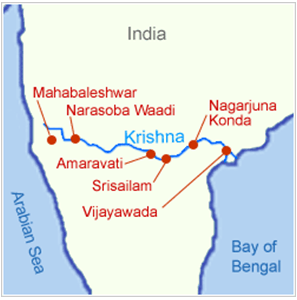
The Krishna river is an east-flowing river that originates in Mahabaleshwar, Maharashtra. 

  • It flows from Maharashtra, Karnataka, Telangana, and Andhra Pradesh.
  • The length of the river is around 1401 km long.
  • It is the fourth largest river in India after Ganga, Godavari, and Brahmaputra.
  • The left bank tributaries of Krishna are Bhima, Dindi, Paleru, and Musi.
  • Whereas its right bank tributaries are Koyana, Panchganga, Dudhganga, Malprabha, Ghatprabha, and Tungabhadra.
  • Tungabhadra is the largest tributary river of Krishna.

Krishna river basin :

Krishna River - GKToday

10

Where was the 2025 G7 Outreach Summit held?

  1. ((a))

    Paris

  2. ((b))

    Berlin

  3. ((c))

    Kananaskis

  4. ((d))

    Tokyo

Show Answer
Answer: ((c))

Kananaskis

The Correct Answer is Kananaskis.

In News

  • Prime Minister addresses the G7 Outreach Session.

Key Points

  • PM Narendra Modi attended the G7 Outreach Summit in Kananaskis, Canada.
  • This marks his 6th consecutive participation in the G7 Summit.
  • The 2025 summit theme focused on:
  • Protecting communities worldwide
  • Building energy security & digital transition
  • Securing future partnerships
  • The G7 (Group of Seven) is an informal grouping of 7 major economies and the European Union (as observer).
  • Founded in 1975 in response to the oil crisis, initially as G6 (France, Germany, Italy, Japan, UK, USA).
  • Canada joined in 1976, forming the G7.
  • Russia joined in 1998, creating the G8, but was excluded in 2014, returning to G7 format.
  • In 2025, the G7 marks 50 years of cooperation.
11

The minimum age required to become 'President' of India is:

  1. ((a))

    21 years

  2. ((b))

    25 years

  3. ((c))

    35 years

  4. ((d))

    45 years

Show Answer
Answer: ((c))

35 years

The correct answer is 35 years.

  • Article 58 of the Constitution sets the principal qualifications to eligibility for President of India.
  • The current President of India is Honourable Droupadi Murmu.
  • The Term of a President is of 5 years.
PostMinimum ageMaximum agePost holder (As of March 2026)
The President35 Years----Droupadi Murmu
The Vice-President35 Years----C. P. Radhakrishnan
Prime Minister25 Years----Narendra Modi
Chief Justice of India-----65 YearsJustice Surya Kant
Lok Sabha Speaker25 Years----Om Birla
12

Which one of the following sector provides highest employment in Indian economy?

  1. ((a))

    Industry sector

  2. ((b))

    Services sector

  3. ((c))

    Agriculture and allied activites

  4. ((d))

    Foreign sector

Show Answer
Answer: ((c))

Agriculture and allied activites

Agriculture and allied activities provide the highest employment in the Indian economy.

Important Points

  • In India, Agriculture employs 50%-60% of the population.
  • Agriculture is included in the primary sector.
  • It creates employment for most of the Indian population because despite employing the majority of the workforce, the agricultural region's extremely low GDP contribution is caused by its low productivity. As a result, even a large group of workers is unable to achieve an extremely high level of farm output that would add to GDP.

Additional Information

  • The eight-core sectors of the Indian economy are:
  • Electricity
  • Steel
  • Refinery products
  • Crude oil
  • Coal
  • Cement
  • Natural gas
  • Fertilizers
  • All the workers in these divisions can be grouped into three major sectors for the sake of simplicity:
  • the primary sector, which includes divisions (1) and (2)
  • the secondary sector, which includes divisions (3), (4), and (5); and
  • the service sector, which includes divisions (6), (7), and (8).
  • Only 24% of the workers are employed in the secondary industry.
  • About 31% of workers work in the service industry.
13

The largest tribal fair - "Baneshwar Fair" is organised on which date?

  1. ((a))

    Purnima of Chaitra month

  2. ((b))

    Purnima of Ashwani month

  3. ((c))

    Purnima of Bhadrapad month

  4. ((d))

    Purnima of Magha month

Show Answer
Answer: ((d))

Purnima of Magha month

The correct answer is ​Purnima of Magha month.

  • Baneshwar Fair:
  • The biggest tribal fair is held at Baneshwar at the confluence of Mahi, Som and Jhakham, which are believed to be holy rivers of the region.
  • A number of tribals from Madhya Pradesh, Gujarat and Rajasthan gather to immerse the mortal remains of the dead.
  • They worship, sing and dance on Magh Purnima, sometime in the month of February, which is considered to be a holy period in this region.
  • It starts in Magh Shukla Gyaras and Magh Krishna Panchami (the peak period of this fair is Magh Purnima).

Additional Information

FairDate (Tithi)
Baneshwar Fair (Dungarpur)Magh Purnima
Kapil Muni Fair and Pushkar FairKartik Purnima
Gautameshwar Fair (Pratapgarh)Vaisakh Purnima
Hanuman JayantiChaitra Purnima
Veer Teja Ji MelaBhadrapad Shukla dashmi to Purnima
HoliFalgun Purnima
Raksha BandhanShravan Purnima
Sharad PurnimaAshad Purnima
14

In which of the following states is Somnath temple situated?

  1. ((a))

    Maharashtra

  2. ((b))

    Karnataka

  3. ((c))

    Gujarat

  4. ((d))

    Madhya Pradesh

Show Answer
Answer: ((c))

Gujarat

The correct answer is Gujarat.

Key Points

  • Somnath is a magnificent temple situated in Sagar Kant of Saurashtra in Gujarat state.
  • One of the 12 holy Jyotirlingas of Lord Shiva is in Jyotirlinga here in Somnath. It is also mentioned in Rigveda.
  • In 649 AD, King Maitre of Vallabhini built a second temple in place of the temple and renovated it. In 725, the old ruler of Sindh took his army and attacked the temple and destroyed the temple.
  • Pratishtha King Nag Bhatt II constructed the temple for the third time in 815 using a red stone (sandstone).
  • In 1026, Mahmud Ghazni looted the precious jewels and property of Somnath temple.
  • During 1026-1042 Solanki Raja Bhimdev built the fourth temple of Bhoj and Anhilwad Patan, Parmar King of Malwa. In **1706, Mughal ruler Aurangzeb again demolished the temple.**​

Additional Information

     Famous temples

  • Karnataka- Virupaksha Temple and Vitthala Temple at Hampi, Gomateshwara Temple at Shravanbela Gola (Rural).
  • Madhya Pradesh-SanchiStupa at Raisen, Khajuraho Temple at Khajuraho, Mahakaleshwar at Ujjain, Omkareshwar temple at Khandwa.
  • Maharashtra- ShirdiSai Baba Temple at Shirdi, Siddivinayak Temple at Mumbai.
15

In which year was NABARD established?

  1. ((a))

    1979

  2. ((b))

    1981

  3. ((c))

    1978

  4. ((d))

    1982

Show Answer
Answer: ((d))

1982

NABARD(National Bank for Agriculture and Rural Development) was established in 1982.

  • It is an Apex Financial Institution for Growth in India.
  • It was formed to enforce the National Bank for Agriculture and Rural Development Act 1981 on 12 July 1982 on the recommendations of the B.Sivaramman Committee, (by Parliament Act 61, 1981).
  • It is the India's Agriculture and Rural Development Specialized Bank.
  • The headquarters is situated in Mumbai.
16

Who is the author of a book named "Godan"?

  1. ((a))

    Munshi Premchand

  2. ((b))

    Rabindranath Tagore

  3. ((c))

    Durga Das

  4. ((d))

    B.P Singh

Show Answer
Answer: ((a))

Munshi Premchand

  • Munshi Premchand was an Indian writer famous for his modern Hindi-Urdu literature.
  • Godan is a Hindi novel by Munshi Premchand, translated into English as The Gift of a Cow.
  • It was first published in 1936 and is considered one of the greatest Hindi novels of modern Indian literature
  • The real name of Munshi Premchand was - 

Dhanpat Rai Shrivastava.

17

The Pitts India Act of distinguished between the commercial and political functions of the British East India Company.

  1. ((a))

    1818

  2. ((b))

    1792

  3. ((c))

    1784

  4. ((d))

    1802

Show Answer
Answer: ((c))

1784

The correct answer is 1784

Key Points:

  • ​Pitt's India act of 1784 was passed to separate the commercial and political functions of the Company.
  • Pitt’s India act of 1784 created a new body named the Board of control which manages the political affairs.
  • Commercial affairs were managed by the Court of Directors.
  • By this act, the British government was given supreme control over the company's affairs and its administration in India.
  • The governor general council's strength was reduced to 3 members. One of the 3 would be Commander in chief of the British Crown's army in India.
  • The Governor-General was given the right of veto.
  • The Presidencies of Madras and Bombay became subordinate to the Bengal presidency
  • Calcutta became the capital of British India till 1911.
18

Recently the MISHTI Initiative has been news. It is related to which of the following?

  1. ((a))

    Skill Development

  2. ((b))

    Rural Development

  3. ((c))

    Mangroves Restoration

  4. ((d))

    Infrastructure Development

Show Answer
Answer: ((c))

Mangroves Restoration

The correct answer is option 3.

In News

  • BUDGET 2023-24: Finance minister announced the MISHTI initiative.

Key PointsMISHTI:

  • The MISHTI**, 'Mangrove Initiative for Shoreline Habitats & Tangible Incomes**,' comes after India joined the Mangrove Alliance for Climate launched during the 27th Conference of Parties (COP27) to the United Nations Framework Convention on Climate Change held in Egypt in November 2022.
  • Building on India’s success in afforestation, Finance Minister announced that ‘MISHTI’ will be taken up for mangrove plantation along the coastline and on salt pan lands, wherever feasible, through convergence between MGNREGS, CAMPA Fund and other sources. Hence option 3 is correct.
  • In India, the total mangrove cover is 4,992 square kilometres, according to the 2021 Forest Survey Report (FSR).
  • The country lost 40 per cent of its mangrove cover during the last century.
  • Kerala, for instance, lost 95 per cent of its mangroves in the last three decades.
  • This decline has been attributed to the conversion of the habitat to agriculture, aquaculture, tourism and urban development.
19

What is the position of Indian Railways among the world's largest railways?

  1. ((a))

    4

  2. ((b))

    5

  3. ((c))

    3

  4. ((d))

    1

Show Answer
Answer: ((a))

4

The correct answer is 4.

  • The Indian Railways is ranked 4th among the world's largest railways.

Key Points

  • Indian Railways:
  • Indian Railway Board was established in March 1905.
  • Indian Railway was nationalised in 1951.
  • Railways have been divided into 18th zones.
  • Southern Coast Railway was the 18th zone.
  • The first Indian railway line in India was operated for public traffic in 1853 between Mumbai and Thane over a distance of 34 km.
  • Ashwini Vaishnaw is the current Minister of Railways. (As per Jan 2022)
  • The first electric train ran in India with the inauguration of services between Bombay VT and Kurla Harbour on 3rd Feb 1925 on ex-GIP Railway system.
  • It is ranked 4th among the world's largest railways.
20

Which among the following will host the International Cricket Council (ICC) Women's T20 World Cup 2024?

  1. ((a))

    Bangladesh

  2. ((b))

    India

  3. ((c))

    Sri Lanka

  4. ((d))

    England

Show Answer
Answer: ((a))

Bangladesh

The answer is Bangladesh.

Key Points

  • The 2024 ICC Women's T20 World Cup will be hosted by Bangladesh.
  • The tournament is scheduled to take place between September and October 2024.
  • This will be the second time that Bangladesh has hosted the ICC Women's T20 World Cup, having previously done so in 2014.

Mistake Points

  • The ICC Men's T20 World Cup 2024 will be played in the West Indies and USA from 1-29 June 2024.

Additional Information 

  • The ICC Women's T20 World Cup is an international championship of Twenty20 International cricket for women.
  • It is organized by the International Cricket Council (ICC), the governing body of international cricket.
  • The inaugural tournament took place in England in 2009, coinciding with the men's T20 World Cup.
  • The tournament was initially held every two years, but from 2020 onwards, it is held every year except for the years when the Women's Cricket World Cup (50-over format) is scheduled.
  • The format of the tournament usually involves a round-robin group stage followed by knockout stages, leading to a final match to determine the world champion.
  • Australia has been the most successful team in the tournament's history, with multiple championship titles to their name.
  • The ICC Women's T20 World Cup is a major global event in women's cricket and plays a significant role in promoting and developing women's cricket worldwide.
  • It provides an international platform for female cricketers and has substantially increased the visibility and popularity of women's cricket.
21

Which two words were added to the Preamble in the 42nd amendment of 1976?

  1. ((a))

    Socialist and Secular

  2. ((b))

    Right to Education and Right to Information

  3. ((c))

    Labour and Law

  4. ((d))

    Economy and Social

Show Answer
Answer: ((a))

Socialist and Secular

The correct answer is Socialist and Secular.

Key Points

The 42nd Amendment Act:

  • It was enacted by Indian National Congress headed by Indira Gandhi
  • Words ‘Socialist’, ‘Secular’ and ‘Integrity’ were added in Preamble
  • The 42nd Amendment Act is also known as ‘Mini-Constitution'.
  • 10 Fundamental Duties added for the citizens after the 42nd Amendment Act
  • It also made President bound to the advice of the cabinet.

Additional Information

  • The Right to Education for all between 6 and 14 years of age has been included in Article 21-A of Fundamental Rights in the Constitution of India.
  • It was included in the Constitution through the 86th Amendment Act, 2002.
  • It provides the free and compulsory education of all children in the age group of six to fourteen years as a Fundamental Right.
  • ​RTI or Right to Information Act is a fundamental right and is an aspect of Article 19 (1)(a) of the Indian Constitution.
  • Right to Information replaced the Freedom of Information Act, 2002.
  • RTI helps Indians receive information about the government in a systemic, time-constrained, and hassle-free manner by enabling them to question certain delays in projects and accounts of spending from the taxpayer's money in various projects.
22

Who succeeded S. Somanath as the Chairman of ISRO starting January 14, 2025?

  1. ((a))

    A. S. Kiran Kumar

  2. ((b))

    V. Narayanan

  3. ((c))

    Meena Ganesh

  4. ((d))

    Dr. Shailesh Nayak 

Show Answer
Answer: ((b))

V. Narayanan

The correct answer is V. Narayanan.

In News

  • V. Narayanan took over as the Chairman of ISRO on January 14, 2025, succeeding S. Somanath.

Key Points

  • Dr. Narayanan is a noted rocket and spacecraft propulsion expert.
  • He has been heading ISRO’s Liquid Propulsion Systems Centre (LPSC) since January 2018.
  • His tenure as Chairman will include overseeing significant projects like Gaganyaan and Chandrayaan-4 missions.
  • He will also assume the role of Secretary, Department of Space, and Chairman of the Space Commission, effective from January 14, 2025.
  • He worked on Solid Propulsion for Rockets, ASLV, and PSLV at Vikram Sarabhai Space Centre.
  • Current Role: Director of LPSC , headquartered in Valiamala (Thiruvananthapuram).
  • Dr. Narayanan termed his upcoming role as “a great responsibility” and an “opportunity to follow in the footsteps of ISRO stalwarts.”

Additional Information

  • Gaganyaan Mission
  • A human spaceflight mission by ISRO aiming to send Indian astronauts into space.
  • Chandrayaan-4 Mission
  • A planned mission to explore the Moon, focusing on landing and collecting lunar data.
23

"Operation Flood" is a:

  1. ((a))

    Mission to increase performance of the dairy sector

  2. ((b))

    River Management Mission

  3. ((c))

    Mission to save rain water for irrigation

  4. ((d))

    Mission to increase underground water

Show Answer
Answer: ((a))

Mission to increase performance of the dairy sector

The correct answer is Mission to increase the performance of the dairy sector.


Additional Information

  • "Operation Flood" is a mission to increase the performance of the dairy sector.
  • Operation Flood was launched in 1970 by National Dairy Development Board during the time of the Fourth Five Year Plan.
  • Operation flood was the world's biggest dairy development program which gave a major thrust to the milk production of the nation.
  • It aimed at helping the dairy industry sustain itself economically while providing employment to poor farmers.
  • The result was that India became the largest producer of Milk and Milk Products.
  • White Revolution contributed to a large extent to alleviate poverty in India.
  • Gujarat-based co-operation “Anand Milk Union Limited” (Amul) was the engine behind the success of the programme.
  • Operation Flood is called the White Revolution in India.
  • The programme to increase the production of milk is called White Revolution.
  • Indian Dairy Association decided to observe the birthday of Verghese Kurien as National Milk Day.
  • 'Unfinished Dream' is a book written by Verghese Kurien.

Important Points

  • Father of White Revolution in India - Verghese Kurien.
  • Milkman of India - Verghese Kurien.
  • National Milk Day - November 26.
  • National Dairy Development Board - Anand (Gujarat).
  • National Dairy Research Institute - Karnal (Haryana).
  • The largest producer of Milk and Milk Products in the World - India.
24

Mahatma Gandhi launched Quit India Movement in 1942. Who was the Governor General at that time?

  1. ((a))

    Lord Mountbatten

  2. ((b))

    Lord Linlithgow

  3. ((c))

    Lord Curzon

  4. ((d))

    Lord Mayo

Show Answer
Answer: ((b))

Lord Linlithgow

The correct answer is Lord Linlithgow.

Key Points

  • In July 1942 Congress Working Committee met at Wardha and resolved to authorise Gandhi would lead non violent movement called Quit India Movement.
  • The Movement started on 8 August 1942.
  • Gandhi gave the famous slogan "Do or Die" during this movement.
  • Lord Linlithgow was Viceroy from 1936 to 1944.
  • August Offer in 1940 was also given by him.

Additional Information

 Lord Mountbatten

  • Lord Mountbatten is the last Viceroy of India and the first Governor-general of independent India from May 1947 to 1948.
  • He brought the Mountbatten plan or June 3rd plan which is responsible for the independence of India.
  • His major task was the immediate transfer of power to India.
  • After independence on 15 August, 1947 India requested Mountbatten to continue as Governor-general.

Lord Curzon (1899-1905)

  • Bengal partition took place during his tenure in 1905.
  • He passed Indian Universities Act in 1904.

Lord Mayo (1869-72)

  • Establishment of Statistical Survey of India during his tenure.
  • Lord Mayo, who was the Governor-General of India was assassinated in the Andaman.
  • He was assassinated by Sher Ali Afridi, an Afghan convict in 1872.
25

Tilaiya Dam is built on ________ river.

  1. ((a))

    Barakar

  2. ((b))

    Kolar

  3. ((c))

    Bokaro

  4. ((d))

    Koyna

Show Answer
Answer: ((a))

Barakar

The correct answer is Barakar River.

In News

  • Damodar Valley Corporation (DVC) held a consultation meeting to review the Emergency Action Plan (EAP) for Tilaiya Dam,as per Dam Safety Act of 2021 with key stakeholders.

Important Points

  • Tilaiya Dam was the 1st of the 4 multi-purpose dams included in the 1st phase of the Damodar Valley Corporation.
  • It was constructed across the Barakar River, at Tilaiya in Koderma district, Jharkhand and opened in 1953.

Key Points

  • The Barakar River is the main tributary of the Damodar river in eastern India.
  • It is a concrete gravity dam.
  • The dam is owned by Damodar Valley Corporation.
26

When was Bihar separated from Bengal?

  1. ((a))

    1910

  2. ((b))

    1911

  3. ((c))

    1915

  4. ((d))

    1912

Show Answer
Answer: ((d))

1912

The correct answer is 1912.

Explanation:

  • On 22 March 1912, both Bihar and Orissa were separated from Bengal and became Bihar and Orissa Province.
  • On 12 December 1911, the king Emperor at Delhi announced the creation of Bihar and Orissa with Patna as its capital.
  • The movement for separation of Bihar was pioneered by English - educated Biharis. The prominent leaders were  Sachchidanand Sinha, Mukesh Narayan, Syed Hasan Imam, Mazhar ul Haq, Deep Narayan Singh, Rajendra Prasad, Shri Krishna Singh etc.
  • In 1906, Shri Mahesh Narayan and Sachchidanand Sinha brought out a booklet named "The Partition of Bengal or Separation of Bihar" which was circulated in India and England. The booklet educated the public opinion in Indian and especially in Bihar and Bengal.
27

The Article of the Constitution of India, that states that there will be President rule on any state of India is:

  1. ((a))

    370

  2. ((b))

    356

  3. ((c))

    350

  4. ((d))

    342

Show Answer
Answer: ((b))

356

The correct answer is 356.

Key Points

  • Article 356 of the Indian Constitution allows the imposition of President's Rule in a state if the state government is unable to function as per constitutional provisions.
  • This provision is invoked when there is a failure of constitutional machinery in a state.
  • Under Article 356, the President of India can assume the functions of the state government and legislature.
  • This article is often referred to as the "State Emergency" or "President's Rule" and is part of the emergency provisions in the Indian Constitution.
  • The Governor of the state submits a report to the President recommending the imposition of President's Rule.

Additional Information

  • President's Rule:
  • During President's Rule, the state legislature is either dissolved or suspended, and the central government governs the state directly through the Governor.
  • It requires the approval of both houses of Parliament within two months of its imposition.
  • The rule is valid for a maximum of six months, but it can be extended up to three years with parliamentary approval every six months.
  • Historical Context:
  • Article 356 has been controversially invoked multiple times, and its misuse has been criticized as a tool to dismiss state governments run by opposition parties.
  • The S.R. Bommai case (1994) laid down strict guidelines for its use and limited the scope of arbitrary imposition.
  • Other Emergency Provisions:
  • Article 352: National Emergency, declared during war or external aggression.
  • Article 360: Financial Emergency, declared when the financial stability or credit of India is threatened.
  • Role of the Judiciary:
  • The judiciary has the power to review the imposition of President's Rule to ensure that it is not arbitrary or politically motivated.
  • The S.R. Bommai judgment emphasized that the majority in the state legislature should be tested on the floor of the house, not arbitrarily decided by the Governor.
28

Which of these was the capital of Anga Mahajanapada?

  1. ((a))

    Videha

  2. ((b))

    Champa

  3. ((c))

    Varanasi

  4. ((d))

    Mathura

Show Answer
Answer: ((b))

Champa

  • Champa or Champanagari was the capital of the Anga Mahajanapada.
  • Anga comprised of modern districts of Bhagalpur and Munger in Bihar.
CapitalMahajanapada
VidehaVajji
ChampaAnga
VaranasiKashi
MathuraSurasena
29

Where is the Kandariya Mahadev Temple located?

  1. ((a))

    Madhera

  2. ((b))

    Khajuraho

  3. ((c))

    Aurangabad

  4. ((d))

    Devgarh

Show Answer
Answer: ((b))

Khajuraho

The Correct Answer is Khajuraho.

Key Points

  • The Kandariya Mahadeva Temple:
  • The Kandariya Mahadeva Temple "the Great God of the Cave" is the largest and most ornate Hindu temple in the medieval temple group found at Khajuraho in Madhya Pradesh. Hence, Option 2 is correct.
  • Kandariya Mahadeo temple at Khajuraho is the epitome of temple architecture in Central India.
  • The Kandariya Mahadeva temple was built during the reign of Vidyadhara (r. c. 1003-1035 CE).
  • Khajuraho’s temples are also known for their extensive erotic sculptures.
  • The Lakshmana temple of Khajuraho, dedicated to Vishnu, was built in 954 by the Chandela king, Dhana.
  • It is a nagara temple placed on a high platform accessed by stairs.
30

The DhuanDhar Falls is formed by the river ________.

  1. ((a))

    Narmada

  2. ((b))

    Tapi

  3. ((c))

    Sabarmati

  4. ((d))

    Mahi

Show Answer
Answer: ((a))

Narmada

  • Formed by River Narmada, the Dhuandhar falls is a waterfall that is located in the Jabalpur district of Madhya Pradesh.
  • The name of the falls is derived from two words, "Dhuan", which means smoke, and "Dhar", which means flow.
  • It is so named because the plunge creates a mist that looks like smoke.
  • Narmada river originates from Amarkantak, rises from the Maikal ranges.
  • Amarkantak is located in the Anupprur district of Madhya Pradesh in India.
  • Narmada river mainly flows in central India.
  • The Madhya Pradesh government passed a resolution granting river Narmada the status of a living entity and committed itself to the protection of its legal rights.
  • A month ago, the Uttarakhand High Court had declared Ganga, Yamuna, and their tributaries living entities with the status of a legal person. The move is done to protect the river and biodiversity.


Dhuandhar fallsNarmada river, Madhya Pradesh
Hundru fallsSubarnarekha river, Ranchi
Jog fallsSharavati river, Karnataka
31

In which year did the First World War start?

  1. ((a))

    1905

  2. ((b))

    1927

  3. ((c))

    1935

  4. ((d))

    1914

Show Answer
Answer: ((d))

1914

The correct answer is 1914.

**Key Points:**First World War:

  • ​The First World War originated in Europe.
  • It took place from 28 July 1914 to 11 November 1918.
  • It is considered as one of the largest wars in history and also contemporarily described as the War to End All Wars.
  • This Great War started when Hungary-Austria declared war on Serbia.
  • This is one of the largest wars in World History in which more than 60 million European people including 70 million military personnel, were mobilized.
  • The cost lives of the war are over 7 million civilians & 9 million combatants.
  • The war is the deadliest & brutal conflict that happened in world history.
  • It changed the political scenario of the world and also generated a significant number of revolutions in many of the involved nations.
  • It was followed by the Second World War 20 years later.
32

Who chaired the first session of the Indian National Congress held at Bombay?

  1. ((a))

    Madan Mohan Malavya

  2. ((b))

    W.C. Banerjee

  3. ((c))

    Pherozeshah Mehta

  4. ((d))

    Surendranath Banerjee

Show Answer
Answer: ((b))

W.C. Banerjee

The correct answer is W.C. Banerjee.

Key Points

  • Womesh Chunder Bonnerjee (or Umesh Chandra Banerjee in modern English transcription of Bengali names) was a lawyer in India.
  • He co-founded and served as the first president of the Indian National Congress.
  • From December 28 to December 31, 1885, he presided over the first session of the Indian National Congress, which was held in Bombay.
  • He recommended the foundation of standing committees of the Congress in each province for better coordination of its activity at the 1886 session in Calcutta, and it was at this time that he advocated that the Congress should limit its activities to political problems solely.
33

Bishkek is the capital of which country?

  1. ((a))

    Uzbekistan

  2. ((b))

    Kyrgyzstan

  3. ((c))

    Kazakhstan

  4. ((d))

    Tajikistan

Show Answer
Answer: ((b))

Kyrgyzstan

The correct answer is Kyrgyzstan.

Key Points

  • Kyrgyzstan:
  • ​Capital - Bishkek
  • Currency - Kyrgyzstani som
  • President - Sadyr Japarov
  • Prime Minister - Ulukbek Maripov
  • Kyrgyzstan is a landlocked country in Central Asia
  • ​​Kyrgyzstan is also referred to as "the Switzerland of Central Asia".

Additional Information

CountryCapitalCurrency
UzbekistanTashkentUzbekistan Som
KazakhstanNur-SultanTenge
TajikistanDushanbeSomoni
34

In which year was the Treaty of Versailles signed?

  1. ((a))

    1921

  2. ((b))

    1919

  3. ((c))

    1933

  4. ((d))

    1940

Show Answer
Answer: ((b))

1919

The correct answer is 1919.

Key Points

  • The Treaty of Versailles was the most important of World War I's peace treaties.
  • It brought the war between Germany and the Allies to an end.
  • It was signed in the Palace of Versailles on June 28, 1919, exactly five years after Archduke Franz Ferdinand was assassinated, sparking the war.
  • On the German side, the other Central Powers signed separate treaties. Although the 11 November 1918 armistice halted the war, the peace accord took six months of Allied negotiations at the Paris Peace Conference.
  • On October 21, 1919, the League of Nations Secretariat registered the treaty.
  • The Locarno Treaties, which improved relations between Germany and other European powers, and the re-negotiation of the reparation system, which resulted in the Dawes Plan, the Young Plan, and the indefinite postponement of reparations at the Lausanne Conference of 1932, were the results of the treaty's problems.

Important Points

  • Treaty of Versailles:
  • Signed: 28 June 1919
  • Location: Hall of Mirrors in the Palace of Versailles, Paris, France
  • Effective: 10 January 1920
  • Signatories:
  • Principal Allied and Associated Powers
  • Allied and Associated Powers
35

Which of the following is the largest tiger reserve in India?

  1. ((a))

    Orang Tiger Reserve

  2. ((b))

    Srisailam (Andhra Pradesh)

  3. ((c))

    Hemis (Jammu Kashmir)

  4. ((d))

    South Button (Andaman and Nicobar)

Show Answer
Answer: ((b))

Srisailam (Andhra Pradesh)

The correct answer is Option 2 i.e. Srisailam (Andhra Pradesh)

  • India's largest tiger reserve in Srisailam, Andhra Pradesh, Whereas South Button (Andaman Nicobar) is known as the smallest national park.
  • The largest national park is Hemis (Ladakh).
  • The multipurpose reservoirs- Srisailam and Nagarjunasagar are located in the reserve.
  • The Krishna river cuts the basin of this reserve.
  • Orang national park is located in Assam.
  • Jim Corbett National park (Uttarakhand) was the first national park in India.
36

The famous CK nayudu Trophy is associated with which sport?

  1. ((a))

    Badminton

  2. ((b))

    Hockey

  3. ((c))

    Lawn Tennis 

  4. ((d))

    Cricket

Show Answer
Answer: ((d))

Cricket

The correct answer is Cricket.

Key Points

  • The CK Nayudu Trophy is one of India's premier domestic cricket tournaments, specifically organized for under-23 players.
  • It is named after Colonel Cottari Kanakaiya Nayudu, who is recognized as India's first Test cricket captain.
  • The tournament serves as a platform for young cricketers to showcase their skills and gain selection for higher levels of professional cricket.
  • The Board of Control for Cricket in India (BCCI) is responsible for organizing and managing the CK Nayudu Trophy.
  • CK Nayudu's contributions to Indian cricket are considered legendary, and this tournament honors his legacy by nurturing emerging talent.

Additional Information

  • Colonel CK Nayudu:
  • Born on 31 October 1895, CK Nayudu was the first cricketer to captain India in a Test match.
  • He played India's inaugural Test against England at Lord's in 1932.
  • Nayudu was known for his aggressive batting style and outstanding leadership qualities, earning him the title of "Father of Indian Cricket."
  • BCCI Domestic Tournaments:
  • India has a robust domestic cricket structure managed by the BCCI, including tournaments like the Ranji Trophy, Vijay Hazare Trophy, and Syed Mushtaq Ali Trophy.
  • These tournaments aim to nurture local talent and provide a pathway to the national team.
  • Importance of Under-23 Cricket:
  • Under-23 tournaments like the CK Nayudu Trophy are crucial for identifying and developing young talent.
  • Players who excel in such tournaments often transition to higher levels, including IPL and the Indian national team.
  • Legacy of Indian Cricket:
  • Cricket is considered the most popular sport in India, with a rich history dating back to the colonial era.
  • The country has produced legendary cricketers like Sachin Tendulkar, Kapil Dev, and MS Dhoni.
37

In Bareilly, the revolt of 1857 was led by _________________.

  1. ((a))

    Khan Bahadur

  2. ((b))

    Rani Lakshmi Bai

  3. ((c))

    Tatya Tope

  4. ((d))

    Maulvi Ahmad Shah

Show Answer
Answer: ((a))

Khan Bahadur

The correct answer is Khan Bahadur.

Key Points

  • Khan Bahadur Khan Rohilla was born in 1823.
  • In the revolt of 1857, he formed his Government to fight against the British.
  • When his territory was subjugated, he was captured by Nepalese and was sent to the British. He was sentenced to death in Kotwali on 24 February 1860.

Important Points

  • Rani Lakshmi Bai -
  • She was one of the prominent leaders in the first war of independence.
  • She is known for her fighting spirit and leadership qualities.
  • During the annexation of her territory due to the Doctrine of Lapse, she said: "I shall not surrender my Jhansi".
  • Sir Huge Rose, who led the British against her said that she is the only man among the mutineers.
  • Tatya Tope - 
  • Tatya Tope was born in 1814 in Yeola.
  • His full name is Ramchandra Panduranga Tope.
  • He led the revolt of 1857 from Kanpur.
  • He was defeated by Sir Colin Campbell.
  • Maulvi Ahmad Shah -
  • Maulvi Ahmadullah Shah led the revolt of 1857 from Awadh.
  • He is also known as the Lighthouse of rebellion in the Awadh region.
  • He belongs to the 22nd Infantry Regiment.
38

The Shanti Swaroop Bhatnagar Award is given in India for contribution to the field of:

  1. ((a))

    sports

  2. ((b))

    social work

  3. ((c))

    science and technology

  4. ((d))

    literature

Show Answer
Answer: ((c))

science and technology

The correct answer is science and technology.

Key Points

  • Shanti Swarup Bhatnagar award is given for outstanding contributions to the field of science and technology
  • Shanti Swaroop Bhatnagar was an Indian colloid chemist.
  • He was the first director-general of the Council of Scientific and Industrial Research (CSIR).
  • He is popularly called the "father of research laboratories" in India.
  • It was first awarded in 1958.
  • It is awarded annually by the Council of Scientific and Industrial Research.
  • It is awarded for outstanding contributions in the following disciplines:
  • Biological Sciences
  • Chemical Sciences,
  • Earth, Atmosphere, Ocean and Planetary Sciences
  • Engineering Sciences,
  • Mathematical Sciences,
  • Medical Sciences
  • Physical Sciences.
  • 14 scientists were honored with the Shanti Swarup Bhatnagar Prize 2020.
39

Triveni canal has been constructed on which of the following rivers?

  1. ((a))

    Ganga

  2. ((b))

    Punpun

  3. ((c))

    Gandak

  4. ((d))

    Son

Show Answer
Answer: ((c))

Gandak

  • Triveni Canal has been constructed on river Gandak.
  • It is mainly used for irrigation in north-west Bihar.
  • Gandak is a left bank tributary of Ganges.
  • Gandak originates from Nhubine Himal Glacier.
  • Gandak is also called Narayani river.
40

Who among the following is the first chairman of the Union Public Service Commission?

  1. ((a))

    Sir Ross Barker

  2. ((b))

    Sir F W Robertson

  3. ((c))

    Sir Erwin John

  4. ((d))

    None of the above

Show Answer
Answer: ((a))

Sir Ross Barker

The correct answer is option 1 i.e. Sir Ross Barker.

  • Sir Ross Barker is the first chairman of the UPSC.
  • He assumed charge in October 1926 when it was the Public Service Commission and demitted office in August 1932.
  • The Current Chairman of Union Public Service Commission is Dr. Manoj Soni.
41

Who was selected as the Brand Ambassador for the upcoming Kohliya Udyan 2024 event in Bihar?

  1. ((a))

    Meenakshi Thakur

  2. ((b))

    Tejaswi Yadav

  3. ((c))

    Anand Kumar

  4. ((d))

    Mithun Prasad

Show Answer
Answer: ((c))

Anand Kumar

The correct answer is Anand Kumar.

In News

  • Anand Kumar was chosen as the Brand Ambassador for Kohliya Udyan 2024 in Bihar.

Key Points

  • The announcement was made during a special event on August 23, 2024.
  • Kohliya Udyan 2024 is expected to promote tourism and cultural activities in Bihar.
  • Anand Kumar is known for his contributions to education and social upliftment.
  • His role as a Brand Ambassador aims to inspire and attract attention to the event.

Additional Information

  • Brand Ambassador
  • A brand ambassador is a person who is chosen to represent a brand and promote its products or events.
  • They often help increase visibility and attract a specific audience through their reputation and influence.
  • Kohliya Udyan 2024
  • This event aims to showcase the culture, tourism, and development initiatives in Bihar.
  • It serves as a platform for promoting local heritage and attracting investment in the region.
  • Anand Kumar
  • Anand Kumar is an Indian educator and mathematician known for his initiative Super 30, which prepares underprivileged students for entrance exams.
  • He has gained national and international acclaim for his innovative teaching methods and contributions to education.
42

The Ashokan edicts, found in places like Vaishali and Nandangarh in Bihar, were inscribed in which language?

  1. ((a))

    Sanskrit

  2. ((b))

    Prakrit

  3. ((c))

    Pali

  4. ((d))

    Brahmi

Show Answer
Answer: ((b))

Prakrit

The correct answer is Prakrit

Key Points

  • The Ashokan edicts were inscribed in Prakrit language.
  • Prakrit was the vernacular language during Ashoka's reign and was used for communicating with the common people.
  • The script used for the inscriptions is known as Brahmi.
43

Match List I with List II

List IList II
(A)India wins freedomI.R K Narayan
(B)The guideII.Mahatma Gandhi
(C)India from midnight to MilleniumIII.Abul Kalam Azad
(D)conquest of selfIV.Shashi Tharoor
<br>

Choose the most appropriate answer from the options given below:

  1. ((a))

    A - I, B - III, C - IV, D - II

  2. ((b))

    A - III, B - I, C - IV, D - II

  3. ((c))

    A - III, B - I, C - II, D - IV

  4. ((d))

    A - I, B - IV, C - II, D - III

Show Answer
Answer: ((b))

A - III, B - I, C - IV, D - II

The correct answer is A - III, B - I, C - IV, D - II

  • India Wins Freedom:
  • The book 'India Wins Freedom' was written by Maulana Abul Kalam Azad, a prominent Indian independence activist and scholar.
  • About the Book 'India Wins Freedom' is an autobiographical account by Maulana Azad that provides his personal perspective on the Indian independence movement and the partition of India.
  • Azad's Role in Indian Independence Maulana Azad was a senior leader of the Indian National Congress and played a significant role in the Indian independence movement.
  • The Guide:
  • The Guide is a 1958 novel written in English by the Indian author R. K. Narayan.
  • Narayan is known for his works set in the fictional town of Malgudi in South India.
  • Plot Summary The Guide follows the story of Raju, a tour guide in the fictional town of Malgudi.
  • The novel explores Raju's transformation from a charming con man to a holy man, and the complex relationships and moral dilemmas he faces.
  • Narayan's Acclaimed Works In addition to The Guide, R.K. Narayan is widely acclaimed for other novels set in Malgudi, such as Swami and Friends, The Financial Expert, and The English Teacher.
  • His works are known for their insightful portrayal of Indian culture and human nature.
  • India from midnight to Millenium:
  • "India: From Midnight to the Millennium" is a book written by Shashi Tharoor, an Indian politician and diplomat, in 1997.
  • The book explores India's journey from gaining independence at midnight in 1947 to the turn of the millennium.
  • Conquest of Self:
  • 'Conquest of Self' This book contains Mahatma Gandhi's 1943 work, "Conquest Of Self".
  • It is an inspiring text that explores Gandhi's beliefs and the work he did.
  • Gandhi's Spiritual Journey Gandhi's "Conquest of Self" is considered one of his most significant works, as it delves into his spiritual and philosophical journey towards self-realization and inner peace.
44

In which year was Project Tiger launched?

  1. ((a))

    1995

  2. ((b))

    1975

  3. ((c))

    1973

  4. ((d))

    1970

Show Answer
Answer: ((c))

1973

The correct answer is 1973

Key Points

  • Project Tiger was launched in India in the year 1973.
  • The project aims at ensuring a viable population of Bengal tigers in their natural habitats and to protect them from extinction.
  • It is one of the most significant wildlife conservation initiatives in India, and has helped in the establishment and maintenance of numerous tiger reserves.
  • The project is administered by the National Tiger Conservation Authority (NTCA).
  • Project Tiger has played a crucial role in increasing the population of tigers in India through stringent protection measures and habitat management.

Additional Information

  • The first tiger reserve established under Project Tiger was the Jim Corbett National Park in Uttarakhand.
  • As of now, there are 57 tiger reserves across India, covering an area of approximately 72,749 square kilometers.
  • The success of Project Tiger has inspired other wildlife conservation projects in India.
  • Despite the challenges, the project continues to be a beacon of hope for tiger conservation worldwide.
45

Nitish inaugurates bridge over Ganges, linking Patna with Tejashwi Yadav’s turf. What is the length of the newly inaugurated bridge?

  1. ((a))

    2.57 km

  2. ((b))

    3.87 km

  3. ((c))

    4.57 km

  4. ((d))

    5.67 km

Show Answer
Answer: ((c))

4.57 km

The Correct Answer is 4.57 km.

In News

  • Nitish inaugurates bridge over Ganges, linking Patna with Tejashwi Yadav’s turf.

Key Points

  • Bihar Chief Minister Nitish Kumar inaugurated a six-lane bridge over the Ganga River.
  • The bridge connects Patna with Raghopur, a stronghold of RJD chief Lalu Prasad, Kumar’s political rival.
  • The bridge is 4.57 km long.
  • The inauguration took place near Kachchi Dargah, located on Patna's eastern fringes.
  • This is a significant step toward improving infrastructure and connectivity in the region.
46

Brinjal belongs to which of the following family of Flowering plants?

  1. ((a))

    Cucurbitaceae

  2. ((b))

    Solanaceae

  3. ((c))

    Gramineae

  4. ((d))

    Compositae

Show Answer
Answer: ((b))

Solanaceae

Family of Flowering PlantExamples
SolanaceaePotato, Tomato, Brinjal, Tobacco, etc.
CucurbitaceaePumpkin, Watermelon, Melon, etc.
GramineaeCereals, Millets, etc.
CompositaeSunflower, Marigold, Lettuce, etc.
47

What is the molecular weight of heavy water?

  1. ((a))

    16

  2. ((b))

    18

  3. ((c))

    22

  4. ((d))

    20

Show Answer
Answer: ((d))

20

The correct answer is 20.

CONCEPT:

  • Heavy water: It is a form of water that contains only deuterium rather than the common hydrogen-1 isotope that makes up most of the hydrogen in normal water.
  • Formula: D2O
  • Boiling point:101.4 °C
  • Molar mass: 20 gm/mole
  • Melting point: 3.8 °C
  • Density: 1.11 gm/cm3
  • Refractive index:1.328

EXPLANATION:

  • Heavy water has deuterium(D) which is an isotope of hydrogen.
  • While hydrogen has 1 proton and 0 neutrons in its nucleus giving it an atomic weight of 1deuterium has 1 proton and 1 neutron in its nucleus.
  • So deuterium has atomic weight 2.
  • So heavy water, which has molecular formula D2O, has molecular mass = 16(for oxygen)+(2× 2)(for two deuteriums)= 20
48

What is the SI unit of weight?

  1. ((a))

    Gram

  2. ((b))

    Kg

  3. ((c))

    Newton

  4. ((d))

    Dyne

Show Answer
Answer: ((c))

Newton

The correct answer is Newton.

Key Points

  • Weight is defined as the force of gravity on an object.
  • It is denoted by the formula: W = mg, where W= Weight, m = Mass of the object and g = Gravitational Acceleration
  • Since weight is actually a force, the S.I. unit of weight is Newton.

Additional Information

Here are the few fundamental units given in the table:

Physical QuantitySI UnitSymbol
TimeSeconds
Electric CurrentAmpereA
LengthMetrem
MassKilogramKg
Amount of substancemolemol
TemperatureKelvinK
Luminous intensitycandelaCd
49

Identify an example of connective tissue in humans.

  1. ((a))

    Bone

  2. ((b))

    Muscles

  3. ((c))

    Cell

  4. ((d))

    Fibres

Show Answer
Answer: ((a))

Bone

  • Bone is an example of connective tissue in humans.
  • Connective tissue in humans includes fibrous tissues, fat, cartilage, bone, bone marrow, and blood.
  • Connective tissue binds other organs together and fills space.
50

In a neutralisation reaction, a new substance is formed, called _____.

  1. ((a))

    washing soda

  2. ((b))

    baking soda

  3. ((c))

    pepper

  4. ((d))

    salt

Show Answer
Answer: ((d))

salt

The correct answer is Salt.

Key Points

  • The neutralization reaction is the reaction between an acid and a base where both neutralise the effect of each other.
  • In this reaction, heat is always produced, or evolved.
  • In the neutralisation reaction, a new substance is formed is called salt.
  • Acid+Base → Salt+Water (Heat is evolved)
  • For example - Hydrochloric acid (HCl) + Sodium hydroxide (NaOH) →Sodium chloride (NaCl) + Water (H2O).

Additional Information

SubstanceChemical FormulaUse
Washing sodaNa₂CO₃Removes stains, Removes greasy build-up in pots and Unclogs drains.
Baking sodaNaHCO₃Mouthwash, Teeth whitener and Deodorant
PepperC17H19NO3High in antioxidants, lower cholesterol levels and anti-inflammatory properties
51

Which of the following states has maximum SC population in India?

  1. ((a))

    Uttar Pradesh

  2. ((b))

    Bihar

  3. ((c))

    Tamil Nadu

  4. ((d))

    None of the above

Show Answer
Answer: ((a))

Uttar Pradesh

The correct answer is  Uttar Pradesh.

Key Points

  • The state that has the maximum SC population in India is Uttar Pradesh.
  • Uttar Pradesh has 16.6% of India's SC population.
  • 20.69% of UP's population is SC.
  • The Sitapur district of Uttar Pradesh is having a maximum SC population.
  • The Bagpat district of Uttar Pradesh is having a minimum SC population.
  • The district of Sonbhadra is having a maximum ST population.
StateSC population
Uttar Pradesh41,357,608
Bihar16,567,325
West Bengal21,463,270
Tamil Nadu14,438,445
Andhra Pradesh13,878,078
52

Which of the following plants belongs to Bryophyta?

  1. ((a))

    Marsilea

  2. ((b))

    Deodar

  3. ((c))

    Cladophora

  4. ((d))

    Marchantia

Show Answer
Answer: ((d))

Marchantia

The correct answer is Marchantia.

Key Points

  • Bryophyte
  • It is the collective term for mosses, hornworts, and liverworts.
  • These are non-vascular plants.
  • They play a vital role in regulating ecosystems because they provide an important buffer system for other plants, which live alongside and benefit from the water and nutrients that bryophytes collect.
  • Many bryophytes are found in association with freshwater.
  • Marchantia genus belongs to Bryophyta. It is mainly confined to temperate regions and is found to grow in moist, cool, and shady places.

Additional Information

  • Marsilea belongs to Polypodiophyta.
  • Deodar belongs to Pinophyta.
  • Cladophora belongs to Chlorophyta
53

Match the following:

(a) Heart(i) Expand & contract
(b) Friction(ii) Necessary evil
(c) Condensation(iii) Pump
(d) Lungs(iv) Cooling of gas into liquid
<br>

Which of the following is the correct match?

  1. ((a))

    a-ii, b-i, c-iji, d-iv

  2. ((b))

    a-iii, b-ii, c-iv, d-i

  3. ((c))

    a-iii, b-i, c-ii, d-iv

  4. ((d))

    a-i, b-ii, c-iv, d-iii

Show Answer
Answer: ((b))

a-iii, b-ii, c-iv, d-i

Explanation:

Heart:

  • The heart is the busiest organ of the human body.
  • The human heart is about the size of a fist.
  • The human heart has four chambers which include the right atrium, right ventricle, left atrium, and left ventricle.
  • The circulation of blood in the body is regulated by the heart.
  • The heart is a muscular organ that pumps blood through the blood vessels of the circulatory system.
  • In humans, the heart is located between the lungs in the middle compartment of the chest.
<br>

Friction:

  • The property of a surface that opposes the relative motion between two surfaces is called friction.
  • Friction opposes the relative motion between two surfaces.
  • It is denoted by f and the SI unit of the frictional force is Newton (N).
  • Friction (f) = μ N, where μ is the coefficient of friction and N is the normal force.
  • The frictional force causes a lot of losses in general upkeep and wear and tear of machinery, hence it is called evil.
  • But almost all crucial tasks cannot be carried out without the presence of friction.
  • Basic activities like walking and writing on a surface are possible only due to friction.
  • Hence it is considered a necessary evil.

Condensation:

  • Condensation refers to the process of water vapour (gas) converts into water (liquid).
  • This occurs when the 'hot air' meets a 'cold surface'.
  • When the heat in the air decreases due to various reasons, the condensation process occurs.
<br>

Lungs:

  • The lungs are a pair of spongy, air-filled organs located on either side of the chest (thorax).
  • Humans have two lungs as the primary organs of the respiratory system.
  • When a person exhales, the size of the chest cavity reduces and the lungs contract.
  • When a person inhales, the chest cavity size increases and the lungs expand.
  • The function of the lungs is to extract oxygen from the atmosphere and circulate it into the bloodstream.
  • They also release carbon dioxide into the atmosphere from the bloodstream.
<br>

Thus, the correct match is:

(a) Heart(iii) Pump
(b) Friction(ii) Necessary evil
(c) Condensation(iv) Cooling of gas into liquid
(d) Lungs(i) Expand & contract
54

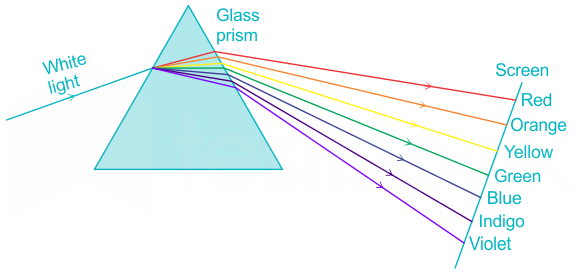
Which colour among the seven colours of white light gets least deviated after dispersion of light through a glass prism?

  1. ((a))

    Red

  2. ((b))

    Indigo

  3. ((c))

    Orange

  4. ((d))

    Violet

Show Answer
Answer: ((a))

Red

CONCEPT:

Dispersion of light:

  • Dispersion of light is the phenomenon of splitting of a beam of white light into its constituent colours on passing through a prism.
  • The band of seven colours so obtained is called the (visible) spectrum.
  • The dispersion of white light occurs because the colours of white light travel at different speeds through the glass prism.

EXPLANATION:

  • When the dispersion of white light takes place through a prism, the maximum deviation is suffered by violet colour and the minimum deviation suffered red colour. Therefore option 1 is correct.
55

Match list I (names of Scientists) with list II (laws of Physics) and select the correct answer using the codes given below the lists

List IList II
A.Heisenberg1.Laws of Motion
B.Einstein2.Laws of Planetary Motion
C.Newton3.Photoelectric effect
D.Kepler4.Uncertainty Principle
  1. ((a))

    A-1, B-2, C-3, D-4

  2. ((b))

    A-2, B-1, C-3, D-4

  3. ((c))

    A-3, B-1, C-4, D-2

  4. ((d))

    A-4, B-3, C-1, D-2

Show Answer
Answer: ((d))

A-4, B-3, C-1, D-2

The correct answer is A-4, B-3, C-1, D-2.

Concept:

Laws of Motion:

  • The ‘Laws of Motion’ were first compiled by Isaac Newton in 1687.
  • There are three laws of motion given in the theory by Newton.
  • According to Newton’s first law of motion, an object will remain at rest or in uniform motion in a straight line unless acted upon by an external force.
  • Newton’s second law of motion states that for a constant mass, force is equal to the product of mass and acceleration.
  • Newton’s Third Law: To every action, there is always an equal (in magnitude) and opposite (in direction) reaction.

Laws of Planetary Motion:

Kepler's three laws of planetary motion can be described as follows:

  • The path of the planets about the sun is elliptical in shape, with the center of the sun being located at one focus.
  • An imaginary line drawn from the center of the sun to the center of the planet will sweep out equal areas in equal intervals of time.
  • The ratio of the squares of the periods of any two planets is equal to the ratio of the cubes of their average distances from the sun.

Photoelectric effect:

  • It is a phenomenon where electrons are ejected from a metal surface when the light of sufficient frequency is incident on it.
  • The photoelectric effect was discovered by Heinrich Rudolf Hertz. When ultraviolet light was incident on two metal electrodes with a voltage applied across them, Hertz observed that the light changed the voltage at which sparking takes place.
  • This gave him the idea of light-emitting electrons from a metal surface.
  • ​Einstein later suggested that light behaved like a particle and that each particle of light had energy called the photon.

Uncertainty Principle:

  • W Heisenberg a German physicist in 1927, stated the uncertainty principle which is the consequence of dual behavior of matter and radiation.
  • It states that it is impossible to determine simultaneously, the exact position and exact momentum (or velocity) of an electron.

Explanation:

  • From the above it's clear that the Law of motion was given by Issac Newton, then the Law of planetary motion was given by Kelper and the Photoelectric effect was given by Heinrich Rudolf Hertz, and the Uncertainty Principle was given by W.Heisnberg.
  • So, the correct pair of the option is A-4, B-3, C-1, D-2.

Important Points

  • Kepler's three laws are sometimes also called:
  • The Law of Ellipses
  • The Law of Equal Areas
  • The Law of Harmonies
56

‘Sericulture’ is related to the:

  1. ((a))

    Growing of fruits

  2. ((b))

    Production of jute

  3. ((c))

    Rearing of silkworms

  4. ((d))

    Rearing of honey bees

Show Answer
Answer: ((c))

Rearing of silkworms

The correct answer is the rearing of silkworms.

Key Points

  • Sericulture is related to the rearing of silkworms.
  • Sericulture is an agro-based industry.
  • It involves the rearing of silkworms for the production of raw silk.
  • India is the second-largest producer of silk within the globe.
  • Silk is a fiber made up of two different proteins:
  • Sericin protein
  • Fibroin protein

Additional Information

CultureRelated
ApicultureBee farming
FloricultureFlower farming
HorticultureVegetable farming
PiscicultureFish farming
VermicultureEarthworm farming
ViticultureGrapes farming
Fungi cultureMushroom farming
57

Which of the following metals is the most ductile metal?

  1. ((a))

    Silver

  2. ((b))

    Platinum

  3. ((c))

    Copper

  4. ((d))

    Gold

Show Answer
Answer: ((d))

Gold

Option 4 is correct, i.e. Gold.

  • The ability of metals to be drawn into thin wires is called ductility.
  • Gold is the most ductile metal.
  • A wire of about 2 km length can be drawn from one gram of gold.
  • It is because of their malleability and ductility that metals can be given different shapes according to our needs.

Ductility:

  • Ductility is the property of the material that enables it to be drawn out or elongated to an appreciable extent before rupture occurs.
  • The percentage elongation or percentage reduction in the area before the rupture of a test specimen is the measure of ductility. Normally if the percentage elongation exceeds 15% the material is ductile and if it is less than 5% the material is brittle.
  • Lead, copper, aluminum, mild steel are typical ductile materials.

Source: NCERT (Chapter - Metal and Non-Metal) please go through page no. 38

58

The common name of sodium bicarbonate is ________.

  1. ((a))

    Quicklime

  2. ((b))

    Plaster of Paris

  3. ((c))

    Baking soda

  4. ((d))

    Slaked lime

Show Answer
Answer: ((c))

Baking soda

  • The common name of Sodium Bicarbonate (NaHCO3) is baking soda. Baking soda is pure sodium bicarbonate.
  • Baking powder or Sodium Hydrogen Carbonate- NaHCO3.

Baking powder is a mixture of several chemical compounds including sodium bicarbonate, an acidifying agent and a drying agent. Both baking powder and baking soda have the same formulae.

  • Quicklime or Calcium Oxide- CaO
  • Slaked lime or Calcium Hydroxide- Ca(OH)2
59

Farmers neutralize the effect of acidity on the soil by adding -

  1. ((a))

    Caustic soda

  2. ((b))

    Baking soda

  3. ((c))

    Slaked lime

  4. ((d))

    Gypsum

Show Answer
Answer: ((c))

Slaked lime

CONCEPT:

Neutralizing Soil Δcidity

  • Soil acidity can negatively affect plant growth and crop yield. To counteract this, farmers add substances that neutralize the acidic nature of the soil.
  • The addition of these substances improves soil fertility, allowing crops to grow better.
  • Common neutralizing agents include bases that react with the acids in the soil to form neutral compounds.

EXPLΔNΔTION

  • Δcidic soils have a pH below 7 due to the presence of hydrogen ions H+.
  • To neutralize this acidity, a base is added, which reacts with the H+ ions to raise the pH of the soil.
  • 1 Caustic soda: This is sodium hydroxide NaOH, a strong base but not commonly used in agriculture because it can harm plants and microorganisms.
  • 2 Baking soda: This is sodium bicarbonate NaHCO3, but it is not as effective as other agents and is rarely used for neutralizing soil acidity.
  • 3 Slaked lime: This is calcium hydroxide CaOH2, a commonly used base to neutralize soil acidity effectively by reacting with H+ ions.
  • 4 Gypsum: This is calcium sulfate CaSO4·2H2O, which is used to improve soil structure but does not effectively neutralize acidity.
  • Slaked lime is the most effective and widely used agent for neutralizing soil acidity.

Therefore, the correct answer is Slaked lime.

60

Which of the following chemical is known as Vitamin C?

  1. ((a))

    Citric acid

  2. ((b))

    Lactic acid

  3. ((c))

    Folic acid

  4. ((d))

    Ascorbic acid

Show Answer
Answer: ((d))

Ascorbic acid

The correct answer is Ascorbic acid.

  • Vitamin C is a water-soluble vitamin.
  • Ascorbic acid is the chemical name of vitamin C.
  • Vitamin C acts as an antioxidant.
  • Vitamin C is essential for the production of blood vessels, tendons, ligaments, and basic protein in bones.
  • It is essential for the healing of wounds.
  • It is the first artificially synthesized vitamin.
  • It will deteriorate through cooking and canning of food.
  • Scurvy is a vitamin C deficiency disease.
  • Vitamin which excreted through urine.
  • Citric acid is a weak organic acid found in lemons and limes.
  • Folic acid is the chemical name of vitamin B9.
  • Lactic acid is the acid present in milk and milk products.
61

The increasing order of the refractive index of certain materials in (left to right) _____.

  1. ((a))

    Rocksalt, Benzene, Kerosene, Ice

  2. ((b))

    Rock Salt, Ice, Benzene, Kerosene

  3. ((c))

    Ice, Kerosene, Benzene, Rock Salt

  4. ((d))

    Kerosene, Ice, Benzene, Rock Salt 

Show Answer
Answer: ((c))

Ice, Kerosene, Benzene, Rock Salt

  • The refractive index of a material describes how fast light travels through that material.
  • More specifically,  it is the ratio of the speed of light in a vacuum to the speed of light in that medium.
  • It is always greater than one.
  • Refractive index is the ratio of speed of light in vacuum to the speed of light in medium.
  • For example,  the refractive index of water is 1.333, meaning that light travels 1.333 times as fast in a  vacuum as in water.
  • The refractive index is a unit-less,  dimensionless quantity.
  • The concept of refractive index applies within the full           electromagnetic spectrum,  from X-rays to radio waves.

Additional Information

  • Refractive indices of Ice, Benzene, Rock salt and Kerosene are 1.31, 1.50, 1.54 and 1.44 respectively.
62

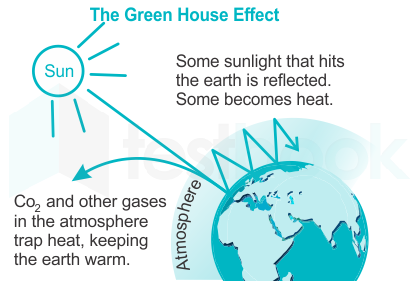
The gas that contributes most to the greenhouse effect is

  1. ((a))

    CFC

  2. ((b))

    Freon

  3. ((c))

    CO2

  4. ((d))

    CH4

Show Answer
Answer: ((c))

CO2

Concept:

  • A greenhouse is a glass building that provides optimum temperature for plants to grow in cold climates. The glass traps the heat inside to keep it warm.
  • Carbon dioxide acts in a very similar way for our atmosphere in trapping the heat and thus known as a greenhouse gas.
  • The CO2 present in the atmosphere absorbs the infrared radiation and re-emits the heat back to the surface.
  • 50% of the heat is lost to space and rest 50% comes back to the Earth's surface.
  • This keeps the average temperature of Earth inhabitable.
  • This phenomenon is called greenhouse effect.

Important Points

  • The primary greenhouse gases include water vapour, carbon dioxide (CO2), methane (CH4) and nitrous oxide (N2O).
  • Among these, CO2 contributes the most towards greenhouse effect.
  • Various human activities like burning of fossil fuels has led to a significant increase of greenhouse gases in the atmosphere over the past two centuries.
  • This has in turn led to the global warming which is a global concern for life on Earth.
  • Global warming causes increase in global average temperature, melting of polar ice, increase of sea-level, etc.

Additional Information

  • CFC - Chlorofluorocarbons are mainly responsible for ozone depletion.
  • Freon - It is a trademark name that is used for CFCs that are used industrially.
  • CH4 - Methane gas is popularly known as biogas, but is also considered as a greenhouse gas.
63

Water Soluble vitamins include?

  1. ((a))

    Vitamin C

  2. ((b))

    Niacin

  3. ((c))

    Riboflavin

  4. ((d))

    All of the above

Show Answer
Answer: ((d))

All of the above

The correct answer is All of the above.

Key Points 

  • Vitamins:
  • It was first discovered by FG Hopkins.
  • The term vitamin was coined by C Funk.
  • They provide no calories, they only regulate chemical reactions occurring in the metabolism of the body.
  • Vitamins are divided into two cases:
  • Water-soluble vitamins: Vitamin B and Vitamin C
  • Fat-soluble vitamins: Vitamins A, D, E and K
Water-Soluble VitaminsFat-Soluble Vitamins
B VitaminsVitamin A
Thiamin (B1)Vitamin B12Vitamin D
Riboflavin (B2)Folate (B9)Vitamin E
Niacin (B3)Biotin (B7)Vitamin K
Vitamin B6Pantothenic acid (B5)
Vitamin C
64

How will the resistance of a metallic body be affected when its temperature is increased?

  1. ((a))

    Always increases

  2. ((b))

    Always decreases

  3. ((c))

    May increase or decrease

  4. ((d))

    Remains the same

Show Answer
Answer: ((a))

Always increases

Resistance of a metallic body is directly proportional to its temperature. This is because as temperature increases, the velocity of electrons increases, which hinders their flow. This produces resistance. Thus, when the temperature will be increased, its resistance will always increase.

65

The branch of science that studies cells is called ________.

  1. ((a))

    Cytology 

  2. ((b))

    Entomology  

  3. ((c))

    Homoplastic  

  4. ((d))

    Hormonology  

Show Answer
Answer: ((a))

Cytology 

The correct answer is option 1 i.e Cytology 

  • Branch of science that studies cells is called Cytology.
  • All living organisms are made up of cells.
  • The cell was discovered in 1665.
  • The first cells from an organism were observed by Robert Hooke.

Different Branches of Study:

BranchStudy of
EntomologyInsects
MyologyMuscles
HormonologyHormones
MycologyFungi
NephrologyKidney
PaleontologyFossils
PedologySoils
CardiologyHeart
DermatologySkin
HematologyBlood
66

The group of stars arranged in a definite pattern is called

  1. ((a))

    Milky way

  2. ((b))

    Constellation

  3. ((c))

    Andromeda

  4. ((d))

    Solar system

Show Answer
Answer: ((b))

Constellation

The correct answer is Constellation.

Key Points

  • Constellation:
  • Stars form a pattern in a group, which has a recognizable shape. This group of stars is called a constellation.
  • At present, there are about 88 constellations.
  • Each constellation has been given a name according to its shape.
  • Some of the important constellations are Ursa Major, Ursa Minor, Orion, Leo Major, and Cassiopeia.

Additional Information

  • Milky Way:
  • The Milky Way is the galaxy that contains our Solar System, with the name describing the galaxy’s appearance from Earth.
  • It appears like a hazy band of light seen in the night sky formed from stars that cannot be individually distinguished by the naked eye.
  • From Earth, the Milky Way appears as a band because its disk-shaped structure is viewed from within.
  • Galileo Galilei first resolved the band of light into individual stars with his telescope in 1610.
  • Until the early 1920s, most astronomers thought that the Milky Way contained all the stars in the Universe.
  • Andromeda:
  • In the local cluster, Andromeda is the largest galaxy but may not be the most massive.
  • It is thought that the Milky way has indeed more dark matter which makes it more massive.
  • Andromeda is the nearest spiral galaxy from the milky way.
  • Both Andromeda and the Milky Way are approaching each other and it is thought that 4.5 billion years from this time, the Andromeda Galaxy and the Milky Way would collide and would form a giant elliptical galaxy.
  • Solar system:
  • The Sun, the nine planets (Pluto is not a planet now, considered as a dwarf planet) along with their satellites, the asteroids, the comets, the interplanetary dust, and the electrically charged gases called plasma, together make up the solar system.
  • Our solar system consists of an average star we call the Sun, the planets - Mercury, Venus, Earth, Mars, Jupiter, Saturn, Uranus, and Neptune.
  • It also includes the satellites of the planets: numerous comets, asteroids, and meteoroids; and the interplanetary medium.
  • The Sun accounts for 99.85% of all the matter of the solar system.
  • It is composed mainly of hydrogen and helium.
67

The oxygen-poor blood from the all the body parts enter the heart through which veins?

  1. ((a))

    Vena cava

  2. ((b))

    Pulmonary Arteries

  3. ((c))

    Pulmonary Veins

  4. ((d))

    Aorta

Show Answer
Answer: ((a))

Vena cava

The correct answer is Vena cava.

  • Vena cava carries the oxygen-poor blood from all parts of the body to the heart for oxygenation purposes.

Key Points

  • There are two types of Vena cava veins in our body:
  • Superior Vena cava: The superior vena cava carries blood from the head, neck, arms, and chest.
  • Inferior Vena cava: The inferior vena cava carries blood from the legs, feet, and organs in the abdomen and pelvis.
  • The Vena cava pair of veins is the largest veins in our body.

Additional Information

  • Pulmonary arteries: They carry oxygen-poor blood from right ventricle to lungs for oxygenation purpose.
  • Pulmonary veins: They carry oxygen-rich blood from lungs to left atrium.
  • Aorta: Carries the oxygenated blood from heart to all the parts of the body.
68

Name the organ where the embryo develops:

  1. ((a))

    Ureter

  2. ((b))

    Fallopian tube

  3. ((c))

    Uterus

  4. ((d))

    Cervix

Show Answer
Answer: ((c))

Uterus

The embryo develops in Uterus.

OrganFunction
UreterThe ureter is a tube in the human body that carries urine to the urinary bladder.
Fallopian TubeZygote is formed in Fallopian tube.
UterusIt is also called as womb. Zygote travels to uterus to form Embryo/ foetus.
CervixIt narrow tube that connects vagina to Uterus.
69

Butter is separated from milk by - 

  1. ((a))

    by fractional distillation

  2. ((b))

    by sublimation

  3. ((c))

    by Churning

  4. ((d))

    by magnetic separation,

Show Answer
Answer: ((c))

by Churning

Explanation:

  • Butter is separated from milk through a process called churning.
  • Churning involves agitating or beating the cream that is obtained from milk.
  • During this process, the fat globules in the cream clump together, forming butter.
  • The remaining liquid is known as buttermilk.
  • The traditional method involves allowing the cream to naturally separate from milk, and then the cream is churned to produce butter.
  • In modern dairy processing, the separation of cream from milk is often done mechanically using centrifugal force in a machine called a cream separator.
  • Once the cream is separated, it can be churned to produce butter
70

Which floral part in the plants produces the pollen grains?

  1. ((a))

    Anther

  2. ((b))

    Ovary

  3. ((c))

    Petal

  4. ((d))

    Sepal

Show Answer
Answer: ((a))

Anther

The correct answer is Anther.

Key Points

  • The male sex cells of the seed plants or flowering plants are contained in tough capsules, called pollen.
  • Pollen grains are produced by male organs, anthers, or stamens.
  • Sepal: The outer parts of the flower (often green and leaf-like) that enclose a developing bud.
  • Petal: The parts of a flower that are often conspicuously colored.
  • Stamen: The pollen-producing part of a flower, usually with a slender filament supporting the anther.
  • Anther: The part of the stamen where pollen is produced.
  • Pistil: The ovule producing part of a flower. The ovary often supports a long style, topped by a stigma. The mature ovary is a fruit, and the mature ovule is a seed.
  • Stigma: The part of the pistil where pollen germinates.
  • Ovary: The enlarged basal portion of the pistil where ovules are produced.

Additional Information

Sexual reproduction is divided into three stages:

  • Pollination
  • A process in which the pollen grains are transferred across the anther to the stigma of the same flower or flowers different plants.
  • There are two types of pollination- self-pollination, and cross-pollination.
  • Zygote formation
  • After the transfer of pollen grains, the male gamete is transferred down through the style of the pistil to the ovary where the male gamete is fused with the female gamete to form a zygote.
  • Fruit and seed formation
  • After fertilization, a formed zygote is developed into an embryo. The ovary develops into fruit and ovules into seeds.
71

Which of the following is not a natural fibre?

  1. ((a))

    Linen

  2. ((b))

    Cotton

  3. ((c))

    Rayon

  4. ((d))

    Jute

Show Answer
Answer: ((c))

Rayon

The correct answer is Rayon.

Key Points

  • Natural Fibres are obtained from plants, insects and worms.
  • Cotton, wool, linen and silk are examples of natural fibres.
  • Hence Rayon is not a natural fibre.
  • All fibres are stretched and twisted to form long threads called yarns.
  • This is called spinning.

Important Points

  • The yarn is woven on a machine called a loom to produce fabric. 
  • Cotton fibres come from the fruit of a cotton plant called a cotton boll.
  • Woollen fibres come from the fleece of sheep, rabbits and goats.
  • Silk fibres are obtained from the cocoon of silkworms.

Additional Information

  • Synthetic fibres
  • Fibres which are man-made are called synthetic fibres. Synthetic fibres are made in factories.
  • Rayon, terrycloth, terylene, and nylon are some popular synthetic fibres.
72

The law of reflection, 'Angle of incidence is equal to the angle of reflection', is true for reflection of a ray of light on -

  1. ((a))

    Plane surface only

  2. ((b))

    Concave surface only

  3. ((c))

    Convex surface only

  4. ((d))

    All of these

Show Answer
Answer: ((d))

All of these

The correct answer is All of these.

Key Points

  • By the laws of reflection, the angle of incidence is equal to the angle of reflection.
  • The surface should be polished weather Plane, Concave, Convex surface.

Important Points

  • The ray of light that hits the polished surface is called the incident ray.
  • The ray that gets reflected away is called the reflected ray.
  • The point at which the light hits the surface is called the point of incidence.
  • If a line is drawn perpendicular to that point, it is called the normal.
  • The angle of incidence (i) is always equal to angle the angle of reflection (r).

Additional Information

  • Note that they may appear as unequal when the surface is rough.
  • However on a rough surface, due to the changes in the surface boundaries, it appears unequal.
73

Compounds of carbon-containing carbon-carbon double bond are known as _________________.

  1. ((a))

    alkynes

  2. ((b))

    alkanes

  3. ((c))

    saturated compounds

  4. ((d))

    unsaturated compounds

Show Answer
Answer: ((d))

unsaturated compounds

The correct answer is 'unsaturated compounds'.

Key Points

  • The organic compounds consisting of Carbon (C) and Hydrogen (H) atoms are known as hydrocarbons.
  • Hydrocarbons are of two types depending on the kind of bonds formed between Carbon-Carbon atoms.
  1. Saturated hydrocarbons.
  2. Unsaturated hydrocarbons.
  • The organic compounds containing Carbon atoms having double bonds between two Carbon atoms are called unsaturated hydrocarbons.
  • The molecules of the alkene family are represented by the general formula CnH2n.

Additional Information

  • ​ Alkynes are defined as the hydrocarbons which contain carbon carbon triple bond.
  • Alkanes are defined as the hydrocarbons which contain carbon hydrogen single bond.
74

Which of the following is a chemical effect of electric current: 

  1. ((a))

    Producing a magnet using electric current

  2. ((b))

    Producing heat in an electric kettle

  3. ((c))

    Producing light using electric bulb 

  4. ((d))

    Production of H2 and O2 by passing current through water

Show Answer
Answer: ((d))

Production of H2 and O2 by passing current through water

The correct answer is Production of H2 and O2 by passing current through water.

Concept:

  • The passage of an electric current through a conducting liquid causes chemical reactions.
  • The resulting effects are called the chemical effects of electric currents.
  • Some of the chemical effects of electric current are as follows:
  • Gas Bubbles are formed at electrodes
  • Metals are deposited on electrodes
  • Change of colour of the solution.

Explanation:

  • When an electric current is passed through water, the water dissociates into hydrogen (H2) and oxygen (O2).
  • Hydrogen is deposited over the negative pole and oxygen is deposited over the positive pole.
  • The deposition of hydrogen and oxygen at different poles is visible in the form of bubbles.

Thus, production of H2 and O2 by passing current through water is a chemical effect of electric current.

75

Which of the following metals does not react with dilute Hydrochloric acid?

  1. ((a))

    Iron 

  2. ((b))

    Copper 

  3. ((c))

    Magnesium 

  4. ((d))

    Aluminum 

Show Answer
Answer: ((b))

Copper 

The correct answer is Copper.

Explanation:

  • The metal reactivity series governs metal reactivity.
  • Metals placed above hydrogen react with dilute acids to form salt, whereas metals placed below hydrogen do not react with dilute acids because they are less reactive than hydrogen and thus cannot displace hydrogen from dilute acids.
  • Copper metal does not react with dilute Hydrochloric acid because it is placed below hydrogen in the metal reactivity series, and thus it cannot displace hydrogen from dilute hydrochloric acid.

Additional InformationIron

  • Iron metals do indeed react with dilute hydrochloric acid.
  • The reaction between iron and hydrochloric acid is a classic example of a metal-acid reaction.

Fe (s) + 2HCl (aq) → FeCl2 (aq) + H2 (g)

Magnesium

  • When magnesium is treated with dilute hydrochloric acid, it forms magnesium chloride and emits hydrogen gas.

Mg (s) + 2HCl (aq) →  MgCl2 (aq) + H2(g)

Aluminum

  • At room temperature, aluminum reacts with diluted hydrochloric acid.
  • Aluminum chloride and colourless hydrogen gas are produced when the metal aluminum dissolves in hydrochloric acid.
  • The reaction between aluminum and hydrochloric acid is irreversible.

2Al + 6HCl → 2AlCl3 + 3H2

76

What are included in the natural environment?

  1. ((a))

    biotic

  2. ((b))

    abiotic

  3. ((c))

    Both

  4. ((d))

    None of these

Show Answer
Answer: ((c))

Both

The correct answer is Both.

Key Points

  • The natural environment includes both biotic and abiotic components.
  • Biotic components refer to living organisms such as plants, animals, and microorganisms.
  • Abiotic components include non-living elements like water, air, soil, and minerals.
  • The interaction between biotic and abiotic factors is crucial for the functioning of ecosystems.
  • Natural environments can vary greatly, encompassing diverse ecosystems like forests, deserts, oceans, and wetlands.

Additional Information

  • Biotic Factors
  • These include all living organisms that shape an ecosystem. Examples are plants, animals, fungi, and bacteria.
  • Biotic factors affect population sizes and community structure through interactions like predation, competition, and symbiosis.
  • Abiotic Factors
  • These are physical and chemical elements that influence living organisms. Examples include sunlight, temperature, and pH levels.
  • Abiotic factors determine the types of species that can survive in a particular environment.
  • Ecosystem Interactions
  • Ecosystems consist of complex interactions between biotic and abiotic components, leading to energy flow and nutrient cycling.
  • Changes in abiotic factors can significantly impact the biotic components and overall ecosystem health.
77

In rolling two dices, Find the probability of getting the sum of 10.

  1. ((a))

    1/3

  2. ((b))

    1/4

  3. ((c))

    1/12

  4. ((d))

    1/9

Show Answer
Answer: ((c))

1/12

When two dices are rolling, we get,

{(1,1), (1,2), (1,3), (1,4), (1,5), (1,6), 

(2,1), (2,2), (2,3), (2,4), (2,5), (2,6), 

(3,1), (3,2), (3,3), (3,4), (3,5), (3,6), 

(4,1), (4,2), (4,3), (4,4), (4,5), (4,6)

(5,1), (5,2), (5,3), (5,4), (5,5), (5,6), 

(6,1), (6,2), (6,3), (6,4), (6,5), (6,6)}

The sample space = 36

Only three samples are there that have a sum of 10 i.e. (4,6), (5,5), and (6,4)

The probability of getting the sum of 10 = (3\over36) = (1\over12)

∴ The probability of getting the sum of 10 is (1\over12).

78

Salaries of A, B and C are in the ratio 7 : 3 : 5. If their salaries are allowed to increase by 15%, 20% and 25%, then what will be the new ratio of their salaries?

  1. ((a))

    125 : 112 : 121 

  2. ((b))

    161 : 72 : 125

  3. ((c))

    120 : 111 : 123 

  4. ((d))

    122 : 111 : 124 

Show Answer
Answer: ((b))

161 : 72 : 125

Given:

Salaries of A, B and C are in the ratio 7 : 3 : 5.

Increment in their salaries = 15%, 20%, 25%

Formula Used:

If R% is increased in a number N, then new 

Number = N × (100 + R)/100

Calculation:

 7 : 3 : 5

⇒ 7 × 115/100 : 3 × 120/100 : 5 × 125/100

⇒ 7 × 23/20 : 3 × 24/20 : 5 × 25/20

⇒ 7 × 23 : 3 × 24 : 5 × 25 

⇒ 161 : 72 : 125

New ratio of their salaries = 161 : 72 : 125

79

If 20% of 45% of a number is 729, what is that number?

  1. ((a))

    8100

  2. ((b))

    7500

  3. ((c))

    9000

  4. ((d))

    8500

Show Answer
Answer: ((a))

8100

Given:

20% of 45% of a number = 729

Concept:

Concept of percentage. It is calculated on the basis of 100.

For example, x% means x out of 100

Calculation:

Let, the number is = x

According to the questions,

⇒ (20/100) × (45/100) × x = 729

⇒ (1/5) × (9/20) × x = 729

⇒ x = 8100

∴ The number is 8100

80

The profit made on a table is 350 per cent of the cost price. If the cost price is increased by 50 percent but the selling price remains the same, what is the new profit percent?

  1. ((a))

    250 percent

  2. ((b))

    300 percent

  3. ((c))

    150 percent

  4. ((d))

    200 percent

Show Answer
Answer: ((d))

200 percent

Given:

Profit = 350% of cost price

Cost price increased by 50%

Concept: Profit percentage formula.

Calculation:

Let's assume the original cost price (CP) is 100 units.

Therefore,

selling price (SP) = CP + 350% of CP = 100 + 350 = 450 units.

The new cost price = original CP + 50% of original CP

The new cost price = 100 + 50 = 150 units.

The new profit = Selling price - new cost price = 450 - 150 = 300 units

The new profit percent = (Profit / new CP) × 100%

The new profit percent = (300 / 150) × 100% = 200%

Hence, the new profit percent is 200%.

81

A alone can paint a house in 35 days and B alone can do it in 70 days. Along with C, they did the job in 10 days only. In how many days C alone can do the job?

  1. ((a))

    40 days

  2. ((b))

    70/3 days

  3. ((c))

    70/4 days

  4. ((d))

    20 days

Show Answer
Answer: ((c))

70/4 days

Detailed solution:- 

<br>

1 day’s work of A = 1/35

<br>

1 day’s work of B = 1/70

<br>

Let C alone can do the painting job in x days

<br>

According to the question,

<br>

⇒ 1/35+ 1/70 + 1/x = 1/10

<br>

⇒ 3/70 + 1/x = 1/10

<br>

⇒ 1/x = 1/10 - 3/70 = 4/70

<br>

⇒ x = 70/4

<br>

∴ C alone can do the painting job in 70/4 days.

82

What is the sum of 1 + 2 + 3 + ... + 49 + 50 ? 

  1. ((a))

    2525

  2. ((b))

    5050

  3. ((c))

    1275

  4. ((d))

    2550

Show Answer
Answer: ((c))

1275

Given:

We need to find the sum of the series 1 + 2 + 3 + ... + 49 + 50.

Formula Used:

Sum of first n natural numbers = n(n + 1)/2

Calculation:

Here, n = 50

Sum = 50(50 + 1)/2

Sum = 50 × 51/2

Sum = 2550/2

Sum = 1275

The sum of the series 1 + 2 + 3 + ... + 49 + 50 is 1275.

83

P can do a piece of work in 30 days and Q in 40 days. They work together for 4 days and then Q leaves. The number of days taken by P to finish the remaining work is:

  1. ((a))

    28 days

  2. ((b))

    23 days

  3. ((c))

    30 days

  4. ((d))

    7 days

Show Answer
Answer: ((b))

23 days

Given:

P can do a piece of work in 30 days

Q can do a piece of work in 40 days

They work together for 4 days

Formula used:

Work done by P in 1 day = (\dfrac{1}{30})

Work done by Q in 1 day = (\dfrac{1}{40})

Work done by P and Q together in 1 day = (\dfrac{1}{30} + \dfrac{1}{40} = \dfrac{4+3}{120} = \dfrac{7}{120})

Calculation:

Work done by P and Q together in 4 days = 4 × (\dfrac{7}{120})

⇒ Work done in 4 days = (\dfrac{28}{120} = \dfrac{7}{30})

Remaining work = 1 - (\dfrac{7}{30})

⇒ Remaining work = (\dfrac{30-7}{30} = \dfrac{23}{30})

Number of days taken by P to finish the remaining work = (\dfrac{23}{30} \times 30 = 23)

∴ The correct answer is option 2.

84

A, B and C can complete a work in 12, 15 and 20 days, respectively. How many days are required to finish the work if they work together?

  1. ((a))

    4 days

  2. ((b))

    6 days

  3. ((c))

    5 days

  4. ((d))

    3 days

Show Answer
Answer: ((c))

5 days

Given:

Time taken by A to complete the work = 12 days

Time taken by B to complete the work = 15 days

Time taken by C to complete the work = 20 days

Formula used:

Time required to complete the work when A, B, and C work together = 1 / (Total work done by A, B, and C together in 1 day)

Calculation:

Work done by A in 1 day = 1 / 12

Work done by B in 1 day = 1 / 15

Work done by C in 1 day = 1 / 20

Total work done by A, B, and C together in 1 day = 1 / 12 + 1 / 15 + 1 / 20

Finding a common denominator:

LCM of 12, 15, and 20 = 60

Work done by A, B, and C together in 1 day = (5 + 4 + 3) / 60 = 12 / 60 = 1 / 5

Time required to complete the work = 1 / (1 / 5) = 5 days

∴ The work will be completed in 5 days if A, B, and C work together.

85

Rajnish invested a sum of Rs. 10240 at compound interest rate of 12.5% per annum for a period of three years. What amount will Rajnish get after 3 years?

  1. ((a))

    15480

  2. ((b))

    14580

  3. ((c))

    16480

  4. ((d))

    14850

Show Answer
Answer: ((b))

14580

Shortcut Trick

Rate (R) = 12.5% = 1/8 in fraction.

The ratio of Principal to Amount for one year is 8 : (8 + 1) = 8 : 9.

For 3 years, the ratio becomes 83 : 93 ⇒ 512 : 729.

Given 512 units = ₹10240 ⇒ 1 unit = ₹20.

Amount = 729 units × 20 = ₹14580.

∴ The correct answer is ₹14580.

Alternate Method

Given:

Principal (P) = ₹10,240

Rate (R) = 12.5% per annum

Time (n) = 3 years

Formula Used:

Amount (A) = P(1 + R/100)n

Calculations:

⇒ A = 10240 × (1 + 12.5/100)3

⇒ A = 10240 × (1 + 1/8)3

⇒ A = 10240 × (9/8)3

⇒ A = 10240 × (729 / 512)

⇒ A = 20 × 729

⇒ A = 14580

∴ The correct answer is ₹14580.

Additional Information

Compound Interest Formula

Interest (CI) = Amount − Principal = P[(1 + R/100)n − 1].

Difference between CI and SI for 3 Years

Difference = P(R/100)2 × [(R/100) + 3].

Effective Rate for 12.5%

The fractional equivalent 1/8 makes calculations easier than using decimal 12.5% directly in the power formula.

86

'सज्जन' शब्द का विलोम है 

  1. ((a))

    दुष्ट

  2. ((b))

    असज्जन

  3. ((c))

    कपटी

  4. ((d))

    दुर्जन

Show Answer
Answer: ((d))

दुर्जन

सज्जन का विलोम शब्द 'दुर्जन' है।

Key Points

  • सज्जन का शाब्दिक अर्थ अच्छा व्यक्ति है।
  • जबकि दुर्जन का शाब्दिक अर्थ बुरा व्यक्ति है।

सज्जन

  • सत् + जन
  • व्यंजन संधि

त् व्यंजन के बाद वर्ण है अतः त् वर्ण वर्ग का तीसरा वर्ण यानी कि ज ही में परिवर्तित हो गया।

Additional Information

विलोम शब्द-

  • भिज्ञ - अनभिज्ञ
  • अतिवृष्टि - अनावृष्टि
  • विरक्त - अनुरक्त
  • दीर्घायु - अल्पायु
  • पुरातन - अधुनातन
  • पूर्णतः - अंशतः
  • बहुज्ञ - अल्पज्ञ
  • अपेक्षित - अनपेक्षित
  • बाह्य - अंतर
  • असली - नकली
  • इति - अथ
  • अन्तरंग - बहिरंग
  • दीर्घकालीन - अल्पकालीन
  • अवर - प्रवर
  • मर्त्य - अमर
  • वितल - अतल
  • अनभ्यस्त - अभ्यस्त
  • कनिष्ठ - वरिष्ठ
87

'तीर' शब्द का पर्यायवाची नहीं है:

  1. ((a))

    शिलीमुख

  2. ((b))

    पंचमुख

  3. ((c))

    बाण

  4. ((d))

    शर

Show Answer
Answer: ((b))

पंचमुख

'पंचमुख' शब्द 'तीर' शब्द का पर्यायवाची नहीं है। 

  • 'तीर' का पर्यायवाची नहीं है - पंचमुख
  • शिलीमुख, बाण, शर ये तीर शब्द के पर्यायवाची शब्द हैं।
  • तीर शब्द के अन्य पर्यायवाची शब्द - शिखंडी, विशिख, सायक, अनी

Key Pointsअन्य विकल्प -

  • पंचमुख का अर्थ - पाँच मुँहवाला
  • पंचमुख शब्द के अन्य पर्यायवाची शब्द - शशिभूषण, महेश, उमाकांत,  त्र्यंबक

Additional Informationपर्यायवाची का उदाहरण -

  • कुरंग - हरिण, सारंग मृग, हिरन
  • मृत्तिका - रज, माटी, मिट्टी, धूल, रेणु
  • तारक - नक्षत्र, सितारा, तारा
  • मद्य - शराब, सुरा, सोमर, मदिरा
  • स्वर्गिक - अलौकिक, दिव्य, लोकातीत
  • केश - बाल, कच, चिकुर, चूल
  • कृपाण - असि, तलवार, करवाल
  • भ्रमर - अलि, मधुकर, भृंगी
  • प्रस्तर - पाइन, पाषण, शिला, पत्थर, उपल
  • शफरी - मत्स्य, मीन, मछली, झष
88

किस वाक्य में सकर्मक क्रिया नहीं है -

  1. ((a))

    सीता भोजन बना रही है l

  2. ((b))

    टैगोर ने गीतांजलि लिखी l

  3. ((c))

    श्याम रोता है l

  4. ((d))

    बच्चा फल तोड़ रहा है l

Show Answer
Answer: ((c))

श्याम रोता है l

दिए गए विकल्पों में से ‘श्याम रोता है l’ अकर्मक क्रिया है। अन्य सभी विकल्प सकर्मक क्रिया है। अत: इसका सही उत्तर विकल्प 3 श्याम रोता है l है।

Key Points

  • अकर्मक क्रिया: ‘अकर्मक’ मतलब कर्म उपस्थित नहीं है। जब किसी वाक्य में कर्ता हो और क्रिया भी हो लेकिन कर्म ना हो तो वहां पर अकर्मक क्रिया होती है। ‘राघव दौड़ता है।‘ इस वाक्य में ‘राघव’ कर्ता का काम कर रहा है और दौड़ना क्रिया है, लेकिन इसका प्रभाव और किसी चीज पर नहीं पड़ रहा है, इसलिए यहां पर अकर्मक क्रिया है

Additional Information

शब्दपरिभाषाउदाहरण
क्रियाजिन शब्दों में किसी कार्य का करना या होना था, किसी घटना में घटित होने का संज्ञान होता है, उसे क्रिया कहते हैं। क्रिया के दो भेद माने गए हैं - अकर्मक और सकर्मक।मोर नाचता है = अकर्मक अनुराग ने फल खाए= सकर्मक
अकर्मक क्रिया - जिस क्रिया का फल कर्म पर नहीं करता पर पड़ता है उसे अकर्मक क्रिया कहते हैं।
सकर्मक क्रिया - जिस क्रिया का फल कर्म पर पड़ता है तथा जिसके प्रयोग में कर्म की अनिवार्यता बनी रहती है, उसे सकर्मक क्रिया कहते हैं।
89

निम्न में से कौन-सी रचना महादेवी वर्मा की नहीं है?

  1. ((a))

    यामा

  2. ((b))

    दीपशिखा

  3. ((c))

    आंगन के पार द्वार

  4. ((d))

    नीरजा

Show Answer
Answer: ((c))

आंगन के पार द्वार

आंगन के पार द्वार रचना महादेवी वर्मा की नहीं है। अतः सही उत्तर 'आंगन के पार द्वार' होगा ।

महादेवी वर्मा की अन्य रचनाये:

कविता संग्रहआत्मिका, परिक्रमा, सन्धिनी , यामा , गीतपर्व, दीपगीत, स्मारिका, नीलांबरा
काव्य संकलननीहार , रश्मि , नीरजा सांध्यगीत,  दीपशिखा, सप्तपर्णा , प्रथम आयाम और अग्निरेखा

Important Points

आँगन के पार द्वार (1961) हिन्दी के विख्यात साहित्यकार अज्ञेय द्वारा रचित एक कविता–संग्रह है जिसके लिये उन्हें सन् 1964 में साहित्य अकादमी पुरस्कार से सम्मानित किया गया।
90

'चक्रपाणि' में कौन-सा समास है?

  1. ((a))

    कर्मधारय 

  2. ((b))

    द्वन्द्व 

  3. ((c))

    तत्पुरुष 

  4. ((d))

    बहुव्रीहि 

Show Answer
Answer: ((d))

बहुव्रीहि 

सही उत्तर है - "बहुव्रीहि" l

Key Points

  • 'चक्रपाणि' शब्द का समास विग्रह है - 'चक्र है पाणि में जिसके' l इसमें 'विष्णु' सांकेतिक अर्थ को इंगित किए जाने के कारण 'बहुव्रीहि समास' है।
  • जिस समास में कोई पद प्रधान न होकर (दिए गए पदों में) किसी अन्य पद की प्रधानता होती है। यह अपने पदों से भिन्न किसी विशेष संज्ञा का विशेषण है। इसमें दोनों पद किसी संज्ञा के विशेषण होते हैं।
  • अन्य विकल्प :-
  • कर्मधारय - जिसका पहला पद विशेषण और दूसरा पद विशेष्य अथवा एक पद उपमान तथा दूसरा पद उपमेय हो तो, वह 'कर्मधारय समास' कहलाता है।
  • विशेषण-विशेष्य : नीलकमल - नीला है जो कमल l
  • द्वन्द्व - समास का वह रूप जिसमें प्रथम और द्वितीय दोनों पद प्रधान होते हैं उसे द्वन्द्व समास कहते हैं।
  • आजकल (आज और कल) l
  • तत्पुरुष - वह समास, जिसका उत्तरपद या अंतिम पद प्रधान हो। अर्थात् प्रथम पद गौण हो और उत्तरपद की प्रधानता हो।
  • राजकुमार (राजा का कुमार) l

Additional Information

  • समास का तात्पर्य है 'संक्षिप्तीकरण'। दो या दो से अधिक शब्दों से मिलकर बने हुए एक नवीन एवं सार्थक शब्द को समास कहते हैं। जैसे – 'रसोई के लिए घर' इसे हम 'रसोईघर' भी कह सकते हैं। संस्कृत एवं अन्य भारतीय भाषाओं में समास का बहुतायत में प्रयोग होता है।
  • समास के छः भेद होते हैं - (1) अव्ययी भाव समास (2) तत्पुरुष समास (3) कर्मधारय समास (4) द्विगु समास (5) द्वन्द्व समास (6) बहुव्रीहि समास।
  • बहुव्रीहि समास के कुछ उदाहरण :-
  • सूर्यपुत्र - वह जो सूर्य का पुत्र है - कर्ण l
  • कपीश्वर - कपि (वानरों) का ईश्वर है जो - हनुमान l
  • पंचानन - पंच हैं मुख जिसके - शिव l
  • गिरिधर - गिरि को धारण करने वाला - श्रीकृष्ण l
91

इनमें से कौन सा अर्थं 'अँगूठा चूमना' मुहावरे के लिए प्रयुक्त होता हैः

  1. ((a))

    प्यार जताना

  2. ((b))

    आदर प्रकट करना

  3. ((c))

    खुशामद करना

  4. ((d))

    खुशियाँ मनाना

Show Answer
Answer: ((c))

खुशामद करना

‘अँगूठा चूमना’ मुहावरे का सही अर्थ है – खुशामद करना। 

Key Points

स्पष्टीकरण:- 

मुहावरेअर्थवाक्य प्रयोग
अँगूठा चूमनाखुशामद करनाआज के युग में अधिकारियों के अंगूठे चूमने पर ही कार्य जल्दी होते हैं।

Additional Informationअन्य विकल्प:-

मुहावरेअर्थवाक्य प्रयोग
मोहब्बत का इजहार करनाप्यार जतानावह लड़की किसी लड़के से मोहब्बत का इजहार कर रही थी।
अदब करनाआदर प्रकट करनामैं अब उसका लिहाज पा सकता हूँ, अदब पा सकता हूँ, साहचर्य नहीं पा सकता।"
घी के दीपक जलानाखुशियाँ मनानाजब भगवान श्री राम जी 14 वर्ष का वनवास काट कर लंका पर विजय प्राप्त करके अयोध्या लौटे थे तब अयोध्या वासियों ने घी के दिये जलाए थे।
92

'कवियित्री' की शुद्ध वर्तनी क्या होगी?

  1. ((a))

    कवयत्रि

  2. ((b))

    कवयत्री

  3. ((c))

    कवियत्री

  4. ((d))

    कवयित्री 

Show Answer
Answer: ((d))

कवयित्री 

दिये गए विकल्पों में शुद्ध वर्तनी विकल्प 4 'कवयित्री' है। अन्य विकल्प सही नहीं हैं।

  • 'कवयित्री' शब्द वर्तनीगत सही है। इसका मतलब- 'महिला जो कवि हो' उसे 'कवयित्री' कहा जाता है।

वर्तनीलिखने की रीति को वर्तनी कहते हैं। ‘वर्तनी’ शब्द का अर्थ उच्चारित होने वाले शब्द के लेखन  में प्रयोग होने वाले लिपि चिह्नों के व्यवस्थित रूप को वर्तनी कहा जाता है।
93

'अत्युत्तम' का संधि-विच्छेद है-  

  1. ((a))

    अति + उत्तम 

  2. ((b))

    अत्य + उत्तम  

  3. ((c))

    अत्‌ + उत्तम 

  4. ((d))

    अति + युत्तम 

Show Answer
Answer: ((a))

अति + उत्तम 

अत्युत्तम शब्द का संधि-विच्छेद 'अति + उत्तम' है। अन्य विकल्प में शब्द का संधि विच्छेद सही नहीं है। 

Key Points 

  • अत्युत्तम = अति + उत्तम (यण संधि)
  • यण स्वर संधि- जब संधि करते समय इ, ई के साथ कोई अन्य स्वर हो तो ‘ य ‘ बन जाता है, जब उ, ऊ के साथ कोई अन्य स्वर हो तो ‘ व् ‘ बन जाता है , जब ऋ के साथ कोई अन्य स्वर हो तो ‘ र ‘ बन जाता है।

अधि + आय = अध्याय (इ + आ = या)

अनु + एषण = अन्वेषण (उ + ए = व्)

अधि + अयन = अध्ययन (इ + अ = य)

अनु + इत = अन्वित (उ + इ = वि)

इति + आदि = इत्यादि(इ + आ = या )

प्रति + एक = प्रत्येक(इ + ए = ये)

अति + आवश्यक = अत्यावश्यक(इ + आ = या)

इ + ऊ = यू अति + उष्म= अत्यूष्म

Additional Information 

स्वर संधि
संधिपरिभाषाउदाहरण
दीर्घ संधिदो सवर्ण, ह्रस्व या दीर्घ, स्वरों के मेल होने पर दीर्घ स्वर बन जाता है।जैसे – शिव + आलय (अ + आ) = शिवालय, गिरि + इन्द्र (इ + इ) = गिरीन्द्र।
गुण संधिअ, आ के साथ इ, ई का मेल होने पर 'ए'; उ, ऊ का मेल होने पर 'ओ'; तथा ऋ का मेल होने पर 'अर्' हो जाता है।जैसे – देव + इन्द्र (अ + इ) = देवेन्द्र, देव + ऋषि (अ + ऋ) = देवर्षि।
वृद्धि संधिअ, आ का मेल ए, ऐ के साथ होने पर 'ऐ' तथा ओ, औ के साथ होने पर 'औ' में परिवर्तित हो जाता है।जैसे – एक + एक (अ + ए) = एकैक, परम + ओजस्वी (अ + ओ) = परमौजस्वी।
अयादि संधिए, ऐ तथा ओ, औ का मेल किसी अन्य स्वर के साथ होने से क्रमशः ए का अय्, ऐ का आय, ओ का अव् तथा औ का आव् हो जाता है।जैसे – ने + अन (ए + अ) = नयन, गै + अक (ऐ + अ) = गायक।
94

Direction: Select the correct passive form of the given sentence.

Last week, the council inspected the drains.

  1. ((a))

    Last week, the drains is inspected by the council.

  2. ((b))

    Last week, the drains is being inspected by the council.

  3. ((c))

    Last week, the drains had been inspected by the council.

  4. ((d))

    Last week, the drains were inspected by the council.

Show Answer
Answer: ((d))

Last week, the drains were inspected by the council.

The correct answer is Last week, the drains were inspected by the council.

Key Points  

  • In Active Voice, a sentence emphasizes the subject, performing an action.
  • In Passive Voice, a sentence emphasizes the action or the object of the sentence.
  • The given sentence is in the active voice and 'The council' is the subject and 'the drains' is the object.
  • When we convert this sentence into passive voice, the subject 'the council' of the active voice becomes the object, the object 'the drains' becomes the subject.
  • The passive format "were + V3 (inspected)" should be used.
  • This is the active and passive voice rule for the past simple tense.
  • Hence, the correct answer is option 4.

Hence, the correct sentence is  Last week, the drains were inspected by the council.

  • Active voice , एक वाक्य में subject पर जोर देता है और एक verb का प्रदर्शन करता है।
  • Passive , एक वाक्य में verb या वाक्य की object पर जोर देता है।
  • दिया गया वाक्य active voice में है और ' The council ' subject है और 'the drainsobject है।
  • जब हम इस वाक्य को passive voice में बदलते हैं , तो active voice का subject ' the council ' object बन जाता है, object ' the drains ' object बन जाती है।
  • Passive format "were + V3 (inspected) " का उपयोग किया जाना चाहिए।
  • इसलिए , सही उत्तर विकल्प 4 है ।
95

Direction: Choose the correct Direct speech of the following sentence from the given options :

He says that the king will come.

  1. ((a))

    He says that "The king will come."

  2. ((b))

    He says "the king would come."

  3. ((c))

    He says "the king came."

  4. ((d))

    He says, "The king will come".

Show Answer
Answer: ((d))

He says, "The king will come".

The correct answer is- He says, "The king will come."

Additional Information

  • Let's look at the steps to change the sentence from indirect to direct speech:
  • When the indirect speech is in an assertive form, we follow the steps given below:
  • The reporting verb says will remain the same as no object is mentioned after it.
  • Connectors 'that' is replaced by a comma and inverted commas.
  • The tense of indirect/reported speech will remain the same as the reporting verb(says) is in the simple present tense.
  • ​At last line up the remaining part.
  • Following these steps, we finally get- He says, "The king will come."

Additional Information  ​​​​

  • In the case of a general truth or universal fact, there will be no change in the tense of reported speech.
96

Find the part of the given sentence that has an error in it. If there is no error, choose "No error'.

Neither my father nor (A) / our friends knows (B) / that we are getting married. (C) / No error (D)

  1. ((a))

    (A)

  2. ((b))

    (B)

  3. ((c))

    (C)

  4. ((d))

    (D)

Show Answer
Answer: ((b))

(B)

The correct answer is '(B).'

Key Points

  • The error lies in Part (B) of the sentence.
  • In the given sentence, both the subjects are connected with the help of the correlative conjunction 'neither/or.'
  • The verb must agree with the noun or the pronoun that is closer to ‘neither/or.'
  • Example: Neith​er* she nor her team members are attending the function.* (In this sentence, a plural subject 'team members' is closer to 'neither/or', therefore, a plural helping verb must be used)​
  • In the given question, a plural subject 'friends' is closer to 'neither/or.'
  • Therefore, the singular verb 'knows' should be replaced by a plural verb 'know' to make the sentence grammatically correct.
  • Hence, the correct answer is '(B).'
  • Correct sentence: *Neither my father nor our friends know that we are getting married.*​​​​

Additional Information

  • A conjunction is a word that is used to connect words, phrases, and clauses.
  • Some conjunctions are and, or, but, because, for, if, and when.
  • There are three basic types of conjunctions: coordinating, subordinating, and correlative.
  • Coordinating conjunction is used to connect items that are grammatically equal: two words, two phrases, or two independent clauses.
  • Example: She usually studies in the library or at a cafe.
  • ​Subordinating conjunction includes words like because, if, although, since, until, and while.
  • A subordinating conjunction is used to introduce a dependent clause.
  • Example: I went to school without eating breakfast because I woke up late this morning.
  • ​Correlative conjunction always comes in a pair and is used to join grammatically equal elements in a sentence.
  • Common pairs include either … or, neither … nor, not only … but also, and both … and.
  • Example: She planned to collect data by either using an online survey or conducting phone interviews.

Hinglish

  • त्रुटि वाक्य के Part (B) में है।
  • दिए गए वाक्य में, दोनों subjects, correlative conjunction 'neither/or' की सहायता से जुड़े हुए हैं।
  • Verb को उस noun या pronoun से सहमत होना चाहिए जो  ‘neither/or' के करीब हो।
  • Example: Neith​er* she nor her team members are attending the function.* (इस वाक्य में, एक plural subject 'team members', 'neither/or' के करीब है, इसलिए, एक plural helping verb का उपयोग किया जाना चाहिए)
  • दिए गए प्रश्न में, एक plural subject 'friends', 'neither/or' के अधिक निकट है।
  • इसलिए, वाक्य को व्याकरणिक रूप से सही बनाने के लिए singular verb 'knows' को plural verb 'know' द्वारा प्रतिस्थापित किया जाना चाहिए।
  • इसलिए, सही उत्तर '(B)' है।​
97

Directions: Choose the word or phrase which is an antonym or the most opposite in meaning to the word or phrase underlined.

That was an overt act of aggression.

  1. ((a))

    deep

  2. ((b))

    secret

  3. ((c))

    particular

  4. ((d))

    official

Show Answer
Answer: ((b))

secret

The correct answer is 'secret'.

Key Points  

  • The word 'Overt' means easily seen; not secret or hidden.
  • The antonyms of the word 'Overt' are "secret, mysterious, hidden".
  • From the antonym of the given word, we can say that the word 'secret' is the opposite in meaning.
  • The word 'secret' means not known or seen or not meant to be known or seen by others.

Hence, the correct answer is option 2. Let's see the meaning of other given options-

WORDSMEANING
deepvery intense or extreme
particularespecially great or intense
officialrelating to an authority or public body and its activities and responsibilities


Additional Information

  • The synonyms of the word 'Overt' are "clear, transparent, undisguised".
  • Example of 'Overt​​' in a sentence:
  • The security guard easily noticed the shoplifter’s overt actions.
98

In the question below, a part of the sentence is underlined. Below are given alternatives to the underlined part which may improve the sentence. Choose the correct alternative. In case no improvement is needed, choose 'No improvement'.

The audience was carried by the emotional speech.

  1. ((a))

    got carried away

  2. ((b))

    was carried off

  3. ((c))

    was carried towards

  4. ((d))

    No improvement

Show Answer
Answer: ((a))

got carried away

The correct answer is option 1, i.e., got carried away.

The sentence uses the verb 'was carried', which is incorrect here.

To carry means to transport, conduct, or transmit. Given the context of 'an emotional speech', it doesn't fit here.

Meanings of the given phrasal verbs, viz., verb+ preposition, which modifies the meaning of the verb.:

Carried away- to arouse to a high and often excessive degree of emotion or enthusiasm.

Carried off- Handle successfully, win.

Carried towards is not a correct phrasal verb.

Out of the above, only 'carried away' is appropriate here, given the context of 'emotional speech'.

Thus, the rectified sentence is: The audience got carried away by the emotional speech.

99

If I ______ you, I would have grabbed the opportunity.

  1. ((a))

    am

  2. ((b))

    are

  3. ((c))

    were

  4. ((d))

    being

Show Answer
Answer: ((c))

were

The correct answer is 'were'

Key Points

  • The given sentence is a conditional sentence.
  • 'I would have grabbed the opportunity' indicates the result statement.
  • If the condition is in the past perfect tense, the result will be in 'would + have + past participle (V3)' format.
  • Hence, for the blank, we will use the past form of the verb i.e. 'were'.

Hence, the correct answer is Option 3.

Correct Sentence: If I were you, I would have grabbed the opportunity.

100

Choose the appropriate meaning of the idioms from the choices given

To read between lines

  1. ((a))

    To suspect

  2. ((b))

    To read carefully

  3. ((c))

    To understand the hidden meaning

  4. ((d))

    To do useless thing

Show Answer
Answer: ((c))

To understand the hidden meaning

The correct answer is To understand the hidden meaning.

Key Points

  • To read between lines: To infer or understand the real or hidden meaning behind the superficial appearance of something. (किसी चीज़ के सतही रूप के पीछे के वास्तविक या छिपे हुए अर्थ का अनुमान लगाना या समझना)
  • Ex: Reading between the lines, it looks like the company is bracing for a hostile takeover.
  • Hence, Option 3 is the correct answer.

Attempt this paper under real exam conditions

Timed interface, section switching, instant scoring, and question-by-question analytics — free.

Start Timed Attempt