Official Paper

Bihar Police ASI (Operations) Prelims Memory-Based Test (Held on 22nd July 2026) (Previous Year Paper)

100 questions · 120 minutes · with answers · free

Test (100 questions)

1

Which set correctly represents the four quantum numbers of an electron?

  1. ((a))

    n, l, mₗ, mₛ

  2. ((b))

    n, p, q, r

  3. ((c))

    l, m, s, t

  4. ((d))

    n, λ, μ, ν

Show Answer
Answer: ((a))

n, l, mₗ, mₛ

Concept:

The four quantum numbers uniquely specify the quantum state of an electron in an atom. They describe its energy level, orbital shape, orbital orientation, and spin.

Explanation:

The principal quantum number (n) specifies the energy level, the azimuthal quantum number (l) determines the orbital shape, the magnetic quantum number (ml) specifies the orientation of the orbital, and the spin quantum number (ms) indicates the spin orientation of the electron. Together, these four quantum numbers completely describe an electron in an atom.

Correct Answer:

Option (1): n, l, ml, ms.
2

The Principal Quantum Number (n) primarily determines the:

  1. ((a))

    Shape of the orbital

  2. ((b))

    Orientation of the orbital

  3. ((c))

    Main energy level (shell) of the electron

  4. ((d))

    Spin of the electron

Show Answer
Answer: ((c))

Main energy level (shell) of the electron

Concept:

The principal quantum number (n) specifies the main energy level or shell of an electron in an atom. It also indicates the relative size and energy of the orbital.

Explanation:

As the value of n increases, the electron occupies a higher energy level and is, on average, farther from the nucleus. The shape of the orbital is determined by the azimuthal quantum number (l), the orientation by the magnetic quantum number (m), and the spin by the spin quantum number (s).

Correct Answer:

Option (3): Main energy level (shell) of the electron.

3

Bose–Einstein statistics is applicable to particles that:

  1. ((a))

    Obey the Pauli Exclusion Principle

  2. ((b))

    Have half-integral spin only

  3. ((c))

    Have integral spin (Bosons)

  4. ((d))

    Have zero mass only

Show Answer
Answer: ((c))

Have integral spin (Bosons)

Concept:

Bose–Einstein statistics describes the behavior of bosons, which are particles having integral spin (0, 1, 2, ...). Unlike fermions, multiple bosons can occupy the same quantum state.

Explanation:

Bosons obey Bose–Einstein statistics and do not follow the Pauli Exclusion Principle. Examples include photons, gluons, and helium-4 atoms. Since bosons have integral spin, the correct statement is that Bose–Einstein statistics applies to particles with integral spin.

Correct Answer:

Option (C): Have integral spin (Bosons).

4

First-order time-dependent perturbation theory is mainly used to study:

  1. ((a))

    Transitions caused by a time-dependent disturbance

  2. ((b))

    Motion under constant velocity

  3. ((c))

    Classical harmonic oscillations

  4. ((d))

    Electrostatic equilibrium

Show Answer
Answer: ((a))

Transitions caused by a time-dependent disturbance

Concept:

First-order time-dependent perturbation theory is used to study the effect of a weak, time-dependent perturbation on a quantum system. It predicts the probability of transitions between different quantum states.

Explanation:

When a quantum system is subjected to a time-dependent external disturbance, such as an oscillating electric or magnetic field, it can undergo transitions between energy states. First-order time-dependent perturbation theory is used to calculate these transition probabilities and forms the basis of phenomena such as absorption and emission of radiation.

Correct Answer:

Option (1): Transitions caused by a time-dependent disturbance.

5

Eigenvalues in quantum mechanics correspond to:

  1. ((a))

    Probability density of the particle

  2. ((b))

    Measurable values of a physical observable

  3. ((c))

     Wave amplitude only

  4. ((d))

    Position of the nucleus

Show Answer
Answer: ((b))

Measurable values of a physical observable

Concept:

In quantum mechanics, an eigenvalue is the value obtained when a measurement of a physical observable is made. Each observable is represented by a Hermitian operator.

Explanation:

When an operator acts on one of its eigenstates, the result is the same state multiplied by a constant called the eigenvalue. This eigenvalue represents the measurable value of the corresponding physical quantity, such as energy, momentum, or angular momentum.

Correct Answer:

Option (2): Measurable values of a physical observable.

6

A Hermitian operator in quantum mechanics always has:

  1. ((a))

    Complex eigenvalues only

  2. ((b))

    Real eigenvalues

  3. ((c))

    Negative eigenvalues only

  4. ((d))

    Imaginary eigenvalues only

Show Answer
Answer: ((b))

Real eigenvalues

Concept:

A Hermitian operator is an operator that is equal to its own Hermitian conjugate. In quantum mechanics, all observable physical quantities are represented by Hermitian operators.

Explanation:

Hermitian operators always have real eigenvalues, ensuring that the measured values of physical observables, such as energy, momentum, and position, are real numbers. They do not have purely complex or imaginary eigenvalues.

Correct Answer:

Option (2): Real eigenvalues.

7

The singlet state of two electrons has total spin quantum number:

  1. ((a))

    0

  2. ((b))

    1/2

  3. ((c))

    1

  4. ((d))

    3/2

Show Answer
Answer: ((a))

0

Concept:

When two electrons combine, their spins can form either a singlet state or a triplet state. The singlet state has total spin quantum number S = 0 and is antisymmetric under particle exchange.

Explanation:

In the singlet state, the two electron spins are paired in opposite directions, resulting in zero net spin. Since the individual spins cancel each other, the total spin quantum number is S = 0. This distinguishes it from the triplet state, where S = 1.

Correct Answer:

Option (1): 0.

8

A network consists of a 12 V source in series with a 4 Ω resistor. Determine the Thevenin equivalent voltage and resistance seen at the output terminals.

  1. ((a))

    12 V, 4 Ω

  2. ((b))

    4 V, 12 Ω

  3. ((c))

    8 V, 4 Ω

  4. ((d))

    12 V, 8 Ω

Show Answer
Answer: ((a))

12 V, 4 Ω

Concept:

The Thevenin equivalent of a linear circuit is represented by an equivalent voltage source (VTh) in series with an equivalent resistance (RTh) as seen from the output terminals.

Explanation:

The open-circuit voltage across the output terminals is equal to the source voltage, so VTh = 12 V. To find the Thevenin resistance, replace the ideal voltage source with a short circuit. The only remaining resistance is 4 Ω, so RTh = 4 Ω.

Correct Answer:

Option (1): 12 V, 4 Ω.

9

The time-dependent Schrödinger equation is used to study:

  1. ((a))

    Evolution of the quantum state with time

  2. ((b))

    Newton's laws of motion

  3. ((c))

    Electrostatic potential only

  4. ((d))

    Magnetic flux through a surface

Show Answer
Answer: ((a))

Evolution of the quantum state with time

Concept:

The time-dependent Schrödinger equation describes how the quantum state of a physical system changes with time. It is the fundamental equation governing the dynamics of quantum particles.

Explanation:

The solution of the time-dependent Schrödinger equation gives the wave function at any instant of time, allowing the prediction of the system's future behavior. It is not used to describe Newton's laws, electrostatic potential alone, or magnetic flux through a surface.

Correct Answer:

Option (1): Evolution of the quantum state with time.

10

A singlet state corresponds to:

  1. ((a))

    Symmetric spin state

  2. ((b))

     Antisymmetric spin state

  3. ((c))

    Spin quantum number = 1

  4. ((d))

    Orbital angular momentum = 1

Show Answer
Answer: ((b))

 Antisymmetric spin state

Concept:

In a two-electron system, the total spin state can be either a singlet state or a triplet state. The singlet state has total spin quantum number S = 0 and is antisymmetric with respect to the exchange of particle spins.

Explanation:

The singlet state is represented by an antisymmetric combination of the two electron spin states. In contrast, triplet states are symmetric and have total spin quantum number S = 1. Therefore, a singlet state corresponds to an antisymmetric spin state.

Correct Answer:

Option (2): Antisymmetric spin state.

11

The wave function ψ is generally:

  1. ((a))

    Always real

  2. ((b))

    Always positive

  3. ((c))

    A complex quantity

  4. ((d))

    Equal to probability density

Show Answer
Answer: ((c))

A complex quantity

Concept:

The wave function (ψ) is a mathematical function used to describe the quantum state of a particle. In general, it is a complex-valued function containing both real and imaginary parts.

Explanation:

The wave function ψ is not required to be real or always positive. It is generally a complex quantity, while its modulus squared, |ψ|², gives the probability density of finding the particle at a particular position. Therefore, ψ itself is not equal to the probability density.

Correct Answer:

Option (3): A complex quantity.

12

According to Born's interpretation, |ψ|² represents:

  1. ((a))

    Probability density of finding the particle

  2. ((b))

    Total energy of the particle

  3. ((c))

    Momentum of the particle

  4. ((d))

    Charge density

Show Answer
Answer: ((a))

Probability density of finding the particle

Concept:

According to Max Born's probabilistic interpretation, the square of the magnitude of the wave function, |ψ|², gives the probability density of finding a particle at a particular position in space.

Explanation:

The wave function ψ itself has no direct physical meaning. However, |ψ|² represents the probability density, which indicates the likelihood of locating the particle at a given point. A higher value of |ψ|² means a greater chance of finding the particle at that position.

Correct Answer:

Option (1): Probability density of finding the particle.

13

A source having internal resistance 5 Ω supplies a variable load. Maximum power is transferred when the load resistance is:

  1. ((a))

    2.5 Ω

  2. ((b))

    5 Ω

  3. ((c))

    10 Ω

  4. ((d))

     20 Ω

Show Answer
Answer: ((b))

5 Ω

Concept:

According to the Maximum Power Transfer Theorem, maximum power is delivered to the load when the load resistance is equal to the internal (Thevenin) resistance of the source.

Calculation:

Internal resistance, Ri = 5 Ω

For maximum power transfer,

RL = Ri

= 5 Ω

Correct Answer:

Option (B): 5 Ω.

14

What is the purpose of a Karnaugh map (K-map) in Boolean algebra ?

  1. ((a))

    To convert the Boolean expression to a truth table

  2. ((b))

    To verify the correctness of a Boolean equation

  3. ((c))

    To identify the variables of a Boolean function

  4. ((d))

    To simplify Boolean expressions

Show Answer
Answer: ((d))

To simplify Boolean expressions

The correct answer is To simplify Boolean expressions.

Key Points

  • A Karnaugh map (K-map) is a graphical tool used in Boolean algebra to simplify Boolean expressions and minimize logic circuits.
  • It helps in reducing the complexity of digital circuits by eliminating redundant terms in a Boolean equation.
  • The K-map organizes truth table values into a two-dimensional grid, allowing adjacent groupings of 1s to identify simplified terms.
  • It is particularly useful in designing efficient combinational circuits, saving both cost and space.
  • By using K-maps, logic designers can achieve optimal logic expressions with fewer logic gates.

Additional Information

  • Steps to Simplify Using K-map:
  • Plot the given truth table values (1s and 0s) on the K-map based on input variable combinations.
  • Identify adjacent cells containing 1s and group them into rectangles of size 1, 2, 4, 8, etc., ensuring they form powers of 2.
  • Write simplified Boolean terms for each group by eliminating variables that do not change within the group.
  • Combine all simplified terms to generate the minimized Boolean expression.
  • Applications of K-maps:
  • Used in digital circuit design to create efficient combinational logic circuits.
  • Helps in reducing power consumption and hardware cost by minimizing the number of logic gates.
  • Widely applied in designing arithmetic circuits, multiplexers, decoders, and more.
  • Advantages of Using K-maps:
  • Provides a visual and systematic approach to simplify Boolean expressions.
  • Minimizes human errors in the simplification process compared to algebraic methods.
  • Enables quick identification of redundant terms and logic minimization.
  • Important Points:
  • K-maps are best suited for problems with up to 6 variables; for larger variables, other methods like Quine-McCluskey are more practical.
  • Proper grouping of adjacent cells is crucial for accurate simplification.
  • Don’t-care conditions can be used in K-maps to further optimize the logic expression.
15

The equivalent Boolean expression of AB' + AB + A'B is :

  1. ((a))

    A' + B

  2. ((b))

    AB

  3. ((c))

    A - B

  4. ((d))

    A + B

Show Answer
Answer: ((d))

A + B

The correct answer is A + B

EXPLANATION:

  • Let's simplify the given Boolean expression AB' + AB + A'B using Boolean algebra:
  • AB' + AB + A'B
  • AB' + B(A + A')  (using the idempotent law: A + A' = 1)
  • AB' + B
  • (A + B) (B' + B) (Distributivity) (idempotent law: A + A' = 1)
  • (A + B)
  • So, the equivalent Boolean expression is A + B
16

The truth table for two input logic gate is given below  

ABOutput
001
011
101
110
<br>

Then the logic gate is —

  1. ((a))

    NAND

  2. ((b))

    AND

  3. ((c))

    OR

  4. ((d))

    NOR

Show Answer
Answer: ((a))

NAND

Explanation:

The truth table is:

ABOutput
001
011
101
110

The truth table describes the behavior of a logic gate.

From the given truth table, we can deduce the type of logic gate.

The output is 1 for all cases except when both inputs are 1.

This behavior matches the NAND (Not AND) gate.

The NAND gate outputs 0 only when both inputs are 1; otherwise, it outputs 1.

![Solved] Identify the logic gate ...](https://cdn.testbook.com/images/production/quesImages/qImage690c4dcc7016e005ada8b9b4.png)

⇒ This matches the definition of the NAND gate.

∴ The logic gate is a NAND gate.

17

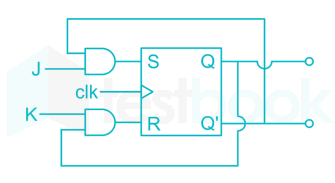
A JK flip flop is constructed from SR flip flop. Which of the following statement is true regarding the inputs of SR flip flop.

  1. ((a))

    S = JQ̅ , R = KQ

  2. ((b))

    S = KQ ,   R= JQ̅ 

  3. ((c))

    S = KQ̅  , R = JQ 

  4. ((d))

    R = KQ̅  , S = JQ 

Show Answer
Answer: ((a))

S = JQ̅ , R = KQ

The construction of J-K flip flop from SR-flip flop is shown

From the figure

Input S = JQ̅

R = KQ

18

In case of R-S flip-flop for R = 0 and S = 1, the action of flip-flop is:

  1. ((a))

    Set

  2. ((b))

    Reset

  3. ((c))

    No change

  4. ((d))

    Forbidden

Show Answer
Answer: ((a))

Set

The truth table of RS flip flop is shown below :

S ROutput Qn+1Remark
0 0QNRetain the previous state
0 10Reset
1 01Set
1 1InvalidForbidden state
19

A wire of resistance 4 Ω is stretched to double its length. Its new resistance will be:

  1. ((a))

    4 Ω

  2. ((b))

    8 Ω

  3. ((c))

    12 Ω

  4. ((d))

    16 Ω

Show Answer
Answer: ((d))

16 Ω

The correct answer is 16 omega.

Key Points

  • The resistance (R) of a conductor is mathematically expressed by the formula R = ρ × (L / A), where ρ represents the resistivity of the material, L is the length, and A is the cross-sectional area.
  • When a wire is stretched, its total volume (V) remains constant. Since volume is the product of area and length (V = A × L), increasing the length results in a corresponding decrease in the cross-sectional area.
  • In this scenario, the wire is stretched to double its length, making the new length L′ = 2L. To maintain a constant volume, the new cross-sectional area A′ must become A / 2.
  • Substituting these new parameters into the resistance equation gives the new resistance R′ = ρ × (2L / (A / 2)), which simplifies to R′ = 4 × (ρL / A), or R′ = 4R.
  • Given that the initial resistance of the wire is 4 Ω, the new resistance is calculated as 4 × 4 Ω = 16 Ω.

 Additional Information

  • Resistivity (ρ):
  • It is a specific property of the material that defines how strongly it opposes the flow of electric current.
  • Unlike resistance, resistivity does not change with the dimensions (length or area) of the wire; it only changes with the material type and temperature.
  • Relationship for Stretching:
  • A useful shortcut for competitive exams: If a wire is stretched n times its original length, the new resistance becomes n2 times the original resistance.
  • For this problem, since n = 2, the resistance increases by a factor of 22 = 4.
  • Factors Affecting Resistance:
  • Nature of Material: Conductors like Copper and Silver have low resistance, while insulators have very high resistance.
  • Temperature: In most metallic conductors, resistance increases linearly with an increase in temperature due to increased atomic vibrations.
20

In a mixed series-parallel circuit, how does increasing one resistor in the parallel section affect the total resistance?

  1. ((a))

    Total resistance increases

  2. ((b))

    Total resistance decreases

  3. ((c))

    Total resistance remains the same

  4. ((d))

    Cannot be determined without voltage

Show Answer
Answer: ((a))

Total resistance increases

The correct answer is Total resistance increases.

Key Points

  • In a mixed series-parallel circuit, the total resistance is determined by combining the equivalent resistance of the parallel sections with the values of the resistors in series.
  • For the parallel portion of the circuit, the equivalent resistance (Rp) is calculated using the formula 1/Rp = 1/R1 + 1/R2 + ... + 1/Rn. If the value of any individual resistor in this section increases, its reciprocal value (1/Rn) decreases.
  • As the sum of these reciprocals decreases, the resulting equivalent parallel resistance (Rp) becomes larger. In a parallel arrangement, adding resistance to a branch always increases the overall resistance of that specific network because it reduces the available paths for charge carriers.
  • The total resistance (Rt) of a mixed circuit is the algebraic sum of the series resistors (Rs) and the parallel equivalent (Rp), expressed as Rt = Rs + Rp. Therefore, any increase in the parallel equivalent resistance directly leads to an increase in total circuit resistance.
  • This mathematical relationship ensures that the total opposition to current flow in the entire circuit rises whenever any individual component resistance within the network is increased.

 Additional Information

  • Parallel Resistance Characteristics:
  • The equivalent resistance of a parallel bank is always less than the smallest individual resistor in that bank.
  • If a resistor in a parallel branch is removed (approaching infinite resistance), the total resistance of the parallel section reaches its maximum possible value for those remaining components.
  • Impact on Current (Ohm's Law):
  • According to Ohm's Law (V = I × R), if the source voltage remains constant, an increase in the total resistance results in a proportional decrease in total current.
  • In the parallel section, the branch with the increased resistance will carry less current than it did previously, while the current in other parallel branches remains unchanged if the voltage across them stays the same.
21

Raman Effect is primarily associated with the interaction between a photon and:

  1. ((a))

    Electron only

  2. ((b))

    Molecule

  3. ((c))

    Proton

  4. ((d))

    Neutron

Show Answer
Answer: ((b))

Molecule

Concept:

The Raman effect is an inelastic scattering of light that occurs when photons interact with molecules, causing a change in the vibrational or rotational energy of the molecules.

Explanation:

During Raman scattering, a photon exchanges energy with a molecule. As a result, the scattered photon has a different frequency from the incident photon, producing the Raman spectrum. This effect is widely used to study the molecular structure and vibrational modes of substances.

Correct Answer:

Option (2): Molecule.

22

In an experiment, a copper wire shows a V-I curve with slight non-linearity at very high current. Which of the following could NOT be a valid cause?

  1. ((a))

    Change in electron mass at high drift velocity.

  2. ((b))

    Joule heating raising the wire's resistivity.

  3. ((c))

    Battery internal resistance.

  4. ((d))

    Temperature coefficient of resistance of copper being positive.

Show Answer
Answer: ((a))

Change in electron mass at high drift velocity.

The correct answer is Change in electron mass at high drift velocity.

Key Points

  • The V-I curve for an Ohmic conductor like copper is ideally a straight line. However, at high currents, the drift velocity of electrons remains very low, typically around 10−4 m/s. Significant changes in electron mass only occur at relativistic speeds approaching the speed of light (3 × 10⁸ m/s). Hence, statement 1 is incorrect.
  • When a high current passes through a wire, it generates heat due to Joule heating, calculated by the formula P = I2R. This increase in thermal energy disrupts the lattice structure and increases electron collisions. Hence, statement 2 is correct.
  • A battery is not an ideal voltage source and possesses internal resistance (r). As the current (I) increases, the terminal voltage (V = E − Ir) drops, which can lead to observed non-linearity in the circuit's performance. Hence, statement 3 is correct.
  • Copper has a positive temperature coefficient of resistance (α). As Joule heating raises the temperature, the resistivity of the wire increases according to R = R0(1 + αΔT), causing the V-I curve to bend. Hence, statement 4 is correct.

 Additional Information

  • Ohm's Law:
  • States that current is directly proportional to voltage provided temperature and pressure remain constant.
  • In high-current scenarios, the 'constant temperature' condition is violated.
  • Relativistic Mass:
  • Calculated using the formula m = m0 / √(1 − v2/c2).
  • Since drift velocity in a copper wire is negligible compared to c, the mass change is practically zero.
  • Resistivity and Temperature:
  • For metals, resistance increases with temperature.
  • For semiconductors, the temperature coefficient is negative, meaning resistance decreases as temperature rises.
23

Resistance of a conductor is inversely proportional to:

  1. ((a))

    Length of the conductor

  2. ((b))

    Area of cross-section

  3. ((c))

    Temperature of the conductor

  4. ((d))

    Resistivity of the material

Show Answer
Answer: ((b))

Area of cross-section

The correct answer is Area of cross-section.

Key Points

  • The electrical resistance of a conductor is defined as the opposition it offers to the flow of electric current. It is determined by the dimensions and atomic structure of the material.
  • According to the laws of resistance, the resistance (R) is inversely proportional to the Area of cross-section (A) of the conductor. This means that a thicker wire provides more parallel paths for electrons to flow, which reduces the frequency of collisions with metal ions.
  • Mathematically, this relationship is expressed as R ∝ 1/A. If the cross-sectional area is doubled, the resistance is halved, assuming the length and temperature remain constant.
  • This principle is utilized in electrical wiring where high-current appliances require thicker cables with larger cross-sections to prevent excessive heating and energy loss.

 Additional Information

  • Length of the conductor (L):
  • Resistance is directly proportional to the length of the conductor (R ∝ L). A longer path increases the probability of electron-ion collisions.
  • Resistivity (ρ):
  • It is an intrinsic property of a material. The complete formula for resistance is R = ρ × (L/A), where ρ (rho) represents the resistivity.
  • Conductive materials like Silver (1.59 × 10⁻⁸ Ω·m) and Copper (1.68 × 10⁻⁸ Ω·m) have extremely low resistivity values.
  • Temperature:
  • For metallic conductors, resistance increases with an increase in temperature because thermal energy increases the amplitude of vibration of the ions, hindering the flow of charge carriers.
  • SI Unit:
  • The SI unit of resistance is the Ohm (Ω), named after Georg Simon Ohm.
24

Which of the following statements best describes the behavior of magnetic field lines around a straight current-carrying conductor?

  1. ((a))

    They radiate straight outward from the wire.

  2. ((b))

    They change direction randomly along the wire.

  3. ((c))

    They are parallel straight lines along the wire.

  4. ((d))

    They form concentric circles centered on the conductor.

Show Answer
Answer: ((d))

They form concentric circles centered on the conductor.

The correct answer is They form concentric circles centered on the conductor..

Key Points

  • When an electric current flows through a straight conductor, it produces a magnetic field around it, a phenomenon discovered by Hans Christian Ørsted.
  • The magnetic field lines around a straight current-carrying wire always form concentric circles.
  • The center of these concentric circles lies on the wire itself, and the circles exist in a plane that is perpendicular to the length of the conductor.
  • The direction of these magnetic field lines is determined by the Right-Hand Thumb Rule.
  • The density of these circles is higher near the wire, indicating a stronger magnetic field, and decreases as the distance from the wire increases.
  • This pattern can be visualized by sprinkling iron filings on a plane surface (like cardboard) through which a current-carrying wire passes vertically.

Additional Information

  • Right-Hand Thumb Rule: If you imagine holding a straight conductor in your right hand such that your thumb points in the direction of the current, then the direction in which your fingers curl gives the direction of the magnetic field lines.
  • The magnitude of the magnetic field (B) at any point is directly proportional to the current (I) passing through the wire and inversely proportional to the distance (r) from the wire.
  • The formula for the magnetic field at a distance r from an infinitely long straight wire is: ( B = \frac{\mu_0 I}{2\pi r} ).
  • If the direction of current is reversed, the direction of the magnetic field lines (clockwise or anticlockwise) also reverses.
  • Unlike a solenoid where the field lines are parallel straight lines inside, the field around a single straight wire is strictly circular.
25

According to Fleming left hand rule, which of the following is denoted using the second finger of the left hand?

  1. ((a))

    Direction of current

  2. ((b))

    Direction of magnetic field

  3. ((c))

    Force acting on the conductor

  4. ((d))

    Measure of resistance

Show Answer
Answer: ((a))

Direction of current

The correct answer is Direction of current.

Key Points

  • Fleming's Left-Hand Rule is a simple visualization tool used to find the direction of the mechanical force (motion) experienced by a current-carrying conductor when it is placed in an external magnetic field.
  • To apply the rule, the thumb, forefinger (first finger), and middle finger (second finger) of the left hand are held mutually perpendicular (at 90 degrees) to one another.
  • The Forefinger (First finger) represents the direction of the Magnetic Field (B), typically pointing from the North pole to the South pole.
  • The Middle Finger (Second finger) represents the direction of the Electric Current (I) flowing through the conductor.
  • The Thumb represents the direction of the Thrust or Force (F) acting on the conductor, which dictates its direction of motion.
  • This rule is essentially a mnemonic for the Lorentz Force equation, where the force vector is the cross-product of the current and magnetic field vectors.

 Additional Information

  • Direction of magnetic field
  • In the left-hand rule, this is indicated by the index finger.
  • In SI units, the strength of this field is measured in Tesla (T).
  • Force acting on the conductor
  • This is represented by the thumb.
  • The magnitude of this force is given by the formula F = B × I × L × sin(θ), where L is the length of the wire and θ is the angle between the current and the field.
  • Measure of resistance
  • Resistance is a property of a material to oppose the flow of current, defined by Ohm's Law (R = V / I).
  • It is not determined or represented by Fleming's rules, which deal with electromagnetism and motion rather than circuit properties.
  • Electric Motors
  • Fleming's Left-Hand Rule is the fundamental principle used to understand the operation of DC Motors, where electrical energy is converted into mechanical torque.
26

What does the electromagnet do once it is activated in an electric bell?

  1. ((a))

    Pulls the iron strip towards itself

  2. ((b))

    Pulls the contact screw

  3. ((c))

    Switches off the bell

  4. ((d))

    Melts the coil

Show Answer
Answer: ((a))

Pulls the iron strip towards itself

The correct answer is Pulls the iron strip towards itself.

Key Points

  • The functioning of an electric bell is based on the magnetic effect of electric current, where a coil of wire acts as a magnet when electricity passes through it.
  • The main component is an electromagnet, which consists of insulated copper wire wound around a soft iron core.
  • When the circuit is completed by pressing the switch, the current flows through the coil, creating a magnetic field that transforms the iron core into a temporary magnet.
  • This electromagnet immediately exerts a force of attraction on the iron strip (also known as the armature) located nearby.
  • As the iron strip is pulled toward the electromagnet, the hammer attached to it moves and strikes the gong, producing the ringing sound.
  • This movement also causes the strip to move away from the contact screw, which results in the breaking of the electrical circuit.

 Additional Information

  • Core Components of an Electric Bell:
  • Electromagnet: A temporary magnet that only functions when current is present; the principle was first observed by Hans Christian Oersted in 1820.
  • Soft Iron Armature: Chosen because soft iron has high magnetic permeability and low retentivity, allowing it to be magnetized and demagnetized rapidly.
  • Contact Screw: Serves as an adjustable component that maintains the make-and-break cycle of the circuit.
  • Hammer and Gong: The mechanical parts responsible for converting the kinetic energy of the moving armature into acoustic energy.
  • Spring Strip: Provides the restoring force to bring the iron strip back to the contact screw once the magnetism is lost, enabling a continuous ringing cycle.
27

The direction of the magnetic field around a current-carrying conductor can be determined using:

  1. ((a))

    Fleming's right-hand rule

  2. ((b))

    Fleming's left-hand rule

  3. ((c))

    Right-hand thumb rule

  4. ((d))

    Left-hand thumb rule

Show Answer
Answer: ((c))

Right-hand thumb rule

The correct answer is Right-hand thumb rule.

Key Points

  • The Right-hand thumb rule, frequently referred to as Maxwell's Corkscrew Rule, is the standard convention used to determine the direction of the magnetic field associated with a current-carrying conductor.
  • This rule states that if you imagine holding a straight current-carrying wire in your right hand with the thumb pointing in the direction of the conventional current (from positive to negative), then your curled fingers will point in the direction of the magnetic field lines.
  • The magnetic field produced by a straight conductor forms concentric circles around the wire; the direction of these circles reverses if the direction of the current is flipped.
  • Mathematically, the magnitude of the magnetic field (B) at a distance r from a long straight wire carrying current I is given by the formula B = (μ0I) / (2πr), where μ0 is the permeability of free space.

 Additional Information

  • Fleming's Left-hand rule
  • This rule is primarily used to find the direction of the magnetic force acting on a moving charged particle or a current-carrying wire placed within an external magnetic field.
  • It is the working principle behind electric motors, where the thumb represents thrust/force, the forefinger represents the magnetic field, and the middle finger represents the current.
  • Fleming's Right-hand rule
  • This rule is utilized to determine the direction of the induced current when a conductor moves through a magnetic field.
  • It is the fundamental principle for electric generators, where the thumb points in the direction of motion, the forefinger in the direction of the field, and the middle finger indicates the induced current.
28

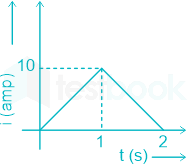
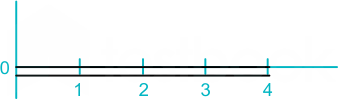
Find the average value of current shown graphically from t = 0  to t = 2 s   .

  1. ((a))

    3 A

  2. ((b))

    5 A

  3. ((c))

    10 A

  4. ((d))

    4 A

Show Answer
Answer: ((b))

5 A

To find the average value of the current from t = 0 t = 2 seconds, we analyze the current-time (i - t) graph.

Calculate the Area under the Graph:

The graph consists of two triangular sections.

First Triangle: From t = 0 to t = 1 second, with a height of 10 A.

Area of first triangle = ( \frac{1}{2} \times \text{base} \times \text{height} = \frac{1}{2} \times 1 \times 10 = 5,\text{A})

Second Triangle: From t = 1 to t = 2 seconds, with a height of 10 A.

Area of second triangle = (\frac{1}{2} \times (2 - 1) \times 10 = 5~A)

Total Area:

Total area under the graph from t = 0 t = 2 seconds is:

5A + 5A = 10A

Calculate the Average Current:

The average current (iav ) is given by:

(i_{\text{av}} = \frac{\text{Total Area}}{\text{Time Interval}} = \frac{10}{2} = 5\text{ A})

Thus, the average current over the interval from t = 0 t = 2 seconds is 5 A.

29

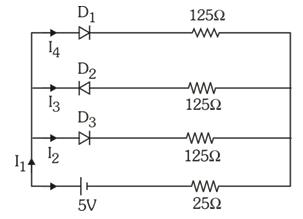
If each diode has a forward bias resistance of 25 Ω in the below circuit,

Which of the following options is correct:

  1. ((a))

    (\frac{\mathrm{I}{3}}{\mathrm{I}{4}}) = 1

  2. ((b))

    (\frac{\mathrm{I}{2}}{\mathrm{I}{3}}) = 1

  3. ((c))

    (\frac{\mathrm{I}{1}}{\mathrm{I}{2}}) = 1

  4. ((d))

    (\frac{\mathrm{I}{1}}{\mathrm{I}{2}}) = 2

Show Answer
Answer: ((d))

(\frac{\mathrm{I}{1}}{\mathrm{I}{2}}) = 2

Answer (4)

Sol.

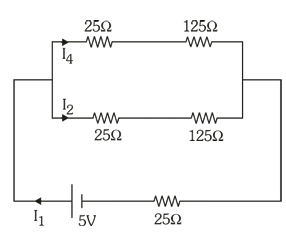
Req = (\frac{150 \times 150}{300}) + 25 = 100Ω

I1 = (\frac{5}{10}) = 0.05A

I2 = I4 = (\frac{0.05}{2}) = 0.025A

(\frac{\mathrm{I}{1}}{\mathrm{I}{2}}) = 2

30

The "Particle in a Box" model assumes:

  1. ((a))

    Infinite potential barriers surrounding the particle

  2. ((b))

    Uniform electric field inside the box

  3. ((c))

    Constant magnetic field inside the box

  4. ((d))

    Gravitational attraction only

Show Answer
Answer: ((a))

Infinite potential barriers surrounding the particle

Concept:

The "Particle in a Box" model is a fundamental quantum mechanical model in which a particle is confined within a one-dimensional region by infinitely high potential walls.

Explanation:

The model assumes that the potential energy is zero inside the box and infinite outside it. As a result, the particle cannot escape the box, leading to quantized energy levels and standing wave solutions of the Schrödinger equation.

Correct Answer:

Option (1): Infinite potential barriers surrounding the particle.

31

Phase velocity and group velocity are associated with:

  1. ((a))

    Wave propagation

  2. ((b))

    Newton's laws of motion

  3. ((c))

    Electrostatic force

  4. ((d))

    Thermal expansion

Show Answer
Answer: ((a))

Wave propagation

Concept:

Phase velocity and group velocity are fundamental concepts in wave mechanics that describe how waves and wave packets propagate through a medium.

Explanation:

Phase velocity is the speed at which a wave's phase travels, while group velocity is the speed at which the wave packet or energy propagates. These concepts are used to analyze wave propagation in quantum mechanics, optics, and electromagnetism.

Correct Answer:

Option (1): Wave propagation.

32

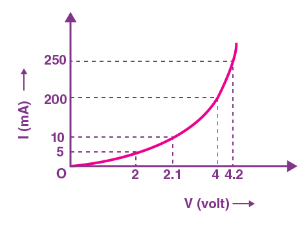
The I – V characteristics of a p - n junction diode in forward bias is shown in the figure. The ratio of dynamic resistance, corresponding to forward bias voltage of 2 V and 4 V respectively, is :

  1. ((a))

    1 ∶ 2

  2. ((b))

    5 ∶ 1

  3. ((c))

    1 ∶ 40

  4. ((d))

    20 ∶ 1

Show Answer
Answer: ((b))

5 ∶ 1

Concept:

  • The p-n junction diode is a semiconductor device that allows current to flow in one direction under forward bias conditions.
  • In forward bias, the p-side of the diode is connected to the positive terminal and the n-side to the negative terminal of the supply.
  • The I-V characteristics of a diode show how the current through the diode changes with the applied voltage.
  • Dynamic Resistance:
  • It is defined as the ratio of a small change in voltage to the corresponding change in current.
  • SI Unit: Ohm (Ω)
  • Dimensional Formula: [ML2T-3A-2]
  • Formula: (r_d = \frac{\Delta V}{\Delta I})
  • Forward Bias Voltage:
  • It is the external potential applied to a p-n junction diode to reduce the depletion layer.
  • SI Unit: Volt (V)
  • Dimensional Formula: [ML2T-3A-1]


Calculation:

From the given graph,

Case 1: At V = 2 V

ΔV1 = 2.1 - 2.0 = 0.1 V

ΔI1 = 15 - 10 = 5 mA = 5 × 10⁻³ A

Dynamic resistance r1 is,

(r_1 = \frac{\Delta V_1}{\Delta I_1})

⇒ r1 = 0.1 / (5 × 10⁻³)

⇒ r1 = 20 Ω

Case 2: At V = 4 V

ΔV2 = 4.2 - 4.0 = 0.2 V

ΔI2 = 250 - 200 = 50 mA = 50 × 10-3 A

Dynamic resistance r2 is,

(r_2 = \frac{\Delta V_2}{\Delta I_2})

⇒ r2 = 0.2 / (50 × 10-3)

⇒ r2 = 4 Ω

Calculating the ratio:

⇒ Ratio = r1 : r2

⇒ Ratio = 20 : 4

⇒ Ratio = 5 : 1

∴ The ratio of dynamic resistance is 5 : 1.

33

In Dirac notation, Bra (⟨ψ|) is associated with:

  1. ((a))

    Conjugate transpose

  2. ((b))

    Wave function normalization

  3. ((c))

    Momentum operator

  4. ((d))

    Probability density

Show Answer
Answer: ((a))

Conjugate transpose

Concept:

In Dirac notation, a quantum state is represented by a ket, |ψ⟩. The corresponding bra, ⟨ψ|, is obtained by taking the Hermitian conjugate (conjugate transpose) of the ket.

Explanation:

A ket |ψ⟩ is a column vector representing a quantum state, while the bra ⟨ψ| is the corresponding row vector formed by taking its complex conjugate and transpose. This conjugate transpose operation is essential for calculating inner products, probabilities, and expectation values in quantum mechanics.

Correct Answer:

Option (1): Conjugate transpose.

34

The Schrödinger equation describes

  1. ((a))

    Evolution of the wave function with time

  2. ((b))

    Motion of planets around the Sun

  3. ((c))

    Propagation of electromagnetic waves

  4. ((d))

     Thermal motion of molecules

Show Answer
Answer: ((a))

Evolution of the wave function with time

Concept:

The Schrödinger equation is the fundamental equation of quantum mechanics. It describes how the wave function (ψ) of a quantum system changes with time.

Explanation:

The wave function contains all the information about the quantum state of a particle. Solving the Schrödinger equation predicts how this wave function evolves with time, allowing the probability of finding the particle at different positions to be determined. Hence, it describes the evolution of the wave function, not the motion of planets, electromagnetic waves, or thermal motion of molecules.

Correct Answer:

Option (1): Evolution of the wave function with time.

35

The Norton equivalent of a circuit has IN = 4 A and RN = 6 Ω. The corresponding Thevenin voltage is:

  1. ((a))

    10 V

  2. ((b))

     20 V

  3. ((c))

    24 V

  4. ((d))

    30 V

Show Answer
Answer: ((c))

24 V

Concept:

The Thevenin and Norton equivalent circuits are related by the equation: VTh = IN × RN.

Calculation:

Given:

IN = 4 A

RN = 6 Ω

<br>

VTh = IN × RN

= 4 × 6

= 24 V

Correct Answer:

Option (3): 24 V.

36

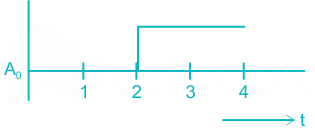
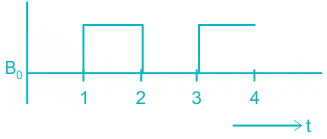
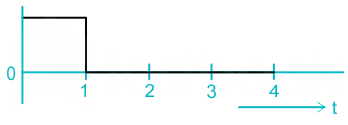
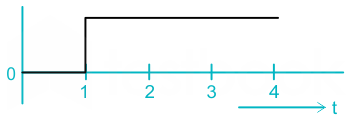
For the logic circuit shown, the output waveform at Y is:

  1. ((a))

  2. ((b))

  3. ((c))

  4. ((d))

Show Answer
Answer: ((b))

Calculation:

For the given circuit the truth table would be :

ABY
000
011
101
111
<br>

The truth table shows that the output graph is given by :

∴ Option (2) is correct.

37

Radioactive decay cannot be predicted exactly for a single nucleus because the process is __________.

  1. ((a))

    Controlled by temperature only

  2. ((b))

    Random in nature

  3. ((c))

    Completely deterministic

  4. ((d))

    Dependent on chemical state always

Show Answer
Answer: ((b))

Random in nature

The correct answer is Random in nature.

Key Points

  • Radioactive decay is a spontaneous and stochastic (random) process occurring at the level of individual atoms.
  • For any specific unstable nucleus, it is fundamentally impossible to predict the exact moment it will undergo disintegration because it does not follow a classical deterministic path.
  • The process is governed by the laws of quantum mechanics and probability; a nucleus has no 'memory' of how long it has existed, and its chance of decaying remains constant over time.
  • While the behavior of a single nucleus is unpredictable, the statistical behavior of a large collection of nuclei is highly predictable and follows the exponential decay law.
  • The decay constant (λ) represents the probability of decay per unit time for a particular type of radioisotope.
  • The transformation involves the emission of alpha particles, beta particles, or gamma rays as the nucleus seeks a more stable energy state.

 Additional Information

  • Temperature and External Factors
  • Unlike chemical reactions, radioactive decay is an intranuclear process. This means it is not affected by external physical conditions such as temperature, pressure, or magnetic fields.
  • The nuclear binding energy is significantly higher than the thermal energy available in ordinary environments, making the decay rate constant regardless of heat.
  • Deterministic vs. Stochastic
  • A deterministic process would allow us to calculate the exact time of an event if we knew all initial conditions. However, nuclear physics is non-deterministic; identical nuclei in identical environments will decay at different, random times.
  • Chemical State Independence
  • The chemical state (whether an atom is in a pure form or part of a compound) does not influence the nuclear instability because the nucleus is isolated from the valence electrons by vast distances on a subatomic scale.
  • Half-life (T1/2)
  • The half-life is a statistical measure representing the time required for half of the radioactive atoms in a sample to decay. It highlights how randomness at the micro-level leads to mathematical precision at the macro-level.
38

The stability of the nucleus is mainly due to the balance between ________.

  1. ((a))

    Electron attraction and neutron decay

  2. ((b))

    Nuclear attraction and proton repulsion

  3. ((c))

    Gravitational force and magnetic flux

  4. ((d))

    Atomic volume and electric current

Show Answer
Answer: ((b))

Nuclear attraction and proton repulsion

Concept:

Nuclear Stability:

  • The stability of a nucleus depends on the interaction between two fundamental forces within the atomic nucleus.
  • Strong Nuclear Force: This is a short-range attractive force that acts between all nucleons (protons and neutrons).
  • Electrostatic Force: This is a long-range repulsive force that acts between positively charged protons.
  • A nucleus remains stable when the Nuclear attraction is sufficient to overcome the Proton repulsion.

Strong Nuclear Force:

  • Definition: The powerful attractive force that binds protons and neutrons together in the nucleus.
  • SI Unit: Newton (N)
  • Dimensional Formula: [MLT−2]
  • Important Property: It is charge-independent and has a very short range (approx 10−15 m).

Electrostatic Force:

  • Definition: The repulsive force between two like-charged particles (protons).
  • SI Unit: Newton (N)
  • Formula: (F = \frac{k q_1 q_2}{r^2})
  • Dimensional Formula: [MLT−2]

Proton:

  • Definition: A subatomic particle with a positive charge found in the nucleus.
  • SI Unit of Charge: Coulomb (C)
  • Dimensional Formula of Charge: [AT]
  • Charge Magnitude: 1.6 × 10⁻¹⁹ C


Calculation:

Given,

Attractive Force = Fn (Nuclear Force)

Repulsive Force = Fe (Coulombic Force)

⇒ Stability requires a balance of forces.

⇒ Fn acts between all nucleons.

⇒ Fe acts only between protons.

⇒ Fn provides Nuclear attraction.

⇒ Fe provides Proton repulsion.

⇒ Stability exists when Fn balances Fe.

∴ The stability of the nucleus is mainly due to the balance between Nuclear attraction and proton repulsion.

39

Beta decay helps unstable nuclei achieve stability mainly by adjusting the __________.

  1. ((a))

    Electron orbital speed only

  2. ((b))

    Nuclear volume to infinity

  3. ((c))

    Neutron-proton ratio

  4. ((d))

    Atomic radius only

Show Answer
Answer: ((c))

Neutron-proton ratio

Concept:

Beta Decay:

  • Beta decay is a type of radioactive decay in which a beta particle (fast energetic electron or positron) is emitted from an atomic nucleus.
  • It transforms the unstable nucleus into a more stable one by changing the number of protons and neutrons.
  • SI Unit: The unit for radioactivity is Becquerel (Bq).
  • Dimensional Formula: [M0L0T−1]

Nuclear Stability:

  • The stability of a nucleus is primarily determined by its Neutron-Proton ratio (n/p ratio).
  • Nuclei with an excess of neutrons or protons lie outside the stability belt and undergo radioactive decay.
  • For lighter nuclei, stability occurs when the n/p ratio is approximately 1.
  • For heavier nuclei, the ratio increases to about 1.5 due to electrostatic repulsion between protons.

Neutron-Proton Ratio:

  • It is the ratio of the number of neutrons (N) to the number of protons (Z) in an atomic nucleus.
  • Formula: Ratio = N / Z
  • It is a dimensionless quantity.


Calculation:

Given,

Process = Beta decay

Goal = Achieve nuclear stability

In Beta-minus (β) decay:

⇒ A neutron converts into a proton.

⇒ n → p + e + antineutrino

⇒ Number of neutrons decreases.

⇒ Number of protons increases.

⇒ This decreases the n/p ratio.

In Beta-plus (β+) decay:

⇒ A proton converts into a neutron.

⇒ p → n + e+ + neutrino

⇒ Number of neutrons increases.

⇒ Number of protons decreases.

⇒ This increases the n/p ratio.

Both processes adjust the n/p ratio.

This adjustment brings the nucleus toward the

stability belt.

∴ Beta decay helps unstable nuclei achieve stability mainly by adjusting the Neutron-proton ratio.

40

During a nuclear fusion reaction -

  1. ((a))

    A light nucleus breaks up due to bombardment of thermal neutrons.

  2. ((b))

    A heavy nucleus breaks up due to bombardment of thermal neutrons.

  3. ((c))

    Two light nuclei combine to give a heavier nucleus and possibly other products.

  4. ((d))

    A heavy nucleus breaks into two fragments by itself.

Show Answer
Answer: ((c))

Two light nuclei combine to give a heavier nucleus and possibly other products.

Concept

  • Nuclear fusion is the process in which two or more light atomic nuclei combine to form one or more different, heavier atomic nuclei and subatomic particles (like neutrons or protons).
  • This process releases a tremendous amount of energy because the mass of the resulting single nucleus is less than the combined mass of the original nuclei. The "missing" mass is converted into energy according to Einstein's equation (E = mc^2).
<br>

Key Points

  • Fusion: Combining light nuclei (e.g., Hydrogen isotopes fusing to form Helium).
  • Fission: The splitting of a heavy nucleus into lighter fragments (e.g., Uranium-235 splitting after neutron bombardment).
  • Coulomb Barrier: High temperature and pressure are required for fusion to overcome the electrostatic repulsion between positively charged nuclei.
<br>

Explanation

To identify the correct description of nuclear fusion, let's look at the nature of the reaction:

  • Statement A & B: These describe the "breaking up" of a nucleus. If a nucleus breaks up after being hit by a neutron, it is called induced nuclear fission. This is characteristic of heavy elements like Uranium or Plutonium, not fusion.
  • Statement D: A heavy nucleus breaking into fragments by itself is known as spontaneous fission or radioactive decay.
  • Statement C: This accurately describes nuclear fusion. In this process, light nuclei (such as isotopes of hydrogen) are forced together under extreme conditions to form a heavier, more stable nucleus (such as helium), releasing energy in the process. This is the reaction that powers the Sun and other stars.

Hence, during a nuclear fusion reaction, two light nuclei combine to give a heavier nucleus and possibly other products.

41

The magnification of a compound microscope is 20. The focal length of the eyepiece is 5 cm and the image is formed at near point (25 cm). The magnification of the objective lens is 

  1. ((a))

    5.8

  2. ((b))

    6.78

  3. ((c))

    3.33

  4. ((d))

    4.1

Show Answer
Answer: ((c))

3.33

CONCEPT:

Compound microscope: 

  • It is used for much larger magnifications.
  • Two lenses are used with one lens compounding the effect of the other.

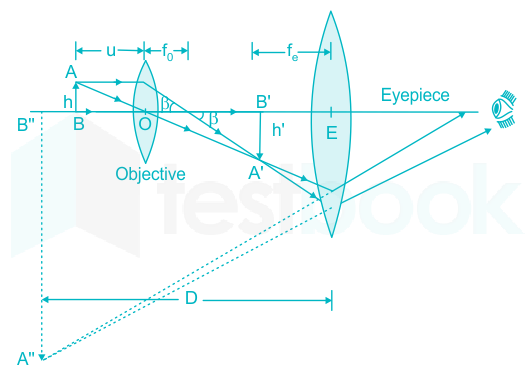
where fo is the focal length of the objective lens,  fe  is the focal length of the eyepiece, h is the object height, h' is the size of the first image

  • A compound microscope uses two lenses i.e., objective lens and eyepiece
  • Objective lens: lens nearest to the object forming a real, inverted, and magnified image of the object.
  • Eyepiece: produces a final image that is enlarged and virtual.

CALCULATION:

Given: magnification of compound microscope(m) = 20, focal length of eye piece (fe) = 5 cm and image is formed at near point (v= D) = 25 cm.

  • Linear magnification due to eyepiece:

(⇒ m_{e} = 1+\frac{D}{f} = 1+ (\frac {25}{5} )= 6)

  • Total magnification is given by:

⇒ m = m× me,

where mo is the magnification due to the objective lens.

  • Magnification due to the objective lens is given by:

(⇒ m_{o} = \frac {m}{m_{e}} = \frac {20}{6} = 3.33)

  • Hence option 3) is correct.
42

How many arithmetic means must be inserted between 7 and 35 so that the inserted means

form an AP with 6 terms in total?

  1. ((a))

    3

  2. ((b))

    4

  3. ((c))

    6

  4. ((d))

    5

Show Answer
Answer: ((b))

4

Given:

First term (a) = 7

Last term (l) = 35

Total terms (n) = 6

Formula used:

Number of arithmetic means = Total terms (n) - 2

Calculation:

Number of arithmetic means = 6 - 2

⇒ Number of arithmetic means = 4

∴ The correct answer is option (2).

43

If ( A = \begin{bmatrix} 2 & 4 \ 4 & 3 \end{bmatrix}, X = \begin{bmatrix} n \ 1 \end{bmatrix}, B = \begin{bmatrix} 8 \ 11 \end{bmatrix} ) and ( AX = B ), then ( n ) equals to

  1. ((a))

    3

  2. ((b))

    1

  3. ((c))

    2

  4. ((d))

    0

Show Answer
Answer: ((c))

2

Concept:

Matrix Multiplication:

  • The multiplication of two matrices is possible if the number of columns of the first matrix equals the number of rows of the second matrix.
  • If A is an m × n matrix and X is an n × 1 matrix, the product AX is an m × 1 column matrix.
  • The elements of the product are calculated by multiplying the elements of the rows of the first matrix by the corresponding elements of the columns of the second matrix.

Equality of Matrices:

  • Two matrices are said to be equal if they have the same order and their corresponding elements are identical.
  • If (\begin{bmatrix} a \ b \end{bmatrix} = \begin{bmatrix} c \ d \end{bmatrix}), then a = c and b = d.


Calculation:

Given,

⇒ A = (\begin{bmatrix} 2 & 4 \ 4 & 3 \end{bmatrix})

⇒ X = (\begin{bmatrix} n \ 1 \end{bmatrix})

⇒ B = (\begin{bmatrix} 8 \ 11 \end{bmatrix})

⇒ AX = B


⇒ (\begin{bmatrix} 2 & 4 \ 4 & 3 \end{bmatrix} \begin{bmatrix} n \ 1 \end{bmatrix} = \begin{bmatrix} 8 \ 11 \end{bmatrix})

⇒ (\begin{bmatrix} (2 \times n) + (4 \times 1) \ (4 \times n) + (3 \times 1) \end{bmatrix} = \begin{bmatrix} 8 \ 11 \end{bmatrix})

⇒ (\begin{bmatrix} 2n + 4 \ 4n + 3 \end{bmatrix} = \begin{bmatrix} 8 \ 11 \end{bmatrix})

⇒ 2n + 4 = 8

⇒ 2n = 8 − 4

⇒ 2n = 4

⇒ n = 4 ÷ 2

⇒ n = 2

⇒ Also, 4n + 3 = 11

⇒ 4(2) + 3 = 11

⇒ 8 + 3 = 11 (Satisfied)

∴ The value of n is 2.

44

If ( A = \begin{bmatrix} 3 & -2 \ 4 & -2 \end{bmatrix} ) satisfies the matrix equation A² − kA + 2I = 0, then the value of k is

  1. ((a))

    3

  2. ((b))

    1

  3. ((c))

    2

  4. ((d))

    0

Show Answer
Answer: ((b))

1

Concept:

Matrix Equation:

  • An equation where the unknowns are matrices or scalars related to matrices.
  • Physical Quantity: Matrix
  • Definition: A rectangular array of numbers or symbols arranged in rows and columns.
  • SI Unit: Dimensionless
  • Dimensional Formula: [M0L0T0]

Identity Matrix (I):

  • A square matrix in which all the elements of the principal diagonal are 1 and all other elements are 0.
  • Physical Quantity: Identity Matrix
  • Formula for 2 × 2: ( I = \begin{bmatrix} 1 & 0 \ 0 & 1 \end{bmatrix} )
  • SI Unit: Dimensionless

Matrix Multiplication:

  • The product of two matrices is calculated by multiplying the elements of rows of the first matrix by the elements of columns of the second matrix and summing them.

Scalar Multiplication:

  • Multiplying a matrix by a scalar k involves multiplying every individual element of the matrix by that scalar.


Calculation:

Given,

Matrix ( A = \begin{bmatrix} 3 & -2 \ 4 & -2 \end{bmatrix} )

Equation: ( A^2 - kA + 2I = 0 )

First, calculate ( A^2 ):

⇒ ( A^2 = \begin{bmatrix} 3 & -2 \ 4 & -2 \end{bmatrix} \begin{bmatrix} 3 & -2 \ 4 & -2 \end{bmatrix} )

⇒ ( A^2 = \begin{bmatrix} 9 - 8 & -6 + 4 \ 12 - 8 & -8 + 4 \end{bmatrix} )

⇒ ( A^2 = \begin{bmatrix} 1 & -2 \ 4 & -4 \end{bmatrix} )

Now, substitute in the given equation:

⇒ ( \begin{bmatrix} 1 & -2 \ 4 & -4 \end{bmatrix} - k \begin{bmatrix} 3 & -2 \ 4 & -2 \end{bmatrix} + 2 \begin{bmatrix} 1 & 0 \ 0 & 1 \end{bmatrix} = 0 )

⇒ ( \begin{bmatrix} 1 & -2 \ 4 & -4 \end{bmatrix} - \begin{bmatrix} 3k & -2k \ 4k & -2k \end{bmatrix} + \begin{bmatrix} 2 & 0 \ 0 & 2 \end{bmatrix} = \begin{bmatrix} 0 & 0 \ 0 & 0 \end{bmatrix} )

Equating the elements from the first row and

first column:

⇒ 1 − 3k + 2 = 0

⇒ 3 − 3k = 0

⇒ 3k = 3

⇒ k = 1

Verify with elements from the second row and

first column:

⇒ 4 − 4k + 0 = 0

⇒ 4k = 4

⇒ k = 1

∴ Hence, the value of k is 1.

45

Given below are two statements :

Statement I : When the frequency of an a.c. source in a series LCR circuit increases, the current in the circuit first increases, attains a maximum value and then decreases. 

Statement II : In a series LCR circuit, the value of power factor at resonance is one. In the light of given statements, choose the most 

appropriate answer from the options given below:

  1. ((a))

    Statement I is incorrect but Statement II is true. 

  2. ((b))

    Both Statement I and Statement II are false. 

  3. ((c))

    Statement I is correct but Statement II is false. 

  4. ((d))

    Both Statement I and Statement II are true.

Show Answer
Answer: ((d))

Both Statement I and Statement II are true.

Concept:

In a series LCR circuit,

Current:

I = V/Z

where impedance,

Z = √[R2 + (XL − XC)2]

At resonance:

XL = XC

⇒ Z = R (minimum)

Therefore, current becomes maximum.

Power factor:

cosφ = R/Z

At resonance,

Z = R

⇒ cosφ = 1

Solution:

Statement I:

As frequency increases,

Current first increases, becomes maximum at resonance, and then decreases.

This statement is correct.

Statement II:

At resonance in a series LCR circuit,

XL = XC

Hence impedance becomes minimum and equal to resistance.

Therefore,

cosφ = R/R = 1

Thus, power factor at resonance is one.

Hence, Statement II is also correct.

Therefore, both Statement I and Statement II are true.

46

Which of the following statements is/are correct?

When a Zener diode is used as a voltage regulator:

A. The Zener diode will be forward biased.

B. The current through the load will be much greater than the current through the Zener diode.

  1. ((a))

    Both A and B are not correct.

  2. ((b))

    Both A and B are correct.

  3. ((c))

    Only B is correct.

  4. ((d))

    Only A is correct.

Show Answer
Answer: ((a))

Both A and B are not correct.

Concept

  • Zener Diode: It is a heavily doped P-N junction diode designed to operate specifically in the reverse breakdown region without being damaged.
  • Voltage Regulation: A Zener diode acts as a voltage regulator because, in the breakdown region, the voltage across it remains constant even if the current flowing through it changes significantly.
  • Biasing: For a Zener diode to function as a regulator, it must be connected in reverse bias across the input voltage.
<br>

Explanation

Analysis of Statement A:

  • For voltage regulation, the Zener diode must operate in its breakdown region. This region is only reached when the diode is reverse biased (the n-side is connected to the positive terminal and the p-side to the negative terminal).
  • If the Zener diode were forward biased, it would behave like an ordinary silicon diode with a constant voltage drop of approximately (0.7,V), which is not useful for high-voltage regulation.
  • Therefore, Statement A is incorrect.

Analysis of Statement B:

  • In a regulator circuit, the Zener diode is connected in parallel with the load resistance ((R_L)).
  • The total current from the source divides between the Zener diode ((I_Z)) and the load ((I_L)).
  • The magnitude of the load current depends entirely on the value of the load resistance ((I_L = V_Z / R_L)). There is no operational requirement or physical law stating that the load current must be much greater than the Zener current. In many practical designs, the Zener current is kept significant to ensure the diode stays in the breakdown region even if the load changes.
  • Therefore, Statement B is incorrect.
<br>

Conclusion

Since the Zener diode must be reverse biased for regulation and there is no condition requiring the load current to be much greater than the Zener current, both provided statements are false.

Hence, both A and B are not correct.

47

In LCR series circuit, R = 100 Ω,  XL = 200 Ω and Xc = 100 Ω is connected across an a.c. source of 220 V and 50 Hz. Calculate the power factor angle

  1. ((a))

    30°

  2. ((b))

    45°

  3. ((c))

    60°

  4. ((d))

    90°

Show Answer
Answer: ((b))

45°

CONCEPT:

  • Power factor: The ratio of the true power to the apparent power of an a.c. the circuit is called the power factor.
  • Its value varies from 0 to 1.

The power factor (p.f) of a series LCR-circuit is given by:

Power factor (P) = Cos Φ  

(\cos {\rm{Φ }} = \frac{R}{Z} = \frac{R}{{\sqrt {{R^2} + {{\left( {{X_L} - {X_C}} \right)}^2}} }})

Where R = resistance, Z = Impedance, XL = Inductive reactance and XC = Capacitive reactance

CALCULATION:

Given that:

R = 100 Ω,  XL = 200 Ω, Xc = 100 Ω, V = 220 V and ν = 50 Hz

The power factor of a series LCR-circuit is given by

(\cos {\rm{Φ }} = \frac{R}{{\sqrt {{R^2} + {{\left( {{X_L} - {X_C}} \right)}^2}} }})

( \Rightarrow {\rm{;cosΦ }} = \frac{{100}}{{\sqrt {{{\left( {100} \right)}^2} + {{\left( {200 - 100} \right)}^2}} }} = \frac{{;100}}{{100\sqrt 2 }} = \frac{1}{{\sqrt 2 }})

( \Rightarrow {\rm{Φ }} = {\cos ^{ - 1}}\left( {\frac{1}{{\sqrt 2 }}} \right) = 45^\circ )

48

In Joule-Thomson effect, the gas-

  1. ((a))

    always heats up

  2. ((b))

    always cools down

  3. ((c))

    neither heats up nor cools down

  4. ((d))

    heats up or cools down depending upon its initial temperature

Show Answer
Answer: ((d))

heats up or cools down depending upon its initial temperature

Concept

  • The Joule-Thomson effect (or Joule-Kelvin effect) describes the temperature change of a real gas when it is allowed to expand freely through a multi-porous plug or a constricted nozzle from a region of high pressure to a region of low pressure under adiabatic conditions.
  • For an ideal gas, there is no temperature change during this process because there are no intermolecular forces to overcome.
  • For real gases, whether the gas heats up or cools down depends on its Inversion Temperature ((T_i)).
<br>

Key Points

The Joule-Thomson coefficient ((\mu_{JT})) is defined as:

(\mu_{JT} = \left( \frac{\partial T}{\partial P} \right)_H)

  • If (\mu_{JT} > 0), the gas cools down upon expansion (cooling effect).
  • If (\mu_{JT} < 0), the gas heats up upon expansion (heating effect).
  • The Inversion Temperature ((T_i)) is the temperature at which (\mu_{JT} = 0).
<br>

Explanation

The behavior of a real gas during the Joule-Thomson expansion is determined by its initial temperature relative to its inversion temperature:

  1. Below Inversion Temperature ((T < T_i)): Most gases (like (N_2, O_2, CO_2)) at room temperature are below their inversion temperature. When they expand, they perform work to overcome attractive intermolecular forces (van der Waals forces), leading to a decrease in internal energy and thus a cooling effect.
  2. Above Inversion Temperature ((T > T_i)): Gases like Hydrogen and Helium have very low inversion temperatures. If they expand at room temperature (which is above their (T_i)), repulsive forces dominate or the (PV) work term increases, causing the gas to heat up.
  3. At Inversion Temperature ((T = T_i)): The gas shows neither heating nor cooling effect.

Since the outcome (heating or cooling) varies based on the gas's starting thermal state, it is strictly dependent on the initial temperature.

Hence, in the Joule-Thomson effect, the gas heats up or cools down depending upon its initial temperature.

49

If the efficiency of a Carnot engine is 25% and the temperature of the source is 327°C, the temperature of the sink must be -

  1. ((a))

    82°C

  2. ((b))

    127°C

  3. ((c))

    177°C

  4. ((d))

    227°C

Show Answer
Answer: ((c))

177°C

Concept

  • A Carnot engine is an ideal heat engine that operates on the Carnot cycle.
  • The efficiency of a Carnot engine depends only on the absolute temperatures of the heat source and the heat sink.
  • Temperatures used in the efficiency formula must always be in the Kelvin scale.
<br>

Formula Used

Efficiency of a Carnot engine:

(\eta = 1 - \frac{T_{sink}}{T_{source}})

Temperature conversion (Celsius to Kelvin):

(T(K) = T(^\circ C) + 273)

<br>

Calculation

Given:

Efficiency, (\eta = 25% = \frac{25}{100} = 0.25)

Temperature of the source, (T_{source} = 327^\circ C)

Converting source temperature to Kelvin:

(T_{source} = 327 + 273 = 600,K)

Using the efficiency formula:

(\eta = 1 - \frac{T_{sink}}{T_{source}})

(0.25 = 1 - \frac{T_{sink}}{600})

Rearranging the equation to find (T_{sink}):

(\frac{T_{sink}}{600} = 1 - 0.25)

(\frac{T_{sink}}{600} = 0.75)

(T_{sink} = 0.75 \times 600)

(T_{sink} = 450,K)

Now, converting the sink temperature back to Celsius:

(T_{sink}(^\circ C) = 450 - 273)

(T_{sink} = 177^\circ C)

Hence, the temperature of the sink must be (177^\circ C).

50

A Carnot engine having an efficiency of (\frac{1}{10}) is being used as a refrigerator. If the work done on the refrigerator is 10 J, the amount of heat absorbed from the reservoir at a lower temperature is

  1. ((a))

    99 J

  2. ((b))

    100 J

  3. ((c))

    1 J

  4. ((d))

    90 J

Show Answer
Answer: ((d))

90 J

Concept:

A Carnot engine operates on a completely reversible cycle known as the Carnot cycle. It represents an ideal heat engine that achieves the maximum possible efficiency for converting heat energy into mechanical work when operating between two given temperature limits.

The efficiency of a Carnot heat engine is defined as the ratio of work obtained to the heat absorbed from the source.

⇒ η = W / Q

Here, η represents the efficiency of the Carnot engine, W denotes the work done by the engine, and Q is the amount of heat supplied to the system.

Calculation:

Given efficiency of the engine,

⇒ η = 1 / 10

The ratio of rejected heat to work done is expressed as

⇒ β = (1 − η) / η

Substituting the given value of efficiency,

⇒ β = (1 − 1/10) / (1/10)

⇒ β = (9/10) ÷ (1/10)

⇒ β = 9

This ratio can also be written as

⇒ β = Q2 / W

If the work done by the engine is 10 J, then

⇒ Q2 = 9 × 10 = 90 J

51

Which of the following thermodynamic law gives the concept of entropy?

  1. ((a))

    First law of thermodynamics

  2. ((b))

    Second law of thermodynamics

  3. ((c))

    Third law of thermodynamics

  4. ((d))

    Zeroth law of thermodynamics

Show Answer
Answer: ((b))

Second law of thermodynamics

The concept of entropy is given by the Second Law of Thermodynamics.

Key Points Entropy is a fundamental concept in thermodynamics that measures the degree of disorder or randomness in a system. It is introduced by the Second Law of Thermodynamics, which states:

Second Law of Thermodynamics: In any irreversible process, the entropy of a closed system always increases, and for reversible processes, the entropy remains constant.

Entropy: A thermodynamic property denoted by S, representing the unavailability of a system's energy to do work.

SI Unit: Joule per Kelvin (J/K)

Formula: Change in entropy, ΔS = Qrev / T, where:

Qrev: Heat transferred during a reversible process

T: Temperature in Kelvin

52

Minimum energy required to free the electron from the ground state of hydrogen atom is -

  1. ((a))

    ( 10.2 \text{ eV} )

  2. ((b))

    ( 11.3 \text{ eV} )

  3. ((c))

    ( 13.6 \text{ eV} )

  4. ((d))

    ( 14.6 \text{ eV} )

Show Answer
Answer: ((c))

( 13.6 \text{ eV} )

Concept

  • The ground state of a hydrogen atom corresponds to the lowest energy level, where the principal quantum number (n = 1).
  • To free an electron means to provide enough energy to move it from its bound state to an infinitely far distance from the nucleus (where its potential energy is zero).
  • The minimum energy required to remove an electron from an atom in its ground state is called the ionization energy.
<br>

Formula Used

The energy of an electron in the (n^{th}) orbit of a hydrogen-like atom is given by:

(E_n = -\frac{13.6 \times Z^2}{n^2} \text{ eV})

Where:

  • (Z) is the atomic number (for Hydrogen, (Z = 1)).
  • (n) is the principal quantum number.
<br>

Calculation

Given:

For Hydrogen atom, (Z = 1).

For ground state, (n = 1).

Energy in the ground state:

(E_1 = -\frac{13.6 \times (1)^2}{(1)^2} \text{ eV})

(E_1 = -13.6 \text{ eV})

Energy required to free the electron (to reach (n = \infty), where (E_\infty = 0)):

(\text{Required Energy} = E_\infty - E_1)

(\Rightarrow \text{Required Energy} = 0 - (-13.6 \text{ eV}))

(\Rightarrow \text{Required Energy} = 13.6 \text{ eV})

Hence, the minimum energy required to free the electron from the ground state of a hydrogen atom is (13.6 \text{ eV}).

53

An electron in the ground state of a hydrogen atom absorbs 12.09 eV energy. The angular momentum of the electron increases by

  1. ((a))

    ((\mathrm{h} / 2 \pi))

  2. ((b))

    (2(h / 2 \pi))

  3. ((c))

    (3(\mathrm{~h} / 2 \pi))

  4. ((d))

    (4(h / 2 \pi))

Show Answer
Answer: ((b))

(2(h / 2 \pi))

Concept

  • According to Bohr's model of the hydrogen atom, energy levels are quantized, and the energy of an electron in the nthn^{th} orbit is given by En=13.6n2E_n = -\frac{13.6}{n^2} eV.
  • When an electron absorbs energy, it transitions from a lower energy level (ground state, n=1n=1) to a higher energy level (nn).
  • Bohr's second postulate states that the angular momentum (LL) of an electron is quantized and is given by L=nh2πL = \frac{nh}{2\pi}.
<br>

Formula Used

Energy of an electron in nthn^{th} orbit:

(E_n = -\frac{13.6}{n^2}\text{ eV})

Angular momentum of an electron:

(L = \frac{nh}{2\pi})

Change in angular momentum:

(\Delta L = L_{final} - L_{initial})

<br>

Calculation

Given:

Initial state (ground state), (n_1 = 1)

Energy in ground state, (E_1 = -13.6\text{ eV})

Energy absorbed, (\Delta E = 12.09\text{ eV})

The energy of the electron in the excited state (EnE_n) will be:

(E_n = E_1 + \Delta E)

(E_n = -13.6 + 12.09 = -1.51\text{ eV})

Now, find the principal quantum number (nn) for this energy level:

(-1.51 = -\frac{13.6}{n^2})

(n^2 = \frac{13.6}{1.51} \approx 9)

(n = 3)

The electron transitions from (n = 1) to (n = 3).

Initial angular momentum ((n=1)):

(L_1 = 1 \cdot \frac{h}{2\pi})

Final angular momentum ((n=3)):

(L_3 = 3 \cdot \frac{h}{2\pi})

Increase in angular momentum:

(\Delta L = L_3 - L_1)

(\Delta L = \frac{3h}{2\pi} - \frac{h}{2\pi})

(\Delta L = \frac{2h}{2\pi} = 2\left(\frac{h}{2\pi}\right))

Hence, the angular momentum of the electron increases by (2(h / 2 \pi)).

54

What is the de Broglie wavelength associated with a ball having kinetic energy equal to 67.5 J? The mass of the ball is 150 g. (Planck's constant = (6.63 \times 10 ^ {- 34} )Js )

  1. ((a))

    1.04 x 10⁻³⁴ m

  2. ((b))

    3.27 x 10-35 m

  3. ((c))

    1.47 x 10-34 m

  4. ((d))

    4.66 x 10⁻³⁵ m

Show Answer
Answer: ((c))

1.47 x 10-34 m

Calculation:

Given:

Kinetic energy, KE = 67.5 J

Mass of the ball, m = 150 g = 0.150 kg

Planck’s constant, h = 6.63 × 10⁻³⁴ J s

The de Broglie wavelength λ is given by

λ = h / p

where p is the momentum of the ball. The momentum in terms of kinetic energy is

p = √(2 × m × KE)

Substituting the values:

p = √(2 × 0.150 × 67.5)

⇒ p = √(20.25)

⇒ p = 4.5 kg m s-1

Now, use the de Broglie relation:

λ = h / p

⇒ λ = (6.63 × 10⁻³⁴) / 4.5

⇒ λ ≈ 1.47 × 10⁻³⁴ m

Therefore, the correct answer is 1.47 × 10⁻³⁴ m.

55

The atomic hydrogen emits a line spectrum consisting of various series. Which series of hydrogen atomic spectra is lying in the visible region?

  1. ((a))

    Brackett series

  2. ((b))

    Paschen series

  3. ((c))

    Lyman series

  4. ((d))

    Balmer series

Show Answer
Answer: ((d))

Balmer series

Explanation:

The Balmer series corresponds to the set of hydrogen spectral lines that appear in the visible region of the electromagnetic spectrum. These transitions occur when an electron falls to the n = 2 energy level.

The Lyman series lies in the ultraviolet region and is produced when electrons transition to the n = 1 level, resulting in higher-energy photon emissions.

The Paschen, Brackett, Pfund, and Humphrey series all lie in the infrared region. These series arise from electronic transitions to the n = 3, n = 4, n = 5, and n = 6 levels respectively, leading to lower-energy infrared radiation.

56

Given below are two statements :

Statement I : Stopping potential in photoelectric effect does not depend on the power of the light source.

Statement II : For a given metal, the maximum kinetic energy of the photoelectron depends on the wavelength of the incident light.

In the light of above statements, choose the most appropriate answer from the options given below.

  1. ((a))

    Statement I is incorrect but statement II is correct

  2. ((b))

    Both Statement I and Statement II are incorrect

  3. ((c))

    Statement I is correct but statement II is incorrect 

  4. ((d))

    Both statement I and statement II are correct 

Show Answer
Answer: ((d))

Both statement I and statement II are correct 

Explanation:

The stopping potential (VS) is given by the equation:

VS = (K Emax) / e

Where K is a constant, Emax is the maximum kinetic energy of the emitted electrons, and e is the charge of an electron.

Alternatively, it can be expressed as:

VS = (hC / λ - φ) / e

Where h is Planck’s constant, C is the speed of light, λ is the wavelength of the incident light, and φ is the work function of the material.

![Solved] From the figure describing photoelectric effect we may infer](https://storage.googleapis.com/tb-img/production/20/07/F1_J.K_13.7.20_Pallavi_D11.png)


![Solved] Maximum kinetic energy (Ek) of photoelectrons varies wi](https://storage.googleapis.com/tb-img/production/22/11/F1_Vinanti_Others_10.11.22_D9.png)

From this expression, we can see that the stopping potential depends on the frequency (which is related to the wavelength λ) of the incident light, but it does not depend on the intensity or power of the light used.

57

A square loop of side a carries current I and has area vector along x̂. It is placed in a uniform magnetic field B = B ŷ. The torque on the loop is

  1. ((a))

    Ia2B ẑ

  2. ((b))

    -Ia2B ẑ

  3. ((c))

    IaB x̂

  4. ((d))

    0

Show Answer
Answer: ((a))

Ia2B ẑ

Solution:

Concept:

A current loop behaves like a magnetic dipole. The torque on a magnetic dipole in a magnetic field is τ = μ × B.

Calculation:

The magnetic moment of the loop is

μ = IA n̂

Here,

A = a2

and the area vector is along x̂.

Therefore,

μ = Ia2

The field is

B = B ŷ

Hence,

τ = μ × B = Ia2B(x̂ × ŷ)

Since x̂ × ŷ = ẑ,

τ = Ia2B ẑ

58

The force on a charged particle moving in a magnetic field is zero when:

  1. ((a))

    The velocity of the particle is perpendicular to the magnetic field

  2. ((b))

    The particle is at rest

  3. ((c))

    The particle is moving in a circular path

  4. ((d))

    The velocity of the particle is parallel to the magnetic field

Show Answer
Answer: ((d))

The velocity of the particle is parallel to the magnetic field

The correct answer is The velocity of the particle is parallel to the magnetic field.

Key Points

  • The magnetic force acting on a charged particle moving through a magnetic field is governed by the Lorentz Force equation, which is expressed as F = q(v × B).
  • In terms of magnitude, the force is calculated using the formula F = qvB sin θ, where q is the charge, v is the velocity, B is the magnetic field induction, and θ is the angle between the velocity vector and the magnetic field vector.
  • When a particle moves parallel to the magnetic field, the angle θ between the velocity and the field is .
  • Since the trigonometric value of sin 0° is exactly 0, the entire product qvB sin 0° becomes zero, resulting in no magnetic force being exerted on the particle.
  • Similarly, if the particle moves anti-parallel (opposite direction) to the field, the angle θ is 180°, and since sin 180° = 0, the force remains zero.

 Additional Information

  • Perpendicular Motion:
  • If the velocity is perpendicular to the magnetic field (θ = 90°), the force is at its maximum value (F = qvB) because sin 90° = 1.
  • This maximum force acts as a centripetal force, forcing the charged particle into a circular trajectory.
  • Particle at Rest:
  • If a charged particle is stationary (v = 0), the magnetic force is zero. This distinguishes magnetic fields from electric fields, as the latter can exert force on charges even at rest.
  • Work and Energy:
  • The magnetic force is always orthogonal to the direction of motion (velocity). Consequently, the work done by the magnetic field on the particle is zero, meaning the speed and kinetic energy of the particle remain constant.
59

In the following circuit diagram, when (3\Omega)  resistor is removed, then equivalent resistance of the network

  1. ((a))

    increases

  2. ((b))

    decreases

  3. ((c))

    Cremains same

  4. ((d))

    None of these

Show Answer
Answer: ((c))

Cremains same

The equivalent Wheatstone's bridge network of the given circuit is shown in figure. Here,

The points B and D are at the same potential as the bridge is balanced. So, the(3\Omega)  resistance in BD  arm is ineffective and can be omitted from the circuit.

Hence, equivalent resistance remains same when (3\Omega)   resistor is removed.

60

The Kirchoff's first law and second law are respectively based on -

  1. ((a))

    conservation of charge, conservation of energy

  2. ((b))

    conservation of charge, conservation of momentum

  3. ((c))

    conservation of energy, conservation of charge

  4. ((d))

    conservation of momentum, conservation of charge

Show Answer
Answer: ((a))

conservation of charge, conservation of energy

Concept

  • Kirchhoff's First Law (Junction Rule): It states that the algebraic sum of currents meeting at any junction in a circuit is zero.
  • Kirchhoff's Second Law (Loop Rule): It states that the algebraic sum of the potential differences (including electromotive forces and resistive voltage drops) around any closed loop in a circuit is zero.
<br>

Explanation

1. Kirchhoff's First Law (Current Law):

According to this law, (\sum I = 0). This means the total current entering a junction must equal the total current leaving it. Since current is the rate of flow of electric charge ((I = \frac{dq}{dt})), this law implies that charge cannot be created or destroyed at a junction. Thus, it is based on the conservation of charge.

2. Kirchhoff's Second Law (Voltage Law):

According to this law, (\sum V = 0) for a closed loop. This means that if a unit charge starts at a point and travels around a complete loop to return to the same point, the total work done on it must be zero. Since potential difference is defined as work done (energy) per unit charge, this law is a direct consequence of the conservation of energy.

<br>

Conclusion

The first law is based on the conservation of charge, and the second law is based on the conservation of energy.

Hence, Kirchhoff's first law and second law are respectively based on conservation of charge and conservation of energy.

61

What is the annual MPLADS (Members of Parliament Local Area Development Scheme) fund entitlement per MP constituency?

  1. ((a))

    5 Crore

  2. ((b))

    10 Crore

  3. ((c))

    15 Crore

  4. ((d))

    8 Crore

Show Answer
Answer: ((a))

5 Crore

The correct answer is 5 Crore.

Key Points

  • The Members of Parliament Local Area Development Scheme (MPLADS) is a Central Sector Scheme fully funded by the Government of India.
  • Under this scheme, each MP constituency is entitled to an annual entitlement of Rs. 5 crore.
  • The funds are released in two installments of Rs. 2.5 crore each directly to the District Authority of the nodal district selected by the Member of Parliament (MP).
  • A crucial feature of MPLADS funds is that they are non-lapsable. This means that if the funds are not used in a particular financial year, they are carried forward to the subsequent years within the MP's tenure.
  • The Ministry of Statistics and Programme Implementation (MoSPI) is responsible for the overall policy formulation, release of funds, and monitoring of the scheme at the central level.

Additional Information

  • Origin and Evolution:
  • The scheme was launched on 23rd December 1993 by the then Prime Minister P.V. Narasimha Rao.
  • Initially, the scheme was administered by the Ministry of Rural Development, but it was transferred to the Ministry of Statistics and Programme Implementation in October 1994.
  • Implementation Guidelines:
  • Lok Sabha Members can recommend works within their respective Constituencies.
  • Rajya Sabha Members can recommend works within the State from which they are elected.
  • Nominated Members of both the Lok Sabha and Rajya Sabha can recommend works anywhere in the entire country.
  • The focus is on creating durable community assets such as schools, drinking water facilities, hospitals, and roads based on local needs.
  • Mandatory Reservations:
  • MPs must recommend at least 15% of the MPLADS entitlement for areas inhabited by Scheduled Caste (SC) populations.
  • Furthermore, at least 7.5% of the annual fund must be allocated for areas inhabited by Scheduled Tribe (ST) populations.

Important Points

  • COVID-19 Impact and Restoration:
  • The Union Cabinet suspended MPLADS for the financial years 2020-21 and 2021-22 to divert funds to the Ministry of Finance for managing the COVID-19 pandemic.
  • The scheme was later restored on 10th November 2021 for the remainder of the FY 2021-22 (with a release of Rs. 2 crore per MP) and continued with the full Rs. 5 crore per annum from 2022-23 to 2025-26.
  • Roles of Authorities:
  • The District Authority (such as the District Collector or District Magistrate) is the implementing agency responsible for sanctioning and executing the recommended works.
  • They are required to inspect at least 10% of the works under implementation every year to ensure quality and compliance.
  • New Web Portal:
  • A new e-MPLADS portal was launched in 2023 to ensure transparency, accountability, and real-time monitoring of the fund flow and project status.
62

What is the title of the book authored by Solicitor General Tushar Mehta, which was recently released by Union Home Minister Amit Shah?

  1. ((a))

    The Legislature, the Executive, and the Democracy

  2. ((b))

    The Bench, the Bar, and the Bizarre and the Lawful and the Awful

  3. ((c))

    The Constitution, the Law, and the Awful

  4. ((d))

    The Courtroom, the AI, and the Human Nature

Show Answer
Answer: ((b))

The Bench, the Bar, and the Bizarre and the Lawful and the Awful

The correct answer is The Bench, the Bar, and the Bizarre and the Lawful and the Awful

In News

  • Union Home Minister Amit Shah released the book titled ‘The Bench, the Bar, and the Bizarre and the Lawful and the Awful’ in New Delhi.

Key Points

  • The book ‘The Bench, the Bar, and the Bizarre and the Lawful and the Awful’ is authored by Solicitor General Shri Tushar Mehta.
  • The book intriguingly captures the humour, satire, and human nature present within courtroom proceedings while maintaining the dignity of the law.
  • The other options are incorrect as they are formulated using terminology from the event's speeches but do not represent the actual title of the book authored by Tushar Mehta.

Additional Information

  • The book launch was attended by distinguished dignitaries, including Chief Justice of India (CJI) Justice Surya Kant.
  • The book highlights the unique styles of judges, occurrences of poetry in courtrooms, and outlines future challenges that artificial intelligence and modern technologies may pose to the judiciary.
  • Tushar Mehta dedicated the book to his mother, making its release on Mother's Day highly symbolic.
  • During the event, Amit Shah emphasized that a strong justice system is the foundation of the common citizen’s faith and praised the balance among the legislature, judiciary, and executive.

Important Points

  • Book Title: The Bench, the Bar, and the Bizarre and the Lawful and the Awful
  • Author: Solicitor General Tushar Mehta
  • Released by: Union Home Minister Amit Shah
  • Location: New Delhi
63

Who was appointed as Naib Nazim of Bihar as per dyarchy in 1766?

  1. ((a))

    James Alexander

  2. ((b))

    Muhammad Kasim Khan

  3. ((c))

    Sitab Rai

  4. ((d))

    More than one of the above

Show Answer
Answer: ((c))

Sitab Rai

The Correct answer is Sitab Rai.

Key Points

  • Sitab Rai was appointed as the Naib Nazim of Bihar in 1766 under the dyarchy system.
  • The dyarchy system was introduced by the British after they acquired control over Bengal, Bihar, and Orissa. It divided administrative responsibilities between the British East India Company and Indian officials.
  • Sitab Rai was a native administrator tasked with overseeing civil administration while maintaining coordination with British officials.
  • This system was implemented as a way to manage governance under British control while retaining local expertise.
  • The appointment of Indian officials like Sitab Rai under dyarchy highlighted the need to incorporate local administrators for better management of regional affairs.
  • During his tenure, Sitab Rai played a significant role in ensuring smooth administration and acted as a link between the local populace and the British authorities.
  • The dyarchy system ultimately helped the British consolidate their power in India during the early phases of their colonial rule.

 Additional Information

  • James Alexander
  • James Alexander is not historically associated with the dyarchy system or the position of Naib Nazim in Bihar during British rule.
  • He may represent a British official or administrator from another context, but no direct link to the administrative setup of Bihar in 1766 exists.
  • Muhammad Kasim Khan
  • While Muhammad Kasim Khan was an important figure in Indian history, he is not related to the dyarchy system or the administrative position of Naib Nazim in Bihar during the British colonial period.
  • He might have held other significant positions during earlier periods but does not pertain to this specific context.
  • More than one of the above
  • This option is incorrect since only Sitab Rai is the correct answer and the other options are not related to the appointment as Naib Nazim of Bihar under dyarchy.
64

The traditional folk dance 'Bihu' is associated with which of the following Indian states?

  1. ((a))

    West Bengal

  2. ((b))

    Odisha

  3. ((c))

    Assam

  4. ((d))

    Manipur

Show Answer
Answer: ((c))

Assam

Bihu is the indigenous folk dance and harvest festival of Assam.

It is performed during the three Bihu festivals — Rongali (Bohag) Bihu in mid-April, Kongali (Kati) Bihu in mid-October, and Bhogali (Magh) Bihu in mid-January — marking the Assamese New Year and the spring season.

Hence, option C is correct.

65

What is the duration of Bihar’s Fourth Agriculture Roadmap launched in October 2023?

  1. ((a))

    2022–2027

  2. ((b))

    2023–2028

  3. ((c))

    2024–2029

  4. ((d))

    2025–2030

Show Answer
Answer: ((b))

2023–2028

The correct answer is option 2.

Key Points

  • The duration of Bihar’s Fourth Agriculture Roadmap launched in October 2023 is 2023–2028 (five years).
  • It was formally inaugurated by President Droupadi Murmu on 18 October 2023, marking the state's most recent five‑year agricultural initiative following earlier roadmaps in 2008, 2012, and 2017.
  • Key Highlights of the Fourth Agriculture Roadmap (2023–2028):
  • Launch & Leadership:
  • Inaugurated by President Murmu on 18 Oct 2023 at Patna’s Bapu Auditorium, symbolizing nationwide recognition.
  • Scope and Focus Areas:
  • Aimed at sustainable growth in crop production (paddy, wheat, maize), livestock, fishery, and allied sectors.
  • Emphasizes climate-resilient agriculture, crop diversification (including millets, pulses, oilseeds), expansion of storage & processing infrastructure, and adoption of digital farming technologies
RoadmapLaunch YearDurationKey Focus Areas
1st20082008–2012Basic yield & staple crop productivity
2nd20122012–2017Diversification into fruits, vegetables, dairy, fish
3rd20172017–2022 (extended to 2023)Continued expansion
4th (current)20232023–2028Climate resilience, tech, diversification, infrastructure
66

Which Governor of Madras State made changes to the indigenous education system in Madras State?

  1. ((a))

    Henry Sullivan Graeme

  2. ((b))

    George Edward Russell

  3. ((c))

    Thomas Munro

  4. ((d))

    Stephen Rumbold Lushington

Show Answer
Answer: ((c))

Thomas Munro

The correct answer is Thomas Munro.

Key Points

  • Sir Thomas Munro, who served as the Governor of Madras from 1820 to 1827, was a pioneer in reforming the indigenous education system to suit administrative needs while respecting local traditions.
  • In June 1822, he ordered a comprehensive statistical survey of the state of education across the Madras Presidency, which was the first of its kind in British India to document native schools, known as pyal schools.
  • The survey findings revealed that there were over 12,000 schools and nearly 188,000 students, indicating a higher rate of literacy than previously assumed by British officials, though the quality of instruction was deemed poor.
  • To improve this, Munro proposed the creation of a dual-tier system consisting of Collectorate schools at the district level and Tehsildary schools at the taluk level to provide standardized training for teachers.
  • He advocated for the use of vernacular languages as the medium of instruction, arguing that education must be accessible in the mother tongue to effectively improve the intellectual and moral condition of the populace.

 Additional Information

  • Other notable figures in the Madras administration during this era included:
  • Henry Sullivan Graeme: A member of the Madras Council and a civil servant primarily known for his detailed reports on land revenue and the judicial system in the Malabar region.
  • George Edward Russell: An officer of the Madras Civil Service best known for the Russell Report on the Goomsur Wars and the suppression of Meriah (human sacrifice) among the Khonds in Ganjam.
  • Stephen Rumbold Lushington: He served as the Governor of Madras from 1827 to 1832, succeeding Munro, but his tenure focused more on financial retrenchment rather than initiating fundamental educational reforms.
67

Consider the following statements regarding the PM-AJAY portal and mobile application launched by the Ministry of Social Justice and Empowerment:

  1. The portal and app digitize workflows for three components: Adarsh Gram, Grant-in-Aid (GIA), and Hostels.
  2. For the Adarsh Gram component, development is monitored against 50 socio-economic indicators across 10 developmental domains.
  3. The AJAY Mobile App is designed solely for online use and does not support offline door-to-door surveys.
  4. The PM-AJAY dashboard records socio-economic development progress in more than 47,000 SC majority villages.

Which of the statements given above are correct?

  1. ((a))

    1, 2 and 3 only

  2. ((b))

    1, 2 and 4 only

  3. ((c))

    2, 3 and 4 only

  4. ((d))

    1, 2, 3 and 4

Show Answer
Answer: ((b))

1, 2 and 4 only

The correct answer is 1, 2 and 4 only

In News

  • Union Minister for Social Justice and Empowerment, Dr. Virendra Kumar, launched the PM-AJAY portal and AJAY mobile application to digitize grassroots workflows.

Key Points

  • Statement 1 is correct: The portal and mobile app fully digitize workflows for the three components of the scheme: Adarsh Gram, Grant-in-Aid (GIA) for skilling and employment, and Hostels in educational institutions.
  • Statement 2 is correct: The Adarsh Gram component monitors model village development using 50 monitorable socio-economic indicators organized across 10 developmental domains.
  • Statement 3 is incorrect: The AJAY Mobile App specifically enables offline door-to-door surveys and real-time generation of Village Development Plans (VDPs).
  • Statement 4 is correct: The PMAJAY dashboard records progress across more than 47,000 SC majority villages and serves over 4 million beneficiaries.

Additional Information

  • The Hostel Component in the app allows field inspectors to upload geo-tagged and time-stamped photographs to validate physical infrastructure milestones.
  • For the Grant-in-Aid (GIA) component, the portal acts as a centralized MIS to track financial outlays and funding for livelihoods.

Important Points

  • The initiative aims to improve transparency, ensure faster turn-around-time, and strengthen digital governance for a Viksit Bharat.
  • The app includes a unified login system and role-based access control for stakeholders including NGOs and government officials.
68

Which of the following statements regarding the Parliament of India is not correct?

  1. ((a))

    This is the supreme law-making body.

  2. ((b))

    The total membership of the Lok Sabha is 545.

  3. ((c))

    The total number of members in the Rajya Sabha is 270.

  4. ((d))

    It has two houses.

Show Answer
Answer: ((c))

The total number of members in the Rajya Sabha is 270.

The correct answer is The total number of members in the Rajya Sabha is 270..

Key Points

  • The Parliament of India is defined under Article 79 as the supreme law-making body of the nation. It has the exclusive power to legislate on subjects mentioned in the Union List and shares power with states for the Concurrent List. Hence, statement 1 is correct.
  • The Lok Sabha (House of the People) has a maximum strength of 552. For a long period, the total membership was 545, which included 543 elected representatives and 2 members nominated from the Anglo-Indian community by the President. While the 104th Constitutional Amendment Act, 2019, ended the nomination of Anglo-Indians, the figure 545 remains the historical total membership. Hence, statement 2 is correct.
  • According to Article 80, the maximum strength of the Rajya Sabha is capped at 250. This total includes 238 representatives of the States and Union Territories and 12 members nominated by the President. The current functional strength is 245; therefore, the figure of 270 is constitutionally impossible and factually wrong. Hence, statement 3 is incorrect.
  • The Indian legislative system is bicameral, meaning it consists of two distinct houses: the Rajya Sabha (Upper House/Council of States) and the Lok Sabha (Lower House/House of the People). Hence, statement 4 is correct.

 Additional Information

  • Rajya Sabha:
  • It is known as the Permanent House because it is never fully dissolved.
  • One-third of its members retire every second year after completing a six-year term.
  • The Vice-President of India acts as the Ex-officio Chairman of the Rajya Sabha.
  • Lok Sabha:
  • Its members are directly elected by the citizens of India through universal adult suffrage.
  • The normal tenure is five years, but it can be dissolved earlier by the President.
  • The Speaker is the presiding officer of this house, elected from among its members.
  • The President:
  • Though not a member of either house, the President is an essential part of Parliament as all bills require their assent to become law.
69

What is the total amount committed by Anthropic and the Gates Foundation to support AI-related public goods over the next four years?

  1. ((a))

    $100 million

  2. ((b))

    $200 million

  3. ((c))

    $300 million

  4. ((d))

    $400 million

Show Answer
Answer: ((b))

$200 million

The correct answer is $200 million

In News

  • Anthropic and the Gates Foundation have pledged $200 million to back artificial intelligence-related public goods.

Key Points

  • AI giant Anthropic announced a partnership with the Gates Foundation to commit $200 million in grant funding, Claude usage credits, and technical support.
  • The funding aims to support programs in global health, life sciences, education, and economic mobility over the next four years.
  • The initiatives will be implemented with partners in the US and around the world, specifically targeting areas where markets alone will not extend the benefits of AI.
  • Hence, the correct answer is $200 million.

Additional Information

  • Global Health and Life Sciences: The partnership focuses on improving health outcomes in low- and middle-income countries, addressing high-burden diseases like polio, HPV, and eclampsia/preeclampsia.
  • Education: The initiative will co-develop tools to improve educational outcomes for K-12 students in the US, sub-Saharan Africa, and India.
  • Economic Mobility: Programs are designed to increase agricultural productivity for smallholder farmers and support career guidance and skills certification in the US.

Important Points

  • This effort is led by Anthropic's Beneficial Deployments team, which provides Claude credits, engineering support, and develops AI-related public goods like health datasets and evaluation benchmarks.
70

Which city is scheduled to host the 2nd BRICS Tourism Working Group (TWG) Meeting and the BRICS Tourism Ministers' Meeting (TMM) in August 2026?

  1. ((a))

    New Delhi

  2. ((b))

    Jaipur

  3. ((c))

    Udaipur

  4. ((d))

    Jodhpur

Show Answer
Answer: ((b))

Jaipur

The correct answer is Jaipur

In News

  • The 1st BRICS 2026 Tourism Working Group (TWG) Meeting was held virtually on 25 May 2026 under India's BRICS 2026 Chairship.

Key Points

  • The 2nd Tourism Working Group (TWG) Meeting is scheduled to take place on 19–20 August 2026 in Jaipur, Rajasthan.
  • Following the TWG meeting, the BRICS Tourism Ministers' Meeting (TMM) will be held on 21–22 August 2026, also in Jaipur.
  • These in-person meetings in Jaipur are intended to provide a substantive platform for BRICS nations to strengthen collaboration and advance their shared tourism agenda.
  • The inaugural virtual meeting was chaired by the Joint Secretary (Tourism), Ministry of Tourism, Government of India.

Additional Information

  • The overarching theme for the BRICS 2026 tourism cooperation under India's Chairship is "Building for Resilience, Innovation, Cooperation and Sustainability."
  • India has identified four key thematic priorities for tourism cooperation: Artificial Intelligence and Tourism, Sustainability and Responsible Tourism, Tourism Skilling and Capacity Building, and Tourism Exchanges and Seamless Travel Facilitation.

Important Points

  • The 1st TWG meeting served as an introductory and preparatory platform for member states to engage with India's thematic priorities.
  • India looks forward to deepening tourism partnerships among BRICS nations through these scheduled engagements throughout 2026.
71

Under which Article of the Indian Constitution shall there be a Council of Ministers to aid and advise the President, with the Prime Minister as its head?

  1. ((a))

    Article 52(2)

  2. ((b))

    Article 74(1)

  3. ((c))

    Article 76(1)

  4. ((d))

    Article 70(2)

Show Answer
Answer: ((b))

Article 74(1)

The correct answer is Article 74(1).

Key Points

  • Article 74(1) of the Indian Constitution provides that there shall be a Council of Ministers with the Prime Minister as its head to aid and advise the President in the exercise of his functions.
  • According to this article, the President shall act in accordance with the advice tendered by the Council of Ministers, emphasizing the parliamentary form of government where the executive is responsible to the legislature.
  • The 42nd Constitutional Amendment Act, 1976, made the advice of the Council of Ministers binding on the President, ensuring that the President remains a constitutional or titular head.
  • The 44th Constitutional Amendment Act, 1978, introduced a provision allowing the President to return the advice for reconsideration once; however, the President is bound to follow the advice given after such reconsideration.
  • The nature of the advice tendered by the ministers to the President is protected from judicial scrutiny and cannot be inquired into in any court of law, as per Article 74(2).

 Additional Information

  • Article 52
  • States that there shall be a President of India, who serves as the Head of State and the Supreme Commander of the Armed Forces.
  • The executive power of the Union is vested in the President and is exercised by him either directly or through officers subordinate to him.
  • Article 76
  • Deals with the office of the Attorney-General for India, the highest law officer in the country.
  • The Attorney-General is appointed by the President and holds office during the pleasure of the President.
  • Article 70
  • Provides for the discharge of the President’s functions in other contingencies not specifically mentioned in the Constitution.
  • It empowers Parliament to make such provisions as it thinks fit for the discharge of the functions of the President in such cases.
72

Which edition of Exercise Dharma Guardian (joint military exercise between India and Japan) took place at Mount Fuji, Japan from 25 February to 9 March 2025?

  1. ((a))

    2nd edition

  2. ((b))

    6th edition

  3. ((c))

    8th edition

  4. ((d))

    4th edition

Show Answer
Answer: ((b))

6th edition

The correct answer is 6th edition.

Key Points

  • The 6th edition of the joint military exercise Dharma Guardian between the Indian Army and the Japan Ground Self-Defense Force (JGSDF) is scheduled to be conducted from 25 February to 9 March 2025.
  • This iteration of the annual exercise is being hosted by Japan at the training areas located around Mount Fuji, providing a unique high-altitude and rugged terrain for operational training.
  • The Indian contingent for the 2025 exercise is represented by a battalion from the Rajputana Rifles, while the Japanese side is represented by troops from the 1st Division of the Eastern Army, JGSDF.
  • The primary objective of this exercise is to enhance interoperability and promote military cooperation between the two nations, focusing on tactical-level operations in sub-conventional environments.
  • The training curriculum includes joint planning, tactical drills, and the execution of integrated maneuvers under a United Nations Mandate (Chapter VII), specifically focusing on counter-terrorism and peacekeeping scenarios.

 Additional Information

  • Evolution and History:
  • The first edition of Exercise Dharma Guardian was held in 2018 at the Counter-Insurgency and Jungle Warfare School (CIJWS) in Vairengte, Mizoram, India.
  • The exercise alternates annually between India and Japan to familiarize troops with varying climatic and geographical conditions; the 5th edition (2024) was held at the Mahajan Field Firing Ranges in Rajasthan, India.
  • This series of exercises is a cornerstone of the India-Japan Special Strategic and Global Partnership, aimed at ensuring a Free and Open Indo-Pacific (FOIP).
  • Other Bilateral Exercises:
  • JIMEX: A biennial maritime exercise conducted between the Indian Navy and the Japan Maritime Self-Defense Force.
  • SHINYUU Maitri: A bilateral exercise involving the Indian Air Force and the Japan Air Self-Defense Force (JASDF).
  • Veer Guardian: A combat air exercise between the two air forces, which debuted in 2023 at Hyakuri Air Base, Japan.
73

According to Bihar Economic Survey 2024-25. top 5 electricity consuming districts in Bihar include:

  1. ((a))

    Patna, Gaya, Bhagalpur, Araria, Sitamarhi

  2. ((b))

    Patna, Gaya, Muzaffarpur, Rohtas, Nalanda

  3. ((c))

    Patna, Bhagalpur, Purnia, Bhojpur, Darbhanga

  4. ((d))

    Patna, Munger, Vaishali, Begusarai, Samastipur

Show Answer
Answer: ((b))

Patna, Gaya, Muzaffarpur, Rohtas, Nalanda

The correct answer is option 2.

Key Points

Top 5 Electricity-Consuming Districts in Bihar:

  • According to recent data:
  • Patna – ~5,211 MU
  • Gaya – ~2,031 MU
  • Muzaffarpur – ~1,444 MU
  • Rohtas – ~1,360 MU
  • Nalanda – ~1,295 MU
  • Per capita energy consumption to increase from 134 kilowatt-hours (2012–13) to 363 kilowatt-hours (2023–24).
74

Saurath Mela is held in which district of Bihar?

  1. ((a))

    Vaishali

  2. ((b))

    Madhubani

  3. ((c))

    Muzaffarpur

  4. ((d))

    More than one of the above.

Show Answer
Answer: ((b))

Madhubani

The Correct answer is Madhubani.

Key Points

  • Saurath Mela is a renowned gathering held in the district of Madhubani, located in the state of Bihar, India.
  • This mela (fair) has a unique cultural significance as it is primarily organized for marriage matchmaking among the Maithil Brahmins of the region.
  • The tradition of matchmaking at Saurath Mela is based on ancient customs where genealogical records are meticulously maintained by pundits (priests) called Panjikars.
  • The mela serves as a platform where families consult these Panjikars to verify ancestral records and ensure there are no common lineage connections, thus avoiding prohibited marital alliances.
  • It is held annually and attracts a large number of people from the region and beyond, making it a significant event for the Maithil community.
  • Madhubani district is also famous for its Madhubani paintings, which are an integral part of the cultural heritage of the region.
  • Saurath Mela not only promotes the tradition of arranged marriages but also serves as a hub for social and cultural interactions.

 Additional Information

  • Vaishali
  • Vaishali is a district in Bihar known for its historical and archaeological significance.
  • It was an important center of the Buddhist and Jain religions and is considered one of the earliest republics in the world.
  • The district houses the Vaishali Stupa and the Ashokan Pillar, which are key tourist attractions.
  • Muzaffarpur
  • Muzaffarpur is famous for its Shahi Litchis, which are among the best litchis grown in India.
  • The district is a prominent center for agriculture and trade in Bihar.
  • It is also home to various educational institutions and serves as a gateway to other tourist destinations in the region.
75

Which of the following is the region with the highest rainfall in the world?

  1. ((a))

    Cherrapunji

  2. ((b))

    Bhubaneswar

  3. ((c))

    Bangalore

  4. ((d))

    Mawsynram

Show Answer
Answer: ((d))

Mawsynram

The correct answer is Mawsynram.

Key Points

  • Mawsynram is located in the East Khasi Hills district of Meghalaya state in Northeastern India and is officially recognized as the place with the highest average annual rainfall on Earth.
  • The region receives an astounding average annual precipitation of approximately 11,872 millimeters (about 467.4 inches), securing its place in the Guinness World Records.
  • This extreme rainfall is caused by the geographical alignment of the Khasi Hills, which creates a funneling effect for the moisture-laden winds blowing from the Bay of Bengal.
  • As these warm, moist winds hit the steep hills, they are forced to rise rapidly (a process known as orographic lift), leading to cooling, condensation, and consistent, heavy downpours.
  • The wettest month in Mawsynram is typically July, and the village remains a primary area of interest for climatologists studying the Southwest Monsoon patterns.

 Additional Information

  • Cherrapunji (Sohra)
  • Located very close to Mawsynram, it historically held the title of the wettest place and remains one of the rainiest locations globally with an average of about 11,430 millimeters of rain annually.
  • It is famous for its Double Decker Living Root Bridges, which are bio-engineered from the roots of Ficus elastica trees to withstand the heavy moisture.
  • Bhubaneswar
  • The capital city of Odisha is known as the Temple City of India and experiences a tropical savanna climate.
  • While it receives significant rainfall during the monsoon months (June to September), its annual average is roughly 1,400 to 1,500 millimeters, which is considerably lower than the Meghalayan plateau.
  • Bangalore (Bengaluru)
  • The capital of Karnataka, situated on the Deccan Plateau at an elevation of about 900 meters, is known as the Silicon Valley of India.
  • It features a moderate tropical savanna climate with distinct wet and dry seasons, receiving an average annual rainfall of approximately 900 to 1,000 millimeters.
76

Which operation has been launched by the Indian Navy to safeguard critical energy vessels and tankers in the Strait of Hormuz?

  1. ((a))

    Operation Sankalp

  2. ((b))

    Operation Urja Suraksha

  3. ((c))

    Operation Samudra Setu

  4. ((d))

    Operation Himshakti

Show Answer
Answer: ((b))

Operation Urja Suraksha

The correct answer is Operation Urja Suraksha.

In News

  • The Indian Navy launched ‘Operation Urja Suraksha’ to provide a security umbrella for Indian-flagged energy vessels in the West Asia region.

Key Points

  • The operation involves the deployment of over five frontline warships around the Strait of Hormuz to secure the transit of LNG, LPG, and crude oil.
  • Recent successes include the safe escort of LPG carriers like Pine Gas and Jag Vasant, carrying nearly 92,000 tonnes of fuel.
  • The Navy has identified 22 India-bound vessels for protected transit to ensure supply chain resilience.
  • Operation Details
  • Focus Region - Strait of Hormuz
  • Target Cargo - LNG, LPG, and Crude Oil
  • Coordination - Ministry of Ports, Shipping and Waterways

Additional Information

  • Strait of Hormuz
  • It is a vital maritime chokepoint between the Persian Gulf and the Gulf of Oman, essential for global energy supplies.
  • Energy Security
  • Refers to the uninterrupted availability of energy sources at an affordable price, which is the primary goal of this naval mission.
  • Indian Navy
  • Chief of the Naval Staff - Admiral Dinesh K Tripathi (As of 2024-25)
  • HQ - New Delhi
77

Which of the following statements regarding Ratapani Tiger Reserve in India are correct?

  1. It is the 57th Tiger Reserve of India.
  2. It is the 8th Tiger Reserve of Madhya Pradesh.
  3. It is located in Raisen district of Chhattisgarh.
  1. ((a))

    Only 2 and 3

  2. ((b))

    1, 2 and 3

  3. ((c))

    Only 1 and 2

  4. ((d))

    Only 1 and 3

Show Answer
Answer: ((c))

Only 1 and 2

The correct answer is Only 1 and 2.

Key Points

  • The Ratapani Tiger Reserve has been officially designated as the 57th Tiger Reserve of India following the final approval from the Madhya Pradesh state cabinet in 2024. This follows the in-principle approval granted by the National Tiger Conservation Authority (NTCA) in 2008. Hence, statement 1 is correct.
  • Madhya Pradesh is known as the Tiger State of India. With the notification of Ratapani, the state now boasts a total of 8 Tiger Reserves, adding to the existing list of Kanha, Bandhavgarh, Satpura, Pench, Panna, Sanjay-Dubri, and Veerangana Durgavati. Hence, statement 2 is correct.
  • The reserve is geographically spread across the Raisen and Sehore districts. Crucially, these districts are located within the state of Madhya Pradesh, not Chhattisgarh. Hence, statement 3 is incorrect.

 Additional Information

  • Geographical and Cultural Significance:
  • The reserve is situated in the Vindhyachal Mountain Range and serves as a vital corridor for tiger movement between Bhopal and Hoshangabad.
  • It houses the Bhimbetka Rock Shelters, a UNESCO World Heritage Site, which contains ancient rock paintings dating back to the Paleolithic era.
  • The ecosystem is dominated by Dry Deciduous Forests, with Teak (Tectona grandis) being the primary floral species.
  • The Dahod Reservoir and Ratapani Dam are major water bodies located within or adjacent to the sanctuary area, supporting diverse aquatic life.
78

Which monomer units are linked to form nucleic acid polymer?

  1. ((a))

    Fatty acids

  2. ((b))

    Nucleotides

  3. ((c))

    Monosaccharides

  4. ((d))

    Amino acids

Show Answer
Answer: ((b))

Nucleotides

The correct answer is Nucleotides.

Key Points

  • Nucleic acids, including DNA (Deoxyribonucleic acid) and RNA (Ribonucleic acid), are the primary information-carrying biopolymers found in all living cells and viruses.
  • The monomer units that link together to form these long-chain polymers are known as nucleotides.
  • Each nucleotide is composed of three essential chemical components: a phosphate group, a pentose sugar (five-carbon sugar), and a nitrogenous base.
  • The pentose sugar is deoxyribose in DNA and ribose in RNA; these sugars differ by the presence of a hydroxyl group at the 2' carbon in ribose.
  • There are five main nitrogenous bases: the purines (Adenine and Guanine) and the pyrimidines (Cytosine, Thymine in DNA, and Uracil in RNA).
  • Nucleotides are connected by phosphodiester bonds, which form between the 3' hydroxyl group of one sugar and the 5' phosphate group of the next, creating a sugar-phosphate backbone.
  • The specific linear sequence of these nucleotide monomers encodes the genetic information required for protein synthesis and cellular regulation.

 Additional Information

  • Amino acids:
  • These are the monomers used to build proteins.
  • Each amino acid consists of a central alpha-carbon bonded to an amino group, a carboxyl group, and a variable R-group (side chain).
  • They are linked together via peptide bonds to form polypeptide chains.
  • Monosaccharides:
  • These are the simplest carbohydrate units, such as glucose, fructose, and galactose.
  • They serve as the building blocks for polysaccharides like cellulose, starch, and glycogen, joined by glycosidic linkages.
  • Fatty acids:
  • These are long hydrocarbon chains with a terminal carboxylic acid group.
  • They act as components for lipids, including triglycerides and phospholipids, which are vital for energy storage and the structure of cell membranes.
79

Average height of Kosi Plain from mean sea level is

  1. ((a))

    100 m

  2. ((b))

    30 m

  3. ((c))

    150 m

  4. ((d))

    300 m

Show Answer
Answer: ((b))

30 m

The correct answer is option 2.

Key Points

  • The average elevation of the Kosi Plain above mean sea level is approximately 30 meters. This low-lying region is part of the larger Indo-Gangetic Plain and is characterized by its flat topography. Hence option 2 is the correct answer.
  • The Kosi River, originating from the Himalayas, descends rapidly to this plain, contributing to its relatively low elevation. The river's dynamics and the plain's topography have significant implications for agriculture, settlement patterns, and flood management in the region.
80

Consider the following pairs:

Island Group — Associated Ocean

I.Tristan da Cunha — South Atlantic Ocean

II.Canary Islands — North Atlantic Ocean

III.Maldives — Mediterranean Sea

How many of the above pairs are correctly matched?

  1. ((a))

    Only one

  2. ((b))

    Only two

  3. ((c))

    All three

  4. ((d))

    None

Show Answer
Answer: ((b))

Only two

The correct answer is Option 2

In News

  • Recent discussions involving Atlantic island territories and international health screening measures renewed attention on the geographical location of major island groups.

Key Points

  • Tristan da Cunha is a remote volcanic island group located in the South Atlantic Ocean.It is one of the most isolated inhabited archipelagos in the world. Hence, Pair I is correctly matched.
  • The Canary Islands are situated in the North Atlantic Ocean off the northwestern coast of Africa. They are an autonomous community of Spain. Hence, Pair II is correctly matched.
  • The Maldives are located in the Indian Ocean southwest of India and Sri Lanka. They are not situated in the Mediterranean Sea. Hence, Pair III is incorrectly matched.

Additional Information

  • The Atlantic Ocean contains several volcanic island groups formed due to tectonic and volcanic activity.
  • Island ecosystems often support endemic species and unique biodiversity.
  • Ocean currents significantly influence the climate, fisheries, and ecology of island regions.
  • Many island groups possess strategic maritime and geopolitical significance.
81

Consider the following statements regarding Bhagwan Birsa Munda:

  1. He is widely referred to by the title 'Dharti Aaba'.
  2. He led a struggle against foreign rule for the protection of water, forest, and land (Jal, Jangal, and Jameen).
  3. His martyrdom day is commemorated on June 9.

Which of the above statements is/are correct?

  1. ((a))

    Only 1 and 2

  2. ((b))

    1, 2 and 3

  3. ((c))

    Only 2 and 3

  4. ((d))

    Only 1 and 3

Show Answer
Answer: ((b))

1, 2 and 3

The correct answer is 1, 2 and 3

In News

  • On June 9, 2026, Prime Minister Shri Narendra Modi paid tributes to Dharti Aaba Bhagwan Birsa Munda Ji on the occasion of his martyrdom day.

Key Points

  • Statement 1 is correct: The news release explicitly refers to him as Dharti Aaba Bhagwan Birsa Munda Ji.
  • Statement 2 is correct: The Prime Minister noted that Birsa Munda fought with indomitable courage against foreign rule specifically for the protection of water, forest, and land (Jal, Jangal, Jameen).
  • Statement 3 is correct: The tribute was paid on June 9, which is officially noted as his martyrdom day (Balidan Diwas).

Additional Information

  • Birsa Munda's entire life was dedicated to protecting the self-respect, culture, and rights of the tribal community.
  • His legacy is described as a saga of sacrificing everything for the motherland, intended to infuse patriotism in future generations.

Important Points

  • The Prime Minister used social media platform X to convey that Birsa Munda's struggle was marked by indomitable courage against the foreign administration.
82

Which of the following is the headquarters of the Saran administrative divisions of Bihar?

  1. ((a))

    Chhapra

  2. ((b))

    Siwan

  3. ((c))

    Vaishali

  4. ((d))

    Patna

Show Answer
Answer: ((a))

Chhapra

The Correct answer is Chhapra.

Key Points

  • Chhapra serves as the administrative headquarters of the Saran division in the state of Bihar, India.
  • The city is located on the banks of the Ganges River, which plays a significant role in its geography and connectivity.
  • It is well-known for its historical importance and its role in the freedom struggle of India.
  • Chhapra is part of the Saran district, which is one of the administrative divisions under the Saran Commissionerate.
  • The region has a rich cultural heritage and is known for producing several prominent leaders and intellectuals.
  • Chhapra is also famous for its contribution to the production of brass and bell metal products.
  • Being the divisional headquarters, Chhapra is pivotal in the coordination and administration of government policies and programs across the Saran division.

 Additional Information

  • Siwan
  • Siwan is another important district in Bihar but does not serve as the headquarters of the Saran division.
  • This district is known for its agriculture-based economy and has a rich historical background.
  • Siwan is also well known for its association with Dr. Rajendra Prasad, the first President of India, as it is close to his birthplace.
  • Vaishali
  • Vaishali is an ancient city and holds immense historical and religious significance.
  • It was the capital of the Vajji Mahajanapada and is associated with the Buddhist and Jain traditions.
  • However, it is not part of the Saran division and does not serve as its headquarters.
  • Patna
  • Patna is the capital city of Bihar and is one of the oldest continuously inhabited cities in the world.
  • It serves as the administrative hub for the entire state but is not the headquarters of the Saran division.
  • Patna is located on the southern bank of the Ganges River and is a key center for education, trade, and governance.
83

Arrange the following districts in descending order of Scheduled Tribe population (absolute numbers):

  1. Katihar
  2. West Champaran
  3. Banka
  4. Purnia
  1. ((a))

    West Champaran > Katihar > Purnia > Banka

  2. ((b))

    Katihar > West Champaran > Purnia > Banka

  3. ((c))

    West Champaran > Katihar > Banka > Purnia

  4. ((d))

    West Champaran > Banka > Katihar > Purnia

Show Answer
Answer: ((a))

West Champaran > Katihar > Purnia > Banka

The correct answer is option 1.

Key Points

Based on Census 2011, here are the absolute ST populations in the given districts:

DistrictScheduled Tribe Population (Approx.)
West Champaran2,50,046
Katihar1,79,971
Purnia1,39,490
Banka90,432
  • West Champaran > Katihar > Purnia > Banka
84

India's first Hydrogen Internal combustion engine (H2ICE) technology was launched for which type of vehicle?

  1. ((a))

    Tractor

  2. ((b))

    Car

  3. ((c))

    Bike

  4. ((d))

    Trucks

Show Answer
Answer: ((d))

Trucks

The correct answer is Trucks.

Key Points

  • India's first Hydrogen Internal Combustion Engine (H2ICE) technology was developed through a collaboration between Reliance Industries Limited (RIL) and Ashok Leyland.
  • The technology was officially unveiled by Prime Minister Narendra Modi at the India Energy Week in Bengaluru in February 2023.
  • The H2ICE system is specifically integrated into Heavy-Duty Trucks, targeting the 19-tonne to 35-tonne segment to decarbonize the long-haul logistics industry.
  • This solution utilizes hydrogen as the primary fuel in a modified internal combustion engine, which allows the vehicle to maintain performance levels comparable to traditional diesel engines while producing near-zero carbon emissions.
  • The deployment of H2ICE technology is a significant step toward achieving India's Net Zero carbon emission target by 2070 and reducing the country's dependence on imported fossil fuels.

 Additional Information

  • Hydrogen as a Fuel Source:
  • Hydrogen possesses a high energy density, making it a superior alternative to heavy battery packs for long-distance transportation.
  • Unlike Fuel Cell Electric Vehicles (FCEV) which use chemical reactions to create electricity, H2ICE burns hydrogen directly in the engine cylinders.
  • The combustion process primarily emits water vapor, significantly lowering the environmental impact of heavy vehicular movement.
  • National Green Hydrogen Mission:
  • Launched by the Government of India, this mission aims to produce 5 million metric tonnes of Green Hydrogen per annum by 2030.
  • The introduction of H2ICE trucks aligns with the mission's objective to integrate clean energy into the industrial and transport sectors.
  • Technical Infrastructure:
  • The truck is equipped with specialized high-pressure hydrogen storage tanks (Type-III cylinders) to ensure safety and fuel efficiency.
  • The use of existing Internal Combustion Engine architecture helps in keeping the manufacturing costs lower than those of completely new electric or fuel-cell platforms.
85

Consider the following statements regarding Blue Economy:

I.Blue Economy promotes sustainable use of ocean resources.

II.Blue Economy excludes economic activities related to marine and coastal ecosystems.

III.Blue Economy focuses exclusively on naval warfare capabilities.

Which of the statements given above are correct?

  1. ((a))

    I and II only

  2. ((b))

    II and III only

  3. ((c))

    I only

  4. ((d))

    I,II and III

Show Answer
Answer: ((c))

I only

The correct answer is Option 3

In News

  • Blue Economy was recently highlighted as an important cross-cutting area of cooperation in discussions within the Indian Ocean Rim Association (IORA).

Key Points

  • Blue Economy promotes the sustainable use of ocean and marine resources for economic growth, livelihoods, and environmental sustainability. It emphasizes balancing economic development with marine ecosystem conservation. Hence, Statement I is correct.
  • Blue Economy includes several economic activities linked to marine and coastal ecosystems such as fisheries, tourism, shipping, offshore energy, and marine biotechnology. Therefore, the statement that it excludes such activities is incorrect. Hence, Statement II is incorrect.
  • Blue Economy is not limited to naval warfare or military capabilities.It primarily concerns sustainable ocean-based economic development and governance. Hence, Statement III is incorrect.

Additional Information

  • Coastal communities depend significantly on marine resources for livelihoods and employment.
  • Sustainable ocean governance is important for long-term economic and ecological resilience.
  • Marine pollution, overfishing, and climate change pose major challenges to Blue Economy initiatives.
  • Blue Economy discussions increasingly integrate environmental sustainability with trade, connectivity, and resource management.
86

Which one of the following best explains why BRICS discussions increasingly focus on global governance reform?

  1. ((a))

    Because BRICS seeks to abolish all international institutions

  2. ((b))

    Because emerging economies seek greater representation and influence in global decision-making structures

  3. ((c))

    Because BRICS functions as a world government

  4. ((d))

    Because BRICS members reject all forms of multilateral diplomacy

Show Answer
Answer: ((b))

Because emerging economies seek greater representation and influence in global decision-making structures

The correct answer is Option 2

In News

  • Recent BRICS meetings have emphasized reforms in global governance institutions and the broader multilateral system to reflect contemporary geopolitical and economic realities.

Key Points

  • BRICS countries advocate reforms in global institutions such as the United Nations, IMF, and World Bank to ensure greater representation for emerging and developing economies. Hence, Option B is correct.
  • BRICS does not seek the abolition of all international institutions.Instead, it supports reform and greater inclusivity within existing multilateral frameworks. Hence, Option A is incorrect.
  • BRICS is a cooperative grouping of countries and not a supranational authority or world government. Hence, Option C is incorrect.
  • BRICS members actively participate in multilateral diplomacy through international organizations and forums. Hence, Option D is incorrect.

Additional Information

  • Many major international institutions were established in the aftermath of the Second World War.
  • The global distribution of economic power has shifted significantly towards emerging economies in recent decades.
  • Multipolarity refers to the distribution of power among multiple influential states rather than dominance by a single power.
  • Debates over institutional reform often remain politically sensitive due to differing national interests and geopolitical considerations.
87

Match Column I with Column II

IPlant PartIIPrimary Function
1XylemATransport of water and minerals
2PhloemBTransport of food (sugars)
3StomataCGas exchange/transpiration
4Root hairDAbsorption of water and minerals
  1. ((a))

    1–A, 2–B, 3–D, 4–C

  2. ((b))

    1–D, 2–A, 3–C, 4–B

  3. ((c))

    1–A, 2–B, 3–C, 4–D

  4. ((d))

    1–C, 2–B, 3–D, 4–A

Show Answer
Answer: ((c))

1–A, 2–B, 3–C, 4–D

The correct answer is -  1–A, 2–B, 3–C, 4–D

Key Points

  • Xylem
  • Primarily responsible for the transport of water and minerals from roots to other parts of the plant.
  • Functions as part of the vascular tissue system, enabling upward movement of water.
  • Phloem
  • Specialized for the transport of food (sugars) synthesized in leaves to other parts of the plant.
  • Maintains the flow of nutrients both upwards and downwards as needed.
  • Stomata
  • Responsible for gas exchange (intake of CO2 and release of O2) and transpiration (water loss in the form of vapor).
  • Found mainly on the surface of leaves and are regulated by guard cells.
  • Root Hair
  • Increases the surface area of roots for absorption of water and minerals from the soil.
  • Plays a key role in anchoring the plant and enabling nutrient uptake.

Additional Information

  • Vascular tissues
  • Comprise xylem and phloem, which are essential for the transport of substances within plants.
  • Xylem provides mechanical support in addition to its transport function.
  • Stomatal opening and closing
  • Regulated by the turgor pressure in guard cells.
  • Plays a critical role in photosynthesis and maintaining water balance in plants.
  • Root adaptations
  • Root hairs are extensions of root epidermal cells, adapted for efficient absorption of nutrients and water.
  • Roots often form symbiotic relationships with fungi (mycorrhiza) to enhance nutrient uptake.
88

With which Indian state do you associate the ‘Muria’ dance?

  1. ((a))

    Maharashtra

  2. ((b))

    Chhattisgarh

  3. ((c))

    West Bengal

  4. ((d))

    Telangana

Show Answer
Answer: ((b))

Chhattisgarh

The correct answer is Chhattisgarh.

Key Points

  • The Muria dance is a traditional folk dance belonging to the Muria Gonds, a tribal community residing in the Bastar district of Chhattisgarh.
  • This dance form is deeply rooted in the social fabric of the tribe and is often performed near the Ghotul, a unique community center or youth dormitory where young members of the tribe learn about their culture, music, and dance.
  • One of the most popular variations is the Hulki dance, which is performed during various social occasions and festivals, characterized by rhythmic movements in circles or rows.
  • The Mandari dance is another significant performance where the dancers carry and play the Mandari (a traditional drum) while performing intricate footwork and synchronized patterns.
  • The Gendi dance, or the stilt dance, is a remarkable display of skill by Muria men, where they balance on long bamboo stilts while dancing to celebrate the monsoon season and protect themselves from insects and mud.

Additional Information

  • Chhattisgarh State:
  • The state was officially formed on 1 November 2000, by bifurcating the state of Madhya Pradesh.
  • It is often referred to as the Rice Bowl of India due to its extensive paddy cultivation and diverse varieties of rice.
  • The state is rich in mineral resources and has a high percentage of tribal population, particularly the Gonds, Baigas, and Oraons.
  • Other Folk Dances of Chhattisgarh:
  • Panthi Dance: A famous dance of the Satnami community, performed to the hymns of Guru Ghasidas.
  • Raut Nacha: Performed by the Yadav community during Deepawali, symbolizing the battle between Lord Krishna and King Kansa.
  • Pandavani: A world-renowned narrative folk ballad that depicts stories from the Mahabharata, popularized by artists like Teejan Bai.
  • Karma Dance: Performed by many tribal groups during the Karma festival in August/September to mark the beginning of the spring season.
  • States and their Folk Dances:
  • Maharashtra: Known for Lavani, Dhangari Gaja, Lezim, and Koli dance.
  • West Bengal: Famous for Gambhira, Brita, Chhau, and Kalikapatadi.
  • Telangana: Home to Perini Sivatandavam (a warrior dance) and Lambadi folk dance.

Important Points

  • The Muria people are a sub-tribe of the Gonds and follow their own religious belief system, often centering around the worship of Lingo Pen, whom they consider their supreme deity.
  • Their traditional instruments include the Nishaan (a large drum), Mohiri (a type of trumpet), and various types of flutes made from bamboo.
  • The Bastar region, where these dances originate, is considered one of the most culturally vibrant zones in India, hosting the world-famous Bastar Dussehra, which lasts for 75 days.
89

Which of the following statements is correct in the context of the Battle of Plassey?

I. Robert Clive led the Company's army against Siraj-ud-Daulah on the battlefield of Plassey.

II. This battle became famous because it was the Company's first major victory in India.

  1. ((a))

    Neither I nor II

  2. ((b))

    Only II

  3. ((c))

    Only I

  4. ((d))

    Both I and II

Show Answer
Answer: ((d))

Both I and II

The correct answer is Both I and II.

Key Points

  • The Battle of Plassey took place on 23 June 1757 in the Palashi region of Bengal. Robert Clive, acting as the commander of the British East India Company forces, led a relatively small army to defeat the numerically superior forces of the Nawab of Bengal, Siraj-ud-Daulah. Hence, statement I is correct.
  • This victory is a landmark event in Indian history because it marked the Company's first major victory against an Indian ruler. It effectively transitioned the Company from a mere mercantile body into a significant political power with territorial control in India. Hence, statement II is correct.

 Additional Information

  • Siraj-ud-Daulah:
  • He was the last independent Nawab of Bengal who succeeded his grandfather Alivardi Khan in 1756.
  • The conflict arose due to the British misuse of trade privileges (Dastaks) and the unauthorized fortification of Calcutta.
  • Role of Treachery:
  • The British victory was largely due to a conspiracy involving Mir Jafar, the Nawab's chief commander, who remained inactive during the battle in exchange for being promised the Nawabship.
  • Other key conspirators included the wealthy banker Jagat Seth and Omichand.
  • Consequences:
  • After the battle, Mir Jafar was installed as a puppet ruler, and the Company received the Zamindari of the 24 Parganas.
  • It set the stage for the Battle of Buxar (1764), which further consolidated British hegemony in the Indian Subcontinent.
90

In June 2026, which government initiative was commemorated for completing 10 years of providing timely health checkups and expert consultations to ensure safe motherhood in India?

  1. ((a))

    Pradhan Mantri Matru Vandana Yojana

  2. ((b))

    Pradhan Mantri Surakshit Matritva Abhiyan

  3. ((c))

    Janani Suraksha Yojana

  4. ((d))

    Poshan Abhiyaan

Show Answer
Answer: ((b))

Pradhan Mantri Surakshit Matritva Abhiyan

The correct answer is Pradhan Mantri Surakshit Matritva Abhiyan

In News

  • On June 9, 2026, Union Minister Annapurna Devi marked the completion of 10 years of the Pradhan Mantri Surakshit Matritva Abhiyan (PMSMA).

Key Points

  • Pradhan Mantri Surakshit Matritva Abhiyan (PMSMA): This visionary initiative has shaped India’s maternal health journey over the past 10 years (2016–2026).
  • The initiative has turned safe motherhood into a mass movement by providing timely health checkups and expert consultations.
  • It focuses on ensuring that every stage of pregnancy receives safe, healthy, and respectful care for both the mother and the unborn child.
  • The program has successfully provided improved maternal health services to millions of pregnant women across the country.

Additional Information

  • Annapurna Devi is the Union Minister for Women and Child Development.
  • She emphasized that the scheme represents the government's commitment to a healthy future for every mother and child.
  • The initiative has been a medium of positive change in the lives of lakhs of mothers over the last decade.

Important Points

  • The 10-year milestone highlights the transition of maternal health care from a simple scheme to a widespread social movement.
  • The core emphasis remains on safe motherhood and the right to health checkups for every pregnant woman.
91

Which bank recently became the first Taiwanese bank to open a branch at GIFT City, Gujarat?

  1. ((a))

    DBS Bank

  2. ((b))

    CTBC Bank

  3. ((c))

    HSBC Bank

  4. ((d))

    Standard Chartered Bank

Show Answer
Answer: ((b))

CTBC Bank

The correct answer is CTBC Bank

In News

  • CTBC Bank announced the opening of its new branch at GIFT City, marking a significant milestone in its three-decade commitment to the Indian market.

Key Points

  • CTBC Bank became the first Taiwanese bank to establish a presence in GIFT City, Gujarat.
  • The lender remained the only bank from Taiwan with a branch presence anywhere in India.
  • The establishment of the GIFT City operations reinforced the bank's focus on supporting cross-border financing, trade, and investment flows.
  • This strategic move helps facilitate greater cross-border trade, investment flows, and financial connectivity between India, Taiwan, and the wider Asia region.

Additional Information

  • Sanjay Kaul is the Managing Director and Group CEO of GIFT City.
  • Tanmoy Adhikari serves as the CEO India for CTBC Bank.
  • CTBC Bank has maintained its presence in India for 30 years through its existing branches located in New Delhi and Kattupakkam, Chennai.
  • The inauguration ceremony featured a traditional Lion Dance performance, which symbolizes prosperity, strength, and new beginnings in Asian culture.

Important Points

  • The expansion into Gujarat represents a strategic effort by CTBC Bank to streamline financial partnerships and handle the increasing volume of trade agreements between India and Taiwan.
  • The new location allows the bank to utilize the infrastructure of India's premier financial zone to provide greater efficiency and access to international products and services.
92

“Magahi Paan” received GI status in March 2018. Which districts are its main cultivation area?

  1. ((a))

    Muzaffarpur, Darbhanga

  2. ((b))

    Gaya, Nawada, Aurangabad, Nalanda

  3. ((c))

    Purnia, Katihar

  4. ((d))

    Bhagalpur, Munger

Show Answer
Answer: ((b))

Gaya, Nawada, Aurangabad, Nalanda

The correct answer is option 2.

Key Points

Magahi Paan:

  • Magahi Paan received the Geographical Indication (GI) tag in March 2018, and its primary cultivation is in:
  • Gaya, Nawada, Aurangabad, and Nalanda districts of Bihar.
  • Key Characteristics:
  • Glossy, smooth, and deep green leaves with a slightly sweet flavor and mild pungency.
  • Low fibre content, making it easier to chew and digest.
  • It’s non-addictive, unlike some other betel varieties that are often consumed with tobacco.
  • Stands out due to longer shelf life and higher medicinal value.
  • Agricultural & Climatic Factors:
  • Cultivated in humid conditions with partial shade, often in cool, damp enclosures known as baroj (special paan farms).
  • Requires well-drained, loamy soil and careful irrigation for optimal growth.
  • Bihar’s Magadh region, with its unique soil and microclimate, gives the paan its distinctive taste and texture.
  • Medicinal & Cultural Significance:
  • Traditionally used in Ayurveda for aiding digestion, treating headaches, and even as a natural mouth freshener.
  • Considered auspicious in weddings and religious rituals across Bihar, Jharkhand, and eastern India.
93

The largest deposits of limestone in Bihar are located in:

  1. ((a))

    Munger

  2. ((b))

    Gaya

  3. ((c))

    Rohtas

  4. ((d))

    Bhagalpur

Show Answer
Answer: ((c))

Rohtas

The correct answer is option 3.

Key Points

  • Limestone is a sedimentary rock primarily composed of calcium carbonate (CaCO₃). It is an essential raw material for the cement industry, steel production, and construction.
  • Limestone in Bihar:
  • Bihar has significant limestone deposits, mainly concentrated in the south-western part of the state.
  • Among all districts, Rohtas has the largest and highest-quality limestone reserves. Hence, option 3 is correct.

Additional Information

  • District: Rohtas
  • Famous Limestone Sites:
  • Rohtasgarh
  • Ramdihra
  • Banjari
  • Dehri-on-Son
  • Industrial Use: Cement factories (e.g., Dalmia Cement, Kalyanpur Cement) source limestone from Rohtas.
  • Geological Significance: The limestone here is of Ordovician age and is part of the Vindhyan rock formations.
94

Match the GI-tagged product with its associated district:

Column A (Product)Column B (District)
A.Shahi Litchi1.Muzaffarpur
B.Magahi Paan2.Gaya
C.Madhubani Painting3.Madhubani
D.Bhagalpur Silk4.Bhagalpur
  1. ((a))

    A-1, B-2, C-3, D-4 

  2. ((b))

    A-3, B-1, C-4, D-2

  3. ((c))

    A-2, B-3, C-1, D-4

  4. ((d))

    A-1, B-4, C-2, D-3

Show Answer
Answer: ((a))

A-1, B-2, C-3, D-4 

The correct answer is option 1.

Key Points

Column A (Product)Column B (District)Details
A. Shahi Litchi1. MuzaffarpurFirst fruit from Bihar to get GI tag in 2018. Juicy and sweet with a unique aroma due to the region’s soil and climate.
B. Magahi Paan2. GayaCultivated mainly in Gaya, Nawada, Aurangabad, and Nalanda. Known for glossy leaves and medicinal value. GI tag received in 2018.
C. Madhubani Painting3. MadhubaniTraditional Mithila art form known globally; GI tag since 2007. Made using natural dyes and themes from folklore.
D. Bhagalpur Silk4. BhagalpurAlso called Tussar Silk, known for its texture and natural sheen. Bhagalpur is called the "Silk City" of India.
95

Consider the following pairs:

Device/System — Primary Function

I.Arc-fault circuit interrupter (AFCI) — Detects hazardous electrical arcing

II.Residual current device (RCD) — Prevents electric shock from leakage current

III.Harmonic filter — Measures ambient room temperature

How many of the above pairs are correctly matched?

  1. ((a))

    Only one

  2. ((b))

    Only two

  3. ((c))

    All three

  4. ((d))

    None

Show Answer
Answer: ((b))

Only two

The correct answer is Option 2

In News

  • Recent discussions on electrical safety technologies have highlighted the importance of arc-fault detection systems and other protective electrical devices in preventing fires and electric shocks.

Key Points

  • Arc-fault circuit interrupters (AFCIs) are safety devices designed to detect dangerous electrical arcing conditions that may lead to fires.They automatically disconnect the circuit when hazardous arc faults are detected. Hence, Pair I is correctly matched.
  • Residual current devices (RCDs) protect against electric shocks by detecting leakage currents and rapidly disconnecting the electrical supply.They are commonly used in household and industrial electrical systems. Hence, Pair II is correctly matched.
  • Harmonic filters are used to reduce harmonic distortion in electrical systems caused by non-linear electrical loads.They do not measure ambient room temperature. Hence, Pair III is incorrectly matched.

Additional Information

  • Protective electrical devices play a crucial role in improving safety in modern electrical systems.
  • Fault detection technologies help prevent escalation of electrical hazards such as fires and electrocution.
  • Harmonic distortion can reduce energy efficiency and damage sensitive electrical equipment.
  • Electrical safety standards and building codes may vary across different countries and regions.
96

With reference to the ‘Nirbhay Raho’ Initiative, consider the following statements:

I.It is implemented by the Ministry of Panchayati Raj under the Nirbhaya Fund.

II.It is implemented in collaboration with the Ministry of Women and Child Development and the National Law School of India University (NLSIU), Bengaluru.

III.It aims to strengthen women’s safety, leadership, and empowerment in Panchayats.

Which of the statements given above are correct?

  1. ((a))

    I and II only

  2. ((b))

    II and III only

  3. ((c))

    I and III only

  4. ((d))

    I, II and III

Show Answer
Answer: ((d))

I, II and III

The correct answer is Option 4

In News

  • The Ministry of Panchayati Raj recently conducted a Training of Trainers Programme under the ‘Nirbhay Raho’ Initiative.

Key Points

  • The ‘Nirbhay Raho’ Initiative is being implemented by the Ministry of Panchayati Raj under the Nirbhaya Fund. Hence, Statement I is correct.
  • The initiative is implemented in collaboration with the Ministry of Women and Child Development and the National Law School of India University (NLSIU), Bengaluru. Hence, Statement II is correct.
  • The initiative seeks to strengthen women's safety, gender-sensitive governance, leadership, and empowerment at the Panchayat level. Hence, Statement III is correct.

Additional Information

  • The initiative was launched on 11 March 2026.
  • It focuses on promoting safe and inclusive environments for women in rural local governance institutions.
  • Capacity-building and awareness generation are important components of the programme.
  • The Nirbhaya Fund was established by the Government of India to support initiatives aimed at enhancing the safety and security of women.
97

Consider the following statements:

Statement I:India’s federal structure creates coordination challenges in water governance.

Statement II:Water governance in India is entirely controlled by the Union government.

Which one of the following is correct in respect of the above statements?

  1. ((a))

    Both Statement I and Statement II are correct, and Statement II is the correct explanation for Statement I.

  2. ((b))

    Both Statement I and Statement II are correct, but Statement II is not the correct explanation for Statement I.

  3. ((c))

    Statement I is correct, but Statement II is incorrect.

  4. ((d))

    Statement I is incorrect, but Statement II is correct.

Show Answer
Answer: ((c))

Statement I is correct, but Statement II is incorrect.

The correct answer is Option 3

In News

  • Recent discussions on India’s water governance system have highlighted the coordination challenges arising from its multi-layered institutional and federal structure.

Key Points

  • India’s federal structure involves the Union government, State governments, and local bodies in water governance and management. The involvement of multiple institutions and jurisdictions often creates coordination challenges in planning, regulation, and implementation. Hence, Statement I is correct.
  • Water governance in India is not entirely controlled by the Union government. Water is primarily a State subject under the Seventh Schedule of the Constitution, although the Union government also plays important roles in inter-State rivers, environmental regulation, and national water policies. Hence, Statement II is incorrect.

Additional Information

  • Local governments and urban bodies play important roles in water supply and distribution systems.
  • Many river basins in India cross State boundaries, requiring inter-State coordination mechanisms.
  • Effective water governance requires coordination among multiple agencies dealing with irrigation, drinking water, groundwater, sanitation, and environmental management.
  • Decentralised governance can create opportunities for local participation while also increasing administrative complexity.
98

Who returned his title of Knighthood in 1919 due to the Jallianwala Bagh Massacre?

  1. ((a))

    C.R. Das

  2. ((b))

    Rabindranath Tagore

  3. ((c))

    Bal Gangadhar Tilak

  4. ((d))

    C. Rajagopalachari

Show Answer
Answer: ((b))

Rabindranath Tagore

The correct answer is Rabindranath Tagore.

Key Points

  • Rabindranath Tagore was awarded the Knighthood (the title of 'Sir') by King George V in 1915 for his exceptional contribution to literature, following his Nobel Prize win in 1913.
  • The Jallianwala Bagh Massacre occurred on April 13, 1919, in Amritsar, Punjab, where British troops led by Brigadier-General Reginald Dyer fired upon a peaceful gathering of civilians.
  • The crowd had gathered to celebrate the festival of Baisakhi and to protest the arrest of leaders Dr. Saifuddin Kitchlew and Dr. Satyapal under the Rowlatt Act.
  • In deep shock and protest against this inhuman brutality, Rabindranath Tagore renounced his Knighthood in May 1919.
  • He expressed his dissent through a powerful letter to the Viceroy, Lord Chelmsford, stating that the badges of honor had become shameful in the context of the humiliation faced by his countrymen.

 Additional Information

  • C.R. Das:
  • Popularly known as Deshbandhu, he was a prominent lawyer and a key leader in the Non-Cooperation Movement.
  • He later co-founded the Swaraj Party in 1923 alongside Motilal Nehru to advocate for entry into legislative councils.
  • Bal Gangadhar Tilak:
  • Known as Lokmanya, he was a central figure in the Extremist faction of the Indian National Congress.
  • He launched the All India Home Rule League in 1916 and published influential newspapers like Kesari and The Mahratta.
  • C. Rajagopalachari:
  • Commonly referred to as Rajaji, he was an eminent lawyer, politician, and the last Governor-General of India.
  • He played a vital role in the Salt Satyagraha in Vedaranyam and later founded the Swatantra Party.
  • Mahatma Gandhi:
  • In a similar act of protest against the Jallianwala Bagh Massacre and the Khilafat issue, Gandhi returned his Kaisar-i-Hind gold medal.
99

Consider the following statements regarding the Khajuraho Group of Temples:

I.Kandariya Mahadeva Temple is the largest and most ornate temple of the Western Group of Khajuraho.

II.Parsvanatha Temple, associated with the Jain tradition, is located in the Eastern Group of temples.

III.Duladeo Temple, considered one of the later Chandela-period temples, belongs to the Southern Group.

Which of the statements given above are correct?

  1. ((a))

    I and II only

  2. ((b))

    II and III only

  3. ((c))

    I and III only

  4. ((d))

    I, II and III

Show Answer
Answer: ((d))

I, II and III

The correct answer is Option 4

In News

  • The Khajuraho Group of Monuments continues to attract attention for its architectural excellence and cultural significance as a UNESCO World Heritage Site.

Key Points

  • Kandariya Mahadeva Temple is the largest and most elaborate temple in the Western Group of Khajuraho.It represents the mature phase of Chandela temple architecture. Hence, Statement I is correct.
  • Parsvanatha Temple is the largest Jain temple at Khajuraho and is located in the Eastern Group.It is dedicated to the Jain Tirthankara Parsvanatha. Hence, Statement II is correct.
  • Duladeo Temple belongs to the Southern Group and is regarded as one of the last temples constructed during the Chandela period. Hence, Statement III is correct.

Additional Information

  • The Khajuraho temples were built by the Chandela rulers between the 10th and 12th centuries CE.
  • Khajuraho is a UNESCO World Heritage Site located in Madhya Pradesh.
  • The temple complex is broadly divided into Western, Eastern, and Southern Groups.
  • The Western Group contains some of the most prominent temples, including Kandariya Mahadeva, Lakshmana, and Vishvanatha Temples.
  • The Eastern Group comprises both Hindu and Jain temples, while the Southern Group includes Duladeo and Chaturbhuja Temples.
100

Which embroidery style from Bihar earned a GI tag on 21 September 2006?

  1. ((a))

    Khatwa Applique

  2. ((b))

    Sujani Embroidery

  3. ((c))

    Sikki Grass Craft

  4. ((d))

    Madhubani Painting

Show Answer
Answer: ((b))

Sujani Embroidery

The correct answer is option 2.

Key PointsSujani Embroidery:

FeatureDetails
GI Tag Awarded21 September 2006
Region of PracticeMainly in Muzaffarpur and Madhubani districts of Bihar
Art Form Name"Sujani" (derived from 'Su' = easy/simple, and 'Jani' = birth)
Primary UseTraditionally made for newborn babies — a stitched quilt made by women
Visual StyleHand embroidery using running stitches with folk motifs, social themes, and mythological stories
Base MaterialOften made using old saris or dhotis layered and embroidered
Cultural RoleRepresents women’s storytelling, expressions of domestic life, dreams, and concerns
Modern AdaptationsNow seen on sarees, bed covers, cushion covers, and wall hangings

All about the Sujini embroidery of Bihar

Attempt this paper under real exam conditions

Timed interface, section switching, instant scoring, and question-by-question analytics — free.

Start Timed Attempt