Official Paper

NVS Staff Nurse Previous Year Paper [Held on September 2019]

120 questions · 120 minutes · with answers · free

Reasoning Ability (15 questions)

1

The cost of a bike depreciates at the rate of 5% per annum. If its present value is Rs. 60,000, then what will be its value after 2 years?

  1. ((a))

    Rs. 55,500 

  2. ((b))

    Rs. 55,000

  3. ((c))

    Rs. 54,100 

  4. ((d))

    Rs. 54,150 

Show Answer
Answer: ((d))

Rs. 54,150 

Formula used

Value of a commodity after 'n' years with depreciation rate 'r'% p.a. is

(Actual\ value \times (1 - {r\over100})^n)

Given:

Cost of Bike = Rs.60,000

Rate of depreciation = 5% p.a.

Calculation

The Value of the Bike after two years will be,

(Actual\ value \times (1 - {r\over100})^n)

(⇒ 60000 \times (1 - {5\over100})^2)

(⇒ 60000 \times ({19\over20})^2)

⇒ Rs. 54150

2

Below are given two statements and two conclusions. Select the comment made about the conclusion from the options given below :

Statements:

All books are papers.

All paper are pen.

Conclusions:

।. All books are pens.

॥. Some pens are books.

  1. ((a))

    Neither conclusion I nor conclusion II follows.

  2. ((b))

    Only conclusion I follows.

  3. ((c))

    Only conclusion II follows.

  4. ((d))

    Conclusions I and II both follow.

Show Answer
Answer: ((d))

Conclusions I and II both follow.

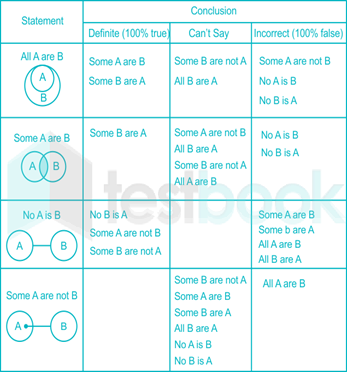
The least possible Venn diagram for the given statement is:

Conclusions:

।. All books are pens → True → As per Venn diagram.

॥. Some pens are books → True → As per Venn diagram.

Hence, Option (4) is correct.

Additional Information 

3

A statement and two actions numbered I and II are given below. You have to take the statement to be absolutely true and on the basis of the information given in the statement decide which of the two actions is logically correct.

Statement:

There has been a significant drop in the water level of all the lakes that supply water to the city.

Actions:

I. The water supply authority should make a partial cut in the supply to deal with the situation.

II. The government should appeal to the people through the media that they should use water sparingly.

  1. ((a))

    Both I and II follow.

  2. ((b))

    Neither I nor II follow.

  3. ((c))

    Only I follows.

  4. ((d))

    Only II follows.

Show Answer
Answer: ((a))

Both I and II follow.

Statement:

There has been a significant drop in the water level of all the lakes that supply water to the city.

Here, due to water supply, the level of water in the lakes will drop and we know that the lake has a limited capacity to hold the water eventually we can face water problems in the future if we ignore the misuse of water.

Actions:

I. The water supply authority should make a partial cut in the supply to deal with the situation → Correct.

Because of this action, the water supply can be controlled and the level of water will NOT decrease rapidly.

II. The government should appeal to the people through the media that they should use water sparingly → Correct.

Because of this action, the people will have awareness about water shortage and due to that, they will consume water carefully.

Hence, Option (1) is correct.

4

Introducing Harini, Mohan said, "She is the daughter of the father of my brother's sister". How is Harini related to Mohan?

  1. ((a))

    Wife

  2. ((b))

    Mother

  3. ((c))

    Sister

  4. ((d))

    Daughter

Show Answer
Answer: ((c))

Sister

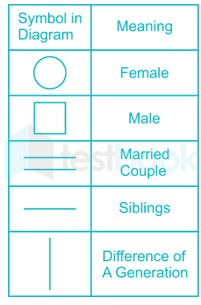
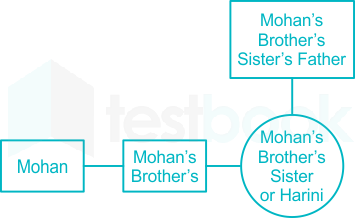
The family chart is as follows:

Here, we can see that Harini is a Sister of Mohan.

Hence, Option (3) is correct.

5

The number of girls in a class is 6 times the number of boys. The number shown in which of the following options cannot be the total number of students in the class?

  1. ((a))

    65

  2. ((b))

    56

  3. ((c))

    49

  4. ((d))

    35

Show Answer
Answer: ((a))

65

Calculation:

Let the number of boys in the class be x

Then, the number of girl in the class is 6x

Total number of student in the class = x + 6x = 7x

The number of student in the class is multiple of 7

So from the given option 65 is not the multiple of 7

∴ The correct answer is 65

6

Identify the odd/different option from the following options:

  1. ((a))

    Garland

  2. ((b))

    Bangle

  3. ((c))

    Flower

  4. ((d))

    Chain

Show Answer
Answer: ((c))

Flower

Option (1): Garland → A circle of flowers and leaves that is worn on the head or around the neck or is hung in a room as decoration.

Option (2): Bangle → A circular metal band that is worn round the arm or wrist for decoration.

Option (3): Flower → Use to make Garland or Bouquet.

Option (4): Chain → A series of connected things in a circular manner.

Here, We can see that Option (3) is different than the other options.

Hence, Option (3) is correct.

7

In the following question, two statements and four conclusions are given. Without solving anything on your own, choose the conclusion that logically follows from the statement:

Statements:

Only green is blue.

All green are yellow.

Conclusions:

I. Some blue are yellow.

II. No blue is yellow.

III. Some yellow are green.

IV. Some yellow is not green.

  1. ((a))

    Only conclusion I follows.

  2. ((b))

    Only conclusion II follows.

  3. ((c))

    Only conclusions I and III follow.

  4. ((d))

    Either conclusion I or conclusion IV follows.

Show Answer
Answer: ((c))

Only conclusions I and III follow.

The least possible Venn diagram for the given statement is:

Mistake Points Aspirants always do mistakes in the Only type of syllogism.

Example: Only B are A is always considered as “All A are B”. In the only case, one more thing that is wholly or partially part of A can never be part of anyone else except B.

Conclusions:

I. Some blue are yellow → True → As per Venn diagram

II. No blue is yellow → False → As per Venn diagram

III. Some yellow are green → True → As per Statement 2

IV. Some yellow is not green → False → As per Statement 2

Hence, Option (3) is correct.

Additional Information 

8

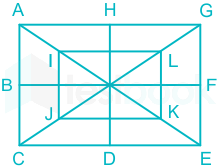
Find the number of straight lines in the given figure:

  1. ((a))

    16

  2. ((b))

    18

  3. ((c))

    14

  4. ((d))

    12

Show Answer
Answer: ((d))

12

For this question, the number of lines will be as-

Name of lines are AC, CE, EG, AG, AE, CG, HD, IL, LK, KJ, IJ, BF.

Here, the Total number of lines is 12.

Hence, Option (4) is correct.

9

Three of the given four numbers are alike in a certain way while one is different. Choose odd one out.

  1. ((a))

    32 : 456

  2. ((b))

    16 : 128

  3. ((c))

    14 : 98

  4. ((d))

    24 : 288

Show Answer
Answer: ((a))

32 : 456

The logic followed is:

Option (1): 32 : 456

456 ≠ 32 × (32 ÷ 2) 

456 ≠ 32 × (16)

456 ≠ 512

Option (2): 16 : 128

128 = 16 × (16 ÷ 2)

128 = 16 × 8

128 = 128

Option (3): 14 : 98

98 = 14 × (14 ÷ 2)

98 = 14 × 7

98 = 98

Option (4): 24 : 288

288 = 24 × (24 ÷ 2)

288 = 24 × 12

288 = 288

Here, we can see that logic of Option (1) is different than the other options.

Hence, Option (1) is correct.

10

Choose the correct alternative for the following:

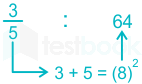
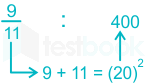
(\frac{3}{5} : 64 :: \frac{9}{11} : ) ____

  1. ((a))

    200

  2. ((b))

    400

  3. ((c))

    202

  4. ((d))

    404

Show Answer
Answer: ((b))

400

The logic followed is:

For this question, the relation is as follows:

Similarly,

Here, the missing term is 400.

Hence, Option (2) is correct.

11

There are two exam centers X and Y. If 10 students from X are sent to Y, then the number of students in each center becomes same. If 20 students are sent from Y to X, then the number of students in X becomes twice the number of students in Y. Find the number of students in center Y?

  1. ((a))

    95

  2. ((b))

    80

  3. ((c))

    85

  4. ((d))

    100

Show Answer
Answer: ((b))

80

Calculation:

Let the number of student in centers X and Y be P and Q respectively

Now A/Q

Case 1

P - 10 = Q + 10

⇒ P - Q = 20      ----(1)

Case 2

2(Q - 20) = P + 20

⇒ 2Q - 40 = P + 20

⇒ 2Q - P = 60      ----(2)

Now, Adding eq (1) and eq (2)

P - Q + 2Q - P = 20 + 60

⇒ Q = 80

∴ The number of student in center Y is 80

12

Out of the four alternatives given below, choose the one that best describes the three words given below:

Scarlett, Crimson, Vemillion, Golden

  1. ((a))

    All these words are related to currency

  2. ((b))

    All these words are related to flowers

  3. ((c))

    All these words are related to the novel

  4. ((d))

    All these words are related to the colors

Show Answer
Answer: ((d))

All these words are related to the colors

The logic followed is:

Scarlett - Bright Red

Crimson - Dark Red

Vermillion - Brilliant Red

Golden - Bright Yellow.

Here, we can see that All the words are related to the colors.

Hence, Option (4) is correct.

13

In the following question, three words are given which are related to each other in some way. The same relation is found in the words of any one of the given alternatives. Choose the correct option from the following.

Lion : Cub : Group of Lions

  1. ((a))

    Horse : Mare : Colt

  2. ((b))

    Child : Boy : Girl

  3. ((c))

    Cow : Calf : Herd

  4. ((d))

    Frog : Toad baby : Husky

Show Answer
Answer: ((c))

Cow : Calf : Herd

Given:

Lion : Cub : Group of Lions

The logic of given relation is-

Lion : A young Lion : Group of Lions

Cub - A young lion

Option (1): Horse : Mare : Colt

Mare - A female horse

Colt - A young male horse

Horse : A female Horse : A young male hourse

Option (2) : Child : Boy : Girl

Child - A young boy or a girl

Boy - Male

Girl - Female 

A young boy or a girl : Boy : Girl

Option (3): Cow : Calf : Herd

Calf - A young cow

Herd - A group of cows.

Cow : A young cow : Group of Cows

Option (4): Frog : Toad baby : Husky

Toad baby - A baby Frog

Husky - A Siberian dog and this is NOT a group of Frogs.

Frog : A baby Frog : A Siberian Dog

Here, only Option (3) has the same relation as given in the question.

Hence, Option (3) is correct.

14

Choose the pair which is different from the others.

  1. ((a))

    Tailor : Customer

  2. ((b))

    Poet : Poetry

  3. ((c))

    Carpenter : Furniture

  4. ((d))

    Cobbler : Shoes

Show Answer
Answer: ((a))

Tailor : Customer

The logic followed is:

Option (1): Tailor : Customer

A Tailor is a person whose job is to make Clothes.

Option (2): Poet : Poetry

A Poet is a person who creates Poetry.

Option (3): Carpenter : Furniture

Carpenter is a person whose job is to make Furniture from wood.

Option (4): Cobbler : Shoes

A cobbler is a person who repairs shoes.

Logic: Occupation : work done in that Occupation.

Here, Except Option (1), rest all the options follow the logic given above.

So, Option (1) is different than the others.

Hence, Option (1) is correct.

15

Find the missing term in the given series:

-1, 2, 7, 14, 23, 34, 47, 62, 79, ____

  1. ((a))

    98

  2. ((b))

    89

  3. ((c))

    99

  4. ((d))

    91

Show Answer
Answer: ((a))

98

The pattern followed is:

Here, the missing term is 98.

Hence, Option (1) is correct.

General Awareness & Current Affairs (15 questions)

16

In which year did Goa get independence from the Portuguese?

  1. ((a))

    1955

  2. ((b))

    1961

  3. ((c))

    1951

  4. ((d))

    1948

Show Answer
Answer: ((b))

1961

The correct answer is 1961.

Key Points

  • Goa Liberation Day
  • India attained independence from British rule back in 1947, it would still take Goa, which was a Portuguese colony at the time-14 more years to be liberated from foreign control.
  • On December 19, 1961, Indian armed personnel managed to wrest control of Goa from the Portuguese, ending around 450 years of colonial rule.
  • The Goa Opinion Poll was a referendum held in the state of Goa, India on 16 January 1967, to decide the future of the Union Territory of Goa, Daman, and Diu within the Indian Union.
  • The fight for freedom began in the 1940s as India inched closer to independence from British rule.
  • The Portuguese colonized several parts of India in 1510 but by the end of the 19th-century Portuguese colonies in India were limited to Goa, Daman, Diu, Dadra, Nagar Haveli, and Anjediva Island.
  • On 30th May 1987, the territory was split and Goa was formed, Daman and Diu remained a Union Territory.

Additional Information

  • Goa
  • Capital- Panaji
  • Chief Minister- Pramod Sawant
  • Governor- P.S. Sreedharan Pillai
  • National Bird- Ruby Throated Yellow
  • National Animal- Gaur
  • National Flower- Jasmine
  • National Tree- Terminalia Elliptica
  • National Parks- Mollem National Park
17

Which of the following states has more population than the other given states?

  1. ((a))

    West Bengal

  2. ((b))

    Madhya Pradesh

  3. ((c))

    Maharashtra

  4. ((d))

    Bihar

Show Answer
Answer: ((c))

Maharashtra

The correct answer is Maharashtra.

Key Points

  • Maharashtra has more population than the other given states.
  • Next to UP, Maharashtra with a population of 126,189,673(as of 2021) is India's second-largest state in terms of population-wise and **Bihar is in the third position.**​

Important Points

  • Maharashtra
  • Capital- Mumbai
  • Chief Minister- Uddhav Thackeray
  • Governor- Bhagat Singh Koshyari
  • National bird- Yellow-footed green pigeon
  • National animal- Indian giant squirrel
  • National tree- Mango
  • National flower- Jarul
  • National parks- Chandoli National Park, Gugamal National Park, Nawegaon National Park, Pench National Park, Sanjay Gandhi National Park, Tadoba National Park.

Additional Information

StatesCapitaPopulation(as of 2021)
West BengalKolkata101,883,453
Madhya PradeshBhopal86,406,401
BiharPatna119,461,013
18

In which of the following sports Apurvi Singh Chandela is currently at the first position?

  1. ((a))

    Weight Lifting (49 kg)

  2. ((b))

    Freestyle Wrestling

  3. ((c))

    10 m Air Rifle Shooting

  4. ((d))

    50 m swimming

Show Answer
Answer: ((c))

10 m Air Rifle Shooting

The correct answer is 10 m Air Rifle Shooting.

Key Points

  • Apurvi Singh Chandela
  • She is an Indian shooter who competes in the event of 10 m Air Rifle Shooting.
  • She was awarded the Arjuna Award in 2016.
  • She belongs to Rajasthan state.
  • She won the gold medal in the Olympic shooting event, in 2019.

Additional Information

  • 10 m Air Rifle Shooting
  • 10 m Air Rifle is an International Shooting Sports Federation (ISSF) shooting event, shot at a bullseye target over a distance of 10 meters.
  • It is one of the ISSF-governed shooting sports included in the Summer Olympics since the 1984 Los Angeles Games.
19

Which national park forms part of the Nilgiri Biosphere Reserve (Reserved Biosphere)?

  1. ((a))

    Bandipur Tiger Reserve and National Park

  2. ((b))

    Annamalai Tiger Reserve

  3. ((c))

    Kali Tiger Reserve

  4. ((d))

    Periyar National Park

Show Answer
Answer: ((a))

Bandipur Tiger Reserve and National Park

The correct answer is Bandipur Tiger Reserve and National Park.

Key Points

  • Bandipur Tiger Reserve and National Park
  • ​It is located in Karnataka.
  • The Bandipur National Park is aimed at protecting the tiger in its natural habitat.
  • It was founded under the "Project Tiger" in the year 1974 by the government of India.
  • Apart from the tiger, it is also the habitat of Asiatic elephants, sloths, pythons, jackals, antelopes, etc.
  • The Nilgiri Biosphere Reserve also encompasses the parts of Bandipur.

Additional Information

  • Nilgiri Biosphere Reserve
  • The Nilgiri Biosphere Reserve was the first and Oldest biosphere reserve in India established in the year 1986.
  • It is located in the Western Ghats and includes 2 of the 10 biogeographical provinces of India.
  • The Nilgiri Biosphere Reserve falls under the biogeographic region of the Malabar rain forest.
20

An 18-year-old girl named Bandana from Nepal created the Guinness World Record for the longest duration of dance by continuously dancing till _______.

  1. ((a))

    96 hours

  2. ((b))

    135 hours

  3. ((c))

    126 hours

  4. ((d))

    108 hours

Show Answer
Answer: ((c))

126 hours

The correct answer is 126 hours.

Key Points

  • Bandana
  • Bandana from Nepal created the Guinness World Record for the longest duration of dance by continuously dancing till 126 hours.
  • It was previously held by an Indian woman (Kerala woman) Kalamandalam Hemlatha, who danced continuously for  123 hours and 15 minutes in 2011.
  • She hails from the Dhankuta district in eastern Nepal.
  • She also founded a youth organization named Bandana Nepal Foundation which works to uplift poor women in Nepal.
  • She danced a solo dance on Nepali music.
21

What is the maximum number of votes which can be cast in EVMs?

  1. ((a))

    2,500 votes

  2. ((b))

    2,000 votes

  3. ((c))

    1,000 votes

  4. ((d))

    1,200 votes

Show Answer
Answer: ((b))

2,000 votes

The correct answer is 2,000 votes.

 Confusion Points

  • A maximum of 3840 votes can be cast in old version EVMs (2000-05 model) and 2000 votes in case of new version EVMs (2006 onwards model).

Key Points

  • Electronic Voting Machine (EVMs)
  • EVMs are the standalone machines that aid the electoral process in Casting and Counting the Votes securely and efficiently.
  • Electronic Voting has replaced ballot paper used in Parliamentary, State Assembly, and Local elections.
  • An EVM can be used to record 2000 votes at a time and can be replaced with another one if it stops working.
  • It works on normal batteries and doesn't consume any electricity.
  • It has two units that help in smooth functioning which are the control unit and the balloting unit.
  • The record of votes is safe in the control unit of the EVM, it will be erased only after deleting the data.
22

Where was the ICC Cricket World Cup 2019 held during May – July 2019 ?

  1. ((a))

    England and Wales

  2. ((b))

    South Africa

  3. ((c))

    India and Sri Lanka

  4. ((d))

    Australia and New Zealand

Show Answer
Answer: ((a))

England and Wales

The correct answer is England and Wales.

Key Points

  • ICC Cricket World Cup 2019
  • ​The 2019 ICC Cricket World Cup was the 12th Cricket World.
  • A quadrennial One Day international cricket tournament contested by men's national teams.
  • It was hosted between 30 May to 14 July 2019 across 10 venues in England and Wales.
  • It was contested by the runners up from the previous tournament, New Zealand, and the host nation, England.
  • England won the tournament.
  • Man of the tournament- Kane Williamson
  • Most runs- Rohit Sharma (648 runs)
  • Most wickets- Mitchell Starc (27 wickets)
23

Who among the following received the UNESCO/Guillermo Cano World Press Freedom Prize in 2019?

  1. ((a))

    Ahmet Sik

  2. ((b))

    Ahmed Zaidabadi

  3. ((c))

    Mazen Dervish

  4. ((d))

    Kyo Soe and Wa Lone (Myanmar)

Show Answer
Answer: ((d))

Kyo Soe and Wa Lone (Myanmar)

The correct answer is Kyo Soe and Wa Lone (Myanmar).

Key Points

  • UNESCO/Guillermo Cano World Press Freedom Prize 
  • The UNESCO's/Guillermo Cano World Press Freedom Prize is awarded for outstanding contribution in the defense and promotion of freedom of press anywhere in the world by any person, organization, or institution.
  • It is awarded in memory of Colombian journalist Guillermo Cano Isaza who was assassinated in front of his office on December 17, 1986.
  • The Award was funded by the **Cano Foundation and Helsingin Sanomat Foundation (Finland) with the prize money of $45000.**​

Important Points

  • Kyo Soe and Wa Lone 
  • Wa Lone and Kyo Soe is a Reuters journalist and children's author.
  • They were arrested on 12 December 2017 in Myanmar because of their investigation into the Inn Din massacre.
  • The 2019 UNESCO/Guillermo Cano Press Freedom Prize was awarded to Wa Lone and Kyo Soe on 11 April 2019 for their "courage and commitment to freedom of expression".
24

Part XX (twenty) of the Constitution of India deals with which of the following?

  1. ((a))

    Constitutional Amendment

  2. ((b))

    Emergency Provision

  3. ((c))

    Official Languages

  4. ((d))

    Parliament

Show Answer
Answer: ((a))

Constitutional Amendment

The correct answer is Constitutional Amendment.

Key Points

  • Part 20 Constitution of India: Amendment of the Constitution 
  • Part XX has only one article i.e Article 368 that deals with the amendment of the constitution.
  • Article 368
  • It deals with the process of the Constitution amendment.
  • Article 368 has been amended by the 24th and 42nd Amendments in 1971 and 1976 respectively. New clauses 368 (1) and 368 (3) were added by the 24th Amendment in 1971, which also added a new clause (4) in article 13 which reads, "Nothing in this article shall apply to any amendment of this Constitution made under article 368".
  • The amendment process in the constitution is set out in Part  XX of the Indian constitution.
  • Article 368 does not set down the legislative process to be followed at various points of the amendment.
25

Which country has honored former ISRO chairman A.S. Kiran Kumar with its highest civilian honor?

  1. ((a))

    United Kingdom

  2. ((b))

    Italy

  3. ((c))

    France

  4. ((d))

    Germany

Show Answer
Answer: ((c))

France

The correct answer is France.

Key Points

  • France honoured former ISRO chairman A.S. Kiran Kumar in May 2019 with its highest civilian honour.
  • A.S. Kiran Kumar
  • He is a highly accomplished space scientist and engineer with a distinguished career spanning over four decades at ISRO in the area of satellite payload and applications.
  • He started his career at ISRO by entering the Space Application Centre (SAC) in 1975.
  • He was conferred with the prestigious honour by France's Ambassador to India Alexandre Ziegler on behalf of the French President.
  • During his whole career span at the Indian space agency, including when he was the chairman, Kumar worked to foster ambitious space cooperation between India and France.
  • He directly contributed to making it cooperation of the people as well as one of the cornerstones of Indo French strategic partnership.

Additional Information

  • France 
  • Capital- Paris
  • Currency- The French Franc
  • President- Emmanuel Macron
  • Space Organization: The National Centre for Space Studies.
26

Who among the following is entrusted with the responsibility of conducting monetary policy in India?

  1. ((a))

    State Bank of India

  2. ((b))

    Central Government

  3. ((c))

    Finance Commission

  4. ((d))

    Reserve Bank of India

Show Answer
Answer: ((d))

Reserve Bank of India

The correct answer is the Reserve Bank of India.

Key Points

  • The Monetary Policy Report is issued by the Monetary Policy Committee of RBI.
  • The main aim of monetary policy is to maintain price stability while keeping in mind the objective of growth as price stability is a fundamental precondition for sustainable economic growth.
  • The MPC decides the policy interest rate required to achieve the inflation target.
  • Reserve Bank of India: 
  • It is India's central bank and regulatory body under the jurisdiction of the Ministry of Finance Government of India.
  • It is responsible for the issue and supply of the Indian rupee and the regulation of the Indian banking system.
  • HQ: Mumbai
  • GovernorSanjay Malhotra.

 Additional Information

  • State Bank of India (as of Jan 2022)
  • State Bank of India is an Indian multinational, public sector banking and financial services statutory body.
  • SBI is the 43rd largest bank in the world and ranked 236th in the Fortune Global 500 list of the world's biggest corporations of 2019.
  • HQ: Mumbai, Maharashtra
  • Chairman: Dinesh Kumar Khara
  • Finance Commission (as of Jan 2022)
  • The Finance Commission is a Constitutionally mandated body that is at the centre of fiscal federalism.
  • Article 280 of the Constitution of India provides for a Finance Commission as a quasi-judicial body.
  • It is constituted by the President of India every fifth year or at such an earlier time as he considers necessary.
  • N.K. Singh is the chairman of the 15th Finance Commission of India.
  • Dr. Arvind Panagariya is the Chairman of the 16ᵗʰ Finance Commission of India.
27

____ was found to be relatively less vulnerable with a score of 0.42 in the Climate Vulnerability Index of India.

  1. ((a))

    Sikkim

  2. ((b))

    Meghalaya

  3. ((c))

    Manipur

  4. ((d))

    Nagaland

Show Answer
Answer: ((a))

Sikkim

The correct answer is Sikkim.

Key Points

  • Climate Vulnerable Index
  • Assam, Andhra Pradesh, Maharashtra, Karnataka and Bihar are most vulnerable to extreme climate events such as floods, droughts and cyclones in India.
  • While 27 Indian states and union territories are vulnerable to extreme climate events, 463 districts out of 640 are vulnerable to extreme weather events.
  • More than 80 per cent of Indians live in districts vulnerable to climate risks i.e 17 of 20 people in India are vulnerable to climate risks out of which every five Indians live in areas that are extremely vulnerable.
  • Northeastern states are more vulnerable to floods.
  • According to Germanwatch's 2020 findings, India is the seventh-most vulnerable country with respect to climate extremes.
  • Sikkim, with an index score of 0.42 was relatively less vulnerable.
  • On a scale ranging 0-1, 1 indicating the highest possible level of vulnerability, at the top of the scale were Assam with a score of 0.72 and Mizoram at 0.71.
28

When is the World Heritage Day observed?

  1. ((a))

    September 8

  2. ((b))

    April 18

  3. ((c))

    June 21

  4. ((d))

    March 15

Show Answer
Answer: ((b))

April 18

The correct answer is April 18.

 Key Points

  • World Heritage Day
  • World Heritage Day is celebrated every year on 18 April.
  • Its aim is to preserve the human heritage and to recognize all the efforts of relevant organizations.
  • The International Council on Monuments and Sites (ICOMOS) in 1982 announced, 18 April as the World Heritage Day.
  • It was approved by the General Assembly of UNESCO in 1983, with an aim of enhancing awareness about the importance of cultural heritage, monuments and conserving them.
  • World Heritage Day 2021 theme is "Complex Pasts: Diverse Futures”.

Additional Information

DayDate
International Literacy DaySeptember 8
International Yoga DayJune 21
The World Consumer Rights DayMarch 15
29

In which article of the Constitution of India, provisions have been made for the removal of a judge of the Supreme Court?

  1. ((a))

    Article 124

  2. ((b))

    Article 121

  3. ((c))

    Article 128

  4. ((d))

    Article 120

Show Answer
Answer: ((a))

Article 124

The correct answer is Article 124.

 Key Points

  • Article 124
  • Article 124 is related to the establishment and Constitution of the Supreme Court.
  • There shall be a Supreme Court of India consisting of a Chief Justice of India and, until Parliament by law prescribes a larger number, of not more than seven other Judges.
  • Article 124 (4)
  • It deals with the "Removal of a Judge of the Supreme Court" and prescribes the manner of procedure be followed for removing a Judge of the Supreme Court from his office.

Additional Information

Article 121It states about the Restriction on discussion in parliament.
Article 128Attendance of retired Judges at sittings of the Supreme court.
Article 120Language to be used in Parliament.
30

Birr is the currency of which of the following countries?

  1. ((a))

    Ethiopia

  2. ((b))

    Afghanistan

  3. ((c))

    Egypt

  4. ((d))

    Kyrgyzstan

Show Answer
Answer: ((a))

Ethiopia

The correct answer is Ethiopia.

 Key Points

  • The unit currency of Ethiopia is known as the Birr.
  • It is known as 'dollar' in English before 1976.
  • Ethiopia
  • Capital- Addis Ababa
  • Currency- Birr
  • President- Taye Atske Selassie
  • Prime Minister- Abiy Ahmed

 Additional Information

CountryCapitalCurrency
AfghanistanKabulAfghan Afghani
EgyptCairoEgyptian pounds
KyrgyzstanBishkekKyrgyzstani som

Language Competency Test (30 questions)

31

Fill in the blank with the right form of the word.

One day a thirsty lamb went ______ water from a stream.

  1. ((a))

    to drank

  2. ((b))

    to drink

  3. ((c))

    to drunk

  4. ((d))

    drank

Show Answer
Answer: ((b))

to drink

The correct answer is 'to drink'.

Key Points

  • When we use two verbs one after another, we use 'to' between them. The verb followed by 'to' should be V1.
  • Ex: They came to study. (study is the first form; i.e. V1)
  • Drank, Drunk are V2 and V3 respectively for root form 'Drink'. Therefore, 'to drank' and 'to drunk' are incorrect.
  • 'to drink' is the right option.


Therefore, the correct answer is option 2).

Complete sentence: One day a thirsty lamb went to drink water from a stream.

32

Choose the right option that can fill the blank in the most appropriate way.

I am only a student, ______ ?

  1. ((a))

    amn’t I

  2. ((b))

    don’t I

  3. ((c))

    isn’t I

  4. ((d))

    aren’t I

Show Answer
Answer: ((d))

aren’t I

The correct answer is 'aren't I'.

Key Points

  • In grammar, a question tag is a very short clause at the end of a statement which changes the statement into a question. For example, in 'She said half price, didn't she?', the words 'didn't she' are a question tag.
  • For an affirmative sentence, we use negative question tag and vice-versa.
  • Question tag for a statement which has 'am' as a helping verb is 'aren't I?' or 'are I ?'.
  • The given sentence is an affirmative one, therefore, 'aren't I' is the correct phrase to complete it.


Therefore, the correct answer is option 4).

Complete sentence: I am only a student, aren't I?

33

Change the following compound sentence into simple sentence.

We must eat, or we cannot live

  1. ((a))

    We must eat for we cannot live

  2. ((b))

    We must eat to living

  3. ((c))

    We must eat to live

  4. ((d))

    We must eat so that we can live

Show Answer
Answer: ((c))

We must eat to live

The correct answer is 'We must eat to live'.

Key Points

  • A simple sentence is a sentence that contains a single independent clause.
  • Ex: I saw her the day before yesterday.
  • A compound sentence contains at least two independent clauses, often joined by conjunctions.
  • Ex: Dr. Watson explained his theory, and Sherlock Holmes listened quietly.
  • In the given sentence, there are two independent clauses joined by conjunction 'or'.
  • Now let's discuss the marked option:
  • There is a single independent clause: We must eat to live.
  • The marked sentence retains the meaning of the original sentence.


Therefore, the correct answer is option 1).

Additional Information

  • Let's discuss the other option:
  • We must eat for we cannot live:
  • We must eat and we cannot live are two clauses.
  • We must eat to living:
  • 'to living' is grammatically incorrect.
  • We must eat so that we can live
  • We must eat and so that we can live are two clauses.
34

Select the word that is furthest (opposite) in meaning to the given word.

Heretical

  1. ((a))

    orthodox

  2. ((b))

    doubtful

  3. ((c))

    impious

  4. ((d))

    amusing

Show Answer
Answer: ((a))

orthodox

The correct answer is 'orthodox'.

Key Points

  • Heretical means 'opposite to or against the official or popular opinion, or showing no respect for the official opinion'.
  • Ex: He did not reveal his heretical views on the drug war until after he was reelected.
  • Marked option 'orthodox' means '(of beliefs, ideas, or activities) considered traditional, normal, and acceptable by most people'.
  • Ex: We would prefer a more orthodox approach/solution to the problem.
  • It's clear that 'Heretical' and 'Orthodox' are opposite in meaning.


Therefore, the correct answer is option 1).

Additional Information

  • Doubtful:  unlikely to happen or to be successful
  • Impious: showing no respect, especially for God or religion
  • Amusing: entertaining and funny
35

Out of the four alternatives suggested, select the one which best expresses the given sentence in reported speech.

Sahil said to Sameer, “Take rest if you are tired. I will do your work.”

  1. ((a))

    Sahil told Sameer if he were tired to take rest and offered to do his work

  2. ((b))

    Sahil told to Sameer to take rest if you were tired and I would do your work

  3. ((c))

    Sahil suggested Sameer that if he is tired to take rest and offered to do his work

  4. ((d))

    Sahil suggested Sameer to take rest if he was tired and offered to do his work

Show Answer
Answer: ((d))

Sahil suggested Sameer to take rest if he was tired and offered to do his work

The correct answer is 'Sahil suggested Sameer to take rest if he was tired and offered to do his work'.

Key Points

  • There are two statements in reported speech; one is a suggestion and the other one is an offer.
  • Take rest if you are tired: suggestion
  • I will do your work: offer
  • To change it into indirect form, the below steps should be followed:
  • 'Said to' is changed into suggested etc. according to the context.
  • Inverted commas (") are removed.
  • Then, it is followed by 'to + V1 (to + take rest)'.
  • Additional clause 'if you are tired' is changed into 'if he was tired'.
  • The second statement is connected using connector 'and' and using verb 'offered' followed by 'to + V1'.
  • A full stop (.) concludes the sentences.
  • On following the above steps, we get the required Indirect form:
  • Sahil suggested Sameer to take rest if he was tired and offered to do his work.


Therefore, the correct answer is option 4).

36

Choose the correct option from the given options based on the definition of the one word substitute.

A person who remains unmoved and unaffected by other people’s opinions, arguments or suggestions.

  1. ((a))

    Misogynist

  2. ((b))

    Impervious

  3. ((c))

    Mercenary

  4. ((d))

    Stoic

Show Answer
Answer: ((b))

Impervious

The correct answer is 'Impervious'.

Key Points

  • Let's take a look at the meaning of the marked word:
  • Impervious: If someone is impervious to something, they are not influenced or affected by something.
  • Ex: He is impervious to criticism and rational argument.
  • It's clear that
  • A person who remains unmoved and unaffected by other people’s opinions, arguments, or suggestions is 'Impervious'.

Therefore, the correct answer is option 2).

Additional Information

  • Misogynist: a man who hates women or believes that men are much better than women
  • Mercenary: interested only in the amount of money that you can get from a situation
  • Stoic: determined not to complain or show your feelings, especially when something bad happens to you
37

Fill in the blank space with correct words from the four choices given below.

When she ______ back the answer script, she saw she ________ several mistakes.

  1. ((a))

    was getting, made

  2. ((b))

    had got, made

  3. ((c))

    got, had made

  4. ((d))

    got, made

Show Answer
Answer: ((c))

got, had made

The correct answer is 'got, had made'.

Key Points

  • When there are two actions to be expressed happened one after another in the past:
  • The first action should follow the past perfect tense. (Sub + had + V3)
  • The second one should follow the past indefinite tense. (Sub + V2)
  • In the given sentence there are two actions being described:
  • getting back the answer script and making mistakes.
  • It can be easily understood that first he would have made mistakes. After that he could have found them.
  • Therefore, action happened later (getting back the answer script) should use 'got (V2)' while the first one should use 'had made (had + V3)'.


Therefore, the correct answer is option 3).

Complete sentence: When she got back the answer script, she saw she had made several mistakes.

38

Choose the word whose meaning is closest to the underlined word.

Ours is a hilly terrain without any motorable roads.

  1. ((a))

    Space

  2. ((b))

    Land

  3. ((c))

    Metropolis

  4. ((d))

    Valley

Show Answer
Answer: ((b))

Land

The correct answer is 'Land'.

Key Points

  • Terrain means 'an area of land, when considering its natural features'.
  • Ex: The car handles particularly well on rough terrain.
  • Marked option 'Land' means 'the surface of the earth that is not covered by water'.
  • Ex: It is cheaper to drill for oil on land than at sea.
  • It's clear that 'Terrain' and 'Land' are close in meaning.


Therefore, the correct answer is option 2).

Additional Information

  • Space: an empty area that is available to be used
  • Metropolis: a very large city, often the most important city in a large area or country
  • Valley: an area of low land between hills or mountains, often with a river running through it
39

Choose the part of the sentence which has an error.

That Brutus, who was his trusted friend (A)/had attacked (B)/ on him causing (C) / heart break to Julius Caesar (D).

  1. ((a))

    C

  2. ((b))

    D

  3. ((c))

    A

  4. ((d))

    B

Show Answer
Answer: ((a))

C

The correct answer is 'C'.

Key Points

  • When 'attack' is used as a verb and is followed by its object, it doesn't take any preposition with it.
  • Ex: The man attacked him/on him with a knife.
  • In the given sentence, 'attacked (past participle or V3 of 'attack')' is used and immediately followed by the person attacked. Therefore, the use of preposition 'on' is incorrect.
  • It's clear part C of the given sentence contains an error.


Therefore, the correct answer is option 1).

Correct sentence: That Brutus, who was his trusted friend had attacked on him causing heart break to Julius Caesar.

40

Choose the word whose meaning is closest to the bold lettered word.

Amelia is a stout, complacent woman with an irritating air of being always right.

  1. ((a))

    Unconcerned

  2. ((b))

    Fair

  3. ((c))

    Concerned

  4. ((d))

    Innocent

Show Answer
Answer: ((a))

Unconcerned

The correct answer is 'Unconcerned'.

Key Points

  • Complacent means 'feeling too satisfied with yourself or with a situation, so that you think that there is no need to worry'.
  • Ex: He had won his matches so easily that he was in danger of becoming complacent.
  • Marked option 'Unconcerned' means 'not worried or not interested, especially when you should be worried or interested'.
  • Ex: The baby was apparently unconcerned by the noise.
  • It's clear that 'Complacent' and 'Unconcerned' are close in meaning.


Therefore, the correct answer is option 1).

Additional Information

  • Fair: treating someone in a way that is right or reasonable, or treating people equally and not allowing personal opinions to influence your judgment
  • Concerned: worried
  • Innocent: (of a person) not guilty of a particular crime
41

Fill in the blank of the sentence using one from the words, idioms or phrases provided in the four alternatives.

He had already published a novel and it was an unexpected success. He thought his ______.

  1. ((a))

    Chances were good

  2. ((b))

    Days were up

  3. ((c))

    Fortune was made

  4. ((d))

    Lady luck was happy

Show Answer
Answer: ((c))

Fortune was made

The correct answer is 'Fortune was made'.

Key Points

  • Let's discuss the marked option:
  • Fortune was made: To earn a very large amount of money, especially by doing something very successfully.
  • Ex: We'll make a fortune if we can manage to secure a trading partner in China.
  • The given sentence talks about an unexpected success of a novel. This success relates well to the marked phrase 'fortune was made' as it would bring a lot of money to the publisher.


Therefore, the correct answer is option 3).

Complete sentence: He had already published a novel and it was an unexpected success. He thought his fortune was made.

Additional Information

  • Days were up: refers to ending or coming to an end, this ending could be of anything, like success, happiness etc.
  • Lady luck was happy:  the personification of fortune or chance
  • Chances were good: the chances of achieving something were in his favour.
42

Three of the words are related in some way, the remaining word is not related to the rest.

You have to pick the word which does not fit in the relation and mark that as your answer.

  1. ((a))

    Control

  2. ((b))

    Allay

  3. ((c))

    Ruffle

  4. ((d))

    Quell

Show Answer
Answer: ((c))

Ruffle

The correct answer is 'Ruffle'.

Key Points

  • Let's discuss the given words:
  • Control: to order, limit, or rule something, or someone's actions or behaviour
  • Allay: to make a negative emotion less strong or a problem less difficult
  • Ruffle: to annoy or upset someone, or to make someone very nervous
  • Quell: to stop something, especially by using force
  • From the above explanation, it's clear that 'Control', 'Allay' and 'Quell' are related to limit something or to calm down emotions.
  • 'Ruffle' means opposite to these words.


Therefore, the correct answer is option 3).

43

Select the word that is furthest (opposite) in meaning to the given word.

Blaze

  1. ((a))

    provoke

  2. ((b))

    flare

  3. ((c))

    illumination

  4. ((d))

    extinguish

Show Answer
Answer: ((d))

extinguish

The correct answer is 'extinguish'.

Key Points

  • Blaze means 'to burn brightly and strongly'.
  • Ex: The sun was blazing down that afternoon.
  • Marked option 'extinguish' means 'to stop a fire or a light burning'.
  • Ex: It took the firefighters several hours to extinguish the flames.
  • It's clear that 'Blaze' and 'Extinguish' are opposite in meaning.


Therefore, the correct answer is option 4).

Additional Information

  • Provoke: to cause a reaction, especially a negative one
  • Flare: to burn brightly either for a short time or not regularly
  • Illumination: light
44

Choose the word whose meaning is closest to the underlined word.

Lethargy creeps in if the holiday continues over an extended period.

  1. ((a))

    Concern

  2. ((b))

    Vigor

  3. ((c))

    Indolence

  4. ((d))

    Energy

Show Answer
Answer: ((c))

Indolence

The correct answer is 'Indolence'.

Key Points

  • Lethargy means 'the feeling of having little energy or of being unable or unwilling to do anything'.
  • Ex: Symptoms include loss of appetite, lethargy, and vomiting.
  • Marked option 'Indolence' means 'the state of showing no real interest or effort'.
  • Ex: After a sudden burst of activity, the team lapsed back into indolence.
  • It's clear 'Lethargy' and 'Indolence' are similar in meaning.


Therefore, the correct answer is option 3).

Additional Information

  • Concern: a worried or nervous feeling about something, or something that makes you feel worried
  • Vigor: strength, energy, or enthusiasm
  • Energy: the power and ability to be physically and mentally active
45

Change the following simple sentence into complex sentence.

He succeeded unexpectedly

  1. ((a))

    He succeeded although his success was not expected

  2. ((b))

    His success was unexpected and he succeeded

  3. ((c))

    He succeeded which is expected

  4. ((d))

    Owing to expectations he succeeded

Show Answer
Answer: ((a))

He succeeded although his success was not expected

The correct answer is 'He succeeded although his success was not expected'.

Key Points

  • A simple sentence is a sentence that contains a single independent clause.
  • Ex:  I saw her the day before yesterday.
  • A complex sentence is a sentence with one independent clause and at least one dependent clause.
  • Ex: When the bell rings (dependent clause), walk out (main/independent clause).
  • In the given sentence, there is a single independent clause which has complete meaning. So, it's a simple sentence.
  • Now let's discuss the marked option:
  • There are two clauses: 1. he succeeded (main/independent) 2. although his success was not expected (dependent).
  • The marked sentence retains the meaning of the original sentence.


Therefore, the correct answer is option 1).

Additional Information

  • Dependent clause: A clause that does not stand alone as a sentence but depends on another clause to complete its meaning.
  • Independent clause: A clause that can stand alone as a sentence. The following sentence consists of two independent clauses joined by but: “The farmers complained of the low price of food, but the office workers did not complain.”
46

'सूर' का अर्थ नहीं है:

  1. ((a))

    वीर

  2. ((b))

    सूर्य

  3. ((c))

    सूरदास

  4. ((d))

    कुऑं

Show Answer
Answer: ((d))

कुऑं

'सूर' का अर्थ नहीं है: कुऑं

  • सूर के अनेकार्थक शब्द:  सूर्य, अंधा, वीर, सूरदास आदि ये सभी सूर के अनेकार्थी शब्द हैं।
  • कुऑं के अनेकार्थक शब्द : कुआँ, छेद, कुइयाँ, छिद्र, इनारा, सुराख़, कुआँ

Important Points

  • अरूण – हल्का लाल रंग, सूर्य का सारथी, प्रभात का सूर्य।
  • अवकाश – छुट्टी, बीच के आराम का समय, मौका।
  • अपवाद – निंदा, किसी नियम का विरोधी।
  • अभिजात – पूज्य, उच्च कुल का, सुंदर।
  • और – तथा, दूसरा, अधिक, योजक शब्द।
  • कुल – वंश, सारा, सभी।
  • घट – घड़ा, हृदय, कम, देह, पिंड।
  • जवान – युवा, सैनिक, योद्धा।
  • जीवन – जिंदगी, प्राण, जल, वृत्ति।
  • तम – अँधेरा, कालिख, अज्ञान, क्रोध, राहु, पाप।
  • तप – तपस्या, साधना, अग्नि।
  • तार – धातु का तार, तारघर से संदेश भेजना, तारना।
  • तारा – आँख की पुतली, सितारा, महाराजा हरिश्चंद्र की पत्नी।
47

'अतुल' का विलोम है:

  1. ((a))

    बितुल

  2. ((b))

    तुला

  3. ((c))

    तुल्य

  4. ((d))

    नितुल

Show Answer
Answer: ((c))

तुल्य

'अतुल' का विलोम है: तुल्य

  • अतुल : जिसकी कोई तुलना न हो
  • तुल्य : जिसकी तुलना हो

Important Points

  • स्वक्रिया – परक्रिया
  • प्राचीन – अर्वाचीन
  • सन्यासी – गृहस्थ
  • प्रमुख – गौण
  • मृदुल – रुक्ष (कठोर)
  • रिजु/ऋजु – वक्र
  • हेय – ग्राह्य
  • श्यामा – गौरी
  • समर्थन – विरोध
  • एकाग्रचित – दुचिन्ता
  • संकल्प – विकल्प
48

'व्यभिचार' शब्द का सही विश्लेषण है:

  1. ((a))

    वि + अभि + चार

  2. ((b))

    वि + अभिचार

  3. ((c))

    वि + भिचार

  4. ((d))

    वि + अभीचार

Show Answer
Answer: ((a))

वि + अभि + चार

'व्यभिचार' शब्द का सही विश्लेषण है: वि + अभि + चार

  • इसमें दो उपसर्ग लगे हुए है।
  • व्यभिचार का अर्थ: कुमार्गी, गलत राह पर चलने वाला आदमी

Additional Informatio

  • अभ्यस्त -अभ्यास करके किसी कार्य में निपुण ह���ना, निपुण, जिस का अभ्यास किया गया हो।
  • उदाहरण:मोटे लाल खाने का अभ्यस्त है।
  • क्षोभकारक -विचलित करने वाला
  • उदाहरण:उसका कथन क्षोभकारक था।
  • क्षात्रवृत्ति‌ – क्षत्रिय धर्म
  • उदाहरण:देवसेना का संबंध क्षात्रवृत्ति‌ कुल से है।
  • अकिंचित्कर -अर्थहीन
  • उदाहरण:परीक्षा में श्याम द्वारा दिया गया उत्तर अकिंचित्कर था।
  • दारुण-भयंकर
  • उदाहरण:उसकी मां की मृत्यु होने पर यह दारुण दुःख सहन नहीं कर पाया।
  • स्पृहा- इच्छा, अभिलाषा
  • उदाहरण:मेरी स्पृहा माउंट आबू देखने की है।
49

'सच्चिदानन्द' शब्द का सही संधि - विच्छेद है:

  1. ((a))

    सत् + चित + आनन्द

  2. ((b))

    सत् + चित् + आनन्द

  3. ((c))

    सत् + चिदनन्द

  4. ((d))

    सच्चित + आनन्द

Show Answer
Answer: ((b))

सत् + चित् + आनन्द

सच्चिदानंद’ का संधि-विच्छेद  सत् + चित् + आनंद होगा, बाकी के विकल्प गलत हैं।

Key Points

सच्चिदानंद  व्यंजन संधि का उदहारण है| व्यंजन संधि के एक नियम के अनुसार ‘त्’ से परे ‘च्’ या ‘छ्’ होने पर ‘च,’ ‘ज्’ या ‘झ्’ होने पर ‘ज्,’ ‘ट्’ या ‘ठ्’ होने पर ‘ट्’, ‘ड्’ या ‘ढ्’ होने पर ‘ड्’ और ‘ल’ होने पर ‘ल्’ हो जाता है।

Additional Information

संधिपरिभाषाउदहारण
स्वर संधिदो स्वरों से उत्पन विकार अथवा रूप-परिवर्तन को स्वर संधि कहते है।विद्या + अर्थी = विद्यार्थी , सूर्य + उदय = सूर्योदय
व्यंजन संधिव्यंजन का स्वर या व्यंजन के साथ मेल होने पर जो परिवर्तन होता है ,उसे व्यंजन संधि कहते है।उत+उल्लास = उल्लास, षट्+ यंत्र = षडयंत्र
विसर्ग संधिविसर्ग के बाद स्वर या व्यंजन आने पर विसर्ग में जो विकार होता है, उसे विसर्ग-संधि कहते हैं।निः + आहार = निराहार, तपः + भूमि = तपोभूमि
50

'उधर मत बैठो।' वाक्य का प्रकार है:

  1. ((a))

    निषेधात्मक

  2. ((b))

    इच्छार्थक

  3. ((c))

    संकेतार्थक

  4. ((d))

    आज्ञार्थक

Show Answer
Answer: ((a))

निषेधात्मक

'उधर मत बैठो।' वाक्य का प्रकार है: निषेधात्मक

  • निषेधात्मक : निषेध करना, मना करना या नकारात्मक वाक्य
  • आज वर्षा नहीं होगी।
  • राम नहीं खेलेगा।
  • मैं नहीं सोऊंगा।

Additional Information

  • इच्छार्थक
  • ​जीते रहो
  • सदा खुश रहो
  • संकेतार्थक
  • अगर तुम पढ़ते तो आज पास हो जाते
  • ​आज्ञार्थक
  • अच्छे से पढ़ाई करना
  • Testbook से ही पढ़ाई करना
51

'चक्रपाणि' का सही समास विग्रह है:

  1. ((a))

    चक्र और पाणि

  2. ((b))

    पाणि में चक्र

  3. ((c))

    चक्र है पाणि में जिसके

  4. ((d))

    चक्र है पाणि में

Show Answer
Answer: ((c))

चक्र है पाणि में जिसके

दिए गए विकल्पों में सही उत्तर विकल्प 3 ‘चक्र है पाणि में जिसके​’ होगा। अन्य विकल्प इसके अनुचित उत्तर हैं।

  • बहुव्रीहि समास के उदाहरण :
  • गजानन - गज के समान मुख्य जिसका अर्थात गणेश
  • नीलकंठ - नीला है कंठ जिसका अर्थात शिव
  • चक्रधर - चक्र को धारण करने वाला अर्थात विष्णु
  • पीतांबर - पीत (पीले) अंबर (वस्त्र) है जिसके अर्थात कृष्ण
  • बारहसिंगा - बारह सींगा है जिसके ऐसा मृग विशेष


Key Points

  • 'चक्रपाणि' का समास विग्रह करने पर 'चक्र है पाणि में जिसके' होगा।
  • इसमें 'विष्णु' सांकेतिक अर्थ को इंगित किए जाने के कारण 'बहुव्रीहि समास' है।
बहुव्रीहि समासजिस समास में दोनों पद प्रधान नहीं होते हैं और दोनों पद मिलकर किसी अन्य विशेष अर्थ की ओर संकेत कर रहे होते हैं।जो महान वीर है = महावीर अर्थात हनुमान, तीन आँखों वाला = त्रिलोचन अर्थात शिव।

Additional Information

समास - समास उस प्रक्रिया को कहते हैं, जिसमें दो शब्द मिलाकर उनके बीच के संबंधसूचक आदि का लोप करके नया शब्द बनाया जाता है। समास से तात्पर्य 'संक्षिप्तीकरण' से है। समास के माध्यम से कम शब्दों में अधिक अर्थ प्रकट किया जाता है। जैसे - राजा का पुत्र – राजपुत्र, समास के छःप्रकार हैं -
समास का नामपरिभाषाउदाहरण
तत्पुरुष समासजिस समास में उत्तरपद प्रधान हो तथा समास करने के उपरांत विभक्ति (कारक चिन्ह) का लोप हो।धर्म का ग्रन्थ = धर्मग्रन्थ, तुलसीदास द्वारा कृत = तुलसीदासकृत।
बहुव्रीहि समासजिस समास में दोनों पद प्रधान नहीं होते हैं और दोनों पद मिलकर किसी अन्य विशेष अर्थ की ओर संकेत कर रहे होते हैं।जो महान वीर है = महावीर अर्थात हनुमान, तीन आँखों वाला = त्रिलोचन अर्थात शिव।
कर्मधारय समासजिस समास के दोनों शब्दों के बीच विशेषण-विशेष्य अथवा उपमान-उपमेय का सम्बन्ध हो, पहचान: विग्रह करने पर दोनों पद के मध्य में 'है जो', 'के समान' आदि आते हैं।कमल के समान नयन = कमलनयन, महान है जो देव = महादेव।
द्विगु समासजिस समास में पूर्वपद (पहला पद) संख्यावाचक विशेषण हो।दो पहरों का समूह = दोपहर, तीनों लोकों का समाहार = त्रिलोक।
अव्यययीभाव समासजिस समास में पहला पद प्रधान हो और समस्त शब्द अव्यय का काम करे।प्रति + दिन = प्रतिदिन, एक + एक = एकाएक
द्वंद्व समासद्वन्द्व समास में समस्तपद के दोनों पद प्रधान हों या दोनों पद सामान हों एवं दोंनों पदों को मिलाते समय "और, अथवा, या, एवं" आदि योजक लुप्त हो जाएँ, वह समास द्वंद्व समास कहलाता है।माता- पिता = माता और पिता, हाँ- न = हाँ या न
52

'Diversion' का अर्थ है:

  1. ((a))

    विषयान्तर

  2. ((b))

    मतभेद

  3. ((c))

    समानान्तर

  4. ((d))

    मनभेद

Show Answer
Answer: ((a))

विषयान्तर

'Diversion' का अर्थ है: विषयान्तर

  • विषय को बदलना
  • विषय से भटकना

Key Points

  • मतभेद: Difference
  • समानान्तर: Parallel
  • मनभेद: Discrimination

Additional Information

potमटका
newspaperअख़बार
paperकाग़ज़
beltपट्टा
calendarपंचांग
windowखिड़की
Main gateमुख्य द्वार
coinsचिल्लर
forkकाटा
spectaclesचश्मा
notificationअधिसूचना
walkचलना
runदौड़ना
playखेलना
loveप्यार
Likeपसंद करना
milkदूध
teaचाय
vegetablesसब्ज़ी
messageसंदेश
53

'कर, अंशु, रश्मि' किसके पर्याय है?

  1. ((a))

    किरण

  2. ((b))

    तारे

  3. ((c))

    चन्‍द्र

  4. ((d))

    सूर्य

Show Answer
Answer: ((a))

किरण

'कर, अंशु, रश्मि' 'किरण' पर्याय है।

  • किरण के पर्याय :  मयूख, अंशु, रश्मि, मरीचि, प्रभा,कर, अंशु

Key Points

  • तारे :  उडु, तारक, तारिका, नक्षत्र, नखत।
  • चन्द्र : शशि, हिमकर, राकेश, रजनीश, हिमांशु, चाँद, मयंक, विधु, सुधाकर, कलानिधि, निशापति, शशांक, चंद्रमा
  • सूर्य : सूरज, अंशुमाली, रवि, दिनकर, दिवाकर, प्रभाकर, भास्कर

Additional Information

  • बाण-- तीर, शर, विशिख, आशुग, शिलीमुख, इषु, नाराच
  • ब्रह्मा-- आत्मभू, स्वयंभू, चतुरानन, पितामह, हिरण्यगर्भ, लोकेश, विधि, विधाता
  • वृक्ष-- तरु, द्रुम, पादप, विटप, अगम, पेड़, गाछ
  • मछली-- मत्स्य, झख, मीन, जलजीवन, सफरी, झष, जलीय जीव
  • महादेव-- शंभु, ईश, पशुपति, शिव, महेश्वर, शंकर, चंद्रशेखर, भव, भूतेश, गिरीश, हर, त्रिलोचन
  • मेघ-- घन, जलधर, वारिद, बादल, नीरद, वारिधर, पयोद, अंबुद, पयोधर
  • मुनि-- यती, अवधूत, संन्यासी, वैरागी, तापस, संत, भिक्षु, महात्मा, साधु, मुक्तपुरुष
  • रात्रि-- शर्वरी, निशा, रात, रैन, रजनी, यामिनी, त्रियामा, विभावरी, क्षणदा,
  • विष्णु-- गरूड़ध्वज, अच्युत, जनार्दन, चक्रपाणि, विश्वंभर, मुकुंद, नारायण, हृषीकेश, दामोदर
54

'रानी' का पर्यायवाची नहीं है

  1. ((a))

    राज्ञी

  2. ((b))

    राजपत्नी

  3. ((c))

    महिषी

  4. ((d))

    राज्ञ

Show Answer
Answer: ((d))

राज्ञ

'रानी' का पर्यायवाची नहीं है: राज्ञ

  • राज्ञ यहाँ पर्यायवाची नहीं है।
  • राज्ञ एक विशेषण है।
  • जिसके कई अन्य अन्य अर्थ है।
  • महिषी का अर्थ है-
  • सम्राट् की पत्नी।
  • 'रानी' के पर्याय : स्वामिनी, मालकिन, मालकिन, ठकुराइन

Important Points

  • अतिथि- मेहमान, अभ्यागत, आगन्तुक, पाहुना।
  • अलंकार- आभूषण, भूषण, विभूषण, गहना, जेवर।
  • अहंकार- दंभ, गर्व, अभिमान, दर्प, मद, घमंड, मान।
  • अहंकारी- गर्वित, अकडू, मगरूर, अकड़बाज, गर्वीला, आत्माभिमानी, ठस्सेबाज, घमंडी।
  • अनुपम- अपूर्व, अतुल, अनोखा, अनूठा, अद्वितीय, अदभुत, अनन्य।
  • अश्व- हय, तुरंग, वाजि, घोडा, घोटक।
  • अमृत- सुरभोग, सुधा, सोम, पीयूष, अमिय, जीवनोदक ।
  • अग्नि- आग, ज्वाला, दहन, धनंजय, वैश्वानर, रोहिताश्व, वायुसखा, विभावसु, हुताशन, धूमकेतु, अनल, पावक, वहनि, कृशानु, वह्नि, शिखी।
  • असुर-यातुधान, निशिचर, रजनीचर, दनुज, दैत्य, तमचर, राक्षस, निशाचर, दानव, रात्रिचर, खल।
55

'पार्वती' का पर्यायवाची है:

  1. ((a))

    इन्दिरा

  2. ((b))

    उमा

  3. ((c))

    रमा

  4. ((d))

    शची

Show Answer
Answer: ((b))

उमा

'पार्वती' का पर्यायवाची है: उमा

  • उमा : उमा- गौरी, गौरा, गिरिजा, पार्वती, शिवा, शैलजा, अपर्णा।

Key Points

  • इन्दिरा: रमा, हरिप्रिया, श्री, लक्ष्मी, कमला, पद्मा, पद्मासना, समुद्रजा, श्रीभार्गवी, क्षीरोदतनया।
  • इन्द्र- सुरेश, अमरपति, वज्रधर, वज्री, शचीश, वासव, वृषा, सुरेन्द्र, देवेन्द्र, सुरपति, शक्र, पुरंदर, देवराज, महेन्द्र, मधवा, शचीपति, मेघवाहन, पुरुहूत, यासव।
  • इंद्र का पुत्र- जयंत, उपेन्द्र, ऐंद्रि।
  • इन्द्राणि- इन्द्रवधू, मधवानी, शची, शतावरी, पोलोमी।

Additional Information

  • इंद्र का वज्र- कुलिश, वज्र, पवि, अशनि, भिदुर, भेदी शतकोटि।
  • इंद्र का हाथी- अभ्रमातंग, गजेन्द्र, ऐरावत।
  • इंद्रधनुष- इन्द्रायुध, शक्रधनु, ऋजुरोहित।
  • इंद्रपुरी- अमरावती, देवपुरी, इंद्रलोक, देवलोक।
  • इंसान- मनुष्य, आदमी, मानव, मानुष।
  • इंसाफ- न्याय, फैसला, अद्ल।
  • इत्यादि- आदि, प्रभृति, वगरैह।
56

'मित्र' का अर्थ नहीं है:

  1. ((a))

    दोस्त

  2. ((b))

    सहयोगी

  3. ((c))

    चन्द्र

  4. ((d))

    साथी

Show Answer
Answer: ((c))

चन्द्र

'मित्र' का अर्थ नहीं है: चन्द्र

  • मित्र- सखा, सहचर, स्नेही, स्वजन, सुहृदय, साथी, दोस्त।
  • मैत्री- मित्रता, दोस्ती, स्नेहभाव, मेल-जोल, भाई-चारा, प्रेम, स्नेह।
  • बंधुता- भाईचारा, दोस्ती, मैत्री, मित्रता, यारी।
  • दिनेश- मित्र, मार्तण्ड, मन्दार, पतंग, विहंगम, रवि

Additional Information

  • निशाकर- चंद्रमा, शशि, चांद, कुक्कुट, मुर्गा।
  • चन्द्र के एक से अधिक अर्थ – शशि, कपूर, सोना, सुन्दर।
57

'विवाह' का पर्यायवाची है:

  1. ((a))

    परिणत

  2. ((b))

    परिणति

  3. ((c))

    परिणय

  4. ((d))

    परिणाम

Show Answer
Answer: ((c))

परिणय

'विवाह' का पर्यायवाची है: परिणय

  • परिणय, शादी, विवाह, ब्याह, पाणिग्रहण

Key Points

  • परिणत: रूपांतरित, प्रौढ़, नत, पुष्ट, परिपक्व, समाप्त, परिणामक, परिवर्तित, रूपांतरण, परिणमन।
  • परिणति: नतीजा, पुष्टता, अवसान।
  • परिणाम: नतीजा, रूपांतर, फल, इफ़ेक्ट, विकार, कन्क्लूज़न, रिज़ल्ट,

Additional Information

  • आश्रम-- मठ, विहार, कुटी, स्तर, अखाड़ा, संघ
  • कपड़ा-- वस्त्र, पट, वसन, अंबर, चीर , परिधान
  • कमल-- सरोज, जलज, अब्ज, पंकज, अरविंद, पद्म, कंज, शतदल, अंबुज, सरसिज, नलिन, तामरस
  • किरण-- मरीचि, मयूख, अंशु, कर, रश्मि, प्रभा, अर्चि, गो
  • कुबेर-- किन्नरेश, यक्षराज, धनद, धनाधिप, राजराज
  • गणेश-- लंबोदर, एकदंत, मूषकवाहन, गजवदन, गजानन, विनायक, गणपति
  • गदहा-- खर, गर्दभ, धूसर, रासभ, बेशर, चक्रीवान्, वैशाखनंदन
58

'अ, आ' का उच्चारण स्थान है:

  1. ((a))

    दन्त्य

  2. ((b))

    तालु

  3. ((c))

    कण्‍ठ

  4. ((d))

    मूर्धा

Show Answer
Answer: ((c))

कण्‍ठ

'अ, आ' का उच्चारण स्थान है: कण्‍ठ

Key Points

उच्चारण स्थानस्वरव्यञ्जन
वर्गीयअन्तस्थउष्म
कण्ठअ आक् ख् ग् घ् ङ्ह्  :(विसर्ग)
तालुइ ईच् छ् ज् झ् ञ्य्श्
मूर्धाऋ ॠट् ठ् ड् ढ् ण्र्ष्
दन्तत् 'थ्' द् ध् न्ल्स्
ओष्ठउ ऊप् फ् ब् भ् म्
कण्ठ और तालुए ऐ
कण्ठोष्ठओ औ
दन्तोष्ठ
नासिकाअनुस्वार (स्वराश्रित)

Additional Information

उच्चारणस्थान
स्थानसूत्रव्याख्या
कण्ठ्यअकुहविसर्जनीयानां कण्ठःअ, आ, क वर्ग (क्, ख्, ग्, घ्, ङ्) ह् और विसर्ग का उच्चारणस्थान कण्ठ्य होता है।
तालव्यइचुयशानां तालुःइ, ई, च वर्ग (च्, छ्, ज्, झ्, ञ्) य् और श् का उच्चारणस्थान तालव्य होता है।
मूर्द्धन्यऋटुरषाणां मूर्द्धाऋ, ट वर्ग (ट्, ठ्, ड्, ढ्, ण्) र् और ष् का उच्चारणस्थान मूर्धा होता है।
दन्त्यलृतुलसानां दन्ताःलृ, त वर्ग (त्, थ्, द्, ध्, न्) ल् और स् का उच्चारणस्थान दन्त्य होता है।
ओष्ठ्यउपूपध्मानीयानां ओष्ठौउ, ऊ, प वर्ग (प्, फ्, ब्, भ्, म्) उपधमानीय ( ऍ, ऑ) का उच्चारणस्थान ओष्ठ्य है।
नासिक्यञमङणनानां नासिका चञ्, म्, ङ्, ण्, न् और अनुनासिक का उच्चारणस्थान नासिका होता है।
59

'जगदंबा' शब्द का सही संधि विच्छेद है:

  1. ((a))

    जगत + अंबा

  2. ((b))

    जगद + अंबा

  3. ((c))

    जगत् + अंबा

  4. ((d))

    जग + दंबा

Show Answer
Answer: ((c))

जगत् + अंबा

'जगदंबा' शब्द का सही संधि विच्छेद है: जगत् + अंबा

  • जगत् + अंबा = जगदम्बा
  • इसमें त, द में बदल जाता है।
  • त् + अ = द

Confusion Points

 व्यंजन संधि

  • व्यंजन का व्यंजन या किसी स्वर से मेल होने पर जो संधि होती है, उसे व्यंजन संधि
  • कहा जाता है। जैसे-
  • जगत्+आधार-जगदाधार
  • वाक्-ईश-वागीश
  • उत्+चारण उच्चारण

(1) यदि पाँचों वर्गों के प्रथम, द्वितीय या चतुर्थ वर्ण के बाद वर्गों के तृतीय, चतुर्थ

वर्ण अथवा य र ल व या कोई स्वर आए तो प्रथम द्वितीय या चतुर्थ वर्ण के स्थान पर उसी

वर्ग का तृतीय वर्ण हो जाता है। जैसे-(च्+अ-ज)- अच्+अंत=अजंत

  • (प्+ज-ब्)- अप्ज-अब्ज
  • (त्+घ-द्)- उत्+घाटन-उद्घाटन
  • (त्-व-द्)- उत्-वेग-उद्वेग
  • (त्-भ-द्)- भगवत्+भजन भगवद्भजन
  • (क्+अ-ग)- दिक्+अंबर-दिगंबर
  • (त्+घ-द्)- उत्+घात-उद्घात
  • (क्द-ग्)- वाक्+दान-वाग्दान
  • (त्र-द्)- तत्-रूप-तद्रूप

(2) तवर्गीय वर्ण के बाद चवर्गीय वर्ण आए तो वह चवर्गीय वर्ण हो जाता है।

जैसे-

  • (त्-च-च्च)- सत्+चरित्र-सच्चरित्र, उत्+ चारण-उच्चारण
  • (जज्ज)- विपद्-जाल-विपज्जाल
  • (त्+छ-च्छ)-उत्+छिन्न-उच्छिन्न

(3) यदि तवर्गीय वर्ण के बाद टवर्गीय वर्ण हो तो वह भी टवर्गीय हो जाता है।

जैसे-

  • (द्ड-ड्ड)- उद्+डयन उड्डयन
  • (त्-ट-ट्ट)- तत्+टीका-तट्टीका
  • (त्+ड-ड्ड)- भवत्+डमरू-भवड्डमरू

(4) त और श का मेल हो तो च्छ बन जाता है। जैसे-

  • (त्+श-च्छ)- उत्-श्वास-उच्छ्वास
  • उत्-शिष्ट-उच्छिष्ट
  • सत्-शासन-सच्छासन
60

'आकर्षण' का विलोम है:

  1. ((a))

    विकर्षण

  2. ((b))

    अपाकर्षण

  3. ((c))

    सहाकर्षण

  4. ((d))

    कर्षण

Show Answer
Answer: ((a))

विकर्षण

आकर्षण' शब्द का विलोम 'विकर्षण' है।

Key Points 

शब्दअर्थ
विकर्षणदूर हटाना।
अनाकर्षणअपने गुण, विशेषत आदि के बल पर किसी का ध्यान अपनी ओर ले आना।
अपकर्षणनीचे की ओर खींचना या लाना
आकर्षणखींचन।

Additional Information

  • वाक्य प्रयोग
  • मधुर संगीत का आकर्षण उसे तन्मयता की अवस्था में खींचे लिया जाता था।
  • वही लवण्य, वही विकास, वहीं आकर्षण, वहीं लोच।"

आकर्षण शब्द का उपयोग "प्रेमचंद" ने अपनी कहानी अलग्योझा इस प्रकार किया है।

  • पर होता आकर्षण हर बार।"

" पर होता आकर्षण हर बार।" आकर्षण" शब्द का उपयोग जोगेंद्र सिंह ने अपनी कविता . में इस प्रकार किया है।

Important Points

आकर्षण

  • परिभाषा - वह शक्ति जिसके कारण किसी वस्तु की ओर दूसरी वस्तु की तरफ खिंच जाती है।
  • वाक्य में प्रयोग - उसकी आँखों में आकर्षण है।
  • समानार्थी शब्द - कशिश , आकर्षणशक्ति
  • लिंग - पुल्लिंग
  • संज्ञा के प्रकार - भाववाचक
  • गणनीयता - अगणनीय
  • एक तरह का - शक्ति

Subject Knowledge (60 questions)

61

Following electroconvulsive therapy, the patient should be carefully observed for: 

  1. ((a))

    seizures

  2. ((b))

    dizziness

  3. ((c))

    respiratory difficulties

  4. ((d))

    nausea and vomiting

Show Answer
Answer: ((c))

respiratory difficulties

Concept:-

  • Electroconvulsive therapy was first introduced by Bini and Cerletti in April 1938. From 1980 onwards ECT is being considered a unique psychiatric treatment.
  • Voltage-70-120 volts.
  • Duration-0.7-1.5 seconds.
  • Frequency: 3 times per week or as indicated.
  • Total number: 6-10 up to 25 may be preferred as indicated.

Important Points

Indication:

  • Major depression, severe catatonia, severe psychosis.

Contraindication:

  • Raised ICP (absolute contraindication, congestive heart failure, cerebral hemorrhage, retinal detachment, pneumonia, acute myocardial infarction, brain tumor, cerebral aneurysm.

Drugs used

  • Inj. succinyl choline 0.5 mg/kg (Muscle relaxant).
  • Inj. thiopentone sodium 3 mg/kg (Anesthetic). Inj. atropine 3 mg/kg (To reduce respiratory secretions and prevent aspiration).

Nursing responsibilities:

  • Informed consent, empty stomach before for 4-6 hours prior to ECT, hold the medication that can increase the threshold of seizure, head shampoo, environment preparation oxygen, suction, medication, monitors.
  • During ECT, the patient may have a lack of oxygen, which makes it difficult for him to breathe.
  • A pulse oximeter is placed in the patient's finger, which will measure the amount of oxygen in the patient's blood, to show whether the patient is breathing normally during ECT.
  • Side-lying position after ECT.

Side effects

  • Fracture and short-term memory loss

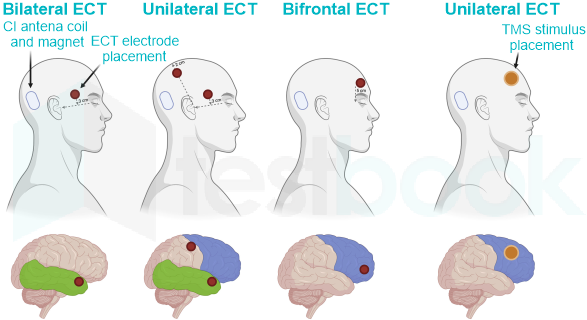
Types of ECT:

62

The muscles that cover the shoulder and back of a neck are:

  1. ((a))

    Biceps

  2. ((b))

    Trapezius

  3. ((c))

    Temporalis

  4. ((d))

    Masseter

Show Answer
Answer: ((b))

Trapezius

Concept:-

  • Muscle: it is a contractile tissue that brings about movements.
  • Muscles can be regarded as motors of the body.

Explanation:

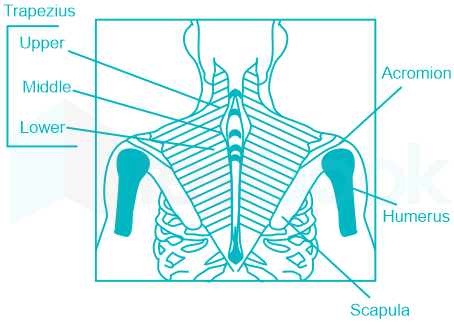
  • Trapezius muscle: it is a broad, flat, superficial muscle extending from the cervical to thoracic region on the posterior aspect of the neck and trunk.
  • The muscle is divided into three parts: descending, ascending, and middle.
  • The muscle contributes to scapulohumeral rhythm through attachments on the clavicle and scapula, and to head balance through muscular control of the cervical spine.
  • Origin: spines of cervical and thoracic vertebrae.
  • Insertion: lateral 1/3 of clavicle + acromion and spine of the scapula.

Additional Information

  • Biceps:  muscle located in the front of the upper arm.
  • Temporalis: it situated within the temporal fossa. It is responsible for closing the mouth and retraction.
  • Masseter: it arises from the zygomatic bone and is inserted at the rear of the mandible.


uppertrapezius.jpg (844×500)

63

A patient is admitted who suffers from borderline personality disorder. Milieu therapy is planned for the patients. This therapy focuses on which of the following is the nurse aware of?

  1. ((a))

    ​giving client the freedom to participate or not to participate in any activity of his own accord

  2. ((b))

    ​using natural remedies instead of drugs to control behavior

  3. ((c))

    ​Talking about life events to meet personal needs

  4. ((d))

    ​Customizing the environment to bring about a positive change in behavior

Show Answer
Answer: ((d))

​Customizing the environment to bring about a positive change in behavior

Explanation: 

  • Milieu therapy is the planned therapy given in case of mental disorders and maladjustment disorders in which treatment is planned as per the patients existing conditions and circumstances.
  • This therapy also involves the modification of the existing environment for a better outcome.

Additional Information

  • Borderline personality disorders are Emotionally unstable personality disorders in which a person is having a distorted sense of self as well as of others.
  • Behavioral therapy is the most common and effective treatment plan for such disorders.
  • Milieu therapy also plays an important role in such cases with personality disorders.
64

Which numerator is used in computing the crude death rate?

  1. ((a))

    Total population of last year

  2. ((b))

    Number of deaths during the year

  3. ((c))

    Midyear population

  4. ((d))

    Number of births during the year

Show Answer
Answer: ((b))

Number of deaths during the year

Explanation:

  • Crude Death Rate: indicates the number of death per 1000 mid-year population.
  • CDR is calculated as:
  • CDR =   D x K  divided by P
  1. D=total number of deaths registered during the calendar year
  2. P= total mid-year estimated population or the total population of the middle of the year
  3. K=a constant usually taken as1,000

Key Points

  • Natural population growth happens because of the following
  1. Birth Rate
  2. Death Rate
  • The natural increase in birth rate and death rate causes natural population growth.
  • Basic components of population change-
  • The fertility rate in women
  • Mortality
  • Migration
  • Natural increase is the difference between the no. of births and deaths in the population.
  • Crude Birth Rate - It is the total number of live births per 1,000 population divided by the length of the period in years. 
  • current rate - 18.2births/1000
  • Crude Death Rate - the ratio of deaths to the population of a particular area or during a particular period of time, usually calculated as the number of deaths per one thousand people per year.
65

 It is better to count the pulse rate when it is irregular:

  1. ((a))

    Radial pulse for a full minute

  2. ((b))

    Apical pulse for a full minute

  3. ((c))

    Radial pulse for 30 sec

  4. ((d))

    Apical pulse for 30 sec

Show Answer
Answer: ((b))

Apical pulse for a full minute

Concept:

  • Pulse rate: it reflects the number of times the heartbeats per minute.
  • When the pulse rate is irregular, it is best to count the apical pulse for a full minute (1-minute bpm).
  • Irrespective of any cause if pulse is irregular nurse must assess the apical pulse for a minute for clear and sound diagnosis and assuring if patient is in life threatening condition or not.
  • The apical pulse is a pulse site on the left side of the chest over the pointed end, or apex, of the heart.
  • So it is always a better intervention for nurse to check apical pulse is pulse is irregular.

Pulse sites:

  • Radial
  • Temporal
  • Carotid
  • Apical
  • Branchial
  • Femoral
  • Popliteal
  • Posterior tibial
  • Dorsalis pedis

Explanation:

  • Apical pulse: the pulse located on the left side of the chest, just below the nipple.
  • Apical pulse rate is taken for a full minute to ensure accuracy.

Purposes of apical pulse assessment:

  • To obtain the heart rate of newborns, infants, and an adult with irregular pulse rates.
  • To identify whether the pulse rate is within the normal range.
66

The most common cause of acute bacterial meningitis in the age group of 6 months to 5 years, which has been virtually eradicated by the effective vaccine, is:

  1. ((a))

    Haemophilus influenzae type b

  2. ((b))

    N. meningitides

  3. ((c))

    Cryptococcus neoformans

  4. ((d))

    Streptococcal pneumonia meningitis

Show Answer
Answer: ((a))

Haemophilus influenzae type b

Correct Answer: 1) Haemophilus influenzae type b

Rationale:

  • Acute bacterial meningitis can be caused by various pathogens, but specific organisms are more common in different age groups. In the age group of 6 months to 5 years, Haemophilus influenzae type b (Hib) used to be the leading cause of acute bacterial meningitis.
  • However, effective vaccination programs have significantly reduced the incidence of Hib meningitis in many parts of the world.

Let's analyze each option:

1) Haemophilus influenzae type b:

  • This is the correct answer. Before the introduction of the Hib vaccine, Haemophilus influenzae type b was the most common cause of bacterial meningitis in children aged 6 months to 5 years. The advent of routine Hib vaccination has virtually eradicated this cause of acute bacterial meningitis in this age group in countries with high vaccination coverage.

2) N. meningitides:

  • Neisseria meningitidis is also a significant cause of bacterial meningitis, particularly in adolescents and young adults. It is less common in the 6 months to 5 years age group compared to Hib before the widespread use of the Hib vaccine.

3) Cryptococcus neoformans:

  • Cryptococcus neoformans is an opportunistic fungal pathogen that commonly causes meningitis in immunocompromised individuals, such as those with HIV/AIDS. It is not a common cause of bacterial meningitis in otherwise healthy children.

4) Streptococcal pneumonia meningitis:

  • Streptococcus pneumoniae is a significant cause of bacterial meningitis across all age groups, including the 6 months to 5 years age bracket. However, the question specifically asks for the cause that has been virtually eradicated by vaccines, which points to Hib.


In summary, Haemophilus influenzae type b (Hib) was the most common cause of acute bacterial meningitis in children aged 6 months to 5 years before the effective vaccination programs virtually eradicated this disease in many areas.

67

Which of the following nurse’s advice is the most important for a female patient who takes lithium for manic episodes?

  1. ((a))

     She will need to maintain her hydration to avoid lithium toxicity

  2. ((b))

    She should stay in the shade when she walks

  3. ((c))

    She should stop walking.

  4. ((d))

    She can continue her exercise because lithium toxicity is very rare.

Show Answer
Answer: ((a))

 She will need to maintain her hydration to avoid lithium toxicity

Concept:-

Lithium: also known as antimanic.

  • It is used for mental illnesses, including bipolar disorder, depression, and schizophrenia.
  • It is classed as a mood stabilizer.
  • Therapeutic range of lithium: - 0.6 – 1.2 mEq/L.

Explanation:

  • The nurse should advise a female patient who takes lithium for manic episodes to maintain her hydration to avoid lithium toxicity

Other nursing advice for a patient taking lithium:

  • Teach patients to take drugs as prescribed and keep medical appointments.
  • She should stay in the shade when she walks.
  • Advise patient that drug effect may take 1 to 2 weeks.
  • Advise patient against getting pregnant because of teratogenic effects.
  • She can continue her exercise because lithium toxicity is very rare.
68

What is the colour coding of the bag used in hospitals to dispose off human anatomical waste?

  1. ((a))

    Black

  2. ((b))

    Blue

  3. ((c))

    Red

  4. ((d))

    Yellow

Show Answer
Answer: ((d))

Yellow

All human activities produce waste. We all know that such waste may be dangerous and needs safe disposal. 

Bio-medical waste means “any solid and/or liquid waste including its container and any intermediate product, which is generated during the diagnosis, treatment or immunization of human beings or animals or research activities pertaining thereto or in the production or testing of biological or in health camps.

The bio-Medical waste consists of-

  • Human anatomical waste like tissues, organs and body parts
  • Animal wastes generated during research from veterinary hospitals
  • Microbiology and biotechnology wastes
  • Waste sharps like hypodermic needles, syringes, scalpels and broken glass
  • Discarded medicines and cytotoxic drugs
  • Soiled waste such as dressing, bandages, plaster casts, material contaminated with blood, tubes and catheters
  • Liquid waste from any of the infected areas
  • Incineration ash and other chemical wastes

The biomedical waste (BMW) management requires its categorization as a first step. The BMW Rules classify the BMW into the following categories.

CATEGORYTYPE OF WASTETREATMENT AND DISPOSAL OPTION
YellowIt consists of human tissues, body partIncineration or Plasma Pyrolysis or deep burial
RedContaminated Waste (Recyclable) Wastes generated from disposable items such as tubing, bottles, intravenous tubes and sets, syringes (without needles and fixed needle syringes ), and gloves.Red coloured non-chlorinated plastic bags or containers. Autoclaving or micro warming is a suitable option for its disposal.
Blue/whiteBlue plastic bag consist of contaminated glass. White Bag consist of sharp waste including metals.Disinfection or hydroclaving is a suitable method for blue bag disposal. Dry heat sterilization or sanitary landfill is a viable option of disposal of white plastic bag.
BlackMostly consist of household/general waste or garbage.It can be securely left for underground disposal in a secured landfill.

Therefore option 3 is the correct answer.

69

Excessive hemolysis may result in the accumulation of which substance in the body?

  1. ((a))

    Globulin

  2. ((b))

    Haem

  3. ((c))

    Bilirubin

  4. ((d))

    Minerals

Show Answer
Answer: ((c))

Bilirubin

Key Points

  • Jaundice
  • The red blood cells which are damaged or the cells which have completed their life cycle, migrate to the liver cells are destroyed and broken down to form bile pigments called bilirubin and biliverdin.
  • When the liver cells are damaged due to hepatitis infection or injury, the bilirubin pigments increase in human blood.
  • Hyperbilirubinemia is excessive bilirubin in the blood. This increase also results in the yellowing of the tissues which is referred to as jaundice. Hence, Option 3 is correct.
  • It is caused by an obstruction in the bile duct, excessive hemolysis, or viral infection.
  • It leads to the deposition of bilirubin in the mucous membrane, sclera, nail tissues, and skin so that the patient looks yellow.
  • The colour of the urine is bright yellow.

Additional Information

  • Jaundice Symptoms:
  • Skin and sclerae colour changes to yellow.
  • Urine colour also changes to yellow.
  • Itching of the skin.
  • Fever
  • Abdominal pain
  • Vomitings
  • Weight loss
70

The site of growth in the length of a long bone is:

  1. ((a))

    Bone marrow

  2. ((b))

    Diaphysis

  3. ((c))

    Epiphyseal plate

  4. ((d))

    Periosteum

Show Answer
Answer: ((c))

Epiphyseal plate

Concept:

  • Long bones: are bones involved with large movements. They are elongated and cylindrical with enlarged, knob-like ends, called epiphyses which are mostly spongy bone covered by a thin layer of compact bone.

Explanation:

  • Epiphyseal plate: It is a disc of hyaline cartilage that grows during childhood to lengthen the bone.

Growth in bone length:

  • Zone of resting cartilage: cartilage attaches to the epiphysis.
  • Zone of proliferation: new cartilage is produced on the epiphyseal side of the plate as the chondrocytes divide and form stacks of cells.
  • Zone of hypertrophy: chondrocytes mature and enlarge.
  • Zone of calcification: matrix is calcified, and chondrocytes die.
  • Ossified bone: the calcified cartilage on the diaphyseal side of the plate is replaced by bone.

Additional Information

  • Bone marrow:  it is the soft, fatty tissue inside your bones. Stem cells are immature cells in the bone marrow that give rise to all of your blood cells.
  • Diaphysis: the central tubular part of the bone.
  • Periosteum: it is a fibrous membrane covering the surface of bones.

38.2D: Growth of Bone - Biology LibreTexts

71

By which of the following a nurse can increase the comfort of a patient suffering from appendicitis?

  1. ((a))

    making the patient lie on the left side

  2. ((b))

    bending the patient's right knee

  3. ((c))

    making the patient sit upright on a chair

  4. ((d))

    making the patient completely lie down

Show Answer
Answer: ((b))

bending the patient's right knee

Concept:-

  • The patient with appendicitis usually prefers to lie still, often with the right leg flexed to decrease pain.
  • Appendicitis is referred to as acute inflammation of the appendix. This is most common in children and young adults characterized by intense abdominal pain.
  • Rebound tenderness is a clinical sign in which when pressure is applied to McBurney's Point to assess the pain and to check the location of the pain, there is no pain on applying pressure but the pain in that area when the pressure is removed back.
  • Obturator sign: Pain caused by passive internal rotation of the hip when the right knee is bent. It is present when an inflamed appendix comes into contact with the obturator internalus muscle.

Important Points 

  • The appendix is ​​a small, thin sac-like structure about 5 to 10 cm long, it is a gastrointestinal organ and is attached to the large intestine.
  • The most common causes include- Obstruction of the appendix i.e. Faecolith which leads to secretion and deposition of mucous within the lumen of the appendix and development of infection, abdominal surgery or trauma, Inflammatory bowel disease, a parasitic infection.
  • Management:- Surgery (appendectomy)
  • Key nursing interventions:- Fowlers positions
  • To minimize pain.

Additional Information

Sign of Appendicitis-​

  • Abdominal pain
  • Anorexia
  • Diarrhea/ constipation
  • Fever
  • Nausea and Vomiting

Symptoms:

  • McBurney's point i.e. rebound tenderness in the right lower quadrant.
  • Rovsing's Sign i.e. Palpation of the left lower quadrant causes pain in the right lower quadrant.
  • Obturator's sign i.e. pain on internal rotation of the hip
72

What a medical intervention is called that involves thinking about or involving past experiences in order to help patients achieve a sense of integrity, increase self-esteem, and encourage themselves to think about themselves?

  1. ((a))

    self-exploration

  2. ((b))

    auxiliary percussion

  3. ((c))

    procrastination

  4. ((d))

    reminiscence

Show Answer
Answer: ((d))

reminiscence

The correct answer is  'Reminiscence'.

Key Points

  • Reminiscence: the act of remembering events and experiences from the past
  • Example: The novel contains endless reminiscences of/about the author's youth.
  • Thus, from above, the correct answer is option 4.

Additional Information

  • Self-exploration is a process of discovering that there is something innate, immutable, and universal in all human beings.​
  • Auxiliary percussion is percussion instruments without a pitch, used for the purpose of creating rhythm and pronunciation.
  • Procrastination is the act of delaying or postponing tasks until the last minute, or they have expired.
73

Which artery supplies oxygenated blood to the stomach?

  1. ((a))

    Cephalic

  2. ((b))

    Gastric

  3. ((c))

    Celiac

  4. ((d))

    Carotid

Show Answer
Answer: ((c))

Celiac

Concept:-

  • Celiac artery: also known as the celiac trunk.
  • It is the first major branch of the abdominal aorta.
  • It supplies oxygenated blood to the stomach, abdominal esophagus, spleen, and liver.

Origin:

  • it is very short and arises from the front of the abdominal aorta at the level of the lower border of the T12 vertebra.
  • It is surrounded by the celiac plexus of nerves.
  • It lies behind the lesser sac of the peritoneum.

It has 3 terminal branches:

  1. Left gastric artery
  2. Splenic artery
  3. Hepatic artery

Spontaneous celiac artery dissection - The American Journal of Emergency  Medicine

74

An inborn error of metabolism that causes premature destruction of RBCs is:

  1. ((a))

    Homocystinuria

  2. ((b))

    G6PD

  3. ((c))

    Phenylketonuria

  4. ((d))

    Celiac disease

Show Answer
Answer: ((b))

G6PD

Concept:-

  • G6PD deficiency:  also called glucose-6-phosphate-dehydrogenase
  • In this deficiency, red blood cells break down in response to certain medications, infections, or other stresses.
  • It is an inherited disease. It is X-linked.
  • This disease is characterized by hemolytic anemia caused by the inability to detoxify oxidizing agents.

Symptoms of G6PD:

  • Shortness of breath
  • Fever
  • Rapid heart rate
  • Fatigue
  • Jaundice
  • Dark or yellow urine

Additional Information

  • Homocystinuria:  it is an inherited disorder of the metabolism of the amino acid methionine.
  • Phenylketonuria: it is a genetic disorder that is characterized by an inability of the body to utilize the essential amino acid, phenylalanine.
  • Celiac disease: it is an immune disorder characterized by an abnormal immune response to the protein gluten.
75

Vivid dreaming occurs in which stage of sleep?

  1. ((a))

    Delta Stage

  2. ((b))

    Stage 1 NREM

  3. ((c))

    REM stage

  4. ((d))

    Stage 2 NREM

Show Answer
Answer: ((c))

REM stage

Concept:-

  • Vivid dreaming: vivid dreams are intense dreams that linger in the mind and feel similar to real-life memories.
  • They arise from the normal REM cycles.

Explanation:-

4 stages of sleep:

NREM stage 1.

  • The transition period between wakefulness and sleep
  • Lasts around 5 to 10 minutes

NERM stage 2.

  • Body temperature drops and heart rate begins to slow
  • The brain begins to produce sleep spindles
  • Lasts approximately 20 minutes

NERM stage 3.

  • Muscles relax
  • Blood pressure and breathing rate drop
  • Deepest sleep occurs

REM stage:

  • The brain becomes more active
  • The body becomes relaxed and immobilized
  • Dreams occur
  • Eyes move rapidly
76

Hemophilia B is the deficiency of:

  1. ((a))

    Factor XI

  2. ((b))

    Factor IX

  3. ((c))

    Factor X

  4. ((d))

    Factor VII

Show Answer
Answer: ((b))

Factor IX

Haemophilia

  • Haemophilia is a group of bleeding disorders. Blood clotting factors are needed to stop bleeding.
  • The most common types are:
  • Hemophilia A (classic hemophilia)—caused by too little or no factor VIII (most common)
  • Hemophilia B (Christmas disease)—happens in males, caused by too little or no factor IX
  • Causes of this disease is a faulty gene on a certain DNA strand.
  • Females carry 2 copies of the strand. If one is faulty, the other one takes over. The faulty gene can pass to their children. If so, the female child will carry the gene. If it passes to the male, they will get the disease because they carry one copy of the strand.

Additional Information 

BLOOD CLOTTING FACTORS
International designationName
I II IIa III V and VI VII VIII IX X XI XII XIIIFibrinogen Prothrombin Thrombin Tissue thromboplastin Proaccelerin, accelerator globulin Proconvertin Antihemophilic globulin (AHG) Christmas factor, plasma thromboplastin component (PTC) Stuart-Prower factor, autoprothrombin III Plasma thromboplastin antecedent (PTA) Hagemann factor Fibrin-stabilizing factor
77

In the tuberculin test, the area of induration is measured after:

  1. ((a))

    48 - 72 hrs

  2. ((b))

    72 hrs.

  3. ((c))

    24-72 hrs

  4. ((d))

    24-48 hrs

Show Answer
Answer: ((a))

48 - 72 hrs

Concept:

Mantoux test

  • Mantoux test (Purified Protein Derivative) or TB skin test: A standard dose of 5 tuberculin units is injected intradermally.
  • The reaction is read (48-72 hours later) by measuring the diameter of erythema (palpable raised, hardened area) 15 mm or more millimetres is considered positive.

Important Points

Erythema measurement

  • Erythema measurement of  5 or more millimetres is considered positive in People living with HIV
  • Erythema measurement of 10 mm or more is positive in
  • Client with clinical conditions that put them at higher risk.
  • Mycobacteriology lab worker.
  • People who abuse drugs.
  • Erythema measurement of 15 or more millimetres is considered positive in People with no known risk factors for TB
  • TB Vaccination with Basil Calmette-Guerin (BCG) Vaccine.
78

The last product of the process of blood coagulation is:

  1. ((a))

    Prothrombin

  2. ((b))

    Thrombin

  3. ((c))

    Fibrin

  4. ((d))

    Thromboplastin

Show Answer
Answer: ((c))

Fibrin

Concept:

  • Blood coagulation Process:
  • It is the process of clotting blood using platelets and fibrin in the blood.
  • It is required to reduce the loss of blood from the body.
  • This process is called Hemostasis.
  • Some steps are there in this process:
  • The primary step is vasoconstriction, in the vascular wall reacts to reduce the loss of blood.
  • Then platelets start covering the injured area.
  • It activates fibrin clots known as secondary hemostasis.
  • It follows the formation of fibrinogen, which is a soluble plasma protein.
  • Platelet clots are termed as white thrombus and if the red blood cells are present, it is known as red thrombus.

Explanation:

  • There are different processes in the coagulation process.
  • Formation of Thromboplastin, thrombin, fibrin from thromboplastin, prothrombin, and fibrinogen respectively.
  • Formation of thrombin is not the coagulation process.

Notes:

  • There is a series of steps leading to the formation of fibrin protein fibre, it involves different clotting factors.
  • There are about thirteen known clotting factors:
  • Fibrinogen (Factor 1)
  • Prothrombin (Factor 2)
  • Thromboplastin (Factor 3)
  • Calcium (Factor 4)
  • Proaccelerin or Labile Factor (Factor 5)
  • Stable Factor (Factor 6)
  • Antihemophilic Factor (Factor 8)
  • Christmas Factor (Factor 9)
  • Stuart - Power Factor (Factor 10)
  • Plasma Thrombin antecedent (Factor 11)
  • Hegman Factor (Factor 12)
  • Fibrin Stabilising Factor (Factor 13)
79

In Newborn mild Hypothermia, the temperature range is:

  1. ((a))

    36.0°C – 36.4°C

  2. ((b))

    32.0°C – 35.9°C

  3. ((c))

    Less than 32°C

  4. ((d))

    36.5°C – 37.4°C

Show Answer
Answer: ((a))

36.0°C – 36.4°C

WHO Classification of Hypothermia in Newborn

Normal

  • Temperature: 36.5°C to 37.4°C
  • Feel: Warm trunk & warm extremities
  • Action:
  • Cover the baby with pre-warmed cloth
  • Keep baby close to the mother
  • Encourage breastfeeding
  • Provide skin-to-skin contact (KMC)

Mild Hypothermia (Cold Stress)

  • Temperature: 36.0°C to 36.4°C
  • Feel: Warm trunk but cold extremities
  • Clinical features: Cold hands/feet, bluish extremities, poor weight gain if prolonged
  • Action:
  • Skin-to-skin contact
  • Cover adequately
  • Ensure warm environment
  • Provide warmth and encourage breastfeeding

Moderate Hypothermia

  • Temperature: 32.0°C to 35.9°C
  • Feel: Cold trunk and cold extremities
  • Clinical features:
  • Poor sucking, lethargy
  • Weak cry
  • Fast breathing or irregular breathing
  • Poor perfusion
  • Action:
  • Cover mother and baby with warm preheated clothes
  • Reassess temperature every 15 minutes
  • Provide additional heat if no improvement
  • Encourage breastfeeding.

Severe Hypothermia

  • Temperature: < 32°C
  • Feel: Very cold trunk and extremities
  • Clinical features:
  • Slow heart rate
  • Red, hardened skin
  • Edema, bleeding
  • Low blood sugar
  • Action:
  • Rapid rewarming to 34°C, then slow rewarming
  • Provide oxygen
  • Give warm IV fluids (5–10% glucose)
  • Administer Vitamin K
  • Reassess every 15 minutes
  • Provide additional heat if needed
80

The collapse of the alveoli is prevented by:

  1. ((a))

    Pleural fluid

  2. ((b))

    Mucus

  3. ((c))

    Cilia

  4. ((d))

    Surfactant

Show Answer
Answer: ((d))

Surfactant

Concept:-

  • Surfactant: it is a surface-acting material or agent that is responsible for lowering the surface tension of a fluid.
  • A surfactant that lines the epithelium of the alveoli in the lungs is known as a pulmonary surfactant and it decreases the surface tension on the alveolar membrane.

Source of secretion of pulmonary surfactant:

Pulmonary surfactant is secreted by two types of cells:

1. Type II alveolar epithelial cells: in the lungs, which are called surfactant secreting alveolar cells or pneumocytes.

  • A characteristic feature of these cells is the presence of microvilli on their alveolar surface.

2. Clara cells: which are situated in the bronchioles.

  • These cells are also called bronchiolar exocrine cells.

Significance of surfactant:

  • Prevents collapse of alveoli
  • Increases lung compliance
  • Keeps alveoli dry
  • Keeps lungs expanded
  • Prevent pulmonary edema
  • Allows fetal lung maturity
81

Accidental hemorrhage is also known as:

  1. ((a))

    Circumvallate placenta

  2. ((b))

    Abruptio Placentae

  3. ((c))

    Vasa praevia

  4. ((d))

    Placenta praevia

Show Answer
Answer: ((b))

Abruptio Placentae

CONCEPT: 

  • Pregnancy, also known as gestation, is the time during which one or more offspring develops inside a woman.
  • Some pain and/or vaginal bleeding are common in the first trimester.
  • Abruptio Placentae (Accidental Haemorrhage) - Placental abruption is a condition during pregnancy when the placenta separates early from the uterus.

EXPLANATION: 

  • By 34 weeks of gestation, complaints of painful bleeding could be a sign of inflamed cervix or more seriously a sign of placenta abruption.
  • Symptoms can include bleeding and abdominal pain, especially during the third trimester.

Additional Information 

  • Placenta previa is the complete or partial covering of the internal os of the cervix with the placenta.
  • Placenta accreta is a serious pregnancy condition that occurs when blood vessels and other parts of the placenta grow too deeply into the uterine wall.
  • Placenta percreta is a condition in which the placenta abnormally penetrates entirely through the myometrium and into the uterine serosa.
82

The constant presence of a disease or an infectious agent within a given geographic area or population group is called:

  1. ((a))

    Endemic

  2. ((b))

    Pandemic

  3. ((c))

    Epidemic

  4. ((d))

    Sporadic

Show Answer
Answer: ((a))

Endemic

Concept:-

  • Endemic
  • An epidemic is a sudden severe outbreak within a region or a group, as with AIDS in Africa or AIDS in intravenous drug users.
  • A pandemic occurs when an epidemic becomes very widespread and affects a whole region, a continent, or the entire world.
  • An endemic disease is a disease that is always present in a certain population or region.
  • One of the most talked-about endemic diseases is malaria.
  • The CDC estimates that around half the world's population live in areas where they are at risk of Malaria infection.
  • It is endemic in large parts of Africa as well as some areas of South America.
  • Epidemic
  • An epidemic is an occurrence of a disease that is temporary of high prevalence.
  • An epidemic occurring over a wide geographical area (e.g., worldwide) is called a pandemic.
  • The rise and decline in the epidemic prevalence of an infectious disease are a probability phenomenon dependent upon the transfer of an effective dose of the infectious agent from an infected individual to a susceptible one.
  • After an epidemic has subsided, the affected host population contains a sufficiently small proportion of susceptible individuals that reintroduction of the infection will not result in a new epidemic.
  • Since the parasite population cannot reproduce itself in such a host population, the host population as a whole is immune to the epidemic disease, a phenomenon termed herd immunity.
  • Pandemic
  • A pandemic is an outbreak of infectious disease that occurs over a wide geographical area and that is of high prevalence, generally affecting a significant proportion of the world’s population, usually over the course of several months.
  • Pandemics arise from epidemics, which are outbreaks of disease confined to one part of the world, such as a single country.
  • Pandemics, especially those involving influenza, sometimes occur in waves, so that a post-pandemic phase, marked by decreased disease activity, may be followed by another period of high disease prevalence.
  • In March 2020 an ongoing outbreak of a novel coronavirus known as severe acute respiratory syndrome coronavirus-2 (SARS-CoV2) was declared a pandemic by WHO officials.
  • Infection with SARS-CoV2 produced an illness known as coronavirus disease 2019 (COVID-19).
  • The illness was characterized primarily by fever, cough, and shortness of breath.
83

The most commonly used method to prevent the transmission of microorganism(s) from one person to another in hospital setting is:

  1. ((a))

    Changing the bed linen daily

  2. ((b))

    Disinfecting instruments in special solutions

  3. ((c))

    Filtering air in hospitals

  4. ((d))

    Washing hands thoroughly and frequently before/after checking the patient(s)

Show Answer
Answer: ((d))

Washing hands thoroughly and frequently before/after checking the patient(s)

Concept:

  • The most common route of transmission is contact transmission.
  • Direct contact transmission includes the transmission of microorganisms from one infected person or carrier to the susceptible person.
  • Washing hands after and before contacting the patient reduces the contact transmission.
  • Appropriate use of personal protective equipment such as gloves, masks, gowns, aseptic techniques, hand washing, and environmental infection control measures

Explanation:

  • The five moments for handwashing are:
  1. Before touching the patient.
  2. After touching the patient.
  3. Before aseptic task.
  4. After exposure to body fluid.
  5. After coming in contact with the patient's surroundings.
84

A 40-year-old client is admitted with the diagnosis of delusions of grandeur. Which of the following option supports this diagnosis?

  1. ((a))

    Delusion for being responsible for evil world

  2. ((b))

    Delusion of being killed

  3. ((c))

    Delusion of being connected to client unrelated to oneself

  4. ((d))

    Delusion of being highly famous and important

Show Answer
Answer: ((d))

Delusion of being highly famous and important

Concept:-

  • Delusions of grandeur: people experiencing delusions of grandeur see themselves as great, highly accomplished, more important than others.
  • Some people with the delusion of grandeur also experience other delusions, such as a feat of persecution or unusual religious beliefs.

Some most common types of grandeur:-

  • An inflated belief in one’s own importance, such as having the power to end the war
  • A belief that one is famous or occupies a high position in society
  • A belief that one is a religious leader
  • A belief one’s ability to live forever
  • A false belief that one cannot be harmed by disease or injury
  • An inflated sense of intelligence
  • A belief that one possesses magical skills, such as the ability to read minds.
85

The four cardinal signs of inflammation are:

  1. ((a))

    Heat, redness, swelling and discomfort

  2. ((b))

    Pain, coldness, redness and pus formation

  3. ((c))

    Pain, heat, redness and swelling

  4. ((d))

    Pain, paleness, cold and swelling

Show Answer
Answer: ((c))

Pain, heat, redness and swelling

Concept:-

  • Inflammation: it is the local vascular, lymphatic, and cellular reactions of living tissue against an irritant.

Four cardinal signs of inflammation: pain, heat, redness, and swelling.

Types of inflammation:

  1. Acute: sudden onset and short duration
  2. Chronic: gradual onset and long duration

Causes of inflammation:

  • Allergic reaction
  • Infection
  • Injury
  • Burns
  • Cancer
  • Cardiovascular disease
  • Cancer

What Are the 5 Cardinal Signs of Inflammation?

86

In which year was the Pulse Polio Immunization program launched in India?

  1. ((a))

    1993

  2. ((b))

    1992

  3. ((c))

    1995

  4. ((d))

    1994

Show Answer
Answer: ((c))

1995

Concept:

  • Polio is nothing but the term or synonym of the disease Poliomyelitis.
  • It is a viral disease that mainly affects young children.
  • The virus is transmitted by person-to-person i.e. it is a communicable disease.
  • It is transmitted through the faecal-oral route and by contaminated water or food.
  • Initial symptoms of polio include fever, fatigue, headache, vomiting, stiffness in the neck, and pain in the limbs.
  • In a small proportion of cases, the disease causes paralysis, which is often permanent.
  • There is no cure for polio, it can only be prevented by immunization.

Explanation:

  • India was the first country in the world to introduce fractional-dose inactivated poliovirus vaccine into its immunization programme.
  • India rolled out the Pulse Polio Immunization Programme on 2 October 1995.
  • Within two decades, India received ‘Polio-free certification’ from World Health Organization on 27 March 2014.
  • The last polio case being reported in Howrah in West Bengal on 13 January 2011.
  • WHO launched this programme in 1985.

Thus, in the year 1995 pulse polio immunization programme was launched in India.

  • The National Cancer registry program was started in 1962.
  • The National Leprosy eradication program started in1955 launched in 1983.
  • Universal immunization program (UIP) started in1985.
87

The collection of the lymphatic fluid in the pleural space due to the leak in the thoracic duct is known as:

  1. ((a))

    Pleurodesis

  2. ((b))

    Chylothorax

  3. ((c))

    Lymphoma Thorax

  4. ((d))

    Hemothorax

Show Answer
Answer: ((b))

Chylothorax

Concept:-

  • Lymphatic fluid: clear watery fluid that surrounds body cells and flows in the system of lymph vessels throughout the body.
  • Pleural space: it is lined by a single layer of flat cells, mesothelium, and an associated layer of supporting connective tissue; together they form pleura.
  • Chylothorax: it is a collection of chyle in the pleural cavity resulting from leakage from the lymphatic vessels, usually from the thoracic duct.
  • Approximately 2.5L of chyle is transported through the lymphatic system every day

Source:

  • Chyle leak from the thoracic duct or its branches.
  • The flow of chyle in the abdomen through the diaphragm.

Signs and symptoms:

  • Breathlessness
  • Chest discomfort
  • Tachypnea
  • Dullness to percussion

Additional Information

  • Pleurodesis is a procedure that involves inserting a mildly irritating medicine into the space between your lungs and the chest wall (pleural space) on one side of your chest.
  • Hemothorax occurs when blood pools between your chest wall and your lungs.

88

The ’flight of idea’ refers to which of the following?

  1. ((a))

    New words invented by a patient

  2. ((b))

    Use of rhyming words

  3. ((c))

    Repetition of words heard

  4. ((d))

    Pattern of rapid transition from topic to topic

Show Answer
Answer: ((d))

Pattern of rapid transition from topic to topic

Concept:-

  • Flight of idea occurs when one talks quickly and incorrectly, Pattern of rapid transition from topic to topic, rapidly between thoughts and ideas.
  • Flight of idea is not a medical condition in itself. It is a symptom that can occur as part of mania, psychosis, and some neurodevelopmental conditions.
  • Mania is derived from the Greek word meaning 'madness frenzy'. Mania is an alteration in Mood that is characterized by extreme happiness, extreme irritability, hyperactivity, little need for sleep, and/or racing thoughts which may lead to rapid speech.
  • Mania is one of the stages of mood disorder which is described as disturbance of mood, accompanied by manic and/or depressive episodes.

Important Points

Classification:

  • Hypomania is when perceptions of the self are exalted, the person is cheerful and there is increased motor activity.
  • Acute Mania is an intensification of hypomania described as a patient in euphoria and elation.
  • Delirious Mania is characterized by severe clouding of the consciousness and further intensification of acute mania i.e. disorientation, stupor, and clouding of consciousness.
  • Delusional mania is characterized by less excitement, more persistent grandiose, and occasional hallucinations.

Key PointsStages of elevated mood:

  • Euphoria is an increased sense of both psychological well-being and happiness.
  • Elation is a moderate elevation of mood with increased psychomotor activity.
  • Exaltation is an intense elevation of mood with delusions of Grandeur.
  • Ecstasy as severe elevation of mood, intentions of blissfulness.

Additional InformationClinical Feature of Mania:

  • Elevated mood
  • Expensive mood i.e. unceasing and unselective
  • irritable mood
  • Increased psychomotor activity
  • Speech and thought: Flight of ideas; Delusion of persecution and Distractibility.

Management:

  • Pharmacotherapy: Lithium and Sodium Valproate
  • Electroconvulsive therapy
89

A terminally ill patient usually DOES NOT experience which of the following feelings during the ‘anger stage’?

  1. ((a))

    Resentment

  2. ((b))

    Rage

  3. ((c))

    Envy

  4. ((d))

    Numbness

Show Answer
Answer: ((d))

Numbness

Concept:-

  • Terminally illness: it is a disease that cannot be cured or adequately treated and that is reasonably expected to result in the death f the patient within a short period of time.
  • This term is more commonly used for progressive diseases such as cancer or advanced heart disease than for trauma.
  • Anger stage: an emotional or physical activity in which the patient attempts to place blame. patients often report a lack of trust with their treating physician and blame themselves.

Explanation:-

  • The patient usually does not feel numbness during the ‘anger stage’.

Feelings during anger stage:

  • Envy
  • Irritability
  • Resentment
  • Bitterness
  • Anxiety
  • Impatience
  • Rage
90

The period from disease initiation to disease detection is called:

  1. ((a))

    Latent period

  2. ((b))

    Communicable period

  3. ((c))

    Median incubation period

  4. ((d))

    Incubation period

Show Answer
Answer: ((a))

Latent period

The correct option is: 1) Latent period

Explanation:

  • The latent period is the time between exposure to a pathogen and the point at which the disease becomes detectable through laboratory tests or clinical signs.
  • During this phase, the pathogen is present in the host but has not yet reached a sufficient level to cause detectable symptoms or transmission.
  • The incubation period, on the other hand, is the time between exposure and the onset of symptoms, which is different from the latent period.

Discussion of Other Options:

  • Communicable period: Incorrect. This refers to the time during which an infected individual can transmit the disease to others, which may or may not overlap with the latent period.
  • Median incubation period: Incorrect. The median incubation period is the average time taken for symptoms to appear after exposure, but it does not focus on the detection of the disease.
  • Incubation period: Incorrect. While it refers to the time from exposure to symptom onset, it is not necessarily the period from disease initiation to detection, which is the latent period.

Additional Information:

  • Latent period vs. Incubation period: The latent period is typically shorter than the incubation period, as individuals may become infectious before showing symptoms.
  • Example: In HIV, the latent period can be weeks to months, while the incubation period before symptoms (AIDS) can be years.
91

A patient addicted to drugs says, ‘everyone I know is using cocaine. Why shouldn’t I? This is an example of:

  1. ((a))

    Denial

  2. ((b))

    Projection

  3. ((c))

    Regression

  4. ((d))

    Intellectualisation

Show Answer
Answer: ((b))

Projection

Concept:-

  • Psychological Projection: It is also known as blame, shifting, is a theory in psychology in which the human defends himself against their own unpleasant impulses by denying their existence while attributing them to others.
  • For Example, A person who is rude may constantly accuse the other person of being rude

Additional Information

Defense MechanismDescriptionExample
RepressionUnknowingly placing an unpleasant memory or thought in the unconsciousNot remembering a traumatic event such as being sexually abused as a child
RegressionReverting back to an immature behavior from an early stage of developmentThrowing temper tantrums as an adult when you don’t get the way
DisplacementRedirecting feelings or actions from the intended source to a safer, substitute targetTaking your anger towards your boss out on family members by yelling at them in place of your boss
SublimationReplacing socially unacceptable impulses with socially acceptable behaviorChanneling aggressiveness into playing football
Reaction FormationOveracting in the opposite way to one’s true feelingBeing overly protective of an unwanted child
ProjectionAttributing one’s own unacceptable feelings and thoughts to others and not yourselfAccusing your partner of cheating on you because you have thought about cheating on him/her
RationalizationJustifying actions, thoughts, or unwanted outcomes with excuses or faulty logicBlaming the teaching style of a professor for why you failed an exam
92

The immunity transferred by maternal antibodies across the placenta is called:

  1. ((a))

    Passive immunity

  2. ((b))

    Active immunity

  3. ((c))

    Herd immunity

  4. ((d))

    Humoral immunity

Show Answer
Answer: ((a))

Passive immunity

Explanation:-

Immunity

  • The capacity of the body to protect from infectious agents and other harmful substances such as bacteria, viruses, chemicals, toxins, etc by a variety of cells.

Cells of Immune System

  • Phagocytic cells
  • T cell
  • B cell

Types of immunity

A.Active immunity:- Antibodies are formed within the body.

  • Natural-active immunity.
  • Antibodies are formed during the course of the disease.
  • Usually produces life-long immunity, such as to measles, chickenpox, and smallpox.
  • Acquired-active immunity.
  • Antigen (e.g., vaccine or toxoid) is administered to stimulate the formation of antibodies.
  • Usually produces life-long immunity or requires revaccination to maintain titers.

B.Passive immunity:- Antibodies are acquired from a source other than the individual’s body.

  • Natural-passive immunity.
  • Passage of antibodies occurs from a mother to a fetus via the placenta or to a neonate via colostrum.
  • Provides immunity for 6 months to 1 year.
  • Acquired-passive immunity.
  • Antibodies produced from another source (immune serum) are injected into a person.
  • Provides immunity for 2 to 3 weeks.
93

Which of the following is the gold standard for diagnosis of TB?

  1. ((a))

    Monteux test

  2. ((b))

    Mycobacterium sputum culture

  3. ((c))

    Blood culture

  4. ((d))

    Chest X-ray

Show Answer
Answer: ((b))

Mycobacterium sputum culture

Concept:-

  • Tuberculosis disease is also known as Koch disease.
  • Mode of transmission- Airborne.
  • Confirmative test- Sputum culture.

Key Points

  • Tuberculosis (TB):
  • It is caused by a bacterium called Mycobacterium tuberculosis, belonging to the Mycobacteriaceae family consisting of about 200 members.
  • Some Mycobacteria cause diseases like TB and Leprosy in humans and others infect a wide range of animals.
  • In humans, TB most commonly affects the lungs (pulmonary TB), but it can also affect other organs (extra-pulmonary TB).
  • TB is a very ancient disease and has been documented to have existed in Egypt as early as 3000 BC.
  • TB is a treatable and curable disease.
  • Transmission:
  • TB is spread from person to person through the air. When people with lung TB cough, sneeze, or spit, they propel the TB germs into the air.
  • BCG Vaccine:
  • BCG was developed by two Frenchmen, Albert Calmette and Camille Guerin, by modifying a strain of Mycobacterium Bovis (that causes TB in cattle). It was first used in humans in 1921.
  • In India, BCG was first introduced on a limited scale in 1948 and became a part of the National TB Control Programme in 1962.
  • In addition to its primary use as a vaccine against TB, it protects against respiratory and bacterial infections of newborns and other mycobacterial diseases like Leprosy and Buruli’s ulcer.
94

The four hallmark signs of tumor lysis syndrome are hyperuricemia, hyperkalemia, hyperphosphatemia and:

  1. ((a))

    hyponatremia

  2. ((b))

     hypercalcemia

  3. ((c))

    hypernatremia

  4. ((d))

    hypocalcemia

Show Answer
Answer: ((d))

hypocalcemia

Concept:-

  • Tumor lysis syndrome: it is characterized by a group of metabolic derangements caused by the massive and abrupt release of cellular components into the blood following rapid lysis of malignant cells.

Clinical manifestations:

  • Largely reflect the associated metabolic abnormalities include-
  • Nausea, vomiting, diarrhea, anorexia
  • Hematuria
  • Heart failure, cardiac dysrhythmias
  • Seizures, muscle cramps
  • Flank pain can occur

Explanation:-

Characteristic findings of tumor lysis syndrome include:

  • Hyperuricemia: it is a serum urate concentration in excess of urate solubility (>6.8mg/dl)
  • Hyperkalemia: it is defined as a potassium concentration greater than 5.5mEq/L.
  • Hyperphosphatemia: it is abnormally high serum phosphate levels.
  • Hypocalcemia: serum calcium level less than 8mg/dl.
95

According to the SMART acronym, what objectives are defined in project management, employee performance management, and personal development, etc. for example?

  1. ((a))

    Sensitive, Matching, Affordable, Robust, Testable

  2. ((b))

    Small, Measurable, Applicable, Reliable, Timely

  3. ((c))

    Simple, Modifiable, Applicable, Realistic, Technical

  4. ((d))

    Specific, Measurable, Achievable, Realistic, and Timely

Show Answer
Answer: ((d))

Specific, Measurable, Achievable, Realistic, and Timely

SMART:

  • Every business aspects have a goal and provide a sense of motivation, direction, clear focus, and clarify importance.
  • The businesses are providing themselves with a target to aim for by setting goals.
  • A SMART goal criterion is often said to have a good way to construct an effective marketing plan.
  • SMART is an acronym for Specific, Measurable, Achievable, Realistic, Timely.
  • Hence, a SMART goal incorporates all of these criteria to focus on the efforts and increase the chances of achieving the goals.
  • SMART goals are:
  • Specific: Well defined, clear, and unambiguous.
  • Measurable: With specific criteria that measure the progress towards the accomplishment of the goal.
  • Achievable: Attainable and not impossible to achieve.
  • Realistic: Within reach, realistic, and relevant to life purpose.
  • Timely: With a clearly defined timeline, including a starting date and a target date. The purpose here is to create urgency.
<br>

Therefore, SMART is an acronym for Specific, Measurable, Achievable, Realistic, Timely.

96

The right common carotid artery arises from:

  1. ((a))

    Right axillary artery

  2. ((b))

    Left subclavian artery

  3. ((c))

    Brachiocephalic artery

  4. ((d))

    Arch of aorta

Show Answer
Answer: ((c))

Brachiocephalic artery

Concept:-

  • Common carotid artery: it provides blood supply to the head and neck.
  • Origin: Right common carotid artery arises from the brachiocephalic artery behind the sternoclavicular.
  • The left common carotid artery arises from the arch of the aorta.

Explanation:-

  • Brachiocephalic artery: it is a great vessel of the aortic arch and it supplies blood to the head neck and upper extremities.

Branches:

Brachiocephalic artery
BranchArea supplied
Right common carotid arteryThe right side of the head and neck
Right subclavian artery: - it divided into two arteries - Right axillaries artery - Right vertebral artery- Right upper limb - The right side of the head and neck


1200px-Gray506.svg.png (1200×1484)

97

The desensitisation method is utilised successfully by clients experiencing phobias. This method focuses on:

  1. ((a))

    Assertiveness training

  2. ((b))

    Role playing

  3. ((c))

    Imagery

  4. ((d))

    Modeling

Show Answer
Answer: ((c))

Imagery

Concept:-

  • Phobia is the most extreme type of fear, where it actually causes them to go to great lengths to avoid being exposed to the fear or perceived danger, even if there’s no actual risk or danger.

Desensitization:

In this process, all emotional discomforts are identified and usually, 3 steps are followed.

  • The patient is trained in deep muscle relaxation.
  • Constructing with the patient, the hierarchy of scenes involving the feared situation from least feared to most feared.
  • Systematically directing the patient to imagine each fearful scene in the hierarchy while remaining deeply relaxed.

Explanation:

  • The desensitization method focuses on imagery.
  • Imagery: it is a concept that is quite easy to understand, it is simply the use of vivid descriptions in order to explain a situation to a reader or listener.
  • It is a way of building a picture or image in the mind so that the audience can gain a greater understanding of the situation which is being talked about.
  • Imagery is used as both a literary device and in figurative language. In the latter, it is a great way for a speaker to express in a more colorful way, how something might look, smell, feel or taste.
98

The ideal storage temperature for a polio vaccine is:

  1. ((a))

    -5° Celsius

  2. ((b))

    -20° Celsius

  3. ((c))

    -15° Celsius

  4. ((d))

    -10° Celsius

Show Answer
Answer: ((b))

-20° Celsius

Concept:-

Polio vaccine: polio vaccine protects against poliovirus infection.

  • Developed by – Dr. Jonas Salk
  • First used in 1955.

The ideal storage temperature for a polio vaccine is -20° Celsius.

There are two types of polio vaccine:

  1. IPV
  2. OPV
Types of vaccine
IPVOPV
Developed by – Dr. Jonas SalkDeveloped by – Dr. Albert Sabin
First used in 1955First used in 1961
Given IM/SCGiven orally
Killed vaccineLive vaccine
99

In a 100 ml of human milk, how much protein is present?

  1. ((a))

    1.2 g

  2. ((b))

    7.0 g

  3. ((c))

    4.0 g

  4. ((d))

    3.5 g

Show Answer
Answer: ((a))

1.2 g

Concept:-

Protein: the molecules which yield amino acids upon hydrolysis are called proteins.

The function of proteins:

  • Proteins transport small molecules through the organism. Hemoglobin is the protein that oxygen to the cells and it is called transport protein.
  • Proteins are called antibodies to help rid the body of foreign protein and help prevent infections, illnesses, and diseases.
  • Protein help store other substance in the organism. For example, iron is stored in the liver in a complex with the protein ferritin.
SpeciesTotal protein amount /100ml
Human1.2 g
Cow3.36 g
Goat2.57 g
Rhesus1.16 g
Horse1.58 g
Sheep5.41 g
Cat7.57 g
100

A process that presents data in numbers, which in turn can be entered into a database, is called?

  1. ((a))

    Transcription

  2. ((b))

    Editing

  3. ((c))

    Coding

  4. ((d))

    Matrixing

Show Answer
Answer: ((c))

Coding

The correct answer is option 3.

Concept:

 A process that presents data in numbers, which in turn can be entered into a database, is called coding*.*

Coding means writing high-level languages like programs and each program has a process that has tasks. These tasks may be data handling or data manipulation in the database.

Hence the correct answer is coding.

Additional Information

  • Transcription software assists in the conversion of human speech into a text transcript.
  • Editing involves making revisions to and suggestions about the content of a document.
101

Which of the following terms refers to the extent to which the results of the study can be disseminated to a larger population?

  1. ((a))

    External validity

  2. ((b))

    Content validity

  3. ((c))

    Potential validity

  4. ((d))

    Internal validity

Show Answer
Answer: ((a))

External validity

Validity in research mainly stands for accuracy of procedures, research instruments, tests, etc. The concept of validity can also be understood by posing a question, ‘Are we measuring or able to measure what we originally intended to measure?’. Validity means that research must be unbiased and free from any systematic error as these may impact the applicability of research. Without validity, research goes in the wrong direction.

External Validity:

  • It means that external factors that can affect the study must be controlled.
  • For example, the response of a respondent in social sciences surveys may be affected by the mere presence of a non-participant observer.
  • It also refers to the extent to which the research outcome can be generalized and applied to other cases that are not under study.
  • It is also termed as credibility and external validity is termed as generalizability or transferability.

​Hence, External validity in research refers to The extent of generalizability that the results provide.

102

In which year was India declared a smallpox-free country by an International Commission for Assessment of Smallpox Eradication?

  1. ((a))

    1977

  2. ((b))

    1974

  3. ((c))

    1976

  4. ((d))

    1975

Show Answer
Answer: ((a))

1977

The correct answer is 1977.

  • Smallpox is a disease caused by a pox virus (also called variola) that is transmitted from person to person that causes high fever, characteristic rash, and may kill about one-third of those infected.
  • Smallpox is the only disease that has been completely wiped out throughout the world.

Key Points

  • Smallpox was an infectious disease caused by one of two virus variants, Variola major and Variola minor.
  • The last naturally occurring case was diagnosed in October 1977, and the World Health Organization (WHO) certified the global eradication of the disease in 1980.
  • The risk of death following contracting the disease was about 30%, with higher rates among babies.
  • Often those who survived had extensive scarring of their skin, and some were left blind.
103

Isolation of a child with measles belongs to which level of prevention?

  1. ((a))

    Secondary

  2. ((b))

    Tertiary

  3. ((c))

    primary 

  4. ((d))

    Intermediate

Show Answer
Answer: ((a))

Secondary

Concept:-

  • Isolation of a child with measles belongs to the level of prevention known as "secondary prevention."

Additional Information

Secondary prevention aims to detect and treat a disease or condition in its early stages to prevent further progression and minimize its impact. In the case of measles, isolating an infected child helps prevent the spread of the disease to others and reduces the risk of a measles outbreak.

Primary prevention focuses on preventing the disease or condition from occurring in the first place. Examples include vaccination programs to prevent measles or educational campaigns promoting healthy behaviors to prevent various diseases.

Tertiary prevention involves interventions aimed at reducing the complications and disabilities associated with a disease or condition that has already occurred. In the case of measles, tertiary prevention might involve providing supportive care, managing complications, and promoting recovery for children who have contracted the disease.

Therefore, the correct answer to the question is 1) Secondary.


Important Points

  • Primordial prevention- It applies only to non-communicable diseases.
104

Pain in the lower back and resistance to straighten the leg at the knee in meningeal irritation is suggestive of positive:

  1. ((a))

    Kerning’s sign

  2. ((b))

    Chvostek sign

  3. ((c))

    Asterixis sign

  4. ((d))

    Brudzinski’s sign

Show Answer
Answer: ((a))

Kerning’s sign

Concept:-

  • Kerning’s sign: a test used in physical examination to diagnose meningitis and subarachnoid hemorrhage.

Procedure:

  1. The patient is positioned supine with hip and knee flexed to 90 degrees.
  2. The knee is then slowly extended by the examiner.
  3. Resistance or pain and the inability to extend the patient’s knee beyond 135 degrees because of pain.
  4. Repeat on the other leg.

Important Points

  • The positive sign is shown when the patient claims for the pain.
  • The patient may also show opisthotonos- spasm of the whole body that leads to legs and head being bent back and body bowed forward.
  • It is caused by the severe stiffness of the hamstrings, so the patient is not able to straighten the leg when the hip is flexed to 90 degrees.

Additional Information

  • Chvostek sign:  an indication of tetany in which a unilateral spasm of the iris muscle is initiated by a slight tap over the facial nerve anterior to the external auditory canal.
  • Asterixis sign: in asterixis, the patient’s wrists and fingers are observed to flap because of a brief, rapid relaxation of wrist dorsiflexion.
  • Brudzinski’s sign: it is positive if the patient's hips and knees flex automatically when the examiner flexes the patient's neck while the patient is supine.
105

Koplik’s spots is associated with the diagnosis of which of the following diseases?

  1. ((a))

    Rubella

  2. ((b))

    Mumps

  3. ((c))

    Measles

  4. ((d))

    Chickenpox

Show Answer
Answer: ((c))

Measles

Measles

  • A contagious infectious disease caused by the measles virus.
  • Symptoms may develop after 10-12 days after exposure.
  • The major signs and symptoms include fever, inflammation of the eyes, and Koplik’s spots.
  • Measles is a droplet infection.

Mumps

  • Viral disease caused by the mumps virus.
  • Symptoms usually occur 16 to 18 days after exposure.
  • One-third of affected people are asymptomatic.
  • The transmission of the virus is through droplets.
  • The virus is an RNA virus from the family paramyxoviridiae.

Chickenpox

  • Is an infection caused by the varicella-zoster virus? It is also called the human herpes virus. The mode of transmission is Droplet infection. The rash may first show up on the chest, back, and face, and then spread over the entire body.

106

Dyslexia refers to the:

  1. ((a))

    psychological disability

  2. ((b))

    learning disability

  3. ((c))

    motor disability

  4. ((d))

    behavioural disability

Show Answer
Answer: ((b))

learning disability

Learning Disability: It is a neurological disorder that prevents a person from learning a skill and using it effectively. Generally, occurs in childhood and characterized by difficulty with certain skills such as reading, writing, speaking etc.

  • Dyslexia: It is a ‘Reading’ disability, which is not due to mental retardation, brain damage, or a lack of intelligence. It is caused by an impairment in the brain’s ability to translate images received from the eyes or ears into understandable language.

Key Points

Characteristics of a Child Suffering from Dyslexia:

  • A dyslexic child will read and write slowly, often reversing letters, word or numbers.
  • The child may try to guess while reading, omitting or adding words not in the text.
  • He/she may have a poor vocabulary and weak comprehension.
  • Difficulty in learning or copying from the board or printed book.
  • A child may have difficulty remembering or understanding printed words.
  • Problems with reading accurately and fluency.


NOTE: Some Other Common Learning Disabilities in Children:

DisabilityRelated to
DyscalculiaCalculation
DysgraphiaWriting
DyspraxiaMotor skills
DyslexiaReading
AutismSocial Interaction


Hence, it becomes clear that certainty as to right or left-handedness is not a characteristic of Dyslexia.

107

A sampling analysis that involves a random start and then proceeds with every k's element from then onwards is called:

  1. ((a))

    Snowball sampling

  2. ((b))

    Systematic random sampling

  3. ((c))

    Stratified random sampling

  4. ((d))

    Simple random sampling

Show Answer
Answer: ((b))

Systematic random sampling

Concept:

  • Systematic random sampling: it is a frequently used variant of simple random sampling. When performing systematic sampling, every kth element from the list is selected from a randomly selected starting point.

Method of Systematic random sampling:

  • Step 1 – divide the population size by the sample size and round the result down to the nearest whole number, m
  • Step 2 – use a random-number table to obtain a number, k, between 1 and m
  • Step 3 – select for the sample those members of the population that are numbered k, k+m, k+2m,…., k+(sample size – 1)m

Additional Information

  • Snowball sampling:  selecting participants by finding one or two participants and then asking them to refer you to others.
  • Stratified random sampling: it is obtained by separating the population units into non-overlapping groups, called strata, and then selecting a random sample from each stratum.
  • Simple random sampling: the process of selecting a sample that allows individuals in the defined population to have an equal and independent chance of being selected for the sample.
108

Which of the following is the earliest sign of rickets?

  1. ((a))

    Harrison groove

  2. ((b))

    Bowlegs

  3. ((c))

    Craniotables

  4. ((d))

    Ricket Rosary

Show Answer
Answer: ((c))

Craniotables

The correct option is Craniotables.

Key Points

  • Rickets is caused due to deficiency of Vitamin D.
  • Rickets is a bone disorder.
  • Craniotabes is a softening of the bones of the skull that is known to be associated with various pathological conditions and early signs, including rickets, hypervitaminosis A, osteogenesis imperfecta, hydrocephalus, or congenital syphilis.
  • Rickets is also caused by a deficiency of calcium, or phosphate.​

Additional Information

  • Some Important Source of Vitamin D:
  • Fatty fish, like mackerel, salmon, tuna.
  • Foods fortified with vitamin D, for example, some dairy products, orange juice.
  • Cheese
  • Egg yolks
109

An infection in a patient with compromised defenses by an agent of low virulence that would not produce infection in a normal patient is known as:

  1. ((a))

    Opportunistic infection

  2. ((b))

    Iatrogenic infection

  3. ((c))

    Subclinical infection

  4. ((d))

    Nosocomial infection

Show Answer
Answer: ((a))

Opportunistic infection

Concept:-

  • Opportunistic infection: infections that develop as a result of damage to the immune system are called opportunistic infections.
  • These infections take advantage of the opportunity provided by a weakened immune system.
  • Infections tend to appear at predictable stages of immune deterioration.

For example:

  • Pneumocystis carinii pneumonia
  • HIV
  • Non-Hodgkin’s lymphoma
  • Candidiasis of the trachea, bronchi or lungs
  • Candidiasis of the esophagus

Additional Information

  • Iatrogenic infection:  caused by a physician’s actions, including reactions from prescribed drugs or from medical and surgical procedures.
  • Subclinical infection: an infection does not show obvious clinical signs or symptoms.
  • Nosocomial infection: it is every infectious process, appearing during a hospital stay, despite its clinical picture, carrier status, and time of manifestation- during hospital treatment or after discharge.
110

The auscultatory area in the left midclavicular line at the level of the 5th intercostal space is the_____ area. 

  1. ((a))

    tricuspid

  2. ((b))

    pulmonic

  3. ((c))

    aortic

  4. ((d))

    mitral

Show Answer
Answer: ((d))

mitral

Concept:-

  • Mitral region (near the audible apex between the 5th and 6th intercostal space in the mid-clavicular line) (top of the heart).

Midclavicular line:

  • Medical Definition: midclavicular line is an imaginary line parallel to the long axis of the body and passing through the midpoint of the clavicle on the ventral surface of the body.
  • Intercostal space: space between two ribs and their costal cartilage.

Explanation:

  • Mitral area: it is the chest wall area over the apex of the heart. Mitral valve sounds can be heard in this area.
  • Located: in the left midclavicular line at the level of the 5th intercostal space.

https://o.quizlet.com/RQ8rQsEISrGruvM8nnG0Xg.png

Anatomy Lab Exam 1 - Chapter 18 Flashcards | Quizlet

111

Which of the following response(s) is/are NOT forbidden during therapeutic communication?

  1. ((a))

    Arguing and judgmental response

  2. ((b))

    Giving advice

  3. ((c))

    Reflecting and clarifying

  4. ((d))

    Asking close-ended questions

Show Answer
Answer: ((c))

Reflecting and clarifying

Concept:-

  • Therapeutic communication: it is the use of communication for the purpose of creating a beneficial outcome for the client.
  • The nurse uses personal attributes and clinical techniques while working with the client to bring about insight and behavioral change.

Explanation:

  • Reflecting and clarifying are NOT forbidden during therapeutic communication.

Reflection: a rephrasing of the affective part of the client’s message.

Purpose:

  • To encourage more expression of feelings
  • To experience feelings more intensely
  • To help acknowledge and manage feelings
  • To discriminate among feelings

Clarifying: the moderator asks the speaker to clarify what was said.

Purpose:

  • To encourage more elaboration
  • To check out the accuracy of what you have heard
  • To clear up vague and confusing messages.
112

 The largest diameter of the fetal skull is:

  1. ((a))

    Submento-vertical

  2. ((b))

    Occipito-frontal

  3. ((c))

    Submento-bregmatic

  4. ((d))

    Mento-vertical

Show Answer
Answer: ((d))

Mento-vertical

Concept:-

  • The fetal skull consists of the base of the skull and the vault or cranium. Also, the vault is made of occipital bone posteriorly, two parietal bones at the sides, and a pair of temporal bones and frontal bones anteriorly.
  • Submentovertical — extends from the junction of the floor of the mouth and neck to the highest point on the sagittal suture. It is 11.5 cm in length and hence the largest diameter of the fetal Skull
  • The Biparietal (9.4cm) is the largest transverse diameter in all cephalic presentations.  It is measured between the two parietal bones. (Hence option 3 is correct)
  • The parietal bones are the two eminences on the side of each parietal bone.
  • The skull is the largest part of the fetal body, these bones are thin and easily compressible, and joined by a membrane.

Important Points

Antero-Posterior Diameter

  • Suboccipitobregmatic diameter (9.4cm) is measured from the undersurface of the occipital bone to the centre of the anterior fontanelle or bregma.
  • Occipitofrontal diameter (11cm) was measured from the external occipital protuberance to the glabella.
  • Suboccipito frontal (10.5cm) is diameter in occipito-posterior.
  • Verticomental (13.5cm) measured from vertex to the chin and it is the longest anteroposterior diameter of the head.
  • Submentobregmatic (9.4cm) extends from the junction of the neck and lower jaw to the centre of the anterior fontanelle.

Key Points

  • Bitemporal diameter (8cm) is the shortest transverse diameter and is measured between two temporals.
113

The commonest presentation of vesicular mole is:

  1. ((a))

    Vomiting

  2. ((b))

     Abdominal pain

  3. ((c))

    Expulsion of grape-like vesicles from vagina

  4. ((d))

    Vaginal bleeding

Show Answer
Answer: ((d))

Vaginal bleeding

Explanation:-

  • Vaginal Bleeding is the most common presentation of Vesicular Mole which further may end up with the abortion.
  • It mainly occurs in the first 3 months of pregnancy in which dark brown to bright red bleeding occurs.
  • Vesicular mole is the non-cancerous mass formed by the blood clots, tissues, and the retained placenta after fetal death.

Additional Information

  • Hydatiform Mole: is the rare mass or growth inside the uterus at the beginning of the pregnancy.  Most commonly occurs in late-age pregnant women. It can be of two types:
  1. Partial Molar Pregnancy: in which abnormal placental and fetal development.
  2. Complete Molar Pregnancy: in which abnormal placenta development but no fetus is present.
114

A patient complains of pain and has redness with swelling at the site of IV site. What should a nurse do first?

  1. ((a))

    Apply warm moist pack to the reddened area

  2. ((b))

    Stop IV infusion and remove IV cannula

  3. ((c))

    Continue the infusion

  4. ((d))

    Change IV tubing and the solution

Show Answer
Answer: ((b))

Stop IV infusion and remove IV cannula

Explanation

  • Phlebitis is sometimes reported at the IV site, and the first action is to stop the infusion and remove the cannula.

Concept:

  • Pain and redness with swelling at the site of the cannula are termed superficial thrombophlebitis.
  • In the case of thrombophlebitis, stop the infusion and remove the cannula.
  • If the infusion continues, it may lead to pulmonary embolism.

Explanation:

  • Care of the site of the cannula:
  • Wash hands when touching the site.
  • It should be changed every 72 hours.
  • Always check the patency of the cannula before starting the infusion.
  • Make sure to put on the date of insertion at the site of the cannula.
  • Use only sterile injections and needles.
  • Wipe the cannula after and before infusion.
115

A study of experiences is called:

  1. ((a))

    Ethnography

  2. ((b))

    Phenomenology

  3. ((c))

    Action research

  4. ((d))

    Grounded theory

Show Answer
Answer: ((b))

Phenomenology

Explanation

  • Phenomenology: Type of a Qualitative research study in which a researcher tries to gather the data related to the lived experience of the population. In which the researcher tries to study particular phenomena.
  • A phenomenology is an approach to qualitative research that focuses on the commonality of a lived experience within a particular group.
  • The fundamental goal of the approach is to arrive at a description of the nature of the particular phenomenon.
  • Phenomenology helps in answering the question of "what" rather than "how much".
  • Qualitative research often depends on interviews and observation for collecting data, phenomenology aids in this process.
  • The data is then read and reread and gathered for phrases and themes that are then grouped to form clusters of meaning. Through this process, the researcher may construct the universal meaning of the event, situation, or experience and arrive at a more profound understanding of the phenomenon.

Additional Information

  • Ethnography: This type of study is mostly seen in Anthropological Studies. In this researcher gathers data from a particular ethnic group by experiencing their real life.
  • Action Research: This type of research is also known as the cycle of actions and the cycle of inquiry. This research process follows a particular time period to gather the outcome data and to analyze the data.
  • Grounded Theory: It involves collecting and analyzing the data and then grounding the collected finding into the theory and gathering the outcomes. This theory was given by Glaser and Strauss 1967.
116

A thin, transparent mucus membrane that covers the inner surface of the eyelids and the anterior surface of the eye is:

  1. ((a))

    Sclera

  2. ((b))

    Conjunctiva

  3. ((c))

    Choroid

  4. ((d))

    Glabella

Show Answer
Answer: ((b))

Conjunctiva

Key Points

  • The conjunctiva is a thin, transparent mucous membrane.
  • It lines the inner surface of the eyelids and covers the sclera (the white part of the eye).
  • The conjunctiva contains glands that produce secretions that help to keep the eyes moist, and antibodies, which reduce infection.
  • Conjunctivitis means ‘inflammation of the conjunctiva’.

Additional Information

  • It is usual for both eyes to be affected in infectious cases.
  • Some causes include: 
  • The commonest cause is an infection by viruses or bacteria.
  • Due to chemical irritants.
  • Traditional eye remedies or allergies.

Important Points

  • Effects:
  • The eyes are red and uncomfortable.
  • Make the eyelids stick together.
  • The vision is usually not affected.
117

Kubler-Ross’s five successive stages of death and dying are:

  1. ((a))

    Denial, anger, bargaining, depression, acceptance

  2. ((b))

    Denial, anger, depression, bargaining, acceptance

  3. ((c))

    Bargaining, denial, anger, depression, acceptance

  4. ((d))

    Anger, bargaining, denial, depression, acceptance

Show Answer
Answer: ((a))

Denial, anger, bargaining, depression, acceptance

Concept:-

According to kublar and ross grief is composed of 5 stages. Which are as follows-

  1. Denial
  2. Anger
  3. Bargaining
  4. Depression
  5. Acceptance

Additional Information

1. DenialIt is the first reaction to loss. In this phase, an individual will not accept the loss he is having. It is often a shock, disbelief, and numb state.
2. AngerIn this second reaction of anger, the person may be directed the anger towards self, displaced to other family members or even to god.
3. BargainingGrieving people often feel empty they are repeatedly reminded of the person who has died. They also may have dreams or hallucinations that the dead person is alive.
4. DepressionIn this stage, the dominant feeling is sadness and the inability to feel pleasure.
5. AcceptanceIt is a final step in which the grieving person accepts the loss.
118

Mycobacterium tuberculosis is a:

  1. ((a))

    gram positive, motile, acid fast bacilli

  2. ((b))

    gram negative, motile, acid fast bacilli

  3. ((c))

    gram negative, non-motile, acid fast bacilli

  4. ((d))

    gram positive, non-motile, acid fast bacilli

Show Answer
Answer: ((d))

gram positive, non-motile, acid fast bacilli

Key Points

  • Tuberculosis (TB):
  • It is caused by a bacterium called Mycobacterium tuberculosis, belonging to the Mycobacteriaceae family consisting of about 200 members.
  • These bacteria are Gram-positive, aerobic, non-sporulating, non-motile, and often pleomorphic. They are generally smaller than other bacteria. Mycobacteria are acid-fast due to the lipid-rich cell cover.
  • Some Mycobacteria cause diseases like TB and Leprosy in humans and others infect a wide range of animals.
  • In humans, TB most commonly affects the lungs (pulmonary TB), but it can also affect other organs (extra-pulmonary TB).
  • TB is a very ancient disease and has been documented to have existed in Egypt as early as 3000 BC.
  • TB is a treatable and curable disease.
  • Transmission:
  • TB is spread from person to person through the air. When people with lung TB cough, sneeze, or sprit, they propel the TB germs into the air.
  • BCG Vaccine:
  • BCG was developed by two Frenchmen, Albert Calmette and Camille Guerin, by modifying a strain of Mycobacterium Bovis (that causes TB in cattle). It was first used in humans in 1921.
  • In India, BCG was first introduced on a limited scale in 1948 and became a part of the National TB Control Programme in 1962.
  • In addition to its primary use as a vaccine against TB, it protects against respiratory and bacterial infections of newborns and other mycobacterial diseases like Leprosy and Buruli’s ulcer.
119

Which options describes orthopnea?

  1. ((a))

    Ability to breath only in upright sitting or standing position

  2. ((b))

    Slow breathing

  3. ((c))

    Difficulty in breathing

  4. ((d))

    Rhythmic waxing and waning of respiration

Show Answer
Answer: ((a))

Ability to breath only in upright sitting or standing position

Explanation

  • Orthopnea is not a condition it is a symptom and it is a type of dyspnea that usually occurs when a person is lying down.
  • It is characterized by the shortness of breath when the person is lying down during standing or sitting.
  • Orthopnea is mainly seen in patients with Heart Diseases and Pulmonary Disease.

Orthopnea in Heart Diseases:

  • In cardiac disease, the heart is unable to redistribute sufficient blood to the heart muscles and their associated organs because of which sudden change in the patient's position may lead to Orthopnea.
  • Similarly in the case of Pulmonary Disease conditions increased pressure in the blood vessels lungs pushes the fluid to the alveoli and causes Pulmonary edema. Due to which gaseous exchange on the lungs is hampered which leads to orthopnea.
120

Which of the following organisms is responsible for the development of rheumatic fever?

  1. ((a))

    Group A-B hemolytic streptococcus

  2. ((b))

    Staphylococcus aureus

  3. ((c))

    Streptococcal pneumonia

  4. ((d))

    Haemophilus influenza

Show Answer
Answer: ((a))

Group A-B hemolytic streptococcus

Correct Answer: Group A beta-hemolytic streptococcus.

Rationale:

  • Rheumatic fever is an inflammatory disease that can develop as a complication of inadequately treated strep throat or scarlet fever. These infections are caused by Group A beta-hemolytic streptococcus (Streptococcus pyogenes). This bacterium triggers an immune response that can cause inflammation in various body tissues, including the heart, joints, skin, and brain.

Explanation of Other Options:

Staphylococcus aureus:

  • Rationale: While Staphylococcus aureus can cause a range of other infections, including skin infections, pneumonia, and bloodstream infections, it is not responsible for the development of rheumatic fever.

Streptococcal pneumonia:

  • Rationale: Streptococcal pneumonia is caused by Streptococcus pneumoniae, which primarily causes pneumonia, meningitis, and other infections, but it does not cause rheumatic fever.

Haemophilus influenza:

  • Rationale: Haemophilus influenzae is a bacterium that can cause a variety of respiratory tract infections, including pneumonia and meningitis, particularly in children, but it is not associated with rheumatic fever.

Conclusion:

  • Group A beta-hemolytic streptococcus is the correct answer as it is the causative agent of rheumatic fever.

Attempt this paper under real exam conditions

Timed interface, section switching, instant scoring, and question-by-question analytics — free.

Start Timed Attempt