Official Paper

JSSC Excise Constable 2019 Official Paper-III (Previous Year Paper)

120 questions · 120 minutes · with answers · free

Test (120 questions)

1

What is JeGRAS?

  1. ((a))

    Jharkhand online Government Receipts Accounting System

  2. ((b))

    Jharkhand online Government Rural & Agriculture Service

  3. ((c))

    Jharkhand online Government Rural Areas Services

  4. ((d))

    Jharkhand Growth Restructuring Action Scheme

Show Answer
Answer: ((a))

Jharkhand online Government Receipts Accounting System

The correct answer is Jharkhand Online Government Receipts Accounting System.

Key Points 

  • JeGRAS stands for Jharkhand online Government Receipts Accounting System.
  • It is used for Online payment of Tax, Non-Tax, Revenue, and any other receipts to the government of Jharkhand using the website.
  • Any user, who has to deposit government receipts, can use this facility. The user may be a single person, name of association, entity, government/semi-government units, departments, etc.

2

Jharkhand is producing about what percentage of total steel being produced in country:

  1. ((a))

    40 - 50%

  2. ((b))

    10 - 15%

  3. ((c))

    20 - 25%

  4. ((d))

    30 - 40%

Show Answer
Answer: ((c))

20 - 25%

The correct answer is 20 -25%.

Key Points 

  • Jharkhand is presently producing about 20-25% of total steel being produced in the country.
  • Jharkhand reserves 40% of the country's mineral reserves.
  • Jharkhand is rich in mineral resources such as
  • coal (27.3% of India’s reserves),
  • iron ore (26% of India’s reserves),
  • copper ore (18.5% of India’s reserves),
  • uranium, mica, bauxite, granite, limestone, silver, graphite, magnetite, and dolomite.
  • Jharkhand is the only state in India to produce coking coal, uranium, and pyrite

Additional Information 

  • Some Steel Industries in Jharkhand:
  • Tata Iron & Steel Company - TISCO
  • Tata Iron and Steel Company limited, also known as TISCO was established in 1907.
  • It was established by Jamshed Ji Tata.
  • Bokaro Steel Plant:
  • Established on 29 January 1964.
  • this is the second iron-steel industry in Jharkhand.
  • This is India's first indigenous steel plant.
  • It has been established with the help of Russia (Soviet Union).
3

State animal of the Jharkhand?

  1. ((a))

    Elephant

  2. ((b))

    Lion

  3. ((c))

    Dear

  4. ((d))

    Python

Show Answer
Answer: ((a))

Elephant

The correct answer is Elephant.

Key Points

  • The state animal of the Jharkhand is an Indian elephant.
  • Its Scientific name is Elephas maximus indicus.
  • The Indian elephant is a social animal and occurs in groups of related females, led by the oldest female.
  • The Indian elephant (Elephas maximus indicus) is one of three currently recognized subspecies of the Asian elephant and is native to mainland Asia.
  • The Asian elephant is listed as Endangered in the IUCN Red List.

Additional Information

  • The new emblem of the state of Jharkhand was unveiled at Ranchi on August 14, 2020.
  • First of all, in the new logo, the Ashoka symbol has been placed in the middle which represents Satyamev Jayate.
  • A total of 60 white circles are given on the thin green stripe immediately after that.
  • After that, the figures related to 48 women folk literature, the cultural art of Jharkhand are shown.
  • After this, the 24-state flower of Jharkhand Palas is shown.
  • Along with this, a glimpse of a total of 24 figures of the state animal elephant has also been given in the new logo of Jharkhand.
SymbolScientific name
State treeSaalShorea Robusta
State flowerPalashButea Monosperma
State birdKoelEudynamys Scolopaceus
4

Global Skill Summit 2019 was held in:

  1. ((a))

    Dhanbad

  2. ((b))

    Jamshedpur

  3. ((c))

    Ranchi

  4. ((d))

    Bokaro

Show Answer
Answer: ((c))

Ranchi

The correct answer is Ranchi.

Key Points

  • Global Skill Summit 2019 was held in Ranchi.
  • ​Global Skill Summit 2019
  • It is being organized by the Jharkhand Skill Development Mission Society (JSDMS), Government of Jharkhand.
  • The Government of Jharkhand plans to facilitate 1,00,000 Job Offers to the skilled youth by that day, setting yet another landmark in the skilling domain.
5

It recently won Laureus sports for good Award for year 2019: 

  1. ((a))

    A Jharkhand based NGO Yuwa

  2. ((b))

    A Jharkhand based tribal community

  3. ((c))

    A Jharkhand sports person

  4. ((d))

    A Jharkhand dancer community

Show Answer
Answer: ((a))

A Jharkhand based NGO Yuwa

The correct answer is A Jharkhand based NGO Yuwa.

Key Points

  • NGO Yuwa
  • NGO Yuwa works specifically with girls from impoverished families in rural Jharkhand.
  • The NGO  uses team sports and education to build character, confidence, and courage.
  • NGO Yuwa was founded in 2009 when American Franz Gastler moved to Jharkhand from Delhi.

Additional Information

  • Laureus Sport for Good Award
  • The Laureus Sport for Good Award honours the achievements of those who have demonstrated a tremendous contribution to the sport or to society through sport.
  • The Laureus World Sports Awards 2019 were presented on 18 February 2019 to honour the greatest sporting achievements of 2018 and celebrate the power of sport to change the world.
6

For the development of renewable energy, which agency was formed in Jharkhand:

  1. ((a))

    JSPCB

  2. ((b))

    JSCCAU

  3. ((c))

    JREDA

  4. ((d))

    JPDREA

Show Answer
Answer: ((c))

JREDA

The correct answer is JREDA

Key Points

  • Jharkhand Renewable Energy Development Agency (JREDA) is an autonomous body under the Societies Registration Act 21, 1860
  • It is registered on 19th February 2001.
  • JREDA is a state nodal agency for the implementation of renewable energy projects.
  • Solar Power Projects commissioned under this policy.
7

In December, 2018, Jharkhand announces ₹________ scheme to help farmers under Mukhya Mantri Krishi Yojana-

  1. ((a))

    22050 crore

  2. ((b))

    2250 crore

  3. ((c))

    1250 crore

  4. ((d))

    22500 crore

Show Answer
Answer: ((b))

2250 crore

The correct answer is 2250 crore.

Key Points

  • Jharkhand announces ₹2250 crore scheme to help farmers under Mukhya Mantri Krishi Yojana.
  • Those farmers having less than one acre will get Rs 5,000 and the upper limit is five acres.

Additional Information

  • Chief Minister of Jharkhand: Hemant Soren.
  • Governor of Jharkhand: Ramesh Bais.
8

Damodar river of Jharkhand originates from:

  1. ((a))

    Gupta Ganga Hills

  2. ((b))

    Deoghar Tilkut Hill

  3. ((c))

    Padma, Hazaribagh

  4. ((d))

    Latehar, Chota Nagpur Plateau

Show Answer
Answer: ((d))

Latehar, Chota Nagpur Plateau

The correct answer is Latehar, Chota Nagpur Plateau.

Key Points

  • Damodar river
  • It originates from Tori (Latehar), Chota Nagpur Plateau.
  • It has a number of tributaries and subtributaries, such as Barakar, Konar, Bokaro, Haharo, Jamunia, Ghari, Guaia, Khadia and Bhera.
  • Damodar valley is home to the largest coal mines in the Jharkhand-Bengal coal belt located in Jharia.
  • Damodar river is also known as the Sorrow of Bengal.
  • There are 4 dams on the Damodar River Valley Network
  • Ayer dam
  • Bermo dam
  • Panchet dam
  • Tilaiya and Maithon
9

Find the wrong match of players with their games: 

  1. ((a))

    Deepika Kumari - Archery

  2. ((b))

    Mahendra Singh Dhoni - Cricket

  3. ((c))

    Pratima Kumari - Wrestling

  4. ((d))

    Jaipal Singh Munda - Hockey

Show Answer
Answer: ((c))

Pratima Kumari - Wrestling

The correct answer is Pratima Kumari - Wrestling.

Key Points

  • Pratima Kumari
  • She is a Weightlifter.
  • Pratima won the double gold medal at the Manchester Commonwealth Games in 2002.

Additional Information

  • Deepika Kumari 
  • She is an Indian professional archer.
  • She won a gold medal in the 2010 Commonwealth games.
  • She has been awarded the Arjuna Award in 2012.
  • She has been awarded the civilian honor of Padma Shri in 2016.
  • Mahendra Singh Dhoni:
  • In 2009, Dhoni was honored by Padma Shri
  • Team India won the ICC Champions Trophy in 2013
  • Dhoni was awarded by Padma Bhushan in 2018.
  • Jaipal Singh Munda:
  • He was an Indian politician, writer, and sportsman.
  • He is also known as Marang Gomke.
10

One of the following won gold medal in 2010 Common Wealth Games:

  1. ((a))

    Mishal Banjamin Lakra

  2. ((b))

    Deepika Kumari

  3. ((c))

    Laxmi Padiya

  4. ((d))

    Pratima Kumari

Show Answer
Answer: ((b))

Deepika Kumari

The correct answer is Deepika Kumari.

Key Points

  • Deepika Kumari
  • She won a gold medal in the 2010 Commonwealth games in the women's individual recurve event.
  • The 2010 Commonwealth Game was held in Delhi, India, from 3 to 14 October 2010.
  • A total of 6,081 athletes from 71 Commonwealth nations participated.
  • The official mascot of the Games was Shera and the official song of the Games, "Jiyo Utho Bado Jeeto", was composed by celebrated Indian musician A.R. Rahman.

11

This festival is celebrated mainly by unmarried tribal girls and mainly for good fertility and household:

  1. ((a))

    Karam

  2. ((b))

    Jawa

  3. ((c))

    Rohini

  4. ((d))

    Bandna

Show Answer
Answer: ((b))

Jawa

The correct answer is **Jawa.**​

Key Points

  • Jawa festival is celebrated mainly by unmarried tribal girls and mainly for good fertility and household.
  • Jawa festival celebrates in Jharkhand.
  • During this Festival, the unmarried girls decorate a small basket with germinating seeds.
12

Identify the festival with the help of following statements-

The village priest takes three new earthen pots and fills them with fresh water. The next morning he observes three earthen pots and water level decreases inside. If the water level decreases he predicts there would be famine and if normal that is a signal of good rain.

  1. ((a))

    Karam

  2. ((b))

    Sarhul

  3. ((c))

    Jawa

  4. ((d))

    Tusu Parab

Show Answer
Answer: ((b))

Sarhul

The correct answer is Sarhul.

Key Points 

  • Sarhul festival is celebrated every year in the first month of the Hindu calendar during the start of the spring season in March-April.
  • Sarhul is celebrated by the tribals like the Munda, Ho, Santhal, and Oraon.
  • Sarhul is a festival in which tribal people worship the Saal Tree.
  • In the Kolhan region, it is called "Baa Porob" meaning Flower Festival.
  • It is the festival of great happiness.
13

Sardari agitation was resulted because of:

  1. ((a))

    The economic disparity by the Christian converts and sansari oraons

  2. ((b))

    Agrarian discontent against imposition of Begari (forced labour)

  3. ((c))

    Illegal enhancement of rent by intermediaries

  4. ((d))

    Both (B) & (C)

Show Answer
Answer: ((d))

Both (B) & (C)

The correct answer is Both (B) & (C).

Key Points

  • Sardari-movement-1858-90
  • The British incursion into the political horizon of Chotanagpur coincided with a great socio-economic revolution.
  • ​This rebellion was born out of stripping the leadership of the tribes which was originally against the zamindars.
  • The agrarian discontent against the imposition of beggars (forced labor) and the illegal increase in rent by middlemen resulted in the Sardaris movement, due to the leadership and leadership provided by the so-called Sardars.
  • To solve these problems, the Chotanagpur Tenure Act was implemented. But this problem was not solved.
  • By 1887 the movement had grown and many Munda and Oraon farmers refused to pay rent to the zamindars.
  • The Sardari movement (or Larai as it was called) was at its peak in 1895 when a socio-religious leader named Birsa Munda appeared at the scene.
  • The importance of Birsa Munda's role in the social history of Ranchi is evident from the title of Birsa Bhagwan given to him.
14

When did Tana Bhagat movement start?

  1. ((a))

    1905

  2. ((b))

    1914

  3. ((c))

    1767

  4. ((d))

    1850

Show Answer
Answer: ((b))

1914

The correct answer is 1914.

  • The Tana Bhagat movement (1914) was a movement in the Chotanagpur region of British India.
  • This happened against the policies of the local British officials and the exploitative business practices of the local zamindars, mostly by the Oraon people.

Key Points

  • The Tana Bhagat movement started in April 1914 and ended in 1919.
  • It was a tribal movement started by Jatra Bhagat and Turia Bhagat in what is now the Chota Nagpur plateau in the state of Jharkhand.
  • It is also known as the Oraon Tana Bhagat movement.
  • The Tana Bhagats protested the taxes imposed on them by the British and they staged Satyagraha (Civil Disobedience Movement).
  • He opposed zamindars, Banias (money moneylenders), missionaries, and the British.
15

First tribal leader who took arms in hand against Britishers was:

  1. ((a))

    Birsa Munda

  2. ((b))

    Buddhu Bhagat

  3. ((c))

    Tilka Manjhi

  4. ((d))

    None of these

Show Answer
Answer: ((c))

Tilka Manjhi

The correct answer is Tilka Manjhi.

Key Points

  • Tilka Manjhi was an Indian freedom fighter who was the first leader of the Manjhi community.
  • He was considered the second fighter after Maharana Pratap.
  • He took up arms against the British in 1784, almost 70 years before Mangal Pandey.
  • He organized the tribals to form an armed group to grab the resources of the British and fight against exploitation.

Additional Information

  • Birsa Munda was born on 15 November 1875 in a Munda family at Ulihatu in Bengal Presidency (in present-day Jharkhand).
  • His parents were Sugna Munda and Karmi Hatu.
  • Munda Rebellion (Ulgulan Movement) was led by Birsa Munda in the south of Ranchi in 1899-1900.
  • Budhu Bhagat was an Indian freedom fighter.
  • He had led guerrilla warfare against the British.
  • He was the leader of the Larka rebellion in 1832.
16

Maithon Dam is located in:

  1. ((a))

    Giridih

  2. ((b))

    Ranchi

  3. ((c))

    Dhanbad

  4. ((d))

    Jamshedpur

Show Answer
Answer: ((c))

Dhanbad

The correct answer is Dhanbad.

Key Points

  • Maithon Dam is located at a distance of about 48 km from the coal town of Dhanbad.
  • It is located on the banks of river Barakar.
  • The Barakar River is the main tributary of the Damodar River.
  • The dam with an underground power station is one of its kind in the whole of Southeast Asia.

Additional Information

  • Dams in Jharkhand:
  • Panchkhero Dam - Giridih
  • Paras Dam - Ranchi
  • Raisa Dam - Ranchi
  • Panchat Hill Dam - Dhanbad
  • Khudia Dam - Dhanbad
17

Aruna Mishra is an Indian:

  1. ((a))

    Archer

  2. ((b))

    Boxer

  3. ((c))

    Weightlifter

  4. ((d))

    Hockey Player

Show Answer
Answer: ((b))

Boxer

The correct answer is Boxer.

Key Points

  • Aruna Mishra is a female Indian boxer.
  • She won ​gold medals in the 2003 Asian Championships, the world Championship In Norway In 2004 and the 2011 World Police and Fire Games.
  • She Belongs to Jamshedpur, Jharkhand.
  • Apart From Boxing, She Is also a Police Inspector In Jharkhand Police.

Additional Information

  • Deepika Kumari (born 13 June 1994) is an Indian athlete who competes in an archery competition.
  • She was born in the city of Ranchi in the state of Jharkhand, India.
  • MS Dhoni was born in Ranchi, Jharkhand.
  • His native village Lovely is in the Lamgarha block of Almora district of Uttarakhand.
18

Lance Naik Albert Ekka died fighting:

  1. ((a))

    Indo Pak battle of 1971

  2. ((b))

    Indo Pak war of 1965

  3. ((c))

    Kargil war

  4. ((d))

    Indo china war

Show Answer
Answer: ((a))

Indo Pak battle of 1971

The correct answer is Indo-Pak battle of 1971.

Key Points

  • Lance Naik Albert Ekka died fighting Indo Pak battle of 1971.
  • ​Lance Naik Albert Ekka was a soldier in the Indian Army.
  • He was martyred in the Battle of Gangasagar during the Indo-Pakistani War of 1971.
  • He was posthumously awarded the Param Vir Chakra, India's highest award for gallantry in the face of the enemy.

Additional Information

  • The Indo-Pakistani War of 1965, or the Second Kashmir War, was the culmination of skirmishes between Pakistan and India that took place between April 1965 and September 1965.
  • The Kargil War was an armed conflict fought between India and Pakistan from May to July 1999 in the Kargil district of Jammu and Kashmir and elsewhere along the Line of Control.
  • The Sino-Indian War between China and India occurred in October–November 1962.
19

Who is the present governor of Jharkhand? (2019)

  1. ((a))

    M. O. Hasan Farook Maricar

  2. ((b))

    Syed Ahmed

  3. ((c))

    Draupadi Murmu

  4. ((d))

    None of these

Show Answer
Answer: ((c))

Draupadi Murmu

The correct answer is Draupadi Murmu.

Key Points

  • Governors of Jharkhand
NameTook OfficeLeft Office
Prabhat Kumar15 November 20003 February 2002
V.C. Pande (additional charge)4 February 200214 July 2002
M. Rama Jois15 July 200211 June 2003
Ved Marwah12 June 20039 December 2004
Syed Sibtey Razi10 December 200425 July 2009
Kateekal Sankaranarayanan26 July 200921 January 2010
M.O. Hasan Farook Maricar22 January 20103 September 2011
Syed Ahmed4 September 201117 May 2015
Draupadi Murmu18 May 201512 July 2021
Ramesh Bais14 July 2021February 2023
C. P. Radhakrishnan18th February 2023Incumbent
20

This is one of the most famous festivals celebrated during the black moon of the month of Karthik?

  1. ((a))

    Jawa

  2. ((b))

    Sarhul

  3. ((c))

    Bandana

  4. ((d))

    Karam

Show Answer
Answer: ((c))

Bandana

The correct answer is Bandana.

Key Points

  • Bandana is one of the most famous festivals celebrated during the black moon of the month of Kartik (Kartik Aamavashya).\
  • This festival is mainly for the animals.
  • In Jharkhand, this festival is celebrated to glorify cattle or cattle wealth in the month of Kartik (Karthik Amavasya) the day after Diwali.

Additional Information

  • Sarhul is the main festival of the tribal population of Jharkhand.
  • The verbal meaning of Sarhul is worship of the Sal tree.
  • Sarhul can also be redefined as worship of nature in which local people worship Sita, the wife of Lord Rama as Dhartimata.
  • They also worship the Sal tree, which is believed as the abode of Goddess Sarna who protects the village from all kinds of natural calamities and disasters.
  • Karam festival is the worship of Karam Devta, the god of power, and youth.
  • Karam occurs on the 11th of the Moon in the month of Bhadra.
  • During this people sing and dance in groups.
  • The whole valley is seen dancing with the drums and drums of the feet.
21

This is a folk dance performed in the family of the bridegroom during the marriage-

  1. ((a))

    Paika

  2. ((b))

    Chhau

  3. ((c))

    Domkach

  4. ((d))

    Lahasua

Show Answer
Answer: ((c))

Domkach

The correct answer is Domkach.

  • Domkach is a dance performed during a marriage ceremony by the bride and groom's family.
  • ​In Jharkhand, it is a Nagpuri folk dance.
  • Women and men of the bride and groom's family perform this dance during all major wedding ceremonies.

Additional Information

  • Jhumar is a popular dance, performed during the harvest season and its festival.
  • Mardana Jhumair, a Nagpuri dance, is primarily performed by men.
  • Janani Jhumair is a Nagpuri dance mainly performed by women.
  • Lahasua is performed by men and women, accompanied by a dhol.
  • Paika is a martial dance.
  • Chhau dance is a semi-classical Indian dance with folk traditions that originated in the eastern states of Jharkhand, West Bengal, and Odisha.
  • Firkal is a martial dance, performed in some parts of Jharkhand and Odisha.
  • It is a martial art folk-dance of Bhumij tribe.
22

One of the following is not an Indo Aryan language:

  1. ((a))

    Angika

  2. ((b))

    Nagpuri

  3. ((c))

    Korwa

  4. ((d))

    Sadri

Show Answer
Answer: ((c))

Korwa

The correct answer is Korwa**.**

Key Points

  • Korwa, or Kodaku/Koraku, is a Munda language of India, spoken in Chhattisgarh and Jharkhand.
  • It is written in the Devnagri script.
  • Korwa is a dialect continuum.
  • The Native speakers of the Korwa language are approx 28,453 according to the 2011 census.

Additional Information

  • Angika
  • It is an Eastern Indo-Aryan language spoken in some parts of the Indian states of Bihar and Jharkhand, as well as in parts of Nepal.
  • It is closely related to languages such as Maithili, Assamese, Bengali, Bhojpuri, and Magahi.
  • Sadri 
  • It is also known as Nagpuri.
  • It is an Indo-Aryan language spoken in the Indian states of Jharkhand, Chhattisgarh, Odisha, and Bihar.
  • It is the native language of the Sadan.
23

Who has invented the Santhali script Ol Chiki:

  1. ((a))

    Pandit Raghunath Murmu

  2. ((b))

    Byomkes Chakrabarti

  3. ((c))

    Dr. Narayan Oraon

  4. ((d))

    Francis Ekka

Show Answer
Answer: ((a))

Pandit Raghunath Murmu

The correct answer is Pandit Raghunath Murmu.

Key Points

  • The Ol Chiki script was developed by Pandit Raghunath Murmu.
  • The community uses a script invented just 80 years ago.
  • It has lively forums discussing Santhal culture, like details of the first feature film made in the Santhali language.
  • The Ol Chiki script was created in 1925 by Pandit Raghunath Murmu for the Santali language, and publicized first in 1939 at a Mayurbhanj State exhibition.
24

Mica Mines is found extensively in the district of: 

  1. ((a))

    Giridih

  2. ((b))

    Koderma

  3. ((c))

    Dumka

  4. ((d))

    Both (A) & (B)

Show Answer
Answer: ((d))

Both (A) & (B)

The correct answer is Both (A) & (B).

  • Giridih and Koderma districts of Jharkhand are rich in mica minerals.
  • ​Giridih and Koderma districts lie on the Chota Nagpur Plateau, which is rocky terrain.

Key Points

  • Koderma is one of those districts of Jharkhand which is endowed with abundant natural resources and rich mineral deposits throughout the district.
  • Earlier it was famous for the production of world-class mica and it was known as the mica capital or abrakh-Nagari of India.
25

As per census 2011, it is the least populous district of Jharkhand.

  1. ((a))

    Khunti

  2. ((b))

    Latehar

  3. ((c))

    Pakur

  4. ((d))

    Lohardaga

Show Answer
Answer: ((d))

Lohardaga

The correct answer is Lohardaga.

Key Points

  • As per the census 2011,
  • Lohardaga is the least populous district of Jharkhand.
  • Ranchi is the most populous district whereas Lohardaga is the least populous district in Jharkhand state.
  • The density of Jharkhand is 414 per sq km as per 2011 Census.
  • It is comparatively higher than the national average of 382 per sq km.
  • As per the 2001 census, the population density of Jharkhand was 338.
  • The sex ratio of Jharkhand state is around 948 compared to 943 which is the national average of India.
  • The Literacy rate in Jharkhand has seen an upward trend and is 67.63 percent as per the 2011 population census. Of that, male literacy stands at 78.45 percent while female literacy is at 56.21 percent.
  • The total area of Jharkhand is 79716 sq. km.
26

The Multidimensional poverty index 2018 report prepared by United Nations Development program and the oxford poverty & human development Initiative makes the following observations about Jharkhand.

  1. ((a))

    Jharkhand had shown the least improvement

  2. ((b))

    Jharkhand had shown the greatest improvement

  3. ((c))

    Jharkhand had shown no improvement

  4. ((d))

    None of the above statement valid about Jharkhand

Show Answer
Answer: ((b))

Jharkhand had shown the greatest improvement

The correct answer is Jharkhand had shown the greatest improvement.

Key Points

  • The Multi-dimensional Poverty Index 2018 report prepared by United Nations Development Program (UNDP) and Oxford Poverty and Human Development Initiative observes that
  • Jharkhand has shown the greatest improvement, followed by Arunachal Pradesh, Bihar, Chhattisgarh, and Nagaland.

Additional Information

  • The Global Multidimensional Poverty Index (MPI) was developed in 2010 by the Oxford Poverty and Human Development Initiative (OPHI) and the United Nations Development Programme.
  • The Global Multidimensional Poverty Index (Global MPI) is a poverty measure that ranks poor people with multiple deficits in the areas of education, health and living standards.
27

The agriculture economy of Jharkhand state is characterized by:

  1. ((a))

    Dependence on nature, low investment

  2. ((b))

    Mono cropping with paddy as dominant crop

  3. ((c))

    Inadequate irrigation facilities and small and marginal holdings

  4. ((d))

    All of these

Show Answer
Answer: ((d))

All of these

The correct answer is All of these.

Key Points

  • The agricultural economy of the state of Jharkhand is characterized by
  • dependence on nature,
  • low investment,
  • low productivity,
  • mono-cropping with paddy as the major crop,
  • inadequate irrigation facilities and
  • small and marginal holdings.

Additional Information

  • The state of Jharkhand was created in November 2000 for better planning and execution of development activities in an ecologically different region (hill and plateau area as compared to plains of Bihar) by cutting 79 lakh hectare geographical area from Bihar state.
  • Agriculture is the main residence of 80% of the rural population of the state.
  • Agriculture is their employment and primary income-generating activity.
28

Chhau dance is found in three styles named after the location where they are performed. In Jharkhand name of the location-

  1. ((a))

    Mayurbanj

  2. ((b))

    Purlieu

  3. ((c))

    Seraikella

  4. ((d))

    Koderma

Show Answer
Answer: ((c))

Seraikella

The correct answer is Seraikella.

Key Points

  • Chhau dance, also known as Chho dance, is a semi-classical Indian dance with martial and folk traditions.
  • It is found in three styles where they are performed, namely Purulia Chhau of West Bengal, Seraikela Chhau of Jharkhand, and Mayurbhanj Chhau of Odisha.

Additional Information

  • Masks are an integral part of the dances of Seraikela and Purulia.
  • Chhau dance has a significant role in the celebration of the spring festival Chaitra Parva, being innately connected to its rituals.
  • It is a people’s art as it involves the entire community.
  • It is performed by male dancers from families of traditional artists, or those trained under Gurus or Ustads (masters).
  • It traces its origin to indigenous forms of dance and martial practices.
29

Oraon comb-cut is a:

  1. ((a))

    Painting

  2. ((b))

    Dance

  3. ((c))

    Dish

  4. ((d))

    Tribal ornaments

Show Answer
Answer: ((a))

Painting

The correct answer is Painting.

  • Oraon comb-cut paintings can be traced back to ancient times.
  • Figures of cattle, cisterns, papyrus, birds, fish plants, spherical lotus, zigzag, square, triangular opposing geometric forms, arches—are common in the series.
  • Floral art forms are used during the time of harvest.

Additional Information

  • Ganju art forms are characterized by images of animals, wild and domesticated, and plant forms.
  • Large murals of animals, birds, and floral exotica decorate homes.
  • Endangered animals are often depicted in picture-story tradition.
  • Kurmi, a unique style of ‘sohrai’, where drawing outlines are scratched onto the surface of a wall with nails and a wooden compass is used to sketch the segmented lotus, Pashupati or Lord Shiva is depicted as a horned deity on the back of a bull, Red, black and white lines are drawn in pairs on either side to represent the ashes of ancestors.
  • Ghatwals use glyptic paintings of animals on their forest dwellings.
30

This folk dance of Jharkhand has derived its name from a tree-

  1. ((a))

    Paika

  2. ((b))

    Karma

  3. ((c))

    Chhau

  4. ((d))

    Santhal

Show Answer
Answer: ((b))

Karma

The correct answer is Karma.

Key Points

  • Karma Dance
  • This folk dance of Jharkhand has derived its name from a tree named Karma which is considered sacred because people believe that it brings good luck and prosperity.
  • Hence the Karma festival is nothing but a celebration of the plantation of this tree.

Additional Information

  • Paika is a form of dance performed to enhance physical excitement and develop inner courage.
  • Chhau dance, also known as Chho dance, is a semi-classical Indian dance with martial and folk traditions.
  • It is found in three styles where they are performed, namely Purulia Chhau of West Bengal, Seraikela Chhau of Jharkhand, and Mayurbhanj Chhau of Odisha.
  • Santhal is one of the most abundantly found tribes in India.
  • A major chunk of this tribe can be found in West Bengal and Jharkhand.
31

One of the following is not a style of paintings-

  1. ((a))

    Oraon Bhitichitra

  2. ((b))

    Jado Patiya

  3. ((c))

    Lahsua

  4. ((d))

    Santhali Bhitichitra

Show Answer
Answer: ((c))

Lahsua

The correct answer is Lahsua.

  • Lahusa is not a style of painting.

Key Points

  • Karma is a very popular folk dance of India.
  • Various forms of Karma are performed in various regions.
  • The two most popular forms of Karma in Jharkhand are Lahsua and Khare.
  • This dance in Jharkand is performed mainly by Baigas and Gonds.
  • The people of Jharkhand are to be much involved into artistic approaches in whatever they work, to name some of the fame arts in this region could be Oraon Bhitichitra , Santhali Bhitichitra and Jado Patiya are the styles of paintings that still exist.
32

Jharkhand owns about ______ of total mineral resources of India-

  1. ((a))

    40%

  2. ((b))

    30%

  3. ((c))

    15%

  4. ((d))

    55%

Show Answer
Answer: ((a))

40%

The correct answer is 40%.

Key Points

  • Jharkhand:
  • The state is spread over a geographical area of 79,714 square kilometers with 29.61% forest area and owns about 40% of the total mineral resources of India.
  • The state ranks first in coal reserves, second in iron, third in copper ore reserves, 7th in bauxite reserves and is the sole producer of prime coking coal.

Important Points

  • Minerals in Jharkhand:
  • Coal, iron ore, bauxite, uranium, limestone, dolomite, pyroxenite, quartz, and quartzite have substantial deposits.
  • China Clay, Fireclay, Magnetite, Graphite, Kyanite, Feldspar, Mica, and Decorative Stones are available in abundance.
  • The reserves of Andalusite, Manganese, Chromite, Beryl, Talc, Gold, and Bentonite are available in small quantities.
33

Jharkhand has 26% of India's reserves of:

  1. ((a))

    Coal

  2. ((b))

    Copper ore

  3. ((c))

    Iron ore

  4. ((d))

    Bauxite

Show Answer
Answer: ((c))

Iron ore

The correct answer is Iron ore.

Key Points

  • Jharkhand has mineral resources like coal (27.3% of India's reserves), iron ore (26% of India's reserves), copper ore (18.5% of India's reserves), uranium, mica, bauxite, granite, limestone, silver, graphite is rich in, magnetite and dolomite.

Additional Information

  • Jharkhand:
  • The state is spread over a geographical area of 79,714 square kilometers with 29.61% forest area and owns about 40% of the total mineral resources of India.
  • The state ranks first in coal reserves, second in iron, third in copper ore reserves, 7th in bauxite reserves and is the sole producer of prime coking coal.
34

As per 2011 population census literacy rate of Jharkhand state is-

  1. ((a))

    76.24%

  2. ((b))

    66.41%

  3. ((c))

    56.42%

  4. ((d))

    62.41%

Show Answer
Answer: ((b))

66.41%

The correct answer is 66.41%.

Key Points

  • The total literacy rate of Jharkhand is 66.41% which is less than the average literacy rate 72.98% of India.
  • Also the male literacy rate is 76.84% and the female literacy rate is 55.42% in Jharkhand.

Additional Information

  • According to the 2011 census, the total population of Jharkhand is 3.3 crores.
  • Thus the population of Jharkhand in 2011 is 2.72 percent of India.
  • The total population of Jharkhand is 32,988,134 in which males were 16,930,315 while females were 16,057,819.
  • The total area of Jharkhand is 79,716 sq km.
  • Thus the population density of Jharkhand is 414 per sq km which is higher than the national average of 382 per sq km.
35

Find the odd one out on the basis of its location-

  1. ((a))

    Dassam Falls

  2. ((b))

    Sadni Falls

  3. ((c))

    Jonha Falls

  4. ((d))

    Panch Gagh Falls

Show Answer
Answer: ((b))

Sadni Falls

The correct answer is Sadni Falls.

Key Points

  • Sadni Falls is a waterfall located about 3 kilometers from Rajadera village in Gumla district in Jharkhand.
  • It is also known as Sadnighagh Falls.

Additional Information

  • The Dassam Falls (also known as Dassam Ghagh) is a waterfall located near Taimara village in Bundu police station of Ranchi district in the Indian state of Jharkhand.
  • The Jonha Falls (also called Gautamdhara Falls) is a waterfall located in the Ranchi district in the Indian state of Jharkhand.
  • Panchghagh Falls is 5 kilometers from Khunti and about 55 kilometers from Ranchi.
  • It is the collective name for a group of five waterfalls formed in a row due to the breaking up of the Banai River.
36

Jharkhand is bordered by _______ in the North.

  1. ((a))

    Bihar

  2. ((b))

    Odisha

  3. ((c))

    West Bengal

  4. ((d))

    Chhattisgarh

Show Answer
Answer: ((a))

Bihar

The correct answer is Bihar.

  • Jharkhand shares its border with the states of
  • Bihar to the north,
  • Uttar Pradesh and Chhattisgarh to the west,
  • Odisha to the south, and
  • West Bengal to the east.
  • It has an area of 30,778 sq mi (79,710 km2).

37

The famous 167 km "Sighbhum Trust Zone" the storehouse of several important minerals, traverses-

  1. ((a))

    East Sighbhum

  2. ((b))

    Seraikela Kharsawan

  3. ((c))

    West Sighbhum

  4. ((d))

    All of the above

Show Answer
Answer: ((d))

All of the above

The correct answer is All of the above.

Key Points

  • The famous 167 km "Sighbhum Trust Zone" is a deposit of several important minerals, which crosses East Sighbhum, Seraikela Kharsawan and West Sighbhum.

Additional Information

  • The state of Jharkhand is also so rich in the reserves of non-ferrous mines.
  • The state has huge reserves of bauxite to meet the needs of the alumina plants of the state and the country.
  • Dhalbhumgarh area in the East Sighbhum district of the state is known for copper mineralization.
  • Jharkhand is known for its copper deposits.
  • The total reserves of copper ore in the state have been estimated to be around million tonnes.
38

Bokaro is the famous for steel plant which is the biggest in Asia and is built from the help of:

  1. ((a))

    Soviet Union

  2. ((b))

    America

  3. ((c))

    Japan

  4. ((d))

    Germany

Show Answer
Answer: ((a))

Soviet Union

The correct answer is Soviet Union.

Key Points

  • Bokaro Steel Plant (BSL) is located in the Bokaro district of Jharkhand.
  • This is India's fourth integrated public sector steel plant built with Soviet Union assistance.
  • It was incorporated as a limited company in 1964.

Additional Information

Steel Plants in India:

CompanyLocationState
Steel Authority of India LimitedIISCO, BurnpurWest Bengal
Steel Authority of India LimitedBokaroJharkhand
Steel Authority of India LimitedBhilaiChhattisgarh
Steel Authority of India LimitedRourkelaOrissa
Steel Authority of India LimitedDurgapurWest Bengal
Rashtriya Ispat Nigam LimitedVisakhapatnamAndhra Pradesh
Tata Steel LimitedJamshedpurJharkhand
Essar Steel LimitedHaziraGujarat
JSW Steel LimitedVijayanagarKarnataka
Jindal Steel & Power LimitedRaigarhChhattisgarh
Ispat Industries LimitedDolviMaharastra
Bhushan Power & Steel LimitedJharsugdaOrissa
Bhushan Steel LimitedAngul-DhenkanalOrissa
39

Nilambar and Pitambar Sah, both brothers, who created havoc for Britisher during freedom movement, were the leaders of the:

  1. ((a))

    Santhal tribes

  2. ((b))

    Kharwar tribes

  3. ((c))

    Shabar tribes

  4. ((d))

    None of these

Show Answer
Answer: ((b))

Kharwar tribes

The correct answer is Kharwar tribes

Key Points

  • Nilambar and Pitambar were freedom fighters from Jharkhand.
  • The two brothers led a rebellion against the East India Company in 1857.
  • Born in the village of Kemo-Senya in the family of Bhogta clan of Kharwar tribe of Latehar district.

Additional Information

  • Santhals are the Munda ethnic group native to India.
  • The Santhals are the largest tribe by population in the Indian state of Jharkhand and are also found in the states of Assam, Tripura, Bihar, Chhattisgarh, Odisha and West Bengal.
  • Kharwar is a community found in the Indian states of Uttar Pradesh, Bihar, Jharkhand, Chhattisgarh, Orissa and West Bengal.
  • The Shabar people are one of the Adivasi of Munda ethnic group tribe who live mainly in Odisha and West Bengal.
40

The district famous for stone & Biri making industry-

  1. ((a))

    Lohardaga

  2. ((b))

    Chatra

  3. ((c))

    Pakur

  4. ((d))

    Koderma

Show Answer
Answer: ((c))

Pakur

The correct answer is Pakur.

Key Points

  • Pakur, famous for its stone and Beedi (Biri) making industry, is one of the important revenue-earning districts of the newly created Jharkhand State.
  • ​Pakur district is situated in the northeastern part of Jharkhand State. It has an area of 696.21 sq km.
  • Earlier, it was part of the Santhal Pargana district and when Sahibganj became a separate district it became one of its sub-divisions.
  • It became a district on 28th January 1994.

Additional Information

  • Lohardaga is a city and district headquarters of the Lohardaga district in the Indian state of Jharkhand, west of Ranchi, the state capital.
  • Earlier Lohardaga was the commissioner headquarters for Chotanagpur.
  • Later, the Commissioner of Chotanagpur was transferred to Ranchi.
41

Lawalong wildlife sanctuary is located within-

  1. ((a))

    Deoghar district

  2. ((b))

    Chatra district

  3. ((c))

    Bokaro district

  4. ((d))

    Garhwa district

Show Answer
Answer: ((b))

Chatra district

The correct answer is Chatra district.

Key Points

  • Lawalong Wildlife Sanctuary is located in the Lawalong CD block in the Chatra subdivision of the Chatra district in the state of Jharkhand, India.

Additional Information

  • National Park & Sanctuaries of Jharkhand
NameDistrict
Betla National ParkLatehar
Palamu SanctuaryPalamu
Hazaribagh SanctuaryHazaribagh
Mahuadanr Wolf SanctuaryLatehar
Dalma SanctuarySinghbhum East & Saraikela Kharsawan
Topchanchi SanctuaryDhanbad
Lawalong SanctuaryChatra
Koderma SanctuaryKoderma
Parasnath SanctuaryGiridih
Palkot sanctuaryGumla
Gautam Budha SanctuaryKoderma
Udhwa Lake Bird SanctuarySahebganj
42

The state of Jharkhand witnessed presidential rule ______ since it's formation-

  1. ((a))

    Two times

  2. ((b))

    Three times

  3. ((c))

    Four times

  4. ((d))

    Five times

Show Answer
Answer: ((b))

Three times

The correct answer is Three times.

Key Points

  • The state of Jharkhand witnessed presidential rule three times since its formation.
  • First - 19 January 2009 to 30 December 2009 - 345 days
  • Second - 1 June 2010 11 September 2010 - 102 days
  • Third - 18 January 2013 13 July 2013 - 176 days

Additional Information

  • Jharkhand ("The land of forest") is a state in eastern India, created on 15 November 2000, from what was previously the southern half of Bihar.
  • The state shares its border with the states of Bihar to the north, Uttar Pradesh to the northwest, Chhattisgarh to the west, Odisha to the south and West Bengal to the east.
  • It has an area of 79,710 km2 (30,778 sq mi).
  • It is the 15th largest state by area, and the 14th largest by population.
  • The city of Ranchi is its capital and Dumka its sub capital.
43

Cultivable area of the state of Jharkhand - (choose best answer)

  1. ((a))

    48 lakh hectares

  2. ((b))

    38 lakh hectares

  3. ((c))

    79 lakh hectares

  4. ((d))

    59 lakh hectares

Show Answer
Answer: ((b))

38 lakh hectares

The correct answer is 38 lakh hectares.

Key Points

  • Status of Agriculture in Jharkhand State:
  • Jharkhand has 25 - 26 lakh hectares Net Shown Area and  38 lakh hectares of Cultivable Area.
  • The Geographical area of Jharkhand is 79.70 lakh hectare.
  • Major Crops of Jharkhand are Paddy, Wheat, Maize, Pulses, Oilseeds & Horticultural Crops.

Additional Information

  • Jharkhand ("Land of the Forest") is a state in eastern India, carved out of the southern part of Bihar on 15 November 2000.
  • The state shares its border with the states of Bihar to the north, Uttar Pradesh.
  • In the North West, Chhattisgarh in the West, Odisha in the South and West Bengal in the East.
44

Jharkhand agriculture performs-

  1. ((a))

    Far above the national average

  2. ((b))

    Far below the national average

  3. ((c))

    Just equal to the national average

  4. ((d))

    Marginally above the national average

Show Answer
Answer: ((b))

Far below the national average

The correct answer is Far below the national average.

Key Points

  • Jharkhand Agriculture
  • Jharkhand state falls under the agro-climatic zone VII.
  • The cultivable area is estimated at around 3.8 million hact but the net sown area is 2.56 million hact and only 12% of cropped area is under irrigation.
  • The total cultivable land in the State is 52% as compared with 55% of the country, but only 43% area of this is under net sown area compared to the national average of 76%.
  • The state receives an annual rainfall of 1200–1600 mm and the climate ranges from dry semi-humid to humid semi-arid types.
  • Undulating topo sequences of the State and rainfed agriculture have led to massive degradation of soil, diverse agricultural practices, and low productivity.
  • About 82% of the annual rainfall occurs within the monsoon season, which lasts from mid-June to September.
  • Available moisture over the entire monsoon period determines the opportunity for the various cropping system practiced by the farmers.
  • In general, the soils of Jharkhand are low to very low in available phosphorus and sulfur, medium in available nitrogen and potassium status, and deficient in available boron.
  • About 1.6 million ha (19% of total geographical area) is acidic.
  • The region has a major problem of slight to moderate soil erosion as 74% of the areas are located on very gentle to gentle slopes.
45

Share of cultivated land used for cash crops in Jharkhand: (Choose best answer)

  1. ((a))

    15%

  2. ((b))

    20%

  3. ((c))

    10%

  4. ((d))

    5%

Show Answer
Answer: ((d))

5%

The correct answer is 5%.

Key Points

  • Agriculture of Jharkhand
  • Agriculture is the mainstay of the livelihood and economy in Jharkhand.
  • Due to being a plateau region, cultivable land in Jharkhand is significantly less compared to other states. (Here only 32% of the land is cultivable)
  • Due to being a plateau region, there is also a shortage in the means of irrigation, due to the difficulty has to be faced in digging ponds and wells because the water level is very low.
  • The agriculture of Jharkhand is dependent on rainfall.
  • paddy is the main crop of Jharkhand.
46

"Saubhagya Yojana" launched by chief minister Raghubar Das is aimed at providing - to all villages across the state of Jharkhand-

  1. ((a))

    Drinking water

  2. ((b))

    Electricity

  3. ((c))

    Sulabh Sauchalayas

  4. ((d))

    Free education to girls

Show Answer
Answer: ((b))

Electricity

The correct answer is Electricity.

Key Points

  • Jharkhand Chief Minister Raghubar Das launched "Saubhagya Yojana".
  • This is a program that will provide electricity to all 29,376 villages in the state.
  • People would get electricity round the clock, which would not only change the lives of people in villages but would also change their thinking, economic condition, education of their children, and lift irrigation for farmers.

Additional Information

  • Saubhagya Yojana or Pradhan Mantri Sahaj Bijli Har Ghar Yojana is a Government of India project to provide electricity to households.
  • The project was announced in September 2017 by Prime Minister Narendra Modi.
47

Chhuttupalu valley known as Lalki Ghaati is located in this district:

  1. ((a))

    Ramgarh

  2. ((b))

    Khunti

  3. ((c))

    Gumla

  4. ((d))

    Lohardaga

Show Answer
Answer: ((a))

Ramgarh

The correct answer is Ramgarh.

Key Points

  • Chutupalu valley (Ghati) is located in the Ramgarh on NH 33, about 30 kilometers from Ranchi, the capital of Jharkhand.
  • Chutupalu is a village in the Ormanjhi CD block in the Ranchi Sadar subdivision of the Ranchi district in the Indian state of Jharkhand.

Important Points

  • Tikait Umrao Singh and Sheikh Bhikhari, two brave hearts, tried to stop the British army from capturing Ranchi, at Chutuplu, during the Indian Rebellion of 1857, by cutting down trees and damaging culverts.
  • Later, the British hanged them from a banyan tree in the Chutpalu valley in 1858.
48

Identify the wrong match:

  1. ((a))

    Vaidyanath temple - Deoghar

  2. ((b))

    Tapovan - Ramgarh

  3. ((c))

    Haldighati Temple - Gumla

  4. ((d))

    Jagannath Temple - Ranchi

Show Answer
Answer: ((b))

Tapovan - Ramgarh

Tapovan - Ramgarh is wrongly matched.

Key Points

  • Tapovan is 10 Km far from Deoghar, home of the sacred Shiva temple, known as Taponath Mahadev.
  • Vaidyanatha Jyotirlinga temple, also known as Baba Baidyanath Dham is one of the twelve Jyotirlingas, the most sacred abodes of Shiva.
  • It is located in Deoghar in the Santhal Parganas division of the state of Jharkhand, India.
  • Haldighati Temple (Gumla):
    • This temple is located in the Korambe village of Gumla district.
  • The first ruler here was Kol Teli Raja, later Raxel came here.
  • This place is known as Haldighati for the Nagvanshi king and Raxel.
  • Jagannathpur Temple (Ranchi):-
  • This temple was established in 1691 AD by the Nagvanshi king Thakur Ani Shah.
49

The recorded forest area constitutes _______ of the geographical area of Jharkhand:

  1. ((a))

    18.59%

  2. ((b))

    29.61%

  3. ((c))

    81.27%

  4. ((d))

    None of these

Show Answer
Answer: ((b))

29.61%

The correct answer is 29.61%.

Key Points

  • According to the India State of Forest Report 2019 (ISFR 2019) published by the Forest Survey of India, the forest area of Jharkhand is 23,611 sq km which is 29.62% of the total geographical area of the state, registering an increase of 58.41 sq km from 2017.

Important Points

  • As per ISFR-2021, the geographical area of the state is 79,716 sq km which is 2.42% of the area of the country.
  • The total recorded forest area (RFA) of the state is 23,721 sq km which is about 29.76 percent of the state's geographical area.
50

Jharkhand has forest types-

  1. ((a))

    Tropical Moist Deciduous

  2. ((b))

    Tropical dry Deciduous

  3. ((c))

    Subtropical Broadleaved Hill forest

  4. ((d))

    All of these

Show Answer
Answer: ((d))

All of these

The correct answer is All of these.

Key Points

  • Jharkhand is home to tropical moist deciduous and tropical dry deciduous forests and major plant species such as Shorea robusta, Diospyros melanoxylon, Pterocarpus mersupium, Gloriosa superba, Butea monosperma, Madhuca longifolia, etc.
  • Broad-leaved forests are found in the Eastern Himalayas and the Western Ghats, along the Silent Valley.

Additional Information

  • Jharkhand ("The land of forest") is a state in eastern India, created on 15 November 2000, from what was previously the southern half of Bihar.
  • The state shares its border with the states of Bihar to the north, Uttar Pradesh to the northwest, Chhattisgarh to the west, Odisha to the south and West Bengal to the east.
  • Area : 79,7  14 km²
  • Capital City : Ranchi
  • District : 24
  • Population : 3.3 Crores
51

The H.C.F. of 204, 1190 and 1445 is:

  1. ((a))

    17

  2. ((b))

    18

  3. ((c))

    19

  4. ((d))

    21

Show Answer
Answer: ((a))

17

Given:

numbers are 204, 1190 and 1445

Concept used:

H.C.F (Highest Common Factor): The greatest number that can divide the two or more number.

Calculation:

204 = 22 × 17 × 3

1190 = 2 × 5 × 17 × 7

1445 = 172 × 5

∴ 17 is H.C.F of 204, 1190, 1445.

52

A number whose fifth part increased by 4 is equal to its fourth part diminished by 10, is:

  1. ((a))

    240

  2. ((b))

    260

  3. ((c))

    270

  4. ((d))

    280

Show Answer
Answer: ((d))

280

Given:

A number whose fifth part increased by 4 is equal to its fourth part diminished by 10

Calculation:

Let the number be x.

Fifth part of the number be x5\frac{x}{5}

According to the question,

⇒  x5+4=x410\frac{x}{5} + 4 = \frac{x}{4} - 10

⇒ x5x4=104\frac{x}{5} - \frac{x}{4} = -10 - 4

⇒ 4x5x20=14\frac{4x - 5x}{20} = -14

⇒ 4x - 5x = - 14 × 20

⇒ - x = - 280

⇒ x = 280

∴ correct answer is 280.

53

When a plot is sold for ₹18,700, the owner loses 15%. At what price must the plot be sold in order to gain 15%?

  1. ((a))

    ₹21,000

  2. ((b))

    ₹22,500

  3. ((c))

    ₹25,300

  4. ((d))

    ₹25,800

Show Answer
Answer: ((c))

₹25,300

Given:

A plot is sold for ₹18,700, and the owner loses 15%

Calculation:

According to question, we can conclude

₹18,700 is the value of 85% of plot

85% of plot value is ₹18,700

100% of plot value is = 18700×10085\frac{18700 \times 100}{85}

∴ plot value is = 22,000

For gain 15%

115% of plot value will be = 22,000×115100\frac{22,000 \times 115}{100}= 25,300

∴ Hence, correct answer is ₹25,300

54

A sum of ₹12,500 amounts to ₹15,500 in 4 years at the rate of simple interest. What is the rate of interest?

  1. ((a))

    3%

  2. ((b))

    4%

  3. ((c))

    5%

  4. ((d))

    6%

Show Answer
Answer: ((d))

6%

Given:

Principal (P) = 12,500

Amount (A): 15,500

Time (t) = 4 year

Formula used:

S.I.=P×R×t100S.I. = \frac{P \times R \times t}{100}

S.I = Amount - Principal

Calculation:

⇒ S.I. = 15,500 - 12,500

⇒ S.I. = 3,000

⇒ 3,000=12,500×R×41003,000 = \frac{12,500 \times R \times 4}{100}

⇒ R=3000×10012,500×4R = \frac{3000 \times 100}{12,500 \times 4}

⇒ R = 6%

∴ correct answer is 6%

55

A goods train runs at a speed of 72 km per hour and crosses a 250 m long platform in 26 seconds. What is the length of the goods train?

  1. ((a))

    240 m

  2. ((b))

    250 m

  3. ((c))

    260 m

  4. ((d))

    270 m

Show Answer
Answer: ((d))

270 m

Shortcut Trick

Speed of the goods train = 72 × (5 ÷ 18) = 20 m/s

Total distance covered in 26 seconds = 20 × 26 = 520 m

Length of goods train = Total distance − Length of platform

Length of goods train = 520 − 250 = 270 m

∴ The correct answer is 270 m.

Alternate Method

Given:

Speed of the goods train = 72 km/h

Length of the platform = 250 m

Time taken to cross the platform = 26 seconds

Formula Used:

Speed = Distance ÷ Time

Total Distance = Length of train + Length of platform

Speed in m/s = Speed in km/h × (5 ÷ 18)

Calculations:

⇒ Speed of train in m/s = 72 × (5 ÷ 18) = 20 m/s

⇒ Let the length of the goods train be L meters.

⇒ Total distance covered to fully cross the platform = L + 250

⇒ Time taken = Total distance ÷ Speed

⇒ 26 = (L + 250) ÷ 20

⇒ L + 250 = 26 × 20

⇒ L + 250 = 520

⇒ L = 520 − 250

⇒ L = 270 m

∴ The correct answer is 270 m.

Additional Information

Unit Conversions for Speed

To convert km/h to m/s, directly multiply the given speed by 5 ÷ 18. Conversely, to convert m/s to km/h, multiply the speed by 18 ÷ 5.

Crossing a Platform or Bridge

When a train crosses a stationary object that has considerable length (such as a platform, bridge, or tunnel), the total distance covered by the train equals the sum of its own length and the object's length.

Crossing a Point Object

If a train crosses a stationary object with negligible length (like a signal pole or a standing man), the total distance covered is exactly equal to the length of the train alone.

Relative Speed of Trains

When two bodies are moving in opposite directions, their relative speed is calculated as the sum of their individual speeds (V1 + V2). When moving in the same direction, the relative speed is the difference (V1 − V2).

56

The average of 5 consecutive even numbers A, B, C, D and E is 66. What is the product of B and E?

  1. ((a))

    4352

  2. ((b))

    4340

  3. ((c))

    4480

  4. ((d))

    4224

Show Answer
Answer: ((c))

4480

Given:

Average of 5 consecutive even number is 66.

Calculation:

Let C = x

So,

A = x - 4

B = x - 2

C = x

D = x + 2

E = x + 4

Average of (A, B, C, D, and E) = (x4)+(x2)+x+(x+2)+(x+4)5\frac{(x - 4) + (x -2) + x + (x + 2) + (x + 4)}{5}

⇒ 66=5x566 = \frac{5x }{5}

⇒ x = 66

Hence,

A = x - 4 = 66 - 4 = 62

B = x - 2 = 66 - 2 = 64

C = x = 66

D = x + 2 = 68

E = x + 4 = 70

∴ product of B and E = 64 × 70 = 4480

Hence, Correct answer is 4480.

57

Thirty-five women can do a piece of work in 12 days. How many women would be required to do the same work in 21 days?

  1. ((a))

    20

  2. ((b))

    30

  3. ((c))

    18

  4. ((d))

    32

Show Answer
Answer: ((a))

20

Given:

25 women can do a work in 12 days.

Formula used:

W1D1 = W2D2

where 

W = number of person

D = number of Days

Calculation:

W1D1 = W2D2

35 × 12 = W2 × 21

W2 = 35×1221\frac{35 \times 12}{21}

W2 = 20

∴ required number of days to completer the work is 20.

58

There were 40 girls in a class. Smita, who weighs 50kgs, leaves the class. A new girl Rajni comes and increases the average weight of the class by 1/4 kg. Find the weight of Rajni.

  1. ((a))

    40 kg

  2. ((b))

    60 kg

  3. ((c))

    30 kg

  4. ((d))

    35 kg

Show Answer
Answer: ((b))

60 kg

Given: 

Number of girls in class = 40

Smita (50 kg) leave the class and new girl Rajni joined so average increase by 1/4 kg.

Calculation:

Let the average of girls are x

Average = sum of weight of girls / number of girls

x = Sum of weight of girls / 40

Sum of weight of girls = 40x

According to question

A new girl Rajni comes and raised the average by 1/4

⇒ x + 14\frac{1}{4} = 40x50+R40\frac{40x - 50 + R}{40}

⇒ 40x + 10 = 40x - 50 + R

⇒ 10 + 50 = R

⇒ R = 60

∴ Rajni weight is 60 kg

59

A bag contains 50 paise, 25 paise and 10 paise coins in the proportion of 3 : 4 : 5. The total value of these coins is Rs.12. Find the number of 25 paise coins.

  1. ((a))

    8

  2. ((b))

    16

  3. ((c))

    24

  4. ((d))

    25

Show Answer
Answer: ((b))

16

Coins are in the proportion of 3x : 4x : 5x

50 paisa coins value in bag = 12\frac{1}{2} × 3x

25 paisa coins value in bag = 14\frac{1}{4}  × 4x

10 paisa coins value in bag = 110\frac{1}{10}  × 5x

According to question

⇒ 12×3x+14×4x+110×5x=12 \frac{1}{2} × 3x + \frac{1}{4} × 4x + \frac{1}{10} × 5x = 12

⇒ 32x+4x4+5x10=12\frac{3}{2} x + \frac{4x}{4} + \frac{5x}{10} = 12

⇒ 30x+20x+10x20=12\frac{30x + 20x + 10x}{20}= 12

⇒ 60x = 240

⇒ x = 24060=4\frac{240}{60} = 4

∴ 25 paisa coins are 4x = 4 × 4 = 16

Hence, Correct answer is 16.

60

Some men promised to do a job in 18 days, but six of them became absent and remaining did the job in 20 days. What is the original number of men?

  1. ((a))

    30

  2. ((b))

    40

  3. ((c))

    60

  4. ((d))

    20

Show Answer
Answer: ((c))

60

Given: 

Let x men can do a job in 18 days

6 of them absent so (x - 6) can complete the job in 20 days

Formula used: 

M1D1 = M2D2

Calculation:

x × 18 = (x - 6) × 20

⇒ 18x = 20x - 120

⇒ 18x - 20x = -120

⇒ -2x = -120

⇒ x = 120/2

⇒ x = 60

∴ original number of men = 60

61

The chief instrument through which Lord Dalhousie implemented the policy of annexation was the

  1. ((a))

    Treaty of Indian Allies

  2. ((b))

    Doctrine of Lapse

  3. ((c))

    Modernizing Indian Society

  4. ((d))

    Treaty of Perpetual Friendship

Show Answer
Answer: ((b))

Doctrine of Lapse

The correct answer is Doctrine of Lapse.

Key Points

  • The main tool through which Lord Dalhousie implemented his policy of merger was the 'Doctrine of Lapse'.
  • Doctrine of lapse was introduced by Lord Dalhousie.
  • Under the lapsed principle, when the ruler of a protectorate dies without a natural heir, his kingdom was not to pass to an adoptive heir as accepted by the country's centuries-old tradition.

Additional Information

  • States Annexed by Doctrine of Lapse:
  • Satara - 1848
  • Jaitpur - 1849
  • Sambalpur - 1849
  • Baghat - 1850
  • Udaipur - 1852
  • Jhansi - 1853
  • Nagpur - 1854
62

Ojapali is a famous dance form of which state?

  1. ((a))

    Bihar

  2. ((b))

    Maharashtra

  3. ((c))

    Odisha

  4. ((d))

    Assam

Show Answer
Answer: ((d))

Assam

The correct answer is Assam.

Key Points

  • Ojapali and Bihu are famous folk dances of the state of Assam.
  • Ojapali is the most distinctive folk dance of Assam, representing the rich tradition and cultural heritage of the state.
  • Bihu is a colorful folk dance celebrated to mark the arrival of spring and the Assamese new year.
  • Dances of Assam: Bihu, Bichhua, Natpuja, Maharas, Kaligopal, Bagurumba, Naga dance, Tabal Chongli, Canoe, Jhumura Hobjanai.
63

A major dance form of Andhra Pradesh is:

  1. ((a))

    Kuchipudi

  2. ((b))

    Bharatanatyam

  3. ((c))

    Raaslila

  4. ((d))

    Bihu

Show Answer
Answer: ((a))

Kuchipudi

The correct answer is Kuchipudi.

Key Points

  • A major dance form of Andhra Pradesh is Kuchipudi.
  • Major dance forms of Andhra Pradesh:
  • Kuchipudi, Vilasini Natyam, Andhra Natyam, Bhamakalpam, Veeranatyam, Dappu, Tappeta Gullu, Lambadi, Dhimsa, Kolattam, Butta Bommalu.

Additional Information

  • Dances of different states:
  • Tamil Nadu: Bharatanatyam, Kumi, Kolattam, Kavadi.
  • Uttar Pradesh: Nautanki, Raaslila, Kajri, Jhora, Chappeli, Jaita.
  • Assam: Bihu, Bichhua, Natpuja, Maharas, Kaligopal, Bagurumba, Naga dance, Khel Gopal, Tabal Chongli, Canoe, Jhumura Hobjanai.
64

The Bodo language is spoken in which of the following states?

  1. ((a))

    Mizoram

  2. ((b))

    Tamil Nadu

  3. ((c))

    Assam

  4. ((d))

    Arunachal Pradesh

Show Answer
Answer: ((c))

Assam

The correct answer is ​Assam.

Key Points

  • Bodo language is mainly spoken in Assam.
  • Bodos speak the Bodo language, which is recognized as one of the twenty-two scheduled languages ​​of India.
  • Bodos are officially recognized as a "Boro, Borokachari" Scheduled Tribe under the Constitution of India.
  • The Boros, also known as Bodos, are the largest ethnographic group in the Indian state of Assam.
  • They are spread over North-East India.
  • They are mainly concentrated in the Bodoland Territorial region of Assam, although Bodos inhabit all other districts of Assam and Meghalaya.
65

The holding of Panchayat elections is decided by:

  1. ((a))

    The District Magistrate

  2. ((b))

    Central Government

  3. ((c))

    State Government

  4. ((d))

    None of these

Show Answer
Answer: ((c))

State Government

The correct answer is State Government.

Key Points

  • State governments are responsible for conducting Panchayat elections.
  • The State Election Commission exercises the entire and sole authority of management of Panchayat elections as per the guidelines of the State Government.
  • Panchayat elections are held in states where Part IX of the Constitution is mandated by the Constitution.
  • Panchayat elections are dealt with in Article 243K of the Constitution of India in clause 1 of it.
66

Who among these has been given the Bharat Ratna award in January 2019?

  1. ((a))

    Atal Bihari Vajpayee

  2. ((b))

    Sachin Tendulkar

  3. ((c))

    Pranab Mukherjee

  4. ((d))

    C. V. Raman

Show Answer
Answer: ((c))

Pranab Mukherjee

The correct answer is Pranab Mukherjee.

Key Points

  • In 2019, the Bharat Ratna award was given to three eminent personalities namely:
  • Nanaji Deshmukh, Pranab Mukherjee, and Bhupen Hazarika.

Additional Information

  • The Bharat Ratna is the highest civilian award of the Republic of India. Instituted on 2 January 1954, the award is conferred in recognition of "exceptional service/performance of the highest order", without distinction of race, occupation, position, or sex. 
  • First awarded in 1954: C. Rajagopalachari; S. Radhakrishnan; C. V. Raman.
  • Bharat Ratna 2015: Madan Mohan Malaviya, Atal Bihari Bajpayee.
  • Bharat Ratna 2014: C. N. R. Rao, Sachin Tendulkar.
67

Match List I with List II:

List - IList - II
CupGames
A.THOMAS CUP1.Football
B.FIFA CUP2.Polo
C.AGA KHAN CUP3.Lawn Tennis
D.DAVIS CUP4.Hockey
E.EZRA CUP5.Badminton Championship
  1. ((a))

    A - (4), B - (1), C - (5), D - (3), E - (2)

  2. ((b))

    A - (5), B - (1), C - (4), D - (2), E - (3)

  3. ((c))

    A - (1), B - (2), C - (4), D - (3), E - (5)

  4. ((d))

    A - (5), B - (1), C - (4), D - (3), E - (2)

Show Answer
Answer: ((d))

A - (5), B - (1), C - (4), D - (3), E - (2)

The correct answer is A - (5), B - (1), C - (4), D - (3), E - (2).

Key Points

The correct match is:

CupGames
THOMAS CUPBadminton Championship
FIFA CUPFootball
AGA KHAN CUPHockey
DAVIS CUPLawn Tennis
EZRA CUPPolo

Additional Information

  • List of Games and their related cup:
CupGames
Durand CupFootball
Guru Nanak Dev Gold CupHockey
Z. R. Irani CupCricket
Maharaja Ranjit Singh Gold CupHockey
Murugappa Gold CupHockey
Nehru TrophyBoat Race
Nizam Gold CupHorse Racing
Rangaswami CupHockey (National Championship)
68

Which is the highest Gallantry Award given by Govt. of India?

  1. ((a))

    Mahavir Chakra

  2. ((b))

    ParamVir Chakra

  3. ((c))

    Ashok Chakra

  4. ((d))

    Shaurya Chakra

Show Answer
Answer: ((b))

ParamVir Chakra

The correct answer is ParamVir Chakra.

Key Points

  • Param Vir Chakra - highest military award in India.
  • It is Awarded for national bravery in the presence of the enemy.
  • It is the equivalent of the Victoria Cross, which was last awarded to Indians in World War II.

Additional Information

  • Maha Vir Chakra -
  • The Maha Vir Chakra is the second-highest military decoration in India and is awarded for acts of conspicuous gallantry in the presence of the enemy, whether on land, at sea or in the air.
  • Vir Chakra -
  • Third in preference to awards for wartime gallantry.
  • The Ashoka Chakra is India's highest peacetime military decoration awarded for valour, courageous action or self-sacrifice away from the battlefield.
  • The Shaurya Chakra is India's third-highest peacetime gallantry award after the Ashok Chakra and Kirti Chakra.
  • The awards were conferred at a ceremony in Rashtrapati Bhavan.
69

The 76th anniversary of Quit India Movement named as August Kranti Diwas was observed in India on _______ 2018.

  1. ((a))

    8th August

  2. ((b))

    9th August

  3. ((c))

    15th August

  4. ((d))

    19th August

Show Answer
Answer: ((a))

8th August

The correct answer is 8th August.

  • The 76th anniversary of Quit India Movement named as August Kranti Diwas was observed in India on 8th August 2018.

Key Points

  • Quit India Movement was announced by Mahatma Gandhi on 8 August 1942.
  • It was initiated at the Bombay session of the All India Congress Committee (AICC), demanding an end to British rule in India.
  • It was a time of war and the Japanese were approaching the Indian border.
  • Gandhiji gave the call “Do or Die” in his speech delivered at the Gowalia Tank Maidan, now popularly known as August Kranti Maidan.
  • Aruna Asaf Ali popularly known as the 'Grand Old Lady' of the Independence Movement is known for hoisting the Indian flag at the Gowalia Tank Maidan in Mumbai during the Quit India Movement.
70

Which one of the following travelers visited India during the Gupta period?

  1. ((a))

    Hiuen-Tsang

  2. ((b))

    Fa-Hien

  3. ((c))

    Marco Polo

  4. ((d))

    Nicolo Conti

Show Answer
Answer: ((b))

Fa-Hien

The correct answer is Fa-Hien.

Key Points

  • Fa-Hien:
  • He was a Chinese Buddhist monk.
  • He visited India during the reign of Vikramaditya (Chandragupta II).
  • He is known for his visit to Lumbini.
  • His voyage is described in his travelogue “Record of Buddhist Kingdoms”.

Additional Information

  • Hiuen Tsang was a Chinese traveler who came to India in ancient times between AD 627-643.
  • He visited India during the reign of Harshavardhana, who had come to praise him for his deep devotion to Buddhism.
  • Marco Polo:
  • He was a European traveler.
  • He visited Southern India during the reign of Rudramma Devi of the Kakatiyas.
  • Nicolo Conti:
  • He was an Italian merchant.
  • He visited India during the reign of Deva Raya I of Vijayanagar.
71

Which is right statement related to Article 370 of the Indian Constitution

  1. ((a))

    Provides reservation to OBCs

  2. ((b))

    Provides reservation to Women

  3. ((c))

    Provides special status to Jammu and Kashmir state

  4. ((d))

    Provisions for human rights

Show Answer
Answer: ((c))

Provides special status to Jammu and Kashmir state

The correct answer is Provides special status to Jammu and Kashmir state.

Key Points

  • Jammu and Kashmir was administered by India as a state from 1954 to 31 October 2019, and Article 370 gave it the power to have a separate constitution, a state flag, and autonomy of internal administration.

Additional Information

  • The possibility for providing reservation to these people was allowed for in Article 15(4) and Article 16(4), which states the government can provide reservation to "backward classes."
  • The Women's Reservation Bill or the Constitution (108th Amendment) Bill, March 9, 2010, is a bill pending in the Parliament of India, proposing to amend the Constitution of India to reserve 1/3 of all seats in the lower house of Parliament. of India, for women in the Lok Sabha and the Legislative Assemblies of all states.
72

What is the minimum qualifying age to become a member of Grama Panchayat?

  1. ((a))

    18 years

  2. ((b))

    21 years

  3. ((c))

    25 years

  4. ((d))

    30 years

Show Answer
Answer: ((b))

21 years

The correct answer is 21 years.

  • The minimum age limit for a person to be a member of the Grama Panchayat is 21 years.
  • It is the local government body at the tahsil level in India.

Key Points

  • The term Gram Sabha is defined under Article 243(a) of the Constitution of India.
  • The Gram Sabha is the primary body of the Panchayati Raj system and by far the largest body.
  • It is a permanent body.
  • Gram Sabha is the assembly of voters. All other institutions of Panchayati Raj like Gram Panchayat, Block Panchayat and Zilla Parishad are constituted by elected representatives.
  • The decisions taken by the Gram Sabha cannot be overruled by any other body. Only the Gram Sabha has the power to set aside the decision of the Gram Sabha.
73

The ozone layer restricts

  1. ((a))

    Ultraviolet radiation

  2. ((b))

    Visible light

  3. ((c))

    X-rays

  4. ((d))

    Gamma rays

Show Answer
Answer: ((a))

Ultraviolet radiation

The correct answer is Ultraviolet radiation.

Key Points

  • The Ozone layer restricts Ultraviolet radiation.
  • The ozone layer is a region of high ozone concentration in the stratosphere, 15 to 35 kilometers above Earth's surface.
  • The ozone layer acts as an invisible shield and protects us from harmful ultraviolet (UV) radiation from the sun.
  • In particular, the ozone layer protects us from UV radiation, known as UV-B, which causes sunburn.
  • Long-term exposure to high levels of UV-B threatens human health and damages most animals, plants, and microbes, so the ozone layer protects all life on Earth.​​

Additional Information

RegionWavelengthFrequency
Gamma1 × 10-6 nm3 × 1023 Hz
X-ray1 nm3 × 1017 Hz
Ultraviolet100 nm3 × 1015 Hz
Visible light400 nm7.5 × 1014 Hz
  • Wavelengths and Frequencies are inversely proportional.
74

Sardar Sarovar dam is built on the river

  1. ((a))

    Tapti

  2. ((b))

    Mahi

  3. ((c))

    Chambal

  4. ((d))

    Narmada

Show Answer
Answer: ((d))

Narmada

The correct answer is Narmada.

Key Points

  • Sardar Sarovar dam is built on the river Narmada.
  • The Sardar Sarovar Dam is a concrete gravity dam built on the Narmada river in Navagam near the town of Kevadiya, Narmada District, in the state of Gujarat, India.
  • The dam was constructed to provide water and electricity to four Indian states; Gujarat, Madhya Pradesh, Maharashtra, and Rajasthan.

Additional Information

List Of Major Dams in IndiaStateRiver
Tehri Dam (highest Dam)UttarakhandBhagirathi
Hirakund (longest Dam)OdishaMahanadi
Kallanai (Oldest)TamilnaduKaveri
Mettur DamTamilnaduKaveri
Krishnarajasagar DamKarnatakaKaveri
Indira Sagar DamMadhya PradeshNarmada
75

Which one among the following is not an important factor of climate of an area?

  1. ((a))

    Latitude

  2. ((b))

    Longitude

  3. ((c))

    Altitude

  4. ((d))

    Distance from the sea

Show Answer
Answer: ((b))

Longitude

Longitude is NOT an important factor of climate of an area.

Key Points

  • Longitude is not an important factor of climate of an area.
  • The two most important factors in the climate of an area are temperature and precipitation.
  • Latitude and longitude are systems of lines which is used to describe the location of a place on earth.
  • Lines of latitude run east-west direction across the earth and lines of longitude runs north-south direction.
  • Although these are only imaginary lines, they appear on maps and globes as if they actually existed.

 Additional Information

  • Altitude and Climate relationship
  • Usually, as elevation increases, the weather gets colder and the climate becomes harsher (more intense weathering: windier and colder). There is also less air as elevation increases. As elevation decreases on land that most live on, the climate gets warmer as well as more humid.
  • Distance from the sea and climate relationship
  • Oceans heat up and cool down much more slowly than land. This means that coastal locations tend to be cooler in summer and warmer in winter than places inland at the same latitude and altitude.
76

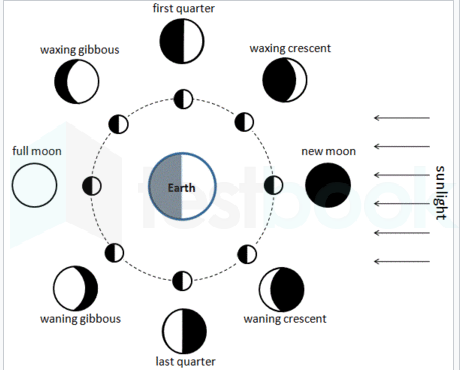
The phases of moon are caused by

  1. ((a))

    The rotation of the earth

  2. ((b))

    The rotation of the moon

  3. ((c))

    The revolution of the earth

  4. ((d))

    The revolution of the moon

Show Answer
Answer: ((d))

The revolution of the moon

The correct answer is 'The revolution of the moon'

Key Points

  • The revolution of the moon:
  • The phases of the moon are a result of the moon's orbit around the Earth. As the moon revolves, the portion of it that is illuminated by the sun changes, creating different phases such as new moon, first quarter, full moon, and last quarter.
  • This cycle of phases takes approximately 29.5 days to complete, which is known as a lunar month or synodic month.
  • The relative positions of the Earth, moon, and sun change as the moon orbits the Earth, which results in varying amounts of the moon's surface being lit up and visible from Earth.

Additional Information

  • The rotation of the earth:
  • This refers to the Earth spinning on its own axis, which is responsible for the day-night cycle but does not directly cause the phases of the moon.
  • The rotation period of the Earth is approximately 24 hours.
  • The rotation of the moon:
  • The moon does rotate on its own axis, and it does so once every 27.3 days, which is roughly the same period it takes to orbit the Earth. This synchronous rotation means the same side of the moon always faces the Earth.
  • However, the moon's rotation on its axis is not what causes the moon phases that we see.
  • The revolution of the earth:
  • The Earth revolves around the sun in an orbit, completing one revolution in approximately 365.25 days, which constitutes a year.
  • This revolution causes the seasonal changes on Earth, but it does not cause the lunar phases.

77

According to which of the Article in the Constitution of India, the President has a power to confer or proclaim a state of emergency in the whole or part of India if he/she feels that a grave situation has arisen, in which the security of India or part of its territory might get threatened by war, external aggression, or rebellion?

  1. ((a))

    Article 352

  2. ((b))

    Article 354

  3. ((c))

    Article 356

  4. ((d))

    Article 360

Show Answer
Answer: ((a))

Article 352

The correct answer is Article 352.

Key Points

  • According to Article 352 ( National emergency) in the Constitution of India, the President has the power to confer or proclaim a state of emergency in the whole or part of India if he/she feels that a grave situation has arisen, in which the security of India or part of its territory might get threatened by war, external aggression, or rebellion.

Additional Information

  • Article 356 (President's Rule) -Under Article 356 of the Constitution of India, if a state government is unable to function according to Constitutional provisions, the Union government can take direct control of the state machinery
  • Article 360 (Financial emergency) - Article 360 of the Indian Constitution empowers the President to invoke a financial emergency.
78

Where are the coal reserves of India largely concentrated?

  1. ((a))

    Son valley

  2. ((b))

    Mahanadi valley

  3. ((c))

    Damodar valley

  4. ((d))

    Godavari valley

Show Answer
Answer: ((c))

Damodar valley

The correct answer is Damodar Valley.

Key Points

  • The coal reserve of India is largely concentrated in Damodar valley.
  • The Damodar valley along with Bihar- Western Bengal border includes India's most important coal- and mica- mining fields and has long been an area of active industrial development.
  • The major coalfields (Jharia, Raniganj, and Giridih) are mostly open-pit and are easily mined.

Additional Information

  • The Son river is the perennial river of Central India originating at the Amarkantak hills of Madhya Pradesh.
  • The Mahanadi is the major river in Eastern Central India.
  • The Hirakund Dam is situated on Mahanadi.
  • The river flows through the State of Chhattisgarh and Odisha and finally merge into the Bay of Bengal.
79

Which of the following rivers have almost the same point of origin?

  1. ((a))

    Tapi and Beas

  2. ((b))

    Brahmaputra and Ganga

  3. ((c))

    Indus and Ganga

  4. ((d))

    Brahmaputra and Indus

Show Answer
Answer: ((d))

Brahmaputra and Indus

The correct answer is Brahmaputra and Indus.

Key Points

  • The Brahmaputra and Indus rivers have almost the same point of origin.
  • The Indus originates in the northern slopes of the Kailash range in Tibet near Lake Manasarovar.
  • The Brahmaputra originates in the Mansarovar lake, also the source of the Indus and the Satluj.

Additional Information

RiverOrigin point
TapiSatpura range (Madhya Pradesh)
BeasRohtang La (Himachal pradesh)
GangaGangotri (Uttrakhand)
GodavariTimbakeshwar (Maharashtra)
KaveriTalakaveri (Karnataka)
80

Lines joining places receiving equal amount of rainfall are called

  1. ((a))

    Isohaines

  2. ((b))

    Isobars

  3. ((c))

    Isotherms

  4. ((d))

    Isohyets

Show Answer
Answer: ((d))

Isohyets

The correct answer is Isohytes.

Key Points

  • Lines joining places receiving equal amount of rainfall are called Isohytes.
  • Isobar is a line on a weather map that joins places that have the same air pressure at a particular time.
  • Isotherm is a line on a weather map that joins places that have the same temperature at a particular time.
  • Isohaline is a line or surface drawn on a map or chart to indicate connecting points of equal salinity in the ocean.
81

Match List I with List II:

List I (Battles)List II (Fought Between)
A.Kalinga War1.Ibrahim Lodhi and Babur
B.First Battle of Panipat2.Rana Pratap and Akbar
C.Battle of Haldighati3.Ashok and State of Kalinga
D.Battle of Khanwa4.Babur and Rana Sangha
  1. ((a))

    A - (3), B - (2), C - (1), D - (4)

  2. ((b))

    A - (3), B - (1), C - (2), D - (4)

  3. ((c))

    A - (3), B - (4), C - (2), D - (1)

  4. ((d))

    A - (3), B - (2), C - (4), D - (1)

Show Answer
Answer: ((b))

A - (3), B - (1), C - (2), D - (4)

The correct answer is A - (3), B - (1), C - (2), D - (4).

Key Points

BattlesFought BetweenYear
Kalinga WarAshok and the state of Kalinga261 BC
First battle of PanipatIbrahim Lodhi and Babur1526 AD
Battle of HaldighatiRana Pratap and Akbar1576 AD
Battle of KhanwaBabur and Rana sangha1527 AD
82

Put the following dynasties in their chronological order:

A. Lodhi

B. Tughlaq

C. Slave

D. Khilji

  1. ((a))

    CBDA

  2. ((b))

    DCBA

  3. ((c))

    CDBA

  4. ((d))

    BCDA

Show Answer
Answer: ((c))

CDBA

The correct answer in CDBA.

  • The chronological order is Slave, Khilji, Tughlaq and Lodhi.

 Key Points

DynastiesFounderImportant events
SlaveQutub-al-din-Aibak- Aibak is known for having commissioned the Qutb Minar in Delhi, and the Adhai Din Ka Jhonpra in Ajmer.
KhiljiJalal-ud-din-Firoz-khilji- Jalal-ud-din khilji was also called as “Clemency Jalal-uddin” as he followed peace and wanted to rule without violence. - Ala-ud-din-Khilji was the most popular ruler of the Khilji dynasty.
TughlaqGhiya-ud-din-Tughlaq or Ghazi Malik- Muhammad-bin-Tughlaq has shifted his capital from Delhi to Devagiri. - Muhammad Tughlaq introduced the copper currency system.
LodhiBahlul Lodhi- Bahlul’s death in 1489 was followed by a power struggle between his two sons. Nizam Khan succeeded him as the ruler of Delhi and assumed the name, Sikandar Lodi.
83

What is forest cover of total land area of our country (approx.)?

  1. ((a))

    35%

  2. ((b))

    22%

  3. ((c))

    40%

  4. ((d))

    18%

Show Answer
Answer: ((b))

22%

The correct answer is 22% (approx).

Key Points

  • The forest cover of total land area of our country is approx 22%.
  • ​According to the 2019 report, the total forest cover of the country is 712,249 square kilometers (21.67 percent of India’s total geographical area)
  • The term forest area generally refers to all the geographic areas recorded as forest in government records.
  • Recorded forest area largely comprises Reserved Forest (RF) and Protected forest (PF), which have been constituted under the provisions of Indian Forest Act, 1927.
  • Besides RFs and PFs, the recorded forest area may include all such areas which have been recorded as forests in the revenue records or have been constituted so under any State Act or local laws.

Additional Information

  • India State of Forest Report 2021
  • The forest cover of total land area of our country is 24.62 which is 25% approx as per the report of 2021.
  • In terms of forest cover as percentage of total geographical area, the top five States are Mizoram (84.53%), Arunachal Pradesh (79.33%), Meghalaya (76.00%), Manipur (74.34%) and Nagaland (73.90%).
  • 17 states/UT's have above 33 percent of the geographical area under forest cover.
  • Area-wise Madhya Pradesh has the largest forest cover in the country followed by Arunachal Pradesh, Chhattisgarh, Odisha and Maharashtra.
  • Total mangrove cover in the country is 4,992 sq km. An increase of 17 sq Km in mangrove cover has been observed as compared to the previous assessment of 2019.
  • The top three states showing mangrove cover increase are Odisha (8 sq km) followed by Maharashtra (4 sq km) and Karnataka (3 sq km).
  • Total carbon stock in the country’s forest is estimated to be 7,204 million tonnes and there an increase of 79.4 million tonnes in the carbon stock of country as compared to the last assessment of 2019.
  • The annual increase in carbon stock is 39.7 million tonnes.
84

The monetary unit of Bangladesh is:

  1. ((a))

    Rupee

  2. ((b))

    Taka

  3. ((c))

    Pound

  4. ((d))

    Dollar

Show Answer
Answer: ((b))

Taka

The correct answer is Taka.

Key Points

  • The Monetary unit of Bangladesh is Taka.
CurrencyCountry
RupeeIndia, Nepal, Srilanka, Seychelles, Pakistan, and Mauritius
poundEngland, Egypt, Lebanon, Sudan, Syria
DollarUnited States,  Trinidad and Tobago, Ecuador, El salavador, Zimabawe.

Additional Information 

CountryCapitalCurrency
JapanTokyoYen
ChinaBeijingRenminbi (Yuan)
RussiaMoscowRuble
QatarDohaRiyal
IraqBaghdadDinar
85

A solar eclipse occurs when:

  1. ((a))

    The Moon comes between the Earth and Sun

  2. ((b))

    The Sun, Moon and Earth are in triangular formation

  3. ((c))

    The Earth shadow falls on the moon

  4. ((d))

    All of these

Show Answer
Answer: ((a))

The Moon comes between the Earth and Sun

The correct answer is when the Moon comes between the Earth and Sun.

Key Points

  • Solar Eclipse 
  • A solar eclipse occurs when the Moon comes between the Earth and Sun.
  • A solar eclipse happens when the Moon passes between the Sun and Earth, casting a shadow on Earth that either fully or partially blocks the Sun’s light in some areas.
  • This only happens occasionally, because the Moon doesn't orbit in the exact same plane as the Sun and Earth do.​​​

Additional Information

  • Lunar Eclipse 
  • A lunar eclipse occurs when the Moon moves into the Earth's shadow.
  • This can occur only when the Sun, Earth, and Moon are exactly or very closely aligned with Earth between the other two, which can happen only on the night of a full moon when the moon is near either lunar node.
86

Which was the first committee to recommend Panchayati Raj system in India?

  1. ((a))

    PV Narsimha Rao committee

  2. ((b))

    Balwant Rai Mehta committee

  3. ((c))

    LM Singhvi committee

  4. ((d))

    Morarji Desai committee

Show Answer
Answer: ((b))

Balwant Rai Mehta committee

The correct answer is Balwant Rai Mehta committee.

Key Points 

  • The first committee to recommend Panchayati Raj system in India is Balwant Rai Mehta committee.
  • Balwant Rai Mehta Committee 
  • It was a committee originally appointed by the Government of India on 16 January 1957 to examine the working of the Community Development Programme (2 October 1952) and the National Extension Service (2 October 1953) and to suggest measures for their better working.
  • The Chairman of this committee was Balwantrai G Mehta.
  • The committee submitted its report on 24 November 1957 and recommended the establishment of the scheme of 'democratic decentralisation' which finally came to be known as Panchayati Raj.

Additional Information 

  • LM Singhvi committee
  • The L M Singhvi committee was formed in 1986 under Rajiv Gandhi's administration to investigate the challenges that Panchayati Raj institutions administrations were facing.
87

Currency of Holland is:

  1. ((a))

    Yen

  2. ((b))

    Dollar

  3. ((c))

    Euro

  4. ((d))

    Deutch Mark

Show Answer
Answer: ((c))

Euro

The correct answer is Euro.

Key Points

  • Currency of Holland is Euro.
  • Important countries, capitals, and their currencies are:
CountryCapitalCurrency
JapanTokyoYen
ChinaBeijingRenminbi (Yuan)
RussiaMoscowRuble
QatarDohaRiyal
IraqBaghdadDinar
88

In which year the slogan 'Quit India' was given by Gandhiji:

  1. ((a))

    1940

  2. ((b))

    1942

  3. ((c))

    1939

  4. ((d))

    1938

Show Answer
Answer: ((b))

1942

The correct answer is 1942.

Key Points

  • Quit India Movement
  • It was launched at the Bombay session of the All India Congress Committee. A resolution was also passed for civil disobedience if the British did not agree to the demands for complete transfer of governance.
  • In 1939, the British Governor-General of India, Lord Linlithgow, involved India into World War II, the British wanted to send Indian soldiers to fight for them.
  • In order to get cooperation from Indian national leaders, the British government sent a mission called the Cripps mission.
  • Talks between Cripps and Indian national leaders failed.
  • Congress rejected Cripps' plan as it did not give immediate total self-rule and Mahatma Gandhi called for Quit India Movement after the failure of Cripps's mission.
  • The movement began from Mumbai's Gawalia Tank Maidan also called the August Kranti Maidan on August 8, 1942 with the speech of Mahatma Gandhi.
89

The speaker of Lok Sabha is removed by the:

  1. ((a))

    President

  2. ((b))

    A resolution passed by the Lok Sabha

  3. ((c))

    Prime Minister

  4. ((d))

    Member of both houses of Parliament

Show Answer
Answer: ((b))

A resolution passed by the Lok Sabha

The correct answer is a resolution passed by the Lok Sabha.

Key Points

  • The speaker of Lok Sabha is removed by the resolution passed by the Lok Sabha.
  • Speaker can be removed by the Lok Sabha by a resolution passed by an effective majority of the house as per the Constitution of India [Articles 94].
  • The Speaker is also removed from being disqualified for being Lok Sabha member under sections 7 and 8 of the Representation of the People Act, 1951.

Additional Information

PortfolioRemoval from the office
President- The president may also be removed before the expiry of the term through impeachment only for violating the Constitution of India by the Parliament of India. - The process may start in either of the two houses of the parliament. - The house initiates the process by leveling the charges against the president.
Prime Minister- The term of a prime minister can end before the end of a Lok Sabha's term, if a simple majority of its members no longer have confidence in him/her, this is called a vote-of-no-confidence. - Three prime ministers, L. K. Gujral, H. D. Deve Gowda and Atal Bihari Vajpayee have been voted out from office this way.
90

'Kadambari' was written by:

  1. ((a))

    Ravindra Nath Tagore

  2. ((b))

    Namdev

  3. ((c))

    Banabhatt

  4. ((d))

    None of these

Show Answer
Answer: ((c))

Banabhatt

The correct answer is Banabhatta.

Key Points

  • Kadambari was written by Banabhatta.
  • Banabhatt
  • He was a Sanskrit prose writer.
  • He was the Asthana Kavi in the court of King Harsh Vardhana.
  • His most known works include Harshacharita(biography of king Harsha) and Kadambari(one of the world's earliest novels).
  • He died before completing the novel, Kadambari.
  • It was completed by his son Bhusanabhatta.
  • Ravindra Nath Tagore
  • Ravindra Nath Tagore was an Indian Bengali polymath who worked as a poet, writer, playwright, composer, philosopher, social reformer and painter.
  • He became the first non-European and the first lyricist to win the Nobel Prize in Literature in 1913.
  • His compositions were chosen by two nations as national anthems: India's "Jana Gana Mana" and Bangladesh's "Amar Shonar Bangla"
  • In 1901 Tagore moved to Santiniketan to found an ashram with a marble-floored prayer hall—The Mandir—an experimental school, groves of trees, gardens, a library.
  • He was awarded a knighthood by King George V in the 1915 Birthday Honours, but Tagore renounced it after the 1919 Jallianwala Bagh massacre.
  • Namdev
  • He was a Marathi Hindu poet from Narsi, Maharashtra.
  • He belonged to the Varkari tradition of Hinduism and was a devotee of Lord Krishna.
91

If a Minister of a state wants to resign, to whom he should address the letter of resignation?

  1. ((a))

    Chief Minister of State

  2. ((b))

    Speaker of Vidhan Sabha

  3. ((c))

    Governor of the State

  4. ((d))

    Leader of his/her political party

Show Answer
Answer: ((a))

Chief Minister of State

The correct answer is Chief Minister of State.

Key Points

  • If a Minister of a state wants to resign, he should address the letter of resignation to Chief Minister of a State.
  • Resignation of the State Minister will be given to the Chief Minister who will consider it and forward it to the governor of the respective state.

Additional Information

PortfolioEligibility Criteria
Chief Minister- Should be a citizen of India. - Should be of at least 25 years of age. - Should be a member of either house of a legislature, If not should become MLA/MLC within 6 months from the date of their appointment.
Speaker of Vidhan Sabha- Elected by the members of the assembly from one of its members.
Governor of State- should be a citizen of India and has completed 35 years of age. - shall not be a member of legislature or parliament. - shall not hold any office of profit.
92

Arjuna Award in India is given for

  1. ((a))

    Bravery on battlefield

  2. ((b))

    Outstanding performance in sports

  3. ((c))

    Exceptional service in emergency

  4. ((d))

    Exceptional service of slum dwellers

Show Answer
Answer: ((b))

Outstanding performance in sports

The correct answer is Outstanding performance in sports.

Key Points

  • Arjuna Award in India is given for outstanding performance in sports.
  • Arjuna Award 
  • It is the second-highest sporting honour of India, the highest being the Major Dhyan Chand Khel Ratna Award.
  • The award is named after Arjuna, one of the characters of the Sanskrit epic Mahabharata of ancient India.
  • Since the year 2001, the award is given only in disciplines falling under the following categories:
  • ​Olympic Games / Asian Games / Commonwealth Games / World Cup / World Championship Disciplines and Cricket Indigenous Games.
  • Sports for the Physically Challenged.
  • Some important Arjuna Awards winners in 2021 are:
  • Arpinder Singh - Athletics
  • Simranjit Kaur - Boxing
  • Shikhar Dhawan - Cricket
  • Bhavani D. C. A. Sundhararaman - Fencing
93

Bihu is folk festival of:

  1. ((a))

    Assam

  2. ((b))

    Jharkhand

  3. ((c))

    Karnataka

  4. ((d))

    Kashmir

Show Answer
Answer: ((a))

Assam

The correct answer is Assam.

Key Points

  • Bihu is a group of three important Assamese festivals in the Indian state of Assam
  • 'Rongali' or 'Bohag Bihu' is celebrated in April, 'Kongali' or 'Kati Bihu' is celebrated in October, and 'Bhogali' or 'Magh Bihu' is celebrated.
  • Assam - Ambubachi, Bhogali Bihu, Baishagu, Dehing Patkai.

Additional Information

​List of Indian Festivals

StateList of Indian Festivals
AssamAmbubachi, Bhogali Bihu, Baishagu, Dehing Patkai
Jammu and KashmirHar Navami, Chhari, Bahu Mela, Dosmoche,
JharkhandKaram Utsav, Holi, Rohini, Tusu
KarnatakaMysore Dasara, Ugadi
KeralaOnam, Vishu
94

Kathakali is a dance prevalent to which state?

  1. ((a))

    Kerala

  2. ((b))

    Karnataka

  3. ((c))

    Tamil nadu

  4. ((d))

    Andhra Pradesh

Show Answer
Answer: ((a))

Kerala

The correct answer is Kerala.

Key Points

Indian Classical Dances:

Classical DanceState
BharatanatyamTamil Nadu
KathakUttar Pradesh
KathakaliKerala
KuchipudiAndhra Pradesh
ManipuriManipur
MohiniyattamKerala
OdissiOdisha
SattriyaAssam
95

Match the states (List I) with their capitals (List II):

States (List I)Capitals (List II)
A.Chattishgarh1.Kohima
B.Telangana2.Agartala
C.Tripura3.Gangtok
D.Nagaland4.Raipur
E.Sikkim5.Hyderabad
  1. ((a))

    A - (4), B - (3), C - (2), D - (1), E - (5)

  2. ((b))

    A - (2), B - (5), C - (1), D - (4), E - (3)

  3. ((c))

    A - (4), B - (5), C - (3), D - (1), E - (2)

  4. ((d))

    A - (4), B - (5), C - (2), D - (1), E - (3)

Show Answer
Answer: ((d))

A - (4), B - (5), C - (2), D - (1), E - (3)

The correct answer is A - (4), B - (5), C - (2), D - (1), E - (3).

Key Points

StatesCapitalsState Animal
ChattishgarhRaipurWild water buffalo
TelanganaHyderabadChital
TripuraAgartalaPhayre's leaf monkey
NagalandKohimaGayal
SikkimGangtokRed panda
96

Number of states and Union Territories in India:

  1. ((a))

    27 States and 9 Union Territories

  2. ((b))

    29 States and 7 Union Territories

  3. ((c))

    28 States and 8 Union Territories

  4. ((d))

    28 States and 9 Union Territories

Show Answer
Answer: ((c))

28 States and 8 Union Territories

The correct answer is 28 States and 8 Union Territories.

  • There are 28 states and 8 union territories in the country.
  • Union Territories are administered by the President through an administrator appointed by President.

Key Points

  • According to the Jammu and Kashmir Reorganization Act, 2019, the appointed day for the two Union Territories of Jammu and Kashmir and Ladakh was 31st October.
  • This is the first time that a state has been bifurcated into two union territories.
  • The total number of states in the country will now be 28, with effect from 26 January 2020 there are 8 union territories in India.
97

The highest civilian award of India is

  1. ((a))

    Arjun Award

  2. ((b))

    Bharat Ratna

  3. ((c))

    Padam Shree

  4. ((d))

    Ashoka Chakra

Show Answer
Answer: ((b))

Bharat Ratna

The correct answer is Bharat Ratna.

Key Points

  • The country's highest civilian award 'Bharat Ratna' was instituted in the year 1954.
  • Any person irrespective of caste, occupation, position or gender is eligible for these awards.
  • It is awarded in recognition of exceptional service/performance of the highest order in any field of human endeavor.

Important Points

  • Literature awards
  • Jnanpith Award is the highest literary honour Award in Literature of India
  • Sahitya Akademi Award
  • Sahitya Akademi Fellowship
  • Saraswati Samman
  • Vyas Samman
  • Bhasha Samman
  • Sports and adventure awards
  • National Sports Awards
  • Major Dhyan Chand Khel Ratna Award
  • Arjuna award
  • Dhyan Chand Award
  • Dronacharya award
98

As per the newspaper reports Government of India has finally agreed to purchase advanced MRMRs for its naval forces. What are these MRMRs?

  1. ((a))

    Rockets

  2. ((b))

    Aircraft

  3. ((c))

    Warships

  4. ((d))

    Radar system

Show Answer
Answer: ((b))

Aircraft

The correct answer is Aircraft.

  • The government has finally approved a naval proposal to acquire nine Advanced Medium Range Maritime Reconnaissance (MRMR) aircraft, which will cost over $1 billion, to ensure the Indian Ocean is protected from both conventional and terrorist threats.

Additional Information

  • A rocket is a spacecraft, aircraft, vehicle, or projectile that obtains thrust from a rocket engine.
  • A warship or combat ship is a naval ship designed and built primarily for naval warfare.
  • A radar system consists of a transmitter that produces electromagnetic waves in the radio or microwave domain, a transmitting antenna, a receiving antenna (often the same antenna is used for transmitting and receiving), and objects.
99

The capital of the Mughal Empire was shifted from Agra to Delhi by ______.

  1. ((a))

    Jahangir

  2. ((b))

    Aurangzeb

  3. ((c))

    Humayun

  4. ((d))

    Shah Jahan

Show Answer
Answer: ((d))

Shah Jahan

The correct answer is Shah Jahan.

  • The capital of the Mughal empire was shifted from Agra to Delhi by Shah Jahan in the year of 1638.

Key Points

  • Shah Jahan was born as Prince Shihab-ud-din Muhammad Khurram, his name meaning "joyful" in the Persian language.
  • His grandfather Akbar named him "Khurram".
  • He was the originator of the monuments Taj Mahal - Agra, Moti Masjid in Lahore - now in Pakistan, Delhi's Jama Masjid, sections of Agra Fort, and Delhi's Wazir Khan Masjid Red Fort.
  • During his reign, the Mughal capital was shifted from Agra to Delhi.

Additional Information

  • Jahangir:
  • Jahangir was the eldest son of Akbar.
  • He died in Kashmir where he had gone to rejuvenate his health.
  • He reigned from 1605 to 1627.  He defeated and imprisoned his son, Khusrau Mirza.
  • Humayun was the eldest son of Babur.
  • Humayun means “fortune” but he remained the most unfortunate ruler of the Mughal Empire.
  • Aurangzeb:
  • He was the third son of Shah Jahan and Mumtaz Mahal.
  • He executed the Sikh leader Guru Tegh Bahadur for his refusal to convert to Islam.
  • Aurangzeb died in Ahmednagar in 1707.
100

The Rajya Sabha (the upper house of the Parliament of India) can be dissolved by

  1. ((a))

    Lok Sabha

  2. ((b))

    Constitutional amendment

  3. ((c))

    President

  4. ((d))

    None of these

Show Answer
Answer: ((d))

None of these

The correct answer is None of these.

Key Points

  • Rajya Sabha is a permanent body and is not subject to dissolution.
  • However, one-third of the members retire every second year and are replaced by newly elected members.
  • Each member is elected for a term of six years.
  • The Vice President of India is the ex-officio Chairman of Rajya Sabha.
  • The House also elects a Deputy Chairman from among its members.
  • Besides, there is also a panel of "Vice Chairmen" in the Rajya Sabha.
  • The senior most minister, who is a member of Rajya Sabha, is appointed by the Prime Minister as Leader of the House.
101

Which energy conversion takes place during photosynthesis?

  1. ((a))

    Chemical energy to light energy

  2. ((b))

    Mechanical energy to light energy

  3. ((c))

    Light energy into Chemical Energy

  4. ((d))

    None of these

Show Answer
Answer: ((c))

Light energy into Chemical Energy

The correct answer is Light energy into Chemical Energy.

  • Photosynthesis is the process in which light energy is converted to chemical energy in the form of sugars.
  • In a process driven by light energy, glucose molecules (or other sugars) are constructed from water and carbon dioxide, and oxygen is released as a byproduct.
  • During photosynthesis in green plants, light energy is captured and used to convert water, carbon dioxide, and minerals into organic compounds containing oxygen and energy.

Key Points

  • Factors Affecting Photosynthesis:
  • Internal: number, shape, age, and orientation of leaves, mesophyll cells and chloroplasts, internal CO2 concentration, and amount of chlorophyll.
  • External: sunlight, temperature, CO2 concentration, and water availability.
  • For example, despite the presence of a green leaf and optimal light and CO2 conditions, the plant cannot photosynthesize when temperatures are too low.
102

Who invented vaccination for small pox?

  1. ((a))

    Jonas Salk

  2. ((b))

    Edward Jenner

  3. ((c))

    Waldemar Mordecai Haffkine

  4. ((d))

    Charles Darwin

Show Answer
Answer: ((b))

Edward Jenner

The correct answer is Edward Jenner.

Key Points

  • The smallpox vaccine is the first vaccine to be developed against a contagious disease.
  • In 1796, British doctor Edward Jenner demonstrated that a relatively mild smallpox virus infection conferred immunity against the deadly smallpox virus.
  • Cowpox served as a natural vaccine until the modern smallpox vaccine emerged in the 20th century.

Additional Information

  • Jonas Salk - Polio vaccine
  • Waldemar Mordecai Haffkine - Anticholera vaccine
  • Charles Darwin - The theory of natural selection
103

On heating which of the following substances, Plaster of Paris can be obtained?

  1. ((a))

    Washing Soda

  2. ((b))

    Baking Soda

  3. ((c))

    Gypsum

  4. ((d))

    Granite

Show Answer
Answer: ((c))

Gypsum

The correct answer is Gypsum.

  • Plaster of Paris is made by heating the mineral gypsum.
  • When gypsum is heated to about 150°C, it loses water and forms a powder of plaster of paris.

Additional Information

  • The chemical name of Plaster of Paris is calcium sulphate hemihydrate and its molecular formula is CaSO4.1/2 H2O.
  • It is a white powdery chemical compound that is obtained by heating gypsum at 393 K.
  • Therefore, it is also referred to as gypsum plaster.
  • The chemical formula of gypsum is CaSO4.2H2O and it is chemically known as calcium sulphate dihydrate because of the presence of two moles of water of crystallization.
104

Night blindness is caused due to deficiency of:

  1. ((a))

    Vitamin A

  2. ((b))

    Vitamin B

  3. ((c))

    Vitamin C

  4. ((d))

    Vitamin D

Show Answer
Answer: ((a))

Vitamin A

The correct answer is Vitamin A.

  • Night blindness is one of the clinical symptoms of vitamin A deficiency.
  • Retinol is the main circulating form of vitamin A in the blood and plasma.
  • Vitamin A is a fat-soluble vitamin that is also a powerful antioxidant.  Night blindness is caused by a deficiency of vitamin A in the blood and tissues.

Additional Information

VitaminsChemical namesDeficiency
ARetinolNight blindness, Xerophthalmia
B1ThiamineBeriberi
B2RiboflavinCracking of skin, reddish eye
B3Niacin, Nicotinic acidPellagra, Glossitis
B5Pantothenic acidGreying of hair
B6PyridoxineDermatitis, anaemia, mental disorder
B7BiotinDermatitis, enteritis, anaemia,
B9Folic acidMegaloblastic anaemia
B12CyanocobalaminPernicious anaemia
CAscorbic acidScurvy
DCalciferolRickets, Osteomalacia
ETocopherolSterility
KPhylloquinoneHaemorrhage
105

Who discovered electrons?

  1. ((a))

    Rutherford

  2. ((b))

    Niel Bohr

  3. ((c))

    J. J. Thomson

  4. ((d))

    None of these

Show Answer
Answer: ((c))

J. J. Thomson

The correct answer is J. J. Thomson.

Key Points

  • JJ Thomson discovered electrons in 1897.
  • In experiments with the Crooks or cathode ray, tube, the electron was discovered.
  • He showed that cathode rays have a negative charge.
  • Thomson found that negatively or positively charged particles were not provided for by the agreed model of the atom.

Additional Information

  • In 1932, J. Chadwick discovered another subatomic particle, which had no charge and had a mass approximately equal to that of a proton. It was eventually named the neutron.
  • John Dalton was responsible for Atomic theory.
  • Proton was discovered by Ernest Rutherford in 1920.
106

Which of the following is not a renewable form of energy?

  1. ((a))

    Wave energy

  2. ((b))

    Thermal power plant

  3. ((c))

    Geothermal energy

  4. ((d))

    Tidal energy

Show Answer
Answer: ((b))

Thermal power plant

The correct answer is Thermal power plant.

  • A thermal power plant is not a renewable form of energy.
  • A thermal power station is a type of power station in which heat energy is converted into electrical energy.
  • In the steam generating cycle, heat is used to boil water in a large pressure vessel to produce high-pressure steam, which drives a steam turbine connected to an electric generator.

Additional Information

  • Some examples of renewable energy sources are:
  • Wind energy
  • Solar energy
  • Geothermal energy
  • Hydropower
  • Wave energy
  • Tidal energy
107

The persistent use of CFCs or Chloro Fluoro Carbons is leading to which of the following threats?

  1. ((a))

    Soil Degradation

  2. ((b))

    Water pollution

  3. ((c))

    Ozone layer depletion

  4. ((d))

    None of these

Show Answer
Answer: ((c))

Ozone layer depletion

The correct answer Ozone layer depletion.

  • Chlorofluorocarbons (CFCs) cause stratospheric ozone depletion and global warming related to the greenhouse effect.

Key Points

  • Ozone layer depletion refers to the thinning of the protective ozone layer in the atmosphere.
  • This happens when certain chemicals come in contact with ozone and destroy it.
  • The chemical compounds that cause ozone layer degradation are called ozone-depleting substances (ODS).

Important Points

  • International Day for the Protection of the Ozone Layer is observed on 16 September to commemorate the signing of the Montreal Protocol, one of the most successful environmental treaties.
108

Echo is caused due to-

  1. ((a))

    Reflection

  2. ((b))

    Refraction

  3. ((c))

    Rarefaction

  4. ((d))

    None of these

Show Answer
Answer: ((a))

Reflection

The correct answer is Reflection.

  • An echo is produced due to the reflection of sound.
  • The sound waves received by reflecting from a high tower or mountain are called echoes.
  • The minimum distance between the observer and the reflector should be 17 m (16.6 m) for the echo to be heard.

Additional Information

  • Diffraction of sound:
  • The wavelength of sound is of the order of 1 meter.
  • If a barrier of that boundary appears in the path of sound, the sound propagates further away from the edge of the obstacle.
  • This phenomenon is called the diffraction of sound.
  • Interference of sound:
  • The change in the redistribution of energy at a point due to the superposition of two (or more) sound waves of the same frequency is called interference of sound.
109

Which of the following tissues is responsible for storing fat?

  1. ((a))

    Cartilage

  2. ((b))

    Adipose Tissue

  3. ((c))

    Areolar Tissue

  4. ((d))

    None of these

Show Answer
Answer: ((b))

Adipose Tissue

The correct answer is Adipose Tissue.

  • The tissue that stores fat in humans is called adipose tissue.
  • It is made up of specialized cells called adipocytes.
  • Its main function is to store energy in the form of fat and also act as a shock absorber (cushion) and insulator.

Additional Information

  • Cartilage is a non-vascular type of supporting connective tissue found throughout the body.
  • Cartilage is a flexible connective tissue that differs from the bone in several ways;
  • Areolar connective tissue is the type of tissue that connects and surrounds the various organs in the human body.
  • The important function of this type of tissue is that it provides nourishment to the cells and also acts as a cushion to protect the organs from various external forces.
110

Which of the following produces antibodies to fight diseases?

  1. ((a))

    Red Blood Cells

  2. ((b))

    White Blood Cells

  3. ((c))

    Blood Platelets

  4. ((d))

    None of these

Show Answer
Answer: ((b))

White Blood Cells

The correct answer is White Blood Cells.

  • White blood cells (leukocytes):
  • Leukocytes are colorless blood cells.
  • They are colorless as it is devoid of haemoglobin.
  • They are further classified as granulocytes and agranulocytes.
  • WBCs mainly contribute to the immune and defense mechanisms.

Additional Information

  • Red blood cells (erythrocytes):
  • RBCs are hermaphrodite cells without a nucleus in humans; Also known as erythrocytes.
  • RBCs contain an iron-rich protein called haemoglobin; Give blood its red colour.
  • RBCs are the most abundant blood cells produced in the bone marrow.
  • Their main function is to transport oxygen to and from various tissues and organs.
  • Platelets:
  • Platelets (Thrombocytes) are specialized blood cells produced from bone marrow.
  • Platelets come into play when there is bleeding or hemorrhage.
  • They help in clotting and coagulation of blood.
111

What is the SI unit of electric current?

  1. ((a))

    Watt

  2. ((b))

    Volt

  3. ((c))

    Ampere

  4. ((d))

    Coulomb

Show Answer
Answer: ((c))

Ampere

The correct answer is Ampere.

EXPLANATION:

  • Electric current is expressed by a unit called the ampere (A), named after the French scientist Andre-Marie Ampere.
  • ​Ampere can be defined as one unit of charge flown through a given circuit in one second.

Additional Information

Physical quantityUnitSymbol
Lengthmeterm
Masskilogramkg
Timeseconds
Electric currentampereA
TemperaturekelvinK
Intensity of lightcandelacd
Quantity of substancemolemol
ChargecoulombC
PowerWattW
112

Which of the following explains the phenomenon of the twinkling of stars?

  1. ((a))

    Reflection

  2. ((b))

    Atmospheric Refraction

  3. ((c))

    Scattering of light

  4. ((d))

    Dispersion

Show Answer
Answer: ((b))

Atmospheric Refraction

The correct answer is Atmospheric Refraction.

  • Twinkling of stars:
  • The phenomenon is atmospheric refraction.
  • The star point source illuminates objects that are far away from us when light passes through the atmosphere, and this causes the amount of light entering the eye to be different each time giving the twinkling effect.

Additional Information

  • Reflection is the change in the direction of a wavefront at an interface between two different media so that the wavefront returns to the medium from which it originated.
  • Scattering of light:
  • When light passes from one medium to another such as air or a glass of water, a part of the light is absorbed by the particles of the medium before its subsequent radiation in a particular direction. ​
  • The phenomenon of splitting visible light into its constituent colors is called dispersion.
113

The application of zinc to iron or steel materials to prevent them from rusting is known as-

  1. ((a))

    Alloying

  2. ((b))

    Bleaching

  3. ((c))

    Lubrication

  4. ((d))

    Galvanisation

Show Answer
Answer: ((d))

Galvanisation

The correct answer is Galvanisation.

  • Galvanizing is the process of applying a zinc coating to a more noble metal (popularly steel or iron) to prevent rusting.
  • Hot-dip galvanization is the most well-known method in which part of the steel is submerged in a bath of molten zinc.

Additional Information

  • Alloying is a dynamic process involving mechanical, heat, and mass transfer, phase changes, and chemical phenomena with complex multiphase interactions between solid, liquid, and gaseous phases.
  • Bleaching is the process of whitening a fabric by removing the natural color, such as the tan of linen.
  • Lubrication is a process that reduces friction and wear between two moving solid surfaces with a film of solid, liquid, or gaseous material without causing any damage to the surfaces.
114

Which of the following is not a greenhouse gas?

  1. ((a))

    Nitrogen

  2. ((b))

    Methane

  3. ((c))

    Water Vapour

  4. ((d))

    Nitrous Oxide

Show Answer
Answer: ((a))

Nitrogen

The correct answer is Nitrogen.

  • Nitrogen is not a greenhouse gas.

Key Points

  • Several major greenhouse gases that result from human activity are included in U.S. and international estimates of greenhouse gas emissions:
  • ​Carbon dioxide (CO2)
  • Methane (CH4)
  • Nitrous oxide (N2O)
  • Industrial gases:
  • Hydrofluorocarbons (HFCs)
  • Perfluorocarbons (PFCs)
  • Sulfur hexafluoride (SF6)
  • Nitrogen trifluoride (NF3)
  • Other greenhouse gases not counted in the U.S. or international greenhouse gas inventories are water vapor and ozone.
115

Which of the following is used in cars to measure distance travelled?

  1. ((a))

    Odometer

  2. ((b))

    Barometer

  3. ((c))

    Distometer

  4. ((d))

    Speedometer

Show Answer
Answer: ((a))

Odometer

The correct answer is Odometer.

  • An odometer is an instrument used for measuring the distance traveled by a vehicle, such as a bicycle or a car.

Additional Information

InstrumentMeasure
LactometerDensity of milk
HydrometerSpecific Gravity of water
ManometerMeasuring the pressure
AuxanometerIncrease of growth in plants
BarometerAtmospheric Pressure
HygrometerHumidity
SpeedometerInstantaneous speed
116

Which of the following is used to measure the purity of a sample of milk?

  1. ((a))

    Hydrometer

  2. ((b))

    Barometer

  3. ((c))

    Lactometer

  4. ((d))

    None of these

Show Answer
Answer: ((c))

Lactometer

The correct answer is Lactometer.

  • Lactometer is used to test the purity of milk.
  • It also measures the density of milk.
  • It works on the principle of the specific gravity of milk.
  • It is a small glass instrument used to measure the water content of milk.​

Additional Information

InstrumentMeasures
LactometerDensity of milk
HydrometerSpecific Gravity of water
ManometerMeasuring the pressure
AuxanometerIncrease of growth in plants
BarometerAtmospheric Pressure
HygrometerHumidity
117

Lack of Iodine causes which of the following diseases?

  1. ((a))

    Hypokalemia

  2. ((b))

    Goitre

  3. ((c))

    Anemia

  4. ((d))

    Night Blindness

Show Answer
Answer: ((b))

Goitre

The correct answer is Goitre.

Key Points

  • Iodine deficiency is the most common cause of goiter.
  • The body needs iodine to produce thyroid hormone.
  • If you don't have enough iodine in your diet, the thyroid becomes enlarged and tries to get as much iodine as it can so it can make the right amount of thyroid hormone.

Additional Information

  • Anemia is a condition in which you lack enough healthy red blood cells to carry enough oxygen to your body's tissues.
  • Night blindness (nyctalopia) is your inability to see well at night or in poor lightings such as in restaurants or movie theaters.
  • Hypokalemia means low blood potassium levels.
  • Hypokalemia is often caused by excessive loss of potassium in your digestive tract due to vomiting, diarrhea or laxative use.
118

Which of the following devices is used to measure the direction and speed of underwater objects?

  1. ((a))

    Silicon Diode

  2. ((b))

    Hydrometer

  3. ((c))

    Speedometer

  4. ((d))

    Sonar

Show Answer
Answer: ((d))

Sonar

The correct answer is Sonar.

Key Points

  • The device which uses ultrasonic waves to measure the distance, direction, and speed of underwater objects is known as sonar.
  • Sonar stands for Sound Navigation and Ranging.
  • Sonar is helpful for ocean exploration and mapping because sound waves travel faster in water than in air.

Additional Information

  • A silicon diode is a semiconductor that has a positive and negative polarity and can allow an electric current to flow in one direction while restricting it in the other direction.
  • A speedometer is a gauge that measures and displays the instantaneous speed of a vehicle.
  • The hydrometer is an instrument used to measure the density or relative density of liquids based on the concept of buoyancy.
119

Where are proteins synthesised in the cell?

  1. ((a))

    Cell wall

  2. ((b))

    Lysosomes

  3. ((c))

    Ribosomes

  4. ((d))

    Chromoplast

Show Answer
Answer: ((c))

Ribosomes

The correct answer is Ribosomes.

  • Ribosomes are the sites in a cell in which protein synthesis takes place.

Key Points

  • Proteins are synthesized by ribosomes which are RNA protein complexes. Ribosomes convert mRNA into protein.
  • In prokaryotic cells, proteins are synthesized in the cytosol as membrane-bound cell organelles are absent and ribosomes are present in the cytosol.
  • In eukaryotic cells, proteins are synthesized in the rough endoplasmic reticulum or RER because ribosomes are present on the membrane of the RER.
  • Proteins are synthesized by ribosomes and enter the cisternae of the endoplasmic reticulum through channels present in the membrane.
120

Water kept in an earthen pot becomes cool during summer, due to the phenomenon of-

  1. ((a))

    Osmosis

  2. ((b))

    Diffusion

  3. ((c))

    Transpiration

  4. ((d))

    Evaporation

Show Answer
Answer: ((d))

Evaporation

The correct answer is Evaporation.

EXPLANATION:

  • During summer, the water kept in an earthen pot cools down due to the phenomenon of evaporation.
  • There are many small pores in the walls of the earthen pot and some water molecules continuously seep through these holes to the outside of the pot.​
  • This water continuously evaporates and takes the latent heat needed for evaporation from the remaining water.

Additional Information

  • Transpiration is a phenomenon that occurs in plants.
  • Osmosis occurs between regions of different concentrations of solvent through a semi-permeable membrane.
  • Diffusion is defined as the movement of individual molecules of a substance through a semipermeable barrier from an area of higher concentration to an area of lower concentration.

Attempt this paper under real exam conditions

Timed interface, section switching, instant scoring, and question-by-question analytics — free.

Start Timed Attempt