Official Paper

SBI PO Prelims Memory Based Paper (Held on: 17th December 2022 Shift 2) (Previous Year Paper)

100 questions · 60 minutes · with answers · free

English Language (30 questions)

Directions: Read the following passage carefully and answer the questions that follow.

The China pet food market was valued at USD 1,225 million in 2021, and it is projected to grow at a CAGR of 4.0% during the forecast period (2022-2027).

The COVID-19 pandemic has had far-reaching implications within the pet food supply chain. However, the pet food industry suppliers increased their use of electronic communications technologies as the COVID-19 pandemic rapidly halted traditional forms of business.​ Although major international pet shows got cancelled early in 2020 due to the travel bans and social distancing as a result of the pandemic, the organizers of the China International Pet Show introduced an online trade show platform where buyers can search for pet products and communicate.

Over the long term, pet humanization, the increasing trend of e-commerce, and the rise in demand for natural pet food are some of the major factors driving the market for pet food in the country. The demographic changes have pushed Chinese pet owners to treat their pets as surrogate children.

Dogs have always been the prefer pets globally and account for a large chunk of the Chinese pet food revenue. China ranks third in terms of dog ownership, with more than 27 million dogs as pets in 2018. Cats and birds were the next category of pets, which accounted for significant revenue shares.

Among the product types, the wet pet food segment is estimated to witness the fastest growth during the forecast period. As dogs and cats are treated as family members, Chinese pet owners are increasingly willing to spend lavishly on them, thus, the demand for wet pet food is likely to witness sharp increase in China in the coming years.​ 

Furthermore, pet owners prefer online shopping due to the convenience it provides in their busy lifestyles. Increasing pet humanization and the rise in demand for natural pet food are some of the drivers boosting the sales of pet food in the country.

1

Choose the word which is most nearly the same in meaning of the word 'projected to'.

  1. ((a))

    decided

  2. ((b))

    quandary

  3. ((c))

    profuse

  4. ((d))

    expected

  5. ((e))

    dither

Show Answer
Answer: ((d))

expected

The correct answer is option 4 i.e. expected.

Key Points

  • Projected to: If something is projected means that thing is expected to happen. 
  • Example:  The oil shortage projected to get worse.
  • Synonyms: Expected, Anticipated, Probable.
  • Antonyms: Unlikely, Unexpected, Unintended.
  • Expected: To anticipate that something will happen.
  • Example: The vacancies are expected to increase.
  • Synonyms: Projected, suppose, predicted.
  • Antonyms: Doubtful, uncertain, unsure.

Additional Information

  • decided: Make a decision or choose something.
  • Example: India decided to launch new scholarship to promote sport culture.
  • Synonyms: Intended, Resolute, Determined.
  • Antonyms: Unsettled, Disputable, Uncertain.
  • quandary: A difficult situation, not able to decide anything.
  • Example: She is in a quandary about whether to purchase the house or not.
  • Synonyms: Dilemma, puzzle, bewilderment.
  • Antonyms: Certain, sure, definite.
  • profuse: In large quantity.
  • Example: Profuse sweating is a side-effect of amitriptyline.
  • Synonyms: Ample, Exuberant, Extensive.
  • Antonyms: Sparse, Inadequate, deficient.
  • dither: unable to decide
  • Example: The committee is dithering over the decision.
  • Synonyms: Hesitate, confuse, uncertain.
  • Antonyms: sure, certain, fixed.
2

Which of the following words can replace the word "drivers" without changing the meaning of the sentence?

  1. ((a))

    motorist 

  2. ((b))

    important features

  3. ((c))

    leading factors

  4. ((d))

    cupidinous

  5. ((e))

    fundamental factors

Show Answer
Answer: ((c))

leading factors

The correct answer is option 3 i.e. leading factors.

Key Points

  • drivers (in the context of the passage): A thing responsible for development or progress of other things.
  • Example: Human resource is a key driver of economic growth.
  • Synonyms: Factors, Elements, Components.
  • leading factors: Influencing elements, responsible things
  • Example: Deforestation and increasing numbers of vehicles are the leading factors for pollution.
  • Synonyms: key drivers, causes, stimulus.

Additional Information

  • motorist: a person who drives a vehicle.
  • Example: Lewis Hamilton is a leading motorist.
  • features: important or noticeable part of something.
  • Example: Smooth texture is an important feature of the cloth.
  • cupidinous: having a great desire or greed.
  • Example: The kind invade the state with cupidinous intension.
  • fundamental factors: basic elements of something.
  • Example: Impurity measurement, boiling point determination and chromatography are the fundamental factors for a drug analysis.
3

Choose the word which is most nearly the opposite in meaning of the word 'implication '

  1. ((a))

    conclusions 

  2. ((b))

    inference 

  3. ((c))

    concoct

  4. ((d))

    conjecture

  5. ((e))

    none of the above

Show Answer
Answer: ((d))

conjecture

The correct answer is option 4 i.e. "Conjecture"

Key Points

  • Implication: effect of something.
  • Example: He was unaware of implications of his decision.
  • Conjecture: inference form without any reliable proof or evidence.
  • Example: He Conjectured that he will pass the exam.
  • Here, "Implication" is can be called as near antonym of "Conjecture" because implication is a real and logical outcome of something whereas "conjecture" may or may not be logical or real.

Additional Information

  • conclusions: closing part of discussion or statement.
  • Example: Even after an exhaustive discussion they were unable to draw any conclusion.
  • inference: opinion based on a known fact.
  • Example: His inference was based on the experiences he has.
  • concoct: to make up an excuse.
  • Example: The student concocted a story for not submitting his homework.
4

According to the context of the passage which of the following is not a factor responsible for growth in the pet food market?

  1. ((a))

    humanization of pets

  2. ((b))

    increase in e-commerce through internet 

  3. ((c))

    rise in demand for natural pet food products

  4. ((d))

    people treats pets as their family members 

  5. ((e))

    all of the above factors are responsible for ​growth in the pet food market.

Show Answer
Answer: ((e))

all of the above factors are responsible for ​growth in the pet food market.

The correct answer is option 5 i.e. "All of the above factors are responsible for ​growth in the pet food market."

Key Points

  • We can answer the question with the help of the following sentences:
  • "the organizers of the China International Pet Show introduced an online trade show platform where buyers can search for pet products and communicate." (option 2)
  • "Over the long term, pet humanization (option 1), the increasing trend of e-commerce (option 2), and the rise in demand for natural pet food (option 3) are some of the major factors driving the market for pet food in the country."
  • "As dogs and cats are treated as family members (option 4), Chinese pet owners are increasingly willing to spend lavishly on them"

​Hence, the correct answer is option 5 i.e. "All of the above factors are responsible for ​growth in the pet food market."

5

which new approach has adopted by the pet food owner during the pandemic?

  1. ((a))

    they started online advertisement to entice new generation 

  2. ((b))

    they invested in research and make the pet food more delicious 

  3. ((c))

    the owner adapted the new trend of the business.

  4. ((d))

    they started door to door camping to promote their product

  5. ((e))

    the Chines bank provided additional loan facility to the businesses involve in the field 

Show Answer
Answer: ((c))

the owner adapted the new trend of the business.

The correct answer is option 3 i.e. "the owner adapted the new trend of the business."

Key Points

  • It is mentioned in the passage that "Although major international pet shows got cancelled early in 2020 due to the travel bans and social distancing as a result of the pandemic, the organizers of the China International Pet Show introduced an online trade show platform where buyers can search for pet products and communicate."
  • The word "introduced" indicates that such online platform was not used earlier.
  • This is the new mode of business.

Hence, the correct answer is "the owner adapted the new trend of the business."

6

Which of the following is the reason for increase in the demand for the pet food market?

  1. ((a))

    the PETA forced every pet owner to feed their pet properly 

  2. ((b))

    having pet is a symbol for high standard in society hence people started to buy pet this ultimately led to increase in pet food demand 

  3. ((c))

    people treat their pet as family members 

  4. ((d))

    rise in e-commerce 

  5. ((e))

    both 3 and 4

Show Answer
Answer: ((e))

both 3 and 4

The correct answer is option 5 i.e."Both 3 and 4"

Key Points

  • It is given in the paragraph that:
  • "As dogs and cats are treated as family members, Chinese pet owners are increasingly willing to spend lavishly on them"
  • "Over the long term, pet humanization, the increasing trend of e-commerce, and the rise in demand for natural pet food are some of the major factors driving the market."
  • The passage doesn't mention anything about PETA  or relationship owing a pet and high standard hence, option 1 and 2 are not correct in the context of the passage.

Hence, the correct answer is "people treat their pet as family members" and "Rise in e-commerce", and the correct option is the 5th

7

The italic line the passage may or may not be grammatically correct. choose the option that has an error.

  1. ((a))

    pets globally and account

  2. ((b))

    for a large chunk of the

  3. ((c))

    Chinese pet food revenue. 

  4. ((d))

    dogs have always been the prefer

  5. ((e))

    No error

Show Answer
Answer: ((d))

dogs have always been the prefer

The correct answer is option 4 i.e. "Dogs have always been the prefer"

Key Points

  • The italic sentence is: "Dogs have always been the prefer pets globally and account for a large chunk of the Chinese pet food revenue."
  • The word "prefer" is incorrect.
  • It should be used as an adjective (modifier of pet")
  • The adjective form is "preferred".

Hence, the correct sentence is "Dogs have always been the preferred pets globally and account for a large chunk of the Chinese pet food revenue."

8

which of the following pet has not mentioned in the passage?

I) Dog

II) Cat

III) Pigs

IV) Birds

V) Dragon

  1. ((a))

    I, II and IV only

  2. ((b))

    I and II only

  3. ((c))

    I, II and III only

  4. ((d))

    III and V only

  5. ((e))

    all the given animals have been mentioned in the passage.

Show Answer
Answer: ((d))

III and V only

The correct answer is option 4 i.e. "III and V only"

Key Points

  • The passage contains:
  1. "China ranks third in terms of dog ownership, with more than 27 million dogs as pets in 2018."
  2. "Cats and birds were the next category of pets, which accounted for significant revenue shares."
  • As I, II and IV are mentioned in the passage it can't be the answer.
  • The passage doesn't mention anything about pigs and dragon.
  • Hence, III and V is the correct answer.
9

Which of the following sentence is/are true in the context of the passage?

  1. ((a))

    incentives provided by the Bank of China played a vital role in increase in pet food industry

  2. ((b))

    people pet the animal for meat and milk

  3. ((c))

    dry pet food Witnessed highest growth

  4. ((d))

    people prefer convenient mode of shopping

  5. ((e))

    none of the above

Show Answer
Answer: ((d))

people prefer convenient mode of shopping

The correct answer is option 4 i.e. "people prefer convenient mode of shopping"

Key Points

  • The passage states, "Furthermore, pet owners prefer online shopping due to the convenience it provides in their busy lifestyles."
  • Hence, option 4 is the correct answer.
  • The passage doesn't mention anything about "incentives by Bank of China" or "meat & milk"
  • Hence, options 1 and 2 are incorrect.
  • It is given that "Among the product types, the wet pet food segment is estimated to witness the fastest growth during the forecast period."
  • Hence, option 3 is incorrect (as it says dry pet food)

Hence, the correct answer is **"**people prefer convenient mode of shopping"

10

Directions: Given below is a word, followed by three sentences that consist of that word. Identify the sentence(s) that express(es) the meaning of the word.
SERIES

A. Dozens of girls in series silk outfits broke into song and dance in the schoolyard.

B. The government was rocked by a series of scandals.

C. The plot of the TV series is quite complex.

  1. ((a))

    Only A

  2. ((b))

    Both A and B

  3. ((c))

    Only B

  4. ((d))

    Both B and C

  5. ((e))

    Only C

Show Answer
Answer: ((d))

Both B and C

The correct answer is 'Both B and C.'

Key Points

  • The word 'Series' as a noun means A number of events, objects, or people of a similar or related kind coming one after another.
  • The word 'Series' as a noun means A set or sequence of related television or radio programs.
  • In sentence A, the word 'Series' is inappropriately used and doesn't fit the context of the sentence.
  • In sentence B, the word 'Series' has been correctly used as a noun as the sentence is talking about the government being shocked or stunned by one after another scandal.
  • In sentence C, the word 'Series' has been correctly used as a noun as the sentence is talking about the complex plot of the sequence of related television programs.

Hence, the only possible answer is option 4.

11

Directions: Given below is a word, followed by three sentences that consist of that word. Identify the sentence(s) that express(es) the meaning of the word.

APPEAL

A. The mayor made an appeal to the people of the city to stay calm.

B. The idea of living in the U.S. doesn’t appeal to me at all.

C. The doctors did not appeal the truth to him.

  1. ((a))

    Only A

  2. ((b))

    Both A and B

  3. ((c))

    Only B

  4. ((d))

    Both B and C

  5. ((e))

    Only C

Show Answer
Answer: ((b))

Both A and B

The correct answer is 'Both A and B.'

Key Points

  • The word 'Appeal' as a verb means To make a serious, urgent, or heartfelt request.
  • The word 'Appeal' as a verb means To be attractive or interesting to somebody.
  • In sentence A, the word 'Appeal' has been correctly used as a verb as the sentence is talking about the mayor making an urgent request to the people of the city to stay calm.
  • In sentence B, the word 'Appeal' has been correctly used as a verb as the sentence is talking about the idea of living in the U.S. to be not attractive or interesting to somebody.
  • In sentence C, the word 'Appeal' is inappropriately used and doesn't fit the context of the sentence.

Hence, the only possible answer is option 2.

12

Given below is a word, followed by three sentences which consist of that word. Identify the sentence(s) which best express(es) the meaning of the word. Choose option 5 ‘None of the above’ if the word is not suitable in any of the sentences.

CAPTURE

A. She longed to capture the image on film.

B. Please capture the parachute when there is an emergency.

C. His paintings capture the essence of France.

  1. ((a))

    Only B

  2. ((b))

    Both A and C

  3. ((c))

    Both B and C

  4. ((d))

    Only A

  5. ((e))

    None of the above

Show Answer
Answer: ((b))

Both A and C

The correct answer is '​Both A and C'.

Key Points

  • The meaning of the word 'Capture' is 'take into one's possession or control by force or record accurately in words or pictures'. It is a verb.
  • Sentence A has correctly used the given word. She recorded the image on film.
  • In sentence B, the word 'capture' is incorrectly used. We must release the parachute so that it ensures a safe landing when there's an emergency.
  • Sentence C has correctly used the given word. It is stated that someone's paintings expressed the essence of France. 

Additional Information

  • Synonyms of 'capture' are: Seize, arrest, apprehend.
  • Antonyms of 'capture' are: Release, Discharge, expel.
13

Which of the phrases given in the options should replace the word/phrase that is underlined in the sentence to make it grammatically correct? If the sentence is correct as it is given and no correction is required, select ‘No correction required’ as the answer.

El Salvador has become the first country to accept Bitcoin as legal tender in a move that gotten the nation and the world debating the opportunities and dangers of cryptocurrency.

  1. ((a))

    that have gotten the nation and the world

  2. ((b))

    that have got the nation and the world

  3. ((c))

    that is getting the nation and the world

  4. ((d))

    that has got the nation and the world

  5. ((e))

    No correction required

Show Answer
Answer: ((d))

that has got the nation and the world

The correct answer is ‘that has got the nation and the world’.

Key Points 

  • In the given sentence, the use of ‘gotten’( past participle of the verb ‘get’) in the phrase ‘that gotten the nation and the world’ is incorrect.
  • The sentence mentions El Salvador as the first country to accept Bitcoin as legal tender. This move has made the nation and the world debate about the pros and cons of cryptocurrency.
  • ‘El Salvador has become’ is indicative of the past perfect tense that is emphasized by the auxiliary verb ‘has’.  The verb form ‘debating’ indicates the implication in the present scenario. Besides, we can infer- ‘that has got the nation and the world’ is the most appropriate answer considering the ‘tense’ of the phrase. Thus, the correct answer is Option 4.
  • Options 1 and 2 are incorrect as they consist of the plural auxiliary verb ‘have’.The verb form ‘getting’ mentioned in option 4 is incorrect as it is in present continuous tense.

The correct sentence will be: El Salvador has become the first country to accept Bitcoin as legal tender in a move that has got the nation and the world debating the opportunities and dangers of cryptocurrency.

14

Which of the phrases given in the options should replace the word/phrase that is underlined in the sentence to make it grammatically correct? If the sentence is correct as it is given and no correction is required, select ‘No correction required’ as the answer.

The revised list of the world's endangered plants and animals was released at the start of the world's leading conservation congress which is taking place in the French city of Marseille.

  1. ((a))

    that is taking place at

  2. ((b))

    which is taking place inside

  3. ((c))

    which is taking place at

  4. ((d))

    that is taking place in

  5. ((e))

    No correction required

Show Answer
Answer: ((d))

that is taking place in

The correct answer is ‘that is taking place in’.

Key Points

  • ​In the given sentence, the use of ‘which’ in the phrase ‘which is taking place’ is incorrect.
  • The sentence mentions the revised list of the world’s endangered plants and animals. It is also said that the list was released at the world’s leading conservation congress. But, the use of the conjunction ‘which’ is incorrect. The clause mentioning the venue/location of the ‘conservation congress’ is an essential clause. It has an identification function i.e. narrows down the identification of the conservation congress by mentioning its location. Here, the reference is to the conservation congress taking place in Marseille. Hence, the correct conjunction to be used is ‘that’.
  • Options 1 and 3 consist of the conjunction ‘which’. Thus, they are incorrect. Though option 1 consists of the conjunction ‘that’, the preposition ‘at’ is incorrect. While ‘at’ is used to indicate a particular place or an exact location, ‘in’ is used to indicate a neighbourhood or a city/ country. As the reference is to Marseille(a French city), ‘in’ is the correct preposition.
  • Thus, the correct answer is Option 4.

The correct sentence will be: The revised list of the world's endangered plants and animals was released at the start of the world's leading conservation congress that is taking place in the French city of Marseille.

Additional Information 

  • An essential clause is a clause that is an important part of a sentence. It can have an identifying function and thus cannot be removed from a sentence without changing its structure/meaning. It is not offset by commas.
  • non-essential clause provides superfluous information that, while interesting, is insignificant to the main point of a sentence. It can be removed from a sentence without altering its structure or meaning. It is usually offset by commas.
15

Directions: Which of the phrases given below the sentence should replace the word/phrase given below in bold in the sentence to make it grammatically correct? If the sentence is correct as it is given and no correction is required, mark 'No correction required as the answer.

The campaign to improve the excess of households to electricity and clean cooking fuel have been shown to be an important factor.

  1. ((a))

    the excess of households to electricity and clean cooking fuel has been shown

  2. ((b))

    the access of households to electricity and clean cooking fuel has been shown

  3. ((c))

    the access of households to electricity and clean cooking fuel have been shown

  4. ((d))

    the access of households to electricity and cleaned cooking fuel has been showed

  5. ((e))

    No improvement

Show Answer
Answer: ((b))

the access of households to electricity and clean cooking fuel has been shown

The correct answer is 'the access of households to electricity and clean cooking fuel has been shown.'

Key Points


  • In the underlined segment, the use of the noun 'excess' with the context of the sentence is incorrect.
  • The noun 'excess' means more of something than is necessary or usual; too much of something.
  • The noun 'access' should be used as that means the right or opportunity to use or benefit from something.
  • Also, in the underlined segment of the sentence, the plural form of the verb 'have' is incorrect.
  • The subject of the sentence is composed of the singular noun 'cooking fuel'.
  • We know that a singular subject always takes a singular verb.
  • Therefore, the singular form of the verb 'has' should be used in place of the plural form of the verb 'have'.

Hence, the correct answer is option 2.

Correct sentence: The campaign to improve the access of households to electricity and clean cooking fuel has been shown to be an important factor.

16

In the following question, out of the four alternatives, select the alternative which will improve the underlined part of the sentence. In case no improvement is needed, select “No improvement”.

The assignment has been immeasurable, it's like everything needs to be done right now, last night I’ve probably drunk eight shots of vodka to stay awake, that why I’ve got a hangover today and lots of body ache.

  1. ((a))

     that I’ve got a hangover

  2. ((b))

     since I’ve got a hangover

  3. ((c))

     because I’ve got a hangover

  4. ((d))

     so I’ve got a hangover

  5. ((e))

    No improvement

Show Answer
Answer: ((d))

 so I’ve got a hangover

The correct option is 4) 

Key Points

  • The sentence I’ve probably drunk eight shots of vodka to stay awake, that why I’ve got a hangover today. is ❌incorrect
  • The use of 'that why' is incorrect as it would be better to use 'so' which established a relationship between action, here that action is 'having eight shots of' and the reaction is 'the hangover'.
  • In this sentence instead of  'that why', we should use 'so'
  • The correction will be-: ' I’ve probably drunk eight shots of vodka to stay awake, so I’ve got a hangover today' (

Correct)

Correct Answer: "The assignment has been immeasurable, it's like everything needs to be done right now, last night I’ve probably drunk eight shots of vodka to stay awake, so I’ve got a hangover today and lots of body ache."

Additional Information

  • If a sentence has no/not/never in it, then the clause used to connect the other part with it is ‘or’ instead of ‘nor.
  • ​Example: Marry did not have bread nor butter. (❌Incorrect)
  • ​Marry did not have bread or butter. (

Correct)

17

Directions: In the following sentence, five words are given in bold, out of which one word is misspelled. Find the misspelled word.

But for this endeavour(A) to be successful, all progresive(B) forces need to collaborate(C) and invest in escalating(D) this ideological(E) war we find ourselves in.

  1. ((a))

    A

  2. ((b))

    B

  3. ((c))

    C

  4. ((d))

    D

  5. ((e))

    None of the above

Show Answer
Answer: ((b))

B

The correct answer is 'B.'

Key Points

  • Let us explore the options:-
  • 'Endeavour' means An attempt to achieve a goal.
  • 'Progresive': There is no such word in English or we can say that there is some spelling mistake in this word.
  • ​The correct spelling is 'Progressive' means Happening or developing steadily.
  • 'Collaborate' means To work jointly on an activity or project.
  • 'Escalating' means To make or become more intense or serious.
  • 'Ideological' means Based on or relating to a system of ideas and ideals, especially concerning economic or political theory and policy.

Hence, the correct answer is option 2.

Correct Sentence: But for this endeavor to be successful, all progressive forces need to collaborate and invest in escalating this ideological war we find ourselves in.

<br>

Additional Information

  • The synonyms of the word 'Progressive' are "Continuous, Growing, Intensifying".
  • Example of 'Progressive' in a sentence:
  • Education is a progressive discovery of our own ignorance.
18

Directions: In the following sentence, five words are given in bold, out of which one word is misspelled. Find the misspelled word.

There can be no justice to India’s most greivous(A) victims over millennia(B) if the misdeeds of the millennia are not acknowledged and a move made to “annihilate(C) the system that fostered egregious(D) social and economic oppression(E).

  1. ((a))

    A

  2. ((b))

    B

  3. ((c))

    C

  4. ((d))

    D

  5. ((e))

    E

Show Answer
Answer: ((a))

A

The correct answer is 'A.'

Key Points

  • Let us explore the options:-
  • 'Greivous': There is no such word in English or we can say that there is some spelling mistake in this word.
  • ​The correct spelling is 'Grievous' means Very severe or serious.
  • 'Millennia' means A period of a thousand years.
  • 'Annihilate' means To destroy utterly; obliterate.
  • 'Egregious' means Outstandingly bad; shocking.
  • 'Oppression' means Prolonged cruel or unjust treatment or exercise of authority.

Hence, the correct answer is option 1.

Correct Sentence: There can be no justice to India’s most grievous victims over millennia if the misdeeds of the millennia are not acknowledged and a move made to “annihilate” the system that fostered egregious social and economic oppression.

<br>

Additional Information

  • The synonyms of the word 'Grievous' are "Serious, Severe, Grave".
  • Example of 'Grievous' in a sentence:
  • Her death was a grievous shock.
19

Directions: In the following sentence, five words are given in bold, out of which one word is misspelt. Find the misspelt word.

WHO has recommended (A) that countries step up surveillance (B), amplify public awareness campaigns (C), governments work towards not stegmatising (D) the disease and health infrastructure be primed towards producing diagnostic (E) kits.

  1. ((a))

    A

  2. ((b))

    B

  3. ((c))

    C

  4. ((d))

    D

  5. ((e))

    E

Show Answer
Answer: ((d))

D

The correct answer is 'D'.

Key Points

  • Let us explore the options:
  • 'recommended' means advised or suggested as good or suitable.
  • 'surveillance' means close observation, especially of a suspected spy or criminal.
  • 'campaigns' means an organized course of action to achieve a goal.
  • 'stegmatising' means described as worthy of disgrace
  • But the word that contextually fits here is 'stigmatising' which means regarded as great disapproval.
  • 'diagnostic' means characteristic of a particular species, genus, or phenomenon.

Hence, the correct answer is option 4.

Correct sentence: WHO has recommended that countries step up surveillance, amplify public awareness campaigns, governments work towards not stigmatising the disease and health infrastructure be primed towards producing diagnostic kits.

Additional Information

  • The synonyms of the word 'stigmatising' are "classify, designate, tag".
  • Example of 'stigmatising' in a sentence**:**
  • Asking for psychological help can be stigmatising, that is why people rarely opt for it.
20

Directions: In the following sentence, five words are given in bold, out of which one word is misspelled. Find the misspelled word.

An overhaul(A) of surveillance(B) laws is neccesary(C) to prevent the indiscriminate(D) monitoring of people and entities(E) by the state and private actors.

  1. ((a))

    A

  2. ((b))

    B

  3. ((c))

    C

  4. ((d))

    D

  5. ((e))

    E

Show Answer
Answer: ((c))

C

The correct answer is 'C.'

Key Points

  • Let us explore the options:-
  • 'Overhaul' means A thorough examination of machinery or a system, with repairs or changes made if necessary.
  • 'Surveillance' means Close observation, especially of a suspected spy or criminal.
  • 'Neccesary': There is no such word in English or we can say that there is some spelling mistake in this word.
  • ​The correct spelling is 'Necessary' means Needed to be done, achieved, or present; essential.
  • 'Indiscriminate' means Done at random or without careful judgment.
  • 'Entities' means Things with distinct and independent existence.

Hence, the correct answer is option 3.

Correct Sentence: An overhaul of surveillance laws is necessary to prevent the indiscriminate monitoring of people and entities by the state and private actors.

<br>

Additional Information

  • The synonyms of the word 'Necessary' are "Obligatory, Requisite, Required".
  • Example of 'Necessary' in a sentence:
  • Light and water are necessary for plants.
21

Directions: In each of the questions below, four sentences are given that may or may not contain an error. Choose the one that is grammatically as well as contextually correct and meaningful. If all the sentences are correct, mark 'All are correct as your answer'.

  1. ((a))

    Some companies have already voluntarily disclosed similar informations.

  2. ((b))

    Trading involves only a handful of traders which make the markets.

  3. ((c))

    An extraordinary general meeting to decide the company's fate will be held in Thursday.

  4. ((d))

    Make sure your belongings are tagged with your name before you check them in.

  5. ((e))

    All are correct.

Show Answer
Answer: ((d))

Make sure your belongings are tagged with your name before you check them in.

The correct answer is 'Make sure your belongings are tagged with your name before you check them in' i.e. this sentence is grammatically and contextually correct.

Key Points

  • Let us explore the grammatical errors in the sentences:
  • In Option 1, the use of the plural form of the noun 'informations' is incorrect.
  • We know that the noun 'information' is an uncountable noun and the uncountable nouns are used in the singular structure.
  • Therefore, the singular form of the noun 'information' should be used in place of the plural form of the noun 'informations'.
  • Correct Sentence: Some companies have already voluntarily disclosed similar information.
  • In Option 2, the use of the pronoun 'which' is incorrect.
  • The pronoun 'which' is used to refer to something previously mentioned when introducing a clause giving further information.
  • The pronoun 'who' is used to introduce a clause giving further information about a person or people previously mentioned.
  • Therefore, the pronoun 'who' should be used in place of the pronoun 'which'.
  • Correct Sentence: Trading involves only a handful of traders who make the markets.
  • In Option 3, the use of the preposition 'in' is incorrect.
  • The preposition 'in' is used for expressing a period of time during which an event happens or a situation remains the case.
  • The preposition 'on' is used for indicating the day or part of a day during which an event takes place.
  • Therefore, the preposition 'on' should have been placed before that day of the week, instead of 'in' as used in the given sentence.
  • Correct Sentence: An extraordinary general meeting to decide the company's fate will be held on Thursday.

Hence, the correct answer is option 4.

22

Directions: In each of the questions below, four sentences are given that may or may not contain an error. Choose the one that is grammatically as well as contextually correct and meaningful. If all the sentences are correct, mark 'All are correct as your answer'.

  1. ((a))

    Roosevelt towards the end of his life seemed contents to make haste slowly.

  2. ((b))

    The emperor had already received soft cloth made of camel hairs, brocades, sable furs, jade girdles, fifty camels and one thousand ponies as her bride price.

  3. ((c))

    She went to great pain to see that all her guests were provided with whatever they needed.

  4. ((d))

    In the case of the guinea pig, the number of offspring varies between two and five.

  5. ((e))

    All are correct.

Show Answer
Answer: ((d))

In the case of the guinea pig, the number of offspring varies between two and five.

The correct answer is 'In the case of the guinea pig, the number of offspring varies between two and five' i.e. this sentence is grammatically and contextually correct.

Key Points

  • Let us explore the grammatical errors in the sentences:
  • In Option 1, the use of the plural form of the noun 'contents' is incorrect.
  • The meaning of a few nouns in the plural form is different from their meaning in the singular form and 'Content' is such a word.
  • In the given sentence, 'content' means ''a state of satisfaction'', however, 'contents' mean ''the things that are held or included in something''.
  • Therefore, the singular form of the noun 'content' should be used in place of the plural form of the noun 'contents'.
  • Correct Sentence: Roosevelt towards the end of his life seemed content to make haste slowly.
  • In Option 2, the use of the plural form of the noun 'hairs' is incorrect.
  • Some nouns are generally uncountable nouns and ‘Hair’ is one of them so it is generally considered singular.
  • Therefore, the singular form of the noun 'hair' should be used in place of the plural form of the noun 'hairs'.
  • Correct Sentence: The emperor had already received soft cloth made of camel hair, brocades, sable furs, jade girdles, fifty camels, and one thousand ponies as her bride price.
  • In Option 3, the use of the singular form of the noun 'pain' is incorrect.
  • The meaning of a few nouns in the plural form is different from their meaning in the singular form and 'Pain' is such a word.
  • 'Pains' means ''great care'' while 'pain' means ''highly unpleasant physical sensation caused by illness or injury''.
  • Therefore, the plural form of the noun 'pains' should be used in place of the singular form of the noun 'pain'.
  • Correct Sentence: She went to great pains to see that all her guests were provided with whatever they needed.

Hence, the correct answer is option 4.

23

Directions: In each of the questions below, four sentences are given that may or may not contain an error. Choose the one that is grammatically as well as contextually correct and meaningful. If all the sentences are correct, mark 'All are correct as your answer'.

  1. ((a))

    If you follows my anti-inflammatory diet, you will get the vitamins, minerals, essential fatty acids, and dietary fiber you need for optimal health.

  2. ((b))

    If you couldn't attend either of the concert and are currently gnashing your teeth at having missed out, don't despair.

  3. ((c))

    ​He, along with his three brothers is very lively and is always running about and making plenty of noise outside my house.

  4. ((d))

    The percentage of employees who called in sick and the number of employees who left their jobs within 5 years is reflective of the level of job satisfaction.

  5. ((e))

    All are correct

Show Answer
Answer: ((c))

​He, along with his three brothers is very lively and is always running about and making plenty of noise outside my house.

The correct answer is 'He, along with his three brothers is very lively and is always running about and making plenty of noise outside my house' i.e. this sentence is grammatically and contextually correct.

Key Points

  • Let us explore the grammatical errors in the sentences:
  • In Option 1, the use of the singular form of the verb 'follows' is incorrect.
  • We know that the pronoun ''You'' always takes the plural verb form, even when it refers to a single person.
  • Therefore, the plural form of the verb 'follow' should be used in place of the singular form of the verb 'follows'.
  • Correct Sentence: If you follow my anti-inflammatory diet, you will get the vitamins, minerals, essential fatty acids, and dietary fiber you need for optimal health.
  • In Option 2, the use of the singular form of the noun 'concert' is incorrect.
  • We know that ''Either'' must be followed by 'of' if we use it before ''the, these, those, or possessives (my, your)'' with a plural noun.
  • Therefore, the plural form of the noun 'concerts' should be used in place of the singular form of the noun 'concert'.
  • Correct Sentence: If you couldn't attend either of the concerts and are currently gnashing your teeth at having missed out, don't despair.
  • In Option 4, the use of the singular form of the verb 'is' is incorrect.
  • We know that when the subject of the sentence is composed of two or more nouns or pronouns connected by and, use a plural verb.
  • Therefore, the plural form of the verb 'are' should be used in place of the singular form of the verb 'is'.
  • Correct Sentence: The percentage of employees who called in sick and the number of employees who left their jobs within 5 years are reflective of the level of job satisfaction.

Hence, the correct answer is option 3.

24

Directions: In the following sentence, 4 words are given in bold. Two or more of these words are incorrectly placed and need to be interchanged. If there is no need for interchanging then ‘No Error’ can be selected.  

The people of Hong Kong have expressed their apprehension (A) over the foisted (B) laws draconian (C) on them by the autocratic (D) country of China.

  1. ((a))

    DCBA

  2. ((b))

    CBAD

  3. ((c))

    BADC

  4. ((d))

    ACBD

  5. ((e))

    No Error

Show Answer
Answer: ((d))

ACBD

The correct answer is ACBD

Key Points

From the context, we can make out that the sentence is talking about people from Hong Kong feeling a certain way about their relationship with China. 

  • Let's look at the meaning of all the words:
WordMeaning
Apprehensionanxiety or fear that something bad or unpleasant will happen
Draconian(of laws or their application) excessively harsh and severe
Foistedimpose an unwelcome or unnecessary thing on a person
Autocratictaking no account of other people's wishes or opinions


  • Now let's assume that the emboldened words in the passage are replaced by blanks:
  • The people of Hong Kong have expressed their _________over the _________laws ________on them by the ________country of China.
  • The second blank requires an adjective that can be used to describe the 'laws' that involve Hong Kong and China. 
  • 'Foisted' is a verb and is thus not a quality that can represent the characteristics of something.
  • The third blank requires a verb that can represent the action taken by the laws 'on' Hong Kong by China. 
  • 'Draconian' is an adjective and thus cannot act on the country of Hong Kong.
  • Thus, the terms 'draconian' and 'foisted' need to be interchanged in order to make the sentence grammatically and contextually correct.

Hence, the correct sentence will be: The people of Hong Kong have expressed their apprehension over the draconian laws foisted on them by the autocratic country of China.

25

In the following question, a sentence is given with four words marked as (A), (B), (C) and (D). These words may or may not be placed in a correct order. Four options with different arrangements of these words have been provided. Mark the option with the correct arrangement as the answer. If no rearrangement is required, mark option (5) as your answer.

The car accident(A) was horrific, it crushed(B) his dreams and his legs leaving him depressed(C) and in agony(D).

  1. ((a))

    A-B

  2. ((b))

    C-A

  3. ((c))

    B-D

  4. ((d))

    D-C

  5. ((e))

    No change required. 

Show Answer
Answer: ((e))

No change required. 

The correct answer is No change required

Key Points

Reading the sentence we find that all the words are correctly placed. 

  • accident: an unfortunate incident that happens unexpectedly and unintentionally, typically resulting in damage or injury
  • crushed: compressed or squeezed forcefully so as to break, damage, or distort in shape
  • depressed: (of a person) in a state of unhappiness or despondency
  • agony: extreme physical or mental suffering

 Thus we can see that all the words have already been placed in the correct positions and the given sentence needs no  rearrangement.

The following sentences form a paragraph. The sentences are numbered as P, Q, R, S and T. These five parts are not given in proper order. Read the sentences and choose the alternative that arranges them in the correct order.

P. The fact was that 11 out of the 12 warmest years in Europe have occurred in the past two decades and it was confirmed by the findings.

Q. In spite of the heatwave**,** Greenland was slightly colder across the year than in some other recent years

R. Previous records were broken by only a small margin, but the findings confirmed a fact. 

S. The report also found a heatwave in Greenland last year had brought record levels of surface melting.

T.  Europe had its hottest year on record last year, new data has confirmed, with periods of exceptional heat last February, June and July.

26

Which of the following is the FOURTH sentence of the paragraph?

  1. ((a))

    P

  2. ((b))

    S

  3. ((c))

    Q

  4. ((d))

    R

  5. ((e))

    None of the above

Show Answer
Answer: ((b))

S

The correct answer is option 2), i.e. S.

  • The given passage is about temperature in Europe.
  • We should go through the given sentences in the following way:
  • The passage should begin with T. It mentions when Europe recorder its hottest year. So, it is introducing the topic.
  • The next sentence is R. It talks about the previous records.
  • The third sentence is P. It is the continuation of R.It keeps talking about the records and what is revealed from the findings.
  • The fourth sentence is S. Here, the impact of the increased temperature is mentioned.
  • The last sentence is Q. It is the continuation of S and mentions a situation which is contrasting with the one which is stated in the previous sentence.

Therefore, the correct chronological order of the passage isTRPSQ

27

Which of the following is the FIFTH sentence of the paragraph?

  1. ((a))

    P

  2. ((b))

    S

  3. ((c))

    Q

  4. ((d))

    T

  5. ((e))

    None of the above

Show Answer
Answer: ((c))

Q

The correct answer is option 3), i.e. Q.

  • The given passage is about temperature in Europe.
  • We should go through the given sentences in the following way:
  • The passage should begin with T. It mentions when Europe recorder its hottest year. So, it is introducing the topic.
  • The next sentence is R. It talks about the previous records.
  • The third sentence is P. It is the continuation of R.It keeps talking about the records and what is revealed from the findings.
  • The fourth sentence is S. Here, the impact of the increased temperature is mentioned.
  • The last sentence is Q. It is the continuation of S and mentions a situation which is contrasting with the one which is stated in the previous sentence.


Therefore, the correct chronological order of the passage is: TRPSQ

28

Which of the following is the FIRST sentence of the paragraph?

  1. ((a))

    R

  2. ((b))

    Q

  3. ((c))

    T

  4. ((d))

    S

  5. ((e))

    None of the above

Show Answer
Answer: ((c))

T

The correct answer is option 3), i.e. T.

  • The given passage is about temperature in Europe.
  • We should go through the given sentences in the following way:
  • The passage should begin with T. It mentions when Europe recorder its hottest year. So, it is introducing the topic.
  • The next sentence is R. It talks about the previous records.
  • The third sentence is P. It is the continuation of R.It keeps talking about the records and what is revealed from the findings.
  • The fourth sentence is S. Here, the impact of the increased temperature is mentioned.
  • The last sentence is Q. It is the continuation of S and mentions a situation which is contrasting with the one which is stated in the previous sentence.


Therefore, the correct chronological order of the passage is: TRPSQ

29

Which of the following is the THIRD sentence of the paragraph?

  1. ((a))

    R

  2. ((b))

    P

  3. ((c))

    S

  4. ((d))

    T

  5. ((e))

    None of the above

Show Answer
Answer: ((b))

P

The correct answer is option 2), i.e. P.

  • The given passage is about temperature in Europe.
  • We should go through the given sentences in the following way:
  • The passage should begin with T. It mentions when Europe recorder its hottest year. So, it is introducing the topic.
  • The next sentence is R. It talks about the previous records.
  • The third sentence is P. It is the continuation of R.It keeps talking about the records and what is revealed from the findings.
  • The fourth sentence is S. Here, the impact of the increased temperature is mentioned.
  • The last sentence is Q. It is the continuation of S and mentions a situation which is contrasting with the one which is stated in the previous sentence.


Therefore, the correct chronological order of the passage is: TRPSQ

30

Which of the following is the SECOND sentence of the paragraph?

  1. ((a))

    P

  2. ((b))

    Q

  3. ((c))

    R

  4. ((d))

    S

  5. ((e))

    None of the above

Show Answer
Answer: ((c))

R

The correct answer is option 3), i.e. R.

  • The given passage is about temperature in Europe.
  • We should go through the given sentences in the following way:
  • The passage should begin with T. It mentions when Europe recorder its hottest year. So, it is introducing the topic.
  • The next sentence is R. It talks about the previous records.
  • The third sentence is P. It is the continuation of R.It keeps talking about the records and what is revealed from the findings.
  • The fourth sentence is S. Here, the impact of the increased temperature is mentioned.
  • The last sentence is Q. It is the continuation of S and mentions a situation which is contrasting with the one which is stated in the previous sentence.


Therefore, the correct chronological order of the passage is: TRPSQ

Quantitative Aptitude (35 questions)

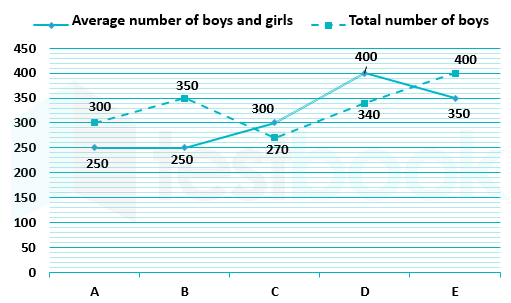
Direction : Line graph below show total no of students ( boys + girls ) who enrolled in five different institutes  and number of boys who enrolled in these institutes respectively. Study the data carefully and answer the following questions.

31

 Find the average number of total student ( boy + girl ) enrolled in All five institutes ?

  1. ((a))

     550

  2. ((b))

     450

  3. ((c))

     620

  4. ((d))

     440

  5. ((e))

     580

Show Answer
Answer: ((c))

 620

Given line graph data are extract in tabular form.

Name of instituteTotal ( boys + girl )BoysGirls
A500300200
B500350150
C600270330
D800340460
E700400300
Total310016601440


 Total number of students in all five institutes : 3100

 Then average of all student in all five institutes : 3100 / 5

 ⇒ 3100 / 5

 ⇒ 620

 Hence 620 is the correct answer.

32

Total number of boys who enrolled in A, B and C institutes is how much less than the total number of students ( boy + girl ) who enrolled in C and D institutes ?

  1. ((a))

     620

  2. ((b))

     480

  3. ((c))

     500

  4. ((d))

     560

  5. ((e))

     630

Show Answer
Answer: ((b))

 480

Given |:

Name of instituteTotal ( boys + girl )BoysGirls
A500300200
B500350150
C600270330
D800340460
E700400300
Total310016601440


Total number of boy who enrolled in A,B and C institutes are 

  ⇒ 300+350+270 = 920

Total number of Students ( boy + girl ) who enrolled in C and D institutes are 

 ⇒ 600+800 = 1400

Then Required difference is 

 ⇒ 1400 - 920 = 480

 Hence 480 is the correct answer.

33

Find the ratio between total number of students ( boy + girl )  who enrolled in A, C and E together to the total number of girls who enrolled in A,B and E institutes.

  1. ((a))

     13 : 25 

  2. ((b))

     16 : 25

  3. ((c))

     23 : 25

  4. ((d))

     36 : 13

  5. ((e))

     17 : 23

Show Answer
Answer: ((d))

 36 : 13

Given |:

Name of instituteTotal ( boys + girl )BoysGirls
A500300200
B500350150
C600270330
D800340460
E700400300
Total310016601440


 Total number of student ( boy + girl ) enrolled in A,C and E institutes together   are

 ⇒ 500+600+700 = 1800

 Total number of girl enrolled in A,B and E institutes together are

 ⇒ 200+150+300 = 650

 Then required ratio are 1800 : 650

  ⇒ 36 :13

 Hence 36:13 is the correct answer.

34

Out of Total boys and girl who enrolled in institutes A, 50% and 40% respectively were get scholarship. Find total number of ( boy + girl ) who were not get scholarship is what percent of total number of students ( boy + girl ) who enrolled in institute A ? 

  1. ((a))

     59%

  2. ((b))

     52%

  3. ((c))

     47%

  4. ((d))

     62%

  5. ((e))

     54%

Show Answer
Answer: ((e))

 54%

Given |:

Name of instituteTotal ( boys + girl )BoysGirls
A500300200
B500350150
C600270330
D800340460
E700400300
Total310016601440


 Total number of boy who enrolled in institute A are 300

 50% of boys get scholarship 

 ⇒ 300× 50/100

 ⇒ 150

 Number of boy who are not get scholarship 

 ⇒ 300 - 150 = 150

 Total number of girl who enrolled in Institute A are 200

 40% of girls get scholarship 

 ⇒ 200× 40/100

 ⇒ 80

 Number of girls who are not get scholarship 

 ⇒ 200 - 80

 ⇒ 120

 Number of boys and girls in institute A who did not get scholarship 

  ⇒ 150+120 = 270

 Then, required percentage 

 ⇒ (270 /500) × 100

 ⇒  54% 

 Hence 54% is the correct answer.

35

In Institute F number of boys enrolled in this institute 10% more than boys enrolled in institute D where number of girls enrolled in institute F is 50% more than number of girls enrolled in institute E , Then find the total number of student ( boy + girl ) enrolled in institute F ?

  1. ((a))

     824

  2. ((b))

     720

  3. ((c))

     653

  4. ((d))

     526

  5. ((e))

     789

Show Answer
Answer: ((a))

 824

Given |:

Name of instituteTotal ( boys + girl )BoysGirls
A500300200
B500350150
C600270330
D800340460
E700400300
Total310016601440


 Number of Boys enrolled in instituted D is 340

 Number of boys enrolled in institute F is 10% more than number of boys who   enrolled in institute D

Then number of boys enrolled in institute F are 

 ⇒ (340 / 100 ) × 110

 ⇒ 374

 Number of Girls enrolled in institute F is 50% more than the number of girls   enrolled in institute E 

 Then number of girls enrolled in institute F are 

 ⇒ (300 / 100) × 150

 ⇒ 450

 Then total number of students ( boy+ girl ) in institute F are 

 ⇒ 450+374

 ⇒ 824

 Hence 824 is the correct answer.

36

Find the missing term in the following series ?

 25,31,34,37,43, ?

  1. ((a))

     67

  2. ((b))

     52

  3. ((c))

     57

  4. ((d))

     73

  5. ((e))

     83

Show Answer
Answer: ((a))

 67

Series follow the following pattern 

 25,31,34,37,43,?

 ⇒ 25 , 31 , 34, 37, 43, ?

        6      3      3    6           ( difference between them )

  ⇒ 6 × 0.5 = 3

  ⇒ 3  × 1 = 3

   ⇒ 3 × 2 = 6

   ⇒ 6 × 4 = 24

Then next term is 43+24 = 67

 Hence 67 is the correct answer.

37

Find the missing term in the following series ?

 1000, ?, 500, 1000, 250, 2000

  1. ((a))

     500

  2. ((b))

     400

  3. ((c))

     600

  4. ((d))

     525

  5. ((e))

     625

Show Answer
Answer: ((a))

 500

Series follow the following pattern

 1000, ? , 500, 1000, 250, 2000

 ⇒ 1000 × 0.5 = 500

 ⇒ 500 ÷ 1 = 500

 ⇒ 500 × 2 = 1000

 ⇒ 1000 ÷ 4 = 250

 ⇒ 250 × 8 = 2000

 Then next term is 

 ⇒ 1000 × 0.5 = 500

 Hence 500 is the correct answer.

38

Find the missing term in the following series ?

 9, 10, 22, 69, 280, ?

  1. ((a))

     1408

  2. ((b))

     1525

  3. ((c))

     1323

  4. ((d))

     1234

  5. ((e))

     1405

Show Answer
Answer: ((e))

 1405

Series follow the following pattern

 9, 10, 22, 69, 280, ?

 ⇒ 9×1+1 = 10

 ⇒ 10×2+ 2 = 22

 ⇒ 22×3+3 = 69

 ⇒ 69×4+4 = 280

 Then next term is 

 ⇒ 280× 5 +5 = 1405

 Hence 1405 is the correct answer.

39

Find the missing term in the following series ?

 2, ?, 197, 287, 368, 437

  1. ((a))

     99

  2. ((b))

     89

  3. ((c))

     101

  4. ((d))

     111

  5. ((e))

     103

Show Answer
Answer: ((c))

 101

Series follow the following pattern

 2, ? , 197, 287, 368, 437

 ⇒ 2, ? , 197, 287, 368, 437

                  90     81     69

                       9        12

 It means there is double difference gap of 3

 Then previous difference is 6

 ⇒ 90+6 = 96

 ⇒ 197 -96 = 101

 next term is 101

 Hence 101 is the correct answer.

40

Find the missing term in the following series ?

 80, 87, 61, 124, 0, ?

  1. ((a))

     217

  2. ((b))

     317

  3. ((c))

     215

  4. ((d))

     179

  5. ((e))

     321

Show Answer
Answer: ((c))

 215

Series follow the following pattern 

 80, 87, 61, 124, 0, ?

 ⇒ 80, 87, 61, 124, 0 , ?

        +7   -26  +63 -124

 ⇒ 23 -1 = 7

 ⇒ 3- 1 = 26

 ⇒ 43 - 1 = 63

 ⇒ 53 - 1 = 124

 ⇒ 6- 1 = 215

 Then next term is 0 +215 = 215

 Hence 215 is the correct answer.

41

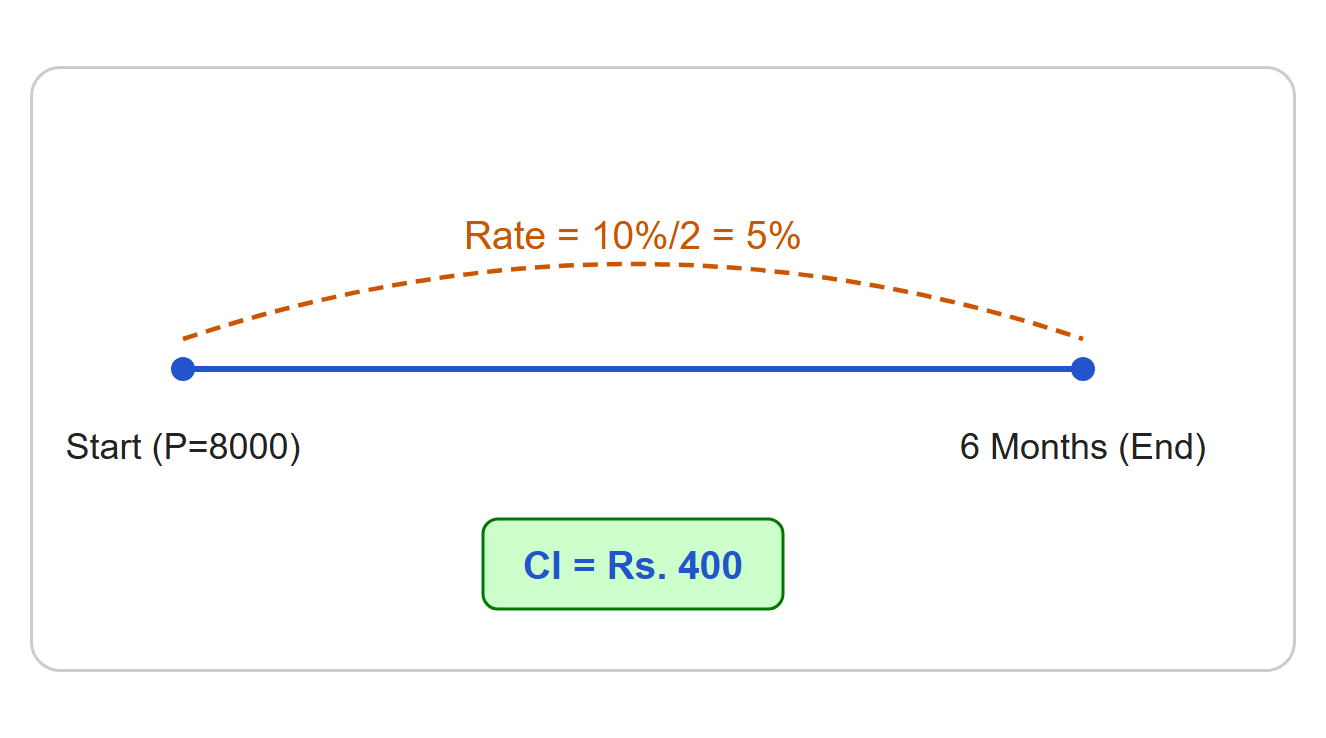
Principal amount is Rs. 8000 which is invested at rate of interest 10% per annum compounded half-yearly. What will be the compound interest at end of 6 months?

  1. ((a))

    Rs. 100

  2. ((b))

    Rs. 200

  3. ((c))

    Rs. 300

  4. ((d))

    Rs. 400

  5. ((e))

    Rs. 500

Show Answer
Answer: ((d))

Rs. 400

Shortcut Trick

For half-yearly compounding, the half-yearly rate = 10% ÷ 2 = 5%.

The time period is 6 months, which is exactly one half-year cycle.

Compound Interest for 1 cycle = Principal × Rate = 8000 × 5% = 400.

∴ The correct answer is Rs. 400.

Alternate Method

Given:

Principal (P) = Rs. 8000

Annual Rate (R) = 10% per annum

Time (T) = 6 months = 1/2 year

Compounding = Half-yearly

Formula:

When interest is compounded half-yearly, New Rate (r) = R/2 and New Time (n) = 2 × T.

Calculations:

⇒ Adjusted Rate (r) = 10% ÷ 2 = 5%

⇒ Number of conversion periods (n) = 2 × (1/2) = 1 period

⇒ Amount (A) = P(1 + r/100)n

⇒ A = 8000(1 + 5/100)1

⇒ A = 8000 × (1.05) = 8400

⇒ Compound Interest (CI) = Amount − Principal

⇒ CI = 8400 − 8000 = 400

∴ The correct answer is Rs. 400.

Additional Information

Half-Yearly Compounding Rule

Divide the annual interest rate by 2 and multiply the number of years by 2 to get the total number of conversion periods.

Quarterly Compounding Rule

Divide the annual rate by 4 and multiply the number of years by 4. Formula: A = P(1 + R/400)4T.

CI vs SI for One Period

For the very first compounding period, the Simple Interest and Compound Interest are always equal.

42

Pipe A can fill a tank in 16 minutes and pipe B empties it in 24 minutes. If both the pipes are opened together, after how many minutes should B be closed, so that the tank is filled in 30 minutes?

  1. ((a))

    21 minutes

  2. ((b))

    20 minutes

  3. ((c))

    18 minutes

  4. ((d))

    15 minutes

  5. ((e))

    19 minutes

Show Answer
Answer: ((a))

21 minutes

Shortcut Trick

Let the Total Capacity be 48 units (LCM of 16 and 24).

Efficiency of Pipe A = +3 and Pipe B = −2.

Pipe A works for the full 30 minutes: 30 × 3 = 90 units.

Extra work to be removed by Pipe B = 90 − 48 = 42 units.

Time for Pipe B = 42 ÷ 2 = 21 minutes.

∴ The correct answer is 21 min.

Alternate Method

PipeTime (min)Total Work (LCM)Efficiency
Pipe A (Fill)1648+3
Pipe B (Empty)24−2

Given: The tank must be filled in exactly 30 minutes.

Calculation:

⇒ Let Pipe B be closed after x minutes.

Pipe A works for 30 minutes and Pipe B works for x minutes.

⇒ (Efficiency of A × 30) + (Efficiency of B × x) = Total Work

⇒ (3 × 30) + (−2 × x) = 48

⇒ 90 − 2x = 48

⇒ 2x = 90 − 48

⇒ 2x = 42

⇒ x = 21 minutes

∴ The correct answer is 21 min.

Additional Information

Inlet and Outlet Pipes

An inlet pipe fills the tank (positive efficiency), while an outlet pipe empties it (negative efficiency).

Net Efficiency

When multiple pipes operate, the net work done per unit time is the algebraic sum of their individual efficiencies.

Time and Work Relation

Total Work = Efficiency × Time. In tank problems, Total Capacity is usually the LCM of individual times.

43

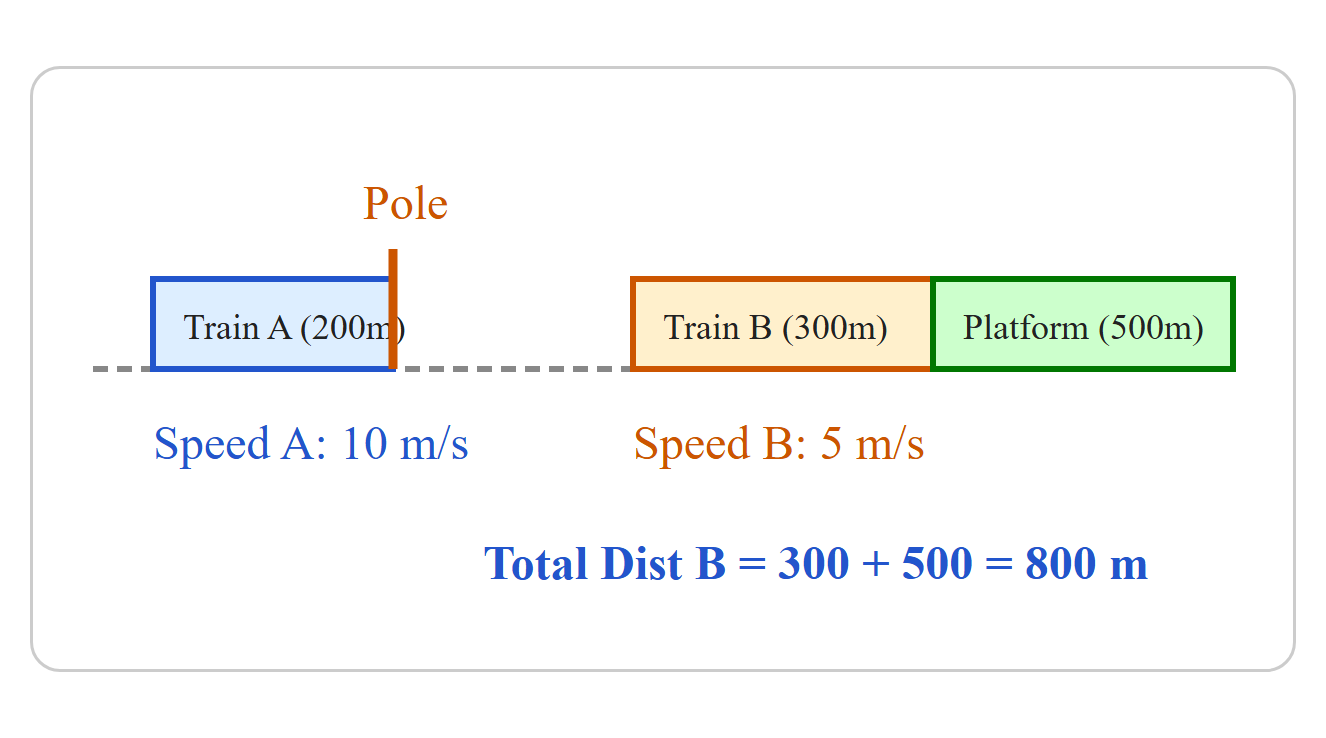
Train A running with the speed of 36 km/hr crosses a pole in 20 seconds. Another train B whose length is 100 metre more than length of train A is running with the speed of 18 km/hr. Find the time taken by train B to cross a platform of length 500 metre.

  1. ((a))

    200 seconds

  2. ((b))

    150 seconds

  3. ((c))

    160 seconds

  4. ((d))

    140 seconds

  5. ((e))

    None of these

Show Answer
Answer: ((c))

160 seconds

Shortcut Trick

Speed of Train A = 36 × (5/18) = 10 m/s. Length A = 10 × 20 = 200 m.

Length B = 200 + 100 = 300 m. Platform = 500 m.

Total Distance for B = 300 + 500 = 800 m. Speed B = 18 × (5/18) = 5 m/s.

Time taken by B = 800 ÷ 5 = 160 sec.

∴ The correct answer is 160 sec.

Alternate Method

Given: Speed of Train A = 36 km/hr, Time to cross pole = 20 sec, Length of Train B = Length A + 100 m, Speed of Train B = 18 km/hr, Platform length = 500 m.

Formula Used: Distance = Speed × Time; Time = Distance ÷ Speed; 1 km/hr = 5/18 m/s.

⇒ Speed of Train A in m/s = 36 × (5/18) = 10 m/s.

Length of Train A = Speed × Time = 10 × 20 = 200 m.

Length of Train B = 200 + 100 = 300 m.

⇒ Speed of Train B in m/s = 18 × (5/18) = 5 m/s.

Total Distance to be covered by B = Length of B + Length of Platform = 300 + 500 = 800 m.

Time taken by B = 800 ÷ 5 = 160 sec.

∴ The correct answer is 160 sec.

Additional Information

Unit Conversion

To convert km/hr to m/s, multiply by 5/18. To convert m/s to km/hr, multiply by 18/5.

Train Crossing Concepts

When a train crosses a pole or stationary person, distance = length of train. When it crosses a platform or bridge, distance = length of train + length of platform.

Relative Speed

If two trains move in the same direction, relative speed = S1 − S2. If they move in opposite directions, relative speed = S1 + S2.

44

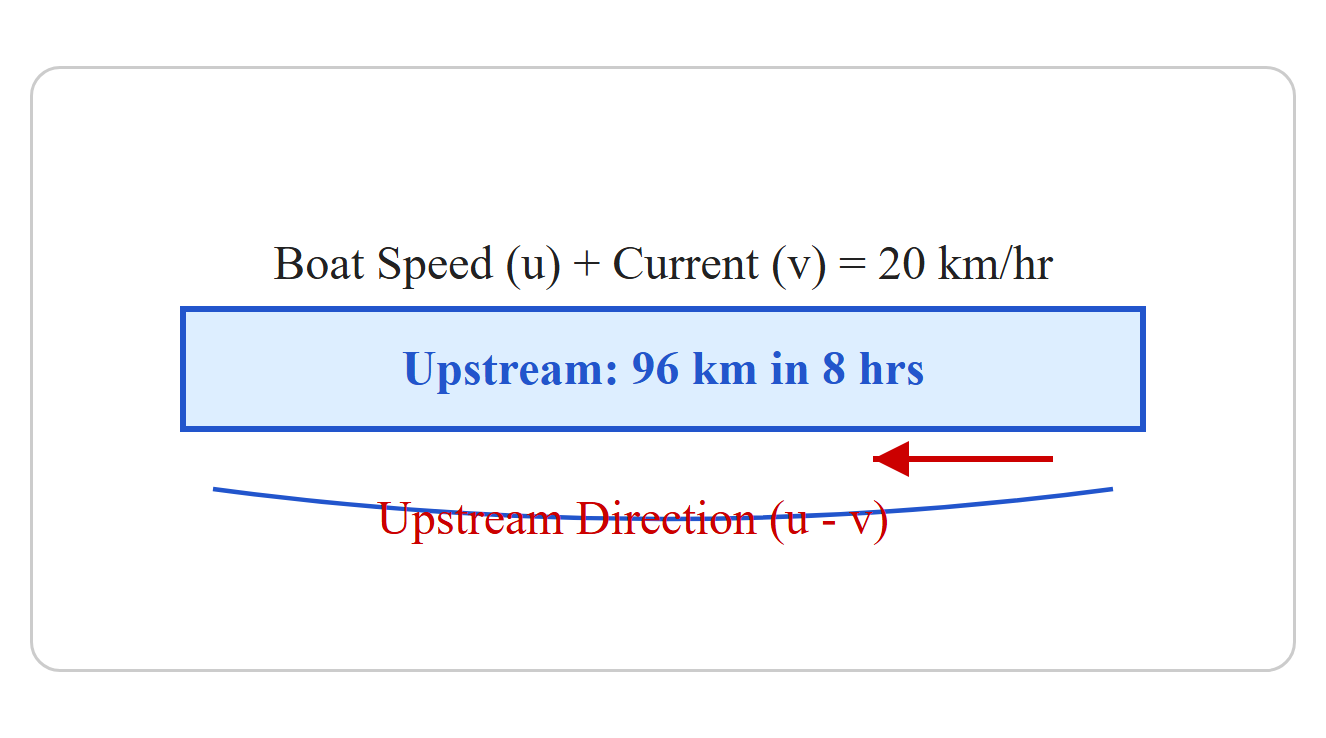
The sum of speed of a boat in still water and the current is 20km/hr The boat takes 8hours to cover 96 km upstream Find the difference between the speed of boat in still water and speed of current ?

  1. ((a))

     10km/hr

  2. ((b))

     14km/hr

  3. ((c))

     16km/hr

  4. ((d))

     12km/hr

  5. ((e))

     18km/hr

Show Answer
Answer: ((d))

 12km/hr

Shortcut Trick

Downstream speed (u + v) = 20 km/hr

Upstream speed (u − v) = 96 ÷ 8 = 12 km/hr

Difference (u − v) represents the speed of the boat in still water minus current speed.

∴ The correct answer is 12 km/hr.

Alternate Method

Given:

Sum of speed of boat (u) and current (v) = 20 km/hr

Distance upstream = 96 km

Time taken upstream = 8 hours

Formula Used:

Upstream Speed = Distance ÷ Time = u − v

Calculations:

⇒ Downstream Speed (u + v) = 20 km/hr

⇒ Upstream Speed (u − v) = 96 ÷ 8

⇒ Upstream Speed (u − v) = 12 km/hr

⇒ The question asks for the difference between the speed of boat in still water (u) and speed of current (v).

⇒ Required difference = u − v = 12 km/hr

∴ The correct answer is 12 km/hr.

Additional Information

Still Water Speed Calculation

The speed of the boat in still water (u) is the average of downstream and upstream speeds: u = (Downstream + Upstream) ÷ 2.

Current Speed Calculation

The speed of the current (v) is half the difference between downstream and upstream speeds: v = (Downstream − Upstream) ÷ 2.

Relative Speed in Water

Downstream speed is always greater than upstream speed because the current assists the boat (u + v) vs (u − v).

45

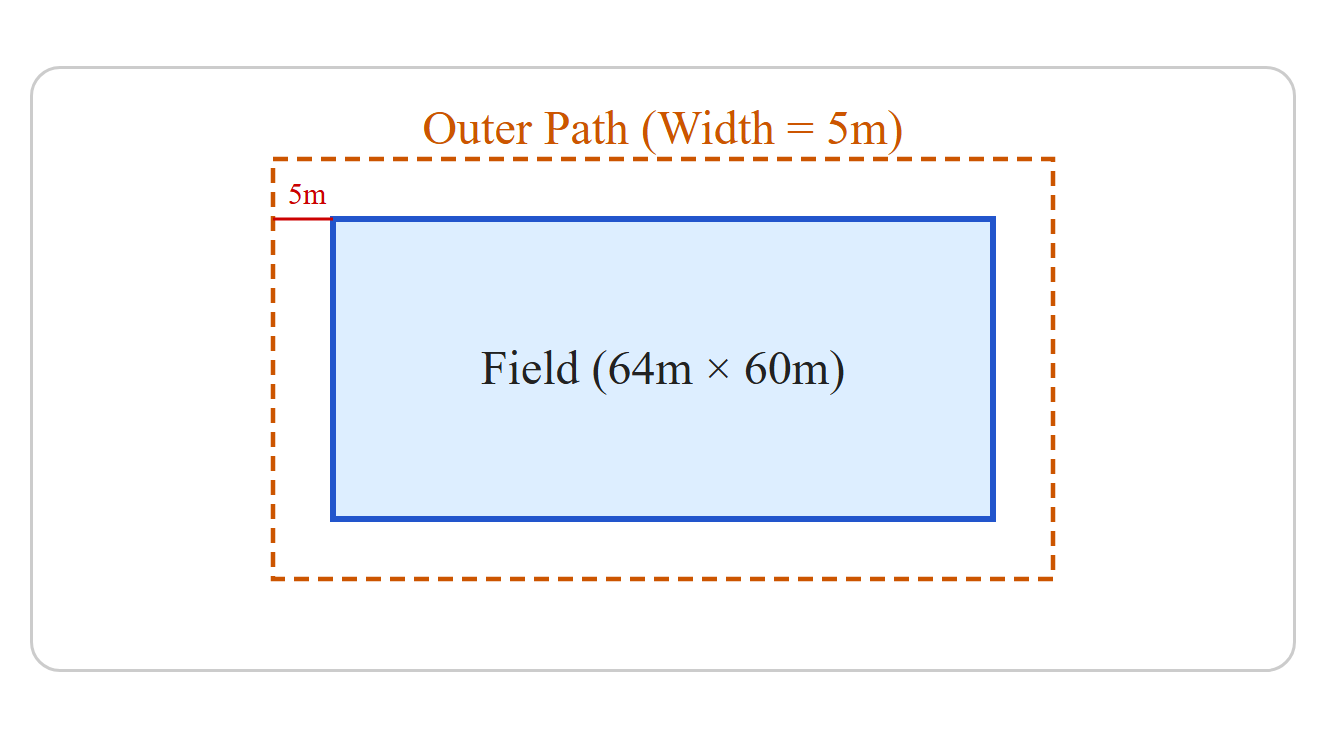
The length of a rectangular field is 4 meter more than its breadth. The perimeter of the field is 248 meter. If a 5 meter wide path is to be constructed outside of this field. Find the area of the path?

  1. ((a))

    1340 m2

  2. ((b))

    645 m2

  3. ((c))

    860 m2

  4. ((d))

    1148 m2

  5. ((e))

    None of these

Show Answer
Answer: ((a))

1340 m2

Shortcut Trick

Semi-perimeter (L + B) = 248 ÷ 2 = 124 m.

Length (L) − Breadth (B) = 4 m.

Solving: L = 64 m, B = 60 m.

Area of outer path = 2w(L + B + 2w), where w = 5 m.

Area = 2 × 5 × (64 + 60 + 2 × 5) = 10 × (124 + 10) = 1340 m2.

∴ The correct answer is 1340 m2.

Alternate Method

Given: Perimeter = 248 m, Length (L) = Breadth (B) + 4, Path Width (w) = 5 m.

Formula Used: Perimeter = 2(L + B) | Area = L × B

⇒ 2(B + 4 + B) = 248

⇒ 2B + 4 = 124

⇒ 2B = 120 → B = 60 m

⇒ L = 60 + 4 = 64 m

Outer Length = 64 + 2 × 5 = 74 m

Outer Breadth = 60 + 2 × 5 = 70 m

Area of Path = (Outer L × Outer B) − (Inner L × Inner B)

⇒ Area = (74 × 70) − (64 × 60) = 5180 − 3840 = 1340 m2

∴ The correct answer is 1340 m2.

Additional Information

Area of Outer Path

For a rectangle with length L, breadth B and path width w outside: Area = 2w(L + B + 2w).

Area of Inner Path

For a path constructed inside the rectangular field: Area = 2w(L + B − 2w).

Area of Crossroads

For two paths crossing each other at the center: Area = w(L + B − w).

46

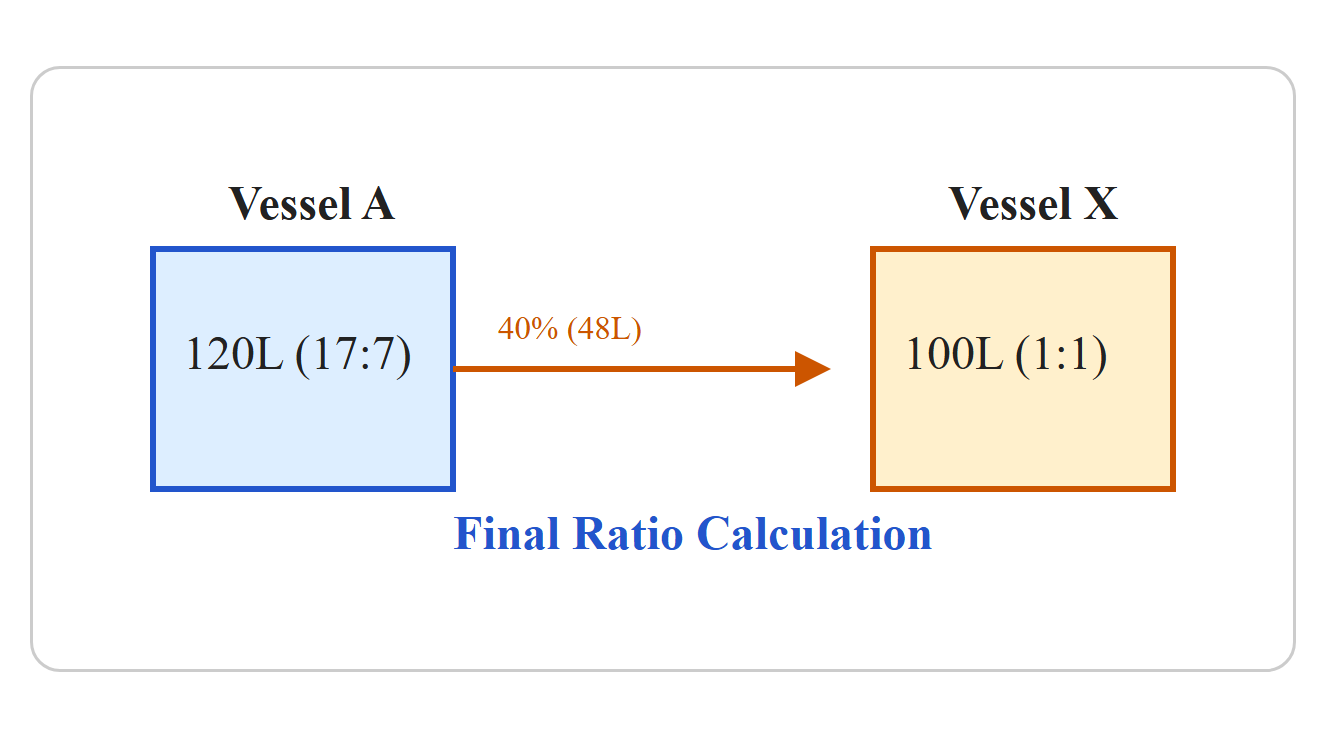
A is 120 liter of mixture of milk and water in the ratio 17 : 7. 40%  of mixture is poured out and poured into vessel X. Vessel X contain a 100 liter mixture of equal milk and water. Find the new ratio of milk and water in vessel X.

  1. ((a))

    32 : 21

  2. ((b))

    21 : 16

  3. ((c))

    15 : 8

  4. ((d))

    25 : 14

  5. ((e))

    18 : 11

Show Answer
Answer: ((b))

21 : 16

Shortcut Trick

Vessel A mixture ratio 17 : 7 remains same in any quantity poured out.

Quantity poured from A to X = 40% of 120 = 48 liters.

In 48 liters: Milk = 48 × (17/24) = 34 liters, Water = 48 − 34 = 14 liters.

Vessel X initially (100 liters, equal ratio) has 50 liters Milk and 50 liters Water.

New Ratio in X = (50 + 34) : (50 + 14) = 84 : 64 = 21 : 16.

∴ The correct answer is 21 : 16.

Alternate Method

Given:

Total mixture in Vessel A = 120 liters | Ratio (M:W) = 17 : 7

Total mixture in Vessel X = 100 liters | Ratio (M:W) = 1 : 1

Calculations:

⇒ Quantity of mixture taken from A = 40% of 120 = 0.40 × 120 = 48 liters

Milk from A = 48 × (17 / (17 + 7)) = 48 × (17/24) = 34 liters

Water from A = 48 − 34 = 14 liters

⇒ Initial Milk in X = 100 × (1/2) = 50 liters

⇒ Initial Water in X = 100 × (1/2) = 50 liters

⇒ New Milk in X = 50 + 34 = 84 liters

⇒ New Water in X = 50 + 14 = 64 liters

⇒ New Ratio = 84 : 64 = 21 : 16

∴ The correct answer is 21 : 16.

Additional Information

Mixture Property

When a portion of a mixture is removed, the ratio of components in the removed part and the remaining part remains identical to the original ratio.

Alligation Rule

It is used to find the mean value of a mixture when two ingredients are mixed: (Quantity 1 / Quantity 2) = (Rate 2 − Mean Rate) / (Mean Rate − Rate 1).

Percentage to Fraction

40% is equivalent to 2/5. Using fractions often simplifies quantitative aptitude calculations involving large numbers.

47

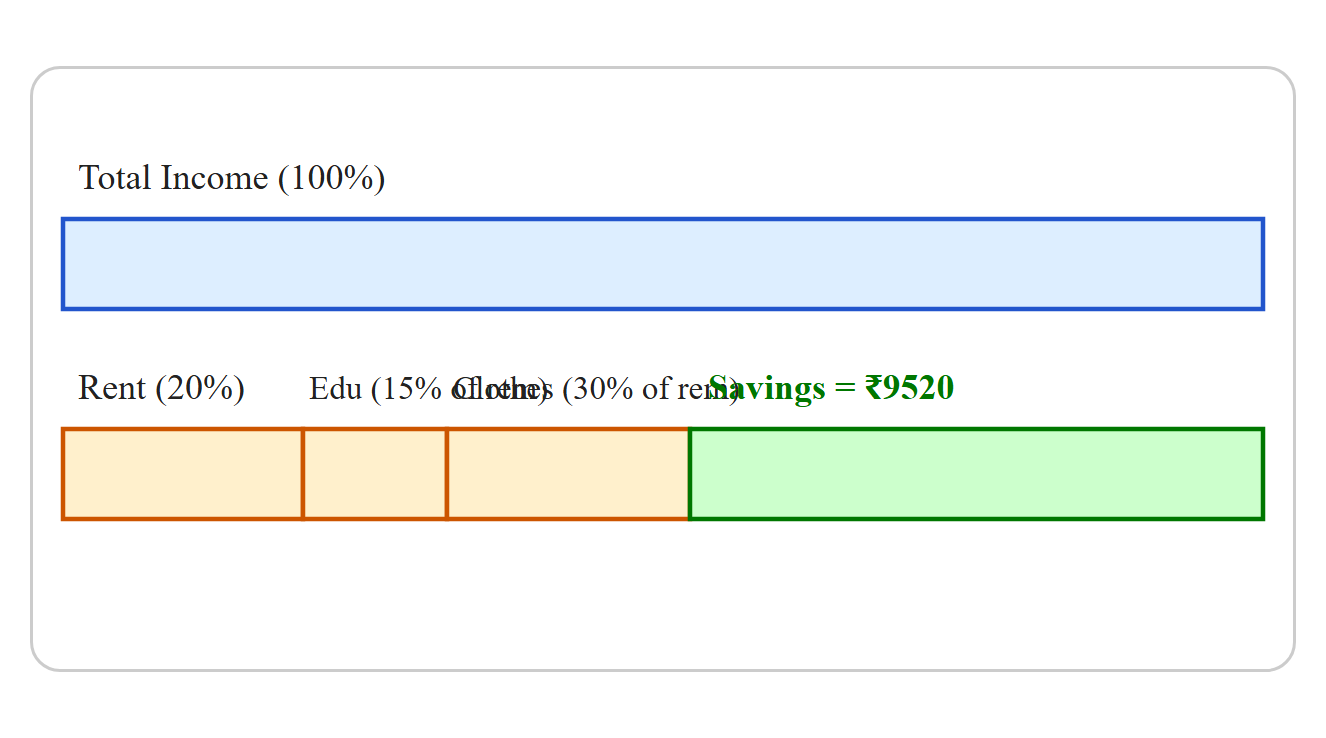
Ravi spends 20% of his monthly income on his house rent, 15% of the remaining on education, then 30% the remaining on clothes and saves the rest. On calculating, he finds that he has finally saved Rs 9520. His monthly income (in Rupees) is:

  1. ((a))

    10000

  2. ((b))

    15000

  3. ((c))

    20000

  4. ((d))

    25000

  5. ((e))

    17500

Show Answer
Answer: ((c))

20000

Shortcut Trick

Let the total income be X.

Successive remaining percentage: X × (100−20)% × (100−15)% × (100−30)% = 9520

X × (4/5) × (17/20) × (7/10) = 9520

X × (476/1000) = 9520 ⇒ X = 9520 × (1000/476) = 20000

∴ The correct answer is ₹20000.

Alternate Method

Given: Rent = 20%, Education = 15% of remaining, Clothes = 30% of remaining, Savings = ₹9520.

⇒ Let Income = 100 units

⇒ After Rent: 100 − 20 = 80 units

⇒ After Education: 80 − (15% of 80) = 80 − 12 = 68 units

⇒ After Clothes: 68 − (30% of 68) = 68 − 20.4 = 47.6 units

⇒ 47.6 units = 9520

⇒ 1 unit = 9520 ÷ 47.6 = 200

⇒ 100 units = 100 × 200 = 20000

∴ The correct answer is ₹20000.

Additional Information

Percentage Change (Remaining Value)

When values are subtracted from the remaining balance, it is a case of successive percentage decrease. Final Value = Initial Value × (1 − r1/100) × (1 − r2/100)...

Base Value Change

Always identify if the percentage is calculated on the original total income or the remaining amount to avoid calculation errors.

48

In the following question two equations are given. You have to solve these equations and determine relation between x and y.

I. x2 + 10x – 264 = 0

II. y2 + 6y – 187 = 0

  1. ((a))

    x < y

  2. ((b))

    x > y

  3. ((c))

    x ≤ y

  4. ((d))

    x ≥ y

  5. ((e))

    x = y or the relationship cannot be determined

Show Answer
Answer: ((e))

x = y or the relationship cannot be determined

I. x2 + 10x – 264 = 0

⇒ x2 + 22x – 12x – 264 = 0

⇒ x(x + 22) – 12(x + 22) = 0

⇒ (x + 22)(x – 12) = 0

Then, x = +12 or x = -22

II. y2 + 6y – 187 = 0

⇒ y2 + 17y - 11y - 187 = 0

⇒ y(y + 17) - 11(y + 17) = 0

⇒ (y - 11)(y + 17) = 0

Then, y = -17 or y = +11

So, when x = +12, x > y for y = -17 and x > y for y = +11

And when x = -22, y > x for y = -17 and y > x for y = +11

∴ So, we can observe that no relationship can be determined.

49

In the following question two equations are given. You have to solve these equations and determine relation between x and y.

I.x2 – 3x – 180 = 0

II.y2 + 34y + 288 = 0

  1. ((a))

    x < y

  2. ((b))

    x > y

  3. ((c))

    x ≤ y

  4. ((d))

    x ≥ y

  5. ((e))

    x = y or the relationship cannot be determined

Show Answer
Answer: ((b))

x > y

I. x2 - 3x – 180 = 0

⇒ x2 + 12x – 15x – 180 = 0

⇒ x(x + 12) – 15(x + 12) = 0

⇒ (x + 12)(x – 15) = 0

Then, x = -12 or x = +15

II. y2 + 34y + 288 = 0

⇒ y2 + 18y + 16y + 288 = 0

⇒ y(y + 18) + 16(y + 18) = 0

⇒ (y + 16)(y + 18) = 0

Then, y = -16 or y = -18

So, when x = -12, x > y for y = -16 and x > y for y = -18

And when x = +15, x > y for y = -16 and x > y for y = -18

∴ So, we can observe that x > y.

50

Direction: In the following question two equations are given. You have to solve the Equation and mark the answer accordingly.

I. x2 – 19x + 84 = 0

II. y2 – 3y – 108 = 0

  1. ((a))

    if x < y

  2. ((b))

    if x ≥ y

  3. ((c))

    if x ≤ y

  4. ((d))

    if x > y

  5. ((e))

    if x = y or no relationship can be established

Show Answer
Answer: ((e))

if x = y or no relationship can be established

x2 – 19x + 84 = 0

⇒ x2 – 12x – 7x + 84 = 0

⇒ x(x – 12) – 7(x – 12) = 0

⇒ (x – 12) (x – 7) = 0

⇒ x = 12 or x = 7

y2 – 3y – 108 = 0

⇒ y2 – 12y + 9y – 108 = 0

⇒ y(y – 12) + 9(y – 12) = 0

⇒ (y – 12) (y + 9) = 0

⇒ y = 12 or y = -9

xyRelation between x and y
1212x = y
12-9x > y
712x < y
7-9x > y
<br>

∴ All relations are possible between x and y. So "no relationship can be established".

51

In the given question, two equations numbered l and II are given. You have to solve both the equations and mark the appropriate answer

I. x2 – 7x + 12 = 0

II. 2y2 – 19y + 44 = 0

  1. ((a))

    x < y

  2. ((b))

    x ≤ y

  3. ((c))

    x > y

  4. ((d))

    x ≥ y

  5. ((e))

    x = y or no relationship can be obtained

Show Answer
Answer: ((b))

x ≤ y

Here,

⇒ P(x) = x2 - 7x + 12 = 0

⇒ P(y) = 2y2 - 19y + 44 = 0

Factorization of P(x) and P(y);

⇒ P(x) = x2 - 3x - 4x + 12 = 0

⇒ x(x - 3) - 4(x - 3) = 0

⇒ (x - 3) (x - 4) = 0

⇒ x = 3 or x = 4

⇒ P(y) = 2y2 - 8y - 11y + 44 = 0

⇒ 2y(y - 4) - 11(y - 4) = 0

⇒ (y - 4)(2y - 11) = 0

⇒ y = 4 or y = 11/2

⇒ x ≤ y

52

In the following question two equations numbered I and II are given. You have to solve both the equations and give the answer:

I. 3x2 - 13x + 12 = 0

II. 2y2 - 15y + 28 = 0

  1. ((a))

    x < y

  2. ((b))

    x ≤ y

  3. ((c))

    x > y

  4. ((d))

    x ≥ y

  5. ((e))

    x = y or no relationship can be obtained

Show Answer
Answer: ((a))

x < y

Here,

P(x) = 3x2 - 13x + 12 = 0

P(y) = 2y2 - 15y + 28 = 0

Factorization of P(x) and P(y);

⇒ P(x) = 3x2 - 9x - 4x + 12 = 0

⇒ 3x(x - 3) - 4(x - 3) = 0

⇒ (x - 3) (3x - 4) = 0

⇒ x = 3 or x = 4/3

⇒ P(y) = 2y2 - 8y - 7y + 28 = 0

⇒ 2y(y - 4) - 7(y - 4) = 0

⇒ (y - 4)(2y - 7) = 0

⇒ y = 4 or y = 7/2

Here, x < y

∴ Option 1 is the answer

Directions: Study the following information to answer the given questions.

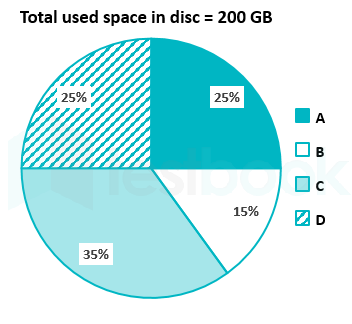
Pie chart 1 shows the percentage distribution of total storage in four disc A, B, C, and D respectively.

Pie chart 2 shows the percentage distribution of total used space in four disc A, B, C and D respectively.

53

For disc D, what is the respective ratio of used space to the available space?

  1. ((a))

    2:1

  2. ((b))

    3:1

  3. ((c))

    1:2

  4. ((d))

    1:3

  5. ((e))

    2:3

Show Answer
Answer: ((c))

1:2

From the data given in the pie chart, we have:

DiskTotal storage in the disc (500 GB)Total used space in the disc (200 GB)Total available space in the disc
A25% of 500 = 12525% of 200 = 50125 - 50 = 75
B20% of 500 = 10015% of 200 = 30100 - 30 = 70
C25% of 500 = 12535% of 200 = 70125 - 70 = 55
D30% of 500 = 15025% of 200 = 50150 - 50 = 100
Total500200300

Required ratio = 50: 100

⇒ 1:2

∴ The correct answer is 1:2.

54

For disc A, the total space available is how much more or less than that of disc D?

  1. ((a))

    25% more

  2. ((b))

    25% less

  3. ((c))

    35% more

  4. ((d))

    40% more

  5. ((e))

    75% less

Show Answer
Answer: ((b))

25% less

From the data given in the pie chart, we have:

DiskTotal storage in the disc (500 GB)Total used space in the disc (200 GB)Total available space in the disc
A25% of 500 = 12525% of 200 = 50125 - 50 = 75
B20% of 500 = 10015% of 200 = 30100 - 30 = 70
C25% of 500 = 12535% of 200 = 70125 - 70 = 55
D30% of 500 = 15025% of 200 = 50150 - 50 = 100
Total500200300

Required % = [(100 - 75)/100] × 100

⇒ 25% less

∴ The correct answer is 25% less.

55

If another Disc E, has 20% more total storage than Disc C, and total used space in Disc E is same as DISC C, Then find out the available space in Disc E?

  1. ((a))

    70 GB

  2. ((b))

    60 GB

  3. ((c))

    80 GB

  4. ((d))

    90 GB

  5. ((e))

    None of these

Show Answer
Answer: ((c))

80 GB

From the data given in the pie chart, we have:

DiskTotal storage in the disc (500 GB)Total used space in the disc (200 GB)Total available space in the disc
A25% of 500 = 12525% of 200 = 50125 - 50 = 75
B20% of 500 = 10015% of 200 = 30100 - 30 = 70
C25% of 500 = 12535% of 200 = 70125 - 70 = 55
D30% of 500 = 15025% of 200 = 50150 - 50 = 100
Total500200300


Total storage in the disc E = 120% of 125

⇒ 150 GB

Total used space in the disc E = 70 GB

Total available space in the disc E = 150 - 70 = 80 GB

∴ The correct answer is 80 GB.

56

which of the following option has maximum available space?

  1. ((a))

    Disk (A+C)

  2. ((b))

    Disk (A+B)

  3. ((c))

    Disk (D+C)

  4. ((d))

    Disk (B+D)

  5. ((e))

    Disk (B+C)

Show Answer
Answer: ((d))

Disk (B+D)

From the data given in the pie chart, we have:

DiskTotal storage in the disc (500 GB)Total used space in the disc (200 GB)Total available space in the disc
A25% of 500 = 12525% of 200 = 50125 - 50 = 75
B20% of 500 = 10015% of 200 = 30100 - 30 = 70
C25% of 500 = 12535% of 200 = 70125 - 70 = 55
D30% of 500 = 15025% of 200 = 50150 - 50 = 100
Total500200300

Available space in Disk (A+C) = 75 + 55 = 130

Available space in Disk (A+B) = 75 + 70 = 145

Available space in Disk (D+C) = 100 + 55 = 155

Available space in Disk (B+D) = 70 + 100 = 170

Available space in Disk (B+C) = 70 + 55 = 125

Here, Disk (B+D) has maximum available space

∴ The correct answer is Disk (B+D).

57

Total used space in Disc B is how much percentage of the total used space in Disc A and disc D?

  1. ((a))

    20%

  2. ((b))

    30%

  3. ((c))

    40%

  4. ((d))

    50%

  5. ((e))

    None of these

Show Answer
Answer: ((b))

30%

From the data given in the pie chart, we have:

DiskTotal storage in the disc (500 GB)Total used space in the disc (200 GB)Total available space in the disc
A25% of 500 = 12525% of 200 = 50125 - 50 = 75
B20% of 500 = 10015% of 200 = 30100 - 30 = 70
C25% of 500 = 12535% of 200 = 70125 - 70 = 55
D30% of 500 = 15025% of 200 = 50150 - 50 = 100
Total500200300


Required % = [30/(50+50)] × 100 

⇒ 30%

∴ The correct answer is 30%.

58

Find the percentage of total used space in Disc C with respect to total available space in Disc C?

  1. ((a))

    120.27%

  2. ((b))

    110.27%

  3. ((c))

    125.27%

  4. ((d))

    127.27%

  5. ((e))

    130.27%

Show Answer
Answer: ((d))

127.27%

From the data given in the pie chart, we have:

DiskTotal storage in the disc (500 GB)Total used space in the disc (200 GB)Total available space in the disc
A25% of 500 = 12525% of 200 = 50125 - 50 = 75
B20% of 500 = 10015% of 200 = 30100 - 30 = 70
C25% of 500 = 12535% of 200 = 70125 - 70 = 55
D30% of 500 = 15025% of 200 = 50150 - 50 = 100
Total500200300

Required % = [70/55] × 100 

⇒ 127.27%

∴ The correct answer is 127.27%.

59

Find the difference between the sum of total storage in Disc B and Disc D to the sum of disc A and disc C?

  1. ((a))

    0 GB

  2. ((b))

    5 GB

  3. ((c))

    15 GB

  4. ((d))

    10 GB

  5. ((e))

    20 GB

Show Answer
Answer: ((a))

0 GB

From the data given in the pie chart, we have:

DiskTotal storage in the disc (500 GB)Total used space in the disc (200 GB)Total available space in the disc
A25% of 500 = 12525% of 200 = 50125 - 50 = 75
B20% of 500 = 10015% of 200 = 30100 - 30 = 70
C25% of 500 = 12535% of 200 = 70125 - 70 = 55
D30% of 500 = 15025% of 200 = 50150 - 50 = 100
Total500200300

Required difference = (100 + 150) - (125 + 125) = 0 GB

∴ The correct answer is 0 GB.

60

Pipe A fills twice as fast as pipe B and pipe B fills twice as fast as pipe C. Pipe C can fill a tank in 20 hours. In how many hours will the tank fill if all the pipes are opened?

  1. ((a))

    257;hr2\frac{5}{7};{\text{hr}}

  2. ((b))

    367;hr3\frac{6}{7};{\text{hr}}

  3. ((c))

    2614;hr2\frac{6}{14};{\text{hr}}

  4. ((d))

    267;hr2\frac{6}{7};{\text{hr}}

  5. ((e))

    467;hr4\frac{6}{7};{\text{hr}}

Show Answer
Answer: ((d))

267;hr2\frac{6}{7};{\text{hr}}

Shortcut Trick

Ratio of efficiencies of Pipe A : Pipe B : Pipe C is 4 : 2 : 1.

Total Work = Efficiency of C × Time of C = 1 × 20 = 20 units.

Combined Efficiency = 4 + 2 + 1 = 7 units/hr.

Time Taken = 20 ÷ 7 = 2(6/7) hr.

∴ The correct answer is 2(6/7) hr.

Alternate Method

Given:

Time taken by Pipe C = 20 hours.

Efficiency of Pipe B = 2 × Efficiency of Pipe C.

Efficiency of Pipe A = 2 × Efficiency of Pipe B.

Formula Used:

Total Work = Efficiency × Time

PersonEfficiency (Ratio)Total WorkTime (hr)
Pipe C120 units20
Pipe B210
Pipe A45

Calculations:

⇒ Efficiency of Pipe C = 1 unit/hr

⇒ Efficiency of Pipe B = 2 × 1 = 2 units/hr

⇒ Efficiency of Pipe A = 2 × 2 = 4 units/hr

⇒ Total capacity of tank = 20 × 1 = 20 units

⇒ Combined efficiency of (A + B + C) = 4 + 2 + 1 = 7 units/hr

⇒ Total time required = 20 ÷ 7 hours

⇒ Time = 2(6/7) hours

∴ The correct answer is 2(6/7) hr.

Additional Information

Efficiency and Time Relation

Efficiency is inversely proportional to the time taken to complete a work. If efficiency ratio is x:y, then time ratio is y:x.

Pipes and Cisterns

Inlet pipes have positive efficiency while outlet/leakage pipes have negative efficiency in calculations.

61

Anu, Taru and Daksh started a business. Taru invested 1/ 6 of the total money, while investments of Anu and Daksh are equal. If the profit on the end of the year is Rs. 7200, find the difference between the profit of Taru and Daksh.

  1. ((a))

    Rs. 1305

  2. ((b))

    Rs. 1000

  3. ((c))

    Rs. 1205

  4. ((d))

    Rs. 1105

  5. ((e))

    None of these 

Show Answer
Answer: ((e))

None of these 

Shortcut Trick

Assume Total Investment is 6 units.

Taru investment = 1/6 × 6 = 1 unit.

Remaining investment = 6 − 1 = 5 units, divided equally between Anu and Daksh.

Anu = 2.5 units, Daksh = 2.5 units.

Difference between Taru and Daksh = 2.5 − 1 = 1.5 units.

Profit difference = (1.5 ÷ 6) × 7200 = 1800.

∴ The correct answer is Rs. 1800.

Alternate Method

Given: Total Profit = Rs. 7200, Taru investment = 1/6 of Total, Anu = Daksh.

Formula: Profit Share ∝ Investment × Time period.

⇒ Let Total Investment be x. Taru = x/6.

⇒ Anu + Daksh = x − x/6 = 5x/6.

⇒ Since Anu = Daksh, each invested (5x/6) ÷ 2 = 5x/12.

⇒ Ratio of Profit (Taru : Anu : Daksh) = 1/6 : 5/12 : 5/12 = 2 : 5 : 5.

⇒ Taru Profit = (2/12) × 7200 = 1200.

⇒ Daksh Profit = (5/12) × 7200 = 3000.

⇒ Difference = 3000 − 1200 = 1800.

∴ The correct answer is Rs. 1800.

Additional Information

Partnership Profit Distribution

Profit is divided in the ratio of the product of Capital and Time. If time is constant, Profit Ratio = Capital Ratio.

Ratio Balancing

To simplify fractions like 1/6 and 5/12, multiply all terms by the LCM of denominators (12) to get whole numbers.

62

Ratio of present age of Ranjan and Sanjay is 3 : 2. Sanjay's age 8 years hence will be equal to Ranjan's age 8 years ago. If Irfan is 12 years older than Sanjay, What is the present age of Irfan ?

  1. ((a))

    60

  2. ((b))

    44

  3. ((c))

    42

  4. ((d))

    32

  5. ((e))

    52

Show Answer
Answer: ((b))

44

Shortcut Trick

Ratio of Ranjan : Sanjay = 3 : 2.

Difference in ratio parts = 3 − 2 = 1 unit.

Age difference = 8 + 8 = 16 years.

1 unit = 16 years ⇒ Sanjay (2 units) = 32 years.

Irfan = 32 + 12 = 44 years.

∴ The correct answer is 44 years.

Alternate Method

Given: Ratio of ages = 3 : 2; Irfan = Sanjay + 12.

Formula: Age after n years = Age + n; Age n years ago = Age − n.

⇒ Let Ranjan = 3x and Sanjay = 2x.

⇒ According to question: 2x + 8 = 3x − 8

⇒ 3x − 2x = 8 + 8

⇒ x = 16

Sanjay present age = 2 × 16 = 32 years.

Irfan present age = 32 + 12 = 44 years.

∴ The correct answer is 44 years.

Additional Information

Age Difference Invariability

The difference between the ages of two persons remains constant throughout their lives regardless of the number of years passed.

Ratio and Proportion in Ages

If the ratio of ages is a : b, their actual ages can be assumed as ax and bx. The value of x is found using the given linear conditions.

63

The ratio between the monthly salary of P and Q is 20 : 21. The ratio between the expenditure of P and Q is 5 : 7. The difference between the salary of Q and P is Rs.2000 and the savings of Q is Rs.14000. Find the ratio between the savings of P and Q.

  1. ((a))

    2 : 7

  2. ((b))

    12 : 7

  3. ((c))

    5 : 2

  4. ((d))

    7 : 12

  5. ((e))

    10 : 7

Show Answer
Answer: ((e))

10 : 7

Shortcut Trick

Difference in salary ratio parts = 21 − 20 = 1 unit.

Given 1 unit = ₹2000 ⇒ Salary of P = 20 × 2000 = ₹40,000; Salary of Q = 21 × 2000 = ₹42,000.

Expenditure of Q = Salary − Savings = 42,000 − 14,000 = ₹28,000.

Expenditure ratio P:Q is 5:7 → 7 units = 28,000 ⇒ 5 units (P) = ₹20,000.

Savings of P = 40,000 − 20,000 = ₹20,000.

Savings Ratio P:Q = 20,000 : 14,000 = 10 : 7.

∴ The correct answer is 10 : 7.

Alternate Method

Given: Salary ratio P:Q = 20:21, Expenditure ratio P:Q = 5:7.

Formula: Savings = Income − Expenditure

⇒ Let Salary of P = 20x and Q = 21x.

⇒ Difference = 21x − 20x = x = ₹2000.

⇒ Salary P = 20 × 2000 = ₹40,000; Salary Q = 21 × 2000 = ₹42,000.

⇒ Expenditure of Q = Salary Q − Savings Q = 42,000 − 14,000 = ₹28,000.

⇒ Let Expenditure of P = 5y and Q = 7y. Since 7y = 28,000 ⇒ y = 4,000.

⇒ Expenditure of P = 5 × 4,000 = ₹20,000.

⇒ Savings of P = 40,000 − 20,000 = ₹20,000.

⇒ Required Ratio = Savings P : Savings Q = 20,000 : 14,000 = 10 : 7.

∴ The correct answer is 10 : 7.

Additional Information

Income and Savings Relation

Income = Expenditure + Savings. If any two variables are known or their ratios are provided with a fixed difference, the third can be calculated.

Ratio and Proportion

If a:b is the ratio and the difference between quantities is d, then the actual values are [a/(b−a)]×d and [b/(b−a)]×d.

Cross Multiplication Method

Used when initial ratio, changes (savings), and final ratio (expenditure) are given: (Initial Ratio × Final Ratio parts) − (Savings × Ratio parts).

64

A certain amount was to be distributed among A, B and C in the ratio 3 ∶ 4 ∶ 5 respectively, but was erroneously distributed in the ratio 9 ∶ 4 ∶ 7 respectively. As a result of this B got Rs. 60 less. What is the amount?

  1. ((a))

    Rs. 480

  2. ((b))

    Rs. 460

  3. ((c))

    Rs. 450

  4. ((d))

    Rs. 440

  5. ((e))

    Rs. 640

Show Answer
Answer: ((c))

Rs. 450

Shortcut Trick

Equate the total sum of ratios: Original (3+4+5 = 12) and New (9+4+7 = 20).

LCM of 12 and 20 is 60. Multiply Original ratio by 5 and New ratio by 3.

Original B = 4 × 5 = 20 units; New B = 4 × 3 = 12 units.

Difference in B = 20 − 12 = 8 units → ₹60. Total amount (60 units) = (60/8) × 60 = ₹450.

∴ The correct answer is ₹450.

Alternate Method

Given: Original ratio A:B:C = 3:4:5 | New ratio A:B:C = 9:4:7 | Loss for B = ₹60

Formula: Share = (Individual Ratio / Total Ratio) × Total Amount (X)

⇒ Original share of B = (4 / (3+4+5)) × X = 4X / 12 = X / 3

⇒ New share of B = (4 / (9+4+7)) × X = 4X / 20 = X / 5

⇒ Difference = (X / 3) − (X / 5) = 60

⇒ (5X − 3X) / 15 = 60

⇒ 2X / 15 = 60

⇒ 2X = 900

⇒ X = 450

∴ The correct answer is ₹450.

Additional Information

Ratio Balancing

When the total quantity remains constant across two different ratio distributions, multiply each ratio by the total sum of the other ratio to balance them.

Compound Ratio

The compound ratio of (a : b) and (c : d) is (ac : bd), used when multiple factors influence a final share.

Inverse Ratio Property

If an amount is distributed inversely to original values, the new share of x is proportional to 1/x.

65

A shopkeeper marks up the worth of his product by 40%. If he increases the discount from 10% to 15%, his profit will be decreased by Rs. 21. How much profit/loss would he get, if he offered a 20% discount on the marked price?

  1. ((a))

    115

  2. ((b))

    36

  3. ((c))

    54

  4. ((d))

    125

  5. ((e))

    250

Show Answer
Answer: ((b))

36

Shortcut Trick

Let Cost Price (CP) = 100 units. Marked Price (MP) = 140 units.

Difference in Discount = 15% − 10% = 5% of MP.

5% of 140 = 7 units. Given, 7 units = Rs. 21 ⇒ 1 unit = Rs. 3.

For 20% discount: Selling Price (SP) = 140 × 80/100 = 112 units.

Profit = 112 − 100 = 12 units ⇒ 12 × 3 = Rs. 36.

∴ The correct answer is Rs. 36.

Alternate Method

Given: Markup = 40%, D1 = 10%, D2 = 15%, Profit Decrease = Rs. 21.

Formulas: MP = CP × (100 + Markup%) ÷ 100 | SP = MP × (100 − D%) ÷ 100 | Profit = SP − CP

⇒ Let CP = x. Then MP = 1.4x.

⇒ Case 1 SP = 1.4x × 0.9 = 1.26x. Case 2 SP = 1.4x × 0.85 = 1.19x.

⇒ Difference in Profit = 1.26x − 1.19x = 0.07x.

⇒ 0.07x = 21 ⇒ x = 21 ÷ 0.07 = 300.

⇒ For 20% discount: SP = 1.4 × 300 × 0.8 = 336.

⇒ Profit = 336 − 300 = Rs. 36.

∴ The correct answer is Rs. 36.

Additional Information

Marked Price & Markup

Markup is the extra price added to the CP to arrive at MP. Markup% = (MP − CP) ÷ CP × 100.

Relation between CP and MP

CP ÷ MP = (100 − Discount%) ÷ (100 + Profit%). This ratio is very useful when both D% and P% are given.

Reasoning Ability (35 questions)

Directions: Read the following comprehension and answer the questions given below.

Six people P, Q, R, S, T, and U are visited in three different months January, February, March on two different dates 3rd and 7th in six different places Jaipur, Nagpur, Bangalore, Mumbai, Agra, and Delhi but not necessarily the same. P visited to Agra on 3rd February and Only one person visited between P and the one who visited to Nagpur. T visited immediately after the one who visited to Nagpur. One person visited between T and U, who doesn't visited to Mumbai. The one who visited Bangalore visited immediately after the one who visited to Mumbai. S visited in a month of having 31 days but not in january and S doesn't visited on date 7 of any month. Three people visited between S and R. Only one person visited between the one who visited to Bangalore and the one who visited to Delhi. Q doesn't visited immeediate after R.

66

Who visited to Mumbai?

  1. ((a))

    P

  2. ((b))

    T

  3. ((c))

    R

  4. ((d))

    S

  5. ((e))

    Q

Show Answer
Answer: ((d))

S

Six people P, Q, R, S, T, and U

six different places Jaipur, Nagpur, Bangalore, Mumbai, Agra, and Delhi

1- P visited to Agra on 3rd February and Only one person visited between P and the one who visited to Nagpur.

3- T visited immediately after the one who visited to Nagpur.

4- One person visited between T and U, who doesn't visited to Mumbai.

5- The one who visited Bangalore visited immediately after the one who visited to Mumbai.

Case-1Case-2
MonthDatePersonCityPersonCity
January3rdNagpurMumbai
7thTBangalore
February3rdPAgaPAgra
7thUU
March3rdMumbaiNagpur
7thBangaloreT

6- S visited in a month of having 31 days but not in january and S doesn't visited on date 7 of any month.

7- Three people visited between S and R.

8- Only one person visited between the one who visited to Bangalore and the one who visited to Delhi.

Case-1Case-2
MonthDatePersonCityPersonCity
January3rdRNagpurRMumbai
7thTBangalore
February3rdPAgaPAgra
7thUDelhiUDelhi
March3rdSMumbaiSNagpur
7thBangaloreT

9- Q doesn't visited immeediate after R. So case-2 gets eliminated.

So, Final arrangement is;


MonthDatePersonCity
January3rdRNagpur
7thTJaipur
February3rdPAgra
7thUDelhi
March3rdSMumbai
7thQBangalore


Hence, S visited Mumbai.

67

Who visited on 7th January?

  1. ((a))

    P

  2. ((b))

    Q

  3. ((c))

    The one who Visited to Bangalore

  4. ((d))

    The one who visited to Jaipur

  5. ((e))

    S

Show Answer
Answer: ((d))

The one who visited to Jaipur

Six people P, Q, R, S, T, and U

six different places Jaipur, Nagpur, Bangalore, Mumbai, Agra, and Delhi

1- P visited to Agra on 3rd February and Only one person visited between P and the one who visited to Nagpur.

3- T visited immediately after the one who visited to Nagpur.

4- One person visited between T and U, who doesn't visited to Mumbai.

5- The one who visited Bangalore visited immediately after the one who visited to Mumbai.

Case-1Case-2
MonthDatePersonCityPersonCity
January3rdNagpurMumbai
7thTBangalore
February3rdPAgaPAgra
7thUU
March3rdMumbaiNagpur
7thBangaloreT

6- S visited in a month of having 31 days but not in january and S doesn't visited on date 7 of any month.

7- Three people visited between S and R.

8- Only one person visited between the one who visited to Bangalore and the one who visited to Delhi.

Case-1Case-2
MonthDatePersonCityPersonCity
January3rdRNagpurRMumbai
7thTBangalore
February3rdPAgaPAgra
7thUDelhiUDelhi
March3rdSMumbaiSNagpur
7thBangaloreT

9- Q doesn't visited immeediate after R. So case-2 gets eliminated.

So, Final arrangement is;


MonthDatePersonCity
January3rdRNagpur
7thTJaipur
February3rdPAgra
7thUDelhi
March3rdSMumbai
7thQBangalore


Hence**, T who visited to Jaipur visited on 7th January.**

68

How many people visited between the one who visited to Agra and Q?

  1. ((a))

    Four

  2. ((b))

    None

  3. ((c))

    Three

  4. ((d))

    Two

  5. ((e))

    One

Show Answer
Answer: ((d))

Two

Six people P, Q, R, S, T, and U

six different places Jaipur, Nagpur, Bangalore, Mumbai, Agra, and Delhi

1- P visited to Agra on 3rd February and Only one person visited between P and the one who visited to Nagpur.

3- T visited immediately after the one who visited to Nagpur.

4- One person visited between T and U, who doesn't visited to Mumbai.

5- The one who visited Bangalore visited immediately after the one who visited to Mumbai.

Case-1Case-2
MonthDatePersonCityPersonCity
January3rdNagpurMumbai
7thTBangalore
February3rdPAgaPAgra
7thUU
March3rdMumbaiNagpur
7thBangaloreT

6- S visited in a month of having 31 days but not in january and S doesn't visited on date 7 of any month.

7- Three people visited between S and R.

8- Only one person visited between the one who visited to Bangalore and the one who visited to Delhi.

Case-1Case-2
MonthDatePersonCityPersonCity
January3rdRNagpurRMumbai
7thTBangalore
February3rdPAgaPAgra
7thUDelhiUDelhi
March3rdSMumbaiSNagpur
7thBangaloreT

9- Q doesn't visited immeediate after R. So case-2 gets eliminated.

So, Final arrangement is;


MonthDatePersonCity
January3rdRNagpur
7thTJaipur
February3rdPAgra
7thUDelhi
March3rdSMumbai
7thQBangalore


Hence, Two people visited between the one who visited to Agra and Q.

69

U visited to which place?

  1. ((a))

    Jaipur

  2. ((b))

    Agra

  3. ((c))

    Delhi

  4. ((d))

    Mumbai

  5. ((e))

    Nagpur

Show Answer
Answer: ((c))

Delhi

Six people P, Q, R, S, T, and U

six different places Jaipur, Nagpur, Bangalore, Mumbai, Agra, and Delhi

1- P visited to Agra on 3rd February and Only one person visited between P and the one who visited to Nagpur.

3- T visited immediately after the one who visited to Nagpur.

4- One person visited between T and U, who doesn't visited to Mumbai.

5- The one who visited Bangalore visited immediately after the one who visited to Mumbai.

Case-1Case-2
MonthDatePersonCityPersonCity
January3rdNagpurMumbai
7thTBangalore
February3rdPAgaPAgra
7thUU
March3rdMumbaiNagpur
7thBangaloreT

6- S visited in a month of having 31 days but not in january and S doesn't visited on date 7 of any month.

7- Three people visited between S and R.

8- Only one person visited between the one who visited to Bangalore and the one who visited to Delhi.

Case-1Case-2
MonthDatePersonCityPersonCity
January3rdRNagpurRMumbai
7thTBangalore
February3rdPAgaPAgra
7thUDelhiUDelhi
March3rdSMumbaiSNagpur
7thBangaloreT

9- Q doesn't visited immeediate after R. So case-2 gets eliminated.

So, Final arrangement is;


MonthDatePersonCity
January3rdRNagpur
7thTJaipur
February3rdPAgra
7thUDelhi
March3rdSMumbai
7thQBangalore


Hence, U visited to Delhi.

70

Who visited in the last?

  1. ((a))

    P

  2. ((b))

    The one who visited to Mumbai

  3. ((c))

    T

  4. ((d))

    Q

  5. ((e))

    The one who visited to Delhi

Show Answer
Answer: ((d))

Q

Six people P, Q, R, S, T, and U

six different places Jaipur, Nagpur, Bangalore, Mumbai, Agra, and Delhi

1- P visited to Agra on 3rd February and Only one person visited between P and the one who visited to Nagpur.

3- T visited immediately after the one who visited to Nagpur.

4- One person visited between T and U, who doesn't visited to Mumbai.

5- The one who visited Bangalore visited immediately after the one who visited to Mumbai.

Case-1Case-2
MonthDatePersonCityPersonCity
January3rdNagpurMumbai
7thTBangalore
February3rdPAgaPAgra
7thUU
March3rdMumbaiNagpur
7thBangaloreT

6- S visited in a month of having 31 days but not in january and S doesn't visited on date 7 of any month.

7- Three people visited between S and R.

8- Only one person visited between the one who visited to Bangalore and the one who visited to Delhi.

Case-1Case-2
MonthDatePersonCityPersonCity
January3rdRNagpurRMumbai
7thTBangalore
February3rdPAgaPAgra
7thUDelhiUDelhi
March3rdSMumbaiSNagpur
7thBangaloreT

9- Q doesn't visited immeediate after R. So case-2 gets eliminated.

So, Final arrangement is;


MonthDatePersonCity
January3rdRNagpur
7thTJaipur
February3rdPAgra
7thUDelhi
March3rdSMumbai
7thQBangalore


Hence, Q visited in the last.

71

Direction: Study the following information carefully and answer the question given below.

if in the word  "SHIPBOARD" each consonant is replaced by the previous alphabet and each vowel is replaced by the next alphabet of the english alphabetical series then which of the following will be the Fourth from the right?

  1. ((a))

    O

  2. ((b))

    P

  3. ((c))

    B

  4. ((d))

    J

  5. ((e))

    G

Show Answer
Answer: ((b))

P

Given:

Word: SHIPBOARD

each consonant is replaced by the previous alphabet and each vowel is replaced by the next alphabet of the english alphabetical series then;

Given WordSHIPBOARD
Shifting-1-1+1-1-1+1+1-1-1
New wordRGJOAPBQC


Thus, the fourth from the right is P**.**

Hence, P is the right answer.

Directions: Read the following comprehension carefully and answer the following questions.

Pankaj starts walking in the east direction from point A.  After walking for 3km he reached point B and then he turned to his left and walked for 4km and reached point C. From C he turned to his right and walked for 6km and reached point D. From D he turned to his 90 degree clockwise and walked for 8km and reached point E. Point F is 4 km east to point E. Another person Anuj started walking from point T towards the west and walked for 6km and reached point U. From point U he turned to his left and walked for 4 km and reached point S. From point S he turned to his left and walked for 3 km to reached point R. From point R he turned to his right and walk for 4 km to reached point Q. From point Q he turned to his right direction and walk for 3 km to reached point P. From point P he turned to his left and walked for 4 km and reached point F.

72

In which direction Anuj stands with repect to his startng point?

  1. ((a))

    North

  2. ((b))

    South

  3. ((c))

    South-west

  4. ((d))

    North-east

  5. ((e))

    None

Show Answer
Answer: ((c))

South-west

1- Pankaj starts walking in the east direction from point A.  After walking for 3km he reached point B.

2- He turned to his left and walked for 4km and reached point C. 

3- He turned to his right and walked for 6km and reached point D. 

4- He turned to his 90 degree clockwise and walked for 8km and reached point E. 

5- Point F is 4 km east to point E. 


  1. Anuj started walking from point T towards the west and walked for 6km and reached point U.
  2. From point U he turned to his left and walked for 4 km and reached point S.
  3. From point S he turned to his left and walked for 3 km to reach point R.
  4. From point R he turned to his right and walked for 4 km to reach point Q.
  5. From point Q he turned to his right direction and walked for 3 km to reach point P.
  6. From point P he turned to the left, walked for 4 km, and reached point F.


final diagram;


Hence, Anuj stands South-West with respect to his starting point.

73

What is the shortest distance between point A and point Q?

  1. ((a))

    13km

  2. ((b))

    9km

  3. ((c))

    18km

  4. ((d))

    16km

  5. ((e))

    22km

Show Answer
Answer: ((d))

16km

1- Pankaj starts walking in the east direction from point A.  After walking for 3km he reached point B.

2- He turned to his left and walked for 4km and reached point C. 

3- He turned to his right and walked for 6km and reached point D. 

4- He turned to his 90 degree clockwise and walked for 8km and reached point E. 

5- Point F is 4 km east to point E. 


  1. Anuj started walking from point T towards the west and walked for 6km and reached point U.
  2. From point U he turned to his left and walked for 4 km and reached point S.
  3. From point S he turned to his left and walked for 3 km to reach point R.
  4. From point R he turned to his right and walked for 4 km to reach point Q.
  5. From point Q he turned to his right direction and walked for 3 km to reach point P.
  6. From point P he turned to his left and walked for 4 km and reached point F.


final diagram;


Hence, 16km is the shortest distance between point A and point Q.

74

Point U is in which direction of Point D?

  1. ((a))

    East

  2. ((b))

    West

  3. ((c))

    North-East

  4. ((d))

    South-West

  5. ((e))

    North

Show Answer
Answer: ((c))

North-East

1- Pankaj starts walking in the east direction from point A.  After walking for 3km he reached point B.

2- He turned to his left and walked for 4km and reached point C. 

3- He turned to his right and walked for 6km and reached point D. 

4- He turned to his 90 degree clockwise and walked for 8km and reached point E. 

5- Point F is 4 km east to point E. 


  1. Anuj started walking from point T towards the west and walked for 6km and reached point U.
  2. From point U he turned to his left and walked for 4 km and reached point S.
  3. From point S he turned to his left and walked for 3 km to reach point R.
  4. From point R he turned to his right and walked for 4 km to reach point Q.
  5. From point Q he turned to his right direction and walked for 3 km to reach point P.
  6. From point P he turned to his left and walked for 4 km and reached point F.


final diagram;


Hence, Point U is in North-East direction of Point D.

Study the information carefully and answer the questions given below.

Nine friends J, L, M, O, Q, S, T, V and X are sitting in a straight line facing to the north but not necessarily in the same order. S sits at the extreme end of the row. Three persons sit between S and T. L is seated exactly between S and V. V sits left of T. L does not sit right of T. X is the only immediate neighbour of Q. More than one person sits between J and O, who does not sit near T.

75

What is the position of O with respect to V?

  1. ((a))

    Fourth to the right

  2. ((b))

    Fourth to the left

  3. ((c))

    Third to the left

  4. ((d))

    Third to the right

  5. ((e))

    Immediate right

Show Answer
Answer: ((a))

Fourth to the right

From the given informations,

  1. S sits at the extreme end of the row. Here we get 2 possible cases- Case 1 and Case 2. Three persons sit between S and T. In case 1, S sits on the left end, So T sits on the right of S but in Case 2, S sits on the right end, So T sits on the left of S.

  1. L is seated exactly between S and V. In case 1, V sits on the left of T while in case 2, V sits on the right of T.

  2. V sits left of T. L does not sit right of T. Here Case 2 is ruled out now.

  1. X is the only immediate neighbour of Q, Which means Q sits on the right end of the row.

  1. More than one person sits between J and O, who does not sit near T. Hence J sits on the left of O. So, the final arrangement is-
<br>

Hence, O is fourth to the right of V.

76

Who sits second to the left of M?

  1. ((a))

    X

  2. ((b))

    O

  3. ((c))

    J

  4. ((d))

    V

  5. ((e))

    Q

Show Answer
Answer: ((c))

J

From the given informations,

  1. S sits at the extreme end of the row. Here we get 2 possible cases- Case 1 and Case 2. Three persons sit between S and T. In case 1, S sits on the left end, So T sits on the right of S but in Case 2, S sits on the right end, So T sits on the left of S.

  1. L is seated exactly between S and V. In case 1, V sits on the left of T while in case 2, V sits on the right of T.

  2. V sits left of T. L does not sit right of T. Here Case 2 is ruled out now.

  1. X is the only immediate neighbour of Q, Which means Q sits on the right end of the row.

  1. More than one person sits between J and O, who does not sit near T. Hence J sits on the left of O. So, the final arrangement is-
<br>

Hence, J sits second to the left of M.

77

How many persons are sitting between L and O?

  1. ((a))

    Two

  2. ((b))

    Third

  3. ((c))

    Four

  4. ((d))

    Five

  5. ((e))

    None of these

Show Answer
Answer: ((c))

Four

From the given informations,

  1. S sits at the extreme end of the row. Here we get 2 possible cases- Case 1 and Case 2. Three persons sit between S and T. In case 1, S sits on the left end, So T sits on the right of S but in Case 2, S sits on the right end, So T sits on the left of S.

  1. L is seated exactly between S and V. In case 1, V sits on the left of T while in case 2, V sits on the right of T.

  2. V sits left of T. L does not sit right of T. Here Case 2 is ruled out now.

  1. X is the only immediate neighbour of Q, Which means Q sits on the right end of the row.

  1. More than one person sits between J and O, who does not sit near T. Hence J sits on the left of O. So, the final arrangement is-

Hence, Four persons are sitting between L and O.

78

Who sits immediate right of T?

  1. ((a))

    O

  2. ((b))

    V

  3. ((c))

    J

  4. ((d))

    M

  5. ((e))

    X

Show Answer
Answer: ((d))

M

From the given informations,

  1. S sits at the extreme end of the row. Here we get 2 possible cases- Case 1 and Case 2. Three persons sit between S and T. In case 1, S sits on the left end, So T sits on the right of S but in Case 2, S sits on the right end, So T sits on the left of S.

  1. L is seated exactly between S and V. In case 1, V sits on the left of T while in case 2, V sits on the right of T.

  2. V sits left of T. L does not sit right of T. Here Case 2 is ruled out now.

  1. X is the only immediate neighbour of Q, Which means Q sits on the right end of the row.

  1. More than one person sits between J and O, who does not sit near T. Hence J sits on the left of O. So, the final arrangement is-

Hence, M sits immediate right of T.

79

Four of the following five are alike in a certain way based on their position. Which of the following does not belongs to that group?

  1. ((a))

    MO

  2. ((b))

    LV

  3. ((c))

    JT

  4. ((d))

    XQ

  5. ((e))

    SV

Show Answer
Answer: ((e))

SV

From the given informations,

  1. S sits at the extreme end of the row. Here we get 2 possible cases- Case 1 and Case 2. Three persons sit between S and T. In case 1, S sits on the left end, So T sits on the right of S but in Case 2, S sits on the right end, So T sits on the left of S.

  1. L is seated exactly between S and V. In case 1, V sits on the left of T while in case 2, V sits on the right of T.

  2. V sits left of T. L does not sit right of T. Here Case 2 is ruled out now.

  1. X is the only immediate neighbour of Q, Which means Q sits on the right end of the row.

  1. More than one person sits between J and O, who does not sit near T. Hence J sits on the left of O. So, the final arrangement is-

Except SV, in all the options each pair's person are immediate neighbour of each other. 

Hence, SV is the correct answer.

80

Direction: In the following question assuming the given statements to be true, find which of the conclusion(s) among given conclusions is/are definitely true and then give your answers accordingly.

Statement: V > D = E > W < Q; V = I < O > P

Conclusion:

I. O > W

II. E < P

  1. ((a))

    Only conclusion I follows

  2. ((b))

    Both conclusion I or II follows

  3. ((c))

    Only conclusion II follows

  4. ((d))

    Either I or II follows

  5. ((e))

    Neither conclusions I nor II follow

Show Answer
Answer: ((a))

Only conclusion I follows

Given statements: V > D = E > W < Q; V = I < O > P

On combination: P < O > I = V > D = E > W < Q

Conclusion

I. O > W → True (as O > I = V > D = E > W)

II. E < P → False (as P < O > I = V > D = E)

Hence, only conclusion I follows.

81

Directions: In the following question assuming the given statements to be true, find which of the conclusion among given conclusions is/are definitely true and then give your answers accordingly.

Statements: T < V ≤ R; S > E ≥ Q; V = Q

Conclusions:

I. T < S

II. S ≥ V

  1. ((a))

    Only I is true

  2. ((b))

    Only II is true

  3. ((c))

    Either I or II is true

  4. ((d))

    None is true

  5. ((e))

    Both I and II are true

Show Answer
Answer: ((a))

Only I is true

Given statements: T < V ≤ R; S > E ≥ Q; V = Q

On combining: T < V = Q ≤ R; V = Q ≤ E < S 

Conclusions:

I. T < S → True (T < V = Q and V = Q ≤ E < S → T < S)

II. S ≥ V → False (V = Q ≤ E < S → V < S)

Thus, the only conclusion I is true.

82

Directions: In the following question assuming the given statements to be true, find which of the conclusion among given conclusions is/are definitely true and then give your answers accordingly.

Statements: V ≥ D ≥ F; E < S ≤ W; F > K = W

Conclusions:

I. F > S

II. E ≤ V

  1. ((a))

    Only I is true

  2. ((b))

    Only II is true

  3. ((c))

    Either I or II is true

  4. ((d))

    None is true

  5. ((e))

    Both I and II are true

Show Answer
Answer: ((a))

Only I is true

Given statements: V ≥ D ≥ F; E < S ≤ W; F > K = W

On combining: V ≥ D ≥ F > K = W ≥ S > E

Conclusions:

I. F > S → True (F > K = W ≥ S → F > S)

II. E ≤ V → False (V ≥ D ≥ F > K = W ≥ S > E → V > E)

Thus, only conclusion I is true.

83

A series is given with one term missing. Select the correct alternative from the given ones that completes the series.

BCE, HIK, NOQ, TUW, ?

  1. ((a))

    ZAC

  2. ((b))

    ZAD

  3. ((c))

    ZCA

  4. ((d))

    ZKP

  5. ((e))

    None of above

Show Answer
Answer: ((a))

ZAC

Table show alphabet serial number –

The logic is shown below –

Hence, “ZAC” is the missing term that completes the series.

Directions: Read the following passage and choose the correct answer.

There are nine members in three generations and three married couples in the family. There are only four male members in the family. B is the son of E who is the daughter-in-law of A. I is the father of G. C is the mother of D who is the father of F. D is the son-in-law of H. G is unmarried and the aunt of F. I is not married to C.

84

Who is the grandson of A?

  1. ((a))

    D

  2. ((b))

    H

  3. ((c))

    I

  4. ((d))

    F

  5. ((e))

    B

Show Answer
Answer: ((e))

B

The table is drawn describing symbols and their meanings,


1- B is the son of E who is the daughter-in-law of A.


2- I is the father of G.


3- C is the mother of D who is the father of F.


4- D is the son-in-law of H.


5- G is unmarried and the aunt of F.

6- I is not married to C. So A is married to C and H is married to I.

Final Arrangement:

Hence, B is the grandson of A.

85

How G is related to D?

  1. ((a))

    son

  2. ((b))

    Sister-in-law

  3. ((c))

    Brother-in-law

  4. ((d))

    Father

  5. ((e))

    None of these

Show Answer
Answer: ((b))

Sister-in-law

The table is drawn describing symbols and their meanings,


1- B is the son of E who is the daughter-in-law of A.


2- I is the father of G.


3- C is the mother of D who is the father of F.


4- D is the son-in-law of H.


5- G is unmarried and the aunt of F.

6- I is not married to C. So A is married to C and H is married to I.

Final Arrangement:

Hence, G is the sister in law of D.

86

Who is the father of E?

  1. ((a))

    H

  2. ((b))

    A

  3. ((c))

    C

  4. ((d))

    G

  5. ((e))

    I

Show Answer
Answer: ((e))

I

The table is drawn describing symbols and their meanings,


1- B is the son of E who is the daughter-in-law of A.


2- I is the father of G.


3- C is the mother of D who is the father of F.


4- D is the son-in-law of H.


5- G is unmarried and the aunt of F.

6- I is not married to C. So A is married to C and H is married to I.

Final Arrangement:

Hence, I is the father of E.

87

How many such pairs of letters are there in the word ‘MERCHANT’, each of which has as many letters between them in the word (both forward and backward direction) as they have between them in the English Alphabet?

  1. ((a))

    Four

  2. ((b))

    Two

  3. ((c))

    One

  4. ((d))

    Three

  5. ((e))

    More than four

Show Answer
Answer: ((e))

More than four

GivenMERCHANT


hence, ‘More than Four’ pairs of letters are there in the word ‘MERCHANT’, each of which has as many letters between them in the word (both forward and backward direction) as they have between them in the English Alphabet.

Direction: Study the following information carefully and answer the question given below.

Seven friends P, Q, R, S, T, U, and V are sitting around a circular table, but not necessarily in the same order. Three of them are facing inside and the rest are facing outside. R is sitting second to the left of T. Only three people are sitting between S and T when counted from the right of T. P sits second to the right of R. T is not an immediate neighbor of V. U sits third to the left of V. Immediate neighbors of V are facing in the opposite of V. S and U are facing in the same direction.

88

Who sits second to the right of S?

  1. ((a))

    U

  2. ((b))

    V

  3. ((c))

    T

  4. ((d))

    R

  5. ((e))

    P

Show Answer
Answer: ((a))

U

Seven friends - P, Q, R, S, T, U, and V.

(1) R is sitting second to the left of T.

(2) Only three people are sitting between S and T when counted from the right of T.

(3) P sits second to the right of R.

(4) T is not an immediate neighbor of V.

(5) U sits third to the left of V.

(6) Immediate neighbors of V are facing in the opposite of V.

(7) S and U are facing in the same direction and it is given that three of the friends are facing inside and the rest are facing outside. Therefore case I eliminates here.

Thus, the final seating arrangement is as follows:

Hence, U sits second to the right of S.

89

Four of the following options are similar in a particular way, find the odd one out out.

  1. ((a))

    S

  2. ((b))

    Q

  3. ((c))

    T

  4. ((d))

    V

  5. ((e))

    U

Show Answer
Answer: ((b))

Q

Seven friends - P, Q, R, S, T, U, and V.

(1) R is sitting second to the left of T.

(2) Only three people are sitting between S and T when counted from the right of T.

(3) P sits second to the right of R.

(4) T is not an immediate neighbor of V.

(5) U sits third to the left of V.

(6) Immediate neighbors of V are facing in the opposite of V.

(7) S and U are facing in the same direction and it is given that three of the friends are facing inside and the rest are facing outside. Therefore case I eliminates here.

Thus, the final seating arrangement is as follows:

We can see that all the persons are facing outside the table thus form a group except Q.

Hence, Q does not belong to that group.

90

How many people sit between R and V when counted from the left of R?

  1. ((a))

    One

  2. ((b))

    Two 

  3. ((c))

    Three

  4. ((d))

    Four

  5. ((e))

    None

Show Answer
Answer: ((c))

Three

Seven friends - P, Q, R, S, T, U, and V.

(1) R is sitting second to the left of T.

(2) Only three people are sitting between S and T when counted from the right of T.

(3) P sits second to the right of R.

(4) T is not an immediate neighbor of V.

(5) U sits third to the left of V.

(6) Immediate neighbors of V are facing in the opposite of V.

(7) S and U are facing in the same direction and it is given that three of the friends are facing inside and the rest are facing outside. Therefore case I eliminates here.

Thus, the final seating arrangement is as follows:

Hence, three people sit between R and V when counted from the left of R.

​​​

91

Who sits to the immediate right of the person who sits second to the left of T?

  1. ((a))

    V

  2. ((b))

    U

  3. ((c))

    Q

  4. ((d))

    S

  5. ((e))

    P

Show Answer
Answer: ((d))

S

Seven friends - P, Q, R, S, T, U, and V.

(1) R is sitting second to the left of T.

(2) Only three people are sitting between S and T when counted from the right of T.

(3) P sits second to the right of R.

(4) T is not an immediate neighbor of V.

(5) U sits third to the left of V.

(6) Immediate neighbors of V are facing in the opposite of V.

(7) S and U are facing in the same direction and it is given that three of the friends are facing inside and the rest are facing outside. Therefore case I eliminates here.

Thus, the final seating arrangement is as follows:

We can see that R sits second to the left of T and S sits to the immediate right of R.

Hence, S sits to the immediate right of the person who sits second to the left of T.

92

If all the persons sit in alphabetical order starting from P in the clockwise direction, then the position of how many persons will remain unchanged (excluding P)?

  1. ((a))

    One

  2. ((b))

    Two

  3. ((c))

    Three

  4. ((d))

    Four

  5. ((e))

    None

Show Answer
Answer: ((c))

Three

Seven friends - P, Q, R, S, T, U, and V.

(1) R is sitting second to the left of T.

(2) Only three people are sitting between S and T when counted from the right of T.

(3) P sits second to the right of R.

(4) T is not an immediate neighbor of V.

(5) U sits third to the left of V.

(6) Immediate neighbors of V are facing in the opposite of V.

(7) S and U are facing in the same direction and it is given that three of the friends are facing inside and the rest are facing outside. Therefore case I eliminates here.

Thus, the final seating arrangement is as follows:

After rearrangement:

Hence, the position of the three persons will remain unchanged.

93

Direction: In the question below are given three statements followed by two conclusions numbered I and II. You have to take the given statements to be true if they seem to be at variance with commonly known facts. Read all the conclusions and then decide which of the given conclusions logically follows from the given statements disregarding commonly known facts.

Statements:

Only a few buttons are keyboards.

All keyboards are black

No black is white.

Conclusions:

I. Some buttons are not keyboard

II. Some keyboards can be white is a possibility

  1. ((a))

    Only I follows

  2. ((b))

    Only II follows

  3. ((c))

    Either I or II follow

  4. ((d))

    Neither I nor II follow

  5. ((e))

    Both I and II follow

Show Answer
Answer: ((a))

Only I follows

The least possible Venn diagram for the given statements is as follows:

Conclusions:

I. Some buttons are not keyboards → True (as it is clearly given that only a few buttons are keyboard which means some buttons are keyboard and some buttons are not keyboard)

II. Some keyboard can be white is a possibility → False (as it is clearly given that all keyboards are black and no black is white. So, no keyboard can be white.)

Thus, only conclusion I follow.

94

Directions: In the question below are given three statements followed by two conclusions I and II. You have to take the given statements to be true even if they seem to be at variance with commonly known facts. Read all the conclusions and then decide which of the given conclusions logically follows from the given statements disregarding commonly known facts.

Statements:

Only a few trees are not fruits.

No fruits are yellow.

Some yellow are bright

Conclusions:

I. All fruits can be trees is a possibility.

II. Some bright are not fruits.

  1. ((a))

    Only I follows

  2. ((b))

    Only II follows

  3. ((c))

    Either I or II follow

  4. ((d))

    Neither I nor II follow

  5. ((e))

    Both I and II follow

Show Answer
Answer: ((e))

Both I and II follow

The least possible Venn diagram for the given statements is as follows:   

Conclusion:

I. All fruits can be trees is a possibility → True (Possibility is true as shown below)

II. Some bright are not fruits → True (As some yellow are bright and No fruits are yellow. So, some bright are not fruits)

Thus, both conclusions I and II follow.

95

Direction: In the question below, there are three statements followed by two conclusions numbered I and II. You have to take the given statements to be true even if they seem to be at variance with commonly known facts. Read all the conclusions and then decide which of the given conclusions logically follows from the given statements disregarding the commonly known facts.

Statements:

Only few rank are tank.

At least some tank are bank.

Some bank are hunk.

Conclusions:

I. Some tank are hunk.

II. Some rank are bank.

  1. ((a))

    Only conclusion I follows

  2. ((b))

    Only conclusion II follows

  3. ((c))

    Both I and II follow

  4. ((d))

    Neither I nor II follows

  5. ((e))

    Either I or II follows

Show Answer
Answer: ((d))

Neither I nor II follows

The least possible Venn diagram for the given statements is as follows,

Conclusion:

I. Some tank are hunk → False (It is possible but not definite)

II. Some rank are bank → False (It is possible but not definite)

Hence, neither conclusion I nor II follows.

Directions: Read the following passage and choose the correct answer.

10 people live in 2 flats – A and B, of 5 floors each. Flat A is to the east of Flat B. Each of the residents belongs to different professions - Chef, Businessman, Doctor, Accountant, Engineer, Teacher, Advocate, Actor, Dentist, Baker.

P who lives on the 4th floor lives to the West of W, who is an Accountant. The one who is Baker lives to the East of the one who is Dentist. One floor between T and Q. V who is Advocate lives on the bottommost floor. The one who is Engineer lives below the one who is Doctor, who lives below the one who is Chef and all of them live in the same flat. X lives beside the one who is a Teacher but not on the top floor. T and the one who is an Engineer live on floor number 3 and T is not a Engineer. Q is not a Businessman . R lives immediately below X in the same flat. S lives on an odd numbered floor in Flat A. Z lives above the one who is an Actor. No one lives to the West of the one who is Advocate. U lives beside the one who is a Businessman on the top floor.

96

Who lives immediately below U in the same flat?

  1. ((a))

    X

  2. ((b))

    T

  3. ((c))

    P

  4. ((d))

    V

  5. ((e))

    Q

Show Answer
Answer: ((c))

P

10 people 

different professions - Chef, Businessman, Doctor, Accountant, Engineer, Teacher, Advocate, Actor, Dentist, Baker.

1- P who lives on the 4th floor lives to the West of W, who is an Accountant. 

2- V who is Advocate lives on the bottommost floor.

3- No lives to the West of the one who is Advocate.

4- T and the one who is an Engineer live on floor number 3 and T does not a Engineer.


Case-1Case-2
FloorFlat-BFlat-AFlat-BFlat-A
5
4PW(Accountant)PW(accountant)
3T(Engineer)(Engineer)T
2
1V(Advocate)V(Advocate)


5- The one who is Engineer lives below the one who is Doctor, who lives below the one who is Chef and all of them live in the same flat. So case-1 gets eliminated.

6- U lives beside the one who is a Businessman on the top floor.

7- One floor between T and Q.

8- Q is not a Businessman .


Case-2
FloorFlat-BFlat-A
5U(Chef)(Businessman)
4P(Doctor)W(accountant)
3(Engineer)T
2
1V(Advocate)Q


9- The one who is Baker lives to the East of the one who is Dentist.

10- X lives beside the one who is a Teacher but not on the top floor.

11- S lives on an odd numbered floor in Flat A.

12- R lives immediately below X in the same flat.

13- Z lives above the one who is an Actor.

So, Final arrangement is;


Final arrangement
FloorFlat-BFlat-A
5U(Chef)S(Businessman)
4P(Doctor)W(Accountant)
3X(Engineer)T(Teacher)
2R(Dentist)Z(Baker)
1V(Advocate)Q(Actor)


Hence, Three floors between U and V.

97

Who is a Businessman?

  1. ((a))

    P

  2. ((b))

    Q

  3. ((c))

    R

  4. ((d))

    S

  5. ((e))

    T

Show Answer
Answer: ((d))

S

10 people 

different professions - Chef, Businessman, Doctor, Accountant, Engineer, Teacher, Advocate, Actor, Dentist, Baker.

1- P who lives on the 4th floor lives to the West of W, who is an Accountant. 

2- V who is Advocate lives on the bottommost floor.

3- No lives to the West of the one who is Advocate.

4- T and the one who is an Engineer live on floor number 3 and T does not a Engineer.


Case-1Case-2
FloorFlat-BFlat-AFlat-BFlat-A
5
4PW(Accountant)PW(accountant)
3T(Engineer)(Engineer)T
2
1V(Advocate)V(Advocate)


5- The one who is Engineer lives below the one who is Doctor, who lives below the one who is Chef and all of them live in the same flat. So case-1 gets eliminated.

6- U lives beside the one who is a Businessman on the top floor.

7- One floor between T and Q.

8- Q is not a Businessman .


Case-2
FloorFlat-BFlat-A
5U(Chef)(Businessman)
4P(Doctor)W(accountant)
3(Engineer)T
2
1V(Advocate)Q


9- The one who is Baker lives to the East of the one who is Dentist.

10- X lives beside the one who is a Teacher but not on the top floor.

11- S lives on an odd numbered floor in Flat A.

12- R lives immediately below X in the same flat.

13- Z lives above the one who is an Actor.

So, Final arrangement is;


Final arrangement
FloorFlat-BFlat-A
5U(Chef)S(Businessman)
4P(Doctor)W(Accountant)
3X(Engineer)T(Teacher)
2R(Dentist)Z(Baker)
1V(Advocate)Q(Actor)


Hence, S is a Businessman.

98

Accountant lives on which floor?

  1. ((a))

    Floor - 1

  2. ((b))

    Floor - 2

  3. ((c))

    Floor - 3

  4. ((d))

    Floor - 4

  5. ((e))

    Floor - 5

Show Answer
Answer: ((d))

Floor - 4

10 people 

different professions - Chef, Businessman, Doctor, Accountant, Engineer, Teacher, Advocate, Actor, Dentist, Baker.

1- P who lives on the 4th floor lives to the West of W, who is an Accountant. 

2- V who is Advocate lives on the bottommost floor.

3- No lives to the West of the one who is Advocate.

4- T and the one who is an Engineer live on floor number 3 and T does not a Engineer.


Case-1Case-2
FloorFlat-BFlat-AFlat-BFlat-A
5
4PW(Accountant)PW(accountant)
3T(Engineer)(Engineer)T
2
1V(Advocate)V(Advocate)


5- The one who is Engineer lives below the one who is Doctor, who lives below the one who is Chef and all of them live in the same flat. So case-1 gets eliminated.

6- U lives beside the one who is a Businessman on the top floor.

7- One floor between T and Q.

8- Q is not a Businessman .


Case-2
FloorFlat-BFlat-A
5U(Chef)(Businessman)
4P(Doctor)W(accountant)
3(Engineer)T
2
1V(Advocate)Q


9- The one who is Baker lives to the East of the one who is Dentist.

10- X lives beside the one who is a Teacher but not on the top floor.

11- S lives on an odd numbered floor in Flat A.

12- R lives immediately below X in the same flat.

13- Z lives above the one who is an Actor.

So, Final arrangement is;


Final arrangement
FloorFlat-BFlat-A
5U(Chef)S(Businessman)
4P(Doctor)W(accountant)
3X(Engineer)T(Teacher)
2R(Dentist)Z(Baker)
1V(Advocate)Q(Actor)


Hence, Accountant lives on floor - 4.

99

Which of the following lives on Flat - A?

  1. ((a))

    S, W

  2. ((b))

    U, P

  3. ((c))

    X, R

  4. ((d))

    R, P

  5. ((e))

    U, V

Show Answer
Answer: ((a))

S, W

10 people 

different professions - Chef, Businessman, Doctor, Accountant, Engineer, Teacher, Advocate, Actor, Dentist, Baker.

1- P who lives on the 4th floor lives to the West of W, who is an Accountant. 

2- V who is Advocate lives on the bottommost floor.

3- No lives to the West of the one who is Advocate.

4- T and the one who is an Engineer live on floor number 3 and T does not a Engineer.


Case-1Case-2
FloorFlat-BFlat-AFlat-BFlat-A
5
4PW(Accountant)PW(accountant)
3T(Engineer)(Engineer)T
2
1V(Advocate)V(Advocate)


5- The one who is Engineer lives below the one who is Doctor, who lives below the one who is Chef and all of them live in the same flat. So case-1 gets eliminated.

6- U lives beside the one who is a Businessman on the top floor.

7- One floor between T and Q.

8- Q is not a Businessman .


Case-2
FloorFlat-BFlat-A
5U(Chef)(Businessman)
4P(Doctor)W(accountant)
3(Engineer)T
2
1V(Advocate)Q


9- The one who is Baker lives to the East of the one who is Dentist.

10- X lives beside the one who is a Teacher but not on the top floor.

11- S lives on an odd numbered floor in Flat A.

12- R lives immediately below X in the same flat.

13- Z lives above the one who is an Actor.

So, Final arrangement is;


Final arrangement
FloorFlat-BFlat-A
5U(Chef)S(Businessman)
4P(Doctor)W(accountant)
3X(Engineer)T(Teacher)
2R(Dentist)Z(Baker)
1V(Advocate)Q(Actor)


Hence, S and W live on Flat - A.

100

Who lives on floor number 2?

  1. ((a))

    S, P

  2. ((b))

    T, X

  3. ((c))

    R, Z

  4. ((d))

    Q, Z

  5. ((e))

    W, P

Show Answer
Answer: ((c))

R, Z

10 people 

different professions - Chef, Businessman, Doctor, Accountant, Engineer, Teacher, Advocate, Actor, Dentist, Baker.

1- P who lives on the 4th floor lives to the West of W, who is an Accountant. 

2- V who is Advocate lives on the bottommost floor.

3- No lives to the West of the one who is Advocate.

4- T and the one who is an Engineer live on floor number 3 and T does not a Engineer.


Case-1Case-2
FloorFlat-BFlat-AFlat-BFlat-A
5
4PW(Accountant)PW(accountant)
3T(Engineer)(Engineer)T
2
1V(Advocate)V(Advocate)


5- The one who is Engineer lives below the one who is Doctor, who lives below the one who is Chef and all of them live in the same flat. So case-1 gets eliminated.

6- U lives beside the one who is a Businessman on the top floor.

7- One floor between T and Q.

8- Q is not a Businessman .


Case-2
FloorFlat-BFlat-A
5U(Chef)(Businessman)
4P(Doctor)W(accountant)
3(Engineer)T
2
1V(Advocate)Q


9- The one who is Baker lives to the East of the one who is Dentist.

10- X lives beside the one who is a Teacher but not on the top floor.

11- S lives on an odd numbered floor in Flat A.

12- R lives immediately below X in the same flat.

13- Z lives above the one who is an Actor.

So, Final arrangement is;


Final arrangement
FloorFlat-BFlat-A
5U(Chef)S(Businessman)
4P(Doctor)W(accountant)
3X(Engineer)T(Teacher)
2R(Dentist)Z(Baker)
1V(Advocate)Q(Actor)


Hence, R and Z live on floor numbered 2.

Attempt this paper under real exam conditions

Timed interface, section switching, instant scoring, and question-by-question analytics — free.

Start Timed Attempt