Official Paper

SBI PO Prelims Memory Based Paper (Held on: 17th December 2022 Shift 1) (Previous Year Paper)

100 questions · 60 minutes · with answers · free

English Language (30 questions)

1

Some parts of a sentence are given below. Find the part of the sentence which is not really contributing to the main theme of the passage or find the odd sentence out and rearrange the remaining sentences to make a coherent paragraph. If none of the options is correct as it is, choose option (5). If the sequence is the one which is not given, then choose option (4), as your choice.

(A)centres for polishing /(B)diamonds and gems/(C)India is one of the largest/(D)and manufacturing jewellery/(E)retail supermarkets are expanding

  1. ((a))

    CABD

  2. ((b))

    CBDA

  3. ((c))

    ABED

  4. ((d))

    None of the above

  5. ((e))

    No improvements required 

Show Answer
Answer: ((a))

CABD

The correct answer is 'CABD'.

Key Points

  • After going through the sentence we find that:
  • Part E talks about retail supermarkets which is not relevant to the context.
  • So the odd part is E.
  • The sentence should begin with C followed by A which mentions that India is one of the largest centres for polishing gems and diamonds(as mentioned in part B).
  • Clearly, the next part is B which mentions that India is famous for polishing diamonds and gems.
  • The concluding part is D which mentions that India is also known as one of the largest centres for manufacturing jewellery.
  • Thus, only CABD can make a coherent sentence.
  • The correct sentence will beIndia is one of the largest centres for polishing diamonds and gems and manufacturing jewellery.

Additional Information

Manufacturing: making or producing

Hinglish

  • वाक्य को पढ़ने के बाद हम पाते हैं:
  • भाग E खुदरा सुपरमार्केट के बारे में बात करता है जो संदर्भ के लिए प्रासंगिक नहीं है।
  • अतः विषम भाग E है।
  • वाक्य C से शुरू होना चाहिए और उसके बाद A होना चाहिए जिसमें उल्लेख किया गया है कि भारत रत्नों और हीरों को चमकाने के सबसे बड़े केंद्रों में से एक है (जैसा कि भाग B में बताया गया है)।
  • जाहिर है, अगला भाग B में उल्लेख है कि भारत हीरों और गहनों को खींचने के लिए प्रसिद्ध है।
  • समापन भाग D है जिसमें उल्लेख किया गया है कि भारत को आभूषण निर्माण के सबसे बड़े केंद्रों में से एक के रूप में भी जाना जाता है।
  • इस प्रकार, केवल CABD ही सुसंगत वाक्य बना सकता है।
  • The correct sentence will be: India is one of the largest centres for polishing diamonds and gems and manufacturing jewellery.

2

Some parts of a sentence are given below. Find the part of the sentence which does not really contribute to the main theme of the passage or find the odd sentence out and rearrange the remaining sentences to make a coherent paragraph. If none of the options is correct as it is, choose option (5). If the sequence is the one that is not given, then choose option (4), as your choice.

(A)philosophical ethics or moral philosophy/(B)to answer various kinds of ethical questions /(C), discipline that attempt to use reason /(D)India's infrastructure and transport sector contributes /(E)the word 'ethics' can refer to

  1. ((a))

    ABCD

  2. ((b))

    AECD

  3. ((c))

    EACB

  4. ((d))

    None of the above

  5. ((e))

    No improvements required 

Show Answer
Answer: ((c))

EACB

The correct answer is 'EACB'.

Key Points

  • After going through the sentence we find that:
  • Part D talks about India's infrastructure and transport sector which is not relevant to the context.
  • So, the odd part is D.
  • The sentence should begin with E followed by A which explains the meaning of the word 'ethics'
  • The next part should be C as it explains the role of ethics.
  • The last part is B which mentions that in order to answer various kinds of questions it uses reason.
  • Thus, only EACB can make a coherent sentence.
  • The correct sentence will be: The word ethics can refer to philosophical ethics or moral philosophy, disciplines that attempt to use reason to answer various kinds of ethical questions.

Additional Information

Ethics: morals

Attempts: try or make an effort to achieve

3

Some parts of a sentence are given below. Find the part of the sentence which does not really contribute to the main theme of the passage or find the odd sentence out and rearrange the remaining sentences to make a coherent paragraph. If none of the options is correct as it is, choose option (5). If the sequence is the one that is not given, then choose option (4), as your choice.

(A) resulting in habitat loss/(B)rainforests as well as endemic rainforest species/(C)since 1965, the use of high-yielding varieties of seeds/(D)and pollution of the atmosphere /(E)are rapidly disappearing due to deforestation,

  1. ((a))

    BEAD

  2. ((b))

    ECBA

  3. ((c))

    DBEC

  4. ((d))

    None of the above

  5. ((e))

    No improvements required 

Show Answer
Answer: ((a))

BEAD

The correct answer is 'BEAD'.

Key Points

  • After going through the sentence we find that:
  • Part C talks about high-yielding varieties of seeds which is not relevant to the context.
  • So, the odd part is C.
  • The sentence should begin with B followed by E which mentions the impact of deforestation on rainforests and endemic rainforest species.
  • The next part is A. It informs us that habitat loss is another reason behind the rapid disappearance of rainforests and the endemic rainforest species.
  • The last part is D which concludes the sentence by mentioning another issue which is also harmful for rainforest.
  • Thus, only BEAD can only make a coherent sentence.
  • The correct sentence will be: Rainforests as well as endemic rainforest species are rapidly disappearing due to deforestation, resulting in habitat loss and pollution of the atmosphere.

Additional Information

Endemic: a plant or animal which is native or restricted to a place

Disappearing: vanishing

Deforestation: the removal of a forest or the process of clearing a wide area of trees

Habitat: the natural home of an animal, plant or other living thing

4

Some parts of a sentence are given below. Find the part of the sentence which is not really contributing to the main theme of the passage or find the odd sentence out and rearrange the remaining sentences to make a coherent paragraph. If none of the options is correct as it is, choose option (5). If the sequence is the one which is not given, then choose option (4), as your choice.

(A)the Indian private sector was faced with increasing/(B)in the structure of experience/(C)the states of awareness are also associated with/(D)the states of experience/(E)so that the structure represented in awareness is mirrored

  1. ((a))

    ABDE

  2. ((b))

    CDEB

  3. ((c))

    CADE

  4. ((d))

    None of the above

  5. ((e))

    No improvements required 

Show Answer
Answer: ((b))

CDEB

The correct answer is 'CDEB'.

Key Points

  • After going through the sentence we find that:
  • Part A talks about the Indian private sector which is not relevant to the context.
  • So, the odd part is A.
  • The sentence should begin with C followed by D which mentions that the states of awareness and states of experience are connected.
  • The next part should be E. 'So that' is used here to show the purpose of the association which is previously mentioned in the sentence.
  • The concluding part is B as it talks about the reflection of the structure represented in awareness in the structure of experience.
  • Thus, only CDEB can make a coherent sentence.
  • The correct sentence will beThe states of awareness are also associated with the states of experience so that the structure represented in awareness is mirrored in the structure of experience.

Additional Information

Awareness: consciousness or understanding

Associated: connected

Represented: stood for 

Mirrored: reflected

5

Some parts of a sentence are given below. Find the part of the sentence which is not really contributing to the main theme of the passage or find the odd sentence out and rearrange the remaining sentences to make a coherent paragraph. If none of the options is correct as it is, choose option (5). If the sequence is the one which is not given, then choose option (4), as your choice.

(A)gardening provides /(B)of self-sufficiency/(C)British territorial expansion in India throughout the 19th century/(D)by growing your own food/(E)a powerful feeling

  1. ((a))

    CBDE

  2. ((b))

    ACBE

  3. ((c))

    AEBD

  4. ((d))

    None of these

  5. ((e))

    No improvements required 

Show Answer
Answer: ((c))

AEBD

The correct answer is 'AEBD'.

Key Points

  • After going through the sentence we find that:
  • Part C talks about British territorial expansion which is not relevant to the context.
  • Hence, the odd part is C.
  • The sentence should begin with A followed by E which mentions what does gardening provide.
  • The next part should be B. From this part we understand that gardening can provide a feeling of self-sufficiency.
  • The last part is D. It informs us the reason behind the feeling of self-sufficiency.
  • Thus, only AEBD can make a coherent sentence.
  • The correct sentence will beGardening provides a powerful feeling of self-sufficiency by growing your own food.

Additional Information

Provides: gives

Self-sufficiency: self-reliance or self-support

Fill in the blanks with the appropriate words:

The Reserve Bank of India on Friday asked the banks and other lenders to report the accounts restructured due to coronavirus (1) to credit bureaus. Lenders should make necessary (2) to their system and (3) it to credit bureaus within two months, the banking regulator said. All commercial banks including small finance banks, local area banks and regional rural banks, primary (urban) co-operative banks/state co-operative banks/district central co-operative banks, India Financial Institutions (Exim Bank, NABARD, NHB and SIDBI) and non-banking financial companies (including housing finance companies) were (4) to apprise the credit bureaus about restructuring the accounts. The regulator modified the format to (5) the restructuring of accounts due to COVID-19.

For the consumer bureau, the label of the field ‘written off and settled status’ is modified as ‘Credit Facility Status’ and it will also have a new catalogue value, viz., ‘restructured due to COVID-19’, RBI said. For the commercial bureau, the existing field ‘Major reasons for restructuring’ will have a new catalogue value, viz., ‘restructured due to COVID-19’, it added. The (6) field ‘account status’ will have a new catalogue value, viz., ‘restructured due to COVID-19' for MFI bureau.

6

Select the most appropriate option to fill in blank no 1.

  1. ((a))

    Insatiable

  2. ((b))

    Separately

  3. ((c))

    Grievously

  4. ((d))

    Intercept

  5. ((e))

    None of these

Show Answer
Answer: ((b))

Separately

The correct answer is Separately.

Key Points

  • The given passage is about the Reserve bank of India.
  • Let's read the sentence from the given passage: The Reserve Bank of India on Friday asked the banks and other lenders to report the accounts restructured due to coronavirus (1) to credit bureaus.
  • From the above mentioned sentence we can infer that the RBI has asked the banks and other lenders to report to the credit bureaus regarding the account restructured.
  • The word 'separately' which means 'one by one' or 'individually' is appropriate for the first blank because the banks should report separately.
  • Hence, option 2) is the answer.
<br>

The complete sentence will beThe Reserve Bank of India on Friday asked the banks and other lenders to report the accounts restructured due to coronavirus separately to credit bureaus.

Additional Information

The meaning of the other given words:

  • Insatiable: never satisfied
  • Grievously: to a very serious degree
  • Intercept: to stop someone or something so that it cannot reach its destination
7

Select the most appropriate option to fill in blank no 2.

  1. ((a))

    Degenerate

  2. ((b))

    Conjecture

  3. ((c))

    Piteous

  4. ((d))

    Modification

  5. ((e))

    None of these

Show Answer
Answer: ((d))

Modification

The correct answer is Modification.

Key Points

  • The given passage is about the Reserve bank of India.
  • Let's read the sentence from the given passage: Lenders should make necessary (2) to their system
  • From the above mentioned sentence we infer that the lenders were suggested to do something in order to solve the issue.
  • The meaning of the word 'Modification' is 'the action of modifying or changing something' and it is appropriate for the blank because modification to the system may solve the issue.
  • Hence, option 4) is the answer.
<br>

The complete sentence will beLenders should make necessary modification to their system

Additional Information

The meaning of the other given words:

  • Degenerate: decline or grow worse
  • Conjecture: to guess or form an opinion about something
  • Piteous: pitiful
8

Select the most appropriate option to fill in blank no 3.

  1. ((a))

    Report

  2. ((b))

    Recuperate

  3. ((c))

    Reiterate

  4. ((d))

    Fathom

  5. ((e))

    Emend

Show Answer
Answer: ((a))

Report

The correct answer is report.

Key Points

  • The given passage is about the Reserve bank of India.
  • Let's read the sentence from the given passage: (3) it to credit bureaus within two months, the banking regulator said.
  • From the above mentioned sentence we infer that after the modification the lenders should inform the credit bureaus.
  • Therefore, the word 'report' is appropriate for the given sentence.
  • Hence, option 1) is the answer.
<br>

The complete sentence will be: report it to credit bureaus within two months, the banking regulator said.

Additional Information

The meaning of the other given words:

  • Recuperate: to get back to normal
  • Reiterate: to repeat or say again
  • Fathom: to understand
  • Emend: to make corrections
9

Select the most appropriate option to fill in blank no 4.

  1. ((a))

    Terminate

  2. ((b))

    Retort

  3. ((c))

    Asked

  4. ((d))

    Perpetrated

  5. ((e))

    None of these

Show Answer
Answer: ((c))

Asked

The correct answer is Asked.

Key Points

  • The given passage is about the Reserve bank of India.
  • Let's read the sentence from the given passage: India Financial Institutions (Exim Bank, NABARD, NHB and SIDBI) and non-banking financial companies (including housing finance companies) were (4) to apprise the credit bureaus about restructuring the accounts.
  • From the above mentioned sentence we infer that the banks and lenders were told to report the credit bureaus about restructuring the accounts.
  • Therefore, the word 'asked' is appropriate for the first blank.
  • Hence, option 3) is the answer.
<br>

The complete sentence will beIndia Financial Institutions (Exim Bank, NABARD, NHB and SIDBI) and non-banking financial companies (including housing finance companies) were asked to apprise the credit bureaus about restructuring the accounts

Additional Information

The meaning of the other given words:

  • Terminate: to bring to an end
  • Retort: say in response
  • Perpetrated: carried out
10

Select the most appropriate option to fill in blank no 5.

  1. ((a))

    Excluding

  2. ((b))

    Detached

  3. ((c))

    Existing

  4. ((d))

    Incorporate

  5. ((e))

    Execute

Show Answer
Answer: ((d))

Incorporate

The correct answer is Incorporate.

Key Points

  • The given passage is about the Reserve bank of India.
  • Let's read the sentence from the given passage: The regulator modified the format to (5) the restructuring of accounts due to COVID-19.
  • From the above mentioned sentence we infer that the regulator modified the format to solve the issue.
  • The word 'incorporate' can be used here because the situation can be handled by absorbing or including the restructuring of accounts.
  • Hence, option 4) is the answer.
<br>

The complete sentence will beThe regulator modified the format to incorporate the restructuring of accounts due to COVID-19

Additional Information

The meaning of the other given words:

  • Excluding: keeping out
  • Detached: disconnected
  • Existing: in existence
  • Execute: carry out
11

Select the most appropriate option to fill in blank no 6.

  1. ((a))

    Exhilarate

  2. ((b))

    Reconcile

  3. ((c))

    Discern

  4. ((d))

    Refined

  5. ((e))

    Existing

Show Answer
Answer: ((e))

Existing

The correct answer is Existing.

Key Points

  • The given passage is about the Reserve bank of India.
  • Let's read the sentence from the given passage: The (6) field ‘account status’ will have a new catalogue value, viz., ‘restructured due to COVID-19' for MFI bureau.
  • From the above mentioned sentence we infer that the field ‘account status’ which is in operation at the current time will have something new.
  • Therefore, the word 'Existing' which means 'in existence' is appropriate for the sentence.
  • Hence, option 5) is the answer.
<br>

The complete sentence will beThe existing field ‘account status’ will have a new catalogue value, viz., ‘restructured due to COVID-19' for MFI bureau.

Additional Information

The meaning of the given words:

  • Exhilarate: to make someone feel happy
  • Reconcile: to bring back together again
  • Discern: to find out or detect
  • Refined: purified
12

Directions: The following sentence has been split into five segments. Identify the segment that contains a grammatical error.

Education do not (A)/ mean teaching people (B)/ to know what they do not (C)/ know; it means teaching them (D)/ to behave as they do not behave (E)/.

  1. ((a))

    A

  2. ((b))

    B

  3. ((c))

    C

  4. ((d))

    D

  5. ((e))

    E

Show Answer
Answer: ((a))

A

The correct answer is 'A' i.e. this part of the sentence has an error.

Key Points

  • In the first part of the given sentence, the plural form of the verb 'do' is incorrect.
  • The subject 'Education' in the given sentence is a singular subject.
  • We know that a singular subject always takes a singular verb.
  • The singular form of the verb 'does' should be used with the singular subject 'Education'.
  • Therefore, the singular form of the verb 'does' should be used in place of the plural form of the verb 'do'.

Hence, the correct answer is option 1.

Correct sentence: Education does not mean teaching people to know what they do not know; it means teaching them to behave as they do not behave.

<br>

Additional Information

  • Subjects and verbs must agree with one another in number (singular or plural).
  • Thus, if a subject is singular, its verb must also be singular; if the subject is plural, its verb must also be plural.
13

Directions: The following sentence has been split into five segments. Identify the segment that contains a grammatical error.

A COVID-19 pandemic is (A)/ an ongoing global pandemic (B)/ of coronavirus disease 2019 (C)/ caused by severe acute (D)/ respiratory syndrome coronavirus 2 (SARS-CoV-2) (E)/.

  1. ((a))

    A

  2. ((b))

    B

  3. ((c))

    C

  4. ((d))

    D

  5. ((e))

    E

Show Answer
Answer: ((a))

A

The correct answer is 'A' i.e. this part of the sentence has an error.

Key Points 

  • In the first part of the given sentence, the noun 'COVID-19 pandemic' is a specified noun.
  • The definite article 'the' is used before singular and plural nouns when the noun is specific or particular.
  • 'A' and 'an' are indefinite articles, which means that they refer to, or introduce, an unspecified noun.
  • We use 'a' before a consonant sound and we use 'an' before a vowel sound.
  • ''No article'' is used when we refer to general ideas, plurals, or uncountable nouns.
  • Therefore, the definite article 'the' should be used in place of the indefinite article 'a'.

Hence, the correct answer is option 1.

Correct Sentence: The COVID-19 pandemic is an ongoing global pandemic of coronavirus disease 2019 caused by severe acute respiratory syndrome coronavirus 2 (SARS-CoV-2).

Additional Information

There are three articles: a, an, and the. Articles are used before nouns or noun equivalents and are a type of adjective.

RULESCOUNT NOUNSNON-COUNT NOUNS
Specific identity not knowna, an(no article)
Specific identity is knownthethe
All things or things in general(no article)
(no article)
14

In the sentence given below, one/more parts have errors and others are correct. Find out which part has an error and mark it as your answer. If there is no error, mark 'No error' as your answer.

My father gave me a (A)/ five hundred squares (B)/ feet house from his property (C)/so that I can live a respectful life(D)

  1. ((a))

    Only A 

  2. ((b))

    Only B

  3. ((c))

    B and C

  4. ((d))

    Only C

  5. ((e))

    No error

Show Answer
Answer: ((b))

Only B

The correct answer is Option (2) i.e. Only B

Key Points

  • Replace SQUARES with SQUARE.
  • 'Square' is an adjective( a unit) here while 'squares' is a noun( a geometric figure).
  • Square as an adjective is used before units of length when referring to the area of something. 
  • For example, if something is three meters long and two meters wide, its area is six square meters.
  • Hence, option 2 is the correct answer.

 The correct sentence is: My father gave me a five hundred square feet house from his property so that I can live a respectful life.

15

In this question, a sentence has been divided into four parts (A), (B), (C) and (D). Read the sentence to find out whether there is any grammatical error in it. The error if any, will be in one part of the sentence. Mark that part as your answer. If there is no error, the answer is ‘No error’. Ignore the error of punctuation if any.

I bought (A) some Mughal silver charming ornaments (B) at the Hauz Khas market (C) and enjoyed visiting the ruins yesterday. (D)

  1. ((a))

    (A)

  2. ((b))

    (B)

  3. ((c))

    (C)

  4. ((d))

    (D)

  5. ((e))

    No error

Show Answer
Answer: ((b))

(B)

The correct answer is '(B)'.

Key Points

Reading the sentence we find that:

  • The adjective order some Mughal silver charming used in part B is incorrect.
  • The order of cumulative adjectives is as follows: quantity, opinion, size, temperature, age, color, shape, origin, and material
  • The sentence can be made correct if we reorder the adjectives in the following manner - some charming Mughal silver ( quantity- opinion - age - material)
<br>

The correct sentence will be: I bought some charming Mughal silver ornaments at the Hauz Khas market and enjoyed visiting the ruins yesterday. 

Additional Information

  • When a number of adjectives are used together, the order depends on the function of the adjective. The usual order is:
  • quantity, value/opinion, size, temperature, age, shape, colour, origin, material


What the adjective expressesExamples
Quantityfour, ten, a few, several
Opiniondelicious, charming, beautiful
Sizetall, tiny, huge
Temperaturehot, cold
Ageold, young, new, 14-year-old
Colourred, purple, green
Shapesquare, round
OriginSwedish, Victorian, Chinese
Materialglass, silver, wooden


  • For example - I love the beautiful old big green antique car that is always parked at the end of the street. [quality – age – size – color – origin]
16

Read the following sentence and determine whether there is any error in it. The error, if any, will be in one part of the sentence. If the sentence is error-free, then select ‘No Error’ as your answer.

The teacher said that**(A)/** every girl in the class**(B)/** must bring their own costume**(C)/** to participate in the dance competition. (D)

  1. ((a))

    A

  2. ((b))

    B

  3. ((c))

    C

  4. ((d))

    D

  5. ((e))

    No Error

Show Answer
Answer: ((c))

C

The correct answer is -must bring their own costume- the error lies in this part only.


Key Points

In the sentence, the error is in part C where the possessive pronoun their is incorrect.

  • In the sentence, the teacher says that every girl should bring costume to participate in the competition. There is an emphasis that every girl should bring own costume.
  • The usage of their is inappropriate in this context. ‘Every girl’ being singular noun, the correct possessive pronoun should be her instead of their.
<br>

Thus the correct sentence is: The teacher said that every girl in the class must bring her own costume to participate in the dance competition.

Additional Information

  • Possessive pronouns indicate that something belongs to someone. These are never spelled with apostrophes. Commonly known possessive pronouns are my, our, your,his, her, its and their.
  • There are independent possessive pronouns ( absolute possessive pronouns) namely mine, ours, yours, his, hers, its and theirs, which are used without a noun. Examples:​
  • My laptop is not working. Please give me yours.
  • Did you know that dress is mine?
  • The car parked on the street is theirs.
17

Which of the phrases given in the options should replace the word/phrase that is underlined in the sentence to make it grammatically correct? If the sentence is correct as it is given and no correction is required, select ‘No correction required’ as the answer.

Environmentalists call up fisheries to move away from carbon-spewing engines and climate-harming practices such as bottom trawling.

  1. ((a))

    call in fisheries to move away off

  2. ((b))

    call at fisheries to move away from

  3. ((c))

    call for fisheries to move away from

  4. ((d))

    call to fisheries to move away off

  5. ((e))

    No correction required

Show Answer
Answer: ((c))

call for fisheries to move away from

The correct answer is ‘call for fisheries to move away from’.

Key Points 

  • In the given sentence, the use of ‘call up’ in the phrase ‘call up fisheries to move away from’ is incorrect.
  • The phrasal verb ‘call up’ means ‘to order or summon together for a duty’. Considering the given sentence, it can be inferred that the environmentalists cannot order or summon the fisheries, as they do not have any such authority. Besides, they are not bringing the fisheries sector together for any duty. Thus, usage ‘call up’ is inappropriate.
  • In the context of the sentence, it is most plausible that the environmentalists urge the fisheries to move away from harmful practices. Therefore, we need to find a phrasal verb that means ‘to urge or request’. ‘Call for’ means ‘to make a request or demand’. Thus, the correct answer is option 3.

The correct sentence will be: Environmentalists call for fisheries to move away from carbon-spewing engines and climate-harming practices such as bottom trawling.

Additional Information

  • Call in’ means to summon for one’s help or consultation. Example: The officer called in the surveyor to oversee the implementation work.
  • ​‘Call at’ means to stop at a place briefly. It is used while referring to a ship or a boat. Example: The ship called at the port for an hour.
18

Which of the phrases given in the options should replace the word/phrase that is underlined in the sentence to make it grammatically correct? If the sentence is correct as it is given and no correction is required, select ‘No correction required’ as the answer.

A Seychelles giant tortoise, a species previously thought to be a strict herbivore, has been filmed to chase and eating a baby bird in a 'horrifying and amazing' attack, with researchers stating it was the first documented example of deliberate hunting in the wild by the species.

  1. ((a))

    has been filmed to be chased and eating

  2. ((b))

    have been filmed to chase and eating

  3. ((c))

    has been filmed chasing and eating

  4. ((d))

    have been filmed to be chasing and eaten

  5. ((e))

    No correction required

Show Answer
Answer: ((c))

has been filmed chasing and eating

The correct answer is ‘has been filmed chasing and eating’.

Key Points

  • In the given sentence, the verb form ‘chase’ used in the phrase ‘has been filmed to chase and eating’ is incorrect.
  • The sentence talks about a Seychelles giant tortoise that was thought to be a strict herbivore. Considering the sentence, ‘has been filmed to chase and eating’ is incorrect as per the parallel structure/ parallelism rule. While ‘eating’ reflects present continuous tense, ‘to chase’ indicates ‘infinitive’. Thus, there is distortion in the parallel structure.
  • The correct verb form should be in the present continuous tense. Hence, ‘chasing’ is correct.
  • Options 1 consists of incorrect verb form, so it is incorrect. Options 2 and 4 mention ‘have’, which is plural and thus incorrect while talking about a tortoise( singular noun).
  • Therefore, the correct answer is option 3.

The correct sentence will be: A Seychelles giant tortoise, a species previously thought to be a strict herbivore, has been filmed chasing and eating a baby bird in a 'horrifying and amazing' attack, with researchers stating it was the first documented example of deliberate hunting in the wild by the species.

Additional Information 

  • Parallelism, also referred to as parallel structure or parallel construction, is a grammatical balance within a sentence. It is the matching of the forms of words, phrases, or clauses in a sentence.
19

Which of the phrases given in the options should replace the word/phrase that is underlined in the sentence to make it grammatically correct? if the sentence is correct as it is given and no correction is required, select 'No correction required' as the answer.

Amount of less than a million rupees are required right now. Take the money to the bank and withdraw it.

  1. ((a))

    a millions rupees are

  2. ((b))

    a million rupees is

  3. ((c))

    a million rupees was

  4. ((d))

    a million rupees to be

  5. ((e))

    No correction required

Show Answer
Answer: ((b))

a million rupees is

The correct answer is a million rupees is.

Key Points

  • Whenever adjectives such as much, less, little and more are used as nouns, they are always followed by a singular verb.
  • Ex: a thousand rupees is required to take the ride.
  • Also, the sentence is in the present form, hence, option 3 is eliminated.
  • So, Option 2 is the only correct answer.

The correct sentence is: Amount of less than a million rupees is required right now. Take the money to the bank and withdraw it.

Additional InformationCountable and Uncountable nouns:

  • Nouns can be countable or uncountable. Countable nouns can be counted, e.g. an apple, two apples, three apples, etc. Uncountable nouns cannot be counted, e.g. air, rice, water, etc.
  • For positive sentences, we can use a/an for singular nouns or some for plurals.
  • There's a man at the door.  I have some friends in New York.
  • For negatives, we can use a/an for singular nouns or any for plurals.
  • I don't have a dog.  There aren't any seats.
  • We use 'some' with uncountable nouns in positive sentences and 'any' with negatives.
  • There's some milk in the fridge.  There isn't any coffee
20

In the given questions, a word in the sentence is printed in bold. Below the sentence, alternatives to the emboldened part are given which may help improve the sentence. Choose the correct alternative out of the given five options.

The firm continues to place significant significance on regulatory compliance and strives to fulfil supervisory standards, according to a press statement.

  1. ((a))

    Finicky

  2. ((b))

    Initiate

  3. ((c))

    Utmost

  4. ((d))

    Partial

  5. ((e))

    Subsequent

Show Answer
Answer: ((c))

Utmost

The correct answer is Utmost.

Key Points

  • Significant: Important in effect or meaning
  • "a significant change in tax laws"
  • Utmost: Of the greatest possible degree, extent or intensity
  • "utmost contempt"

Hence, the word 'significant' should be replaced with 'utmost' to form a contextually correct sentence.

It should read as:  

The firm continues to place utmost significance on regulatory compliance and strives to fulfil supervisory standards, according to a press statement.

 Additional Information

​ Let us understand the meaning of the other options:

  • Finicky: Exacting especially about details
  • Initiate: Take the lead or initiative in
  • Partial: Being or affecting only a part; not total
  • Subsequent: Following in time or order
21

Below are some alternatives which may be used to improve the sentence by replacing the word in bold. You may choose option 1, 2, 3 or 4. In case no improvement is needed, choose 5.

Shriya’s manner was considered most judicious as outwardly she was very respectful but shut me up in the most barefaced way.

  1. ((a))

    impertinent

  2. ((b))

    persistent

  3. ((c))

    relevant

  4. ((d))

    permanent

  5. ((e))

    No improvement

Show Answer
Answer: ((a))

impertinent

The correct answer is option 1, i.e. ‘impertinent’ meaning ‘not showing proper respect; rude.'

From the sentence, it is very clear that the speaker is trying to highlight Shriya’s irrelevant manner that outside she behaved respectfully but inside she shut the speaker in the most barefaced way, hence, judicious does not make sense.

The meaning of the other words-

  • Persistent: continuing firmly or obstinately in an opinion or course of action in spite of difficulty or opposition
  • Relevant: closely connected or appropriate to what is being done or considered
  • Permanent: lasting or intended to last or remain unchanged indefinitely

Directions: Read the following passage carefully and answer the questions that follow.

<br>

The International Monetary Fund (IMF) Executive Board approved on September 30 a new, temporary Food Shock Window (FSW) under its emergency financing instruments (Rapid Credit Facility-RCF/Rapid Financing Instrument-RFI). A combination of climate shocks and the pandemic has disrupted food production and distribution, driving (A) the cost of feeding people and families. Russia’s invasion of Ukraine has pushed the price of food and fertilizers even higher and exacerbated the shortages in food supplies—hurting food importers and some exporters alike. The Food Shock Window will provide, for a period of a year, a new channel for emergency Fund financing to member countries that have an urgent balance of payment needs due to acute food insecurity, a sharp increase in their food import bill, or a shock to their cereal exports. Access will be consistent with the actual balance of payments needs, capped at 50 percent of the quota, and will be added to the current annual access limits under the RCF/RFI. The cumulative access limits under the RFI regular window and the RCF exogenous shock window, currently at 150 percent of quota, will be increased to 175 percent of quota for members that will borrow through the FSW. A review is planned for the end of June 2023. The Executive Board also amended the policy for Staff-Monitored Programs (SMPs), to allow for Program Monitoring with Board involvement (PMB). The Executive Board’s role will be limited to assessing the robustness of the member’s policies to meet the program’s objectives and to monitoring program implementation, including policies aiming to facilitate the transition to an upper credit tranche (UCT) quality IMF-supported program. Countries considering an SMP would be encouraged to request a PMB if they are the subject of an ongoing concerted international effort by creditors or donors to provide substantial new financing or debt relief, or have significant outstanding Fund credit under emergency financing instruments. The PMB will be reviewed before the end of September 2023.

22

What is the highest limit on the actual balance of payments needs?

  1. ((a))

    as per the requirements of the country

  2. ((b))

    fifty percentage of the quota

  3. ((c))

    150% of the quota

  4. ((d))

    will be decided by the executives committee

  5. ((e))

    not given in the passage

Show Answer
Answer: ((b))

fifty percentage of the quota

The correct answer is option 2 i.e. "fifty percentage of the quota"

Key Points

  • The passage states that "Access will be consistent with the actual balance of payments needs, capped at 50 percent of the quota, and will be added to the current annual access limits under the RCF/RFI."
  • So, we can say that  the highest limit on the actual balance of payments needs is capped at 50 percent of the quota.

Hence, the correct answer is fifty percentage of the quota.

23

Which of the following word can replace (A) given in the passage?

  1. ((a))

    aside

  2. ((b))

    ahead

  3. ((c))

    up

  4. ((d))

    beside 

  5. ((e))

    upon

Show Answer
Answer: ((c))

up

The correct answer is option 3 i.e "driving up"

Key Points

  • Drive up:
  • Grammatical class: phrasal verb.
  • Meaning: Increase in value, price or amount of something.
  • Example: The on going famine is driving up the inflation.

Hence, the correct answer is driving up.

24

In which of the following sentence the word  "acute" is used correctly ?

I) She is doing this work since the last two years hence she can do it acute.

II) His grand father is suffering from an acute disease.

III) There is an acute connection between political instability and civil war.

  1. ((a))

    only II and III

  2. ((b))

    only I

  3. ((c))

    all I, II and III

  4. ((d))

    only I and III

  5. ((e))

    only II

Show Answer
Answer: ((a))

only II and III

The correct answer is option 1 i.e only II and III.

Key Points

  • Acute: 
  • Meaning: Extreme, severe or becoming dangerous
  • Synonyms: Grave, profound, excruciating
  • Antonym: Mild.
  • "I) She is doing this work since the last two years hence she can do it acute." 
  • This sentence doesn't make any sense.
  • "II) His grand father is suffering from an acute disease."
  • ​Which means his grandfather is suffering from a serious illness.
  • "III) There is an acute connection between political instability and civil war."
  • Which means there is a strong relationship between political instability and civil war.

Hence, only sentence II and III are correct.

25

What is the full form of IMF?

  1. ((a))

    Internation Monetary Force

  2. ((b))

    International Monetary Fund

  3. ((c))

    Indian Monetary force

  4. ((d))

    Indian Military force

  5. ((e))

    None of the Above

Show Answer
Answer: ((b))

International Monetary Fund

The correct answer is option 2 i.e "International Monetary Fund"

Key Points

  • The full form of IMF is given in the very first line of the passage.
  • "The International Monetary Fund (IMF) Executive Board approved on September 30 a new, temporary Food Shock Window (FSW) under its emergency financing instruments."
26

Which of the following can be inferred from the passage?

  1. ((a))

    had Russia not invaded Ukraine the prices of commodities would not have disturbed 

  2. ((b))

    the executive board has the power to decide the credit limit

  3. ((c))

    countries are allowed to monitor the programe if they fulfil some criteria 

  4. ((d))

    no access limit is finalized by the executive board 

  5. ((e))

    none of these

Show Answer
Answer: ((c))

countries are allowed to monitor the programe if they fulfil some criteria 

The correct answer is option 3 i.e. "Countries are allowed to monitor the programe if they fulfil  some criteria"

Key Points

  • According to the context of the passage option 3 is correct.
  • The passage states that,
  • "The Executive Board also amended the policy for Staff-Monitored Programs (SMPs), to allow for Program Monitoring with Board involvement (PMB)."
  • "Countries considering an SMP would be encouraged to request a PMB if they are the subject of an ongoing concerted international effort by creditors or donors to provide substantial new financing or debt relief, or have significant outstanding Fund credit under emergency financing instruments."

​​Hence, option 3 can be inferred from the passage.

27

Which of the following is not a criteria to avail the financial assistance?

  1. ((a))

    disturbance in current balance of payment due to food insecurities 

  2. ((b))

    the country whose import bill saw a sharp rise

  3. ((c))

    the country struggling to sell its cereals 

  4. ((d))

    any country in the world which is suffering from food shortage can avail the assistance 

  5. ((e))

    none of these

Show Answer
Answer: ((d))

any country in the world which is suffering from food shortage can avail the assistance 

The correct answer is option 4 i,e. "Any country in the world which is suffering from food shortage can avail the assistance"

Key Points

  • According to the passage the criteria for availing the financial assistant are:
  • "The Food Shock Window will provide, for a period of a year, a new channel for emergency Fund financing to member countries that have an urgent balance of payment needs"
  • ​​The country should be a member IMF
  • The country must have an urgent balance of payment needs due to:
  1. acute food insecurity, or
  2. a sharp increase in their food import bill, or
  3. a shock to their cereal exports.

Hence, option 4 is incorrect.

28

Which of the following is true in the context of the passage?

  1. ((a))

    the financial aid will be provided according to the demand of the countries.

  2. ((b))

    the IMF will consider the transactions between the country and rest of the world before giving any financial assistance 

  3. ((c))

    the access to the financial assistance will be fix in value even for future 

  4. ((d))

    the Financial assistance program will be a responsibility of the executive board only

  5. ((e))

    the food stock window will help the affected countries till the supply chain get normalize.

Show Answer
Answer: ((b))

the IMF will consider the transactions between the country and rest of the world before giving any financial assistance 

The correct answer is option 2 i.e. "The IMF will consider the transactions between the country and rest of the world before giving any financial assistance ."

Key Points

  • It is given that "Access will be consistent with the actual balance of payments needs, capped at 50 percent of the quota"
  • Short definition of Balance of payment is record of transactions of a country during specific period.
  • Hence, "the IMF will consider the transactions between the country and rest of the world before giving any financial assistance" is the correct answer.

Additional Information

  • Option 1: "The Financial aid will be provided according to the demand of the countries."
  • ​This option is incorrect because it is given that the criteria to decide amount of the assist is the balance of payment.
  • Option 3: "The access to the financial assistance will be fix in value even for future"
  • ​This option is incorrect because it is given that "The cumulative access limits under the RFI regular window and the RCF exogenous shock window, currently at 150 percent of quota, will be increased to 175 percent of quota for members that will borrow through the FSW."
  • ​Option 4: "The Financial assistance program will be a responsibility of the executive board only"
  • ​This option is incorrect because it is given that "The Executive Board’s role will be limited to assessing the robustness of the member’s policies to meet the program’s objectives and to monitoring program implementation, including policies aiming to facilitate the transition to an upper credit tranche (UCT) quality IMF-supported program."
  • Option 5: "The food stock window will help the affected countries till the supply chain get normalize."
  • ​This option is incorrect because it is given that "The Food Shock Window will provide, for a period of a year, a new channel for emergency Fund financing to member countries that have an urgent balance of payment needs due to acute food insecurity, a sharp increase in their food import bill, or a shock to their cereal exports."
29

Choose the word which is most nearly the opposite in meaning of the word 'Exacerbated'

  1. ((a))

    intensify

  2. ((b))

    amplify

  3. ((c))

    reduce

  4. ((d))

    augment

  5. ((e))

    none of these

Show Answer
Answer: ((c))

reduce

The correct answer is option 3 i.e. "reduce"

Key Points

  • Exacerbated:  
  • Meaning: To make something more severe.
  • Example: The ongoing food shortage has been exacerbated by supply chain disruption.
  • Synonyms: Inflame, Intensify, Increase.
  • Antonyms: Placate, Soothe, Reduce.
  • Reduce: 
  • Meaning: To make something less in size or quantity.
  • Example: He started exercise to reduce his weight.
  • Synonyms: Dwindle, Shrink, Minimize.
  • Antonyms: Expand, Prolong, Amplify.

Additional Information

  • Intensify:
  • Meaning: To make something stronger.
  • Example: Refugee crisis intensified tensions between the neighbouring countries.
  • Synonyms: Boost, Augment, Escalate.
  • Antonyms: Debase, degrade, Depress.
  • Amplify: 
  • Meaning: To make something larger or greater.
  • Example: This device is used to amplify sound.
  • Synonyms: Louden, Magnify, Raise.
  • Antonyms: Curtail, Lower, Lessen.
  • Augment: 
  • Meaning: To make something more intense.
  • Example: She bought new books to augment her knowledge.
  • Synonyms: Strengthen, Enhance, Multiply.
  • Antonyms: Reduce, Lower, Degrade.
30

Choose the word which is most nearly the same in meaning of the word 'pushed'.

  1. ((a))

    increase

  2. ((b))

    drive

  3. ((c))

    insolent

  4. ((d))

    throes

  5. ((e))

    sobriquet

Show Answer
Answer: ((b))

drive

The correct answer is option 2 i.e. "drive"

Key Points

  • Push (in the context of the passage): move something 
  • Example: The inflation pushed many families into poverty.
  • Synonyms: Send, Drive, Thrust.
  • Antonym: Recede, Pull, Repulsion
  • Drive (in the context of the passage): to force or push something
  • ​Example: The modern infrastructure will drive economic growth.
  • Synonyms: Push, Propel, Prompt.
  • Antonyms: Deter, restrain, slow.

Additional Information

  • increase: rise in amount
  • ​Example: Perihelion is responsible for increase in temperature during summer.
  • Synonyms: Shoot up, Soar, Surge
  • Antonyms: Decline, Reduction, Drop
  • insolent: a person who intentionally doesn't show respect.
  • Example: Her principal used to call her an insolent girl
  • Synonyms: Impolite, Unmannered, Disrespectful
  • Antonyms: Civil, well mannered, Modest
  • throes: Severe pain or difficult.
  • Example: She had a minor accident last week and since then she is in throes.
  • Synonyms: Pain, Suffering, Torment.
  • Antonyms: Comfort, Healthy, Relief
  • sobriquet: Official title or nickname
  • Example: Akbar-II gave "Raja" sobriquet to Ram Mohan Roy.
  • Synonyms: Title, epithet, Designation.

Quantitative Aptitude (35 questions)

The table given below shows the distribution of male adults out of total adults (male and female) and the percentage distribution of children out of total adult in four cities. The total number of male adults in four cities is 2700.

Male AdultsPercentage of children out of total adult
A40p15%
B30p10%
C20p12%
D18p18%
<br>

Note: The ratio of male to female adults in city B, C and D is 5:3, 5:6 and 9:11 respectively.

31

If the number of female adults in city A is 250 more than the number of male adults in city D, then find the total number of female adults in city A, B and D together. 

  1. ((a))

    2000

  2. ((b))

    1100

  3. ((c))

    1700

  4. ((d))

    1600

  5. ((e))

    1500

Show Answer
Answer: ((c))

1700

The total number of male adults in four cities = 2700

⇒ 40p + 30p + 20p + 18p = 2700

⇒ 108p = 2700

⇒ p = 25

The ratio of male to female adults in city B, C and D is 5:3, 5:6 and 9:11 respectively

Male AdultsFemale AdultsTotal Adultsof children out of total adult
A40p = 40 × 25 = 1000
B30p = 30 × 25 = 750(750/5) × 3 = 450750 + 450 = 120010% of 1200 = 120
C20p = 20 × 25 = 500(500/5) × 6 = 600500 + 600 = 110012% of 1100 = 132
D18p = 18 × 25 = 450(450/9) × 11 = 550450 + 550 = 100018% of 1000 = 180
Total2700


The number of female adults in city A = 450 + 250 = 700

The total number of female adults in city A, B and D together = 700 + 450 + 550 

⇒ 1700

32

The total number of children in city B is what percentage of the total number of children in city D?

  1. ((a))

    35%

  2. ((b))

    66.66%

  3. ((c))

    40%

  4. ((d))

    50%

  5. ((e))

    55%

Show Answer
Answer: ((b))

66.66%

The total number of male adults in four cities = 2700

⇒ 40p + 30p + 20p + 18p = 2700

⇒ 108p = 2700

⇒ p = 25

The ratio of male to female adults in city B, C and D is 5:3, 5:6 and 9:11 respectively

Male AdultsFemale AdultsTotal Adultsof children out of total adult
A40p = 40 × 25 = 1000
B30p = 30 × 25 = 750(750/5) × 3 = 450750 + 450 = 120010% of 1200 = 120
C20p = 20 × 25 = 500(500/5) × 6 = 600500 + 600 = 110012% of 1100 = 132
D18p = 18 × 25 = 450(450/9) × 11 = 550450 + 550 = 100018% of 1000 = 180
Total2700

Required % = (120/180) × 100 

⇒ 66.66%

33

The total number of children in city B and C together is what percentage of the number of male adults in city C?

  1. ((a))

    25.5% 

  2. ((b))

    22.6% 

  3. ((c))

    54.5% 

  4. ((d))

    50.4% 

  5. ((e))

    None of these

Show Answer
Answer: ((d))

50.4% 

The total number of male adults in four cities = 2700

⇒ 40p + 30p + 20p + 18p = 2700

⇒ 108p = 2700

⇒ p = 25

The ratio of male to female adults in cities B, C, and D is 5:3, 5:6, and 9:11 respectively

Male AdultsFemale AdultsTotal Adultschildren out of total adult
A40p = 40 × 25 = 1000
B30p = 30 × 25 = 750(750/5) × 3 = 450750 + 450 = 120010% of 1200 = 120
C20p = 20 × 25 = 500(500/5) × 6 = 600500 + 600 = 110012% of 1100 = 132
D18p = 18 × 25 = 450(450/9) × 11 = 550450 + 550 = 100018% of 1000 = 180
Total2700
<br>

The total number of children in city B and C together = 120 + 132 = 252

Male adults in city C = 500

Required % = (252/500) × 100 

⇒ 50.4%

34

If the ratio of male adults to female adults in city A is 10:7, then find the ratio of the total female adults in all four cities and the male adults of cities A and B together.

  1. ((a))

    40:31

  2. ((b))

    35:46

  3. ((c))

    51:37

  4. ((d))

    47:36

  5. ((e))

    46:35

Show Answer
Answer: ((e))

46:35

The total number of male adults in four cities = 2700

⇒ 40p + 30p + 20p + 18p = 2700

⇒ 108p = 2700

⇒ p = 25

The ratio of male to female adults in city B, C and D is 5:3, 5:6 and 9:11 respectively

Male AdultsFemale AdultsTotal Adultsof children out of total adult
A40p = 40 × 25 = 1000
B30p = 30 × 25 = 750(750/5) × 3 = 450750 + 450 = 120010% of 1200 = 120
C20p = 20 × 25 = 500(500/5) × 6 = 600500 + 600 = 110012% of 1100 = 132
D18p = 18 × 25 = 450(450/9) × 11 = 550450 + 550 = 100018% of 1000 = 180
Total2700


Given that, the ratio of male adults to female adults in city A = 10 : 7

The number of female adults in city A = (1000/10) × 7 = 700

Required ratio = (700 + 450 + 600 + 550) : (1000 + 750)

⇒ 2300 : 1750

⇒ 46:35

35

The number of female adults in city B is what percentage of the total number of adults in city D?

  1. ((a))

    45%

  2. ((b))

    35%

  3. ((c))

    25%

  4. ((d))

    55%

  5. ((e))

    60%

Show Answer
Answer: ((a))

45%

The total number of male adults in four cities = 2700

⇒ 40p + 30p + 20p + 18p = 2700

⇒ 108p = 2700

⇒ p = 25

The ratio of male to female adults in city B, C and D is 5:3, 5:6 and 9:11 respectively

Male AdultsFemale AdultsTotal Adultsof children out of total adult
A40p = 40 × 25 = 1000
B30p = 30 × 25 = 750(750/5) × 3 = 450750 + 450 = 120010% of 1200 = 120
C20p = 20 × 25 = 500(500/5) × 6 = 600500 + 600 = 110012% of 1100 = 132
D18p = 18 × 25 = 450(450/9) × 11 = 550450 + 550 = 100018% of 1000 = 180
Total2700
<br>

Required % = (Female adults in city B/total number of adults in city D) × 100

⇒ (450/1000) × 100

⇒ 45%

36

What approximate value should come in the place of question mark (?) in the following question?

19.99% of 119.99 + ∛216.06 – √624.99 = ?

  1. ((a))

    3

  2. ((b))

    15

  3. ((c))

    12

  4. ((d))

    5

  5. ((e))

    10

Show Answer
Answer: ((d))

5

Follow BODMAS rule to solve this question, as per the order given below,

Step - 1: Parts of an equation enclosed in 'Brackets' must be solved first, and follow BODMAS rule in the bracket,

Step - 2: Any mathematical 'Of' or 'Exponent' must be solved next,

Step - 3: Next, the parts of the equation that contain 'Division' and 'Multiplication' are calculated,

Step - 4: Last but not least, the parts of the equation that contain 'Addition' and 'Subtraction' should be calculated.

Since, we need to find out the approximate value,

So, we can write these values to their nearest integers.

Given expression is

19.99% of 119.99 + ∛216.06 – √624.99 = ?

20% of 120 + ∛216 – √625 = ?

⇒ 24 + 6 – 25 = ?

⇒ 30 – 25 = ?

⇒ ? = 5

37

What approximate value should come in place of the question mark (?) in the following question?

(√63.99) × 149.99% – 175.99 ÷ 22.22 = ?

  1. ((a))

    4

  2. ((b))

    6

  3. ((c))

    2

  4. ((d))

    8

  5. ((e))

    12

Show Answer
Answer: ((a))

4

Follow BODMAS rule to solve this question, as per the order is given below:

Step-1: Parts of an equation enclosed in 'Brackets' must be solved first and in the bracket,

Step-2: Any mathematical 'Of' or 'Exponent' must be solved next,

Step-3: Next, the parts of the equation that contain 'Division' and 'Multiplication' are calculated,

Step-4: Last but not least, the parts of the equation that contain 'Addition' and 'Subtraction' should be calculated.

(√63.99) × 149.99% – 175.99 ÷ 22.22 = ?

(√64) × 150% – 176 ÷ 22 = ?

⇒ 8 × 1.5 - 8 = ?

⇒ 12 - 8 = ?

⇒ 4 = ?

38

What approximate value should come in place of the question mark (?) in the following question?

(76.87 × 10.99 ÷ 6.97 + 1.99) ÷ ∛26.99 = ?

  1. ((a))

    35

  2. ((b))

    39

  3. ((c))

    41

  4. ((d))

    53

  5. ((e))

    49

Show Answer
Answer: ((c))

41

Follow BODMAS rule to solve this question, as per the order is given below:

Step-1: Parts of an equation enclosed in 'Brackets' must be solved first and in the bracket,

Step-2: Any mathematical 'Of' or 'Exponent' must be solved next,

Step-3: Next, the parts of the equation that contain 'Division' and 'Multiplication' are calculated,

Step-4: Last but not least, the parts of the equation that contain 'Addition' and 'Subtraction' should be calculated.

(76.87 × 10.99 ÷ 6.97 + 1.99) ÷ ∛26.99 = ?

(77 × 11 ÷ 7 + 2) ÷ ∛27 = ?

⇒ ? = (121 + 2) ÷ 3

⇒ ? = 123/3

⇒ ? = 41

39

What approximate value should come in place of the question mark (?) in the following question?

49.827% of 1119.61 - ?% of 1600.092 = 79.762

  1. ((a))

    20

  2. ((b))

    25

  3. ((c))

    32

  4. ((d))

    30

  5. ((e))

    24

Show Answer
Answer: ((d))

30

Follow BODMAS rule to solve this question, as per the order is given below:

Step-1: Parts of an equation enclosed in 'Brackets' must be solved first and in the bracket,

Step-2: Any mathematical 'Of' or 'Exponent' must be solved next,

Step-3: Next, the parts of the equation that contain 'Division' and 'Multiplication' are calculated,

Step-4: Last but not least, the parts of the equation that contain 'Addition' and 'Subtraction' should be calculated

49.827% of 1119.61 - ?% of 1600.092 = 79.762

⇒ 50% of 1120 - ?% of 1600 = 80

⇒ 560 - 16 × ? = 80

⇒ 560 - 80 = 16 × ?

⇒ 480 = 16 × ?

⇒ ? = 480/16

∴ ? = 30

40

What approximate value should come in the place of question mark (?) in the following question

(34.85)2 - (18.99)2 - (5.01)3 = ?

  1. ((a))

    739

  2. ((b))

    673

  3. ((c))

    591

  4. ((d))

    807

  5. ((e))

    617

Show Answer
Answer: ((a))

739

Follow BODMAS rule to solve this question, as per the order given below,

Step - 1: Parts of an equation enclosed in 'Brackets' must be solved first, and follow BODMAS rule in the bracket,

Step - 2: Any mathematical 'Of' or 'Exponent' must be solved next,

Step - 3: Next, the parts of the equation that contain 'Division' and 'Multiplication' are calculated,

Step - 4: Last but not least, the parts of the equation that contain 'Addition' and 'Subtraction' should be calculated.

Since, we need to find out the approximate value,

So, we can write these values to their nearest integers.

Given expression is

 (34.85)2 - (18.99)2 - (5.01)3 = ?

⇒ ? ≈ (35)2 - (19)2 - (5)3

⇒ ? = 1225 - 361 - 125

⇒ ? = 739

41

A can complete a work in 60 days. B is 25% more efficient than A. They work together for 15 days. C alone completes the remaining work in 14 days. B and C together will complete 58\frac{5}{8}th part of the original work in:

  1. ((a))

    15 days

  2. ((b))

    10 days

  3. ((c))

    18 days

  4. ((d))

    12 days

  5. ((e))

    21 days

Show Answer
Answer: ((d))

12 days

Shortcut Trick

Efficiency ratio A : B = 100 : 125 = 4 : 5. Total work = 4 × 60 = 240 units.

Combined (A+B) work in 15 days = (4 + 5) × 15 = 135 units. Remaining = 240 − 135 = 105 units.

Efficiency of C = 105 ÷ 14 = 7.5 units/day.

Time for B+C to do 5/8th work = (240 × 5/8) ÷ (5 + 7.5) = 150 ÷ 12.5 = 12 days.

∴ The correct answer is 12 days.

Alternate Method

PersonDays/EfficiencyTotal WorkEfficiency
A60 days240 units4 units/day
B(25% more than A)5 units/day

Given: A completes work in 60 days. B efficiency = 125% of A.

Calculations:

⇒ Total Work = Efficiency of A × Time = 4 × 60 = 240 units.

⇒ Work done by (A + B) in 15 days = (4 + 5) × 15 = 135 units.

⇒ Remaining Work = 240 − 135 = 105 units.

⇒ Efficiency of C = Remaining Work ÷ Time = 105 ÷ 14 = 7.5 units/day.

⇒ 5/8th of original work = 240 × (5/8) = 150 units.

⇒ Combined efficiency of (B + C) = 5 + 7.5 = 12.5 units/day.

⇒ Required Time = 150 ÷ 12.5 = 12 days.

∴ The correct answer is 12 days.

Additional Information

Efficiency and Time Relationship

Efficiency is inversely proportional to the time taken. If efficiency ratio is x:y, the time ratio is y:x.

Work and Wages

Wages are always distributed in the ratio of the actual work done by individuals or the ratio of their efficiencies if they work for the same duration.

Pipes and Cisterns

Similar to Time and Work, where outlet pipes represent negative efficiency (work being destroyed).

42

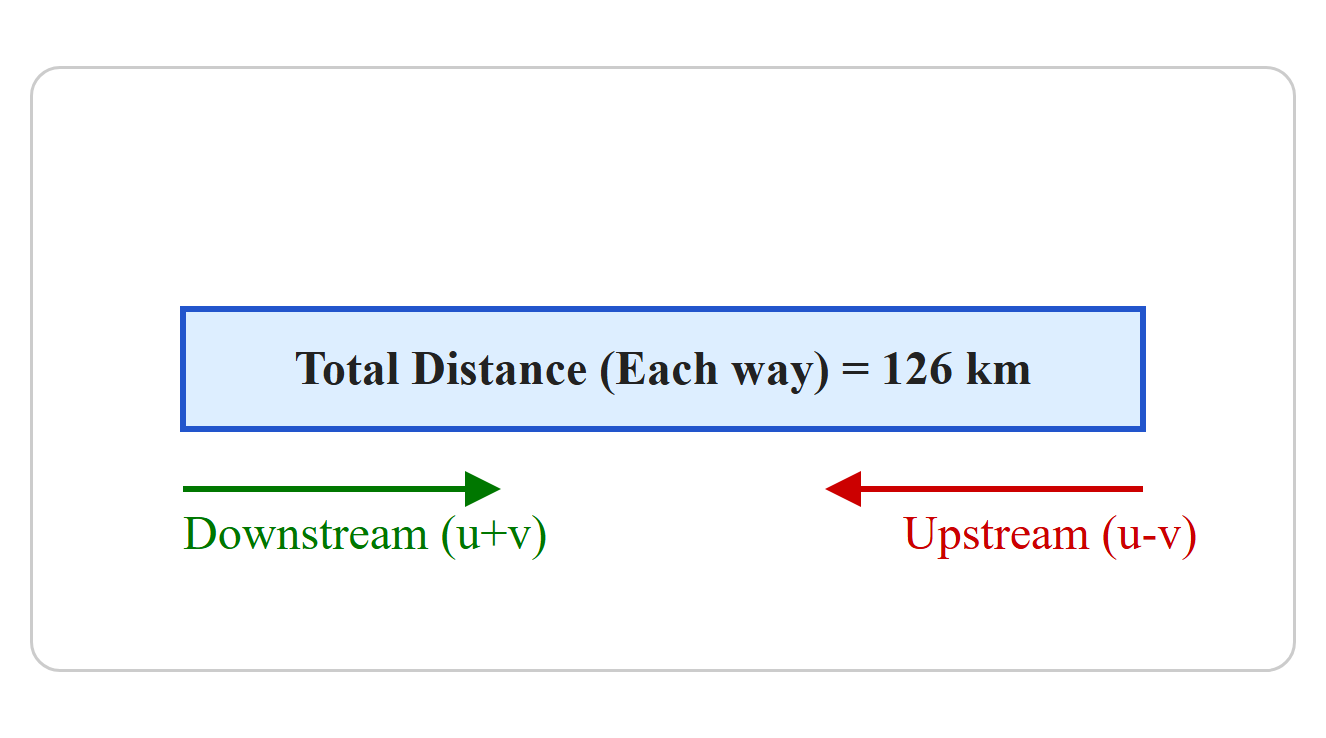
The ratio of speed of boat in still water and the current speed is 4:3, distance covered by boat in downstream speed and upstream speed is 126km each. find the speed of boat in still water if total time taken by boat in both downstream and upstream speed is 48 hours ?

  1. ((a))

    16 km/hr

  2. ((b))

    9 km/hr

  3. ((c))

    10.5 km/hr

  4. ((d))

    3 km/hr

  5. ((e))

    12 km/hr

Show Answer
Answer: ((e))

12 km/hr

Shortcut Trick

Ratio of Boat Speed (u) to Current Speed (v) = 4 : 3

Downstream Speed (D) = 4 + 3 = 7 units | Upstream Speed (U) = 4 − 3 = 1 unit

Total Time = Distance ÷ D + Distance ÷ U ⇒ 126/7x + 126/1x = 48

18/x + 126/x = 48 ⇒ 144/x = 48 ⇒ x = 3

Speed of boat in still water = 4 × 3 = 12 km/hr

∴ The correct answer is 12 km/hr.

Alternate Method

Given:

Ratio of still water speed (u) and current speed (v) = 4 : 3

Let u = 4x and v = 3x

Formula Used:

Downstream Speed (Sd) = u + v

Upstream Speed (Su) = u − v

Time = Distance ÷ Speed

Calculations:

⇒ Sd = 4x + 3x = 7x

⇒ Su = 4x − 3x = x

⇒ Total Time = (126 ÷ 7x) + (126 ÷ x) = 48

⇒ 18/x + 126/x = 48

⇒ 144/x = 48

⇒ x = 144 ÷ 48 = 3

⇒ Speed of boat in still water (u) = 4 × 3 = 12 km/hr

∴ The correct answer is 12 km/hr.

Additional Information

Relative Speed in Water

Downstream speed is the sum of boat speed and stream speed (u + v), while upstream is the difference (u − v).

Finding u and v from D and U

Speed in still water (u) = (D + U) ÷ 2 and Current speed (v) = (D − U) ÷ 2.

Average Speed for Round Trip

Average Speed = (Downstream Speed × Upstream Speed) ÷ Still Water Speed = (u2 − v2) ÷ u.

43

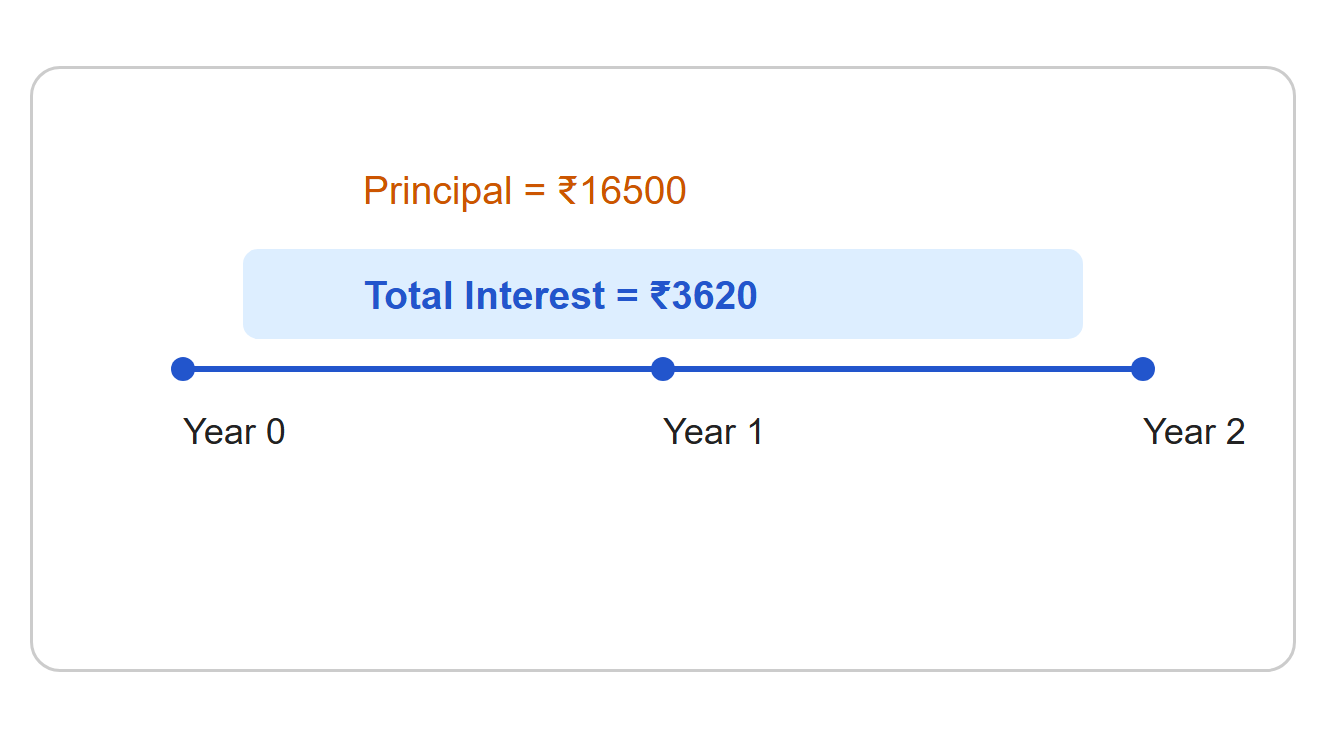
Rs. 16500 is split into two fixed deposits for 2 years at 10% and 12% Simple Interest. If the total interest received from the deposits is Rs. 3620, how much was invested in the 12% scheme?

  1. ((a))

    Rs.8500

  2. ((b))

    Rs.10500

  3. ((c))

    Rs. 9500

  4. ((d))

    Rs.10000

  5. ((e))

    Rs.8000

Show Answer
Answer: ((e))

Rs.8000

Shortcut Trick

Total Simple Interest for 1 year = 3620 ÷ 2 = ₹1810.

Overall effective interest rate = (1810 ÷ 16500) × 100 = 10.9696%.

Apply Alligation between 10% and 12%: (12 − 10.9696) : (10.9696 − 10) = 1.0304 : 0.9696.

Ratio of investments = 16 : 17 ⇒ 12% part = (16500 × 16) ÷ (16+17) is not clean; try interest deviation: If all at 10%, interest = 1650 ⇒ Difference = 1810 − 1650 = 160.

2% of Scheme B = 160 ⇒ Scheme B = (160 ÷ 2) × 100 = ₹8000.

∴ The correct answer is ₹8000.

Alternate Method

Given: Total Principal = ₹16500, Total Time = 2 years, Rates = 10% and 12%, Total Interest = ₹3620.

Formula Used: Simple Interest (SI) = (P × R × T) ÷ 100

⇒ Let the amount invested at 12% be ₹x.

⇒ Amount invested at 10% = ₹(16500 − x).

⇒ Total Interest = [x × 12 × 2 / 100] + [(16500 − x) × 10 × 2 / 100]

⇒ 3620 = 0.24x + 0.20(16500 − x)

⇒ 3620 = 0.24x + 3300 − 0.20x

⇒ 3620 − 3300 = 0.04x

⇒ 320 = 0.04x

⇒ x = 320 / 0.04 = 8000

∴ The correct answer is ₹8000.

Additional Information

Simple Interest vs Compound Interest

Simple interest is calculated only on the principal, whereas compound interest is calculated on the principal plus accumulated interest. Difference for 2 years = P(R/100)2.

Effective Rate of Interest

The overall rate when two different investments are combined can be found using the weighted average formula: Ravg = (P1R1 + P2R2) / (P1 + P2).

44

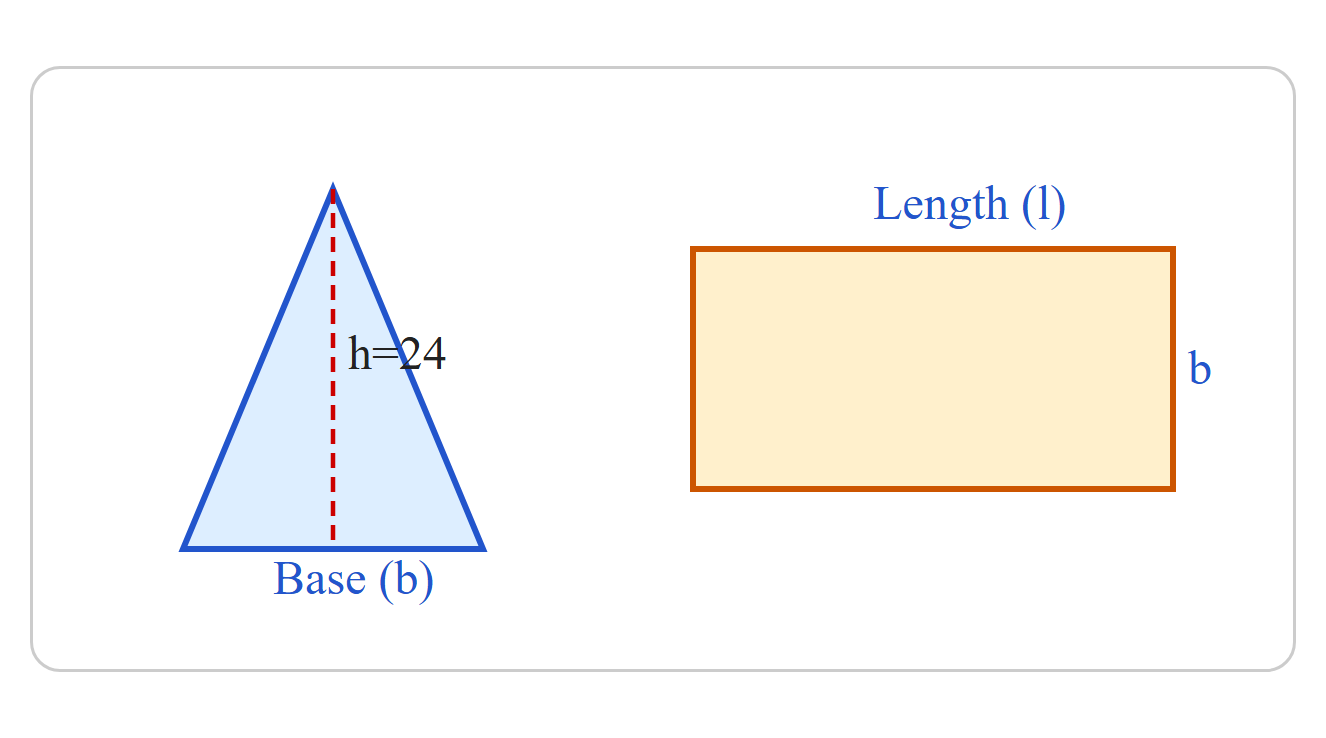
If the height of the triangle is 24 cm, and the area of the triangle is 168 sq. cm. The perimeter of the rectangle is 84 cm. If it were given that the base of a triangle is equal to the breadth of a rectangle. Find length of rectangle.

  1. ((a))

    30 cm

  2. ((b))

    32 cm

  3. ((c))

    28 cm

  4. ((d))

    40 cm

  5. ((e))

    25 cm

Show Answer
Answer: ((c))

28 cm

Shortcut Trick

Base of triangle = (2 × Area) ÷ Height = (2 × 168) ÷ 24 = 14 cm.

Given, Breadth of rectangle (b) = Base of triangle = 14 cm.

Length (l) = (Perimeter ÷ 2) − b = (84 ÷ 2) − 14 = 42 − 14 = 28 cm.

∴ The correct answer is 28 cm.

Alternate Method

Given: Height (h) = 24 cm, Area = 168 cm2, Perimeter (P) = 84 cm.

Formula Used: Area of triangle = (1/2) × base × height; Perimeter of rectangle = 2(l + b).

⇒ 168 = (1/2) × Base × 24

⇒ 168 = Base × 12

Base = 168 ÷ 12 = 14 cm

Breadth (b) of rectangle = 14 cm

⇒ 2(l + 14) = 84

⇒ l + 14 = 42

⇒ l = 42 − 14 = 28 cm

∴ The correct answer is 28 cm.

Additional Information

Area of Rectangle

The total region covered by a rectangle in a 2D plane is calculated as Length × Breadth (l × b).

Right-Angled Triangle Area

If the triangle is right-angled, the area is simply half the product of the two sides containing the right angle.

Semi-perimeter of Rectangle

The sum of length and breadth (l + b) is equal to half of the perimeter (P ÷ 2).

45

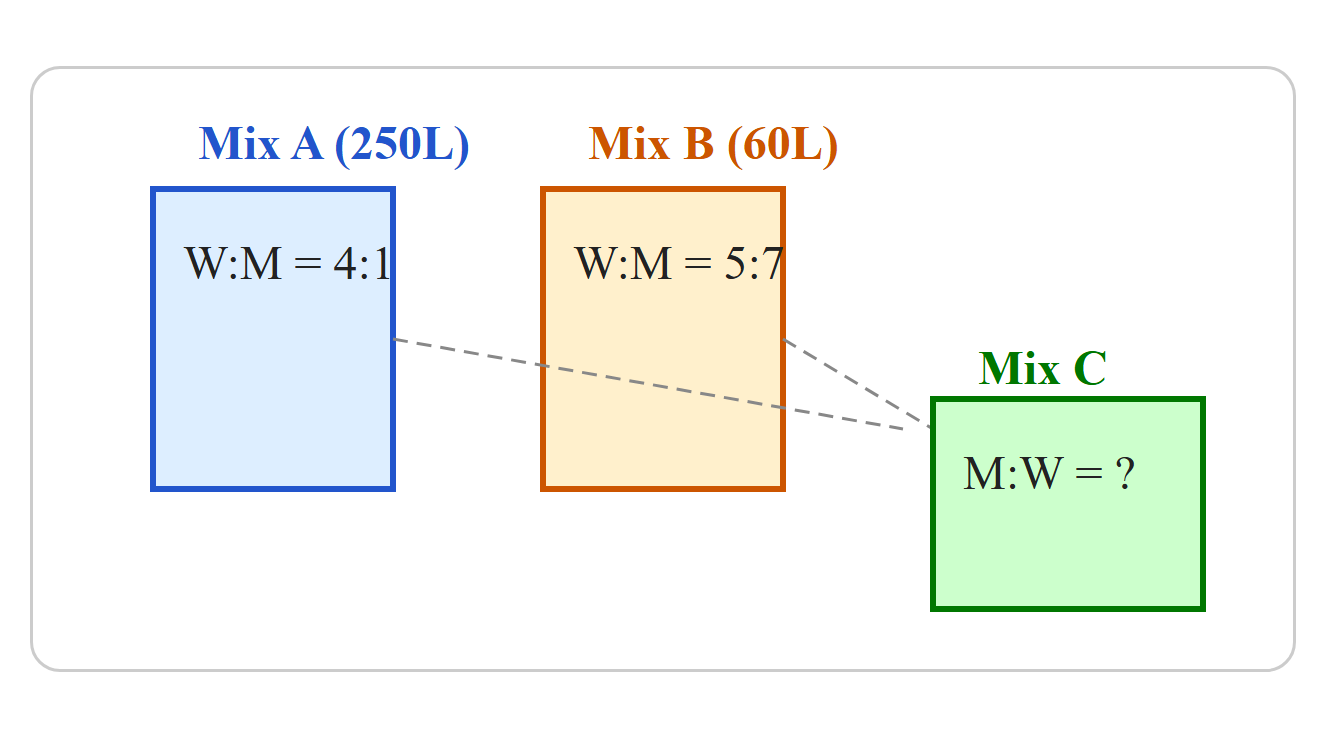
The ratio of water to milk in 250 liters of mixture A is 4:1. Mixture B has 25 liters of water and the ratio of water to milk in mixture B is 5:7. If 40% of mixture A and 80% of mixture B is Mixed and new mixture C is made then find the ratio of milk to water in Mixture C.

  1. ((a))

    15:17

  2. ((b))

    25:12

  3. ((c))

    23:16

  4. ((d))

    12:25

  5. ((e))

    None of the above

Show Answer
Answer: ((d))

12:25

Shortcut Trick

Mixture A (40% of 250L = 100L): Water : Milk = 4 : 1 ⇒ Water = 80L, Milk = 20L.

Mixture B (Total = 60L): Water (25L) is 5 units ⇒ Milk is 7 units (35L). 80% of B = 48L.

Mixture B components in C: Water = 80% of 25 = 20L, Milk = 80% of 35 = 28L.

Mixture C Total: Milk = 20 + 28 = 48L | Water = 80 + 20 = 100L.

Ratio Milk : Water = 48 : 100 = 12 : 25.

∴ The correct answer is 12:25.

Alternate Method

Given: Mixture A = 250L (Water:Milk = 4:1). Mixture B Water = 25L (Water:Milk = 5:7). Mixture C = 40% of A + 80% of B.

Step 1: Components of Mixture A taken

⇒ Quantity of A taken = 40% of 250 = 100L

⇒ Water in A taken = (4/5) × 100 = 80L

⇒ Milk in A taken = (1/5) × 100 = 20L

Step 2: Components of Mixture B taken

⇒ In B, Water = 25L (5 units) ∴ 1 unit = 5L

⇒ Milk in B = 7 units × 5 = 35L. Total B = 60L

⇒ Quantity of B taken = 80% of 60 = 48L

⇒ Water in B taken = 80% of 25 = 20L

⇒ Milk in B taken = 80% of 35 = 28L

Step 3: Ratio in Mixture C

⇒ Total Milk in C = 20 + 28 = 48L

⇒ Total Water in C = 80 + 20 = 100L

⇒ Ratio Milk : Water = 48 : 100 = 12 : 25

∴ The correct answer is 12:25.

Additional Information

Alligation Method

Used to find the ratio in which two ingredients at given prices/concentrations are mixed to produce a mixture of a mean price/concentration.

Replacement Method

When a part of a mixture is replaced by one of the components: Final Concentration = Initial Concentration × (1 − Replacement Volume/Total Volume)n.

Compound Ratio

When two or more ratios are multiplied together (a/b × c/d), the result is the compound ratio (ac/bd).

46

In the given question, two equations numbered l and II are given. Solve both the equations and mark the appropriate answer.

I. x2 + 18x + 77 = 0

II. 4y2 + 31y + 21 = 0

  1. ((a))

    x > y

  2. ((b))

    x < y

  3. ((c))

    x ≥ y

  4. ((d))

    x ≤ y

  5. ((e))

    x = y or relationship between x and y cannot be established.

Show Answer
Answer: ((d))

x ≤ y

I. x2 + 18x + 77 = 0

⇒ x2 + 7x + 11x + 77 = 0

⇒ x (x + 7) + 11 (x + 7) = 0

⇒ (x + 7) (x + 11) = 0

⇒ x = - 7, - 11


II. 4y2 + 31y + 21 = 0

⇒ 4y2 + 3y + 28y + 21 = 0

⇒ y (4y + 3) + 7 (4y + 3) = 0

⇒ (4y + 3) (y + 7) = 0

⇒ y = -3/4, -7  


Value of xValue of yRelation
-7-3/4x < y
-7-7x = y
-11-3/4x < y
-11-7x < y


Hence, x ≤ y

47

In the given question, two equations numbered l and II are given. Solve both the equations and mark the appropriate answer.

I. 2x2 – 33x + 136 = 0

II. 2y2 – 37y + 171 = 0

  1. ((a))

    x > y

  2. ((b))

    x < y

  3. ((c))

    x ≥ y

  4. ((d))

    x ≤ y

  5. ((e))

    x = y or relationship between x and y cannot be established.

Show Answer
Answer: ((b))

x < y

I. 2x2 – 33x + 136 = 0

⇒ 2x2 – 16x – 17x + 136 = 0

⇒ 2x(x – 8) – 17 (x – 8) = 0

⇒ (x – 8) (2x – 17) = 0

⇒ x = 8, 17/2


II. 2y2 – 37y + 171 = 0

⇒ 2y2 – 18y – 19y + 171 = 0

⇒ 2y (y – 9) – 19 (y – 9) = 0

⇒ (y – 9) (2y – 19) = 0,

⇒ y = 9, 19/2

Value of xValue of yRelation
89x < y
819/2x < y
17/29x < y
17/219/2x < y


Hence x < y

48

In the given question, two equations numbered l and II are given. Solve both the equations and mark the appropriate answer.

I. 5x2 – 38x + 65 = 0

II. 5y2 – 19y - 30 = 0

  1. ((a))

    x > y

  2. ((b))

    x < y

  3. ((c))

    x ≥ y

  4. ((d))

    x ≤ y

  5. ((e))

    x = y or relationship between x and y cannot be established.

Show Answer
Answer: ((e))

x = y or relationship between x and y cannot be established.

I. 5x2 – 38x + 65 = 0

⇒ 5x2 – 25x – 13x + 65 = 0

⇒ 5x (x – 5) – 13 (x – 5) = 0

⇒ (x – 5) (5x – 13) = 0

⇒ x = 5, 13/5


II. 5y2 – 19y - 30 = 0

⇒ 5y2 + 6y – 25y – 30 = 0

⇒ y (5y + 6) – 5 (5y + 6) = 0

⇒ (5y + 6) (y – 5) = 0

⇒ y = -6/5, 5


Value of xValue of yRelation
5-6/5x > y
55x = y
13/5-6/5x > y
13/55x < y


Hence, relationship between x and y cannot be established.

49

In the given question, two equations numbered l and II are given. Solve both the equations and mark the appropriate answer.

I. 12x2 + 11x + 2 = 0

II. y2 + 20y + 99 = 0

  1. ((a))

    x > y

  2. ((b))

    x < y

  3. ((c))

    x ≥ y

  4. ((d))

    x ≤ y

  5. ((e))

    x = y or relationship between x and y cannot be established.

Show Answer
Answer: ((a))

x > y

I. 12x2 + 11x + 2 = 0

⇒ 12x2 + 3x + 8x + 2 = 0

⇒ 3x (4x + 1) + 2 (4x + 1) = 0

⇒ (4x + 1) (3x + 2) = 0

⇒ x = -1/4, -2/3


II. y2 + 20y + 99 = 0

⇒ y2  + 11y + 9y + 99 = 0

⇒ y (y + 11) + 9 (y + 11) = 0

⇒ (y + 11) (y + 9) = 0

⇒ y = -11, -9  


Value of xValue of yRelation
-2/3-11x > y
-2/3-9x > y
-1/4-11x > y
-1/4-9x > y


Hence, x > y

50

In the given question, two equations numbered l and II are given. Solve both the equations and mark the appropriate answer.

I. 2x2 – 19x + 24 = 0

II. y2 – 25y + 144 = 0

  1. ((a))

    x > y

  2. ((b))

    x < y

  3. ((c))

    x ≥ y

  4. ((d))

    x ≤ y

  5. ((e))

    x = y or relationship between x and y cannot be established.

Show Answer
Answer: ((b))

x < y

I. 2x2 – 19x + 24 = 0

⇒ 2x2 – 3x – 16x + 24 = 0

⇒ x (2x – 3) – 8(2x – 3) = 0

⇒ (2x – 3) (x – 8) = 0

⇒ x = 3/2, 8


II. y2 – 25y + 144 = 0

⇒ y2 – 9y – 16y + 144 = 0

⇒ y (y – 9) – 16 (y – 9) = 0

⇒ (y – 9) (y – 16) = 0

⇒ y = 9, 16  


Value of xValue of yRelation
3/29x < y
3/216x < y
89x < y
816x < y


Hence, x < y

Directions: Answer the questions based on the information given below.

Four different warehouses displaced two different types of 'quantities' (P and Q) in the month of March. The line graph below shows the total number of 'quantities' displaced by each warehouse and the number of 'P' type of 'quantities' displaced by the same warehouse.

51

What is the average number of 'Q' type of 'quantities' displaced by warehouses 'B', 'C', and 'D'?

  1. ((a))

    340

  2. ((b))

    350

  3. ((c))

    360

  4. ((d))

    370

  5. ((e))

    380

Show Answer
Answer: ((b))

350

Putting all the values in a table we get

WarehouseTotal displaced quantities (P + Q)Displaced quantities of 'P' typeDisplaced quantities of 'Q' type
A750350750 - 350 = 400
B600250600 - 250 = 350
C650400650 - 400 = 250
D800350800 - 350 = 450
Total280013501450


Average number of 'Q' type of 'quantities' displaced by warehouses 'B', 'C', and 'D' = (350 + 250 + 450)/3 = 350

Hence, the correct answer is 350.

52

If each 'P' type of displaced 'quantity' costs Rs. 275 to a warehouse then find the total cost beared by all four warehouses from selling all 'P' type of quantities?

  1. ((a))

    Rs. 371250

  2. ((b))

    Rs. 372250

  3. ((c))

    Rs. 373250

  4. ((d))

    Rs. 374250

  5. ((e))

    Rs. 375250

Show Answer
Answer: ((a))

Rs. 371250

Putting all the values in a table we get

WarehouseTotal displaced quantities (P + Q)Displaced quantities of 'P' typeDisplaced quantities of 'Q' type
A750350750 - 350 = 400
B600250600 - 250 = 350
C650400650 - 400 = 250
D800350800 - 350 = 450
Total280013501450


The total cost beared by all four warehouses from selling all 'P' type of quantities = 275 × 1350 = 371250 Rs.

Hence, the correct answer is 371250 Rs.

53

If the number of 'Q' type of displaced 'quantities' for warehouse 'E' is 62.5% more than the number of 'Q' type of quantities displaced by warehouse 'A' and the number of 'P' type of displaced 'quantities' for warehouse 'E' is 250 more than the number of 'Q' type of quantities displaced by the same warehouse then find the total number of quantities displaced by warehouse 'E'?

  1. ((a))

    1150

  2. ((b))

    1250

  3. ((c))

    1350

  4. ((d))

    1450

  5. ((e))

    1550

Show Answer
Answer: ((e))

1550

Putting all the values in a table we get

WarehouseTotal displaced quantities (P + Q)Displaced quantities of 'P' typeDisplaced quantities of 'Q' type
A750350750 - 350 = 400
B600250600 - 250 = 350
C650400650 - 400 = 250
D800350800 - 350 = 450
Total280013501450


The number of 'Q' type of displaced 'quantities' for warehouse 'E' = (13/8) × 400 = 650

The number of 'P' type of displaced 'quantities' for warehouse 'E' = 650 + 250 = 900

Total number of quantities displaced by warehouse 'E' = 650 + 900 = 1550

Hence, the correct answer is 1550.

54

The total number of 'P' type of quantities displaced by warehouses 'A', 'C', and 'D' are approximately what percentage of the total number of quantities displaced by all four warehouses?

  1. ((a))

    36%

  2. ((b))

    37%

  3. ((c))

    38%

  4. ((d))

    39%

  5. ((e))

    40%

Show Answer
Answer: ((d))

39%

Putting all the values in a table we get

WarehouseTotal displaced quantities (P + Q)Displaced quantities of 'P' typeDisplaced quantities of 'Q' type
A750350750 - 350 = 400
B600250600 - 250 = 350
C650400650 - 400 = 250
D800350800 - 350 = 450
Total280013501450


The total number of 'P' type of quantities displaced by warehouses 'A', 'C', and 'D' = (350 + 400 + 350) = 1100

Required percentage = (1100/2800) × 100 = 39.28 ~ 39%

Hence, the correct answer is 39%.

55

Out of the total number of quantities displaced by all four warehouses 42.85% are returned back due to some defects then find the total number of quantities that are accepted and not returned back to all four warehouses?

  1. ((a))

    1200

  2. ((b))

    1400

  3. ((c))

    1600

  4. ((d))

    1800

  5. ((e))

    2000

Show Answer
Answer: ((c))

1600

Putting all the values in a table we get

WarehouseTotal displaced quantities (P + Q)Displaced quantities of 'P' typeDisplaced quantities of 'Q' type
A750350750 - 350 = 400
B600250600 - 250 = 350
C650400650 - 400 = 250
D800350800 - 350 = 450
Total280013501450


The total number of quantities that are accepted and not returned back to all four warehouses = (4/7) × 2800 = 1600

Hence, the correct answer is 1600.

56

The ratio of present ages of A and B is 7 : 8. After 6 years from now, the ratio of their ages will be 8 : 9. If C's present age is 10 years more than the present age of A, then the present age (in years) of C is:

  1. ((a))

    59

  2. ((b))

    56

  3. ((c))

    45

  4. ((d))

    52

  5. ((e))

    55

Show Answer
Answer: ((d))

52

Shortcut Trick

Ratio of A : B is 7 : 8 (Present) and 8 : 9 (After 6 years).

Change in ratio units for both is 8 − 7 = 1 unit and 9 − 8 = 1 unit.

Since the time gap is 6 years, 1 unit → 6 years.

A's present age = 7 units × 6 = 42 years.

C's present age = 42 + 10 = 52 years.

∴ The correct answer is 52 years.

Alternate Method

Given: Present age ratio A : B = 7 : 8. After 6 years, ratio A : B = 8 : 9. C = A + 10.

Calculation:

⇒ Let present ages of A and B be 7x and 8x.

⇒ (7x + 6) ÷ (8x + 6) = 8 ÷ 9

⇒ 9 × (7x + 6) = 8 × (8x + 6)

⇒ 63x + 54 = 64x + 48

⇒ 64x − 63x = 54 − 48

⇒ x = 6

A's present age = 7 × 6 = 42 years

C's present age = 42 + 10 = 52 years

∴ The correct answer is 52 years.

Additional Information

Age Difference Property

The difference between ages of two people remains constant regardless of the number of years passed.

Ratio Balancing Method

If the difference in ratio parts is not equal, multiply the ratios by the difference of the other ratio to balance them before solving.

Linear Equation in Ages

For any 'n' years after/before, add/subtract 'n' to the current age variables to form the equation: (Ax + n) / (Bx + n) = New Ratio.

57

Arvind gives 50% of his money to his son, 30% to his wife, and 62.5% of the remaining money is donated to a trust. He is left with 15,000 Rs. now. How much money did he have in the beginning?

  1. ((a))

    Rs. 2,05,000

  2. ((b))

    Rs. 2,25,000

  3. ((c))

    Rs. 2,10,000

  4. ((d))

    Rs. 2,00,000

  5. ((e))

    Rs. 1,90,000

Show Answer
Answer: ((d))

Rs. 2,00,000

Shortcut Trick

Let the Initial Amount be X.

Total percentage given to Son and Wife = 50% + 30% = 80%. Remaining = 20%.

Donation to trust = 62.5% of 20% = 5/8 × 20% = 12.5%. Final remaining = 20% − 12.5% = 7.5%.

7.5% of X = 15,000 ⇒ (3/40) × X = 15,000 ⇒ X = 2,00,000.

∴ The correct answer is ₹2,00,000.

Alternate Method

Given: Son = 50%, Wife = 30%, Trust = 62.5% of remaining, Left = ₹15,000.

Calculations:

⇒ Let total money = 100 units

⇒ Spent on Son and Wife = 50 + 30 = 80 units

⇒ Remaining money = 100 − 80 = 20 units

⇒ Donation to trust = 62.5% of 20 = (5/8) × 20 = 12.5 units

⇒ Final remaining amount = 20 − 12.5 = 7.5 units

⇒ 7.5 units = 15,000

⇒ 1 unit = 15,000 ÷ 7.5 = 2,000

⇒ Total money (100 units) = 100 × 2,000 = 2,00,000

∴ The correct answer is ₹2,00,000.

Additional Information

Percentage to Fraction Conversion

62.5% can be written as 5/8 and 12.5% as 1/8 to speed up calculations in competitive exams.

Successive Percentage Remainder

When spending from the 'remaining' amount, multiply the initial value by the remaining fractions: Final = Initial × (1 − r1) × (1 − r2).

58

Akshay invested Rs. 24,000 in a business. After few months Bikash joined with a capital of Rs. 18,000. After a year, profit is divided into ratio 16 : 7. After how many months, did Bikash join the business?

  1. ((a))

    3 months

  2. ((b))

    4 months

  3. ((c))

    5 months

  4. ((d))

    6 months

  5. ((e))

    7 months

Show Answer
Answer: ((c))

5 months

Shortcut Trick

Profit ratio is the product of Capital and Time ratios.

Capital ratio (Akshay : Bikash) = 24,000 : 18,000 = 4 : 3.

Time ratio = Profit ratio ÷ Capital ratio.

Time ratio = (16 ÷ 4) : (7 ÷ 3) = 4 : (7/3) = 12 : 7.

Since Akshay invested for 12 months, Bikash invested for 7 months.

Bikash joined after = 12 − 7 = 5 months.

∴ The correct answer is 5 months.

Alternate Method

Given → Akshay Capital = Rs. 24,000, Bikash Capital = Rs. 18,000, Akshay Time = 12 months, Profit Ratio = 16 : 7. Formulas: Profit Ratio = (C1 × T1) : (C2 × T2).

⇒ Let Bikash invested for t months. ⇒ (24,000 × 12) ÷ (18,000 × t) = 16 ÷ 7. ⇒ (4 × 12) ÷ (3 × t) = 16 ÷ 7. ⇒ 48 ÷ 3t = 16 ÷ 7. ⇒ 16 ÷ t = 16 ÷ 7. ⇒ t = 7 months. ⇒ Bikash joined after = 12 − 7 = 5 months.

∴ The correct answer is 5 months.

Additional Information

Partnership Basics

In a partnership, the profit is distributed among partners in the ratio of their investment multiplied by the duration of investment.

Joining vs Duration

If a person joins after 'x' months in a one-year business, the investment duration is (12 − x) months.

59

Two pipes can fill a tank in 12 hours and 15 hours respectively, while the third pipes can empty it in 18 hours. If first two pipes fill the tank for 5 hours then, time taken to empty the tank by third pipe ?

  1. ((a))

    13.5 hours

  2. ((b))

    12.5 hours

  3. ((c))

    11.5 hours

  4. ((d))

    15.5 hours

  5. ((e))

    14.5 hours

Show Answer
Answer: ((a))

13.5 hours

Shortcut Trick

Efficiency of Pipe A = 15, Pipe B = 12, Pipe C = −10 (Total Work 180).

Water filled in 5 hours by (A + B) = (15 + 12) × 5 = 135 units.

Time taken by Pipe C to empty this water = 135 ÷ 10 = 13.5 hours.

∴ The correct answer is 13.5 hr.

Alternate Method

Given: Filling time of Pipe 1 = 12 hr, Pipe 2 = 15 hr. Emptying time of Pipe 3 = 18 hr.

Formula Used: Efficiency = Total Work ÷ Time

PersonDaysTotal WorkEfficiency
Pipe 11218015
Pipe 21512
Pipe 318−10

Combined efficiency of first two pipes = 15 + 12 = 27 units/hr.

Work done in 5 hours = 27 × 5 = 135 units.

Time taken by third pipe to empty = 135 ÷ 10 = 13.5 hours.

∴ The correct answer is 13.5 hr.

Additional Information

Negative Efficiency

In Pipes and Cisterns, an outlet or leak is represented by negative efficiency as it reduces the total volume of water.

LCM Method for Total Work

Taking the Least Common Multiple of individual times as the total capacity of the tank simplifies calculations to integers.

Emptying the Filled Part

If a tank is partially filled and then only the outlet pipe is opened, the time taken is calculated based on the current volume of water, not the full capacity.

60

A train covers 400 km at a uniform speed. If the speed had been 10 km/h more, it would have taken 2 hours less for the same journey. What is the usual time taken (in hours) by it to complete the journey?

  1. ((a))

    12

  2. ((b))

    15

  3. ((c))

    8

  4. ((d))

    10

  5. ((e))

    14

Show Answer
Answer: ((d))

10

Shortcut Trick

Let the usual speed be S. Distance (D) = 400 km. Speed increase (x) = 10 km/h. Time difference (t) = 2 hours.

Using the formula: Distance = [S × (S + x) / x] × t

⇒ 400 = [S × (S + 10) / 10] × 2

⇒ 2000 = S(S + 10). By observation, S = 40 km/h (as 40 × 50 = 2000).

Usual Time = Distance ÷ Usual Speed = 400 ÷ 40 = 10 hours.

∴ The correct answer is 10 hours.

Alternate Method

Given: Total Distance = 400 km, Speed difference = 10 km/h, Time difference = 2 hours.

Formula Used: Time = Distance / Speed

⇒ Let usual speed be x km/h.

⇒ 400/x − 400/(x + 10) = 2

⇒ 400 [(x + 10 − x) / (x(x + 10))] = 2

⇒ 400 [10 / (x2 + 10x)] = 2

⇒ 4000 = 2(x2 + 10x)

⇒ x2 + 10x − 2000 = 0

⇒ x2 + 50x − 40x − 2000 = 0 ⇒ (x + 50)(x − 40) = 0

⇒ x = 40 km/h (Speed cannot be negative).

⇒ Usual Time = 400 / 40 = 10 hours.

∴ The correct answer is 10 hours.

Additional Information

Speed-Time Relation

For a constant distance, speed is inversely proportional to time (S ∝ 1/T). If speed increases, time decreases.

General Distance Formula

Distance = [Product of Speeds / Difference of Speeds] × Time Difference. This is useful for all 'late/early' or speed-change problems.

Average Speed

When a journey is split into two equal distances with speeds V1 and V2, Average Speed = 2V1V2 / (V1 + V2).

Directions: Answer the questions based on the information given below.

A survey is conducted among people about the type of 'music' genres (Folk, Rock, and Jazz) they prefer to listen. Each of the person prefer to listen at least one or more genres.The number of people who prefer to listen only 'Folk', only 'Rock and only 'Jazz' are in the ratio of 56 : 79 : 41. The number of people who prefer to listen both 'Folk' and 'Jazz' but not 'Rock' is 25% less the number of people who prefer to listen all three 'music' genres. The number of people who prefer to listen both 'Rock' and 'Jazz' but not 'Folk' and both 'Folk' and 'Rock' but not 'Jazz' are 50 and 35 respectively. The number of people who prefer to listen only 'Jazz' are five less than six times of the people who prefer to listen both 'Folk' and 'Rock' but not 'Jazz'. The total number of people who prefer to listen exactly two type of 'music' genres is equal to 130.

61

What is the number of people who prefer to listen all three types of 'music' genres?

  1. ((a))

    40

  2. ((b))

    44

  3. ((c))

    48

  4. ((d))

    52

  5. ((e))

    60

Show Answer
Answer: ((e))

60

The number of people who prefer to listen only 'Jazz' = 6 × 35 - 5 = 205

Let the total number of people who prefer to listen only 'Jazz' = 41x

ATQ, 41x = 205

⇒ x = 5

The total number of people who prefer to listen only 'folk' = 56x = 280

The total number of people who prefer to listen only 'Rock' = 79x = 395

Let the total number of people who prefer to listen all three genres = 4y

The number of people who prefer to listen both 'Folk' and 'Jazz' but not 'Rock' = 75% × 4y = 3y

The number of people who prefer to listen both 'Rock' and 'Jazz' but not 'Folk' = 50

The number of people who prefer to listen both 'Folk' and 'Rock' but not 'Jazz' = 35

The total number of people who prefer to listen exactly two type of 'music' genres = 130

ATQ, 3y + 50 + 35 = 130 ⇒ y = 15

The total number of people who prefer to listen all three genres = 4y = 60

The number of people who prefer to listen both 'Folk' and 'Jazz' but not 'Rock' = 3y = 45

The number of people who prefer to listen 'Folk' = 280 + 35 + 60 + 45 = 420

The number of people who prefer to listen 'Rock' = 395 + 35 + 60 + 50 = 540

The number of people who prefer to listen 'Jazz' = 205 + 45 + 60 + 50 = 360

The number of people who prefer to listen all three types of 'music' genres = 60

Hence, the correct answer is 60.

62

Find the total number of people who prefer to listen to only 'Folk' and to only 'Rock'?

  1. ((a))

    600

  2. ((b))

    625

  3. ((c))

    675

  4. ((d))

    700

  5. ((e))

    725

Show Answer
Answer: ((c))

675

The number of people who prefer to listen only 'Jazz' = 6 × 35 - 5 = 205

Let the total number of people who prefer to listen only 'Jazz' = 41x

ATQ, 41x = 205

⇒ x = 5

The total number of people who prefer to listen only 'folk' = 56x = 280

The total number of people who prefer to listen only 'Rock' = 79x = 395

Let the total number of people who prefer to listen all three genres = 4y

The number of people who prefer to listen both 'Folk' and 'Jazz' but not 'Rock' = 75% × 4y = 3y

The number of people who prefer to listen both 'Rock' and 'Jazz' but not 'Folk' = 50

The number of people who prefer to listen both 'Folk' and 'Rock' but not 'Jazz' = 35

The total number of people who prefer to listen exactly two type of 'music' genres = 130

ATQ, 3y + 50 + 35 = 130

⇒ y = 15

The total number of people who prefer to listen all three genres = 4y = 60

The number of people who prefer to listen both 'Folk' and 'Jazz' but not 'Rock' = 3y = 45

The number of people who prefer to listen 'Folk' = 280 + 35 + 60 + 45 = 420

The number of people who prefer to listen 'Rock' = 395 + 35 + 60 + 50 = 540

The number of people who prefer to listen 'Jazz' = 205 + 45 + 60 + 50 = 360

The total number of people who prefer to listen to only 'Folk' and to only 'Rock' = 280 + 395 = 675

Hence, the correct answer is 675.

63

The number of people who prefer to listen exactly one type of 'music' genre is how much more than the number of people who prefer to listen exactly two types of 'music' genres? 

  1. ((a))

    720

  2. ((b))

    730

  3. ((c))

    740

  4. ((d))

    750

  5. ((e))

    760

Show Answer
Answer: ((d))

750

The number of people who prefer to listen only 'Jazz' = 6 × 35 - 5 = 205

Let the total number of people who prefer to listen only 'Jazz' = 41x

ATQ, 41x = 205

⇒ x = 5

The total number of people who prefer to listen only 'folk' = 56x = 280

The total number of people who prefer to listen only 'Rock' = 79x = 395

Let the total number of people who prefer to listen all three genres = 4y

The number of people who prefer to listen both 'Folk' and 'Jazz' but not 'Rock' = 75% × 4y = 3y

The number of people who prefer to listen both 'Rock' and 'Jazz' but not 'Folk' = 50

The number of people who prefer to listen both 'Folk' and 'Rock' but not 'Jazz' = 35

The total number of people who prefer to listen exactly two type of 'music' genres = 130

ATQ, 3y + 50 + 35 = 130

⇒ y = 15

The total number of people who prefer to listen all three genres = 4y = 60

The number of people who prefer to listen both 'Folk' and 'Jazz' but not 'Rock' = 3y = 45

The number of people who prefer to listen 'Folk' = 280 + 35 + 60 + 45 = 420

The number of people who prefer to listen 'Rock' = 395 + 35 + 60 + 50 = 540

The number of people who prefer to listen 'Jazz' = 205 + 45 + 60 + 50 = 360

The number of people who prefer to listen exactly one type of 'music' genre = 280 + 395 + 205 = 880

The number of people who prefer to listen exactly two types of 'music' genres = 50 + 35 + 45 = 130

Required difference = 880 - 130 = 750

Hence, the correct answer is 750.

64

Find the total number of people who prefer to listen 'Rock'?

  1. ((a))

    520

  2. ((b))

    530

  3. ((c))

    540

  4. ((d))

    550

  5. ((e))

    560

Show Answer
Answer: ((c))

540

The number of people who prefer to listen only 'Jazz' = 6 × 35 - 5 = 205

Let the total number of people who prefer to listen only 'Jazz' = 41x

ATQ, 41x = 205

⇒ x = 5

The total number of people who prefer to listen only 'folk' = 56x = 280

The total number of people who prefer to listen only 'Rock' = 79x = 395

Let the total number of people who prefer to listen all three genres = 4y

The number of people who prefer to listen both 'Folk' and 'Jazz' but not 'Rock' = 75% × 4y = 3y

The number of people who prefer to listen both 'Rock' and 'Jazz' but not 'Folk' = 50

The number of people who prefer to listen both 'Folk' and 'Rock' but not 'Jazz' = 35

The total number of people who prefer to listen exactly two type of 'music' genres = 130

ATQ, 3y + 50 + 35 = 130

⇒ y = 15

The total number of people who prefer to listen all three genres = 4y = 60

The number of people who prefer to listen both 'Folk' and 'Jazz' but not 'Rock' = 3y = 45

The number of people who prefer to listen 'Folk' = 280 + 35 + 60 + 45 = 420

The number of people who prefer to listen 'Rock' = 395 + 35 + 60 + 50 = 540

The number of people who prefer to listen 'Jazz' = 205 + 45 + 60 + 50 = 360

The total number of people who prefer to listen 'Rock' = 540

Hence, the correct answer is 540.

65

What is the ratio between the number of people who prefer to listen 'Folk' and to 'Jazz'?

  1. ((a))

    3 : 2

  2. ((b))

    5 : 4

  3. ((c))

    7 : 6

  4. ((d))

    9 : 8

  5. ((e))

    11 : 10

Show Answer
Answer: ((c))

7 : 6

The number of people who prefer to listen only 'Jazz' = 6 × 35 - 5 = 205

Let the total number of people who prefer to listen only 'Jazz' = 41x

ATQ, 41x = 205

⇒ x = 5

The total number of people who prefer to listen only 'folk' = 56x = 280

The total number of people who prefer to listen only 'Rock' = 79x = 395

Let the total number of people who prefer to listen all three genres = 4y

The number of people who prefer to listen both 'Folk' and 'Jazz' but not 'Rock' = 75% × 4y = 3y

The number of people who prefer to listen both 'Rock' and 'Jazz' but not 'Folk' = 50

The number of people who prefer to listen both 'Folk' and 'Rock' but not 'Jazz' = 35

The total number of people who prefer to listen exactly two type of 'music' genres = 130

ATQ, 3y + 50 + 35 = 130

⇒ y = 15

The total number of people who prefer to listen all three genres = 4y = 60

The number of people who prefer to listen both 'Folk' and 'Jazz' but not 'Rock' = 3y = 45

The number of people who prefer to listen 'Folk' = 280 + 35 + 60 + 45 = 420

The number of people who prefer to listen 'Rock' = 395 + 35 + 60 + 50 = 540

The number of people who prefer to listen 'Jazz' = 205 + 45 + 60 + 50 = 360

Ratio between the number of people who prefer to listen 'Folk' and to 'Jazz' = 420 : 360 = 7 : 6

Hence, the correct answer is 7 : 6.

Reasoning Ability (35 questions)

Directions: Read the following instructions carefully to answer the given questions that follow:

There are seven persons (A - G), who were born in different years - 1961, 1968, 1972, 1988, 1993, 1999, and 2013. All the age calculations are done taking the base year as 2020.

D was born in a leap year but not in the year 1988. Only three persons were born between D and F. C is the eldest person among them all. The sum of the ages of A and F is a multiple of 13. B was born in an odd-numbered year but not in 1993 nor he was the last one to be born. The difference between the ages of G and D is 4 years.

66

Who was born in the year 1993?

  1. ((a))

    A

  2. ((b))

    E

  3. ((c))

    B

  4. ((d))

    D

  5. ((e))

    None of these

Show Answer
Answer: ((b))

E

Given that:

There are seven persons, who were born in different years - 1961, 1968, 1972, 1988, 1993, 1999, and 2013. All the age calculations are done taking the base year as 2020.

So, their ages are:

YearAgePersons
Case ICase II
196159
196852
197248
198832
199327
199921
201307


1) D was born in a leap year but not in the year 1988.

So, here there are 3 leap years - 1968, 1972 and 1988 (all are divisible by 4)

So, 2 cases will generate D can born either in 1968 or 1972:

YearAgePersons
Case ICase II
196159
196852D
197248D
198832
199327
199921
201307


2) Only three persons were born between D and F.

  1. C is the eldest person among them all.

So, C was born in 1961:

YearAgePersons
Case ICase II
196159CC
196852D
197248D
198832
199327
199921F
201307F


4) The difference between the ages of G and D is 4 years.


YearAgePersons
Case ICase II
196159CC
196852DG
197248GD
198832
199327
199921F
201307F


5) B was born in an odd-numbered year but not in 1993 nor he was the last one to be born.

Here, B was born in 1999, neither in 1993 nor in 2013 (at last).

  1. The sum of the ages of A and F is a multiple of 13.

Here, age is 32 + 7 = 39 (39 is a multiple of 13).

So in there 2 statements Case I will be eliminate:

Here we have case II:

YearAgePersons
196159C
196852G
197248D
198832A
199327E
199921B
201307F


E was born in the year 1993.

67

What is the sum of the ages of C and B?

  1. ((a))

    81

  2. ((b))

    79

  3. ((c))

    80

  4. ((d))

    77

  5. ((e))

    83

Show Answer
Answer: ((c))

80

Given that:

There are seven persons, who were born in different years - 1961, 1968, 1972, 1988, 1993, 1999, and 2013. All the age calculations are done taking the base year as 2020.

So, their ages are:

YearAgePersons
Case ICase II
196159
196852
197248
198832
199327
199921
201307


1) D was born in a leap year but not in the year 1988.

So, here there are 3 leap years - 1968, 1972 and 1988 (all are divisible by 4)

So, 2 cases will generate D can born either in 1968 or 1972:

YearAgePersons
Case ICase II
196159
196852D
197248D
198832
199327
199921
201307


2) Only three persons were born between D and F. 

  1. C is the eldest person among them all.

So, C was born in 1961:

YearAgePersons
Case ICase II
196159CC
196852D
197248D
198832
199327
199921F
201307F


4) The difference between the ages of G and D is 4 years.


YearAgePersons
Case ICase II
196159CC
196852DG
197248GD
198832
199327
199921F
201307F


5) B was born in an odd-numbered year but not in 1993 nor he was the last one to be born.

Here, B was born in 1999, neither in 1993 nor in 2013 (at last).

  1. The sum of the ages of A and F is a multiple of 13.

Here, age is 32 + 7 = 39 (39 is a multiple of 13).

So in there 2 statements Case I will be eliminate:

Here we have case II:

YearAgePersons
196159C
196852G
197248D
198832A
199327E
199921B
201307F


The sum of the ages of C and B is → 59 + 21 = 80 years.

68

How many persons are born between G and D?

  1. ((a))

    None

  2. ((b))

    One

  3. ((c))

    Three

  4. ((d))

    Two

  5. ((e))

    Four

Show Answer
Answer: ((a))

None

Given that:

There are seven persons, who were born in different years - 1961, 1968, 1972, 1988, 1993, 1999, and 2013. All the age calculations are done taking the base year as 2020.

So, their ages are:

YearAgePersons
Case ICase II
196159
196852
197248
198832
199327
199921
201307


1) D was born in a leap year but not in the year 1988.

So, here there are 3 leap years - 1968, 1972 and 1988 (all are divisible by 4)

So, 2 cases will generate D can born either in 1968 or 1972:

YearAgePersons
Case ICase II
196159
196852D
197248D
198832
199327
199921
201307


2) Only three persons were born between D and F. 

  1. C is the eldest person among them all.

So, C was born in 1961:

YearAgePersons
Case ICase II
196159CC
196852D
197248D
198832
199327
199921F
201307F


4) The difference between the ages of G and D is 4 years.


YearAgePersons
Case ICase II
196159CC
196852DG
197248GD
198832
199327
199921F
201307F


5) B was born in an odd-numbered year but not in 1993 nor he was the last one to be born.

Here, B was born in 1999, neither in 1993 nor in 2013 (at last).

  1. The sum of the ages of A and F is a multiple of 13.

Here, age is 32 + 7 = 39 (39 is a multiple of 13).

So in there 2 statements Case I will be eliminate:

Here we have case II:

YearAgePersons
196159C
196852G
197248D
198832A
199327E
199921B
201307F


No one is born between G and D, so none.

69

Four of the five are alike in a certain way thus form a group. Which one does not belong to that group?

  1. ((a))

    F

  2. ((b))

    G

  3. ((c))

    B

  4. ((d))

    E

  5. ((e))

    C

Show Answer
Answer: ((b))

G

Given that:

There are seven persons, who were born in different years - 1961, 1968, 1972, 1988, 1993, 1999, and 2013. All the age calculations are done taking the base year as 2020.

So, their ages are:

YearAgePersons
Case ICase II
196159
196852
197248
198832
199327
199921
201307


1) D was born in a leap year but not in the year 1988.

So, here there are 3 leap years - 1968, 1972 and 1988 (all are divisible by 4)

So, 2 cases will generate D can born either in 1968 or 1972:

YearAgePersons
Case ICase II
196159
196852D
197248D
198832
199327
199921
201307


2) Only three persons were born between D and F. 

  1. C is the eldest person among them all.

So, C was born in 1961:

YearAgePersons
Case ICase II
196159CC
196852D
197248D
198832
199327
199921F
201307F


4) The difference between the ages of G and D is 4 years.


YearAgePersons
Case ICase II
196159CC
196852DG
197248GD
198832
199327
199921F
201307F


5) B was born in an odd-numbered year but not in 1993 nor he was the last one to be born.

Here, B was born in 1999, neither in 1993 nor in 2013 (at last).

  1. The sum of the ages of A and F is a multiple of 13.

Here, age is 32 + 7 = 39 (39 is a multiple of 13).

So in there 2 statements Case I will be eliminate:

Here we have case II:

YearAgePersons
196159C
196852G
197248D
198832A
199327E
199921B
201307F


G does not belong to the group as G was born in the even - numbered years.

70

B was born in which year?

  1. ((a))

    1999

  2. ((b))

    2013

  3. ((c))

    1993

  4. ((d))

    1988

  5. ((e))

    1968

Show Answer
Answer: ((a))

1999

Given that:

There are seven persons, who were born in different years - 1961, 1968, 1972, 1988, 1993, 1999, and 2013. All the age calculations are done taking the base year as 2020.

So, their ages are:

YearAgePersons
Case ICase II
196159
196852
197248
198832
199327
199921
201307


1) D was born in a leap year but not in the year 1988.

So, here there are 3 leap years - 1968, 1972 and 1988 (all are divisible by 4)

So, 2 cases will generate D can born either in 1968 or 1972:

YearAgePersons
Case ICase II
196159
196852D
197248D
198832
199327
199921
201307


2) Only three persons were born between D and F. 

  1. C is the eldest person among them all.

So, C was born in 1961:

YearAgePersons
Case ICase II
196159CC
196852D
197248D
198832
199327
199921F
201307F


4) The difference between the ages of G and D is 4 years.


YearAgePersons
Case ICase II
196159CC
196852DG
197248GD
198832
199327
199921F
201307F


5) B was born in an odd-numbered year but not in 1993 nor he was the last one to be born.

Here, B was born in 1999, neither in 1993 nor in 2013 (at last).

  1. The sum of the ages of A and F is a multiple of 13.

Here, age is 32 + 7 = 39 (39 is a multiple of 13).

So in there 2 statements Case I will be eliminate:

Here we have case II:

YearAgePersons
196159C
196852G
197248D
198832A
199327E
199921B
201307F


B was born in 1999.

71

DIRECTIONS: In the following question assuming the given statements to be true, find which of the conclusion among the given conclusions is/are definitely true and then give your answers accordingly.

Statements : F = S > G < V, Q > P > X, F ≥ X, V < M

Conclusions: 

I. M > G

II. S < Q

  1. ((a))

    Only conclusion I follows

  2. ((b))

    Only conclusion Ii follows

  3. ((c))

    Either conclusion I or II follows

  4. ((d))

    Neither conclusion I nor II follows

  5. ((e))

    Both conclusion I and II follows

Show Answer
Answer: ((a))

Only conclusion I follows

Given Statements : F = S ≥ G < V, Q > P ≥ X, F ≥ X, V ≤ M

On combining :  Q > P ≥  X ≤ F = S ≥ G < V ≤ M

I. M > G → True ( As M ≥ V > G is definitely true, Hence M > G is true )

II. S < Q → False ( As Q > P ≥  X ≤ F = S, So there is no direct relation between S and Q, Hence S < Q will be false.)

Hence, Only conclusion I follow.

72

DIRECTIONS: In the following question assuming the given statements to be true, find which of the conclusion among the given conclusions is/are definitely true and then give your answers accordingly.

Statements : P > Q < R, R = S > T, T <  U > V

Conclusions :

I. S > P

II. U > R

  1. ((a))

    Only conclusion I follows

  2. ((b))

    Only conclusion II follows

  3. ((c))

    Both Conclusion I and II follow

  4. ((d))

    Neither I  nor II follow

  5. ((e))

    Either I or II follow

Show Answer
Answer: ((d))

Neither I  nor II follow

Given statements : P > Q < R, R = S ≥ T, T ≤  U > V

On combining : P > Q < R = S ≥ T ≤ U > V

(I) S > P → False (as S = R > Q < P there is no direct relation given between the two, it might be a possibility but not definitely true, Hence false )

(II) U > R → False (as U ≥ T ≤ S = R there is no direct relation given between the two, it might be a possibility but not definitely true, Hence false ).

Hence, Neither I nor  II follows.

73

DIRECTIONS: In the following question assuming the given statements to be true, find which of the conclusion among the given conclusions is/are definitely true and then give your answers accordingly.

Statements : T > N < V = L ≤ W < K, V = H > I > F

Conclusions :

I. V > F

II. T > H

  1. ((a))

    Only conclusion I follows

  2. ((b))

    Only conclusion II follows

  3. ((c))

    Either conclusion I or II follow

  4. ((d))

    Neither conclusion I nor II follow

  5. ((e))

    Both Conclusion I and II follow

Show Answer
Answer: ((a))

Only conclusion I follows

Given statements:  T > N < V = L ≤ W < K, V = H > I > F

On combining:   T > N < V = L ≤ W < K,  T > N < V = H > I > F

I. V > F → True ( As V = H > I > F so V > F is true )

II. T > H → False ( As T > N < V = H > I > F no direct relation is given between the two, so it is possibility but not definitely true Hence T > H is false)

Only I follow.

Direction: Study the given information and answer the following questions:

Nine persons namely A, B, C, E, F, G, H, K and M are buying books but not necessarily in the same order. At least six persons buy books after H. Two persons buy books between H and C. M buys book immediately after F and immediately before E. Not more than two persons buy books between C and E. A buys book before G and after H. G is not the last one to buy book. Less than three persons buy books between G and B. B buy book before G but not at the first.

74

Who is the second last person to buy a book?

  1. ((a))

    A

  2. ((b))

    M

  3. ((c))

    E

  4. ((d))

    G

  5. ((e))

    F

Show Answer
Answer: ((b))

M

Persons: A, B, C, E, F, G, H, K and M.

1. At least six persons buy books after H. 2. Two persons buy books between H and C. 

S. NoCase 1Case 2Case 3
1H
2H
3H
4C
5C
6C
7
8
9

3. M buys book immediately after F and immediately before E. 4. Not more than two persons buy books between C and E.

S. NoCase 1Case 2Case 3
1H
2H
3H
4C
5CF
6CFM
7FME
8ME
9E

5. A buys book before G and after H. 6. G is not the last one to buy book.

S. NoCase 1Case 2Case 3Case 4Case 5
1HHH
2HAA
3HAGA
4AGCCC
5GCFFF
6CFMMM
7FMEEE
8MEGG
9E

7. Less than three persons buy books between G and B. 8. B buy book before G but not at the first. 9. So Case 2, 3, 4 and 5  is eliminated.

The final arrangement is,

S. NoCase 1
1K
2B
3H
4A
5G
6C
7F
8M
9E

Hence**, M is the second last person to buy a book.**

75

How many persons buys book between B and E?

  1. ((a))

    Three

  2. ((b))

    Four

  3. ((c))

    Five

  4. ((d))

    Six

  5. ((e))

    Seven

Show Answer
Answer: ((d))

Six

Persons: A, B, C, E, F, G, H, K and M.

1. At least six persons buy books after H. 2. Two persons buy books between H and C. 

S. NoCase 1Case 2Case 3
1H
2H
3H
4C
5C
6C
7
8
9

3. M buys book immediately after F and immediately before E. 4. Not more than two persons buy books between C and E.

S. NoCase 1Case 2Case 3
1H
2H
3H
4C
5CF
6CFM
7FME
8ME
9E

5. A buys book before G and after H. 6. G is not the last one to buy book.

S. NoCase 1Case 2Case 3Case 4Case 5
1HHH
2HAA
3HAGA
4AGCCC
5GCFFF
6CFMMM
7FMEEE
8MEGG
9E

7. Less than three persons buy books between G and B. 8. B buy book before G but not at the first. 9. So Case 2, 3, 4 and 5  is eliminated.

The final arrangement is,

S. NoCase 1
1K
2B
3H
4A
5G
6C
7F
8M
9E

Hence, six persons buy books between B and E.

76

Who is the first person to buy the book?

  1. ((a))

    K

  2. ((b))

    A

  3. ((c))

    M

  4. ((d))

    E

  5. ((e))

    F

Show Answer
Answer: ((a))

K

Persons: A, B, C, E, F, G, H, K and M.

1. At least six persons buy books after H. 2. Two persons buy books between H and C. 

S. NoCase 1Case 2Case 3
1H
2H
3H
4C
5C
6C
7
8
9

3. M buys book immediately after F and immediately before E. 4. Not more than two persons buy books between C and E.

S. NoCase 1Case 2Case 3
1H
2H
3H
4C
5CF
6CFM
7FME
8ME
9E

5. A buys book before G and after H. 6. G is not the last one to buy book.

S. NoCase 1Case 2Case 3Case 4Case 5
1HHH
2HAA
3HAGA
4AGCCC
5GCFFF
6CFMMM
7FMEEE
8MEGG
9E

7. Less than three persons buy books between G and B. 8. B buy book before G but not at the first. 9. So Case 2, 3, 4 and 5  is eliminated.

The final arrangement is,

S. NoCase 1
1K
2B
3H
4A
5G
6C
7F
8M
9E

Hence, K is the first person to buy a book.

77

If F and K interchange their position, then how many persons buy books between F and E?

  1. ((a))

    Three

  2. ((b))

    Five

  3. ((c))

    Four

  4. ((d))

    Six

  5. ((e))

    Seven

Show Answer
Answer: ((e))

Seven

Persons: A, B, C, E, F, G, H, K and M.

1. At least six persons buy books after H. 2. Two persons buy books between H and C. 

S. NoCase 1Case 2Case 3
1H
2H
3H
4C
5C
6C
7
8
9

3. M buys book immediately after F and immediately before E. 4. Not more than two persons buy books between C and E.

S. NoCase 1Case 2Case 3
1H
2H
3H
4C
5CF
6CFM
7FME
8ME
9E

5. A buys book before G and after H. 6. G is not the last one to buy book.

S. NoCase 1Case 2Case 3Case 4Case 5
1HHH
2HAA
3HAGA
4AGCCC
5GCFFF
6CFMMM
7FMEEE
8MEGG
9E

7. Less than three persons buy books between G and B. 8. B buy book before G but not at the first. 9. So Case 2, 3, 4 and 5  is eliminated.

The final arrangement is,

S. NoCase 1
1K
2B
3H
4A
5G
6C
7F
8M
9E

If F and K interchange their position

S. NoCase 1
1F
2B
3H
4A
5G
6C
7K
8M
9E

Hence, if F and K interchange their position, seven persons buy books between F and E.

78

Find the odd one out.

  1. ((a))

    FA

  2. ((b))

    BG

  3. ((c))

    AE

  4. ((d))

    GM

  5. ((e))

    AK

Show Answer
Answer: ((c))

AE

Persons: A, B, C, E, F, G, H, K and M.

1. At least six persons buy books after H. 2. Two persons buy books between H and C. 

S. NoCase 1Case 2Case 3
1H
2H
3H
4C
5C
6C
7
8
9

3. M buys book immediately after F and immediately before E. 4. Not more than two persons buy books between C and E.

S. NoCase 1Case 2Case 3
1H
2H
3H
4C
5CF
6CFM
7FME
8ME
9E

5. A buys book before G and after H. 6. G is not the last one to buy book.

S. NoCase 1Case 2Case 3Case 4Case 5
1HHH
2HAA
3HAGA
4AGCCC
5GCFFF
6CFMMM
7FMEEE
8MEGG
9E

7. Less than three persons buy books between G and B. 8. B buy book before G but not at the first. 9. So Case 2, 3, 4 and 5  is eliminated.

The final arrangement is,

S. NoCase 1
1K
2B
3H
4A
5G
6C
7F
8M
9E

Every pair except AE has two persons between them. But AE has four persons in between them.

Hence, AE is the odd one out.

79

If 1 is added to each even digit and 1 is subtracted from each odd digit in the number 6953265 , then what will be the sum of numbers not repeated in the new number formed?

  1. ((a))

    9

  2. ((b))

    14

  3. ((c))

    13

  4. ((d))

    17

  5. ((e))

    8

Show Answer
Answer: ((c))

13

Given: 6953265

By adding 1 in the even digits and subtracting 1 from the odd digits, we will get,

Numbers6953265
Operation+1-1-1-1+1+1-1
New number7842374


Here can clearly says that 8, 2 and 3 are not repeated. Therefore, sum of the number = 8+2+3=13

Hence "13" is correct answer.

Direction: Study the following information carefully to answer the given questions.

In a certain code language,

'for the victory sign' is coded as 'si vi th fo', 

‘empty the apartment now’ is coded as ‘no ap th em’

‘now for the finale’ is coded as ‘fi th fo no’

‘for empty sign victory’ is coded as ‘vi si em fo’

80

What is the code for 'now'?

  1. ((a))

    si

  2. ((b))

    vi

  3. ((c))

    th

  4. ((d))

    no

  5. ((e))

    fo

Show Answer
Answer: ((d))

no

Given statement:

'for the victory sign' is coded as 'si vi th fo', 

‘empty the apartment now’ is coded as ‘no ap th em’

‘now for the finale’ is coded as ‘fi th fo no’

‘for empty sign victory’ is coded as ‘vi si em fo’

We get:

for - fo

the - th

empty - em

now – no

The codes for ‘apartment’ and ‘finale’ is determined by elimination, i.e. all the other codes in the sentence are determined:

apartment - ap

finale – fi

We can not clearly determine the codes for ‘victory’ and ‘sign’:

victory – vi/si

sign – si/vi

<br>

The code for 'Now' is no.

81

What is the code for 'victory'?

  1. ((a))

    vi

  2. ((b))

    th

  3. ((c))

    fo

  4. ((d))

    si

  5. ((e))

    Either vi or si

Show Answer
Answer: ((e))

Either vi or si

Given statement:

'for the victory sign' is coded as 'si vi th fo', 

‘empty the apartment now’ is coded as ‘no ap th em’

‘now for the finale’ is coded as ‘fi th fo no’

‘for empty sign victory’ is coded as ‘vi si em fo’

We get:

for - fo

the - th

empty - em

now – no

The codes for ‘apartment’ and ‘finale’ is determined by elimination, i.e. all the other codes in the sentence are determined:

apartment - ap

finale – fi

We can not clearly determine the codes for ‘victory’ and ‘sign’:

victory – vi/si

sign – si/vi

The code for 'Victory' is either vi or si.

82

What is the code for 'finale'?

  1. ((a))

    ap

  2. ((b))

    fi

  3. ((c))

    th

  4. ((d))

    fo

  5. ((e))

    no

Show Answer
Answer: ((b))

fi

Given statement:

'for the victory sign' is coded as 'si vi th fo', 

‘empty the apartment now’ is coded as ‘no ap th em’

‘now for the finale’ is coded as ‘fi th fo no’

‘for empty sign victory’ is coded as ‘vi si em fo’

We get:

for - fo

the - th

empty - em

now – no

The codes for ‘apartment’ and ‘finale’ is determined by elimination, i.e. all the other codes in the sentence are determined:

apartment - ap

finale – fi

We can not clearly determine the codes for ‘victory’ and ‘sign’:

victory – vi/si

sign – si/vi

The code for 'Finale' is fi.

83

If the code for 'all good for victory' is coded as 'vi fo go al', how will 'the empty sign' be coded as?

  1. ((a))

    th em vi

  2. ((b))

    si em fo

  3. ((c))

    si em th

  4. ((d))

    fi th fo

  5. ((e))

    None of the above

Show Answer
Answer: ((c))

si em th

Given statement:

'for the victory sign' is coded as 'si vi th fo', 

‘empty the apartment now’ is coded as ‘no ap th em’

‘now for the finale’ is coded as ‘fi th fo no’

‘for empty sign victory’ is coded as ‘vi si em fo’

We get:

for - fo

the - th

empty - em

now – no

The codes for ‘apartment’ and ‘finale’ is determined by elimination, i.e. all the other codes in the sentence are determined:

apartment - ap

finale – fi

We can not clearly determine the codes for ‘victory’ and ‘sign’:

victory – vi/si

sign – si/vi

The code for 'the empty sign' is 'si em th'.

84

What is the code for 'apartment'?

  1. ((a))

    ap

  2. ((b))

    th

  3. ((c))

    em

  4. ((d))

    no

  5. ((e))

    fo

Show Answer
Answer: ((a))

ap

Given statement:

'for the victory sign' is coded as 'si vi th fo', 

‘empty the apartment now’ is coded as ‘no ap th em’

‘now for the finale’ is coded as ‘fi th fo no’

‘for empty sign victory’ is coded as ‘vi si em fo’

We get:

for - fo

the - th

empty - em

now – no

The codes for ‘apartment’ and ‘finale’ is determined by elimination, i.e. all the other codes in the sentence are determined:

apartment - ap

finale – fi

We can not clearly determine the codes for ‘victory’ and ‘sign’:

victory – vi/si

sign – si/vi

The code for 'apartment' is 'ap'.

85

If it is possible to make only one meaningful 4 letter English word with the 1st, 3rd, 6th, and 8th letter of the word PROPELLER, which of the following will be the third letter from the left of that word? If no such word can be made give ‘X’ as the answer and if more than one such word can be made give ‘Y’ as the answer.

  1. ((a))

    X

  2. ((b))

    O

  3. ((c))

    L

  4. ((d))

    Y

  5. ((e))

    E

Show Answer
Answer: ((d))

Y

Given words: PROPELLER

1st, 3rd, 6th, and 8th letter of the word PROPELLER is: P, O, L, and E

Combining and un-jumbling the letters we get: POLE and LOPE

Since 2 words are possible from the letters.

The answer is Y.

86

Four of the following five are alike in a certain way and so form a group. Which is the one that does not belong to that group?

  1. ((a))

    ZXV

  2. ((b))

    DBZ

  3. ((c))

    GIK

  4. ((d))

    FDB

  5. ((e))

    KIG

Show Answer
Answer: ((c))

GIK

The pattern for the code is as follows,

As per the English Alphabetical Series,

Z - 2 = X; X - 2 = V

D - 2 = B; B - 2 = Z

G + 2 = I; I + 2 = K

F - 2 = D; D - 2 = B

K - 2 = I; I - 2 = G

'GIK' is the odd one out.

Direction: Study the following information and answer the following questions.

Five persons are working in a bank. Their designations are CEO, CFO, Manager, Clerk, and Peon. The sequence of the posts is as above i.e. CEO is the senior most and Peon is the junior most person. They have a different number of pens. No two persons have the same number of pens.

Two persons are junior to Z. The difference in the number of pens between R and Z is 14 and Z has the least number of pens. The one who is just senior to the one who is Manager has 33 pens. A is just senior to the one who has 45 pens. There is one designation between the Manager and R. A has 11 pens more and 9 pen more than W and Q respectively. One designation lies between the one who has 33 pens and A.

87

How many total number of pens have by the persons who are on the post of CEO and CFO?

  1. ((a))

    64

  2. ((b))

    66

  3. ((c))

    68

  4. ((d))

    70

  5. ((e))

    72

Show Answer
Answer: ((c))

68

Given:

5 designations - CEO, CFO, Manager, Clerk, and Peon

CEO is the senior most and Peon is the juniormost person. 

They have a different number of pens such that no two persons have the same number of pens.

Now,

  1. Two persons are junior to Z. It means Z is a Manager.

  2. The one who is just senior to the one who is Manager has 33 pens. It means CFO has 33 pens.

  3. One designation lies between the one who has 33 pens and A. It means A is Clerk.

PostsPersonsNumber of Pens
CEO
CFO33
ManagerZ
ClerkA
Peon


  1. A is just senior to the one who has 45 pens. It means Peon has 45 pens.

  2. There is one designation between the Manager and R. It means R can be either CEO or Peon.

Case I

PostsPersonsNumber of Pens
CEOR
CFO33
ManagerZ
ClerkA
Peon45


Case II

PostsPersonsNumber of Pens
CEO
CFO33
ManagerZ
ClerkA
PeonR45


  1. A has 11 pens more and 9 pens more than W and Q respectively. It means A = W+11 and A = Q+9. W+11 = Q+9. Q-W = 2. Q has more pens than W. In case I, Q has 45 pens and W has 33 pens. But 45-33 is not equal to 2. So, the case I get eliminated. In case II, again there are two possibilities:

Possibility I - W have 33 pens. So Q will have 35 pens and A will have 44 pens.

Possibility II - Q has 33 pens so W will have 31 pens and A will have 42 pens.

Case II (a)

PostsPersonsNumber of Pens
CEOQ35
CFOW33
ManagerZ
ClerkA44
PeonR45


Case II (b)

PostsPersonsNumber of Pens
CEOW31
CFOQ33
ManagerZ
ClerkA42
PeonR45


  1. The difference in the number of pens between R and Z is 14 and Z has the least number of pens. So, R – 14 = Z. Z has 45-14 =31 pens. But no two persons can have the same number of pens. So, case II (b) gets eliminated as W also has 31 pens in it. 

The final arrangement is -

PostsPersonsNumber of Pens
CEOQ35
CFOW33
ManagerZ31
ClerkA44
PeonR45


The total number of pens by the persons who are on the post of CEO and CFO is 35 + 33 = 68.

Hence, The correct answer is 68.

88

Find the correct Sequence from the following?

  1. ((a))

    Manager-A-44

  2. ((b))

    CEO-Q-35

  3. ((c))

    CFO-R-45

  4. ((d))

    Clerk-Z-49

  5. ((e))

    Peon-W-38

Show Answer
Answer: ((b))

CEO-Q-35

Given:

5 designations - CEO, CFO, Manager, Clerk, and Peon

CEO is the senior most and Peon is the juniormost person. 

They have a different number of pens such that no two persons have the same number of pens.

Now,

  1. Two persons are junior to Z. It means Z is a Manager.

  2. The one who is just senior to the one who is Manager has 33 pens. It means CFO has 33 pens.

  3. One designation lies between the one who has 33 pens and A. It means A is Clerk.

PostsPersonsNumber of Pens
CEO
CFO33
ManagerZ
ClerkA
Peon


  1. A is just senior to the one who has 45 pens. It means Peon has 45 pens.

  2. There is one designation between the Manager and R. It means R can be either CEO or Peon.

Case I

PostsPersonsNumber of Pens
CEOR
CFO33
ManagerZ
ClerkA
Peon45


Case II

PostsPersonsNumber of Pens
CEO
CFO33
ManagerZ
ClerkA
PeonR45


  1. A has 11 pens more and 9 pens more than W and Q respectively. It means A = W+11 and A = Q+9. W+11 = Q+9. Q-W = 2. Q has more pens than W. In case I, Q has 45 pens and W has 33 pens. But 45-33 is not equal to 2. So, the case I get eliminated. In case II, again there are two possibilities:

Possibility I - W have 33 pens. So Q will have 35 pens and A will have 44 pens.

Possibility II - Q has 33 pens so W will have 31 pens and A will have 42 pens.

Case II (a)

PostsPersonsNumber of Pens
CEOQ35
CFOW33
ManagerZ
ClerkA44
PeonR45


Case II (b)

PostsPersonsNumber of Pens
CEOW31
CFOQ33
ManagerZ
ClerkA42
PeonR45


  1. The difference in the number of pens between R and Z is 14 and Z has the least number of pens. So, R – 14 = Z. Z has 45-14 =31 pens. But no two persons can have the same number of pens. So, case II (b) gets eliminated as W also has 31 pens in it. 

The final arrangement is -

PostsPersonsNumber of Pens
CEOQ35
CFOW33
ManagerZ31
ClerkA44
PeonR45


Hence, The correct answer is CEO-Q-35.

89

How many post are between the person R and Q?

  1. ((a))

    One 

  2. ((b))

    Two

  3. ((c))

    Three

  4. ((d))

    Four

  5. ((e))

    None

Show Answer
Answer: ((c))

Three

Given:

5 designations - CEO, CFO, Manager, Clerk, and Peon

CEO is the senior most and Peon is the juniormost person. 

They have a different number of pens such that no two persons have the same number of pens.

Now,

  1. Two persons are junior to Z. It means Z is a Manager.

  2. The one who is just senior to the one who is Manager has 33 pens. It means CFO has 33 pens.

  3. One designation lies between the one who has 33 pens and A. It means A is Clerk.

PostsPersonsNumber of Pens
CEO
CFO33
ManagerZ
ClerkA
Peon


  1. A is just senior to the one who has 45 pens. It means Peon has 45 pens.

  2. There is one designation between the Manager and R. It means R can be either CEO or Peon.

Case I

PostsPersonsNumber of Pens
CEOR
CFO33
ManagerZ
ClerkA
Peon45


Case II

PostsPersonsNumber of Pens
CEO
CFO33
ManagerZ
ClerkA
PeonR45


  1. A has 11 pens more and 9 pens more than W and Q respectively. It means A = W+11 and A = Q+9. W+11 = Q+9. Q-W = 2. Q has more pens than W. In case I, Q has 45 pens and W has 33 pens. But 45-33 is not equal to 2. So, the case I get eliminated. In case II, again there are two possibilities:

Possibility I - W have 33 pens. So Q will have 35 pens and A will have 44 pens.

Possibility II - Q has 33 pens so W will have 31 pens and A will have 42 pens.

Case II (a)

PostsPersonsNumber of Pens
CEOQ35
CFOW33
ManagerZ
ClerkA44
PeonR45


Case II (b)

PostsPersonsNumber of Pens
CEOW31
CFOQ33
ManagerZ
ClerkA42
PeonR45


  1. The difference in the number of pens between R and Z is 14 and Z has the least number of pens. So, R – 14 = Z. Z has 45-14 =31 pens. But no two persons can have the same number of pens. So, case II (b) gets eliminated as W also has 31 pens in it. 

The final arrangement is -

PostsPersonsNumber of Pens
CEOQ35
CFOW33
ManagerZ31
ClerkA44
PeonR45


Hence, The correct answer is Three.

90

Who is on the post of CFO?

  1. ((a))

    Q

  2. ((b))

    Z

  3. ((c))

    A

  4. ((d))

    W

  5. ((e))

    R

Show Answer
Answer: ((d))

W

Given:

5 designations - CEO, CFO, Manager, Clerk, and Peon

CEO is the senior most and Peon is the juniormost person. 

They have a different number of pens such that no two persons have the same number of pens.

Now,

  1. Two persons are junior to Z. It means Z is a Manager.

  2. The one who is just senior to the one who is Manager has 33 pens. It means CFO has 33 pens.

  3. One designation lies between the one who has 33 pens and A. It means A is Clerk.

PostsPersonsNumber of Pens
CEO
CFO33
ManagerZ
ClerkA
Peon


  1. A is just senior to the one who has 45 pens. It means Peon has 45 pens.

  2. There is one designation between the Manager and R. It means R can be either CEO or Peon.

Case I

PostsPersonsNumber of Pens
CEOR
CFO33
ManagerZ
ClerkA
Peon45


Case II

PostsPersonsNumber of Pens
CEO
CFO33
ManagerZ
ClerkA
PeonR45


  1. A has 11 pens more and 9 pens more than W and Q respectively. It means A = W+11 and A = Q+9. W+11 = Q+9. Q-W = 2. Q has more pens than W. In case I, Q has 45 pens and W has 33 pens. But 45-33 is not equal to 2. So, the case I get eliminated. In case II, again there are two possibilities:

Possibility I - W have 33 pens. So Q will have 35 pens and A will have 44 pens.

Possibility II - Q has 33 pens so W will have 31 pens and A will have 42 pens.

Case II (a)

PostsPersonsNumber of Pens
CEOQ35
CFOW33
ManagerZ
ClerkA44
PeonR45


Case II (b)

PostsPersonsNumber of Pens
CEOW31
CFOQ33
ManagerZ
ClerkA42
PeonR45


  1. The difference in the number of pens between R and Z is 14 and Z has the least number of pens. So, R – 14 = Z. Z has 45-14 =31 pens. But no two persons can have the same number of pens. So, case II (b) gets eliminated as W also has 31 pens in it. 

The final arrangement is -

PostsPersonsNumber of Pens
CEOQ35
CFOW33
ManagerZ31
ClerkA44
PeonR45


Hence, The correct answer is W.

91

How many pens does Clerk have?

  1. ((a))

    40

  2. ((b))

    42

  3. ((c))

    44

  4. ((d))

    46

  5. ((e))

    48

Show Answer
Answer: ((c))

44

Given:

5 designations - CEO, CFO, Manager, Clerk, and Peon

CEO is the senior most and Peon is the juniormost person. 

They have a different number of pens such that no two persons have the same number of pens.

Now,

  1. Two persons are junior to Z. It means Z is a Manager.

  2. The one who is just senior to the one who is Manager has 33 pens. It means CFO has 33 pens.

  3. One designation lies between the one who has 33 pens and A. It means A is Clerk.

PostsPersonsNumber of Pens
CEO
CFO33
ManagerZ
ClerkA
Peon


  1. A is just senior to the one who has 45 pens. It means Peon has 45 pens.

  2. There is one designation between the Manager and R. It means R can be either CEO or Peon.

Case I

PostsPersonsNumber of Pens
CEOR
CFO33
ManagerZ
ClerkA
Peon45


Case II

PostsPersonsNumber of Pens
CEO
CFO33
ManagerZ
ClerkA
PeonR45


  1. A has 11 pens more and 9 pens more than W and Q respectively. It means A = W+11 and A = Q+9. W+11 = Q+9. Q-W = 2. Q has more pens than W. In case I, Q has 45 pens and W has 33 pens. But 45-33 is not equal to 2. So, the case I get eliminated. In case II, again there are two possibilities:

Possibility I - W have 33 pens. So Q will have 35 pens and A will have 44 pens.

Possibility II - Q has 33 pens so W will have 31 pens and A will have 42 pens.

Case II (a)

PostsPersonsNumber of Pens
CEOQ35
CFOW33
ManagerZ
ClerkA44
PeonR45


Case II (b)

PostsPersonsNumber of Pens
CEOW31
CFOQ33
ManagerZ
ClerkA42
PeonR45


  1. The difference in the number of pens between R and Z is 14 and Z has the least number of pens. So, R – 14 = Z. Z has 45-14 =31 pens. But no two persons can have the same number of pens. So, case II (b) gets eliminated as W also has 31 pens in it. 

The final arrangement is -

PostsPersonsNumber of Pens
CEOQ35
CFOW33
ManagerZ31
ClerkA44
PeonR45


Hence, The correct answer is 44.

92

How many such pairs of letters are there in the word "REVOLUTION" which has as many letters between them in the word (in both forward and backward directions) as they have between them in the English alphabetical series?

  1. ((a))

    Five

  2. ((b))

    Three

  3. ((c))

    None

  4. ((d))

    Four

  5. ((e))

    More than five

Show Answer
Answer: ((d))

Four

Detailed solution will be provided soon.

Given word : REVOLUTION

Forward pair - None

Backward pair -4 - NO, IL, TU and OR.

Direction: Study the following information carefully and answer the given questions.

There are nine members F, G, H, I, J, K, L, M and N in a family having three generations and two married couples. There is no single parent in the family.

N is the daughter of F who has only two children. F is the sister-in-law of I. N has an only son. J is the son of K and J doesn’t have a sister. M is the only brother-in-law of J’s grandfather. G belongs to the first generation of the family. H is the only brother-in-law of N. L is G’s child.

93

How is L related to the maternal uncle of N?

  1. ((a))

    Son

  2. ((b))

    Daughter

  3. ((c))

    Nephew

  4. ((d))

    Niece

  5. ((e))

    Cannot be determined

Show Answer
Answer: ((e))

Cannot be determined

Detailed solution will be provided soon.

Given 9 member in a family- F, G, H, I, J, K, L, M and N.

Three generations, two married couples. There is no single parent in the family. 

  1. N is the daughter of F who has two children. F is the sister-in-law of I. N has a son.

So, F and N both are married. Because there is no single parent in the family.

  1. J is the son of K and J doesn’t have a sister.

  1. M is the only brother-in-law of J’s grandfather. G belongs to the first generation of the family. Also, L is G’s child. So, G is married. G is the grandfather of J and M is the only brother of F.


  1. H is the only brother-in-law of N.

Gender of L is not known.

Relation between L and maternal uncle of N cannot be determined.

94

If G does not have a brother, how is I related to the sister-in-law of H?

  1. ((a))

    Maternal aunt

  2. ((b))

    Paternal uncle

  3. ((c))

    Maternal uncle

  4. ((d))

    Paternal aunt

  5. ((e))

    Cannot be determined

Show Answer
Answer: ((d))

Paternal aunt

Detailed solution will be provided soon.

Given 9 member in a family- F, G, H, I, J, K, L, M and N.

Three generations, two married couples. There is no single parent in the family. 

  1. N is the daughter of F who has two children. F is the sister-in-law of I. N has a son.

So, F and N both are married. Because there is no single parent in the family.

  1. J is the son of K and J doesn’t have a sister.

  1. M is the only brother-in-law of J’s grandfather. G belongs to the first generation of the family. Also, L is G’s child. So, G is married. G is the grandfather of J and M is the only brother of F.

  1. H is the only brother-in-law of N.

If G does not have a brother, then I is the sister of G.

 I is the paternal aunt of H's sister-in-law N.

95

If L is the daughter of G, how many male members are there in the family?

  1. ((a))

    Six

  2. ((b))

    Five

  3. ((c))

    Seven

  4. ((d))

    Cannot be determined

  5. ((e))

    None of these

Show Answer
Answer: ((d))

Cannot be determined

Detailed solution will be provided soon.

Given 9 member in a family- F, G, H, I, J, K, L, M and N.

Three generations, two married couples. There is no single parent in the family. 

  1. N is the daughter of F who has two children. F is the sister-in-law of I. N has a son.

So, F and N both are married. Because there is no single parent in the family.

  1. J is the son of K and J doesn’t have a sister.

  1. M is the only brother-in-law of J’s grandfather. G belongs to the first generation of the family. Also, L is G’s child. So, G is married. G is the grandfather of J and M is the only brother of F.


  1. H is the only brother-in-law of N.

If L is the daughter of G, we still can't find the gender of I.

Number of male members cannot be determined.

Direction: Study the following information carefully and answer the questions given below.

Eight people are sitting in two parallel rows containing four people each such that they are equidistant from each other. In row 1, A, B, C, and D are sitting facing North. In row 2, P, Q, R and S are sitting facing south. All the members are from different countries viz. Delhi, Damascus, Tokyo, New York, London, Beijing, Dhaka, and Madrid, but not necessarily in the same order.

D sits second to the left of B and faces the person who is from New York. P sits at one of the extreme ends of the row but does not face the person who is from Madrid. S is sitting second to the right of Q and faces D who is from Damascus. Persons coming from London and Beijing sit adjacent to each other. The person who is from Dhaka sits adjacent to the person who is from Madrid but not at the end of the row. The person who is from London sits second to the left of the person who is from Delhi. More than one person sits between B and A.

96

Who among the following faces the person who is from Tokyo?

  1. ((a))

    A

  2. ((b))

    P

  3. ((c))

    R

  4. ((d))

    Q

  5. ((e))

    B

Show Answer
Answer: ((b))

P

Given:

Row 1 – A, B, C, and D facing north but not necessarily in the same order.

Row 2 – P, Q, R, and S facing South but not necessarily in the same order.

8 cities - Delhi, Damascus, Tokyo, New York, London, Beijing, Dhaka, and Madrid, 

Now,

  1. D sits second to the left of B and faces the person who is from New York. Here two possibilities exist:

  1. More than one person sits between B and A. It means Case II gets eliminated as B sits at the extreme right end and A sits at the extreme left end of row 1. So, the remaining C sits between B and D.

  2. S is sitting second to the right of Q and faces D who is from Damascus.

Case I -

  1. Persons coming from London and Beijing sit adjacent to each other. They can be Q and his adjacent person or C and B.

  1. The person who is from London sits second to the left of the person who is from Delhi. This is possible in Case I (a) only. So, Case I (b) gets eliminated.

  1. P sits at one of the extreme ends of the row but does not face the person who is from Madrid. The remaining R sits between S and Q.

  2. The person who is from Dhaka sits adjacent to the person who is from Madrid but not at the end of the row.  It means C is from Dhaka and B form Madrid. The remaining A is from Tokyo.

The final arrangement is as follows:

P faces the person who is from Tokyo.

The correct answer is P.

97

Find the odd man out:

  1. ((a))

    PD

  2. ((b))

    SB

  3. ((c))

    RB

  4. ((d))

    QC

  5. ((e))

    RD

Show Answer
Answer: ((b))

SB

Given:- 

Row 1 – A, B, C, and D facing north but not necessarily in the same order.

Row 2 – P, Q, R, and S facing South but not necessarily in the same order.

8 cities - Delhi, Damascus, Tokyo, New York, London, Beijing, Dhaka, and Madrid, 

Now,

  1. D sits second to the left of B and faces the person who is from New York. Here two possibilities exist:

  1. More than one person sits between B and A. It means Case II gets eliminated as B sits at the extreme right end and A sits at the extreme left end of row 1. So, the remaining C sits between B and D.

  2. S is sitting second to the right of Q and faces D who is from Damascus.

Case I -

  1. Persons coming from London and Beijing sit adjacent to each other. They can be Q and his adjacent person or C and B.

  1. The person who is from London sits second to the left of the person who is from Delhi. This is possible in Case I (a) only. So, Case I (b) gets eliminated.

Case I (a) -

  1. P sits at one of the extreme ends of the row but does not face the person who is from Madrid. The remaining R sits between S and Q.

  2. The person who is from Dhaka sits adjacent to the person who is from Madrid but not at the end of the row.  It means C is from Dhaka and B form Madrid. The remaining A is from Tokyo.

The final arrangement is as follows:

All the pairs have the second letter being the immediate neighbor of the person sitting opposite to the first letter of the pair except SB.

The correct answer is SB.

98

How many persons sit between the person from Damascus and Madrid?

  1. ((a))

    3

  2. ((b))

    2

  3. ((c))

    1

  4. ((d))

    None

  5. ((e))

    Cannot be determined

Show Answer
Answer: ((c))

1

Given:- 

Row 1 – A, B, C, and D facing north but not necessarily in the same order.

Row 2 – P, Q, R, and S facing South but not necessarily in the same order.

8 cities - Delhi, Damascus, Tokyo, New York, London, Beijing, Dhaka, and Madrid, 

Now,

  1. D sits second to the left of B and faces the person who is from New York. Here two possibilities exist:

  1. More than one person sits between B and A. It means Case II gets eliminated as B sits at the extreme right end and A sits at the extreme left end of row 1. So, the remaining C sits between B and D.

  2. S is sitting second to the right of Q and faces D who is from Damascus.

Case I -

  1. Persons coming from London and Beijing sit adjacent to each other. They can be Q and his adjacent person or C and B.

  1. The person who is from London sits second to the left of the person who is from Delhi. This is possible in Case I (a) only. So, Case I (b) gets eliminated.

Case I (a) -

  1. P sits at one of the extreme ends of the row but does not face the person who is from Madrid. The remaining R sits between S and Q.

  2. The person who is from Dhaka sits adjacent to the person who is from Madrid but not at the end of the row.  It means C is from Dhaka and B form Madrid. The remaining A is from Tokyo.

The final arrangement is as follows:

One person sit between the person from Damascus and Madrid.

The correct answer is 1.

99

Who is sitting opposite to the person from New York?

  1. ((a))

    A

  2. ((b))

    S

  3. ((c))

    B

  4. ((d))

    C

  5. ((e))

    D

Show Answer
Answer: ((e))

D

Given:- 

Row 1 – A, B, C, and D facing north but not necessarily in the same order.

Row 2 – P, Q, R, and S facing South but not necessarily in the same order.

8 cities - Delhi, Damascus, Tokyo, New York, London, Beijing, Dhaka, and Madrid, 

Now,

  1. D sits second to the left of B and faces the person who is from New York. Here two possibilities exist:

  1. More than one person sits between B and A. It means Case II gets eliminated as B sits at the extreme right end and A sits at the extreme left end of row 1. So, the remaining C sits between B and D.

  2. S is sitting second to the right of Q and faces D who is from Damascus.

Case I -

  1. Persons coming from London and Beijing sit adjacent to each other. They can be Q and his adjacent person or C and B.

  1. The person who is from London sits second to the left of the person who is from Delhi. This is possible in Case I (a) only. So, Case I (b) gets eliminated.

Case I (a) -

  1. P sits at one of the extreme ends of the row but does not face the person who is from Madrid. The remaining R sits between S and Q.

  2. The person who is from Dhaka sits adjacent to the person who is from Madrid but not at the end of the row.  It means C is from Dhaka and B form Madrid. The remaining A is from Tokyo.

The final arrangement is as follows:

D is sitting opposite to the person from New York

The correct answer is D.

100

Which of the following is false?

  1. ((a))

    A is from Tokyo.

  2. ((b))

    Q is from Beijing

  3. ((c))

    P is from delhi

  4. ((d))

    D is from Dhaka

  5. ((e))

    B is from Madrid

Show Answer
Answer: ((d))

D is from Dhaka

Given:- 

Row 1 – A, B, C, and D facing north but not necessarily in the same order.

Row 2 – P, Q, R, and S facing South but not necessarily in the same order.

8 cities - Delhi, Damascus, Tokyo, New York, London, Beijing, Dhaka, and Madrid, 

Now,

  1. D sits second to the left of B and faces the person who is from New York. Here two possibilities exist:

  1. More than one person sits between B and A. It means Case II gets eliminated as B sits at the extreme right end and A sits at the extreme left end of row 1. So, the remaining C sits between B and D.

  2. S is sitting second to the right of Q and faces D who is from Damascus.

Case I -

  1. Persons coming from London and Beijing sit adjacent to each other. They can be Q and his adjacent person or C and B.

  1. The person who is from London sits second to the left of the person who is from Delhi. This is possible in Case I (a) only. So, Case I (b) gets eliminated.

Case I (a) -

  1. P sits at one of the extreme ends of the row but does not face the person who is from Madrid. The remaining R sits between S and Q.

  2. The person who is from Dhaka sits adjacent to the person who is from Madrid but not at the end of the row.  It means C is from Dhaka and B form Madrid. The remaining A is from Tokyo.

The final arrangement is as follows:

D is from Damascus.

The correct answer is D is from Dhaka.

Attempt this paper under real exam conditions

Timed interface, section switching, instant scoring, and question-by-question analytics — free.

Start Timed Attempt