Official Paper

SBI PO Mains Memory Based Paper (Held on:02 January 2022) (Previous Year Paper)

155 questions · 180 minutes · with answers · free

Reasoning & Computer Aptitude (45 questions)

Direction : Study the following information to answer the given questions below:

Twelve persons in a family are sitting around two concentric circular tables. There are 5 married couples in the family and only married couples have children Those sitting in outer circle are facing towards the center while those sitting in inner circle are facing outside the center. A, B, C, D, E, F six persons are sitting around the inner circular table. P, Q, R, S, T, U six persons are sitting around the outer circular table.
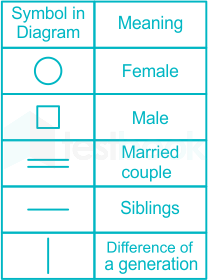
Note- Any couple is neither sitting in the same circle nor facing each other. The persons of outer circular table are sitting exactly inline with the persons sitting around the inner circular table.

E's son is sitting immediate right of R's husband. F is a youngest male member of the family but not the son of Q. Only one person sits between C and F (either from the left or from the right). C is not an immediate neighbour of E.R's father is sitting in the inner circle and faces the immediate neighbour of R. R's son sits second to the right of R. Only two persons sit between R and T (either from the left or from the right). U is an immediate neighbour of P. U does not sits opposite to the immediate neighbours of the one who faces R. F does not face Q. B is not R's father.  R's husband is sitting third to the right of R's father. Q is son of D. R's mother and R are sitting opposite to each other in the same circle. E is not an immediate neighbour of R's father. Q's daughter is sitting second to the right of Q.D's daughter in law is sitting second to the left of F. P is B's spouse.  D is sitting immediate left of B. B is sitting second to the right of R's brother who is sitting in inner circle. R is an immediate neighbour of the one who faces B.

1

Who face D?

  1. ((a))

    P

  2. ((b))

    Q

  3. ((c))

    R

  4. ((d))

    S

  5. ((e))

    T

Show Answer
Answer: ((b))

Q

Given:

Twelve persons in a family are sitting around two concentric circular tables. There are 5 married couples in the family. Those sitting in outer circle are facing towards the center while those sitting in inner circle are facing outside the center. A, B, C, D, E, F six persons are sitting around the inner circular table. P, Q, R, S, T, U six persons are sitting around the outer circular table.

1. B is sitting second to the right of R's brother who is sitting in inner circle.
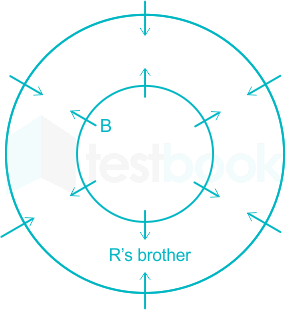
2. R is an immediate neighbour of the one who faces B.
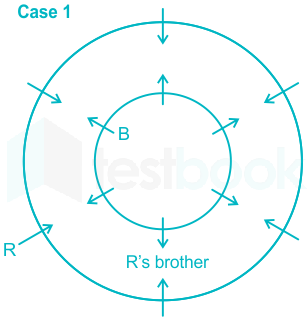
3. R's son sits second to the right of R.

4. R's father is sitting in the inner circle and faces the immediate neighbour of R. B is not R's father.

Here case 1 gets eliminated.

5. Only two persons sit between R and T (either from the left or from the right). 

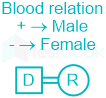
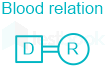
6. D is sitting immediate left of B. R's husband is sitting third to the right of R's father.Here we get that D is R's husband.

7. Q is son of D. Q's daughter is sitting second to the right of Q.

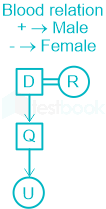
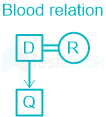
This means Q is R's son also, because D and R are husband and wife.


8. U is an immediate neighbour of P.  U does not sits opposite to the immediate neighbours of the one who faces R.

9. R's mother and R are sitting opposite to each other in the same circle.

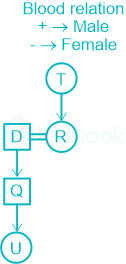
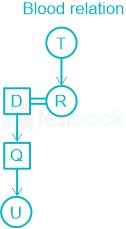
This means T is R's mother. Also we will put S in the outer circle at the only position left.

10. E is not an immediate neighbour of R's father.

We get that E is R's brother.

11. Only one person sits between C and F (either from the left or from the right). C is not an immediate neighbour of E.

Now we put A at the only remaining place in inner circle, thus A is R's father.

 12. D's daughter in law is sitting second to the left of F.

This means C is D's daughter in law i.e. C is wife of Q. 

13. E's son is sitting immediate right of R's husband. P is B's spouse.

This means B is E's son and P is his wife.

14. F is a youngest male member of the family but not the son of Q.

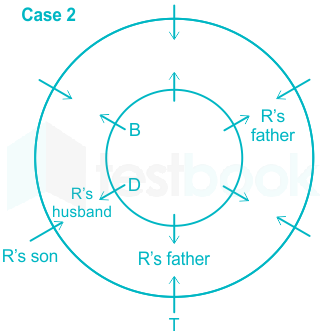
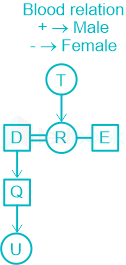
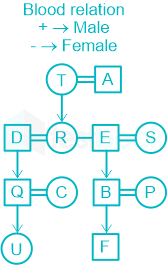
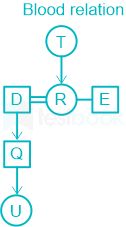
Now the only remaining member is S. Given that there are 5 married couples in the family it can be concluded that S is E's wife. Thus we have final arrangement as below:

Hence, Q faces D.

2

Who is sitting exactly between R's son and R's mother when counted from right of R's son?

  1. ((a))

    P

  2. ((b))

    R

  3. ((c))

    No one

  4. ((d))

    S

  5. ((e))

    T

Show Answer
Answer: ((c))

No one

Given:

Twelve persons in a family are sitting around two concentric circular tables. There are 5 married couples in the family. Those sitting in outer circle are facing towards the center while those sitting in inner circle are facing outside the center. A, B, C, D, E, F six persons are sitting around the inner circular table. P, Q, R, S, T, U six persons are sitting around the outer circular table.

1. B is sitting second to the right of R's brother who is sitting in inner circle.

2. R is an immediate neighbour of the one who faces B.

3. R's son sits second to the right of R.
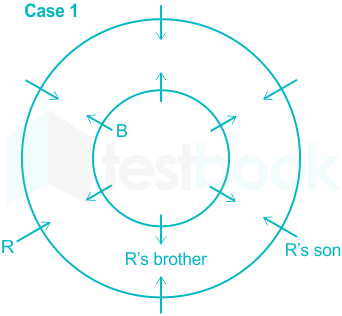
4. R's father is sitting in the inner circle and faces the immediate neighbour of R. B is not R's father.

Here case 1 gets eliminated.

5. Only two persons sit between R and T (either from the left or from the right). 

6. D is sitting immediate left of B. R's husband is sitting third to the right of R's father.

Here we get that D is R's husband.

7. Q is son of D. Q's daughter is sitting second to the right of Q.

This means Q is R's son also, because D and R are husband and wife.

8. U is an immediate neighbour of P.  U does not sits opposite to the immediate neighbours of the one who faces R.

9. R's mother and R are sitting opposite to each other in the same circle.

This means T is R's mother. Also we will put S in the outer circle at the only position left.

10. E is not an immediate neighbour of R's father.

We get that E is R's brother.

11. Only one person sits between C and F (either from the left or from the right). C is not an immediate neighbour of E.

Now we put A at the only remaining place in inner circle, thus A is R's father.

 12. D's daughter in law is sitting second to the left of F.

This means C is D's daughter in law i.e. C is wife of Q. 

13. E's son is sitting immediate right of R's husband. P is B's spouse.

This means B is E's son and P is his wife.

14. F is a youngest male member of the family but not the son of Q.

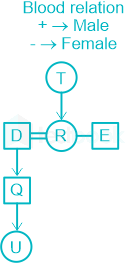
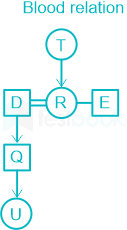
Now the only remaining member is S. Given that there are 5 married couples in the family it can be concluded that S is E's wife. Thus we have final arrangement as below:

Hence, No one is sitting between R's son and R's mother (T) when counted from right of R's son (Q)

3

What is the relation of D with respect to B?

  1. ((a))

    Son

  2. ((b))

    Father

  3. ((c))

    Grandfather

  4. ((d))

    Uncle

  5. ((e))

    None of these

Show Answer
Answer: ((d))

Uncle

Given:

Twelve persons in a family are sitting around two concentric circular tables. There are 5 married couples in the family. Those sitting in outer circle are facing towards the center while those sitting in inner circle are facing outside the center. A, B, C, D, E, F six persons are sitting around the inner circular table. P, Q, R, S, T, U six persons are sitting around the outer circular table.

1. B is sitting second to the right of R's brother who is sitting in inner circle.

2. R is an immediate neighbour of the one who faces B.

3. R's son sits second to the right of R.
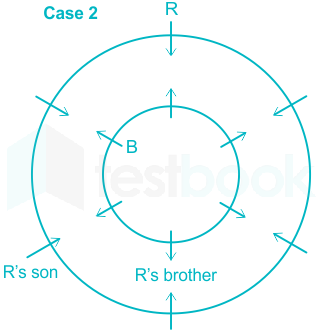
4. R's father is sitting in the inner circle and faces the immediate neighbour of R. B is not R's father.

Here case 1 gets eliminated.
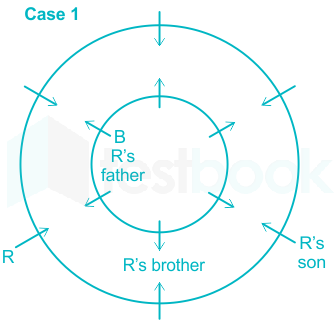
5. Only two persons sit between R and T (either from the left or from the right). 

6. D is sitting immediate left of B. R's husband is sitting third to the right of R's father.

Here we get that D is R's husband.

7. Q is son of D. Q's daughter is sitting second to the right of Q.

This means Q is R's son also, because D and R are husband and wife.

8. U is an immediate neighbour of P.  U does not sits opposite to the immediate neighbours of the one who faces R.

9. R's mother and R are sitting opposite to each other in the same circle.

This means T is R's mother. Also we will put S in the outer circle at the only position left.

10. E is not an immediate neighbour of R's father.

We get that E is R's brother.

11. Only one person sits between C and F (either from the left or from the right). C is not an immediate neighbour of E.

Now we put A at the only remaining place in inner circle, thus A is R's father.

 12. D's daughter in law is sitting second to the left of F.

This means C is D's daughter in law i.e. C is wife of Q. 

13. E's son is sitting immediate right of R's husband. P is B's spouse.

This means B is E's son and P is his wife.

14. F is a youngest male member of the family but not the son of Q.

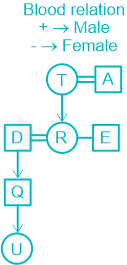
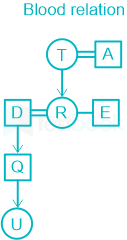
Now the only remaining member is S. Given that there are 5 married couples in the family it can be concluded that S is E's wife. Thus we have final arrangement as below:

Hence, D is uncle of B.

4

If T and R interchange their positions then who faces E?

  1. ((a))

    T

  2. ((b))

    R

  3. ((c))

    U

  4. ((d))

    P

  5. ((e))

    None of these

Show Answer
Answer: ((b))

R

Given:

Twelve persons in a family are sitting around two concentric circular tables. There are 5 married couples in the family. Those sitting in outer circle are facing towards the center while those sitting in inner circle are facing outside the center. A, B, C, D, E, F six persons are sitting around the inner circular table. P, Q, R, S, T, U six persons are sitting around the outer circular table.

1. B is sitting second to the right of R's brother who is sitting in inner circle.

2. R is an immediate neighbour of the one who faces B.

3. R's son sits second to the right of R.

4. R's father is sitting in the inner circle and faces the immediate neighbour of R. B is not R's father.

Here case 1 gets eliminated.
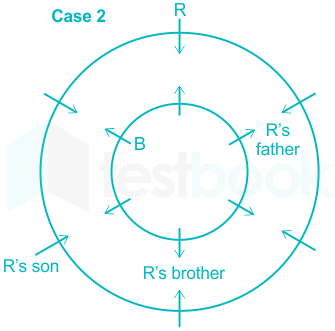
5. Only two persons sit between R and T (either from the left or from the right).
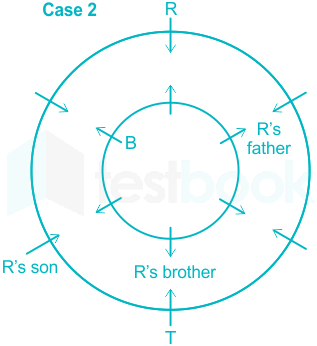
6. D is sitting immediate left of B. R's husband is sitting third to the right of R's father.

Here we get that D is R's husband.

7. Q is son of D. Q's daughter is sitting second to the right of Q.

This means Q is R's son also, because D and R are husband and wife.
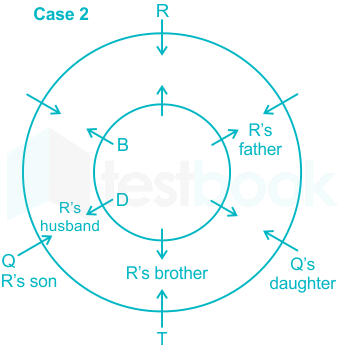
8. U is an immediate neighbour of P.  U does not sits opposite to the immediate neighbours of the one who faces R.

9. R's mother and R are sitting opposite to each other in the same circle.

This means T is R's mother. Also we will put S in the outer circle at the only position left.

10. E is not an immediate neighbour of R's father.

We get that E is R's brother.

11. Only one person sits between C and F (either from the left or from the right). C is not an immediate neighbour of E.

Now we put A at the only remaining place in inner circle, thus A is R's father.

12. D's daughter in law is sitting second to the left of F.

This means C is D's daughter in law i.e. C is wife of Q. 

13. E's son is sitting immediate right of R's husband. P is B's spouse.

This means B is E's son and P is his wife.

14. F is a youngest male member of the family but not the son of Q.

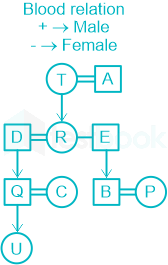
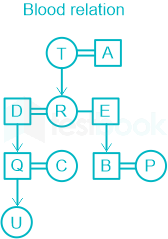
Now the only remaining member is S. Given that there are 5 married couples in the family it can be concluded that S is E's wife. Thus we have final arrangement as below:

Hence, if T and R interchange their positions then R faces E.

5

Who is the oldest member of the family?

  1. ((a))

    A

  2. ((b))

    T

  3. ((c))

    A and T

  4. ((d))

    A or T

  5. ((e))

    R

Show Answer
Answer: ((d))

A or T

Given:

Twelve persons in a family are sitting around two concentric circular tables. There are 5 married couples in the family. Those sitting in outer circle are facing towards the center while those sitting in inner circle are facing outside the center. A, B, C, D, E, F six persons are sitting around the inner circular table. P, Q, R, S, T, U six persons are sitting around the outer circular table.

1. B is sitting second to the right of R's brother who is sitting in inner circle.

2. R is an immediate neighbour of the one who faces B.

3. R's son sits second to the right of R.

4. R's father is sitting in the inner circle and faces the immediate neighbour of R. B is not R's father.

Here case 1 gets eliminated.

5. Only two persons sit between R and T (either from the left or from the right). T is not sitting behind E.

6. D is sitting immediate left of B. R's husband is sitting third to the right of R's father.

Here we get that D is R's husband.

7. Q is son of D. Q's daughter is sitting second to the right of Q.

This means Q is R's son also, because D and R are husband and wife.
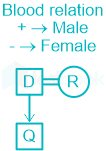
8. U is an immediate neighbour of P.  U does not sits opposite to the immediate neighbours of the one who faces R.
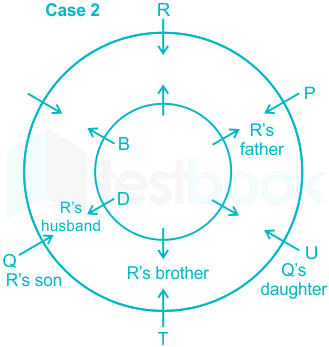
9. R's mother and R are sitting opposite to each other in the same circle.

This means T is R's mother. Also we will put S in the outer circle at the only position left.
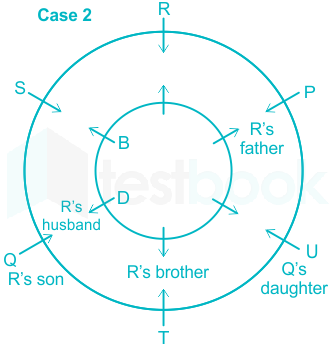
10. E is not an immediate neighbour of R's father.

We get that E is R's brother.

11. Only one person sits between C and F (either from the left or from the right). C is not an immediate neighbour of E.
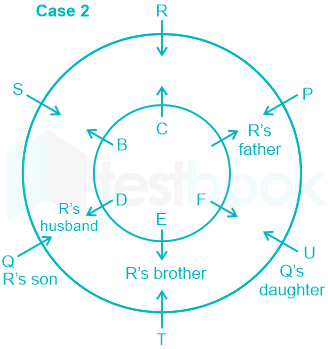
Now we put A at the only remaining place in inner circle, thus A is R's father.
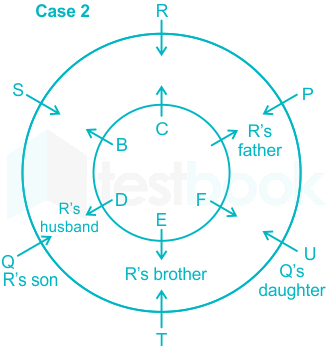
 12. D's daughter in law is sitting second to the left of F.

This means C is D's daughter in law i.e. C is wife of Q. 

13. E's son is sitting immediate right of R's husband. P is B's spouse.

This means B is E's son and P is his wife.
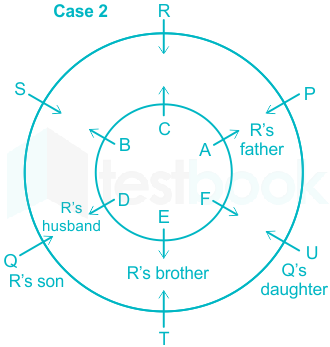
14. F is a youngest male member of the family but not the son of Q.
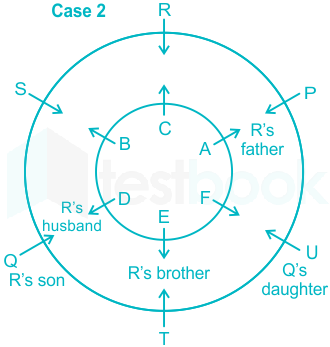
Now the only remaining member is S. Given that there are 5 married couples in the family it can be concluded that S is E's wife. Thus we have final arrangement as below:
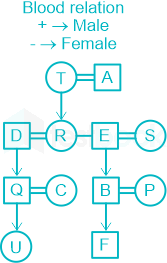
Hence, either A or T is the oldest member of the family.

Directions: Study the following information carefully and answer the questions that follow.

The following words are coded in this manner:

‘festival for women only’ is coded as ‘(p)  12D%  21H@  4E@’

‘cindrella (q) to rescue’ is coded as ‘7B%  24I%  8G@  9F%’

‘bugs ate all carrots’ is coded as ‘25D%  (r)  24G%  26c@’

‘fight game play card’ is coded as ‘20D%  (s)  (t) 11D%’

6

Which of the folowing will replace the the blank '(p)'?

  1. ((a))

    12D%

  2. ((b))

    6C@

  3. ((c))

    21C@

  4. ((d))

    21C%

  5. ((e))

    None of these

Show Answer
Answer: ((c))

21C@

The codes are as follows

NumberPlace value of reverse order of first alphabet Example: festival → f → u (reverse of f) → 21
AlphabetPlace value of number of alphabets in a word Example: festival → 8 letters → H (place value of H is 8)
SymbolIf the place value of last letter in a word is even → @ Example: all → l (last letter) → 12 → even→ @
If the place value of the last letter in a word is odd → % Example : carrots → s (last letter) → 19 → odd → %


forNumberfor → f → u (reverse of f) → 21
Alphabetfor → 3 letters → C (place value of C is 3)
Symbolfor → r (last letter) → 18 → even → @
Code:  21C@
<br>

Hence, 21C@ will come in the place of '(p)'.

7

Which of the following word will replace the blank '(q)'?

  1. ((a))

    doing

  2. ((b))

    shoutes

  3. ((c))

    shouted

  4. ((d))

    fight

  5. ((e))

    women

Show Answer
Answer: ((c))

shouted

The codes are as follows

NumberPlace value of reverse order of first alphabet Example: festival → f → u (reverse of f) → 21
AlphabetPlace value of number of alphabets in a word Example: festival → 8 letters → H (place value of H is 8)
SymbolIf the place value of last letter in a word is even → @ Example: all → l (last letter) → 12 → even→ @
If the place value of the last letter in a word is odd → % Example : carrots → s (last letter) → 19 → odd → %


8G@Number8 → h → s (reverse of h)
AlphabetG → 7 letters
Symbol@ → even
Word:  shouted


From the given options 'shouted' will have the code '8G@'.

Hence, 'shouted' will replace the blank '(q)'.

Direction: Study the following information carefully and answer the given questions.

A word, number and symbol arrangement device when given an input line of words, number and symbols rearrange them following a particular pattern on each step. The following of input and rearrangement.

INPUT: OTHER   BUILD   HOME   WITH   STRONG   MUSIC

STEP I: QVJGT   DWKNF  JQOG   YKVJ     UVTQPI   OWUKE

STEP II: DWKNF   JQOG   OWUKE   QVJGT   UVTQPI   YKVJ

STEP III: GZNQI   MTRJ   RZXNH   TYMJW   XYWTSL   BNYM

STEP IV: GZIQN   MTRJ   RZHNX   TYMJW   XYWLST   BNYM

STEP V: ATCKH   GNLD   LTBHR   NSGDQ   RSQFMN   VHSG

And step V is the last step of the above input, as the desired arrangement is obtained.

As per the logic followed on the above steps. Find out in each of the following questions the appropriate step for the given input.

INPUT: NONE LINK USED SENT MORE TABLE

8

What word is to the 4th right of the word which is 6th from right in step IV?

  1. ((a))

    RTWJ

  2. ((b))

    QPSN

  3. ((c))

    YFJQG

  4. ((d))

    XJSY

  5. ((e))

    SJST

Show Answer
Answer: ((c))

YFJQG

In the given illustration:

Step I: Every letter is changed to the 2nd next letter according to alphabetic order.

Step II: All words are arranged in ascending order according to the English alphabet from left to right considering the first letter of the word.

If two words consist of the same first letter the second letter would be considered for arrangement and so on.

Step III: Every letter is changed to the 3rd next letter according to alphabetic order.

Step IV: In every alternate word positions of last and 3rd last letters are interchange.

Step V: Every letter is changed to the 6th previous letter according to alphabetic order.

Similarly steps for the given input.

INPUT: NONE   LINK   USED   SENT   MORE   TABLE

STEP I: PQPG   NKPM   WUGF   UGPV   OQTG   VCDNG

STEP II: NKPM   OQTG   PQPG   UGPV   VCDNG   WUGF

STEP III: QNSP   RTWJ   STSJ   XJSY   YFGQJ   ZXJI

STEP IV: QPSN   RTWJ   SJST   XJSY   YFJQG   ZXJI

STEP V: KJMH   LNQD   MDMN   RDMS   SZDKA   TRDC

Hence, YFJQG is to the 4th right of the word which is 6th from right in step IV.

9

What word is to the immediate left of the word which is 5th from the left end of step III?

  1. ((a))

    STSJ

  2. ((b))

    XJSY

  3. ((c))

    ZXJI

  4. ((d))

    RTWJ

  5. ((e))

    QNSP

Show Answer
Answer: ((b))

XJSY

In the given illustration:

Step I: Every letter is changed to the 2nd next letter according to alphabetic order.

Step II: All words are arranged in ascending order according to the English alphabet from left to right considering the first letter of the word.

If two words consist of the same first letter the second letter would be considered for arrangement and so on.

Step III: Every letter is changed to the 3rd next letter according to alphabetic order.

Step IV: In every alternate word positions of last and 3rd last letters are interchange.

Step V: Every letter is changed to the 6th previous letter according to alphabetic order.

Similarly steps for the given input.

INPUT: NONE   LINK   USED   SENT   MORE   TABLE

STEP I: PQPG   NKPM   WUGF   UGPV   OQTG   VCDNG

STEP II: NKPM   OQTG   PQPG   UGPV   VCDNG   WUGF

STEP III: QNSP   RTWJ   STSJ   XJSY   YFGQJ   ZXJI

STEP IV: QPSN   RTWJ   SJST   XJSY   YFJQG   ZXJI

STEP V: KJMH   LNQD   MDMN   RDMS   SZDKA   TRDC

Hence, “XJSY” is to the immediate left of the word which is 5th from the left end of step III.

10

In which step RDMS is 4th form left end for the given input?

  1. ((a))

    Step V

  2. ((b))

    Step VI

  3. ((c))

    Step VII

  4. ((d))

    Step IV

  5. ((e))

    Step VIII

Show Answer
Answer: ((a))

Step V

In the given illustration:

Step I: Every letter is changed to the 2nd next letter according to alphabetic order.

Step II: All words are arranged in ascending order according to the English alphabet from left to right considering the first letter of the word.

If two words consist of the same first letter the second letter would be considered for arrangement and so on.

Step III: Every letter is changed to the 3rd next letter according to alphabetic order.

Step IV: In every alternate word positions of last and 3rd last letters are interchange.

Step V: Every letter is changed to the 6th previous letter according to alphabetic order.

Similarly steps for the given input.

INPUT: NONE   LINK   USED   SENT   MORE   TABLE

STEP I: PQPG   NKPM   WUGF   UGPV   OQTG   VCDNG

STEP II: NKPM   OQTG   PQPG   UGPV   VCDNG   WUGF   

STEP III: QNSP   RTWJ   STSJ   XJSY   YFGQJ   ZXJI   

STEP IV: QPSN   RTWJ   SJST   XJSY   YFJQG   ZXJI

STEP V: KJMH   LNQD   MDMN   RDMS   SZDKA   TRDC

Hence, in Step V RDMS is 4th form left end for the given input.

11

What will be the next step for the below input, if the below input is the step IV for certain input?

GCIOD YILIR GSNIG RUEMN HESIN

  1. ((a))

    BXDJ TDGDM BNIBV MPZHI CZNDI

  2. ((b))

    AWXIC SCFCL AMUAH LOHGY BYHCM

  3. ((c))

    GCDOI YILIR GSGIN RUEMN HENIS

  4. ((d))

    AWCIX SCFCL AMHCA LOYGH BYMCH

  5. ((e))

    None of the above

Show Answer
Answer: ((d))

AWCIX SCFCL AMHCA LOYGH BYMCH

In the given illustration:

Step I: Every letter is changed to the 2nd next letter according to alphabetic order.

Step II: All words are arranged in ascending order according to the English alphabet from left to right considering the first letter of the word.

If two words consist of the same first letter the second letter would be considered for arrangement and so on.

Step III: Every letter is changed to the 3rd next letter according to alphabetic order.

Step IV: In every alternate word positions of last and 3rd last letters are interchange.

Step V: Every letter is changed to the 6th previous letter according to alphabetic order.

Here,

Step IV: GCIOD YILIR GSNIG RUEMN HESIN

Step V: AWCIX SCFCL AMHCA LOYGH BYMCH

Hence, AWCIX SCFCL AMHCA LOYGH BYMCH will be the next step for a given input.

Direction: In the following questions, the symbols @, ?, ×, β and Ω are used with the following meaning as illustrated below:

‘X ? Y’ means ‘X is neither greater than nor equal to Y’.

‘X × Y’ means ‘X is neither smaller than nor greater than Y’.

‘X β Y’ means ‘X is not greater than Y’.

‘X Ω Y’ means ‘X is greater than Y’.

‘X @ Y’ means ‘X is either greater than or equal to Y’.

Now in each of the following questions assuming the given statements to be true, find which of the conclusion/s given below them is/are definitely true?

12

Statement:

D ? M β P × K Ω F ? T; M × G

Conclusions:

I. K @ G

II. T ? P

III. F β M

  1. ((a))

    Only conclusion I is true

  2. ((b))

    Both conclusion I and II are true

  3. ((c))

    Either II or III is true

  4. ((d))

    All I, II and III are true

  5. ((e))

    Both II and III are true

Show Answer
Answer: ((a))

Only conclusion I is true

According to the given information,

X is
Symbol?×βΩ@
Meaning<=>
to Y


Given Statement: D ? M β P × K Ω F ? T; M × G

On converting:- D < M ≤ P = K > F < T; M = G

On combining:- D < M = G ≤ P = K > F < T

Conclusion:

I. K @ G → K ≥ G → True

II. T ? P → T < P → False

III. F β M → F ≤ M → False (as relation between F and M can’t be determined)

Hence, Only conclusion I are true.

13

Statement:

T @ I × H Ω U ? P β V ? L; H @ L

Conclusions:

I. T Ω L

II. V β T

III. I @ L

  1. ((a))

    Only II conclusion is true

  2. ((b))

    Both conclusion I and II are true

  3. ((c))

    Either conclusion II or conclusion III is true

  4. ((d))

    Only III conclusion is true

  5. ((e))

    Both conclusion I and III are true

Show Answer
Answer: ((d))

Only III conclusion is true

According to the given information,

X is
Symbol?×ΒΩ@
Meaning<=>
to Y


Given Statement: T @ I × H Ω U ? P β V ? L; H @ L

On converting:- T ≥ I = H > U < P ≤ V < L; H ≥ L

On combining:-  T ≥ I = H ≥ L > V ≥ P > U

Conclusions:

I. T Ω L → T > L → False (as it is a possibility, but not specific)

II. V β T → V ≤ T → False (as V < T holds true, but V = T is not possible)

III. I @ L → I ≥ L → True

Hence, only conclusion III is true.

14

Directions: Question below consists of a question and two statements numbered I and II given below it. You have to decide whether the data provided in the statements are sufficient to answer the question.

Six people – Megha, Suhas, Rakesh, Akshay, Safia and Nidhi are standing in a line according to their height. But not necessarily in the same order. Who is the second tallest person?

Statement I: Megha is taller than just two person. Rakesh is taller than Nidhi and Safia but he is not the tallest. Suhas is the shorter than just two person.

Statement II: Nidhi is the second shortest person. Megha is shorter than three persons. Suhas is shorter than Akshay and Rakesh. Safia is the shortest.

  1. ((a))

    The data in statement I alone is sufficient to answer the question, while the data in statement II alone is not sufficient to answer the question

  2. ((b))

    The data in statement II alone is sufficient to answer the question, while the data in statement I alone is not sufficient to answer the question

  3. ((c))

    The data either in statement I alone or in statement II alone is sufficient to answer the question

  4. ((d))

    The data in both statements I and II together is not sufficient to answer the question

  5. ((e))

    The data in both statements I and II together is necessary to answer the question

Show Answer
Answer: ((a))

The data in statement I alone is sufficient to answer the question, while the data in statement II alone is not sufficient to answer the question

According to the given information,

Names of person: Megha, Suhas, Rakesh, Akshay, Safia and Nidhi

Total members: Six

Statement I: Megha is taller than just two person. Rakesh is taller than Nidhi and Safia but he is not the tallest. Suhas is the shorter than just two person.

1. Megha is taller than just two person.

_______ > ______ > _____ > Megha > _____ > _____

2. Suhas is the shorter than just two person.

_____ > _____ > Suhas > Megha > _____ > _____

3. Rakesh is taller than Nidhi and Safia but he is not the tallest.

(According to this, Akshay will be the tallest, but we can't determine who is the shortest between Nidhi and Safia.)

Akshay > Rakesh > Suhas > Megha > Nidhi/Safia > Nidhi/Safia

Hence, Rakesh is the second tallest person. The data in statement I alone is sufficient to answer the question.

Statement II: Nidhi is the second shortest person. Megha is shorter than three persons. Suhas is shorter than Akshay and Rakesh. Safia is the shortest.

1. Nidhi is the second shortest person.

_____ > _____ > _____ > _____ > Nidhi > _____

2. Megha is shorter than three persons.

_____ > _____ > _____ > Megha > Nidhi > _____

3. Safia is the shortest.

_____ > _____ > _____ > Megha > Nidhi > Safia

4. Suhas is shorter than Akshay and Rakesh.

Akshay/Rakesh > Akshay/Rakesh > Suhas > Megha > Nidhi > Safia

Therefore, we can't determine who is the second tallest person.

The data in statement I alone is sufficient to answer the question, while the data in statement II alone is not sufficient to answer the question.

15

Direction: In each of the following questions, a question followed by three statements. You have to decide whether the data provided in the statements are sufficient to answer the question. Read all the three statements and given answer.

There are six letters W, I, M, D, Y and A. ‘MIDWAY’ is the word formed after performing the following operations using these six letters only? 

I. A is placed fourth to the right of M. D is not placed immediately next to either M or A.

II. Y is placed immediately next (either left or right) to A. W is placed immediately next (either left or right) to D.
III. Both I and W are placed immediately next to D. The word does not begin with Y. M is not placed immediately next to W.


  1. ((a))

    Statement I and II are sufficient to answer the question, while the statement III are not required to answer the question.

  2. ((b))

    Statement I and III are sufficient to answer the question, while statement II are not required to answer the question.

  3. ((c))

    Statement II and III are sufficient to answer the question, while statement I are not required to answer the question.

  4. ((d))

    Either statement I alone or statement II alone or statement III alone is sufficient to answer the question.

  5. ((e))

    All statement I, II and III together are necessary to answer the question.

Show Answer
Answer: ((b))

Statement I and III are sufficient to answer the question, while statement II are not required to answer the question.

From statement I: A is placed fourth to the right of M. D is not placed immediately next to either M or A.

From statement II: Y is placed immediately next (either left or right) to A. W is placed immediately next (either left or right) to D.

From statement III: Both I and W are placed immediately next to D. The word does not begin with Y. M is not placed immediately next to W.

Hence, statement I and III together are necessary to answer the question.

16

Directions: Question below consists of a question and three statements numbered I, II and III given below it. You have to decide whether the data provided in the statements are sufficient to answer the question.

Seven friends - S, T, R, F, G, J and V are living on different floors of a seven storey building having seven floors numbered one to seven (The ground floor is numbered 1, the floor above it is numbered 2 and so on and the topmost floor is numbered 7). Who is staying immediately below G’s floor?

Statement I: R lives on one of the odd numbered floors above floor 3. And only two people live between the R and S.

Statement II: Only one person lives between S and G, who is staying below T and above S. T does not stay on the top floor.

Statement III: V stays above F but below J.

  1. ((a))

     The data in statement II alone are sufficient to answer the question, and the data in statement I or III is not required to answer the question.

  2. ((b))

    The data in either statement I, II or III are sufficient to answer the question.

  3. ((c))

    The data in statement II and III is sufficient to answer the question, and the data in statement I is not required to answer the question.

  4. ((d))

    The data in all three statements together is needed to answer the question.

  5. ((e))

     The data in all the statements, even together are not sufficient to answer the question.

Show Answer
Answer: ((d))

The data in all three statements together is needed to answer the question.

According to the information given,

Names of Person: S, T, R, F, G, J and V

Floors: The ground floor is numbered 1, the floor above it is numbered 2 and so on and the topmost floor is numbered 7.

Statement I: R lives on one of the odd numbered floors above floor 3. And only two people live between the R and S.

(There are two cases here. Case - 1: R lives on floor number 5 and two people live between R and S. Case - 2: R lives on floor number 7 and two people live between R and S.)

Case - 1Case - 2
Floor NumberPersonFloor NumberPerson
77R
66
5R5
44S
33
2S2
11
<br>

Hence, we can't find who lives below G using only statement I.

Statement II: Only one person lives between S and G, who is staying below T and above S. T does not stay on the top floor.

(Here Case- 2 gets eliminated as both G and T can not be placed above S, with one person between S and G.)

Case - 1
Floor NumberPerson
7
6T
5R
4G
3
2S
1
<br>

Hence, from statement I and II also we can't find who lives below G.

Statement III: V stays above F but below J.

Case - 1
Floor NumberPerson
7J
6T
5R
4G
3V
2S
1F
<br>

Now we get our final answer. V is staying immediately below G.

 The data in all three statements together is needed to answer the question.

17

Directions: In the following question, a given question is followed by information in three statements. You have to decide the data in which statement(s) is sufficient to answer the question and mark your answer accordingly.

There are seven persons, Kabir, Roy, Manav, Adi, Babu, Malik, and Boman are sitting in a row facing north direction. Each person owns a different brand of car which are Kia, Tata, Maruti, Toyota, Hyundai. BMW, and Mahindra but not necessarily in the same order.

The one who owns Toyota sits fourth to the left of Adi, who owns Tata and either of them sits at the extreme end of the row. Roy owns Mahindra. The one who owns Kia sits third to the left of the one who owns BMW, who neither sits adjacent to the one who owns Toyota nor adjacent to Adi. Babu neither owns Toyota nor Kia, sits third to the left of Roy.

Who sits at the immediate right of Kabir?

Statement I: Two persons sit between the one who owns Maruti and Manav. Three persons sit between Boman and the one who owns Hyundai.

Statement II: The one who owns Hyundai sits second to the left of Manav. The one who owns Maruti sits at the immediate right of Boman.

Statement III: Three persons sit between Malik and Kabir, who doesn't own Maruti. Boman and the one who owns Maruti sit together.

  1. ((a))

    The data in any two statements are sufficient to answer the question.

  2. ((b))

    The data in statement III is sufficient to answer the question, and the data in statement I and II is not required to answer the question.

  3. ((c))

    The data in either statement I, II or III are sufficient to answer the question.

  4. ((d))

    The data in statement II and III is sufficient to answer the question, and the data in statement I is not required to answer the question.

  5. ((e))

    The data in all the statements, even together are not sufficient to answer the question.

Show Answer
Answer: ((b))

The data in statement III is sufficient to answer the question, and the data in statement I and II is not required to answer the question.

By the information:

The one who owns Toyota sits fourth to the left of Adi, who owns Tata and either of them sits at the extreme end of the row. (considering 2 cases)

Roy owns Mahindra.

The one who owns Kia sits third to the left of the one who owns BMW, who neither sits adjacent to the one who owns Toyota nor adjacent to Adi.

Babu neither owns Toyota nor Kia, sits third to the left of Roy.

Case 1:

Case 2:

From Statement I: 

We have, 

Two persons sit between the one who owns Maruti and Manav. (case 1 canceled)

Three persons sit between Boman and the one who owns Hyundai.

Case 2:

The position of Kabir is not definite. 

From Statement II: 

We have, 

The one who owns Hyundai sits second to the left of Manav.

The one who owns Maruti sits at the immediate right of Boman.

Case 1:

Case 2: 

The position of Kabir is not definite.

From Statement III: 

We have, 

Three persons sit between Malik and Kabir, who doesn't own Maruti.

Boman and the one who owns Maruti sit together. (case 1 eliminated)

Manav sits at the immediate right of Kabir.

 The data in statement III is sufficient to answer the question, and the data in statement I and II is not required to answer the question.

Directions: Study the following information carefully and answer the questions following it.

A family has 9 members A, B, C, D, E, F, G, H & I and they are sitting in a row facing north. There are 2 couples in the family. H who has 2 sons and 1 daughter is sitting third to the right of C. A is sitting immediate left of his wife C. Members at both the extreme ends are children of B. B is sitting immediate right of his wife H. The daughters G and I are sitting with their respective fathers. D who is brother-in-law of A is sitting in the middle of the row and second to the right of A. E who is male is sitting immediate right of his maternal uncle D. I who is granddaughter of H is not sitting at any of the extreme ends. I is daughter of C.

18

Who is sitting second to the left of G?

  1. ((a))

    A

  2. ((b))

    B

  3. ((c))

    H

  4. ((d))

    I

  5. ((e))

    None of these

Show Answer
Answer: ((c))

H

Nine members A, B, C, D, E, F, G, H & I and all are facing north.

First, we will draw the sitting arrangement and then the family tree.

  1. D who is the brother-in-law of A is sitting in the middle of the row and second to the right of A.

  2. A is sitting immediate left of his wife C.

  3. H who has 2 sons and 1 daughter is sitting third to the right of C.

  4. E is sitting immediate right of his maternal uncle D.

  5. B is sitting immediate right of his wife H.

  1. Members at both the extreme ends are children of B.

  2. The daughters G and I are sitting with their respective fathers. I is daughter of C.

  3. I who is the granddaughter of H is not sitting at any of the extreme ends.

As mentioned in 8), I is not sitting at any of the extreme ends, I will be sitting immediate left of A. Then G who must be the daughter of B will sit with her father B as per 7). Then F will sit at the extreme left end.

Therefore, the final arrangement is as follows.

Now we will draw the family tree.

From the given information,

  1. H has 2 sons and 1 daughter.

  2. B is sitting immediate right of his wife H.

  3. Members at both the extreme ends are children of B.

Hence, H is the wife of B and from the arrangement F & G who are sitting at extreme ends are two out of three children of H & B.

  1. A is sitting immediate left of his wife C

  2. I who is the granddaughter of H.

  3. The daughters G and I are sitting with their respective fathers.

Hence, A is the husband of C and from the arrangement, I is the daughter of A. Hence A, F & G are the children of H & B in which A & F are sons, G is the daughter.

  1. D who is the brother-in-law of A is sitting in the middle of the row and second to the right of A.

  2. E is sitting immediate right to his maternal uncle D.

Hence, C who is wife of A is sister of D and E is the son of A & C.

Hence, we can draw the family tree as below:

Hence, H is sitting second to the left of G.

19

How is E related to F?

  1. ((a))

    Niece

  2. ((b))

    Son

  3. ((c))

    Daughter

  4. ((d))

    Nephew

  5. ((e))

    Cannot be determined

Show Answer
Answer: ((d))

Nephew

Nine members A, B, C, D, E, F, G, H & I and all are facing north.

First, we will draw the sitting arrangement and then the family tree.

  1. D who is brother-in-law of A is sitting in the middle of the row and second to the right of A.

  2. A is sitting immediate left of his wife C.

  3. H who has 2 sons and 1 daughter is sitting third to the right of C.

  4. E is sitting immediate right of his maternal uncle D.

  5. B is sitting immediate right of his wife H.

  1. Members at both the extreme ends are children of B.

  2. The daughters G and I are sitting with their respective fathers. I is daughter of C.

  3. I who is the granddaughter of H is not sitting at any of the extreme ends.

As mentioned in 8), I is not sitting at any of the extreme ends, I will be sitting immediate left of A. Then G who must be the daughter of B will sit with her father B as per 7). Then F will sit at the extreme left end.

Therefore, the final arrangement is as follows.

Now we will draw the family tree.

From the given information,

  1. H has 2 sons and 1 daughter.

  2. B is sitting immediate right of his wife H.

  3. Members at both the extreme ends are children of B.

Hence, H is the wife of B and from the arrangement F & G who are sitting at extreme ends are two out of three children of H & B.

  1. A is sitting immediate left of his wife C

  2. I who is granddaughter of H.

  3. The daughters G and I are sitting with their respective fathers.

Hence, A is the husband of C and from the arrangement; I is the daughter of A. Hence A, F & G are the children of H & B in which A & F are sons, G is the daughter.

  1. D who is the brother-in-law of A is sitting in the middle of the row and second to the right of A.

  2. E is sitting immediate right of his maternal uncle D.

Hence, C who is the wife of A is sister of D and E is the son of A & C.

Hence, we can draw the family tree as below:

From the family tree, E is the nephew of F.

20

Who is sitting third to the right of I’s mother?

  1. ((a))

    H

  2. ((b))

    G

  3. ((c))

    B

  4. ((d))

    E

  5. ((e))

    Can’t be determined

Show Answer
Answer: ((a))

H

Nine members A, B, C, D, E, F, G, H & I and all are facing north.

First, we will draw the sitting arrangement and then the family tree.

  1. D who is brother-in-law of A is sitting in the middle of the row and second to the right of A.

  2. A is sitting immediate left of his wife C.

  3. H who has 2 sons and 1 daughter is sitting third to the right of C.

  4. E is sitting immediate right of his maternal uncle D.

  5. B is sitting immediate right of his wife H.

  1. Members at the both the extreme ends are children of B.

  2. The daughters G and I are sitting with their respective fathers. I is daughter of C.

  3. I who is granddaughter of H is not sitting at any of the extreme end.

As mentioned in 8), I is not sitting at any of the extreme ends, I will be sitting immidiete left of A. Then G who must be daughter of B will sit with her father B as per 7). Then F will sit at extreme left end.

Therefore, the final arrangement is as follows.

Now we will draw the family tree.

From the given information,

  1. H has 2 sons and 1 daughter.

  2. B is sitting immediate right of his wife H.

  3. Members at both the extreme ends are children of B.

Hence, H is the wife of B and from the arrangement; F & G who are sitting at extreme ends are two out of three children of H & B.

  1. A is sitting immediate left of his wife C

  2. I who is granddaughter of H.

  3. The daughters G and I are sitting with their respective fathers.

Hence, A is the husband of C and from the arrangement; I is the daughter of A. Hence A, F & G are the children of H & B in which A & F are sons, G is the daughter.

  1. D who is the brother-in-law of A is sitting in the middle of the row and second to the right of A.

  2. E is sitting immediate right of his maternal uncle D.

Hence, C who is the wife of A is sister of D and E is the son of A & C.

Hence, we can draw the family tree as below:

From the family tree, I’s mother is C and from the linear arrangement, H is sitting third to the right of C.

21

What is the position of A’s brother with respect to E’s mother?

  1. ((a))

    Fourth to the left

  2. ((b))

    Second to the left

  3. ((c))

    Third to the right

  4. ((d))

    Third to the left

  5. ((e))

    Cannot be determined

Show Answer
Answer: ((d))

Third to the left

Nine members A, B, C, D, E, F, G, H & I and all are facing north.

First, we will draw the sitting arrangement and then the family tree.

  1. D who is the brother-in-law of A is sitting in the middle of the row and second to the right of A.

  2. A is sitting immediate left of his wife C.

  3. H who has 2 sons and 1 daughter is sitting third to the right of C.

  4. E is sitting immediate right of his maternal uncle D.

  5. B is sitting immediate right of his wife H.

  1. Members at both the extreme ends are children of B.

  2. The daughters G and I are sitting with their respective fathers. I is daughter of C.

  3. I who is the granddaughter of H is not sitting at any of the extreme ends.

As mentioned in 8), I is not sitting at any of the extreme ends, I will be sitting immediate left of A. Then G who must be the daughter of B will sit with her father B as per 7). Then F will sit at the extreme left end.

Therefore, the final arrangement is as follows.

Now we will draw the family tree.

From the given information,

  1. H has 2 sons and 1 daughter.

  2. B is sitting immediate right of his wife H.

  3. Members at both the extreme ends are children of B.

Hence, H is the wife of B from the arrangement, F & G who are sitting at extreme ends are two out of three children of H & B.

  1. A is sitting immediate left of his wife C

  2. I who is granddaughter of H.

  3. The daughters G and I are sitting with their respective fathers.

Hence, A is the husband of C and from the arrangement; I is the daughter of A. Hence A, F & G are the children of H & B in which A & F are sons, G is the daughter.

  1. D who is the brother-in-law of A is sitting in the middle of the row and second to the right of A.

  2. E is sitting immediate right of his maternal uncle D.

Hence, C who is the wife of A is sister of D and E is the son of A & C.

Hence, we can draw the family tree as below:

From the family tree, A’s brother is F and E’s mother is C. From the linear arrangement, F is third to the left of C.

22

If D is replaced with his sister then what will be the position of H with respect to her daughter-in-law?

  1. ((a))

    Third to the left

  2. ((b))

    Second to the right

  3. ((c))

    Third to the right

  4. ((d))

    Fourth to the left

  5. ((e))

    Cannot be determined.

Show Answer
Answer: ((b))

Second to the right

ine members A, B, C, D, E, F, G, H & I and all are facing north.

First, we will draw the sitting arrangement and then the family tree.

  1. D who is brother-in-law of A is sitting in the middle of the row and second to the right of A.

  2. A is sitting immediate left of his wife C.

  3. H who has 2 sons and 1 daughter is sitting third to the right of C.

  4. E is sitting immediate right of his maternal uncle D.

  5. B is sitting immediate right of his wife H.

  1. Members at both the extreme ends are children of B.

  2. The daughters G and I are sitting with their respective fathers. I is daughter of C, 

  3. I who is granddaughter of H is not sitting at any of the extreme ends.

As mentioned in 8), I is not sitting at any of the extreme ends, I will be sitting immediate left of A. Then G who must be daughter of B will sit with her father B as per 7). Then F will sit at the extreme left end.

Therefore, the final arrangement is as follows.

Now we will draw the family tree.

From the given information,

  1. H has 2 sons and 1 daughter.

  2. B is sitting immediate right of his wife H.

  3. Members at both the extreme ends are children of B.

Hence, H is the wife of B and from the arrangement, F & G who are sitting at extreme ends are two out of three children of H & B.

  1. A is sitting immediate left of his wife C

  2. I who is granddaughter of H.

  3. The daughters G and I are sitting with their respective fathers.

Hence, A is the husband of C and from the arrangement; I is the daughter of A. Hence A, F & G are the children of H & B in which A & F are sons, G is the daughter.

  1. D who is brother-in-law of A is sitting in the middle of the row and second to the right of A.

  2. E is sitting immediate right of his maternal uncle D.

Hence, C who is wife of A is sister of D and E is the son of A & C.

Hence, we can draw the family tree as below:

From the family tree, D’s sister is C and H’s daughter-in-law is C.

When C will come in place of D, H will be second to the right of C.

23

Directions: A statement is given followed by two inferences I and II. You have to consider the statement to be true even if it seems to be at variance from commonly known facts. You have to decide which of the given inferences, if any, follow from the given statement.

Statement: This benchmark is increasingly applied in choosing who will be hired and who will not, who will be let go, and who retained, who passed over, and who promoted.

Inference:

I.The benchmark is an integral part of the employee management policy of an organization.

II. Those who are not hired do not make it to the benchmark.

  1. ((a))

    Only I follows.

  2. ((b))

    Only II follows.

  3. ((c))

    Either I or II follows.

  4. ((d))

    Neither I nor II follows.

  5. ((e))

    Both I and II follow.

Show Answer
Answer: ((e))

Both I and II follow.

The statement mentions that a benchmark is applied in choosing, rejecting, retaining, and promoting a candidate.

From what has been supplied we can infer that the Benchmark is a necessary part of the employee management policy of an organization. Therefore, the inference I follow.

Also from the statement, it can be deduced that those who get rejected and are not hired do not make it to the specified benchmark. So, inference II follows.

Hence**,** Both I and II follow.

Directions : Study the following information and answer the questions given below.

Distance and direction between various points is shown in a coded form as follows

A # B (58m) – A is 46m west of B.

A & B (89m) – A is 77m south of B.

A @ B (110m) – A is 98m north of B.

A % B (52m) – A is 40m east of B.

N * AB – N is the mid point of line AB.

L @ Z (28m), S # K (20m), R % H (17m), Q # Z (26m), T # M (21m), Q & H (22m), S & M (27m), T @ R (28m)

24

Which of the following statement is sufficient to find shortest distance between points M and J?

I. J & P (19m), P % N (22m), N @ O (25m)

II. P & Q (27m), N % P (20m), O @ N (22m), O # J (18m)

  1. ((a))

    Data in Statement I alone is sufficient to answer the question, while the data in Statement II alone is not sufficient to answer the question

  2. ((b))

    Data in Statement II alone is sufficient to answer the question, while the data in Statement I alone is not sufficient to answer the question

  3. ((c))

    Data either in Statement I alone or in Statement II alone is sufficient to answer the question

  4. ((d))

    Data given in both Statements I and II together are not sufficient to answer the question

  5. ((e))

    Data in both Statements I and II together are necessary to answer the question

Show Answer
Answer: ((b))

Data in Statement II alone is sufficient to answer the question, while the data in Statement I alone is not sufficient to answer the question

Given:

A # B (58m) – A is 46m west of B, here (58-46) = 12m

A & B (89m) – A is 77m south of B, here (89-77) = 12m

A @ B (110m) – A is 98m north of B, here (110-98) = 12m

A % B (52m) – A is 40m east of B, here (52-40) = 12m

The actual distance between A and B is 12m less than the distance given in the code.

Now the given sentence,

L @ Z (28m), S # K (20m), R % H (17m), Q # Z (26m), T # M (21m), Q & H (22m), S & M (27m), T @ R (28m)

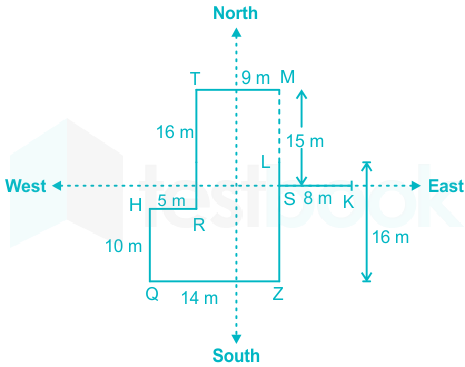
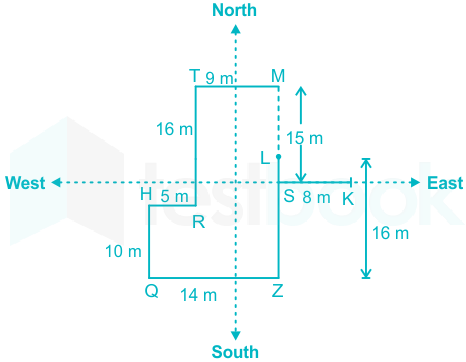
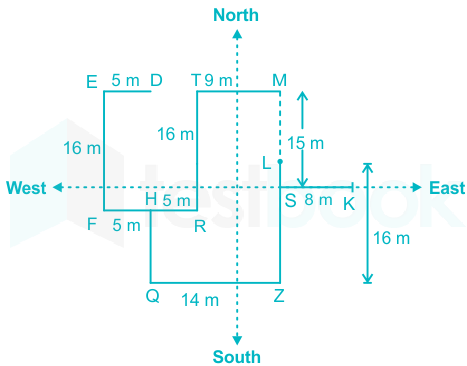
L is 16m north of Z, S is 8m west of K, R is 5m east of H, Q is 14m west of Z, T is 9m west of M, Q is 10m south of H, S is 15m south of M, T is 16m north of R

From the above sentences, we get the following diagram -

Checking Statement  I. J & P (19m), P % N (22m), N @ O (25m)

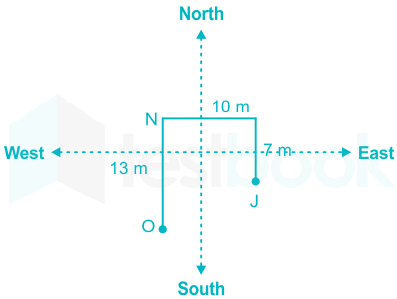
J is 7m south of P, P is 10m east of N, N is 13m north of O.

From Statement I alone we can not find the distance between points M and J.

Checking Statement II. P & Q (27m), N % P (20m), O @ N (22m), O # J (18m)

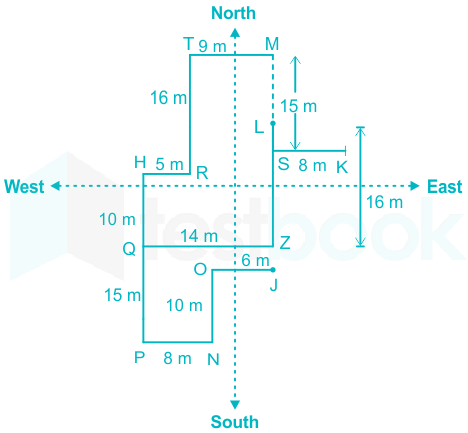
P is 15m south of Q, N is 8m east of P, O is 10m north of N, O is 6m west of J.

From Statement II alone, we can find distance between points M and J.

Hence, Data in Statement II alone is sufficient to answer the question, while the data in Statement I alone is not sufficient to answer the question

25

Which of the following statement is sufficient to prove B * RT?

I. F # H (17m), F & E (28m), D % E (17m)

II. D @ C (20m), B % C (17m)

  1. ((a))

    Data in Statement I alone is sufficient to answer the question, while the data in Statement II alone is not sufficient to answer the question

  2. ((b))

    Data in Statement II alone is sufficient to answer the question, while the data in Statement I alone is not sufficient to answer the question

  3. ((c))

    Data either in Statement I alone or in Statement II alone is sufficient to answer the question

  4. ((d))

    Data given in both Statements I and II together are not sufficient to answer the question

  5. ((e))

    Data in both Statements I and II together are necessary to answer the question

Show Answer
Answer: ((e))

Data in both Statements I and II together are necessary to answer the question

Given:

A # B (58m) – A is 46m west of B, here (58-46) = 12m

A & B (89m) – A is 77m south of B, here (89-77) = 12m

A @ B (110m) – A is 98m north of B, here (110-98) = 12m

A % B (52m) – A is 40m east of B, here (52-40) = 12m

The actual distance between A and B is 12m less than the distance given in the code.

Now the given sentence,

L @ Z (28m), S # K (20m), R % H (17m), Q # Z (26m), T # M (21m), Q & H (22m), S & M (27m), T @ R (28m)

L is 16m north of Z, S is 8m west of K, R is 5m east of H, Q is 14m west of Z, T is 9m west of M, Q is 10m south of H, S is 15m south of M, T is 16m north of R

From above sentences we get following diagram-

Checking Statement I. F # H (17m), F & E (28m), D % E (17m)

F is 5m west of H, F is 16m south of E, D is 5m east of E.

From Statement I alone we can not prove B * RT i.e., B is the mid point of line RT.

Checking Statement II. D @ C (20m), B % C (17m)

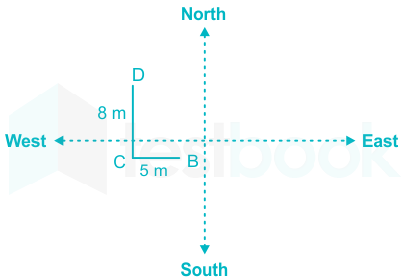
D is 8m north of C, B is 5m east of C.

From Statement II alone we can not prove B * RT i.e., B is the mid point of line RT.

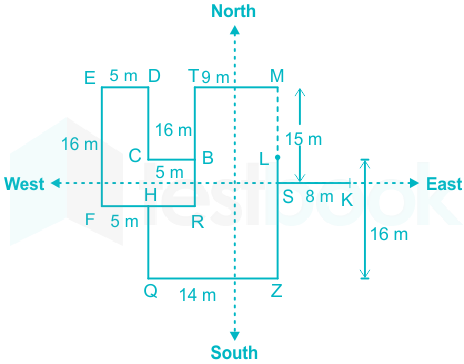
Combining Statement I and II we get,

Thus from Statement I and II together, we can prove B * RT i.e., B is the mid point of line RT.

Hence, Data in both Statements I and II together are necessary to answer the question

Direction : Study the following information to answer the given questions below:

Eight persons A, B, C, D, E, F, G and H are living in different cities Chennai, Bangalore, Hyderabad, Mumbai, Ahmedabad, Ernakulam, Jaipur and Bhubaneshwar, not necessarily in the same order. Each has a different weight –89, 50, 55,71, 49, 66,92 and 56 (in Kg) not necessarily in the same order. A has a weight which is multiple of 11 and 5 and lives in Bhubaneshwar. D lives in Bangalore but his weight is not 89Kg or 71Kg. The one who lives in Hyderabad has a weight 56Kg. G has a weight of 49Kg and does not live in Mumbai or Chennai. E has weight of 71Kg and lives in Ahmedabad or Ernakulam. F lives in Chennai but his weight is not 92Kg. C lives in Mumbai. The sum of weights of H and C is 181Kg. Neither G nor H lives in Ernakulam. G does not live in Jaipur. The sum of weights of D and H is 142Kg.

Further, a code is assigned to each person depending on the city in which they live and their weight according to the following conditions:

  1. If the name of the city starts with vowel and the weight is a prime number then the code will be 5th succeeding letter of the person’s name as per English Alphabetical Series.
  2. If the name of the city starts with a vowel and the weight is a composite number then the code will be 3rd preceding letter of the person’s name as per the English Alphabetical Series.
  3. If the name of the city starts with consonant and the weight is a prime number then the code will be sum of digits of the person’s weight.
  4. If the name of the city starts with consonant and the weight is a composite number then the code will be difference of digits of the person’s weight.
26

What is the sum of codes of C and H and weight of D ?

  1. ((a))

    66

  2. ((b))

    74

  3. ((c))

    50

  4. ((d))

    64

  5. ((e))

    19

Show Answer
Answer: ((b))

74

Persons : A, B, C, D, E, F, G, H

Cities: Chennai, Bangalore, Hyderabad, Mumbai, Ahmedabad, Ernakulam, Jaipur, Bhubaneshwar

Weights : 89, 50, 55, 71, 49, 66, 92, 56

1. A has a weight which is multiple of 11 and 5 and lives in Bhubaneshwar.

PersonsWeightCity
A55Bhubaneshwar.
B
C
D
E
F
G
H


2. F lives in Chennai but his weight is not 92Kg. C lives in Mumbai.

PersonsWeightCity
A55Bhubaneshwar.
B
CMumbai
D
E
FChennai
G
H


3. The sum of weights of H and C is 181Kg. The sum of weights of D and H is 142Kg.

⇒ Here there is one pair of weights whose sum is 181 which is 92 and 89. Thus H and C can have weights of 92Kg and 89Kg in any order. Further there is one pair whose sum is 142 which is 92 and 50. Thus D and H can have weights of 92Kg and 50Kg in any order. But taking into consideration both the statements we get H's weight is 92 Kg, D's weight is 50Kg and C's weight is 89Kg.

PersonsWeightCity
A55Bhubaneshwar.
B
C89Mumbai
D50
E
FChennai
G
H92


4. G has a weight of 49Kg and does not live in Mumbai or Chennai. E has weight of 71Kg and lives in Ahmedabad or Ernakulam.

PersonsWeightCity
A55Bhubaneshwar.
B
C89Mumbai
D50
E71Ahmedabad /Ernakulam
FChennai
G49
H92


5. The one who lives in Hyderabad has a weight 56Kg. D lives in Bangalore but his weight is not 89Kg or 71Kg.

PersonsWeightCity
A55Bhubaneshwar.
B56Hyderabad
C89Mumbai
D50Bangalore
E71Ahmedabad /Ernakulam
FChennai
G49
H92


6. Neither G nor H lives in Ernakulam. G does not live in Jaipur.

PersonsWeightCity
A55Bhubaneshwar.
B56Hyderabad
C89Mumbai
D50Bangalore
E71Ernakulam
FChennai
G49Ahmedabad
H92Jaipur


After filling the only weight left we get final arrangement as below:


PersonsWeightCity
A55Bhubaneshwar.
B56Hyderabad
C89Mumbai
D50Bangalore
E71Ernakulam
F66Chennai
G49Ahmedabad
H92Jaipur


Now the given conditions : 

  1. If the name of the city starts with vowel and the weight is a prime number then the code will be 5th succeeding letter of the person’s name as per English Alphabetical Series.
  2. If the name of the city starts with a vowel and the weight is a composite number then the code will be 3rd preceding letter of the person’s name as per the English Alphabetical Series.
  3. If the name of the city starts with consonant and the weight is a prime number then the code will be sum of digits of the person’s weight.
  4. If the name of the city starts with consonant and the weight is a composite number then the code will be difference of digits of the person’s weight.

Thus after applying all the conditions, the codes of all the persons will be as shown in the below table.

PersonsWeightCityCode
A55Bhubaneshwar.0
B56Hyderabad1
C89Mumbai17
D50Bangalore5
E71ErnakulamJ
F66Chennai0
G49AhmedabadD
H92Jaipur7


Hence, sum of codes of C and H and age of D = 17 + 7 + 50 = 74

27

What is the code for the one who lives in Ernakulam?

  1. ((a))

    5

  2. ((b))

    D

  3. ((c))

    1

  4. ((d))

    17

  5. ((e))

    J

Show Answer
Answer: ((e))

J

Persons : A, B, C, D, E, F, G, H

Cities: Chennai, Bangalore, Hyderabad, Mumbai, Ahmedabad, Ernakulam, Jaipur, Bhubaneshwar

Weights : 89, 50, 55, 71, 49, 66, 92, 56

1. A has a weight which is multiple of 11 and 5 and lives in Bhubaneshwar.

PersonsWeightCity
A55Bhubaneshwar.
B
C
D
E
F
G
H


2. F lives in Chennai but his weight is not 92Kg. C lives in Mumbai.

PersonsWeightCity
A55Bhubaneshwar.
B
CMumbai
D
E
FChennai
G
H


3. The sum of weights of H and C is 181Kg. The sum of weights of D and H is 142Kg.

⇒ Here there is one pair of weights whose sum is 181 which is 92 and 89. Thus H and C can have weights of 92Kg and 89Kg in any order. Further there is one pair whose sum is 142 which is 92 and 50. Thus D and H can have weights of 92Kg and 50Kg in any order. But taking into consideration both the statements we get H's weight is 92 Kg, D's weight is 50Kg and C's weight is 89Kg.

PersonsWeightCity
A55Bhubaneshwar.
B
C89Mumbai
D50
E
FChennai
G
H92


4. G has a weight of 49Kg and does not live in Mumbai or Chennai. E has weight of 71Kg and lives in Ahmedabad or Ernakulam.

PersonsWeightCity
A55Bhubaneshwar.
B
C89Mumbai
D50
E71Ahmedabad /Ernakulam
FChennai
G49
H92


5. The one who lives in Hyderabad has a weight 56Kg. D lives in Bangalore but his weight is not 89Kg or 71Kg.

PersonsWeightCity
A55Bhubaneshwar.
B56Hyderabad
C89Mumbai
D50Bangalore
E71Ahmedabad /Ernakulam
FChennai
G49
H92


6. Neither G nor H lives in Ernakulam. G does not live in Jaipur.

PersonsWeightCity
A55Bhubaneshwar.
B56Hyderabad
C89Mumbai
D50Bangalore
E71Ernakulam
FChennai
G49Ahmedabad
H92Jaipur


After filling the only weight left we get final arrangement as below:


PersonsWeightCity
A55Bhubaneshwar.
B56Hyderabad
C89Mumbai
D50Bangalore
E71Ernakulam
F66Chennai
G49Ahmedabad
H92Jaipur


Now the given conditions 

  1. If the name of the city starts with vowel and the weight is a prime number then the code will be 5th succeeding letter of the person’s name as per English Alphabetical Series.
  2. If the name of the city starts with a vowel and the weight is a composite number then the code will be 3rd preceding letter of the person’s name as per the English Alphabetical Series.
  3. If the name of the city starts with consonant and the weight is a prime number then the code will be sum of digits of the person’s weight.
  4. If the name of the city starts with consonant and the weight is a composite number then the code will be difference of digits of the person’s weight.

Thus after applying all the conditions, codes of all the persons will be as shown in below table.

PersonsWeightCityCode
A55Bhubaneshwar.0
B56Hyderabad1
C89Mumbai17
D50Bangalore5
E71ErnakulamJ
F66Chennai0
G49AhmedabadD
H92Jaipur7


Hence, code for the one who lives in Ernakulam is J.

28

Who lives in Ahmedabad?

  1. ((a))

    G

  2. ((b))

    A

  3. ((c))

    F

  4. ((d))

    C

  5. ((e))

    D

Show Answer
Answer: ((a))

G

Persons : A, B, C, D, E, F, G, H

Cities: Chennai, Bangalore, Hyderabad, Mumbai, Ahmedabad, Ernakulam, Jaipur, Bhubaneshwar

Weights : 89, 50, 55, 71, 49, 66, 92, 56

1. A has a weight which is multiple of 11 and 5 and lives in Bhubaneshwar.

PersonsWeightCity
A55Bhubaneshwar.
B
C
D
E
F
G
H


2. F lives in Chennai but his weight is not 92Kg. C lives in Mumbai.

PersonsWeightCity
A55Bhubaneshwar.
B
CMumbai
D
E
FChennai
G
H


3. The sum of weights of H and C is 181Kg. The sum of weights of D and H is 142Kg.

⇒ Here there is one pair of weights whose sum is 181 which is 92 and 89. Thus H and C can have weights of 92Kg and 89Kg in any order. Further there is one pair whose sum is 142 which is 92 and 50. Thus D and H can have weights of 92Kg and 50Kg in any order. But taking into consideration both the statements we get H's weight is 92 Kg, D's weight is 50Kg and C's weight is 89Kg.

PersonsWeightCity
A55Bhubaneshwar.
B
C89Mumbai
D50
E
FChennai
G
H92


4. G has a weight of 49Kg and does not live in Mumbai or Chennai. E has weight of 71Kg and lives in Ahmedabad or Ernakulam.

PersonsWeightCity
A55Bhubaneshwar.
B
C89Mumbai
D50
E71Ahmedabad /Ernakulam
FChennai
G49
H92


5. The one who lives in Hyderabad has a weight 56Kg. D lives in Bangalore but his weight is not 89Kg or 71Kg.

PersonsWeightCity
A55Bhubaneshwar.
B56Hyderabad
C89Mumbai
D50Bangalore
E71Ahmedabad /Ernakulam
FChennai
G49
H92


6. Neither G nor H lives in Ernakulam. G does not live in Jaipur.

PersonsWeightCity
A55Bhubaneshwar.
B56Hyderabad
C89Mumbai
D50Bangalore
E71Ernakulam
FChennai
G49Ahmedabad
H92Jaipur


After filling the only weight left we get final arrangement as below:


PersonsWeightCity
A55Bhubaneshwar.
B56Hyderabad
C89Mumbai
D50Bangalore
E71Ernakulam
F66Chennai
G49Ahmedabad
H92Jaipur


Now the given conditions 

  1. If the name of the city starts with vowel and the weight is a prime number then the code will be 5th succeeding letter of the person’s name as per English Alphabetical Series.
  2. If the name of the city starts with a vowel and the weight is a composite number then the code will be 3rd preceding letter of the person’s name as per the English Alphabetical Series.
  3. If the name of the city starts with consonant and the weight is a prime number then the code will be sum of digits of the person’s weight.
  4. If the name of the city starts with consonant and the weight is a composite number then the code will be difference of digits of the person’s weight.

Thus after applying all the conditions, codes of all the persons will be as shown in below table.

PersonsWeightCityCode
A55Bhubaneshwar.0
B56Hyderabad1
C89Mumbai17
D50Bangalore5
E71ErnakulamJ
F66Chennai0
G49AhmedabadD
H92Jaipur7


Hence, G lives in Ahmedabad.

29

What is the code for H?

  1. ((a))

    1

  2. ((b))

    17

  3. ((c))

    5

  4. ((d))

    7

  5. ((e))

    D

Show Answer
Answer: ((d))

7

Persons : A, B, C, D, E, F, G, H

Cities: Chennai, Bangalore, Hyderabad, Mumbai, Ahmedabad, Ernakulam, Jaipur, Bhubaneshwar

Weights : 89, 50, 55, 71, 49, 66, 92, 56

1. A has a weight which is multiple of 11 and 5 and lives in Bhubaneshwar.

PersonsWeightCity
A55Bhubaneshwar.
B
C
D
E
F
G
H


2. F lives in Chennai but his weight is not 92Kg. C lives in Mumbai.

PersonsWeightCity
A55Bhubaneshwar.
B
CMumbai
D
E
FChennai
G
H


3. The sum of weights of H and C is 181Kg. The sum of weights of D and H is 142Kg.

⇒ Here there is one pair of weights whose sum is 181 which is 92 and 89. Thus H and C can have weights of 92Kg and 89Kg in any order. Further there is one pair whose sum is 142 which is 92 and 50. Thus D and H can have weights of 92Kg and 50Kg in any order. But taking into consideration both the statements we get H's weight is 92 Kg, D's weight is 50Kg and C's weight is 89Kg.

PersonsWeightCity
A55Bhubaneshwar.
B
C89Mumbai
D50
E
FChennai
G
H92


4. G has a weight of 49Kg and does not live in Mumbai or Chennai. E has weight of 71Kg and lives in Ahmedabad or Ernakulam.

PersonsWeightCity
A55Bhubaneshwar.
B
C89Mumbai
D50
E71Ahmedabad /Ernakulam
FChennai
G49
H92


5. The one who lives in Hyderabad has a weight 56Kg. D lives in Bangalore but his weight is not 89Kg or 71Kg.

PersonsWeightCity
A55Bhubaneshwar.
B56Hyderabad
C89Mumbai
D50Bangalore
E71Ahmedabad /Ernakulam
FChennai
G49
H92


6. Neither G nor H lives in Ernakulam. G does not live in Jaipur.

PersonsWeightCity
A55Bhubaneshwar.
B56Hyderabad
C89Mumbai
D50Bangalore
E71Ernakulam
FChennai
G49Ahmedabad
H92Jaipur


After filling the only weight left we get final arrangement as below:


PersonsWeightCity
A55Bhubaneshwar.
B56Hyderabad
C89Mumbai
D50Bangalore
E71Ernakulam
F66Chennai
G49Ahmedabad
H92Jaipur


Now the given conditions 

  1. If the name of the city starts with vowel and the weight is a prime number then the code will be 5th succeeding letter of the person’s name as per English Alphabetical Series.
  2. If the name of the city starts with a vowel and the weight is a composite number then the code will be 3rd preceding letter of the person’s name as per the English Alphabetical Series.
  3. If the name of the city starts with consonant and the weight is a prime number then the code will be sum of digits of the person’s weight.
  4. If the name of the city starts with consonant and the weight is a composite number then the code will be difference of digits of the person’s weight.
PersonsWeightCityCode
A55Bhubaneshwar.0
B56Hyderabad1
C89Mumbai17
D50Bangalore5
E71ErnakulamJ
F66Chennai0
G49AhmedabadD
H92Jaipur7


Hence, code for H is 7.

30

How many persons have the same code?

  1. ((a))

    1

  2. ((b))

    2

  3. ((c))

    3

  4. ((d))

    4

  5. ((e))

    5

Show Answer
Answer: ((b))

2

Persons : A, B, C, D, E, F, G, H

Cities: Chennai, Bangalore, Hyderabad, Mumbai, Ahmedabad, Ernakulam, Jaipur, Bhubaneshwar

Weights : 89, 50, 55, 71, 49, 66, 92, 56

1. A has a weight which is multiple of 11 and 5 and lives in Bhubaneshwar.

PersonsWeightCity
A55Bhubaneshwar.
B
C
D
E
F
G
H


2. F lives in Chennai but his weight is not 92Kg. C lives in Mumbai.

PersonsWeightCity
A55Bhubaneshwar.
B
CMumbai
D
E
FChennai
G
H


3. The sum of weights of H and C is 181Kg. The sum of weights of D and H is 142Kg.

⇒ Here there is one pair of weights whose sum is 181 which is 92 and 89. Thus H and C can have weights of 92Kg and 89Kg in any order. Further there is one pair whose sum is 142 which is 92 and 50. Thus D and H can have weights of 92Kg and 50Kg in any order. But taking into consideration both the statements we get H's weight is 92 Kg, D's weight is 50Kg and C's weight is 89Kg.

PersonsWeightCity
A55Bhubaneshwar.
B
C89Mumbai
D50
E
FChennai
G
H92


4. G has a weight of 49Kg and does not live in Mumbai or Chennai. E has weight of 71Kg and lives in Ahmedabad or Ernakulam.

PersonsWeightCity
A55Bhubaneshwar.
B
C89Mumbai
D50
E71Ahmedabad /Ernakulam
FChennai
G49
H92


5. The one who lives in Hyderabad has a weight 56Kg. D lives in Bangalore but his weight is not 89Kg or 71Kg.

PersonsWeightCity
A55Bhubaneshwar.
B56Hyderabad
C89Mumbai
D50Bangalore
E71Ahmedabad /Ernakulam
FChennai
G49
H92


6. Neither G nor H lives in Ernakulam. G does not live in Jaipur.

PersonsWeightCity
A55Bhubaneshwar.
B56Hyderabad
C89Mumbai
D50Bangalore
E71Ernakulam
FChennai
G49Ahmedabad
H92Jaipur


After filling the only weight left we get final arrangement as below:


PersonsWeightCity
A55Bhubaneshwar.
B56Hyderabad
C89Mumbai
D50Bangalore
E71Ernakulam
F66Chennai
G49Ahmedabad
H92Jaipur


Now the given conditions 

  1. If the name of the city starts with vowel and the weight is a prime number then the code will be 5th succeeding letter of the person’s name as per English Alphabetical Series.
  2. If the name of the city starts with a vowel and the weight is a composite number then the code will be 3rd preceding letter of the person’s name as per the English Alphabetical Series.
  3. If the name of the city starts with consonant and the weight is a prime number then the code will be sum of digits of the person’s weight.
  4. If the name of the city starts with consonant and the weight is a composite number then the code will be difference of digits of the person’s weight.

Thus after applying all the conditions, codes of all the persons will be as shown in below table.

PersonsWeightCityCode
A55Bhubaneshwar.0
B56Hyderabad1
C89Mumbai17
D50Bangalore5
E71ErnakulamJ
F66Chennai0
G49AhmedabadD
H92Jaipur7


Hence, two persons have the same code.

31

Direction: In following question two conclusions have been given followed by 5 sets of possible Statements. You have to take the given Conclusions to be true even if they seem to be at variance with the commonly known facts and then decide for the given Conclusions logically follows from the which of the given statements disregarding commonly known facts.

Conclusions:

I. All Roots can not be Grass.

II. Some Leaves being Grass is a possibility.

Statements:

I. Some Roots are Grass. All Trees are Leaves. Some Leaves are Roots.

II. Only a few Leaves are Roots. Some Roots are Grass. All Trees are Leaves.

III. Only a few Leaves are Roots. Some Roots are Grass. Some Trees are Leaves.

IV. Only a few Roots are Grass. All Trees are Leaves. Some Leaves are Roots.

V. Only a few Roots are Grass. Some Trees are Leaves. Some Leaves are Roots.

  1. ((a))

    Only statement IV

  2. ((b))

    Only statement V

  3. ((c))

    Both statement I and II

  4. ((d))

    Both statement I and III

  5. ((e))

    Both statement IV and V

Show Answer
Answer: ((e))

Both statement IV and V

From statement I,

Some Roots are Grass. All Trees are Leaves. Some Leaves are Roots.

Minimum possible diagram,

I)  All Roots can not be Grass → False ( it is possible but not definite)

II) Some Leaves being Grass is a possibility → True ( It is possible)

Therefore, Statement I will not be the result of the given conclusions.

From Statement II:

Only a few Leaves are Roots. Some Roots are Grass. All Trees are Leaves.

I)  All Roots can not be Grass → False (It is possible but not definite)

II) Some Leaves being Grass is a possibility → True

Therefore, Statement II will not be the result of the given conclusions.

From Statement III:

Only a few Leaves are Roots. Some Roots are Grass. Some Trees are Leaves.

I) All Roots can not be Grass → False (it is possible but not definite)

II) Some Leaves being Grass is a possibility → True

Therefore, Statement III will not be the result of the given conclusions.

From Statement IV:

Only a few Roots are Grass. All Trees are Leaves. Some Leaves are Roots.

I)  All Roots can not be Grass → True (because some roots are grass and some roots are not grass)

II)  Some Leaves being Grass is a possibility → True (It is possible)

Therefore, Statement IV will be the result of the given conclusions.

From Statement V:

Only a few Roots are Grass. Some Trees are Leaves. Some Leaves are Roots.

I)  All Roots can not be Grass → True (because some roots are grass and some roots are not grass)

II)  Some Leaves being Grass is a possibility→ True (It is possible)

Therefore, Statement V will be the result of the given conclusions.

Hence, Both statement IV and V follows.

32

Direction: In following question two conclusions have been given followed by 5 sets of possible Statements. You have to take the given Conclusions to be true even if they seem to be at variance with the commonly known facts and then decide for the given Conclusions logically follows from the which of the given statements disregarding commonly known facts.

Conclusions:

I. At least some goat being bird is a possibility.

II.Some swans are goat.

Statements:

I. All goats are Swans. All swans are crows. No goat is a bird.

II.  All goats are Swans. All Swans are crows. No crow is a bird.

III. Some goats are Swans. Some goats are crows. No goat is a bird.

IV.  Some goats are Swans. All Swans are crows. No goat is a bird.

V.  All goats are Swans. Some goats are crows. No crow is a bird

  1. ((a))

    Only statement II

  2. ((b))

    Only statement V

  3. ((c))

    Only statement IV

  4. ((d))

    Only statement III

  5. ((e))

    Only statement I

Show Answer
Answer: ((b))

Only statement V

From statement I,

All goats are Swans. All swans are crows. No goat is a bird.

Minimum possible diagram,

I. At least some goat being bird is a possibility → False 

II. Some swans are goat → True

Therefore, Statement I will not be the result of the given conclusions.

From Statement II:

All goats are Swans. All Swans are crows. No crow is a bird.

I. At least some goat being bird is a possibility → False (because No crow is a bird) 

II.Some swans are goat → True

Therefore, Statement II will not be the result of the given conclusions.

From Statement III:

Some goats are Swans. Some goats are crows. No goat is a bird.

I.At least some goat being bird is a possibility → False

II.Some swans are goat → True

Therefore, Statement III will not be the result of the given conclusions.

From Statement IV:

Some goats are Swans. All Swans are crows. No goat is a bird.

I. At least some goat being bird is a possibility → False

II.Some swans are goat  → True

Therefore, Statement IV will not be the result of the given conclusions.

From Statement V:

All goats are Swans. Some goats are crows. No crow is a bird

I.At least some goat being bird is a possibility→ True (it is possible)

II. Some swans are goat→ True

Therefore, Statement V will be the result of the given conclusions.

Hence, only statement V follows.

33

Directions: Read the passage given below and select the assumption(s) that hold true based on the facts in the passage.

Cotton acreage in India during the current year has fallen by 10% as cotton growers have moved on the cultivation of other cash crops. This is the result of the cotton glut in world markets post-September 11 and the consequent slowdown in the world economy. But this scenario brought with it benefits to one segment of the industry - yarn manufacturers - as they get higher prices for their produce. Some yarn manufacturers had stocked up low priced cotton last year. The combined effect of all this is evident in the rise in net profits and net margins of yarn manufacturers.

Assumption: The farmers will again grow cotton next year due to the increased price of cotton yarn.

  1. ((a))

    If the assumption is definitely true

  2. ((b))

    If the assumption is probably true

  3. ((c))

    If the assumption is probably false

  4. ((d))

    If the assumption is definitely false

  5. ((e))

    If the data are inadequate

Show Answer
Answer: ((c))

If the assumption is probably false

Correct option – 3

As we see the passage, it talks about yarn manufacturing. As cotton prices fall, The yarn manufactures get higher prices for their production. The assumption is not implicit here because this will benefit the yarn manufacturers, not the farmers unless the latter act as the former also. The yarn higher price not so much beneficial for farmers.

Hence, the assumption is probably false.

34

Directions: In the question below are given a statement followed by two courses of action numbered I and II. A course of action is a step or administrative decision to be taken for improvement, follow-up or further action regarding the problem, policy, etc. Based on the information given in the statement to be true, then decide which of the suggested courses of action logically follow(s) for pursuing.

Statement:

Caitlin Bosche is the Human Resource Management Head at Company X. She has received the monthly reports from all the departments in the compartment. While going through the reports, it comes to her notice that the production in Department G and Department K has fallen by 100,000 units and 150,000 units respectively. On further investigation, she concludes that the machineries in department G are breaking down more often because of being overused. While the machinery in Department K is being underutilized.

 Course of Actions:

I. Caitlin sends an email to the Operations Manager directing him to buy new machinery for Department G with enough capacity to bear the workload.

II. Caitlin sends an email to the Operation Manager informing him to transfer 10,000 workers from Department G to Department K.

  1. ((a))

    Only I follows.

  2. ((b))

    Only Il follows.

  3. ((c))

    Either I or II follows.

  4. ((d))

    Neither I nor II follows.

  5. ((e))

    Both I and II follow.

Show Answer
Answer: ((b))

Only Il follows.

Answer: Option 2. Only II follows.

Buying new machines will solve the problem faced by Department G as the stronger machines won’t break down because of being overworked. But Department K is not provided with the solution by this approach. But if the workers are transferred from Department G to Department K, it will solve both their problems. As the workers are moved to another department, the machines in the Department G won’t break down because of being overworked and perform satisfactorily. While machines in Department K which were previously being underutilized will be put to use with the influx of new workers. Hence, the second course of action fixes both the problems.

35

Directions: One statement is given followed by two conclusions, I and II. You have to consider the statement to be true, even if it seems to be at variance from commonly known facts. You are to decide which of the given conclusions can definitely be drawn from the given statement.

Statement:

80% of the employees of Edulab Ltd. earn more than Rs. 5000 per month. 70% of employees of Edulab Ltd. work as supervisors.

Conclusions: 

I. All supervisors earn more than Rs.5000 per month.

II. Less than 100% of supervisors earn more than Rs.5000 per month.

  1. ((a))

    Only Conclusion I follows.

  2. ((b))

    Only Conclusion II follows

  3. ((c))

    Both the Conclusions I and II follow.

  4. ((d))

    Neither Conclusion I nor II follows.

  5. ((e))

    Either Conclusion I or II follows.

Show Answer
Answer: ((e))

Either Conclusion I or II follows.

Option 5 is the correct answer. The given statement tells us that 80% of the employees of Edulab Ltd earn above Rs.5000 per month. It also tells us that 70% of the employees work as supervisors. From this we know that 20% of the employees earn Rs.5000 or less. If this 20% are all supervisors then we can say that at least 50% of the supervisors earn more than Rs.5000 per month. If none of these 20% employees are supervisors, it means that all the supervisors earn more than Rs.5000 per month. Thus we can say that either 100% of the supervisors earn more than Rs.5000, or conversely less than 100% of the supervisors earn more than Rs.5000. This is exactly what conclusions I and II state, but we know that only one of them is definitely true. Hence, either I or II follows, but not both.

36

Directions: The critical reasoning question is based on a short argument, a set of statements, or a plan of action. For each question, select the best answer of the choices given and explain why the chosen answer is the right fit. You have to consider the statements to be true even if they seem to be at variance from commonly known facts.

Statement:

All engineering students, except for Mechanical, work on software rather than hardware.

Which of the following can be most properly inferred from the statement above?

  1. ((a))

    Mechanical engineering students work only on hardware.

  2. ((b))

    Only mechanical engineering students work on software.

  3. ((c))

     If an engineering student works on software, he is not a mechanical engineer.

  4. ((d))

    Not all engineering students work on software.

  5. ((e))

     An engineering student works on hardware, as long as he is not a mechanical engineer.

Show Answer
Answer: ((d))

Not all engineering students work on software.

Not all engineering students work on software.

"Not all engineering students work on software." is correct because the statement specifies on the fact that all engineering students work on software except mechanical engineers which directly implies that not all the engineering students use the software. The statement does not say anything about what mechanical engineers work on; hence other statements cannot be inferred from the statement. Since the statement suggests that most engineering students work on software, the statement  "An engineering student works on hardware, as long as he is not a mechanical engineer." is eliminated.

37

Directions: In making decisions about important questions, it is desirable to be able to distinguish between strong and weak arguments. Strong arguments are those, which are both important and directly related to the question. Weak arguments are those, which are of minor importance and also may not be directly related to the question or may be related to a trivial aspect of the question. The question below is followed by two arguments numbered I and II. You have to decide which of the arguments a Strong argument is and which a weak argument is.

Statement:

Should animals be killed in the name of the laboratory experiments?

Arguments:

I. Yes, they are available in abundance.

II. No, we have to support non-violence on every step of our lives.

  1. ((a))

    If only argument I is strong

  2. ((b))

    If only argument II is strong.

  3. ((c))

    If either I or II is strong.

  4. ((d))

    If neither I nor II is strong.

  5. ((e))

    If both I and II are strong.

Show Answer
Answer: ((d))

If neither I nor II is strong.

Option 4 is the correct answer. As we know that for an experiment of any kind of treatment or medicine, first of all, they experiment it on animals. An abundance of animals does not mean that we should reduce their number. Hence, argument I is a weak argument. The argument II is also a weak argument because does it not depict the real picture. Are we really supporting non-violence at every step of our lives? Moreover, it does not go into the reason for practicing non-violence. It does not provide any other measure that can be taken in its place as well. 

38

Directions: Read the following passage and select the correct answer.

Alka had lost her job during the lockdown and started a new business to support herself. She was providing tiffin service to the people who had depended on restaurants for daily food and were facing a problem due to the lockdown. Because of the apt timing and identification of need, her business had hit the ground running. It hadn't even required a lot of investment and she used her savings from the job to start it so she had no debt hanging on her. The business flourished for over an year but then as the lockdown opened, she saw a drastic reduce in demand for her tiffins. Alka surveyed her customers and found out that the local restaurants were offering a similar meal at a lower cost than her.

Which of the following actions would help Alka improve her business?

  1. ((a))

    Reduce the cost of her tiffins to get more customers, even if it means a little loss at the beginning.

  2. ((b))

    Advertise to increase customer reach and extend her boundaries.

  3. ((c))

    Come up with subscription and discount offers to allure customers without taking a significant loss.

  4. ((d))

    Keep the business alive by reducing the prices and get back to her job thereby averting loss.

  5. ((e))

    Retain the cost on her tiffins and try to change the class of target customers.

Show Answer
Answer: ((c))

Come up with subscription and discount offers to allure customers without taking a significant loss.

The passage has clearly stated that the problem is the pricing on the tiffins. So Alka needs a solution that does not cause her a lot of loss and yet increase her customer base.

Options 1 and 5 are therefore eliminated.

Option 4 is not feasible and cannot be expected to work efficiently, so it is also eliminated.

Among options 2 and 3, option 3 answers Alka's problem more efficiently as compared to the advertising idea.

Hence the correct answer is option 3.

Directions: Study the following information carefully and answer the questions that follow:

There are 15 boxes numbered from 2 to 16 arranged one above another in ascending order from top to bottom. The letters of the word "MATE" are written in the same order as given in word against the boxes which are multiple of 3, starting from 3. Further arrangement of letters P, Q, R, S, U, V and symbols @, #, $, % is as given below.

V is written below R but not below box numbered 12. There is a gap of 2 boxes between the letter the U and symbol %. Symbols P and Q are written in alphabetical order against the multiples of 7 starting from 7. Symbols # and @ are written immediate to each other. Vowels are written immediate to the third letter of the word. There is a gap of 4 boxes between the symbols # and $. S is written against the bottommost box.

39

Which letter or symbol is written against the box which is 4 places away from the bottommost box?

  1. ((a))

    %

  2. ((b))

  3. ((c))

    E

  4. ((d))

    R

  5. ((e))

    T

Show Answer
Answer: ((c))

E

Given : 

There are 15 boxes numbered from 2 to 16 arranged one above another in ascending order from top to bottom. The letters of the word "MATE" are written in the same order as given in word against the boxes which are multiple of 3, starting from 3.

Box NoLetter/ Symbol
2
3M
4
5
6A
7
8
9T
10
11
12E
13
14
15
16


  1. Symbols P and Q are written in alphabetical order against the multiples of 7 starting from 7. S is written against the bottommost box.

Box NoLetter/ Symbol
2
3M
4
5
6A
7P
8
9T
10
11
12E
13
14Q
15
16S


2. Vowels are written immediate to the third letter of the word.

⇒ U is the only vowel among the letters. T is the third letter of the word. Hence we will have the following cases.

Box NoLetter/SymbolLetter/Symbol
Case 1Case 2
2
3MM
4
5
6AA
7PP
8U
9TT
10U
11
12EE
13
14QQ
15
16SS
<br>
  1. There is a gap of 2 boxes between the letter the U and symbol %. 

⇒ There will be one more case from case 1.

Box NoLetter/SymbolLetter/SymbolLetter/Symbol
Case 1Case 2Case 1A
2
3MMM
4
5%
6AAA
7PPP
8UU
9TTT
10U
11%
12EEE
13%
14QQQ
15
16SSS


  1. Symbols # and @ are written immediate to each other. There is a gap of 4 boxes between the symbols # and $.

⇒ There is no suitable place for # and $ in Case2. Hence it is eliminated.

Box NoLetter/SymbolLetter/SymbolLetter/Symbol
Case 1Case 2 (Eliminated)Case 1A
2
3MMM
4@
5%#
6AAA
7PPP
8UU
9TTT
10#U$
11@%
12EEE
13%
14QQQ
15$
16SSS


5. V is written below R but not below box numbered 12.

⇒ There is no suitable place for V in Case 1A. Hence it is eliminated. Case 1 is the final arrangement.

Box NoLetter/SymbolLetter/Symbol
Case 1Case 1A (Eliminated)
2R
3MM
4V@
5%#
6AA
7PP
8UU
9TT
10#$
11@%
12EE
13
14QQ
15$
16SS


Hence, Box no 12 is placed 4 places away from bottommost box. Letter E is written against it.

40

If a and b are box numbers of the letters M and P respectively, then find the value of (a + b)2

  1. ((a))

    99

  2. ((b))

    101

  3. ((c))

    10

  4. ((d))

    100

  5. ((e))

    52

Show Answer
Answer: ((d))

100

Given : 

There are 15 boxes numbered from 2 to 16 arranged one above another in ascending order from top to bottom. The letters of the word "MATE" are written in the same order as given in word against the boxes which are multiple of 3, starting from 3.

Box NoLetter/ Symbol
2
3M
4
5
6A
7
8
9T
10
11
12E
13
14
15
16


  1. Symbols P and Q are written in alphabetical order against the multiples of 7 starting from 7. S is written against the bottommost box.

Box NoLetter/ Symbol
2
3M
4
5
6A
7P
8
9T
10
11
12E
13
14Q
15
16S


2. Vowels are written immediate to the third letter of the word.

⇒ U is the only vowel among the letters. T is the third letter of the word. Hence we will have the following cases.

Box NoLetter/SymbolLetter/Symbol
Case 1Case 2
2
3MM
4
5
6AA
7PP
8U
9TT
10U
11
12EE
13
14QQ
15
16SS
<br>
  1. There is a gap of 2 boxes between the letter the U and symbol %. 

⇒ There will be one more case from case 1.

Box NoLetter/SymbolLetter/SymbolLetter/Symbol
Case 1Case 2Case 1A
2
3MMM
4
5%
6AAA
7PPP
8UU
9TTT
10U
11%
12EEE
13%
14QQQ
15
16SSS


  1. Symbols # and @ are written immediate to each other. There is a gap of 4 boxes between the symbols # and $.

⇒ There is no suitable place for # and $ in Case2. Hence it is eliminated.

Box NoLetter/SymbolLetter/SymbolLetter/Symbol
Case 1Case 2 (Eliminated)Case 1A
2
3MMM
4@
5%#
6AAA
7PPP
8UU
9TTT
10#U$
11@%
12EEE
13%
14QQQ
15$
16SSS


5. V is written below R but not below box numbered 12.

⇒ There is no suitable place for V in Case 1A. Hence it is eliminated. Case 1 is the final arrangement.

Box NoLetter/SymbolLetter/Symbol
Case 1Case 1A (Eliminated)
2R
3MM
4V@
5%#
6AA
7PP
8UU
9TT
10#$
11@%
12EE
13
14QQ
15$
16SS


Here a = 3 and b = 7. Hence (a + b)2 = (3 + 7)2 = 102 = 100

Hence, the correct answer is 100.

Directions: Study the given information carefully and answer the following questions below.

8 persons A, B, C, D, E, F, G and H are born in four different months viz. March, May, August and October in 8 different cities viz. P, Q, R, S, T, U, V and W but not necessarily in that order. They have their birthdays either on 14th or 26th of the given months. The one born in P has birthday just before the one born in Q. Number of people born before the one born in R is same as number of persons born after the one born in V. E and H are born in same month. One person is born in between the one born in V and other born in S. There is no person born between the one born in V and the person F. Neither E nor D is born in R and V. Three persons are born between the one born in T and the person C such that C is born before the one born in T. B is born in May and there are two people born between B and the one born in R. The one born in R does not have birthday in the month of October. There are three persons born between F and G. A is born immediately before the one born in Q. More than two people are born before F. D is not the one born in W.

41

What is the name of city where A is born?

  1. ((a))

    U

  2. ((b))

    Q

  3. ((c))

    P

  4. ((d))

    W

  5. ((e))

    None of these

Show Answer
Answer: ((c))

P

8 persons: A, B, C, D, E, F, G and H.

4 Months: March, May, August and October.

8 Cities: P, Q, R, S, T, U, V and W.

They have their birthdays either on 14th or 26th of the given months.

  1. B is born in May (B is either born in 14th or 26th of May).

Therefore, two cases arise.

Case -1

Month14th26th
March
MayB
August
October


Case – 2

Month14th26th
March
MayB
August
October


  1. Two people are born between B and the one born in R.

  2. Number of people born before the one born in R is same as number of persons born after the one born in V.

  3. The one born in R does not have birthday in the month of October.

On combining the above statements, we get:

Case – 1

Month14th26th
March
MayB(V)
August(R)
October


Case – 2

Month14th26th
March(R)
MayB
August
October(V)


  1. One person is born in between the one born in V and other born in S (In case – 1, two possibilities arise).

Therefore, further case – 1(a) and Case – 1(b) arise.

Case – 1(a)

Month14th26th
March(S)
MayB(V)
August(R)
October


Case – 1(b)

Month14th26th
March
MayB(V)
August(S)(R)
October


Case – 2

Month14th26th
March(R)
MayB
August(S)
October(V)


  1. There is no person born between the one born in V and the person F.

  2. More than two people are born before F.

  3. There are three persons born between F and G.

Case – 1(a)

Month14th26th
March(S)
MayB(V)F
August(R)
OctoberG


Case – 1(b)

Month14th26th
March
MayB(V)F
August(S)(R)
OctoberG


Case - 2

Month14th26th
March(R)
MayGB
August(S)
OctoberF(V)


  1. Three persons are born between the one born in T and the person C such that C is born before the one born in T.

Therefore, case – 1(b) will be eliminated.

Case – 1(a)

Month14th26th
MarchC(S)
MayB(V)F
August(T)(R)
OctoberG


Case – 2

Month14th26th
MarchC(R)
MayGB
August(T)(S)
OctoberF(V)


  1. E is not born in R and V.

  2. E and H are born in same month (Only month of August can accommodate two persons).

Therefore, further case – 2(a) and case – 2(b) arise.

Case – 1

Month14th26th
MarchC(S)
MayB(V)F
AugustE(T)H(R)
OctoberG


Case – 2(a)

Month14th26th
MarchC(R)
MayGB
AugustE(T)H(S)
OctoberF(V)


Case – 2(b)

Month14th26th
MarchC(R)
MayGB
AugustH(T)E(S)
OctoberF(V)


  1. The one born in P has birthday just before the one born in Q.

  2. A is born immediately before the one born in Q.

On combining the above two statements, it is implied that A is born in P.

Case – 1

Month14th26th
MarchC(S)
MayB(V)F
AugustE(T)H(R)
OctoberA(P)G(Q)


Case – 2(a)

Month14th26th
MarchC(R)A(P)
MayG(Q)B
AugustE(T)H(S)
OctoberF(V)


Case – 2(b)

Month14th26th
MarchC(R)A(P)
MayG(Q)B
AugustH(T)E(S)
OctoberF(V)


  1. Neither E nor D is born in R and V.

  2. D is not the one born in W (So, only option left for D is of U. Therefore, D is born in U).

Therefore, case – 2(a) and case – 2(b) are neglected.

Month14th26th
MarchC(S)D(U)
MayB(V)F
AugustE(T)H(R)
OctoberA(P)G(Q)


After filling the remaining data, we get the final arrangement as shown below:

Month14th26th
MarchC(S)D(U)
MayB(V)F(W)
AugustE(T)H(R)
OctoberA(P)G(Q)


Therefore, A is born in P.

Hence, option 1) is correct.

42

Whose birthdays are in the month of October?

  1. ((a))

     D and A

  2. ((b))

    F and G

  3. ((c))

    E and H

  4. ((d))

    A and G

  5. ((e))

    None of these

Show Answer
Answer: ((d))

A and G

8 persons: A, B, C, D, E, F, G and H.

4 Months: March, May, August and October.

8 Cities: P, Q, R, S, T, U, V and W.

They have their birthdays either on 14th or 26th of the given months.

  1. B is born in May (B is either born in 14th or 26th of May).

Therefore, two cases arise.

Case -1

Month14th26th
March
MayB
August
October


Case – 2

Month14th26th
March
MayB
August
October


  1. Two people are born between B and the one born in R.

  2. Number of people born before the one born in R is same as number of persons born after the one born in V.

  3. The one born in R does not have birthday in the month of October.

On combining the above statements, we get:

Case – 1

Month14th26th
March
MayB(V)
August(R)
October


Case – 2

Month14th26th
March(R)
MayB
August
October(V)


  1. One person is born in between the one born in V and other born in S (In case – 1, two possibilities arise).

Therefore, further case – 1(a) and Case – 1(b) arise.

Case – 1(a)

Month14th26th
March(S)
MayB(V)
August(R)
October


Case – 1(b)

Month14th26th
March
MayB(V)
August(S)(R)
October


Case – 2

Month14th26th
March(R)
MayB
August(S)
October(V)


  1. There is no person born between the one born in V and the person F.

  2. More than two people are born before F.

  3. There are three persons born between F and G.

Case – 1(a)

Month14th26th
March(S)
MayB(V)F
August(R)
OctoberG


Case – 1(b)

Month14th26th
March
MayB(V)F
August(S)(R)
OctoberG


Case - 2

Month14th26th
March(R)
MayGB
August(S)
OctoberF(V)


  1. Three persons are born between the one born in T and the person C such that C is born before the one born in T.

Therefore, case – 1(b) will be eliminated.

Case – 1(a)

Month14th26th
MarchC(S)
MayB(V)F
August(T)(R)
OctoberG


Case – 2

Month14th26th
MarchC(R)
MayGB
August(T)(S)
OctoberF(V)


  1. E is not born in R and V.

  2. E and H are born in same month (Only month of August can accommodate two persons).

Therefore, further case – 2(a) and case – 2(b) arise.

Case – 1

Month14th26th
MarchC(S)
MayB(V)F
AugustE(T)H(R)
OctoberG


Case – 2(a)

Month14th26th
MarchC(R)
MayGB
AugustE(T)H(S)
OctoberF(V)


Case – 2(b)

Month14th26th
MarchC(R)
MayGB
AugustH(T)E(S)
OctoberF(V)


  1. The one born in P has birthday just before the one born in Q.

  2. A is born immediately before the one born in Q.

On combining the above two statements, it is implied that A is born in P.

Case – 1

Month14th26th
MarchC(S)
MayB(V)F
AugustE(T)H(R)
OctoberA(P)G(Q)


Case – 2(a)

Month14th26th
MarchC(R)A(P)
MayG(Q)B
AugustE(T)H(S)
OctoberF(V)


Case – 2(b)

Month14th26th
MarchC(R)A(P)
MayG(Q)B
AugustH(T)E(S)
OctoberF(V)


  1. Neither E nor D is born in R and V.

  2. D is not the one born in W (So, only option left for D is of U. Therefore, D is born in U).

Therefore, case – 2(a) and case – 2(b) are neglected.

Month14th26th
MarchC(S)D(U)
MayB(V)F
AugustE(T)H(R)
OctoberA(P)G(Q)


After filling the remaining data, we get the final arrangement as shown below:

Month14th26th
MarchC(S)D(U)
MayB(V)F(W)
AugustE(T)H(R)
OctoberA(P)G(Q)


A and G have their birthday in the month of October.

Hence, option 4) is correct.

43

Which person has birthday immediately before the one who is born in V?

  1. ((a))

    C

  2. ((b))

    D

  3. ((c))

    A

  4. ((d))

    F

  5. ((e))

    None of these

Show Answer
Answer: ((b))

D

8 persons: A, B, C, D, E, F, G and H.

4 Months: March, May, August and October.

8 Cities: P, Q, R, S, T, U, V and W.

They have their birthdays either on 14th or 26th of the given months.

  1. B is born in May (B is either born in 14th or 26th of May).

Therefore, two cases arise.

Case -1

Month14th26th
March
MayB
August
October


Case – 2

Month14th26th
March
MayB
August
October


  1. Two people are born between B and the one born in R.

  2. Number of people born before the one born in R is same as number of persons born after the one born in V.

  3. The one born in R does not have birthday in the month of October.

On combining the above statements, we get:

Case – 1

Month14th26th
March
MayB(V)
August(R)
October


Case – 2

Month14th26th
March(R)
MayB
August
October(V)


  1. One person is born in between the one born in V and other born in S (In case – 1, two possibilities arise).

Therefore, further case – 1(a) and Case – 1(b) arise.

Case – 1(a)

Month14th26th
March(S)
MayB(V)
August(R)
October


Case – 1(b)

Month14th26th
March
MayB(V)
August(S)(R)
October


Case – 2

Month14th26th
March(R)
MayB
August(S)
October(V)


  1. There is no person born between the one born in V and the person F.

  2. More than two people are born before F.

  3. There are three persons born between F and G.

Case – 1(a)

Month14th26th
March(S)
MayB(V)F
August(R)
OctoberG


Case – 1(b)

Month14th26th
March
MayB(V)F
August(S)(R)
OctoberG


Case - 2

Month14th26th
March(R)
MayGB
August(S)
OctoberF(V)


  1. Three persons are born between the one born in T and the person C such that C is born before the one born in T.

Therefore, case – 1(b) will be eliminated.

Case – 1(a)

Month14th26th
MarchC(S)
MayB(V)F
August(T)(R)
OctoberG


Case – 2

Month14th26th
MarchC(R)
MayGB
August(T)(S)
OctoberF(V)


  1. E is not born in R and V.

  2. E and H are born in same month (Only month of August can accommodate two persons).

Therefore, further case – 2(a) and case – 2(b) arise.

Case – 1

Month14th26th
MarchC(S)
MayB(V)F
AugustE(T)H(R)
OctoberG


Case – 2(a)

Month14th26th
MarchC(R)
MayGB
AugustE(T)H(S)
OctoberF(V)


Case – 2(b)

Month14th26th
MarchC(R)
MayGB
AugustH(T)E(S)
OctoberF(V)


  1. The one born in P has birthday just before the one born in Q.

  2. A is born immediately before the one born in Q.

On combining the above two statements, it is implied that A is born in P.

Case – 1

Month14th26th
MarchC(S)
MayB(V)F
AugustE(T)H(R)
OctoberA(P)G(Q)


Case – 2(a)

Month14th26th
MarchC(R)A(P)
MayG(Q)B
AugustE(T)H(S)
OctoberF(V)


Case – 2(b)

Month14th26th
MarchC(R)A(P)
MayG(Q)B
AugustH(T)E(S)
OctoberF(V)


  1. Neither E nor D is born in R and V.

  2. D is not the one born in W (So, only option left for D is of U. Therefore, D is born in U).

Therefore, case – 2(a) and case – 2(b) are neglected.

Month14th26th
MarchC(S)D(U)
MayB(V)F
AugustE(T)H(R)
OctoberA(P)G(Q)


After filling the remaining data, we get the final arrangement as shown below:

Month14th26th
MarchC(S)D(U)
MayB(V)F(W)
AugustE(T)H(R)
OctoberA(P)G(Q)


D is born immediately before the one born in V i.e. B.

Hence, option 2) is correct.

44

Which person’s birthday is between the one born in W and the person H?

  1. ((a))

    E

  2. ((b))

    B

  3. ((c))

    A

  4. ((d))

    D

  5. ((e))

    None of these

Show Answer
Answer: ((a))

E

8 persons: A, B, C, D, E, F, G and H.

4 Months: March, May, August and October.

8 Cities: P, Q, R, S, T, U, V and W.

They have their birthdays either on 14th or 26th of the given months.

  1. B is born in May (B is either born in 14th or 26th of May).

Therefore, two cases arise.

Case -1

Month14th26th
March
MayB
August
October


Case – 2

Month14th26th
March
MayB
August
October


  1. Two people are born between B and the one born in R.

  2. Number of people born before the one born in R is same as number of persons born after the one born in V.

  3. The one born in R does not have birthday in the month of October.

On combining the above statements, we get:

Case – 1

Month14th26th
March
MayB(V)
August(R)
October


Case – 2

Month14th26th
March(R)
MayB
August
October(V)


  1. One person is born in between the one born in V and other born in S (In case – 1, two possibilities arise).

Therefore, further case – 1(a) and Case – 1(b) arise.

Case – 1(a)

Month14th26th
March(S)
MayB(V)
August(R)
October


Case – 1(b)

Month14th26th
March
MayB(V)
August(S)(R)
October


Case – 2

Month14th26th
March(R)
MayB
August(S)
October(V)


  1. There is no person born between the one born in V and the person F.

  2. More than two people are born before F.

  3. There are three persons born between F and G.

Case – 1(a)

Month14th26th
March(S)
MayB(V)F
August(R)
OctoberG


Case – 1(b)

Month14th26th
March
MayB(V)F
August(S)(R)
OctoberG


Case - 2

Month14th26th
March(R)
MayGB
August(S)
OctoberF(V)


  1. Three persons are born between the one born in T and the person C such that C is born before the one born in T.

Therefore, case – 1(b) will be eliminated.

Case – 1(a)

Month14th26th
MarchC(S)
MayB(V)F
August(T)(R)
OctoberG


Case – 2

Month14th26th
MarchC(R)
MayGB
August(T)(S)
OctoberF(V)


  1. E is not born in R and V.

  2. E and H are born in same month (Only month of August can accommodate two persons).

Therefore, further case – 2(a) and case – 2(b) arise.

Case – 1

Month14th26th
MarchC(S)
MayB(V)F
AugustE(T)H(R)
OctoberG


Case – 2(a)

Month14th26th
MarchC(R)
MayGB
AugustE(T)H(S)
OctoberF(V)


Case – 2(b)

Month14th26th
MarchC(R)
MayGB
AugustH(T)E(S)
OctoberF(V)


  1. The one born in P has birthday just before the one born in Q.

  2. A is born immediately before the one born in Q.

On combining the above two statements, it is implied that A is born in P.

Case – 1

Month14th26th
MarchC(S)
MayB(V)F
AugustE(T)H(R)
OctoberA(P)G(Q)


Case – 2(a)

Month14th26th
MarchC(R)A(P)
MayG(Q)B
AugustE(T)H(S)
OctoberF(V)


Case – 2(b)

Month14th26th
MarchC(R)A(P)
MayG(Q)B
AugustH(T)E(S)
OctoberF(V)


  1. Neither E nor D is born in R and V.

  2. D is not the one born in W (So, only option left for D is of U. Therefore, D is born in U).

Therefore, case – 2(a) and case – 2(b) are neglected.

Month14th26th
MarchC(S)D(U)
MayB(V)F
AugustE(T)H(R)
OctoberA(P)G(Q)


After filling the remaining data, we get the final arrangement as shown below:

Month14th26th
MarchC(S)D(U)
MayB(V)F(W)
AugustE(T)H(R)
OctoberA(P)G(Q)


E is born between the one born in W and H.

Hence, option 1) is correct.

45

Whose birthday comes on 26th of October and where is the person born?

  1. ((a))

    H, born in R

  2. ((b))

    A, born in P

  3. ((c))

    G, born in U

  4. ((d))

    G, born in Q

  5. ((e))

    None of these

Show Answer
Answer: ((d))

G, born in Q

8 persons: A, B, C, D, E, F, G and H.

4 Months: March, May, August and October.

8 Cities: P, Q, R, S, T, U, V and W.

They have their birthdays either on 14th or 26th of the given months.

  1. B is born in May (B is either born in 14th or 26th of May).

Therefore, two cases arise.

Case -1

Month14th26th
March
MayB
August
October


Case – 2

Month14th26th
March
MayB
August
October


  1. Two people are born between B and the one born in R.

  2. Number of people born before the one born in R is same as number of persons born after the one born in V.

  3. The one born in R does not have birthday in the month of October.

On combining the above statements, we get:

Case – 1

Month14th26th
March
MayB(V)
August(R)
October


Case – 2

Month14th26th
March(R)
MayB
August
October(V)


  1. One person is born in between the one born in V and other born in S (In case – 1, two possibilities arise).

Therefore, further case – 1(a) and Case – 1(b) arise.

Case – 1(a)

Month14th26th
March(S)
MayB(V)
August(R)
October


Case – 1(b)

Month14th26th
March
MayB(V)
August(S)(R)
October


Case – 2

Month14th26th
March(R)
MayB
August(S)
October(V)


  1. There is no person born between the one born in V and the person F.

  2. More than two people are born before F.

  3. There are three persons born between F and G.

Case – 1(a)

Month14th26th
March(S)
MayB(V)F
August(R)
OctoberG


Case – 1(b)

Month14th26th
March
MayB(V)F
August(S)(R)
OctoberG


Case - 2

Month14th26th
March(R)
MayGB
August(S)
OctoberF(V)


  1. Three persons are born between the one born in T and the person C such that C is born before the one born in T.

Therefore, case – 1(b) will be eliminated.

Case – 1(a)

Month14th26th
MarchC(S)
MayB(V)F
August(T)(R)
OctoberG


Case – 2

Month14th26th
MarchC(R)
MayGB
August(T)(S)
OctoberF(V)


  1. E is not born in R and V.

  2. E and H are born in same month (Only month of August can accommodate two persons).

Therefore, further case – 2(a) and case – 2(b) arise.

Case – 1

Month14th26th
MarchC(S)
MayB(V)F
AugustE(T)H(R)
OctoberG


Case – 2(a)

Month14th26th
MarchC(R)
MayGB
AugustE(T)H(S)
OctoberF(V)


Case – 2(b)

Month14th26th
MarchC(R)
MayGB
AugustH(T)E(S)
OctoberF(V)


  1. The one born in P has birthday just before the one born in Q.

  2. A is born immediately before the one born in Q.

On combining the above two statements, it is implied that A is born in P.

Case – 1

Month14th26th
MarchC(S)
MayB(V)F
AugustE(T)H(R)
OctoberA(P)G(Q)


Case – 2(a)

Month14th26th
MarchC(R)A(P)
MayG(Q)B
AugustE(T)H(S)
OctoberF(V)


Case – 2(b)

Month14th26th
MarchC(R)A(P)
MayG(Q)B
AugustH(T)E(S)
OctoberF(V)


  1. Neither E nor D is born in R and V.

  2. D is not the one born in W (So, only option left for D is of U. Therefore, D is born in U).

Therefore, case – 2(a) and case – 2(b) are neglected.

Month14th26th
MarchC(S)D(U)
MayB(V)F
AugustE(T)H(R)
OctoberA(P)G(Q)


After filling the remaining data, we get the final arrangement as shown below:

Month14th26th
MarchC(S)D(U)
MayB(V)F(W)
AugustE(T)H(R)
OctoberA(P)G(Q)


G is born on 26th of October in Q.

Hence option 4) is correct.

Data Analysis & Interpretation (35 questions)

Given below the data about three employees of a call center named ZINTOCA. In the given table, data about calls received by them, calls selected for further lead and calls finally received is given:

ABC
Initial calls(% out of total calls)40%30%30%
Lead calls (% out of initial calls)80%x%88%
Final received calls(% out of lead calls)90%80%y%
46

Total number of initial calls in the company is 24000 and total number of calls not received by company C is 4464 less than the total number of calls received by company A. Find the value of y.

  1. ((a))

    70

  2. ((b))

    75

  3. ((c))

    85

  4. ((d))

    90

  5. ((e))

    None of the above

Show Answer
Answer: ((b))

75

Calculation: 

Let the total number of calls be 1000z.

Initial calls (% out of total calls) of A = (1000z × 40/100) = 400z

Initial calls (% out of total calls) of B = (1000z × 30/100) = 300z

Initial calls (% out of total calls) of C = (1000z × 30/100) = 300z

Lead calls (% out of initial calls) of A = (400z × 80/100) = 320z

Lead calls (% out of initial calls) of B = (300z × x/100) = 3zx

Lead calls (% out of initial calls) of C = (300z × 88/100) = 264z

Final received calls (% out of lead calls) of A = (320z × 90/100) = 288z

Final received calls (% out of lead calls) of B = (3zx × 80/100) = 3zx × (4/5)

Final received calls (% out of lead calls) of C = (264z × y/100)

Total number of initial calls in the company = 24000

⇒ (400z + 300z + 300z) = 24000

⇒ 1000z = 24000

⇒ z = (24000/1000)

⇒ z = 24

Total number of calls not received calls by C = (300h – 264z × y/100)

⇒ (300 × 24 –  264z × y/100)

⇒ (7200 – 264z × y/100)

According to the question

Total number of calls not received by company C is 4464 less than the total number of calls received by company A

⇒ (7200 – 264z × y/100) + 4464 = 288z

⇒ (7200 – 264 × 24 × y/100) + 4464 = 288 × 24

⇒ 7200 – 6336y/100 + 4464 = 6912

⇒ (720000 – 6336y + 446400)/100 = 6912

⇒ (720000 – 6336y + 446400) = 6912 × 100

⇒ (1166400 – 6336y) = 691200

⇒ (-6336y) = (691200 – 1166400)

⇒ (-6336y) = -475200

⇒ y = [-475200/(-6336)]

⇒ y = 75

∴ The value of y is 75

47

If the total number of calls not received by A and received by B is 224 and 432 respectively. Find the value of x.

  1. ((a))

    80

  2. ((b))

    75

  3. ((c))

    90

  4. ((d))

    85

  5. ((e))

    None of the above

Show Answer
Answer: ((c))

90

Calculation:

Let the total number of calls be 1000z.

Initial calls (% out of total calls) of A = (1000z × 40/100) = 400z

Initial calls (% out of total calls) of B = (1000z × 30/100) = 300z

Initial calls (% out of total calls) of C = (1000z × 30/100) = 300z

Lead calls (% out of initial calls) of A = (400z × 80/100) = 320z

Lead calls (% out of initial calls) of B = (300z × x/100) = 3zx

Lead calls (% out of initial calls) of C = (300z × 88/100) = 264z

Final received calls (% out of lead calls) of A = (320z × 90/100) = 288z

Final received calls (% out of lead calls) of B = (3zx × 80/100) = 3zx × (4/5)

Now,

The total calls not received by A = (Initial calls by A – Final received calls by A)

⇒ (400z – 288z) = 112z

According to question

⇒ 112z = 224

⇒ z = 2

Now,

The total calls received by B 

⇒ 3zx × (4/5) = 432

⇒ 3 × 2 × x × (4/5) = 432

⇒ 6x × (4/5) = 432

⇒ 24x/5 = 432

⇒ x = (432 × 5)/24

⇒ x = (18 × 5)

⇒ x = 90

∴ The value of x is 90

48

Find the ratio of number of lead calls made by A to the number of initial calls by B.

  1. ((a))

    15 : 13

  2. ((b))

    16 : 13 

  3. ((c))

    16 : 15

  4. ((d))

    17 : 13

  5. ((e))

    None of the above

Show Answer
Answer: ((c))

16 : 15

Calculation:

Let the total number of calls be 1000z.

Initial calls (% out of total calls) of A = (1000z × 40/100) = 400z

Initial calls (% out of total calls) of B = (1000z × 30/100) = 300z

Initial calls (% out of total calls) of C = (1000z × 30/100) = 300z

Lead calls (% out of initial calls) of A = (400z × 80/100) = 320z

Now,

The ratio of number of lead calls made by A to the number of initial calls by B = (320z : 300z)

⇒ 16 : 15

∴ The required ratio is 16 : 15

A person who was watching 4 web series on a binge. Each web series has some episodes (not equal necessarily). Time length of each episode of these web series is 20 minutes. Given bar graph shows percentage distribution of number of episodes of each web series out of total number of episodes of all 4 web series and percentage of watched contents of given series by person.

Note:

(1) Total number of episodes of all 4 web series is x.

(2) Average of total watched content of series A and series D by given person is x – 192.

(3) Daily watch time for this person is 35 minutes, 25 minutes, 18 minutes, 21 minutes for web series A, B, C, D respectively.

(4) Everyday, the person watches each show in numerical order. For example, person watches 1st episode of web series A, then, he will start 2nd episode of web series A on same day only after watching 1st episode of each web series or complete his quota of watch time of other web series, whichever is earlier. Same applies for other web series as well.

49

Find the number of complete episodes watched by person in first 2 days?

  1. ((a))

    9

  2. ((b))

    8

  3. ((c))

    10

  4. ((d))

    7

  5. ((e))

    None of the above

Show Answer
Answer: ((b))

8

Calculation:  

Let total number of episodes of all 4 Web series be 100h

Web series of A = 20% of 100h = 20h

Web series of B = 30% of 100h = 30h

Web series of C = 40% of 100h = 40h

Web series of D = 10% of 100h = 10h

Watched content of A = 20h × 25% = 5h

Watched content of B = 30h × 60% = 18h

Watched content of C = 40h × 40% = 16h

Watched content of D = 10h × 30% = 3h

Now, as we have taken  total number of episodes of all 4 Web series = 100h = x (As given in the note)

Average of total watched content of series A and series D by given person = 100h – 192 (As given in the note)

So, (5h + 3h) ÷ 2 = 100h – 192

⇒ 4h = 100h – 192

⇒ -96h = -192

⇒ h = 2

So, x = 100h

⇒ 100 × 2

⇒ 200

Daily watch time for this person for A = 35 minutes

Daily watch time for this person for B = 25 minutes

Daily watch time for this person for C = 18 minutes

Daily watch time for this person for D = 21 minutes

Everyday, the person watches each show in numerical order

So, Time left after watching 1st episode of A and will start 2nd episode on the same day = (35 – 20) mins = 15 mins

Time left after watching 1st episode of B and will start 2nd episode on the same day = (25 – 20) mins = 5 mins

Time left after watching 1st episode of C and will start 2nd episode on the same day = (18 – 20) mins = 2 mins

Time left after watching 1st episode of D and will start 2nd episode on the same day = (21 – 20) mins = 1 min

ABCD
Day 120 min 1st , 15 min 2nd20 min 1st, 5 min 2nd18 min 1st20 min 1st , 1 min 2nd 
Day 25 min 2nd, 20 min 3rd, 10 min 4th15 min 2nd, 10 min 3rd2 min 1st, 16 min 2nd19 min 2nd, 2 min 3rd

Now,

On Day 1 and Day 2 number of complete episode by A = 3

On Day 1 and Day 2 number of complete episode by B = 2

On Day 1 and Day 2 number of complete episode by C = 1

On Day 1 and Day 2 number of complete episode by D = 2

The number of complete episodes watched by person in first 2 days = (3 + 2 + 1 + 2)

⇒ 8

∴ The required number of complete episodes watched by person in first 2 days is 8

50

Which episodes of web series D are being watched by person on day 3?

  1. ((a))

    2, 3

  2. ((b))

    3, 4

  3. ((c))

    4, 5

  4. ((d))

    5, 6

  5. ((e))

    Can not be determined

Show Answer
Answer: ((b))

3, 4

Calculation: 

Let total number of episodes of all 4 Web series be 100h

Web series of A = 20% of 100h = 20h

Web series of B = 30% of 100h = 30h

Web series of C = 40% of 100h = 40h

Web series of D = 10% of 100h = 10h

Watched content of A = 20h × 25% = 5h

Watched content of B = 30h × 60% = 18h

Watched content of C = 40h × 40% = 16h

Watched content of D = 10h × 30% = 3h

Now, as we have taken  total number of episodes of all 4 Web series = 100h = x (As given in the note)

Average of total watched content of series A and series D by given person = 100h – 192 (As given in the note)

So, (5h + 3h) ÷ 2 = 100h – 192

⇒ 4h = 100h – 192

⇒ -96h = -192

⇒ h = 2

So, x = 100h

⇒ 100 × 2

⇒ 200

Daily watch time for this person for A = 35 minutes

Daily watch time for this person for B = 25 minutes

Daily watch time for this person for C = 18 minutes

Daily watch time for this person for D = 21 minutes

Everyday, the person watches each show in numerical order

So, Time left after watching 1st episode of A and will start 2nd episode on the same day = (35 – 20) mins = 15 mins

Time left after watching 1st episode of B and will start 2nd episode on the same day = (25 – 20) mins = 5 mins

Time left after watching 1st episode of C and will start 2nd episode on the same day = (18 – 20) mins = 2 mins

Time left after watching 1st episode of D and will start 2nd episode on the same day = (21 – 20) mins = 1 min

Now,

According to the question

Day 120 min 1st episode1 min 2nd episode
Day 219 min 2nd episode2 min 3rd episode
Day 318 min 3rd episode3 min 4th episode

On Day 3, Person watched 3 or 4 episode

∴ Required answer is 3, 4

51

Find the difference between number of days taken by person for watching 25 episodes of web series B and 20 episodes of web series C?

  1. ((a))

    3

  2. ((b))

    4

  3. ((c))

    2

  4. ((d))

    6

  5. ((e))

    None of the above

Show Answer
Answer: ((a))

3

Calculation: 

Let total number of episodes of all 4 Web series be 100h

Web series of A = 20% of 100h = 20h

Web series of B = 30% of 100h = 30h

Web series of C = 40% of 100h = 40h

Web series of D = 10% of 100h = 10h

Watched content of A = 20h × 25% = 5h

Watched content of B = 30h × 60% = 18h

Watched content of C = 40h × 40% = 16h

Watched content of D = 10h × 30% = 3h

Now, as we have taken  total number of episodes of all 4 Web series = 100h = x (As given in the note)

Average of total watched content of series A and series D by given person = 100h – 192 (As given in the note)

So, (5h + 3h) ÷ 2 = 100h – 192

⇒ 4h = 100h – 192

⇒ -96h = -192

⇒ h = 2

So, x = 100h

⇒ 100 × 2

⇒ 200

Daily watch time for this person for A = 35 minutes

Daily watch time for this person for B = 25 minutes

Daily watch time for this person for C = 18 minutes

Daily watch time for this person for D = 21 minutes

Everyday, the person watches each show in numerical order

So, Time left after watching 1st episode of A and will start 2nd episode on the same day = (35 – 20) mins = 15 mins

Time left after watching 1st episode of B and will start 2nd episode on the same day = (25 – 20) mins = 5 mins

Time left after watching 1st episode of C and will start 2nd episode on the same day = (18 – 20) mins = 2 mins

Time left after watching 1st episode of D and will start 2nd episode on the same day = (21 – 20) mins = 1 min

Now,

According to the question

Number of days taken by person for watching 25 episodes of web series B = (25 × 20)/25 = 20 days

Number of days taken by person for watching 20 episodes of web series C = (20 × 20)/18 = 400/18 

⇒ 22.22 days ~ 23 days

The difference between number of days taken by person for watching 25 episodes of web series B and 20 episodes of web series C = (23 – 20)

⇒ 3 days

∴ Required difference is 3 days

52

In how many days, person completes his quota of watching web series A?

  1. ((a))

    4

  2. ((b))

    5

  3. ((c))

    6

  4. ((d))

    9

  5. ((e))

    None of the above

Show Answer
Answer: ((c))

6

Calculation:

Let total number of episodes of all 4 Web series be 100h

Web series of A = 20% of 100h = 20h

Web series of B = 30% of 100h = 30h

Web series of C = 40% of 100h = 40h

Web series of D = 10% of 100h = 10h

Watched content of A = 20h × 25% = 5h

Watched content of B = 30h × 60% = 18h

Watched content of C = 40h × 40% = 16h

Watched content of D = 10h × 30% = 3h

Now, as we have taken  total number of episodes of all 4 Web series = 100h = x (As given in the note)

Average of total watched content of series A and series D by given person = 100h – 192 (As given in the note)

So, (5h + 3h) ÷ 2 = 100h – 192

⇒ 4h = 100h – 192

⇒ -96h = -192

⇒ h = 2

So, x = 100h

⇒ 100 × 2

⇒ 200

Daily watch time for this person for A = 35 minutes

Daily watch time for this person for B = 25 minutes

Daily watch time for this person for C = 18 minutes

Daily watch time for this person for D = 21 minutes

Everyday, the person watches each show in numerical order

So, Time left after watching 1st episode of A and will start 2nd episode on the same day = (35 – 20) mins = 15 mins

Time left after watching 1st episode of B and will start 2nd episode on the same day = (25 – 20) mins = 5 mins

Time left after watching 1st episode of C and will start 2nd episode on the same day = (18 – 20) mins = 2 mins

Time left after watching 1st episode of D and will start 2nd episode on the same day = (21 – 20) mins = 1 min

Total episodes of web series A = 5h = 5 × 2 = 10 episodes

Total length of 10 episodes of A = 10 × 20 = 200 mins

Total length watched in 5 days = 35 × 5 = 175 mins

Time to complete remaining 25 mins= 1 day

Total time taken = 5 + 1 = 6 days

∴ person completes his quota of watching web series A in 6 days

Directions: Each question below contains a statement followed by two statements are numbered as Quantity I and Quantity II. On solving these statements, we get quantities I and II respectively. Solve both quantities and choose the correct option.

53

Quantity I: A boat running downstream covers a distance of 20 km in 4 hrs, while for covering the same distance upstream it takes 5 hrs. Speed of boat in still water (in kmph).

Quantity II. A boat can cover a distance of 48 km in 3 hrs in still water. If speed of current is 4 kmph, then the difference between time of boat to cover the same distance upstream (in hrs).

  1. ((a))

    QI > QII

  2. ((b))

    QI < QII

  3. ((c))

    QI ≤ QII

  4. ((d))

    QI ≥ QII

  5. ((e))

    Cannot be determined

Show Answer
Answer: ((a))

QI > QII

Calculation:

According to the question

In quantity I.

Downstream of boat = (20/4) = 5 km/hr

Upstream of boat = (20/5) = 4 km/hr

Speed of boat in still water = (5 + 4)/2

⇒ 9/2

⇒ 4.5 km/hr

Now,

In quantity II.

Speed of boat in still water = (48/3) = 16 km/hr

Speed of current = 4 km/hr

Upstream = (16 – 4) = 12 km/hr

Time taken to cover by boat in upstream = (48/12) = 4 hrs

The difference between time of boat to cover the same distance upstream (in hrs) = (4 – 3)hrs

⇒ 1 hour

∴ QI > QII

54

If p + q + r = 15.

Quantity I: Maximum value of pqr, if p, q, r are positive integers.

Quantity II: Maximum value of pqr, if p, q, r ≥ -10.

  1. ((a))

    QI > QII

  2. ((b))

    QI < QII

  3. ((c))

    QI ≤ QII

  4. ((d))

    QI ≥ QII

  5. ((e))

    Cannot be determined

Show Answer
Answer: ((b))

QI < QII

Calculation:

According to the question

In quantity I.

Maximum value of pqr

⇒ p + q + r = 15

We know that, 

(a + b + c)/3 ≥ 3√abc

Now,

(p + q + r)/3 ≥ 3√pqr

⇒ 5 ≥ 3√pqr

⇒ 125 ≥ pqr

P ≠ q ≠ r – 

So, Maximum value = 125 > pqr

Again,

In quantity II

 if p, q, r ≥ -10.

⇒ p + 10 ≥ 10

And, p + q + r = 15

⇒ p = (15 – 10) = 5

⇒ q = (15 – 10) = 5

⇒ r = (15 – 10) = 5

So, (p + q + r) = (5 + 5 + 5)

⇒ 15

Maximum value of pqr = (15 × 15 × 15)

∴ QI < QII

55

If (4x – 3a)/x = 2/3

Quantity I: Value of x.

Quantity II: Value of a.

  1. ((a))

    QI > QII

  2. ((b))

    QI < QII

  3. ((c))

    QI ≤ QII

  4. ((d))

    QI ≥ QII

  5. ((e))

    Cannot be determined

Show Answer
Answer: ((e))

Cannot be determined

Calculation:

According to question

4x – 3a/x = 2/3

⇒ (12x – 9a)/x = 2x

⇒ (12x – 2x) = 9a

⇒ 10x = 9a

⇒ x = 9a/10

By the above statement, we cannot determined the value of x and a, because we don't know the sign of a and x.

∴ Cannot be determined

Each of the question is followed by two statements I and II. You are to determine whether the data is given in statements are sufficient for answering the question. You should use the data and your knowledge of Mathematics to choose between possible answers.

56

Find the cost price of watch

(I) If there is a markup of Rs. 360 and 10% discount is given, then, profit is 8%.

(II) If watch is sold on profit of 12%, then, difference between the sale price and cost price is equal to Rs. 216.

  1. ((a))

    Statement I are sufficient

  2. ((b))

    Statement II are sufficient

  3. ((c))

    Both Statement I and II are sufficient

  4. ((d))

    Either statement I or II are sufficient

  5. ((e))

    None of the above

Show Answer
Answer: ((d))

Either statement I or II are sufficient

Calculation:

According to statement I

Let the CP of watch be Rs. 100x.

Markup price = Rs. 360

Discount = 10%

According to the question

⇒ 100x = 100x + 360

After discount of 10%

(100x – 10x) + (360 × 10/100)

⇒ (90x) + 36

⇒ [90x + (360 – 36)]

⇒ 90x + 324

Now,

After 8% profit

⇒ 108x = 90x + 324

⇒ 18x = 324

⇒ x = 18

Cost price of watch = 100x = Rs. (100 × 18)

⇒ Rs. 1800

Again,

According to statement II

Let the CP be 100x

⇒ 12% = 216

⇒ 100% = (216/12)

⇒ x = 18

CP = (100 × 18) = Rs. 1800

By above statement we can say that either statement I or statement II are sufficient

∴Either statement I or II are sufficient

57

What is the area of rectangle ABCD?

(I) Perimeter of rectangle is 4.5 times of its breadth.

(II) Difference between squares of adjacent pair of sides of rectangle ABCD is 5.4 times of its breadth.

  1. ((a))

    Statements I are sufficient

  2. ((b))

    Statements II are sufficient

  3. ((c))

    Both statements I and statement II are sufficient

  4. ((d))

    Either statement I or statement II are sufficient

  5. ((e))

    None of the above

Show Answer
Answer: ((c))

Both statements I and statement II are sufficient

Calculation:

According to statement I

Perimeter of rectangle = 2(l + b)

Now,

 Perimeter of rectangle is 4.5 times of its breadth.

⇒ 2(l + b) = 4.5b

⇒ 2(l + b) = (45/10)b

⇒ 2(l + b) = (9/2)b

⇒ (l + b) = (9/4)b

⇒ l = (9b/4 – 1b)

⇒ l = 5b/4

Now,

According to statement II

Difference between squares of adjacent pair of sides of rectangle ABCD is 5.4 times of its breadth

⇒ (l2 – b2) = (5.4)b

⇒ (l2 – b2) = (54/10)b

⇒ (l2 – b2) = (27/5)b

Putting the value of l

⇒ (5b/4)2 – b2 = (27/4)b

⇒ 25b2/16 – b2 = (27/4)b

⇒ (25b2 – 16b2)/16 = (27/4)b

⇒ 9b2/16 = (27/4)b

⇒ b/16 = 3/5

⇒ b = 48/5

Now, put the value of b in l = 5b/4

⇒ l = (5 × 48/5)/4

⇒ l = 12

Now,

Area of rectangle = (l × b)

⇒ (12 × 48/5)

⇒ 576/5

⇒ 115.2

By above information we can say that both the statements are required.

∴ Both statements I or statement II are sufficient

58

In how many days, 10 women complete a work ?

(I) 4 men and 6 women can complete the same work in 20 days.

(II) Number of days taken by 2 men to complete a work is same as number of days taken by 3 women for same work.

  1. ((a))

    Statements I are sufficient 

  2. ((b))

    Statements II are sufficient

  3. ((c))

    Both statements I and II are sufficient

  4. ((d))

    Either statements I or statement II are sufficient

  5. ((e))

    None of the above

Show Answer
Answer: ((c))

Both statements I and II are sufficient

Calculation:

According to statement I

4 men and 6 women can complete the same work in 20 days.

⇒Total work = (4m + 6w) × 20 days ...(1)

Now,

According to statement II

Number of days taken by 2 men to complete a work is same as number of days taken by 3 women for same work.

⇒ 2m = 3w ...(2)

Substituting equation (1) and (2), we get

⇒ (4 × 3 + 6 × 2) × 20 

⇒ (12 + 12) × 20

Total work = 480

Time taken to complete 480 units of work by 10 women = 480\(10 × 2) = 24 days

10 women complete a work in 24 days.

By above information we can say that both statements are required.

∴ Both statements I and II are sufficient

(a), (b), 102, 104, 107, 113, 128, 173

Note: calculate values of (a) and (b), then, answer the questions those follow:

59

Double the value of (a), let it be x. Then, find the difference between x and 4th term of series given.

  1. ((a))

    98

  2. ((b))

    88

  3. ((c))

    164

  4. ((d))

    102

  5. ((e))

    None of the above

Show Answer
Answer: ((b))

88

Calculation:

The series follows the following pattern:

⇒ 102 + (1 × 2) = (102 + 2) = 104

⇒ 104 + (1.5 × 2) = (104 + 3) = 107

⇒ 107 + (2 × 3) = (107 + 6) = 113

⇒ 113 + (2.5 × 6) = (113 + 15) = 128

⇒ 128 + (3 × 15) = (128 + 45) = 173

According to that series, there is an increase of 0.5

So, At the place of (a) and (b) we have,

⇒ 96 + (0.5 × 8)  = (96 + 4) = 100

⇒ 100 + (1 × 2)) = (100 + 2) = 102

The value of a = 96 

The value of b = 100

So, The series are:

⇒ 96 + (0.5 × 8)  = (96 + 4) = 100

⇒ 100 + (1 × 2)) = (100 + 2) = 102

⇒ 102 + (1 × 2) = (102 + 2) = 104

⇒ 104 + (1.5 × 2) = (104 + 3) = 107

⇒ 107 + (2 × 3) = (107 + 6) = 113

⇒ 113 + (2.5 × 6) = (113 + 15) = 128

⇒ 128 + (3 × 15) = (128 + 45) = 173

According to the question

Double the value of (a), let it be x

⇒ (96 × 2) = x

⇒ 192 = x

The 4th term of given series = 104

The difference x and 4th term of series = (192 – 104)

⇒ 88

∴ The required value is 88

60

From (b), a new series started. The 2nd term of series is (b + 22), 3rd term of series is (b + 33), 4th term of series is (b + 44) and so on. Find the 5th term of series.

  1. ((a))

    98 + 55

  2. ((b))

    99 + 55

  3. ((c))

    100 + 55

  4. ((d))

    101 + 55

  5. ((e))

    None of the above

Show Answer
Answer: ((c))

100 + 55

Calculation:

The series follows the following pattern:

⇒ 102 + (1 × 2) = (102 + 2) = 104

⇒ 104 + (1.5 × 2) = (104 + 3) = 107

⇒ 107 + (2 × 3) = (107 + 6) = 113

⇒ 113 + (2.5 × 6) = (113 + 15) = 128

⇒ 128 + (3 × 15) = (128 + 45) = 173

According to that series, there is an increase of 0.5

So, At the place of (a) and (b) we have,

⇒ 96 + (0.5 × 8)  = (96 + 4) = 100

⇒ 100 + (1 × 2)) = (100 + 2) = 102

The value of a = 96 

The value of b = 100

So, The series are:

⇒ 96 + (0.5 × 8)  = (96 + 4) = 100

⇒ 100 + (1 × 2)) = (100 + 2) = 102

⇒ 102 + (1 × 2) = (102 + 2) = 104

⇒ 104 + (1.5 × 2) = (104 + 3) = 107

⇒ 107 + (2 × 3) = (107 + 6) = 113

⇒ 113 + (2.5 × 6) = (113 + 15) = 128

⇒ 128 + (3 × 15) = (128 + 45) = 173

Now,

According to question

From (b), a new series started 

1st term = b = 100

2nd term = (b + 22) = (100 + 22)

3rd term = (b + 33) = (100 + 33)

4th term = (b + 44) = (100 + 44)

5th term = (b + 55) = (100 + 55)

∴ The 5th term of series is 100 + 55

Directions: Read the following information and answer the questions carefully:

SchemesTimeRate
A30 yearsx2 – 3x – 10 = 0
By2 – y – 6 = 020%
C40 years


Information:

. Riya and Diya are two friends. They invested their sum in schemes A and B respectively. Diya invested Rs. 15000 in A and B each. The sum invested and profit earned by Riya is the same as Diya.

. Riya also invested some money in scheme C at Simple Interest. Interest earned by her is the same as the profit earned by her from scheme A.

. The rate in scheme C is greater than the rate in scheme A.

Condition for choosing interest type:

. If time > rate, then Simple Interest should be considered in any scheme.

. If time < rate, then Compound Interest should be considered.

Note:

. Some values are missing. You have to calculate the according to the questions.

. Take positive values of the equations.

61

What is the ratio of interest earned by Riya from scheme C to the sum invested by Diya in scheme A? (Use data from previous questions if any is required) 

  1. ((a))

    11 : 5

  2. ((b))

    6 : 5

  3. ((c))

    8 : 5

  4. ((d))

    12 : 5

  5. ((e))

    None of the above

Show Answer
Answer: ((c))

8 : 5

Calculation:

Diya invested in scheme A = 15000

In scheme C we take the rate = 6%   [From previous questions]

Interest earned by Riya in scheme A is 160% of the amount invested by Diya in scheme B.   [From previous questions]

Amount invested by Diya in scheme B = 15,000

Interest earned by Riya in scheme A  = (15,000 × 160/100)

⇒ 24,000

Again, according to the given point in comprehension

Interest earned by her is same as profit earned by her from scheme A.

Interest earned by Riya in scheme A = 24,000 = Interest earned by Riya in scheme C

So, Riya interest in scheme C = 24,000

Now,

The ratio of interest earned by Riya from scheme C to the sum invested by Diya in scheme A = (24000 : 15000)

⇒ 8 : 5

∴ The required ratio is 8 : 5

62

What is the ratio of the time of Riya and Diya from their respective scheme A and C 

  1. ((a))

    3 : 4

  2. ((b))

    4 : 3

  3. ((c))

    2 : 5

  4. ((d))

    5 : 7

  5. ((e))

    None of the above

Show Answer
Answer: ((a))

3 : 4

Calculation:

The time of Riya and Diya from scheme A = 30 years

The time of Riya and Diya from scheme C = 40 years

The ratio of Riya and Diya from their respective scheme A and C = (30 : 40)

⇒ 3 : 4

∴ The required ratio is 3 : 4

63

What is the ratio of the interest rates of Riya and Diya from their respective schemes A and B?

  1. ((a))

    11 : 55

  2. ((b))

    12 : 27

  3. ((c))

    13 : 52

  4. ((d))

    16 : 112

  5. ((e))

    None of the above

Show Answer
Answer: ((c))

13 : 52

Calculation:

The interest rate of Riya and Diya from their respective schemes A and B is

Rate of schemes A = x2 – 3x – 10 = 0

⇒ x2 – 3x – 10 = 0

⇒ x2 – 5x + 2x – 10 = 0

⇒ x(x – 5) + 2(x – 5) = 0

⇒ (x – 5) (x + 2) = 0

⇒ x = 5, -2

Rate of interest of Riya and Diya in scheme A = 5%

Rate of interest of Riya and Diya in scheme B = 20%

The ratio of the interest rates of Riya and Diya from their respective schemes A and B = (5 : 20)

⇒ 1 : 4

So, by the given option

⇒ 13 : 52 is the correct answer 

∴ The required ratio is 13 : 52

64

Rate at which Riya invested in scheme C follows the equation z2 – 10z + 24 = 0 and the interest earned by her in scheme A is 160% of the amount invested by Diya in scheme B . Then find the amount received by Riya from scheme C.

  1. ((a))

    30000

  2. ((b))

    38000

  3. ((c))

    34000

  4. ((d))

    42000

  5. ((e))

    None of the above

Show Answer
Answer: ((c))

34000

Calculation:

Let the principal be 100%

Rate at which Riya invested in scheme C = z2 – 10z + 24 = 0

⇒ z2 – 10z + 24 = 0

⇒ z2 – 6z –  4z + 24 = 0

⇒ z(z – 6) –  4(z –  6) = 0

⇒ (z – 6) (z – 4) = 0

⇒ z = 6 or 4

According to given point in comprehension

Rate in scheme C is greater than rate in scheme A

⇒ In scheme A, rate = 5%

So, In scheme C we take the rate = 6%

Now,

Interest earned by Riya in scheme A is 160% of the amount invested by Diya in scheme B

Amount invested by Diya in scheme B = 15,000

Interest earned by Riya in scheme A  = (15,000 × 160/100)

⇒ 24,000

Again, according to the given point in comprehension

Interest earned by her is same as profit earned by her from scheme A.

Interest earned by Riya in scheme A = 24,000 = Interest earned by Riya in scheme C

Now,

SI in scheme C = (r × t) = (40 × 6) = 240%

Amount = Principal + SI = (240 + 100)%  = 340%

⇒ 240% = 24,000

⇒ 340% = (340 × 24,000)/240

⇒ 34,000

∴ The amount received by Riya from scheme C is Rs. 34,000

65

If the ratio of investment of Riya and Diya in scheme A is 2 : 3 respectively, then find the rate at which Riya invested in scheme A is how many times the actual SI percentage of the scheme, if the amount received after the completion of time is same for both. It is also given that Riya invested her sum for the whole duration of scheme A?

  1. ((a))

    12/5

  2. ((b))

    11/6

  3. ((c))

    22/9

  4. ((d))

    5

  5. ((e))

    None of the above

Show Answer
Answer: ((b))

11/6

Calculation:

The ratio of investment of Riya and Diya in schemes A = 2 : 3

Investment of Diya = Rs. 15,000

Investment of Riya = (2/3 × 15,000)

⇒ Rs. 10,000

Time taken in Schemes A = 30 years

Rate of schemes A = x2 – 3x – 10 = 0

⇒ x2 – 3x – 10 = 0

⇒ x2 – 5x + 2x – 10 = 0

⇒ x(x – 5) + 2(x – 5) = 0

⇒ (x – 5) (x + 2) = 0

⇒ x = 5, -2

SI = (5 × 30) = 150%

Amount received by Diya = (100 + 150)% of 15000 = 37500

So,

The amount received by Riya = 37500

The sum invested by Riya = 10000

t = 30 years 

So,

(10000 × 30 × r)/100 = 37500 - 10000

r = 27500/3000 = 275/30 = 55/6%

So required answer = [(55/6)/5] = 11/6 times

∴ The required answer is 11/6 times.

Directions: Refer the table given below and answer the the following questions with the help of Actual work done by persons A, B and C with the maximum time required by each to complete the work.

Data about three persons A, B and C is given in the table below:

PersonActual work doneMaximum time(in hours)
A50 units10
B60 units12
C15
66

If B works with 60% more than his minimin efficiency, then find the ratio of total units of work by B and total units of rest by B.

  1. ((a))

    0.5 : 0.3

  2. ((b))

    2.1 : 1.2

  3. ((c))

    4.3 : 2.5

  4. ((d))

    1.7 : 5.2

  5. ((e))

    None of the above

Show Answer
Answer: ((a))

0.5 : 0.3

Calculation:

According to the question

Maximum time taken by B = 12 hours

Minimum efficiency of B = (60/12) = 5

B works with 60% more than his minimum efficiency = (60% of 5)

⇒ (60/100 × 5) 

⇒ 3

Efficiency of B = (5 + 3) = 8

Total units of work done by B = (60/8)

⇒ 15/2

⇒ 7.5 hours

Time taken by B to rest = (12 – 7.5) hours

⇒ 4.5 hours

The ratio of total units of work by B and total units of rest by B = (7.5 : 4.5) 

⇒ 0.5 : 0.3

∴ The required ratio is 0.5 : 0.3

67

If C works for 1 hour and then rests for next 10 mins. In similar manner, he completes his entire duration of work. If efficiency of C is 20% more than average of minimum efficiency of A and B. then, find total work done by C (in units)

  1. ((a))

    90

  2. ((b))

    64

  3. ((c))

    82

  4. ((d))

    78

  5. ((e))

    None of the above

Show Answer
Answer: ((d))

78

Calculation:

Maximum time taken by C = 15 hours

Time taken by C to work = 1 hour

Time taken by C to rest = 10 mins

According to the question

⇒ 1 hour work = 10 mins rest

Then, 

⇒ 6 hours work = (10 × 6) mins rest = 60 mins = 1 hour rest

⇒ (6 × 2) hours work = (1 × 2) hour rest

⇒ 12 hours work = 2 hours rest

Remaining hours of work left = (15 – 14) = 1 hour

⇒ Total working hour of B = (12 + 1) = 13 hours

So, 13 hours work and 2 hours rest

Now,

Average of minimum efficiency of A and B = (5 + 5)/2

⇒ (10/2)

⇒ 5

Efficiency of C is 20% more than average of minimum efficiency of A and B = (20% of 5)

⇒ (20/100 × 5)

⇒ 1

Efficiency of C = (5 + 1) = 6

Total work done by C (in units) = (13 × 6)

⇒ 78 units

∴ The required time of work by C is 78

68

If B works with 60% more than his minimum efficiency. then, find the total time of rest of B in his entire duration of work.

  1. ((a))

    5.5

  2. ((b))

    4.5

  3. ((c))

    7.5

  4. ((d))

    2.5

  5. ((e))

    None of the above

Show Answer
Answer: ((b))

4.5

Calculation:

According to the question

Maximum time taken by B = 12 hours

Minimum efficiency of B = (60/12) = 5

B works with 60% more than his minimum efficiency = (60% of 5)

⇒ (60/100 × 5) 

⇒ 3

Efficiency of B = (5 + 3) = 8

Total units of work done by B = (60/8)

⇒ 15/2

⇒ 7.5 hours

Time taken by B to rest = (12 – 7.5) hours

⇒ 4.5 hours

∴ The total time of rest of B in his entire duration of work is 4.5

69

A worked work for 1 hour then he took rest for next 15 minutes. In similar pattern, he completed his entire duration of work. Then, find net efficiency of A in units per hour.

  1. ((a))

    30/4

  2. ((b))

    60/7

  3. ((c))

    75/8

  4. ((d))

    50/8

  5. ((e))

    None of the above

Show Answer
Answer: ((d))

50/8

Calculation:

Actual work done by A = 50 units

Maximum time taken by A = 10 hours

Time taken by A to work = 1 hour

Time taken by A to rest = 15 min

According to the question

⇒ 1 hour work = 15 mins rest

Then,

⇒ 4 hours work = (15 × 4) = 60 min = 1 hour rest

⇒ (4 × 2) hours work = (1 × 2) hour rest

⇒ 8 hours work = 2 hour rest

Now,

Net efficiency of A in unit per hour = [50/(4 + 4)]

⇒ 50/8

∴ The required value is 50/8

Answer the questions based on given information:

I. 2x2 + 7x + k = 0

II. (ay + b)2 = 0

Larger root of equation I is root of equation II.

Smallest root of equation I is -2.

70

Sum of roots of equation I is,

  1. ((a))

    -7

  2. ((b))

    -4.5

  3. ((c))

    -3.5

  4. ((d))

    7

  5. ((e))

    Can not be determined

Show Answer
Answer: ((c))

-3.5

Calculation:

According to the question

Smallest root of equation = -2

Then,

We put the value of x = -2

I. 2x2 + 7x + k = 0

⇒ 2 × (-2)2 + 7 × (-2) + k = 0

⇒ 2 × 4 + (-14) + k = 0

⇒ 8 – 14 + k = 0

⇒ -6 + k = 0

⇒ k = 6

Then, equation I. be 2x2 + 7x + 6 = 0

Factorize equation I.

⇒ 2x2 + 4x + 3x + 6 = 0

⇒ 2x(x + 2) + 3(x + 2) = 0

⇒ (2x + 3) (x + 2) = 0

⇒ x = -3/2 or -2

Now,

Sum of roots of equation I. is

⇒ (-3/2) + (-2)

⇒ (-3 – 4)/2

⇒ -7/2

⇒ -3.5

∴ The required value is -3.5

71

Value of 'b' is,

  1. ((a))

    3

  2. ((b))

    -2

  3. ((c))

    0

  4. ((d))

    -1

  5. ((e))

    Can not be determined

Show Answer
Answer: ((e))

Can not be determined

Calculation:

According to the question

Smallest root of equation = -2

Then,

We put the value of x = -2

I. 2x2 + 7x + k = 0

⇒ 2 × (-2)2 + 7 × (-2) + k = 0

⇒ 2 × 4 + (-14) + k = 0

⇒ 8 – 14 + k = 0

⇒ -6 + k = 0

⇒ k = 6

Then, equation I. be 2x2 + 7x + 6 = 0

Factorize equation I.

⇒ 2x2 + 4x + 3x + 6 = 0

⇒ 2x(x + 2) + 3(x + 2) = 0

⇒ (2x + 3) (x + 2) = 0

⇒ x = -3/2 or -2

Then,

Larger root of equation I is root of equation II.

⇒ Larger root (y) = -3/2

So,

⇒ (ay + b)2 = 0

⇒ (ay + b) = 0

⇒ ay = -b

⇒ y = -b/a

⇒ y = -b/a = -3/2

⇒ b/a = 3/2

Hence we cannot find the value of b.

∴ The required value is can not be determined.

72

If p = -2 × √(k + 3), then, p is equal to,

  1. ((a))

    6

  2. ((b))

    -6

  3. ((c))

    6 or -6

  4. ((d))

    9

  5. ((e))

    None of the above

Show Answer
Answer: ((b))

-6

Calculation:

According to the question

Smallest root of equation = -2

Then,

We put the value of x = -2

I. 2x2 + 7x + k = 0

⇒ 2 × (-2)2 + 7 × (-2) + k = 0

⇒ 2 × 4 + (-14) + k = 0

⇒ 8 – 14 + k = 0

⇒ -6 + k = 0

⇒ k = 6

Now,

Put the value of k in -2 × √(k + 3)

⇒ -2 × √(6 + 3)

⇒ -2 × √9

⇒ -2 × 3

⇒ P = -6

∴ The value of p is -6

Directions: There are 2 companies A and B consisting of 3 groups each named HR, Marketing, Finance. Information about three companies have been given below:

Company A: There are 64 existing members. If 2 new members are added in each group, then, ratio of number of total (existing + new) members in HR and Marketing groups to that in Finance group becomes 4 : 3.

Company B: Number of HR members in existing group is 6 and no new member is added further in this particular group. Number of existing members in Finance group is equal to 10.  

Also,

  1. Number of total (new + existing) members in finance group of company B is half of number of total (new + existing) members in Marketing group of company A.
  2. New members added in Finance group in company B is half of number of new members added in Marketing group of same company.
  3. Number of total (new + existing) members of Marketing group in company A is 6 more than that in company B.
  4. Total number of members (existing + new) of HR in company A and Finance in company B is equal to 28..
73

Find the ratio of average of existing members of HR and Finance in company A to final members of Marketing and Finance in company B.

  1. ((a))

    8 : 7

  2. ((b))

    7 : 5

  3. ((c))

    5 : 2

  4. ((d))

    7 : 4

  5. ((e))

    None of these

Show Answer
Answer: ((b))

7 : 5

Calculation:

According to the question

Total existing members in company A = 64

2 members are added in each group = (2 + 2 + 2) = 6

Now, Total (new + existing) members in company A = (64 + 6) = 70

Ratio of number of total (existing + new) members in HR and Marketing groups to that in Finance group = 4 : 3

HR and Marketing groups in company A = (4/7 × 70) = 40

Number of new members of Finance in company A = (3/7 × 70) = 30

Number of new members of HR in company A = x

Number of total members in ting in company A = (40 – x)

No new members of HR groups added in company B = (6 + 0) = 6

Number of HR members of existing group in company B = 6

Number of existing members in Finance group in company B = 10

Now,

Number of total (new + existing) members in finance group of company B is half of number of total (new + existing) members in Marketing group of company A

⇒ (40 – x)/2

⇒ 20 – x/2

New members in Finance group of company B = (20 – x/2 – 10) = 10 – x/2

New members added in Finance group in company B is half of number of new members added in Marketing group of same company

⇒ 2 × (10 – x/2)

⇒ 20 – x

Number of total (new + existing) members of Marketing group in company A is 6 more than that in company B

⇒ (40 – x) – 6

⇒ 34 – x

HRMarketingFinanceTotal
Aexisting64
Afinalx40 – x3070
Bexisting620 – x10
Bfinal634 – x10 – x/2

Total(new + existing) members of Marketing in company B = (34 – x – 20 – x)

⇒ 14

HRMarketingFinanceTotal
Aexisting64
Afinalx40 – x3070
Bexisting61410
Bfinal634 – x20 – x/2

Total number of members (existing + new) of HR in company A and Finance in company B = 28

⇒ x + 20 – x/2 = 28

⇒ x/2 = (28 – 20) 

⇒ x/2 = 8

⇒ x = 16

HRMarketingFinanceTotal
Aexisting14222864
Afinal16243070
Bexisting6141030
Bfinal6181236

Now,

The number of existing members of HR and Finance in company A = (14 + 28) = 42

The average of existing members of HR and Finance in company A = (42/2) = 21

The number of final members of Marketing and Finance in company B = (18 + 12) = 30

The average of final members of Marketing and Finance in company B = (30/2) = 15

Ratio of average of existing members of HR and Finance in company A to final members of Marketing and Finance in company B

⇒ (21 : 15)

⇒ 7 : 5

∴ Required ratio is 7 : 5

74

Find the ratio of existing members of HR in company A to final members of Finance in company B.

  1. ((a))

    9 : 5

  2. ((b))

    3 : 2

  3. ((c))

    7 : 3

  4. ((d))

    4 : 5

  5. ((e))

    None of these

Show Answer
Answer: ((e))

None of these

Calculation:

According to the question

Total existing members in company A = 64

2 members are added in each group = (2 + 2 + 2) = 6

Now, Total (new + existing) members in company A = (64 + 6) = 70

Ratio of number of total (existing + new) members in HR and Marketing groups to that in Finance group = 4 : 3

HR and Marketing groups in company A = (4/7 × 70) = 40

Number of new members of Finance in company A = (3/7 × 70) = 30

Number of new members of HR in company A = x

Number of total members in ting in company A = (40 – x)

No new members of HR groups added in company B = (6 + 0) = 6

Number of HR members of existing group in company B = 6

Number of existing members in Finance group in company B = 10

Now,

Number of total (new + existing) members in finance group of company B is half of number of total (new + existing) members in Marketing group of company A

⇒ (40 – x)/2

⇒ 20 – x/2

New members in Finance group of company B = (20 – x/2 – 10) = 10 – x/2

New members added in Finance group in company B is half of number of new members added in Marketing group of same company

⇒ 2 × (10 – x/2)

⇒ 20 – x

Number of total (new + existing) members of Marketing group in company A is 6 more than that in company B

⇒ (40 – x) – 6

⇒ 34 – x

HRMarketingFinanceTotal
Aexisting64
Afinalx40 – x3070
Bexisting620 – x10
Bfinal634 – x10 – x/2

Total(new + existing) members of Marketing in company B = (34 – x – 20 – x)

⇒ 14

HRMarketingFinanceTotal
Aexisting64
Afinalx40 – x3070
Bexisting61410
Bfinal634 – x20 – x/2

Total number of members (existing + new) of HR in company A and Finance in company B = 28

⇒ x + 20 – x/2 = 28

⇒ x/2 = (28 – 20) 

⇒ x/2 = 8

⇒ x = 16

HRMarketingFinanceTotal
Aexisting14222864
Afinal16243070
Bexisting6141030
Bfinal6181236

Now,

The ratio of existing members of HR in company A to final members of Finance in company B

⇒ (14 : 12)

⇒ 7 :6

75

If 5 members from total (new + existing) members of HR group of A are transferred to company B, then, total number of (new + existing) members in B are:

  1. ((a))

    42

  2. ((b))

    43

  3. ((c))

    41

  4. ((d))

    47

  5. ((e))

    None of these

Show Answer
Answer: ((c))

41

Calculation:

According to the question

Total existing members in company A = 64

2 members are added in each group = (2 + 2 + 2) = 6

Now, Total (new + existing) members in company A = (64 + 6) = 70

Ratio of number of total (existing + new) members in HR and Marketing groups to that in Finance group = 4 : 3

HR and Marketing groups in company A = (4/7 × 70) = 40

Number of new members of Finance in company A = (3/7 × 70) = 30

Number of new members of HR in company A = x

Number of total members in ting in company A = (40 – x)

No new members of HR groups added in company B = (6 + 0) = 6

Number of HR members of existing group in company B = 6

Number of existing members in Finance group in company B = 10

Now,

Number of total (new + existing) members in finance group of company B is half of number of total (new + existing) members in Marketing group of company A

⇒ (40 – x)/2

⇒ 20 – x/2

New members in Finance group of company B = (20 – x/2 – 10) = 10 – x/2

New members added in Finance group in company B is half of number of new members added in Marketing group of same company

⇒ 2 × (10 – x/2)

⇒ 20 – x

Number of total (new + existing) members of Marketing group in company A is 6 more than that in company B

⇒ (40 – x) – 6

⇒ 34 – x

HRMarketingFinanceTotal
Aexisting64
Afinalx40 – x3070
Bexisting620 – x10
Bfinal634 – x10 – x/2

Total(new + existing) members of Marketing in company B = (34 – x – 20 – x)

⇒ 14

HRMarketingFinanceTotal
Aexisting64
Afinalx40 – x3070
Bexisting61410
Bfinal634 – x20 – x/2

Total number of members (existing + new) of HR in company A and Finance in company B = 28

⇒ x + 20 – x/2 = 28

⇒ x/2 = (28 – 20) 

⇒ x/2 = 8

⇒ x = 16

HRMarketingFinanceTotal
Aexisting14222864
Afinal16243070
Bexisting6141030
Bfinal6181236

Now,

5 members from total (new + existing) members of HR group of A are transferred to company B, then, total number of (new + existing) members in B are

⇒ (5 + 36)

⇒ 41

∴ The required value is 41

76

Find the ratio of total (new + existing) members of company A and Company B.

  1. ((a))

    7 : 4

  2. ((b))

    5 : 3

  3. ((c))

    7 : 3

  4. ((d))

    9 : 4

  5. ((e))

    None of these

Show Answer
Answer: ((e))

None of these

Calculation:

According to the question

Total existing members in company A = 64

2 members are added in each group = (2 + 2 + 2) = 6

Now, Total (new + existing) members in company A = (64 + 6) = 70

Ratio of number of total (existing + new) members in HR and Marketing groups to that in Finance group = 4 : 3

HR and Marketing groups in company A = (4/7 × 70) = 40

Number of new members of Finance in company A = (3/7 × 70) = 30

Number of new members of HR in company A = x

Number of total members in ting in company A = (40 – x)

No new members of HR groups added in company B = (6 + 0) = 6

Number of HR members of existing group in company B = 6

Number of existing members in Finance group in company B = 10

Now,

Number of total (new + existing) members in finance group of company B is half of number of total (new + existing) members in Marketing group of company A

⇒ (40 – x)/2

⇒ 20 – x/2

New members in Finance group of company B = (20 – x/2 – 10) = 10 – x/2

New members added in Finance group in company B is half of number of new members added in Marketing group of same company

⇒ 2 × (10 – x/2)

⇒ 20 – x

Number of total (new + existing) members of Marketing group in company A is 6 more than that in company B

⇒ (40 – x) – 6

⇒ 34 – x

HRMarketingFinanceTotal
Aexisting64
Afinalx40 – x3070
Bexisting620 – x10
Bfinal634 – x10 – x/2

Total(new + existing) members of Marketing in company B = (34 – x – 20 – x)

⇒ 14

HRMarketingFinanceTotal
Aexisting64
Afinalx40 – x3070
Bexisting61410
Bfinal634 – x20 – x/2

Total number of members (existing + new) of HR in company A and Finance in company B = 28

⇒ x + 20 – x/2 = 28

⇒ x/2 = (28 – 20) 

⇒ x/2 = 8

⇒ x = 16

HRMarketingFinanceTotal
Aexisting14222864
Afinal16243070
Bexisting6141030
Bfinal6181236

Now,

The ratio of total members of company A and company B = (70 : 36)

⇒ 35 : 18

∴ The required answer is None of these

77

Find total number of existing members in company B.

  1. ((a))

    24

  2. ((b))

    30

  3. ((c))

    42

  4. ((d))

    36

  5. ((e))

    None of these

Show Answer
Answer: ((b))

30

Calculation:

According to the question

Total existing members in company A = 64

2 members are added in each group = (2 + 2 + 2) = 6

Now, Total (new + existing) members in company A = (64 + 6) = 70

Ratio of number of total (existing + new) members in HR and Marketing groups to that in Finance group = 4 : 3

HR and Marketing groups in company A = (4/7 × 70) = 40

Number of new members of Finance in company A = (3/7 × 70) = 30

Number of new members of HR in company A = x

Number of total members in ting in company A = (40 – x)

No new members of HR groups added in company B = (6 + 0) = 6

Number of HR members of existing group in company B = 6

Number of existing members in Finance group in company B = 10

Now,

Number of total (new + existing) members in finance group of company B is half of number of total (new + existing) members in Marketing group of company A

⇒ (40 – x)/2

⇒ 20 – x/2

New members in Finance group of company B = (20 – x/2 – 10) = 10 – x/2

New members added in Finance group in company B is half of number of new members added in Marketing group of same company

⇒ 2 × (10 – x/2)

⇒ 20 – x

Number of total (new + existing) members of Marketing group in company A is 6 more than that in company B

⇒ (40 – x) – 6

⇒ 34 – x

HRMarketingFinanceTotal
Aexisting64
Afinalx40 – x3070
Bexisting620 – x10
Bfinal634 – x10 – x/2

Total(new + existing) members of Marketing in company B = (34 – x – 20 – x)

⇒ 14

HRMarketingFinanceTotal
Aexisting64
Afinalx40 – x3070
Bexisting61410
Bfinal634 – x20 – x/2

Total number of members (existing + new) of HR in company A and Finance in company B = 28

⇒ x + 20 – x/2 = 28

⇒ x/2 = (28 – 20) 

⇒ x/2 = 8

⇒ x = 16

HRMarketingFinanceTotal
Aexisting14222864
Afinal16243070
Bexisting6141030
Bfinal6181236

Now,

Total numbers of existing members in company B = 30

∴ The required value is 30

Given below is information about 2 trains X and Y.

Answer the question according to the question.

Train X: It starts from station A and after travelling 60 km, it reduces its speed by 25%. Hence, it reaches station B at 10 AM.

Train Y: It starts from station A at same time when train X starts and after travelling 90 km, it reduces its speed by 25%. Hence it reaches station B at 9 : 45 AM.

Had both travelled at their original speeds, then, they reach B at 8 : 30 AM.

78

Find the ratio of time taken by X and Y to cover half of distance AB.

  1. ((a))

    16 : 15

  2. ((b))

    18 : 5

  3. ((c))

    14 : 13

  4. ((d))

    7 : 2

  5. ((e))

    None of these

Show Answer
Answer: ((c))

14 : 13

Calculation:  

Let the distance be d

Let the speed of train X till 60 km be 4x

⇒ Speed of train X after 60 km = (4x × 75%)

⇒ (4x × 75/100)

⇒ 3x

If train X travelled from their original speed i.e. 4x then it reaches at B at 8:30 AM

Difference between timing of A and B of train X = (10 – 8.30) = 1.30 hrs = 3/2 

⇒ d/3x – d/4x = 3/2

⇒ (4d – 3d)12x = 3/2

⇒ d/12x = 3/2 ....(1)

Let the speed of train Y till 60 km be 4x

Speed of train Y after 90 km = (4x × 75%)

⇒ (4x × 75/100)

⇒ 3x

Let the total distance between A and B be 60 + d

Remaining distance = (60 + d – 30)

⇒ d – 30

Difference between timing of A and B of train Y = (9.45 – 8.30) = 1.15 hrs = 5/4 

⇒ d – 30/3x – d – 30/4x = 5/4 

⇒ d – 30(1/3x – 1/4x) = 5/4

⇒ d – 30(4x – 3x)/12x = 5/4

⇒ d – 30(x/12x) = 5/4

⇒ d – 30/12x = 5/4 ....(2)

Now, ratio of equation (1) and (2)

⇒ d/12x = 3/2 : d – 30/12 = 5/4

⇒ d/d – 30 = (3/2)/(5/4)

⇒ d/d – 30 = 3/2 × 4/5

⇒ d/d – 30 = 6/5

⇒ 5d = 6d – 180

⇒ d = 180

Now, put the value of d in equation (2), we get

 d – 30/12x = 5/4

⇒ 180 – 30/12x = 5/4

⇒ 150/12x = 5/4

⇒ 600 = 60x

⇒ x = 10

The speed of train X = The speed of train Y = 4x = (4 × 10) = 40

Now,

According to the question

Total distance between A and B = 240

Half distance between A and B = (240/2) = 120

The time taken by X to cover half of distance AB.

⇒ 60/40 + 60/30 

⇒ 3/2 + 2

⇒ 7/2

The time taken by Y to cover half of distance AB.

⇒ 90/40 + 30/30

⇒ 9/4 + 1

⇒ 13/4

The ratio of time taken by X and Y to cover half of distance AB.

⇒ 7/2 : 13/4

⇒ 14 : 13

∴ The required ratio is 14 : 13

79

If speed of train Z is 200% more than speed of train X. Then, find the time taken by it to cover distance AB.

  1. ((a))

    3.1

  2. ((b))

    4

  3. ((c))

    2

  4. ((d))

    1.9

  5. ((e))

    None of these

Show Answer
Answer: ((c))

2

Calculation: 

Let the distance be d

Let the speed of train X till 60 km be 4x

⇒ Speed of train X after 60 km = (4x × 75%)

⇒ (4x × 75/100)

⇒ 3x

If train X travelled from their original speed i.e. 4x then it reaches at B at 8:30 AM

Difference between timing of A and B of train X = (10 – 8.30) = 1.30 hrs = 3/2 

⇒ d/3x – d/4x = 3/2

⇒ (4d – 3d)12x = 3/2

⇒ d/12x = 3/2 ....(1)

Let the speed of train Y till 60 km be 4x

Speed of train Y after 90 km = (4x × 5%)

⇒ (4x × 75/100)

⇒ 3x

Let the total distance between A and B be 60 + d

Remaining distance = (60 + d – 30)

⇒ d – 30

Difference between timing of A and B of train Y = (9.45 – 8.30) = 1.15 hrs = 5/4 

⇒ d – 30/3x – d – 30/4x = 5/4 

⇒ d – 30(1/3x – 1/4x) = 5/4

⇒ d – 30(4x – 3x)/12x = 5/4

⇒ d – 30(x/12x) = 5/4

⇒ d – 30/12x = 5/4 ....(2)

Now, ratio of equation (1) and (2)

⇒ d/12x = 3/2 : d – 30/12 = 5/4

⇒ d/d – 30 = (3/2)/(5/4)

⇒ d/d – 30 = 3/2 × 4/5

⇒ d/d – 30 = 6/5

⇒ 5d = 6d – 180

⇒ d = 180

Now, put the value of d in equation (2), we get

 d – 30/12x = 5/4

⇒ 180 – 30/12x = 5/4

⇒ 150/12x = 5/4

⇒ 600 = 60x

⇒ x = 10

The speed of train X = 4x = (4 × 10) = 40

 Now,

speed of train Z is 200% more than speed of train X

⇒ 40 × (100 + 200)%

⇒ 40 × 300%

⇒ 40 × 300/100

⇒ 120

The distance between A and B = (60 + d)

⇒ (60 + 180)

⇒ 240 km

Now,

The time taken by it to cover distance AB = (240/120)

⇒ 2

∴ The required time is 2

80

Find distance between A and B stations.

  1. ((a))

    150 km

  2. ((b))

    180 km

  3. ((c))

    210 km

  4. ((d))

    240 km

  5. ((e))

    None of these

Show Answer
Answer: ((d))

240 km

Calculation:

Let the distance be d

Let the speed of train X till 60 km be 4x

⇒ Speed of train X after 60 km = (4x × 75%)

⇒ (4x × 75/100)

⇒ 3x

If train X travelled from their original speed i.e. 4x then it reaches at B at 8:30 AM

Difference between timing of A and B of train X = (10 – 8.30) = 1.30 hrs = 3/2 

⇒ d/3x – d/4x = 3/2

⇒ (4d – 3d)12x = 3/2

⇒ d/12x = 3/2 ....(1)

Let the speed of train Y till 60 km be 4x

Speed of train Y after 90 km = (4x × 5%)

⇒ (4x × 75/100)

⇒ 3x

Let the total distance between A and B be 60 + d

Remaining distance = (60 + d – 30)

⇒ d – 30

Difference between timing of A and B of train Y = (9.45 – 8.30) = 1.15 hrs = 5/4 

⇒ d – 30/3x – d – 30/4x = 5/4 

⇒ d – 30(1/3x – 1/4x) = 5/4

⇒ d – 30(4x – 3x)/12x = 5/4

⇒ d – 30(x/12x) = 5/4

⇒ d – 30/12x = 5/4 ....(2)

Now, ratio of equation (1) and (2)

⇒ d/12x = 3/2 : d – 30/12 = 5/4

⇒ d/d – 30 = (3/2)/(5/4)

⇒ d/d – 30 = 3/2 × 4/5

⇒ d/d – 30 = 6/5

⇒ 5d = 6d – 180

⇒ d = 180

Now,

According to the question

Total distance of A and B stations = 60 + d

⇒ (60 + 180) km

⇒ 240 km

∴ The distance between A and B station is 240 km

General/ Economy/ Banking Awareness (40 questions)

81

In October 2021, RBI increase the IMPS limit from 2 lakhs. What is the new limit of IMPS transfer?

  1. ((a))

    4 Lakhs

  2. ((b))

    5 Lakhs

  3. ((c))

    8 Lakhs

  4. ((d))

    10 Lakhs

  5. ((e))

    15 Lakhs

Show Answer
Answer: ((b))

5 Lakhs

The correct answer is 5 Lakhs.

Key Points

  • The Reserve Bank of India has increased the limit of IMPS (Immediate Payment Service) transactions to Rs 5 lakh from Rs 2 lakh earlier for the convenience of the consumers.
  • Immediate Payment Service is an instant payment inter-bank electronic funds transfer system in India.
  • The RBI had also made the National Automated Clearing House (NACH) available on all days effective August 1, 2021.

Additional Information

  • RBI announces Second Tranche of purchase under G-SAP 1.0.
  • RBI to conduct first Special Long Term Repo Operation (SLTRO) for small finance banks.
  • RBI forms Academic Advisory Council for Supervisory College.
82

Branches of which of the following banks have started functioning as the branches of Bank of Baroda (BoB) from April 1, 2019?

  1. ((a))

    Vijaya Bank

  2. ((b))

    Dena Bank

  3. ((c))

    Punjab Sindh Bank

  4. ((d))

    Allahabad Bank

  5. ((e))

    Both 1 and 2

Show Answer
Answer: ((e))

Both 1 and 2

  • The RBI stated that all branches of public sector lenders Vijaya Bank and Dena Bank will function as branches of Bank of Baroda (BoB) from April 1, 2019.
  • The proposed merger Bank of Baroda with Dena and Vijaya Bank came into effect from April 1, 2019.
  • As per the proposed merger plan, the shareholders of Vijaya Bank will get 402 equity shares of BoB for every 1,000 shares held, while those of Dena Bank will receive 110 equity shares of BoB for every 1,000 equity shares held.
83

What is the Share percentage of State Bank of India  in Jio Payment bank?

  1. ((a))

    10%

  2. ((b))

    20%

  3. ((c))

    70%

  4. ((d))

    30%

  5. ((e))

    60%

Show Answer
Answer: ((d))

30%

The correct answer is 30%.

Key Points

  • Jio Payments Bank is an Indian payments bank that started operating in 2018.
  • Payment banks in India are a special category of the bank that can accept deposits and make payments but cannot issue loans or other forms of credit including credit cards.
  • Jio Payments Bank Limited is a joint venture between the Reliance Industries and the State Bank of India with the stake of 70:30.

Additional Information

  • Jio Payments Bank Limited:
  • Industry Financial services
  • Founded on 3rd April 2018
  • Founder: Mukesh Ambani
  • Headquarters: Navi Mumbai, India
  • Vivek Bhandari (Chairman)
  • Srikrishnan H (MD & CEO)
84

Who has won the 2021 Booker Prize for Fiction for his novel The Promise?

  1. ((a))

    Anuk Arudpragasam

  2. ((b))

    Damon Galgut

  3. ((c))

    Patricia Lockwood

  4. ((d))

    Marion Hänsel

  5. ((e))

    None of these

Show Answer
Answer: ((b))

Damon Galgut

The correct answer is Damon Galgut.

Key Points

  • South African author Damon Galgut has won the 2021 Booker Prize for Fiction for his novel The Promise.
  • He won the award in his third appearance on the shortlist after making the cut in 2003 and 2010.
  • He follows in the footsteps of other South African winners Nadine Gordimer and JM Coetzee, and is the first winner from the country since 1999.

Important Points

  • ​Galgut took the prize on his third time as a finalist, for a book the judges called a “tour de force.”
  • He was previously shortlisted for “The Good Doctor” in 2003 and “In a Strange Room” in 2010 but lost both times.

Additional Information

  • Booker Prize:
  • The Booker Prize, formerly known as the Booker Prize for Fiction and the Man Booker Prize, is a literary prize awarded each year for the best novel written in English and published in the United Kingdom or Ireland.
  • The winner of the Booker Prize receives international publicity which usually leads to a sales boost.
  • It was first awarded in 1969.
  • Indian Winners:
  1. V.S. Naipaul in 1971.
  2. Salman Rushdie in 1981.
  3. Arundhati Roy in 1997.
  4. Kiran Desai in 2006.
  5. Aravind Adiga in 2008.
85

Who will receive the Royal Gold Medal 2022 by the Royal Institute of British Architects (RIBA), the world’s highest honor for architecture?

  1. ((a))

    Raj Rewal

  2. ((b))

    Balkrishna Doshi

  3. ((c))

    Mani Ratnam

  4. ((d))

    P. C. Sreeram

  5. ((e))

    None of these

Show Answer
Answer: ((b))

Balkrishna Doshi

The correct answer is Balkrishna Doshi.

Key Points

  • Balkrishna Doshi will receive the Royal Gold Medal 2022 by the Royal Institute of British Architects (RIBA), the world’s highest honor for architecture.
  • The award will be presented at a ceremony in 2022.
  • Many of his iconic buildings include the Indian Institute of Management, Bangalore and Aranya Low-Cost Housing (1989), Indore, which won the Aga Khan Award for Architecture in 1995.

Important Points

  • The Royal Gold Medal is “approved personally by Her Majesty The Queen and is given to a person or group of people who have had a significant influence on the advancement of architecture”.
  • His buildings combine pioneering modernism with vernacular.
  • His projects include administrative and cultural facilities, housing developments and residential buildings.
  • Doshi’s key projects include:
  • Shreyas Comprehensive School Campus (1958-63), Ahmedabad.
  • Atira Guest House (1958), Ahmedabad, low-cost housing.
  • The Institute of Indology (1962), Ahmedabad, a building to house rare documents.
  • Ahmedabad School of Architecture (1966, with additions until 2012) - renamed CEPT University in 2002 - which focused on creating spaces that promoted collaborative learning.
  • Tagore Hall and Memorial Theatre (1967), a 700-seat Brutalist auditorium in Ahmedabad etc.
86

The cabinet approved grant of Rs 4445 crores for the development of seven mega-textile parks under PM MITRA Yojana. MITRA is inspired by PM's 5F vision, which of the following is not among the 5F's?

  1. ((a))

    Farm

  2. ((b))

    Fashion

  3. ((c))

    Fibre

  4. ((d))

    Future

  5. ((e))

    Foreign

Show Answer
Answer: ((d))

Future

The correct answer is Future.

In news

Key Points

  • PM MITRA Yojana was launched by Finance Minister Nirmala Sitharaman in 2021.
  • MITRA stands for Mega Integrated Textile Region and Apparel Park.
  • The scheme would be a PPP (Public-Private Partnership).
  • PM's vision: 5F's (Farm to Fibre to Factory to Fashion to Foreign).
  • The primary objective of the scheme is to reduce logistical costs and strengthen the value chain to make the product globally competitive.
  • The scheme also aims to increase Job Creation and Foreign Direct Investment.
  • The development capital support for Greenfield Park is Rs. 500 crore and for Brownfield Park is Rs. 200 crore.​

Additional Information

  • Two types of parks have been mentioned in the scheme: Greenfield Parks and Brownfield Parks.
  • Greenfield Parks refers to a completely new project and Brownfields Parks refers to those parks that are already operating.
87

Which of the following is incorrect for the Samudrayaan project?

  1. ((a))

    The project proposes to send a submersible vehicle to a depth of about 6000 metres to carry out deep underwater studies.

  2. ((b))

    It will be a manned mission and have two persons on board.

  3. ((c))

    It is a part of the Ministry of Earth Sciences' pilot project for deep ocean mining for rare minerals. 

  4. ((d))

    The project undertaken by the National Institute of Ocean Technology (NIOT), Chennai, Tamil Nadu.

  5. ((e))

    It will help India to join the league of developed nations in exploration of minerals from oceans. 

Show Answer
Answer: ((b))

It will be a manned mission and have two persons on board.

  • Samudrayaan project has been undertaken by the National Institute of Ocean Technology (NIOT), Chennai, Tamil Nadu.
  • It is a part of the Ministry of Earth Sciences' pilot project for deep ocean mining for rare minerals.
  • The project proposes to send a submersible vehicle to a depth of about 6000 metres to carry out deep underwater studies.
  • It is a  ₹200 crore project that proposes to carry three persons in a submersible vehicle under sea for various studies.
  • It will help India to join the league of developed nations in exploration of minerals from oceans.
  • Union Minister of Earth Sciences and Science & Technology-Dr. Harsh Vardhan
88

Harnaaz Sandhu has been crowned Miss Universe 2021, It is which edition of the Miss Universe event?

  1. ((a))

    68th

  2. ((b))

    69th

  3. ((c))

    70th

  4. ((d))

    71th

  5. ((e))

    72th

Show Answer
Answer: ((c))

70th

The correct answer is 70th.

Key Points

  • India's Harnaaz Sandhu, hailing from Chandigarh, has been crowned Miss Universe 2021, two decades after Lara Dutta won the title in 2000.
  • She beat contestants from Paraguay and South Africa.
  • She was crowned at the contest held in Eilat, Israel on 13 December 2021.
  • India had earlier won the coveted crown twice with Sushmita Sen bagging the title in 1994 and Lara Dutta in 2000.

Important Points

  • This was the 70th edition of the Miss Universe event.
  • Sandhu was presented this year's crown by the former Miss Universe 2020 from Mexico, Andrea Meza.
  • Sandhu recently won the title of Miss Diva Universe India 2021.


89

Choose the incorrect answer regarding the Prompt Corrective Action(PCA) Framework launched by RBI on December 14, 2021?

  1. ((a))

    The PCA Framework is for the Non-Banking Financial Company's

  2. ((b))

    The PCA Framework will be only applicable to Deposit-Taking NBFCs.

  3. ((c))

    The provisions of the PCA Framework will be effective from October 2022.

  4. ((d))

    Capital and Asset Quality would be key monitoring areas.

  5. ((e))

    PCA framework for NBFCs will be reviewed after three years.

Show Answer
Answer: ((b))

The PCA Framework will be only applicable to Deposit-Taking NBFCs.

The correct answer is The PCA Framework will be only applicable to Deposit-Taking NBFCs.

Key Points

  • The Reserve Bank of India (RBI) on 14th December introduced a prompt corrective action (PCA) framework for non-banking financial companies (NBFCs).
  • The PCA Framework brings NBFCs almost on a par with banks in terms of supervision and regulatory reach.
  • The PCA framework for NBFCs comes into effect on October 1, 2022, on the basis of their financial position on or after March 31, 2022.
  • The PCA Framework will be applicable to:
  1. All Deposit-Taking NBFCs (NBFCs-D)
  2. All Non-Deposit-Taking NBFCs (NBFCs-ND)
  • The government companies under the NBFCs-D category will be excluded from the purview of PCA.
  • The RBI will track three indicators:
  1. Capital to risk-weighted assets ratio (CRAR)
  2. Tier I ratio and net non-performing assets (NNPAs)
  3. Non-performing investments (NPIs)
  • Based on the risk threshold, the RBI may prescribe mandatory corrective actions such as:
  1. restriction on dividend distribution/remittance of profits
  2. requiring promoters/shareholders to infuse equity and reduce leverage
  3. restriction on the issue of guarantees or taking on other contingent liabilities on behalf of group companies (only for CICs).

Additional Information

  • The RBI introduced PCA Framework for banks in the year 2002.
  • RBI was established in 1935 under the Reserve Bank of India Act, 1934.
  • The Governor of RBI is Shaktianta Das.
90

As per the data released by the National Statistical Office (NSO), retail inflation declined to how much per cent in September 2021?

  1. ((a))

    2.15

  2. ((b))

    4.35

  3. ((c))

    6.55

  4. ((d))

    8.75

  5. ((e))

    9.95

Show Answer
Answer: ((b))

4.35

The correct answer is 4.35%.

Key Points

  • Retail inflation declined to 4.35 percent in September 2021, mainly due to lower food prices, according to government data.
  • The Consumer Price Index-based (CPI) inflation was at 5.30 percent in August and at 7.27 percent in September 2020.
  • As per the data released by the National Statistical Office (NSO), the inflation in the food basket eased to 0.68 percent in September 2021.

Additional Information

  • About NSO:
  • The National Statistics Office (NSO) is responsible for the collection, compilation, analysis and publication of a wide range of statistical information and related matters.
  • This does not prevent other government departments or institutions from collecting their own statistical data for internal purposes.
  • Information provided to the NSO is used solely in the compilation of statistical reports.
  • The NSO and its activities are governed by the Malta Statistics Authority Act, 2000.
91

In December 2021, which of the following has been recognized under the 1971 Ramsar Convention on Wetlands?

  1. ((a))

    Wular Lake

  2. ((b))

    Harike Wetland

  3. ((c))

    Haiderpur Wetland

  4. ((d))

    Ropar Wetland

  5. ((e))

    All of the above

Show Answer
Answer: ((c))

Haiderpur Wetland

The correct answer is Haiderpur Wetland.

Key Points

  • The Haiderpur Wetland, about 10 km from Bijnor in western Uttar Pradesh, has been recognized under the 1971 Ramsar Convention on Wetlands.
  • On World Wetlands Day, two new Ramsar sites were announced - Khijadia Wildlife Sanctuary in Gujarat and Bakhira Wildlife Sanctuary in Uttar Pradesh. (Feb 2022)
  • In July 2022, India adds 5 more wetland areas, Now India has 54 Ramsar sites.
  • It was formed in 1984 on a floodplain of the River Ganga on the Madhya Ganga Barrage.
  • It homes more than 30 species of plants and over 300 species of birds.

Important Points

  • It is home to more than 15 globally threatened species such as the critically endangered gharial, endangered hog deer, black-bellied tern, steppe eagle, Indian skimmer, and gold mahseer.
  • The Haiderpur wetland is not only home to more than 25,000 waterbirds, but it serves as a breeding site for the near-threatened Indian grassbird.
  • It provides refuge to the northern subspecies population of the vulnerable swamp deer during its seasonal flood-driven migration.
  • The site also regularly supports more than 1% of the population of greylag goose and bar-headed goose.

Additional Information

  • According to the Ramsar Convention, wetlands are land areas saturated with water, either permanently or seasonally.
  • Inland wetlands include marshes, ponds, lakes, rivers, floodplains, and swamps.
  • The coastal wetlands include saltwater marshes, estuaries, mangroves, lagoons, and coral reefs.
  • And, human-made wetlands include fishponds, rice paddies, and saltpans.
  • Ramsar Convention on Wetlands:
  • The Ramsar Convention on Wetlands is an international treaty that aims at the conservation and sustainable use of wetlands.
  • It is named after the city of Ramsar in Iran and the convention was signed in 1971.
  • The Ramsar Convention works closely with six other organizations known as international organization partners (IOPs):
  • BirdLife International.
  • International Union for Conservation of Nature (IUCN).
  • International Water Management Institute (IWMI),.
  • Wetlands International.
  • WWF International.
  • Wildfowl & Wetlands Trust (WWT).
  • In August 2021, four more wetlands from India were recognized as Ramsar sites – Thol and Wadhwana from Gujarat and Sultanpur and Bhindawas from Haryana.
  • In October 2021, Union Environment Minister, Bhupender Yadav had launched the ‘Wetlands of India’ portal that provides single-point access to all information relating to wetlands.
92

Which of the following countries are the part of the AUKUS Grouping?

  1. ((a))

    Australia, India and United Kingdom

  2. ((b))

    India, South Korea and ​United States

  3. ((c))

    Australia, United Kingdom and ​United States

  4. ((d))

    India, Russia and United Kingdom

  5. ((e))

    None of the above

Show Answer
Answer: ((c))

Australia, United Kingdom and ​United States

The correct answer is Australia, United Kingdom, and the United States.

  • **In News:**​
  • Recently, the US has announced a new trilateral security partnership for the Indo-Pacific, between Australia, the UK and the US (AUKUS).
  • The major highlight of this arrangement is the sharing of US nuclear submarine technology to Australia.

Key Points

  • Focusing on Indo-Pacific:
  • The security grouping AUKUS will focus on advancing strategic interests in the Indo-Pacific region.
  • Though the US has explicitly denied that the grouping is targeted against China, its Indo-pacific orientation makes it an alliance against China’s assertive actions in the South China Sea.
  • The three countries alongside Canada and New Zealand already share extensive intelligence through the Five Eyes alliance.
  • Transferring Nuclear Submarines to Australia: As part of this initiative, Australia will acquire nuclear-powered submarines with help from the UK and the US.
  • This step is significant because the US has only shared nuclear submarine technology once before, and it started in 1958 with Great Britain.
  • Nuclear submarines are quieter than their conventional counterparts but also more capable of being deployed for longer periods and needing to surface less frequently.
  • Alongside India’s stated intent to acquire more nuclear-powered submarines, it will amount to a step-change increase in the Quad’s undersea and anti-submarine warfare capabilities.
  • Quad is a grouping of India, the USA, Australia and Japan.
93

Wholesale price inflation (WPI) jumped to________ high of 14.23 per cent in the month of November 2021.

  1. ((a))

     9-year

  2. ((b))

     10-year

  3. ((c))

     12-year

  4. ((d))

     11-year

  5. ((e))

     14-year

Show Answer
Answer: ((c))

 12-year

Key Points

  • The wholesale inflation for November also rose 14.23% from 12.54% in October.
  • November 2021 was the eighth consecutive month in which wholesale inflation stayed at a double-digit level.
  • Food prices, which contribute to nearly half of CPI, rose 1.87% in November from 0.85% in October.
  • In the December bi-monthly meeting, RBI retained the retail inflation forecast for the fiscal year at 5.3%.
  • Wholesale price inflation (WPI) jumped to 12-year high of 14.23 per cent in the month of November.
94

Choose the incorrect option regarding SFURTI clusters.

  1. ((a))

    The NITI Aayog has funded an amount of around Rs.85 crore for the development of these 50 clusters.

  2. ((b))

    It is under the Ministry of MSME 

  3. ((c))

    SFURTI stands for Scheme of Fund for Regeneration of Traditional Industries.

  4. ((d))

    This scheme was launched in the year 2005 with the view to promote Cluster development.

  5. ((e))

    None of these

Show Answer
Answer: ((a))

The NITI Aayog has funded an amount of around Rs.85 crore for the development of these 50 clusters.

In News

  • Union Minister for MSME inaugurated 50 artisan-based SFURTI clusters, spread over 18 States.

Key Points

  • In the 50 clusters inaugurated, over 42,000 artisans have been supported in the traditional segments of muslin, khadi, coir, handicraft, handlooms, woodcraft, leather, pottery, carpet weaving, bamboo, agro-processing, tea, etc**.**
  • The Ministry of MSME has funded an amount of around Rs.85 crore for the development of these 50 clusters.
  • The Ministry of MSME is implementing a Scheme of Fund for Regeneration of Traditional Industries (SFURTI) with a view to organizing traditional industries and artisans into clusters to make them competitive and increase their income.
  • SFURTI clusters are of two types i.e.,
  • Regular Cluster (500 artisans) with Government assistance of up to Rs.2.5 crore and
  • Major Cluster (more than 500 artisans) with Government assistance up to Rs.5 crore.
  • The artisans are organized into SPVs which can be
  • a Society registered under Societies (Registration) Act, 1860,
  • a Co-operative Society under an appropriate statute,
  • a Producer Company under Section 465 (1) of Companies Act, 2013 (18 of 2013),
  • a Section 8 Company under the Companies Act, 2013 (18 of 2013) or (v) a Trust.
95

On November 29th, 2021, World Health Organisation (WHO) has classified the new COVID-19 variant B.1.1.529 as Omicron. Omicron is the 15th letter of the Greek alphabet.  In the system of Greek numerals, omicron has a value of ___.

  1. ((a))

    40

  2. ((b))

    50

  3. ((c))

    70

  4. ((d))

    30

  5. ((e))

    60

Show Answer
Answer: ((c))

70

The correct answer is ​70.

Key Points

  • On November 29th, 2021, World Health Organisation (WHO) has classified the new COVID-19 variant B.1.1.529 as Omicron.
  • Omicron is the 15th letter of the Greek alphabet.
  • In the system of Greek numerals, omicron has a value of 70.
  • New COVID-19 variant B.1.1.529 was first reported to WHO from South Africa on 24 November 2021.
  • The Indian Council of Medical Research (ICMR) has approved a kit that will be used to detect Omicron.
  • The kit is manufactured by Tata Medical and Diagnostics and is named OmiSure.
  • WHO Established: 7 April 1948;
  • WHO Director General: Dr Tedros Adhanom Ghebreyesus;
  • WHO Headquarters: Geneva, Switzerland.

Important Points

  • Currently designated variants of concern:
  • | WHO Label | GISAID Clade | Earliest documented samples | Date of Designated | | --- | --- | --- | --- | | Alpha | GRY | The United Kingdom, Sep-2020 | 18-Dec-2020 | | Beta | GH/501Y.V2 | South Africa, May-2020 | 18-Dec-2020 | | Gamma | GR/501Y.1V3 | Brazil, Nov-2020 | 11-Jan-2020 | | Delta | G/478K.V1 | India Oct-2020 | VOI: 4-Apr-2021 VOC: 11-May-2021 |

Greek Alphabet

96

Who has been named Time magazine's "Person of the Year" for 2021?

  1. ((a))

    Jeff Bezos

  2. ((b))

    Bill Gates

  3. ((c))

    Elon Musk

  4. ((d))

    Warren Buffett

  5. ((e))

    None of these

Show Answer
Answer: ((c))

Elon Musk

The correct answer is ​Elon Musk.

Key Points

  • Tesla Chief Executive Officer Elon Musk has been named Time magazine's "Person of the Year" for 2021.
  • Musk is also the founder and CEO of SpaceX and leads brain-chip startup Neuralink and infrastructure firm The Boring Company.
  • Tesla's market value soared to more than $1 trillion in 2021, making it more valuable than Ford Motor and General Motors combined.

Important Points

  • According to the magazine, "The Person of the Year" signifies somebody "who affected the news or our lives the most, for better, or worse."
  • Time magazine named the teenage pop singer Olivia Rodrigo as its "Entertainer of the Year", American gymnast Simone Biles "Athlete of the Year" and vaccine scientists were named "Heroes of the Year".
  • In 2020, U.S. President-elect Joe Biden and Vice President-elect Kamala Harris were jointly given the "Person of the Year" title.
  • Facebook CEO Mark Zuckerberg and Amazon founder Jeff Bezos have also received the title in the past.
  • Bezos was named the “Person of the Year” in 1999 and Time awarded Facebook CEO Mark Zuckerberg the title in 2010.
97

With reference to the Pradhan Mantri Awas Yojana (URBAN), consider the following statements.

  1. It is launched by the Ministry of Housing and Urban Poverty Alleviation (MoHUPA) in Mission mode. 2. Pradhan Mantri Awas Yojana (Urban) Mission has completed its 7th anniversary this year on 25th June.
  2. This scheme intends to provide housing for all in urban areas by the year 2025.

Which of the statements given above is/are correct?

  1. ((a))

    1 and 2 only 

  2. ((b))

    2 and 3 only 

  3. ((c))

    3 only

  4. ((d))

    1, 2 and 3

  5. ((e))

    1 only

Show Answer
Answer: ((a))

1 and 2 only 

The correct answer is 1 only**.**

  • In News:
  • Anniversary event- Pradhan Mantri Awas Yojana-Urban (PMAY-U) was launched on 25th June 2015.
<br>

Key Points

  • Pradhan Mantri Awas Yojana (Urban): 
  • Launched by the Ministry of Housing and Urban Poverty Alleviation (MoHUPA) in Mission mode. Hence, statement 1 is correct.
  • It aims to transform slum areas by building homes for slum dwellers in collaboration with private developers.
  • One of the world’s most ambitious and biggest housing schemes, ‘Housing For All by 2022’ announced by Prime Minister Narendra Modi in 2015, has accomplished a crossed a big milestone.
  • The Mission seeks to address the housing requirement of urban poor including slum dwellers through the following programme verticals: 
  • Slum rehabilitation of Slum Dwellers with participation of private developers using land as a resource.
  • Promotion of Affordable Housing for weaker sections through credit-linked subsidy.
  • Affordable Housing in Partnership with Public & Private sectors.
  • Subsidy for beneficiary-led individual house construction /enhancement.
  • Credit linked subsidy component will be implemented as a Central Sector Scheme while the other three components will be implemented as Centrally Sponsored Scheme (CSS).
98

In December 2021, who among the following has won the FIDE World Chess Championship 2021?

  1. ((a))

    Magnus Carlsen

  2. ((b))

    Ian Nepomniachtchi

  3. ((c))

    Viswanathan Anand

  4. ((d))

    Garry Kasparov

  5. ((e))

    Kidambi Srikanth

Show Answer
Answer: ((a))

Magnus Carlsen

The correct answer is Magnus Carlsen.

Key Points 

  • Magnus Carlsen of Norway won the FIDE World Championship in December 2021 in Dubai.
  • He beat Ian Nepomniachtchi of Russia by 7.5-3.5.
  • This was Carlsen's fifth world championship title.
  • The contest came to life in game 6, won by Carlsen with the white pieces after seven hours 45 minutes, and 136 moves – the longest game in world championship history.

Additional Information

  • Raja Rithvik of Telangana has become the 70th Grand master from India.
  • Nagpur-based teenager Sankalp Gupta becomes the 71st Grandmaster of India.
  • ​Kolkata-based player Mitrabha Guha has become India's 72nd chess Grand Master in November 2021.
  • What is FIDE?
  • The International Chess Federation (FIDE) is the governing body of the sport of chess, and it regulates all international chess competitions.
  • Constituted as a non-governmental institution, it was recognized by the International Olympic Committee as a Global Sporting Organization in 1999.
  • FIDE currently has its headquarters in Lausanne, Switzerland.
99

According to Kantar’s BrandZ India 2021 report, _____, __________and _______ emerged as the most purposeful brands in India across technology, FMCG, and non-FMCG categories respectively.

  1. ((a))

     Amazon, Tata Tea and Asian Paints

  2. ((b))

    Zomato Surf,Excel(Detergent brand) and Samsung & Jio

  3. ((c))

    YouTube ,Taj Mahal (tea brand) and MRF

  4. ((d))

    Flipkart ,Britannia and Airtel

  5. ((e))

    None of these

Show Answer
Answer: ((a))

 Amazon, Tata Tea and Asian Paints

The correct answer is Amazon, Tata Tea and Asian Paints.

  • According to Kantar’s BrandZ India 2021 report, Amazon, Tata Tea and Asian Paints emerged as the most purposeful brands in India across technology, FMCG, and non-FMCG categories respectively.
  • In technology ranking Amazonleads the index followed by Zomato, YouTube, and Google, and Swiggy jointly in 4th plac
  • While Asian Paints topped the non-FMCG rankings, Samsung and Jio ranked jointly in the 2nd position, followed by MRF. The FMCG category rankings saw Tata Tea topping the chart, Surf Excel in 2nd position.
  • India’s Top 5 Most Purposeful Brands:

Rank Most Purposeful Technology Brand
Most Purposeful FMCG BrandsMost Purposeful Non-FMCG Brands
AmazonTata TeaAsian Paints
Zomato SurfExcel(Detergent brand)Samsung & Jio
YouTubeTaj Mahal (tea brand)MRF
Google & SwiggyParachute & MaggiTata Housing
FlipkartBritanniaAirtel
100

The 7th Schedule of Indian Constitution is related to _______.

  1. ((a))

    Acts and Regulation

  2. ((b))

    Division of Powers

  3. ((c))

    Union of States

  4. ((d))

    Provision of Schedule Area

  5. ((e))

    Official Language

Show Answer
Answer: ((b))

Division of Powers

The correct answer is Division of Powers.

Key Points

  • The Seventh schedule of the Indian Constitution deals with the division of powers between the union and the states in terms of the list.
  • The Seventh Schedule to the Constitution of India defines and specifies the allocation of powers and functions between Union & States.
  • It contains three lists:
  1. Union List,
  2. State List and
  3. Concurrent List
  • 7th Schedule of Indian Constitution – Union List had 97 subjects. Now, it has 100 subjects.
  • 88th Amendment added a new subject in the Union List called ‘taxes on services.’
  • The state list has 61 subjects. Earlier, it had 66 items.
  • The 69th Constitutional Amendment Act of 1991 made special provisions in relation to National Capital. Laws cannot be made by the Delhi government on three subjects under State List named as – Public Order, Police & Land.
  • The concurrent list has 52 subjects enumerated under it.
101

As of 30 September 2021, A total number of branches of public sector banks in India is ______

  1. ((a))

    45,166 

  2. ((b))

    85,166 

  3. ((c))

    75,166 

  4. ((d))

    65,166 

  5. ((e))

    55,166 

Show Answer
Answer: ((b))

85,166 

  • Public sector banks saw their network of branches start to decline after peaking in the March quarter of 2017 and by September this year, they recorded a net decline of 4,389 branches.
  • Private sector banks, on the other hand, have increased their count by over 7,000 in the same period, showed data from the Reserve Bank of India (RBI).
  • As of 30 September, public sector banks had 85,166 branches, while private lenders had 34,516 branches.
  • IDBI Bank has been excluded from this count because it earlier used to be a public sector bank and was, in January 2019, classified as a private sector lender after insurance behemoth Life Insurance Corp. Of India (LIC) acquired a majority stake.
102

Who is author of the book All In: An Autobiography?

  1. ((a))

    Agatha Christie

  2. ((b))

    Ayn Rand

  3. ((c))

    Billie Jean King

  4. ((d))

    Barbara Cartland

  5. ((e))

    George Orwell

Show Answer
Answer: ((c))

Billie Jean King

The correct answer is Billie Jean King.

Key Points

  • Former world tennis champion Billie Jean King says writing “All In: An Autobiography” was a labor of love that took her four years to complete.
  • Former world tennis champion and social activist Billie Jean King is one of the most iconic athletes in American history.
  • With 39 Grand Slam titles and 20 career wins at Wimbledon, King was named one of the “100 Most Important Americans of the 20th Century” by LIFE magazine.
  • King joins Washington Post opinions writer Jonathan Capehart to share stories from her remarkable life and her ongoing commitment to equality, penned in her new book, “All In: An Autobiography.”
103

The World Inequality Report 2022 has been released by the Paris-based World Inequality Lab.Which of the following is the most unequal region in the world ?

  1. ((a))

    Central and Eastern Europe.

  2. ((b))

    Central & South Asia

  3. ((c))

    Australia 

  4. ((d))

    Middle East and North Africa

  5. ((e))

    None of thesr

Show Answer
Answer: ((d))

Middle East and North Africa

The correct answer is Middle East and North Africa​.

Key Points

  • The World Inequality Report 2022 has been released by the Paris-based World Inequality Lab.
  • It pegged India to be among the most unequal countries in the world.
  • While the bottom half of the population in India earns Rs 53,610, the top 10% earns twenty times more at Rs 11,66,520.
  • MENA (Middle East and North Africa) are the most unequal region in the world and Europe has the lowest inequality levels.

Important Points

  • The report is authored by Lucas Chancel and coordinated by Thomas Piketty among others.
  • As per the report, the richest 10% of the global population currently takes 52% of global income, whereas the poorest half of the population earns 8% of it.
  • The poorest half of the global population barely owns any wealth at all, possessing just 2% of the total.
  • In contrast, the richest 10% of the global population own 76% of all wealth.
  • The private wealth increase seen in India over this time is also remarkable which is up from 290% in 1980 to 560% in 2020.
  • Between 2021 and 2019, the wealth of the top 0.001% grew by 14%, while average global wealth is estimated to have risen by just 1%.
  • The global billionaire wealth increased by more than 50% between 2019 and 2021.
104

What is the theme of the 13th ASEM (Asia–Europe Meeting) Summit, being held virtually from 25 November 2021?

  1. ((a))

    Strengthening Multilateralism for Shared Growth

  2. ((b))

    Global Partners for Global Challenges

  3. ((c))

    Partnership the Future through Connectivity

  4. ((d))

    A Passage to Asia

  5. ((e))

    None of these

Show Answer
Answer: ((a))

Strengthening Multilateralism for Shared Growth

The correct answer is Strengthening Multilateralism for Shared Growth.

Key Points

  • The 13th ASEM (Asia–Europe Meeting) Summit is being held virtually from 25 November 2021.
  • The theme of the two-day summit is Strengthening Multilateralism for Shared Growth.
  • Vice President Venkaiah Naidu is leading the Indian delegation.
  • This Summit will also mark the 25th anniversary of the ASEM process.
  • It is being hosted by Cambodia as ASEM Chair.
  • ​Vice President will also participate in the First Plenary Session as well as the Retreat Session of the Summit.
  • He will exchange views on areas like reformed multilateralism, fight against pandemic and post-pandemic recovery, mitigating global climate change, Sustainable Development Goals SDG, maritime safety, and security.

Additional Information

  • ASEM:
  • It is a platform for the countries in Asia and Europe to exchange views on regional and global issues and strengthen cooperation in a wide range of areas.
  • The ASEM grouping comprises 51 member countries and 2 regional organizations - European Union and ASEAN.
  • Countries in the grouping represent 65 percent of global GDP, 60 percent of the global population, 75 percent of global tourism, and 55 percent of global trade.
  • The ASEM Summit is a biennial event.
  • India joined the ASEM process in 2006.
  • The 7th ASEM Summit held in 2008 saw the first Summit level participation from India.
105

Which of the following institutions was formed in 1960 to assist the poor countries which could not afford to borrow capital at market rates? 

  1. ((a))

    World Health Organisation 

  2. ((b))

    International Chamber of Commerce 

  3. ((c))

    International Business Organization 

  4. ((d))

    International Development Association

  5. ((e))

    Multilateral Guarantee Agency (MIGA)

Show Answer
Answer: ((d))

International Development Association

The correct answer is International Development Association.

Key Points

  • International Development Association institutions was formed in 1960 to assist the poor countries which could not afford to borrow capital at market rates.
  • It is an international financial institution that offers concessional loans and grants to the world's poorest developing countries.
  • It is a member of the World Bank Group and is headquartered in Washington, D.C. in the United States.
  • It was established in 1960 to complement the existing International Bank for Reconstruction and Development by lending to developing countries that suffer from the lowest gross national income, from troubled creditworthiness, or from the lowest per capita income.
  • Its aim is to assist the poorest nations in growing more quickly, equitably, and sustainably to reduce poverty.
  • It is the single largest provider of funds to economic and human development projects in the world's poorest nations.

Additional Information

  • World Bank Group consists of five development institutions
  • International Bank for Reconstruction and Development (IBRD) provides loans, credits, and grants.
  • International Development Association (IDA) provides low- or no-interest loans to low-income countries.
  • The International Finance Corporation (IFC) provides investment, advice, and asset management to companies and governments.
  • The Multilateral Guarantee Agency (MIGA) insures lenders and investors against political risk such as war.
  • The International Centre for the Settlement of Investment Disputes (ICSID) settles investment-disputes between investors and countries**.**
106

K.V. Kamath committee, recently seen in news, is related to

  1. ((a))

    To decide the appropriate level of reserves that the RBI should hold

  2. ((b))

    To make recommendations on norms for the resolution of COVID-19 related stressed loans

  3. ((c))

    To analyse the pollution level of National Capital region of Delhi

  4. ((d))

    To analyse FDI norms in India

  5. ((e))

    None of the above

Show Answer
Answer: ((b))

To make recommendations on norms for the resolution of COVID-19 related stressed loans

The correct answer is To make recommendations on norms for the resolution of COVID-19 related stressed loans

Important Points

In News - 

  • The Reserve Bank of India (RBI) constituted an expert committee under the chairmanship of veteran banker K.V. Kamath to make recommendations on norms for the resolution of COVID-19 related stressed loans.

Key Points

  • The committee will submit its recommendations on the financial parameters to the RBI, which in turn, will notify the same along with modifications, if any, in 30 days.
  • The other members of the committee include Diwakar Gupta, T.N. Manoharan, Ashvin Parekh, and Sunil Mehta, CEO of Indian Banks’ Association, as the member-secretary.
  • The Indian Banks’ Association (IBA) will function as the secretariat to the committee and the committee will be fully empowered to consult or invite any person it deems fit.

Source - 

https://www.thehindu.com/business/Industry/rbi-sets-up-panel-for-stressed-loans-resolution-norms/article32298619.ece

107

The Union Cabinet approved a production linked incentive (PLI) scheme for the pharmaceutical sector for the financial year 2020-21 to ________ to increase investment.

  1. ((a))

    2027-28

  2. ((b))

    2026-27

  3. ((c))

    2028-29

  4. ((d))

    2029-30

  5. ((e))

    2025-26

Show Answer
Answer: ((c))

2028-29

The correct answer is ​2028-29.

Key Points

  • The Union Cabinet approved a production-linked incentive (PLI) scheme for the pharmaceutical sector for the financial year 2020-21 to 2028-29 to increase investment.
  • The Production Linked Incentive scheme aims to give companies incentives on incremental sales from products manufactured in domestic units.
  • India exports pharmaceutical products to over 200 countries, but high-end patented drugs are imported.
  • The scheme will promote innovation for the development of complex and high-tech products, including products of emerging therapies and in-vitro diagnostic devices, as also self-reliance in essential drugs.
  • The scheme is expected to bring in an investment of Rs 15,000 crore in the pharmaceutical sector.
  • In November, the PLI scheme was expanded to include 12 more sectors such as automobile and automobile components, pharmaceutical drugs, textile products, food products, high efficiency solar photovoltaic modules, white goods such as air conditioners and LED bulbs, and specialty steel products.

Additional Information

  • Under this scheme, eligible Micro, Small, and Medium Enterprises (MSMEs) will get an incentive of 7 percent for the first and the second year, followed by an incentive of 6, 5, and 4 percent in the third, fourth and fifth year, respectively.
  • Other companies, which do not fall under the MSME category but are eligible, will receive an incentive of 6 percent for the first two years, 5 percent for the next two years, and 4 percent for the fifth and final year.
108

Skill India program aims to achieve a target of training 400 million people by _________.

  1. ((a))

    2022

  2. ((b))

    2025

  3. ((c))

    2030

  4. ((d))

    2040

  5. ((e))

    2050

Show Answer
Answer: ((a))

2022

The correct answer is 2022. 

  • To address the challenge of job creation, the Skill India program was launched.
  • It aims to achieve its target of skilling/ up-skilling 400 million people by 2022.
  • It aims to do this mainly by fostering private sector initiatives in skill development programs, and by providing them with the necessary funding.
109

Which of the following is the wrong match of CEO with Global Company?

  1. ((a))

    Raghu Raghuraman -VMware

  2. ((b))

    Shantanu Narayen- Adobe Inc.

  3. ((c))

    Jayshree Ullal -Arista Networks

  4. ((d))

    Satya Nadella - Microsoft

  5. ((e))

    Dinesh C Paliwal-Reckitt Benckiser

Show Answer
Answer: ((e))

Dinesh C Paliwal-Reckitt Benckiser

The correct answer is Dinesh C Paliwal-Reckitt Benckiser.

Additional Information

Indian-Origin CEOs:

Indian-Origin CEOsIn top Global companies
Sundar PichaiGoogle and Alphabet
Satya NadellaMicrosoft
Shantanu NarayenAdobe Inc.
Arvind KrishnaIBM
Raghu RaghuramanVMware
Jayshree UllalArista Networks
Laxman NarasimhanReckitt Benckiser
Rajiv SuriInmarsat
Dinesh C PaliwalHarman International
110

Choose the incorrect statement regarding recently launched RBI's Integrated Ombudsman Scheme?

  1. ((a))

    The Integrated Ombudsman Scheme was launched by Reserve Bank of India in November 2021.

  2. ((b))

    The scheme is launched for Non-Banking Financial Company(NBFC), banks and pre-paid instrument players.

  3. ((c))

    The scheme will amalgamate banking ombudsman scheme 2006, NBFC ombudsman scheme 2018 and Ombudsman scheme of digital transactions 2019.

  4. ((d))

    The first centralized jurisdiction neutral receipt and processing center is set up in New Delhi.

  5. ((e))

    The executive director of Consumer Education and Protection Department of RBI will be the appellate authority under the integrated scheme. 

Show Answer
Answer: ((d))

The first centralized jurisdiction neutral receipt and processing center is set up in New Delhi.

The correct answer is The first centralized jurisdiction neutral receipt and processing center is set up in New Delhi.

Key Points

  • The RBI Integrated Ombudsman Scheme was launched by PM Narendra Modi in November 2021.
  • The RBI Integrated Ombudsman Scheme amalgamates :
  1. Banking Ombudsman Scheme 2006
  2. Non-Banking Financial Company Ombudsman Scheme 2018
  3. Digital Transactions Ombudsman Scheme 2019
  • The RBI Integrated Ombudsman Scheme will be applied to:
  1. Banks
  2. Non-Banking Financial Company
  3. Pre-paid instrument player
  4. Non-Scheduled primary cooperative Bank with deposit size 50 crore or above
  • Through the RBI Integrated Ombudsman Scheme customers can:
  1. File Complaints
  2. Submit Documents
  3. Track Status
  4. Give Feedback
  • A single email address and multilingual toll-free number will be provided under the One Nation One Ombudsman initiative.
  • RBI Director in charge of Consumer Education & Protection Department will be the appellate authority of the Integrated Ombudsman Scheme.
  • The first centralized jurisdiction neutral receipt and processing center is set up in Chandigarh.

Additional Information

  • Ombudsman is a government official who deals with complaints of normal people against a public organization.
  • Ombudsman is currently deployed in three sectors in India:
  1. Insurance Sector
  2. Income Tax Sector
  3. Banking Sector
  • The concept of the Ombudsman is taken from Sweden.
111

Bharti Airtel successfully conducted India’s first 5G trial in the 700 MHz band in partnership with which of the following in November 2021?

  1. ((a))

    Samsung

  2. ((b))

    Nokia

  3. ((c))

    Motorola

  4. ((d))

    Vivo

  5. ((e))

    Mi

Show Answer
Answer: ((b))

Nokia

The correct answer is Nokia.

Key Points

  • Bharti Airtel successfully conducted India’s first 5G trial in the 700 MHz band in partnership with Nokia in November 2021.
  • It was conducted on the outskirts of Kolkata and it was also the first 5G trial in Eastern India.
  • Airtel and Nokia were able to achieve high-speed wireless broadband network coverage of 40 Km between two 3GPP standard 5G sites in real-life conditions.

Important Points

  • ​Airtel has been allotted test spectrum in multiple bands by the Department of Telecommunications for the validation of 5G technology and uses cases.
  • Airtel used equipment from Nokia’s 5G portfolio, which included NokiaAirScale radios and standalone (SA) core.
112

According to a report which cited the latest census data, the median family earnings of Indians in the US is how many USD?

  1. ((a))

    106,450

  2. ((b))

    111,890

  3. ((c))

    123,700

  4. ((d))

    135,900

  5. ((e))

    142,907

Show Answer
Answer: ((c))

123,700

The correct answer is 123,700.

  • Indians in the US have surpassed the overall American population in terms of wealth and college education, according to a report which cited the latest census data.
  • The median family earnings of Indians in the US is USD 123,700, nearly double the nationwide average of USD 63,922.
  • The number of people who identify as Asian in the United States nearly tripled in the past three decades, and Asians are now the fastest-growing of the nation's four largest racial and ethnic groups, according to a New York Times analysis of the census data.
  • Indians are ahead of other Asian groups in the US in median family earnings ranges.
  • Taiwanese and Filipinos with USD 97,129 and USD 95,000 of median family incomes respectively are in second and third place.
  • About 4 million Indians currently reside in the US, including 1.6 million visa holders, 1.4 million naturalised residents and a million are US-born residents.
  • About 79 per cent of Indians are college graduates, in comparison with the nationwide average of 34 per cent, according to the report.
113

SAMADHAAN portal has been launched by which ministry?

  1. ((a))

    Micro, Small and Medium Enterprises

  2. ((b))

    Law

  3. ((c))

    Mines

  4. ((d))

    Labour and Employment

  5. ((e))

    Science and Technology

Show Answer
Answer: ((a))

Micro, Small and Medium Enterprises

Shri Giriraj Singh launched MSME Delayed Payment Portal – MSME Samadhaan (http://msefc.msme.gov.in). It will empower micro and small entrepreneurs across the country to directly register their cases relating to delayed payments. The Portal will give information about the pending payment of MSEs with individual CPSEs / Central Ministries, State Governments, etc.

114

Reserve Bank of India has recently conducted a consumer confidence survey. Which of the following statement is TRUE in regard to the survey?

Statement 1: The current situation index fell to 53.1 in March from 55.5 in January, according to the Reserve Bank of India’s consumer confidence survey

Statement 2: Income and prices and the current situation index had hit a record low of 49.9 in September

  1. ((a))

    Both 1 and 2

  2. ((b))

    Either 1 or 2

  3. ((c))

    Only 2

  4. ((d))

    None of the above

  5. ((e))

    Only 1

Show Answer
Answer: ((a))

Both 1 and 2

The correct answer is option 1) which is Both 1 and 2

Solution: The current situation index fell to 53.1 in March from 55.5 in January as well as income and prices and the current situation index had hit a record low of 49.9 in September according to the Reserve Bank of India’s consumer confidence survey.

Notes:

  • As per Indian consumers turned more pessimistic about the present and less gung-ho about the future, making them less likely to spend big in an economy that’s driven by domestic consumption.
  • The current situation index fell to 53.1 in March from 55.5 in January, according to the Reserve Bank of India’s consumer confidence survey, where 100 is the dividing line between pessimism and optimism.
  • Survey respondents were also less optimistic about the year ahead, with the future expectations index dipping to 108.8 from 117.1 in the period under review.
  • The reasons for the pessimism were deteriorating sentiments on the general economic situation, income, and prices and the current situation index had hit a record low of 49.9 in September.
  • The well-entrenched inflation expectations, which are an added challenge for monetary policymakers who were forced to pause interest rate cuts last year because of gains in price growth.
  • Households’ median inflation perception for the current period as well as for the three months ahead increased by 50 basis points to 8.7% and by 80 bps to 10.1%, respectively, compared to the January 2021 survey
  • Median inflation expectations for one year ahead also remained at an elevated level.
  • Elevated inflation and negative real rates can create their own distortions such as encouraging investment in physical assets such as gold, which in turn can pressure external balances through high gold imports and lower potential growth via lower financial savings.
115

Which of the following bank recently tied up with Star Health and Allied Insurance Company Limited? 

  1. ((a))

    South Indian Bank

  2. ((b))

    Kerala Gramin Bank

  3. ((c))

    Federal Bank

  4. ((d))

    Vallivattom Service Co-operative Bank

  5. ((e))

    Dhanlaxmi Bank 

Show Answer
Answer: ((c))

Federal Bank

The correct answer is Federal Bank.

Key Points

  • Federal Bank partnered with Star Health and Allied Insurance Co Ltd as a corporate agent to provide health insurance products to the bank's customers.
  • The partnership is also known as(a.k.a.) Bancassurance( the partnership of Bank + Insurance so that bank is able to provide insurance services).
  • The partnership was announced on 10th December 2021.
  • The insurance products will be provided to Federal Bank's 8.9 million customers through its 1291 branches spread across the country.

Important Points

  • Federal Bank was established in 1931 and Shyam Srinivasan is the present MD & CEO.
  • Star Health and Allied Insurance Company was established in 2006 and Venkatasamy Jagannathan is the present Chairman.
  • Federal Bank is headquartered in Kochi, Kerala.
  • Star Health and Allied Insurance Co Ltd is headquartered in Chennai, Tamil Nadu.
116

Competition Commission of India (CCI) has approved Zomato’s request to acquire approximately how much per cent stake in the online grocery platform Grofers India and its wholesale entity Hands on Trades?

  1. ((a))

    6.1

  2. ((b))

    7.9

  3. ((c))

    8.4

  4. ((d))

    9.3

  5. ((e))

    10.5

Show Answer
Answer: ((d))

9.3

The correct answer is 9.3%.

  • Competition Commission of India (CCI) has approved Zomato’s request to invest in the online grocery platform Grofers India and its wholesale entity Hands on Trades.
  • It will acquire approximately a 9.3% stake in the firms.
  • Zomato is also finalizing a 100millioninvestmentintheegroceratavaluationof100 million investment in the e-grocer at a valuation of 1 billion.
  • Zomato has also relaunched its own grocery marketplace**—Zomato Market—starting with Delhi-NCR.**
  • In late June, Grofers closed a 120millioninvestmentfromZomatoandTigerGlobal,valuingitatalittleover120 million investment from Zomato and Tiger Global, valuing it at a little over 1 billion.
  • Tiger Global is an investor in both Zomato and Grofers.
117

FDI limit in the Defence manufacturing under automatic route was be raised to ____ per cent.

  1. ((a))

    49

  2. ((b))

    51

  3. ((c))

    74

  4. ((d))

    80

  5. ((e))

    30

Show Answer
Answer: ((c))

74

The correct answer is 74%

Key Points

  • FDI limit in the Defence manufacturing under automatic route will be raised from 49 per cent to 74 per cent.
  • Foreign firms can directly invest up to 74 per cent in the defence sector raising the Foreign Direct Investment (FDI) cap from 49 per cent through the automatic route.
  • However, foreign investments will be subject to scrutiny on grounds of national security and the government will have the right to review any investment that has a bearing on the country's security.
  • Fresh foreign investment of up to 49 per cent in a company not seeking a new industrial licence or which already has government approval for FDI in defence will also need to be cleared.
118

The uniform GST rate on MMF(man-made fibre) products 12% recently announced by the Finance Ministry. What was the previous GST rate on MMF product?

  1. ((a))

    14 per cent

  2. ((b))

    11 per cent

  3. ((c))

    18 per cent

  4. ((d))

    12 per cent

  5. ((e))

    28 pert cent

Show Answer
Answer: ((c))

18 per cent

The correct answer is 18 per cent.

Key Points

  • The finance ministry has notified a uniform 12 per cent GST rate on manmade fibre (MMF), yarn, fabrics and apparel products.
  • The changed rates will come into effect from 1st January 2022.
  • Previously The GST rate was different on MMF, MMF yarn, and MMF fabrics were 18%, 12%, and 5% respectively.

Additional Information

  • the Central Board of Indirect Taxes and Customs (CBIC) is the body to publish the notification of changes in GST rate, giving effect to the GST Council decision.
  • Chairman & Members of the Central Board of Indirect Taxes and Customs (CBIC) is Shri Vivek Johri (2022)
  • CBIC is the nodal national agency for administering Customs, GST, Central Excise, Service Tax & Narcotics in India.
119

In 2022, how many public sector banks in India?

  1. ((a))

    22

  2. ((b))

    23

  3. ((c))

    12

  4. ((d))

    14

  5. ((e))

    13

Show Answer
Answer: ((c))

12

The correct answer is 12.

Key Points

  • The Indian banking system consists of 12 public sector banks, 22 private sector banks, 44 foreign banks, 56 regional rural banks, 1,485 urban cooperative banks, and 96,000 rural cooperative banks in addition to cooperative credit institutions.
  • India has come down from 27 public sector banks in 2017 to 12 in 2020.
  • Following is the list of 12 public sector banks according to the Department of Financial Services of India :
  • ​Bank of Baroda
  • bank of India
  • bank of Maharashtra
  • Canara bank
  • the central bank of India
  • Indian bank
  • Indian overseas bank
  • Punjab national bank
  • Punjab and Sindh bank
  • Union Bank of India
  • UCO bank
  • State bank of India
120

In November 2021, RBI introduced an Internal Ombudsman mechanism for select Non-Banking Financial Companies.Non-Deposit-taking NBFCs with assets size of _______must appoint an Internal Ombudsman (IO).

  1. ((a))

    ​₹50 crore 

  2. ((b))

    ​₹500 crore 

  3. ((c))

    ₹5,000 crore 

  4. ((d))

    ​₹1,000 crore 

  5. ((e))

    ​₹100 crore 

Show Answer
Answer: ((c))

₹5,000 crore 

The correct answer is ₹5,000 crore.

Key Points

  • The Reserve Bank of India (RBI) on 15 November 2021 introduced an Internal Ombudsman mechanism for select Non-Banking Financial Companies (NBFCs).
  • Desposit-taking NBFCs with 10 or more branches and non-deposit taking NBFCs with assets size of ₹5,000 crore must appoint an Internal Ombudsman (IO).
  • The RBI has given six months time to follow the directions.

Important Points

  • ​The direction covers the appointment/tenure, role and responsibilities, procedural guidelines, and oversight mechanism for the IO.
  • All complaints that are partly or wholly rejected by the NBFC will be reviewed by the IO before the final decision of the NBFC is conveyed to the complainant.
  • The IO will not entertain any complainants directly from members of public.
  • The implementation of the IO mechanism will be monitored by the NBFC’s internal audit system apart from regulatory oversight by RBI.

English Language (35 questions)

Read the following passage carefully and answer the following questions:                                  

At one level, colonialism simply means the establishment of rule by one country over another. In the modern period, Western colonialism has had the greatest impact. India’s past has been marked by the entry of numerous groups of people at different times who have established their rule over different parts of what constitutes modern India today. The impact of colonial rule is distinguishable from all other earlier rules because the changes it brought in were far-reaching and deep. History is full of examples of the annexation of foreign territory and the domination of weaker by stronger powers. Nevertheless, there is a vital difference between the empire-building of pre-capitalist times and that of capitalist times. Apart from outright pillage, the pre-capitalist conquerors benefited from their domination by exacting a continuous flow of tribute. On the whole, they did not interfere with the economic base. They simply took the tribute that was skimmed off the economic surplus that was produced traditionally in the subjugated areas.              

For instance, it changed the very laws of the land. (A) Every policy was geared towards the strengthening and expansion of British capitalism. (B) It changed not just land ownership laws but decided even what crops ought to be grown and what ought not to be. (C) In contrast, British colonialism which was based on a capitalist system directly interfered to ensure the greatest profit and benefit to British capitalism. (D) It meddled with the manufacturing sector. It altered the way the production and distribution of goods took place. It entered into the forests. It cleared trees and started tea plantations. It brought in Forest Acts that changed the lives of pastoralists. They were prevented from entering many forests that had earlier provided valuable forage for their cattle. The box carries a brief account of the impact of colonial forest policy in North-East India. 

Colonialism also led to the considerable movement of people. It led to the movement of people from one part to another within India. For instance, people from present-day Jharkhand moved to Assam to work on the tea plantations. A newly emerging middle class particularly from the British Presidency regions of Bengal and Madras moved as government employees and professionals like doctors and lawyers moved to different parts of the country. People were carted in ships from India to work on other colonized lands in distant Asia, Africa, and the Americas. Many died on their way. Most could never return. Today many of their descendants are known as people of Indian origin.

121

In a passage, a sentence is highlighted, divided into four parts, and jumbled, which when arranged will form a logical and coherent sentence. Rearrange to form a meaningful sentence and choose the option that represents the correct arrangement.

  1. ((a))

    DACB

  2. ((b))

    DBAC

  3. ((c))

    ABCD

  4. ((d))

    CDBA

  5. ((e))

    ABDC

Show Answer
Answer: ((b))

DBAC

The correct answer is Option 2 DBAC.

Key Points

  • Sentence D is the first sentence: The sentence starts with the word contrast which means different from what is said before, in this case, what is said in the paragraph before.
  • Therefore, 'In contrast, British colonialism which was based on a capitalist system directly interfered to ensure the greatest profit and benefit to British capitalism', is the first sentence.
  • Sentence B is the second sentence: Sentence 1 talks about British capitalism, so the sentence following sentence 1 should refer to British capitalism, therefore sentence B will be the second sentence.
  • Therefore, Every policy was geared towards the strengthening and expansion of British capitalism, is the second sentence.
  • Sentence A is the third sentence: As sentence 2 is talking about the expansion of British capitalism, sentence 3 should talk about the changes that it caused. Therefore sentence A will be the third sentence.
  • Therefore, For instance, it changed the very laws of the land, is the third sentence.
  • Sentence C is the fourth sentence: It is the last sentence that states the changes that British capitalism caused.
  • Therefore, It changed not just land ownership laws but decided even what crops ought to be grown and what ought not to be, is the fourth sentence.

Hence, the correct sequence of sentences is,

'In contrast, British colonialism which was based on a capitalist system directly interfered to ensure the greatest profit and benefit to British capitalism. Every policy was geared towards the strengthening and expansion of British capitalism. For instance, it changed the very laws of the land. It changed not just land ownership laws but decided even what crops ought to be grown and what ought not to be'.

122

What is the synonym of the word conquerors?

  1. ((a))

    underdog

  2. ((b))

    vanquished

  3. ((c))

    loser

  4. ((d))

    defeater

  5. ((e))

    quitter

Show Answer
Answer: ((d))

defeater

The correct answer is Option 4 defeater.

Key Points

  • The word conqueror means a person who conquers a place or people; a vanquisher.
  • The word defeater is a synonym of 'conqueror'.
  • All other words in the option are antonyms of 'conqueror'.
  • Therefore, the correct answer is defeater.
123

What is the synonym of the word tribute?

  1. ((a))

    applause

  2. ((b))

    condemnation

  3. ((c))

    denunciation

  4. ((d))

    stricture

  5. ((e))

    dishonour

Show Answer
Answer: ((a))

applause

The correct answer is Option 1 applause.

Key Points

  • Tribute means an act, statement, or gift that is intended to show respect, admiration or gratitude.
  • Applause is a synonym of tribute
  • All other options are antonyms of tribute.
  • Therefore, the correct answer is Applause
124

What is the main idea of the passage?

  1. ((a))

    Impact of colonolism

  2. ((b))

    Understanding colonialism

  3. ((c))

    The history of colonolism

  4. ((d))

    British colonolism

  5. ((e))

    Colonolism Policy

Show Answer
Answer: ((b))

Understanding colonialism

The correct answer is Option 2 Understanding Colonialism.

Key Points

  • If we read the passage carefully, we can understand the main idea of the passage.
  • The passage is trying to explain what colonialism really is all over the world.
  • It talks about Indian and British colonialism and changes in it over the period of time.
  • How colonialism affects people and their surroundings.
  • From all this, we can say that the passage is trying to explain colonialism overall
  • Therefore, the correct answer is 'understanding colonialism'.
125

Fill in the blanks with the most appropriate option based on your reading of the passage.

By using the phrase 'skimmed off' the author wants to say that they took the honor that was __________ from the economic surplus.

  1. ((a))

    taken away

  2. ((b))

    Taken 

  3. ((c))

    gave away

  4. ((d))

    seen from

  5. ((e))

    taken to

Show Answer
Answer: ((b))

Taken 

The correct answer is Option 2 taken.

Key Points

  • Skimmed off means to take (something valuable) for oneself out of something else.
  • There is a sentence in the passage, in paragraph 1: They simply took the tribute that was skimmed off the economic surplus that was produced traditionally in the subjugated areas.
  • The sentence is trying to say that they took the tribute which was taken from the economic surplus.
  • Therefore, the correct answer is 'taken'.
126

What is the tone of the passage?

  1. ((a))

    Cynical

  2. ((b))

    Informative

  3. ((c))

    Emotional

  4. ((d))

    Arrogant

  5. ((e))

    Commiserating

Show Answer
Answer: ((b))

Informative

The correct option is 2 informative.

Key Points

  • The tone of the passage represents the author's sentiment or attitude towards the subject being discussed. You probably react differently to different people in the same or different situations. You may speak the same sentence in a harsh or polite or sarcastic tone depending upon the context and people. Similarly, Reading Comprehension passage tones vary in different contexts with the same or different subjects.
  • Cynical: Passages are written in a cynical tone reveal the author's view of society being driven purely by self-interest.
  • Commiserating: The author intends to familiarize the reader with the trauma undergone by the sufferers
  • The current passage is stating information about Colonialism over the period of time.
  • Therefore, the correct answer is 'informative'.
127

Choose which sentence is true/false:

Statement I: The impact of colonial rule is distinguishable from all other earlier rules.

Statement II: Because the changes it brought in were limited and shallow.

  1. ((a))

    Statement I is true and statement II is false

  2. ((b))

    Statement I is false and statement II is true

  3. ((c))

    Both statement I and II are true

  4. ((d))

    Both statement I and II are false

  5. ((e))

    None of the above

Show Answer
Answer: ((a))

Statement I is true and statement II is false

The correct option is 1 ​Statement I is true and statement II is false. 

Key Points

  • There is a statement from the passage, in paragraph 1 -  The impact of colonial rule is distinguishable from all other earlier rules because the changes it brought in were far-reaching and deep.
  • The two statements are taken from this one sentence, while sentence 1 is true but the reason given later is wrong, In the other half of the sentence, it is given that the changes were far-reaching and deep, while in the question, in statement 2 it is given the changes were limited and shallow which is incorrect.
  • Therefore, According to this, Statement I is true and statement II is false.
128

What is the correct meaning of the word descendants?

  1. ((a))

    A person who held a job or office before the current holder.

  2. ((b))

    A person or thing that succeeds another.

  3. ((c))

    A person, plant, or animal that is descended from a particular ancestor.

  4. ((d))

    A person who inherits something; an heir.

  5. ((e))

    None of the above

Show Answer
Answer: ((c))

A person, plant, or animal that is descended from a particular ancestor.

The correct answer is Option 3 ​a person, plant, or animal that is descended from a particular ancestor.

 Key Points

  • Descendant is a noun that means a person, plant, or animal that is descended from a particular ancestor.
  • Therefore the correct answer is Option 3.
  • Let's look at other meanings given in the option.
  • Predecessor: a person who held a job or office before the current holder
  • Successor: a person or thing that succeeds another.
  • heritor: a person who inherits something; an heir.

Read the passage given below and then answer the questions given below the passage. Some words may be highlighted for your attention. Pay careful attention.

Australia, which is globally the fifth largest exporter of cotton, is looking at India to emerge as a consistent and major buyer of its commodity. An eight-member delegation representing the Australian Cotton Shippers’ Association held meetings in Ludhiana, Mumbai, and Coimbatore between February 27 and March 3. “We came to promote and enhance use of Australian cotton,” Matthew Bradd, chairman of Australian Cotton Shippers’ Association, told The Hindu here on Thursday. “We want India to become a consistent buyer of our cotton.” Australia has nearly 1,200 cotton growers and can supply even small quantities of cotton to India. China purchased over 30% of Australia’s cotton production last year. However, this was lower than its usual purchase.“India is a big market for cotton and spinners in India said they have had good experience with Australian cotton,” he said. According to Hamish McIntyre, vice-chairman of Cotton Australia and a member of the eight-member delegation, India used to purchase 5% to 7% of cotton produced in Australia every year. In 2016, it shot up to nearly 23%. This was mainly because of the drop in production in India last year. Indian textile mills can use Australian cotton as a blend to produce high value garments. The area under cotton and production was increasing in Australia, he said. K.N. Viswanathan, vice-president of Indian Cotton Federation, said that Australia cotton is known for its quality and strength. However, its production was limited until last year.India is the largest producer and consumer of cotton globally. But, India’s imports are also more to meet the need for long staple cotton. For Indian spinners, with failure of monsoon in many places this year where long staple cotton is grown, Australian cotton can be an option. At present, Australian cotton and Indian cotton prices seem to be almost at par. The Indian cotton industry faced a number of problems. Most of them did not have managerial leadership and technical knowledge except the financial capability so had to face the chill wind almost constantly. The result was the frequent changes of managing agents and liquidation of the companies on the one hand, and the oligarchic concentration of the mills to a few agency firms on the other hand. The Indian cotton textile industry had to face stiff competition from Britain’s most internationally aggressive cotton industry. And, in the process, British industry suffered a lot at the hands of the Indian industry. But some events of the 1920s eroded the competitiveness of the Indian industry. After the end of the World War I, Japanese exports of cloth to India acted as a big threat to the Indian industry though such Japanese exports were held in check in the 1920s. But it reappeared after 1930 despite a high tariff rate of 50 p.c. Most of the labourers of the cotton mills were unsophisticated in the sense that they were recruited from the small peasants and agricultural labourers. As a result, permanent textile labour force could not arise. Textile machinery and technology used in this industry were imported before the World War I and it continued till the outbreak of the World War II. However, India could not procure modern equipments from America and Japan because technology of the cotton textile industry was heavily Manchester-biased.

129

What is the central idea of the passage?

  1. ((a))

    Problems of the Indian cotton industry.

  2. ((b))

    The competitiveness of the Indian cotton industry.

  3. ((c))

    Australia's eagerness to make a stable position for its cotton industry in the Indian market.

  4. ((d))

    Competition of China and India as the importer of cotton.

  5. ((e))

    Need for India to import cotton from Australia.

Show Answer
Answer: ((c))

Australia's eagerness to make a stable position for its cotton industry in the Indian market.

The passage focuses on Australia's inclination to make a position in the Indian market. It wants India to be a more stable importer of cotton. Thus option 3 is the correct answer.

130

What makes the Australian variant of cotton so popular?

  1. ((a))

    The Australian variety is much cheaper than Indian cotton.

  2. ((b))

    Australian cotton is known for its strength and quality

  3. ((c))

    Majority of the people of India are involved in the cotton industry.

  4. ((d))

    Technology has played a big role in making it popular.

  5. ((e))

    The stability of the Australian cotton industry makes it popular.

Show Answer
Answer: ((b))

Australian cotton is known for its strength and quality

it is mentioned in the passage that K.N. Viswanathan, vice-president of Indian Cotton Federation stated that Australia cotton is known for its quality and strength.Thus option 2 is the correct answer.

131

Is there any possibility of the Indian cotton industry getting benefited by the Australian cotton industry? If yes, how?

  1. ((a))

    The Indian cotton industry can benefit only if the tariffs are kept low.

  2. ((b))

    Indian cotton can be blended with the Australian cotton to produce higher quality garments.

  3. ((c))

    The problems faced from the labour force can be reduced if the dependence of the cotton industry increases on Australia.

  4. ((d))

    The Indian cotton industry can get seriously hampered as both the cotton are of the same quality.

  5. ((e))

    There is competition between the two countries and none can benefit from each other.

Show Answer
Answer: ((b))

Indian cotton can be blended with the Australian cotton to produce higher quality garments.

According to the first paragraph of the passage, 'Indian textile mills can use Australian cotton as a blend to produce high value garments.' There can definitely be an advantage if the two countries can mix and work on cotton industries. Since the cost of Australian cotton is at par with Indian cotton, so India can benefit by working with Australia. Thus, option 2 is the correct answer.

132

What can be inferred from the problems faced by the Indian cotton industry that plays a major role in failure of the industry?

  1. ((a))

    Competition with other countries

  2. ((b))

    Inefficient labourers

  3. ((c))

    Lack of financial capability

  4. ((d))

    Lack of technical and managerial education

  5. ((e))

    Impacts of a war

Show Answer
Answer: ((d))

Lack of technical and managerial education

The basic reason of failure of the Indian cotton industry was the lack of knowledge among the workers involved. They did not have technical and managerial knowledge. Thus option 4 is the correct answer.

133

In the following question, two columns are given containing three phrases each. In the first column phrases are A, B, and C and in the second column, the phrases are D, E, and F. A phrase from the first column may or may not connect with phrase from the second column to make grammatically and contextually correct sentence. There are five options, four of which display the sequence(s) in which the phrases can be joined to form a grammatically and contextually correct sentence. If none of the options forms a correct sentence after combination, select ‘None of these’ as your answer.

Column 1Column 2
A. ‘OxyContin’ maker Purdue Pharma LP won court approval of a $4.5 billion bankruptcy settlement that shields its owners fromD. gross electricity production of about 24% is far higher than those of all other renewable energy sources.
B. The latest GDP estimates expectedly show that the national output rebounded in the first quarter of the current fiscal from theE. record contraction in April-June 2020 when the pandemic’s onset and the lockdown gutted the economy.
C. Wind energy is of outstanding importance to the energy transition in Germany, and its share inF. lawsuits accusing them of contributing to the nation’s opioid epidemic in exchange for providing funding to combat the crisis.
  1. ((a))

    A - F, B - E, C - D

  2. ((b))

    B - D, C - E

  3. ((c))

    A - E, B - F, C - D

  4. ((d))

    A - D, B - E

  5. ((e))

    None of these

Show Answer
Answer: ((a))

A - F, B - E, C - D

The correct answer is A - F, B - E, C - D.

Key Points 

  • There are three combinations from the given phrases that make meaningful sentences.
  • Parts A and F connect grammatically and contextually. Part A states “‘OxyContin’ maker Purdue Pharma LP won court approval of a $4.5 billion bankruptcy settlement that shields its owners from” which is connected with Part F i.e. ‘lawsuits accusing them of contributing to the nation’s opioid epidemic in exchange for providing funding to combat the crisis’.
  • Part A talks about the bankruptcy settlement won by Purdue Pharma that ‘shields’ its owners. Also, the word ‘from’ helps in choosing the next part. Part F mentions ‘lawsuits’. Hence, we can infer that the bankruptcy settlement ‘shields’ owners from ‘lawsuits’ accusing them. Thus, A - F is the correct combination.
  • Parts B and E connect grammatically and contextually​. Part B states ‘The latest GDP estimates expectedly show that the national output rebounded in the first quarter of the current fiscal from the’ which is connected with Part E i.e. ‘record contraction in April-June 2020 when the pandemic’s onset and the lockdown gutted the economy’.
  • While Part B says that the national output ‘rebounded’ in the first quarter as expected, part E mentions ‘record contraction’ in the previous year. The usage ‘rebounded’ indicates recovery from a setback and this setback is the ‘contraction’ in the previous year. Thus, B - E is the correct combination.
  • Parts C and D connect grammatically and contextually​. Parts C states ‘Wind energy is of outstanding importance to the energy transition in Germany, and its share in’ which is connected with Part D i.e. ‘gross electricity production of about 24% is far higher than those of all other renewable energy sources’.
  • The phrase ‘its share in total’ given in part C should be followed by a larger unit/total. Part D mentions ‘gross electricity production’ which is a production total. Besides, it is obvious that wind energy contributes to electricity production and has a certain share in the gross production value. Thus, C - D is the correct combination.

The correct sentences will be:

  • ‘OxyContin’ maker Purdue Pharma LP won court approval of a $4.5 billion bankruptcy settlement that shields its owners from lawsuits accusing them of contributing to the nation’s opioid epidemic in exchange for providing funding to combat the crisis.
  • The latest GDP estimates expectedly show that the national output rebounded in the first quarter of the current fiscal from the record contraction in April-June 2020 when the pandemic’s onset and the lockdown gutted the economy.
  • Wind energy is of outstanding importance to the energy transition in Germany, and its share in gross electricity production of about 24% is far higher than those of all other renewable energy sources.
134

In the following question, two columns are given containing three phrases each. In the first column phrases are A, B, and C and in the second column, the phrases are D, E, and F. A phrase from the first column may or may not connect with a phrase from the second column to make grammatically and contextually correct sentence. There are five options, four of which display the sequence(s) in which the phrases can be joined to form a grammatically and contextually correct sentence. If none of the options forms a correct sentence after combination, select ‘None of these as your answer.

Column 1Column 2
A. The ensuing wave of travel bans has cut off UK travellersD. a relatively clean source of fossil energy has soared by more than 50% over the past two decades.
B. Harrison’s project is the world’s first field trial of marine cloud brightening, one ofE. but flight trials of its aircraft complement are expected to be completed, after which the ship
will be fully operational.
C. Methane is the main component of natural gas, whose popularity asF. Several controversial geoengineering technologies that scientists have studied in the laboratory for decades.
  1. ((a))

    A - E, B - F

  2. ((b))

    B - F, C - D

  3. ((c))

    A - D, C - E

  4. ((d))

    B - E, C - D

  5. ((e))

    None of these

Show Answer
Answer: ((b))

B - F, C - D

The correct answer is B - F, C - D.

Key Points 

  • There are two combinations from the given phrases that make meaningful sentences.
  • Part B and F connect grammatically and contextually. Part B states ‘Harrison’s project is the world’s first field trial of marine cloud brightening, one of’ which is connected with Part F i.e. ‘several controversial geoengineering technologies that scientists have studied in the laboratory for decades’.
  • ​Part B mentions the first field trial of ‘marine cloud brightening’. Part F mentions ‘one of the controversial geoengineering technologies’. We can infer that F part talks about the marine cloud brightening technology. Thus, B - F is the correct combination.
  • Parts C and D connect grammatically and contextually. Part C states ‘Methane is the main component of natural gas, whose popularity as’ which is connected with Part D i.e.’a relatively clean source of fossil energy has soared by more than 50% over the past two decades’.
  • ​Part C talks about ‘Natural gas’. Part D talks about a relatively clean source of fossil energy, and this is contextually related to natural gas which has become popular. The two parts connect grammatically as well. Thus, C - D is the correct combination.

The correct sentences will be:

  • Harrison’s project is the world’s first field trial of marine cloud brightening, one of several controversial geoengineering technologies that scientists have studied in the laboratory for decades.
  • Methane is the main component of natural gas, whose popularity as a relatively clean source of fossil energy has soared by more than 50% over the past two decades.

Direction: Given below is a passage with five blanks (A-E). A phrase written in brackets is given against each blank. Choose the right word from the options which can replace the phrase most appropriately. If none of the options are fit for replacement, according to you, then select ‘None of these' as your answer.

India’s Economic growth has slowed for 5 ___(A) (that follow one after another) quarters beginning from late 2015-16 onwards. It could be a serious blow for a government that had promised to turn around the economy through ________(B) (capable of making choices quickly and surely) governance. India’s GDP growth has gone down from a high of 9.2% in the Third Quarter of the year 2016 to 5.7% in the current 4thquarter of 2017. The economic growth rate is probably the slowest in the last many years. However, the Indian Economy as per global standard is not in the _____(C) (slowdown or a massive contraction) stage. The UK and the European Union consider an economy in recession only when real GDP growth actually turns negative over two consecutive quarters and by this criterion, with a positive growth rate of 5.7%, the Indian economy is far off from being in a recession. All four contributors to economic growth – domestic consumption, foreign consumption or exports, private investment and government spending – are hit by the slowdown. In the first quarter of this **** (D) (connected with [public] money) year, domestic consumption fell to 6.66% as against 8.41% in the same period last fiscal; exports as a share of the Gross Domestic Product was down to 19% from 20%; and fixed capital formation decreased from about 31% of the GDP to 29.8%, _______(E) (to convey something) a slowdown in the industry as well.

135

Which of the following fits the blank labelled (A)?

  1. ((a))

    distinct

  2. ((b))

    consecutive

  3. ((c))

    disparate

  4. ((d))

    respective

  5. ((e))

    None of the above

Show Answer
Answer: ((b))

consecutive

The correct answer is consecutive.

Key Points

  • The given passage is about India's economic slowdown.
  • Let us refer to the line from the passage, "India’s Economic growth has slowed for 5 _______(A) (that follow one after another) quarters beginning from late 2015-16 onwards".
  • From the given line we get to know that from 2015 onwards India's economic growth has slowed down for 5 continuous quarters.
  • In option 2, the word consecutive means following each other continuously.
  • So,  'consecutive​' is the correct option.
<br>

Additional Information

Let us see the meanings of other options:

Other wordsMeanings
distinctrecognizably different in nature from something else of a similar type.
disparateessentially different in kind; not able to be compared.
respectivebelonging or relating separately to each of two or more people or things.
136

Which of the following fits the blank labelled (B)?

  1. ((a))

    hitched

  2. ((b))

    trifling

  3. ((c))

    flimsy

  4. ((d))

    decisive

  5. ((e))

    None of the above

Show Answer
Answer: ((d))

decisive

The correct answer is decisive.

Key Points

  • The given passage is about India's economic slowdown.
  • Let us refer to the line from the passage, "It could be a serious blow for a government that had promised to turn around the economy through _______(B) (making choices quickly and surely) governance".
  • From the given line we get to know that India's economy going down is a serious blow for a government that had promised to turn around the economy with its impressive decision making governance.
  • In option 4, the word decisive means having or showing the ability to make decisions quickly and effectively.
  • So,  'decisive​' is the correct option.
<br>

Additional Information

Let us see the meanings of other options:

Other wordsMeanings
hitchedto move (something) into a different position with a jerk.
triflingunimportant or trivial.
flimsyinsubstantial and easily damaged.
137

Which of the following fits the blank labelled (C)?

  1. ((a))

    recessionary

  2. ((b))

    peripheral

  3. ((c))

    resurgence

  4. ((d))

    marshal

  5. ((e))

    None of the above

Show Answer
Answer: ((a))

recessionary

The correct answer is recessionary.

Key Points

  • The given passage is about India's economic slowdown.
  • Let us refer to the line from the passage, "The economic growth rate is probably the slowest in the last many years. However, the Indian Economy as per global standard is not in the _______(C) (slowdown or a massive contraction) stage".
  • From the given line we get to know that even though economic growth is slowest in these last years, the Indian Economy as per the global standard has not yet reached its lowest economic stage.
  • In option 1, the word recessionary relates to a period, usually at least six months, of low economic activity, when investments lose value, businesses fail, and people lose their jobs.
  • So,  'recessionary​' is the correct option.
<br>

Additional Information

Let us see the meanings of other options:

Other wordsMeanings
peripheralhappening at the edge of something
resurgencean increase or revival after a period of little activity, popularity, or occurrence.
marshalan officer of the highest rank in the armed forces of some countries.
138

Which of the following fits the blank labelled (D)?

  1. ((a))

    rebound

  2. ((b))

    resile

  3. ((c))

    extol

  4. ((d))

    fiscal

  5. ((e))

    ​None of the above

Show Answer
Answer: ((d))

fiscal

The correct answer is fiscal.

  • The given passage is about India's economic slowdown.
  • Let us refer to the line from the passage, "In the first quarter of this _______ (D) connected with (public) money year, domestic consumption fell to 6.66% as against 8.41% in the same period last fiscal"
  • From the given line we get to know that domestic consumption fell to 6.66% as against 8.41% in the first quarter of this financial year.
  • In option 4, the word fiscal means relating to government revenue, especially taxes or revenue or finance.
  • So,  'fiscal​' is the correct option.
<br>

Additional Information

Let us see the meanings of other options:

Other wordsMeanings
reboundbounce back through the air after hitting something hard.
resileabandon a position or a course of action.
extolpraise enthusiastically.
139

Which of the following fits the blank labelled (E)?

  1. ((a))

    conspicuous

  2. ((b))

    eminent

  3. ((c))

    acclaim

  4. ((d))

    mediocre

  5. ((e))

    ​​None of the above

Show Answer
Answer: ((e))

​​None of the above

The correct answer is ​​None of the above​.

  • The given passage is about India's economic slowdown.
  • Let us refer to the line from the passage, "exports as a share of the Gross Domestic Product was down to 19% from 20%; and fixed capital formation decreased from about 31% of the GDP to 29.8%, ______(E) (to convey something) a slowdown in the industry as well".
  • From the given line we get to know that exports decreased by 1% and fixed capital formation decreased to 29.8% from 31% of GDP, this indicated a slowdown in the industry.
  • The blank needs a word that means to indicate or convey something. None of the options matches the phrase in the brackets.
  • So,  'None of the above​​' is the correct word.
<br>

Additional Information

Let us see the meanings of other options:

Other wordsMeanings
conspicuousclearly visible.
eminentfamous and respected within a particular sphere.
acclaimpraise enthusiastically and publicly.
mediocreof only average quality; not very good.

Directions: Five sentences A, B, C, D, and E are given below, among which only three have been arranged in sequence and two sentences must be interchanged so that the five sentences can together form a meaningful paragraph.

A. Miss Universe is an annual international beauty pageant that is run by the United States-based Miss Universe Organization.

B. Telemundo has the licensing rights to air the pageant for the next 5 years.

C. The Miss Universe Organization and its brand are currently owned by Endeavor.

D. Along with Miss World, Miss International, and Miss Earth, Miss Universe is one of the Big Four international beauty pageants.

E. The pageant's advocacy is humanitarian issues and is a voice to affect positive change in the world.

140

Which of the following pairs of sentences must be interchanged in order to make the set of sentences a meaningful paragraph?

  1. ((a))

    A and C

  2. ((b))

    B and D

  3. ((c))

    D and A

  4. ((d))

    B and E

  5. ((e))

    C and B

Show Answer
Answer: ((b))

B and D

The correct answer is 'B and D.'

Key Points

  • The correct sequence of the segments after rearrangement is ADCBE.
  • The sentence 'A' is independent of any other sentence as it is giving general information about "Miss Universe". Hence, 'A' is the first part.
  • Sentence D should come after A as it further gives information about how important or how big is the Miss Universe event.
  • Sentence C will come after D as it is giving information about who owns the Miss Universe Organization and its brand.
  • Sentence B should come after C as it is giving information about the television broadcast partner of the pageant for the next 5 years.
  • The sentence 'E' is the concluding part because it is talking about the aim and concept of the Miss Universe event.
  • The information given in the sentence 'D' is introducing a subject and is more important than the information given in the sentence 'B'. Therefore, B and D should be interchanged.

Hence, the correct answer is option 2.

141

After forming a meaningful paragraph, which of the sentences can immediately follow B:

I. The reselling of the franchise from one owner to the next is recurrently common in the history of the event, sometimes for contractual breaches or financial reasons.

II. It is one of the most-watched pageants in the world with an estimated audience of over 500 million viewers in over 190 territories.

III. The fee includes the rights of image, brand, and everything related to the pageant.

  1. ((a))

    Only II

  2. ((b))

    I and II both

  3. ((c))

    II and III both

  4. ((d))

    Only III

  5. ((e))

    Only I

Show Answer
Answer: ((a))

Only II

The correct answer is 'Only II.'

Key Points

  • Sentence B is giving information about the television broadcast partner of the pageant for the next 5 years.
  • The next sentence which should follow the sentence 'B' should be related to television or the pageants being televised or being watched.
  • From the given options, only the second option can immediately follow sentence B.
  • The second option is talking about the pageants being watched by a huge audience.
  • The first option is talking about the reselling of the franchise which organizes the Miss Universe event.
  • The third option is talking about some fees related to the pageant.

Hence, the correct answer is option 1.

142

After forming a meaningful paragraph, which of the sentences can immediately follow E:

I. This crown was purely made from rhinestones.

II. The crown is set with 1,371 gemstones, weighing a total of 416.09 carats (83.218 g).

III. The current Miss Universe is Harnaaz Sandhu of India who was crowned by Andrea Meza of Mexico on December 12, 2021, in Eilat, Israel.

  1. ((a))

    Only I

  2. ((b))

    I and II both

  3. ((c))

    II and III both

  4. ((d))

    Only III

  5. ((e))

    Only II

Show Answer
Answer: ((d))

Only III

The correct answer is 'Only III.'

Key Points

  • Sentence E is talking about the aim and concept of the Miss Universe event.
  • The next sentence which should follow the sentence 'E' should be related to Miss Universe only.
  • From the given options, only the third option can immediately follow sentence E.
  • The third option is giving information about the current Miss Universe.
  • The first and second options are giving general information about a crown which is not mentioned in any of the sentences.

Hence, the correct answer is option 4.

143

Directions: In the following questions, a sentence is given with five words marked as (A), (B), (C), (D) and (E). These words may or may not be placed in their places. Four options with different arrangements of these words are given. Mark the option with the correct arrangement as the answer. If no change is required, mark 'No arrangement required’ as your answer

Every morning feeds(A) wakes up at six Tina(B), first she breakfast(C) the eggs and o'clock(D) the chickens, then she has collects(E) at 6:30.

  1. ((a))

    ABCDE

  2. ((b))

    BDEAC

  3. ((c))

    BDCAE

  4. ((d))

    ABDCE

  5. ((e))

    No rearrangement

Show Answer
Answer: ((b))

BDEAC

The correct answer is BDEAC.

Key Points 

Let's consider A, B, C, D, and E to be five blanks, with A being the first B second, and so on.

  • The first blank requires a noun as a living activity is described the noun later in the sentence. Therefore, 'Tina' is the correct answer here.
  • The second blank requires an adverb which is used after the numbers to tell what the time is. Therefore, 'o'clock' is the correct answer here.
  • The third blank requires a verb that is describing the action. so, 'collects' is the correct answer here.
  • The fourth blank requires a verb as in describing an action. Therefore 'feeds' is the correct answer.
  • The fifth blank requires a noun and breakfast seems to be grammatically correct here. Therefore, 'breakfast' is the correct answer

Therefore, the correct answer is,

Every morning Tina wakes up at six o’clock, first she collects the eggs and feeds the chickens, then she has breakfast at 6:30.

144

Directions: In the following questions, a sentence is given with five words marked as (A), (B), (C), (D) and (E). These words may or may not be placed in their places. Four options with different arrangements of these words are given. Mark the option with the correct arrangement as the answer. If no change is required, mark 'No arrangement required’ as your answer

Last spend(A), we decided to beach(B) our vacation at the hot(C) because the weather was very mountains(D) in the summer(E).

  1. ((a))

    ABDCE

  2. ((b))

    EABCD

  3. ((c))

    ABCDE

  4. ((d))

    EABDC

  5. ((e))

    No rearrangement

Show Answer
Answer: ((b))

EABCD

The correct answer is EABCD

Key Points 

Let's consider A, B, C, D, and E to be five blanks, with A being the first B second, and so on.

  • The first blank requires a noun as it is being described as a particular time in the past using 'last'. Therefore, 'summer' is the correct answer here.
  • The second blank requires a verb that can give meaning to the sentence as in the sense of 'spending time'. Therefore, 'spend' is the correct answer here.
  • The third blank requires a noun and an adjective will be grammatically incorrect here. so, 'beach' is the correct answer here.
  • The fourth blank requires an adjective as in describing the weather characteristic'. Therefore 'hot' is the correct answer.
  • The fifth blank requires a noun describing 'where the weather was hot. Therefore, 'mountains' is the correct answer and seems to be grammatically correct.

Therefore, the correct answer is,

Last summer, we decided to spend our vacation at the beach because the weather was very hot in the mountains.

145

Directions: In the following questions, a sentence is given with five words marked as (A), (B), (C), (D) and (E). These words may or may not be placed in their places. Four options with different arrangements of these words are given. Mark the option with the correct arrangement as the answer. If no change is required, mark 'No arrangement required’ as your answer.

A seemingly(A) wonder is that the greater(B) fragile toughest(C) is one of the kingdom(D) beasts in the animal hummingbird(E).

  1. ((a))

    CDEAB

  2. ((b))

    BEDAC

  3. ((c))

    ACBDE

  4. ((d))

    BAECD

  5. ((e))

    No rearrangements

Show Answer
Answer: ((d))

BAECD

The correct answer is BAECD.

 Key Points

Let's consider A, B, C, D, and E to be five blanks, with A being the first B second, and so on.

  • The first blank requires an adjective that will modify the noun wonder. Therefore, 'greater' is the correct answer here.
  • The second blank requires an adverb that can modify or describe the adjective fragile. Therefore, 'seemingly' is the correct answer here.
  • The third blank requires a noun as an adjective to be used before it. As in fragile what?. so, 'hummingbird' is the correct answer here.
  • The fourth blank requires an adjective that can describe the noun beasts. Therefore 'toughest' is the correct answer.
  • The fifth blank requires a noun that can satisfy the meaning of the sentence. Therefore, 'kingdom' is the correct answer and seems to be grammatically correct.

 Additional Information

  • Let's look at the meaning of the difficult words in the given sentence.
  • seemingly: used to indicate how something appears or seems.
  • toughest: able to endure hardship or pain
  • kingdom: the highest category in taxonomic classification
  • hummingbird: a species of  small birds

Therefore, the correct answer is,

A greater wonder is that the seemingly fragile hummingbird is one of the toughest beasts in the animal kingdom

146

Which of the phrases given in the options should replace the word/phrase that is underlined in the sentence to make it grammatically correct? if the sentence is correct as it is given and no correction is required, select 'No correction required' as the answer.

Though he had never won any awards or even been published, he was conservative with his life as a poet.

  1. ((a))

    Complement

  2. ((b))

    Concede

  3. ((c))

    Deject

  4. ((d))

    Complacent

  5. ((e))

    Articulate

Show Answer
Answer: ((d))

Complacent

The correct answer is Complacent.

Key Points

  • Conservative(adj): Avoiding excess
  • Ex: "a conservative estimate"
  • Complacent(adj): satisfied, with no desire to change or improve
  • Ex: "Though he had never won any awards or even been published, he was complacent with his life as a poet."
  • Hence, the word Conservative should be replaced with the word Complacent to form a contextually correct sentence.

It should read as: Though he had never won any awards or even been published, he was complacent with his life as a poet.

Additional Information

Let us understand the meaning of other words.

  • Complement(Noun): Something added to complete, or make perfect
  • "a fine wine is a perfect complement to the dinner"
  • Concede(V): Admit (to wrongdoing)
  • "She conceded that she had taken the money"
  • Deject(V): Lower someone's spirits; make downhearted
  • "The news dejected her"
  • Articulate(adj): Having fluent speech characterized by clear expressive language
  • "articulate speech"
147

In the given question, a word in the sentence is printed in bold. Below the sentence, alternatives to the emboldened part are given which may help improve the sentence. Choose the correct alternative out of the given five options.

The child's parents or guardians must give their appraisal before she has the operation.

  1. ((a))

    Epitome

  2. ((b))

    Hurdle

  3. ((c))

    Honor

  4. ((d))

    Virtue

  5. ((e))

    Consent

Show Answer
Answer: ((e))

Consent

The correct answer is Consent.

Key Points

  • Consent: permission or agreement
  • They can't publish your name without your consent.
  • Appraisal: the act of examining someone or something in order to judge his, her, or its qualities, success, or needs
  • The newspaper gave an editorial appraisal of the government's achievements of the past year.

Hence, the word 'Appraisal' should be replaced with 'Consent' to form a contextually correct sentence.

It should read as: 

The child's parents or guardians must give their consent before she has the operation.​ 

Additional Information

Let us understand the meaning of the other words:

  • Epitome: the typical or highest example of a stated quality, as shown by a particular person or thing
  • This handbook is a neat epitome of everyday hygiene.
  • Hurdle: a problem that you have to deal with before you can make progress
  • Getting a work permit was the first hurdle to overcome.
  • Honor: a quality that combines respect, being proud, and honesty
  • One must show honor to one's parents.
  • Virtue: a good moral quality in a person, or the general quality of being morally good
  • Virtue and happiness are mother and daughter.
148

In the following sentence, a word has been emboldened/underlined. Select the best alternative for the bold/underlined word from the given options. 

The secretary was dismissed after it was discovered that she was stealing office supplies.

  1. ((a))

    Probate

  2. ((b))

    Harbored

  3. ((c))

    Ousted

  4. ((d))

    Pilferage

  5. ((e))

    Intend

Show Answer
Answer: ((c))

Ousted

The correct answer is Ousted.

Key Points

We have to choose the word which is similar to the emboldened word and replace it.

  • Dismissed: to let go from office, service, or employment
  • Ousted: drive out or expel (someone) from a position or place

Additional Information

Let's take a look at the meaning and usage of the words given in the question and options-

  • Probate: official proving of a will
  • Before probate can be granted, all business assets have to be identified and valued.
  • Harbored: to give shelter to; offer refuge to
  • None of us would admit it out loud, but each harbored the same thought.
  • Pilferage: the act of stealing small amounts or small articles
  • Pilferage in the warehouse reduces profitability by about two per cent.
  • Intend: have in mind as a purpose
  • Live as though you intend to live forever, and work as though your strength were limit less.

Therefore, from the given options, the best alternative for the emboldened word is 'ousted'.

149

In the following sentence, a word has been emboldened. Select the best alternative for the bold word from the given options. 

<br>

I was shocked at the audacity and brazenness of the gangsters.

  1. ((a))

    Cowardice

  2. ((b))

    Insolence

  3. ((c))

    Presumption

  4. ((d))

    Brevity

  5. ((e))

    Heed

Show Answer
Answer: ((b))

Insolence

The correct answer is Insolence.

Key Points

We have to choose the word which is similar to the emboldened word and replace it.

  • Audacity: willingness to take bold risks; rude or disrespectful behaviour; impudence.
  • Insolence: rude and disrespectful behaviour

Additional Information

Let's take a look at the meaning and usage of the words given in the question and options-

  • Cowardice: lack of bravery
  • He openly accused his opponents of cowardice.
  • Presumption: an idea that is taken to be true on the basis of probability
  • The woman completed her workday even though there was a presumption that she was to be fired.
  • Brevity: concise and exact use of words in writing or speech.
  • ​You did a good job on the brevity of this newsletter this week.
  • Heed: pay close attention to
  • The union failed to heed warnings that strike action would lead to the closure of the factory.

Therefore, from the given options, the best alternative for the emboldened word is 'Insolence'.

150

In the following sentence, a word has been emboldened. Select the best alternative for the bold word from the given options. 

The government refused to declare a/an amnesty for people who had not paid the disputed tax.

  1. ((a))

    Pardon

  2. ((b))

    Enormity

  3. ((c))

    Affluence

  4. ((d))

    Unabashed

  5. ((e))

    Cede

Show Answer
Answer: ((a))

Pardon

The correct answer is Pardon.

Mistake PointsDear candidates, the question does not require you to replace the given word in the existing sentence. You just need to mark the correct synonym. 

Key Points

We have to choose the word which is similar to the emboldened word and replace it.

  • Amnesty: release from the guilt or penalty of an offense
  • Pardon: the action of forgiving or being forgiven for an error or offence

Additional Information

Let's take a look at the meaning and usage of the words given in the question and options-

  • Enormity: the great or extreme scale, seriousness, or extent of something perceived as bad or morally wrong
  • I was numbed by the enormity of the responsibility.
  • Affluence: the state of having a lot of money or owning many things
  • The effect of increasing affluence is to minimize the importance of economic goals.
  • Unabashed: without any worry about possible criticism or embarrassment
  • He appeared unabashed by all the media attention.
  • Cede: relinquish possession or control over
  • Some militia chiefs say they will only cede command of their fighters once an organized military and security apparatus is in place.

Therefore, from the given options, the best alternative for the emboldened word is 'pardon'.

151

Directions: In the following question, a sentence is given with a highlighted error. Select the option that has the same error as in the given sentence.

Many a player have participated in the competition.

a. None but (1)/ he are responsible (2)/ for this act (3)/ no error (4).

b. My sister like the other members (1)/ of my family were left shelterless (2)/ as a result of the flood in the city (3)/ no error (4).

  1. ((a))

    a-(1), b-(1)

  2. ((b))

    a-(4), b-(3)

  3. ((c))

    a-(2), b-(2)

  4. ((d))

    a-(3), b-(4)

  5. ((e))

    None of the above

Show Answer
Answer: ((c))

a-(2), b-(2)

The correct answer is 'a-(2), b-(2).'

Key Points

  • In the given sentence with a highlighted error, the plural form of the verb 'have' is incorrect.
  • The phrase ''Many a'' takes a singular subject and a singular verb.
  • Therefore, the singular form of the verb 'has' should be used in place of the plural verb 'have'.
  • Let's have a look at the given statements:
  • In statement (a), the plural form of the verb 'are' is incorrect.
  • If the subject used after 'none but' is singular, it takes a singular verb and if the subject is plural then it will take a plural verb.
  • Here, the subject 'he' is a singular subject and it will take a singular verb.
  • Therefore, the singular verb 'is' should be used in place of the plural verb 'are'.
  • In statement (b), the plural form of the verb 'were' is incorrect.
  • When two subjects are connected by as well as/like/unlike/besides/and not/ together with etc, the verb agrees with the first subject.
  • Here, the first subject is a singular subject (My sister) and the second subject is a plural subject (the other members).
  • Therefore, the singular form of the verb 'was' should be used in place of the plural verb 'were'.

Hence, the correct answer is option 3.

152

Directions: In the following question, a sentence is given with a highlighted error. Select the option that has the same error as in the given sentence.

Our dog may look fierce but that wouldn’t hurt even a fly.

a. Put you in my position (1)/ and you will realize (2)/ the problems faced in my profession (3)/ No error (4).

b. Vikas sir, being a good teacher (1)/ he is selected (2)/ for the Global Teacher Award (GTA) (3)/ No error (4).

  1. ((a))

    a-(4), b-(3)

  2. ((b))

    a-(1), b-(2)

  3. ((c))

    a-(3), b-(4)

  4. ((d))

    a-(2), b-(1)

  5. ((e))

    None of the above

Show Answer
Answer: ((b))

a-(1), b-(2)

The correct answer is 'a-(1), b-(2).'

Key Points

  • In the given sentence with a highlighted error, the use of the pronoun 'that' is incorrect.
  • The pronoun 'that' is used to refer to a person or thing.
  • Therefore, the pronoun 'it' should be used in place of the pronoun 'that'.
  • The pronoun 'it' is used for the animal (here, dog) or thing mentioned earlier.
  • Let's have a look at the given statements:
  • In statement (a), the use of the pronoun 'you' in the first part is incorrect.
  • The pronoun 'you' is used as the subject or object of a verb, or after a preposition to refer to the person or people being spoken or written to.
  • We use 'yourself' after 'put' instead of 'you'.
  • The pronoun 'youself' is used when the person or people being spoken to do an action and are also affected by it.
  • In statement (b), the use of the pronoun 'he' in the second part is incorrect.
  • We know that in a single sentence a noun and a pronoun for the same noun can’t come together.
  • Therefore, the use of the pronoun 'he' is superfluous or not required in the sentence, hence, it should be removed.

Hence, the correct answer is option 2.

153

Directions: In the following question, a sentence is given with a highlighted error. Select the option that has the same error as in the given sentence.

She brought the chocolates and distributed them between her three children.

a. Their children (1)/ always quarrel (2)/ above petty issues (3)/ no error (4).

b. They walked (1)/ besides each other (2)/ in complete silence (3)/ no error (4).

  1. ((a))

    a-(4), b-(1)

  2. ((b))

    a-(1), b-(4)

  3. ((c))

    a-(2), b-(3)

  4. ((d))

    a-(3), b-(2)

  5. ((e))

    None of the above

Show Answer
Answer: ((d))

a-(3), b-(2)

The correct answer is 'a-(3), b-(2).'

Key Points

  • In the given sentence with a highlighted error, the use of the preposition 'between' is incorrect.
  • The preposition 'between' is used only for two persons or things.
  • Therefore, the preposition 'among' should be used in place of the preposition 'between'.
  • The preposition 'among' is used for more than two persons or things.
  • Let's have a look at the given statements:
  • In statement (a), the use of the preposition 'above' is incorrect.
  • The preposition 'above' means in a higher place.
  • Therefore, the preposition 'over' should be used in place of the preposition 'above'.
  • The preposition 'over' means about; on the subject of.
  • In statement (b), the use of the preposition 'besides' is incorrect.
  • The preposition 'besides' means in addition to or as well as somebody/something; also.
  • Therefore, the preposition 'beside' should be used in place of the preposition 'besides'.
  • The preposition 'beside' means at the side of, or next to somebody or something.

Hence, the correct answer is option 4.

154

Directions: In the following question, a sentence is given with a highlighted error. Select the option that has the same error as in the given sentence.

One should face the challenges posed by life manly.

a. We seldom or ever (1)/ meet our (2)/ friends these days (3)/ no error (4).

b. He told her as blunt as (1)/ he could but (2)/ she was not convinced (3)/ no error (4).

  1. ((a))

    a-(3), b-(4)

  2. ((b))

    a-(4), b-(2)

  3. ((c))

    a-(1), b-(1)

  4. ((d))

    a-(2), b-(2)

  5. ((e))

    None of the above

Show Answer
Answer: ((c))

a-(1), b-(1)

The correct answer is 'a-(1), b-(1).'

Key Points

  • In the given sentence with a highlighted error, the use of the adjective 'manly' is incorrect.
  • The adjective 'manly' means typical of or suitable for a man.
  • Therefore, the adverb 'manfully' should be used in place of the adjective 'manly'.
  • The adverb 'manfully' means bravely.
  • Let's have a look at the given statements:
  • In statement (a), the use of the adverb 'ever' is incorrect.
  • The adverb 'ever' means at any time.
  • In the given statement, the word 'seldom' is a negative word that means rarely so we should use 'never' with it.
  • The adverb 'never' means at no time; not ever.
  • In statement (b), the use of the adjective 'blunt' is incorrect.
  • In this statement, we need an adverb to qualify the verb 'told'.
  • The phrase 'as blunt as' is the positive form of the adjective 'blunt' while the phrase 'as bluntly as' is the positive form of the adverb 'bluntly'
  • Therefore, the adverb 'bluntly' should be used in place of the adjective 'blunt'.

Hence, the correct answer is option 3.

155

Directions: In the following question, a sentence is given with a highlighted error. Select the option that has the same error as in the given sentence.

The company has ordered some new equipments.

a. My mother was advised to take (1)/ two spoonsful (2)/ of medicine three times a day (3)/ no error (4).

b. The police have received (1)/ important informations (2)/ that can help them solve the murder case (3)/ no error (4).

  1. ((a))

    a-(2), b-(2)

  2. ((b))

    a-(1), b-(1)

  3. ((c))

    a-(4), b-(4)

  4. ((d))

    a-(3), b-(3)

  5. ((e))

    None of the above

Show Answer
Answer: ((a))

a-(2), b-(2)

The correct answer is 'a-(2), b-(2).'

Key Points

  • In the given sentence with a highlighted error, the plural form of the noun 'equipments' is incorrect.
  • The noun 'equipment'  is an uncountable noun and has no plural form.
  • Therefore, the noun 'equipment' should be used in place of the noun 'equipments'.
  • Let's have a look at the given statements:
  • In statement (a), the plural form of the noun 'spoonsful' is incorrect.
  • The plural form of the noun 'spoonfuls' is the correct usage.
  • The noun 'spoonfuls' means the amount that one spoon can hold.
  • In statement (b), the plural form of the noun 'informations' is incorrect.
  • The noun 'information' is an uncountable noun and has no plural form.
  • Therefore, the noun 'information' should be used in place of the noun 'informations'.

Hence, the correct answer is option 1.

Attempt this paper under real exam conditions

Timed interface, section switching, instant scoring, and question-by-question analytics — free.

Start Timed Attempt