Official Paper

SBI Clerk Memory Based Paper (Held on: 12 Nov 2022 Shift 2) (Previous Year Paper)

100 questions · 60 minutes · with answers · free

Reasoning Ability (35 questions)

Direction: Read the information given below and answer the question that follows.

There are seven boxes – Z, A, V, B, U, C and W which are placed one above the other but not necessarily in the same order. The bottom box is numbered 1 and the box above it numbered 2 and so on till the top box which is numbered 7. Two boxes are placed between V and Z, which is kept at an odd number position above V.  Two boxes are kept between A and W. Three boxes are kept between Z and W. B is kept immediately above U, which is not kept above V.

1

Which box is kept immediately above B?

  1. ((a))

    W

  2. ((b))

    A

  3. ((c))

    Z

  4. ((d))

    C

  5. ((e))

    U

Show Answer
Answer: ((a))

W

According to the given information,

  1. Two boxes are placed between V and Z, which is kept at an odd number position above V.
Case - 1Case - 2
PositionBoxPositionBox
7Z7
66
55Z
4V4
33
22V
11


2. Three boxes are kept between Z and W. 3. Two boxes are kept between A and W.

Case - 1Case - 2
PositionBoxPositionBox
7Z7
6A6
55Z
4V4A
3W3
22V
11W


4. B is kept immediately above U, which is not kept above V. Here case - 2 gets eliminated.

The only box left will be C, so it will be kept at 5th place from the bottom.

Case - 1
PositionBox
7Z
6A
5C
4V
3W
2B
1U


Hence, W is the correct answer.

2

Which box is placed at 4th position?

  1. ((a))

    W

  2. ((b))

    B

  3. ((c))

    Z

  4. ((d))

    A

  5. ((e))

    V

Show Answer
Answer: ((e))

V

According to the given information,

  1. Two boxes are placed between V and Z, which is kept at an odd number position above V.
Case - 1Case - 2
PositionBoxPositionBox
7Z7
66
55Z
4V4
33
22V
11


2. Three boxes are kept between Z and W. 3. Two boxes are kept between A and W.

Case - 1Case - 2
PositionBoxPositionBox
7Z7
6A6
55Z
4V4A
3W3
22V
11W


4. B is kept immediately above U, which is not kept above V. Here case - 2 gets eliminated.

The only box left will be C, so it will be kept at 5th place from the bottom.

Case - 1
PositionBox
7Z
6A
5C
4V
3W
2B
1U


Hence, V is the correct answer.

3

How many boxes are placed between U and A?

  1. ((a))

    One

  2. ((b))

    Three

  3. ((c))

    Four

  4. ((d))

    Two

  5. ((e))

    More than four

Show Answer
Answer: ((c))

Four

According to the given information,

  1. Two boxes are placed between V and Z, which is kept at an odd number position above V.
Case - 1Case - 2
PositionBoxPositionBox
7Z7
66
55Z
4V4
33
22V
11


2. Three boxes are kept between Z and W. 3. Two boxes are kept between A and W.

Case - 1Case - 2
PositionBoxPositionBox
7Z7
6A6
55Z
4V4A
3W3
22V
11W


4. B is kept immediately above U, which is not kept above V. Here case - 2 gets eliminated.

The only box left will be C, so it will be kept at 5th place from the bottom.

Case - 1
PositionBox
7Z
6A
5C
4V
3W
2B
1U


Hence, Four is the correct answer.
4

Which box is kept at the top?

  1. ((a))

    A

  2. ((b))

    V

  3. ((c))

    Z

  4. ((d))

    W

  5. ((e))

    B

Show Answer
Answer: ((c))

Z

According to the given information,

  1. Two boxes are placed between V and Z, which is kept at an odd number position above V.
Case - 1Case - 2
PositionBoxPositionBox
7Z7
66
55Z
4V4
33
22V
11


2. Three boxes are kept between Z and W. 3. Two boxes are kept between A and W.

Case - 1Case - 2
PositionBoxPositionBox
7Z7
6A6
55Z
4V4A
3W3
22V
11W


4. B is kept immediately above U, which is not kept above V. Here case - 2 gets eliminated.

The only box left will be C, so it will be kept at 5th place from the bottom.

Case - 1
PositionBox
7Z
6A
5C
4V
3W
2B
1U


Hence, Z is the correct answer.
5

If all the boxes are arranged in alphabetical order from bottom to top, how many boxes will remain in the same position?

  1. ((a))

    One

  2. ((b))

    Three

  3. ((c))

    Two

  4. ((d))

    More than three

  5. ((e))

    None

Show Answer
Answer: ((c))

Two

According to the given information,

  1. Two boxes are placed between V and Z, which is kept at an odd number position above V.
Case - 1Case - 2
PositionBoxPositionBox
7Z7
66
55Z
4V4
33
22V
11


2. Three boxes are kept between Z and W. 3. Two boxes are kept between A and W.

Case - 1Case - 2
PositionBoxPositionBox
7Z7
6A6
55Z
4V4A
3W3
22V
11W


4. B is kept immediately above U, which is not kept above V. Here case - 2 gets eliminated.

The only box left will be C, so it will be kept at 5th place from the bottom.

Case - 1
PositionBox
7Z
6A
5C
4V
3W
2B
1U


Case - 1Alphabetical order
PositionBoxPositionBox
7Z7Z
6A6W
5C5V
4V4U
3W3C
2B2B
1U1A


Here two boxes B and Z remain in the same position.

Hence, Two is the correct answer.
6

Directions: In the following question assuming the given statement to be true, find which of the conclusion among the given conclusions is/are definitely true and then give your answers accordingly.

Statement: H ≤ G ≤ J ≥ L >A >Q = Y < R

Conclusions:

I. J > Q

II. Q < R

  1. ((a))

    Only conclusion I follows

  2. ((b))

    Only conclusion II follows

  3. ((c))

    Both I and II are follow

  4. ((d))

    Either conclusion I or II follows

  5. ((e))

    None of these

Show Answer
Answer: ((c))

Both I and II are follow

Given Statements: H ≤ G ≤ J ≥ L >A >Q = Y < R

Conclusions:

I. J > Q → True (as J ≥ L >A >Q → its clear J > Q)

II. Q < R → True (as Q = Y < R → its clear Q < R)

Hence, both conclusions I and II follow.

7

Directions: In the following question assuming the given statements to be True, find which of the conclusion among given conclusions is/are definitely true and then give your answers accordingly.

Statements: 

F < H ≤ L; L < J ≤ S < A

Conclusions:

I. S > F              

II. A < H

  1. ((a))

    Only Conclusion I is True.

  2. ((b))

    Only Conclusions II is True.

  3. ((c))

    Either Conclusion I or II is True.

  4. ((d))

    Both Conclusions I and II are True

  5. ((e))

    Neither Conclusion I nor II is True.

Show Answer
Answer: ((a))

Only Conclusion I is True.

Given statements: F < H ≤ L; L < J ≤ S < A

On combining: F < H ≤ L < J ≤ S < A

Conclusions:

I. S > F → True (as F < H ≤ L < J ≤ S → therefore S > F)

II. A < H → False (as H ≤ L < J ≤ S < A → therefore H < A)

Hence, only conclusion I is True.

8

Directions: In the following question assuming the given statements to be True, find which of the conclusion among given conclusions is/are definitely true and then give your answers accordingly.

Statements: 

R < O ≤ L ≤ E; G = E ≥ S ≥ P

Conclusions:

I. R < S              

II. O ≤ G

  1. ((a))

    Only Conclusion I is True.

  2. ((b))

    Only Conclusions II is True.

  3. ((c))

    Either Conclusion I or II is True.

  4. ((d))

    Both Conclusions I and II are True.

  5. ((e))

    Neither Conclusion I nor II is True.

Show Answer
Answer: ((b))

Only Conclusions II is True.

Given statements: R < O ≤ L ≤ E; G = E ≥ S ≥ P

On combining: R < O ≤ L ≤ E = G  ≥ S ≥ P

Conclusions:

I. R < S → False (as R < O ≤ L ≤ E = G  ≥ S → relation can’t be determined)

II. O ≤ G → True (as O ≤ L ≤ E = G → therefore O ≤ G)

Hence, only conclusion II is True.

9

Directions: In the following question assuming the given statements to be True, find which of the conclusion among given conclusions is/are definitely true and then give your answers accordingly.

Statements: 

P > Q = R ≥ S; T ≥ U ≤ V = S

Conclusions:

I. V = R             

II. V < R

  1. ((a))

    Only Conclusion I is True.

  2. ((b))

    Only Conclusions II is True.

  3. ((c))

    Either Conclusion I or II is True.

  4. ((d))

    Both Conclusions I and II are True.

  5. ((e))

    Neither Conclusion I nor II is True.

Show Answer
Answer: ((c))

Either Conclusion I or II is True.

Given statements:  P > Q = R ≥ S; T ≥ U ≤ V = S

On combining:  P > Q = R ≥ S = V ≥ U ≤ T

Conclusions:

I. V = R → False (as R ≥ S = V → therefore V ≤ R)

II. V < R → False (as R ≥ S = V → therefore V ≤ R)

Note: Conclusion I and II are complementary pair.

Hence, either conclusion I or II is True.

10

Direction: Study the following information carefully and answer the question given below.

if in the word  "ASSESSMENT" each consonant is replaced by the alphabet following it and each vowel is replaced by the previous alphabet of the english alphabetical series then which of the following will be the seventh from the right?

  1. ((a))

    M

  2. ((b))

    E

  3. ((c))

    F

  4. ((d))

    D

  5. ((e))

    N

Show Answer
Answer: ((d))

D

Given:

Word - ASSESSMENT

Changing each consonant of the word to its next letter and each vowel of the word with the previous letter of the English alphabetic series. we get,

Given WordASSESSMENT
Shifting letters-1+1+1-1+1+1+1-1+1+1
New WordZTTDTTNDOU


Now, the seventh from the right is D.

Hence, the correct answer is D.

Direction: Eight persons Paro, Runa, Sona, Kim,Harry, Ram, Geet and Monu are going for seven days holiday on different months of same year i.e. January, February, March, April, May, June, July and August. All information is not necessarily in same order.

Harry goes in the month of August. Sona goes in the month which has odd number of days. Geet goes just after the month in which Sona goes. Three persons goes between Monu and Sona. Runa goes in the month which has even number of days but not in February. Two persons goes between Kim and Ram, who does not go in the month which have odd number of days. Ram does not go in February. Paro does not go after Kim.

11

Who goes in the month of March?

  1. ((a))

    Kim

  2. ((b))

    Paro

  3. ((c))

    Harry

  4. ((d))

    Monu

  5. ((e))

    Sona

Show Answer
Answer: ((b))

Paro

Eight persons - Paro, Runa, Sona, Kim, Harry, Ram, Geet and Monu

  1. Harry goes in the month of August.

  2. Sona goes in the month which has odd number of days.

  3. Geet goes just after the month in which Sona goes.

  4. Three persons goes between Monu and Sona.

Case 1:

JanSona
FebGeet
March
April
MayMonu
June
July
AugustHarry


Case 2:

Jan
Feb
MarchSona
AprilGeet
May
June
JulyMonu
AugustHarry


Case 3:

JanMonu
Feb
March
April
MaySona
JuneGeet
July
AugustHarry


  1. Runa goes in the month which has even number of days but not in February.

  2. Two persons goes between Kim and Ram, who does not go in the month which have odd number of days.

  3. Ram does not go in February.

  4. Paro does not go after Kim.

Case 1a:

JanSona
FebGeet
MarchKim
AprilRuna
MayMonu
JuneRam
July
AugustHarry


In this case, Paro goes after Kim. Hence, this case fails to satisfy the requirement.

Case 1b:

JanSona
FebGeet
MarchParo
AprilRam
MayMonu
JuneRuna
JulyKim
AugustHarry


In this case, all conditions became satisfied.

Case 2a:

Jan
Feb
MarchSona
AprilGeet
May
JuneRuna
JulyMonu
AugustHarry


In this case there is no month is left which has even number of days in which Ram goes. Hence, this case also fails.

Case 3a:


JanMonu
Feb
March
AprilRuna
MaySona
JuneGeet
July
AugustHarry


In this case, no month is left which has even number of days in which Ram goes. Hence, this case also fails.

Case 1b:

JanSona
FebGeet
MarchParo
AprilRam
MayMonu
JuneRuna
JulyKim
AugustHarry


Case 1b is the correct solution of this puzzle.

Hence, Paro goes in the month of March.

12

How many persons goes between Geet and Runa?

  1. ((a))

    Three

  2. ((b))

    One

  3. ((c))

    Four

  4. ((d))

    Two

  5. ((e))

    Five

Show Answer
Answer: ((a))

Three

Eight persons - Paro, Runa, Sona, Kim, Harry, Ram, Geet and Monu

  1. Harry goes in the month of August.

  2. Sona goes in the month which has odd number of days.

  3. Geet goes just after the month in which Sona goes.

  4. Three persons goes between Monu and Sona.

Case 1:

JanSona
FebGeet
March
April
MayMonu
June
July
AugustHarry


Case 2:

Jan
Feb
MarchSona
AprilGeet
May
June
JulyMonu
AugustHarry


Case 3:

JanMonu
Feb
March
April
MaySona
JuneGeet
July
AugustHarry


  1. Runa goes in the month which has even number of days but not in February.

  2. Two persons goes between Kim and Ram, who does not go in the month which have odd number of days.

  3. Ram does not go in February.

  4. Paro does not go after Kim.

Case 1a:

JanSona
FebGeet
MarchKim
AprilRuna
MayMonu
JuneRam
July
AugustHarry


In this case, Paro goes after Kim. Hence, this case fails to satisfy the requirement.

Case 1b:

JanSona
FebGeet
MarchParo
AprilRam
MayMonu
JuneRuna
JulyKim
AugustHarry


In this case, all conditions became satisfied.

Case 2a:

Jan
Feb
MarchSona
AprilGeet
May
JuneRuna
JulyMonu
AugustHarry


In this case there is no month is left which has even number of days in which Ram goes. Hence, this case also fails.

Case 3a:

JanMonu
Feb
March
AprilRuna
MaySona
JuneGeet
July
AugustHarry


In this case, no month is left which has even number of days in which Ram goes. Hence, this case also fails.

Case 1b:

JanSona
FebGeet
MarchParo
AprilRam
MayMonu
JuneRuna
JulyKim
AugustHarry


Hence, Three persons goes between Geet and Runa.

13

In which month Monu goes on holiday?

  1. ((a))

    January

  2. ((b))

    August

  3. ((c))

    June

  4. ((d))

    May

  5. ((e))

    July

Show Answer
Answer: ((d))

May

Eight persons - Paro, Runa, Sona, Kim, Harry, Ram, Geet and Monu

  1. Harry goes in the month of August.

  2. Sona goes in the month which has odd number of days.

  3. Geet goes just after the month in which Sona goes.

  4. Three persons goes between Monu and Sona.

Case 1:

JanSona
FebGeet
March
April
MayMonu
June
July
AugustHarry


Case 2:

Jan
Feb
MarchSona
AprilGeet
May
June
JulyMonu
AugustHarry


Case 3:

JanMonu
Feb
March
April
MaySona
JuneGeet
July
AugustHarry


  1. Runa goes in the month which has even number of days but not in February.

  2. Two persons goes between Kim and Ram, who does not go in the month which have odd number of days.

  3. Ram does not go in February.

  4. Paro does not go after Kim.

Case 1a:

JanSona
FebGeet
MarchKim
AprilRuna
MayMonu
JuneRam
July
AugustHarry


In this case, Paro goes after Kim. Hence, this case fails to satisfy the requirement.

Case 1b:

JanSona
FebGeet
MarchParo
AprilRam
MayMonu
JuneRuna
JulyKim
AugustHarry


In this case, all conditions became satisfied.

Case 2a:

Jan
Feb
MarchSona
AprilGeet
May
JuneRuna
JulyMonu
AugustHarry


In this case there is no month is left which has even number of days in which Ram goes. Hence, this case also fails.

Case 3a:

JanMonu
Feb
March
AprilRuna
MaySona
JuneGeet
July
AugustHarry


In this case, no month is left which has even number of days in which Ram goes. Hence, this case also fails.

Case 1b:

JanSona
FebGeet
MarchParo
AprilRam
MayMonu
JuneRuna
JulyKim
AugustHarry


Hence, in May Monu goes on holiday.

14

In which month Kim goes on holiday?

  1. ((a))

    April

  2. ((b))

    July

  3. ((c))

    February

  4. ((d))

    June

  5. ((e))

    May

Show Answer
Answer: ((b))

July

Eight persons - Paro, Runa, Sona, Kim, Harry, Ram, Geet and Monu

  1. Harry goes in the month of August.

  2. Sona goes in the month which has odd number of days.

  3. Geet goes just after the month in which Sona goes.

  4. Three persons goes between Monu and Sona.

Case 1:

JanSona
FebGeet
March
April
MayMonu
June
July
AugustHarry


Case 2:

Jan
Feb
MarchSona
AprilGeet
May
June
JulyMonu
AugustHarry


Case 3:

JanMonu
Feb
March
April
MaySona
JuneGeet
July
AugustHarry


  1. Runa goes in the month which has even number of days but not in February.

  2. Two persons goes between Kim and Ram, who does not go in the month which have odd number of days.

  3. Ram does not go in February.

  4. Paro does not go after Kim.

Case 1a:

JanSona
FebGeet
MarchKim
AprilRuna
MayMonu
JuneRam
July
AugustHarry


In this case, Paro goes after Kim. Hence, this case fails to satisfy the requirement.

Case 1b:

JanSona
FebGeet
MarchParo
AprilRam
MayMonu
JuneRuna
JulyKim
AugustHarry


In this case, all conditions became satisfied.

Case 2a:

Jan
Feb
MarchSona
AprilGeet
May
JuneRuna
JulyMonu
AugustHarry


In this case there is no month is left which has even number of days in which Ram goes. Hence, this case also fails.

Case 3a:

JanMonu
Feb
March
AprilRuna
MaySona
JuneGeet
July
AugustHarry


In this case, no month is left which has even number of days in which Ram goes. Hence, this case also fails.

Case 1b:

JanSona
FebGeet
MarchParo
AprilRam
MayMonu
JuneRuna
JulyKim
AugustHarry


Hence, in July month Kim goes on holiday.

15

How many persons go on holiday before Ram?

  1. ((a))

    Five

  2. ((b))

    Two

  3. ((c))

    Four

  4. ((d))

    Three

  5. ((e))

    One

Show Answer
Answer: ((d))

Three

Eight persons - Paro, Runa, Sona, Kim, Harry, Ram, Geet and Monu

  1. Harry goes in the month of August.

  2. Sona goes in the month which has odd number of days.

  3. Geet goes just after the month in which Sona goes.

  4. Three persons goes between Monu and Sona.

Case 1:

JanSona
FebGeet
March
April
MayMonu
June
July
AugustHarry


Case 2:

Jan
Feb
MarchSona
AprilGeet
May
June
JulyMonu
AugustHarry


Case 3:

JanMonu
Feb
March
April
MaySona
JuneGeet
July
AugustHarry


  1. Runa goes in the month which has even number of days but not in February.

  2. Two persons goes between Kim and Ram, who does not go in the month which have odd number of days.

  3. Ram does not go in February.

  4. Paro does not go after Kim.

Case 1a:

JanSona
FebGeet
MarchKim
AprilRuna
MayMonu
JuneRam
July
AugustHarry


In this case, Paro goes after Kim. Hence, this case fails to satisfy the requirement.

Case 1b:

JanSona
FebGeet
MarchParo
AprilRam
MayMonu
JuneRuna
JulyKim
AugustHarry


In this case, all conditions became satisfied.

Case 2a:

Jan
Feb
MarchSona
AprilGeet
May
JuneRuna
JulyMonu
AugustHarry


In this case there is no month is left which has even number of days in which Ram goes. Hence, this case also fails.

Case 3a:

JanMonu
Feb
March
AprilRuna
MaySona
JuneGeet
July
AugustHarry


In this case, no month is left which has even number of days in which Ram goes. Hence, this case also fails.

Case 1b:

JanSona
FebGeet
MarchParo
AprilRam
MayMonu
JuneRuna
JulyKim
AugustHarry


Hence, Three persons go on holiday before Ram.

Directions: Read the following information carefully and answer the questions given below.

Eight persons - A, B, C, D, P, Q, R, and S live in a 4-storey building such as ground floor is numbered as 1 above it numbered as 2 then the top floor is numbered as 4 but not necessarily in the same order. Each of the floors has two flats in it as flat-1 and flat-2. Flat-1 of floor 2 is immediately below flat-1 of floor 3 and so on. In the same way, flat-2 of floor 2 is immediately above flat-2 of floor 1 and immediately below flat 2 of floor 3, and so on. Flat-1 is to the West of flat-2.

Q lives on an odd-numbered floor but not on floor number 1. Both R and B live in the same flat number. R and A live on the same floor. B does not live in flat-2. There is one floor between Q and S. Both Q and S do not live in the same flat. R lives 3 floors above B. C lives immediately below D in the same flat.

16

Who among the following lives in flat-2 on the 4th floor?

  1. ((a))

    B

  2. ((b))

    A

  3. ((c))

    P

  4. ((d))

    Q

  5. ((e))

    R

Show Answer
Answer: ((b))

A

Persons: A, B, C, D, P, Q, R and S.

Floor: 1 to 4.

Flats: flat-1 and flat-2.

1)  B does not live in flat-2. 

2) Both R and B live in the same flat number.

It means both R and B live inn flat-1.

So, the possible arrangements are as follows,

FloorFlat-1Flat-2
4R
3
2
1B

3) R and A live on the same floor.

4) There is one floor between Q and S.

  1. Both Q and S do not live in the same flat.
Case1:Case2:
FloorFlat-1Flat-2FloorFlat-1Flat-2
4RA4RA
3Q3S
22
1BS1BQ

6) Q lives on an odd-numbered floor but not on floor number 1. Therefore case 2 is wrong.

7) C lives immediately below D on the same flat. Imply that C and D leaves in flat-2. 

So, the final arrangement is as follows,

FloorFlat-1Flat-2
4RA
3QD
2PC
1BS

Hence, A lives in flat-2 of 4th floor.

17

Who among the following lives with Q in the same floor?

  1. ((a))

    P

  2. ((b))

    B

  3. ((c))

    D

  4. ((d))

    A

  5. ((e))

    C

Show Answer
Answer: ((c))

D

Persons: A, B, C, D, P, Q, R and S.

Floor: 1 to 4.

Flats: flat-1 and flat-2.

1)  B does not live in flat-2. 

2) Both R and B live in the same flat number.

It means both R and B live inn flat-1.

So, the possible arrangements are as follows,

FloorFlat-1Flat-2
4R
3
2
1B

3) R and A live on the same floor.

4) There is one floor between Q and S.

  1. Both Q and S do not live in the same flat.
Case1:Case2:
FloorFlat-1Flat-2FloorFlat-1Flat-2
4RA4RA
3Q3S
22
1BS1BQ

6) Q lives on an odd-numbered floor but not on floor number 1. Therefore case 2 is wrong.

7) C lives immediately below D on the same flat. Imply that C and D leaves in flat-2. 

So, the final arrangement is as follows,

FloorFlat-1Flat-2
4RA
3QD
2PC
1BS

Hence, D lives in the same floor with Q.

18

How many floors are there between R and P?

  1. ((a))

    One

  2. ((b))

    Two

  3. ((c))

    Three

  4. ((d))

    Four

  5. ((e))

    None

Show Answer
Answer: ((a))

One

Persons: A, B, C, D, P, Q, R and S.

Floor: 1 to 4.

Flats: flat-1 and flat-2.

1)  B does not live in flat-2. 

2) Both R and B live in the same flat number.

It means both R and B live inn flat-1.

So, the possible arrangements are as follows,

FloorFlat-1Flat-2
4R
3
2
1B

3) R and A live on the same floor.

4) There is one floor between Q and S.

  1. Both Q and S do not live in the same flat.
Case1:Case2:
FloorFlat-1Flat-2FloorFlat-1Flat-2
4RA4RA
3Q3S
22
1BS1BQ

6) Q lives on an odd-numbered floor but not on floor number 1. Therefore case 2 is wrong.

7) C lives immediately below D on the same flat. Imply that C and D leaves in flat-2. 

So, the final arrangement is as follows,

FloorFlat-1Flat-2
4RA
3QD
2PC
1BS

Hence, there are one floor between R and P.

19

D lives on which of the following floor and which flat number?

  1. ((a))

    Floor 1, Flat-1

  2. ((b))

    Floor 2, Flat-2

  3. ((c))

    Floor 3, Flat-2

  4. ((d))

    Floor 4, Flat-1

  5. ((e))

    None of these.

Show Answer
Answer: ((c))

Floor 3, Flat-2

Persons: A, B, C, D, P, Q, R and S.

Floor: 1 to 4.

Flats: flat-1 and flat-2.

1)  B does not live in flat-2. 

2) Both R and B live in the same flat number.

It means both R and B live inn flat-1.

So, the possible arrangements are as follows,

FloorFlat-1Flat-2
4R
3
2
1B

3) R and A live on the same floor.

4) There is one floor between Q and S.

  1. Both Q and S do not live in the same flat.
Case1:Case2:
FloorFlat-1Flat-2FloorFlat-1Flat-2
4RA4RA
3Q3S
22
1BS1BQ

6) Q lives on an odd-numbered floor but not on floor number 1. Therefore case 2 is wrong.

7) C lives immediately below D on the same flat. Imply that C and D leaves in flat-2. 

So, the final arrangement is as follows,

FloorFlat-1Flat-2
4RA
3QD
2PC
1BS

Hence, D lives in floor 3 of flat-2.

20

Four of the following five are alike in a certain way and hence form a group. Which among the following does not belong to that group? 

  1. ((a))

    R

  2. ((b))

    S

  3. ((c))

    Q

  4. ((d))

    P

  5. ((e))

    B

Show Answer
Answer: ((b))

S

Persons: A, B, C, D, P, Q, R and S.

Floor: 1 to 4.

Flats: flat-1 and flat-2.

1)  B does not live in flat-2. 

2) Both R and B live in the same flat number.

It means both R and B live inn flat-1.

So, the possible arrangements are as follows,

FloorFlat-1Flat-2
4R
3
2
1B

3) R and A live on the same floor.

4) There is one floor between Q and S.

  1. Both Q and S do not live in the same flat.
Case1:Case2:
FloorFlat-1Flat-2FloorFlat-1Flat-2
4RA4RA
3Q3S
22
1BS1BQ

6) Q lives on an odd-numbered floor but not on floor number 1. Therefore case 2 is wrong.

7) C lives immediately below D on the same flat. Imply that C and D leaves in flat-2. 

So, the final arrangement is as follows,

FloorFlat-1Flat-2
4RA
3QD
2PC
1BS

R, Q, P and B are lives in flat-1 but S lives in flat-2.

Hence, S is does not belong to that group.

Directions: Read the following information carefully and answer the given questions.

Certain number of people are sitting in a linear row facing towards the north direction. U sits third from one of the extreme ends but not adjacent to S. Four persons sit between A and B. Two persons sit between B and E. More than two persons sit between B and P. Y sits immediate left of A. Y sits fifth from one of the extreme ends. R sits third from one of the extreme ends. Nine persons sit between Y and R. S sits fourth to the left of E. P sits third to the right of S.

21

How many persons are sitting in the row?

  1. ((a))

    15

  2. ((b))

    16

  3. ((c))

    17

  4. ((d))

    18

  5. ((e))

    19

Show Answer
Answer: ((c))

17

  1. Four persons sit between A and B.

  2. Y sits immediate left of A.

<br>
  1. Two persons sit between B and E.

  2. S sits fourth to the left of E.

<br>
  1. P sits third to the right of S.

  1. More than two persons sit between B and P. Therefore, Case II and Case III will be eliminated.

  2. Y sits fifth from one of the extreme ends.

  1. Nine persons sit between Y and R.

  2. R sits third from one of the extreme ends.

<br>
  1. U sits third from one of the extreme ends but not adjacent to S. Therefore, Case I will be eliminated.

The final arrangement is

Hence, there are 17 persons sitting in the row.

22

What is the position of B with respect to Y?

  1. ((a))

    Fifth to the right

  2. ((b))

    Sixth to the left

  3. ((c))

    Fourth to the left

  4. ((d))

    Sixth to the right

  5. ((e))

    None of these

Show Answer
Answer: ((c))

Fourth to the left

  1. Four persons sit between A and B.

  2. Y sits immediate left of A.

<br>
  1. Two persons sit between B and E.

  2. S sits fourth to the left of E.

<br>
  1. P sits third to the right of S.

  1. More than two persons sit between B and P. Therefore, Case II and Case III will be eliminated.

  2. Y sits fifth from one of the extreme ends.


  1. Nine persons sit between Y and R.

  2. R sits third from one of the extreme ends.

<br>
  1. U sits third from one of the extreme ends but not adjacent to S. Therefore, Case I will be eliminated.

The final arrangement is-----------------

Hence, B sits fourth to the left of Y.

23

How many persons are there between R and A?

  1. ((a))

    8

  2. ((b))

    7

  3. ((c))

    10

  4. ((d))

    9

  5. ((e))

    6

Show Answer
Answer: ((c))

10

  1. Four persons sit between A and B.

  2. Y sits immediate left of A.

<br>
  1. Two persons sit between B and E.

  2. S sits fourth to the left of E.

  1. P sits third to the right of S.

  1. More than two persons sit between B and P. Therefore, Case II and Case III will be eliminated.

  2. Y sits fifth from one of the extreme ends.

  1. Nine persons sit between Y and R.

  2. R sits third from one of the extreme ends.

<br>
  1. U sits third from one of the extreme ends but not adjacent to S. Therefore, Case I will be eliminated.

The final arrangement is-----------------

Hence, there are 10 persons between R and A.

24

Direction: In the question below are given three statements followed by two conclusions numbered I, and II. You have to take the given statements to be true even if they seem to be at variance with commonly known facts. Read all the conclusions and then decide which of the given conclusions logically follows from the given statements disregarding commonly known facts.

Statements:

Some cricket are football

Only a few football are ball

No ball is bat

Conclusions:

I. Some football is not ball

II. All bat can be cricket

  1. ((a))

    Only I follow

  2. ((b))

    Only II follow

  3. ((c))

    Either I or II follows

  4. ((d))

    Neither I nor II follows

  5. ((e))

    Both I and II follows

Show Answer
Answer: ((e))

Both I and II follows

The least possible Venn diagram for the given statements is as follows

Conclusions:

I. Some football are not ball → True ( as only a few football are ball which means some football are ball and some football are not ball. Hence, Some football are not ball is true).

II. All bat can be cricket → True ( as there is no relation between Bat and cricket, so it is possible. Hence, all bat can be cricket is true).

Hence, Both I and II follow.

25

Directions: In the question below are given three statements followed by two conclusions. You have to take the given statements to be true even if they seem to be at variance with commonly known facts. Read all the conclusions and then decide which of the given conclusions logically follows from the given statements disregarding commonly known facts.

Statement:

I.  Only a few grapes are cherry

II. Some cherry are banana

III. No banana is apple

Conclusions:

I. All grapes are apple

II. Some grapes are not apple

  1. ((a))

    Only conclusion I follows

  2. ((b))

    Only conclusion II follows

  3. ((c))

    Either conclusion I or II follows

  4. ((d))

    Neither conclusion I nor II follows

  5. ((e))

    Both conclusion I and II follows

Show Answer
Answer: ((c))

Either conclusion I or II follows

The least possible Venn diagram for the given statements is:

Conclusions:

I. All grapes are apple → False (It is possible but not definite, because no definite relation is given between the elements, therefore we will consider it as false)

II. Some grapes are not apple→ False (It is possible but not definite, because no definite relation is given between the elements, therefore we will consider it as false)

Therefore, Conclusions I and II form a complementary pair.

Hence, Either conclusion I or II follows.

<br>

Additional Information

Conditions for complementary pair:

I. Both the conclusions must be wrong (No definite relation)

II. Subject and Predicate must be the same

III. (Some + No) or (All + Some not) pair must be in conclusions

26

Direction: In the question below are given three statements followed by two conclusions numbered I and II. You have to take the given statements to be true even if they seem to be at variance with commonly known facts. Read all the conclusions and then decide which of the given conclusions logically follows from the given statements disregarding commonly known facts.

Statements:

All tea is coffee

All coffee is butter

Only a few butter is milk

Conclusions:

I. Some milk is coffee

II. Some tea is milk

  1. ((a))

    Only I follow

  2. ((b))

    Only II follow

  3. ((c))

    Either I or II follows

  4. ((d))

    Neither I nor II follows

  5. ((e))

    Both I and II follows

Show Answer
Answer: ((d))

Neither I nor II follows

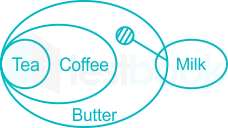
The least possible Venn diagram for the given statements is as follows

Conclusions:

I. Some milk is coffee → False ( as there is no relation between coffee and milk, so it is possible but it's is not definite. Hence, Some milk is coffee is false).

II. Some tea is milk → False ( as there is no relation between tea and milk, so it is possible but it's is not definite. Hence, some tea is milk is false).

Hence, Neither I nor II follows is the correct answer.
27

In each of the questions below are given some statements followed by two conclusions. You have to take the given statements to be true even if they seem to be at variance with commonly known facts. Read all the conclusions and then decide which of the given conclusions logically follows from the given statements disregarding commonly known facts.

Statements:

Some buildings are sofas.

Some sofas are benches.

Some benches are tables.

Conclusions:

I.Some tables are sofas.

II. No table is sofa.

  1. ((a))

    If only conclusion I follows.

  2. ((b))

    If only conclusion II follows.

  3. ((c))

    If either conclusion I or II follows.

  4. ((d))

    If neither conclusion I nor II follows.

  5. ((e))

    If both conclusions I and II follow.

Show Answer
Answer: ((c))

If either conclusion I or II follows.

The best possible diagram is, 

Conclusions:

I. Some tables are sofas: False (As no direct relation between tables and sofa, it is possible but not definite)

II. No table is sofa: False (As no direct relation between tables and sofa, it is possible but not definite)

Conclusion I and II form a complementary pair.

Hence, Either conclusion I or II follows.

Key Points

Conditions for Either - Or 

  1. Subject and predicate should be the same
  2. Both the individual conclusions should be false
  3. One conclusion should be positive and one conclusion should be negative
  4. There should either one of the following pairs present in the conclusions
  • All + Some not
  • Some + No

Direction: The following questions are based on the five three-digit numbers given below.

483      396      625      834      967

28

If 2 is added to the last digit of each number and then the positions of the first and the second digits are interchanged, which of the following will be the highest number?

  1. ((a))

    396

  2. ((b))

    625

  3. ((c))

    967

  4. ((d))

    834

  5. ((e))

    483

Show Answer
Answer: ((a))

396

Given series: 483         396      625      834      967

Adding 2 to the last digit: 485    398   627      836      969

Interchanging first and the second digit: 845    938   267      386      699

So, 938 is the highest number which came from 396.

29

If in the above set of numbers 1 is added to the last digit and 2 is subtracted from first digit, then which number will be third if arranged in descending order?

  1. ((a))

    396

  2. ((b))

    625

  3. ((c))

    967

  4. ((d))

    834

  5. ((e))

    483

Show Answer
Answer: ((b))

625

Given series: 483         396      625      834      967

After adding 1 to last digit and subtracting 2 from first digit

284      197      426      635      768

On rearranging the series in descending order, we get:

768      635      426      284      197

Now third number Is 426 made from 625.

Hence, 625 is correct answer.

30

If each number is multiplied by 2, then what is the multiplication of the 1st digit of the lowest and last digit of the largest number?

  1. ((a))

    24

  2. ((b))

    30

  3. ((c))

    36

  4. ((d))

    28

  5. ((e))

    20

Show Answer
Answer: ((d))

28

Given series: 483         396      625      834      967

Series each number is multiplied by 2: 966    792      1250    1668    1934

Lowest number is = 792

And 1st digit of the lowest = 7,

Largest number is = 1934.

Last digit of largest number is = 4

Multiplication = 7 × 4 = 28

Hence, 28 is correct answer.

31

If each number first and third digits are interchanged, then how many even numbers are there?

  1. ((a))

    3

  2. ((b))

    2

  3. ((c))

    4

  4. ((d))

    5

  5. ((e))

    1

Show Answer
Answer: ((a))

3

Given series: 483         396      625      834      967

On interchanging each number first and third digits, we get: 

384   693   526   438   769

Now there is three even numbers in the series.

Hence, 3 even numbers are the right option.

32

Direction: Study the following information carefully and answer the question given below.

How many meaningful English words can be formed with the second, fifth, sixth and seventh letters of the word "PLAGIARISM", using each letter only once in each word? (To be counted from left)

  1. ((a))

    One

  2. ((b))

    Two

  3. ((c))

    Three

  4. ((d))

    Four

  5. ((e))

    More than four

Show Answer
Answer: ((e))

More than four

Given:-

Word: PLAGIARISM

2nd letter = L; 5th letter = I; 6th letter = A ; 7th letter = R

Words formed using the above letters:

  1. LIAR - A person who does not tell the truth
  2. RAIL -  A bar fixed to a wall or posts and serving as a guard or barrier.
  3. LAIR - A place to rest or hide
  4. RIAL - The basic monetary unit of Saudi Arabia, Qatar, Yemen etc.
  5. LIRA - The lira is the official currency of Turkey and Northern Cyprus.

​Hence, only More than four such words are possible.

Direction: Read the following information carefully and answer the questions given below:

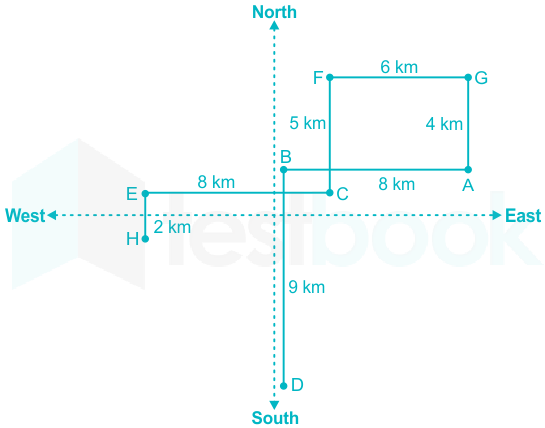
There are eight cars A, B, C, D, E, F, G, and H in a park within a certain distance. Car A is 8km to the east of Car B, which is 9km north of Car D. Car C is 5km to the south of Car F, which is 6km to the west of Car G. Car G is 4km to the north of Car A. Car E is 8km to the west of Car C. Car H is 2km to the south of Car E.

33

Car G is in which direction with respect to Car C?

  1. ((a))

    North

  2. ((b))

    South

  3. ((c))

    East

  4. ((d))

    South-West

  5. ((e))

    North-East

Show Answer
Answer: ((e))

North-East

Given: There are eight cars A, B, C, D, E, F, G, and H in a park within a certain distance

1) Car A is 8km to the east of Car B, which is 9km north of Car D

2) Car C is 5km to the south of Car F, which is 6km to the west of Car G

3) Car G is 4km to the north of Car A

4) Car E is 8km to the west of Car C

5) Car H is 2km to the south of Car E

Hence, Car G is in North-East direction with respect to Car C.

34

Car F is in which direction with respect to Car A?

  1. ((a))

    West

  2. ((b))

    North

  3. ((c))

    East

  4. ((d))

    North-West

  5. ((e))

    North-East

Show Answer
Answer: ((d))

North-West

Given: There are eight cars A, B, C, D, E, F, G, and H in a park within a certain distance

1) Car A is 8km to the east of Car B, which is 9km north of Car D

2) Car C is 5km to the south of Car F, which is 6km to the west of Car G

3) Car G is 4km to the north of Car A

4) Car E is 8km to the west of Car C

5) Car H is 2km to the south of Car E

Hence, Car F is in North-West direction with respect to Car A.

35

If K is parked in middle of G and A then what is distance between G and K?

  1. ((a))

    2 km

  2. ((b))

    4 km

  3. ((c))

    3 km

  4. ((d))

    5 km

  5. ((e))

    1 km

Show Answer
Answer: ((a))

2 km

Given: There are eight cars A, B, C, D, E, F, G, and H in a park within a certain distance

1) Car A is 8km to the east of Car B, which is 9km north of Car D

2) Car C is 5km to the south of Car F, which is 6km to the west of Car G

3) Car G is 4km to the north of Car A

4) Car E is 8km to the west of Car C

5) Car H is 2km to the south of Car E

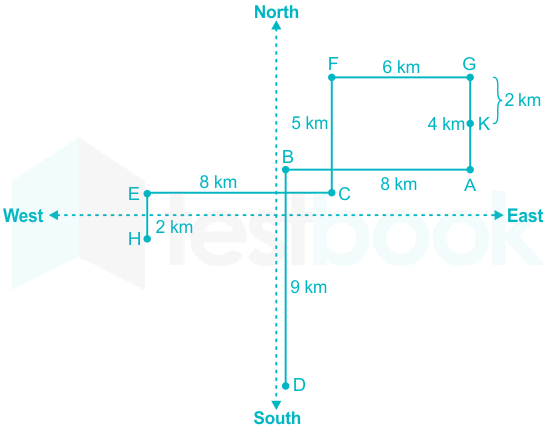
According to the question, K is sitting in the middle of G and A

Hence, the distance between G and K is 2 km.

Numerical Ability (35 questions)

36

In the given questions, two equations numbered I and II are given. You have to solve both the equations and mark the appropriate answer.

I. x2 - 12x + 36 = 0

II. y2 - 7y - 60 = 0

  1. ((a))

    x > y

  2. ((b))

    x < y

  3. ((c))

    x ≥ y

  4. ((d))

    x ≤ y

  5. ((e))

    No relation in x and y or x = y

Show Answer
Answer: ((e))

No relation in x and y or x = y

Given:

I. x2 - 12x + 36 = 0

II. y2 - 7y - 60 = 0

Calculation:

From I

x2 - 12x + 36 = 0

⇒ x2 - 6x - 6x + 36 = 0

⇒ x(x - 6) - 6(x - 6) = 0

⇒ (x - 6)(x - 6) = 0

⇒ x = 6, 6

From II

y2 - 7y - 60 = 0

⇒ y2 - 12y + 5y - 60 = 0

⇒ y(y - 12) + 5(y - 12) = 0

⇒ (y - 12)(y + 5) = 0

⇒ y = 12, -5

Comparison between x and y (via Tabulation)

Value of xValue of yRelation between x & y
612x < y
6-5x > y
612x < y
6-5x > y
<br>

∴ No relation in x and y or x = y.

Important Points

Sign Method
EquationSignRemark
ax2 + bx + c = 0-Ve, -VeSame signs
ax2 - bx + c = 0+Ve, +VeSame signs
ax2 + bx - c = 0-Ve, +VeLarger root is negative
smaller root is positive
ax2 - bx - c = 0-Ve, +VeLarger root is positive
smaller root is negative
37

In the given question, two equations numbered I and II are given. Solve both the equations and mark the appropriate answer.

I. x2 - 15x + 54 = 0

II. y2 - 11y + 30 = 0

  1. ((a))

    x > y

  2. ((b))

    x < y

  3. ((c))

    x ≥ y

  4. ((d))

    x ≤ y

  5. ((e))

    x = y or relationship between x and y cannot be established

Show Answer
Answer: ((c))

x ≥ y

Given:

x2 - 15x + 54 = 0

y2 - 11y + 30 = 0

Calculation:

From I,

x2 - 15x + 54 = 0

⇒ x2 - 6x - 9x + 54 = 0

⇒ x(x - 6) - 9(x - 6) = 0

⇒ (x - 6)(x - 9) = 0

⇒ x = 6, 9

From II,

y2 - 11y + 30 = 0

⇒ y2 - 5y - 6y + 30 = 0

⇒ y(y - 5) - 6(y - 5) = 0

⇒ (y - 6)(y - 5) = 0

⇒ y = 5, 6

Comparison between x and y (via Tabulation):

Value of xValue of yRelation
66x = y
65x > y
96x > y
95x > y
<br>

∴ x ≥ y

38

In the given question, two equations numbered l and II are given. Solve both the equations and mark the appropriate answer.

I. x2 + 12x + 35 = 0

II. y2 − 12y + 32 = 0

  1. ((a))

    x < y

  2. ((b))

    x > y

  3. ((c))

    x ≤ y

  4. ((d))

    x ≥ y

  5. ((e))

    x = y or the relation between x and y can't be established.

Show Answer
Answer: ((a))

x < y

Given:

I. x2 + 12x + 35 = 0

II. y2 − 12y + 32 = 0

Calculation:

I. x2 + 12x + 35 = 0

⇒ x2 + 7x + 5x + 35 = 0

⇒ x(x + 7) + 5(x + 7)= 0

⇒ (x + 7)(x + 5) = 0

⇒ x = (-7), (-5)

II. y2 - 12y + 32 = 0

⇒ y2 - 8y - 4y + 32 = 0

⇒ y(y - 8) - 4(y - 8) =0

⇒ (y - 8)(y - 4) = 0

⇒ y = 8, 4

Value of ‘x’RelationValue of ‘y’
-7<8
-7<4
-5<8
- 5<4
<br>

When we compared the values of ‘x’ and ‘y’ in the table above, we found that there is only ONE relation between X and Y i.e. <. So, a relation between x and y is “x < y”.

∴ After comparison, all the values of x and y the relation is “x < y”.

Shortcut Trick

I. x2 + 12x + 35 = 0

There are three terms = a, b, and c

Where 'a' = value of x2, 'b' = Value of x, 'c' = 35

If the value of 'c' is a positive value and the value of 'b' is also a positive value, then both values will be NEGATIVE.

II. y2 - 12y + 32 = 0There are also three terms = a, b, and c

Where 'a' = value of y2, 'b' = Value of y, 'c' = 32

If the value of 'c' is a positive value and the value of 'b' is a negative value, then both values will be POSITIVE.

 After comparison, all the values of x and y, the relation between x and y is “x < y”.

39

In the given question, two equations numbered l and II are given. Solve both the equations and mark the appropriate answer.

I. x2 + 8x + 16 = 0

II. y2 - 17y + 66 = 0

  1. ((a))

    x > y

  2. ((b))

    x < y

  3. ((c))

    x ≥ y

  4. ((d))

    x ≤ y

  5. ((e))

    x = y or relation between x and y can not be established.

Show Answer
Answer: ((b))

x < y

Given:

I. x2 + 8x + 16 = 0

II. y2 - 17y + 66 = 0

Calculation:

From I,

x2 + 8x + 16 = 0

⇒ x2 + 4x + 4x + 16 = 0

⇒ x(x + 4) + 4(x + 4) = 0

⇒ (x + 4)2 = 0

⇒ x = -4

From II,

y2 - 17y + 66 = 0

⇒ y2 - 11y - 6y + 66 = 0

⇒ y(y - 11) - 6(y - 11) = 0

⇒ (y - 11)(y - 6) = 0

Taking,

⇒ (y - 11) = 0 or (y - 6) = 0

⇒ y = 11 or 6

Comparison between x and y (via Tabulation):

Value of xValue of yRelation
-411x < y
-46x < y
<br>

∴ x < y.

40

Two equations I and II are given below in question. You have to solve these equations and give the answer.

I. x2 + 11x + 30 = 0

II. y2 + 9y + 20 = 0

  1. ((a))

    x < y

  2. ((b))

    x > y

  3. ((c))

    x ≤ y

  4. ((d))

    x ≥ y

  5. ((e))

    x = y or the relation between x and y can't be established.

Show Answer
Answer: ((c))

x ≤ y

Given:

I. x2 + 11x + 30 = 0

II. y2 + 9y + 20 = 0

Calculation:

I. x2 + 11x + 30 = 0

⇒ x+ 6x + 5x + 30 = 0

⇒ x(x + 6) + 5(x + 6)= 0

⇒ (x + 6)(x + 5) = 0

⇒ x = (-6), (-5)

II. y2 + 9y + 20 = 0

⇒ y2 + 5y + 4y + 20 = 0

⇒ y(y + 5) + 4(y + 5) =0

⇒ (y + 5)(y + 4) = 0

⇒ y = (-5), (-4)

Value of ‘x’RelationValue of ‘y’
-6<-5
-6<-4
-5=-5
-5<-4
<br>

When we compared the values of ‘x’ and ‘y’ in the table above, we found that there is TWO relations between X and Y i.e. < and =. So, a relation between x and y is “x ≤ y”.

 After comparison, all the values of x and y the relation is “x  y”.

41

The average weight of A, B, C, D, and E is 48 kg while the average weight of C and E is 42 kg. If the weight of F is also added, then the average weight of all six is reduced by 2.5 kg. Find the average weight of A, B, D, and  F.

  1. ((a))

    52.25 kg

  2. ((b))

    42.25 kg

  3. ((c))

    47.25 kg

  4. ((d))

    57.25 kg

  5. ((e))

    45.25 kg

Show Answer
Answer: ((c))

47.25 kg

Shortcut Trick

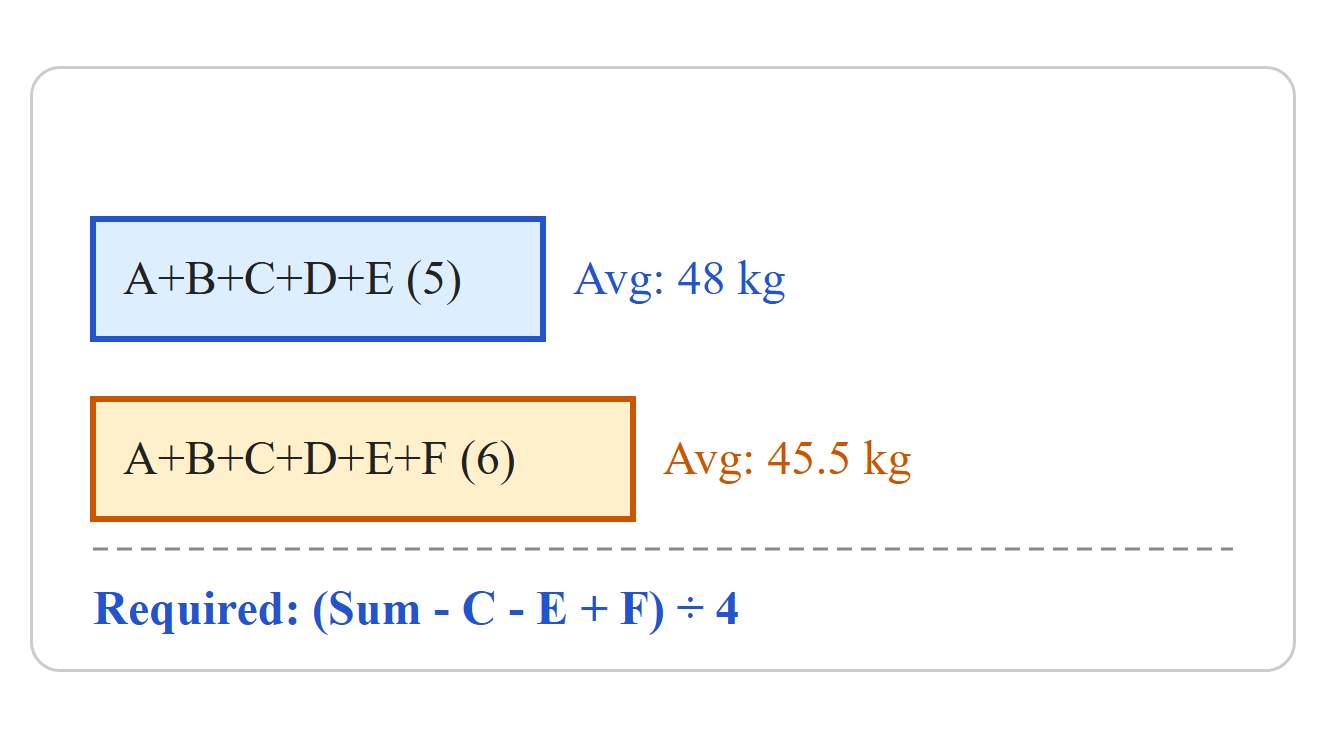
Total weight (A+B+C+D+E) = 5 × 48 = 240 kg.

New average for 6 people = 48 − 2.5 = 45.5 kg.

Weight of F = (6 × 45.5) − 240 = 273 − 240 = 33 kg.

Total weight (C+E) = 2 × 42 = 84 kg.

Total weight (A+B+D+F) = (240 − 84) + 33 = 156 + 33 = 189 kg.

Average (A, B, D, F) = 189 ÷ 4 = 47.25 kg.

∴ The correct answer is 47.25 kg.

Alternate Method

Given: Average (A,B,C,D,E) = 48 kg, Average (C,E) = 42 kg, Average (6 people) = 45.5 kg.

Formula Used: Sum = Average × Number of observations.

⇒ Sum (A+B+C+D+E) = 48 × 5 = 240 kg

⇒ Sum (C+E) = 42 × 2 = 84 kg

⇒ Sum (A+B+D) = 240 − 84 = 156 kg

⇒ Sum (A+B+C+D+E+F) = 45.5 × 6 = 273 kg

⇒ Weight of F = 273 − 240 = 33 kg

⇒ Sum (A+B+D+F) = 156 + 33 = 189 kg

⇒ Average (A,B,D,F) = 189 ÷ 4 = 47.25 kg

∴ The correct answer is 47.25 kg.

Additional Information

Average weight of a group

Average = (Sum of weights) ÷ (Total number of people). If one person is added, New Sum = (Old Average + Change) × (n + 1).

Net Deviation Method

The sum of deviations of all observations from the average is always zero. This can be used to find a new member's value quickly.

Weighted Average

When two groups are combined: Combined Average = (n1x1 + n2x2) ÷ (n1 + n2).

42

A, B, and C can do the work in 81, 54, and 72 days, respectively. They started working together, but A left 8 days before the work was completed and C left 10 days before the work was completed. How long did it take to do the total work?

  1. ((a))

    1792917{9\over29} days

  2. ((b))

    27192927{19\over29} days

  3. ((c))

    36151736{15\over17} days

  4. ((d))

    16141916{14\over19} days

  5. ((e))

    None of these

Show Answer
Answer: ((b))

27192927{19\over29} days

Shortcut Trick

Total Work = LCM(81, 54, 72) = 648 units.

Efficiencies: A = 8, B = 12, C = 9. Total efficiency = 29.

Work added for those who left early: A (8 days) = 8 × 8 = 64; C (10 days) = 10 × 9 = 90.

New Total Work = 648 + 64 + 90 = 802 units.

Total time = 802 ÷ 29 = 27 19/29 days.

∴ The correct answer is 27 19/29 days.

Alternate Method

Given: A = 81 days, B = 54 days, C = 72 days.

PersonDaysTotal WorkEfficiency
A816488
B5412
C729

Let the total time be x days.

⇒ A worked for (x − 8) days.

⇒ B worked for x days.

⇒ C worked for (x − 10) days.

⇒ 8(x − 8) + 12(x) + 9(x − 10) = 648

⇒ 8x − 64 + 12x + 9x − 90 = 648

⇒ 29x − 154 = 648

⇒ 29x = 802

⇒ x = 802 ÷ 29 = 27 19/29 days.

∴ The correct answer is 27 19/29 days.

Additional Information

Leaving Before Completion

When a person leaves 'n' days before completion, add their potential work (Efficiency × n) to the total work and divide by the combined efficiency of all people involved.

Total Work Calculation

Total Work is generally assumed as the LCM (Least Common Multiple) of the individual times taken to complete the task.

Work & Efficiency Relation

Efficiency is inversely proportional to time: Efficiency = Total Work ÷ Time.

43

2 years ago, ratio of ages between Amar and Bhupendro is 3 : 4 and 2 year hence, the ratio of ages between Amar and Bhupendro is  4 : 5. Find the ratio of their present ages.

  1. ((a))

    9 : 7

  2. ((b))

    7 : 5

  3. ((c))

    7 : 9

  4. ((d))

    5 : 7

  5. ((e))

    None of these.

Show Answer
Answer: ((c))

7 : 9

Shortcut Trick

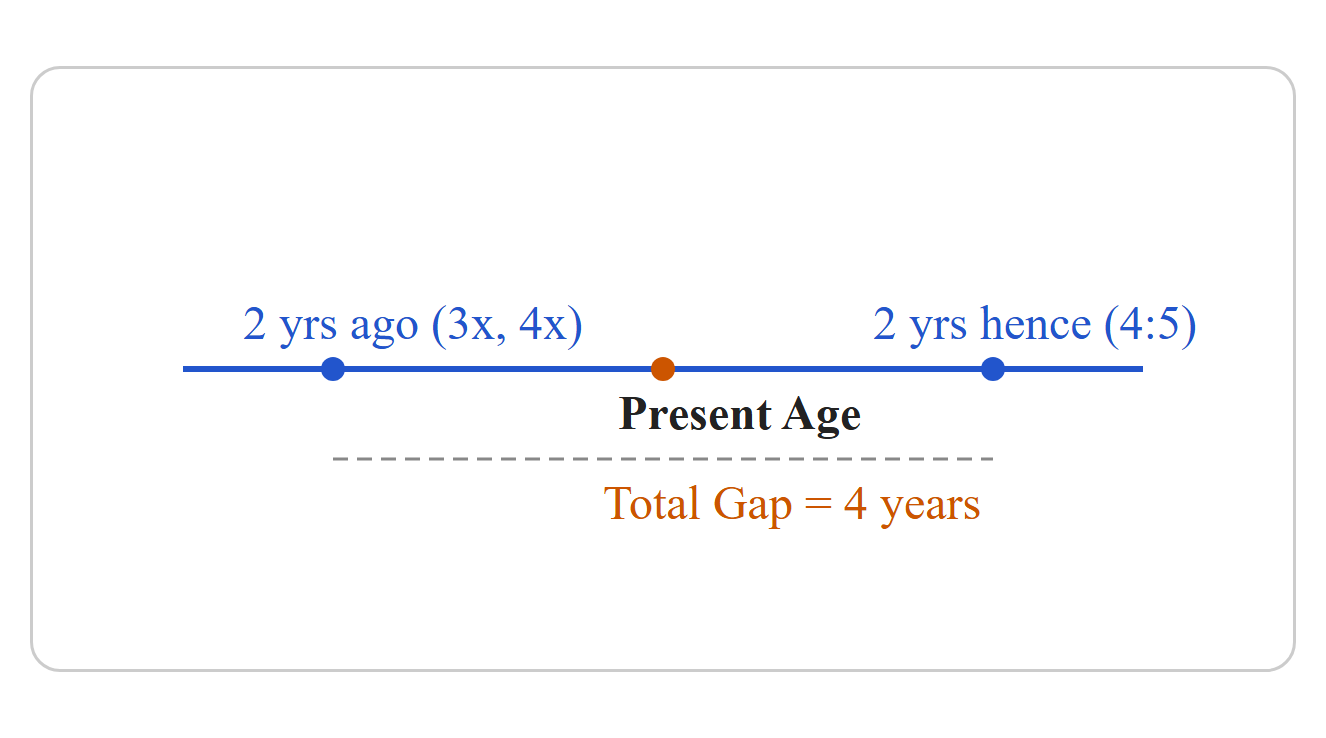
Ratio 2 years ago (Amar : Bhupendro) = 3 : 4

Ratio 2 years hence (Amar : Bhupendro) = 4 : 5

Difference in ratio parts = (4 − 3) = (5 − 4) = 1 unit

Actual time difference = 2 − (−2) = 4 years ⇒ 1 unit = 4 years

Present ratio = [3 + (2/4)] : [4 + (2/4)] = 3.5 : 4.5 = 7 : 9

∴ The correct answer is 7 : 9.

Alternate Method

Given: Ratio of ages of Amar and Bhupendro 2 years ago = 3 : 4

Calculations:

⇒ Let ages 2 years ago be 3x and 4x.

⇒ Present ages = (3x + 2) and (4x + 2)

⇒ Ages 2 years hence = (3x + 2 + 2) and (4x + 2 + 2) = (3x + 4) and (4x + 4)

⇒ According to the question: (3x + 4) / (4x + 4) = 4 / 5

⇒ 5 × (3x + 4) = 4 × (4x + 4)

⇒ 15x + 20 = 16x + 16

⇒ x = 4

⇒ Present age of Amar = 3(4) + 2 = 14 years

⇒ Present age of Bhupendro = 4(4) + 2 = 18 years

⇒ Required Ratio = 14 : 18 = 7 : 9

∴ The correct answer is 7 : 9.

Additional Information

Ratio and Proportion in Ages

When the same number of years is added to both persons, the numerical difference between their ratio parts must remain constant. If not, multiply the ratios by the difference of the other ratio.

Concept of Age Gap

The difference between the ages of two people remains constant regardless of the number of years passed or preceding.

Directions: Answer the question based on the information given below:

Given below table shows the number of people, who went to four different malls (A, B, C, and D) on three different days (Friday, Saturday, and Sunday) of the same week.

Days/MallsMall AMall BMall CMall D
Friday380280280320
Saturday220300360340
Sunday240380260320
44

What is the sum of number of people, who went to Mall A on Friday, Mall B on Saturday, Mall C on Sunday, and Mall D on Friday?

  1. ((a))

    1340

  2. ((b))

    1360

  3. ((c))

    1260

  4. ((d))

    1310

  5. ((e))

    1380

Show Answer
Answer: ((c))

1260

Number of people, who went to Mall A on Friday are 380

 Number of people, who went to Mall B on Saturday are 300

 Number of people, who went to Mall C on Sunday are 260

 Number of people, who went to Mall D on Friday are 320

 Then total number of people, who went to respective malls on these days together are 

  ⇒ 380+300 + 260+ 320

 ⇒ 1260

 Hence, 1260 is the correct answer.
45

If number of people, who went to Mall E on Thursday is 80% of the number of people, who went to Mall D on Friday, then what is the average of number of people, who went to Mall E on Thursday and number of people, who went to Mall C on all three days of the week?

  1. ((a))

    260

  2. ((b))

    295

  3. ((c))

    289

  4. ((d))

    284

  5. ((e))

    270

Show Answer
Answer: ((c))

289

Number of people, who went to Mall D on Friday are 320

 The number of people, who went to Mall E on Thursday is 80% of people, who went to Mall D on Friday 

 So, 320 × 80/ 100 = 256

 Number of people, who went to mall E on Thursday are 256

 Number of people, who went to Mall C on all three days together are 

  ⇒ 280+360+260

  ⇒ 900

 Then, the average of people, who went to Mall E on Thursday and number of people, who went to Mall C on all three days together 

  ⇒ 900 + 256

 ⇒ 1156 /4

 ⇒ 289

 Hence, 289 is the correct answer.
46

Total number of people, who went to all four malls on Saturday is how much/more less than the total number of people, who went to Mall B on all three days together?

  1. ((a))

    260, More

  2. ((b))

    250, More

  3. ((c))

    110, More

  4. ((d))

    110, Less

  5. ((e))

    None of these

Show Answer
Answer: ((a))

260, More

Total number of people,, who went to All four malls on Saturday are 

  ⇒ 220 + 300 + 360 + 340

  ⇒ 1220

 Total number of people who went to mall B on all three days are 

  ⇒ 280 + 300 + 380

  ⇒ 960

 Number of people who, went to Mall B on all three days together is more than number of people, who went to all four malls on Saturday

 Then 1220 - 960

  ⇒ 260 more people, went to all four malls on Saturday as compared the persons, who went to Mall B on all three days 

 Hence, 260, More is the correct answer.
47

Total number of people, who went to Mall A on all three days is what percent of the number of people, who went to Mall D on Friday and the number of people, who went to Mall C on Saturday together?

  1. ((a))
    1. 52%
  2. ((b))
    1. 32%
  3. ((c))
    1. 19%
  4. ((d))
    1. 89%
  5. ((e))

    None of these

Show Answer
Answer: ((a))
  1. 52%

Number of people, who went to Mall A on all three days are 380, 220, 240

 Then total number of people, who went to Mall A on all three days are 

 ⇒ 380 + 220 + 240 = 840

 Number of people, who went to Mall D on Friday are 320

 Number of people, who went to Mall C on Saturday are 360

 The the total number of people, who went to Mall C and D on Friday and Saturday are 

 ⇒ 360+320 = 680

 Then, the required percentage is

 ⇒ 840 = ? of 680%

 ⇒ ? = 840 × 100 / 680

 ⇒ ? = 123.527 %

 Hence, 123.52% is the correct answer.
48

If on Monday the number of people, who went to Mall A is 200% of the number of people, who went to Mall C on Saturday, then find the ratio of the number of people, who went to Mall A on Monday and the number of people, who went to Mall D on Sunday and Saturday together respectively?

  1. ((a))

    9 : 11

  2. ((b))

    11 : 9

  3. ((c))

    12 : 11

  4. ((d))

    11 : 13

  5. ((e))

    None of these

Show Answer
Answer: ((c))

12 : 11

Number of people, who went to Mall C on Saturday are 360

 And number of people, who went to Mall A on Monday are 200% of number of people who, went to mall C on Saturday 

 Then, 

  ⇒ 360× 200% 

  ⇒ 720

 Number of people, who went to Mall A on Monday are 720

 Number of people, who went to Mall D on Sunday and Saturday respectively are 320 and 340

 Together they are 

  ⇒ 320 +340 

  ⇒ 660

 Then, the required ratio is

  ⇒ 720 :660

  ⇒ 36 : 33  

  ⇒ 12 : 11

  Hence, 12 : 11 is the correct answer.

49

What is the average of number of people, who went to Mall A and Mall B together on Sunday and the people, who went to Mall C and Mall D together on Friday?

  1. ((a))

    306

  2. ((b))

    309

  3. ((c))

    303

  4. ((d))

    305

  5. ((e))

    310

Show Answer
Answer: ((d))

305

Number of people, who went to Mall A on Sunday are 240

 Number of people, who went to Mall B on Sunday are 380

The number of people, who went together to Mall A and B on Sunday are 

  ⇒ 380 + 240 = 620

 Average = 620/ 2

 ⇒ 310

 Number of people, who went to Mall C on Friday are 280

 Number of people, who went to Mall D on Friday are 320

 The number of people, who went together to Mall C and D on Friday are 

  ⇒ 280+320 = 600

 Average = 600/2

 ⇒ 300

 The average of number of people, who went to  Mall A and B on Sunday and number of people, who went to Mall C and Mall D on Friday are 

 ⇒ (310+300) /2

 ⇒ 305

 Hence, 305 is the correct answer.

50

What will come in the place of the question mark '?' in the following question?

 7841/2 + 5761/2 ÷ 3 + ?1/3 = 16001/2

  1. ((a))

     81

  2. ((b))

     36

  3. ((c))

     64

  4. ((d))

     25

  5. ((e))

    16

Show Answer
Answer: ((c))

 64

Given :

 7841/2 + 5761/2 ÷ 3 + ?1/3 = 16001/2

 Calculation :

  7841/2 + 5761/2 ÷ 3 + ?1/3 = 16001/2

 ⇒ (28)2×1/2 + (24)2×1/2 + ?1/3 = (40)2×1/2

 ⇒ 28 + 24÷3 + ?1/3 = 40

 ⇒ 28 + 8 + ?1/3  = 40

 ⇒ ?1/3  = 40 - 36

 ⇒ ?1/3 = 4

 ⇒ (?)3×1/3 = (4)3

 ⇒ (?) = 64

 Hence,64 will come in the place of '?'.

51

What will come in the place of the question mark '?' in the following question?

 5/16 - 1/8 - 3/32 = 3/16 - 1/4 + ?/32

  1. ((a))

     2

  2. ((b))

     4

  3. ((c))

     1

  4. ((d))

     5

  5. ((e))

     3

Show Answer
Answer: ((d))

 5

Given :

 5/16 - 1/8 - 3/32 = 3/16 - 1/4 + ?/32

 Calculation : 

 5/16 - 1/8 - 3/32 = 3/16 - 1/4 + ?/32

 Take lcm of 16,8 and 32 are denominator of these fraction on both sides 

 Then lcm is 32

 ⇒(5×2 - 4× 1 - 3×1) / 32 = ( 3×2 -8×1 +?×1 ) /32

 ⇒ (10 - 4 - 3 ) / 32 = (6 -8 + ? ) /32

 ⇒ 3 / 32 = ( - 2 + ? ) /32

 ⇒ 3 /32 = (-2 + ? ) / 32

 ⇒ 3 = -2+ ?

 ⇒ ? = 5

 Hence,5 will come in the place of '?'.

52

What will come in the place of the question mark '?' in the following question?

 40% of 750 - ? - 450 ÷ 9 × 4 = 40

  1. ((a))

     40

  2. ((b))

     80

  3. ((c))

     20

  4. ((d))

     100

  5. ((e))

      60

Show Answer
Answer: ((e))

  60

Given :

40% of 750 - ? - 450÷ 9×4 = 40

Calculation :

40% of 750 - ? - 450 ÷ 9 × 4 = 40

⇒ 30000 / 100 - ? - 50× 4 = 40

⇒ 300 - ? - 200 = 40

⇒ 100 - ? = 40

⇒ 100 - 40 = ?

⇒ ? = 60

Hence,60 will come in the place of '?'.

53

What will come in the place of the question mark '?' in the following question?

  0.027 ×  0.32 ÷ 0.0081 × 0.09 = (0.3)?

  1. ((a))

     2

  2. ((b))

     5

  3. ((c))

     4

  4. ((d))

     1

  5. ((e))

     3

Show Answer
Answer: ((e))

 3

Given :

0.027 × 0.32 ÷ 0.0081 × 0.9 = 0.3?

 Calculation : 

 0.027 × 0.32 ÷ 0.0081 × 0.09 = 0.3?

 ⇒ (0.3)3 × (0.3)2 ÷ (0.3)4 × (0.3)2 = 0.3?

 ⇒ (0.3)3 × (0.3)-2 × (0.3)2 = 0.3?

 ⇒ 0.3)3 = (0.3)?      [∵ (0.3)-2 × (0.3)2 = 0.30 = 1]

 ⇒ ? = 3

 Hence, 3 will come in the place of '?'.

54

What will come in the place of the question mark '?' in the following question?

 (251/2÷ 161/2) × 44 + 135 - ? = 240 ÷ 6

  1. ((a))

     110

  2. ((b))

     150

  3. ((c))

     190

  4. ((d))

     170

  5. ((e))

     140

Show Answer
Answer: ((b))

 150

Given :

 (251/2 ÷ 161/2 ) × 44 + 135 - ? = 240 ÷ 6

 Calculation :

 ( 251/2 ÷ 161/2 ) × 44 + 135 - ? = 240 ÷ 6

 ⇒ (5)2×1/2 ÷ (4)2×1/2  × 44 + 135 - ? = 40

 ⇒ (5/4) × 44 + 135 -? = 40

 ⇒ 55 + 135 - ? = 40

 ⇒ 190 - 40 = ?

 ⇒ ? = 150

 Hence,150 will come in the place of '?'.

55

What will come in the place of the question mark '?' in the following question?

 15% of 800 + 35 × 4 = ? + 150 ÷ 3

  1. ((a))

     210

  2. ((b))

     110

  3. ((c))

     240

  4. ((d))

     150

  5. ((e))

     190

Show Answer
Answer: ((a))

 210

Given :

 15% of 800 + 35 × 4 = ? + 150 ÷ 3

 Calculation :

 15% of 800 + 35 ×4 = ? + 150 ÷ 3

 ⇒ 15 × 800 / 100 + 140 = ? + 50

 ⇒ 12000 / 100 + 140 - 50 = ?

 ⇒ 120 + 90 = ?

 ⇒ ? = 210

 Hence,210 will come in the place of '?'.

56

What will come in the place of the question mark '?' in the following question?

 9611/2 - 4001/2 - 12251/2 = 16001/2 - ?2

  1. ((a))

     15

  2. ((b))

     13

  3. ((c))

     8

  4. ((d))

     10

  5. ((e))

     9

Show Answer
Answer: ((c))

 8

Given :

9611/2 - 4001/2 - 12251/2 = 16001/2 - ?2

Calculation :

9611/2 - 4001/2 - 12251/2 = 16001/2 - ?2

⇒ (31)2×1/2 - (20)2×1/2 - (35)2×1/2 = (40)2×1/2 - ?2

⇒ 31 - 20 - 35 = 40 - ?2

⇒ 31 - 55 = 40 - ?2

⇒ - 24 = 40 - ?2

⇒ 64 = ?2

⇒ (8) = (?)2

⇒ ? = 8

∴ 8 will come in the place of '?'.

57

What will come in the place of the question mark '?' in the following question?

 378 + ?1/2 = 25% of 2400 - 192

  1. ((a))

     784

  2. ((b))

     900

  3. ((c))

     576

  4. ((d))

     400

  5. ((e))

     625

Show Answer
Answer: ((b))

 900

Given :

 378 + ?1/2 = 25% of 2400 - 192

 Calculation :

  378 + ?1/2  = 25% of 2400 - 192

 ⇒ 378 + ?1/2 = (2400 × 1 / 4 ) - 192

 ⇒ 378 + ?1/2 = 600 - 192

 ⇒ ?1/2  = 408 - 378

 ⇒ ?1/2  = 30

 ⇒ (?)2×1/2 = 302

 ⇒ ? = 900

 Hence,900 will come in the place of '?'.

58

What will come in the place of the question mark '?' in the following question?

 133 ÷ 491/2× 20 + ? = 225001/2 + 310

  1. ((a))

     70

  2. ((b))

     60

  3. ((c))

     90

  4. ((d))

     55

  5. ((e))

     80

Show Answer
Answer: ((e))

 80

Given :

 133 ÷ 491/2 × 20 + ? = 225001/2 + 310

 Calculation :

 133 ÷ 491/2 × 20 + ? = 225001/2 + 310

 ⇒ 133 ÷ (7)2×1/2× 20 + ? = (150)2×1/2 + 310

 ⇒ 133 ÷ 7 × 20 + ? = 150 + 310

 ⇒ 19 × 20 + ? = 460

 ⇒ ? = 460 - 380

 ⇒ ? = 80

 Hence,80 will come in the place of '?'.

59

What will come in the place of the question mark in the following question?

 260 ÷ ? + 60 × 4 + 10 = 315 + 65 × 3

  1. ((a))

     5

  2. ((b))

     8

  3. ((c))

     1

  4. ((d))

     3

  5. ((e))

     4

Show Answer
Answer: ((c))

 1

Given :

 260 ÷ ? + 60 × 4 + 10 = 315 + 65× 3

 Calculation : 

 260 ÷ ? + 60× 4 + 10 = 315 + 65×3

 ⇒ 260 ÷ ? + 240 + 10 = 315 + 195

 ⇒ 260÷ ? + 250 = 510

 ⇒ 260 ÷ ? = 510 - 250

 ⇒ 260 ÷ ? = 260

 ⇒ ? = 260 / 260

 ⇒ ? = 1

 Hence 1 will come in the place of '?'.

60

What will come in the place of the question mark '?' in the following question?

 120% of 620 + 20% of 525 + 150% of 750 = ?

  1. ((a))

     1974

  2. ((b))

     2184

  3. ((c))

     2197

  4. ((d))

     1989

  5. ((e))

     1743

Show Answer
Answer: ((a))

 1974

Given :

 120% of 620 + 20% of 525 + 150% of 750 = ?

 Calculation :

 120% of 620 + 20% of 525 + 150% of 750 = ?

 ⇒ 120 × 620 / 100 + 1/5 × 525 + 150 × 750 / 100 = ?

 ⇒ 74400 / 100 + 105 + 112500 / 100 = ?

 ⇒ 744 + 105 + 1125 = ?

 ⇒ ? = 1974

 Hence,1974 will come in the place of '?'.

61

What will come in the place of the question mark '?' in the following question?

 73 × 10 × ? = (18 + 12) +140 × 5

  1. ((a))

     7

  2. ((b))

     8

  3. ((c))

     17

  4. ((d))

     12

  5. ((e))

     1

Show Answer
Answer: ((e))

 1

Given :

 73 × 10 × ? = ( 18 + 12 ) + 140 × 5

 Calculation : 

 73 × 10 × ? = (18 + 12) + 140 × 5

 ⇒ 730 × ? = 30 + 700

 ⇒ 730 × ? = 730

 ⇒ ? = 730 / 730

 ⇒ ? = 1

 Hence, 1 will come in the place of '?'.

62

What will come in the place of the question mark '?' in the following question?

 360 × 9 ÷ 3 + 120 + 900 ÷ 5 = ?

  1. ((a))

     1426

  2. ((b))

     1286

  3. ((c))

     1380

  4. ((d))

     1275

  5. ((e))

     1180

Show Answer
Answer: ((c))

 1380

Given :

 360 × 9 ÷ 3 + 120 + 900÷ 5 = ?

 Calculation : 

 360 × 9 ÷ 3 + 120 + 900 ÷ 5 = ?

 ⇒ 360 × 3 + 120 + 180 = ?

 ⇒ 1080 + 300 = ?

 ⇒ ? = 1380

 Hence,1380 will be come in the place of '?'.

63

What will come in the place of the question mark '?' in the following question?

  25% of 960 + 24 × 15 + 18 × 20 = ?

  1. ((a))

     1080

  2. ((b))

     1180

  3. ((c))

     960

  4. ((d))

     990

  5. ((e))

     880

Show Answer
Answer: ((c))

 960

Given :

 25% of 960 + 24×15 + 18× 20 = ?

 Calculation : 

 25% of 960 + 24×15 + 18×20 = ?

 ⇒ (1/4 × 960) + 360 + 360 = ? 

 ⇒ 240 + 360 + 360 = ?

 ⇒ 960 = ?

 Hence 960 will come in the place of '?'.

64

What will come in the place of the question mark '?' in the following question?

 4 × ( ? + 120 ) = (8)+ 640 ÷ 80 + 22

  1. ((a))

     12

  2. ((b))

     6

  3. ((c))

     8

  4. ((d))

     16

  5. ((e))

     11

Show Answer
Answer: ((e))

 11

Given :

 4 × ( ? + 120 ) = 83 + 640÷ 80 + 22

 Calculation : 

  4 × ( ? + 120 ) = 83 + 640÷ 80 + 22

 ⇒ 4 × ( ? + 120 ) = 512 + 8 + 4

 ⇒ 4 × ( ? + 120 ) = 524 

 ⇒ ( ? + 120 ) = 524 /4

 ⇒ ( ? + 120 ) = 131

 ⇒ ? = 131 - 120

 ⇒ ? = 11

Hence,11 will  come in the place of '?'.

65

A mixture of 60 litres of wine and water contains 20% of water. How much water should be added to the mixture so that the water will be 36% in the final mixture?

  1. ((a))

    10 litres

  2. ((b))

    15 litres

  3. ((c))

    12 litres

  4. ((d))

    20 litres

  5. ((e))

    None of these

Show Answer
Answer: ((b))

15 litres

Shortcut Trick

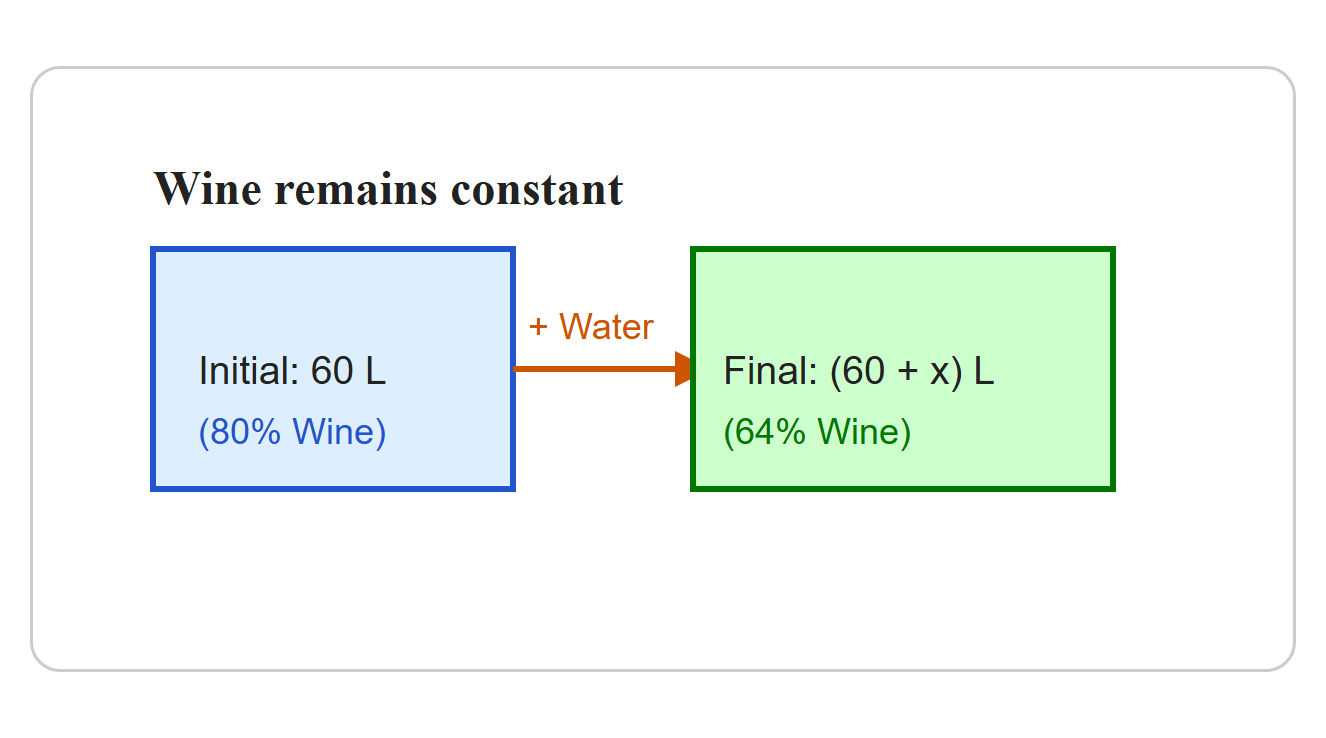
Since wine remains constant, use the formula: Initial Quantity × Initial Wine% = Final Quantity × Final Wine%

Initial wine = 100% − 20% = 80%; Final wine = 100% − 36% = 64%

⇒ 60 × 80 = (60 + Water added) × 64

⇒ 60 + Water added = (60 × 80) ÷ 64 = 75

⇒ Water added = 75 − 60 = 15 litres

∴ The correct answer is 15 litres.

Alternate Method

Given: Initial mixture = 60 litres, Initial water = 20%, Required water = 36%.

Calculation:

⇒ Quantity of water in initial mixture = 20% of 60 = (20 ÷ 100) × 60 = 12 litres

⇒ Quantity of wine in initial mixture = 60 − 12 = 48 litres

⇒ Let x litres of water be added. Total mixture = (60 + x) litres

⇒ In the new mixture, water is 36%, so wine is (100 − 36) = 64%

⇒ 64% of (60 + x) = 48

⇒ (64 ÷ 100) × (60 + x) = 48

⇒ 60 + x = (48 × 100) ÷ 64

⇒ 60 + x = 3 × 25 = 75

⇒ x = 75 − 60 = 15 litres

∴ The correct answer is 15 litres.

Additional Information

Alligation Method

When water (100% concentration) is added to a mixture (20% concentration) to get 36%, the ratio of initial mixture to water added can be found using the alligation cross-rule.

Constant Quantity Concept

Whenever one component is added to a mixture, the quantity of the other component (the fixed component) remains the same in both the initial and final stages.

Percentage to Ratio Conversion

20% water means Wine : Water = 80 : 20 = 4 : 1. 36% water means Wine : Water = 64 : 36 = 16 : 9. Equalizing wine parts helps solve quickly.

66

A bookshop sells books whose marked price is Rs. 300 at a discount of 15% and gives a pamphlet costing Rs. 15 free with each book. Even then he makes a profit of 20%. What is his cost price per book?

  1. ((a))

    200

  2. ((b))

    250

  3. ((c))

    150

  4. ((d))

    220

  5. ((e))

    240

Show Answer
Answer: ((a))

200

Shortcut Trick

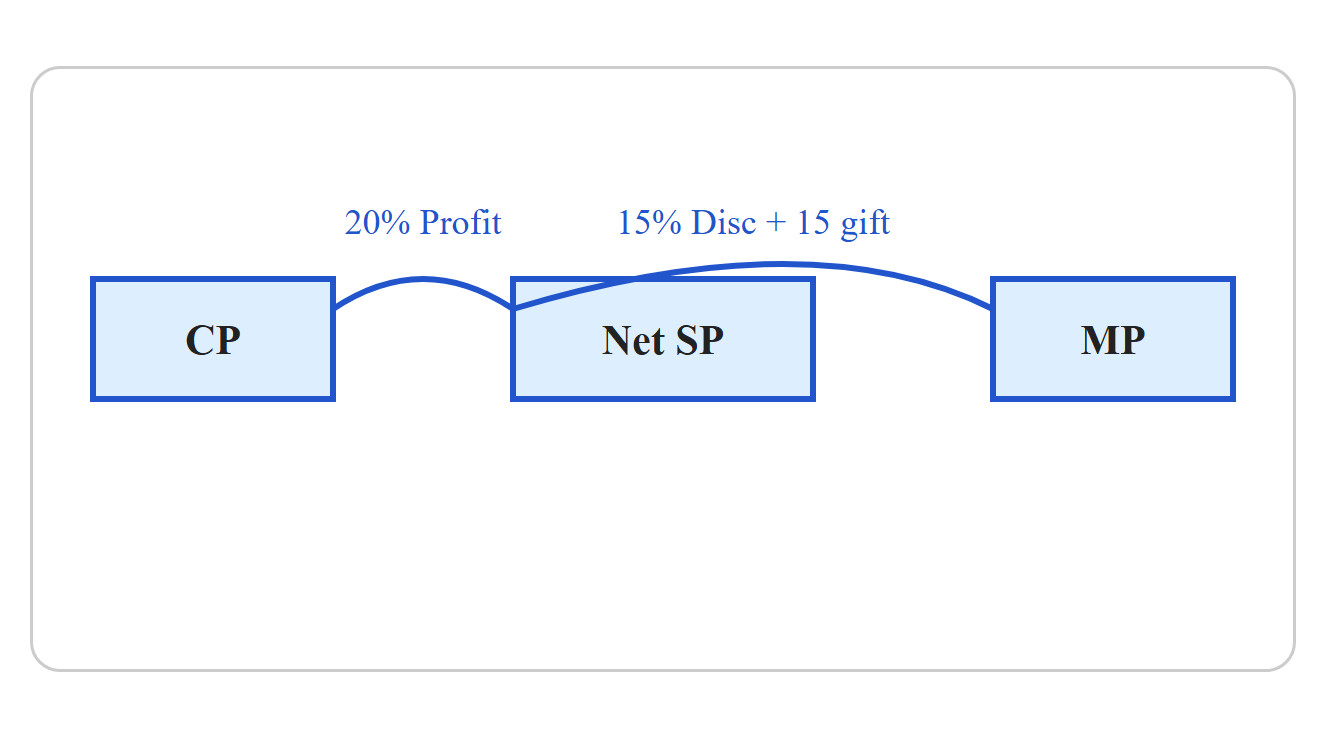
Net Selling Price (SP) = Marked Price × (100 − Discount%) ÷ 100 − Cost of free item.

SP = 300 × 85 ÷ 100 − 15 = 255 − 15 = 240.

Profit = 20%, so CP × 1.2 = 240.

CP = 240 ÷ 1.2 = 200.

∴ The correct answer is Rs. 200.

Alternate Method

Given → Marked Price (MP) = Rs. 300, Discount = 15%, Free Item Cost = Rs. 15, Profit = 20%. Formulas: SP = MP × (100 − D%) ÷ 100 | Effective SP = SP − Free Gift Cost | CP = Effective SP ÷ (1 + P/100)

⇒ Discounted Price = 300 − (15% of 300) = 300 − 45 = 255. ⇒ Since a free pamphlet worth Rs. 15 is given, net revenue for shopkeeper = 255 − 15 = 240. ⇒ This Net SP of 240 includes a 20% profit on CP. ⇒ 120% of CP = 240. ⇒ CP = (240 × 100) ÷ 120 = 2 × 100 = 200. ∴ The correct answer is Rs. 200.

Additional Information

Effective Discount

When a free item is given, it acts as an additional discount. The net profit is calculated on the actual cash inflow relative to the total cost incurred by the seller.

Relation between CP and MP

Generally, CP ÷ MP = (100 − D%) ÷ (100 + P%). However, when absolute costs (like the pamphlet) are involved, it is safer to use the step-by-step SP calculation.

67

Train A crosses a standing man at a speed of 15 m/s in ‘x’ seconds while train B crosses a platform of 200 m length in ‘3x’ seconds with a speed of 15 m/s. Length of train B is one- third the length of train A. Find the length of train B.

  1. ((a))

    32 m

  2. ((b))

    12 m

  3. ((c))

    25 m

  4. ((d))

    67 m

  5. ((e))

    45 m

Show Answer
Answer: ((c))

25 m

Shortcut Trick

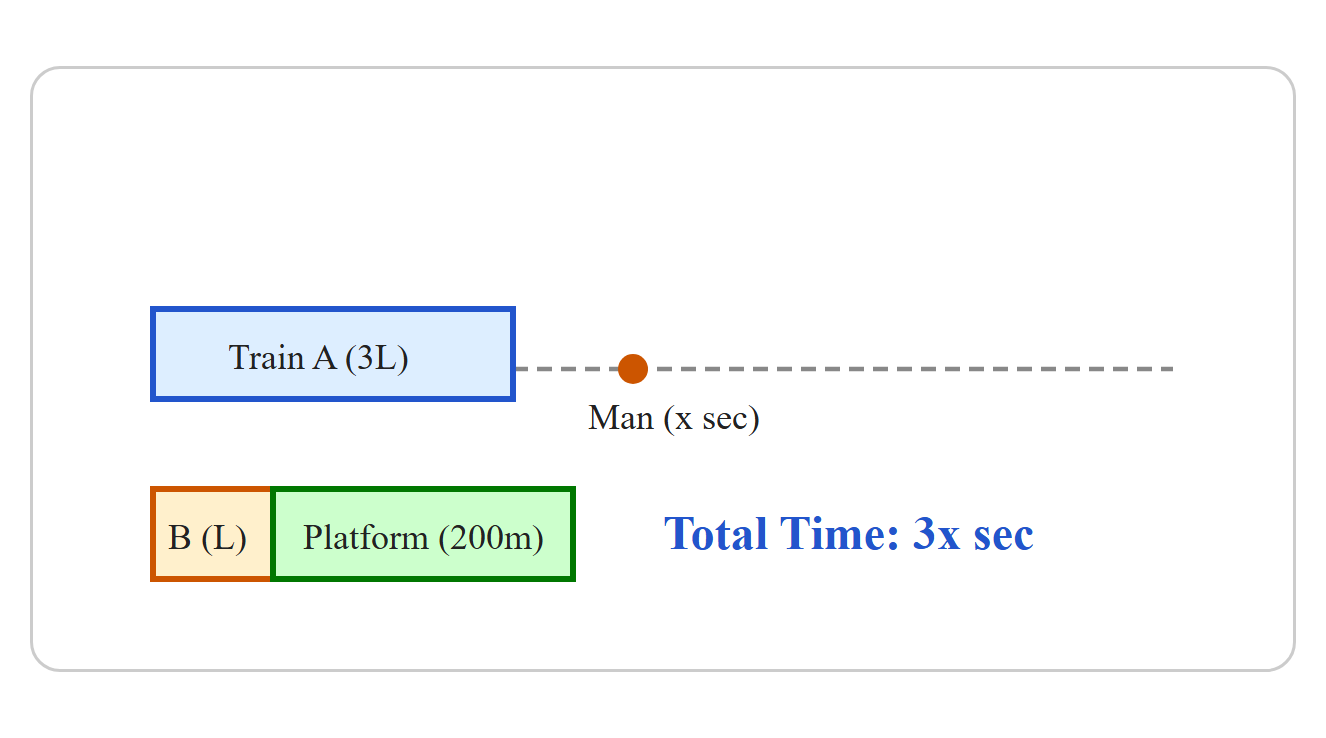
Let Length of Train B = L. Then Length of Train A = 3L.

Time for Train A (x) = 3L / 15 ⇒ x = L / 5.

Time for Train B (3x) = (L + 200) / 15.

Substitute x: 3 × (L / 5) = (L + 200) / 15 ⇒ 9L / 15 = (L + 200) / 15 ⇒ 8L = 200.

L = 25 m.

∴ The correct answer is 25 m.

Alternate Method

Given: Speed of Train A = Speed of Train B = 15 m/s. Length of Train B (LB) = (1/3) × Length of Train A (LA). Platform = 200 m.

Formula Used: Distance = Speed × Time

Calculations:

⇒ Let Length of Train B = L, then Length of Train A = 3L.

⇒ For Train A: 3L = 15 × x ⇒ x = 3L / 15 = L / 5.

⇒ For Train B: (L + 200) = 15 × 3x.

⇒ L + 200 = 45 × (L / 5).

⇒ L + 200 = 9L.

⇒ 8L = 200 ⇒ L = 200 / 8 = 25 m.

∴ The correct answer is 25 m.

Additional Information

Relative Speed

When two objects move in the same direction, relative speed = S1 − S2. In opposite directions, relative speed = S1 + S2.

Train Crossing Objects

To cross a stationary point (man/pole), distance = Length of train. To cross a platform/bridge, distance = Length of train + Length of platform.

Unit Conversion

To convert km/hr to m/s, multiply by 5/18. To convert m/s to km/hr, multiply by 18/5.

68

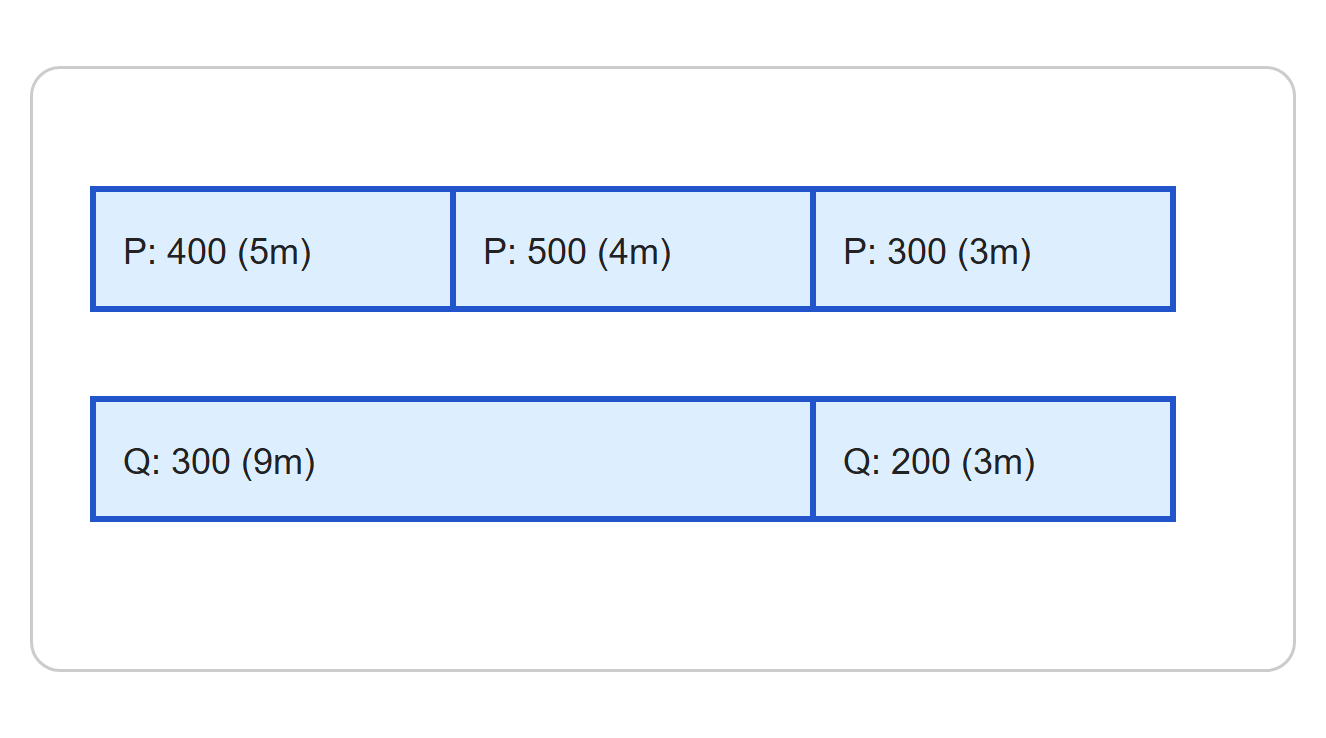
P and Q invests Rs. 400 and Rs. 300 into a partnership respectively. After 5 months, P added Rs. 100 to his investment. After 4 more months, P removes double the amount he added to his investment after 5 months and Q also removes the same amount P added after 5 months. If the profit share of Q is Rs.429 then what is the total profit they had in a year?

  1. ((a))

    Rs. 902

  2. ((b))

    Rs. 1148

  3. ((c))

    Rs. 820

  4. ((d))

    Rs. 1066

  5. ((e))

    Rs. 1234

Show Answer
Answer: ((d))

Rs. 1066

Shortcut Trick

Ratio of Profit Share = Ratio of (Investment × Time).

P's investment: (400 × 5) + (500 × 4) + (300 × 3) = 2000 + 2000 + 900 = 4900.

Q's investment: (300 × 9) + (200 × 3) = 2700 + 600 = 3300.

Profit Ratio P : Q = 49 : 33. Total parts = 49 + 33 = 82.

Q's share 33 units = 429 ⇒ 1 unit = 13. Total profit = 82 × 13 = 1066.

∴ The correct answer is Rs. 1066.

Alternate Method

Given: Initial Investment P = 400, Q = 300. Total time = 12 months. Formulas: Profit Share = Investment × Time | Total Profit = Pshare + Qshare

P's total capital = (400 × 5) + (400 + 100) × 4 + (500 − 2 × 100) × 3 = 4900. ⇒ Q's total capital = (300 × 9) + (300 − 100) × 3 = 3300. ⇒ Ratio of Profit Share P : Q = 4900 : 3300 = 49 : 33. ⇒ Given Q's share = 429. Let common factor be x. 33x = 429 ⇒ x = 13. ⇒ Total profit = (49 + 33)x = 82 × 13 = 1066.

∴ The correct answer is Rs. 1066.

Additional Information

Partnership Basics

In a compound partnership, the profit is distributed based on the product of the capital invested and the duration of investment.

Variable Investment

If a partner changes their investment multiple times, the effective capital is the sum of (amount × respective time period) for each change.

69

The state bank of india lends a certain amount of money to a Mohan at a simple interest at the rate of 3% p.a. Mohan again lends the same amount to another person at the rate of 6% p.a compounded half yearly. If he gets a profit of Rs. 618 after one year, then find out the sum borrowed by Mohan.

  1. ((a))

    25000

  2. ((b))

    20000

  3. ((c))

    30000

  4. ((d))

    15000

  5. ((e))

    24000

Show Answer
Answer: ((b))

20000

Shortcut Trick

Effective Simple Interest rate for 1 year = 3%.

Effective Compound Interest rate (6% p.a. half-yearly) = 3 + 3 + (3 × 3)/100 = 6.09%.

Profit percentage = 6.09% − 3% = 3.09%.

Given Profit = ₹618 ⇒ 3.09% of Sum = 618.

Sum = 618 ÷ 0.0309 = ₹20000.

∴ The correct answer is ₹20000.

Alternate Method

Given: SI Rate = 3% p.a., CI Rate = 6% p.a. (half-yearly), Time = 1 year, Profit = ₹618.

Formula: CI = P[(1 + r/100)n − 1], SI = (P × R × T)/100.

⇒ Let Sum be P.

⇒ SI = (P × 3 × 1)/100 = 0.03P.

⇒ For CI (half-yearly), Rate (r) = 6/2 = 3%, Periods (n) = 2.

⇒ CI = P[(1 + 3/100)2 − 1] = P[(1.03)2 − 1].

⇒ CI = P[1.0609 − 1] = 0.0609P.

⇒ Profit = CI − SI = 0.0609P − 0.03P = 0.0309P.

⇒ 0.0309P = 618.

⇒ P = 618 ÷ 0.0309 = 20000.

∴ The correct answer is ₹20000.

Additional Information

Compound Interest Compounded Half-Yearly

When interest is compounded half-yearly, the annual rate is divided by 2 and the time period is multiplied by 2.

Effective Rate of Interest

The effective rate for two successive changes a% and b% is calculated as (a + b + ab/100)%.

Difference between CI and SI

For 2 periods, the difference between CI and SI is P(r/100)2, where r is the rate per period.

70

Raktim covered a distance from village A to B on car at 28 km/hr. However he covered the distance from B to A on foot at 4 km/hr. What is his average speed in the whole journey?

  1. ((a))

    22 km/hr

  2. ((b))

    7 km/hr

  3. ((c))

    8 km/h

  4. ((d))

    10 km/h

  5. ((e))

    None of these

Show Answer
Answer: ((b))

7 km/hr

Shortcut Trick

When the distance covered is constant for two different speeds, the average speed is given by the Harmonic Mean: (2 × S1 × S2) ÷ (S1 + S2).

Average Speed = (2 × 28 × 4) ÷ (28 + 4)

Average Speed = (2 × 28 × 4) ÷ 32 = 224 ÷ 32 = 7 km/hr.

∴ The correct answer is 7 km/hr.

Alternate Method

Given:

Speed from A to B (S1) = 28 km/hr

Speed from B to A (S2) = 4 km/hr

Formula Used:

Average Speed = Total Distance ÷ Total Time

For equal distances: Average Speed = (2 × S1 × S2) ÷ (S1 + S2)

Calculations:

⇒ Let the distance between A and B be d km.

⇒ Time taken from A to B (T1) = d ÷ 28 hours.

⇒ Time taken from B to A (T2) = d ÷ 4 hours.

⇒ Total Time = (d ÷ 28) + (d ÷ 4) = (d + 7d) ÷ 28 = 8d ÷ 28 = 2d ÷ 7 hours.

⇒ Total Distance = d + d = 2d km.

⇒ Average Speed = 2d ÷ (2d ÷ 7)

⇒ Average Speed = (2d × 7) ÷ 2d = 7 km/hr.

∴ The correct answer is 7 km/hr.

Additional Information

Average Speed for Constant Distance

If an object covers two equal distances at speeds S1 and S2, the average speed is 2S1S2 ÷ (S1 + S2). If it covers three equal distances at speeds x, y, and z, the formula is 3xyz ÷ (xy + yz + zx).

Average Speed for Constant Time

If an object travels for equal time intervals at different speeds, the average speed is the Arithmetic Mean of the speeds: (S1 + S2 + ... + Sn) ÷ n.

Relative Speed

Relative speed in same direction is S1 − S2 and in opposite direction is S1 + S2.

English Language (30 questions)

Directions: Read the passage given below and answer the questions that follow by choosing the correct/most appropriate options:

Amidst global turmoil, the Intergovernmental Panel on Climate Change — the largest international consortium of scientists analyzing and reviewing the evidence on the present and future man-made impacts of climate change — has a message that is predictably dire. The world faces unavoidable multiple climate hazards over the next two decades with global warming of 1.5°C; even temporarily exceeding this warming level would mean additional severe impacts, some of which will be irreversible. The report points out that the rise in weather and climate extremes has led to some irreversible impacts as natural and human systems are pushed beyond their ability to adapt. Alluding to the Conference of the Parties (COP26) in Glasgow, in November 2021, the report notes that most of the targets that countries have set for themselves are too far in the future to have an impact in the short term at meaningfully reducing the climate impact.

India will achieve net-zero emissions latest by 2070, that is, there will be no net carbon emissions, Prime Minister Narendra Modi declared at the COP26 summit. By 2030, India would also _______ 50% of its energy will be from renewable energy sources. However, none of this can help the 1.5°C mark from being breached. A major point of emphasis of the report, particularly for South Asia, is the trend in the ‘wet bulb’ temperature — an index of the impact of heat and humidity combined — and its effect on health. Lucknow and Patna, according to one of several studies cited in the report, were among the cities predicted to reach wet-bulb temperatures of 35°C if emissions continued to rise, while Bhubaneshwar, Chennai, Mumbai, Indore, and Ahmedabad are ‘at risk’ of reaching wet-bulb temperatures of 32°C-34°C with continued emissions. This will have consequences such as a rise in heat-wave linked deaths or reduced productivity. Global sea levels will likely rise 44cm-76cm this century if governments meet their current emissions-cutting pledges. But with higher emissions, and if ice sheets collapse more quickly than expected, sea levels could rise as much as 2 meters this century and 5m by 2150. India is one of the most vulnerable country in terms of the population that will be affected by sea-level rise. By the middle of the century, around 35 million of its people could face annual coastal flooding, with 45 million-50 million at risk by the end of the century if emissions are high. Experience has shown that partisan economic calculations trump climate considerations, but India must shore up its adaptation measures and urgently move to secure the futures of its many vulnerable who have the most to lose.

71

According to the passage, when will India achieve net-zero emissions?

  1. ((a))

    By 2090

  2. ((b))

    By 2070

  3. ((c))

    By 2030

  4. ((d))

    By 2040

  5. ((e))

    By 2050

Show Answer
Answer: ((b))

By 2070

The correct answer is '​By 2070.'

Key Points

  • The first sentence of the second paragraph says "India will achieve net-zero emissions latest by 2070, that is, there will be no net carbon emissions, Prime Minister Narendra Modi declared at the COP26 summit.''
  • From the above sentence, we can say that India will achieve net-zero emissions by 2070.

Hence, the only possible answer is option 2.

72

Which of the following is/are correct according to the given passage?

A. If ice sheets collapse more quickly than expected, sea levels could rise as much as 2 meters by this century.

B. The world faces avoidable multiple climate hazards over the next two decades with global warming of 10.5°C.

C. The rise in weather and climate extremes has led to some reversible impacts.

  1. ((a))

    Only A

  2. ((b))

    Both A and B

  3. ((c))

    Only B

  4. ((d))

    Both B and C

  5. ((e))

    Only C

Show Answer
Answer: ((a))

Only A

The correct answer is 'Only A.'

Key Points

  • The eighth sentence of the second paragraph says "But with higher emissions, and if ice sheets collapse more quickly than expected, sea levels could rise as much as 2 meters this century and 5m by 2150.''
    • From the above sentence, we can say that statement A is correct according to the given passage.​​​
  • The second sentence of the first paragraph says ''The world faces unavoidable multiple climate hazards over the next two decades with global warming of 1.5°C; even temporarily exceeding this warming level would mean additional severe impacts, some of which will be irreversible'' and the third sentence of the first paragraph says ''The report points out that the rise in weather and climate extremes has led to some irreversible impacts as natural and human systems are pushed beyond their ability to adapt.''
  • From the above sentences, we can say that statements B and C are incorrect according to the given passage.​​

Hence, the only possible answer is option 1.

73

According to the passage, if emissions are high, how many people could face annual coastal flooding by the end of the century?

  1. ((a))

    Around 35 million

  2. ((b))

    25 million-30 million

  3. ((c))

    Around 15 million

  4. ((d))

    45 million-50 million

  5. ((e))

    Around 10 million

Show Answer
Answer: ((d))

45 million-50 million

The correct answer is '​45 million-50 million.'

Key Points

  • The tenth sentence of the second paragraph says "By the middle of the century, around 35 million of its people could face annual coastal flooding, with 45 million-50 million at risk by the end of the century if emissions are high.''
  • From the above sentence, we can say that according to the passage, if emissions are high, 45 million-50 million people could face annual coastal flooding by the end of the century.

Hence, the only possible answer is option 4.

74

According to the passage, how much the sea levels could rise by 2150 if ice sheets collapse more quickly than expected?

  1. ((a))

    Two meters

  2. ((b))

    Five meters

  3. ((c))

    1.5 meters

  4. ((d))

    6.5 meters

  5. ((e))

    Ten meters

Show Answer
Answer: ((b))

Five meters

The correct answer is '​Five meters.'

Key Points

  • The given passage is all about the impacts of climate change.
  • The eighth sentence of the second paragraph says "But with higher emissions, and if ice sheets collapse more quickly than expected, sea levels could rise as much as 2 meters this century and 5m by 2150.''
  • From the above sentence, we can say that according to the passage, if ice sheets collapse more quickly than expected, sea levels could rise as much as 5 meters by 2150.

Hence, the only possible answer is option 2.

Important Points

  • ​Given below are the points, we should keep in mind while solving questions of reading comprehension-
  • Identify the purpose of reading. Try to go through the question first then the passage so that you can just focus on the things you need to look at in the passage.
  • Anticipate what may lie ahead. Look out for specific information in the passage.
  • Read the passage quickly to get a general idea of meaning or to find specific information, e.g. figures or names.
75

What will fit in the blank taken from the passage: ''By 2030, India would also _______ 50% of its energy will be from renewable energy sources.''

  1. ((a))

    Ensurable

  2. ((b))

    Ensures

  3. ((c))

    Ensuring

  4. ((d))

    Ensure

  5. ((e))

    Ensured

Show Answer
Answer: ((d))

Ensure

The correct answer is 'Ensure.'

Key Points

  • In the given sentence, the modal verb ''would'' before the blank indicates the use of the base or root form of the verb in the blank.
  • We know that after ''will, would, must, can, could, may, might, shall, should, do, does, did'' we use the base form of the verb.
  • Example: I thought it would rain so I brought my umbrella.
  • The verbs that follow modal verbs should only be in their base form.
  • Therefore, the base or root form of the verb 'ensure' should be used in the blank.

Hence, the correct answer is option 4.

Complete Sentence: By 2030, India would also ensure 50% of its energy will be from renewable energy sources.

Additional Information

  • Let us explore the other options:
  • Ensurable is not the correct form of the verb or a word.
  • Ensures is the third-person present singular form of the verb.
  • Ensuring is the gerund or present participle form of the verb.
  • Ensured is the past tense form of the verb.
76

Choose the synonym of the word 'Irreversible'.

  1. ((a))

    Irrevocable

  2. ((b))

    Corrigible

  3. ((c))

    Retrievable

  4. ((d))

    Repairable

  5. ((e))

    Revocable

Show Answer
Answer: ((a))

Irrevocable

The correct answer is '​Irrevocable.'

Key Points

  • The word 'Irreversible' means Not able to be undone or altered.
  • Example: Smoking has caused irreversible damage to his lungs.
  • Let's look at the meaning of the given options:-
  • ​Irrevocable - Not able to be changed, reversed, or recovered; final.
  • Example: Old age was a phase of irrevocable and inevitable decline.
  • Corrigible - Capable of being corrected, rectified, or reformed.
  • Example: Fortunately the laws in our country are corrigible and can be altered to suit the changing times.
  • Retrievable - Capable of being retrieved or recovered.
  • Example: Records shall remain legible, readily identifiable, and retrievable.
  • Repairable - Something able to be restored to a good condition.
  • Example: Hard plastic under the fur isn't repairable in any way.
  • Revocable - Capable of being revoked or canceled.
  • Example: The offer is revocable at any time by the offeror before acceptance by the offeree.

Hence, the only possible answer is option 1.

Additional Information

  • The synonyms of the word 'Irreversible' are "​Irrevocable, Irrecoverable, Irremediable".
  • The antonyms of the word 'Irreversible' are "Corrigible, Retrievable, Revocable".
77

Choose the antonym of the word 'Evidence.'

  1. ((a))

    Attestation

  2. ((b))

    Confirmation

  3. ((c))

    Corroboration

  4. ((d))

    Proof

  5. ((e))

    Guess

Show Answer
Answer: ((e))

Guess

The correct answer is 'Guess.'

Key Points

  • The word 'Evidence' means The available body of facts or information indicating whether a belief or proposition is true or valid.
  • Example: We have evidence to substantiate the allegations against him.
  • Let's look at the meaning of the given options:-
  • Attestation - Evidence or proof of something.
  • Example: He failed to prove the attestation of the will by the witness.
  • Confirmation - The action of confirming something or the state of being confirmed.
  • Example: There has still been no official confirmation of the report.
  • Corroboration - Evidence that confirms or supports a statement, theory, or finding; confirmation.
  • Example: His possession of the gun is corroboration of his guilt.
  • Proof - Evidence or argument establishing a fact or the truth of a statement.
  • Example: The receipt is your proof of purchase.
  • Guess - To estimate or conclude something without sufficient information to be sure of being correct.
  • Example: We can only guess about the murderer.

Hence, the only possible answer is option 5.

Additional Information

  • The antonyms of the word 'Evidence' are "​Guess, Assumption, Disproof".
  • The synonyms of the word 'Evidence' are "Attestation, Confirmation, Proof".
78

Which of the following is/are incorrect according to the given passage?

A. The 2021 COP26 summit was held in Glasgow.

B. Global sea levels will fall 44cm-76cm this century if governments meet their current emission-cutting pledges.

C. Lucknow and Patna were predicted to reach wet-bulb temperatures of 35°C with continued emissions.

  1. ((a))

    Only A

  2. ((b))

    Both A and B

  3. ((c))

    Only B

  4. ((d))

    Both A and C

  5. ((e))

    Only C

Show Answer
Answer: ((c))

Only B

The correct answer is 'Only B.'

Key Points

  • The last sentence of the first paragraph says ''Alluding to the Conference of the Parties (COP26) in Glasgow, in November 2021, the report notes that most of the targets that countries have set for themselves are too far in the future to have an impact in the short term at meaningfully reducing the climate impact'' and the fifth sentence of the second paragraph says ''Lucknow and Patna, according to one of several studies cited in the report, were among the cities predicted to reach wet-bulb temperatures of 35°C if emissions continued to rise, while Bhubaneshwar, Chennai, Mumbai, Indore, and Ahmedabad are ‘at risk’ of reaching wet-bulb temperatures of 32°C-34°C with continued emissions.''
  • From the above sentences, we can say that statements A and C are correct according to the given passage.​
  • The seventh sentence of the second paragraph says ''Global sea levels will likely rise 44cm-76cm this century if governments meet their current emissions-cutting pledges.''
  • From the above sentence, we can say that statement B is incorrect according to the given passage.​​​

Hence, the only possible answer is option 3.

79

What is the theme of the passage?

  1. ((a))

    India must relax upon its adaptation measures for climate considerations.

  2. ((b))

    India can withstand the sea-level rise.

  3. ((c))

    India is risk-free from climate change.

  4. ((d))

    The achievement of net-zero emissions by India.

  5. ((e))

    India must shore up its adaptation measures for climate considerations.

Show Answer
Answer: ((e))

India must shore up its adaptation measures for climate considerations.

The correct answer is '​India must shore up its adaptation measures for climate considerations.'

Key Points

  • The fifth sentence of the second paragraph says ''Lucknow and Patna, according to one of several studies cited in the report, were among the cities predicted to reach wet-bulb temperatures of 35°C if emissions continued to rise, while Bhubaneshwar, Chennai, Mumbai, Indore, and Ahmedabad are ‘at risk’ of reaching wet-bulb temperatures of 32°C-34°C with continued emissions'', the ninth sentence of the second paragraph says ''India is one of the most vulnerable countries in terms of the population that will be affected by sea-level rise'' and the last sentence of the passage concludes "Experience has shown that partisan economic calculations trump climate considerations, but India must shore up its adaptation measures and urgently move to secure the futures of its many vulnerable who have the most to lose."
  • From the above sentences, we can say that the theme of the passage is ''​​​India must shore up its adaptation measures for climate considerations.''

Hence, the only possible answer is option 5.

80

Directions: In each of the questions below, four sentences are given that may or may not contain an error. Choose the one that is grammatically as well as contextually correct and meaningful. If all the sentences are correct, mark 'All are correct as your answer'.

  1. ((a))

    Great Expectations were written by Dickens.

  2. ((b))

    Every man and woman are required to check-in.

  3. ((c))

    The Grapes of Wrath take a long time to read.

  4. ((d))

    Either Shilpi or Raj is to blame for the accident.

  5. ((e))

    All are correct.

Show Answer
Answer: ((d))

Either Shilpi or Raj is to blame for the accident.

The correct answer is 'Either Shilpi or Raj is to blame for the accident' i.e. this sentence is grammatically and contextually correct.

Key Points

  • Let us explore the grammatical errors in the sentences:
  • In Option 1, the use of the plural form of the verb 'were' is incorrect.
  • We know that a singular subject (here, 'Great Expectations' which is a novel) requires a singular verb (here, was).
  • Titles of single entities (books, organizations, countries, etc.) are always singular.
  • Therefore, the singular form of the verb 'was' should be used in place of the plural form of the verb 'were'.
  • Correct Sentence: Great Expectations was written by Dickens.
  • In Option 2, the use of the plural form of the verb 'are' is incorrect.
  • We know that the determiner 'Every' is always followed by a singular verb.
  • Therefore, the singular form of the verb 'is' should be used in place of the plural form of the verb 'are'.
  • Correct Sentence: Every man and woman is required to check-in.
  • In Option 3, the use of the plural form of the verb 'take' is incorrect.
  • We know that a singular subject (here, 'The Grapes of Wrath' which is a novel) requires a singular verb (here, takes).
  • Titles of single entities (books, organizations, countries, etc.) are always singular.
  • Therefore, the singular form of the verb 'takes' should be used in place of the plural form of the verb 'take'.
  • Correct Sentence: The Grapes of Wrath takes a long time to read.

Hence, the correct answer is option 4.

81

Directions: In each of the questions below, four sentences are given that may or may not contain an error. Choose the one that is grammatically as well as contextually correct and meaningful. If all the sentences are correct, mark 'All are correct as your answer'.

  1. ((a))

    One little girl had less presents than the rest, and Helen insisted on sharing her gifts with her.

  2. ((b))

    If you refuse her help because you are angry at her, you are cutting off your nose to spite your face.

  3. ((c))

    Not only dogs but also cats are available at the animal shelter.

  4. ((d))

    The spectacles was sold at a price that most villagers couldn't afford, thus alienating the very people most at risk.

  5. ((e))

    All are correct.

Show Answer
Answer: ((c))

Not only dogs but also cats are available at the animal shelter.

The correct answer is 'Not only dogs but also cats are available at the animal shelter' i.e. this sentence is grammatically and contextually correct.

Key Points

  • Let us explore the grammatical errors in the sentences:
  • In Option 1, the use of the determiner 'less' is incorrect.
  • The determiner 'less' is used to refer to quantity or amount among things that are measured.
  • The determiner 'fewer' is used to refer to numbers among things that are counted.
  • Therefore, the determiner 'fewer' should be used in place of the determiner 'less'.
  • Correct Sentence: One little girl had fewer presents than the rest, and Helen insisted on sharing her gifts with her.
  • In Option 2, the use of the preposition 'at' is incorrect.
  • The preposition 'at' is used when talking about an inanimate object or place.
  • The preposition 'with' is used when referring to a living being.
  • Therefore, the preposition 'with' should be used in place of the preposition 'at'.
  • Correct Sentence: If you refuse her help because you are angry with her, you are cutting off your nose to spite your face.
  • In Option 4, the use of the singular form of the verb 'was' is incorrect.
  • We know that nouns that have two parts such as spectacles, scissors, or pants require plural verbs.
  • Therefore, the plural form of the verb 'were' should be used in place of the singular form of the verb 'was'.
  • Correct Sentence: The spectacles were sold at a price that most villagers couldn't afford, thus alienating the very people most at risk.

Hence, the correct answer is option 3.

82

Directions: In each of the questions below, four sentences are given that may or may not contain an error. Choose the one that is grammatically as well as contextually correct and meaningful. If all the sentences are correct, mark 'All are correct as your answer'.

  1. ((a))

    Either the bears or the lion has escaped from the zoo.

  2. ((b))

    Teachers actively engaged in working at progressive education, defending the curriculum they developed and finding ways to expand it.

  3. ((c))

    The greatest challenge of the Americans is understanding the mindset of Eastern Europeans.

  4. ((d))

    Ten minutes are enough time to get there.

  5. ((e))

    All are correct.

Show Answer
Answer: ((a))

Either the bears or the lion has escaped from the zoo.

The correct answer is 'Either the bears or the lion has escaped from the zoo' i.e. this sentence is grammatically and contextually correct.

Key Points

  • Let us explore the grammatical errors in the sentences:
  • In Option 2, the use of the preposition 'at' is incorrect.
  • The preposition 'at' is used for expressing location or arrival in a particular place or position.
  • The preposition 'for' is used for stating the purpose of an object or action.
  • Therefore, the preposition 'for' should be used in place of the preposition 'at'.
  • Correct Sentence: Teachers actively engaged in working for progressive education, defending the curriculum they developed and finding ways to expand it.
  • In Option 3, the use of the preposition 'of' is incorrect.
  • The preposition 'of' is used for expressing the relationship between a part and a whole.
  • The preposition 'for' is used for saying who or what is intended to receive something or get the benefit of it.
  • Therefore, the preposition 'for' should be used in place of the preposition 'of'.
  • Correct Sentence: The greatest challenge for the Americans is understanding the mindset of Eastern Europeans.
  • In Option 4, the use of the plural form of the verb 'are' is incorrect.
  • We know that the singular subject takes a singular verb.
  • The singular verb form is usually reserved for units of measurement or time.
  • Therefore, the singular form of the verb 'is' should be used in place of the plural form of the verb 'are'.
  • Correct Sentence: Ten minutes is enough time to get there.

Hence, the correct answer is option 1.

83

Directions: In each of the questions below, four sentences are given that may or may not contain an error. Choose the one that is grammatically as well as contextually correct and meaningful. If all the sentences are correct, mark 'All are correct as your answer'.

  1. ((a))

    He could find himself making enemies as well as friends unless he proceeds with utmost caution.

  2. ((b))

    Swimming in the ocean and playing drums are my hobbies.

  3. ((c))

    The friar preached again stealing and had a goose in his sleeve.

  4. ((d))

    Maybe Newton's law of gravitation, the law that describes how their trajectories should be playing out, is in need of a overhaul.

  5. ((e))

    All are correct.

Show Answer
Answer: ((b))

Swimming in the ocean and playing drums are my hobbies.

The correct answer is 'Swimming in the ocean and playing drums are my hobbies' i.e. this sentence is grammatically and contextually correct.

Key Points

  • Let us explore the grammatical errors in the sentences:
  • In Option 1, the use of 'no article' before the superlative adjective 'utmost' is incorrect.
  • We use a superlative to say that a thing or person is the most of a group, when we use a superlative adjective before the noun, we generally use it with the article  'the'.
  • Therefore, the article 'the' should be used before the superlative adjective 'utmost'.
  • Correct Sentence: He could find himself making enemies as well as friends unless he proceeds with the utmost caution.
  • In Option 3, the use of the adverb 'again' is incorrect.
  • The adverb 'again' means another time; once more.
  • The preposition 'against' means in opposition to.
  • Therefore, the preposition 'against' should be used in place of the adverb 'again'.
  • Correct Sentence: The friar preached against stealing and had a goose in his sleeve.
  • In Option 4, the use of the article 'a' before the word 'overhaul' is incorrect.
  • The article 'a' goes before words that begin with consonants.
  • The article 'an' goes before words that begin with vowels.
  • Therefore, the article 'an' should be used in place of the article 'a'.
  • Correct Sentence: Maybe Newton's law of gravitation, the law that describes how their trajectories should be playing out, is in need of an overhaul.

Hence, the correct answer is option 2.

84

Directions: In each of the questions below, four sentences are given that may or may not contain an error. Choose the one that is grammatically as well as contextually correct and meaningful. If all the sentences are correct, mark 'All are correct as your answer'.

  1. ((a))

    Shivani, together with a friend, practise yoga every day.

  2. ((b))

    It is the people with insecurities which make life difficult.

  3. ((c))

    Widows were forbidden to remarry and were stoned to death if they do.

  4. ((d))

    Neither the lion nor the bears have escaped from the zoo.

  5. ((e))

    All are correct.

Show Answer
Answer: ((d))

Neither the lion nor the bears have escaped from the zoo.

The correct answer is 'Neither the lion nor the bears have escaped from the zoo' i.e. this sentence is grammatically and contextually correct.

Key Points

  • Let us explore the grammatical errors in the sentences:
  • In Option 1, the use of the plural form of the verb 'practise' is incorrect.
  • We know that prepositional phrases such as with, together with, along with, as well as are not part of the subject and, therefore, have no effect on the form of the verb, the verb needs to agree in number only with the subject of the sentence.
  • Therefore, the singular form of the verb 'practises' should be used in place of the plural form of the verb 'practice'.
  • Correct Sentence: Shivani, together with a friend, practices yoga every day.
  • In Option 2, the use of the pronoun 'which' is incorrect.
  • The pronoun 'which' is used to refer to something previously mentioned when introducing a clause giving further information.
  • The pronoun 'who' is used to introduce a clause giving further information about a person or people previously mentioned.
  • Therefore, the pronoun 'who' should be used in place of the pronoun 'which'.
  • Correct Sentence: It is the people with insecurities who make life difficult.
  • In Option 3, the use of the present tense form of the verb 'do' is incorrect.
  • The given sentence is in the past tense.
  • Therefore, the past tense form of the verb 'did' should be used in place of the present tense form of the verb 'do'.
  • Correct Sentence: Widows were forbidden to remarry and were stoned to death if they did.

Hence, the correct answer is option 4.

85

Directions: In the following sentence, five words are given in bold, out of which one word is misspelled. Find the misspelled word.

We put ribbons (A) on our suitcases (B) to diferentiate (C) them from the hundreds (D) of other bags on the airline carousel (E).

  1. ((a))

    A

  2. ((b))

    B

  3. ((c))

    C

  4. ((d))

    D

  5. ((e))

    E

Show Answer
Answer: ((c))

C

The correct answer is "C".

Key Points

  • There is no such word as 'diferentiate' in English or we can say that there is some spelling mistake in this word.
  • The correct word is 'differentiate' which means to show or find the difference between things that are compared.
  • Example: Most consumers have no trouble differentiating our brand's cereal from our leading competitor's.
  • Hence, the correct answer is option 3.
86

Directions: In the following sentence, five words are given in bold, out of which one word is misspelled. Find the misspelled word.

Tom regretted (A) having wasted (B) a grate (C) deal (D) of his life (E).

  1. ((a))

    A

  2. ((b))

    B

  3. ((c))

    C

  4. ((d))

    D

  5. ((e))

    E

Show Answer
Answer: ((c))

C

The correct answer is 'C'.

Key Points

  • The word 'grate' has been incorrectly used in the given sentence.
  • The word 'grate' means to rub food against a grater in order to cut it into a lot of small pieces.
  • Example: Add the grated carrots to the salad.
  • The given sentence refers to the subject's regret towards wasting a large part of his life.
  • The phrase 'a great deal' refers to a large amount.
  • Example: A great deal of my time is spent preparing students for exams.
  • Therefore, the word 'grate' must be replaced with 'great' to make the sentence grammatically and contextually correct.
  • Hence, the correct answer is option 3.
87

Directions: In the following sentence, five words are given in bold, out of which one word is misspelled. Find the misspelled word.

Despite(A) the completion(B) of the dilimitation(C) commission’s exercise(D), Legislative Assembly elections have still to be announced(E).

  1. ((a))

    A

  2. ((b))

    B

  3. ((c))

    C

  4. ((d))

    D

  5. ((e))

    E

Show Answer
Answer: ((c))

C

The correct answer is 'C.'

Key Points

  • Let us explore the options:-
  • 'Despite' means Without being affected by; in spite of.
  • 'Completion' means The action or process of completing or finishing something.
  • 'Dilimitation': There is no such word in English or we can say that there is some spelling mistake in this word.
  • ​The correct spelling is 'Delimitation' means The action of fixing the boundary or limits of something.
  • 'Exercise' means Activity requiring physical effort, carried out to sustain or improve health and fitness.
  • 'Announced' means To make a formal public statement about a fact, occurrence, or intention.

Hence, the correct answer is option 3.

Correct Sentence: Despite the completion of the delimitation commission’s exercise, Legislative Assembly elections have still to be announced.

<br>

Additional Information

  • The synonyms of the word 'Delimitation' are "Bound, Circumscribe, Limit".
  • Example of 'Delimitation' in a sentence:
  • Set the delimitation or boundaries of your proposed research in order to provide a clear focus.
88

Directions: In the following sentence, five words are given in bold, out of which one word is misspelled. Find the misspelled word.

The likelihood(A) that many would face long incarceration(B) as PMLA accused(C), even though eventually(D) found innocant(E) has just increased manifold.

  1. ((a))

    A

  2. ((b))

    B

  3. ((c))

    C

  4. ((d))

    D

  5. ((e))

    E

Show Answer
Answer: ((e))

E

The correct answer is 'E.'

Key Points

  • Let us explore the options:-
  • 'Likelihood' means The state or fact of something's being likely; probability.
  • 'Incarceration' means The state of being confined in prison; imprisonment.
  • 'Accused' means To charge someone with an offense or crime.
  • 'Eventually' means In the end, especially after a long delay, dispute, or series of problems.
  • 'Innocant': There is no such word in English or we can say that there is some spelling mistake in this word.
  • ​The correct spelling is 'Innocent' means Not guilty of a crime or offense.

Hence, the correct answer is option 5.

Correct Sentence: The likelihood that many would face long incarceration as PMLA accused, even though eventually found innocent has just increased manifold.

<br>

Additional Information

  • The synonyms of the word 'Innocent' are "Guiltless, Blameless, Unimpeachable".
  • Example of 'Innocent' in a sentence:
  • She was found innocent of all charges.
89

Directions: In the following sentence, five words are given in bold, out of which one word is misspelled or contextually inappropriate. Find the misspelled/inappropriate word. 

Retail (A) inflation alike (B) eased below 7% in October, Reserve Bank of India (RBI) Governor Shaktikanta Das said on Saturday, in conversation (C) with R Sukumar, editor-in-chief, of Hindustan Times at the Hindustan Times Leadership (D) Summit(E) 2022.

  1. ((a))

    Retail

  2. ((b))

    Alike

  3. ((c))

    Conversation

  4. ((d))

    Leadership

  5. ((e))

    Summit

Show Answer
Answer: ((b))

Alike

The correct answer is 'B'.

Key Points

  • The emboldened words are explained in detail as follows:
  • Retail: To sell (goods, commodities, etc) to the public in small proportions.
  • Alike: Similar to each other.
  • Likely: Probably, Mostly, Most of the time, Almost definite.
  • Leadership: The set of characteristics that make a good leader.
  • Summit: Conclave, A large gathering of people for an event.
  • Thus, after understanding the meanings we can say that the word 'alike' is inappropriate as per context of the given sentence and must be replaced with the word 'likely' to make the sentence grammatically correct.
  • Hence, the correct answer is option 2.

Correct Sentence: Retail inflation likely eased below 7% in October, Reserve Bank of India (RBI) Governor Shaktikanta Das said on Saturday, in conversation with R Sukumar, editor-in-chief, Hindustan Times at the Hindustan Times Leadership Summit 2022.

90

The question below contains five scattered segments of a sentence. Indicate the sequence which correctly assembles the segments and completes the sentence.

A. of many sorts show

B. both plants and animals

C. growth habits and even modes 

D. remarkable changes in form,

E. of reproduction to adapt to changing environment

  1. ((a))

    BADCE

  2. ((b))

    ABCED

  3. ((c))

    CAEDB

  4. ((d))

    BDCEA

  5. ((e))

    CAEBD

Show Answer
Answer: ((a))

BADCE

The correct answer is BADCE.

Key Points

  • B is the part that establishes the subject of the matter,i.e., ' Both plants and animals '. Hence, it will be the first part after rearrangement.
  • Part A refers to the types of plants and animals. Hence, A follows B.
  • Now three parts are remaining, and out of them, part D talks about remarkable changes. So, part D follows A.
  • Part C talks about different forms, growth habits and modes of reproduction, so it must come after part D.
  • Part E talks about the adaptation to the environment. Hence, E follows C.

Correct rearrangement of segments is - Both plants and animals of many sorts show remarkable changes in form, growth habits and even modes of reproduction to adapt to changing environment.

Hint

  • While solving jumbles, one must first look for any independent sentences/segments or the option which establishes the subject matter.
  • Then, one must look for connections between the sentences/segments.
  • Some sentences/segments might have some concluding notion. So these parts will always be at the end.

91

The question below contains five scattered segments of a sentence. Indicate the sequence which correctly assembles the segments and completes the sentence.

A. mass formal education

B. part of all industrial 

C. began in industrial society

D. societies in India

E. and is an established

  1. ((a))

    ABCDE

  2. ((b))

    CDEBA

  3. ((c))

    DEBAC

  4. ((d))

    BECDA

  5. ((e))

    ACEBD

Show Answer
Answer: ((e))

ACEBD

The correct answer is ACEBD.

Key Points

  • A is the part that establishes the subject of the matter,i.e., ' Mass formal education '. Hence, it will be the first part after rearrangement.
  • Part C refers to the beginning of mass formal education. Hence, C follows A.
  • Now three parts are remaining, and out of them, part E starts with a connector. Also, it talks about the establishment of the same. So, part E follows C.
  • Part B talks about it being a part of industrial societies in India, so it must come after part E.
  • Part D talks in continuation with part B. Hence, D follows B.

Correct rearrangement of segments is - Mass formal education began in industrial society and is an established part of all industrial societies in India.

Hint

  • While solving jumbles, one must first look for any independent sentences/segments or the option which establishes the subject matter.
  • Then, one must look for connections between the sentences/segments.
  • Some sentences/segments might have some concluding notion. So these parts will always be at the end.

92

The question below contains five scattered segments of a sentence. Indicate the sequence which correctly assembles the segments and completes the sentence.

A. as a few hours before

B. distant and as recent

C. Alzheimer's disease impairs

D. a person's ability 

E. to recall memories, both

  1. ((a))

    ABCED

  2. ((b))

    BCEAD

  3. ((c))

    DEACB

  4. ((d))

    CDEBA

  5. ((e))

    ADECB

Show Answer
Answer: ((d))

CDEBA

The correct answer is CDEBA.

Key Points

  • C is the part that establishes the subject of the matter,i.e., ' Alzheimer's disease impairs'. Hence, it will be the first part after rearrangement.
  • Part D talks about what this disease does. Hence, D follows C.
  • Part E talks about how it impairs the memories of a person. So, part E follows D.
  • Part B and A talk about the two types of memories that Alzehmier affects. Also, B comes before A because the connector 'and' is present in part B. The two types of memories are distant and as recent as a few hours before. So B follows E. Further, A follows B.​

​​

Correct rearrangement of segments is - Alzheimer's disease impairs a person's ability to recall memories, both distant and as recent as a few hours before.

Hint

  • While solving jumbles, one must first look for any independent sentences/segments or the option which establishes the subject matter.
  • Then, one must look for connections between the sentences/segments.
  • Some sentences/segments might have some concluding notion. So these parts will always be at the end.
93

Directions: Given below is a word, followed by three sentences that consist of the word. Identify the sentence(s) that best express(es) the meaning of the word. Choose 'None of these ' if the word is not suitable in any of the sentences. 

DEVISE

A. Keep this electronic devise out of reach of children.

B. Sam devised a fundraising strategy for the welfare of the childcare foundation's orphan children.

C. The terrorists devised a plan to attack the Colaba market during the festive season.

  1. ((a))

    Only A

  2. ((b))

    Only B

  3. ((c))

    Only C

  4. ((d))

    Both A and B

  5. ((e))

    Both B and C

Show Answer
Answer: ((e))

Both B and C

The correct answer is both B and C.

Key Points

  • The word "devise" means to invent a plan or formulate a strategy after careful deliberation or thought. It's a verb.
  • The synonyms of the word "devise" are: conceive. invent and originate.
  • In sentence (a), The word "devise" is incorrectly used. The sentence is saying that electronic equipment should be kept away from children. The word 'device' should be used.
  • The correct sentence will be Keep this electronic device out of reach of children.

Thus, the correct answer is both B and C.

94

Directions: Given below is a word, followed by three sentences that consist of the word. Identify the sentence(s) that best express(es) the meaning of the word. Choose 'None of these ' if the word is not suitable in any of the sentences. 

LIGHTNING

A. The little girl answered all the questions at lightning speed. 

B. Arpit fall off the bridge when he was struck by lightning.

C**.** The dress is lightning with sequins at night.

  1. ((a))

    Only A

  2. ((b))

    Only B

  3. ((c))

    Only C

  4. ((d))

    Both A and B

  5. ((e))

    Both B and C

Show Answer
Answer: ((d))

Both A and B

The correct answer is both A and B. 

Key Points

  • The word "lightning" when used as an adjective means very quickly, in the blink of an eye.
  • The word "lightning" when used as a noun means a flash of light with electric voltage.
  • Synonyms of the word "lightning" are bolt, fulmination, and firebolt.
  • Sentence (c) has wrongly used the word "lightning". The sentence says that the dress is shining with sequins at night.
  • The correct word to be used is 'shining'.

Thus, the correct answer is both A and B.

95

Directions: Given below is a word, followed by three sentences that consist of that word. Identify the sentence(s) that express(es) the meaning of that word.

FACTUAL

A. She gave the police a factual account of the events that took place before the robbery.

B. His opinion about the company was based on factual information and wasn't some preconceived notion.

C. The hollow Earth story is based on factual imagination and there is no truth to it.

  1. ((a))

    Only A

  2. ((b))

    Only B

  3. ((c))

    Only C

  4. ((d))

    Both A and B

  5. ((e))

    Both B and C

Show Answer
Answer: ((d))

Both A and B

The correct answer is 'Both A and B'.

Key Points


  • The word 'FACTUAL' as an adjective means being concerned with what is actually the case.
  • In sentence A, the word 'factual' is correctly used as an adjective, as the sentence talks about a woman giving an account of the actual events before a robbery to the police to help in their investigation.
  • In sentence B, the word 'factual' is correctly used as an adjective as the sentence talks about an opinion a person has regarding a company which is based on actual facts.
  • In sentence C, the word 'factual' is incorrectly used as an adjective as the hollow Earth story is fiction and not based on facts.

Hence, the only possible answer is Option 4.

Directions: In the following questions, you have a passage where some of the words have been left out. Read the passages carefully and choose the correct answer to each blanks with its particular number, out of the four alternatives.

After the outbreak of COVID- 19 in the world, technological advancement has been used to ________(A) and enable the business to continue running throughout. COVID-19 has transformed online shopping from occasional to a must globally to minimize the ________(B) of people all over, thus controlling the coronavirus’s spread. Online shopping is enhanced through ______(C) logistics systems where robots are being used as the means to deliver food supplies and other commodities because in-person delivery isn’t virus-proof. Countries like China and the United States have ________(D)contactless delivery services where the customer’s goods ordered are élite and dropped off at the selected locations instead of the customers picking for themselves using their hands. However, not every sector is equal in terms of e-commerce amid this _________(E).

96

Choose the correct option which fits the blank (B) in the given passage.

  1. ((a))

    Cause.

  2. ((b))

    Event.

  3. ((c))

    Movement.

  4. ((d))

    Stationary.

  5. ((e))

    Consequence.

Show Answer
Answer: ((c))

Movement.

The correct answer is movement. 

Key Points Let's explore the meanings of the above-given words:

  • Cause: The reason why an event has happened.
  • Example: What is the cause of his prolonged illness?
  • Event: A meeting taking place in a formal or informal manner. 
  • Example: I am planning to go to the Carnival event in Goa on the 31st of December.
  • Movement: To move or roam around.
  • Example: There is no movement of the baby for the past 2 hours in the cradle.
  • Stationary: It is the antonym of the word "movement". It means to be stable or rigid in one place.
  • Example: The airplane was in stationary mode at the airport.
  • Stationery: Pen, pencil, eraser, book, sharpener, etc
  • Example: Sahil went to the stationery shop for buying school essentials.
  • Consequence: Result of a certain action performed. 
  • Example: You never know what will be the consequences of complaining to the manager directly.

​Thus, the correct answer is movement. 

Completed paragraph: After the outbreak of COVID- 19 in the world, technological advancement has been used to promote and enable the business to continue running throughout. COVID-19 has transformed online shopping from occasional to a must globally to minimize the movement of people all over, thus controlling the coronavirus’s spread. Online shopping is enhanced through robust logistics systems where robots are being used as the means to deliver food supplies and other commodities because in-person delivery isn’t virus-proof. Countries like China and the United States have launched contactless delivery services where the customer’s goods ordered are élite and dropped off at the selected locations instead of the customers picking for themselves using their hands. However, not every sector is equal in terms of e-commerce amid this pandemic.

97

Choose the correct option which fits the blank (C) in the given passage.

  1. ((a))

    Extravagant

  2. ((b))

    Robust

  3. ((c))

    Enormous

  4. ((d))

    Reactive

  5. ((e))

    Plausible

Show Answer
Answer: ((b))

Robust

The correct answer is robust.

Key Points

 Let's explore the meanings of the above-given words:

  • Extravagant: Something which is excessive or in a large amount.
  • Example: Ruthvik brought his extravagant car to the party.
  • Robust: Something which is vigorous and strong.
  • Example: E-commerce websites have robust databases.
  • Enormous: Something which is a huge and grand or vast area.
  • Example: Prem has an enormous fountain in his house's backyard.
  • Reactive: Response to the action performed.
  • Example: Endothermic reactions are reactive in nature.
  • Plausible: Something which is fair and reasonable, credible.
  • Example: What a plausible performance it is!

Thus, the correct answer is robust.

Completed paragraph: After the outbreak of COVID- 19 in the world, technological advancement has been used to promote and enable the business to continue running throughout. COVID-19 has transformed online shopping from occasional to a must globally to minimize the movement of people all over, thus controlling the coronavirus’s spread. Online shopping is enhanced through robust logistics systems where robots are being used as the means to deliver food supplies and other commodities because in-person delivery isn’t virus-proof. Countries like China and the United States have launched contactless delivery services where the customer’s goods ordered are élite and dropped off at the selected locations instead of the customers picking for themselves using their hands. However, not every sector is equal in terms of e-commerce amid this pandemic.

98

Choose the correct option which fits the blank (A) in the given passage.

  1. ((a))

    Promote.

  2. ((b))

    Impede.

  3. ((c))

    Launch.

  4. ((d))

    Distribute.

  5. ((e))

    Pamper.

Show Answer
Answer: ((a))

Promote.

The correct answer is to promote**.** 

Key PointsLet's explore the meanings of the above-given words:

  • Promote: To enhance something, to make changes in a positive way. 
  • Example: Anshul always promotes freedom of expression while delivering a speech in public.
  • Impede: It is the antonym of promoting which means to stop and hinder something or someone.
  • Example: Drishyam impedes his brother's progress by disturbing him while he is doing his work.
  • Launch: To release a new project or a task.
  • Example: TATA motors is going to launch a new model of the car soon.
  • Distribute: To divide things into small quantities. 
  • Example: Nishanth likes to distribute chocolates to poor children.

Thus, the correct answer is to promote. 

Completed paragraph: After the outbreak of COVID- 19 in the world, technological advancement has been used to promote and enable the business to continue running throughout. COVID-19 has transformed online shopping from occasional to a must globally to minimize the movement of people all over, thus controlling the coronavirus’s spread. Online shopping is enhanced through robust logistics systems where robots are being used as the means to deliver food supplies and other commodities because in-person delivery isn’t virus-proof. Countries like China and the United States have launched contactless delivery services where the customer’s goods ordered are élite and dropped off at the selected locations instead of the customers picking for themselves using their hands. However, not every sector is equal in terms of e-commerce amid this pandemic.

99

Choose the correct option which fits the blank (D) in the given passage.

  1. ((a))

    Evolved

  2. ((b))

    Provoked

  3. ((c))

    Indulged

  4. ((d))

    Launched 

  5. ((e))

    Describe

Show Answer
Answer: ((d))

Launched 

The correct answer is launched.

Key Points Let's explore the meanings of the above-given words:

  • Evolved: Something which is improved from its original state or condition.
  • Example: Information technology has evolved tremendously in the past few years.
  • Provoked: To instigate someone to do a task.
  • Example: The professor provoked the students to work hard for the upcoming exams.
  • Indulged: To be involved in something.
  • Example: We should not indulge in any malpractices during the exam.
  • Launched: To initiate something or to release a new version of the original product.
  • Example: TATA Motors launched its new model of the car last week.
  • Describe: To elaborate on a topic in detail.
  • Example: Can you describe yourself in two words?

Thus, the correct answer is launched.

Completed paragraph: After the outbreak of COVID- 19 in the world, technological advancement has been used to promote and enable the business to continue running throughout. COVID-19 has transformed online shopping from occasional to a must globally to minimize the movement of people all over, thus controlling the coronavirus’s spread. Online shopping is enhanced through robust logistics systems where robots are being used as the means to deliver food supplies and other commodities because in-person delivery isn’t virus-proof. Countries like China and the United States have launched contactless delivery services where the customer’s goods ordered are élite and dropped off at the selected locations instead of the customers picking for themselves using their hands. However, not every sector is equal in terms of e-commerce amid this pandemic.

100

Choose the correct option which fits the blank (E) in the given passage.

  1. ((a))

    Endemic 

  2. ((b))

    Illness

  3. ((c))

    Infection

  4. ((d))

    Virus

  5. ((e))

    Pandemic

Show Answer
Answer: ((e))

Pandemic

The correct answer is pandemic.

Key Points Let's explore the above-given words:

  • Endemic: A disease that continuously exists among individuals or a particular area.
  • Example: There was an endemic that got spread in the western parts of New York City.
  • Illness: sickness or a condition of being unwell.
  • Example: Sussane suffered a major illness after she returned from Texas.
  • Infection: Bacterial disease.
  • Example: Raven caught up with a stomach infection after she ate out yesterday.
  • Virus: A disease that is spread by a virus.
  • Example: Everyone in North Bergen got infected with the stomach flu virus in two days.
  • Pandemic: A disease that spreads throughout the country or world.
  • Example: It has been reported by some news officials that one more pandemic will create havoc in the United States.

Thus, the correct answer is pandemic.

Completed paragraph: After the outbreak of COVID- 19 in the world, technological advancement has been used to promote and enable the business to continue running throughout. COVID-19 has transformed online shopping from occasional to a must globally to minimize the movement of people all over, thus controlling the coronavirus’s spread. Online shopping is enhanced through robust logistics systems where robots are being used as the means to deliver food supplies and other commodities because in-person delivery isn’t virus-proof. Countries like China and the United States have launched contactless delivery services where the customer’s goods ordered are élite and dropped off at the selected locations instead of the customers picking for themselves using their hands. However, not every sector is equal in terms of e-commerce amid this pandemic.

Attempt this paper under real exam conditions

Timed interface, section switching, instant scoring, and question-by-question analytics — free.

Start Timed Attempt