Official Paper

SBI Clerk Memory Based Paper (Held on: 12 Nov 2022 Shift 1) (Previous Year Paper)

100 questions · 60 minutes · with answers · free

Reasoning Ability (35 questions)

Directions: Read the information given below carefully and answer the questions that follow.

Seven people A, B, C, J, P, Q and R are sitting around a circular table, facing the centre, not necessarily in the same order. Person A is sitting exactly in between R and J. R is not sitting adjacent to C. B is not an immediate neighbour of P. Person C is sitting to the second right of J and C is sitting exactly between  B and Q.

1

Which of the person sitting exactly between the P and A?

  1. ((a))

    R

  2. ((b))

    B

  3. ((c))

    A

  4. ((d))

    C

  5. ((e))

    J

Show Answer
Answer: ((a))

R

Given,

Seven people A, B, C, J, P, Q and R are sitting around a circular table, facing the centre, not necessarily in the same order.

1)  Person A is sitting exactly in between R and J. R is not sitting adjacent to C.

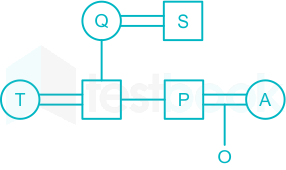
2.)  The person C, who is sitting to the second right of J. (Here, the person C who is sitting second to the right of J. It is possible when only J is sitting immediately right of A.
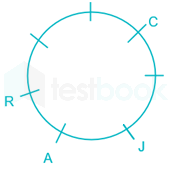
 

  1. C is sitting exactly in between B and Q.
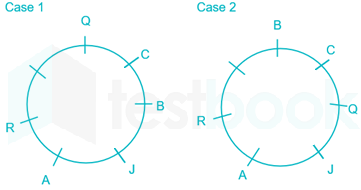
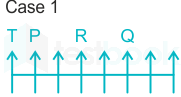
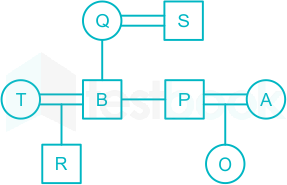
  1. B is not an immediate neighbour of P. (Here, case 1 satisfied this statement so we eliminate case 2.) Hence, the final arrangement will be as follows:
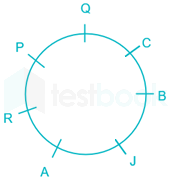
Hence, R is sitting exactly between the P and A.
2

How many persons are sitting between J to C in the clockwise direction?

  1. ((a))

    One

  2. ((b))

    Three

  3. ((c))

    Four

  4. ((d))

    Two

  5. ((e))

    None

Show Answer
Answer: ((c))

Four

Given,

Seven people A, B, C, J, P, Q and R are sitting around a circular table, facing the centre, not necessarily in the same order.

1)  Person A is sitting exactly in between R and J. R is not sitting adjacent to C.

2.)  The person C, who is sitting to the second right of J. (Here, the person C who is sitting second to the right of J. It is possible when only J is sitting immediately right of A.
 

  1. C is sitting exactly in between B and Q.

  1. B is not an immediate neighbour of P. (Here, case 1 satisfied this statement so we eliminate case 2.) Hence, the final arrangement will be as follows:

Hence, four persons are sitting between J to C in clockwise directions i.e. A, R, P & Q.

3

Which of the following statement is correct about Q and R?

  1. ((a))

    Q is third to the left of R.

  2. ((b))

    Q is fourth to the right of R.

  3. ((c))

    One person sits between Q and R counting from right of Q

  4. ((d))

    Q is sitting opposite R.

  5. ((e))

    None of these

Show Answer
Answer: ((c))

One person sits between Q and R counting from right of Q

Given,

Seven people A, B, C, J, P, Q and R are sitting around a circular table, facing the centre, not necessarily in the same order.

1)  Person A is sitting exactly in between R and J. R is not sitting adjacent to C.

2.)  The person C, who is sitting to the second right of J. (Here, the person C who is sitting second to the right of J. It is possible when only J is sitting immediately right of A.
 

  1. C is sitting exactly in between B and Q.
  1. B is not an immediate neighbour of P. (Here, case 1 satisfied this statement so we eliminate case 2.) Hence, the final arrangement will be as follows:

Hence, only one person is sitting between Q and R.

4

Who is sitting third to the left of J?

  1. ((a))

    R

  2. ((b))

    P

  3. ((c))

    A

  4. ((d))

    B

  5. ((e))

    C

Show Answer
Answer: ((b))

P

Given,

Seven people A, B, C, J, P, Q and R are sitting around a circular table, facing the centre, not necessarily in the same order.

1)  Person A is sitting exactly in between R and J. R is not sitting adjacent to C.

2.)  The person C, who is sitting to the second right of J. (Here, the person C who is sitting second to the right of J. It is possible when only J is sitting immediately right of A.


  1. C is sitting exactly in between B and Q.

  1. B is not an immediate neighbour of P. (Here, case 1 satisfied this statement so we eliminate case 2.) Hence, the final arrangement will be as follows:

Hence, P is sitting third to the left of J.

5

Which of the following statement is correct?

  1. ((a))

    C is facing towards the centre and second to the right of J.

  2. ((b))

    J is an immediate neighbour of R.

  3. ((c))

    B is an immediate neighbour of P.

  4. ((d))

    P is sitting opposite Q.

  5. ((e))

    None of these

Show Answer
Answer: ((a))

C is facing towards the centre and second to the right of J.

Given,

Seven people A, B, C, J, P, Q and R are sitting around a circular table, facing the centre, not necessarily in the same order.

  1. Person A is sitting exactly in between R and J. R is not sitting adjacent to C.

  2. The person C, who is sitting to the second right of J. (Here, the person C who is sitting second to the right of J. It is possible when only J is sitting immediately right of A.

  1. C is sitting exactly in between B and Q.

  1. B is not an immediate neighbour of P. (Here, case 1 satisfied this statement so we eliminate case 2) Hence, the final arrangement will be as follows:

Hence, ‘C is facing towards the centre and second to the right of J’ is correct answer.

6

DIRECTIONS: In the question below are given three statements followed by two conclusions. You have to take the given statements to be true even if they seem to be at variance with commonly known facts. Read all the conclusions and then decide which of the given conclusions logically follows from the given statements disregarding the commonly known facts.

Statements :

Only a few flutes are drums.

All drums are pianos.

Only a few pianos are Melody.

Conclusions:

I. Some drums are melody.

II. No drums are melody.

  1. ((a))

    Only conclusion I follows

  2. ((b))

    Only conclusion II follows

  3. ((c))

    Either conclusion I or II follows

  4. ((d))

    Neither conclusion I nor II follows

  5. ((e))

    Both conclusion I and II follows

Show Answer
Answer: ((c))

Either conclusion I or II follows

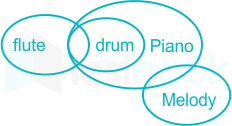
The least possible venn diagram;

Conclusions:

I. Some drums are melody→ False ( No direct relation is given between the two, it is possible but not definitely true, Hence some drums are melody is false)

II. No drums are melody → False ( No direct relation is given between the two, it is possible but not definitely true, Hence No drums are melody is false)

when we combine both conclusions one of them has to be true. As both make the complementary pair of Some + No. both conclusions are false also the elements are the same.

 Hence, Either I or II follows.

7

DIRECTIONS: In the question below are given three statements followed by two conclusions. You have to take the given statements to be true even if they seem to be at variance with commonly known facts. Read all the conclusions and the decide which of the given conclusions logically follows from the given statements disregarding the commonly known facts.

Statements :

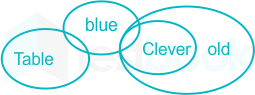
Only a few tables are blue.

Only a few blue are clever.

All clever is old.

Conclusions :

I. Some tables are clever is a possibility.

II. Some old are tables.

  1. ((a))

    Only conclusion I follows

  2. ((b))

    Only conclusion II follows

  3. ((c))

    Neither conclusion I nor II follows

  4. ((d))

    Either conclusion I or Ii follows

  5. ((e))

    Both conclusion I and Ii follows

Show Answer
Answer: ((a))

Only conclusion I follows

The least possible Venn diagram;

Conclusions :

I. Some tables are clever is possible → True (as there is no direct relation between tables and clever, it is not definitely true but it is possible, Hence some tables are clever is possible is true)

II Some old are table → False (it is one of the possibilities but not entirely true)

Hence, Only I follow.

8

Direction: In the question below are given three statements followed by two conclusions numbered I and II. You have to take the given statements to be true even if they seem to be at variance with commonly known facts. Read all the conclusions and then decide which of the given conclusions logically follows from the given statements disregarding commonly known facts.

Statements:

Some mango is guava

Some guava is Grapes

Some Grapes is orange

Conclusions:

I.Atleast some orange is mango

II. Some Grapes is definitely mango

  1. ((a))

    Only I follow

  2. ((b))

    Only II follow

  3. ((c))

    Either I or II follows

  4. ((d))

    Neither I nor II follows

  5. ((e))

    Both I and II follows

Show Answer
Answer: ((d))

Neither I nor II follows

The least possible Venn diagram for the given statements is as follows

Conclusions:

I. Atleast some orange is mango → False ( as there is no relation between orange and mango. so, it is possible but it's not definite. Hence, atleast some orange is mango is false).

II. Some Grapes is definitely mango  → False ( as there is no relation between Grapes and mango. so, it is possible but it's not definite. Hence, Some Grapes is definitely mango is false).

Hence, Neither I nor II follows is the correct answer.

Direction: Read the given information carefully and answer the questions asked below.

Seven persons- Asha, Tom, Jiya, Hira, Tua, Preet and Vina are living in a seven-storey building, but not necessarily in the same order. The ground floor is numbered 1 and the floor above it is numbered 2, and so on, until the topmost floor is numbered 7.

Vina lives on the lowermost floor. Only four people live between Vina and Asha. Tua lives on an even numbered floor. Only two people live between Tua and Preet. Tom, who is an immediate neighbour of Asha, lives on an odd numbered floor. Only two people live between Asha and Hira. Jiya lives on an even numbered floor, below Tua.

9

Jiya lives on which floor?

  1. ((a))

    First

  2. ((b))

    Second

  3. ((c))

    Third

  4. ((d))

    Fourth

  5. ((e))

    Five

Show Answer
Answer: ((b))

Second

Seven Persons – Asha, Tom, Jiya, Hira, Tua, Preet, and Vina

Floors (from bottom to top) – 1 to 7

  1. Vina lives on the lowermost floor.

  2. Only four people live between Vina and Asha.

Floors NumberPersons
7
6Asha
5
4
3
2
1Vina
<br>
  1. Tua lives on an even-numbered floor. There are two possible cases 

Case 1: Tua lives in floor 4.

Case2: Tua lives in floor 2.

  1. Only two people live between Tua and Preet.
CASE1CASE2
Floors NumberPersonsPersons
7Preet
6AshaAsha
5Preet
4Tua
3
2Tua
1VinaVina
  1. Tom, who is an immediate neighbor of Asha, lives on an odd-numbered floor.

  2. Only two people live between Asha and Hira.

CASE1CASE2
Floors NumberPersonsPersons
7PreetTom
6AshaAsha
5TomPreet
4Tua
3HiraHira
2Tua
1VinaVina
  1. Jiya lives on an even-numbered floor, below Tua.

In case 1 In floor 2, Jiya will live will is an even floor below Tua.

In case 2 Floor 4, Which is above the Tua's floor hence eliminated.

Floors NumberPersons
7Preet
6Asha
5Tom
4Tua
3Hira
2Jiya
1Vina


Hence, Jiya lives on second floor.

10

How many persons live between Hira and Preet?

  1. ((a))

    Two

  2. ((b))

    Three

  3. ((c))

    Four

  4. ((d))

    Five

  5. ((e))

    Seven

Show Answer
Answer: ((b))

Three

Seven Persons – Asha, Tom, Jiya, Hira, Tua, Preet, and Vina

Floors (from bottom to top) – 1 to 7

  1. Vina lives on the lowermost floor.

  2. Only four people live between Vina and Asha.

Floors NumberPersons
7
6Asha
5
4
3
2
1Vina
<br>
  1. Tua lives on an even-numbered floor. There are two possible cases 

Case 1: Tua lives in floor 4.

Case2: Tua lives in floor 2.

  1. Only two people live between Tua and Preet.
CASE1CASE2
Floors NumberPersonsPersons
7Preet
6AshaAsha
5Preet
4Tua
3
2Tua
1VinaVina
  1. Tom, who is an immediate neighbor of Asha, lives on an odd-numbered floor.

  2. Only two people live between Asha and Hira.

CASE1CASE2
Floors NumberPersonsPersons
7PreetTom
6AshaAsha
5TomPreet
4Tua
3HiraHira
2Tua
1VinaVina
  1. Jiya lives on an even-numbered floor, below Tua.

In case 1 In floor 2, Jiya will live will is an even floor below Tua.

In case 2 Floor 4, Which is above the Tua's floor hence eliminated.

Floors NumberPersons
7Preet
6Asha
5Tom
4Tua
3Hira
2Jiya
1Vina

Hence, three persons live between Hira and Preet.

11

Who lives immediate above Tom?

  1. ((a))

    Tua

  2. ((b))

    Vina

  3. ((c))

    Jiya

  4. ((d))

    Asha

  5. ((e))

    Preet

Show Answer
Answer: ((d))

Asha

Seven Persons – Asha, Tom, Jiya, Hira, Tua, Preet, and Vina

Floors (from bottom to top) – 1 to 7

  1. Vina lives on the lowermost floor.

  2. Only four people live between Vina and Asha.

Floors NumberPersons
7
6Asha
5
4
3
2
1Vina
<br>
  1. Tua lives on an even-numbered floor. There are two possible cases 

Case 1: Tua lives in floor 4.

Case2: Tua lives in floor 2.

  1. Only two people live between Tua and Preet.
CASE1CASE2
Floors NumberPersonsPersons
7Preet
6AshaAsha
5Preet
4Tua
3
2Tua
1VinaVina
  1. Tom, who is an immediate neighbor of Asha, lives on an odd-numbered floor.

  2. Only two people live between Asha and Hira.

CASE1CASE2
Floors NumberPersonsPersons
7PreetTom
6AshaAsha
5TomPreet
4Tua
3HiraHira
2Tua
1VinaVina
  1. Jiya lives on an even-numbered floor, below Tua.

In case 1 In floor 2, Jiya will live will is an even floor below Tua.

In case 2 Floor 4, Which is above the Tua's floor hence eliminated.

Floors NumberPersons
7Preet
6Asha
5Tom
4Tua
3Hira
2Jiya
1Vina

Hence, Asha lives immediately above Tom.

12

Four of the following five options are alike in a certain way, find out the odd one? 

  1. ((a))

    Tua

  2. ((b))

    Vina

  3. ((c))

    Hira

  4. ((d))

    Preet

  5. ((e))

    Tom

Show Answer
Answer: ((a))

Tua

Seven Persons – Asha, Tom, Jiya, Hira, Tua, Preet, and Vina

Floors (from bottom to top) – 1 to 7

  1. Vina lives on the lowermost floor.

  2. Only four people live between Vina and Asha.

Floors NumberPersons
7
6Asha
5
4
3
2
1Vina
<br>
  1. Tua lives on an even-numbered floor. There are two possible cases 

Case 1: Tua lives in floor 4.

Case2: Tua lives in floor 2.

  1. Only two people live between Tua and Preet.
CASE1CASE2
Floors NumberPersonsPersons
7Preet
6AshaAsha
5Preet
4Tua
3
2Tua
1VinaVina
  1. Tom, who is an immediate neighbor of Asha, lives on an odd-numbered floor.

  2. Only two people live between Asha and Hira.

CASE1CASE2
Floors NumberPersonsPersons
7PreetTom
6AshaAsha
5TomPreet
4Tua
3HiraHira
2Tua
1VinaVina
  1. Jiya lives on an even-numbered floor, below Tua.

In case 1 In floor 2, Jiya will live will is an even floor below Tua.

In case 2 Floor 4, Which is above the Tua's floor hence eliminated.

Floors NumberPersons
7Preet
6Asha
5Tom
4Tua
3Hira
2Jiya
1Vina

Vina, Hira, Preet and Tom live on an odd-numbered floor while Tua lives on an even numbered floor.

Hence, Tua is on the even one.

13

Who among the following lives on the fifth floor?

  1. ((a))

    Tua

  2. ((b))

    Vina

  3. ((c))

    Hira

  4. ((d))

    Tom

  5. ((e))

    Jiya

Show Answer
Answer: ((d))

Tom

Seven Persons – Asha, Tom, Jiya, Hira, Tua, Preet, and Vina

Floors (from bottom to top) – 1 to 7

  1. Vina lives on the lowermost floor.

  2. Only four people live between Vina and Asha.

Floors NumberPersons
7
6Asha
5
4
3
2
1Vina
<br>
  1. Tua lives on an even-numbered floor. There are two possible cases 

Case 1: Tua lives in floor 4.

Case2: Tua lives in floor 2.

  1. Only two people live between Tua and Preet.
CASE1CASE2
Floors NumberPersonsPersons
7Preet
6AshaAsha
5Preet
4Tua
3
2Tua
1VinaVina
  1. Tom, who is an immediate neighbor of Asha, lives on an odd-numbered floor.

  2. Only two people live between Asha and Hira.

CASE1CASE2
Floors NumberPersonsPersons
7PreetTom
6AshaAsha
5TomPreet
4Tua
3HiraHira
2Tua
1VinaVina
  1. Jiya lives on an even-numbered floor, below Tua.

In case 1 In floor 2, Jiya will live will is an even floor below Tua.

In case 2 Floor 4, Which is above the Tua's floor hence eliminated.

Floors NumberPersons
7Preet
6Asha
5Tom
4Tua
3Hira
2Jiya
1Vina

Hence, Tom lives on the fifth floor.

14

Directions: In the following question assuming the given statements to be true, find which of the conclusion among given conclusions is/are definitely true and then give your answers accordingly.

Statements:  T < S < O = P = J > G > H ≥ A

Conclusions:

I. P > T

II. A < O

  1. ((a))

    Only conclusion I follows

  2. ((b))

    Only conclusion II follows

  3. ((c))

    Both conclusion are follows

  4. ((d))

    None of the conclusion are follows

  5. ((e))

    Either conclusion I or II follows

Show Answer
Answer: ((c))

Both conclusion are follows

Given Statements: T < S < O = P = J > G > H ≥ A

Conclusions:

I. P > T → True (as T < S < O = P → T < P → It is clear that from this P > T)

II. A < O → True (as  O = P = J > G > H ≥ A → O  > A → its clear that A < O)

Hence, both conclusions are as follows

15

DIRECTIONS: In the following question assuming the given statements to be true, find which of the conclusion among the given conclusions is/are definitely true and then give your answers accordingly.

Statements :  T > A = M < X, R ≥ Y, D ≥ N = T

Conclusions : 

I. A < R

II. D > M

  1. ((a))

    Only conclusion I follows

  2. ((b))

    Only conclusion II follows

  3. ((c))

    Either conclusion I or II follows

  4. ((d))

    Neither conclusion I nor II follows

  5. ((e))

    Both conclusion I and II follows

Show Answer
Answer: ((b))

Only conclusion II follows

Given Statements :  T > A = M < X, R ≥ Y, D ≥  N = T

On combining : D ≥ N = T > A = M < X , R ≥ Y

I. A < R → False (As there is no direct relation between R and A, A < R is False)

II. D > M → True (as D > N = T > A = M, it is definitely True, Hence D >M is true)

Hence, Only conclusion II follows.

16

DIRECTIONS: In the following question assuming the given statements to be true, find which of the conclusion among the given conclusions is/are definitely true and then give your answers accordingly.

Statements : T > N < V = L ≤ W < K, V = H > I > F

Conclusions :

I. V > F

II. T > H

  1. ((a))

    Only conclusion I follows

  2. ((b))

    Only conclusion II follows

  3. ((c))

    Either conclusion I or II follow

  4. ((d))

    Neither conclusion I nor II follow

  5. ((e))

    Both Conclusion I and II follow

Show Answer
Answer: ((a))

Only conclusion I follows

Given statements:  T > N < V = L ≤ W < K, V = H > I > F

On combining:   T > N < V = L ≤ W < K,  T > N < V = H > I > F

I. V > F → True ( As V = H > I > F so V > F is true )

II. T > H → False ( As T > N < V = H > I > F no direct relation is given between the two, so it is possibility but not definitely true Hence T > H is false)

Only I follow.

17

Direction: In the following question assuming the given statements to be true, find which of the conclusion among given conclusions is/are definitely true and then give your answers accordingly.

Statements: X < A ≤ H ≤ B; J = K; K ≤ B

Conclusions:

I. B ≥ J

II. X < K

  1. ((a))

    Only I follow

  2. ((b))

    Only II follow

  3. ((c))

    Both I and II follow

  4. ((d))

    Either I or II follows

  5. ((e))

    Neither I nor II follows

Show Answer
Answer: ((a))

Only I follow

Given Statements: X < A ≤ H ≤ B; J = K; K ≤ B

On Combining: X < A ≤ H ≤ B ≥ K = J

Conclusions:

I. B ≥ J → True (As X < A ≤ H ≤ B ≥ K = J → B ≥ J. So, it is true)

II. X < K → False (As X < A ≤ H ≤ B ≥ K = J, there is no direct relation between X and K because of opposite signs between X and K. So, it is false)

Hence, Only I follow.

Directions: Study the following information carefully and answer the questions below.

An uncertain number of persons are sitting in a straight line facing north. Three persons sit between P and Q. R sits second to the right of P. Only three people sit between Q and S. T is immediate to the left of P. R sits fifth from the right extreme ends of the row. X sits on the extreme end of the row. As many people sit between R and U as many between U and S. Y sits second to the left of V, who is an immediate neighbor of Q. Not more than two persons sit between V and S. Five people sit between S and X. As many people sit between S and W as many between W and X.

18

How many seats in a row?

  1. ((a))

    17

  2. ((b))

    18

  3. ((c))

    15

  4. ((d))

    19

  5. ((e))

    21

Show Answer
Answer: ((e))

21

1- R sits fifth from the right extreme end of the row.

2- R sits second to the right of P.

3- T is immediate to the left of P.

4- Three persons sit between P and Q. 

5- Only three people sit between Q and S.


Case 2 is canceled because there is no space for S.


Case 2

 6- As many people sit between R and U as many between U and S.

7- Y sits second to the left of V, who is an immediate neighbor of Q. 

8- Not more than two people sit between V and S. 

9- Five persons sit between S and X. 

10- X sits on the extreme end of the row.

11- As many people sit between S and W as many between W and X.


Case-1


So final arrangement, 


Hence, 21 seats in a row.

19

Who among the following person sits sixth to the right of Q?

  1. ((a))

    P

  2. ((b))

    T

  3. ((c))

    W

  4. ((d))

    U

  5. ((e))

    R

Show Answer
Answer: ((e))

R

1- R sits fifth from the right extreme end of the row.

2- R sits second to the right of P.

3- T is immediate to the left of P.

4- Three persons sit between P and Q. 

5- Only three people sit between Q and S.


Case 2 is canceled because there is no space for S.


Case 2

 6- As many people sit between R and U as many between U and S.

7- Y sits second to the left of V, who is an immediate neighbor of Q. 

8- Not more than two people sit between V and S. 

9- Five persons sit between S and X. 

10- X sits on the extreme end of the row.

11- As many people sit between S and W as many between W and X.


Case-1


So final arrangement, 


Hence, R sits sixth to the right of Q.

20

How many people are sitting between S and T?

  1. ((a))

    Four

  2. ((b))

    Three

  3. ((c))

    Ten

  4. ((d))

    Six

  5. ((e))

    Seven

Show Answer
Answer: ((d))

Six

1- R sits fifth from the right extreme end of the row.

2- R sits second to the right of P.

3- T is immediate to the left of P.

4- Three persons sit between P and Q. 

5- Only three people sit between Q and S.


Case 2 is canceled because there is no space for S.


Case 2

 6- As many people sit between R and U as many between U and S.

7- Y sits second to the left of V, who is an immediate neighbor of Q. 

8- Not more than two people sit between V and S. 

9- Five persons sit between S and X. 

10- X sits on the extreme end of the row.

11- As many people sit between S and W as many between W and X.


Case-1


So final arrangement, 


Hence, six people are sit between S and T.

21

How many meaningful English words can be formed with the third, fourth, seventh and eighth letters of the word "CONSISTENCY", using each letter only once in each word? (To be counted from left) 

  1. ((a))

    One

  2. ((b))

    Two

  3. ((c))

    Three

  4. ((d))

    Four

  5. ((e))

    More than four

Show Answer
Answer: ((d))

Four

Given:-

Word: CONSISTENCY

3rd letter = N ; 4th letter = S ; 7th letter = T; 8th letter = E

Words formed using the above letters:

  1. NEST - Home of Birds
  2. SENT - Past simple and past particle of Send
  3. STEN - To stride energetically / Narrow, little
  4. TENS - used in mathematical operations.

Confusion Points NETS is not a meaningful word as we know NET is a meaningful word and NETS is its plural form so this cannot be considered a meaningful word. So by the given letters, only four meaningful words will be formed.

Directions: Study the following information carefully to answer the given questions:

6 U # 7 Y 8 X @ Q 9 L S % $ V M 3 F 2 K 1 5 Z & 4 C * O ? D

22

In the given arrangement, how many such letters are there which are immediately preceded by a symbol and immediately followed by a number?

  1. ((a))

    Zero

  2. ((b))

    One

  3. ((c))

    Three

  4. ((d))

    Four

  5. ((e))

    Five Letter 

Show Answer
Answer: ((b))

One

Given series:

Left Side  6 U # 7 Y 8 X @ Q 9 L S % $ V M 3 F 2 K 1 5 Z & 4 C * O ? D  Right Side

Letters, which are immediately preceded by a symbol and immediately followed by a number:

Symbol → Letter  → Number

6 U # 7 Y 8 X @ Q 9 L S % $ V M 3 F 2 K 1 5 Z & 4 C * O ? D

Hence, There is one letter, which is immediately preceded by a symbol and immediately followed by a number: @ Q 9.

23

What is the product of numbers, which are between ‘X’ and ‘Z’?

  1. ((a))

    270

  2. ((b))

    280

  3. ((c))

    310

  4. ((d))

    250

  5. ((e))

    125

Show Answer
Answer: ((a))

270

Given series:

Left Side  - 6 U # 7 Y 8 X @ Q 9 L S % $ V M 3 F 2 K 1 5 Z & 4 C * O ? D  - Right Side

As, the numbers between X and Z are 9, 3, 2, 1 and 5.

Product of the numbers → 9 * 3 * 2 * 1 * 5 = 270

Hence, The product of these numbers would be 270.

24

If all the odd numbers are dropped from the arrangement then which of the following will be 5th element to the right of the 7th element from the left end of the given arrangement?

  1. ((a))

    D

  2. ((b))
  3. ((c))

    $

  4. ((d))

    F

  5. ((e))

    Z

Show Answer
Answer: ((c))

$

Given series:

Left Side  6 U # 7 Y 8 X @ Q 9 L S % $ V M 3 F 2 K 1 5 Z & 4 C * O ? D  Right Side

  1. If all the odd numbers are dropped:

6 U # Y 8 X @ Q L S % $ V M F 2 K Z & 4 C * O ? D

  1. 7th element from the left end is @.

Hence, element that is 5th to the right of 7th from the left end is $.

Important Points

If we have to go from the left towards the left then we will subtract and vice versa.

If we have to move from the left towards the right then we will add and vice versa.


7th from left: @

7 + 5 = 12th

The 12th element from the left end will be $.

25

How many such numbers are there which are immediately preceded by a symbol in the given arrangement?

  1. ((a))

    Two

  2. ((b))

    One

  3. ((c))

    Three

  4. ((d))

    Five

  5. ((e))

    Four

Show Answer
Answer: ((a))

Two

Given series:

Left Side  6 U # 7 Y 8 X @ Q 9 L S % $ V M 3 F 2 K 1 5 Z & 4 C * O ? D  Right Side

  1. Numbers that are immediately preceded by a symbol:

Symbol  → Number

6 U # 7 Y 8 X @ Q 9 L S % $ V M 3 F 2 K 1 5 Z & 4 C * O ? D

Hence, There are two numbers, which are immediately preceded by a symbol: #7 and &4.

Directions: Study the following information carefully and answer the questions that follow.

Ten persons are sitting in two parallel rows containing five persons each, in such a way that there is equal distance between adjacent persons. In row-1 J, K, L, M, and N are seated (no necessarily in the same order) and all of them are facing South. In row-2 V, W, X, Y, and Z are seated (not necessarily in the same order) and all of them are facing North. Therefore, in the given seating arrangement each member seated in a row faces another member to the other row.

Z sits third to the right of W. V sits second to the left of Z. The person facing V sits to the immediate right of K. Only one person sits between K and M. J is not an immediate neighbor of K. Only two people sit between J and L. Neither K nor J faces Y.

26

Who amongst the following is facing N?

  1. ((a))

    Y

  2. ((b))

    Z

  3. ((c))

    X

  4. ((d))

    W

  5. ((e))

    V

Show Answer
Answer: ((e))

V

In row-1 J, K, L, M, and N → facing South

In row-2 V, W, X, Y, and Z → facing North

  1. Z sits third to the right of W.

  2. V sits second to the left of Z.

  3. The person facing V sits to the immediate right of K.

  1. Only one person sits between K and M.

  2. J is not an immediate neighbor of K. 

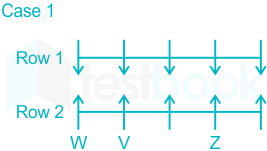
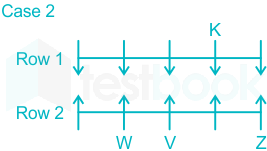
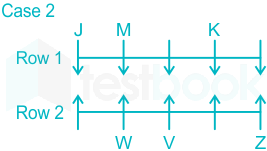
  1. Only two people sit between J and L → Case 2 gets eliminated

(If we take 2 persons between J and L, then the place of L will not be determined as it is already occupied by K)

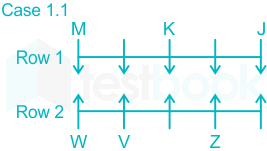
  1. Neither K nor J faces Y → Case 1.1 gets eliminated

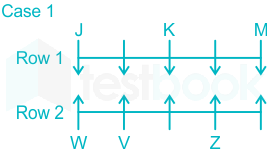
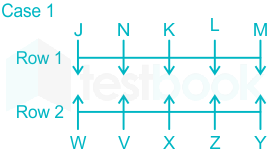
So, the final arrangement will be

Hence, V is facing N.

27

Which of the following statements is true regarding M?

  1. ((a))

    M faces one of the immediate neighbors of X

  2. ((b))

    K is one of the immediate neighbors of M

  3. ((c))

    None of the given statement is true

  4. ((d))

    L sits to the immediate right of M

  5. ((e))

    All of the given statements are true

Show Answer
Answer: ((d))

L sits to the immediate right of M

In row-1 J, K, L, M, and N → facing South

In row-2 V, W, X, Y, and Z → facing North

  1. Z sits third to the right of W.

  2. V sits second to the left of Z.

  3. The person facing V sits to the immediate right of K.

  1. Only one person sits between K and M.

  2. J is not an immediate neighbor of K. 

  1. Only two people sit between J and L → Case 2 gets eliminated

(If we take 2 persons between J and L, then the place of L will not be determined as it is already occupied by K)

  1. Neither K nor J faces Y → Case 1.1 gets eliminated

So, the final arrangement will be

Hence, L sits to the immediate right of M is true**.**

28

Who amongst the following is facing X?

  1. ((a))

    K

  2. ((b))

    L

  3. ((c))

    M

  4. ((d))

    J

  5. ((e))

    None of these

Show Answer
Answer: ((a))

K

In row-1 J, K, L, M, and N → facing South

In row-2 V, W, X, Y, and Z → facing North

  1. Z sits third to the right of W.

  2. V sits second to the left of Z.

  3. The person facing V sits to the immediate right of K.

  1. Only one person sits between K and M.

  2. J is not an immediate neighbor of K. 

  1. Only two people sit between J and L → Case 2 gets eliminated

(If we take 2 persons between J and L, then the place of L will not be determined as it is already occupied by K)

  1. Neither K nor J faces Y → Case 1.1 gets eliminated

So, the final arrangement will be

Hence, K is facing X.

29

What is the position of Z with respect to Y?

  1. ((a))

    Third to the right

  2. ((b))

    Second to the right

  3. ((c))

    Immediate left

  4. ((d))

    Immediate right

  5. ((e))

    None of these

Show Answer
Answer: ((c))

Immediate left

In row-1 J, K, L, M, and N → facing South

In row-2 V, W, X, Y, and Z → facing North

  1. Z sits third to the right of W.

  2. V sits second to the left of Z.

  3. The person facing V sits to the immediate right of K.

  1. Only one person sits between K and M.

  2. J is not an immediate neighbor of K. 

  1. Only two people sit between J and L → Case 2 gets eliminated

(If we take 2 persons between J and L, then the place of L will not be determined as it is already occupied by K)

  1. Neither K nor J faces Y → Case 1.1 gets eliminated

So, the final arrangement will be

Hence, Z sits to the immediate left of Y**.**

30

Four of the following five are alike in a certain way and so form a group, find the one which does not belong to the group. 

  1. ((a))

    M

  2. ((b))

    J

  3. ((c))

    N

  4. ((d))

    W

  5. ((e))

    Y

Show Answer
Answer: ((c))

N

In row-1 J, K, L, M, and N → facing South

In row-2 V, W, X, Y, and Z → facing North

  1. Z sits third to the right of W.

  2. V sits second to the left of Z.

  3. The person facing V sits to the immediate right of K.

  1. Only one person sits between K and M.

  2. J is not an immediate neighbor of K. 

  1. Only two people sit between J and L → Case 2 gets eliminated

(If we take 2 persons between J and L, then the place of L will not be determined as it is already occupied by K)

  1. Neither K nor J faces Y → Case 1.1 gets eliminated

So, the final arrangement will be

Except N, all others are sitting at the end of the row.

Hence, N does not belong to the group.

31

Direction: Study the following information carefully and answer the question given below

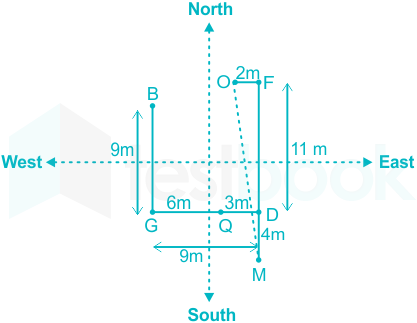
Seven players viz. B, M, D, O, F, Q, and G of Volleyball were standing on a ground such that B was 9m to the north of G, who was 6m west of Q. M was 4m south of D, who was 9m east of G. F was 11m north of D and 2m east of O.

What was the direction and distance of O with respect to D?

  1. ((a))

    Southeast, 5√ 5 m

  2. ((b))

    Northwest, 5√ 5 m

  3. ((c))

    North, 5 m

  4. ((d))

    Northeast, 5√ 5 m

  5. ((e))

    South, 5 m

Show Answer
Answer: ((b))

Northwest, 5√ 5 m

Given:

1) B was 9m to the north of G.

2) G was 6 m west of Q.

3) D was 9m east of G.

  1. M was 4m south of D.

  2. F was 11m north of D and 2m east of O.

Now, O was in the Northwest direction with respect to D.

Using Pythagoras' theorem,

OD= OP2 + PD= 22+112

OD= 4+121 = 125

 OD = √125 

OD = 5√ 5 m

Hence, the correct answer is Northwest, 5√ 5 m.

32

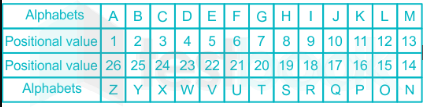
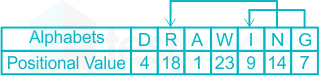
How many such pairs of letters are there in the word "DRAWING" which have as many letters between them in the word (in both forward and backward directions), as they have between them in the English alphabetical series?

  1. ((a))

    One

  2. ((b))

    Two

  3. ((c))

    Three

  4. ((d))

    Four

  5. ((e))

    More than Four

Show Answer
Answer: ((b))

Two

Forward pair - 0

Backward pairs - GI, NR

Hence, two such pairs have as many letters in the word as they have between them in the English alphabetical series.

Directions: Study the given information and answer the questions that follow.

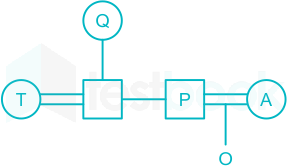
There are 8 members in a family. There are 3 couples in this family. Number of female and male in the family are same. Either both or none of the parents were alive. 

S has two children both of them are of same gender. T is the daughter-in-law of Q who is the mother of P. A is the mother of O. R is the only son of B. T is not married to P. A is neither the wife of S nor T. P is a male.

33

How O is related to S?

  1. ((a))

    Grand-son

  2. ((b))

    Grand-daughter

  3. ((c))

    Son

  4. ((d))

    daughter

  5. ((e))

    Cannot be determined

Show Answer
Answer: ((b))

Grand-daughter

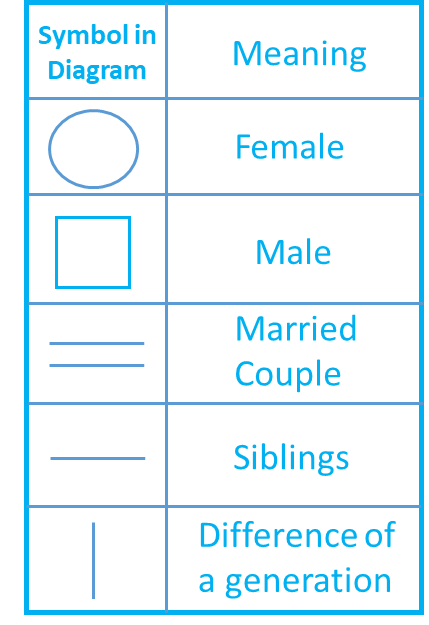
Table is drawn describing symbols and their meanings:

1) T is the daughter-in-law of Q who is the mother of P.

2) T is not married to P.

3) P is a male.


4) S has two children both of them are of same gender. 

5) A is the mother of O. A is not the wife of either S or T.


The above statement implies that A is a female and have a child O. There are three generations in the family. So, A can be either from I generation or II generation. She cannot be married to Q or T as the gender is same. So, she will be married to P. Also, S can be from II generation or I generation as he/she has two children.

6) R is the only son of B.

7)  Number of female and male in the family are same.


\

Now, as there could not be a single parent, so there should be a person married to Q. As R is the only son of B. B could not be married to S. Therefore, S is married to Q. 

Now, only B and R are to be paced. B will be married to T as there could not be single parent. There are equal number of male and female members, so, O will be a female member. 


Hence, O is the grand-daughter of S.

34

Who is the brother-in-law of A?

  1. ((a))

    B

  2. ((b))

    R

  3. ((c))

    S

  4. ((d))

    T

  5. ((e))

    None of these

Show Answer
Answer: ((a))

B

Table is drawn describing symbols and their meanings:

1) T is the daughter-in-law of Q who is the mother of P.

2) T is not married to P.

3) P is a male.


4) S has two children both of them are of same gender. 

5) A is the mother of O. A is not the wife of either S or T.


The above statement implies that A is a female and have a child O. There are three generations in the family. So, A can be either from I generation or II generation. She cannot be married to Q or T as the gender is same. So, she will be married to P. Also, S can be from II generation or I generation as he/she has two children.

6) R is the only son of B.

7)  Number of female and male in the family are same.


\

Now, as there could not be a single parent, so there should be a person married to Q. As R is the only son of B. B could not be married to S. Therefore, S is married to Q. 

Now, only B and R are to be paced. B will be married to T as there could not be single parent. There are equal number of male and female members, so, O will be a female member. 


Hence, B is the brother-in-law of A.

35

How R is related to P

  1. ((a))

    Brother

  2. ((b))

    Sister

  3. ((c))

    Nephew

  4. ((d))

    Niece

  5. ((e))

    None of these

Show Answer
Answer: ((c))

Nephew

Table is drawn describing symbols and their meanings:

1) T is the daughter-in-law of Q who is the mother of P.

2) T is not married to P.

3) P is a male.


4) S has two children both of them are of same gender. 

5) A is the mother of O. A is not the wife of either S or T.


The above statement implies that A is a female and have a child O. There are three generations in the family. So, A can be either from I generation or II generation. She cannot be married to Q or T as the gender is same. So, she will be married to P. Also, S can be from II generation or I generation as he/she has two children.

6) R is the only son of B.

7)  Number of female and male in the family are same.


\

Now, as there could not be a single parent, so there should be a person married to Q. As R is the only son of B. B could not be married to S. Therefore, S is married to Q. 

Now, only B and R are to be paced. B will be married to T as there could not be single parent. There are equal number of male and female members, so, O will be a female member. 


Hence, R is nephew of P.

Numerical Ability (35 questions)

36

Find the wrong term in the following series.

 292, 291, 295, 268, 284, 161

  1. ((a))

     291

  2. ((b))

     292

  3. ((c))

     161

  4. ((d))

     284

  5. ((e))

     295

Show Answer
Answer: ((c))

 161

Given : 

 292, 291, 295, 268, 284, 161

Calculation :

 The series follows the following pattern:

 ⇒ 292 - (1)3 = 291

 ⇒ 291+ (2)= 295

 ⇒ 295- (3)3 = 268

 ⇒ 268+ (4)2 = 284

 ⇒ 284 - (5)3 = 159

 The wrong term is 161

 Hence the wrong term in the series is 161

37

Find the wrong term in the following series.

 27, 48, 80, 134, 221, 355

  1. ((a))

     355

  2. ((b))

     221

  3. ((c))

     48

  4. ((d))

     27

  5. ((e))

     80

Show Answer
Answer: ((a))

 355

Given :

  27, 48, 80, 134, 221, 355

 Calculation :

 The series follows the following pattern

   27   48   80  134  221  355

  ⇒    21    32   54     87    134     ( difference of numbers 

  ⇒        11    22     33    47          ( Then the double difference is multiple of 11)

  ⇒ 47 is not a multiple of 11 then 44 difference is come here instead of 47

  ⇒ 87 + 44 = 131 then 221 + 131 = 352

 The wrong term is 355

 Hence the wrong term in the series is 355

38

Find the wrong term in the following series.

 215, 200, 250,175, 275, 150, 300

  1. ((a))

     250

  2. ((b))

     175

  3. ((c))

     275

  4. ((d))

     300

  5. ((e))

     215

Show Answer
Answer: ((e))

 215

Given : 

  215, 200, 250,175, 275, 150, 300

 Calculation :

 The series follows the following pattern 

 ⇒ 225 - 25 = 200

 ⇒ 200 + 50 = 250

 ⇒ 250 - 75 = 175

 ⇒ 175+ 100 = 275

 ⇒ 275 - 125 = 150

 ⇒ 150+ 150 = 300

 The wrong term is 215

 Hence the wrong term in the series is 215.

39

Find the wrong term in the following series.

 25, 50, 85, 130, 185, 245, 325

  1. ((a))

     50

  2. ((b))

     245

  3. ((c))

     325

  4. ((d))

     85

  5. ((e))

     185

Show Answer
Answer: ((b))

 245

Given :

  25, 50, 85, 130, 185, 245, 325

 Calculation :

 The series follows the following pattern 

 ⇒ 25 + 25 = 50

 ⇒ 50 + 35 = 85

 ⇒ 85 + 45 = 130

 ⇒ 130 + 55 = 185

 ⇒ 185 + 65 = 250

 ⇒ 250 + 75 = 325

 The wrong term is 245

 Hence the wrong term in the series is 245

40

Find the wrong term in the following series.

 1, 3, 5, 9, 17, 33, 65

  1. ((a))

     3

  2. ((b))

     5

  3. ((c))

     33

  4. ((d))

     65

  5. ((e))

     1

Show Answer
Answer: ((e))

 1

Given : 

  1, 3, 5, 9, 17, 33, 65

Calculation : 

 The series follows the following pattern 

 ⇒ 2 × 2 - 1 = 3

 ⇒ 3 × 2 - 1 = 5

 ⇒ 5 × 2 - 1 = 9

 ⇒ 9 × 2 - 1 = 17

 ⇒ 17 × 2 - 1 = 33

 ⇒ 33 × 2 - 1 = 65

 The wrong term is 1

 Hence the wrong term in the series is 1

41

The ratio of the number of girls and boys in a school of 1008 students is 27 : 29. Some girls and 9 new boys are admitted to the school which makes the ratio 56 : 59. Find the number of girls admitted to the school.

  1. ((a))

    6

  2. ((b))

    9

  3. ((c))

    12

  4. ((d))

    15

  5. ((e))

    18

Show Answer
Answer: ((e))

18

Shortcut Trick

Initial total units = 27 + 29 = 56 units.

56 units = 1008 student → 1 unit = 18.

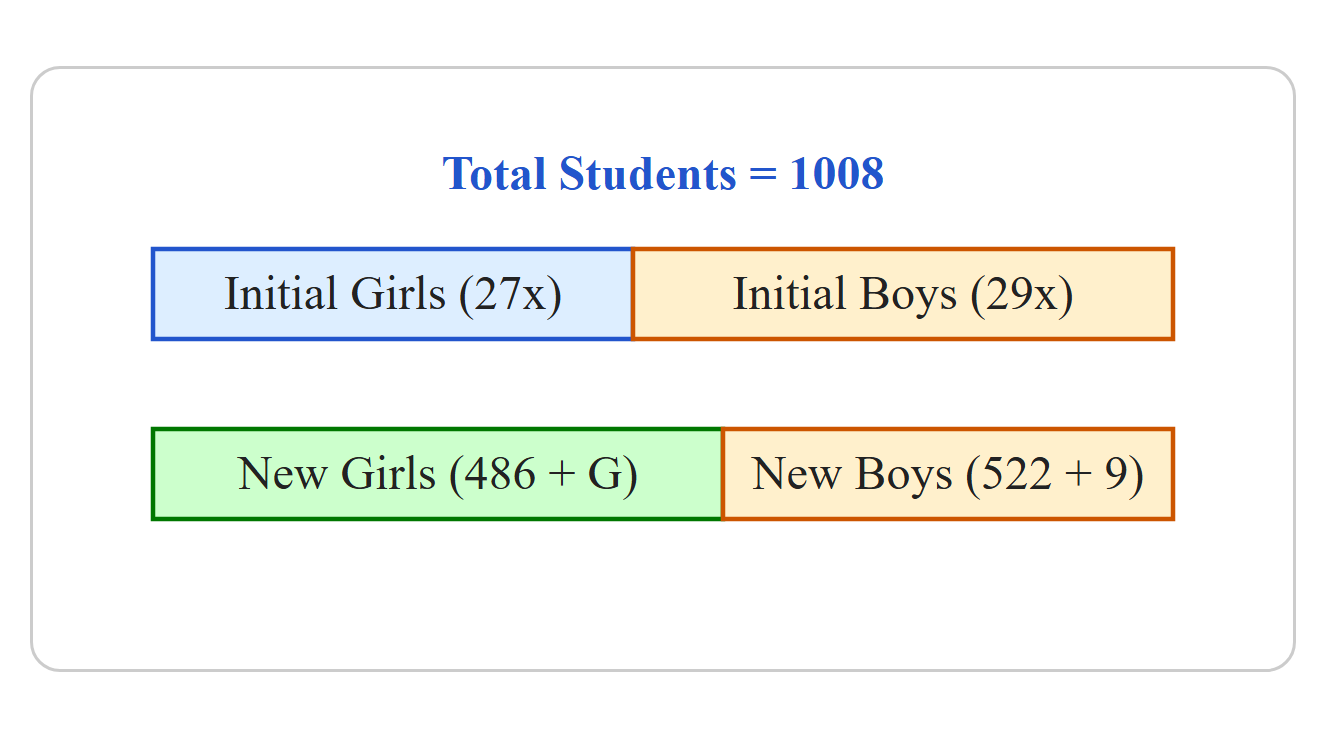
Initial Boys = 29 × 18 = 522. New Boys = 522 + 9 = 531.

New ratio (Girls : Boys) = 56 : 59. So, 59 units = 531 → 1 unit = 9.

New Girls = 56 × 9 = 504. Initial Girls = 27 × 18 = 486.

New girls admitted = 504 − 486 = 18.

∴ The correct answer is 18 girls.

Alternate Method

Given: Total = 1008, Initial Ratio = 27 : 29, Final Ratio = 56 : 59.

Formula Used: Value = (Ratio Part ÷ Total Parts) × Total Value.

⇒ Initial Girls = (27 ÷ 56) × 1008 = 486

⇒ Initial Boys = (29 ÷ 56) × 1008 = 522

⇒ New Boys = 522 + 9 = 531

⇒ Let new Girls admitted be G. New total girls = 486 + G

⇒ (486 + G) ÷ 531 = 56 ÷ 59

⇒ 486 + G = (56 × 531) ÷ 59

⇒ 486 + G = 56 × 9 = 504

⇒ G = 504 − 486 = 18

∴ The correct answer is 18 girls.

Additional Information

Ratio and Proportion

If a quantity is divided in the ratio a : b, the parts are a/(a+b) × Total and b/(a+b) × Total.

Ratio Change Method

When adding values to terms of a ratio, the cross-multiplication or unitary method helps identify the increase in specific parts effectively.

42

A man spends 75% of his income. If his income increases by 20% and his expenditure also increase by 10%. The percentage of increase in his savings is

  1. ((a))

    60%

  2. ((b))

    50%

  3. ((c))

    40%

  4. ((d))

    20%

  5. ((e))

    None of the above

Show Answer
Answer: ((b))

50%

Shortcut Trick

Ratio of Expenditure to Savings = 75 : 25 = 3 : 1.

Net increase in Income (20%) = [ (RatioExp × %IncreaseExp) + (RatioSav × %IncreaseSav) ] ÷ Total Ratio

20 = [ (3 × 10) + (1 × x) ] ÷ 4

80 = 30 + x ⇒ x = 50%.

∴ The correct answer is 50%.

Alternate Method

Given: Initial Income spending = 75%, Income increase = 20%, Expenditure increase = 10%.

Formula Used: Income = Expenditure + Savings

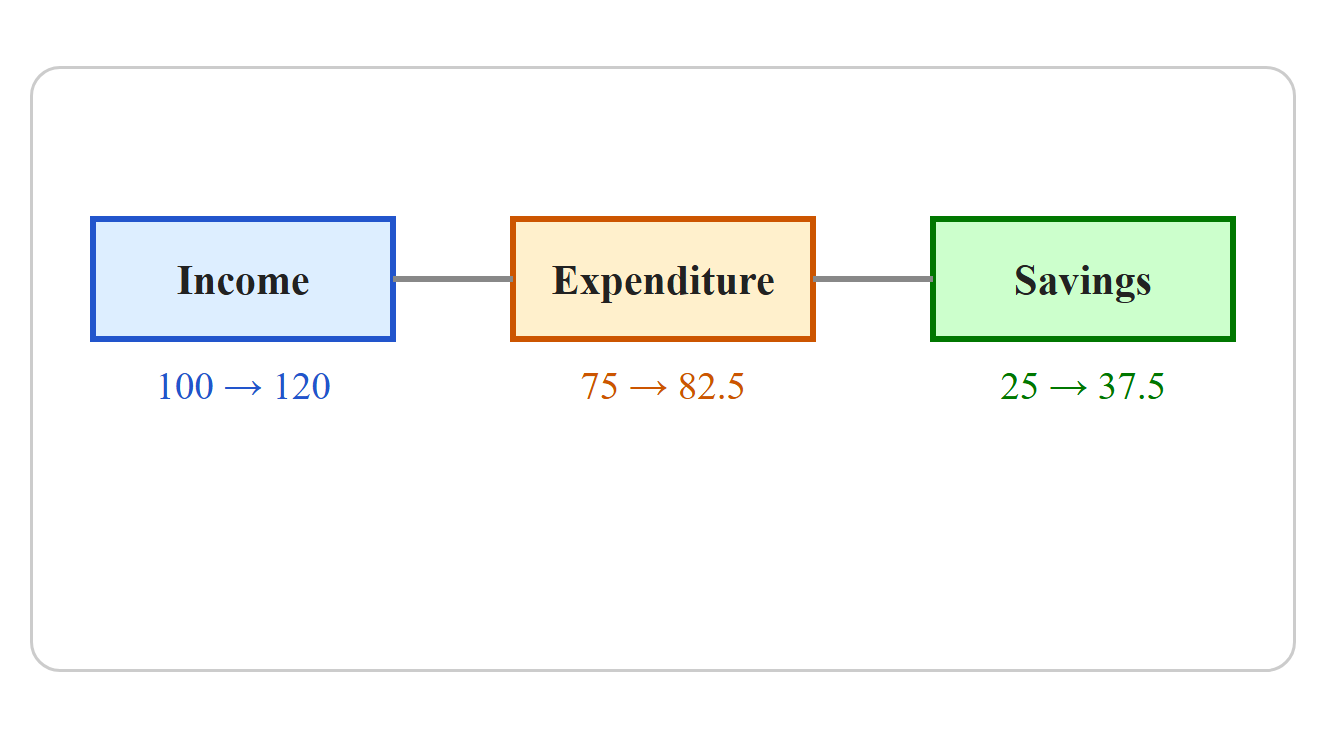
⇒ Let Initial Income = 100

Initial Expenditure = 75% of 100 = 75

Initial Savings = 100 − 75 = 25

New Income = 100 + 20% of 100 = 120

New Expenditure = 75 + 10% of 75 = 75 + 7.5 = 82.5

New Savings = 120 − 82.5 = 37.5

Increase in Savings = 37.5 − 25 = 12.5

Percentage Increase = (12.5 ÷ 25) × 100 = 50%

∴ The correct answer is 50%.

Additional Information

Percentage Change Formula

The percentage increase or decrease is calculated as: [(New Value − Old Value) ÷ Old Value] × 100.

Income-Expenditure Relationship

Total Income is always the sum of Expenditure and Savings. If any two components change, the third must adjust to maintain this balance.

Alligation Method in Income

Income % change can be viewed as the weighted average of Expenditure % change and Savings % change based on their respective initial ratios.

43

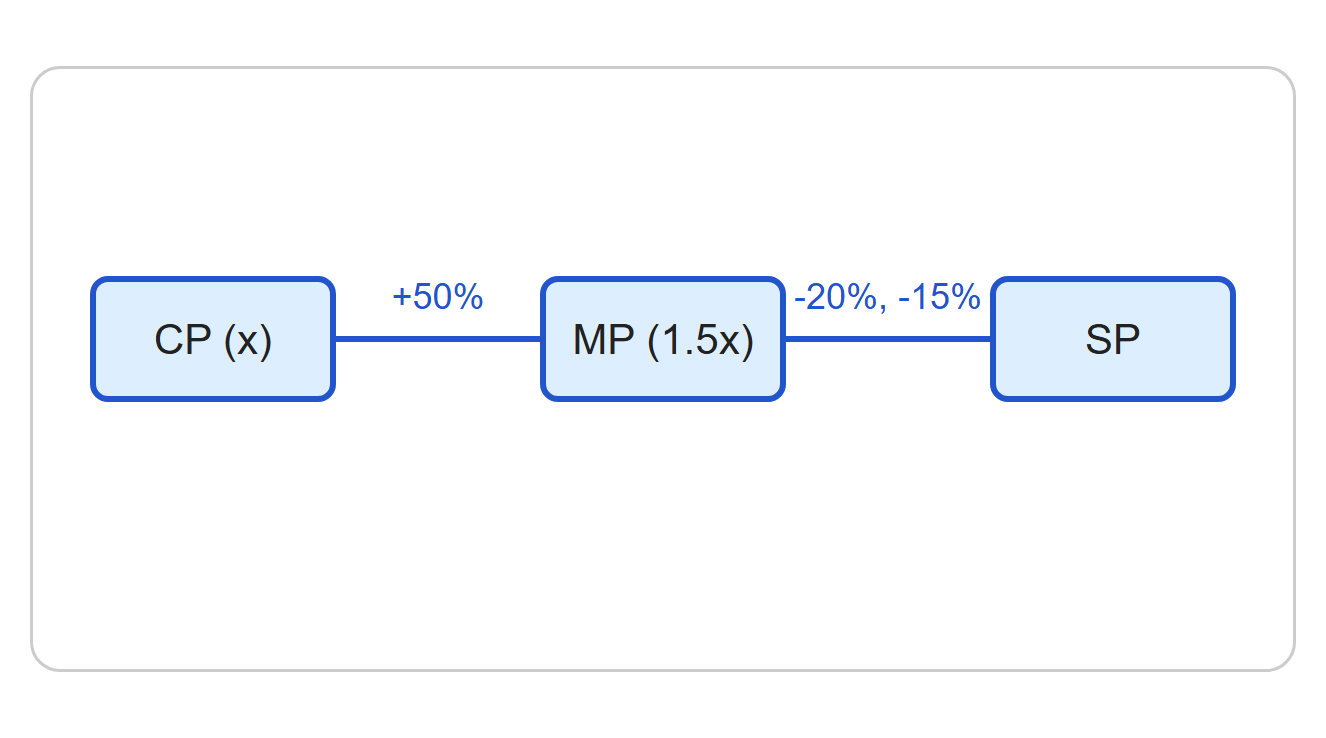
A dealer marks an article 50% above the cost price and sells it to a customer allowing two successive discounts of 20% and 15% on the marked price. if he gains Rs. 400 on the deal then the cost price of the article is? 

  1. ((a))

    Rs. 25,000

  2. ((b))

    Rs. 30,000

  3. ((c))

    Rs. 20,000

  4. ((d))

    Rs. 15,000

  5. ((e))

    None of these

Show Answer
Answer: ((c))

Rs. 20,000

Shortcut Trick

Let Cost Price (CP) be 100.

Marked Price (MP) = 100 × 1.5 = 150.

Selling Price (SP) after successive discounts = 150 × 0.80 × 0.85 = 102.

Profit = SP − CP = 102 − 100 = 2 units.

Given 2 units = Rs. 400, then 1 unit = Rs. 200.

CP = 100 units = 100 × 200 = Rs. 20,000.

∴ The correct answer is Rs. 20,000.

Alternate Method

Given: Markup% = 50%, Successive discounts = 20% and 15%, Profit = Rs. 400.

Formulas: SP = MP × (100 − D1)% × (100 − D2)%, Profit = SP − CP.

⇒ Let CP = x. Then MP = x + 0.5x = 1.5x.

⇒ SP = 1.5x × (80/100) × (85/100).

⇒ SP = 1.5x × 0.8 × 0.85 = 1.02x.

⇒ Profit = 1.02x − x = 0.02x.

⇒ 0.02x = 400 ⇒ x = 400 ÷ 0.02 = 20,000.

∴ The correct answer is Rs. 20,000.

Additional Information

Effective Discount

For successive discounts of a% and b%, the single equivalent discount is (a + b − ab/100)%.

Markup and Profit Relationship

Profit occurs if the multiplier of Markup is greater than the multiplier of Discount. Net change = [Markup% − Discount% − (Markup × Discount)/100].

44

Varun and Karun can do a piece of work in 18 days and 27 days respectively. Karun starts the work and Varun joined him after some days. The total work is completed in 15 days from the beginning. After how many days did Varun joined with Karun?

  1. ((a))

    7 days 

  2. ((b))

    8 days 

  3. ((c))

    9 days 

  4. ((d))

    6 days 

  5. ((e))

    None of these

Show Answer
Answer: ((a))

7 days 

Shortcut Trick

Total work = LCM(18, 27) = 54 units.

Efficiency: Karun = 54 ÷ 27 = 2; Varun = 54 ÷ 18 = 3.

Karun worked for the entire 15 days: Work done = 15 × 2 = 30 units.

Remaining work for Varun = 54 − 30 = 24 units.

Days Varun worked = 24 ÷ 3 = 8 days. Since the total work lasted 15 days, he joined after 15 − 8 = 7 days.

∴ The correct answer is 7 days.

Alternate Method

Given: Varun takes 18 days, Karun takes 27 days. Total time taken = 15 days.

Formula Used: Efficiency = Total Work ÷ Days; Total Work = Efficiency × Time.

PersonDaysTotal WorkEfficiency
Varun18543
Karun272

⇒ Total work = 54 units (LCM of 18 and 27).

Karun is present for the full 15 days.

⇒ Work done by Karun = 15 × 2 = 30 units.

⇒ Remaining work to be done by Varun = 54 − 30 = 24 units.

⇒ Number of days Varun actually worked = 24 ÷ 3 = 8 days.

⇒ Time after which Varun joined = Total time − Varun's working time = 15 − 8 = 7 days.

∴ The correct answer is 7 days.

Additional Information

Combined Efficiency Rule

When two people work together, their combined efficiency is the sum of their individual efficiencies. Work Done = (E1 + E2) × Time.

Work & Wages

Wages are distributed in the ratio of the actual work done by each individual, which is Efficiency × Time spent on the job.

Leaving/Joining Concept

Always calculate the work done by the person who stays for the entire duration first to find the remaining work for the person who leaves or joins late.

45

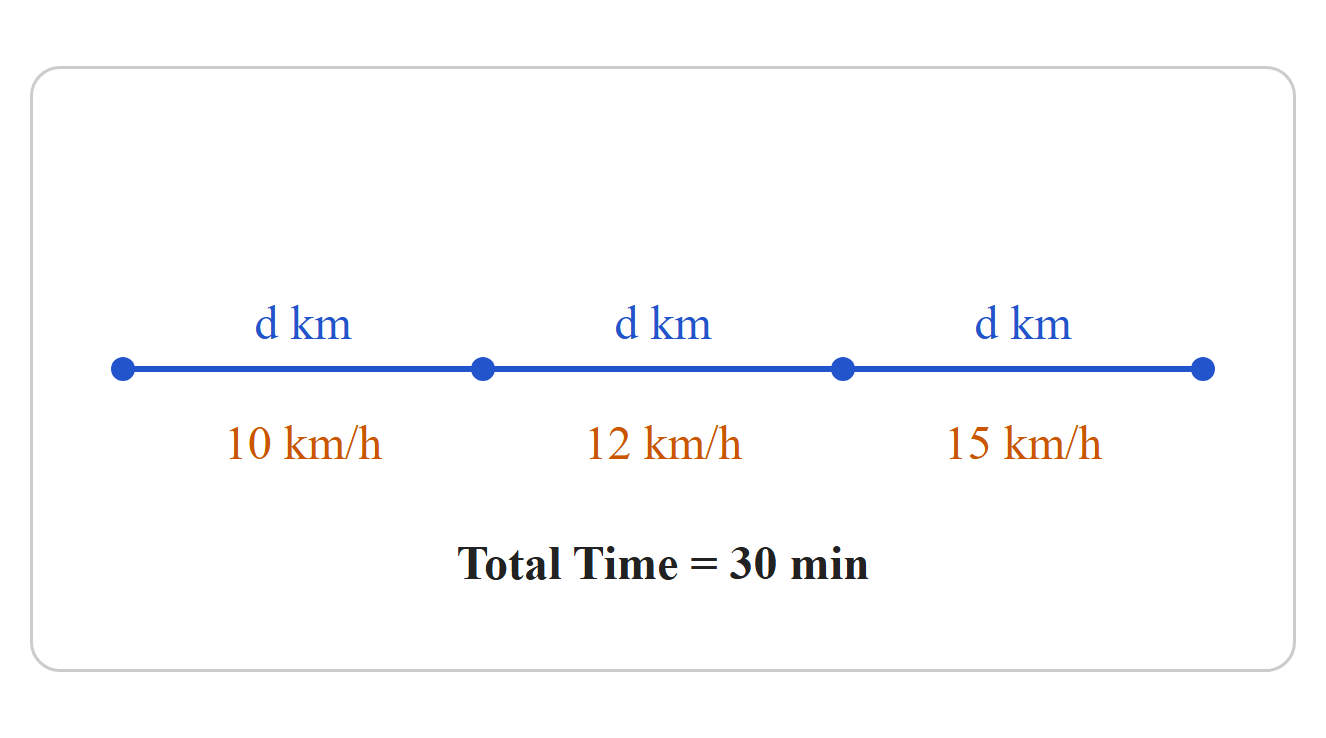
A man travels equal distance with speed of 10 km/h, 12 km/h and 15 km/h respectively and takes a total time of 30 min. What is the total distance travel by him?

  1. ((a))

    5 km

  2. ((b))

    6 km

  3. ((c))

    8 km

  4. ((d))

    10 km

  5. ((e))

    None of these

Show Answer
Answer: ((b))

6 km

Shortcut Trick

Average Speed for three equal distances = 3 × a × b × c ÷ (ab + bc + ca)

Average Speed = (3 × 10 × 12 × 15) ÷ (120 + 180 + 150) = 5400 ÷ 450 = 12 km/h

Total Distance = Average Speed × Total Time

Total Distance = 12 km/h × (30 ÷ 60) h = 12 × 0.5 = 6 km

∴ The correct answer is 6 km.

Alternate Method

Let each equal distance be 'd' km.

Total time = (Time1 + Time2 + Time3)

⇒ 30 ÷ 60 = (d ÷ 10) + (d ÷ 12) + (d ÷ 15)

⇒ 1 ÷ 2 = (6d + 5d + 4d) ÷ 60

⇒ 1 ÷ 2 = 15d ÷ 60

⇒ 1 ÷ 2 = d ÷ 4

⇒ d = 2 km

Total Distance = 3 × d = 3 × 2 = 6 km

∴ The correct answer is 6 km.

Additional Information

Average Speed Formula

For two equal distances with speeds x and y, Average Speed = 2xy ÷ (x + y). For three equal distances, it is 3xyz ÷ (xy + yz + zx).

Time, Speed and Distance Relation

Distance = Speed × Time. Ensure units are consistent (e.g., convert minutes to hours by dividing by 60 if speed is in km/h).

Directions: Answer the question based on the information given below:

Given table shows the number of patients admitted in three different months (March, April, and May) of three different hospitals (A, B, and C) in a city.

Months/ HospitalsMarchAprilMay
A350049006400
B440064503870
C496273454365
46

In June the number of patients admitted in all three hospitals is 50% more than the number of patients admitted in all three hospitals in March, then what is the absolute difference between the number of patients admitted in all three hospitals in June and the number of patients admitted in all three hospitals in May and April together?

  1. ((a))

    14080

  2. ((b))

    14500

  3. ((c))

    14037

  4. ((d))

    14000

  5. ((e))

    14040

Show Answer
Answer: ((c))

14037

In June of number of patients in all three hospitals is 50% more than the number of patients admitted in all three hospitals in March month

 Then, total number of patients admitted in all three hospitals in March are 

   ⇒ 3500 + 4400 + 4962

   ⇒ 12862

 In June 50% more than the number of patients were admitted in all three hospitals in march 

 Then, 12862 × 150% / 100

  ⇒ 19293

 Number of patients admitted in all three hospitals in May are 

  ⇒ 6400 + 3870 + 4365

  ⇒ 14635

 Number of patients admitted in all three hospitals in April are 

  ⇒ 4900 + 6450 + 7345

  ⇒ 18695

 Then, the absolute difference between patients admitted in all three hospitals in June and patients admitted in all three hospitals in the months of April and May together are 

  ⇒ ( 18695 + 14635) - ( 19293 ) 

  ⇒ 33330 - 19293

  ⇒ 14037

  Hence, 14037 is the correct answer.

47

What is (approximately) the average of the average number of patients admitted in hospitals A and B together in the month of May and the average number of patients admitted in hospitals A and C together in the month of April?

  1. ((a))

    5632

  2. ((b))

    5625

  3. ((c))

    5629

  4. ((d))

    5660

  5. ((e))

    None of these

Show Answer
Answer: ((c))

5629

Number of patients admitted in hospitals A and B are together in May month are 

 ⇒ 6400 + 3870 

 ⇒ 10270

 The average of the patients are 

 ⇒ 10270 / 2

 ⇒ 5135

 The number of patients admitted in hospitals A and C in April month are 

 ⇒  4900 + 7345

 ⇒ 12245

 The average of the patients are 

 ⇒ 12245 / 2

 ⇒ 6122.5

 The average of May (A and B) and April (A and C) hospital-admitted patients are 

 ⇒ 5135 + 6122.5

 ⇒ 11257.5 / 2

 ⇒ 5628.75 ~ 5629

 Hence, 5629 is the correct answer.

48

In another hospital D, the number of patients admitted in the month of May is 120% of the number of patients admitted in Hospital A in May month, then the number of patients admitted in Hospital D is the month of May, is how much percent of the number of patients admitted in Hospital B and C together in the month of April?

  1. ((a))
    1. 67%
  2. ((b))
    1. 20%
  3. ((c))
    1. 67%
  4. ((d))

    55.67%

  5. ((e))

    None of these

Show Answer
Answer: ((d))

55.67%

Number of patients in hospital D in may is 120% of patients admitted in hospital A in May month

 Then, number of patients admitted in hospital A in May month are 6400

 ⇒ 6400 × 120 / 100

 ⇒ 7680

 The number of patients admitted in hospitals B and C together in the month of April are 

 ⇒ 6450 + 7345

 ⇒ 13795

 Then required % 

 ⇒ 7680 = ? of 13795 % 

 ⇒ ? = (7680 × 100 ) / 13795

 ⇒ ? = 55.67% 

 Hence, 55.67% is the correct answer.

49

What is the ratio of total number of patients admitted in hospitals A and B together in the month of March and April and the total number of patients admitted in hospital C in the month of March, April, and May together respectively?

  1. ((a))

    9656: 8897

  2. ((b))

    9660: 8221

  3. ((c))

    9625 : 8336

  4. ((d))

    9650: 8337

  5. ((e))

    None of these

Show Answer
Answer: ((c))

9625 : 8336

Number of patients in hospitals A and B together in March and April are 

 ⇒ 3500+4400 + 4900 + 6450

 ⇒ 19250

 Number of patients in hospital C in all three months are 

 ⇒ 4962 + 7345 + 4365

 ⇒ 16672

 The required ratio is 

 ⇒ 19250 : 16672

 ⇒ 9625 : 8336

 Hence, 9625 : 8336 is the correct answer.

50

Number of patients admitted in all three months together in Hospital B is how much more/less than the number of patients admitted in all three months together in Hospital C?

  1. ((a))

    1840, More

  2. ((b))

    1872, Less

  3. ((c))

    1872, More

  4. ((d))

    1952, Less

  5. ((e))

    1950, More

Show Answer
Answer: ((d))

1952, Less

Number of patients in hospital B in all three months are 4400, 6450, 3870

 Then, total number of patients in hospital B in all three months are 

   ⇒ 4400 + 6450 + 3870 = 14720

 Number of patients in hospital C in all three months are 4962, 7345, 4365

 Then, total number of patients in hospital C in all three months are 

  ⇒ 4962 + 7345 + 4365 = 16672

  ⇒ 16672 - 14720 = 1952 

 Then, number of patients in hospital B is 1952 less than in hospital C.

Hence, 1952, Less is the correct answer.

51

What will come in the place of the question mark '?' in the following question?

 (16)2 × (4)4 ÷ (64)2 = (4)?

  1. ((a))

     6

  2. ((b))

     7

  3. ((c))

     5

  4. ((d))

     2

  5. ((e))

     3

Show Answer
Answer: ((d))

 2

Given : 

  (16)2×(4)2 ÷ (64)2 = (4)?

 Calculations : 

 (16)2 × (4)4 ÷ (64)2 = (4)?

   (42)× (4)4 ÷ (43)2 = (4)?

 ⇒ (4)4 × (4)4 ÷ (4)6 = (4)?

 ⇒ (4)8 ÷ (4)6 = (4)?

 ⇒ (4)(8-6) = (4)?

 ⇒ (4)2 = (4)?

 ⇒ ? = 2

 Hence 2 will come in the place of '?'.

52

What will come in the place of the question mark '?' in the following question?

  3072 ÷ 4 ÷ 2 = ?3 + 259

  1. ((a))

     3

  2. ((b))

     7

  3. ((c))

     5

  4. ((d))

     6

  5. ((e))

     9

Show Answer
Answer: ((c))

 5

Given : 

 3072 ÷ 4 ÷2 = ?3 + 259

Calculation :

3072 ÷ 4 ÷ 2 = ? + 259

 ⇒ 3072 ÷ 4 ÷ 2 = ?3 + 259

 ⇒ 3072 ÷ (4×2) = ?3 + 259

 ⇒ 3072 ÷ 8 = ?3 + 259

 ⇒ 384 = ?3 + 259

 ⇒ ?3 = 384 - 259

 ⇒ ?3 = 125

 ⇒ ? = 5

 Hence, 5 will come in place of '?'.

53

What will come in the place of the question mark '?' in the following question?

  13 × 8 + 7 × 22 = ? - 15

  1. ((a))

     283

  2. ((b))

     273

  3. ((c))

     313

  4. ((d))

     383

  5. ((e))

     413

Show Answer
Answer: ((b))

 273

Given : 

 13 × 8 + 7 × 22 = ? - 15

 Calculation : 

   13×8 + 7× 22 = ? - 15

 ⇒ 104 + 154 = ? - 15

 ⇒ 258 = ? - 15

 ⇒ 258 + 15 = ?

 ⇒ ? = 273 

 Hence,273 will come in the place of '?'.

54

What will come in the place of the question mark '?' in the following question?

  (?)2 + 8 = (16)2 + (29)2

  1. ((a))

     45

  2. ((b))

     78

  3. ((c))

     33

  4. ((d))

     98

  5. ((e))

     65

Show Answer
Answer: ((c))

 33

Given : 

 (?)+ 8 = (16)2 + (29)2

 Calculation : 

  ( ?)2 + 8 = (16)2 + (29)2

 ⇒ (?)+ 8 = 256 + 841

 ⇒ (?)2 + 8 = 1097

 ⇒ (?)2 = 1097 - 8

 ⇒ (?)2 = (33)2

 ⇒ (?) = 33

 Hence, 33 will come in the place of '?'.

55

What will come in the place of the question mark '?' in the following question? 

 10001/3 + 3431/3  + 21971/3 + 40961/3 = ?

  1. ((a))

     46

  2. ((b))

     52

  3. ((c))

     66

  4. ((d))

     56

  5. ((e))

     38

Show Answer
Answer: ((a))

 46

Given : 

 10001/3 + 3431/3 + 21971/3 +40961/3 = ?

 Calculation : 

 10001/3 + 3431/3 + 21971/3 + 40961/3 = ?

 ⇒ (10)3×1/3 +(7)3×1/3 + (13)3×1/3  + (16)3×1/3 = ?

 ⇒ 10 + 7 + 13 + 16 = ?

 ⇒ 46 = ?

 Hence, 46 will come in the place of '?'.

56

What will come in the place of the question mark '?' in the following question?

 52 + 65 - 25 - 40 = ? × 4

  1. ((a))

     14

  2. ((b))

     13

  3. ((c))

     22

  4. ((d))

     26

  5. ((e))

     16

Show Answer
Answer: ((b))

 13

Given : 

  52 + 65 - 25 - 40 = ? × 4

 Calculation : 

  52 + 65 - 25 - 40 = ? × 4

 ⇒ 117 - 25 - 40 = ? ×4

 ⇒ 117 - 65 = ? ×4

 ⇒  52 = ? × 4

 ⇒ ? = 52 / 4

 ⇒ ? = 13

 Hence, 13 will come in the place of '?'.

57

What will come in the place of the question mark '?' in the following question?

  440 ÷ 4 - 10 × 6 + 52 = ?

  1. ((a))

     85

  2. ((b))

     75

  3. ((c))

     65

  4. ((d))

     88

  5. ((e))

     102

Show Answer
Answer: ((b))

 75

Given :

 440 ÷ 4 - 10× 6 + 52 = ?

Calculation :

  440 ÷ 4 - 10×6 + 52 = ?

⇒ 110 - 60 + 25 = ?

⇒ 50 + 25 = ?

⇒ ? = 75

Hence,75 will come in the place of '?'.

58

What will come in the place of the question mark '?' in the following question?

  (15 × 18) + (255 ÷ 17) = ? + (189 ÷ 9)

  1. ((a))

     246

  2. ((b))

     264

  3. ((c))

     278

  4. ((d))

     258

  5. ((e))

     326

Show Answer
Answer: ((b))

 264

Given :

 (15×18) + (255÷17) = ? + (189÷9)

 Calculation : 

  (15×18) + (255÷17) = ? + (189÷9)

 ⇒ 270 + 15 = ? + 21

 ⇒ 285 = ? + 21

 ⇒ ? = 285 - 21

 ⇒ ? = 264

 Hence, 264 will come in the place of '?'.

59

What will come in the place of the question mark '?' in the following question?

 (1.8 × 55 ) + (238 ÷ 14) = ? + 15

  1. ((a))

     78

  2. ((b))

     72

  3. ((c))

     91

  4. ((d))

     101

  5. ((e))

     103

Show Answer
Answer: ((d))

 101

Given :

 (1.8×55) + (238 ÷ 14) = ? + 15

 Calculation :

(1.8×55) + (238÷14) = ? + 15

⇒ (99) + (17) = ? + 15

⇒ 116 = ? + 15

⇒ ? = 116 - 15

⇒ ? = 101

Hence, 101 will come in the place of '?'.

60

What will come in the place of the question mark '?' in the following question?

 26 × 13 + 24 × 12 + 110 = ?

  1. ((a))

     656

  2. ((b))

     736

  3. ((c))

     758

  4. ((d))

     696

  5. ((e))

     556

Show Answer
Answer: ((b))

 736

Given :

 26×13 + 24×12 + 110 = ?

 Calculation :

  26×13 + 24×12 + 110 = ?

 ⇒ 338 + 288 + 110 = ? 

 ⇒ 736 = ?

 Hence 736 will come in the place of '?'.

61

What will come in the place of the question mark '?'  in the following question?

 152 - 7841/2 + 24011/2 = ?

  1. ((a))

     229

  2. ((b))

     223

  3. ((c))

     196

  4. ((d))

     246

  5. ((e))

     252

Show Answer
Answer: ((d))

 246

Given :

 152 - 7841/2 + 24011/2 = ?

 Calculation : 

 15- 7841/2 + 24011/2 = ?

 ⇒ 225 - (28)2×1/2 + (49)2×1/2 = ?

 ⇒ 225 - 28 + 49 = ?

 ⇒ 197 + 49 = ?

 ⇒ ? = 246

Hence,246 will come in the place of '?'.

62

What will come in the place of the question mark '?' in the following question?

 ? × 3 - 72 × 84 ÷ 144 = 32

  1. ((a))

     11

  2. ((b))

     13

  3. ((c))

     19

  4. ((d))

     12

  5. ((e))

     17

Show Answer
Answer: ((e))

 17

Given :

 ? × 3 - 72 × 84 ÷ 144 = 32

 Calculation :

  ? × 3 - 72 × 84 ÷ 144 = 32

 ⇒ ? × 3 - 84 ÷ 2 = 32

 ⇒ ?×3 - 42 = 9

 ⇒ ? ×3 = 51

 ⇒ ? = 51 / 3

 ⇒ ? = 17

 Hence, 17 will come in the place of '?'.

63

What will come in the place of the question mark '?' in the following question?

 50% of 170 + 60% of 180 + 110 = ? + 10

  1. ((a))

     293

  2. ((b))

     273

  3. ((c))

     313

  4. ((d))

     413

  5. ((e))

     253

Show Answer
Answer: ((a))

 293

Given :

 50% of 170 + 60% of 180 + 110 = ? + 10

 Calculation :

  50% of 170 + 60% of 180 + 110 = ? + 10

 ⇒ 85 + 108 + 110 = ? + 10

 ⇒ 193 + 110 = ? + 10

 ⇒ 303 + ? = 10

 ⇒ ? = 303  - 10

 ⇒ ? = 293

 Hence,293 will come in the place of '?'.

64

What will come in the place of the question mark '?' in the following question?

  (14)2 + 179 + (5)2 = (?)2

  1. ((a))

     22

  2. ((b))

     10

  3. ((c))

     30

  4. ((d))

     40

  5. ((e))

     20

Show Answer
Answer: ((e))

 20

Given :

 (14)2 + 179 + (5)2 = (?)2

 Calculation :

 (14)2 + 179 + (5)2 = (?)2

 ⇒196 + 179 + 25 = (?)2

 ⇒ 400 = (?)2

 ⇒ (20)2×1/2 = (?)2×1/2

 ⇒ ? = 20

Hence, 20 will come in the place of '?'.

65

What will come in the place of the question mark '?' in the following question?

 15 × ? + 20% of 450 = 360 + 15× 8

  1. ((a))

     18

  2. ((b))

     16

  3. ((c))

     26

  4. ((d))

     20

  5. ((e))

     12

Show Answer
Answer: ((c))

 26

Given : 

 15 × ? + 20% of 450 = 360+15×8


 Calculation :

  15 × ? + 20% of 450 = 360 + 15×8

 ⇒ 15 × ? + 1/ 5 of 450 = 360 + 120

 ⇒ 15 × ? + 90 = 480

 ⇒ 15 × ? = 390

 ⇒ ? = 390 / 15

 ⇒ ? = 26

 Hence, 26 will come in the place of '?'.

66

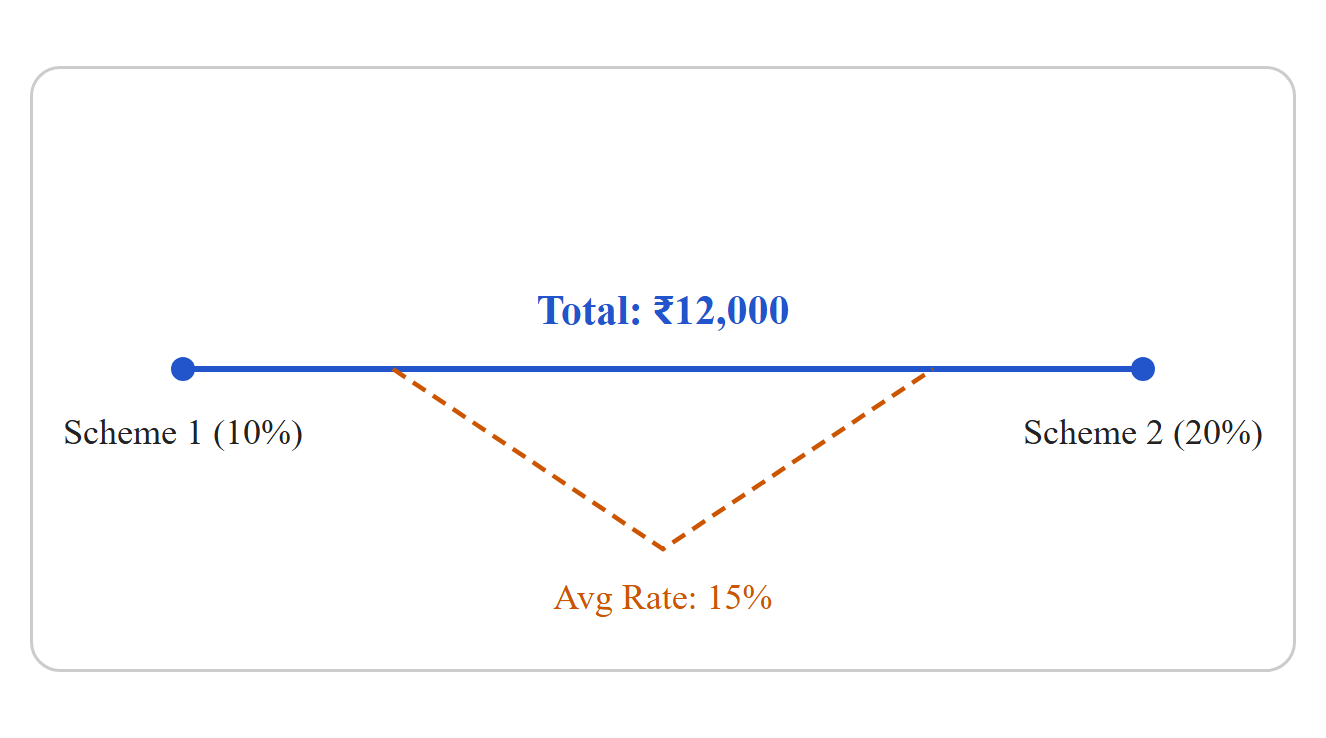
A person invested in 2 schemes one at 10% per annum and another at 20% per annum. After 3 years, he gained Rs. 5400 as simple interest from both the schemes. He invested a total of Rs. 12000. Find the share of investment in each scheme.

  1. ((a))

    Rs. 8000, Rs. 4000

  2. ((b))

    Rs. 6000, Rs. 6000

  3. ((c))

    Rs. 4000, Rs. 8000

  4. ((d))

    Rs. 5000, Rs. 7000 

  5. ((e))

    None of these

Show Answer
Answer: ((b))

Rs. 6000, Rs. 6000

Shortcut Trick

Total Simple Interest for 3 years = ₹5400 → Interest per year = 5400 ÷ 3 = ₹1800.

Overall rate % = (1800 ÷ 12000) × 100 = 15%.

Apply Alligation: (20 − 15) : (15 − 10) = 5 : 5 = 1 : 1.

Divide ₹12000 in 1 : 1 ratio → ₹6000 and ₹6000.

∴ The correct answer is ₹6000, ₹6000.

Alternate Method

Given: Total Investment = ₹12000, Total Time = 3 years, Total Interest = ₹5400, Rates = 10% and 20%.

Formula Used: SI = (P × R × T) ÷ 100

⇒ Let the investment in 10% scheme be P1 and in 20% scheme be (12000 − P1).

⇒ [(P1 × 10 × 3) ÷ 100] + [((12000 − P1) × 20 × 3) ÷ 100] = 5400

⇒ 30P1 + 60(12000 − P1) = 540000

⇒ 30P1 + 720000 − 60P1 = 540000

⇒ 30P1 = 180000 ⇒ P1 = ₹6000.

⇒ P2 = 12000 − 6000 = ₹6000.

∴ The correct answer is ₹6000, ₹6000.

Additional Information

Alligation in Simple Interest

When a sum is divided into two parts at different rates, the ratio of the parts is found by the difference between the individual rates and the average overall rate.

Weighted Average Rate

The effective rate Reff = (Total Interest × 100) ÷ (Total Principal × Time).

Simple Interest Constancy

In Simple Interest, the interest earned remains the same every year if the principal and rate are constant.

67

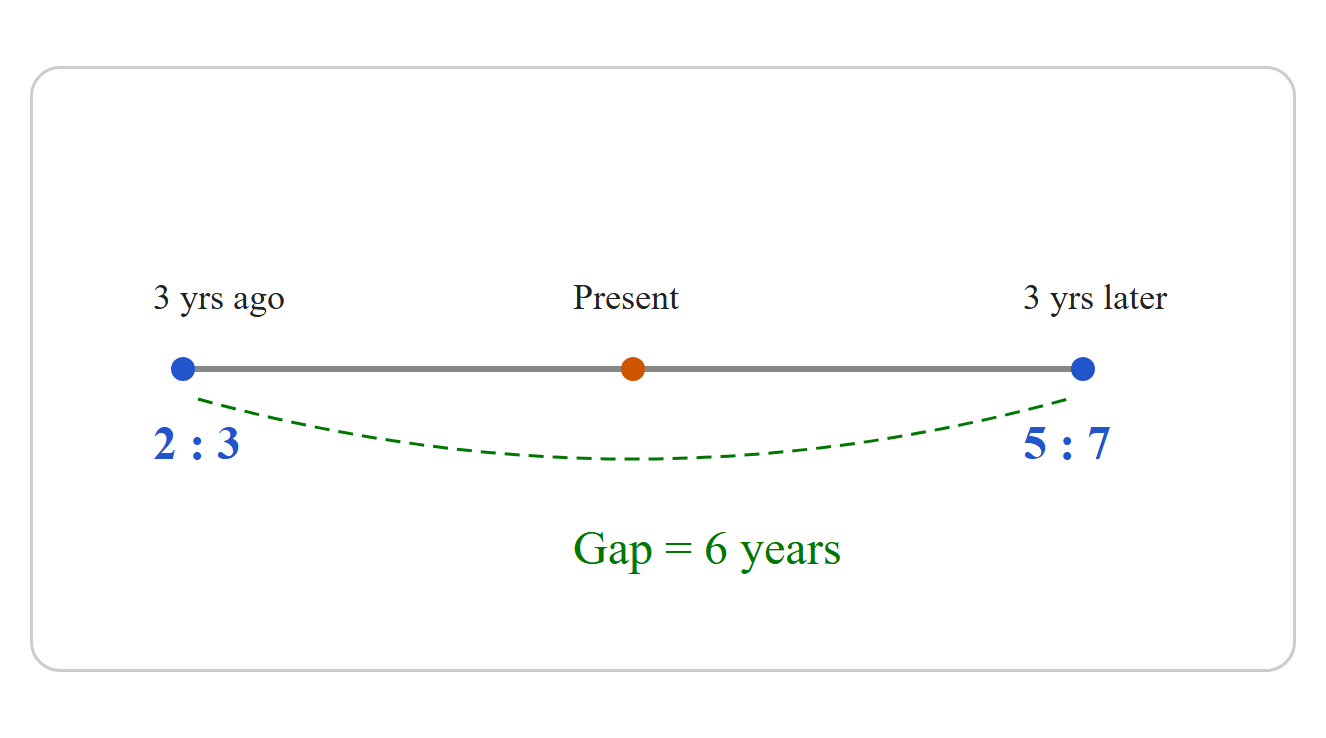
3 years ago age ratio of son and father was 2 ∶ 3 and After 3 year’s ratio becomes 5 ∶ 7. Find the present age of the son.

  1. ((a))

    25 years

  2. ((b))

    23 years

  3. ((c))

    27 years

  4. ((d))

    24 years

  5. ((e))

    None of these

Show Answer
Answer: ((c))

27 years

Shortcut Trick

Ratio 3 years ago (S : F) = 2 : 3 (Difference = 1)

Ratio 3 years later (S : F) = 5 : 7 (Difference = 2)

Equating differences: 3 years ago ratio becomes 4 : 6 and 3 years later is 5 : 7.

Change in ratio units = 1 unit → Time gap = 3 + 3 = 6 years.

Son's age 3 years ago = 4 units = 4 × 6 = 24 years.

Present age of Son = 24 + 3 = 27 years.

∴ The correct answer is 27 years.

Alternate Method

Given: Ratio of Son and Father 3 years ago = 2 : 3, Ratio after 3 years = 5 : 7.

Formula: Let ages 3 years ago be 2x and 3x. Total time gap between conditions = 6 years.

⇒ (2x + 6) ÷ (3x + 6) = 5 ÷ 7

⇒ 7 × (2x + 6) = 5 × (3x + 6)

⇒ 14x + 42 = 15x + 30

⇒ 15x − 14x = 42 − 30

⇒ x = 12

⇒ Son's age 3 years ago = 2x = 2 × 12 = 24 years

⇒ Son's Present Age = 24 + 3 = 27 years

∴ The correct answer is 27 years.

Additional Information

Age Ratio Difference Rule

The difference between the ages of two people remains constant over time. To solve quickly, make the difference between ratio parts equal in both time periods.

Concept of Time Gap

If a ratio is given for 'n' years ago and 'm' years later, the total time interval to be added to the earlier ratio is (n + m) years.

Present Age Calculation

Always ensure the final step adjusts the calculated value to the 'Present' by adding or subtracting the required years from the specific ratio point used.

68

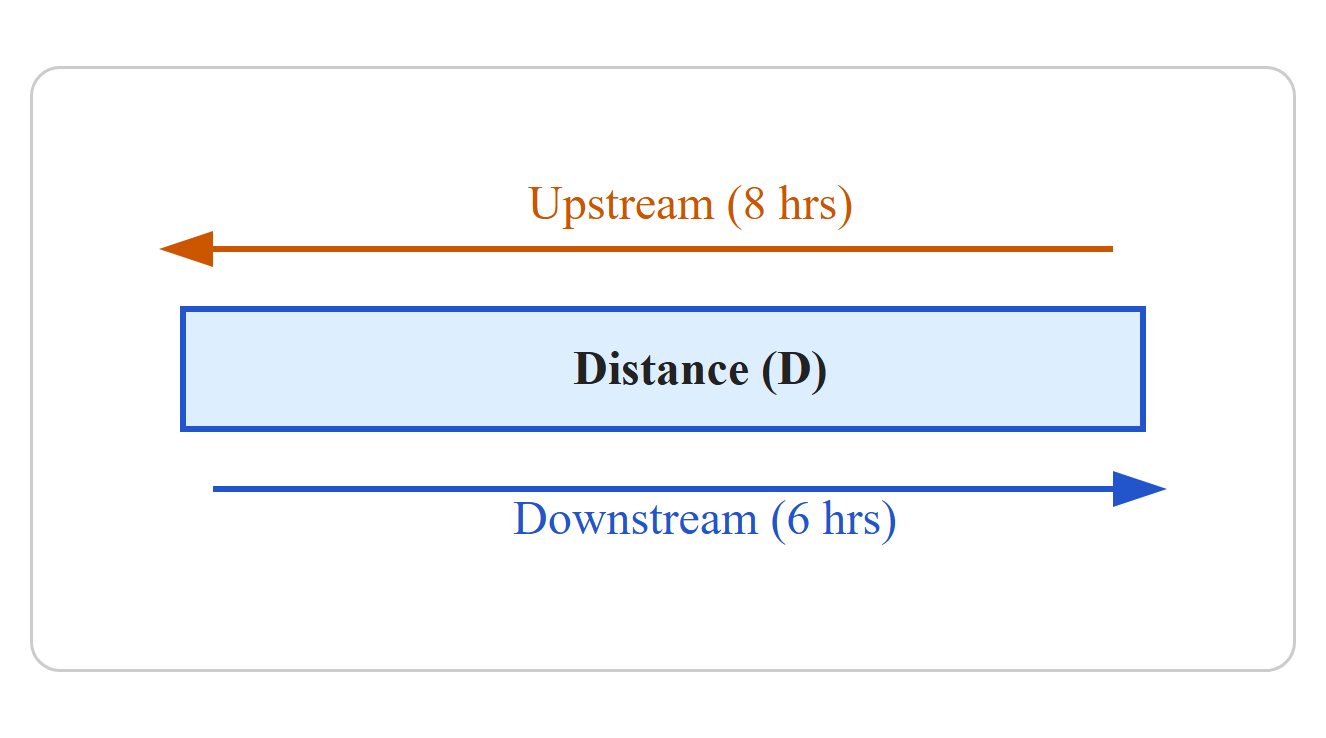
A motor boat covers a certain distance downstream in a river in 6 hours and same boat covers a same distance upstream in a river in 8 hours. If the speed of stream is 2 km/h. Find the speed of the boat in still water.

  1. ((a))

    20 km/h

  2. ((b))

    15 km/h

  3. ((c))

    23 km/h

  4. ((d))

    14 km/h

  5. ((e))

    16 km/h

Show Answer
Answer: ((d))

14 km/h

Shortcut Trick

When distance is constant, Speed is inversely proportional to Time.

Time ratio (Downstream : Upstream) = 6 : 8 = 3 : 4

Speed ratio (Downstream : Upstream) = 4 : 3

Speed of boat (u) : Speed of stream (v) = (4+3)/2 : (4-3)/2 = 7 : 1

Given 1 unit = 2 km/h, then 7 units = 7 × 2 = 14 km/h.

∴ The correct answer is 14 km/h.

Alternate Method

Given: Time downstream (td) = 6 hours, Time upstream (tu) = 8 hours, Speed of stream (v) = 2 km/h.

Formula Used: Distance = Speed × Time; Downstream speed = u + v; Upstream speed = u − v.

⇒ Let the speed of the boat in still water be u km/h.

⇒ Distance downstream = (u + 2) × 6

⇒ Distance upstream = (u − 2) × 8

⇒ (u + 2) × 6 = (u − 2) × 8

⇒ 6u + 12 = 8u − 16

⇒ 2u = 28

⇒ u = 14 km/h

∴ The correct answer is 14 km/h.

Additional Information

Relative Speed in Water

Speed of boat in still water (u) = (Downstream Speed + Upstream Speed) ÷ 2.

Speed of Stream

Speed of stream (v) = (Downstream Speed − Upstream Speed) ÷ 2.

Time and Speed Relation

When distance is constant, u/v = (tu + td) / (tu − td).

69

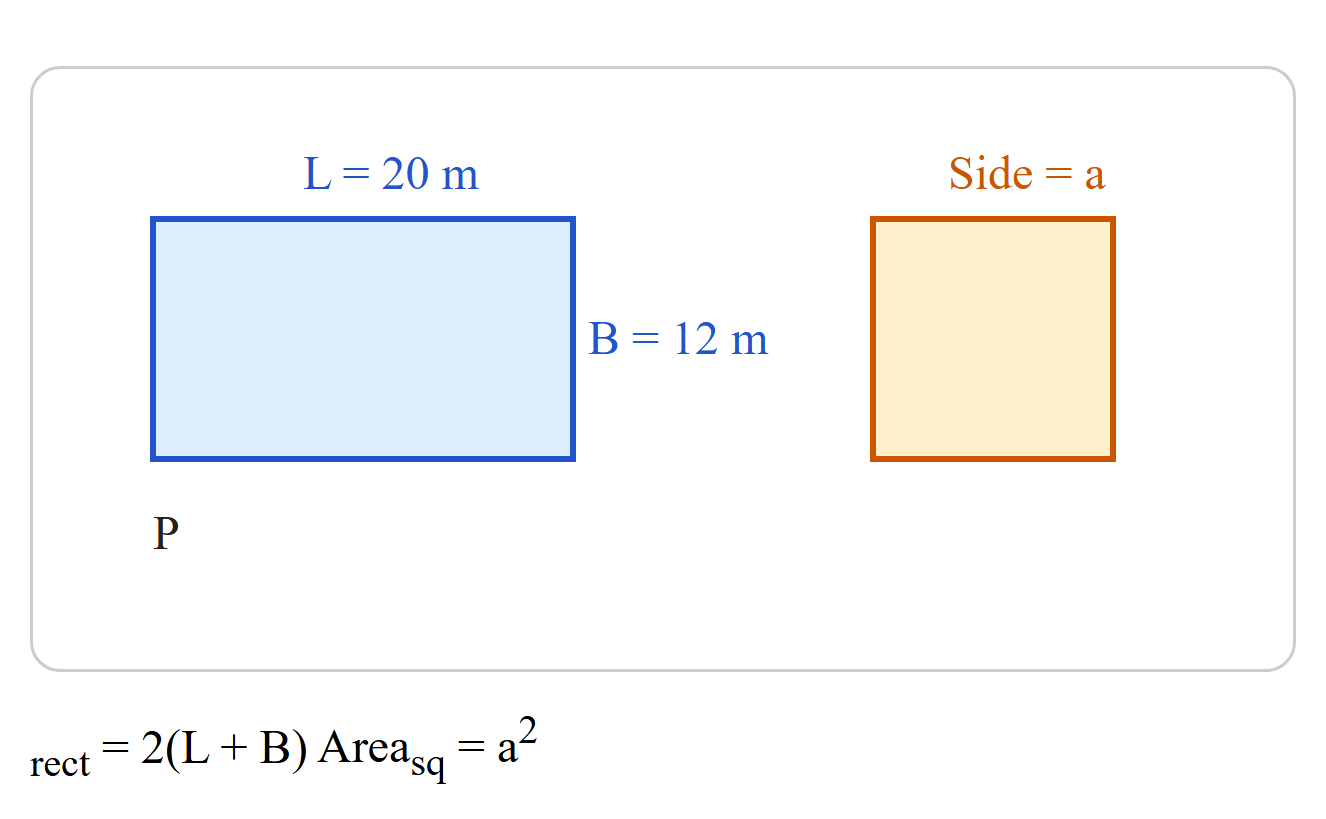
The length and breadth of a rectangle are 20 meters and 12 meters respectively. If the numerical value of perimeter of the rectangle is equal to that of area of a square, then what is the perimeter of the square?

  1. ((a))

    64

  2. ((b))

    32

  3. ((c))

    16

  4. ((d))

    42

  5. ((e))

    30

Show Answer
Answer: ((b))

32

Shortcut Trick

Perimeter of Rectangle = 2 × (20 + 12) = 64 m.

Area of Square = 64 m2Side of Square = √64 = 8 m.

Perimeter of Square = 4 × 8 = 32 m.

∴ The correct answer is 32 m.

Alternate Method

Given:

Length (L) = 20 m, Breadth (B) = 12 m

Formula Used:

Perimeter of rectangle = 2(L + B)

Area of square = side2

Perimeter of square = 4 × side

Calculations:

⇒ Perimeter of Rectangle = 2 × (20 + 12) = 2 × 32 = 64 m

⇒ Area of Square = 64

⇒ (Side)2 = 64

⇒ Side = √64 = 8 m

⇒ Perimeter of Square = 4 × 8 = 32 m

∴ The correct answer is 32 m.

Additional Information

Rectangle Properties

Area = L × B and Diagonal = √(L2 + B2).

Square Properties

Diagonal of square = Side × √2. Area can also be calculated as (Diagonal2)/2.

Relationship

For a given perimeter, a square has a larger area than any other rectangle.

70

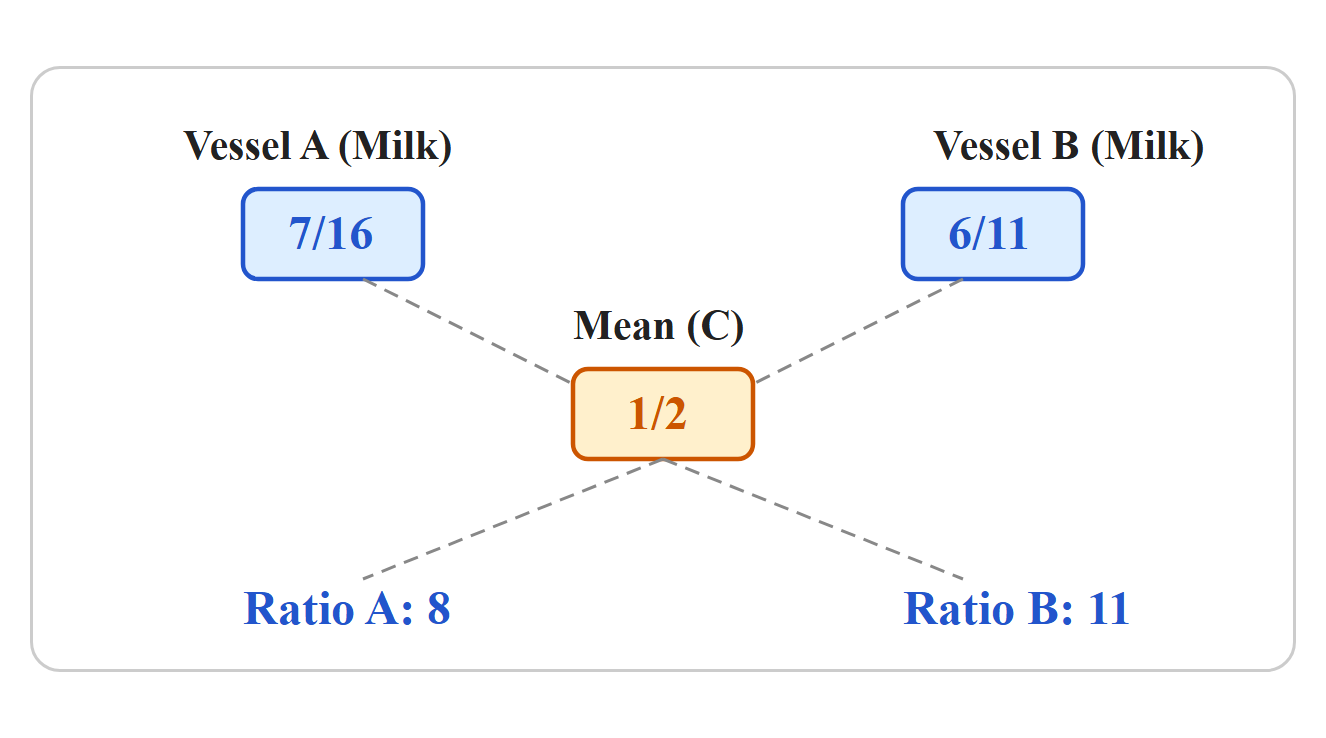
The milk and water in two vessels A and B are in the ratio of 7 : 9 and 6 : 5 respectively. In what ratio, the liquids are mixed to obtain a new mixture vessel C containing half milk and half water?

  1. ((a))

    8 : 11

  2. ((b))

    9 : 11

  3. ((c))

    10 : 11

  4. ((d))

    8 : 9

  5. ((e))

    9 : 10

Show Answer
Answer: ((a))

8 : 11

Shortcut Trick

Concentration of milk in A = 7/16, in B = 6/11, and in C = 1/2.

Using Alligation: (6/11 − 1/2) : (1/2 − 7/16)

⇒ (1/22) : (1/16) ⇒ 16 : 22

⇒ 8 : 11

∴ The correct answer is 8 : 11.

Alternate Method

Given: Ratio of milk and water in Vessel A = 7 : 9, Vessel B = 6 : 5. Target ratio in Vessel C = 1 : 1.

Formula Used: Alligation method on milk fraction.

⇒ Fraction of milk in A = 7 / (7+9) = 7/16

⇒ Fraction of milk in B = 6 / (6+5) = 6/11

⇒ Fraction of milk in C = 1 / (1+1) = 1/2

⇒ Quantity of A / Quantity of B = (6/11 − 1/2) / (1/2 − 7/16)

⇒ (12 − 11)/22 / (8 − 7)/16

⇒ (1/22) / (1/16) = 16 / 22 = 8 / 11

∴ The correct answer is 8 : 11.

Additional Information

Rule of Alligation

It is a shortcut to find the ratio in which two ingredients at given prices/concentrations must be mixed to produce a mixture of a desired mean price/concentration.

Mixture Concentration

Always apply alligation on the same component (either only milk or only water) across all vessels to get the correct mixing ratio.

Balanced Ratio Method

If the sum of ratio parts is different, take the LCM of the sums (16, 11, 2) to normalize the values for easier calculation.

English Language (30 questions)

Directions: Read the passage carefully and answer the following question. 

Restaurants’ growth accelerated in the 20th century. American employment in food service quadrupled as a share of the workforce over this period. The Michelin Guide was first published in 1900; the stars came 26 years later. And yet the continued rise of the restaurant up until the pandemic nonetheless presents an economic puzzle. Cooking at home was becoming even easier. Average house sizes grew. Appliances such as the food processor and the dishwasher reduced preparation and clean-up times. Dining out became relatively more expensive: 

And yet three economic changes ensured that demand for restaurants grew despite rising prices. The first is immigration. In the 50 years after the second world war the net flow of migrants into rich countries, relative to population, more than quadrupled. Starting a restaurant is a good career move for new arrivals; it neither requires formal qualifications nor, at least for chefs, fluency in the local language. Migrants tend to improve the quality of an area’s restaurants. The second factor was the changing microeconomics of the family. The size of the family increased with the rising microeconomics. As a new paper by Rachel Griffith of the Institute for Fiscal Studies, a think-tank, and colleagues, shows, households’ choices about whether to make their own food or to buy it premade are shaped not only by the upfront cost of those things. They also depend on what economists call “shadow costs”. The true cost of an at-home meal involves not just the outlay for the ingredients, but the time spent on shopping and preparation. In an era of low female labor-force participation, shadow costs were low. A stay-at-home mother who cooked instead of eating out would have less leisure time. But as more women entered the workforce during the 20th century this equation changed, raising the shadow cost of cooking. Now a working woman who cooked dinner would be sacrificing time that might _________ used to earn money. And so eating out made increasing economic sense, even as it became more expensive. The third factor was changing working patterns. Historically poor people have tended to work longer hours than rich ones. But in the latter half of the 20th century, the opposite became true. The rise of knowledge-intensive jobs, and globalization, made rich people’s work more financially rewarding—and enjoyable. Toiling into the night became a sign of status. The upshot was that the people with the most money to spend on dining out increasingly needed it most since they had the least free time. In Britain, the richest tenth of households devote a much bigger chunk of their overall spending to dining and drinking out than the poorest tenth, and the gap has grown in recent years.

What does the history of the restaurant say about its future? People have relished their reopening. In recent weeks global restaurant reservations have been near their pre-pandemic levels. The long-term future of the restaurant is less clear. The pandemic has led to many people buying more takeout than before, while others have a newfound love of cooking. Restaurants have little choice but to continue to adapt.

71

What were the changes happened after the post-pandemic period?

  1. ((a))

    There was a divide in the choices of how to adapt to food culture. 

  2. ((b))

    People preferred organic farming.

  3. ((c))

    Dining out increased and take away decreased.

  4. ((d))

    People eat only home cooked food in order to avoid contamination of food. 

  5. ((e))

    None of these

Show Answer
Answer: ((a))

There was a divide in the choices of how to adapt to food culture. 

The correct answer is There was a divide in the choices of how to adapt to food culture.

Key Points

  • The answer can be inferred from the following lines of the passage: What does the history of the restaurant say about its future? People have relished their reopening. In recent weeks global restaurant reservations have been near their pre-pandemic levels. The long-term future of the restaurant is less clear. The pandemic has led to many people buying more takeout than before, while others have a newfound love of cooking. Restaurants have little choice but to continue to adapt.
  • Thus, the correct answer is There was a divide in the choices of how to adapt to food culture.
72

Complete the following sentence with the appropriate option. 

The rise of knowledge-intensive jobs, and globalization, _________________________.

  1. ((a))

    three economic changes ensured that demand for restaurants grew despite rising prices.

  2. ((b))

    made rich people's work more enjoyable and rewarding.

  3. ((c))

    increased in shadow cost.

  4. ((d))

    cooking at home was becoming easier.

  5. ((e))

    None of these

Show Answer
Answer: ((b))

made rich people's work more enjoyable and rewarding.

The correct answer is rich people's work was enjoyable and rewarding.

Key Points

  • The answer lies in the following lines of the passage:  But in the latter half of the 20th century, the opposite became true. The rise of knowledge-intensive jobs, and globalization, made rich people’s work more financially rewarding—and enjoyable. Toiling into the night became a sign of status.
  • Thus, the correct answer is rich people's work was enjoyable and rewarding.
73

Which of the following reason(s) is/are true which led to increase in restaurants?

(a) Change in work patterns

(b) Increase in shadow cost

(c) Immigration of migrants

  1. ((a))

    Only a

  2. ((b))

    Only b

  3. ((c))

    Only c

  4. ((d))

    Both (a) and (b)

  5. ((e))

    All (a), (b) and (c) 

Show Answer
Answer: ((e))

All (a), (b) and (c) 

The correct answer is all (a), (b) and (c).

Key Points

  • The answer lies in the following lines of the passage: The first is immigration. In the 50 years after the second world war the net flow of migrants into rich countries, relative to population, more than quadrupled. Starting a restaurant is a good career move for new arrivals; it neither requires formal qualifications nor, at least for chefs, fluency in the local language. Migrants tend to improve the quality of an area’s restaurants. The second factor was the changing microeconomics of the family. The size of the family increased with the rising microeconomics. As a new paper by Rachel Griffith of the Institute for Fiscal Studies, a think-tank, and colleagues, shows, households’ choices about whether to make their own food or to buy it premade are shaped not only by the upfront cost of those things. They also depend on what economists call “shadow costs”. The true cost of an at-home meal involves not just the outlay for the ingredients, but the time spent on shopping and preparation. In an era of low female labor-force participation, shadow costs were low. A stay-at-home mother who cooked instead of eating out would have less leisure time. But as more women entered the workforce during the 20th century this equation changed, raising the shadow cost of cooking. Now a working woman who cooked dinner would be sacrificing time that might _________ used to earn money. And so eating out made increasing economic sense, even as it became more expensive. The third factor was changing working patterns. Historically poor people have tended to work longer hours than rich ones. But in the latter half of the 20th century, the opposite became true.
  • Thus, the correct answer is all (a), (b) and (c).
74

Which of the following statement is false ?

  1. ((a))

    Appliances such as the food processor and the dishwasher reduced preparation and clean-up times.

  2. ((b))

    The pandemic has led to many people buying more takeout than before, while others have a newfound love of cooking.

  3. ((c))

    Starting a restaurant is a good career move for new arrivals; it neither requires formal qualifications nor, at least for chefs, fluency in the local language.

  4. ((d))

    Size of the family decreased with the rising microeconomics.

  5. ((e))

    None of these.

Show Answer
Answer: ((d))

Size of the family decreased with the rising microeconomics.

The correct answer is Size of the family decreased with the rising microeconomics.

Key Points

  • The answer lies in the following lines of the passage: Starting a restaurant is a good career move for new arrivals; it neither requires formal qualifications nor, at least for chefs, fluency in the local language. Migrants tend to improve the quality of an area’s restaurants. The second factor was the changing microeconomics of the family. The size of the family increased with the rising microeconomics. As a new paper by Rachel Griffith of the Institute for Fiscal Studies, a think-tank, and colleagues, shows, households’ choices about whether to make their own food or to buy it premade are shaped not only by the upfront cost of those things. They also depend on what economists call “shadow costs”. The true cost of an at-home meal involves not just the outlay for the ingredients, but the time spent on shopping and preparation.
  • Thus, the correct answer is Size of the family decreased with the rising microeconomics.
75

Choose the appropriate word and fill in the blank in the sentence given below. 

 Now a working woman who cooked dinner would be sacrificing time that might _________ used to earn money.

  1. ((a))

    impact 

  2. ((b))

    can be put to

  3. ((c))

    affected

  4. ((d))

    otherwise be

  5. ((e))

    want to

Show Answer
Answer: ((d))

otherwise be

The correct answer is 'otherwise be** '.**

Key Points Let's explore the meanings of the above-given words:

  • Impact: Effect of the action performed or influence of someone's words or explanation.
  • Example: The President's speech had a huge impact on the common people.
  • Can be put to: To put something into practice.
  • Example: Going for a walk regularly can be put into practice in our day-to-day lives.
  • Affected: Side-effects of something or the action performed.
  • Example: Frequent alcohol consumption affected the individual's health adversely.
  • Otherwise be: Apart from that or in conditions different from the present scenario.
  • Example: A bank aspirant who lives alone will be sacrificing his time in cooking food that might otherwise be used to revise.
  • Want to: To achieve something or a desire for something or a wish to be like someone.
  • Example: Listen, I want to talk to you, it's urgent!

Thus, the correct answer is  'otherwise be '.

76

As per the given passage, which of the following statement is true?

  1. ((a))

    Dining out became relatively cheap.

  2. ((b))

    Migrants tend to decrease the quality of an area’s restaurants.

  3. ((c))

    Technological advancement have aided in the process of cooking. 

  4. ((d))

    In an era of low female labor-force participation, shadow costs were high.

  5. ((e))

    None of these.

Show Answer
Answer: ((c))

Technological advancement have aided in the process of cooking. 

The correct answer is technological advancement has aided in the process of cooking.

Key Points

  • The answer can be inferred from the following lines of the passage:  And yet the continued rise of the restaurant up until the pandemic nonetheless presents an economic puzzle. Cooking at home was becoming even easier. Average house sizes grew. Appliances such as the food processor and the dishwasher reduced preparation and clean-up times. Dining out became relatively more expensive.
  • Thus, the correct answer is technological advancement has aided in the process of cooking.
77

What do you understand by the word(s) "shadow cost"?

  1. ((a))

    Total time spent on shopping and preparation 

  2. ((b))

    Bridging the gap between the rich and the poor. 

  3. ((c))

    Formal qualifications required for opening a restaurant.

  4. ((d))

    Immigartion due to changes in the work pattern.

  5. ((e))

    None of these.

Show Answer
Answer: ((a))

Total time spent on shopping and preparation 

The correct answer is the total time spent in preparation and cooking.

Key Points

  • The answer lies in the following lines of the passage:  The second factor was the changing microeconomics of the family. As a new paper by Rachel Griffith of the Institute for Fiscal Studies, a think-tank, and colleagues, shows, households’ choices about whether to make their own food or to buy it premade are shaped not only by the upfront cost of those things. They also depend on what economists call “shadow costs”. The true cost of an at-home meal involves not just the outlay for the ingredients, but the time spent on shopping and preparation.
  • Thus, the correct answer is the total time spent in preparation and cooking.
78

What is the synonym of the word "flow"

  1. ((a))

    Stride

  2. ((b))

    Movement

  3. ((c))

    Defense

  4. ((d))

    Downfall

  5. ((e))

    None of these

Show Answer
Answer: ((b))

Movement

The correct answer is movement.

Key Points Let's explore the meanings of the above-given words:

  • Stride: Walk with long, decisive steps in a particular direction or overcome an obstacle.
  • Example: India needs to take a stride to reduce the value of the US dollar.
  • Movement: To be in a state of action.
  • Example: There was no movement in the room the last night when the murder took place.
  • Defense: To protect oneself from a fight or offensive words.
  • Example: Will you like to say something in your defense?
  • Downfall: Decelerating growth or decrease in a specific work.
  • Example: Inconsistency in practice can lead to a downfall in your mock test scores.

Thus, the correct answer is movement.

79

Choose the correct option and state synonym of the word "upshot"

  1. ((a))

    Cause

  2. ((b))

    Event

  3. ((c))

    Led

  4. ((d))

    Consequence

  5. ((e))

    None of these

Show Answer
Answer: ((d))

Consequence

The correct answer is a consequence.

Key Points Let's explore the meanings of the above-given words:

  • Cause: The reason why something has happened or the reasons behind a particular result.
  • Example: What are the causes of stomach ulcers in regular alcohol drinkers?
  • Event: A particular meeting place where information is conveyed in a group of people or a conclave.
  • Example: I am going to visit the VOGUE Fashion Week event next week in Paris.
  • Led: The ultimate result of something but a probable result.
  • Example: Dieting for many days led to lower blood pressure and getting unconscious.
  • Consequence: The final result of the action performed.
  • Example: You never know what will be the consequences of frequent alcohol consumption on your health.

Thus, the correct answer is a consequence.

Additional Information Synonyms of the word "upshot" is ramification, reverberation, aftermath, and culmination.

Antonyms of the word "upshot" are cause and origin.

80

Directions: Select the most appropriate word to fill in the blank.

George Bush and Tony Blair both apologize for the _______ they caused in Iraq.

  1. ((a))

    Invitation

  2. ((b))

    Celebration

  3. ((c))

    Devastation

  4. ((d))

    Donation

  5. ((e))

    None of the above

Show Answer
Answer: ((c))

Devastation

The correct answer is '​Devastation.'

Key Points

  • The given sentence is talking about the apologies from George Bush and Tony Blair for the destruction they caused in Iraq.
  • Therefore, the most appropriate word to be filled in the blank is 'Devastation'.
  • Also, the use of the word ''apologize'' in the sentence indicates the use of the word 'devastation' in the blank.
  • The word 'Devastation' means Great destruction or damage
  • Example: The bomb caused widespread devastation.

Hence, the correct answer is option 3.

Complete Sentence: George Bush and Tony Blair both apologize for the devastation they caused in Iraq.

Additional Information

  • Let us explore  the other options:
  • Invitation means A written or verbal request inviting someone to go somewhere or to do something.
  • Celebration means The action of celebrating an important day or event.
  • Donation means Something that is given to a charity, especially a sum of money.
  • Entertainment means The action of providing or being provided with amusement or enjoyment.
81

The given question has one blank indicating that something has been omitted. Choose the word from the given options that could fit in the blank correctly.

Many individuals ____ on sleeping medications to sustain a good night's sleep.

  1. ((a))

    bargain

  2. ((b))

    cry

  3. ((c))

    rely

  4. ((d))

    pivot

  5. ((e))

    hang

Show Answer
Answer: ((c))

rely

The correct answer is **'**rely'.

Key Points

  • rely - be dependent on. (भरोसा करना)

The sentence should be read as:​ Many individuals rely on sleeping medications to sustain a good night's sleep.

Additional Information

  • Let us look at the meaning of the other words:
  • bargain - negotiate the terms and conditions of a transaction. (मोल तोल)
  • cry - shed tears in distress. (रोना)
  • pivot - a person or thing that plays a central part in a situation or enterprise. (प्रधान आधार)
  • hang -  suspend or be suspended from above with the lower part dangling free.

Important Points

  • The sentence talks about how many people need medication for sleeping.
  • It is implied that these people are dependent on sleep medication.
  • This makes **'**rely' the correct word for the given blank.
82

The given question has one blank indicating that something has been omitted. Choose the word for the given options that could fit in the blank correctly.

There are primarily four __________ of making biscuits in the factory.

  1. ((a))

    stages

  2. ((b))

    stairs

  3. ((c))

    purpose

  4. ((d))

    cause

  5. ((e))

    important.

Show Answer
Answer: ((a))

stages

The correct answer is stages.

Key Points

 Let's look at the meaning of the correct answer:

  • For making biscuits in the factory there are basically four steps.
  • stages - a point, period, or step in a process or development
  • Example - *this is the most difficult stage of the competition from all of the stages.*
  • From the given meaning we can conclude that the correct answer is stages.

Thus the correct sentence is: *"**There are primarily four stages of making biscuits in the factory".*​

Additional Information

Let's discuss the meaning of other options:

  • stairs - a set of steps leading from one floor of a building to another
  • purpose - the reason for which something is done or created or for which something exists.
  • cause - a person or thing that gives rise to an action, phenomenon, or conditions.
  • important - of great significance or value.
83

Direction: Pick out the most appropriate word from the words given below each sentence to complete it meaningfully.

The dissolution of the monasteries in Henry VIII's ________ has never been forgotten.

  1. ((a))

    rain

  2. ((b))

    reign

  3. ((c))

    root

  4. ((d))

    route

  5. ((e))

    None of the above

Show Answer
Answer: ((b))

reign

The correct answer is 'reign'.

Key Points

  • From the given sentence we can understand that the dissolution of the monasteries was done during the period of rule of Henry VIII.
  • The only word that means the same as 'the period of rule of a monarch' is 'reign'.
  • We will thus fill in the blank with 'reign' to complete the sentence.
  • Hence, option 2 is the correct answer.

Additional Information

  • Let's look at the meanings of the remaining options.


WordMeaningExample Sentence
rainthe condensed moisture of the atmosphere falling visibly in separate drops.The rain had not stopped for days.
rootthe part of a plant that attaches it to the ground or to a support, typically underground, conveying water and nourishment to the rest of the plant via numerous branches and fibres.Cacti have deep and spreading roots.
routea way or course taken in getting from a starting point to a destination.The scenic route from Florence to Siena never fades from my memory.

Important Points

  • Dissolution is the action of formally ending or dismissing an assembly, partnership, or official body.
  • ​For eg.-  The president announced the dissolution of the National Assembly.
84

Directions: The following sentence has been split into five segments. Identify the segment that contains a grammatical error.

Education do not (A)/ mean teaching people (B)/ to know what they do not (C)/ know; it means teaching them (D)/ to behave as they do not behave (E)/.

  1. ((a))

    A

  2. ((b))

    B

  3. ((c))

    C

  4. ((d))

    D

  5. ((e))

    E

Show Answer
Answer: ((a))

A

The correct answer is 'A' i.e. this part of the sentence has an error.

Key Points

  • In the first part of the given sentence, the plural form of the verb 'do' is incorrect.
  • The subject 'Education' in the given sentence is a singular subject.
  • We know that a singular subject always takes a singular verb.
  • The singular form of the verb 'does' should be used with the singular subject 'Education'.
  • Therefore, the singular form of the verb 'does' should be used in place of the plural form of the verb 'do'.

Hence, the correct answer is option 1.

Correct sentence: Education does not mean teaching people to know what they do not know; it means teaching them to behave as they do not behave.

<br>

Additional Information

  • Subjects and verbs must agree with one another in number (singular or plural).
  • Thus, if a subject is singular, its verb must also be singular; if the subject is plural, its verb must also be plural.
85

Read the sentence given below to find out if it contains an error. The error, if any, will be in one part of the sentence. if the sentence is error free, select No error or option 5. Ignore errors of punctuation if any.

His grades are (A)/ to low to secure (B)/ admission in (C)/ a prestigious college. (D)/ No error (E).

  1. ((a))

    A

  2. ((b))

    B

  3. ((c))

    C

  4. ((d))

    D

  5. ((e))

    E

Show Answer
Answer: ((b))

B

The correct answer is "B".

Key Points

  • The error lies in part B of the given sentence.
  • The words too…to have a negative meaning. It means ‘more than is necessary or desirable’.
  • Example: He was too nervous to perform well on the stage.
  • Therefore, 'to low to secure' must be replaced with 'too low to secure' to make the sentence grammatically correct.
  • Hence, the correct answer is option 2.
86

Directions: The following sentence has been split into five segments. Identify the segment that contains a grammatical error.

I can scarcely (A)/ wait until Thursday (B)/ next than we (C)/ will again be in (D)/ one another's company! (E)/

  1. ((a))

    A

  2. ((b))

    B

  3. ((c))

    C

  4. ((d))

    D

  5. ((e))

    E

Show Answer
Answer: ((c))

C

The correct answer is 'C' i.e. this part of the sentence has an error.

Key Points

  • In the third part of the given sentence, the use of the preposition 'than' is incorrect.
  • The adverbs "scarcely, hardly, and barely" are always followed by 'when', while ''no sooner'' is followed by 'than'.
  • "Scarcely...when" is used to combine or rewrite sentences denoting two simultaneous past actions.
  • For example:
  • She had scarcely gotten through the door than the phone rang. (Incorrect)
  • She had scarcely gotten through the door when the phone rang(Correct)

Hence, the correct answer is option 3.

Correct Sentence: I can scarcely wait until Thursday next when we will again be in one another's company!

87

Directions: The following sentence has been split into five segments. Identify the segment that contains a grammatical error.

With a burning desire to  (A)/ achieve your dream, let that (B)/ aspiration become one (C)/ of the most important things (D)/ fuel your enthusiasm. (E)/

  1. ((a))

    A

  2. ((b))

    B

  3. ((c))

    C

  4. ((d))

    D

  5. ((e))

    E

Show Answer
Answer: ((e))

E

The correct answer is 'E' i.e. this part of the sentence has an error.

Key Points

  • In this segment, the verb "fuel" should be changed to "fueling" to ensure verb tense consistency throughout the sentence and to connect logically with the previous segments of the sentence.
  • The word "fueling" means that it is a continuous action and it matches with the verb form "become" which is present in the segment (C).
  • Hence, the correct answer is option 5.

Correct sentence: With a burning desire to achieve your dream, let that aspiration become one of the most important things fueling your enthusiasm.

88

Directions: The sentence given below contains an error. Identify the part containing the error and mark it as you answer. If there is no error anywhere in the sentence, mark No Error(E) as your answer.

If the employees would have (A)/ succeeded in their attempt (B)/ they would have (C)/ achieved a good target (D). No error (E)

  1. ((a))

    A

  2. ((b))

    B

  3. ((c))

    C

  4. ((d))

    D

  5. ((e))

    E

Show Answer
Answer: ((a))

A

The correct answer is 'A.'

Key Points

  • In the given sentence, the conditional perfect ''would have'' in the ''if clause'' is incorrect.
  • Conditional perfect is used for something that might have happened in the past.
  • Conditional perfect is used in the main clause of the third conditional sentence.
  • The third conditional sentence structure is as follows:
  • If + past perfect..., + conditional perfect (would + have + past participle).
  • Conditional perfect (would + have + past participle) + if + past perfect.
  • Therefore, the past perfect 'had' should be used in place of the conditional perfect ''would have''.

Hence, the correct answer is option 1.

Correct sentence: If the employees had succeeded in their attempt they would have achieved a good target.

Hinglish

  • दिए गए वाक्य में, ''if clause'' में conditional perfect ''would have'' गलत है।
  • Conditional perfect का इस्तेमाल किसी ऐसी चीज के लिए किया जाता है जो अतीत में हुई हो
  • Third conditional sentence के मुख्य खंड में conditional perfect का उपयोग किया जाता है।
  • Third conditional sentence की संरचना इस प्रकार है:
  • If + past perfect..., + conditional perfect (would + have + past participle).
  • Conditional perfect (would + have + past participle) + if + past perfect.
  • इसलिए, conditional perfect ''would have'' के स्थान पर past perfect 'had' का इस्तेमाल किया जाना चाहिए।

अतः सही उत्तर option 1 है।

सही वाक्य: If the employees had succeeded in their attempt they would have achieved a good target.

89

A sentence/a part of the sentence is underlined. Five alternatives are given to the underlined part which will improve the meaning of the sentence. Choose the correct alternative. In case no improvement is needed, click the option corresponding to "No improvement.”

Households are now actively made use of solar power due to its efficiency, reliability, and cost-effectiveness.

  1. ((a))

    active made 

  2. ((b))

    active making

  3. ((c))

    actively making

  4. ((d))

    actively be made

  5. ((e))

    No improvement

Show Answer
Answer: ((c))

actively making

The correct answer is option 3) i.e. actively making.

Key Points

  • In the given sentence the verb 'made' is used and it is incorrect.
  • The auxiliary verb 'are' indicates that the sentence should be written in 'present continuous tense'.
  • In present continuous tense 'Verb+ing' is used after the 'auxiliary verb'.
  • So, 'made' should be replaced with 'making'.

The correct sentence would beHouseholds are now actively making use of solar power due to its efficiency, reliability, and cost-effectiveness.

90

A sentence/ a part of sentence underlined.5 alternatives are given to underlined part which will improve the meaning of the sentence. Choose the correct alternative. In case, no improvement is needed, click the option corresponding to 'no improvement'

Neither Suresh nor Ramesh are allowed to enter the class if they have not completed homework given by me last week.

  1. ((a))

    is allowed

  2. ((b))

    is allows

  3. ((c))

    has allow

  4. ((d))

    are allows

  5. ((e))

    No improvement

Show Answer
Answer: ((a))

is allowed

The Correct Answer is Option A

Key Points 

  • The error is in the use 'are allowed'
  • a singular noun is used after One of, Neither of, Either of, and Each of.
  • Eg. Either of Kranti and Surekha is going to be winners but not both.
  • Hence are should be replaced with is in the given sentence

​Correct sentence- Neither Suresh nor Ramesh is allowed to enter the class if they have not completed homework given by me last week*.*

Additional Information 

  • The Noun is Part of the sentence which defines persons, Place or things.
  • Helping verbs in the sentence are decided with the help of a noun or subject.
91

In the following question. a sentence is given with three words marked as (A), (B), and (C). These words may or may not be placed in their correct order. Four options with different arrangements of these words have been provided. Mark the option with the correct arrangement as the answer. If no rearrangement is required. mark option (5) as your answer.

There can also be cases of erroneous (A) judgment of liabilities, where the scheme provides (B) an opportunity for quick justice to innocent taxpayers, who are falsely implicated (C).

  1. ((a))

    BAC

  2. ((b))

    CBA

  3. ((c))

    CAB

  4. ((d))

    BCA

  5. ((e))

    No arrangement required

Show Answer
Answer: ((e))

No arrangement required

The correct answer is option 5 i.e. No arrangement required.

Key Points

We can look at the sentence in the following way:

There can also be cases of ---------- (A) judgment of liabilities, where the scheme ---------- (B) an opportunity for quick justice to innocent taxpayers, who are falsely ------------ (C).

  • Erroneous: It is an adjective which means wrong; incorrect. Here the adjective describes the noun ‘judgment’ and hence it is in its correct place.
  • Provides: Refers to (of a law) enable or allow (something to be done). It’s a verb that is correctly preceded by the noun ‘scheme’.
  • Implicated: It is the past tense form of the verb ‘implicate’ which refers to show (someone) to be involved in a crime. The blank here needs a verb and ‘implicated’ is the correct one according to its definition stated earlier.

Hence, A, B, and C’s place is unchanged.

The correct sentence will be “There can also be cases of the erroneous (A) judgment of liabilities, where the scheme provides (B) an opportunity for quick justice to innocent taxpayers, who are falsely implicated (C).”

92

In the following question. a sentence is given with three words marked as (A), (B), and (C). These words may or may not be placed in their correct order. Four options with different arrangements of these words have been provided. Mark the option with the correct arrangement as the answer. If no rearrangement is required. mark option (5) as your answer.

Increased maintenance (A) of airlift assets would mean higher utilization (B) requirements, and since most are foreign-sourced, they will have to be sent abroad (C) for major servicing.

  1. ((a))

    CBA

  2. ((b))

    CAB

  3. ((c))

    BCA

  4. ((d))

    BAC

  5. ((e))

    No arrangement required

Show Answer
Answer: ((d))

BAC

The correct answer is option 4 i.e. BAC.

Key Points

We can look at the sentence in the following way:

Increased ----------- (A) of airlift assets would mean higher ---------- (B) requirements, and since most are foreign-sourced, they will have to be sent --------- (C) for major servicing.

Maintenance: Here it refers to the process of preserving a condition or situation or the state of being preserved. So, according to the definition, maintenance always comes after the usage of a product or a material which is ‘airlift assets’ in this case.

Utilization: Refers to the action of making practical and effective use of something.

Abroad: Refers to foreign countries considered collectively. The blank here doesn’t need any change because according to the meaning of ‘abroad’, it is correctly preceded by the word ‘foreign-sourced’ in the sentence and hence gives meaning to the context.

Hence, A should be replaced by B, B should be replaced by A, and C’s place is unchanged.

After rearrangement, the correct sentence will be “Increased utilization (A) of airlift assets would mean higher maintenance (B) requirements, and since most are foreign-sourced, they will have to be sent abroad (C) for major servicing.”

93

In the following question. a sentence is given with three words marked as (A), (B), and (C). These words may or may not be placed in their correct order. Four options with different arrangements of these words have been provided. Mark the option with the correct arrangement as the answer. If no rearrangement is required. mark option (5) as your answer.

The infectious (A) coronavirus is an example of close relationships (B) between urban development and new or re-emerging ongoing (C) diseases.

  1. ((a))

    BAC

  2. ((b))

    CBA

  3. ((c))

    CAB

  4. ((d))

    BCA

  5. ((e))

    No arrangement required

Show Answer
Answer: ((b))

CBA

The correct answer is option 2 i.e. CBA.

Key Points

We can look at the sentence in the following way:

The ----------- (A) coronavirus is an example of close ---------- (B) between urban development and new or re-emerging ----------- (C) diseases.

Infectious: Here it refers to (of a disease or disease-causing organism) liable to be transmitted to people, organisms, etc. through the environment. Although it is an adjective that is followed by a noun, it doesn’t fit in this blank perfectly.

Relationship: Refers to how two or more people or things are connected, or the state of being connected. It’s a noun correctly followed by the preposition ‘between’.

Ongoing: Refers to continuing; still in progress. The blank here needs an adjective other than the current one to sound meaningful according to the context because the words ‘re-emerging’ and ‘ongoing’ don’t go hand in hand.

Hence, A should be replaced by C, C should be replaced by A, and B’s place is unchanged.

After rearrangement, the correct sentence will be “The ongoing (A) coronavirus is an example of close relationships (B) between urban development and new or re-emerging infectious (C) diseases.”

94

In the following question. a sentence is given with three words marked as (A), (B), and (C). These words may or may not be placed in their correct order. Four options with different arrangements of these words have been provided. Mark the option with the correct arrangement as the answer. If no rearrangement is required. mark option (5) as your answer.

A interested (A) should also have been made based on the class of distinction (B): venture capital funds are financial investors who may not necessarily be investors (C) in taking over and running a business.

  1. ((a))

    CBA

  2. ((b))

    BAC

  3. ((c))

    CAB

  4. ((d))

    BCA

  5. ((e))

    No arrangement required

Show Answer
Answer: ((d))

BCA

The correct answer is option 4 i.e. BCA.

Key Points

We can look at the sentence in the following way:

A ----------- (A) should also have been made based on the class of ----------- (B): venture capital funds are financial investors who may not necessarily be ----------- (C) in taking over and running a business.

Interested: Refers to showing curiosity or concern about something or someone; having a feeling of interest. Since the sentence starts with the indefinite article ‘a’ a word starting with a consonant must be used rather than a vowel. The only option that starts with a consonant is ‘distinction’.

Distinction: Refers to a difference or contrast between similar things or people. ‘Distinction’ is a noun that needs to be followed by a verb.

Investor: Refers to a person or organization that puts money into financial schemes, property, etc. with the expectation of achieving a profit. The blank here should tell us about the attribute of the noun ‘financial investors’ and hence needs to be an adjective.

Hence, A should be replaced by B, B should be replaced by C, and A should take C's place.

After rearrangement, the correct sentence will be “A distinction (A) should also have been made based on the class of investors (B): venture capital funds are financial investors who may not necessarily be interested (C) in taking over and running a business.”

95

In the following question, a sentence is given with three words marked as (A), (B) and (C). These words may or may not be placed in their correct order. Four options with different arrangements of these words have been provided. Mark the option with the correct arrangement as the answer. If no arrangement is required, mark option (5) as your answer.

Towards the queers (A) of March, I found myself muttering like a mantra under my end (B): in the end, there will be breath (C) and cockroaches.

  1. ((a))

    ABC

  2. ((b))

    CBA

  3. ((c))

    CAB

  4. ((d))

    BCA

  5. ((e))

    No Rearrangement

Show Answer
Answer: ((d))

BCA

The correct answer is option 4) i.e. BCA.

Explanation:

  • We can look at the sentence in the following way:

Towards the ________(A) of March, I found myself muttering like a mantra under my ________ (B): in the end, there will be ________ (C) and cockroaches.

  • Queers: Refer to people who are not heterosexual and believe in same-sex union (gay, lesbian, bisexual or pansexual). It tells us about a type of people.

 For example-' a queer movement' that means a movement about the queers.

  • End: Meaning finishing or termination of something.

End is a noun and is followed by the preposition ‘of’.

  • Breath: Refer to the inhale or exhale of air or heaving a sigh.

‘Under one’s (my) breath’ is a phrase that means to say something in a very low voice.

For example- The angry kid muttered something unpleasant under his breath after being scolded by his teacher for fighting in the class.

  • Hence, A should be replaced by B, B should be replaced by C, and A should take C’s place.

The correct sentence is – “Towards the end (A) of March, I found myself muttering like a mantra under my breath (B): in the end, there will be queers (C) and cockroaches.”

Directions: Five sentences A,B,C,D and E are given below, you need to rearrange the sentences so that the five sentences can together form a meaningful paragraph.

A. Once while travelling by train, he was asked to leave the first-class compartment and shift to the van compartment.

B. Then, he was pushed forcibly out of the compartment and his luggage was thrown on the platform. 

C. Gandhiji had to travel by train from Durban to Pretoria in connection with his job.

D. This was a turning point in Gandhiji's life and he decide to stay back in South Africa and fight against this injustice.

E. It was winter and he kept shivering all night.

96

Which of the following should be the FIRST sentence after rearrangement?

  1. ((a))

    A

  2. ((b))

    B

  3. ((c))

    C

  4. ((d))

    D

  5. ((e))

    E

Show Answer
Answer: ((c))

C

The correct answer is 'C'.

Key Points

  • The correct sequence of the segments after rearrangement is CABED.
  • Sentence C comes in the first place as out of all the sentences, it is independent of any sentence and gives general information about Gandhiji's life.
  • Sentence A will come after C as it refers to one incident which happened when Gandhiji was travelling as usual.
  • Sentence B will come after A as it briefs what happened in that incident during the night. It is in continuation with the previous sentence.
  • Sentence E will come after B as it is giving information about how he spent his whole night shivering.
  • The sentence D will come after E as it is the concluding part and suggests how this incident was a turning point in his life.
  • ​From the above sequence, we can say that sentence 'C' is the first sentence after rearrangement.

Hence, the correct answer is option 3.

Paragraph after rearranging the sentences: Gandhiji had to travel by train from Durban to Pretoria in connection with his job. Once while travelling by train, he was asked to leave the first-class compartment and shift to the van compartment. Then, he was pushed forcibly out of the compartment and his luggage was thrown on the platform. It was winter and he kept shivering all night. This was a turning point in Gandhiji's life and he decide to stay back in South Africa and fight against this injustice.

Hint

  • Important Rules to Solve the Para Jumbles:
  • ​Read the sentences carefully and try to comprehend the idea or theme of the sentences and eliminate the irrelevant options first.
  • Try to identify the opening (independent sentence) and closing sentences (dependant/ concluding part).
  • Try to identify the mandatory pairs and co-relating sentences. Two sentences can be connected using various connectors and other determinants.

​​

97

Which of the following should be the FOURTH sentence after rearrangement?

  1. ((a))

    A

  2. ((b))

    B

  3. ((c))

    C

  4. ((d))

    D

  5. ((e))

    E

Show Answer
Answer: ((e))

E

The correct answer is 'E'.

Key Points

  • The correct sequence of the segments after rearrangement is CABED.
  • Sentence C comes in the first place as out of all the sentences, it is independent of any sentence and gives general information about Gandhiji's life.
  • Sentence A will come after C as it refers to one incident which happened when Gandhiji was travelling as usual.
  • Sentence B will come after A as it briefs what happened in that incident during the night. It is in continuation with the previous sentence.
  • Sentence E will come after B as it is giving information about how he spent his whole night shivering.
  • The sentence D will come after E as it is the concluding part and suggests how this incident was a turning point in his life.
  • ​From the above sequence, we can say that sentence 'E' is the fourth sentence after rearrangement.

Hence, the correct answer is option 5.

Paragraph after rearranging the sentences: Gandhiji had to travel by train from Durban to Pretoria in connection with his job. Once while travelling by train, he was asked to leave the first-class compartment and shift to the van compartment. Then, he was pushed forcibly out of the compartment and his luggage was thrown on the platform. It was winter and he kept shivering all night. This was a turning point in Gandhiji's life and he decide to stay back in South Africa and fight against this injustice.

Hint

  • Important Rules to Solve the Para Jumbles:
  • ​Read the sentences carefully and try to comprehend the idea or theme of the sentences and eliminate the irrelevant options first.
  • Try to identify the opening (independent sentence) and closing sentences (dependant/ concluding part).
  • Try to identify the mandatory pairs and co-relating sentences. Two sentences can be connected using various connectors and other determinants.
98

Which of the following should be the SECOND sentence after rearrangement?

  1. ((a))

    A

  2. ((b))

    B

  3. ((c))

    C

  4. ((d))

    D

  5. ((e))

    E

Show Answer
Answer: ((a))

A

The correct answer is 'A'.

Key Points

  • The correct sequence of the segments after rearrangement is CABED.
  • Sentence C comes in the first place as out of all the sentences, it is independent of any sentence and gives general information about Gandhiji's life.
  • Sentence A will come after C as it refers to one incident which happened when Gandhiji was travelling as usual.
  • Sentence B will come after A as it briefs what happened in that incident during the night. It is in continuation with the previous sentence.
  • Sentence E will come after B as it is giving information about how he spent his whole night shivering.
  • The sentence D will come after E as it is the concluding part and suggests how this incident was a turning point in his life.
  • ​From the above sequence, we can say that sentence 'A' is the second sentence after rearrangement.

Hence, the correct answer is option 1.

Paragraph after rearranging the sentences: Gandhiji had to travel by train from Durban to Pretoria in connection with his job. Once while travelling by train, he was asked to leave the first-class compartment and shift to the van compartment. Then, he was pushed forcibly out of the compartment and his luggage was thrown on the platform. It was winter and he kept shivering all night. This was a turning point in Gandhiji's life and he decide to stay back in South Africa and fight against this injustice.

Hint

  • Important Rules to Solve the Para Jumbles:
  • ​Read the sentences carefully and try to comprehend the idea or theme of the sentences and eliminate the irrelevant options first.
  • Try to identify the opening (independent sentence) and closing sentences (dependant/ concluding part).
  • Try to identify the mandatory pairs and co-relating sentences. Two sentences can be connected using various connectors and other determinants.
99

Which of the following should be the THIRD sentence after rearrangement?

  1. ((a))

    A

  2. ((b))

    B

  3. ((c))

    C

  4. ((d))

    D

  5. ((e))

    E

Show Answer
Answer: ((b))

B

The correct answer is 'B'.

Key Points

  • The correct sequence of the segments after rearrangement is CABED.
  • Sentence C comes in the first place as out of all the sentences, it is independent of any sentence and gives general information about Gandhiji's life.
  • Sentence A will come after C as it refers to one incident which happened when Gandhiji was travelling as usual.
  • Sentence B will come after A as it briefs what happened in that incident during the night. It is in continuation with the previous sentence.
  • Sentence E will come after B as it is giving information about how he spent his whole night shivering.
  • The sentence D will come after E as it is the concluding part and suggests how this incident was a turning point in his life.
  • ​From the above sequence, we can say that sentence 'B' is the third sentence after rearrangement.

Hence, the correct answer is option 2.

Paragraph after rearranging the sentences: Gandhiji had to travel by train from Durban to Pretoria in connection with his job. Once while travelling by train, he was asked to leave the first-class compartment and shift to the van compartment. Then, he was pushed forcibly out of the compartment and his luggage was thrown on the platform. It was winter and he kept shivering all night. This was a turning point in Gandhiji's life and he decide to stay back in South Africa and fight against this injustice.

Hint

  • Important Rules to Solve the Para Jumbles:
  • ​Read the sentences carefully and try to comprehend the idea or theme of the sentences and eliminate the irrelevant options first.
  • Try to identify the opening (independent sentence) and closing sentences (dependant/ concluding part).
  • Try to identify the mandatory pairs and co-relating sentences. Two sentences can be connected using various connectors and other determinants.
100

Which of the following should be the FIFTH sentence after rearrangement?

  1. ((a))

    A

  2. ((b))

    B

  3. ((c))

    C

  4. ((d))

    D

  5. ((e))

    E

Show Answer
Answer: ((d))

D

The correct answer is 'D'.

Key Points

  • The correct sequence of the segments after rearrangement is CABED.
  • Sentence C comes in the first place as out of all the sentences, it is independent of any sentence and gives general information about Gandhiji's life.
  • Sentence A will come after C as it refers to one incident which happened when Gandhiji was travelling as usual.
  • Sentence B will come after A as it briefs what happened in that incident during the night. It is in continuation with the previous sentence.
  • Sentence E will come after B as it is giving information about how he spent his whole night shivering.
  • The sentence D will come after E as it is the concluding part and suggests how this incident was a turning point in his life.
  • ​From the above sequence, we can say that sentence 'D' is the fifth sentence after rearrangement.

Hence, the correct answer is option 4.

Paragraph after rearranging the sentences: Gandhiji had to travel by train from Durban to Pretoria in connection with his job. Once while travelling by train, he was asked to leave the first-class compartment and shift to the van compartment. Then, he was pushed forcibly out of the compartment and his luggage was thrown on the platform. It was winter and he kept shivering all night. This was a turning point in Gandhiji's life and he decide to stay back in South Africa and fight against this injustice.

Hint

  • Important Rules to Solve the Para Jumbles:
  • ​Read the sentences carefully and try to comprehend the idea or theme of the sentences and eliminate the irrelevant options first.
  • Try to identify the opening (independent sentence) and closing sentences (dependant/ concluding part).
  • Try to identify the mandatory pairs and co-relating sentences. Two sentences can be connected using various connectors and other determinants.

Attempt this paper under real exam conditions

Timed interface, section switching, instant scoring, and question-by-question analytics — free.

Start Timed Attempt